There is no shortage of opinions or perspectives on AI and its impact on education. As we get more granular in our understanding of risks and possibilities, new possibilities and risks emerge. Not even necessarily new, but more defined.
As I write this, I realize the first paragraph isn’t great. AI could make it better. But I’m leaving it. I’m leaving it for 3 reasons. First, I’m lazy. The reason I blog is that I’ve always treated it as somewhat of a brain dump. Certainly, I want to be coherent and provide something of value to others, but as I’ve often said, my 20 years of blogging are more of a repository of my thinking than anything else. Second, I want this to be me. I’ve not yet trained AI to recognize my style well enough to produce anything that could be mistaken for me. But also, see my first reason. Third, I enjoy the process of wrestling with ideas, deleting words and ideas and seeing a piece of writing to the end. While I use Grammarly to some extent, I find its suggestions a tad annoying and yes, they make my writing better, some of my flaws are fine. (Full disclosure: I used AI to generate the title.)
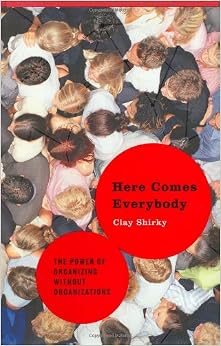
One of my influences over the years was Clay Shirky. I say “was” because I’ve not heard much from him lately. Cognitive Surplus, Here Comes Everybody, and his TED talks were seminal pieces in my learning and understanding of the Internet. He also wrote a piece later on about why he banned laptops in his classroom. I wrote about that. For whatever reason, his name came to mind, and I wondered what he was thinking about Genai. Interestingly enough, he wrote about it last month. I resonated with much of what he wrote:
After observing that student action and thought is the only possible source of learning, Simon concluded, “The teacher can advance learning only by influencing the student to learn.” Faced with generative AI in our classrooms, the obvious response for us is to influence students to adopt the helpful uses of AI while persuading them to avoid the harmful ones. Our problem is that we don’t know how to do that.
I’ve been working for the better part of the last 2 years exploring the risks and possibilities. I’m just now entering the kind of work where we’ll deal with this challenge directly. It’s complicated and complex. Just like I wrote about Shirky and his laptop experiment, that you have to give it a try before you decide to shut things down, Shirky suggests that’s already been happening in higher ed.
Since the arrival of generative AI, I have spent much of the last two years talking with professors and students to try to understand what is going on in their classrooms. In those conversations, faculty have been variously vexed, curious, angry, or excited about AI, but as last year was winding down, for the first time one of the frequently expressed emotions was sadness. This came from faculty who were, by their account, adopting the strategies my colleagues and I have recommended: emphasizing the connection between effort and learning, responding to AI-generated work by offering a second chance rather than simply grading down, and so on. Those faculty were telling us our recommended strategies were not working as well as we’d hoped, and they were saying it with real distress.
The ubiquity of this technology is such that it’s going to be harder and harder to distinguish between the good and bad uses of Genai. I’ve been pushing the idea of productive struggle as a primary goal of school. Learning isn’t always hard, but it can be. We live in a world that is obsessed with reducing barriers, both for good and also because, as humans, we are typically looking for shortcuts. I’m 61. I don’t need to “learn” to write, but I enjoy spending time choosing my words and seeing an idea come to life. I know others who use AI much more directly in their writing. To me, that’s personal preference. But in the developmental stages of life, that’s not a preference.
The story that Shirky shares about William, describes what may be an inevitable path where AI just does what schools have typically asked for, and learning becomes secondary or non-existent. Currently, I’ve seen progress in trying to create some guidelines and structures to support students and teachers in navigating our use of GENai. However, what Shirky is describing here goes beyond those guidelines to address the emotions and cognitive struggle that is often unintentionally being offloaded to AI. I talk to many who sense an unpleasant feeling when they use AI, and that shouldn’t be dismissed. This goes way beyond just trying to “catch” kids using AI inappropriately or to avoid work, but is about doing the work. The “work” in this case isn’t the product but the thinking and all the things a teacher likely doesn’t see. One of my favourite questions is asking students what they choose to leave out of an assignment or project. This helps me and them understand how they edit and curate their work.
Maybe we need to explicitly teach the concept of productive struggle, or as Shirky calls it, “desirable difficulty”. Resilience and grit may be part of it, but I suspect it’s even more than that. Maybe we need to encourage our students and ourselves to monitor our feelings and call out when AI feel weird. As adults, we have the advantage of more experience not using AI. I recently talked with a high school teacher who was sharing similar stories about how her students were reluctant to use AI for fear of learning loss. As teenagers, they have memories of learning without AI. Like many of us older folks who remember learning without the Internet, our high school students are the last generation to have some memory of learning without AI.
I’m writing this not because I have a ton of answers, but as I continue to support educators in this work, this is currently my biggest fear. What I am grateful for is knowing how many educators are willing to address this concern and work towards something that helps students.