Welcome to episode 153 of the Nerd Journey Podcast [@NerdJourney]! We’re John White (@vJourneyman) and Nick Korte (@NetworkNerd_), two Pre-Sales Technical Engineers who are hoping to bring you the IT career advice that we wish we’d been given earlier in our careers. In today’s episode we share part 2 of our interview with Scott Lowe, tackling topics like time management, generalists and specialists, moving into a new focus area, and thoughts on community.
Original Recording Date: 10-21-2021
Scott Lowe is a Principal Field Engineer at Kong and has been with the company since mid-May 2021. Find Scott’s blog at https://blog.scottlowe.org/, and check out part 1 of our interview with him from Episode 152.
Topics – The Time Management Crunch; Generalists, Specialists, and Adjacencies; Thoughts on Startup Life; The Full Stack Career Journey and Closing Thoughts 2:53 – The Time Management Crunch * As projects get larger (i.e. taking on things like writing books), how do you change your focus and manage time effectively? * Scott has talked quite a bit about time management but still feels like it is an area in which he could improve. Maybe the thinking you could improve is part of this and what drives us to continue to gather knowledge. * It’s all about tradeoffs. Earlier in Scott’s technology career he made the decision to minimize the amount of TV he watched. * Family is a big priority for Scott. He would spent an hour or so with the family each evening. + One of the things he liked to ensure was that his family had dinner together every evening to talk about what happened during the day. It was a nice way to stay connected to his kids, even if they didn’t care or understand what he did every day. + The process of sharing what was important let the kids know they were important. + Often times the family would watch a show together or read a book together. + Once the kids went off to do their own thing, he went back to write a blog post or work on his book, for example. * Over the course of an evening you could spend 3 or 4 hours sitting in front of the TV doing almost nothing. + Part of that time could certainly be used to bond with family, but there is likely some amount of time to use for other things. * Back when he had to go to the office, Scott would pack his lunch and work on something of his own choosing during that time (learning something new, a personal project, etc.). * Look at what you are doing with your time, and ask yourself if it could be used more effectively for your career. + Many people with commutes would listen to podcasts during their commute, for example. + Scott hasn’t had a commute in 10 years but recently started listening to podcasts again while walking his dogs. * Ask yourself if you’re making the most of the time when you do spend it on building your career. + Make sure you’re not just busy for the sake of being busy. Don’t spend all your time tweaking your productivity system. Scott has been there. + There are ways to track your tasks (to-do list, a system like Getting Things Done) and ways to save things to come back to later (i.e. a helpful URL to read, etc.). - Build systems to ensure the least amount of mental expenditure so you’re not worried you will forget to do something later. * Then there is what’s next. + This has come up a lot when people want to learn something new but feel they are super busy in their day job. + There’s no silver bullet here. Scott tends to look for trends that he sees emerging. The only way to this is to read quite a bit. - Scott uses a RSS reader to track around 150-200 blogs regularly and scans for trends in what people are talking about in their articles, looking for how this impacts what he has already learned (i.e. does it add to it, extend it, etc.). This is how you decide what to do with the time. * To review, there are 3 aspects: + Finding the time + Making the most of the time - Nick recommends minimizing distractions here. + Decide what to do with the time using the lens of what’s next * Scott says right now there are so many things he could go after. + He has to limit what he pursues at present to those things more applicable to his day job. This would be things that are only one adjacent area away at most. + Scott and his wife have no children at home right now, which makes independent exploration a bit easier. + When he did have young kids at home, Scott made the decision not to travel so he could connect with them. + You can prioritize family time appropriately, but there are spaces of time you can find to listen to a technical podcast while you work out or exercise, for example. There will be ways to still invest in yourself.
15:00 – Generalists, Specialists, and Adjacencies * Scott has debated this with people in the past, feeling like there may have been an episode of Geek Whisperers on this topic.
+ There’s a concept of the pie-shaped skillset and a T-shaped skillset.
+ The T-shape usually means you are super deep in one area but have some knowledge of a number of others.
+ The pie shape usually indicates a deep expertise in one area ends up leading you into the next area of expertise.
-
Scott feels like the debate of generalist vs. specialist is a non-debate and that it is taken in the context of time.
- Over the course of his career Scott has done storage, virtualization, cloud computing, operating systems, some programming, racking and stacking of servers, help desk support, etc.
- Looking at all of this holistically you might say Scott is a generalist. But at any one point in time he was focused in the specific area and whatever skillset he was preparing to do next.
- When Scott was focused on storage and the opportunity came to shift his focus, he didn’t forget everything he knew about storage. He built onto it knowledge of networking, virtualization, and other things.
- As IT Professionals we cannot afford to be static. Technology is not going to stop…even when the robots take over.
- Technology is constantly changing. If you call yourself a Technology Professional, your profession is something that is constantly changing. You have to be prepared to change as your profession changes. "If you don’t like change, you will like irrelevance even less." – army general
- If you don’t embrace the change you will get left behind and miss out on the things that could make your career amazing. We need to be prepared to see opportunities for ourselves. Be watching and looking for those opportunities.
- At any given time you will be specializing in something, but over the course of time, you will likely end up a generalist due to specialization in a number of areas.
- Scott believes there will be 1,2, or maybe 3 areas where you will be deeper than others. But he believes you can cultivate that depth.
- He does not know as much about vSphere as he once did but has learned a great deal about AWS and Kubernetes.
- "Implementation details may change, but concepts will still apply." – Scott Lowe
- A GSX VM is not so different from an AWS EC2 instance.
- When asked how to learn new things, Scott advises focusing on the concepts first.
- Greg Farrow of Packet Pushers said you can learn about how Cisco does BGP, for example, but when you switch to a Juniper device you will have to learn how they do it. But if you learn BGP concepts first (i.e. transferrable knowledge), the implementation details become easier regardless of the vendor’s implementation.
- The reality is that very few people will learn by reading a bunch of RFCs.
- Most people will learn by seeing how the RFCs are put into practice by choosing a specific implementation of it (i.e. a vendor flavor). Coming into this with a concept centric focus will allow the mind to separate a command Cisco uses for some configuration with what is actually happening behind the scenes (the underlying concept).
-
The right time to move into what’s next is a tough one to answer. On one hand waiting until you’re ready may be too late. There is a certain level of readiness you need before making the leap, but that level will depend on someone’s comfort level with being uncomfortable.
-
Scott might not encourage someone to make a radical shift early on in their career unless they were in some way prepared for that change.
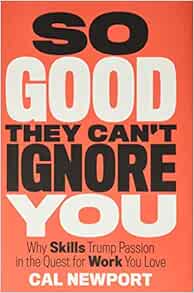
- Scott references So Good They Can’t Ignore You by Cal Newport that talked about finding opportunities by going very deep in an area and proceeding into the adjacent possible for new opportunities.
- Scott is also planning to read Deep Work by Cal Newport soon.
- For more on Deep Work, check out our 7-part review of the book starting with Episode 141 and concluding with Episode 147.
-
Here’s an example. Suppose you’re a hard core network expert, have designed LANs and WANs, and worked with multiple vendor implementations.
-
If you see Kubernetes come along and decide you want it to be your focus but have not done any prep work, Scott sees that as the equivalent of jumping into the deep end of a pool without knowing how to swim.
- On one hand, don’t wait until you’re ready because there is always a fear and discomfort when you do something new. At the same time you need to lay a foundation.
- This can be as simple as making connections between concepts in the new area and the area you already know.
- To you, Kubernetes will look like a new kind of network because Kubernetes does networking differently. Take the knowledge you have and expand it a little to learn (incrementally) about pods, CNI, and services that are Kubernetes concepts.
- You can gradually go deeper from there.
- That prep work is in the adjacent possible (right next to what you’re doing right now so you can build connections to things you previously didn’t know which gives you a foothold to go and do something new).
- For our thoughts on generalists vs. specialists, check out Episode 26.
29:57 – Thoughts on Startup Life * The size of a company and age / maturity of a company align differently to people’s preferences. For Scott, he enjoys the dynamic nature of a smaller company and the ability to do different things. * Scott joined VMware in 2013 right after the Nicira acquisition (company was around 13,000 at the time). He had been at EMC, which was at around 50,000 people. + You could feel the difference in company policies. It wasn’t highly stratified and even less so in the Nicira group Scott joined. Martin Cassado called it the pirate ship (the networking and security business unit). - Scott could speak at marketing events, speak to engineers and product management about the product direction (NSX), and huddling with the CTO team on structure and roadmap of the product. - This was a lot of fun for Scott, and he got to work with a dynamic group of individuals. * When Scott left VMware in 2018, it was for small company called Heptio that had around 50 employees at the time. + The field engineering team did pre-sales, professional services, marketing events, product development, etc. One of Scott’s teammates built a tool for customers that turned into a popular open source project. + They wrote code, built features, and it was super dynamic. * This is one of the things Scott likes about working at Kong. They are at over 300 employees now. + It might be building out a reference architecture, building an infrastructure as code lab, or something else entirely. + For Scott the dynamic nature is a great fit, but it might not be a fit for everyone. For others, a larger company with more well-defined roles may be attractive, and that’s ok.
35:07 – The Full Stack Career Journey and Closing Thoughts * Be sure to subscribe to Scott’s podcast Full Stack Journey. + Nick was on Episode 58 of Full Stack Journey to talk about lessons learned running Nerd Journey while John needed to step away. * Scott shares some advice he previously shared on an episode of The Geek Whisperers many years ago. + Amy Lewis asked Scott to share 1 lesson he wishes he had learned earlier. Scott believes his answer was don’t underestimate the power of your community. + This is something many of us may be struggling with as a result of the pandemic. We’ve come to rely on working in disconnected fashions. + We all have personal or professional communities that we can tap into which will help us succeed. This is a lesson Scott feels like he did not learn early enough in his career. - At times he didn’t want to ask for help. The reality is there are a number of great people out there who would be willing to help you succeed if they are able. - Don’t underestimate that or let yourself grow too cynical. - The collaboration between you and someone else allows you to do better than you could have done on your own. * If you want to follow Scott, reach out to him on Twitter @Scott_Lowe. His DMs are open. + Scott blogs at blog.scottlowe.org + He’s active in the Kubernetes, CNCF, and other cloud native Slack communities. + Scott’s podcast, Full Stack Journey, talks about the full stack of technologies available in today’s datacenters.
Contact us if you need help on the journey.