Peter Rukavina's Weblog: Recent Episodes
Peter Rukavina

The personal weblog of Peter Rukavina, a Charlottetown, Prince Edward Island, Canada-based printer, writer and developer.
Ton reminds me that it was 20 years ago this week, in June of 2005, that we were all at reboot7 in Copenhagen.
That conference—and those that followed in 2006, 2007, 2008, and 2009—~~changed~~ are changing my life, in ways that I continue to discover.
Some of that change was obvious at the time.
In reflecting on the closing day—exactly 20 years ago— I wrote, in Shy:
And of course I’m just plain afraid. Terrified of the unknown, suddenly left frozen at the thought of freeform social contact.
Given that the interesting part of conferences happens during the “hanging out in the coffee room after the speakers” part, this fear / awkwardness / terror leaves me at something of a disadvantage.
Halfway through reboot, I decided that, fuck it, I had to just jump off. Pretend I wasn’t terrified, and see what played out.
(It worked.)
In other ways I’m only now able to understand why reboot was so important, what role it played in my life, how it saved my life.
Reboot was my gateway to cultivating a love of Europe, an easy facility with Europe, and a network of European friends. Denmark, Sweden, Germany, The Netherlands, Portugal, Italy, and the friends thereof, have proved a wellspring of ideas, inspirations, opportunities, connection.
What a privilege it is to have a magic place to go, long over the horizon and far away from the everyday, that serves as a kind of off-site for mind, body, and soul.
But time has shown me more.
In recent months I’ve been working with a counsellor schooled in the ways of Internal Family Systems, and through that practice I’m becoming more aware of what IFS calls my “self” and my “parts.” And through that, I’m starting to learn more about how elusive my “self” has been, for a long, long time.
IFS associates “self-leadership” with “eight Cs”:
It is also a way of understanding personal and intimate relationships and stepping into life with the 8 Cs: confidence, calm, compassion, courage, creativity, clarity, curiosity, and connectedness.
Those are all qualities that, to one degree or another, have been absent from my life, obscured behind a thicket of parts—fear, anger, loneliness, overwhelm, disconnectedness, shame, avoidance. One of the great gifts of plucking up my courage to go to that first reboot conference, and the opportunities that followed from it, is that I was gifted a glimpse of “self,” a creative, courageous, curious version of myself.
I love that guy, and it’s no wonder that I was, and am, drawn to Europe to rekindle my relationship with him.
So, yes, reboot saved my life, let me connect to myself.
But it also delayed my life, stunted it.
By rooting access to “self” off-shore, I remained content, or at least resigned, to allow my everyday life at home to be “parts-led.”
Historically, I felt this most acutely on the transitions back to home from Europe, where it felt like a fog descending over me, like going through a glitchy version of the Star Trek transporter that filtered out access to some important parts of myself.
This is difficult to write about, in part because it appears that I’m throwing a huge swath of my life under the bus, a swath rooted in a partner who died, a child I’m continuing to raise, myriad work and volunteer projects and relationships.
I don’t want to suggest that my life has sucked, with brief respites when it didn’t, because that’s both not true, and over-simplifies the ever-changing presence of “parts” and “self” in my life.
But I do find myself understanding how much I have been holding in for so long, how shallow I’ve allowed my relationships to be, how I’ve used fear as a guard against vulnerability.
Pete Livingstone—who I met in Copenhagen many years ago, another byproduct of my reboot life—wrote this, in a blow-by-blow of his 2024 cancer treatment:
On the other hand I can now concede that being pushed towards an awareness of ones own mortality – coupled with a degree of illness and physical discomfort - may have some weird and unexpected effects on ones unconscious mind. In my case it feels like that the experience I have gone through has conferred on my body and mind an ability to perform, on occasion, what I want to describe as an “action”, a kind of psychic, almost physiological muscle-flexing. This “action” feels completely novel to me, but I can feel that the potential to carry it out has always lain dormant inside me, and indeed is part of how I, and I presume all other humans, are put together. It’s as if, quite sensibly, we contain an algorithm in our unconscious which lies in wait, and is specifically for dealing with suffering and death. The tentative flexing of this previously unused psychic muscle seems to set off some emotional events which I find unfamiliar in an almost alarming way.
Perhaps you could describe what Pete experienced as a “reboot,” and perhaps I could, now that I think of it, describe my life in recent years in the same way.
Like reboot the conference gifted me a taste of “self,” going through years of life as a carer, living through the death of my partner of 28 years, nurturing Olivia through COVID, finding new love in an audacious partner (and an audacious step-daughter), leaving paid work and reimagining myself as a printer, helping set Olivia off toward independence, all of that was a portal, its own kind of reboot, that, having emerged, somewhat intact, out the other side, allows me slightly more clarity, more access to my parts and my self and how I have lived, and will live my life.
When I reflected on that first reboot 15 years ago, on its 10th anniversary, I wrote:
On June 14, I flew back to Prince Edward Island, via Frankfurt and Montreal. Exhausted but happy and very, very changed.
That’s not a bad way of describing my current state: exhausted but happy and very, very changed.
Thank you, reboot.
Since I migrated this blog to a Hetzner server, I’ve been paying attention to the “Graphs” tab of the server dashboard to see how the capacity of the server matches the traffic I’m expecting it to handle.
One of the things I’ve noticed is that there are regular periods of very high CPU usage, periods where the 4 vCPUs are almost maxed out:
These periods are accompanied by corresponding jumps in network traffic:
I got curious about what might be causing this, and, because I suspected web traffic bumps, I started by looking at the 20 most popular user-agents in my Apache logfiles, with:
awk -F'"' '{print $6}' access.log | sort | uniq -c | sort -nr | head -20
The result:
577651 Scrapy/2.11.2 (+https://scrapy.org) 39018 Mozilla/5.0 (Linux; Android 5.0) AppleWebKit/537.36 (KHTML, like Gecko) Mobile Safari/537.36 (compatible; Bytespider; spider-feedback@bytedance.com) 23216 Mozilla/5.0 (iPhone; CPU iPhone OS 18_5 like Mac OS X) AppleWebKit/605.1.15 (KHTML, like Gecko) Version/18.5 Mobile/15E148 Safari/604.1 15561 Mozilla/5.0 (X11; Linux x86_64) AppleWebKit/537.36 (KHTML, like Gecko) Chrome/117.0.0.0 Safari/537.36 14793 Mozilla/5.0 AppleWebKit/537.36 (KHTML, like Gecko; compatible; GPTBot/1.2; +https://openai.com/gptbot) 14571 Mozilla/5.0 (Windows NT 10.0; Win64; x64) AppleWebKit/537.36 (KHTML, like Gecko) Chrome/137.0.0.0 Safari/537.36 12838 Mozilla/5.0 (Linux; Android 10; K) AppleWebKit/537.36 (KHTML, like Gecko) Chrome/137.0.0.0 Mobile Safari/537.36 12306 Mozilla/5.0 (compatible; SemrushBot/7~bl; +http://www.semrush.com/bot.html) 10834 Mozilla/5.0 (Macintosh; Intel Mac OS X 10_15_7) AppleWebKit/605.1.15 (KHTML, like Gecko) Version/18.5 Safari/605.1.15 9714 Mozilla/5.0 AppleWebKit/537.36 (KHTML, like Gecko; compatible; ClaudeBot/1.0; +claudebot@anthropic.com) 7104 Mozilla/5.0 AppleWebKit/537.36 (KHTML, like Gecko; compatible; Amazonbot/0.1; +https://developer.amazon.com/support/amazonbot) Chrome/119.0.6045.214 Safari/537.36 7005 Mozilla/5.0 AppleWebKit/537.36 (KHTML, like Gecko; compatible; bingbot/2.0; +http://www.bing.com/bingbot.htm) Chrome/116.0.1938.76 Safari/537.36 6287 Wget/1.21.3 5885 meta-externalagent/1.1 (+https://developers.facebook.com/docs/sharing/webmasters/crawler) 5093 Mozilla/5.0 (Windows NT 10.0; Win64; x64; rv:139.0) Gecko/20100101 Firefox/139.0 4798 Mozilla/5.0 (Linux; Android 6.0.1; Nexus 5X Build/MMB29P) AppleWebKit/537.36 (KHTML, like Gecko) Chrome/137.0.7151.68 Mobile Safari/537.36 (compatible; Googlebot/2.1; +http://www.google.com/bot.html) 4593 Mozilla/5.0 (Windows NT 10.0; Win64; x64) AppleWebKit/537.36 (KHTML, like Gecko) Chrome/91.0.4472.124 Safari/537.36 4143 Mozilla/5.0 (Macintosh; Intel Mac OS X 10_15_7) AppleWebKit/537.36 (KHTML, like Gecko) Chrome/137.0.0.0 Safari/537.36 3446 - 3228 Mozilla/5.0 (X11; Ubuntu; Linux x86_64; rv:72.0) Gecko/20100101 Firefox/72.0
I asked ChatGPT to normalize and summarize, which gave me:
| Lines | Normalized User-Agent | Type | Notes | | --- | --- | --- | --- | | 577651 | Scrapy | Bot | Likely automated scraping (Scrapy framework) | | 39043 | Bytespider | Bot | From ByteDance (TikTok); known aggressive crawler | | 23337 | Safari on iPhone | Browser | Human traffic, Apple mobile Safari | | 15590 | Chrome on Linux | Browser | Human or automation (generic Linux desktop Chrome) | | 14793 | GPTBot | Bot | OpenAI’s web crawler | | 14571 | Chrome on Windows | Browser | Human or automation (Windows desktop Chrome) | | 12838 | Chrome on Android | Browser | Human traffic, mobile Chrome | | 12307 | SemrushBot | Bot | SEO bot from Semrush | | 10840 | Safari on macOS | Browser | Human traffic | | 9727 | ClaudeBot | Bot | From Anthropic (AI crawler) | | 7105 | Amazonbot | Bot | Amazon’s crawler | | 7018 | Bingbot | Bot | Microsoft’s search indexer | | 6296 | Wget | Tool | Scripted fetch tool; likely automation or scraping | | 5891 | Facebook External Agent | Bot | Facebook link preview/crawler bot | | 5101 | Firefox on Windows | Browser | Human traffic | | 4798 | Googlebot on Android | Bot | Google’s search bot, disguised as Android browser | | 4593 | Chrome on Windows | Browser | Redundant with earlier Chrome/Windows | | 4143 | Chrome on macOS | Browser | Human or automation, Mac desktop | | 3447 | Unknown (“-”) | Unknown | Empty/missing user-agent | | 3231 | Firefox on Linux (Ubuntu) | Browser | Human traffic |
It also gave me this summary:
- Total bot/tool traffic: ~695,940 (≈ 85% of top 20 traffic)
- Likely human browser traffic: ~102,296 (≈ 13%)
- Unknown/empty: ~3,447 (≈ 0.4%)
This log has a total of 964,802 lines in it, meaning that whatever “Scrapy” is doing is responsible for 60% of the traffic to my blog.
Ugh.
I followed up by asking ChatGPT to give me a robots.txt file that includes all of the bots, and I’ve added that to this site’s robots.txt (leaving out some friendly user-agents like NetNewsWire).
Because “Scrapy” seems particular evil, I also blocked it at the Apache level, with:
<IfModule mod_rewrite.c> RewriteEngine On RewriteCond %{HTTP_USER_AGENT} ^Scrapy [NC] RewriteRule ^.* - [F,L]</IfModule>
I tested that this was working with:
curl -I -A "Scrapy/2.11.2 (+https://scrapy.org)" https://ruk.ca
Which properly returned:
HTTP/1.1 403 ForbiddenDate: Tue, 10 Jun 2025 22:31:15 GMTServer: Apache/2.4.63 (Fedora Linux) OpenSSL/3.2.4Content-Type: text/html; charset=iso-8859-1
I’ll wait 24 hours to see what effect all this has on network traffic and CPU.
The magazine section at our local Indigo has been condensed over recent months: a substantial section of magazine racks has been removed, and replaced with puzzles and games.
The area where general interest magazines like Harpers, Monocle, The Atlantic, and The New Yorker used to be has been removed, and condensed into a new “Business / Entertainment / Young Readers” section that looked like this today:
I know this because I decided today that I wanted to go and buy myself a real live copy of The New Yorker.
I let my subscription go just before COVID, a big step for me, a longtime subscriber who had once been the magazine’s foremost advocate on Prince Edward Island. I decided I was ready to dip my toe back in the waters, and I knew Indigo to be a reliable source.
Except it wasn’t.
No copies in evidence, with “we don’t track inventory of magazines” the only comment from staff, followed by a suggestion that if it wasn’t there, well, then, it wasn’t there.
This all brought back the memory of an email to the magazine’s then-publisher about problems with delivery of the magazine to the late great Tweels, where I wrote, in part:
For some reason, for weeks where Monday is a holiday in Canada, but not in the U.S. — days like Victoria Day in May, Dominion Day in July, and so on — your magazine never arrives at Tweels Gift Shop. I ask at the counter and they tell me some variation of “we were shorted this week.” I don’t really understand what this means. But it is a reliable and consistent problem, and has been for some time.
I have no idea how the The New Yorker gets from New York City to Charlottetown, PEI. But on those weeks — like this one, where November 11 was a holiday here but not there — when The New Yorker is not available, my entire week is affected.
It’s like a small part of the air I breath is not available to me.
I realize that in the grander scheme of things this problem pales in comparison to others I imagine you have on your desk. But I would very much appreciate it if you could be of some assistance in helping to track down and solve it.
Much to my surprise, Mr. Carey replied within 24 hours:
Thank you for this note, and your connection to The New Yorker.
I will pass this on our newsstand operation, who perhaps can answer your question.
Have you ever thought about subscribing, which may prove to be more reliable?
(I love the prompt to subscribe: that’s what publishers are supposed to do!)
True to his word, the query was passed along, and I received a reply, in part:
We apologize for the difficulty that you had in finding the New Yorker at Tweels Gift Shop. We looked into this.
We found that Tweel’s normally receives 15 copies of The New Yorker and, thanks to loyal readers like you, sells an average of 7 copies each week. However, I was told that one recent issue was not delivered to Tweels for some reason. (That’s what they mean by being “shorted”.) Tweels did not get the issue with the cover date October 8. If you have not been able to get a copy of that issue please let me know . I would be happy to send one to you.
Regarding your comments about the Mondays that are holidays in Canada , I have found out that on those weeks Tweels gets their copies on Tuesday. That’s because the magazine distributor also takes off on the Monday holiday.
I love the humanity of this reply, and the earlier ones, a humanity that seems of a bygone era.
I also like the historic data point that Tweels once received 15 copies of The New Yorker every week, and sold 7 on average.
In the meantime, I think maybe they still stock the magazine on the front counter at Brighton Clover Farm, and perhaps I’ll head over there.
In 2014, I stopped maintaining my own physical server—an actual computer that I actually owned, and could go and visit upstairs.
At the time I wrote:
At the same time as I made this switch, for the first time I am serving ruk.ca from a server that I don’t own: since the site went live in 1999 it has been served by a series of owned-and-operated PCs. In the early days these were housed in the basement of my house at 100 Prince Street; more recently the server, known as “ross” internally, has been based in silverorange’s Fitzroy Street data center.
At the time, I’d just moved this site, and its cousins, to Amazon Web Services (AWS). This made sense: I was maintaining a fleet of servers for Yankee at AWS, and so I was in and out of the AWS dashboard every day, and it felt like home.
As I’ve written here previously, AWS started to get expensive, and while I was able to tweak things to lower costs, they were still upwards of $125 a month, and that seemed unreasonable given current cash flow. Because I’m no longer working with Yankee, I didn’t have the tethering to AWS that I once had, so I used the opportunity to move elsewhere.
So, as of this morning, this site is hosted on a Hetzner Cloud server in Helsinki (for the technically minded, it’s a CPX31 server, with 4 VCPU, 8 GB RAM and 160 GB of disk). In theory this should lower my hosting costs from the $125/month I’m paying now down to about $20.
The migration has been mostly lovely: the Hetzner Cloud website is both delightfully simple and delightfully capable.
Migration will continue for the next week or so; until then I’ll be straddling two worlds. But by mid-month I’ll have divorced AWS and fully re-homed in Finland.
One of the magazines I remember being around my parents’ living room when I was a kid was Toronto Life. We lived about 90 minutes from Toronto, and because we were up high on the Niagara Escarpment, the city frequently presented itself as a Oz-like vision in the far distance. The magazine was a look inside that Oz, and I found myself unusually engaged with it, an engagement which has stayed with me, even though Toronto is now 24 hours drive away.
That, and being a student of magazine design, make me particularly interested in the rebranding that was launched in the latest issue. Here’s the before (left) and the after (right):
| | |
The editor explains the “new” logo in the latest issue:
The task of capturing this spirit in a logo fell to Toronto Life’s art director, Colleen Nicholson, and Commercial Type’s Christian Schwartz, who were inspired by the magazine’s debut. The inaugural cover, from 1966, featured Barbara Amiel, then a young writer and budding society fixture, under an orange logo featuring a bohemian “T,” a renegade rainbow “r” and a dignified uptown “L.”
I had some affection for the just-departed design, but the new one is growing on me.
(A reminder: if you’re an Apple News+ subscriber you can read Toronto Life there.)
There’s a feeling I get at the drug store blood pressure machine, the feeling that comes from wanting to win at blood pressure.
I find myself breathing deeply, trying to will my blood to stop having so much pressure. I calm myself down, and try to not ruminate about anything that might agitate me too much.
That’s meditation.
When I was a kid, my family subscribed to the Waterdown Review, the local weekly newspaper. Every week, I was an eager reader of the column from editor Ken Bosveld, a breezy mix of village news and personal reflections. I don’t know why I loved it so, but I did.
One of the topics that Ken would write about frequently was visits to a place called Chapleau, where his family, if memory serves, had a camp of some sort.
I never knew where Chapleau was: it was a mythical place somewhere in Ontario. And that’s where I filed it away in my memory and my imagination.
In the same file as the town of Strathroy.
I’ve never been to Strathroy.
I don’t know anyone from Strathroy.
I don’t think I’ve ever read anything about Strathroy.
But, somehow, I’m aware of its existence, in the same imaginative neighbourhood as Chapleau.
(Strathroy and Chapleau are not geographically close; depending on which way you drive, you’ll need to travel about 900 km to get from one to the other).
Strathroy, meanwhile, after languishing in this liminal space until now, has suddenly emerged onto the scene.
First, Strathroy is the home of Crystal Clear Bags Canada.
A month ago, we were looking, wouldn’t you know it, for crystal clear bags. The Google pathway led right to their door.
We are now repeat customers.
Great selection, good website, quick turnaround, reasonable prices, not U-Line nor Amazon: they check all the boxes!
You’d think that would be enough Strathroy.
It wasn’t.
Yesterday, the post The Bureau of Library Tourism, from Mita Williams’ Librarian of Things blog, showed up in my RSS reader.
In the post, Mita writes:
I just walked back from the lovely Cookie Bar in Ford City, Ontario, where I was one of the six “fun” speakers at the Bike Windsor Essex AGM.
The theme was transportation and the format was pecha kucha: 20 slides that auto forward every 20 seconds.
This is what I was supposed to have said.
She then goes on to include the slides for her delightful talk on the topic of helping “libraries give tourists things to do when they visit.”
For a fan, like me, of both libraries and travel, and visiting libraries when I travel, this is heady stuff. (Go read it; it’s lovely).
(An aside: earlier this week, Lisa and I were visiting St. Dunstan’s Basilica, a few blocks from our house, and we ended up chatting with a tourist from Colorado, newly arrived on a cruise ship. She asked us for directions to the public library and explained she was a library trustee in her hometown, and liked visiting libraries when travelling. Library tourism is real.)
Right, Strathroy.
How could I not click on the Cookie Bar link in Mita’s post!
Cookie Bar turns out to be exactly what’s on the tin.
A bar. With cookies.
Here’s their story:
Started mixing one cookie as a time, customizing each recipe from scratch, laid off in 2020 because of the pandemic, in a small apartment kitchen. Upgraded to renting a kitchen in Walkerville, then having a spot of my own at 471 Pelissier. Serving over 18 different 1/4 lb craft cookies and over 80 different craft beers.
Mita’s event was at their Windsor location, in Ford City (that’s a Wikipedia entry worth reading), but Cookie Bar also has a location in, you guessed it, Strathroy.
So. Much. Strathroy.
As no laterally-slithered-together blog post would be complete without a neatly tied bow, I present The Ghost in the Waterdown Library, originally published in 1987 in Heritage Happenings, which starts with:
Now I don’t believe in ghosts, but I can tell you there are a lot of people who won’t use that elevator.”
—Mrs. Lorraine Eastwood, Head Librarian, Waterdown
I went to high school in Waterdown, and the Waterdown Library—the same one, with the ghost, though I didn’t know about the ghost at the time—was a frequent refuge for me, a place to get away from the overload of Waterdown District High School.
I knew Mrs. Eastwood: she was ever-present, and the very model of how you might imagine a small village librarian from literature. (My mother, also a librarian, was a colleague of hers in later years.)
That piece on the ghost mentions Waterdown Review editor Ken, he of camp-in-the-Chapleau-in-my-imagination:
Later on the same day, Mr. Ken Bosveld, the Editor of the Review, came to the library and interviewed Mrs. Eastwood about the elevator’s strange behaviour. Within seconds of focusing his camera on the tombstones, the door mysteriously opened and remained so, long enough for two photographs to be taken.
Libraries. Travel. Ghosts. Newspapers. Elevators.
And Strathroy.
Time for a visit? They have a library!
Arrived in today’s post from Latvia, a copy of Internet Phone Book:
Has there ever been a publication more laser-targeted at my inclinations and eccentricities?
I had to move some things around this week, so I skipped my regular workout yesterday, and worked out with Lisa this morning, with her coach Matt Cormier.
The conditioning part of the workout was a 15 minute AMRAP of 10 ring rows, 10 plate squats, and a 200 meter run.
The running route was out Matt’s garage door, up his driveway, onto the street, around the corner, and back.
In my later rounds, as I was getting fatigued, I thought about stopping for a break, or at least slowing down, at the 100 metre turnaround point.
Matt couldn’t see me.
Lisa couldn’t see me.
Who would know?!
But I didn’t.
Because I realized that I wasn’t there for them.
I wouldn’t be cheating them out of anything, I’d be cheating myself. Robbing myself of the opportunity to discover if I could keep going.
So I kept going. I completed 5 rounds.
Later in the day I read this, from Matthew McConaughey, in his weekly newsletter:
Self-Determination Theory, developed by psychologists Richard Ryan, PhD and Edward Deci, PhD, has changed the way we look at motivation: it shows how intrinsic, high-quality motivation (that satisfies the basic human needs of autonomy, competence, and relatedness in work) leads to the best experience and performance – as opposed to extrinsic motivation that is driven by rewards like money or social status. So define success for yourself. The real you.
I’ve always believed that, in my heart of hearts. I was glad to have it confirmed empirically on the asphalt this morning.
Just after the new year, our friend Betty suggested we come to the winter session of an acting class in Victoria that she’d been attending, a class taught by Becca Griffin.
We procrastinated: a 35-minute drive? in the winter? every Thursday night? for an hour of out-of-comfort-zone activities with Central Queens strangers?
That didn’t sound like fun.
But we pushed through our resistance—I can’t remember whether it was me or Lisa who pushed us over the edge—and signed up.
Last night was our last class of 8. What started in March as a night drive, through blinding snow that almost drove us off the road, ended in an open class, for friends and family, on a balmy spring evening.
The core of the classes was working on a two-person scene. Lisa and I, for convenience of cohabitation rehearsal schedule, paired ourselves and we picked this scene from the 2019 Scarlet Johansson-Adam Driver film Marriage Story. Not a light comedic romp.
Acting, and all that goes into it (memorizing lines, pretending to be someone else, feeling, listening) turns out to be really hard.
In fits and starts, we threw ourselves into it. By Lisa’s estimation, by the time we performed the scene last night, we’d run through it 100 times together.
Every time we started with my character’s line:
CHARLIE
It’s not what I want…I mean, it’s what I want, but it’s what was…WAS…what’s best for him.
NICOLE
I was wondering when you’d get around to Henry and what HE actually wants.
CHARLIE
Oh, fuck off—
and finished, 5 minutes and 5 pages of script later, with me overcome and weeping, and Lisa’s character comforting me:
Nicole stares at him, incredulous.
CHARLIE
What?
NICOLE
You’re so merged with your own selfishness that you don’t even identify it as selfishness anymore. YOU’RE SUCH A DICK.
CHARLIE
Every day I wake up and hope you’re dead— Dead like—
And then Charlie starts crying.
CHARLIE
(through tears) If I could guarantee Henry would be OK, I’d hope you get an illness and then get hit by a car and DIE.
He sinks down, weeping. All this vitriol has taken its toll. Nicole watches, taken aback. She walks over and gently puts her hand on his shoulder. He shakes and cries.
In between, leading up to that, a lot of intensity.
A lot.
And so much learning.
In the beginning, our scripts closely held to our chest, we yelled our lines at each other, didn’t listen to each other.
Gradually, through repetition, and with Becca’s coaching, we discovered that the key to memorizing is to listen, to cue ourselves from each other, to embody the scene so that the progression from section to section (sections we named “Henry,” “About the Past,” “The Affair”) is not from rote learning, but because it made sense dramatically.
I said last night on the drive home that it felt like we’d gotten to the point where we were ready to start working on the scene now: there remains so much to explore, and getting ourselves to the point where we can just make it all the way through from beginning to end is simply a necessary precondition to truly digging in.
We won’t do that. If only because one can only yell “Every morning I wake up and wish you were dead!” at one’s partner so many times.
But we will go back to Becca’s classes in the fall. She proved a patient teacher with infectious enthusiasm (I went into the class afraid of her infectious enthusiasm; I need not have worried). Our classmates threw themselves into their scenes, and the games and exercises we did every week; they took risks, and that helped us take risks.
Eagle-eyed readers of this blog in its website version may have noticed a new element at the top, a search box:
There’s almost always been a way to search this blog; for the longest time it was backed by Apache Solr, and then, when I migrated to Drupal 10, I switched to using a simple database-backed search, which was slow and inflexible.
A few weeks ago I installed Meilisearch, and its module for Drupal, and now the search is both fast and flexible.
It may be that I am the only real client for this feature: I search this blog every day, both looking for things like “when did I move my printing press into The Guild” and looking for older blog posts to reference from new ones. Having an efficient way to do this feels good, like having a mainline into the timestream of my last 26 years.
I’m forever looking for ways to make finding library books easier, and recently I found something that I use almost every day, a “shortcut” for iOS and macOS that let’s me easily search the PEI Public Library Service catalogue.
If you have a Mac or an iPhone, and some basic familiarity with “Shortcuts,” you can download the shortcut here.
In operation on the Mac, it looks like this:
I’m simply clicking “Search Library” in the dock, getting prompted for a book title, and the library catalogue opens in Safari with a search for that book.
In the Shortcuts app it looks like this:
Some cool things about this, part of the magic that Shortcuts brings:
- It works equally well on my iPhone as on my MacBook Air.
- It works with Siri: I can say “Hey Siri, Search Library” and I’ll get prompted for a book title, which I can speak, and the search will open in my browser.
- One my iPhone, it also works as a “Share Sheet” item meaning that I can highlight a book title, click “Share” and select “Search Library” and the library catalogue search will open, like this:
Shortcuts isn’t quite “HyperCard for the 2020s,” but it’s a pretty amazing piece of kit to have built into all the Apple things.
I was writing to my Dutch friend Frank this morning about his post Renewal.
Reflecting on my own move away from paid work 18 months ago, I realized that work, for decades, had been my all-powerful trump card.
If I was bored, or distracted, or annoyed; if I needed time to myself, or wanted to get out of doing something, “I’ve got some work to do” was the reason that could never be questioned.
It was a superpower that, along with income and colleagues, I gave up when I stopped working. A superpower I was never until now so conscious of.
What I need to learn to do instead is how to set boundaries, stake out time and space for myself.
I’m not good at that: I’ve never had to be.
I find myself taking perverse comfort in work-like activities—paying bills, maintaining this website, filing taxes—because they allow be a small measure of that trump card.
Realizing that I can allow myself the luxury of reading all day without needing a database memory issue to get me there is something I’m ever so slowly easing myself into.
John Dale was right: once you start baking with sourdough, it’s hard to stop. This morning we celebrated Lisa for Stepmother’s Day with sourdough cinnamon rolls.
I missed the COVID sourdough wave, but recent developments have welcomed me in, late to the party.
First, Dave Atkinson wrote, in his weekly email newsletter, about his sourdough revelation:
Modern bread is made with refined wheat. A good chunk of the grain has been discarded. And it’s made with instant yeast. That’s not how we made bread for the first 99.99% of its history. Before a hundred years ago, it you ate bread, it was the whole grain. More importantly, it was made through fermentation. It was made with sourdough.
It turns out, a lot of people with gluten insensitivity can eat sourdough bread. I had somehow not heard this. The act of slow fermenting changes the structure of gluten making it easier to digest.
Next, Jeremy Cherfas recalled the COVID sourdough wave, and linked to a helpful earlier post, with a lot of helpful comments, about sourdough starter.
Finally, as if the above was queuing me up for action, my sister-in-law Karen offered me some sourdough starter (née her chiropractor’s sourdough starter), which was enough to push me over the edge.
I started out slowly, making a couple of loaves of bread, graduated to pizza dough last week, and over the last 24 hours I made bagels. Bagels that, if I don’t say so myself, are rather amazing.
Here’s the process in photos.
I used this recipe, which called for 12 hours of letting the dough rise, so, after mixing everything together in a stand-up mixer with the dough hook, I left the dough in a metal bowl, covered, overnight. When I woke up this morning, it had doubled in size:
I divided the dough into eight pieces…
…and shaped the pieces into balls, and then poked a hole into each one, and shaped them into bagels:
I let the bagels rise, covered, for another hour:
After this second rise, I boiled the bagels, four at a time, two minutes per side:
After giving them a little time to cool down, I baked the bagels on parchment paper in a 425ºF oven for 25 minutes. The emerged golden brown:
Once the bagels had cooled, I sliced them up for lunch. They had a pleasantly chewy crust, and a pleasantly bagel-like interior:
Needless to say, we enjoyed sandwiches on bagels for lunch:
One of the items on the wall at the Victoria Schoolhouse that catches my eye, every week as we go there for acting class, is a list of all the teachers who taught at the school, over the 101 years from 1872 to 1973:
For no other reason that “somebody is going to be looking for this list at some point in the future,” I’ve transcribed the list, and I’m pasting it here for posterity.
(If you ever have a chance to pop into the school—it’s a community hall now, and home to the village office—it’s worth poking your head into the main hall to look at the collection of artifacts related to the school’s past.)
| Years | Teacher(s) | | --- | --- | | 1873-73 | John M. Campbell | | 1873-74 | E.A. Donelly | | 1874-75 | vacant | | 1875-78 | Charles Darrach | | 1878-79 | Charles Darrach | | 1879-80 | Fulton J. Clay / Ambrose Baker | | 1880-81 | Ambrose Baker (Prin) / Kate MacQuarrie | | 1881-82 | J.N. Schurman (Prin) / Kate MacQuarrie | | 1882-83 | Norman Leard / Edith Webster | | 1883-84 | Alex Campbell / Edith Webster | | 1884-85 | Alex Campbell / Edith Webster | | 1885-86 | Alex Campbell / Augusta Newson | | 1886-87 | Alex Campbell | | 1887-89 | Alex Campbell / Janie Dawson | | 1889-90 | Alex Campbell / Lula E. Myers | | 1890-92 | Alex Campbell (Prin) / Jessie J. Clark | | 1892-93 | Lauchlin MacDonald / Nina Robertson | | 1893-94 | Lauchlin MacDonald / Bertha M. Tuplin | | 1894-95 | N.E. Carruthers / Bertha M. Tuplin | | 1895-96 | N.E. Carruthers / Bertha M. Tuplin / Birdie Leard | | 1896-97 | N.E. Carruthers / A.P. Trowsdale / Birdie Leard | | 1897-1901 | A.P. Trowsdale / Birdie Leard | | 1901-03 | J.E. Robertson / Birdie Leard | | 1903-04 | J.E. Robertson / H.B. Hazel Myers | | 1907-08 | W.J. Fraser / Hazel Myers | | 1908-09 | Wentworth MacDonald / Hazel Myers | | 1909-10 | E. Matheson / Hazel Myers | | 1910-11 | C. Braden Jelly / Phoebe MacDonald | | 1911-12 | C. Braden Jelly / Gertrude Matheson | | 1912-15 | C. Braden Jelly / Ruth Boulter | | 1916-16 | Haddon MacLeod / Elma Inman | | 1916-17 | Nelson MacEwen / Ruth Boulter | | 1917-18 | Nelson MacEwen (Prin) / Mildred Howatt | | 1918-19 | Annie Fraser / M. Katherine Trainor | | 1919-20 | Ruth MacGregor / Annie Fraser / M. Katherine Trainor / Ruth Boulter | | 1920-21 | Norman MacKenzie / Euphemia MacPhail | | 1921-23 | George E. Webster / Euphemia MacPhail | | 1923-24 | Henry Moyse / Euphemia MacPhail | | 1924-27 | George Boulter / Euphemia MacPhail | | 1927-28 | Arthur Brooks | | 1928-29 | Malcolm MacKenzie / Euphemia MacPhail | | 1929-30 | Malcolm MacKenzie / Marjorie Leard | | 1930-31 | Heber Mathews / Bertha Thompson | | 1931-35 | Charles Howatt / Bertha Thompson | | 1935-36 | Richard McQuarrie/ Bertha Thompson | | 1936-37 | Eva MacLeod / Bertha Thompson | | 1937-40 | Eva MacLeod / Marion Raynor | | 1940-41 | Heath McQuarrie / Eva MacLeod | | 1941-42 | Annie Gordon / Heslip MacQuarrie / Eva MacLeod | | 1942-43 | Peter MacPhail / Isabel Inman / Eva MacLeod | | 1943-44 | Isabel Inman / Mary MacDonald | | 1945-46 | Jean Boswell / Annie MacQuarrie | | 1946-47 | Jean Boswell / Christine MacLeod | | 1947-48 | Freda Howatt / Christine MacLeod | | 1948-49 | Florence MacDougall / Christine MacLeod | | 1949-50 | Florence MacDougall / Kathleen Pickers | | 1950-51 | Florence MacDougall / Phyllis Stewart | | 1951-52 | Florence MacDougall / Adelaide Inman | | 1952-54 | Florence MacDougall / Inez Cass | | 1954-55 | Mrs Doris Thompson / Sylva Boulter | | 1955-56 | Mrs Doris Thompson / Gladys Villett Wright | | 1956-57 | Mrs Doris Thompson / Gladys Villett Wright | | 1957-61 | Marion MacQuarrie / Jean Boswell | | 1961-61 | Jean B. Howatt / Marion MacQuarrie | | 1962-63 | Harry MacDonald / Marion MacQuarrie | | 1963-65 | Gloria Jean Grant / Marion MacQuarrie | | 1965-72 | Addie Kougergou / Marion MacQuarrie | | 1972-73 | Marion MacQuarrie (Sep-Feb) | | 1973 | Mary Masters (Feb-June) |
I’ve also produced a CSV of the same information, as well as another CSV that lists each teacher, sorted alphabetically, and the period(s) they served.
From a list of ten Instructions for Myself by James A. Reeves, No. 10 is:
Artificial intelligence cannot make cool shit, but it can help me learn how to make cool shit.
Brilliant.
Artist Keith A. Pettit, interviewed in Handprinted:
About 20 years ago, I shifted my focus from sign making and graphic design, to an art-led living. I range from tiny wood engravings, lino reductions, and sculptures; usually using wood to create — from the reasonably small to the stupidly enormous. Sometimes they’re also on fire.
I like the phrase “art-led living.” We’d all do well to live like that.
Last month I took at Nonviolent Crisis Intervention course at Holland College. It was training I’d wanted for more than a decade; this was the first chance I’d had to take it locally, and it proved invaluable. I grieve the years I was without it, and handled crises ham-fistedly.
One of the slides in the course slide deck concerned the Johari Window, which looks like this:
The idea is that you choose a number of adjectives from a list to describe yourself, then have your peers choose adjectives to describe you, from the same list. These adjectives are then placed in the quadrants based on whether each appears on both lists (“Arena”) or one or the other (“Façade” or “Blind spot”).
We didn’t dwell on the concept, but once I got home I looked it up. Who was “Johari,” I wondered?
Johari, it turns out, were Joseph Luft and Harrington Ingham, American psychologists.
As things often happen with me, I hopped into the Johari rabbit hole, and discovered that Luft died in 2014, two days after he turned 98 years old, after being hit by a car:
In a statement Saturday, his family said, “We are mourning the loss of our father and family member, but we are also celebrating his long and healthy life. Joe was the child of immigrants, a World War II veteran, renowned psychologist, proud father of four and beloved local figure. He cherished his daily walks and took them religiously for over 50 years.
“While his death was sudden, he died doing what he loved. We do not yet know the details of what happened, but our hearts go out to the driver of the car and his family during this difficult time.”
Nine months later, the city of Berkeley installed a flashing beacon at the intersection where Luft was killed.
I have thought of Luft often in the month since I came to know of him.
I love Austin Kleon’s Typewriter Interviews (something I wish I’d invented). I especially like his interview with poet Mary Ruefle, which includes:
I don’t know where I lie on the aphantasia to hyperphantasia spectrum, but I know for a fact that I’m far to the “a” than my “hyper” partner.
(One of the favourite things I’ve ever done is setting up a “One Minute Novel” stand on the plaza at Trent University during the annual Bacchus music festival, sometime in the late 1980s (maybe it was 1989?). I had a table and chair, and a typewriter, and I wrote (very short) novels in a minute, for a nominal fee. It was such, such fun.)
From The Rage My Father Gave Me, by Molly Rosen, in New York:
First, he started screaming at no one in particular: “What the fuck?!” Then at the receptionist, a scrawny college girl with fried blonde hair: “My daughter has been waiting for two hours, two fucking hours!”
His booming voice filled the very small office. The receptionist burst into tears. The orthodontist rushed out, ripping off his rubber gloves. “What’s going on here?”
It’s a powerful piece.
See also Martha, currently streaming on Netflix, a documentary about Martha Stewart, who seems to have been similarly shaped by her father’s rage.
Adam Mastroianni’s post So you wanna de-bog yourself is a tour de force of life-unstucking reflection. Like:
Waiting for jackpot
Sometimes when I’m stuck, someone will be like, “Why don’t you do [reasonable option]?” and I’ll go, “Hold on there, buddy! Don’t you see this option has downsides? Find me one with only upsides, and then we’ll talk!”
I’m waiting for jackpot, refusing to do anything until an option arises that dominates all other options on all dimensions. Strangely, this never seems to happen.
Often, I’m waiting for the biggest jackpot of all: the spontaneous remission of all my problems without any effort required on my part. Someone suggests a way out of my predicament and I go, “Hmm, I dunno, do you have any solutions that involve me doing everything 100% exactly like I’m doing it right now, and getting better outcomes?”
(via Billy Oppenheimer)
Patrick Rhone posted a lovely recollection on the occasion of his 20th anniversary. In part:
But, truth be told, I ended up spending most of the time outside of the play talking to Bethany. She’s just the sort of interesting person with fascinating stories that you never really tire of talking to. Incredibly well read and travelled. The smartest one in the room without being annoying about it. Just when you think you’ve encountered a subject she knows nothing about, she still finds something smart and interesting to say about it.
In the spring of 2020, when I emerged solely responsible for maintenance of the estate, I asked Gary Schneider, from The Macphail Woods Ecological Forestry Project, to come and help me get the lay of the land (among many other interesting activities, Macphail Woods offers landscaping consulting).
One of the things Gary recommended was pruning the apple, cherry, and plum trees that make up a small orchard in the back yard.
I immediately proceeded to not do that.
This summer, Lisa’s uncle Brian, an architect and polymath, made a visit to the back yard to survey our sagging carriage house.
After we’d discussed its possible futures, Brian recommended we prune the apple, cherry, and plum trees that make up a small orchard in the back yard.
I immediately proceeded to not do that.
But…
Today I did.
(Photo edited to remove a shadow in the lower left, using Apple’s Photos app’s “Clean Up” feature).
The provincial government has launched a campaign, You Matter, to raise the profile of thinking about mental health in the public service workplace.
The video released to launch the campaign features a variety of public servants, followed by Premier Dennis King, and I especially appreciated his words:
I think the first thing I would tell anyone is what I tell myself: it’s okay. You aren’t broken. There’s nothing wrong with you that can’t be helped, if you recognize what’s going on, and you talk to people, and you try your best to address it.
I particularly appreciate the Premier speaking in the first person, rooting his words in his own experience. Far too often we think of mental health is being something that only other people need to be concerned with.
Next week is Transgender Awareness Week:
Transgender Awareness Week is a week when transgender people and their allies take action to bring attention to the trans community by educating the public about who transgender people are, sharing stories and experiences, and advancing advocacy around issues of prejudice, discrimination, and violence that affect the transgender community.
With anti-trans discrimination and violence such virulent aspect of the US election, this year’s marking is more important than ever.
Not Losing You is a “national PSA/micro-movie supporting trans and LGBTQ youth amid relentless anti-trans and anti-LGBTQ legislation” from filmmaker James Lantz:
Parents can play such an important role in supporting their trans kids. As the father of a trans woman, I’m viscerally aware of the prejudices, fears, and assumptions I carry inside myself, and the importance of confronting them.
I saw myself in the movie.
The single most helpful support for me as a parent supporting Olivia has been Transforming Family, a California-based support organization. Every month I facilitate a Zoom call for the parents and caregivers of autistic trans children; the people I’ve met there, the solidarity we’ve cultivated, the support they’ve offered, has been transformative.
During this important week, I encourage you to support the work of Transforming Family and similar organizations; their work is vital.
Frank reminds us that yesterday was Aaron Swartz Day.
Aaron left a comment on one of my posts here, 20 years ago, which made it feel like we were part of the same little corner of the Internet. While we never met, I felt him a kindred spirit, a much more prolific and accomplished practitioner of the same underlying digital sensibilities.
Here are some of Aaron’s own words, from his 2012 blog post Lean into the pain:
When you first begin to exercise, it’s somewhat painful. Not wildly painful, like touching a hot stove, but enough that if your only goal was to avoid pain, you certainly would stop doing it. But if you keep exercising… well, it just keeps getting more painful. When you’re done, if you’ve really pushed yourself, you often feel exhausted and sore. And the next morning it’s even worse.
If that was all that happened, you’d probably never do it. It’s not that much fun being sore. Yet we do it anyway — because we know that, in the long run, the pain will make us stronger. Next time we’ll be able to run harder and lift more before the pain starts.
And knowing this makes all the difference. Indeed, we come to see the pain as a sort of pleasure — it feels good to really push yourself, to fight through the pain and make yourself stronger. Feel the burn! It’s fun to wake up sore the next morning, because you know that’s just a sign that you’re getting stronger.
Few people realize it, but psychological pain works the same way. Most people treat psychological pain like the hot stove — if starting to think about something scares them or stresses them out, they quickly stop thinking about it and change the subject.
The problem is that the topics that are most painful also tend to be the topics that are most important for us: they’re the projects we most want to do, the relationships we care most about, the decisions that have the biggest consequences for our future, the most dangerous risks that we run. We’re scared of them because we know the stakes are so high. But if we never think about them, then we can never do anything about them.
Aaron was 26 years old when he wrote that, the year before he died. He would have turned 38 yesterday. What a loss for us all it is to have missed what he might have become in those lost years.
My Golding Jobber № 8 letterpress came to me modified by it’s previous owners, Bill and Gertie Campbell, so that a small motor drives its flywheel. In the original, the press would have been driven by a belt, or by a foot treadle; the update to an electric motor is a boon to productivity and ease of use.
Here’s what the motor looks like:
I have something of a symbiotic relationship with the motor: it turns at 1725 RPM (you can see this on the nameplate on top of the motor), and that causes the press, via the drive belt connected to the flywheel (via a bicycle wheel riveted to it) to move at a constant rate. Over the almost 15 years I’ve been running the press, the cadence of the press has been matched by the cadence of my dance with it. It’s the closest to a person-machine relationship as I’ve ever had.
To spring the press to life has always involved flipping on a light switch on the front of the press, to turn on the motor, and then giving the flywheel a nudge forward; from that point things are on their own, and the press does its half of the dance. This fall, though, this step started to falter, and the flywheel started to need a full-fledge heave-on to start rotating.
After lubricating and greasing all the parts of the press that might be at fault, I rationed that fault might lie with the motor, and that it might need a a tune-up, and so I took it out to Chandler Motor Repair, near the airport.
The motor turned out to be an object of interest, made back in the day when motors were motors. “If you were to buy a motor like this today, it would cost you $1000,” they said.
Some facts about the motor:
- It was made by the Leland Electric company of Guelph, Ontario.
- It’s a 1/4 horsepower motor, making it a fractional horsepower motor as regards regulations.
- It’s a 4.2 amp motor, which Chandlers found interesting: apparently a contemporary motor would be about half that.
Chandlers are getting back to me later in the week with an estimate for what it will take to make the motor like new again.
I voted absentee in the U.S. federal and state elections back in September, casting my vote for Kamala Harris.
Given the quirks of U.S. election regulations, I vote at the address where I lived with my parents, as a newborn, in 1966: 863 Post Avenue, Rochester, NY, I house we left 3 months after I was born.
I’ve been a digital hobbyist for almost 50 years, from my days fooling around with a TRS-80 Model One (on which I coded a video game, in BASIC, called “Galactic Warrior,” and then parlayed my skills into my first coding job) through to my experiments with everything from energy data to ship positions.
Along the way, I’ve accumulated a collection of websites that serve various roles. As I age, as these websites age, and as I recentre my life on analog over digital, their maintenance becomes less a “things I do while procrastinating” and more “annoying obligation.”
So I’m in the midst of a downsizing project, seeking to strip out what’s not needed, find a new home for things that are best housed elsewhere, and to preserve things that deserve preserving.
Here’s what I’ve achieved so far (I’ll update this list as I make progress).
Migrated WhatsMyLot.com, a single-page website that lets you find out what lot you’re in on Prince Edward Island, from you phone’s location, got migrated to a new server, and will live on. I created it in 2014 as an unofficial side project to the Samuel Holland map repatriation festivities. * CaminoFrances.info, a single-page companion website to Bryson Guptill’s book about walking the Camino, is similarly on a new server, and will live on. * TheIslandWalk.info, a similar single-page site showing the route of The Island Walk, has a new server too. I’ve been updating it regularly, with Bryson’s help, and the underlying data is available on Github. * I migrated the Crafting {:} a Life website, which supported our 2019 unconference of the same name, from a Drupal site to a static HTML site, for posterity. * CatherineHennessey.com is, I expect, one of the oldest handcrafted PHP sites you’ll come across. Catherine wrote a blog there from 2000 to 2003. It has a new server too. * QueenSquarePress.ca and Reinvented.net, my “corporate” websites, didn’t really need dedicated sites of their own, so they now simply redirect to pages here. * My personal wiki.ruk.ca site, which I created after I came home from Reboot for the first time in 2005, was running a very old “you can’t really upgrade easily” version of the same MediaWiki software that runs Wikipedia. As I stopped updating it a long time ago, I simply wrapped an HTML wrapper around the Internet Archive’s latest snapshot. * HaroldStephens.net was a Drupal 5 site (!) long past its natural lifespan that I created many years ago for my late friend the adventurer and author Harold Stephens. The DNS still points my way, but I don’t control it any longer. The site will retire when my legacy server retires; after that, the Internet Archive Snapshot will preserve it. * opencorporations.org and it’s redirected companion closedcorporations.org*, held snapshot of PEI corporate registrations from 2008. I’ve shut down the public search site, but exported the raw data should others find it useful for historical purposes.
In Progress A collection of energy-related tools and archives — consuming.ca, pei.consuming.ca, energy.reinvented.net — remain in place. They remain valuable tools, and I would, ideally, find new homes for them, where they can be maintained permanently. * Sites for a couple of pro bono clients — PEILegion.com, RoyJohnstone.com* — maintained still in Drupal 7, need new homes and/or migrations to Drupal 10.
I expect I’m not alone, being among the first generation of Internet citizens, now in our 50s and 60s, looking at digital things through this lens.
When I migrated my blog to Drupal 10 back in September, one of the things that got left out was migrating the collection of just over 300 sounds that I’d posted over the years.
I sat out to do this today, and they’re back in place here, everything from me at 6 months old to a remixed Stuart McLean to versions of The Island Hymn to a Bruce Guthro bootleg.
I’ve also brought the podcast feed of sounds back to life.
This was a ChatGPT-assisted coding job, with the prompt:
I have a legacy Drupal 7 website. I have migrated it to Drupal 10 using the “migrate” modules. One of the content types, “sound”, migrated the title and body fields, but not an attached Media field, which points to a managed file, and MP3, that is the sound attached to each node.
I want to reattach the MP3 files to the nodes in Drupal 10. The files are already migrated into managed files in Drupal 10, so I don’t need to actually migrate the files, I just need to attach them to the Drupal 10 nodes.
I need some code to do this.
I was returned a PHP script that needed some mild editing only, and that, blamo, did exactly what I asked when I ran it, saving me a lot of thrashing around, and confirming that I got out of the programming profession at the right time.
I was sad to learn of the death of Ralph Hostetter, in 2019, something that escaped my attention at the time.
Ralph was a Maryland newspaper publisher who had a summer place in French River, here on PEI, a piece of bold architecture for the village, an A-frame high on the hill overlooking New London Bay.
I knew Ralph through my work as Executive Director of the L.M. Montgomery Land Trust, of which Ralph was a generous patron. I always found him gracious and straightforward, qualities his obituary expounds upon:
Hostetter was blessed to have loving family members, friends and caregivers around him in person and he enjoyed connecting with others using today’s technology during his final time at his beloved home that he called the Fourth Estate. He freely shared his quick wit, political opinions and talent as a storyteller.
That might be the end of the story, had I not been chatting with Lisa’s mother Karen and Aunt Dianne last week about the houses their father—Lisa’s grandfather—Eddy MacLeod had built over the years.
One of those houses: Ralph Hostetter’s.
Here’s an artist rendering of the house from family files:
And here’s what the house looks like from the road in French River:
One of the best pieces of advice I got, on moving to PEI 31 years ago, was to be careful about burning bridges: the Island, I was told, is enormously interconnected, and if you offend someone, you’re likely offending, by association, vast swaths of people you don’t yet know.
In this case, no offence occurred. But if you’d told me 20 years ago, when I first met Ralph, that I’d eventually be dating the granddaughter of the man who built his summer home, I would have thought you mad.
I had a hankering for a Factory Coffee this afternoon, and seeing that Island Chocolates was open today, I drove out to Victoria. Only to find that Island Chocolates wasn’t open today.
I rerouted to Foxy Fox, in nearby Crapaud, and enjoyed a flat white and a peanut butter cup, over my sketchbook.
Foxy Fox, by the way, is expanding: they are soon to have locations at Blackbush and in the Charlottetown Mall.
From this week’s 10+1 Things, a link to a beautiful infographic of 77 cocktails.
For example, here’s a Russian Spring Punch:
Zoë Schlanger, reporting for The Atlantic, on how your black plastic spatula might be made of e-waste:
For the past several years, I’ve been telling my friends what I’m going to tell you: Throw out your black plastic spatula. In a world of plastic consumer goods, avoiding the material entirely requires the fervor of a religious conversion. But getting rid of black plastic kitchen utensils is a low-stakes move, and worth it. Cooking with any plastic is a dubious enterprise, because heat encourages potentially harmful plastic compounds to migrate out of the polymers and potentially into the food. But, as Andrew Turner, a biochemist at the University of Plymouth recently told me, black plastic is particularly crucial to avoid.
I’m immune to social media “granola contains outer space debris” fear-mongering, but this is a well-researched article from a reputable source. So I’m going to replace our black plastic spatula with a silicone one.
Speaking of The Atlantic, and toxicity, this interview with editor Jeffrey Goldberg is a good overview of their decision to endorse Kamala Harris, a thoughtful review of the Washington Post’s decision not to, accompanied by a bits of interesting history from the magazine’s past.
Annie Mueller writes about the dumbness of getting AI to do dumb stuff, concluding:
But what if we spent less time figuring out how to do dumb stuff faster and more time pointing out how dumb the stuff is or finding ways to avoid it altogether. Not always possible, sure. But sometimes, it’s possible. Might be possible more often than we think.
It’s PSC Awareness Day, Frank reminds us.
From his blog marking today (in translation):
What is PSC?
PSC is a rare disease. There are just over 1,000 cases known in the Netherlands and around 100,000 worldwide. It is a progressive and chronic disease. This means that over time the symptoms become more severe and that there is no medicine for it yet. The treatment of PSC mainly focuses on preventing the symptoms of the disease. Since the beginning of the diagnosis, I have been taking ursodeoxycholic acid (Ursochol) and fortunately it visibly slows down the disease process. My liver functions are improving slowly but surely, as we see in the blood values every few months. But I’m not the old Frank anymore. PSC is a part of my life and will not go away. That’s why every year with Global PSC Awareness Day, an update on how I’m doing now.
PSC Partners has a good overview of the disease.
I am a voracious highlighter of RSS feeds and email newsletters in Readwise Reader, an accumulator of songs in my Spotify “Liked Songs,” and a saver of “Watch Later” videos in YouTube, often with the thought that I should, one day, blog about whatever I’m noting. These piles of interesting things have now risen to the point where I need to disgorge them all at once. Here goes.
Music Night Vision, by JJ Heller and and Sandra McCracken. I am not constitutionally programmed to love Christian folk, but this song’s got me by the tail. * Little Blue, by Jacob Collier. If you need an introduction to Collier, David Weinberger has you covered. * Different When It Comes to You, by Bruce Cockburn. * We Surrender*, by The East Pointers. My favourite of a crop of their recent great tunes.
Videos Bruce Guthro Last Song, with Jodi & Dylan. Guts me every time. * Steve Knightley - Romeo and Juliet. * Bruce Sterling, Reboot 11 Closing Talk. * The Raconteurs feat. Ricky Skaggs and Ashley Monroe - Old Enough. * SCTV: Gerry Todd, and Michael McDonald (and McDonald’s memories of it). * Casual by Chappell Roan but Make It Indie (Winnetka Bowling League). * George Carlin, Stuff. I used to play this on my community radio show, from vinyl; I think about it every time I pack to travel. * How One Building Changed Filmmaking (368 Broadway)*.
Blog Posts My approach to GTD and PKM, by Justin Duke (“It’s easy for me to overfocus on short-term urgent work to the detriment of longer-term, more important but less time-sensitive work.”) * Just do the thing, by Annie Mueller (“I start doing something I care about. I’m enjoying the rhythm. The feeling. The action.”). * Creel Flies to Paree, by Thelma Phillips. * Better conversations, also by Annie Mueller (“If things get really uncomfortable/you get bored, consider a spontaneous interpretive dance. It’s amazing how quickly people can exit a conversation when they really want to.”) * Night Drive, by James Reeves. * P&B: Alison Wilder, because who doesn’t like being referred to as a “wonderful person” by a stranger! * Safari URL Bar, by Jamie Zawinski (a helpful hint for making the URL field longer). * Parable of the Sofa, by Tim Bray. * Note to Peter, by Elmine Wijnia. I love this reply. * Silk Screen Printed T-Shirt, by Ton Zijlstra. Would but for the world work like this in general. * Why accessibility is good for business (according to my mechanic), by Nic Steenhout (“Why should I?” he shrugged. “You’re the only disabled customer I have.”). * Green Bay Packers 2023-24: Game Sketchnotes, by Mike Rohde. I took Mike’s Sketchnote Lettering Workshop, and use the lessons I learned every day. * Earle’s Paintings, by Rob MacDonald. * Release Notes: How to make self-hosted maps that work everywhere and cost next to nothing*, by Chris Amico.
Pressing Matters magazine first came to my attention last year, through Frab’s Magazines, the wonderful Italian magazine shop. I’d first come across Frab’s last spring, and fell into a deep (and expensive) rabbit hole of magazine ordering; I’m still reading my way through the backlog. (We made a pilgrimage to Frab’s this spring, when we realized we’d be driving by their shop in in Forlì, Italy).
One of the magazines that came in that expensive shipment from Frab’s last year was Pressing Matters, and although I’d purchased it with the thought it might inspire my letterpress work, it quickly became something of a look book for our emerging practice as printmakers.
Jump ahead to this summer: we sent a This Box is for Good to publisher John Coe, and John reached back to us with a generous offer to feature our April box, a collaboration with Dutch printer Roy Scholten, in their October issue. This issue hit the newsstands this week; here’s the piece:
This lovely development is the continuation of a set of dominos that Ton set in motion in 2018, when he first pointed me to Roy’s work. That led us, 6 years later, to contact Roy about doing a residency with him in Hilversum, which led to the box featured in the magazine, and also led us to a visit with Ton and Elmine, who generously adopted some of the boxes.
A kind of perpetual motion machine of inspiration, activity, inspiration, activity.
Pressing Matters is available on better newsstands everywhere, or you can order a print or digital copy online directly.
The latest of the tests in our strength cycle at Kinetic took place during today’s workout; this time it was the back squat. Where a dead lift — which we tested earlier in the month — is picking up a barbell off the floor, a back squat is holding the barbell on your shoulders, squatting down, and then standing up. I finished with a single rep of 175 pounds, which was a new personal best for me.
This is what 175 pounds looks like (the barbell itself weights 45 lbs., and then there are 2 x 25 lbs., 1 x 10 lbs., and 1 x 5 lbs. on each end):
I was wearing my “everything’s hossible” T-shirt this morning — one of the lot we produced as a birthday gift for Lisa’s father, who’s long been known as Hoss — and I like to think that the spirit of the shirt, and the spirit of Hoss, helped me with the last 5% I needed to get there.
Until this weekend anchovies were a mythical beast, never encountered, but often referred to in popular culture, frequently preceded by “hold the…”, and certainly something I’d avoid if offered.
But then, Thanksgiving.
There was a decision to have a Rukavina family lasagna meal on Saturday. Mike would make the lasagna, from Mom’s recipe, and we would be responsible for the Cæsar salad, the drinks, and the dessert.
“Will you make the salad dressing from scratch?”, Lisa asked, with a tone that suggested that a real adult would, definitely, be making the salad dressing from scratch.
“Of course,” I said, as though that had always been the plan.
The Internet is preloaded to assume anchovy aversion in its presentation of Cæsar salad recipes, often leaving them out entirely, or listing them as “optional.”
There was also the issue of the heart of the vrai dressing being a raw egg, something that, in the Rukavina culinary universe, was anathema. To say nothing, for some parts of the family at least, of the vehement anti-garlic stance.
Which is to say that my first go at the dressing was a stripped-down version that omitted anchovies, garlic, and eggs altogether.
This might have you asking “why bother,” and the result was a sort of “watery tasteless mayonnaise” that never fully emulsified. We made the decision to just go with it, put the mason jar of it in the fridge, and went on with the day.
But I couldn’t do it. I couldn’t serve that dressing, or at least only that dressing; I felt called to put aside my preconceived notions, and dive all-in.
I found another recipe, this one with no hesitations. I bought the last tin of anchovies at Kent Street Market, and reassembled the other ingredients, this time with garlic and egg. I followed the “immersion blender” version of the instructions. Made a paste of the anchovies and garlic, drizzled in the olive oil. The result was, relatively speaking, divine.
Mindful of my larger family’s preferences, I prepared another version, anchovy and garlic-free. It lacked the kapow of the full version, but was nice and creamy at least.
In our various ways, we enjoyed a lovely Cæsar salad for Thanksgiving, went through three heads of Romaine lettuce, plus some aftermarket leaf lettuce additions when the bowl ran dry.
I feel like I have a new salty fishy kapow-offering friend in my culinary reportoire.
Once you’ve embraced anchovies, they pop up everywhere, it seems.
The very next day’s episode of Jeremy Cherfas’ Eat This Podcast was a deep dive into anchovies and their role in Basque cuisine:
Anchovies can be very divisive; some people absolutely cannot stand them. I can’t get enough of the little blighters. What’s the difference? It might be as simple as the way they’re stored.
At the Dublin Gastronomy Symposium this past summer, I was delighted to learn one crucial way to improve any tin of anchovies: keep it in the fridge until you’re ready to use it.
Marcela Garcés is a professor at Siena College in New York, and as a side hustle she and her husband Yuri Morejón run La Centralita, a culinary studio that aims, among other things, “to teach guests about anchovies as a gourmet food in context”. As a result of our conversation, I now hold anchovies in even higher regard.
It’s worth a listen to the entire episode, as Marcela is engaging and very anchovy-aware. You may emerge, as I did, wanting to book a flight to Bilbao.
And then, again, today.
Patrick Rhone pointed to a book recently published by his tax accountant, A Season for That, that details a 6-month sojourn to the south of France the that author, Steve Hoffman, a food writer and Francophile in addition to accounting for taxes, undertook with his family.
This naturally led me to Hoffman’s blog, where I found a post art and anchovies on the vermillion coastthat described an anchovy transition similar to my own. He writes, in part:
But shortly after the turn of the century, I fell in love with Alice Waters. (You might know her as, oh, the chef/owner of Chez Panisse and inventor of the farm-to-table movement, for starters.) It was a long-distance affair, which, if you asked her, she might not remember well. But in its first full bloom, there wasn’t anything she suggested that I wouldn’t try, anchovies included.
Hoffman is a delightful writer. To the point where I’d hire him to be my tax person should I need a tax person in Minnesota.
All of this has me planning a future for my next tin of anchovies.
Maybe you might want to become an anchovy-loving person too?
One of the casualties of Hurricane Fiona, in 2022, was a plum tree that Catherine and her father planted many years ago. The tree had been a prolific producer of plums for years—I made a tasty apple-plum sauce from its fruit and that of its neighbouring apples back in 2020—but Fiona threw it to the ground.
As the tree wasn’t snapped, we sought guidance as to possibly saving it, and a month after Fiona we ratcheted it to vertical, hopeful that this would take. Late last year we removed the strapping, on the perhaps-spurious advice that the tree would seek its own salvation. It didn’t. Or rather it did, but at 45º to the ground.
Despite this, and despite a bad case of black knot that afflicted the tree this year, it produced a (very) small crop of plums this season, which I harvested in the rain yesterday:
“If I could wave a magic wand, and change one thing about your life, what would it be?”
These are the types of questions uncles ask, I suppose. At least curious uncles like me.
The younger nephew’s response was to be allowed more time for video games, and to not have to go to school (because he would learn everything “directly”).
His older brother’s response eventually settled on having the ability to teleport (although not mandatorily; he’d still have the choice to walk).
And then he turned the question back on me.
After taking some time to think about it, my answer was “the power to not care what other people think.”
“I can give you that power right now,” he replied.
And so now I have it.
William Denton wrote yesterday, in a postscript to a blogpost:
No library in Canada had this book, and I got it through interlibrary loan from Rice University in Texas. Resource sharing departments are wonderful.
Being the son of a librarian taught me a lot about libraries (and a lot about librarians!), including the superpower of being able to request any book—even, and especially, ones not held by my local library—by interlibrary loan. Here’s the form for doing this from the PEI Public Library Service, and here’s the form for the University of Prince Edward Island (a reminder that all Islanders have borrowing privileges at UPEI).
Over the past few weeks I’ve been reading How to Wash the Dishes, by Seattle bookseller Peter Miller. I was prompted to seek it out after reading his Shopkeeping, which I loved. I was also primed by last year reading An Everlasting Meal, by Tamar Adler, the first chapter of which is titled “How to Boil Water”: I realized then that I’m well-suited to learning from lyrical prose on simple topics.
The book arrived in only a few weeks, courtesy of the Vancouver Public Library:
The book delivered: it is, indeed, lyrical prose on the simple topic of washing the dishes, and has had, as my housemates will attest, a palpable effect on my kitchen hygiene. Here’s how Miller introduces the topic:
Almost everyone, at some point in their life, washes the dishes. Not many will do it well and even fewer will look forward to it.
It is a curious task, washing the dishes. Some people save it for themselves, some do it as a sacrifice, and some dread it or avoid doing it entirely.
Washing the dishes in a sink, with clean, warm water, is a luxury. If you have ever lived without clean running water or warm water, or even if you have ever camped in the wilderness, you already know this. It is also a task of order and of health and hygiene. The kitchen is an operating room, and although you may not always be the one operating, you are the one cleaning up after a kind of surgery. You have all the surfaces and all the equipment to scrub and make ready for the next use. You may be lucky enough to have a dishwasher. There will be a mention of dishwashers here and there, but this is a book about washing the dishes, not about machines that wash dishes. This is a book about enjoying your time and using it well. The dishwasher is the express train; your kitchen sink is the local.
This is a primer for the task, with rules and regulations, safety and sense, and a start and a finish. When the kitchen lights are dimmed, there should be a dish towel and a bowl drying. You have finished the meal and closed up shop.
Other than learning how to make a good omelette—there’s a recipe in the book, around which a dishwashing parable is wrapped—the primary change the book has inspired in me is the calling forth to leave the kitchen, after preparing a meal, as though I was never there. This has changed my attitude toward cleaning-as-I-go (I do it more often), and the bar I consider “done” before shutting the light and “closing up shop” (which I’ve set much higher).
There are a few other books in the Peter Miller canon I might seek out: Five Ways to Cook Asparagus, and Lunch at the Shop: The Art and Practice of the Midday Meal both out of print, seem prime candidates for interlibrary loan next.
We’re in a six week cycle of strength conditioning at Kinetic, and today’s workout was a build to a single “RPE 10” deadlift (“lift as much as you can while maintaining technique”).
I lifted 245 pounds. While not impressive by Olympic standards, nor even by Kinetic standards, by personal standards it’s a mind-boggling personal best.
I got my haircut yesterday. When Hillary asked “How short do you want it?”, I replied, uncharacteristically, “pretty short,” and then let chips fall where they may.
This is as short a haircut as I’ve ever had. I kinda like it.
My daughter, who just turned 24, has been “Olivia” since she came out in May of 2021. Truth be told, she’s been Olivia, in her heart, for a lot longer than that.
When Olivia first came out—to my assembled family, on Zoom, without any preamble—I am not proud to say that my first reaction was “Fuck! I can’t take ANOTHER THING.” That was close-minded, selfish, rooted in fear. But it’s where I stood at that point.
In the years since, as I’ve seen Olivia soften into herself, become more confident in her gender expression, and be less burdened by the conflict between her gender assignment at birth and how she feels internally, as I’ve educated myself about gender and sexuality, met other parents, other trans people, I have been able to embrace her transition as a lovely, miraculous, positive thing.
The most recent chapter in her transition has been to have her request for a change of name formally approved.
She started the process, as I wrote earlier in the year, back in June; it took the summer for the paperwork to make its way through the system, and she finally received a formal certificate, along with an updated birth certificate, a few weeks ago. The process is still more cumbersome and expensive than I believe it needs to be, but the public servants involved in the process were kind, efficient, and gender-affirming without exception.
One of the things that needs to happen as part of the process is publication of the change of name in the Royal Gazette, and this appeared in the September 14, 2024 issue:
From this point Olivia is now free of the yoke of needing to officially go by one name, and otherwise by her chosen name: she can get new ID, a new library card, a new passport, and to be Olivia everywhere.
I am so proud of Olivia. I love her dearly.
Until earlier this week, I wasn’t really conscious of how often I use the ability of my iPhone to respond automatically to me saying “Hey Siri.” But then, for some unknown reason, it lost this ability, and I found that I really missed it.
I did all the usual things: check the Siri settings, talk to ChatGPT, did a lot of Googling, checked Apple support. Nothing solved the issue.
I too often forget that Apple provides excellent, free, seemingly-lifetime phone, and text technical support. Yesterday, I remembered, and opened up the support app on my iPhone to initiate a text chat with Apple support, and got a response almost immediately:
This chat went back-and-forth for about 25 minutes, the agent ultimately determining that my issue needed to be escalated, and I needed to talk to someone on the phone. They scheduled me for a callback for an hour later.
On time, at 3 o’clock, my phone rang, and I was talking to a support agent, who walked me through an additional series of diagnostic steps. They brought some interesting screen-sharing magic to bear: they were able to initiate a sharing request from their end, to which I simply had to click “agree,” and from that point on they could see my iPhone screen. Though they couldn’t control it, they could make a red arrow appear on the screen to direct me where to tap.
Things went a little sideways at the end of this call, as they posited that the reason for the issue was that I had a “profile” installed on the phone, one that I had received from Fastmail, my email provider. They guided me to remove that profile, which caused the phone to need to restart, and for the call to drop, but they reassured me that it would solve the issue.
It didn’t.
And, in removing the profile, I had uninstalled my email account setup.
I went back to the chat, and requested another call, which got scheduled for 9 a.m. this morning. This was a much more efficient and targeted call, as the agent had access to the entire history of the case so far. We were in and out and solved in 13 minutes.
Ultimately, the solution was for me to reset all the settings of the phone (Settings > General > Transfer or Reset iPhone > Reset > Reset All Settings).
To the credit of the agent, he told me the implications of this: my wifi password would be lost, I would need to add cards back to my Apple Wallet. And that’s exactly what happened. There were a few other collateral issues: my Touch ID needed to be set up again, some notification and other settings needed to be reestablished, but the collateral damage was not great. It was certainly much less dire than I anticipated “reset all settings” might possibly mean (I imagined having to download and re-install all my apps, for example, but it was nothing like that).
The upside was that my phone has now started to respond to “Hey Siri” again. I can again easily add items to the household shopping list.
While there were a few bumps along the road to getting the solution, I was, overall, impressed with the sophistication and speed of the Apple support system. Next time something comes up, I hope I’ll remember that it’s there waiting for me.
Epilogue: it turns out that “all settings” affects more than Apple disclosed, including, most importantly, any alarms set on the phone, and, most annoyingly, app permissions (which has meant a barrage of app permission prompts over the last 24 hours). Other things affected: ability to make phone calls from my Mac (needed to turn on in Settings > Phone on the iPhone), ability to have text messages appear on my Mac (needed turn on in Settings > Messages on the iPhone).
Manuel Moreale writes about his frustrations with using Ko-Fi as a "micropayments" system to support his work:
It honestly sucks that in 2024 there’s not a good way to support creators with small donations. The “one a month” model is great from a human perspective but financially it’s quite awful: a 1 USD donation, after fees and taxes, becomes more like a 0.60 USD donation but it is what it is. I’m still grateful to the 85 people who are currently supporting what I'm doing here.
This also sucked in 1995, when I was looking for a way to support the web-based database system I was managing for the PEI Crafts Council, something covered in an article by Dean Robinson in Worth magazine's June 1995 issue:
One Digital Sawbuck
The artisans of the Prince Edward Island Crafts Council may be more comfortable with looms and spinners than computers and modems, but they’re always happy to make some cash—cold, digital, or otherwise. So Peter Rukavina, information manager for the group of weavers and glassblowers on the Canadian isle, decided to try out the cutting-edge technology of electronic money—that is, a purely digital currency that can be ordered and then spent via electronic mail on the Internet. “We’re forced by location and circumstance to be innovative,” Rukavina says.
Too bad, then, that the council’s experience with NetCash, a digital currency created by Software Agents in Germantown, Maryland, has been a bust. “It hasn’t been successful in any way,” says Rukavina. In fact, the group has received less than $10 in digital bucks since joining the NetCash system last July.
The council had hoped to collect money from those accessing its database of North American suppliers over the Internet. (Fees are used to keep the system up-to-date.) Conventional systems were unworkable—“We can’t have our staff answering telephones to process Visa and MasterCard transactions,” Rukavina says, “and we don’t want to send an invoice to someone in Colorado for 60 cents.”
NetCash seemed to be the solution; users of the database could pay the fee and, if they preferred, use it directly from their computers. Alas, Canadian customers cannot get NetCash easily; it takes time and effort to purchase digital cash north of the border. And an even bigger drawback is the dearth of ways to spend NetCash. When the PEI Crafts Council first opened an account with NetBank last July, there were three or four other merchants that took NetCash. The number has now grown to more than 100, but they’re mostly local bulletin board systems and information vendors. Says Rukavina, “It still doesn’t have wide enough acceptance to make it worth going through some extra step to pay for a 60-cent database search.”
All of which doesn’t mean Rukavina is done homesteading the digital frontier. PEI Crafts Council continues to accept NetCash, and it’s also considering accepting other electronic “currencies.” For now, however, the council will get most of its money the old-fashioned way. “People give us a call and give us their MasterCard or Visa numbers,” says Rukavina. “Or they send us a check.”
—Dean Robinson
"It hasn’t been successful in any way" was a blunt way to characterize our experiences, but it was true.
Back in 2011, when I purchased the Golding Jobber № 8 from Bill and Gertie Campbell, I spent a morning with Bill, in their shop in Tryon, learning the ins and outs of it. It was, in essence, a very compressed course in running a job shop with a workhorse letterpress at the centre, taught by someone who'd forged a close relationship with the press.
One of the things Bill showed me--I suspect because it was one of the last jobs he'd printed on the press, and likely the sort of job he did quite often--was how to print envelopes.
Envelopes are tricky beasts: if you pick one up and pull it apart, you'll see that, depending where on the envelope you're looking, some areas have two layers of paper, some have three layers, and some have four. If you're hitting the envelope with type that's all at the same height, and the type hits different areas of the envelope, the printing is going to be inconsistent in relation to the "hills" and the "valleys" the type hits.
What Bill showed me was how to create a set of "shims" under the envelope to make up the difference; to fill in the valleys and flatten the hills, so to speak.
Today I had a chance to put that learning to use, as I set out to print 9x12 inch envelopes to hold This Box is for Good boxes. Here's what I ended up with:
This took some sorting out to arrive at; after some futile "winging it" attempts, I sat down and charted it all out:
My shims weren't perfect--there are still some hairline inconsistencies in the final printing--but the result was a lot better than if I'd had no shims at all. One thing that really improved things (and I think Bill showed me this, and I'd forgotten), is covering the shims with a top-sheet of paper. This makes things far less fragile, and smooths out some of the intersections of hills and valleys.
It was nice to be able to put my 13 year old learning to use today; I owe Bill and Gertie a great debt for letting me become the next caretaker of the Golding Jobber, and for setting me off with just enough knowledge to figure out the rest on my own. An endless, ongoing task.
Years ago, when I was equipping my first print shop, Alan Preston, then personable owner of Hearts & Flowers, gifted me a used paper cutter, of the type you might remember from public school. I’ve been using it ever since, and it’s served me well: I’ve made tens of thousands of cuts with it
In recent months, though, it's been clear that the blade was getting dull, and the paper "cutter" was becoming more a paper "slasher," with unsatisfying results. Intervention was needed.
I have been a neighbour of Langille Sharpening Service, two blocks away at 111 Hillsborough Street, for almost 25 years. I'd never been inside, and I'd always been curious, if a little afraid of what I might find. A few weeks ago I decided to throw caution to the wind and I called them up, explained my need, and their hearty reply was "bring the whole thing in, board and all, and we'll sharpen both the blade and the part it cuts against."
I dropped it off on a Friday, got my claim ticket, and picked it up as scheduled the following Monday.
It's like a brand new paper cutter! The best $40 I've spent in a long time.
I highly recommend Langille's for all your industrial sharpening needs.
Twelve years ago in this space I wrote about Vance Bridges, in a post about being a member of the Central Farmer's Co-op:
I had an up and down relationship with the coop after that: I went to every Annual General meeting and was dismayed by fellow members referring to the coop in the third person (“when are you guys going to get better peas?” instead of “how can we get better peas?”). Dismayed enough that, after a rousing speech by Vance Bridges I stood up and committed to shopping only at the Coop for the next year (an announcement I made without consulting Catherine, primary buyer-of-groceries in our family; that didn’t go over well).
Vance was a co-op force to be reckoned with: he was a true believer, a passionate advocate, a clear explainer.
At that same meeting I recall him predicting that, once Loblaw's established itself in the PEI grocery market (this was the days before the Superstore had arrived), they, along with Sobeys, would enter a dog-eat-dog war that would eventually force the co-op out of the market.
This was his rallying cry to convince co-op members to stay loyal.
It wasn't enough, alas, and Vance's prediction came true: there are co-ops still hanging on in rural PEI, but Co-op Atlantic sold its grocery distribution arm to Sobeys, and the urban grocery market is essentially a Sobeys-Superstore duopoly now, and we are all the worse for it.
Vance Bridges died last week, and we are all the worse for that as well.
Not only was Vance a dedicated member of the co-op movement, he was, as his obituary related, an "ultimate community activist," volunteering in activities and organization wide and various.
I will remember Vance for his energy, his wit, his commitment.
He will be missed.
A year ago last week I started working out at Kinetic Fitness with coach Cayla Jardine-Hunter. As I wrote back in December, after I’d been at it for just three months:
Do I love it?
Not completely. I keep going, week after week. I haven’t faltered. Some mornings I wake up and think “fuck, it’s Tuesday.” Some mornings, though, I think, honestly, “I get to work out today!”
And nothing beats the feeling of just having worked out, no matter how exhausting it is.
That’s much the same place I find myself a year in, with an increase in the “I get to work out today!” and a decrease in the “fuck, it’s Tuesday.”
Nine months in I wrote again:
I’m here to write about a brief moment, in the middle of an up-down (oddly, the most taxing of the three movements for me), where I realized that the only way to finish 15 rounds was going to be to treat each and every movement as an accomplishment unto itself. I wasn’t going to get to the end by focusing on what I’d done, or how much was to come; all I could do is one up-down. Or one thruster. Or one chest to bar.
I don’t reach that level of presence every time, but I get there more every week.
Last week, part of temporarily switching my workout from 9:15 a.m. to 5:00 p.m. for a few weeks, I found myself in the gym at the end of a long day as opposed to at the beginning. There was a lot of skipping — single unders in gym parlance — and if I’ve learned anything about skipping it’s that the devil is found in overthinking it. It turns out that being tired after a long day is a great way to not overthink, and I killed the single unders, because I didn’t have the energy to think about skipping, I just “did it.”
Over 52 weeks I’ve worked out about 85 times; I missed some workouts due to travel, or illness, or holidays. But when I’ve been able to workout, I’ve gone, consistently. And somewhere in there it became a habit; that’s a big deal for me, after a very long time as a largely-sedentary person.
I have a huge sense of accomplishment about keeping this up, one that extends beyond the bounds of physical fitness, and into simply realizing that personal change, new habits, a new sense of agency, is possible at any time in life.
I’ll be back in the gym tomorrow.
PS: Cayla has space in the 9:15 a.m. Tuesday and Thursday “micro-group” classes. You don’t need any experience to join, you don’t need to be a “gym person,” or really any particular kind of person. I can vouch for her skills as a coach, and I can vouch for the power of working out with others, which only serves to amplify, through collegiality, the entire experience. You can learn more on her website.
December 2019 was a strange time for us to buy a car. Catherine had been in and out of hospital, and was not doing well (she would die just over a month later), but she was enthusiastic about the idea nonetheless. Perhaps she took some comfort from offering me agency to scratch my electric vehicle itch. Perhaps she needed a distraction as much as I did. Perhaps she was simply as intrigued by the idea as I was.
Regardless of the reasoning, after an extended test drive in early November, we traded our 20 year old VW Jetta in for a 2016 Kia Soul EV in early December. I’ve been driving it ever since, and have become a happy convert to life with an electric vehicle.
On the day we first test drove the Soul, the estimated range was 155 km, as shown here on the range estimator on the dashboard:
On the day we picked up the car, a month later, the range was down to 146 km, but that wasn’t unexpected, as it was a month closer to winter by that point, and the range in all EVs goes down as the temperature falls.
In the five years since, I’ve seen both that seasonal rise and fall of range, and a gradual decrease in overall range (also not unexpected with EV batteries in general). Last summer I was down to about 110 km in warm-weather range, and last winter, during really cold times, it could sink as low as 70 km.
This summer, though, things took a more precipitous dive, and I was getting a report of 75 km of range at the best of times.
We use the Soul primary for local trips, so 75 km of range was generally more than enough, but it did mean that a trip from the camper on the north shore back into town — about 45 km — required an in-town charge before returning, and that was annoying. And it meant charging more frequently.
As the weather started to turn cooler this fall, I suddenly remembered that the battery in the 2016 Kia Soul EV comes with an 8 year warranty:
High Voltage Battery Capacity Coverage
The Lithium-Ion Polymer Battery (EV Battery) Capacity warranty coverage period is 8 years or 160,000 kilometres from the Date of First Service, whichever comes first, for capacity loss below 70% of the original battery capacity. This warranty covers repairs needed to return battery capacity to 70% of original battery capacity. If possible, the EV battery components will be repaired or replaced, and the original EV Battery will be returned to the vehicle. If necessary, the EV Battery will be replaced with either a new or remanufactured Lithium-Ion Polymer Battery.
On realizing this, I logged into the Kia website to look up the “Date of First Service” for the car and found it was October 31, 2016. Meaning my battery warranty was set to expire at the end of next month.
Reading various online forums about the actual practice of obtaining a new warranty I read a lot of stories about how that “capacity loss below 70%” was calculated, including suggestions that even if actual range was falling below 70%—and it clearly was in my case—it was the “state of health” of the battery that was calculated, and that might not relate directly to the range. The general sense I got was that Kia was recalcitrant about battery replacement, and I’d have to fight my way through their counter arguments.
Nonetheless, I thought it was worth a shot, so I booked an appointment with Discover Kia here in Charlottetown for a diagnosis, and I dropped it off for the day on September 4. Later that afternoon, I received an SMS with a link to a video (I really like this aspect of Kia service):
Needless to say, I was very pleasantly surprised by this diagnosis:
Good afternoon, Peter. This is [REDACTED] from Discover Kia, updating you on your 2016 KIA Soul EV, regarding the health of a high voltage battery. With the low range that you are experiencing. Our technician checked the state of health of the high voltage battery, and yes, it is low. It is at around less than 45 %. So we have ordered a battery for you. As soon as it comes, we will schedule for the replacement. Thank you very much for choosing Discover Kia.
When I picked up the car I was told I’d be contacted when the replacement battery arrived; a few weeks later I got that call, and, after leaving the car overnight for the service, the following morning I got another video:
The video was an update on progress of the battery replacement:
Good morning, this is [REDACTED] from Discover Kia, giving you an update on your 2016 Kia Soul, here for high voltage battery, uh, 28. 8 kilowatt hour battery replacement. The work is underway, as you can see here, that’s the battery pack. Goes underneath here. Uh, we will let you know as soon as it is complete. Thank you very much for choosing Discover Kia.
If you’re eagle-eyed, you can see what I believe are both the new battery and the old battery in that video; these were a lot smaller than I imagined them to be.
Later that day I picked up the Soul. The service advisors told me the warranty cost to Kia was in the range of about $6,000, so I count myself lucky to have acted.
When I got back in the car, I was pleasantly surprised to find the estimated range reported at 189 km:
This was 34 km more range than when I bought the car, and 39 km more range than Kia’s originally-reported estimated range of 150 km for the vehicle when it was brand new.
In other words, it’s like getting a brand new Kia Soul, 8 years into its life.
Of course the Soul, in respects other than its propulsion, is still a Kia Soul, and while it lacks the oil and fuel and related maintenance, it still needs regular brake work, its air conditioning failed this summer, and there’s a little rust starting to show on the hatchback. So it’s not quite like getting a brand new car.
But 189 km of range upgrades the possible roles of the car in our daily lives: we can now easily get to the camper and back (twice, if we drive economically); we can easily get to Summerside and back; and even driving to Halifax is well within the realm of possibility (when the range was less, there was too far between charging stations between Aulac and Stewiacke to make it possible).
I have been using Drupal to manage this blog for almost 20 years (my first mention of this was in 2005). Over the years I've managed to drag the site forward from Drupal version to Drupal version, often with considerable hair-pulling involved.
The last major upgrade was in May 2014 when I upgraded from Drupal 6 to Drupal 7. Longtime readers will recall that it was in fall of that year that everything went sideways, and it's partly because of that sideways that that Drupal 7 has calcified here for more than a decade.
It's not that I didn't have time to distract myself with digital tchotchke maintenance—Lord knows that I took many opportunities to dig myself into digital rabbit holes by way of distracting myself from the swirling unpredictatude. It's that upgrading Drupal, especially a Drupal site that's had years to grow aftermarket tentacles, requires concentration. Concentration, especially of the multi-day sort, is something I haven't had an oversupply of in forever.
At long last, if you're reading this post, you're reading it in a shiny new Drupal 10 version of the blog.
It's not that I suddenly grew a rich reserve of concentration; ironically, it's cash that's been the motivating factor. Three or four years ago, while wandering around in one of those digital rabbit holes, I managed to run out of disk space on the Amazon server where I host the blog. In a rush to solve the issue, I increased the size of my disk (in technical terms I "increased the size of the EBS root volume"). This had the positive effect of solving my disk space issue. It had the unexpected negative effect of raising my Amazon bill from $50/month to $250/month.
The rub: it's very easy—trivial—to increase the size of an EBS root volume. To decrease it, though, isn't supported out of the box, and while there are mystical incantations you can recite carefully to achieve this through other means, these incantations require concentration. See above.
I don't have $200 a month in spare cash to donate to Amazon. But the lack of concentration—careful, multi-day concentration—meant that, until now, I had effectively no choice.
Finally, earlier this summer, I decided that I had just enough concentration to pull off an upgrade.
And so I stopped writing three weeks ago, and focused myself on what I needed to do to pull a 10 year old Drupal 7 blog into a modern Drupal 10 blog. In the end it turned out to be not nearly as complex as I imagined, in part because one of my last big jobs for Almanac.com before I left that project was a similar project, so I knew the general lay of the land.
I'm not done yet: you can consider this version of ruk.ca to be something akin to a roughed-in basement. There's a floor, studs, and some drywall. But there's a lot that's missing. More concentration needed.
An assortment of what you'll find missing as of this writing:
- Posts with audio attached (my "podcast," of sorts) are missing the audio.
- The main RSS feed is working, but perhaps not completely; the other RSS feeds -- comments, favourites, etc. -- are works in process.
- The explorable archive of posts is missing.
- The search page works, but is also a work in progress.
- The little hack I've long had in place that links text in post that I write like [[Olle Jonsson]] and links to that term in my wiki isn't ported forward yet.
But: there are 25 years of posts here that are (mostly) intact. And I can write new ones. Like this one.
Thank you for your patience as I tape and sand the drywall, add carpet and furniture, install some lights.
It's good to be back.
Lisa says there’s been something different about the clouds this summer, something more dramatic. Or maybe we’re just paying more attention? But last night, over Charlottetown Harbour, there was drama in the sky.
Nolen Royalty writes:
In highschool, I wrote a recursive mail rule that sent a friend of mine millions of messages as a joke. I (accidentally!) repeatedly crashed the school’s mail server.
The adults in my life were largely not mad at me. They asked me to knock it off, but also made me a t-shirt. I don’t think I’d be doing what I do now without the encouragement that I received then.
In a recent episode of This American Life, an episode focused on birders, guest Noah Strycker explains the term “spark bird”:
Turkey vultures are what I would call my spark bird. For a birder, a spark bird is the one you see, usually in some kind of unexpected situation, that grabs you in a way that you haven’t been grabbed before by birds, and turns you on to a wavelength that you haven’t been turned on to before, in the bird world.
Nolen Royalty’s digital spark bird was hacking a mail server (and the reproach-with-encouragement he received from adults).
Mine was Datapac.
When I was in high school, my mother was in library school, and she showed me how to connect to the University of Guelph library catalogue by dialing into Datapac, a dial-up Internet precursor. From my humble TRS-80 Model One I discovered that I could not only search the library catalogue in Guelph, but, by making some informed iterative guesses, connect to—or at least see the login prompts for—all manner of other interesting things.
It wasn’t War Games, and I never compromised anything, but it was all fascinating nonetheless, an early taste of what wide area networking might enable.
It was another few years before I saw the Internet itself, via a volunteer position at Victoria College, and another few years after that before I used what came to be known as “the World Wide Web,” but I’d found my spark bird.
I solved a mystery recently, an Icelandic folk mystery.
Every time I plug my iPhone into any car other than my own car, Icelandic folk music stars playing.
Specifically, the song Á Ferð Til Breiðafjarðar, by Steindór Andersen and Sigur Rós, from the album Soundtrip Iceland starts playing.
This happens in Lisa’s Nissan Rogue. It happened in the BYD electric car we rented in France last year. It happened in the Citroën we rented in Italy this year. It happens enough that Lisa, L., and I can recite the first verse almost by heart.
But why? Why this song?
Here’s what I figured out: for reasons unknown, my iPhone, connected via Bluetooth to a non-Carplay-enabled car stereo system, defaults to playing Apple Music.
The music it defaults to playing is from my Apple Music library — it’s not streaming music, per se, but rather the albums that ended up, through various generations of iTunes and Apple Music, being ingested into my library from CD.
And, specifically, it defaults to playing the songs in the library, in alphabetical order of song title. The Icelandic letter Á happens to sort first in my library, so that’s why it plays first.
Á Ferð Til Breiðafjarðar is always followed by Abraham’s Theme (From Chariots of Fire), and so on, through the As, the Bs (Baba O’Riley, by The Who), the Cs (California by U2) and Ds (Das Berliner Requiem). And so on.
This is a motley collection of music, from different eras of my life, from different sources. I’m not certain I know how to get new items into this library, or take old items out. And I haven’t yet figured out how to change Apple Music’s default behaviour.
But I’m happy to have solved the mystery.
One Thing is an email newsletter subtitled “Good things, real things, interesting things”, and it generally delivers on the promise.
In the recent Boutique Dreams, the book Shopkeeping, by Seattle bookseller Peter Miller is the focus:
Peter Miller might be the cultural embodiment of if you know, you know, and I have to admit, I did not know. He is the owner of Peter Miller Books, an architectural bookstore and purveyor of quality objects in Seattle that has survived for more than 40 years. I’ve never been there, but I feel like I have, because I read Miller’s new slim volume Shopkeeping: Stories, Advice, and Observations, which is a manual slash memoir that contains his philosophy of retail. You know I love a slim volume, and this is a beautiful one. Bound in thick, gray linen paper, with a sketch of the storefront on the cover, the book is an objet in itself. Over its scant 136 pages, in airy, straightforward paragraphs, Miller makes the case that shopkeeping is a kind of meditative art form, a holistic practice that requires not just enlightened taste but intense discipline, thinking about everything all the time.
Of course I ran to The Bookmark and bought myself a copy immediately. It is indeed a delightful book, a paean to the sort of shop I love dearly, the sort of shop that is increasingly rare.
Many years ago there was a Grabbajabba coffee shop on Kent Street in Downtown Charlottetown (it eventually became a Timothy’s, and moved around the corner to Great George Street, where it remains). My friend Eugene Sauve was a partner in the enterprise, and I recall a conversation once where he relayed to me a chat he’d had with Chen, owner of the late great Formosa Tea House. Chen led Eugene out to the sidewalk and told him about the importance of the “face” of the shop, the way that it presented itself to the street.
I thought of conversation when I read Miller’s word’s about the how a shop exists in the urban context:
As a shopkeeper, you have a quiet, unspoken responsibility to your literal section of the street. You keep quiet track of it and help, however you can.
I find it remarkable that I encounter many shops who, after having invested all manner of time, energy, and money in creating a small business, seem unable to inhabit the business from the perspective of a customer or neighbour. And yet, as Chen told Eugene, and as Miller writes, it is your face, and among the most important things you can nurture.
Miller again:
A good shop takes its direction from the existing space—where is the natural light, how does it change, what will it affect? You may decide to block the view to the street, to create privacy and enclosure and give yourself a true stage for a shop window. That is the typical department store solution.
Or you may want to leave the window as a visual access into the store, declaring yourself in a most open and clear way. There are advantages to both solutions, but there are consequences as well.
You must go outside your shop and look at it-in every season and at many different times of the day. It is literally how you look and how you are perceived.
Shopkeeping is a book any shopkeeper would do well to read and inhabit.
The July edition of our This Box is for Good box was as complete a departure from our June box, in theme, execution, and result, as you can imagine. June was abstract and typographical; July was a rendering of Kinlock Beach. We’re both very happy with the result: it was a complicated multi-layer, multi-block reduction linocut, and we had new successes at registration and workflow. You can read the account of the box to learn more.
We’re behind on the process of documenting our monthly This Box is for Good boxes, but we’re slowly catching up. A few weeks ago I posted the play-by-play for our June 2024 box. It is one of my favourites, in part because it flowed from a collective river of imagination, in the studio, in the moment. We’ve distributed the entire varied edition already, but you can request a free box of a future edition at thisbox.info/request.
This morning we woke up at the shore with four teenagers expecting pancakes for breakfast, and no eggs in the pantry.
At Lisa’s suggestion I texted our neighbour to see if he might have a few, and he quickly texted back that he’d leave them on his porch for us.
A few minutes later, still in my pyjamas, I ambled over to retrieve them.
A simple everyday story, yet one packed with enough divergence from my past norms as to boggle my mind a little.
In my coaching work over the winter I returned often to the idea of having a personal “rule book” — “you never go outside of your house wearing pyjamas” might be one rule, for example — and my coach ultimately led me to the conclusion that rather than engaging in a rule winnowing exercise, I might just as well throw out the notion of having a rule book itself.
This morning’s pyjamas eggs mission was part of that project.
Almost exactly four years ago this week came the Refrigocalypse. COVID was freshly at our heels, the world’s supply chains had shut down, and my refrigerator, my specifically-sized, hard to find a replacement for at the best of times refrigerator, had stopped working.
After trying some DIY solutions, I threw up my hands and ordered the one fridge that was the right size that I could find in Charlottetown. And it’s been there since, dutifully serving us with its cooling magic.
Last summer there was a break in the cooling, rectified by some mystical incantations, a vacuuming of the coils under the fridge, and a period of contemplative silence. That fixed it.
This summer, no such luck.
We’ve been staying up the street at my brother and sister-in-law’s house, helping care for their cat while they’re away. While we’ve been away from our fridge, we’ve been hosting home exchange guests, and the guests reported that, upon leaving on Sunday, while the freezer was fine, the fridge had stopped working.
I returned for some more mystical incantations, and this appeared to work. Bullet dodged. But then the problem reoccured yesterday, and I scrambled to bring in professional help.
My first call, to our usual appliance repair guy, revealed that he was booking into next week (I asked the person who answered his phone if she could recommend someone else; her reply was “well, he’s my grandson, so I usually just call him.”)
Another call, another booking-into-next-week.
I tried the Whirlpool website, where, I remembered, I’d registered the fridge when I’d purchased it in 2020. This looked promising: the record of the fridge was there, and there was a button to request service. When I clicked the button, however, it turned out that the website to request service for your broken fridge was itself broken:
Finally I did what I should have done in the first place, and called Birt’s Furniture, where I’d bought the fridge, and asked them for referrals. They suggested I call Matt Dollar, which I did. I left a message; Matt called back 20 minutes later, and told me he could be over in the morning.
This morning he called when he was 10 minutes out, and we met at the house as scheduled.
The diagnosis: the fridge isn’t defrosting properly, likely due to a faulty “jazz board,” the electronic control board that manages this feature among others. He would need to order one from Ontario, and, while we’re waiting for it to arrive, he recommended leaving the fridge off for 24 hours to let it defrost all on its own, after which it should have enough get up and go to get us through to install date.
Stay tuned.
This morning’s workout of the day at Kinetic was a 25 minute AMRAP (as-many-rounds-as-possible). It was hard: 9 back squats, 12 push-ups, 15 box jumps, 21 sit-ups. Repeat. It took everything I had to do 6 rounds.In the middle of the workout, in the middle of a round of box jumps, I yelled out “I LOVE BOX JUMPS.” Because what choice did I have: I either love jumping up from the ground 20 inches to the top of a plywood box, or I don’t. And if I’m going to do it 90 times in the space of 25 minutes, loving it is a way more helpful attitude.
The awards for the 2024 edition of Island Fringe were presented last night, and among them was The Oscar Wilde Award, which I sponsor every year, presented to the show that “most effectively celebrates non-conformity.”
This year the jury selected the show So an Autistic Priest and Dog Walk into a Bar…, written and presented by Jean-Daniel O’Donncada, described in the program as a “storytelling emotional comedy about autism, religion, and love, with a dog,” and with this “accessibility note”:
The show is 60 minutes long. It is sensory sensitive with no loud surprises, and no dramatic or changing lights. There is a live dog present throughout the show. Attendees with service dogs are encouraged to come a bit early so all dogs may be aware of each other’s presence before the show begins.
In previous years I’ve prided myself—and benefited greatly—from seeing all, or almost all, of the shows at each year’s Fringe; this year, however, circumstances meant that I saw only a single show, After the Chorus Line.
Olivia, however, did see O’Donncada’s show, and spoke highly of it, and the reaction to the award from the audience last night (and for both the Patrons’ Pick and Artists’ Pick awards that followed, both of which also went to O’Donncada), suggests it was a deserving recipient. As does his biography:
I’m openly, and sometimes unashamedly, Christian, Québécois, Canadian, queer, autistic, and awkward. I get particularly passionate about making sure church and society do better at welcoming those who speak minority languages and those who think in marginalised, neurodiverse ways.
I wrote in my note to the award winner:
The world needs—demands—more of the non-conforming, and that’s why I sponsor this award. Please continue. And, when you are able, pay if forward.
I have every reason to believe that Jean-Daniel O’Donncada will do exactly that.
We got up early this morning to go for a bicycle ride, before it got too hot.
I remembered that the City of Charlottetown had extended the Riverside Drive/Bypass active transportation pathway from Brackley Point Road to Mount Edward Road, and thus the Confederation Trail.
This meant we could do a counter-clockwise 13 km loop around the city, most of it on a separate path, with a bonus of being able to stop at the Charlottetown Farmers’ Market on the back stretch.
In August of 1990 I drove from my home in Peterborough, Ontario, 3,400 km southwest to El Paso, Texas, to take up a post as a nanny for a few months.
We were driving in a convoy: Leslie, mother of my 2 year old charge, an aspiring midwife (El Paso being a hotbed of midwifery education) was driving her mother-in-law’s VW Vanagon, and I was driving my 1980 Toyota Tercel. Leslie’s van had air conditioning. My Tercel did not.
This was in a day before most cars had air conditioning, so this wasn’t unusual. I’d certainly never owned a car with AC, and maybe only the 1975 Dodge of my father’s, the one with velour seats that got totalled in a not-my-fault accident when I was 16 and driving home from my job at Canadian Tire, maybe only that car was the one with AC in my life to date at that point. And, of course, the Vanagon, which I was occasionally allowed to swap into, switching places for a respite from the heat.
The heat came to a head as we stopped in Nashville for a muffler job on the VW. I remember clearly the temperature on the sign outside the muffler shop showing 100ºF (38ºC), and that was without factoring in the humidity (the Almanac validates my memory).
Driving when it’s that hot, you drive with all the windows open and with the fan on full blast, hopeful that somehow blowing blistering hot air over your body will make it feel less blistering hot (it doesn’t).
By the time we got to El Paso a few days later, it was a comparatively balmy 87ºF (30ºC). Cold enough, in fact, the outdoor swimming pools were closed up for the end of the summer, because it wasn’t deemed hot enough to swim.
I love most things about my 2016 Kia Soul EV, but its air conditioning system isn’t one of them. I put $400 into it a couple of years ago; when the AC stopped working again at the start of this summer I got an estimate of $1,300 to repair it, and decided that I had better things to spent that money on, so opted to leave it broken.
It’s been a hot, hot summer, with more heat warning days than not, it sometimes seems. And so this summer, bopping around the Island in my Soul, has felt a lot like that trip 34 years ago down the heart of America: windows open, radio blaring, blistering hot air masquerading as something it cannot and never will be.
When I was a teenager I purchased, at some expense, a book of plans for Star Trek ships. I likely bought it at Coles in the Burlington Mall.
I wasn’t a huge Star Trek fan as a kid. And, if I’m being completely honest, there’s as much chance that I purchased a book of plans for Battlestar Galactica ships as Star Trek ones; I can’t remember.
It wasn’t out of fictional-universe-fealty that my purchase came, but rather from simple fascination with the plans themselves: they were so beautiful and intricate and ordered. Who could imagine imagining such a thing in such detail!
I thought of that book this week after making a sketch of our camper: I love the sketch because, in making it, I came to see the camper with a fresh pair of eyes. I now see the details I didn’t see before: the extra electrical outlet to the left of the door; the way the muted blue and brown decals flow across the length of the camper, and skip over doors and windows to continue on the other side;
I never imagined in a million years that I would be the kind of person who spent summers in a camper by the shore. The gift of meeting Lisa means that now I am this kind of person, and so it’s a double gift: the experience itself, and the gift of realizing that any sentence that contains “…the kind of person…” is worthy of examination as a made up constraint.
We spent the better part of July in the camper, and though we faced mosquito challenges, and plumbing challenges, and thermostat battery challenges, and challenges from being stuffed together in close proximity, it was, on balance, a delight.
I swam more than I ever have (there have been years—many of them—when I haven’t gone near the ocean once). We barbecued. We hosted family for suppers and beach days. We took advantage of our proximity to our lovely nearby Vermont friends, VBJ and LBJ, to see more of them than we ever have before. We installed a life buoy. We read a lot of books. Sketched a lot of sketches. Took full advantage of the nearby rural public library. Saw myriad breathtaking sunsets.
I reminded Lisa this morning that summer isn’t over yet. By a long shot. We’re in town for a couple of weeks of Cat Camp, in service of my brother and sister-in-law, but we’re both hopeful that there is more summer magic to be gleaned before fall.
It is Sunday morning, and I’m sitting on the sidewalk at the front door of the public library in Morell, using the wifi account I signed up for yesterday. For all intents and purposes it feels like 2005 when I had a favourite wifi-enabled tree in the south of France as my tenuous connection to the Internet.
The sun is beaming down, and I’m a little anxious about getting a sunburn (I’m always a little anxious about getting a sunburn). I’m streaming Never Better as I write this, a new track from Wild Rivers. I was listening to it on the stereo in the car on the drive here, and tears started to inexplicably stream down my face.
I am sitting here because I just had a date with my friend Pedro in Bali, and this is the time of day when his evening overlaps with my morning, and the the library wifi was in service of that. We’ve been trying to connect for a month—and I’ve been wanting to connect with him for much longer than that—so I didn’t want to fuck this up with flaky cellular bandwidth.
Are we both out of our minds?
Walking a line we said we wouldn’t cross
Head first into disaster
Still if you ask me how I’m holding up
I’ll say “Nеver better”
Pedro has been a force in my life since I met him in Copenhagen 18 years ago. We’ve crossed our face-to-face paths in Portugal and Germany and the Netherlands, and our virtual paths in everywhere from Dubai to Jakarta. On paper our connection is fleeting, temporary. From the inside it feels like plugging back into a switchboard that gives me access to parts of myself, and to parts of him, that aren’t available elsewhere.
I realized earlier this week that I could plug in an ePub of my book Using Her Marbles to Readwise Reader, and use its Ghostreader feature to, in essence, interrogate myself.
Q: Does it seem like Peter might have been holding in his feelings, trying to maintain order and calm through putting on a false front?
A: Yes, it does seem that Peter may have been holding in his feelings at times, as he navigates the emotional turmoil of Catherine’s illness. He acknowledges the difficulty of confronting his emotions and reflects on the temptation to shield himself from pain by pretending not to feel deeply, indicating a struggle between maintaining a calm exterior and processing his profound grief and love for Catherine.
Q: What is the role of “escape” in Peter’s life over the years he writes about?
A: In “Using Her Marbles,” escape serves as a vital coping mechanism for Peter amidst the overwhelming challenges of dealing with Catherine’s illness and eventual death. It allows him moments of reprieve from grief, providing a space to process his emotions and maintain a semblance of normalcy in his life, especially while caring for Oliver.
Add all the asterisks you like about what AI is and isn’t, and what it may or may not be making up, and stipulating that, in the end, I may simply be seeking a slightly more nuanced ELIZA, that’s still a useful mirror to be able to hold up to myself.
If you like, as a stretch goal, add into the mix that the book itself was me conjuring up a story about my life (really a 6 year collection of short stories), and that what I was writing at any given moment may or may not have been a “hallucination.” Who is interrogating who?
In a related/unrelated development, the casual poet library in Singapore opened recently:
Hello! We are a shared community library in the heartlands of Singapore—Alexandra Village, to be specific, a cosy little neighbourhood where we are surrounded by a bird shop, an antique shop, a spectacle shop, barbers, bakeries, coffee shops, 50-year-old furniture and electrical appliance stores, a laundromat, delicious hawker food, a famous tze char restaurant and so on.
Our shared library is entirely community-funded. Every shelf in our library is rented and curated by a different individual (there are 180 of us in total!). We tend to our own shelves, share our favourite books and take turns to keep the library open.
I am so impelled to visit. Or perhaps to create something similar in my own “cosy little neighbourhood.”
Being on FaceTime with Pedro this morning, I told him, felt like alchemy. Blip, blop, bloop, and, blam, 15,000 km of distance — antipodal distance, almost — is erased. Or at least dulled.
That it seems like alchemy is perhaps a useful metaphor for the larger context of my life right now: we are all alchemists, most of us unaware of the true spells we have access to.
Pedro and I made plans to reconnect later in the week. I’m writing this in my car in the parking lot of the selfsame library, borrowing the selfsame wifi. I will hit publish, then turn the car on and drive the 8 minutes back to home base, perhaps streaming the same tear-inducing track as I drive, and, as I just texted Lisa, prepare for a day of adventure and intrigue.
The 2017 Ed Sheeran track New Man showed up on my playlist this morning. It’s sung from the perspective of the old boyfriend, ruminating on the new boyfriend:
I heard he spent five hundred pounds on jeans
Goes to the gym at least six times a week
Wears boat shoes with no socks on his feet
And I hear he’s on a new diet and watches what he eats
He’s got his eyebrows plucked and his arsehole bleached
Owns every single Ministry CD
Tribal tattoos and he don’t know what it means
But I heard he makes you happy, so that’s fine by me
In a 2019 interview with Esther Perel on The Knowledge Project, Perel touched on the big relationships of our life, and how breakups — and the quality of the breakups — inform the quality of what comes next:
And not all of us will necessarily only have one relationship, an adult relationship. We will have two or three, many of us, and some of us will do it with the same person, but others will sometimes change. And if you can live and to the best of your ability, wish good to the other person, wish them well and wish you well, then you actually are more prepared for the next relationship.
The more you remain tied in your bitterness, the more you bring that with you. The way people live the previous relationships, the quality of the breakups, is really at the heart of how people start the next relationships. How much they will trust, how they trust, how they collaborate, how they protect themselves, how they anticipate what had happened, how much they bring these invisible others, exes with them, be they ex-partners, husbands, wives or boyfriends or founders.
It’s really very interesting to see the parallel of those things.
In a Facebook support group for widows and widowers I read this morning a post from a woman who’d just received her late husband’s phone from the police. Among the things she found there was his FitBit app, and in that FitBit app she found the recording of his heartbeat in the minutes up to and at the point where he took his own life.
The afterimage of reading that has been careening around my head all day. I can’t shake it.
I have little in my own grief to relate to the enormity of that, and yet the pain behind her words, the rumination, the wonder, the angst, the dreadfulness of her discovery, the questions, it all resonated with me on some level.
And thinking of Sheeran’s lyrics and Perel’s words, I can’t help but thinking that while we are steeped in the all manner of songs, movies, and advice columns about romantic-life-after-breakup, finding your way through death and grief and everything that means—and it often means hard as nails turmoil—and finding your way to your next adult relationship is something we in the Kingdom of the Grievers are left to do mostly on our own, shrouded with an extra coating of guilt, shame, and confusion about whether it’s even a right and proper thing to consider.
Perel is an advocate for “conscious uncoupling” as a way of ending a relationship, an opportunity for a deliberate mutual accounting and recasting, and is in that context that she was speaking about the utility of a good breakup. For the bereaved, there is often no such opportunity.
Things.
End.
Whether it’s suddenly and unexpected, or incurable and drawn out, the opportunity for a conscious uncoupling is rare
No matter how much I wish to think of myself as a clean room project, “the way I live the previous relationship, how much I will trust, how I trust, how I collaborate, how I protect myself, how I anticipate what had happened,” to paraphrase Perel, is woven into me.
In the most positive light, I have come to know myself in a much clearer way, and have been granted the opportunity to actively think about the answers to all of those Perel questions, and more.
At my worst, I am shadow boxing with past versions of myself, reacting to unhealed hurts and phantom pains.
It’s a harsh notion to think of “building back better” when someone has died. But nonetheless that’s what all of us, seeking connection again, after death or circumstance, seek.
I didn’t have an opportunity to consciously uncouple.
But I have been granted one to consciously couple, bringing all that I’ve learned, about myself, about trust, about collaboration, about protection, to my life with Lisa.
There are struggles.
Many.
The “invisible others”—both sets—are always there.
But there is joy in the discovery, the uncovering, the adventure.
It feels good to be alive.
Lisa and I are plotting to install a life preserver at the unsupervised beach nearest to where we’re spending time this summer. We’ve got the container and the device, and now turn our attention to mounting the container on a pole on the beach, a job that’s required us to level up to my first concrete job.
I purchased an 8 foot length of treated 4x4 at Home Depot, along with a bucket and a bag of Quikrete Fence n’ Post. Finding the fastener selection at both Home Depot and Kent disorganized and lacking in variety, I purchased the stainless steel nuts and bolts at Fastenal, which is my new go-to place for nuts and bolts.
Yesterday morning I set to see about drilling the required holes in the 4x4, and finding our borrowed drill bit collection without a ⅜ inch bit, I called up nearby Joe Dunphy Custom Woodworking, where they generously agreed to drill a couple of holes on short notice (nicest bunch of people you’ll ever meet).
Returning to base, I channelled my inner This Old House memories, and got the post plumbed up inside the bucket, using odds and sods to secure it:
Next, I suited up in eye and hand protection, and an N95 mask, heeding the dire “you cannot rely on pain to alert you to cement burns” advice on the Quikrete bag. Following the instructions, I poured half the bag into the bucket, added 3 litres of water, then poured the rest of the bag in, tamped things down, and stepped back to let the magic work.
Initially the mix looked suspicious, like I’d added too much water, and was doomed to failure:
I paid attention to the guidance on the bag not to fuss, and by 8:00 p.m. we had something closely resembling dry concrete:
Rather than moving on right away, we decided, as the concrete wasn’t fully cured, to give things another 24 hours.
It’s kind of a miracle to realize we mortals have the capability to do things like this.
While I was fussing about with hold drilling and concrete mixing, Lisa and L. were down at the beach digging a hole into which the post will sit, an impressively-deep execution:
Later tonight, or perhaps tomorrow morning, we’ll move the post-and-bucket down to the beach, bury it in the sand plumb, affix the housing, and install the life preserver.
Total cost of the post job:
- 8 foot 4x4 post: $17.79
- Bucket: $4.97
- 3 pack of N95 masks: $12.82
- Eye protectionL $7.99
- 60 pounds of Quikcrete Fence n’ Post: $12.45
- 2 stainless steel bolts, plus (too many) nylock nuts and washers: $21.28
- Level: $9.99
For a total cost of $87.47.
Olivia and I had a quick pop-in to Starbucks by the mall while we were out and about this afternoon. I ordered a cold brew, and she ordered a Frappuccino.
My drink came out almost immediately, but Olivia’s was nowhere to be seen after 10 minutes, so I asked the staff if her order had gone missing.
They had a very good excuse: while we were in line, an order for 390 Frappuccinos came in, and each one generated a sticker to be stuck on the cup. That’s a lot of stickers, and Olivia’s got lost in the sea of them. They were very quick on the rebound, and she had her drink in-hand about a minute later.
But, 390 Frappuccinos!
Who in Charlottetown ordered 390 Frappuccinos on a Monday afternoon?
How do you transport 390 Frappuccinos?
Does a Starbucks have enough Frappuccino gunk to make 390 Frappuccinos?
The mind boggles.
I find cars notoriously difficult to sketch: something about all those angles. And the confounding roundness of the tires. Something inevitably ends up being not quite right. An automotive uncanny valley.
Sketching my car this morning was instructive, in part because I realized that it’s far less red than I think of it. The red roof is a substantial thing, of course, but otherwise it’s a black car with some tactically placed red accents.

My grandfather Dane Rukavina, who we called Papa Dan, had his 15 minutes of fame sometime in the 1970s, via the cover of the Brantford Expositor. My father must have requested a print of the photo, as I have this copy. Somehow the word got out that he had the best beans in town in his garden, and he’s proudly holding them up. The man I see in the photo is evocative of the grandfather I knew: his scruffy face, his hat, his eyeglasses, his jacket. But I don’t recognize his smile: was this the only time he smiled? I also see my father’s face, and a little bit of mine too.
I was looking up a reference to the Frankfurt Protocols1 in my book this morning—I knew I’d written something there—and I came across this passage, written October 14, 2014, just after Catherine was diagnosed with incurable cancer:
I had a good talk with the psychotherapist yesterday, which was really helpful. Not because she was able to give me any answers, but simply to give me a chance to talk about how I’m feeling, which felt like a luxury. I asked her, as we were finishing up, what I should be watching out for in my own mental health – when am I danger of breaking? She said that as long as I kept myself open to what I’m feeling, and keep talking – to Catherine, to Oliver2, to others – that I won’t break. I might wither, but that’s only natural, and she stressed that being able to wither in front of Oliver is a good thing, as he2 needs to know it’s okay for him2 to feel things too.
I’ve recalled that guidance many times in the last 10 years. I have, however, focused more on the “I won’t break” part, and less on the “as long as I kept myself open to what I’m feeling, and keep talking” part, at my peril.
If I’d done a better job at that, the journey from there to here may have been healthier.
I didn’t break, in the end; but I managed that more by girding myself against the possibility than by being open to my feelings.
1. As explained in the book, if you’ve just flown a transatlantic red eye flight to Frankfurt, ”once you land, and while you’re waiting for the next flight, all normal protocols are suspended: if you feel like having a Starbucks Frappuccino, you have a Starbucks Frappuccino. Or two breakfasts. Or you buy that copy of People magazine.”
2. “Oliver” now identifies as Olivia (she/her). We’ve discussed the best way to handle references to her in the time before her transition, and her request was that I leave them as-is, but footnote them like this.
Our neighbours (and print shop landholders) at St. Paul’s Anglican Church have outdone themselves with this year’s Pride staircase.
It’s remarkable how difficult it is to find a simple cherry pie recipe, especially in this age of “Jump to Recipe” followed by 3,000 words of meaningless SEO bait. But I found one: 4 cups cherries, one cup sugar, 10 tsp of corn starch, and (my addition) a splash of lime juice.
Sitting on the deck having breakfast one morning last week, I remarked, looking from afar at our small urban orchard in the back yard, ”wow, that apple tree suddenly has lots of apples!”
Closer inspection revealed these “apples” to not be apples at all, but rather cherries.
As far as I know, in the many years this tree has been growing in our back yard—Catherine and her father planted it more than a decade ago—it has never produced cherries. I’d simply resigned myself to thinking of it as a non-productive apple tree.
But, wow, is it ever producing cherries this year. Scads of them. Sweet, juicy, red cherries.
There will be cherry pies. Perhaps tarts. Muffins. Jam.
There are two possible explanations for the sudden influx of cherries.
First, I may simply have forgotten that we have had cherries in the past. It’s been a heady decade; maybe I simply didn’t have the CPU cycles to notice cherries on the tree (or maybe the birds got them first).
Second, perhaps some ecological happenstance has caused the dormant cherry tree to suddenly produce cherries. We lost many trees — perhaps half the forest cover — in the back yard from Hurricane Fiona. The plum tree that is the cherry tree’s neighbour was felled (though it’s still producing plums, with one toppled foot in the grave). Perhaps pollination is involved?
Are there arborists (or psychologists) in the readership who might shed light on this?
(The line “Cowboy, cowboy marry me I’ll bake you a cherry pie” is from the Elvis Presley song A Cane And A High Starched Collar, from the movie Flaming Star. I could have just as well titled this blog post “Life is not a bowl of cherries,” which is what my mother told me as a child every time I showed any hint of privilege or entitlement.)
Ryanair CEO Michael O’Leary gives a concise explanation of why Ryanair doesn’t fly transatlantic, and in doing so also explains the transatlantic business model for carriers that do.
Some renovation in the print shop meant there was a mess to clean up, and after sorting and sweeping, I updated the bulletin board with new creations and acquisitions.
Rebecca Toh, on libraries:
I’ve always loved libraries. They are a glimpse of the kind of ‘better world’ we all want to live in. That’s because by their very nature they are inclusive and welcoming. Anyone who walks through the doors of a library is reminded, just by inhaling the air of the library, just by being embraced by its atmosphere, to be a kinder and more caring person, and to forget, for a moment, the usual rules of our capitalistic society.
A library is a good place.
Over on the This Box is for Good site, I just posted a detailed description of the box we designed and printed in Serrazzano, Italy in late April.
I had a swimming lesson for the first time in 42 years today.
Lisa reasoned, rightly so, that as we’re living in an ocean province, on the beach a lot, we should top up our swimming and water safety skills, so we booked a week at the Mr. Bill Swim School in North River and today was lesson number one.
Whew: swimming is hard!
But I learned things, even in the short 30 minutes we had today, that will improve my swimming right away: how to alternate breathing sides for the front crawl, how to position my head for more efficient swimming, how to scissor kick. It was also my first time swimming with goggles (had they been invented in the 1980s?), which made things so much easier.
It was a “refresher course” for lessons I learned, more than 40 years ago, at the Downtown Hamilton YMCA from the estimable instructor Kevin Von Appen, but my lessons were so long un-refreshed that it seemed like a brand new day, with the aid of some vestigial muscle memory.
We’ll be back tomorrow morning.
Prompted by Wouter’s own count, I did a rough count of the number of words I’ve written here since 1999:
SELECT sum(LENGTH(field\_body\_value) - LENGTH(REPLACE(field\_body\_value, ' ', '')) + 1) as wordcountFROM field\_data\_field\_body;
The total: 2,487,999 words, or an average of just about 100,000 words per year.
I counted in 2006 and came up with a total of 724,006; a more detailed count, by year, in 2005 counted 548,561 as of a year earlier.
Annie Mueller, in I am adamantly opposed to urgency:
I need to shower, start laundry, do chores, start work, get the day moving forward. Where is the pause button? I’m competent and I can do so much but I don’t want so much to do. I want to sit here longer, to move unhurried, to glide, to breathe, to be ordered but not scheduled, to release into reverie, to let my mind wander, my shoulders loosen, my being melt and flow with curiosity, delight, warmth, ease.
I am achieving some measure of unhurriedness this week.
Manuel Moreale writes about accepting success:
I find it interesting that the pursuit of endless growth is something we despise when corporations are doing it but it’s not something that bothers us too much when it’s done by “content creators”. And yet, after a certain scale, it’s the same mindset. This is why I love to support small creators who do things simply because they enjoy it and are not driven by other incentives.
Manu edits the wonderful People & Blogs, the arrival in my RSS reader of which I look forward to every week. He runs a Ko-fi to help support the effort, and it was this post that pushed me from passive onlooker to financial backer.
When Lisa proposed buying four folding chairs with gold velvet covering last summer, I didn’t immediately buy in. But I suspended my disbelief, and we drove to Borden-Carleton for a chair transfer with a very helpful Summerside cousin intermediary. The chairs have been a part of our life since. In winter they are taken out for large family gatherings as overflow seating around the dining room table. In summer they come to the camper with us, where they are general purpose workaday performers. And I have come to love them. They are everything folding chairs usually aren’t: comfortable, solid, nice to look at. Lisa’s broader mind FTW.
Cowboys Cry Too, a ballad by Kelsea Ballerini, with Noah Kahan:
I grew up wishing I could close off the way my dad did
‘Cause that man never felt a damn thing he didn’t wanna feel
But I’ve burned too many miles tryna ride out all the sadness
But you can’t outdrive pain, someday it’s gonna take the wheel
Can’t be alone, but don’t wanna get close to anybody
Don’t wanna bare teeth, but don’t wanna look weak, it’s a tough spot
But I’m afraid you’ll walk away when the tears start runnin’
But I hope not
I’ve watched curiously over the past few years as my friend Hai, at The Shed, has developed, fine-tuned, and found markets for canned Kool Brew coffee.
This summer she’s celebrating distribution through Sobeys, but I snagged a can the other day from the Morell Coop. It’s high-test.
I accompanied Olivia to the Access PEI office in the Charlottetown Mall this afternoon to submit the paperwork of her official change of name.
The process went extremely smoothly: we were in and out in 15 minutes.
I want to highlight the professionalism of the clerk who processed Olivia’s paperwork. Many people, sensing Olivia communicates differently, defer to communicating with the person accompanying her, often ignoring Olivia completely; in this case, however, the clerk addressed everything directly to Olivia, as is right and proper. It was refreshing.
In a month or so Olivia should have a new birth certificate.
The process was not inexpensive: the change of name was $185 and the new birth certificate was $35. This despite the minister responsible, Hon. Bloyce Thompson, committing to examine the fees three years ago. As reported by the CBC at the time:
Thompson said he would take these concerns back to the department and see if any changes could be made.
“I have to acknowledge that that is an exorbitant amount of money and I wasn’t aware of that,” Thompson said.
We should be supporting and celebrating trans Islanders in change of name, not imposing financial penalties like this. I hope Minister Thompson follows through on his commitment.
For our June edition of This Box is for Good we created a 24 page zine to tell the story of the project, and to nudge box receivers to register and pass along their boxes.
(The project is as much about this act of passing-along-generosity, and many people who are receiving don’t pass them on).
We’ve still a few copies of the June box available if you’d like to request we mail you one for free.
This afternoon I scanned the pages of the zine, so you can also read it online.
I took the lights in our back yard to a whole new level yesterday, stringing wire cable between trees to make everything more solid. (Last year we just strung the lights under their own weight).
The wires are from $19 kits from Home Hardware (they are in the hardware section near the bulk wire). Each kit has hardware and 50 feet of cable. The only extra things I needed were a couple of turnbuckles (one aisle over, if you’re looking), one for each run, and a pack of 100 zip ties to attach the lights to the cable (you can, in theory, run the cable through the holes in the lights, but everything I read online suggested zip tires are a better option).
It was a multi-step job that took a couple of hours and a lot of ladder-moving: string and tighten wires (first figuring out how the hardware works), zip tie the lights to the wires, screw in the lightbulbs.
I’m very happy with the result. We had a back yard party yesterday, and they were a delightful background to it all.
CBC reports that the Ontario Science Centre, where I spent my final year of high school, has suddenly closed:
The Ontario Science Centre is shutting down immediately due to the risk that the building’s roof could collapse, due to the use of a type of lightweight concrete that has prompted concern, the province announced Friday.
The abrupt closure, which the province says could last years, comes after the government’s controversial announcement in 2023 that the popular landmark and attraction would be moved to the Ontario Place site — a move it says will save costs.
I am not a conspiracy-minded person, but this seems like an awfully convenient conceit for closing the facility, given the Ontario government’s inane plan to downsize and move the Science Centre to the Toronto waterfront.
From Scottish designer Morag Seaton, Making Zero Waste, a real project:
As a collective, MZW is committed to eliminating waste in the design process by inspiring tailors, upcyclers, brands and designers to re-think their waste strategies and re-imagine waste as an opportunity, as they continue to design products for a better future. The intent was for participants to gain knowledge about the theories, context and construction of zero waste pattern cutting and design. Throughout the workshops, MZW also explored how zero waste design can draw inspiration from the rich tapestry of African fashion and textile traditions and histories, while complimenting today’s contemporary fashion.
From Robin Sloan’s Moonbound, a description of “Matter Circus,” a fictional project:
Adjacent to Matter Circus were the manufactories, insatiably hungry for material from the recycling center. There were foundries and kilns, woodshops and upholsterers. More than anything, there were clothiers, ravenous for every kind of textile. Long streets were curtained on both sides with their offerings. Some had the look of homespun hodgepodge; others were so subtly reconstructed they would have earned applause on the runways of the Anth.
The clothes Ariel had worn out of Sauvage were in tatters. From a clothier of basic work attire, he acquired two shirts and a single pair of pants in the wide-legged style currently popular in the city. He began to say he would debit his balance of matter, but the clothier, eyeing the weave of his ruined clothes from far-off Sauvage, suggested: “Consider a trade?”
Ariel traded everything but the jacket—never that—and strutted out of the shop having never felt so fashionable, or indeed aware that fashion was an option. By the following week, his new pants were hopelessly passé, but Ariel still liked them.
My late father never understood blogging. Or really any sort of public-facing non-scientific personal reflection. Even the words he wrote to himself in his journal were anodyne. Regardless, those words served for him, and now for me, as a logbook, and one that, on this Father’s Day, allows me to draw him a little closer. Here’s what he wrote over the years:
1996
Calls from all my sons and Nana in honour of Father’s Day.
1997
Call from John with Father’s Day wishes.
2000
Father’s Day call from Stephen.
2003
Call from Stephen to wish me a happy father’s day, good long chat.
Father’s Day call from Peter.
2004
Got to Mike’s at 1250, great birthday and Father’s Day cards from him and stopped to admire his balcony plants and new barbecue.
Call from John with birthday and Father’s Day wishes.
2006
Morning calls from Peter and Steve to wish me a happy Fathers’ day, Steve called back again and we had a nice long chat.
Father’s Day call from John and had a long conversation.
2008
After dinner, Peter called to wish me a happy Father’s Day and we had a long conversation about many things.
Steve called to wish me Happy Father’s Day and I had a nice long chat with him and then I called John and did the same.
2010
My 73rd birthday and Father’s Day too!
Call from Johnny, also a cute Happy Birthday phone message from A.
2011
John called to wish me Happy Father’s Day and I remembered to wish him the same just before I hung up.
Happy Father’s Day, Dad.
My friend Thelma picked up her trumpet again:
I’ve been practicing a half hour most days of the week and guess what I discovered? Practicing consistently improves your playing. Who knew?
I’ve discovered a similar thing: daily practice leads to improvement, whether it’s physiotherapy, working out, meditation, cooking, cycling, reading.
I wonder if there’s something about how we 58 year olds were raised that caused us to doubt this to be true.
Something tells me it’s about faith at the core: a belief that something we do now (when we’re no good at something) can lead to mastery at some point in the future.
I’ve got that faith now; I wish it had come earlier.
I have such a soft spot in my heart for Swenn, the clothing and stationery store in downtown Charlottetown. It’s the kind of store you want in your remote coastal city, along with good coffee, a good bookstore, a good library, and good bicycle shops, if you pine for a hedge against creeping provincialism (and sometimes wish you lived in Brighton or Berlin or Bologna).
I am a dedicated wearer of Swenn Eco-essentials T-shirts (an about-face for me, as Olivia will attest, after several decades of dressing like it was 1957): I wear them to work out, I wear them as my daily driver. They keep their shape, they’re comfortable, and they’re reasonably priced.
So, like I said, I’m a fan.
Tomorrow — Saturday, June 15, 2024 — Swenn is celebrating the launch of their new Charlottetown location (at 204 Queen Street), and the launch of a new collection, from 4:00 p.m. to 7:00 p.m. An East Pointer & friend will be there at 4 to kick things off, followed by a DJ set at 5; Robert Pendergast is doing the catering.
I dropped by the new location today — it’s beside the post office, across from City Hall — to pick up some t-shirts and see the new space. It’s smaller, compact even. But it’s well-designed, and well-merchandised, and, more important than anything, it has actual daylight streaming through actual windows (the old location was landlocked inside the Confederation Court Mall, and while it had acreage to spare, it lacked access to light and air).
Perhaps I’ll see you at the launch tomorrow?
Jenny Nicholson’s The Spectacular Failure of the Star Wars Hotel is an epic 4 hour video that I came to via the side door of a leadership coaching firm, which used it to frame a business allegory:
Jenny Nicholson’s epic “The Spectacular Failure of the Star Wars Hotel,” … breaks down in microscopic detail her visit to Disney’s Star Wars: Galactic Starcruiser … While it highlights a litany of problems with the hotel itself, the video can also be viewed as a diagnosis of the entertainment industry’s current ills writ large … And she does this against a backdrop of stuffed animals and while wearing various costumes, including, at one point, a giant suit resembling a Porg.
On the surface, this is a 20-part series about super-fans and the corporations who fail them. But under that, if you’re paying attention, is an MBA without any student debt. Here’s the wild part. We’ve been watching the video at 1x. It’s four hours long! And when we tried to put it at 1.25x, we had to slow it back down.
I’m 60 minutes in so far. Nicholson is a compelling screen presence, her research and level of detail is awe-inspiring, the story of the ill-fated “immersive hotel” is bizarre and interesting in all the right ways. The result is something that I can’t stop watching.
In support of our June This Box is for Good, Lisa and I created a grid of overlapping inks yesterday, to see how different ink colours, at different transparencies, interact with each other. I liked the result so much, I turned it into the wallpaper for my iPhone.
Here’s the original image if you’d like to do likewise.
Readwise, the startup that makes both my snippet-remembering and RSS-reading apps of choice, took itself to Norway for an offsite at the Juvet Landskapshotell.
From the section How much do we spend on offsites:
Candidly, we hesitated to write this retrospective because we feared it might give the false impression that we’re somehow living too large. The truth is that Readwise is a bootstrapped company that has never raised venture capital and therefore runs extremely lean. In fact, my cofounder and I worked on Readwise for three years before we paid ourselves a single dollar.
The reality is that two fun offsites per year costs us less than half of what we’d spend colocating year round in an office meaning we still save money relative to a traditional company.
In a former life, I worked in commercial real estate private equity investing exclusively in office buildings. As a result, the rules of thumb for how much money a typical company spends on office space (including extras like internet, furniture, and coffee) are etched into my brain. In a coastal city such as San Francisco or New York, the annual cost might start at $20,000 per employee before you layer in big tech extravagances such as catered lunches and stocked refrigerators.
Meanwhile, we spent a shade more than $4,000 per person on the Norway offsite, which is actually higher than average because it was set in Europe. In the Americas, we typically budget more like $3,000 to $3,500 per person. This results in approximately $7,500 per employee per year in offsite expenditures, or less than half what we’d be spending on an office in a tech hub.
Ultimately, however, it’s not about cost. Readwise as a company — that is to say, the team — simply wouldn’t exist as it does today without offsites.
Inasmuch as I’m a paying customer, I helped to cover the cost, and so I appreciate the report, and endorse the strategy.
Ranjan Roy in The Sweetgreen-ification of Society:
There has always been prevalent class stratification and social signaling. But we’re in this weird space where a confluence of user data, targeted marketing, labor trends and even supply chain innovation all work together to create an almost weaponized quinoa bowl. A company with the technical chops, branding resources, and a low interest rate influx of private capital can simply steamroll us with any retail concept. We’re no longer constrained to the Banana Republic-Gap-Old Navy trichotomy. Every facet of our daily consumer lives can now be hyper-segmented.
I love the phrase “Banana Republic-Gap-Old Navy trichotomy.”
From The Brooks Review, Elevate Your Travel: Why Checked Bags Are the Way to Go:
So I checked my bag. And then I did it again. And then again.
Checking a bag is travel magic.
You get the best of both worlds: the ability to pack nearly everything you want to pack while still only carrying a personal item onto the plane — albeit a much lighter personal item. Granted, none of this is new; this is how the air travel experience was initially designed to be. So instead of rolling your eyes at this less-than-novel approach, allow me to remind you how we all lost our damned minds being obsessed with personal item carry-on situations and instead should be embracing the checked bag.
I have been in the never-check class for a long time (although, for a time, travelling with a 65 pound service poodle, plus his gear, made this impossible). But the stress of whether or not there will be a place for a carry on above my seat (hint: there won’t be) is real, and the more I travel the more I realize that we should optimize out all the stress points under our control.
So perhaps I’ll become a bag checker?
(via Patrick Rhone)
As you know, this month is National Zine > PowerPoint Month in Canada1, the month every year where we replace PowerPoint presentations with handcrafted zines.
Tonight I’m presenting a show-and-tell about our printing and paper adventures in Europe in April and May, and it only made sense that I follow suit and replace a slide deck of photos of printing presses and boxes with a zine.
I decided this while in the print shop without a computer, so I went old school, and used only pen and ink, plus the Parish Hall photocopier, to make the entire thing.
If you’re free at 6:00 p.m. tonight (June 8, 2024), come by The Bookmark and get yourself a copy and hear to my presentation.
1. This is not true. I made it up.
I have been alternating between reading two books this week, Robin Sloan’s Moonbound and Maggie Smith’s You Could Make This Place Beautiful.
Both, as it happens, feature bees.
From Moonbound:
The elk turned and walked into the trees. The bees swirled around his antlers, and Ariel wondered if they were shouting goodbye.
My mind reeled at the implications of elk-bee politics. There, I thought, was a template for my partnership with the boy. Ariel was not as sturdy as the elk; I was not as useful as the bees. Not yet.
(“My mind reeled at the implications of elk-bee politics.” counts as one of my highlight sentences of 2024.)
From You Could Make This Place Beautiful:
Later, the Lowe’s truck arrived, and the man climbed out with his clipboard. By that time, the bees had gathered into what looked like a boiling beach ball in one of the honey locust tree’s bad elbows. I explained to the driver: “We’ve got a bee problem in the backyard, so please just leave everything on the side of the house so you don’t get too close. I don’t want anyone to get stung.”
And what he said next is something that, when I think of it now, makes me wonder about magic.
“I’m a beekeeper.”
Neither passage makes any sense out of context like this, but the appearance of the bees is an important inflection point in both books.
My copy of Moonbound, by the way, has come to me through some magic rip in space-time, as the book hasn’t been published yet. But my copy arrived at The Bookmark last week, and I’ve been reading it since. It feels both scandalous and appropriate to the time-gymnastics of the plot.
Yesterday I was on the phone with Clar. He was calling to update me on some developments in the Parish Hall (where my print shop sits in the basement).
At the end of the call Clar asked “How’s Olivia?”
What he was asking me was to bring him up to date, with an amount of detail that lay somewhere between “Well, this morning she got up and had breakfast…” and “She’s doing ok.”
Clar wanted me to update him on “the story of Olivia.” To distill, summarize, keep the plot going.
I have been thinking a lot about story of late. I made this sketch yesterday, sitting in the coffee shop:
I’ve been meeting with a coach, a practitioner of “radical aliveness,” since September. It’s been very helpful, in ways I’ve not experienced before. At the start of every session he prompts me to settle into how I’m showing up, to take a breath and connect with what I’m feeling. Last week my answer was “exhausted,” and much of what we discussed for the hour that followed was how I feel a deep need for a break.
I spent the week that followed thinking about the question “a break from what?” and where I landed yesterday was “a break from needing to have a story.”
When I think about the book I published after Catherine died, what I see it as now is a chain of attempts to present a cogent updated story. Each chapter is an email update to friends and family, and in each update I sought to distill the essence of the health and treatment and options and cataclysmic events into some variation of “it’s okay, this is how things are now.”
So, August 5, 2016:
Catherine spent most of the day waiting for a 5 minute conversation to happen.
I won’t bury the lede: the 5 minute conversation, when it happened, was a good one; the MRI she had taken this morning showed no evidence of anything interfering with her spinal cord. Which means that fears of paralysis, or other neurological side-effects, are off the table.
Or August 6, 2019, three years later:
When I last wrote, in early July, Catherine had just that morning had a cycle of chemotherapy, and things were going relatively well. The week that followed was a challenging one, as that chemo packed a particular wallop, and Catherine was exhausted, in pain, and generally feeling like she’d been poisoned. Which, of course, she had been. Over time things got a little better for her, but it’s continued to be a hard month for pain management, and the oppressive heat hasn’t helped.
Like that, over and over, for almost 6 years. Every pithy update akin to sending out grappling hooks to the walls of the caverns we happened to find ourselves in.
It helped. Both me, in the telling, and those who received the updates.
But it was exhausting. Not so much the writing, which comes naturally, but in the conjuring up the description of the cavern and the grappling hooks, the sense-making. The storytelling.
After Catherine died, and the book ended (with my eulogy for Catherine, the ultimate story, “This was Catherine”).
I kept conjuring stories, kept sending out grappling hooks. Widower. Grieving. Not grieving. Powering through grief. Getting help with grief. Caregiver. Single man. Dating man. Lonely man. Author. Father. Each got attached to a story, some of which I told here. And each story had to make sense, to be explainable, every feeling justified.
In her excellent book Why Not Me?, Barbara Want writes about entering into a new relationship soon after the death of her husband:
Why did I do it? I asked myself the question many a time. And I’m sure others wondered too. Was it wise to embark on a relationship so soon after my husband had died? Was I in a fit state to know what I was doing? Was it fair on R., to allow him to engage with someone whose emotions were pulped, whose thinking was at times irrational?
What nobody other than widows and widowers can understand is the enormous all-consuming weight, from within and without, reflected in that passage.
If you are compelled to conjure stories, the journey from bereaved onward is a minefield. Who am I? Who was I? Who do others think I am? Is this ok? Am I ok?
I’ve lived through it all. I know.
So I would like to stop.
I need a break from telling my story to myself.
I need a break from filling in the blank after “Right now I’m the kind of person who…”
I would simply like to be me.
This isn’t an easy thing to undertake: I’ve venerated the art of storytelling for so long, it’s so firmly entrenched a habit, that turning it off seems like cutting out a part of my brain.
What I’ve been gifted, through weekly sessions with my coach, however, is a taste of what it feels like to be free from it. To be present in a moment, without a need to explain it. To let feelings exist without needing to tether them to antecedents or solutions.
That feeling is delicious.
Hard to get to. Shaky-feeling.
But delicious.
Yes, thank you iPhone, I do want to delete this memory of a bedraggled version of myself, with horrible hair, and rumbled shirt, from the hard summer of 2016.
The people who are interested in talking about my challenging workout this morning: my coach; M. and S., who did the workout beside me; Lisa (because we tell each other about our workouts).
The people who are not interested: everyone else.
Like hearing how awesome the Gate of Heaven tour at the Duomo in Siena is, there are things that fall apart in the telling, experiences that are meant to be experienced, and not retold.
So consider this, kind reader, a note to myself.
This morning’s workout at Kinetic was described like this:
“MYMC 22.3 (FITNESS)”
15 ROUNDS FOR TIME
2 Jumping Chest to Bar
3 Thrusters (95/65)
6 Burpees
(Score is Time)
To translate this into human language:
- MYMC is “mid-year mini-comp,” described as “a 3-week mid-year challenge we run in the middle of the programming year.”
- We do 15 rounds of what follows. Our “score” is our time to complete all 15.
- Each “round” consists of:
- 2 “jumping chest to bar,” which is kind of like a “super pull-up.”
- 3 “thrusters,” with a barbell with a recommended weight of 95 pounds for men and 65 pounds for women.
- 6 “burpees,” which essentially involves throwing ones body to the floor and getting back up again.
Because everyone is different, we all adapt the workout to our real (or perceived) capabilities. In this case, I did a more aspirational than real ”chest to bar,” I did my thrusters with a 55 lb. barbell, and I did “up-downs” instead of burpees (up-downs are a more sedate, measured version, with less unrestrained flopping).
But this is not what I’m here to write about.
I’m here to write about a brief moment, in the middle of an up-down (oddly, the most taxing of the three movements for me), where I realized that the only way to finish 15 rounds was going to be to treat each and every movement as an accomplishment unto itself. I wasn’t going to get to the end by focusing on what I’d done, or how much was to come; all I could do is one up-down. Or one thruster. Or one chest to bar.
One.
And only then would I even begin to conceive of my next move.
In doing so, I found an unusual sense of “presence,” for lack of a better word.
This morning, unrelated, but also rather related, I read this in Against Optimization:
Another way to look at this is that you cannot optimize for resilience. Resilience requires a kind of elasticity, an ability to stretch and reach but then to return, to spring back into a former shape—or perhaps to shapeshift into something new if the circumstances require it. Resilience is stretchy where optimization is brittle; resilience invites change where optimization demands continuity. But whether we’re talking about our public infrastructure or our workplaces, our streets or our lives, it’s change we need to be ready for. Whatever is ahead for us, it’s not more of the same.
It seems like this sense of presence I describe, of being in the moment and reacting to conditions as they are in the moment, might be this “stretchy resilience.”
“Optimizing” my workout, which is how I started out this morning, was hearing my coach’s “you need to do one round every minute and ten seconds to finish with a good time” and then throwing myself into the (overwhelming, impossible, exhausting) workout all at once.
And it was exhausting: by five tick-marks on the whiteboard I was near-spent. I could no longer finish with an optimized attitude.
And so.
One.
Movement.
Just one.
And, only then, the next.
I finished.
I did the 15 rounds in 17 minutes and 30 seconds.
I am proud.
And I also feel like I’ve learned a much-more-broadly-applicable life lesson.
Thank you to everyone who ordered Offcut notebooks: they sold out in three days.
Here’s a stack of envelopes ready for posting to Charlottetown, Stratford, Halifax, Toronto, Calgary, and The Netherlands.
They were a delight to produce, and I’m proud to have them fly away.
Part of our monthlong trip to Europe this spring was a five day printmaking residency at Two Cents Press in the small Tuscan village of Serrazzano.
We stayed in an apartment above the printshop, and, with the help of Two Cents’ proprietor Franco Mainai, threw ourselves into producing an edition of our This Box is for Good series, something I’ll write more about soon.
Left on the cutting room floor when we were done were pieces of beautiful Magnani Pescia paper. I couldn’t bring myself to leave them there. So, in the waning hours of our residency, I turned them into an edition of 10 small notebooks, printing the cover with offcut on the Two Cents letterpress shop using a font of wood type. Magnani Pescia paper is otherworldly: it’s made of 100% cotton, and while it’s recognizably paper, it feels and folds unlike any paper I’ve ever encountered. I love it.
Magnani paper was produced at mills in the village of Pescia, not far from Lucca, from 1404 until 2014, when circumstances, including a landslide on the road into the village, led to its untimely end. Franco purchased this paper many years ago, from original stock, and so in addition to being otherworldly, it’s also a relic of a 610 year old paper-making tradition.
Today I finished hand sewing the notebooks, and I’ve posted them in the Queen Square Press shop for sale, pricing them at $14.04 because, well, of course.
As I wrote in the product description there, “they are ’perfectly imperfect,’ an improvised rush job to rescue some lovely paper.” While I love the boxes we produced in Serrazzano, I love these notebooks too; I’ve a soft spot for projects the come together in a flurry at the last minute.
Seven years ago my friend Judy pointed me to Robin Sloan’s Mr. Penumbra’s 24 Hour Bookstore: “I just read a book that made me think of you, in a bunch of ways,” she wrote. Judy was right. I bought the book, and the next, and became, in so doing, a card-carrying Robin Sloan fan. His newest book, Moonbound, was just released, and my copy arrived at The Bookmark as scheduled.
Here’s a photo I took on this day, five years ago, May 31, 2019, at Dharma Sushi in Halifax. We’d just rendezvoused with Olle and Luisa, freshly arrived from Sweden, in advance of the Crafting {:} a Life unconference.
Five years is recently enough that it seems just like yesterday.
Five years is long enough that it seems like a lifetime ago.
I recognize myself in that photo: “hey, that’s me, but with different glasses.”
I don’t recognize myself at all in that photo: “oh, that’s the actor who played me in earlier seasons of the show.”
Dick York, Dick Sargent. Did anyone notice?
I’m feeling nostalgic because it’s 25 years ago today that I made my first blog post.
By happenstance, my friend Paul wandered into the coffee shop just now, and we had an interesting chat about life and death and legacy.
As a result of the conversation, I realize that, “hold on, no,” I’m more interested in what comes next than what happened to this point.
My friend Pedro wrote this in his thesis, The Way We See:
John O’Donohue defines two different time realities: surface time–where everything runs at high speed, and where our senses and perception will capture a fraction of what happens.
And the second form of time, which he calls the deep below surface time, where stillness happens and where things move slower–”if you take time not as calendar product but as actually the parent or mother of presence, then you see that, in the world of spirit, time behaves differently.”
I told Paul about how my father kept a journal every day for 53 years; for 29 of those years it was one big Word file. Here’s Dad’s “post” from May 31, 1999, the day I started blogging:
- skipped the Y
- called Paul Mudroch, he has received but not yet checked the RoxAnn map
- returned call from HP about box for printer, told them no longer an issue because to be returned
- call from library, want 2 copies of my harbour report
- spoke to Pat about moving the Port Dalhousie survey from June 28,29 to June 21,22, should be OK, Tod as coxswain
- Marilyn fanfolded the Oshawa sounder records, she will discuss Michigan GIS problems with Carolyn, left her the hard copy maps, she also noted that there was an error in the UTM coords, Carolyn had used the same grid for the four areas
- Marilyn will also check or rework Brian’s surfer files for Michigan thickness
- Marilyn willing to work some of July/August, discussed with Liz, contract will have to be revised
- told Marilyn to prepare for Tim and give him an intro to some of the work to be done
- phone message from Racca, Sting not received, was to be returned collect by FedEx, sent by truck instead, left him a message about its likely arrival date, shipped by TST Transport, our bill lading number iis 8579735, tracer number is 0016497436-3
- message from Don Woodrow, IAGLR went well, wants to speak to me about something, called and left message
- message from Peter Forbes, house proceeds will be sent to me directly
- Oshawa weather not promising but Dave has to go to move Puffin so we decided to go, left at 1000, arrived at 1140, somehow sprained my side loading the boat
- on first tv site at 1310, dead calm, worked several sites by 1430 and then ran back to marina to pick up phone
- called Maciej and left a message that I would be in tomorrow
- Dave called the Quality Inn to cancel our reservation
- continued tv survey, complete by 1545, wind now freshening but waves still small, back to marina to pick up shipek buckets, completed 9 shipek sites by 1700
- GPS check at OSHA
- at gas dock by 1725
- packed and loaded the Puffin, picked up the GPS and left at 1815
- found I had a bleeding cut on my head of unknown origin
- called Maciej again at home and left a message
- ran the Tecra on the way back to CCIW on the 12V power supply bought for the Satellites
- arrived CCIW at 2000 and unpacked
- drove Brian to Breezy Corners for pickup and had my dinner there
- home by 2130
- called Doubletree in Portland and found that we had a reservation there
- received corrected files for Michigan from Carolyn with more errors than before, printed to check the colours and emailed her about the problem
- running baudtest on the Toshiba 460 seems to clear up the problem with recognizing the second serial port
- added two more sites to those to be checked by divers at Oshawa
What if I fed 29 years of Dad’s words—supper at Breezy Corners, getting gas for the lawn mower, running baudtests—into a large language model and created a Lou Reed-style chatbot: what would chatting to that Dad look like?
I suspect it would be nothing like chatting to alive-Dad at all: none of his wit, imagination, contrarianism. None of the stuff, in other words, I’d really want.
“Did you love me?”
Like Dad’s journal, I realize this blog is, has been, mostly, about “surface time.” It’s been slices of my life: nerdy noticing, travelogues, documenting projects.
Not only, but mostly.
“I was here.”
Underneath all that, unseen, is the “mother of presence” time.
Like:
I wrote above that Paul and I “had an interesting chat about life and death and legacy.” I can imagine words like that as a bullet point in Dad’s journal. “I was here.”
But what’s missing from that is how it felt to sit here with Paul, to invite him to take a seat, have him settle in, to talk about something more and deeper than sowhatareyouuptothesedays. How it feels to have known Paul for as long as I have, the trust I have in him. How good it felt for him to say that, since Catherine’s been gone, I’ve grown in ways that he can see. How I appreciate his depth and creativity, his wisdom.
How did Dad feel on May 31, 1999? What did he and Brian talk about on the road to Breezy Corners? How did Dave feel when Dad sprained his side loading the boat? Why was he still working after he got home at 9:30 p.m.?
When I wrote about the 20th anniversary of this blog, or the 10th anniversary, my focus was analytical and nostalgic.
“I was here then, and then, and then, and then.”
I recognize the me who focused that way: there is comfort in remembering supper at Breezy Corners, and recollection of the workaday events of surface time can be a warm bath of the known and predictable.
What I resolve, though, on this day, 25 years in, is to spend more time dwelling in the places ”where stillness happens and where things move slower.”
Three years ago, about six months before I met Lisa, I read the book Needing to Know for Sure: A CBT-Based Guide to Overcoming Compulsive Checking and Reassurance Seeking, and took a photo of this passage, which I found helpful at the time:
Living Well Although Bad Things Happen and We All Die
It is possible to know that none of us gets to avoid eventual death, and that most of us suffer losses, mishaps, and mistakes, some severe-—and to still live with joy and meaning. We can know things, not deny them, and yet not become preoccupied with them. We want lasting health, lasting pleasure, lasting security, but the world is constantly changing and dynamic. Wasting time on preparing for unknown future catastrophes carries the illusion of being responsible and somehow more ready to endure what lies ahead.
I didn’t know it at the time, but that notion served as a pathway for me; it is, in a way, the central point around which most discussions, both inside my head and out, focus.
It’s a notion, too, that has served me well in building a life together with Lisa: she is an excellent partner in pursuit both of living well, and finding the places where stillness happens; indeed it’s the tensions between those points on the compass that make our life together interesting.
Because I know that, regardless of my intentions, the pull to nostalgia will forever be part of me, here’s a note to my future self: on this 25th blogaversary you are having a good day. The sun is shining. You had an excellent breakfast. You woke up with the woman you love. You are having lunch with your brother. You are living well. There is a taste of the stillness you seek. You are here.
Brooklyn Bridge is the first track on Anaïs Mitchell’s self-titled 2022 album.
You can listen to it here.
I’ve listened to the song a dozen times today, since it algorithmically showed up in Spotify’s Discover Weekly, sandwiched between In Your Circle (by Aaron Percy and judah mayowa) and Indiana (by Adrianne Lenker).
Somehow, on this day, it scratches what’s itching me. The lyrics aren’t profound — the heart is the phrase “everything I want,” which is sung 36 times — but it builds and dips and hangs together and, well, it’s just delicious.
Be sure to listen to this live recorded version, and this performance at Les Etoiles Paris from late 2022, which is perhaps my favourite.
Speaking of people named Anaïs and Paris (you had to see that coming), I am reminded of the time, I was confounded by (and then redeemed from) the task of setting a line from an Anaïs Nin’s diary:
In Paris, when entering a room, everyone pays attention, seeks to make you feel welcome, to enter into conversation, is curious, responsive. Here it seems everyone is pretending not to see, hear, or look too intently.
What a lovely line that is, that.
Anaïs Nin, like Anais Mitchell, was a polymath.
Mitchell, for example, developed the Broadway show Hadestown, about which she wrote a book.
Nin was a “diarist, essayist, novelist, and writer of short stories and erotica,” but what is often left out of her biography is that she was a letterpress printer. From The Intimate Books of Anaïs Nin – Diarist as Letterpress Printer, by Emily Larned:
What is less known about Nin is that she was a habitual self-publisher. Throughout her life, she would continuously, obsessively republish a text once it had fallen out of print, creating many different books from one text. The poet and printer Alan Loney distinguishes between the words “text” and “book.” Although the terms are often used interchangeably in English, an author’s text (her words) is mutable of form. This slippery, shape-shifting text is contrasted with the particular material specificities of a physical book. It is these nontextual qualities—the paper, the type, the margins, the size and shape—Loney explains, that he found so compelling. Today when a contemporary reader finds a book by Nin, it is often a slim, inexpensive paperback printed on cheap paper, with a glossy, ill-designed cover strewn with garish colors and art deco type. How different this reading experience is from hovering over the dark, hushed, carefully made letterpress editions produced by Nin’s own hands.
From Nin’s own words, in The Diary of Anaïs Nin, Vol. 3: 1939-1944:
The relationship to handcraft is a beautiful one. You are related bodily to a solid block of metal letters, to the weight of the trays, to the adroitness of spacing, to the tempo and temper of the machine. You acquire some of the weight and solidity of the metal, the strength and power of the machine. Each triumph is a conquest by the body, fingers, muscles. You live with your hands, in acts of physical deftness.
You pit your faculties against concrete problems. The victories are concrete, definable, touchable. A page of perfect printing. You can touch the page you wrote. We exult in what we master and discover. Instead of using one’s energy in a void, against frustrations, in anger against publishers, I use it on the press, type, paper, a source of energy. Solving problems, technical, mechanical problems. Which can be solved.
Oh my that’s it, exactly it.
Anaïs Mitchell was, as you might imagine, named after Anaïs Nin; from SPIN:
Because she is my namesake, I read all the diaries and even the erotica when I was quite young. I just wanted to find out what she was about, and I had very little actual life experience with which to understand what she was writing about. I adore Anaïs Nin’s writing. I find it so delicate and brave and when I think about how extraordinary it was, her commitment to her art and to the life experience she was determined to go out and get (including her many affairs), it’s quite overwhelming. She was so wildly powerful and also so vulnerable.
From the bridge of Brooklyn Bridge:
I wanna be someone
Wanna be one in a million
I wanna be the one you want
I wanna be one of a kind
I wanna be once in a lifetime
Wanna be the one you ride beside
That’s it too.
After putting out the patio furniture yesterday, this morning was our first opportunity to eat breakfast outside on the deck. It was chilly, and the gathering storm clouds suggested rain, but it was delightful nonetheless. The new Salman Rushdie book was, by some miracle, available at the public library, despite only having been published a month ago.
This conversation between Mike Birbiglia and Judd Apatow is fascinating: I leaned a lot about the creative process, how movies get produced (and what a producer does). and about how much effort creating a compelling movie takes. Every script needs a friend.
Last week in Florence we went looking for Il Bisonte Foundation, a printmaking school in the neighbourhood we were staying.
We walked to Via San Niccolò 24, and… no printmaking school.
This is how we discovered that in Florence there are two sets of street numbers, black, for residences, and red, for commercial addresses.
We walked up the street a little to 24r and ended up having a lovely conversation and tour with curator Silvia Bellotti.
Lisa often marvels that about the things I ignore (often large and obvious things) and the things I notice (often small and insignificant things); one of the small things I noticed on the walk to Il Bisonte was a tiny plaque on the Torre San Niccoli:
The plaque says:
Il 4 Novembre 1966 l’acqua d’Arno arrivo a quest altezza
or, in English:
On 4 November 1966 the Arno water reached this height
The Arno is the river that runs through the heart of Florence and, we learned from Wikipedia, it flooded its banks in 1966, a cataclysmic event in the city:
The 1966 flood of the Arno in Florence killed 101 people and damaged or destroyed millions of masterpieces of art and rare books. It is considered the worst flood in the city’s history since 1557. With the combined effort of Italian and foreign volunteers alike, or angeli del fango (“Mud Angels”), many of these fine works have been restored. New methods in conservation were devised and restoration laboratories established. However, even decades later, much work remains to be done.
Later, during our tour of Il Bisonte with Silvia, I asked her if the Foundation had always been in the space she was showing us at 24r.
No, she told us, the after being founded elsewhere, the Foundation moved into its current space in… 1966. A few months before the flood. As described on the Foundation website:
The 4th of November 1966 was a turning-point in the history of Il Bisonte, the premises of which had just been moved to the old district of San Niccolò, where they are located still to this day. The premises were submersed by the Arno flood, Guaita saved herself by escaping through a window, and many works were badly damaged or even lost.
Silvia pointed out to us the same plaque on the wall inside their offices, showing the high water mark from November 4, 1966, which illustrated more than anything else how overwhelming the flood must have been:
One of the silver linings in the flood of Il Bisonte is that founder, Maria Luigia Guaita, reached out to artists around the world for support, and one who responded was Henry Moore:
Numerous artists offered their help in order to restore the activity of the printing house. Among them, Henry Moore realised famous etchings around the theme of the human figure. In 1972 Guaita managed to organise the first exhibition of Moore’s sculptures at the Forte Belvedere, and in that same period Il Bisonte hosted an exhibition of his graphic production.
Some of Moore’s work, along with those of many other printmakers, renowned and not, grace the walls of the Il Bisonte library:
Remember how I often notice small things and miss the big ones: it’s only now that I realize that, in English, Il Bisonte translates to The Bison. This serves to explain the frequent bison references I saw on the tour, including this one in the workshop:
Winnie Lim, in a recent post, quotes Oliver Burkeman from You Can’t Hoard Life:
Spending your days trying to get experiences “under your belt”, in an effort to maximise your collection of experiences, or to feel more confident about the future supply of similar experiences, means placing yourself in a position from which you can never enjoy them fully, because there’s a different agenda at play.
When I think about our month in Europe, it’s times like our afternoon at Il Bisonte that I remember most fondly, experiences that simply emerged slowly from wandering and paying attention. We were at our worst when we did what Burkeman describes as clenching — “an attempt to grasp the moment and bring it under my ownership” — relentlessly trying to pursue things (the perfect place to stay, the perfect restaurant, the perfect view, the perfect thing to see in any given city).
We visited Florence. We didn’t visit David. We didn’t tour the Uffizi. We didn’t climb the Duomo.
But we learned about two sets of street numbers, had a lovely tour of a printmaking school, and learned about a singular event in the city’s history. That is how I love to travel.
The first time I went to Europe as an adult, in 1998, I carried my money in travellers cheques, and mostly dealt in cash (after cashing them in, in dribs and drabs, over the trip). I was able to withdraw cash from ATMs along the way too, and sometimes use my Mastercard (although not always: some places only took Visa). I repeated this on a trip, around the same time, to South Korea, to visit my brother Steve, and in that case I actually lost the travellers cheques, as a result of a jet lagged stumble in Seoul, and had them refunded at the Thomas Cook office, which was exactly travellers cheques value proposition (it was as easy and seamless as the TV commercials made it out to be).
A decade later, in the heart of my heavy European travel jag, I’d shifted almost entirely to withdrawing cash from ATMs, paying for things like hotels with my Mastercard. This was still occasionally an issue: I recall the paying for certain things, especially train tickets, in Sweden and Denmark, wasn’t possible with a Canadian credit card.
Now, a quarter century into travel to Europe, our trip to Sweden, Denmark, The Netherlands, and Italy, was almost entirely cashless: I used my Mastercard (most often via Apple Pay on my Phone) for almost everything, with just a few exceptions (for things like an off-the-books extension of an Airbnb rental, paying tourism taxes, feeding parking machines). I made two ATM withdraws in 30 days.
One of the side-effects of using the same card for everything is that getting an overview of how much I spent on the trip, and on what, is as easy as downloading a CSV of my Mastercard statement into a spreadsheet and running a pivot table over it, using the automatically-assigned purchase categories:
I’d long assumed that the only way to enter accented characters on a Mac keyboard was remembering the arcane series of key combinations required for each one. How many times have I typed Malm and then “Option + U, O” to get the ö to make Malmö?
It turns out that, in the modern era, it’s much much easier, as Apple documents here:
In an app on your Mac, press and hold a letter key on the keyboard—for example, a—to display the accent menu.
It works:
Toward the end of our month away I got reflective, and occasionally found myself in a “I need to document all this so I don’t forget!” This rough outline map of our travels was one of those times.
Across the piazza from Bar San Martino is Bar-Pizzeria San Martino. I sat there having a coffee on our last morning in Gubbio, ignoring the ancient church across the way and focusing on the lovely post box instead.
Once we entered the maelstrom of printing, first in Hilversum and then, the next week, in Serrazzano, I fell out of my daily sketching practice, and only picked it up the following week, in the Italian town of Gubbio. One morning I went for coffee by myself at Bar San Martino.
April 17 was an all-day travel day for us, taking trains from Copenhagen to Hilversum, via Hamburg and Osnabrück. It was a long day, with some bumps along the way, but we made it.
,
We spent April 15 and 16 in Copenhagen. Lisa had never been, and didn’t want to miss the opportunity to see at least a little of the city (I would never turn down an opportunity; it’s one of my favourite cities).
We started with coffee at Prolog Meatpacking, rented bicycles from Rosenborg Cykler, cycled to the Experimentarium (see also my trip there with Olivia), and finished up with burgers at Halifax.
Our Airbnb in Malmö was bright and airy and well-equipped. Our time there is coated with a layer of jet laggy foggy memories. I made this sketch on our last morning.
On Sunday in Malmö, we gathered with Luisa, Olle, Nene, and Loe at Luisa’s studio at Blå Huset for a bookbinding bee. More details on our This Box is for Good site.
The second sketch in the travel series: lunch out at Thai Thim in Malmö, followed by coffee at Beans & Tales, an outing inspired by Gong Bao Thursdays of old here in Charlottetown. It was good to be steeped in unfettered nerdom for awhile.
I made a bunch of sketches in my notebook while we were away in Europe from April 11 to May 11, and I scanned them all this morning for posting here. As such, they fall outside the travel timestream. Here’s the first, sketched after a lovely night out at Two Forks in Malmö.
The only device I carried to Europe during our month away was my iPhone SE, a far cry from the days when work necessitated packing a phone, a laptop, a mouse, and an ergonomic keyboard.
This is the first blog post I’ve written with a real keyboard since early April; this has been the longest time I’d been away from a keyboard since in 40 years.
I loved it.
Italy, it seems, is a country that puts up a fuss when we try to enter or exit it.
On the way toward Italy, weeks ago, we got held up in Basel when our night train was late arriving, and we missed our connection.
Basel is not a hard place to have an unexpected layover: we had two good meals and a nice walk before continuing on the next train to Milan.
Today it was our flight from Florence to Munich that was delayed, causing us to miss our onward flight to Toronto. As we had a 6-hour layover in Toronto anyway, we’ve been rebooked on the next flight, and will make it home on the originally-booked flight to Charlottetown. We got to enjoy a lovely meal in the Munich airport—supplemented by €30 in Lufthansa vouchers—rather than waiting out our YYZ purgatory at Tim Hortons.
Because I’m nothing if not a sucker for novel beverages, I ordered a Mezzo Mix to have with my smoked salmon salad; from Wikipedia:
Mezzo Mix is a product of The Coca-Cola Company, first introduced in West Germany in 1973. It is a mixture of orange soda and cola, a beverage popular in German-speaking countries, commonly known there as spezi, the generic trademark of the first brand of that type of soda.
Indeed when the waiter mixed up our order and brought me a Coke by mistake, I had him mutter spezi under his breath. It was… Coke with a hint of orange.
Onward!
We arrived in Copenhagen exactly a month ago. As I write we’re in the very pleasant sun-filled cafeteria of the tiny airport in Florence, preparing for the flights that will see us get home to Charlottetown in 20 hours.
Last night in Florence was stunningly beautiful: warm, windless, with the sliver of the Moon over the river. We had one last meal—pizza, a few doors up the street—and then walked 15 minutes for one last gelato.
This morning has gone remarkably well, given the number of branches on my scenario planning tree. I booked us a taxi for 7:00 a.m. The taxi arrived at 7:00 a.m. The driver, Oliver, was kind and helpful and we learned a lot from him; he altered our route to go through the park (“same cost, same time”) and we arrived at the airport at 7:18 a.m.
We now enter the rarified atmosphere of intercontinental travel; home is far enough away right now that it’s inconceivable that I’ll be sleeping in my own bed tonight. But—touch wood—I will.
Lisa and I carved out a tiny perfect hour together this afternoon at a tiny bar cum secondhand bookstore on Via dei Renai here in Florence. As we sat inside and watched life flow by, I had a moment to catch my breath and realize how thankful, how privileged, I am to have a loving coconspirator like Lisa to enter into adventures like this.
I am an overseas customer, a follower, and fan of Frab’s, the magazine shop in the Italian town of Forlì, an eponymous effort of Anna Frabotta.
I came across Frab’s on the same route I encountered Edicola518 in Perugia, and when it became apparent that our journey from Numana to Florence via Bologna was going to take us within spitting distance, Lisa knew enough to know that, even though the shop was closed today, I’d want to make a pilgrimage. So we did.
Forlì, it turns out, is a nice town in its own right, compact, filled with bicycle paths, and sporting a lovely town square. Frab’s is just off the square.
The shop—from the outside looking in—seemed everything I imagined it to be. I hope someday to return during opening hours.
While we could take only pictures, there was a helpfully This Box is for Good-sized letterbox at the ready, so we were able to leave something of ourselves behind at least.
, , ,
On Sunday we visited the ruins of a first-century Roman amphitheatre in Gubbio; as young L. studied Roman history in school this fall, the visit was a teachable moment, as well as being fascinating in its own right.
While we pretty much had the site to ourselves, midway through an Italian couple joined us. Which is how I found myself being asked to “scream”: they were up at the top of the theatre, while I was on stage, and they wanted to hear the acoustics (we later learned that she works in a speaker factory).
Lisa had a chat with them, and ended up giving them one of our This Box is for Good boxes. She also extracted from them a recommendation to visit Portonovo if we were thinking of visiting the Adriatic coast.
As it happened, we did decide to visit the Adriatic coast, renting a house 50 m from the sea for two nights here in Numata. And tonight we had supper in Portonovo, at a restaurant called Emilia.
Our restaurant opened its doors back in 1929 with our grandmother: Emilia. Emilia would come down from Poggio to the sea to organize lunches and refreshments for the first tourists in the area, locals from Poggio, Camerano, and Ancona, who loved spending time at the beach. That’s how it all started.
Today the restaurant is managed by Emilia’s granddaughter Federica, and it was Federica who enthusiastically welcomed us to return for a table when we showed up before their 7:30 opening time.
The restaurant is right on the water, and we had a lovely meal of seafood—I had spaghetti with mussels to start, followed by mixed grilled fish; both were excellent.
For dessert I had “pannacotta with dried fig salami,” which knocked my socks off it was so good. I will remember it for a long time.
As we were finishing up, Lisa had the idea that we should leave a This Box is for Good box behind, and while we debated simply leaving it on the table, we decided instead to present it to Federica on the way out.
It was clear that the gesture touched her, and so it touched us. It was also clear that she understood the “refill and pass along” conceit immediately.
A story that started with one box, ended with another.
This box really is for good.
We’re posted up 50 m from the Adriatic, in Numana.
About 280 km across the water in Croatia is where my grandfather was born.
It is warm and, at least today, gloriously sunny.
Since she came out three years ago today, Olivia’s declared May 7th her second birthday. I’m not there to celebrate it with her this year, though she has plenty of people who love her who are there. From afar, I remain enormously proud of her. I love you, Olivia.
Winnie Lim quotes Salman Rushdie, from The Ground Beneath Her Feet:
Whenever someone who knows you disappears, you lose one version of yourself. Yourself as you were seen, as you were judged to be. Lover or enemy, mother or friend, those who know us construct us, and their several knowings slant the different facets of our characters like diamond-cutter’s tools. Each such loss is a step leading to the grave, where all versions blend and end.
Reading this, I realize that I’ve spent the four years since my father and Catherine died in succession missing this point: no matter the nature of our relationships, they formed part of my definition of myself, through their own construction of who and how I was.
When they disappeared, I lost that buttress.
It’s both freeing and destabilizing.
While walking through the village of Spello, we just now witnessed a most archetypal Italian scene: a well-dressed man driving an antique Fiat 500 pulled up in front of a perfume store we were standing in front of, rolled down his passenger side window, and shouted to the proprietor; when she came out, he handed her a box of flower petals, and then drove off.
Two nights in a row Lisa and I have been able to steal away for a drink before supper. Last night it was to Bar Jolly here in Gubbio. I took the opportunity to sketch the disused Post-Telegrafi office across the street.
Over on our This Box is for Good website we’ve published a detailed play by play of our experience printing our April box, using Lego, at Grafisch Atelier Hilversum in the Netherlands.
While the La Festa dei Ceri on May 15 has a well-documented program, figuring out the timing and route of today’s first-Sunday-in-May repositioning event was more challenging, and involved piecing together bits of information from the web and Google Translated conversations.
As it happens, we need not have worried, as it all played out on our doorstep on the Via dei Consoli.
Anything we might have imagined this might have been was an underestimate by a factor of ten: hundreds and hundreds of people jamming the streets, a drum corps, a brass band, singing, and small children riding the ceri bareback up steep cobblestones streets.
We jammed ourselves right into the middle of it, joining the claustrophobic procession up the street to the Piazza Grande where everything culminated in a cacophony, with the ceri being raced around in circles by their bearers and then up the stairs of the Palazzo dei Consoli where they will spend the ten days leading up to the 15th.
It was all, to say the least, an experience.
Watch this video about our Dutch facilitator, teacher, and collaborator Roy Scholten to learn more about his 50 Vogels project.
We have, by happenstance, ended up in the town of Gubbio the weekend before La Festa dei Ceri, a pageant, held yearly, since the 12th century, on May 15.
The mechanics are difficult to do justice to: there are three large “candles,” which are not candles at all, but rather 300 kg wooden pillars. Atop each gets mounted a figure of one of three saints—St. Ubaldo, St. Anthony, and St. George.
Tomorrow morning, in a sort of festival pre-show, the candles are brought down the mountain from the Basilica, where they spend the off-season.
On the 15th, the scene is described like this on the sign we encountered today:
The culminating part of the festival is reached in the late afternoon, when begins a frantic rush that runs through the city and then goes up to the slopes of Mount Ingino bringing back the Ceri in the Basilica, where they will remain until the first Sunday of May of the next year.
The town is currently being festooned with banners; they hang from almost every window.
There are three different banners, one for each of the three saints: red and yellow for St. Ubaldo; red and azure for St. George; red and black for St. Anthony.
We took a “birdcage”—a precarious-seeming standing chairlift—up Mount Ingino this afternoon to visit the candles ourselves. Tomorrow, for, what, the 800-and-somethingth time, they’ll be the centre of everything; today, they were just sitting alone by themselves in a corner of the Basilica.
It’s all rather weird and wonderful to be amidst.
, , , , ,
I learned the Italian word acqualatte today, as I watched the proprietor of our Perugia lunch stop feed her dog Jab a mixture of water and milk.
A year ago I posted a list of nine European magazine shops, putting forward: “And so a plan: visit all nine. One could do worse for the spine of an European itinerary.
”We haven’t achieved that goal on this trip, but we did make it to one, today: Edicola 518 in Perugia.
In truth, we didn’t actually visit Edicola 518, as it—the newsstand—is closed for the moment. But the affiliated Paradiso 518, around the corner, a bookshop cum newsstand cum publisher cum event space, was open and welcoming and open.
It was, as expected, dreamy.
Like Do You Read Me?! in Berlin, Paradiso 518 contains an artfully curated collection of books, magazines, zines, and other publications, albeit with a different sensibility, rooted in Perugia and in Italy, though with a global view. Their stock is neither randomly scattered, nor strictly organized, but rather artfully sprinkled for optimal browsing. I emerged with a suitably fascinating selection.
We had a good chat with cofounder Antonio Brizioli, discussing their zeitgeist, as well as our This Box is for Good project (he generously agreed to accept 10 of our “Serrazzano boxes” for gifting to patrons).
Antonio described their project itself as a kind of “box,” to be filled with all manner of words, art, music, creativity, and I suggested it is also a kind of magnet, drawing Venn (like us) toward it.
The visit today confirmed the value of investing in magnetism like this: making things, publishing things, organizing things, with a confident aesthetic, a point of view, an eclecticism, as a way, in part, of drawing kin near, and making your place the kind of place you want to live in.
After leaving the shop, we walked around the corner to see the currently-shuttered newsstand—“Italy’s most beautiful,” it is said—on our way to get burgers at the nearby sports bar. It was, indeed, beautiful, and I’m hopeful I’ll return when it’s open.
We asked Alberto for a recommendations on where to go next, and he recommended Gubbio as a possibility. and so, as I type, here we are. I am lying on a leather coach in the fourth floor apartment in the old city, overlooking a panoramic view of Umbria, writing about the magnet, with hopes that will attract others.
, , , ,
Not all Italian.
But in the “stone barn ruin” space, I’m your man.
We’re are staying tonight at an agriturismo near Montieri; we decamped from Serrazzano, as our 5-day printing residency came to an end. We didn’t get far, just 39 km, but it’s a transition day, and we needed a rest from the mad dash to the finish of our print projects.
It was a warm, sunny afternoon as we arrived, so I took the opportunity to sit outside and sketch the ruin of a stone barn just across the yard. As I was sketching, the 8 year old daughter of the owners ambled over and watched me draw. She attempted to engage me in conversation, in Italian, to which I responded, using Google Translate, “can you teach me Italian?” She agreed, enthusiastically.
And so, as I sketched, I asked her the names of things: roof, wall, sky, clouds. She told me the words, sometimes needing to spell them, but often not, as Italian is surprisingly easy to spell.
My favourite of the words she taught was architrave—“the lintel or beam, typically made of wood or stone, that rests on the capitals of columns”—which is a pretty sophisticated word for anyone to know, let alone an 8 year old.
This turned out to be a very effective way to learn: she was a good and patient teacher, and her effusive exacto for every right answer was very affirming.
I realize, as I type this, that among other things this was the thing on this trip I’ve done that my father would have definitely done in the same situation. He wouldn’t have written a blog post about it, but he certainly would have told my mother about it (as I did Lisa).
There’s a slight smell of sulphur ever-present here in Serrazzano, and I used this as inspiration for my first printing experiment last week. By chance, there was a very sulphuric yellow at the ready.
Today, in a mad dash to the finish line, keen to print with some of the luscious very large wood type, I extended the elemental theme and made a helium poster.
, ,
L. and I drove a harrowing 20 minutes to get groceries yesterday.
The most expensive item we bought was an 8-pack of Crodino, a non-alcoholic aperitif I’ve grown fond of, which was €6.25; meanwhile, the litre of red wine for supper was €1.51.
We were billed 2 cents each for the compostable produce bags we placed our onions, peppers, carrots, and cucumbers in. The Italian system for produce-buying seems to universally involve bagging, and then, self-serve, placing each item on an automated scale, selecting a picture of the item from a screen, and sticking the label that spits iout onto the bag.
,
“Time to dry” is one of the significant limiting factors when you have just five days of press time, especially when multiple layers are involved.
Yesterday, late in the day, the box design evolved to the point where we knew we needed to print solid colours on all the boxes before we slept.
Which is how we found ourselves, ‘round midnight, mixing ink and printing boxes, in the ancient mill building that houses the flatbed press.
The timestamp on the photo of the bell tower I took on my stumble home is 1:26 a.m. A long day, with much accomplished.
, ,
Our apartment above the print shop in Serrazzano is heated by a woodstove in the kitchen. We’ve landed in Western Europe during some unseasonably cold weather; nearly everyone we meet tells us that it was so wonderfully warm “just a few weeks ago.” It’s 8°C outside this morning, though, so we’ve got the fire roaring.
It’s our first working day in Serrazzano. After a tour of the shops—printmaking is three floors down from our apartment; letterpress is reached by walking through a labyrinthine set passageways and steps—I set out to acclimate to the letterpress shop by printing something.
Pasted on a wall in Lucca, Italy. From the Movimento per l’Emancipazione della Poesia.
Here, by some miracle of privilege, luck, and tenacity, is the view from our home for the next five days, in Serrazzano, Italy. We are here for a printmaking residency at Two Cents Press.
Here’s me, explaining This Box is for Good to Frank Meeuwsen in the central train station in Utrecht.
We didn’t need Dopplr for Frank to deduce we were in The Netherlands and ping me; from there, a plan was hatched to meet up and hand over four of the hot-off-the-presses Hilversum boxes for Frank to get into his analog social pipeline.
We are on day ten of our European odyssey, and we’ve already cycled in three countries.
Lisa and I used the Malmö city bike scheme to make a run to the art supply store; in Copenhagen we rented bicycles for three of us to ride from the city centre to the Experimentarium science museum; here in Hilversum we rented bikes for three days to commute to and from the printing studio (a plan that contracted yesterday when we woke up to driving rain and no rain gear, and took a cab instead).
In all three cities the infrastructure for bicyclists is awe-inspiring by Charlottetown standards: near-universal completely separate lanes for cars, bicycles, and pedestrians; bicycle parking everywhere; plenty of bicycle repair shops; a sharing and yielding system that appears to work like a ballet.
In each city I achieved a sort of Borg-like flow state as I cycled symphonically in a community of cyclists. I cannot help but think of the late Josh Underday’s dream for an interconnected network of bicycle routes crisscrossing Charlottetown.
It’s easy to get ground down by public (works) intransigence and imagine the dream to be impossible; until you see the dream functioning, in city after city, and realize it simply takes imagination, courage, and tenacity to achieve.
I was sad to hear of the recent death of Sibyl Cutcliffe.While Sibyl was known for many things, including her service on Charlottetown City Council, I knew her as an early web pioneer.
Sibyl acquired a WebTV in the late 1990s—the device was essentially an “Internet terminal” that used a television for display—and used it as her gateway to the web for many years, with a sometimes-tenacious determination that it was all she really needed.
Sibyl was also a kind and open conversationalist who taught me a lot about the city and its history, one of those people along the way who extended a hand toward my acclimation to the Island and its ways.
Deventer is the birthplace of Samuel Holland, who, among other things, led the survey of colonial Prince Edward Island and named Charlottetown. We just passed through on the train from Osnabrück to Hilversum.
I had a similar brush with Deventer in 2014.
In 2005, on the closing night my first Reboot conference, I had supper at Cofoco. It was, in a number of ways, life-changing:
Halfway through reboot, I decided that, fuck it, I had to just jump off. Pretend I wasn’t terrified, and see what played out.
I went down to the “sign up for dinner out with the people you’ve met” list by the door, choose a group at random, and put down my name (previous plan: cower back to my hotel). Then I figured out a way to get a ride to dinner, and even hung out with some rebootkins before dinner by pulling up a chair and chiming in. I even sat down for a brief chat with Scoble.
Much to my complete surprise, it worked.
I ended up at Cofoco with a great group of people: Nikolaj, Mark, Dragos, Bernhard, Thomas, Felix, Stefan, Henriette, and a whole other bunch of people down the other end of the table.
And I didn’t explode or die or (I think) make a fool of myself. It was fun. I learned a lot (and had a great meal).
Back then, the restaurant had been open for just a year. Tonight, 19 years later, we’ve just returned from a lovely meal there.
What was once a single restaurant is now a group of 17, plus a hotel (where we happen to be staying for the next three nights).
This trip is not all a trip down memory lane, but it’s also not not about revisiting people and places that are important to me. Copenhagen is one of them.
Six years ago, the same neighbourhood. Olivia and I took an Uber to the railway station, on a rainy morning, and caught the train to Berlin. I didn’t know then that I wouldn’t return to Malmö for an eternity of topsy turvy.
At supper the other night I told Olle and Luisa that I’d been afraid, returning here, that all my perceived growth in the years since would disappear into a cloud of self-delusion once I stepped away from home and in front of the mirror of distant friends long not seen.
It hasn’t.
I am me, the very same me.
But a very different me also.
When I look at photos of that 2018 trip, I see a heaviness now that I wasn’t aware of then: it’s as if I was held together with iron bands of the sort used to contain crumbling concrete.
Those bands, I’ve long since removed. But I remain bruised. It’s weird to realize that I am him, and me, at the same time.
We are here in Europe for a month. What a luxury that is. I am hoping for a rest, a renewal. And a rapprochement with this place, long a respite from, as I shift into a life from which I no longer need dramatic respite.
At cocktails at Luisa and Olle’s flat last night, I spotted my 2020 letterpress construction, with the final zero replaced with my Sally Forth print.
Yes.
You hear that you can use a colander to see the solar eclipse, and it seems absurd, but you try it anyway, and it turns out to be the highlight of the experience.
The night I invented the Dirty Caper Martini. 3 parts vodka, 1 part vermouth, a splash of caper brine, shaken and filtered. Finish with a few capers. The things one is forced to do when the olives have run out.
Photo by Stephan Mosel. Some rights reserved.
I turned 58 today. I was partially under the impression, for the last year, that I was already 58, so this seems like a bonus year: I get to be 58 again!
Olivia and I were talking the other day about the number of things that 2024 represents the 10th anniversary of: Ethan the Dog came into our lives; we spent a good part of the summer in Europe, in a VW microbus, one teenager, two adults, and one big dog; Olivia’s first unconference; a Rukavina family gathering in Maine; Olivia started grade 8. And, most significantly, her Mom Catherine was diagnosed with incurable cancer.
If you’d walked by my house late morning yesterday, and looked in the front windows, you would have seen me wildly gesticulating, and yelling “FUCK YOU!!” at the top of my lungs at a Zoom screen in front of me, all part of a very therapeutic coaching relationship I’ve been in since the fall. A lot of what I was yelling about were things that happened the 10 years since 2014; a lot of the things I was yelling about were things that happened well before 2014 that continue to gunk up my chi.
I was thinking this morning, “what if I could go back and give 2014 Pete some advice about how to be more present and alive through the decade I now know the plot of.”
I realized, thinking about it all day, that there’s nothing I could have said that would have been remotely helpful, for it’s not the advice, but the willingness to hear it, that’s the important thing.
Actions that, from this vantage point, look like cowardice, or shutting down, or selfish escaping, those were actions I needed to protect myself; protection I needed to do everything that I did manage.
It was a hard decade this. But did I ever learn a lot, grow a lot, rip pages out of my well-worn rule book of recalcitrance a lot.
Rather than sending advice back to old Pete, I’ll take this occasion to send advice forward to future Pete, courtesy Johann Wolfgang von Goethe:
Then indecision brings its own delays, And days are lost lamenting o’er lost days. Are you in earnest? Seize this very minute; What you can do, or dream you can, begin it; Boldness has genius, power and magic in it.
Boldness has genius, power and magic in it.
Fuck yes.
Every once in a while you’d hear the rumour that Kris Kristofferson had a summer place on the Island, somewhere east of Charlottetown. Perhaps in one of the Keppochs. I do recall looking in the phone book once, and seeing a listing for “Kristofferson, K,” and I remember that being mentioned as the proof positive.
The thing about all good rumours is that they have a ring of truth to them. I mean, George C. Scott and Colleen Dewhurst used to summer in Bay Fortune. And I’m pretty sure I saw a photo of Ron Howard at the Empire Theatres out by the mall once. But none of the Kristofferson stories ever involved laying eyes on him.
I think of ”Kristofferson, K” every time I encounter some actual thing on PEI that seems an unlikely brilliance.
One example: Lucy Farrell.
Lucy Farrell is an enormously talented singer-songwriter multi-instrumentalist, born in Kent, in the UK. She performs all over the world.
And she happens to live on the Island, on account of her partner Jake Charron, of The East Pointers (who, I suppose, is contractually obligated to stay within driving distance of East Point at all times).
I first encountered her music at the Rollo Bay Fiddle Festival, some years ago. The experience stuck with me. Then, last fall, thanks to a pointer from Martin Rutte, Lisa and I went to a voice workshop she helped to facilitate at the nearby Beaconsfield Carriage House. That experience stuck with both of us.
To the point that, when a March 22, limited-to-15-people, Lucy Farrell concert was announced, just before Christmas, I secretly bought tickets for Lisa as a Christmas gift. And, as it turned out, Lisa also secretly bought tickets for me.
We took our mothers and, via two more tickets we bought as gifts, our friends Martin and Maida, to hear her perform solo, in a snug drawing room in Beaconsfield House itself. As it happens, of the 13 people who attended, in addition to the 46% of the seats we purchased directly, all but two others had been bought by friends of one of us or the other. And so there we were: Lisa, Peter, Frances, Karen, Martin, Maida, Trina, Mark, Sue, Kim, and Danny, enjoying transcendent music in a small space, with friends (and two others, who must have wondered what exactly was going on).
The experience stuck with all of us.
In addition to a selection of traditional songs, Lucy played several tracks from her album We are only Sound. It has been on rotation here in our house (and our car, and in my AirPods) ever since. I’m a particular fan of the title track (in part because we were invited to sing the chorus at Beaconsfield), as well as But for You, and Suddenly (woken by alarms).
It wasn’t Kris Kristofferson, but it was better.
We were back to Beaconsfield last week, and back in the Carriage House, for the monthly Sonic Yin. Lisa had been before, and raved about it. She invited me on a yoga date, and I plucked up my courage and said yes.
What is Sonic Yin?
I can’t say exactly, but let me rough it in.
We showed up just before 7:00 p.m. with more blankets and pillows and yoga mats than I thought reasonable, and claimed a space on the Carriage House floor. I was introduced to the host, Megan Macdonald, who assured me that I was welcome, and that everything that was about to happen was optional. Gradually others arrived and set up, each with their own blankets and pillows and yoga mats.
At 7:00 p.m. Megan introduced herself, and the musician who provided the live soundtrack, Trevor Grant.
And then the proceedings began.
Over the next two hours Megan gave a short introduction, and demonstrated by example, a series of yoga positions — the Yin, I learned, is one approach to yoga; another is Restorative, which finished the evening out, later. None of the positions were impossibly contortive, and Megan provided many options for each, exhorting us to find what felt good (and offering “if you find a position that feels amazing, and like you want to stay in it all night, then do it!”).
It was all kind of lovely. My mind wandered all over the place. I held my urge to pee for far too long (“you can’t have a full bladder and be relaxed,” she’d told us at the start; I ignored her at my peril). The music was flutey and drummy and bowlsy, without being yoga-twee; the Sonic was as important to the Yin as anything else was, it emerged.
There were a few precious moments where I felt genuinely transcendent, lots of moments where I felt warm and relaxed (yes, we needed all the blankets and pillows), and some moments where I got too in my head to relax at all. It turned out to not be uncomfortable at all to pose around on the floor with a group of strangers, which might have been my assumption going in.
As we walked out into the cold just after 9:00 p.m., I felt like I’d experienced something, and any night you can say that is a good night.
Megan leads Sonic Yin once a month at Beaconsfield, and you can find information about it on Facebook.
I don’t think of Beaconsfield as a place to go to find transcendence through sound, but it’s happened three times in 6 months, so I’m calling it a pattern.
Starting in my second year of high school, I was the president of the Computer Club. In the computer room at WDHS, right opposite the main office, there was a nascent computer lab, overseen by Mr. Shields, a chemistry teacher by day, but shepherd of the computers extracurricularly (and, later, when there was actually a computer course, formally). The lab had a fleet of Commodore PET 4032 computers, networked together with a (very fragile) MUPET system.
You could play Space Invaders on the PET, which seemed amazing. When I first started high school, before the lab was created, there was just a single PET in a second floor classroom. Some of the older kids had figured out a way to jimmy the door to that classroom in the early morning hours, after our buses arrived but before the teachers did, and they allowed grade niners to watch them play (but never to play ourselves).
Simon Coles was the vice-president of the Computer Club with me. I can’t recall much of what our activities were (I do recall that we brought in David Williams from the Toronto PET Users Group once to talk about machine language programming). What I do recall are the morning announcements that Simon and I made, using our cassette recorders at home.
Our inspiration for a lot of the announcements — we thought of them more as commercials — was this sketch from SCTV, featuring Joe Flaherty and John Candy.
Flaherty played Guy Lafleur, from the Montreal Canadians, and Candy played Darryl Sittler, from the rival Toronto Maple Leafs:
Flaherty: I’m Guy Lafleur, and I use a Darryl Sittler hockey stick.
Candy: I use a Darryl Sittler hockey stick.
Producer: CUT!!
Don’t ask me how, but we built those lines into a lot of Computer Club morning announcements, always finishing with the tag line:
The Computer Club… where the future is TODAY!
(Delivered in a stentorian voice).
That commercial—and SCTV in general—were the epitome of what Simon and I thought was funny back in the early 1980s. Our attachment to their schtick was powerful enough that we had almost no awareness of the social risks associated with both being officers of the Computer Club and making goofball announcements was (or maybe we owned our nerdy and figured we had nothing to lose)?
Our productions increased in complexity, characters, and length over the years: we’d often rush into the office and hand cassette tapes to Mr. Japp, the vice-principal, seconds before “airtime,” and he generously abided way, way more than he needed to from us. Eventually, if memory serves, we went too far: too much complexity, too many characters, 3 or 4 minutes long. He didn’t cut us off, but we were gentle instructed to rein things in.
I can’t think about high school without thinking of Flaherty, and how influenced I was by the characters he created, and the brave buffoonery he engaged in publicly.
Joe died on April 1, 2024 — could he have planned the date better if he tried? — and he will be missed.
I remember thinking, when Apple Pay was released in 2014, “why on earth would I want to pay for things with my phone?!”
It just seemed so cumbersome, fumbling with a phone to pay for a coffee. That’s what the things in my wallet are for!
Fast forward ten years: I don’t even bother to take my wallet when I leave home; I pay for close to 100% of what I buy with my iPhone.
Practically, this has only caused issues twice in three years.
The first time was early in my relationship with Lisa. We were out one night for a glass of wine and some oysters at a well-known Charlottetown restaurant. It was still “serious COVID time,” when eating in a restaurant required both having proof of vaccination and personal ID; although we both had our “vax passes,” neither of us had ID.
To the infinite credit of the restaurant, they allowed us to call up our respective blogs (this one, Lisa’s) on our phones by way of establishing our identities (personal publishing for the win!).
Thus, in truth, not a practical problem at all and a good story to boot.
The second time was a few weeks ago at a well-known Charlottetown hotel (managed, by coincidence, by the same group). I had popped in to pick up a book they had on sale, and, somewhat perplexingly in 2024, their payment terminal didn’t support “tap.” I simply didn’t buy the book (and will, instead, borrow it from the public library, so actually a win for me).
Otherwise it’s Apple Pay for everything.
Indeed, I’ve bought hook, line, and sinker into the “keep everything in my Apple Wallet” system; the current contents include everything from my credit card, to my vaccination records, to my library card, to my loyalty cards (after years of “do you have a Shoppers Drug Mart Optimum card?” at the cash, I relented).
The only reason I carry my wallet anymore is when I’m going to be driving, as there’s no way—yet—to carry a digital version of my license.
Coda: After writing the above, I thought to myself “hey, isn’t 2024 the expiration year of my current drivers license?” I looked in my wallet, and, sure enough, my license expires in two days. Not the worst thing in the world, but for I’m heading off travelling shortly and I want to have a current driver’s license with me. Access PEI to the rescue: in the olden days, you could just go and get a new driver’s license while you waited, but recent changes mean they’re now printed “at an offsite facility with advanced security features” and are mailed, arriving 14-30 days later. Fortunately there is the option, for an extra $23.00, to have the new license sent by courier, for arrival, said the clerk I talked to over the phone, “5 to 7 business days, but most are coming in 2 or 3.” Which is just under the wire for me (I hope).
A notice came over the wire on Monday that Prince Street would be closed on Wednesday morning for “tree maintenance.” Our street, like most of Charlottetown, has lost a lot of trees in the last few years; Queen Square, and the St. Paul’s Anglican Church yard has been particularly affected, and so I feared that we were about to lost even more trees.
In an effort to memorialize what we might lose, I propped my iPhone on the front window and set it running in “time lapse” mode. As it happens, it was just a trimming exercise; no trees came down. But the resulting time lapse video shows a truck — from The Branch Manager — that, when sped up like this, takes on a velociraptor quality.
Dave Atkinson, in yesterday’s edition of The Quack, reflecting on COVID lock-down from four years out:
I tend to think of the early lock-down era as a lovely break from life that we were all unfortunately too scared and stressed out to enjoy. I do remember saying out loud I hoped there were lessons from this era we’d carry forward when it all ended. I especially liked the feeling, for a little while, we were all on the same page.
My memories of early lock-down are coloured by grief—Catherine had died only two months before we all went on anxious furlough.
I remain unclear whether enforced isolation was ultimately helpful or harmful to my grieving self: it certainly drew Olivia and I closer together, and allowed us to take comfort in a very small life after wading through a very big life for as long as we could remember.
But I can’t help but be angry at the universe for dealing that hand at that particular time, a time when my soul wanted nothing more than freedom, spaciousness, and the universe thought it right that I be locked in my house, alone with my complicated child, to stew in the opposite of that.
Colin and Samir interviewed Jacob Collier, which led me to this BBC documentary about him. He is a fascinating phenom; clearly I’m late to the Jacob Collier party.
The first crocuses of the year appeared in the front garden at 100 Prince Street today, March 14. See also 2020 (March 24), 2021 (March 12), 2022 (March 18), 2023 (March 20).
This little video featuring Flatland Cavalry is a delight.
We don’t have to do this like that
Comin’ at it like a heart attack
And all our tears can’t wash the hurt away
It’s a shame we had to fall this far
To find the bottom of a broken heart
Ain’t nothin’ left down this path
We don’t have to do this, have to do this like that
Be sure to watch through to the cover of Landslide.
Other than simply “being able to browse the web,” I have four specific things I need in my web browser of choice:
- Available for both my MacBook Air and my iPhone (and syncs bookmarks and browsing history between the two).
- Supports 1Password for password management.
- Supports Kagi as the default search engine.
- Supports some method for ad blocking on both desktop and mobile.
I’ve been promiscuous over the years, switching between Firefox, Camino, Opera, Safari, Chrome, using each for long periods, and then getting frustrated.
I’ve been using Safari pretty-well full time for several years, but with my recent decamping to Kagi from Google, I decided to try Orion, the browser made by Kagi itself, with both native support for its own search and built-in tracking and ad-blocking.
Orion proved an estimable drop-in replacement for Safari, and it almost checked all four boxes; it fell down, however, with 1Password support. In theory Orion does support 1Password, and it’s easy to install, requiring only a small tweak in the 1Password settings to work properly. But 1Password stopped working enough times, in weird and wonderful “open tab after tab after tab filled with error messages” ways, always, of course, at inconvenient “I need to do my banking right now” times, that I abandoned it.
I took a brief detour to Firefox, for old times sake: it has versions for macOS and iOS, syncs between the two, supports 1Password, supports switching to Kagi for search, but, because it doesn’t support extensions on mobile, didn’t support ad blocking. I’ve become so inured to an ad-free mobile web that there was no way I could continue.
So I’m back to Safari: Mac and iPhone support, of course; excellent 1Password; kludgy-but-sufficient support for Kagi via an extension that rewrites built-in Google searches; great ad blocking via Ghostery (desktop) and AdGuard (mobile).
Ann Patchett, in These Precious Days:
I hadn’t meant this as a dating strategy, but it functioned as one just the same, so I pass this along as advice: if you meet someone you like and you have the means to do so, ask that person to go with you to Vienna.
A few years ago James A. Reeves threw sunshine on Prince Edward Island, and on Clark and me:
Today I noticed two of my favorite blogs come from Prince Edward Island. Over the past few years, Peter Rukavina and Clark MacLeod have become welcome presences in my feed that epitomize a relaxed, more personal internet of yore—and hopefully the future. I have no idea if one referred me to the other or if they even know one another. I also realized I had no idea where Prince Edward Island was, so I looked it up this afternoon. It looks beautiful on the map: a squiggle tucked in the bottom of the Gulf of Saint Lawrence, its arms cocked northeast toward the coast of Newfoundland and the frozen cadence beyond: Labrador Trough. Baffin Bay. Cumberland Sound.
I’d be remiss if I didn’t through sunshine back.
James reappeared in January, after a season’s absence from my feedreader, and I find myself looking forward to every post. He is, at heart, a psychogeographer, and so his writing about place—Why Am I in Ohio?, Mysterium, On a Shrinking Globe in an Expanding Universe—is particularly welcome.
The Funniest, Simplest Game to Play Before Dinner:
So, this week, the boys and I went to dinner with our friend Grace, and while we waited for our food, we played the funniest simple game. As a group, you try to count to 20, and anyone can call out each number, but two people can’t say the number at the same time. So, for example, in our game, Toby said, “one,” and then we all looked around nervously until Anton called out, “two!” and then I quickly said, “three” before anyone else did, and then Grace and Anton said, “four” at the same time, and we had to start over. Make sense?
We do this as a warmup exercise in our improv class, and it can be fascinating: you stumble and wobble forever, then something meshes—perhaps everyone closes their eyes, or breathes together, or moves closer—and, presto, you’re a beautiful synchronized counting machine.
Thelma writes about her parents’ trip to Miami, 60 years ago this month, and how it conflued with world events. A lovely story.
How to buy sustainable salmon: an expert guide to navigating the nuance of eco-labels is a helpful guide.
Smoked salmon on a bagel is a Saturday morning ritual here, after two decades of it being a Saturday morning Charlottetown Farmers’ Market ritual for me and Olivia.
In the transition from farmers’ market salmon to supermarket salmon, though, we went from salmon sourced and smoked by the man who was slicing it to anonymous salmon caught (somehow) in Scotland or Norway and smoked (somehow) in Poland or South Africa.
(via Eat This Newsletter)

Scottish singer-songwriter Karine Polwart has produced a new series for BBC Radio 4, Seek the Light. In the episode Out of the Shadows she delves into the intersection of planet Mercury and Scottish folk singing:
All the craters of Mercury are named after famous artists, Burns and Pushkin are there along with Bach and Boccaccio. And it was this dominance of white men that Annie wanted to challenge. The International Atstonomical Union’s naming conventions around new discoveries have proven themselves inherently sexist and exclusionary and Annie felt compelled to do waht she could to rebalance it. In her lifetime, Lady Carolina Nairne was responsible for such staples of Scottish folk singing as ‘Charlie is my darlin’ and ‘Caller Herrin’, yet she’s largely unknown, publishing much of her work anonymously or under pseudonyms. Now there is a corner of the universe that will forever be a testament to her talents.
I think a lot about sexist naming practices, given that I live in a city where almost all the streets and public buildings are named after colonial white men (as I type this, I’m sitting at the intersection of Pownal Street, named after John Pownall, secretary to the British Board of Trade and Plantations and Secretary of State, and Richmond Street, named for Charles Lennox, Duke of Richmond).
Ian Petrie, one of the Island’s wisest thinkers on agriculture and land, takes a step back to look at the current zeitgeist, in Money, land and murky violation of the LPA in Island Farmer.
Both the Irvings and Bliss and Wisdom have access to almost unlimited capital, but their intent and goals are quite different. The Irvings were following a business pattern established by K.C. Irving almost a century ago. Buy land for its inherent investment value and use it to produce the raw materials to supply other Irving companies. Bliss and Wisdom bought land and built temples for worship and teaching facilities that have attracted thousands of novice monks and nuns, about 90 per cent from Taiwan.
The LPA — the Lands Protection Act — is a piece of legislation I know intimately from my days with L.M. Montgomery Land Trust: the lands on the Island’s north shore that the Trust seeks to preserve are as subject to the LPA as any other, and it quickly became apparent that it was an imperfect and blunt instrument for keeping land available for appropriate-scale agriculture. Smart bureaucratic elders who were around during its formulation characterized it to me as a temporary stop-gap, a finger in the dike until a richer and more well-thought-out solution could be found. But that richer solution has yet to arrive: the amount of political courage it takes to confront the centuries old land issues bred into the bone of this Island is something no administration has been able to muster.
Jonathan Fields interviewed Elizabeth Gilbert for The Good Life Project, and they touched on the irrationality of creative endeavours:
Fields: But can we take this a sort of like a level deeper though? Because, like, if. If somebody feels it that viscerally when they’re just talking about this thing, then why do so many and so many of us do? Why do so many of us then kind of say no? What is it in your mind?
Gilbert: You talk yourself out of it and you, I have to say. The reason you talk yourself out of it is because you get rational, and rationally, what you’re doing doesn’t make any sense. And there’s no argument that can ever hold up against that. Because you’re right, whatever the rational part of you is that says this doesn’t make any sense to do, this is absolutely right.
Fields: So the moment you start making the pro con list, it’s almost like you lose.
Gilbert: It’s absolutely, you’re absolutely right. Which is why you need to have a mystical or spiritual dimension underneath your creativity to combat the rational thought. Because the second that… I mean, I always say this because I always marvel at this… any act of pure creativity is the most irrational thing you can possibly do with your time. So you’re going to have an existential crisis because it doesn’t make any sense. Essentially what you’re doing. Like here, let me break it down for you what this guy is about to do. If he says “yes” to the thing that ignited him, he’s about to take the single most precious thing he possesses, which is his time. We’re mortal; we have a very short amount of time here. And how you spend that time matters and what you give it to has enormous consequence in your life.
We’re deeply aware of the ticking clock. So he’s going to take the one thing that can never be replaced, which is his hours and days and months of his short, mortal life. And he’s going to devote an enormous amount of energy and resources and power and trouble to creating something that nobody wants or needs, that nobody has asked him to do. It is a fundamentally really weird thing to do. So why would you in the world do that? And I guess it’s because when the moment that you do leave the party comes, you’re not going to be lying in your bed saying “Man, it was so short, my visit here on Earth, and why didn’t I do the thing that ignited me to life? ” Because that was actually the only thing. And the rest of it and all those rational ideas of stuff that was more important, I don’t even remember what that stuff is now. Why did I do that thing? Why did I do that thing I was called to do? I never want to be in that position.
I want to be in the position where I can say, “I did all that stuff.”
I said yes again and again and again to the irrational plan rather than the rational one.
I am not particularly motivated by the prospect of deathbed regrets — by that time, who cares, as I’m about to die. So it’s never been a great motivator.
But I am motivated by the notion that, as Gilbert says, “any act of pure creativity is the most irrational thing you can possibly do with your time.” Realizing that helps me unlock all manner of possible futures that are, on the pro-con list, completely indefensible.
Last summer I became the owner of a folding bicycle, a Brompton C-Line Explorer High Handlebar, ordered from Dutch Bikes in Burlington.
It’s simply a marvel of engineering: I love how it folds from a rideable bicycle into a package that will fit in an overhead compartment of an airplane. It is ingenious, and I love ingenious things.
Here’s an animated GIF I made, after going for a morning ride with Lisa over to Stratford and back, that shows the ingenuity in action:


FERO is a waste management company based in New Brunswick (the name, at least for marketing purposes, stands for Friendly, Efficient, Reliable and On-time). If you’ve hung out in the back allies of New Brunswick restaurants, you’ve likely seen their dumpsters, which, in addition to a large FERO and their toll-free number, are emblazoned with seemingly-random slogans.
Like this one, in the parking lot of the the Cranewood Bakery in Sackville:
(I love the “Tony’s Pastries Only” add-on: this is presumably a dumpster once used by Tony’s in Moncton).
This weekend I stumbled across the pinnacle of FERO slogans, behind McCready’s Irving in Coles Island, NB:
Need a bin? Say no to drugs. Be Happy. Poetry.
A decade-old CBC story tells the story of the approach:
Fero, which operates across the region, puts its name and phone number on each dumpster.
But it also leaves space for messages, such as: Never Give Up, Seize the Day, Don’t Do Drugs, Stay in School, Smile, Be Happy and Safety.
Andrew King, the company’s director of special projects, said the staff draw up the messages on a computer and then print each one onto decals.
The messages are added to the dumpsters when they are returned to the shop for repairs or a new paint job.
“If we can have an effect on somebody, somewhere, at some time, we thought that would be a great way to do it,” King said.
King said there’s no agenda underlying the messages or major commercial benefit to display them.
He said it’s just something that helps Fero — Be Happy.
Smile.
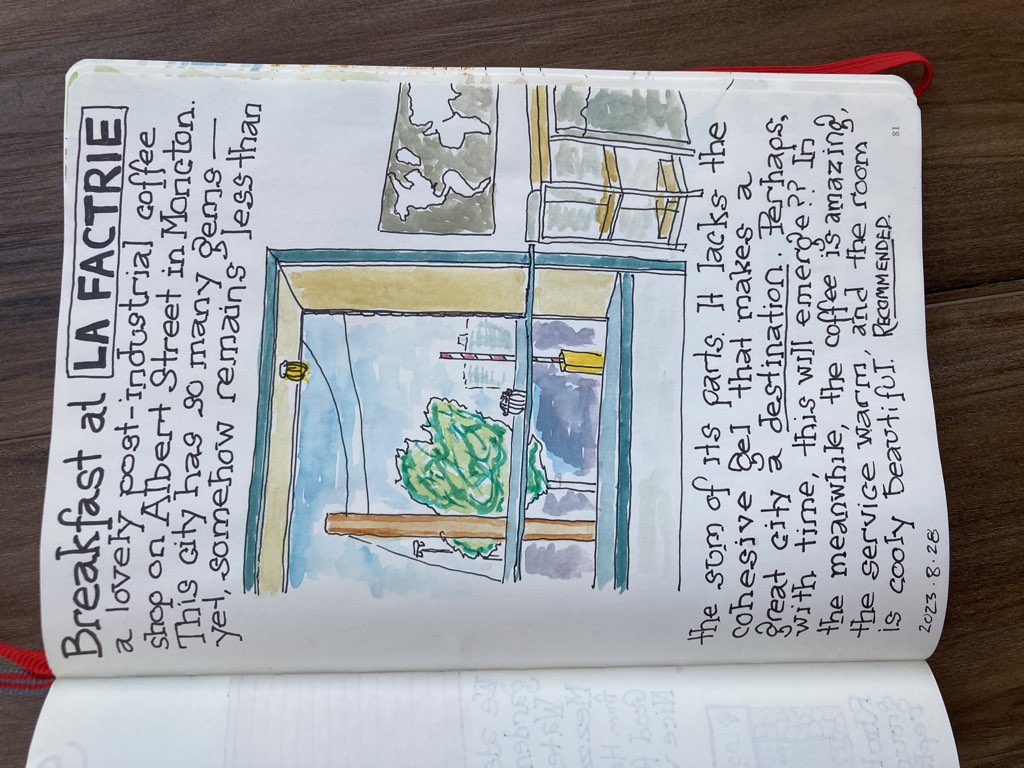
We had occasion to cancel Eastlink Internet service this month. And it took the entire month to do so.
There’s no way to cancel online.
There’s no way to email a request.
The Eastlink toll-free number regularly has hold times of an hour or longer (we don’t know how long it takes them to answer, as they never did, over repeated calls).
The online chat system has never displayed anything other than a wait time of 57 minutes.
What we ended up doing today—finally—is canceling by SMS.
To do this required texting the word “Tech” to the SMS support number (because texting “Billing” consistently returns an automated “SMS is currently closed”) and then, once an agent responds, tell them you want to cancel service and they’ll “transfer” you to Billing.
Once connected to Billing—it might take awhile—you will be asked for your PIN. If you don’t remember your PIN, or you don’t have one, you’ll need your account number and the amount of your last bill, to confirm your identity.
At that point, at least in our experience, it just takes a minute or two to complete the cancellation request.
This is a selfie I took in Malmö, in 2016, on the day of Olle and Luisa’s 10th anniversary:
In the hours that followed there was a wonderful party, with fascinating people, free-flowing klezmer, and a free-flowing bar; the night ended with 3:00 a.m. falafel. It was the escape from the everyday I needed, with people I love dearly, at exactly the right time.
In this photo, though, there’s a severity, a flatness, that I couldn’t see at the time. I wasn’t happy, and that unhappiness, looking back, was spread across me.
Last summer my pal Dave emailed a kindhearted message: “You look like a million bucks,” he wrote. And it wasn’t news to me: I felt like a million bucks.
On this morning, a morning peppered with the tensions surrounding the mercurial mood of a recalcitrant tween, worry about my daughter, who’s 4000 km away as I write (and who sat on her laptop last night and cracked the screen), anxiety about finally laying Catherine to rest in a few weeks, and a deeper feeling of instability as tectonic plates shift in my personal and professional life, I don’t, at the moment, feel like a million bucks
But.
I look at that photo, and I know that I also no longer feel that severity, that flatness.
I’m getting better at feeling. I’m getting better (little bit by little bit) at feeling okay at being angry, and especially dispensing with the self-imposed limitation that stanches anger (because being angry seldom makes logical sense). In my deepest depths I feel joy, even though that joy gets buffeted constantly, even though the price of that joy (which requires full-hearted feeling of all the things) is woundingly hard sometimes.
In the summer of 2016, I was holding it together; that is all I could muster. Oh how I wish I could reach back and say to that version of myself: “Pete,” I would say, “uncork yourself.” I don’t know if that Pete would have listened. If he had, perhaps feeling all the things would have started earlier. Or maybe I had to walk through that, to muddle my way through, in survival mode; maybe I didn’t have a choice.
I feel alive now in a way that I didn’t know existed then, in a way that I couldn’t imagine possible then. It’s hard. It’s joyful. It’s hard. It’s joyful.
But I wouldn’t have it any other way.
“I really think we need to get a new Sharpie,” I said to Lisa last night at Dollarama. She agreed, with only a little reluctance. We’re having a garage sale today (August 26, 2023), something I haven’t done since I was a kid. After the ceaseless schlepping, getting to make price stickers, merchandise the tables (“the culinary arts,” “sporting goods and frames,” “flagons and vases”) was great fun. As was deploying Mega Sharpie this morning. We’re on from 9 a.m. to Noon at 85 Ambrose Street in Charlottetown. Lots of great stuff.
The Cavendish Beach Music Festival announced that Tyler Childers will be headlining the 2024 event. Olivia and I saw Childers at Paradiso in Amsterdam in 2018, and I waxed enthusiastic:
While the other acts were solid, Childers and his band were crackerjack, and transported the night from a novelty to a happening. Their Kentucky-fueled country rock was well-crafted and energetic; it’s almost impossible to believe that Childers is only 27 years old, as his songs seem written by someone with considerably more life under their belt. We stayed for the entire 75 minute set, and enjoyed every song (it’s not every Kentucky country band that inserts a cover of Kiss Me by Sixpence None The Richer into their act).
Permit me to bask in the ephemeral glow of being ahead of the country music zeitgeist.
From the book 350 Lost Buildings in Canada, an entry on Charlottetown’s Peter Pan:> Peter Pan Drive-In 1958-2020> In the postwar years, the Peter Pan was beloved by locals for its milkshakes, burgers (served in a basket), and lobster burgers. There were few franchised fast-food restaurants at the time; this locally owned place in an A-frame building was a landmark. The restaurant closed in 2013 and was demol-ished, but carpenters from Holland College rescued its sign, featuring Peter Pan and lettering that seemed to have been created by a young child.711 University Avenue; demolished.
We dipped our toes in the waters of vinyl this spring: I was gifted a collection of LPs, and the loan of a portable turntable, to see if we could muster what it would take to replace Spotify et al with a record collection.
The vinyl was as good as it gets: Lisa and L. curated a collection of Dennis Ellsworth’s deaccessioned collection, which had remarkable crossover with albums I played on the radio thirty years ago.
But the vinyl didn’t take: we’ve been lulled into the comfort of “Alexa, play Rosemary Clooney on Spotify,” and going back to needle-dropping wasn’t meant to be.
With hipster street-red eroding, I realized urgent action was required to re-establish, so to return the turntable across town I fashioned a bungie-cord-based system to strap it to the front of my Brompton. After dropping it, I came to the library to have an espresso, just to cement my credentials.
Not since the big Coles Building stairs rebuild in 2017 has there been a downtown Charlottetown stairs project to match, but the new Grafton Street steps at the Polyclinic, which reopened this week after months of work, surpass in both beauty and utility.
I was the senior member of a small but mighty band that visited Red Rock Climbing Wall in Stratford this morning. It was my first time at, near, or up a climbing wall, and so a chance to live out the aphorism, posted there on the wall, “when was the last time you got to do something for the first time” with a dose of moxie.
We were greeted by personable owner Matt Cormier, a skilled climber, and an even better concierge and teacher. He really is a master of getting one from uninitiated-just-off-the-street into gear (a harness, purposefully-tight climbing shoes), awareness, and up the wall.
I love a new experience, and was curious about what climbing would be like, and that was enough to get me over the fear reflex. It’s a fascinating series of spacial, strength, and body-awareness puzzles to get from the bottom to the top, and, after a slow start, I managed to climb to the top of the first run. I’m proud of myself.
Once I was at the top, there was nowhere to go but down, which is done—and this is the most counter-intuitive part, something that Matt warned us of—by leaning back off the wall and sliding gently back to Earth. Lisa shot a video of me doing just that:
Notice that I was smiling when I got to the ground!
Thank you to Lisa for the invitation to Red Rock, for Matt for being so helpful, and for younger L. and S., the other members of the crew, for their inspiring feats of climbing prowess.
If you’re curious about rock climbing, and want to get a taste, I highly recommend a visit to Red Rock. You need to bring only yourself and your moxie.
I was sad to learn, via Citizen’s Alliance Newsletter, that Hugh Segal had died.
In his remembrance of Segal, TVO’s Steve Paikin recounts Segal’s focus, after joining the Senate, on Universal Basic Income:
From that Senate perch, Segal championed what became the mission of his lifetime: getting a basic-income program put in place so that Canadians could avoid the stigma of being on welfare and use a non-judgmental hand up to get back on their feet. He made the case most eloquently in his 2019 book Bootstraps Need Boots: One Tory’s Lonely Fight to End Poverty in Canada.
Although he had significant policy disagreements with most Liberals, one of Segal’s best relationships in politics was with Kathleen Wynne. When Ontario’s 25th premier implemented a basic-income pilot program in three cities, no one sang her praises more enthusiastically than Segal, who played a significant advisory role in getting the government there.
Segal’s loyal Tory core was shaken to its foundations when Doug Ford came into office in 2018: one of the first things the new premier did was cancel that program in its infancy, rather than waiting until the end of its trial period to judge its effectiveness. Segal didn’t need a reason to dislike Ford’s brand of obnoxious populism, but cancelling the basic-income pilot for reasons that made little sense was a bitter pill for him to swallow.
However, when I asked Segal about the program’s cancellation, he was not mired in despair. “This is the nature of politics,” he allowed. “Two steps forward, one step back. We’ll just keep at it and continue to try to roll the boulder up the mountain.” Again, the happy warrior.
Hugh Segal visited Charlottetown in October 2019 to speak about Universal Basic Income, and he was a convincing warrior in that fight: engaging, sharp, prepared for any rebuttal. I had a brief email exchange with him in the days following, about the portability of such a program. Because social and disability assistance are provincial responsibilities in Canada, people receiving assistance are effectively held hostage to their province of residence, with the high mountain of re-establishing eligibility in a new province presenting an impediment to the inter-provincial mobility guaranteed in the Charter of Rights and Freedoms otherwise. Segal’s reply was optimistic:
The present federal Guaranteed Income Supplement for seniors began in Ontario in 1975 as the provincial Guaranteed Annual Income Supplement (GAINS) for people over 65. Over time, the federal government made it a national programme (GIS). I am confident that once one province launches the Basic Income, the migration to a national programme will be unavoidable, and transpire relatively quickly.
Welfare reform, along with disability support is inevitable. My goal has always been to promote Basic Income as a rational, humane, efficient and constructive way to invest in both a productive economic mainstream that values inclusion, personal dignity and reduces poverty with all its negative pathologies.
I am hopeful that Segal’s mantle will be assumed by others, and that we will realize the dream of a federal, portable Universal Basic Income for all Canadians soon. When this happens, we’ll all owe a great debt to him.
Every year I sponsor the Oscar Wilde Award at Island Fringe, given to the show that “most effectively celebrates non-conformity.” The award-winning show is chosen by a jury, and evidence suggests that the process of jurying the shows is done with considerable thoughtfulness. Island Fringe is one of my favourite things, and watching the Oscar Wilde take on a life of its own continues to be a lovely part of it.
This year’s award went to Riley Jane Carson for her show Transpectrum:
Follow Riley Jayne Carson on a wonderful journey. This neurodivergent trans beauty queen explains how a love for Anne of Green Gables awakened her identity. And after over thirty years of self denial, it took another red headed Ann to help her rediscover her gender identity. Riley Jayne is a Jack (or should I say Jill) of multiple talents. A background in theatre and very basic music allowed her to express her views, humour and attitude in a variety of forms ranging from stand-up comedy to drag.
On the way over to the closing ceremonies I was talking to Olivia about what “non-conformity” means, and used her owning her neurodivergent transness as an example of it; that the award went to “neurodivergent trans beauty queen” was a delightful counterpoint to that.
In Anatomy of an Indian Address, Gowri N Kishore takes a deep dive into how civic addressing works in India:
India has no standardised way of describing addresses as Western countries do. And a one-size-fits-all approach may not even work here because different states have their own terms like street, main/cross, colony, and more. Each address is its own little adventure. Phew!
One of the under-appreciated public works megaprojects here on Prince Edward Island is the civic addressing system: introduced in the early 2000s, the system was designed to enable the introduction of 911 emergency service in a province that, outside of larger cities and towns, had no standardized address system. From the original Civic Address Standards and Guidelines:
The civic address standards outlined ensure that all residences on Prince Edward Island are universally and uniquely civic addressed. The civic address guidelines present recommended rules to follow when providing new civic addresses. The document also describes situations where undesirable (unacceptable) civic addressing may exist and recommends possible remedies.
…
The present status of civic addressing within Prince Edward Island can be summarized as follows:
- Both Charlottetown and Summerside are essentially complete;
- Five of seven towns are essentially complete;
- Three of fifteen communities with official plans are essentially complete;
- All other areas within PEI are minimally or non civic addressed.
I was under contract to the Province of PEI throughout this process, and was privileged to witness, up close, what a Herculean task it was to find a unique civic address for every property on the Island: not only did addresses themselves need to be assigned, but road names needed to be established (and made unique within a county), and, in many cases, new “civic address communities” established, as much of the province isn’t covered by formal municipalities.
The civic address system was one of the signature achievements of former Provincial Tax Commissioner Jim Ramsay: while the process involved many people across departments and agencies, inside government and out, it was Jim who was the driving force. And that the data underlying the system — a geolocated civic address database — was made freely available to the public is a testament to Jim’s ability to see the tremendous upsides of such a move (I was in the room when the decision to do this was made, and the page offering the data was online the same day — there was no way I was going to miss the opportunity to see such a resource be made public, and wan’t to ensure the horses were out of the barn before any layer of the bureaucracy changed its mind).
This summer Lisa and I are performing, with our improv troupe No Questions, every Wednesday night in August at the Benevolent Irish Society at 7:00 p.m. (admission by donation; bar opens at 6:30 p.m.).
The troupe is an outgrowth of Laurie Murphy’s improv classes, classes I started in November of 2021, and that Lisa, who’s had her toe in and out of improv for many years, joined this winter.
As I’ve written about before, it’s not a word of a lie to say that performing improv has changed my life. The devil may care “yes, and” attitude it has steeped me in was the pathway I needed to find my way through the forest to Lisa. It’s the juice that’s powering an upcoming career turnabout. My mind has been opened I’m a better listener, a better risk-taker. I’ve become convinced that it’s a curative experience that everyone—especially the shy, retiring, quietly wry, not-jokey types who would never every consider it—should try at least once.
We segued from improv training to troupe rehearsal in July. Last week was our final rehearsal before opening night last night.
And it was shit.
We were off the rails: not listening, not connecting, forgetting how to say yes, ignoring the fundamentals. We micromanaged ourselves into a malaise.
We came home dispirited. I thought idly whether there might be a way to get out of the August performances. For the first time since I started, I wasn’t excited about performing.
Sigh.
But we pushed on. Rallied.
I agreed to host the opening night. Lisa agreed to host the “PEI Famous Celebrity Interview” that anchors the second act. We made a conscious effort to show up last night.
And, as it turned out, so did the rest of the troupe.
What, just a week before, had felt like an irredeemable train wreck, last night just gelled.
We listened. We made each other look good. We had fun. And we finished the night with the unmistakable high that being vulnerable with a group produces.
So whereas two days ago I was loathe to even admit that we’re performing this August, now I want everyone I know to come. I’m proud of our merry band, I’ve seen what we’re capable of together, and I know in my heart that we’re going to get better every week we perform.
Again, the details:
- Every Wednesday in August (August 9, 16, 23 and 30, 2023).
- Benevolent Irish Society Hall, 582 North River Road, Charlottetown.
- Bar opens at 6:30 p.m., show starts at 7:00 p.m. and runs to 9:00 p.m.
- Admission by donation.
- Add the shows to your calendar with this ICS file.
Please join us. Tell your friends. Bring your friends.
Currently posted up at LOLI in Moncton, stopping in for an espresso and a pause before heading back to the Island after dropping family off at the train.
Coffee is good. Vibe is relaxed. Wifi is fast. I believe that fellow on the balcony is a DJ.
Not quite Berlin.
But certainly not the Moncton I arrived in for the first time—at the selfsame train station—40 years ago this summer.
Olle and Luisa were out wandering this morning, and came across a building in industrial Malmö with this luscious lettering:
I love so much about that typeface: the low crossbars (A, E, R, K), the subtle tuck-in of the umlaut on the O, the dreamy swoopiness of it all (see also Wouter on the death of swoopiness).
Of course I had to do some detective work and find the sign in context.
Fortunately Olle had left the geolocation embedded in the JPEG’s EXIF, and I was able to find it with a little Google Maps wandering; it looks like a power substation:
A search for more information about Malmö Elverk led me to this collection of images in the collection of the Malmö Museum, one of which jumped out at me:
It’s a similar building, presumably also a substation, and also with lovely typography. The museum’s digital collection helpfully contained a street address in the item’s metadata, and so with some additional Google Maps wandering, I was able to see this location in its current context on Erikstorpsgatan:
One of the under-explored aspects of Google Street View is that archival images, stretching back more than 10 years now, are browsable. Meaning it’s possible to see a visual history of the graffiti on the Erikstorpsgatan substation from 2019 to the near-present.
Here’s June 2009:
Two years later, in September 2011, there is some of the 2009 work still there on the grey door, but the brickwork seems to have been cleaned and re-tagged:
Three years after that, in June 2014, there’s been an attempt, by someone, to reset things with grey and purple:
Five years later, in August 2019, the building has been completely refreshed, including the signage on the grey doors, and some landscaping:
In October 2021 things are much the same:
But by June 2022, the most recent photo in Street View, there are new tags:
Apple’s Street View equivalent has an even clearer view from June 2022:
I am fascinated by the world of letters, and one of the things I love most about wandering about the world, when I’m able, is paying attentions to signs, noticeboards, warnings, posters. It’s nice to be reminded that when I’m close to home, I can still venture out on the screen. Thank you to my wandering friends for that.
Back in 2001 I related my history of auto insurance, a path that led me, on Prince Edward Island, first to Gordon Full, a small office, staffed by two people, that was responsive and friendly beyond all belief.
Gordon Full eventually sold out to the still-local-but-not-as-small Hyndman and Company, and I’ve been happy to have Hyndman’s as my broker for the 22 years since.
Hyndman and Company was one of the Island’s oldest companies of any sort; many years ago I ask the Public Archives for information they might have in their records about the company’s telephone number, and the ever-helpful John Boylan replied:
The 1894 telephone directory lists FW Hyndman Insurance as being No. 67, 2 Rings. Customers had individual numbers ranging from one to three digits. Number one was the Rev. G.M. Campbell’s residence. The Falconwood Asylum was number fifteen.
Although other phone lines were added to Hyndman Insurance, 67 remained the private office number for the business up to 1952. By 1952 customers had a mix of two, three and four digit telephone numbers.
There’s a gap in our telephone directories from 1952 to 1959, but by ‘59 Hyndman Insurance was a four digit number, 6567. All numbers in the Charlottetown exchange appear to have been four digit ones by this year. By 1961 Hyndman Insurance was 894-6567.
I was proud to be associated with a company with a long history, a local company that was just a few blocks or a quick phone call away.
Alas, if you dial that telephone number today, you get a message that it’s no longer in service. A metaphor for the company itself: Hyndman’s has changed a lot in recent years and I’ve become increasingly less satisfied with the service I’ve been getting: the agent I’m assigned to keeps changing, and getting in touch has become increasingly cat-and-mouse. Ten years ago my insurance company, Dominion of Canada, was swallowed up by the US-based Travelers Insurance, adding an additional layer of complexity when it came to yearly renewal. The straw that’s in the process of breaking the camel’s back is that Hyndman and Company was sold to Westland Insurance Group this year, “one of Canada’s largest independently owned insurance distribution businesses.”
So, now that any trace of dealing with a local company has been removed, any need to avoid shopping widely and broadly in the auto insurance marketplace has also been removed, and I’m open to any suggestions you might have: I’m shopping for price and for convenience. If I don’t ever need to talk to a person, that’s a bonus. Which is quite a journey from sitting down across from Gordon Full 30 years ago. But such is the modern world of commerce.
A Hyndman and Company ad in The Guardian from 1963
I was sad to read yesterday of the death of Jim MacAulay.
The public service contributions of the MacAulay family to are legion, and I crossed paths with each of the MacAulay brothers over the years.
Jim had a special place in my heart: as a lifelong educator he contributed enormously to public education on PEI, and I had the pleasure of sitting around the luncheon table with him at the PEI Retired Teachers Association; he was funny, curious, and willing to tell tales.
Among Jim’s many contributions to the province, his 1996 Eastern School District Facilities Review was one of the most significant: it’s a 433 page deeply detailed review of the school infrastructure in half of the Island that begins with a section “How Things Came to Be”:
In a study of this nature, a historical review provides useful perspective. Until the late 1950’s and early 1960’s education in Prince Edward Island was primarily provided by small, one-room, community schools. Frequently a farmer provided in a comer of one of his fields, sufficient space for the school building and its playground. Each of these structures and its administration was an entity unto itself. In many of our communities, this model served very well for the social, economic, technological and demographical climate of the day. Many very prominent citizens emerged from these institutions.
The report is at once a detailed review of school buildings (Parkdale Elementary: “Two new furnaces were installed in the last 3 years.”), and a capsule history of public education on PEI (“If one investigates school size over the past fifty years, many school sizes put forth as ideal. At one time people felt that very large schools were the answers. Before long problems which surfaced led to a change of thinking and understanding that schools could be too large to manage.”).
It is comprehensive, well written, and its publication served as an inflection point in how we think about school infrastructure, coming 30 years after the big push to school consideration and construction that happened in the 1960s.
For anyone wants to understand “How Things Came to Be” from a 2023 perspective, it’s the place to start reading.
Jim MacAulay will be missed.
A photo of me, at improv class, taken by Laurie Murphy. My mother has taken to telling me that I seem preternaturally tall of late; until now, I’ve never seen in.
Tamar Adler, in An Everlasting Meal: Cooking with Economy and Grace, on poached eggs:
I’ve heard of a lot of perfect ways to poach an egg, I’m sure they work. The problem with them is that to poach eggs is to understand egg cooking as you can’t when you cook them any other way.
A boiled egg stays secret until it’s cooked, and a frying egg sizzles in fat, too hot to touch. But poached eggs are cracked out of their shells and cooked directly in barely simmering liquid, which means you can literally feel them as they cook. The trouble with setting a timer, covering a pan, and walking away is that you end up bound to your trick, lost without a timer, stuck without a lid.
I followed her advice and made—though did not eat, given my eccentricities—poached eggs this morning for the first time.
(Photo by Lisa)
For someone who holds himself out to be in the imagination business, I have remarkably little skill in being able to imagine physical spaces not as they are.
Witness this photo of the end of our upstairs hallway: Lisa wallpapered it last week in a bold, black and white, geometric pattern:
When she proposed the idea I was queasy: unable to conceive of what it might look like, I had to rely on Lisa’s well-developed spatial conception engine.
I trusted her. The result is lovely. Truly lovely. In ways I could not have possibly imagined—something I write not hyperbolically, but literally: my mind simply could not picture this result.
And yet it makes my soul sing every time I climb the stairs.
I have been trapped inside this limitation for a long time. Which is to say that I have trapped myself inside it. I know enough about how my mind has been expanded by sketching, by setting type, by poking at the edges of the web browser canvas, to know that it’s possible to grow. And I know that to be a good partner, to not be at the effect of another’s design sensibility, it’s the edge I have to grow.
And so off I head, to enhance that part of my brain and that part of my spirit.
Matt Stone, quoted in Anatomy of a Breakthrough:
“What should happen between every beat you’ve written down is either the word therefore or but.” He sketches the structure using a more concrete example: “You come up with an idea, and it’s like this happens’ and then ‘this happens… .’ No, no, no. It should be, this happens, and therefore this happens, but this happens, therefore this happens. We’ll write it out to make sure we’re doing it.” Stone continues, “There are so many scripts we see from new writers, where it’s like ‘this happens, and then this happens, and then this happens…,’ and that’s when you’re, like, ‘What the fuck am I watching this for?’”
I stepped down from the Publications Committee of Island Studies Press this spring. Over the years I read dozens of manuscripts under consideration for publishing; by far and away the greatest sin committed regularly was exactly this “and then this happened, and then this happened, and then this happened.”
The book for which I’m happiest having played a small role in the greenlighting of was New London: The Island’s Lost Dream. Author John Cousins is a master storyteller, and the narrative arc is in his blood; perhaps unfairly, any manuscript that came after had John’s high water mark to be judged against.
I thought my finger was on the pulse of significant browser developments, but this one I missed completely: URL Scroll-To-Text Fragment.
Here’s the URL for a post on Lisa’s blog, for example:
**https://lisachandler.is/pressure-summer/**
Down in the text there is the sentence:
To cherish every memory.
It turns out that I can link directly to that sentence, and have it highlighted to boot, like this:
**https://lisachandler.is/pressure-summer/#:~:text=To%20cherish%20every%20memory.**
Pulling this apart—it’s all documented here—I add these to the URL:
-
:~:text=
- the text I want to highlight on that page, with special characters, like spaces, %-encoded.
There’s more in the documentation about linking to, and highlighting, a range of text, with a start and end string; for example:
**https://ruk.ca/content/asking-questions#:~:text=And%20what,something%20sticks.**
will link to and highlight the paragraph that starts with “And what” and ends with “something sticks.”
This is a browser feature I wish had existed from off the top—and that I wish I’d learned about earlier—as referencing sentences or paragraphs in my blog posts is something I do all the time.
There’s a browser extension that helps with making these links easier; right now it doesn’t appear to work for the latest Safari, but there’s a bookmarklet that does.
(Note that this isn’t a universally-supported feature, and Firefox specifically doesn’t support it).
It’s summertime, and I’m wearing a T-shirt today, a rarity for me, as my uniseasonal wardrobe is anchored in short-sleeved button-down shirts.
This shirt is a special one: two years ago this month I made a sketch of Receiver Coffee on Victoria Row. I posted it online, where personable Receiver partner Chris Francis saw it and asked me if they could use it for their staff shirt that Christmas. I said yes, of course (Chris and I have a long history of working together on coffee-related printed works). I received a couple of shirts by way of thank-you.
Today was, I think, the first time I’ve worn the shirt around and about.
Me, from the back, wearing the Receiver Coffee shirt (credit: Lisa Chandler)
For almost a decade I’ve been using Fastmail as my email provider. Switching to Fastmail followed 15 years of various and sundry ways of hosting my own email, on various and sundry hosts I owned or controlled, some of which were located 10 feet below where I’m writing this in my near-200-year-old clay-floored basement (perhaps the least optimal place for a missing-critical data centre).
Eventually the weight, emotionally and technically, of self-hosting my email—managing spam, primarily, but also keeping my SMTP and IMAP servers up to date—got the best of me, and I went looking for something I could pay for that would relieve my of all that. At the time there were a lot of bloggerati recommending Fastmail, and so that’s where I ended up. I’ve never been unhappy I made the switch: Fastmail has “just worked” from the beginning, and it has continued to evolve its user interface, its functionality, and its support systems over the last 10 years. I wholeheartedly recommend it to people who come looking to me as an alternative to using “free” services—Gmail, Hotmail, Yahoo mail, or their Internet provider’s locked-in email systems.
Many years ago my friend Stephen went to a conference of librarians in Winnipeg. He flew on CP Air, which tells you how long ago it was. Something got bungled on his return flight, and he got bumped. But CP made the bumping so effortless and beneficial to him—the compensation he was offered was enormous for the time, enough to fly almost anywhere, for free, that CP flew—that his story about the trip, which could have been a negative one, was, instead, unreservedly positive. He told it many times over.
Last week, Fastmail had a rare outage that affected a small percentage of users. Fastmail itself wasn’t down, but it remained unreachable to parts of the Internet, including my own, and so I was left without email for a good chunk of a day. It was a pain in the ass, especially when I needed my email to receive things like TFA codes to login to websites. The experience didn’t sour me on Fastmail, but it did make a dent.
Today, though, Fastmail published an account of the outage. It’s well-written, clear, and technically detailed. And it’s honest.
Beyond being data mines for advertising (and, presumably, AI-model-training), “free” email services are also opaque technically. The reason I maintained my own servers for so long was because I wanted to understand (and control) something so vital to me; I wanted to have eyes-on the infrastructure. I don’t have the same degree of control with Fastmail, but when Fastmail publishes a diagram of its network, by way of explaining what went wrong, it gives me comfort that there are real people operating real networks and data centres, people that I can contact for support, and people that care that my email doesn’t go away, because I’m paying them to do that.
In documenting the outage, Fastmail did for me what CP Air did for my friend Stephen, turning a negative into a positive, and prompting me to laud rather than lament them. If you’re looking for a new home for your email, go there.
My friend Ian lamented, in 2004, in but enough about me, our societal lack of intrapersonal curiosity:
Having just returned from another evening deep in the flats of Hollywood, I (shockingly) have a complaint. And this complaint is not even California-centric; it’s just as bad in New York City. Namely: WHY DON’T PEOPLE EVER ASK YOU QUESTIONS ABOUT YOURSELF?
Seriously, I’m not making myself out to be some sort of bastion of social etiquette, but I always ask everybody I meet at least 5-10 questions about their work, their passions, where they’re from, what they’ve done they’re proud of, even slightly personal queries like “are you happy?” I do this because I’m easily bored, and everyone has a story, and there’s always SOMETHING that will briefly excavate a fascinating aspect of an otherwise-tedious-seeming person.
And what does the world ask me? NOTHING. And it’s not just me, I listen to other conversations, I am a damn good verbal sociologist, and it seems like nobody asks anybody anything; they just wait their turn to hurl out their yawp, and hope something sticks.
It’s a post I’ve turned over in my mind dozens of times in the 19 years since I first read it.
Over the last few years I’ve discovered that, despite near-constantly insisting the contrary, I am an extrovert, not an introvert. I’m an extrovert who never learned how to be one: growing up in a generally asocial family, I didn’t learn the basics of social lubrication, the simple conversational techniques, the ways of being comfortable.
A breakthrough came when I realized that, give or take, nobody has reached zipless extroversion: learning this was huge, as it allowed me to view myself as being on an even keel when wading out into the crowd.
Another breakthrough was discovering that following my natural curiosity and asking questions was a ticket toward the social lubrication I sought.
Yet another was when I realized that it wasn’t solely about lubrication, and that I could, indeed, foster real connection by being curious.
Being genuinely curious upon meeting someone, and having them rise to the challenge in their responses, is a delight.
Being genuinely curious upon meeting someone, and having them rise to the challenge in their responses, and return the curiosity volley, is intoxicating.
In one of the versions of my Bumble profile I wrote:
I am inveterately curious, interested in a lot of things, a specialist in none. I easily fall into rabbit holes. I thrive in the presence of other curious people.
That Lisa is so good at asking curious questions is one of the reasons I no longer need a Bumble profile.
Which brings me back to Ian’s question: why don’t people ever ask you questions about yourself?
If curiosity is lubricating, and connecting, and a way of fostering connections, why is it so rare?
Alison Wood Brooks and Leslie K. John offered some thoughts in their 2018 Harvard Business Review article The Surprising Power of Questions:
Why do so many of us hold back? There are many reasons. People may be egocentric—eager to impress others with their own thoughts, stories, and ideas (and not even think to ask questions). Perhaps they are apathetic—they don’t care enough to ask, or they anticipate being bored by the answers they’d hear. They may be overconfident in their own knowledge and think they already know the answers (which sometimes they do, but usually not). Or perhaps they worry that they’ll ask the wrong question and be viewed as rude or incompetent. But the biggest inhibitor, in our opinion, is that most people just don’t understand how beneficial good questioning can be. If they did, they would end far fewer sentences with a period—and more with a question mark.
There’s a passage early in The Joy of Sex, in the section “women (by her for him)”:
No obsessive views about reciprocity – who comes on top and so on evens out during the passing of time: there can be long spells when we are happy to let you do the work, and others when we need to control everything ourselves and get an extra kick from seeing how we make you respond.
In their Harvard Business Review article, Brooks and John write much the same thing about good conversation:
A conversation is a dance that requires partners to be in sync—it’s a mutual push-and-pull that unfolds over time. Just as the way we ask questions can facilitate trust and the sharing of information—so, too, can the way we answer them.
In improv we talk about how the best scenes involve “an exchange of gifts.” This is true in conversation (and sex): we are at our best—we learn, feel, connect better—when we are curious, when we seek the intimacy of the dance, when we find our way to trust and sharing.
And perhaps that is one reason why good conversation (and good sex, and good improv) is the exception rather than the rule: it requires uncommon vulnerability, a willingness, in the curious question, the extended hand, the brave fall into a scene, to trust that our partner will be there to catch us, to return the curiosity, to be alive in the moment with us.
John and Brooks finished their article with:
The wellspring of all questions is wonder and curiosity and a capacity for delight. We pose and respond to queries in the belief that the magic of a conversation will produce a whole that is greater than the sum of its parts. Sustained personal engagement and motivation—in our lives as well as our work—require that we are always mindful of the transformative joy of asking and answering questions.
In Ian’s post:
During a particularly bad fuckup this week, in which an actor felt grossly mishandled, I listened to her on the phone and said, with emphasis, “I HEAR YOU.” The conversation melded into delight as soon as she heard those words.
Ian ended his post “But do me this favor: at some point today, ask somebody a question about themselves.”
I ask you the same.
May you find transformative joy and delight.
I had Kraft Dinner for lunch on Sunday.
For normal humans this would be unremarkable, but it was my first time eating Kraft Dinner. I’m 57 years old.
At some point I simply decided that I wouldn’t like Kraft Dinner.
That I wasn’t a person who ate Kraft Dinner.
I imagined it would taste like bubblegum and basketballs.
We carry around mental models of who we are, the things we do and don’t do, the kinds of friends we have and don’t have. Where our upper limits lie.
“I don’t eat Kraft Dinner.”
But deeper.
I recently read about “life quakes,” a term coined by Bruce Feiler, in the book Anatomy of a Breakthrough by Adam Alter:
“These are the wolves that upend our fairy tales,” Feiler wrote about lifequakes. Lifequakes are sticking points, Feiler noted, because they place roadblocks in whatever path we are following. They prevent us from pursuing the lives we previously imagined living and so leave us stuck as we attempt to construct revised lives in their wake.
I have lived through a series of lifequakes in recent years, and I have needed to construct a new life in their wake. As much as this has been all manner of debilitating, it has also presented me a chance to retell my story to myself. Some of these retellings have been involuntary, others I’ve had to reach for, still others seem tantalizingly just out of reach.
It is destabilizing to walk through this: as much as there are exciting new things to try — horseback riding!, improv! Kraft Dinner! — there is the absence of familiar guideposts that makes a boomerang back to old ruts, in roads that no longer exist, alluring. There is an equal and opposite tendency to chart wildly ambitious courses through unfamiliar seas because, well, what’s the worst thing that could happen! And the tension between the two impulses.
Alter writes on about lifequakes:
The most important feature of lifequakes is that they’re hard to predict. You don’t plan for a lifequake the way you might anticipate an impending plateau, so instead you need to develop a general tool kit for managing unwanted change. “Life transitions are a skill,” Feiler wrote. “They’re a skill we can, and must, master.” A particular lifequake may take you by surprise, but recognizing that lifequakes and other profound sticking points are inevitable puts you several steps ahead of the many people who respond first by asking, “Why me?!”
At my most optimistic, this skill at life transitions is the one I hope I’m cultivating: gifted a decade of lifequakes, big and small, I’m learning to see them, and to see myself and how I react to them, and getting better at seeing the opportunities chaos offers.
It turns out Kraft Dinner is tasty.
Who knew.
Jeremy Cherfas is in the Italian countryside, and has too many zucchini:> It is a pretty isolated spot, which means the old trick of driving into town with a basket of produce and depositing it on the back seat of anyone foolish enough to leave their car unlocked at the height of zucchini season will not work.This recalls a time in the late 1980s when my roommates at 640 Reid Street and I, faced with a similar over abundance of zucchini, organized an all-zucchini meal (zucchini fritters, zucchini boats, zucchini cake, etc.).
From The Transgender Family Handbook, an essay by Theresa Thorn, When She Says She’s a Girl, Trust Her. In part:
In hindsight, my firstborn, who had been assigned male at birth, had been trying to signal to me about her gender for a while and, without understanding the harm I was doing, I had been subtly dismissing her hints and gestures. I knew trans kids existed, but I hadn’t thought my kid was trans, which led me to discourage her from wearing a dress on Picture Day (“It’ll be confusing”) and repeatedly cut her hair (“It’s just easier this way”). To me at the time, these had been simple exercises of parental judgment. To my child, they had probably been rejections. By spelling it out in no uncertain terms on the night of the reception, she told me she needed me to start really seeing her. And I honestly wanted to. I wanted to understand every corner of this mysterious little person I helped bring into the world. But to see her for real meant I needed to trust her in a way I never really had before.
Laurie Brown, and the Pondercast podcast she partners, are dipping below the horizon.
In writing about this, Laurie describes this “disappearing act”:
So, what’s next?? There is more art waiting in the wings that I can concentrate on now. I can also learn to live unseen and unheard. After being in the public eye/ear for almost forty years, I know there are important lessons for me here. So, my next act is a disappearing one.
Pondercast has been an important soundtrack for me in recent years, with its zenith coming, for me and Olivia, in 2018 when we went to a live show in Wolfville. That was a loving, connecting trip for us when we really really needed a loving, connecting trip, and Pondercast was the supportive glue that stuck it together.
No sentence sums of the zeitgeist of the last 4 years for me better than this one, from October 2021:
There is an upside to music dropping out of your life, and that’s having it return.
Having those words to accrete feelings around helped me dig myself out of a hole that I’d been digging for a long time. For that I’m truly thankful.
So long for now, Laurie.
Beautiful writing:
Words held back, feelings not felt, stories misunderstood, assumptions not tested, details forgotten or suppressed, joys “undeserved”, shames buried or carried too long, excitements so bold they need protecting, dreams so fragile they can dissolve before they’re spoken. These are the beginnings of my unwritten “poems”.
We are spending the week some blocks north, at the house shared by my mother and my brother and sister-in-law. We’re taking care of the cats, while Mike and Karen are taking a much-deserved break in Ontario. To be clear, Lisa and L. are taking care of the cats, and their needs for petting, loving, injecting, feeding. I am cleaning the litter box.
I love the idea of cats; actually executing cat life is a high-level logistics exercise. I tip my hat to those able to do it day after day after day. And I tip my hat to Lisa, who has become completely comfortable at administering units of insulin to the scruff of the neck.
CatCamp has its virtues. It’s a staycation where we can return to the mothership to pick up underwear. And we are getting to spend a lot more time with Mom—eating meals every night together, and taking a daily constitutional. It’s also a kind of limbo: life, but tuned a few MHz out of phase. Come Thursday we’ll settle back down the street, happy to have facilitated. And happy that our underwear is closer. Maybe I’ll even miss the cats.
The weather, meanwhile, has turned from dark rainy depressitude into summer. In the Sobeys checkout line yesterday there were a lot of people responding to “why don’t you pick up things for the BBQ on your way home” calls. Myself included.
When I was a kid, growing up in Carlisle, I’d start every summer day yelling downstairs to my mother “MOM, SHORTS OR LONGS?!”. This was followed by a 50 year period where I dressed uniseasonally, wearing a significant “this isn’t relaxation, folks, take life seriously” chip on my shoulder. Or maybe I just thought my schlumpy body didn’t look good in shorts. But yesterday, facing a 24ºC school run on bicycleback, I switched into the smart shorts I bought last summer, when things first tipped toward summer sensibility, and I ended up wearing them all day, including to our improv class. Which made me feel strangely like Robin Williams minus the suspenders.
We have been cycling with L. to school almost every morning for the last two months. When we started we were wearing gloves and winter coats. While the parentheses surrounding the school day can feel constricting—as any parent knows well—I love cycling, and the mornings that L. and I cycle to school, just the two of us, we have good conversations. Talking while moving is always better: I know that from raising Olivia. I know that from walking with Lisa. (I had a client once who insisted we conduct business meetings while walking, at a good clip, from Springbrook to Long River, on Saturday mornings, before sitting down to breakfast at the Kitchen Witch; despite the hassle, and his pace, it was surprisingly effective).
Our friend Silva turned 60 a few weeks ago, and there was a big party in the architecture office with good people and good food and artisanal rum drinks. It was fun (that in itself is saying something; as part of the shed snakeskin of my younger years, I’ve cast off a lot of my social anxiety, and now kinda like going to parties).
Silva and Catherine were the same age, 1963 babies. So Catherine’s would-have-been-60th birthday (Olivia’s wording) would-have-been this Sunday, June 18. Olivia misses her Mom, and wants to have a big birthday party for her. It’s hard to explain to her why I don’t want to have a birthday party for her.
Catherine turned 30 the year we moved to Prince Edward Island. We didn’t know anyone, and so that birthday was just the two of us. I don’t remember what we did, but I remember it was something good, that I mustered well, and we were happy. Ten years later, for her 40th, I attempted to rise to the occasion again, and somehow failed. It might have been less that I didn’t rise to the occasion and more that Catherine was in a funk about turning 40, and nothing I did would have registered as maximum fun.
What did we do for her 50th? I have no idea. Or maybe we went to The Pearl? Or The Dunes? Maybe there was another funk? Maybe it was lovely. I don’t remember.
When I think about Olivia’s persistent insistence that we celebrate Catherine’s birthday, and my persistent reluctance, I think of Lisa’s coaching, encouraging me to “stand in the ‘win for all’ ”, and so standing for what Olivia wants. And for Olivia to do the same. That’s hard. And uncomfortable. The memory of Catherine, what Catherine meant to us, lives so differently in the two us: what offers her comfort can trigger me, what she wants to draw closer to, I want to face forward from. Maybe that’s why trying to stand for what she wants is a route out of our impasse. Today, in any case, is the day to find our way through.
Meanwhile, fresh off the morning school-cycle, I’m sitting at one of the back tables at The 5th Wave, my new morning coffee spot of choice (good coffee, good tables and chairs, good soundtrack, open early). I’ve just finished the last sip of a nitro cold brew, which is as effective for its name as its essence (it’s not hard to imagine it confers temporary superpowers).
I’ll shortly depart, crossing the street to The Bookmark to pick up my copy of Linocut: Learn in a Weekend, just arrived as a special order. And then I’ll plunge into work, having blocked off today for a big push on several Almanac.com projects.
Later we’ll cycle to pick up L. We’ll figure out supper together. I’ll make a playlist for Olivia to go to sleep with. I’ll ask her how her day went. The cats will get fed. Maybe we’ll watch a show.
And then I’ll climb into bed beside Lisa, and, right then, all will be right with the world.
From The Last Egg:
We do very well for ourselves, given the circumstances, but the stark reality is: we won’t see fresh eggs for another five full months. Another facet of our weird, weird adventure here at the bottom of the world.
The brr blog has been one of my favourite blog discoveries of the year.


At the end of April our improv class had a friends-and-family showcase at the Benevolent Irish Society hall. Hannah Kilchyk was the show photographer, and she captured this photo of me in action. I’m assuming—though who can remember in the hurly-burly of the show—that it was part of the Musical Hotspot part of the evening.
I do look industrious, and almost a caricature of what one might imagine an improv player might look like.
But I feel alive when I look at the photo
I feel “who is this fellow who can do things like this now?!”
I feel good.
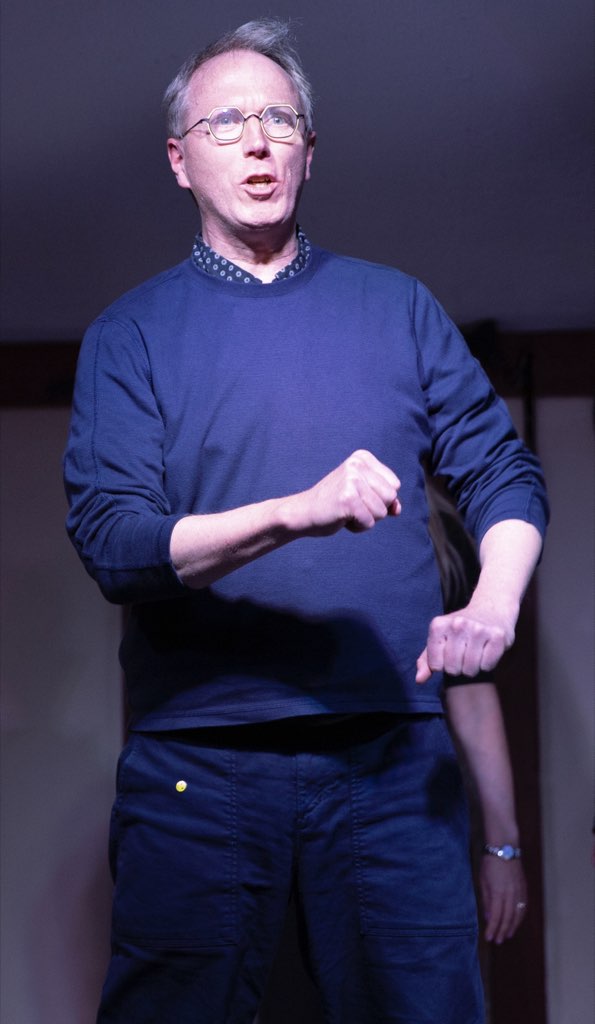
Hannah Kilchyk for the HA Club, April 24, 2023
The Q&A page at Laundry Holiday in Shikokuchuo, Japan, is a model for other laundromats. For example:
Q. I’m using it for the first time, is it okay?
A. Please use it with confidence.
and:
Q. Can I wash the duvet?
A. There are things that can be washed and things that can’t be washed.
Items that fall under 1 to 3 below can be washed.
1. Those that are quilted.
2. It can be washed with water.
3. Things that can be used in a dryer.
The poetic concept statement for the laundromat is also a model:
The concept is “365 days HOLIDAY”
A day that starts with laundry on the morning of a holiday
The scent of soap from freshly made laundry
I feel like such a casual moment of daily life enriches my daily life.
It’s good if every day is such a holiday morning.
It’s a 365-day holiday!
I want the troublesome laundry to be fun and have a worthwhile time.
With such a thought, I made a place that makes me want to go every day.
Aiming to be everyone’s good neighbor
Canadian Tire has now completely switched over to digital price tags, wireless e-ink shelf displays that show the item name, price, and barcode.
Under the hood I imagine this both saves hundreds of hours of staff time, and involves running a complicated hundred-thousand-device wireless network in every store.
In the store today I noticed a new feature, one that transformed the shopping experience.
The Achilles heel of Canadian Tire is that staff are never available when you need them (by contrast, at Home Hardware they are always available, and often ask if you need help). This means that finding things can require multiple frustrating waits to get directions.
Until now.
The Canadian Tire mobile app now supports both real-time inventory and information about which aisle the product is on. What’s more, if you tap a button, the digital shelf tag will flag its bright LED to help you locate the product precisely. It’s really rather magic-seeming.
,


I had coffee with Guy, in Basel, in late 2010: he was there scouting for a move, and his modus operandi was to scout for interesting agglomerations of coffee shops, bookstores, etc., and then look for places to live in an area radiating outward. This is akin to my advice to university students: find the interesting professors and take their courses, no matter the subject. Context over content.
In this vein, I was drawn to a list of here of nine shops that stock Robida magazine. Robida is fascinating and weird and rich in all the right ways; I reason that any shop that carries it will be similarly fascinating and weird and rich. Evidence from browsing websites suggests this is the case.
And so a plan: visit all nine. One could do worse for the spine of an European itinerary.
Here are the coordinates:
- Zabrieskie (Reichenberger Str. 150, Berlin)
- San Serriffe (Sint Annenstraat 30, Amsterdam)
- Rile (62 Rue des Commerçants, Brussels)
- Page Not Found (Boekhorststraat 126-128, Den Haag)
- Materia Prima (Rua Miguel Bombarda 232, Porto)
- Bruno (Dorsoduro 2729, Venezia)
- Edicola 518 (Via Sant’Ercolano 42/A, Perugia)
- NOI (Via delle Leghe 18, Milano)
- Frabs Magazines (Via dei Filergiti 1, Forli)
As a service to the magazine-loving flaneur, I ensured that all of the shops are in OpenStreetMap (here’s a query to get them all).
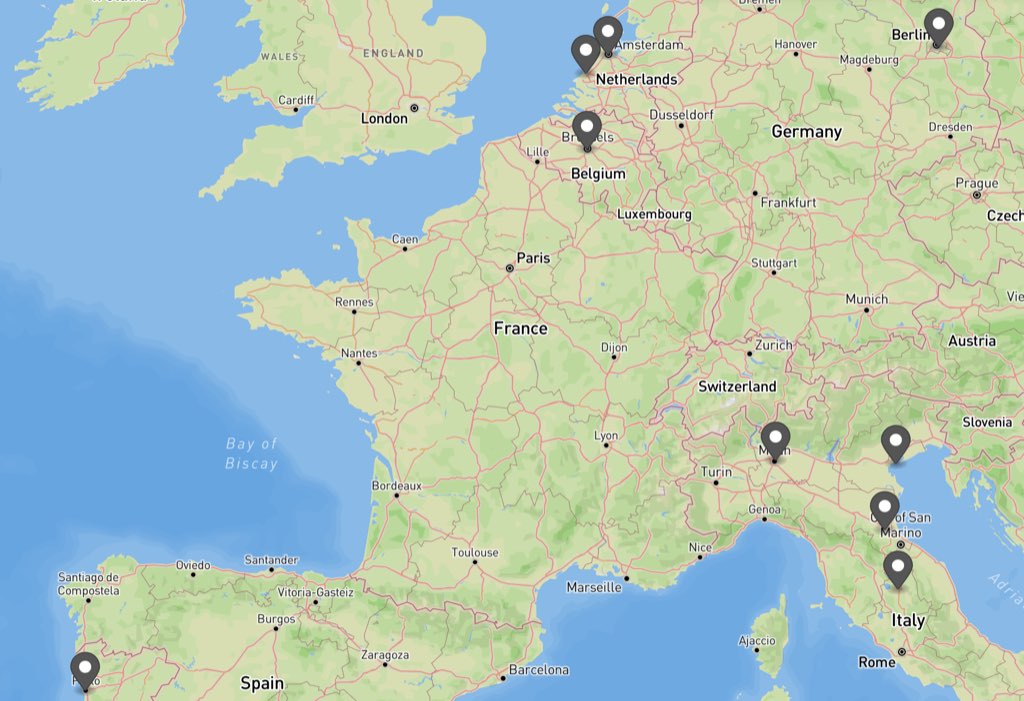
We went to Haru the other night, the Korean fried chicken joint on Grafton Street in the old Downtown Deli space. The highlight for me was the “grapefruitade,” which is everything a fancy non-alcoholic drink should be: fizzy, tart, refreshing. I’d go back just for that.

David Kessler has a free online series, Mother’s Day Grief that runs Tuesday, May 9. It’s easy to forget, on days like Mother’s Day, that what some greet with joy and celebration, others greet as a reminder of what they’ve lost.
From Wikipedia:
David Kessler is an author, public speaker, and death and grieving expert. He has published many books, including two co-written with the psychiatrist Elisabeth Kübler-Ross: Life Lessons: Two Experts on Death and Dying Teach Us About the Mysteries of Life and Living, and On Grief & Grieving: Finding the Meaning of Grief Through the Five Stages of Grief.
From an interview in Outsider about the Robida Collective project The Village as House:
Vse te dejavnosti so neke vrste poskusi premikov, ki včasih tudi ne uspejo (nasmeh). Naši ideali včasih ne ustrezajo realnosti. A prav to nam omogoča ta prostor: svoboden pristop. Zdi se mi, da nam daje odprtost za ideje, ki drugje morda ne bi imele potenciala, lahko jih delimo s prijatelji, s katerimi sanjamo naprej in prav te ideje so lahko tisti mali koraki k spremembi.
Translated:
All these activities are some kind of attempts at movements, which sometimes also fail (smile) . Our ideals sometimes do not correspond to reality. But that’s exactly what this space allows us: a free approach. It seems to me that it gives us an openness to ideas that might not have potential elsewhere, we can share them with friends, with whom we dream forward, and it is these ideas that can be those small steps towards change.
The Village as House, and Robida in general, are rich veins of interest to explore.
A 30 year old tree, felled by Hurricane Fiona, lives another day as a coffee table at The Shed.

When The Shed took on the coffee stand at the new Charlottetown Library, they closed the original location, in the old Legion on Pownal Street, to focus on the new project.
After almost a year, that original location reopened this week. The seating’s a bit tighter than it was before, as the space is now as much roastery as café. But it’s as special a place as it ever was, and I enjoyed my first hand brew of 2023 yesterday as a gaggle of curious tourists milled around me.
The Shed OG is open 9:30 a.m. to 4:30 p.m., Monday through Saturday, at 99 Pownal Street.

As I am a lover of post offices, especially ones overseas, I mailed myself a postcard home from France. It arrived yesterday, 15 days after I mailed it from the post office at 30 Rue de Reuilly in Paris.
I spent 15 minutes in the post office, as it took the clerks some time to find the appropriate stamp to mail a postcard to Canada; I was eventually given a €1.80 stamp featuring Marcel Marceau.
The postcard itself was one I bought at the Rougier & Plé shop near Notre Dame, a small biography of Oscar Wilde (13 Rue des Beaux Arts, Wilde’s last home in Paris, was a 10 minute walk away).
Thus Wilde was visited upon Charlottetown for the second time in 141 years.
,


“Do you like pineapple?”, Lisa asked me this morning, as we were sitting on the couch, in the peace between breakfast and the school run.
Lisa and I met 516 days ago. Today was the day we broached pineapple.
My friends Bill and Michelle are both the same age as me, born the same season in the same year. They’ve been together for a long time. They know whether the other likes pineapple or not. They’ve known for awhile, I’m certain.
Many—most—of my friends and familiars are in well-established, finely-honed partnerships. I am in what is, relatively speaking, the early stages of one. The pre-pineapple, and now-just-post-pineapple, stage.
I was in the public library yesterday and noticed the instructions for what to do if you discover a fire:
Those instructions seemed familiar, like something I’d noticed before.
I had noticed before, in 2019, in the Queen Charlotte Armoury:

The difference: in the library we’re told to evacuate area immediately, whereas in the armoury proceed to fight the fire.
The gift—flowing from the tragedy, but, yes, also the gift—of being allowed to reinvent myself at my halfway point is that I get to choose what to do in case of fire.
My life with Catherine worked. We reached the pineapple stage, and well-beyond (our last big summer together was spent, in part, in Europe, crossing paths with the selfsame Bill and Michelle, enjoying the easy back-and-forth that well-honed couples can together). We bought and renovated two houses. We raised a child together. We travelled far and wide. We stayed together through many thicks and many thins.
The interior landscape of our relationship, though—the part that nobody ever sees, the layers much, much deeper than pineapple—had an upper limit; it wasn’t shallow, but neither was it vulnerably deep; it was more “evacuate area immediately” than “proceed to fight the fire.”
We were younger, of course, and that explains some of it. But we were both afraid. Afraid to turn to truly face each other, to risk everything by finding our way to a deeper honesty, a more profound vulnerability. I write that with sadness for realizing the terrain we didn’t cover, for the parts of each other we never showed ourselves. Sadness for knowing it’s too late, that I was too timid.
The interior landscape of my relationship with Lisa—the important part, the part of being alive with someone else that’s about being alive—is where the growing edge of our coupling is found. This part—the part that nobody ever sees—this is where we get to decide to ”proceed to fight the fire.” Where we turn toward each other when our impulses are to turn away. Where we walk through the discomfort of candour to get to the deeper connection that’s on the other side.
This sub-pineapple part of being together is frightening, thrilling, unfamiliar new territory for me. I don’t know the way. We are finding the way together.
I wish I knew this as a younger man. I am enormously grateful to be learning it now.
Yes, I do like pineapple.
As the generous L2 made us breakfast in bed this morning, our planned breakfast meal of smoked salmon bagels got shunted ahead to lunch.
“I propose that we take the lunch, get on our bicycles, and go for a picnic,” said Lisa.
“Yes!”, I replied.
We cycled out Riverside Drive to Murchison Lane, turned right, went past the Queen Elizabeth Hospital to the grounds of Hillsborough Hospital, where we set up our picnic on the beach, fortuitously at low tide. Downtown-to-picnic was a pleasant 14 minute bicycle ride, mostly on separated multi-use trails. It was the perfect distance for a first-time-bicycle-picnic.
The beach at Hillsborough Hospital is covered with bricks; if memory serves, G. told me these come primarily from Falconwood, the original home to the hospital (a building you can see on the cover of Beyond the Asylum: The Evolution of Mental Health Care in Prince Edward Island 1846-2017, by Tina Pranger)

Many of the bricks were inscribed with the name of the brickyard; we pieces together one partial brick with “BATHVI”:
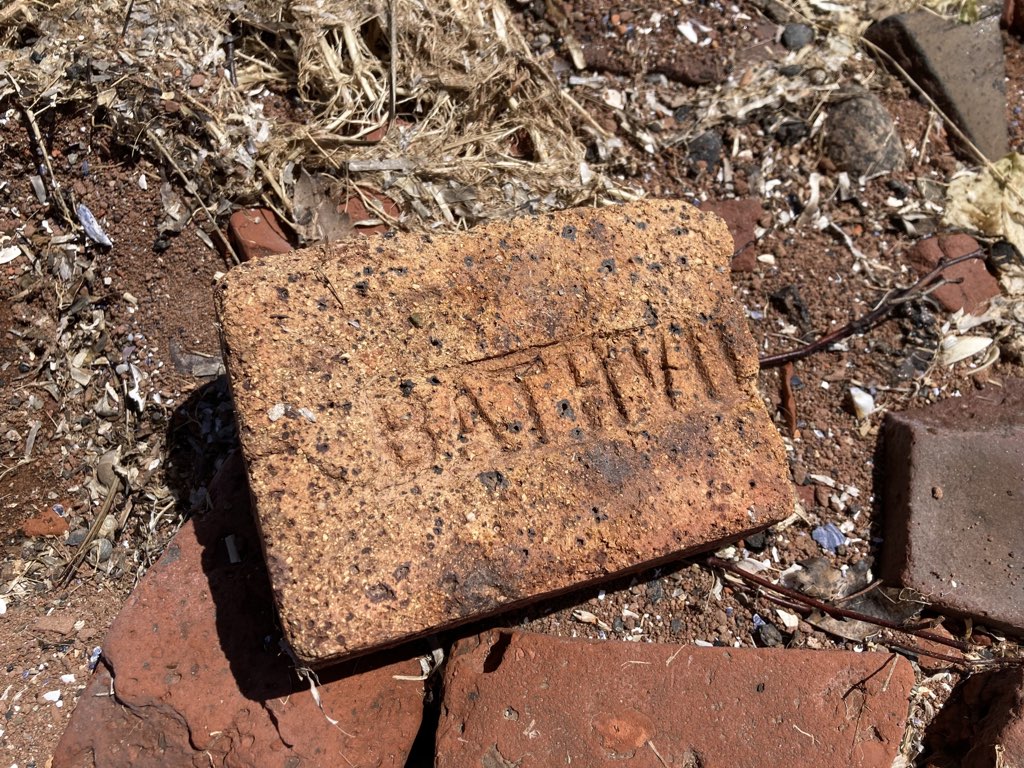
…with another inscribed “VILLE”:

…and thus surmised these were bricks from the Bathville Brick and Fire Clay Works in Scotland. Bricks that came a long way, stood as part of a building for a long time, and have now survived, still readable, all these years on the beach. Amazing.

We didn’t plan to visit Lyon on our trip to France: technically this was because we had a “no revisiting places one or the other of us has already been” (with an exception for Paris). Lisa had passed through Lyon on the train at one point, so it got ruled out.
But Lyon was halfway between Skinny Home and Tiny Home, so it made for a logical waypoint between the two. And so we went. And we liked it so much that we went back again on the swing back to Paris.
Both Lisa and I felt immediately comfortable in Lyon: our Uber driver, Jonathan, was an excellent ambassador for the city, and in a 20 minute ride from the train station to our apartment he gave us a short course in the city.
Our other ambassador was my friend Dan Misener.
In 2012 Dan and his partner Jenna spent a year in Lyon, a posting announced here:
So, why France? Why Lyon?
First off, we’re moving to France to learn French. Right now, my French isn’t great, but it’s halfway passable. I can order food and get directions, but I’m can’t have deep conversations about philosophy and literature. Jenna’s French is much better than mine, but we could both stand to improve. We figure immersion will help, and where better to immerse ourselves?
We chose Lyon for a few reasons. First, because it’s not Paris, and thus, we can afford to live there. It’s the third largest city in France, and feels not too big, and not too small. Plus, it’s la capitale gastronomique française, so chances are we’ll eat well.
Lyon is decently well-connected to other parts of Europe by rail and air, and we’re really hoping it’ll be a good home base for a bit of travel.
As someone with a quiet I-want-to-live-in-Europe-for-a-time obsession, I was an enthusiastic reader of Dan’s blog posts from there onward about Lyon, and so once we got settled I emailed him for advice about where and what in the city; he quickly responded with a well-hyperlinked guide that included a coffee place, thus earning him a place in my Pantheon of most helpful friends.
I resolved to revisit Dan’s writings about Lyon upon my return, but the current stripped-down-to-basics state of Misener.org made gathering them all together a challenge, so for posterity and personal reference I present the posts here:
- .ca → .fr
- Buying travel medical insurance
- Vendredi XIII
- The joy of setting up a French bank account
- My real-life experience using CanadianForex
- A very fussy morning coffee ritual
- All-you-can-watch movies
- Transatlanticism
There’s a lot unwritten about Dan and Jenna’s year in Lyon; it’s just those 8 posts. But the spirit they set off in continues to resonate:
The past few years of my life have become very comfortable. The same city. The same apartment. The same job. There’s nothing wrong with comfortable, of course, but increasingly, I feel the need to shake things up. To do something that makes me feel uncomfortable. To get outside of the ordinary.
Words to live by.

“We’ll, I just really like Kerri Russell…”“I haven’t seen her in forever… what was she in?”“Felicity!”—“I think I’m gonna be back here this afternoon with my regular. Catch you later…”—“Well, we do get strike pay!”

In her post Quakers, Thelma writes about her encounters with a duck, beginning:> Flapping sounds coming from a chimney usually means trouble for both the flapper and the homeowner.That’s as good an opening sentence as I’ve read in a long while.
We had a household debrief after returning from two weeks in France, and here is our advice to our future selves about travel:
- Don’t check bags.
- Don’t take neck pillows.
- When taking backpacks, make sure they can somehow connect to roller suitcases.
- Take fewer clothes.
- Don’t take bulky one-fine-dining-experience-only shoes; take flats instead.
- Don’t clothes shop before going, clothes shop once there.
- Take sunscreen (although European sunscreen is very good).
- One shared toothpaste is okay.
- It’s okay — and feels like lovely magic — to take an Uber to/from airport, no matter the moral purity of figuring out transit.
- Always buy multi date transit tickets in any city: even if it doesn’t make financial sense, the convenience is priceless.
- Getting local SIM cards in advance is worth the effort, and makes assuming European life on arrival more seamless.
- A 5 hour layover in Toronto or Montreal on return is a long slog; the ideal, to minimize waiting but minimize rushing, would be 90-120 minutes.
- Don’t eat the second meal on the return flight, save that for layover dining.
From the do you read me? newsletter, Why do we speak English in Berlin?:
In 2021, artist, researcher and curator Moshtari Hilal and political geographer Sinthujan Varatharajah held a talk on Instagram Live, where they discussed the prevalence of the English language in Berlin. Whether in cafes or restaurants, museums and art spaces, spoken on the street or in the Bürgeramt, it’s everywhere – also in our own newsletters, reviews and social media! It’s one of the things that gives Berlin its cosmopolitan shine.
But there’s another side to things, and this is what Hilal and Varatharajah bring to light in their talk, given physical form by Wirklichkeit Books in this striking blue reader.
English is international, seemingly universal – but who do we exclude, when we decide to speak and write in English? Who do we disinvite from our spaces? For those people whose languages and voices are consistently marginalised in the West, is the use of English just another barrier between them and full participation in the societies and economies that they are so often propping up with their labour?
An incident I recall from my time working with Plazes: on a trip to Berlin, at a weekly standup meeting with the new CEO, there was a long discussion of technical issues conducted entirely, and seemingly comfortably, in English. When the talk turned to deeper, subtler, more substantial issues — branding, purpose, team — the language switched to German. My impression was that one needs the breadth and depth of their native language to express things that are deeper and broader. As a result of this I was left absent from the deeper and broader conversation, and got some insight into what I imagine life is like for those living life constantly-in-translation.
From servers, sewers, alienation:
You’d think this “independence” might drive a person toward that problematic pioneer fantasy, but it only underlines to me how self-sufficiency is a LARP. Sure, we might not be billed for sewer, but what would we do if the larger society didn’t have someone we could call to pump the septic tank?
When #vanlife — drive a converted van from Alaska to Patagonia — pivoted, due COVID, to #offgridlife — build a place with solar panels in the wilds of Panama (or Nova Scotia, or Umbria, or Massachusetts) — I ended up immersed in the YouTubed lives of young couples building privies and windmills and greenhouses.
As maya points out in her piece, though, there’s no real going “off grid”: Home Depot, the Internet, hospitals are all part of the “grid,“ regardless of where your electricity comes from.
We are interdependent, whether we like it or not. While #offgridlife might be an enjoyable (and challenging) LARP, it’s hard to see how it fits into a larger ecology (we’d all do better to live in cities, sharing infrastructure, and limiting our need to commute).
I know the urge to self-reliance, the wish to not have to rely on anyone else. It’s why I have my own electric lawnmower, one identical to those both neighbours have, for our 30 minutes a week of mowing. It’s why I am considering solar panels for the roof. It’s why I host my own website, despite the cost and complexity. It’s why I have a car in my driveway, an expensive asset that I use a few hours a week.
But I know a healthy future lies in embracing our interdependence, and that means giving up the isolationist strands of a Whole Earth redux and finding an ecology much more rooted in density and cooperation than a bunkered rural utopia.
Sterling Stratton died this week.
When I landed on Prince Edward Island for a job interview at the PEI Crafts Council in the winter of 1993, one of the first people I met was Sterling.
Sterling was Secretary of the Council’s board of directors at the time; an active and engaged director, his membership was by virtue of his work as a pyrographer, an avocation he’d taken on with great enthusiasm.
I got the job, and, over the years that followed, Sterling popped in and out of my life at regular intervals.
Our worlds overlapped again when I was President of PEI Home and School Federation: Sterling was an educator through and through, and knew the world of education from the inside out, having worked as a teacher, principal, school superintendent, and union representative (I remember him telling me once that the reason that PEI teachers don’t have the right to strike is because of a deal he and former Premier Alex Campbell worked out when Sterling was tasked with developing a collective agreement at the birth of the PEI Teachers Federation).
Sterling didn’t set aside his deep interest in education after retirement, and he was a frequent source of wise counsel to me at Home and School, offering advice on everything from the right size of a school board (he maintained that the perfect size was small enough to have parents connected to education in their communities, but large enough that individual families couldn’t rally to have a teacher dismissed) to how to cultivate relationships among parents, students, teachers, and administrators. Sterling had very strong ideas about the best way to elect school trustees, and that we returned to elected school boards last year is something that, behind the scenes, he played an important advisory role in.
Outside of education, Sterling was a talented artist, and a skilled pitchman: he transitioned from working in wood burning to working with pen and ink, and he sketched more than his fair share of Prince Edward Island churches, important buildings, and houses (including our own), self-publishing a series of books that will serve history well.
Sterling was a man of great humour, incisive wit, uncommon frankness, bold imagination.
He spoke up.
I will miss him.
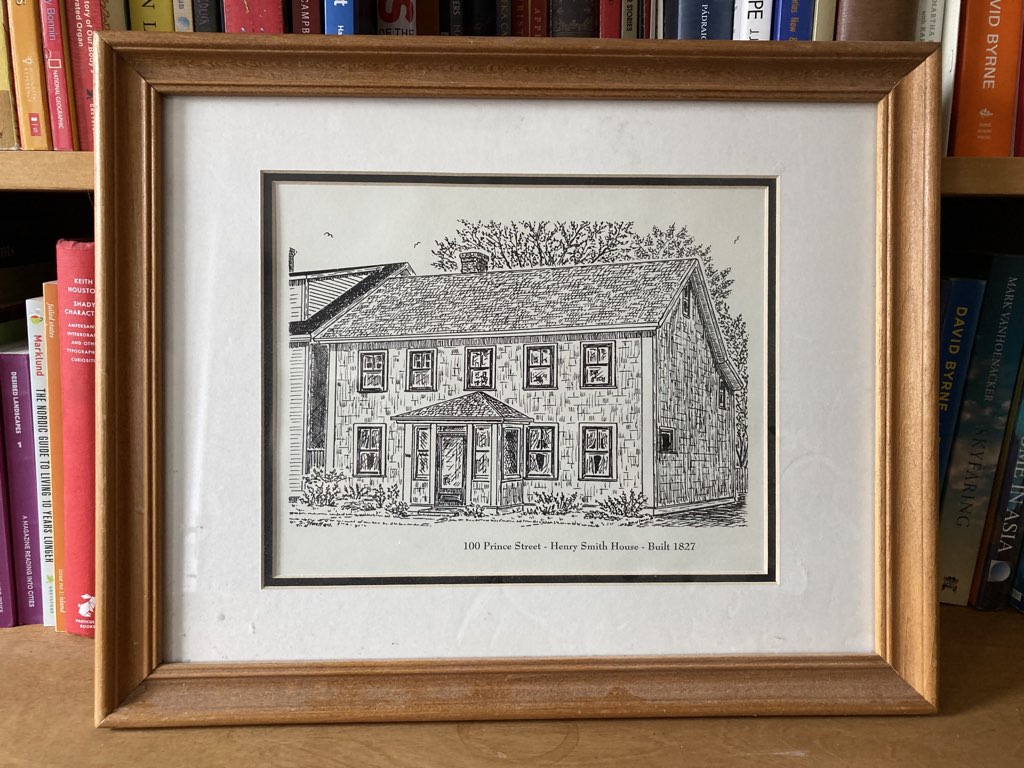
In advance of our trip to Europe I ordered three prepaid SIM cards from Orange—the Orange Holiday Europe 20GB package. This included 20GB of data, 1,000 international SMS, and two hours of international voice, and cost €40. I’ve no doubt we could have done better with a prepaid SIM bought locally once we landed, but knowing we’d be connected as soon as we landed was a comfort, as was having our French telephone numbers in-hand before leaving. Here at the departure gate, after 14 days travel, where I didn’t give a second thought to my data budget and promiscuously streamed videos and music, I end the trip with 12GB leftover, meaning I used just over ½GB a day on average. I also depart with 996 SMS to my credit, and 90 minutes of talk time. For what it’s worth, the three of us went through one tube of shared toothpaste in the same two week and did laundry three times (once in a laundromat and twice in apartments).
My “flights climbed” count went from an average of 17/day to 81/day while on vacation. Yes, climbing the Eiffel Tower bumped up the average, but there’s a lot of stairs climbing in regular everyday city navigation.

We squeezed in an extra day in Lyon over the weekend, which was lovely, as Lyon is a lovely walkable city and our hotel — the Pilo in Croix-Rousse — was in a lovely walkable neighbourhood.
On Sunday afternoon we jetted north on an Italian Frecciarossa train to Paris at 300 km/h, door to door in just over 2 hours.
Sunday evening was a quick supper at the wonderfully chaotic playground that is Ground Control—bars, restaurants, video arcade, bookstore, thrift shop, all to a pulsing backbeat—followed by a walk up the Eiffel Tower at sunset (it was a lot easier to walk up when Olivia and I did it 14 years ago).
Amidst all the epic to and fro, the things I’ll remember the most are those like breakfast with Lisa and L this morning in our tiny apartment, eating muesli with yoghurt and clementine slices and making up combination words (like birdbowl, a new game involving specially trained pigeons, and footcase, an iPhone case with toes).
Our trip comes to an end tomorrow: we fly home via Montréal. This trip has been delightful; being on the road has been a much-delayed, much-needed break.

I left L&L to adventure on my own this afternoon, heading to Bois de Vincennes by bus, and then grabbing a Vélib’ to cycle through the park. The Vélib’ system was very easy to use: I downloaded the app to my iPhone, signed up for a 1 day subscription for €3, entered my ID and PIN on the keypad of an electric bicycle, and I was off. I covered a lot of ground—almost 10 km—and it felt like I had the entire forest to myself most of the time. I love cycling so much: it feels like flying, especially when riding electric-assisted. The weather was perfect for a ride today. I’m so glad I took the time.


La Basilique Notre Dame de Fourvière and La Tour métallique de Fourvière in Lyon, through a passageway that runs through the corner of a building.


Sometimes EV charging exigencies call for drastic measures. To McDonald’s France credit, every single piece of packaging on our tray was compostable or reusable, including the French fry container.

“I hope it’s ok that I checked with Myriam to see if we could go horseback riding in the morning,” said Lisa, as I came into the tiny house. Which is how we found ourselves on horseback yesterday, wending our way through mountain forests and meadows. I was atop Tina, a horse prone to breaking into a trot to catch up to Océane, our host. This was equal parts thrilling and terrifying (especially as I was riding English for the first time).
Having a partner who’s willing and eager to bilaterally yes& with me like this makes travel a delight.

Ok, so we’re not in the Alps per se, but rather in the Vercors Massif, a French Alps-adjacent range that is, nonetheless, spectacular. Yesterday we drove along roads labelled route vertigineuse to Grotte de Choranche. As we’d gone into a grotte—network of caves—earlier in the day, we skipped the tour; the view from the parking lot, however, was awe-inspiring. And the drive, especially when it started to rain, was, indeed, vertiginous.

Currently posted up in the Alps in a tiny home (it’s part of the Homnest network). We let the wind blow us where it might, and it blew us here.
,


Within a few blocks of our Lyon apartment: Couture Shop, where you can learn to sew, guided by a professional, and Bricole Social Club, an “associative and participatory DIY workshop” that suggests we “imagine the place as a huge Swiss army knife at the service of the inhabitants of the Guillotière district and beyond.”Our time in Lyon is far too short: I can imagine happily visiting for weeks, if not living here for a time.
On buses in Lyon there are USB chargers in front of some seats. Very handy toward the end of a long day of travel, when battery is low and evening plans are still to be navigated.

Our home for two nights, found through an ami à ami connection by Lisa, using her estimable French skills, after the gîtes she’d found originally wasn’t available. Four floors, 2 metres wide. Delightful. And the kind of miraculous find that only appears when you open yourself up to wandering.


We walked 15 km today. Vacationing is good for fitness. It helped that it was 15°C and sunny. A birthday to remember.

The last time I stepped on a plane was November 2019, a flight to Toronto, the day after my father died, to join my family in laying him to rest. In remembering my father that day, I wrote about his seminal act of fatherhood, a bus trip with me around the United States:
The trip was, by times, grueling and uncomfortable and scary. But it was the best trip of my life, and the best gift a father could give his teenage son: 21 days of undivided attention in a “wherever the wind will carry us” spirit.
It is not an exaggeration to say that trip changed my life, and laid the groundwork for an approach to travel, and an approach to life, that has been far more fearless, confident, and improvisational than it might have been otherwise.
Whatever possessed him?
It’s been 1,233 days since I stepped onto AC8361 with Olivia for that trip home. They’ve been hard days: Catherine took a turn for the worse shortly after our return from Ontario, and died three months to the day after Dad. Two months later came COVID, and lockdowns, and an isolated amplification of grief. I thrashed about inside for a long, long time, trying to make sense of one thing laid on top of another laid on top of another.
I’m still doing it. But I’ve made my way, slowly but surely, toward brightness.
I wrote earlier this morning, on a widow support group, that I’d “followed grief’s vulnerability through a door to something deeper and more profound,” and that’s very much what it feels like: I chose, determinedly, to open my heart, to take risks, to fall in love, to find a way toward shaping a new way to live.
And so today, day number 1,233, I will step onto a plane again, out into the world, via AC8329 to Toronto, this time with Lisa and L., ready to see what’s out there.
My family is a travelling family, and my parents both instilled in me the notion that a curious life is a life well-lived. Catherine and I travelled widely, together and apart, and I carried on the tradition of father-and-child travel with Olivia laid down by my father, which took us everywhere from Slovakia to Japan. I’m excited about bringing the same wandering spirit to L., an opportunity I never expected to have again.
Olivia will be staying home this trip, which is disappointing for her, and unusual for me. Her travelling days are by no means over, but she’s off on a new adventure, newly living nearby in an apartment of her own, with two fantastic, caring supportive roommates. She’ll miss me. I’ll miss her. But we will ride again together another day.
If I’m being honest, I have more than a little trepidation about this trip: it’s our first time on a big trip together, L and L and I, and we’re heading out into a world I haven’t set foot in for a long time. Perhaps my footloose muscles have atrophied?
But I also feel a sense of freedom, and more than a little excitement: the prospect of travel, metaphorically, feels like a heavy weight of sadness, and regret, and being stuck, is being lifted from my shoulders.
I have been unable to go where the wind might carry me for a long time.
Here I go.
The social dynamic of living in this Lilliputian place means that politicians are far more everyday regular people than elsewhere. They are neighbours, friends, friends of friends, the people you meet each day. The mayor was Olivia’s elementary school French teacher, my city councillor used to be my office landlord.
And so it goes in this provincial general election (election day is tomorrow, April 3).
One candidate used to run a grocery store I was quite fond of, another was a supporter of my open data efforts (and yet another ran the actual endpoint of an open data service I was consuming). One candidate owns the coffee shop I used to grab a bagel with Swiss cheese and tomato every morning, one was the community police officer at Olivia’s high school.
I’ve seen enough of political life, from the door to door campaigning, to negotiating the finer points of a bill, to know that it’s demanding, all-consuming, day-and-night work; we owe those who put themselves forward for an of the people, by the people, for the people turn our respect and our thanks.
I got to know Karla Bernard when she was the Green Party candidate for District 12 in the 2019 election. I met with her one-on-one before the writ dropped, and found her a creative, compassionate, smart person, filled with ideas for how to improve the lot of Islanders. She knew that she had little chance of being elected, but she was willing to take leave from her job and spend a month knocking on the doors of her neighbours, making the case for herself and her party. Perhaps none was more surprised than Karla herself on the night that, against the odds, she was elected our MLA.
Seven months later, Karla, as a member of the Official Opposition caucus, had her first private members bill adopted, An Act to Amend the Employment Standards Act. This was followed, the next year, by the passage of the Intimate Images Protection Act she introduced. Karla was not alone: her Opposition colleagues put forward and saw adopted legislation on everything from pay transparency to non-disclosure agreements to poverty elimination. Taken together they represent a bold, progressive, feminist agenda, the result of thousands of hours of discussion, drafting, and debate. It has been a remarkable run in a legislature where private members bills, in the hundred and fifty year Liberal-PC duopoly that came before it, were rare. Our province is better for it.
Tomorrow I’ll go to the Eastlink Centre to cast my ballot again.
And again I’ll be voting for Karla Bernard. And for the hope of the Green Party forming government.
In a place where politicians are friends and neighbours, I’m freed from needing to engage in the kind of politics, so common elsewhere, that seeks to cast those we oppose as wrongheaded, mean-spirited. Premier King has led the Island ably through a difficult time; his government has made bold moves in public transit, social assistance, and housing. I don’t need to think Dennis King and his caucus colleagues are jerks to vote Green.
I’m voting Green because Peter Bevan-Baker, and the Green slate of candidates he leads, seek to set a higher upper-limit for Prince Edward Island, a higher vision for what we are collectively capable of.
I want a government with an action plan for protecting the rights of 2SLGBTQI+ Islanders, a government that will make birth control free, a government that will move to make healthcare administration independent from politics, a government that will commit to public housing. A government that is grounded in core values that I share.
And a government that, after four years of learning the ropes of the Legislative Assembly, is ready to govern, that knows how to legislate, and that has a legislative agenda ready to go.
Karla Bernard lives just up the street and around the corner; she’s a neighbour, and she’s become a friend. I’m proud to call her my MLA, and I’d like to see what she and her Green colleagues are capable of as members of Executive Council.

Ton related a story of how an empathetic call nine years ago had an outsized effect:> The fate of anyone working to change something in how government works, or any larger organisation or system really, is that most often you’re not around to see the effects. Small course changes can take years to become noticeable shifts, and by that time no-one will remember where that started or who helped start it.I’m a strong believer in making calls to reinforce the positive; it’s the companion to my equal and opposite tendency, learned at my father’s knee, to criticize the bad vociferously. Beyond the ripple effects of paying it forward that Ton describes, there is the simple pleasure of calling someone to tell them you appreciated their service, or noticed them going the extra mile, or recognized their going out of their way, or that you saw them doing good when others were being critical. It’s something that’s done so seldom that you will almost always make someone’s day.


A testament to the kind of winter it’s been: I only made it over to the letterpress shop this morning, three months after Christmas, to put away the type from our Christmas card job. I’m eager to get back to printing now that the shop is cleaned up(ish) and ideas are starting to flow.
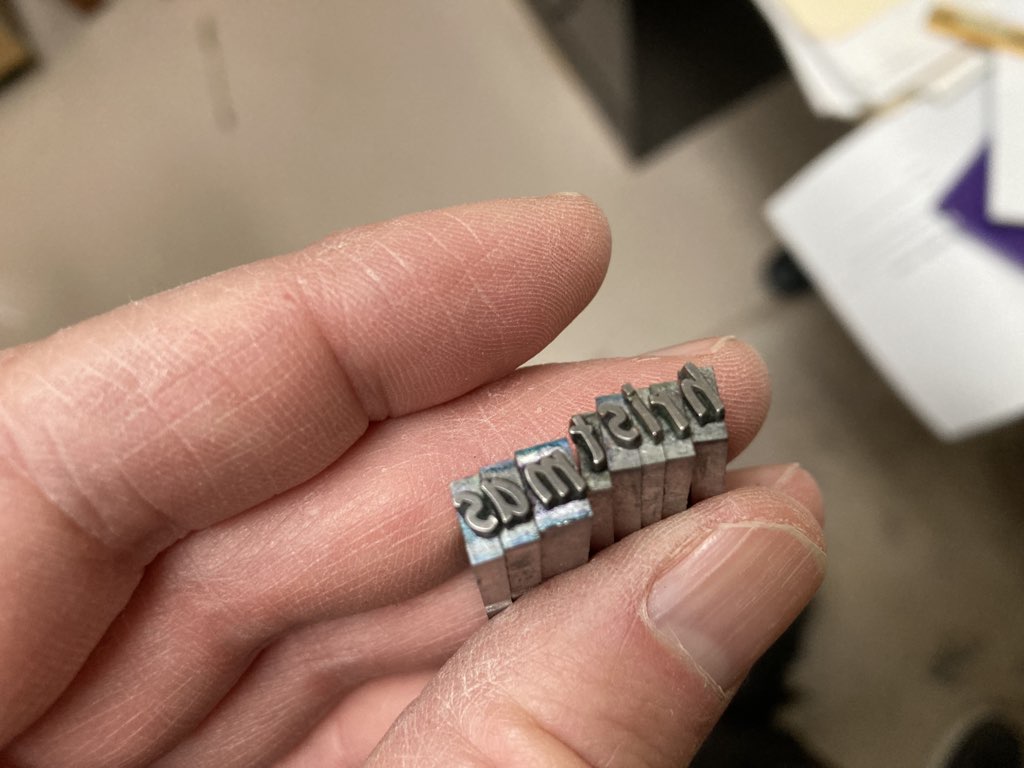
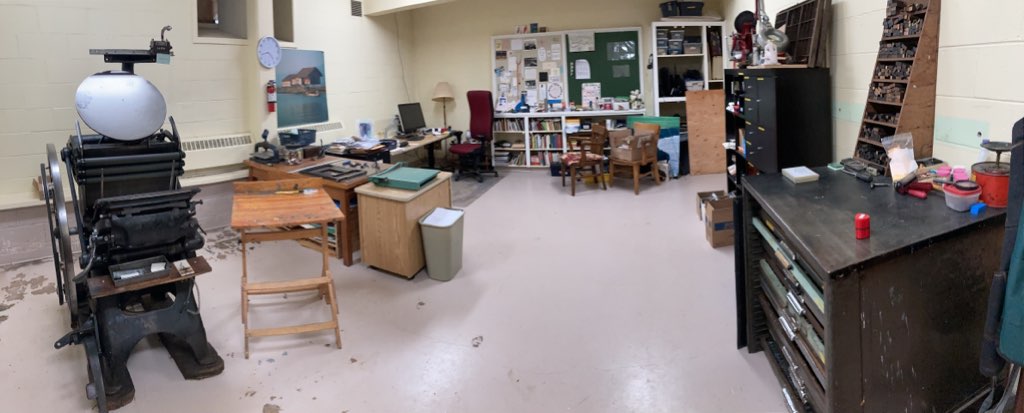
The first crocuses appeared in the front garden at 100 Prince Street this weekend, right in time for the vernal equinox. See also 2020 (March 24), 2021 (March 12), 2022 (March 18).
In the hamlet of Ameliasburgh, in Prince Edward County, Ontario, you will find a street, about an eighth of a mile long, that runs from County Road 19 up to the Harry Smith Conservation Area.
If you visit the website of Quinte Conservation, however, you won’t find any mention of the Harry Smith Conservation Area; when I spoke with someone there this morning I was told that the area has been decommissioned and re-naturalized, and that the footpath that circumnavigates the Ameliasburgh Mill Pond is no longer maintained.
The Harry Smith Conservation Area is remarkable for two reasons, beyond the mere fact of its generous donation by Harry Smith to “retain its natural atmosphere and be developed into a day-use area.”
First, there is a photograph in the Irving Layton fonds titled “A man at the Harry Smith Conservation Area, Ontario.” How I’d love to see that photo. Why was Irving Layton in Ameliasburgh? Which man?
Second, the name of the street running up to the Harry Smith Conservation Area is Purdy Street (originally Purdy Lane), named for Canadian poet Al Purdy:
So when it came to celebrating its celebrity, as small burgs like to do, Ameliasburgh named a lane after him. Al was amused by the fact that Purdy Lane led down to the graveyard. It is now called Purdy Street, and you can follow it down to the beautiful book-shaped stone with Al Purdy’s name on it, not many steps from Owen Roblin’s resting place.
Ameliasburgh, you see, was the hamlet chosen by Eurithe and Al Purdy as the site for what became the most well-known A-frame house in Canadian literature:
In 1957 the Purdys bought the property on “the south shore of Roblin Lake, a mile or so from the village of Ameliasburgh, in Prince Edward County… (the) lot bordered the lake shoreline, a teacup of water nearly two miles long. Dimensions of the lot were 100 feet wide by 265 long.”
With a pile of “used lumber, concrete blocks, studdings, beaverboard and the like” Al, Eurithe and Jim Parkhurst (Eurithe’s father) began construction on the now famous A-frame. Al tells the story in Reaching for the Beaufort Sea.
Things happened in that house. Alfred W. Purdy, the “failure” of a man and poet (as Al looked back on that time), started publishing as Al Purdy. Just as Al and Eurithe composed the A-frame from available materials, Al began to compose poems about Roblin Lake, Ameliasburgh and Prince Edward County. In 1962, Poems for All the Annettes was published. Al considered this book a “watershed” in his development. The following year he submitted the manuscript of The Cariboo Horses to McClelland and Stewart. It won the first of Al’s two Governor General’s Awards.
The presence of the Purdys in Ameliasburgh helps explain why Irving Layton would be taking photos at the Harry Smith Conservation Area.
(It is worth noting that while the sons and daughters of Ameliasburgh have embraced poet Purdy, here in his hometown of Charlottetown, we’ve yet to embrace Purdy’s friend, and fellow poet, Milton Acorn).
This Ameliasburgh jag was triggered by the news Yann Martel to match donations to Al & Eurithe Purdy A-frame Foundation Campaign.
Longtime readers will recall my own brief encounter with Yann Martel, the bond between Al Purdy and my friend and former next door neighbour, Mike Johnston, and my love for the Bruce Cockburn song 3 Al Purdys.
All of these led me to believe that it is fated that I should contribute to the A-Frame Foundation campaign.
So I did.
In memory of Milton Acorn.

Perhaps you’d be willing to match my donation?
Eleven hours later, I would need two units of blood.
At the time, though, I was focused on the couple across from us in the Moncton ER waiting room. A casually-dressed couple in their 60s, obviously a couple for a long time, as they had a deft, wordless way of moving with each other, of communicating. They were there for him, it emerged: when the blood pressure trolley stopped at their seats, it was his blood pressure that was taken. I assumed their visit had something to do with his leg, as it was in a boot, strapped on with velcro, of the sort that people with a foot or ankle injury often wear.
Because not much goes on in the ER waiting room, I paid them a lot of attention. They shifted seats, got called in, got sent back out, ate snacks, played word games. I was confused by how his velcro-boot kept shifting from his right leg to his left leg. Eventually I realized it was simply because he was crossing and uncrossing his legs—the kind of thing you do a lot in the ER waiting room.
We’d gone over to Moncton for the weekend with Lisa’s parents, to an Airbnb on the outskirts, our Christmas gift to them. The rental was beautiful, a log cabin just enough out of the suburbs to feel rural and isolated, but within 10 minutes of the city proper. It was touch and go whether we’d go at all: I was still in the throes of a two week old chest cold, a cold that had consumed all of my energy and then some; I was exhausted. But, I reasoned, I wasn’t coughing so much, and I was certainly no longer contagious, so even if I was feeling 50%, I figured I might as well feel 50% in a log cabin as anywhere, with family, a hot tub, and wood-burning fireplace at the ready.
I was queasy the entire ride over, and increasingly feeling out of it, but soldiered on regardless. After an overnight in the cabin—a nice supper, a perhaps-foolhardy dip in the hot tub outside at -30ºC—it seemed clear, the next day, that I was getting worse, not better. By late-morning, I was feeling poorly enough that I phoned 811. After a 10-minute triage chat with a nurse, I was told to go to the ER.
And so, at 2:00 p.m., off we headed into the city, Lisa and I, confident that the posted wait times on the ER website of two to three hours would mean we’d be back for supper. At the time I thought I might have pneumonia, or some other chest-cold-gone-wild malady, and might receive antibiotics. Or maybe even just a “take it easy, son; you’ll be better soon.”
On arrival I was ushered into a triage booth and interviewed by a capable nurse. Between the two of us Lisa and I spilled out my symptoms: sick for two weeks, feeling better, then worse; feeling alternately dizzy, queasy, with an unrelenting cough. And, worst and most noticeable, feeling not altogether “there” most of the time. Almost as an aside, I also mentioned rectal bleeding that I’d been experiencing for a couple of weeks, seemingly due hemorrhoids, bleeding that I’d been reassuring Lisa was part of a regular and unconcerning pattern.
Just as we were finishing up, Lisa mentioned to the nurse that my colour had been off, that I sometimes looked pale, or yellow; the nurse agreed, noted that, and I watched her bump me up a triage level, which buoyed my spirits, as I assumed it meant I’d be seen earlier.
And then we waited.
The Moncton ER waiting room is like any ER waiting room anywhere: an unloved holding tank for indeterminately sick people, not unlike an airport waiting room for flights to unpopular destinations. There are two pay telephones, an almost-empty snack machine, a television mounted on the wall, playing only the weather forecast, two washrooms. It is the kind of place that takes your mental health as you arrive and downgrades it, simply from drearily waiting in a space that telegraphs you-don’t-really-matter-all-that-much.
Every hour or so the vitals cart came around to take my blood pressure. Because I had mentioned feeling dizzy, they took it twice every time, once sitting and once standing; orthostatic they called it. And there was a big difference between the two readings.
As the posted wait time came and went, we numbed ourselves to the idea that I’d be seen quickly. We entertained ourselves with Wordle. With snacks from the vending machine, with a failed attempt to order Lebanese food from Skip the Dishes (it simply never arrived) to a successful attempt to order submarine sandwiches from Door Dash. We charged our phones. I went for little walks. We talked, a lot. Lisa is, it turns out, a fantastic person to spend extended time in a waiting room with; as afternoon became evening became midnight, we never got grumpy, never turned on each other.
Finally, at 1:00 a.m., the velcro-boot couple were discharged and, 11 hours after arriving, my name was called. We were invited to walk through the big green doors, and taken into a curtained exam room.
It was only minutes before the doctor arrived, a rumpled man with an inquisitorial bedside manner that caught us unawares. We again spilled out my symptoms, and the doctor dutifully followed us down each path—chest cold, bleeding, colour, feeling out of it—sometimes asking questions that made us feel like we were in a duel. While there may have been—indeed, there was—method to his madness, it felt like an interrogation, especially after 2 weeks of illness, 24 hours of feeling out of it, and 11 hours of waiting room anticipation.
“We’ll get you taken care of,” he said on his way out.
Our confidence level was not great, and I think we each privately thought he’d written down “loopy couple; stick them somewhere, and then set them free.”
That didn’t happen.
Within minutes we were taken to another room around the corner, one with a throne-like recliner, with a step labelled “no step.” In short order I had many vials of blood drawn, and an ECG strapped to my chest. I was wheeled away for a head CT, and a chest X-ray, both of which happened without any wait at all. While I wasn’t panicking, I realized that we weren’t in ”take it easy, son; you’ll be better soon” territory any longer.
After a return from my visit to radiology, the doctor came back into the exam room.
“You’re anemic”, he announced. “Your hemoglobin is 70, and it should be more than 135. We’re going to need to give you a blood transfusion.”
It seems important at this point to stop and talk about rectal bleeding.
I never thought I’d write publicly about rectal bleeding. Or rectal anything, for that matter. Matters rectal are the undiscovered country of my literary non-fiction.
And yet here I am.
The reason I was in the Moncton ER needing a blood transfusion is directly related to that very same reticence.
Sure, I’d talked to my doctor about rectal bleeding before: it’s what led me to have a colonoscopy at age 36, as with a family history of colon cancer, it was a warning sign. That first colonoscopy didn’t show anything of concern, other than hemorrhoids. At that point, the power of “I don’t have colon cancer!!” was enough to take any attention I might have otherwise paid to the hemorrhoids.
In the intervening years, my hemorrhoids came and went, sometimes bleeding, sometimes not, and, using a not insignificant amount of magical thinking, I ignored them, mentioning them at annual checkups, but never pressing doctors about whether it was a concern or not, and them never saying “hold on, let’s talk more about your hemorrhoids.”
I was ashamed. I was squeamish. I was distracted. I feared whatever treatment might be offered me. Nobody wants to imagine scalpels and lasers in and around the bum.
A blood transfusion takes a long time; I didn’t know that. It started at 2:00 a.m., and I wasn’t released until 8:00 a.m. Lisa, bless her patient heart, was beside me throughout; we grabbed small snippets of sleep, but it was, for most intents and purposes, an all-nighter. There was a surreal quality to it all, knowing that anonymous donors were the source of the lifesaving something that was now dripping into me.
And then it was over.
We emerged into the bright Sunday morning Moncton sunshine, drove back to the cabin, had breakfast, went immediately to sleep. We drove home later the same day.
In the intervening weeks I’ve learned just how precarious having a hemoglobin level of 70 can be, had my blood and urine tested (hemoglobin up to 90, then, two weeks later, up to 123: a healthy trending up, but not yet optimal; all other metrics at “you’re in the prime of health” level—my nurse practitioner referred to my cholesterol level as “lovely”), I’ve had two iron infusions in the hospital here, plus a colonoscopy, ordered and delivered in record time.
The colonoscopy, absent the purgative prep, was a not unenjoyable experience that I watched on HDTV with fascination. The post-operative notes start “everything looked good,” and today I learned that the three polyps that were removed for analysis were ”tubular adenomas,” not cancerous but rather “the kind of thing that can become cancerous.” Good to have excised—a godsend, in fact, and a silver lining in all this—but, in the end, not the source of what ails me
The current working hypothesis: I have hemorrhoids. That bled. A lot. And I lost enough blood to make me anemic. I’ll go back to my surgeon toward the end of the month to talk about addressing that.
This has all been a chastening experience. For me, for Lisa, for Olivia, and for the circle of family and friends who surround us.
Any sense of embarrassment I once had talking about hemorrhoids has evaporated, now that they’re the talk of the town. This chastening, which I would have likely, at one point, kept entirely to myself, I’m now (sort of) okay writing about.
The sense of shame I have about neglecting my health, to the point of real peril, is something I’m still grappling with; I feel equal parts an idiot, and like I’ve had a lot going on for the last decade, so it’s okay to cut myself some slack.
I have struggled with this blog post; it’s been a draft for three weeks. At first the struggle was how frank to be; once I figured that out, I struggled turn it into a life-lesson, to tie a neat bow, and come to a satisfying conclusion. But every path I wrote myself down ended up a dissatisfying blind alley; I searched in vain for life lessons, and, so far, have found none.
So I will end not with a life lesson, but with gratitude.
To everyone medical, from the irascible Moncton ER doc, to my nurse practitioner, to my colonoscopy surgeon, to the myriad nurses who’ve drawn blood, and taken my blood pressure, and served me warm blankets.
To my friends and family, who’ve worried about me, asked after me, offered kind words and practical support.
To Olivia, who’s been through too much, and who feared I’d die before my birthday.
To Lisa, who’s loved me all the way through this: she’s managed our household solo while I’ve been down, fed me from vending machines, driven me to appointments, held my hand. She’s bravely jumped into a remarkable pool of vulnerability with me that continues to take my breath away.
And perhaps there is a neat bow to tie this up with: I am so, so happy to be alive.
Colin Nagy writes about the locked groove we can fall into when travelling to familiar places:> We quickly realized that we had a similar problem: the “locked groove” effect of cities you frequent for work or for pleasure. I tend to have long-term affairs with places and am magnetically compelled to return often. The trick is not falling for the things you do every time, or settling into a comfort zone with repeat travel.I’m guilty of this, stopping every visit for the same shrimp tacos in Milford, NH, for the same grilled cheese at CPH, the same ice cream on Bloor Street. To say nothing of my well-worn path through the stationery ships of Berlin. I’m travelling next month for the first time in almost four years. While we’re going somewhere mostly unfamiliar, and so mostly free of locked grooves, I’m looking forward to travelling with fresh eyes and a refreshed spirit, avoiding the thematic locked grooves that transcend place.
Prince Edward Island is blessed with a progressive editorial voice in The Eastern Graphic and its publisher Paul MacNeill, whose editorial this week, Haters will never win, calls out the connection between what might be called “Island nationalism” and xenophobia:
The idyllic Island of white Protestants and Catholics, with red mud lanes, an outhouse in the backyard and a home raised chicken in every cooking pot is a puritan vision that ignores how ugly Island life often was.
There are still ugly moments, but we’ve come a long way from the days of yore fondly remembered by some.
What they don’t acknowledge is PEI needs immigration. Our economy would collapse without it because our population for decades has failed to grow to meet even the most basic of workforce needs.
Equally as important, diversity builds vibrant, welcoming communities. Doesn’t mean there will not be growing pains. There will be. But you don’t solve a problem by seeking to throw a protective cloak over the Island.
From Analog Office, Mess Up Your Good, Premium, Luxury Notebooks:> What about those fifth-generation stationers who go to great lengths to source wonderful paper, to find skilled craftspeople who will bind it just right, so that the binding lies flat when you open that notebook?> What if you were the notebook maker? If you went to all that work to design and manufacture a notebook you thought would be totally awesome for someone to use, what would be cooler to you, five or twenty or fifty years from now…I’ve been this maker. Not of premium luxury notebooks, but of handmade notebooks for friends and family, where the primary special sauce is love, not craft. “Oh, I can’t write in that, it’s too precious!” isn’t the preferred response to such a gift; use it, write in it, mess it up. I can always make you another.
There is a disquieting swell of transphobia here on Prince Edward Island this month, a movement by a small group of parents targeting the Guidelines for Respecting, Accommodating and Supporting Gender Identity, Gender Expression and Sexual Orientation in our Schools.
Gender identity, gender expression, and sexual orientation are challenging concepts for cisgender heterosexual people like me to confront: I was raised by atypically progressive gay-positive parents, but I grew up in a culture that was completely unaccepting and incurious of anything related to the the life of 2SLGBTQIA+ people, and frequently dismissive of, and injurious and violent toward, anyone with the tenacity to express their true self publicly.
I am not a paragon of solidarity; I am an imperfect ally. But I am trying, I am listening, I am reflecting on my own myriad biases, and my part in promulgating a cis- and hetero-normative worldview.
I am the proud father of Olivia, an autistic trans-woman. Olivia has worked so hard to find her way toward a way of being in the world that is true to herself, against tremendous pressure to not do so. The intersectional challenges of being trans and neurodivergent are formidable, and the very notion that an autistic person is fully and completely capable of agency over her gender expression, gender identify, and sexual orientation is something she receives pushback on from almost every direction.
When people rally against guidelines that call for my daughter and her peers to be respected, accommodated, and supported, they are engaged in an act of intolerance. They are tacitly saying “we don’t accept you, Olivia.” They are piling on to the mountain of hatred, violence, rejection that makes living life as a trans person so arbitrarily, unnecessarily difficult.
When we choose intolerance over love, ignorance over education, we are not only building prisons for others, we are imprisoning ourselves, cutting ourselves off from the liberating notion that we can all be freed from expectations that how our gender and sexuality manifest should exist in a restrictive narrow band.
Former Prince Edward Island Premier Wade MacLauchlan frequently called Islanders to look to our “better nature,” and this is clearly a time we should heed that call: let us all seek to love all our neighbours, even if—especially if—we are frightened by parts of them we struggle to identify with, to understand. Through dialog, curiosity, courage, openness, we can stanch that fear, that ignorance, and march forward together.
I love my daughter, all the parts of her, all of who she is and is becoming. Please join me.
I was happy to be a source for the article The curious history of 219½ Hunter, Peterborough’s itsy bitsy storefront in Peterborough Currents. 219½ played an outsized role in my life, and it’s nice to see the history of the storefront documented so thoroughly.
We made Ella Risbridger’s Stuck in a Bookshop Salmon and Sticky Rice for supper last night. I’d resolved to make something outside my typical flavour palette and this certainly was: marinated grilled salmon over chorizo- and garlic-infused Thai black rice, a smooth-vs-nutty contrast. It’s from her Midnight Chicken cookbook.

The Saturday “feels like” temperature in Charlottetown is forecast to be -45°C. Oh my.

We lost two wise, compassionate Islanders this week, both dedicated to service.
John Andrew died on Tuesday. I met John when he ran for the Green Party following the death of Josh Underhay, and found him a shy, intelligent, thoughtful person. His eyes lit up when, standing in his front yard, overlooking Andrew’s Pond, he talked about the history—human and natural—of the area. I’d always hoped, in the years since, to catch John’s eye as I canoed that pond; I’d have welcomed the opportunity to thank him for his dedication to enhancing such a brilliant and storied natural area within the city limits.
Two days later Mait MacIsaac died. I met Mait only a few times, through PEI Home and School Federation, an organization he held dear, and to which devoted much effort. Mait was a legendary educator; I was a direct recipient of the spirit described in his obituary: “Mait was genuinely curious, could connect with anybody of any background and possessed a knack of asking just the right question or spending whatever time it took to listen.” We are blessed to live in a province where so many educators, after retirement, take what they’ve learned from their formal careers and devote their lives thereafter to sharing, reflecting, discussing, improving; Mait was at the head of that class.
John, Mait, you will be missed.
I am entering week two of the Mother Of All Chest Colds.
Things started off slowly, a week ago Wednesday, with a fever of 38.6ºC for about 12 hours; the fever broke, all was well. I made English muffins. I cleaned up the back yard.
Friday was fine. Bullet dodged!
On Saturday, though,I developed a sore throat, a cough, and ever-worsening congestion; my time since then has focused primarily on phlegm management. Bonus symptoms: headache, fatigue, lethargy. The congestion’s risen up into my sinuses a few times, then settled back into my chest.
A trip to the nurse practitioner on Thursday showed my vitals are good, I’ve not got pneumonia, and, as it’s likely a virus at play, I’ve no choice but to wait it out. She reported that she’s seeing cases last as long as three weeks. Ugg.
For those of you similarly stricken, some tips from the field:
- Cepacol lozenges are the best I’ve found. They’re also less popular, so more likely to be in stock when brands like Halls are missing from store shelves.
- Mucinex was a help when I needed to loosen things up, and clear my most-congested chest. The only downside was that my nose ran for hours and hours.
- I’ve never been a taker of pain-relievers, but Advil has been my friend this week; I wouldn’t have been able to sleep without it.
- Secaris is a nasal lubricant I picked up on the recommendation of a clerk at Murphy’s Parkdale Pharmacy (it’s on the back wall near the cough drops); it really help when long nights of nose-blowing resulted in a raw nose.
- Head-over-boiling-water-in-a-bowl has really helped, a couple of times a day.
Every time I think I’m clear of this beast, it rears its head again; fortunately for the past three nights I’ve been able to sleep clear-through, which has been a big help (before then I was spending long stretches of the night on the couch, coughing).
This is the longest I’ve been sick in years, and compared to COVID, which, for me, was a walk in the park, this virus packs a wallop.
Wish me luck.
The Dating After Death episode of the Widow We Do Now? podcast covers a lot of terrain that’s very familiar to me. Anita and Mel interview the host of the datingafterdeath podcast.
In this Facebook thread kicked off by a friend and co-conspirator from the Peterborough days, Clifford Maynes, much is said about guitar solos, from people who know. Starting with:
A message about solos and fills for all guitar players, myself included:
- play fewer notes — mix in some long slow notes and bends — make it sing
- play melodic solos — the tune is a good place for inspiration — talk to the people — say something that needs saying
- don’t rush to go nuts in upper register in the second verse — build slowly, keep something in reserve\
I appreciate the comment from Richard Connolly: “Stop chasing notes. The right notes in the right place are what works best. That is the quest.” It mirrors what Laurie Murphy tells us all the time when crafting improv scenes: the answer is right there.
My friend and improv teacher Laurie Murphy took a turn as the Spin Time DJ on CBC Mainstreet this afternoon, talking about her return to PEI, how she first got involved in improv, and what she’s up to now, with an eclectic trio of tunes (I know from experience that boiling a life-so-far down to 3 songs is a Herculean task).
Laurie was very kind to tip her hat to me and my improv experience to date; as I’ve written here before, it’s her skill as a teacher that is so responsible for so much of that.
Sonya Emerick was elected to the Minneapolis School Board. Her reason for running:
I had two choices: to move into litigation with the district or to try to move where I had access to influence systems-level problems and barriers. I chose the latter. When you litigate in special education, it’s a significant amount of time and financial resources. It’s very, very draining on a family emotionally. Even if you get the best possible outcome, it still begins and ends with one kid, typically. I decided I can do something with a bigger impact. That’s why I decided to run.
Sonya, a trans-woman, is the first autistic person elected to the board.
Kent Nerburn writes about life as a cab driver, and of one particular night:
When I arrived at the address, the building was dark except for a single light in a ground-floor window. Under these circumstances, many drivers would just honk once or twice, wait a short minute, then drive away. Too many bad possibilities awaited a driver who went up to a darkened building at 2:30 in the morning.
We offered to Olivia a supper of takeout-inspired-by-Catherine last night.
Being a completist, Olivia decided that this mean that we needed to get entrees and desserts from both The Old Triangle and from John Brown Grille, two of Catherine’s favourite haunts.
As a result this, after a meal of sweet potato fries with curry sauce, haddock tacos, shepherd’s pie, and bruschetta, we finished off with sticky date pudding (John Brown) and bread pudding (The Old Triangle), both of which came with their own butterscotch syrup add-on.
It was a heady night.
Despite—or, actually, because of—it being an emotionally charged day yesterday it was an important night to go to improv class. Lisa, bless her heart, cleared the way for me, and managed the household energy while I escaped.
It was a good night at the improvatorium, with a mixture of new people and veterans, and we had fun making scenes, doing a rant, and conducting character interviews.
As the night drew to a close, and my character interview was the last of them, I realized I had an extra dose of emotional sludge to unburden, and so I channeled it into embodying Jerry Coltane, 18 year old rock star.
At some point in the middle I left my body and I became Jerry.
It was exactly what I needed.
Catherine died three years ago today.
The next day, I wrote this email to a good friend, subject line How Catherine Died:
Oliver1 spent yesterday in the Palliative Care Centre; they kindly set aside the family room for him, put a do not disturb sign on the door, and secured a DVD player. During movie intermissions he would come and visit with Catherine.
By this point Catherine had been asleep and unresponsive for almost 48 hours. In the middle of the afternoon I was laying down in the recliner beside her; it was quiet, and I didn’t expect anyone to stop in for a while, so I leaned over and told her that we were going to be okay, and that it was okay for her to die.
It felt strange doing this, both because it feels strange telling someone it’s okay to die, and because it’s strange talking to someone who’s asleep.
But I felt I had to say it, out loud, so she knew.
Around 5:00 p.m. Oliver got ready to go home for supper with my mother and my brother Mike; he came to see Catherine and gave her a big hug.
After seeing them off, I came back into Catherine’s room, and one of the volunteers brought in supper for me. I picked up my tray, then I heard a subtle change in Catherine’s breathing and put my tray down. Something had changed. I wasn’t sure what. But she was breathing a new rhythm.
I settled down, took my dinner tray, and ended up eating only the dessert, a strange kind of cold pear crisp.
Around 7:30 p.m., the nurses came in to freshen Catherine up, as they did every night she was in palliative care. I waited in the kitchen next door.
While I was waiting I had a chat with a volunteer, someone I’d met a few nights earlier. She was finishing up her shift, and told me she hoped my mother would be okay. I didn’t correct her. On either front.
I got settled in the reclining chair beside Catherine’s bed, and felt restless. I alternated between trying to have a nap, and reading a book. The book was one given to me by a friend last week about a Hollywood actor who died from lung cancer; it was written by her husband, and made up mostly of the email newsletter he sent out to friends and family every night.
After 9:00 p.m. I was well past the place in the book where the protagonist died and was several months into the husband’s grieving.
At 9:15 p.m. I looked over at Catherine and her eyes, the the first time since Tuesday, seemed to be open.
“KD?”, I asked.
She made a sort of cough or a sneeze, grimaced, scrunched her nose, and seemed to stop breathing. But she’d seemed to stop breathing a hundred times over two days and so…
Then she did breathe a couple of breaths.
And then repeated the cough/sneeze. I think at this point I half expected her to wake up and say “surprise!”
But she didn’t: after a few more breaths, she stopped.
And everything was still.
Until I re-read that email, just now, I’d forgotten that I’d told Catherine that it was okay to die.
It’s uncomfortable writing that out loud here.
It remains in the mystical realm whether Catherine heard me, and whether my words had any effect; it was something, I suspect, that I had to say out loud for my own benefit more than for hers.
But, also, we knew she was going to die, if not that day or that night, within the next few, and releasing her from any obligation to hold on seemed important.
We are so collectively terrified of death that it’s something we seldom talk about, and that itself is part of what amplifies the terror. For six years, since she was given an incurable diagnosis of metastatic breast cancer, I knew that Catherine was going to die. But I had no idea how or what that would be like, and the world around me seemed aligned in a desire to keep my eye off that ball.
And that’s why I’m repeating here those words I wrote three years ago: I want to help, if not “normalize” death, at least make it more possible, more permissible, to talk about, to write about, to anticipate death without abject terror.
The grief that followed Catherine’s death, three years worth of it, has been the roller-coasterest part of my life to date. I’ve felt my lowest lows, and my highest highs. I’ve had times when I have woken up, for weeks on end, in a cold sweat at 3:30 a.m. and not been able to get back to sleep. I’ve felt the freedom of being able to consider the future again. I’ve imagined being coldly fearfully alone, forever. I’ve tried my best to help Olivia process the loss of her mother. And I’ve found great new love. A way forward. Happiness.
What I’ve arrived at, three years in, is that grief is only on the surface about the things it appears to be about: deeper below is a complicated web of trauma connected to the bottom falling out of everything, maintaining daily life in the face of certain death (at some random point), the exhaustion of trying to buoy everyone else’s spirits, the (unspoken) frustration of not being able to plan anything, of having the future capped. Grief fucked me up, and for many, many more reasons than “I’m really sad that Catherine’s gone.”
And so, more recently, it’s been this that I’ve been quietly confronting, walking through, accepting.
For all of you who knew and loved Catherine, I am thinking of you today, in solidarity, and with the hope that you’re finding your own ways through the forest.
1. Oliver (he/him) now identifies as Olivia (she/her).
From Anna Havron’s Analog Office blog, a suggestion to keep a canonical Where Is It? file, a pointer to where all the things are kept.
I spend 3% of my energy worrying about where the safe deposit box key is (and another 0.5% wondering why I still have a safe deposit box). I worry about where the passports are. And Olivia’s birth certificate. And the spare key to the Kia Soul. So I’ve done as suggested and created a shared Notes folder into which I’m pouring notes about all those things the location of which is not immediately obvious.
I found a vestigial electric outlet inside a cupboard in our library, and thus was born the data closet.
It houses an AmpliFI wireless access point, the Raspberry Pi that feeds our water and electricity consumption data to consuming.ca, and the PoE connection to the Nanobeam in the works that feeds the Internet into the house from across the street.

I didn’t realize that we all must make a conscious choice to invest in things or not to. In my mind, once you liked something, you liked it for life. There was no such thing as growing out of something or something serving a purpose. Each hobby or interest was part of your DNA, and you must find time for it.
That’s a freeing revelation: I stopped horseback riding mid-summer , choosing to prioritize summer relaxation; I’ve had a nagging feeling that I’d failed at riding a result. But I rode when riding was what I needed, and I’ve simply moved on to other pursuits.
The fog horn blared as we woke up on New Years Day. Outside it was rainy, unseasonably warm. Not ideal leveeing weather, but certainly better than those years when it was minus 20 degrees with snow banks.
We started later than usual, with less breathless rushing. Olivia and I drove to City Hall, attempting to pull off a rare “City Hall first, then Government House,” doing them out of the traditional order. It was not meant to be: lacking umbrellas we were reluctant to join the line at City Hall, so we redirected to Fanningbank and found it pleasantly free of outdoor lines, walking right in and joining a small collection of those waiting to greet Her Honour Antoinette Perry; she is a delightful and engaged vice-regal, and it was the right way to start the day. The apple cider and the Christmas cake that followed were welcome, and we enjoyed them on the less-COVIDy front porch of the house.
From there it was to City Hall, still long-lined, but we’d gathered umbrellas from the Other House en route, and so were better prepared. It was a long 30 minute wait to get from the street up to the third floor council chamber. We passed the time eavesdropping, and doing some last-minute schedule-updating on my phone. Once we’d snaked our way up, we were greeted by the Chief of Police, fire department senior officials, and then by Mayor Brown and councillors. Standing in the hallway outside the council chamber in anticipation, I realized an important thing about the Mayor, something he shares with Councillor Jankov who stood beside him: they truly enjoy being on City Council; they’re almost always smiling. It’s not a bad characteristic to have as a city official. Through the receiving line and into the antechamber, I was happy to find that John Pritchard was doing the catering: there was a healthy spread out, and excellent coffee.
From City Hall we swung round to pick up Lisa and L., and headed to HMCS Queen Charlotte, on the waterfront. We enjoyed excellent chowder, the special feeling that comes from being inside a rarely-visited inner sanctum, and, especially, spotting the game Siege in the Reserve’s collection: it was good to know that naval training involves old school board game action.
Stratford was our next stop, a rare one on my usual levee train, but a special one inasmuch as Lisa’s sister Jill is a newly-elected Councillor in the town. After stopping for photos with Jill, we enjoyed a light lunch in the council chambers, including samosas, an excellent punch, and a healthy collection of sweets. The Stratford levee was arguably the most social of them all, with plenty of friends and familiars in attendance, including my annual levee happenstance meetup with Leo Cheverie.
We returned home for a repos next, and then, thinned out by one, headed to the Premier’s Levee at the Confederation Centre of the Arts. Despite our earlier 2:30 p.m. arrival for a 3:00 p.m. start, the line had already grown to the length of the concourse, with the danger of spilling out onto the street. Fortunately estimable protocol chief Debbie Atkinson was on the job, and barriers quickly assembled to ensnaken the line so all could wait inside.
At 3:00 p.m. the line started moving ahead, and it wasn’t more than 15 minutes until we were shaking hands with the Premier and members of his caucus. The Premier was amiable in his reaction to Olivia’s request (née demand) to have photos taken in all possible configurations (her alone, her with Lisa and I, Lisa alone, me alone). Amiability is one of the Premier’s strong suits, and it was nice to see it live.
The Premier’s levee has traditionally been the most well-endowed with lavish food (one recalls the “make your own mashed potato sundae” at Premier Ghiz’s 2014 levee); this year, however, was clearly an austerity year, with a simpler spread of cookies and squares. They were good cookies and square, don’t get me wrong. And the coffee was hot and strong. The highlight of the Premier’s levee was getting to chat with Chuckie, personable owner of Chuckie’s Sports Excellence, and a genuinely curious and engaging student of many disciplines, including Charlottetown retail history.
By 4:00 p.m. we were walking back home along Richmond Street in a now-worse-than-ever mix of rain, sleet, and snow, happy to be able to lock the door, make a fire, and savour the new year in a quieter setting.
Beyond the neighbourly collegiality that the levees always bring, and the pleasure of attending with Lisa, L. and Olivia, my favourite aspect of this year’s levee day was the many positive comments I received about the levee list. One of my goals when I set out to bring slightly more order to the levee calendar 18 years ago was to work to broaden the swath of Charlottetown society who considered themselves eligible for levee attendance, and the evidence suggests that it’s an effort that continues to pay off.
Happy New Year!
Wouter writes a loving elegy to generalism, terrain I’ve been foraging through my entire life.
My stock self-description is “Writer • Printer • Developer,” a variation of what Wouter references as the “Slasher” (although, by using a dot instead of slashes or commas, I attempt to avoid a ranking).
I’ve earned my living for the last 40 years as a coder, but my zone of genius is not in the writing of code, but in lateral thinking. I love making connections, transferring knowledge learned in one domain to another, introducing people who would never otherwise meet. Perhaps the best description of what I do for a living (and what I do for living too), is I ask questions.
I am, in other words, very much a generalist.
Studying improv, as I’ve related here before, has been a tremendous boon to my life: it’s evolved me in a whole host of ways, and I’m the much better for sucking up my courage and walking up those stairs at the Haviland Club in the fall of 2021 and diving in.
Laurie Murphy’s improv classes are back for a new season starting Monday, January 2, 2023 from 7:00 p.m. to 9:00 p.m. at the Benevolent Irish Society.
I encourage you to try it out, even if—especially if—you turn white at the thought of getting outside of yourself to the degree that improv requires. Laurie is a patient teacher with a great capacity for stretching people. The saving grace of improv, and what makes it possible—indeed, optimal—for introverts is that we’re all in it together: being silly together is nothing at all like being alone, and there’s a tremendous feeling of safety that comes from the shared vulnerability of it all.
Classes are $35 each or 5 classes for $150. If you have any questions or concerns, you can ask Laurie.
Krista-Lee starts her post A reason for silence and remembering:
Some things are just too hard to write about when they are happening. When you are in the midst of chaos, heartbreak, survival, and trying to find some order to life, you just can’t put it all into words. Really, beginning last November – but mostly since January – we have been living beside disaster and trauma but not wanting to touch it directly. Writing about it is certainly putting your finger right on it and pushing to see if the bruise still hurts. It does still hurt, but we’ve put enough distance between us now that we can manage this pain when we feel it.
Olivia and I stumbled across SWENN this afternoon, a delightful new shop in the Confederation Court Mall:
In 2017, Kristell Geffroy, an explorer from Brittany (France), criss-crossed the Maritimes in a van. On Prince Edward Island, she discovers herds of sheep, raised in the open air, with fine and soft wool that give birth to an idea. It is there, facing the mysterious and deep waters of the North, that Swenn was born.
Back in Montreal, carried by the salty air that has forged her character since her birth, Kristell decides to launch her brand. SWENN offers « beautiful ocean-inspired clothes made from natural, organic and/or recycled fabrics, in accordance with the principles of fair trade. »
In 2022, Kristell and her family decided to move to Charlottetown on Prince Edward Island. The Swenn adventure now continues on the shores of the Maritimes.
The mall downtown has been so populated by listless phone-it-in retail efforts for so long, it’s remarkable when something so obviously heartfelt and genuine appears. More like this, please.
Parker Higgins, whose path I crossed at SoundCloud more than a decade ago, has become a crossword puzzle constructor. This month one of his puzzles will appear in the LA Times; he’s written a detailed post about the process.
I am an unrepentant fan of Shoppers Drug Mart: as Canadian Tire is to Armor All, so is Shoppers to shampoo, toothpaste, soap: they own the category.
Yet I’d held out until this week on the PC Optimum (née Optimum) loyalty card: my relationship with Shoppers, I thought, was more than that. Deeper. Longer-term. I didn’t need the promise of points to bring me in, as our love was pure, organic.
But I caved. Vertical integration did me in: Shoppers is now a branch of the Loblaw Companies, the parent that owns the Atlantic Superstore. I’ve been shopping there at least some of the time, prompted by their delivery offer, and could only stare at the empty “Enter PC Optimum number” field door so long until I caved.
So I’m in. Loblaws can track my purchases of pubic desiccant as well as my purchases of Ace Bakery baguettes and apply AI to prompt me with tasty offers for fava bean chips.

From the United States Antarctic Program Participant Guide:
Phone calls from Antarctica are routed through Denver, Colorado, and long-distance charges are based on Denver as the originating location. Calls made to the Denver area are considered ‘local’ and free of charge.
I took a time lapse movie of yeast proofing in a metal mixing bowl last week; it looks like tiny yeasty fireworks from above.
An it-almost-worked experiment setting type in the round: I just couldn’t find a way to make the type hold (I need some sort of “expands from within” circular clamp, like the opposite of a pipe clamp).
Despite the failure, I was happy that I got this far; the result could have been lovely.

Dave has a new podcast, The Losers Guild. The first episode comes on Wednesday, but you’ll find a trailer there now.
The show notes say it’s “Not approved/endorsed by Wizards,” which seems alone reason enough to subscribe.
This is the 2023 levee schedule for New Year’s Day, January 1, 2023 for Charlottetown and Prince Edward Island.
Show levees that are ages 19+ Show only Charlottetown-area levees
| Organization | Location | Starts | Ends | ♿ Accessible | All Ages |
|---|---|---|---|---|---|
| Timothy’s Coffee and Heartbeet Organics | Timothy’s Coffee and Heartbeet Organics 154 Great George Street, Charlottetown, PE | 8:00 AM | 10:00 AM | Yes | Yes |
| Upstreet Craft Brewing | Upstreet Craft Brewing 41 Allen St, Charlottetown, PE | 10:00 AM | 11:00 AM | Yes | Yes |
| Lieutenant Governor | Government House 1 Terry Fox Drive, Charlottetown, PE | 10:00 AM | 11:30 AM | Yes | Yes |
| HMCS Queen Charlotte | HMCS Queen Charlotte 210 Water Street, Charlottetown, PE | 11:30 AM | 1:00 PM | Yes | Yes |
| Town of Stratford | Stratford Town Centre 234 Shakespeare Dr., Stratford, PE | 12:00 PM | 1:30 PM | Yes | Yes |
| Copper Bottom Brewing | Copper Bottom Brewing 567 Main Street, Montague, PE | 12:00 PM | 6:00 PM | Yes | Yes |
| Morell Northside Community Initiative | Morell Credit Union Rink 59 Queen Elizabeth, Morell, PE | 1:00 PM | 3:00 PM | Yes | Yes |
| St. John’s Lodge No. 1 and Victoria Lodge No. 2 | Masonic Temple 204 Hillsborough St., Charlottetown, PE | 1:00 PM | 3:00 PM | No | Yes |
| Town of Cornwall | Cornwall Town Hall 39 Lowther Drive, Cornwall, PE | 1:30 PM | 3:00 PM | Yes | Yes |
| Benevolent Irish Society | Hon. Edward Whelan Irish Cultural Centre 582 North River Road, Charlottetown, PE | 2:00 PM | 4:00 PM | Yes | Yes |
| Royal Canadian Legion — Miscouche | Miscouche Legion 94 Main Drive, Miscouche, PE | 2:00 PM | 6:00 PM | Yes | No |
The levee schedule is covered under a Creative Commons Attribution, NonCommercial, ShareAlike License.
Wouter summarizes 10 years of home maintenance.
Often lost in the discussion of lowering the carbon footprints of our homes is the ongoing background battle against entropy that consumes so much household energy.
From I carry myself a little different, by annie mueller:
You take a risk, you do a thing, and it doesn’t work: you fall down. You get bruised. Next time, you’ll pause. You’ll remember, and think:
- “I’ve done this before. Nope. I know how this ends. It hurts.”
- “I’ve done this before. It might hurt. But even if I fall again, I know I’ll survive.”
You take a risk, you fall hard, and it’s bad. You get broken. The pain is real and raw and ragged. The recovery is slow, so slow, and while you’re in it, still in the pain, the bones are setting, regrowing. The wound is healing. The marks will be there: the twinge, the scar tissue.
You don’t get to choose whether the pain marks you. But you get to decide what the marks mean.
Three years ago yesterday, I wrote this to Catherine’s friends and family:
On Monday she had a CT scan, the report of which concludes “evidence of disease progression with increased metastatic burden in the lungs, liver, and bony skeleton.”
We don’t know why Catherine died, specifically. She had incurable cancer; she died from that, yes. But how? Why then? What stopped working enough to make her stop working? We don’t know. But whatever it was, that report—evidence of disease progression—was the bellwether. She died 41 days later.
During those 41 days she was in great pain more often than not, in and out of hospital, in and out of coherence. But she lived.
And, indeed, on this chilly day in early December, despite being more winded than usual, she helped our friend BJ take paint to be recycled, walked a package to the post office, and decided that she’s cooking supper for us. We’ve gone out for supper this week, twice (our meal on Wednesday at Hojo’s, a new Japanese restaurant, was, Catherine said, one of the best she’s ever had). We bought an electric car. We laugh more than we cry. We’re looking forward to Christmas.
Three years later, these same 41 days have a strange quality to them: the ting of winter is in the air, the sunlight hits the house in a certain way, it’s impossible to deny there’s a vestigial nervous dread in the air, despite time having passed.
The marks will be there: the twinge, the scar tissue.
And yet it’s a season of hectic hope: new love, new family, new possibilities. I wake up happy; the days are full of promise. There’s stuff happening — delightful, exciting, hopeful, bright, challenging, growthful.
You don’t get to choose whether the pain marks you. But you get to decide what the marks mean.
I missed this when it was released in 2011: a rich cover of Bob Dylan’s One Too Many Mornings by Stephen Fearing on the tribute album Younger Than That Now.
The how we feel app is a thing of beauty, winner of Apple’s 2022 Cultural Impact award in the App Store, and, my experience this week suggests, a good way to track my emotional well-being from day to day.

According to ChatGPT, email apnea is:
A term used to describe the act of holding one’s breath while reading or responding to an email, typically due to anxiety or stress. It can also refer to the habit of checking emails frequently, interrupting natural breathing patterns.
I’ve never noticed it while emailing, but I’ve been paying attention to my breathing while texting, and I’m pretty certain that texting apnea is a thing. Especially when I’m noticing I’m making lots of mistakes, if I stop, look, and listen for a second, I notice I’m holding my breathing.
Stanley Tucci cooks spaghetti aglio e olio.
It’s my favourite way to have pasta. Patience is the primary ingredient.
I don’t understand the role of this Bridging humanity and efficiency video from Health PEI — is it marketing? celebration? politics? education? — but it’s well-produced, and uncommonly clear for health system communications. Dylana Arsenault should be put in charge of talking to the public.
Some high-quality barista work at Receiver Coffee on the North River causeway this morning. Accompanied by top-flight service.
Colin and Samir are a YouTube duo who experimented with many different approaches to filmmaking, having focused, most recently, on conversations with YouTubers about YouTube.
As a starting point, I recommend How Hasan Minhaj escaped the YouTube Algorithm and The Nearly Impossible Job of Managing MrBeast: Samir and Colin are skilled interviews, and the “behind the music” approach, diving into the mechanics of influence, the algorithm, and how “content creation” works is fascinating, both as a watcher and a maker.
Bruce MacNaughton writes, in It Was a Big Night, about his early kitchen experiences:
The custom was to serve old food to staff who were further down the pecking order in the kitchen brigade. The dishwashers usually received food well past its prime, covered in a gravy of some sort to mask it.
What will I cook for these men? I couldn’t imagine cooking this way for three 80-year-old Portuguese characters who were very hard-working. They always spoke Portuguese while working. They grab half-smoked cigars from the plates, wipe them off, light them and smoke them while washing the pots and pans. They were real characters.
It was 4 in the afternoon, so I cooked breakfast. I pan-fried potatoes with onions, eggs sunny side up, bacon, toast and jam. Being nervous how they would receive the plates, I rang the bell and watched the three men shuffle up to the counter. They looked at the plates for what seemed like forever. Then, finally, they turned and looked at each other in dead silence. Then they looked at me with tears flowing down their cheeks. It still gets me when I remember that moment. The men were so grateful for a fresh meal. I agree with what Don Miguel Ruiz once said, “Respect is one of the greatest expressions of love.”
The personal thing category of Bruce’s blog is a steady source of compelling tales well-told.
Two years ago I wrote about my first visit to M. Vrac, the zero-packaging store that had just opened in West Royalty. I wasn’t entirely sold:
All that said, I’m not sure whether I’ll go back to Monsieur Vrac: I’m completely on board with the philosophy, and seeing how much packaging I didn’t use was enlightening, but I wonder if I have it in me to bus my own tables week after week. I will try. I hope others will try. In the meantime, I have a lifetime supply of vegan 70% chocolate chips.
M. Vrac closed its Charlottetown store this week; from Facebook, in part:
We regret to inform you that we have decided to close down our zero waste store. Our last day of business will be on November 1st. After that date, our Zero Waste Store will no longer be offering any kind of products and services @ 171 Buchanan Drive in Charlottetown
All our inventory and equipment has to be sold. Starting tomorrow you’ll find lots of discounts on all of our products.
The decision to close down this business was not easy, but the impact of the pandemic on our sales as well as the recent storm Fiona have forced us to review our business model.
As if to mark the occasion, I managed to cut myself this morning trying to wrangle an extension cord I purchased from Staples this morning that was encased in a seemingly-impenetrable tomb of plastic for seemingly no reason whatsoever.
I lament the passing of M. Vrac, as it was a showcase for the wide variety of how much typical packaging isn’t needed, and can be removed without harm from the logistics ecosystem. At the same time, I only shopped in the store once or twice more after that initial visit: the convenience penalty was simply too great.
Ultimately I don’t think the sustainable ecological answer is for there to be special-purpose “zero-packaging stores,” but for all stores to move toward zero-packaging.
By Opening This Book is a limited-edition 200-page book from artist Jonas Lund that is “not exactly a book”:
This is a book, yet not exactly a book, more a contract between Jonas Lund and You, the reader.
While browsing the Internet we all click mechanically and blindly on the boxes confirming that we “agree to the terms of service”, entering into a legally binding contract with the corporation behind the website, yet the omnipresence of the legal pop-ups (and the near physical impossibility to read them) has gradually emptied the agreement of any substance beyond a legal function.
In a similar move, by opening this book, you agree to all of the following terms as presented by Jonas Lund. Somewhere among the 200 blank pages, the artist has handwritten a URL giving the reader access to a unique page, on which the reader’s experience will begin. Each copy of this book is unique and no one but the artist knows what terms the reader agrees to by opening this book.
Lund has an interesting body of work; Walk with Me is a good place to start.
A few days ago I walked to my mailbox up the street and opened it to find just one piece of mail, a postcard featuring a Shanghai street scene:
On the back was a short handwritten message about how Zephyr Berlin, a Kickstarter project launched by my friend Peter, and partners Michelle and Cecilia, had just started shipping its intriguing travel trousers. Inasmuch as I was under the impression that Zephyr Berlin wrapped up operations 2 years ago, this struck me as odd. But perhaps, I thought, Zephyr had risen from the dead?
I greeted this prospect of a possible rebirth with some enthusiasm: while I was an early backer of the Kickstarter, by the time the pants got from concept to production it turned out that the largest size, large, was for a 34 inch waist; at the time I sported a 38 inch waist, and there was no way they were going to fit. I had to downgrade my backing from “One pair of pants sent to you. First dibs from our production batch. Special Kickstarter edition” to “supporter” and sit out the production run.
As I write, I’m comfortably wearing a pair of blue jeans from The Gap with a 34 inch waist: perhaps I could ride the Zephyr now that I’m trimmer?
It was only today that I thought to look at the postcard in more detail: it was sent on November 4, 2016, six years ago:
Somehow this postcard, placed, Peter reported to me today, in a Shanghai post box that “looked a little shady,” took 2,214 days to arrive.
Where has it been?
Stuck in Shanghai? Stuck in Charlottetown? On a really, really, slow boat. The mind boggles.
So, no Zephyr Berlin trousers for me. But a mystery to ponder, and a welcome opportunity to ping Peter in Berlin.
Alicia Kennedy, on taking a vacation:
A vacation is taken to escape the daily, to appreciate something new—I suppose I’ll be wondering whether it’s a good thing to do, or perhaps a neutral thing, or maybe even a bad thing, for the rest of my life. I do know I desperately wanted one, perhaps more than any other time in my life.
An announcement from Hai at The Shed on Facebook:
The hardest thing to share, for us these days is to close the sweetest spot which is our original shop at 99 Pownal. Just to do more crazy things such as installing the new bigger roaster, transforming our lovely coffee shop into a coffee roastery. Meaning,
— New roaster set up
— New coffee cupping/tasting events coming
— New kool product launching
— New obsession’s foods/bakeries offered.We will be back even sweeter.
P.S Just repost a reel capturing our sweetest customers, partners, friends who are non stop encouraging us to make better coffee everyday. Some were gone, some moved away but you’re always in my ❤️. 99 Pownal will see you again, soon.
I’m archiving the Instagram reel here for posterity; points for finding my footprints:
Paul, in England, has been reflectively -vembering this month; this is an homage.
I’m perched on a stool on the Starbucks that’s embedded in the Superstore. I don’t have enough psychogeography vocabulary to be sure, but I expect this qualifies as a liminal space. It is, approximately, nowhere.
I am here amidst a multi-step dance that involves snow tires and gnocchi and massage and fudgsicles.
Beside my perch is the cough drop section of the store pharmacy. It has been well picked-over, as befits the cough and cold that is making its way through young people here. All the Fisherman’s Friends are gone, and only the fringe Ricola flavours—Honey Lemon with Echinacea, Extra Stong Icy Menthol—remain.
On the cold walk from my car into the store I was thinking of the road maps of my youth, and how the only way we knew how far it was from, say, Buffalo to Rochester, was to carefully add up the tiny numbers on all the road segments connecting the two.
I was thinking of this in the shadow of watching a love-father-conflict-cancer-death drama on Netflix, a show reported to have left some inconsolable. Unusual fare for me, who knows the terrain, but it’s my season for turning-to-face, and I’m discovering feelings I didn’t know I had in its wake, rivulets of anger and sadness and relief and disresolution. It feels good to connect with these things, and reminds me that, as I’ve already been through an inconsolable phase, I have superpowers that let me see the other things.
How far is it from Buffalo to Rochester? Anxious Sunday night. Cold Monday morning. Tired daughter. Bracing morning walk with Lisa along the trail, where I talk about my fear of loneliness. Poinsettias. Christmas concerts. Birthdays. Work victories. Endless advocacy, writing about crises while in crisis, asking for help.
Grab your PC festive favourites, fast!
Home Depot in Charlottetown has a vat of Ecosmart 60 watt-equivalent LED lightbulbs at the front of the store near the customer service desk, on sale for 98 cents each.
They give of a lovely warm light, and the rooms I’ve placed them in have been transformed from hospital-waiting-room to serious-hygge.
As an aside, Ecosmart is a Home Depot house brand, which has become an issue for the Eco-$mart company:
We do not sell any LED or CFL lamps to Home Depot, nor do we manufacture any lamps. We are a distributor. Home Depot simply uses a similar name to our website URL (www.ecosmartinc.com) for their private label lamps “Ecosmart”, made for them by several different manufacturers, none of whom are us.
Chair of the Health PEI board, Derek Key, delivered an address at the Health PEI Annual General Meeting last night that highlighted, with eloquence and precision, jurisdictional quagmires that are holding back the efficient delivery of health care on the Island.
In his introduction:
Health PEI was created 12 years ago as an arms-length Crown corporation responsible for the operation and delivery of publicly funded health care within the province. As chair of the board for the last two years, I can share with you, of course, that the board has not always been as successful as it should be; most importantly it’s important that we all understand that Health PEI is not actually an arm’s length Crown corporation; in fact there are many areas where Health PEI has no authority at all in the operation, or the delivery, of publicly funded health care services in the province.
Later in his address he elaborated:
Our other notable failure is jurisdiction.
If we remember what the Health Services Act says about Health PEI being an arms-length Crown corporation, responsible for the operation and delivery of publicly funded Health care services, there are questions that should arise in each of our minds such as:
Why doesn’t Health PEI recruit more people to address the shortages that exist today and more importantly the shortages that we know will exist tomorrow. Well the answer is simple: Health PEI has nothing to do with recruitment. Recruitment’s handled by the Department of Health, and I’m told that there’s a long history as to why that exists, but it doesn’t change the fact that it’s a significant jurisdictional impediment.
Second question: when qualified applicants approach Health PEI, why are these nurse practitioners or nurses or lab techs not hired? Again Health PEI is not responsible for hiring: the Public Service Commission is responsible for hiring, so the fact that it takes months between deciding that a position should be posted, or that there’s a need within Health PEI, and actually filling the position is a serious impediment, and unfortunately, given the barriers that exist, it takes far too long to complete a hiring process for someone who’s seeking a job at Health PEI.
Third question: why is it taking so long for Health PEI to construct the community health centers that were promised by government so long ago? The Department of Transportation and Energy is responsible for the planning design and construction of all physical structures, so while it took 14 months to construct the Empire State Building, a hundred and however many years ago, it takes longer than that to create a plan and a design for a community health center in Prince Edward Island. That’s fundamentally wrong from where I come from.
Fourth question: why are the work schedules for nurses and other practitioners within hospitals and long-term care facilities still being completed so inefficiently on paper and in scribblers; scheduling and call-out software has been a priority of Health PEI for years. We also have no learning management system technology, that ensures that our employees have the training to do their job safely and efficiently. In fact we do not even have a Health PEI intranet that allows for internal employee communications. All of our technology needs fall under the responsibility of ITSS, and given their responsibilities, in fairness, throughout the government structure, legitimately, the needs of Health PEI are not always the first priority. But that doesn’t change the fact that those are critical elements that are outside the control of Health PEI, and they lead to significant problems in the delivery of health care services.
And my final obvious question, that I’m sure is in all of our minds: how about addressing the scope limitations the pharmacists and nurse practitioners? If there is low-hanging fruit that exists that would allow better, quicker, more accessible health care delivery for many day-to-day needs, would be in expanding the scope of pharmacists and health care practitioners to a level at least comparable with other provinces. Again, Health PEI, as an independent Crown corporation, has no authority over that; instead that requires legislative attention and the necessary cooperation to make the changes that are required to improve health care delivery in Prince Edward Island.
So, in short, while the legislation contemplated creating an arms-length Crown corporation responsible for the operation and delivery of publicly funded health care services in Prince Edward Island, in reality what was created was an entity that necessarily must cooperate, and collaborate, with the Departments of Health, Public Service Commission, Transportation and Energy, ITSS, Treasury Board, and of course the Legislative Assembly, for everything from recruitment, to hiring, to facilities, to technology, to scope a practice for our professionals.
What should be simple is unnecessarily complex, and in many instances outside the jurisdiction of Health PEI.
None of these are new issues, and they are not issues unique to Health PEI: the decade I worked closely with the provincial government, the notion of centralization vs. decentralization was not far from discussion of any issue.
Should there be one website for the Province, or should each department have its own?
Should every department have dedicated IT staff, or should IT staff be centralized and doled out to departments as needed?
The centralizers, in recent generations, have won the day, and through government you will find centralized structures for IT, communications, infrastructure, hiring: those that Key outlines that serve the healthcare system in addition to all other public bodies.
Temperamentally I am a decentralizer: I have structured my work life to allow me end-to-end control over all the systems that touch on my role, from server specification on up. There is nothing I find more confounding than having to submit a ticket to have someone somewhere do something, on their schedule, that’s a bottleneck to me doing something quickly and efficiently.
I’m equally mindful of the issues with scale this introduces: there is only one me.
The same tensions exist in systems planning for government: it’s great when Jimmy is the dedicated IT technician for the Bark Inspection Division, but what happens when Jimmy goes on vacation?
In theory it makes sense, for all manner of reasons—efficiency, cross-training, scaling, being a few—to centralize government services, to have one entity for HR, one for building buildings, one for managing computers. And in a situation of abundance and plentiful skilled leadership, in practice this can work well and smoothly.
But it rarely does, or at least it’s rarely perceived to work, and the clients—the line departments and crown corporations and agencies—are frequently vocal about this. Centralization might make sense, they argue, but not for them, as they serve a special and important function that requires dedicated attention. This is often not the case, and is simply frustration with having to wait, as scarce resources require deliberate triage, and not every project can receive attention first.
Key makes a cogent argument, however, that health care delivery actually is a special and important function, and does require dedicated attention, and I tend to agree with him. Health care delivery is complicated, and demands focused resources working in unison, not disparate teams stumbling to cooperate. Health PEI, now more than ever in the hands of a competent, focused board, and an experienced and skilled senior leadership team, should be unshackled, and empowered to recruit and hire staff, build its facilities, and manage its own IT systems, and to guide scope of practice regulations. It should, in other words, be empowered to carry out its mandated responsibility for “the operation and delivery of publicly funded health care within the province.”
Morgan Mullin wrote a lovely piece about Greco pizza in The Coast this week, In praise of Greco, the greatest bad pizza around; in part;
The appeal of Greco pizza—the only good thing to ever come out of Moncton, NB, where the chain began in 1977—would be easy to dismiss as an elaborate affectation, a put-on reverse-snobbery against the many fine restaurants in the city that prize elaborate technique, atmosphere and sustainably sourced local ingredients. (You will find none of these things in a Greco.)
But this isn’t an inverted, anti-Bon Appetit thing. It’s much simpler. For me, growing up in northern New Brunswick, the industrial, square party pizzas from Greco were the $5 hot lunch that heralded the end of the school week. They were the staple fare of birthdays and slumber parties, and the sweet, neon sauce is smeared on the corners of many childhood memories of mine.
This morning’s Citizens’ Alliance Newsletter included Gary Schneider’s comments from this weekend’s post-Fiona ”Tree Tribute” in Bonshaw; in part:
I wish I had something really inspiring to say, but like all of you, I’m heartbroken by the damage Fiona inflicted on our beautiful trees.
I’m heartbroken for all the wildlife that may not have nesting habitat or source of food for the foreseeable future. I’m saddened when I think of not only ourselves, but our children and grandchildren, not having the pleasure of spending time in the wonderful woodlands. The damage has been traumatic. In many many ways, we have lost old friends. There are trees down at Macphail — big pines, a huge hemlock, — that have stood beside me for decades. I was sure they would outlive me.
Yet when I step back and try to make some sense of this madness, I have to admit that our forests were already in bad shape. Though we have trees in the Wabanaki / Acadian Forest that can live up to 450 years old, before Fiona our trees averaged about 50 years — a result of overharvesting and land clearance.
Our practices led to the many shallowly rooted White Spruce stands, Trembling Aspen, White Birch; and not enough Red Oak, Sugar Maple, Yellow Birch and Red Spruce.
Gary is, for many of us, our diplomatic representative to the kingdom of the trees, so what he says bears careful listening to.
In She’s Letting Go (Again) Lisa writes eloquently about her decision to go exploring.
But it’s only by entering that uncertainty that I’ve been able to find a new path: learning to surrender, to do small experiments, to sometimes be played by life instead of conducting it. It’s been messy as I learned to trust myself. And while experience has shown me I’m trustworthy, I still have plenty of self-doubt each time I decide to leap.
“What kind of person would be right for Peter?”, one might once have asked.
“An explorer!” a sage might have replied.
What a joy it is to be alongside for the leap and what follows.
Stephen Fearing, in February, on pulling his catalog from Spotify:
What a relief! After years of holding my nose from the stench of @spotify. I’m taking down the music that I own. We must all pick our battles and I’m a very small player, but it feels good to take a stand alongside those I admire.
You can now find much of his music on Bandcamp.
I interviewed Stephen for the radio when I was 22 and he was 25. He was an up and coming folk musician with a new album; I was a squeaky community radio volunteer who’d never interviewed anyone before. We survived it. And we’re both still here.
Red Lights in the Rain.
Our Haviland Club improv troupe moved north to the Irish Cultural Centre tonight for a real show on a real stage with a real audience (of friends and family). And thus our private silliness became public silliness. And public silliness, I gotta tell you, is a whole different kind of silliness.
Much like writing a blog in public is different from writing a journal in private, performing on a stage with an audience is very different from practicing improv in the relative safety of the rehearsal hall. It’s both more terrifying—you can’t stop, the show must forge on no matter what—and more thrilling—you can’t stop, the show must forge on no matter what. Add to this that we are fledglings, who’ve only played together half a dozen nights, and had only ever done a full “Harold” from start to end a couple of times, and it was a risky high-wire act.
As with all improv, there were moment of sheer delight, moments when everybody suddenly forgot the rules and things went off the rails, and a lot of going way way out of the everyday comfort zone for all of us.
And in that shared vulnerability is where the real joy of improv lies: we live and die on the stage together. We make each other shine. We trade gifts. Our divine moments and our fuck-ups are shared equally.
The show ended two hours ago and I’m still buzzing.
Me and Patrick Trainor walking with our chests way out, part of the introduction to the show. (Photo by Mike Rukavina)
The entire improv troupe on stage: Bridget, Berni, Me, Ann, Patrick, Sue, Pam and June. (Photo by Laurie Murphy)
There are some really interesting things happening in lightbulbs these days, and if you haven’t taken a look at lightbulbs lately, it’s time.
Last month I bought a Merkury Smart Wi-Fi LED Bulb Dimmable White at Walmart for $10 and put it in the front vestibule. Because we already have a Ring doorbell there, and the Alexa app can respond to sensors in the doorbell, I’m able to have the light come on when anyone enters the vestibule, and then off again after 2 minutes of inactivity.
The bulb is also dimmable via apps or voice speakers, so I can “Hey Google, set the vestibule light 30%,” which was nice when we had a vestibule dinner party.
Today at Home Depot I bought a Philips WiZ LED bulb for $20 that has IoT integration, and changes colours on command. So, variously, “Hey Google, change the lamp colour to blue” (…red …green):
| | | |
What’s technologically interesting about these bulbs is their low price, relative to an earlier generation of IoT bulbs, their ease of setup, and, most of all, how it’s now possible to squeeze enough smarts into the base of a lightbulb for it to be communicated with via Bluetooth and wifi.
The inconvenient thing is that every brand of bulbs comes with its own app that needs installing on my Phone to support setup and integration with speakers and other devices: at present I have—let’s count… Apple Home, Google Nest, Google Home, Wemo, LG ThinQ, genie, Amazon Alexa, Ring, and WiZ—9 apps in total in the “Home” folder on my phone, each controlling a different but overlapping set of devices. Setup of these devices has gotten much much easier with every new generation, but the requirement for each brand to have its own app doesn’t scale much further.
As a result of this foolishness, my home wifi network presently has 30 devices connected to it, ranging from my EV charger to my laptop to my phone to my electricity meter reader.
What a great time to be alive ;-)
Why is it that my Google Home speaker can understand “Meh Groovle” and “Fey Rupal” from 100 feet away, and spring instantly to life, but its reaction to “Hey Google, stop,” when I want it to stop playing something, is to completely ignore me repeatedly.
Ann Cakes hit it out of the park for Olivia’s second birthday party tonight: their tiramisu cake was delicious and expertly-crafted.
Many years ago, in a bid to carve out a place for myself at 100 Prince Street, and to lay down some of my own aesthetic tracks, I painted one of our three bedrooms orange.
Or red. Or red-orange. Or orange-red.
Whatever the colour’s name, it was bright and brash and kind of disturbing. For a while the room was dubbed “the hell room” for the feeling it inspired.
Here’s what the Hell Room looked like a few days ago:
After painting the room I acquired a smart IKEA lounger and a reading lamp. The plan was that I would retire to this peaceful oasis of calm and finally do all that reading I never seemed to be able to find time or space for.
That didn’t work out.
Orange-red-orange-hellscape turned out to not be a colour palette conducive to calm reflection. The IKEA chair was uncomfortable, and hit my reading-elbows in an uncomfortable way. The reading lamp, for reasons unknown, maintained a temperature of 500 degrees, and was most unappealing to be near.
And while all those things were true, ultimately the problem I was trying to solve—doing something to make myself feel more at home in this house—was a larger project needing broader solutions, not all of them related to paint and furniture.
This became moot a few years later when the room evolved to become a storage closet for our mountains of stuff, and then, a few years after that, when Catherine moved into the room during her cancer treatment. The red-orange-red that was supposed to calm me became a conversation starter and aesthetic irritant to all who encountered it.
Here’s what the room looks like this morning:
Don and Derek from Colonial Painters were in this week for a second round of painting—they painted the lower floor and the upstairs hallway this summer—and the result is a room transformed.
Paint is powerful.
The relaunched 511 website for Prince Edward Island is a cavalcade of useful features, chief among which is that you can define a route, like your commute to and from work, and then set up alerts to receive by email and/or SMS, when there are delays, closures, construction, or adverse weather conditions along that route.
Here, for example, is the setup for a notification for my drive from home to Stars for Life every Monday and Thursday:
A “Tropical Cyclone Information Statement” went out yesterday and I was reminded, yet again, that the meteorologists at the Canadian Hurricane Centre write like real people, and often inject wit into their statements:
Rain and wind is likely over the Maritime provinces with very mild, tropical temperatures and gusty winds south of the track and cold northeasterly winds north of it. Parts of central and eastern Quebec and eventually Newfoundland could even see some snow, so this will clearly be a non-tropical storm and this bulletin is in effect for the ‘tropical side’ of the system.
The CHC will track this for a few days and we will issue a bulletin like this again tomorrow and likely one Thursday.
This post is an ad, of sorts, for Lisa’s Coach to Thrive program, a two-day leadership coaching workshop being offered this month and next:
We created this workshop for leaders who are tired of spending their days in the weeds and fixing all their team’s problems. We invite you— leaders, managers and professionals—to join us in our cozy downtown Charlottetown space for a playful and profound two-day course. You will expand your leadership toolkit, and become more coach-like, in the company of other growth-minded leaders.
It’s an ad, but it’s a heartfelt one. Bear with me.
The circumstances that led me to Lisa Chandler were, as many things are these days, coloured by COVID. We “met” in early December, but our relationship was entirely textual until we met face-to-face two weeks later. As it happened, I had a counselling appointment three days before that first face-to-face meeting and my counsellor, upon hearing the news that I’d met Lisa, and that Lisa works as a leadership coach, smiled a Cheshire cat smile.
What she suspected then, and what I know now, is that Lisa’s belief in and professional practice of coaching is built atop uncommonly deep skills in communication, openness, vulnerability, self-awareness; the components of ”the inner game.”
My counsellor may have grinned; on my side of the conversation I remained daunted by the prospect of dating someone with inner-game-juju: what if, using her “magic leadership radar,” she could see things I couldn’t, resulting in a lopsided coupling where I was the emotional dullard and she the emotional savant.
I need not have feared.
What I have learned in the last year could fill a book: Lisa and I, together, and not lopsidedly, have crafted—are crafting—a relationship that’s built on these “inner game” foundations. We talk. A lot. About our relationship. About how we’re feeling. About how we’re feeling about how we’re feeling. We chart and conspire and conjure. I have, along the way, learned the vocabulary of coaching, of conscious leadership, and that has helped me evolve, as a leader and as a parent and as a partner.
Lisa, for example, often talks of the notion of being “below the line” — at the effect of circumstances, defensive, blaming — vs. being “above the line” — curious, open, learning, taking responsibility — and how life is a dance above and below and above and below, and how it’s not such much that we’re one or the other that’s the most important thing as it is knowing where we sit.
I woke up in a good mood yesterday, on top of the world, relatively speaking.
And then I encountered Olivia: “I’m cold and I’m tired,” she complained.
In real time I could feel myself sinking below the line, feeling at the effect of her mood and her protest.
“Fuck, not this again,” I told myself.
I stayed there for awhile, feeling like the day was going to be a write-off: Olivia would stay home for the day, I’d feel trapped by my parenting circumstances, and things, yet again, would be off the rails.
But I didn’t stay there.
I got curious.
I gave Olivia space, and then teased out of her that it wasn’t so much that she wasn’t feeling well, but that she was worried about what would happen if she wasn’t feeling well. She was worried about going to her day program, lapsing into the illness she’s just kicked, and being paralyzed by her inability to communicate this to her support workers. Knowing that, we texted her workers to let them know about this fear, and that she might need to rest and take breaks through the day.
Olivia calmed down. I calmed down. The morning proceeded smoothly for both of us.
I could have stayed below the line, railed against my circumstances, stayed in a funk, fought with Olivia. But I didn’t, and it was only by following my curiosity that I was able to get there.
It turns out that coupling with someone with a strong inner game is a good starting point for strengthening my own inner game, an inner game that circumstances have asked a lot of in recent years, an inner game that’s been pummelled from many sides and that needed some new colours.
I come from a school of Generation X upper-middle-class white men who were raised to think rather than feel, to play the hand we were dealt, to power through adversity, to confront difficult situations by simply saying “well, he’s an idiot, so there’s no point in dealing with him.” The notion that there was a thing called “personal development,” that we could grow our game, get better at things by looking inside, that was tantamount to woo woo sorcery. I’m fortunate that adversity has loaned me the capability to see beyond those limitations: I’ve learned to seek help, from counsellors, coaches, friends, neighbours, strangers. I’ve learned that thing that Lisa calls the “inner game” is malleable, capable of evolving.
So, Coach to Thrive.
I’ve been privileged to watch Lisa and her coaching partner Julie Ann develop this new program from the ground up, distilling what they’ve learned about taking a “coach-like” approach to leadership into a compact, focused two-day workshop for leaders in business, government, and non-profits.
It feels weird to write “hey, you should go to my girlfriend’s leadership workshop,” as I am anything but an unbiased actor. But, if you’re in a leadership role, and you want to get better at it, I can think of no better investment of your time and money than taking two days in November or December to step away from your desk and focus on your inner game with the help of Lisa and Julie Ann.
More information here. Register here.
Looking more broadly, the price we pay as a society for our toxic individualism and patriarchy is our permanent estrangement from one another. If I can’t connect to you, I can’t connect to us. Whether it’s racism, class differences, or any of myriad other social plagues, its cost is always the same: a broken and dysfunctional system that prevents us from recognizing and caring for our neighbor with a flawed but full heart.
Bruce Springsteen, in the forward to Us: Getting Past You and Me to Build a More Loving Relationship.
Clearly I have underestimated Bruce Springsteen.
David Cyrus MacDonald’s new Chattel Fixtures podcast is an entertaining look into real estate on PEI. His first guest is Steve Barber, impresario turned real estate agent; they had a good chat.
A coworker was having an issue logging into a website that requires two-factor authentication. We keep the authentication information for this site, including the TFA code, in a corporate 1Password account.
While he was getting his TFA codes rejected 100% of the time, I was having no troubles, using the same account, same 1Password, etc.
The problem?
His system clock on his PC was running two minutes slow.
TFA codes are time-sensitive: the time is one of the factors in their generation (that’s why they expire every minute). If your system has the wrong time, your 1Password will generate the wrong TFA code.
The solution: he set his PC clock to the right time.
This piece by K’eguro Macharia may be the single best thing ever written about vegetables.
Or at least about beets:
I have roasted beets. I have roasted them when they are wrapped in foil and I have roasted them when they are wrapped in banana leaves and I have roasted them without any covering. I have roasted them on a bed of whole spices and I have roasted them on their own. Roasting does nothing magical. Roasted beets still taste like beet. And beets taste like dirt and despair.
Macharia has no love for cabbage either, which should cause my friend Ann, doyen of cabbage, to spring into restorative action.
All the experimenting I was doing yesterday with AI-generated images almost filled up my Google Drive. Fortuitously, Kris Howard pointed to this helpful Google tool to assist with identifying and pruning storage hogs.
Andy Baio posted Invasive Diffusion: How one unwilling illustrator found herself turned into an AI model today, and I immediately followed his lead and used this (very helpful, clear) YouTube tutorial to train an AI model on the essence of Peter Rukavina, and then produced AI-generated images derived from that essence.
Here are the 18 images I used to train the model:
An hour later, Stable Diffusion was generating images like this:
I
Here’s a sampling of the 100 or so images that I generated, using prompts that evolved as I went along:
The thing about all this is that nobody really knows how it works. It’s like the anaesthetic of the digital world, a magic potion that does what it says on the tin, but by means unknown.
Almost all of the generated images look like me—if you know me, and you were shown one of them, you’d likely guess it was me. How does it do that? You’ve got me. I have no idea.
What’s clear is that the AI uses photos of me to train a model, a model that is enough to generate other images of me. Does the model “know about people.” I have no idea. Maybe it has just been fed a lot of photos of people, and it’s figured out the patterns. Regardless, it is all tantamount to magic.
And it’s frightening. Not in an Orwellian way, but more viscerally in a personal way: the AI is distilling the visual parts of what makes me me.
In my case, more often than not the AI comes up with derivatives that make me look like an old man. I am an old(ish) man, of course. But the ways in which this is true are accentuated in the distillation: receding hairline, grey hair, prevalent sweaters and button-down shirts. There’s no hiding from it.
We exist in the world—we survive in the world—through a combination of confronting both the reality of ourselves, and the magical thinking we tell ourselves about ourselves: the AI has no such need, and simply plays the cards it’s dealt.
The ramifications of this “digital mirror that shows us who we really are” for our mental health, individually and collectively, are far more concerning to me than losing my job to a machine, robot cars run amuck, and animatronic presidents.
The Favourites page that I set up in 2019 to automatically generate from the RSS reader, stopped working in mid-July when I moved my RSS reader to a new host. I’ve patched things back together, so you’ll find all sorts of fresh favourites to enjoy, and, if you subscribe by RSS, your feedreader will suddenly be filled with a torrent of them. Apologies for the drought.
Recorded for the 2020 Celtic Colours, These Hands, featuring English, Mi’kmaw, Gaelic, and French by Dave Gunning, Darren Stevens, Mary Jane Lamond, Nicole LeBlanc, and Kaia Kater.
Link from my old friend Eve, who, among other things, will teach you ukulele and guitar.
By way of trying out Sane, I pulled some information from the PEI Home and School Federation candidate profiles for the Public School Branch trustee elections and put it in a graph.
It was a helpful exercise: not only did I learn a lot about the candidates—there are some estimable people standing for trustee—but I got a chance to get frustrated by, and excited about, Sane. I’ve signed up for a product walk-through tomorrow with an eye to expressing both.
Ida Josefiina, in Me (a brief history):
I moved to Shenzhen, China as a desperate attempt to immerse myself in the unknown. I wanted to feel like I was drowning in a pool of unfamiliarity and novelty, deprived of the air that was my known reality.
Hurricane Fiona spared our apple trees, and, indeed, almost spared the plum tree but for the large Norway maple that fell on top of it.
The plum tree wasn’t snapped, however, and its roots stayed in the ground—it was simply smushed down from its regular 90º to the ground down to something closer to 20º.
With the help of our neighbour Doug, and some tie-down straps from Home Hardware, Lisa and I righted the tree, and lashed it in place at the original 90º, with hopes that nature will now take over and allow it to bear fruit another day.
Here’s its journey, from downed:
To raising it up, with Lisa’s help (it’s her arms and knees on the left!):
To holding the tree upright so that Lisa could ratchet it into place:
Here’s where it rests now. Godspeed, plum tree!
Norman and Heather have been neighbours, up the street in the brick building — “Peter Ghiz’s old office,” in Island parlance — for as long as I can recall. They’re dog people, and so they are ubiquitous in a way that only dog people are in a neigbourhood: I likely say hello to one or the other or both of them every day, sometimes more than once, as they walk Brandy, their current dog (“Whisky, Slivovitz, Tequila… Brandy! goes my thinking process every time I need to recall Brandy’s name). Heather and Norman’s building is at the far northern reaches of the C1A 4R4; in early-pandemic, during the creativity surge, Norman was a helpful postal facilitator for the neighbourhood newsletter.
Heather and Norman are moving out of the neighbourhood this weekend, heading farther downtown, into the ‘4J7; I will miss their smiling faces and neighbourly chats, and hope that their canine strolls take them north from time to time.
From 1994 to 2000 we lived in a little house on the Kingston Road.
One day I was at home alone.
There was a knock on the door. A disheveled man was standing there when I answered; he asked if he could use the telephone.
I invited him in, showed him to the phone. He proceeded to conduct real estate business for what seemed an interminably long period; I don’t recall quite how long, but it was certainly longer than the generally accepted limit on telephone usage in a stranger’s house.
That man was Eddie Rice.
Over the years that followed Eddie came into my life in innumerable ways: he was my city councillor for 8 years (instrumental in getting new lights installed at an important intersection near to my heart); he led the effort to move all residences in Charlottetown from flat-rate to metered water; he was the real estate agent that sold my brother his first home, sold my neighbours theirs.
And, as my first meeting hinted, Eddie was, above and beyond anything else, a character. Irascible, profane, gentle, kind, honest (often too much so). He would often pull his car over if he saw me walking down the sidewalk, and have a chat; I thought this was something I benefited from uniquely until I talked to others and learned it was his metier (and that he’d often relay the stories of stop number one to the people of stop number two).
Eddie had strong opinions about downtown Charlottetown and its preservation, and feared — as some might argue has happened already — that we downtown livers would become primarily animatronic characters in a Disney-like heritage pageant put on for the benefit of cruise ship passengers.
What may have got lost in Eddie’s colourful, acerbic shuffle is that he was a very effective city councillor: engaged, in tune, opinionated, forthright, by times cooperative. He got things done.
Eddie died this week.
He will be missed.
Tyler Crane was a presence in our Saturday morning life for years and years: behind the counter (or out in front) at Riverview Country Market, he was universally helpful, funny, kind, generous, a case study in how to be a gentle, present human being.
Tyler died on October 21.
And the thing about that is that until I read the announcement of his death, I didn’t know his name.
Scores and scores of interactions, and I’d never thought to ask.
I should have: it would have only been right to be able to say “thanks Tyler!” when he offered a bag, made a particularly good cappuccino, told me about the night market, filled my laundry soap container for me, gave me the inside scoop on the Ritter Sport chocolate deliveries.
I can’t change that. But I can change the future, and how I behave in it.
And so, in Tyler’s memory, I’m going to start asking people their name.
This morning at The Shed I asked the barista who’s made me some excellent iced lattes this week for his (it’s Adrian—he’s the fellow with the hat).
And, even (or especially) if it’s awkward, I’ll keep at it.
It’s a little thing, but it’s a human thing, and it seems like a helpful way to allow Tyler’s spirit to carry forward.
Excuse me, can you tell me your name?
To be able to volunteer in public schools in Prince Edward Island, policies now dictate that a criminal record check be completed:
6.1 A person wanting to volunteer in a school is required to provide the school principal with a valid Criminal Record Check with a Vulnerable Sector Inquiry (CRC/VSI) prior to volunteering.
This is a new requirement since Olivia was a student (or one that was routinely ignored?): I served as a volunteer innumerable times at Prince Street Elementary and Birchwood Intermediate, running movie nights, selling brownies, facilitating Minecraft Club, with nothing other than my interest in doing so required.
It’s the Fall Fair this weekend, and Lisa suggested that we volunteer. So we signed up, and started the paperwork to get a Criminal Record Check: this meant getting a letter from the principal of the school, taking it to the police station along with photocopies of two pieces of ID and an application form; we were promised turnaround in a few days.
Lisa’s check is clear, and ready for pickup today, just a day after it was submitted.
Mine is not.
This is because the “Vulnerable Sector Inquiry” part of the check kicked back a record of a male who shares my birthdate who was pardoned for a sexual offence. The clerk who called me—an incredibly patient and helpful clerk—told me that although this offender isn’t named “Peter Rukavina,” or anything similar, the matching gender and date of birth mean that I need to get fingerprinted before I’m cleared, so as to eliminate the possibility that I am that person, and simply changed my name to avoid detection.
So, I’m out on a technicality for the Fall Fair this weekend, alas. I’ll go and get fingerprinted so that I can live to volunteer another day.
When the built-in translation features for iOS were first launched the list of language pairs was limited, to the point where I stopped even trying to use the feature, as Dutch, Swedish, Danish, German weren’t on the list.
I discovered this morning that, although Swedish and Danish are still absent, Dutch and German have showed up. Which makes it a little bit easier to read the blogs of friends like Frank.
With the dining room table taken up with Hallowe’en-related activities, we needed an alternate place to eat supper.
In Travel, the autism spectrum, and the pandemic, Edward Hasbrouck writes, in part:
Re-emerging from our COVID-19 cocoons is disorienting and stressful. This psychological phenomenon was anticipated almost 50 years ago by Isaac Asimov (often assessed, in retrospect, as having been on the autism spectrum) in his prescient pandemic must-read novels of physical distancing and virtual meetings, “The Naked Sun” and “The Robots of Dawn”.
This aspect of the return to a post-pandemic “new normal” is true for everyone, but perhaps especially true for people on the autism spectrum.
For more than a year after the outbreak of COVID-19, I was never further from my home in San Francisco than I could get, and return, in a day, by bicycle. I resumed travelling only after I was vaccinated, at first only to see elderly and ailing relatives.
The first time I travelled to a gathering of strangers in a distant city was for the annual meeting of the Peace and Justice Studies Association in October 2021. After a year and a half in the familiar environs of my home, previously routine travel experiences such as walking down a street in Milwaukee and eating with a group of strangers at a campus conference-center buffet seemed exotically unfamiliar and induced an almost overwhelming sensory overload, as though I were on some psychedelic drug.
My last trips outside Atlantic Canada were three years ago: a work trip to New Hampshire by air and EV in September 2019, followed, two months later, by a trip to Ontario when my father died. I haven’t been outside of North America since the fall of 2018, when Olivia and I travelled to Europe.
Previous to that I enjoyed a privileged life of regular travel to the US, Asia, and Europe; indeed my emotional resilience as a individual, father and partner on this small island was, to a great extent, predicated on being able to regularly leave this small island. Robbed of that opportunity by circumstance (illness, death, grief, caregiving, and the stretch goal of COVID) has changed the foundations of my life in ways that I’m just now beginning to realize.
There is a strong undercurrent of wanting to get out on the open road running through me; it’s a mix of wanting to throw off the shackles of confinement and a need to feed my hungry mind. And yet the complexity of my current situation — partner, kids, school, work, in their various permutations and combinations — makes getting out on that road, especially in a way that affords some spacious clarity, an often-insurmountable-seeming task. To say nothing of the emerging-from-fallout-shelter fears of what the world out there might look and feel like when I’m able to get there.
Edward finishes his post with a question:
As you begin travelling again, or begin travelling further afield, plan to travel more slowly, with rest days and breaks. Leave your plans more flexible. Avoid package tours or cruises that lock in your pace and itinerary. Give your brain a chance to gradually get back into its travel groove. Celebrate the chance to experience the world anew and to see the world with a fresh eye!
Are you travelling again? What seems different than before? Is that because the world has changed, or because your perspective has?
There is no question that my circumstances have changed, fundamentally; at the same time, vestigial perspectives—loneliness, fear, isolation, resignation—remain baked inside me.
I want to emerge into the world, as Edward suggests, and seize a ”chance to experience the world anew and to see the world with a fresh eye.” I want to take this new edition of me on tour, and the prospect of that is exciting, thrilling, hopeful.
And yet I’m afraid that those baked-in perspectives are baked in to an extent that a simple change of scenery isn’t enough to affect.
The only way to find out is to get outta town. I hope to do that. Soon.
A copy of the Journal-Pioneer for October 22, 1965 appeared in my vestibule this afternoon.
“Most Difficult Space Attempt 3 Days Away.”
You read it here first.
I bought a smart new MacBook Air M2 earlier this year: it’s a lovely machine, fast and sleek and better in almost all ways than the 11 year old MacBook Air it replaced (I get good mileage out of big expensive things).
One of the things the sexy new machine has prompted me to do is to work in places other than my church basement office: I’ve spent more time working from my dining room table, from the camper, from the library, from the coffee shop, in the last two months than ever before.
To enable this new work mobility, I bought a PKG laptop case from Staples last month. It’s a great case: just the right size for the MacBook and it’s power brick and cable, with a comfortable carrying handle on the top.
The one downside is that the laptop enters the case through a zipper on the short edge.
This downside isn’t entirely a downside: keeping the insertion point away from the top handle area makes things much cleaner and less complicated.
But it’s a downside inasmuch as when I forget to zip the zipper closed, when I place the MacBook inside the case, there’s a 50% chance that sometime shortly thereafter, as I walk about town, the computer is going to come shooting out the end and land on the sidewalk.
It’s happened twice.
Fortunately the computer hasn’t been damaged, other than mild scratching, when this has happened.
But evasive action was needed.
For reasons I don’t completely understand, I have a difficult time “defacing” things I own: I never put stickers on laptops, bumper stickers on cars, etc. I want to change this, to become less precious in my relationship with stuff, and to unleash my inner customizer, but it’s a struggle.
In this case, though, I struggled and I won.
In the model of the Neistat brothers, who label and customize everything, I took a “whiteout pen” and wrote CLOSE ZIPPER! on both sides of the case, near the zipper:
Doing this goes against all my anti-defacement tendencies. But I also love it a lot. And I’m hopeful that it will help keep my MacBook Air from an early death.
Two of the declared candidates for Mayor in Charlottetown have located their offices directly beside each other.
Incumbent Philip Brown’s campaign is in the former My Plum, My Duck; next door, Cecil Villard is in the former Seatreat.
Let the entertaining parking lot rumbles ensue!
In the pantheon of Hurricane Fiona stories, I got nothing, relatively speaking, on the hardship file. Yes, my back yard lost a lot of trees, but with the help of neighbours, friends, and family, they were quickly despatched.
Being on the same circuit as the Queen Elizabeth Hospital and the Irving oil tank farm meant that restoring our power was, indirectly, a priority. As this chart from the RIPE Atlas probe in my office across the street—on the same electrical circuit—shows, we lost power at 7:00 a.m. on the September 24, 2022—the morning the hurricane was at its most intense—and it was restored at 4:00 p.m. on September 25, the next day:
We were without power for 33 hours, a duration that, compared to what others endured, was akin to not having lost power at all.
Twenty-three days later, the Maritime Electric outage map shows 21 customers remain without electricity (I suspect that, in the annals of GIS web apps, the outage map will, for a long time, be the one that recorded the most traffic and bore the most scrutiny):
This means that, sometime soon—today? this week?—some household will be the final one to have power restored. If Premier King isn’t at their doorstep with valuable cash prizes, an Order of PEI, and the enduring thanks of a grateful province for withstanding powerlessness until the very very very end, there’s something wrong with the world.
In a story in today’s Guardian about the slow progress the Red Cross has made in distributing Hurricane Fiona support payments to Islanders is a rather creepy revelation that the organization is using surveillance capitalism to verify citizen’s identities:
Lawlor said the Red Cross relies on open source data services to confirm the identity of applicants.
These services include what is known as a ‘soft credit check’ – a service used often by financial institutions to match against existing consumer data.
Lawlor said these checks have no impact on credit scores of individuals.
“For example, people who do a lot of online shopping, they have a footprint, right? Your data — whether it be in your mobile device or your computer at home — that does inevitably leave a footprint,” Lawlor said.
But Lawlor said there was an unusually high number of Island residents whose data profile simply required additional verification.
Some elderly residents, whose homes or cars are paid off, do not regularly use credit, he said. Other residents simply may not frequently shop online, or may simply not use internet tools frequently.
“Their data might be a little bit more stale, for lack of a better word, than someone who is more of a frequent user of credit,” Lawlor said.
First, this seems a misuse of the term “open source data services” — there’s no such thing (I hope!) as open data that establishes personal identity like this: the data that’s described sounds like proprietary commercial data scraped surreptitiously and aggregated by creepy warehousers.
Second, it is not okay for government to distribute public money to citizens via a third-party non-profit organization that uses surveillance data to verify identity, a system that inequitably disadvantages many people who need the funds most — people without a digital footprint or a credit score.
I have more than a passing interesting in calendars, and especially in calendars that break outside the norm, so Calendar Collective is a fragrant flower to my calendar-loving honeybee brain:
Calendar Collective is a living archive of alternate calendars. It is an ongoing investigation for collecting, cataloguing and publishing calendars that are little-known to our world. We use openly contributed voicemails as are our unique research material. The archive offers an uncommon collection of calendars traced through these unwritten and slightly incongruous fragments.
My favourite in the archive is an artifact of the late 1920s Soviet experiments with a ”continuous production” — непрерывка — work calendar:
A decree of 24 September modified the proposal by replacing the sevenday cycle with a five day one. The workers were issued with coloured slips of paper to tell them which day to take off: yellow, orange, red, purple, and green. They were to observe a day off on the day that fell on their colour.
This calendar, reproduced from a 2016 post from Tony Wood, shows this colour-coding system: the months are along the left side, starting with October (октябрь), and the days of the week are along the top, starting with Monday (Понедельник). So if you were I the purple worker squad, you got Friday, October 4 as your day off, and then Wednesday, October 8, and so on, working 4-days-on, 1-day-off (distracting tangent):
The problem with the system, according to a letter published in Pravda in 1929 and reprinted by Wood:
What is there for us to do at home if our wives are in the factory, our children at school, and nobody can visit us, so that there is nothing left but to go to a State tearoom? What sort of a life is it if we are to rest in shifts and not together as a whole proletariat? It is no holiday if you have to have it alone.
In other words: there’s benefit to everyone having the same day off because it means we can hang out. What sort of life is it, indeed, if we are to rest in shifts.
Regardless, the calendar itself is a thing of beauty.
(This was a rabbit hole I fell into by following a link in the SPACE10 newsletter, which is excellent).
Our first post-Fiona emergency preparedness purchases arrived today: two Midland ER210 emergency crank weather radios, the Wirecutter runner-up pick. They were $67 each, ordered online, on sale, from Cabela’s.
AM, FM, and weather radio, powered by crank, solar, or USB charging.
In the late just-pre-Fiona hours, Lisa and I rambled around town looking for D-cell batteries to power her boombox, finding the shelves empty (a resourceful neighbour came through for her in the end); across town I had no radio at all but the one in my car. Next time, we’ll be better prepared.
Remember The Sectional I wrote about last month? We’ve decided to return it!
Cozey has a very generous 30-day return policy:
Choosing the right sofa can be tricky, which is why we offer a 30-day risk-free trial. We want you to be confident in your decision, so use these 30 days to sit and nap on it, binge watch all your favourites, or read into the morning. If for whatever reason, the product doesn’t fit your needs, we will take it back for free. Simply keep all the boxes it shipped in.
That’s exactly what we did: we lived with the sectional for close to a month, and decided that, in the end, it wasn’t for us. For a bunch of reasons, but mostly because it ended up being far to precious for our lifestyle: the fabric colour and style meant that it went from being elegant and beautiful to looking schlumpy and in need of a cleaning after just a little bit of use. Future projections were not good. We need something that will wear better and stand up to the exigencies of our life.
I emailed Cozey on Sunday to request a return and received pre-paid Purolator shipping labels two hours later. It took the better part of a day to disassemble and re-box everything (thank goodness we kept all the boxes and packing materials!) and it will get picked up this afternoon.
The search continues…
Learned helplessness is an interesting idea, and Wikipedia sums up current thinking well:
Learned helplessness is the behavior exhibited by a subject after enduring repeated aversive stimuli beyond their control. It was initially thought to be caused by the subject’s acceptance of their powerlessness: discontinuing attempts to escape or avoid the aversive stimulus, even when such alternatives are unambiguously presented. Upon exhibiting such behaviour, the subject was said to have acquired learned helplessness. Over the past few decades, neuroscience has provided insight into learned helplessness and shown that the original theory had it backward: the brain’s default state is to assume that control is not present, and the presence of “helpfulness” is what is learned first. However, it is unlearned when a subject is faced with prolonged aversive stimulation.
In other words: we learn that we’ve got control, and when things go sideways, over and over again, we unlearn it.
I’ve been thinking about this a lot because I’ve been finding myself perplexingly incapable of late. I’m a smart guy with enormous privilege, financial resources, and I’ve been known to have moxie by times. And yet problems that, in theory, are solvable have been slaying me, and I’ve been grasping for reasons why.
Driving downtown this morning after dropping off Olivia, I was thinking about how this might relate to Catherine’s death and the grief surrounding it.
From her incurable cancer diagnosis in 2014 until her death in 2020 Catherine accepted her fate: she did not rail against the darkness, and accepted that she was going to die. I followed her into that, and while I generally regarded it as the right attitude, the only reasonable attitude, I’m wondering now whether that also constituted “enduring repeated aversive stimuli beyond my control.”
What is the long-term effect on the psyche from waking up every morning to be reminded of the everpresence of impending doom?
I notice my disability most when it comes to confronting gnarly problems with many interlinked aspects (aspects that often lead down blind alleys or into brick walls). These are the types of problems that I’ve always excelled at, earned my living from, and I’ve loved solving them. But not so much of late.
What describes the process of caring for someone living with incurable cancer better than “confronting gnarly problems with many interlinked aspects.”
I’ve lost my taste for the challenge; I’m exhausted by the gnarly.
I want things to be simple.
And yet they are not.
And so I need a new plan, one that lets me rebuild my sense of helpfulness. I need a way to route around the brick walls. To not get flummoxed and debilitated by a feeling of how-can-this-possibly-be-so-hard. To break down things into bite-sized chunks. To make maps of things that, at one time, I might have been able to hold in my head. To ask for help, over and over and over again. To release my attachment to completeness, perfection.
My brain has been changed by what I’ve been through, in ways I’m only just beginning to understand; it’s time that I accept that, and work to adapt.
I’m upping my game from Canadian Tire fire logs to maple firewood harvested from Hurricane Fiona-downed trees from the back yard.
I met Stefan Kirkpatrick on the day he was born, in Peterborough, Ontario, in 1988.
His parents, George and Leslie, were good friends of mine; confidants, protectors.
Two years later I travelled with Leslie and Stefan to El Paso, Texas for two months, caring for Stefan as Leslie studied midwifery. In retrospect I’ve no idea how I thought myself capable of such a task, but it worked: Stefan remained alive and, on occasion, enriched. We had good times together, exploring the city, going to $1 movies, eating tacos, and listening, incessantly, to a cassette tape of The Three Pigs. We made a crazy voyage, by air, from El Paso to Canada and back. I fed him, entertained him (and he me), was driven crazy by him at times and delighted by him at others. It was my first experience having a little one under my wings; I’m not sure I could have gone on to become a parent myself without Stefan teaching me how.
Eventually George arrived, I returned to Canada, first to Montreal and then back to Peterborough. George, Leslie, and Stefan returned the next spring, and I was there when Stefan turned four years old, an epic birthday party where Catherine, in an act of great charity, dressed as Big Bird so as to fulfil my outlandish promise to Stefan than Big Bird would be there for his birthday.
The next spring Catherine and I moved to Prince Edward Island, and I lost touch with Stefan.
For a long, long time.
He got older, moved to Port Hope, went to school, grew up, travelled, moved to Nova Scotia, fell in love, got married, had a child, opened a business, bought a house, had another child.
I saw him briefly, 15 years ago, passing through town, before a lot of that happened, but not since.
Until today.
We trekked from our temporary base north of Halifax out to West Dublin, in driving rain, to drop in for an overdue visit.
It was a delight, all over again.
Stefan remains the lively spirit I knew at two years old: creative, funny, warm, smart. The spark I saw every day, long ago, remains in his eye.
He took us on a tour of his chocolate factory, introduced us to his wife Desiree and their kids. He fed us tasty pastries and hot tea. Leslie arrived, as a surprise. We talked of the old days, told stories, some of which I alone remembered, some of which only they.
Stefan Kirkpatrick turned 34 years old this week: I played a large role in a small slice of his life; he played an outsized role in mine. That he’s grown into a father, partner, entrepreneur, traveller, is heartbreakingly satisfying to witness.
Through the Red Cross, the Province of PEI is sending $250 to each Prince Edward Island household that registers here.
“Everyone has been impacted in some way by Hurricane Fiona,” said Premier Dennis King. “From spoiled food, to property damage, to extra costs incurred from fuel and emergency supports. Government is working hard to make the restoration of our Island and homes a little easier on everyone.”
While the need to register is clearly a barrier for those without electricity or Internet, the implementation of this program is quick and efficient: I received an e-transfer yesterday, less than 48 hours after I registered.
My Kia Soul EV was charging in my driveway this weekend, a little closer to the sidewalk than usual because we had two cars in the driveway.
When I came out in the morning to unplug the charger, half the connector stayed in the car, the victim, it seems, of someone walking by in the night who decided to haul on it (when the car is locked the charge connector is locked in place).
A pain at the best of times, additionally so as the insurance and electrician professions are over-taxed this week due the hurricane.
We celebrated Olivia last night with a small gathering of Charlottetown friends in The Rafters on Queen Street, a last minute post-hurricane celebration that will be followed up later with a larger do.
My neighbours Doug, Andrea, and Meghan, Lisa, my brother Mike and his partner Karen, and my friend Lauranne, have been very helpful in clearing the felled trees from the back yard here at 100 Prince Street.
This was the scene when I opened the back door on Saturday afternoon, an impenetrable wall of trees:
Less than 24 hours later, on Sunday afternoon, thanks to Doug’s help, and the very powerful handsaw that I inherited from my father, the debris was almost completely removed from the back deck (and my biceps considerably weakened):
By Monday we’d hauled all the debris from the deck and from the front part of the yard out to the curb, and the prospect of clearing out everything began to seem less infinite:
On Tuesday, Doug used his electric chainsaw to start attacking the larger issues: he trimmed the tree on the left, about halfway back, and we hauled much of it to the curb:
By yesterday evening—Wednesday—the entire middle tree, and the large tree at the back of the yard were cleared, and a lot of the debris under the apple trees on the right was cleared out too (all three apple trees survived; the plum tree got toppled. but is unbroken and might be saved):
The tree that remains in the photo above is the scariest one of all, both in where it came from and in removing it: it flew about 3 metres from the fence line, from high atop the tree you can still see standing on the left.
As you can see in the photo below, it has wedged itself into an embrace with a much larger tree, still standing and apparently solid, across the fence on the right. The damage that tree could have done to our house, our neighbours’ houses, or even just the fences, would have been considerable had things gone differently. We’re going to leave that tree to the professionals, as cutting it down ourselves isn’t safe.
Tuesday afternoon a crew from Island Coastal came along the street with a steam shovel (yes, I am a child of the 1960s) with a big claw on the front, and a frontend loader, and deftly ate up everything we had placed on the curb. I expect they’ll be making another round later in the week.
Last night, walking home from across the street at the office, I took this shot of our blessed house:
Meanwhile, across the street at the aforementioned office, things are in disarray: when the power came back on, the circulating pumps for the district heating system appear to have caused a pressure surge, which broke an old cast iron pipe to the radiator in my office, which caused a small flood. Nothing was damaged but the floor, but the office nor the print shop are usable until the rad is repaired and the floor cleaned and repainted. Fiona’s tentacles are deep.
A return to sketching this morning, from the porch of the library. I haven’t picked up my sketchbook much this summer; it feels good to use these eyes again.
James A. Reeves writes about notebooks:
For years I believed the right notebook would solve all my problems. I explored blank pages, dots, and grids. I fooled with modular systems. I invested in artisanal, shade-grown leather journals.
He settled on these from MUJI.
I’m dating a blogger. She got trapped in her bathroom the other day:
I got trapped in my own bathroom the other day. The old glass knobs, as charming as they are, don’t work well. Try as I might, I could not get the door open. After a moment of claustrophobic panic, I sat on the closed toilet seat to contemplate my options.
Being an intimate part of the life of another writer is a new thing for me. It’s rather delightful.
A collection of hacks for patrons of the Charlottetown Library Learning Centre that I will add to over time.
Using the Computers If you have a library card, you can self-serve login to any of the public computers with your library card number and your four-digit PIN: just follow the instructions on the screen.
One caveat: if you have changed your library password to something more secure than a four-digit PIN (which you can do using the online catalogue My Account > User PIN Change function), you will be unable to login to the library computers, as they require a four-digit PIN. Your in-library recourse is to ask a librarian to change your PIN for you (which you can change back later if you like).
Printing from the Computers You can print things on the photocopier/printer located near the Maker Space from any of the public computers. Do do this you sign in to the computer, print from any application as you normally would, logout, then visit the printer, click on “Release Print Jobs” on the computer beside it, enter your library card number, and select the jobs to “release” (which means “print”). You then make payment in the box beside the printer and your pages will print. They come out in a drawer that’s not immediately visible: you need to look in the slot on the lefthand side of the printer.
One caveat: you will need to have bills or coins, as there is no provision for credit or debit payment, and there are no stored-value cards available. Copies and prints are 10 cents per page.
I oversaw the installation of new Bell FibreOp to Lisa‘s office on Queen Street yesterday. It’s a tricky old building, and she’s on the third floor, in an enclave reached through the building next door. So, in the pantheon of installs, not a walk in the park.
Mike, the Bell installer, proved more than up to the task. He was kind, patient, creative. A credit to the company.
Thank you, Mike.
In Failblog, Bethany writes:
You don’t see when I stay up late night after night trying to catch up and not making it. Or when I fail to be there for a friend, or let down my family. Or when I don’t exercise or take care of myself. I think there are lots more of those than the triumphant posts I put up.
So let’s normalize failing, and give each other a little grace when it happens, and remember to congratulate people all the more for the good posts they put up!
In this week’s The Quack, Dave writes:
One tiny programming note: a few times over the years, I’ve had people say they’re glad to hear everything is OK with my family literally all the time, because they read about our lives in the Quack. And while I will say we are absolutely lucky and happy in many ways, I hope you don’t think the Quack reflects absolutely everything in our lives… and that we don’t have, like, problems. That was never the point of this newsletter. This isn’t my whole life in a newsletter. This is the collection of (mostly) lovely mundane things that makes life worth living. This is the cup of tea on the deck in a stolen moment with Erin. This is the sink I figured out how to fix myself. This is the glimpse of the sunrise before a busy day. This is the good stuff.
So there’s owning-up-that-everything-isn’t-perfect in the air.
My summer has been dreamy, by times. I’ve swum in the ocean more times than I can count. Enjoyed wonderful meals with family and with friends. I’m in love. The world is grand.
My summer has been dreadful and hard and angry by times. Grief continues to raise its hand at inconvenient times. I’m discovering that I have so much to learn about how to thrive in a relationship. My daughter has meltdowns, and is worried and anxious a lot of the time, and supporting her, and finding supports for her, is a part-time job. The world sucks.
Both stories are true.
My favourite installation at Art in the Open this year was Sandi Hartling’s NO THING. I took a vertical panorama of it:
Three things I need help from the lazyweb for:
Flat Light Switch I have a light switch for a half-bath that a pantry door opens into. It is a low-profile “decorator” light switch, but the profile is still enough that 50% of the time the pantry is open the bathroom light comes on. I seek a completely low-profile “flat” light switch that won’t suffer from this problem. Lots of chatting to staff in the electrical sections of home goods shops, and lots of Googling, have resulted in no luck. Anyone?
Flat USB Charger Lisa has a couch with an electrical outlet behind it into which a USB charger is plugged. The USB charger is a brick that sticks out about three inches, meaning it pokes into the couch. I’m looking for a low-profile USB charger, one that sticks “across” rather than “out.” I’m thinking of something that would have the profile of a deck of playing cards, with the plug part on the flat part. Like if Flat Stanley was a USB charger. Anyone?
Set And Forget Shower Temperature Control In sensible Europe the shower controls have separate controls for “flow” and “temperature,” meaning that one can set the temperature to a comfortable level, and then avoid the daily “get the water temperature right” dance. This is convenient and, in our household, would be a huge help, as regulating the temperature is currently beyond Olivia, and so this remains the one impediment to 100% showering independence for her. I’ve raised this with local plumbing shops and responses have ranged from “huh?!” to “that will require ripping your walls apart.” I’d like to easily drop in a replacement for an existing “pull out to turn on, swivel right and left to control temperature” control. Anyone?
Until last week I’d never swum in the Victoria Park Pool, the public swimming pool operated by the City of Charlottetown that’s an easy cycle from my house (and an easier cycle still from Lisa’s).
I’d always imagined it to be a fetid facility, best avoided.
But it was a hot day, and Lisa was chuffed and encouraging. We swam. It was a delight: free (!), spotlessly clean, friendly staff, not at all crowded. The perfect antidote to the heat that ailed us.
We went back today. Same delight.
I love living in a city with a free public pool; I regret thinking it was anything less than amazing all these years.
An unexpected late night beer on the patio at Craft Beer Corner. Reading newly-arrived Holo 3.
Matt Haughey, who has been helpfully publicly digital for a delightfully long time, just published an update to a 2011 blog post about podcasting: A less exhausting guide to podcasting in 2022.
Other than “record an MP3 on my phone and email it to my blog where it becomes a de facto podcast episode”-style podcasting, I haven’t cut audio for a podcast since the last episode of Live from the Formosa Tea House, recorded just a few months after Haughey’s original guide was published 11 years ago
It took forever, even without careful editing, to record, edit and publish that, and Haughey’s updated guide makes it clear that modern tools, especially Descript, have transformed this. To the point where I’m jonesing to dip back in to the medium.
Nimrods’ announced on Facebook this week that it’s closing its Stratford location:
Hello!
My name is Jesse and I co-own nimrods with my good friend Nigel and we have important news to tell you. Sunday September 4th will be the last day we are open at our Stratford location.
The last two years have been a heck of a ride. The pace and the scope of this project demanded so much just to keep moving forward that we began to lose sight of the reasons why we started it in the first place. We set out to produce food we were proud of, to create great jobs, and to do some small amount of good in our community. I think many of you reading this know how challenging running a small business can be. I think many of you might know how hard restaurant work is, and I think pretty much all of you can think back to the personal and professional pressures the circumstances of the last few years has put on us all. Nigel and I have never begrudged any of the challenges we’ve faced, but we find ourselves now, further from our core goals, our ideals, and our very mission statement than ever before. We both believe fundamentally that something worth doing is worth doing right, so conversely, maybe when you believe you no longer have it in you to do the job the way it should be done, you should step aside.
Many of you have driven by this little old used-to-be KFC countless times since we moved in. From the outside you could never see how loud we were laughing, the cartoons we were drawing on the walls, or memories we were making. In the last two years when the whole world felt a little less warm and a little less funny, I got through it with and because of all of you Nimrods reading this. And I wouldn’t rather pandemic with any other group of people.
And to you, our community and customers, we’re going to miss you too. You have cheered and supported us. You’ve always shocked us with the care and quality of your feedback. And my Lord, the patience you’ve shown us even when we messed up. You have all shown me and my staff unending kindness. I can say from personal day-in-day-out experience that the spirit of community and gentle nature is alive and strong on our Island.
You’ll still be able to drink and dine with us at our locations on the Charlottetown Marina, and who knows, maybe somewhere else in the not so distant future, but as for Stratford — you’ve got two weeks to get your fix PEI. Then it’s time for these little Nimrods to take off their aprons and Birkenstocks and raise up our delis in a final toast to our corner in Stratford.
Cheers,
Nigel & Jesse
After capturing the Stratford Nimrods’ website to the Wayback Machine, L-the-Younger and I went across the river for one last meal there. She had poutine, as is her habit, and I had the excellent vegan burger and a coffee slushie. As usual, it was good food, well-prepared, well-served by friendly people in a we-made-the-best-of-what-we-were-dealt old Kentucky Fried Chicken.
The heart of lunch for me and L-the-Y, however, wasn’t so much the food as the Donkey Kong.
“What’s Donkey Kong?”, she asked as it scrolled by on the NES-emulator installed table-side.
I am not a video game aficionado nor nostalgist, but even I know that, when an 11 year old says ”What’s Donkey Kong?”, it is the obligation of we greybeards to rescue them.
So we played Donkey Kong.
A lot of Donkey Kong.
In 2-player mode.
And it was fun.
A lot of fun.
We ended up staying almost 90 minutes. Which can’t be good for turning tables in a quick-serve restaurant, but was certainly a joy for us, and a fitting swan-song for a place that, while I couldn’t claim “regular” status at, carved out a soft spot in my heart.
You will be missed, Nimrods’.
Bon voyage, weirdos.
My favourite takeout lunch order is from Khoaw Pon: basil stir fry with shrimp and cashews.
Today I ordered it by delivery, as I was working and didn’t want to get out of the zone. The order took longer than predicted to arrive: I was given a 45 minute estimate, and after an hour it still hasn’t come.
I called the restaurant, and was reassured that it would arrive in 5 to 10 minutes, as they were just waiting for a delivery driver.
Sure enough, five minutes later the delivery was on my doorstep.
With a $20 gift certificate attached.
That’s a classy move, one that has me writing a “that’s a classy move” blog post rather than a “I’m so disappointed” one.
From time to time a press release comes over the wire with a title that screams “this should be the name of my progressive rock band.”
Today’s Montrose Intersection Realignment is once such example.
Thelma’s mother turned 100 yesterday and Thelma wrote a lovely tribute to her and to the event, one that brings tears to my eyes.
Katherine Burnett tells the history of Lady Baker’s Tea as she passes the business on to new ownership:
I was only a year into my single life after 35 years of marriage. I had relocated to Prince Edward Island but I had not seriously looked for employment yet. Considering my options, I longed to recapture the tea business dream that I started in my previous life in North Carolina. But where and how to begin again? Someone suggested the Farmers’ Market. That was back in the spring of 2007. It seemed like a great way to get started – just one day a week!
Olivia and I were regular customers of Katherine’s for years and years: she extended her iced tea season well into winter in part to accommodate us.
She will be missed. But I’m certain we haven’t seen the last of her.
At the dairy bar last night after supper:
“I’d like peanut butter ice cream with chocolate and toffee sauce, please,” I ordered.
“Do you want just the ice cream with those sauces, or do you want a sundae?”, the clerk replied.
“What’s the difference?”, I asked.
“I don’t really know,” the clerk answered.
The best ice cream-related exchange of the summer.
Bruce shares a story of a corner-turn with a pleasant twist.
Bruce is the most curious and well-read person I know: this tale is but one example of how his curiosity has taken him interesting places.
My friend Ann hit the big time, with a mention of her cabbage cookbook in The New York Times.
Proceeds from the book fund the Little Free Pantry; I’m hopeful that the influx of purchases prompted by the Times mention gives that project on a substantial boost.
In today’s edition of The Quack, Dave writes about public transit on PEI:
My teens love the bus now. All of them. And mostly because it’s free for them.
We are so lucky in Charlottetown to have this free bus for riders 18 and under. It means the entire city is open to them. Alice wants to take the bus everywhere. When you’re 13 and you can go anywhere in the city you like? That’s a pretty nice feeling.
Even better, the bus network on PEI can now take you around the Island. Want to go to Souris? 2 bucks. Want to go to Tignish? 2 bucks.
One of Jane’s buds is staying with us this summer. Anthony has a job at farm up in Millvale. He takes the bus to Hunter River, and his boss picks him up. Easy peasy. We couldn’t have driven him this summer, but the bus made this job possible.
On Anthony’s day off, I told him about a used book store in Summerside. He didn’t think twice. He jumped on the bus to Summerside to check it out. Because he can.
Anyway. The bus. I love it.
This is exactly the way transit needs to be viewed—as the default way we get around. It’s heartening to learn that at least a slice of the next generation is already there.
I generally prefer blog over newsletter, but Dave’s Sunday morning ruminations on pigeons, cats, and midtown life are a welcome exception. Subscribe.
We all have all sorts of business ideas, never executed, buzzing around in our heads. “Turo, but for dogs,” and the like.
One of mine, long-standing, has been a bookstore that only sells 10 books. I figured that, in this age of infinite choice, curated limitation is attractive.
Overwhelmed by the billion books on Amazon.com? Come to Pete’s Bookateria, and free yourself from choice!
But this morning I read Lewis Buzbee, in The Yellow-Lighted Bookshop:
One thing is certain in the aesthetics of bookstore design: if there’s too much space, there’s not enough books, and pretty soon, customers will stop coming, and so the decline begins. Customers are seduced into a bookstore because it seems to thrive; we want to see lots of books. We are much more likely to be drawn to a messy bookstore than a neat one because the mess signifies vitality. We are not drawn to a bookstore because of tasteful, Finnish shelves in gunmetal gray mesh, each one displaying three carefully chosen, color-coordinated covers. Clutter—orderly clutter, if possible—is what we expect. Like a city. It’s not quite a city unless there’s more than enough.
So, right: an integral aspect of bookstores is all the books we don’t want to buy.
Part of the joy of browsing a good bookstore is the knowledge that, in the sea of books that hold no interest, are the two or three books that do—my books, the ones the bookseller secured with me in mind, uniquely.
My idea—let’s relieve the pressure of choice—removes that delight.
So I’m moving it to the rejected-business-idea pile.
But if you’re interested in fractional dog ownership, let’s talk.
In other news from The Shed, their canned coffee, Kool Brew, is now available. It’s potent stuff: enough to share over an afternoon with someone you love.
Best wishes to my friend Hai as she opens the second location for The Shed, on Queen Street. As a special bonus, there’s a brand new public library opening around her at the same time.
I took a week off.
Everything.
Work, parenting, household management, blogging.
Lisa and I spent five nights on the shore. Doing, mostly, nothing at all. It was sublime.
Longtime reader of, and contributor to, this blog, Andrew Chisholm, has launched Island Edition:
Learn everything you need to know to stay current with what’s happening on PEI. Island Edition will be in your inbox every Wednesday and Friday morning. For free.
Recommended.
If nothing else, COVID has gifted me 100% wearing-my-pyjamas-on-my-deck-while-eating-breakfast comfort, including casual chit-chat with neighbours.
If your reaction to this is “huh?”, then you don’t know me at all.
From Ton’s Week Notes for the past week:
Picking up Y after her sleepover enjoyed some live music in the garden of a random house in the neighbourhood. Today was the twice per year ‘Strolling Through The Gardens’/’Peeking In At The Neighbour’s’ event. Musicians and local bands set up in somebody’s garden and give multiple performances in the afternoon, while neighbours drop in and listen. We heard and saw a cover band perform, whose drummer turned out to be our next door neighbour.
I love everything about this.
According to Inside Rotterdam, the slash in Ton’s description of the event represents a merger of two festivals:
The annual festival Gluren bij de Buren (Peeking at the Neighbors) has been shifted to summer this edition, to join forces with the summer equivalent: Struinen in de Tuinen (Strolling through Gardens). Thereby the performances this year will be moved from the living rooms to the gardens of participants.
Olivia and I have a long-unrealized plan to hold film screenings in our back yard for our neighbours; this is inspiration to think more broadly about how a multi-backyard interconnected festival, by and for neighbours (rather than tourists) might be a lovely idea for Charlottetown.
Stephen DesRoches writes about following his lost luggage with an Apple AirTag.
Brother Johnny and his entourage are at YYZ as I type, in the belly of the Air Canada meltdown (they were supposed to be in Charlottetown at midnight last night; latest update says 9:00 p.m. tonight). I can’t imagine the amount of frustrated adrenaline flowing through that airport right now.
As I type I am lying in a a bright orange bedroom in my house. Against an almost-life-sized bear. Whose name is Nethan. Pronouns they/them.
I haven’t always understood Nethan.
When we first met, on that snowy winter day in a parking lot, I did not take to him. He was big. Ungainly. Floppy. Furry. Absurd.
When it was insisted that he come with us to Halifax for a 3-day break in March, I was even less enthusiastic. A bear. In a car. To Halifax?!
Last month, though, Nethan failed to catch a ride home, and he’s been living here in the bright orange room at my house since.
I’ve been warming up to him.
We run into each other from time to time.
He doesn’t say much, but he’s always smiling.
He must get bored.
I hope he likes orange.
Being under quarantine and inside-isolation-from-Olivia as I am, I’ve been wringing out extra sqooshes of novelty from my house, and needing to get a pack of laptop work done this afternoon, being banned from the dining room, and having already spent far too much time in bed, I decided to come in here. And lean on Nethan for support.
It turns out qualities that had previously turned me against him — big, ungainly, floppy, furry, absurd — today proved excellent traits for a pair-programming mate.
Nethan is warm. Friendly. He doesn’t judge me.
All of which gives you some idea of where the mind wanders into the third day of COVID.
Physically I’m improving bit by bit, hoping that there’s not a sudden dip into a new symptom thrown in as a surprise. The headache and body aches are gone. I’ve gained a cough—a coughing-fit cough in the middle of the night that’s slowed to an infrequent one now—and my brain fog seems to have, if not disappeared, at least lessened to the point where maybe I can believe I was always about this mentally acute.
If all goes according to plan, I bust out of iso’ on Tuesday morning. It will not be too soon.
Nethan may beg to differ.
I still haven’t seen the movie My Left Foot. It was released in 1989. It won Oscars. Everybody said it was great.
I should have seen it.
But I haven’t.
Thus it should come as no surprise that I held off COVID for more than two years, choosing only this week to test positive. I am a late adopter.
The first sign that something was up was Tuesday night: I felt tired and achy, and then, through the night, had a constant cycle of sleep-wake-have to pee (a lot). I woke up feeling really hit-by-a-truck achy, with a headache and chills and, most troubling, a noticeable dip in my mental acuity: it felt like my brain had one hand tied behind its back.
Because I’m in the higher-risk “over 50” category, I was eligible for a PCR test, and was able to book one for 9:35 a.m. I had my positive result in less than an hour. It was jarring; not a surprise given my symptoms, but after so many negative rapid and PCR tests over the years, I’d grown used to a perverse feeling of superhero immunity.
Yesterday was a write-off: I slept more than I didn’t, got remote help from L. when I proved mentally unable to arrange food delivery, and cobbled together an upstairs-downstairs isolation plan for the household.
Olivia rapid-tested negative, and so I’m washing my hands with a new tenacity and doing everything I can to stay well away from her. She is texting me frequently with concerns about how the house only has a single shower.
Today my brain is mostly back—enough, at least, to allow me to reflect on yesterday, to undertake basic tasks like ordering grocery delivery, and even do a little work. I still have a headache. And I’m still sleeping a lot. But I’m okay.
I’d been so afraid of catching COVID for so long that, symptoms and risks aside, there is a kind of relief that comes with all this.
I’m in isolation until Tuesday—in my compromised state yesterday it took me forever to decrypt the How long do I isolate? page from Public Health: if there was ever a place where a handy web widget would be especially handy, it’s on that page.
After freaking out and insisting that Olivia needed to isolate as well, today I had a very helpful phone consult with Cindy at Public Health, and she let me know that as long as Olivia and I are staying isolated from each other, and she remains symptom-free and testing negative, Olivia can go about life as normal. That will come as a great relief to her. And to me.
I’m enormously grateful for my privilege: I have a large house, enough food, friends and family to help, and relatively mild symptoms. I even presciently took back a loaned air conditioner so that these warm bed-bound afternoons are comfortable. I am, give or take, Canadian case number 3,935,609; I know that I will fare better, and be more comfortable, than many who came before me.
L. and I stopped by her Uncle Brian’s house this morning to drop a bouquet of peonies. I’ve known Brian for almost 30 years—we collaborated on a project soon after I moved to the Island—and if you’d told me back then that three decades hence I’d be dating his niece, I’d never have believed you. And yet here we are.
That’s the thing about dating, not unique to PEI, but here in its finest, purest form: as two networks of friends and family join, interesting coincidences are more than likely to abound. Some delightful, some awkward, some remarkable.
Before I met L. I’d already met her brother, and heard her sister perform. Her mother shared office space with a non-profit I chaired. Everyone in Queens County knows her father.
As the social-connection edges join the previously disconnected vertices that surround us, our network becomes stronger, more interesting, more bound together.
L. and I have been cycling a lot this week, taking my new Brompton bicycle for shakedown rides. We were on our bikes when we dropped the peonies to Brian. And, Saturday morning, we were on the outskirts of the city for an inaugural ride on the almost-open extension of the Riverside Drive active transportation path that runs from the St. Peters Road megasection, parallel to the bypass, to Brackley Point Road.
I dropped digital breadcrumbs as we cycled, and dutifully added the path extension to OpenStreetMap.
And as a relationship strengthens a community, a new cycle path joins previously disconnected parts of the city, and strengthens the community in its own way.
Edges joining vertices. It’s powerful.
When I use OsmAnd to get a cycle route from École François-Buote to Charlottetown Airport, for example, because the new cycle route is part of OpenStreetMap’s network now, that’s how I get routed: 18 minutes, 6.56 km.
Indeed it’s now possible to ride from Sobeys in Stratford all the way to the airport—and beyond—on a safe, separated, smooth active transportation path.
And when the path is extended next year all the way to Mount Edward Road, and thus the Confederation Trail, the city will grow even more connected.
It’s all rather fantastic. The paths. The uncles.
My new Brompton folding bicycle fits neatly inside the back hatch of my Kia Soul EV. The combination of the two makes for a convenient intermodal pairing, of the “how about I meet you at your place and we cycle from there,” where there is far away.
We spent a delightful afternoon in Hope River at a second-day wedding party for our friends Cian and Mary. L. took this lovely photo of me and Olivia.
I’ve sped up my haircut cadence, popping in for an impromptu cut yesterday morning to Ray’s while walking home with Olivia from a Brighton visit.
I always forget that Ray’s is open on Saturday mornings until 12 noon, so it was nice to be reminded by a happenstance wander-by.
The Apple Reminders app is deeply integrated into my life: I use it for my shopping list, my monthly and yearly accounting, to keep track of bills to be paid, and to manage personal projects.
As a steely own-the-infrastructure enthusiast, until today I’d been using Nextcloud to sync my reminders across devices; after watching this YouTube video, I’ve reverted to iCloud syncing, as doing this unlocks a bunch of features—folders, tags, sub-tasks—that only iCloud supports.
The video also proved helpful for understanding a bunch of reminders features that I wasn’t using, or wasn’t using well.
Arrived by courier this afternoon. A present to myself, because, well, I’ve lived through a lot.
And I’m clearly not nearly nerdy enough yet.
Wood-fired pizza. From a truck. 30 seconds from my house. We thought ice cream-proximity was amazing; this kicks it up a notch.
A window of opportunity opened in space-time to allow L. and I the chance to spend a night by the shore together.
We arrived mid-afternoon, and after some now-expected “oh shit, the fridge stopped working” distractions, and some (very buggy) tomato and dahlia planting, we got our bathing suits on and walked down to the beach.
That we had our suits with us at all was due last minute trips back into our respective houses, and even as we were walking to the beach I think both L. and I thought there was a snowball’s chance in hell that we’d actually go in the water. It’s June. The ice just left the harbour, what, two weeks ago?
When we got to water’s edge we put down our sundries and ran toward the water with carefree abandon. She dove in, head first. I followed.
We then spent a remarkable 20 minutes floating down-harbour with the current. The water was crisp, but not inhospitable. We glowed with the feeling of having defied probability, of having followed each other into the unknown.
Relationships can be subtractive—“I thought that love meant, if I go down, you go down with me.”, as John Kim wrote in Single on Purpose—or they can be additive, a gateway to places inaccessible individually.
L. and I took a leap into the ocean.
Whose idea was it?
I don’t know.
But we couldn’t have gone there alone.
Cutting room floor during wedding prep (not mine!). Words by Christy Moore from The Voyage.
On the way back from a lovely summer solstice party in Belfast we stopped to take sunset photos at the church in Cherry Valley and were gifted a bonus rainbow.
Stan Rogers sings Down The Road by Mary McCaslin at McCabe’s Guitar Shop in Santa Monica, CA in May 1983.
Five days later he died in a plane crash. He was 33 years old.
Chip Scanlan interviewed Jeff Pearlman and asked the question “What has been the biggest surprise of your writing life?”. His answer:
My dream from boyhood was to become a Sports Illustrated writer. It was everything I wanted. The goal of all goals. Then I achieved it at a fairly young age (I got to the magazine at 24) and sorta kinda came to the surprising realization that chasing a dream is oftentimes more engrossing than the dream itself. I arrived at SI in 1996. I left in early 2003. I loved it—but after a while, it grew sort of stale and repetitive. The dream was 50 years of SI bliss. The surprising reality: It lasted a mere six years.
Personable CBC Radio host Matthew Rainnie and I, both fans of WKRP in Cincinnati, are fond of reminding each other of the episode where Howard Hesseman’s “Dr. Johnny Fever” character returns to the station after a hiatus and is given the overnight slot, taking on the nom de guerre “Heavy Early.”
Matt has more than passing familiarity with the heavy early, having been up before the dawn for many years as host of Island Morning.
I have never been a morning person: left to my own devices, free from school runs and other exigencies, my natural tendency has been to sleep in as late as possible. A decade ago, once the walk to school was over for summer, it wasn’t unusual for me to get up at 11:00 a.m.
This has all changed of late: L. and her daughter are an up-with-the-sun family. Religiously. And, on the other end, asleep-well-before-10.
There was simply no way my languid hours were going to work in this coupling, and so I changed. In the end it wasn’t that hard: I simply cut out the 2-3 hours of television watching every night that took me to the edge of midnight, and started going to bed at the same time as Olivia, around about 9.
On the other end, I have been using the Sleep Cycle app to both track my sleep and to wake me up at the theoretically-optimal time in a given half hour window, generally between 5:30 and 6:00 a.m.
It was a struggle at first, but I’ve managed to exorcise the Heavy and it’s now almost second nature.
The effect has been dramatic: I’ve traded in 3 dead late nite hours for 3 bright early morning hours. I’m not running marathons or cooking griddle cakes with this new time, but I am having much less rushed and frantic mornings, enjoying my coffee, doing some reading, heading into the day rested and ready.
And, on occasion, I’ll be up and out the door earlier than I ever thought possible: we’re amidst week one of an experiment renting out L’s car on Turo, and so are sharing my car for the week. This morning it was at her house and I was at mine, and I needed to run Olivia to her day program, so I walked over to L’s for breakfast at 6:15 a.m., and was back home, car in hand, for 7:45 a.m., ready to parent.
Beyond the new spring in my morning step, this re-engineering job gives me a tremendous sense of agency, a realization that being a “nite owl” and not a “morning person” was as much a story I chose to tell myself as it was a natural truth. That realization is a gateway drug to discovering what other inexorable aspects of my life are similarly so.
My talented neighbour Doug noticed that our garden table was languishing away against the fence in our back yard, and offered to rescue it.
This week he returned it, freshly sanded, with the legs repaired with threaded rod set in epoxy.
A great gift from a generous man. And one that will be deployed as we host L’s family and mine later today for a barbecue.
I had a curious conversation with one of my favourite authors last month, a privilege and a joy. It was a conversation about work and creativity, and he pointed me to Chip Scanlan as an important influence on his writing.
Scalan’s 33 Ways Not To Screw Up Your Journalism is free for the Kindle (Canada | USA) today, a promotional effort that, witness this blog post, is working.
From the introduction:
Journalism uniquely has the power to hold up a mirror and show us all who we really are, regardless of ideology, identity or place.
It is a discipline that, at its best, breaks through walls of deceit to shine a light on solutions to our world’s most complicated problems. Using timeless storytelling techniques, journalists illuminate the human condition.
Anne Janzer says in her book “Writing to Be Understood, “We need people who communicate across chasms in beliefs and understanding, healing the divisiveness that characterizes current public debate.” That’s the job of the journalist.
One of the challenges of living across two households is that on occasion big stuff ends up on the wrong campus.
Like this morning, when I had L’s bike and she had my lawnmower.
The solution: I popped off her quick release front wheel, flipped her bike over, bungied it to my trailer, and rode it to hers. I then unloaded the bike and loaded up my lawnmower. Which I cycled back home.
,
The quotes example for the paperd.ink is serving up a random quote to my display (er, paper?) every hour.
I managed to break the cover of my newly-arrived paperd.ink soon after unpacking it–my own fault.
Fortunately, they provide 3D models of the enclosure parts, which I was able to load right into Cura and print on my Monoprice Select Mini 3D printer. It took 3 hours to print; the result is pretty close to the original (itself 3D-printed, albeit on a better printer).
From Potsdamer Sea by Geoff Manaugh:
The SCUBA divers of the Potsdamer Sea now feel like mascots of that time, dream figures submerged in the waves of a future their work enabled, swimming through historical murk with limited visibility and, air tanks draining, limited time. Their pit was soon filled, the hole annihilated, and the surface of the Earth—which was actually architecture—returned with amnesia.
I’ll get over the move of the Trailside from Mount Stewart to town. Eventually. But I’m a staunch nostalgist, and the Trailside was a magic place—truly magic—where performers gave their best performances to audiences inches away, gripped by musical intimacy. My friends tell me the town version is just as good, better even. I’ll get there. Eventually.
In the meantime, in the shell of the old Trailside a new place, Bao Shack, has arisen, a humble Taiwanese diner in the country. We took a clan of seven there for lunch today (they’re only open for lunch, and only on Saturday and Sunday, as I write).
We enjoyed gua bao (think “fluffy spicy sandwich”), gyoza, fried sweet buns, ramen, crispy chicken over rice. It was an improvised menu, prompted by L.’s “we need food for seven” request. The chicken gua bao was my favourite (did I mention I’ve become a hypocritarian of late).
The space is much as it ever was, with some space breathed in, the stage removed, and some mild decorating.
There may be no more Garnet Rogers or Lennie Gallant or Martha Wainwright, but Bao Shack is a pretty good reason for a weekend trip to Mount Stewart.
We had coffee with a friend on the deck at The Gallery yesterday afternoon, and L. took this photo of me, with the Basilica in the background. Seeing myself through another’s eyes.
L.’s place by the shore–she insists I should say by the beach, but my patrician tendencies won’t allow that–is 50 km from town, meaning a round trip is a nice even 100 km.
Her gasoline-powered SUV has fuel economy of 9 litres per 100 km, meaning that, at today’s $2.18/litre price for gasoline, a roundtrip costs $19.62.
My electric-powered Kia Soul EV reports using 15 kWh per 100 km, meaning that, at today’s price of 15.32 cents/kWh, a roundtrip costs $2.29.
I had to do the math on that several times, and have a friend double-check it, as the difference was so stark.
I’m very proud of my landlords at St. Paul’s Church for tenaciously working to make the Parish Hall accessible to all: the new ramp at the back of the hall is part of a larger project that will involve installing a power door and extending the driveway to Church Street.
A gift for L. for our six month anniversary, reflected back to me in photograph today to see afresh. Printed on my Golding Jobber No. 8 last week, using a new font of wooden type from Letterpress Things.
The words are from Krishnamurti, by way of Oliver Burkeman’s Four Thousand Weeks: Time Management for Mortals:
“I don’t mind what happens.” Perhaps these words need a little unpacking; I don’t think Krishnamurti means to say that we shouldn’t feel sorrow, compassion, or anger when bad things happen to ourselves or others, nor that we should give up on our efforts to prevent bad things from happening in the future. Rather, a life spent “not minding what happens” is one lived without the inner demand to know that the future will conform to your desires for it – and thus without having to be constantly on edge as you wait to discover whether or not things will unfold as expected.
Those words have proved helpful to both of us, by times, in recent weeks.
Alan Stanley in The Guardian on restaurant patios that aren’t accessible to all:
There is no excuse for not making all new seasonal outdoor eating and drinking areas completely available to all. Business owners have asked the public to give up parking spaces where decks are built out into the street, and to give up the unencumbered use of public sidewalks to allow their warm weather expansions.
It’s usually a good trade — we can put up with these inconveniences in exchange for a more vibrant local culture and additional personal choices, but it seems self-evident that the benefits of this trade-off should extend to all. Why is it not mandated that every temporary structure be made in compliance with all normal accessibility codes for new construction? All too often we come across a new structure, a nicely surrounded wooden platform for instance, with a step up instead of a ramp. Not everyone can use a step, but everyone can use a ramp.
He is absolutely right.
I don’t believe U-Haul is “sharing” their truck, any more than an airline is “sharing” their seat with me.
Laura Drever sketches her Orkney landscape:
My pencil case – one I made when I was 10 years old, with Laura hand stitched on it – has been coming walks with me. For many years, it stayed in the studio and didn’t see the light of day. Now, it comes with me every time, along with a water colour palette and a sketch book.
A place to gather colours, textures and lines. And ideas.
I’ve fallen out of the habit of carrying my sketchbook everywhere I go. I miss it, and aim to pick it up again; my eyes need to start seeing again.
Wouter writes about heterogeneous hiking signage:
Here’s where things already start to go wrong. You’d think that an orange “Plus” is always the longer route, but no. This is dependent on the site you visit, so pay attention when looking at that map. So far so good, but as soon as you dare to cross the provincial borders—which doesn’t take much in tiny Belgium—the signs suddenly and completely alter face. Instead of being served symbols, you’re being served numbers on a bigger burgundy-colored almost traffic sign, in the same vein as the bicycle crossroad signs across Flanders. Why bike signs can be uniform across Flanders and hiking signs can’t is beyond me.
I like people who are unafraid of being publicly interested in interesting things.
William Denton had his letter read on a BBC show:
“Thank you. All best wishes from Toronto,” says Bill, but I was really taken by Bill’s little CV at the end of his email: “Librarian, artist and licensed private investigator.” Bill, you’ve got to tell us more about your working week, ‘cause that is a Sunday night ITV series waiting to happen, isn’t it? Anyway, thanks Bill.
I read recently that Alec Baldwin’s reboot of Match Game has been cancelled, to which my reaction was “they rebooted Match Game?!”
Surely the impulse to yank up kitsch TV from the 1970s is a cultural inflection point, a sign that we have run out of ways to distract ourselves. The train has reached the last station.
Which is to say: a series about a Toronto librarian, artist and licensed private investigator sounds pretty good right about now. I’ve half a mind to call up William and negotiate for the rights to his email signature.
The Oracle featured Melissa Wijngaarden, founder of Project Cece:
Melissa Wijngaarden is one of the co-founders of Project Cece — a platform started out of a necessity to find fashion that matched both her style, and her values of sustainability and equality. Her way to try and make a positive change in the world in both the way people consume clothes and the way the fashion industry produces them.
Designing for Different Tech Realities:
While cultural and socio-economic backgrounds sculpt different technological needs across the globe, de la O argues that many tech developers today live in a bubble where only one specific reality — one that consists of being western and wealthy — is taken into account at the ideation stage. Considering different contexts is problematically overlooked in design and development.
L. and I celebrated our six-month anniversary yesterday with supper out at Abbiocco. In anticipation of this I realized that, what with L. being a striking clothes horse and all, with my wardrobe I would, by compare, appear not-up-to-standard, which is to say schlubby.
Urgent intervention was required.
In recent years Charlottetown has not been blessed with men’s clothing shops; with the opening of Eastwood Avenue in the Confederation Court Mall in 2020, though, there was a corner-turn: an independent shop selling only menswear, and menswear, to boot, that falls in a comfortable space north of sk8erwear and well-south of Denver Hayes:
Named after the street I grew up on in England, EAM brings together European/British fashion and their North American counterparts. Offering men’s apparel that isn’t widely available on the East coast of Canada, both in brands and styles, Eastwood Ave. Menswear will provide an alternative to the more frequent haberdashery style of men’s apparel shops. We’ll continue to search for opportunites to expand our brand roster with brands that represent the same quality, attention to detail and new ideas that we already offer.
The problem with Eastwood Avenue—and the reason I’d never been in—was that its space in the mall was claustrophobic, simply too tiny to allow comfortable browsing, even if it did seem to have an intriguing mix of clothes.
But Eastwood Avenue has moved out of the mall, down Queen Street to the space formerly occupied by ColourBlind. And the difference is transformational: gone is the cave-like cramp, replaced by light and space.
So, in need to a wardrobe-injection, that’s where I headed.
I am not a comfortable shopper, and, as Olivia will attest, my fashion sense has long rested in the neighbourhood of Fred MacMurray in My Three Sons. But I was determined to break the mould, so I took my time, browsed different racks, and, after 30 minutes and some helpful guidance from Steve, the personable owner, I departed with a T-shirt from Jungmaven, pants from Albam, and a rain jacket from Stutterheim (there wasn’t rain in the forecast, but the jacket was 50% off, and I liked the cut of its jib).
I completed my outfit with a zipped-knit Matinique sweater from KC Clothing and Rieker shoes from Proude’s.
When I dressed for supper and looked at myself I didn’t recognize myself, so differently-clothed was I. But I settled into it, and feel happy to have departed the 1955 fashion orbit.
Supper at Abbiocco was notable for two things: a fantastic chocolate tart for dessert, and what amounts to the kindest request to allow our table to be turned that I can possibly imagine.
And the company of a my engaging partner of six months,
From earlier this spring, Signs of a magnetic pole flip in company ownership by Matt Web:
What if the dominant model of company ownership inverts? What if we’re at the end of an era of companies being owned by external stockholders, and at the beginning of bottom-up ownership by the people who do the work – the employees?
The signature example of employee-ownership Matt cites is ustwo, a company—er, fampany—that I have some familiarity with, as my friend Jonas worked from their Malmö branch for some years.
Yankee Publishing, my client for more than 25 years, made the transition from 84 years of family ownership to becoming an ESOP—employee stock ownership plan in 2019:
ESOPs are a way for family-owned business to keep their business intact. Yankee, which has been family owned for 84 years, now has 17 owners including the fourth generation, with no clear successor, Jamie Trowbridge, president and CEO — and a third-generation owner himself — explained to NH Business Review.
“The family members were all in favor of this,” said Trowbridge, who has been working on the plan to transition the company to an ESOP for the last 2 1/2 years. “The alternative would probably have been to sell the assets off to different buyers, breaking up the company, and perhaps moving pieces elsewhere. That was unacceptable to us. We didn’t like the idea of good paying jobs leaving New Hampshire.”
I’m not a part of the ESOP—I’m a vendor, not an employee—but the benefits of the ESOP to me, inasmuch as they’re allowing the company to remain intact and right-scaled, are clear.
Oddments from Francli Craftwear:
An on-going project where the only rule is that we can’t buy anything new.
A collection of craftwear and carry goods entirely remade from our workshop off cuts, ends of roll and salvaged fabrics and trims.
Each piece is created with minimal pattern cutting and a build-as-you-go approach. This is our space to let go of repetition and efficiency, and give way to a sense of flow. Listening to the behaviour of the material, and how it wants to be reformed.
This collection will continue to grow and evolve over time. Each piece realised will never be exactly repeated.
Crocuses gave way to tulips gave way to ferns. It’s not yet June and we’re already three species into the plant season.
From Huck, photos celebrating South Africa’s skater girls:
In recent years, a new wave of South African skateboarders have shattered barriers across race and gender. Skaters like Wandile Msomi, Nhlanhla Ngubane, Melissa Williams, Thato Moet, and Olympian athlete Boipelo Awuah have been creating an inclusive space for Black men and women in a sport that had long been dominated by cis white males.
Sarah Miller:
Badger told me about a book he read with no punctuation. I said fuck those no punctuation people. I read him a paragraph from a P.G. Wodehouse story which wasn’t even that good, but it did have well-placed periods and commas. I told the Badger how I was hoping I was truly done eating animals because I saw a sad photo of two cows. “I really don’t ever want to eat another cow again,” I said. “They just look so much like my Ruthie, with their sweet eyes.” I tried not to cry and I succeeded. My Fake Son was parking their truck and we waved and they came over and told us about all the people they know who have Covid. We all went for a walk around the block and talked about times we’d projectile vomited. My Fake Son said they’d done it once looking into their friend’s eyes, their story was the best.
I simply love everything about that paragraph.
Louisiana interviews Swiss artist Miriam Cahn:
“Female artists have a lot to do. Because art history is mostly done by men,” says Miriam Cahn. Although she has no problem with art done by men, she noticed that women often lie passively in works done by men: “Females are to be erotic,” she says and continues: “It’s a tradition in art history. So we have a lot to do. Because we have to rewrite the art history.”
On Penkiln Burn:
This is The Kettle that boils the water that brews the tea that fuels the urge to make things happen.
(via Olle)
Alexandra Zayas interviewed by Chip Scanlan about editing:
Editing isn’t about fixing the copy in front of you, it’s about squeezing the best possible version of the story out of the universe by helping the writer to see it and capture it. What that help looks like will vary between individuals and fluctuate for the same writer at different points in the process. A big part of the job is removing obstacles, especially those that are self-imposed. One writer may need help seeing the forest for the caveats. Another may need reminders to get inside subjects’ shoes and hearts. Editing is knowing when to stay out of their hair and when to give them a nudge, when to insist they keep pushing for the impossible and when to let them cut bait. It’s making sure they feel comfortable arguing with you and recognizing when they’re right — but also recognizing when, amid a nasty bout of 11th-hour second-guessing, the writer is just tired and hangry; then, you send them a sandwich. You can’t do this job without legitimately loving these people and living for their victories and growth.
I’ve been thinking a lot about finding an editor: we bloggers have, to our detriment, steadfastly held onto disintermediation as a inviolable tenet; my writing can be better, and involving an editor is one way to get there.
My father had this uncanny ability to take broken things, figure them out, despite knowing nothing of them, and fix them. I saw him do it with lawnmowers, tractors, shavers, radios, MP3 players. He was indefatigable.
We four boys, his sons, have each inherited some of this quality. Not at Dad’s high level. But we’ll tread into realms we know nothing of, and bang away until we find a solution.
One of the delightful side-effects of dating L. is that she has a camper by the shore, meaning that, for the first time in 29 summers on the Island, I’ll have a summer place.
Campers are a completely foreign realm for me: we had various tent trailers when I was growing up that Mom and Dad knew the ins and outs of, and some of that must have rubbed off. But this is a camper of a completely different scale, with a dishwasher and a shower and an outside kitchen.
Despite its sophistication, the camper’s Achilles heel, or at least a significant point of possible failure, is its 12 volt battery, a deep-cycle battery in its “basement” that’s responsible for running the lights, the “slide out” hydraulic pumps, the refrigerator, and the ignition system for the furnace. Because the camper is designed to be, well, mobile, it’s designed to be able to exist off-the-grid, and so although it will happily plug into the Maritime Electric mains, the 12 volt system is integral to its operation.
When we arrived at the camper this spring to open it up for the season, the 12 volt battery was dead (the multimeter is a required piece of the standard issue Rukavina-boy repair kit). It was dead enough that it needed replacing, so I pulled it out, hefted it to town, and near-$300 later at PEI Home & RV Centre, and a trip out to the camper, we were back in business.
Until the next week, when we returned to find the battery half-drained and none of the mission-critical systems operating.
Fortunately the online forum for the RV has copious owner-written documentation, including an electrical system troubleshooting guide.
And so I learned that upstream from the battery is a “converter,” a box that converts mains electricity to 12 volts, charging the battery.
Exactly where the converter was proved something of a Saturday afternoon mystery (the owners manual is frustratingly missing such helpful details); I eventually located it behind a wall in the basement, under the stairs. I put my multimeter on it: dead. I pulled it out and took it to town.
Another trip to the parts department this morning: they generously tested it and confirmed that it was dead. And then sold me a replacement for near-$600.
I drove out to the shore this morning with tools aplenty, and carefully followed the instructions for installing the new converter (a process punctuated by a call to the helpful techs at the home office in Marshall, Michigan to confirm some finer points).
Once it was installed and the power turned back on, presto, the camper sprang back to life. Light! Ice! Hot water! Furnace!
I was 100% channelling Dad through this entire adventure: I know next to nothing about RVs and batteries and electrical systems and converters. Or at least I used to know next to nothing. Now I know quite a lot.
What I learned from Dad, most of all, was how to learn: it was a a great gift.
In today’s Corrections and Clarifications in The Guardian:
And due to a transcription error, Rosenkranz was misquoted as saying “the universe decided that this would be my role”; he said “the university decided”
Paul Capewell pointed me to the blog of Phil Gyford, which I have quickly come to love:
This week I went to the latest Punchdrunk immersive theatre event and it was completely convincing: a recreation of London as if Covid had never happened. I saw thousands of performers behaving exactly like people in the before times of 2019, barely a mask in sight anywhere, and everything just how it used to be. If there was a narrative somewhere I missed it, which is nothing new, but as an experience it was incredibly impressive and a lovely reminder of times past.
Ha ha, no, I actually went to actual London where no one is actually bothered about actual Covid any more! Satire!
I’ve long been sceptical of “blogging is back, baby!!” pronouncements. But blogging is undergoing a renaissance, in part because of fatigue from the web becoming an interconnected garden of surveillance capitalism, manifested by the pain one feels simply wanting a recipe for corn chowder and finding the recipe buried under a stack of 4,000 surgical words of SERP-bait.
Genuine unsponsored voices, writing personal essays about the everyday, all of a sudden seem novel and compelling anew.
The kids bicycle trailer that Dave and Erin gave me years ago, converted to a cargo trailer, continues to find new roles.
,
Dave Atkinson relates a harrowing tale of near-tragedy, followed by great kindness in his newsletter.
I love everything about this rumination on link culture.
Writing for the web has been trapped in stasis for a long time—it’s nice to read new thoughts about concepts that are so familiar they seem to have existed always.
They really really (really) don’t want (any) wheeled things at the beach in West River.
Turning an iPhone on its side and taking a panoramic photo up-down sometimes produces interesting results. Like this Inception-like photo of dusk on Prince Street.
Olivia was insistent that we go out to the tea in New Glasgow yesterday held to celebrate our friends Bruce and Shirley passing the PEI Preserve Company on to a new family to steward.
I was non-committal: I’d already debriefed with Bruce over coffee, and driving all the way out to the middle of the Island for a cup of tea and some squares seemed excessive.
But we went.
And, as often happens when Olivia seizes the moment and insists that we engage in ritual and routine, I was happy we did so: seeing Shirley and Bruce’s friends and familiars gathered together to fête them was a joy, and this photo of Bruce and Olivia is a testament to that.
I’ve been getting up at 5:45 a.m. this week, something an earlier me would have thought fantastical.
Olivia’s self-contained in the mornings now, so my urge with the blank canvas of the morning unfurled is to pounce: grab a quick coffee out and rush to the office to start with the productivity.
This morning I demurred: I slowed myself down, made breakfast, went out to the back yard.
It was the right choice.
Sarah Kennedy writes about grief and distraction for Film Stories:
Grief makes you more vulnerable and that’s frightening, but in that there’s a strength; something I couldn’t even begin to comprehend a decade ago. I can empathise with my favourite characters better now, and enjoy their stories with a whole new, sometimes painful, perspective. That means I can empathise with you better too. And hopefully treat you with the kindness you deserve. Let’s sit here together. We don’t have to talk. What do you want to watch?
From James’ Coffee Blog:
I am intrigued by the IndieWeb’s approach to plurality and building technologies that don’t serve the creation of monocultures or single ways of thinking about things. IndieWeb technologies help build plug-and-play social bridges. The technologies are your pipes. You get to decide how they connect and what you make with those pipes. This idea excites me to a great degree.
In that paragraph they neatly encapsulate much of what I have loved about web culture, both as it applies to the code and the coders.
The tulips in the front garden at 100 Prince Street are earlier this year. And they are stunning.
This Saturday, May 14th, 2022 the G’Ma Circle of Charlottetown Fabric and Yarn Plus Sale will be held at Spring Park United Church Hall, 65 Kirkwood Drive from 9:00 a.m. to 12:30 p.m.
Fabric, yarn, jewellery, quilting squares, needlework kits, knitting needles, crochet hooks, books and patterns, notions, etc. Individual prices & by bag (yours or ours) starting at $10 per bag.
Proceeds support African Grandmothers raising grandchildren orphaned by HIV/AIDS via the Stephen Lewis Foundation.
When Catherine died in 2020 she left a studio filled with fabric, yarn, thread, fleece, and all manner of tools and notions. With the cooperation of the estimable Sharon Reesor, I was able, mid-COVID, to arrange to donate most of it to this sale, so you’ll find many strands of her there this weekend.
Catherine was so deeply engaged with the needle arts: they connected her to a rich past; she used them to communicate progressive messages. It would give her great solace to know that the stuff of her studio will live on in new hands to make new things.
Please be generous with your support of this initiative.
Little Black Dress is a delightful and progressive clothing store, and has newly opened a shop in Charlottetown on Great George Street. Please go and shop there.
The only fly in the ointment is their sign: simple, solid, and after my own heart, but for a botched kerning job.
It was a year ago today that my darling Olivia came out as a trans-woman. I am so proud of her for boldly finding her way to her true self.
Over the last year she has continued to explore the nooks and crannies of her gender identity and expression; it has not always been easy, especially when she’s struggled to communicate her finely-tuned self-regard to others in a way that does it justice.
In parallel she’s made great leaps and bounds toward independence, self-confidence, and self-determination. And she’s continued to confront her grief over her mother’s death.
She is an estimable young woman; I love her dearly, and am in awe of who she’s becoming.
Three of our motley crew went riding at Venture Stables yesterday. (Young) L’s friend S. came out with us and took photos, including this one, admittedly a little blurry, of me and Jack.
She happens to have captured me with my eyes up, my heels (mostly) down, and my hands in a (pretty) good position.
I have developed a great fondness for Jack; I’ve been riding him since the fall—more than six months now—and we have a developed a good rhythm together.
Cycling home on a crisp May night.
I’ve just left improv class where, among other things, I created the character of Roberta, an aging skateboarder with six children named Doug and an inadequate grasp of mathematics. We were a small group tonight, just three of us. On occasion it’s nice to have a small group, and tonight we gelled well.
The temperature for the ride home was just warm enough that I didn’t have to stick my hands in my pockets. The high from improv, combined with the freedom afforded by deserted streets, made cycling feel like ballet.
One of us three was new, moved here from Toronto just last month. I’ve asked her if she’d met Leo Cheverie yet. She hadn’t. But she’d already met Lobie Daughton, so she’s circling in more quickly than most.
My other character was an 80 year old actor with a gravelly voice and a soft spot for Frank, Sammy, and Dean. I loved her; she’d had quite a life.
To be successful at improv you need to believe. In the teacup you’re holding. In your skateboarding defeat at the 1972 Olympics. That the beer coaster you’re holding really is a leg razor. Or a makeup mirror. Or a mystery novel.
Riding home up Dorchester Street in the 9:45 p.m. stillness, thinking back to my day spent raking leaves, talking about the summer, having a Zoom call with the team in India, solving a problem with the Moon, visiting St. Peters Harbour, getting a hug, and another, having gifted lentil soup for supper, making silly, I am happy.
That too requires belief.
The laundry is done. The dishwasher is running. Olivia is asleep. It’s 11:33 p.m. and I’m about to turn off the light.
Mental illness, attention deficit disorder, and suffering, from Mark Dominus:
I understand that for some people it really is a disorder, that they have no desire to justify or celebrate or honor their attention deficit. For those people the term “attention deficit disorder” might be a good one. Not for me. I have a weird thing in my brain that makes it work differently from the way most other people’s brains do. In many ways it works less well. I lose hats and forget doctor appointments. But that is not a mental illness. Most people aren’t as good at math as I am; that’s not a mental illness either. People have different brains.
(Via Leah Neukirchen)
Thelma writes a loving elegy for her father on what would have been his 100th birthday.
Michelle Thorne on digital rights and climate justice:
The UN Secretary General just said in a tweet: We have 36 weeks—not 36 years, not 36 months—but 36 weeks, to dramatically reduce emissions from the world’s largest polluters to avert a climate catastrophe. Just 36 weeks.
Right now, there is a heatwave in India. With temperatures of over 45C for days on end, there are millions of people in danger and crops are failing. The people who are least responsible for the fossil fuel emissions causing this heatwave are suffering the most.
Russia’s war on the Ukraine is fueled in part by reliance on fossil gas. A water emergency was just declared in California. And these are simply headlines from this week.
The climate crisis is not a single issue. It is an era. We are living in it now. And we’re going to be living in it for the rest of our lives.
Back in mid-early COVID, when Receiver Coffee had reopened in Victoria Row, young Joel turned me on to face-masks from Medium Rare. I bought one. I’ve been wearing their masks ever since, replacing them once every 9 months or so when the nose wire fatigues and breaks.
Yesterday, coincident with the announcement that masks will soon no longer be required in most places on Prince Edward Island, a package of three I ordered arrived in the mail (Cook’s Edge, the local chef supply shop, has stopped carrying them).
I don’t despair at this: I’ll keep wearing a mask after the May 6–“masks will be highly recommended in most indoor settings” says Public Health—and it seems that masks may be with us, in certain situations, in perpetuity.
With my success burrowing between the layers of glass that make up the oven door yesterday, tonight I set to clean the true grimy inside-facing glass.
I wanted to avoid noxious chemicals, so I opted for baking soda and vinegar plus elbow grease. It worked!
I made a paste of baking soda and water, brushed it on the open oven door, sprayed on household vinegar, waited 15 minutes, and then scrubbed and scraped. The seemingly impenetrable was penetrated and the result, if not brand-new-looking, is certainly an oven door transformed.
, ,
This video from GE demonstrates their official guidance on how to clean the between layers of oven door glass.
My oven has had versions drips and droops behind the outside glass for a long time, and I’d long simply assumed they were in some completely inaccessible sealed chamber.
But no: by taking the door off (easy), I was able to take a soapy cloth rubber-banded to the end of a framing square (official guidance: yard stick) and squooch it up inside to gently nudge off the stains (not as easy as the video suggests).
My result wasn’t perfect. But the glass is much-improved. And I neither broke the glass nor needed to disassemble anything beyond removing the door.
Attached to the Guardian story Russia warns of nuclear weapons in Baltic if Sweden and Finland join Nato, the paper posted a correction:
This article was amended on 15 April 2022 to better characterise Kaliningrad as an exclave, rather than an enclave.
This Wikipedia page proved helpful in understanding the difference: Kaliningrad is an exclave because it’s a part of Russia geographically separated from the rest of the country. Vatican City, by contrast, is completely surrounded by Italy, and is thus an enclave.
The article is required reading for any student of geographic edge cases.
Harry Holman writes about the life and death of the S.S. Prince Edward Island:
As a child I was always delighted when we caught the Prince Edward Island as it was a much more interesting ship to explore. We, with the abridged parental responsibilities of the period, had the full run of the ship from bow to stern and from lifeboats to engine room.
Stephen was so taken with my Rotring Core fountain pen that he borrowed it and dedicated an entire video to it.
Dating a woman with Ben Franklin hours has been transformative: I was up at 5:30 this morning, and out on my bicycle across to Stratford for coffee at 6:30. It was a brisk morning, but I’ve learned this spring that, even as the temperature approaches 0ºC, as long as I dress warmly and the roads are clear, cycling is a breeze.
On the cycle back from coffee at The Lucky Bean I noticed that the pedestrian traffic signal at the Esso corner in Stratford was out. I Googled “pei road report” and was happy to find that the Department of Transportation and Infrastructure takes road problem reports by text message. And so I made a report. And, once they opened for the day, I got a reply:
This is a handy service, and I wish the City of Charlottetown supported the same thing (I’m the city’s foremost reporter of pedestrian signal problems, which means a lot of calls to Public Works).
Stephen B. Macinnis came along to the shop table this morning and we recorded an episode of his fountain pen show, talking about my five favourite fountain pens.
Delicious nerdery.
One of the many delightful things about L. Is her love of tiny interventions into public spaces, a love I share.
Over the last two months we’ve been plotting together to do something over Easter weekend, something hopeful at a time when hope seems in short supply.
What sprang from this plotting were 200 Cultivate Hope cards, printed on my letterpress on paper impregnated with wildflower seeds (if you look carefully you’ll see a tiny flower ornament on the card, courtesy a recent casting by Swamp Press of flowers designed by Vance Gerry).
We printed the cards last week, me and a hearty band of press assistants, and today we made our way to Dead Man’s Pond in Victoria Park to hang the cards for all takers. We were lucky to find the day bright and sunny and warm with just the right amount of wind.
If you go to the park today, you will find a card waiting there for you. Plant it indoors in a pot, covered with ⅛ inch of soil, keep moist, and in 7 to 10 days, hope will spring forth.
, , , ,
Last week and this I’ve been learning to canter Jack the Horse. It’s a whole new ballgame, and one that I’m, so far, only just touching the edges of.
The “canter switch” on Jack is to put pressure on his right flank while making a kissing sound (I’m not making this up). Canter is a different gait, and a faster speed, and it is, at this point, frankly, somewhat terrifying a prospect; the terror is leading me to pull back on the reigns and give mixed signals to Jack, so I’ve yet to achieve a full cantery orbit. But I’ve tasted it, and as much as it’s terrifying, it’s also deeply thrilling.
L., who’s been coming for riding lessons with me this month, generously took a video of one of the “almosts.”
James A. Reeves is a such wonderful writer:
York Minster is the largest Gothic cathedral north of the Alps, and it hangs from the sky like lace. Whenever I see these colossal palaces to God, it’s easy—and perhaps correct—to frown at all the blood and treasure hoovered up by faith-dealers to sustain a corrupted fantasy. Yet if I squint a certain way, I see something humble and profound, even a little heartbreaking: a community deciding, upon finding themselves alone and confused on a strange planet, to use their finest materials and labor to erect a space devoted to an otherworldly logic, hoping to find some answers.
My friend Stephen started a YouTube channel: PEI Pen Guy.
If you’re a pen nerd, it’s golden.
It’s also a testament to how a person with a phone, a tripod, and passion about something can become a broadcaster.
100% of my posts this week have been about interesting things being done by friends of mine named Stephen!
Stephen Southall has been my friend for 35 years, since we met in the summer of 1987 in Peterborough.
Over the years we’ve known each other I’ve spent time with many of the Southall clan—Carol and George, deeply interesting parents, had six kids, all of them deeply interesting people. They are a remarkable bunch.
For the past 13 years Stephen has made a household for his mother a powerful, inspiring act of service.
Stephen’s family, led by his niece Carol, have organized a GoFundMe campaign to send him to Las Vegas to play in the World Series of Poker, a trip that would serve both to scratch his poker itch—he is a passionate student of the game—and to give him much-needed, much-deserved respite.
Perhaps the greatest thing to come from this fundraiser is this video, which may be the most singularly Southall thing ever produced.
As a favour to me, and as a way of honouring Stephen’s service, please consider throwing in $20 to the effort; your stake won’t solve what ails the world, but it will breathe life into the spirits of a dear old friend.
I rode public transit this morning for the first time in almost three years: the early hour meant the bus was deserted—just me and two others—and the icy sidewalks, left over from Monday’s snowfall, meant the bus was a welcome alternative to the slip-sliding across town I would have had to negotiate otherwise.
I love the bus. I’d forgotten that. It was good to be back.
And there was wifi. Fast wifi.
A montage of photos of the number 56, from the Flickr group No. 56
I turn 56 years old today. Two times twenty-eight.
If I live as long as my great-great-grandfather Than–97–then I still have 41 years left.
If I live as long as my father–84–then it’s just 28 years. Not tomorrow, but closer to the end than the beginning.
(It’s also the 20th anniversary of the first time I wrote about my birthday here).
Back in November, I posted this:
I’ve realized recently that the process of supporting Catherine through 6 years of living with, and ultimately dying from, cancer made me feel like I was 75 years old: all that time in hospitals and hospice, all that fragility, all that ever-closer end.
But I’m not 75 years old, I’m 55 years old. And getting a handle on that, and remembering how to do that, that’s a thing.
Now, 150 days later, I’m 56 years old, and I find myself in a lovely new relationship, I’m meeting new people, experiencing new things, I have a new spring in my step.
I’m looking forward more than backward, toward more than inward or outward.
At the same time, as I write, I feel surrounded by COVID, with new reports of positive cases marching ever-closer to home, and nary a day going by without a friend, or friend of a friend, declaring they’re isolating. Add that to the foot of snow that fell out of nowhere yesterday, to say nothing of the ongoing war in Ukraine, home to one quarter of my ancestors, and it’s a stressful, chaotic context to get a year older in.
In the midst of this, an insightful blog post from Rebecca Toh showed up in my feedreader:
These days I’ve been trying to change, but I’m also trying to be as gentle about it as possible.
Self-improvement can be insidious and a source of stress, because for many people, self-improvement is actually self-dislike in disguise. If we’re not careful, we can spend years on the self-improvement treadmill trying to reach our goals but feel utterly, utterly empty at the end.
There is simply no imaginary day in the bright future ahead when we’d wake up in the morning transformed, an ideal version of ourselves.
There is only transforming in the here and the now.
Which also means we have to do the work NOW and not tomorrow, but for us to truly transform, we have to do it with an attitude of non-striving, of not wanting to control the outcome exactly.
This is what I mean by trying to change, but also trying to be as gentle about it as possible.
I woke up this morning feeling groggy and a little out of sorts. The day was made brighter by the ones I love, and by friends old and new.
There is simply no imaginary day in the bright future ahead when we’d wake up in the morning transformed, an ideal version of ourselves.
Today is the day.
On Monday night our small group of improv class students performed our first show for other people. A small group of other people. And friends and family other people at that. But other people nonetheless.
It did, as our coach Laurie Murphy predicted it would, kick us up to another level of focus. It was thrilling and (at least in the moments leading up to it) butterfly-inducing.
I am so happy I didn’t slink away from the opportunity.
Here’s me, toward the end, part of a “rant” we each performed in series; the prompt from the audience was “summer,” and my opening line being “What the fuck is up with parades!?”. I fear that if video of my performance is leaked, I may be rendered ineligible for membership in (or fire service from) the North River and Crossroads Fire Departments, as there was more than a little “and what’s the deal with the fire trucks?!” content woven into my ranting. The “rant” has been where I’ve been at my least comfortable since I started going to classes in November, and I was happy with where I landed on Monday: I gave it my all.
Here’s a photo of our hearty gang of improvisers:
Laurie is back at it on Monday nights next week, 7:00 p.m. to 9:00 p.m. at The Haviland Club. $30/night. It’s a drop-in format, so you can drop in on any Monday. And, as I am the shining example of, you need neither experience for a surplus of confidence to try.
In the liner notes to No.6 Collaborations, Ed Sheeran writes:
This record was based on one I made in 2010 called No.5 Collaborations Project with a load of artists I liked. I had a little folder on my laptop called No.6 Collaborations Project, so I started ringing up people who I wanted to work with. I think the first was Camila, and then it sort of opened up from there. I based myself in Nashville, set up a studio there and started making songs, so whenever an artist passed through Nashville I would hit them up and they would come to the house. We’d make a song, and the record was made over the course of three months, with lots of people I like. I really stepped out of my comfort zone on some stuff. It was very fun and I hope you enjoy it. —Ed
I like that idea a lot, and might try it in the print shop. Indeed it’s something I’ve done with a few passers-through over the years—Jonas in 2018, Laurie and Art in 2021—and it’s always been fun, a burst of that special kind of from-away energy.
So if Charlottetown is your destination this year, ping and we’ll print something together.
Twenty-five years ago my grandmother was planning a visit to PEI for the first time. She’d been diagnosed with pancreatic cancer, so was operating under “if not now, when?” rules.
My only significant failure as a human being, in my grandmother’s eyes, was that I didn’t have a bed.
After leaving my room at Champlain College at Trent University I slept on a series of (admittedly lumpy, uncomfortable) futons for a decade. In her eyes she hadn’t worked through the Depression for 25 cents an hour to send my father to university to raise a child who didn’t sleep on a proper bed.
If she was going to come and stay with us, in other words, a bed needed to be secured. She could sleep on it during her visit, and then it would become our bed.
I procrastinated.
At the last minute I called up the bed place in Cornwall and ordered up a Queen bed with a split box, the only bed that could be navigated up the tiny stairs of our small house in Kingston. The bed delivery truck arrived on the morning of the day that my grandmother’s flight arrived in the afternoon.
She was impressed. Her efforts had not been in vain. We had a delightful visit.
She returned home to find that she didn’t have pancreatic cancer at all and was, in fact, perfectly healthy.
The bed remained. Olivia was conceived on it. It moved to town with us. It was a good bed. Solid. Comfortable. It served us well. Eventually it became the guest bed, as we acquired a larger king-size bed for ourselves. And then it became Olivia’s bed.
It started to get lumpy. The frame collapsed underneath it (something Olivia forgot to tell me; she slept at a 10 degree angle for months without me knowing) and it got set in the floor.
Another two years passed.
“You know, Olivia could really use a new bed,” L. told me a few weeks ago (her fresh eyes are proving helpful in so many ways!).
And so I ordered up a new bed, an exploding bed from Endy, the same model I bought last year that’s proved comfortable to all who’ve slept on it.
The new bed arrived. We set it up. Olivia has been sleeping well. Better.
What of the old bed? Too big for the Kia Soul. Removalists wanted $75 to cart it to the waste depot.
And then a friend with pickup truck appeared. I crunched the mattress and box springs down the stairs by myself, using gravity to good end. Loaded them up in the truck.
And off went the bed.
It’s been a week of much unburdening.
I’m running one small cell in a global COVID testing panopticon, part of history’s greatest biosurveillance operation.
Olivia needs to be COVID tested twice-weekly as a condition of participating in the day program at Stars for Life. On top of this, our off-Island travel last week brought with it a days 0, 2, and 4 testing requirement on return.
So there’s been a lot of swab, dip, swoosh, squeeze, drip, “Alexa, set a timer for 15 minutes“ action here of late. All of it negative to date.
As a student of design and communications I’m fascinated by the test kit variants: the different ways of providing the testing medium, the different swabs, the instruction sheets (varying from a single badly-photocopied sheet to detailed multicoloured booklets). Some kits use three drops, some four, some six. Some instructions show the swab painlessly tucked in the nose, some in contact with the brain stem.
I’ve been trying, so far in vain, to make contact with the Korean provider of beautifully-designed silica gel packs in one of the variants. I just want to laud their attention to detail.
And these kits need to be usable by anyone, regardless of literacy level, mother tongue, disability. What an enormous challenge.
With the world’s testing literacy increased by all this flurry, I wonder if we might ramp up parallel citizen-science operations on other topics: water quality, shoreline erosion, traffic counting.
In the meanwhile, more swab, dip, swoosh, squeeze, drip, “Alexa, set a timer for 15 minutes.“
,
When Catherine died in January of 2020, she left her studio–a room in the basement of St. Paul’s Parish Hall, right across the hallway from my office–much intact, thus leaving me to confront a lifetime of her tools, materials, supplies, finished and half-finished art and craftwork. It took me more than a year to whittle this down, to sort and box and bin, to find new homes for things, to empty the room for them who would come along next. I did it.
But what remained was a cache of the unsortable, tucked away in the back corner of my office: artwork, tools I thought I might use, things I couldn’t bear to throw away that I found no takers for. Over the last 18 months this cache started to feel unwieldy: it was both a psychological avatar for the unresolved, and a physical mountain that was preventing me from opening the back door to my office and letting the air circulate.
On Monday night at improv class one of our exercises was a “rant,” a prompted opportunity to let out a helping of latent rage. The timing was right for me: I found I had a lot to unleash, and the effect was healing, purgative. I greeted Tuesday morning with a fresh spring in my step, and decided, on arriving in the office, that I would, at long last, tackle the mountain.
Doing so required a leap, letting go reverence for Catherine’s things and, in the process, letting go of the resentment I’d long held for her leaving me as custodian of her lifetime accumulation of stuff.
Over the course of 4 hours I sorted and boxed and rolled and triaged. I broke a glass jar (by accident, although it felt good). I ripped to shreds a painting that I’d never ever liked. I committed small acts of artistic sacrilege, and in doing so I took agency, and stopped feeling weighted down by stuff mountain.
I dropped a big collection of things off at the thrift shop, a dozen pairs of Catherine’s eyeglasses frames off at my optician for donation to the Lions Club. I left some zinc and copper at the metal recycler for pricing, and a bunch of old digital cameras and cell phones of Catherine’s at the electronics recycler. A few bags of garbage in the black bin.
If you look carefully at the photo of my loaded car you will see one of Catherine’s spinning wheels there, a treasured object of hers and one that, despite two years of trying, I’d been unable to find a new home for.
I decided I’d done my part, that I was no longer responsible for treating it as a sacred object, and it too went to the thrift shop, where I hope it will find a new home.
The effect of all of this was important: I feel unburdened by my custodial obligations, by the need to revere Catherine’s things, even in the absence of true reverence. None of this means that I seek to cast out memories of Catherine, that I don’t have an permanent and important place for her in my heart. But being able to admit that, co-resident inside me, was an unhealthy knot of complicated feelings, feelings that found physical manifestation in an immovable pile of objects, that’s been very helpful.
And it’s left me with a cleaner office, and an open door.
I’ve been buying Oasis brand fruit juices for Olivia’s breakfast for years now.
There are two variants in the shelf at Sobeys, one labeled 100% and one labeled 60%.
Reasoning that something that’s all-juice is healthier than something that’s only 60% juice, I’ve always bought the 100%.
But.
It turns out that the percentages are about different things.
The 100% is “100% juice” while the 60% is “60% less sugar.”
Neither have added sugar. Both are “all juice” but for the first ingredient in the 60% being water (and not, as I’d imagined, Lucky Charms or lard).
And the 60% has less than half the calories, and the same vitamin C.
So now I buy the 60%.
,
Two months to the day earlier than last year, I got my bicycle out of the basement, pumped up the tires, and got out on the road. It was glorious.
My ride was short, to MacQueen’s for a tune up (now is the time! no wait!). But the bike isn’t going back into the basement. Game on!
Archdeacon John Clarke at St. Paul’s is one of my favourite writers. While the way it manifests is different, we share a fundamental belief system. I like what he had to say about God this week:
Sometimes we need the comfort of a mother hen and sometimes a judge or an immovable mountain. Sometimes we need the rest found in a gentle breeze and it’s a clear path that helps the most. Either way, the Church shouldn’t limit our use of metaphors, similes and images for God. And, of course we shouldn’t limit our use either. By using masculine and feminine images for God, as well as other ones, we deepen our understanding of God and the potential of human beings.
Gallant’s is one of my favourite local businesses, and they’ve a staff of go-above-and-beyond people. Great work for someone who wants to work in a happy, cooperative kitchen.
L’s child L (yes, the initializing is going to get confusing) celebrated their 11th birthday last week, and my gift was a tiny handwritten, hand-bound book of advice. 11 pieces of advice to get them from age 11 to age 22. L1 took photos of the pages of the book and posted them to Facebook; I’m posting them here for posterity, and so L2 can visit ruk.ca/advice when needing a refresher. Or, for that matter, so I can visit for advice, as I’ve found it equally useful when applied to my own life, most especially pages 3, 6, and 10 of late.
Prince Edward Island has a fleet of electric school buses, one of which stops near our house every afternoon.
I swore that the sound effect the bus emits was the same as the the Montréal métro’s dou dou dou sound, so I called the company.
It is!
It is disconcerting to hear the métro doors closing outside my house, especially when waking up from a nap.
I was saddened to learn of the death of my longtime neighbour Dorothy Forsythe last weekend.
When we moved into 100 Prince Street, we became neighbours to Dorothy and her late husband Bob at 108 Prince Street. We’ve benefited from good and generous neighbours all-round, and Bob and Dorothy were certainly that: helpful, caring, supportive. Dorothy was a great friend to Catherine over the years on many fronts, and to me especially after Catherine’s death.
I will never forget running into Dorothy and Bob at the Charlottetown Farmers’ Market one Saturday some years ago and finding them excited by the impending visit of their nephew. I asked what their plans were: perhaps they’d go to Rainbow Valley with him, or Sandspit, or the beach? “Well,” replied Dorothy, “he’s in his 50s and he’s a lawyer…” It was easy to forget they were several generations older than me.
Earlier in COVID times, I started a newsletter for my neighbours in the C1A 4R4 postal code; Dorothy was an enthusiastic reader and, in the last issue, a contributor: she wrote a piece about her home at 108 Prince Street, and her lifetime association with the house:
108 Prince St., where I live, was built in 1878 as a single home by M.P. Hogan. The builder lived here for four years until it was sold to W.W. Wellner, a well known Charlottetown jeweller.
In 1913 it was bought at auction by my grandfather, John Bell Andrew, who owned a farm and carding and grist mill, “Belmont Mills” at East Royalty.
My grandparents never lived on Prince Street and it was rented to a large family. There were eight bedrooms, some with sinks. The depression years followed and the house needed extensive repairs and often the tenant wasn’t able to pay the rent.
In 1914 World War One began and in 1915 my father enlisted at seventeen. He was wounded three times, the last time only three days before the armistice. As he was recovering in England after the war he got the Spanish flu and was very ill. Now we can identify with what was like then!
In 1940 my dad, Frederick L. Andrew, reenlisted and his first posting was to organize an army Basic Training Centre at Beach Grove. It had been a summer hotel owned by the Sterns family. The hotel was used as a barracks and many more army buildings were added. After the war the hotel became a nursing home until a new home was built on the same location.
Our home in East Royalty was sold and, at that time, my grandfather turned the house at 108 Prince St. over to my father. Dad immediately had renovations started: James Harris was the architect and Neil Blank was the contractor.
The apartments were ready to move into in the fall of 1942. I started grade VII at the old three-story brick school in the present Prince Street School location. I had previously attended the one room school in Central Royalty.
In January 1942 my father was transferred to Halifax to take command of № 6 District Depot where soldiers left by ships for overseas and returned home for discharge when the war ended. He was there until 1947 and during that time Mother and I were living at 108 Prince Street.
Mother and Dad lived the rest of their lives here and my husband Bob and myself moved here from Saint John in 1984. Bob died in 2014 and I’m still here at age 90.
I’m very grateful to have great neighbours keeping an eye out for me.
In the fall of 2018 we helped Olivia organize an epic 18th birthday party for herself, so epic that we needed to rent the St. Paul’s Parish Hall to host it. Dorothy was there, and at the end of the night, with only a few stragglers left, it was Dorothy who grabbed a broom and swept the floor, something captured by the livestream camera:
The generosity of spirit in that act is how I will forever remember Dorothy: a kind-hearted, curious, engaged woman. A great neighbour.
She will be missed.
We held a birthday party for my mother last night. Looking over the photos of the night, I see that everyone is smiling.
It’s nice to see smiling; it’s been a long time since conditions, griefy, COVIDy, and otherwise, have allowed space for that, but we got here, together.
Gathering the people I love around a table to share a meal has seldom felt so wonderful.
I have been thinking a lot about happiness, and about family and relationships, and about writing.
Regular readers will recognize that I haven’t been writing as much here of late, and that’s been due a number of things, primarily time and license.
The time thing is easy to explain: since the beginning of December I’ve been inside a new relationship, something that’s captivated me deeply, and filled my hours with togetherness, coupled and familial.
The license thing is a different but related beast: this blog isn’t a confessional, but it’s also not not a place where I write about my life, my feelings, my challenges, my projects. I made my way through Catherine’s illness, and death, and the grief that followed, in no small way, by writing here. I’ve written here about autism, and mental health, and the challenges of parenting.
But what of the new people in my life?
This is trickier.
Privacy for all concerned.
The challenging forces of public vulnerability shining bright on a fragile, newly-hatched thing.
Fear of writing, in full view of people who loved Catherine deeply, about my feelings for someone else.
Fear of writing about forces mysterious; I’m much more comfortable writing of the concrete.
These, and other things more deeply-seated, have me skittish about writing in public about my life these days.
And yet writing is so important to me: this practice has been integral to the way I process things. And as much as I’m skittish about writing about everything new and delightful, I’m also aware that not doing so leaves a dark ages in that process; I need to have a way to helpfully kerfuffle things through my brain, and I’m learning what happens when I don’t have that.
Here’s a goofball selfie I took this morning. My tousled hair! The smile on my face! I’m wearing a T-shirt! I don’t recognize this fellow, and I’d like to learn more about him. The way to do that has to run through a jungle of words; it’s just how I work.
I’ve confronted this notion before, most recently when considering how to write about Olivia’s transition to identifying as a trans-woman. The challenges and joys this has brought with it, the things I’ve learned, the new friends and allies I’ve made, are all things I could have written about here but didn’t: this wasn’t, isn’t, my story, it’s hers. And yet, as with autism, it’s also something I’m involved with, affected by, supportive of. Surely that’s something I could be writing about, if only because there’s almost no writing about life supporting an autistic trans daughter, which can make one feel really, really alone.
And there is a similar additional reason for me to write about my romantic exploits, and that’s that there’s so little that’s helpful when one Googles “widower dating mid-50s.” And yet so much that one wants to know as a widower in ones mid-50s thinking they might date (most of what is written is of the “10 reasons you don’t want to date a widower” variety, which is unhelpful).
I know from experience writing about the travails of cancer caregiving, about grief, about parenting, that writing is purgative for me and, by times, helpful to others; I’m a man in my mid-50s who, through a lot of work, patience, creativity, determination, and luck, finds himself in the arms of a delightful woman. To know that such a tale is possible would have been a great salve to the mired-in-grief version of me, and, I presume to others. “There is hope, younger Pete,” I want to write back into time.
So, I will keep writing. I will need to figure out a new way of doing so, one that allows me to be honest, to tell my story, while at the same time figuring out a way for the other voices around the table to be present, but not appropriated.
Tricky. But worth it.
In June of 2016, Catherine found herself in an appointment at the PEI Cancer Treatment Centre with Dr. Cipperly pinch-hitting for her regular oncologist. It happened to be his last appointment on his last day at his job, and we found him helpful, patient and kind. I wrote about the appointment in my book:
Sleep turned out to be a topic of discussion otherwise as well: Dr. Cipperly used the appointment as a general sort of cancer check-up in addition to reviewing the CT results. Catherine’s been exhausted for a long while, even more so in recent months. Her protests about her exhaustion to our family doctor, and to Dr. Champion, have gone unheeded, as though there are bigger fish to fry.
We’d been working under the assumption (read “I’d been working under the assumption”) that this was simply a side- effect of living with cancer. It turns out, in fact, that cancer, in and of itself, unless some major energy-involved organ like the lungs is under attack, doesn’t exhaust you.
And so, being a guy with answers to questions, Dr. Cipperly rhymed off the list of things that can make you exhausted: anemia (Catherine’s okay here), thyroid issues (she’ll get tested before her next visit), blood sugar issues (another test) and sleep apnea.
Dr. Cipperly wasn’t sure that he had the power to refer someone to the sleep clinic, but as it was a slow afternoon and no nurses were guarding the forms, he grabbed one and made a referral. So, with luck, Catherine will be seen by the sleep lab and they may trace her exhaustion issues back to something that has nothing at all to do with cancer. Which would be terrific, inasmuch as it would be something treatable. Catherine would love to not be exhausted all the time.
Catherine did go on to get a sleep study, and was diagnosed with sleep apnea. We bought a CPAP machine for her, and it proved an excellent investment, as her sleep immediately improved. She used the machine until she died, carting it to Spain and back with her because she couldn’t imagine sleeping without it.
CPAP machines are expensive and aren’t covered by public health insurance; we had to dig deep. To help those that can’t afford a machine, the PEI Lung Association has a refurbishment program:
The PEI Lung Association is actively looking for pre-owned CPAP and BiPAP machines. An increasing number of Islanders are being diagnosed with sleep apnea—a condition that causes people to stop breathing when they sleep. This condition can cause a host of other health problems including heart arrhythmia, diabetes, stroke, depression and more. Therapy can be very expensive, with CPAP and BiPAP machines ranging in cost from $1,000 to $5,000 — and many Islanders cannot afford them.
Students from Dalhousie University’s School of Health Sciences work to refurbish the machines for distribution to patients who could not otherwise afford therapy.
If you or someone you know has a CPAP or BiPAP machine you no longer use, please consider donating it today! Ask us about tax receipts for newer-model machines! To donate a CPAP or BiPAP machine, or to donate another respiratory machine (e.g. pre-owned nebulizer or oxygen concentrator), please contact Julia Hartley at peilungassociation@gmail.com or by phone at (902) 892-5957 or at our toll-free number (888-566-5864).
Having seen how profound an improvement having a CPAP machine was to Catherine, I’m delighted to see this program in place; it was the destination for her machine after she died, and I’m happy it’s found a new life helping someone else.
My personal COVID risk calculus, admittedly arbitrary, determined to see me come back to Laurie Murphy’s improv class tonight. I’m excited and nervous: it’s been two months.
Over the weekend, L. and I cleaned out the end of the upstairs hallway, carting the blanket overspill to the thrift shop and finding new organized places for everything else.
In a bold move, L. suggested removing the dark curtain that had been hung impromptu there, as a placeholder, 20 years ago. The result: a hallway of darkness has been illuminated into a hallway of light.
And, this morning, gave me a view of the six year old sugar maple in front of the house, and realization that the careful arborists at City Hall honoured our Georgian house, with its “symmetry and proportion based on the classical architecture of Greece and Rome,” by centring the tree on the house. Thank you.
From the “Note to Reader” in East West Street:
The city of Lviv occupies an important place in this story. Through the nineteenth century, it was generally known as Lemberg, located on the eastern outskirts of the Austro-Hungarian Empire. Soon after World War I, it became part of newly independent Poland, called Lwów, until the outbreak of World War I, when it was occupied by the Soviets, who knew it as Lyov. In July 1941, the Germans unexpectedly conquered the city and made it the capital of Distrikt Galizien in the General Government, known once more as Lemberg. After the Red Army vanquished the Nazis in the summer of 1944, it became part of Ukraine and was called Lviv, the name that is generally used today. Exceptionally, if you fly to the city from Munich, the airport screens identify the destination as Lemberg.
Lemberg, Lviv, Lyov, and Lwów are the same place. The name has changed, as has the composition and nationality of its inhabitants, but the location and the buildings have remained. This is even as the city changed hands, no fewer than eight times in the years between 1914 and 1945.
The city is again at the heart of geopolitics, reports The Economist:
When Russia’s president sends 190,000 troops to invade your country, which he refers to as “historically Russian lands”, one logical place of retreat stands out. That is Lviv, a city that was Polish from 1918 to 1939 and part of other central European states before that. It is a place of baroque buildings, art academies and fiercely anti-Russian sentiment. Its location, in the far west of the country, could make it the last place in Ukraine that Russia tries to conquer. That makes it appealing not just for those fleeing the rest of the country, but also for those eyeing up a potential seat for Ukraine’s government if Vladimir Putin’s forces manage to seize the capital, Kyiv.
Lviv is four hours drive north of my Ukrainian family’s home place in Serafyntsi (Серафинці).
Here’s what morning sounds like in Serafyntsi—and, for that matter, in much of rural Ukraine, when left to its own devices.
My heart is with my family there, and with all peace-loving Ukrainians.
Elderflower Farm sells pear sauce at the Charlottetown Farmers’ Market. Why hasn’t pear sauce ascended to apple sauce’s equal? It’s very good.
Last night, fresh off a good evening of silliness, I quickly checked my phone before returning home to find that my house had emailed me.
“Your heating system failed to heat your home,” said the email. Which came from Google by way of the Nest thermostat that controls one of the three zones our oil-fired boiler has:
Based on your local weather and recent heating system performance, your home should’ve become warmer while the heat was on between 10:09 AM and 6:04 PM on February 24, 2022. Instead, the temperature decreased by 4°C.
I didn’t know my thermostat was paying attention to this degree!
While I was on my way home anyway–where I found the temperature, was, indeed, a chilly 13.5ºC–I take comfort from knowing that my thermostat will by watching out for me when and if I travel farther afield.
The extent of my knowledge of my HVAC system is “when something goes wrong, try pressing the reset button on the burner.” So when I got home, I tried that. The furnace sprang to life. The water temperature gauge started to slowly creep from 100ºC to 200ºC, and eventually the radiators started to receive hot water, and the house slowly warmed up.
The house was still warm in the morning, but when I came home around lunch time it was down to 18ºC, despite the thermostat being set to 20ºC.
I called Kenmac Energy and talked to Mike. Mike said he’d despatch someone, and 10 minutes later there was a knock on the door, and two enterprising technicians went down to the basement to see what was up.
”The nozzle and the oil filter were plugged up,” was the report, once they emerged.
Heat is back to normal. I am chastened: I should have booked a cleaning last summer, but I didn’t. I’ve got a reminder to book one come July.
This was the scene I was greeted with in my driveway the other afternoon. I have no idea what befell horse and rider, and I fear I may have been involved somehow, without knowing it.
Let’s be careful out there.
An unfortunate pen leak caused me to need to empty my Bolstr bag for a wash. Here’s everything that was in it, the 2022 edition of my “everyday carry” kit:
- two KN95 face-masks, one active and one spare.
- Medium Rare-brand cloth mask
- AirPods Pro
- watercolour set
- water brush
- Kaweco fountain pen
- Baron Fig ballpoint pen
- AirTag
- Apple earbuds
- wallet
- two tubes of lip balm
- USB stick
- car keys
- house and office keys
James A. Reeves’ luggage went missing at Heathrow:
Our luggage went missing somewhere in the depths of Heathrow, so I bought a cheap change of clothes at a discount chain called TK Maxx, which has the same logo and chaotic atmosphere as TJ Maxx in the States. Only one letter was different. This minor tweak captures the uncanny sensation of being on the other side of an ocean, yet everything feels more or less the same now that we’re living in the shadow of an end-game corporate colossus.
From Wikipedia:
TK Maxx is a subsidiary of the American apparel and home goods company TJX Companies based in Framingham, Massachusetts. … The chain uses a slightly different name from that of the TJ Maxx stores in the United States, to avoid confusion with the British retailer T. J. Hughes.
A confounding problem for someone like me who swipe-types thousands of words a week on my iPhone: the keyboard capitalizes words after a certain kind of delete, after a certain kind of autocorrect.
Swipe-typing on my iPhone is already a perplexing mix of inconsistency and getting “orgasm” when I want to type “program.”
Parliament’s Grievous Angel Charlie Angus On Getting from Darkness to the Light.
Sage, bracing words from one of our country’s most eloquent legislators.
During my public school years teachers would frequently write PLO on blackboards as a signal to custodians to not erase what was written, during nightly cleaning—Please Leave On.
That we were all returning home each evening to watch news of the PLO—the Palestinian Liberation Organization—was somehow ignored by everyone but me.
In grade 7 we had an all-school assembly, presented by a farm safety group, to talk about the dangers of the PTO, and getting caught up in it, something the farm kids understood intuitively that was lost on the rest of us.
It wasn’t until much later that I learned it stands for Power Take Off, the spinning gizmo off the end of tractors from which all manner of farm implements can be powered.
Browsing the KitchenAid mixer attachments website today, I realized that their stand mixers have what amounts to a PTO; they call it an attachment hub. You can attach a pasta roller, a sausage maker, or a juice squeezer.
What’s remarkable is that KitchenAid supports “cross-generational attachment compatibility” meaning that attachments from the 1930s can be used on modern mixers.
In an era when phone charger standards change with the season, this is a commendable buttress against obsolescence.
My first coffee in a coffee shop for 2022, a gift of the slight lessening in the march of COVID and the resulting slight loosening of the “stay in your homes and lock your doors.”
Not pictured: one of Angel’s chocolate wafers, which I’d missed.
The coffee—a hand brew by Hai at The Shed—was fantastic.
My first time inside an elevator in almost two years. It felt important to memorialize.
From this month’s Skyline Type Foundry update:
Last month I spent half a day up on a ladder flaking several years of accumulated type-metal off the ceiling of the foundry. When molten metal escapes from the caster it’s called a “squirt”, and it goes straight up and straight left (sometimes straight right too). The operator, standing in front and slightly to the right, is safe—provided you don’t have your face in the machine at the moment the piston drops (that’s the first thing you’re trained not to do). Almost all squirts are preventable. But they happen—mostly from inattention, or fouling of the stripper spring, which causes a jam-up where the type is delivered from the mold. You gotta to be ready to instantly shut ‘er down if it happens. The Thompson Type Caster was patented in 1907, and is most certainly not idiot-proof. You never take your attention off the machine while it’s in operation.
An easy dessert to make at the last minute, a gift of my friend Silva: chop up some dates, press them into a pan (I used a small spring-form cheesecake pan). Melt chocolate and pour over top. In today’s batch I added salt flakes. Amazing.
In today’s Prince Edward Island COVID briefing we saw Hon. Dennis King at his best, speaking without briefing notes from his heart, about where we’ve been and where we’re going.
It was appreciated.
I sent him a thank you card. Maybe you could too?
I’d resisted asking someone to take a photo of me riding Jack the Horse until today: I was, I think, afraid of what I might look like, afraid of being seen in a position of vulnerability, afraid I’d look like a dork.
But as my confidence has increased, I’m feeling less vulnerable (or simply more comfortable being vulnerable), and I don’t really care if I look like a dork or not.
So I asked Ashley to take a photo of me, and this is the result. Dorky? Possibly. But I’m smiling, deeply and genuinely, and that’s all that matters.
Last year my friend Martin mentioned that he had a friend whose wife had died; as I’d recently started listening to the Widow We Do Now? podcast, and was finding it helpful, I suggested Martin share it with his widower friend.
A week later the word came back, via Martin, from the friend: he’d listened, and found it clearly wasn’t for him.
A few weeks later I saw the putatively-disinterested friend’s name show up in the private “Widow Wives Club” Facebook group, and sometime after that he was mentioned as a new sponsor of the podcast.
Clearly something had changed.
Martin’s friend is Ivan Misner, and he relates this story, and talks about illness, grief, and moving forward, in this week’s episode of the podcast.
This is second only to my casually introducing my friends B. and P., and having them end up getting married, in the annals of my successful unexpected matchmaking.
I returned to the print shop this afternoon to produce my first work for 2022, There Will Be Brighter Days. It’s one in a series of prints that I’ve been making through COVID: Remember Other Places?, Unprecedented, Proof of Life, You Are On Mute came earlier.
As with the earlier prints, is as much a reminder to myself as anything else: with 200+ COVID cases being announced daily, and a neo-lockdown in effect, and the streets as deserted as they were in March 2020, remembering that the snow will melt, the flowers will bloom, and COVID will recess, is helpful.
The paper is 140 pound 25% cotton Fabriano cold press watercolour paper I purchased from The Bookmark today; it’s lovely to print on, and the type bit nicely into it in a most pleasing way. I used Victory Pantone Orange ink, which I call “red” when I’m talking to myself. The cards are 5 by 4 inches.
If you’d like one for yourself, I’ve put them on sale in the Queen Square Press shop tonight.
My friend Stephen B. MacInnis posted a work-in-progress a few weeks ago, a delightful painting that appeared laser-targeted to hit me in the my sense of humour pleasure centres.
So I pre-ordered the completed painting.
And Stephen delivered it today.
I cannot tell you how happy this painting makes me.
The gift of a “make your own smoked salmon bagels” kit from Tyler and his crew at Gallant’s, knowing that Olivia would miss our long-established routine over the holidays when they were closed, was an act of great insight and generosity.
On Tuesday morning it was -26°C with the wind chill, and I was in Freetown on horseback.
This was not what I imagined when I tentatively sent an email in June of last year:
I’m a 55 year old widower who’s never ever been on a horse. If not now, when!?
My friend Josh says “Venture Stables is the place for you!”
I thought I might dip my toe in the water with one of your one hour trail rides, but, what being a widower and all, don’t meet your two person threshold.
Any other way I could get on a horse?
The reply from Jasmine came quickly:
It is never too late to try something new and getting out of your comfort zone gives us the ability to grow :)
Would you like to join us on our next trail ride that we have going out?
We can also schedule a 1 hour riding lesson.
I opted for the lesson. And thought that would be it: I’d walk out of my comfort zone for an afternoon, call it a win, and move on.
But at the end of the first lesson Jasmine asked when I wanted to schedule my second lesson. And so I did.
And I’ve been at it ever since. At first it was every two weeks, then every week. I believe I’m hooked.
Riding is nothing at all like I thought it would be: I imagined it would be a mostly technical exercise, like learning to rock climb, or weld.
And there certainly is a technical component to it: I am only now just getting comfortable with the straps and hooks and loops, the “7-4-1” of the belt that tightens the girth, which part of the halter the cross-ties clip to, how to comfortably hold the reins.
It’s in the emotional realm that the surprises come: there is no room for thinking about anything else when on the back of a horse. It demands a mixture of intense concentration and intense relaxation; an openness to communicating, to feeling how the horse is moving underneath, using subtle movements of legs and reins to communicate back. The effects can be profound, and, more often than not, I leave the stable with a clearer head than any other time during the week.
There is simply nothing else like it.
And it is not at all an exaggeration to say that the degree to which riding has opened me up contributed significantly to being able to open my heart up to another.
And so I return, every week. In the rain, in the snow, and when it’s -26° with the wind chill.
Sharon MacNeill died on Christmas Day after a good and full life, an inordinate amount of it living with metastatic breast cancer.
Sharon was a great supporter to Catherine, and to me.
Sharon sent me an email on this day two years ago, writing, in part:
I am so glad to know that Catherine feels ‘finished’. That is my one hope, that when I die I will feel I have finished my life. Well more or less finished, as I suppose one might always want to tie up a few loose ends. But Catherine’s contentment tells me she feels she has finished. This is peace.
You and Catherine and Oliver will not leave my heart. Every morning I will hold you in my reflections and every evening I will light a candle for her,
Of all the writerly discoveries I made last year, James A. Reeves has emerged as a favourite:
Nobody’s sure what they should be doing, plague-wise. Uncertainty hangs in the air alongside the virus. We’re still vaporizing each other with our voices. Our breath. But they say it’s mild now, mostly upper respiratory. But it’s also sweeping the nation and disrupting public life. They’re still making alarming charts. No matter how this shakes out, uncertainty is here to stay—and how do you learn to live with that? Meanwhile, I’m keeping an eye on the statistics again, wondering if we’ll go to London next month.
I just picked up a grocery order from Sobeys—the fancy one across the river in Stratford. It was my first time ordering groceries online, but COVID times, and being responsible to a “steady 10” bubble, called for pivoting. I miss the familiarity of the (less fancy, but more familiar) Allen Street Sobeys, and feel pangs of promiscuity-guilt for abandoning them. But at least I didn’t shop at the Superstore.
I’ve been helping make the Internet since 1986—35 years—and in recent years I have grown cynical as I’ve seen the good, altruistic, spirit-of-sharing Internet give way to the crass, commercial, polarized Internet. It’s hard not to feel a sense of shame for my role in simply letting that happen.
But it’s good to be reminded that it remains a Meccano set that can do everything from letting me order a mango from my phone, to learning about cooking on a sailboat, to arming tenants against landlords, to reading the newspaper from 100 years ago. It is the greatest decentralized collaborative project in history; I’m going to allow myself some pride for my small role.
Several years ago I found myself in a bar on College Street in Toronto having a drink with friends. The talk turned to online dating, and Bumble, and I was able to indulge my curiosity, as two of our party had subject-matter-experience, and one had met her fiancé-now-husband through Bumble.
I was cynical: it all seemed so cold and algorithmic to let the AI robots commodify romance. While the field reports made it seem slightly less so, I remained unsold.
Until 2021.
When I woke up to being single, and came to terms with the notion that I was ready to move on to new romantic chapters after a long, cold, lonely, necessary year of grieving.
I stumbled at first. But kept at it.
I had 3 dates with C. (she ended it with a stunningly compassionate text). A lovely long distance with P. over the summer (we remain good friends). An awkward few days of chatting with A. from Halifax. A month of getting to know M. from Summerside.
Each of these were connections facilitated, one way or the other, by this Internet. And each experience, each woman, taught me something. The “valuable learning experiences” weren’t always happy at the time. But they were learning experiences nonetheless.
Then, on the second day of December, I met L. On Bumble.
We chatted, tentatively at first, less-tentatively as we progressed. Novels worth as the weeks continued. And I realized that, AI robots aside, this Internet was allowing me to use words, words that I love, that are my lingua franca, to woo and be wooed.
A month has passed.
We are getting to know each more and more each day, connecting. Building ties. It’s kind of a miracle.
The Internet opened the door to that. And so I feel an extra dollop of pride for that.
It’s some pretty mad Meccano.
Happy New Year.
I booked myself an appointment with my therapist for Boxing Day at 9:00 a.m. It was my Christmas gift to myself.
I was chatting with a good friend this fall about therapy; he was resistant to seeking it for himself, thinking he could “just handle things on his own.”
What I replied was that talk therapy is that, at least in my experience, both in the simple act of asking for help, and in the dialog itself. Therapy is hiring someone to help you help yourself. It is handling things on your own.
My agreement with myself is that I’ll book a therapist appointment when I have even the faintest inkling that I should: I have never been disappointed in this practice, and good things inevitably result.
My appointment for Sunday is not because I’m in crisis, or really even that anything feels wrong: I’m doing okay, starting to rebuild, feeling confident. That’s what I plan to talk to my therapist about: I want to explore those feelings with a disinterested third party, to, in essence, have a guided conversation with myself with the help of someone who knows how to facilitate that.
I can think of no greater gift to myself, and to the others in my life.
Don Jardine has been posting stories about Island shipwrecks on his Island Climate blog, and this morning it was the tale of Schooner Emeline, wrecked at Broad Cove in 1870:
The schooner, Emeline left Charlottetown for Bay of Islands, near Corner Brook, in Western Newfoundland on December 10th, 1870 with Captain Edward Saville of Grand River, PEI (born on Feb. 22, 1829 in Gloucester, MA, USA) in control. The Emeline appears to have been sailing back to Charlottetown when she wrecked during a storm off Broad Cove Marsh in Cape Breton on January 9th to 12th, 1871.
Don references a poem by A. Currie in the February 20, 1871 edition of The Examiner, and I tracked it down.
It is beautiful.
They sleep ‘neath ocean afar from home.
Friendship may not raise
A monument above them, nor
Strew flowers o’er their grave;
But gentle zephyrs as they sweep
The raging billow o’er,
Shall sing a requiem for the brave,
“The brave who are no more.”
Shall we all have the favour of being memorialized so.
I’d all but forgotten that Robert Downey Jr.’s rise and fall (and rise and fall) (and rise) included a star turn on Ally McBeal in 2000, a role that resulted in a credible rendition of Joni Mitchell’s River.
The second season of the small town podcast has dropped:
In the second season of the small town podcast, host Monica Lacey conducted a series of interviews with artists who are based on Prince Edward Island. Each of the five episodes focuses on a different artistic discipline, bringing two artists together in conversation about their art practices. Featured artists: Somnia Lucent & Joe Millar, Patricia Bourque & Niyi Adeogun, Daniel MacDougall & Norma Jean Maclean, Reequal Smith & Megan Stewart, and Sarah Saunders & Sandi Hartling!
Yesterday I learned that the number of days I can go without posting here before kind-hearted readers reach out to inquire about my well-being is 7.
This blog, it seems, on top of whatever else it might be, is also, as I wrote my (concerned) friend Dave, a sort of front porch light. When the light goes out, or flickers, the neighbours get concerned.
I love that. And apologize for causing worry.
For in truth, everything is peachy. To be able to write that, after the kind of years I’ve had of late, is a hard-fought achievement.
The thing they don’t tell you in grief school is that after the dreadful fog of loss starts to recede, the road of “what the hell do I do now!?” rises up to greet you.
At worst that’s paralyzing, and encourages facing inward, downward, into a cocoon of “okay, I’ve figured out eating and laundry, now I just grit my teeth and avoid sudden movements.” I’ve taken that tack, by times.
But in February I decided to try facing outward and upward. I found a therapist of the “help me figure out what next” type, and started to, if not exactly come up with a plan, at least to sketch out the terrain.
And that has been the grand adventure of this year, exploring that terrain.
It’s been hard. I’ve had high highs and low lows. Sleepless angsty nights. I’ve filled up a thick journal with my emotional wranglings. I’ve dealt with rejection, and shame, and emptiness. I’ve cried tears of sadness, and longer tears still when I’ve felt the deep sadness passing. But I’ve also enjoyed moments of true connection and beauty. And I’ve become more confident as I wander, venturing into new and unfamiliar corners.
My friend Peter wrote this today:
But there are lots of reasons to be hopeful. As Max Ehrmann’s epic poem Desiderata says: “…in the noisy confusion of life, keep peace in your soul. With all its sham, drudgery, and broken dreams, it is still a beautiful world.” There is no end of broken dreams in our midst, with many recent reveries shattered by COVID, but it is indeed still a beautiful world. And PEI is a particularly special part of this beautiful world.
That is a good thing to be reminded of, and something I have found my way to on my own.
Many years ago my friend Tim, at a time when I’d just dropped out of college and was particularly angry and listless, told me that I was defining myself by what I wasn’t, not by what I might be. That was sage advice then, even more so now. And it’s what I’ve been trying to do.
So, yes, I am okay.
On occasion my wanderings will take me away from this space; fear not, I shall always return. And I shall endeavour to send proof of life at least once a week if I end up at the end of a remote archipelago.
A fresh box of Using Her Marbles–the book I published last year chronicling the six years Catherine lived with metastatic breast cancer–arrived in the mail yesterday from the printer, and I’ve restocked The Bookmark with autographed copies, which you can pick up in person at the store, or via their online shop.
If you’d rather a e-book, I can help you there too.
Noting for posterity that (a) we are expecting our first significant snowfall tonight and (b) my appointment to have my winter tires installed is tomorrow morning.
I might not know much, but I do know there are 1,440 minutes in a day. 86,400 seconds. Such are the things one commits to memory over a half a life in service to North America’s preeminent periodical concerned with matters of time and dates and the heavens.
If I ask a computer the time(), it will tell me the number of seconds that have passed since January 1, 1970 (don’t ask). As I write this number is 1638967256.
If I want to know what this number will be tomorrow morning at the same time I simply add 86,400 to it: 1639053656.
I can double check that by asking my computer to turn that into a human-readable date:
print strftime("%Y-%m-%d %H:%M", 1639053656);
To which it dutifully replies:
2021-12-09 08:40
But this isn’t a post about coding, it’s a post about how Beau Miles set out to plant 1,440 trees in a day.