Facing Backward Podcasts: Recent Episodes
None

Why did so many greet the destruction of Tokyo not with consternation, but seeming joy? The answer has to do with one of the most complex phenomenon in the history of modern urbanism, and with the history of Edo’s transformation into Tokyo and all the modern vices that came with it.
Sources
Schencking, J. Charles. The Great Kanto Earthquake and the Chimera of National Reconstruction in Japan
Images
Ginza after the quake.The post-destruction Yoshiwara.Ryounkaku before and after the quake.Ryounkaku surrounded by the flourishing hedonism of Asakusa.Even our old friend the mangaka Kitazawa Rakuten got in on the social commentary of the quake. This cover for Jiji Manga shows a catfish (symbol of luck) stripping away luxury and vanity from an ostentatious city slicker lady and replacing them with the “cloak of earnestness.”
This week: the Great Kanto Earthquake was also the backdrop for one of the most famous murders of 1920s Japan, one that set the stage for a seismic shift within the nation’s political sphere. This week: who was Ito Noe, and how did her murder in a time of national emergency reflect a shift in Japan’s political discourse?
Sources
Schencking, J. Charles. The Great Kanto Earthquake and the Chimera of National Reconstruction in Japan
Driscoll, Mark. “Terrorism Against Modernity: The Amakasu incident and Japan’s ‘Age of Terrorism'”. In The Oxford Handbook of the History of Terrorism, eds. Carola Dietze and Claudie Verhoeven
Filler, Stephen. “Going Beyond Individualism: Romance, Personal Growth, and Anarchism in the Autobiographical Writings of Ito Noe.” US-Japan Women’s Journal 37, (2009).
Images
Ito Noe late in her life.Osugi Sakae in 1922.The well outside Osugi’s home where the bodies of the three were found. Mainichi Shinbun coverage of the murders.
 Amakusa Masahiko late in his career in Manchukuo.
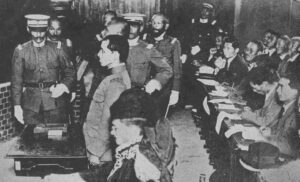 Amakusa during his military tribunal.
This week: in the aftermath of the Great Kanto Earthquake, thousands of Koreans living in Tokyo were massacred by angry mobs as well as policemen and soldiers. What animated the survivors to engage in such horrific violence, and how does it reflect both the wider history of the Japan-Korea relationship and the mindset many of us carry into our darkest moments?
Note: no new episode next week, as I’m traveling in Japan.
Sources
Schencking, J. Charles. The Great Kanto Earthquake and the Chimera of National Reconstruction
Ryang, Sonia. “The Great Kanto Earthquake and the Massacre of Koreans in 1923: Notes on Japan’s Modern National Sovereignty.” Anthropological Quarterly 76, No 4 (Autumn, 2003)
Images
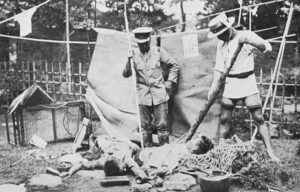 A jikeidan (neighborhood watch) contingent poses with a Korean man they have either beaten or killed.
 A memorial to massacred Koreans in Yokoamicho park, the former site of the Honjo Clothing Depot.
 Cartoon by Ota Masanosuke from November 1923 depicting the mob violence.
 Massacred Koreans in the aftermath of the quake. Date and location unknown.
The Great Kanto Earthquake of 1923 was one of the most devastating catastrophes in modern Japanese history, but in English scholarship it’s often overshadowed by the destruction of the Second World War. This week we’ll kick off a multipart series on the quake and its legacy with a simple question: what do we know about the immediate aftermath?
Sources
Schencking, J. Charles. The Great Kanto Earthquake and the Chimera of National Reconstruction
“Earthquake Days” by Henry W. Kinney, from the Jan 1, 1924 edition of The Atlantic
Images
 The Nihonbashi neighborhood in central Tokyo in the aftermath of the quake.
 Fire in the Marunouchi neighborhood not far from the imperial palace.
 The aftermath of the Honjo Depot fire, with the bodies of victims scattered across the ground.
 A map of the burnt out areas in Tokyo showing the effect on the Shitamachi relative to the more prosperous parts of the city.
 PM Yamamoto Gonnohyoe holding an outdoor cabinet meeting after the quake for fear of further aftershocks.
This week: the question of whether Hirohito would remain emperor of Japan or be replaced with “Emperor Kumazawa” was, in fact, decided before the Southern Court claimant had ever gone public. So why was the idea of removing Hirohito never taken seriously, and what did Kumazawa do once it became clear he was never going to sit on the Crysanthemum Throne? And how, strangely, does this all tie back to a Geocities era webpage about alternative medicine?
Sources
Dower, John. Embracing Defeat: Japan in the Wake of WWII
Kelley, Frank and Cornelius Ryan. The Star-Spangled Mikado.
Nancho.net in all its glory
Images
 All media on the US Occupation must by law have this picture of Hirohito and MacArthur from late 1945, in which the emperor is literally and figuratively overshadowed by the bombastic American.
 Kumazawa on tour during the Occupation. From Kyodo News.
 Literally the only photo I could find of Kumazawa when he was older.
In January, 1946, a man came to the headquarters of the American occupation government of Japan and claimed to be Japan’s true emperor. Who was he, why did he do this, and how does his story connect to an obscure figure from a civil war that happened more than 500 years earlier?
Sources
Dower, John. Embracing Defeat: Japan in the Wake of WWII
A Cuttersguide.com scan of the entire original Life Magazine Article
Images
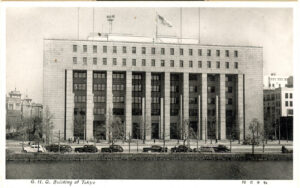 The original Daiichi Seimei building after the war.
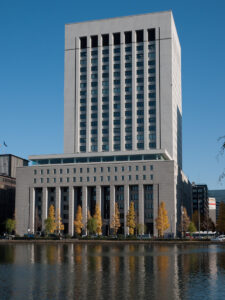 Here’s what the building looks like today.
 Kumazawa Hiromichi in portrait. It’s hard to see, but he’s wearing robes with the imperial crysanthemum on them.
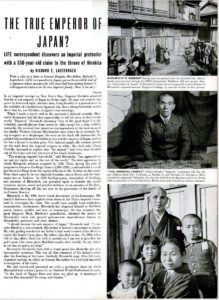 A scan of the Life article that gives you a sense of the page layout.
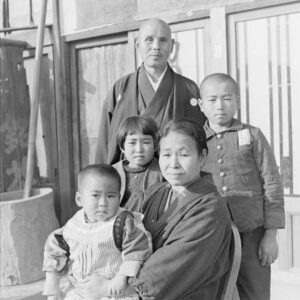 A detail of the Kumazawa family portrait from Life. Missing is the eldest son, who was in a Russian POW camp when this was taken.
First thing’s first: I made a numbering error a few weeks back, and so to get us back on the correct count we’re just going to skip episode 630!
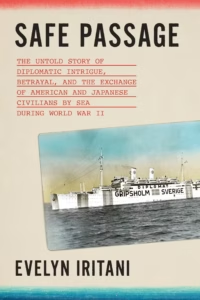
This week, I’m very lucky to be joined by journalist and writer (and Pulitzer Prize winner) Evelyn Iritani to talk about her new book Safe Passage (and a bit about her old book An Ocean Between Us). Check the book out here for a look into an underexplored moment in the history of US-Japan relations.
Sources
Some interviews from Discover Nikkei, UW Magazine, and Densho.org if you’re curious to hear more from her! And of course, check out the book for the full story.
Images
Fate twists once again in Fujiwara no Michinaga’s favor as an unfortunate accident of birth sees him solidify his grip on power. This week: the final steps of Michinaga’s rise, his legacy, and that of Eiga Monogatari.
Sources
McCullough, Helen Craig and William H McCullough. A Tale of Flowering Fortunes, Vols 1-2: Annals of Japanese Aristocratic Life in the Heian Period
McCullough, Helen Craig. Okagami, the Great Mirror: Fujiwara no Michinaga and His Times
Images
 Shoshi with Prince Atsuhira after his birth.
 Enchi Fumiko’s “A Tale of False Fortunes” is a sort of deconstruction of Eiga Monogatari from a modern perspective.
Fujiwara no Michinaga is on top of the world, but there’s one final hurdle to overcome. His deceased brother’s daughter is still the leader of the emperor’s harem, and his closest confidant in the world. Without a grandson to make crown prince, he’ll be finished. What is to be done? And how will his strategy accidentally promote a rivalry between two of the most famous women in all of Japanese history?
Sources
McCullough, Helen Craig and William H McCullough. A Tale of Flowering Fortunes, Vols 1-2: Annals of Japanese Aristocratic Life in the Heian Period
McCullough, Helen Craig. Okagami, the Great Mirror: Fujiwara no Michinaga and His Times
Images
Fujiwara no Shoshi, from a late Heian period painting. Emperor Ichijo
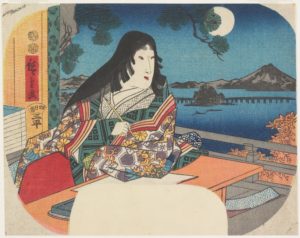 Murasaki Shikibu gazes at the moon, being inspired to write the tale of Genji.
 Sei Shonagon views the snow in Yamato province, by Utagawa. A Tokugawa era woodblock print.
This week: Fujiwara no Kaneie is a name we’ve encountered once before on the podcast. But now we get to see him in his element as a wheeler and dealer who lays out a perfect blueprint for assuming political power from an older sibling. And we’ll get to see Kaneie’s sons fight a very similar battle–leading to the rise of the man who would take the Fujiwara to the zenith of their power, Fujiwara no Michinaga.
Sources
McCullough, Helen Craig and William H McCullough. A Tale of Flowering Fortunes, Vols 1-2: Annals of Japanese Aristocratic Life in the Heian Period
McCullough, Helen Craig. Okagami, the Great Mirror: Fujiwara no Michinaga and His Times
Images
 Fujiwara no Kaneie, as illustrated by the Edo era artist Kikuchi Yosai.
 An Edo era woodcut of the Mother of Michitsuna. Her fashion in this image is far more Edo period than Heian period, but it does illustrate nicely her enduring cultural appeal.
 An illustration of the Mother of Michitsuna along with her poem from the Hyakunin Ishhu.
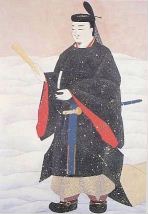 Fujiwara no Michinaga was the most powerful power-broker of this era and led the Fujiwara to the height of their power; he dominated Japanese politics during the latter half of the 10th century, and was reputed to be able to enthrone and dethrone emperors at will.
 Edo era portrait of Fujiwara no Michitaka, by Yosai.
 Edo period portrait of Michikane, the “Nanoka no Kanpaku”, or seven day regent.
This week: we take a look at the genre of the yakuza movie, or ninkyo eiga, which started off as a branch of the samurai film genre before becoming very much its own thing–and, for a decade or so in the 1960s and 1970s, dominating the Japanese box office.
Sources
McDonald, Keiko Iwai. “The Yakuza Film: An Introduction.” in Reframing Japanese Cinema: Authorship, Genre, History. Eds. Arthur Noletti, Jr. and David Desser
Schilling, Mark. The Yakuza Movie Book: A Guide to Japanese Gangster Films
Anderson, Joseph and Donald Ritchie. The Japanese Film: Art and Industry, Expanded Edition.
Images
One of the few surviving stills of the 1927 Kunisada’s Travel Diary, the first yakuza movie.A poster for 1959’s Jirocho Fuji, one of the many Shimizu Jirocho films showing noble and good yakuza fighting against the callous and evil ones.A still from Theater of Life – Hishakaku, with Tsuruta Koji on the right in his infamous ‘casual yakuza’ look.One of the many ways in which Battles without Honor and Humanity strays from the older formula of yakuza movies is a lot more use of guns, rather than nobly dismembering people with swords.
This week: we take a look at postwar samurai film/jidaigeki in order to understand better the trajectory of the most influential genre in the history of Japanese film. Why did jidaigeki, a staple of pre-1945 film, storm back with a vengeance to the big screen after the end of World War II? What makes post-1945 samurai films distinctive or unique? And what about their relationship to another archetype of international film: the American Western?
Sources
Desser, David. “Toward a Structural Analysis of the Postwar Samurai Film” in Reframing Japanese Cinema: Authorship, Genre, History. Eds. Arthur Noletti, Jr. and David Desser
Anderson, Joseph and Donald Ritchie. The Japanese Film: Art and Industry, Expanded Edition.
Galbraith, Stuart. The Emperor and the Wolf: The Lives and Films of Akira Kurosawa and Toshiro Mifune.
Images
One of my favorite shots from The Seven Samurai. The noble heroes go into battle even as the rain draws attention to the doomed and tragic nature of their fight.The poster for Inagaki’s 1962 Bandits on the Wind, another classic of nostalgic samurai drama.This still is from Seppuku/Hara-kiri, a classic anti-feudal jidaigeki. You can really see how the way it’s shot serves to change the relationship between the main character and the wider scene.A still from Joiuchi/Samurai Rebellion. You can really see the depth of field stuff at play here.Pictured: Mifune as Musashi in Inagaki’s Samurai trilogy, too focused on mastering his swordsmanship for petty concerns like women hitting on him.The climactic battle for one of the three Samurai films–Musashi’s famous duel at Ganryujima.Yojimbo embodies chanbara as a genre in many ways–most notably in the relationship between the antagonist (Tetsuya Nakadai, left) and protagonist (Mifune Toshiro, right).Lone Wolf and Cub would have some points to make about feudalism, but THERE’S NO TIME THOSE NINJA LADIES ARE ATTACKING THAT BABY CART
And people say these movies aren’t art
This week, we’re starting a history of the most famous genre in the history of Japanese film: the jidaigeki, and its related genre of the ninkyo eiga. This week: what do we know about early jidaigeki, and how do they fit into the wider history of early Japanese film?
Sources
Spalding, Lisa and David Desser. “Period Films of the Prewar Era,” in Reframing Japanese Cinema: Authorship, Genre, History, ed. Arthur Nolletti, Jr and David Desser.
Anderson, Joseph L and Donald Ritchie. The Japanese Film: Art and Industry (Expanded Edition).
A great article on the benshi from the Japan Society
Images
Onoe Matsunosuke, a.k.a. “crazy-eyes Matsu”, one of Japan’s first film stars. This is from his 1910 film Chushingura, where he plays lead.Makino Shozo, the father of the jidaigeki, in the 1920s Roningai, a film by Makino Shozo’s son, from 1928. You can see how even here the aesthetic will have a big influence on postwar film.
 Poster for the 1938 Jidaigeki Humanity and Paper Balloons (Ninjo Kami Fusen)
 Still from Itami Mansaku’s 1932 Kokushi Muso. The actor Kataoka Chiezo plays Ise no Kami (the lead), with his daughter being played by Yamada Isuzu.
This week: we wrap up the miniseries with the end of Akebono’s career, as the first gaijin yokozuna takes his post-dohyo trajectory in a very different direction from the other yokozuna before him (or at least, from most of the other yokozuna before him). Plus some final thoughts on sumo today.
Sources
Panek, Mark. Gaijin Yokozuna: An Autobiography of Chad Rowan
Benjamin, David. Sumo: A Thinking Fan’s Guide to Japan’s National Sport
Washington Post coverage of Akebono’s marriage
Some Japan Times discussion of the Hakuho cheer ‘drama’
Some Japan Forward coverage of the Miyaginobeya drama around Hakuho
Images
 A statue of Akebono in Waimanalo, his hometown in Hawaii.
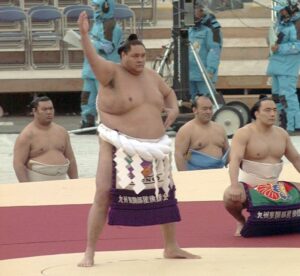 Akebono doing the dohyo iri at the 1998 Winter Olympics.
 Akebono during his wrestling career.
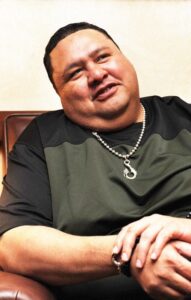 Akebono in 2009
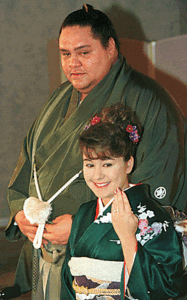 Akebono and Christine Kalina.
This week: Akebono becomes a yokozuna, and finds himself burdened with new expectations on and off the dohyo. Plus, a brief foray into pay and compensation for rikishi, and a final section on one of the most infamous moments of the 64th yokozuna’s career.
Sources
Panek, Mark. Gaijin Yokozuna: An Autobiography of Chad Rowan
Benjamin, David. Sumo: A Thinking Fan’s Guide to Japan’s National Sport
A Japan Times article on the relationship between the imperial family and sumo.
Images
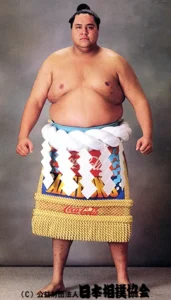 Akebono in his keshomawashi, with his tsuna over it.
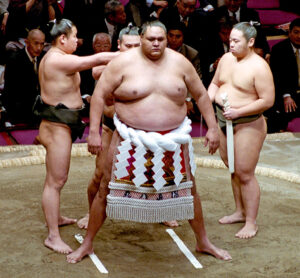 Akebono on the dohyo in 2001, as a part of his retirement.
 Akebono doing his yokozuna dohyoiri at Meiji Shrine.
 Another angle of Akebono doing the dohyoiri at Meiji Shrine.
 Akebono after winning a yusho, receiving the emperor’s cup. I am not sure which of his 11 career yusho this is.
This week: in the span of just a few years, Akebono goes from a rookie in sumo to one of its most prominent names, and alongside Konishiki one of the Americans dominating in the top division. But unlike Konishiki, he has the potential to go one step further. So, how does a guy from Waimanalo become the first non-Japanese citizen ever to claim the title of yokozuna?
Sources
Panek, Mark. Gaijin Yokozuna: An Autobiography of Chad Rowan
Benjamin, David. Sumo: A Thinking Fan’s Guide to Japan’s National Sport
Akebono’s entry on SumoDB, going over the major stats of his career.
Images
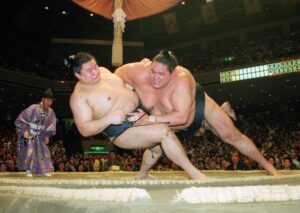 Akebono defeats Takanohana, from a 1997 tournament. It’s later than we go in this episode but it’s too good of a photo not to include.
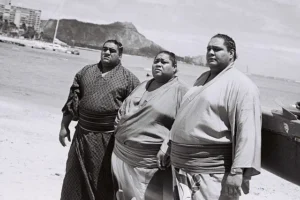 From left to right: Musashimaru, Konishiki, and Akebono together in Honolulu.
 Akebono celebrating his Ozeki promotion.
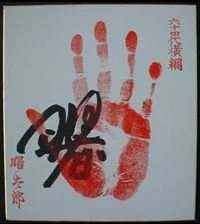 Akebono’s tegata.
 Akebono and Azumaseki Oyakata/Takamiyama, early in Akebono’s training. The fact that Takamiyama appears to be quipping about his height is….consistent, let’s say.
 Akebono pointing to himself on the banzuke. He did this a LOT and there are so many photos of it; I can’t tell which tournment this is from, but based on where his finger is, it looks to be around the time he was still a top division rank-and-file Maegashira.Finally, some videos: the match that made Akebono a yokozuna, and a compilation of Akebono/Takanohana matchups.
This week: Chad Rowan, who will be the first non-Japanese yokozuna in history, is the subject for the rest of our episodes. How did he come to sumo? What was his early career like? And how did he come to be known by the name Akebono-the rising sun?
Sources
Panek, Mark. Gaijin Yokozuna: An Autobiography of Chad Rowan
Benjamin, David. Sumo: A Thinking Fan’s Guide to Japan’s National Sport
An excellent article from Tachiai.org on the Wakanohana/Takanohana drama
Images
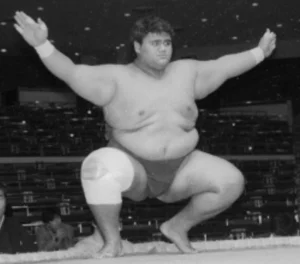 Takamishu Daikichi (Taylor Wiley) during his early sumo days. Wiley would never make it past Makushita thanks to his knee injury, but he did become a famous actor on the Hawaii 5-0 reboot!
 Takanohana (left) and Wakanohana in their kesho-mawashi before their debut in the March, 1988 maezumo tournament. They got far more attention than Akebono did–and he took that personally.
 Akebono defeats Takanohana in May, 1988–he later called this one of his most important wins.
 Akebono in February, 1988, about one month after entering Azumasekibeya. You really get a sense from this of how tall he was!
This week: after Taiho, the floodgates open as more non-Japanese rikishi begin to enter the sport. One of them, Takamiyama, has a good but not great career. But two of the rikishi he recruits to train under him after retirement–Konishiki Yasokichi and Akebono Taro–will change sumo forever.
Sources
Panek, Mark. Gaijin Yokozuna: An Autobiography of Chad Rowan
Culyer, P.L. Sumo: From Rite to Sport
Benjamin, David. Sumo: A Thinking Fan’s Guide to Japan’s National Sport
An excellent article on Konishiki’s career by Chris Gould of Sumo Fan Magazine
New York Times coverage of the scandal around Konishiki’s remarks on potential yokozuna promotion
SumoDB entries for Takamiyama and Konishiki, for the stat nerds among you
Images
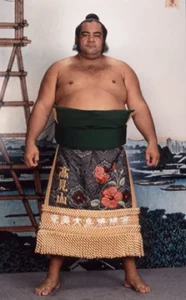 Takamiyama in his keshomawashi, a sort of formal outfit worn during ceremonies.
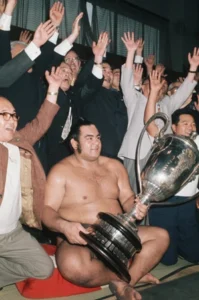 Takamiyama with the tennohai–the emperor’s cup–after winning in the top division July 1972 tournament.
 Azumasekibeya in 2014. After Takamiyama’s death, the stable eventually closed; now its wrestlers are part of Hakkakubeya.
 Konishiki in his early sumo days, shortly after coming to Japan.
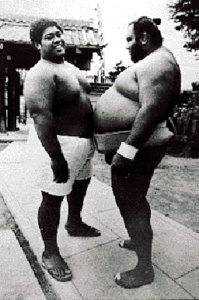 Konishiki (left) and Takamiyama (right) shortly after Konishiki was recruited to Takasagobeya by the sekiwake.
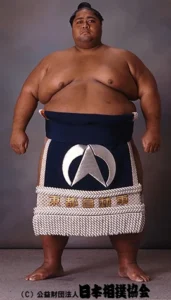 Konishiki as an ozeki in his keshomawashi.
This week: Taiho begins his grand sumo career, and quickly proves to be one of the best ever to do it. We’ll use his career to discuss: what does greatness look like in a sport like sumo? What were the highlights of one of the greatest careers in sumo history? And what were the small number of cases where Taiho didn’t prove able to come out on top?
Sources
Cuyler, P.L. Sumo: From Rite to Sport.
Graburn, Nelson, John Ertul, and R. Kenji Tierney. Multiculturalism in the New Japan: Crossing the Boundaries Within.
The Guardian’s obituary for Taiho.
Chunichi Shinbun coverage of Taiho’s run in with the law in 1965 (Japanese-language)
Japan Times coverage of the Taiho instant replay story (note: they mistakenly ID the tournament in question as May, 1969. It was March, 1969).
SumoDB is the place for sumo historical records, and here’s Taiho’s page. Compare him to any other entry (except maybe Hakuho) to see just how insanely dominant he was.
Media
A compilation of Kashiwado/Taiho showdowns (Japanese commentary)
An example of a standard makuuchi dohyo-iri (ring entering ceremony) from Jason Grenier on YouTube
A good explanation of the yokozuna dohyo-iri and what makes it distinctive
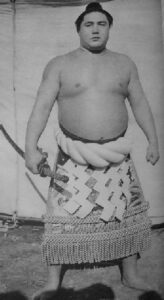 Taiho with the tsuna (rope) and sword, markers of his yokozuna status.
This week, we’re beginning a new miniseries on the legends of Japan’s most ancient sport: sumo. What can we learn about Japan and Japanese identity by looking at the lives of some of the most famous competitors in the national sport? We’ll begin investigating that question with a look at the life of one of the greatest ever to enter the ring: Taiho Koki.
Sources
Cuyler, P.L. Sumo: From Rite to Sport.
Graburn, Nelson, John Ertul, and R. Kenji Tierney. Multiculturalism in the New Japan: Crossing the Boundaries Within.
The Guardian’s obituary for Taiho.
Images
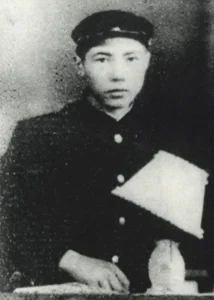 A young Taiho during his middle school years.
 Saganohana Katsumi as an Ozeki during his career. He would go on to be the elder of Nishonoseki stable and recruit the future Taiho into sumo.
 A victory parade for a Nishonoseki stable wrestler (Wakanohana I) in 1956. This gives you an idea of how popular sumo was during this period!
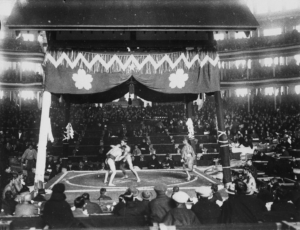 This 1910 photo of a match at the original Kokugikan in Tokyo both gives you an idea of how much smaller wrestlers used to be and of what the pillars that held the roof above the dohyo used to look like.
 A shot from a 2006 tournament at the Kokugikan, the sumo arena in Tokyo. You can see the design of the roof and the cables holding it up clearly.
For our final episode of this miniseries: Miyazaki Manabu faces down with the National Police Agency as he finds himself the prime suspect in Japan’s highest profile criminal case of the 1980s. After he comes out on top, where does he go next? Why, the natural place for any high profile criminal suspect: into media, and then politics!
Show notes here.
Sources
Miyazaki, Manabu. Toppamono: Outlaw,, Radical, Suspect. My Life in Japan’s Underworld. Trans. Robert Whiting.
Miyazaki’s interview with the Financial Times about his experience being a suspect in the Glico-Morinaga case.
Images
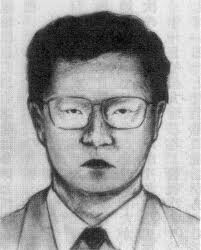 An artist’s sketch of the Fox Eyed Man.
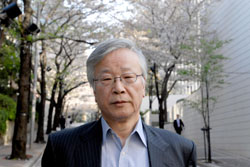 Miyazaki Manabu in the mid-2010s, when he was still a political talking head. He would die in 2022.
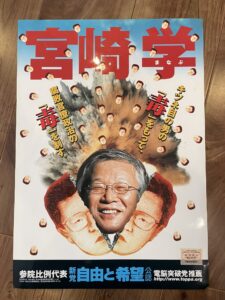 A Denno Toppato campaign poster–the one that reads “the poison of the Fox-Eyed Man will destroy the poison of the bureaucracy.” Underneath, it says “freedom and hope”, and of course that’s Miyazaki’s head emerging from the Fox-eyed man sketch. Subtle stuff!
This week’s footnote is a continuation of last week’s discussion of the gozan, or five mountain system for the ranking of Zen temples. What did the system look like at its height under Ashikaga rule, and how did its relationship to the Ashikaga begin to transform the practice of Zen within the temples themselves?
Sources
Collcutt, Martin. “Zen and the Gozan”, in The Cambridge History of Japan, Vol III: Medieval Japan.
Collcutt, Martin. Five Mountains: The Rinzai Zen Monastic Institution in Medieval Japan
Hoover, Thomas. The Zen Experience: The Historical Evolution of Zen Through the Lives and Teachings of its Greatest Masters.
Besserman, Perle and Manfred Steger. Crazy Clouds: Zen Radicals, Rebels & Reformers.
Images
Zuisenji, one of the jissetsu temples from the second tier of the Gozan.Nanzenji, which got bumped from the second highest spot in the Gozan to a spot above all the others…to make room for a temple built by Ashikaga Yoshimitsu.The gardens of Tenryuji, the top-ranked Kyoto gozan temple. Tenryuji’s gardens (and all its massive sprawling complexes, which used to be much bigger than they are now) were financed by extensive trade with China, overseen by the temple (which also declared itself a vassal of China’s emperor to access trade directly).A portrait of Ikkyu from 1447 (which would make him 53 by the Western counting). The text above the image is apparently Ikkyu praising his own wisdom (my eyes are not good enough to get anywhere near reading any of it).Ginkakuji, Ashikaga Yoshimasa’s retirement complex and personal buddhist temple. It is an example of Gozan-inspired aesthetics in action.
This week on the Footnotes to the Revised Introduction to Japanese History: many describe Zen as the religion of the samurai. In reality, it was not–but samurai influence was crucial to making Zen a part of Japan’s cultural framework. That history is bound up in a system called the “Five Mountains”; so how did that system come to be?
Sources
Collcutt, Martin. “Zen and the Gozan”, in The Cambridge History of Japan, Vol III: Medieval Japan.
Collcutt, Martin. Five Mountains: The Rinzai Zen Monastic Institution in Medieval Japan
Images
An Edo-period rendering of Hojo Masako late in life by Kikuchi Yosai.Kenninji in Kyoto, the head temple of the Rinzai sect. Unlike Dogen, Eisai was willing to take patronage from the elite of Japan, and as a result for several centuries Rinzai as a sect was extremely connected and wealthy.Kamakura’s Kenchoji, one of the Kamakura-based five mountains, founded by Rankei Doryu.A portrait of Rankei Doryu, one of the most influential Chinese monks to come to Japan to spread Zen.
Mickey Cohen had friends in high places, from celebrities to televangelists to the LAPD. So what happened when one of the nation’s most notorious mobsters tried to file his taxes as a legitimate hat salesman?
Featured image: Cohen’s 1961 mugshot, taken in Alcatraz. (Image source)
Even after receiving a 5-year sentence, Cohen smiles for the camera in 1951. (Image source)
A cartoon (yes, crime cartoons used to be a thing) showing an attempted hit on Mickey Cohen at his hat shop. (Image source)
It looks like some evidence of Jimmy Vaus’s work remained in Cohen’s mansion after the house was sold, to the confusion of its new owners. (Image source)
Not the most historically significant article on Cohen by any means, but I enjoyed this column by someone who includes complaints about Mickey Cohen and Billy Graham on a long list of grievances along with the price of coffee, the due process of the law, and too many amateur entertainment acts on the weekday radio lineup. (Image source)
- Sources
- Mickey Cohen: The Life and Crimes of L.A.’s Notorious Mobster
- Mickey Cohen Moves Vice Operations Headquarters to the Strip
- CRIME: I Ain’t Never . . .
This week, we’re continuing last week’s footnote on the postwar ultraright. How did the fall of the Soviet Union affect the anti-communist focus of the extreme right? How has its rhetoric been shaped by an odd relationship with the left? And how does modern extreme rightism manifest in the ideas of men like Kobayashi Yoshinori and groups like Nippon Kaigi?
Sources
Jo, Gwan-ja. “The Revival of Japanese Right-Wing Thought and the Coincidental Collaboration of the Left and Right.” Seoul Journal of Japanese Studies 1, No 1 (2015)
Shields, James. “Revisioning a Japanese Spiritual Recovery through Manga: Yasukuni and the Aesthetics and Ideology of Kobayashi Yoshinori’s ‘Gomanism'”. Asia Pacific Journal 11, No 47(2013)
Sakamoto, Rumi. “‘Will You Go to War? Or Will You Stop Being Japanese?’ Nationalism and History in Kobayashi Yoshinori’s Sensoron.” Asia Pacific Journal 6, No 1 (2008)
Dr. Levi McLaughlin’s talk on Nippon Kaigi, put on by the Munk School of Global Affairs and Public Policy
Images
Kobayashi Yoshinori is still making right-wing revisionist manga in the Gomanism series. This book is called “Pal’s Truthful Account” (my rough translation) and the subtitle is all about how justice Radhabinod Pal vindicated Japan after World War II at the Tokyo War Crimes Trials (see episode 484 for more about this).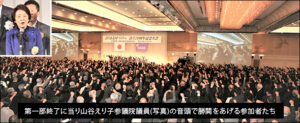 The celebration of Nippon Kaigi’s 20 year anniversary in 2017.
 A panel from Kobayashi’s Sensoron saying that Japanese soldiers deserved applause for kicking Western empires out of Asia in 1941.
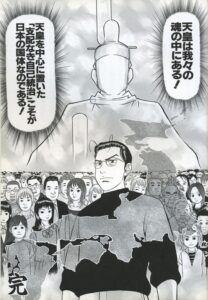 An image from Kobayashi’s manga on Yasukuni showing the people’s reverence for the emperor.
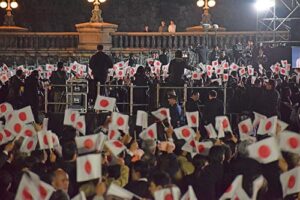 The 2019 celebration of Emperor Naruhito’s enthronement put on by Nippon Kaigi. From the Asahi Shinbun.
This week’s footnote: the first of two parts on the postwar extreme right. This week, we’re mostly focusing on the extreme right in the first few decades of the Cold War, and in particular on the story of Akao Bin and his Aikokuto. How did a convicted socialist end up as one of Japan’s foremost violent anticommunists–and how did his ideas shape a new reality for the postwar right?
Sources
Kapur, Nick. Japan at the Crossroads: Conflict and Compromise after Anpo
Jo, Gwan-ja. “The Revival of Japanese Right-Wing Thought and the Coincidental Coolaboration of the Left and Right.” Seoul Journal of Japanese Studies 1, No 1 (2015)
A 1986 Chicago Tribune story on Akao Bin.
UPI press coverage of Akao Bin in the 1980s.
Images
 Akao Bin in 1942 at the time he entered the House of Councilors.
 Akao Bin in 1986.
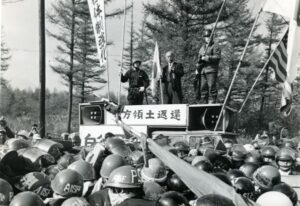 A rally by the Aikokuto in Tokyo. Date unknown.
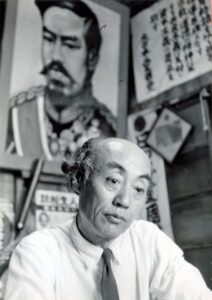 Akao Bin in the offices of the Aikokuto. Note the portrait of the Meiji Emperor behind him.
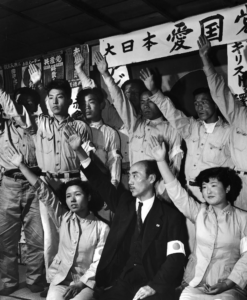 Akao Bin and his followers doing a gesture that is in no way problematic.
This week, we’re continuing last week’s footnote on daily life in Meiji Japan. Topics covered this week include life as a conscript in the army, changes to Japanese cuisine during the Meiji years, and entertainment from kabuki to early movies.
Sources
Ishige, Naomichi. The History and Culture of Japanese Food
Drea, Edward. In the Service of The Emperor: Essays on the Imperial Japanese Army
Fukushima, Shingo. “The Building of a National Army.” Developing Economies 3, No 4 (December, 1965)
Sayaka, Chatani, “A Man at Twenty, Aged ad Twenty-Five: The Conscription Exam Age in Japan.” The American Historical Review 125, No 2 (April, 2020)
A great essay on early Japanese film from Sato Tadao of Screening the Past
A fascinating talk by Dr. Jihye Kim on the evolution of kabuki during the Meiji years
An essay by Dr. Nina Anarina on Shingeki, Kabuki, and drama in the Meiji years.
Images
 The 1873 conscription ordinance.
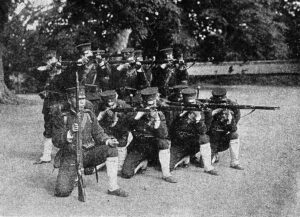 Japanese soldiers during the Meiji era being drilled on firing lines.
 A depiction of the Meiji emperor observing the fall exercises, a major part of the annual calendar for the army.
 A statue of Ichikawa Danjuro IX, outside Sensoji in Tokyo.
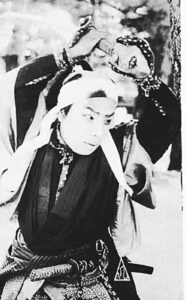 Onoe Matsunosuke, a.k.a. “crazy-eyes Matsu”, one of Japan’s first film stars. This is from his 1910 film Chushingura, where he plays lead.Momijigari, starring Ichikawa Danjuro IX. I’ll let you decide what you think of the performance
It’s an illegal gambling, Nazi-punching, tax-paying good time with Mickey Cohen, a gangster who rose through the ranks during one of America’s most infamous eras of organized crime. Just don’t ask about who he might have shot on his way to the top.
Featured image: Meyer Harris “Mickey” Cohen with supporters (described as “some of his henchmen”) at his 1949 arraignment. (Image source)

Benjamin “Bugsy” Siegel, one of the most infamous members of “Murder Inc.” and apparently also a great source of tax advice. (Image source)

The Flamingo Hotel in 1957, a decade following its deadly change in management. (Image source)
Sources* Mickey Cohen: The Life and Crimes of L.A.’s Notorious Mobster * Mickey Cohen: Gangster in the Sun * Mickey Cohen: Memoirs of the Good Days * The Race Wire
This week on the Revised Introduction to Japanese History Footnotes: what was it like to live in the Meiji Era? Join us on a journey through a day in 1900, as we discuss breakfast foods, education, and factory jobs in the “new Japan.”
Sources
Jansen, Marius. The Making of Modern Japan.
Hane, Mikiso. Peasants, Rebels, Women, Outcasts: The Underside of Modern Japan
Hunter, Janet. “Japanese Women at Work, 1880-1920”, History Today 43, No 5 (1993)
An overview of the history of education in Japan provided by the Ministry of Education, Culture, Sports, Science, and Technology. It tries to put a better spin on the Meiji system than I did, but in broad strokes it’s a decent overview.
Kayashima, Nobuko. “Chapter 5: Educational Development in Modernization in Japan.” Seven Chapters on Japanese Modernization, JICA-Open University of Japan.
Images
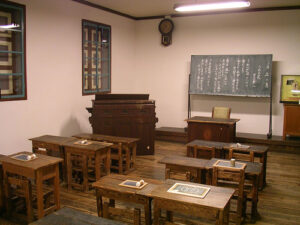 The former Kaichi Elementary School, set up in Meiji fashion.
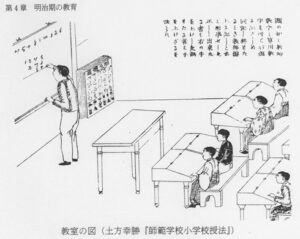 A print of the “ideal classroom” from some Meiji era teacher training manuals.
 A print of the Imperial Rescript on Education from 1890. Copies of this text would have been omnipresent in the Meiji Education system.
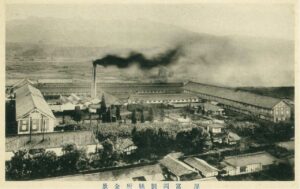 An external view of the Tomioka silk mill.
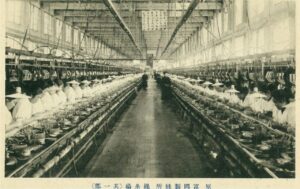 Women working in the Tomioka silk mill.
For our second footnote to the Revised Introduction to Japanese History: a simple question that definitely won’t result in an overpacked episode. Was Imperial Japan a fascist state? How can we even define fascism in a productive way that lets us engage in historical comparison? How quickly can I summarize four different definitions of what fascism is? Should be easy enough.
Sources
Passmore, Kevin. Fascism: A Very Short Introduction
Eco, Umberto. “Ur-Fascism” (no paywall!)
Marcon, Federico. “The Quest for Japanese Fascism: A Historical Overview” Ca’ Foscari Japanese Studies: Religion and Thought 4, No 14 (2021)
Images
A gagaku performance at the celebrations of the 2600-year anniversary of the (supposed) enthronement of Japan’s first emperor. This certainly qualifies as a sort of mythic past that fits some definitions of fascism.Pan-Asianist rhetoric in posters like this one (celebrating harmony between the “three races” of Han Chinese, Manchu, and Japanese) don’t fit many traditional understandings of fascism.Another view of part of the 2600th anniversary celebrations in Tokyo.Maruyama Masao, whose work is still very influential on discussions of Japanese fascism.
As the internet creates new unmoderated spaces for ideas to spread, the sovereign citizen movement moves on to new audiences and finds a lot of angry divorced dads who don’t want to pay child support.
Content notes: This episode continues our discussions of fascist ideology, racism, and antisemitism from part 1.
Featured image: A man shows off his documents issued by the “Kingdom of Heaven,” which he claims got him out of legal charges because he had given up his state citizenship. (Image source)
A document created by sovereign citizens showing an unusual style of punctuation they believe they can use to distinguish their “real” identity from their “legal” identity. I assume the inclusion of DNA from hair and bodily fluids is part of this distinction showing they are signing as their real bodily selves. (Image source)
An illustration of the “license plates” issued by a sovereign citizen organization. (Image source)
Another illustration of the kinds of license plates issued by the “Moorish National Republic Government.” (Image source)
Sources* Brian S. Slater. “Sovereign Citizen Movement: An Empirical Study on the Rise in Activity, Explanations of Growth, and Policy Prescriptions” MA Thesis for the US Naval Postgraduate School, 2016 * Skin in the Game: How Antisemitism Animates White Nationalism * His ‘Straw Man’ Free, a Scammer Finds the Rest of Him Isn’t | Southern Poverty Law Center * The Sovereign Citizen Movement: Common Documentary Identifiers & Examples * Arrested Development – You’re A Crook Captain Hook (Isaac insisted on citing this in the show notes) * The Sovereigns: A Dictionary of the Peculiar | Southern Poverty Law Center * Judge refutes ‘idiotic’ claims | Edmonton Journal * Meads v. Meads, 2012 ABQB 571 * Lexomancy: Law and Magic in the Pseudolegal Writings of the Sovereign Citizen Movement * Communication-Methods by David-Wynn: Miller * Full Colon Miller * Who Stole Oregon’s Courts? | Embassy of Heaven * Social Security Numbers for Children? | Embassy of Heaven * Is This Oregon? No, It’s Heaven, Pastor Says; State Disagrees * Washitaw Nation Comes Under Investigation | Southern Poverty Law Center * Return of The Ancient Ones – The Washitaw Files – Empress Verdiacee * Recalling the FBI raid of late Washitaw Nation leader’s home | The Franklin Sun * Moorish-American Nationality * 15 years later, painful reminder of 2 officers’ deaths during land-dispute standoff may be removed * FBI — Bogus Election Spawned Assassination Plot | Southern Poverty Law Center * 3 police officers fatally shot in Baton Rouge; dead suspect identified * ‘Sovereign citizen’ Jan. 6 rioter gets seven years for leading mob assault on officers * Rise of the Moors members convicted for armed standoff on I-95 in Wakefield
This week, we have our first Footnote to the Revised Introduction to Japanese history, expanding on questions we didn’t get to touch on during the main series. This week, our question is: what do we know about the origins and practice of early Japanese religion, and how does it relate to what we call Shinto today?
Sources
Matsumae, Takechi. “Early Kami Worship” in The Cambridge History of Japan, Vol I: Ancient Japan
Teeuwen, Mark. “What Used to Be Called Shinto” in Japan Emerging: Premodern History to 1850
Images
A Jomon period Doguu figurineA Jomon period bo, or phallus.A dotaku (bronze bell) from the Yayoi period.The reconstructed high hall of the Ikegami Sone site, a Yayoi period excavation site outside Osaka. Its style bears some similarities to the shrine architecture of later periods.The main buildings of Izumo Shrine today.A reconstruction of the Honden (main hall) of Izumo Shrine in ancient times based on archaeological excacations. A copy of the Harima Province fudoki gazeteer (now a part of Hyogo Prefecture).
On the final episode of the Revised Introduction to Japanese History: the LDP completely fails to meet the challenge of the bubble collapse, and the Lost Decades see Japan’s economy stagnate and its political and social system under severe pressure. Where to from here? Only time will tell.
Sources
Pempel, T.J. Regime Shift
Anchordoguy, Marie. Reprogramming Japan
Werner, Richard. Princes of the Yen
Kingston, Jeff. Japan in Transformation, 1945-2010.
Images
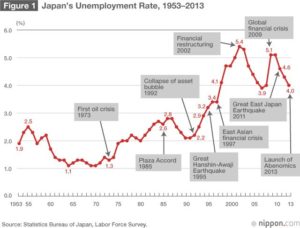 Japan’s unemployment rate has spiked since the bubble; it still remains low compared to other industrialized countries, but the effects on Japanese society have been substantially disruptive.
 The results of the 2009 general election in Japan (241 seats needed for a majority). Red is the DPJ; Green is the LDP.
 By comparison, here are the 2012 results. You can see the complete shellacking of the DPJ clearly.
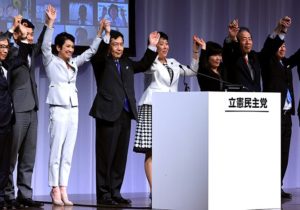 The founding of the CDP being announced during a press conference in September, 2020. How successful the CDP will be will be seen in the general elections next year.
 From the Japan Times: A CDP press conference led by party president Edano Yukio, a former DPJ member.
This gif shows the shift in Japan’s demographics over the course of the post-feudal period, and illustrates the nature of both the declining birthrate and aging population very well
Don’t feel like paying your taxes? Want to start your own posse? Still mad about the gold standard? Looking for an excuse to blame all your problems on the Jews? Have we got a legally dubious ideology for you!
Content notes: This episode contains discussion of fascism and anti-semitic ideology. Some violent incidents such as Ruby Ridge and Waco are mentioned but are not discussed in detail.
Featured image: This billboard is from the UK, but appears to be an outgrowth of the same conspiracy theories that the American sovereign citizen movement coalesced around. (Image source)

An antisemitic political cartoon from all the way back in 1896, already showing some of the conspiracy theories the sovereign citizen movement will pick up about Jews secretly controlling the US economy and deliberately controlling debt. (Image source)

Branch Davidians in pseudo-military uniforms, including their leader David Koresh, under arrest in 1987. These members of the group were arrested after a shootout between two rival prophets at Mount Carmel, the site of the 1993 siege and fire for which the cult is most famous. (Image source)
Sources* The Terrorist Next Door: The Militia Movement and the Radical Right * A quick guide to sovereign citizens * The Posse Comitatus Act Explained * Hate Group Expert Daniel Levitas Discusses Posse Comitatus, Christian Identity Movement and More | Southern Poverty Law Center * Christian Identity | Southern Poverty Law Center * Examining Extremism: The Militia Movement * Militia Movement * Citizen Militias in the U.S. Are Moving toward More Violent Extremism * Retrospective: Montana Freemen standoff * Montana Freemen Trial May Mark End of an Era | Southern Poverty Law Center * Under the Eye of Power: How Fear of Secret Societies Shapes American Democracy (This is the book Isaac recommended but couldn’t remember the name of at the end of the episode)


In the penultimate episode of the Revised Introduction to Japanese History: the 1980s sees the rise of Japan’s asset bubble and the peak of the high-rollin’ postwar. But the new prosperity is built on faulty ground that is already beginning to creak…
Sources
Pempel, T.J. Regime Shift
Anchordoguy, Marie. Reprogramming Japan
Werner, Richard. Princes of the Yen
Kingston, Jeff. Japan in Transformation, 1945-2010.
Images
A graph from Nakaso Hiroshi’s paper showing the fall in Japan’s economic growth rate after the bubble.Japan’s unemployment rate has spiked since the bubble; it still remains low compared to other industrialized countries, but the effects on Japanese society have been substantially disruptive.Another shot of the Ginza in the 1980s. By the height of the bubble, one square meter of commercial real estate here cost $750,000.The grounds of the Imperial Palace in downtown Tokyo. According to some estimates, during the height of the asset bubble this ~2 square mile area was worth more than the entire state of California.
This week on the Revised Introduction to Japanese History: how did Ikeda Hayato and the LDP build a system that would redefine postwar Japan? And how did the political opposition utterly fail to rise to the challenge of matching them?
Sources
Kapur, Nick. Japan at the Crossroads: Conflict and Compromise After Anpo
Pyle, Kenneth. Japan Rising: The Sources of Japanese Power and Prestige
Jansen, Marius. The Making of Modern Japan
Lu, David. Japan: A Documentary History, Vol II
Images
Divisions between center and left socialists remained through the 1960s. This image is from the JSP’s 1966 leadership election; Eda Saburo is conceding to the left socialist Sasaki Kozo. From Getty Images.A televised debate from the 1960 general election. Nishio Suehiro is on the left; Ikeda Hayato is in the middle; Eda Saburo is on the right. From Getty Images.Eda Saburo during his time as party chairman.Ikeda Hayato in 1962. Note the plastic glasses instead of wire rims.
When you’re unhappy about the price of wheat, there’s only one solution: Send a telegraph to the Australian government declaring war.
Featured image: HRH Prince Leonard in a portrait taken by his “Royal Photographer.” (Image source)
Prince Leonard announces his abdication due to ill health in a 2017 ceremony. (Image source)
A visitor goes through passport control at the border. (Image source)
The Hutt River pyramid (and an elephant for some reason?). (Image source)
A plane (perhaps the only plane?) in the Hutt River Province Air Force. (Image source)
A bust of Prince Leonard as part of the tourist attraction. (Image source)
Sources* Welcome To The Principality of Hutt River * How To Rule Your Own Country: The weird and wonderful world of micronations * Government of the Principality of Hutt River * Fait Accompli * Wheat delivery quotes * Seven decades of farming: Australian agricultural policy, passion and protest since 1940 * Letter to the Premier of Western Australia * Australia has one of the largest number of micronations in the world * Chapter 4 Treason * Australian Tax Office Vs. HRH Prince Leonard * Pyramid of Hutt * A picture of the Pyramid of Hutt * GENEVA CONVENTION RELATIVE TO THE PROTECTION OF CIVILIAN PERSONS IN TIME OF WAR OF 12 AUGUST 1949 * Atlantic Charter * Unjust Enrichment in Australia: What Is(n’t) It? Implications for Legal Reasoning and Practice * Traditional Rights and Freedoms—Encroachments by Commonwealth Laws (ALRC Report 129) * WA’s Hutt River Province, Australia’s oldest micronation, set to rejoin the Commonwealth * Australia’s oldest micronation, Hutt River is no more thanks to Covid-19
This week on the Revised Introduction to Japanese History: the Occupation comes to an end, but what happens next? This week is all about the 1950s, when clashing visions of Japan’s future would culminate in one of the largest protests in the nation’s history, laying the groundwork for the political world that has existed ever since.
Sources
Kapur, Nick. Japan at the Crossroads: Conflict and Compromise After Anpo
Pyle, Kenneth. Japan Rising: The Sources of Japanese Power and Prestige
Jansen, Marius. The Making of Modern Japan
Lu, David. Japan: A Documentary History, Vol II
Images
Japanese Prime Minister Yoshida Shigeru signs the Treaty of San Francisco in 1952, formally ending World War II as well as the Occupation.Yoshida Shigeru (left) and Hatoyama Ichiro. I assume both men are leaning back to be safely out of the stabbing range of the other.The Speaker of the House being muscled to the rostrum for a vote on the treaty. Confrontations between socialists and LDP members got VERY violent over the course of the treaty debates.Socialist and other left-wing protestors riot outside the Diet building in downtown Tokyo against the renewal of the US-Japan Mutual Security Treaty in 1960. The LDP faction in power had to bring in police and yakuza to prevent the crowds from halting the passage of the renewed treaty.Protestors during the Anpo Riots. Courtesy of the Massachusetts Institute of Technology.
When an Englishman with the rare ability to speak Mandarin Chinese got into a dispute with a corrupt local official in Zhejiang, he took his complaints all the way to the top, kicking off a diplomatic incident involving the emperor himself.
Featured image: The Qianlong Emperor in his formal court dress. (Image source)
A view of the Canton in the 1800s, showing the areas where different countries’ merchants are allowed to enter the city for their highly controlled stay. (Image source)
Sources* Steven Platt, Imperial Twilight: The Opium War and the End of China’s Last Golden Age * The Travels Of Peter Mundy In Europe And Asia 1608-1667 * Van Braam Houckgeest * From Benjamin Franklin to John Bartram, 11 January 1770 * Death to Chinese language teachers * Address to the people of Great Britain; explanatory of our commercial relations with the empire of China, and of the course of policy by which it may be rendered an almost unbounded field for British commerce * The Chinese Cornerstone of Modern Banking * The White Lotus Rebels

This week on the Revised Introduction to Japanese History: The US Occupation of Japan after World War II represented a truly massive undertaking. American military and civilian personnel spent just over a decade rebuilding Japan’s government, economy, and society from the ground up. What did that look like in practice, and how does the legacy of the Occupation era remain with Japan today?
Sources
Dower, John. Embracing Defeat: Japan in the Wake of World War II
Jansen, Marius. The Making of Modern Japan
Fukui, Haruhiro, “Postwar Politics, 1945-73” and Yutaka Kosai, “The Postwar Japanese Economy, 1945-1973” in The Cambridge History of Japan, Vol VI: The Twentieth Century
Images
All media on the US Occupation must by law have this picture of Hirohito and MacArthur from late 1945, in which the emperor is literally and figuratively overshadowed by the bombastic American.Posters like these promoted the idea that the Occupation was about religious freedom in Japan even as MacArthur himself seemed to undermine that position.The structure of government under the 1947 constitution.Another of the “constitutional explainer” comics.Comics like this were used to introduce the new constitution to the people.Communist political prisoners being released, Oct 10, 1945.Tojo Hideki on trial for war crimes. Ultimately the war crimes tribunals would end after the first round of trials.Emperor Hirohito greeting the masses as a man of the people. From a tour of Yokohama in 1946.
This week on the Revised Introduction to Japanese History: the descent towards the Second World War. Why did the leadership of imperial Japan start a war many of them were aware they were unlikely to win? And how did the failures of the Meiji system enable the descent into militarism and defeat?
Sources
Hotta, Eri. Japan 1941: Countdown to Infamy
Drea, Edward. Japan’s Imperial Army: Its Rise and Fall, 1858-1945
Iriye, Akira. Power and Culture: The Japanese-American War, 1941-1945
Mitter, Rana. Forgotten Ally: China’s World War II, 1937-1945
Images
The Osaka Mainichi Shinbun’s front-page coverage of Inukai Tsuyoshi’s death (popularly referred to as the “May 15 Incident”).Japanese troops entering Shenyang (a city in Manchuria) in 1931.Japanese “experts” assessing the “railway sabotage” ostensibly performed by Chinese dissidents and used as an excuse to invade Manchuria in 1931. In fact, the bombs had been planted by radical Japanese Army officers who seized the pretext for an invasion.The Lytton Commission in Shanghai as they prepare to investigate goings on in Manchuria.The railcar of Zhang Zuolin, assassinated by Doihara Kenji in 1928 as part of a plot to enable the Guandong Army to seize Manchuria. This attempt failed as the predicted civil strife never materialized; the next in 1931 would succeed.The section of the Mukden rail line where the bomb that triggered the invasion of Manchuria was planted.Soldiers of China’s National Revolutionary Army (the armed forces of the Guomindang) fighting the Japanese at the Marco Polo Bridge.Chiang Kai-shek (Jiang Jieshi), leader of the Guomindang. Chiang would eventually come into open conflict with Japan’s militarists over the future of China.Japanese troops move into North Indochina, 1940. Japan’s destabilization of the area created the conditions that helped Ho Chi Minh rise to prominence.View from an under-carriage camera mounted on a Japanese attack plane of the raid on Pearl Harbor.
This week on the Revised Introduction to Japanese History: during the 1920s, Japan’s political system became more democratic and representative–an “imperial democracy” that evolved out of the Meiji system. How did this happen, and why did those democratic gains prove to be so unstable in the long term?
Sources
Jansen, Marius. The Making of Modern Japan
Mitani, Taichiro. “The Establishment of Party Cabinets” in The Cambridge History of Japan, Vol VI: The Twentieth Century
Andrew Gordon’s excellent essay “Social Protest in Imperial Japan: The Hibiya Riot of 1905” for MIT’s Visualizing Cultures program
Another excellent Gordon essay (“Social Conflict and Control, Protest and Repression“) for the International Encyclopedia of the First World War
Takayoshi, Matsuo. “The Development of Democracy in Japan – Taisho Democracy: Its Flowering and Breakdown.” The Developing Economies 4, No 4 (December, 1966)
Shiota, Shobei. “The Rice Riots and the Social Problems.” The Developing Economies 4, No. 4 (December 1966)
Hayami, Yujiro. “Rice Policy in Japan’s Economic Development.” Economic Development Center of the Department of Economics, University of Minnesota
Images
The Hibiya Riots of 1905. Protesters flooded the streets to speak against the terms of the Treaty of Portsmouth, which was seen as insufficient in light of Japanese losses.Suzuki Shoten, a trading firm in Kobe, was burned down by a mob during the 1918 rice riots.Coverage of the start of the riots in Uozu, from a local paper in Toyama prefecture.Hara Kei (sometimes referred to as Hara Takashi), protege of Ito Hirobumi and one of the members of the second generation of Japanese leadership. He was also the first politician to serve as Japan’s Prime Minister.Plaque commemorating Hara Takashi’s assassination at Tokyo station (by the Marunouchi south exit, next to the Shinkansen ticket window).
A negotiation over fishing rights took an unexpected turn when a Lithuanian fisherman jumped onto an American Coast Guard ship to seek asylum. But as investigators dug into the story of this Soviet citizen’s attempt to defect, they discovered that the defector’s legal status was far more complicated than anyone—even Kudirka himself—could have guessed.
Featured image: Photos of Kudirka taken while he was in pre-trial detention. One telling detail from the 2020 documentary The Jump: The documentarians interview one of the Soviet officers who arrested Kudirka. That man claims Kudirka was not brutalized during his capture and shows these pictures as proof that he was not tortured, even though he most definitely does appear to have a black eye in these photographs. (Image course)
The Soviet trial scene from The Defection of Simas Kudirka (1978), a dramatization of Kudirka’s story starring Alan Arkin.
A trailer for The Jump (2020), one of several documentaries about Kudirka. We recommend watching this one for a more in-depth look at what Kudirka went through after his arrest, the stories of man other people involved in his defection attempt, and his immensely compelling interviews with American journalists.
Sources* Treaty of Paris (1783) * Foreign Fishing Crippling New England Industry * USHMM – Lithuania * The Defection of Simas Kudirka * Cost-Benefit Calculus * House Unit Assails 2 U.S. Agencies On Defection Attempt by Lithuanian * Asylum Denied: The Vigilant Incident * Convention and Protocol Relating to the Status of Refugees * Operation Wedding * Lithuanian Sailor Freed by Soviet Arrives in U.S. * Revelations of the Lithuanian Defector Episode of November 23, 1970 * Legal Aspects Of The Refusal Of Asylum By U.s. Coast Guard On 23 November 1970 * The Jump
This week on the Revised Introduction to Japanese History: Japan joins the ranks of the great powers by building its own colonial empire. How did Japan come to be a great colonial power, what made its empire different from the others of the age, and more importantly: what made it the same?
Sources
Iriye, Akira. “Japan’s Drive to Great Power Status” in The Cambridge History of Japan, Vol V: The Nineteenth Century
Drea, Edward. Japan’s Imperial Army: Its Rise and Fall, 1867-1945
Cummings, Bruce. Korea’s Place in the Sun
Kang, Hildi. Under the Black Umbrella: Voices from Colonial Korea, 1910-1945.
Caprio, Mark. Japanese Assimilation Policies in Colonial Korea, 1910-1945.
Peattie, Mark R. Nan’yo: The Rise and Fall of the Japanese in Micronesia, 1885-1945.
Shigeaki, Shiina. “Outline History of the Colonization of Hokkaido, 1870-1930.” in Migrants in Agricultural Development. Ed. J.A. Mollett.
Mason, Michele M. Dominant Narratives of Colonial Hokkaido and Imperial Japan: Envisioning the Periphery and the Modern Nation-State.
Images
Chinese captives during the First Sino-Japanese War. The troops holding them prisoner are ethnic Koreans serving in the Imperial Army.Japanese infantry in a Napoleonic-style firing line during the Sino-Japanese War. Meckel’s teachings emphasized orthodox, Napoleonic tactics of which the above is a good example.The siege of Port Arthur, one of the more decisive battles of the Russo-Japanese War. Japan eventually took the port city, but at tremendous cost in soldiers. This picture shows the results of a bombardment by Japanese ships blockading the port.Japanese cavalry troopers on forward reconnaissance during the Russo-Japanese War. Note their European-style cavalry swords. Courtesy of the Library of Congress.The Headquarters Building of Taiwan’s Government General in Taipei.Taiwan Grand Shrine in Taibei, the largest Shinto shrine set up by the Japanese. This image was taken prior to the shrine’s destruction in WWII.Anti-Japanese protests in Korea. Protests like these are often kicked off by Abe’s historical revisionism regarding Japanese imperialism.In 1921, the Japanese government general remade Korea’s royal cemetery into a golf course (today’s Hyochang Park in Seoul).The declaration of annexation which the last ruler of Joseon Korea was forced to sign in 1910.A Micronesian public school on Palau.
In a country where gay sex is illegal, is a magazine for gay people a publication for criminals? Is the content obscene, even if there’s no sexual content on the page, just because sex might be suggested somewhere off the page or in the pages of an entirely different publication? And most importantly, can you put this magazine in the mail?
Featured image: An illustration accompanying the article in the October 1954 issue of ONE Magazine, laying out their legal counsel’s interpretation of what they should be legally allowed to send through the mail.
The cover of the October 1954 issue of ONE Magazine. (Image source)
The cover of the August 1953 issue, which was seized but later released by postal authorities in Los Angeles. (Image source)
Sources* Harry Hay * Before Stonewall: The Homophile Movement * Pierre Louÿs * The Conflicted Gay Pioneer * The Book Club That Helped Spark the Gay-Rights Movement * ONE Magazine digital archives on JSTOR * United States Postal Inspection Service * What are the Comstock Laws? * ONE Institute * ONE Magazine cover August 1953 * ONE – R. H. Crowther, Jane Dahr, MILT SOSIN, JACK W. ROBERTS, Allan -10/1/1954 * Eric Julber to Dale Jennings correspondence, 1953 * Supreme Court faced gay rights decision in 1958 over ‘obscene’ magazine * Eric Julber * Roth v. United States * One, Incorporated v. Olesen * 18 U.S. Code § 1461 – Mailing obscene or crime-inciting matter
This week on the Revised Introduction to Japanese History: the economics of Meiji Japan, and a brief foray into social attitudes towards Westernization. How did Japan transform itself from being largely cut off from the world economy to central to it within half a century, and what impact did all this change have on the national self-image and culture?
Sources
Crawcour, E. Sydney, “Economic change in the nineteenth century”, Sukehiro Hirakawa, “Japan’s Turn to the West,” and Gilbert Rozman, “Social Change”, in The Cambridge History of Japan, Vol V: The Nineteenth Century
Pyle, Kenneth. The New Generation in Meiji Japan: Problems of Cultural Identity, 1885-1895
Jansen, Marius. The Making of Modern Japan
Images
The Rokumeikan, or Deer Cry Pavilion.1905 cover of “Wagahai wa Neko dearu”, or “I Am a Cat.”The Yawata steelworks in the 1920s, a few decades after it was set up.
This week on the Revised Introduction to Japanese History: the politics of the Meiji Period! After a coalition of samurai, nobles, loyalists, and others succeed in overthrowing the Tokugawa shogunate, they must ask themselves: what comes next? And, in the time honored tradition of revolution, they answer that question by killing off or removing from office anyone they disagree with.
Sources
Jansen, Marius. The Making of Modern Japan
Jansen, Marius. Emperor of Japan: Meiji and His World
Pyle, Kenneth. Japan Rising: The Resurgence of Japanese Power and Prestige
Sims, Robert. Japanese Political History Since the Meiji Renovation: 1868-2000
Beasley, W.G. “Meiji Political Institutions” and Vlastos, Steven. “Opposition Movements in Early Meiji, 1868-1885” in The Cambridge History of Japan, Vol V: The Nineteenth Century
Images
A colorized photo of Ito Hirobumi in his later years. Ito served as the first Prime Minister and drafted the Meiji Constitution.Saigo Takamori after his retirement.A decade after his death, the Meiji government rehabilitated Saigo and erected this statue in his honor at Ueno Park in Tokyo (site of one of his victories during the Boshin War).Saigo Takamori and his rebel officers in traditional dress, as depicted by the French Le Monde Illustre.The Ibukinoya Nikki, a record of the Hirata school under the guidance of Atsutane’s heir Kanetane. Kanetane’s kokugaku adherents were early supporters of the Restoration, and some of the first “winnowed out” in the post-1868 battles for power.The Toyo Jiyu Shinbun, or Eastern Free Press, associated with the Jiyuto. It was suppressed after slightly more than a month of publication.A woodblock print showing the assassination attempt on Itagaki. The moment was highly sensationalized in the press, with the Jiyuto-aligned papers blaming the government and its supporters for incitement and the government claiming this was all just a renegade act. This particular print is pro-Itagaki; note the defiant pose as Aikawa is arrested.
This week: the age of feudalism comes crashing down, as in the span of just two years the Tokugawa shogunate goes from victory to crushing defeat. How did the final years of Tokugawa rule play out?
Sources
Jansen, Marius. The Making of Modern Japan
Jansen, Marius. Sakamoto Ryoma and the Meiji Restoration
Beasley, Craig. The Meiji Restoration
Craig, Albert M. Choshu in the Meiji Restoration.
Keene, Donald. Emperor of Japan: Meiji and His World
Images
Sakamoto Ryoma in 1866. Though this picture is from later in his career, I think it does a good job conveying his attitude, which really comes through quite clearly.The shogunate’s army in retreat after the Battle of Toba-Fushimi. Choshu troops are depicted pursuing fleeing shogunate units. This picture is from 1870.The Battle of Toba-Fushimi in 1868, which convinced the Shogun Tokugawa Yoshinobu to give up without further conflict. Shogunate troops are on the left, Choshu on the upper right, Satsuma on the lower right.Emperor Meiji wearing the sokutai, traditional robes of office, in late 1872.
This week on the Revised Introduction to Japanese History: the sudden assassination of the tairo Ii Naosuke sparks the rapid ascension of imperial loyalism, an ideology devoted to the undoing of the unequal treaties and the overthrow of the shogunate. How did loyalism come to be a dominant force in the politics of the early 1860s, and how did its following collapse in just a few years?
Sources
Jansen, Marius. The Making of Modern Japan
Jansen, Marius. Sakamoto Ryoma and the Meiji Restoration
Beasley, Craig. The Meiji Restoration
Craig, Albert M. Choshu in the Meiji Restoration.
Keene, Donald. Emperor of Japan: Meiji and His World
Images
The March 26th, 1860 assassination of Ii Naosuke, also sometimes called the Sakuradamon Jiken (Cherry Blossom Field Gate Incident) after its location.The death of Charles Richardson (also called the Namamugi Incident) as depicted in an early Meiji woodcut.The Kinmon/Hamaguri Gate Rebellion, as depicted in a woodcut from 1890.The storming of the Shimonoseki defenses, as depicted in the Illustrated London News. The headline reads “The War in Japan.”Photo of French and British marines after spiking the guns at Shimonoseki
This week on the Revised Introduction to Japanese History: the beginning of the end of the Tokugawa shogunate. Commodore Perry’s expedition to Edo will begin a process of radical political change as a teetering Tokugawa shogunate is forced to confront a challenge of Western imperialism that it will not prove equal to resisting.
Sources
Jansen, Marius. The Making of Modern Japan
Jansen, Marius. Sakamoto Ryoma and the Meiji Restoration
Beasley, Craig. The Meiji Restoration
Craig, Albert M. Choshu in the Meiji Restoration.
Keene, Donald. Emperor of Japan: Meiji and His World
Images
Another image of the Perry train.This Japanese woodblock print depicts Perry (center) flanked by two of his officers during their second voyage to Japan (1854).Lithograph of American gifts to the Japanese, from the Perry expedition narrative. You can see the train in the foreground.Japanese delegates being received at the White House during the ratification of the Harris Treaty, 1860.A statue of Ii Naosuke in his hereditary domain of Hikone.Portrait of Yoshida Shoin, one of the people executed in the Ansei Purges. Creator unknown; from the National Diet Library of Japan.
If the obscene material you’re distributing is so avant-garde that most readers can’t tell it’s actually obscene, did you commit a crime or not? This week, we’re getting into the trial of the scandalous literary magazine editors who brought the work of James Joyce to America.
Featured image: Obscene filth that could corrupt the minds of the youth, if only the youth could understand it. (Image source)
A significantly more skillful voice actor than us reading the opening paragraphs of Finnegan’s Wake.
James Joyce in 1915. (Image source)

Margaret Anderson, one of The Little Review’s editors, in 1951. (Image source)

A poster for a lecture (perhaps not an entirely serious one) about James Joyce’s unique turn of phrase in 1929. (Image source)
Sources* FINNEGANS WAKE – James Joyce – Book I / Chapter I * Girls Lean Back Everywhere: The Law of Obscenity and the Assault on Genius * A living of words : American women in print culture * Lawyer’s List of Joyce’s Obscure Words & Incomprehensible Paragraphs * Brief for Ulysses: Reviews of Joyce’s Book
This week on the Revised Introduction to Japanese History: crises about during the late Edo period. A crisis of samurai identity! Questions around vengeance, honor, and duty! And of course, the most confounding subject of them all: macroeconomics. But hey, I’m sure we can figure this all out as long as no pesky Americans show up to ruin things, right?
Sources
Jansen, Marius. The Making of Modern Japan
Bitō, Masahide, “The Akō Incident of 1701-1703.” Translated by Henry D. Smith II. Monumenta Nipponica, 58:2 (Summer 2003), pp. 149-70.
Barshay, Andrew, Willem Boot, Albert Craig, Brett de Bary, Peter Duus, J. S. A. Elisonas, Grant Goodman, et al. “THE WAY OF THE WARRIOR II.” In Sources of Japanese Tradition: Volume 2, 1600 to 2000, edited by Wm. Theodore de Bary, Carol Gluck, and Arthur E. Tiedemann
Walthall, Anne. “Peace Dividend: Agrarian Developments in Tokugawa Japan.” In Japan Emerging: Premodern History to 1850, Ed. Karl Friday.
Images
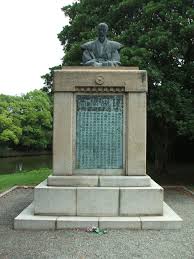 A bust of Yamaga Soko, the Bushido/Confucian philosopher.
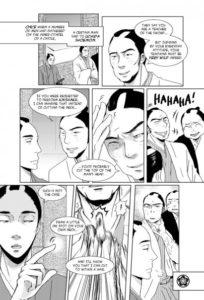 American translator William Scott Wilson led an international group of Hagakure enthusiasts to produce a manga version of the text (sample above). It’s a pretty telling example of the hold Hagakure (and bushido more generally) still has on Japanese culture.
 The grave of Yamamoto Tsunetomo in modern Saga City.
 A print depicting Asano’s attack on Kira, triggering the whole cycle of revenge around which the 47 ronin tale revolves.
 The graves of the 47 Ronin at Sengakuji.
 A print by Utagawa Kuniyoshi showing the final assault of the 47 ronin on Kira’s mansion.
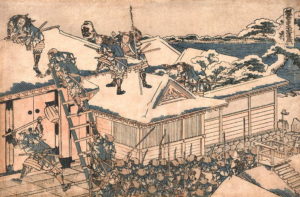 The 47 Ronin storm the home of Lord Kira, by Katsushika Hokusai.
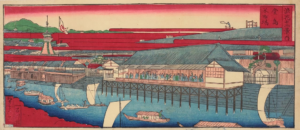 Woodblock print of the Dojima Rice exchange, as depicted by Yoshimitsu Sasaki.
 The Ako domain kurayashiki, as depicted via diagram in the Osaka Museum of History.
This week on the Revised Introduction to Japanese History: “closed country” isn’t quite the full story. How did Japan maintain its connections to the outside world during the Edo Period? And how do some of those connections, particularly in the Ryukyus and Hokkaido, lay the groundwork for future imperial expansion?
Sources
Jansen, Marius. The Making of Modern Japan.
Walker, Brett L. The Conquest of Ainu Lands; Ecology and Culture in Japanese Expansion, 1590-1800.
Kerr, George H. Okinawa: The History of an Island People.
Elisonas, Jurgis. “The Inseparable Trinity: Japan’s Relations with China and Korea” in The Cambridge History of Japan, Vol IV: Early Modern Japan.
Images
 Ashikaga Yoshinori; chosen by lot to be shogun, he was probably the last person of real competence to hold the post.
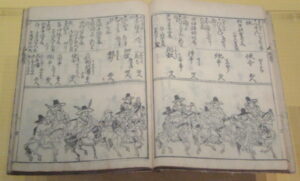 An image of a procession of Korean ambassadors from the 1748 Chosenjin Daigyoretsuki (Record of the Great Procession of the Koreans), a popular account of the 1748 embassy.
 A depiction of that same 1748 embassy in ukiyo-e format by Hanegawa Toei.
 Shuri Castle in Naha, capitol of the Kingdom of the Ryukyus (as well as modern Okinawa Prefecture).
 King Sho Shin, Grandson of Sho Hashi and third king of the Ryukyus.
 A 1795 woodcut depicting an audience between the Matsumae daimyo and Ainu leaders. Note the subservient attitude being depicted here.
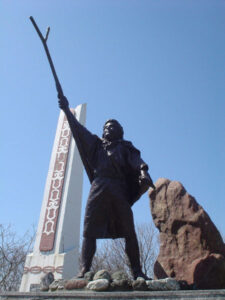 Though Shakushain’s revolt was suppressed, he remains a symbol today of Ainu pride. This statue is located at Shinhidaka, near where Shakushain’s main base of power was.
 An Ainu family in the 1860s. Tokugawa policy during the final decades of the bakufu was dedicated towards trying to show “compassion” to the Ainu to get their support in asserting Japanese control over Hokkaido.
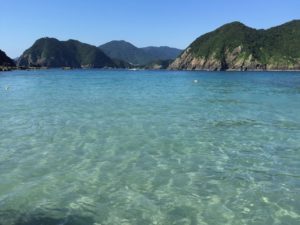 Today it’s a trendy tourist area, but in the early Edo Period, Bonotsu, just a short distance northwest of Kagoshima, was home to a Chinatown from which an illicit smuggling operation of Chinese goods into Kagoshima was operated.
Not all scam artists prey on suckers’ desire to get rich quick or cheat the system. Some of them prey on their marks’ better impulses, like their love for their pet dogs or their willingness to help a stranger in an emergency.
Content note: This episode contains discussion of animal cruelty and inhumane and misguided medical practices. It contains some outdated language about epilepsy.
Featured image: The Actress Rejane and her Dog, a1885 painting by an Italian painter showing a stylish lady and her dog in the late 1800s. (Image source)
Sources – Dognappers in London* Snakes, Apes and Ferrets: The Ancient Greek Love of Pets * The Evolution of Petface * King Louis XVI’s Toy Poodles * How the dog found a place in the family home – from the Victorian age to ours * Dog stealing – HC Deb 09 July 1844 * Dog Stealing Bill * The Dognapping of the Century * To Flush, My Dog * The Literary Love Story of Elizabeth Barrett and Robert Browning * Victorian Exhibitionism and Eugenics: The Case of Francis Galton and the 1899 Crystal Palace Dog Show * The surprising history of Victorian dog shows * How to Keep Your Dog Safe When Pet Theft Is on the Rise * Pet Theft * 15 States That Have Stolen Dog Laws & 10 Most Common Stolen Dog Breeds * Lady Gaga Got Her Dogs Back, but as Criminals Capitalize on the Demand for Pandemic Pups, Others Aren’t So Lucky
Sources – James Clegg, the Dummy Chucker* Rogue Wounds * Epilepsy during the Middle Ages, the Renaissance and the Enlightenment * Dummy Chuckers * Torments of Hospitals * The history of Epilepsy Society * Epilepsy Hall of Fame * Highights in the History of Epilepsy: The Last 200 Years * Epilepsy: a short history * Feigned Epilepsy for Years * Effects of Seizures on Autonomic and Cardiovascular Function * The Dummy-Chucker By Arthur Somers Roche
This week on the Revised Introduction to Japanese History: what was life in the Edo period like? We cover everything from food to school to entertainment as we talk through daily life in Tokugawa-ruled Japan.
Sources
Nishiyama, Matsunosuke. Edo Culture: Daily Life and Diversions in Urban Japan, 1600-1868. trans. Gerald Groemer.
Nakai, Nobuhiko, “Commercial Change and Urban Growth in Early Modern Japan” and Shively, Donald H. “Popular Culture” in The Cambridge History of Japan: Vol IV: Early Modern Japan
Teeuwen, Mark, and Kate Wildman Nakai, eds. Lust, Commerce, and Corruption: An Account of What I have Seen and Heard
Craig, Teruko, trans. Musui’s Story: The Autobiography of a Tokugawa Samurai
Images
 A map of the Yoshiwara pleasure district in 1846. You can see much the same layout if you look at the place today. The walls were intended to both contain the sex trade (not very successful) and allow the government to regulate and make money off it (more successful).
 An Edo kabuki performance in the Kabukiza theater. Note the actor moving up the hanamichi on the left side. This should give you an idea of how close kabuki actors got to their audiences.
 Contemporary depiction of a terakoya school by Hanasato Isshun
This week on the Revised Introduction to Japanese History: how did the Tokugawa bakufu operate? What did the political structure of the shoguns look like? And what makes the Tokugawa era unique in the history of warrior rule in Japan?
Sources
Hall, John Whitney, “The Bakuhan System” and Osamu Wakita, “The Social and Economic Consequences of Unification” in The Cambridge History of Japan, Vol IV: Early Modern Japan
Jansen, Marius. The Making of Modern Japan
Philip Brown, “The Political Order” in Japan Emerging: Premodern History to 1850
Images
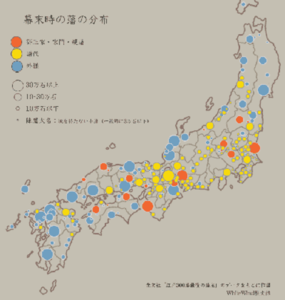 A map of landholdings in the Edo Period. The size of the circle indicates the overall koku value. Red is land held by the shogun or his immediate relatives. Yellow are the fudai; blue are the Tozama.
 Engelbert Kaempfer’s sketch of a sankin kotai retinue — a lord and his followers on their way to attend to the shogun in Edo.
 A group of daimyo going to attend to the shogun as part of their duties under the sankin kotai system.
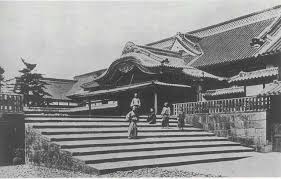 The old Kuroda family yashiki in 1870. This is an example of the type of compound a daimyo would maintain for sankin kotai. At the time this photo was taken, the compound was being converted to house Japan’s Foreign Ministry.
 This is a view of the old palace of the Tokugawa shoguns in modern Tokyo. After the fall of the shogunate it was taken over by the Imperial family, and is today known as the Tokyo Imperial Palace.
With options for getting rid of its convicts drying up, Britain started thinking about reforming both its prisons and the prisoners inside them. The intention behind these prison reforms was great. But attempts to create a better prison system involved wild philosophy experiments in real life, a lot of Bibles, a lot of time to think in silence, and… treadmills?
Featured image: A prisoner engaged in “hard labor,” turning a crank that rotated paddles inside a box of sand. (Image source)

A derelict beached ship used a convict hulk in the early 1800s. (Image source)
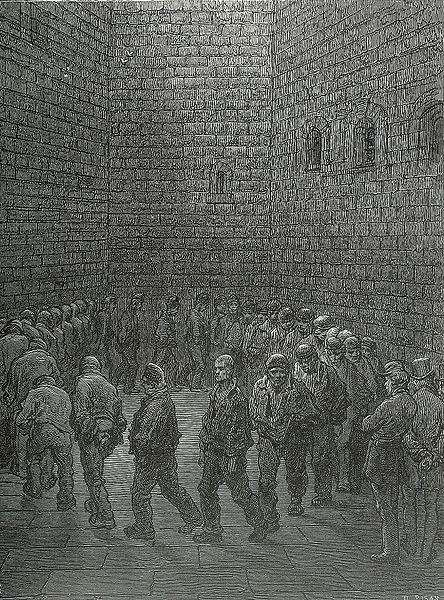
Cramped conditions in the Newgate Prison yard in the 1870s. We should note that although there were newer “model” prisons in London, Newgate did continue to operate. (Image source)
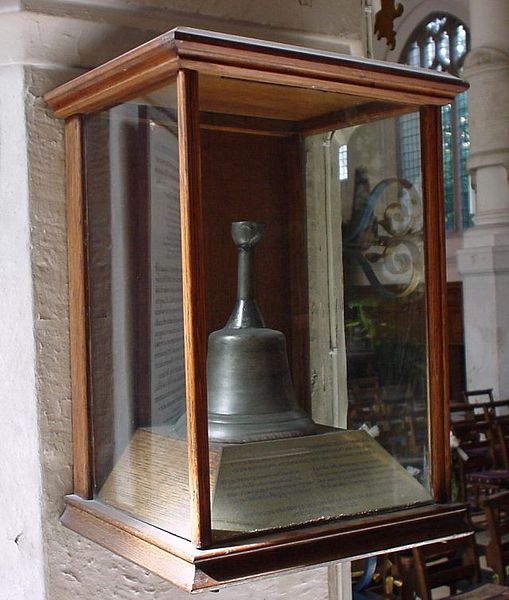
The Newgate execution bell, which was tolled with the chant: All you that in the condemned hole do lie, Prepare you, for tomorrow you shall die; Watch all and pray, the hour is drawing near, That you before the Almighty must appear; Examine well yourselves, in time repent, That you may not to eternal flames be sent: And when St. Sepulchre’s bell tomorrow tolls, The Lord above have mercy on your souls. (Image source)

A plan of Milbank Prison, with central towers that allow guards to watch prisoners at all times. The actual Milbank Prison was such a mess by the time construction finished that people often got lost in its mazelike architecture. (Image source)
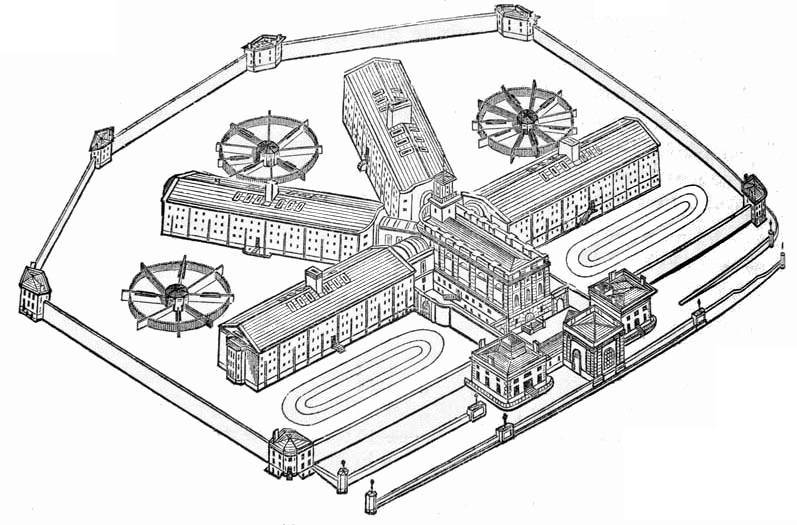
Pentonville prison, which kept the idea of wings radiating from a central area but was not a true panopticon in the model Bentham intended. (Image source)

The prison treadmill at Pentonville. This picture was taken in the 1930s, so this practice continued long past the point there was even any pretense that turning a machine like this with human power might be productive work. (Image source)

Another prison treadmill at Brixton Prison. (Image source)
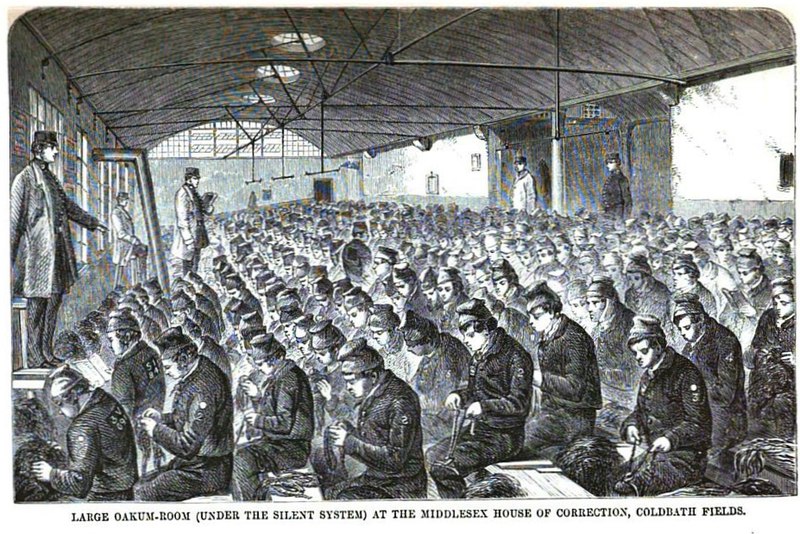
Prisoners picking oakum at Coldbath Fields. (Image source)
Sources* Convict transportation ends
The Bloody Code
Criminalisation and the eighteenth-century’s ‘Bloody Code’
A Victorian prison
* Authority and the Prison of the Mind: Bentham and Foucault’s Panopticon
Convict Labor during the Colonial Period
Population of England over history
Newgate Prison Wall
What Type of Criminal Are You? 19th-Century Doctors Claimed to Know by Your Face
Millbank Prison
Jeremy Bentham, Elizabeth Fry, and English Prison Reform
The English Quakers and Prison Reform 1809-23
Discipline, Government and Law: Separate Confinement in the Prisons of England and Wales, 1830-1877
Monitoring isolation and solitary confinement in the UK: inadequate procedures and informal practices need to be addressed
Solitary Confinement in Prison Systems and Future Psychopathological Effects
Ideas and Their Execution: English Prison Reform
The Making of the Penitentiary Act, 1775-1779
Prisoners, Poverty and Picking Oakum
A Victorian prison
Prison Treadmills
* Timeline: A history of probation
This week on the Revised Introduction to Japanese History: Hideyoshi may have brought peace, but Tokugawa Ieyasu would be the one to make it lasting. How did Ieyasu seize power from Hideyoshi, and what did he do to secure it?
Sources
Totman, Conrad. Tokugawa Ieyasu: Shogun.
Berry, Mary Elizabeth. Hideyoshi
Asao, Naohiro. “The Sixteenth-century Unification” in The Cambridge History of Japan, Vol IV: Early Modern Japan.
Images
 The Battle of Sekigahara in 1600 (shown here) cemented Tokugawa Ieyasu’s control of Japan.
 Tokugawa Ieyasu upon his ascension to the rank of shogun.
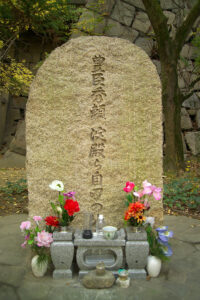 A stone marker on the grounds of Osaka castle commemorating the suicides of Yodo-dono and Toyotomi Hideyori.
 These bronze cannon are emblematic of the type of weapons you’d see at Osaka castle.
 A painting of the Siege of Osaka Castle in 1615, commissioned by the same Kuroda Nagamasa who spent outrageous sums of money to repair just part of the castle walls.
 The Battle of Osaka at the start of the siege in late 1614. I’m including this so you can get a sense of the castle layout; the blue are the defenders, and they’re arrayed around that third outermost wall designed to defend the main keep from cannon fire.
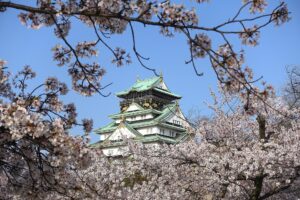 Osaka Castle’s surroundings are now a beautiful park. I have been during cherry blossom season. It is worth it.
With Nobunaga dead, we turn our attention to one of his generals: Hashiba Hideyoshi, who would take up leadership of the former Oda lands and within the course of a decade complete Japan’s reunification. What do we know about the man and motives behind Japan’s greatest rags to riches story?
Sources
Berry, Mary Elizabeth. Hideyoshi.
Jansen, Marius. The Making of Modern Japan. Cambridge: Harvard University Press, 2001.
Asao, Naohiro. “The Sixteenth-century Unification” in The Cambridge History of Japan, Vol IV: Early Modern Japan.
Images
 The graves of several Christians martyred by Toyotomi Hideyoshi in 1597.
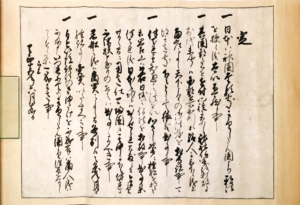 Hideyoshi’s 1587 anti-Christian edict. It’s possible the edict was intended at least in part to drive home Hideyoshi’s intent to hold the Portuguese Jesuits responsible for the slave trade.
 Hideyoshi orders the attack on Odawara, from the late Edo/early Meiji Era, by Utagawa Toyonobu. Where the main narrative of Japanese history mentions the latter Hojo, it tends to emphasize the moment of their destruction as the completion of Hideyoshi’s ambition to reunify Japan. There are, however, plenty of other valid reasons to study them!
 This image of Toyotomi Hideyoshi dates from 1601, three years after his death.
This week on the podcast: Why are Japan and South Korea’s governments so worked up about some uninhabited rocks in the middle of nowhere? Well, because sometimes those rocks stand for much, much more.
Featured image: A photograph of the Liancourt Rocks taken in 2008. (Image source)
SourcesDokdo, Korea’s Beautiful Island – Archived source
Bukh, Alexander. “Korean National Identity, Civic Activism and the Dokdo/Takeshima Territorial Dispute.” Journal of Asian Security and International Affairs 3, no. 2 (2016): 183–99. https://www.jstor.org/stable/48601795.
Choi, Sung-jae. “The Politics of the Dokdo Issue.” Journal of East Asian Studies 5, no. 3 (2005): 465–94. http://www.jstor.org/stable/23417875.
Atanassova-Cornelis, Elena, Ramon Pacheco Pardo, and Eva Pejsova. “ISLANDS, BORDERS AND CLAIMS.” Pride and Prejudice: Maritime Disputes in Northeast Asia. European Union Institute for Security Studies (EUISS), 2015. http://www.jstor.org/stable/resrep07082.5.Castellino, Joshua, and Elvira Domínguez Redondo. “The Title to Dokdo/Takeshima: Addressing the Legacy of World War II Territorial Settlements/Finding the Right Settlement of Dispute Mechanism.” International Journal on Minority and Group Rights 22, no. 4 (2015): 550–77. http://www.jstor.org/stable/24676570.The Liancourt Rocks Dispute: Is Terra Nullius a Relic of Colonialism? – SourceImagesA miniature model of the rocks in a South Korean museum. (Image source)
An 1875 Japanese map of the Oki Islands and Liancourt Rocks. (Image source)
Employees of the Osaka Asahi Shimbun on a trip to the rocks in 1934. (Image source)
Korean stamps of the rocks from 1954. (Image source)
The view from the top of one of the rocks. (Image source)
Korean students protesting Japanese claims to the rocks in 2012. (Image source)
TranscriptSo, while preparing for a related episode, I was taking inventory of some of the topics we’ve talked about, and uncovered a startling omission–we’ve covered most of Japan’s modern territorial disputes, from the issue of the “Northern territories” of the Kurile islands to the Senkakus/Diaoyu Islands in the south. But we’ve missed a spot–one that, in many ways, serves as a microcosm of one of the most important stories in the politics of modern Asia.
In fairness, the spot in question is pretty tiny, and thus easy to miss. I refer, of course, to the so-called Liancourt Rocks, the comparatively neutral name I am going to stick to here in lieu of using either their Japanese name–Takeshima–or their Korean one–Dokdo.
In fairness to me, they are pretty easy to miss; together, the Liancourt Rocks have an area of .07 square miles, or .18 square kilometers. By comparison, Kitanomaru Park just north of the Imperial Palace in Tokyo is around the same size in terms of its overall area. And unlike the Kitanomaru park, the Liancourt Rocks are not continuous; there are two major islands, called Seodo and Dongdo in Korean, or Otokojima and Onnajima (man island and woman island) in Japanese, and 35 smaller ones, plus an additional 54 islands that emerge or sink beneath the waves depending on the tides.
What I am getting at here is that these places are small. They’re also not super pleasant. As the name Liancourt Rocks might clue you in on, these are, well, rocks–not really suitable for human habitation, and mostly composed of dense volcanic rock with a thin layer of soil and moss in some places. Specifically, they’re volcanic rocks, formed during the last few million years (so comparatively recently geologically speaking). That also means that like most volcanic rocks, they are not exactly a flat and pleasant land–the Liancourt rocks are sharp and craggy, and while they don’t get high (the highest point of elevation is 169 meters, or 554 feet, on Dongdo/Onnajima), they shoot pretty much straight up from the waterline.
It’s also worth noting that the islands are square in the middle of the Sea of Japan, about 217km (or 135 miles) east of Korea and 211 km (131 miles) north of Japan’s main island of Honshu. Most important for us, however, is that the Sea of Japan is of course right next to the Russian Far East, an area not exactly known for its lovely weather–and of course they’re also exposed and very tiny rocks right in the middle of the open sea. That means the weather is both unpredictable and foul–gusty winds, heavy storms, and a LOT of rain: 1324 milimeters worth, or just over 52 inches. By comparison, Seattle–famous for its rain–gets 39.34 inches on average in a year, or just over 999 milimeters.
It’s hot in the summer, thanks to warm water currents blowing up from the East China Sea, and cold in the winter thanks to cool air blowing in from Russia. Oh and it gets so stormy in the winter that often you literally can’t even dock ships there because it’s too dangerous–not that you’d want to go outside with all the cold wind and rain, since given how treacherous and uneven the land is you’re more than likely just going to slip and injure yourself.
What I am getting at here is that this place is unpleasant–it’s gloomy and dangerous and just not somewhere I’d be super jazzed to go. It can be pretty in the way that harsh landscapes can be pretty, but still–this is not desirable land.
In a word, it’s not the kind of place you normally see people getting excited over–and yet it remains the center of a multi-decade territorial dispute between Japan and South Korea. So that raises the natural question–why on earth would anyone give a damn about these tiny islands off in the middle of nowhere?
But before we get into this, an exciting little foray into the wonderful world of international territorial law! Wait, no, don’t stop the podcast! I promise it’ll be interesting.
So: the question of how we determine who legitimately owns a piece of land–in fancy academic speak, whether or not a country has sovereignty, or the right of political control, over it–is very complicated. The idea of trying to clearly define a legal notion of sovereignty is fairly new, and while it has roots in ancient ideas–for example, the contracts between lord and vassal that were so central to feudalism–in practice, ownership for a long time boiled down to “if you can stop someone else from trying to take it, you own it.”
Still, over the centuries some conventions around determining ownership sans any violence did begin to crop up–after all, to borrow a famous phrase, you can fight some of your neighbors some of the time, but you can’t fight all of your neighbors all of the time. By the late 19th century, a series of standards for determining sovereignty over a particular territory had come into use among the powers of Europe as well as the United states, and those standards eventually came to form the basis of modern international law.
So what are those standards? Well, the most straightforward one is occupation and use. Simply put, if people live on those islands, and they treat a government as their legitimate rulers, that government has sovereignty. Kyushu is full of people who have mostly treated Japan’s government as their legitimate rulers, so Kyushu is the sovereign territory of Japan. But that doesn’t work with the Liancourt Rocks, because up until very recently nobody lived there full time.
There are some other standards that can be used to determine ownership of territory–for example, whether or not a given government has ever administrated the land of the disputed territory, or whether or not its citizens have made economic use of it (say, by fishing there). In fancy legal terms, to use the language of the Permanent Court of International Justice from 1933 (in a case on the legal status of the eastern part of Greenland), the proof of sovereignty lies in, “The intention to and will to act as a sovereign, and some actual exercise or display of such authority.”
But that standard is hard to apply in the case of the Liancourt rocks because there’s not a super consistent pattern to the older historical records showing a long-held claim over time. And this matters because if nobody claims a given piece of land, then under international law it becomes what is called terra nullius.
This is a fancy way of saying that since it’s unclaimed, anyone can just come in and grab it. That’s the notion of “right of discovery”, if you’ve ever heard of the term–if you find an unclaimed piece of land, you can just claim it yourself. Of course, in reality, few pieces of land on earth are unclaimed, and this doctrine is most famous for providing a thin veneer of legal cover to the seizure of indigenous lands in the Americas on the grounds that indigenous populations essentially just did not count for standards of ownership. But it also applies to genuinely unclaimed pieces of land–which the Liancourt Rocks might actually be.
Both South Korea and Japan dispute that, however–both say that they have longer-standing historical claims to the territory which make it legitimately theirs.
What are those claims? Well, to be frank, it’s complicated. South Korea’s claim–which is shared by North Korea, though the communist state’s economic weakness and lack of participation in international diplomacy make it kind of a non-issue–is based on references in historical texts to a place called Usan-do, an island nearby the larger island of Ulleungdo, which itself is 120 km/75 miles off the coast of Korea. The position of the Korean government is that these references–which date back in their clearest form to the 1400s, though earlier ones go as far back as the 500s–clearly state that Usando is administratively a part of Ulleungdo, which in turn is Korean territory. Thus, the criteria of international law is fulfilled: government reports describing the territory as a part of Korea show an “intention and will to act as a sovereign”, and other ventures–like mapping of the region by Korean cartographers–show some actual display of authority over it.
Those references, in turn, crop up pretty consistently at least once a century until Korea’s annexation in 1910 by the Japanese Empire. Indeed, in 1900, the Korean government issued a proclamation listing out these various claims and reinforcing its claim to the Liancourt Rocks specifically due to increased Japanese presence in the region.
I do want to point out that the Japanese government disputes that the “Usando” being referenced in all these documents is definitely the Liancourt Rocks (or Dokdo, in Korean today)–it is, indeed, somewhat hard to be sure given the variety of names used for the island over its history and the somewhat imprecise nature of maps during this period. After all, there are a lot of volcanic rocks out there. How can we be sure it’s this specific one?
Then again, we can’t be sure it’s a different one either–and certainly the description of Usando as near Ulleungdo does fit the bill for the for the Liancourt Rocks, which are visible from Ulleungdo on a clear day.
As for the Japanese side of things, the story begins in the early Edo period. Specifically, it begins in 1618 with a pair of merchants, Oya Jinkichi and Murakawa Ichibei, both from the village of Yonago in the Tottori fiefdom–now the westernmost part of Tottori Prefecture.
By the way, you sometimes see Oya Jinkichi’s name written as Otani Jinkichi–that’s just a different pronunciation of the same character. For consistency, I’m going to use the reading “Oya.”
Tottori today is on the western edge of the main island of Honshu, along the Japan Sea Coast. Thus, much of its economy was based on fishing the Japan Sea, and Oya and Murakawa were no different. Specifically, the two merchants wanted to set up a deep sea fishing business based out of the Oki islands, off the coast of Tottori in the Japan Sea. Their business would take them north to Ulleungdo–called Utsuryo in Japanese–to fish for abalone as well as hunt sea lions, whose bodies contained a waterproof oil with a wide variety of uses.
Of course, this was not a free market economy, and their voyages needed permission from the shogunate to go forward–which they applied for and received in due course.
The Liancourt Rocks to the southeast of Ulleungdo were a natural harbor for ships doing this back-and-forth route, and so the descendants of Oya and Murakawa, who would shelter in the harbors of the rocks during storms, and also visit them to harvest sea lions and to fish along their coastlines. And as far as they could tell, the islands were abandoned–because again, based on how I’ve described them, would you want to live there?
The Japanese claim is that all this demonstrates sovereignty over the islands going back to the early 1600s–particularly since when, in 1635, the 3rd Tokugawa shogun Iemitsu issued a prohibition on sailing out of Japanese waters, the Oya and Murakawa families were not required to end their fishing expeditions. That, so the argument goes, is a clear demonstration of an intent to treat the Liancourt Rocks like they were a part of Japanese territory.
With me so far? Good, because things are about to get a bit more complicated. In 1692, the Murakawa and Oya family fishing fleets came to the Liancourt Rocks, and there found some Korean fishermen who were, well, doing the exact same thing they were. A dispute then emerged as to who had the right to be fishing there, and apparently things got pretty heated–because the upshot of all this was that two of the Korean fishermen, An Yongbok and Pak EoDoon, were brought back to the Oki islands in Japan.
Reading between the lines, they might have been kidnapped? It’s a bit unclear, but Korea did have a law on the books similar to that of the Tokugawa shogunate banning overseas travel without permission–and so just volunteering to head to Japan for a bit is not exactly the sort of thing one would casually do if one hoped to, say, ever be allowed to go home again.
After some interrogation, the two fishermen were passed back to Tsushima domain, the feudal fiefdom on the island of Tsushima between Japan and Korea responsible for managing Japan’s relations with its neighbor. Thus commenced a whole complex back and forth about the whole incident and who was ultimately responsible for it.
I’ll spare you all the wrangling; the upshot was that the Tokugawa shogunate, anxious to maintain a good trade relationship with Korea and not really caring all THAT much about all the fish of Ulleungdo, voluntarily recognized the island as Korean territory. No mention was made specifically of the Liancourt Rocks, however–a bit of ambiguity both sides point to in order to reinforce their own narratives.
In the end, of course, there’s no answer that lies here–because while both sides draw from the history to support their narratives, that’s not really what the two governments are fighting about. What they’re fighting about are the more immediate circumstances of the conflict–specifically, the period of the Japanese Empire.
You see, by the start of the 20th century, the upshot of all this was that both countries were aware of the Liancourt Rocks, but neither one really put much effort into claiming them–because why would they?
This is also why the first Europeans to chart the area saw the islands as abandoned; this is actually where the name “Liancourt Rocks” comes from, as the name is derived from a French whaling ship that nearly ran aground on the islands during a storm in the 1850s.
On the Japanese side, after the Meiji Restoration the government did not immediately pursue a claim on the islands, as it did with more strategic areas like the Ryukyus or Hokkaido. Indeed, in an 1877 land survey directive the Dajokan, the supreme organ of the early Meiji State, specifically listed the islands as not a part of Japanese territory and thus not in need of surveying.
Because, after all, there was nothing to survey–those surveys were for agricultural tax purposes, and you can’t grow anything on the islands–nor, again, did anyone even live there.
The real core of the dispute begins in 1905, towards the tail end of the Russo-Japanese War, with a fisherman named Nakai Yosaburo. Nakai was a resident of the Oki Islands, who early in his life aimed at different get rich quick schemes–he’d actually planned at first to join the growing number of Japanese explorers going south in the late 19th century to make their fortune in Micronesia, but was robbed of his travel money by a thief while waiting to board his ship in Nagasaki. Instead, just like the Murakawa and Oya family fishermen of the Edo period, he ended up having to make a living fishing in the Sea of Japan, sailing north from his home in the Oki islands and and harvesting sea lions as well as abalone. By 1903, he’d begun constructing buildings on the Liancourt Rocks to help him process his sea lion kills, and even convinced a few workers to hire on to join him there.
His hope was to take advantage of the sea lion breeding ground on the island, harvesting the animals for their oil as well as their hide (which can be tanned in a way similar to cowhide to make leather). His timing was pretty good; both of these things were in high demand thanks to the Russo-Japanese War–for example, seal oil could be used to weatherproof certain pieces of gear, and leather was necessary to make boots for soldiers on the frontlines.
By 1905, he felt his business was stable enough there was no immediate danger of it folding–but he also wanted some legal protection for it, since he didn’t have any sort of claim to the land he was making use of. And so, he petitioned the Japanese government to do two things: stake a claim to the Liancourt Rocks on the ground that they were totally undeveloped and thus terra nullius, free for the taking, and then lease the islands to him for 10 years.
The Japanese government was more than pleased by the idea, both because Nakai’s business was successful (which meant employment and more tax money) and because the Liancourt Rocks could also house military observation outposts for the Imperial Japanese Navy.
What about the Korean government in all of this, you ask? Well, in 1905 Korea was technically still an independent country–but one that had been reduced to a colonial dependency of Japan. After Japan’s victory over China in 1895, Japan became the predominant power on the peninsula and forced Korea’s government to sign a series of humiliating deals essentially making the Korean government a puppet state of Japan. Five years after the Russo-Japanese War ended, all pretense would be dropped, and Korea annexed outright.
Practically speaking, therefore, there was no real way for the Korean government to object to the Liancourt Rocks–all Korean government decisions had to go through Japanese “advisors”, and I think we can all guess the “advice” that would be dispensed in this scenario.
And so by 1906 Japan had claimed the Liancourt Rocks, officially annexing them into rural Shimane Prefecture as a part of the same administrative district as the Oki Islands–which will be important in a bit.
For now, and of somewhat more immediate importance–fast forward to World War II!
So–we’re all familiar in broad strokes with this conflict, I imagine, given that it’s, well, reasonably important to basically all history and politics that have happened since. For us, what matters about the conflict is the strong stance the Allies took toward Japan’s colonial empire. Specifically, the Allies, led by the US, publicly announced that they would not seek territorial aggrandizement for themselves during the war and that lands conquered by Japan, Germany, and other Axis Powers would be restored to their previous owners.
Of course, in practice this didn’t always end up happening: Stalin gleefully broke those agreements to seize land in Asia and Europe, and the US annexed Okinawa for several decades before being pressured into handing it back.
But anyway–two documents came to define these goals of demolishing Axis empires. First, in 1943, the US, UK, and Republic of China agreed to something called the Cairo Declaration while their leaders–Franklin Roosevelt, Winston Churchill, and Chiang Kai-shek–were meeting in Cairo to discuss the war against Japan. The central terms of that declaration are: “The Three Great Allies are fighting this war to restrain and punish the aggression of Japan. They covet no gain for themselves and have no thought of territorial expansion. It is their purpose that Japan shall be stripped of all the islands in the Pacific which she has seized or occupied since the beginning of the first World War in 1914, and that all the territories Japan has stolen from the Chinese, such as Manchuria, Formosa, and The Pescadores, shall be restored to the Republic of China. Japan will also be expelled from all other territories which she has taken by violence and greed…”
Then we have the Potsdam Declaration, agreed to by American President Harry Truman as well as Churchill and Chiang Kaishek in the Berlin suburb of Potsdam in July, 1945. The Potsdam Declaration laid out terms for Japan’s surrender–terms the Japanese government refused at first, before eventually accepting them on August 15.
There are a whole bunch of articles listed in the declaration, but for us the most important bit is this sentenceL “The terms of the Cairo Declaration shall be carried out and Japanese sovereignty shall be limited to the islands of Honshu, Hokkaido, Kyushu, Shikoku and such minor islands as we determine.”
And then, finally, we have the Treaty of San Francisco, signed in 1951 as a part of the end of the Allied Occupation of Japan, Chapter II Article 2a of which reads: “Japan, recognizing the independence of Korea, renounces all right, title and claim to Korea, including the islands of Quelpart, Port Hamilton, and Dagelet”–the last of which is the European name of Ulleungdo.
So, I imagine you’re probably beginning to see where the trick lies here. These two documents spell out pretty clearly what’s happening to a lot of the Japanese Empire when the war ends–Taiwan, Manchuria, and other territories in China are going back to Chinese sovereignty, for example. But what about the Liancourt Rocks? Are they “territories seized by violence and greed” as it says in the Cairo Declaration? The Potsdam Proclamation has that line about Japanese sovereignty remaining on “such minor islands as we determine”–does that include these minor islands?
And what about the San Francisco treaty? Japan both agreed to renounce its claims in Korea and recognized that Ulleungdo is a part of Korea–with the Korean government contending that the Liancourt Rocks are included in that because of their proximity, and the Japanese government contending that since the Liancourt Rocks are not explicitly named in the treaty they are not included.
This is pretty much the core of the modern legal argument. The Cairo Declaration also said explicitly that Korea would be made into an independent state, and the position of the South Korean government is that said guarantee of Korean independence includes territories like the Liancourt Rocks that–thanks to all the history we’ve already covered–were indisputably a part of Korea. At any rate, according to the Korean government, the rocks are absolutely “territories seized by violence and greed” and thus must be given up under the terms of the Cairo Declaration and Potsdam Proclamation, which Japan agreed to accept as a part of its surrender.
The position of the Japanese government, meanwhile, is that the Liancourt Rocks were terra nullius before 1905, that a fragmentary record of Korean engagement with the islands does not prove ownership, and that as legally annexed terra nullius the rocks are exempted from the Cairo Declaration.
All of this is further complicated by one additional legacy of the US Occupation of Japan. After the start of the Occupation, the Americans began using the Liancourt Rocks as a bombing range for practicing close air support bombing–further devastating the ecosystem of the islands, by the by, after decades of Japanese hunting had also drastically lowered the sea lion population.
Legally, this matters because the use of the islands in this way implies the American occupation leaders saw them as Japanese territory over which they had authority. But in cases like that, it’d be common to sign a lease with the Japanese government to establish the legality of using the bombing range–which the Americans never bothered to do. And indeed the order setting up the bombing range also explicitly states that this should not be treated as a determination of sovereign rights–in other words, it was not a commentary on who the Americans thought should own the islands.
But the Americans DID think to inform the inhabitants of Shimane Prefecture and the Oki Islands (of which the Liancourt Rocks are, in the Japanese telling, a part) of the bombing range plan–the Koreans were not informed, leading to a horrific incident in June, 1948 where Korean fishermen headed to the islands were caught up in an Allied bombing exercise–killing 16 and injuring 29.
On the flip side of things, the American occupation leadership did issue an order suspending Japan’s jurisdiction of over 1000 outlying islands in the Pacific including the Liancourt Rocks, which South Korea today points to as ending Japan’s sovereignty over them–the Japanese response is that “suspension” has a temporary implication, in the same way that being suspended from school is different from being expelled.
It is worth noting that when handling yet another important issue for civilian government in Japan–where Japan had territorial fishing rights to feed its hungry population–the Occupation government explicitly did not include the Liancourt Rocks in the Japanese fishing zone. However, once again this came with the caveat that American decisions on this should not be perceived as a final settlement.
The Korean scholar HK Lee has also looked at some older versions of the San Francisco treaty, and discovered that up until 1949 drafts of the treaty explicitly included the Liancourt Rocks–until an American advisor on Japanese politics, William Sebald, pushed for the reference to be removed. His reasoning? “Japan’s claim to these islands is old and appears valid, and it is difficult to regard them as islands off the shore of Korea. Security considerations might also conceivably render the provision of weather and radar stations on these islands as a matter of interest to the United States.”
Sebald’s changes did get some pushback from the other Allies, especially the British–who were more supportive of the Korean position on the issue. Ultimately, it’s pretty likely the treaty was nonspecific on the Liancourt Rocks specifically because there was no consensus from the Allies.
The picture that emerges is pretty clear; initially, the US government was unconcerned with the issue of the Liancourts, and became more vocally supportive of the Japanese position over time as it became clearer that doing so had advantages for the American military position in Asia.
Still, the final result was that when Japan once again became an independent country at the end of April, 1952, the status of the Liancourt Rocks was unclear. And so the government of South Korea decided to make it clear.
In late April, 1952, just days before the slated end of the American occupation and the reversion of sovereignty to the Japanese government, President Syngman Rhee of South Korea proclaimed a “Declaration of Sovereignty Over Adjacent Seas”, claiming the Liancourts for South Korea and then sending the coast guard to occupy the islands.
Don’t forget, this is 1952–Rhee is still fighting the Korean War while this is going on, which nearly destroyed his government just a few years ago. That in turn provides a clear indicator of how important this issue was in his perception; to view things more cynically, Rhee was also a vicious dictator who brutally suppressed his own population, and may have seen stoking anti-Japanese sentiment around the Liancourts as a way to distract from criticisms of his own repressive government.
Still, the status quo put into place by Rhee–who was overthrown in a democratic revolution in April, 1960, but then replaced when a nascent South Korean democracy was crushed by a military coup early the next year–remains in place to this day.
Rhee’s successor, the dictator Park Chung-hee, lacked his predecessor’s anti-Japanese zeal; indeed, Park had gotten his original military training from the Japanese and had been an Imperial Japanese Army officer responsible for hunting the future leadership of North Korea before 1945. Park wanted to deal with the Japanese, particularly given that by this time the rapid economic growth of Japan had begun. But he was also no fool, and knew that the Liancourt Rocks were a valuable symbol of Korean nationalism and not worth compromising on.
Fortunately, both sides agreed that a deal to open up economic and political cooperation was worth more than those islands were–in the treaty that normalized relations between South Korea and Japan, both sides accepted a compromise of acknowledging each other’s claims while recognizing South Korea’s de facto control over the rocks.
And it’s remained that way pretty much ever since. Three times–in 1954, 1962, and 2012–the Japanese government has suggested referring the dispute to the International Court of Justice, the tribunal attached to the United Nations. Each time, South Korea has refused on the grounds that there is no dispute–because its claim is obviously correct.
Now, as we come to the close of the episode, I imagine a lot of you are thinking: that’s it? All this time on just a pile of damn rocks? There has to be something more here!
And frankly, you are absolutely right–there is. Partially, it’s the usual suspects; both countries are fighting not so much for the rocks but for the waters around them, since if the Liancourt Rocks are part of your territory their surrounding ocean is your territorial waters–giving you things like fishing rights, useful in countries with high demand for fish!
I’ve also read reports about possible offshore petroleum or gas deposits in the surrounding waters, but not consistent ones–and I am not well versed enough in the science to know why that is.
But just as important as the practical battle is the symbolic one. For South Korea, Dokdo, as they call it, is not just some crappy islands in the middle of a stormy ocean–they are a symbol of South Korean nationalism. That nationalism is often predicated on anti-Japanese resistance–the story of Korea, as it is often told to Koreans in schools, history books, or even media, is defined by a history of resistance to Japanese aggression, most recently in the colonial period but going as far back as Hideyoshi’s invasions in the 1590s.
From this perspective, Dokdo is a symbol of one more Japanese attempt to take South Korea’s territory–and hanging on to it, even to the point of constructing guard posts and a tourist dock on the islands to demonstrate your claim, is an act of patriotic resistance. Side note: I’ve seen photos of the tourists, and they never really look like they’re having fun to be honest.
On the Japanese side, meanwhile, things are a tad more arcane. First, Takeshima–as they call it–is ostensibly a part of Shimane prefecture, which if you know it you’ve likely heard of because it’s one of the most rural and depressed parts of the country. It’s also a bastion of support for the ruling Liberal Democratic Party–and thus a valuable local issue for Shimane’s elections, which the LDP can trot out to prove that it’s fighting for the interests of the people of Shimane to get them those fishing grounds, so please won’t you vote for us one more time?
Besides this, it’s more or less tacitly acknowledged that bureaucrats of the Foreign Ministry have advised the government not to abandon the claim–not because they think there’s realistically a chance in hell that South Korea will ever hand the islands over, but because abandoning one claim would send the message that Japan is prepared to cave on its other territorial disputes–an image of weakness that would damage Japan’s hand in relation to its other territorial disputes with China and Russia.
Realistically, the only other power with the ability to try and force the issue is the United States, and frankly why would we risk our alliances with South Korea and Japan on the issue when it’s always been in the American interest to get those two countries to work together? That’s just as true today as it was in 1952.
Frankly, I think regardless of the history the islands are staying with South Korea, and the most likely outcome is that sometime in the distant future the LDP will decide conceding the issue is worth some other deal they can get from the South Korean government. Predicting the future is always fraught, of course, and we’ll have to wait and see–but given the nationalistic symbolism attached to the Liancourt Rocks in Korea my perception has always been that people there simply care much more about the issue.
And ultimately, that’s what really matters about these windswept islands in the middle of a turbulent sea. Not the resources–though those are important–or their geographical position–though it could be strategic–but the symbolism. That’s why a place that looks for all the world like it’s barely worth anything can seem like it is worth everything, smack in the middle of one of the most turbulent and important relationships of modern East Asia.
James Reavis was a failed real estate investor, but he had a knack for document forgery. And if you lose all the land you own legally, why not acquire some more with the help of a few doctored papers?
Featured image: James Addison Reavis in 1900. He didn’t grow the impressive sideburns until a bit later than the events we covered in today’s episode. (Image source)
A map of the land Reavis claimed was covered by the Peralta grant.
The cover of a royal decree that Reavis used in his scam. (Image source)
A piece of paper forged by Reavis and inserted into the decree to make it look like the Spanish monarchy was granting land to the Peralta family. (Image source)
A bird’s eye view of Phoenix, Arizona in 1885. It was a much smaller city then than it is now, but still well worth stealing. (Image source)
Maps of the Southern Pacific Transportation Company’s rail system in 1893. As you can see from that single line running through southern Arizona, being able to build tracks in that stretch of desert was vitally important for a rail company that needed to connect its Atlantic and Pacific systems. (Image sources: 1, 2)
SourcesAbout James Reavis* Map of Peralta land grant
* The Baron of Arizona
The Peralta Grant: James Addison Reavis and the Barony of Arizona
Fading Away! The Reavis Cloud is Dissolving
Other information covered in this episode* What is a quitclaim deed, and when to use a quitclaim deed?
* Louisiana Purchase
Check for the Purchase of Alaska (1868)
Texas Annexation Questions and Answers
Independence of Mexico
Treaty of Guadalupe Hidalgo (1848)
Gadsden Purchase
* Inflation Calculator
Once again, Isaac underestimates how many episodes it will take to cover something, and so one more time, we’re talking…
This week on the podcast, a trip to two seats of the Imperial government. Also on the agenda: A really…
A North Korean plot to sabotage the Olympics and possibly derail a crucial South Korean election hinged on a pair of very unusual spies. When one of the bombers survived after swallowing a cyanide capsule, she told investigators her whole world was a lie.
This week on the podcast, something a little different: My first time traveling purely as a tourist in Japan, with…
Mirror mirror on the wall, who really killed Thomas Overbury? We’re getting deep into what might just be the weirdest trial we’ve ever covered on this show, with accusations flying about witchcraft, a poisoned enema, Spanish treachery, and a cameo from Sir Francis Bacon.
This week: the rise and demise of radio in Japan, covering everything from the birth of NHK to the origin…
This week: The history of the record player in Japan, from the first prototypes to the dawn of the Japanese pop star.
We begin a twisted tale of witchcraft, poison, and legal arguing over magically cursed genitals in the court of King James I. Sir Thomas Overbury tried his best to climb to a coveted position at court, but he made a lot of enemies along the way.
In the first of a multi-part series on the history of communications technology in Japan, we’ve got a double-header: the…
Tokugawa Ienari is often considered the worst shogun of the Tokugawa era. Where does his reputation come from, and is it entirely deserved?
In life, they were poor hooligans. In death, they became five of Japan's greatest folk heroes. Join us for a journey into Japan's 17th-century true crime puppet shows, time-traveling heroic tales, and kabuki romance.
Osaka enters the modern era. How did the nation’s kitchen become the “capital of smoke,” and how did the city’s government attempt to remake it for the modern era?
Apologies for the delayed release! I had some computer issues on my end, but they are now resolved. This week…
You've heard jokes about the Iran-Contra affair, but have you heard the actual legal arguments of the defendants? To understand the true scope and purpose of these complicated financial shenanigans, we've got to cover a whole lot of history.
This week: it’s the height of the Edo period, and you sail into Osaka’s harbor. What sorts of things might…
This Pride month, we're gearing up for a fight. As we battle over "Don't Say Gay" bills in the US today, we're looking back to the 1980s to see how a similar legal effort played out in the United Kingdom. No one was ever successfully prosecuted under Section 28, but that doesn't mean it was harmless.
Note: due to a numbering error on my end, I recorded this episode as 487. It is actually 488. This…
This week: the start of our multi-part series on the history of Osaka! Supposedly the site where Japan’s first emperor began his conquests, the city has a long history stretching back well before it even got its current name. This week is all about the first 1000-ish years of Osaka’s history, and how it became one of the country’s most important port cities.
Sources
McClain, James L and Wakita Osamu. Osaka: The Merchant’s Capital of Early Modern Japan.
Farris, William Wayne. Sacred Texts and Buried Treasures: Issues on the Historical Archaeology of Ancient Japan.
Images
“Emperor Jimmu’s Eastern Expedition”, by the Meiji era printmaker Watanabe Nobukazu. Jimmu is shown here striking down the local chieftain Nagasunehiko during his battle for what’s now Osaka.The major features of the Kansai area where Osaka is located. Using my incredible image skills I have highlighted the Osaka plains in red, the Nara area in green, Kyoto in purple, and the Yodo river in blue.The main hall and pagoda of Shitennoji, which was once home to one of the major monzenmachi/market towns of the Osaka area.The remains of Naniwa palace. This photo was taken from the Osaka historical museum; Osaka castle is just to the left.
A man named Martin Guerre left his wife and child. Eight years later, a man who called himself Martin Guerre returned. Why would his wife accept her not-quite-the-same husband without raising any questions, and what happened when one member of the family became convinced his nephew had been replaced by an imposter?
Featured image: A shot from the 1982 movie The Return of Martin Guerre, which historian Natalie Zemon Davis consulted on. (Image source)
A book about the arrest and trial printed in Bruges in 1565. The judge’s account is pretty much the only record we have of this case; we have no other information on what Guerre’s wife thought, but the question of why she accepted her fake husband has been central to recent scholarship and fiction about the case. (Image source)
Sources* The Return of Martin Guerre * The Refashioning of Martin Guerre

Oe Kenzaburo is about as different a writer as you can think of from Kawabata Yasunari, and yet he’s Japan’s second ever Nobel laureate in literature. What sort of concerns defined his work, and what can we learn from looking at him in conjunction with Kawabata?
Sources
Sakurai, Emiko. “Kenzaburo Oe: The Early Years.” World Literature Today 58, No 3 (Summer, 1984)
Oe, Kenzaburo and Sanroku Yoshida. “An Interview With Kenzaburo Oe.” World Literature Today 62, No 3 (Summer, 1988)
Brown, Sidney Devere. “America Through the Eyes of Oe Kenzaburo.” World Literature Today 76, No 1 (Winter, 2002)
Oe, Kenzaubro, Steve Bradbury, Joel Cohn and Rob Wilson. “An Interview with Kenzaburo Oe: The Myth of My Own Village.” Manoa 6, No 1 (Summer, 1994)
Oe’s obituary in the New York Times, and a copy of his Nobel Lecture.
Images
Oe Kenzaburo at an anti-nuclear protest in 2013.Shiiku was also turned into a major motion picture, directed by Oshima Nagisa in 1962. I have not seen it; frankly, I don’t much like the original story, so I don’t plan to.Oe Kenzaburo in 2012.
This week: how did Japan’s most popular god develop a following around the country, and why is that god–Inari–associated with everything from farming to fire prevention? How come you see Inari worship in Buddhist temples and Shinto shrines alike? And what does all of this have to do with foxes, anyway?
https://isaacmeyer.net/2023/05/episode-485-outfoxed/
https://isaacmeyer.net/2023/05/episode-485-outfoxed/
https://isaacmeyer.net/2023/05/episode-485-outfoxed/
https://isaacmeyer.net/2023/05/episode-485-outfoxed/
A fox statue at Fushimi Inari Shrine. The whole ‘is Inari a fox’ thing is, well, complicated.The top of Mt. Inari. You can climb the mountain pretty easily; there’s even a train station across the street from the shrine.The Reikozuka, or Spirit Fox Mound, of Toyokawa Inari.Taira no Kiyomori confronted by an apparition of Inari, by Kuniyoshi.https://isaacmeyer.net/2023/05/episode-485-outfoxed/
This week: the Pal dissent becomes the Pal myth. How did an obscure document from the Tokyo Trials end up front and center in nationalist discourse in Japan today?
Sources
Nakazato, Nariaki. Neonationalist Mythology in Postwar Japan: Pal’s Dissenting Judgment at the Tokyo War Crimes Tribunal.
Nandy, Ashis. “The Other Within: The Strange Case of Radhabinod Pal’s Judgment on Culpability.” New Literary History 23, No 1 (Winter, 1992).
Ushimura, Kei. “Pal’s ‘Dissenting Judgment’ Reconsidered: Some notes on Postwar Japan’s Responses to the Opinion.” Japan Review 19 (2007).
Images
Pal and Shimonaka together during his 1952 trip to Japan.The Pal monument at Yasukuni.Kobayashi Yoshinori is apparently still making right-wing revisionist stuff. This book is called “Pal’s Truthful Account” (my rough translation) and the subtitle is all about how Pal vindicated Japan after World War II.
Is the rule that made the modern internet to blame for breaking it? Is a forum legally analogous to a bookstore that might have a dirty book in it somewhere? Who’s responsible for all this junk everyone’s been putting in the internet tubes? And if we’re heading for a massive change in the way we handle illegal content online, are we at risk of destroying the best parts of the system we’re trying to fix?
Content note: This episode contains discussion of illegal speech, including hate speech, incitement to terrorism and genocide, child sexual abuse material, and revenge porn. We will not be discussing any graphic details or closely examining the events of any specific case, but we’re putting an explicit flag on this episode just to be safe.
Featured image from this delightful news report.
For obvious reasons, all the graphics that could accompany this episode were either dry charts or massive bummers. So instead, please enjoy these vintage computer ads, news reports, and futuristic predictions about all the radical things you can find on the world wide web.
A 1984 demonstration of how to get online and send an email.
A news report on proposed laws to regulate dangers to children on the internet, including the Communications Decency Act, and a geek who makes some very good points about problems with restricting speech online.
A 90s internet explainer encouraging everyone in the family, including kids, to get online.
Another gung-ho 90s take on encouraging kids to go on the internet.
A woman’s experience with her first computer is extremely relatable, and a great example of how quickly computers went from a niche machine to a personal device normal workers were expected to be able to use.
Some freakishly accurate predictions (and some wild ones!) from 1994.
Sources* 47 U.S. Code § 230 – Protection for private blocking and screening of offensive material
Timeline of Computer History
Overview of Section 230: What It Is, Why It Was Created, and What It Has Achieved
Cubby, Inc. v. CompuServe Inc., 776 F. Supp. 135 (S.D.N.Y. 1991)
Permissible restrictions on expression
AP Explains: The rule that made the modern internet
Facebook launches
Twitter (Encyclopedia Britannica)
Hours of video uploaded to YouTube every minute as of February 2022
Facebook Demographic Statistics: How Many People Use Facebook in 2023?
The All-Connecting Thread: Internet Usage Statistics
Facebook whistleblower Frances Haugen’s Senate testimony
Myanmar’s Military Committed Genocide Against Rohingya, U.S. Says
Rohingya sue Facebook for £150bn over Myanmar genocide
Facebook allegedly amplifies hate speech & calls for violence and genocide against Indian Muslims
NEW REPORT: Anti-LGBTQ+ Grooming Narrative Surged More Than 400% on Social Media Following Florida’s ‘Don’t Say Gay or Trans’ Law, As Social Platforms Enabled Extremist Politicians and their Allies to Peddle Inflamatory, Discriminatory Rhetoric
‘Antisemitism has no place on Facebook:’ Facebook Oversight Board urged to stop anti-Jewish hate speech
The History of Online Photo Sharing: Part 1
Federal Bureau of Investigation Innocent Images National Initiative, February 2006
Tumblr was removed from Apple’s App Store over child pornography issues
DEPARTMENT OF JUSTICE’S REVIEW OF SECTION 230 OF THE COMMUNICATIONS DECENCY ACT OF 1996
Gonzalez v. Google LLC
“Not, like, the nine greatest experts on the internet”: Justices seem leery of broad ruling on Section 230
Twitter, Inc. v. Taamneh
This week, we’re starting a look into how an Indian lawyer and judge from a relatively obscure background became a focal point of right-wing Japanese nationalism. Who was Radhabinod Pal, how did he end up a judge in the Tokyo Trials, and what led him to claim that there were no grounds to convict Japan’s leaders of any crime after World War II?
Note: this episode does contain indirect discussion of war crimes. Listener discretion is advised.
Sources
Nakazato, Nariaki. Neonationalist Mythology in Postwar Japan: Pal’s Dissenting Judgment at the Tokyo War Crimes Tribunal.
Nandy, Ashis. “The Other Within: The Strange Case of Radhabinod Pal’s Judgment on Culpability.” New Literary History 23, No 1 (Winter, 1992).
Ushimura, Kei. “Pal’s ‘Dissenting Judgment’ Reconsidered: Some notes on Postwar Japan’s Responses to the Opinion.” Japan Review 19 (2007).
Images
The IMTFE building in Ichigaya, Tokyo.Radhabinod Pal in 1947, during his time as a judge at Tokyo.A bust of Pal in Calcutta’s High Court today. This bust was actually paid for by Japanese nationalists after Pal’s death in 1967.
We’re back with a new recording of one of the first cases we covered on Criminal Records. Bo Xilai was one of the rising stars of China’s Communist Party, but his political dreams came crashing down when a close business partner was found dead in mysterious circumstances.
Featured image: Bo Xilai in 2007, meeting with US Secretary of Commerce Carlos Gutierrez.
Journalists wait outside a cordon during Bo’s trial. (Image source)
Items relevant to the trials of Bo Xilai and Zhou Yongkang, one Bo’s close political allies who was also convicted for corruption. (Image source)
Sources* Bo Xilai scandal: Timeline * Bo Xilai found guilty on all charges, sentenced to life in prison * Xi ‘firmly in charge’ as rivals fall in China anti-graft campaign * Tobias Smith – Legal Reform in China: New Opportunities and New Challenges * China’s Judicial System
This week, we’re taking a look at the first of two Nobel laureates in literature from Japan: Kawabata Yasunari. Kawabata didn’t believe his work–focused on what he saw as a distinctly Japanese context–would translate out of the country. So what is it about his style that developed such a following?
Sources
Boardman, Gwenn R. “Kawabata Yasunari: A Critical Introduction.” Journal of Modern Literature 2, No 1 (Sept, 1971).
Brown, Sidney DeVere. “Yasunari Kawabata (1899-1972): Tradition versus Modernity.” World Literature Today 62, no 3 (Summer, 1988).
Matson, Gary James. “The Early Works of Kawabata Yasunari.” MA Thesis, University of British Columbia, Dept of Asian Studies, 1982
Cornyetz, Nina. “Fascist Aesthetics and the Politics of Representation in Kawabata Yasunari,” in Tansman, Alan (Ed). The Culture of Japanese Fascism.
Sibley, William F. “Naturalism in Japanese Literature.” Harvard Journal of Asiatic Studies 28 (1968).
The 1968 Nobel Lecture: Japan, the Beautiful, and Myself.
An article by Omura Azusa on Shinkankakuha and Bungei Jidai.
Images
Kawabata Yasunari in 1946. I think this staged photo says a lot about how Kawabata wanted to portray himself as a writer.The film adaptation of Snow Country from 1957, directed by Toyoda Shiro and released by Toho. If nothing else, you don’t see too many film adaptations of Nobel prize works in literature!Kawabata in 1938.Kawabata Yasunari in 1917.
We’re wrapping up our look at the Hatoyama political dynasty with some time on Hatoyama Iichiro (arguably Japan’s most reluctant politican) and his two sons Kunio and Yukio. Plus some thoughts on the legacy of the Hatoyama family and on dynastic electoral politics more generally.
Sources
Itoh, Mayumi. The Hatoyama Dynasty: Japanese Political Leadership Through the Generations.
Itoh, Mayumi. “Hatoyama Kunio and Political Leadership in Japan: A Political Case Study.” Asian Survey 39, No 5 (1999)
Calder, Kent E. “Kanyro vs Shomin: Contrasting Dynamics of Conservative Leadership in Postwar Japan.” in Political Leadership in Contemporary Japan, ed. Terry Edward MacDougall
Ishibashi, Michihiro, and Steven R. Reed. “Second-Generation Diet Members and Democracy in Japan: Hereditary Seats.” Asian Survey 32, No 4 (April, 1992).
Images
Hatoyama Yukio on a state visit to the US in 2009 with then-president Barack Obama.Hatoyama Jiro’s official LDP photo.Hatoyama Kunio in 2007, as a part of the cabinet of prime minister Fukuda Yasuo.Hatoyama Iichiro poses on the steps of the Diet with Yukio (left) and Kunio (right) in 1986 after Yukio is elected for the first time.
This week: Hatoyama Ichiro’s revenge tour culminates in finally reaching the top spot as PM and in the formation of the LDP. What does the torturous road it took to get there tell us about the man, and about the politics of his time?
Sources
Itoh, Mayumi. The Hatoyama Dynasty: Japanese Political Leadership Through the Generations.
Kapur, Nick. Japan at the Crossroads: Conflict and Compromise After Anpo
Curtis, Gerald L. The Logic of Japanese Politics: Leaders, Institutions, and the Limits of Change
Some coverage from Deseret News of the declassification of information about the Hattori coup.
Images
Hatoyama Ichiro hosting the LDP leadership at Hatoyama Hall in 1956. I think the seating arrangement shows the flow of power pretty clearly here.Yoshida Shigeru (left) and Hatoyama Ichiro. I assume both men are leaning back to be safely out of the stabbing range of the other.Hatoyama (left) and Soviet Foreign Minister Nikolai Bulganin signing the joint declaration in 1956.Hatoyama Ichiro as Prime Minister.Hatoyama’s 1st cabinet, from December, 1954.
A half-baked plot to replace the (maybe) true king of England with an impostor involved mind-controlling ointment, a loyalist uprising that never materialized, and some of the biggest political powers in Europe.
Content note: The backstory of this episode involves the likely murder of two children, although the focus of this case is a different crime.
Featured image: A portrait of Perkin Warbeck, aka Piers Osbeck, aka Richard, Duke of York. (Image source)
A miniature showing William Caxton presenting the first book printed in the English language to Edward IV. His heir, the future Edward V, is also pictured. (Image source)
A portrait of Richard III, based on a copy of a lost original. (Image source)
The Marriage of Richard, Duke of York, a painting from the 1800s. Richard and Edward were popular painting subjects centuries after their deaths, possibly in part due to the continued popularity of Shakespeare’s play detailing their unhappy fates. (Image source)
The Princes in the Tower, one of the most famous portraits of Edward and the real Richard, by John Everett Millais. (Image source)
Another painting from the 1800s on the theme of the assassination of the princes. this one seems to be showing the boys as extra-innocent young boys, quite a bit younger than their actual ages at their likely time of death. (Image source)
Another painting on the same theme. (Image source)
Sources* The Perfect Prince: Truth and Deception in Renaissance Europe * Wars of the Roses * Edward IV * Henry VI * Richard III * Edward V * Edward, Earl of Warwick * Arthur, Prince of Wales * Cornish Rebellion of 1497 * Edward, Earl of Warwick
Hatoyama Kazuo was a reluctant politician; you can’t say the same of his son Hatoyama Ichiro, groomed from childhood to take up the family business (and to rise to the height of cabinet minister, something his father never did). This week is all about Ichiro’s prewar career, which culminated in a shot at the top job–that was snapped away at the last moment.
Sources
Itoh, Mayumi. The Hatoyama Dynasty: Japanese Political Leadership Through the Generations.
Keene, Donald. Emperor of Japan: Meiji and His World, 1852-1912
Images
Hatoyama Hall in Otowa, Tokyo.Hatoyama Ichiro during his younger days. I believe this specific photo is from the late 1920s based on his youth, but I’m not quite sure.The Hatoyama family in 1953. Ichiro is seated next to his wife Kaoru. Standing above is Hatoyama Iichiro. The young child is Hatoyama Yukio.Hatoyama Kaoru in 1938, during her time as head of Kyoritsu Women’s University.
Surprise! We made a secret podcast just for our patrons. Want to hear even MORE of Isaac and Demetria talking about history? Listen to an unfiltered recording of us discussing a very unusual period piece about pirates. Is there a difference between an actor playing a real historical person versus a character that’s a riff on a real person? Where are the bounds of good taste when you’re writing a fictional romance between real dead people? Has anyone ever been more obnoxious than us about Game of Thrones?
This is a spoiler zone! If you want to go into Our Flag Means Death unspoiled, watch it first before you give this a listen. We also spoil a couple of developments in the most recent season of The Marvelous Mrs. Maisel.
This is a patron bonus for folks in all tiers at the $5 and up level. We’re experimenting with new ways to reward patrons at this level since we had to bump up the shout out tier.
Subscribe to our Patreon to find this episode and other bonus episodes.
This week, we’re starting a longform look at Japan’s most prominent political dynasty: the Hatoyama family, which has been a presence in Japan’s electoral politics from the jump. Today is all about the career of family progenitor Hatoyama Kazuo, who went from son of a minor samurai to speaker of the House of Representatives, and in the offing created one of the nation’s great political dynasties.
Sources
Itoh, Mayumi. The Hatoyama Dynasty: Japanese Political Leadership Through the Generations.
Keene, Donald. Emperor of Japan: Meiji and His World, 1852-1912
Images
Hatoyama Kazuo. I couldn’t find a precise date for this image but the academic regalia makes me think it’s from his time leading what became Waseda University.A bust of Hatoyama Kazuo next to a statue of Hatoyama Haruko. On the grounds of Hatoyama Hall in Tokyo.Hatoyama Haruko. I believe this is from after her husband’s death but I’m not 100% sure.
One of the western canon’s greatest poets was a real horndog. Was his banishment from Rome really about making Rome great again by returning to purity culture, or did Publius Ovidius Naso get caught up in a complicated web of politics at the dawn of the Roman empire?
This episode is marked explicit for some seriously steamy poetry quotations.
Featured image: A bust of Ovid from the 1st century CE. (Image source)
Julia the Elder (on the top, image source) and Julia the Younger, (on the bottom, image source) Roman party girls.
Le Triomphe d’Ovide, a painting by Nicolas Poussin finished in 1625. Throughout history, lots of artists would use Ovid’s life and stories as an excuse to paint titillating scenes, an artistic development he probably would have loved. (Image source)
A sculpture by Auguste Rodin attempting to capture the spirit of Ovid’s Metamorphosis. I gotta say I think he nailed this one. (Image source)
A monument to Ovid in Constanța, the place of his exile. (Image source)
Sources* Summoned to the Roman Courts: Famous Trials from Antiquity * The Roman Revolution * The Cause of Ovid’s Exile * Ars Amatoria – Ovid – Ancient Rome – Classical Literature * Sallust, Florus, and Velleius Paterculus, Literally Tr. with Notes, by J.S. Watson * Julio-Claudian Family Tree * Ars amatoria: Controversial advice on sex and date rape from Rome * Things to Do in Constanta

This week, we’re covering the art of rakugo–storytelling with a twist! How did rakugo emerge from the history of Buddhism, and what has enabled its enduring popularity where contemporary entertainments like kabuki have fallen by the wayside?
Sources
Shirane, Haruo, ed. Early Modern Japanese Literature: An Anthology, 1600-1900
Bryan, J Ingram. “Japanese Story-Telling.” Lotus Magazine 5, No 6 (March, 1914)
Adams, Robert J. “Folktale Telling and Storytellers in Japan.” Asian Folklore Studies 26, No 1 (1967)
Sweeney, Amin. “Rakugo: Professional Japanese Storytelling.” Asian Folklore Studies 38, No 1 ( 1979)
Mastrangelo, Matilde. “Japanese Storytelling: A View on the Art of Kodan, The Performances and Experiences of A Woman Storyteller.” Rivista degli studi Orientali 69, No 1/2 (1995).
Kushner, Barak. “Laughter as Materiel: The Mobilization of Comedy in Japan’s Fifteen-Year War.” The International History Review 26, No 2 (June, 2004).
Images
Shinjuku Suehirotei, one of the modern yose halls still remaining.Sanyutei Encho, writer of the Kaidan Botan DoroA modern rakugo performance. This gives you a sense of the stage layout.A tryptic depicting the Kaidan Botan Doro, by Toyohara Kunichika.
How did one man’s determination to get paid end up producing one of the best records we have of a pivotal moment in Japanese history?
Sources
Conlan, Thomas. In Little Need of Divine Intervention: Takezaki Suenaga’s Scrolls of the Mongol Invasions
Yamamura, Kozo, ed. The Cambridge History of Japan, Vol 3: Medieval Japan.
Princeton University’s website on the scrolls, which has some cool contextual information and detail shots.
Images
Adachi Yasumori, shugo of Higo and the guy who gave Takezaki what he wanted.The warriors of Shiraishi Michiyasu riding to Takezaki’s rescue in the first battle.Naval combat during the second invasion.The Takezaki Jinja during the prewar era.Takezaki in the first battle. You can see his horse shot out from under him.
One would-be hero of the American revolution wasn’t American, heroic, or particularly good at helping the revolution. His plan to burn down the British navy’s most strategic dockyards had just one fatal flaw: he wasn’t actually any good at starting fires.
Featured image: An engraving of James Aitken from a book published in 1777. This was a frontispiece engraving so it was probably in one of the books of his confessions published by journalists who’d spoken to him before his execution. (Image source)
Another engraving of Aitken from 1777. The calling card on the table says Silas Deane, the name of the man James believed to be his patron. (Image source)
Another engraving of Aitken from a 1777 book about his crimes. In this, he’s wearing his foppish “macaroni” clothes. (Image source)
James at trial, not doing very well defending himself. (Image source)
Sir John Fielding with the black band he usually wore over his eyes. (Image source)
Silas Deane, probably subject of a future episode. (Image source)
Edward Bancroft, the double agent. (Image source)
A map of the dockyard at Portsmouth a couple decades before Aitken’s brief criminal career. (Image source)
Sources* The Incendiary: The Misadventures Of John The Painter, First Modern Terrorist * Seven Years’ War * Lead Poisoning poisoning from the Colonial Period to the Present * In 1723 a system known as the Bloody Code was established in Britain * Bow Street Runners * Watchmen and constables * THE POLICE GAZETTE * Indentured Servants, Apprentices, and Convicts: Finding Family Histories at the Library of Congress * Observations on the Nature of Civil Liberty * Genuine Stockholm Tar * Macaroni * 1777 British Act – Crime of High Treason
This week: Japan’s empire in Micronesia comes apart under the face of both the miscalculations of military leadership and the contradictions that had haunted it from the jump.
Sources
Peattie, Mark R. Nan’yo: The Rise and Fall of the Japanese in Micronesia, 1885-1945.
Hezel, Francis X. Strangers in their Own Land: A Century of Colonial Rule in the Caroline and Marshall Islands.
Poyer, Lin. The Typhoon of War: Micronesian Experiences of the Pacific War
Poyer, Lin. “Chuukese Experiences in the Pacific War.” The Journal of Pacific History 43, No 2 (Sept, 2008)
Images
The Japanese transport ship Aikoku Maru exploding after a torpedo hit. Allied submarines essentially ended the military utility of Micronesia when the IJN proved unable to stop them.An American marine on Saipan talking a Chamorro family into coming out of cave shelters in the wake of battle.American officer consulting with a native of Woleai after Japan’s surrender.Japanese ships burning in the harbor of “fortress” Truk/Chuuk.
So far, we’ve talked about how Micronesia came under Japanese rule, but what was Japan’s rule over the region like?
Sources
Peattie, Mark R. Nan’yo: The Rise and Fall of the Japanese in Micronesia, 1885-1945.
Hezel, Francis X. Strangers in their Own Land: A Century of Colonial Rule in the Caroline and Marshall Islands.
Poyer, Lin. The Typhoon of War: Micronesian Experiences of the Pacific War
Dvorak, Greg. “‘The Martial Islands’: Making Marshallese Masculinities between American and Japanese Militarism.” The Contemporary Pacific 20, No 1 (2008)
Issue 143 of Shashin Shuho, a pictoral weekly put out by the Cabinet Information Bureau during the 30s and 40s. This edition has coverage of the establishment of Nan’yo Shrine on Koror.
Images
A cafe on Saipan catering to Korean workers, c. 1938.Nanyo Kohatsu sugar factory on Saipan, 1932.Coverage from the Japanese weekly Shashin Shuho of the establishment of Nan’yo Shrine on Koror. All of these images were staged for propaganda purposes back on the home islands.Main street of Koror.A Micronesian public school on Palau.
One Soviet convict impressed his own jailors so much that he ended up completely transforming the Soviet Union’s gulag system. But how much of what we know about the life of Naftaly Frenkel is real, and how much is a right-wing attempt to link the Communist party to a conspiracy theory about greedy Jews?
Content note: Discussion of mistreatment of prisoners and antisemitism.
Featured image: Frenkel during his time as the general director of construction of the White Sea–Baltic Canal. (Image source)
OGPU chiefs overseeing construction of the White Sea–Baltic Canal. Frenkel is on the far right. (Image source)
The Solovki prison camp. (Image source)
Images of prisoners at the Solovki prison camp from a 1928 Soviet documentary. I don’t speak Russian, but based on the rosy images of prisoners playing sports, I think may be a somewhat skewed view of actual life for prisoners. (Image source)
A rock from the Solovetsky Islands installed in Moscow as a monument to victims of political oppression under the Soviet system. (Image source)
Sources* Gulag: A History * Alexander Solzhenitsyn: Cold War Icon, Gulag Author, Russian Nationalist? * Solzhenitsyn and Anti-Semitism: A New Debate * Instauration Content warning: This appears to be Neo-Nazi propaganda that was posted to JSTOR without warning, and should not be considered a trustworthy secondary source. We discuss this in the episode.

When World War I began, many among the Japanese leadership were hesistant to take advantage of the opportunity to move into Micronesia. What changed their minds, and how were they able to square a colonial government with the idealistic language of the postwar League of Nations?
Sources
Peattie, Mark R. Nan’yo: The Rise and Fall of the Japanese in Micronesia, 1885-1945.
Hezel, Francis X. Strangers in their Own Land: A Century of Colonial Rule in the Caroline and Marshall Islands.
Tuori, Taina. “From League of Nations Mandates to Decolonization: A History of the Language of Rights in International Law.” Doctoral Dissertation, University of Helsinki, 2016.
Pedersen, Susan. The Guardians: The League of Nations and the Crisis of Empire.
Images
A 1930s era map of the territories of the Nanyo’cho. You can see that most of Micronesia is covered by it; the dividing line between this and the Australian mandate was the equator.The IJN Satsuma, one of the ships that participated in the sweep of Micronesia in the fall of 1914.The Nanyocho offices on Koror, Palau.The IJN Nisshin off the coast of Malta, 1917. Agreeing to protect British convoys against U-boat patrols was part of how the Japanese government got the British on board with recognizing Micronesia as Japanese territory.Three indigenous police officers on Truk (now called Chuuk) during the Nanyocho era.A Japanese hospital on Palau. Infrastructure like this was part of making the case for the ‘civilizing mission’ of the mandate system.
Japan would seize control of German Micronesia in the fall of 1914, but Japanese interest in the region goes back centuries further. This week: how did Japan get from disinterest in the nebulously defined ‘Southern Seas’ to active military operations to take control of them?
Sources
Hezel, Francis X. Strangers in their Own Land: A Century of Colonial Rule in the Caroline and Marshall Islands.
Peattie, Mark R. Nan’yo: The Rise and Fall of the Japanese in Micronesia, 1885-1945.
Ruegg, Jonas. “Mapping the Forgotten Colony: The Ogasawara Islands and the Tokugawa Pivot to the Pacific.” Cross Currents: East Asian History and Culture Review 23 (June, 2017).
Images
Shimaya Ichizaemon’s map of the Bonins, 1675.Hayashi Shihei’s 1785 map. The Bonins are at the far south.A painting by Miyamoto Gendo of the Kanrin Maru arriving at Chichijima in 1862.Micronesia is the area highlighted in purple.This map of the Truk Lagoon (today called Chuuk) gives you some idea of what the atolls and chains of Micronesia look like.Mori Koben in his later years.
We’re exploring the history of crime fiction with Reynard, a rascal whose exploits are definitely not the sort of behavior you’d expect from a cute talking fox today. How did our vulpine antihero go from a murderous rapist to a cuddly kids’ character? Why did Walt Disney keep trying to make a movie about one of fiction’s nastiest criminals? And how long is Isaac willing to listen to descriptions of medieval butt jokes before he begs Demetria to wrap up this episode?
Content note: This episode is marked explicit for discussions of fictional sex, violence, animal deaths/murder, scatological humor, and very crude use of religious symbols. There is a detailed discussion of a trial revolving around a fictional situation that modern audience would probably consider a charge of sexual assault, but medieval audiences may have read as a false accusation.
Featured image: An illustration from a version of Roman de Renart published some time between 1290 and 1300. In this version of the Reynard stories, the animal characters ride horses, hold titles and castles, pay homage to their lion king, and interact with humans like farmers and monks but still retain their beastly natures and appetites. (Image source)
Another illustration from a very early copy of Roman de Renart created in the 1100s. This one shows a scene with Reynard and a hound. (Image source)
An illustration from a 1200s manuscript of animals at the court of King Noble the lion. (Image source)
An illustration from a late 1200s bestiary of a fox playing dead in order to entice a tasty meal to approach him. Although this may not be a direct illustration of a Reynard story, Reynard does play dead very often and pulls a similar trick on a crow in some versions of his adventures. Whether this is real fox behavior or a bit of folklore is a matter of some debate. (Image source)
A carving from the 1300s or 1400s depicting a version of the Renard story. (Image source)
A German version of the story from the very early 1700s, with woodcut illustrations. (Image source)
A scene from Goethe’s version of the story. Like I said in the episode, I haven’t read it yet, but it does seem that despite Reynard’s more nuanced moral character there are still plenty of dirty jokes in this one. (Image source)
PRBO01_864933215_006, 04-08-2005, 13:04, 8C, 5566×3460 (354+2880), 100%, MUSEONbasis, 1/120 s, R46.8, G29.8, B36.0An illustration from the late 1800s of Reynard at the lion’s court. This comes from a Dutch version of the story and looks like it might have come from a kids’ book. (Image source)
The fox and the wolf, still mortal enemies, duke it out in front of the lion and his courtiers. An interesting note: by now, kids reading these illustrated books would be familiar with giraffes, elephants, and other animals that don’t appear in earlier Reynard stories but seem to have been included in these illustrations. (Image source)
A statue of Reynard erected in the Netherlands in the 1930s. (Image source)
A fox cub making off with a bird feeder from someone’s garden. Foxes can be very bold about stealing from humans and other, larger animals. (Image source)
SourcesReynard story variants and scholarship about Reynard* Reynard The Fox * Ysengrimus * The History of Reynard the Fox * Robert Henryson’s The morall fabillis of Esope the Phrygian * The Enigmatic Death of Cuwaert * Reynke de Vos, Lübeck * Chaucer’s Nonne Prestes Tale and the “Roman de Renard” * Reynard the Fox : an early apologue of renown, clad in an English dress, fashioned according to the German model supplied by Johann Wolfgang von Goethe * The History of Reynard the Fox: How Medieval Literature Reflects Culture * Rape and Adultery: Reflected Facets of Feudal Justice in the Roman de Renart * “Reynard the Fox” in the Seventeenth Century * The Political Import of Goethe’s Reineke Fuchs * Fox Mykyta * New exhibition explores the long history of Anglo-Dutch relations from 1066 to 1688 * Hunting Reynard: How Reynard the Fox Tricked his Way into English and Dutch Children’s Literature * Le Roman De Renard / The Tale of the Fox (1930) * Disney’s “Reynard The Fox” – Part One * Disney’s “Reynard” – Part Two * In His Own Words: Ken Anderson on Disney’s “Robin Hood” (1973)
Genres and literary history* Fabliau * Medieval Romance, English * The History of Children’s Books * Thomas Bowdler
Other sources about history and Reynard authors* ADB: Nivardus * Blessed Eugenius III * Pope Eugenius III (1145-53): The First Cistercian Pope
Fox behavior* Video of a Tibetan Fox stealing prey from a Brown Bear * Foxes in the Henhouse? Here’s How to Protect Your Chickens from Foxes * Shoe-stealing foxes are a problem in suburbia, but there’s a reason behind the madness
This week: the bizarre story of an attempted coup in Korea that, along the way, touches on everything from Japanese liberalism to the birth of overseas empire.
Sources
Driscoll, Mark W. The Whites are Enemies of Heaven: Climate Caucasianism and Asian Ecological Protectionism.
McMahil, Cheiron Sariko. “Japan’s First Feminists: The Life of Hideko Fukuda.” Off Our Backs 12, No 3 (March, 1982)
Patessio, Mara. Women and Public Life in Early Meiji Japan: The Development of the Feminist Movement.
Jansen, Marius B. “Oi Kentaro: Radicalism and Chauvinism.” The Far Eastern Quarterly 11, No 3 (May, 1952).
Images
Arai Shogo during his political career.A woodcut from press coverage of the trial of the Osaka Incident. You can see the police lining both sides of the courtroom.Fukuda Hideko. Taken after her release from prison.Oi Kentaro, during his time in the Diet.
If the first translation of a text on smallpox vaccination in Japan was finished in 1820, how did it take another 29 years for the first mass vaccination campaigns to begin? The answers involve everything from a German doctor accused of being a spy to networks of physicians trying to navigate obscure bureaucracy. And they might remind you more of the last few years than you’d think.
Sources
Janneta, Ann. The Vaccinators: Smallpox, Medical Knowledge, and the ‘Opening’ of Japan.
Fairfax, Irwin. “Smallpox in Japan.” Public Heath Reports 25, No 35 (Sept, 1910).
Bowers, John Z. “The Odyssey of Smallpox Vaccination.” Bulletin of the History of Medicine 55, No 1 (Spring, 1981).
Images
Some domains (though not all) mandated vaccination once it became available. This booklet is from Saga domain in 1849, where lord Nabeshima Naomasa did mandate the practice (and had his own son vaccinated to demonstrate its safety).
We’re heading to the Roman Republic for two stories about women getting their day in court. Asking the gods to put a supernatural hit out on your illicit lover, that’s a-okay according to the Romans. But being a sugar baby? That’s against the law.
Featured image: Husband and wife on a funeral monument. (Image source)
Sources* Summoned to the Roman Courts: Famous Trials from Antiquity * Quintus Valerius Maximus – Of Memorable things. * Plutarch, The Parallel Lives * Roman Women * Women as legal minors and their citizenship in Republican Rome * A Dictionary of Greek and Roman Antiquities, John Murray, London, 1875. – Judex * A Dictionary of Greek and Roman Antiquities, John Murray, London, 1875. – Appelatio * Women and Gender in the Forum Romanum * Sestertius * Money and government in the Roman empire * The Position of Women in the Late Roman Republic
This week: the elimination of smallpox is probably one of the greatest medical accomplishments in human history. The vaccine that made it possible, however, was invented during a time of isolation for Japan. So how did the vaccine make it to Japanese shores, and what does that story tell us about public health, the sharing of information, and the nature of society in late feudal Japan?
Sources
Suzuki, Akihito. “Smallpox and the Epidemiological Heritage of Modern Japan: Towards a Total History.” Medical History 55, No 3 (July, 2011).
Janneta, Ann. The Vaccinators: Smallpox, Medical Knowledge, and the ‘Opening’ of Japan.
Images
The great Buddha at Todaiji. The temple was constructed in the aftermath of the 735 smallpox epidemic, the first in Japanese people and which killed almost a third of the population on the islands.A home with a shrine to a smallpox demon intended to protect their child. From the Hoso Kokoroegusa, a text on medicine published in 1798.Print from the early Meiji period by Sensai Eitaku, showing a woman defeating a smallpox demon by wearing red.Minamoto no Tametomo, a great hero of Japan’s medieval past, shown here fighting a smallpox demon. By Yoshitoshi, c 1890.A Japanese medical text from 1720 depicting smallpox infection.
This week, we’re looking at the implosion of the Japanese New Left with a focus on the factional conflicts of the Zengakuren. How did a student youth movement end up divided into 20+ factions, the two largest of which engaged in a multi-decade war of assassination and street violence against each other? And how might that be connected to the general decline of Japan’s left-wing opposition more broadly?
Sources
Andrews, William. Dissenting Japan: A History of Japanese Radicalism and Counterculture from 1945 to Fukushima.
Dowsey, Stewart, ed. Zengakuren: Japan’s Revolutionary Students
Shimbori, Michiya, et al. “Japanese Student Activism in the 1970s.” Higher Education 9, No 2 (Mar, 1980).
The official websites of both the Chukakuha (bonus in English) and Kakumaruha
Images
The current headquarters of the Zenshinsha in Tokyo’s Edogawa district.A Kakumaruha rally from the last few years.Chukaku-ha members in 1985. This particular image is from one of the many street battles around Narita airport the Chukaku-ha engaged in.Helmets like this one were how faction members identified themselves in combat. This particular one is a Kakumaruha helmet.A police photo of the aftermath of an uchigeba raid.Honda Nobuyoshi, former Chukaku-ha leader whose assassination in 1975 made him probably the highest profile Chukaku-ha loss of the conflict.
We’re starting the year off with a civil law case involving some very uncivil language. One of our nation’s most important legal battles over the First Amendment was a battle between a Nyquil-chugging preacher and an American flag diaper-wearing porn publisher. Does the right to free speech protect your right to be really, really gross?
Content note: This episode is labeled explicit for graphic descriptions of fictional incest. There will also be some quotes from primary sources containing racist, sexist, homophobic, and antisemitic language.
Featured image: Jerry Falwell in 1985. (Image source)
The Campari ad parody at the center of this case. (Image source)
Jerry Falwell at a rally in 1980. (Image source)
Falwell meets with Ronald Reagan in 1983. (Image source)
One of the Hustler clubs in San Francisco in the mid-2000s. (Image source)
Flynt in his later years. This wheelchair was gold-plated and worth over $80,000. (Image source)
A trailer for The People vs. Larry Flynt, a dramatized version of Flynt’s life culminating in this trial.
Sources* Jerry Falwell talks about his first time * ‘Fuck This Court’: We Obtained Larry Flynt’s FBI File and It’s Pretty Wild * Evangelicalism and Politics * Jerry Falwell Vows Amity With Israel * Listen, America! * The Sad, Quotable Jerry Falwell * Hustler Magazine, Inc. v. Falwell, 485 U.S. 46 (1988) * Excerpts from the Testimony of Jerry Falwell * Amended Complaint of Plaintiff (Jerry Falwell) * Key Instructions to Jury * Transcript of Proceedings * Religion: Jerry Falwell’s Crusade * Falwell apologizes to gays, feminists, lesbians * Jerry Falwell, Moral Majority Founder, Dies at 73 * Larry Flynt, Founder of Hustler Magazine, Dies at 78 * The Falwell connection * Ohio Revised Code/Title 29 Crimes-Procedure/Chapter 2907 Sex Offenses * Green v. Kennedy * Republicans with a Fascist Heritage: Laszlo Pasztor
This week, we’re looking at a very different kind of 60s protest movement: an attempt to build a cross-sectarian, non-ideological movement to oppose the American war in Vietnam. How did the anti-Vietnam War movement emerge in its Japan, and how did it simultaneously grow to a massive size and fail to have any appreciable political impact?
Sources
Havens, Thomas R.H. Fire Across the Sea: The Vietnam War and Japan, 1965-1975
Andrews, William. Dissenting Japan: A History of Japanese Radicalism and Counterculture from 1945 to Fukushima.
Eiji, Oguma. “Japan’s 1968: A Collective Reaction to Rapid Economic Growth in an Age of Turmoil.” The Asia-Pacific Journal 13, No 12 (March, 2015)
Images
American troops at Kadena Air Force Base in Okinawa en route to Vietnam, 1962.An early Beheiren protest which took place on April 24, 1965.The Beheiren leadership in 1969. Oda Makoto, the official leader of the group, is reclining in the back left.American news coverage of the “Intrepid Four.”A Beheiren protest flag.Students being blasted off Benten bridge outside Haneda airport during the Zengakuren attempt to prevent PM Sato’s trip to South Vietnam, c. October 1967. Images like this helped galvanize support for the anti-Vietnam war movement.
On a lonely island off the coast of North America, one man shot another man’s pig for eating his potatoes. The legal question of who had the right to arrest him nearly upset the fragile peace between two nations.
Featured image: A pig (Image source)
A map of the San Juan Islands and the border as it exists today, running through the Haro Straight, thanks to Kaiser Wilhelm. I’ve mapped a walking path between the English and American camps to you can see how small the island actually is and how easy it would be to travel between the two camps. (Image source)
A map of the area produced by George Vancouver’s lieutenant in 1798. As you can see in comparison with the more accurate map above, Vancouver’s cartography could be a bit loose. (Image source)
‘
The Belle Vue Sheep Farm, managed by Charles Griffin. (Image source)
The Commandant’s residence at the English camp. Captain Delacombe and his family are hanging out on the porch. (Image source)
The English camp on San Juan island today. Yes, they did plant a miniature English garden there. (Image source)
A watercolor of the American camp produced in 1859. (Image source)
A photograph of the American camp today. (Image source)
British troops evacuating the island in 1872. (Image source)
A sign that stands at the English camp today. (Image source)
A modern kids’ book about the Pig War, available on Amazon.
People involvedSir Geoffrey Thomas Phipps Hornby, pictured much later in life after his promotion to Admiral. (Image source)
Robert Lambert Baynes, pictured here when he was a Rear Admiral. (Image source)
William S. Harney. This picture was taken a few years after the Pig War incident. (Image source)
A cartoon of a real incident in which George Vancouver got a beatdown from a cousin of the Prime Minister in 1796. This is only tangentially related to Vancouver’s voyage in the Pacific Northwest (it concerns a dispute with Thomas Pitt, who was part of the expedition and behaved atrociously during his time on Vancouver’s ship, but had very powerful family members who smeared Vancouver’s name in the press) but I just had to include it in the show notes. (Image source)
Sources* OUTPOST OF EMPIRE: THE ROYAL MARINES AND THE JOINT OCCUPATION OF SAN JUAN ISLAND * The Geology of the San Juan Islands * Langsdorff’s Narrative of the Rezanov Voyage * Rights of Conquest, Discovery and Occupation, and the Freedom of the Seas: a Genealogy of Natural Resource Injustice * From Ruling People to Owning Land: Russian Concepts of Imperial Possession in the North Pacific, 18th and early 19th Centuries * The Pacific Northwest * San Juan Islands * Inter Caetera: Division of the undiscovered world between Spain and Portugal * Nootka Sound controversy * Hudson’s Bay Company * The “Doctrine of Discovery” and Terra Nullius: A Catholic Response * The Oregon Territory, 1846 * Westward expansion * Province of Canada * Oregon Question * English Camp * Basic Facts About the Oregon Trail * Donation Land Claim Act * What’s The Cost To Buy A Pig? (with examples and prices) * Past Tense Oregon: The Pig War, one of history’s stranger conflicts, started June 15, 1859 * The Pig War * Harney Re-Examined: The Early Years of General William Harney * Harney Re-Examined Part III: Harney and the Pig War * BAYNES, Sir ROBERT LAMBERT * Lambert Baynes * San Juan Island Chamber of Commerce * Internationale orchestral arrangement
This week, for the final episode of 2022: the Zenkyoto movement arrives at Japan’s largest private school. Plus: how did a movement that grew so big so quickly fall apart just as fast?
Sources
Andrews, William. Dissenting Japan: A History of Japanese Radicalism and Counterculture from 1945 to Fukushima.
Eiji, Oguma. “Japan’s 1968: A Collective Reaction to Rapid Economic Growth in an Age of Turmoil.” The Asia-Pacific Journal 13, No 12 (March, 2015)
Kapur, Nick. Japan at the Crossroads: Conflict and Compromise after Anpo.
Images
Zenkyoto activists on the Nihon University grounds.Akita Akehiro, the leader of the Nihon University Zenkyoto.Nihon University students doing the ‘snake dance’; the movement is intended to clog streets and make it impossible for police to clear the area given the press of people.An overhead view of a mass Zenkyoto meeting at Nihon University.These two documentaries provide an account of the events of the Zenkyoto at Nihon University, put together by former Zenkyoto activists. It’s in Japanese, but some of the footage is worth a look even if you don’t know the language.
This week, we’re beginning a month on radical activism in the 1960s with a look at the student uprisings of 1968. Today is all about where those uprisings came from, how they’re related to the “two Zens” of the 1960s, and the specific example of the University of Tokyo, where a debate about student medical internships turned into a violent and bloody battle between leftist student groups.
Sources
Andrews, William. Dissenting Japan: A History of Japanese Radicalism and Counterculture from 1945 to Fukushima.
Eiji, Oguma. “Japan’s 1968: A Collective Reaction to Rapid Economic Growth in an Age of Turmoil.” The Asia-Pacific Journal 13, No 12 (March, 2015)
Kapur, Nick. Japan at the Crossroads: Conflict and Compromise after Anpo.
Images
Helmets like these were worn by students of all factions, often colored differently as a form of uniform. This particular one belonged to a Zenkyoto student, though I am unsure from which university.Armed students occupying a building on the Tokyo University Hongo campus. Unfortunately, I can’t read the signs well enough to see which faction.A color photo of Yasuda hall during the occupation. Given the number of red banners, I’d assume this is from late in the occupation after the Zengakuren had begun to take a more active role.One of the odd stories I didn’t have time for: Mishima Yukio actually went to Tokyo University during the occupation to have what turned out to be a pretty respectful debate with the students! Here’s a photo from the discussion.The “final battle” of Yasuda Hall.Yasuda Hall in the aftermath of the battle to retake it from the students.
While Japanese officials were investigating a case of illegal baseball betting, they uncovered a shocking secret about the integrity of one of the country’s most famous sports. Who actually runs the world of sumo, and why would some of the most elite athletes in the world feel so much pressure to fix their matches?
Featured image: A sumo wrestler picking up his opponent to force him out of the ring. Note, this image is from 2017, and is not from one of the possibly fixed matches discussed in this episode. (Image source)
A painting showing a display of sumo wrestling at the court of Oda Nobunaga. (Image source)
A depiction of sumo at a shrine in the 1870s. (Image source)
A woodblock print of sumo-wrestling toads from the 1930s. While sumo is a sport with some religious ties, it was also a popular spectator sport, and artists throughout history have made playful drawings of real and mystical animals wrestling. I found some more great images of rain dragons, monkeys, and hares sumo wrestling too! (Image source)
A Black sumo wrestler painted in the early 1600s. This may be Yasuke, an African man who became one of Oda Nobunaga’s retainers. While foreigners have been involved in sumo for a long time, it can be difficult to reach the highest rank in the sport since there is no clear standard for promotion. (Image source)
A yokozuna promotion in the late 1700s. The belt presented to the wrestlers is called a tsuna. (Image source)
Asashoryu, the first Mongolian to reach the rank of yokozuna, in his belt. (Image source)
The Ryogoku Kokugikan Sumo Hall Interior, pictured around 1910. This building was severely damaged during the war. (Image source)
A sumo tournament from this year, with some slowed down footage so you can see more of what’s going on.
Sources* The Chronicle of Lord Nobunaga * Legal Rules and Social Norms in Japan’s Secret World of Sumo * Law in Everyday Japan: Sex, Sumo, Suicide, and Statutes * Inside the scandal-hit world of Japan’s sumo wrestlers * Shintaro Ishihara, The Politician * Sumo’s top star grapples with match-fixing scandal * Publisher fined for ‘fixed’ sumo series * LDP and CDP agree to modify bill to toughen penalties for defamation * Sumo wrestlers admit fixing matches * 18 U.S. Code sect 224 – Bribery in sporting contests * Civil Code(Act No. 89 of 1896) * PENAL CODE (Act No.45 of 1907) * New York Times Company v. Sullivan * Winning Isn’t Everything: Corruption in Sumo Wrestling * In Text Messages, Signs of a Rigged Sumo Fight * Ex-sumo wrestler claims bout-fixing is rife * ‘I Don’t Care If I Get Killed’ * Sumo Wrestlers (They’re BIG) Facing a Hard Fall * Court nullifies sumo association’s dismissal of Sokokurai * Sumo elder criticizes China’s banning of Mongolian-language education * 「人気スポーツ」調査(調査結果の概要)
This week: a long-requested dive into the ronin police force known as the Shinsengumi. Who were the members of this group, and how, despite their rather marginal role in the history of the 1860s, have they become one of the most famous organizations in Japanese history?
Sources
Keene, Donald. Emperor of Japan: Meiji and His World, 1852-1912.
Wert, Michael. Meiji Restoration Losers: Memory and Tokugawa Supporters in Modern Japan’
Shiba, Ryotaro and Tadashi Hori. “Japanese History: From a Personal Viewpoint.” Review of Japanese Culture and Society, Vol 1, No 1 (October, 1986).
Beasley, W.G. The Meiji Restoration.
Images
The poster for the 2021 Moeyo Ken! film adaptation. 3.5/5 stars on Yahoo Movies Japan, so don’t get your hopes up.The Battle of Kofu Castle, as depicted by Yoshitoshi in the 1890s. Kondo Isami is front and center.Mibudera (Mibu Temple) on the outskirts of Kyoto, one of many places used as a headquarters by the Shinsengumi.Today, the former site of the Ikedaya is a theme restaurant dedicated to the Shinsengumi, and if that’s not this entire episode encapsulated in one image I don’t know what is.
This week is all about a biography of a fascinating figure of the Meiji Restoration: Oguri Tadamasa. But it’s also…
In the Soviet Union, snitches got statues. But was the story of a brave little Communist who was murdered by his own family just a little too good to be true? And if the famous campfire tale was a fabrication, who really killed the Morozov boys?
This week, we wrap up our imperial biographies with a look at the Meiji Emperor’s relationship to three important aspects…
Are people really being fined thousands of dollars for smuggling a sweet treat across the US border? Demetria goes deep…
This week: the life of the Meiji Emperor in the turbulent 1870s and 1880s. We’ll cover everything from the birth…
This week: the boy emperor Meiji takes responsibility for Japan’s future. But what did that mean in practice? What does…
Was one of Seattle's most notorious killers murdering her patients and stealing their fortunes on purpose, or did she really believe that starvation was the cure for every disease? Welcome to the world of Dr. Linda Burfield Hazzard, one of alternate medicine's most notorious quacks, who always seemed to end up with power of attorney over her wealthy victims shortly before they died under mysterious circumstances.
This week: Emperor Komei attempts to protect tradition in a nation beset by crisis. However, his efforts will be brought…
This week: the beginning of a multipart biography of two of the best documented figures we know very little about:…
One man lived the dream of every hockey fan when he bought a 50% stake in the ownership of the New York Islanders. There were just a few problems with his plan to save the struggling underdogs: He didn't know anything about how to run a hockey team, he couldn't fulfil any of his grand promises, and he didn't actually have any money.
This week: political infighting about purple robes and what it can tell us about Buddhism, political power, and the relationship…
When Washington State went dry, one baby-faced cop decided to start moonlighting as a bootlegger. His alcohol empire involved crooked mayors, bootlegging conventions, airplane engines strapped to boats, and a conspiracy theory about secret messages for rum-runners hidden inside children's bedtime stories.
This week: the story of Tsuneno, a commoner whose social status was very different from that of Lady Nijo and…
This week, the tale of Ogimachi Machiko–the aristocrat whose literary descriptions of her life in a samurai family became one…
On one fateful week in 1902, Old Country systems of oversight of meat production met New Country price collusion. With the price of kosher meat skyrocketing in New York City and the Jewish population entering its hangriest period of the year, tensions spilled over into a pandemonium involving naked butchers, flying fish, and cops getting slapped in the face with raw liver.
This week: in 1940, a manuscript lost for over 600 years is recovered from the archives of the Imperial family.…
This week: how has the JMSDF gone from an afterthought to a central part of Japan’s security planning? Sources Patalano,…
A man, a plan, a violation of controlled airspace. Larry Walters was an ordinary truck driver, but he hatched an extraordinary scheme to take to the sky in a lawn chair tied to weather balloons. His stunt made international headlines, inspired movies, and launched an extreme sport.
This week: the start of a two part series on the Japan Maritime Self-Defense Forces. Today: how did Japan’s current…
This week, the biography of one of the most unusual figures of Bakumatsu Japan: the peasant Matsuo Taseko, whose career…
What should you do when two different governments claim to have authority over your country? Tell everyone that a third government secretly has the real claim to power! Then, start taking people's money so you can issue your own license plates and government ID cards. What could go wrong?
This week, we’re covering the rise of the Hirata school of kokugaku, or national studies, during the Edo Period. How…
A questionably written game gave rise to one of the most exuberant and creative fandoms in recent years. What was going on with the fandom that turned a barely-there character into a beloved fan favorite, filmed an entire feature-length movie, and wrote millions of words about playing with wires in a sexy way?
An attempt to get to the bottom of steroid abuse in Major League Baseball spun out so badly that one of the lawyers involved ended up in prison. But why is punishing people for the misuse of regulated drugs in sports left up to private organizations in the first place? And wouldn't baseball be so much more fun if everyone was still injecting meth and goat testicle juice?
This week: the career and legacy of the most influential Japanese poet you’ve probably never heard of, Fujiwara no Teika.…
What happens when a writer tries to make oppressed robots stand in for tons of different kinds of real marginalized people in the same story? A confusing, frequently offensive, but occasionally interesting mess. Amanda Jean joins the podcast to tackle Detroit: Become Human, a game that tried to make its robots an allegory for everything at once.
This week, a current events episode on the leadup and immediate aftermath of the assassination of Prime Minister Abe Shinzo.…
The target: The British Museum of Natural History. The payload: A suitcase full of dead birds. The criminal: A flute player obsessed with the rare art of Victorian fly tying.
This week, we’re taking a look at the legacy of one of Japan’s most influential poets: Ki no Tsurayuki. His…
Cora and Demetria take a trip to a future that's obsessed with the past. Is Westworld a typical 70s western, or is it a twisted nostalgia trip through 50s western tropes? Is it saying something about American masculinity, or is it just a story about scary amusement parks? And are these robots even sentient, or just glitchy?
This week, we’re unpacking a rather odd classic of Japanese literature: the Ise Monogatari, a collection of short tales that…
We're tackling one of our most confusing legal systems yet in a case so complicated no one could even figure out which jurisdiction covered it. Because there was no law covering criminal negligence, the accidental sinking of the warship Chishima was tried in a civil court--but Japan's bizarre treaty system forced the emperor of Japan to personally take his suit to a British court on Chinese soil.
This week: we tend to think of tea in terms of the tea ceremony and fancy culture, but what about…
We're jumping into AI art creation with Magali. When we generate artistic images with a bot, who's the real artist? And can we make an art bot draw itself?
This week: how did a spate of right wing violence in the early years of the 1960s help to fundamentally…
We're closing out Pride month with a look at a country where Pride demonstrations are banned. How did Russia go from relative tolerance to extreme repression? Why did so much Soviet propaganda feature men kissing? And how did a law about kids' media turn into a human rights violation?
This week: why did the Japanese Socialist Party and the left more generally utterly fail to capitalize on the momentum…
Author S.A. Chant joins us again to discuss what it's like to write a story about robots. How does the perspective of the point-of-view character change the way we experience science fiction? What does representation mean in a genre full of non-human characters? And where can trans science fiction go from here?
This week, we’re kicking off a short series on the transformations of 1960s Japan with a look at the unassuming…
This week, we’re taking a look at the life of one of Japan’s most famous artists: Miyazaki Hayao. How did…
Author S.A. Chant joins Demetria to talk about the conversation about The Matrix when it first came out in 1999—and how that conversation changed when the movie's directors came out as trans. What's it like to rewatch a movie that famously defied easy interpretation two decades after its release?
The Jokyu Rebellion is one of the more minor conflicts in Japanese history; yet it also represents a tipping of…
Get ready for more discussion of of glory holes than you’ve ever heard in a civics lesson before.
This week: whaling during the modern era in Japan, and the circumstances that have led to Japan being one of…
This week, we’re taking on whaling in Tokugawa Japan. What is ‘traditional’ whaling in Japan? How and why did people…
Check back soon for more information about the robots we love (or love to hate) in fiction and in real life.
This secret society of criminals had a fake leader, but their grievances were very real. Were the Luddites just a…
This week: where does our stock image of the sohei come from, and why does it tell us more about…
This week: what does the historical record have to say about the veracity of the image of the warrior-monk, or…
The invention of one incredibly minor traffic offense had massive consequences for legal systems around the world. When did we…
This week, we’re wrapping up our look at Sakamoto Ryoma’s life and legacy to see how he was transformed from…
One of the most important trials in recorded history might not have happened. But the story of a Roman hero…
This week: Sakamoto Ryoma commits fully to the loyalist cause, but ends up on a turbulent journey that will take…
This week, we return to the turbulent age of the Bakumatsu–the collapse of the Tokugawa state–with a biography of one…
It’s time to take to the sea in style. Why did a gentleman abandon a life of luxury to become a pirate? And how did one of the most incompetent ship captains in history end up sailing with Blackbeard himself?
This week: just what sort of scandal sent Nakanoin Nakako to the far end of Japan, and how did fate…
This week on the podcast, we’re exploring the life of a woman whose story would normally be confined to the…
The interrogation records of three criminals tell part of the story of a secret religious movement that tried to topple a dynasty. This sect of apocalyptic Buddhism was so secretive, and so completely quashed by government authorities, that criminal cases are some of our only sources about the extent of their activity.
Featured image: Lin Qing, a major leader of the Eight Trigrams, and one of the people who decided to organize the White Lotus into an uprising. (Image source)
A scroll depicting members of the White Lotus society. This was probably a fifteenth century copy of an older scroll. (Image source)
The Forbidden City, the imperial palace complex stormed by rebels. (Image source)
Sources * True Crimes in Eighteenth-Century China * Millenarian themes in the White Lotus Society * Millenarian Rebellion in China * The Anti—Unity Sect Campaign and Mass Mobilization in the Early People’s Republic of China
This week on the podcast, we’re talking the tale of the iconoclastic monk Ikkyu Sojun. His fame is predicated on an odd combination of Zen austerity and the embrace of the wine shop and the brothel, rather than the temple, as the place to seek enlightenment.
Sources
Keene, Donald. “The Portrait of Ikkyu.” Archives of Asian Art 20 (1966-67).
Hoover, Thomas. The Zen Experience: The Historical Evolution of Zen Through the Lives and Teachings of its Greatest Masters.
Besserman, Perle and Manfred Steger. Crazy Clouds: Zen Radicals, Rebels & Reformers.
Sanford, James H. “Mandalas of the Heart: Two Prose Works by Ikkyu Sojun.” Monumenta Nipponica 35, No 3 (Autumn, 1980).
Stevens, John, translator. Wild Ways: Zen Poems of Ikkyu.
Images
Daitokuji, the temple that Ikkyu first abandoned and then returned to rebuild. A promo image of the Ikkyu-san TV show from the 1970s. Never watched it, if you’re wondering. A portrait of Ikkyu (indeed, probably the most famous one) by his student Bokusai. A portrait of Ikkyu from 1447 (which would make him 53 by the Western counting). The text above the image is apparently Ikkyu praising his own wisdom (my eyes are not good enough to get anywhere near reading any of it).
How can a man who was terrible as a ruler also be one of the most important tastemakers in Japanese history? Today we’re unpacking the biography of Ashikaga Yoshimasa, more or less universally reviled as the worst man ever to lead Japan and yet one of the most important figures in developing much of what we think of as classical Japanese art and aesthetics.
Sources
Keene, Donald. Yoshimasa and the Silver Pavilion: The Creation of the Soul of Japan.
Varley, H. Paul. “Cultural Life in Medieval Japan” in The Cambridge History of Japan, Vol 3.
Berry, Mary Elizabeth. The Culture of Civil War in Kyoto
Images
Painting of Ashikaga Yoshimasa during his time in office. Ginkakuji’s Togu-do, one of the few original structures of the complex still standing. Built in 1486. View from Ginkakuji looking down towards Kyoto. Landscape by Kano Masanobu. Paintings of this type would have adorned Yoshimasa’s villa. From the Kyushu National Museum. An interior area of Ginkakuji; you can see how much this resembles modern traditional room layouts in Japan today.
Richard Lawrence was full of lead. On one fateful day in 1835, he decided to fill President Andrew Jackson with lead too. Why did the course of American history nearly hinge on a once-common house paint additive, and why have people throughout history been consuming and working with this poisonous metal?
Content note: This episode contains some outdated medical terms about mental illness.
Featured image: An etching of Lawrence’s assassination attempt. (Image source)
A newspaper image of Richard Lawrence’s attempt on Jackson’s life. (Image source)
A portrait of President Jackson painted in 1835, the same year as this episode’s crime. (Image source)
A political cartoon featuring Jackson (with his famous walking stick!) fighting the many-headed hydra of the Bank of the United States. (Image source)
The Government Hospital for Insane, now known as St. Elizabeth’s, where Lawrence spent the later years of his life. (Image source)
Sources * President Andrew Jackson attacked * The Attempt to Kill “King Andrew” * Partisan Politics and the Attempted Assassination of Andrew Jackson * Bank War * Another Time, Another Place– The Attempted Assassination of President Andrew Jackson * Painter’s Colic * Protect Your Family from Sources of Lead * Burton’s Line in Lead Poisoning * Did lead poisoning cause downfall of Roman Empire? The jury is still out * Lead poisoning * Sugar of Lead: A Deadly Sweetener * Occupational Safety and Health Standards: Toxic and Hazardous Substances * Identifying Lead Paint: What Does Lead Paint Look Like? * New England Weather, Winter of 1835-36 * H. to his wife, Febrary 2, 1835, regarding an attempted assassination of President Jackson on the steps of the Capitol * A Crime of Insanity – Insanity on Trial * Background and History of the Insanity Defense * Hannah, Andrew Jackson’s Slave * The Records of St. Elizabeths Hospital at the National Archives * The Acknowledgement – Mattachine Society of Washington D.C. * Hoover’s War on Gays
This week: Hideyoshi’s ‘friendship’ proves less useful than hoped, resulting in a 1587 ban on Christianity and Nagasaki losing its independence. How do the city’s Christians and their Jesuit leaders respond to this setback–and to another a few years later, caused by a band of new priests making their way to Japan?
Sources
Berry, Mary Elizabeth. Hideyoshi.
Hesselink, Reinier. The Dream of Christian Nagasaki: World Trade and the Clash of Cultures, 1550-1640
Elison, George. Deus Destroyed: The Image of Christianity in Early Modern Japan.
Images
Copy of Hideyoshi’s 1587 expulsion edict. Detail of a fusta like the kind Hideyoshi coveted, from a Dutch woodcut. Statue of St. Philip of Jesus in Zapopan, Mexico. Philip was born in Spanish Mexico and martyred in 1597; he was the first Mexican saint of the Catholic church. Painting of the 1597 martyrs from one of Nagasaki’s modern churches. Today, the site of the martyrdom of the 26 people executed in 1597 is home to a memorial (pictured here) and a separate museum.
This week, Christian Nagasaki survives its early trials and tribulations to become a Jesuit fortress-town, and a centerpiece of some cutthroat religious diplomacy. But the same approaches that will make Nagasaki crucial to the regional economy will also make it the target of jealous neighboring warlords–and invite the scrutiny of Japan’s most powerful leader.
Sources
Hesselink, Reinier. The Dream of Christian Nagasaki: World Trade and the Clash of Cultures, 1550-1640
Strathern, Alan. “Immanent Power and Empirical Religiosity: Conversion of the Daimyo of Kyushu, 1560-1580.” Japanese Journal of Religious Studies 47, No 2 (2020).
Elison, George. Deus Destroyed: The Image of Christianity in Early Modern Japan.
Images
A screen detail showing Portuguese traders unloading goods in Nagasaki. Ryuzoji Takanobu, who threatened the city in the early 1580s. Dealing with him required the help of the Shimazu, which came with a high price. And dealing with the Shimazu required reaching out to Hideyoshi. Gaspar Coelho’s tomb. Fortunately he had the good sense to die before it became clear just how much damage his power politics would do to the Christian community in Japan.
One of the most violent players in the NHL got famous for his illegal moves, bench-clearing brawls, and on-ice mooning. But his real criminal career got started after his hockey career ended. Does he deserve to go down in history as a dangerous goon, or a victim of a sports culture that encouraged players to destroy their bodies for profit?
Featured image: A professional shot of Steve Durbano during his time with the St. Louis Blues. (Image source)
The infamous mooning incident.
Steve Durbano (in the foreground) using his stick on an opponent. (Image source)
A much earlier fight, one of his first in the league.
Modern reporting on the long-term mental effects of traumatic brain injuries from hockey fights. Although most reporting about CTE in sports is related to the National Football League, players in the National Hockey League also take hits to the head repeatedly starting at a young age.
Sources * Steve Durbano – Selected by New York from Toronto * Durbano’s Deeds Don’t Deter 67’s * Hockey’s History, Woven With Violence * Broad Street Bullies: More Than Goons, Fists & Enforcers * Omaha Picks Blues Clean * Ranger Rookie Is No Fontinato * Pens’ Durbano ‘One Bad Dude’ On the Ice * Confession By Durbano * Flyers Consider Legal Action On Stick-Swinging Durbano * Still Waiting For Violence * It Just Hasn’t Been Durbano’s Year * Steve Durbano: After 10 years of fines, he’s worse than ever * ‘Agressive’ Durbano Rides Red Wings’ Bench * Blues vs. Rangers 1979 * ‘Long … wild ride’ was all downhill * Steve Durbano now serving toughest penalty of his life * Durbano refuses to let prison break his spirit * Steve Durbano, a former player for the St. Louis Blues * Pleads Innocence * Durbano gets ruling * A hard fall from the NHL * Ex-NHLer dead at 50 of liver cancer
This week, we’re covering the founding of Japan’s most unusual city: Nagasaki, unique among major Japanese cities in being founded under the impetus of the Jesuit order. Why did Jesuit missionaries want a port of their own, and who did they find to give it to them?
Sources
Hesselink, Reinier. The Dream of Christian Nagasaki: World Trade and the Clash of Cultures, 1550-1640
Strathern, Alan. “Immanent Power and Empirical Religiosity: Conversion of the Daimyo of Kyushu, 1560-1580.” Japanese Journal of Religious Studies 47, No 2 (2020).
Elison, George. Deus Destroyed: The Image of Christianity in Early Modern Japan.
Images
A map of Western Kyushu. Note the locations of Hirado and Nagasaki; Yokoseura is in between, at the mouth of Omura bay. A statue of father Luis d’Almeida in Oita; before he negotiated the deal to get Yokoseura for the Jesuits, d’Almeida established a hospital in what’s now Oita, commemorated by this statue. Nagasaki Jinzaemon, the lord of Nagasaki and vassal of Omura Sumitada. This detail image from a Christian text about Japan depicts Omura Sumitada as a pious Christian. The reality, as we’ve seen, is a bit less cut and dried. A ‘nanban kurobune’ (Portuguese black ship) as depicted by Kano Naizen, scion of a famous family of Japanese painters, in the late 16th century. A carrack depicted by the painter Peter Bruegel the Elder. Yokoseura’s harbor today.
Today, we’re discussing the evolution of a unique form of modern Japanese art: shin hanga, or new woodblocks, which attempted to combine Western painting techniques with woodblock printing. They’re not as well remembered as old ukiyo-e prints, but say something very interesting about the tension between modernity and tradition in 20th century Japan!
Sources
Okamoto, Hiromi and Henry D. Smith II. “Ukiyo-e for Modern Japan: The Legacy of Watanabe Shozaburo.” in The New Wave: Twentieth-century Japanese Prints from the Robert O. Muller Collection.
A basic introduction to the woodblock printing process is described here.
A whole series of sources on the relationship between impressionists, Japonisme, and woodblock prints: Source 1, 2, 3, 4
Images and Media
Kawase Hasui’s Shiba Zojoji. Yoshida Hiroshi’s Hikaru umi Watanabe actually made some of his own shin hanga; this piece, Lake Kawaguchi, is from 1937. Watanabe Shozaburo’s print shop in the early 20th century. The Watanabe print shop is still in operation today!
In 1969, a group of graduate students had a great time smashing up a car. Their very strange psychology experiment is responsible for some of the most racist policing practices in America today. How did the broken windows theory go from textbooks to police departments? And will we ever know what actually solved America’s biggest crime wave?
Content note: This episode discusses a lot of racist practices specifically targeting Black, Latino, and other marginalized groups in America.
Featured image: An old building with broken windows. (Image source)
Empty and damaged housing in Chicago’s South Side in 1973. (Image source)
Stencils on an abandoned building in the South Bronx, NY in 1980. Artist John Fekner. (Image source)
A protestor against the NYPD’s use of broken windows theory in policing in 2014. (Image source)
Protestors at the No NYC Hypocrisy rally in New York City in 2017. (Image source)
Sources Sources about the broken windows theory and other sociological and psychological theories * Broken windows theory * The real lessons of the Stanford Prison Experiment * Professor Emerita Christina Maslach recalls famous prison study, now a movie * How A Theory Of Crime And Policing Was Born, And Went Terribly Wrong * The Human Choice: Individuation, Reason, and Order versus Deindividuation, Impulse, and Chaos * The Broken Windows Theory * The Bratton Resignation * Break the ‘broken windows’ spell
Sources about the crime wave * The Crime Machine * Homicide Trends in the United States, 1980-2008 * United States Crime Rates 1960 – 2019 * What the data says (and doesn’t say) about crime in the United States * Why We Can’t Be Sure If Violent Crime Is On The Rise * National and Local War on Crime * A History of the Drug War * Annual Stop-and-Frisk Numbers * Is Stop-and-Frisk Unconstitutional? * What Caused the Great Crime Decline in the U.S.?
Sources about the infrastructure and demographics of inner-city neighborhoods * “White flight” to the suburbs: A demographic approach * Automobiles in the Postwar Economy * Seattle History Lessons – The Story of I-5 * The GM Trolley Conspiracy: What Really Happened * The forgotten history of how automakers invented the crime of “jaywalking” * The ecology of food desert * The Second Great Migration * When homeowners associations were first created, they helped keep Black people out of the neighborhood. They’re still doing it today. * A ‘Forgotten History’ Of How The U.S. Government Segregated America * Ghettos, Segregation, & Poverty in the 1960s * Public Housing History * How the Great Inflation of the 1970s Happened * What Are Gentrification and Displacement
Sometimes you just have to take advantage of a cheap joke about a silly number to take a look at the history of drug policy in Japan. So today, we’ll be exploring the rich history of illegal drugs, addiction, and government attempts to regulate or combat drug use in Japan.
Sources
Jennings, John M. “The Opium Empire: Japan and the East Asian Drug Trade, 1895-1945.” PhD Dissertation in History, University of Hawai’i, 1995.
Wakabayashi, Bob Tadashi. “Opium, Expulsion, Sovereignty: China’s Lessons for Bakumatsu Japan.” Monumenta Nipponica 47, No 1 (Spring 1992).
Mitchell, Jon. “The Secret History of Cannabis in Japan.” The Asia-Pacific Journal 49, No 1 (December, 2014).
Wada, Kiyoshi. “The History and Current State of Drug Abuse in Japan.” Annals of the New York Academy of Sciences, 2011.
Kingsberg, Miriam. “Methamphetamine Solution: Drugs and the Reconstruction of Nation in Postwar Japan.” Journal of Asian Studies 72, No 1 (Feb, 2013).
Karch, Steven B. “Japan and the Cocaine Industry of Southeast Asia, 1864-1944.” from Cocaine: Global Histories, ed. Paul Gootenberg.
A Science Daily article on some discoveries in relation to Kumamoto domain’s opium trade.
A WSJ article on Abe Akie’s 2019 visit to a hemp farm. Despite some buzz nothing really came of this that I could find.
Some NYT coverage of Japan’s drug laws relative to the rest of Asia, from late last year.
Images
A poppy field in Manchukuo during harvest time. Opium addicts in an opium den in Shanghai, c. 1930. Fears of opium addiction undermining Japan led to harsh restrictions on the drug starting in the 1850s. A bottle of hiropon (written in English as ‘philopon’), a legal form of meth in Japan in the 1950s. An ad for hiropon. Abe Akie’ during her 2019 visit to a hemp farm.
For our final episode of 2021, we’re looking at the origin of one of Japan’s most famous pieces of literature: the war epic known as the Heike Monogatari, or Tale of Heike. How did a story about a single conflict in Japanese history become one of the best known chronicles in the entirety of Japan’s history, and what did the story tap into to attain that status?
Sources
Ruch, Barbara, “The Other Side of Medieval Japan” in The Cambridge History of Japan, Vol 3: Medieval Japan
Ruch, Barbara, “Medieval Jongleurs and the Making of a National Literature,” in John W. Hall and Takeshi Toyoda, eds., Japan in the Muromachi Age
Beauchamp, Fay. “The Tale of the Heike and Japan’s Cultural Pivot to the Art of War.” Education About Asia 23, No 3 (Winter 2019)
McCullough, Helen Craig, trans. The Tale of the Heike
Images
Edo period depiction of a biwa houshi (on the right). Note the blind female performer on the left. An Utagawa Kuniyoshi print of the race across the Uji River. The same race across the river depicted in an early Meiji print. A late Edo print of Kumagai Naozane and Taira no Atsumori’s fight. A wax depiction of the Atsumori/Naozane fight in the Takamatsu Heike Heritage Museum in Takamatsu city, Kagawa Prefecture. I have not been but this alone really makes me want to go. Painting of Nasu no Yoichi taking his famous shot. Date unknown.
A group of thieves set their sights on the greatest wealth stockpile of them all: the Global Strategic Maple Syrup Reserve. All they needed was a network of truckers, black market syrup smugglers, and shady dealers willing to get their fingers sticky for a sweet payoff.
Featured image: That sweet, sweet syrup (Image source)
Trees tapped for maple syrup (Image source)
A close-up of a tree with a tap (Image source)
Some of the equipment involved in producing maple syrup. (Image source)
A display of sap samples at a maple syrup festival. (Image source)
A maple syrup evaporator. The sap collected from trees must be boiled to turn it into syrup. (Image source)
The finished product: different grades of maple syrup. (Image source)
The famous maple bacon bar from Voodoo Donuts. (Image source)
Sources * Where does maple syrup come from? * Quebec Maple Syrup Producers * Maple from Canada * Welcome to the Wonderful World of Maple!
The Pandemic May Be Affecting the Whisky Secondary Market
The great Canadian maple syrup heist * The last days of Quebec’s maple syrup rebellion * Justice Laws Website * Quebec increases maple syrup production amid internal revolt, foreign competition * Crude Oil (petroleum) Monthly Price – Pound Sterling per Barrel * Inside Quebec’s great, multi-million-dollar maple-syrup heist * The world’s only reserve of maple syrup * The great maple syrup heist: Trial opens in largest theft ever investigated by Quebec police * Sweet revenge for Quebec maple syrup producers: Thief gets five years for role in $18.7 million heist * R. c. Vallières, 2017 QCCS 1687 * With burner phones and $200K in hidden cash, plot to steal maple syrup had look of a major drug deal * Alleged thief tells Quebec court man threatened to kill him and his family if he didn’t buy stolen maple syrup * Multimillion-Dollar Syrup Heist Puts Quebec In Sticky Spot * Section 11(b) – Trial within a reasonable time * Criminal Code (R.S.C., 1985, c. C-46) * Her Majesty the Queen v. Richard Vallières: September 24, 2020 * R. v. Lavigne, [2006] 1 S.C.R. 392, 2006 SCC 10