

Oleh Shpudieiko (Heinali) at a performance at the Primavera Sound festival in Barcelona, Spain, on June 1, 2023.
Credit:
Alan Ruiz Terol/The World
In 2015, Minnesota native Andrew Funk was living with his Spanish girlfriend in Barcelona, Spain, expecting a baby and launching a start-up. The way he saw it, life was good, he said.
But then, things unraveled. His start-up tanked. Funk and his girlfriend broke up. Funk had to move out of his flat but he had nowhere to go and no money.
At first, Funk, then 34, was couch surfing. After months of that, he wound up sleeping outside near Barcelona’s port. By that point, he was gripped by despair.
“It's hard to explain that to people,” Funk, now 41, said. “But really, your entire soul, your brain, your heart — everything — just weighs [you] down and brings you on the floor.”
Andrew Funk found himself homeless in Spain in 2015 (left). But with some help, he was able to start anew (right). Now, he runs Homeless Entrepreneur, a nongovernmental organization that connects homeless people with jobs.
Credit:
Courtesy of Andrew Funk
Eventually, Funk was fortunate enough to meet someone who took him in. He found the support he needed, including friendship and a roof over his head.
That enabled him to start over. His first impulse was to start helping others. He had an idea: to leverage his already global network of contacts to help people who find themselves in the same predicament that he did.
Later that same year, Funk founded Homeless Entrepreneur, a nongovernmental organization that connects homeless people with jobs. Since then, it has grown from a one-man operation into a well-funded venture. And although most of his efforts have been focused in Spain, the NGO is branching out more globally.
Funk’s group has helped construction workers find gigs and IT people get into training programs. And for people with good business ideas, he looks for investors.
So far, Funk said, his group has helped 39 people get work and find stability and helped hundreds of others improve their lives personally and professionally.
Like Chilean David Sanchez. The 47-year-old has lived all over the world and was once even a famous DJ. He was living the good life — then, he moved to Barcelona from Berlin a few years ago and put everything he owned in storage.
Chilean David Sanchez, who lives in Spain, was down to nothing when he met Andrew Funk, the founder of Homeless Entrepreneur. Now, he's running his business, Sandboard Spain, which has secured funding from various sources, including IBM.
Credit:
Gerry Hadden/The World
“I got robbed, and I lost everything,” he said. “I was fully stranded with only what I was wearing and my dogs.”
Now, Sanchez and his two dogs, Stella and Alfie, live in a tiny, wooden shack that he built into a cliff perched high over Barcelona’s cruise-ship harbor. One misstep on the scramble down could mean freefalling.
“Since I got stranded and having this housing problem … it’s mainly because nobody would rent me a place with my two dogs, that's all,” he said. “They would never leave me behind, so I won't leave them.”
Without a safety net, Sanchez has been stuck. He couldn’t rent or grow his business.
But then, he crossed paths with Funk. Sanchez was a good fit for Homeless Entrepreneur, because he’s motivated and stable, Funk said: “It's good. Because most people, when they're starting out, they're kind of lost. So, I appreciate that.”
Funk prompted Sanchez to create a short video about his business that helped attract financial support including from IBM. Through Homeless Entrepreneur, Sanchez was also able to take professional development classes.
David Sanchez, who is originally from Chile, found himself homeless in Spain. But Andrew Funk, through his nongovernmental organization, Homeless Entrepreneur, has been able to make a new start.
Credit:
Gerry Hadden/The World
Today, Sanchez runs a company called Sandboard Spain, crafting sandboards.
“Sandboarding, if you don’t know it, is a fairly new sport” — basically, it’s a blend between surfing, skateboarding and snowboarding on sand dunes.
Sanchez’s workshop is a particle-board cubicle, about 10 feet by 8 feet inside a large industrial warehouse. He’s got his tools and a couple of dozen boards lined against one wall.
“I buy secondhand boards on different platforms and I change the base of it and I got a different base so they can work in the sand,” he said.
Sanchez and Funk plan to attend a march against homelessness this coming January at the World Economic Forum in Davos, Switzerland — in the hopes of landing even more support.
Funk, who ended up marrying the very person who’d helped him get off the streets all those years ago, said that he knows he’s reaching just a small segment of people through Homeless Entrepreneur. But for those he can reach, the exposure and resources is life-changing.
General Augusto Pinochet is known worldwide as a sinister dictator. Between 1973 and 1990, his regime tortured, killed and disappeared thousands of people in Chile, in the name of fighting communism.
But as Pinochet's US-backed military coup marks 50 years, many in the South American country have complicated views about its legacy, and there's still no consensus about whether the coup was a good or bad thing.
For Pablo Abufom, a civil rights activist in the capital Santiago, the legacy of Pinochet is clear. "I think he should be remembered as one of the worst things that has happened to Chile," he said. "His dictatorship was a dark moment in our history where democracy and human rights were not respected."
Abufom said it's important to remember this painful chapter of history so that it doesn't happen again.
A man pedals his bicycle past a mural marking the 50th anniversary of the country's military coup, with a reminder of those disappeared during the Augusto Pinochet regime and an image depicting the deposed President Salvador Allende, in Santiago, Chile, Friday, Sept. 8, 2023.
Credit:
Esteban Felix/AP
But not everyone agrees.
A 30-year-old member of Chile's military recently spoke with The World and asked not to give his name because he's forbidden to share political opinions publicly.
"The military coup was necessary for Chile because the country was on the verge of economic collapse," he said. "After the coup, life improved for many Chileans, so yes, there were mistakes, but we can't say that everything was bad about Pinochet's regime."
The soldier said he grew up in a family that supported the political left, but after he joined the military, he started questioning those views.
"Three decades after our democracy was established, there's still a lot of people in Chile that repudiate the military because of its involvement with the coup," he said. "People have called me a murderer just because I'm wearing a uniform."
The situation becomes more tense in the run-up to the anniversary of the coup every September 11th.
On Sunday, during an annual march that demands justice for the disappeared under Pinochet's rule, one group of people wearing black masks threw objects at the presidential palace and clashed with security forces.
Protesters are hit by a police water cannon during clashes at a march marking the 50th anniversary of a military coup led by Gen. Augusto Pinochet, in Santiago, Chile, Sunday, Sept. 10, 2023.
Credit:
Luis Hidalgo/AP
The member of Chile's army said that he doesn't support any of the events commemorating the 1973 coup.
"Chile needs to put that past behind and move on," he said, "because these anniversaries only feed polarization."
That opinion is shared by millions of people in Chile.
An annual poll revealed that almost half of Chileans (47%) now agree that the Pinochet regime was partly bad and partly good, compared to 27% who said the same 10 years ago.
Market Opinion Research International (MORI), the nonprofit that conducts this poll every year, also found that 42% of the respondents believe the coup destroyed democracy, the lowest number since 1995.
People light candles with the names of the detainees who were disappeared and executed during the military dictatorship led by Gen. Augusto Pinochet, at the National Stadium, which served as a detention center in the early years of the regime, during the event marking the 50th anniversary of the 1973 military coup that toppled the government of late President Salvador Allende, in Santiago, Chile, Monday, Sept. 11, 2023.
Credit:
Esteban Felix/AP
"This is a cultural, social and political failure," said Marta Lagos, the founder of MORI. "Chileans are confused about what democracy is because there's no agreement about how to interpret the violent past."
Claudia Heiss, a political scientist at the University of Chile, said the changes in public opinion of Pinochet and his regime are a response to Chile's present issues. "We interpret what happened before depending on what's happening today," she said.
Chile is currently facing a security crisis, with a rise in violent crime and transnational gang activity, "and this has led to an increase in the tolerance to authoritarianism and the perception that it's better to have a strong hand, a strong government, to protect you from crime or corruption."
According to Heiss, more people in Chile are now willing to give up freedoms and political accountability, "and that is very worrisome for the sustainability of democracy," she added.
In July, a poll by the Chile-based Center for Public Studies found that 66% of respondents agreed with the statement that, rather than worry about the rights of individuals, the country needs a firm government.
The political right has a majority in Chile's national assembly right now, and members of several right-wing parties boycotted commemorations of the 1973 coup on Monday. On the other hand, President Gabriel Boric has been a proponent of these events and even led one of the marches himself.
Chile's President Gabriel Boric, center, takes part in a demonstration marking the 50th anniversary of a military coup led Gen. Augusto Pinochet outside La Moneda presidential palace in Santiago, Chile, Sunday, Sept. 10, 2023.
Credit:
Esteban Felix/AP
"What Boric is doing is the right thing to do," Heiss said. "This commemoration is significant because it's half a century, and we are in the last opportunities of achieving some justice because the victims and the perpetrators are getting very old," she said.
For those who are critics of the Pinochet regime, justice is the only way to finally come to terms with the past.
"There's no way to reconcile with people who think that Pinochet was right in doing what he did because they're defending state terrorism," said Pablo Abufom, "so, for me, only when we have truth and justice, will we have reconciliation."
Last week, for the first time, the Chilean government announced a new effort to track down the remaining disappeared.
On July 29, 1982, a paramilitary group known as the civil defense patrol, which took orders from Guatemala’s army, attacked the village of Rancho Bejuco — because the people there had refused to join the patrol and fight left-wing rebel groups. The patrol killed 25 people.
Pedrina Alvarado lost her mother and son in the massacre that occurred during one of the bloodiest periods of the nation’s civil war.
Last month, Alvarado traveled for four hours to hear the judge’s ruling in one of Guatemala's most-infamous war crimes cases in Guatemala City.
A group of Maya Achi Women attend a court hearing in Guatemala City, Guatemala, where a judge ruled on the massacre of Rancho Bejuco, which took place on July 29, 1982.
Credit:
Manuel Rueda/The World
On Aug. 24, Judge Walter Mazariegos condemned the former colonel in charge of military operations around Rancho Bejuco to 20 years in prison for ordering attacks on Indigenous villages, which constituted crimes against humanity. But he let free eight members of the paramilitary group who carried out the massacre, arguing that they had no choice but to obey the military’s orders.
For Alvarado, who wore a traditional Mayan blouse known as the huipil and sat next to four other Indigenous women during the hearing, the verdict was not a true victory.
“I am leaving with a lot of sadness and frustration,” Alvarado said in tears after leaving the courtroom. “We worked so hard to have this case heard, we made so many sacrifices for this?”
More than 200,000 people were killed during Guatemala’s civil war that lasted from 1960 to 1996. According to the nation’s truth commission, at least 440 Indigenous villages were destroyed by the military as it tried to defeat rebel groups in rural areas.
Guatemalan officials have tried to investigate these war crimes since the country went back to civilian rule. And those efforts got a boost in 2007 when the UN set up an international commission against impunity in Guatemala (CICIG). But human rights groups say that lately, it’s been hard for victims to obtain justice, with courts stacked with judges who favor the interests of the nation’s elites, which includes some former military members.
Also, judges who have been tough on war criminals have received death threats, and some have been chased out of the country by prosecutors who act under the orders of an attorney general that has been sanctioned by the US for blocking corruption investigations.
Maya Achi men and women held a spiritual ceremony outside the judicial palace in Guatemala City, Guatemala, before a judge issued a ruling on the 1982 massacre of Rancho Bejuco.
Credit:
Manuel Rueda/The World
“The military sectors and their allies never really went away,” said Jo-Marie Burt, a Guatemala expert at the Washington Office on Latin America. “Their power was just tempered a bit when this international sponsored body was in Guatemala.”
Burt is referring to CICIG, which was expelled from Guatemala a handful of years ago after it uncovered a corruption scheme that involved the nation’s president. Since then, Burt said, the Guatemalan justice system has become more partial to the interests of the nation’s elites.
“It’s not just trying to keep a few war criminals out of jail,” she said. “It’s a much broader project that is meant to restore the power control and impunity that this group of corrupt actors has over the entire political system.”
Some Guatemalans are hoping that this changes with the nation’s recently elected President Bernando Arévalo. He comes from the Semilla Movement, a small party, from outside of Guatemala’s power structure and has promised to fire officials who have been named in corruption investigations. He is also creating a special agency that will devise tougher anti-corruption laws.
Judge Walter Mazariegos issued his verdict on the Rancho Bejuco massacre, at a courthouse in Guatemala City, Guatemala, Aug. 24, 2023.
Credit:
Manuel Rueda/The World
Arévalo won the presidential election by a landslide in August as voters expressed their discontent with the nation’s establishment. But his rivals are now challenging the results in Guatemala’s courts, arguing that Arévalo’s movement was registered with fake signatures.
Analysts say that it will be tough for the new president to make changes to the nation’s judicial system if he makes it to his inauguration in January.
Arévalo will have to work with congress — where his party is a minority — to name new judges to Guatemala’s top courts. The constitution bars him from firing the nation’s controversial attorney general, so he will have to try to force her to resign.
“There is little the president can do to interfere in war crimes cases,” said Paulo Estrada, a human rights activist in Guatemala City who is also a plaintiff in another war crimes case.
He explained however, that the new president can change the leadership of the President’s Commission for Peace and Human Rights, which is the agency in charge of complying with international human rights rulings.
Juan Ovalle, a former colonel in Guatemala’s army, was sentenced to 20 years in prison for his role in the massacre of Rancho Bejuco. The men under his command were absolved.
Credit:
Manuel Rueda/The World
In the past, the agency has been notorious for ignoring orders from international courts that say the government should provide reparations to victims and help them to find their disappeared relatives.
One ruling that has been ignored, for example, orders the Guatemalan government to build a memorial for 183 activists and political leaders who were abducted and disappeared by Guatemala’s military in the early 1980s and are now part of what’s known as the Military Diary cases.
“We would hope that this new government complies with those international court orders,” said Estrada, whose father and uncle are among the disappeared.
In the meantime, war crimes cases continue to advance slowly in Guatemala’s local courts.
Guatemalan's newly elected President Bernardo Arévalo has promised to tackle the corruption that has also infiltrated Guatemala’s judicial system.
Credit:
Manuel Rueda/The World
The families involved in the Rancho Bejuco trial have already said they will appeal the judge’s decision to let most of those who perpetrated the massacre go free. They believe that the ruling violates international law.
“You can’t absolve people because they were obeying orders,” said Lucia Xiloj, the victims’ lawyer. “Perhaps, you can give them a smaller sentence, but obeying orders should not be an excuse for impunity.”
In a massive shift for higher education in the US, historic, reduced-credit, three-year bachelor’s degrees have won approval from accreditors.
This newly sanctioned pilot program doesn’t cram four years of school into a shorter time period. Several schools have done that. This is different.
Instead of 120 credits, students will only need about 90 to graduate. Those pushing for the change say it will make college more accessible and affordable.
“A lot of people in this country have started an education and stopped,” said Boyd Baggett, the director of accreditation at Brigham Young University-Idaho (BYUI). “It's just too far of a reach, too expensive.”
Baggett’s campus won approval for a shortened online bachelor’s degree along with Ensign College, another school in the BYUI system.
“We’ve been following, trying to cut down on the time a student is in college … for a long time,” Baggett said.
BYUI pursued this initiative because of the needs of its student population. Baggett said their average online student is in their 30s, working full time and caring for a family.
“When they get done with … all of the required general education requirements, then there's 20 or 30 credits left, and we say, ‘Take any class you want,’” Baggett said. “How do you say that to a working father or mother [who’s] trying to put food on the table?”
More than half of the students enrolling in this new, shorter program are also international students. In fact, Baggett’s team looked abroad for inspiration as they designed their program. In places like the UK and Germany, many students focus on their area of study in high school so they get a jump-start.
“Once they decide on something, a discipline, then, there's a path through it,” Baggett said. “Not 40 paths through it.”
Sonny Ramaswamy is the president of the Northwest Commission on Colleges and Universities, the accreditation board that approved the pilot.
“This is an innovation that I think – its time has come,” he said.
Ramaswamy is well aware of how historic this decision was.
“This conversation has been going on for some time,” he said. “Do we really need students to sit on their — pardon me, butts — in the classroom … for four years? Or should it be based on learning outcomes?”
The accreditation committee went through about a year and a half of vetting, talking with federal and state regulators to ensure they were missing no statutory requirements.
“They do not say, ‘Thou shalt have a four-year degree,’” Ramaswamy said.
However, administrators have not worked out all the kinks. One of the biggest concerns is whether other universities will accept a three-year degree. Because they are not seen as equivalent, many US graduate programs require applicants from countries like Germany and France to take additional courses in order to qualify.
Robert Zemsky, professor of higher education at the University of Pennsylvania, believes problems such as these aren’t insurmountable. He said what’s important is that future education models address what keeps students from going to college in the first place.
“Accreditors actually know better than most people that higher ed is in trouble today,” Zemsky said. “And that they need this kind of revitalization, or it isn't going to work in the long run.”
As students see the soaring cost of tuition and debt they have to carry for decades, Zemsky said they are rethinking the necessity of a college degree. A shorter option could mean a new life for higher ed.
“My bet is if we get this to work, by 10 years, almost every college degree in America will be a three-year degree,” he said.
There’s a fight ahead for many schools to win approval, but Zemsky thinks that higher education is ready.
The costs of the war in Ukraine can be measured first and foremost in human lives lost, in destroyed communities and infrastructure.
But environmental damages are also widespread and will continue to impact Ukrainians for decades to come.
In early June 2022, the Kakhovka Dam on the Dnipro River burst, unleashing much of the water from a reservoir roughly the size of the Great Salt Lake in Utah. Large swaths of the reservoir dried up, while towns and villages south of the dam were flooded. Floodwaters contaminated with sewage, oil and land mines swept away houses and forced evacuations.
This incident sparked global attention on the environmental impact of the war for the first time.
But damage to the environment has been ongoing since February 2022, when the full-scale invasion started.
In the video above, The World’s Carolyn Beeler explains how the war has impacted the environment in Ukraine.
Old-school trench warfare along the front lines has torn up forests and triggered fires.
Industrial sites and oil depots have been bombed and destroyed, sending contamination into the soil and groundwater.
Damaged wastewater and sewage facilities have contaminated drinking water, while mines and unexploded ordinance have rendered agricultural land unusable.
Beeler also speaks about the effort by the Ukrainian government and local nongovernmental organizations to document the damage.
On Feb. 24, 2022, at the onset of Russia’s full-scale invasion, Ukrainian composer Oleh Shpudieiko left his hometown of Kyiv.
He found shelter with some relatives in the western city of Lviv, where other musicians from across the country had also fled. Like him, they were faced with a dilemma: What should artists do in times of war?
“We had a very severe case of artistic identity problem, because we didn’t really understand what we are anymore,” Shpudieiko said.
Oleh Shpudieiko (Heinali) at a performance at the Primavera Sound festival in Barcelona, Spain, on June 1, 2023.
Alan Ruiz Terol/The World
Some artists joined the Ukrainian armed forces. Others changed jobs. Some tried to use art to defend their country. Shpudieiko was one of the latter.
With a career spanning 15 years, Shpudieiko, also known as Heinali, has recorded a dozen albums. His core practice consists of reimagining early music from medieval times with his synthesizer, resulting in electronic sounds that combine tradition and experimentation.
But amid war, his work took a different direction: To heal his trauma, he made “Kyiv Eternal,” an album fusing electronic music with recordings of his past life.
For Shpudieiko, the turning point was a month into the war — he was set to play a livestream show at a music school in Lviv to raise funds for the Musicians Defend Ukraine foundation.
But air-raid alarms went off before they could start.
“We had to either postpone or cancel several of our livestreams,” Shpudieiko recalled. “We decided to just move the whole thing to the nearest bomb shelter.”
In the video of the performance, Shpudieiko appears alone in the middle of a neglected room, wearing a black winter jacket. His modular synthesizer looks futuristic, with colorful cables emerging as if in the console of a spaceship. The machine emits eerie sounds as Shpudieiko carefully turns its knobs.
“When I was rehearsing, it didn’t really feel like making music — it felt like political activism,” Shpudieiko said. “But during my performance, something clicked, something changed, and I felt as if I’m a musician again.”

Oleh Shpudieiko (Heinali) at a performance at the Primavera Sound festival in Barcelona, Spain, on June 1, 2023.
Alan Ruiz Terol/The World
The feeling didn’t last. Later that day, back at the apartment of the relatives he was staying with, news came of the massacre of civilians at the hands of Russian troops in the town of Bucha, next to Kyiv.
“I never felt anything like this before,” Shpudieiko said. “Every person that was killed there, when I saw the photos … It felt as if I am these people.”
In April 2022, after Russian forces retreated from Ukraine’s capital, Sphudieiko finally returned to his home. He experienced Kyiv in a completely new way.
“The city was like a living organism, a living being,” Shpudieiko said.
It made him want to embrace it, hug it, protect it from harm.

Oleh Shpudieiko (Heinali) at a performance at the Ephemera Festival in Warsaw, Poland, on June 18, 2023.
Michał Murawski/Ephemera Festival
The experience was painful, but also interesting artistically, so he decided to turn it into music. In July, he left his home again for an art residency in Cologne, Germany. He began working on what would become “Kyiv Eternal.”
“It's a very traumatic album,” he said. “It’s an album that I had to record — I didn't really want to record it, I just had to record it.”
“Kyiv Eternal,” released this past February, coinciding with the first anniversary of the Russian invasion, is a time capsule of the city’s soundscape prior to the war.
Across 49 minutes, the eerie tones of Heinali’s synthesizer interwave with real-life recordings of Kyiv, such as the bustle at the Maidan square subway station, or the sound of bus drivers calling out destinations.
To Shpudieiko, these are the city’s “earmarks”: the sonic equivalent of visual landmarks. He began capturing them in 2011 after he purchased an inexpensive audio recorder.
“The interesting thing about Kyiv is that it doesn’t really have any prominent earmarks. But it has a lot of small earmarks,” he said.
Shpudieiko lets the listener inhabit the music, and wander around in the Kyiv of yesterday. The resulting atmosphere is spacious, airy and irresolute.
In one of the 11 tracks, named “Silpo,” after one of Ukraine’s most-popular supermarket chains, the distinct, high-pitch noise of cash registers is revamped into an ethereal chime.
In “Botanichnyi Sad,” birds tweeting at the botanical garden combine with erratic synthesizer notes, creating a dialogue between the artificial and the organic.
All these recordings, however mundane, were connected with Shpudieiko’s personal story in Kyv.

Oleh Shpudieiko (Heinali) at a performance at the Ephemera Festival in Warsaw, Poland, on June 18, 2023.
Michał Murawski/Ephemera Festival
“We don’t really have this past anymore,” he said. “And we are also devoid of the future this past had.”
By transforming these recordings into something new, not only does he hope to remember, but also to imagine a different future.
Shpudieiko was born in 1985, a few years before Ukraine declared independence from the former USSR. He came of age with the Orange Revolution in 2004, and a decade later, took part in the Maidan protests that deposed President Viktor F. Yanukovych after he attempted to drag the country closer to Moscow.
The revolution was both political and cultural. The following years, Kyiv saw the emergence of a bustling electronic music scene, of which Shpudieiko was part.
“After the second Maidan, everything changed,” he said.
Now, some of the artists who were part of this cultural revival are proving that electronic music can be a powerful tool for resistance in the face of Russia’s aggression — whether by livestreaming a concert from a bomb shelter, or by releasing an ambient music album featuring old recordings.
“Some people think that electronic music is apolitical, but it is not,” he explained. “Every music is political, whether you want it or not: you can just ignore the political context, or you can work with it.”
Somehow, Shpudieiko has overcome his hesitancy about artists’ role in times of war. He said Russia is trying to destroy Ukrainian culture and also uses its own culture as a weapon. Therefore, preserving and promoting Ukrainian culture has become Shpudieiko’s mission.
For the last year, Shpudieiko has been performing throughout Europe, including in Germany, Austria, Slovakia and Spain. But he refrained from playing his latest album.
“I really hope to perform ‘Kyiv Eternal’ after the war is over in Kyiv, because it makes all the sense to perform it there,” he said.
However, he decided to make an exception this past June after he was invited to play in Warsaw, Poland, one of the cities that welcomed many Ukrainian refugees.
“When I am in Poland, I feel almost like I'm in a distant part of Ukraine. So, it feels almost like home there,” he said.
His performance was held at a sports hall as part of the Ephemera festival. Shpudieiko sat with his computer in front of the bleachers filled with people. Behind him, a giant screen displayed photos and videos that fellow Ukrainians had sent him. Like “Kyiv Eternal,” they were memory capsules of a peaceful life before the war.
American colleges and universities have long attracted some of the best talent in the world, but the US is no longer as appealing as it once was. International students’ enrollment numbers have been falling, even before the pandemic, and that’s worrying for the US schools that depend upon the full tuition they pay.
One of the hurdles to studying here is wait times for student visas, which, for some students, can be as long as a year.
Ibrahima Sow is a Belgian engineering student who got accepted into a master’s program in space robotics at Carnegie Mellon University last year. The program attracts top engineers from around the world, and Sow had all the qualifications, but one piece was missing: his student visa.
“My parents moved to Belgium when I was one,” Sow said. “So technically, in all of my immigration documents, passport, [it is] written that I was born in Guinea, a country in West Africa.”
Even though he’s a Belgian citizen, Sow suspects that being Muslim and Guinean-born posed even more delays. He said he was taken aback by some of the standard questions on the forms, such as “Are you a member or representative of a terrorist organization?”
“I am Muslim. I have a name like Ibrahima,” Sow said. “So, I was already expecting something weird.”
He also had to provide a travel history, listing every place he had been in the previous five years. And then he waited.
“I was always calling them, sending them emails,” Sow said. “When I send an email, I received always the same automated answer. … I tried everything.”
With no visa, Sow was tuning in remotely when his semester at Carnegie Mellon started. But, his professor told him he had to be there in person a week after classes began, or he’d be unenrolled. And that’s exactly what happened.
“I just graduated from my undergrad,” Sow recalled. “I was like, Okay, what do I do?”
These delays are well known among his friends back home. He said the delays have deterred some of his friends from applying to study in the US.
Juan Pablo Perez is a student from Bogota, Colombia. He had a similar experience — and it cost him. Last year, he was accepted into a master’s program at UC Berkeley. Perez and his wife booked and paid for plane tickets and paid thousands of dollars to secure an apartment in the Bay Area, which then sat empty for months as they waited.
“We were already paying rent here, in the most expensive place on Earth,” Perez said.

After shelling out thousands of dollars to move to the US for his studies, Juan Pablo Perez and his family were uncertain if it would even happen.
Max Harrison-Caldwell/The World
As the semester approached, Perez was so desperate to know his fate that he went to a fortune teller in Bogota. He asked her if he’d receive his visa in time to stay enrolled for the fall semester.
Jeremy Neufeld is a senior immigration fellow at the Institute For Progress (IFP), which describes itself as a non-partisan Washington DC economic think tank.
“Visa wait times are just completely broken,” Neufeld said.
He has been tracking visa processing times in consulates across the globe, and he says the system is simply not working. As a result, the US is falling behind in the race for talent.
“Wait times for visas across the board have exploded, partially because of COVID,” Neufeld said. “But they were also increasing before COVID-19.”
A few years ago, 80% of visa applicants could get appointments within three weeks, according to Neufeld.
“Today, wait times often exceed hundreds of days, and in some places, it can take years before you can even get an interview appointment,” he said.
To make matters worse, Neufeld said, the US is lagging in its adoption of technology.
“Our processing system is based on paper records, it's based on in-person interviews,” he explained. “Our peer countries — Canada, the UK, Australia — have started to increase their experimentation with digital technology.”
Julie Stufft is the deputy assistant secretary for visa services at the State Department. She said the delays are due primarily to the closure of embassies and consulates during the early pandemic — an issue that has created a lasting “pandemic-related backlog.”
Stufft rejects the suggestion that the US is lagging in its technology and says that most of the visa application process is online.
“But US law does require that we do some activities in-person [and] explicitly states that we need to conduct an in-person interview and collect biometrics, in this case, fingerprints, which is, of course, also done in-person,” Stufft said.
She said it’s in the national interest of the US to have these international students come to the United States, both for diplomatic reasons and because the money they spend here is an important part of the US economy.
“But it is one of the requirements of a visa application — in any category, including students — to convince the consular officer that they will depart the United States after a temporary stay,” Stufft added.
Getting all the information to make those decisions is labor-intensive and takes time, and again, said Stufft, it’s the law.
Immigration advocates and universities are arguing that these delays of months, and even a year, are hurting the US in terms of competitiveness and that they are losing top talent to other countries, which numerous reports have found is happening.
“It's costing the US billions of dollars a year in trade, research and business,” Neufeld said. “And it's imposing costs on our credibility as an international partner.”
And Juan Pablo Perez? Well, the fortune teller told Perez he would get his visa just in time for him to start classes at Berkeley. And three days before the semester began, her prediction came true.
But that method is probably not endorsed by the State Department.
Max Harrison-Caldwell is a second-year student at the UC Berkeley Graduate School of Journalism. He spent the summer covering Bay Area news and culture at KALW in San Francisco.
In Russia, where the Kremlin promotes traditional values, many citizens believe it is a woman’s patriotic duty to give birth and become a mother.
The experience was surprising for Amie Ferris-Rotman, who is originally from the UK and has lived in Russia for years as a foreign correspondent.

Amie Ferris-Rotman in Moscow during her 2019 pregnancy.
Joel van Houdt
In 2019, she became pregnant with her first child.
Ferris-Rotman, a global news editor for New Lines Magazine, said that while the experience was "overwhelmingly positive," she did notice many cultural differences. She wrote about it in a personal essay called, "What my pregnancy in Moscow taught me of Russia's Putin."
In the essay, she details some of the reasons why motherhood and motherland are linked throughout history. She said that throughout her pregnancy in Russia, notions of motherhood and motherland were inextricably intertwined.
“Everything about it is about women and what women can then do for the state,” she said.
She talked about it with The World's host Marco Werman.
To hear the full interview, click on the audio player above.
Kaneez Fatima Alvi and Lissith Diaz from Colombia are among the millions of people who have made the journey to Iraq this year to take part in the annual Arbaeen walk.
It’s one of the world’s largest-annual religious gatherings. This year, officials predict around 28 million people are expected to participate.
“I hope, first I can do it because this is really different,” Alvi said. “The heat, the culture.”
The heat is a major factor when Arbaeen falls in the summer. Temperatures can reach up to 116 degrees Fahrenheit during the day, so many people choose to do the walk at night.

People mark Arbaeen in Karbala, Iraq, Sept. 6, 2023.
Anmar Khalil/AP
“You feel something really different in your heart, in your mind, like all your body, like experience and different energy,” said Alvi, who became Muslim about a decade ago, and has been to Iraq once before.
This, however, is her first time doing the walk.
Diaz, who converted last year, added, “I feel that being here I can understand better. I can get close to God.”
Both women are wearing black, like everyone else on the walk — the color of mourning — to mark the somber event. Arbaeen, which means 40 in Arabic, marks the 40th day of mourning after Ashura, the day that Prophet Muhammad’s grandson, Husayn, was killed in the year 680 by an army of the ruling Umayyad caliphate.
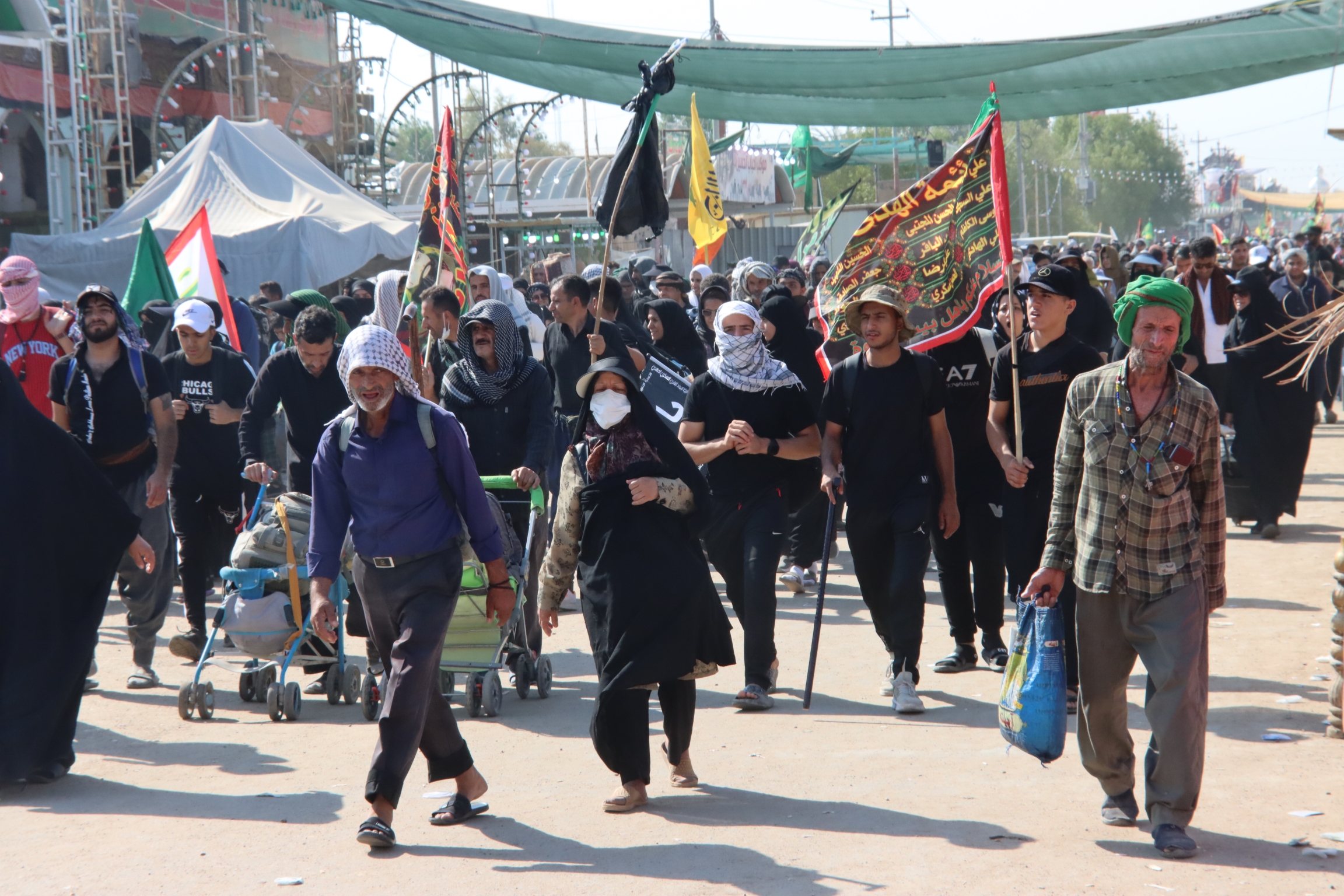
People on the Arbaeen walk on the road between the Iraqi cities of Najaf and Karbala, September 2023.
Sara Hassan/The World
Today, the walk can start from anywhere. But most people begin in the city of Najaf until they get to Karbala — nearly 50 miles away — where Husayn is buried.

Numbered markers along the road between Najaf and Karbala along the Arbaeen walk in Iraq.
Sara Hassan/The World
Along the Najaf-Karbala road, you can see just over a thousand markers, each about 160 feet apart, leading the way.
“The Arbaeen walk is not an obligation on Muslims, like the pilgrimage to Mecca [for the annual Hajj pilgrimage] is,” Sayed Mohammed Baqer Qazwini explained.
He’s living in Najaf right now, but is an assistant imam in Dearborn Heights, Michigan.
“However, the prophet's family highly recommended Muslims to visit Imam Husayn in Karbala after his martyrdom. They wanted to preserve his legacy because Imam Husayn represents justice, freedom. He rose to say no to the dictator of his time. He rose to say no to injustice.”
It’s this story of justice and sacrifice that inspires many people during Arbaeen. The walk was even banned during the time of Saddam Hussein, because people would use the occasion to assemble and challenge his government.
Imam Husayn’s sacrifice also inspires the many acts of charity and service throughout the walk.
In 2019, UNESCO declared the hospitality offered during Arbaeen an intangible cultural heritage of humanity.
One group, Imamia Medics International, has been traveling to Iraq for 15 years to give free medical and dental services.
Qasim Jaffry is a consultant urologist and one of the group’s directors. He’s been based in Ireland for more than two decades. He said that their 24-hour camps are available for those on the walk, as well as for local Iraqis.
“Some of them would be sick from before, and they may have forgotten their medication or this Arbaeen visit may have exacerbated their diseases, and some of them get sick while they're here,” he said.
Jaffry said that since their first year, they’ve treated about 750,000 patients. Their services include cardiology, internal medicine, dermatology, gynecology, urology, pain management and dental services.
Some local Iraqis even open up their homes to the visitors.
Shaykh Hassan al-Mas’udi is a local Iraqi tribe leader.
“Every year, I provide all of the services to welcome the pilgrims visiting Imam Husayn and provide hospitality in the form of food and drink, and also showers and bathrooms, and I also put out mattresses here for them to sleep on,” he said.
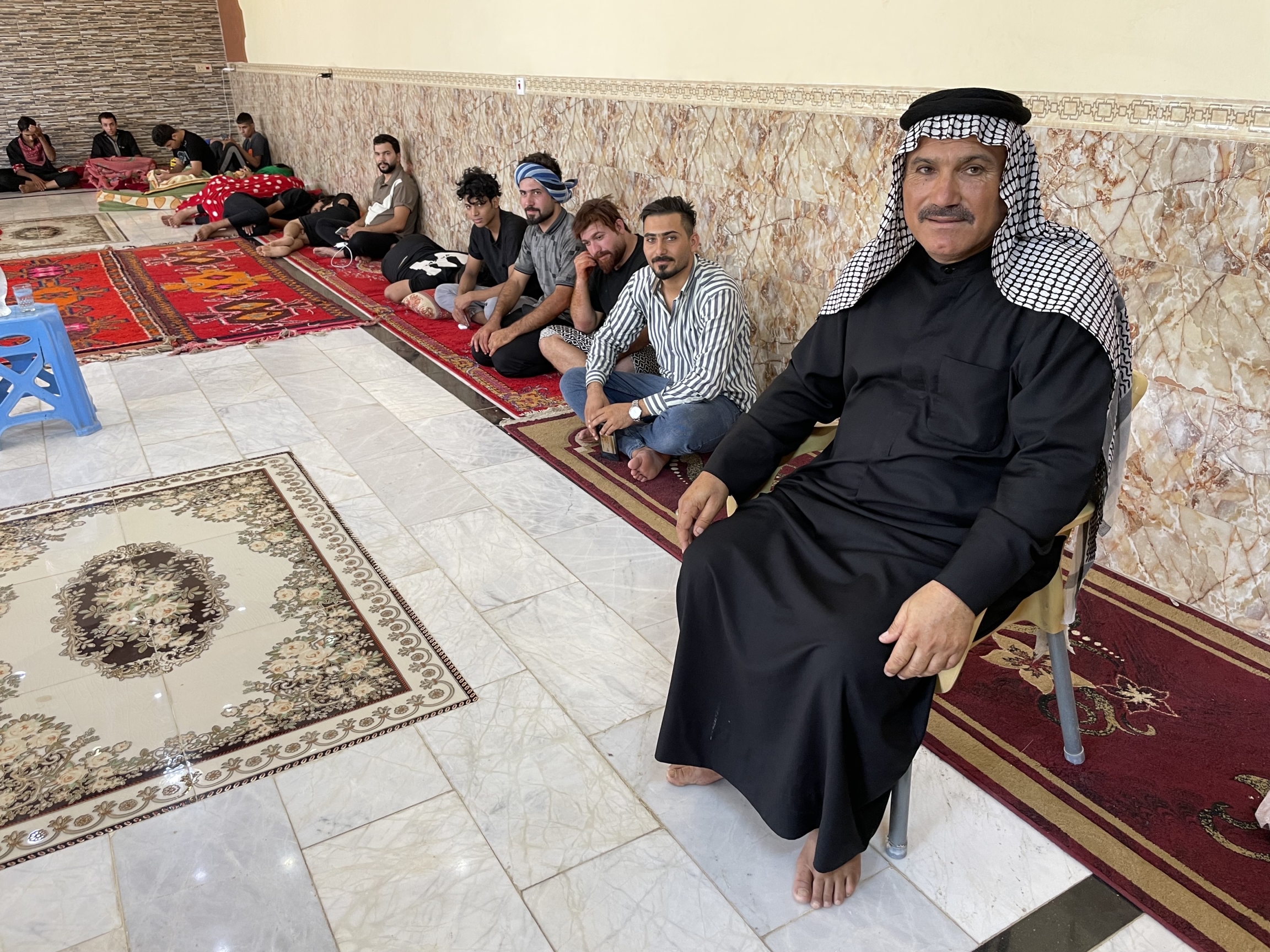
Local Iraqi tribe leader Shaykh Hassan al-Mas’udi opens his home to people on the Arbaeen walk to rest, shower and have home-cooked meals, September 2023.
Sara Hassan/The World
There are more than a thousand stations, or mawkibs, where people can rest.
Along the walk itself, everything is free. People set up and sponsor stalls along the walk that hand out water, meals and tea and provide various services.
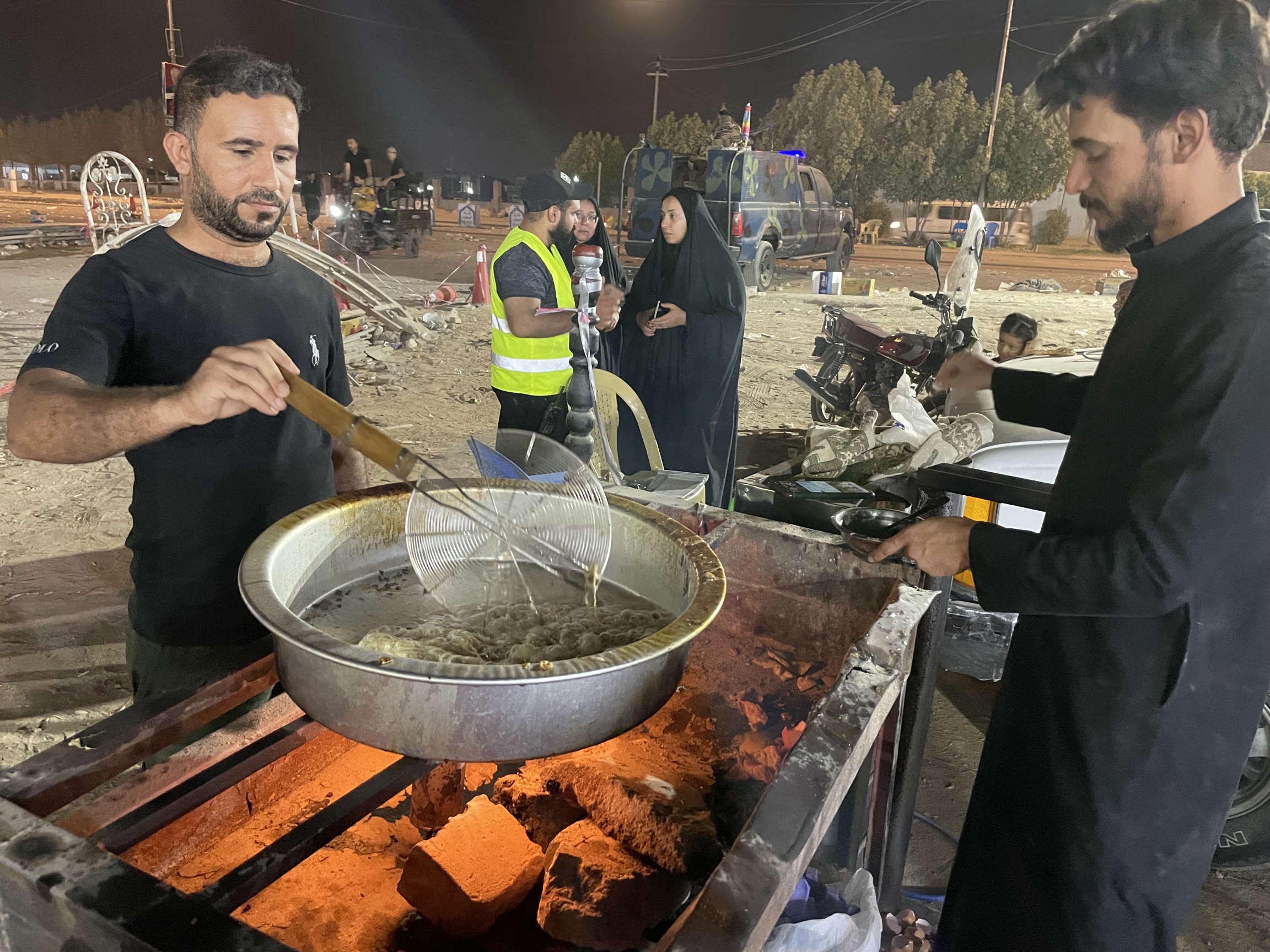
People make food to serve for free to those on the Arbaeen walk in Iraq, September 2023.
Sara Hassan/The World
One woman was even repairing people’s bags that had worn out during the walk.
There are also people offering free foot massages for those on the walk.
Zain Fatema Bhurani comes every year from India.
“Some people don't wear any shoes, and they are in so much pain,” she said. “So, we feel like they are getting some of the comfort and relief from our hands.”
They even have a physiotherapist on hand for more serious problems. Bhurani travels with other women. And they pay for their own flights to give free massages to people on the walk.
“Money never comes to our minds,” she added. “And the prayers which we get from the visitors is priceless.”
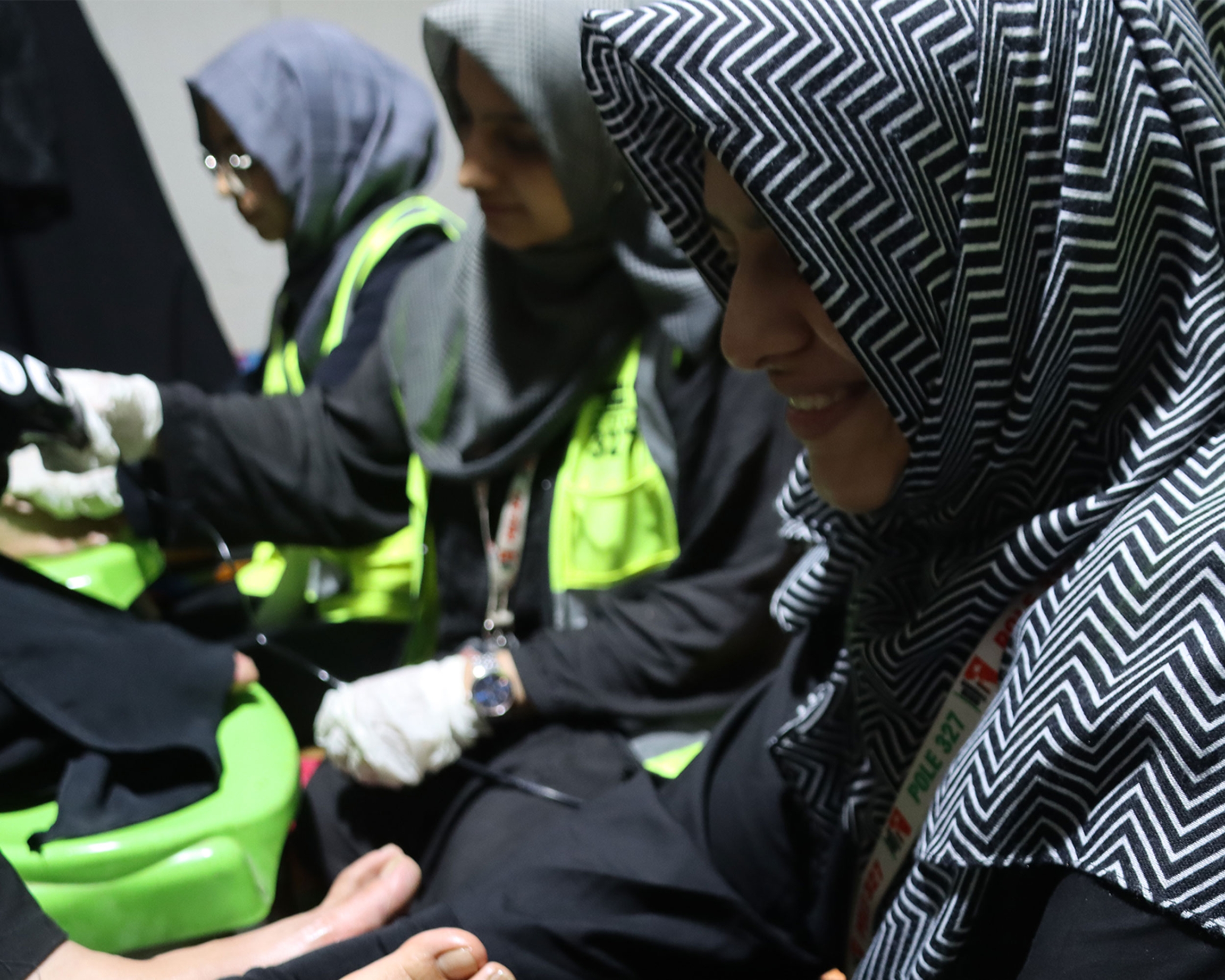
Women volunteers give free foot massages to those participating in the Arbaeen walk, September 2023.
Sara Hassan/The World
This year, the Iraqi government offered free visas for four new countries: Pakistan, Lebanon, Yemen and Afghanistan. It also includes Iran, but it’s not the first time for them.
The overwhelming majority of people who participate in the Arbaeen walk are Shia Muslims. But it is not limited to Shias or even Muslims. Some Sunnis participate and even Christians and Hindus have taken part.
Salil Abbas, who is part of a group that came from the UK, said he spoke with a group of Christians who walked last year. He asked them what they thought.
“And they said, ‘We've never seen people give things away the way that the lovers of this imam and this leader of yours are giving away. We have never seen selflessness of this kind anywhere. And it is an inspiration to see this.’”
That inspiration is what the people on the walk take back home with them afterward to continue serving others.
Related: Iraqi author Ghaith Abdul-Ahad on the 'unbuilding' of Baghdad
After the war in Ukraine started in February 2022, the global supply of Ukrainian and Russian wheat dried up, raising fears of a possible global food crisis.
At the time, the warring countries accounted for more than one quarter of global wheat exports.
Most of the wheat used in Senegal was imported from Russia.
Wheat, the second-most consumed cereal after rice, is an important staple in Senegal.
A good portion of that wheat went into making the hugely popular French baguette — Senegalese consume close to 10 million baguettes per day, according to Senegal’s National Association of Grain Importers.
But Western sanctions against Moscow have meant that wheat importers in the West African country have had to look to other sources for the grain, such as Poland, Lithuania and Argentina — and pay higher prices for it.
In light of the war and rising prices, the national government subsidized the price of wheat to keep the consumer price of baguettes stable.
Russian agricultural products are subject to sanctions exemptions. But in practice, sanctions have created additional levels of complexity for shipping and insurance companies to get the supply of grains out to the global market.
Sanctions have also made it more difficult to convert payments from dollars to rubles.
The Black Sea Grain Initiative, brokered in July 2022 by Turkey and the United Nations, allowed Ukrainian grain shipments to leave ports in the Black Sea and through the Bosphorus Strait in Turkey for countries around the world.
Recently, though, Russia scrapped the breakthrough deal. And Ukrainian sea and river ports and other key infrastructure have been targeted with drones and missile strikes.
Moving forward, there is a lot of uncertainty about whether the Black Sea Grain Initiative can be restored.
While Senegal has been able to resume most of the wheat imports coming from Russia, and prices are slowly returning to normal, the crisis has raised awareness about the risk of being 100% dependent on other countries for wheat.
In the video above, The World’s Tibisay Zea explains how the war in Ukraine is shaking up a big part of Senegal's food culture.
This summer, “Planet Hip Hop” took listeners around the world for a series of stories and conversations about hip-hop.
From India to Korea, Ecuador to Senegal, we heard from rappers, artists, activists and scholars about how a sound born out of the South Bronx in New York 50 years ago traveled far and wide and influenced new generations of hip-hop voices.
To wrap up “Planet Hip Hop,” H. Samy Alim returns to talk with host Marco Werman about current questions in hip-hop and also — its future.
Alim is an anthropology professor and the director of the Hip Hop Initiative at UCLA. He is also co-editor of the book, "Freedom Moves: Hip Hop Knowledges, Pedagogies, and Futures.”
This interview has been lightly edited and condensed for clarity and length.
Srey Touch Kroch stood over a large wok, frying pieces of chicken in hot, bubbling oil as she cooked a Cambodian dish called cha kreung satch moan for 40 people.
The second-year student at the Royal University of Phnom Penh is studying international business management, and it was her turn to make dinner for the women she shares a dorm with.

Srey Touch Kroch.
Anton L. Delgado/The World
The students’ housing and food are paid for by Harpswell, a US nonprofit that raises money from donors and also has staff in Cambodia. The program opened its first dorm there in 2006. Kroch and the other women say they are grateful to live in a residence hall and pursue a university degree.

Alongside Srey Touch Kroch, Leakhena Long prepares a chicken and basil leaves dinner as part of her weekly duties at the Harpswell Foundation’s dormitory. The 20-year-old is in her third year at the University of Health Sciences majoring in pharmaceutical science.
Anton L. Delgado/The World
Only about 20% of Cambodians complete the 12th grade, according to a 2021 report from Cambodia’s Ministry of Education, Youth and Sport. Overall, only around 10% of college-aged youths are enrolled in university.
Dorms are not common, and students generally live with families or rent an apartment. Without free housing, many of these students from poor rural areas would not be able to attend university in the capital.
“It would be another burden for my family because they would have to pay for my school tuition, my place to live and also for other financial support that I would need to ask for coming to Phnom Penh,” Kroch said.
Education in Cambodia was decimated during the Khmer Rouge’s rule in the 1970s, in which educated people were targeted. Following the genocide under the regime, public universities reopened and private institutions formed beginning in the 1990s. While Cambodia has built up its higher education offerings since then, the government puts less toward university funding than most other countries in Southeast Asia.

The Harpswell Foundation built its first dormitory for university women in Phnom Penh in 2006.
Anton L. Delgado/The World
Students from rural areas have a particularly hard time managing the costs. Farming incomes have become less sustainable for supporting families, and while public universities charge about $500 in tuition a year, that’s out of reach for most rural Cambodians.
There is little support from the government, and the portion of education funding going to universities fell by half after 1990. The government does offer scholarships for about 15% of enrolled students at public universities.
But the living stipends provided are not adequate, said Bunhorn Doeur, a PhD candidate studying education at the University of Southern Queensland in Australia. He knows firsthand how hard it is to live in Phnom Penh on a student’s budget.
“It's impossible for them to live in the capital city with that allowance. It's only about $10 to $20 a month,” he said. “There is no way that they can live depending on those funds at all.”
Student loans are not really an option in Cambodia. The country does not have a public student loan program, although the Education Ministry has said it plans to set one up by 2030. Interest rates charged by private banks are as high as 18%.

Srey Touch Kroch on the balcony of the Harpswell Foundation’s dormitory. With assistance from the foundation, the 20-year-old student is studying international business management at the Royal University of Phnom Penh.
Anton L. Delgado/The World
Plus, many families are already deeply in debt. The World Bank called Cambodia’s ratio of household debt to gross domestic product “exceptionally high,” more than three times the rate of countries such as Sri Lanka and Indonesia. The average microloan in 2020 was around $4,200, more than the annual income of 95% of Cambodians, according to a report from the human rights groups Licadho and Equitable Cambodia.
A lot of students from rural backgrounds have to find creative ways to get through university. For Sroem Khen, a child of farmers from Kampong Cham province, that meant becoming a monk at the age of 15, which is not particularly uncommon.
“One day, I decided that if I don't become a monk, maybe I cannot continue my education at that time, because our financial situation was not very good,” he said.

A student studies biochemistry in the Hall of Great Women in the Harpswell Foundation’s dormitory in Phnom Penh.
Anton L. Delgado/The World
Buddhism and education are deeply intertwined in Cambodia, and many pagodas in Phnom Penh house male university students from the provinces.
“We got a free place to stay. The pagoda I stayed at was very good because we were provided one room each and then two meals per day,” he said, adding that the pagoda gave him a lot of support.
Khen eventually graduated from university, left the monastery and now has a job with a corporate training company. But in his spare time, he runs a program working with students attending a Buddhist high school, preparing the next generation for college.
From Parisian pigeons to New York City rats, every city has its pesky wildlife creatures.
In London, it’s the city’s 10,000 urban foxes that have become both a malevolent menace and misunderstood mammal — it just depends on who you ask.
“One thing you can certainly say about the fox is it's an animal that's been persecuted its whole existence,” said professional wildlife photographer Matt Maran, co-author of the book "Fox: Neighbor. Villain. Icon."

A fox stands outside Southwark Crown Court in London, Wednesday, July 26, 2023.
Alberto Pezzali/AP
Maran said his fascination with London’s foxes stems at least in part because of the creature’s ability to adapt to its surroundings, even as other animals were phased out of the city.
“We used to have bears, wolves and lynx roaming these lands,” Maran said. “But somehow the fox has managed to survive all of that persecution.”
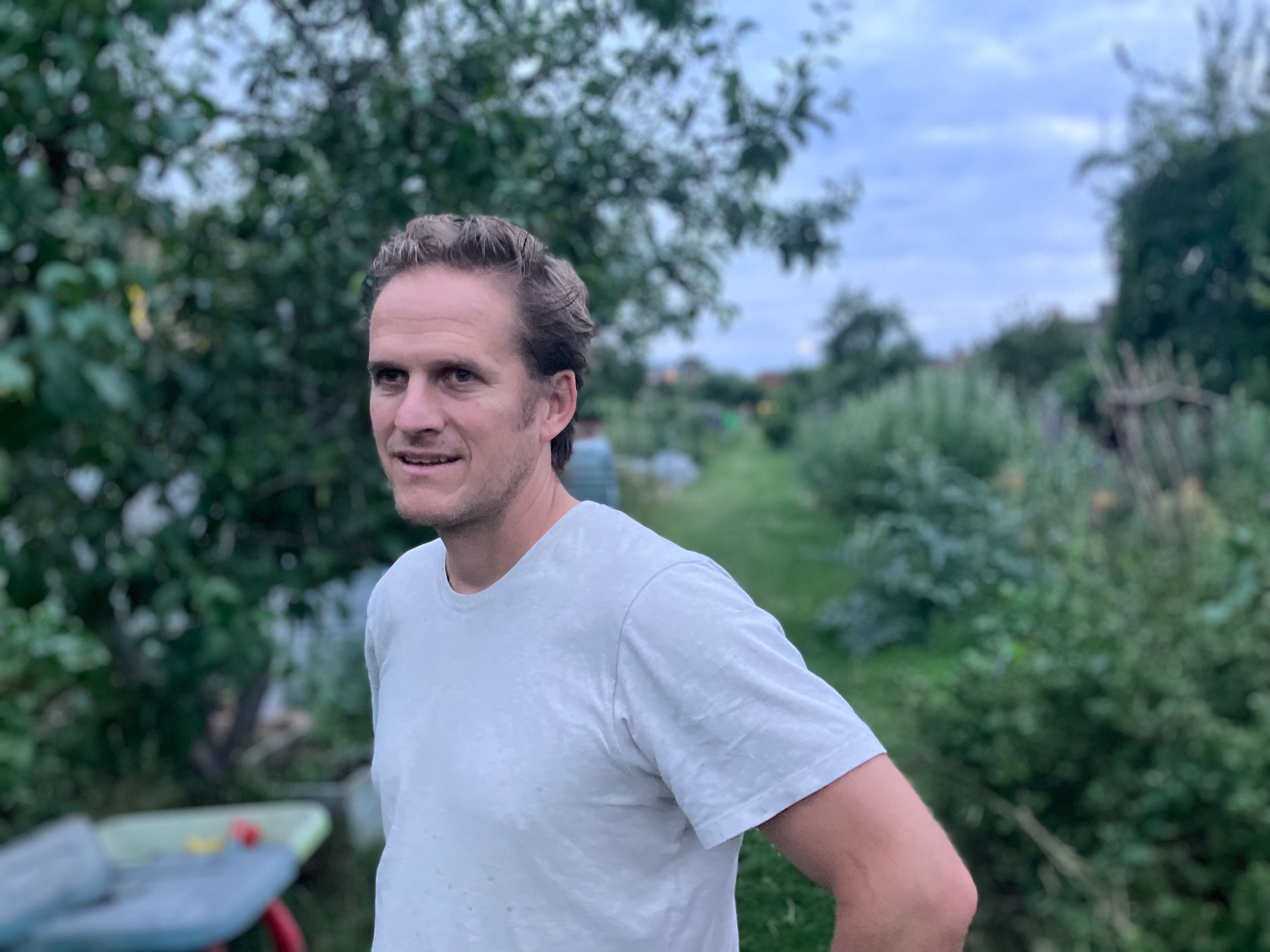
Wildlife photographer Matt Maran.
Rebecca Rosman/The World
For many Londoners, there’s less of a fascination and more of an irritation, especially as urban foxes become bolder, increasingly making their way into gardens and raiding trash bins.
“I think most people consider them perhaps a nuisance,” London resident Sara Johnson said. She regularly sees foxes rummaging around the garden of her home located just next to Hyde Park.
“[London] is not a natural habitat for foxes,” according to Eivand Johnson, her husband. “There’s so much food in the city that’s thrown out that foxes can live off of these provisions that are left from restaurants and even private homes.”
To which Maran said — can we blame them?
“Why would you blame an animal for going to get easy pickings?” he said, “They're really great survivors.”
These are what you call human problems, Maran said, not fox problems.
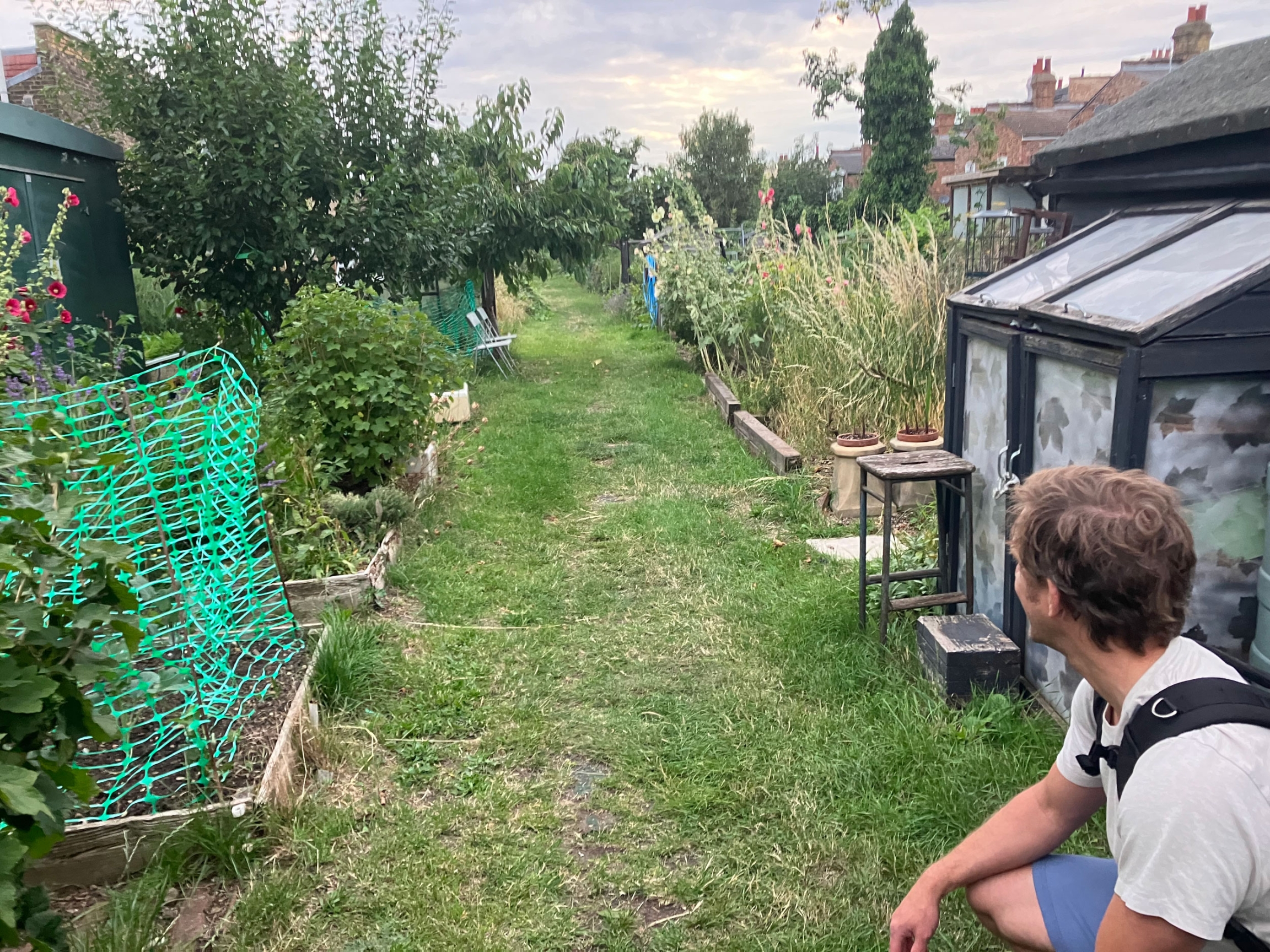
Wildlife photographer Matt Maran looks out for foxes.
Rebecca Rosman/The World
Maran points to other places where humans have found solutions to living with disruptive wildlife. For example, specially designed bear resistant trash cans used inside national parks in the US. Why doesn’t London have fox-proof bins, he said.
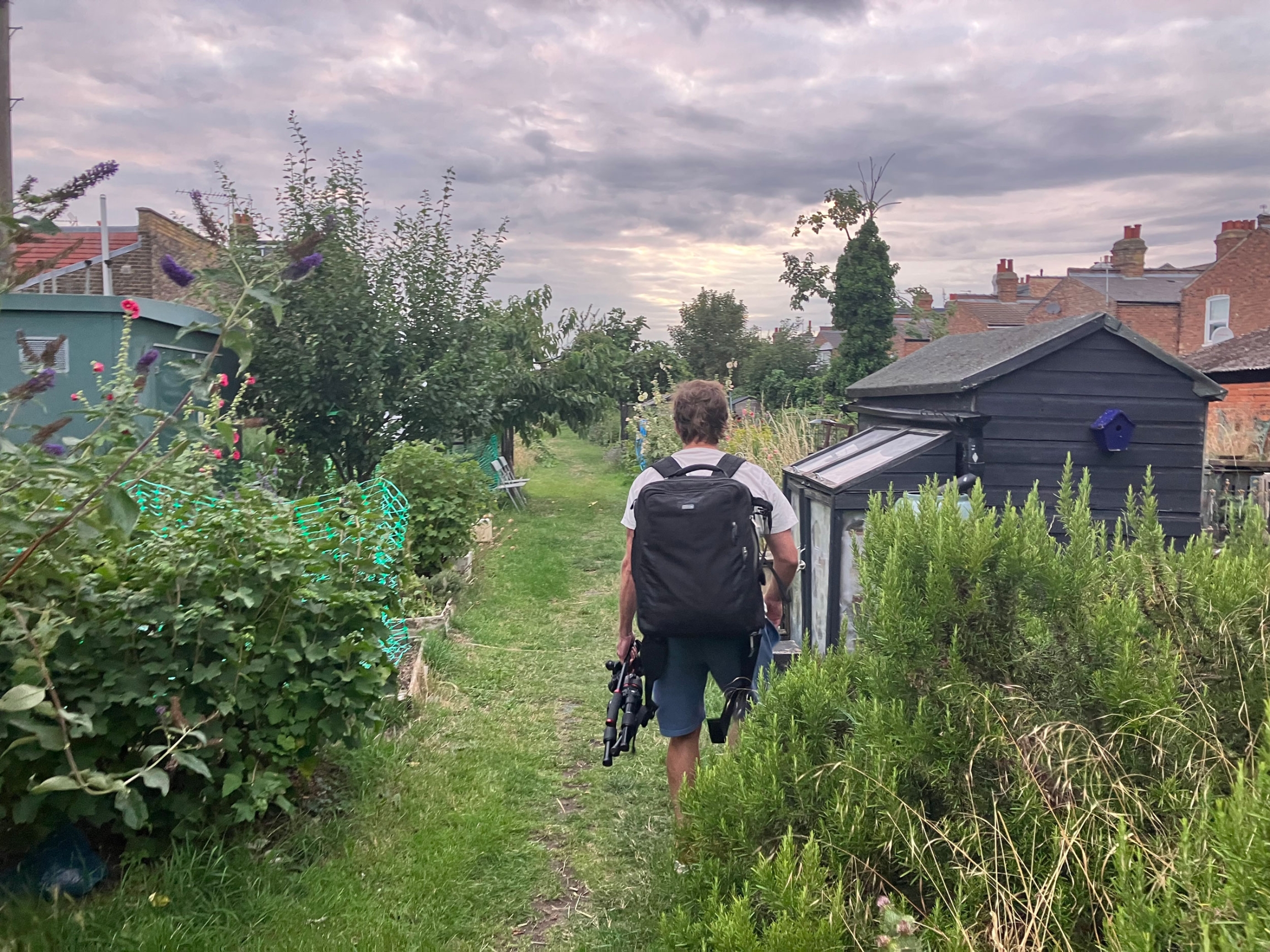
Wildlife photographer Matt Maran prepares to photograph a fox in his neighborhood community garden.
Rebecca Rosman/The World
After all, foxes have been a staple of the city’s landscape for decades.
“The whole thing with foxes is they've been prevalent in London since the 1930s,” said Trevor Williams, founder of the Fox Project, a charity that operates a wildlife ambulance service that treats more than a thousand foxes a year.
But when Williams launched the organization in 1991, it was because he felt there were too many misconceptions going around about foxes.
“I've always felt there was a need for an organization, an information bureau really on foxes, and that's what I wanted to establish,” he said.
There are some points Williams wants to make straight: Foxes are generally not a threat to humans or domestic animals such as cats or dogs. They haven’t carried rabies in the UK since 1902. The fox population in London isn’t growing — it’s actually gone down since its peak in the mid-'90s.
And those wailing screeching sounds that they sometimes make at night? They can be annoying, but they’re generally just mating calls or a simple fox conversation.
“It's those kind of misconceptions which blow up and they get worse by urban myth,” Williams said.
“Everybody gets more and more frightened because we love being frightened in England.”
Hannah Hirschsprung Lange, who is finishing her fourth and final semester studying bioengineering at Aarhus University in Jutland, Denmark, receives about $800 each month in financial support from the Danish government.
“It means I don’t have to work too much besides school,” Hirschsprung Lange said. “It helps with paying the rent and food, and then, you don’t have to think too much about it.”
And like most Danes, she will graduate owing nothing. That’s because in Denmark — as in at least a dozen European countries — tuition at public universities and most colleges is free, and students are paid to go to school as if it’s a job.
The Danish grant system, known as the Statens Uddannelsesstøtte, or SU for short, is available for students for up to six years. The amount of money a student receives depends on how much they earn working on the side. In the case of illness or pregnancy, students can apply for extra financial help.

Hannah Hirschsrpung Lange poses for a photo outside the Royal Danish Library at Aarhus University in Jutland, Denmark, on June 20, 2023. Hirschsprung Lange, who studies bioengineering, receives about $800 each month in financial support from the Danish government.
Joshua Coe/The World
With student debt repayments back on the horizon for college graduates in the US, Hirschsrpung Lange said that the American higher education system seems broken because of “the fact that you have to go into so much student debt.”
Still, many Danish students like Hirschsprung Lange work part time to earn extra spending money for things like vacations and clothes. And some students do take out government loans, but they aren’t always used for school.
For Astrid Skifter Madsen, a first-year chemical engineering master’s student at Aarhus University, a loan enabled her to go to Asia recently.
“I needed a long summer holiday to Thailand, Vietnam and Cambodia,” she explained. “So, I needed some money to cover that.”
Madsen said that she’s not worried about being able to finish her studies and paying back the loan.
The Danish government subsidizes student loans with a low interest rate, and she’ll have up to 15 years to pay it off.
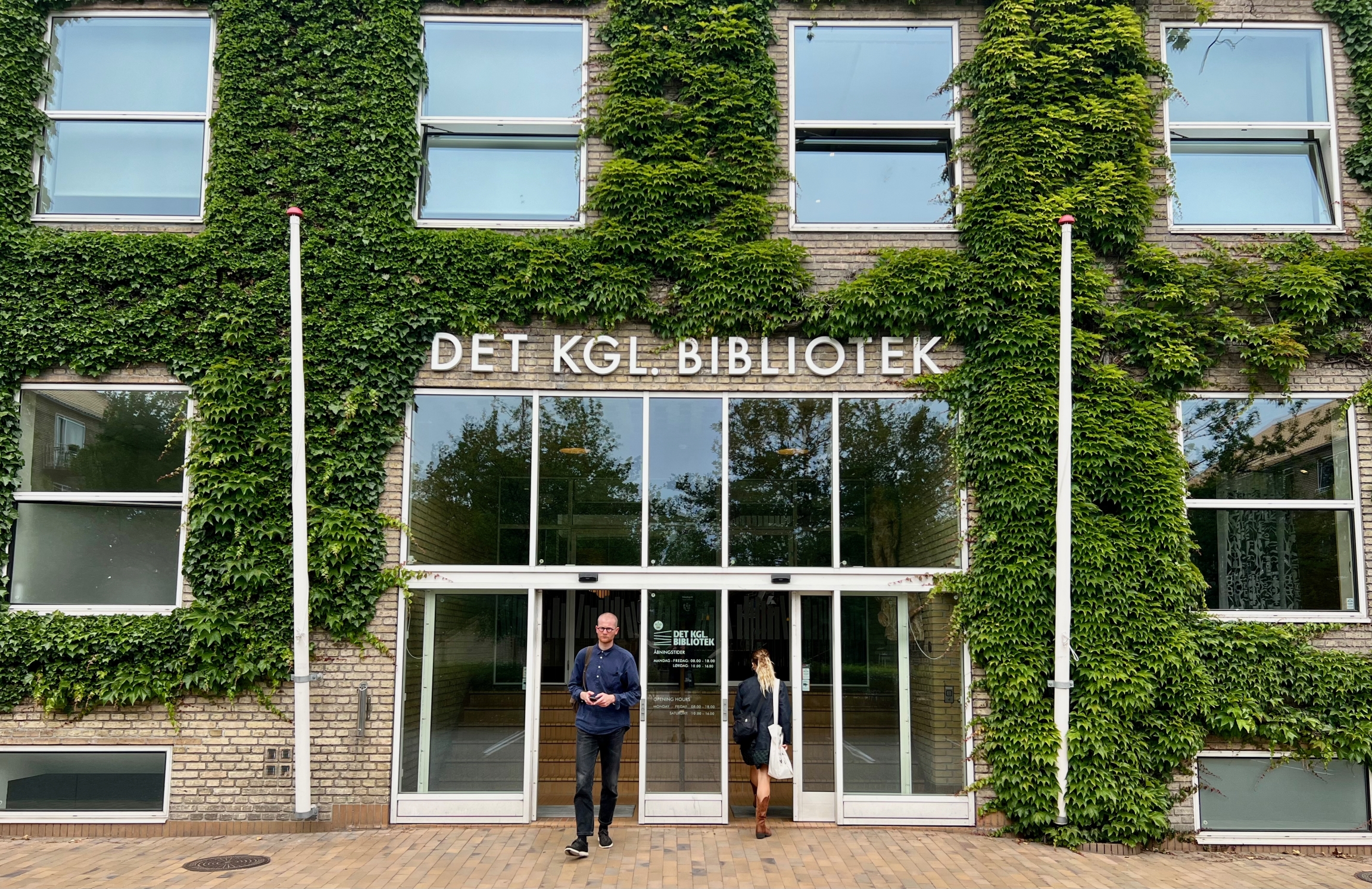
The entrance of the Royal Danish Library on the campus of Aarhus University in Aarhus, Denmark, on June 20, 2023.
Joshua Coe/The World
Many Danes say that the generous subsidies and the free tuition is money well-spent.
“I mean, in the end, in a sense, you pay it back later,” said physics student Tobias Washeim, 22, who’s finished his third year of his bachelor’s degree at Aarhus University. “And I think it takes the stress off being a student.”
Danes do end up paying for the free education and the SU system through the country’s steep taxes that can carve out over 50% of one’s income. (It’s a progressive tax system, so the more you earn, the more you pay.) But polling in the country has shown satisfaction with the high taxes, which not only contribute to free education, but also free health care and pensions.
“You might pay less taxes and you get a higher income in the US, but I don’t really mind paying [those] high taxes,” Washeim added.
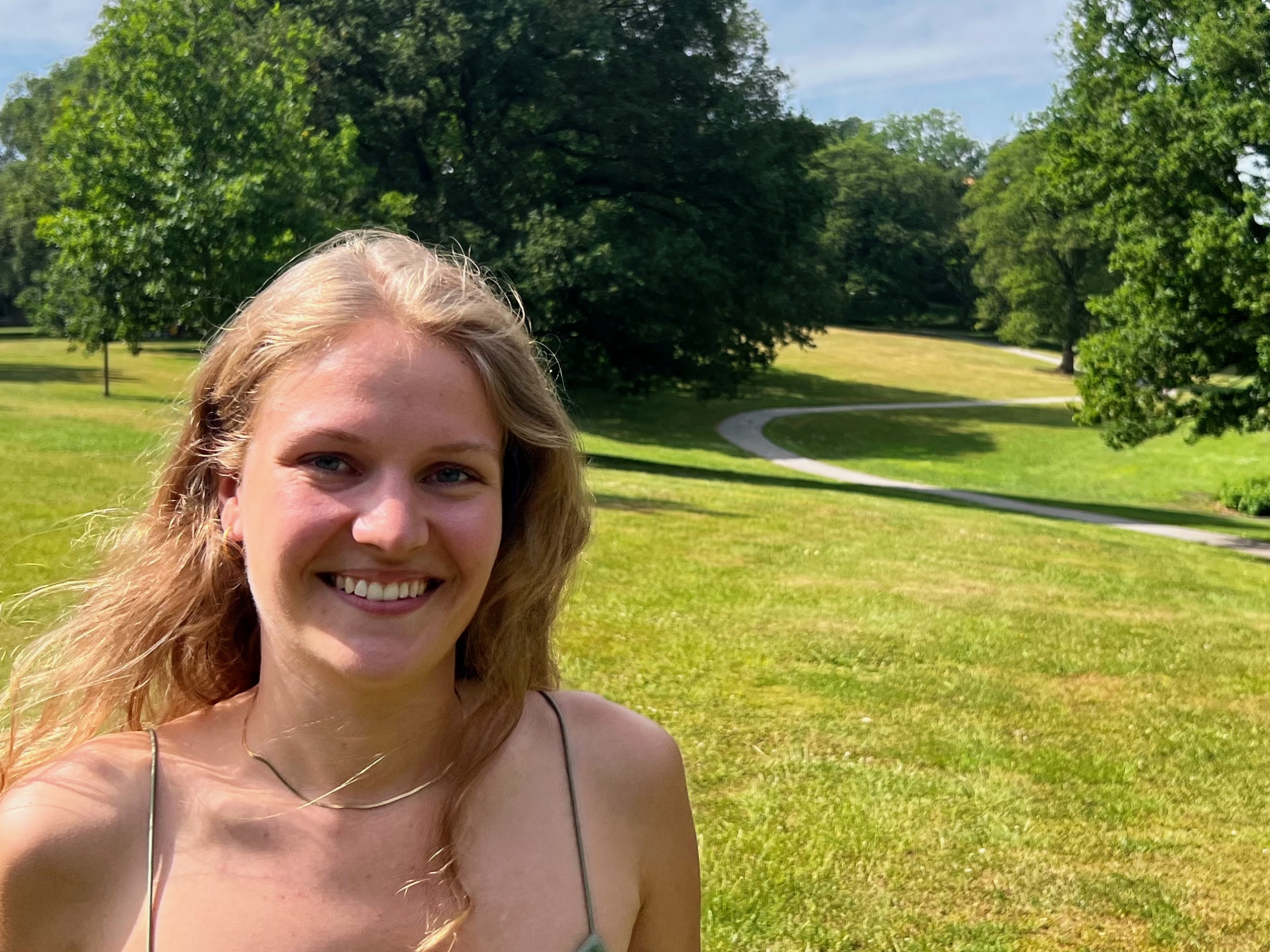
Astrid Skifter Madsen, 24, poses for a photo in the University Park, a public park in the center of the Aarhus University campus, on June 20, 2023. Madsen studies chemical engineering at the university.
Joshua Coe/The World
The SU system came about 50 years ago at a time when the country of just 6 million decided to prioritize a well-educated population, explained Philipp Schröder, who teaches economics and business at Aarhus University.
“It's a small open economy [that] has virtually no raw materials here apart from brains,” Schröder said. “And so, that is a political agenda that has always been baked-in for changing governments [in Denmark]. So, education is for free.”
The idea was, in part, to make higher education an option for anyone in Denmark, regardless of their socioeconomic status, explained Fane Groes, an associate professor at Copenhagen Business School.
Before that, the SU system saw many students stuck with heavy loan burdens and high interest rates. But despite the goal of leveling the playing field for all Danes, Groes said, it hasn’t exactly worked out that way: “We know that it is the more-educated children and the richer children who actually go to college or university.”
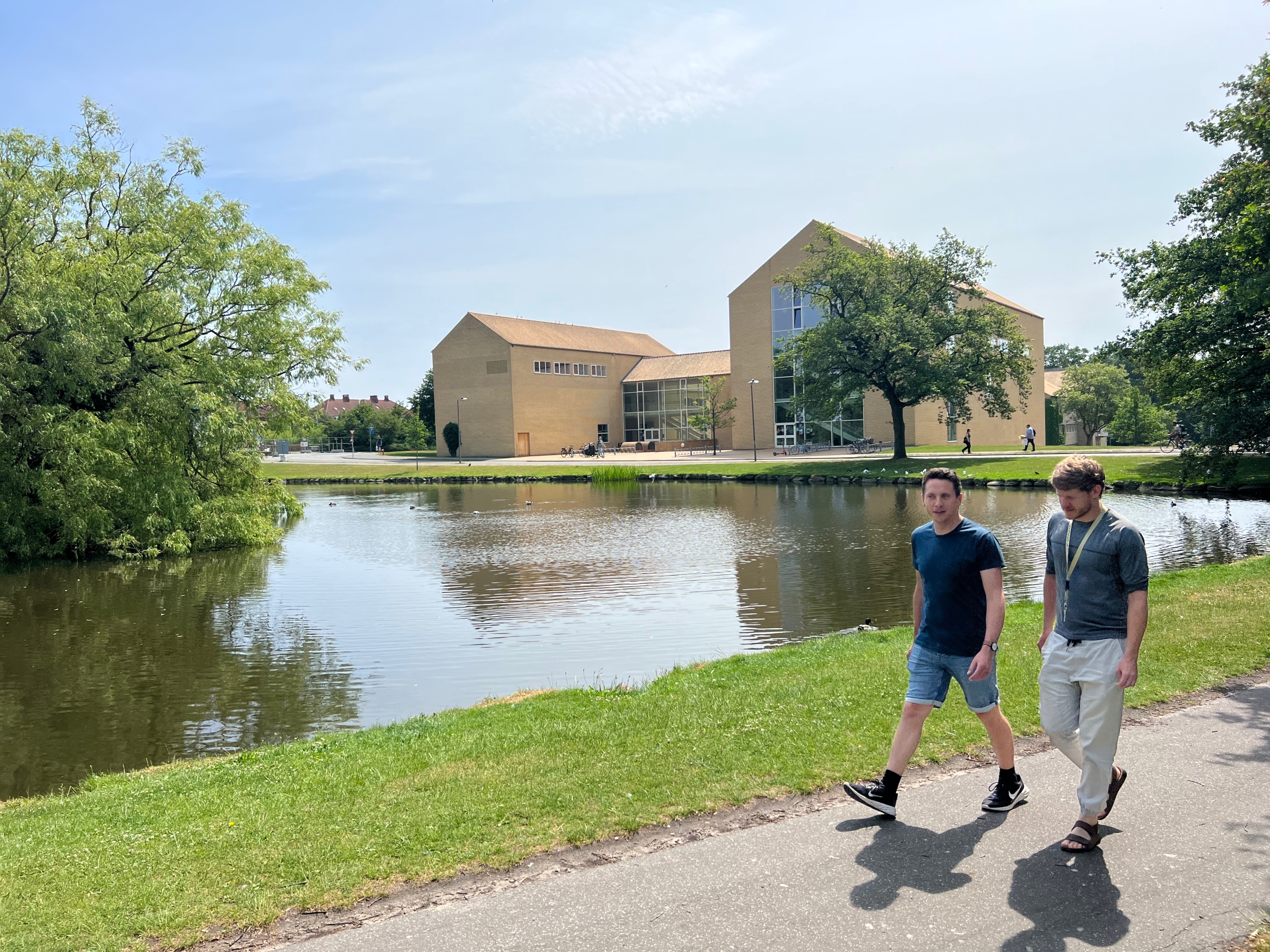
Pedestrians walk along one of the two lakes in the middle of the University Park, a public park in the center of the Aarhus University campus, in Aarhus, Denmark, on June 20, 2023.
Joshua Coe/The World
A 2021 study showed that for Danes born in 1987, the social heritage of education attainment is at the same level as in the US. And while the SU costs Denmark a little more than 1% of the gross national product, there are grumblings inside and outside of the government about the system. For one, because Denmark is part of the European Union, it has to offer SU grants to students from other EU countries.
Politicians have argued that this mandate has seen little returns, with a minority of internationals staying in Denmark after graduating. And, they say that too many students take too long to get through school and don’t go into fields that the country needs.
“If you allocate resources and talent mass sensibly in an economy, you don't want that to happen — that people train for something that no one in the job market wants,” said Schröder, who sat on a government commission tasked with suggesting higher education reforms. “Then, they have to settle for lower-skilled jobs where they can't use the investments they have taken.”
Earlier this summer, the government made some of the biggest reforms to higher education, controversially shortening or restructuring the length of a third of the country's 500 master’s programs from two-year degrees to one year and three months.
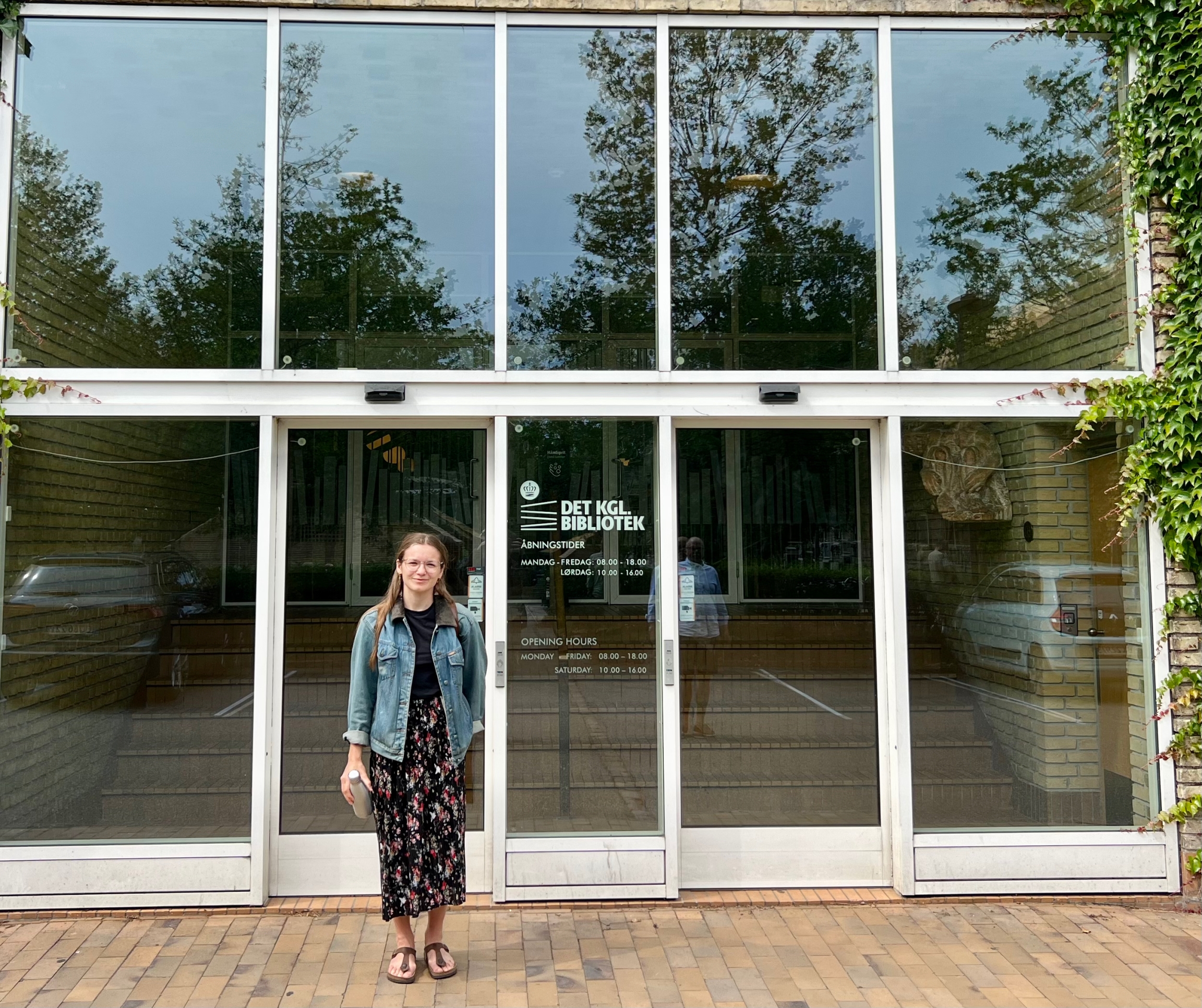
Hannah Hirschsrpung Lange poses for a photo outside the Royal Danish Library at Aarhus University in Jutland, Denmark, on June 20, 2023. Hirschsprung Lange, who studies bioengineering, receives about $800 each month in financial support from the Danish government.
Joshua Coe/The World
The government said it will reallocate the funds to training for nursing, teaching and social work — fields that have recently experienced staff shortages in Denmark. But there was no government proposal to get rid of free tuition for undergraduates. Nor did they touch payments that go to students.
The move is expected to mainly impact master’s degrees in the humanities and social sciences.
Sigrid Strunge Vetter, who recently completed a psychology degree at Aarhus, said she couldn't imagine jamming two years of study into one year and three months.
“I have a two-year master’s degree, and I still feel like I’m having massive gaps and there’s lots of knowledge I haven’t gathered,” she said. “So, how they want to be able to cut that down to half, I simply can’t fathom.”
Overall, Strunge Vetter said that she is not against reforms, though. She said it’s good for the state to regulate higher education to correspond with market needs to keep unemployment rates down.
But she doesn’t want the government to chip away at the right of every Dane to get a higher education.
“It ensures that everybody, independently of their financial and socio-economic background can attend whatever studies they want to attend,” which she hopes will be the case for generations of Danes to come.
A violent gang in Haiti opened fire on Saturday on protesters organized by a church leader close to Port-au-Prince, the country’s capital. At least seven people were killed, and others were wounded and kidnapped.
Marcorel Zidor, known as Pastor Marco, had been urging hundreds of his followers to confront a street gang that controls a swath of a suburb called Canaan, which he said had attacked many of his parishioners.
The gang, known as 5 Seconds, has got a reputation for random killings, kidnappings and extortion. Just last week, gang leaders said they wanted to shut down the only road connecting the capital to the country’s north.
On Saturday, he organized a protest against the gang, and hundreds of religious faithful attended his call. The group, wearing matching yellow shirts, marched from the Caradeux neighborhood, where their church is located, toward Canaan. Some carried wooden sticks or machetes.
Graphic videos shared on social media show protesters being shot at, bodies in the streets and people who appear to be taken hostage.
“The gangs fired on them with their M-16s and M4 and M14. It was a real massacre,” said Henry-Louis Mars, executive director of Lakou Lapè, a peace institute based in Port-au-Prince.
Mars said it’s unclear why the pastor led his followers into such a dangerous situation.
“I think it's to attract attention, to show off that he can mobilize people. So, he might have political ambitions, he wants national attention.”
Mars said other Protestant pastors have called for demonstrations recently, but they have not done what Pastor Marco did, by confronting gang members in the street.
Speaking to the news media, protester Francois Vicner said he saw Pastor Marco leading the demonstration.
“The pastor assured his followers that they were bulletproof,” he said.
In an interview on local radio on Monday, Pastor Marco confirmed this. He said that 95% of his parishioners survived because they had faith, and those who were killed did not have faith.
Rosy Ducenat, program manager of the National Human Rights Defense Network in Haiti, said the national police were aware of this protest and they didn’t stop it.
“The pastor publicly announced that he was going to take the members of his church to Canaan to fight the gangs. This is actually incitement to violence, and the police should have prevented the victims from going to Canaan.”
In a press conference on Monday, Police Chief Frantz Elbe said that they did what they could to prevent the protest, but that the people were determined to go.
Haiti has been grappling with violent gangs since the assassination of President Jovenel Moïse in 2021.
Mars said to build peace in Haiti, the smuggling of guns from the US into Haiti must stop.
“If there's no longer any guns coming in, and ammunition coming in, then you would have these guys more willing to negotiate.”
The government of Kenya proposed to lead a multinational effort to bring order to Haiti, including 1,000 security forces. The Bahamas have offered to send 150 police officers, too.
But Haitians have mixed feelings about that.
Ducenat said it’s a bad idea: “Reinforcing the police and the impunity and the bad governance would be much more helpful. But of course, most of the population seems to believe that the international military will help them because of a lack of confidence they have in the police institution today.”
Earlier this month, the United States said that it would present a resolution to the UN Security Council, authorizing the intervention of security forces from Kenya.
Toni Merino’s downtown deli in Barcelona, Spain, has been around for over a century, offering expensive cheese, Iberian ham and wine.
Sales were way off this year, he said. He has noticed an uptick in visitors lately, but he said that many come in just to check out its ornate interior — and take selfies. With hardwood shelves and marble countertops, the place is something of a bygone era.
This deli is over 100 years old and draws tourists for its ornate interior reminiscent of the bygone days.
Credit:
Gerry Hadden/The World
Spain’s on the rebound with tourism after huge losses during the pandemic. Those who work in the tourism business are relieved. But visitors are back with a vengeance and they’re not always well-behaved — irking locals who miss the quieter days of confinement.
One day, Merino said he came out of the storeroom and saw a few men setting up a tripod in the middle of the store. They were speaking English, he said, and filming. Then, they just left.
“It was becoming a zoo,” he said. “They weren't even saying hello.”
Merino, fed up, a few months back, went into his office and wrote up a little sign. It's still there, taped to the glass door: "Just looking," it reads, "€5 per person."
A sign in the window of an iconic gourmet deli in downtown Barcelona has been dissuading tourists from coming in just to snap selfies.
Credit:
Gerry Hadden/The World
“We've never had to charge anyone,” Merino said, but tourists got the message.
“No one's taking selfies anymore,” he said. “Our clients are really grateful they don't have to wait for the tourists to leave just to come in.”
Like nearly everyone in Barcelona, Merino's not against tourists. He said he is just against too many of them and their sometimes less-than-civil behavior.
This summer, a crowd of tens of thousands of revelers cheered on a drunken tourist in his underwear. It was shown on Spanish TV, with the guy standing in a public fountain swinging a street sign over his head.
This graffiti is on a lot of walls in Gracia and other parts of Barcelona. Most residents aren’t this radical, but it does reflect a growing frustration with the unbridled partying as tourist numbers rise.
Credit:
Gerry Hadden/The World
For better or worse, tourism in Spain is back. The country is on track to receive more than 83 million tourists this year. That was the record set just before the pandemic. It's nearly twice Spain's population.
It's bringing moments of mayhem, but it's also putting a lot of money in people's pockets, from apartment renters to cab drivers to owners of tourist drinking holes.
One place where visitors drop lots of dough is along Barcelona's famous downtown esplanade, Las Ramblas.
This summer, it has three times the officially allowed number of outdoor restaurant seats. Owners are willing to risk the fines, and it's clear why. At a tourist spot where everyone’s drinking sangria, a large glass is a whopping $22.
The Las Ramblas is tourist-central, but aided by online “top 10” listicles, festive foreigners are making their way into neighborhoods way off the beaten path.
On a Barcelona hilltop known as the Bunkers, police come in daily to kick out the mostly young partiers.
Tourists flock to the Bunkers for the views but their presence has overwhelmed local residents.
Credit:
Gerry Hadden/The World
During the Spanish Civil War, there was an anti-aircraft battery up here. Now, it's a city park and the place to go for sunset selfies, attracting people from all over the world.
The park never used to close at all. Today, police lock the high iron gate the city has installed around it.
The Bunkers park sits atop a hill behind the city and offers amazing views. The city has had to build an iron fence around the park so that young partiers don’t come up here at night, bothering residents. It hasn’t worked.
Credit:
Gerry Hadden/The World
"I wish I knew that they're closing early,” Canadian tourist Rala Liu said. “They should update their hours on Google Maps or something, so at least people know to come early.”
Yet, local residents said the measure has not made much of a difference.
"As soon as the police leave, they'll be back," said neighbor Nati Mesa, who was out walking her dog, Simba.
"They party up there all night,” she said, adding that the neighborhood bus is full of tourists.
“We actually live up here." she said. “Sometimes, I can't even get home."
Fencing off popular spots is just one way the city is trying to rein in the party. It's also banned organized pub crawls in the old city. Police dole out fines for indecent behavior.
No city can control its number of visitors, but there is an attempt to spread the tourists around to take the pressure off overrun areas.
On a recent day at the new Gabriel Garcia Marquez library in the San Marti neighborhood, it’s crowded — but mainly with locals.
Librarian Maemi Pons said she's thrilled.
"Even if, at times, it gets a little noisy … we need to call for quiet,” she said, “but mostly, people here behave well.”
The city chose the site for the library some 20 minutes from downtown in a working-class neighborhood far from the tourism circuit — for now, at least.
Barcelona's new neighborhood library, named after Colombian writer Gabriel Garcia Marquez, has seen a boost in visitors after winning the World’s Best New Library of the Year 2023 from the International Federation of Libraries.
Credit:
Gerry Hadden/The World
The wood-and-glass building just won an award for the best new public library in the world.
If it makes the listicles, the selfie mobs might just make the trek out here.
Like Merino’s overrun downtown deli, it may have to get creative to protect the residents who come here to actually use it.
When Crimea is mentioned in the news, it’s often in the context of war — Russia has occupied Ukraine’s Crimean peninsula since 2014.
But when Ukrainians hear the word Crimea, they often think of it as a bastion of culture and music.
Susana Alimivna Jamaladinova, known simply as “Jamala,” is one of Ukraine’s most famous singers. She won the Eurovision song contest in 2016.
Jamala, an Indigenous Crimean Tatar, often talks about how her heritage shapes her music.
“My whole family are musicians,” Jamala told The World. “My mom, she is a piano teacher. My father, he is an accordion player and he's a really good folk singer. He sings Crimean Tatar songs.”
One song that Jamala said exudes strong emotions is “Bizim Taraf,” or “My Side” in English, a Crimean folk classic passed down by her paternal grandmother.
Growing up, Jamala said she was encouraged to listen to all musical genres, from jazz to opera and folk to rock.
And then she started to write her own music.
Jamala recently released an album called “Qirim,” or “Crimea.” It includes more than 80 musicians, a double symphony orchestra and folk musicians who created a total of 14 ancient Crimean Tatar songs.
“It's like a diary,” she said, of various Crimean characters in folk history.
In one song, "Alim," listeners learn about a famous Crimean akin to a 17th-century Robinhood who fought for the rights of poor people.
“The belief in his strength was huge,” Jamala said.
Jamala drew inspiration from film composers such as Hans Zimmerman and Ramin Djawadi to create a “soundtrack” for Crimea that was cinematic in scope.
“Because, you know, the ‘Game of Thrones,’ they built seven kingdoms with different melodies, and we feel it in the music. Oh, my God. It was a real inspiration for me,” she said.
Another song on the album, “Yosmam,” tells a heartbreaking story passed down by her great-grandmother about a village girl waiting by a window for her boyfriend — who never arrives.
“Nowadays, it sounds [like,] ‘OK, whatever. I'll find another one.’ But at that time, it was a huge tragedy. ‘You [crushed] my heart,’ and we feel it at the end of the song,” Jamala explained.
The album was nearly completed, Jamala said, when Russia’s full-scale invasion of Ukraine started in February of 2022. They had to stop working on it while Kyiv was under attack.
During this time, Jamala said she had a dream to include new sounds at the end of the album that acknowledged the atrocities that occurred in Bucha and Mariupol.
“Russians can steal our territory nowadays, but they can’t steal our identity, our songs,” Jamala said.
“I want to say to the whole world that we exist. And for me, it's important to give a voice to my homeland, Crimea.”
Jamala's songs in the order they appear in the segment:
Alena Popova is a Russian opposition politician who has organized scores of political campaigns. She has also run for office multiple times.
But the political process in Russia is at a low point today, she said.
“Everything changed because of the war, everything is worse.”
These days, Popova is a politician in exile in the United States with the Wilson Center in Washington. Popova said that political repression in Russia has accelerated since Russia’s invasion of Ukraine.
“We have dictatorship in Russia, it’s not a democracy, it’s dictatorship, and in dictatorship, you don’t have any elections. But you have this will of the people, to change something, and you need not to let the people think that they are just slaves, or the official authorities can take any power over them.”
Popova understands that elections today in Russia are often staged. But she still encourages her former constituents to go to the ballot box.
“Despite all the things that are happening in my own country, even if you don’t like any candidate, you need to vote, even against everyone.”
This kind of “protest vote” strategy is also being deployed by the organization led by Alexei Navalny, an opposition politician who is currently a political prisoner.
Despite his imprisonment, he and his team are still communicating with their supporters.
Earlier this week, Navalny’s team posted a video encouraging his supporters to vote for anyone aside from Vladimir Putin’s United Russia.
András Tóth-Czifra, a fellow with the Eurasia program of the Foreign Policy Research Institute, said that strategy has worked in the past, but Russia these days is much more repressive.
Most independent candidates are barred from running, and certain election processes have changed.
“Online voting, I would say, is a kind of silver bullet which can be used to change electoral outcomes.”
In previous years, election monitoring organizations have alleged that e-votes were, in fact, falsified and used to swing elections in favor of United Russia.
But now, even speaking about these kinds of irregularities could be risky.
“You know, any civil or political activist right now in Russia understands that he’s under risk,” said Stanislav Andreichuk, the co-chair of Golos, an independent Russian election monitoring group.
Just last week, Russian authorities arrested one of Andreichuk’s colleagues, Grigory Melkonyants.
Grigory Melkonyants, co-chair of Russia's leading election organization, is escorted from a courtroom after a session in Moscow, Russia, Aug. 18, 2023. A Moscow judge has formally arrested and detained Melkonyants, one of the leaders of a prominent independent election monitoring group on charges of being involved with an "undesirable" organization. Melkonyants faces up to six years in prison and will appear in a Moscow court.
Credit:
Alexander Zemlianichenko/AP
Andreichuk said this is the type of political intimidation that’s become common in Russia.
“When you have such kind of censorship, it is very uncomfortable to talk, even with your friends and your neighbors and so on, because you are not sure that they will have the same position.”
Russian political scientist, Alexander Kynev, said that despite the war making all the headlines on state TV, it’s been downplayed in the election cycle.
“People are trying to live like they did in the past, and not pay attention to the war,” he said.
From the Kremlin’s perspective though, Kynev said that these regional elections are all about Putin’s presidential reelection bid next year.
The presidential election campaign has already begun, and that’s the vote that really matters, he added. The Kremlin will use next year’s elections as a sign of the population’s support for the war in Ukraine.
Opposition politician Popova said even though it’s obvious who Russia’s next president will be, “all the dictatorships, anytime will end the same way. All the dictatorships will be ruined by themselves.”
And that’s why voting, and building strong democratic instincts is so important, she added. Once this regime implodes, Russian citizens need to be ready.
Diana Luz Vasquez became an activist for mothers’ rights in Mexico after trying, for years, to get child support for her 6-year-old daughter, Sabina.
Vasquez’s former partner left her when she was two months pregnant and didn’t recognize their daughter, Sabina. He owes Vasquez more than $20,000 in child support payments, she said.
“I’ve heard the same stories from my mother, grandmother, and some of my aunts, because in Mexico, it’s easy to impregnate someone and abandon them without any major financial or moral consequences,” Vasquez said.
Vasquez has been through a complicated and expensive process to hold Sabina’s father accountable. She even had to pay for a DNA test that cost her the equivalent of two months of her salary.
“It’s a very exhausting process, and many women just quit because they don’t have resources, or simply because they get tired of fighting without achieving results,” Vasquez said.
Last year, she came up with a different idea: She organized a protest where single mothers hung the picture of the debtors in a clothes line at a public plaza in the city of Oaxaca, in the southwest of the country. They called it “Tendedero de Deudores,” or “Debtors Clothes Line.” Dozens of women showed up and it got a lot of media attention.
Diana Luz Vasquez, activist for mother’s rights in Mexico and main proponent of the bill, "Ley Sabina."
Credit:
Frente Nacional de Mujeres Contra Deudores Alimentarios Facebook page
“In a corrupt country where machismo is so strong, people are more afraid of shame than justice,” Vasquez said.
The protest was so popular that it was replicated across Mexico, and soon turned into a social movement demanding better policies to hold child-support debtors accountable.
They have been pushing for a bill called “Ley Sabina,” named after Vasquez’s daughter, which prevents child support debtors in Mexico from running for public offices, driving, or leaving the country. The bill was finally approved in March, and the government is now committed to creating a public registry of debtors.
Vasquez said that this is a good first step, but a lot more needs to be done to help mothers navigate the process and make sure they receive payments on time.
Children in Latin American countries are far more likely to live in lone-mother families than in any other region, according to the United Nations.
In Colombia, about a quarter of single mothers get child support. In Guatemala, it’s only 14%.
Women at a protest to help single mothers in Mexico get child support.
Credit:
Frente Nacional de Mujeres Contra Deudores Alimentarios Facebook page
“In these countries, there is less accountability, and there is a lot of work that needs to be done for single mothers to be able to receive any child support,” said Laura Cuesta, a researcher with Rutgers University who’s been studying child support policies in Latin America.
It’s usually the mothers who must find out about the system, fill out applications, attend appointments and collect evidence, including about their ex-partners who many times would prefer not to participate or collaborate, Cuesta said, “and that is a burden. And that means that people have to spend resources that many times they don’t have.”
Cuesta’s research found that child support plays a significant role in preventing single-parent families in Latin America from being economically insecure.
Women rally for a bill in Mexico to help single mothers get child support.
Credit:
Frente Nacional de Mujeres Contra Deudores Alimentarios Facebook page
In the US, there is a similar approach, but according to Cuesta, the process tends to be quicker and less expensive, and there is more policy enforcement.
In many European countries, it’s the government that pays mothers directly and then charges debtors.
“These European countries see children as a public good, and then, the question is not whether the father is paying child support or not. The question is what this child needs to not live in poverty,” Cuesta said.
Several Latin American countries are interested in this policy.
In Chile, the Ministry for Women started a registry of child support debtors last year. Those on this list aren't allowed to issue or renew passports or drivers licenses. In Argentina, where there’s a similar registry, debtors also can’t get tickets for soccer games.
There are 100,000 people on the registry of debtors in Chile, and 97% of them are men, according to Chilean Minister for Women Advancement Antonia Orellana.
“It's a gender issue and it has to do a lot with patriarchal values across the region,” she said.
Chilean Minister for Women Antonia Orellana
Credit:
Wikimedia page
Orellana mentioned a popular song called “Papito Corazon,” by Chilean folk group Los Picantes. Papito Corazón is described as a handsome guy who has multiple girlfriends and kids and doesn’t pay for child support.
“Many Chileans see this song as funny, but it’s definitely not,” Orellana said.
Her office is trying to change that mentality. They are launching new campaigns to educate women, especially poor mothers, on how to register the debtors on the list and why it is important to do so.
The creation of these registries is a first step, but the problem of forcing the debtors to pay still persists, Vasquez said.
The activists behind Ley Sabina are planning protests in the United States, for fathers who migrate north and don’t send money to their children in Latin America.
A day after a private jet dropped out of the sky north of Moscow, reportedly killing all onboard, including apparently Wagner mercenary group leader Yevgeny Prigozhin, many questions remain.
Russian President Vladimir Putin on Thursday offered condolences to the families of the dead. He praised Prigozhin as a talented businessman. He went on to say that the mercenary chief made serious mistakes in his life, but he "got results for himself and for the common cause when I asked him."
A telegram channel linked to Prigozhin's Wagner Group said that his death is "the result of actions committed by traitors to Russia."
To discuss the incident and what it means, The World's host Marco Werman spoke with Kimberly Marten, who has studied the Wagner Group and testified about it on Capitol Hill. She is a professor at Barnard College, Columbia University.
Marco Werman: Kimberly, what do yesterday’s events tell you about Putin’s grip on power?Kimberly Marten: He is strengthening his grip on power. He took his revenge slowly, most likely, but he used that time productively to ensure that the mutineers were located on Belarusian territory far away from Russia's borders but close enough to monitor and control, and also probably to renegotiate the contracts in Syria and in several African countries where Wagner's groups are on the ground playing a very important role for Russian foreign policy and security interests in those countries. So, he always takes his revenge a little bit after the events actually happened. And I would guess he used these two months very productively.So, who were the other people onboard that plane yesterday?One of them is listed as being Dmitry Utkin, who was the original military founder of the Wagner Group back in 2014. But other people had indicated that there were rumors that he was actually killed a long time ago. And then probably the most important other person who was on the list as being killed is a man named [Valeriy] Chekalov. He was listed as being head of security, but he was also the person listed as being the manager of Prigozhin's private business firm located in Syria. It is likely that the troops in Syria that had been working for the Wagner Group have now been moved either over to work for the Russian defense ministry directly or else for a different group similar to Wagner called Redut that is affiliated with a different Russian oligarch named Gennady Timchenko, who is actually much closer to Putin than Prigozhin ever was.Let me ask you, Kimberly, was this crash essentially a decapitation of the Wagner group as we know it?Sure. It looks like the kind of revenge that Putin would take. And, you know, it's not clear exactly what's going to happen next. But these forces could probably continue their activities in Africa under local commanders or the local commanders, if they did not wish to cooperate with the Russian state any more, could be pretty easily replaced by other people.What can we say then about rivalries in the groups of officials who surround Putin?So, I think the rivalries that we're going to see are probably coming from other groups that are somewhat like Wagner. And the one that everybody has been talking about is called Redut, which means redoubt. It has mostly been on the ground in Syria providing security to oil and gas facilities. It also had a role in 2022. It one of the first groups that went into Ukraine alongside the regular Russian military forces. It did not do very well there. It doesn't really have a lot of combat experience. So, it probably would have a difficult time taking over Wagner's combat roles. There are a variety of other companies. One is called Patriot. There are some others that could potentially play a role, but we're not sure what's going to happen there. The big question in Moscow is how the Russian military thinks about Prigozhin and Prigozhin's death. We do know that the former head of the Russian air force and space forces was removed from duty. He has not been seen since the mutiny back in late June.That would be General Sergey Surovikin and also nicknamed "General Armageddon."Yes, Prigozhin had identified him as the person who was his go-between with the defense ministry. And we don't know how deeply inside the Russian military support for Prigozhin went. And so the one thing to keep an eye on is whether there is any kind of instability within the Russian military over this. But what we have seen is that particular groups inside the Duma, the Russian legislature, have apparently been celebrating the death of Prigozhin. And so, in terms of the politicians that are close to Putin, there's probably not going to be any instability whatsoever.How many private military groups are there like Wagner in Russia? And is the reported death of Prigozhin going to open, kind of, the floodgates for more of these mercenary groups to emerge?That wouldn't be surprising if that happens. As far as we know, there are somewhere maybe between 10 and 15 of these groups. They haven't exactly been counted. They have a tendency to change their names, and new ones are appearing all the time. So, for example, the Russian state has been apparently calling for private oligarchs in Russia to put forward their own new groups to go fight in Ukraine. We know that Gazprom, the Russian big natural gas monopoly, has created three of these new groups just in the last several months, which are apparently cooperating with Redut in their training for going to deploy in Ukraine. We know that the Russian space agency has created a group. We know that Ramzan Kadyrov, who is the warlord in the Russian region of Chechnya and a very strong Putin supporter, he has created groups to go fight in Ukraine. And so, it would not be the least bit surprising if we now see a plethora of these groups just emerging to try to fill the space that Prigozhin formerly occupied. But I think it would also not be surprising to see that various Wagner formations continue to be Wagner just under new commanders.Yevgeny Prigozhin was famous for publicly calling out Russian military leaders as ineffective, especially in the war in Ukraine. And he questioned the rationale for the war and said the rank-and-file soldiers were being exploited. What happens to that message now?I think that message probably disappears. What Putin has done immediately after the Prigozhin mutiny — the leader of the group of strong Russian militaristic nationalists, Igor Girkin, was imprisoned and that sort of shut off one set of strongly pro-war but anti-how-the-war-was-being-fought group that was loud in addition to Prigozhin and anybody who has expressed any dissent about the war itself has immediately been shut down.So, Kimberly, if this is indeed the end of Yevgeny Prigozhin, what do you think it all means for Russia's war in Ukraine?I'm not sure it has any direct impact on Russia's war in Ukraine. Wagner troops, per se, had not been in Ukraine since early May. So, it certainly has no direct impact on the fighting. The big question is what all of this will mean for Russian military morale. And again, that comes back to the question of how much support Prigozhin actually had within the military, whether the ordinary rank-and-file soldiers saw him as a hero.So, what does this change then about Putin's hold on power?I think it strengthens Putin's hold on power because he has demonstrated that he does not allow people who have betrayed him to get away unscathed. The one thing it does also, though, is to demonstrate that Putin is not trustworthy or reliable because it appeared that he had a deal with Prigozhin and it appears that that deal now ended. And so it would, I think, make people think twice about reaching any kind of an agreement with Putin in the future.Kimberly, what are the other shoes left to drop? What are you going to be paying most attention to now?I think what we should pay most attention to is exactly what happens to the leadership of these groups that were associated with Wagner that are in foreign countries and then what happens in Belarus. We have reports already that there was a Russian military airplane that landed in Belarus last night and that there has been some activity around a Belarus camp in the middle of the country today. And I suspect that there will be some effort by the Russian regime to ensure that those Wagner fighters in Belarus, who were primarily prisoners, who were given freedom in return for fighting in Bakhmut in Ukraine by Prigozhin last year, and who therefore may see Prigozhin as being a hero, that those people are controlled. They do not have heavy weapons, as far as we know. Their heavy weapons were taken away after the mutiny. And so, they don't appear to be posing much of a threat. But I would guess the Russian military is paying very close attention to them.This interview has been lightly edited and condensed for clarity.
Related: Wagner mutiny leads to questions about Russia’s military leadership
On a recent evening, a small crowd of locals in Bishkek, the capital of Kyrgyzstan, gathered in the offices of Esimde, a research organization that focuses on modern history, to take in a documentary and lecture about a bloody uprising in the country that occurred in August 1916.
That summer, Russian authorities forces in Kyrgyzstan and Kazakhstan, which were then part of the Russian Empire, announced a draft to enlist Central Asians to support Russia in World War I. The Russians killed thousands who resisted, and scholars estimate that at least 100,000 more people died trying to flee to nearby China, although some estimates put the total number of dead at more than triple that.
The shores of Issyk-Kul, a sprawling lake surrounded by snow-capped mountains in northern Kyrgyzstan, are an idyllic summer vacation spot. But in summer 1916, when the region was part of the Russian empire, the villages near the lake witnessed a uprising against Russian authorities where thousands died.
Credit:
Levi Bridges/The World
Most of the victims died while crossing over the snowy mountains that separate Kyrgyzstan from China. The tragedy became known by the Kyrgyz word urkun, which is often translated as “exodus,” but one Kyrgyz scholar said it means something closer to panicked animals running away from danger.
More than a century later, historians and locals say it is still complicated to talk about the episode, in part because of pressure from Russia to downplay Russia’s role in the tragedy. But every summer, groups like Esimde strive to commemorate the tragedy.
Even in the summer months, many of Kyrgyzstan's towering mountains remain covered with snow and glaciers. Experts believe that at least 100,000 people died in the mountains trying to escape the Russians during the 1916 uprising.
Credit:
Levi Bridges/The World
“Our government can’t openly recognize the Urkun, but ordinary people and independent organizations like ours really want people to know about what happened,” said Gulzat Alagoz Kyzy, a researcher with Esimde who helped organize the documentary screening.
Although the Urkun occurred several generations ago, the memories of what people endured have been passed down through generations surviving as an oral history.
“My family fled up toward the mountains, stopping during the day to hide in bushes,” said Anvar Nanshanlo, an ethnic Dungan man from the regional city of Karakol.
Nanshanlo’s grandmother was just 8 years old during the uprising. After Russians entered her village and started burning down houses, she and her family fled to the nearby mountains that separate Kyrgyzstan from China.
Anvar Nanshanlo of Karakol, Kyrgyzstan, heard the story about the Urkun from other family members. Nanshanlo's grandmother, who was just 8 years old during the 1916 uprising, fled over the nearby mountains to China in order to escape the Russians.
Credit:
Levi Bridges/The World
But the journey over the mountains was no easy feat. Even in summer, snow cover and frozen glaciers remain in the mountains of Kyrgyzstan.
“People would cut out steps in the ice with knives and axes, put one foot forward and then start cutting the next step,” Nanshanlo said as he described the slow journey his relatives took through the mountains to China.
Many Kyrgyz didn’t survive the harsh conditions.
Decades later, one man who visited the mountains where it is estimated that hundreds of thousands people fled during the 1916 uprising described finding a river with banks still “covered in human bones.”
Asel Daniyarova, a Kyrgyz historian, and her husband, Vladimir Schwartz, said that they found documents in Russian archives, which they said suggest that Russia intentionally used the uprising to displace the local population through violence to make way for Russian settlers.
Not all historians share this interpretation of the events, but many agree that Russia tried to control the historical narrative about the Urkun starting during the Soviet period.
“In Soviet times, there was almost no information in school textbooks about the Urkun,” Daniyarova said.
But after the Soviet Union fell, Kyrgyzstan became an independent country and Indigenous peoples, not Russians, had a chance to write their version of history.
Myratbek Imankulov, head of social studies and humanities at the Kyrgyz Academy of Education, wrote a history book for high school students published in 2006, which includes a detailed section about the Urkun.
Myratbek Imankulov stands with a history book that he wrote for Kyrgyz highschool students that includes detailed descriptions about the Urkun. Imankulov came under fire from Russians who accused him of falsifying history.
Credit:
Levi Bridges/The World
After the book came out, some Russian academics accused Imankulov of falsifying history. He was even threatened with legal action for spreading propaganda.
“They wanted to silence me so other historians would stop their work,” Imankulov said.
Despite the pressures against him, Imankulov’s book is still in print. But other Kyrgyz who have chosen to tackle the subject of the Urkun have faced some form of censorship.
A 2016, Hollywood-style movie about the Urkun (also titled “Ukrun”) produced by Kyrgyz filmmakers faced significant delays before gaining government approval to show the film in Kyrgyzstan.
Later, one of the producers told the local press that the authorities asked them to change some parts of the film before its release, presumably so as to not sour relations with Russia.
The mountains separating Kyrgyzstan from China are treacherous and awe-inspiring.
Credit:
Levi Bridges/The World
Imankulov said the scale of carnage carried out by Russia during the Urkun is comparable to the slaughter of civilians last year in the Ukrainian city of Bucha.
“These are crimes against humanity and even though the two events are separated by more than 100 years, they are essentially the same,” Imankulov said.
But acknowledging Russia’s responsibility for crimes committed recently in Ukraine, or last century, is difficult in countries that maintain close ties with Russia. Central Asian countries still greatly depend on Russia economically and their leaders have refrained from outwardly condemning Russia’s actions in Ukraine.
Still, some Kyrgyz are determined to make sure that Russia’s influence in their countries as a colonial power is not forgotten.
“Up until now, there is a wound, and we have to bring the truth, otherwise it will never be healed,” Daniyarova said.
Huge replicas of 50 of Nicaragua’s most-important cathedrals and churches stand tall along the waterfront in Managua, Nicaragua’s capital.
Local officials said the statues, constructed eight years ago, were President Daniel Ortega’s idea. He wanted to honor the country’s most-important religious institutions, and in particular, the Catholic Church.
Church replicas line this walkway along the waterfront in Managua, Nicaragua.
Credit:
Michael Fox/The World
But Ortega and the church are no longer on good terms.
Last week, a judge ordered the seizure of the Central American University, one of the country’s most-important Jesuit institutions. It’s the latest in an ongoing government crackdown on the Catholic Church and church-affiliated institutions inside Nicaragua. But why is the Nicaraguan government at war with the church?
In 2018, the school opened its doors to protesters who were demonstrating against Ortega. The judge ruled that the university had acted as a center of terrorism, “creating lies and elevating levels of violence and destruction."
The announcement of the seizure dropped like a bombshell. The university repudiated the claims. Former and current students denounced the move in videos online.
Demonstrators protest outside the Jesuit-run Universidad Centroamericana, UCA, demanding the university's allocation of its share of 6% of the national budget in Managua, Nicaragua, Aug. 2, 2018. The Jesuits announced on Aug. 16, 2023, that Nicaragua's government has confiscated the UCA, one of the region's most highly regarded colleges.
Credit:
Arnulfo Franco/AP/File
In neighboring Costa Rica, exiled former students protested in front of the Nicaraguan Embassy.
"The regime continues to fear that the students will develop,” one of them told the US government news outlet Voice of America. “It doesn’t want them to have their own thoughts and to continue their right to study freely and in democracy.”
But students interviewed by Nicaraguan state media said it wasn’t a bad thing.
"It’s an important change for the student population and for the university population in Nicaragua,” student Sugey Lopez said. "They are going to have greater access to their studies and be able to better adapt to their financial situation."
The Nicaraguan government hasn’t closed the doors. The Catholic university has been transformed into a state institution — the Casimiro Sotelo Montenegro National University — named after a student martyr from the 1960s.
"We are announcing that this university will be free for all, in order to guarantee education and the future of the country’s youth,” said Ramona Rodriguez, the president of the country’s national university, during a ceremony opening the new school late last week.
In recent years, the government has also seized more than two dozen private universities and transformed them into public institutions. The government says it is democratizing education. The opposition sees it otherwise.
“They are afraid that the students will organize at the universities,” said former student leader Edgar Blanco in a video posted online. "That’s why they don’t want to leave any private universities untouched.”
Blanco, who now lives in Costa Rica, once led student protests against Ortega in 2018, when widespread street protests rippled across the country.
Demonstrators protest outside the Jesuit run Universidad Centroamericana, UCA, demanding the university's allocation of its share of 6% of the national budget, in Managua, Nicaragua, Aug. 2, 2018.
Credit:
Arnulfo Franco/AP
They began as demonstrations against austerity measures and pension reform. State forces cracked down, attacking protesters, which fueled dissent even further. Many were killed, including students. Some protesters were peaceful. Many were not. They threatened and attacked local residents. They called for Ortega to step down.
The clergy said they were standing with the people.
“The murdering president and his wife need to get out,” a priest told a rally outside the Central American University, the school that has now been shut down. "Get out you miserable assassins. Get out. Get out. Get out.”
In this Sept. 5, 2018, file photo, Nicaragua's President Daniel Ortega and his wife and Vice President Rosario Murillo, lead a rally in Managua, Nicaragua.
Credit:
Alfredo Zuniga/File/AP
Ortega accused the Catholic Church of fueling the violence, backing the protests and pushing for a coup against his government. Many in Nicaragua say church officials did go too far.
"I've done interviews of people who are victims of opposition violence in Juigalpa, in Nueva Guinea and in Rio San Juan, in San Carlos. And in every case, they said that the church was used as a logistics base for the gangs that were operating the roadblocks, preventing people going about their business, extorting money from businesspeople and local farmers trying to move their produce to market through the roadblocks,” said Stephen Sefton, who’s lived in Nicaragua for 30 years and runs the local media collective, Tortilla con Sal.
A video, which surfaced in July 2018, allegedly shows residents of the city of Diriamba protesting against a church, which they discovered had been housing weapons to be used by opposition forces against them.
Since 2018, relations between Ortega and the Vatican have continued to deteriorate.
Ortega has called the Catholic Church "the perfect dictatorship.”
“Who elects the priests? Who elects the bishops? The cardinals? How many votes do they get?” he told state TV.
He broke off diplomatic relations with the Vatican in March. Earlier this year, the pope called Ortega a dictator.
The government has also banned Easter week processions, clergy have been jailed and top church officials have fled the country.
Bishop Cesar Bosco Vivas Robelo, left, Cardinal Leopoldo Brenes, center, and Bishop Rolando Alvarez, pray at the end of the third day of the national dialogue in Managua, Nicaragua, May 21, 2018. President Daniel Ortega initially asked the Catholic Church to play a role as a mediator as political tensions rose, but the first round of dialogue didn’t last long. After priests sheltered demonstrators inside their parishes and expressed concern about excessive use of force, Ortega targeted them as “terrorists” who backed opposition efforts to undermine or overthrow him.
Credit:
Alfredo Zuniga/File/AP
But every Sunday, most Nicaraguans still attend church.
Leon Cathedral is one of the most famous in Nicaragua.
Credit:
Michael Fox/The World
In a recent poll, 82.6% of Nicaraguans said there is freedom of religion in their country.
Ortega has said that he’s religious, too.
"I am a revolutionary, because of Christ,” he told a crowd earlier this year. “The interior strength that I have had over these years to survive, I owe to Christ."
A woman takes part in a reenactment of the Stations of the Cross during the Lenten season at the Metropolitan Cathedral in Managua, Nicaragua, March 17, 2023. Amid tensions between the Vatican and the Daniel Ortega government, Catholics staged the devotional commemoration of Jesus Christ's last day on Earth in the gardens of the Cathedral due to the police ban on celebrating religious festivities on the streets.
Credit:
Inti Ocon/AP
In other words, the conflict is between president Ortega and the Catholic Church itself — not the religion.
This is where issues of education, religion and politics intersect. And in a country as polarized as Nicaragua, there are no easy answers.
But everyone can agree that the closure of the Central American University is only the latest battleground in the fight between Ortega and the Catholic Church.
And the conflict is far from over.
Paul Moposita wore a bright blue Adidas tracksuit, a white hat and shades as he led Mugre Sur’s rehearsal at El Pan Óptico, an alternative art and music space in Quito, Ecuador.
The group is known for its deeply political songs, but also for its sense of humor; they perform wearing costumes of clowns and bunnies.
Credit:
Gisele Regatão/The World
Moposita, 47, the leader of the group and its only original member, started with “Cleptocratas.” It's a song about corrupt politicians that very much reflects the situation in Ecuador today. Earlier this year, Congress wanted to impeach President Guillermo Lasso over accusations of embezzlement. So he dissolved the National Assembly.
Moposita says that’s nothing new.
“We haven’t had stability since forever. My parents suffered with financial reforms that led to inflation, my grandparents suffered with strikes all the time, I am suffering the same,” he said. “And that's why we have to change, we have to raise our voice, right?”
In the ephemeral world of pop music, Mugre Sur has been going strong for more than 20 years. The group is known for its deeply political songs but also for its sense of humor. They perform wearing costumes of clowns and bunnies. They are tackling Ecuador’s political turmoil in their upcoming album “Sudamericamente.”
Paul Moposita (wearing blue tracksuit), his daughter Sisa and some of the members of Mugre Sur, a band he started more than 20 years ago.
Credit:
Vera Haller/The World
“South American mind or nicely sweating,” Moposita said, explaining the double meaning of the word.
The sweat is a reference to migrants all over the world.
“Our cousins, our aunts, our families have migrated to be a little better off. And now we receive our Venezuelan brothers who also migrate to be better off in another country,” he said. “I believe that migration is part of humanity.”
Moposita was first exposed to hip-hop thanks to his family’s migration to the US. He was about 10 years old when his cousins came to Ecuador on vacation and brought rap albums and baggy clothes. He started wearing those low pants, and he got his artistic nickname.
“My mom asked me one day, what is your costume about?” he said. The nickname “Disfraz,” or costume, stuck.
Moposita’s mom is a housewife and his dad is a cobbler. He dropped out of school at 14. In his 20s, he began writing songs. In the early 2000s, when the hip-hop movement in Ecuador got organized, he started to pay attention to the world around him.
“What is happening in my neighborhood, what are the needs of my place, of my society? So there I began to write more political, more social things,” he said.
Mugre Sur is based in Quito, the capital of Ecuador, a country that has been dealing with political instability and rising violence.
Credit:
Gisele Regatão/The World
Mugre Sur’s political songs make them particularly relevant in the country right now according to Juan José Avilés, or Juanjo, a music critic for the Ecuadorian newspaper El Universo.
“This is their moment. We need people who talk about these problems, these daily problems,” he said.
Avilés explained that the band has credibility because they come from humble beginnings. “They are people who came from the streets, from the Ghetto,” he said. “Mugre Sur is a hip-hop band that you should understand when you know that things are not OK in politics …here in Ecuador.”
Mugre Sur often rehearses at El Pan Óptico, an alternative art and music space in Quito.
Credit:
Gisele Regatão/The World
Mugre Sur doesn’t get a lot of radio play, and they use social media to get their songs out, according to Avilés. Considering that, he said it’s particularly impressive that they performed at the Estéreo Picnic festival in Colombia earlier this year.
“Music here in Ecuador is not, like, a way of living,” he said. “People who really live from music here in Ecuador, tienen que sudarla, it’s hard, you have to sweat it.”
Mugre Sur has been influential for anyone doing hip-hop in Quito, said Gonzalo Arroyo, a rapper and music producer who performs under the name R3tal. “They have been pillars of Ecuadorian hip-hop since forever. Any rapper when they are starting out, in my case it was 2005, 2006, Mugre Sur was there,” he said.
Arroyo produced their latest album, “Mugresuréate.” He said he first showed them his new beats, but then he decided to show Moposita some old ones that he really liked. “I believe more than half of ‘Mugresuréate’ has my old beats. That is really incredible because Moposita gave life to these beats that I didn’t think anyone would ever use,” he said.
Moposita said he's explored new sounds since what he calls his more professional album came out in 2009. “It had sounds more Latin, more Ecuadorian, more ours, and that kind of shook up the hip-hop movement a bit,” he said.
The youngest member of Mugre Sur, Luis Miranda, is 22 and has been with the band since he was 18. He said initially his parents didn’t like the idea, but they came around.
“My dad said it was better to be with the group than on the streets,” he said.
Luis Miranda, 22, is the youngest member of Mugre Sur and he has been with the band for four years.
Credit:
Vera Haller/The World
Moposita hopes his four kids or maybe his bandmate’s children will carry his mantle.
"Mugre Sur will be open to all of them. That’s why it will last for a long time. When I'm gone, they can each take a costume, put it on and represent us,” he said.
His daughter Sisa, who is 16, has performed and recorded with the group. But she said she wants to be a marine biologist.
Support for this story was provided in part by a PSC-CUNY Award, jointly funded by The Professional Staff Congress and The City University of New York.
Spain has won the Women’s World Cup for the first time, outplaying a tough England team on Sunday in Sydney, Australia.
The winning goal was a left-footed bull’s eye into the corner of the net by Spanish captain Olga Carmona.
This win is for the whole country, Carmona said to the press after the match.
“To all the fans in the streets, we did it, but it was a very hard struggle,” she said.
That struggle was on and off the field. Last September, 15 of Spain’s top players quit the national team. That’s more than half the squad. They said that their head coach, Jorge Vilda, was too authoritarian and controlling and that his behavior was affecting their mental health.
In a press conference at the time, player Irene Paredes said that for people to return to the team, Spain’s soccer federation needed to address their concerns. But the federation, led by Luis Rubiales, backed Vilda.
Spain's Olga Carmona celebrates after scoring a goal during the Women's World Cup soccer final between Spain and England at Stadium Australia in Sydney, Australia, Aug. 20, 2023.
Credit:
Mark Baker/AP
So, Spain came to this cup with a bench full of young players untested on the world stage. That inexperience nearly cost them the cup. Japan pounded them 4-0 in an early round. But those same young players rallied to keep Spain’s hopes alive.
Nineteen-year-old Barça star Salma Paralluelo scored one of her two World Cup goals, one that would help eliminate Sweden. Paralluelo also took home the cup’s best young player award.
When Sunday's final whistle blew, the players rushed the pitch, piling on top of each other, dancing and crying. Noticeably not included was Vilda, who at first stuck to hugging other male staff members. It was a subtle sign of the lingering tensions on the team.
In the not-so-subtle category: As Spanish soccer chief Luis Rubiales handed out the victory medals, offering each player a traditional kiss on the cheek, he grabbed star forward Jennifer Hermoso. And, to her surprise, and in front of a global audience, he planted one on her lips.
Spain's Salma Paralluelo lies on the ground with her medal at the end of the Women's World Cup soccer final between Spain and England at Stadium Australia in Sydney, Australia, Aug. 20, 2023. Spain won 1-0.
Credit:
Abbie Parr/AP
In locker room celebrations afterward, Hermoso said she did not like that. On social media, fans called for Rubiales’ resignation. Some said it was a sign of Spain’s chauvinist attitude toward women athletes.
Later, Rubiales apologized — even as Hermoso herself excused the kiss as a natural and spontaneous gesture of joy. But in the larger scheme of things, the team’s victory is sure to inspire women in their fight for equality with men. And, just to play the game.
Already, more and more young Spanish girls are suiting up, including Spain’s 15-year-old Princess Sofia.
President of Spain's soccer federation, Luis Rubiales, right, reacts as he greets Rocio Galvez on the podium following Spain's win in the final of Women's World Cup soccer against England at Stadium Australia in Sydney, Australia, Aug. 20, 2023. Pictured from left, is FIFA President Gianni Infantino with Spain's Jennifer Hermoso, Spain's Alexia Putellas is embraced by Queen Letizia of Spain as Princess Infanta Sofia watches.
Credit:
Mark Baker/AP
After the bittersweet win, Carmona, who scored the decisive goal, learned that her father had died. He’d been suffering from a long-term illness, and Carmona’s family chose to let her play without the grief. After, she wrote on X, formerly Twitter, “I had no idea my ‘guiding star’ had been by my side during the game, giving me strength. Rest in peace, Dad.”
On Monday night, Spain’s national team brings its World Cup trophy home. Awaiting them will be throngs of fans celebrating on the streets of Madrid.
Related: A traditional Iranian sport has been closed off to women. One activist wants to change that.
The Crooked House pub — now just a pile of rubble — has unwittingly become one of Britain’s most famous watering holes.
Because of its tilting structure, customers used to joke about feeling tipsy just walking over the threshold. The building, which dates back to 1765, was located in the small village of Himley in the West Midlands.
A nostalgic photo of a family posing in front of The Crooked House, June 24, 1979.
Credit:
Courtesy of "Save The Crooked House" Facebook Group.
On Aug. 5, an unexplained fire tore through the premises. Two days later, its remains were destroyed reportedly without planning permission. Police in Staffordshire in the UK have launched an investigation.
Residents and campaigners say the demise of The Crooked House is symbolic of the destruction of numerous historic pubs across Britain in recent years and are calling on the UK government to introduce laws that would preserve these establishments.
The Crooked House was demolished without official approval from the planning commission.
Credit:
Courtesy of "Save The Crooked House" Facebook Group
Paul Turner, 58, lives two miles up the road from Britain’s “wonkiest” pub, as it was known.
He remembers going there even as a kid and watching as the bar owner would roll a bottle upward along a table. It’s an optical illusion but it was a big tourist draw.
An old photo of the magic table where bottles rolled up-hill at The Crooked House pub.
Credit:
Courtesy of "Save The Crooked House" Facebook Group
A grandfather clock looks like it's leaning but it's standing perpendicular in The Crooked House pub.
Credit:
Courtesy of "Save The Crooked House" Facebook Group
When you walked into the pub, he said, one door would lean to the left, another tilted to the right and the windows sat at an angle. A large grandfather clock looked like it leaned to one side but was, in fact, perpendicular.
“Whenever you went in there, you sort of felt drunk before even ordering a drink,” he said.
The pub is located on a former coal mining site and years of mining under the foundations caused one end of the building to slip down almost four feet.
In January, Marston’s Brewery owners put the bar up for sale. Last month, word got out that the pub had been sold to a property company ATE Farms, who didn’t intend to keep it as a pub.
Turner said he was gutted. He started an online petition appealing for the bar to be saved. But nine days after the sale, the fire destroyed it.
Since its demolition, hundreds of people have visited the site, some placing placards with slogans like "More Than a Pub" and "Straight Answers for our Crooked House" among the rubble.
Former owners Tom and Laura Catton said they were devastated when they saw the destruction. The couple ran the pub between 2006 and 2008.
“I proposed to my wife here. We had our first kid here. So that was a lot of memories even after 15 years away,” Tom Catton told local media.
Over the following week, stories emerged about the new owners. One national newspaper even reported that the couple had been previously linked to a landfill site that went up in flames without explanation. Police are treating the fire as suspected arson but have made no arrests so far.
Last week, West Midlands Mayor Andy Street said that planning permission had not been granted to demolish the pub.
The Campaign for Real Ale (CAMRA) group said the destruction of The Crooked House is representative of what has happened to numerous pubs across Britain. In the first half of this year, 96 pubs were either demolished or lost to conversion in the UK, a third of them without planning permission, the group said. Fifteen percent of the country’s pubs closed their doors between 2010 and 2022, according to the Office of National Statistics.
The Crooked House activists are advocating to rebuild the beloved pub as an exact replica.
Credit:
Courtesy of "Save The Crooked House" Facebook Group
Greg Mulholland, campaign director with Campaign for Pubs, said the penalties facing developers who demolish or convert historic pub buildings without permission are not enough of a deterrent.
Developers factor in the council fines when they destroy these establishments because they know it will still be economically more profitable for them to do so, he said.
“Until we have far greater penalties and indeed personal prosecutions, people will simply think, ‘Well, we can get away with it and ride roughshod over communities and local authorities,’” he said.
Large breweries are also part of the problem, according to Mullholland.
In the UK, many local pubs are owned by breweries and tied into contracts that force them to purchase most of their alcohol from that brewery or pub company. Mulholland said this restricts the bar from what it can sell and is often anti-competitive.
The brewery that owned The Crooked House should have also made an effort to keep the premises as a bar, offering it for sale as a pub at an independently valued price, he said.
"Marston's [the brewery] should hang its head in shame for selling the pub to a property developer and selling it before the community had a chance to mount a proper campaign to save it.”
If more pubs were owned by smaller breweries, entrepreneurs or the local community they would have a better chance of survival, he said.
“There’s a lot we need to do in the UK if we are serious about wanting to preserve our world famous pub culture.”
Old signage from the demolished pub.
Credit:
Courtesy of "Save The Crooked House" Facebook Group
Mulholland has written to British Prime Minister Rishi Sunak asking him to change the law around pub sales. His campaign group wants any bar that is over 50 years old and now for sale to be marketed as a pub at an independently valued price for the first 12 months.
Mulholland said the prime minister, like many other British politicians before him, likes to have his photo taken in a pub, pulling a pint. Britain is likely to hold a general election next year, and it would be wise for politicians like Sunak to have pub owners onside, he said.
Local Conservative MP for Dudley North, Marco Longhi told a group of residents this week that he plans to campaign for a new law that would grant better protection for heritage venues. It should be named the Crooked House law, he said.
Paul Turner, 58, is on a mission to save The Crooked House, campaigning to have it built brick-by-brick as it once was.
Credit:
Courtesy of Paul Turner
Turner has altered his petition to Save The Crooked House twice, following the fire and subsequent demolition. Before the blaze, his petition had a few hundred signatures. Now it has more than 19,000. He’s calling for the pub to be rebuilt as an exact replica.
Mulholland said this is not without precedent.
In 2015, the old Carlton Tavern was demolished after the new owner, an Israeli-owned development firm, was denied planning permission to convert it into a block of 10 flats. After a six-year campaign by local residents, the council ordered the developers to rebuild the pub “brick by brick" to its original state.
“That pub is now open again and thriving, having been built from a pile of rubble,” Mulholland said, adding that councils need to send out a strong message that destruction of pubs or any heritage buildings will not be tolerated.
The story of the Carlton Tavern gives Turner hope, he said.
It’s not going to be easy building the pub from rubble, recreating its crooked structure with its slanted floors and wonky doors.
But Turner said there’s no point constructing it any other way. “The place that we've lost, that is what we want rebuilt.”
A new report documents years of human rights abuses committed by Customs and Border Protection agents against migrants at the US southern border.
The Kino Border Initiative and the Washington Office on Latin America have listed hundreds of incidents of human rights violations by immigration officials that include physical violence, verbal abuse and sexual harassment — including some cases that have been fatal.
“We started documenting these cases years ago in our facilities in the Mexican city of Nogales,” said Johanna Williams, a social worker with the Kino Border Initiative, an organization that helps migrants who are deported from the US.
“The people that we receive, many of them, they were held in detention for a couple of days or maybe months before being deported, and we provided a space for them to share their stories and frustrating experiences while they were in detention,” she said.
Williams said members of the staff hear stories of human rights abuses on a daily basis. The most common one is the practice of deporting migrants into dangerous Mexican cities during the early hours of the morning, when most shelters and services are closed.
This is exactly what happened to David Reyes, an immigrant from Venezuela.
“We were put on a bus and dropped off on the Mexican side of the border at 2 in the morning,” he said in a recent interview.
Immigration officials confiscated all his documents and valuables, so he couldn’t pay for, or even find, transportation, he said. As he walked in the middle of the night, Reyes said, he and two others were kidnapped and their families had to pay $2,000 for their release.
Advocates question why deportees are left in the middle of the night to face these kinds of risks.
Other documented stories of abuse include unprovoked violence, verbal abuse, denial of food or medical services, family separation, racial profiling, sexual harassment and aggression against members of the LGBTQ community.
Williams recalled the story of another migrant who arrived at the Kino Border Initiative’s facilities.
“A Border [Protection] agent pushed down this individual in the desert against a rock and it ripped a tendon in his knee — falling on the ground hard onto the rock — and then the Border [Protection] agents forced him to walk 25 meters to the track to then be detained with his injury and the whole time making fun of him. And then, once he got into custody, they didn't give him medical attention for his injury.”
Back in 2015, Williams said the Kino Border Initiative started making formal complaints to find out the accountability process from an insider point of view from people experiencing the abuse.
What they found was a complicated, opaque and slow-moving process.
“There are four agencies with overlapping responsibilities that handle complaints and pass cases between each other,” she explained. “All of these agencies suffer from personnel and other capacity shortfalls, and some have insufficient power to make their recommendations stick.”
Adam Isaacson, a security expert with the Washington Office on Latin America who co-authored the report, said the lack of accountability is a systemic problem within the Department of Homeland Security.
According to the report, the investigations can begin in two ways. Some — often, the most serious cases — start at US government investigators’ own initiative, especially if the site of the abuse is a crime scene. But many others require outside actors to take the first step.
“Without their initiative, most such cases would never be investigated at all — and, as this report shows, many still don’t get investigated,” Isaacson said.
The advocates filed dozes of complaints and found that 95% of the cases resulted in no investigation and no disciplinary action taken.
Customs and Border Protection has said that they have implemented reforms that make the agency more transparent and accountable, and that they take allegations of misconduct very seriously.
Williams said, despite the lack of accountability, her organization will keep filing complaints and pushing for change “with the hope that we can honor the courage of the migrants who are choosing to believe that a better world is possible and to believe that they could be treated with dignity and respect while in custody.”
The authors of the report are also holding meetings with members of Congress and immigration officials to try and address the problem.
Related: San Diego doctor says height of the border wall is leading to more injuries from falls
While most of London is preparing for bed, Dr. Qian Xu clocks in for her graveyard shift inside a bustling emergency room in southwest London.
Paramedics shuffle in patients on gurneys. One man dislocated his shoulder, and another just lost a pint of blood after accidentally puncturing a vein. Meanwhile, there's a waiting room full of dozens of people.
When she started her medical career over a decade ago, Xu said the average wait time was just over two hours. These days, "people don't bat an eyelid at four hours," she confessed. "It's more like approaching 12 hours. We need to do something."
Xu said the ER, referred to as A&E in the UK, has become the first point of contact for many patients, who, since the pandemic, have put off routine doctor's visits until it's too late. There, it's a struggle to sort them out, she said.
Her emergency room is hardly an outlier when it comes to being spread too thin. Britain's National Health Service, known as the NHS, celebrated its milestone 75th birthday last month.
The NHS is treasured for its motto, which promises Britons health care "free at the point of delivery." But a series of recent crises have concerned many health care providers about the public institution's ability to continue delivering on that promise. Plagued by staffing shortages, crumbling equipment and infrastructure, and an aging, sick population, the NHS is facing perhaps its deepest crisis since its inception in 1948.
More than 7 million people are currently on waiting lists for medical procedures — nearly double the amount since the start of 2020, just before the COVID-19 pandemic.
Thousands of NHS staff members have also been striking over calls for pay increases.
Last month, the conservative government said it would give junior doctors a 6% pay increase, well short of the 35% workers insisted is needed just to bring them back to the same pay rate they received in 2008 once inflation is considered.
Many seek work abroad in places like Canada and Australia, where wages are higher.
Harry Eccles, a nurse and union activist working in southeast England, in large blamed the ruling conservative government for the current crisis. He accused the party of intentionally neglecting the NHS as the party leans into the private sector.
"There's a lot of money that can be made in health care, and we really want to protect our NHS from that," Eccles said. "It feels a little bit like the vultures are circling, and they want [the NHS] to fall so that they can pick up the pieces and sell it off for quite a lot of money."
Public health care spending has risen by an average of less than 2% in the last 10 years, less than half the amount in the decade before. Meanwhile, the Conservative government has openly toyed with the idea of charging patients about $25 to visit a doctor as a means to keep waits.
In January, Britain's former Health Minister Sajid Javid said he felt the NHS couldn't keep running as is.
"I don't think the model of the NHS as it was set up some 70 years ago is sustainable for the future," Javid told Sky News. "The world has changed, and the NHS has not moved on."
In a proposal, Javid cited Ireland and Norway as examples of countries that charge patient fees as a means to control costs and keep wait times down.
But for most people in Britain, charging for health care would be a grave mistake.
An Ipsos poll released last month found that nearly three-quarters of all Britons think the NHS is crucial to British society, and everything should be done to maintain it in its current form.
"We must never forget what it was set up for in the first place," said 75-year-old Aneira Thomas.
Thomas, born just after midnight on July 5, 1948, was the first NHS baby. She was named after the NHS founder Aneurin Baeven, a Welsh Labour Party politician and Britain's former health minister.
"He was a giant of a man," Thomas said. "I often use the phrase said by Martin Luther King, the American activist, 'I have a dream.' So did Nye Bevan. And he had a vision of creating a health service for the people of Great Britain."
Despite its recent struggles, Thomas said she's hopeful about the future of the NHS: "It was there for my first breath, and please, God, it will be there when I take my last breath."
The sounds of the divine rang out from everywhere this week at McCormick Place in Chicago as hundreds of thousands of religious and spiritual leaders convened for the 2023 Parliament of the World's Religions.
It’s the largest and oldest interfaith gathering in the world. With rising religious extremism and nationalism around the world, from Brazil to India to the US, the focus of this year’s conference was authoritarianism.
Mohammad A. Siddiqi, an imam and educator with the World Council of Muslims for Interfaith Relations, was on hand in a room for people to learn more about Islam and to pray.
Prayer mats are arranged in one corner of the room, with a table set up for coffee and sweets to encourage conversation.
Siddiqi said it’s important to engage in conversations about authoritarianism because politicians often misuse religion to gain power.
Mohammad A. Siddiqi is an imam and educator with the World Council of Muslims For Interfaith Relations, Aug. 16, 2023.
Credit:
Amanda Leigh Lichtenstein/The World
“The people may appear to be religious, like the right-wing or this or that, but they essentially don't know what their religion is, whether they are among the Christians, or Muslims or Buddhists or any faith,” he said. “Because essentially, if you look at religious teachings, no religion teaches that a dictator can control an entire nation and oppress the people.”
Vijaylakshmi Nadar is a journalist with the Indian Times. Nadar, who participated in an afternoon panel on religious extremism, said that she has been tracking the rise of Hindu nationalism in India and in the United States.
She said that Hinduism inherently promotes inclusivity.
Swami Vivekananda delivered a groundbreaking speech at the very first Parliament of World Religions back in 1893 with this very message, she said, but India’s current government promotes Hindu-centric policies that marginalize Muslims and other religious groups.
Vijaylakshmi Nadar (left) and Mark Lukens (center) speak on a panel about religious extremism at the Parliament of the World's Religions in Chicago, Aug. 16, 2023.
Credit:
Amanda Leigh Lichtenstein/The World
“The Indian Prime Minister Narendra Modi and the leader of BJP was right in saying the spirit of Swami Vivekananda speech has the potential to create a more just prosperous and inclusive planet,” she said. “And yet, he is at the very crux of becoming an extreme right-wing dictator powering Hindu fanaticism, threatening not just India, but the rest of the world as well.”
In fact, conference organizers reportedly removed Hindu leader Nivedita Bhide from the schedule this week after activists raised concerns over her links to Hindu nationalism, according to the Middle East Eye.
Rev. Mark Lukens, a retired pastor with the United Church of Christ Emmanuel, said that Christian nationalism poses similar threats in the US.
“In its aims and in its ideology, Christian nationalism is every bit as violent and dangerous as any other authoritarian movement.”
He said that Christian nationalism is a threat to Christianity itself, and that religious leaders must call this out “loudly and often.”
Jane Kryzanowski knows firsthand about the fight against authoritarianism — within the church itself. Kyrzanowski holds the title of bishop with the Roman Catholic Women Priests in Canada.
She said that she served for 15 years as a parish minister but couldn’t be ordained because she is a woman.
“The powers of patriarchy in the church and in the world have divested women of that basic identity. They say we are complementary. We are not equal,” she said. “Once you dispossess people of their identity, then you can take away things from them.”
Jane Kryzanowski is a bishop for the Roman Catholic Women Priests, Canada, and a servant leader for Mary of Magdala Inclusive Catholic Community.
Credit:
Amanda Leigh Lichtenstein/The World
She was nearly retired when the women's ordination movement gained momentum. At 60, she said that she felt called back to serve God.
"It came back to me in my time of retirement and the reenergizing power that has come to me by the power of the spirit and my grace of ordination has been to continue to to speak out about the injustice against women in the Roman Catholic Church through patriarchy, misogyny, and the denial of human rights, basic human rights, spiritual rights," she said.
She and others at the conference agreed that countering authoritarianism requires coalition-building, continuous dialogue and a focus on service.
Under a large tent outside the conference hall, Sikhs held a daily langar — a free community kitchen that is considered an act of devotional service in the Sikh tradition.
"Life's true business is serving food to humanity," said Sikh volunteer Randeep Lall, who greeted newcomers as they entered the tent.
Participants enjoy langar, a free communal lunch provided by Sikhs, which they consider a devotional service.
Credit:
Amanda Leigh Lichtenstein/The World
Sukhbir Singh is the main event organizer and representative of the Guru Nanak Nishkam Sewak Jatha, or GNNSJ, in the United Kingdom.
He said that Sikhs are intrinsically interfaith and stand against all forms of religious extremism.
Sukhbir Singh is the event organizer with the Sikh organization Guru Nanak Nishkam Sewak Jatha in Birmingham, United Kingdom. He helped organize the daily communal meal known as langar outside the Parliament of the World's Religions. The meal is free for everyone of all faiths and is seen as a devotional practice, Aug. 16, 2023.
Credit:
Amanda Leigh Lichtenstein/The World
“Where does extremism begin from? It begins from the mind. Right? Then it takes shape and it becomes a physical act of violence or killing somebody,” he said. “So, what we've got to concentrate is on taming the mind right from the beginning.”
Children brought up with love and care, he said, will become very, very good citizens to the world.
When Nicolas de Francisco is not at his office, you can often find him on the treacherous sidewalks of Bogotá, Colombia, carrying two buckets of paint.
With a paint roller and some brushes, the 35-year-old engineer and a determined group of volunteers cover loose tiles and broken slabs of concrete in bright pink. Then, they paint black Xs on top, in the hopes that pedestrians will steer clear of these hazardous chunks of the city’s sidewalks.
Nicolas de Francisco says that so far, his group of volunteers has painted over more than 17,000 loose tiles and broken chunks of sidewalk in Bogotá, Colombia. The campaign is trying to shame politicians into fixing the city's deteriorating infrastructure.
Credit:
Manuel Rueda/The World
“If you see an X on the floor with a pink background, just try to avoid it,” de Francisco said as he painted over a cracked slab of concrete. “You could fall down, or you could get your foot wet.”
Walking is one of the most common ways to get around Bogotá. According to the city government, it accounts for about a third of all journeys taken each day in the city of 8 million people.
But sidewalks are often cracked, making it easy for those who don’t look down to trip. Other paths made from small bricks and clay tiles are also deteriorating in the rainy city, and as the tiles loosen, they store water underneath, splashing those who step on them with dirty water and grime.
Nicolas de Francisco covers a cracked part of the sidewalk with pink paint.
Credit:
Manuel Rueda/The World
De Francisco and a group of volunteers have been trying to shame the city government into fixing these urban traps — by making them as noticeable as possible.
They’re hoping that their silent, but colorful protest, shows the city’s residents that they can defend public spaces and take matters into their own hands.
“We have to have proper sidewalks for people to walk on,” de Francisco said during a recent outing where he marked dozens of loose concrete tiles outside a hospital. “As citizens, we have to enforce control over institutions that are not performing their actual job.”
The campaign known as “Empecemos,” or “Let’s Begin,” started in April after an elderly friend of de Francisco’s tripped on a cracked sidewalk and broke his wrist.
The volunteers say that so far, they have painted over 17,000 loose tiles and broken slabs of pavement in the city where the government has long been tolerant of graffiti and street art — even if it is slow to fix decaying infrastructure.
After he paints the broken chunks of sidewalks in pink, de Francisco files complaints with the Department for Urban Development.
Loose tiles and cracks on Bogotá, Colombia's sidewalks made it easier for people to trip. To prevent that, volunteers are painting the broken parts of the sidewalk in pink.
Credit:
Manuel Rueda/The World
“Bogotá deserves better,” said de Francisco, who ran for Congress last year, but was not elected. He’s now running for the City Council; elections take place in October.
The volunteers are out in the streets several times a week, and at this point, their pink sidewalks with black marks have become a noticeable part of the city’s landscape, said German Sarmiento, an urban planning consultant who runs a blog on Bogotá’s public spaces.
But some people are starting to get annoyed with the initiative — even if it has good intentions.
“It’s become way too visible, and it might be considered by many as visual pollution,” Sarmiento said.
The marked sidewalks add to the current disorder of tags, posters and graffitis that is already present on the city’s streets, he said: “The marks suggest that anyone has the right to be painting over the public space.”
Nicolas de Francisco says that initially his team used spray cans to mark broken sidewalks, but they switched to oil paints because they last longer.
Credit:
Manuel Rueda/The World
But others argue that they want their broken roads and sidewalks to be marked in pink to put more pressure on city officials.
Maria Paula Caparosso lives in the neighborhood of La Calleja in the north of the city.
After seeing de Francisco’s videos on Instagram, she wrote to him, asking him to paint pink marks around a pothole that's around 5 feet wide.
“This started as a small hole six years ago, but now, it’s like a crater,” she said, after helping de Francisco to sweep dust away from the pothole’s edges so that the paint could stick better. “The city officials have never come here to fix this, and we need to drive on the other side of the road now, to stop our cars from getting damaged.”
A volunteer sweeps dust away from the edge of. a pothole in Bogotá, Colombia's La Calleja neighborhood. Residents asked Nicolas de Francisco's team to visit the neighborhood and paint around potholes and broken sidewalks.
Credit:
Manuel Rueda/The World
De Francisco’s protest has also been noticed by city officials, who argue that they have been working hard to fix potholes and broken sidewalks even before citizens started to paint them pink.
Planning Secretary Felipe Jimenez said that two years ago, the city set up a team that is dedicated exclusively to fixing sidewalks. The city also designed a new manual, he said, which spells out requirements for contractors, so that they build longer-lasting sidewalks.
“I think in the past, we’ve had problems because we didn’t give clear rules to contractors,” Jimenez said, adding that some contractors took advantage of the lax regulations to build things on the cheap.
Officials said the City’s Department for Urban Planning fixed 600,000 square meters of public space last year, though it's not clear how much of that included sidewalks.
Jimenez raised his eyebrows and nodded his head when asked about the efforts to paint broken sidewalks in pink.
Sidewalks in poor state accumulate water when it rains, and pose a hazard to pedestrians in Bogotá, Colombia.
Credit:
Manuel Rueda/The World
“We are in campaign season,” he said. “And lots of people are trying to become popular by pointing out the city’s flaws.”
But de Francisco said that his pink marks are no publicity stunt.
He argued that the pink paint is already getting results, with city crews fixing some of the stretches of pavement that he’s singled out, like a long stretch of broken pavement outside a shopping mall.
“They actually fixed only the slabs that were marked with the X, even though there were other broken slabs we missed,” de Francisco said. “That shows you the markings bother the public office and they are going to fix it.”
For de Francisco, it means that “Being an active civilian works,” he said. “Wherever you are, you can do some activism that can leave a positive impact on your community.”
Costa Rica’s Monteverde Cloud Forest Biological Preserve is one of the country's top ecological destinations.
And there's a good reason for that. It has a lush green jungle, and it’s home to more than 2,000 species of plants and trees, 400 different types of birds and 120 amphibian and reptile species that thrive in a unique ecosystem that is nearly permanently in the clouds.
Or, at least, it used to be.
As temperatures in the area warm, the clouds are beginning to lift. On one particular day a couple of weeks ago, it was abnormally windy and mostly dry. Decades ago, there were only 25 days annually when it didn't rain. Now, there are more than a hundred dry days a year.
"For cloud forests, that's a lot of dry weather,” said Monteverde resident scientist Alan Pounds who has been at the reserve since the 1980s. "Plants and animals in the cloud forest are adapted for this constant input of mist and cloud; like all these little orchids that grow on branch tips have evolved to be bathed in this moisture most of the time and so they can be really affected by these kinds of events."
Fungai in Costa Rica’s Monteverde Cloud Forest Biological Preserve. It is home to more than 2,000 species of plants and trees.
Credit:
Michael Fox/The World
Already two species of local frogs have gone extinct: the golden toad and a local breed of the harlequin frog. And there are concerns that the extravagantly feathered Quetzal bird, whose native mating habitat is in the cloud forest, may now be in danger.
Alan Pounds is a residen scienists in Monteverde in Costa Rica and has been at the reserve since the 1980s.
Credit:
Michael Fox/The World
Pounds wrote one of the first papers on the impact of climate change in tropical forests in the late 1990s and said the future of the cloud forest itself is at risk.
"If we continue on the present trajectory, I think it's safe to say the cloud forest is going to disappear,” he said. "It’s already turning into something else. It’s turning into more of a seasonal rainforest."
Pounds said even if the reserve gets the total rainfall it did before, it’ll come in clumps, rather than dispersed evenly throughout the year. The transformation means a hit to the local ecosystem, with some species being pushed out or killed off, and different ones moving in as temperatures warm.
Costa Rica’s Monteverde Cloud Forest Biological Preserve. Decades ago, there were only 25 days annually when it didn't rain. Now, there are more than a hundred dry days a year.
Credit:
Michael Fox/The World
Sensitive species could face extinctionMonteverde is just one of many places in Costa Rica that are seeing an impact.
The privately run Tirimbina Biological Reserve is located about 100 miles east of Monteverde. Tirimbina boasts of having the longest suspension bridge in Costa Rica, nearly 1,000 feet across the rushing Sarapiquí River. And it’s based in a tropical rainforest, not a cloud forest like Monteverde. But climate change is taking a similar toll there.
The privately-run Tirimbina Biological Reserve boasts of having the longest suspension bridge in Costa Rica, nearly 1,000 feet across the rushing Sarapiquí River.
Credit:
Michael Fox/The World
“If you came here 25 years ago, you’d find that more than 300 days out of the year it was raining, raining, raining — constant rain,” Tirimbina biologist Sergio Villega said. "But not today. Daily rainfall has decreased dramatically."
Sergio Villega is a biologist at the privately-run Tirimbina Biological Reserve in Costa Rica.
Credit:
Michael Fox/The World
Villegas said there are studies that temperatures near the reserve have increased by almost half degree over the last 20 years.
“For a person, that might not seem like much, but for a little frog or a fish or a sensitive species, this could mean the difference between a decline in the population or not,” he explained. “Some species may move to higher regions. But others may have nowhere to go and they may be condemned to extinction or [become] highly endangered."
A poison dart frog in Costa Rica.
Credit:
Michael Fox/The World
Stemming the tideCosta Rica, as a country, has been doing its best to stem the tide.
“Costa Rica has been one of the top Latin American countries on the forefront of the battle against global warming,” said Alonso Villalobos, a political scientist at the University of Costa Rica who specializes in climate and sustainability.
"Combating climate change has been state policy going back over four administrations — from the mid-2000s on,” he said.
Hummingbirds at Costa Rica’s Monteverde Cloud Forest Biological Preserve.
Credit:
Michael Fox/The World
They've created national plans against global warming, pushed for carbon neutrality and transitioned to renewable energy.
"Previous governments have approved binding international commitments such as the Paris Agreement,” said Pascal Girot Pignot, the director of the geography school also at the University of Costa Rica.
“And public policies such as Carbon Neutrality, the Climate Change National Adaptation Policy and its National Adaptation Plan and the Decarbonization Plan,” he added. “These commitments are based on a long tradition in national and international environmental law in which Costa Rica has been a leader."
Costa Rica’s Monteverde Cloud Forest Biological Preserve is home to species that thrive in a unique ecosystem which is nearly permanently in the clouds.
Credit:
Michael Fox/The World
But it can’t be done alone. If other countries don’t also contribute, climate change will still affect Costa Rica.
"Climate change is not something that’s going to happen,” in the future, Tirimbina biologist Sergio Villegas said. "It already is happening and we're witnessing the consequences."
Related: Animal species are evolving to adjust to climate change, but scientists say time is running out
Until recently, Russian President Vladimir Putin would host an annual televised event that he described as a “direct line” to him.
The idea was to portray himself as a leader who speaks directly to the Russian people, hears their needs and gets things done.
A decade ago, during one of these televised events, Putin said that there needs to be a set of standardized textbooks on Russian history.
He said that it’s unacceptable that there are dozens of different textbooks that teachers can choose from. Now, Putin is finally getting his wish.
New, rewritten history textbooks recently hit the presses in Russia. Students in 10th and 11th grade will begin using them this coming school year. The books were introduced earlier this month in Moscow by Russia’s education minister, Sergey Kravtsov.
Kravtsov said that “the Ministry of Education developed a uniform program for teaching history.”
He said that, up until now, teachers developed their own lesson plans, which he claimed led to varied interpretations and confusion.
Kravtsov said that the new textbooks will cover what he called the “reunification” of Crimea, in addition to Russia’s invasion of Ukraine — which he referred to as the “Special Military Operation.”
“Books for other grades will be revised for the 2024-2025 school year,” Kravtsov said.
Ivan Kurilla is a history and political science professor at the European University at St. Petersburg.
Kurilla explained that the textbook attempts to connect the current generation of Russian students back to the perceived grandeur of the Soviet Union.
“Everything which was celebrated by the Russian society after 1991, freedom of speech, freedom of [the] press, freedom of worship, that is something that the current regime does not tolerate anymore, and to a big extent, they already reversed it,” he said.
The textbooks echo Putin’s belief that the fall of the Soviet Union was a catastrophe, and it portrays Putin’s presidency, and the war in Ukraine, as a correction of history.
“How to explain the war in Ukraine, they tried several different explanations and the most convincing was that they are just restoring the old empire, old state, the Soviet Union,” Kurilla said. “And that helps them, the association of themselves with the Soviet Union, helps to explain the decision to conquer Ukraine.”
Kurilla said that, in the past, it was up to each teacher to plan his or her own lessons, but now, the situation is shifting.
“There are new fears that some of the schoolchildren, and parents of schoolchildren, may report if the teachers [do] not say [the] right things,” Kurilla said. “They can complain, they would say that, 'OK, that teacher spent enough time talking about the special military operation or the war in Ukraine.' And I know that many schoolteachers are now afraid.”
And that fear of losing independence in the classroom has made some Russian teachers like Mikhail Kopitsa decide to leave the country.
Before Russia’s full-scale invasion of Ukraine, Kopitsa taught history at school in Arkhangelsk in northern Russia.
But given recent events, “I understood that it would be impossible for me to live and work the way I used to,” said Kopitsa, who left Russia in March of 2022.
He added that he would have to “hold himself by the throat” in order to keep working.
Kopitsa, who is now based in Montenegro, and continues teaching there, said that the pages of the new textbooks feel like “they’ve been soaked in poison.”
And he said that there’s one clear theme that stands out to him: “There’s always an enemy. The West, or the US, is always the enemy.”
He said that the textbooks are filled with Kremlin propaganda, and he drew another analogy: He said that “diamonds are formed under great pressure,” and that some people thrive under this kind of pressure. They resist, and their values become stronger.
But he worries that there are very few people that are like that. Most people, he said, get crushed by the system.
2020 saw history at the Oscars when a Korean film, "Parasite," became the first non-English language film to win best picture.
Today, most Westerners recognize "Parasite" as a hallmark of modern cinema, and the film is beloved by many.
But before "Parasite," a different film occupied the international cinematic landscape — the 2003 film, "Oldboy." Now, the film is returning to theaters this summer for its 20th anniversary.
The trailer for the theatrical rerelease of "Oldboy," the second installment in the thematically connected "Vengeance Trilogy," created by Korean director Park Chan-wook, highlights some of its most-striking imagery. "Oldboy" has also been remastered and restored for modern theaters.
Grant Leuning teaches a film class at the University of California San Diego that covers many types of foreign films. He's also researched cinema and politics in South Korea.
"The importance of a film like 'Oldboy' is hard to overstate because it was one of the first huge Korean hits in the West, specifically in the US," Leuning said. "So, it set a template for a lot of the films and a lot of the understanding of films that we would see later on."
Following "Oldboy's" success, he said, extreme depictions of violence became directly attributed to popular Korean media in the West — think Netflix's "Squid Game."
These films, and to a lesser extent "Parasite," are part of an unofficial genre in cinema known as the "Korean revenge film."
The term has roots with UK distributor Palisades Tartan's Asia Extreme Collection, a label popular in the early 2000s that would be assigned to violent films from Asian communities to market to a wider, more Western audience, according to Hye Seung Chung, a film professor at Colorado State University and a South Korean native.
"This created all kinds of stereotypes. Korean cinema being ultraviolent," Chung said. "And actually, some of the most popular films in Korea are not necessarily this kind of violent."
Still, Chung said, it has cultural relevance — under Korea's authoritarian regime, there was widespread violence against activists who spoke out against the government.
"So, I think if you understand that Korea's past in the '70s and '80s military dictatorship and what people went through, I think that violence or the desire for revenge makes sense," she said.
Director Park himself has said that violence is exhilarating. During a public event, he said that growing up, he suppressed a lot of his anger and frustration and theorized that could be why he desired to show it so prominently in his films.
That said, there could be possible consequences from violent Korean cinema dominating the Western landscape. For one, these films do not necessarily present a flattering view of Korean society.
But Leuning said that Western exposure to Korean films versus Korean exposure to Western films will always be totally lopsided.
"So, absolutely, I find that many Korean filmgoers have a much better understanding of the broad variety of US genres, including art films," Leuning said. "Whereas in the US, we really only get these few megahits."
But with foreign films rereleasing in US theaters, he said, it could lead to more cultural appreciation.
But Chung said that it doesn't always go that way.
"There's a reason why something like 'Parasite' was selected because you don't really need cultural background to understand," she said. "You don't need cultural or historical knowledge; you don't need to know Korea to understand the film."
Still, Korea has plenty of other cultural resources to offer, like K-Pop and Korean dramas, which have dominated the Western market in their own right.
Just outside of Odessa, there is a national natural landmark identifying one of the only known asteroid craters in the country.
Rocks jut out of the ground at the Odessa Meteor Crater, where there are signs warning visitors to watch out for snakes and pumpjacks rocking back and forth in the distance. But about 60,000 years ago, when woolly mammoths and saber-toothed tigers roamed the Earth, an asteroid slammed into what is now known as West Texas.
It may not look like much to the untrained eye, but peering out over the Odessa Meteor Crater, Ania Losiak sees the power small asteroids can leave in their wake. As a planetary geologist, she studies craters around the world and is interested in finding what these geological features can reveal about asteroid strikes.
“You can see what happens when extraterrestrial material impacts the Earth with hypersonic velocities,” Losiak said during her most recent visit to the crater site. “Sometimes very deadly and terrible things are also very exciting.”
Losiak is a Fulbright scholar currently working with the Lunar Planetary Institute in Houston and the US Geological Survey in Flagstaff, Arizona. She has wanted to visit Odessa’s crater for years, but until recently she had to postpone her trip to West Texas.
The Odessa Meteor Crater was formed around 60,000 years ago when a small asteroid the size of a car smashed into what is now West Texas.
Credit:
Mitch Borden/Marfa Public Radio
Walking to the center of the crater, Losiak said, “We can see here [it’s] not a very deep hole in the ground.”
The reason the crater is shallow is for thousands of years sediment and soil has washed into the crater. On top of that, the asteroid that made it was small by space standards, which is what piqued Losiak’s curiosity.
Instead of focusing on the giant asteroids like ones shown in Hollywood blockbusters like “Armageddon” or “Don’t Look Up” — she is more interested in minor space rocks, like the one that made Odessa’s crater, which was about as big as a midsize car.
Pointing at stones emerging from the ground like rows of jagged teeth, she explained that smaller asteroids are still powerful.
“Just imagine how much energy [it would take] to lift this block up,” Losiak said. “It’s absolutely crazy.”
The asteroid hit so hard, according to her, that it caused an explosion equivalent to an atomic bomb and if anyone or anything had been in the middle of the crater when it struck, their death “would be very quick — you would not feel a thing.”
Over the years, multiple Meteorites have been found near Odessa's crater. One of these is on display at the small museum dedicated to the national natural landmark.
Credit:
Mitch Borden/Marfa Public Radio
Part of her research is searching for the charred remains of any plants or animals that were unlucky enough to be caught in the blast radius. This is a part of Losiak’s effort to better understand howhard smaller asteroids hit and how they affect the surrounding area — which could actually help save lives.
“Only by studying Odessa and other craters we are able to understand how far do we need to evacuate people if we know within the next day, or so, there will be a collision," she explained.
This isn’t a hypothetical threat. Smaller asteroids are much more likely to strike Earth than larger ones — which the Russian city of Chelyabinsk found out in 2013. Without warning, an asteroid, around the size of a house, suddenly appeared and exploded over the city, shattering windows and injuring over 1,600 people, according to NASA.
“Smaller objects are much fainter,”according to Davide Farnocchia, a navigational engineer with NASA’s Center for Near Earth Objects Studies. “They’re harder to pick them up when they are far, so you can only detect them when they are making their final approach to Earth.”
He calculates the trajectories of asteroids in our solar system to figure out ifthey will strike our planet. Situations like the asteroid that exploded over Russia are a once in a lifetime event. But Farnocchia said it is good to have plans in place if an astronomer suddenly spots an asteroid hurtling toward a city.
“If you had something like Chelyabinsk that you discovered 10 days before impact what would you do? Well, you need to notify the government of the country affected and support evacuation,” he said.
NASA has found 90% of all asteroids that will come near Earth’s orbit and are a kilometer or larger in diameter, but according to Farnocchia, we are far off from being able to reliably detect smaller objects like the asteroid that made the crater near Odessa.
There is a small museum located at the Odessa Meteor Crater dedicated to educating visitors about meteors and asteroids.
Credit:
Mitch Borden/Marfa Public Radio
The destructive power that minor asteroids can unleash amazes Losiak, which makes exploring craters thrilling for her. Even though it could be decades before another asteroid poses any kind of threat, she believes humanity should try to be as prepared as possible.
“Only if we know exactly how those things were happening in the past, we are able to avoid [a] similar fate in the future," Losiak said.
She plans on returning to West Texas next year with a team of researchers to scour the Odessa Meteor Crater to see what it will reveal.
An earlier version of this story originally appeared on Marfa Public Radio. Read the original article.
Renu Rai Yalgaonkar grew up in Lonavala, a hill station close to Mumbai, India.
Her father moved to Lonavala from a relatively poorer area to work for the Indian railways. Her mother was a homemaker. Yalgaonkar and her five siblings always lived on their father’s single income.
Yalgaonkar holds a university degree, had some early success as a mathematics tutor, and even got a scholarship to enroll in a management program in the United Kingdom. But when she got married, she stopped working.
“Since [my husband’s] family was really well-to-do and there was no financial need,” she said.
Many Indian women like Yalgaonkar are more educated and healthier than in the past, but their participation in the workforce is declining, which has surprised global economists. Across the world, higher economic growth has seen a rise in women’s employment. But India is bucking that trend.
In 2005, 35% of Indian women were working. By 2021, that number had drastically reduced to 19%. For context, India’s economic growth in 2005 was approximately 9%, while in 2021, the country grew at 21%.
Indian leaders predict that the country will become the 3rd largest economy in the world in the next few years, behind the US and China. But economists are saying that’s unlikely — although India is the most populous country in the world, women are not doing enough paid work.
Prosperity keeps women out of workforceYalgaonkar’s experience is common to an entire generation that benefited from the opening up of India’s economy in the early 1990s, when many middle-class families were propelled to wealth.
“Male wages increased and they withdrew women from the workforce [because they could] manage on one salary,” said Vibhuti Patel, a former gender studies scholar at the Tata Institute of Social Sciences in Mumbai.
In other countries, education for women often translates to employment, but that’s not the case in India, according to Sairee Chahal, who runs an online employment and entrepreneurship platform called Sheroes. Chahal said educated women in India join the workforce but often drop out when family responsibilities take over.
Nandita Bedi graduated with an economics degree from Lady Shri Ram College at the University of Delhi. She worked at an organization that would influence IT policy in the 1990s, when the internet was just making inroads into India.
Bedi moved cities after she got married.
“I quit my job when I moved from Delhi to Calcutta,” she said.
Bedi decided to quit her job because she felt her children needed her attention. Her husband supported the change. Nuclear families with limited extended support along with insufficient child care options mean women like Bedi often make the choice to prioritize their families.
Bedi’s family moved to nearly a dozen cities in 25 years, due to her husband’s work. She spent most of her time adjusting her family to the new cities and setting up homes in each of them.
'Valorized as homemakers'In 2014, a Hindu nationalist party took over at the federal level. Patel, the gender studies scholar, said although conservative ideas existed before that, gender stereotypes have been consolidated since then.
“Women are valorized as homemakers,” she said.
Many women in India have in fact dropped out of the labor force, but experts say the numbers are misleading because women who work in informal economies often get paid in cash that is not reflected in the gross domestic product.
For example, Anisa Sheikh works as a cleaner in Mumbai, earning about $35 a month that is paid in cash. When her 9-year-old son fell ill, she took cash loans to get him treated at a nearby hospital.
“I don't have a bank account, I care for my three children with whatever cash I get paid as salary,” she said.
According to a 2018 International Labor Organization report, about 82% of the total number of working women like Sheikh do not get counted in the GDP. They are concentrated in the informal sector, working in fields such as domestic work, home-based work, waste picking, construction and street vending.
Many of these women were formerly employed in agriculture and livestock industries and made significant contributions to their family incomes. But “agriculture is highly mechanized, which has left a lot of women unemployed,” economist Nisha Srivastava said.
As the Indian economy grows, machines are replacing more and more jobs, which is yet another reason why fewer women are in the workforce.
Men can migrate, Srivastava pointed out, while migration for women is not always an option since they often play dual roles as caregivers at home.
Sairee Chahal said she sees this often in her work with Sheroes.
“Women continue to be caregivers, which means every woman who has a job has a second job."
Sairee Chahal, Sheroes, an online employment platform, India
“Women continue to be caregivers, which means every woman who has a job has a second job. At some point she comes to a decision to say ‘which one can I keep?’ She obviously can't give up her home. It is a systemic trade off, very deeply embedded,” Chahal said.
Patel, the gender studies scholar, said when the number of available jobs shrink, men are prioritized for them. “Women are the first victims of the changes that are coming up in the production processes,” she said.
Chahal, with Sheroes, added that jobs are not a policy priority in India. But, when women work, the results are transformative. “Children get better education, better health care, better savings, better safety nets,” she said.
Bringing women back into the workforce means focusing on safer commutes and better child care options. But experts also say the nation needs to address the prevalent outlook that considers women’s work less important than men’s work.
Related: 'We have to fight': Venezuelan women lead migration to Brazil
Six months after record-breaking earthquakes devastated southern Turkey and northern Syria, the historic city of Antakya is a rolling landscape of cracked high-rises, tent cities and piles of debris.
The freezing temperatures of the earthquake’s immediate aftermath have been replaced by dust and 95-degree-Fahrenheit days.
Despite the Turkish government’s promise to rebuild affected areas within a year, nearly everyone in the city continues to live in tents and converted shipping containers — set up in front of gardens, olive orchards and open fields.
Donated tents, designed for the winter cold, soak up the heat of the sun. But skin infections, borne by flies, are common. Organized settlements of container homes are set up on hot concrete, surrounded by barbed wire, and are reliant on regular shipments of drinking water.
Of the more than 50,000 deaths reported in Turkey, half occurred in Hatay, the country’s southernmost province. Grief pervades almost every corner of the province but, slowly, the residents who remain are carving out a life amid the rubble.
Here is a photo essay by The World's Durrie Bouscaren.
Some homes and buildings remain standing in central Antakya, Turkey, awaiting demolition.
Credit:
Durrie Bouscaren/The World
Mustafa Güler, a tinsmith in Antakya’s covered bazaar in Turkey, lost 57 members of his family in the earthquakes.
Credit:
Durrie Bouscaren/The World
A motorcyclist rides past a demolished building in the beach town of Samandağ. A converted shipping container serves as an insurance office.
Credit:
Durrie Bouscaren/The World
From their terrace, a family watches a building next door get torn down. Asbestos wasn’t banned in Turkey until 2010, and environmentalists fear the dust created by earthquake debris is toxic.
Credit:
Durrie Bouscaren/The World
A child walks through a tent camp in an olive orchard in Antakya, Turkey.
Credit:
Durrie Bouscaren/The World
A container camp in Antakya, Turkey.
Credit:
Durrie Bouscaren/The World
An informal tent camp set up in an olive orchard in Antakya. The Turkish government has prioritized its own citizens for container housing, and most residents of informal tent camps are Syrian refugees.
Credit:
Durrie Bouscaren/The World
Syrian children outside their tent in Antakya, Turkey. Many Syrian families who lost their homes in the earthquake are living in tents.
Credit:
Durrie Bouscaren/The World
A tent hospital set up on Samandağ beach, not far from a large dump site for earthquake debris.
Credit:
Durrie Bouscaren/The World
Many shops have reopened for business in converted shipping containers, like this liquor store.
Credit:
Durrie Bouscaren/The World
Semih and Serap Bozaydi reopened their tailoring shop in a market of small, prefabricated buildings set up by the government. The shopkeepers will be charged rent starting in October, and the Bozaydi’s aren’t sure they’ll stay. “It feels like a temporary life,” Semih said.
Credit:
Durrie Bouscaren/The World
Mişel Atik, director of the Samandağ Environmental Protection and Tourism Association, stands outside the ruins of the historic house that he had painstakingly restored. The morning of Feb. 6, Atik had randomly awoken just a few minutes before the earthquake, and escaped through a window just before his home collapsed.
Credit:
Durrie Bouscaren/The World
Environmentalists help hatching sea turtles reach the surface on Samandağ Beach, just a few meters from a large dump site for earthquake debris.
Credit:
Durrie Bouscaren/The World
Related: Life returns to Antakya, a city nearly leveled by earthquakes in southern Turkey
In 1914, as Europe was bracing for war, a young Italian farmer named Salvatore Iocco set sail for Argentina. Like millions of European migrants in the 19th and 20th centuries, he sought a better life on the American continent, and Argentina was the top destination after the US.
Salvatore worked in the countryside, had nine children, and settled down in Lomas de Zamora, a district in the conurbation of Buenos Aires. He died on March 15, 1965. By then, the great migration from Europe to Argentina had all but ended; if anything, it was starting to reverse course.
Matías Basualdo and Marina González after moving to Spain at the apartment of some Argentine friends living in Barcelona, Spain.
Credit:
Alan Ruiz Terol/The World
On March 15, 1986, Salvatore’s great-grandson Matías Basualdo was born. Since then, he has grown disillusioned with the country his ancestor made his home. On top of the country’s crumbling economy and rampant inflation, insecurity was also taking its toll — thieves had recently broken into their home; his wife, Marina González’s car was stolen; and Matías’ brother was kidnapped.
“It’s part of our normality, of our day-to-day,” González said. “But I don’t think we should get used to it and accept it.”
The facade of Argentina’s national Museum of Immigration.
Credit:
Alan Ruiz Terol/The World
Just like Salvatore, they too wanted to leave their home country and chase a better life abroad. They had an escape plan: retracing Matías’ ancestorship to obtain an Italian passport, which allows free mobility across the EU, and resettle in Spain, where they already had family and friends and knew the language.
It’s a familiar path for their fellow countrymen: 328.333 Argentines live in Spain according to official figures, but the number is estimated to be higher.
Departures from Argentina skyrocketed in the early 2000s following the country’s economic meltdown. The flow slowed and even reversed through the past decade, but it’s on the rise again.
A space inside of Argentina’s national Museum of Immigration.
Credit:
Alan Ruiz Terol/The World
Migration is a defining feature of Argentina’s history. From its first census in 1868 to 1947, the population jumped from 1.7 to nearly 16 million. In 1910, when Argentina celebrated the centenary of its independence from Spain’s colonial rule, half the population of Buenos Aires were foreigners.
Most migrants came from Spain and Italy, and were lured in by the promise of Argentina’s economic expansion. But behind the story of migration, there’s also a story of genocide, said Marcelo Huernos, a researcher at Argentina’s national Museum of Inmigration.
“Elites decided to exterminate native people, and replace them with migrants,” he said.
After taking the land from Native tribes, they were in need of workers and had a clear idea of whom they preferred.
“They wanted to create the so-called Argentine race, white and European,” Huernos said.
A replica of a ship at Argentina’s national Museum of Immigration.
Credit:
Alan Ruiz Terol/The World
Now that the tables have turned, and aging European nations need young workers, they too are being selective, Huernos said.
“They prefer to welcome Argentines, white and catholic, who in theory will fit in culturally, over, say, muslim Africans,” he said.
European countries offer legal pathways for the descendants of their nationals to reclaim their rights to become citizens — and in Argentina, more and more people are seizing the opportunity.
Demand for European passports has skyrocketed over the past five years, especially after the pandemic, said migration lawyer Gonzalo Outeda, who’s been in the business for about a decade.
“Everybody is doing it,” he said. “First comes a member of a family, then comes the cousin, then the uncle … it’s like a spider web.”
Researcher Marcelo Huernos is shown at Argentina’s national Museum of Immigration.
Credit:
Alan Ruiz Terol/The World
The Italian consulate is so overflown with applications that it can take years to get a turn, and some people even travel to Italy to do all the paperwork there, Outeda said. Getting all the paperwork ready is no easy task, and many people hire migration lawyers to help them with the process.
“You need to create the family tree, with certificates of birth, marriage and death,” he said.
Even with all the paperwork in order, problems can still arise, as Matías Basualdo knows firsthand. Two years ago, he submitted all the documents to apply for Italian citizenship, but he said, he was told that the name of his great-great-grandmother didn’t match up.
It was a slight misspelling: her name was hispanicized when her son Salvatore arrived in Argentina, and reported his parents’ names for official records. But the consulate said they were two different people, so he had to file a lawsuit to amend it. The whole migration process took years and cost more than $6,000 including official fees, lawyers and translators.
Despite all the bureaucracy, Basualdo and González eventually got good news: last March, a court finally authorized changing the name of Matías’ great-great-grandmother, so they could complete the application for Italian citizenship.
On May 20, they left Argentina for good.
Carpenters in the woods in southern Germany are erecting a medieval utopia. The workers are using only tools and methods from that era — 1,300 years ago.
They're building a village and monastery following the only blueprint that survived the early Middle Ages, a medieval manuscript that was first sketched on calfskin. A design for a village that was never built, until now.
The cover of a book by Kristen Ghodsee.
Credit:
Courtesy of Kristen Ghodsee
Author Kristen Ghodsee says the building project is sparking important discussions about community and how societies can combat loneliness and isolation. Ghodsee is the author of the new book, "Everyday Utopia: What 2,000 Years of Wild Experiments Can Teach Us About the Good Life." She spoke with The World's host Marco Werman about the project.
Marco Werman: It's not unheard of for people interested in history to try to re-create a medieval village. But this site Campus Galli near the German-Swiss border is not really the typical historical recreation. Tell us about it. What are you seeing right now?Kristen Ghodsee: It's just one of the most amazing things you can imagine. So, what they're doing here is they're trying to build the plan of Saint Gall, which is a ninth-century plan for a Benedictine cloister, a monastery, using the methods and the materials of the ninth century, which, as I'm sure you can imagine, means that the work is very slow and very painstaking.
Medieval tools being used to build a Benedictine cloister at Campus Galli in Southern Germany.
Credit:
Courtesy of Kristen Ghodsee
For you, as someone who has thought a lot about attempts to create utopias in places where people live together, happily, why are the bells particularly meaningful?That's the way that the workers on-site communicate with each other. They meet together for meals. They meet together to have discussions, to plan. They meet together to discuss this thing called the Rule of Saint Benedict, which is a 530 A.D. text, which gives the blueprint for how a bunch of non-blood-related people could live together in harmony, in community with each other and with nature.
A sketch of a Benedictine cloister being replicated at Campus Galli.
Credit:
Wikimedia Commons
You've met some of the archeologists and craftspeople building this medieval community today. What did they tell you about what motivates them? What are their priorities?Quite a few of them are history buffs. Some of them are just really interested in experimental archaeology and this process of learning what it was like to build and create community in the ninth century. But a lot of others, especially, I would say, the master craftsman — the carpenters and the stonemasons and the people who could actually be making a pretty decent living elsewhere in Germany or in Switzerland — are giving all their time to this project because, you know, there was one young man that I spoke to today who was a cabinetmaker, and he said, "I would build a chair or I would build a table and then I would sell it and it would just go off into the world and I would never see those people again. I would never see this thing that I created, this beautiful thing that I created in the world. And here every single day that I work, that I labor towards this project, I'm laboring for something that is important to this community that I'm a part of."
The blueprint of a Benedictine cloister being replicated by carpenters in Southern Germany.
Credit:
Wikimedia Commons
Yeah, I mean, that's fascinating that they fully realize this project won't be completed in their lifetimes, but they're committed to it.Yeah. So, as I was walking around Campus Galli, I ran into one of the master craftsman, Julian, who has been working in Campus Galli for the last seven years, and I asked him what his motivations were for being here:"I was used to a very tight and a very quick rhythm of working. And here, I got to know another way of working and also working with each other. I think it's something that a lot of people are looking for also in our society, because it's an aspect that fascinates a lot of people. How is it possible that you work that slowly? Yeah, it's possible because maybe it's a perspective [for the] long term." So, you know, we live in a pretty isolated, hyperpolarized and atomized society in the West. And you can get really kind of caught up in your own personal dramas day to day. And I think that what the people here are doing, which is really inspiring, is they're just saying, "Hey, community is really important, too."What we see and Campus Galli is also this concept of slowing things down, which connects to climate change and returning the global to the local. Do experiments like Campus Galli address that, do you think?Absolutely. I'm in southern Germany right now and it's well into the mid-90s. It's very hot for this time of year in Germany. You know, the climate crisis means that lots of things about the way we live on the Earth are going to have to change. And that means that maybe learning some of these older building techniques, learning how to build with dowels instead of nails and how to build more sustainably are going to be really important skills in the future. And people here say it's the slowness, it's the care, it's the community, it's the connection that this kind of, you might call it slow construction, requires, right? There are certain things that if you don't have a crane and you're going to be lifting up a 2-ton block of stone to make a grinding wheel of some kind, you're going to need a lot of community and teamwork. If you're raising a barn roof, if you're building a church out of stone, there's a lot of community and connection that is required. And I think that, for a lot of people, that slowness that is based on reconnecting with others and finding the joy in that slowness is really important.One can imagine that this utopian community of Campus Galli, when completed, will be multigenerational. So, I'm wondering what lessons does this community offer us about how elders were incorporated into society than just avoiding isolation and loneliness?I think everybody in a community like this, everybody has a role to play. Now, not everybody is going to be a master carpenter or a master stonemason, but there are other things that can be done. There are potters. There are people who read. There's a scriptorium where people are writing out manuscripts. So, there are built-in roles for people. There's a medicinal herb garden, right? There's also an orchard. So, there are all sorts of ways in which people, of all generations, children, as well as the elderly, can be incorporated into this collective project of building the community together. And I really think that we've lost, in many ways, this sort of intergenerational solidarity that projects like this really show is pretty normal and natural for human beings who are living together in community.
A cup representing the Benedictine cloister being built at Campus Galli in Southern Germany.
Credit:
Courtesy of Kristen Ghodsee
So, it may be challenging to answer this question briefly, since it's really the thrust of your book, but why do you think it's important to revisit these sort of utopian visions of the past? What do you say to people who have reactions like, "Why would we want to return to this medieval world?"Exactly, right. And I think, you know, I'll admit, first of all, I understand that not everybody wants to live using the methods and the amenities of the ninth century. People are pretty happy in the 21st century. But here's the thing. I think that we get stuck thinking that the way we organize our private lives in our single-family homes, surrounded by our blood-related kin, you know, our family members and with our own privately owned stuff in our private cars going in and out of the office or whatever, or even telecommuting with our privately owned laptops, however it works, we tend to think that that's normal. We've got it stuck in our head that this sort of isolated life that we're living, raising children with just two biological parents in this single-family home, this model is creating a real crisis of care in our society. It's also creating a crisis of care for the elderly. It's also creating a crisis of care for people who are kinless. And so, I think, by going back and revisiting these utopian experiments of the past, we can understand a little bit better that there were other ways of living. There are other ways. And it doesn't mean that we have to go back to the ninth century, but we could learn from these experiments. There are things that we can take from these experiments and apply to our own lives in the present day to make us feel more contented and connected and ultimately in harmony with each other and with nature.This interview has been lightly edited and condensed for clarity.
Related: In Germany’s Black Forest and beyond, a quiet loss of biodiversity
As the "Planet Hip Hop" series continues, we talk about female rappers who help nurture the sound and give the expression a different voice — showing their male counterparts that they're just as important, talented and influential.
The World's Marco Werman caught up with Msia Kibona Clark, director of graduate studies in African studies at Howard University in Washington, to talk about how women have helped shape hip-hop around the globe. She also hosts the "Hip Hop African" podcast.
Marco Werman: The big hits in the early days were almost exclusively from men. When you started digging into hip hop and appreciating it, I'm curious: who was the first truly global female rapper, a pioneer in the genre, and what message was she sending to young women in parts of Africa, Asia or South America?Msia Kibona Clark: Godessa from South Africa. They were the first recorded group out of South Africa. They're based in Cape Town, where South African hip-hop emerged. They actually came out around 2000 or 2001, which is fairly late. The first song I heard of theirs was "Social Ills," they talk about being yourself and putting out unrealistic images and not trying to keep up with fashion trends and just learning to be yourself. Those were the early messages that came out.Our hip-hop series has shown us that everyone has a voice and a story, and sometimes their stories are heard, suppressed and even censored. Is there a country with a thriving hip-hop scene but a country where female rappers have struggled to get heard?Yes. Senegal. Senegal has a very strong hip-hop scene, very rich in social commentary. The minimum movement there was very influential and political change. But when it came to releasing music, you didn't see women rappers engaging in that way. So even though they may have been on the ground, they weren't doing so through their music.What about Jamaica? We’ve heard from up-and-coming young toasters there who are women with things to say, but they also perform in a very macho place. How is that working in Jamaica?I think the universal experience of women emcees is confronting misogyny and patriarchy. Hip hop itself is a very misogynistic space. You know, it's a very sexist space. So, you have to navigate hip-hop's culture. Then you have to navigate, kind of, local cultures. So whether you're talking about South Africa, Jamaica or Nigeria, you're also navigating misogynistic patriarchal structures and institutions, making it very difficult. When a woman decides to get into hip-hop on her own terms, she's already challenging those structures. One of the things the women are doing now is rejecting the fancy label and just wanting to be recognized as emcees, period.You just hit on this, in some subgenres of hip-hop — it’s misogynistic, even violent toward women. There's also the flipside that hip-hop has been empowering for many female rappers. I know you're a fan of Sampa the Great from Zambia. Tell us about her.Sampa is, yeah, Zambian. She did her undergrad in the US and then moved to Australia. She won a couple of ARIA Awards in Australia and is living in Botswana, I believe now, but has written many songs, not only celebrating being a woman but also being African. I think one of the narratives that isn't talked about as much is the experience of the African in the diaspora. I was born in Tanzania and came to America and experienced kind of anti-African sentiments; And so, what it's like to be an African in America, this sense of loneliness that's there, and kind of finding community artists like Sampa the Great represent that for African women immigrants. I connect to her a lot because of these multilayered intersecting identities in Tanzania, and I'm African American. I'm all of these things.Sampa the Great is on the title track to the Netflix series Supa Team 4. This series is a superhero story about girls’ strength and African ingenuity. It does really fit into the theme we're talking about here. I'm wondering, is that double hit of feminist culture coincidental, or is there kind of an intentional crossfertilization between media like film and music among these women creators?I think it's very intentional. Women nowadays are very intentional about their messaging and understanding the importance of crossplatforms and having a lot of content coming out that addresses or has many of these messages in it. It’s a great thing that's happening. I think that some artists also produce, sure, because I think Samba the Great has a short documentary or something that goes along with some of their music. So there's this whole visual art piece that goes along with her music.What country right now are you looking at? A place that's really bubbling up with the female rap artists of the future.If I had to pick one that wasn’t South Africa, it would probably be Ghana or Kenya. I probably would have said Nigeria, but Afrobeats really has kind of taken over Nigeria. For hip-hop, Ghana or Kenya would probably be the other two places.As you look around the world, has global hip-hop been its best self for women as opposed to its American iterations? And have women successfully flipped the script, do you think?Yes, I think globally hip-hop has done a lot more for women than what it has done for women in the US. That it has been a much more positive influence, that women are able to really use hip hop as a form of empowerment, much more outside of the US and much more globally, which I know is, you know, for some, controversial. I know that American hip hop is very American-centered, and most Americans are not familiar with hip hop outside of America. I think the most innovation happening right now in hip hop is happening outside of America. And that's, you know, it's just the truth.This interview has been edited and condensed for clarity and length.
Cassidy Beach was part of a research project looking at the invasive lionfish species off South Caicos Island when she decided to go on a hike one day. She’s an incoming senior, studying environmental science and oceanography at the University of Michigan.
Cassidy Beach holds up the bottle she found on South Caicos island that Pennel Ames had thrown into the water in 2004 from Nantucket, Massachusetts, April 25, 2023.
Credit:
Courtesy of Cassidy Beach
On her way to check out the abandoned Highland House, she stumbled upon a green glass bottle lying among the rocks and marine debris. When she looked closer, she saw there was a note inside that was dated Sept. 30, 2004 — nearly two decades ago.
She took it back to their research center to try and crack it open. The note was from a fisherman who had thrown the bottle into the ocean about 30 miles off the coast of Nantucket, Massachusetts, asking anyone who found it to write back to him.
It turned out that the bottle that Beach found was one of hundreds that Pennel Ames threw into the Great South Channel, mostly between 2000 and 2006, when he was an offshore commercial fisherman. Those bottles are still being found to this day around the world, and so far, he’s heard back from around 80 people.
The bottles don’t, however, travel below the equator. That’s because they’re moved by ocean currents that follow a clockwise, circular path around the North Atlantic Ocean.
“It's almost like they catch rides. They catch rides on currents,” said Sharon Ames, Pennel Ames’s wife.
It’s also why they don’t travel in a straight line, like taking a direct flight on a plane.
“People think that our bottles start on the East Coast of the United States and just shoot across to Europe,” she said. “They don't. They have to follow [the] currents, and they go up with that Gulf Stream.”
A photo of a book showing ocean current patterns, taken July 30, 2023.
Credit:
Sara Hassan/The World
The Ameses got help from their two daughters, and for the first response they got back, the bottle had only made it as far as New Jersey.
Pennel Ames holds one of the bottles which he threw into the Atlantic Ocean about two decades ago that was returned to him, Nantucket, Massachusetts, July 30, 2023.
Credit:
Sara Hassan/The World
They found that water had seeped in and made the note moldy. So, Pennel Ames started cleaning out the bottles and, instead of using corks, he ordered synthetic ones, assembling them with a handheld corker. “Almost all the replies I've gotten [since then], the note has been in very good shape, you know, 17 or 18 years later,” Pennel Ames said.
The darker bottles also preserved the ink on the notes better if the print was outward facing.
Traveling around the worldOnce the bottles were clean and airtight, they stayed afloat and traveled farther.
The first sign that the bottles were actually going somewhere was when the Ameses got a response from Canada. They then started showing up in Ireland, Scotland, England, France, Spain, Portugal — even the Canary Islands, the Azores and the Caribbean.
Yuleisy Durán Díaz found a bottle in Cuba while fishing out at sea with her then-husband.
“I didn't understand the language, so a friend of mine helped me” to translate it, she said.
Sharon Ames looks through scrapbooks of responses from people who found bottles with notes tossed into the ocean by her husband, Pennel Ames, in their home in Nantucket, Massachusetts, July 30, 2023.
Credit:
Sara Hassan/The World
Sharon Ames said that after they received a few responses in Spanish, like the one Durán Díaz sent them, they started printing some of the letters in both English and Spanish, and even some in Portuguese.
She added that it’s always exciting getting letters back from people.
“All of a sudden you get an envelope and you go, ‘Oh, wow, I don't know that person. That's a bottle letter.’”
Sharon Ames, wife of fisherman Pennel Ames
“You get your mail and you kind of know your bills and the familiar people who send stuff to you,” she explained. “But then, all of a sudden, you get an envelope and you go, ‘Oh, wow, I don't know that person. That's a bottle letter.’”
A drawing of Pennel Ames’s boat moored next to a restaurant in Nantucket, Massachusetts.
Credit:
Sara Hassan/The World
She’s collected all the responses into scrapbooks that have come from all kinds of people. A 9-year-old girl from Florida wrote back. An 87-year-old man from Canada found one while vacationing with his wife in the Bahamas.
“One man in France found it,” Sharon Ames said. “His son then found one of our bottles years later.”
All of the Ameses’ scrapbooks are filled with photos of people with the bottles they found, postcards from their vacations, printed-out emails and handwritten letters.
A handheld bottle corker rests on top of scrapbooks of letters, postcards, emails and press clippings of people who found bottles thrown by Pennel Ames into the ocean.
Credit:
Courtesy of Sharon Ames
Meeting in-person
Cassidy Beach holds up the letter she found inside a bottle on South Caicos island that Pennel Ames had thrown into the water in 2004 from Nantucket, 2023.
Credit:
Courtesy of Cassidy Beach
When Beach, the incoming senior at the University of Michigan, found her bottle, she told the Ameses of a new project she was working on for the National Oceanic and Atmospheric Administration (NOAA) using acoustic data to look at the present trends and habitat use of harbor porpoises and dolphins at the Stellwagen Bank National Marine Sanctuary.
It was going to take her to Woods Hole, Massachusetts, not far from where they live.
So, they all arranged for her to meet them at their home in Nantucket.“As soon as I walked in the cottage, they had a whole dining room table full of letters and books,” Beach said. “They had one book dedicated to France alone. And it was just really cool.”
She’s now back home in Michigan. And the letter from Pennel Ames is framed on her bedroom wall.
Related: Galapagos discovery offers clues to climate impact on deep-sea corals
Gino Yevdjevich — who goes by “Gino” — is intense.
Founder and lead singer of Kultur Shock, Gino Yevdjevich.
Credit:
Courtesy of Kultur Shock
The founder and lead singer of the Seattle-based punk band Kultur Shock sports a bald head and a salt-and-pepper ZZ Top-style beard that he sometimes ties in a knot beneath his chin. Onstage, he pumps his fist in the air and sings in a deep growl.
But Gino wasn’t always a punk — he was a pop singer in Sarajevo, in the former Yugoslavia, who rose to fame in the years before the war in Bosnia.
Gino said he remembers a particular day when the war became real for him: April 2, 1992.
“I was living in my place in my condo. My mom's living across the bridge, so every single day, you know, you wake up, I don't have food at home. I go and, and like, you know, kind of linger on her food ... And then, one day when I came to my mom's, the bridge closed,” he said.
That moment changed everything for him. His own home was on the front line. He ended up staying at his mother’s place for three years. He said he still thinks about what might have happened if he’d been stuck on the other side of that bridge.
“I would not know you. You would not know me. I would not come to the United States. I would not make this band,” he said.
Sarajevo was under siege for almost four years. During that time, Gino and the other artists he knew were trapped, so they did what artists do — make art.
The way he describes it, most artists get less and less radical as they get older. His story is the opposite.
Gino Yevdjevich sings with Kultur Shock, a Seattle-based punk band.
Credit:
Courtesy of Kultur Shock
“It's logical, you know, to be old and wise, you must first be young and stupid,” he said. “I mean, I was a pop musician for the first 10 years of my [artistic] life. Yes, I sold the records, but I was miserable.”
Gino said he turned to theater and later punk rock when he realized that the music he had become famous for had become too commercial.
“Life is way too short to waste it on stuff that you don't believe in. I was at the end of the world and I realized when it's up to disappearing, art will prevail,” he said.
A friend’s father suggested they produce a musical in the local chamber theater.
“You know, before the war, you could not push people in the theaters. ... We were packed for three years because there was no electricity, there was no running water, there was no nothing. There was just art.”
One day, in the middle of a performance, a woman jumped onstage, and she started singing with them. Gino said it surprised them at first.
“Like, why is this woman jumping on stage and singing at us? But the woman looks familiar. Who's the woman? Joan Baez!”
At one point, the director and writer of the film “Field of Dreams,” Phil Alden Robinson, showed up at the theater and he went out for a drink with Gino and the other performers.
“This is the best show I've ever seen in my life,” he told Gino. “I would love to have you guys in the United States.”
But there was no clear way to leave at the time.
“Being trapped, being used as a pawn in the negotiations, I remember what I discovered, that, you know, terror is a war of the poor men toward the rich man. And war is a terror of the rich man toward the poor man.”
But Robinson continued to encourage Gino to find a way to the US.
“I just went underground and I ran ... I got to Croatia and then after that, the United States,” Gino said, adding, “At that moment, I felt really homesick.”
He went on to create Kultur Shock, a band that brings together punk, metal and Balkan folk.
Kultur Shock is a Seattle-based punk band started by Gino Yevdjevich.
Credit:
Courtesy of Kultur Shock
“You know, I'm a pop-rock musician. I don't do folk music much, ethnic music much. I know how to do it because of my Roma background, and I started singing that just for myself. And we did it acoustically.”
Fans loved it but Gino said something was missing for him: “There was still a lot of rage inside me.”
“I don't want that rage to go out in my private life ... so we plugged in.”
He realized that “you need to sing every single song like it's your last song or it doesn't count,” adding, “So that's ‘culture shock,’ doing everything you have, like it's your last thing. Like you have five minutes, five minutes to sing, sing.”
For centuries, shark fin has been considered a delicacy in Chinese cooking — a symbol of hospitality, status and good fortune. The fin itself doesn’t have much taste, but it provides a gelatinous texture to a popular soup served at fancy banquets and luxury restaurants in China, where people pay up to $200 for a single bowl.
But there is a huge problem with this soup: Tens of millions of sharks are killed every year to make it. Many come from South America, where the shark fin trade has expanded and flourished.
Peru is the world's largest exporter of shark fins, according to Oceana, an international organization devoted to ocean conservation. Around 95% of their shipments go to Hong Kong, where buying and eating shark fins is legal.
But most of these fins don’t come from Peruvian waters, explained Alicia Kuroíwa, a biologist and researcher with Oceana. “Around 75% of the sharks come from neighboring Ecuador, where there are far larger populations of sharks and fewer regulations,” she said.
César Ipenza, an environmental lawyer based in Peru, said there are criminal organizations that smuggle fins to Peru or hide them among frozen fish.
“Once there, there’s a system that allows for officials to issue illicit permits to ship them abroad,” Ipensa said.
Both Peru and Ecuador are grappling with corrupt officials, a lack of capacity and the large profits at play.
In Hong Kong, a pound of shark fins can cost up to $700, compared to $7 in Peru.
Selling shark fins in Hong Kong is legal, but people need a special permit to sell endangered species. People can face up to 10 years in prison for illegal trading, but prosecutions are rare.
Around the world, it’s not uncommon that shark hunters cut the fin off and throw the animal back into the sea. Unable to swim, they sink and die of blood loss or are eaten by other predators. This practice is known as finning, and it’s banned in many countries.
Finning doesn’t happen so much in Ecuador or Peru, Alicia Kuroíwa said, where sharks are caught and retained whole to satisfy a modest demand for shark meat.
But foreign ships may engage in finning and get away with it, according to Evan Ellis, a Latin American research professor with the US Army War College.
“You’ve seen Chinese-flagged vessels operating farther and farther off their coasts after they pretty much depleted fish stocks closer to [their] own shores,” Ellis said. "Their fishing fleets have had to go farther and farther away to find fishing stocks that have not been exhausted."
Recent investigations show that hundreds of Chinese fishing vessels are operating almost 24/7 off the coast of South America.
Last year, China accounted for about 80% of the fishing in the international waters off Ecuador, Peru and Argentina.
According to Ellis, it’s challenging for authorities there to catch illegal foreign ships. “Oftentimes, vessels also will change names and registries that make it difficult for them to do so. And you have other practices such as turning off the transponder systems.”
Without advanced techniques, proving that a specific vessel has been engaged in illegal fishing is difficult.
The lucrative trade of fins is threatening species of sharks in South American waters, according to María Cristina Cely, a marine veterinarian and an environmental activist in Ecuador.
“Industrial fishing is depleting the overall fish population in Ecuador, which forces many local fishermen to look for exotic and more lucrative species like sharks or to go fishing in protected areas like the Galapagos islands.”
Maria Cristina Cely, marine veterinarian and environmental activist in Ecuador
“Industrial fishing is depleting the overall fish population in Ecuador, which forces many local fishermen to look for exotic and more lucrative species like sharks or to go fishing in protected areas like the Galapagos islands,” Cely said.
The business is thriving across South America despite legislative efforts to stop it.
Last month, authorities in Panama seized its largest amount of illegal shark fins. And just a month earlier, Brazilian officials caught 29 tons — the world's largest-ever shipment of illegal shark fins. Authorities estimate that close to 10,000 sharks were killed for this single shipment.
Panama’s Congress is currently discussing a bill that plans to restore and protect shark populations off its waters, but the country has still not banned shark fishing and the export of shark fins.
In Ecuador, people have been able to catch sharks by categorizing it as “incidental catch,” or an unintentional catch while fishing other species, which remains legal in the country.
However, in February 2022, Peru convicted two shark traffickers to four and a half years in prison for carrying 1.8 tons of fins from six species of shark, which they were going to sell to a seafood company. It took four years for the case to be completed, and there have been no convictions since.
Ipenza called it a “major success for Peru,” as this was the first time this country had ever sentenced anyone for illegal shark fin trading.
Related: An important fishing village in Senegal is on the verge of disappearing as sea levels rise
Freddy Torres and his family arrived at Boston Logan International Airport on a frigid December day last year, not knowing what would happen next.
Torres, his wife, Adriana, and their two young children had fled Colombia seeking political asylum, crossing into the United States from Mexico. Now in Boston, they had a place to stay for one night through a friend and $1,200 in their pockets.
“It was hard, and I was so nervous,” Torres told GBH News recently in Spanish. He said he asked himself, “Why did I come? What did I do? What is happening? What about the children?”
The Torres family is part of a steady stream of migrants coming to Massachusetts — a number that has spiked as people from South America and the Caribbean flee violence and political turmoil.
Calling it a humanitarian crisis, Governor Maura Healey has activated the National Guard to support migrants at Joint Base Cape Cod and launched two welcome centers in Boston and Quincy. But the influx of desperate people is so great that families are flooding nonprofits and local hospitals.
Now seven months in, the Torres family has housing through the state shelter system in Dorchester. Freddy and Adriana, the parents, areworking multiple jobs to make ends meet as they wait for an immigration hearing in November.
They feel blessed that they are safe, and grateful for the city workers and advocates who have helped them find housing and education for their children. But the initial emotions they experienced upon arriving are something other migrants feel,too: confusion, fear and trauma.
The Torres family found an apartment with the help of the Boston-based nonprofit FamilyAid. Larry Seamans, the group's president, said he wants to help all new migrants arriving in Boston. But he compares the growing need to a “natural disaster” that has inundated the state.
“The needs of families coming now seem to be greater because the volume is higher,” he said. “Part of it is figuring out how to manage the crisis.”
'We've got a family here'Torres, 42,said he fled Colombia with his family because he feared persecution from the new administration of Gustavo Petro. The president is a former member of the M-19 guerrilla group, similar to those Torres once investigated as part of his job in the Colombian military. The family also sought help for their two children: their 14-year-old daughter, Zhayreth, has diabetes and their 8-year-old son, Freydar, has Down Syndrome and autism.
They left Colombia in December and flew to Cancun, Mexico, by plane. Once there, Torres hired a human smuggler known as a coyote to lead them to Ciudad Juarez, which borders Texas.
Torres remembers how nervous he was when the coyote unexpectedly arrived with two other men to guide them. “In Mexico before crossing, you don’t sleep. You worry about your kids, that something will happen to your wife, that they will be killed, that they will be kidnapped,” he said.
Despite his concerns, he said, they crossed the border without incident and presented themselves to border patrol officials for asylum. The family spent two days in the custody of US Customs & Border Patrol in Texasbefore being released with humanitarian parole — an immigration status that lets migrants stay temporarily in the United States.
Mayor Michelle Wu’s administration has long anticipated the arrival of more migrants like the Torres family. Yusufi Vali, deputy chief of staff at Wu’s office, told GBH News in June that the city had intervened to get people into temporary shelters and hotels while migrants work on their applications for the state shelter system through the Department of Transitional Assistance.
The state of Massachusetts' Executive Office of Housing and Livable Communities, or EOHLC, manages an emergency shelter system for families, working in tandem with the state's Department of Transitional Assitance to carry out that work. But soaring numbers have exposed a need for more services, prompting the city to become more involved.
“That’s the role that we've seen ourselves playing here and just trying to, again, fill in gaps as the state comes up with a more sustainable regional strategy,” Vali said.
Typically, Vali said, the process begins when families arrive at local hospitals and police departments. Other times, a resident may call 311 and simply say, “We’ve got a family here," he said.
That’s when one of two neighborhood liaisons with Haitian Creole and Spanish language skills gets involved.
Helping out familiesThe Torres family was connected to liaison Gladys Oliveros after they ended up at the East Boston branch of the Boston Police Department, directed by locals from the Maverick MBTA station.
Oliveros, 58, spends her days working with Latino communities around Boston, especially with migrants who have just arrived and need to be connected to services. She said she asks about medical needs, whether they’ve had a meal and calls the city to arrange for short-term hotel housing.Then, she takes them there.
“When I meet people, they’re scared, not knowing what to do, but when I speak Spanish, they suddenly feel comfortable and have the energy to open up and talk,” she said.
Gladys Oliveros is the Latinx Community Liaison for the City of Boston, and one of two main individuals who work one on one with new migrants to help them find emergency shelter at hotels, food, and even formula for infants.
Credit:
Sarah Betancourt/GBH News
Oliveros said she understands their plight because she entered the United States without official documentation 32 years ago.
“I see myself in them. I’m so happy to be there and [to be] helping them,’’ she said, starting to cry while explaining why her work means so much to her. “I was once in that position.”
Oliveros helped the Torres family stay at a hotel for a few nights. Then she asked them to meet her at a Department of Transitional Assistance office in Nubian Square. The couple said they filled out a “mountain” of paperwork and were told to meet outside of a supermarket that evening where a Lyft took them to an apartment in Dorchester.
That's where they met social worker Paola Batista of FamilyAid.
“It was a blessing,” Freddy Torres said. “Paola told us not to worry and talked to us about the children and our immigration situation. There was no fear we would be evicted overnight.”
The family can stay in the three-bedroom Dorchester apartment while they obtain work authorization and earn enough to no longer qualify for state-funded emergency shelter, according to FamilyAid.
The City of Boston is hiring two more community liaisons to help migrants navigate the emergency housing and shelter systems. In addition to housing, many need help with employment, schools and health insurance.
Batista helped the Torres family enroll for health insurance at Boston Medical Center and secure doctor appointments. While there, their daughter’s blood sugar spiked because she’d been without insulin for days, making her very sick. She stayed in the hospital over the weekend.
“We spent New Year's at the hospital,” Torres said.
Over the winter they were connected to the East Boston Community Soup Kitchen for groceries. That's an oasis for free and healthy foods based out of Our Savior’s Lutheran Church in Maverick Square. They found out Adriana was pregnant, and she started going to prenatal appointments. Through a friend, they were able to find short-term work shoveling snow.
Commonwealth struggles to meet demandBatista said families in similar situations tend tostay at least a year. The Torres family shares the apartment with a nephew, ayoung adult who gets his own room. The kitchen and living room are one large room, with few decorations other than the essentials — a table and chairs for eating and a couch. Adriana and Freddy share a room with Freydar, and Zhayreth has her own.
“These are things of God. For us to end up in this apartment,’’ Torres said. “I knew no one.”
But the Torres family has been luckier than most.The state shelter system has been strained. FamilyAid, which has a contract with the state to provide housing and help with social services, added 12 units of housing in the past four months to compensate for the new families.
"Two years ago, the population of new arrivals in our shelters was about 10%. That number is now increased to over 33% in just the last 12 months alone,” Seamans said. He said there is not enough low-income housing for every family.
In June, Governor Healey called the influx “unprecedented” and said her office is working with local and federal authorities on “long-term solutions to this crisis.”
“We’ve seen a steady rise in shelter demand due to the rising cost of housing, more families arriving in our nation and our state from other countries and delayed federal work authorizations,” Healey said.
To address the crush, Healey hired a group of well-known immigration advocates to top posts at the state Office of Refugees and Immigrants. They quickly launched the state’s first Welcome Center in Allston to process migrants and set uptemporary housing at Joint Base Cape Cod.
A second intake center opened on Monday in Quincy at Eastern Nazarene College, this time with on-site shelter for up to 58 families.
“We want to be providing a smoother, more efficient sort of access and entry point into the state shelter and care system,” said Ronnie Millar, director of Strategic Initiatives at the state Office of Refugees and Immigrants.
Another organization struggling to keep up with demand is the East Boston Community Soup Kitchen, where Freddy and Adriana pick up groceries. Executive Director Sandra Lorena Aleman-Nijjar, an immigrant from El Salvador, launched the project in 2016 after seeing the need in her community.
Aleman-Niijar said the soup kitchen gives 450 bags of groceries on Mondays to locals and new arrivals — anyone who needs food, like eggs, vegetables and bread.
“Usually they don’t have income because they don’t have an immigration status,” she said. “There's always new families that come to us to say, ‘I'm new here. I just got here a week ago, two months ago.’”
Aleman-Niijar said the needs in her community are exploding, both because of new migrants and others facing hard times. She’s been seeking funds from the city, politicians and large foundations to provide a new space and more food. “I’ve been begging everyone I know,” she said.
'More peace, more calm'At 3:30 on a Tuesday afternoon, Freydar Torres was just dropped off at home after his day at the public George Conley Elementary School in Roslindale. The 8-year-old with Down Syndrome cheerily followed his father around the apartment, later flinging himself onto the couch while echoing the sounds of a video game in his hands.
Torres hugged his son. “Freydar is happy,” he said. “He can’t express it, but I know he’s content, joyful.”
Freydar Torres, 7, plays soccer on an iPad, while his father Freddy washes dishes.
Credit:
Sarah Betancourt/GBH News
Then Freddy Torres prepared for work. He’s working at a company an hour away where he cleans and packs fish onto ice during the night hours. He arrives home at about 6:30 a.m. to see the kids off to school. Adriana has piecemeal employment cleaning at a Lexington hotel, and her commute is often about two hours each way. She's out the door when Freddy returns.
“We see each other so rarely,” FreddyTorres said, who works six days a week. “But you need clothes, food, soap, toilet paper — so we got jobs. We were lucky to find work.”
Each morning, Torres said he waits until Zhayreth messages him that she’s arrived at her eighth-grade class safely before heading to bed in the morning.
On that Tuesday, Zhayreth came home from a school trip to Lake Canobie looking happier and healthier than the girl they knew before they fled their native country. Torres believes that anxiety from their past life contributed to Zhayreth’s poor health.“She knew a lot about what was going on [in Colombia],” Torres said. “I think here she feels more at peace, more calm.”
Zhayreth, tall with expressive eyes and long, dark brown hair, said she loves school. She told a GBH reporter in an interview in English and Spanish that she’s enthralled by the fact that there’s a computer lab, something she says is a “rarity” in Colombia. She was surprised by how diverse the other students are, originally from Vietnam and the Dominican Republic. “But it’s good, you’re friends,” she said.
She listens to ’90s band Nirvana and is wearing a T-shirt with the band’s logo under a zip-up hoodie. “Sometimes I use the music to try to understand English,” she said in English, grinning.
In her sparse room, she shares a sketchpad and a book she’s reading for school.
Zhayreth Torres shows GBH reporters her room and a book she is reading for eighth grade English.
Credit:
Sarah Betancourt/GBH News
“Coraline,” said Zhayreth. “It’s about a girl who moves from one home to another, but during that time, she finds a door to a different world.”
Now Freddy and Adriana Torres are collecting paperwork to support their asylum claim, which they plan on filing in November. They are on a waitlist to obtain a pro bono attorney with Greater Boston Legal Services.
Freddy Torres said he understands that the increasing needs in the community are contributing to the scarcity of legal services. He’s hopeful for a positive outcome to their long journey north. So far, he said, everything has worked out.
“Sometimes I wonder if God puts people in our paths,” he said.
This story first appeared on GBH News on August 2, 2023.
The United Nations World Food Program said on Tuesday that it will slowly resume food aid to Ethiopia.
UN officials had cut off the aid nearly five months ago after discovering some of the donations were being resold at local markets.
The risk of hunger is increasing around the world. Combating it is high on the UN's agenda, especially since Russia pulled out of the Black Sea Grain Initiative a few weeks ago.
The US ambassador to the UN, Linda Thomas-Greenfield, has made combating hunger a priority since the US took over the rotating presidency of the UN Security Council for the month of August.
Thomas-Greenfield spoke with The World’s Carolyn Beeler from New York about where the situation stands.
Carolyn Beeler: I want to first off remind people of the mechanics of the UN Security Council. Any of the five permanent members can unilaterally veto resolutions. Russia is one of those five permanent members, which means it can just stop you in your tracks. The UN Security Council seems kind of paralyzed when it comes to the war in Ukraine. What role can the security council play?US Ambassador to the UN Linda Thomas-Greenfield: Well, Carolyn, I actually have to disagree with that. I do know and everyone understands that Russia does have the veto power, but they have not been successful in blocking the security council from taking action. And as president of the council, of course, I get to shape the council's agenda for the month. And the UK was president last month. We have been able to isolate Russia in the security council. Basically, it's been 14 to 1. So, they are on their back foot, they're on their heels, they are in a defensive mode. And while they have been able to wield their veto power, they have not been able to wield their own power in terms of influencing the rest of the council. But, of course, the UN Security Council has not been able to stop this conflict since Russia pulled out of the Black Sea Green Initiative a few weeks ago. It's been attacking Ukraine's ports. It's destroyed 220,000 metric tons of grain in the past few weeks alone. That means that grain prices have spiked. That's going to be devastating, especially for food-insecure countries. What is the way out here? The secretary-general, the government of Turkey, are continuing their efforts to bring Russia back into the grain deal. Their attacks on Ukraine, however, show the lack of concern that they have for people around the world. And if you just look at the millions of tons of grain that we were able to get through, I think Secretary [Antony] Blinken said the other day that the equivalent of that 30 million tons of grain that was going through the grain deal was equivalent to about 18 billion loaves of bread. That is millions upon millions of people who are being impacted by their actions. At this point, do you think that the Black Sea Grain Initiative somehow can be revived? We're hopeful. The secretary-general has not given up. The government of Turkey is working along with him to urge the Russians to come back into the deal, and we support those efforts. This certainly was an advantage to the Russians. They were getting their grain out. In fact, they've got now more of their grain since this war started than they did the previous year. So, they have a reason to go back into the grain deal. And hopefully, through the efforts of the secretary-general, they will eventually come to the right decision.Russia is now approaching several impacted countries with these bilateral offers of grain shipments at discounted prices. Is the US prepared to respond to this in any way? Are they making similar offers to vulnerable countries?As far as what we are doing, the US has been in the forefront. We provided about $14 billion in additional funding for food security worldwide. Secretary Blinken was in New York last week. He announced an additional $350 million in aid to 11 African countries and Haiti. And we are continuing to push for more support for the World Food Program. We provide about 50% of the budget for the World Food Program, and Russia contributes less than 1% — in fact, they contribute less than the country of Somalia. I want to leave Russia and Ukraine for a moment and turn to Niger now. The UN Security Council hasn't been able to muster much of a response to the ousting of the president, Mohamed Bazoum. What can the global community do here? Well, first, the security council came out very, very early on this. The three African countries who are members of the council actually called for an emergency meeting on Niger, and we issued a statement condemning the attempted coup. So, the UN Security Council can issue statements, but there's nothing on the ground. Do you think at this point that the coup can really be reversed? Well, look, in our estimation, President Bazoum is still the democratically elected president of Niger, and we are supporting diplomatic efforts to turn this around. As you know, acting deputy secretary and undersecretary for political affairs, Victoria Nuland, was in Niger yesterday as she spoke on the phone to President Bazoum. We're going to continue to support their efforts to turn this around. Are US officials avoiding calling what happened in Niger a coup?We're not avoiding calling it a coup. It is not yet a successful effort. President Bazoum still remains the elected president of this country. We have temporarily suspended our direct assistance to the government until President Bazoum is reinstalled. But we are continuing to provide humanitarian assistance directly.What about the more than 1,000 US soldiers present in Niger right now? Will they be withdrawn?I can't comment on that right now. We're watching that situation very closely. And I know that DOD [Department of Defense] is looking at what steps they might need to take. One final topic for you: Haiti. The US has said it's willing to introduce a resolution at the UN Security Council to authorize a multinational force led by Kenya to help Haitian police fight armed gangs. How involved is the US prepared to get in this effort? Well, we're actively engaged in this effort. We are the so-called pen holders for the Haiti resolution. So, we're working very, very closely with all of the members of the council to ensure that we put in the resolution what will be necessary for the Kenyan contingent on the ground to be successful. This was a request that came directly to the council from the government of Haiti. And we're working very, very closely with that government as well to ensure that what we eventually agree to will work to address the very dire situation on the ground. The gangs are controlling huge swaths of the country. They're blocking civilians from moving from neighborhood to neighborhood. And the situation has gotten to the point of really, it requires a response to really get the country back on track. UN peacekeepers from Kenya have had a mixed record in the past, though, with some being accused of abusing civilians and supporting smuggling rings. Does that concern you or give you pause? We're working closely with the Kenyan government. We have called out any misbehavior by peacekeeping troops wherever those happen; we’ve called for accountability. And this is something that we will work closely with the Kenyans on as they begin to put together this contingent to go to Haiti. Related: 'Assad can't clean up his act with a natural disaster,' US Amb. to UN Linda Thomas-Greenfield says
This interview has been lightly edited and condensed for clarity and length. The Associated Press contributed to this report.
It’s rare to come across a musical act that remains consistent over time, much less one that stays true to its roots and doesn’t change its lineup for 50 years.
But that’s the case with the band Los Lobos.
It wasn't the plan when its members were much younger, back in high school during the late '60s.
Los Lobos at a music studio in East Los Angeles.
Credit:
Marco Werman/The World
“We were all rock ’n’ roll musicians before this whole thing started,” said Conrad Lozano, the band’s bassist.
Los Lobos bassist Conrad Lozano.
Credit:
Marco Werman/The World
He said it was amazing that the band lasted so long.
Los Lobos band members (left to right) Louie Perez, Conrad Lozano, David Hidalgo, Cesar Rosas and Steve Berlin.
Credit:
Courtesy of Piero F. Giunti
[Just] the fact that we were young Mexican Americans in the neighborhood, learning this music that we never expected to learn and enjoying playing, Lozano said, and being able to share it with the neighborhood and other people.
International fame for the band came with the movie "La Bamba" in 1987.
The title song that made Richie Valens famous in 1958 was his rock cover of an old Mexican folk tune.
Thirty years later, when Los Lobos performed it for the film, they got it up to number one on the US charts, partly because they already had a rock background, but they also knew how to give Mexican songs the party treatment.
“We took it a real distance. We learned a lot [about] the different areas of Mexico, the territories; the music is different, the instrumentation is different, the Veracruzano, the Huasteco and all that stuff,” Lozano said.
But the band always loved rock ’n’ roll music.
For 10 years, the band studied Mexican folk music, and then the band started to get back to its original rock ’n’ roll sound.
Los Lobos band member Louie Perez.
Credit:
Robert Corsini/Native Sons Films
“We kind of brought the things that we learned over the years,” he said, and the group paired it to rock ’n’ roll as they started to write music.
“And the fact that we are all sons of immigrants …,” said Louie Pérez, the band’s lyricist. “… it didn’t take too much thought to realize that there were certain subjects that we needed to address.
Songs like “Is This All There Is?” pierced the bubble of the American dream by reflecting on the world and stories Los Lobos are intimate with.
Many of those compositions are rooted in the immigrant experience, but as a co-writer of many of those songs, Pérez said that, after 50 years, the main message of the band spreads much wider.
“There are more similarities than differences. In all of us. And we discovered that by traveling around the US,” he said. “And that’s the greatest thing about this country … that we are, but we seem to have lost sight of that.”
Related: Young people in Spain use punk rock to vent their frustrations
Tetyana Samoylenko tried to save all the vegetables in her root cellar before the water started filling it last winter, but she couldn’t get them all.
Now, shriveled black potatoes float in about 3 feet of water that flowed to the village of Demydiv in the early days of the full-scale Russian invasion.
Samoylenko lives not far from a dam separating the Irpin River from the Kyiv Reservoir, which Ukrainian forces blew a hole through in February of 2022.
A view of the flooded area in Kozarovychi village in the Kyiv region of Ukraine on June 10, 2023.
Credit:
Anastasia Vlasova/The World
Thousands of acres of land about 25 miles north of central Kyiv were flooded. That water has been credited with preventing Russian troops from advancing toward Kyiv in their early push for the capital. The new wetland has become a largely welcome addition to the natural landscape, though the water remains an inconvenience for Samoylenko and others in her village whose homes were flooded.
The water reached Samoylenko’s floorboards at its highest. Her water pump was destroyed and her well was contaminated, so she can’t drink the water anymore.
“It’s too dirty,” she said. “All of the sewage system got flooded, too, and all the toilets. Everything was floating here.”
A view of a flooded household in Demydiv village in the Kyiv region of Ukraine on June 10, 2023.
Credit:
Anastasia Vlasova/The World
Now, her sister and brother-in-law, who live in a part of the village that still has clean drinking water, drop off several, 5-liter bottles of drinking water each day.
It’s been like this for well over a year, but Samoylenko is still glad the dam was damaged.
“I’m not mad,” she said. “Had this not happened, Russians would have reached Kyiv.”
That’s largely the public sentiment here, where some people have started calling the Irpin a “Hero River.” The dam hasn’t been repaired; the 7,000 acres remain flooded.
On a warm June afternoon, people sat relaxing on the dam, biking across its span, or hiking along the water line. Swans floated by on the water.
Volodymyr Nechyporenko, who lives in a nearby town, fished in the shallow water.
“It was the right decision to [burst the dam],” he said through an interpreter, “because if they hadn’t blown it, the Russians would be in Kyiv.”
He fishes here about once a week, sometimes frying up the bigger catch to eat, and he wants the wetlands to stay as they are.
Roman Lysenko, a biologist with the Ukrainian Nature Conservation Group, said conservationists in Ukraine mostly say the same thing.
The biologist, Roman Lysenko, photographed by the flooded area in Kozarovychi village in the Kyiv region of Ukraine on June 10, 2023.
Credit:
Anastasia Vlasova/The World
“It's quite like what it used to look like in the spring, maybe a hundred years ago,” he said.
Lysenko said the dam was built in the 1960s, and that dried out a natural floodplain. Now, the Irpin River is running closer to its natural course again.
“Now, almost everything that remains under the water is natural floodplains,” he said.
On a visit to the new wetland in June, Lysenko surveyed the pioneer species establishing themselves in the new ecosystem, noting plant species growing near the waterline and a gray heron that flew low over the water.
Credit:
Anastasia Vlasova/The World
“It’s a good sign. I think we will see that biodiversity will bloom here,” he said.
The flooded wetland is a nursery for fish and a good habitat for plants that need fluctuating amounts of water, he said, but for birds, “it’s like heaven.”
This is not how conservationists would have restored this ecosystem had they planned it. Fertilizer and sewage was likely swept into the water when the dam was damaged, Lyzenko said, and homes were flooded.
But now, the area is closer to its natural state than it has been in decades, Lysenko said: “Maybe it’s optimal. It’s optimal for nature, and it’s still optimal for the defense of our country.”
The Ukrainian military has told residents this new wetland will stay here until at least the end of the war.
The drug was thalidomide.
During the 1950s, doctors prescribed the German-made sedative to pregnant women to reduce nausea.
But tens of thousands of so-called “thalidomide babies” were born with congenital disabilities — from stunted, flipper-like limbs to damaged internal organs.
While chatting in her living room, Josefina Montpeo accidentally dropped her glasses on the floor. Montpeo is confined to a wheelchair, legless. So, picking things up is complicated. That’s where Mushu comes in.
Josefina Montpeo and her service animal, Mushu.
Credit:
Gerry Hadden/The World
Mushu is Montpeo’s basque sheepdog. He is trained to retrieve fallen objects, turn on the lights.
“He opens doors for me,” Montpeo told The World. “He can open drawers and bring me my medicine, she said. He can even throw stuff in the trash.”
This is hugely helpful because Montpeo, 64 years old and a widow, lives alone. Thalidomide deprived her of her legs, left one arm deformed and her spine fractured and crooked.
In the 1950s, a German laboratory called Grünenthal hailed its new thalidomide as a wonder drug. But it was never adequately tested.
The result: congenital disabilities in tens of thousands of people across the continent.
There are victims in North America, too, following short-lived clinical trials. By 1962, thalidomide was off the market. The scandal led to stricter drug testing around the world.
As for the victims, governments and Grünenthal compensated most of them. But the hundreds in Spain went ignored.
“Spain’s different,” said 56-year-old retiree Silvia San Salvador. “You could say that Spain is from another galaxy.”
San Salvador is with Spain’s Association of Thalidomide Victims. There are around 150 members. She was born with two stunted arms bent the wrong way, missing fingers and a partially developed nose. By the time she was 12, she’d had seven surgeries.
None of the surgeries were through Spain’s public healthcare system. Because in Spain, San Salvador explained, thalidomide never existed. Officially.
Silvia San Salvador
Credit:
Gerry Hadden/The World
“All of this happened under the dictator Francisco Franco,” she said. “And the dictatorship would not admit it had allowed in medicine that caused congenital disabilities. So, the subject was never even broached.”
Nor were women warned — even as the evidence of thalidomide’s dangers mounted. San Salvador knew the cause of her condition: She still has her mother’s thalidomide prescription, with the stamp from a local pharmacy. But many Spanish victims remained in the dark.
That was until 2011, when Franco was long dead, Spain had become a democracy and two thalidomide victims went on a national TV talk show called Cerezas. Suddenly, everyone was talking about it.
Victims found each other. They organized, sued in Germany and then in Spain. But the statute of limitations had expired. So, they lobbied politicians, San Salvador said, and dumped medical proof at their feet.
“We said, just look at us."
Silvia San Salvador
“We said, just look at us,” she said.
Finally, in 2018, Spain passed a law to help them. And this summer, the government apologized.
Spain’s Minister for Social Rights, Ione Belarra, posted this unofficial mea culpa on Instagram. She said that, at long last, victims would receive financial aid — to be paid out in 2024.
Spanish media have run with it. Europe’s last thalidomide victims finally compensated, read headlines. But the story doesn’t end there.
“It’s not enough money,” said victim Josefina Montpeo. “Also, they’re calling it aid.”
If it were damages, it’d be tax-free, but aid is counted as income, she said, so we’ll have to pay about half back to the government come tax season.
“Add to that lawyers’ fees,” Montpeo said. “Victims will end up with just a third of their payouts.”
Spain’s thalidomide victims say they’ll continue to lobby the government for tax-free compensation and an official apology for being ignored for decades, not just a video post on Instagram.
“What’s a life worth,” Montpeo asked, shaking her head. “Because the hardest chapter is fast approaching for us: old age. I’m going to be alone.
The Milwaukee Recreation Department runs hundreds of free or low-cost classes for children and adults.
If you want to learn how to make a new dish, you’ll find that many of the Rec’s cooking classes are in Korean. Why do they offer so many Korean culinary classes?
It turns out, it’s because of one woman. Seon Joo Oh is a teacher and grandmother in her 60s.
On a recent evening at Hamilton High School, she was getting ready to teach a dozen students how to make beef bulgogi, also known as Korean barbecue. It’s made of marinated thin slices of beef cooked on a stovetop.
"Many Korean dishes [are] very slow[-cooked] food, but [are] very [nutritious]," Seon Joo said.
"[There is] some protein, carbohydrates, some vitamins and all kinds of nutrition. I want to introduce [people to] the Korean dishes, and bulgogi is very popular for everybody."
Students filed in. There were a few couples, a group of friends and a mother-daughter pair named Gail Dompke and Lilli Dompke.
"I’d very much like to be able to make [beef bulgogi] at home. I’d like to learn it from somebody who knows how to prepare it properly."
Gail Dompke, cooking student
"Bulgogi, I’ve had it in restaurants before and it’s delicious," Gail Dompke said. "I’d very much like to be able to make that at home. I’d like to learn it from somebody who knows how to prepare it properly."
Seon Joo Oh lines up the ingredients her class will use to make beef bulgogi.
Credit:
Emily Files/WUWM
Seon Joo told the students that they’d make the sauce used to marinate the meat. The students got to work chopping onions and scallions and crushing fruit to add to the sauce.
Seon Joo never expected to be a cooking teacher. At age 44, she moved from Seoul, South Korea, to Milwaukee, Wisconsin, to study early childhood education at the University of Wisconsin-Milwaukee (UWM). That’s when she started to learn English.
"So, it [was] a little bit hard time, but I [took] the course every day, [met] American friends," Seon Joo said. "It’s good [to learn] for my life."
Seon Joo said her grandmother, who lived to be 105 years old, told her that you’re never too old to learn something new.
"[She said,] your age will be more than 120, you need to study something new," Seon Joo laughed.
Now, Seon Joo is the teacher rather than the student. She teaches paper-folding arts to school children, and in 2017 started teaching Korean cooking and culture classes through Milwaukee Rec.
"I started [cooking classes] one by one, many American people want to take more and more," Seon Joo said. "They give [say], '[start a] noodle class, [start a] pancake class.' So, that’s [a] good idea. I [started] more and more."
Students help chop vegetables to include in the bulgogi marinade.
Credit:
Emily Files/WUWM
The demand for Korean cooking classes is there, said Claire McHugh, a marketing supervisor with Milwaukee Rec.
"Seon Joo has been a staple here at Hamilton for a quite a long time," McHugh said. "I know the staff here love her. ... Her classes are always full, like tonight. So, yeah, she’s been a really wonderful asset to the program."
Seon Joo said the most challenging part of teaching these classes is procuring the right ingredients. Milwaukee grocery stores lack the Korean staples. She said her husband drives to the Chicago area about once a week to shop at places like H Mart and Joong Boo Market.
Once the vegetables were chopped for the bulgogi class, Seon Joo lined up the ingredients for the marinade. It included soy sauce, wine, honey, green onion, garlic, sugar and more.
Seon Joo submerged thinly sliced beef into her finished marinade. While that set, the students made their own sauce, commenting on how good it smelled.
After it was cooked, Seon Joo demonstrated how she eats bulgogi — by putting a bite of the meat, along with white rice and spicy chili paste, onto a lettuce leaf — like a spoon you can eat. She took a bite as the students applauded.
"It’s very good," said one student. "Definitely, you can taste the sesame oil and some of the sweetness from the sugar and the fruits."
About 250 Milwaukeeans have learned Korean cooking from Seon Joo, according to the Rec department.
She is teaching more classes this summer, including bibimbap and fried noodles. They’re currently full, but there's a waiting list.
"Always my grandma said, 'The good food is better than medicine,'" Seon Joo said. "So, we don’t need to take more medicine if you [make] good dishes. So, I want to follow her tradition, her advice."
Related: In Kazakhstan, timeless Korean recipes are loved and maintained
Nelson Leal is a mayor who can’t work in his own town. Two years ago, he was elected to lead Tibu, a town of about 60,000 people near Colombia’s border with Venezuela.
But he had to flee in March due to death threats from the National Liberation army and other rebel groups that are vying for the control of drug-trafficking routes around Tibu.
So now, Leal carries out his mayoral duties from Cucuta, a larger city that is about four hours away, and where he gets around in a bulletproof vehicle.
“I’m not the only one who is absent,” said Leal, who works in a small office that was lended to him by the local governor. “There is no prosecutor there, or any courts. We have no human rights ombudsman and although we are on the border with Venezuela, there is no border post.”
Nelson Leal is the mayor of Tibu, a town near Colombia's border with Venezuela. He fled in March due to death threats and now works from another city.
Credit:
Edinson Estupinan
Leal said he is hoping that a ceasefire that began this week between the Colombian government and the National Liberation Army — known also as the ELN — will make it possible for him to return home and for more government agencies to work in his town to tackle problems such as poverty and crime.
The ceasefire is expected to last six months and seeks to boost ongoing peace talks between Colombia’s government and the ELN, a rebel group of Marxist orientation that has been around since the 1960s.
The truce is part of President Gustavo Petro’s plans to pacify regions of the country that are still affected by rebel groups and drug cartels. Some of these groups have become more powerful recently because they occupied areas of the country that were abandoned by the FARC, a guerrilla group that made peace with the government in 2016.
For Leal, the ceasefire with the ELN provides some hope that things might change in his region where rebel groups impose curfews in villages; tax local businesses; and threaten those who get in their way.
As part of the ceasefire, both sides have also agreed to stop attacks on civilians.
Support for the ceasefire is not unanimous. Recently thousands of people showed up at a rally in Bogotá to protest President Gustavo Petro's security policies including the ceasefire with the ELN.
Credit:
Manuel Rueda/The World
“Those of us who live in areas affected by conflict want peace,” Leal said. “I hope that they stick to what they have agreed to.”
But not everyone agrees that granting the ELN a six-month break from persecution by the nation’s military is the best approach.
In the past, other rebel groups in Colombia have taken advantage of truces with the military to increase their drug-trafficking profits and buy more weapons. Then, they’ve gone back to war when they weren’t satisfied with what was being offered to them at peace talks.
Last month, thousands of people turned up at a rally in Bogotá to protest against Petro’s security policies — including the ceasefire.
“Everyone wants peace,” said Guillermo Rojas, a retired police officer who attended the rally. “But you can’t give a criminal group so many advantages at the start of talks. The government is throwing away its leverage.”
Thousands of people showed up at a rally in Bogotá to protest President Gustavo Petro's security policies including the ceasefire with the ELN.
Credit:
Manuel Rueda/The World
Petro, who was once a member of a rebel group himself, said that the truce presents an opportunity to build trust with the ELN and provide some relief to areas of the country affected by violence.
Petro, during a recent visit to Arauca, another region affected by fighting, was greeted warmly by locals who swarmed around the president to shake his hand and get his autograph. As he spoke to the crowd, he urged the ELN rebels to lay down their weapons and take the truce seriously.
“Leaving your machine guns behind is the most-revolutionary step you can take,” he said. “You need to give the people the chance to decide their own destiny and create their own history.”
As the peace talks move forward, the ELN has hinted that it wants to see changes in how Colombia exploits its natural resources, and it also wants reforms to the electoral system. The group’s lead negotiator Pablo Beltran also said on Thursday that Colombia should prioritize spending on social programs over paying back debts to the nation’s creditors.
Thousands of people showed up at a rally in Bogotá to protest President Gustavo Petro's security policies including the ceasefire with the ELN.
Credit:
Manuel Rueda/The World
For the moment, both sides have agreed to create committees in which members of civil society groups like farmers associations or trade unions will be able to provide proposals on how to solve problems such as poverty or crime.
The ELN said that it wants to use the recommendations that emerge from those committees to come up with a more specific list of demands for the government.
That makes it hard to know how long the peace talks could take.
Thousands of people showed up at a rally in Bogotá to protest President Gustavo Petro's security policies including the ceasefire with the ELN. Some of the protesters were retired army and police officers.
Credit:
Manuel Rueda/The World
Elizabeth Dickinson, a Colombia expert at the International Crisis Group, said that the only way to increase support for the talks is if the ELN’s attacks against civilians decrease during the truce.
“There is limited patience for negotiations with this organization, particularly, while insecurity continues to increase,” Dickinson said. “If there are incidents that are high-profile, whether it’s recruitment, whether it's kidnapping, whether it’s businessmen denouncing that there is ongoing extortion, that can easily discredit the talks in ways that limit the government's capability to keep sitting at the table.”
In a muddy field in Flanders, in northern Belgium, there are signs of a recent harvest along its edge — raw potatoes here and there.
But toward the back of the field, members of DOVO, the Belgian military’s bomb disposal unit, inspect something else yielded by the harvest — an artillery shell that is more than a century old.
An unexploded German 15-centimeter high explosive shell from 1914. It was discovered by a farmer in a potato field near Ieper, Belgium, during a potato harvest. This area of Flanders saw some of the longest and heaviest fighting during World War I.
Credit:
Joshua Coe/The World
“By sight alone, we know what it is. It’s a German one,” 1st Sgt. Sanders Poelmans said. A German, 15-centimeter, high-explosive shell produced in 1914, to be precise.
“It’s still possible to explode,” he added.
And they still do.
“We have two to three cases every year where a farmer hits a shell with his farming equipment, and the shell blows up,” Poelmans said. “So, the farmers are sometimes hurt.”
From 1914 to 1918, this farmland surrounding the city of Ieper witnessed some of the heaviest artillery shelling and highest casualties of World War I.
A British cemetery in Hooge, Belgium just west of Ieper. Casualties along the Ieper front line known as the Salient were in the hundreds of thousands. The Third Battle of Ypres in 1917 alone saw 900,000 dead and wounded.
Credit:
Joshua Coe/The World
Shells like the German one found in this field, along with hand grenades and bombs dropped by planes, are found across Belgium on a daily basis. Every year, the unit removes over 150 metric tons of unexploded ordnance on average.
“Normally, we can go to 20, 30 places a day, when it's in autumn,” the 28-year-old Poelmans said.
“And when all the farmers start harvesting, we have a lot of places to visit.”
So frequent is this corroded, old ammunition found that the routine of clearing it from farmland has been dubbed the “iron harvest.”
Members of Belgium’s bomb disposal unit Warrant Officer Steven de Meulenaere, left, and First Sergeant Sander Poelmans, right, carry a German 15-centimeter high explosive shell manufactured in 1914 away from the field where a farmer found it. The unexploded shell was brought to the unit’s truck for transport back to their barracks on Aug. 1, 2023. Back at the barracks, it will be inspected once again before being destroyed.
Credit:
Joshua Coe/The World
About a third of the explosive ammunition fired during the war didn’t go off, in many cases due to the low quality of the mass-produced fuses, Poelmans said. In other cases, it’s because the shell was never quite fired.
The team recovered a 6-pound British artillery at another farm that day.
“The shell is fired with its safety on, so the fuse cannot be armed,” he said.
He speculated that it might have been an inexperienced soldier who forgot about it under extreme stress on the battlefield.
A British hand grenade recovered by the Belgian bomb disposal unit from a farm near Ieper on Aug. 1, 2023. First Sergeant Sander Poelmans with the unit explained that given their similar size, grenades are often unintentionally harvested along with potatoes during harvest.
Credit:
Joshua Coe/The World
The unit is trained to identify over 600 different types of unexploded ordnance. They’ve cataloged 3,000 unique explosive objects from WWI for further reference.
At the Belgian bomb squads barracks in Poelkapelle, Belgium, Warrant Officer Steven de Meulenaere points out the six sites his unit is tasked with clearing of unexploded ordnance on Aug. 1, 2023. On average, the team will get more than 10 assignments each day.
Credit:
Joshua Coe/The World
And with each new find, Poelmans’ team follows the same procedure: Using a brush and small hammer, they carefully remove decades of rust and dirt caked on to shells, to see whether it was fired and thus primed to explode, or if it might have been armed with a chemical agent, like phosgene or mustard gas.
"Most of the shells are filled with high explosive or with the toxic load,” in other words, it’s a chemical weapon, “and it's not possible to tell on the outside,” Poelmans said.
So whenever they find a shell, they approach it as a chemical weapon still hazardous to their health. Mustard gas can still cause skin blisters and burns, as well as temporary blindness. Chlorine or Phosgene can be lethal, especially if it gets inhaled.
The possibility of finding such chemical weapons in the fields of Flanders is unique to World War I battlefields — a conflict in which both sides tested new, cruel means to break a costly stalemate.
A cow rests by the ruins of a concrete German bunker, from World War I, in the middle of a pasture north of Ieper, along what used to be the front line of the war, now mostly farmland, July 31, 2023. Static trench warfare meant that territory gained or lost by either side was often only measured in feet or yards.
Credit:
Joshua Coe/The World
Jacques Callebaut, a member of the bomb disposal unit with nearly four decades of experience, said that suffocating agents and blister agents were frequently used in World War I.
“In fact, the danger for ourselves is bigger when dealing with First World War ammunition than with Second World War ammunition” because of the risk posed by chemical weapons.
After identifying the type of explosive ordnance, the team places it carefully in a box full of sand so it stays secure on the truck.
Sometimes, they will blow it up on location if it’s unsafe to transport to a base — in that case, they will set off a controlled detonation where they found it.
Others are brought back to barracks where they get inspected again before later being destroyed.
If an X-ray reveals chemical traces, they have two options: a static detonation chamber (basically, a huge oven), or a contained detonation chamber, used only when there are a high amount of explosives.
Members of the Belgian bomb disposal unit look on as a trainee inspects a piece of unexploded ordnance collected by a farmer living near Ieper, Belgium. It’s one of six assignments for the team on Aug. 1, 2023. The daily clearance of unexploded ordnance from fields in Belgium is known locally as the “iron harvest.”
Credit:
Joshua Coe/The World
Callebaut said there’s no clear end date for removing all the unexploded ordnance from the area.
“After the First World War, they thought it would be over by 2025, but we are still dealing with it,” he said.
“Cambodia, Laos and Vietnam they're also still dealing with ammunition which was found, the same with Afghanistan.”
Wherever there is a conflict, there is this threat, he said.
Ukraine is now considered the most heavily mined country in the world.
Nearly 1,000 civilians have been killed or injured by landmines and unexploded ordnances since the beginning of the full-scale Russian invasion in February 2022.
And about a third of the country needs to be cleared of these explosives.
A view of a field which is still mined in Makariv village, Kyiv region, Ukraine on June 8, 2023.
Credit:
Anastasia Vlasova/The World
Most of that land is along the border with Russia, in eastern Ukraine. But it also includes parts of the Kyiv region, where Russian forces battled with Ukrainians early in the war.
Yuriy Zahoryui manages a 15,000-acre farm north of Kyiv, in an area that Russian forces reached in their failed push for the Ukrainian capital early into the war.
Security cameras at the farm caught tanks rolling over the land.
Zahoryui said that about 10% of his farm fields are still mined, including one he showed to The World.
“Last spring, we found around 10 anti-tank mines here, and one local resident got injured when one of the mines blew up,” he said, adding, “Where we’re standing right now was sort of a gray zone, because [the] Ukrainian military was positioned over there behind the forest, 500 feet away from here. And over there, there is a highway leading towards Kyiv.”
Yuriy Zahoryui shows the mines found on his field in Makariv village, Kyiv region, Ukraine on June 8, 2023.
Credit:
Anastasia Vlasova/The World
About 20% of Ukraine’s farmland was off-limits in 2022 due to unexploded ordnances or active fighting, in a country where agriculture is a major driver of the economy.
Zahoryui spoke to The World’s environmental correspondent, Carolyn Beeler, about the impact of the war on the farm.
Click the audio player above to hear the full story.
You may instantly recognize K-Pop supergroup BTS. These boy and girl bands almost always have a rapper or two in their lineup.
Hip-hop found its footing in South Korea in the 1990s.
Haekyung Um has written extensively about Korean pop culture. She also teaches global popular music and Asian music industries at the University of Liverpool. She joined The World’s host Marco Werman to talk about the evolution of hip-hop in South Korea.
Marco Werman: So, put us in South Korea in 1992. What was going on? What was the scene like when hip-hop kind of landed in Seoul? Haekyung Um: Well, 1990 was a very, very dynamic period. Korea became the 10th-largest economy by the 1990s. And then also in 1990, there was the birth of a culture, of popular culture, a new generation, a youth culture, and these teenagers really embraced consumerism and Western popular culture. But at the same time, they also wanted to rebel against the established social and cultural rules. So in this context, hip-hop gained huge popularity among Korean youth.So, hip-hop kind of grew up as South Korea rebuilt and gained that global economic muscle. There's a rapper named EPIK High, a track called “Lesson 2,” which we can listen to. Tell me about EPIK High.EPIK High, their rap seems to be very fine and very, uh, poetically, very pleasing if you are [a] Korean speaker. So it's a quite, quite good way to learn about Korean hip-hop in many ways. In comes the rhyme and flow and then comes the lyrical content.So, this is “Lesson 2,” from Epik High. What is the lesson here? [The] lesson is: What is the failing political system and the corruption of the politicians and business and everything? So they're really, really critical about everything that capitalism and democracy can offer, because usually those two things, which are meant to be always a good thing, have been abused by those who are in power.With the explosion of K-pop in Western countries, it's really put the Korean music industry under a microscope. And Korea's music business has been active in promoting itself around the globe. Some of the reaction often is about Korean rappers and idols getting charged with appropriating other cultures, aesthetics and sounds. What is the perspective of Korean artists?Oh, this is quite a very, very difficult question. I think there are two sides to it. One is the ongoing problem with the Korean industry, and to some extent, also there's a complacency from the artists themselves. Not all of them, but because there is a tendency of colorblindness, because they really don't see classic Western popular music that they see as American pop, rather than Black music or non-Black music, and that that really exacerbates what [can] already sometimes be quite delicate. And Korea used to pride itself as a homogeneous ethnic group or race. So the idea of a multiethnicity or a multiculturalism is kind of a new idea — new in Korea. In this context, they find that multiculturalism and differences have become kind of something which they don't really ever feel very sensitive to. But this is not justified.So, just to conclude, I guess, with some music, what does an authentic Korean hip-hop song sound like? And do you have an example?I was thinking about Tiger JK and RM, their collaboration. This piece is called "Timeless." So it's a quite intricate rap and Tiger K, who was first-generation, really contributed quite a lot to really establish hip-hop as we know [it]. And then RM, who is known to be a rapper, brings it to different generations. So this really makes the music really interesting, kind of a bond to bring people together. And then hip-hop is the link between these two.This interview has been lightly edited and condensed for clarity.
Related: ‘Planet Hip Hop': Senegalese rappers push for social and political change
Swedish singer and songwriter Nea remembers inventing her own pop songs when she was just 6 years old.
Nea, who has written some of the most-popular hits performed by Swedish artists in recent years, said that dedicating her life to music didn’t seem like such a big deal growing up in Sweden in the 1990s.
Bands such as Roxette and Ace of Base were international stars, and the legacy of ABBA still loomed large.
“Having these role models was a huge factor in that I dared to approach music as a career,” she said. “I had those musicians in Sweden that I could look up to. And I thought if they can do it, I can do it.”
But Nea’s career wasn’t just influenced by Sweden’s pop icons, it was grounded in something far more fundamental: the education system. In Sweden, cultural schools, known as kulturskolan, offer free music classes where children can learn to play an instrument or sing. The schools, which are dotted throughout the country, are paid for by local municipalities.
Swedish music producer Max Martin, who has written more No. 1 hits in the US than any artist except for Lennon and McCartney, attributed the cultural schools to his start in music.
Last November, the newly elected, right-wing government in Stockholm, which depends on the far-right party Sweden Democrats for support, announced it was cutting the budget for cultural schools in half. Artists like Nea and Martin say the decision could be devastating for the future of Sweden’s music business.
Sweden’s success in the pop music industry is nothing short of exceptional for a country of just over 10 million people. ABBA blazed a trail in the pop music field, and still today, long lines of people queue daily to visit the ABBA The Museum in Stockholm.
Producer Martin carved out a name for himself writing hits for Britney Spears, Taylor Swift, Ed Sheeran and The Weeknd.
Members of the public can join Abba Avatars and sing with them in the Abba museum in Stockholm, Sweden.
Credit:
Orla Barry/The World
Linn Wexell, who runs record label Milkshake with her partner Petter Eriksson, said that while everyone appreciates ABBA's unprecedented accomplishments, Martin’s success opened the eyes of younger musicians to the possibility of a different type of music career.
Singer Nea attended the music academy Musikmakarna in Örnsköldsvik, which specializes in songwriting and music production. Securing a place at the college is fiercely competitive, she said, but once you’re accepted, there are no fees involved.
“It's not like in America where your parents may have saved money their whole lives so you can go to university.”
In Sweden, you can take a chance at a college course in song-writing and if it doesn’t work out, you’re not left with a lifetime of debt, she said.
Conductor Sofia Winiarksi also credited Sweden’s music schools for her choice of career. Winiarksi attended a choir school, another hugely popular option in Sweden, as a child.
Linn Wexell runs record label Milkshake with her partner Petter Eriksson.
Credit:
Orla Barry/The World
An estimated 600,000 Swedes regularly sing in choirs.
Winiarski said when she was younger, children could take time out of school to attend music lessons and, as a result, many Swedes grew up playing an instrument or singing.
But Winiarski said that appreciation for the arts appears to have faded in recent years. Successive governments like to talk up the fact that Sweden is a world leader in pop music but artists are continuously forced to point out that this music wonder didn't grow out of a vacuum, she said.
“There's an ecosystem and an infrastructure that is pretty fragile, and if we start tearing down aspects of it, like the kulturskolan, we don't know if we'll still have this music miracle.”
Sweden’s oldest concert hall, built in 1877, Musikaliska, is facing closure because the government agency that owns the building has hiked rents by more than 60%, Winiarski said. The conductor launched a petition to try and save the institution, gathering almost 30,000 signatures.
But right now, she said it stands silent and any prospect of saving it looks bleak.
“Can you imagine if this was Vienna and the Austrian government was allowing one of its most famous opera houses to shut down?” Winiarski said. “There would be uproar.”
Winiarski and other musicians say that the current government is obsessed with students achieving higher grades in academic subjects like math to the detriment of the arts. The far-right Sweden Democrats party is more interested in promoting traditional Swedish music, Winiarski said.
Caroline Fagerlind, head of exhibitions at the Avicii Experience in Stockholm, agreed.
DJ Avicii, who was born Tim Bergling, is often credited with innovating electronic dance music (EDM). Avicii went from sleeping on friends’ couches in his early 20s to headlining dance music festivals within just a few years. His 2011 hit, “Levels,” propelled him to superstardom and he went on to collaborate with everyone from Madonna to Coldplay to Rita Ora.
Caroline Fagerlind, head of exhibitions at the Avicii Experience in Stockholm, Sweden.
Credit:
Orla Barry/The World
Avicii took his own life in 2018 at the age of 28. The Avicii museum documents his journey, from the young teen mixing tracks in his bedroom to headlining festivals, taking home $250,000 for a single night’s work.
Fagerlind and the Tim Bergling Foundation are now calling on schools to include Avicii as part of the music curriculum. Avicii’s death is a cautionary tale about the pressures of unexpected stardom, Fagerlind said, but it's also an important story about the mental health struggles so many artists endure. His work continues to influence music producers around the world, and young Swedes should be encouraged to learn about that, she said.
A replica of DJ Avicii's bedroom at the Avicii Experience in Stockholm, Sweden.
Credit:
Orla Barry/The World
Wexell said Avicii’s work is also a reminder of how Swedes enthusiastically embraced digital technology in the music sphere. After all, Spotify was founded in Stockholm, Wexell pointed out.
Singer-songwriter Nea said that just saying you are Swedish appears to open doors in the music business internationally. Nea has written songs for many of Sweden’s most-popular artists like singer Zara Larsson and DJ Axwell as well as British rapper Tinie Tempah and South Korean pop group Twice.
In the last few years, Nea has found success as a solo artist. Her song “Some Say” has clocked up close to 400 million listens on Spotify. At meetings with music executives abroad, Nea said, she is often asked what’s in the water in Sweden that the country has managed to produce so much talent.
It’s great to know that we have this reputation within the global pop music industry, she said. But it would be nice to think our own government is as invested in supporting this great Swedish success story, she said.
Over the last month, Armenians living in the mountainous region of Nagorno-Karabakh say they are suffering from a shortage of basic necessities.
The Lachin Corridor is the only road connecting them to Armenia, and that’s where Azerbaijan has set up a military checkpoint, essentially cutting them off and isolating them.
“The life for the past month it is disastrous, the situation is close to starvation,” said Nina Shahverdyan, a schoolteacher in her 20s who lives in Stepanakert, the largest city in Nagorno-Karabakh.
“We don’t have any medicine, we don’t have any fuel, we barely have electricity, when we don’t have electricity we don’t have internet as well. We don’t have any food supplies coming in. People right now are struggling with what to put on the table,” she said.
Armenia and Azerbaijan have fought for decades over the disputed territory of Nagorno-Karabakh. Armenians who live there are now calling on the US and EU to step in to assist with a growing humanitarian crisis.
Last week, thousands of people in Yerevan, Armenia’s capital, came out to protest Azerbaijan’s blockade.
They chanted, “Artsakh,” the Armenian name for Nagorno-Karabakh.
The next day, Armenia tried sending humanitarian aid to the region, but a convoy of dozens of trucks filled with food and other goods were stopped by Azerbaijan at the Lachin Corridor checkpoint. They’ve been held up there for a week, still waiting to enter.
Shahverdyan said that a big portion of her day is spent trying to get some food.
“There are huge lines in the city, like, to buy just one or two loaves of bread, and my brother yesterday, he stood for 1 1/2 hours and it’s only just to get the bare minimum bread,” she said.
Shahverdyan said that people who have gardens have begun growing fruits and vegetables themselves to supplement their diets. During the last six weeks, she said she has lost nearly seven pounds, and her brother has lost nearly nine pounds.
“If measures are not taken in the coming weeks or months, an actual famine could start,” said Tigran Grigoryan, head of the Regional Center for Democracy and Security based in Yerevan.
He said that Russia and Azerbaijan share responsibly here.
In 2020, Russia brokered a ceasefire agreement between Armenia and Azerbaijan, where Russian peacekeepers were supposed to manage the Lachin Corridor.
In the years since, Azerbaijan has taken control.
“This is a direct consequence of the war in Ukraine, because of which, the influence of Russia has significantly decreased in the region, and also the interest of Russia has been shifting. That’s why Azerbaijan has been testing Russia’s red lines on the ground,” he explained.
Russian President Vladimir Putin, right, attends talks with Azerbaijan's President Ilham Aliyev, second left, and Armenian Prime Minister Nikol Pashinyan, left, at the Kremlin in Moscow, on Jan. 11, 2021.
Credit:
Mikhail Klimentyev/Sputnik/Kremlin Pool/AP/Photo
Azerbaijan considers Nagorno-Karabakh to be part of its sovereign territory, and Azerbaijan has tried to justify its Lachin Corridor checkpoint as a security measure.
Meanwhile, as this crisis continues to unfold, Armenia and Azerbaijan are still holding peace talks.
“In my understanding you cannot just ignore the elephant in the room, the blockade and humanitarian crisis in the Nagorno-Karabakh and move forward with these so-called peace talks,” Grigoryan said.
Zaur Shiriyev, a Baku, Azerbaijan-based analyst with the Crisis Group, said that until now, the United States has played a key role in keeping the peace talks alive.
“The expectation now is that the agreement should be signed by the end of the year, the key date in the process. And many worry that if it doesn’t happen by the end, the US will enter its preelection period, potentially decreasing its focus and intervention,” Shiriyev said.
He added that many issues remain unresolved like the status of Armenians in Nagorno-Karabakh, future security arrangements, and the freedom of movement through the Lachin Corridor.
But despite that, Shiriyev believes that ongoing dialogue between the two sides can be productive, even if a deal doesn’t resolve all these questions.
“Even if [both] sides succeed in signing an agreement, what will happen the day after peace agreement is reached?”
Back in Stepanakert in Nagorno-Karabakh, Shahverdyan, the schoolteacher, said she doesn’t trust that Azerbaijan would uphold a future peace agreement with Armenia.
“This is not just our local issue here, this is an international issue, this is a humanitarian crisis. And I’m thinking that the way the West pressures Russia to stop the war in Ukraine, the same tactics can be applied to Azerbaijan to stop this. The bare fact that the blockade continues, is proof that they don’t do enough,” she said.
Over the weekend, US Secretary of State Antony Blinken spoke with Azerbaijan’s president, Ilham Aliyev.
Blinken expressed “deep concern for the deteriorating humanitarian conditions in Nagorno-Karabakh,” and urged all sides to continue dialogue.
Armenians living in Nagorno-Karabakh though are looking for more than just words, and are hoping that the blockade is lifted as soon as possible.
Weeks after a Russian strike hit a Ukrainian oil depot in the town of Kalynivka last March, Pavlo Ivanov showed up with his team of government environmental inspectors to assess the damage.
He noted that the thick, concrete pad the oil tanks sat on was destroyed, with “huge craters from rocket impacts” and scrap metal all over the place; 6,000 tons of oil leaked from the depot in addition to whatever went up in flames as the site spewed thick, black smoke for five days.
Soil samples showed toxin levels 16 times higher than normal, Ivanov said, and a few months after the explosion, a 15-acre lake downhill from the depot was about half-covered in oil slicks.
Ivanov, walking along the lake on a recent visit, pointed to the far edge of the water to show where the oil started.
Related: The environmental cost of war in Ukraine
“I was pretty shocked because in all my career, this is the first time I’ve seen a disaster of this magnitude,” he said through an interpreter.
The site may have been unique, but the process wasn’t. Ukraine’s state environmental inspectorate sends inspectors out to document the damage after every Russian strike.
Their assessments are used to assign a dollar figure for the environmental damage done by Russian forces. At the Kalynivka oil depot, the damage from the burned and leaked oil was calculated to reach nearly $14 million.
Nationwide, the government puts the cost of the environmental destruction of the war at more than $56 billion.
Adhesive tape as seen on the sidewalk of the forest area of Chernihiv pointing out that the area could be mined.
Credit:
Anastasia Vlasova/The World
“This is needed for future litigation in the international courts and future reparations that Russia will pay for all the damage they have caused,” said Dmytro Zaruba, deputy head of Ukraine’s environmental inspectorate.
This ongoing tally is based on a complex formula that goes beyond simply calculating an estimate for cleanup costs and lost profits, and uses methodology devised by a group of experts in the early months of the war.
“Imagine something happened to Niagara Falls,” Zaruba said. “How do you estimate what that’s worth?”
A handful of environmental nongovernmental organizations, both inside and outside of Ukraine, are compiling their own maps and databases of environmental damage to supplement government efforts.
“There is a great deal more environmental information being gathered on this conflict than previous conflicts,” said Doug Weir, from the UK charity Conflict and Environment Observatory, adding that it provides an unprecedented look at the environmental cost of this war.
At the NGO EcoAction, Alex Opanasenko manages an interactive map of Ukraine that marks different types of potential environmental harm with different colors — green for damage to industrial facilities and pink for impacts on ecosystems — and notes the date and location of each attack.
“We try to put attention to this problem because damaging the environment is not a first problem in our country,” he said. “But we can’t forget about it because it’s so important.”
Opanasenko, too, said a main goal of the work is one day holding Russia accountable for its actions.
EcoAction relies on volunteers to comb through news reports, social media posts and official government websites to find Russian attacks that may cause environmental damage. They do not make note of any damages caused by Ukrainian strikes.
Shizhana Tereshchenko, a college student, spends about half an hour a day in her Kyiv dorm room scrolling the internet, looking for these reports.
“When we do not see something, we do not know about the problem, so the importance of my job is to make everything visible,” she said through an EcoAction interpreter.
Tereschenko said most of what she sees is Russian rocket and artillery hits, often on industrial sites where there’s a risk of chemical contamination in nearby land or water.
Spending so much time reading about attacks in a region near where she grew up is hard, she said.
“The first week was the most difficult,” she said, “but after a while, I got used to it.”
Weir, from the Conflict and Environment Observatory, said there is precedent for making aggressors pay out for environmental impacts during wartime.
The example Ukrainian officials point to most frequently is the UN compensation program established in 1991 after Iraq’s invasion of Kuwait. Over more than 30 years, Iraq paid out a total of $52.4 billion, and a small portion of that went to environmental impacts.
Piles of metal roofing stack upon each other.
Credit:
Anastasia Vlasova/The World
“Money was awarded to states, for example, for the costs of monitoring the health of people from oil well fires, for the cost of cleanup and remediation, from oil spills on beaches and the land,” Weir explained. “And so, the process is there.”
The UN Compensation Commission was set up by the UN Security Council, however, where Russia is a permanent member.
“It’s not a model that could be followed now,” Weir said.
The International Court of Justice, in a 2018 case between Nicaragua and Costa Rica, has also established a precedent for awarding damages for environmental harm.
The UN has already established an official repository for documentation of environmental harm in Ukraine.
But Weir cautioned it might be too early for Ukraine to be coming up with its own damage estimates.
“It will be many years until we’re in a situation — if we are in a situation — where there will be discussions around how things are valued, what reparations actually look like,” he said. “And those conversations will rely on the data which is being collected now.”
In the meantime, cleanup work in Ukraine is largely seen as something that will have to wait until the war ends.
Thomas Sperle held up an old photo of a bog and looked directly at the exact same spot, 50 years later. The photo shows a marshy area, with water winding through the grass. Today, it’s mostly dry.
“In this part of the bog there were no trees,” Sperle said. “And nowadays, a lot of trees.”
This photo, taken 50 years ago, shows a healthier bog, with water winding through the grass.
Credit:
Emily Haavik/The World
The trees represent new growth. But in a bog, a tall tree is not a sign of life.
“The tree is a sign that the water level in the ground of the bogs is sinking,” Sperle said.
Thomas Sperle surveyed 124 bogs over three years, counting plant species by hand.
Credit:
Emily Haavik/The World
Germany’s Black Forest is the backdrop for countless fairytales. But there’s a darker story emerging about a loss of biodiversity that’s hard to see with the naked eye. And it’s not the only place where a pretty picture can mask a trend of extinction.
Across the globe, the extinction of species doesn’t necessarily mean a desolate landscape – so it takes specialized, time-intensive research to find out what plants the planet is losing.
In 2017, Sperle started surveying dozens of bogs in Germany’s Black Forest. For three years he counted plants, some just a few centimeters long. He often spent nights in his camper van. He made lists of plants and their quantities and compared them to a survey from 50 years ago.
“I find out that nowadays much less species are growing,” he said.
In the nutrient-poor ecosystem of a bog, plants have to get creative. This tiny red specialist plant is a carnivore, trapping and eating insects.
Credit:
Emily Haavik/The World
Two plant species have gone extinct, and several more will likely disappear in the next 15 years.
“If this trend in the future will go on, we have … the extinction of I think 10 species in all the bogs,” Sperle said.
The plants that are dying out are mostly what are called specialists, which do well in a very specific setting. Meanwhile, generalists, which can thrive almost anywhere, are increasing. Sperle and his research partner, Helge Bruelheide, attribute the homogenization to hot, dry summers from climate change.
“It results in a type of globalization,” Buelheide said. “So you lose the difference between different habitats.”
Bruelheide is a professor of geobotany at Martin Luther University in Halle, Germany. In another study in northern Germany, he found that over two decades, the landscape had gotten greener.
“Most people think, ‘Wow, yeah, it’s a good sign,’” he said. “Because if something gets greener, we have less concrete and more nature.”
But in this case, greener meant a loss of other colors.
“Colorful meadows have disappeared,” he said. “Less colorful flowers mean you have less pollinators.”
This bog in the Kohlhütte nature reserve has a low water level, and the dry conditions are contributing to a loss of species.
Credit:
Emily Haavik/The World
At the University of Minnesota, Elizabeth Borer is also researching biodiversity – but through a more experimental lens.
“I want to know what will happen if I change the conditions, often trying to simulate something like what future Earth might look like,” she said.
As humans burn fossil fuels, it’s not just carbon that is released. Nitrogen and other nutrients are going into the air and falling back down in the rain. Borer simulates these higher nutrient levels in a controlled setting to see what happens to plant biodiversity.
“What we see there is a continued loss of species from those areas,” she said.
Elizabeth Borer is a researcher and professor at the University of Minnesota.
Credit:
Emily Haavik/The World
More nutrients might sound like a good thing.
“If you have a single outcome in mind, which is more plant, you are likely to get more plant,” Borer said.
There’s more vegetation overall in the short term because the generalist plants are thriving. But they’re often crowding out the specialist plants, so biodiversity declines.
“The little seedlings or small-statured plants don't have the light resources they need,” she said.
What does a loss of biodiversity actually mean for the planet? Fewer plants mean fewer pollinators, which are important for food production. Plants also store carbon and keep it out of the atmosphere. Bogs are especially good at this.
“The bogs are holding carbon dioxide in very great size,” Sperle said.
Thomas Sperle loves the bogs of the Black Forest, and he works hard to protect them. “They are rare,” he said.
Credit:
Emily Haavik/The World
Back in the Black Forest, Sperle said if nothing is done, these particular bogs could disappear completely by the end of the century. So he’s moving from research to action.
Four years ago, he surveyed a tiny birch tree called a Betula nana and discovered there were only 50 left.
“This is a very small tree,” he said. “It is also a specialist of bogs.”
This variety of birch tree is about the size of a bonsai. It was almost extinct for lack of water. And unlike taller, generalist trees, this tiny one is supposed to live in the bog. So Sperle had an idea.
“We take in water from a little stream opposite the bog,” he said. “The tube brings the water in the bog where this little birch is growing.”
With the extra water, they managed to stabilize the 40 remaining plants.
Betula nana is just one small species, but every loss has untold consequences for the planet.
“We don't know exactly what role every species or every system of species has,” Sperle said. “And we cannot say, ‘Oh, that's going away. It is nothing.’”
Sperle said it will take both research and action to find out what kind of extinctions are hiding behind beautiful trees and vibrant green spaces, and keep any more species from disappearing.
In the city of Chernihiv, in northeastern Ukraine, the wreckage of a bombed home improvement store has stood twisted and rusting since Russian forces attacked it on just the fifth day of the full-scale invasion in February of 2022.
One morning this past spring, ecologist Kateryna Polianska carefully crunched over broken glass and stepped around piles of metal roofing that appeared to have melted into heaps in the inferno of the attack.
“This is evidence that there were huge temperatures, there were a lot of burning materials inside of this building,” said Polianska, who works with a leading Ukrainian nongovernmental organization called Environment People Law and has crisscrossed Ukraine collecting samples of soil and rubble from sites like this one.
Polianska usually wears gloves as she digs through the rubble of affected sites.
Credit:
Anastasia Vlasova/The World
Nearly a year and a half into Russia’s full-scale invasion of Ukraine, its impact has been felt most acutely in lost lives, flattened cities and destroyed infrastructure. But the environmental damage from combat has also contaminated Ukraine’s soil, water and air at a cost the government estimates to be $56 billion. This impact is likely to be one of the longest-lasting legacies of the war, persisting for decades after the fighting stops.
At the destroyed home improvement superstore in Chernihiv, Polianska said the immediate concern was air pollution as the paint, plastic, insulation and other building materials housed there went up in flames. Nationwide, excess greenhouse gas emissions from the first year of the war are estimated to be similar to the annual emissions of the country of Belgium.
The destroyed home improvement superstore in Chernihiv, Ukraine.
Credit:
Anastasia Vlasova/The World
But as the wreckage has sat largely unattended, Polianska said there are now other concerns.
“We can see there is a lot of ash,” Polianska said as her footsteps through the wrecked store sent dust she warned may contain dioxins and cancer-causing materials into the air. “If there is some windy weather, it can just blow up, and people in the nearest buildings can breathe these things.”
Disposal of war waste in Ukraine – where asbestos is widespread in buildings – is also a concern for Polianska. Ukraine lacks special landfill facilities that would prevent toxins from being blown away or leaching into the soil or groundwater after being disposed of, she said.
Polianska collects samples out of the rubble to send back to labs for testing.
Credit:
Anastasia Vlasova/The World
“When people try to rebuild their houses,” she said, “they just collect and remove this waste to another place. But it doesn’t solve the problem.”
Polianska wore gloves as she dug with a gardening spade into the rubble at the home improvement center, putting samples of burned insulation into plastic baggies for laboratory testing. She’s still waiting for those results, but previous testing has shown high concentrations of heavy metals in the soil underneath burned Russian tanks.
Nationwide, groundwater and soil have been contaminated by munitions and chemicals leaked from bombed industrial sites; forests have been mowed down and set ablaze by artillery strikes and missiles, agricultural fields have been compromised by mines, and drinking water has been cut off after sewage and wastewater treatment facilities have been damaged.
Russian forces targeting oil depots and energy facilities have sent more than 30,000 tons of oil into the water and soil.
In the town of Kalynivka, about 20 miles outside of Kyiv, a Russian airstrike on an oil depot last March sent 6,000 tons of oil into the soil, according to government environmental inspectors.
"The explosion was so big, we were scared even sitting in the basement. It was burning and smoking for five days after they blew up everything."
Yulia Samokhatka, resident of Kalynivka, Ukraine who has been affected by the Russian airstrikes.
"The explosion was so big, we were scared even sitting in the basement,” resident Yulia Samokhatka said. “It was burning and smoking for five days after they blew up everything."
The oil that seeped into the ground eventually made its way into a nearby lake, covering about half of its 15 acres.
Almost a year and a half after the explosion, small oil slicks are still visible on the lake’s surface. Residents complain of a foul smell.
Lyudmyla Odynets, who can see the lake from her house, said people used to come there from neighboring towns to swim and sunbathe.
“Now, we wish we could go to our own backyard without this terrible smell,” she said.
Odynets worries about the health impacts of the spill. Her water comes from a well, but hasn’t noticed a funny smell or taste, so she’s continued drinking it.
Odynets guesses that local officials have higher priorities right now than cleaning up this spilled oil but that sooner or later, the war will be over and “we will still have a disaster here.”
That’s the case in many other parts of the country. Government estimates from early in the war suggest that more than a quarter of the country’s protected areas have been impacted by combat.
When the Kakhovka dam burst in June, waters rushing down the Dnipro River flooded about 250 square miles of forests, wetlands and several national protected areas, and has put animal species in the Delta region at risk of extinction.
On the edge of Kyiv, in the Holosiivski National Park, a Russian ballistic missile was shot down in early June, leaving an impact crater about 20 feet long inside a ring of charcoal-black trees.
When the missile was shot down, the fuel inside of it started a fire in the forest, said Oleksandr Novitskiy, an inspector with the national park agency.
Many forest fires in Ukraine have been triggered by artillery strikes from Russian forces.
Credit:
Anastasia Vlasova/The World
The fuel that didn’t burn up soaked into the soil, leaving an acrid smell still apparent a week after the explosion.
“These pine trees are over 100 years old. They will die,” Novitskiy said. “Even the human efforts to replant something, regrow something, will not rectify all the damage that has been done.”
Old-fashioned trench warfare waged with tanks and heavy artillery has mowed and burned down forests on a much larger scale along the more than 600-mile frontl ine in eastern Ukraine.
“In a nutshell, the forests are being destroyed,” said Yehor Hrynnyk, a biologist at the Ukrainian Nature Conservation Group. “Places where intense fighting took place in forests, these forests are no longer forests at all. They look like something on the moon.”
Yehor Hrynnyk, a biologist at the Ukrainian Nature Conservation Group.
Credit:
Anastasia Vlasova/The World
Artillery strikes and bombings have also triggered forest fires. According to one analysis, half of the roughly 20,000 wildfires in Ukraine last year occurred within about 40 miles of the front lines.
“And of course, it will take decades for the forest to regrow and in some cases, these ecosystems, there is no possibility to restore them,” Hrynnyk said.
That’s true for all of the ecological destruction caused by Russia’s war on Ukraine.
Some areas will take years to clean up, but ecologists warn others may never fully recover.
Related: A ‘green road’ leads displaced Ukrainians to shelter in ecovillages
Life was bleak for 24-year-old M. at the end of 2021. M. was living in her pastor-father Michael’s church compound in Monrovia, the capital of Liberia, and had no job, no education and few prospects.
The pandemic and global economic turmoil had hit her father’s parishioners hard. He could no longer send his six children to school.
M., whose full name isn’t being used for her safety, spent her days doing odd jobs and dreaming of a different life. When M.’s friend, Princess — who’s only being identified by her first name — came to her with a job offer overseas, she thought her dreams had come true.
“She told me she was traveling to Dubai, and her uncle had a job opportunity there,” M. said, sitting at a table in the church with her parents, whose full names are also not being used. “I was happy to help my family, my brothers, my sisters.”
M., who was recruited as a domestic worker from Liberia to Oman, testified against her traffickers.
Credit:
Carielle Doe/The World
Michael was suspicious and demanded to speak with Princess’ uncle, Samuel Chan Chan, who promised him that the job was legitimate. M. would work in a printing press in Dubai making $500 a month. That was a large sum to a Liberian family where the gross domestic product per capita is $630 a year, and schoolteachers make $150 a month. Michael agreed.
Samuel Chan Chan told the family they needed to pay $500 to his wife based in Monrovia, and get a passport for their daughter and ensure she passes a COVID-19 test. The family scraped the money together. Then, one night in December, M. and her parents got into a taxi, drove to the airport and said a teary goodbye.
As M. disappeared into the terminal, she carried the weight of her family’s dreams of a better future.
Inside the airport, Samuel Chan Chan’s brother, Arthur Chan Chan, a national security agent, whisked M. past security checkpoints where agents are trained to spot potential trafficking victims. Arthur Chan Chan demanded $75 for his services.
M. said that alarm bells started sounding for her before she got on the plane. The visa that Arthur Chan Chan gave her was for Oman, not Dubai. When she landed, an Omani woman demanded that she hand over her passport. M., wary, refused at first, but she eventually gave in. Over the next few hours, the reality of her situation became clear.
M. was taken to an office filled with women from different parts of the world: Bangladesh, the Philippines and many African countries. It was an agency supplying domestic servants to Omani households. In a scene that she described as alarmingly reminiscent of African slave trades of old, Omanis came in to inspect the women and haggle over price. Asians — considered harder workers — cost more. Africans the least.
It was here that M. said that she first learned about human trafficking.
Typical modern slavery scams in the Middle East are orchestrated by agents who sell domestic servant contracts to households. In Oman, households pay a $1,500 fee to the agent as well as the cost of return flights. Households typically pay the servants $200 a month for long days with no days off. The contract lasts for two years.
M. and her father, Michael, are grateful that after everything that M. went through as a domestic worker in Oman, she made it back to Liberia.
Credit:
Carielle Doe/The World
The challenge for agents is that even the poorest women are not interested in that deal. So, the agents enlist local people like Samuel Chan Chan to deceive the women with promises of decent jobs, opportunities to study and no mention of the contract. When the women want out, they’re told the only way to get their passports back is to repay the fee.
Samuel Chan Chan did not appear to need much encouragement to sell out his fellow Liberians. His online history shows that after winning a fellowship to the Arab Africa Summit in Egypt in 2018, he started offering his services on forums recruiting women to work as housemaids in the Middle East.
Samuel Chan Chan advertises his services in finding Liberian workers.
Credit:
Samuel Chan Chan's social media.
“I have more than 20 maids in Liberia i need employer for than (sic),” he said in one post.
By 2021, he had relocated to Dubai and made connections with Omani agents including Al Ayadi Al Amina Housemaid Supply whose business card was obtained by one of the trafficked women. Liberian authorities say that more than 350 Liberian women were lured to Oman by the ring in 2021 and early 2022.
Samuel Chan Chan did not respond to The World’s requests for comment sent through Facebook messenger.
M. found herself working in a household with 15 people in 10 bedrooms and eight bathrooms. Only the mother spoke enough English to communicate with her. M. said that she had to wake at 4 a.m., prepare breakfast, get the children ready for school and then, clean all day and cook. The family ate first, and she got what was left over.
“And when they eat the food and there is not enough, they will not give you food to eat,” she said.
M. often went to bed at midnight. She was not allowed outside the compound and got no days off.
Eight months after M. left home trying to change her family’s fortunes, she landed in Monrovia, Liberia, and was reunited with her daughter, who is now 4.
Credit:
Carielle Doe/The World
After a couple of weeks, M. refused to work. The agent moved her to another house and another. At one point, he beat her and broke a finger, she said, showing her crooked left ring finger that is healing on an angle.
Eventually, the agent had M. arrested on a fake charge that she had stolen his phone. She said that she was imprisoned in a dark cell with no light for 10 weeks. Five other African women in the jail were beaten and starved. She claimed that one, from Tanzania, died.
“It was like hell in the prison,” she said, struggling to contain emotion. “Too much hell.”
A typical trafficking scenario like this is possible in the Middle East under the kafala system, run by agents who sell servant contracts to households. The households pay a fee to the agent and the costs of flights. Families typically pay the servants $200 a month – not the $500 M. expected.
M.’s story echoes that of five other returned trafficking victims that The World spoke with in this investigation. One said that she was raped. All were beaten.
M. told her agent she wanted to speak with Samuel Chan Chan. That’s when she learned the truth: “He said he bought me for [US] $3,000 from Samuel Chan Chan,” she recalled. “He said, ‘You can go home but first, you have to pay me the $3,000.’”
In Monrovia, Michael said, the family was getting desperate. Sporadic phone calls from his daughter terrified them. The traffickers were also calling, threatening to kill M. if they didn’t pay her fee.
Michael contacted everyone who might help, including police, government officials, other families and Samuel Chan Chan over and over again.
“To have a child go there to try to help the family, for her to see it, and say, ‘Because of our poor condition, I’m going to go and find something to help,’ and then, to end up in jail. It was very painful,” he said, shaking his head at the memory.
For most of the millions of victims of trafficking, this is where it ends. Desperate poverty brought them there in the first place. Some families will stretch themselves to the breaking point to borrow the money to free victims from the contract. But most are trapped, at the mercy of agents. Even when the contract ends, many agents pressure victims into another.
But the Liberian women in Oman were not willing to give up. Most servants carry cellphones so they can be summoned quickly. Some had snuck in their own Liberian SIM cards. They switched out the chips to connect with other Liberians and formed a WhatsApp group. They took photos and videos of what was happening and sent heart-wrenching messages to family and media outlets in Liberia. And, they made a video that went viral.
“We were sent here by some guys who call themselves ‘agency,’” a woman on the video says, surrounded by M. and five other women. “They lied to us. We never knew it was all about this human-trafficking issue.”
Her speech is intercut with footage of a woman fighting two Arab men trying to hold her. Other shots show women crying as they sweep floors. The video also presents a payment slip that M. found, which indicates that Samuel Chan Chan had received money from the agent, an Omani named Said Mohammed Said Khamis al-Kaabi.
An exchange of text messages between M. and her father in May 2022.
Credit:
Carielle Doe/The World
Oman has laws against the mistreatment of domestic workers but they’re rarely enforced. An African woman claiming she was deceived into a contract is never believed, they say — and authorities only act when the woman can prove physical violence, which is rare. Omani authorities did not respond to a request for comment.
Screenshot of video image of payment slip showing Samuel Chan Chan had received cash from an Omani national.
Credit:
Courtesy of New Narratives
The video and the women’s desperate calls from Oman made it to Liberian newspapers, Facebook and radio talks shows. Parents demanded the government take action.
The Liberian government also faced pressure from abroad. President George Weah’s administration faced a cut in badly needed US aid if it didn’t step up efforts to combat trafficking. Congress cuts aid to countries that stay on the State Department's anti-trafficking watch list for more than two years in a row. The US provides more than half of Liberia’s $200 million annual foreign aid, which is equal to 12% of the country’s annual budget.
Diplomatic communiques were sent to the Omani government. Oman agreed to stop granting visas to Liberians, according to officials in Liberia’s anti-trafficking unit.
The women found two key allies: One was an African working undercover in Oman who cannot be identified in order to keep helping trafficking victims. The other was Canadian Ward Reddick, who had taken it upon himself to help African trafficking victims after a Ugandan friend had been caught in a scam and he had been unable to find anyone else to help. The pair worked with a Liberian consular officer in Dubai who was given full authority to help the women.
The group set up safehouses. But the women still had to escape the agents. The first women to escape jumped over the walls of the compounds where they were working. Two told The World that they spent three terrifying weeks hiding in the streets of Muscat, eating out of trash cans before other victims connected them with Reddick. As time went on, the consular official, communicating secretly with M. and the other women through Whatsapp, sent cars to collect them. He issued travel documents. Omani authorities let them go.
Today, life is no easier than it was when M. left Liberia for Oman. But she's glad to be back home.
Credit:
Carielle Doe/The World
Six months after the first women left Liberia, they started to arrive back home in March of 2022.
Officials with Liberia’s Anti-Trafficking Unit said that more than 250 of the estimated 350 have returned. More come home every week. The outcome is unprecedented, according to Drew Engel, anti-trafficking adviser at the US Embassy in Monrovia.
“I've never heard of anything this size, a group sort of mobilizing, organizing, however, they managed to do it. I've never heard of anything quite like this in my, probably, 15 to 20 years of being involved in countering trafficking in persons cases.”
Reddick said that the women’s solidarity through the long fight is a lesson for others.
“One of the worst parts of being a victim of modern slavery is the isolation,” he said in a call from his home in Vancouver. “It's the belief that you're truly, absolutely alone, and that nobody cares. Even your family may not be willing to put up the money to bring you home. That's when they can really go downhill. The women bolstered each other's hope in a really positive way. They never felt alone. They never felt isolated. And in some small way, that is a bit of control over your life.”
Eight months after M. left home trying to change her family’s fortunes, she landed in Monrovia.
M., who sat in the family’s compound, teared up at the memory of seeing her 4-year-old daughter emerge, finally, from the airport.
“Tears of joy,” Michael said, smiling. “I was so happy. I was acting like a man. I did not shed tears but I was deeply, deeply thankful to God. It was a very, very joyful day for us.”
A Liberian court has asked police to issue an international arrest warrant for Samuel Chan Chan who is believed to be in the Middle East. His brother, Arthur Chan Chan, is serving a 25-year prison sentence after his conviction for trafficking earlier this year. It’s the longest sentence ever given for trafficking in Liberia. In 2021, the Liberian Legislature had made the minimum sentence for trafficking 20 years.
M. was one of two women who testified against Arthur Chan Chan. He was ordered to pay her $6,000 in restitution. The money would change her life but she has little hope of seeing it. Though Arthur Chan Chan is estimated to have made more than $26,000 for his part in the scam, authorities have done nothing to seize his assets while he appeals his conviction.
But it’s Samuel Chan Chan, not Arthur Chan Chan, M. said, whom she wants to see in jail.
M. and her daughter, who is now 4.
Credit:
Carielle Doe/The World
Engel said that the outcome is an important example for governments across Africa — it shows what can happen when officials are motivated to stop trafficking. But in the end, he said, credit goes to the women.
“The victims’ complaints [in the media] and WhatsApp groups [organizing] became very powerful tools to raise awareness about the situation and make it rather untenable for employers and agencies and others to keep many of these women in Oman against their will,” Engel said.
Experts warn demand is so great that traffickers will likely move on to another vulnerable country. But Reddick agrees that there’s much to be learned from the Liberian women.
Today, life for M. is no easier than it was when she left. But she is grateful to be home. She and other women who made it back are now united in fighting for psychosocial support, job training and justice.
M. has been threatened for testifying. Though the government has not provided her with protection, she said that she’s not stopping. She wants other women to know that if something sounds too good to be true, it probably is.
Anthony Stephens and Prue Clarke are with New Narratives.
Funding for this story was provided by the International Women in Media Foundation and the US Embassy in Liberia.
Bells, gongs and flutes chimed atop massive floats decked out in lavish tapestries and treasures throughout Kyoto, Japan, as the grand 1,000-year-old Gion Matsuri festival resumed in all its glory this July after four years of pandemic shutdowns.
The procession was held on an extremely scorching hot day, so the men dressed in period costumes often held red umbrellas or small straw discs to keep cool.
Credit:
Monica Narang/The World
Massive throngs of people from across Japan as well as international visitors came to the festival this year.
This UNESCO World Heritage event originally started as a custom to appease the gods and prevent plagues but has now evolved into a major event. Large floats up to 80 feet tall and weighing up to 12 tons are pulled through the streets by groups of 40 to 50 men. Each float has a legendary story attached to it.
Yoiyama Festival attendees viewed a giant boat float called Fune Hoko, with a legendary story behind it. Attendees also listened to special Gion Bayashi music on all the main floats which was a symphony of gongs, bells, and drums.
Credit:
Monica Narang/The World
Two boys take part in creating Gion Bayashi music.
Credit:
Monica Narang/The World
Even today, the festival continues the practice of selecting a local young boy to be a celestial divine messenger called a chigo san. The child cannot set foot on the ground from July 13 until after he has been paraded through town on July 17. The chigo san rides on top of the gorgeous main float, Naginata Hoko, and cuts a sacred rope with a sword to signal the start of the procession.
These stunning floats appear as movable art museums featuring a collection of Kyoto’s finest craftsmanship and artistry, yet they are maintained by neighborhood guilds.
Excited viewers on both sides of the street applauded and cheered for the men from various neighborhoods who pulled each float by hand.
On top of each of the major floats sat a group of musicians playing a harmonious symphony of gongs, bells and drums called Gion Bayashi music. The Gion Bayashi music rhythm pattern makes the sound of “konchikichin,” and this comforting rhythm brings the community together throughout the festival.
It was also fascinating to watch how these massive floats get turned. Float handlers laid out many cut and flattened pieces of bamboo slats on the ground. They then pour water on top of the bamboo slats. As the float handlers chant, they work in unison to pull the entire float so that the large wheels slid across the bamboo slats. They repeat the process until the entire float has turned.
Wandering through the main Yoiyama festival prior to the procession, hundreds of thousands of people flowed onto Kyoto’s major streets, which were closed to traffic so that festival-goers could also enjoy delicious snacks from stalls selling yakitori, okonomiyaki, taiyaki and more.
During the Gion Matsuri Yoiyama Festival prior to main procession, various neighborhood associations set up stalls selling souvenirs and lucky charms, known as chimaki.
Credit:
Monica Narang/The World
The festival wraps up at the end of July with several events at the main shrine, where special golden palanquins housing deities called Mikoshi reside.
Golden palanquins called Mikoshi, where deties are housed, were placed in downtown Kyoto for people to offer donations and prayers, before it was taken back to the main shrine on July 24.
Credit:
Monica Narang/The World
A sacred wreath made of ropes is set up so that people can cross it to gain blessings and good luck.
The golden palanquins, Mikoshi, were paraded through the street to honor the deities and were then returned to the main shrine at midnight on July 24.
Credit:
Monica Narang/The World
This year's festival offered up many memorable moments, including the unique float with a wooden praying mantis on top of an oxcart — the only mechanical float in the entire procession.
The praying mantis float on top of an oxcart, also known as Toro Yama, was a fan favorite with both adults and children, especially when the master craftsmen spread its wings and turned its head.
Credit:
Monica Narang/The World
When the craftsman opened the praying mantis’ wings and moved its head by using mechanical levers, everyone cheered in sheer delight. This mechanical praying mantis must have stunned the crowds centuries ago.
For more photos of the Gion Matsuri festival by Monica Narang, check out her Instagram account: @mopica.
Ukraine’s military counteroffensive began last month and Western officials say the country is making a major push against Russian forces in the southeast.
In a video posted by the Ukrainian president’s office on Thursday night, Ukrainian troops are claiming to have liberated the village of Staromaiors'ke in the Donetsk region, much of which is controlled by Russia.
But each bit of territory comes at a cost. Casualty rates are high on both sides of this war, and getting accurate numbers has been very difficult.
Russian officials usually do not speak about this subject. But in September last year, Russian Defense Minister Sergei Shoigu said about 5,937 Russian troops were killed in Ukraine. Even at the time, though, this figure seemed very low.
Now, a team of Russian journalists and researchers are doing the grueling work of counting Russian casualties on their own.
“In our database that had names, we already had more people that the Russian Ministry of Defense claimed were killed in Ukraine,” said Mika Golubovsky, a Lithuania-based journalist with Mediazona, an independent Russian news publication.
The team has so far gathered the names for more than 28,000 Russian troops who have died so far in the war.
The team tracks down these names by scouring the internet, tracking social media posts and local announcements — and even going to cemeteries.
“There are volunteers who are going to cemeteries, taking photos of graves. On the grave, you see the dates and then you see a photo in a military uniform, and then it’s pretty obvious that this person died in the war,” Golubovsky said.
This is risky work — taking photos at Russian cemeteries could lead to an arrest.
It’s also a painstaking process to get the full picture of Russian war casualties.
“Our data team, they knew that we’re not seeing all of the casualties, because not all information gets to social media or official statements which are major sources for this project, so the idea was to look at excess mortality,” Golubovsky said.
Dmitry Kobak, a data scientist at the University of Tubingen, in Germany, said he had been doing “excess mortality” calculations to estimate deaths due to COVID-19, and he, along with other researchers, decided to use similar methods to estimate casualties in Russia’s full-scale invasion into Ukraine.
Using projections for excess deaths, Mediazona’s data team determined that, as of the end of May this year, at least 47,000 Russian men have died in this war.
“We always compare male mortality to female mortality, this is really the key statistical trick that we use, because all military deaths in Russia, like above 99% are male, so we’re computing the ratio of male to female, so if the ratio goes up we compute that as war casualties,” he explained.
Kobak says 47,000 is a conservative estimate, but it's also more than two times the number of all Soviet soldiers who died through nearly a decade of war in Afghanistan.
But there’s been a lack of public outcry in Russia over these losses.
Elise Giuliano, a professor of political science at Columbia University's Harriman Institute, attributes this to increased state repression in Russia.
“In general, the level of repression has increased over the past few years leading up to the war, but since the war, it has increased by an enormous amount,” Giuliano said.
Early on, anti-war protesters in Russia got harsh prison sentences. Independent journalism and research has been suppressed, or outlawed.
But Giuliano said there’s a deeper issue affecting Russian public opinion.
“The situation that we really have to understand about Russia is that Putin and the government has worked hard to demobilize the population to kind of get them to a place where like they just don’t care about politics, they consider it dirty business, they consider it something outside that doesn’t affect their life,” she said.
Giuliano also points out that many of the troops dying in Ukraine come from underprivileged sectors of Russian society.
“There’s a willingness to look away from what’s going on, to not caring and not understanding the depth of the problem, and the number of people dying," she said. "Feeding into that lack of concern unfortunately on the part of a lot of ordinary Russians would be, well it’s the prisoners dying, it’s the poor, rural people dying and it’s the ethnic minorities dying."
Carla Ponson is proud about the new travel agency she just opened in the bustling neighborhood of La Carolina, in the Ecuadorian capital of Quito, with a few partners.
The deep blue walls still smell of paint and the desks are spotless.
Still, this is far from her dream job. Ponson is a 36-year-old mechanical engineer from Venezuela who moved there in 2018.
“I thought, with the curriculum that I have in the oil industry, five years in logistics, it’s perfect, I’m going to get there and they are going to welcome me with open arms,” she said. “But no, it has not been easy, even though I applied for many positions.”
Ecuador has a strong oil industry and Ponson believes she hasn’t been able to find a job in part due to discrimination against Venezuelans. She also thought it would be a more welcoming place to live with her wife, since gay marriage is legal in Ecuador, but she thinks she has also been a victim of homophobia.
“That’s when one realizes the challenges that you face as a woman, migrant, lesbian,” she said.
Carla Ponson (left) and her wife Maria Swift moved from Venezuela to Quito in 2018. They both believe they have been victims of xenophobia and homophobia.
Credit:
Gisele Regatão/The World
Ponson’s wife, Maria Swift, said she also experienced homophobia in three previous jobs in Quito. She used to be a lawyer in Venezuela, and now works selling insurance. She said she decided to keep her personal life private. “I haven’t felt the freedom to tell, or to bring Carla to an event, or to say openly, I am gay, Carla is my wife,” she said.
More than half a million Venezuelans have moved to Ecuador in the past five years. The small country is the fourth most popular destination for those fleeing the economic and political chaos of Venezuela, after Colombia, Peru and the US. But as Ecuador now faces its own political turmoil, discrimination against foreigners is on the rise, affecting gay and transgender Venezuelans particularly hard.
“For the LGBT community, the challenges are bigger,” said Danilo Manzano, the co-founder and executive director of Dialogo Diverso, an organization that provides legal, health and social services to LGBTQ people. Of the more than 54,000 people they’ve served in the past five years, 90% are Venezuelan migrants.
Manzano said that most Venezuelans choose to come to Ecuador because gay marriage is legal here, and health care is free. “If you are an LGBTQ person in Venezuela living with HIV, for sure you need to identify a country where they are going to provide you with the medication that you need,” he said.
But that doesn’t mean that gay people are openly accepted here, according to Manzano. The Catholic Church is strong in the country, and it tried to lead an opposition to the approval of same-sex marriage in 2019. Manzano had a tough time coming out as gay himself — initially, his parents didn’t accept it. But things changed when he didn’t have money to rent a space for Dialogo Diverso. “My father said, ‘you don’t need to go anywhere, use this,’” and offered up the first floor of Manzano’s childhood home for his work.
Danilo Manzano is the co-founder and executive director of Dialogo Diverso, an organization that provides legal, health and social services to LGBTQ people and is based in the house where he grew up.
Credit:
Gisele Regatão/The World
Violence on the riseEcuador has long been a relatively peaceful haven in South America. But in recent years, violence and narco-trafficking have exploded in this country of 18 million people.
Ecuador is dealing with political instability too. In May, President Guillermo Lasso disbanded the country’s National Assembly as he was facing impeachment proceedings. New elections will be held in August.
As the situation gets worse, Manzano said that gay and transgender people in Ecuador are often the target of attacks. “There is a lot of violence against the LGBTQ community, but if you are LGBTQ and you are [a] migrant, you are going to have double reasons to experience violence,” he said.
Ilda Rebek Torres, a 35-year-old transgender woman who moved here from Venezuela in 2019, said she has experienced a lot of violence in Ecuador. She first lived in Riobamba, about 130 miles south of the capital. “There, they would spit on me, I was kidnapped, assaulted, they almost killed me,” she said. “I had to sleep at gas stations when I first arrived because they wouldn’t allow me to sleep in hotels for being trans.”
Torres now lives in a small room she rents in Quito. The Venezuelan flag hangs behind her bed and around the room, she has sparkling dresses that she handsewed. She now works full-time for a travel agency and on the evenings and weekends gives dancing and modeling classes, and works as an actor. Her goal is to open her own modeling and acting school.
Ilda Rebek Torres, a 35-year-old transgender woman who moved from Venezuela to Ecuador in 2019, hung her country’s flag in the small bedroom she rents in Quito.
Credit:
Gisele Regatão/The World
Dialogo Diverso helped her with medication, food, therapy and documentation. Torres just got her Ecuadorian ID and visa. Most Venezuelan migrants here lack documentation and Ecuador is trying to regularize everyone by the end of August. Her visa says she is a woman, but her ID says she is a man — an indication of inconsistencies with how Ecuador handles documentation requests from transgender people.
It’s not only LGBTQ Venezuelans who’ve had a tough time in Ecuador.
“I have the theory that people are not xenophobic, they are poor-phobic. They are afraid of the poor,” said Karla Sánchez, a Venezuelan migrant herself and the executive director of the nonprofit organization GRACE, or Give Refugees A Chance.
GRACE is based in the southern city of Cuenca and operates a clinic offering medical and psychological services to Venezuelan migrants.
Sánchez said that as the political and economic situation deteriorates in Ecuador, things are getting harder for Venezuelan migrants. Particularly because those with more resources came first, while the most recent arrivals are poorer. “It’s a small country, there are no resources,” she said. “And the poorer the country is, it’s worse the xenophobia, because there is less money to share. Of course it’s getting worse and worse every day just because the country is going downhill.”
Xenophobia is often driven by a perception here that Venezuelans often commit crimes, but that is not the case, explained Verónica Escobar, president of Fudela, a nonprofit that provides services to kids and teenagers, including Venezuelan migrants.
“There is a statistic that I just reviewed for a report that says that only 3% of those in jail are people of Venezuelan nationality, so it really is not true,” she said. As the situation deteriorates, she said that people are going out less. “And that, in turn, has an economic effect. Businesses don’t hire people, they fire people, and many of these positions were for Venezuelans as well,” she said.
Facing discrimination and poverty, many LGBTQ Venezuelan migrants have left Ecuador. Venezuelan Yeraldine Cabrera went to Ecuador in 2019, but moved to Miami, Florida, last year. She is gay and said she experienced homophobia and xenophobia in Ecuador. Even renting an apartment was hard.
“Just by hearing the Venezuelan accent, people would remove the ad, or tell us the place had been rented. Or we found signs: Venezuelans are not accepted,” she said.
Finding work in Ecuador was difficult as well. “We sold juices on the street, we sold empanadas,” she said. “The migration was quite strong, so there were about six empanada vendors on our corner and every week a new Venezuelan arrived, selling empanadas.”
Cabrera said things were particularly hard because she arrived months after a Venezuelan migrant stabbed his pregnant Ecuadorian partner to death in the city of Ibarra. “There was a strong revolution against Venezuelans, people would pour gasoline on them, throw fire. We lived in great fear,” she said.
Of the 7.3 million Venezuelans who have fled their country in the past five years, many have moved from one country to another, searching for better opportunities.
Danilo Manzano is the co-founder and executive director of Dialogo Diverso, an organization that provides legal, health and social services to LGBTQ people and is based in the house where he grew up.
Credit:
Gisele Regatão/The World
Manzano from Dialogo Diverso is now working to form a network with LGBTQ organizations from 10 countries in Latin America and the Caribbean. The idea is to offer LGBTQ migrants continued support as they move to other countries.
“They deserve to be treated with dignity, with respect, with love,” he said. “It’s not about charity, it’s about humanity.”
Editor's note: Support for this story was provided in part by a PSC-CUNY Award, jointly funded by The Professional Staff Congress and The City University of New York.
On TikTok, you can find any number of videos showing people using various means to get over the wall at the US southern border.
In one, a couple on the Mexican side is filming a group of men shimmying up between the bollards, the vertical steel beams, then hooking a rope ladder to the top of the wall.
That's the point when accidents happen. For several years now, in southern California, hospitals and doctors have been overwhelmed by patients who have fallen from the wall in the western part of San Diego county.
Neurosurgery resident Dr. Alexander Tenorio with the UC San Diego Medical Center has attended to many of those patients.
Dr. Alexander Tenorio in San Diego has started speaking out about falls from the wall at the US southern border.
Credit:
Marco Werman/The World
“A lot of these patients get to the top, and they don't have much of an option either to jump down, or they attempt to scale down these beams,” he said. “And they end up falling and end up hurting their ankles, [or gettting] spinal injuries, brain injuries, whatever it may be, unfortunately.”
Sometimes, the injuries result in death. Over time, the number of injuries from those falls has gone way up, according to Tenorio, who has been tracking the data in the San Diego area since 2016.
He said that as the height of sections of the wall have increased from 18 to 30 feet — starting under former President Donald Trump and continuing now under President Joe Biden — the rate of injuries has followed accordingly.
The trend is taking a toll on the medical center.
People protest the border wall at a rally in San Diego.
Credit:
Marco Werman/The World
"There may be a point where it pushes us to the brink and ... we won't have the capacity ... to treat the number of patients coming in."
Dr. Alexander Tenorio, neurosurgery resident, UC San Diego Medical Center
“In 2019, we saw border admissions in the 40s that year. In 2022, it was over 330 patients from border falls that we admitted,” he said. “If it continues at this rate, there may be a point where it pushes us to the brink and, unfortunately, we won't have the capacity — the physical and mental capacity — to treat the number of patients coming in.”
A strain on the hospitalsThe San Diego area’s Scripps Mercy Hospital is also managing a rise in cases.
Dr. Vishal Bansal, chief of trauma at Scripps, said that he’s concerned about what he’s seeing, but he’s not sure it’s because the wall height is going up.
“I just don’t know the cause and effect. I mean, could it be directly related to border fence height?” he asked. “It’s certainly possible, but I can tell you my colleagues in Texas and Arizona, where there isn’t necessarily a border fence height, are seeing the same increase in the number of injuries. So, I think it’s more likely related to the sheer number of patients.”
The border wall as it ends in the Pacific.
Credit:
Marco Werman/The World
Regardless of the causes, Bansal said that these cases are putting a strain on the hospital. And although they’ve been able to handle it so far, “there was a point in time last November when we were actually beginning to halt elective surgeries because we had too many of these patients, so it could have a potential downstream effect.”
The situation, he said, is troubling on many fronts: “I’m alarmed by the real significant increase in the number of these patients. I’m alarmed from a humanitarian perspective, I’m alarmed by the difficulty that that puts on our hospital resources.”
Speaking out about the border wall The doctors aren’t the only ones concerned about what’s happening at the border wall.
Children on the beach on the Mexican side of the border wall.
Credit:
Marco Werman/The World
Musicians from the ensemble Fandango Fronterizo performed a few months ago at a rally at Monument Mesa, where the US and Mexico meet at the Pacific Ocean.
They were protesting the continued construction that's raising the wall higher at one particular spot: Friendship Park.
Since First Lady Pat Nixon founded Friendship Park in 1971, it’s been a place where families separated by the border can meet, and even touch and shake hands through the gaps in between the bollards.
Rev. John Fanestil, a San Diego author and activist, spoke at the rally.
Fandango Fronterizo performing at Monument Mesa.
Credit:
Laura Humphrey/The World
“We're here today because the US federal government is actively building two 30-foot walls across Friendship park. Two 30-foot walls across a place that was first demarcated as a site of reconciliation between the peoples of the United States and Mexico.”
Tenorio said he sees a sad irony at the wall in Friendship Park: “It is supposed to be a place of peace, and instead, unfortunately, I fear it is going to be a place of horrific injuries.”
Tenorio himself has begun to speak out about the border wall and its impact.
Last spring, he traveled to Washington and met with White House officials and lawmakers on Capitol Hill, making the case to stop increasing the border wall’s height.
Rev. John Fanestil speaks at the rally against the border wall.
Credit:
Laura Humphrey/The World
But Tenorio said that he knows from personal experience that the peril for many migrants begins long before they get to the border wall.
“My parents migrated from Mexico, my father, he left due to violent conditions, they threatened him with his life. Speaking to these patients, they’re running away from the same situations as he was. Conditions — violent conditions and economic conditions — that we would flee from.”
For many who endure the long trek north to the US border, whether the wall is 18 or 30 feet, they’re still going to try to get over it, he added.
Customs and Border Protection declined to speak to The World, but sent a statement, which reads in part: “CBP’s message for anyone who is thinking of entering the United States illegally along the southern border is simple: Don’t do it. When migrants cross the border illegally, they put their lives in peril.”
Related: As Title 42 ends, more migrants from South America are crossing the Darién jungle en route to US
Since April, Sudan has been rocked by fighting between two factions of its army. At first, the violence was contained in the capital, Khartoum, but in recent days fighting has flared up in western Darfur — ground zero for a genocide that started back in 2003 and left hundreds of thousands dead.
Arab militiamen known as Janjaweed were able to kill so many people in Darfur in such a short time because the area is so remote — there was no one to witness the atrocities or hold the perpetrators to account, so they continued apace.
That’s what makes this latest conflict so different: Technology is allowing third-party observers to document human rights abuses in near-real time thanks to, among other things, low-orbit satellites.
Researchers like Nathaniel Raymond, the executive director of Yale’s Humanitarian Research Lab, have been using satellites, not just to document the violence but with the right on-the-ground intelligence, to predict attacks before they happen.
The team recently documented evidence of war crimes in Ukraine with a report that provided both photographic and other proof that Russia was behind the systematic relocation of thousands of children from Ukraine into Russia and Russian-controlled regions of Ukraine.
Now, Raymond and the team are working with the US State Department to document human rights abuses in Sudan. It is a bit of a homecoming for them — they pioneered the use of satellite analysis and open-source intelligence in Darfur more than a decade ago, and now they are back with better tools and a focus on ending a crisis that is decades in the making.
Raymond spoke with the Recorded Future News podcast, "Click Here.”
Click Here: Let's start at the beginning. Can you explain how you got into this work?Nathaniel Raymond: It’s a crazy story. In 2005, I was deployed by Oxfam America to Biloxi, Mississippi, in the aftermath of [Hurricane] Katrina. We were on the peninsula, in a primarily African American community around the Division Street Baptist Church. And I observed that there was almost no federal or state assistance making it onto the peninsula 48 to 72 hours out from landfall. But meanwhile, over on the less affected, primarily white side of town, there was a significant amount of aid. I began to think about this concept of digital invisibility, that the white population was more visible to responders. They had cell phones. They had cars where they could charge those cell phones. I had a friend who worked at Google, and he asked me to write a memo about how Google technology could have helped mitigate that digital visibility factor [during Hurricane] Katrina. I sent the memo to them, and I called it Bat Signal — basically saying that, with a combination of online data and Google Earth, we could have a common operational picture to understand where aid was and was not going.What was the response?That memo sat in a drawer for five years. And in October 2010, George Clooney's people gave me a call and said, “George Clooney and a large part of the cast of Oceans 11 — Matt Damon, Don Cheadle, Brad Pitt — want you to build what was in that memo.” They wanted to work in Sudan, and they asked if they funded it, could I build it? And I said, “I can sure as hell try.” So, I went to the Harvard Humanitarian Initiative and put a team together to begin to build what was in that memo.Could you explain what that was?It was about being able to break data down across streams to create a mosaic effect, what is now called open source investigations. The theory was that we could not only document attacks against civilians in near-real time, but we could begin to move into a predictive posture where we could see when and where the Sudanese Armed Forces or other actors might attack civilian communities ahead of time and position satellites using open source information and pattern-of-life information to catch an attack that hadn't happened yet.Was AI involved at this point to try and predict this or was it more mathematical models?It was done entirely manually, to the point where we even used string and markers on a laminated map in rulers to plot flight directions of bombers.Like something out of [the film] “A Beautiful Mind”?It looked like something out of a Wes Anderson movie, like a kid had opened up their pencil case and basically had started sketching on a map and then used string to do radial plotting of operational ranges of Antonov and Sukhoi GroundStrike fighter [jets]. And really the critical part of the process was the integration of the non-imagery data taken from news reports and reports from humanitarian agencies. We would aim satellites into the places that humanitarians and peacekeepers couldn't go because if they were being excluded from areas, we began to realize that's likely where forces were massing.And so, the challenge here was: How do you get data from inside a conflict zone — by satellites, human sources, media, social media — to begin to talk to each other? Everyone focuses on the satellites, but at the end of the day, what we do is really at the intersection of technology and anthropology.Tell me a bit more about that intersection between technology and anthropology. What does that look like in practice?[When starting out], we went to the Widener Library at Harvard and we got anthropological texts from the 1950s and the 1930s, and we studied the maps in those texts of the movements of [various ethnic groups]. We used that to begin to plot potential attack routes seasonally based on where they traditionally were with their cows. And there was this one moment early on in Sudan [in 2011], we thought we saw this massive amount of dismounted infantry moving through a mountain pass towards a village, and we got all bent out of shape about it. And a colleague of ours, from a satellite imagery company we bring in to have a second opinion, he's like, “Gentlemen, you just caught yourself or herd of cows.” They were longhorn cattle. Just because you see something, it doesn't mean it is what you think it is. Or if it is what you think it is, it doesn't mean that its intent is what you think it is. Over time, you begin to build the ability to see contextual patterns of life.In the conflict more than a decade ago, were you able to successfully predict attacks?Definitely. The first major Sudanese Armed Forces attack happened in Abyei [a region on the border of Sudan and South Sudan] over a Memorial Day weekend just over 12 years ago. Two to three weeks out, we had been watching [the Sudanese Armed Forces] build roads for tanks. We were looking for HETS (Heavy Equipment Transporter Systems), which they used to bring the tanks in. And they had begun to burn villages. We could see a pattern to these arson attacks, and two to three weeks out, we had seen enough to know that these initial arson attacks were preface moves to a larger strike on Abyei. So, I went and warned everyone in the consortium, including George Clooney, that the [Sudanese Armed Forces] was about to attack. And then. I was at a friend's wedding and it was Friday night on Memorial Day weekend, and the call came in that it had begun.They attacked just as we predicted — in a horseshoe pattern, from two directions in the places where they had built up forces, north of the burned villages. And once we got shots over Abyei, we could see tank treads everywhere. We could see that they had blown the bridge out of Abyei after civilians had run across it. And what was incredible about that moment is that we had gotten ahead of it enough to be able to issue a human security alert, and we said Abyei is about to be attacked. There were people at that time who thought we were crying wolf. But we were correct.Have satellites really changed what you can do there now?Oh absolutely. I mean, there are days in Ukraine where we'll get more imagery than we would get in a week or a month in Sudan [a decade ago]. And that’s because we now have microsatellites. [Commercial satellite] companies like Planet Labs and BlackSky get us multiple shots on goal a day, and that begins to give you a fancy term called MTCD: multi-temporal change detection. The trick here is trying to get as many change-detecting shots as close to each other to build a time series. And in many ways, our biggest challenge now is that the sheer amount of data can overwhelm your ability to conduct an investigation.The firehose problem.Exactly. And this is a place where [we can use] AI and RSS feeds and semantic scrapers. But that's a double-edged sword: You have to have those tools to be able to chew through this much terabytes of data, but if you set your parameters wrong, you can end up degrading the quality of the product. New ways of seeing create new ways of being blind.Can you talk a little bit about what you're doing now with the current Sudan conflict?What we are doing now, which has recently been announced by the US Department of State, is our team at the Yale Humanitarian Research Lab at the School of Public Health has been supporting the Department of State as part of the Jeddah negotiations on the ceasefire between the Sudanese Armed Forces and the Rapid Support Forces [paramilitary group]. Our primary objective is to support situational awareness for humanitarian actors that are seeking to deliver aid. So, what that means is detecting villages that have been attacked. And we're doing that, not only through imagery, but through thermal sensors through NASA satellites. They have names like VIRs (Visual and Infrared Imaging Spectrometer), which is a thermal radar. We're looking for roadblocks, we're looking for attacks on humanitarian facilities, we're looking for indicators of displaced people in humanitarian need.And are you trying to do the predictive stuff as well?Yeah, there are two pieces to the mission here. One is providing situational awareness that will help humanitarians deliver aid to those who need it most. The second part is human security warning and basically determining where people could be in danger. It's poignant for many of us who have worked on Sudan now for 13 years. On one hand, it's tragic that we are still doing this. On the other hand, it’s rewarding to be able to go back to a place where some of us have looked at these locations in such detail [for years].Is there a specific thing that has happened that has made all this come full circle for you?Well, thinking back to Abyei in the spring of 2011, we began to read the language of arson attacks on what's called tukels which are traditional African huts common in East Africa. Some are pyramidal; some are conical. When I was deployed as a consulting advisor to the UN Mission in South Sudan in 2015, I spent all my free time visiting different tukels. We had been seeing them from space, but to be able to look at them from the ground was critical. At that point, we were developing an algorithmic tukel detector, and we took an algorithm from the Jet Propulsion Laboratory at NASA used for seeing craters on the moon and Mars and inverted it to see the roofs of tukels to speed up arson detection. So, as we come back to, unfortunately, the same tragic phenomena — burned villages — we have built a lot of tools to be faster at before-and-after counting. We're looking at it with new eyes, new capabilities and the decisive factor, which is experience.And what effect has the work had on the situation on the ground?Well, that's a good question. I think we've been able to support the State Department and other actors with situational awareness products we’ve produced to, basically, bring the parties to the table and show evidence [of alleged war crimes]. Information itself is no substitute for political will. But we've been able to really show the value in this conflict of having rapidly produced, high-quality and scientifically validated open-source products that can be shared with multiple parties to a conflict as a basis for negotiation.Is the current satellite situation in Sudan such that it's genuinely hard for fighters to cover up what they're doing, or is that too optimistic?The thing about Sudan right now is that we can see more than we could back when we first started. But to what degree is there a causal protective effect from our monitoring? I still haven't figured out a methodology to measure that. You know, both sides in this conflict are aware that they're being watched. And so, there's this constant responsibility on our side, which is to figure out how we can communicate to the alleged perpetrators that we are seeing them without giving them an intelligence advantage. Back when there were fewer high-resolution or medium-resolution satellites, [fighters] could time their killing and dodge [the satellites]. Now, there's a higher chance that if you are operating both day and night, something is going to pick up a tell that you were there. The world has become significantly less anonymous for war criminals. And the fact is, data is people and data is power. And the story I'm telling here is about how we use that power for the most vulnerable people on the planet. An earlier version of this story appeared on the "Click Here" podcast from The Recorded Future News. Additional reporting by Sean Powers, Will Jarvis, and Sarah Wyman.
The interview has been edited for length and clarity.
Related: A conversation with a former member of Wagner: ‘They were like little kings or czars’
Pape Aly Guéye — also known as "Paco Pat Ghetto" — remembers when he first heard a hip-hop song on the radio, back in the 1980s.
“Yeah, absolutely. It was ‘Sama Yaye,’ one of the first raps ever recorded in Senegal, by Mbacke Dioum [Backé Chium],” said the 47-year-old rapper.
At that time, hip-hop was starting to boom in poor and working class areas, including Guediawaye, the suburban city where Paco Pat Ghetto grew up.
Rap artist Paco Pal Ghetto.
Credit:
Maria Elena Romero/The World
“This place was just a neglected area. I witnessed a lot of violence, you know, here when I was a teen, I saw people doing a lot of violence, gangbanging, I saw people who got killed, and then I was like: ‘I want to say something.’”
He said hip-hop captivated him, because he could tell serious stories in a fun way, and everyone around him seemed to like it.
Paco Pat Ghetto and some of his friends started a hip-hop group. They called it Pat Ghetto, and they wrote about the violence and insecurity all around them.
The group later became a pioneer of a hip-hop movement in the capital, Dakar, that demanded social and political change.
“Hip-hop over here is always talking about politics, economy and social change. This is what hip-hop is all about mostly, in Senegal,” Paco said.
But this wasn't always the case with Senegalese hip-hop.
Unlike in the US or Europe, where hip-hop emerged from poor areas, in Senegal, it was the rich who first adopted the musical genre and lifestyle.
Bamba Ndiaye, a Senegalese hip-hop researcher at Cornell University, explained that hip-hop arrived in Dakar through middle- and upper-class citizens who were able to travel abroad to places like New York in the US and France.
“And they used to come back with videocassettes and audio cassettes, and had access to cable television and music channels like MTV," he said.
Cornell University researcher Bamba Ndiaye.
Credit:
Maria Elena Romero/The World
“At first, in the late '80s, early '90s, you had, for instance, hip-hop music that tends to focus more on love, you know, ego-tripping,” he added.
One example is the group Positive Black Soul (PBS), the first Senegalese hip-hop group to get international attention.
In the early days, Senegalese artists rapped mostly in French. But when they started switching to Wolof — the most common local language in Senegal — more people started listening, and using it to tell their own tales, Ndiaye said.
“The politically engaged hip-hop started when youth from working class neighborhoods made hip-hop also a way of expressing discontent, but also criticizing the regime that was in place, the socialist regime.
That was the ruling party in Senegal since they got their independence from France in the 1960s, until the year 2000. During this period, several hip-hop artists got censored, arrested and even beaten up for speaking out against authorities.
But that didn't prevent Senegalese rappers from engaging in political critique.
Back in 2011, there was an anti-government movement called the Y’en a Marre, or “I’m Fed Up,” that was led by rappers and journalists to encourage young people to vote.
It was during that time when rappers Xuman and Keyti came up with the idea of rapping the news.
For several years, every week, they would take hard news, put it to a beat and mix it with a little bit of humor.
Xuman would rap the news in Wolof, and Keyti would do it in French, to imitate the way news is delivered in TV newscasts in Senegal.
“We wanted to bridge the gap between young people and the news, because, many times, they miss what's really happening in the country,” Xuman said. “And sometimes the government is signing new laws to change people's lives. And people don't even know that, you know, their life is about to change.”
His journal Rappé was so successful that it was copied in other countries abroad.
“For me, that's an achievement, because back in the day, we used to copy American hip-hop, the American concept and, you know, it happened that now people are copying our concept,” he said.
Xuman is not rapping the weekly news anymore, but he’s still engaged in politics. In early June, when protests erupted in Dakar, he launched a new single about police brutality and democracy.
Many rappers in Senegal are still asking questions about justice, equity and Africa’s place in the world.
At G-Hip Hop, a youth development center in Dakar founded by Paco Pat Ghetto, students learn about songwriting, rapping, break dancing, sound engineering and music business.
Young graduates from G-Hip Hop music education program.
Credit:
Maria Elena Romero/The World
But they also take courses on civic engagement. “We teach about democracy, accountability, freedom of expression and good governance,” Paco Pat Ghetto said.
The walls of G-Hop Hop are emblazoned with paintings of African activists, such as Thomas Sankara, Nelson Mandela and Winnie Mandela.
“These people were fighting for freedom and liberties, and we think we can do it too, on a local scale,” Paco Pat Ghetto said.
Mural at the organization G-Hip Hop, a community center and educational organization co-founded by Paco.
Credit:
Maria Elena Romero/The World
At his center, he hopes to inspire another generation of young Senegalese, like 21-year-old Rash Ga Guru, who was graduating from the program.
“Hip-hop saved me from the drug dealers,” he said. “I grew up around my big brothers who were dealing drugs, but hip-hop saved me from all that. It gave me the courage to be who I wanted to be."
Editor's note: Bamba Ndiaye contributed to this story.
In a time when nearly everything seems politicized, it's not easy to start honest conversations.
But Charlotte Adigéry and Bolis Pupul, both artists from immigrant backgrounds, are trying to do just that — start conversations through dance music.
The two met in Belgium and last year, they put out one of the most celebrated albums of 2022 called “Topical Dancer.”
The songs are angular, electronic rhythms with a dash of distilled, insightful analysis and an undercurrent of playfulness beneath it all.
The music makes you want to dance the night away, but the lyrics also ask you to stay present and contemplate the complexity of the world.
Their song “Blenda” is a good example of that:
The lyrics include the sentence, “Go back to the country where you belong,” a line the two have heard many times, Pupul said.
“That sentence … if I may talk for our Black community, it’s like the N-word … it carries so much pain and grief,” Adigéry said. “But when you take it back and you use it and you celebrate it and you sing it, it's a coping mechanism. And it's a way of showing that you're strong and that you're bigger than that.”
Performing the song live over the past year has been a powerful experience. Pupul said it got very emotional when they played it in Manchester, England, and the whole room lit up and sang along – specifically the words “don’t look like what I sound like” in a diverse chorus of British accents.
“We were looking at each other and I saw the tears coming up and Charlie's eyes and I felt the same. And the crowd really sang those words so loud,” Popul recalled.
“You could see that people feel seen…” Adigéry said.
The two sing about serious issues but they said humor is the first thing that connected them.
“While we were writing the album, we found that humor was, like, our best ally in addressing certain topics,” Popul said. “Being able to laugh is freedom.”
Belgian artists Charlotte Adigéry and Bolis Pupul start honest conversations through songs like "Blenda."
Credit:
Courtesy of Camille Vivier
Adigéry said she was a little nervous playing their songs in the US for the first time – especially songs that explore the limits of political correctness and poke fun at contemporary discourse around hot button issues.
“Will this land? Will people find this funny?” they wondered. The answer: Yes, they did.
Adigéry said the whole “woke” movement is very important, and she is happy about it, but “it's also very important to not take yourself too seriously,” she said. “It's not about you. It's about the conversation.”
“I really believe that humor and the way we address it is one way that can help us have conversations and find common ground where you wouldn't think there's common ground,” she added.
Pupul said the album is actually a record of the ongoing conversation between the two artists in the studio, from a Belgian point of view.
“I can imagine that in China or in the US or in Venezuela that it's going to be interpreted a bit different, but all the reactions we've had so far have been supportive, and that's something that we really didn't expect, maybe because it's also very Belgian to not believe in yourself that much,” he added with a laugh.
At The Lutheran Church of the Good Shepherd in the Brooklyn borough of New York City, the Sunday afternoon Spanish-language service is about to start.
Nearly 50 people chat over coffee and snacks as a pastor rehearses some music with the pianist by the altar in an adjacent room.
There are men, women and children, most of whom have recently arrived in New York from border states.
One of them is 24-year-old Anderson Fuentes, who has been in the city for just over a week. Fuentes is from a city 200 miles east of Caracas, Venezuela, called Barcelona.
He is one of thousands of migrants facing challenges while trying to build a new life in the United States.
“I left Venezuela three months and 27 days ago searching for the American dream,” he said. “I had $54 in my pocket.”
Pastor Juan Carlos Ruiz and Rev. Nowl Koestline co-officiate a Sunday Spanish-language service at The Lutheran Church of the Good Shepherd in New York.
Credit:
Maria Elena Romero/The World
Fuentes traveled through neighboring Colombia, crossed the treacherous Darién Gap to get to Panama and then he moved up through Central America and Mexico.
When he crossed into the United States, he turned himself in to border agents. After spending two weeks at a migrant detention center, he ended up in a shelter in El Paso, Texas, waiting for whatever would come next.
“By chance, I learned that there were free buses for migrants heading to New York and Chicago and I chose to come here,” he explained.
At night, Fuentes sleeps at one of New York’s migrant shelters in the borough of Queens with hundreds of other migrants and asylum-seekers.
Six days a week, The Lutheran Church of the Good Shepherd provides meals to migrants and others in the community in New York. The operation is run by volunteers partly in this small kitchen area.
Credit:
Maria Elena Romero/The World
On most days, he comes to this church in the Bay Ridge area of Brooklyn to volunteer in any way that he can — sorting through clothing donations, moving boxes of food to the kitchen, running a community food bank and other tasks.He is also here to find resources to start his asylum application and the other documents he needs to get work authorization.
“I just need to do the paperwork and process my work permit so I am able to start working to help my family,” he said.
Available resourcesThe church has become a sort of a meeting point for people like Fuentes. There are some English-language classes and there is usually food available several times a day. This is all being run by volunteers, many of them migrants and asylum-seekers themselves.
Gabriel Daudt, a businessman from Brazil who arrived in the US five years ago and lives in the community, volunteers on Thursdays to offer some answers to the many questions people have. He said that about 50 to 60 people come on that day.
“It’s a new world for them, so we [get] all types of questions — from arranging the housing situation, to schooling for their children,” Daudt said. “We also help them get basic documents, as some of them just carry with them the papers they received at the border.”
Adjusting to a new cityPastor Juan Carlos Ruiz, known for his human rights advocacy, connects migrants to organizations that can provide legal aid, since there is no staff attorney on-site. He also helps them make sense of a new city.
Pastor Juan Carlos Ruiz assists migrants file documents at The Lutheran Church of the Good Shepherd in the Bay Ridge area of Brooklyn, New York.
Credit:
Maria Elena Romero/The World
“They are very confused in terms of how to navigate the legal system. That's one. But I think more than anything, many are really seeking a way to make ends meet,” Ruiz said. “Many of them are really [facing] growing despair because they [have been] here for six, seven months and people cannot really do whatever is necessary for them to get on their feet.”
The Mayor’s office said that 90,000 migrants and asylum-seekers have arrived in New York since the spring of 2022. And while the number of people crossing the border into the US has decreased in recent months, migrants continue to arrive at the Port Authority bus terminal in Midtown Manhattan each week.
Pedestrians pass the Holiday Inn Manhattan - Financial District hotel in New York, March 29, 2023. City officials, operating under new legal mandates, have turned to hotels to house migrants seeking asylum who have been sent from other states.
Credit:
John Minchillo/AP/File photo
Emergency sheltersNew York City has opened more than 185 emergency shelters, including 13 large-scale humanitarian relief centers. But with 56,200 migrants currently living there, the shelter population is at an all-time high.
Last week, Mayor Eric Adams said asylum-seekers who have spent “significant” time in shelters will get 60-day deadlines to find a place to live or reapply and get back in line for public shelters.
The Randall's Island Humanitarian Emergency Response and Relief Center, New York City's latest temporary shelter for an influx of international migrants being bused into the city by southern border states, Oct. 19, 2022.
Credit:
Julia Nikhinson/AP/File photo
Adams is not only nudging those in city shelters to find somewhere else to live, he is also asking those who are planning to head north from the southern border to “consider another city to settle in in the US,” as there is no guarantee New York will be able to provide shelter and services to new arrivals.
Adams said he plans to distribute this message on bright yellow flyers in both English and Spanish across border towns.
“We have no more room in the city.”
New York City Mayor Eric Adams
“We have no more room in the city,” Adams said during a press conference on Jun. 19. “We have been very clear that we need to allow asylum-seekers to work. We need the economic support of the federal government, and we need to ensure that there is a real decompression strategy throughout the entire country,” he added.
The announcement has left advocates with a lot of questions about what will happen when large numbers of migrants start needing housing without stable jobs. It has also left many confused on what to do and where to go next.
Anderson Fuentes, 24, (left) and Humberto Cortesia, 28, (right), are currently living in a migrant shelter in Queens, New York. They come to the church to volunteer sorting clothing donations and doing other tasks.
Credit:
Maria Elena Romero/The World
A block away from Times Square is one of the largest migrant shelters for single men. Dozens of them from places like Mauritania, Senegal and Ecuador could be seen on a given day lingering on the sidewalk, trying to stay cool from the summer heat. Tourists walking by barely noticed them.Many of the migrants did not want to be interviewed, but said they have only heard rumors about the 60-day policy and have not been given any information about it.
But 21-year-old Marcelino José Estee Buitrago from Venezuela said, “If you have to leave after 60 days, they could [just] process your paperwork faster, so you can get a job and don’t end up on the streets.”
For Fuentes at the Lutheran Church in Brooklyn, he is focused on his immigration process and work documents and said he is also unaware of the 60-day deadline. His mother, siblings, wife and 3-year-old son are relying on him, and he said he wants to provide as much as he can for them.
“I would like that my family does not lack anything,” he said. “If I see them happy, I will be happy.”
Those are dreams for the future. Today, Fuentes and thousands of other migrants like him have more immediate and pressing obstacles to overcome.
Related: As Title 42 ends, more migrants from South America are crossing the Darién jungle en route to US
On a cloudy afternoon, a 24-year-old Ukrainian named Andrei Veklenkov shuffled into the asylum office, looking dazed. A smiling receptionist told him to take a number and a seat.
Veklenkov sat down, clutching a binder of personal papers to his chest.
“I was working in a military hospital in Dnipro as a paramedic,” he said. “But I realized that the war wasn’t going to end anytime soon. I was exempted from fighting, but I decided to leave.”
Life in Dnipro was difficult, Veklenkov said. There was shooting every night. It took him four days to get from Ukraine to Iceland, and he barely slept, he recalled.
Iceland is one of the farthest European destinations for Ukrainians escaping the war, but about 5,000 Ukrainians have already made the trip. One of the draws: They can get their residency and working papers practically overnight. The process starts at the airport.
There, asylum-seekers are greeted by signs in Ukrainian and English directing them to the police in the capital of Reykjavik. The police then escort them to a building, where, in a matter of hours, they become lawful residents of Iceland.
A sign at Reykjavik’s international airport, written in both Ukrainian and English, starts the fast-track process for Ukrainians seeking asylum in Iceland. It now takes about a day for Ukrainians to get residency and employment papers.
Credit:
Gerry Hadden/The World
“I was in Romania first, then Italy,” said Veklenkov, who had been in Iceland for exactly one day. “But the people there were not so kind. People here are really friendly, plus I can find a job here.”
Getting working papers in a new country can take months or even years. But in Iceland, Ukrainians are put on a very fast track. The government gives them nearly instant residency as refugees, on humanitarian grounds. It has also created a website in Ukrainian to help them navigate both the bureaucracy and the culture.
Gisli David Karlsson of Iceland’s Directorate of Labor said it’s a one-stop shop.
“An individual from Ukraine that applies this morning? Around 2 or 3 p.m. today he has his Icelandic social ID number,” he explained. “He’s into all the systems, so it’s quite simple. If they find an apartment to rent or if they find jobs,” he said, “they can easily just go onwards with that.”
A one-stop shop: In a single building in Reykjavik, Ukrainian refugees can register with the police and social security, walking out with residency and work papers in the same day.
Credit:
Gerry Hadden/The World
How does Iceland manage to process these refugees so quickly? For one, Iceland’s overall population is small — only about 400,000 people. That makes it easier to get things done, said Gilfi Thorstensson, with the Icelandic Red Cross.
“We are few, and that helps, of course,” he said. “I mean, I have the phone number for I think everybody that matters in Iceland: the president, the prime minister and whatnot.”
If need be, he said, he knows he can call them and do whatever needs to be done.
Iceland’s labor office says it’s helped nearly half of the Ukrainian arrivals to find work, mostly in tourism and food production. And it isn’t just the government lending a hand.
Every Monday night, Ukrainian refugees come to a local church to search through piles of clothes donated by locals. Tables are heaped with jackets, sweaters and boots. There’s bread and hot coffee available.
A car with a pro-Ukraine sticker parked outside a local church in Reykjavik, where a small group of Ukrainian refugees have gathered to collect donated clothing.
Credit:
Gerry Hadden/The World
Donations at the Reykjavik church include clothing, boots, hats, children's toys and board games. Each Wednesday night, the church hosts this charity event in its basement.
Credit:
Gerry Hadden/The World
On a recent Monday, a single mother from Kyiv named Yana Miz was there with her 9-year-old daughter, Marharyta.
Marharyta ran back and forth asking for different toys. Her mom said yes to all of them.
The Mizes were among the first Ukrainians to arrive in Iceland in March 2022. Miz is a psychologist. She previously worked with kindergarteners, and now counsels other refugees.
“This is also my education and this is my passion,” she said. “This is something I want to do and I believe I can be useful.”
It’s better to be useful than idle as she and Marharyta integrate into Icelandic society, she said.
“My daughter already speaks fluent Icelandic,” she said. “I think this is the best country. First of all, it is pretty easy for me to feel like home here. I feel welcome and beloved and I appreciate that.”
Ukrainian refugees Yana Miz and her 9-year-old daughter Marharyta visit a museum in Reykjavik. Free museum passes are part of an all-encompassing assistance package Ukrainians get when they arrive. The Miz’s were among the first to arrive in Iceland in March 2022.
Credit:
Gerry Hadden/The World
As the war drags on, Ukrainians continue to arrive in Iceland. They now make up more than 1% of the entire population. But there is one big obstacle looming as the need for rapid resettlement persists: housing. It’s expensive, and there’s not enough of it.
Back at the asylum reception center, Veklenkov was sent by cab to a Red Cross shelter. Karlsson, of the labor directorate, said the government will try to find him housing. But it’s getting harder.
“Housing prices have been soaring,” Karlsson said. “Now, we have interest rates that have also been going up, which has slowed down the market. But we haven’t been building enough houses for a long time.”
Karlsson said he hopes the government will build more emergency shelters and convert empty office space into housing.
“I don’t know if you have heard the Icelandic saying, ‘Þetta reddast,’” he said. “It means, ‘It will work out.’ You just run a bit harder, work a bit harder. And so, many times we say, ‘Where can we house these people?’ And then something happens, and we find a solution.”
Whatever the next solution is, it needs to come quickly. About 200 Ukrainians are still arriving every month. And they will all need roofs over their heads.
Related: Denmark welcomes Ukrainians under special law — with an expiration date
Stuart Banks was inside the submersible Alvin as it descended to the ocean floor when the discovery was made.
“Suddenly, there was this huge built-up reef that just went on and on and on,” said Banks, a senior marine scientist at the Charles Darwin Foundation.
He was one of two scientists and a pilot who were aboard the Atlantis deep-water research expedition submersible when they unexpectedly discovered these deep-sea coral reefs off Galapagos earlier this year.
Stuart Banks, a senior marine scientist at the Charles Darwin Foundation, examines a live coral specimen collected from the deep-sea reef during the Atlantis expedition, July 12, 2023.
Credit:
Gisele Regatão/The World
Once the shock and awe of the discovery subsided, the scientists went to work.
They used the submersible’s external mechanical arms, nets and a vacuum-like device to collect samples.
It was like striking gold for Banks and the other scientists on the expedition. The reef, Banks said, “was a highly productive, ancient, extremely physically vulnerable, unmapped habitat.”
A few months later, Banks showed off some of the coral samples in a lab room at the Darwin Foundation on Santa Cruz Island in the Galapagos.
Corals are laid out on the counter — spiny fossils in plastic bags and live specimens, orange and purple, floating in alcohol-filled jars.
“This is a fossil coral,” Banks said as he held up a dark-colored specimen. “It looks a bit grotty but that’s kind of what fossil coral looks like at the bottom of the ocean.”
Stuart Banks, a senior marine scientist at the Charles Darwin Foundation, holds a coral fossil collected from the deep-sea reef during the Atlantis expedition, July 12, 2023.
Credit:
Gisele Regatão/The World
The importance of the discovery lies with its location in the deep sea about 1,600 feet below the surface.
These cold-water corals support important marine ecosystems — and they are as vulnerable to climate change as the more recognizable shallow, tropical reefs.
“You have huge areas of the world’s oceans which are completely unmapped which are all deeper than people can easily reach by research diving — like 95% of the world’s oceans,” Banks said.
Michelle Taylor, the other scientist aboard the Alvin, said that when the submersible's outside cameras illuminated the breathtaking view of the reefs, it was like shining a light on the global importance of deep-sea corals.
“These areas are beautiful. They’re diverse. They are going to be impacted by climate change but for the moment it’s out of sight, out of mind,” Taylor said.
Ancient living deep coral reef (Mixed Madrepora sp. and Dendrophyllia sp.cold water coral) framework at 500-meter to 400-meter depth.
Credit:
Courtesy of L. Robinson (U. Bristol), D. Fornari (WHOI), M. Taylor (U. Essex), D. Wanless (Boise State U.) NSF/NERC/HOV Alvin/WHOI MISO Facility, 2023/Woods Hole Oceanographic Institution
Taylor studies deep-sea corals with an eye toward learning how to protect them. Some of the Galapagos specimens are being shipped to her lab at the University of Essex in England for study and analysis.
With the Galapagos discovery, researchers like Taylor can begin to understand the impact of climate change.
“We are going to spend time cataloging all of the animals we saw, the density of them, how many of them there were — we’re going to use that as a baseline,” she said.
Basically, in future dives, researchers can use the baseline to see how changes in the ocean’s temperature and higher acidity caused by carbon absorption have affected the reefs.
Taylor said that scientists in geochemistry at the UK’s University of Bristol will take a different tack — going back in time to study the gene history of coral fossils.
“You can find what the chemistry of the ocean around Galapagos was like 10,000, 50,000, 100,000 years ago, just by looking at coral fossils,” she said. “Then, we can look at all the live stuff we collected and we can start seeing just how different the environment is for these corals now than it was then.”
The Galapagos are an archipelago of volcanic islands about 600 miles from Ecuador’s mainland that sit at the intersection of several ocean currents. They famously support an unrivaled diversity of land and marine life.
A blue-footed booby perches on a cliff on Santa Cruz Island in the Galapagos, part of an archipelago that is supports an rich diversity of animal and marine life, July 12, 2023.
Credit:
Gisele Regatão/The World
The islands have long been a center for naturalistic research. It was Charles Darwin’s expedition here in 1835 that resulted in his seminal work, “On the Origins of Species.”
The discovery has done little to pierce the usual routines of the islands. At a dock not far from the Darwin Foundation, local fishermen unloaded their daily catch. Sea lions lounged on nearby benches. Tourist boats returned to port laden with sated visitors after a day of snorkeling.
Fishing boats return to port in Puerta Ayora in the Galapagos town of Puerta Ayora.
Credit:
Gisele Regatão/The World
But scientists around the world are fascinated by the discovery. Sebastian Hennige, a leading researcher of ocean acidification and its impact on deep-sea coral at the University of Edinburgh, said deep-sea corals play a big role in the ocean.
“They’re rainforests of the deep. They create these vast structures, and they support thousands of different species,” he said. “So, they're really, really important in terms of the framework and the habitats they build, and the other species which they support.”
He said the Galapagos discovery will result in knowledge vital to the conservation of deep-sea corals.
“The first part in solving a problem is being aware of the existence of the ecosystem, and then how that may be under threat from different things in the future,” Hennige said.
Hennige and the other scientists all agree that more deep-sea exploration is needed to fully understand the impact of climate change on cold-water corals. But these expeditions are complex, expensive and sometimes risky, as seen recently by the implosion of a submersible on a private expedition to the Titanic wreck.
Daniel Fornari is a marine geologist at Woods Hole Oceanographic Institute on Cape Cod, which operates the Alvin submersible. Fornari, the co-leader of the Atlantis expedition, said the discovery of the Galapagos reefs has advanced research tremendously.
“The fact that we discovered it and mapped it reasonably well so we can go back to do more work on it is huge from the point of view of scientific productivity and the ability to not have to wait years and years to write yet another proposal and get yet another ship,” Fornari said.
Stuart Banks, a senior marine scientist at the Charles Darwin Foundation, was one of three people aboard the submersible when the deep-sea coral reefs were discovered off the Galapagos earlier this year, July 12, 2023.
Credit:
GiseleRegatão/The World
Banks, the Darwin Foundation scientist, is organizing another expedition off Galapagos for this fall.
He and the other scientists are pretty sure there are more reefs down there that are yet to be discovered, and this may lead to more research that will ultimately protect those rainforests of the deep ocean.
Editor's note: Support for this story was provided in part by a PSC-CUNY Award, jointly funded by The Professional Staff Congress and The City University of New York.
Between 2014 and 2017, Senegal and Mauritania found world-class deposits of natural gas along their Atlantic shores. It was one of the largest discoveries of natural gas in the last two decades. A plan to export that gas abroad has brought hope for the two nations’ economies.
“I want us to profit from the gas,” said Aguibou Ba, executive director of Senegal's National Institute for Oil and Gas. “Because as soon as we start extracting, I expect the electricity prices of fuel — even food prices — will drop and become affordable for us."
A man walks on the beach past an offshore gas terminal in Saint-Louis, Senegal, Jan. 19, 2023.
Credit:
Leo Correa/AP/File
The joint project with Senegal and Mauritania involves two energy giants: BP and Kosmos Energy. The first phase of the project is almost finished, which means it could start producing and exporting liquified natural gas as soon as this fall.
Germany and Poland have already signed deals with Senegal's government.
Experts say natural gas won’t transform Senegal into a rich country overnight, but it could bring significant economic growth.
“It might help the government to achieve universal access to electricity by 2025,” said William Davis, an economic analyst with the Natural Resource Governance Institute in the United Kingdom. “And so, an individual person might get access to electricity that they never had before, as a result of this project.”
But many locals are skeptical about any promises of a more prosperous future from natural gas.
Fishermen on a traditional boat known as pirogue leap over a wave heading out to the Atlantic Ocean as an offshore gas terminal is seen at the horizon in Saint-Louis, Senegal, Jan. 18, 2023.
Credit:
Leo Correa/AP/File
In the coastal city of Saint-Louis, in northern Senegal, there is an ancient, vibrant fishing village just 75 miles from the offshore platform where the natural gas is being extracted.
On their way out to the sea, fishermen pass right by the drilling rig.
“We used to have a lot of fish at sea and now we don't have that anymore.”
Pa Badiane, local fisherman in Saint-Louis, Senegal
Pa Badiane, a local fisherman, said this natural gas project has only brought unemployment and poverty to the community. “We used to have a lot of fish at sea and now we don't have that anymore,” he said.
To make way for the drilling of natural gas, access to waters teeming with fish has been cut off, and the fishing boats are not allowed to go into certain areas. “The coast guards pass by every day, you're not allowed to get anywhere nearby,” Badiane said. “And if you do, you will be attacked. Very recently, a pirogue attempted to get nearby, and the marines just cut the pirogue in half. They just hit it.”
A representative of the local government conceded that the natural gas project does have downsides for local fishing communities.
A woman sits next to crates filled with fish as she works at the shore of the Senegal River in Saint-Louis, Senegal, Jan. 20, 2023.
Credit:
Leo Correa/AP/File
“Authorities have to think about gas leaks in the area that can affect the fish population,” said Boun Daouda Soumaré, director of the Communal Development Agency of Saint-Louis.
Soumaré added that people should be patient, as jobs and other benefits from the gas deal will materialize in the future.
Boun Daouda Soumaré is the director of the Communal Development Agency of Saint-Louis.
Credit:
Maria Elena Romero/The World
But Pa Badiane, the local fisherman, said he doesn’t trust the government, “because we have the feeling that, given all the parties involved, Senegal will not have much on its own. And if there is, it might be taken for other purposes,” he added.
This lack of trust is common in many African countries, as Will Davis explained. “Transparency and accountability [are] key factors in making sure that the revenues are used well for the benefit of the population rather than the political priorities of the government of the day, or even the personal priorities of politicians who are in power.”
The city of Saint-Louis is also grappling with a rise in sea level, which has already displaced thousands of people.
Fishermen interviewed for this story said the natural gas project — combined with the impact of climate change — might be the end of their way of life.
Officials from the two gas companies involved in the project turned down interview requests for this story.
Journalist Borso Tall helped produce this story.
Related: An important fishing village in Senegal is on the verge of disappearing as sea levels rise
I still own a 1978 paperback edition of “The Exploits of Moominpappa” (later retitled “Moominpappa’s Memoirs”) about the Moomins, a family of hippo-like trolls created by Swedish-speaking Finnish author and artist Tove Jansson nearly 80 years ago.
The pages of my well-worn copy are yellowed now, and my signature inside of the front cover is in blocky, awkward cursive.
Inside the back cover, I penciled checkmarks next to the other seven books that I eventually also read. (Today, many people include a ninth book, “The Moomins and the Great Flood,” in the canon.)
The reporter's 1978 copy of the Moomins book that got him hooked on the series.
Credit:
Will Coley/The World
I’m not quite sure how, growing up in the 1980s in a small town in North Carolina, I found the book by a writer in a far-away country. I distinctly remember looking up Finland in an atlas and marveling that countries can be vertical in shape, not just horizontal.
Although the series had plenty of fans all over the world, it wasn’t well-known in the United States. But more recently, the Moomins have found new audiences here.
The reporter's copy of “The Exploits of Moominpappa” contains his signature from when he was a kid.
Credit:
Will Coley/The World
Since I started reading the books, the value of the Moomin brand has increased more than 1,000%, growing by double digits every year and is currently valued at well over $700 million globally at retail. According to the Moomin Characters Ltd, Americans comprise the largest percentage of visitors to their website Moomin.com. But Japan is still in a league of its own in buying merchandise.
The reporter's copy of “The Exploits of Moominpappa” contains a list of other books in the series, which he checkmarked as he read them.
Credit:
Will Coley/The World
Nowadays, Moomin books are available at most bookstores or libraries (even if the staff aren’t aware of them) in the US. Earlier this year, Barnes and Noble announced a promotional campaign for the Moomins.
Zachary Thomas, the reporter's cousin, is shown reading a Moomins book.
Credit:
Will Coley/The World
Also, Jansson’s novel for grownups, “The Summer Book" is going to be made into a movie starring Glenn Close. And, “The Moomin Phenomenon” is a podcast hosted by Lily Collins and Jennifer Saunders.
It’s hard to say why these books, first translated into English in 1950, captivated me. It wasn’t because the Moomins themselves were cute and round (which is one theory about why they’re popular in Japan).
My favorite characters were not Moomins: Instead, I was drawn to Snufkin, the free-spirited, outdoorsy friend of Moomintroll, and the Groke, the monster who everyone fears but who is actually freezing because she’s so lonely.
I love the series because of something that I now call a “Nordic sense of place” — a feeling of quiet, low-level angst that’s soothed by nature.
Back then, the little I knew of the author and illustrator Jansson was from the short paragraph inside the back cover. I love the sentence, “She began writing for children as play, something apart from her work and still creates children’s books out of an enjoyment of fantasy.”
Now, I notice the present tense there because she would have been alive when I read the books. She died in 2001. I couldn’t imagine how someone could create such compelling characters with strong personalities, odd shapes and funny names.
As an adult, I learned that Jansson was openly bisexual. Two of the characters, Thingumy and Bob, may represent her and her first partner. Tooticky, another character in one of the books, was based on her second partner, Tuulikki Pietilä, whose nickname was Tooti. There’s also a theory that Snufkin and Moomintroll were more than friends since they often express their love for each other.
Years later, when I was living in Santa Monica, California, I saw someone wearing a Moomin pin in a coffee shop. I just looked at her and shouted, “Moomin!” and she shouted, “Moomin!” back and we had an immediate connection and conversation. It was a rare occasion when I found someone who knew about the books.
I’ve done my own Moomin outreach. I gave Moomins books to my cousin Zachary Thomas (pictured). When I interviewed him for The World, he said American kids “might love magical stories, especially Moomintroll.”
But he thought they’d be better if there was a big battle with the bad guys, like the Groke.
“Older kids might like it because they love fighting … especially me,” he said.
I never paid much attention to the comic strips or the animated TV shows because I’m a bit of a Moomins purist. I’m not sure I could handle visiting the Moominland theme park in Japan. Something about the repackaging of the characters into 3D, colorized versions beyond Jansson’s simple, black-and-white illustrations feels wrong to me. Like it’s missing the point.
A window of a Barnes & Noble store in New York is decorated with Moomins paraphernalia.
Credit:
Will Coley/The World
I realized it was time to look into why so few Americans know about the whimsical Moominvalley even today. Though, the internet has made it easier for fans to find each other.
Newer fans like Devon Dunn, who works at an independent bookstore, report that Tumblr was instrumental in helping them discover the Moomins in the last few years.
Lesley Palin is based in the UK and manages The Moomins Appreciation Group on Facebook, which has more than 14,000 members.
“We have definitely seen an upswing in joiners,” she wrote to me.
When I connected with Roleff Krakstrom, the managing director of Moomin Characters Ltd, I asked him why it’s taken so long for the Moomins to infiltrate the US. He wonders if the American English-language market was so strong, it was just too difficult for foreigners to penetrate.
“But we don’t follow the metrics of entertainment conglomerates and investors who expect a certain rate of return to measure success,” said Krakstrom, who is married to Jansson’s niece, Sophia Jansson, the president of the board at Moomin Characters.
“This is a family-owned company. We’ve never had financing or sought it. But we’ve had 100% growth every year.”
In March, Jansson’s biographer, Boel Westin, happened to be traveling to New York (where I live). So, I met her and a friend of hers at their hotel and took a taxi together to the Barnes and Noble near Union Square in Manhattan to see the Moomin pop-up.
Boel Westin, the biographer of Tove Jansson, is shown by a Moomins display in a Barnes & Noble store in New York.
Credit:
Will Coley/The World
There were big promotional stickers in the window. But the display was smaller than we both imagined: basically one side of a tall display table. Two women there, from Georgia, said that they learned about the Moomins in Korea.
Westin noticed the familiar book covers. I asked Westin why Moomins were just now catching on in the US.
“Tove was thinking about it in the late 1940s when she was quite young, because she had a friend who had emigrated to New York,” Westin said. “They discussed it in their letters, but it never went further than these discussions.”
But neither had any contacts in publishing or newspapers so the idea just withered away.
“Later on, in the mid-1950s when she had made a comic strip, she became quite world-famous,” Westin said. “It was published in, I think, over a hundred countries at the same time. And then, Walt Disney wanted to buy the rights for Moomin or the Moomin brand, but she said no. She wanted to keep it for herself and, you know, she wanted her freedom.”
Jansson was first and foremost an artist and among the first generation of liberated Finnish women.
“This is one of my favorites, ‘Moominland in Midwinter,’” Westin said, picking up a copy. “I just love it. It's very Nordic, actually. You know, the description, or how she describes the winter in color and it opens with this, the sky was almost black, but the snow shone.”
I told Westin my favorite book in the series is, “Moominpappa at Sea,” in which the family packs up and moves to an island with a lighthouse.
She nodded in agreement.
“The whole book is very symbolic, actually,” she said. “I mean, the lighthouse, that's an old theme in literature. [Tove] was very, very interested in lighthouses. And she writes a lot about how she wanted to be a lighthouse keeper. And I think you can compare a lighthouse keeper to an author because she's been looking out … watching people and, and showing them the way. And I think in one way, that's what she's doing in her books. She can point out the way for us.”
Peter Svensson was 12 when he committed his first crime. He stole a bicycle and sold it to two men in his hometown of Gothenburg, Sweden, telling them he could get them more expensive bikes the next day if they were interested.
They were, and the following day, Svensson returned with two mountain bikes. The men were impressed, he said, and that approval started him down a slippery path of crime.
“They made me feel special, like I was good at something and belonged somewhere,” he said.
Gangs in Sweden are recruiting teenagers at increasingly younger ages through crimes like this. Crime journalist Diamant Salihu said older criminals are using boys, often 14 or 15 years of age, to commit serious offenses — including murder.
“They pay them good money, and carrying out a shooting gives teenagers status in a gang,” Salihu said.
People under 18 also receive a lighter sentence if caught, and this leads to older gang bosses seeking out younger members. The increasing use of teenagers by Sweden’s criminal underworld is one of the reasons gang shootings in the Nordic nation are on the rise.
Sweden recorded 62 deaths by shooting in 2022, up from 45 in 2021. The country’s overall homicide rate is about 1/6 that of the US, but it is far higher than most European countries. The 2022 figure for example, is six times higher than Norway, Finland and Denmark combined.
Salihu, who has written a number of books about gang violence in Sweden, said it is relatively easy to smuggle guns into the country. He was tasked with purchasing a weapon by a newspaper editor in 2010 to prove the point. He said that he secured a gun within five hours.
Crime Journalist Diamant Salihu said older criminals are using boys, often 14 or 15 years of age, to commit serious offenses, including murder.
Credit:
Orla Barry/The World
Salihu and his editor were later prosecuted for the stunt, although he said the newspaper paid his fine. Less than a quarter of recent cases of gun homicides in Sweden have been solved. Salihu said it’s not because of a lack of interest by police but the need for greater resources to investigate complicated gang-related murders.
Witness intimidation is also rife. Victims’ families often lose trust in the ability of the police to catch the perpetrators, which has led to further revenge shootings, Salihu said.
‘I didn’t know who I was’ At the age of 20, Svensson was asked to join one of Sweden’s most notorious gangs, The Brotherhood Wolfpack. Svensson was thrilled and gradually worked his way up the hierarchy of the gang, committing crimes mainly involving drugs and extortion.
In 2006, he was sentenced to four years in prison for extortion and a nonfatal shooting, but while inside, he continued to operate as a gang leader. A couple of years into his sentence, Svensson was sent to solitary confinement following a violent incident with another prisoner.
The experience broke him, he said. He couldn’t stop crying and began to question his loyalty to the gang. Svensson wrote a letter to the boss of the prison, saying he wanted to leave his criminal life behind. Surprisingly, he said, she responded and agreed to help.
Svensson began therapy and was put in contact with Exit, a Swedish organization that usually works with people wanting to leave violent extremist groups. In prison, he continued to feign loyalty to the gang, but when he finished his sentence in 2009, he moved to another city, away from his former criminal colleagues in Gothenburg.
Starting over wasn’t easy. Exit provided Svensson with support. but he had little money and few friends. The hardest part, Svensson said, was trying to figure out who he was outside of gang culture.
“Suddenly, I was nobody. I know who I am in the criminal world. But in this life, I didn't know who I was.”
The desire to belong Exit is part of a program offered by Fryshuset, a nonprofit organization that works with thousands of young people across Sweden, many from marginalized communities. The group runs a number of schools and offers training in several areas from music and dance to skateboarding and basketball.
Criminologist Camila Salazar Atias, a manager at the center, said that some of the children attending the school are young people who other sectors of society have often given up on. Fryshuset becomes like a second home for many of them, she said.
“A lot of the kids who go to our schools say they can finally express how they feel when they are here,” Salazar Atias said.
Wesley Teodoro recently graduated from Fryshuset school in Stockholm and is working for the summer in the school’s social media department. Teodoro said he joined the school when he was 14 because he didn't feel comfortable or safe in his previous schools.
“I just needed a place where I could be myself,” Teodoro said.
Wesley Teodoro recently graduated from Fryshuset school in Stockholm and is working for the summer in the school’s social media department. Teodoro said he joined the school when he was 14 because he didn't feel comfortable or safe in his previous schools.
Credit:
Orla Barry/The World
The center gave him an environment where he could build up his confidence as an artist.
“And today, I release music, I perform, I do dance performances. I'm an entertainer,” he said.
Teenagers who end up in gangs usually exhibit similar needs, Salazar Atias said. The desire to belong and the wish to be seen and heard. Some of the kids come from suburbs that the police have described as “problem areas.”
Criminologist Camila Salazar Atias, a manager at Fryshuset, said that some of the children attending the school are young people whom other sectors of society have often given up on. Fryshuset becomes like a second home for many of them, she said.
Credit:
Orla Barry/The World
Around seven years ago, a list of suburbs police deemed problematic was revealed in the press.
Salazar Atias said the students sometimes lie about where they live just to escape the stigmatization that comes with living in so-called troubled neighborhoods. Several of the suburbs blacklisted by the police have high immigrant populations, she said. Far-right politicians have blamed the rise in Sweden’s shootings on immigrants.
But crime reporter Salihu said the majority of gang members he knows are born and raised in Sweden. Some may be second- or third-generation immigrants, he said, but the real problem lies with the segregation of communities and the failure of schools to integrate students, which can lead to young people feeling abandoned by society.
Salihu said many gang members he has encountered in recent years also come from middle-class backgrounds. The issue of gang shootings in Sweden only became a huge talking point in the media recently, he said, when wealthier areas of Stockholm were affected. But this problem has been going on for much longer in more marginalized parts of the city, Salihu said.
Leaving a life of crime behind Today, Svensson is method and development manager with Catena, a group that helps people leave organized gangs and criminal networks. It’s mirrored on the Los Angeles organization, Homeboy Industries. The program runs over 18 months but Svensson said the first three months are the most intensive and involve weekly drug tests.
The first task is helping former gang members develop a new identity.
“You start to change how you look, if you have tattoos, you take them away or replace them, you change the way you talk and most importantly, the place you're staying.”
That’s so that former gang colleagues can’t track you down, he said.
The next step is about helping the person discover what else they can do with their lives, which doesn’t involve returning to crime.
In the end, Svensson said the goal is to change someone's mindset so they can see themselves as more than just a former gang member. Svensson gave himself five years after leaving prison to see if he could leave his criminal life behind. If after this length of time, he still wanted to return to that life, he would, he told himself.
He wrote a letter to his former gang boss saying he wanted out. It was like writing a break-up letter after a long intense relationship with an ex-girlfriend, he laughed.
The boss wrote back offering Svensson huge sums of money to come back, but Svensson resisted. It wasn’t easy, he said.
After the five-year deadline was up, Svensson said, he knew he still had work to do on himself but he also knew that he was never going back to a life of crime.
Evgenia Baltatarova, a journalist and activist in Siberia, started posting online about her opposition to the war soon after Russia’s full-scale invasion of Ukraine in February of 2022.
Just a week after her posts appeared, more than a dozen police officers showed up at Baltatarova’s apartment with a search warrant as part of a crackdown on Russians who speak out against the conflict, which is technically illegal in Russia.
“I knew that something bad was going to happen, that repressions are coming, because of this war,” Baltatarova said.
Evgenia Baltatarova, a journalist and activist in Siberia, fled to Kazakhstan for her safety after Russia invaded Ukraine. But she and other Russians face an uncertain future, and possible deportation, back to Russia.
Credit:
Courtesy of Evgenia Baltatarova
Police eventually opened a criminal case against Baltatarova for spreading fake news about the war. But by then she had already crossed the border to safety in nearby Kazakhstan.
Baltatarova quickly settled into her new home and found a job and friends. Kazakhstan’s location was relatively close to family in Siberia who could easily visit her.
But as the conflict in Ukraine dragged on, Baltatarova and other anti-war Russians in Kazakhstan started having problems. Kazakh authorities detained Baltatarova when they learned of the criminal charges she faces in Russia. They eventually released her with a strict stipulation: She is not allowed to leave Kazakhstan.
Since her detention, Baltatarova has faced constant bureaucratic challenges to remain in the country. Recently, authorities didn’t renew her work permit. She could potentially be deported to Russia where she said that she faces a jail sentence of up to 15 years.
“This is the most dangerous situation I’ve ever been in my life. I’m not a criminal, I’m just a journalist,” Baltatarova said.
Baltatarova submitted an application to apply for asylum in Kazakhstan, which allows her to legally remain in the country while her case is processed. But even that doesn’t exactly give her peace of mind.
Recently, Kazakhstan deported a Russian officer who also applied for asylum. He is currently serving more than six years in jail for avoiding military service.
Russians, mostly men, lineup to get a Kazakh registration after crossing the border into Kazakhstan from the Mariinsky border crossing, about 250 miles south of Chelyabinsk, in Russia, to Kazakhstan's town of Uralsk, Wednesday, Sept. 28, 2022.
Credit:
Denis Spiridonov/AP
Harboring anti-war Russians has become a liability for former Soviet countries like Kazakhstan that border Russia. Many people in the region strongly support Ukraine, but their governments still maintain close economic and security ties with Russia. Countries in the area have increasingly taken measures to not appear welcoming to Russian dissidents.
In recent months, some Russian activists who strongly oppose the war have been detained in nearby countries or even sent back to Russia to face criminal charges related to their opposition to the war.
Russians lineup to get a Kazakh registration after crossing the border into Kazakhstan from the Mariinsky border crossing, about 250 miles south of Chelyabinsk, in Russia, to Kazakhstan in Uralsk, Wednesday, Sept. 28, 2022.
Credit:
Denis Spiridonov/AP
Countries in the region are taking different approaches to dealing with Russian migrants.
Georgia, in the South Caucasus, has become a prominent hub for Russians leaving their country because of the war. While much of the world is severing ties with Russia, Georgia’s government has recently developed closer relations with Moscow. Earlier this year, Georgia even opened direct flights with Russia for the first time in years.
While many Russians continue to arrive in Georgia, the country is off limits for some. Over the last year Georgian border agents have refused to let journalists as well as prominent Russians who publicly oppose the war in Ukraine enter the country.
“Border officials told me I wasn’t allowed to enter the country, even though I had never committed a crime there,” said Katya Arenina, an investigative journalist from Russia who was turned away at the airport in Georgia’s capital, Tbilisi.
Arenina, who works with the investigative outlet Proekt, which has produced investigations about Russian President Vladimir Putin, said she was never given a reason why Georgian officials denied her entry into the country.
Russians who have managed to emigrate to the European Union, in countries that are firmly out of Russia’s orbit, still don’t exactly feel welcome. Russians in the EU who spoke to The World said landlords often don’t want to rent to them. And they can’t open bank accounts because of sanctions which makes starting a new life logistically challenging.
A Georgian opposition activist with a Georgian national flag attends a protest against the resumption of air links with Russia standing behind a police line at the International Airport outside Tbilisi, Georgia, Friday, May 19, 2023.
Credit:
Shakh Aivazov/AP
In countries like France, Russians exchange information over Telegram groups about how to remain in the country legally and adjust to life in a place where some feel their presence is not wanted.
Anti-Russian sentiment is tearing up some people’s lives.
Nikolai, a Russian who asked not to use his last name out of security concerns, moved to Estonia before the war to launch a startup. But he said investors are cutting off funding from companies founded by Russians because of the potential liability, which is killing his business and threatening his ability to remain in the country.
“For me, like personally, it is the hardest time in my life,” Nikolai said.
He is currently having trouble renewing his residency permit because Estonia has made the process far more difficult for Russian citizens. His wife and daughter, whose visas were tied to his, have already had to return to Russia because they could no longer stay in the country.
“I'm not psychologically in my best condition because I haven’t seen my wife and daughter for six months,” Nikolai said.
Men are seen fishing near the fortresses of Narva, left, and Ivangorod, Russia, right, in Narva, Estonia, on Wednesday, May 24, 2023. The fortresses along the slender river mark one of Europe's most pronounced borders, between two countries that took radically different courses after the Soviet Union's collapse.
Credit:
James Heintz/AP
He also has a son who was attending university in Germany, but officials suddenly failed to renew his student visa. He is now continuing his education in Georgia.
Nikolai is now also facing the possibility of getting deported back to Russia where he could potentially go to jail for opposing the war or get drafted to fight in Ukraine.
The uncertain futures faced by Russians who fled abroad can be an ever present source of anxiety.
Baltatarova, the journalist in Kazakhstan, is also waiting to renew her expired immigration documents.
“You have to face the danger everyday of being deported or extradited, because we are not accepted as victims of this war,” Baltatarova said.
For Russians who spoke out against the war sometimes it feels like there’s nowhere left to run.
GBH Advisory: This project contains descriptions of violence and dehumanizing language to reflect the horrors that Black people and Native Americans were routinely subjected to during the era of American history when slavery was common. We recognize such language may distress some readers. Discretion is advised.
A narrow red brick path winds through the sidewalks of downtown Boston, connecting 17 historic sites tied to the city’s colonial history as the incubator of the American Revolution.
But the red line of the Freedom Trail also could symbolize the blood of enslaved people who helped make that revolution possible.
Boston is a cradle of American history, and 4 million people a year visit the historic churches, graveyards and parks that make up the Freedom Trail to learn more about the country’s origins.
But rarely do they hear the underbelly of that story: that slavery touched nearly every aspect of the society and the economy of Massachusetts during that period of time. But that is now changing.
In the 1700s, enslaved people likely accounted for about 10% of Boston’s population, according to the city’s tally. An unnamed French writer visiting Boston in 1687 wrote, “You may ... own Negroes and Negresses; there is not a house in Boston, however small may be its means, that has not one or two.”
The malicious tentacles of slavery in the Bay State were widespread, although Massachusetts was not home to massive agricultural plantations like in the Southern colonies.
Boston thrived on shipping that involved transporting enslaved people or the products of their labor. The colony had a huge rum industry, made possible by the sugar harvested in the slavery-riddled Caribbean. And enslaved people in Central and South America mined the silver that Paul Revere used to manufacture his iconic kitchenware.
And those connections can be tied directly to sites along the 2.5-mile Freedom Trail: in the wood harvested by enslaved workers to build the USS Constitution; in the unmarked graves at Boston's old cemeteries and in the history of Boston Latin School, where enslaver Nathaniel Williamsserved as one of the first schoolmasters.
Bricks line the Freedom Trail in downtown Boston.
Credit:
Jenifer McKim/GBH News
In most cases, these connections are rarely talked about. Joe Bagley, the city's archaeologist, said many people don’t realize how slavery was systemic in 18th-century Massachusetts.“We kind of give ourselves a lot of credit for being the first state to banish slavery,’’ he said. “But we were also the first state to make it legal.”
Massachusetts was the first colony to legalize slavery, with the adoption of the 1641 "Body of Liberties," which set out the rules under which a person could be enslaved. Slavery was abolished in the 1780s through a series of court cases brought by enslaved people.
L’Merchie Frazier, former director of education and interpretation for Boston’s Museum of African American History, said the interpretation of the historic sites on the trail, installed in the 1950s, has completely ignored the role of Black people.
“Whose freedom are we trailing and are we tracing as we walk on those bricks?”
L’Merchie Frazier, former director, Museum of African American History, Boston, Massachusetts
“Whose freedom are we trailing and are we tracing as we walk on those bricks?” she asked.
GBH News reporters worked with a group of Boston University journalism students to document the lesser-known history of slavery at each of the sites along the Freedom Trail. For several months, students dug into archives and worked with researchers to piece together information.
Some of the sites have done a lot of this work themselves and were able to share their findings; others, like the Old Corner Bookstore and the Boston Common, are essentially unmanaged and required students to dig through troves of documents and read historical texts looking for clues. While very little of what was found was previously unknown, there’s no easily accessible place to find all the information collected in one place.
View the interactive map:The Enslavement History of the Freedom TrailSuzanne Segura Taylor, the executive director of the Freedom Trail Foundation, said her organization has long trained guides to mention slavery on the tour.
For example, the training materials direct guides to discuss the small grave marker beside the tomb of John Hancock, a two-time Massachusetts governor made famous for his signature on the Declaration of Independence. The small grave carries the name of “Frank,” described as a servant of Hancock’s and who was almost certainly enslaved, historians agree.
“Those are the things we say that must be talked about,” she said.
But, she said, more can be done to elevate the story of Boston’s slave history, and she hopes to share GBH’s findings with her tour guides.
A Freedom Trail guide discusses the history of the Old State House with a tour group in downtown Boston.
Credit:
Paul Singer/GBH News
The Freedom Trail Foundation is just one of countless organizations leading tours of the historic sites. Last month, a GBH News reporter took a 2 1/2-hour walking tour with a private company that covered all 17 sites and never once mentioned slavery.
“There's a lot of people out there conducting tours that we don't know what their outlines are, what they're required to discuss on their tours,” Taylor said.
Frazier said the story that tourists hear about colonial Boston depends on the guide.
“Previously on the Freedom Trail, the only mention of any Black person was Crispus Attucks — and not his history, just that he died on March 5, 1770,” she said.
Attucks, the first person killed in the Boston Massacre on that day, is buried with other victims under a commemorative stone in the Granary Burying Ground, beside revolutionary leader Samuel Adams. GBH followed several tours through the burial ground and the massacre site and heard no mention that Attucks — the child of an enslaved Black father and a Native American mother — had once been enslaved and advertised as a runaway.
Frazier also points out that the story of enslaved people in Boston is not just a story of victimhood. It is also the story of people working together to educate themselves, learn skills and try to build wealth — and fight for their freedom.
It was "a strategized, networked, organized movement to secure their voices, their land, their property," she said. "If you leave out that narrative, that expanded narrative, of Black and Indigenous people here, you have really done a woeful job of delivering history. Especially in terms of considering the principles of democracy."
While there is growing acknowledgement of the city’s ties to slavery on the Freedom Trail, the public-facing recognition of it is intermittent. For example, organizers at King's Chapel, a stone chapel founded in 1686, launched an effort a few years ago to grapple with its history. Many of the founding members, and many of the donors to the construction of the church, were slaveholders, slave traders or otherwise made their money from the work of enslaved people.
Signs around the church now explain those connections, and the chapel recently approved a massive transformation to install a monument to the 219 enslaved people linked to the congregation’s history.
Watch how King's Chapel is reckoning with its ties to slavery:But just outside the church, the city-owned King’s Chapel Burying Ground provides no details about slavery on its signs, even though some of the most illustrious names on its tombstones commemorate people who owned slaves, including John Winthrop, the first governor of Massachusetts.
A “First Governor” plaque in the burial ground marks the family tomb and tells the story of Winthrop’s career, noting that he was “considered religious, prudent, conscientious and pious.” No mention is made of the fact that the governor sent soldiers to sack a Pequot settlement in 1627, taking hundreds of Native American prisoners, many of whom Winthrop sold, gave away as slaves or kept for himself.
Beth Anne Bower, credited as the historical research consultant on those signs, told GBH News that when the placards were made two decades ago, exploring connections to slavery “was not the conversation.” Instead, she said, she was encouraged to focus on the "diversity" of people buried there, highlighting women business owners and French migrants.
The current recognition that “we should start confronting this history” was not part of the mission for those signs, she said. "It should have been."
Walking past the site of Boston Latin School — the oldest school in the nation — visitors would not learn that Nathaniel Williams, one of the school’s first schoolmasters, enslaved two people identified as Richard and Hagar. This fact is not mentioned on the school's own website or on the mural painted on the sidewalk on School Street, which is named for Boston Latin. But these key details are available on other city websites.
Increasingly, the sites along the Freedom Trail — which are curated by different groups, including the National Park Service, the city of Boston, individual congregations and stand-alone nonprofits — have begun telling the stories of the foundation of enslavement that the city’s history stands upon.
The USS Constitution Museum in Charlestown, which receives hundreds of thousands of visitors a year, leads visitors through a hands-on description of how the ship was conceived and built.
An exhibit inside the USS Constitution Museum illustrates the use of enslaved laborers who harvested the wood used to build the ship.
Credit:
Paul Singer/GBH News
Dr. Carl Herzog, the historian at the museum, told Boston University students that the "live oak" — a particualry impregnable species of wood — that the US Navy sought to build the boat with in the 1790s came from Georgia’s St. Simons Island, where it was harvested by enslaved workers. In a blog post published on the museum website late last year, Herzog detailed the use of this wood: “Paying enslavers for the forced labor of enslaved people was an expediency that Navy officials and contractors saw as fundamental to the job. Thus, enslaved people were essential to the construction of naval warships built to secure the very American freedoms they were denied.”
The museum exhibit includes a modern life-sized photo of a Black man dressed as an "enslaved" worker carrying an axe. The attached sign says, "I hate this work. My master earns top dollar for my toil, but me, what do I get? ... [White workers] left. I don't have that choice. Got nowhere to run."
Old North Church, where the lanterns were hung in the steeple “one if by land, two if by sea” to launch Paul Revere’s famous ride, has rewritten its own materials to expose the slave ties of the donors who funded that steeple.
The Old State House has an exhibit about the petitions enslaved people submitted to the Legislature in the 1700s asking for their liberation and reparations.
Stepping off the Freedom Trail, visitors can find even more of this history.
The National Park Service leads tours on a 10-stop Black Heritage Trail that features an alternate slate of sites curated by the Museum of African American History, including the African Meeting House — the nation’s oldest Black church building — and the John J. Smith House, home to a leading abolitionist who helped liberate Shardrach Minkins, an enslaved man from Virginia arrested in Boston in 1851 under the Fugitive Slave Act.
And the city of Boston has unveiled an exhibit inside Faneuil Hall to document some of the enslaved people who lived here and to highlight “Boston’s complicity” in the slave trade. The location was chosen specifically to elevate the fact that Peter Faneuil, who built the building donated to Boston in 1742, was one of the most active slave traders in the colony.
Some social justice leaders, like Imari Paris Jefferies, chief executive of Embrace Boston, who led the 2022 installation of the new civil rights memorial on the Boston Common, say this recognition is long overdue.
“To have more of these historic and legacy institutions on the Freedom Trail tell a holistic story about Boston’s — and by default America's — involvement and engagement in this dark part of our history is an important part of reconciliation," he said.
This story originally appeared on GBH's Morning Edition.
Related: Benin is building a theme park to remember slavery — is history up for sale?
There’s an expression in Arabic — nus nus — that roughly translates to “so-so” or “half-and-half.”
It’s also the title of a track by 28-year-old Noam Tsuriely, a Jewish Israeli hip-hop artist from Jerusalem, whose debut album drops this summer.
There are many songs that mix both Hebrew and Arabic lyrics, but Tsuriely says they usually miss the point. People end up learning only the verses they understand and ignoring the rest.
So, Tsuriely is trying something different.
“I wanted to make a song that you cannot ignore the other side,” he said. “So, I do … a line in Hebrew, a line in Arabic. And it’s not a line in translation.” He explained that each line is a continuation of the song that can only be understood in its entirety if you understand both languages.
“If you don’t understand both languages, you cannot understand fully what’s happening in your own country.”
Noam Tsuriely, Jewish Israeli hip-hop artist from Jerusalem
“And this is the point of the song,” he added. “If you don’t understand both languages, you cannot understand fully what’s happening in your own country.”
“If we don’t know how to talk, we won’t stop being afraid,” he raps on the track, whose video was shot in Jerusalem’s Old City.
Rapper Noam Tsuriely records songs in both Hebrew and Arabic so Israelis and Palestinians can learn each other’s languages and understand each other better.
Credit:
Fuad AbuGosh/The World
But Tsuriely’s “Nus Nus” hasn’t come without criticism. Some people have attacked him online as a “naïve lefty.” He said, though, that he doesn’t let it bother him.
“I’m not talking about, ‘Is the Israeli side wrong, or the Palestinian side wrong?’ This is not my job, to preach to people what to believe,” he said. “My job is to do good in this world. And for me, telling them, "Yo! It doesn’t matter which side of the conflict you are [on]. You need to learn to speak with the other side!""
Tsuriely said this dawned on him during his mandatory army service when he served in the Israeli-occupied West Bank and found himself face-to-face with Palestinian civilians. It was then that he realized that speaking to each other is the only way for the two sides to ever learn to live together.
Moral messagesTsuriely’s music takes on other issues, as well. One number is called “Greta,” and it is an ode to climate activist Greta Thunberg. He said he finds her to be an inspiration for his own activism. Here are some lyrics from the song:
“She does not take anything lightly, like a Jew in exile —
She is waiting for redemption.
But when anger arises in her, you will not find inaction in her —
Greta is here, and you should cooperate.”
But most of his music is not political at all.
He sings and raps a lot about love, relationships and heartbreak. Because, he said, that’s just who he is.
Hip-hop has been around for a while in Israel and the Palestinian territories. But in recent years, it’s really gone mainstream.
Israeli rapper Noam Tsuriely with his father Yinon Tsuriely.
Credit:
Fuad AbuGosh/The World
Tsuriely said that what Israeli artists are bringing to their music can be captured by the Yiddish word tachlis, which means, “real” or “the heart of the matter.”
“It’s about being brutally honest, sometimes too brutal,” he said. “But I think in our world, this is what the people want to hear.”
A life-long dreamTsuriely said he’s wanted to be a rap star since the 6th grade, when he started listening to Eminem and A Tribe Called Quest. He also had a penchant for classic American soul, funk and R&B.
Yinon Tsuriely, rapper Noam Tsuriely's father, plays the piano in their Jerusalem home.
Credit:
Fuad AbuGosh/The World
But one of his biggest musical influences is very close to home — his own father, Yinon Tsuriely, who plays the piano and who put together his first jazz band at the age of 16.
As Noam tries to get his career off the ground, Yinon reminds his son that the music business is not easy.
“He’s a big boy and he knows that. And he’s fighting to live his dream, to make it true,” Yinon Tsuriely said. “Because I know that he’s very talented, I believe in him.”
Israel is a small country, but Israelis take their music pretty seriously.
Noam Tsuriely said that his goal is to one day be mentioned alongside the biggest-selling hip-hop artists in Israel — Tuna and Ravid Plotnik.
At a recent showcase for unsigned talent in the seaside town of Jaffa, Tsuriely was the headliner, performing solo on piano and vocals.
Meanwhile, his forthcoming debut album that includes the “Nus Nus” track, will be called, in Hebrew, “Melim, Lachan, veh Chazon,” or “Lyrics, Melody and Vision.”
Related: Mahraganat artists in Egypt are defining hip-hop culture, despite government crackdowns
The quaint fishing port of Akureyri, in Iceland, has set itself a big goal — to become of the world’s first carbon-neutral city by 2030.
Akureyri is Iceland’s second largest city, with 18,000 residents. It gets all of its electricity from hydroelectric dams and all of its heat and hot water from geothermal boreholes.
Credit:
Gerry Hadden/The World
New arrivals in Akureyri, in northern Iceland, can begin their visit feeling carbon- and guilt-free. By taking an electric scooter from the airport all the way downtown.
Credit:
Gerry Hadden/The World
The 18,000 people who live there are ready to do what it takes to stop emitting more harmful greenhouse gasses than it absorbs.
There are two challenges keeping Akureyri from being carbon-neutral currently. The first is that most people fly in on commercial jets — that carbon footprint alone is giant. The second is gas-guzzling cars — each licenced driver owns about two of them.
But once on the ground, it can almost feel like a challenge to find ways to pollute.
For starters, from the airport into Akureyri, visitors can use a dedicated bike and scooter path for the 10-minute ride into town, carbon-free.
Hydroelectric plants provide 100% of Akureyri’s electricity, powered by snow-fed rivers cascading down from the surrounding mountains.
“The power installation produces electricity for 8,000 to 10,000 electric vehicles,” said Gudmundur Sigurdarson, the visionary behind Akureyri’s carbon-neutral plans.
“In theory, we could produce all the electricity we need for transport from the local river,” said Sigurdarson, who is also the town’s informal spokesman and a guide for all things green.
“We want the people living here to have all the opportunities to live as green a lifestyle as possible,” he said. “So, you can rent a scooter. There are charging stations for cars and recycling stations everywhere. So, there are no excuses not to take part in this green wave.”
Just about everything is recycled here. From soda cans and plastic water bottles to heat-trapping greenhouse gasses like methane.
Sigurdarson walked up to the top of a grassy hill just outside town that used to be Akureyri’s main landfill.
“Under here we have cars, animals, jeans, everything,” he said.
The landfill is not obvious, but for the dozens of black pipes sticking up from the ground.
One of dozens of pipes sunk into Akureyri’s old, buried landfill channels methane gas for use as a fuel for local busses. The methane would otherwise leach out into the atmosphere over time.
Credit:
Gerry Hadden/The World
The pipes capture the tons of rising methane that would otherwise escape into the atmosphere over time. Instead, the greenhouse gas gets pumped to a storage station for refinement as a fuel to run the town’s buses. Free buses, to boot. As Sigurdarson might say, there’s no excuse not to use them.
Methane captured from the town landfill is pumped to processing stations and converted into fuel for all of Akureyri’s public buses. Which are free to ride.
Credit:
Gerry Hadden/The World
Same goes for Akureyri’s cooking oil recycling bins. The drop-off points are everywhere. The oil gets turned into biodiesel for ships.
One of several cooking-oil recycling bins around Akureyri. The idea is to make it so easy to recycle that no one has an excuse to not do it.
Credit:
Gerry Hadden/The World
In fact, nothing organic in Akureyri goes to waste. Uneaten food, grass clippings, even animal carcasses get turned into compost.
“Today these are horses and pigs,” said Christian Olaffsson, who runs the local composting plant. He was pointing to a long conveyor belt piled with animal remains. It all gets mixed with wood chips and grass and other materials, then stored outside for months before being given away — again, for free — to anyone who wants it.
The smell is overpoweringly pungent, but Olafsson said he got used to it.
Christian Olaffsson runs Akureyri’s composting plant.
Credit:
Gerry Hadden/The World
The composting plant, the last stop on Sigurdarson’s green tour, seems to embody what Akureyri’s shooting for.
“We talk about the plant as a climate hero,” Sigurdarson said. Because for every 1 kilo that goes in, it reduces our emissions by 1 kilo of CO2.”
In other words, carbon neutrality. But the second of the two things slowing Akureyri’s progress toward that goal are the gas-guzzling cars.
There are some 16,000 of them in town, Sigurdarson said. That’s about two per licensed driver. Getting people to go electric is proving tough, despite all the charging stations, because electric vehicles are expensive.
And besides, Akureyri has a deeply rooted, old-fashioned car culture. In fact, there’s a parade every Wednesday when dozens of guys in vintage vehicles gather along the fjord and then roll out for a slow cruise — creating a lot of noise and exhaust.
Akureyri’s biggest challenge to going carbon neutral is cars. The town has a deeply rooted car culture. Each Wednesday night owners of vintage —and fossil-fuel-guzzling — vehicles parade them around town. The exhaust can be overwhelming.
Credit:
Gerry Hadden/The World
One driver said he felt too old to consider switching to an electric vehicle.
“I am 66 years old. Maybe I’ll be buried in a car like this,” he said.
That’s hardly the voice of a green revolution.
But to be fair, the vintage car fellows are a small group of people.
And Akureyri did have a milestone to celebrate around this year’s summer solstice: The number of electric vehicles registered in the town hit 1,000.
David Mattey works for a cable TV company in Lima, Peru, making around $500 a month. In March, he got his first loan ever — a $3,000 credit for a motorbike.
Mattey said he wanted the bike to get around faster in the congested city and feel “more freedom.” But he also wanted to earn extra money at night, making deliveries.
“When you’re new in a place, it’s complicated to buy some things,” said Mattey, who is originally from Venezuela and arrived in Peru four years ago. “At first, I didn’t know of any banks or companies willing to give me a loan.”
David Mattey rides his new motorbike in Lima Peru. At nights, he uses the bike to make deliveries.
Credit:
Jacob Kessler/The World
Courtesy of Jacob Kessler
Immigrants like Mattey often struggle to access loans because they lack a credit history in their new country.
But increasingly, some startups are taking a chance on these newcomers and finding that lending money to migrants can be profitable.
Mattey got his motorbike loan from Galgo, a Chilean startup that has become one of the largest financiers for motorbikes in South America.
David Mattey is originally from Venezuela and has been in Peru for the past four years.
Credit:
Jacob Kessler/The World
With paystubs from his day job and a local ID card, Mattey was able to secure a loan for his medium-sized, 200cc motorbike, which he is paying back in monthly installments of what equates to $105.
“The process was easier than I thought,” he said. “They even made it seem like it was fun.”
Galgo was set up in 2018 by Diego Fleischmann, a Chilean businessman who had previously run an insurance company.
Back then, tens of thousands of Venezuelans arrived in Chile to escape their country’s economic crisis, so Fleischmann and his friend, Salvador Porta, devised a plan.
Diego Fleischmann launched Galgo in 2018. The company used to provide different kinds of loans, but eventually decided to focus on financing motorcycles.
Credit:
Courtesy of Galgo
“We started with this idea of giving something back to these people who were coming to Chile,” Fleischmann said. “We wanted to help them build a future in our country.”
The company started out by providing loans for motorbikes, cars and rent deposits. It even lent money to Venezuelan doctors, who needed to validate their degrees in Chile and had to pay for exams.
“It made no sense for us that a Venezuelan doctor was working as an Uber driver to save money in order to pay this fee to validate their titles,” he said.
But the company’s earnings nosedived during the pandemic, as many migrants lost their jobs and had no money to pay back their loans.
There was one exception, though.
Galgo found that its motorbike loans usually performed well — because after they purchased their motorbikes, migrants would immediately use them to work for delivery apps, like Uber Eats and Rappi. So, the company decided to focus on motorbike loans.
Galgo has expanded by lending to migrants and other underbanked people. Currently it has more than 400 employees in four Latin American countries.
Credit:
Courtesy of Galgo
“When people make money with the loans that you are giving, they can pay you back much better,” Fleischmann said.
Nowadays, Galgo finances more than 3,000 new motorbikes each month. The company has expanded into Peru, Colombia and Mexico.
But when migrants need loans for other reasons, there are still barriers.
Juan Pablo Luque is an expert on microfinance at Mercy Corps, a humanitarian group that helps migrants and refugees in more than 40 countries. He says that in many Latin American countries, such as Colombia, migrants are denied bank accounts if they don’t have a national ID Card. And that can lead to dangerous situations.
“They tend to go to loan sharks … that require them to pay absurd interest rates,” Luque said. “And that puts them in a very high-risk situation in their communities.”
But Luque said that the barriers to financial inclusion are easing as digital banks start to compete with traditional banks and cater to migrants to build up their clientele.
In the US, for example, Majority has opened more than 100,000 bank accounts for immigrants in the past three years.
Majority helps immigrants to open bank accounts. Although it is mostly a digital company it has also opened offices in some cities with a large immigration population, like Hialeah, Florida.
Credit:
Courtesy of Majority
The digital bank tries to make things simple: Anyone can open an account at Majority with an ID from their home country and a utility bill showing they live in the US.
“Getting inserted into the financial system is still a huge hurdle for a lot of people,” said Juan Pablo D’Alessandro, the head of new markets at Majority. “And that’s why we’re trying to make a big difference, at least in that aspect of a person’s establishment in the United States.”
Back in Peru, David Mattey said he is still wary about taking out bank loans because of the high interest rates.
But the motorbike he acquired with Galgo is helping him to increase his income and build a credit history.
“I feel happy about my life here,” he said. “I think that eventually I’ll get a bigger bike and move on to new things.”
Jacob Kessler contributed to this report from Lima, Peru.
Related: Migrant farmworkers in Spain living in makeshift encampments have little hope for formal work
Masashi Ikeda, a store manager at a trading card chain in Tokyo, Japan, said the store has recently ramped up security to prevent theft of precious Pokémon trading cards.
“We try to make it really difficult to steal cards by also using dummy cards,” he said. “So, if someone smashes the glass, nothing of value is taken.”
The 27-year-old Japanese trading card franchise has exploded in popularity in recent years, leading to frenzied fans, collectors and Pokémon card players fighting for the best cards.
Pokémon cards are displayed in a glass cabinet. High-value cards are marked as "dummy cards."
Credit:
Thisanka Siripala/The World
A pack of Pokémon cards costs about $1.40 in Japan, and they usually come in a set of four cards in a sealed foil packet. Scoring a rare card in a pack is like winning a golden Willy Wonka ticket.
Rare and ultra-rare cards of the characters Pikachu and Charizard are in high demand all over the world. In 2022, a rare Pikachu card sold privately for a record $900,000.
Japan’s Pokémon trading cards are more than just cute characters on paper. Each card features a unique character with distinct strengths and abilities, and players gather at trading card shops across Tokyo to compete in high-level tournaments called “battles.” Each player brings 60 of their strongest cards and the goal is to knock each Pokémon out.
The shops also host weekly Pokémon practice sessions called “gyms” to prepare for these battles.
Players gather to "battle" at a card shop in Shibuya, Tokyo.
Credit:
Thisanka Siripala/The World
Trading cards are just one part of the massive worldwide Pokémon franchise — there’s anime, feature films and video, and smartphone games like Pokémon GO. The Japanese company is worth a staggering $118 billion.
And Pokémon isn’t just for children. Tokyo’s trading card stores attract mostly college-age students, adults and a lot of businessmen.
Charlier Hurlocker, a US-based Pokémon card expert, said the average age of a Pokémon card collector is typically between 25 to 35. He said these adults were part of the first generation of kids to consume Pokémon when it was first released. He predicts that the number of Pokémon card players will only increase as this generation has children.
Pokémon’s shift from subculture to mainstream has created a shortage and made card shops a target for robbery. There is also a problem of counterfeits and scalping.
Hurlocker said prices are skyrocketing because they’ve become a financial investment.
“Most of the buyers that we see from Saudi Arabia, they see that as an investment," he said. "In the United States, they see it as half-investment, half-nostalgia. And the Chinese buyers, they have a cultural desire to take possession of cultural relics.”
Pokémon cards can be purchased at vending machines.
Credit:
Thisanka Siripala/The World
The Pokémon company announced that they are focusing on reprinting cards to ease supply shortages. Between March 2021 and 2022, the company doubled its production to a whopping 9 billion cards.
But Hurlocker said supply is not keeping up with demand — the company is cautious about over-supplying the market.
“The machines they are printed on are highly specialized,” he said. “They cost millions of dollars and they take years and years and years to produce.”
Hurlocker said an overproduction of Pokémoncards would be disastrous for small trading card businesses.
“In the past, some card sets were really undesirable. Lots of people lost money and it could mean card retailers go out of business,” he said.
Because of the shortage, animosity is growing between people who play Pokémon cards and those who collect just for the investment.
Hasebon-san is a true Pokémon card fanatic. The official Pokémon Japan website even featured him as an original, hard-core collector.
He blamed investors for causing hyperinflation and cut-throat competition for cards. He said he feels bad for anyone who just wants to start playing the game.
“Pokémon cards are in such short supply that they are hard to buy now and people who really want to play Pokémon can't,“ he said.
For Hasebon-san, retailers selling used cards are part of the problem.
“Resellers make their profit by selling at a high price,” he said. “If everyone who wants to buy the product could buy them, there wouldn’t be a need to buy from resellers.”
Hasebon-san said he wants the Pokémon company to slow the release of new cards in order to cool down the market.
But trading card retailers like Masashi Ikeda are relishing in the current boom.
“The reason why we are making a profit now,” he said, “this is because the exchange between individuals and e-commerce sites is so heated that dealers like us are enjoying a good time. If that goes down, we’ll be affected.”
Just like the message in the Pokémon theme song, competition is part of the game, even if it tests your finances.
Related: A Jewish folk song is preserved in a Japanese video game
In the fall of 2020, during the depths of the COVID-19 pandemic, Hovik Manucharyan got on a plane and flew from the United States to a country at war.
Throughout that fall, Manucharyan’s home country, Armenia, was in the middle of a 44-day war with neighboring Azerbaijan over the disputed territory of Nagorno-Karabakh, which is referred to by Armenians as Artsakh. When the conflict ended, entire towns in the region — which is populated by ethnic Armenians — fell to Azerbaijan.
Thousands of Armenians were displaced as a result. Armenian immigrants in California, like Manucharyan, who moved to Los Angeles when he was a teenager, rallied to send aid to Armenia during the war.
But Manucharyan felt that being so far away limited his ability to support his home country. So, he flew to Armenia during the war to help out as a civilian. He brought much-needed supplies and energy at a time when many Americans were not even aware of the conflict.
When Manucharyan returned home, he and his wife Suzanna, who was also born in Armenia and immigrated to LA, decided to move back to Armenia with their three kids.
“It just sort of feels less stressful being here [in Armenia] than far away and hearing about your homeland and not being able to contribute,” Manucharyan said.
Since moving to Armenia, Manucharyan has tried to use his experience to connect with the Armenian diaspora and inform them about what’s happening on the ground there. He even started a podcast aimed at Armenians living across the globe that focuses heavily on the situation in Nagorno-Karabakh.
The Manucharyans are part of a growing trend of Californians moving to Armenia full time to launch new projects in a country that some of their relatives left several generations ago. For many, the 2020 war provided the impetus to leave California behind. They’re now using skills they gained in the United States to make a difference in a country that many know more from stories than from experience.
Californian transplants have started businesses and nonprofits. Some work in Armenia’s government. Others have helped expand Armenia’s tech sector and worked to develop its infrastructure. In this small country that has few close allies and is still engaged in an ongoing conflict with Azerbaijan, this reverse migration is making an impact.
“I just felt like I wasn’t doing enough in LA, knowing that people my age or younger were being displaced or killed by the war here,” said Mikael Matossian, a 28-year-old from the San Fernando Valley who relocated to the capital Yerevan last year.
The Manucharyan family, who formerly lived in Glendale, moved to Yerevan two years ago.
Credit:
Levi Bridges/The World
Little Armenia There are more Armenians living outside Armenia than in it, with large parts of the diaspora concentrated in places like LA and Moscow. Starting in 1915, hundreds of thousands of people fled the Armenian genocide, committed by the Ottoman empire — what is modern-day Turkey — and wound up all over the world. Another large wave of immigration from Armenia started in the ’90s after the Soviet Union collapsed and Armenia became an independent country.
LA County in California has the largest population of Armenians in the world outside Armenia, with the city of Glendale — sometimes called Little Armenia — considered the epicenter of Armenian language and culture in California. Armenian is widely spoken in LA, with Armenian restaurants and schools scattered around the city. For many, the Armenian diaspora in California provides a grounding community. But for others, the diaspora can sometimes feel suffocating.
“I wanted to get out [of the community] because I really needed space to be myself,” said Kyle Khandikian, who grew up in LA and went to an Armenian school in Encino.
Khandikian, who identifies as gay, said that when he was growing up, LGBTQ issues were a taboo subject in LA’s Armenian community.
“As a kid, I didn’t feel like I could be out and I wasn’t out,” Khandikian said.
When he started college at UCLA, Khandikian tried stepping away from the Armenian community. But being Armenian continued to be an important part of his identity.
“I think that if you asked one of my friends from UCLA, ‘Who is Kyle?’, one of the first things they will say is, ‘Kyle is Armenian,’” Khandikian said.
Once Khandikian got some distance from the Armenian community during college and became comfortable with his sexuality, he felt like his different identities — Armenian and queer — could coexist. That made him want to wholeheartedly embrace his Armenian side in a way he felt like he couldn’t before.
So, he moved to Yerevan to immerse himself in Armenian culture.
“Maybe one of the reasons why I wanted to come here is to let go of some of the baggage that I was given just by way of being born into this place and this people,” Khandikian said.
Kyle Khandikian hiking in Yeghegis, Armenia. Growing up, Khandikian wanted space from the Armenian community in LA that he grew up in, but as an adult he decided to move to Yerevan to immerse himself in his family's culture.
Credit:
Levi Bridges/The World
A reverse brain drainArthur Aghadjanians never planned to move from LA to Armenia. He got stuck there while visiting the country in 2020 due to pandemic restrictions.
Aghadjanians spent that time in Yerevan holed up writing songs on the guitar and discovering local Armenian music. “I had no idea we have so much talent here,” he said.
He decided that he wanted to connect the Armenian diaspora — which he says is linked closely through political issues and common history — through something more fun like music.
So, he now spends most of the year in Armenia, where he operates an online platform called Carpet Jam, which curates videos of Armenian musicians. He has a packed schedule networking and helping musicians produce music videos for the site.
Aghadjanians had never made a music video before he moved to Yerevan. He used to work in construction back in LA, but he always played music on the side.
“Just being around a place like Hollywood, you’ve seen how it’s done right, so you come here and try to follow the same suit,” Aghadjanians said.
Aghadjanians’ startup and the skills he brings with it from the years he spent in California are an example of a sort of reverse brain drain happening in Armenia. Instead of educated, skilled workers moving away from their home countries for opportunities in the US, Armenian Americans are bringing their skills back to Armenia.
Mikael Matossian from the San Fernando Valley used to work in the renewable energy industry in LA. Now he helps Armenia make its energy system less dependent on Russian gas.
“I think there’s a really important role for diasporans to play here to support the ongoing development of the country,” he said.
Arthur Aghadjanians stands on the set of a music video he helped produce recently in Yerevan for his online platform Carpet Jam, which showcases Armenian musicians.
Credit:
Levi Bridges/The World
A sense of communityEven though Matossian had never lived in Armenia full time before moving to Yerevan last year, he said the country immediately felt like home. Just hearing people talking in Armenian everywhere, the language he spoke with his parents and grandparents back in LA, gave everything a sense of familiarity.
But moving to Armenia isn’t a seamless transition for many who grew up as part of the diaspora. Matossian — and many other Californians — use a dialect called Western Armenian commonly spoken by the descendents of those who fled parts of the country that were annexed to Turkey during the genocide a century ago.
Many Californians who move here have to master the local dialect, Eastern Armenian, spoken in the capital. Matossian said he initially felt self-conscious when he spoke after arriving in Yerevan.
“I wanted to fit in here, but I’ve since kind of abandoned that idea — I’m comfortable with my dialect,” he explained.
Twenty-eight-year-old Mikael Matossian, who grew up in the San Fernando Valley in California, moved to Yerevan last year and rents an apartment from an Armenian man who moved to LA. “I feel like we traded places,” Matossian said.
Credit:
Levi Bridges/The World
Older Californians like Hovik Manucharyan say they want their children to grow up with a closer connection to Armenian language and culture.
The move was a big change for Manucharyan’s three kids, but they felt welcomed when they arrived at their new Armenian school. Manucharyan’s 17-year-old daughter, Vardine, said American students don’t really care when a new kid shows up in class. But in Armenia, students crowded around her on her first day at school, introducing themselves and offering to show her around.
“Schools [in Armenia] are more like family,” she said.
Californians living in Yerevan described feeling closer to their ancestral homeland after moving there. Their families survived a genocide that tried to extinguish Armenian culture.
But the survivors carried it with them when they fled, as if their traditions and language were burning embers that they later rekindled, in places like California, into big roaring bonfires.
Moving nearly halfway around the world makes the Armenian experience more palpable — something they can touch without getting burnt and carry with them wherever they go.
An earlier version of this story originally appeared on KQED. Read the original article.
When Rayeheh Mozafarian talks about Varzeshe Pahlavani, her eyes light up.
The 37-year-old lives in Tehran, Iran, where she practices the centuries-old sport. She is among the many Iranian women who want to participate officially but are not allowed to. So, she has embarked on a campaign to try and change that.
Varzeshe Pahlavani goes back more than 2,000 years, to what was then the Persian Empire.
“This art of Pahlavani runs like a thread throughout the history of Iran,” said Khashayar Azad, who is based in Sydney, Australia, and teaches the sport.
“There have been several waves of invasions and conquests and empires building and falling, etc.,” he said, “but one thing that they have had in common throughout the long history of Iran and Persian culture has been Pahlavani as an art form.”
Pahlavani combines sports with rhythmic music in a place called the zoorkhaneh, which literally translates to “house of strength.”
Athletes typically form a circle in a pit and they lift two large wooden clubs above their heads and twist them in circular motions.
The men then move an iron bow from side to side and perform what’s known as the shenow, similar to a push up.
According to Azad, step one to mastering Varzeshe Pahlavani is to let go of one’s ego.
That’s why, for example, the pit in the zoorkhaneh dips to a lower level than the ground — to emphasize modesty and humility.
“It is the art of developing and cultivating spiritual strength and physical strength [in] equal measure,” he said.
But what’s not always been equal in this tradition is the exclusion of women from practicing in the zoorkhaneh or mixing with the men.
“This is a national sport. That means it belongs to all Iranians, not just men.”
Rayeheh Mozafarian, Tehran resident who practices Pahlavani
“This is a national sport,” Mozafarian said from her home in Tehran, “that means it belongs to all Iranians, not just men.”
She wants to help women gain access to the zoorkhaneh and be able to form teams of their own. But doing so has been a challenge.
Mozafarian said she has heard all kinds of excuses from officials and male athletes who want to keep women out of the sport.
“For example, one thing they tell me,” she said, “is that this is too tough for women and it’ll make their bodies too muscular and masculine.”
“I tell them to mind their own business,” she added. “I remind them of how women carry a baby for nine months and deliver it, no problem.”
She’s even met with religious officials and said that they are not, in fact, the ones standing in the way. They even issued a fatwa — or religious edict — leaving the door open to women’s participation.
The most intense pushback has come from a small, but vocal, group of purists.
Campaigning onlineTo work around the hurdles, Mozafarian has taken her campaign online, posting about Pahlavani on an Instagram page called Zan va Zoorkhaneh, or Woman and Zoorkhaneh.
She has received videos and pictures of women and girls playing the sport in their homes or in quiet corners at parks. What was surprising, she explained, was that many of them were getting training from their fathers, brothers or husbands, which shows that the men in their lives support their participation in the sport.
Mozafarian has also given interviews to the news media and shares some videos of women practicing Pahlavani at home.
“These photos of women holding the wooden clubs and practicing Pahlavani and playing the music that goes along with the sport,” she said, “all that is helping to break this long-held taboo on women’s participation.”
Even though Mozafarian hasn’t been able to persuade leaders to let women have their own teams and participate, she said the recent protests that began in September against restrictions on women’s freedoms in Iran have helped her cause.
“The protests are like a wake-up call,” she said, “a reminder to men that women in Iran will not stop demanding their rights, no matter how long it takes.
Related: TarantisT bandleader on protests in Iran: 'This is not protest anymore. This is a revolution'
In early March 2022, Maria Onofreichuk’s life couldn’t have been more unstable.
Just a week earlier, Russia invaded her home country of Ukraine, prompting her to flee to Western Europe.
Days into her journey, Onofreichuk found herself living in a homeless shelter in Calais, desperately waiting for a British visa so she could go and live with a family friend in London.
She was 24, single and traveling without her parents for the first time in her life.
She was worried, afraid and quickly ran out of money.
What a difference a year makes.
At a park recently in North London, Onofreichuk shared some big updates.
“I had a wedding, got married and am waiting for a child,” she said, pointing to her belly. “I am happy now.”
Her new husband’s name is Grisha.
When he temporarily agreed to host Maria in London last year, she knew him as a friend from her hometown near the Romanian-Ukrainian border.
Onofreichuk and her husband at their wedding.
Credit:
Courtesy of Maria Onofreichuk
He had already been living in London for several years, working as a plumber when Russia’s invasion began.
“When I came, we fell in love. That’s all,” she told The World.
Well...not quite all.
They fell in love, found an apartment on the outskirts of North London, and have since been navigating the ups and downs of living life as refugees while their home country is at war.
Take their wedding, which took place in late May.
Onifreychuk shared photos of her elaborate bejeweled lace white gown and the ornate Romanian Orthodox Church where the ceremony occurred.
Because of the war at home, their wedding was held in Romania.
“My wedding was very beautiful, but unfortunately, I didn't have a lot of people because of the war in Ukraine,” she said.
Only 43 guests, almost all women, since most Ukrainian men are fighting.
But Onofreichuk isn’t complaining.
She said it’s just another reality of what life is like for many Ukrainians like her living out their formative years amidst conflict.
Today Onofreychuk is still adjusting to her new life in London, a city she’s fallen in love with.
She works in a Polish grocery store in her neighborhood and has been making friends with her coworkers.
Slowly, her English is improving.
She and her husband hope to move into a bigger place before their new child arrives in the fall. Bigger also means more expensive, but they’ve been saving up as much as possible.
She said that the last year had been a lesson in independence.
“I changed myself; I became more of an adult,” she said. “I learned how to live without my parents.”
In other words, Onofreichuk says she’s not afraid anymore. She supposes that’s what it means to become an adult.
Related: Calls for UK to welcome Sudanese refugees the same way as Ukrainians
When Iryna Kazakova rolled her suitcase down the gravel road last month into Hallingelille, an ecovillage located about 6 miles outside of Ringsted, Denmark, she was greeted with warm hugs.
Kazakova had just returned to Denmark after a two-month stay back home in the northeastern city of Kharkiv, in Ukraine, where she was visiting her parents. Kazakova had fled the city, located just 20 miles from the border with Russia, last summer after it had become a major target of attacks.
“I decided that I want to go to Ukraine to understand if I can [be] able to live there for a long time ... to visit my friends, my family, and to understand if I'm strong enough to live with all these alarms and explosions,” she said.
Iryna Kazakova is one of the founders and coordinators of the Green Road project. She is currently based at Hallingelille ecovillage in rural Denmark.
Credit:
Pernille Baerendtsen/The World
But upon her return to Hallingelille, Kazakova was reminded of the work still ahead as one of the founders and coordinators of the Green Road, an initiative to connect Ukrainian refugees with safe places to stay in ecovillages across Ukraine and throughout Europe.
Over the last year, the Green Road project has helped relocate at least 3,000 displaced Ukrainians in 40 ecovillages throughout Ukraine and over 300 ecovillages in Europe, including Denmark. As the war continues in Ukraine, the Green Road has become a testament to the power of international friendships, networks and informal support in times of crisis.
Hallingelille is surrounded by seemingly endless grassy fields dotted with white dandelion flowers.
Credit:
Pernille Baerendtsen/The World
Ecovillages are intentional communities formed by people with a common interest in sustainable living. According to the umbrella organization Global Ecovillage Network, there are over 10,000 ecovillages around the world — and no two are alike.
The ecovillage movement is said to have originated in Denmark, with roots in the Danish co-housing movement of the late 1960s. Its 49 ecovillages are some of the most established in the world and often emphasize a communal lifestyle.
Hallingelille, one of Denmark’s newer ecovillages established in 2005, is among the many European sites on the Green Road map.
An example of the unique ecologically designed structures at Hallingelille, an ecovillage in rural Ringsted, Denmark.
Credit:
Pernille Baerendtsen/The World
This idyllic, rural community, surrounded by endless grassy fields dotted with white dandelion flowers, is home to about 50 adults and 20 children who live in 20 ecologically designed houses on land shared with several horses, sheep, pigs and a few loud roosters.
A common house overlooking a peaceful lake is the heart of this community — members share communal dinners here at least twice a week.
Over the last 15 years, residents have also built a sauna, a multipurpose warehouse, yoga and meditation center and an art studio. The group also works together to tend a forest, greenhouse and several vegetable gardens.
Far from the bombs and explosions of an ongoing war in Ukraine, it’s here where Kazakova works alongside other Ukrainian and Danish volunteers on ensuring that the Green Road project continues.
Developing the Green Road visionKazakova said that a flurry of phone calls with her colleague, Anastasiya Volkova, founder of Permaculture in Ukraine, and Maksym Zalevskyi, president of Global Ecovillage Network (GEN) Ukraine, led to the idea that ecovillages could provide temporary shelter for Ukrainian refugees.
Within the first few days of the invasion, calls poured in from members of Europe’s Global Ecovillage Network ready to assist — from Germany to Denmark, Hungary to Poland — and these weekly calls became a lifeline, she said.
“It was an island of stability in an unstable world for us,” she said.
A map that would become known as the Green Road began to circulate online along with a Google sheet and volunteer contact information for every ecovillage willing to host within Ukraine and across Europe, including Hallingelille.
A screenshot of the map that later became known as the Green Road helps identify ecovillages across Ukraine and Europe where displaced Ukrainians can find refuge.
Credit:
Green Road screenshot via Google Maps
“During the first year of war — especially the first six months — we were quite busy, like we didn't know what would happen, so we had to prepare as much as we could. And that's also why we applied for all these funds,” said Camilla Nielsen-Englyst, the head of Denmark’s National Association of Ecovillages (LOS), who also lives at Hallingelille.
Denmark’s Civil Society and Development organization granted about $90,000 to the Green Road project through an emergency fund — and honored them with an Initiative Prize in April. Several other individual and private donors and organizations have also raised funds and materials for the project.
Nielsen-Englyst said that established working relationships with Ukrainians on prior permaculture and ecovillage design trainings, seminars and summits over the last six years made it possible to act quickly — and collectively — on a humanitarian response.
Camilla Nielsen-Englyst (center) is the the head of Denmark’s National Association of Ecovillages (LOS) and also lives at Hallingelille. She is one of the key organizers of the Green Road.
Credit:
Pernille Baerendtsen/The World
There are currently five Ukrainian adults and five children who have followed the Green Road to Hallingelille.
Plants growing in the expanded greenhouse adjacent to the common house at Hallingelille, an ecovillage in rural Ringsted, Denmark.
Credit:
Pernille Baerendtsen/The World
Nataliya Masol and Andriy Parashchenko, originally from Kyiv, were familiar with ecovillages and heard about the Green Road online. Using the map, they sought out shelter with their five children, with brief stays in Romania, the Czech Republic, Austria and Germany before arriving in Hallingelile.
For Masol, expanding the greenhouse and planting tomatoes was the first thing she did when she arrived.
“When we came from Ukraine, it was like, we have no job and we were searching for the job and it was like, the first thing I begin to do because I need to do something. And last year, we had a lot of tomatoes growing,” she said from the sund-renched greenhouse adjacent to the common house where a new batch of tomatoes grow.
Olesia Panchenko, also from Kyiv, had stayed in Denmark before and decided to follow in Kazakova’s footsteps to Hallingelile as a volunteer with the Green Road.
Panchenko said it was a chance meeting with Kazakova at a permaculture design training in Ukraine a few years back that changed her life and set her firmly on an ecological path.
Panchenko entered the country as a tourist and only planned to stay for two months or so. But last year, Denmark passed a law called the Special Act that allows Ukrainians to bypass the asylum system and expedites residency status for a period of two years.
To receive the estimated $800 monthly stipend from the state, registered Ukrainians must take Danish-language classes and actively seek employment.
For Panchenko, that means juggling between volunteer work with the Green Road project, language classes, an unpaid internship, and ecovillage responsibilities like planting trees and tending to the vegetable gardens, though she noted how the Danes don’t necessarily take advantage of the vegetables, opting for the supermarket instead.
“Usually, you have two types of villages. I think in Ukraine, it's a little bit different from Denmark, because in Ukraine, usually, it means that you live and learn to grow your own food. Mostly, you can be self-sufficient. And so, it's mostly about the eco-way, not [the] community way,” Panchenko said.
Iryna Kazakova and Olesia Panchenko work on the Green Road project from Hallingelille, an ecovillage in rural Ringsted, Denmark.
Credit:
Pernille Baerendtsen/The World
Andriy Parashchenko, who came to Hallingelille with his family, said he enjoys the community focus here. He landed a job nine months ago as an IT programmer and now makes a three-hour commute back and forth to Copenhagen two days a week, working remotely the rest of the time. He said he’s earning enough to rent a house on Hallingelille where they plan to stay for now.
“In Danish culture, I like [it] a lot and I'm learning a lot — how they can be relaxed in their life and be happy and relaxed and do the same work. And how to say — they can achieve the same goals as if working hard. So, I'm learning to work in the Danish way here — relax and enjoy life,” Parashchenko said.
Hallingelille community members share a meal together in the common house that overlooks a shimmering lake.
Credit:
Amanda Leigh Lichtenstein/The World
Support for Ukraine’s ecovillagesWhereas Danish ecovillages have a strong emphasis on community, Ukrainian ecovillages have traditionally focused moreso on self-sufficiency.
Before the war, Kazakova said about 600 people were living in simple, modest ecovillages scattered across Ukraine, and that number doubled when about 600 internally displaced people arrived hoping to survive the harsh winter.
Most of the country’s 40 ecovillages had some food supplies, simple infrastructure and a way to grow food, but not much in the way of accommodations or other critical supplies.
“In the very beginning, we really needed just very simple things because people arrived in the ecovillages without anything. So, we bought food, clothes, some medicines and very, very simple things because there was nothing,” Kazakova said.
But what the villagers had — they were willing to share, she added.
Within the first six months, Green Road coordinators oversaw the delivery into Ukraine of 35 greenhouses, 10 two-wheel tractors, gardening tools, tanks for harvesting rainwater, food dehydrators and equipment for milking animals. They also sent several refrigerators, washing machines, beds and mattresses as well as building materials.
Zalevskyi, who started GEN Ukraine in 2018 with the aim to unite and strengthen the country’s existing eco-settlements, said that many people who fled to rural areas during the war came from Soviet-era industrial cities with no prior experience or interest in an ecovillage lifestyle.
Maksym Zalevskiy is the founder of Ukraine's national ecovillage network and also a co-founder of the Green Road project.
Credit:
Courtesy of Maksym Zalevskiy
This has ushered in a “new wave of evolution for our ecovillages,” Zalevskyi said, adding that community-building and conflict resolution has been necessary to mediate the clashing of ideologies — pro-Ukrainian, pro-Russian, and pro-Soviet.
“Our Green Road [connects] all of them and we [connect] because we help refugees ... we have no ideological conflict because war is for helping people in collapse. It [made] us a strong network because everyone wants to help,” Zalevskyi said.
Over the last year, about 300 people eventually moved on to other living situations while 300 have stayed on in the ecovillages. The Green Road project is working with these groups to restore abandoned houses and learn new skills like nonviolent communication, decision-making, and permaculture methods that emphasize care for people and the land and fair sharing.
“We want to save [our] communities and continue community-building and we [are] using tools and instruments ... to do that in harmony with people and mediate conflicts in all communities,” Zalevskyi said.
The project has now shifted to a new stage geared more toward advocacy, capacity-building and networking.
With plenty of bicycles to go around in Denmark, the group launched a bicycle project that they hope will generate income for displaced Ukrainians living in the ecovillages. They plan to collect used bicycles from Denmark to donate to about six ecovillages, and offer workshops on how to repair and build bicycles for resale.
The Green Road is now supporting bicycle workshops in Ukrainian ecovillages as an income-generating initiative.
Credit:
Courtesy of GEN Ukraine/Facebook
Nielsen-Englyst, with LOS, noted that there have been challenges along the way. Hallingelille residents have had to adjust to new dynamics as hosts, and the relentless organizing to meet overwhelming needs has inevitably burned people out.
“There are some compromises and some costs and sometimes, also some conflicts,” she said. “And I think that's also what we can see in Ukraine as well, that living together is not always easy.”
Kazakova said she keeps “the millions of Ukrainians who continue to live in fear” at the forefront of her mind while living in Denmark.
As the war continues in Ukraine, so does the Green Road toward a more peaceful and sustainable future.
Sixty-three-year-old Naglaa Sadik Ahmed Mustaf, sat on a park bench in northwest London. She carefully pulled out an envelope containing a worn photo of her son, Mohsin, on his wedding day in 2014.
With Mohsin’s hands delicately placed around his new bride’s waist, the happy couple was all smiles.
But the years that followed that day have been marked by challenge and loss.
“He went through lots of tragedies,” Ahmed Mustaf said.
Tragedies such as losing his first wife, Houda, who died during childbirth.
The most recent tragedy came in mid-April when Mohsin, who lives in the Sudanese capital of Khartoum, found himself trapped in a war zone. Two opposing military generals launched the country into a civil war, which to date has killed over a thousand civilians and displaced more than 2.5 million.
“My son, my flesh and blood, he is there amongst the war,” Ahmed Mustaf said.
When they last spoke, Mohsin escaped the shelling and bombings in Khartoum, and was staying with family in central Sudan. But the situation remains precarious.
Hospitals are barely operating, and electricity, food and water are scarce.
Ahmed Mustaf is a Sudanese British national. An activist and journalist in her home country, she came to the UK as a refugee about 20 years ago and now works as a professional translator. She said that she’s been working tirelessly to get her son and his family into the UK.
“I emailed the Ministry of Foreign Affairs here asking, ‘What can I do? My son is there and he is in a dangerous situation,’” she said.
She said that the British Home Office told her to go to the government’s website for a standard visit visa.
But the British Embassy in Khartoum closed shortly after the conflict began, leaving people like Mohsin stuck in limbo.
Since April, there have been multiple calls for the British government to open up a special sanctuary program for Sudanese refugees looking to escape the conflict, as was done for Ukrainians fleeing the Russian invasion under the Homes for Ukraine program.
But to date, the government has shown no signs of offering Sudanese refugees a safe and legal route to the UK.
“The tragic situation in Sudan has really highlighted the hypocrisy of the British system,” said Mark Davies, the head of communications and campaigns at the British Refugee Council.
Davies applauded the British government for changing its asylum policies within a month of Russia’s invasion of Ukraine to welcome hundreds of thousands of Ukrainian refugees, noting the discrepancy between the government's treatment of Ukrainian and Sudanese refugees.
“But for Sudanese people seeking to come to this country for whatever reason ... it's that much harder,” he noted.
Activists have accused Britain’s Home Office of operating a “racist” refugee system, but government officials have said their priority is to end the fighting in Sudan.
British Home Secretary Suella Braverman told reporters the government has “no plans” to start looking into safe routes for refugees from Sudan.
In June, a parliamentary committee heard testimonies from Sudanese nationals in the UK, as well as several nongovernmental organizations.
Maddy Crowther is the co-director of Waging Peace, which helps Sudanese asylum-seekers process their asylum applications once they arrive on British soil.
Crowther accused the government of keeping Sudanese nationals “in limbo” for not processing asylum applications quickly enough, leaving applicants unable to work or access health care benefits.
“Why are we not letting them rebuild here in the UK in the ways that we know they can, and making the contributions that we know they can?” Crowther asked.
According to the latest government figures from late March, more than 5,000 Sudanese are already in the UK waiting to have their asylum applications processed, with thousands more in other countries waiting to apply.
India is now officially the world’s most populous country, surpassing China’s lead. Close to 40% of its 1.4 billion people live in its cities — and where you live in Indian cities, like Mumbai, mostly depends on which community you belong to and how rich you are. Recent research has confirmed this.
Indian cities are cosmopolitan. They have residents from communities across the country from different castes and religions, said Naveen Bharathi, an assistant professor of public policy at the Indian Institute of Technology Bombay, “they all stay in different segregated neighborhoods.”
Privileged communities live in neighborhoods with good-quality education, health and livelihood opportunities. Others struggle to access basic amenities.
Unless this is addressed immediately, India might be headed toward unbridgeable inequality.
Caste segregation The government recognizes New Bhabrekar Nagar in Mumbai, which sits on the marshy beaches of the Arabian Sea, as a "slum" and, therefore, it is required to provide water, electricity and roads to the neighborhood.
However, on a visit by The World, one could see narrow roads with open drains, single-room homes packed together next to each other like a row of matchboxes and a bunch of women fighting for water from a single pipe, with residents storing clean water in 20-liter cans for future use.
Children in New Bhabrekar Nagar go to fetch clean water carrying large cans.
Credit:
Raksha Kumar/The World
“Since we get clean drinking water only once in five days, we fight like this almost every week,” Mamta Thakur, who estimates her age to be around 50 years, told The World. Thakur belongs to Other Backward Castes or the middle castes. A majority of residents in New Bhabrekar Nagar belong to middle or lower castes, often called Dalits.
The neighborhood occupies a prominent place in a Mumbai suburb, but did not have electricity until 2011, said Sachin Nachnekar, who works for the local nonprofit Youth for Unity and Voluntary Action.
Many people who settle in these "slums" come from different parts of the country in search of jobs. The architect of India’s Constitution Dr. Ambedkar, who was a Dalit himself, had famously called upon marginalized communities to move to the cities and leave behind caste hierarchies in the villages.
Ambujwadi, Mumbai, is a motley group of temporary shelters on the Arabian Sea.
Credit:
Raksha Kumar/The World
He thought the city would be the great equalizer. “What is a village but a sink of localism, a den of ignorance, narrow-mindedness and communalism?" Ambedkar said while drafting the Constitution. That has not come to be, Bharathi said.
“The emancipatory promise of urbanization has failed to fructify for millions of Dalits and Muslims who are relegated to the spaces with poor public services,” according to a February 2022 study.
Thakur is lucky that she has access to clean drinking water at all.
Abutting New Bhabrekar Nagar is a neighborhood of more than 70,000 people that does not find itself on Mumbai’s map, called Ambujwadi. And since it does not exist, the government is not required to provide basic facilities like water and sewage to its residents. Most of Ambujwadi is populated by the Pardi community, one of the lowest in India’s caste hierarchy. The British had termed them "criminal tribes." The residents are expected to pay to install their own hand pumps. Since the neighborhood sits on marshy land there is often no water to be drawn from the hand pump. And when there is, it is contaminated.
Residents of Ambujwadi rely on water from hand pumps, which is mostly contaminated.
Credit:
Raksha Kumar/The World
Ambujwadi has temporary shelters made from tin and plastic sheets, slushy mud roads and animal carcasses lying around. A group of women from other neighborhoods bring big bags full of garbage to dump on the roads of Ambujwadi.
“Ambujwadi has one of the highest number of school dropouts in Mumbai,” Nachnekar, of the nonprofit group, said. Most people from this neighborhood stand at traffic signals and beg for loose change. It is very difficult to enroll the children in schools because they have to go along with their families to earn a living, he added.
The country was always segregatedHistorically, India was a mosaic of segregated villages spread out across the country. Even today, Indian villages are divided along caste lines. Over the decades, though, the country saw many waves of urbanization. And every time, Bharthi said, segregation patterns in rural India began to replicate themselves in the cities.
During colonial times, cities were planned and built bearing in mind caste and religious factors, Bharathi told The World. In Bangalore, for example, the difference is starkly visible between the "old Bangalore" parts occupied by dominant castes and the cantonment area that has migrant labor from nearby states.
Tall buildings are visible from Malwani, a neighborhood of lower caste communities and Muslims.
Credit:
Raksha Kumar/The World
Since then, in subsequent waves of urbanization in India, communities that moved to the cities ended up settling close to each other.
Until the 1980s, the government was a major provider of urban housing. However, when the Indian economy opened up, the State withdrew from its role in housing. “Now, housing is in the hands of private players, real estate developers and equity is not one of their goals,” said Bharathi. “And when that happens, since class and caste overlap in Indian society, you [find] in very elite neighborhoods, upper caste-dominated people,” he added.
Economist Sam Asher, an associate professor of economics at Imperial College London Business School, recently published a study, along with other academics, on housing segregation in India that shows how it perpetuates inequality. “We found that areas that have a lot of scheduled castes and Muslims are much less likely to get these government facilities,” Asher told The World.
Another major reason for segregation is religious riots. “Segregation is sometimes also a choice made by members of marginalized communities to achieve greater safety,” Asher explained.
Mumbra, on the outskirts of Mumbai, has one of the largest concentrations of Muslims in India. Its population increased after the city of Mumbai saw large-scale riots in 1992. “A neighborhood that is entirely Muslim is half as likely to have a government secondary school as a nearby neighborhood that has no Muslims in it,” Asher said.
A government constructed toilet in Malwani, Mumbai. Since these are not usable, the residents are forced to defecate in public.
Credit:
Raksha Kumar/The World
Shireen Dalvi is a translator and publisher who lives in Mumbra. She said her young nieces and nephews have a tough time getting loans from banks or jobs when their resume says they live in Mumbra. Without access to good education, employment or credit, generations of people continue to remain marginalized, she said.
Mumbai is not without its fancy neighborhoods with tall buildings, roads with big cars, uninterrupted water supply and massive shops flaunting big international brands. But most communities that get to occupy it have generations of privilege.Meanwhile, Mamta Thakur said her aim is to move to a different part of her neighborhood, where she can get access to clean water every alternate day.
Related: Hip-hop artists in India call out caste discrimination
Early last year, just after Russian tanks started rolling into Ukraine, a whole host of nations responded quickly with sanctions against Russia.
At the time, it felt like Russia’s economy was suddenly in big trouble. In one day, the Russian ruble plummeted against the dollar, dropping 30%.
Russian citizens flocked to ATMs hoping to withdraw their money, fearing that the country would face cash shortages.
But then, going into April of last year, the ruble seemed to bounce back. But now, once again, the Russian currency has been in a free fall. Last week, the ruble reached its lowest point against the US dollar since the start of the war in Ukraine. That could have implications for the Russian economy.
Rachel Ziemba, follows sanctions and the Russian economy at the Center for New American Security.
Western nations, she said, “hiked interest rates sharply, and they also imposed capital controls; they made it very difficult for people to take money out of the country, plus the fact that Russia continued to sell oil and gas, helped to stabilize Russian currency.”
So, in the face of sanctions, the Russian economy was staying afloat.
This continues to be something that Russian President Vladimir Putin likes to talk about.
Speaking last month in St. Petersburg, Putin said that “Russia’s economy continues to be robust and ambitious.”
He acknowledged “difficulties” and “problems” encountered by Russia but said they’re just making Russia’s economy stronger. But that positive spin on the sanctions can’t paper over certain realities.
Last month’s attempted mutiny by Wagner mercenary fighters led by Yevgeny Prigozhin brought a level of political uncertainty that Putin had never dealt with. And that’s when the ruble started tanking.
Ziemba said that “with currencies, it’s always that precipitous nature of a decline that's, you know, more concerning. We have heard evidence suggest that Russians did accelerate their pulling of assets outside of the banking system.”
According to the country’s Central Bank, Russians withdrew 100 billion rubles — that’s more than a billion dollars, from banks over the course of just a few days during the panic of the Prigozhin mutiny.
Kremlin spokesman Dmitry Peskov tried to downplay these concerns last week, saying: “there is no question of economic stability here.”
That interpretation was echoed on Russian state TV.
TV presenter Yevgeny Popov declared “nothing dramatic is happening here,” referring to the plunging ruble. He then said that this is a natural process of Russia’s economy transitioning from Western markets to the east.
Ziemba said that process is taking place.
“Much of Russia’s oil goes to India and China, other emerging markets. So, when we look at it, both Russia’s supplies and the commodities Russia sells are going to a different set of countries than they were two years ago.”
And that’s a direct result of economic sanctions imposed against Russia. The question remains, are the sanctions strong enough to undercut Russia’s economy and have a real impact on Russia’s war in Ukraine?
“This is a case where the restrictive tools can only do so much, especially where as a global economy we still rely on Russian oil and gas. And I think it’s very difficult for a country that is as committed to this sort of military action, it’s very difficult to sway them just on economic terms,” Ziemba said.
The US, along with the G7 countries, have tried implementing an oil price cap to limit Russia’s oil revenues. But it’s still unclear how well that’s being enforced.
Ultimately, Ziemba said that Ukraine’s fate will not just depend on the success of economic sanctions against Russia. It will have a lot more to do with what happens on the battlefield in Ukraine.
Walk the crowded streets of Cairo and Giza in Egypt, and you're bound to hear Mahraganat — Egypt's homegrown iteration of hip-hop.
The 2011 revolution there served as a catapult for free expression, and the rap and trap scenes benefited.
But these days, Mahraganat musicians are not allowed to perform at public venues. The government has outright banned the music on university campuses in Egypt.
Still, the genre is finding a way to thrive.
Egyptian journalist Yasmine el-Rashidi explores how and why in her new book, "Laughter in the Dark: Egypt to the Tune of Change." We reached her in Cairo for the latest installment in our series Planet Hip Hop.
Marco Werman: Yasmine, tell us about the roots of Mahraganat. Where did it all begin? Yasmine el-Rashidi: Mahraganat is inspired by American hip-hop. It grew out of the deepest alleys in Cairo, in lesser privileged neighborhoods where young people began to experiment with beats, sounds and lyrics expressing their socio-economic realities.So, it really was kind of an expression of frustration before the 2011 revolution. We know many feelings among the public were suppressed under [former President Hosni] Mubarak, and I wonder if you see Mahraganat as almost more of an attitude, a new approach to not self-censor — a generational shifting of gears, even, in Egypt.Absolutely. I mean, hip-hop is a very interesting way of measuring political stamina in Egypt at this moment. And political stamina, I don't mean in terms of actually a political movement, but the will to speak out.Marwan Pablo, first known as Dama, is one exponent of that shift. You call him one of Egypt's most popular and successful young rappers. Marwan Pablo came off the street scene in Alexandria, an especially conservative part of Egypt, right?Yeah, he comes from Alexandria. One of the things that the revolution revealed to us was that Alexandria was sort of the breeding ground of the most ultra-orthodox currents of the Islamic movement: Salafism. It’s part of what makes his rise so interesting. In the song "El Gholaf X Ozoris,” he's talking about drinking to forget … drinking, obviously referring to alcohol. It's really a pushing back against all the norms and expectations, against the history of conforming, silence and swallowing your words. And he speaks very freely about things that certainly my generation was raised to not speak about, from drinking to relationships to even speaking about money.Well, these days, as you've already alluded to, there are many things to push back against. In recent years, Mahraganat musicians have often run headlong into government censors. Things really came to a head at the start of 2020 when two singers, Hassan Shakosh and Omar Kamal, played “Bent El Geran” live at a stadium in Cairo. Why did it stir up so much controversy?The song is “Bent El Geran,” meaning "The neighbor's daughter." And they rap about being so preoccupied with the neighbor's daughter and needing to smoke and drink to forget her. It had been out for a while, but then it headlined at a concert in Cairo Stadium, where tens of thousands of audience members were present. And it was aired on TV. It [had] millions of viewers. The next morning, we woke up, and everyone was talking about the song. By singing those words at Cairo Stadium, where our official football team plays, officials go … it was almost like it was normalizing the talk of smoking hashish or drinking.Right. I mean, it's a song that marked a turning point. Egyptian authorities made the musicians apologize, then released a sanitized version. And then, authorities decided that all Mahraganat musicians would need a license to sing. How did musicians and fans react?On the one hand, of course, there was outrage because as soon as you begin to crack down on music in any form, you're cracking down on culture. On the other hand, there was a big question of how on Earth you crack down on Mahraganat or any kind of music when most music is streamed online.One other artist I want to focus on is Mohamed Ramadan. He's one of Egypt's highest-paid performers. His hit “Tanteet,” released last year, comes with a music video where he flaunts his phenomenal wealth. In the video, he strides into a billionaire's casino with a loaded gun, like he owns the place. It's pretty gangster, and yet he's allowed to perform. How do Egyptian authorities square that circle?It's a bit of a Catch-22. Mohamed Ramadan is extremely popular. He was popular first as an actor. He made his name and his fame from acting. He has reached a level of fame and fortune, sort of like Jay-Z, and he is all about flaunting his private jet rides, his fleet of super expensive sports cars, and his gold and watches. It's tricky because, on the one hand, a lot of Egyptians see him as co-opting social norms and values; on the other hand, you know, one of his close friends, and he's constantly showing this off, is the Egyptian billionaire Naguib Sawiris, who is respected and liked. And you can't really stop him. You know, even if the music syndicates and the authorities want to crack down on Mahraganat, there's nothing that they can really do with a personality like that. His wealth has afforded him privilege.There is another rising international Mahraganat star, Wegz, whose song “Ezz Al Arab” was released with a video as part of the official soundtrack to the FIFA World Cup in Qatar last year. I wanted to bring up Wegz because perhaps it tells us where Egypt’s Mahraganat scene is headed. Is this genre a voice for change, or is there a part of this community that's been co-opted by El-Sisi and his government and another that's firmly underground for the foreseeable future?Wegz has exploded now onto the international scene. He's extremely talented, and he's a really good role model. I think he can raise this genre and this form to a new level where the government will not be able to touch it. What is interesting, important and powerful about Mahraganat is that it gives voice to a generation that the government traditionally and historically has tried to silence. And somehow, through this music, they are speaking out, and they are expressing and exploring creativity. The key is how the government will give them opportunity with that. I think that will define where this goes. When people say, "What happened to Egypt," "What happened to the revolution," "The revolution is dead" and "What happened to that energy?" The energy is there. The energy is in this music scene. And in these artists and what they're doing. This interview has been lightly edited for clarity.
Related: Hip-hop artists in India call out caste discrimination
The city of Saint-Louis, in northern Senegal, is grappling with a dire reality: rising sea levels.
The former administrative capital of French West Africa, Saint-Louis sits between the Senegal River and the Atlantic Ocean. Its highest point stands just 13 feet above sea level, and it gets waves from both fresh and seawater that have become a growing threat.
Fishing is one of the main industries in Saint-Louis. But the city’s fishing village of Guet Ndar is now on the verge of disappearing.
“We had to walk very far to reach the ocean, but now we have it right in front of our houses.”
Cheikh Badiane, retired fisherman
“Growing up, what we used to see is not what we're seeing today,” said Cheikh Badiane, a retired fisherman who grew up in the neighborhood and still lives there with his children and grandchildren. “We had to walk very far to reach the ocean, but now we have it right in front of our houses.”
Several decades ago, Badiane recalled, the water was half a mile away. Now, it washes up to the houses on the shore, sometimes seeping through the windows.
In 2018, a high-tide event destroyed many houses, mosques and schools in Guet Ndar. About 1,500 people were forced to move to Diougop, a displacement camp funded by the United Nations that’s 5 miles away inland. Most of them still live there.
Back in 2018, a school was destroyed by a high-tide event on the coast of Saint-Louis, Senegal.
Credit:
Maria Elena Romero/The World
All the tents at the camp look identical, with white walls, a blue roof and little plastic windows. There are a few trees and everything is surrounded by sand.
“We are here, but that's not what we truly want. We really miss the beachside,” said Sailo Boufal, a mother who has lived in the camp with her kids for four years, after their house was destroyed.
She said the relentless heat is the worst part of it.
“We don't have electricity. We are already dead because of the heat, nobody can go in the tents before 10 p.m.”
Sailo Boufal, a mother at the displacement camp who says she and her kids miss the beachside, lies down on the floor of a grocery shop where she works.
Credit:
Maria Elena Romero/The World
Boufal said she doesn’t see a future for her family at the camp, even if the government builds new houses for them. So, she said she’s considering getting on a smuggling boat and trying to make it to the Canary Islands, in Spain, like many of her neighbors have already done.
Cheik Badiane, a retired fisherman in the vibrant fishing village of Guet Ndar.
Credit:
Maria Elena Romero/The World
And even though retired fisherman Badiane’s house was not destroyed at the time, he and his neighbors have received notice from local authorities warning them that they might also have to relocate soon.
Badiane said, though, that he’s reluctant to leave.
“We have decided to become a coalition and stand strong against the government who wants to take us away from here,” he said. “This is all we know, and all we have.”
But Mandaw Gueye, director of the Regional Agency for Development in Saint-Louis, said that in the next few years, about 15,000 more fishermen and their families are expected to move into the area close to the Diougop camp.
“Even if they don’t want to,” he stressed.
He said the government is building a more permanent housing solution there, and arranging to provide shuttle buses for fishermen to reach the coast.
There are also plans to build a new sea wall, scheduled to be completed by 2050, after previous ones failed to prevent floodwaters from reaching the village.
But that might be too late.
It's estimated that in West Africa, over 40 million people in these lowest-lying zones, will be exposed to sea level rises by 2030 — less than a decade away.
The sea walls that have been previously built have not been effective in preventing flooding and erosion.
Credit:
Maria Elena Romero/The World
Natural barriers at riskSome of the biggest and fastest-growing cities in African countries are on the coasts and vulnerable to rising seas, said Mark Duerksen, a researcher with the Africa Center for Strategic Studies, and an expert on urbanization on the continent.
“It's an open question whether they will all survive and find strategies to host all the people who want to live and work along these bustling shorelines.”
The Diougop camp, where some 1,500 people were displaced by sea level rise, is surrounded by sand.
Credit:
Maria Elena Romero/The World
Frequent flooding, storms and coastal erosion are also destroying natural barriers like wetlands, coastal dunes and barrier islands, which create more vulnerability to sea level rise.
“This is compounded in many African cities where there are relatively weak environmental protections and significant shortages of existing and affordable housing,” Duerksen added.
The United Nations predicts that, over the next couple of decades, around 200 million people could be displaced as a result of flooding and shoreline erosion. The situation is particularly bad in West Africa, where a large percentage of the population lives on the Atlantic shore.
Many young people in Saint-Louis have decided to leave for Europe by sea. "No Barca-Barsak" is a common phrase written on walls and ships in the fishing village of Guet Ndar. It roughly translates to “Don’t go to Barcelona because you will end up in the cemetery.”
Credit:
Maria Elena Romero/The World
An important cultural legacy that is also threatened by rising seas in Saint-Louis is the city center — a UNESCO World Heritage site, full of colorful architecture, where important jazz and dance festivals take place every year. It includes historical buildings from the 19th and early 20th centuries, which could all disappear with the rising waves.
Local journalist Borso Tall contributed to this story.
Related: Is it time for Senegal to end its romance with the French baguette?
It’s known as the “Blue Blob”: a mysterious patch of cold water in the North Atlantic Ocean. It’s just a dot in an otherwise vast, and warming, sea.
But the blob has caught the attention of scientists. The cold water is bringing colder weather to Greenland and Iceland, and slowing the melting of their glaciers — at least temporarily. One of Iceland’s largest glaciers is the majestic Langjökull, located about an hour and a half from the capital, Reykjavik.
About 10% of Iceland is still covered by glaciers — what Icelanders call their “white diamonds.”
On the drive up, the ice looks like a great white wave floating between the earth and sky — immense, immaculate and mesmerizing. Langjökull draws tens of thousands of visitors a year, many of whom arrive on tour buses that speed along the rough volcanic track towards the glacier’s base camp.
Millions of tourists come to base camps like this one, at Langjökull, to hike on the glaciers. About 10% of Iceland is still covered in ice.
Credit:
Gerry Hadden/The World
The Shah and Chakore families recently visited the area from South Carolina. They’re originally from northern India near the Himalayas, so they know about the importance of glaciers.
“Well, if they all melt it will be a disaster, obviously,” Chandray Shah said.
“If the glaciers are melting,” said Haman Chakore, “the whole world will be underwater.”
In fact, Iceland’s glaciers began melting a long time ago, going back at least to 1890 when ice melt was first measured. From then through 2019, Langjökull lost 29% of its mass.
Langjökull looms like a white wave over Iceland’s volcanic landscape.
Credit:
Gerry Hadden/The World
But there may be a glimmer of hope for this so-called Blue Blob region, an area of ocean water more than one degree cooler than the North Atlantic average temperature. That might not sound like a lot, but glaciologist Guðfinna Aðalgeirsdóttir said it matters. The colder water is lowering the air temperatures on land.
“From 1995 to 2010, we had about a meter of the surface thickness of the glaciers disappearing every year,” Aðalgeirsdóttir said. “And after 2010, at the same time as this Blue Blob was appearing, this rate of mass loss actually decreased” by about half. “So, we see that the glaciers actually sense this cooling effect of this Blue Blob.”
People in Iceland have also sensed the cooling temperature.
“We see a rise in people buying warmer clothes later in the year,” said Johannes Johannesson, a salesman at a camping store in Reykjavik. “People are still buying jackets in June.”
He said, though, that he’d never heard of the Blue Blob.
Glacial run-off feeds Iceland’s rivers and hydroelectric plants. The Blue Blob, a mysterious body of cold water in the North Atlantic, has brought colder weather to shore slowing the ice’s melt.
Credit:
Gerry Hadden/The World
Slowing glacial meltScientists know little about where the Blue Blob came from. But scientific modeling suggests it will be around for a while, said glaciologist Aðalgeirsdóttir, though not for long. She also stressed that it’s not completely halting glacial melt, just slowing down the rate of loss.
“So, this is like a regional North Atlantic effect,” she said, “that slows down the mass loss of the Icelandic glaciers until about 2050. And after that, it picks up again.”
Cristian Eli Gunnarsson, who is a guide on the Langjökull glacier, has seen the retreat of the frozen giants firsthand. Since 2020, he said, this glacier has retreated a full mile, leaving just a rocky plain behind.
Across the vast plain are a bunch of metal sign posts marking the years where the ice once was as it retreated: 1940, 1960, 1980. It’s a timeline of loss — and it’s accelerating.
“The distance between the 1940 and 1960 [glacial melt] lines is the same distance from the 2020 sign to today. So, it is now 10 times faster. Which is ridiculous.”
Cristian Eli Gunnarsson, a guide on the Langjökull glacier
“The distance between the 1940 and 1960 lines is the same distance from the 2020 sign to today,” Gunnarsson said. “So, it is now 10 times faster. Which is ridiculous.”
A series of signs marking where the Langjökull glacier once stood form a timeline of loss, as the ice retreats due to global warming.
Credit:
Gerry Hadden/The World
He wondered how much time the Blue Blob is really buying them. And these days, he said that when he takes groups of people up on the ice, they find something different.
“It’s like walking in wet sugar,” he explained.
He’s worried he may be out of work soon, saying that tourists aren’t likely to come for a slog through the slush.
Related: How the Trump administration's climate denial left its mark on the Arctic Council
Ali Abbas Hasan has been a wheat farmer in southern Iraq for two decades. Each year, he planted his crops in the fall, and would need to water them four times a day.
Year after year, he said, water became more scarce. His only source was the water coming from two major rivers in Iraq: the Tigris and Euphrates, which run from the north to the south of the country.
Hasan made it work for a while, but he said recently the lack of usable water for his crops became so bad, he decided to sell his farm.
“I loved farming,” he said. “It’s beautiful work. It’s hard to suddenly lose what you worked so hard for.”
Hasan is not the only farmer who has sold his land in recent months. He knows several others who have done the same. Because no water means no crops and no income.
Iraq's Ministry of Water Resources has warned that the country is facing its worst water shortage in a century. It said 7 million people are experiencing reduced access to water. Shrinking water levels, rampant salinity and contamination have left communities with no choice but to migrate.
For centuries, people living in what’s now the state of Iraq have relied on the Tigris and Euphrates, and they are still vital for millions of people. In 2016, the United Nations named the marshes of southern Iraq a UNESCO World Heritage Site. But this ecosystem is in danger, and experts are worried.
“The Tigris and Euphrates will be completely dry by 2040,” Iraqi water expert Jamal Ibrahim al-Halbousi warned on television last month. “I don’t think Iraqi leaders really understand. This is the end of Iraq as a country, as a civilization. Iraq won’t exist without its two rivers.”
Environmental activist Laith Ahmed shared a video that shows a man riding a boat in Iraq’s marshes — in the floodplains between the Tigris and Euphrates — where a thick layer of dead fish is floating on top.
“Our boat is sailing through dead fish,” the man said in the video, adding, “What a shame, what a shame.”
Ahmed said when he sees videos like these, his heart breaks. He explained that people of Iraq’s marshlands, known as the Marsh Arabs, have fished, farmed and raised water buffalos for centuries.
But their troubles began in the 1990s when the government of Saddam Hussein drained large swaths of the marshlands to punish the people for rebelling against him.
A series of canals diverted the water, drying up 90% of the marshes and displacing thousands of people. Over the years, the marshlands have slowly started to recover. But today, the region’s people face a new ecological disaster.
“When they lose the water, they cannot live anymore because they are losing their buffaloes. So, they moved from the marshlands to other cities,” Ahmed explained.
This week, the United Nations cautioned that southern Iraq is experiencing its worst heat wave in four decades. Their water levels have dropped significantly as well, it added.
Ahmed Bayram of the Norwegian Refugee Council, listed several factors that contribute to Iraq’s water crisis, including extreme heat waves, low rainfall and two decades of war that destroyed Iraq’s water infrastructure.
Making things worse is the construction of dams in neighboring Iran and Turkey.
“These farming communities around the marshes have been there for centuries,” Bayram said. “Generation after generation have kept that land, have looked after that land. These families are now rethinking their future and that’s what really worries us: when people leave their land.”
When farmers leave, he added, Iraqis across the country suffer because lack of farming will lead to food insecurity.
Last year, Bayram and his team found that some farmers in southern Iraq had lost up to 90% of their harvests.
The water situation is not much better in cities.
“The tap water is not usable unless you are using it to wash clothes or something like this,” said 39-year-old Zuhair Muhammad, who lives in Basra in southern Iraq, and relies on bottled water for drinking and cooking.
Muhammad, who lives alone, spends about $7-$10 on bottled water per week. He can afford it, but many others can’t. That’s why people are moving to other parts of the country in search of better access to clean water.
Meanwhile, as Iraq dries up and as the impacts of climate change makes life more difficult, people like Ahmed are trying to raise awareness about protecting the environment by posting on social media.
“I’m in love with nature,” Ahmed said. “I want to be part of saving this nature and the biodiversity in Iraq.”
Thirty-six-year-old Kateryna Mischenko said that she could not be more excited about the prospect of spending the rest of her summer lounging in the spacious English garden of her new home in Newport Pagnell, a small village just over an hour northwest of London.
“I just come here and go into the grass without any shoes … it’s so good!” she said with a laugh.
Mischenko, her husband and two young children first settled in Newport Pagnell over a year ago with a host family under the British government’s Homes for Ukraine Scheme.
The landmark program, launched in March 2022, has matched more than 120,000 Ukrainians with UK host families who are given a nearly $450 monthly stipend in exchange for providing refugees with room and board for a minimum of six months.
But the budget for this program was cut in half this year, and thousands of Ukrainians are looking for a longer-term solution, and risk becoming homeless.
Mischenko’s family ended up staying with their hosts for nearly a year. But last August, Mischenko decided it was time for her family to find a home of their own.
“[Our hosts] said if you want, stay with us,” Mischenko said. “But, you know, we are a family. We want our own place. All this time, they paid for water, gas … everything … for us. It’s a big difference to pay for one person versus a whole family.”
Kateryna Michenko at home.
Credit:
Rebecca Rosman/The World
In the fall, Mischenko and her husband began contacting local rental agencies. They were met with silence.
“No answers, nothing,” she said.
When they finally did start hearing back, the Mischenkos were told they needed a guarantor plus a hefty deposit — sometimes up to six months of rent paid upfront.
They moved into their current place in late March, seven months after they began their housing search.
While Mischenko eventually found a happy ending, she said it wasn’t thanks to help from the government but rather a local housing charity called Nadiya, which agreed to act as her guarantor.
The housing charity has helped hundreds of families find private housing in the UK by acting as their guarantors and providing interest-free loans on deposits.
“What we realized in the very early stages was there was going to be a crisis in the UK after six months, when people's sponsorship was coming to an end,” said Derek Edwards, Nadiya’s co-founder.
Edwards said that he is proud of Nadiya’s work, but he thinks that local governments should be doing more to step in and assist refugees in finding private housing once their homestays end.
Many don’t, which is why more than 6,000 Ukrainian households are currently eligible for homelessness benefits in England alone.
In some cases, Edwards accuses councils of pushing Ukrainians out of their districts so they don’t have to deal with the issue.
He gives the example of Milton Keynes, a city 50 miles northwest of London.
“[The Milton Keynes Council] doesn’t want [Ukrainian refugees] on their books because, obviously, housing and the care of refugees is expensive to local governments,” Edwards said.
In June, the Milton Keynes Council was given a $825,000 government grant to support housing for Ukrainian refugees.
In a statement, the council said it was working with families to help with rent, deposit and furniture.
But rents in Milton Keynes are high, which is why they sometimes recommend families look for housing elsewhere.
It’s not just Milton Keynes. Rents have skyrocketed across the UK in the last year, with annual rental prices reaching a 5% increase in May, the highest rate in seven years.
That makes finding long-term housing all the more difficult for Maryna Plakdya, a Ukrainian refugee searching for long-term housing in south London.
Plakdya, who is originally from Odesa, Ukraine, came here with her 9-year-old son Simon about a year ago.
Ukrainian Maryna Plakdy found refuge in the UK after the war at home started. But finding long-term housing for herself and her son has been challenging.
Credit:
Rebecca Rosman/The World
Since then, they’ve been living with an elderly couple in London under the Homes for Ukraine scheme.
She said that the family she’s been living with has been great, but they’ve had some recent health issues, and Plakdya agreed to find her own place by August.
Despite having a steady income and sizable budget of around $1,950 a month for a one-bedroom unit, Plakyda said that she hasn’t had any luck in finding a place.
Last month, she signed up with her local council to receive homelessness benefits in the case that she and her son don’t have their housing situation sorted by her August deadline.
Plakdya said that she’s grateful for all the help she’s been given since arriving in the UK, but wishes the government had a clear procedure about what people in her situation should do once their homestays come to an end.
“There are no specific steps or a service in the council who helps or provides answers, like a certain procedure of next steps,” she said.
Edwards, with the charity Nadiya, said it’s unlikely that Ukrainians like Plakdya will end up living on the street — but there’s a larger systemic issue.
“They won't be homeless, but they will be put into some awful short-term accommodation,” Edwards said.
“It's not what you should be dealing with when you've already escaped a war zone six months ago.”
Edwards also said that short-term, emergency accommodation ends up costing the state more money.
Ukraine’s President Volodymyr Zelenskiy arrived to a hero’s welcome on Tuesday in the Lithuanian capital of Vilnius, where world leaders met for the two-day NATO summit.
Zelenskiy thanked Lithuanians for supporting Ukraine in the face of Russia's invasion but his main message going into the NATO summit was clear: “Ukraine makes NATO stronger.”
Currently, 31 countries are part of the NATO alliance, and Ukraine’s status with the group was the top agenda item on Wednesday.
Jens Stoltenberg, the secretary-general of NATO, said on Wednesday that Ukraine will join NATO, but the details are ambiguous.
“We will issue an invitation for Ukraine to join NATO, when allies agree and conditions are met,” he said.
Zelenskiy responded on Twitter, saying that it’s “absurd” when a “time frame is not set, neither for the invitation, nor for Ukraine's membership.”
We value our allies. We value our shared security. And we always appreciate an open conversation.
Ukraine will be represented at the NATO summit in Vilnius. Because it is about respect.But Ukraine also deserves respect. Now, on the way to Vilnius, we received signals that…
— Володимир Зеленський (@ZelenskyyUa) July 11, 2023
He also wrote that “uncertainty is weakness.”
Rachel Rizzo, from the Atlantic Council’s Europe Center, said that Ukraine has been trying to sort out a clear path to NATO membership for years. The turning point came in 2008, at a previous NATO summit in Romania.
“What happened in 2008 under pressure from then-President George Bush, was NATO allies agreed that Ukraine and Georgia, at the time, would eventually become members of the alliance, but they made no clear plan or pathway as to when or how that might happen,” she said.
NATO member states have rushed to assist Ukraine since Russia’s full-scale invasion of the country on Feb. 24, 2022, but the pathway to join the alliance remains uncertain.
At this week’s summit, US National Security Advisor Jake Sullivan was asked about President Joe Biden’s position on Ukraine joining NATO.
“The president [Joe Biden] said, quite simply, that he’s not prepared to have Ukraine in NATO now because it would mean that the United States and NATO would be at war with Russia ... ”
Jake Sullivan, US National Security Advisor
“The president said, quite simply, that he’s not prepared to have Ukraine in NATO now because it would mean that the United States and NATO would be at war with Russia now, and he also pointed out that every country joining NATO needs to take on a set of reforms, democratic and other reforms, and that Ukraine has made progress on this path but there’s more progress to make.”
Rizzo explained that the power of joining NATO comes from something called Article 5 of the NATO Treaty, which “basically says an attack against one is an attack against all, and obliges countries by treaty to come to the defense of an ally should they be attacked.”
In Ukraine’s case though, the country is currently at war with Russian forces occupying large swaths of its territory. So, NATO allies have embraced Ukraine as a partner, saying that its future is with NATO, but the timeline remains open-ended.
“What the communique said was that Ukraine can join NATO when all allies agree and when certain conditions are met; that leaves a lot of room for interpretation. That is not the clear pathway or the clear timeline that Zelenskiy was hoping for,” Rizzo said.
Still, Ukraine is not walking away from Vilnius empty-handed. Zelenskiy acknowledged that on Wednesday when he said, “The results of the summit are good.”
NATO is creating a new council to strengthen ties with Ukraine. It’s also streamlining the process for Ukraine to join the alliance by waiving something called the “membership action plan.”
And finally, new security guarantees were announced for Ukraine. The G7 nations are now pledging long-term military assistance for Ukraine’s self-defense.
Related: Russia and Ukraine engage in prisoner swaps to retrieve their own fighters
All over Senegal, baguettes are extremely popular. That’s the long, crusty and airy bread the French left behind in their former West African colonies.
About 10 million baguettes are sold every day in this country of 17 million people, according to Senegal’s National Association of Grain Importers. That means every person eats, on average, more than half of a baguette every day.
But the wheat needed to make such baguettes doesn’t naturally grow in tropical weather, which means Senegal relies almost entirely on imports.
Until last year, most wheat imports came from Russia, according to Claude Demba Diop, the president of the National Association of Grain Importers in Senegal. But when Russia invaded Ukraine, those shipments stopped because the West imposed sanctions that banned payments to Moscow in dollars, the usual currency for such transactions.
“We had to turn to other countries like Poland, Lithuania or Argentina, and prices soared,” Diop explained.
The government froze the price of bread to protect consumers and promised importers it would make up the difference in cost. But the payments have been delayed, and importers are still waiting to get part of the subsidy that was promised. “It’s been a season of sacrifice for importers,” Diop said.
Claude Demba Diop, the president of the National Association of Grain Importers in Senegal.
Credit:
Maria Elena Romero/The World
Earlier this year, Senegal was able to resume most of the imports coming from Russia, according to Diop, and prices are slowly returning to normal. But the crisis helped raise awareness about the risks of being 100% dependent on wheat imports for a baguette-loving country.
“We can't keep on living like this. We have to find our own solutions, our own ways to be independent,” said Mouhamed Moustapha Sall, the owner of Boulangerie Jaune bakery in Dakar that sells baking goods made out of domestic grains.
“The war in Ukraine made this more of a reality,” he said.
Earlier this year, the government imposed new requirements to help local producers of local grains that grow in Senegal, such as corn, millet and moringa.
By 2025, at least 20% of these domestic products must be incorporated into the bread-making process.
Sall is already doing that and investing in a yearslong project to grow local wheat.
Mouhamed Moustapha Sall, director general of L'Ecole des Métiers de la Farine and owner of Boulangerie Jaune bakery.
Credit:
Courtesy of Mouhamed Moustapha Sall
Scientists at the Senegalese Institute for Agricultural Research, a public organization, have been trying out seeds that can withstand heat and recently harvested four wheat varieties on a demonstration plot in Sangalkam, nearly 22 miles from the capital of Dakar.
“We know that we can make anything we want to make with this local Senegalese wheat. We just have to believe in it,” Sall said at his bakery.
While the bread made from this wheat is more nutritious, it’s not quite the same as the traditional French baguette, and some people are not quite convinced.
“It looks and tastes more like whole wheat bread,” said Michelle Jonas, a client at the Point Chaud bakery in Dakar. “It’s kind of heavy,” he added. “I still prefer the white bread, the traditional baguette.”
The biggest challenge to wheat independence in Senegal may prove to be changing people’s habits.
Related: ‘Trade is trade and war is war’: Romanian farmers say helping Ukraine is hurting their bottom line
The fighting in Sudan is now being described as a civil war. The battle between two rival generals has escalated since it began in mid-April.
The unrest is stoking ethnic tensions, especially in the country's western Darfur region, which has led some observers to suggest another term for Sudan's conflict: genocide.
The World's host Marco Werman spoke with Administrator Samantha Power, who heads the US Agency for International Development (USAID). The group is keeping a close eye on the fighting, while also trying to get humanitarian support to those who need it most.
Marco Werman: This week, UN Secretary-General Antonio Guterres warned that Sudan is on the brink of a full-scale civil war that could destabilize the entire region of northeast Africa. What's the latest you are hearing about the situation on the ground? Administrator Samantha Power: Every day, we get new reports of flare-ups of fighting in different parts of the country. Darfur, of course, is an epicenter of violence right now, but so is the capital Khartoum, which very few Sudanese could have imagined being wracked by a civil war-like conflict as it is now. Additionally, we're getting reports of looting of humanitarian facilities. And if you think of the ultimate embodiment of brutality, imagine a militia that both kills, commit sexual violence and actually loots wheat and ready-to-use therapeutic food for starving children. And that's what we're talking about here in terms of the depravity. It's also really tricky to get access to different parts of the country. So, I can't claim to you that we have perfect knowledge by any stretch of the imagination across this vast country about where the needs are the most pressing. But we are trying to flow resources to trusted partners on the ground. This isn't the first time, as you noted, that Darfur has seen very significant violence. And so, we do have relationships on the ground, and there are brave Sudanese and other international personnel who are there trying to meet the health, food, shelter and other needs, but being able to do almost nothing to stem the violence.So, the violence is being perpetrated by two armies: the national army and this rebel force, the Rapid Support Forces (RSF). Does it look as if civilians are siding with either general, giving this conflict a sectarian aspect, or do you see it as innocent civilians caught in the crossfire of two armies?I would say largely the latter, as is so true of conflict everywhere with the added wrinkle that both the so-called RSF, the militia that you mentioned, and the Sudanese armed forces have in many parts of the country, sought to mobilize tribes on their side.Listeners will remember, Administrative Power, that before entering government, you were a prominent voice in the human rights community, focusing, among other crises, on Darfur. Also a pioneer on what constitutes genocide. What are you seeing now in Darfur?Well, I think until we get better access, it's going to be very hard to label or to reach some kind of assessment. But what we know is that targeted killings, ethnically motivated killings and attacks are occurring and many of them are being perpetrated by the same individuals in some cases, and certainly the same militias that were active back in that horrible 2004 to 2005 period when genocide was perpetrated. I was in eastern Chad back 20-something years ago when genocide was being perpetrated in Darfur. And I returned this past May, and it was just chilling in the extreme to meet with families who were crossing into Chad from Darfur, Sudan, and who were often crossing for the second, third, fourth time. And in one case, I met a mother whose son had been ripped from her arms and thrown into a fire. And I just thought I was in a time warp, because those are exactly the kinds of stories that I heard back in 2004.It sounds like you witnessed conditions there that possibly could lead to genocide.We have to know what the intent of the perpetrators are and we have to have a better sense of scale. But we already have evidence that executions are occurring, that sexual violence is being perpetrated, that internally displaced person camps that have existed for some time, in part, because of the prior atrocities that those are being attacked.UN officials have called Sudan the toughest place in the world for humanitarian workers. Why is that?Mainly now, it's, of course, violence, mass violence and popping up in very unpredictable ways. But there's also horrific bureaucracy. I know it sounds banal compared to what we've been talking about, but when you actually have bureaucrats who are looking for 10 permissions from various offices in order to allow a convoy to move from one part of the country with lifesaving assistance in it to another part, it just compounds injury with insults, you might say. So, we have been pressing, but because Sudan was in something of a governance limbo prior to the outbreak of fighting, because it had been on a path to civilian rule after years of dictatorship under Omar al-Bashir, who was indicted by the International Criminal Court, the people of Sudan rose up in 2018 in these popular female-led protests, brought down this dictatorship, and the African Union (AU) helped facilitate a path to civilian rule.That didn't last long and and those who felt themselves excluded launched a coup to undermine that. I mentioned all of this history because the will of the Sudanese people is being so defied again and again by these armed actors. But also, it's actually very diffuse right now as to where the levers are to secure greater humanitarian access for these lifesaving goods that are, in some cases, stuck in Port Sudan waiting to flow, but can't get a bureaucrat to sign off, in part, because of the tradition of obstructionism.So, peace talks in Saudi Arabia have broken down. The US and Saudi both seeing little productivity there. Egypt is playing some role, saying it will host leaders from Sudan's neighbors on Thursday. Administrator Power, where do you see glimmers of hope for resolving the conflict peacefully?Well, I think that the leadership shown in the last couple of days, as well, by Prime Minister Abiy [Ahmed] of Ethiopia and President [William] Ruto of Kenya, is encouraging. So, regional leadership efforts that also bring in the Arab-led process that the Saudis have been chairing on the humanitarian front in the town of Jeddah, we need these lines of effort to be proceeding in parallel. I will say also, USAID does a lot with civilians on the ground, with civilians who rose up and demanded the end of dictatorship. They were largely excluded from negotiations about Sudan's future after the coup. We are working hard on the ground to give them the support so they can self-organize. It's really important that civilian voices and women's voices be at the table, and that's not always what happens.Finally, Administrator Power, you mentioned that trip to Chad you made in May, speaking with refugees escaping from Darfur and Sudan. Are there moments from that trip that stick with you today, maybe even haunt you?For me, the most haunting aspect of this is knowing how many people are unable to get out of Sudan. When I met with those refugees coming into Chad from Sudan, what they talked about was lines, processions of people, who were trying to get into Chad and were being blocked or attacked while attempting to flee. So, it's really the people who we aren't able to access, who we know are in desperate circumstances and who are either bunkered in their homes or in displaced person camps or being dressed down for bribes and have run out of money, who are dying of thirst, for all we know, in the very inhospitable conditions in Darfur. I think it is the unknown unknowns, and then knowing too much about who these perpetrators are and how they conduct themselves. It is that combination, I think, that is chilling in the extreme.This interview has been lightly edited and condensed for clarity. AP contributed to this report.
Related: Factory that made essential therapeutic food for malnourished children in Sudan burns down
Xiomara Castro is the first female president of Honduras, a small Central American country about the size of Louisiana. Today, Castro is one of only two women leading countries in Latin America. It is not an easy job in Honduras, a country long considered to be one of the most sexist and violent against women in the region.
Outside of a mall in the capital city of Tegucigalpa, many people blamed Castro for rising inflation.
“It’s great that she’s the first female president,” said Jessica Kuthe, a mall employee. “But in this last year and a half, she hasn’t done much for the people,” she said. “We, poor, can’t even eat beans. The price of everything has gone up too much, and minimum wage hasn’t gone up with it.”
Castro’s government did increase the Honduran minimum wage by 9.8% in February. But clearly, times are hard.
Activists say the bar is that much higher for Castro, simply because she is a woman.
Early last year, Castro was inaugurated in a wave of hope after the Honduran people had experienced years of challenges. Honduras had been rattled by a coup, accusations of rigged elections, human rights violations and violence against women. The previous president, Juan Orlando Hernández, was extradited to the United States after being indicted on drug trafficking and firearms charges.
“Honduran women, I will not fail you,” Castro promised in her first speech. “I am going to defend your rights. You can count on me.”
This was a big promise.
“If we look at the number of femicides, if we look at the number of teenage pregnancies, Honduras has one of the highest rates in the region,” said Alice Shackelford, the UN resident coordinator for Honduras. “There is tremendous violence against women and girls, which is the fruit of a deep-seated patriarchy.”
Two months into her administration, Castro signed an agreement with Shackelford pledging to end violence against women and girls in Honduras.
Castro also approved the use of the emergency contraceptive morning-after pill in March. But the rollout has been slow.
“The president is committed to women’s rights,” Shackelford said, “but there has been pushback. Conservative groups are pushing back. So are anti-women’s rights groups. And they are present in Congress and even in different parts of the government institution itself, which makes it very, very difficult to advance.”
The pushback is also a sign of the divisions within Castro’s own government.
For example, Daniel Sponda, Castro’s own education minister, physically tore up a copy of the government’s new guide for gender inclusion in the classroom on a talk show in late June.
“We are not going to promote values that aren’t part of our society,” he said on air.
Sponda was reprimanded by the country’s human rights minister. But his actions were a sign of the deep divides over women and gender issues in Honduras.
"It’s a symbol of the pact with the church, and with the most conservative ideology in the country,” said Karla Lara, a radio journalist, musician and women’s rights activist based in Honduras.
Protests have hit southern Honduras in recent months against development projects and Castro’s plans for a new progressive tax reform.
In May, opposition congressional officials, who hold a legislative majority, railed against Castro and her party Libre, chanting “Libre never again.”
“They don’t want Castro’s government to succeed,” said Bertha Oliva, a human rights defender and the founder of the country’s Committee of Relatives of the Disappeared. “So, they go against anything she does. They can’t believe that a woman is governing, so they say that ex-president Manuel Zelaya is really pulling the strings.”
According to a recent poll, roughly half the country believes that claim. Castro is the wife of Zelaya, who was ousted in a coup in 2009. According to Oliva, saying he’s really the one making the decisions is offensive to Castro because it insinuates that she isn’t as capable of governing as her husband.
“There is no doubt that much of the attacks and the criticism of Xiomara are clearly a sexist and patriarchal expression,” Shackelford said. “There has been such a huge defamation and misogynistic campaign.”
Analysts agree that female leaders face this same prejudice and discrimination across Latin America. But in Honduras, it’s even more acute, and not just for Castro. Of the nearly 300 Honduran mayors, less than 6% are women.
Lara Bohórquez, of Honduras’ Center for Women’s Rights, said Castro is not perfect. But she’s also fighting an uphill battle.
“We know how hard it is to be a woman in politics. Many women political leaders suffer political, gender violence,” Bohórquez said. “There’s physical, verbal and sexual violence — all part of a strategy to stop women from participating in these spaces.”
It was a bright June day in Berlin, and four ultralight solar panels lining the front of a balcony were soaking up the sun. They were hanging from velcro straps just below some flower boxes.
This balcony was at the office of We Do Solar, where co-founder Karolina Attspodina was showing her product: easy-to-install, plug-and-play at-home solar.
“Anyone can actually put it up on their balcony, whether they're tech-savvy or not,” she said, pointing to an extension cord. “And everything works from a normal power socket.”
On a sunny day, these panels can meet about a quarter of an average household’s energy needs. That means, in the long run, huge cuts to energy bills.
In February 2022, We Do Solar launched its product in Germany, and early interest was strong. Then, just a few days later, Russia invaded Ukraine.
“As soon as, I think, the war started, people really panicked,” Attspodina said. “The demand just went sky high. We were sold out for quite some time.”
Russia’s invasion of Ukraine last year upended energy markets throughout Europe. But no country was hit harder than Germany. At the time, more than half of Germany’s gas came from Russia. The country had to double down on fossil fuels in the short term: keeping coal-fired power plants open longer and building new liquefied natural gas terminals. But in the long term, the war pushed a government falling behind on renewable energy goals to enact some ambitious new policies. Some of those changes are going well, but they face headwinds elsewhere.
For many individuals, soaring gas prices meant bringing solar power home. For the federal government, it meant a new renewable energy target: getting all of the country’s electricity from renewable sources by 2035. To make that happen, Germany adopted a new set of ambitious energy policies last spring. That included removing value-added taxes on solar panels, which has kept We Do Solar busy. Attspodina, who’s Ukrainian, sees these policies as a silver lining to the war.
“Sometimes I feel like something needs to happen for people to move and for people to change.”
Karolina Attspodina, co-founder of We Do Solar
“It is unfortunate that it happened in [the] way that this shift is happening because of the war and because of such a sad situation,” Attspodina said. “But sometimes I feel like something needs to happen for people to move and for people to change. And that's exactly what we're seeing right now.”
Germany’s new energy policy also classified switching to renewable energy as a matter of public safety that can override other public interests, like preserving views that are in place. That means that the government has new power to mandate changes. One being discussed now is requiring electricity-based heat pumps instead of gas boilers in new or updated heating systems.
Henrik Beuster, a spokesperson at the city’s grid operator, Stromnetz Berlin, said switching to heat pumps is necessary to reach Germany’s climate goals. But the policy has been extremely controversial, partly because heat pumps are expensive.
“In Germany, in general, we are not so flexible when it comes to change,” Buster said. “This is something where people said, ‘Okay, I have to do something, and it will be expensive for me.’ So, I think this is what people might fear.”
Beuster said that politicians should take a lesson from the success of solar and offer citizens incentives to opt in. Berlin, for example, is offering a 500 Euro credit for installing at-home solar. By not forcing people but rather offering them an incentive to save money, Beuster said that people would be more willing to make the switch for themselves.
As part of its new renewable energy policy, Germany is also betting big on wind power: In the next decade, they plan to double their onshore wind capacity. That means that outside of cities, the German landscape is undergoing a transformation.
Just two hours from Berlin lies the tiny village of Feldheim: Germany’s first energy-self-sufficient town. After the end of the Cold War, this former communist farm collective decided to pool its resources toward a new shared goal: wind production. By 2010, the town of only 125 people was entirely energy-self-sufficient. Now, they’ve expanded their operations, and residents are reaping the benefits — paying a tiny fraction of the market price for their electricity, and earning a fraction of what’s sold on the national market.
Past acres of massive wind turbines, tour guide Kathleen Thompson says that since the town bought its first turbine in 1995, it’s added 54 more that help keep the lights on throughout Germany.
“We use less than 1% of the electricity that’s being generated here in Feldheim,” Thompson said.
For Germany to reach its goals, more places need to look like Feldheim. The government has committed to covering 2% of its land in wind power by 2032. That may not sound like a lot, but it would more than double the current capacity. But rural Germans have protested the wind intrusion in most nearby towns and nationwide. With hundreds of lawsuits stalling projects, the federal government will likely use its newly mandated power to push wind through.
However, Feldheim’s mayor Michael Knape says there’s another way: If towns can lead their own change, everyone benefits. In the 1990s, he said, it wasn’t so bureaucratic or expensive for a town to produce its own power. Starting in the mid-2010s, new regulations meant a shift in ownership from local citizens to large corporations.
“We chose the right time period with the right laws in place,” Knape said. “I don’t think that if we started today, Feldheim could afford to do the same.”
To Knape, getting local buy-in should mean letting citizens actually buy in. Whether that’s sharing ownership, like in Feldheim, or at least paying neighbors for building near their land.
Germany may be learning that lesson. Its updated renewable energy policy includes new incentives and protections for community-owned renewables. And the government is simplifying the approval process for wind, solar and other projects.
As German Chancellor Olaf Scholz said in a speech last year, the country sees “Putin’s war” as an “accelerator of necessary change.”
Related: Renewable energy seen as an answer to Ukraine’s wartime energy woes
The shuttering of Cardinal Stritch University north of Milwaukee, Wisconsin, was a blow to students and alumni. The school's president said declining enrollment and a financial deficit necessitated the closure.
It was also a loss for Milwaukee’s undocumented community. Stritch was seen as a welcoming place for undocumented students, who face additional barriers to higher education.
Sinai Mendoza is one of them. She always knew she wanted to go to college.
"I worked my butt off through high school, worked really hard," Mendoza said. "I remember I had a picture of Harvard in my locker my freshman year, because that was like inspiration, right? Like I’m going to make it through college."
As an undocumented immigrant, Mendoza wasn’t eligible for federal loans or grants. She also wasn’t eligible for in-state tuition at University of Wisconisn (UW) schools.
Sinai Mendoza hugs her mother at her 2018 graduation from Cardinal Stritch University.
Credit:
Courtesy of Sinai Mendoza
"So I know from my end, I have to be able to get a scholarship that would support me through my four years of college," Mendoza said. "And Stritch did that."Out of all the schools Mendoza applied to, Stritch offered her the most aid. It’s something you hear from other undocumented students as well: The private, Catholic university was the most affordable option because of the level of institutional aid it offered them.
Marilyn Jones, an assistant professor of Spanish at Stritch, said it’s a reflection of the school living out its Franciscan values.
"If I can say something about [Cardinal] Stritch [University], it’s that we embraced our mission to serve the underserved."
Marilyn Jones, assistant professor of Spanish, Cardinal Stritch University
"If I can say something about Stritch, it’s that we embraced our mission to serve the underserved," Jones said. "A lot of people really embraced that mission. They saw that this was everybody’s responsibility to help our students first — feel like they were welcome, they were valued, for who they were."
As a faculty member at Stritch, Jones helped Mendoza and other students form a club in 2017 called Dreamers Welcome.
A booth for Dreamers Welcome, a student organization at Cardinal Stritch.
Credit:
Courtesy of Maria Perez
"It was a pretty rough year because it was when [former US President Donald] Trump had gotten elected, and there was a lot of anti-immigrant rhetoric going on," Mendoza said. "We wanted to start an organization for undocumented and DACA-mented students on campus."DACA-mented refers to recipients of Deferred Action For Childhood Arrivals (DACA), a special protection for some undocumented young people who were brought to the US as children. They are also known as Dreamers.
Dreamers Welcome not only supported students, it helped educate faculty and staff about legal and other challenges undocumented students face.
Mendoza graduated from Stritch in 2018. But Dreamers Welcome continued. Its last president was 20-year-old Maria Perez, who just finished her sophomore year.
"Once I heard that Dreamers Welcome was a part of Stritch, I felt safe," Perez said. "Like I felt immediately safe."
Perez is one of about 30 undocumented students who were attending Stritch this past spring, according to a school spokesperson. Her family migrated from Mexico when she was a child and she had to figure out college on her own.
"I remember, one time, my dad told me 'I’m not going to be able to pay for your education,'" Perez said. "So when he told me that, it was like, 'OK, should I even go through with it? I have good grades, but how far can that get me?'"
Perez didn’t need to worry. She received a full-ride scholarship to Stritch. She lived on campus and studied clinical psychology. Then, in April, Perez was at a Starbucks studying for exams when she found out Stritch would close at the end of the semester.
"I went into my car and I just cried because it didn’t feel real. It felt like a dream," Perez said. "And I just kept crying because I didn’t know where my education was going to stand, if other schools were going to accept my scholarships."
In the months since then, Perez decided to transfer to Mount Mary University, which, as part of a "teach-out" agreement, had pledged to match the financial aid and credits of Stritch transfers.
Sinai Mendoza, the Stritch alum, said she is sad that future undocumented students won’t be able to attend her alma matter.
"I’m still thinking about future generations and future students who thought Stritch was going to take them in, and probably that’s not possible any more," Mendoza said.
Mendoza added that the values Stritch instilled in students, including serving the underserved, will live on with them. And Maria Perez said she plans to carry on the work of the Dreamers Welcome club by founding a similar organization at Mount Mary.
Related: 200,000 'Documented Dreamers' are literally waiting a lifetime for a green card
Last fall, Oscar Olivares completed what he said is one of the world’s largest ecological murals made entirely out of bottle caps, in Guatire, Venezuela.
It’s 385 square meters, made out of 400,000 bottle caps and took about three months to complete, according to the 26-year-old visual artist from Caracas.
Olivares' mural features colorful birds, including the macaw, found throughout South America.
Credit:
Courtesy of Oscar Olivares
The endeavor would not have happened without community investment — residents of Guatire and neighboring towns collected over 1 million bottle caps for the project and also helped him complete the mural.
In the process, Olivares was able to educate residents on the importance of recycling. He said that there is no real education or policies about living a sustainable lifestyle, so his bottle cap projects have led to more people wanting to recycle and be part of his work.
The World caught up with Olivares to learn how he does it and how fighting climate change is a community effort.
Carol Hills: Oscar, you started your career as an illustrator. Were you already interested in bottle caps as a way to make art, or did you think of them when you started thinking about pointillism and how to replicate that?Oscar Olivares: Well, it was a mixture of a lot of things. I received a proposal from a municipality in Caracas, and they had a lot of bottle caps they had collected, but they didn't know what to do with them. They wanted to make something with art, but they didn't know anything about what could be done with that. And they told me about that. At first, I was thinking about it, but, you know, I wasn't too interested in the project until I went to this museum in France. At the first moment, I thought we were just going to make one mural. When I returned to Caracas, I just took a lot of bottle caps, threw them on the floor, and said, ‘If I can make an eye, we can make everything with bottle caps.’ This is the kind of art that when you are very close to it, you just see the bottle caps of the brands, some bottle caps [are] very ugly or very dirty because they come from the trash, you know. But when you walk a few steps far from the mural, you can see all the art. So, it was a result of a proposal from this municipality, but also because of this visit to the museum that changed my mind about it.
Olivares said that he received over one million bottle caps donations from residents of Gautire, Venezuela and surrounding states. Many people became interested in his project and were looking for ways to learn how to properly recycle.
Credit:
Courtesy of Oscar Olivares
Walk us through the process of planning a mural. How do you know how many bottle caps you'll need? How many different colors? And how do you design them?The first [thing] I need is the size of the wall. With the size of the wall, I know how many bottle caps. In one square meter, you need 1,100 bottle caps. With that, I begin to make the design of the mural. In the design, I have to think about what kind of colors I'm going to find to make these kinds of murals. Because, for example, in Venezuela, you can find more than 16 different tones of blue. That's not common in other countries. For example, in Mexico, you will find more tones of green.
Oscar Olivares
Credit:
Isaac Paniza
Now, one of your murals, you say, is the largest eco mural in the world, and it's made completely out of bottle caps. Tell us about it.Yeah, that's a mural that is in Guatire. It's a town that is 30 minutes by car from Caracas. [The mural] has more than 400,000 bottle caps. In three months, the community of Guatire collected more than 1 million bottle caps for this mural; we have even bottle caps for more projects in the future. It was an amazing experience. I thought it was going to take us more than three months, but the people were so willing to help us. There were days when more than 100 people volunteered to help us with the mural.
Olivares and volunteers are surrounded by the recycled bottle caps that they used to build a colorful mural in Guatire, Venezuela.
Credit:
Courtesy of Oscar Olivares
And what is this mural design of?We have a lot of things because it's very large — 90 meters long. We have the Parranda de San Pedro, which has some people dancing with flags and colors. Then we have four macaws; they’re very beautiful birds with a lot of colors. [They’re] very typical in Venezuela, Brazil, Colombia and the Amazon. After that, we have the troupial, Venezuela's national bird. We have a landscape of the mountains of Guatire, and at the end of the mural, there is the planet Earth because I think this kind of art is not just something for Venezuela, for the kids who are making it, but for the world.
Olivares paid tribute to Venezuela's national bird, the troupial when creating his eco-mural.
Credit:
Courtesy of Oscar Olivares
When people recycle bottles in the US, they tend to throw out bottle caps. I'm wondering, is that the case in Venezuela? And is your art, too, kind of a way to tell people, ‘No, don't throw out those bottle caps, save them, and we're going to use them for art.’Yes. Yes. It's very interesting because, in Venezuela, there are very few policies about recycling and very [little] information about how to recycle. There are a lot of people who want to recycle more, but they don't know how to do it. And the murals have been a very good way to collect the bottle caps in every place we go. For example, there are, and there have been murals in Caracas [where] people from another state have sent the bottle caps to help us in the mural.
With volunteers' help, Oscar Olivares completed a 90-meter-long ecological mural made completely of recycled bottle caps. The bottle caps otherwise may have been thrown in the trash. According to Olivares, there are no hardline recycling policies in the country, and many don't know the proper way how to recycle. His project has fostered conversations that are helping lead to sustainable practices.
Credit:
Courtesy of Oscar Olivares
Do you have any future eco murals planned?It's very interesting and exciting because I plan to make the first eco-mural in the US. I'm going to announce it very soon. We also have plans to make some in Panama, Italy and a lot more in Venezuela. We have maybe more than 10 murals confirmed for the next two years. The most special thing is that it's not made just by an artist. It's by the people who collect the bottle caps. That is really taking consciousness about the Earth and recycling.
A mural by Venezuelan artist Oscar Olivares which is set to expand to the floor.
Credit:
Courtesy of Oscar Olivares
The interview has been edited for length and clarity.
Tears rolled down Maliheh’s face this week as she took down the sign of her beauty salon in Farah province in southwestern Afghanistan.
The business she had owned and operated for the past 22 years can no longer operate because the Taliban have ordered all female beauty salons in the country to close down.
“We have no hope in this country,” she said. “Women have no place here.”
When the Taliban took over Afghanistan by force almost two years ago, one of the images that circulated online was that of women’s faces being blacked out on billboards and public signs.
“These photographs were used for advertising on the outside of beauty salons in Afghanistan, and suddenly, they’d been painted over. It was a very powerful visual symbol of how things had changed,” said Heather Barr, associate director of the women’s rights division at Human Rights Watch.
Barr added that suppression of women has been central to the Taliban’s mission in Afghanistan. For two decades, the group indoctrinated its fighters by telling them that women’s rights is a Western concept and a plot to undermine Islam.
“And so, the suppression of women, I think, became part of what their fighters felt that they were fighting for.”
The result of that indoctrination is evident in Afghanistan today. Over the past two years, the Taliban have systematically taken away women’s freedoms. They are not allowed to pursue higher education, work for international, nongovernmental organizations and most government jobs, and they can’t go to parks or gyms.
The recent ban on beauty salons is particularly concerning, Barr said, because it is the first time that the group is targeting women’s ability to work in the private sector.
Until now, the private sector was the only area left for women to earn a living.
The salon ban means that thousands of women head of households will lose their incomes.
Maliheh, who only gave her first name because she fears backlash from the Taliban, is one of them. She is the sole breadwinner of her family. Her husband had a stroke recently and is unable to work. They have four kids.
“Our family of six is now relying on God for sustenance,” she said.
Further north, in the province of Herat, another salon owner, 32 year-old Niloufar, said the news has left her speechless.
She and her two sisters opened up their business in Herat City 10 years ago. She, too, didn’t want me to use her full name, because she worried about Taliban harassment.
Her salon offers a range of services, she explained: haircuts, nails, eyebrow tattoos, and bridal makeup.
The three sisters employ eight women. Now, they’ve been forced to shut down.
“After the Taliban banned women from getting an education, we focused our attention on this salon,” Niloufar said. “It was our only hope.”
Roughly 60,000 women will lose their jobs as a result of this ban, a source from Afghanistan’s Ministry of Commerce told the BBC.
That’s at a time when there has already been a 25% drop in women’s employment since the Taliban took over the country, according to the International Labor Organization.
“The ban on beauty salons will undoubtedly increase poverty among women,” said women’s rights activist Razia Barakzai.
Barakzai herself was among the first women to take to the streets to protest the Taliban takeover of Afghanistan in August 2021.
She recounted being arrested, taken away and beaten.
“Even under the barrel of the Taliban’s guns and after being lashed, we shouted, ‘The Taliban don't have any legitimacy,’” she said.
Barakzai had to flee Afghanistan and lives in Pakistan with her family.
But even there, she said, she doesn’t feel safe. She rarely leaves the house.
Yet, Barakzai continues to speak out against the Taliban’s assault on women’s rights.
She has been in touch with salon owners in Afghanistan who have told her that the group is going after their male relatives, too, warning them that if they don’t pressure their female relatives to shut down their salons, they will face severe consequences.
Heather Barr of Human Rights Watch said the new ban will have long-term consequences for women in Afghanistan. Because, she added, beauty salons there are much more than a place to get a haircut or a manicure.
“These salons are one of the very, very few spaces, maybe one of the only spaces that’s left in Afghanistan where a woman might be able to go out from her home and see other women and share information and share support,” Barr said.
Now, even that has been taken away.
On Thursday, hundreds of the Dalai Lama’s supporters gathered at the main Tibetan temple in Dharamshala, India — where he has been exiled for more than seven decades — to sing “Happy Birthday” as the spiritual leader cut a cake with pink icing.
The Dalai Lama, who turned 88, has said he will live to be up to 113. But his health has been deteriorating, and he’s been hospitalized a few times in recent years.
“When we pray, there’s only one prayer, may His Holiness live thousands and thousands of years,” said Tenzin Lekshay, a spokesperson for the Central Tibetan Administration in Dharamshala. “But that's not possible, in fact.”
Tenzin Gyatso, the 14th Dalai Lama and the spiritual and temporal leader of Tibetan Buddhists, was forced to flee Lhasa in 1959 when the Chinese occupied Tibet. He is the longest-serving Dalai Lama in history and has come to embody the Tibetan struggle for autonomy.
The scenic town of Dharamshala, nestled in the Indian Himalayas, is home to the Dalai Lama and tens of thousands of Tibetans who have been living in exile for decades.
Credit:
Sushmita Pathak/The World
But as he ages, the prospect of his demise — and what happens after — is looming.
“The Chinese expectation is that once this extraordinary human being, the Dalai Lama, is not there, the Tibetan unity that he has achieved in exile will splinter and the international support for the Tibetan cause will dissipate. And then, they will be able to succeed in altering the narrative in Tibet,” said Amitabh Mathur, former adviser of Tibetan affairs to India’s Ministry of Home Affairs.
In Dharamshala, ordinary Tibetans grapple with what might come next as they prepare themselves to continue the Tibetan struggle in the absence of their leader.
Tibetans are ‘fully indebted’ to the Dalai LamaTenzin Lekdhen’s grandparents were among the tens of thousands of Tibetans who followed the Dalai Lama to India several decades ago. Lekdhen, who is now 25 and a Dharamshala-based activist at Students for a Free Tibet, grew up in India’s northeastern state of Arunachal Pradesh. In his refugee settlement, he said, everyone was devoted to the Dalai Lama.
Posters about the Tibetan struggle and photos of the Dalai Lama adorn the walls of the office of the organization Students for a Free Tibet in Dharamshala where Tenzin Lekdhen works.
Credit:
Sushmita Pathak/The World
“Every morning, my grandpa and grandma would, the instant they wake up, they would pray to him. And before retiring to bed in the night, they would pray to him,” Lekdhen said. “So, to us since birth, we are fully indebted to His Holiness.”
In exile, the Dalai Lama introduced Tibetans to democracy, setting up the Central Tibetan Administration, essentially a government-in-exile. In 2001, the Dalai Lama announced a semi-retirement from his political role, and in 2011, he relinquished all of his political powers.
A woman lights lamps at the main Tibetan Buddhist temple in Dharamshala, India, where the Dalai Lama has lived in exile for more than seven decades.
ᐧ
Credit:
Sushmita Pathak/The World
Mathur said he did so to bolster Tibetan unity: “The whole idea of his withdrawing from political role was that the process of democracy should throw up leaders who would have the loyalty of Tibetans across sectarian lines from all four major schools of Tibetan Buddhism, and this leadership would take the Tibetan struggle forward after he is no more.”
Today, the Dalai Lama remains Tibet’s foremost spiritual leader. He doesn’t travel much because of his age, but regularly meets supporters at his home, including some from China and Taiwan.
“The Dalai Lama continues to be the embodiment of the Tibetan struggle,” Mathur said. “And all Tibetan hopes and expectations are centered around him.”
The reincarnation debateAccording to Tibetan Buddhism, when the Dalai Lama dies, he is reincarnated. Other higher monks set out to find the successor — a young boy in most cases, according to instructions left by the previous leader — and groom him.
A hoarding in Dharamshala describes how the Panchen Lama, another high-ranking Buddhist monk, was taken by Chinese forces soon after he was identified as the reincarnation by the Dalai Lama. His whereabouts are still unknown. Tibetans fear something similar could happen when it is time to choose the Dalai Lama's successor.
Credit:
Sushmita Pathak/The World
The current Dalai Lama has said he will decide on his reincarnation when he turns 90. But Beijing says it will be the one to choose the successor, an idea that Lekshay and other followers reject.
“His Holiness is the only person to decide upon where His Holiness should be born, nobody else,” he said.
A bitter tussle over the rightful leader is likely to unfold in the coming decades. In 1995, soon after the Dalai Lama identified a 6-year-old boy as the reincarnation of another high-ranking monk, the Panchen Lama, Chinese forces took the child into custody and installed someone else — who is rejected by the Dalai Lama’s followers. Across Dharamshala, there are posters about the boy chosen by the Dalai Lama, whose whereabouts are still unknown.
Tenzin Lekshay, spokesperson of the Central Tibetan Administration, says only the Dalai Lama will decide about his reincarnation, not China.
Credit:
Sushmita Pathak/The World
“The entire Chinese game plan is based on the [idea] that when [the Dalai Lama] is not there, the Tibetan cause will go away,” Mathur said.
But activist Lekdhen said that the Dalai Lama has been preparing Tibetans for decades to continue the struggle without him.
“I think we should be right now ready to move forward to take the cause in our own hands,” he said.
But he said that he fears how those inside Tibet will react to the Dalai Lama’s passing when it happens.
A wall in Dharamshala, India, features graffiti showing the Dalai Lama who has lived there for more than seven decades since fleeing Chinese occupation in Tibet.
Credit:
Sushmita Pathak/The World
“I strongly believe that the Tibetans inside will not pay allegiance to that Dalai Lama whoever China installs. But China will find ways to maneuver around that to somehow control the Tibetans,” he said.
Lekshay, from the Central Tibetan Administration, said that time is running out to resolve the Tibet-China conflict, adding, “Chinese leaders do not have a political will to resolve the issue.”
Dialogue with China, deadlocked since 2010, must resume in the presence of the current Dalai Lama, he said.
But even so, when the time comes, he said, Tibetans will have to be resilient.
“Obviously, it'll be a chaotic situation. Obviously, it'll be a very sad situation,” he said. “But when the sun sets, it is obvious that sun will rise.”
The institution of the Dalai Lama has been through 13 transitions. It will survive another one too, he said.
The main character in the 1966 animated short “Bon Voyage Sim'' is an African leader depicted as a toad. The film begins with Sim being invited to a neighboring country — a visit that is heralded with all the pomp and circumstance befitting his status.
Director Moustapha Alassane, known as the father of African animation, often featured toads and other animals to create allegorical critiques of the politics in his native Niger. His work was rendered in simple line sketches set against monochrome backgrounds.
Now, contemporary African animators are looking to make their own mark. And the companies courting them are also hoping to cash in on that ambition.
The current writer's strike in the United States jeopardizing content creation for streaming services might, in fact, help international film and television productions fill the gap and reach global audiences. Business Wire has described Africa’s animation industry as one that has “the potential to emerge as an engine of growth for the continent.”
In April, the animation series “Jay Jay: The Chosen One” debuted across Africa on the streaming service Showmax, a partnership between Comcast and South Africa-based Multichoice TV. The series reimagines Nigerian soccer star Jay Jay Okocha as a preteen superhero fighting animal poachers.
"Kizazi Moto: Generation Fire" Executive Producer Tendayi Nyeke (third from right) moderates a Disney+ panel presentation at the AfroAnimation Summit 3.0 held in Burbank, California, May 2023.
Credit:
E. Okobi/The World
Showmax has pledged to develop more homegrown cartoons and animated content in a bid to compete with Amazon's and Disney’s growing presence across Africa. Company leaders have learned that locally produced shows fare well in countries such as Ghana, Kenya and Nigeria. Showmax is also available for streaming in European countries with large African diaspora communities, such as Belgium, Germany and the United Kingdom.
Also in April,Netflix reported that a six-year investment of nearly $2 million into African production projects netted millions in profits and created more than 12,000 jobs for the company.
African animation expandsPart of the new strategy includes animation.
The AfroAnimation Summit was created as a networking and recruitment event to connect animators from Africa, the Caribbean and the United States.
It began online in 2021 and went hybrid this year. Co-founder Rio Cyrus stood beaming at the event’s Burbank, California, Marriott venue as she reflected on its progress.
“When we look at our little Afro animation, it looks like a little mini-African Comic-Con. And we're really proud of that.”
Rio Cyrus, AfroAnimation Summit co-founder
According to Cyrus, 2023 was the first year that almost every major studio was a sponsor.
“When we look at our little Afro animation, it looks like a little mini-African Comic-Con,” she said. “And we're really proud of that.”
The Walt Disney Company was one of the studios in attendance. It screened a preview of “Kizazi Moto: Generation Fire,” an anthology of shorts co-produced with South Africa-based Triggerfish Studios that showcases the work of 10 different African animation teams.
South African writer and director Tshepo Moche contributed the supernatural coming-of-age adventure quest, “First Totem Problems” to the anthology. Moche said that making the short film for “Kizazi Moto” opened up new opportunities for her and her team.
Tshepo Moche, a writer-director whose work was included in the Disney+ animated anthology of shorts, “Kizazi Moto: Generation Fire,” at the AfroAnimation Summit 3.0 in Burbank, California.
Credit:
E. Okobi/The World
Freelance character designer Gonen Yilpet attended the summit in search of similar opportunities for his career. After the Kizazi Moto presentation, Yilpet explained that animation could do a better job of believably conveying the magical and supernatural aspects that are a mainstay of Nollywood — the nickname for the film industry in Nigeria, where he grew up.Yilpet, like many other AfroAnimation attendees, said that animation is a great format for African narrative themes like ancestral communications, spirituality and the supernatural.
Representation in the industrySouth Africa is heavily represented in the “Kizazi Moto” series. Like many anthologies of African creative work, a number of teams also feature Kenyan and Nigerian content makers.
Executive Producer Tendayi Nyeke credits experience and established infrastructure as reasons why these countries are often overrepresented in Africa’s global media landscape. But she’s convinced that this will change, and says her team was intentional about building greater technical capacity for future collaborations with creative partners in different countries.
However, Boukary Sawadogo — professor of cinema studies at the City University of New York and founder of the Harlem African Animation Festival — explained that anglophone countries in Africa have an advantage when it comes to working with international distribution platforms. He said that South Africa in particular has benefited from a long-standing relationship with Hollywood.
Sawadogo said that African leaders should collectively invest in developing channels, creating training opportunities and generating audiences on the continent and in the African diaspora.
Doing so, he said, would address a common challenge for many African countries: fostering opportunities and meaningful career outlets for young people.
Related: Oscar-nominated 'Wolfwalkers' blends environmental, spiritual history of Ireland
On a recent Saturday evening, an audience ranging from teenagers to the retired have gathered at the film institute to watch “Isn’t Life Wonderful,” a 1924 movie by the American director D.W. Griffith.
It’s one of Griffith’s lesser known works telling the story of a couple of Polish refugees who fall in love despite the hardships they face in Germany following World War I.
“We have an amazing collection of silent films in the Cinematek,” said Christophe Piette, who chooses which films to screen here.
For most of the world, silent films died out in the 1930s. But in Brussels, the Cinematek — the only remaining cinema in the world with a regular schedule of silent films (and it also has live piano accompaniment) — is thriving.
“It is a museum, like, you could say; Paris has the Louvre Museum. It's a bit pretentious for me to say that, because I'm working here, but it is really the case — it’s a really unique collection in the world.”
Piette said that around 80% of silent movies have been lost forever — at the time they were being made, the industry just wasn’t very interested in preserving its output. But Piette’s predecessors tasked themselves with collecting every single silent film that remained. Now the cinematheque has about 10,000 such movies.
“[The Cinematek] really wanted to share it with the audience and with younger people that are used to younger films — to recent films — and to show them where cinema was coming from. It is our mission, we have a historical mission to show the whole of film history.”
The silent film program has been going since the 1980s, and Piette said it’s as popular as ever. But he complained about a lack of funding from the Belgian government, especially given the program’s unique status and the broad audience it attracts.
Lucas Vienne is 17 years old. He comes to the Cinematek most days and was in the audience for “Isn’t Life Wonderful.”
“I started to come here to see very popular movies, ‘The Shining’ and stuff like that,” he said. “But then, I started to check out films I’d never heard of.”
Now, Vienne said that he doesn’t see much difference between silent film and more recent movies — for him, it’s all cinema.
“I’m also interested in the history of cinema — so, coming back to silent film, it’s interesting to see how film evolved.”
The Cinematek in Brussels, Belgium, is the only remaining cinema in the world with a regular schedule of silent films. It also has live piano accompaniment.
Credit:
CC BY 2.0
For the price of a ticket, audiences not only get to see a movie — they also get a live concert.
Hughes Marachel is one of a roster of pianists who accompany every single film. He’s 59 and has been working here part-time for more than three decades.
Marachel’s a professional performer and composer. But when he’s playing here, his main aim is to blend into the background.
“You are not to be the star,” he said. “The star is the movie. The best compliment you can make to a silent movie pianist is: Wow, I forgot you were there.”
Often, pianists are seeing the film for the first time, and everything they play is entirely improvised.
“You just let the picture on the screen, the movie, impress you, and the impression comes in your body and in your fingers. And you play.”
Marachel said that interest in the screenings dipped when film on demand became widely available at home. Now, the movies are picking up again as audiences seek out something different.
“Now, they say, ‘Oh, no, I want a new experience. I want an experience with live music. I want an experience with the big screen.’ Yes, for young people, it's very interesting.”
Many of the films he accompanies are a hundred years old — if not more. But the Cinematek hopes it’ll still be attracting an audience a hundred years into the future.
As upbeat pop music plays in the background, 38-year-old Vladyslav Sadovnik smiles and practices walking on different obstacles at a rehabilitation clinic in New York.
When Russia’s full-scale invasion of Ukraine began last year, Sadovnik, who was a teacher, decided to join the military and worked as a sapper, detecting and removing mines.
On Oct. 9, near the city of Kherson in southern Ukraine, he was clearing a road.
“I was demining the road and then, on the side, I saw another mine. I went to that area and demined it, and as I was leaving, I stumbled on an anti-personnel mine,” he said.
Artur Tonoian walks laps as Vladyslav Sadovnik uses the treadmill.
Credit:
Lydia Tomkiw/The World
Sadovnik’s fellow soldiers quickly applied tourniquets and he was evacuated, but both of his legs had to be amputated below the knee. He’s practicing walking on temporary prosthetics and expecting to get his permanent set this week.
He is one of thousands of Ukrainian soldiers and civilians who have been severely injured since Russia’s full-scale invasion. Many have lost limbs and need to be fitted with prosthetics.
Sadovnik came to the US through the nonprofit groupKind Deeds Inc. Since October, 20 soldiers have gone through their program and more are arriving. So far, their focus has been on lower-limb amputations.
Fitting and rehabilitation, on average, takes about two months, according to the group’s medical board director and occupational therapist, Dmitry Shevchenko.
Ihor Loda-Yakymyshyn works with weights during a rehab appointment in New York.
Credit:
Lydia Tomkiw/The World
“[The] majority of these guys actually want to go back. So, the physical therapy here is pretty intense,” he said, adding, “So, we want to make sure that they are not just able to walk but they are able to get back to the battlefield if needed.”
Sadovnik said that his time in the US had helped him get on his feet and also make sense of what he lived through. Like the fellow soldiers in his cohort, he wants to go back to the military in some way.
“If there’s the possibility, I could go back and be an instructor and teach the boys about mines,” he said.
Fifty-eight year-old Ihor Loda-Yakymyshyn is the oldest member of the group. After walking up stairs at rehab, he said that he’s making “colossal progress.”
Before the war, Loda-Yakymyshyn had been living and running a business in Italy. He decided to return to his native Ukraine and join the military. He lost part of his right leg when he was serving near Avdiivka in eastern Ukraine in October.
Ihor Loda-Yakymyshyn practices his balance.
Credit:
Lydia Tomkiw/The World
He, too, wants to return to service.
“If I can still be useful in the ranks of the armed forces, then I would, with pleasure [to] do that, if it’s possible,” he said.
The soldiers are living in a Staten Island house — and they come from different regions of Ukraine and range in age from their early 20s to their late 50s. For all of them, it’s their first time in the United States.
It’s important for them to have a mental break outside of a war zone and get a chance to see New York City, said Kind Deeds’ executive director, Anastasia MacArthur.
“Everybody is welcoming them; everybody is really nice and kind and tries to support them. We want to uplift their spirits by showing them how much we appreciate them, their sacrifices and what they have done,” she said.
Artur Tonoian speaks with Kind Deeds' Dmitry Shevchenko.
Credit:
Lydia Tomkiw/The World
Among the activities, the soldiers have seen Manhattan and its skyscrapers, visited the Statue of Liberty, gone fishing and attended Ukrainian American events.
They’ve been stopped in the street and thanked for their service while wearing their Ukrainian military fatigues, Loda-Yakymyshyn said.
“I really like America, it’s clear it’s a country of opportunities, and America is really strongly helping Ukraine, so I really wanted to see America,” he said.
Currently, Kind Deeds has a waitlist of over 200 people. Other nonprofits have formed in the US to help Ukrainian soldiers as well.
Jon Batzdorff, a prosthetist with over 40 years of experience, has been volunteering in Ukraine since 2014. He serves as a technical adviser to the Ukrainian group Protesz Hub, which works on prosthetics and rehabilitation. He recently returned from a training trip to Lviv in western Ukraine, working with some of the most difficult amputee cases with the goal of building local capacity.
“In terms of prosthetics, every day brings new injuries, so as people are being treated and leaving, there are new ones coming in. It’s an ongoing cycle of not just injuries but lives being changed dramatically,” he said.
And while patients are being fitted abroad, Batzdorff said it is not an ideal practice since it is a short-term solution to a long-term problem. He wants to see more resources going toward building capacity in Ukraine.
A variety of military patches on display at the Staten Island home the Ukrainian soldiers are living in.
Credit:
Lydia Tomkiw/The World
Batzdorff is currently advising a Ukrainian soldier who has decided to go abroad and told him to establish a relationship with the prosthetist he’ll be seeing as soon as he returns to ensure a plan of care and that needed adjustments are taken care of.
“When a person loses an extremity and gets a prosthesis, it’s a lifelong need and they have to have a lifelong solution and that’s really where the challenge is,” he said.
It’s an issue that Kind Deeds’ medical director Shevchenko has thought about. He said that they’ve built relationships with doctors, therapists and prosthetists in Ukraine to continue care.
Shevchenko said that he has high hopes for Ukraine and wants to see his homeland scale and build resources since treatment journeys can be complex.
“I’m very optimistic, and the reason I’m optimistic is because we stay in touch with doctors in Ukraine,” he said.
At 24, Oleksandr Havriliuk is among the youngest soldiers who’ve come to the US through Kind Deeds. He’s a career soldier and was injured by a mine near Kherson in October.
Havriliuk returned to Ukraine recently and said he already had plans for ongoing care and more rehabilitation. He too hopes to again be able to defend his homeland.
“We are aiming to return to a full life, understanding that it won’t be the same as before our injuries, but we need to keep living, to have plans and to achieve them,” he said.
The United States deployed operatives to Ukraine in the weeks before the Russian invasion in an effort to protect Kyiv’s critical networks and to learn more about the Kremlin’s hackers. The man in charge of these defensive cybermissions, known as hunt forward operations, is Maj. Gen. William J. Hartman.
In an interview with Recorded Future News’ podcast "Click Here," Hartman says the cooperation between the US and foreign partners like Ukraine has become important in the effort to deter Russia’s cyberoperations.
Last week, Microsoft released new details about the barrage of cyberattacks that have been visited on Ukraine since the war began and said that a new threat actor — dubbed Cadet Blizzard — is the Russian military intelligence unit that has been leading the charge against Ukrainian networks.
Microsoft said the relatively new group has been linked to the wiper malware known as WhisperGate that showed up in Ukrainian government networks last January. When activated, the malware looked like your run-of-the-mill ransomware but was actually wiping master boot records (MBRs) on Ukrainian networks.
Maj. Gen. William Hartman speaks at a symposium at the University of Rhode Island.
Credit:
URI/Nora Lewis
"Click Here" got access to half a dozen American cyberwarriors who were on the ground in Kyiv in the days before the invasion and helped discover and analyze the WhisperGate attack.
As part of that series of interviews, the "Click Here" podcast sat down with Hartman, the head of the US Cyber National Mission Force, to discuss not just the hunt forward operation in Ukraine but also the military’s effort to deploy cyberoperatives around the world.
Click Here: The Cyber National Mission Force hunt teams were in Estonia before the 2020 election and they deployed to Ukraine before the war. Why is it in the interest of the United States to deploy cyberoperatives in this way?Gen. William J. Hartman: Well, it’s in our interest because what we've seen is that oftentimes the same nation-states that threaten us also threaten their neighbors. ... And they will sometimes do so a little bit more aggressively than what we see in the United States. And so we send teams [to those countries] based on an invitation from the partner nation. We're allowed to execute defensive hunt operations, and we're able to observe adversaries operating in those foreign countries. We're able to help our partner remediate their networks while also ensuring that we collect things like malicious software and other indicators of compromise. We bring that information with permission from the partner back to the United States and immediately share it with other US government partners, but also with US private industry. So if we want to talk about getting to scale from a defensive standpoint, gaining access to malicious software in a foreign nation, gaining access to indicators of compromise, sharing it with a private US cybersecurity company that may have millions of endpoints with sensors on their networks, it’s really beneficial to the defense of those things that we care about in the United States.So in other words, if you catch it over there, it's before it has a chance to come over here.Absolutely. Absolutely.What do you think people don't really understand about a hunt forward operation?The best time to build trust is before the Russians invade. Ukraine was a really important mission set for us — it was our fourth mission there. Each mission had gotten a little bit better, but I really do believe those previous missions set us up in order to move rapidly and be successful.Just from an authority standpoint, we have this unique hunt forward authority [that] allows us to deploy these teams to execute defensive hunt operations. We execute these fairly frequently, and we do think it puts us in a really good position to build resiliency and support our partners and allies around the world.And so the number that's been thrown around is 39 cyberteams, 2,000 military and civilian personnel. Are those numbers more or less accurate?So those numbers are accurate. What we have done is organize our teams into jointly manned task forces. So we have six task forces that focus really against the major nation-state adversaries: Iran, China, Russia, North Korea. We have a task force that really looks at emerging threats, mostly ransomware threats to national security. And then we have a task force that really focuses on cyber access, weapons and tactics.Can you walk me through a typical day for a hunt team that’s been deployed?You know, the first thing that you really have to do is gain a real good understanding of the network, get a baseline, right? And then you're going to identify anomalous activity — and the anomalous activity may be bad, it may be some misconfiguration, it may be bad user hygiene. You're going to have a bunch of smart people sitting around a whiteboard, and they're going to say, Hey, the No. 1 priority today is this. The team goes through the investigation and at the end of the day, they're going to decide whether there's a potentially malicious IP, or whether the malware that they found, they wanna know if it's good or bad. That's the No. 1 requirement. We found a piece of software that we don't think should be here. Is it good or is it bad? And if it's bad, how do we find more of it? That's generally the drill. And if there's deeper forensic analysis that's required, we'll work with the mission partner. We have the ability to send the data back [to the US], or the malware back here and do some deeper analysis to provide some more precise information. But generally that's the way the team will operate. They'll open investigations, they'll attempt to close investigations, and then oftentimes we will find things on networks that are simply vulnerabilities — it's not because there's been adversary activity. And we will share that information with the mission partner. And our hope is that [the mission partner] will mediate any vulnerabilities on the network while the team is still there.So a patch basically.It might be a patch. It might be a port that's open that shouldn't be. It might be an admin password that was never changed. It might be a user on their network that's operating in a way that they shouldn't allow a user on their network to operate. I mean, there's a host of things that could be wrong. And again, this isn't a criticism of a foreign partner, we certainly have that occur on US networks.So would most mornings start with a whiteboard? Your priority might be, let's just say military communications and then the operators would swarm that?So generally we will have different teams. And if at all possible, the way we like to organize a team in a US component and a mission partner component, and that team will investigate a case. And then we have host analysts, we have network analysts, we have malware analysts, and so there's different work roles across the force.Explain to me how the intelligence fits in.The way the intelligence fits in for us is first and foremost we sit up here, at the campus of the National Security Agency, and we partner really, really closely with the Cybersecurity Directorate. We get access to, to information that the cybersecurity director has, about adversaries that target the United States or allies and partners. And so ultimately we want to execute an intelligence-driven mission. Because we have intel that tells us that an adversary that threatens us is also threatening one of these partners. But we also sit with the Cybersecurity Collaboration Center, which is the NSA element that really works with hundreds of industry partners, in order to exchange information. We have an organization called Under Advisement that sits out there. And again, the US private industry is extraordinarily powerful as it relates to the cyberindustry. And so information on the industry side can also help us, and we bring that intelligence [to the mission partner]. And it really helps us from a start point with the adversary to sort of know what to look for.So, We've seen this kind of behavior, we've seen these kinds of malware. I know it's basic, but is that the sort of thing that you're talking about?Sure. If we have seen particular infrastructure from the internet targeting the United States allies or partners, when we send a team overseas, I mean, they're gonna look for those IP addresses. And if they're seeing attempted inbound connections, that's like an immediate trigger that hey, they can be concerned about that. There will be malicious software that has already been identified. And if it's a mission like in Ukraine and it's Russia-focused, there is gonna be a set of signatures that will be loaded up on the team's kit of known malicious software that the adversaries we expect are gonna be using. And that's the first thing you look for is known activity. And that's what the team is able to bring with it. And some of that is because of the partnership with NSA. Some of it's because of the partnership with private industry. Some of it is because we do these all over the world and we find malware and we make sure that we don't do discovery learning. That each time we build on what we've done before and get better.How do techniques that you see someplace like Ukraine differ from techniques you'd see used in the US? Is there more chalk on their cleats in Ukraine? Are [the Russians] trying bigger, bolder things?So generally what we have seen in Ukraine is that in this case, an adversary like Russia will generally be a little bit more aggressive than they would in the United States. So in mid-January [2022] we started to see a series of destructive wiper attacks. And those are attacks that weren't going to go unnoticed, that were ultimately going to be attributed. Certainly we have never seen the Russians operate in that manner in the United States or in one of our Western partners. In other words, they try to hide their tracks as opposed to being so blatant. Is that the right way to understand it?I think it's a fair assessment. When it comes to wiper malware, and that's what we've heard coming out of Ukraine, what's different about it?So I think what's different about it is the scale in which it was used. And so in mid-January we saw literally dozens of wiper attacks. We saw some attempt to obfuscate that it was, in fact, a nation-state executing a wiper attack by making it look like a ransomware attack with no ability to pay any kind of ransom or get your data unencrypted. And so to me it was just a fairly blatant attack that was pretty easy to attribute to the Russians in this case. And had we seen wiper malware before and just it was the amount that was different or were there things about it that were new?So I can't really comment on the various categories of wiper malware. But this appeared to be somewhat unique to the operations there in the Ukraine. But certainly this type of malware isn't something new or revolutionary.How do you get adversaries out of networks? Does the partner do that? Do you help them do that?We bring unclassified equipment. When we execute a defensive hunt operation we install that equipment on a partner's network based on an agreement with that partner. And when we identify either malware or some type of misconfiguration on a network, we instruct the partner and the partner will take the remediation actions on their own network.So you'll say, OK, we found X. We've isolated X. We suggest you do Y to maybe get it gone. Or maybe they have their own system of doing that?Generally we will make recommendations on changes that an organization should make to their network to make it more secure. And look, it’s generally based on our experience. It’s based on best business practices. It's based on industry standards. And so at the end of the day, we're generally not getting into these long debates about what's the best way to remediate the network. And if possible, ultimately what we're trying to do is to provide a mission partner advice on how they might remediate an adversary's access to their network in a way that the adversary's not able to easily come back again.What's different about this too is that, because of those Russian soldiers gathering on the border last year, there appears to have been a kind of time-pressure crunch that you don't typically have. How did that change the tempo as you saw it from a command perspective?It fundamentally changed it. We deployed a team in early December to execute what is really a pretty standard procedure for one of these defensive hunt operations. We deployed a team, led in this case by a young officer with about 12 years in our service. The team deploys, they link up with the mission partner, they exchange information, get a copy of network diagrams, get some access to some data. And then generally, we come back to the United States and we make a deliberate plan. We’d configure the equipment that we're gonna use and then we'd deploy the team for a more deliberate defensive hunt operation.In this case, the team deployed early December 2021. The Russians [were] amassing 130,000 soldiers on the border with Ukraine. When the team arrived there, there was an immediate assessment by the team lead that the original plan probably was going to be insufficient. And so instead of executing the normal plan, the team lead immediately got on the phone and asked to deploy the rest of the team. And we immediately went into a hunt operation.Did that change the way the team operated?Certainly that changed the dynamic. And then relatively early in the mission we saw a series of destructive Russian wiper attacks, which fundamentally changed the mission. Now, in addition to the networks we were hunting on, we started a fourth line of effort to help the mission partner analyze the malware and to ensure, based on the [Ukrainians’] approval, that we could bring that malware back to the United States and share it broadly with the US government and private sector partners.If you remember, there were a lot of reports in the news at that point that we were expecting potential Russian attacks in the United States. And so there was a sense of urgency on the Ukrainian side, and there was a sense of urgency on the US side. And then to further complicate it, the team remained there until the end of February. And, again, if we remember the intelligence assessments, there was a wide belief that as soon as the Russians invaded they were going to be in Kyiv within a few days. We've never executed a hunt operation like that before.Did you ever get a phone call in which they said, please don't go yet, or please don't go? I never got a phone call from the Ukrainians saying please don't go. I think I probably got a couple of phone calls from my team saying, please don't make us go. And again, there is a human aspect of the mission that we don't talk about here, right? The team deployed in early December. Their loved ones expected them home 10 days later. The loved ones didn’t expect them to go through Christmas and New Years. And so the team stayed there. The team focused on the mission, and our Joint Task Force there talked to the family members and explained to the extent they could what was going on. But the reality is, as it got closer, the desire from the team was to continue to stay there and work with the Ukrainian partners. And that was a fairly emotional order to say, Hey it's time for everybody to leave the country. I can't speak for the Ukrainians. But certainly for the US team, they still feel a connection with the Ukrainian partners to this day, and I expect they'll continue to do so.One of the things that's really struck me is how many young people are at the pointy end of the spear. You basically have a cohort that’s been digitally literate since the crib. What role does that play in putting together a cyberforce? I think the fact that they're digitally literate is important, but the big piece here is leadership. I remember being a brigade commander a number of years ago when somebody asked me, Hey, what's the No. 1 thing that you're looking for in the cyberbranch? And it's still leadership. And when we talk about what happened in the early stages of the mission in Ukraine, the team lead should be given all the credit. You know, we sent a team lead over there with a plan. [A US Marine Corps major in charge of the mission] decided that our plan really wasn't suited to the environment and the needs that she saw there. And they made a series of decisions that were the right decisions to make, but ultimately the entire enterprise backed the leader up and supported them. So we have these highly technically trained young people that are great leaders, and we put them in positions where, quite honestly, their expertise is what leaders like me have to depend on. And these hunt missions are just a great example of the work that they do.Do you think defensive cyber is at an inflection point? You know, offensive cyber always used to be the sort of sexy part of cyber. Is defensive cyber hunt teams changing the perception that defense is just whack-a-mole?So I certainly think if you interviewed a broad number of cyber soldiers, sailors, airmen, Marines, and you asked them what might have been the most impactful mission that they had done, increasingly you would get a hunt forward with a mission partner in a part of the world that the United States has articulated as critically important to our national security. And so I think that that is really important.Why do you think that is?Well, we all join the service to do things that we believe we could closely link to protecting the United States. And I've been very fortunate to visit six or seven hunt forward missions in a number of locations. You walk in a room, and half of the people in that room are young Americans from the Cyber National Mission Force, and half the people are generally from a similar service in the mission partner. And their ability to work together to take defensive actions against an adversary that is attempting to threaten both their networks and our networks — it's just a really powerful environment. And our service members and our civilians that participate generally derive a lot of personal satisfaction out of being able to do that.How’s the hunt forward operation different now than it was two years ago?I think the difference now is that we've done these enough times that we have a formula. One of the great things is I get a mission brief and approve all these things before I go out. You know, I'll get a chart that'll show me the unit members that are going on the mission. I always ask, Hey, how many people have been on one of these missions before? And generally it's about 50/50. So we’re capitalizing from the previous missions, but we've improved the training we provide to the leadership of the team. We've improved the experience level. Before, if we did a 60-day hunt forward operation, we might get really smart at about day 50. Now, generally within the first couple weeks of an operation, I think we're having meaningful conversations and meaningful mission outcomes for the teams.So is there an attack that you stopped?There are a number of things that we know that we've stopped that I'm not gonna be able to specifically share with you.How about generally?I think generally we have talked about before, during the SolarWinds attack based on our fantastic partnership with the Department of Homeland Security, we were able to get a compromised copy of the SolarWinds server from a US government agency. We were able to replicate that in our persistent training environment. We were then able to train and rehearse on finding that specific malware because we're the military and we do that very well.And then we had a request to send a team to Europe in order to hunt for a suspected SVR (Russian Foreign Intelligence Service) compromise. And we knew exactly what to look for. We were able to censor up the network in question and we were able to: One, find the Russian malicious activity. Two, we were able to advise the mission partner on how to evict the adversary from the network. And three, we were able to watch the adversary attempt to unsuccessfully re-explain that network. And we were able to do that without the adversary having any idea that we were there.And is there any example like that coming out of Ukraine that you think you stopped?We initially sensored up three different networks in Ukraine. And while I'm not claiming credit for those networks not being attacked, certainly the networks we were on were not subject to any of the malicious wiper attacks that we saw in January [2022]. Prior to the team departing [Ukraine], we were able to get access to a significant amount of malware in Ukraine, really based on the partnership with Ukraine. And that's the piece that I haven't talked about yet that's really important is, there's nothing like being there. And so the team is on the ground in Ukraine. Ukraine starts to see a series of destructive attacks, we open up a fourth line of effort, but then we immediately start sharing information. And even when the team departed, we've continued to do that. And so between us and Ukrainian partners, I think we've shared over 6,000 indicators of compromise. And that's stuff that we've been able to see from industry partnerships. That's stuff that they've been able to see from activity on the ground. And that relationship continues to this day.So a lot of people talk about Ukraine as the first hybrid war. Really a marriage of kinetic and cyber in a way we haven't really seen live before. What do you think it's taught us about the future of war?So I think it's reinforced something that we already knew. That this is really hard. I think the Russians had an intent to execute a series of destructive cyberattacks to take out ViaSat, to execute a fairly quick move and seizure of a large swath of Ukraine to include Kyiv. And it's really much harder to execute a synchronized plan like that than it is to have an intention to do it. And so for us, we've got to continue to develop not just cybercapabilities, but ensure that what we're doing is fully integrated with all our other plans. And for us, certainly on a daily basis it's something that we work really closely with the Joint Force Headquarters-Cyber, that supports the combatant commands to ensure that anything we're going to do is fully synchronized.I think there was always this perception that in cyber, Russia was an 800-pound gorilla. Do we still think that?So I think in Ukraine. … Look, the defender gets a vote. And so there should be credit given to Ukraine. 2014 didn't go so well. We started sending teams over there in 2018, and Ukraine made a lot of decisions.They invested resources and at the end of the day, the Ukraine in 2021 and 2022 was much more resilient than we'd previously seen. And so I would tell you that if you go back, read the Microsoft report, look at history, Russia will have executed more cyberattacks in Ukraine than any nation-state has ever executed over a comparative period in the history of the world. But the Ukrainians have proved very resilient. They have gotten a lot of support. They have gotten some support from us. They've got some support from NATO partners. There are US corporations that have done a fantastic job. Moving data from on-prem to off-prem was, was really, really important here. But the lesson here is that the work that we do to ensure that our networks are prepared to operate in this high threat environment are really important. But the defender does get a vote. And if the defender does the right things, we can build resilient networks even in the face of something like hundreds of Russian cyberattacks.Where are hunt forward operations now?One of the things we don't do is ever talk about ongoing hunt operations. And so at any one time we might have anywhere from six to 10 teams that are deployed and executed in operations. But we generally don't acknowledge where those teams are until the missions are done. And then we only do it if the countries we’re operating in have agreed to a public announcement.Is it safe to assume that there are some teams deployed around places that are close to Russia and close to Ukraine?So I've been in command for almost four years, and it's safe to assume there are always teams deployed in the European theater of command.An earlier version of this story appeared on the "Click Here" podcast from The Recorded Future News. Additional reporting by Sean Powers, Will Jarvis, and Sarah Wyman. The interview has been edited for length and clarity.
As hip-hop turns 50 this summer, The World’s “Planet Hip Hop” series takes us to places and cultures where the sound has thrived.
Today, France is a place where hip-hop is second only to the US in terms of popularity and influence.
Here to help us navigate some of the ways and reasons why hip-hop has been so influential in France is Samuel Lamontagne, co-leader of the UCLA Hip Hop Initiative, and also a scholar in the history department.
Marco Werman: You wanted us to start off with this band, Cent Treize, or 113. Why does the story start there for you?Samuel Lamontagne: Cent Treize is an important group, especially because they're made of three rappers who all come from different backgrounds within the French African diaspora. Rim'K is from an Algerian background from North Africa, AP is from Guadeloupean background, so the West Indies, Caribbean, Mokobé is from a Malian background, so West Africa. So they all grew up in the same city, which is Vitry-sur Seine and they bonded over hip-hop. So in a way, they kind of exemplify the relationship between hip-hop and postcolonial youth in France, which is a great place to start. Another thing is that the album sonically moved away from American hip-hop influences by strongly blending in dance music sensibilities. And that's because the album was produced by DJ Mehdi, who passed away and who's a legend in French hip-hop because he revolutionized the French rap sounds by bridging French rap with Daft Punk, if you will.France was one of the earliest adopters of hip-hop after it kind of emerged from the United States. Help us understand how and why this happened.So, when hip-hop culture arrives from the US, it quickly became a medium of expression for French racialized people to to see themselves in a way they couldn't before, and hip-hop allowed to bring race and racial politics in the public consciousness, in the public debate in France, in a way that wasn't possible before. So this is the power of hip-hop, you know, through music, sounds, fashion, dance. This is much more, you know, deeper meaning and dynamics going on.As a kid of color growing up in France, I mean, how did you receive this new sound?Yeah, well, as a Black kid, you know, growing up in France, there was no space for me to see myself in the public sphere, in the media, in the public space. And so hip-hop was the only space where I could see myself and where I could imagine and feel as a Black French person, as you know, and growing up Black in France, that was the only space where I could see myself. Hip-hop, we have to recognize, is very male-dominated. And in a country like France, where women celebrities actually push back on the #MeToo movement, I'm just wondering what is the role of women in French hip-hop? Are they part of various hip-hop communities? Women are just as essential as men in hip-hop culture and history. You know, they've always been present and active as participants, organizers, supporters. So from the earliest times, you know, I'm thinking of somebody like Queen Candy, for example, who in Paris had a leading role in the Paris chapter of the Zulu Nation all the way to Diam’s, or Casey or Shay. Women have always been part of the culture and their involvement is generally erased in the way that hip-hop history is being written. So we have to be better in including their contribution to the culture and to the history.So you gave us a few names of artists there. Let's get to the artist, Casey, a song off her 2006 album, "Chez Moi." So, Samuel, this video was shot in the French West Indies in Martinique, why is Casey and this particular song important for you?She's from Martinique, back home, and my family is from Guadeloupe in Martinique, so that song is special to me because she talks about Martinique, which is to this day, still under French rule. So in this song, she talks about the history and the culture of the island, her personal relationship to it, and, you know, breaks down the politics, too.I was in France in the fall of 2005, about a month after that notorious unrest broke out in predominantly African and Muslim communities in Paris. French rappers spoke out and not only gave voice to their communities, but they were there before that upsurge in violence between cops, officials and residents of the housing projects. Help us put into context what those artists were reacting to.I think the first thing to say is that these communities are French communities, you know, they are French people who happen to be Muslim and happened to come from an African or Caribbean background. So there are communities that live in the Beaulieu, so, surrounding Paris, are socially marginalized neighborhoods. And so the 2005 protests were a response to state violence and abandonment. So what really sparked things off in 2005 was the death of two teenage boys from Clichy-sous-Bois who got scared and ran away from the police and tried to hide in an electrical station but got electrocuted and the cops were let off, you know, no sanctions, no nothing. So people from the neighborhood and other banlieues started revolting. The other thing, too, is that, you know, the 2005 protests are usually framed as this, like, exceptional special event, but those kinds of protests in banlieues have been happening regularly since the 1970s. And rappers, you know, were definitely speaking on those frustrations and breaking everything down from police brutality to racism linked to colonialism, to social exclusion and formulating critiques from their experiences.That was 2005. I'm wondering how much the social issues enter the lyrics today. Bring us up to date, what is the current scene for hip-hop in France today in 2023?So, that's a big question because, you know, hip-hop and rap music are now part of the mainstream in a similar way that they are in the US. So hip-hop is an integral part of French culture, and even it transformed the meaning of what it is to be French. And what I love about some of the more recent music is that they blend together influences from all over the diaspora, like rap with Afro-pop, with zouk, with soukous, with compas. Hip-hop remains a medium of solidarity and of communication within the diaspora and beyond.Yeah, zouk from the Caribbean, soukous from Congo, compas from Haiti. It is the diaspora. Are you going to tell us about one more artist, Rsko?The last song I chose ["Bosseur feat. Tiakola]" is just a song that I love, you know, just younger generation rappers coming up right now. And, you know, they're really blending different sonifications together. And every year, new artists come up with new ways to keep that conversation going. And I just think this song is a good representation of that, and again, just like with Cent Treize, it's just a good song, you know? This interview has been lightly edited for clarity.
Anti-narcotics agents call it deep cover: playing the role of a drug trafficker to mingle with actual criminals.
It’s acting, said former Drug Enforcement Administration agent Michael Levine — “Only, you’re acting with your audience about 2 inches from your face. And you’re going to die if your act is bad.”
It was the summer of 1971. President Richard Nixon had just declared the war on drugs. Levine — a Bronx-raised, federal agent in his early 30s — was gearing up for his toughest deep cover job yet. He’d invented a character for himself: “Mike,” an Italian mafioso from New York City.
“I’m not even Italian,” Levine said. “I’m a 100%, Middle Eastern Jew.”
But he was full of bravado and keen to infiltrate the Southeast Asian drug trade as Mike, a mafia capo eager to import heroin to the US.
At the time, the American media was fixated on Vietnam War veterans returning home addled by drugs — namely, powder-white Southeast Asian heroin produced in the Golden Triangle: a craggy, lawless expanse of Myanmar bordering Thailand, China and Laos.
Golden Triangle heroin refineries supplied kilos to South Vietnam where US troops could buy the drug in $2 vials.
American families feared their brothers and sons would bring home an addiction epidemic that spread across the US. Nixon understood this well: His war on drugs declaration mentioned “Vietnam” thrice.
For Levine, the new drug war was a chance to satisfy his own fix.
“I was addicted to adrenaline,” he said. “President Nixon, he called [drugs] our No. 1 enemy. So, it was an easy thing, if you’re an adrenaline junkie like me — like many of us — to cloak ourselves with that. Like, wow, this feels good. You’re making me into a hero.”
Nixon promised to assemble a new superagency to fight narcotics — what would later become the DEA — but this took time. In the interim, the drug war fell to a scattered array of state police, federal agents and US Customs. That’s where Levine worked: Customs’ Hard Narcotics division in New York City.
Levine concocted a plan. Fly to Bangkok, a regional hub for Southeast Asian heroin. Track down a few heroin traffickers. Go deep cover as Mike and earn their trust. He hoped to work his way up the supply chain, potentially exposing the whole distribution network.
Even before he reached Thailand, Levine had two specific heroin traffickers in his sights: Liang and Geh, both ethnically Chinese.
This duo, based in Bangkok, had recently sent a drug mule through JFK Airport with 3 kilos hidden in Samsonite suitcases — but not hidden well enough. Levine knew this because the drug mule, under interrogation in a back room at JFK, snitched on his suppliers.
Levine convinced him to write a letter, telling Liang and Geh that a mafia buddy (Mike) was en route to Bangkok with a business proposition.
Once in Bangkok, Levine tracked down the traffickers and turned on the charm.
“They were two skinny Chinese men, neatly dressed. And they loved me. I mean, they thought I was the tutti-frutti of the mafia.”
US intelligence files indicate that, in the early 1970s, Bangkok-based traffickers were struggling to set up a high-volume pipeline pumping heroin to the US.
A CIA map of drug-smuggling drug routes from a since-declassified 1972 file.
Credit:
CIA
Mike swooped in with the answer to their problems. No more sending piddly amounts of heroin via drug mules. Levine, as Mike, told Liang and Geh he could smuggle big shipments through New York’s ports.
Levine bonded with the traffickers, carousing through Bangkok’s neon-lit streets.
“They took me out to restaurants, to massage parlors,” Levine said.
They plied him with gifts: good liquor, fancy clothes.
“These two were obviously well-connected. We’d walk into a place and they were revered, with people backing away almost in fear.”
After about two weeks, Liang and Geh mentioned “the factory”: a refinery processing gooey, brown opium into pristine, white heroin.
“They said it could produce hundreds of kilos in a short time. This was it,” Levine said. “To me, the factory was my Mount Everest.”
The factory was located on the edges of the Golden Triangle: Thailand’s Chiang Mai province, which shares a mountainous border with Myanmar. Plans to visit the refinery took shape. The trip was nigh. Levine was staying in one of Bangkok’s snazzier hotels, the Siam Intercontinental, as befit a mafioso of Mike’s caliber. One night, at 2 or 3 in the morning, the phone rang. A caller summoned Levine to the US Embassy.
“They said, ‘Make sure you’re not followed.’”
So, Levine walked the streets for about an hour, making sure he wasn’t tailed, before slipping into the Embassy.
“That’s where I met my first CIA agent.”
The man was a bit older than Levine and “he’s dressed exactly like what you’d expect a CIA agent in a movie to look like.”
Khaki-colored outfit, lots of pockets.
“I remember the guy being pretty businesslike with me. He said, ‘You’re not going to Chiang Mai.’”
Levine was stunned. He’d flown halfway around the world on a crusade backed by the president. He couldn’t back down now.
“I told him, ‘They [Liang and Geh] are going to introduce me to the people running this shit. He says, “Well, we can’t protect you up there.’ I told him, ‘I didn’t take this job to be protected. I want to go.””
“Well, you’re not going,” the CIA officer said. “You don’t understand the big picture.”
Levine left the Embassy that dark morning with a head full of questions. Should he disobey the CIA officer and go to the factory anyway — or stand down? And what was the big picture?
The CIA knew almost everything about the trafficking syndicate entrenched in Thailand’s mountains. Secret CIA files, since declassified, are strewn with minutiae about the syndicate: its secret routes, its military-grade weapons, locations of heroin labs. The CIA even calculated the average speed of the syndicate’s mules — actual, four-legged drug mules lugging sacks of opium from remote Myanmar villages down to borderland refineries.
But the CIA wasn’t hostile toward the syndicate, known inside the spy agency as the Chinese Irregular Forces or CIF. Quite the opposite: This trafficking organization was an intelligence-gathering asset for the CIA. The relationship stretched back to the early 1950s following Mao Zedong’s conquest of China. In China’s far western frontier, Yunnan province, thousands of Chinese people — many of them merchants and landowners — refused to accept Communist rule. Escaping into the jungles of neighboring Myanmar with their horses and mules, they had little chance of survival.
The CIA sent in unmarked planes to drop crates filled with guns and ammo, and urged the exiles to return to China and seize the country from Mao. The secret mission was a precursor to the Bay of Pigs invasion of Cuba 10 years later.
The Chinese exiles tried to take back their homeland but failed miserably. By the 1960s, the anti-communist exiles had all but abandoned hopes of “liberating” China. They instead focused on gathering up opium from Myanmar’s hills, one of the world’s lushest poppy-growing heartlands, and refining it into heroin inside hidden camps along the Thai border.
In short, they morphed into a drug syndicate armed with heavy American-made weapons: mortars, rifles and rocket-propelled grenades.
“Our guys had heavy weapons that no regular civilians could ever lay hands on,”said Jao Kai Wa, a former sergeant in the CIF.
By the summer of 1971 — when Levine showed up to Thailand — this syndicate dominated the Golden Triangle, accounting for “80% of the trafficking from Burma into Thailand,” according to CIA documents, “If the US hadn’t supported us,” Jao said, “we would’ve been screwed. We couldn’t have made it all work.”
The CIA supported the CIF with the help of its junior partner: Taiwan’s military intelligence division. They didn’t just provide exiled Chinese “irregulars” with weapons.
“We received radios, too,” Jao said. “That made everything very convenient.”
The CIA-Taiwan intelligence apparatus built radio towers at CIF bases and doled out long-range radio transmitters: clunky units with dials and antennae that strapped to traffickers’ backs.
Drug trafficking is a logistical exercise — moving stuff from points A to B — and the radios proved vital to running an efficient business. But that wasn’t the reason CIA officers bestowed radios on the syndicate. The spy agency used the CIF and other opium-smuggling armed groups in the Golden Triangle as sentries, surveilling the rugged mountains.
“They’d send these guys way out in the jungle to collect intelligence,” said David Lawitts, the official biographer of Bill Young, a legendary former CIA officer during the Cold War.
Young, raised in Burma, was adept at training Golden Triangle drug runners to work as spies.
“These groups knew who was moving through the mountains,” Lawitts said, “and what products were moving: weapons, ammunition, narcotics. And they knew who had the most power in these regions. Are the communists dominant? Are the host countries’ militaries dominant? They could provide all of that.”
In the 1960s and 1970s, communist guerrillas backed by North Vietnam were infiltrating parts of the Golden Triangle, namely Laos, and attempting to push all the way into Thailand, a US-backed, anti-communist stronghold.
The CIA was obsessed with halting their spread. The agency had long feared that Asian countries, absent US intervention, would be “plucked by the communists like ripe fruit.”
Though drug traffickers served as the CIA’s eyes and ears in the Southeast Asian hinterlands, these operations were kept secret from other wings of the US government — and for good reason. The spy agency knew, according to its own files, that Golden Triangle refineries were built with a specific purpose: serving the “increased demand for heroin by US forces in Vietnam.”
Any federal anti-narcotics agent seeking to expose the region’s heroin supply chain might end up, without knowing it, compromising a US intelligence asset.
“If a DEA agent is trying to run a sting on a particular heroin producer or trafficker, by definition, he’s not going to know if that guy is also allied with the CIA. Because all these operations are clandestine,” Lawitts said. “They’re not going to disclose them to anybody, not unless they have a need to know.”
That was the big picture.
But apparently, Levine — a brash, anti-narcotics agent, fresh off a plane from New York — did not have a need to know.
Back in Bangkok, in the summer of 1971, Levine had a choice to make. Flout the CIA’s orders and head to the factory, potentially blowing the lid off a trafficking syndicate targeting American shores, or stand down.
He stood down. Today, at the age of 83, Levine has no regrets. Asked what might’ve happened if he went to Chiang Mai, he said: “Dead. I don’t know how [I would] wind up dead, but dead. Tortured to death?”
No matter what, Levine said, “I wouldn’t have come back a hero.”
On July 1, 1973, Nixon finally established the Drug Enforcement Agency. Levine was among its first wave of agents, corralled from state and federal law enforcement bureaus and put under one central organization.
Their mission: Span the globe and thwart narcotics syndicates wherever they found them. Levine served the DEA for more than two decades; a fluent Spanish speaker, most of his deep cover work took place in South America.
But Levine said the war on drugs was — and is — fought with a caveat. At any time, CIA officers can shut down DEA investigations by citing “national security” concerns. Though this uncomfortable truth had long undermined White House propaganda — as first lady Nancy Reagan put it, there is “no moral middle ground” in the fight against drugs — disclosing the CIA’s protection of drug traffickers won’t change anything, Levine said.
“Americans will do nothing, absolutely nothing. The powers that be are very aware of that.”
By the CIA’s own admission, it backed drug-running, anti-communist rebels in Nicaragua in the 1980s. More recently, in Afghanistan, the agency supported anti-Taliban warlords who were known opium traffickers. The CIA’s collusion with Southeast Asian drug syndicates during the Cold War was among the first of many secret alliances, auguring more to come.
Taiwan is now several weeks into a #MeToo movement that has seen dozens of political figures, celebrities, professors and activists accused of sexual misconduct.
The movement was sparked, in part, by an award-winning political TV show. Every day, more survivors come forward with further stories of someone who harassed them, touched them inappropriately, or sexually assaulted them.
Although the movement began within political parties, it’s since spread to many other sectors of society such as entertainment and academia. And in some cases, there’s even been a backlash.
For example, last Wednesday, a TikTok influencer named Chiu Yao-Le held a press conference to accuse a prominent actor and singer, Aaron Yan, of forcing him to make sex tapes with him when Chiu was only 16 years old.
With Chiu only a few sentences in, the accused, Aaron Yan, himself, burst into the room and bowed deeply, just feet away from Chiu.
"I want to solemnly say sorry to you here for making you suffer things that you should not have to bear in life,” Yan said. “I’m sorry.”
Yan said he “absolutely did not secretly film [Chiu],” and that he “did not do anything against anyone's will.” He then left the room.
Chiu, visibly shocked, took a break before resuming the press conference. After coming back, Chiu refused to accept the apology, saying it was insincere.
“In regard to recording intimate videos of an underaged person, it’s illegal, that’s unquestionable,” Chiu said.
It’s an example of some of the factors making Taiwan’s #MeToo movement so unique. Some of the high-profile accusers are actually men. And in many cases, the accused haven’t been afraid to challenge the narrative, or publicly deny accountability.
When #MeToo took off in many countries including the US in 2017, it didn’t reach Taiwan at the same time.
Lu Shengyen teaches history at National Taiwan Normal University. She wrote a book on toxic masculinity and its history in Taiwan. She said that now that the #MeToo movement has arrived, it faces challenges unique to Taiwanese society and culture.
One example that she and other feminist scholars point out is that in many cases when men tow the line around inappropriately touching women, they’re often said to be “eating tofu.”
“They would touch your arms, or put their hands on the small of your back, and slowly slide into danger areas, and probably just stop there … if it happens in America, probably, it’s a very sound [case of] sexual harassment, but in Taiwan, many people will view it as not a crime,” Lu said.
Still, she said that she thinks the #MeToo movement is changing the culture. And she’s not the only one.
Sabrina Lim, a Taipei city councilor, joined several other women in Taiwanese politics to announce legal support for survivors of sexual harassment and abuse.
Credit:
Ashish Valentine/The World
Chen Chien-jou, a former staffer for the ruling Democratic Progressive Party, helped spark the movement in Taiwan when she posted in late May about her experience of being sexually harassed by a contractor and bringing it up to a superior, only to have a senior party official cover it up.
In her post, she referenced a hit Taiwanese political TV series, “Wave Makers,” which premiered in late April and explored sexual harassment in politics. She said it helped inspired her to share her story in the first place.
Since the movement in Taiwan began, “There are people who are starting to genuinely self-reflect, especially on their daily interactions like, am I offending? Am I crossing a line?” Chen told The World in the first media interview she has done since she posted.
At the same time, she said, “a lot of the perpetrators are taking actions that are retraumatizing the victims, abusing the law and threatening to sue … there have even been perpetrators, whose spouses, whose wives have had to come forward with them and take responsibility … which, as a woman makes me especially angry.”
Chen said she is amazed at how the movement has grown.
While she said she hoped others would come forward, “I did not anticipate that it would spread to so many different industries such as entertainment and sports.”
But Chen said that stories alone aren’t enough — it will take a lot of work for things to change. Before Chen posted her experiences, she said, she knew not everyone would believe her.
“I had anticipated the negative comments to a degree, but it was obviously very retraumatizing. But I knew I had to be resilient. I knew I had to hold up the movement, partly for other people, partly because I had the conviction that I did nothing wrong … The only fact that mattered was that I was hurt. And the perpetrator should not get away with what he was doing. That's it.”
Chen said she is happy that social media enabled this moment for her and other survivors who were failed by institutions like the political parties or the justice system. But at the same time, she’s familiar with how the movement faced challenges in the US due to accusations that divided public opinion, like the Johnny Depp and Amber Heard trial, and she’s worried about the potential for false accusations.
“If you abuse the resources, you will be taking space, and opportunities away from true victims who would have benefited from the safe space,” Chen said.
Many gender-rights activists in Taiwan are hopeful that this moment results in meaningful change — but they’re sober about the challenges.
Darice Chang is an international ambassador for Women’s March Taiwan.
“We are more optimistic about a new environment in Taiwan that would be less tolerant toward gender -and power-based violence, unfortunately, with the new developments that have been a lot more mudslinging,” Chang said.
Chang thinks that there’s a danger the survivors’ stories will ultimately be lost in the Taiwanese news cycle — and if the movement fails to seize the moment, Taiwan might not make the kinds of systemic change required to change the culture around sexual harassment and abuse.
For example, reforming political and legal institutions to better handle sexual misconduct cases, and encouraging ordinary people to take bystander training so they know how to react when they see sexual harassment happening in front of them.
Although she was the whistleblower, Chen also can’t predict the future of Taiwan’s MeToo movement, ultimately, she said that going public was her way of healing from a traumatic experience.
“Now there is a chance for people to come forward to tell their stories,” Chen said. “And to know that this is a problem that goes beyond politics. It's time that we face the issue because it's very important for people to start to learn that physical boundaries are to be respected, that human dignity is to be respected.”
Last spring, 24-year-old Kevin Villagra decided to quit his job at a vegetable store in Buenos Aires, Argentina, to pursue his dream career as a rapper in the country’s booming trap music scene.
“It’s the new soccer, where stars are born,” he said. “Things are moving really fast.”
Kevin Villagra (stage name "Keke") working at a vegetable store in Buenos Aires, Argentina, last March.
Credit:
Alan Ruiz Terol/The World
As Latin American artists top the charts globally, Argentina has become home to some of the most successful music stars in the Spanish-speaking world.
A generation of singers and producers in their 20s have turned into global phenomenons by imprinting their own personality on pop, reggaeton, and hip-hop-inspired genres like trap.
The likes of Bizarrap, Duki, Nicki Nicole, and María Becerra have not only enchanted millions of listeners, but also inspired many in their home country to follow in their footsteps.
With Argentina mired in economic instability, some young artists see music not only as their passion, but also as an escape plan.
“I want to go all-in for something that could change my life, and get me, my family, and my loved ones out of this very unstable situation,” Villagra said.
Villagra grew up in Florencio Varela, a city south of Buenos Aires, and moved to the capital in his early teens when his father got a job as a janitor.
Villagra took voice lessons throughout his adolescence, and in recent years began recording his own music at home studios of friends.
Argentine trap artist Keke on stage.
Credit:
Alan Ruiz Terol/The World
He has released a handful of songs under the stage name "Keke," racking up a few thousand plays on Spotify and Youtube, and is currently working on his first EP.
The artificial sound and downbeat energy of trap music is perhaps most present in his track “SUER7E,” which also features other stylistic staples of the genre like synthesizers, an electronic beat, and highly processed vocals with the help of autotune.
Most of Keke’s songs are collaborations with other artists and producers—which in itself is a key feature of the Argentine music scene.
As an example, the song currently at the top of Spotify’s Top 50 chart in the country is “Los del Espacio,” a collaboration between eight different Argentine artists.
“It’s beautiful how artists in the scene help each other out,” Amparo Legorburo, the co-host of the podcast “Musincronía,” from Uruguay, told The World.
Lyrics in Argentine trap are often aspirational, said Legorburo, dealing with one’s place of origin and hopes of a better future, as well as Argentines’ distinct national pride.
This sense of community is reinforced by the online presence of many artists, and their intensive use of social media platforms like Instagram, TikTok, Twitter and YouTube channels.
Argentine trap artists Keke (right) and Sosa (right).
Credit:
Alan Ruiz Terol/The World
Trap has become the defining musical genre of present-day Argentina, just like rock nacional from the mid-1960s to the 1980s, or cumbia in the 1990s.
“These were all popular manifestations responding to their times in their own way,” said Varela, who believes Argentine trap has already become a “very important milestone” not only in the country’s history, but also in Latin American music.
While the hip-hop subgenre of trap emerged in the 1990s in Atlanta, the birth of Argentine trap is often associated with the rise in popularity a decade ago of freestyle rap battles, most notably “El Quinto Escalón,” (Spanish for “The Fifth Step”).
El Quinto Escalón was held for the first time in March 2012, in the Rivadavia park in Buenos Aires, with very few people in attendance the first time, recalled Juan Goldberger, known as Juancín.
Goldberger went on to become one of the event organizers and has since released a 26-part video series about the history of El Quinto Escalón on his YouTube channel.
“Trap music exploded and became very popular thanks to El Quinto Escalón,” Goldberger SAID. “It became a platform where many people interested in hip-hop could develop themselves and gain exposure.”
During battles, the rappers would take turns slamming at each other, while the public surrounded them and cheered at every jab — a scene Goldberger compared to Ancient Rome’s shows in the Colosseum.
“The energy of the public, the emotion, it was very intense,” Goldberger said. “With every rhyme, we knew we were witnessing something historic.”
El Quinto Escalón grew bigger, and bigger, attracting thousands of people to the Rivadavia park, while millions followed their favorite rappers online on the official YouTube channel.
By the time El Quinto Escalón ended, in 2017, a new music scene was emerging, with former competitors recording their own tracks, like “No Vendo Trap by Duki,” the song that according to Goldberger really kicked off trap music in Argentina.
Many other artists followed, meeting at the house of whoever had a computer, a microphone and speakers to make their own music.
“To make a trap song you need very little,” Goldberger said. “You can learn all the basics through video tutorials, download some beats from YouTube, turn on autotune and just record yourself.
Henry Guerrero spent 35 days in a remote patch of the Amazon rainforest looking for four children who survived after a plane crash. The children were found alive on June 9 after surviving on their own for 40 days.
Guerrero was one of the Indigenous leaders who received a medal for participating in the search at a military ceremony headed by Colombia’s president this week.
“This should show the world that Indigenous knowledge is important,” Guerrero said during the ceremony held outside of the presidential palace. “During the search, we proved that as Indigenous people, we have a lot to contribute.”
A photo from June 9 shows soldiers and Indigenous volunteers providing first aid to the children who survived the plane crash, just hours after they were rescued.
Credit:
Handout from Colombian Military Forces
The children, a group of siblings ages 1 to 13, come from the Huitoto tribe. They’re still recovering in a hospital where they have been shielded from the press.
But as the days pass, more details are emerging about how they were rescued in an area far from any villages in one of the world’s most hostile environments.
On Monday, Colombian President Gustavo Petro described the rescue of the four children as an example of how Western technologies and Indigenous knowledge of the rainforest can be “combined” to “save life on the planet.”
“This mission has to be the beginning of an understanding between us,” he said.
Soliders who participated in the search for the children pose for a photo with volunteers from Indigenous tribes who also joined the search party. The Colombian president said on Monday that the rescue operation combined modern technologies with traditional methods.
Credit:
Manuel Rueda/The World
Colombia’s military deployed more than 150 troops to the area around the crash site to search for the children who were traveling on a small plane with three adults who perished in the accident.
The troops were joined by five sniffer dogs and more than 70 Indigenous volunteers like Guerrero, who comes from the same reservation as the children.
Guerrero said that the Indigenous searchers were about to give up on June 8 after they had been in the rainforest for a month.
Nicolas Ordoñez (right) is one of the Indigenous volunteers who first found the four Indigenous children who survived the plane crash in the Amazon. He was awarded with one of Colombia's highest honors, the Cross of Boyaca.
Credit:
Manuel Rueda/The World
That’s when one of the members of the group decided to take ayahuasca, a hallucinogenic beverage that causes visions. It is used by Indigenous people in the Amazon basin for healing purposes, and also to find answers to difficult questions.
“With our own eyes, we were unable to find the children,” Guerrero said. “So, we turned to ayahuasca to guide us. It was our last resort.”
The following day, a team of eight volunteers slashed through the jungle following the directions of elder Jose Angel Rubio, who took the ayahuasca brew.
Dairo Kumariteke, a volunteer from the Murui Muina tribe, was in that group. He said that by midday, they had found the children.
Eliecer Muñoz, was in the search party that first found the children in a small forest clearing. He said the children were so weak that the volunteers had to carry them on their backs for two hours.
Credit:
Manuel Rueda/The World
“We were walking through the bush, and I heard what seemed to be the cries of a baby,” he said. “I stopped, and waited. And then, I heard the cries again.”
Kumariteke said the children had built a small shelter using branches, leaves and a mosquito net that they had taken from the plane.
They had survived because they came across one of the food packages of cookies and cassava flour that the Colombian army dropped into the area from helicopters.
But they also survived because Lesly Mucutuy, the oldest child, knew how to navigate the rainforest.
Indigenous leader Henry Guerrero (right) spent 35 days in the rainforest looking for the children who survived the plane crash. He said that for inspiration, one of the members of the search party took Ayahuasca, a potion that causes visions.
Credit:
Manuel Rueda/The World
She fed her siblings with a fruit that falls from palm trees called mil pesos that is rich in carotene and vitamin E. She also collected water in a plastic bottle that she had taken from the plane.
Still, the children were weak and malnourished by the time they were found in a small forest clearing, said Eliecer Munoz, another member of the search party.
Wilson, a military sniffer dog, got lost in the jungle during the search for the children. On Monday, soldiers took his mother, Drugia, to the ceremony.
Credit:
Manuel Rueda/The World
“We had to carry them on our backs for two hours as we made our way back to a meeting point in the forest,” he said. “Then, we handed them over to the military.”
The rescue effort has been widely celebrated in Colombia where Indigenous people and the military are often at odds.
But Colombians are also grieving for Wilson, one of the sniffer dogs who played a key role in the childrens’ rescue, but got lost in the jungle during the search.
The Belgian Malinois ran away from his handler on May 18 as he followed a scent.
But soldiers say his paw prints helped them get closer to the area where the children were found by the Indigenous volunteers.
After the children were flown out of the jungle in a helicopter, dozens of troops remained in the area to search for Wilson.
The military took two female dogs in heat to the area, hoping that their scent would draw Wilson toward the search party. Soldiers also left his handler’s clothes around the crash site in an effort to lure the canine back to safety.
But on Monday, Gen. Pedro Sanchez, the commander in charge of the rescue operation, said that at this point, the chances of finding Wilson in the rainforest are improbable.
“He is a dog, and he is a hazard” to predators in the rainforest, like Jaguars, Sanchez explained.
To honor Wilson, the military brought the dog’s mother Drugia to Monday’s ceremony.
She was saluted by Petro and awarded with a medal.
“We are going to remember Wilson forever, as we do every soldier and policeman who has offered their lives to protect Colombia,” Sanchez said.
On a breezy afternoon just outside of St. Louis in northern Senegal, Mohammed Fall tended to his sheep in an open-air market just off the main road on a sandy field dotted with trees.
Fall is from neighboring Mauritania, and he said that there are about 20,000 animals waiting to be sold. Dozens of other Mauritanian merchants like Fall have been coming to the town of St. Louis for many years. It’s a painstaking trip but one that is also good for business.
“Almost every region of Mauritania is represented here,” Fall said. “We leave our homes and head to the border with Senegal. Then, we take a ferry boat with all these sheep. And once we cross the border, we load them onto trucks to bring the animals all the way here.”
Depending on its weight, each animal can sell for the equivalent of $100 to $250.
Mauritanian merchants sell sheep ahead of Eid al-Adha in an open-air market just south of St. Louis, Senegal.
Credit:
Maria Elena Romero/The World
This is one of the busiest times of the year for these men as Eid al-Adha, or the Feast of the Sacrifice, approaches. Following tradition, Muslim families around the world will slaughter an animal, like a sheep or goat, to commemorate the willingness of the Prophet Abraham to sacrifice his son, Ishmael, in obedience to God.
Eid al-Adha is a second, major Muslim holiday that comes after Eid al-Fitr at the end of Ramadan. It is celebrated on the third day of the Hajj, or pilgrimage, in Saudi Arabia.
Muslims in this West African country relish the tradition that also brings moments of prayer and unites families and friends around the table.
Sophie Sèye welcomes many visitors during the time of Eid. She shares her home with her husband MaFall Ndoye, their 18-year-old son and also with Ndoye’s second wife Khady Diamé — whom she refers to as her sister — and their young child.
"Whoever enters this house is welcome, and we will celebrate together."
Sophie Sèye, resident near St. Louis, Senegal
“My sister’s family will come and they will be my guests,” Sèye said.” My brothers and their children will come and she will do the very same. Whoever enters this house is welcome, and we will celebrate together.”
Sophie Sèye, right, shares her house with her husband MaFall Ndoye, left, MaFall’s second wife Khady Diamé. Sèye welcomes many visitors during the time of Eid.
Credit:
Maria Elena Romero/The World
In the backyard, Diamé points to the sheep that will soon be slaughtered by the men of the household.
A poster of a man wearing a Senegalese kaftan hangs on the wall at the Mar Design tailor shop in central St. Louis, Senegal.
Credit:
Maria Elena Romero/The World
It will then be up to the women to carve, clean and cook it. A portion of the meat will be frozen to be used later. Parts of it will also be shared with friends, neighbors and those in need.“It’s the joy of having people around that makes it worth all the effort.” Diamé said.
People also want to look their best for all the visitors and family gatherings during the Eid celebrations. It’s also a symbol of renewal. So, those who can afford it will get new clothes to wear.
Tailors at this small shop in central St. Louis have been working long hours to keep up with the demand. In the back, a young man worked the sewing machine while another one ironed a completed piece.
Owner Mar Diop cut blue fabric in the front room.He said the most popular design for men this Eid is a knee-length shirt, or kaftan, and long pants.
Mar Diop cuts fabric at this tailor shop in St. Louis, Senegal. He is working long hours to fill custom-made orders for Eid.
Credit:
Maria Elena Romero/The World
Both are made of a lightweight, white cotton fabric that works well in the heat. The shirt is finished with embroidery covering the front buttons.
Despite economic uncertainties and recent political protests in the country that turned deadly a few weeks ago, Diop said he has big ambitions for his shop.
“I want to bring our designs to international destinations,” he explained. “And in the process, I want to allow everyone who works here to succeed in this business.”
He said the shop will stay open until the early hours of Thursday when he hopes to complete the work before joining his family to celebrate.
A young worker sews clothes at the Mar Design tailor shop in St. Louis, Senegal.
Credit:
Maria Elena Romero/The World
As for what he plans to wear for Eid, Diop said he hasn’t had a chance to think about it just yet.
“Tailors are the last to make their own attire,” he said. “I have not even started mine. My customers will get their dresses first.”
Related: Canada unveils a first-of-a-kind Eid stamp this year
Maia Ernst opened the gate of her tiny wood cabin to reveal a huge yard that is perfect for her pack of dogs. The isolated house is set back off a country highway in the Serbian countryside just outside of Belgrade, the capital.
Above the sound of lots of barking, Ernst said she had five dogs and then, found two more. The one she found on the street was a blind, old beagle, the only dog in her pack that wasn't barking.
Ernst sat on her stoop to scratch ears and rub bellies. To call her a dog lover is an understatement. Ernst and her mom escaped with nearly every seat in her car occupied by dogs when they fled Dnipro, in eastern Ukraine, under heavy shelling in March 2022.
“I put everyone in the car, then found gas,” she said. “It was hard, but thanks to Google, Google showed me some roads between villages where I could buy gas.”
At the time, Ernst had three dogs, but just as they were leaving she got a message that a couple she knew — her friends — had just been killed in their home by a missile strike. Neighbors could hear their two dogs inside the wreckage, whimpering.
“I found some people whom I paid to go get the dogs,” she said, “because it was a problem to catch them. Not even the sister of the woman [who was killed] could grab them.”
Those two dogs, Juan, a Peruvian hairless, and Bella, a Mexican hairless, show signs of trauma.
“The male’s ear won’t stand up straight,” she said, “and we think it's a result of stress."
Three out of seven of Ernst’s dogs, the two hairless and a recently rescued beagle, frolic in the big yard at Ernst’s lender cabin. Ernst says Serbia isn’t ideal for her, but this property is perfect for her pets.
Credit:
Gerry Hadden/The World
Ernst’s setup in Serbia is a far cry from her life back home where she worked as an ethnographer at the National Museum of the History of Ukraine. Here, she said, she hasn’t been able to find work. Not even as a dog-sitter.
“I want to try to sell my house in the village near Kyiv, because I need money to live here. I’m just trying not to panic.”
For the moment, at least, Ernst was living rent-free. She and her pack were invited to Serbia by the cabin’s owner, someone Ernst knew from a dog group on Facebook. Ernst said that, as a Ukrainian, the isolated house suited her as she was trying to lay low.
Ernst said some Ukrainians in Serbia have been the target of insults by Serbs who back Russia.
In a poll last year, two-thirds of Serbs said Russia was their most important ally. Nearly as many blamed the West for the ongoing conflict.
Ernst said she, too, has been called names in public, so she rarely ventures out from the little cabin. As much as she wants to go home, she said she will stay until she feels more certain that she, her mom and her seven dogs will be safe.
Montserrat Caballero knew becoming mayor of Tijuana, in Baja California, Mexico, on the US border, in 2021 came with a heavy cost.
“This seat is not just photo ops,” she said. “In a city like Tijuana, and in a country like Mexico, elected officials understand the risks that this seat carries.”
She should know. Caballero, her son, dog and two ferrets are moving into military barracks following multiple death threats. The decision came at the suggestion of the Mexican National Guard.
In recent weeks, Caballero has received threatening voicemails telling her that “they are going to kill my family unless I stop working,” she said.
Last month, a member of the mayor’s security detail was shot at in downtown Tijuana while scouting a location for an official event. The bodyguard suffered minor injuries and Caballero canceled the event.
The mayor’s move renews focus on Tijuana’s security situation and the state of Mexican democracy.
“I think it raises more interesting questions about the quality of democracy in Mexico and who is running for office,” said Cecilia Farfan, head of research at the Center for US and Mexican Studies at UC San Diego.
People who want to run for public office in Mexico could reconsider if they know being elected comes with death threats, she added.
The situation also casts doubt on elected officials who aren’t being threatened — are they in cahoots with criminal organizations?
In February, the former Secretary of Public Safety Genaro Garcia Luna was convicted of taking bribes from the Sinaola Cartel. In 2020, the former governor of Veracruz was barred from entering the United States because of a corruption scandal connected to the Cartel Jalisco New Generation.
Caballero is framing the death threats as a direct response to her administration’s efforts to combat crime.
“If I had a connection with narcos, they wouldn’t be after me,” she said.
Tijuana’s Municipal Police have confiscated 1,700 guns and arrested more than 60 murder suspects, the mayor added.
More than 2,000 people were murdered in Tijuana last year. And 769 people have been murdered in the first five months of this year.
The mayor has publicly criticized Baja California Gov. Marina del Pilar Avila and State Attorney General Ivan Carpio for not doing enough to combat organized crime. Roughly 30% of the murder suspects arrested by Tijuana police have been released, she said.
The public spat could embolden criminal organizations.
“There is this context of uncertainty with both sides accusing each other of not really coordinating, of not really paying attention to what’s happening with security,” Farfan said.
Caballero’s move to the military barracks also has implications for Tijuana’s tourism and business. Public and private boosters have invested millions in the city’s commercial sector. The mayor being forced to live on a military base could scare off investors and tourists.
“Unfortunately, Tijuana is part of the border narrative that is always cast in this perpetual zone of crisis,” Farfan said.
More than 2 million people live in Tijuana. The vast majority have no interaction with crime. Still, people may be on the fence about visiting the city.
“We know the border is more than just stories of perpetual crisis that we hear in the big national news,” Farfan said. “I think the decision to visit ultimately goes to individual levels of comfort. Do you feel comfortable in this space?”
Caballero is trying to project strength.
“I’m not afraid,” she said. “Today, I was in the streets — I had another event — and I’m here in my office.”
Caballero said US Ambassador to Mexico Ken Salazar suggested she live in San Diego. However, the mayor said she thought it was important for her to stay in Tijuana.
She wants people to believe that Tijuana is still safe and said those who don’t go looking for trouble won’t find any.
Most homicides in Tijuana are connected to drug sales, she added.
However, experts said that is an oversimplification that minimizes violent crime in Mexico as something that only happens to bad people.
“When you turn it into just, ‘Oh, it’s criminals killing each other,’ then unfortunately, there is no incentive to really address the issue,” Farfan said.
The mentality perpetuates the idea that as long as violent crime is confined to poor neighborhoods and doesn’t impact the wealthy tourist areas, then it is under control, she said.
An earlier version of this story was originally published by KPBS Public Media.
Marta Kostiv quickly finished up lunch in the dining hall before heading off to class at the International People’s College, a residential school located on a tree-studded campus in Elsinore, a historic town just an hour by train from the capital, Copenhagen.
The International People's College hosts about 100 students from all over the world at any given time.
Credit:
Amanda Leigh Lichtenstein/The World
Hallways here are adorned with photos of the hundreds of international students who have attended the school since its opening over 100 years ago, and each corridor is named after a different part of the world.
IPC hallways are adorned with photos of international students from around the world.
Credit:
Amanda Leigh Lichtenstein/The World
The IPC, one of Denmark’s oldest folk high schools, focuses exclusively on global affairs, and all classes are taught in English.
Kostiv, a 23-year-old student from Lviv, said that she heard about the chance to study at the IPC when she was still in Ukraine.
“I saw in one of their group chats that IPC is proposing a scholarship for Ukrainian students, so I applied for it, and I'm really glad that I joined this, because I always supported the idea of lifelong learning,” she said.
Marta Kostiv, 23, from Lviv, heard about the IPC through a group chat and decided to apply.
Credit:
Pernille Baerendtsen/The World
Since the war started, 27 students from Ukraine have been accepted to study at various Danish folk high schools across the country as part of a special endowment to encourage young Ukrainians to learn about democratic change and civil society-building — a purpose aligned with the overall history and aim of the Danish folk high school system.
Denmark’s 70 folk high schools are residential colleges where young adults come to live and learn together for up to six months with no grades or exams. These schools embody the concept of bildung — a German word for a learning approach that blends personal, civic and moral development through shared values like cooperation, empathy and dialogue.
Sara Mortensen oversees international partnerships at the Association of Danish Folk High Schools.
Credit:
Amanda Leigh Lichtenstein/The World
The idea for the endowment came from a small group of educators in Ukraine with Bildung in Ukraine, a nongovernmental organization that believes that bildung holds the key to the country's future.
“A very clear message from [Bildung in Ukraine] was to please open your schools for our youth because they need something meaningful to do while the country's in a state of war,” said Sara Mortensen, who oversees international partnerships with the Association of Danish Folk High Schools. “And we need to prepare and democratize [and] build strong individuals for a time after the war.”
A 24-week semester at the IPC costs about $6,500, which the special endowment makes free of charge. Students can apply to attend any type of Danish folk high school; they emphasize everything from gymnastics to the arts to spirituality.
Cooperate, communicateAt the IPC, residents do everything together, sharing meals and cleaning up in the kitchen, working on class projects, attending cultural nights, hanging out in the library and partying together on the weekends.
Students and faculty say the school’s emphasis on small-group dialogue and personal storytelling helps them break through cultural barriers and stereotypes.
“The classes are different, so we have choir, we have intercultural communication, Asian studies, we have all of that, even gardening. And my goal was to try everything I could,” said Kirill Karuna, a 22-year-old student from Kyiv. “You just cannot help but fall in love with this whole concept.”
Kirill Karuna, 22, from Kyiv, said he loves the whole folk high school concept and extended his stay from 12 to 24 weeks.
Credit:
Pernille Baerendtsen/The World
Karuna originally applied to stay 12 weeks but was convinced to stay the full 24 weeks and said that he does not regret it — he even discovered his love for filmmaking here.
“What I’ve learned about myself is that it's all right to deviate from society and be on your own,” Karuna added, “but don't go to extremes and don't leave the [community] spotlight for too long.”
Marta Kostiv stands with IPC student Nadeem Abbas, 41, from Pakistan, and Nanami Yamada, 28, from Japan, on the IPC campus in Elsinore, Denmark, May 23, 2023.
Credit:
Amanda Leigh Lichtenstein/The World
Kostiv, speaking alongside him, reiterated that point.
“I think that the core thing at IPC is communication, to try to live in a society where different people from different cultures are together and to try to like, somehow cooperate with each other, even if we are all different,” she said.
Kostiv admitted that “even if you move abroad, you can’t get rid of your problems,” she said, adding that she is eager to return to Ukraine, find meaningful work and continue to build her life there.
“The thing I will bring [home] with me is curiosity,” Kostiv said, noting how she was encouraged to explore the arts and try new things.
“I also learned that I'm an introvert, so I don't need this many people around me all the time,” she said with a smile.
‘Schools for the living’The 19th-century thinker N.F.S. Grundtvig is credited as the creative genius behind the folk high school system.
“He was a priest. He was a poet. He was a politician. He was a pedagogical thinker. And he was a philosopher. And basically, Grundtvig’s thought was that we need to educate the Danish population — the sons of farmers — who only had very little education at that time,” said headmaster Soren Launbjerg.
Headmaster Soren Launbjerg not only leads the IPC, he also sings and plays piano alongside students and faculty.
Credit:
Pernille Baerendtsen/The World
In 1849, Denmark made the leap from an absolute monarchy to democracy with the adoption of its first constitution. In 1864, the country lost 40% of its land and wealth after a war with Schleswig-Holstein, a region in northern Germany.
For Grundtvig, these political and social shifts required a new approach to education that would transform “schools of the dead,” — a system based on discipline, grades and even physical punishment — into “schools for the living.”
“He believed very much in dialogue, which is also, of course, the nature of democracy. So, the spoken word is very important in folk high schools,” Launbjerg said.
Grundtvig himself wrote more than 800 songs about Danish identity and history, and these songs are often sung ritually to this day as a starting point for communal reflection, Launbjerg added.
This book contains Danish folksongs and hymns. The first edition was published in 1888 and the latest in, 2006, includes 572 songs.
Credit:
Pernille Baerendtsen/The World
Over time, folk high schools flourished as a fundamental force in the formation of Danish consciousness. Many leaders and activists around the world would later turn to the folk high school system as a working model for civic engagement, nation-building and democracy.
Julie Shackleford, an American anthropologist and teacher at the IPC, oversees the school’s archives in a few crowded offices bursting with historical documents, records and relics.
Shackleford pointed to a framed letter from Martin Luther King Jr. as evidence of the school’s unique role in the American civil rights movement.
Julie Shackleford, an American anthropologist and teacher at the IPC, shows where activist Myles Horton signed the IPC guestbook in 1931.
Credit:
Amanda Leigh Lichtenstein/The World
She also flipped open to a guest book and traced her finger to the signature of Myles Horton, a student at the IPC in 1931. The following year, Horton established the Highlander Folk School in Tennessee, which later became an ideological hub in the US struggle for civil rights.
Julie Shackleford points directly to where civil rights activist and educator Myles Horton signed his name in the 1931 IPC guestbook.
Credit:
Pernille Baerendtsen/The World
Shackleford underscored the power of expression as a thread that runs through all revolutionary shifts.
“In Denmark, they went from an absolute monarchy to democracy overnight. How do you participate in that when your voice, you've never had a voice before What do you do? So, people needed some training in finding their voice,” she said.
Bildung in UkraineSince 2020, a small group of visionaries familiar with the Nordic approach to education have been working to bring bildung to Ukraine by establishing its first folk high school.
Elena Tochilina, one of the founding members of Bildung in Ukraine, has been in residence at the IPC in Denmark since February to learn more about the folk high school system and find ways to adapt to the Ukraine context.
Tochilina said that the need for social change in Ukraine erupted in 2013-2014 with waves of large-scale protests calling for massive political reforms that became known as the revolution of dignity.
“We were very clear that revolutions sometimes are needed, but it's better to evolve through self-development, through education,” Tochilina said.
About a year and a half before Russia’s full-scale invasion into Ukraine, the group outlined plans, created a road map, established a nongovernmental organization and purchased land for the school.
“When the war started, of course, everything stopped,” Tochilina said.
But the war has also crystallized the need for democratic values in Ukraine, she said.
“And it seems like we've got the key, we've got the knowledge of how to educate a critical mass of people who will be voters in the future and will be making more conscious choices,” Tochilina said.
The folk high school system offers a blueprint for “installing a new mindset” among Ukrainian youth, Tochilina said, but not everything is directly transferable to a Ukrainian context.
For example, Tochilina said the IPC’s habitual morning singing gave her flashbacks to mandatory, Soviet-era Young Pioneer camps she attended as a child.
“You always have to be in the group and you have to stay in the group ... I can notice some of these socialist traces in Danish society,” she said, adding that the Ukrainian approach will require far more flexibility — and freedom.
For now, Tochilina is working to expand the IPC community’s knowledge about the war in Ukraine, and she also hopes that Ukrainian students currently on scholarships in Denmark will carry back the bildung spirit and apply it toward Ukraine’s future.
Italian couple Davide Fassi and Davide Chiappa talked about wanting to have kids on their first date at a restaurant in Milan in 2009.
In late January this year, the couple who had a civil union in 2019, flew to Portland, Oregon, to attend the birth of their son.
Only one of them — Chiappa — was allowed into the delivery room due to COVID-19 restrictions where Morrisha, their American surrogate, gave birth to a baby boy, Martino.
“It was so amazing to see Martino being born,” said Chiappa, who sent live videos and photos of the birth to Fassi, who was in the waiting room.
The couple chose a surrogate in the US because it is one of the only countries worldwide that permits same-sex couples to have a child via surrogacy.
Now, the Italian government wants to put a stop to the practice altogether, proposing a new law that would prosecute any Italian citizen having a child through surrogacy, even when it’s done legally abroad. If passed, the law will carry a possible prison sentence of up to two years and a potential fine of more than $100 million.
Davide Fassi and Davide Chiappa's baby, Martino.
Credit:
Loredana Celano
The proposal was met with protests outside of Italy’s Parliament last week.
Grazia Di Maggio, a lawmaker with Meloni’s Brothers of Italy party, said the legislation would put an end to “womb-lending” in Italy.
Prime Minister Meloni, whose government is heavily promoting the bill, has previously described surrogacy as “an abomination.”
Far-right Meloni has put the concept of the “traditional family” at the center of her government’s agenda in spite of being a single mother, raised in a one-parent household.
History professor David Broder, who teaches at Syracuse University in Florence, said Meloni regularly refers to her own absentee father as the reason she believes so strongly that a child should be raised by two parents of the opposite sex.
It’s a perspective largely supported by Meloni’s conservative base, said Broder, who just published a book titled, “Mussolini’s Grandchildren,” about the reinvention of the far-right movement in Italy since World War II.
Meloni’s government renamed a number of departments after coming to power in September: “The Ministry of Economic Development became the Ministry of Businesses and Made in Italy, so it sounded more nationalist, with a pro-business focus. And the Families and Equality Department added in the word ‘birth rates.’”
Meloni has been less vocal on divisive culture war issues since taking office but her party colleagues have not held back. In a live television interview in March, fellow lawmaker Federico Mollicone, who's president of the Italian Lower House's culture committee, described surrogacy as a crime worse than pedophilia.
David Broder is a history professor at Syracuse University in Florence.
Credit:
Courtesy of David Broder
Broder said the comments provoked outrage among government opponents, which is exactly the reaction the far-right party wanted. Broder said for Meloni, it’s a sort of a game.
“She likes to play the stateswoman, standing for Italy on the international stage, whereas her ministers and leading members of her party, they’re more inclined to give some red meat to the base.”
Italy is one of the only countries in Western Europe not to legalize same-sex marriage or gay adoption. But Broder said social attitudes toward homosexuality and gay adoption are more liberal than Italian laws would suggest.
A poll on surrogacy conducted in March by Quorum/YouTrend showed 40% of Italians are in favor of it being legalized for all couples, while 27% said they are against the practice entirely. Younger Italians were more in favor of it than older generations.
Targeting gay fathers Davide Fassi, an associate professor at the design department of the Politecnico di Milano, said he knew things would change under the premiership of Meloni but he never expected the changes to happen so fast.
He said the social environment that Meloni’s far-right government is creating is unsettling for same-sex families.
“I think about my son Martino in five, six, seven years time, and I wonder if this is the environment we really want him to grow up in,” Fassi said.
The couple hasn’t ruled out moving abroad if Meloni’s far-right party remains in power for several years. Some of their friends are also expecting a baby in the fall with the help of a surrogate abroad.
“They're super scared about it to be honest, they’re thinking about relocating outside Italy altogether,” Fassi said.
Alexander Schuster, an Italian lawyer who specializes in LGBTQ issues, said the bill appears to be targeted at prospective gay fathers, in particular.
Schuster, who’s based in Trento in the north of Italy, said heterosexual couples could potentially avoid detection by the Italian authorities if they have a baby via a surrogate abroad. But it will be far more challenging for a male couple arriving back to Italy with a newborn in tow to stay under the radar.
“The fear is that this law, which is apparently neutral, will eventually be used just to criminalize gay fathers,” Schuster said.
But Schuster said Milan couple Fassi and Chiappa are unlikely to be impacted by the proposed law as it can’t be used to penalize parents retroactively.
Schuster said he expects the bill to pass — because the Italian government holds a majority in both the Chamber of Deputies and in the Senate. But Schuster said the legislation is flawed, with no definition of when surrogacy can be deemed a crime, and as a result, it will certainly be challenged in the courts.
Still, Meloni’s government has also introduced another rule that is impacting same-sex parents like Fassi and Chiappa. In March, the government told Milan's City Council to stop registering same-sex parents' children in line with a court ruling last December.
Martino’s birth certificate, which was issued by Oregon state, lists Fassi and Chiappa as the newborn’s legal parents. Fassi said this is not being recognized by Italian authorities and as a result Martino is currently considered “an immigrant”: “He’s an American immigrant in Italy.”
Not holding Italian citizenship means Martino is also not entitled to free public health care in Italy or nursery school. Fassi said it leaves them in a state of limbo.
One option open to them is adoption. But the process could take years, and Fassi said it’s offensive to expect parents to have to adopt their own child.
With the recent change of rules on birth certificates for children of same-sex parents and the proposed surrogacy law, Fassi said he dreads to imagine what other laws the far-right government might introduce targeting the LGBTQ community.
Then again, “We are accustomed to dealing with these kinds of challenges and whenever I feel frustrated, I look at Martino and know that it’s all worthwhile,” he said.
Last fall and winter, Russian attacks on Ukraine’s energy infrastructure knocked out more than half of the country’s capacity to generate electricity. According to UN estimates, the average Ukrainian household spent five of the final 12 weeks of 2022 without power.
Generators helped keep the lights on in many homes and businesses, but they were noisy, susceptible to breakdown and required a steady supply of diesel to keep them humming along.
“At some point, too many of those generators came to Ukraine,” said Andrii Korol from the Energy Act for Ukraine foundation. “You walk on the street, it’s like a street of generators.”
Widespread blackouts are over for now, but Korol and others in Ukraine say the increased focus on energy security has raised interest and demand for renewable energy.
Energy Act for Ukraine, which launched last April, is outfitting schools and hospitals with what it sees as a better alternative to generators: backup batteries that are charged by solar panels. The foundation aims to deploy 150 of these systems in Ukraine and has completed projects at two hospitals and one school so far.
The school, which serves more than 2,000 students in the city of Irpin, was “able to function non-stop” through the winter thanks to the solar panels on the school’s blue corrugated metal roof, according to director Ivan Ptashnyk.
Solar panels are seen on the school’s blue metal roof.
Credit:
Anastasia Vlasova/The World
“There were in-person classes during winter, during blackouts, where students were in classes and were using power thanks to the solar panels,” Ptashnyk told The World through an interpreter earlier this summer.
The rooftop solar panels charge up a bank of batteries in the school’s basement that can meet the school’s critical energy needs for the eight-hour school day, Ptashnyk said, including powering lights in classrooms, the basement bomb shelter and the internet.
The school also has a generator, but the solar energy, Ptashnyk said, is free.
“We don’t pay a dime for it, and this is our future.”
Ptashnyk is not alone in that view.
Ivan Ptashnyk happily shows off the "free" solar energy that keeps his school running.
Credit:
Anastasia Vlasova/The World
The Ukrainian government outlined ambitious targets for renewables last year in its national recovery plan. President Volodymyr Zelenskiy said the country will become “a leader in building modern green energy.”
DTEK, Ukraine’s largest private power producer headed by Alexander Selischev, is also touting its small but growing renewables business.
“Now we understand, especially after this winter, that energy matters,” Selischev said. “And more and more, our authorities, investors, general public understand that energy security and renewables, it’s like the same.”
All eight of DTEK’s traditional thermal power-generating stations have been damaged by Russian strikes or occupation, according to Selischev.
Most of the country’s wind turbines are currently in occupied territory, but at least renewables can be more dispersed, Selischev said, less centralized and vulnerable to attack.
“It’s much harder to destroy thousands of turbines than destroy one thermal block,” Selischev said. “So, it’s more safe.”
A bomb shelter at the school.
Credit:
Anastasia Vlasova/The World
The company recently finished construction on the first phase of a new wind farm in southeastern Ukraine, just 60 miles from the front lines. It produces enough energy to power a small city, and Selischev said that completing it amid frequent air attacks sends an important message.
“We believe that our industry, our country, has a future, and we continue construction,” he said.
The Ukrainian government is seeking to align itself more closely with Europe, including its energy sector. But it would need to roughly double its prewar renewable energy capacity to bring it up to the European average. So far, it’s rare to see solar panels on a rooftop in Ukraine, “but that’s already started to change,” said Hanna Rutkovska, a renewable energy expert at a leading Ukrainian environmental organization called EcoAction.
Rutkovska told The World that interest in renewables has spiked since the full-scale invasion started.
“And I think that it changed because people who had money said, ‘Okay, I actually can give these high upfront costs, but I will have [an] energy supply during disruption,’” she said. “‘It will make my life normal — I want to work,’ and renewables became this option for people.”
EcoAction is offering grants to organizations launching renewable energy and energy efficiency projects. It has seen a strong demand for applications. It’s also installed solar panels and a heat pump at a hospital outside of Kyiv.
“I think that during the recovery, we’ll see much more of these projects,” she said.
But to translate these small projects into a national energy transition, Rutkovska believes the national government needs to make clear whether it’s prioritizing renewables over other power sources as it seeks international funding to rebuild.
“We are talking a lot about it, and we see the Ukrainian government talking a lot about it,” Rutkovska said of a renewable-fueled recovery. “But we also need actions, and we need a clear plan and roadmap in our head.”
Some more details emerged last week during a conference at which Ukraine courted international funding for rebuilding in London. The Ministry of Energy announced new targets for expanded wind, solar and energy storage capacity by 2050. But Rutkovska said the government still hasn’t released the kind of renewable energy roadmap that experts like her are watching for.
Related: A year of war in Ukraine: A timeline of key moments
Jose Potes traveled to El Salvador from Colombia in January hoping to find work.
But the journey turned into a nightmare the following day, when the 24-year-old welder was arrested by a military patrol as he left a shopping mall with a friend.
“They took us to a police station, and they strip-searched us,” he said. “Then they started to take photos of our tattoos.”
Jose Antonio Potes, (right) and his friend Manuel Castrillon, made a stopover in Panama City, before arriving in El Salvador in January.
Credit:
Courtesy of Jose Antonio Potes
In El Salvador, thousands of people have been imprisoned over the past 15 months as the government tries to stop gang violence through a law known as the “state of exception.”
The law expands the police’s powers to detain suspects, and enables judges to keep them in prison for an unlimited amount of time while their cases are investigated.
Many citizens have said they are content with the crackdown despite the suspension of civil liberties, because security has improved greatly in the Central American country.
But others warn the police have gone too far — and are now even arresting foreign visitors, including citizens of the US, Panama, Guatemala and Colombia.
Potes ended up spending four months in Salvadoran jails, where cells are crammed with prisoners who have been accused of belonging to gangs.
Now, he is speaking about his ordeal from his home in the Colombian town of Riofrio, where he arrived in May, after his story made headlines in Colombian media outlets, and he was released by Salvadoran officials.
Potes said that he went to El Salvador because he heard it was a safe country where he could earn wages in US dollars and send money to his family.
He has a tattoo with his grandmother’s name that covers the left half of his chest, and also shows some hands holding a rosary.
Jose Antonio Potes has a tattoo on the left side of his chest depicting his grandmother's name.
Credit:
Courtesy of Jose Antonio Potes
According to Potes, that was enough for police in El Salvador to be suspicious of his motives, and have him locked up with his friend, Manuel Castrillon.
“They accused us of being members of Barrio 18,” one of El Salvador’s main gangs, Potes said. “But that group doesn’t even exist in Colombia. It was outrageous.”
The young welder and his friend were transferred to a crammed prison in the town of Soyapango, where at one point, they stayed in a cell with no bathrooms. “There were only a few buckets to defecate in,” Potes said.
Potes said that many people had to sleep on the floor, due to the lack of space. “Those places are crammed with people,” he said. “The first few days we cried, and were very scared.”
More than 66,000 people have been imprisoned in El Salvador since March of last year, as President Nayib Bukele deploys emergency measures to curb gang violence.
“In many cases, detentions appear to be based on the detainees' appearance or their social background,” said Leonor Arteaga, an expert on El Salvador with the Due Process of Law Foundation.
She added that most foreigners who have been arrested are held for a crime called “criminal association,” which basically means being a gang member.
“You can be on a corner [in] the community talking with two or three of your friends, and the police come and they arrest you because they think you were planning to commit some crimes,” Arteaga said.
The government of El Salvador has not published any stats on how many foreigners have been arrested during the state of exception.
But Potes, who was detained for four months, said he saw people of several nationalities while he was in prison, including Honduras, Panama, Guatemala and the Dominican Republic.
Potes said that in February, 72 foreigners, including himself, were transferred from the Soyapango prison to a smaller jail in the town of Jucuapa.
“That prison was only for international people,” he said.
US officials have also warned travelers about this crackdown.
In March, the State Department issued a travel advisory for El Salvador, which said that “several” US citizens had been arrested there in an “arbitrary manner.”
In May, US citizen Walter Huetes was detained in El Salvador, when he attended a party with some friends.
Huetes is a native of Los Angeles, who has Salvadoran roots. His wife, Jenny Bustillo, said that he was in the country to help his stepdaughter with a visa application.
“His arrest was totally arbitrary,” Bustillo said. “It looks like they grabbed him just because he has some tattoos.”
Huetes has a small cross on his wrist, and an LA Dodgers logo on his right hand. Like most people who are arrested under the state of exception, he hasn’t been allowed to call his family, although he has spoken to a US consular officer.
US citizen Walter Huetes (left) was arrested in El Salvador in May. He has an LA Dodgers tattoo on his right hand.
Credit:
Courtesy of Jenny Bustillo
“What is happening is very unfair,” Bustillo said. “We are contractors and we have a new business. And it's falling apart because he’s not here.”
In Colombia, Ana Muñoz also said that she is still waiting to hear from her husband, Andres Felipe Castañeda, who was arrested in El Salvador in December.
She’s only been able to confirm with Colombia’s consulate that her husband was detained and is in prison awaiting a trial.
“It’s very tough,” Muñoz said. “We have small children, and they ask about their father each day.”
Colombian citizen Andres Felipe Castañeda was arrested in El Salvador in December and still hasn't been able to contact his family.
Credit:
Courtesy of Ana Muñoz
Despite these situations, President Bukele had a 90% approval rating in a poll conducted in March.
Arteaga worries that while Bukele remains popular, civil rights are deteriorating.
As elections approach in places like Guatemala and Ecuador, politicians there have said they want to emulate Bukele’s policies.
“For some people, that might not seem that important or that relevant,” she said. “But when you are a victim of this scenario with no rights, you see how high is the price that we pay.”
Those who have been on the receiving end of those measures have a warning.
“You don’t want to go there,” Potes said. “Thousands of innocent people are being locked up. And they won’t even let you call your mother.”
On a sunny evening in Hvidovre, a quiet suburb of Copenhagen, Denmark, Tanya Herasymova enjoyed coffee and pastries with about a dozen other Ukrainians who fled the war at home with Russia.
She said she comes regularly with her mom to this makeshift café for refugees, which was organized by the Danish Red Cross inside a cozy, community space in the Filmbyen area.
Tanya Herasymova is a disability rights advocate with Fight for Right based in Ukraine.
Credit:
Amanda Leigh Lichtenstein/The World
Herasymova, a disability rights advocate who uses a wheelchair, is originally from Kamianske, a city in eastern Ukraine. When the first bombs went off in Ukraine, Herasymova said she and her colleagues with Fight for Right, a disability rights organization, had already made evacuation plans. She traveled by road through Poland and Germany before reaching Denmark in March last year.
She only planned to stay two months. But as the war continues, life has become unpredictable for Herasymova along with the nearly 37,000 Ukrainians who have fled to Denmark since Russia invaded Ukraine 16 months ago.
“It's changing all the time,” Herasymova said. “Sometimes, it's so nice to be here, it's so supportive and we will win [the war]. That’s our big wish. But sometimes, you feel upset with the bureaucracy … and you need to manage, and you need to follow many, many rules.”
In March of 2022, Denmark passed a law known as the Special Act allowing Ukrainians to bypass the asylum system and expedite the process of obtaining a two-year residency permit along with employment and social assistance. But when the law expires in 2024, it remains unclear whether Denmark’s centrist government — with its overall, hard-line stance against immigration — will extend these temporary protections for Ukrainians.
When refugees arrive in Denmark, they typically go through a lengthy process that begins at Center Sandholm, a reception center where asylum-seekers stay for at least the first month, said Niels Svankjær Christiansen, section chief of the Danish Red Cross.
Refugees are then moved into state housing with limited social assistance and undergo multiple interviews, which can last, on average, from six months to two years.
“Ukrainian refugees have had some benefits that we don't see among other refugee groups, primarily from the fact that they're allowed to travel directly into Denmark and stay in Denmark, in the Danish municipalities, from the beginning,” Christiansen explained.
Niels Svankjær Christiansen, section chief of the Danish Red Cross, stands in the lobby of DRC headquarters in Copenhagen, Denmark, May 22, 2023.
Credit:
Amanda Leigh Lichtenstein/The World
Ukrainian refugees, once registered in one of Denmark’s 98 municipalities, must then take Danish-language classes and actively seek employment in order to receive approximately $800 a month as well as assistance with housing, employment, health care, education and other social services.
According to Denmark’s Ministry of Immigration and Integration, 36,872 Ukrainians have received residency permits under the Special Act, and 28,876 Ukrainians are currently registered with a municipality.
Herasymova is one of 241 Ukrainians registered in Hvidovre as of April.
At first, she said it was hard to adjust to Denmark — especially because of the language barrier.
“In the beginning, it was hard also, because the [Danish] language, it's so hard to understand. It's not familiar, not with English, not especially with Ukrainian, and also, people were so kind, trying to understand us.”
Herasymova said she has also gained more fluency in English over the last year. At the cafe, she offered to translate for several other Ukrainian women who were eager to tell their stories.
Like Svitlana Pinonik and her adult daughter, from the Zhytomyr region, who came to the café for the first time.
“All the people are so kind and nice. I really appreciate this because people are so helpful, supportive to me, and [make me] feel safe again. I am really, really thankful,” Pinonik said through translation by Herasymova.
Svitlana Pinonik and her adult daughter, from the Zhytomyr region in Ukraine, came to a café organized by the Danish Red Cross for the first time.
Credit:
Amanda Leigh Lichtenstein/The World
Pinonik just learned that her home had been destroyed in recent attacks.
“I am still in shock,” she said. “I lost my house, and I still don't know [what will happen] because it's still very stressful.”
Denmark’s ‘paradigm shift’ in refugee policy
Ukrainian and Danish flags fly side by side at the central train station, Copenhagen, Denmark, May 22, 2023.
Credit:
Amanda Leigh Lichtenstein/The World
At Copenhagen’s central train station, flags of Ukraine wave proudly next to Denmark's flags, and there are signs of support for Ukraine nearly everywhere around the capital.
On June 20, Prime Minister Mette Frederiksen announced plans to add $3.2 billion in military, civilian and business aid toward Ukraine in addition to the $1 billion fund pledged in March.
Kasper Sand Kjær, a member of Parliament with the Social Democrat Party, who sits on the immigration and integration committee, said the exceptional reception for Ukrainian refugees was a “no-brainer,” citing Ukraine’s proximity to Denmark as European neighbors amid an active, ongoing war.
He also said that the Special Act will likely get extended after it expires in 2024.
“Europe has a special responsibility when it's a European country that is being invaded … so that was, I think, the obvious way to handle it,” he said.
Yet, this tension between long-term integration versus repatriation remains a major issue in Denmark. The government continues to stand by its zero-asylum goal and Denmark is the only European country that has revoked the residency permits of Syrian refugees, claiming that it was deemed safe for them to return home.
Many human rights and refugee advocates have condemned the mismatched treatment in Denmark.
“The strange thing about the Special Act for Ukrainians is that they actually don't have any rights,” said Michala Bendixen with Refugees Welcome Denmark, an advocacy organization that offers free legal advice to refugees and asylum-seekers.
“A refugee has rights according to international legislation. But Ukrainians, they're not refugees [in Denmark]. Legally speaking, they have this permit only because of their nationality, not because of any risk or danger.”
Bendixen said this “paradigm shift” in refugee policy away from long-term integration and future protection means Denmark is only obliged to give temporary protection under acute danger, and expect them to return when conditions improve even slightly at home.
“You can't integrate anybody in a few years. It actually takes a long time, maybe 10 years, before people really start to pay back to society,” she said, adding, “The more you make people feel welcome and feel that they are an active part of society, the more successful integration will be.”
But Denmark’s current political climate indicates a hard-line trend in the opposite direction, she said. Neighboring countries like Sweden are following Denmark’s lead when it comes to tightening restrictions on refugees and asylum-seekers, she added.
Finding home in DenmarkBack in the suburb of Hvidovre, Olesia Olinyk, from Kyiv, Ukraine, joined her Danish friend Mona Elgaard on the back deck at her home.
It was a national holiday, so the Olinyk family of four rode their bikes over to the Elgaards' to enjoy the day off together. When they arrived, Mona Elgaard was in her brightly lit kitchen making coffee while her two daughters, Astrid Elgaard and Kaya Elgaard, hung out with their pet hamster in the adjoining living room and their youngest child, Neel Elgaard, took a nap.
The two mothers met through another Danish Red Cross program that connects Ukrainian and Danish families to encourage friendships. Their families hit it off right away, they said, adding that the two text each other nearly every day.
Olesia Olinyk, from Ukraine, and her friend Mona Elgaard, from Denmark, met at a gathering organized by the Danish Red Cross.
Credit:
Pernille Baerendtsen/The World
Here on the back deck with the sounds of crowds cheering from the nearby football stadium, Olesia Olinyk told The World that her family made a harrowing escape from Kyiv early on in the war. They fled with her husband, Vitaliy Olinyk, and their son, who is also named Vitaliy Olinyk, and their daughter, Angelina Olinyk.
The Olinyk family poses for a portrait in the backyard in Hvidovre, Denmark, May 18, 2023.
Credit:
Pernille Baerendtsen/The World
Olesia Olinyk said her husband volunteered briefly for the military, but was given permission to leave the country when they showed them their daughter's medical papers indicating problems with her blood that needed special medicine. After a brief stay in Poland, she said, the family traveled by land to Denmark, and eventually, registered in Hvidovre.
The couple both managed to find work in Denmark, but securing long-term, affordable housing remains elusive. The Hvidovre municipality helped the couple find a subsidized apartment near the train station, but they have to move out by the end of June because the apartment is too expensive, and the couple doesn’t bring in enough of a joint income.
Olesia Olinyk is trained as an electrical engineer and now works three days a week at a cafeteria; her husband works full time as an engineer for a Scandinavian company.
When Olesia Olinyk spoke to The World in May, she said that her husband had written the city authorities three times asking for a solution so that they could stay in their place. And Mona Elgaard even wrote a letter on the family’s behalf. But they were all told that Olesia Olinyk must also have a full-time job, like her husband, and earn a minimum of about $2,100 per month in order to stay in their apartment.
“It’s just really difficult to find an apartment in Hvidovre because, of course, all the small apartments are difficult to get because people with a lower income will want them,” Mona Elgaard chimed in.
The Olinyk and Elgaard families pose together for a photo in the backyard, Hvidovre, Denmark, May 18, 2023.
Credit:
Pernille Baerendtsen/The World
Still, Olessia Olinyk tries to remain hopeful and continues to look for a better-paying job in her field.
“One year ago, it was a bad world, a bad life, but now, we feel, of course, we have a better life,” she said.
With the looming uncertainty of war in Ukraine, Olessia Olinyk said the family can only plan hour by hour, but they intend to stay in Denmark for now so that their children can finish their education.
Angelina Olinyk said that adjusting to a new life in Denmark has been challenging but she loves how Danes are so friendly and smile at her on the streets.
“I have some new relationships, I have some new friends, I know a bit of a new language [and] that is totally something new for me,” she said.
Transcript:
MARCO WERMAN, HOST:
Despite the challenges, American campuses remain the top destination for international students. The path isn't always easy. We asked you to share your stories of moving to the US to attend school.
Here's a note from one of our listeners.
JOSE JUBE:
Hello, my name is Jose. I came to the US from Brazil on a full basketball scholarship in the late-1980s and I've been here under an F-1 visa and then an H-1B visa, which is a working visa, a green card and I'm waiting for my citizenship that I hope will happen sooner rather than later. I had some dreams to play in the NBA out of college, which didn't pan out for me. But nevertheless, I got a great education out of the opportunities that I have been given. I'm very thankful, very, very grateful and very humble for everything that that I was able to experience in the US. I own a home, a beautiful home in Hawaii. I have three beautiful kids who live here who were born here. I have been able to get great jobs even though I had, to do some very odd end jobs in the beginning, from pizza delivery to dishwashing, you know, you name it. I did it all. But nevertheless, it's been nothing but great. I hope that we can continue to give people like myself the opportunity to come into this country and live the American dream. The American dream is possible. It does exist. I'm proof of that. And for that, I'm grateful and thankful for all the people that helped me along the way. Thank you very much.
MARCO WERMAN, HOST:
That was listener, Jose Jube, sharing his uplifting story starting with that basketball scholarship to a US college. Thank you so much for that, Jose Jube.
Jose Jube with one of his children.
Credit:
Courtesy of Jose Jube
The lawns of the United Nations headquarters in New York were dotted with yellow yoga mats as hundreds of people gathered on Wednesday morning to stretch together. Among them was Indian Prime Minister Narendra Modi — leading International Yoga Day celebrations as part of his three-day trip to the United States.
The Indian leader has visited the US several times since taking office in 2014. But this trip is a rare state visit — the highest diplomatic honor for a foreign leader. President Joe Biden has only invited two other leaders — French and South Korean — for such visits, and Modi is only the third Indian leader to receive such an invitation.
On Thursday, Modi will hold bilateral talks with Biden and address a joint session of Congress, followed by a lavish dinner reception at the White House. The US and India have long enjoyed warm relations, but this visit is particularly momentous.
“Every once a decade or thereabouts, you have a visit that really moves the ball forward,” said Richard Rossow, chair of the US-India Policy Studies at the Center for Strategic and International Studies. “And it feels like both governments are talking about this visit as kind of along those lines.”
Despite Delhi and Washington not seeing eye to eye on some key issues, the Biden administration has bestowed Modi with the honor, even as human rights groups raise concerns about Modi’s allegedly anti-Muslim policies back home.
In India, Modi supporters see the visit as a moment of pride. One pro-government news channel used the hashtag #ModiMagicInAmerica with its anchor Arnab Goswami saying that the US had more at stake than India.
Guests wait for President Joe Biden and first lady Jill Biden to welcome India's Prime Minister Narendra Modi during a State Arrival Ceremony on the South Lawn of the White House, Thursday, June 22, 2023, in Washington.
Credit:
Evan Vucci/AP
“It is just one more telling statement, ladies and gentlemen, of how India’s place in the world has risen in the Modi years,” Goswami declared during his news segment.
The US and India have had strong people-to-people ties for years, with a large and influential Indian-American diaspora. Trade between the two countries has also been flourishing for decades. But Modi’s visit this week could see the two nations join hands to strengthen another pillar of their partnership.
“There will be a great deal of focus on defense and security cooperation, as well as technology cooperation,” said Lisa Curtis, director of the Indo-Pacific Security Program at the Center for a New American Security. “The US is setting the stage for an announcement that it will co-produce jet-engine technology with India, which is a huge deal. Only a handful of countries have this kind of technology capabilities.”
India is also close to signing a deal to buy MQ-9B armed surveillance drones from the US. Earlier this month, the US defense secretary, Lloyd Austin, met India’s defense minister, Rajnath Singh, in Delhi to set up a road map for defense industry cooperation.
While the US wants to help India enhance its military capabilities, Curtis said, “Part of the goal here is to wean India away from its dependence on Russian military technology.”
About half of India’s weapons imports come from Russia. This defense partnership is the cornerstone of the close ties between Delhi and Moscow, which date back to the Cold War. It’s also why India has not condemned Russia for invading Ukraine. While the US isn’t particularly happy about this, Curtis said it has largely accepted it.
“India is too important for the United States over the longer term, and so, there is a willingness to set aside the US-India differences over Russia,” Curtis said.
On the Indian side, there has been a “sea change” in the outlook towards the US, said Rajan Menon, director of the Grand Strategy Program at the Washington-based think tank Defense Priorities.
In the 1970s, relations between the two were “frosty,” Curtis said. During the India-Pakistan war of 1971, Washington sided with Islamabad as Delhi turned to Moscow. But over the past two decades, and under Republican and Democratic administrations, the US has warmed up to India. In recent years, the two nations have also been pushed toward each other by another Asian giant.
“China is playing matchmaker here,” Rossow said.
Tensions between the US and China have been at a historic low. Meanwhile, India and China are engaged in a standoff over their disputed border in the Himalayas, where fighting breaks out sporadically. Besides security concerns, Rossow said, Biden and Modi will also discuss cooperation in strategic commercial sectors to keep China’s rise in check.
“Areas that are important for global growth and technology evolution, and those areas where China has a market moving position, so critical minerals and rare earth, 5G and 6G, undersea cables, artificial intelligence, quantum, even commercial space exploration,” Rossow said. “Can we break China's stranglehold and their ability to use these things as commercial threats against other countries?”
Menon said that this is a “new chapter” in US-India relations and one that is “largely China-driven.” And while India is welcoming deeper ties with the US, it is also careful not to upset other nations.
India's Prime Minister Narendra Modi hugs President Joe Biden after Biden spoke during a State Arrival Ceremony on the South Lawn of the White House, Thursday, June 22, 2023, in Washington.
Credit:
Manuel Balce Ceneta/AP
“India’s government will have to balance how it handles the relationship with the US with its long-standing relationship with Russia,” Menon said. “It doesn't want to alienate both China and Russia simultaneously. So, there's a kind of a delicate dance going on.”
In India, Modi’s visit is being seen as proof that Delhi has played its balancing act between Washington and Moscow well.
As the White House prepares to welcome Modi for a state banquet, human rights groups are protesting against his visit, saying his policies back home target religious minorities. Modi was once denied a US visa for his alleged role in anti-Muslim riots in 2002.
“[The US] talks a good game on the human rights front, and sometimes, we're sincere, but when it comes to concrete interests, we're perfectly willing to put them to the side,” Menon said.
Rossow said that the Biden administration will raise human rights concerns with Modi, but in private.
“They're not going to want to tip over the applecart by pushing too hard,” he said, because the broader relationship with India is too important.
In 2006, then-Sen. Biden laid out a grand vision for US-India relations.
“My dream is that in 2020, the two closest nations in the world will be India and the United States. If that occurs, the world will be safer,” he said then.
“I don’t think we’re quite there; it is more aspirational right now,” Curtis said.
India and the US are not allies and probably never will be, she said. But they are strategic partners with mutual interests that span several areas.
Related: Amid war in Ukraine, India maintains 'strategic partnership' with Russia
At the bustling Black Tank market in Freetown, food vendor Hande Sesay voiced apprehension about Sierra Leone’s current economic state ahead of this Saturday’s presidential elections.
Sesay, now 60 years old, has witnessed several political regimes in Sierra Leone since the nation gained its independence from Britain over six decades ago.
"The economic predicament we face today is undeniably tough,” Sesay said. “The prices of rice, sugar, oil, and other food items have gone through the roof. So for me, this election is an opportunity to cast our votes in favor of the person who possesses the vision and capability to make Sierra Leone better again."
Food vendor Hande Sesay says the current state of the Sierra Leonean economy threatens her livelihood. She’s on the lookout for candidates whose manifestos center on addressing inflation and reducing poverty.
Credit:
Ridwan Karim Dini-Osman/The World
As the country prepares for this crucial election, economic stagnation, corruption and national security are top issues for voters and main contenders alike.
Incumbent President Julius Maada Bio, with the Sierra Leone People’s Party (SLPP), is seeking a second term. He is facing off against Samura Kamara, of the All People's Congress (APC), a formidable opponent who narrowly missed victory in the previous election.
President Julius Maada Bio of the Sierra Leone People’s Party is seeking reelection with the promise of creating 500,000 jobs within five years to fix the country’s growing youth unemployment.
Credit:
Ridwan Karim Dini-Osman/The World
Five years prior, Bio emerged victorious in the presidential election, securing a narrow lead of 43.3% in the first round over Kamara, who received 42.7% of the votes. The winner needs 55% of the vote to clinch victory in the first round or it goes into a runoff within two weeks. Bio went on to secure a narrow win in the second round. Kamara lost despite his endorsement by outgoing President Ernest Bai Koroma, who himself was ineligible to run for reelection, having served two terms in office.
The rising cost of living led to protests in Freetown and other parts of the country last August. The demonstrations resulted in the deaths of 20 people as security agents fired at protesters.
Sierra Leone, a diamond-rich nation with a population of nearly 9 million, grapples with high poverty rates, with two-thirds of the people living on less than $2 per day.
The country is still struggling to recover from an 11-year civil war that ended in 2002, only to face subsequent challenges such as the Ebola outbreak in 2014, and more recently, the COVID-19 pandemic.
Sierra Leone is a diamond-rich country with nearly 9 million people. But poverty is high with two-thirds of its people living on less than $2 a day.
Credit:
Ridwan Karim Dini-Osman/The World
As of April, Sierra Leone, which has one of the world’s weakest currencies, saw inflation rise to more than 43% — from a high of more than 41% in March — and the exchange rate against the US dollar is under pressure, according to economic analysts.
The dire economic situation, however, is not the only concern dominating this year's election — peace is also paramount.
"The most important thing we want in this election is peace,” Sesay said. “Because when there is war, the rich can always find refuge. It is always poor people like me who suffer the most.”
Fatmata Bangura, a vegetable seller at the Black Tank market, shared similar sentiments.
"Sierra Leone's strength lies in its diversity, and it is high time we leveraged it to build a united nation,” Bangura said. “Our next leader should be someone who can bridge the gaps between different communities, promote dialogue, and ensure equal opportunities for all.”
The upcoming election holds significant weight, with nearly 3.4 million registered voters, representing nearly half of the country's population, eagerly waiting to cast their ballots.
Between Bio and his contender, Kamara, the electoral outcome is expected to hinge upon the younger demographic, as people under the age of 35 constitute roughly 60% of the voting-age population.
Kemoh Sowah, a professional driver from the Kaningo neighborhood in Freetown, said young people are on the lookout for candidates that prioritize youth-centered issues like unemployment.
"We need jobs, we need space for the youth. We need representation everywhere to develop the country till we see that Sierra Leone is a better nation,” Sowah said.
Professional driver Kemoh Sowah says the candidate that prioritizes issues that affect young people, like unemployment, could win their votes.
Credit:
Ridwan Karim Dini-Osman/The World
While Sierra Leone has been lauded as one of Africa's most successful post-conflict states, its democracy remains fragile.
The prevalence of violence among disgruntled youth remains a critical issue, with approximately 70% of young people underemployed or unemployed.
President Bio, whose achievements include free, quality education and social welfare initiatives, has promised a youth employment scheme with the aim of creating 500,000 jobs in five years. Kamara also promised to intensify efforts in job creation and pledged to work toward transforming Sierra Leone from a consumption to a competitive production economy.
For Ibrahim Marah, a student at the Makeni University in northern Sierra Leone, economic recovery cannot be achieved without addressing corruption.
He said the next leader must not only prioritize anti-corruption measures but also foster a culture of accountability and transparency.
"Our fight against corruption should be relentless, and we must hold our leaders accountable for their actions,” Marah said.
Opposition political parties have expressed concern regarding the electoral process and voter registration.
In late 2022, Bio proposed electoral reform, implemented by the Electoral Commission for Sierra Leone. It replaces the current way of electing representatives, where seats are assigned based on the proportion of votes each party receives. With a minimum threshold of 11.9%, this may leave out smaller parties.
Despite political controversy, the Supreme Court deemed the reform legal in January this year after a challenge by the main opposition APC.
The Electoral Commission Building in Freetown prepares for Sierra Leone's pivotal elections on June 24, 2023. Nearly 3.4 million people – around half of the entire population – are registered to vote in what is set to be a keenly contested election.
Credit:
Ridwan Karim Dini-Osman/The World
While previous elections have also faced delays and logistical issues, Christopher Jones, with the Electoral Commission for Sierra Leone, reassured the public that the upcoming election will be “free, fair, transparent and credible.”
However, skepticism remains among some civil society organizations.
Charles Keif-Kobai, executive director of FORWARD, an organization that empowers vulnerable individuals in Sierra Leone, highlights the country’s divisive politics — especially around ethnicity.
“Our politics has been an ethnic census as to which tribe carries the largest endorsement in the country. And this is why we are polarized, the country is divided, and it's a recipe for violence," he said.
Security analyst Adib Saani said Sierra Leone's peaceful election holds greater significance against the backdrop of escalating regional political turmoil — referring to recent troubles in Senegal, Burkina Faso, and Mali.
"A successful and peaceful election in Sierra Leone can serve as a beacon of hope for the entire region. It can demonstrate that political stability and progress are achievable through peaceful means,” Saani said, adding that this could inspire neighboring nations to reevaluate their own political processes and strive for peaceful transitions of power.
With the election just days away, the country stands at a critical juncture.
Freetown driver Sowah has a message for his peers:
"You don't need to go to the streets to create violence. You don't need to go to the streets and create chaos. Go out and vote peacefully," he said, "and then go back home."
Trigidia Jiménez was born in an Indigenous village in the Andean mountains of Bolivia at 14,000 feet above sea level.
She grew up in a family of farmers, and she loved working the land.
But like many others in her town, she moved to the Bolivian capital in search of new opportunities and eventually became an agricultural engineer.
She worked and got married, but after 15 years of being in the city, she realized she wanted to return to the mountains.
“I needed to be in touch with the sun, fresh air and work our land,” Jiménez told The World over Zoom.
Trigidia Jiménez said that her ancestors would eat a cup of cañahua for breakfast every day, similar to the way one eats oatmeal.
Credit:
Courtesy of Trigidia Jiménez
Back in the Andes, she started thinking about an ancestral green that was almost extinct — cañahua.
It's similar to the quinoa plant and virtually unknown outside of Bolivia and Peru.
“That's what our ancestors used to eat every day. A cup of cañahua for breakfast,” Jiménez said. “We make it like oatmeal.”
Cañahua is "nutritious, high in protein, amino acids and iron.” It has also proven to be very adaptable to climate change, according to Jiménez. Despite unusual and extreme weather conditions, the crop can grow “everywhere around here,” she said.
Jiménez started small, with about an acre of land, producing enough grain for just one family. Two decades later, cañahua is being produced on approximately 5,000 acres.
Bolivia's government offers subsidies to low-income families to buy cañahua, and that's helped build the market.
“Now, this crop provides a source of income for 1,500 families,” she said.
A need for crop diversityAs climate change impacts agriculture in many parts of the world, the need for crop diversity is becoming more urgent.
“We realized that we've been reliant on too few food crops,” Jeff Maughan, a professor of molecular genetics at Brigham Young University in Utah, told The World.
He said it’s a scary idea to just be reliant on five or six plant species when you start to think about diseases or changes in the weather.
“It'd be like having a portfolio for your 401K, but only had five stocks in it,” he said. “Nobody would do that. You need to spread that security.”
Twenty years ago, Maughan and other researchers at BYU got interested in quinoa as a higher protein crop for subsistence farmers in the Andean region. At the time, he recalled, people would ask him, “What is quinoa?”
Today, quinoa is everywhere — from your favorite supermarket to fancy restaurants. Maughan and his team have successfully introduced the South American grain in Morocco, Rwanda and Saudi Arabia.
“It's important to learn from Indigenous communities about foods they've been producing for thousands of years,” said Juan Gonzalez, an expert in sustainable development at Columbia University.
He said that we’re learning from how it's been done during most of human history so that we go back to that.
Cañihua is a nutritious grain originating from the Andes, now with over 200 varieties. It is often likened to the quinoa plant.
Credit:
Courtesy of Trigidia Jiménez
“And what I mean by go back is not that everyone has their own plot of land and start producing their own food,” Gonzalez said. “That's not the society we live in, but rather learn from the techniques that are being used by more traditional communities and understand that there's value in that.”
Trigidia Jiménez earned international recognition for helping to revive cañahua cultivation.
“Cañahua made me a stronger woman," she said. “Powerful and happy.”
It's also helped sustain the local communities where it's produced.
Jiménez is now looking at ways to expand her business and export the ancient grain to the United States.
Editor’s note: This interview aired in two parts on The World on June 20, 2023. Listen to part one by clicking the audio player above. And part two is below:
For Secretary of State Antony Blinken, meeting this week with Chinese leader Xi Jinping was something of a high-wire act.
One misstep, and the painstaking efforts to reestablish substantive communication between the two superpowers could come crashing down.
The conversation was not a sure thing. In fact, Monday's meeting reportedly was not even confirmed until 45 minutes before the two men shook hands.
Nicholas Burns, the US ambassador to China, had a ringside seat. He was in the room when Blinken sat down with Xi.
The World spoke to Burns on Tuesday morning about China's evolving relationships with Taiwan and Ukraine and what a more stable US-China relationship might look like.
Marco Werman: Can you give us the lay of the land here?Nicholas Burns: We have to have the capacity to be able to discuss an ongoing set of disagreements on issues that really matter in the world. You know, we don't agree with what the Chinese have done militarily and trying to intimidate and coerce in the Taiwan Strait, for instance. We don't believe that China should be as supportive politically of what President [Vladimir] Putin is doing in this illegal and barbaric invasion of Ukraine. We have a lot of concerns about Chinese mistreatment of American companies — punitive actions taken by the Chinese government against five American companies just in the last couple of months. And the fentanyl crisis, of course, has hit America in every town and county across the United States. And the precursor chemicals that make up most of the fentanyl are exported by black-market Chinese firms, private-sector firms to the drug traffickers in Mexico, and that fentanyl comes up. And it’s the leading cause of death in the United States between adults 18 to 49. We're asking the Chinese — the government here — to shut down the flow of precursor chemicals. So, you can't make progress on any of these issues if you're not meeting. And it had been five years, which is rather extraordinary when you think about it, between the last visit by a secretary of state and this visit. So, I know that Secretary Blinken felt — I saw him off at the airport last night — and he felt really good about the visit.You went down a long list of things there. Lots of potential to the relationship, but as you point out, there are a lot of things that hang over the US-China relationship. Most worrying, perhaps: Beijing has not agreed to resume military-to-military cooperation with the US. Why is Beijing hesitant to do that? The problem is, our two militaries operate in very close proximity in the Spratly and Paracel Islands of the South China Sea, in the East China Sea and in the Taiwan Strait. And we want to make sure that when our Navy operates in international waters or when our Air Force operates in international airspace, which they are legally, of course, able to do and have a right to do, that everybody plays by the rules — that there aren't unsafe intercepts by Chinese aircraft and Chinese naval vessels. We've seen twice, Marco, in the last three weeks, incidents — one in the Taiwan Strait by naval vessels and one in the air — where we believe the People's Liberation Army here in China has acted irresponsibly and threatened to cause accidents. You need these military-to-military channels because if, God forbid, there is an accident between our military forces, you want to be able to intervene, lower the temperature and defuse a crisis before it gets worse. Why are the Chinese not accepting this? It's a very good question. We've asked that question. Secretary Blinken said repeatedly to the Chinese leadership: It's in the interest of both of our countries to make sure that we have contact with each other. Now, obviously, as the ambassador here, I have the ability to call people in the government in a crisis like that, and my staff does as well. But there's no substitute for military officers who are in close proximity to be able to have that communication at a moment's notice. Looming over all of this, of course, is the war in Ukraine. How did Ukraine come up in the discussions between Secretary Blinken and Xi Jinping and where did things land? Well, it was a big part of the discussion with the foreign minister and with Director Wang Yi. And what we have said very consistently is that obviously, China has influence in Russia. They have a very close relationship, and we hope that the government of China will use its influence to convince President Putin to, frankly, stop the war. Now, the Chinese have launched somewhat of a diplomatic mission. Ambassador Li Hui was an experienced Chinese diplomat, took a trip to Moscow and Kyiv, to Warsaw, Berlin and Paris as an attempt to try to begin discussions for how to end the war. We don't think they made much progress on that trip, but we said, look, if you can contribute to a peaceful resolution of this dispute that honors the territorial integrity and sovereignty of Ukraine, the victim, then, of course, we would be supportive of that. But I think it remains to be seen whether China is going to try to exercise that kind of honest broker role or whether China will continue, in essence, to provide political support to Putin.At this point in time, do you see any indication that China might be providing Moscow with technology to help prosecute the Kremlin's war in Ukraine?We have not seen indications that China has provided lethal military support to the Russian government for the war in Ukraine. But we're watching very carefully. We're going to continue to watch it. We raised this question, as Secretary Blinken did over the weekend. The Chinese know that we're watching, and we have a lot of concerns.Yeah, a lot of people watching the situation look at the erosion of trust and the limited communication between Washington and Beijing and wonder what that might mean. For example, it is easy to imagine how relatively minor accidents during military exercises or surveillance operations could dramatically escalate. What are the leaders from the two countries doing to prevent that from happening?Well, the US has taken the position that it's precisely when we have tension in a relationship, and we do with China, when we have major differences on important issues, as we certainly do, is precisely then when you need open diplomatic channels. Now, I have the ability and my great team here at the Embassy has the ability to talk to the Chinese Foreign Ministry. There's no problem in that. But we want to accompany that with military-to-military talks. That's the responsible thing to do. President Biden has talked a lot about the fact that we are in competition with China, and we certainly are, and we don't shy away from that. But he also believes — and we believe — that we've got to be responsible in the way that both sides wage that competition. We have a responsibility to make sure that we don't end up in conflict. And we certainly need to be responsible to have a peaceful relationship. The way you do that is you open the lines of communication so that we can talk to each other about difficult subjects. And if a crisis occurs, we can have instantaneous communication. We will continue to press this issue with the Chinese leadership. It makes perfect sense. And if you think about it, Marco, in the old Cold War — the first 10 years of my own diplomatic career were the last 10 years of the old Cold War — we were able to get to a point 60 years ago after the Cuban Missile crisis, where President [John F.] Kennedy and then President [Lyndon B.] Johnson and their successors were able to have at least the assurance that we could reach the Soviet leadership during a crisis. We need to do that now with China. It's an important principle for us. As Secretary Blinken said in his press conference in Beijing before he left, he was going to persist on this and in pressing for this, and I certainly am going to do that on behalf of him and President Biden. Do the Chinese seem as concerned of something bad accidentally happening, as you are expressing?Oh, I think there are many people in the Chinese system who understand how important this is. We have to convince the People's Liberation Army and the Chinese Ministry of Defense to go along with this. But, you know, it's something that I think sooner or later is going to happen.So, how can the relationship — and communications — with the Chinese be improved?We had these channels until the Chinese closed them back in the first week of August 2022 following their protest — we thought it was unjustified — but their protest over Speaker [Nancy] Pelosi's visit. It's just a question of turning them back on. I should say, Marco, they also froze at that time our climate change talks, and they've since reengaged. They froze our anti-narcotics talks — that's on fentanyl. We've been having trouble talking to them about that. But they have a responsibility on an acute issue like that, that I think Americans feel very deeply about. But the government here has a responsibility to help us out and stop the flow of these precursor chemicals. So, you know, this is a very difficult relationship to manage. There are some issues where we can work well with the Chinese. There are many where we cannot, but we don't give up. We show up at work every day, and we're working hard to make this a more effective relationship.Amid all of these high-level points of tension, I'm wondering where the space is now for the US to continue pressing China on human rights. For example, what's to be done about what's been widely called a genocide of Muslim Uyghurs in western China?Well, Secretary Blinken raised these issues in a very forthright way on Sunday and Monday here in Beijing with the Chinese leadership. He talked about our opposition to forced labor and what they're doing in Xinjiang. He talked about human rights violations in Tibet. He also discussed the denial of freedom to the people of Hong Kong and the dramatic change we've seen in the crackdown on civil liberties there. He also raised specific cases of Chinese individuals who've been thrown in jail for exercising rights that we think that all people should have. We don't shy away from promoting human rights here. We've got a lot of issues on the agenda here that are vital to the future of America, but we are a democratic country that deeply believes in human rights for all people. And so, as a matter of course, I raise these issues on a very regular basis with the Chinese leadership, and we won't stop doing that.What role does the US-China economic co-dependence have in salvaging this relationship?It's an irony. At the same time that we've had so many disagreements in the relationship, our two-way trade relationship grew last year to $690 billion. China is now our third-largest trade partner after Canada and Mexico. And so, it's actually a very important place for American businesses. The US-China Business Council in a recent report said that about a million Americans’ jobs depend on trade with China. Secretary Blinken was very open. You know, we're not trying to decouple the American economy from the Chinese economy. We're not trying to end all trade between China and the United States, but we are trying to “de-risk.” What does that mean? It means that, you know, we learned in COVID during the COVID years we were too dependent on China for certain critical minerals and critical materials. So, we're trying to diversify our supply chains so that we don't end up in a crisis, unduly dependent on China. And on technology, which is really the heart of the competition between us, we've taken actions over the last year or so to prevent the export of certain American advanced technologies like advanced semiconductors that could be used by the Chinese against us for military purposes, for the development of sophisticated military weapons. And there is no reason why we would want to do that. In fact, we want to shut off the possibility that American military technology could end up being used against us. So, we have a very hard-headed approach to the economic relationship. It's important in a field like agriculture — China is our largest market for American farmers and ranchers and for the American fishing industry. But on certain technology grounds, we're going to begin to take tough actions to block the export of technologies that could be injurious to our national security.Which side do you think is more responsible, really, for the deterioration of the US-China relationship?Obviously, the United States believes that we've tried to put our best foot forward here. You know, we look at the relationship this way, Marco: It's a highly competitive relationship on human rights, on technology, on the lack of a level playing field for American businesses. Certainly from a security perspective, you know, we want to maintain the power of the American military working with our allies, Japan and Australia and South Korea here in the Indo-Pacific. We're competing with China in all of those realms. But on the other hand, obviously, we're the two largest carbon emitters, so we have a self-interest and, frankly, a responsibility to work with them on climate change. So, the relationship is a lot of competition — probably the majority of what we do. But we want to live in peace with China and cooperate when we can. It's that kind of a relationship. And that balance is a difficult one to strike. I was back in Washington last week. I met with many members of Congress, both in the House and the Senate. And while there are some differences on Capitol Hill, in large measure, I think most Republicans and Democrats agree, we've got to compete, but we also have to engage at some point with the Chinese. And I think getting that balance right is tricky. But I think we've got it largely right. And so, we think we've acted in the right way here. We don't think it's right for the Chinese to shut down channels of communication. So, that's our major issue right now. We're trying to stabilize the relationship in a responsible way.This interview has been edited for clarity and length.
When the Afghan capital of Kabul fell to the Taliban in 2021, thousands of young people faced an uncertain future — especially if they worked for causes that did not align with the new government.
Shams, a 27-year-old Afghan student based in Kyrgyzstan, said that his work as a development worker got him blacklisted for refusing to pay taxes to the Taliban.
“These were things that the Taliban didn’t really like, and that kind of put me in their blacklist,” said Shams, who asked not to use his last name.
In 2021, an international group of volunteers, organized in part by faculty at Bard College in New York, worked to evacuate more than 300 young Afghans to Kyrgyzstan, including Shams. The same team helped them get student visas and scholarships to continue their education.
After two years of study, Shams and other students who graduated this spring again face an uncertain future. Many who cannot return to Afghanistan are now trying to make it to the United States.
Students sit at the 2023 graduation ceremony inside the American University of Central Asia in Bishkek, Kyrgyzstan.
Credit:
Levi Bridges/The World
Many students had ties to the American University of Afghanistan (AUAF), which closed just before the Tabilan reached Kabul. And most have now applied for a program called P-1 that would allow them to enter the US as refugees. But getting their cases accepted is taking longer than many expected.
“Most of us are worried that Trump might win the presidency back from Biden and we won't have the chance to go there,” Shams said.
Some students have already completed two master’s degrees, and, if their applications are not approved by the end of summer, they may have to begin a third master’s program in order to maintain their student status and stay legally in Kyrgyzstan.
Some of the students have already gained approval to come to the United States soon through the P-1 program. But nearly 150 are still waiting for news about their status.
Students stand outside the American University of Central Asia after the 2023 graduation.
Credit:
Levi Bridges/The World
The uncertainty makes some of them anxious about their futures.
“I want to get married and have kids, but I can't plan for these things right now,” Shams said.
But even in these circumstances, the students said they are still grateful to be in Kyrgyzstan.
A 24-year-old Afghan woman who just graduated from AUCA – and declined to give her name for security reasons – said that she felt like all of her education had been in vain when she heard that Taliban entered the capital in 2021.
“The only thoughts in my mind at that time were that my dreams are all gone and I'll be like a housewife.”
The Taliban eventually banned women in Afghanistan from attending high school and college.
The young woman said that the opportunity to come to Kyrgyzstan was a blessing, but she also feels sad and frustrated sometimes because of what her friends back in Afghanistan are living through.
“I cannot fully enjoy the rights I have here because my close ones – my Afghan women – they are suffering,” she said.
Millions of Afghan women are no longer studying. In this challenging situation, other institutions are doing everything they can to help educate Afghans, including the American University of Afghanistan (AUAF), which still doesn’t have a physical presence in the country.
“We haven’t stopped for a minute,” said AUAF President Ian Bickford.
Bickford said the university was able to resume classes for students online just two weeks after the government changed in Afghanistan. The university recently reopened in Qatar.
But there are still far more Afghans who want a shot at an education than are receiving aid.
A traditional Kyrgyz yurt outside the American University of Central Asia, in Bishkek, Kyrgyzstan. The university educates a diverse group of students who represent the many different cultures of Central Asia.
Credit:
Levi Bridges/The World
Jonathan Becker, acting president of AUCA, said that US institutions, especially, could do far more.
Becker said that he and his partners have actually found scholarship money to pay for Afghan students’ room and board, but some US universities still refuse to host them.
“There are many institutions which have a huge amount of resources which they could put toward supporting Afghan refugees, and they choose not to use these resources,” Becker said.
Jonathan Becker, the acting president of the American University of Central Asia, in Bishkek, Kyrgyzstan, accepts an award at a recent ceremony where Afghan students thanked the university for helping to bring them to Kyrgyzstan.
Credit:
Levi Bridges/The World
Afghan students in Bishkek, Kyrgyzstan’s capital, are doing what they can to help educate Afghans back home. The students have raised money to start a school back home, launch work training programs for women and founded a mentoring organization to help Afghans study abroad.
“It is difficult now to return back home, but it is not difficult to make a meaningful contribution to the community,” said Wasal, 25, a graduate student in anthropology at AUCA, who also asked not to use a last name.
The students in Bishkek feel they have a huge responsibility to use their education to help Afghanistan.
As the world’s attention shifts away from their homeland, it feels like no one else will.
Daniil Kuznetsov, a 24-year-old game designer from Russia, said that starting over in Serbia means that old rituals become new again — including the simplest things, like exercising.
From his tiny apartment in the quiet city of Subotica, where he now lives and works, he said he got winded after his first workout since fleeing Russia eight months earlier.
About a dozen Russian game developers like Daniil Kuznetsov have wound up in this city, on the border of Serbia and Hungary, to start over after escaping from Russia. Some left after facing arrest for aiding Ukraine, while others wanted to avoid getting drafted.
Daniil Kuznetsov said life was good in his home city of Voronezh, in central Russia, where he worked for an American game publisher. When the war started, he was against it, he said, but he hung tight hoping things would calm down. Then, he lost his job.
“A lot of publishers just cut off the Russian employees,” he said.
“They said, we cannot work with you. We don’t know how to send the money. We don’t actually know if we can send you the money because maybe they [will] get sanctions from our government.”
Daniil Kuznetsov was suddenly without income as the war continued to escalate. His mother had fled Russia for Serbia weeks earlier, so he packed a suitcase and headed to the airport.
“I was just praying to heaven,” he said. “I was going to the passport control. I was sweating. What was I gonna say? I say, OK, I’m going on vacation. [I did] not mention anything about war or army.”
Daniil Kuznetsov made it out just in time. Two weeks later, Russian President Vladimir Putin ordered young men of his age to be drafted.
He said that the threat of mobilization forced him to grab his things and go.
The online video game designer said he already found a new job in Subotica.
And he also changed his image. He showed off a closetful of stylish sports coats he picked up from thrift stores. Every couple of weeks, he dyes his hair a different color. On this day it was pink.
Daniil Kuznetsov stands in front of his apartment building in Subotica. Having to flee the war, he says, lit a fire inside him. He’s now socializing like never before. And he’s dyed his hair pink.
Credit:
Gerry Hadden/The World
But he said the biggest change is socializing much more — even with strangers — something he was not accustomed to in Russia.
Barhopping is how he met about a dozen other Russian game designers here in Subotica, including Boris, a young man from St. Petersburg. This isn’t his real name—he asked to change it due to fears of reprisal against his family in Russia.
Boris said that back in Russia, he was offering free game design classes to anyone donating money to the Ukrainian army. He said he raised about $43,700 before the operation began to feel too dangerous.
“We [organized] people who took the money to Ukraine,” he said. “And if our government knew about this, they can take us to prison for our whole lives.”
Rather than sitting in prison, Boris now works for an American gaming company. This pays his rent, but he said skateboarding makes him feel most at home — and it’s become his way of connecting with his Serbian neighbors. Skating is apolitical, he said. To ride, you need your eyes facing forward.
Russian video game designers Daniil Kuznetsov and Boris enjoy a beer on a night out in the Serbian city of Subotica, on the Hungarian border. About a dozen game designers have landed in this quiet city after fleeing Russia due to their opposition to the war.
Credit:
Gerry Hadden/The World
For Daniil Kuznetsov, he said staying apolitical is also important, but it’s not always easy. Even with new clothes, new hair and new friends, adjusting to a new home can still be challenging.
Daniil Kuznetsov’s 18-year-old brother Artem Kuznetsov spent some time in Subotica, but ultimately went back to Russia. He said his brother felt lost in this new world. But since returning to Russia, he said his brother’s mental health has only gotten worse.
“He is actually very depressed,” he said.
He reached his brother by phone one morning. He said he was feeling better, and thinking more about his future.
Daniil Kuznetsov offered him a place to stay in Serbia, but he declined.
“Better the devil you know,” Artem Kuznetsov said before hanging up.
Daniil Kuznetsov said he understands even though he is quite worried about his brother getting drafted. At least Artem Kuznetsov avoids what Daniil Kuznetsov calls the “Russian expat dilemma.”
“When you leave, you are hated in Russia and you are hated outside Russia,” he said. “That’s the problem. You cannot go anywhere and think, OK, I am OK here.”
He hopes that in Serbia, a traditional ally where citizens generally admire Russian culture, things might be different.
“I love the country because, you know, it’s the strange feeling that Serbians love Russians more than Russians do,” he said. “I feel here more at home, more than in Russia.”
At this point, he said it’s possible that he will settle here for good.
When Tiko Tuskadze was a little girl growing up in Georgia, her family used to take her on holiday every year to Borjomi, a popular vacation town in the center of the country.
Borjomi, nestled between steep foothills alongside a wide, curvy river, became famous throughout the far reaches of the former Soviet Union for its mineral springs.
“I still remember the taste, it was like having a lemon,” said Tuskadze, who now runs two Georgian restaurants in London and penned the Georgian cookbook, “Supra.”
The naturally carbonated water gives off a sulfur scent with a distinctive flavor.
For more than a century, water from mineral springs in the Georgian town of Borjomi has been bottled and sold throughout the former Soviet Union. To this day, Borjomi remains a well-known brand from Kyiv to Kazakhstan.
Credit:
Levi Bridges/The World
Love it or hate it, Borjomi water is here to stay.
But the company that bottles and sells the city's water has run into some major problems since Russia invaded Ukraine, one of Borjomi’s biggest foreign markets. Sales dropped significantly after the war started due to logistics problems — and sanctions targeting some of its key shareholders.
“Last year was a bad year for the company,” said Levan Bagdavadze, president of IDS Borjomi Georgia, the company that manages production and sales of Borjomi.
Advertisements for Borjomi mineral water boast of the water's health benefits.
Credit:
Levi Bridges/The World
The company formerly transported Borjomi from Georgia by ferry to parts of Ukraine and elsewhere in Europe across the Black Sea, but transiting the ocean south of Ukraine became far more dangerous due to the war.
The company started shipping the water overland through Turkey by truck, which proved far more expensive.
To make matters worse, a Russian Israeli oligarch based in Britain named Mihail Fridman, who owned a majority stake in the Borjomi company, along with partners from Russia’s Alfa Bank, were sanctioned by the European Union and the United Kingdom.
Borjomi then had problems doing business with some of the Baltic countries because the company could not receive bank transactions from them.
“There was some rejection with the transactions,” Bagdavadze said.
During the chaos, the company temporarily suspended production at its bottling plant in Borjomi. And some workers went on strike because they were paid lower wages during the time production stopped, according to news reports.
In an attempt to solve Borjomi’s problems linked to sanctions, Fridman’s investment group handed over some of their Borjomi shares to the Georgian government, so the majority of the company would be owned by Georgians, not Russians.
Bagdavadze said sanctions are not a problem for the company anymore, and the issues with striking workers have been resolved.
The bottling factory is back up and running. And multiple business owners in the Baltic States as well as other parts of the EU confirmed to The World over the phone that they now have no problems buying Borjomi.
Missing from the tableGeorgians are used to having the refreshing beverage at most meals — but the beloved drink has been much harder to find lately on the market.
“There was no way you opened the fridge and there was no cold Borjomi in there,” Tuskadze said, reflecting on her childhood experiences in Georgia.
Old bottles of Borjomi that show the product's previous labels over the decades stand in the town's museum
Credit:
Levi Bridges/The World
After the first water bottling factory opened in Georgia in 1854, the drink became an essential part of Georgian cuisine.
A historic photo shows workers in one of Borjomi's very first bottling plants.
Credit:
Levi Bridges/The World
On trips to Borjomi as a child, Tuskadze said her grandmother always insisted that they visit the town’s fountain to sample the water each day. And she scolded Tuskadze when her face showed an obvious distaste for it.
But Tuskadze said she developed a taste for Borjomi as an adult and it now plays an essential role in her work as a chef. She said her grandmother even used to substitute baking soda with the fizzy water while cooking.
Locals in the Georgian town of Borjomi frequent one of several public springs to fill up their own bottles with the town's beloved mineral water.
Credit:
Levi Bridges/The World
The water has become such an important part of Georgian cuisine, she said, that it’s now a key player on the table for a Georgian feast, known as a supra.
Tuskadze said she still can not purchase enough Borjomi wholesale to stock the Georgian restaurants she runs in London.
“It’s really upsetting. It’s like if somebody goes to a pizza place and, ‘Oh, sorry, we are not able to serve you pizza today,’” Tuskadze said.
Healing watersBeyond its position as a cultural mainstay, there is a deeper reason why Borjomi’s popularity has withstood the test of time — its power to heal.
The mineral springs first gained notoriety when a group of soldiers from the Russian imperial army stumbled upon them back in the 19th century.
Mineral springs throughout Georgia have long been renowned for their health benefits and word quickly spread about the potential of the Borjomi springs.
Locals in the Georgian town of Borjomi frequent one of several public springs to fill up their own bottles with the town's beloved mineral water.
Credit:
Levi Bridges/The World
Not long after their discovery, according to local legend and a statement from the company that produces Borjomi, the Viceroy of the Russia Tsar Yevgeni Golovin in the Caucasus traveled to Borjomi with his sick daughter so she could cure an ongoing stomach issue.
“If you’re bloated, or have gas or are feeling sick to your stomach, this water will cure what ails you,” said Irina Shevchenko, a retired hydrogeologist who sells bottles of pomegranate wine to tourists near the public fountain in Borjomi.
Locals often line up with empty jugs by the fountain, where anyone can sample the famous water for free.
“The water is really good for a hangover,” said Borjomi employee Ketevan Kochladze, looking on from nearby.
The multipurpose elixir has endured in a culture that may have a tendency to overimbibe at times.
After all, there are few drinks in the world that hold such an important place at the dinner table — both during and after a party.
Far away from the front lines in Ukraine, Russian President Vladimir Putin met recently with Russian war correspondents and military bloggers in the Kremlin.
Putin blamed the Ukrainians for starting the war and accused the US of provoking this international security crisis. He boasted of territorial gains, heavy Ukrainian losses and a successful Russian military recruitment campaign.
But so far, the situation on the ground tells a different story. Ukraine’s counteroffensive appears to be off to a good start, even though it’s early days.
“Russia is becoming aware that it is losing the war,” said Kurt Volker, the former US special representative for Ukraine negotiations, and a fellow at CEPA, the Center for European Policy Analysis.
“They are not able to advance on the ground, they exhausted themselves in the last-ditch effort at Bakhmut, they have resorted to just shelling Ukrainian cities, because they’re not able to do much else.”
Volker said the Ukrainians have started sending capable, well-equipped units into the fight.
But the recent destruction of the Kakhovka Dam in southern Ukraine has implications on the battlefield.
“In those parts which are now flooded, the maneuverability of our armed forces is limited, and it’s obvious, but at the same time this is not something that will take us off balance and make us change our major plan which is to de-occupy all of Ukraine,” said Yuriy Sak, an adviser to Ukraine’s minister of defense.
Sak laid the blame squarely on Russia for causing the largest eco-disaster in recent European history. He said Ukraine’s priority in the areas affected by flooding are now largely humanitarian.
“You need weather conditions to carry out certain military operations, plus right now, of course, when it comes to those regions, we are focused on first of all saving lives of people, evacuating people, making sure they have drinking water, making sure they have shelter, so that is what is happening there right now,” he said.
In other areas, including the Donetsk and Zaporizhia regions, Sak said he is confident in Ukraine’s military capabilities.
But this counteroffensive will not be easy.
“We have to understand that Russians have had a long time to dig in, they’ve built very, very strongly fortified multilayered defense systems. We will not say that this is an easy fight, but at the same time, we can say that we are determined to continue our battle and inch by inch, we will be liberating our land.”
Saks said that Ukraine will suffer losses.
Over the last week, there have also been reports of some Western-provided equipment, like Leopard tanks and Bradley armored vehicles, that were lost or damaged in the field.
Sak expressed gratitude for support from Ukrainian partners, something that Ukrainian officials often repeat because it’s a big part of what is making this counteroffensive possible.
“It’s a David-against-Goliath scenario,” he said. “So, we know that we are weaker, smaller, and have less ammunition to spare, but at the same time, we are smarter, we are more organized, we are more determined, and this is our major advantage, and this gives us an upper hand.”
This is just the start of Ukraine’s counteroffensive. It still has many Western-trained and equipped units that have yet to be deployed, for what’s likely to be months of heavy fighting.
For international students, the place to study has long been the United States, the best teachers, the best labs and innovation that few countries could match.
But American colleges and universities have started to stumble when it comes to attracting top talent.
The focus is on China because it sends the most students to the US. But those numbers are in fact slipping and many graduates now get their diplomas, then quickly head back home to better understand what's going on.
Yang Ye Ma, who teaches sociology at Syracuse University and has written extensively about Chinese students experiences in the US, and Tire Huang, a senior at the University of California San Diego, studying philosophy and economics, discuss the challenges with The World's Marco Werman.
When you hear about the US-Mexico border, it's often in reference to migration and protocols designed to keep people from crossing the border — walls, barricades, asylum hearings.
But for thousands of students who live in Mexico and go to school in the US, crossing the border is just part of the daily commute.
Carlos Tenorio knows this routine.
He has dual US and Mexican citizenship, lives in Tijuana, Mexico, and attends Southwestern College in Chula Vista, California, just east of San Diego.
Thousands of students like Tenorio who attend US colleges and universities reside in Mexico. Many live with their families and living costs are cheaper.
But when border wait times can be two to four hours long, it takes a special dedication to get to class each day.
Tenorio said many students check in with an online Facebook community to get the most accurate wait times at the border on a daily basis.
Wait times can also be affected by what Tenorio called "secondary inspections."
"It often happens that they send you to secondary inspection also just randomly."
Carlos Tenorio resides in Mexico and studies at Southwestern College in the US. He crosses the border daily.
"It often happens that they send you to secondary inspection also just randomly. And I mean, you're waiting for hours to cross the border and they send you randomly to secondary inspection and they have you waiting for 40 minutes. And that's really, really messed up," Tenorio told The World.
A United States Customs and Border Protection officer points toward a line of people at the entrance to the San Isidro Port of Entry, linking Tijuana, Mexico with San Diego, Thursday, June 1, 2023, in Tijuana, Mexico.
Credit:
Gregory Bull/AP
Joanna Esser, who teaches English as a second language at Southwestern College, works with many students who live in Mexico and cross the border daily to study in the US.
She said student arrival times are often unpredictable.
"I get WhatsApp calls and messages at all times...so we're always trying to be mindful of the challenges that students face in arriving on time and being there for the entire duration of the class."
Joanna Esser, teacher, Southwestern College
"We have WhatsApp chats so students can contact us. I get WhatsApp calls and messages at all times ... so we're always trying to be mindful of the challenges that students face in arriving on time and being there for the entire duration of the class," she said.
She added that bus strikes and family emergencies can also impact student learning.
About 900 students at Southwestern currently reside in Mexico, Esser said, and about 46% said it takes them more than two hours to arrive on campus.
For Tenorio, he said he wakes up at about 8 to reach campus for a first class at 11. But what motivates him is his love of filmmaking.
"I hope I make something big one day, something that really, like, identifies me, something that says my name on it."
Only a few universities and colleges offer core classes in languages other than English. But at the University of Texas Rio Grande Valley (UTRGV), bilingual professors can teach in Spanish, or in both English and Spanish.
UTRGV is classified as a Hispanic-serving institution, which means more than 25% of the students identify as such. Right on the US-Mexico border, over 90% of the student body identifies as either Hispanic or Latino, according to Hispanic Outlook on Education Magazine.
The World's host Marco Werman spoke to UTRGV professor Juan Madrid, who teaches astronomy in both Spanish and English.
While Madrid said it isn't difficult to offer bilingual classes, the challenge is finding professors qualified to teach them, as few Hispanics get advanced degrees.
Marco Werman: When you're in the classroom at UT Rio Grande Valley and you’re teaching astronomy, what language do you use for instruction?Juan Madrid: I'm using both English and Spanish. So, I'm teaching a bilingual class in astronomy.Take us into the classroom. How does teaching in both English and Spanish actually work? Like are you conscious of when you're going to switch between the two?Not really, it's not a big effort to do that because I'm naturally bilingual. I grew up speaking English and Spanish. And so, the same is true for my students. The vast majority of the students at our university are bilingual, so they speak both English and Spanish. So no, I don't think too much when I'm switching between English or Spanish at all, actually.
UTRGV astronomy professor Juan Madrid at the Hobby Eberly Telescope in West Texas, August 2022.
Credit:
Courtesy of Constantine Poulos
And I'm wondering if there are any challenges you run into when you're using Spanish interchangeably with English in a classroom setting?I don't really see any big challenges to teaching a bilingual class. Here in South Texas, everybody here is bilingual, or most people here bilingual. When we do all our business, we’re bilingual. So, perhaps the one exception is our university classes, where the vast majority of classes are in English. So, this is what we're trying to change.Right, so it's available when you have a professor like yourself who is fluent in both languages, but for the most part and other departments, you're saying, that's not the case?No, there is still a lot of work for us to do in that respect. As you said, you need to find those professors who are bilingual. If I can bring a point here, to be a university professor, you normally need a PhD in your field. And one of the biggest issues in science is the fact that very few Hispanics actually go into science and go into advanced degrees in science.Yeah, I mean, it's certainly the case that some of your students will go on to get master's degrees and postgraduate degrees. What do you say to critics who say using Spanish in the classroom, that these kids will be less well-prepared?No, that's absolutely not true. Actually, being bilingual and being able to be fluent in Spanish, actually, is a requirement for many jobs these days. Certainly, for many jobs here in South Texas, Mexico is the biggest trading partner of the state of Texas.So, why have you chosen to teach in both languages?I have chosen to teach bilingual classes to make students feel welcome in the classroom. And I just don't want students feeling that they have to do this code-switching into this different persona that only speaks English, when they speak Spanish at home, when they're bilingual at home, when they go to the grocery store and they speak Spanish and English. I want them to feel that the university is part of their lives.Your school is classified as a Hispanic-serving institution, which means more than 25% of the students identify as Hispanic. You wrote an article last year where you compare those institutions to historically Black colleges and universities, HBCUs. And you wrote that those schools were doing it right, but that Hispanic-serving universities were missing the mark. Explain that.Yeah, that's absolutely true, Marco. Historically Black colleges and universities have this big pride in serving the Black community. That is somewhat missing for Hispanic-serving institutions. So, for me, the solution to this is basically to embrace the culture, to embrace the language of our Hispanic students.Yes, so just finally, what needs to happen, do you think, to more deeply embrace that culture and duplicate what you're doing in the department of astronomy?Well, look, we need more professors who are able to teach bilingual classes. If we have more bilingual professors, I think more bilingual classes will be able to be offered. The university administration also recognises the importance of offering bilingual classes here in South Texas. Even the Texas legislature has recognized that, and one of the objectives of our university is to become fully bilingual. As we hire more professors who are able to teach my bilingual classes, those classes will be offered for sure.This interview has been lightly edited and condensed for clarity.
Related: Catalan separatists want university classes taught in the local language. Spanish academics resist the change.
Alejandro Rodriguez, an engineering professor at the Polytechnical University of Catalonia, starts his Intro to Radio Frequencies class the same way every Friday — in Spanish.
“I can do it in Catalan, I can do it in English,” he said. “But Spanish is the language in which I can teach better. I think I should have the right to decide which language to use.”
Rodriguez’s students are a mix of Catalans, who’ve grown up speaking Catalan and Spanish, and Spaniards from elsewhere. Throw in some international students, Rodriguez said, and teaching in Spanish makes the most sense.
But now, he may have problems with school administrators. Under a new higher education initiative, he’ll soon be forced to lecture, answer questions and correct papers all in Catalan.
The semi-autonomous region of Catalonia has two official languages: Spanish and Catalan. But authorities there have decided that Catalan will be the lingua franca for higher education. Their goal is to have 80% of university classes in the region taught in Catalan by 2025. Professors who don’t adapt could soon be out of a job.
Although the measure has its supporters, others, like Rodriguez, are angry.
“I have been teaching for more than 25 years,” he said. “Spanish is my mother language, and I have never had any problem with my students.”
Catalan education officials say there are a lot of reasons for the new law, starting with wanting to protect Catalan students themselves.
“Our pupils have the right to learn in Catalan,” said Jordi Matas, the University of Barcelona’s vice rector for language policy. “It’s enshrined in regional law.”
Languages don’t have rights, Engineering professor Alejandro Rodriguez says; they’re just tools for communicating. People have rights. He defends his, to teach in Spanish, which is an official language in Catalonia alongside Catalan. Catalan education authorities say Catalan students have the right to learn in Catalán. The debate can seem endless but one thing is clear: The Catalan language is inseparable from the regional identity of many of Catalonia’s roughly 8 million residents.
Credit:
Gerry Hadden/The World
The law stipulates that professors who don’t pass a Catalan-language proficiency test will lose their posts. It sounds drastic, Matas said, but what’s at stake is nothing less than existential.
“The Catalan language is a symbol of our identity,” Matas said. “There are cultural and historical aspects that differentiate us from the rest of Spain, and our language is essential to our sense of belonging.”
In recent years, politicians in Catalonia have tried to exploit that sense of identity. Tensions culminated in 2017, when Catalan separatists staged an illegal referendum on seceding from Spain. Crowds who came out to vote were met by police officers wielding truncheons.
The drive for an independent Catalonia drew international attention. And that’s what Catalan education officials want now.
Catalonia’s universities commissioner Gemma Geis spoke at a press conference recently.
“We’re convinced that we can express ourselves in Catalan and become internationally renowned for our universities. We embrace the world — in Catalan,” she said.
Catalonia’s public universities accept about 13,000 international students each year. But not all of these pupils embrace Catalan.
“For us Italians, speaking in Catalan is a problem,” said 21-year-old exchange student Alexia Scalarandi, speaking in fluent Spanish.
She’s come to the University of Barcelona from Turin, in northern Italy, for the year.
Engineering professor Alejandro Rodriguez in his office at the Polytechnical University of Catalonia. Rodriguez is against a new measure requiring 80% of classes in public universities here to be in Catalán. He’s fluent in Catalán and Spanish, but more comfortable teaching in the latter. He says higher education is about imparting knowledge in the best way possible, not about protecting languages.
Credit:
Gerry Hadden/The World
“A lot of professors here teach in Catalan, and we can’t understand them,” she said.
To avoid losing both time and knowledge, Scalarandi switched out of classes taught in Catalan.
“I’m studying Russian, Spanish and German,” she said. “I don’t have time to learn Catalan, too.”
That’s hardly the international acceptance that Catalan educators are after. And it raises the question: If all classes are in Catalan, will international students and professors still come to these universities? Or even those from outside Catalonia, for that matter?
They likely will, but it doesn’t matter, said 22-year-old college student Jan Figueras Gibert. Catalan must be preserved no matter what, if not restored to its former glory, he said on a recent stroll through downtown Barcelona.
“Catalan has a spectacular history,” Figueras said. “Europe’s first cookbook was written in Catalan.”
In addition, for centuries, Catalan was the language of commerce and law around much of the Western Mediterranean, “but modern nation-states have been slowly exterminating Europe’s minority tongues,” he said.
“We need to fight, so that every place can maintain its cultural richness. And that includes Catalan.”
Figueras is studying Catalan history. He looks like he’s just stepped out of one of his textbooks — dressed in clothes from the 1730s. But what makes Figueras really stand out: He won’t speak Spanish, ever.
“Whether I’m in class or anywhere else,” he said. “My sense is that if I don’t speak in Catalan, my native language will lose its place in society.”
It already did once, Figueras said, under the dictator, Gen. Francisco Franco, from the late 1930s until the 1970s. During that time, the use of Catalan was banned in public institutions.
“If I had my way, Catalonia would be its own country, with 100% of all classes in Catalan,” Figueras said, adding that Spanish would be treated as a foreign language.
Catalonia’s new education initiative won’t exactly reduce Spanish to a foreign language. But it will anchor higher education to Catalonia’s other, deeply cherished tongue.
For the past two weeks, Nathaly Villareal, who is from Venezuela, has been staying at Casa Tochan, a shelter for migrants in Mexico City.
After she’s done with her daily chores, she gets on her phone and logs onto CBP One, an app by the US government that schedules appointments at border posts for those trying to seek asylum in the United States.
But getting an appointment is far from guaranteed. Only 1,000 spots are granted each day.
“This is like winning the lottery.”
Nathaly Villareal, migrant in Mexico from Venezuela
“This is like winning the lottery,” Villareal said as she tapped on a blue button. “I know some people who have been logging in for two months and haven’t had any luck, while others try for a week, and they get it.”
A month ago, migrants from many countries could cross the US border on foot and turn themselves in to officials to begin asylum proceedings.
But that changed on May 12, when the US rolled out new procedures for asylum seekers.
Nathaly Villareal logs into CBP One, a US government app that schedules appointments at border posts for people who want to claim asylum. But getting an appointment is far from easy.
Credit:
Manuel Rueda/The World
It’s now much harder for people who cross the border without permission to present themselves for asylum. And those who are turned down are subsequently banned from reentering the US for the next five years.Because of these obstacles, migrants like Villareal are playing it safe by applying for appointments online.
“The border area is full and it’s dangerous,” Villareal said. “So, we are applying for the appointment in Mexico City, and will stay here until we can get it.”
The new policies for asylum seekers have reduced encounters with migrants who cross the border illegally to about 50% of the number of daily encounters in April, according to data published by the US Department of Homeland Security.
But these regulations have also put pressure on shelters within Mexico. Even shelters far from the border are struggling to accommodate the growing number of stranded migrants.
Migrants have breakfast at the Casa Tochan shelter in Mexico City.
Credit:
Manuel Rueda/The World
Crowded sheltersCasa Tochan, which has 45 beds, is now hosting 75 people, and has rented a nearby apartment to accommodate women with children.
Meanwhile, in the north of the city, 500 migrants are staying at the CAFEMIN shelter, even though it’s designed to house only 80 people.
Most people sleep on the floor on top of gym mats that have been laid out on the shelter’s basketball court. Mario Monroy, the shelter’s outreach coordinator, said that the shelter must limit the number of days that people can stay, and has had to turn others away.
“It’s very hard,” he said. “The team here is maybe 22 to 25 staff. And we don’t have the time, don’t have the energy, the food.”
Monroy said the situation has been critical since last October, when the US started to return thousands of Venezuelan migrants to Mexico, and Mexican immigration officials left hundreds of people at the shelter’s doorstep.
Now, with many migrants waiting in Mexico for appointments at border posts, he said the shelter has had to make changes.
“We’ve had to install new bathrooms and set up water tanks,” he explained. “It’s a complicated situation.”
Seeking alternativesSome migrants said they’ve given up on going to the US because of the new policies.
In the upscale Mexico City neighborhood of Roma, amid craft beer bars and trendy cafés that cater to digital nomads, a camp was recently set up by hundreds of Haitians in a local park.
They wanted to sleep near a government office that processes asylum requests for people wanting to stay in Mexico.
Hundreds of Haitians set up a camp at a park in Mexico City's trendy Roma neighborhood. They wanted to sleep near a Mexican government office that handles permits for those who want to live in Mexico.
Credit:
Manuel Rueda/The World
Leonci Fendi, a 31-year-old farm worker staying in one of the tents, said he had been living in Chile for several years, but had to leave due to stricter immigration laws there.
“If there is a chance to work in Mexico, I’m fine with staying here,” he said. “I just want to have a permit so that I can bring my family.”
But the camp in Roma was recently dismantled by Mexican immigration officials who had contractors shovel up and discard everything the migrants couldn’t take with them.
The migrants were then taken to a government-run shelter that was opened on the city’s outskirts, where it’s impossible for them to find work.
Haitian migrants were loaded onto buses and taken to a recently opened shelter on the outskirts of Mexico City.
Credit:
Manuel Rueda/The World
Human rights groups have urged the municipal government to open more practical shelters with better services.
A Venezuelan migrant helps a migrant from El Salvador to trim his eyebrows at the Casa Tochan shelter in Mexico City.
Credit:
Manuel Rueda/The World
“These people need something useful to do while they’re here waiting for their paperwork to be resolved,” said Gabriela Hernandez, the director of Casa Tochan. “It’s urgent for the local government to come up with a real policy for migrants.”At Hernandez’s shelter, migrants are offered support from a psychologist and provided with orientation outlining the steps they need to take to get work permits in Mexico.
Still, many at the shelter said they will push to go to the United States. They log onto the CBP One app every morning in hopes of securing one of the scarce border appointments.
“We need to be patient,” Venezuelan migrant Gabriela Lendo said. “We’ve been through a lot to give up on this now.”
Related: Migrants stranded in Mexico rush to cross the US border before Title 42 ends
Last weekend, in Barcelona, Spain, as the Primavera Sound festival was drawing to a close, local pop star Rosalía took a break between songs to address the 70,000-strong crowd.
She recalled being among the public a few years ago, looking up to the artists on the festival’s main stage. “I dreamt of being a headliner,” she said.
Now, in the span of a week, Rosalía is headlining the Primavera Sound festival not once, not twice, but three times.
In addition to the Barcelona show, the artist performed at Primavera Sound’s Portuguese franchise in the city of Porto on Thursday and played in Madrid over the weekend for the first-ever edition of the festival in the Spanish capital.
Later this year, during springtime in South America, Primavera Sound is also scheduled to hold back-to-back festivals in São Paulo, Brazil; Buenos Aires, Argentina; Bogotá, Colombia and Asunción, Paraguay.
By adding new locations and dates, even if repeating the exact same line-up, one of the biggest music festivals in Europe is growing even bigger.
The move echoes a larger industry trend: Coachella has been holding double editions for over a decade on consecutive weekends; Lollapalooza, which started in Chicago, now has six franchises in Europe and Latin America.
There are multiple reasons for expanding, starting with the most obvious: meeting demand.
Throughout its 21 editions in Barcelona, Primavera Sound has grown in size because more and more people want to attend, festival organizer Joan Pons told The World.
“Selling out is nice until you realize that 10,000 or 15,000 people are mad at you because they didn’t get any tickets,” said Pons.
Primavera Sound’s success is partly explained by Barcelona being one of the biggest tourist destinations in the world.
For Gemma Kaur-Brown, who traveled from the UK, Primavera Sound 2023 was both her first time at a music festival and in Barcelona. “The idea that I could basically kill two birds with one stone, like come to a festival for the first time and then come to Barcelona for the first time, was a no-brainer,” she said.
More than half of all attendees at the festival this year were foreigners, mostly from other European countries and the United States.
U.S. artist Maggie Rogers performs at this year's Barcelona’s Primavera Sound.
Credit:
Alan Ruiz Terol/The World
However, managing growth can be difficult. Last year, the festival returned from the pandemic hiatus in full force, with its first, and so far only, double edition in Barcelona. Nearly half a million people attended over two consecutive weeks, and many complained of huge crowds and long lines.After disagreements with local authorities in Barcelona, the festival moved its second week to Madrid this year.
Another big reason festivals expand to new cities and repeat their line-ups is being more competitive when hiring artists.
“If you're offering an artist just one show in a geographical area, it may not be worth it for them. Offering three gigs in a week, though, is more persuasive.”
Joan Pons, Primavera Sound festival organizer
“If you're offering an artist just one show in a geographical area, it may not be worth it for them,” said Pons. “Offering three gigs in a week, though, is more persuasive.”
Apart from Rosalía, other artists performing at the various editions of Primavera Sound in Barcelona, Porto, and Madrid are US singer Halsey, Brit-pop legend Blur and US rapper Kendrick Lamar.
Scaling up also allows festivals to cut infrastructure and logistics costs, like setting up the stages, said Carlos Chirinos, a music and global health associate professor at New York University.
“Those setups cost the same if you use it once or if you use it three times or if you use it 10 times,” said Chirinos. “So, if you can have those costs and then repeat them, then you can increase your profit.”
Additionally, growing larger helps build a brand that can be recognized internationally — and good branding brings good sponsorship deals.
At Primavera Sound, company logos were everywhere. Each of the 16 stages was named after a sponsor, be it a bank, a beer label, a clothing store or a carmaker.
According to Chirinos, one of the biggest changes in the business of music festivals in recent times has been the availability of capital following the acquisition of major events by corporations like Live Nation and AEG Live, among others.
“In order for a festival to grow and build an audience, there needs to be consistency and repetition – ‘We're going to do it this year, and then we're going to do it next year and the year after,’” said Chirinos. “Festivals that do not have access to capital cannot guarantee that.”
In 2018, the Yucaipa Companies, a fund owned by US businessman Ron Burkle, bought a minority share of Primavera Sound. The festival stressed it remains independent.
But even with large sums coming in, festivals are becoming more expensive, even prohibitive for many fans.
Barcelona local Enric Ayguadé complained Primavera Sound was getting “too expensive” and recalled paying about $215 for this year’s early-bird tickets. “That’s what tickets cost a few years ago on the last day,” he said.
Ayguadé spoke of friends who used to attend the festival but decided to pass this year. “The price was definitely a thing that made them not come,” he said.
NYU professor Carlos Chirinos said the growing price of festival tickets is part of a larger story of how the internet radically transformed the music industry and its revenue sources upended.
The Primavera Sound is held in Barcelona’s Parc del Fòrum, a large seaside complex for massive outdoor events. Two hundred fifty-three thousand people attended the 2023 edition of the festival in Barcelona. Over half of all attendees are foreigners, mostly from other European countries.
Credit:
Alan Ruiz Terol/The World
“The public does not give that much importance to recorded music anymore because it's easy access. And that's basic economic theory: If something is easy to access, you're not prepared to pay for it,” he said.
With streaming services like Spotify and Youtube Music offering millions of songs for free, revenue from record sales has plummeted.
“However, [the] music experience in a live event has not changed. In fact, it not only hasn't changed, it has improved,” said Chirinos. “The industry knows these and has increased the ticket prices.”
The craving for live music, if anything, increased following the pandemic.
“You can watch a live performance from home, from 15 different camera angles, but if you go to a concert, that’s something else,” said Primavera Sound organizer Joan Pons. “It’s a collective experience of being physically together with people who share the same passion.”
Related: Young people in Spain use punk rock to vent their frustrations
Half Moon Bay is probably the most famous beach in Antigua and Barbuda. But on a gorgeous day in late May, it was completely empty. The only person on the sand was a tractor worker, removing sargassum, a type of seaweed that was covering the whole beach.
“We got to do what we got to do,” said Avery Henry, the owner of Beach Bum Bar and Grill, a restaurant right at the beach. “In Florida now they are crying, and we have been crying for ages. But now they are starting to feel what we are feeling.”
Avery Henry, the owner of Beach Bum Bar and Grill on Half Moon Bay, said tourists get here and turn around after they see the sargassum covering the sand.
Credit:
Gisele Regatão/The World
Those planning a Caribbean trip this summer better check the sargassum forecast. This seaweed has been growing in excessive amounts in the Caribbean since 2011, and now growing in Mexico and parts of Florida, as well. Earlier this year, scientists detected a record bloom.
In late May, the only person at Half Moon Bay in Antigua was a tractor worker, removing sargassum that was covering the whole beach.
Credit:
Gisele Regatão/The World
On many islands, locals like Henry have to cope with piles of the macroalgae on the sand — and its stinky smell — which sometimes leaves his restaurant totally empty. Tourists get here and turn around, he said, which is a huge contrast from a few years ago.
“At one point, Half Moon Bay was ranked top five in the world,” Henry said.
Avery Henry, the owner of Beach Bum Bar and Grill on Half Moon Bay, was dealing with an empty restaurant as sargassum filled the sand.
Credit:
Gisele Regatão/The World
In the ocean, sargassum is an important nutrient for fish and other sea animals. The problem is when it gets to the beach. As it decomposes, it attracts bacteria and produces a gas that smells like rotten eggs.
Nobody is certain about what brought sargassum to the Caribbean 12 years ago, according to Chuanmin Hu, an oceanography professor at the University of South Florida. “As of today, it's still a mystery,” he said. “But there are some hypotheses, some of which are more plausible than others.”
One viable hypothesis is that, in 2010, there was an ocean current much stronger than usual. It came from the northern Atlantic and pushed sargassum to the tropical Atlantic, where it found perfect conditions to grow. “Light, nutrients, temperature,” Hu said. “In the tropical Atlantic, everything is just right. So, we started to see more and more sargassum.”
Hu’s team detected a record amount of sargassum in the Caribbean in March.
“I was a little scared, because I know the worst is yet to come in the summer,” he said. The May report showed a drop, but Hu said sargassum is still going to be all over the Caribbean, Mexico and parts of Florida, particularly in June and July.
In the ocean, sargassum is an important nutrient for fish, but when it gets to the beach it decomposes, attracts bacteria and produces a bad smell.
Credit:
Gisele Regatão/The World
Local authorities can try to collect sargassum in the ocean using boats, he said, but that’s expensive.
“It's hundreds of miles. It's not just a local thing. So, there's no way to stop this phenomenon in nature. This is just like, nobody can really stop a hurricane,” he said.
A few miles from Half Moon Bay, another beach on the island of Antigua was sargassum-free last month.
Fabio Giorgi, the general manager of The Inn at English Harbor, said that at this beach, Freeman’s Bay, it only comes about three times a year.
“You can see even today, there is some out there, there is some brown,” he said, pointing to dark puddles in the ocean. “But they don’t come in, they keep going up, so we are lucky.”
In Freeman’s Bay, also in Antigua, sargassum is a rare appearance, and locals say it only appears on the beach about three times a year.
Credit:
Gisele Regatão/The World
When the seaweed does come in, Giorgi said, they can call the environmental department to do the cleaning, but they take care of it themselves. The process takes about three days.
“We clean, but there is still some in the sea when that happens, so then you need to wait until the next day for them to come up,” he said.
While the sargassum keeps coming, local communities are also finding new uses for it. According to Hu, it can be used as fertilizer, and other things.
“A lot of people make bricks, construction material from sargassum, and they make shoes, or even clothes,” he said.
Hu said there might be some pharmaceutical use for sargassum as well, but research is in development.
But for most of the Caribbean, there is still no remedy for it.
The walls outside Kharkiv Pre-trial Detention Center Number 27 are faded yellow and topped with barbed wire. The facility has a maximum capacity of about 1,500 inmates.
This detention center in Kharkiv, Ukraine, has a long history going back more than 170 years.
Before the Russian invasion of Ukraine last year, the facility served as a regular jail. But it now includes a different population of inmates: Russian prisoners of war.
It’s one of the dozens of sites in the country where captured Russian troops are being held, housing about 90 POWs at a time.
Deputy warden Dmitry Kholod said that Ukraine’s military started sending POWs to this center about a year ago. Russian POWs are kept separate from the rest of the inmates.
Dmitry Kholod is a deputy warden at Kharkiv Pre-trial Detention Center Number 27.
Credit:
Daniel Ofman/The World
They typically spend a few weeks there before being transferred to a facility in western Ukraine designated specifically for POWs.
The World spoke with several Russian prisoners, and although Ukrainian guards were not present during the interviews, under these circumstances, it was hard to say if the men were speaking completely freely.
A Russian prisoner of war at a detention center in Kharkiv, Ukraine.
Credit:
Daniel Ofman/The World
The World is not revealing the prisoners’ names and other details out of concern for their safety.One prisoner in a camouflage jacket, in his late 20s, said that he had worked at a supermarket back home in Russia.
He said he was drafted early this year, and that he only got two weeks of training before being sent to the front lines in Ukraine’s Donetsk region.
“We were put in trenches, on the second line of defense, and we were told to defend our position,” he said.
But a couple of weeks later, he said he came to the conclusion that he no longer wanted to fight.
So, one night, he hopped out of the Russian trench and walked toward the Ukrainian side, where he was taken as a prisoner.
He was brought to the detention facility where he was interrogated by Ukrainian security officials.
He said that, overall, he’s been treated well, getting three meals a day, clean clothing and even books to read.
Other prisoners shared similar experiences.
Kharkiv Pre-trial Detention Center Number 27 has a long history going back more than 170 years. The facility has a maximum capacity of around 1,500 inmates.
Credit:
Daniel Ofman/The World
A second prisoner said he was captured in an ambush, was injured and then received medical care after being taken prisoner.
All the men shared the hope to be included in a prisoner exchange so they could go back home.
Prisoner swapsAll parties to an armed conflict, whether or not they are state actors, are bound by international humanitarian law and must abide by the Geneva Conventions.
"The basis of the [Geneva Conventions] is that prisoners of war should be treated humanely..."
Wayne Jordash, international criminal lawyer based in Kyiv
“The basis of the law is that prisoners of war should be treated humanely, that’s the underlying premise of all treatment of prisoners of war,” said Wayne Jordash, an international criminal lawyer based in Kyiv. “So, the Geneva Conventions, in a sense, codified all of that to establish this standard framework.”
But Jordash said he sees a disparity in the treatment of POWs captured in the war in Ukraine.
“I think you can see the difference between prisoners of war that have been held by the Ukrainian side and those that are being held by the Russian side,” he said. "Those who’ve been held by the Russian side often seem to emerge looking emaciated, looking like they have not received proper medical treatment, telling stories of torture and ill-treatment,” something Jordash said could amount to war crimes.
Spartak Borisenko, who is the head of the special department for war crime investigations at the Kharkiv prosecutor’s office, described what happens with Russian POWs once they’re taken into Ukrainian custody.
“They’re being taken by the military, once they’ve been captured by the military they pass them on to military police,” Borisenko said. “The military police then register them and then bring them to the pre-trial detention center.”
Spartak Borisenko is the head of the special department for war crime investigations at the Kharkiv prosecutor’s office.
Credit:
Anastasia Vlasova/The World
At centers like the one in Kharkiv, Russian POWs are questioned about potential war crimes, and their statements are recorded as evidence.
Borisenko said he hopes that the evidence being collected “will be then used by the investigators of the International Criminal Court at the Hague, or any other venue, for investigation of these crimes.”
Most of the cases make their way through Ukraine’s court system.
Borisenko said that Ukraine is currently investigating about 85,000 cases of potential Russian war crimes. And in Kharkiv, a few dozen Russian troops have been found guilty.
But Ukrainian law allows for the transfer of Russian POWs, even after they’ve been convicted, so they are used in prisoner swap negotiations to retrieve captured Ukrainian soldiers.
“We are arranging exchanges every two weeks, or even twice in a week,” said Petro Yatsenko, with Ukraine’s Coordination Headquarters for Treatment of POWs.
Petro Yatsenko is the spokesman for Ukraine’s Coordination Headquarters for Treatment of POWs.
Credit:
Daniel Ofman/The World
And although Yatsenko won’t disclose how many Russian prisoners of war are in Ukrainian custody, he said that because of the exchanges, which have been happening throughout the war, the number of Russian POWs is diminishing.
“During the first period of war, Russia captured a lot of Ukrainian soldiers,” Yatsenko said. So, he said he hopes that the long-anticipated Ukrainian counteroffensive that is now reportedly underway will result in the capture of more Russian soldiers — who can then be exchanged for Ukrainian POWs.
Earlier this week, Ukrainian President Volodymyr Zelenskiy said that more than 2,500 Ukrainians have so far been freed through the prisoner swaps. He then called on the international community to keep pressuring Russia to help Ukraine bring all of its citizens back home.
Volodymyr Solohub contributed to this report.
Related: 'We lost everything': African students who fled war in Ukraine continue to struggle
Dozens of people have come forward in recent days accusing prominent figures in Taiwanese society of sexual harassment and abuse, in what many experts are calling Taiwan’s #MeToo moment.
Starting late last week, several people accused officials in Taiwan’s ruling political party, the Democratic Progressive Party (DPP), of sexual harassment.
The allegations have since spread to both major parties and across Taiwanese society, with dozens of survivors coming forward with accusations of sexual harassment and abuse.
Taiwanese audiences turned on their TVs last week to see officials from the DPP bowing deeply to apologize for a sexual harassment allegation.
A former DPP staffer mentioned in a May 31 Facebook post that her superior had refused to take the allegation seriously when she first brought it up and even asked why she didn’t scream for help at the time the harassment took place.
The official accused of covering up the scandal — DPP Deputy Secretary-General Hsu Chia-tien — resigned on June 1.
The next day, new allegations surfaced, which the DPP met with a new apology and promises to change how the party handles sexual harassment. A further three DPP officials resigned due to the additional cases.
Then, a third day of allegations, a third apology and an adviser to President Tsai Ing-Wen resigned.
Party chairman and presidential candidate Lai Ching-Te said in a televised speech, "I once again express my deepest apology to all those who have been injured in the DPP because I did not stand with you when you needed it most…In the face of gender equality incidents and workplace bullying, there is absolutely no need to ‘focus on the big picture.’"
That expression was a reference to a hit political series called “Wave Makers,” which debuted in late April on Taiwanese Netflix.
In the first episode, a young political staffer named Chang Ya-Ching is touched inappropriately by a colleague. She talks to her supervisor, Weng Wen-Fang, but since she has no proof, she initially decides to drop the case.
Her supervisor, Weng, remembers her own experience with harassment and how she dropped it to “focus on the big picture.”
In an iconic scene, they talk on a late-night phone call.
“Many things can’t be forgotten,” Weng said. “If you do that, you’ll slowly die.”
Slowly, they repeat after each other…
“Let’s not let this go.”
That last expression, which in English roughly translates to “Let’s not let this go,” or “Let’s not forget this,” “我們不要就這樣算了/Wǒmen bùyào jiù zhèyàng suànle” in Mandarin, became the first line of the Facebook post that launched this whole movement in real life.
The phrase has popped up across Taiwanese social media as people discuss the allegations and share their own stories of harassment and abuse.
“This is the biggest anti-sexual harassment movement in Taiwan so far,” said Chen Mei-Hua, who teaches sociology at National Sun Yat-sen University.
Chen would know. She studies gender rights and used to lead a prominent gender equality NGO, the Awakening Foundation. She said when the #MeToo movement spread globally a few years ago, it didn’t impact Taiwan much.
“Taiwan already has very strong anti-sexual harassment legislation,” Chen said.
She said the problem isn’t that the laws aren’t already on the books — but organizations, especially in politics and the private sector, just aren’t following them.
Taiwanese women actually participate in politics at relatively high rates. Over 40% of Taiwan’s legislators are women, who make up most of the mayors and county magistrates. Taiwan’s President, Tsai Ing-Wen, is also a woman.
Sabrina Lim, a Taipei city councilor, joined several other women in Taiwanese politics to announce legal support for survivors of sexual harassment and abuse.
Credit:
Ashish Valentine/The World
But underneath the surface, politics is hardly an equal playing field, said Sabrina Lim, a city councilor in Taipei.
“Even though Taiwan has more female politicians in higher places,” Lim said, “Overall, women in the workplace still face a higher level of scrutiny compared to men.”
Lim said that sexual harassment in politics is unfortunately quite common.
“When in public, I’ve also sometimes been sexually harassed but couldn’t directly point it out,” Lim said. “Most of the time when this happened, all I could do was smile and leave the situation.”
This is why, when accusers came forward in the past week, Lim, along with other women in politics, publicly announced their support for the survivors and committed to providing legal assistance to any who need it.
The scandal is already impacting Taiwan’s upcoming general election, and a win for the opposition Kuomintang (KMT) could push Taiwan closer to China.
So far, Wen-Ti Sung, a political scientist at Australian National University, noted that the KMT had gained a few percentage points in the polls in recent days, but the DPP’s strategy of taking responsibility and promising to reform seems to work as it hasn’t fallen in the polls yet.
Sung said there’s only one solution for Taiwan’s ruling party.
“When faced with challenges like #MeToo sexual harassment cases, these are issues where there's clear morally right and wrong positions to take,” Sung said. “For [the DPP] to get out of this political quagmire, the only way out is through. They need to do better.”
Last week, people hit the streets of Uruguay’s capital Montevideo for the latest in a string of protests. They attacked the government's response to the ongoing drought that’s struck the country over the past several years and the increasingly salty taste of the water pouring from their taps. Many marched with their traditional maté gourds, from which they drink South American green tea.
Ahora. Iniciamos la marcha en defensa del #agua como un derecho humano fundamental. No es sequía, es saqueo! #JusticiaAmbiental pic.twitter.com/nBIvhf6Tnw
— REDES - AT Uruguay (@redes_at) May 31, 2023
"You drink maté and it tastes salty,” said teacher Paula Padilla. “The water’s not potable. So, you have to start to buy water, but that’s not viable for everyone. There are families with six children or more."
Until recently, Uruguay supplied residents with fresh water from several lakes, but it has now been cutting that with water from brackish reserves drawn from the Rio Plata.
In early May, Uruguay increased its maximum limit for sodium levels in the country’s water system by nearly 160% to 440 milligrams per liter.
View of the Canelon Grande Reservoir, which supplies water to the city of Montevideo, in the department of Canelones, Uruguay, May 15, 2023.
Credit:
Santiago Mazzarovich/AP/File photo
“The historic levels of sodium in Montevideo water were between 30 and 40 milligrams per liter,” Montevideo Mayor Carolina Cosse said in a press conference in May. “And now, the average is 10 times higher than this."
"The water is not potable in the perfect definition of potability,” Environment Minister Robert Bouvier admitted recently. “But we say the water is consumable and drinkable, which is another definition."
Some Uruguayans have turned to science to criticize the state of affairs. In one video posted over social media, a man in an orange shirt lit up a tiny bulb by passing an electric current through the salty tap water, something that could not happen in freshwater.
“This is dangerous, really dangerous for poor Uruguayans,” the man said.
Uruguay’s Health Ministry has recommended that pregnant women and those with certain preexisting conditions not consume the water. And sodium consumption can be particularly dangerous for those with high blood pressure.
"Safe water is vital for all of our patients,” Loren dos Santos told a local news outlet. She’s with Uruguay's Pulmonary Hypertension Association, which is organizing to provide water to its members.
"The idea is to buy it and for it to arrive quickly, and if the situation continues, we’ll have to just keep it up,” she said.
The government says this is the nation’s worst water crisis, but that it’s doing its best to tackle the problem.
"We have never seen anything like this in the history of Uruguay."
secretary to the president of Uruguay
“We have never seen anything like this in the history of Uruguay,” said the secretary to the president, Álvaro Delgado, in a recent address. “And we are working for today and for tomorrow.”
Among the projects is a new water plant that could be operational in two years, providing water from the Rio Plata to 1.75 million more homes.
But many Uruguayans say it’s not enough.
Many people have shared videos over social media showing water from broken mains spilling across the streets of Montevideo.
Federico Kreimerman, the president of the state water company union, said the company has been downsizing when they should be hiring more workers instead.
“Everyone sees these broken pipes across the city, and they take a long time to repair,” he told a local news outlet. "Why? Because we don’t have enough people to fix these problems. We have a crisis of personnel.”
Environmental experts are also blaming the current water crisis on poor management of the country’s water systems.
“We have allowed the over-exploitation of freshwater for productive activities — agriculture, irrigation and big industry — this has been the priority,” said Mariana Meerhoff, an ecology professor at Uruguay’s Universidad de la República. "And in this crisis, we believe that it took too long for the alarm to be sounded and to take measures."
Low water levels are seen at the Canelon Grande Reservoir, which supplies water for the city of Montevideo, in the department of Canelones, Uruguay, May 15, 2023.
Credit:
Santiago Mazzarovich/AP/File photo
Meerhoff said it's bad now, but that climate change will make droughts like this even worse. And it’s a sign that the country has serious work to do.
“There are a series of measures that can be taken,” Meerhoff said, including protecting watersheds and prohibiting certain agricultural activities. “But,” she added, "it starts with recognizing that this problem is not going to go away the day it rains.”
Nevertheless, that is exactly what every Uruguayan has been hoping and praying for — rain.
Related: Negotiators meet in Uruguay to map out global plastics treaty
Fifty years ago this summer, a Jamaican DJ named Kool Herc wanted to throw a party in his new neighborhood — the Bronx.
His concept: a celebration with music that would echo the "dance hall" scene he remembered back home in Kingston.
Music historians like Samy Alim, a professor of anthropology and director of the Hip Hop Initiative at UCLA, point to that August night in 1973 as the birth of hip-hop.
“My introduction to hip-hop was very early on,” Alim said. “I was born in 1977, and then about 10 years after that, I was probably 8, 9, 10 when I started hearing all of the music of that period blasting out of my older brother's room.”
Alim, co-editor of the book "Freedom Moves," is now steeped in the study of hip-hop. More than that, he sees how hip-hop has become a teaching tool for communities around the globe. When he first heard the sound, it struck him as multi-layered, and he saw its potential.
“I was listening to something musical, that was poetic, that was political, that was strong, and it was funky, and it had a rhyme and dance to it,” Alim told The World.
He said that hip-hop was “all of those things that kids love,” but that they were also being educated at the same time.
“So much of the hip-hop at that time period was about gaining knowledge of self that was so critical,” Alim explained. “So many of the artists, right? Yeah, That's Stetsasonic, Public Enemy, Queen Latifah, you name it. Everybody was sort of kicking that knowledge of self and trying to pass it on through the music."
The World went into more detail with Alim about the early influence of hip-hop and how it's grown around the world as a tool for the youth to express themselves politically.
Marco Werman: Talk more about the idea that hip-hop provided this knowledge of self.Samy Alim: That's right. So for me, there's a very important story. When I was growing up, I remember a song by Stetsasonic, and it was called "A.F.R.I.C.A.," and I knew Zimbabwean fans, at the outset, beat out Mozambique and Botswana, so I've written about the motherland. And that was so critical as a 10-year-old listening to that because, you have to remember, in public education and public schools, we didn't learn anything about Africa. This is the miseducation that most folks were going through in the United States and continue to go through. You don't learn anything about it. So, to have to learn about Africa through hip-hop music was revolutionary to me. I learned more as a 10–year-old through that one song, let alone the rest of the music, I did my entire schooling as a child. I know this.You've selected three other tracks that have relevance to our discussion. Let's pair A.F.R.I.C.A. by Stetsasonic with this one from Cape Town, South Africa. It was released in 1995. Who is this, and what's this track about?So, “Never Again” is a song by Prophets of da City, and this song is so important to me. This is transitioning now from high school to college. This is the Prophets of da City celebrating the end of the apartheid regime [in South Africa] — the return of Nelson Mandela. And you have their album, “Age of Truth,” being banned by the apartheid regime just one year earlier. So, for them to play at the inauguration of Nelson Mandela is huge, huge, huge historically and politically. I think hip-hop, again, continues to be so critical to resistance movements and to revolutionary movements all around the world. And this song by one of South Africa's pioneers really demonstrates that.That really shows how hip-hop has become a global form of activist expression. Samy, you're not alone in this adventure, if we can call it that. Hip-hop is global, arguably the most influential music genre in the world today. Can you help us understand the appeal? Why is it so influential to kids in places as diverse as South Africa and South Korea?It's so interesting because I teach a course on hip-hop, race and social justice, From South Central to South Africa, and we travel around the world. One of the things we realized together as a whole group of students is that everywhere around the world, where you have youth fighting and resisting their marginalization and oppression, hip-hop, in some way, shape or form, becomes sort of that call for that resistance. That soundtrack for their liberation. So, these youth are in love with the music and now turn to gaining a knowledge of themselves, and "what does it mean that we are here oppressed? Why don't we pick up this art form and use it as our weapon to fight our oppression?" It is a powerful, powerful thing to see.Do you find that call and response a lot between the source of hip-hop — the US — and the rest of the globe?I love that you frame it as a call and response. And I do. There are so many ways hip-hop culture in the United States has set trends for global hip-hop culture. That's the call. Initially, the global response was to, sort of, imitate and emulate what was going on in Black American music, which was hip-hop music. Eventually, that response became, "Let's do this with our own twist."So, we just heard the role of hip-hop in ending apartheid in South Africa, Samy. The next track [you] selected takes us to the occupied territories in the Middle East.This song by DAM, it's a Palestinian group in the occupied territories within Israeli borders. The song is called “Min Erhabi?” [translates to “Who is the Terror?”]. From the song's title, you get that this is within the hip-hop tradition of flipping the script by asking the question, "Who is the terrorist?" This Palestinian group is clearly pushing back against descriptions and narratives of Palestinians as terrorists. So, they're sort of pushing back and saying, "Who is the terrorist? Who has the power here? Who is occupying homes?" And they're raising that question through hip-hop music. This is what I mean by hip-hop going global and youth all around the world picking it up as a source of inspiration for their struggle and their movement.It is easy to see how DAM impacts Palestinians living under Israeli law and how they think of their situation. I am thinking of perhaps a whole cohort of listeners for whom hip-hop is not their thing. They may feel that hip-hop has not had an impact on their life. I think of writer James McBride, who famously wrote in 2007 that he ignored it, only to realize later that hip-hop rules the world. So, I'd love to know from you, Samy, how you see the impact of hip-hop on those who may feel it does not touch them in some way?I have to tell you, it's hard in this day and age to find folks like that, honestly, because hip-hop has moved from hip-hop culture to popular culture. It's almost everywhere you look. You can't even walk into Whole Foods in the United States, a Trader Joe's, or your bank or gym … anywhere ... without hearing hip-hop culture. In Palestine, in places like Syria and elsewhere, that will not be the case. But hip-hop has sort of galvanized a certain political consciousness.You mentioned Syria, so let's check out one more song. You've selected the tune #Jan25, a collective of African American and Arab American Muslim artists inspired by the Arab Spring, the anti-government protests that erupted throughout the Middle East in 2011. One name I know here is Omar Offendum. Remind us who he is collaborating with and what the song is about.Omar Offendum is another incredibly talented creative artist. He has collaborated with artists around the world. He has continued to push not only the poetic envelope but the political envelope. So #Jan25 refers to the date that the Egyptian people rose up against their government, and they want to use that hashtag to create a certain sense of solidarity for all the people in that region who were rising up at that time.Samy, it seems we've only touched the tip of the iceberg. We do live on Planet Hip Hop, but aside from the sound and lyrics, I'm just curious how you measure whether hip-hop has served as an agent of change for the grievances that emerge when artists express them.As it spreads around the globe and as a scholar of global hip-hop culture, everywhere I go, I see this. I could tell you I went to Thailand, I was in Bangkok, and I was in the streets walking on the day before my lecture, and there was an entire B-Boy [and] B-Girl dance competition happening on a stage in the streets. Everywhere I go, I see those flavors of hip-hop culture. I could take you back. The first time I was in Cairo — this was in the '90s, I would say mid-'90s — and there on an ancient wall crumbling to the ground is graffiti commemorating Tupac [Shakur] and Biggie [Smalls]'s lives in a place you would least expect. A remote sort of countryside outside of Cairo on a crumbling building. It was incredible, Marco. Imagine me as a kid. So I'm there, and I'm seeing these walls, right then I'm walking in the street, and I'm in Alexandria at this point, and walking off, this young Egyptian kid, they must be, I don't know, eight, nine, or 10 rapping, and I'm hearing them rapping The Notorious B.I.G. in English. They are Arabic speakers who are learning English through hip-hop, and it's just blowing my mind all over again. Right? So, it's an interesting, phenomenal and very powerful thing to witness as a person who travels through these different areas.This interview has been edited for length and clarity.
As Ukrainian forces step up strikes inside Russia and appear to be launching long-awaited springtime counteroffensives, we take a look at one of the dominant players on the field: the Wagner Group. It has been feuding with the Russian army, and that tension appears to be escalating. There have been reports of friendly fire near the eastern Ukrainian city of Bakhmut, and Wagner allegedly detained the commander of the Russian Army’s 72nd brigade. Wagner said Lt Col Roman Venevitin ordered his troops to fire on its mercenaries.
For years now, Wagner has been working behind the scenes to help Russian President Vladimir Putin extend his reach around the world. Wagner’s mercenaries are protecting local government officials in Mali, mining blood diamonds in the Central African Republic and, most recently, have been front and center in the war in Ukraine.
The group is thought to have lost some 9,000 soldiers since the war began in Ukraine and suffered tens of thousands of casualties, so it has embarked on a multimedia extravaganza aimed at convincing young men to replenish its ranks. The Click Here podcast spoke with one of its former members, Marat Gabidullin, to get an idea of what it is like to be a Wagner soldier and what lies ahead for the group.
Click Here: How did the Wagner Group recruit you?Marat Gabidullin: That was actually me who found them. I was in the Russian military. I had worked as a paratrooper but had been fired over an administrative error. After I lost my job, I spent time in prison for shooting and killing a representative of the crime community. I was not able to reinstate myself in the Russian military. I decided to join the Wagner Group because it did not matter whether you had a criminal history or not.Were you worried that because you had been to prison, you weren't going to find another job?It was a difficult period of time for me. I was under a lot of stress and didn't know if I would succeed anywhere else. I thought the Wagner Group would be a good place to start.How did you sign up with the Wagner Group?Once I found out about them in 2015, they specified the address to sign up and I went there. It was like a military tent with command personnel in there. So, I went in and showed my documents, and they put me on the list of candidates. There were between 300-400 people getting tested. At the time, you were required to have some kind of military background. I did meet a few people that I served with before.And had other people also gone to prison like you?No, I wouldn't say so. I think the percentage of people who were in prison before was probably less than 10% at that time. [Editor’s note: Wagner has since focused a lot of its recruiting in prisons.]What did the Wagner Group’s testing to enlist involve?My knowledge of the military, my physical and medical condition. There was an interview, including the polygraph. During the first conversation, they tell you right away what they expect of you.And what did they tell you that you would be doing?To participate in war. Only thing you're going to be doing is doing combat operations. They say anything can happen. You can get killed or become disabled.How long were you there for this screening?Two days.So, you’re approved to join the Wagner Group. What happens next?Then I chose the subdivision that I wanted to join. I spoke to the commander of that subdivision, and he agreed to include me in his group.Is this the way they still get people? Do recruits arrive at tents with their military papers?As far as I know, right now, the level of requirements has dropped significantly. So now, I don't think they ask for any kind of proof of prior military service or proof of good physical shape. All you have to do is show your passport, a paper saying that you don't have COVID-19, and some other medical documents. At this point, they need to hire as many people as possible to fill their ranks. And for that reason, they're trying to hire anyone who is able to hold a gun.While you were with the Wagner Group, you were stationed in Luhansk, Ukraine, not long after Russia invaded Crimea. Can you tell me about that mission?At that time, there were no combat operations yet. So, the operation lasted more than one month, maybe about two months. Very often, Ukraine was subject to shelling from Luhansk. Very often, the mercenary groups were crossing the line into Ukraine and did the ambushes there and combat operations there against the Ukrainian military. My commander at that time — who was a Serbian national — was trying to avoid combat operations. I'm grateful for that.Did you think that that was a righteous cause, fighting Ukraine?In the very beginning, yes, absolutely. In the very beginning, I was still affected by all this propaganda and I was convinced that if there is a threat to Russia from the Western nations, then this was [is] justified. However, after two months of being there, I realized that our propaganda was just supplying lies.You talk about the propaganda. These days, the Wagner Group tries to reach out to more recruits using entertainment. It releases catchy songs, rap music and GoPro footage posted on social media. There are also action movies that resemble Hollywood blockbusters. They’re even produced by the leader of the Wagner Group. Have you seen any of these films?Yes. I watched two movies. One is called ТУРИСТ, and there is another called Солнцепёк. I couldn't watch anymore. It's full of lies.So, what upsets you about the movies is not emotional, something that reminds you of the fight. What upsets you is the lies?Oh yes. Everything is very untrue. But people do like it, and many people buy it.These tactics remind me of how ISIS tried to draw in young male recruits. Do you see these comparisons?I don't really think so because ISIS is based strictly on ideology. On the other hand, the Wagner Group does not have any stable ideology.I agree that ISIS is about ideology, and Wagner is not. But do you see similarities in the way these two groups recruit?Well, I think generally there are a lot of common things between different groups. They use all the tools and means that they have available to attract people. For ISIS, they hire professionals who are kind of masters of their trade and who know what they're doing, who can very artfully convince other people and deliver the message. With Wagner Group, everything is much simpler. Wagner does not have propaganda people like that, professionals.So, you’re saying ISIS and the Wagner Group use the same sort of techniques, but Wagner isn't quite as polished as ISIS?Yes, absolutely.I know in Syria, you were part of the Wagner contingent that went toe-to-toe with ISIS.Yeah, in 2018, I was performing functions as a senior adviser with regard to ISIS in Syria. And this was the year where I was kind of rethinking everything that was going on. That included the goals of Yevgeny Prigozhin, the leader of the Wagner Group.
Marat Gabidullin.
Credit:
Courtesy of the Click Here podcast
Did you ever meet Yevgeny Prigozhin?Yes, I was working for four months in the office with him as his assistant for tactics and operations. The entire office is basically like a kingdom of fear. Even his personal assistants, when they're preparing for a meeting, you can tell they're very nervous. He started appointing commanders to different units and groups, not based on their military background, but based on how close they were to him. He surrounds himself with people who are absolutely dedicated to him. They could do whatever they wanted. They were like little kings or czars. Wagner, as a private military company, started to convert from mercenaries into basically slaves, like military slaves, combat slaves.So, in a sense, military discipline was gone?Well, actually, military discipline was there, and that was always the main part. The only difference is that before the military, discipline was sustained by people understanding why they're doing it and kind of willing to do it, and then it switched to maintaining the discipline only based on the sense of fear of punishment.How did you leave the Wagner Group?I submitted a resignation letter, and it was declined. They said, “No, you still have tasks that you need to complete, so not allowed.” And I said, well, I'm leaving no matter what. I went with my friend to Damascus, the capital of Syria, and spent like two days there just drinking. Prigozhin then ordered my resignation so that I could be sent back to Russia. I did not ask for forgiveness.And now you’re in exile, living in Paris. When Russia launched its full-scale invasion of Ukraine, did he or anyone from the Wagner Group call on you to return to the battlefield?No, because at that time Prigozhin already declared me his personal enemy, so Wagner would not call me up, but other structures did.Who did?Those were other military structures, different from the Wagner Group, but I absolutely refused and I said that, no, there is no way I'm going be taking part fighting against Ukraine. There was no threat from Ukraine to Russia. They were not threatening them or anything like that. So, this was absolutely unjustified. The only threat was for the Russian government because the Russian government was not able to achieve certain goals in terms of democracy.We've heard that the Wagner Group has changed since the invasion of Ukraine. Do you think it has?I personally think that the Wagner Group did not become any weaker. I even think they became stronger and the positions of Prigozhin himself are strong enough. He's still needed and in demand by the Kremlin. The private military group Wagner has always been dependent on the Ministry of Defense of Russia. Basically, they used the same ideology. They always depended on the same logistics. In Russia, the Wagner Group kind of creates a bit of a false impression of what the state is and what the functions of the state have to be.What do you mean?The Wagner Group has not been legalized within the Russian Federation, however, they're openly present and acting there. They can hire prisoners, for example, while bypassing all the rules and the laws. They also advertise through their information sources very cruel executions. And this creates a false impression among people that only those who have power are in power. So, only those who are close to Putin are empowered to do whatever they want and the constitution and laws don't apply to them. All information that's being spread about Wagner Group and Prigozhin right now, the main objective of that is disinformation, and specifically disinformation among Ukrainians.It sounds like what you're saying is that the Wagner Group seems to embody everything that's wrong about Russia today. Standards, rules don't apply.Yes, absolutely.An earlier version of this story appeared on the "Click Here" podcast from The Record. Additional reporting by Sean Powers and Will Jarvis.
This interview has been edited for length and clarity.
Four days after a deadly train collision in India’s eastern state of Odisha left more than 275 people dead and thousands more injured, the country is still reeling.
Though rescue efforts are winding down, families of victims are still desperate for information as the focus shifts to investigating the cause of one of the worst crashes in India’s history. India’s top investigative agency opened an official inquiry on Tuesday into whether the crash could be attributed to criminal activity.
The crash on Friday evening occurred when a crowded passenger train in Balasore District suddenly diverted onto a different track, where it collided with a parked freight train at 80 miles an hour. The impact sent several of its coaches veering onto a neighboring track; and then, they crashed into a third train moving in the opposite direction.
One survivor told Indian broadcaster NDTV about the horrifying minutes after the crash: “When I came out of the coach, I saw limbs scattered all around. A leg here, a hand there. Someone’s face was disfigured.”
A full-scale rescue operation was in place through Saturday, as the Indian Army, National Disaster Response Force, police and other rescue teams desperately hunted for survivors. Two hundred ambulances shuttled survivors to hospitals as sniffer dogs surveyed the wreckage for bodies. Since then, families have rushed to hospitals for news of their loved ones, and 100 bodies still remain unidentified.
On Saturday, India’s Prime Minister Narendra Modi visited the accident site and offered his condolences to the grieving families.
“The people we have lost, we will not be able to bring them back,” he said. “But the government is with their families in their grief.”
The prime minister promised that those responsible will be severely punished. The government also said that victims will be compensated — $12,000 for the families of those who died, with smaller amounts for those who were injured.
Many will need this financial support. It’s likely that a large number of migrant laborers who support their families through low-wage jobs were on the train.
Swapnil Garg, a former officer of the Indian Railway Service of Mechanical Engineers, said, “Indian Railways are the lifeline of India. It is the most affordable mode of transport, most convenient mode of transport, and just about available everywhere.”
Railway safetyIn the aftermath of the collision, there are renewed calls for improving safety for the 13 million riders who use the railways each day. Many experts say the railways don’t have enough staff to meet the high demand. There’s simply too much strain placed on a network originally built in the British colonial period in the 19th and 20th centuries.
Although Garg said that he feels railway officials do prioritize safety, he added: “If you run a system at 100%, 100% of the time, then it’s going to break.”
However, high capacity and understaffing are not the only issues. In recent years, the government has invested in flashy, new infrastructure projects, while an auditor general report found that funding for safety measures has been reduced. In fact, before the train collision led him to travel to Odisha, Modi had been slated to inaugurate a new, semi-high-speed train in the western state of Goa.
This has prompted some railway experts to argue that large-scale government funding would be better spent improving safety of the existing trains.
Still, the network that carries 8 billion people to their destinations each year has become a lot safer with time. In 2020, the government announced that for the second year in a row, there were zero passenger deaths due to train accidents.
Investigating the collisionSince Friday’s tragedy, the government has faced mounting pressure to explain what happened.
Railway Minister Ashwini Vaishnaw asked for patience while facing calls for his resignation: “Let the inquiry report come out. But the cause of the accident has been identified, and the people responsible have been identified.”
Critics say that anti-collision technology, known as the kavach system, (which means “armor” in Hindi) could have prevented the accident. But so far, it has only been added to 2% of the tracks.
For his part, Vaishnaw said the technology would not have stopped the disaster. Instead, he announced that the error was caused by the train’s “electronic interlocking system.” That signaling system may have mistakenly led the first train to steer onto the wrong track.
Additionally, the government took the unusual step of asking the Central Bureau of Investigation (CBI) to look into the collision. On Tuesday, the CBI officially took over the investigation, sending officials from the bureau to examine the crash site.
The CBI’s involvement suggests that the government is considering whether this was negligence or sabotage. Jairam Ramesh, a leader of the opposition Congress Party, has criticized the move, calling it “nothing but headline management.”
Meanwhile, family members press for answers and accountability while still searching for their missing loved ones.
On a bright spring day, Ayyad Mohmmed Ali stood at the edge of his farm, facing a row of about a dozen new construction sites nearby. A river separated his farm and the buildings.
“It’s really painful to see this,” he said. “In Iraq, we don’t like to build vertically and now, you’re seeing all these lands being turned into buildings.”
Mohmmed Ali has planted date palm trees and vegetables at his boostan, which is Arabic for grove, for the past three decades.
This green bit of land is his sanctuary, he explained. It’s where he comes to escape the noise and pollution of the capital Baghdad, a city of roughly 8 million people.
Ayyad Mohmmed Ali says his palm tree grove is his sanctuary, where he can escape the noise and pollution of Baghdad, a city of roughly 8 million people.
Credit:
Shawn Yuan/The World
In the early 1980s, Iraq had an estimated 30 million palm trees. It used to be among the top producers of dates in the world. But war, construction and the impact of climate change have taken a toll. By 2009, there were fewer than 9 million date palms left in the country.
“This is like the hair of the Iraqi desert and we’re watching the Iraqi landscape go bald with the stresses of war,”
Kali Rubaii, assistant professor, Department of Anthropology, Purdue University
“This is like the hair of the Iraqi desert and we’re watching the Iraqi landscape go bald with the stresses of war,” said Kali Rubaii, who teaches anthropology at Purdue University, and has researched the environmental impacts of war in Iraq.
As part of her research, Rubaii interviewed date farmers who were displaced after the US invasion of Iraq in 2003 and she said the lack of date farming told a story of dispossession.
Iraq used to be among the top producers of dates in the world, but war, construction and the impact of climate change have taken a toll on the country's palm trees.
Credit:
Shawn Yuan/The World
Palm trees need consistent care: watering, pruning and fertilizing. And when farmers had to leave, the trees suffered.
“So many people are forced to sell their land for very cheap and, oftentimes, farmers have found themselves working on land that they used to own,” Rubaii explained.
Iraq has also been getting hotter and drier. According to the UN, it is the fifth-most vulnerable country to the impacts of climate change.
“There’s a section of the southern part of Baghdad, if you drive through, you can see a lot of trees that look like they’ve been decapitated,” Rubaii added, “because sometimes when trees die, they keel over or, if they’re not surviving, sometimes they get cut from the top.”
Making matters worse is Iraq’s construction boom — especially in bigger cities like Baghdad. It means that more farmers are choosing to cut down palm trees entirely to make way for building projects.
More farmers in Iraq are choosing to cut down palm trees to make way for building projects.
Credit:
Shawn Yuan/The World
“The farms have a problem,” explained Labeeb Kashif al-Gitta, “there is no water, there is no commercial income from this farm, so I cut the palm trees and I build buildings instead and get more profits.”
Labeeb Kashif al-Gitta created the startup Nakhla with some friends in 2018 to help landowners maintain their palm trees.
Credit:
Labeeb Kashif al-Gitta/The World
In 2018, Gitta and a few of his friends came up with an idea to help address the problem. They created a startup called Nakhla — Arabic for "palm tree."And the concept was this: homeowners with palm trees on their land could sign a contract with Nakhla to have the company take care of the trees.
Many times, Gitta said, people just cut down the trees because they are too much work to maintain.
“Palm trees, for them, is [a] very heavy project. They need to take care of it four times per year,” he said.
Nakhla’s team waters, prunes, fertilizes and vaccinates palm trees — to protect them from things like fungus.
Come harvest time, Nakhla either packages and hands over the dates to the tree owner or takes the product to market, depending on the type of contract.
These types of services are not common in Iraq, but Gitta said the company is growing.
It is expanding its client base and recently signed a contract with the municipality of Baghdad to take care of the city’s many palm trees.
“Last year, in houses, we had 300 palm trees, in farms, we had 1,000 palm trees, and in the street, we had 6,000,” Gitta explained.
The Iraqi government is also funding reforestation projects.
But biologist Ayyad Wajeh al-Shahwany explained that to truly bring back Iraq’s palm trees, a lot more needs to be done.
Private projects like Nakhla and others are good, he said, but they need more support from the government and international organizations.
In the early 1980s, Iraq had an estimated 30 million palm trees. But by 2009, there were fewer than 9 million date palms left in the country.
Credit:
Shawn Yuan/The World
Kali Rubaii, from Purdue, said that many Iraqis see the value in helping to save the country’s iconic palm trees.
“People are stubborn and they are not going to stop. They are finding different grassroots tactics to keep their trees alive and also to keep the date economy alive, and maybe even grow it back.”
Iraqi date palms are incredibly resistant plants, she added. They can cope with all kinds of environmental stress, like storms, wind and drought.
They just need a little help to thrive.
Related: 'It's a mass ecological crisis': Extreme weather in Iraq hits those already struggling the hardest
Editor's note: In collaboration with The Associated Press, we have the story of one family's tragic migration experience along one of Asia's most dangerous migration routes. The wind had whipped the waves to nearly three times the woman’s height when her panicked voice crackled over the phone.
“Our boat has sunk!” Setera Begum shouted, as a storm threatened to spill her and about 180 others into the inky black sea south of Bangladesh. “Only half of it is still afloat!”
On the other end of the line, hundreds of miles away in Malaysia, was her husband, Muhammed Rashid, who picked up the phone at 10:59 p.m. his time on Dec. 7, 2022. He had not seen his family in 11 years. And he had only learned days earlier that Setera and two of their daughters had fled surging violence in Bangladesh’s camps for ethnic Rohingya refugees.
Now, Rashid feared, his family’s frantic bid to escape would cost them the very thing they were trying to save — their lives. For despite Setera’s pleas, no help would come, not for her or for the babies, the 3-year-old afraid of the sea or the pregnant women also on board.
Rashid listened to his wife’s terrified voice with growing dread.
Fishing boats sit on a beach in Teknaf, Bangladesh, on March 9, 2023. On Dec. 1, 2022, around 180 Rohingya refugees fled from this beach, hoping to escape escalating violence in Bangladesh's Rohingya refugee camps. Their boat, which was bound for Indonesia, vanished a week into its journey.
Credit:
Mahmud Hossain Opu/AP Photo
“Oh Allah, it’s sunk by the waves!” Setera cried. “It’s sunk by the storm!”
The call disconnected.
Rashid tried to call back. On board the boat, the satellite phone rang. But no one answered.
Rashid tried again. He tried more than 100 times.
The phone rang out.
In this combination of photos, relatives hold images of some of those lost when their crowded boat carrying around 180 people sank in the sea south of Bangladesh on Dec. 7, 2022. Top row from left are Muhammed Khanif; Mezanu; Majida Bibi; Dildar Ullah; Majida Bibi and Dildar Ullah; Samira Begum holding her son, Tasin Ahmed; Kabir Ahmed and Saiful. Bottom row from left are Yasmin Ara and Noor Kaida; Ziabul Hoque and Azizul Hoque; Kabir Ahmed; Asmat Ullah; Mubarak Hussain; Asma Bibi; Noor Hassan and Noor Hashim.
Credit:
AP Photo
The Rohingya are a people nobody wants.
This stateless Muslim minority has suffered decades of persecution in their homeland of Myanmar, where they have long been viewed as interlopers by the Buddhist majority. About 1 million have fled across the border to Bangladesh, only to find themselves trapped for years in a squalid camp and held hostage by migration policies that have given them almost no way out.
And so, in a bid to get somewhere — anywhere — safe, they are taking to the sea.
It is a life-or-death gamble. Last year, more than 3,500 Rohingya attempted to cross the Bay of Bengal and the Andaman Sea — a 360% increase over the previous year, according to United Nations figures that are almost certainly an undercount. At least 348 people died or went missing, the highest death toll since 2014.
It’s impossible to know whether any of those lives could have been saved, because almost no one was looking to save them in the first place. Instead, the Rohingya are often abandoned and left to die on the water, just as on land. Even when officials knew the boats’ locations in recent months, the United Nations’ refugee agency says its repeated pleas to maritime authorities to rescue some of them have gone ignored.
Governments ignore the Rohingya because they can. While multiple international laws mandate the rescue of vessels in distress, enforcement is difficult.
In the past, the region’s coastal nations hunted for boats in trouble — only to push them into other countries’ search and rescue zones, says Chris Lewa, director of the Arakan Project, which monitors the Rohingya crisis. But now, they rarely even bother to look.
An illustrated map showing a general boat route taken by Rohingya refugees from Bangladesh to Malaysia.
Credit:
AP Illustration
The lucky ones are eventually towed to shore in Indonesia by local fishermen. Yet even rescue can be perilous — a Vietnamese oil company saved one boat, then promptly handed the Rohingya over to the same deadly regime in Myanmar from which they’d fled. And the Myanmar authorities themselves patrol for Rohingya migrants.
There is no reason why regional governments could not or cannot coordinate and rescue these boats, says John Quinley, director of human rights group Fortify Rights.
“It was a total lack of political will and extremely heartless,” he says. “The accountability and the onus really lies on everyone.”
Several countries in the region did not immediately respond to requests for comment.
The reasons the Rohingya escape are written on face after gaunt face, in haunted eyes and across slumped shoulders. Any hope that once existed in the Bangladesh camps has long since died, replaced by a stoic sadness and a palpable fear. These are a people who have come to expect nothing, and often get that or worse.
Most of the Rohingya in these camps fled what the United States has declared a genocide in Myanmar in 2017. In recent years, however, brutal killings by gangs and warring militant groups — many in broad daylight — have become commonplace.
Rohingya refugees look on after a major fire which left thousands homeless in the Balukhali camp in the Cox's Bazar district of Bangladesh, Sunday, March 5, 2023.
Credit:
Mahmud Hossain Opu/AP Photo
Fires are frequent, some of them acts of arson. One afternoon in March, a blaze that investigators say was set by criminals tore through thousands of shelters. The billowing smoke was so thick and black it blocked the view of the sun. Wide-eyed children huddled together, crying, as the inferno left 15,000 homeless.
Beyond fear is hunger. The Rohingya are banned from working and rely on food rations, which have been slashed due to a drop in global donations. Meanwhile, a military coup in 2021 in Myanmar has made any safe return home at best a distant dream.
And so, out of options, they do again what they have done before: They flee.
Jutting up from the dust and the dirt of Nayapara camp in Bangladesh are bamboo, tarp and tin huts jammed along labyrinthine pathways.
This tight-knit warren is Block H, home to Setera and 64 other passengers, including the boat’s captain, Jamal Hussein.
Virtually everyone in Block H was connected to the boat somehow. Many residents have spent most, or all, of their lives here, after fleeing Myanmar during earlier waves of violence. Their shelters now bake below sun-scorched mountains that are home to violent gangs.
Jamal himself was afraid for his life, says his sister, Bulbul. Inside her shadowy shelter, she weeps at the memories of her brother. “He was my heart,” she says.
Back in Myanmar, Jamal was a rice farmer and a youth leader of their village. After his dad died, he became a father figure to his younger siblings, including Bulbul, who was 15 years his junior.
Their life in the camps was difficult, she says, but they managed. More recently, though, Jamal had received death threats, Bulbul says. He started making plans to get out.
He bought a boat and took a video of it to share with prospective passengers. In the video, obtained by The Associated Press, the wooden vessel sits docked in murky brown water. It appears old and shabby, with a cramped compartment below deck, and clearly too small to safely carry 180 people 1,100 miles to Indonesia, Jamal’s target.
A man holds an undated photo of Jamal Hussein, who was the captain of a boat carrying around 180 Rohingya refugees that vanished in December, in Teknaf, part of the Cox's Bazar district of Bangladesh, on March 8, 2023.
Credit:
Mahmud Hossain Opu/AP Photo
This image from video provided by Ro Mohammed Zowlal Ryz shows the boat of Jamal Hussein, who was captaining the vessel when it sank in rough seas south of Bangladesh on Dec. 7, 2022, carrying around 180 Rohingya refugees. Hussein shot the video and shared it with prospective passengers around Bangladesh's Rohingya refugee camps.
Credit:
Jamal Hussein/AP Photo
This image from video provided by Ro Mohammed Zowlal Ryz shows the boat of Jamal Hussein, who was captaining the vessel when it sank in rough seas south of Bangladesh on Dec. 7, 2022, carrying around 180 Rohingya refugees. Hussein shot the video and shared it with prospective passengers around Bangladesh's Rohingya refugee camps.
Credit:
Jamal Hussein/AP Photo
From there, most passengers planned to make their way to their ultimate destination, Malaysia.
Though Bulbul denies it, residents of Block H say Jamal was a seasoned captain who had successfully guided several other boats of Rohingya refugees across the sea. It was his experience, they say, along with his willingness to put 16 of his own relatives on the boat — including his wife, six children, five grandchildren and two pregnant daughters-in-law— that prompted so many to trust him. One mother said Jamal promised her he would watch over her teenage son and daughter along with his children.
In a shelter a short walk from Jamal’s, Setera’s father holds up a photo of his daughter, with her full lips and wide-set eyes so much like her mother’s.
“She was the most beautiful person in our family,” Abdu Shukkur says.
Shukkur had never heard anyone say a bad word about Setera, a warm and doting mother to her own daughters. She rarely complained, despite raising her girls on her own in the misery of the camps since 2012. That’s the year her husband, Rashid, fled to Malaysia to support his family with the wages he sent from his restaurant job.
But the money had also made the family targets of kidnappers, Shukkur says, and Setera had begun to fear for their lives. The local gangs know which of the block’s residents have relatives abroad who could afford a ransom.
Two years ago, they snatched Setera’s 4-year-old nephew and took him to the mountains, Shukkur says. They held him there for six days, drugging him to keep him quiet. The family eventually paid a ransom of $2,800 to get him back — a fortune in the camps.
In late November, Setera went to her father and asked his permission to go on Jamal’s boat, along with her two younger daughters, aged 18 and 15. Her eldest daughter was married and would stay behind.
Shukkur forbade her to go.
“If you want to go to Malaysia by boat, just divorce your husband,” he told her. “It’s too dangerous.”
His wife, Gul Faraz, intervened. “She’s been living without her husband here for 11 years now,” Faraz said. “Let her go.”
Abdu Shukkur shows a photo of his daughter, Setera Begum, at the Nayapara refugee camp in Teknaf, part of the Cox's Bazar district of Bangladesh, on March 8, 2023.
Credit:
Mahmud Hossain Opu/AP Photo
Shukkur relented.
Grief steals his breath as he recounts his goodbye with his granddaughters, and he pauses to calm himself. They had a habit of stealing Shukkur’s unripe guavas, plums and mangoes whenever they visited, prompting scoldings from their grandfather.
“Grandpa, you will not need to scold us anymore,” one of the girls told Shukkur. “Everything will be all right.”
Setera, angry that her father had tried to stop her, did not come to say goodbye.
In a nearby shelter, another family was in agony.
Jamal’s cousin, Muhammed Ayub, was fighting to stop his daughter, Samira, and her children, ages 6, and 9 months old, from getting on the boat. But his son-in-law, Kabir Ahmed, was resolute. Villagers outside the camps had beaten him with an iron rod, and he was afraid.
“It is not safe here. People are getting killed every day,” Ahmed told his father-in-law. “If you stop me from leaving, I will not visit you anymore.”
And so, powerless, Ayub hugged his daughter and son-in-law goodbye. Then, riddled with anxiety, he wrapped his grandsons in an embrace. His entire body ached as he watched them leave.
“They were my lovely ones,” he says.
At the southernmost tip of mainland Bangladesh lies a wild, wind-swept beach, fringed to the east by forest and mountains and to the west by the Bay of Bengal. This stretch of grey sand is barren but for a few wooden fishing boats and an army of bright red crabs that hide in their holes when any human comes near.
It was from here that a small fishing boat began ferrying passengers to Jamal’s waiting vessel. The AP has reconstructed their journey based on interviews with 28 relatives of those on board, audio recordings of calls from the boat, interviews with three eyewitnesses, and photos and videos.
Late on the night of Dec. 1 and through around 4 a.m. the following day, many of those on Jamal’s boat called their anxious families.
It was only then that Setera told her husband she and two daughters were headed his way.
Rashid had told them countless times never to get on a boat. But this time, Setera would not be stopped. She told him she’d sold her jewelry to help pay for their passage, a total of $3,400.
Rashid was stunned. He apologized to Setera for any mistakes he’d made in their 20 years of marriage. And then, he says, he heard Jamal tell Setera to get off the phone. She hung up.
Rashid began to cry with excitement and fear. He couldn’t believe he might soon see his girls.
Setera's husband, Muhammad Rashid, calls from Malaysia to have a video conversation with his daughter, Tasmin Tara, center, in the Nayapara refugee camp in Teknaf, part of the Cox's Bazar district of Bangladesh, on March 8, 2023.
Credit:
Mahmud Hossain Opu/AP Photo
Setera made at least one more call, to her father, Shukkur.
“The boat is waiting for fuel,” Setera said. “We’re leaving soon, and we’ll be out of service.”
Shukkur was too angry to speak. He couldn’t believe she hadn’t even come to say goodbye. So he passed her mobile number onto his nephew in Malaysia, and told him to ring Setera and order her to come home.
Meanwhile, Jamal’s daughter-in-law, Bibi Ayesha, called her parents to say she and her family had also made it on board. Alongside Bibi was her 17-year-old brother, her husband, and her 3-year-old son, Abu.
The little boy was frightened of the water. Bibi and her husband passed him back and forth, trying to comfort him, as they spoke with her parents. “Pray for us,” they said.
Jamal got on the phone with the parents to reassure them. “The boat is big,” Jamal said, according to the couple. “We have enough food for 15 days.”
Asma Bibi, who was married to another of Jamal’s sons, also made a call to her mother, Hasina Khatun. Eighteen-year-old Asma was 9-months pregnant, and excited to meet her child after a stillbirth with her first baby one year earlier.
Asma hadn’t wanted to go on the boat, Hasina says. But Asma’s husband did.
“How can I stay here without my husband? I’m pregnant,” Asma had told her nervous mother days earlier. “How can my child survive without a father?”
Hasina Khatun shows a photo of her 18-year-old daughter, Asma Bibi, who was 9-months pregnant when she and her little brother fled the Rohingya refugee camps in December 2022 and boarded a boat bound for Indonesia, during an interview in the Nayapara refugee camp in Teknaf, part of the Cox's Bazar district of Bangladesh, on March 10, 2023. The boat, which was carrying around 180 Rohingya refugees, disappeared a week into its journey.
Credit:
Mahmud Hossain Opu/AP Photo
And so, Hasina gave her daughter two sets of baby clothes — one pink, and one white, since they didn’t know the baby’s gender. She also gave her daughter medicine, towels and a green blanket to wrap the newborn in after birth.
Asma packed them along with snacks from her father’s shop, plus three sets of clothes to fit her pregnant and postpartum body. Then Asma reluctantly followed her husband onto Jamal’s boat, along with her 13-year-old brother.
At 4:04 a.m., back in Block H, Jannat Ara’s phone rang. It was her aunt, Kurshida Begum, who said she’d boarded with her husband and two sons, ages 3 and 4.
In the recorded call, shared with the AP, Kurshida recites a prayer, then asks her niece to do the same.
“The journey has begun,” Kurshida told her niece.
News of the call quickly reached Kurshida’s mother-in-law, Momina Begum, who became hysterical. She had no idea Kurshida and the boys were on the boat.
“Where are you going with these children?” Momina screamed. “Why are you crossing the dangerous sea with these children?”
But it was too late. Jamal’s boat was headed into the Bay of Bengal.
Kafayet spotting Jamal’s boat.
Credit:
Peter Hamlin/AP Illustration
What happened next is best told through the eyes of the refugees on yet another boat that set out for Indonesia one day later.
On board were 104 people, including a man named Kafayet Ullah. According to Kafayet, he was merely a passenger. According to others, he was the captain.
Not long into the journey, Kafayet spotted a boat in the distance. As they moved closer, they realized the boat was Jamal’s. And it was in trouble.
Jamal called out that his engine was having problems. He borrowed some electrical wire from Kafayet’s boat and went to work repairing the fault.
Kafayet was worried. His own niece and nephew were aboard Jamal’s vessel, which looked old and overloaded, the passengers packed in tight like animals.
But unlike Kafayet, Jamal had experience and a satellite phone. So when Jamal finished fixing the engine, he set off again, and Kafayet followed.
Boats on the horizon.
Credit:
Peter Hamlin/AP Illustration
Four days later, the sky cracked open.
A powerful storm descended upon them. The boats thrashed in the merciless waves. Kafayet’s terrified passengers sobbed as the rain pounded down and the tempest washed their supplies overboard.
The water in Kafayet’s boat began to rise, and a man on board spotted sharks. The passengers prepared themselves to die.
Through the darkness, they could see a light shining on Jamal’s boat. It was still above water.
But not for long.
The recording of Setera’s call to Rashid lasts 44 seconds.
“Oh Allah, our boat has sunk!” Setera shouts into the satellite phone. “Only half of it is still afloat! Please pray for us and tell my parents!”
“Where are you?” Rashid asks.
“We are about to reach Indonesia.”
“Indonesia?” Rashid repeats.
“Please tell me the name of the place,” Setera says to someone else on board, before replying to her husband: “Yes, it is India. Please try to send…”
“Are you in India?” Rashid asks, bewildered.
“Our boat has sunk! Our boat has sunk!”
“Who?” Rashid replies in a panic.
“Oh Allah, it’s sunk by the waves, it’s sunk by the storm!”
“Oh, is it sunk by the storm?” Rashid repeats. “Oh Allah...”
The call cut out.
Rashid began to pray.
Not even the shrieking wind could drown out the screams of Jamal’s passengers.
Kafayet could just make out the shape of Jamal’s boat as it made a sharp turn in the waves, and then flipped over. Kafayet threw empty water drums overboard in case his niece or nephew or any of the others could grab onto them.
He says he couldn’t see anyone in the water. But he could hear them screaming.
Then the screams stopped. The light on Jamal’s boat blinked out.
“I saw with my own eyes,” Kafayet says. “The boat sank.”
Within hours, the recording of Setera’s call spread through Block H. In shelter after shelter came the wails of families cracking apart.
Jamal’s cousin, Muhammed Ayub, was lying on his mat when he received the recording. As he listened, he began to howl in agony.
All he has left now of the grandsons he called his “lovely ones” are their clothing and his memories. He stares at a pair of little brown shoes with Velcro straps that 6-year-old Tasin once wore, and weeps. When he holds them, he says, he feels he is holding his grandson.
Crouched on the floor next to him, his wife, Minara Begum, inhales the scent from their daughter Samira’s yellow dress. Then she presses a pair of 9-month-old Samir’s tiny blue shorts to her face, the fabric growing damp with her tears.
“Oh, my grandson, why did you leave?” she moans. “Where have you gone?”
Families already pushed to breaking point are now broken. One man who lost four relatives tried to kill himself.
Momina Begum, whose young grandsons were on board, feels she is burning in a fire or sinking under water. She sits next to a plastic basket of her 4-year-old grandson’s toys and searches for the will to live.
“It would be better to kill us by poison instead of taking away my family,” she says.
Momina Begum speaks about losing her son, Muhammed Ibrahim, his wife, Kurshida Begum, and their two children, Muhammed Shahin and Muhammed Fahim, during an interview at the Nayapara refugee camp in Teknaf, part of the Cox's Bazar district of Bangladesh, on March 8, 2023.
Credit:
Mahmud Hossain Opu/AP Photo
Hasina Khatun, whose pregnant daughter, Asma, and 13-year-old son were on the boat, now finds herself begging to hold other people’s babies. She wasn’t able to hold her daughter’s stillborn baby, either, she says through tears.
Hasina, like some others, still holds out hope her loved ones are alive. Without their bodies, they say, their deaths are difficult to accept.
One man, Muhammed Rashid, believes he sees his teenage son, Saiful, in an online photo of Rohingya refugees in Indonesia. He had it laminated.
Muhammed cradles Saiful’s backpack in his lap. He pulls down a sack of his boy’s belongings and dumps it on the bed, a strangled sob erupting from his throat. Then he tenderly kisses his son’s English book, on which Saiful had scrawled: “I love you.”
“My son is everything,” Muhammed murmurs. “We believe he is alive.”
But the only known survivors from that night were Kafayet and his passengers.
After Jamal’s boat sank, they drifted for another 10 days, their engine damaged, their food and water gone. Kafayet’s brother could not stop crying, thinking about what must have happened to their niece and nephew.
Delirious with thirst and hunger, they suddenly spotted a speed boat in the distance and frantically waved their clothes in the air. The Sri Lankan navy towed Kafayet’s boat to shore.
Rohingya refugee Kafayet Ullah in Sri Lanka participates in an interview in a video call, seen in the Cox’s Bazar district of Bangladesh, on March 6, 2023.
Credit:
Mahmud Hossain Opu/AP Photo
“Allah gave me a new life,” Kafayet says from a Colombo shelter.
His brother, Muhammed, knows how close they came to death. He hopes no one else will attempt to do what they did.
Yet back in the camps, such plans are already underway. In early March, Jamal’s sister, Bulbul, listened in horror as her 20-year-old son told her he was preparing to leave by boat.
Her heart stopped. “I will never allow you to go on this dangerous journey,” she told him. “My brother died on a boat.”
So he agreed to stay — for now. If he flees, she says, she will die of worry.
Rashid’s eyes are ringed with black, a result, he says, of crying for months for Setera and their daughters.
He accepts now that they drowned in the dark, screaming for help from a world gone deaf.
“I spent a long time here for my family. But now I’ve lost them,” he says.
“I feel I am dead.”
Bulbul, a Rohingya refugee and the sister of the missing boat’s captain, Jamal Hussein, cries as she shares memories of her brother during an interview at her shelter in a Rohingya refugee camp in the Cox's Bazar district of Bangladesh, on March 5, 2023.
Credit:
Mahmud Hossain Opu/AP Photo
On any given day, you can find Sergei Grin, a.k.a. “Gringo” sitting on his back porch, having a smoke, riffing on his guitar, Jack. His dog, Jim, lying at his feet.
This could be a scene straight out of the Mississippi Delta. But it’s Bačka Topola, a village in northern Serbia, a one-café town at the end of the bus line.
It only took one listen for Grin to hear the blues and know that's what he was meant to play. Grin, who is originally from St. Petersburg, Russia, now travels around Serbia with his guitar, singing American country music and blues.
“I feel that this music is like my pulse,” he said. “That's a strange feeling, a really magical feeling. I said to myself, ‘Sergei, maybe the blues is something more than music.’”
Grin has written an entire blues opera titled, “Tumbleweed.” It tells the tragic story of a broken-hearted man, with nothing left but his six-string and the lure of the train tracks stretching to the horizon.
Grin has the blues down, but he’s never been to the US. In his head, though, he’s traipsed across the country with his guitar on his back. He also picked up English listening to blues legends such as Robert Johnson, Muddy Waters and Buddy Guy.
Grin said there’s a small blues scene in St. Petersburg and Moscow. But he said singing the blues in Russian is like watching a film with voiceovers. Something essential is lost.
“Some mystical cooperation between the words and the sound of a guitar, for example. You know, it burns inside of you like a little fire,” he said. “Or maybe a great fire.”
Grin said he left Russia last fall in search of a more peaceful place to let those creative fires burn. He said he had no plans to hitch a ride back anytime soon.
With the NBA Finals underway, Nikola Jokić, the two-time MVP playing for the Denver Nuggets, is at the center of attention.
On Thursday, Jokić led his team to a decisive Game 1 victory against the Miami Heat.
And the 28-year-old, 7-foot Serbian basketball star is certainly making waves with fans back in his hometown of Sombor, Serbia.
“Nikola's success [means] so much to Serbia fans because Serbia is [a] country of basketball and especially Sombor, people talking on every corner about finals today,” said Srdjan Vlaskalic, a Sombor resident.
Last night, Vlaskalic said he was at a watch party with over 100 people, where the game started at 2:30 in the morning. He anticipates this level of enthusiasm at every game in the series.

Denver Nuggets center Nikola Jokic, right, jogs on the court during the second half of Game 1 of basketball's NBA Finals against the Miami Heat, Thursday, June 1, 2023, in Denver.
Jack Dempsey/AP
Another fan, Miroslav Ćuk, was also watching the game from his home in Pancevo, a town just east of Belgrade. The electrical engineer is also a diehard Denver Nuggets fan.
For three years now, he’s hosted podcasts about the Nuggets in both Serbian and English, and he talks a lot about what makes Jokić stand out.
“We kid, in our Denver Nuggets circles, that [Nikola Jokić] has a supercomputer inside of his head, and is just so quick you think it’s not even computing at all, it’s just perfection in an unathletic body,” Ćuk said.
Many commentators have said that Jokić doesn’t necessarily look like a superathlete but that his decision-making and passing ability is pure genius.
Yet, Jokić has never been a typical player.
His official introduction to the league came during the 2014 NBA draft. However, when he was selected by the Denver Nuggets, the ESPN broadcast cut to a Taco Bell ad. And he wasn’t chosen until well into the second round, where players rarely go on to become big stars.
Jokić is now one of the highest-paid players in the NBA, but he doesn’t seem to relish speaking with the press and he is definitely not on Twitter. He enjoys his privacy and has also said that he thinks social media is a waste of time.
In the offseason, Jokic tends to a stable of racehorses in Serbia and he said that’s the only reason why he would get online.
“My goal is to [not] use my phone when I finish my career so I can go without most of them, I just need YouTube to watch horse racing and that’s basically it,” he said.
Jokić fans are now hoping for him to become an NBA champion.
Ćuk said that Jokic is a prime example of how the game is taught in Serbia, which was formerly part of Yugoslavia.
“When we speak about the Yugoslav school of basketball, when you have young boys and girls that start to learn basketball, you don’t put them into separate groups, like these will be the guards, these will be the forwards, these will be the centers. No, everyone needs to learn everything,” he said.
Everyone needs to learn how to dribble, pass, shoot and defend — and that’s what Jokic does. Some say he is the best player in the world right now — but an NBA championship would be a first.
“This would be actually the first championship where the guy from Serbia is the main guy. Right now, Dirk Nowitzki is the greatest basketball player of all time from Europe, and if Nikola wins it, it will be the change on the throne, that’s a really really big thing to be excited about,” Ćuk said.
Jokić was the leading scorer in Game 1 of the Finals, with 27 points.
After winning Game 1, the Denver Nuggets are now three wins away from their first title in franchise history.
And Jokić fans are on call to celebrate.
This week, Brazil’s lower house approved a controversial bill aimed at gutting Indigenous Land Rights.
Conservative congressmen who are tied to the country’s big ag caucus applauded the vote. The bill now moves on to the Senate, but Native peoples are concerned that if approved, it could roll back gains made over the last 35 years.
“Today, you have Indigenous blood on your hands,” said Indigenous lawmaker Celia Xakriabá on the congressional floor. “When you negotiate the rights of Mother Earth, you are negotiating the possibility of life on this planet. You are selling off your own mothers.”
This was no ordinary bill.
Bill 490, originally drafted 16 years ago, questions Indigenous peoples' rights to their land based on a theory called marco temporal or “the timeframe.” The Supreme Court will decide on marco temporal constitutionality on June 7. In essence, it states that only those Indigenous peoples recognized as being on their land on the day of the passage of Brazil’s Constitution in 1988 have legal rights to their territory today.
Some lawmakers fear that the bill’s passage could lead to a cascade of lawsuits questioning Native peoples' rights to their land, even those territories that are already well-established or demarcated.
“This is going to decide the life of Indigenous peoples,” Indigenous Peoples Minister Sonia Guajajara said on Instagram, in an appeal to Brazilians to reject the vote. “It blocks any type of process of demarcation of Indigenous lands.”
This week, Indigenous peoples blocked major highways in several spots around the country against the impending bill. In São Paulo, they sang and chanted. They set fire to debris on the highway to stop cars from passing. Their demand: No to bill 490.
“We are not aggressive or violent,” local Indigenous leader Arapotu told a Brazilian news outlet. “We just want to be heard. Because this bill 490 is a law that will kill us. It will exterminate us.”
Anthropologist Antenor Vaz, who worked for many years at Brazil’s Indigenous agency, said that all Indigenous peoples will be impacted by this bill, adding, “but isolated and recently contacted peoples will be impacted drastically, because it’s almost impossible to prove that they were on their land on Oct. 5, 1988.”
Fourteen other bills are tied to the legislation, which could open Indigenous territories to mining and resource extraction from outside entities.
The vote, which was fast-tracked last week, caught many people by surprise.
“I didn’t think that this would even come up now under Lula,” said Cleyson Juruna, the young chief of the Juruna people in the Amazonian state of Pará. “Because Lula’s discourse before he was elected was that he was an environmentalist and in favor of Indigenous peoples, but today we don’t even know what to expect.”
Since his election, Lula has advanced Indigenous rights, creating an Indigenous Peoples’ Ministry, pushing back on illegal miners and recognizing six new Indigenous territories last month.
All congressional members of Lula’s Workers Party voted against the bill. But Brazil’s Congress is the most conservative in decades. The country’s big ag caucus — the Congressional Agriculture Front — wields tremendous power.
According to the leader of the group, Pedro Lupion, 300 of 513 congressional representatives in the lower house are members of the groups. And it has long been looking to open up Indigenous land for development. The group's allies say Indigenous peoples have acquired too much land.
“This bill is so important,” said Rodolfo Nogueira, an ally of former President Jair Bolsonaro who voted for the bill. "And without a doubt, it will contribute to food security for the whole world.”
Indigenous peoples have promised to continue to fight to defend their land and their rights.
For 21-year-old Ariya Tok, the Fancy Cuts hair salon in a strip mall in North Long Beach is a sort of hyperlink to the past, present and future of her Cambodian American self.
“[My mom] renovated this entire place by hand with my dad,” she said as she sat in a salon chair while her mother curled her short hair.
Ariya Tok's family has owned and run the salon since 1994. Her mother styles hair there and gave jobs to family members.
“She helped put everyone through college because of the salon … it's the sole reason why my family is thriving here and why I'm able to graduate.”
On Sunday, Tok, her mother, father, brother, grandmother, aunt and uncle met at the salon at 9 in the morning for Tok to get her hair done for a very important graduation ceremony. She's earned her bachelor's degree in art history from California State University, Long Beach. The university ceremony took place earlier in the week, but on this day she would take part in an on-campus ceremony organized by the Cambodian Student Society (CSS).
“I feel so proud of her,” said Dannaly Tok, her mother. “She’s grown up, not a baby anymore … I feel like I’m graduating with her.”
Ariya Tok prepares for her graduation ceremony by getting her hair done by her mother Dannaly Tok.
Credit:
Ashley Balderrama/LAist
Ariya Tok is one of nearly two dozen Cambodian American graduates who took part in the Cal State Long Beach cultural ceremony, an event with special significance to the Cambodian Americans living in an area that has the largest such population in the United States.
Some family photos on display at Fancy Cuts, the hair salon owned by Ariya Tok's mother, Dannaly Tok.
Credit:
Ashley Balderrama/LAist
Nearly 50 years since a genocide in their home country brought thousands of Cambodians to Long Beach and other parts of the US, people in that community say the awarding of college degrees to this third generation of Cambodian immigrants symbolizes both a response to that genocide and the strengthening of a people they hope US society will begin to see in their full scope as human beings, not just the victims of genocide.
The ancestors are in the salonIn many ways, Fancy Cuts feels like the model of a modest hair salon, with its black leather chairs, assortment of hair products, and the hanging photos of gleaming hair styles.
Then you notice the other touches, linking this place to a faraway land, other times, and possible futures. There’s the Buddhist altar with used incense sticks atop a hair product shelf, and black-and-white photos of people in studio portraits.
Ariya Tok’s mother keeps two framed photos near her chair. In one, a man in a white shirt and skinny black tie tilts his head in a pose like that of a Hollywood headshot. It’s Tok’s grandfather.
“He worked for the American embassy back then because he spoke seven languages,” said Dannaly Tok of her father.
He disappeared after the Khmer Rouge took over in 1975, while Dannaly Tok was a small child. She was 14 years old when she left Cambodia in 1981 with her mother.
People urged her over the years to go back and look for her father. Her eyes began to well up with tears as she said that she refused to do so.
A picture of Ariya Tok's paternal grandparents is tucked into the mirror at her mothers station.
Credit:
Ashley Balderrama/LAist
“I don’t want to talk about it too much,” she said.
Tok said 80% of her family died in the Cambodian Genocide. Her two kids have heard her pain.
“I was the first generation to be born here,” said Matt Tok, Ariya Tok's older brother.
“We carry a lot of weight on our shoulders to honor something that we personally didn't experience but we hear it all the time,” he said.
Ariya Tok gets help from her mother Dannaly as she puts on traditional Cambodian attire to attend her graduation ceremony at California State University Long Beach.
Credit:
Ashley Balderrama/LAist
Architects of genocide tried to kill off Cambodia’s educated peopleThe Khmer Rouge was a Maoist revolutionary group that sought to eliminate perceived Western influences and class structures within Cambodia. It sought to transform Cambodia into a wholly agrarian society. It carried out its ideology after seizing power in April 1975 by clearing cities and shipping people to the countryside. People with higher education, professionals, anyone perceived to be “educated,” were targeted for death. The Khmer Rouge murdered three million people in the ensuing genocide, one-quarter of the country’s population.
While some Cambodian students had settled in Long Beach in the 1950s and 1960s after enrolling at Cal State Long Beach, thousands arrived in the region after the Khmer Rouge took over, and even more arrived in the early 1980s after Vietnam invaded Cambodia.
People in the United States may know the rough outlines of the genocide. In Southern California, people also know the many doughnut shops popularized by Cambodian Americans.
The Pew Research Center found that just 21% of Cambodians residing or born in the U.S. have a bachelor's degree. That’s lower than for all Americans (33%) and all Asians (54%) in the United States. Every degree has signficance.
Cambodian Student Society Adviser, Dr. Leakhena Nou.
Credit:
Ashley Balderrama/LAist
“This is a rebirth of Cambodians,” said Leakhena Nou, a Cal State Long Beach sociology professor and the only tenured Cambodian faculty at the university.
Long Beach City College says 1,138 students of Cambodian descent enrolled this past academic year. Cal State Long Beach says 591 students of Cambodian descent were enrolled in the most recent spring semester.
“We want to prove to the world that Cambodians are more than just victims of the Khmer Rouge,” said professor Nou, who’s also the advisor to the Cambodian Student Society.
Long Beach is a 'sacred' space for Cambodian AmericansLong Beach is officially a sister city with Phnom Penh, Cambodia’s capital.
“Long Beach is a very sacred city in the history of the Cambodian people because it gave us an opportunity to survive,” said Sotheara Lim, a 2012 Cal State Long Beach graduate who works for Microsoft as a project manager.
“For Cambodian graduates … for them to … graduate and attain education is a very sacred thing because at one point in the history of our people, if you were educated, you were going to be killed,” he said.
Graduates line up to receive their certificate at the Cambodian Cultural graduation ceremony at CSULB on May 21, 2023.
Credit:
Ashley Balderrama/LAist
Lim attended the Sunday graduation ceremony to give the keynote speech to about 200 people.
The families at the Cambodian cultural graduation ceremony cheer on their graduates.
Credit:
Ashley Balderrama/LAist
The speech was equal parts reminder to be grateful for the support from their families and warning of the challenges that come with being Cambodian in today’s United States. He reminded graduates that if Asian Americans are an “invisible” group that’s hardly understood by mainstream America, Cambodian Americans are even less understood.
Only about 10% of Cal State Long Beach’s Cambodian students are active in the Cambodian Student Society. The current generation is growing up without seeing positive images of themselves in popular culture.
Richthida Bovannat opens the Cambodian Cultural Graduation at CSULB with a traditional performance.
Credit:
Ashley Balderrama/LAist
“Before I joined CSS, I didn’t have a strong sense of our community and sometimes I felt like I didn’t know what it meant to be Khmer,” said Emily Touch, a third year student and co-president of the Cambodian Student Society this academic year.
Ariya Tok's name, and the other graduates, in the program at the Cambodian cultural graduation ceremony at CSULB.
Credit:
Ashley Balderrama/LAist
Khmer, pronounced kuh-MY, is the word for the Cambodian language and the Cambodian people.
Touch gave the closing remarks at the ceremony. Before she congratulated the graduates and their families she shared the insight she gained from her involvement in the student group.
“It helped me realize that we all have different answers to what it feels like to be Khmer,” she said.
Carrying out the legacy of her ancestors in a different homeAriya Tok was at the end of the line as graduates walked to the stage during Sunday’s ceremony. Names and majors were called, “Pomp and Circumstance” played on the PA, and each graduate held a certificate as photos were taken.
Ariya Tok and her family just before they head to her graduation ceremony at California State University Long Beach.
Credit:
Ariya Tok and her family just before they head to her graduation ceremony at California State University Long Beach.
Ashley Balderrama/LAist
Ariya Tok majored in art history. Her goal is to have a career in US museums, and along the way help institutions do more to bring Cambodian Americans into galleries.
“Someone in our family many hundreds of years ago loved art as much as my sister,” said her brother Matt Tok, who is nine years older and has a nursing degree.
“It's kind of a full circle thing … she's honoring somebody in our lineage that we've never met before,” he said.
The feeling that he and his family are standing on the shoulders of many generations of Cambodians, he said, makes the burden of the genocide easier to hold.
An earlier version of this story was originally published by LAist.com.
It’s hardly surprising that Ukrainians are embracing symbols of their national identity — like their language, their flag and their music.
But another way many Ukrainians express their patriotism is on their bodies.
Mykola Dubrovin got his first tattoo eight years ago — and he didn’t start small.
“The first design was [a] rose, and the session was, I think, five or six hours,” he said. “After this session, I said, OK, please book me on the next one.”
The next one was 10 hours, and Dubrovin said he was already imagining the design for yet another tattoo.
“The feeling that I make something special on my body and maybe inside of me something tells me that OK, this is art. [If] you like the art, you need to continue doing this.”

Mykola Dubrovin, a tattoo shop owner in Kyiv.
Credit: Anastasia Vlasova/The World
Tattoos became his passion.
In 2019, he opened his own studio in Ukraine’s capital, and the business thrived — up until Feb. 24 of last year, when Russia began its full-scale invasion of Ukraine.
Dubrovin said all of his windows were broken because a rocket fell onto his apartment building.
He was forced to shut down his business while everyone was scrambling to get their families to safety.
Three months later, when life in Kyiv felt safer, he reopened the tattoo studio.
“The first three or four months, 80% of people [wanted] patriotic tattoos,” Dubrovin said. “People want to make Ukrainian symbols to improve their feelings and show the Ukrainian culture.”
People came in and got Ukrainian flag tattoos, the Ukrainian trident, a map of the country, and other national symbols, Dubrovin said.
And the trend continues to this day.
Andriy Lukachyk is one of the tattoo artists at Dubrovin’s tattoo shop.

Andriy Lukachyk (L), tattooing client, Andriy Vasyanovych (R).
Credit: Anastasia Vlasova/The World
“At the beginning of the full-scale invasion, a lot of military people would come, and I would do a lot of tattoos for the soldiers,” he said.
Lukachyk said that many soldiers would get tridents, symbols of their units, their battalions, and some would get portraits of their relatives.
At the time of this interview, Lukachyk was working on Andriy Vasyanovych’s right arm, which is almost completely covered in ink.

A close-up of Andriy Vasyanovych's tattoo of a Ukrainian warrior, the famous Motherland Monument in Kyiv.
Credit: Anastasia Vlasova/The World
Vasyanovych pointed to the image of a Cossack, a Ukrainian warrior, the famous Motherland Monument in Kyiv, and a quote from the Ukrainian national poet Taras Shevchenko.
He said he wanted to get Ukrainian-themed tattoos before the invasion, but the war gave him that final nudge.
Darya Kurudymova is 27 years old, and she said she’s wanted to get a tattoo since she was 16.
“I’m a pretty indecisive person,” Kurdymova said. “But with war, there’s a feeling that you might not get a chance to do the things you’ve dreamed about for a long time.”
She said that the war helped her overcome many of her fears, and one thing she was afraid of at first was facing the tattoo needle.

Darya Kurudymova.
Credit: Anastasia Vlasova/The World
Kurudymova also said that during her sessions at the tattoo studio, air raid sirens went off on a couple of occasions, and they even heard explosions outside.
But she said that they would just keep going, no matter what.
The whole tattoo experience, she said, has had a calming effect on her.
Tattoos are not just art, Dubrovin said; in many cases, tattoos can give people confidence and and even courage, which he hopes can be another permanent outcome of his work.
“We are making big projects, [and] for these projects, we need to spend at least seven days, so while in this [process], we are [getting to] know each other really good,” Dubrovin said. “We are starting with clients and finishing with friends.”
Volodymyr Solohub contribute to this report.
Best Studios is one of the largest adult webcam companies in Romania with 170 models employed.
The studios are located on the top floor of an old shopping mall in central Bucharest.

Best Studios operational manager Maria Boroghina said that they have various safeguards in place. For starters, they advise models to keep their clothes on for as long as possible.
Raul Stef/The World
Maria Boroghina, the operational manager there, said that a top-earning webcam model can make up to $50,000 per month.
“How much you earn depends on how good you are at communicating with the clients, and how many hours you work,” said Boroghina, a former webcam model herself.
Romania has the biggest adult webcam industry in Europe, reportedly employing more than 400,000 women and 5,000 companies are registered in the business, according to recent figures from ANAF, the National Agency for Fiscal Administration in Romania.

Best Studios is one of the largest adult webcam companies in Romania with 170 models employed.
Raul Stef/The World
Webcam studio owners there say the business is perfectly legal. But following the arrests in December of US-born Andrew Tate, an online influencer, and his brother, Tristan Tate, who ran a webcam company in Romania, the country’s industry is under new scrutiny.
The Tates, who face allegations of human trafficking, rape and forming an organized crime group, and two Romanian female suspects are now under house arrest pending a criminal investigation.
Boroghina, who said she wasn’t familiar with the Tates before their arrests, said the case shows that the adult industry needs better regulation.

A bedside in a room at the Best Studios webcam business in Bucharest, Romania.
Raul Stef/The World
In Romania, webcam work is legal as long as women are on camera alone and no violence or coercion is involved.
But it is not regulated under Romanian law or recognized in terms of taxation, so the women work as “online service providers” based on a copyright contract.
Boroghina said that Best Studios has various safeguards in place. For starters, they advise models to keep their clothes on for as long as possible.
“We encourage our girls to get into conversation with the customers,” Boroghina said, although “99% of the time, they are asked to get naked.” (Men also work as webcam models in Romania but Boroghina’s company only employs women.)
The majority of their clientele are based in the US.

Best Studios, a webcam business in Bucharest, Romania, has 50 bedrooms that all have a different aesthetic.
Raul Stef/The World
“They pay anything from $1 to $10 per minute for a private conversation with our girls,” she said.
The company avoids clients from Romania in case they know any of the models — it’s one way, she said, to prevent women from being targets on social media or in person. Boroghina said the women usually make contact with her company looking for work after seeing their adverts for jobs online.
But not all webcam companies operate through transparent, official channels. And, Romania is a primary source country for sex trafficking in Europe, according to the State Department’s 2022 report on human trafficking. The country is also one of the poorest in the European Union where the average gross monthly salary is about $1,316.
Silvia Tăbușcă, a law lecturer at the Romanian American University in Bucharest who has worked with prosecutors on trafficking cases, said several webcam operators have been involved in abusive practices where the women are coerced or forced to meet with clients in person.

In Romania, webcam work is legal as long as women are on camera alone and no violence or coercion is involved.
Raul Stef/The World
“The women are threatened with different videos of them performing online, that are taken by the companies in order to meet real clients and to prostitute themselves,” she said.
Tăbușcă has met with webcam models seeking legal advice about the abuse they have suffered but the women rarely press charges. She recounted the case of two young webcam models from Bacău in eastern Romania who were forced to meet with clients in Dubai.

Each bedroom inside of the Best Studios webcam business in Bucharest, Romania, is decorated differently.
Raul Stef/The World
“They were effectively tortured for a week and sexually exploited in every possible way,” Tăbușcă said.

Maria Boroghina, the operational manager at Best Studios in Bucharest, Romania, said the majority of their clientele are based in the US.
Raul Stef/The World
The women declined to testify to the Romanian authorities because they had been warned that videos of their online performances would be released, she said.
Monica Boseff’s organization, Open Door Foundation in Bucharest, offers support and shelter to victims of sex trafficking.

Clothing available to the models at the webcam business Best Studios in Bucharest, Romania.
Raul Stef/The World
She said the most common tactic continues to be the “loverboy method” — where men convince young, often vulnerable women to fall in love with them and then coerce them into webcam work.
Andrew Tate wrote in a now-deleted page on his website that more than half of the 75 women he said were working for his webcam company started out as his girlfriend.

Maria Boroghina, the operational manager at Best Studios, said that clients pay anything from $1 to $10 per minute for a private conversation with one of their models.
Raul Stef/The World
Boseff said many of the women she has supported were lured into the work by the “loverboy method” and a large percentage started out as webcam models.
Boseff said efforts are improving in Romania to crack down on trafficking but little has been done to target webcam operators who may be engaged in illegal activities. And she said no attempt has been made to penalize the clients who pay for any illegal services.

Silvia Tăbușcă, a law lecturer at the Romanian American University in Bucharest who has worked with prosecutors on trafficking cases, said several webcam operators have been involved in abusive practices where the women are coerced or forced to meet with clients in person.
Raul Stef/The World
It’s only ever the women who suffer, she said. Boseff rejected the claim by webcam bosses that women choose to work in the industry. If it’s such a desirable profession she said, then why aren't they training their own daughters to work in the business?
“It's because they know exactly what it does to the human body, mind and soul,” she said.
Raul Stef contributed reporting to this story.
A film called “The Kerala Story,” released in India earlier this month, claims that thousands of Hindu and Christian women from the southern Indian state of Kerala are being tricked into converting to Islam and then being forced to join the terrorist group ISIS.
The filmmakers have claimed that it is a “never-before-told true story — revealing a dangerous conspiracy that has been hatched against India.”
But many have objected to this message, saying it is divisive. Last week, a heated debate on social media soon escalated, leading to dozens of people gathering outside the police station in the central Indian town of Akola, where one person died and eight others were severely injured. Authorities suspended the internet in the region and arrested more than a hundred people.
Meanwhile, the state of West Bengal — which has a significant Muslim population — had preemptively banned the film in order to prevent such violence from breaking out.
The filmmakers took the ban to India’s Supreme Court. And last week, the court reversed it, but directed the filmmakers to add a disclaimer that the film is fictionalized.
In November 2020, the US State Department stated that only “66 known Indian-origin fighters” were affiliated with ISIS, and that not all of them were from Kerala, nor were they all women. About a year later, India’s National Investigation Agency said that it had arrested 168 people connected to 37 cases linked to ISIS. But there is no evidence that anyone was coerced or tricked into joining the group.
“It was quite obvious from the trailer itself that this was propaganda through and through. It is toxic, divisive propaganda.”
Therefore, critics say “The Kerala Story” grossly exaggerates true events and indulges in significant misrepresentations of the Muslim community in Kerala.
“It was quite obvious from the trailer itself that this was propaganda through and through,” said Deepanjana Pal, managing editor of the website Film Companion. “It is toxic, divisive propaganda.”
Pal said that youth radicalization is an important topic that should be discussed, and that there should be films made on the issue. But, she added that “The Kerala Story” is as simplistic and Islamophobic as inciting WhatsApp forwards.
According to her, the film presents a clear cause and effect: “When a good Hindu woman is not aware of her faith and its rituals, etc., she becomes vulnerable to Islamic propaganda, and obviously the next thing is a) to become pregnant by a terrorist and b) to join ISIS.”
Sowmya Rajendran, a film critic originally from the state of Kerala, said the film gives the impression that every Muslim in Kerala is evil and is out to convert people from other religions, and then force them into terrorism.
“Every single Muslim in the film is represented as a violent savage person who just has one agenda,” she said.
Such messaging plays into the narrative of the ruling Bharatiya Janata Party (BJP). Indian Prime Minister Narendra Modi has endorsed the film, while two BJP-ruled states made the film tax free. And some political leaders even hired buses to ferry their constituents to theaters to watch the film.
“The film is clearly an attempt to defame the state,” Rajendran said.
Kerala is known for its religious diversity and high levels of development.
Meanwhile, some film critics drew parallels to another film released last year called “The Kashmir Files.”
“Both ‘The Kerala Story’ and “The Kashmir Files” have been used by the politicians for their campaigning and exhorting the public to watch [them],” managing editor Pal said.
“The Kerala Story” was released on May 5 and has made about $25 million.
“That is an obscene amount of money for a low-budget film to make,” Pal explained. “This is a producer’s dream.”
It was marketed as a movie that reveals a certain truth that had been deliberately hidden from the public. This raises everyone’s curiosity, said Rajendran. Moreover, these films are popular because it is easy to convince people that they are absolutely true, she said.
“That happens because we are already a society that has ghettoized Muslims. That divisive communal feeling is there in a lot of people and it has only become more acceptable in India to voice it,” she said. “And people who voice this are being rewarded.”
Not only are ideas of bigotry acceptable, but the subjugation of women seems to be another popular theme that resonates with the audience.
“We are a deeply patriarchal society. So, it appeals to us when somebody comes and says you have to keep your girls at home and only men from our community can have access to them,” Rajendran said. “When men from other communities develop relationships with them, then it cannot be an equal relationship. It can only be seen as a relationship where the woman is being lured into something. Or is being cheated. It is not as if she has made that choice.”
Related: Indian govt removes parts of Muslim history from federal textbooks
Debora Magina is taking part in a religious ritual that goes back to the Middle Ages.
“I’m here in the oldest tattoo studio in the world,” said the native of São Paulo, Brazil, who is Catholic and on a pilgrimage in Jerusalem.
“This trip has lifted my faith, so I’m marking this moment with a tattoo and that’s really important for me.”
Magina’s new tattoo is simply the word, gratidão (“gratitude” in English), written in a delicate script across the inside of her wrist. It’s the sort of religious-themed body art that the proprietors at Razzouk Tattoo have been doing for generations.
Wassim Razzouk is showing off his Harley tattoo.
Fuad AbuGosh/The World
“We are a family that continues the tradition of tattooing pilgrims in the Holy Land,” Wassim Razzouk said. “I am the 27th generation, and my two sons are continuing this beautiful tradition.”
The Razzouks are Coptic Christians, originally from Egypt, who’ve been doing religious tattoos since the 14th century. They relocated to Jerusalem around 500 years ago, and the family has been tattooing Christian pilgrims in the Holy Land ever since.
Razzouk grew up in the Old City of Jerusalem.
“I watched my father do tattoos, my aunt do tattoos,” he said. “I can’t remember my grandfather because he died when I was 3 years old.”
Today, the family tattoo business is located in a quiet alleyway of the Old City, not far from the Church of the Holy Sepulchre, one of the holiest sites on Earth for Christians.
“I would easily say 90% of the people who come here get tattoos as pilgrimage tattoos,” Razzouk said.
In Israel and the Palestinian Territories, Christians make up less than 2% of the overall population. But Christians make up more than half of the tourists who visit the Holy Land every year. Most of the people who come to Razzouk’s studio looking for a new tattoo are Christian pilgrims from abroad.
“I would easily say 90% of the people who come here get tattoos as pilgrimage tattoos,” Razzouk said.
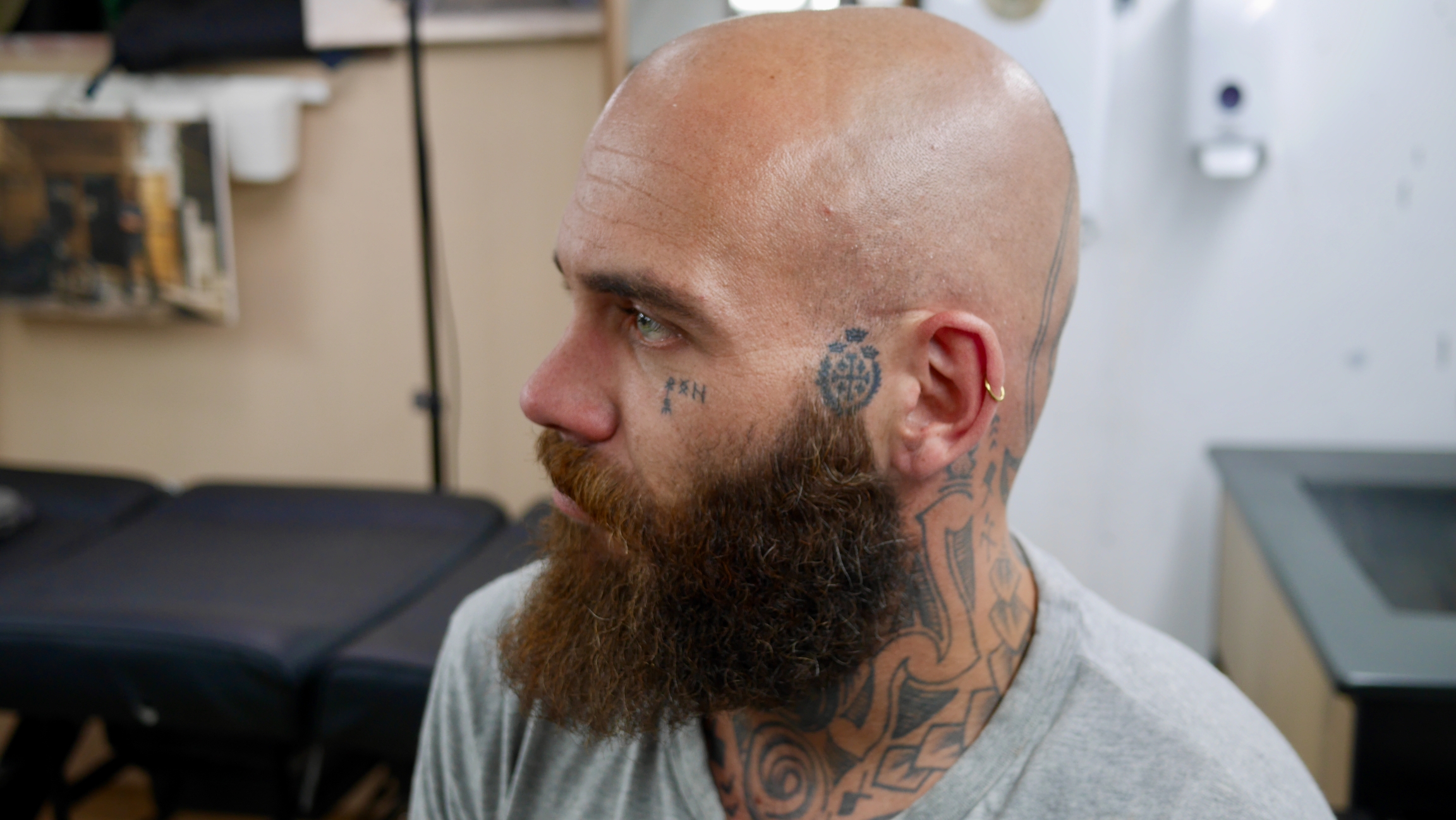
Mike from Holland is one of the tattoo artists at Razzouk Tattoo in Jerusalem.
Fuad AbuGosh/The World
In ancient times, Razzouk said that pilgrims wanted to go back home from the Holy Land with a tattoo showing that they’d successfully made the perilous journey here. It was also a status thing, he said. Nowadays, people like the idea of carrying on the tradition.
“They want to feel that they have become different now after they have become pilgrims, that they have renewed their faith, that they have walked the steps of Jesus, that they have lived the Bible that they have read on paper.”
Razzouk said he’s done tattoos for people in their 70s, 80s and 90s who never had any interest in tattoos before coming here on pilgrimage. A lot of his customers are Westerners. But he also does tattoos for Christians who live in this region.

Stickers from Razzouk Tattoo in Jerusalem.
Fuad AbuGosh/The World
“We are the minority here, in Israel and in the Holy Land. Because we are the minority, they think we are weak,” Razzouk said.
“It’s not easy. It’s very difficult to be a Christian in the Holy Land. It’s very difficult to be a Christian in the Middle East among people who sometimes never even heard about Christianity. And sometimes, they know that you are a Christian and that is a reason to hate you even more, and not only to persecute you, but also to attack you.”
And for that reason, he said that some people get religious tattoos on parts of their bodies that their clothes will cover.

Some of the most popular tattoo designs at Razzouk Tattoo go back centuries.
Fuad AbuGosh/The World
Still, some Christians from the region, Razzouk said, choose to get something like a cross on their lower wrist, to identify their faith, whatever the risk.
Some of the most popular tattoo designs here in the studio go way back in history. There’s the image of St. George slaying a dragon, and the Jerusalem cross — that’s a plain, Greek cross surrounded by four smaller ones.
Razzouk has a Jerusalem cross in red on his left arm, next to another much larger tattoo.
“This is one of my Harley tattoos with the eagle and the engine of the Harley. It’s the heart of the Harley Davidson. I love Harleys. I love bikes. It’s part of my life.”
Razzouk said he managed to do a pilgrimage of his own a few years ago, traveling to the Black Hills of South Dakota for the annual motorcycle rally at Sturgis. He said that he didn’t end up getting a tattoo on that trip, but that he did bring home more than one T-shirt.
Oleksandr Pipa was the original bass player for the Ukrainian rock band, Vopli Vidopliassova, just as an underground rock scene was beginning to emerge in Kyiv in the 1980s.
The band recorded hits like “Tantsi,” or “Dances,” the title track on a 1989 album. People would copy it, share it with friends or sell it on the black market.
Now, the album, “Tantsi,” is being rediscovered by a new generation of fans — it was rereleased last month.
“Tantsi,” which was originally meant to be a demo tape and was mostly recorded in one night, is a time capsule from late Soviet Kyiv, as the Record Store Day website says. It’s also about rebelling against repressive rule from the Kremlin, and imagining new possibilities.
Songs like “Politrok” and “There Were Days” poke fun at Soviet-era politics.
Another original member of Vopli Vidopliassova, Oleg Skrypka, who’s still the frontman, said the band’s popularity started with the song, “Tantsi.”
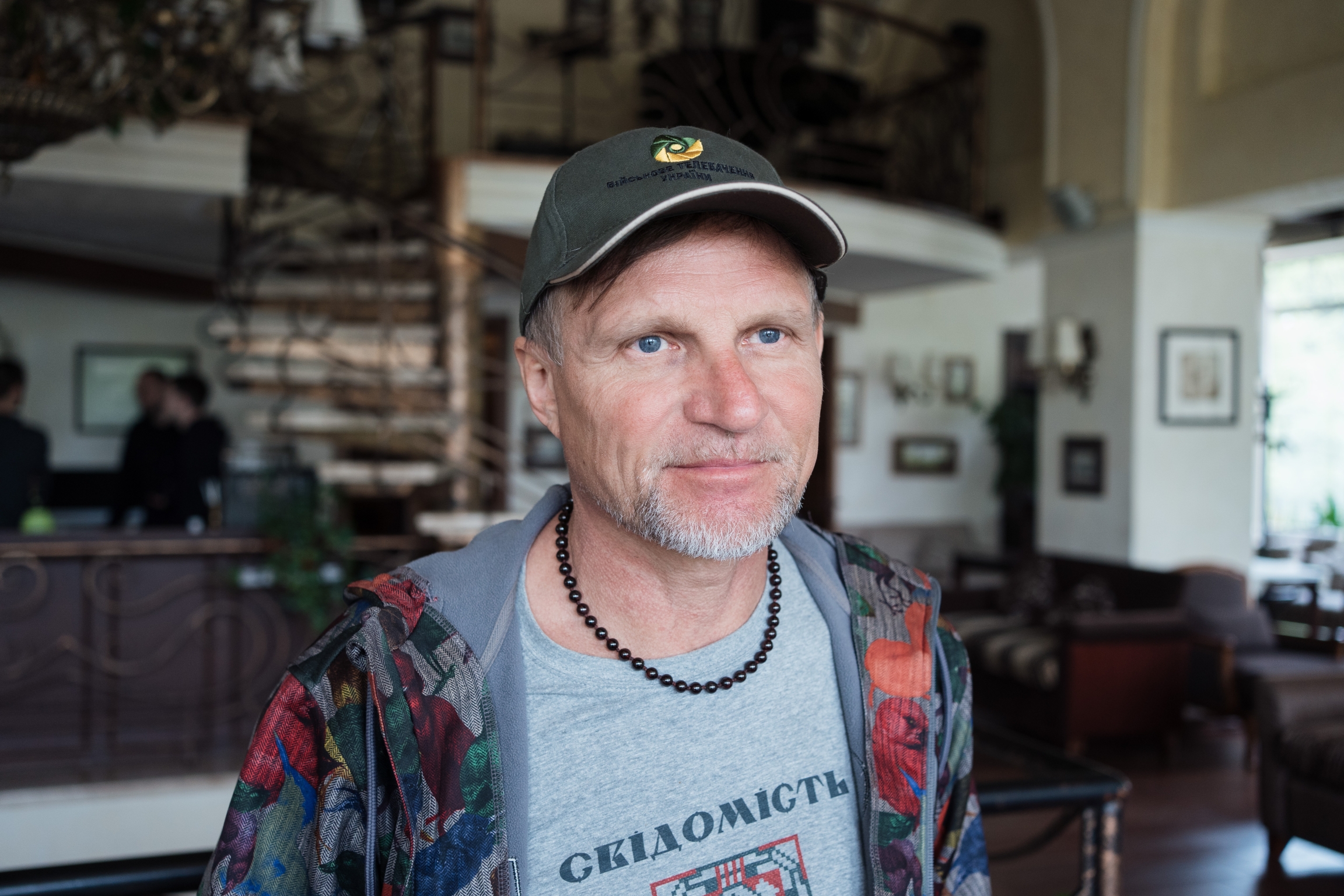
Oleg Skrypka, lead singer of Vopli Vidopliassova.
Anastasia Vlasova/The World
“When we played this song, it was like [an] explosion, people [went] crazy.”
At the time, Kyiv bands were imitating Russian bands.
“So, when we started to sing in Ukrainian, we instantly became legends and stars and it was time to record.”
Pipa, who now has his own band, Attraktor, said it came about because Maria Sonevytsky, a professor from Bard College, was working on a book in 2019 about “Tantsi,” called “Vopli Vidopliassova’s Tantsi.”
After she got in touch with Pipa, he said, he dug up the original recording.
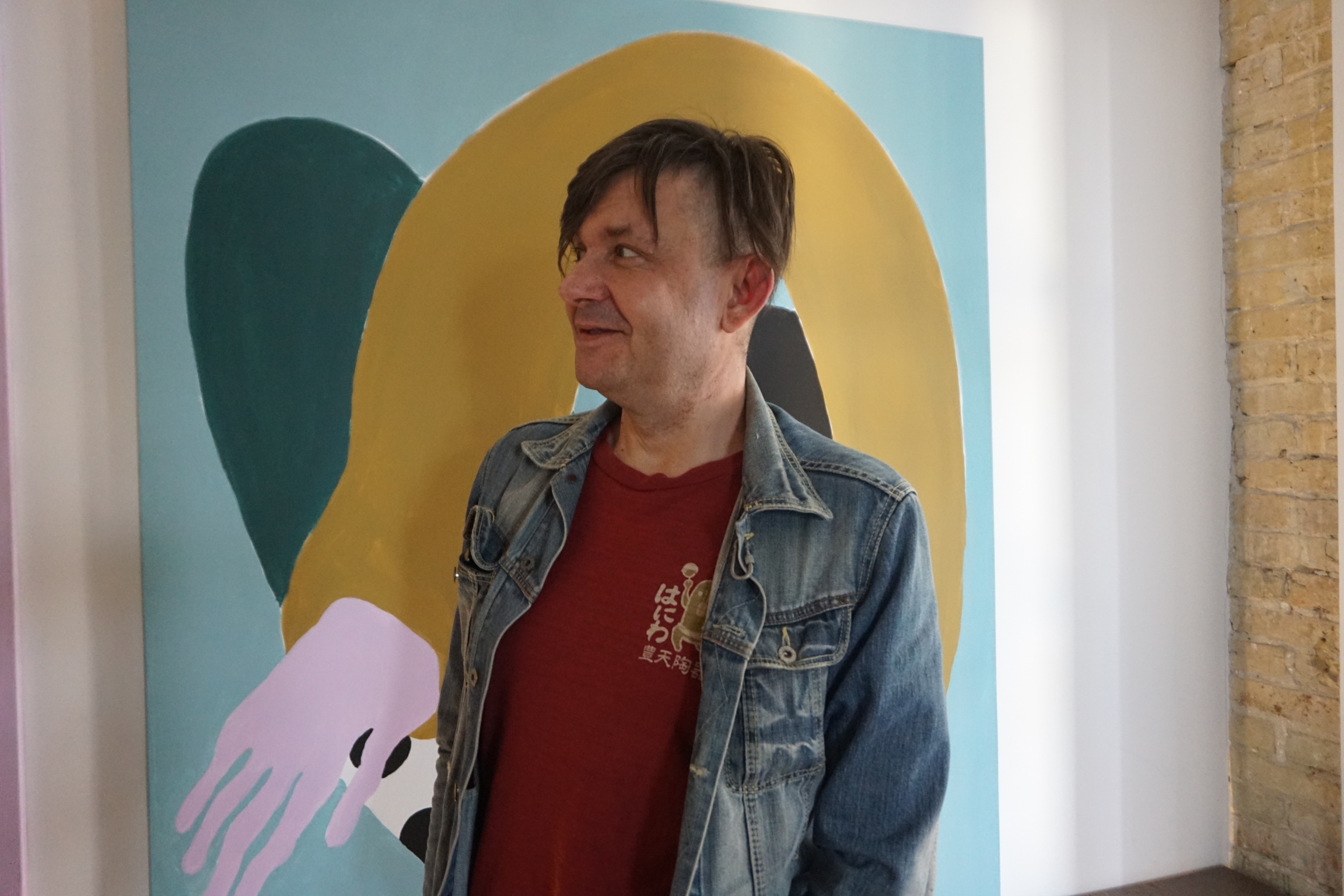
Oleksandr Pipa, original Vopli Vidopliassova bass player.
Daniel Ofman/The World
“I gave it to Maria, she took it and flew to the United States, found the studio, and then, the master engineer, really; he made it even better than it used to be.”
Pipa said that hearing those old recordings after so many years was a welcome distraction from the war in Ukraine.
“Kyiv was under constant missile attacks from Russia. On [the] one hand, there is this horrible war, and at the same time, some connection to normality; and it made me kind of feel that everything is going to be OK.”
Ukrainian musicians Taras Shevchenko and Kateryna Pavlenko from the band Go-A were thinking about starting a new folk electronica project back in February of 2022. But on Feb. 24, when Russia launched a full-scale invasion in Ukraine, the pursuits of many of Ukraine's leading artists and cultural institutions came to a halt.
Since the war began, artists and cultural workers swiftly shifted their focus to contributing to war efforts, while also working to maintain and promote Ukraine's unique artistic and cultural heritage.
The World takes a look back at the myriad ways in which war impacted artistic and cultural expression in Ukraine, and how advocates worked tirelessly to keep making art against all odds.
Ukrainian musicians Taras Shevchenko and Kateryna Pavlenko founded Go-A, a folk-electronica band.
Daniel Ofman/The World
In early March, as Moscow escalated its bombardment of civilian areas, museums and churches in the Ukrainian capital Kyiv were targeted. Residents of Lviv raced to ensure their city did not suffer the same fate. For a city synonymous with music and the arts, the most common sound in the city became hammering and drilling.

Workers construct metal scaffolding around the statue of Greek goddess Amphitrite in the medieval Market Square in Lviv, Ukraine.
Andrew Connelly/The World
Ukraine's military made it mandatory for all men to stay in Ukraine to serve in the war. But when the Kyiv Symphony Orchestra mobilized to go on tour as part of a cultural diplomacy mission, the Defense Ministry granted special permission for its male members to leave the country.

The Kyiv Symphony Orchestra rehearses at the National Philharmonic in Warsaw, Poland, the day before the premiere performance of the "Voice of Ukraine" tour that took them to nine cities across Poland and Germany, April 20, 2022.
Emily Johnson/The World
Other musicians, like Taras Topolia, the lead singer of the Antytila band, immediately joined Ukraine's military and served on the front lines. At the same time, Topolia continued to advocate for Ukraine through his music.
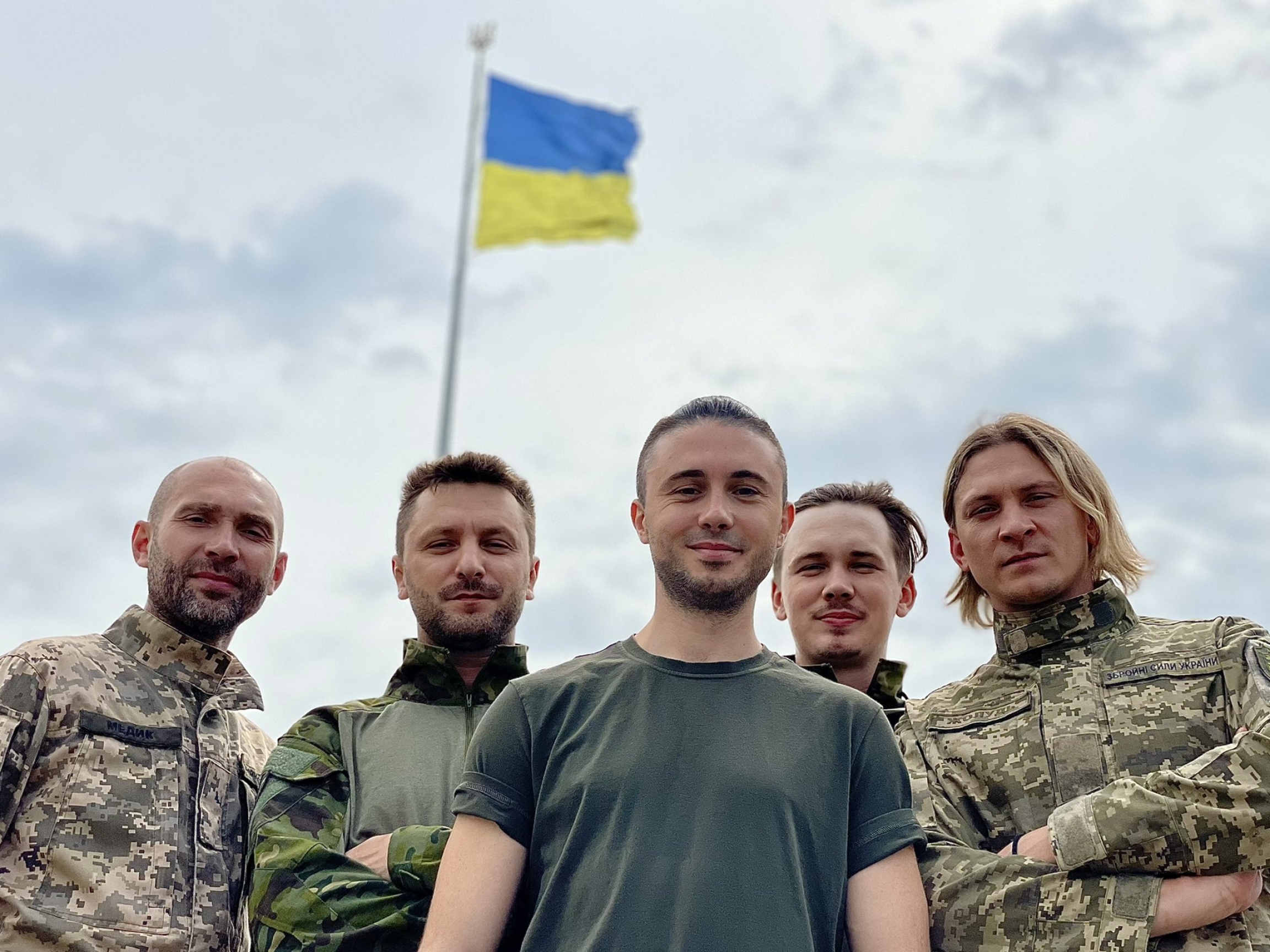
Some of the Ukrainian band Antytila's members have been serving on the front lines of the war in Ukraine.
Antytila on Twitter
Svyatoslav Vakarchuk, who might just be Ukraine’s biggest rock star, also volunteered and joined Ukraine's armed forces, where he became a lieutenant. Most of his service entailed helping troops and civilians living near the front lines. To provide emotional support to the troops, Vakarchuk performed a song “Chovan,” meaning “Boat,” near the Antonivskyi bridge, in the Kherson region, which was destroyed by Russian forces.
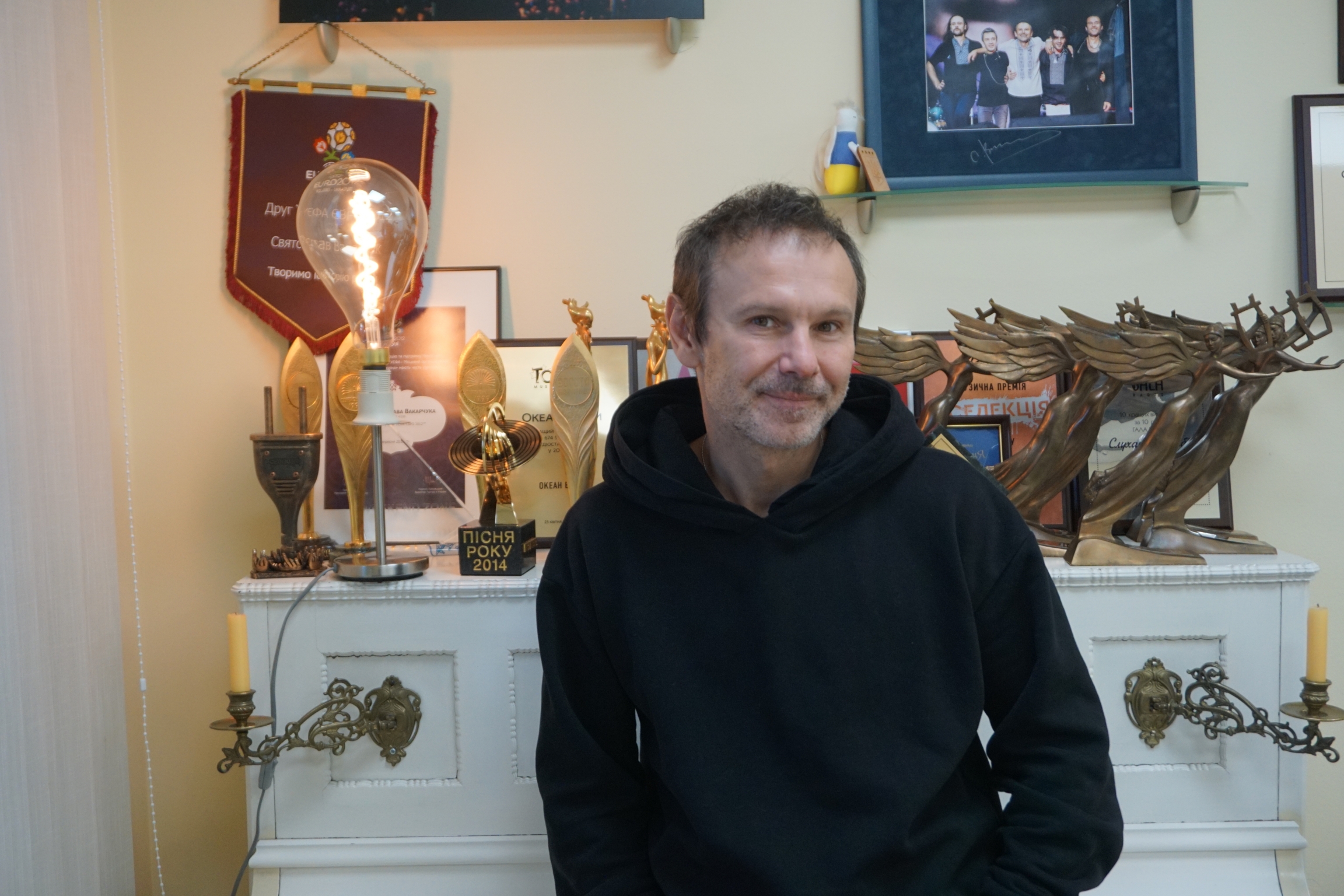
Ukrainian singer Svyatoslav Vakarchuk
Daniel Ofman/The World
As intense fighting in Ukraine tore apart entire villages, Ukraine's underground rave scene got behind Repair Together, a volunteer group that hosted "clean-up raves," a mix of traditional clean-up efforts with dance parties, to relieve stress and connect with others.
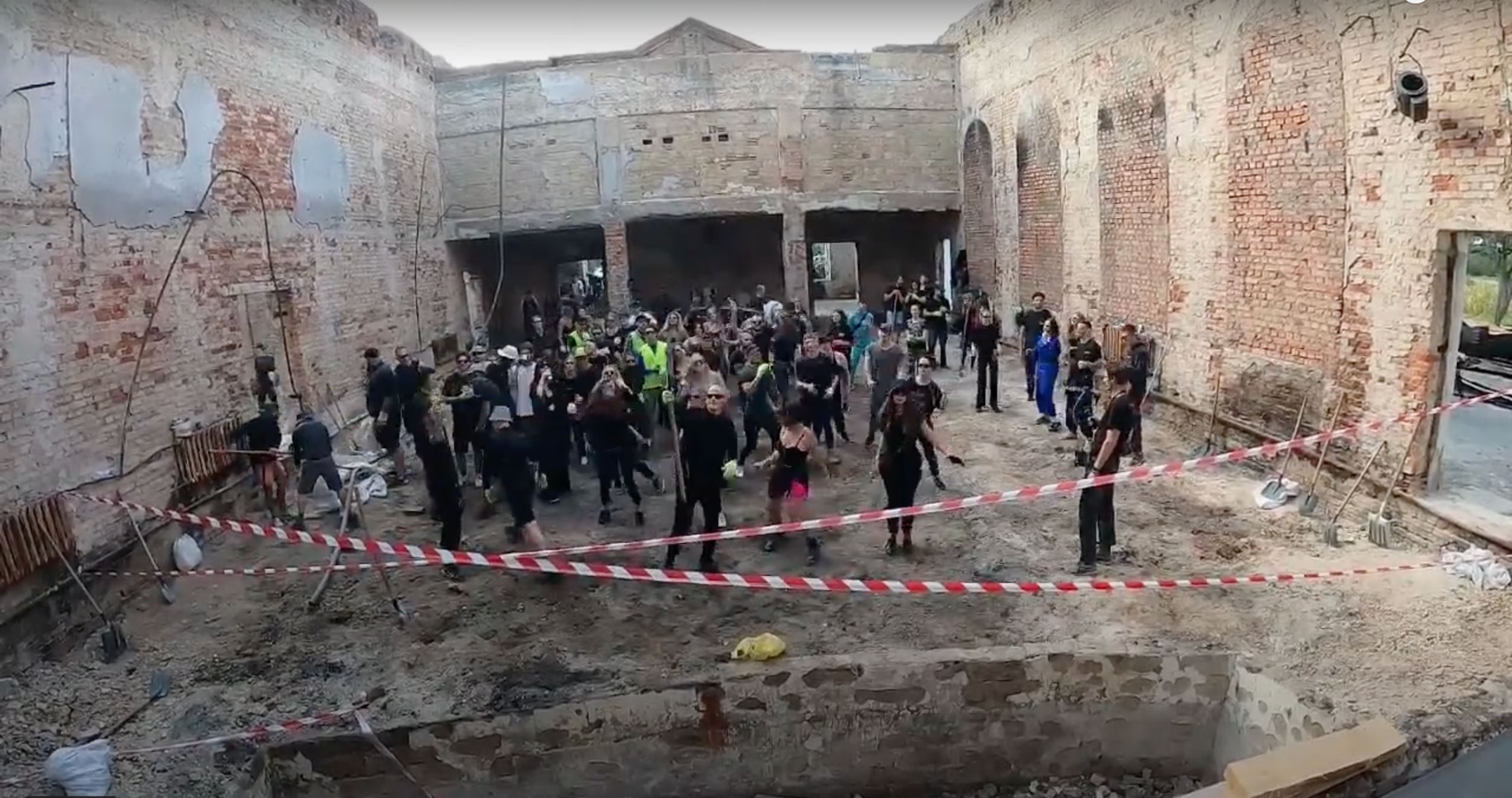
Repair Together hosts a clean-up rave in Ivanivka, Chernihivska oblast.
Repair Together/YouTube
The war in Ukraine sparked a new wave of interest in Ukrainian history, culture and writing. Ukrainian literary translators have been working on overdrive as the war drove new demand for Ukrainian publications. US-based writer Dralyuk has been translating poetry and literature from both Russian and Ukrainian into English.

A visitor reads a book at a book fair during a Publishers Forum in Lviv, Ukraine, Sept. 19, 2018. Since the war in Ukraine began nearly six months ago, the demand for Ukrainian translations and literature has increased.
Mykola Tys/AP
During rehearsals at Odesa’s opera house, it was sometimes easy to forget that Ukraine was a country at war. Inside the elegant, neo-Baroque building from the late 19th century, the conflict outside felt distant. Odesa National Academic Opera and Ballet Theater is located in Ukraine’s busiest port city, which became an early target of Russia’s military, but it continues to be a central cultural hub.

The Odesa National Academic Opera and Ballet Theater is known as the heart of the cultural city of Odesa, Ukraine.
Daniel Ofman/The World
When war broke out in Ukraine, the Shchedryk Children’s Choir from Kyiv was poised to celebrate its 50th anniversary with a world tour. Conductor Saul Zaks went on a mission to make sure the world continued to experience the choir’s "magical" sounds. By December 2022, the choir headed to Carnegie Hall to celebrate a Christmas sensation known as “Carol of the Bells.”

Children’s choir Shchedryk rehearses on Thursday evening at St. Paul’s in New York City.
Emily Johnson/The World
Ukrainian ballet dancers displaced by the fighting found a home on international stages. The Ukrainian Classical Ballet went on a charity tour in Italy and Romania in May, with the company in Bucharest, for a performance of “Giselle.”

The Ukrainian Classical Ballet company holds up the Ukrainian flag onstage during curtain call while the Ukrainian national anthem plays as part of a performance in Bucharest, Ukraine.
Elena Graham/The World
And despite six months of grueling war with Russia, several acts from Ukraine were represented at the Edinburgh International Arts Festival, the world’s largest arts festival, held yearly in Scotland. For the performers, it was a bittersweet experience.

Some Ukrainian students were evacuated from Ukraine thanks to a Czech circus company, Cirk La Putyka. “Boom," a performance they took to Edinburgh, was rewritten to reflect the students’ perspectives of war and displacement.
Andrew Connelly/The World
Artists from Ukraine’s hip-hop scene have also been speaking up. The genre, which became popular in the country by the late 1990s, largely emerged from the easter city of Kharkiv, not far from the Russian border. Alyona Savranenko, known by the stage name Alyona Alyona, has been using her music to raise the spirits of her people as the war goes on.
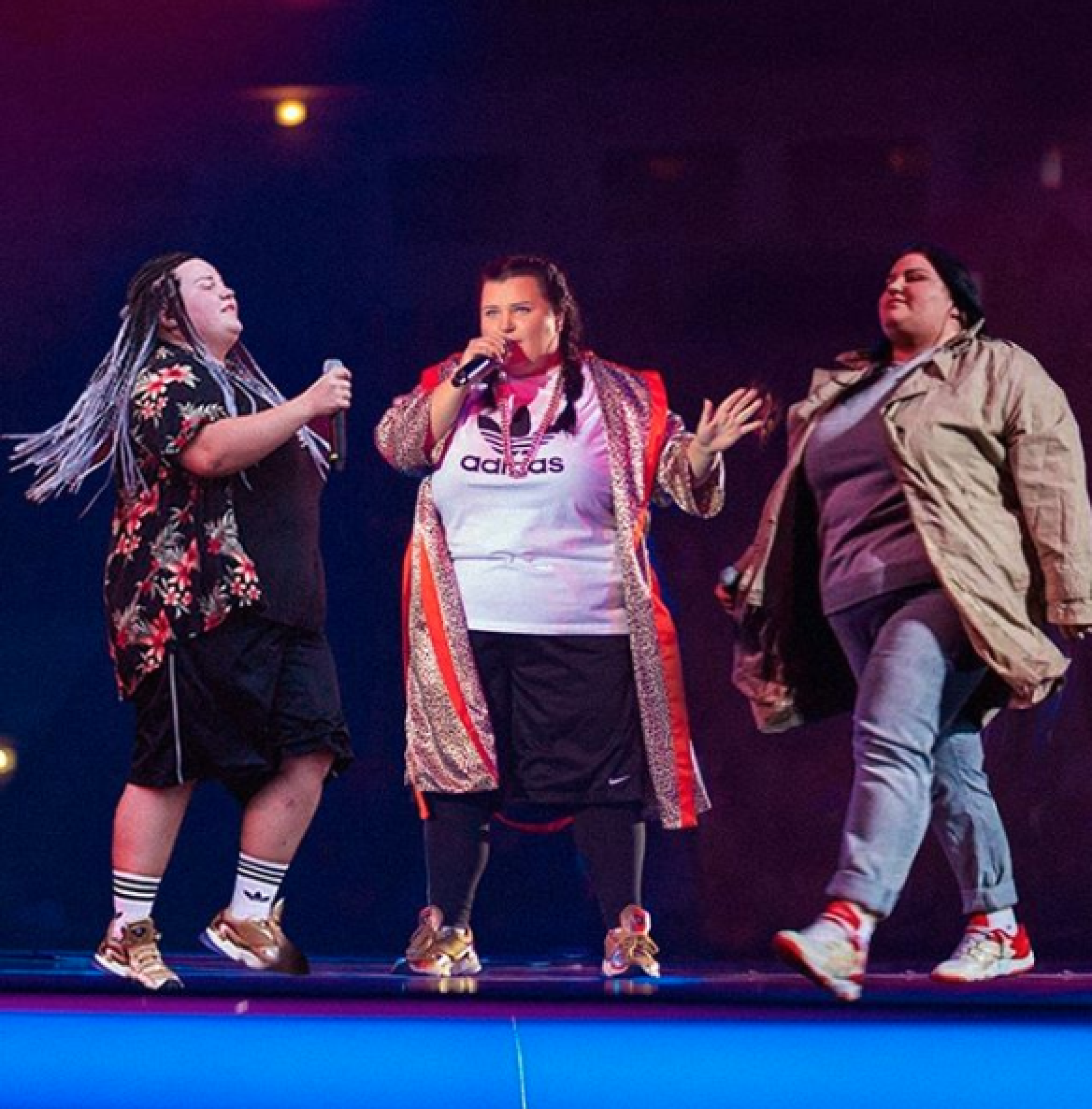
The popular 28-year-old Alyona Savranenko prides herself on defying the stereotype of what rappers look like in Eastern Europe and the rest of the world.
Courtesy of Alyona Alyona/Instagram
This article was originally published on Feb. 21, 2023 and has been updated.
The day the Taliban took over Afghanistan almost two years ago, Farzanah Ayubi was giving a speech in Kabul.
When she heard the news, she decided to finish the speech. The audience stayed, too.
“I won’t ever forget that moment,” Ayubi said.
Afterward, she said, she stepped outside into what felt like a very different city. There was chaos and panic. She couldn’t find a taxi. It took her five hours to get home — a journey that would typically take 20 minutes.
Since that day, the Taliban have imposed on women one restriction after another. The latest came in December, when they banned women from working for nongovernmental organizations. Thousands of women lost their jobs overnight. The months since, women NGO workers say, have been among the most difficult.
Agencies have been pressuring the Taliban to reverse course, and on Thursday, the head of a major aid organization said that the Taliban have agreed to consider allowing Afghan women to resume work at the agency in the southern province of Kandahar, the religious and political center for the country's rulers.
Jan Egeland, the secretary-general of the Norwegian Refugee Council, met officials in the capital Kabul and Kandahar to persuade them to reverse the ban on the organization’s female staff.
“We have an agreement to start immediate talks on a temporary arrangement that will enable our female colleagues to work with and for women and others in Kandahar,” Egeland told The Associated Press. “If we get a provincial exemption in Kandahar, we should be able to replicate it elsewhere.”
In January, the Taliban said they were working on guidelines for women to return to work at NGOs. Egeland said earlier this week that key officials told him they are close to finalizing these guidelines. But they were unable to give a timeline or details.
Ayubi’s NGO, which helped low-income women get better access to health care and education, was shut down and her team was sent home.
“[The Taliban] told us if we don’t shut down, we’ll face problems,” Ayubi said.
Next, she received threats and had to leave the country, first to Pakistan and then to Canada.
Today, she's trying to resume her work once again, but it's hard to do from afar — and without her employees, she said.
For many women, the situation is reminiscent of Taliban rule in the past.
During the early days of the US-led invasion of Afghanistan, one justification given by the Bush administration was to “liberate” Afghan women.
“Because of our recent military gains in much of Afghanistan, women are no longer imprisoned in their homes,” first lady Laura Bush said in a radio address four days after the fall of Kabul in 2001. “The fight against terrorism is also a fight for the rights and dignity of women.”
More than two decades later, Afghan women like Diba Farahmand, who used to run an NGO called Women Empowerment, are once again being confined in their homes.
Farahmand employed 73 people, mostly women. Now, she said, she has no job and no income. For years, Farahmand said, helped Afghan women in need. Now, she needs help herself.
“My former employees call me in tears,” she said from Kabul. “They say their kids are going to bed hungry. They’re desperate, and I don’t know what to tell them.”
The Taliban’s ban on women’s employment could not have come at a worse time. Afghanistan is facing a devastating humanitarian crisis. After the fall of the Afghan government, direct international aid to the country stopped.
Two-thirds of Afghanistan’s population need urgent aid in order to survive, according to the UN's Office for the Coordination of Humanitarian Affairs.
Witnesses say the aid that does get into the country is not being distributed fairly.
“The distribution system is male dominated, so many women are simply left out,” explained Shamail Tawana Nasiri, who conducted an informal survey in parts of Afghanistan recently.
American officials have also raised questions.
Last month, the head of the Special Inspector General for Afghanistan Reconstruction, John Sopko, spoke on Capitol Hilland complained about a lack of transparency.
“Unfortunately, as I sit here today, I cannot assure this committee or the American taxpayer we are not currently funding the Taliban. Nor can I assure you that the Taliban are not diverting the money we are sending from the intended recipients,” he said.
The Biden administration said it has systems in place to make sure aid is getting to those who need it.
A Taliban spokesperson did not respond to questions about aid distribution.
Afghan women continue to fight back. They have started underground movements and organized protests.
Nasiri in Kabul said that protesters are using a range of tactics to avoid getting caught. She said they change locations for protests at the last minute, when leaving the gathering, they switch outfits so they are not easily identified, and they don’t return home immediately.
“The women are scared,” Nasiri said. “Many have stopped coming to protests because of the Taliban crackdown.”
But, she added, “we have to speak up for ourselves. Because if we don’t, no one else will.”
A couple of weeks ago, millions of Brazilians received a text from messaging application Telegram saying that Brazil was about to pass a law that would "end freedom of expression."
The app also claimed that the bill would give the government "censorship powers without prior judicial oversight."
The legislation requires internet companies, search engines and social messaging services to find and report illegal material themselves, or face heavy fines.
Brazil’s Congress is debating the proposed law, which if passed, would be one of the world’s harshest laws against fake news. The bill has already been approved by the Senate and it’s now awaiting a vote in the lower house. But the “Fake News Bill,” as it’s being called, is extremely controversial.
Congressional leaders attacked the Telegram message on the floor of the lower house.
"They are spreading lies saying that the Brazilian parliament wants to approve censorship. That [it wants] to end democracy. This is scandalous,” said Orlando Silva, the sponsor of Bill 2630. "It’s a scandal that a multinational corporation wants to push the national Congress onto its knees.”
Silva added that lawmakers had specifically invited Telegram many times to participate in the debate over the legislation, but the company had declined.
Supreme Court Justice Alexandre de Moraes then threatened to take Telegram offline for 72 hours if it didn’t delete the message.
The platform finally complied. But it was a sign of just how heated the debate over this bill has become in recent weeks.
Analyst Alan Ghani, of the conservative news outlet Jovem Pan, has called the forced removal of the Telegram message: “Censorship, pure and simple.”
He added: “Would we punish a newspaper editorial, when many outlets have come out against the fake news bill in their editorials? It’s the same thing.”
But the head of the government coalition in the Senate, Randolfe Rodrigues, told the media that the platforms are very different. He said there are government regulations for TV and news outlets, and that the same is needed for social media firms.
“To the heads of the big tech companies and their shareholders anywhere in the world, Brazil will not be no-man’s-land,” he said. “You will not be permitted to do what you want here without punishment.”
David Nemer, a Brazilian media studies professor at the University of Virginia, has researched social media platforms for years.
"These platforms are not neutral,” he said. "These platforms are not just publishers. They are part of the message. And they curate the message."
Fake news has been a major issue for Brazil in recent years.
"[Fake news] has harmed public debate,” said Luciana Santana, a political scientist at the Federal University of Alagoas. "[It’s] gotten in the way of serious discussions over public policies, and influenced political races in Brazil.”
Experts say it played a decisive role in the 2018 election of former President Jair Bolsonaro. During the pandemic, he told Brazilians that getting COVID-19 vaccines could turn them into crocodiles.
But, this bill isn't just about fake news.
"It’s more about bringing transparency, from the big techs in terms of access to the algorithm, access to reports about the algorithm, understanding how these platforms behave, so we have a more transparent way of understanding … the role of these platforms in everyday life,” Nemer said.
Brazilian journalism professor Rogerio Christofoletti said this bill is also about holding social media firms accountable when dangerous, hateful or misleading content is shared on their platforms.
"These digital platforms have the means to reduce the reach, to adjust their algorithms, to not promote specific content,” Christofoletti said. "The platforms can do more than they have. And a law like this can force these platforms to use their technical power to combat disinformation.”
Nemer added that these companies are pushing back for a reason.
“This is why the big techs are playing hardball in Brazil,” Nemer said. “Because they know that if Brazil passes this bill, then it sets the precedent and the other countries will follow as well. So, they're trying to close the gate as much as they can so other countries will not follow suit and pass their own internet laws.”
Nemer is concerned that the bill may not find the votes it needs to pass, in part, because many politicians elected to Congress ran campaigns based on disinformation, and actually benefited from an unregulated social media.
And although the bill has already been approved by the Senate, the vote in the lower house has been postponed several times in recent weeks, as the governing coalition pushes to shore up more votes.
Related: The future of Bolsonaro in Brazil remains uncertain
Joshua Opoku Agyeman owns a secondhand car lot with a fleet of refurbished vehicles in Accra, Ghana.
Agyeman scouts online for old and used cars in the US, which he buys and resells.
“I have so many Ghanaians I am working with in America,” he said. “And once I am done negotiating, I notify any of my partners in any location in the United States who do my shipments for me. And then, the container is shipped down here.”

Joshua Opoku Agyeman imports used and old cars from mostly the US to Accra, Ghana.
Ridwan Karim Dini-Osman/The World
Over 100,000 cars are imported into Ghana every year, mostly from the United States. And 90% of the cars on Ghana's roads are imported used cars. Many are either salvaged or obtained from accidents; plenty of them are more than a decade old.
At the same time, US consumers are snapping up electric vehicles — they are helping the country meet its climate goals, and new owners may qualify for a tax credit. And while many of their old cars that end up on Africa's roads provide vital transportation in poor countries, they are often polluting and unsafe.
Kwesi Koranteng is a supervisor in the repair shop at Agyeman’s dealership.
Kwesi Koranteng has been refurbishing imported old and used cars for the past 15 years.
Ridwan Karim Dini-Osman/The World
“[The] majority of the people here in Ghana cannot afford brand new cars, so the demand for used cars is on the rise,” he said. “And so, when the used cars are in, we do the body work, fix the air conditioners, and do other servicing, too.”
These older cars can lack air bags or anti-lock brakes and other safety features that drivers in the US take for granted.
Ghana’s National Road Safety Authority’s Pearl Adusu Gyasi said that efforts to discourage importing overaged cars have yielded few results.
“What people are failing to notice is that every aging engine in these imported, rickety cars is a potential time bomb,” she said. “Affordability should never outweigh the value we place on our lives.”
Many older vehicles release a toxic cocktail of air pollutants. It’s common to see trucks and cars belching black smoke. Those vehicles typically lack modern emission controls. Or their catalytic converters, which filter the exhaust, are removed and sold for their valuable metals.

Most of the old and used cars that are shipped to African countries like Ghana need work.
Ridwan Karim Dini-Osman/The World
These cars are one of the reasons that Accra’s traffic-clogged streets are among the most polluted in the world, said Cordie Aziz of the Institute for Environmental and Sanitation Studies at the University of Ghana.
She said that, on average, air pollution there is 11 times higher than the World Health Organization sets as safe.
“The air pollution becomes more centered in highly populated areas where you see a lot of vehicle traffic,” she said. “These are all areas that have shown to have higher levels of pollution based on the EPA sensors that were placed around the city. The situation is really alarming.”
In Accra, an estimated 40% of the city's air pollution concentrations stem from vehicle transport emissions.

Pearl Adusu Gyasi works with Ghana’s National Road Safety Authority and is concerned about African countries like Ghana being treated like a dumping ground for the West’s cars that are
not roadworthy. The authority says public education and awareness to discourage the importation overaged has yielded very little results.
Ridwan Karim Dini-Osman/The World
Children who walk to schools along busy roads and informal vendors lining the roads are most at risk of the health effects of these toxic fumes.
Aziz said that the enforcement of laws to check the situation is lax, putting people at risk of chronic respiratory diseases, as well as contributing to climate change.
The UN Environment Program has warned that the world cannot meet its zero-emission targets under the Paris Agreement on climate change unless efforts are made to regulate the used car trade.
“Africa is already bearing the biggest impact of climate change,” Aziz said. “We cannot allow it to become a dumping ground for used and rickety imported cars.”
But that is not all. When these used cars are no longer roadworthy, they end up in the hands of scrap dealers who dismantle them for various parts, including the batteries.
Amina Yussif lives at Agbogbloshie in Accra, close to a car-battery smashing site that she said exposed her 4-year-old son to lead poisoning. She said that his developmental milestones have been severely affected.
Inside a repair shop in Accra, Ghana, workers are seen giving the old cars a fresh paint job.
Ridwan Karim Dini-Osman/The World
“When I found out that he had been exposed to lead, it was like my world came crashing down,” she said. “As a mother, seeing your child struggle with health issues every day is just heartbreaking.”
Ghana tried to implement a ban on the import of used cars that are 10 years old or more in 2020. But the government backed down after pushback from importers. People now have to pay additional taxes when they import those old cars.
But the business continues to thrive because imported old and used cars are still cheaper than foreign brands assembled in Ghana, like Volkswagen and Toyota.
Chineyenwa Okoro Onu, an environmental sustainability consultant in Lagos, Nigeria, said that she is concerned that Africa is fast becoming a graveyard for polluting cars.
“The worst-case scenario will be that these used cars will not meet the emission standards set by the country of origin and, therefore, have even worse environmental impacts in Africa. We deserve better as a continent,” she said.
She said, as more people get rid of their gas guzzlers to be environmentally friendly, the more used cars are likely to be exported to Africa.
But Theo Acheampong, an energy economist at the University of Aberdeen in Scotland, said he disagrees: “Even in Africa, in Ghana, there is a big, growing momentum for electric transportation and other cleaner mobility solutions.”
He said that Ghana's abundant lithium resources and advancements in extraction technology pave the way for battery manufacturing facilities.
Acheampong said the continent’s wealth of natural resources, including solar and wind power, can be harnessed to provide clean, renewable energy for effective public transportation.
“So, these buses could run on things like hydrogen, or they could run on electric batteries and that would allow a lot of people to move around without necessarily having to have their own private cars,” he said.
Onu has other solutions, too. She said a range of incentives, like tax breaks and subsidies, can shift Ghanians to driving electric cars.
“To ensure that African countries like Ghana catch up with this transition for cleaner transportation, we need to incentivize the adoption of sustainable alternatives as much as possible,” she said.
On a recent weekday morning, dozens of tourists are lined up on a pedestrian ramp in the heart of the Old City in Jerusalem.
A recorded message reminds visitors of the significance of the place: “Please respect the holiness of the site and the worshippers. Please dress and behave appropriately during the visit.”
The ramp passes by the Western Wall and goes up to the Mughrabi Gate, one of the entrances to probably the most iconic location in the city of Jerusalem. It’s the Temple Mount, as Jews know the site, or the Haram al-Sharif, the Noble Sanctuary, as Muslims call it. This is also the location of the Al-Aqsa Mosque and golden Dome of the Rock.
The place holds an important place in religious scripture. It’s where the universe was created, where Adam stepped out of the Garden of Eden, where Abraham told God he was willing to sacrifice his own son, and it’s where Muhammad prayed with Jesus and other prophets before ascending to heaven.
On a recent weekday morning, dozens of tourists are lined up on a pedestrian ramp in the heart of the Old City of Jerusalem. The ramp passes by the Western Wall and goes up to the Mughrabi Gate, one of the entrances to probably the most iconic location in the city of Jerusalem. It’s the Temple Mount, as Jews know the site, or the Haram al-Sharif, the Noble Sanctuary, as Muslims call it. This is also the location of the Al-Aqsa Mosque and golden Dome of the Rock.
Matthew Bell/The World
Recently, the holy compound has seen clashes between Israeli police and Palestinian Muslims, along with vandalism and rock-throwing between groups of Jews and Muslims. But authorities managed to avoid a worst-case scenario at the holy site during the overlapping religious holidays of Easter, Passover and Ramadan that ended a few weeks ago.
In many ways, things are getting back to normal here. But the status quo framework, an agreement between Israel and Jordan from 1967 with roots that go back to the 1800s, that governs how the holy site is run, is something that many people on both sides are not particularly happy about.
The holiest site in Jerusalem continues to be an ongoing source of contention between Jews and Muslims.
“We come here to pray, not to make problems for anybody,” said Khalil Maas’hal, who was at the mosque with his two adult sons.
Maas’hal explained that Muslims have a religious duty to visit this place.
“Every prayer on this spot,” he said, “is multiplied 500 times.”

House Speaker Kevin McCarthy visited the Western Wall in the Old City of Jerusalem in late April.
Matthew Bell/The World
Maas’hal, who is from Ramallah, about a 30-minute drive away from Al-Aqsa, said he’s got a special ID card that gets him through the Israeli military checkpoint to pray there.
“The problems happening here are created by the Israelis,” he said.
Ikhlas Malhi, who came to the mosque from East Jerusalem with her daughter, said that she’s witnessed many instances of violent clashes.
“I have seen Israeli soldiers stamp on the Quran. I have seen them attack the youth. I have seen them hit women, beat them up and arrest them. I’ve seen all this violence against people entering the mosque.”
Last month, Israeli police said they were forced to confront Palestinian Muslims who barricaded themselves inside the mosque with piles of rocks and fireworks. Under the status quo framework, Israel’s police forces maintain security at the Temple Mount. They also control the entrances to the holy site, where non-Muslim prayer is forbidden. The Waqf — a Muslim trust under the supervision of the government of Jordan — is in charge of running the religious and administrative affairs at the Noble Sanctuary.
Abeer Ziad is an archaeologist with the Waqf. And, like many Palestinians, she said that what she fears most is that the Israelis intend to demolish the Al-Aqsa Mosque to make way for a new Jewish temple.
“This is what they ask for. You can go to all the websites of the Temple groups. This is what they [demand], to demolish the place and build a temple and this place to be just for them.”
Abeer Ziad is an archaeologist with the Waqf. And, like many Palestinians, she said that what she fears most is that the Israelis intend to demolish the Al-Aqsa Mosque to make way for a new Jewish temple.
Matthew Bell/The World
Lots of Israelis say this fear is entirely overblown, that Israel’s government has controlled the Old City of Jerusalem going back to 1967 and it’s maintained the status quo arrangement ever since.
But some point out that things have changed here at the Temple Mount, with more Jewish nationalists making a point to visit the place on a regular basis.
Groups of Jewish visitors are always accompanied by a police escort here to prevent scuffles with Muslim worshippers and ensure that nobody’s breaking the rules under the status quo.
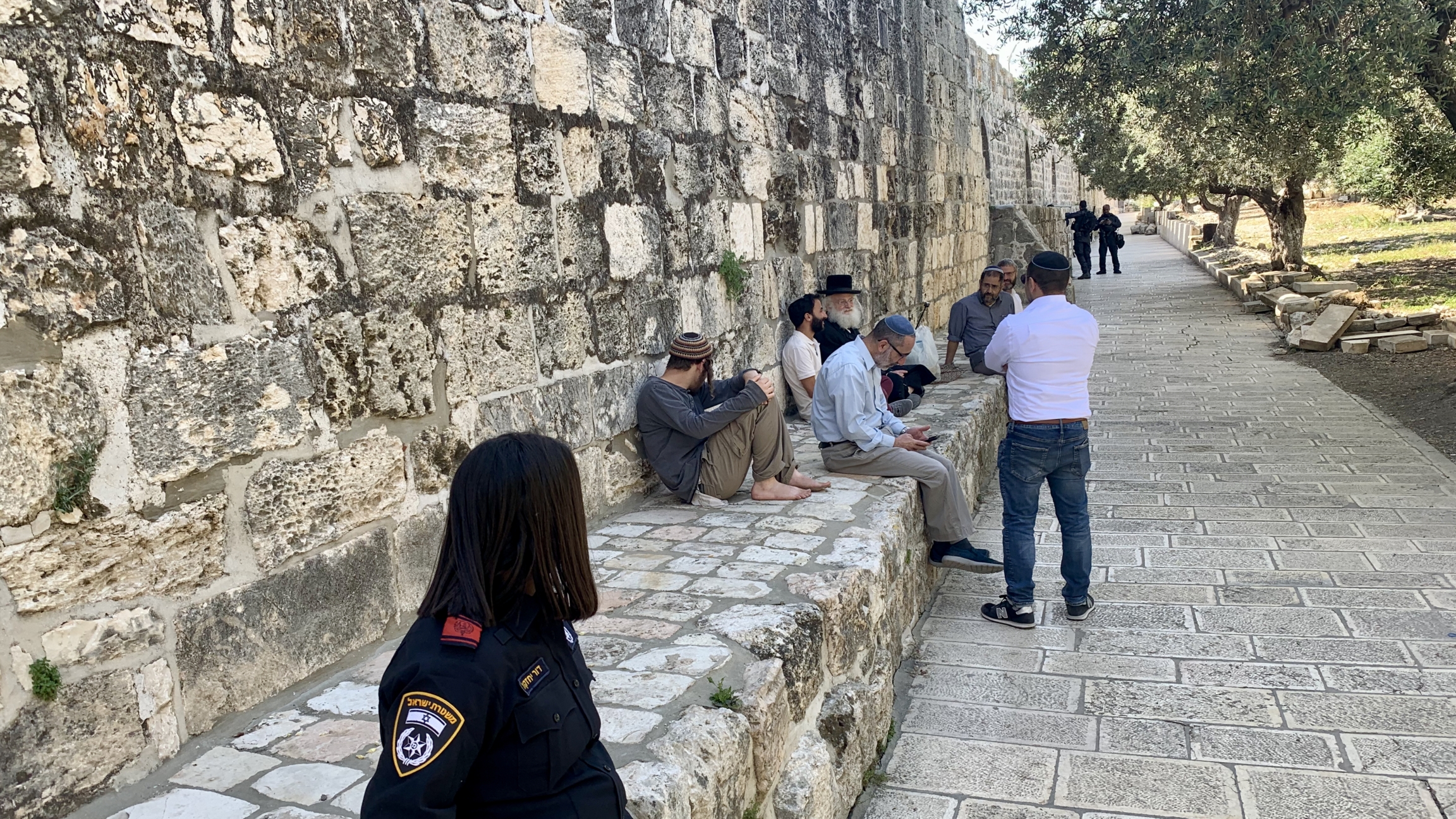
Jewish visitors are accompanied by Israeli police at the Temple Mount in Jerusalem.
Matthew Bell/The World
Only Muslims are allowed to pray at the holy compound. But a security guard with the Waqf, who didn’t want to be identified, said he sees Jewish visitors going against the rules all the time.
Daniel el-Meleh, a retired software engineer from Jerusalem, said that he tries to come here every week, even though prominent rabbis in Israel say the Temple Mount is too holy and that Jews should not be setting foot there.
“I’m not coming for a religious purpose. I’m coming for [a] national purpose. Just to be here. To say, I’m part of it. That’s my home. It’s like you go back to your home, and you want to sit there because that’s yours. So, I’m here to say, ‘That’s mine.’”
Meleh said that he doesn’t agree with the status quo framework.
“It’s not OK, because I’m telling you, that’s the only place in the world, on the planet where I don’t feel comfortable.”
He said that he’s not comfortable because Jewish prayer is forbidden on the Temple Mount, and because Jews are only allowed to visit during certain times of the day.
On Sunday, Israel’s far-right national security minister Itamar Ben-Gvir made his second known visit to Jerusalem’s holiest site. In a video released by his office, he said the presence of Israeli police “proves who’s in charge in Jerusalem.”
US State Department spokesperson Matthew Miller said the Biden administration was concerned by Ben-Gvir’s “provocative visit … and the accompanying inflammatory rhetoric.”
For Alona Toftul and her family, most of what remains of their old life on the outskirts of Kyiv, Ukraine, is saved on her phone.
She scrolled through some old videos of her children — Agata, 14, in piano class, Arkhip, 11, in their kitchen with his guitar, his fingers barely reaching the highest strings.
“When we fled, we didn’t bring Arkhip’s guitar,” she said. “It was hardly priority luggage. We left with what we could carry in small backpacks.”
The Toftuls’ house was just four miles from the village of Bucha, where Russian soldiers are accused of torturing and massacring civilians at the war’s outset.
Akim and his 14-year-old sister, Agata, enjoying a sunny morning in Cazilhac, France. When they first arrived after fleeing Ukraine they would flinch at the sound of airplanes passing overhead.
Gerry Hadden/The World
The Toftuls are Ukrainian, but ethnic Russians, so Russian is their first language. They don’t talk about what they saw at the outset of the war, but Andrei Toftul — Alona Toftul’s husband — said they were lucky that they left when they did. And he’s emphatic on one point: They’re never going back.
“They stole everything, and even booby-trapped some homes with mines.”
“Our house is still standing, but there’s nothing in it. All of the houses were abandoned when the Russians came in,” he said. “They stole everything, and even booby-trapped some homes with mines.”
Millions of Ukrainians fled their country after Russia's full-scale invasion last year. While many have returned, some can't or won't. They're starting over in new places and confronting new challenges.
The Toftuls ended up in Cazilhac, France, which has a population below 2,000 people.
When the war broke out, Toni Carvajal, the mayor of the village, asked locals to open up their homes to refugees.
“I said to the town council, ‘we ought to do our share,’” Carvajal said. “I started collecting clothes, medicine and food from surrounding villages. And I already had a license to drive a bus.”
So, Carvajal recruited a nurse, his friend Jean-Francois Carrasco and others, then drove a bus for two days to Poland in March of last year. They pulled in just as the Toftuls, and hundreds of other refugees, were walking across the border from Ukraine, desperate and dazed.
The Toftul children with their mother, Cazilhac, France.
Gerry Hadden/The World
“We brought back 32 families with us,” Carvajal said with a hint of pride.
Among them was a single mother, Elena Khairulina, and her teenage son.
“War is scary, but I was especially concerned for my son,” Khairulina said. “And as a young mother, well, we all know what’s been happening to young women at the hands of the Russians.”
Khairulina was alluding to rape as a weapon of war in Russian-occupied areas. The United Nations has documented dozens of cases of sexual attacks by Russian soldiers through January. Human rights nongovernmental organizations have actually put the number much higher.
Khairulina comes from a small village right next to one city where atrocities are a daily event: Bakhmut, a city that Russia’s been trying to take for months, even at the cost of tens of thousands of its soldiers.
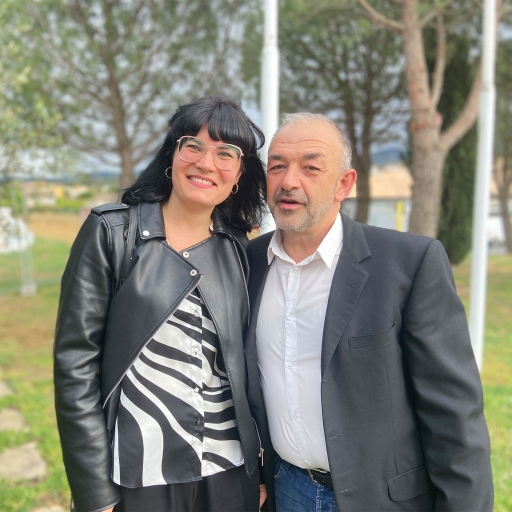
Olena Khairulina reached Cazilhac on a volunteer bus driven by village mayor Toni Carvajal. On the bus was French volunteer Jean-Francois Carrasco. Months after returning he and Khairulina fell in love. She’s learning French and working in a hotel, and has no plans to return to her village in Ukraine near Bakhmut.
Gerry Hadden/The World
Like the Toftuls, Khairulina said that she’s never going back. She has a job now working in a hotel and is learning French.
She’s also now in a relationship with Carrasco, the mayor’s friend, whom she met during his trip to Poland.
“She’s getting better and better each day,” he said about her language skills.
Khairulina seems happy with the here-and-now. But she still has plenty to worry about. Her son just returned to Ukraine, against her wishes. She said that he wanted to finish high school in his own language — Russian — before returning to France for good.
“It’s not OK,” she said, starting to cry. “I am scared for my boy.”
The Toftul family is divided as well. And they’re not alone. Of the 32 families that arrived in Cazilhac last year, 29 of them have already returned home, despite the risks.
Andrei Toftul found a job as a handyman for the town — painting, fixing plumbing and other odd jobs — while his wife learned how to do manicures.
And the Toftul children are starting to adapt to their new life.
They are safe now, said Alona Toftul. And they no longer duck at the sound of airplanes.
She added that her next goal is to make life feel as normal as possible, saying she plans to sign them up for classes at the local music school, even if they don’t have their own instruments with them from home.
But Andrei Toftul’s parents refuse to leave their home country, despite the ongoing fighting.
“My father wants to die in his country,” Andrei Toftul said. “I understand him. He’s worked hard his whole life for what he has. He can’t just leave it all behind.”
Related: Ukrainian refugees create their own school in Romania
Fazlullah Safi was a captain in the Afghan National Army’s medical unit treating soldiers until the government was toppled by the Taliban in August of 2021.
He said that his family remains in hiding in Afghanistan from the Taliban because of his affiliation with the former Afghan army. The Taliban searched for him at his family’s home several times, bringing a photo of him in his army uniform.
“I cannot go back to Afghanistan because they [will] target me,” Fazlullah Safi, 28, said, speaking from an iftar gathering hosted by the Afghan American Foundation and ICNA Relief in Woodbridge, Virginia, at the end of Ramadan last month.
Fazlullah Safi is among the more than 78,000 Afghan refugees who arrived in the United States in the days following the fall of Kabul through the humanitarian parole program called Operation Allies Welcome, which was set up by the Biden administration to accommodate the urgent evacuation.
The Department of Homeland Security’s humanitarian parole program allows the refugees to remain in the country for around two years. Similar programs were set up in the past for refugees from Vietnam, Cuba and Iraq. However, the program does not grant permanent resident status or provide a pathway to US citizenship — and it expires this summer.
Recently arrived Afghans attend an iftar in Woodbridge, Virginia, at the end of Ramadan.
Valerie Plesch/The World
Earlier this month, the Department of Homeland Security announced that it is establishing a process starting in June that will allow Afghan nationals to request reparole so they can continue living and working legally in the United States for another two years.
But this is only a temporary fix for protections from deportation. DHS has encouraged Afghan refugees to pursue permanent status through other avenues, including asylum — a lengthy and expensive process.
Fazlullah Safi’s cousin, Nazanin Omarzada Safi, 29, also a parolee, said she has been waiting for over a year for her asylum case to be approved. She was a doctor with the Afghan army and was injured during the evacuation.
A Quran rests on a table during an Iftar in Woodbridge, Virginia, at the end of Ramadan for recently resettled Afghans.
Valerie Plesch/The World
As a woman working in today’s Afghanistan, especially having worked for the Afghan military, she said it would be a death sentence for her to return to Afghanistan.
In addition to needing a legal pathway to stay in the United States, she said that she is unable to apply for certain benefits and jobs as a parolee. The permanent solution to situations like hers, she said, is for Congress to pass the Afghan Adjustment Act, a bipartisan bill that would allow the refugees to stay permanently.
Nazanin Omarzada Safi was a doctor with the Afghan army and was injured during the evacuation.
Valerie Plesch/The World
Mustafa Babak is the executive director of the Afghan American Foundation, which has been advocating for the Afghan Adjustment Act. It was introduced by the last Congress, but it wasn’t included in the omnibus bill before the end of last year — despite strong support from senior military leaders.
“We have done a lot of advocacy around a permanent pathway for Afghans to make America home,” he said. “We believe there are moral responsibilities for the United States, with whom Afghans, in general, actually, fought in promoting democracy, in bringing peace and stability and economic development.”
Mustafa Babak, executive director of the Afghan American Foundation, during an iftar in Woodbridge, Virginia, at the end of Ramadan.
Valerie Plesch/The World
Sen. Chris Coons, a Democrat from Delaware, a co-signer of the Afghan Adjustment Act bill last year, is negotiating with potential additional co-sponsors to create a strong, bipartisan group that will reintroduce the bill to Congress.
“I've heard dozens of stories in person, by phone, through email, about Afghans who were relocated to the United States and who are here under humanitarian parole, which expires this summer after two years, who are anxious and are concerned about the lack of a clear path towards permanent residency,” Coons said.
If the bill isn’t passed, he said, the “alternative is a badly broken asylum system that is swamped by a backlog.”
As of February, fewer than 5,000 Afghans who were evacuated to the US have been able to obtain permanent residence.
Joseph Azam was born in Afghanistan and moved to the United States in the early 1980s and serves on the board of the Afghan American Foundation.
Azam said that although the Afghan parolees were able to obtain employment authorization and send their kids to school, all of that is “just contingent on their continuing to have legal status. … The public doesn't understand that the clock is ticking.”
Azam said that he is concerned about Afghanistan falling off the public’s radar.
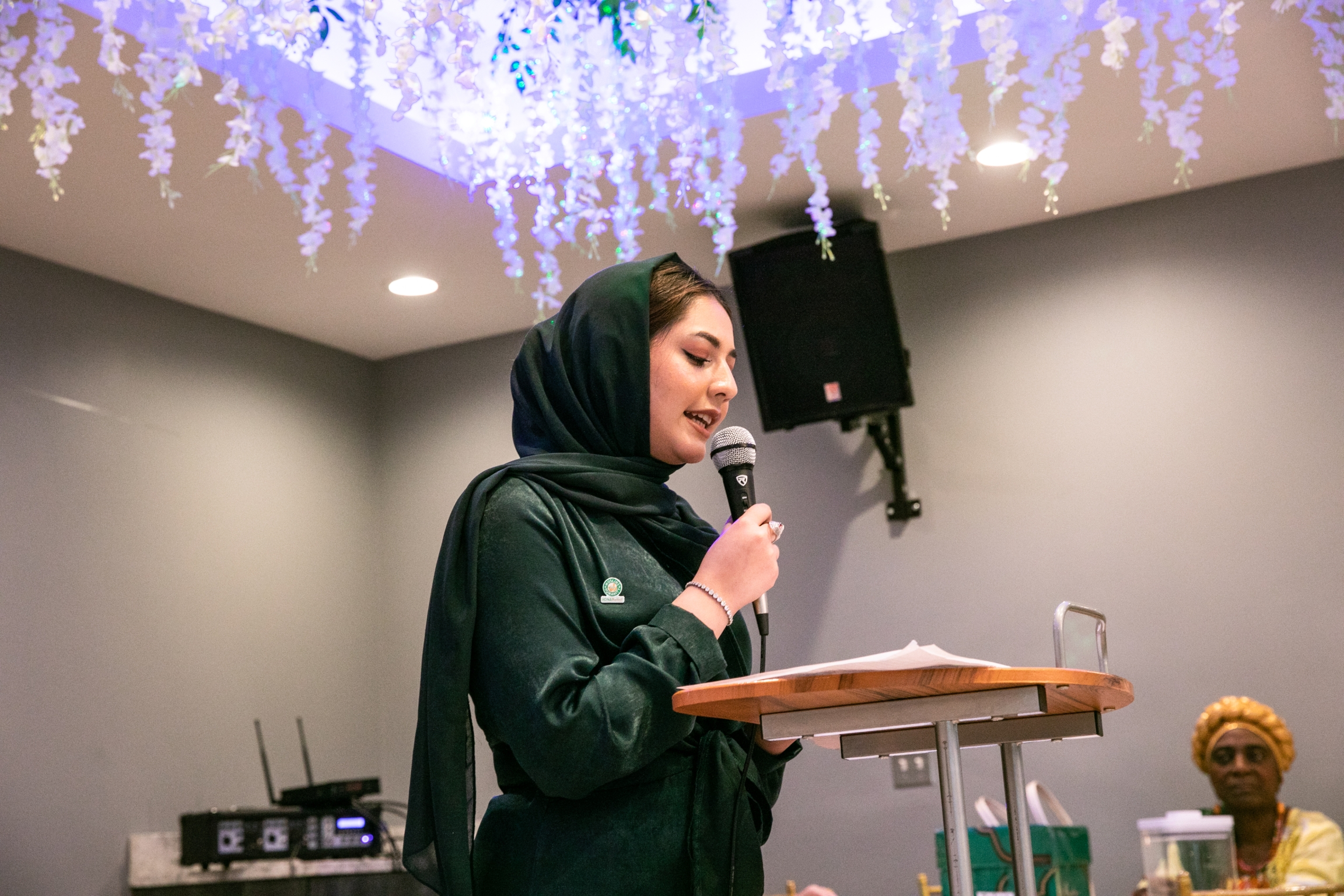
Meena Khalil from ICNA Relief speaks during an iftar in Woodbridge, Virginia, at the end of Ramadan.
Valerie Plesch/The World
“The world is changing, and attention shifting,” he said. “And so, it's going to be harder and harder to keep this front of mind for people, but we are trying.”
Opponents of the Afghan Adjustment Act who blocked the bill say that Afghan refugees need to undergo more security vetting.
But some say resistance to passing the Afghan Adjustment Act is part of a larger issue around immigration.
“Any topic on immigration, whether it's about the border, about Dreamers, about Afghans, about even high-skilled immigrants who can really contribute to our economy, Congress is really struggling to act on immigration,” said Julia Gelatt, a senior policy analyst at the Migration Policy Institute.
“Congress is just having a hard time passing anything. Every single piece of legislation seems to become politicized and really difficult to pass,” she added.
More than a year of war has changed Ukraine forever — but it is also reshaping Russia, with opinion starkly divided on what should happen to the country after the conflict.
Russian President Vladimir Putin is hoping its borders will be expanded and his own grip on power will be strengthened. Many outside Russia are pushing for a future without Putin, in which Moscow will never again be in a position to invade its neighbors.
But some Russians themselves are calling for a restructuring of the country and a rethinking of Russian national identity — often at great personal risk.
Alexandra Garmazhapova, a Russian citizen originally from the Siberian region of Buryatia, now lives between Brussels and Prague.
Earlier this year, she said, she was put on Russia’s wanted list over her work with a group calling for greater autonomy for Buryatia.
“If I try to go back, I’ll be arrested as soon as I get off the plane,” she said.
She also voiced fears about other activists and opposition figures who have been poisoned by Russian agents.
Garmazhapova is one of a number of ethnic-minority activists who are using the conflict in Ukraine to highlight racism within Russia and fight Moscow’s top-down rule of the country.
About 70% of Russians are ethnically Slavic, but the country is also home to almost 200 other ethnic groups, like Buryats, who have historically been badly treated.
Garmazhapova said it’s absurd for Putin to call himself an anti-fascist, and say that he invaded Ukraine to fight naziism there.
“He’s the xenophobe in chief,” she said. “He’s a chauvinist who has proudly described himself for years as a Russian nationalist.”
The president often talks about Russia’s multi-ethnic makeup. But in reality, authorities have long targeted ethnic minority activists and tried to limit the teaching of minority languages.
Thousands of miles from the capital, Buryatia is one of Russia’s poorest regions. It has historic ties to Mongolia but was colonized by Tsarist Russia from the 1600s.
Garmazhapova said that she would often be told to “go home” to China or Uzbekistan, because of her Asiatic appearance.
“I’d say, ‘Actually, I’m a citizen of the Russian Federation. I have the same passport that you do.’”
At the start of the invasion, Garmazhapova’s Free Buryatia Foundation helped soldiers from the region escape army contracts and return home.
The group said Buryat men were used as “cannon fodder” as their lives were seen as less valuable. Then, they were unfairly blamed for committing the worst atrocities of the war.
But bringing soldiers back from the front has become all but impossible under new laws.
Now, Garmazhapova is campaigning for genuine local government in Russia — like in the United States or Germany.
That dream might be a long way off.
Putin has spent the last two decades centralizing power in the Kremlin, and anyone who challenges this in a meaningful way is arrested, forced to flee the country, or in some cases, killed.
Some ethnic minority activists want to go even further than Garmazhapova. They don’t want their regions to be part of the Russian Federation at all — they want to be completely independent.
Among them is Raisa Zubareva, an activist from Yakutia, a far eastern region. She now lives in Warsaw.
“Russia mustn’t carry on existing as it is. In its current form, it will always be a threat,” she said, adding that the mineral resources that provide the money for the military come from regions like hers.
Most politicians in the West, she said, are reluctant to publicly back the breakup of Russia, rejecting it as too extreme.
But she suggested that, if you keep repeating an idea, eventually, it will become normalized.
Zubareva said that she doesn’t see a problem with activists like her living outside Russia.
“If they stay there, they will be arrested, and you can’t communicate with the public from prison.” Her Free Yakutia Foundation sees its work as informing the public and changing attitudes.
Activists might be divided on whether they want independence or just greater autonomy. But they all agree that the war in Ukraine has given them an important opportunity to bring their plights to global attention.
They say that invasion has laid bare Russia’s imperial, colonial mentality, which is not just killing Ukrainians, but also harming ethnic minorities within its own borders.
Abubakar Yangulbaev is a human rights lawyer from Chechnya, which was brutally subjugated by Moscow after fighting for its independence. He now lives in Paris.
“After Russia invaded Ukraine, we started to talk about racism, chauvinism and xenophobia inside Russia,” Yangulbaev said. “And it's a big problem, because in Russia, Russia never fought against racism.”
Now, people are starting to pay attention to what life is actually like for minorities in Russia.
“Right now, many national minorities have resources, we have a network.”
While Russian society becomes ever more nationalistic as the war drags on, conversations around racism and decentralization are beginning to happen.
People from minority groups are increasingly interested in their own cultures and history, these activists say. Whatever the challenges ahead, they believe another Russia is possible.
The US has once again buckled under pressure from European allies and Ukraine's leaders and agreed to provide more sophisticated weapons to the war effort. This time, it's all about F-16 fighter jets.
Ukraine has long asked for advanced fighter jets to give it a combat edge as it battles Russia's invasion, now in its second year. And this new plan opens the door for several nations to supply the fourth-generation aircraft and for the US to help train the pilots. President Joe Biden laid out the agreement to world leaders meeting in Hiroshima, Japan, on Friday, according to US officials.
So far, however, the US has provided no details and said decisions on when, how many, and who will supply the F-16s will be made in the months ahead while the training is underway. Details on the training are equally elusive.
In Hiroshima, Biden was asked whether these decisions could potentially escalate the war.
“I have a flat assurance from [Ukrainian President] Zelenskiy that they will not use it to go on and move into Russian geographic territory, but wherever Russian troops are within Ukraine and the area, they will be able to do that,” Biden said.
Zelenskiy said that his priority is to strengthen Ukraine’s air defense as Russia continues to bombard Ukraine from the sky. The battle for air superiority in Ukraine has been ongoing since Russia's invasion, and now, Ukraine hopes that F-16s can help them counteract Russia's advantages.
Already, US equipment has been instrumental in Ukraine’s air defense.
Earlier this month, Ukraine shot down multiple Russian hypersonic missiles called Kinzhal, meaning “dagger” — which Russian President Vladimir Putin has called “unstoppable.” The missiles were reportedly shot down with the American-supplied Patriot air defense system.
Valery Romanenko is a Ukrainian aviation and air defense expert.
“Last year, we were able to hit only the Russian planes, helicopters and cruise missiles. Now, we can hit all the Russian types of attack weapon, ballistic missiles including.”
Romanenko said that air warfare in Ukraine is evolving in other key ways as well.
“The Ukrainian Russian war is the first war of drones. Russians use both attack and recon drones and are very dangerous for us.”
Russia has often deployed these drones to damage Ukraine’s electric grid.
But in recent months, Ukraine has mostly withstood these attacks.
“Our air defense confirmed their high efficiency. For example, [in the] last two drone attacks, all 100% of drones were destroyed.”
Ukraine isn’t just defending itself from drones. It’s also using them as a weapon.
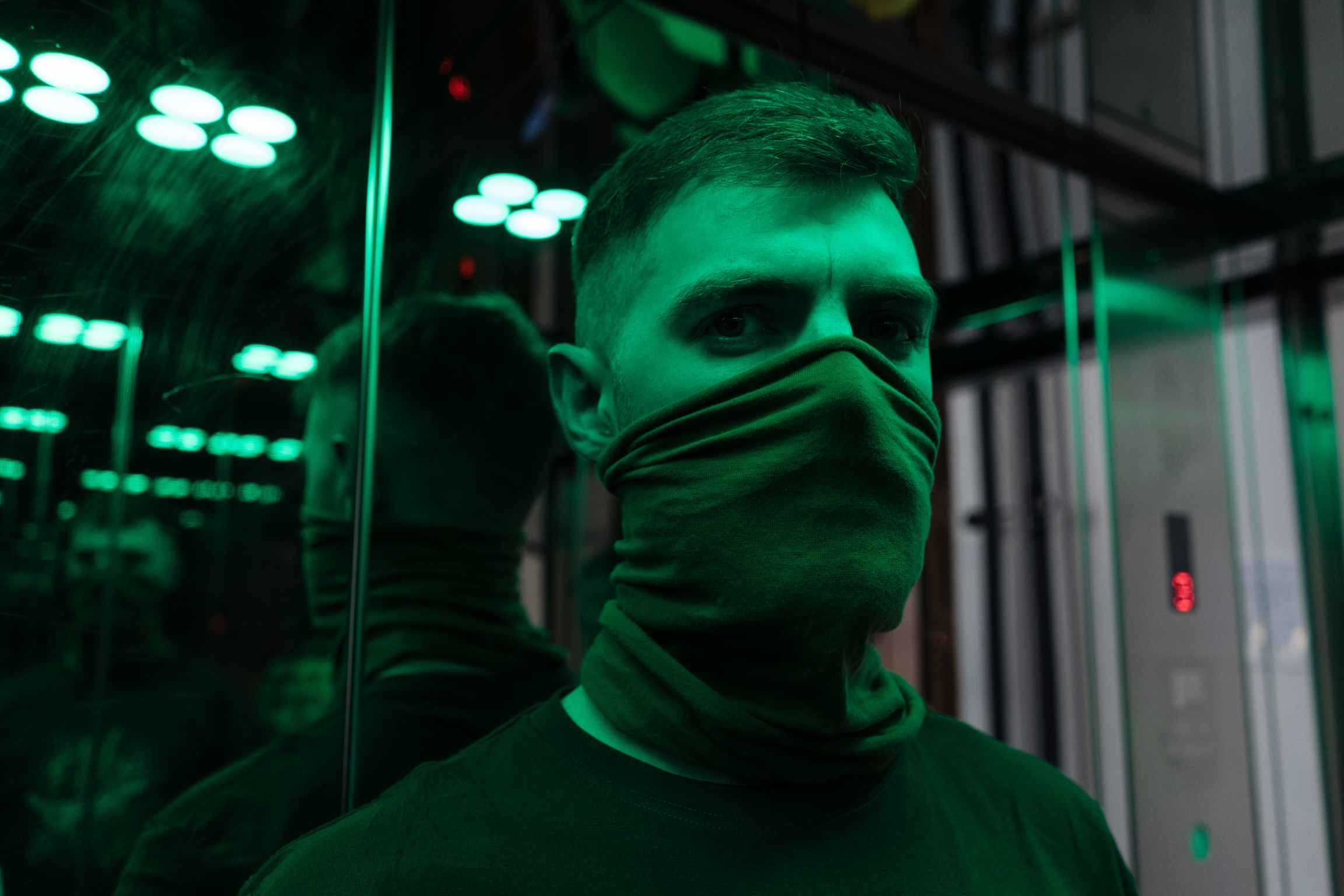
Juice is a 30-year-old Ukrainian fighter pilot. Juice is his call sign. He doesn’t reveal his name or his face because of security concerns.
Anastasia Vlasova/The World
Yaroslav Markevych commands a drone unit in the northeastern city of Kharkiv.
Markevych said that at drone command centers, they’re able to provide intelligence to troops fighting on the front lines. They use drones to gather intelligence, and then that information is uploaded to a digital map that Ukraine’s military uses.
“We can see our enemy’s positions,” Markevych said, adding, “As a result, our decision-making is much more effective.”
Drones are also useful when soldiers are low on heavy ammunition. They use the drones as a replacement for artillery — they’re rigged with grenades and other munitions that can be dropped on enemy positions.
But he said, “The enemy is also adapting.”
Russia jams Ukrainian signals, which is the most effective way to take out drones. Markevych said that he believes that drones are the future of modern warfare. But the military insists it also needs modern jets to win the war.
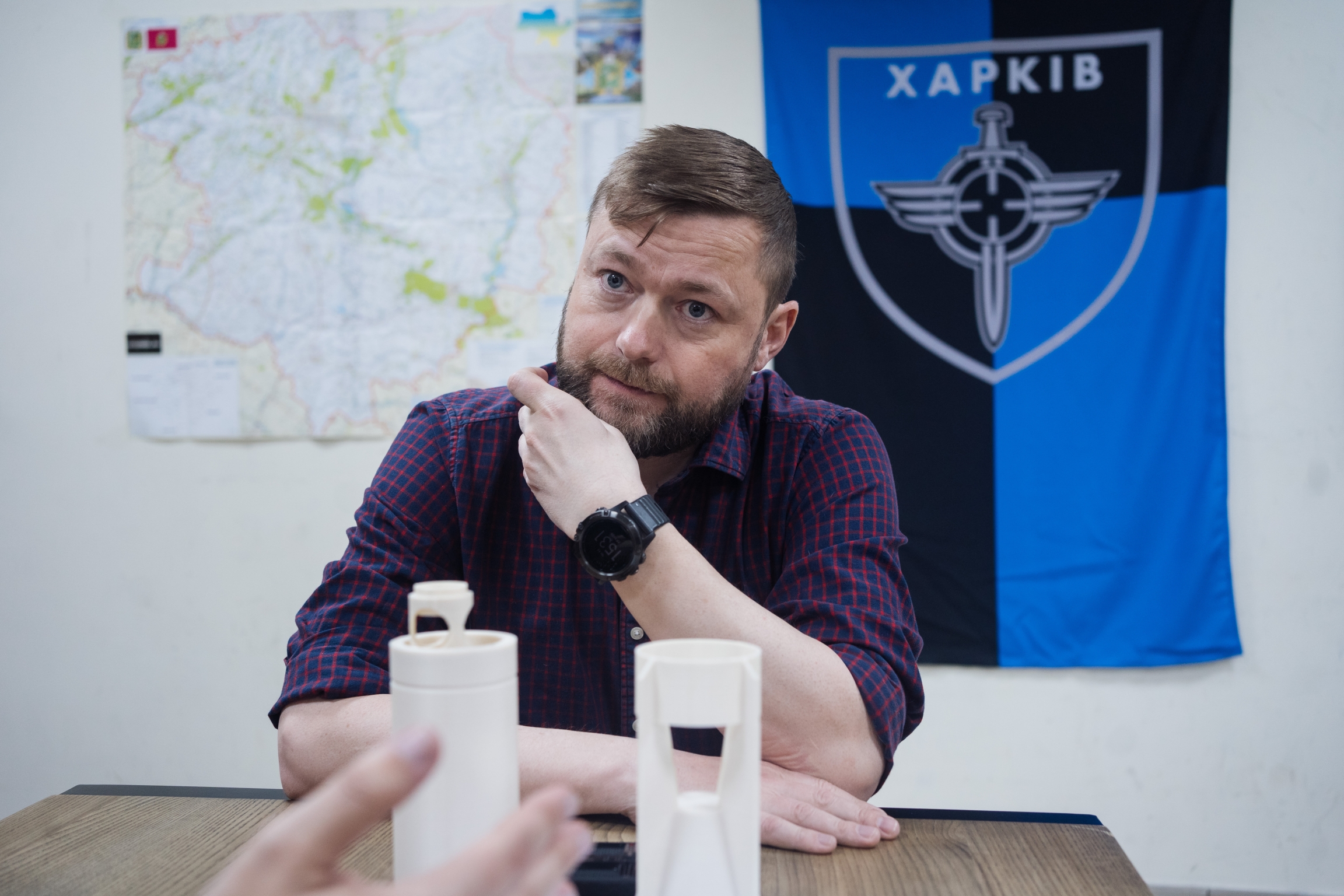
Yaroslav Markevych commands a drone unit in the northeastern city of Kharkiv, Ukraine.
Anastasia Vlasova/The World
“We needed to start the process like a half year ago, and nowadays, we would have combat-ready pilots,” said a 30-year-old fighter pilot who goes by his call sign, Juice. He didn’t reveal his name because of security concerns.
“At the moment, we have almost no air-to-air capabilities against the Russian air force,” Juice said. “We are absolutely not able to counteract Russian fighters and bombers, because of very outdated radars, because of very outdated and not capable at all air to air missiles.”
That’s why Juice is so adamant that Ukraine needs modern jets like the F-16. But until Ukraine has those jets in hand, Juice said that the country’s fighter pilots will still manage to pull off some successful missions.
“Usually, it’s like one mission per day, and you’re ready to get in your jet in like a few minutes and just to take off as soon as possible to intercept missiles or drones.”

Yaroslav Markevych, who commands a drone unit in the northeastern city of Kharkiv, Ukraine, shows a model of a munition that can be attached to a drone.
Anastasia Vlasova/The World
He called this a multilayered air defense system. Missile batteries try to shoot down Russian projectiles from the ground and fighter pilots try to shoot them down from the sky.
“You’re feeling adrenaline and you’re talking with your jet, like, let’s try, please, let’s do it, let’s kill these missiles, let’s intercept them, let’s save the people on the ground.”
Juice said that F-16s would significantly improve his ability to hit incoming Russian missiles.
He also said that these jets will help Ukraine’s offensive capabilities.
“We can’t just wait for a miracle. We need to fight, we are ready to fight, we are trained, we are motivated, we need the tools.”
After Biden’s announcement in Hiroshima, it looks like Ukraine’s pilots will get the tools that they’ve been waiting for.
The Associated Press and Volodymyr Solohub contributed to this report.
Passersby do a double take when they see Kaz Kobayashi and Ikki Goto.
The two men glide through Tokyo’s bustling Ikebukuro district in full-length samurai outfits, while wielding objects that look like swords. They are members of the Gomi Hiroi Samurai or the trash-collecting samurai.
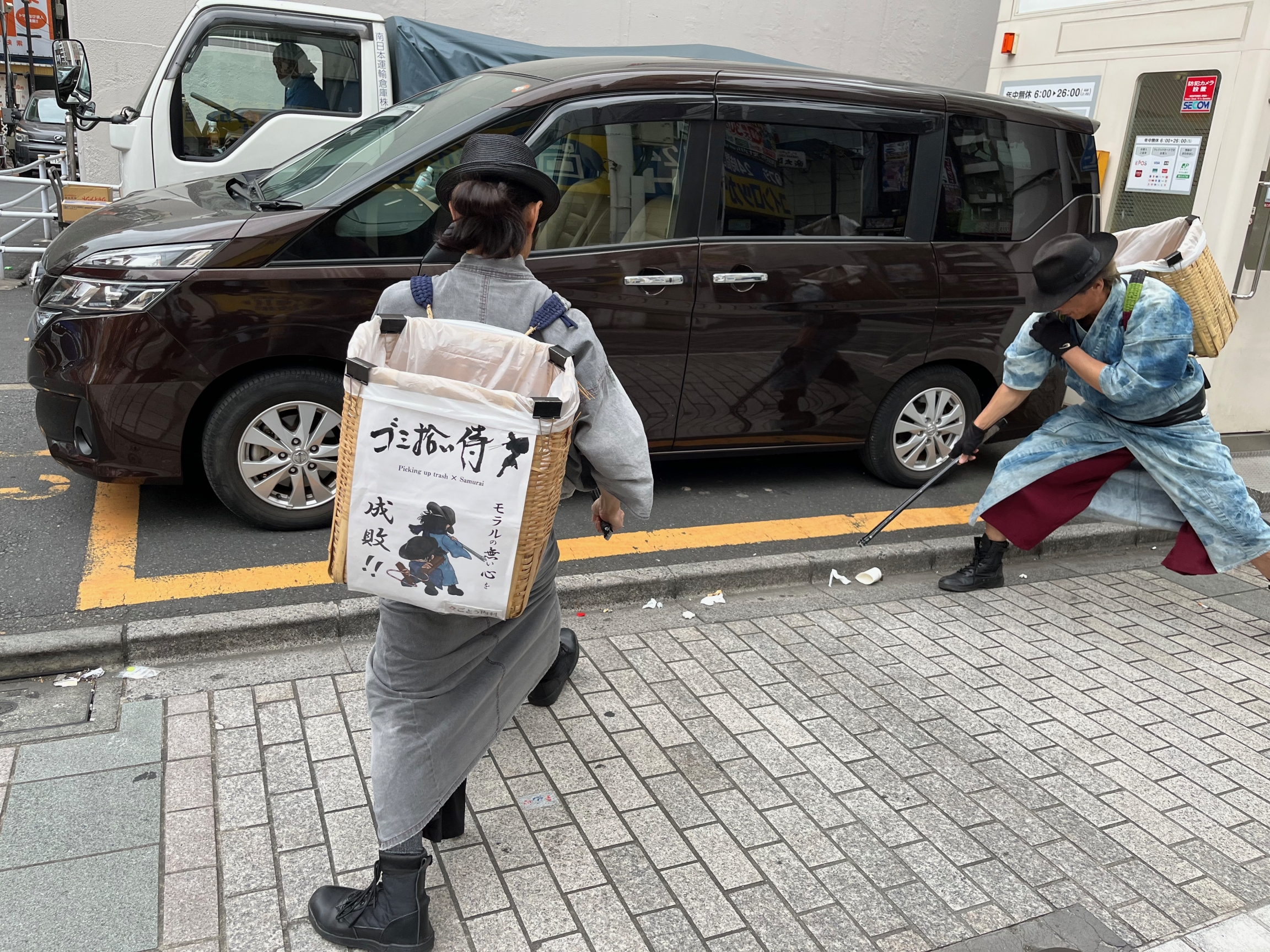
Kaz Kobayashi and Ikki Goto, part of the Gomi Hiroi Samurai group, are actors who perform as samurai who clean up Tokyo.
Julia Kim/The World
“Yesterday was Friday so people are smoking and drinking around here, so there’s a lot of trash,” Kobayashi said.
On closer inspection, their samurai swords — or katanas — are actually just very long tongs, used to pick up litter. Kobayashi said the tongs are important for novelty value.
“We’re doing this as entertainment … but it can be tiring sometimes. It’s tough, man.”
The Gomi Hiroi Samurai do this three times a week. There’s four of them, and they’re professional actors. In their spare time, they volunteer to keep the streets of Tokyo clean. Goto formed the group in 2009. Since then, they have become a viral sensation on TikTok, with over 700,000 followers and counting.
Kaz Kobayashi and Ikki Goto, part of the Gomi Hiroi Samurai group, are actors who perform as samurai who clean up Tokyo.
Julia Kim/The World
Here in Ikebukuro, they target back alleys and parking lots, which are rife with litter. Kobayashi and Goto, working in sync, slice and spin their tongs through the air, meticulously seizing cigarette butts one by one before tossing them into the wastebaskets strapped to their backs.
Manaka Nishibiro, a nursery teacher trainee, watched them from a distance.
“Picking up trash is unpleasant for most people, but their performance makes it look so fun,” Nishibiro said, adding that she hopes it might encourage others to do the same.
Kaz Kobayashi and Ikki Goto pick up litter in Tokyo as part of an acting troupe, the Gomi Hiroi Samurai, who have an environmental mission.
Julia Kim/The World
An hour later, Kobayashi and Goto took their wastebaskets to a recycling base. There, they separated out every piece of rubbish they’ve collected. They said that they hope to recruit more Gomi Hiroi samurai in Japan — and around the world — to spread their message: “We punish immoral hearts.”
It means that trash in and of itself isn’t bad. Instead, it’s people and the actions that stem from their negative mindsets. And a growing sense of negativity is something that Kobayashi said worries him.
“This is a problem in Japan,” he said. “People don’t go outside.”
Kaz Kobayashi and Ikki Goto, actors, use their roles in the Gomi Hiroi Samurai as a way to entertain and encourage people to keep the outdoors clean.
Julia Kim/The World
Last month, a government survey showed that 1.5 million people are living as social recluses in Japan. With loneliness and depression on the rise, Kobayashi said he hopes that their fun, zany take on something as mundane as trash-collecting helps people reengage with the outside world.
Kaz Kobayashi and Ikki Goto, part of the Gomi Hiroi Samurai group, are professional actors who volunteer to clean up litter in Tokyo. Their mantra is “clean space, clear mind.”
Julia Kim/The World
“Samurai is a warrior,” he said. “Our philosophy is to help people.”
For these eco-warriors, “clean space, clear mind” is more than just a saying — it’s the way of the Gomi Hiroi samurai.
Listen to the other stories in the four-part Waste Pickers series on The World:
Trash sorters in Ghana face health and safety risks
Back in 1992, security guards at the Universidad Libre in the Colombian city of Barranquilla came up with a way to help the medical school — and themselves.
On quiet nights, they lured waste pickers onto campus to collect old cans and cardboard boxes — it was a trap. The guards beat them with bats, and shot them, according to court documents. Then, they sold the bodies to the medical school, where the students needed cadavers to learn on.
This went unnoticed for weeks, until one waste picker survived. After he was put in a bathtub full of formaldehyde, the man escaped and alerted the police. On March 1, as the city celebrated its annual carnival, officials found the bodies of 11 waste pickers in the university’s morgue.
“It’s something that still makes us feel pain,” said Marisol Mogollon, a waste picker in Bogotá. “Just to think that we were treated as disposable beings.”
Waste picker Alfredo Rodriguez separates cardboard from plastic at a park in a wealthy area of Bogotá, Colombia.
Manuel Rueda/The World
The crime shocked the nation but it also galvanized waste pickers in Colombia. They went from being one of the most marginalized groups in the country to being highly visible, fighting for their rights in the streets and in courts. Nowadays, Colombia is a global leader when it comes to granting rights to these workers, said Federico Parra, an urban anthropologist who specializes in grassroots organizations.
“This [crime] created a huge movement that impulsed the waste pickers' organizations to fight for their rights,” he said.
Many waste pickers in Colombia are now recognized as public service providers, and they can go anywhere in the city to collect goods that can be recycled — without fear.
Miguel Lugo organizes cardboard at a warehouse run by ARAUS, the Usme Waste Pickers Association.
Manuel Rueda/The World
A lot of them still get around the city on foot, pulling heavy wooden carts. But they have formed associations that own trucks, and collect their trash at designated points. Previously, waste pickers had to drag their carts for several miles to get to warehouses where they sold items like cardboard, bottles and tin cans.
Alfredo Rodriguez is a waste picker in Chapinero, a wealthy district in the north of Bogotá. As he pulled his wooden cart along a street lined with office buildings and expensive apartments, he said the job still pays little, and requires long hours. But slowly, the conditions have been improving.
“We used to fight over trash bags in the street,” he said. “Now, it’s more orderly, and we also get gloves, face masks and boots with steel tips.”
In Colombia, waste pickers have filed several lawsuits against city governments that have privatized waste collection and given some recycling responsibilities to government contractors.
In 2011, the nation’s Constitutional Court ruled that municipal governments had to take actions to protect waste pickers, because they are a vulnerable group that provides an important service.
Miguel Lugo and William Lugo stop at a school where they are going to collect trash that can be recycled. The ARAUS waste pickers association owns a truck that has helped it to increase its monthly haul.
Manuel Rueda/The World
Following that groundbreaking ruling, cities like Bogotá have begun to require that contractors pay waste pickers a portion of the funds that they get from waste management taxes.
So, in Bogotá, waste pickers don’t just get paid for what they sell to warehouses each day. They also get a monthly fee that comes from the waste management tax. It’s known as the tarifa.
“We get anywhere from $30 to $90 from the tarifa, depending on how much [trash] we gathered,” said Sandra Martinez, a waste picker in Usme, a district at the southern edge of Bogotá. “It’s not much, but it helps to pay the bills.”
At the end of the month, waste pickers’ associations also get paid a fee, which varies according to how many tons their members collect.
Waste picker Emiliano Martinez pushes his cart through a neighborhood in Usme, where he collects trash door to door.
Manuel Rueda/The World
Jorge Ospina directs ARAUS, the waste pickers association in Bogotá’s Usme district. His association has 75 members and gets about $5,000 a month from local taxes.
“Thanks to the tariff, our association has enough money to rent three warehouses, and we’ve also bought a truck.” he said.
At one of the warehouses, two employees stripped labels away from hundreds of plastic bottles, so that they could sell them to a local recycling plant.
Thanks to the warehouse, there’s no longer any need to sell trash to middle men. And the association’s members can get better prices for what they collect.
Waste picker Edgar Rodriguez loads cardboard on a truck owned by ARAUS, the Usme Waster Pickers Association. The truck helps the association to collect more trash and makes things easier for waste pickers in the district of Usme.
Manuel Rueda/The World
But waste pickers in the city still face many challenges. Prices for some items, like cardboard, have fallen recently. And for some waste pickers it’s also become harder to gather decent amounts of trash.
Martinez said many Venezuelan migrants who are out of work are also roaming the streets of Bogotá looking for items that can be sold to recycling plants.
“They open the trash bags before we can get to them,” she said. “And with the economic crisis, even homeowners are holding on to stuff, and selling it themselves to warehouses.”
But the biggest challenge for Bogotá’s waste pickers are large contractors that are also trying to get a piece of the recycling business.
Jorge Ospina, (center) standing with other waste pickers who are affiliated to the ARAUS association. Ospina has been the group’s director for more than 20 years and under his leadership they have been able to rent warehouses and get their own truck.
Manuel Rueda/The World
Ospina, from the ARAUS association, said that some of these companies have even formed dubious associations that are trying to claim some of the monthly payments that are reserved for waste pickers.
“Before the tariff system began, we only had around 40 waste pickers’ associations in Bogotá,” he said. “But now, there are 450. The city government has to eliminate the fake organizations, so that only the authentic waste pickers benefit from the monthly payments.”
Still, for many waste pickers in Bogotá, like Martinez, this is an industry that has changed for the better, even if these transformations were sparked by a horrible set of murders.
“Our job has more recognition now,” she said. “We used to be perceived as junkies, or disposable people. But now, our role in the city is respected.”
Listen to the other stories in the four-part Waste Pickers series on The World:
Trash sorters in Ghana face health and safety risks
In Mumbai, waste pickers do the heavy lifting of recycling
Tokyo’s trash-collecting samurai takes a fun, zany approach to cleanup
The monthlong fighting in Sudan doesn’t seem to be relenting. The Sudanese Army and the militias of the Rapid Support Forces continue to face off in urban areas like Khartoum.
About 200,000 people have been forced to flee to nearby countries, and over 700,000 have been displaced inside Sudan, triggering a humanitarian crisis. Many more remain trapped in the country.
Amid this humanitarian crisis, a food factory was burned down last week, leaving many children at risk of starvation.
The Samil factory made life-saving products called RUTFs, which stands for ready-to-use therapeutic food.
RUTF was invented by a French scientist 25 years ago, and it is used to treat severely malnourished children under the age of 5.
“It is a bit of magic food because you do bring a child back from the brink of death,” explained James Elder, spokesperson for UNICEF. “It’s a dense energy paste. It’s full of micronutrients, peanuts and sugar, powdered milk, vitamins [and] oil. It’s got everything, it really does.”
UNICEF worked with the Samil factory in Khartoum to procure the RUTFs it needs to feed children in Sudan.
Elder said he doesn’t know who was behind the fire at the factory — whether it was a deliberate act or if it was just the consequence of the two sides fighting.
What is clear, though, is that 15,000 boxes of the food have been destroyed.
“The factory that produces 60% of this ready-to-use therapeutic food for Sudanese children [was] burned down, the production line, the machinery and all the ability to keep producing. So, it was yet another blow to children that are under attack from so many directions,” he said.
The UN estimates that 19 million people are at risk of starvation in Sudan.
Many have fled but for those who remain, venturing out to get food can cost them their lives. Banks have been closed down, and people are running out of cash.
Elder added that UNICEF is now trying to bring in the ready-to-use food from other countries. But the ongoing fighting makes deliveries challenging.
“This was already a cruel place for millions and millions of children. It just got that [much] more difficult,” he lamented.
The US ambassador to Sudan, John Godfrey, described the factory as the backbone of humanitarian child supplemental feeding programs in Sudan.
He said in a tweet that 3 million children in Sudan already suffered from hunger and malnourishment. This conflict has increased that number, he added.
Angered to see the humanitarian toll of this senseless violence increase even more. The #SAMIL plant that was destroyed was the backbone of humanitarian child supplemental feeding programs in Sudan. Three million children in Sudan already suffered from hunger and malnourishment;… https://t.co/qBflE8tWrH
— John Godfrey (@USAMBSudan) May 14, 2023
The burning down of the Samil factory is part of a pattern of destruction of food supplies that makes life for residents so difficult, they decide to leave.
On Monday, aerial footage showed a large fire in the market in the Sudanese city of Omdurman, northwest of Khartoum.
In the early days of the war, The World Food Program said its warehouses were looted and that more than 13 million dollars worth of food was taken.
“We are looking at 25 to 30,000 refugees crossing the border [into Chad] in the last few days,” Eujin Byun of the United Nations Refugee Agency told The World in a WhatsApp message, adding that more than 90% of them are women and children.
Byun said her team has seen a lot of children crossing the border by themselves.
“We see a lot of orphans without relatives, without their parents crossing the border. It is indeed a children’s crisis.”
Elder of UNICEF said according to his organization’s tally, just in the first 11 days of the war, 190 children were killed. This is probably an undercount, he said, given the difficulties in confirming the deaths in a conflict zone.
Now, with the news about the only factory making food for severely malnourished children out of operation, fears are growing about the survival of millions of children.
Elder said timing is crucial in saving malnourished children, so supplies must arrive fast.
If that doesn’t happen, even if the children survive bombs and bullets, they could die of hunger.
A vyshyvanka is an elaborately embroidered shirt or dress traditionally worn in Ukraine — it’s one of the country’s best-known symbols.
Despite the ongoing Russian attacks on Ukraine, Ukrainians around the world are celebrating Vyshyvanka Day on Thursday.
Kateryna Vozianova, who owns Indposhiv, a men’s fashion brand based in Kyiv, said the vyshyvanka isn’t something she thought about before the full-scale Russian invasion. The company is known for its high-end, custom-tailored suits.
But now, Vozianova said, it’s important for her brand to reflect this moment in history when many Ukrainians — herself included — are rediscovering their national identity. That’s why Indposhiv pivoted to producing vyshyvankas.
“Before the war, it meant nothing to me, because I didn’t feel that I needed to emphasize that I’m Ukrainian,” she said. “Right now, it has changed completely because it’s the symbol of Ukrainian struggle, everything we are going through right now, and the changes inside yourself and inside everyone.”
Vozianova said that more vyshyvanka orders are coming in because of the holiday. It takes up to six weeks to make one, so Indposhiv ran a social media campaign, she said, asking people to order in advance. She said that she is celebrating the holiday by wearing her vyshyvanka at work.

This vyshyvanka at Indposhiv, a men’s fashion brand based in Kyiv, Ukraine, is embroidered with military symbols reflecting the fact that the country is at war.
Daniel Ofman/The World
At first glance, the company’s vyshyvankas look pretty typical — embroidered patterns, colorful and comfortable. But they have veered away from traditional symbols, like flowers, trees, birds — some of the vyshyvankas depict drones, tanks or military symbols and come in army green.
“The idea is to translate that we are going through war, this is why on this vyshyvanka you can see all this military machine, tanks, the resistance and the unity of our people,” she said.
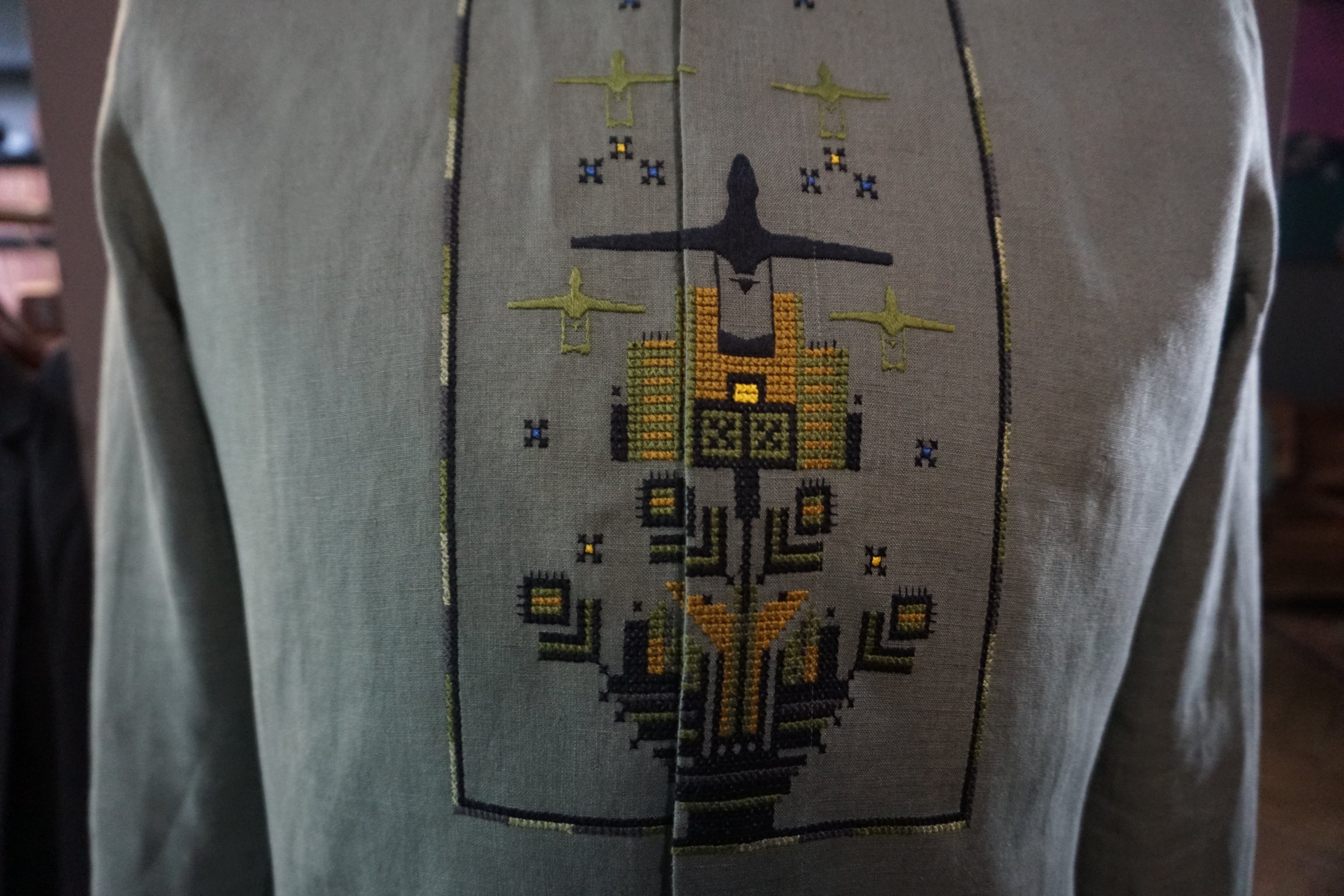
Indposhiv, a men’s fashion brand based in Kyiv, Ukraine, produces vyshyvankas that display military symbols to show national pride.
Daniel Ofman/The World
Roxolyana Gera, who lives in the trendy Podil neighborhood of Kyiv with her family, collects vyshyvankas, including some modern ones.
“First, I started to buy books about embroidery and about vyshyvanka and about Ukrainian culture, and those books opened a galaxy of Ukrainian culture for me.”
Gera was inspired. She started going to flea markets and joined vyshyvanka collector groups on social media.
“I wanted to find vyshyvankas from each region of Ukraine, and it was my aim, and I’m almost there.”
Roxolyana Gera, of Kyiv, Ukraine, belongs to vyshyvankas collectors groups on social media. She collects old and new ones and is trying her hand at the embroidery herself.
Daniel Ofman/The World
Gera remembers growing up in western Ukraine, when her family would wear Vyshyvankas on special occasions, like Christmas and Easter.
“I was born in [the] Soviet Union, actually, and it was prohibited to celebrate all the religious holidays, so we still gathered at our granny’s house and we [would] wear Vyshyvankas as a protest and a sign, we remember our roots.”
These days, Gera said that she’s dabbling in traditional embroidery herself.
Roxolyana Gera, who lives in the trendy Podil neighborhood of Kyiv, Ukraine, with her family, collects vyshyvankas, including some modern ones.
Daniel Ofman/The World
“I started doing my first vyshyvanka last year, during the air alarms because, while sitting in the corridor or safe place, you have nothing to do because it’s very difficult to start reading because you are a little bit stressed.”
Just sitting with a needle and thread, she said, can be therapeutic and a welcome distraction.
Volodymyr Solohub contributed to this report.
Ali Mohammad, a recycler in Dharavi, an informal settlement in Mumbai, one of India’s largest cities, sorts through a mountain of plastic ice cream cartons, which are destined to become anything from hair combs to water buckets.
“The life of plastic never ends. It breaks, then, in one month or so, it comes back as another thing,” he said.
Ali Mohammad sorts through ice cream containers for recycling.
Justin Nisly/The World
After moving here from Uttar Pradesh, a large state in northern India, Mohammad has spent the past four years separating, washing and chopping plastic as part of Dharavi’s bustling recycling operation.
In Mumbai, home to 20 million people, waste ends up in Dharavi with recyclers like Mohammad. A quarter of the people living here are employed in recycling at least 60% of the city’s plastic — a recycling rate far higher than the average in the US.
The recyclables that Mohammad digs through in a one-room, independent shop come from waste pickers who gather the recycling from the landfills and streets. Both groups of workers are crucial — and interlinked — in India, which is grappling with how to manage the rapid growth of plastics and other solid wastes.
Ice cream containers from popular Indian brands wait to be recycled.
Justin Nisly/The World
In Mumbai, a city crushed by the amount of garbage discarded each day, waste pickers help make this metropolis livable. And for every bottle and bag collected, that’s less plastic that ends up in the ocean.
The process begins in neighborhoods like Bandra, 20 minutes from Dharavi where Sheikh Salim gathered litter on the side of a road.
Salim, a waste picker, set down an enormous bag and listed the contents so far: “There is paper, these are bottles, this is a metal container, a thin sheet of plastic.”
He added, “I will take this waste to the scrap dealer who will weigh it and whatever, 150 rupees [$1.80], I will get.”
From the scrap dealer, most of the dry waste will eventually go to a recycler. In Mumbai, that could be a small-scale operation in Dharavi.
Though municipalities often also have a centralized, official version of waste management — for instance, garbage trucks that collect each day from households and some recycling centers — they tacitly rely on waste pickers and unlicensed recycling centers to augment their services.
Swati Singh Sambyal, an independent waste management expert, said that this interconnected waste management process is convoluted: “There’s a formal system of management, there’s an informal system of management, and that’s where the chaos is.”
Sambyal noted that since the Indian government issued its Solid Waste Management Rules 2016, the mindset of many Indians has been changing — and that is a good thing.
Sheik Salim collects recyclables in his bag along a street in Bandra, in Mumbai, India.
Justin Nisly/The World
These rules, which mandate that homes and businesses should separate dry, wet and hazardous waste, have sparked a growing awareness about the importance of scientifically managing trash.
Still, many households don’t. Instead, they might toss plastic water bottles in with food scraps and diapers. And Sambyal said that even when families do separate their trash, the city garbage collectors might toss it all together.
“Perhaps, if I’m doing it [waste segregation] as a resident, it’s being collected and then mixed, and then, say, going to a facility where it’s burned. Me segregating then goes down the drain.”
Or, municipal sanitation trucks might just dump everything into landfills that other waste pickers then dig through, which is dangerous work.
As experts consider ways of improving this system, Sambyal said an important question to ask is: “How do we formalize the informal sector, or if we’re not able to do so, how do we bring them into our processes?”
It’s a question Sushila Sable is also asking. She is part of a women’s empowerment group in Mumbai called Stree Mukti Sanghatana.
For decades, she did the hazardous and difficult work of gathering recyclables from a nearby dumping ground. Now, she works to organize them.
Sable said it is high time that waste pickers be officially recognized for their important role.
Sushila Sable, a former waste picker, now manages a women's empowerment group.
Justin Nisly/The World
“From the year 2008, we have been demanding that we be given an identity card, to be recognized and live a life as humane as possible given the circumstances we work in. But [we] have not got the identity card.”
Official IDs protect them from police harassment, reduce the stigma of the job, and waste pickers say it could improve their access to subsidized housing, health care and education for their kids.
The good news is some Indian cities have already begun to incorporate waste pickers into their waste management systems. For instance, the city of Ambikapur, in the state of Chhattisgarh, has given several hundred waste pickers ID cards, so they can collect garbage from people’s homes — where it’s been presorted.
Later, the dry waste will be separated into a whopping 156 different items.
In Dharavi, an informal settlement in Mumbai, India, men separate plastic and metal components for reycling.
Justin Nisly/The World
Ritesh Saini, based within the city government, is the local officer for the country’s Clean India mission, Swachh Bharat. Saini explained that they divide their dry waste so carefully because “the more we segregate, the more revenue we can earn.”
As an example, he cited an average water bottle.
“The cap is separated, the plastic wrapper is separated, and the bottle body is separated,” and by selling each piece to a different vendor, Saini said, the city generates a lot more income.
Raju Rajput (left) and his colleagues take a break from recycling plastic car bumpers in his shop.
Justin Nisly/The World
Back in Dharavi, Mohammad said that business is booming for recyclers like him, as Indians throw away more trash than ever. In fact, the Indian government predicts that the country’s plastic use will more than triple in the next decade.
It’s a big reason why waste pickers are asking for more protection and recognition for their role in waste management.
“We work for cleanliness of the surrounding living spaces as well as protecting the environment,” Sable said. “Slowly, the world is recognizing us and our role.”
Listen to the other stories in the four-part Waste Pickers series on The World:
Trash sorters in Ghana face health and safety risks
Tokyo’s trash-collecting samurai takes a fun, zany approach to cleanup
Abdul Bais hung a leather briefcase over his shoulder, as he got ready to board a speedboat in Necocli, a town near Colombia’s border with Panama. It stood out among the other migrants around him, who mostly carried worn-out backpacks.
Inside the neatly arranged briefcase, he kept diplomatic passports and letters that showed he came from Afghanistan, and had worked as a diplomat for the government that was removed by the Taliban in 2021.
Bais hoped that the documents could help him to show immigration officers in the United States that he was running away from the Taliban regime, had a credible fear of returning to his country, and could qualify for asylum.
Abdul Bais, a former diplomat for Afghanistan, leads a group of migrant families. As he gets ready to board a speedboat in Necocli, Colombia, he carries his documents in a leather briefcase.
Manuel Rueda/The World
But to get to the southern border, he still had to cross all of Central America and Mexico, and before that, trek through the Darien Gap — a dense and roadless swath of jungle that stands between Colombia and Panama.
“In this world, no one has helped us,” said Bais, who traveled with his wife, three children and two other Afghan families fleeing the Taliban regime.
None of them had ever been in a rainforest before, or gone on a trek that can last several days. But, Bais said, they had run out of options.
“We are trying our best to reach somewhere that is safe, especially for our families.”
“We are trying our best to reach somewhere that is safe, especially for our families.”
Thousands of people from South America, Africa and Asia are making their way to the US border, following the expiration of Title 42, a public health policy that was used to block hundreds of thousands of asylum requests during the pandemic.
According to Panamanian authorities, more than 3,000 refugees from Afghanistan have crossed the Darien Gap since the Taliban regime took over in 2021. These refugees have been unable to get visas that will enable them to fly to the US.
Manuel Rueda/The World
The journey across countries like Colombia, Panama and Mexico is difficult for Afghans, especially because they don’t speak Spanish and are unfamiliar with local customs.
Many of them saved up thousands of dollars to make the trip — having been doctors, NGO workers, politicians or media workers back home.
But their connections and relatively high income levels have now also turned them into targets for criminal groups in Latin America, according to Rafael Velasquez, the Mexico country director for the International Rescue Committee.
“We know of at least a dozen cases of Afghan people being detained by organized crime [in Mexico] and money being asked for ransom,” he said. “Unfortunately, their profile has become of interest for organized crime.”
He added that Afghans are also targeted by corrupt police officers, who seek bribes to let them continue on their journeys.
Bais worked for Afghanistan’s Embassy in Iran in 2021 when the Taliban came into power, and it wasn’t possible for him to return to the capital, Kabul.
So, along with most of the Embassy staff, he stayed in Iran and continued to work there, representing Afghanistan’s toppled democratic government.
But in February, Iran handed the Afghan Embassy in Tehran over to the Taliban regime. Bais was stripped of his diplomatic status, and his visa was canceled, even though it was still supposed to be valid for several more months.
Abdul Bais displays his diplomatic passport, as he gets ready to board a speedboat in Necocli Colombia. Bais worked for Afghanistan's embassy in Iran before the Taliban took over the government.
Manuel Rueda/The World
“They took our passport and canceled our residency,” he said. “And they told us that in one week, we had to leave” Iran.
With little clarity of where he could go next, Bais sought help at numerous embassies, and was able to secure a humanitarian visa to fly to Brazil.
But after getting there he decided to reach the United States, where he has relatives.
“In Brazil there was no motivation” he said. “All we could do there was sleep at a shelter and eat.”
Since the beginning of last year, Brazil has granted humanitarian visas to 9,000 refugees from Afghanistan who were stuck in Iran and other countries.
Afghans who arrive in the country on humanitarian visas can apply for work permits, social security numbers and residency. But it’s a lengthy process, and many struggle with language barriers and red tape, said Miguel Couy, a volunteer for the Frente Afega, an organization that helps Afghans arriving at Sao Paulo’s airport. He said that the vast majority of Afghans that his group has helped have decided to head to the United States after staying in Brazil for a few weeks.
“These are people that were linked to US affairs in Afghanistan,” Couy said. “And they have the conception that in America, they will rebuild their life more easily and quicker, because the US has more jobs and the jobs pay more.”
After arriving at Sao Paulo’s airport in March, Bais and his family made their way to Necocli the following month, where they started to make plans to cross the Darien Gap.
“We have rented horses,” Bais explained as he stood on the pier in Necocli. “They will carry our children and luggage while the rest of us walk.”
Bais paid smugglers $1,000 to lead his family across the Darien Gap on a boat, horses and on foot, until they reached a migrant camp in Panama where buses were available to continue across Central America.

A speed boat gets ready to set out for Capurgana, near Colombia's border with Panama.
Manuel Rueda/The World
He’s not the only Afghan undertaking this dangerous route.
According to Panama’s immigration authority, more than 3,000 refugees from Afghanistan have crossed the Darien jungle since the Taliban takeover in August 2021, trying to reach the United States.
But it’s a journey that is costly and is fraught with risks.
When Bais and his family arrived in Guatemala, the group was stopped by police, who took them to a station and said they couldn’t continue their journey without proper documentation.
Bais said the police officers took three cellphones from them and more than $1,000 in cash before allowing them to continue.

Abdul Bais said he is worried for his daughter's future: "Everyone knows that schools and unversities have closed [for women] in Afghanistan. I don't want my daughter to be uneducated."
Manuel Rueda/The World
He then had to pay a smuggler to get a letter from Mexican immigration officials that would enable the group to reach the US border. Now the three Afghan families are in Mexico City, where they’re planning to catch a flight to Tijuana.
The journey has been costly and dangerous, but Bais said he will not desist from reaching the US where his family plans to turn themselves in to border patrol agents and test their luck with the new immigration policies.
“We don’t have any second option,” he said in a recent phone call. He added that his family has long passed the point of no return.
Related: 'I survived a green hell': More Venezuelans are crossing the dangerous Darién Gap
What makes a hacker tick?
A 27-year-old hacker in Ukraine named Bassterlord helps to shed some light on the matter.
He’s been a member of some of the most infamous hacking crews of our time, and he explained, through an interpreter, how he worked his way up from spammer to initial access broker — breaking into networks and selling that access to other cybercriminals.
A mentor to other hackers and the author of two ransomware manuals, Bassterlord has made a name for himself since joining the cyber underworld in 2019.
Then, in March, he announced his “retirement,” a claim security researchers largely view as misleading. Researcher Jon DiMaggio of the threat intelligence firm Analyst1 is releasing a report about him this week, and he gave the "Click Here" podcast an exclusive first look, which helped inform the discussion.
"Click Here": What would you like us to call you?
Bassterlord: Let's just simply use the name Ivan. It's a pretty popular name, and I'm more used to it.
OK. So let me just try and understand. How do we describe you?
Let's put it this way: an extortionist, retired.
Retired extortionist. OK. You've worked for lots of different hacking groups. Can you give us a little list of the ones you've worked for?
Since 2019, I worked for REvil, but I didn't have access to the panel. After the contest [Note: Bassterlord says he participated in a summer contest put on by LockBit, which sought research papers on all things cybercrime], somebody contacted me and offered [for me] to work for LockBit, but at the same time, I was working for Abaddon and I also worked for Ransom X.
And what do you think your specialty is?
I would describe myself as a searcher for access or access broker. My way of getting access is through exploits or brute-force attacks. My team is engaged in VPN and corporate server brute-force attacks.
How did you get into this work?
Since childhood, I took an interest in hacking. I was always curious and interested in the various forums, but never used them. At the beginning of 2019, I didn't know anything about ransomware, and I was just a regular human being. What really propelled me to move to the dark side of the internet was one case that happened with my mom. It's personal, but I'll still try to talk about it.
[Note: Bassterlord lives in the Donbas region of eastern Ukraine, where fighters linked to Russia invaded in 2014.]
One night, a powerful shelling started. My mother had kidney stone disease and had an attack because of the nervous stress. Nobody could come to the rescue at that point. There was no chance to call 9-1-1 or anything like that. And only one thing helped. I saw the neighbor driving from around the corner. I simply came up, laid on the hood and said, "Help get us to the hospital. I will give you anything."
We brought my mother to the hospital and purchased medicine for credit. Obviously, I had no money at that time. So, [as] I was going home, I thought that this debt actually will have to be repaid. And at the same time, the Ukrainian jet fighters were flying overhead to bomb the neighboring town. I returned home, went to the forum and wrote my first ad on XSS [a Russian-language hacking forum]. I highlighted that I need money, and I'm not afraid of work in any country of the world.
What response did you get?
So, one man approached me through this. As it turned out, his nickname ended up being “National Hazard Agency.” He offered me work on spam. They paid, I think, $300 a month. This was just enough money to cover the expenses, or at least for some time. But as I found out later, this man happened to be one of the REvil founders. I understood the concept of what he was doing, and I asked him to teach me. He agreed, although he initially never planned it. At that particular moment, he was working on the Pulse Secure VPN. This actually was a topic of my [LockBit contest] article when I described the exploits of Pulse Secure, for which I'm being hated by many until this day.
Hated because you revealed how it worked?
Well, specifically revealed the principle of work because that was the principle utilized by many groups at that time.
And did you win money for that?
I had a consolation prize, and I actually had a proposition to get into a partnership problem with LockBit. Everybody got a consolation prize, approximately the amount of $1,000.
Did the $1,000 seem like a lot of money at the time, given that you didn't have a lot of money?
Clearly.
And I had heard that you were a graphic designer before you started doing that.
That's true. And that was my unofficial work. I was involved in drawing for clothes suppliers in the Russian Federation.
How did you get the idea for the ransomware manual?
The first part of the manual was the contest article. I simply wanted to make more money and win the contest, but I still didn't win it at that time. It took me literally two weeks to compose the text.
Why did you write a second one?
The second one I wrote for a person trying to purchase a new method of zero-days. So initially, he offered $200,000, but then he refused to pay, and I had to actually put the manual on the web for everyone to look at it. And also, I needed money at that point.
So, if I barely know how to code and have your manual, could I launch a ransomware attack just using the manual?
If you had both versions of the manual.
And there's a cybersecurity company called Prodaft. They got a copy of your manual. How did you hear about that?
I learned about it from somebody on the forum, from his message. He wrote that the manual was published by this company.
How do you think Prodaft got your manual?
I think one of the clients, one of the buyers, decided to return $10,000. They paid for it, and they sold it to the cybersecurity company.
[Note: Prodaft threat researcher Juan Ignacio Nicolossi denied this claim, saying, “We don’t give money to criminals.” Nicolossi said Prodaft “gained visibility into [Bassterlord’s] server and was able to extract [the manual].” In a follow-up email, the company said it does not use offensive tactics and insights are gathered from open-source intelligence and the work of security analysts.]
So, when you wrote these manuals, did you write them as a mentor to help the community grow or was it purely for money?
It was strictly for financial profit because, at that point, I already had my own team who I trained.
And some people say that what is different about you in this world is that you try to help people with their skills. Do you think that's accurate?
In some cases, yes. If the questions [other hackers ask] are composed correctly and they do not represent some stupid idea.
You like smart people who are trying to learn. So, you don’t like script kiddies?
Most of my team members are exactly that because they did not know anything about hacking when they came in. But I was the one who taught them.
How did you choose them?
Most of them I knew. Every one of those people I know in person and I completely trust them.
Does your crew have a name?
National Hazard Agency. This is to honor my teacher, Lalartu.
Do you consider him a friend?
The last thing I know about him is that he has some real business in Russia and he completely stepped away from his business.
I wanted to talk to you about stepping away, too. You announced that you're retiring. How does your crew feel about that?
They completely mastered my part of it. And they were actually not against it, as my psychological condition substantially deteriorated lately.
Tell me more about that.
After REvil got arrested by FSB [Russia’s Federal Security Service], I received a call from a high-ranking FSB official who requested that I show up for interrogation. That, to some extent, caused some panic in me, but as it turned out, that summons was regarding something totally different. People from Luhansk [in Ukraine] had [committed] a terror act in Russia. And they thought people from the community knew about it. So, they started summoning people from the community.
And when they called you, did you worry that they realized that you were hacking?
Correct. That's exactly what I was afraid of. I had to cover the tracks and leave the forum, making an official announcement to that effect.
You must have been relieved.
Well, my nervous stress was at capacity. After what happened with REvil, I started receiving various threats to my life and that started taking its toll on me, and I started having panic attacks.
Threats from other hackers?
I do not know from whom, but it looks like in the community many people started confusing me with “BorisElcin” from XSS. I don't know what evil he did to them, but this confusion started taking a toll on me.
But the final accord to this was the following situation. At the time of the end of my career, I made enough money not to worry about anything and not to worry about ransomware at all. I needed to put the money that I earned into cash, and I was doing this in small amounts. It was just a regular trip to the bank, and nothing was signaling any trouble. I withdrew some amount of money [and was] on the way out of the bank. [A man] was approaching me, which happened right in view of the bank cameras. He said something like, 'Well, did you take all the money or is [there] something left?'
Was he a bank manager or an employee? Or was it a stranger?
No, it was a man from the street. I got afraid that it might be some company that got upset with me. Or worse yet — gangsters, the mob.
Was it a lot of money you took from the bank? Was there any reason why he would know that you had this cash?
It was several million rubles [about $86,000 as of April 2023], and this is what caused the fear. Because nobody could know about this, as it turned out, it was simply a drunkard who tried to panhandle or approach me in front of the bank. Right after that, I started receiving threats from various cyber community members, and that made me exit and destroy all the tools of my virtual machine. It was piling up as a snowball, and at that point, I was actually being treated with medical remedies for panic attacks. So, in order to successfully complete this, I needed to wrap this whole thing up.
Where is your mom now? Does she know what you were doing?
She knows my whole story, and she lives in the next building block from me.
And is she feeling better?
Yeah, absolutely. At this point, the money that I made is absolutely sufficient to have a comfortable life here for my entire family.
Do you feel guilty about it?
No, not really. For the companies that were paying me, what I'm making is just pennies for them.
Because it was companies, and not people, you think it’s not as bad.
I think more yes than no. I think these companies have enough money to pay all their expenses, and I think people who work for them do not really suffer a lot.
Are you giving this up forever?
Well, at this point, my business is continued by eight people. One of them is in charge of XSS, and the other person is responsible for cooperation with LockBit and the panel. We have an agreement that I receive 20% and not participate in it, for the fact that I gave them the opportunity to do what they do.
So, you’re more like a manager now.
Let's put it this way: I completely distanced myself from this business, and I'm making a passive percentage.
And are you going back to graphic design?
Um, no. I have other hobbies, But I'm not going to divulge them since I can deanonymize myself by doing this.
I understand. You're living in the Russian-controlled part of Ukraine. Do you feel safe?
No. Several days ago, three HIMARS rockets hit the center of my town.
So, why are you not leaving with your mom?
We planned on doing this, but a little later, we had some document issues.
Where do you see yourself five years from now?
I'd like to create a family, and right now, my immediate plans are to construct a house in Russia.
I guess my last question is why are you talking to us?
Number one, before this, I gave an expanded interview to Jon [Dimaggio, of Analyst1], who basically got us together. I also think it's a good idea, because this will proliferate information about my leaving.
Anything else?
This chat will eventually be removed, and there won't be any materials. If you need to save anything from the materials, save it right now.
OK.
Have a good day.
This interview has been edited and condensed for clarity.
An earlier version of this story appeared on the "Click Here" podcast from Recorded Future News. Additional reporting by Sean Powers and Will Jarvis.
This story was produced with support from the Pulitzer Center on Crisis Reporting.
Thirty-six-year-old Johnson Doe has worked as a waste picker in the sprawling Kpone Landfill in Accra, Ghana, for 20 years.
It’s not the type of job he imagined for himself as a young man, but it’s how he supports his wife, two children and his parents.
”I wanted to be a military pilot but, you know, life happens,” he said.
Waste pickers are the largest workforce in the recycling chain responsible for collecting and recovering up to 60% of all plastics.
Ridwan Karim Dini-Osman/The World
Doe — and about a thousand other waste pickers there — collects items such as plastic bottles, aluminum cans and scrap metal, which he sells to recycling companies that buy them by weight. The money it brings in depends on market demand, Doe said, but typically, he makes $13 a day.
Doe is among the more than 20 million waste pickers around the world — the largest workforce in the recycling chain — who recover up to 60% of all plastics globally. Additionally, their work helps reduce greenhouse gas emissions.
And yet, in Ghana and elsewhere, waste pickers like Doe say they are rarely valued for what they do — they barely make a living, and are vulnerable to exploitation and exposure to pollution and toxic chemicals.
“Many people think the mentally ill people are those who work at the dumpsite,” Doe said. “So, that’s how they see us, like we are illiterate. Some people even call us criminals.”
At the Kpone Landfill, all sorts of insects, including maggots, and other pests can be found on decaying garbage, feasting on scraps of food and nesting in rotting material.
Then, there’s the medical waste scattered throughout — syringes, blood, pins, needles and other equipment.
Waste pickers collect items such as plastic bottles, aluminum cans, and scrap metal and then sell them to recycling companies who buy them by weight. The prices they get for the materials depend on the market demand.
Ridwan Karim Dini-Osman/The World
It puts waste pickers at risk of infectious diseases such as HIV and Hepatitis B and C, Doe said.
Still, many of his colleagues sift through the garbage with their bare hands or worn-out gloves; some don’t have any protective gear at all.
Doe said he remembers a woman who, while sorting, punctured a plastic bag containing a toxic substance. The acid splashed on her body and burned her clothes.
“Now, she’s bedridden at home and looks completely deformed,” he said.
Johnson Doe has been working at the Kpone Landfill in Accra, Ghana, for about 20 years now. He says it is his best option for making a living to take care of his wife, two children and his parents.
Ridwan Karim Dini-Osman/The World
Emergencies happen a lot at the landfill, Doe said — with people collapsing from exhaustion, or getting dehydrated, or experiencing difficulty breathing.
But they face stigma when seeking medical help, he said, as health workers often describe them as dirty and refuse to attend to them.
Additionally, waste pickers at the landfill do not have access to clean water, handwashing facilities or sanitation facilities.
Another waste picker, Grace Avemegah, said the situation can be especially problematic for women.
“There are no washrooms here to change your sanitary towel during that time of the month,” she said. “This means you have to keep your pad on from morning until evening, which is not good for our health. When you become so pressed, you are compelled to do it in the open.”
Solomon Noi, the head of waste management at the Accra Metropolitan Assembly, said that a lot of industries channel harmful substances to the landfill.
Waste picker Grace Avemegah says it’s difficult to practice good hygiene and for women to meet their menstrual needs due to absence of sanitation facilities at the Kpone Landfill in Accra, Ghana.
Ridwan Karim Dini-Osman/The World
As a result, the air is heavily polluted, which can “choke your respiratory system, and therefore, we cannot rule out upper respiratory tract infections,” he said.
Waste pickers inhale harmful gas and their skin is “exposed to certain corrosive and carcinogenic elements within the wastes that they are scavenging on.”
Also, plastics leach hazardous chemicals into the environment, including endocrine-disrupting chemicals (EDCs), which are linked to reduced fertility, pregnancy loss and irregular menstrual cycles, and other conditions, according to a 2020 report by the Endocrine Society and IPEN (International Pollutants Elimination Network).
Noi said that the health risks faced by waste pickers are rife across the developing world, particularly in Brazil, India, Colombia, Mexico and the Philippines where the amount of waste being generated is rising rapidly, but the technological and financial tools to manage it don't exist.
“That’s why all these countries in Latin America, Asia and Africa record huge cases of waterborne diseases and infections like hepatitis, cholera and the rest,” he said. “So, it is a global problem that should be tackled at the global level through concerted efforts.”
Noi said he would like to see universal health care — but also policy changes in Ghana.
Waste pickers, who collect and sort recyclable materials from garbage, face widespread social stigma that often prevents them from accessing basic services including health care.
Ridwan Karim Dini-Osman/The World
“We should have a sanitation master plan, and there should be effective and efficient bylaws that will compel particular industries to treat their wastes and render them nonharmful,” he said.
Proper sorting and treatment of waste before it reaches the landfill, coupled with personal protective equipment, is crucial, said Michael Affordefe, a medical waste expert at the Accra School of Hygiene.
“That is the only way we can break the chain of transmission of some of these infections from the medical waste,” he said.
Ghana’s Health Facilities Regulatory Agency is alarmed by the rate at which untreated medical wastes are being dumped at the Kpone Landfill, but it is challenging to prosecute noncomplying hospitals, according to Agyemang Badu, the agency's head of operations.
“We know about the plight of the waste pickers, but you see, it is just quite recent that, as an agency, we were given a lawyer,” he said. “Prior to that, we didn't have any attorney to make sure that the enforcement bites.”
Next year, nations are set to develop a legally binding agreement on plastic pollution. The new global plastics treaty aims to put waste pickers at the center of its strategy to curb plastic use and pollution.
Listen to the other stories in the four-part Waste Pickers series on The World:
In Mumbai, waste pickers do the heavy lifting of recycling
Tokyo’s trash-collecting samurai takes a fun, zany approach to cleanup
In Bucharest, Romania, Mariana Neacșu works 12 hours almost every day, weaving intricate, white blouses on a large, wooden loom that once belonged to her mother.
The blouse, called IA, distinctive for its embroidered sleeves, is one of the best-known symbols of traditional dress in Romania.
“I started to really get into it because I love the traditional blouse,” Neacșu said through a translator about her hobby that grew into a unique family business.
Mariana Neacșu began sewing the IA blouse as a hobby about eight years ago.
Raul Stef/The World
IA blouses take months, and sometimes, more than a year to complete, and can cost anywhere from $150 to over $2,000.
Neacșu said her customers are mainly Romanian, because tourists are reluctant to pay the price. It’s partly why machine-made replicas from China and India sell so well in the outdoor markets in Bucharest. But some preservationists say that the fakes threaten to put Romania’s homegrown industry out of business.
Mariana Neacșu's workshop in Bucharest, Romania.
Raul Stef/The World
Andreea Diana Tănăsescu, the founder of La Blouse Roumaine, a movement that promotes IA, said that the blouse fell out of fashion in the 1990s as Romanians embraced Western culture following the collapse of communism.
In the last decade, though, the blouse has featured in collections by fashion designers including Tom Ford and Oscar de La Renta, and British singer Adele appeared in Vogue magazine wearing one. Interest in the garment spiked but with it came a flood of cheap knockoffs from factories in Asia.

Spools of thread on hand in Mariana Neacșu's workshop.
Raul Stef/The World
Tănăsescu said she is frustrated that the government hasn’t made an effort to regulate the industry.
Some vendors, such as the Obor market in the northeast of the capital, claim to sell tops made in Romania, although the labels read IND, which usually indicates made in India, or they peddle “handmade” blouses priced at $22.
Mariana Neacșu's workshop in Bucharest, Romania, has four looms, including one that belonged to her mother.
Raul Stef/The World
Tănăsescu said that she hopes that IA’s listing by UNESCO as an “intangible cultural heritage” last December will encourage the government to be more proactive about clamping down on fakes. Or at the very least, force the stallholders to state if the blouses are machine-made and from abroad.
Fake replicas of the traditional blouse sell cheaply at local markets in Romania.
Raul Stef/The World
But she said there’s a reason the authorities are slow to act: “It's about money, the copies are bringing in more money in taxes.”
The Romanian government is reluctant to lose any income the stallholders pay in tax, Tănăsescu said.
In the last decade, the IA blouse has featured in collections by fashion designers including Tom Ford and Oscar de La Renta, and British singer Adele appeared in Vogue magazine wearing one. Interest in the garment spiked but with it came a flood of cheap knockoffs from factories in Asia.
Raul Stef/The World
Raluca Jurcovan, an artist in Bucharest who embroiders designs on IA, said it’s not just about money. The government appears to have no concept of traditional culture in Romania, she said.
Some vendors, such as the Obor market in the northeast of Bucharest, Romania, claim to sell tops made in the country, although the labels read IND, which usually indicates made in India, or they peddle “handmade” blouses priced at $22.
Raul Stef/The World
“It’s just ignorance,” Jurcovan said. “We live in a modern society in which tradition doesn't mean anything. They are not interested in reading, or learning, or going to the countryside and to the villages that continue with these traditions.”
Andreea Diana Tănăsescu holds up a blouse from Monica Miller's capsule collection, made in collaboration with traditional blouse-makers in Bihor, in western Romania.
Raul Stef/The World
But there is a broader interest in IA, particularly among the Romanian diaspora.
Tănăsescu said many Romanian women living abroad have IA in their wardrobe, because it reminds them of their identity and origin.

Andreea Diana Tănăsescu is the founder of La Blouse Roumaine, a movement that promotes IA.
Raul Stef/The World
Tănăsescu’s grandmother made her own traditional blouses, which she passed onto her along with a love for the culture that informs them.
The blouse also has its own special day. Since 2013, IA has been celebrated on June 24 by diasporas around the world.
The blouse, called IA, distinctive for its embroidered sleeves, is one of the best-known symbols of traditional dress in Romania. Women who help sew them at Mariana Neacșu's workshop in Bucharest come up with their own, unique designs.
Raul Stef/The World
Fashion designer Monica Miller recently collaborated with artists from Bihor in western Romania to design a new capsule collection of blouses under a European Commission project, “Give (back) Credit to the Heritage Communities.”
Mariana Neacșu's workshop in Bucharest, Romania, where the IA are sewn, is one of a kind in the capital city.
Raul Stef/The World
Tănăsescu said she wants to see more of this kind of collaboration between local blouse-makers and international designers.
Tănăsescu, who also occasionally joins a group of women sewers at Neacșu’s workshop on Fridays, said that making IA is therapeutic.
A group of women comes on Fridays to Mariana Neacșu's workshop to help sew their original designs onto the IA.
Raul Stef/The World
It’s about companionship and exchanging ideas and discussing their original patterns.
Artist Raluca Jurcovan, with the black sweater, works on a blouse.
Raul Stef/The World
“It’s good for your mental health,” she said. “I call it yoga for the mind.”
Raul Stef contributed to reporting.
After months of stalemate, Ukraine's military says it's gaining ground in the embattled southern city of Bakhmut.
In recent days, Russian troops have pulled back and Ukrainian forces have advanced more than a mile, according to Ukrainian officials. The Russian Defense Ministry, however, denies this.
Meanwhile, on Tuesday, the United States announced an additional $1.2 billion in military assistance for Ukraine.
To get more perspective on US support for Ukraine, The World's Daniel Ofman spoke with US Ambassador to Ukraine Bridget Brink in the capital Kyiv.

The World's Daniel Ofman interviews US Ambassador to Ukraine Bridget Brink in Kyiv.
Brendan Hoffman/The World
This interview has been lightly edited and condensed for clarity.
Related: How a Boston hospital transformed a Ukrainian child’s life
Many Venezuelan migrants congregate every day at the Plaza Misión de Guadalupe, in downtown Ciudad Juárez, Mexico, just across the border from El Paso, Texas.
“It’s a place to hang out and share stories, experiences and advice to cross the border into the United States,” said Manuel, a Venezuelan migrant who asked to use only his first name because he doesn't have permission to live and work in Mexico.
Manuel, 24, has been stranded in Ciudad Juárez for a year on his way to the United States, where he hopes to find better opportunities to earn a living. He’s tried to seek asylum in the US, but was sent back to Mexico five times, under Title 42.
The pandemic-era policy that made it easier for the US to expel migrants, expires on Thursday at 11:59 p.m. Many asylum-seekers have decided to go ahead and present themselves to US authorities before that.
Some fear that stricter rules might prevent them from coming after the pandemic-era policy expires.
A lot of migrants were hoping that it would be easier to seek asylum after Title 42 ends, but US authorities have made it clear that there will be more restrictions.
US Secretary of Homeland Security Alejandro Mayorkas on Wednesday said that the expiration of Title 42 doesn’t mean that the border will be open, and warned migrants about smugglers at the US-Mexico border ahead of the Thursday expiration date.
“Smugglers have long been hard at work spreading false information that the border will be open after May 11. It will not be. They are lying,” Mayorkas said at a press conference.
DHS is also rolling out a rule that assumes that anyone who doesn’t use a lawful pathway into the United States will not be eligible for asylum, and could face a five-year ban to enter the country, and even prosecution.
US authorities have been urging asylum-seekers to book an appointment through a cellphone app called CBP One. It was launched last year with the intention to process asylum-seekers in an orderly way and discourage them from rushing across the border.
A Guatemalan migrant takes a selfie to upload to his profile on the app CBP One.
Tibisay Zea/The World
At the plaza in downtown Juárez, Manuel is trying to help other migrants in the plaza to get an appointment to seek asylum on the app.
The problem is that the app doesn’t offer enough appointments per day to keep up with the demand.
Manuel succeeded in getting an appointment for himself and his wife and two kids. He said it took 23 days, trying every single day. And the appointment is in a different port of entry, 800 miles away, so he's figuring out how to get there.
But he’s lucky. A lot of people don’t get an appointment, because the required app often doesn’t work. Also, several shelters in Juárez and other bordering cities in Mexico said that they have found that the app is failing to register many people with dark skin tones.
Venezuelan migrants gather in a public plaza in Ciudad Juárez, Mexico, and try to get appointments for asylum through the mobile app CBP One.
Tibisay Zea/The World
All of these glitches are effectively barring people from their right to request entry into the US, said Stephanie Brewer, the Mexico director at the Washington Office on Latin America.
“If the door is shut to [migrants] seeking protection, they're forced onto dangerous routes, to try across the border between ports of entry, and not go to these legal pathways,” she said.
Back on the plaza, the migrants keep trying their luck with the app.
“I haven’t been able to do it,” one said. “I filled in all the blanks and it shows an error.”
Carlos, another migrant from Venezuela, who also only gave a first name. He said that he’s been stranded in Juárez for two months.
“It’s hard to get permission to work in Mexico,” he said. “We mostly work under the table.”
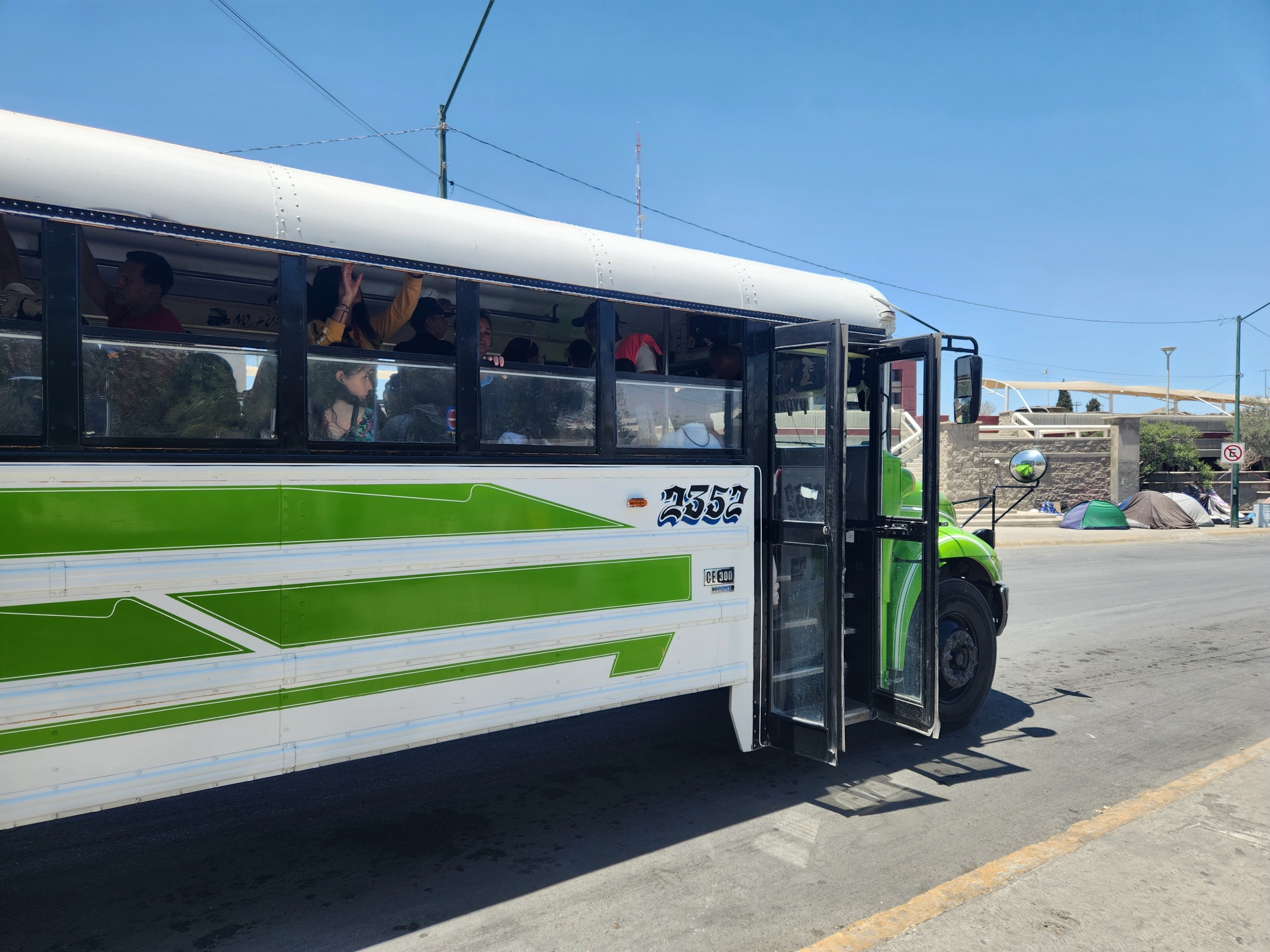
A group of Venezuelan migrants take a public bus in Ciudad Juárez, Mexico, to head closer to border crossings between ports of entry. Some of them plan to surrender themselves to US authorities once they've crossed the Rio Grand and are on US soil.
Tibisay Zea/The World
But he said the worst part of living in Juárez is dealing with insecurity.
He said his wife and sister were robbed and abused by a group of men that got on a bus in Juárez, and that they live with constant fear of being extorted or kidnapped for ransom money.
Adam Isaacson is an expert on security in the Americas. He said that there are thousands of people who have spent many months in Mexican border cities.
“The larger number[s] are not as visible. Some of them are in a network of charity-run shelters [and] churches, and others pay to keep people, especially families, under these roofs for months. And there's probably a larger number that has managed to get some resources together to rent a place somewhere in these border cities.”
Isaacson said they are all vulnerable.
“They probably have relatives in the United States, but in a place like Ciudad Juárez or Reynosa, they've got nothing.”
It’s been almost a month since fighting broke out between the Sudanese army and the paramilitary group known as the Rapid Support Forces.
Khartoum, Sudan’s capital, has become a battleground.
Thousands of people have fled. And those who remain face shortages of water, food, medicine and electricity.
Talks are underway in Saudi Arabia to end the fighting in Sudan. So far, there’s been no major breakthrough.
The World’s Shirin Jaafari spoke with Fahad Nazer, spokesperson for the Saudi Embassy in Washington.
Editor’s note: this interview has been edited for length and clarity.
Up to a million people have fled Russia since the start of the invasion of Ukraine — either in protest against the war, or to avoid the draft and increasing repression at home.
Among them are hundreds, if not thousands, of artists. They follow a well-trodden path of Russians in emigration or exile who have had a profound effect on global culture — from novelist Vladimir Nabokov to Alexander Solzhenitsyn, a writer and teacher, to Rudolf Nureyev, a ballet dancer and choreographer, to name just a few.
But those great names seem far from the new arrivals' minds now as they struggle to adapt to life outside their home country.

The building that the exiled Russian artists collective, Microcredit, calls home, in Paris.
Courtesy of Microcredit
In a half-abandoned office block on the outskirts of Paris, Vasilii Berezin and Stas Falkov — who fled Moscow last year — have set up an artists collective called Microcredit.
Berezin is 30, and a theater director. He explained that this squat is a place for contemporary art and exhibitions, for events and performances, and where Russian artists in transit can work and stay.
It’s also a way of giving something back to France, which has set up a support program for those in the cultural sector affected by the conflict — not just Ukrainians, but also Russian artists who oppose Russian President Vladimir Putin’s regime.
“I can offer something with my shows,” Berezin said. “It’s a joy that there is something to learn, something to give. It’s a joy that there’s someone who needs this. I didn’t expect so much interest.”

Vasilii Berezin (left) and Stas Falkov (right) of the Microcredit collective of exiled Russian artists at their building in Paris.
Courtesy of Microcredit
In one room of the squat, there’s a mattress on the floor, and the walls are covered with Falkov’s rough, abstract paintings along with a poster reading: “Ukraine — never give up.”
Down a corridor is an exhibition by the Russian dissident artist Vanya Volkov, and beyond that, a handful of rooms that are being used as studios. There’s also a makeshift theater for Berezin’s troupe.
Falkov is a 35-year-old visual artist and designer. He left Russia with nothing more than a backpack. His mother and brother remain in the country.

Artwork on display from a collective of exiled Russian artists, Microcredit, in Paris.
Courtesy of Microcredit
Despite the sense of community that Microcredit provides, Falkov said that he still feels out of place in Europe.
“It’s like taking a flower from the forest and replanting it in a garden,” he said. “It’s extremely stressful to live this. I often dream that I’m back in Russia. Mainly, I miss the people.”
Like generations of Russian emigre artists before him, Falkov is coming to terms with what the change of country will mean for his work.
“I am a Russian artist. But I want to become more global in my thinking. I can’t take any responsibility now for the fate of Russia — I can’t talk about that, because I am not there. I have made that choice.”
Falkov and Berezin don’t know how long they’ll be able to stay in the space — the building’s owners have been trying to throw them out. But they say they will continue to make art wherever they are.
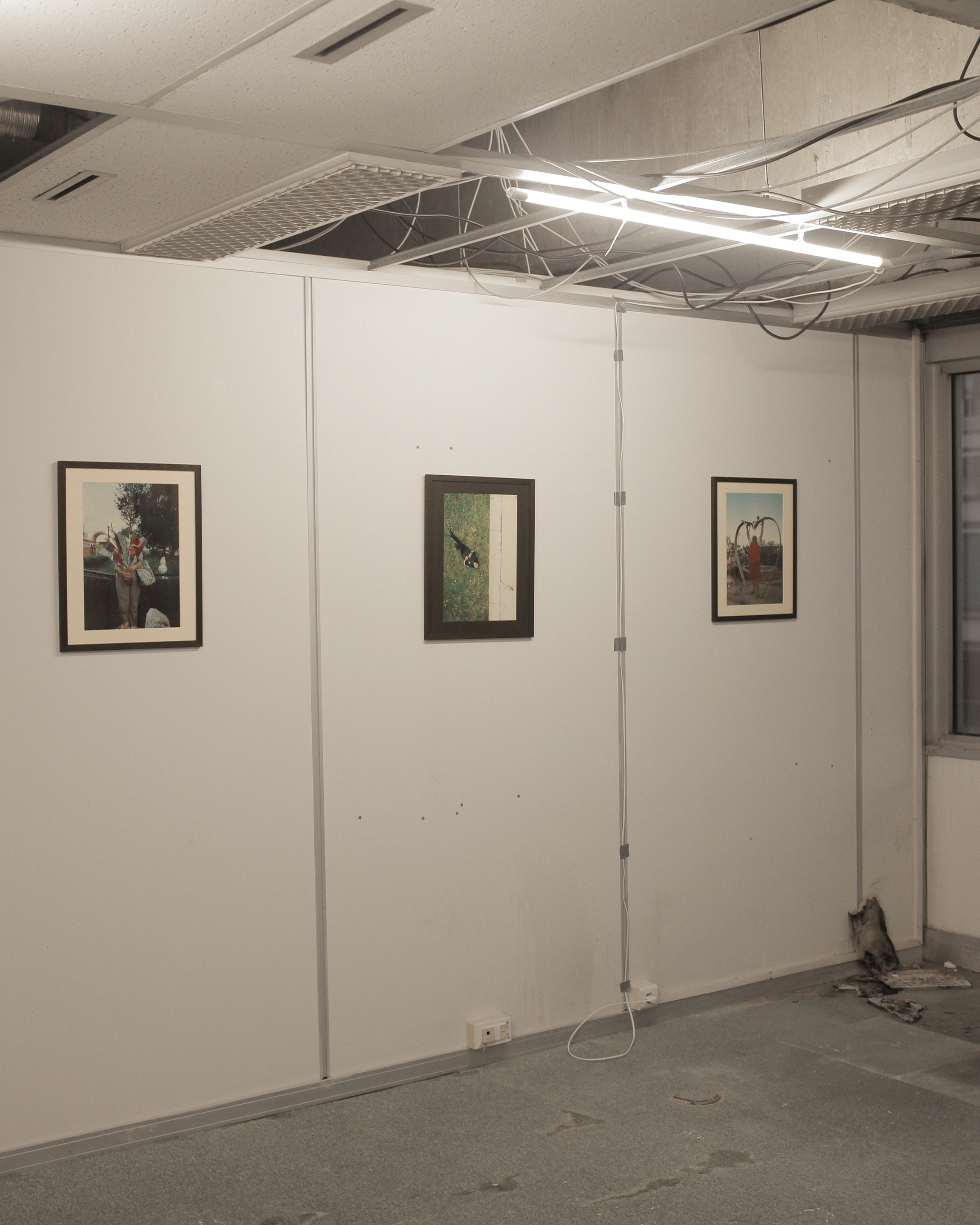
Artwork on display from a collective of exiled Russian artists, Microcredit, in Paris.
Courtesy of Microcredit
Others in the city have yet to find a place where they can work at all. Among them is Kirill Makarov, a celebrated multimedia artist who has exhibited widely in Russia and abroad.
Makarov said that he never wanted to leave Russia at all — he had good opportunities there — but the environment made it impossible to continue.
Here in Paris, he’s working much less, and has yet to exhibit. If Makarov does stay long term, he too, wonders how it will affect his art.
“I’ll probably have to integrate myself into the artistic space in France,” he said. “But you can’t fully remove yourself from the country where you were born. It still influences you, no matter what happens there or what the government is doing.”
Alexander Burenkov is a curator, who himself left Russia immediately after the war and now also lives in Paris.
He said that in a way, this mass exodus might be good for Russian art, which even before the conflict was relatively isolated. Now, artists will have to engage with a global audience. But it all comes at a high price.
“People are struggling with depression, they’re disorientated, they can’t keep productive. Only a few established artists, mid-career ones, can easily adapt.”
France is far from the only destination for Russians in the cultural sector. Others have gone to different cities in Europe, to the Caucasus and Central Asia, and the United States. But the experiences of many are similar across the world.
“People right now, all artists, are just thinking how to survive, how to earn money, just for food sometimes,” Burenkov said.
But the alternative is brought home by recent news out of Moscow.
In Russia, police have arrested a theater director called Zhenya Berkovich and the playwright Svetlana Petriychuk on charges of “justifying terrorism” — over an award-winning play they produced two years ago.
Many believe they were really targeted because of statements against the war in Ukraine — the pair face up to seven years in jail if convicted.
Whatever the challenges facing Russian artists in the West, these latest arrests make it clear what they have escaped by fleeing.
Capurgana is a remote village in northern Colombia, but its migrant shelter hosts people from all over the world.
Women from Somalia wait on plastic chairs wearing black hijabs and long-sleeved shirts in the tropical heat. At the other end of the shelter, a couple from Venezuela are feeding their 1-year-old pitbull.
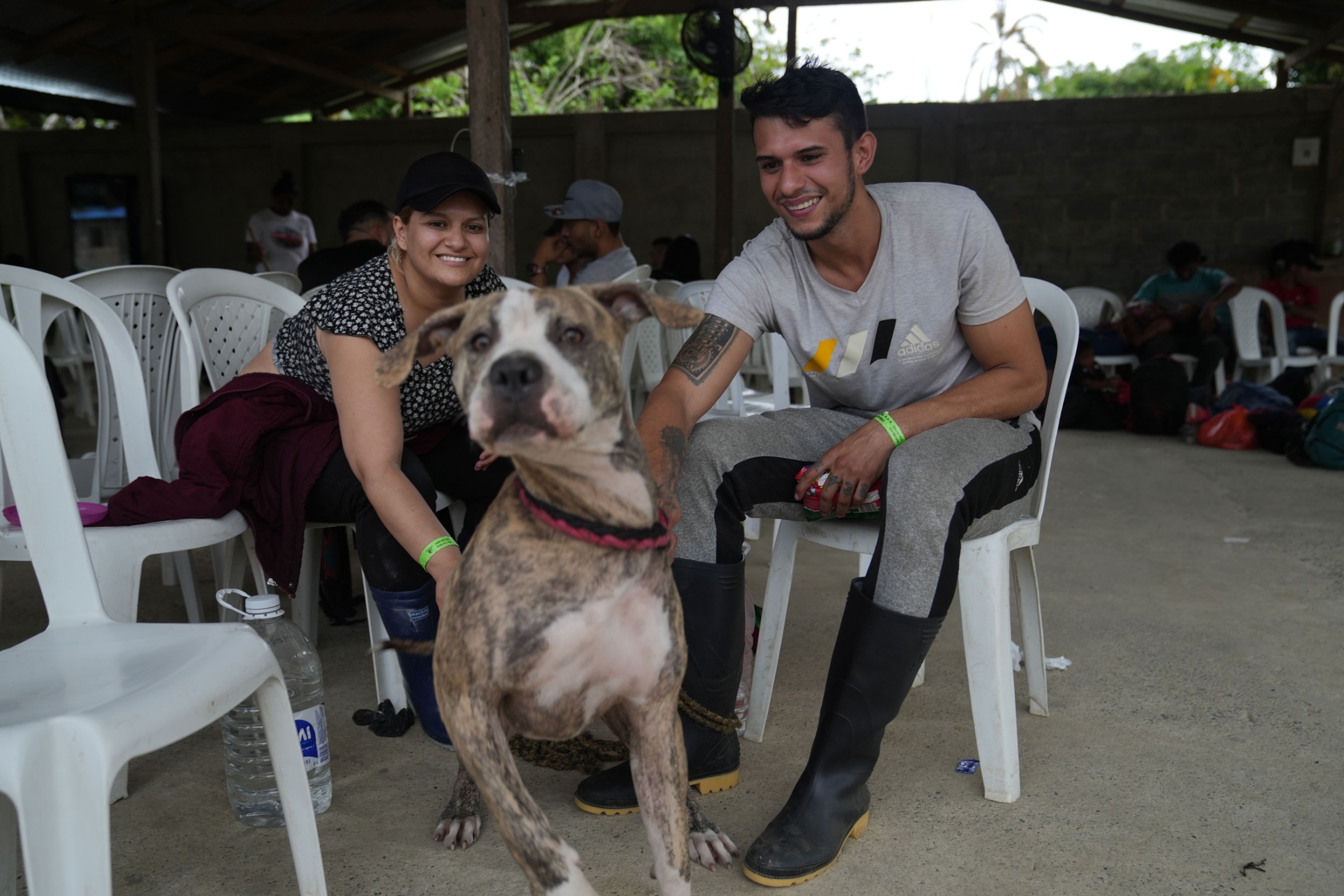
Enjevel Marquez from Venezuela, and Leidy Padilla from Colombia traveled with their dog across the Darién Gap.
Manuel Rueda/The World
Everyone at the shelter wants to go to the United States. But first, they must cross the Darién Gap, a dense and roadless swath of jungle that separates South America from Central America.
A group of about 15 men from Nepal all wear backpacks, preparing to head into the jungle. One jokes with a vendor about a small hole in his recently purchased rubber boots.
“Why?” he asked the vendor in broken English.
“No problem,” the vendor replied, and wished him good luck on his journey.
The muddy paths are almost impossible for the migrants to navigate on their own. So, in Capurgana, located at the entrance to the Darién jungle and near Colombia’s border with Panama, hundreds of villagers now work as guides and porters leading migrants across the rainforest.
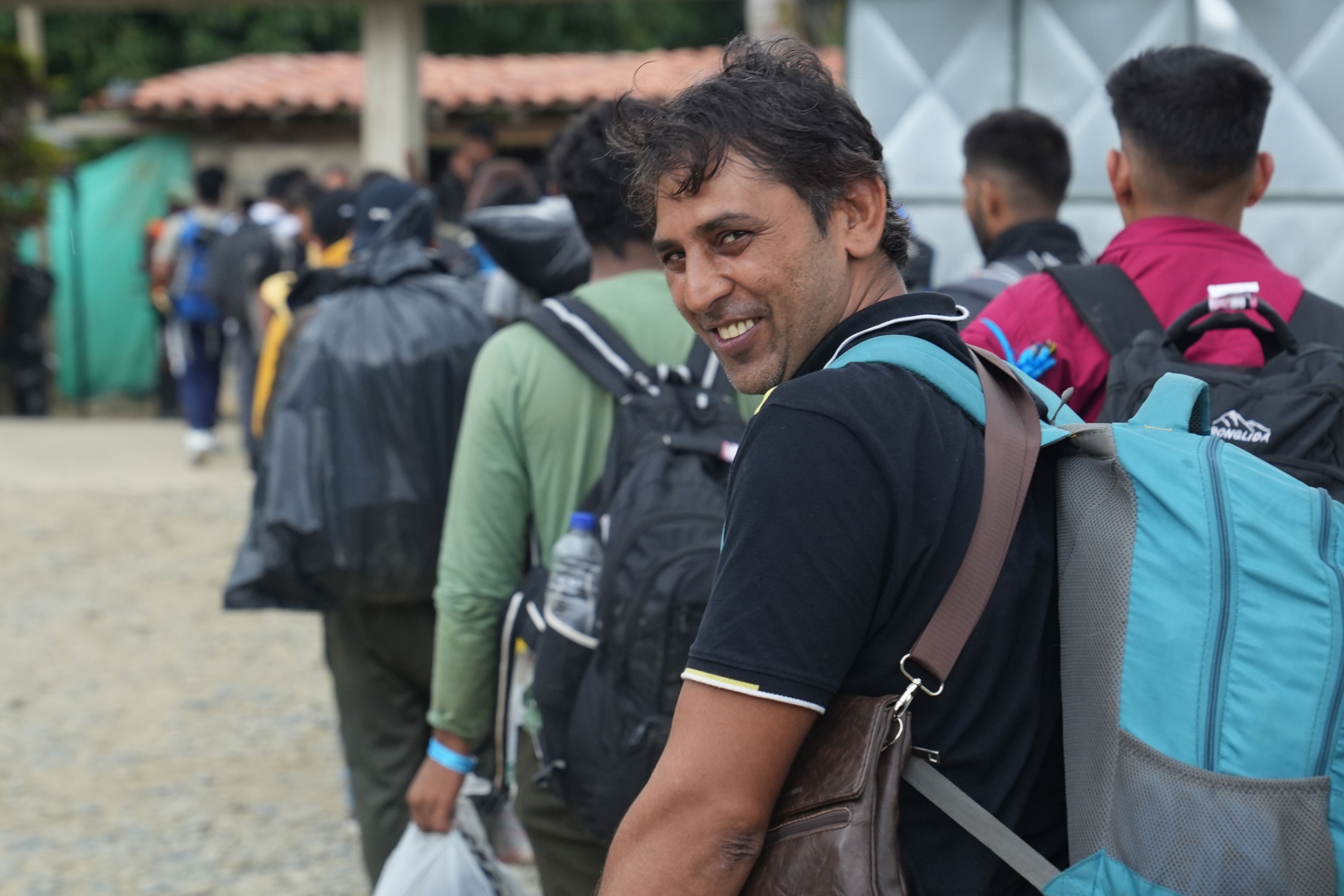
Migrants who pay for guides are quickly led out of the shelter, and start the trek across the rainforest.
Manuel Rueda/The World
Moving migrants is a profitable business that has boosted Capurgana’s economy and decreased its dependence on beach going tourists from Medellín and Bogotá.
But it’s also turned villagers into a potential target of law enforcement agencies from Colombia, Panama and the United States who have recently promised to crack down on the illegal transit of people and goods through the Darién jungle.
Darwin Garcia, a community leader who oversees the shelter, said that the migrant trade has become a key part of the economy in Capurgana, and the neighboring town of Acandi, even if it's not entirely legal.
“This work with migrants is generating around 2,500 jobs in this region,” he said. “We’ve even organized it in a way that it doesn’t interfere with our tourism industry.”
More than 100,000 migrants from Africa, Asia and South America have crossed the Darién jungle this year on their way to the United States, running away from problems like inflation, wars and crime.
And that means there is plenty to do in Capurgana.
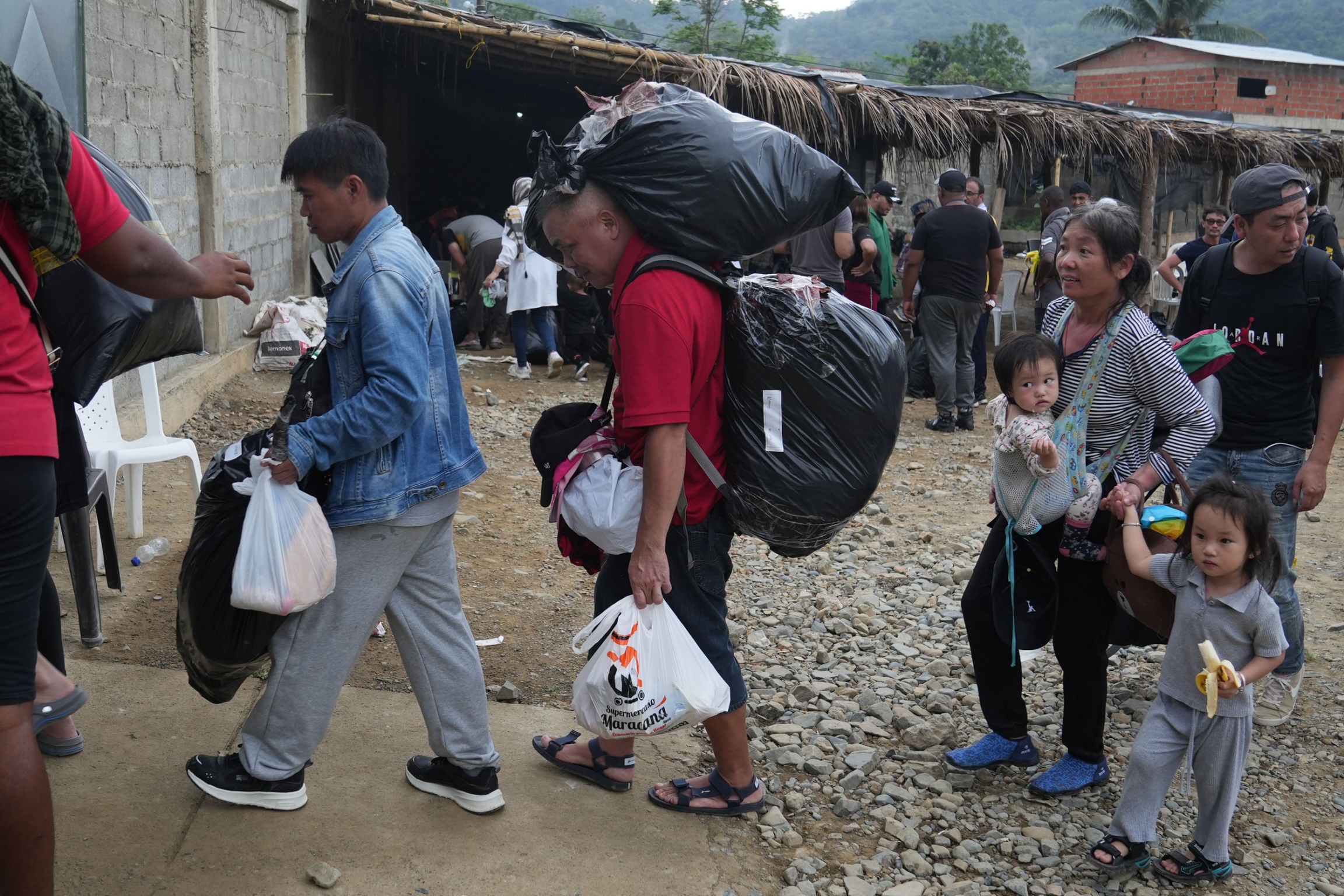
Chinese migrants leave the shelter in Capurgana, and prepare to take a speedboat that will take them to a village in Panama.
Manuel Rueda/The World
At the village's shelter, migrants are offered several routes across the Darién jungle, which are drawn on a map.
The cheapest option involves a grueling, three-day trek across the rainforest and costs $180.
For about $400, migrants can take a speedboat into Panama, and then, walk for one or two days to a government-run camp where buses are available.
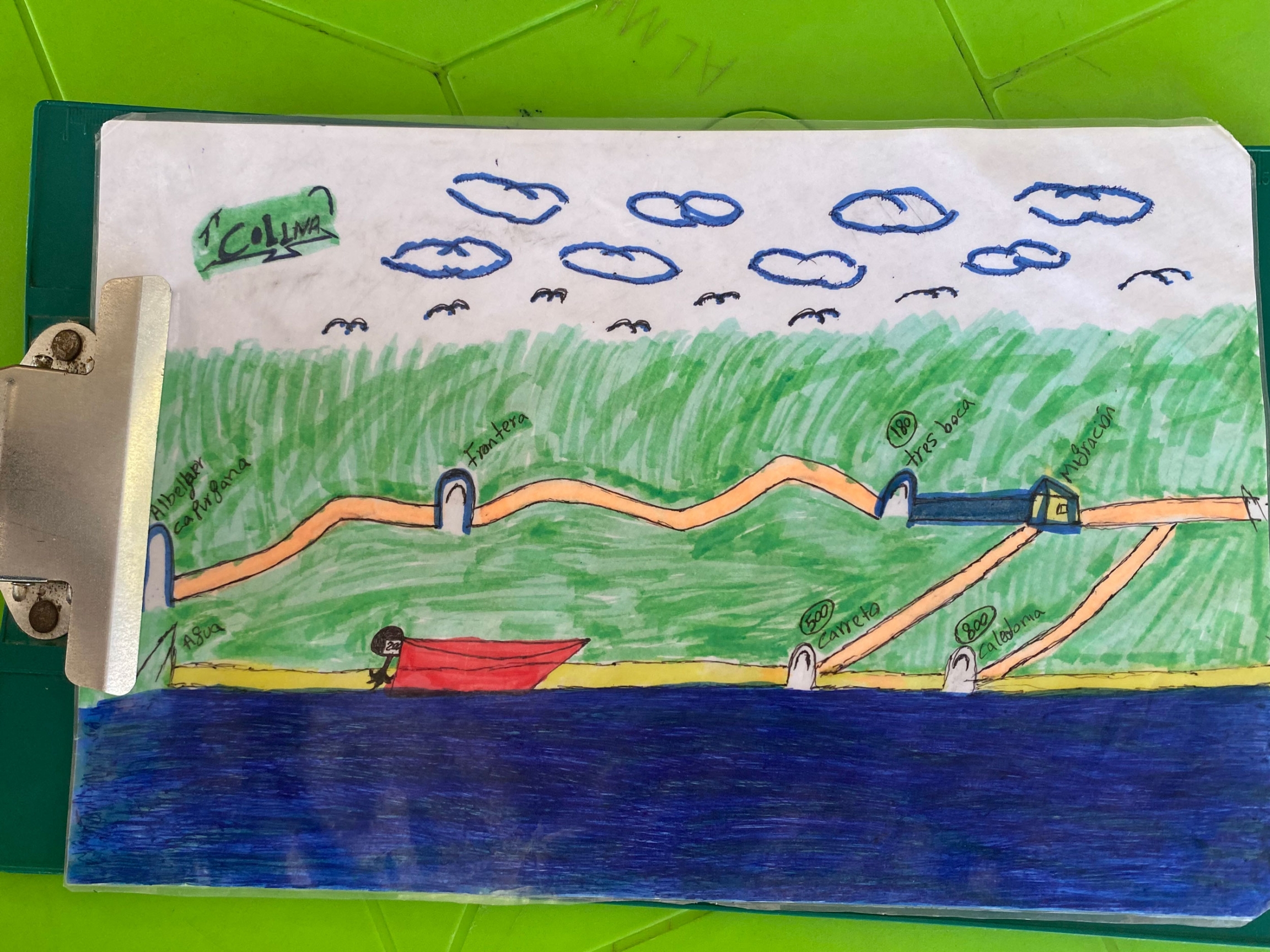
At the shelter in Capurgana, locals offer different routes across the rainforest, which are drawn on a small map.
Manuel Rueda/The World
Garcia said the routes across the jungle have been improving: A trek that took five to six days to complete a year ago can now be done in half the time.
“There’s no government entity or humanitarian group here, trying to help these people,” he said. “So, we’ve set up a service for them, so that they can cross the jungle as safely as possible.”
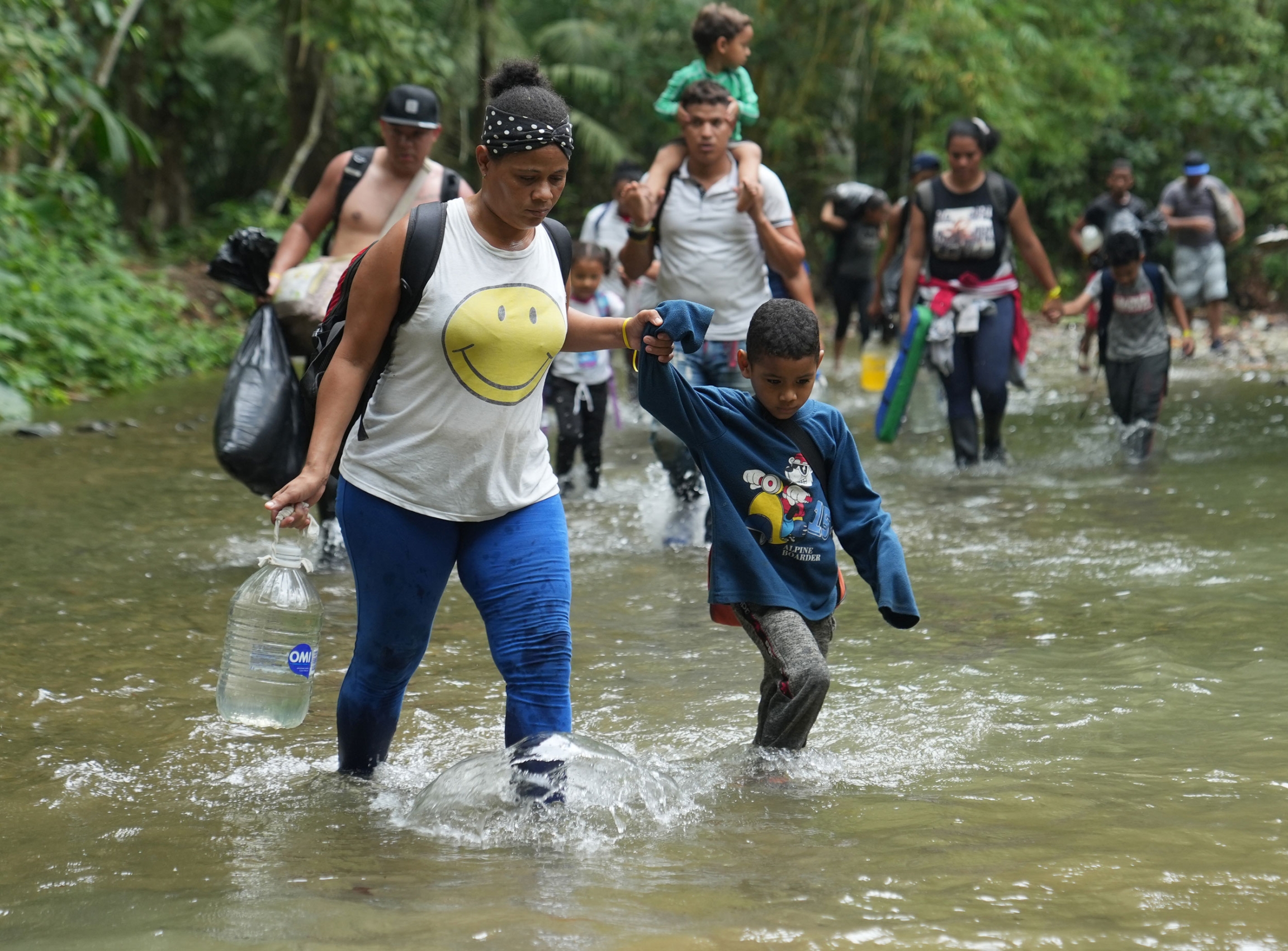
A Venezuelan migrant travels with her child and crosses a stream, as they start the trek across the Darién Gap.
Manuel Rueda/The World
Officials in Colombia have accused villagers in Capurgana of collaborating with human smuggling networks and of exploiting the migrants.
But people in the village say that they are simply acting as “guides.”
“We didn’t ask these migrants to come here,” said Garcia, the only villager who was willing to go on the record about the local immigration industry.
“But we have to do this, so that there are less sick people, or dead people, or people who get raped or robbed along the way.”
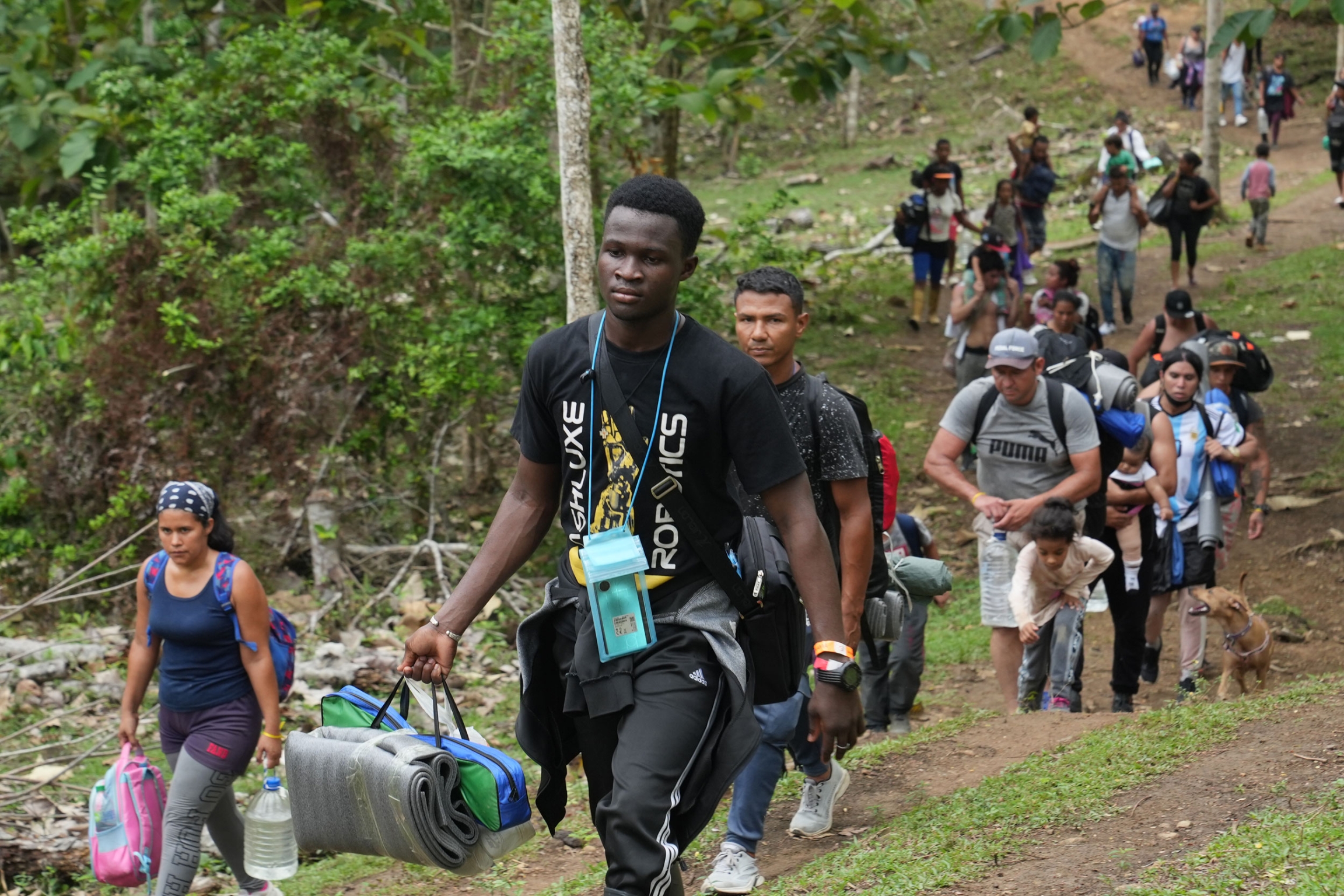
A group of migrants from Burkina Faso, Haiti and Venezuela start the three-day trek across the rainforest.
Manuel Rueda/The World
Whatever you call it, moving migrants across this remote corner of Colombia has become a very organized affair.
The town has no roads connecting it with the rest of Colombia, so every morning, anywhere from 200 to 300 migrants arrive at its small harbor on speedboats that fit about 50 people.
After disembarking and getting their bags, migrants are immediately loaded on three-wheeled tuk-tuks that take them to the shelter on the edge of town, so that they don’t disturb tourists along the beaches.
Capurgana is a small village in northern Colombia, located between the Darién jungle and the Caribbean Sea.
Manuel Rueda/The World
Those who have already paid for the trek across the jungle are quickly led out of the shelter by guides wearing orange vests.
Migrants who have not paid are told they can’t leave the site until they negotiate a fee with the local guides.
These rules have created tensions between the migrants and the local community.
Ana Rivero, from Venezuela, was stuck at the shelter with her friends because they ran out of money. The group said they felt like prisoners.
“We want to keep on going, but we don’t have any more money,” Rivero said. “I don’t understand why they want to hold us here and charge us for everything.”
Ana Rivero from Venezuela, was stuck at the shelter in Capurgana, because she didn't have money to pay for the trek across the jungle.
Manuel Rueda/The World
Community leaders enforce this unofficial rule, arguing that if migrants are allowed to walk into the jungle on their own, they could get lost or injured, generating more problems for Capurgana, where there is only a small health post. But they also admit they want to protect their new business.
“We’ve taken some people along for free before, but then, they just tell their friends who are coming behind them not to pay anything,” said Garcia, the shelter’s manager. “Nobody wants to work for free.”
Even though villagers have attempted to organize the jungle crossing, it is still a dangerous journey. Some migrants are robbed along the way, and others are sexually assaulted, particularly on the Panamanian side of the border.
So, in April, the governments of Panama, Colombia, and the United States announced a new plan to stop the irregular transit of people through the Darién jungle.
In a press conference, Katie Tobin, a member of the US National Security Council, said that the State Department will open processing centers in Colombia, where migrants who are en route to the United States can attempt to get visas.
Meanwhile, people who run smuggling networks in the Darién Gap will be arrested and prosecuted.
“We know that there’s criminal organizations and cartels that have gotten into the business of moving people and are charging thousands of dollars for this dangerous journey through Darién,” Tobin said.
She added that as the US lifts Title 42 — the measure used during the pandemic to block hundreds of thousands of asylum requests — smugglers are deploying “disinformation” campaigns on social media to convince migrants that it will now be easier to cross the border and get asylum in the United States.
But Garcia said that in Capurgana and the neighboring town of Acandi, it’s the local people and not cartel members who are moving migrants. He warned that any attempts to arrest villagers will lead to conflicts with the Colombian government.
“If they come here with a helicopter, they’ll have to take half of our village,” he said. “Working with migrants is now part of our economy.”
At least five people were killed in a shooting attack at a Jewish holy site in Tunisia on Tuesday. The attack happened at the Ghriba synagogue, the destination for Jewish people taking part in a pilgrimage to the Tunisian island of Djerba.
It's an annual pilgrimage that can attract thousands of Jewish people to Tunisia, mostly from France and Israel.
The shooter was working as a guard at a nearby naval installation. His motive remains unknown.
To talk about the attack and the history of this pilgrimage, The World's Marco Werman spoke with Daniel Lee, a historian of the Jews of France and North Africa at Queen Mary University of London.
This interview has been lightly edited and condensed for clarity.
Related: The Jewish graves in Kyrgyzstan are fading. But a small Jewish community continues to thrive.
In March of 2022, Anna Sushko spent days driving from Kyiv, Ukraine, to Bucharest, the Romanian capital, with her husband and two small boys, who are now 5 and 6.
Her sons didn’t understand what was going on — they thought it was some kind of adventure, she said. But Sushko could see the shock and bewilderment many children were experiencing as they crossed the border into Romania.
Sushko, who ran a kindergarten in the Ukrainian capital, wondered about doing the same in Romania, specifically for Ukrainian kids.

Uruguay School operates out of the first floor of a public school in the northwest of Bucharest, Romania.
Raul Stef/The World
A few days later, she met another Ukrainian refugee, Svitlana Salamatova, who heads the Geopolitical Alliance of Women, a nongovernmental organization in Kyiv, which deals with women’s issues and education.
Sushko shared her idea with Salamatova, and 10 days later, with the help of nongovernmental organizations working in education, the two women opened a kindergarten in a local theater in Bucharest. Initially, the school drew 30 students.
“In the very beginning, we were thinking about how to save their childhood,” Sushko said. “I created the kindergarten with that in mind and as a place that mothers could come with their kids too.”
More than 100,000 Ukrainian refugees live in Romania, mainly women and children. Sushko said her husband was allowed to travel with them because they had adopted her second son just four months earlier.

Anna Sushko and Svitlana Salamatova, who met last year after fleeing the war in Ukraine, started Uruguay School for Ukrainian children in Bucharest, Romania.
Raul Stef/The World
Only around 10% of Ukrainian children are enrolled in Romanian schools — the majority continue to take Ukrainian school courses online.
Salamatova, who has children ages 16 and 36 (and a granddaughter), thought the school could do more to serve refugee kids. She could see that older children needed somewhere safe they could gather and learn, too.

In March of 2022, Anna Sushko spent days driving from Kyiv, Ukraine, to Bucharest, the Romanian capital, with her husband and two small boys, who are now 5 and 6. Sushko said she could see the shock and bewilderment many children were experiencing as they crossed the border into Romania.
Raul Stef/The World
So, a little over a month later, following meetings with the mayor of Bucharest and local NGOs, the women were offered the first floor of a public school in the northwest of the city, Școala Gimnazială Uruguay (Uruguay School).
Today, more than 100 Ukrainian children — ages 4 to 15 — are attending the school and another 100 are on the waiting list. While the children have classes in the Romanian language, most of the teachers are Ukrainian and the students also follow online classes from Ukraine.

Uruguay School in Bucharest, Romania, has 100 Ukrainian students and another 100 on the waiting list.
Raul Stef/The World
Sushko said she wanted teachers who could understand what the children are going through and are enthusiastic about the subjects they teach. She calls them “curators” — not teachers.
More than a year later, Sushko and Salamatova are now in discussions with the Romanian education authorities about how to assist students through the education system.
Most Ukrainian children who attend Romanian schools are only allowed to sit in and audit the lessons in their first year, so they can become familiar with the language.
But Salamatova said Ukrainian parents are anxious that their children are slipping behind in their education. She wants to see children continue to be accredited to the Ukrainian education system while attending Romanian language classes.

Following meetings with the mayor of Bucharest, Romania, and local NGOs, Anna Sushko and Svitlana Salamatova were offered the first floor of a public school in the northwest of the city, Școala Gimnazială Uruguay (Uruguay School).
Raul Stef/The World
But there is another reason, Salamatova hopes to keep refugee children aligned with the Ukrainian education curriculum.
“Look what Russia did,” she said. “They took Ukrainian children from Ukrainian territory, they kidnapped them. Now, they are lost to us.”
The Ukrainian government estimates that nearly 19,500 children have been taken to Russia or Russian-occupied Crimea since Moscow invaded in February last year, in what it condemns as illegal deportations.
Salamatova said she thinks that the number is far higher. She fears that a whole generation of children will be lost to Ukraine, whether they have been taken to Russia or fled abroad.

More than 100,000 Ukrainian refugees live in Romania, mainly women and children. Only around 10% of Ukrainian children are enrolled in Romanian schools — the majority continue to take Ukrainian school courses online.
Raul Stef/The World
“Who will rebuild the country after the war ends?” she asked. “We need to keep our children aligned to Ukraine somehow.”
The two women say they have received incredible support from the Romanian people. But a Europewide survey of attitudes toward Ukrainians shows Romanians are the least supportive in the EU of humanitarian aid being given to refugees: 25% of Romanians disagreed with the European Union providing assistance to people affected by the war, compared to an EU average of 7%.
Last month, the Romanian government approved plans to reduce financial contributions to Ukrainian refugees.

While the children have classes in the Romanian language, most of the teachers at Uruguay School in Bucharest, Romania, are Ukrainian and the students also follow online classes from Ukraine.
Raul Stef/The World
“Romania has already spent hundreds of millions of euros for refugees since the first day of war and we’ll continue to do this,” government spokesman Dan Carbunaru said. “We have a limited budgetary space and we’re making all the efforts to ensure we support all the citizens, Romanians and foreigners.”
Host families in Romania, many of whom are already owed outstanding payments from the state, will no longer receive funding to house Ukrainians under the government’s new plan. Instead, individual refugees will receive a direct payment of $166 (750 lei) per month for housing or $445 (2,000 lei) a month per family.

Anna Sushko's son attends the school she helped start in Bucharest, Romania, for Ukrainian children.
Raul Stef/The World
Some NGOs worry that Ukrainians will struggle to find affordable accommodation or willing landlords to house them.
Pablo Zapata, a representative with the United Nations refugee agency (UNHCR) in Bucharest, defended the government’s plans.
He said “the new system in Romania encourages employment and that, in turn, encourages the refugees to get out from behind walls and engage actively in society.”

More than a year after starting Uruguay School in Bucharest, Romania, for Ukrainian children, Anna Sushko and Svitlana Salamatova are now in discussions with the Romanian education authorities about how to assist students through the education system.
Raul Stef/The World
Zapata said one of the biggest obstacles refugees face in another country is their inability to integrate. It’s usually led by the belief that “they will return home soon.”
But Zapata said the reality is that for many refugees this will not be the case and Ukrainians need to think about enrolling their children in the Romanian school system and finding a job.

Ukraine's colors are represented on the board.
Raul Stef/The World
He rejected fears that Ukrainians will go back home once the new payment system is introduced and said the Romanian government has ample space in state-run accommodation centers to house any refugees that are struggling.
Despite the support that Sushko has received from the Romanian people, she said that she’s not sure Bucharest will be her long-term home.
The two women were invited to New York recently as part of a UN delegation on education. Sushko said the positive attitude of Americans there was a world apart from what she is used to.

Uruguay School's Ukrainian students in Bucharest, Romania, range in age from 4 to 15.
Raul Stef/The World
“You know people who I met on the street there gave me more positive-like energy, in just a few words, than people I’ve talked to for long periods of time in countries here in Europe,” she said.
Sushko said she would love her children to experience that energy and can-do attitude as they grow older.

Anna Sushko said her son are pictured. Sushko, who ran a kindergarten in Kyiv, Ukraine, started a school for Ukrainian kids in Bucharest, Romania, with a fellow refugee, Svitlana Salamatova.
Raul Stef/The World
For now, though, she said the school needs her and Romania is home. When the war ends, then we will see what’s next, she said.
Raul Stef contributed reporting to this story.
Onelio Bravo led a comfortable life in the Venezuelan city of Maracaibo where he ran a small perfume business and also sold car parts.
But as Venezuela’s currency plummeted and it became harder to import goods, Bravo said his businesses went broke, forcing him to work at a bakery for about $3 a day. It was a hopeless way to make a living.
In April, Bravo decided to head to the United States with his 14-year-old son.
A group of Venezuelan migrants begins the grueling, three-day trek across the Darién Gap, as they leave the Colombian village of Capurgana.
Manuel Rueda/The World
The father and son, facing many obstacles to acquire a visa, set out on the long journey north overland, joining thousands of migrants who are crossing the Darién Gap, a roadless swath of jungle that stands between South America and Central America.
“It’s unfortunate that we have to do this, but it's for the future of our children,” Bravo said as he crossed a stream in the rainforest, nearly knee-deep.
“I’m worried that we will run out of food and money,” he said. “But we just need to trust in God and keep on going.”
Onelio Bravo carried just three cans of tuna and some cookies for the three-day trek across the jungle.
Manuel Rueda/The World
More than 100,000 migrants from South America, Africa and Asia have crossed the Darién Gap this year as they head to the United States.
The numbers of people trekking through this stretch of the jungle are increasing as the US lifts Title 42, a public health law that was used to reject hundreds of thousands of asylum-seekers during the pandemic.
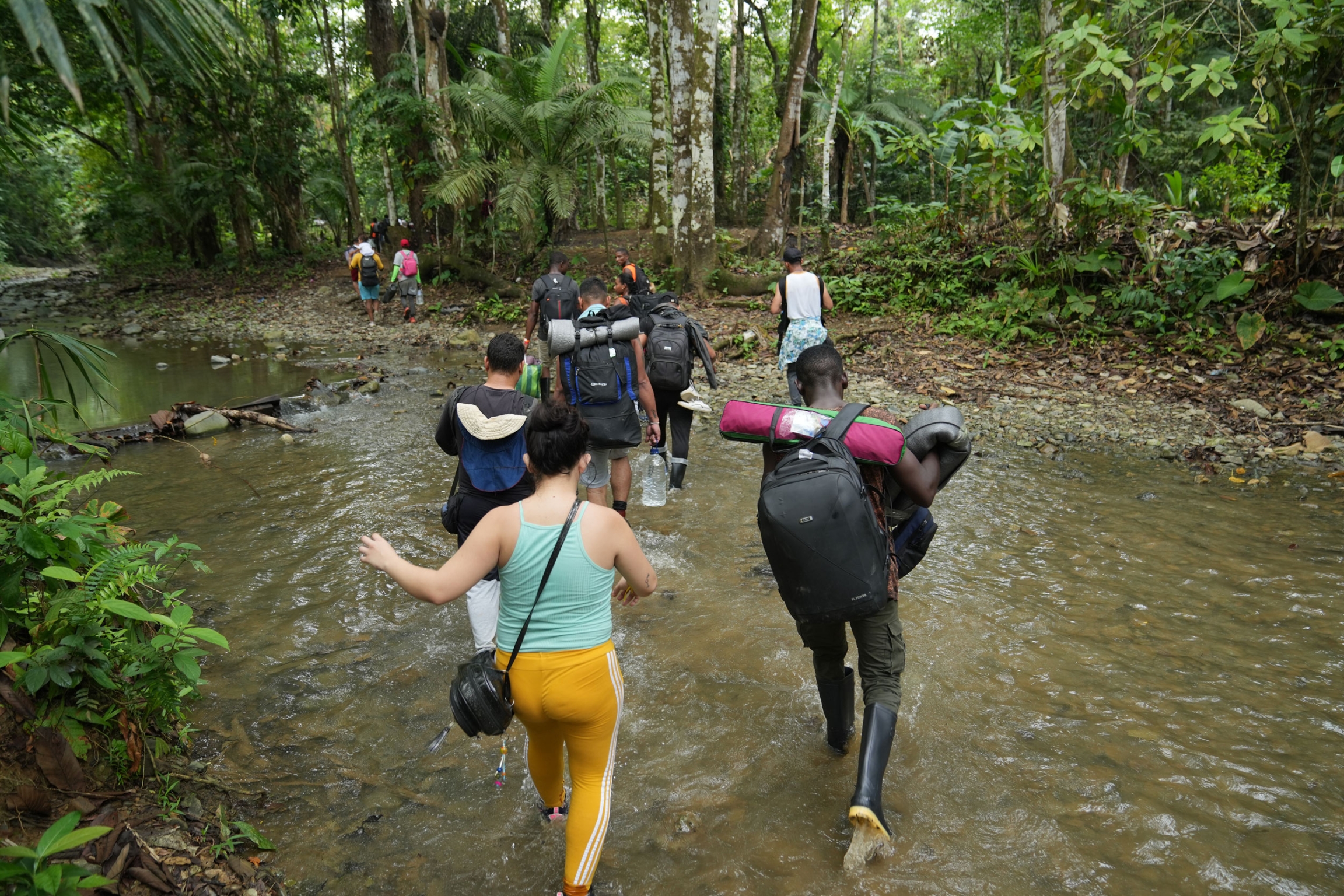
A group of migrants from Venezuela, Haiti and Burkina Faso crosses a stream in the rainforest as they being the three day trek across the Darién jungle.
Manuel Rueda/The World
In Capurgana, a small town on the southern edge of the Darién, about 300 people are arriving each day to make the grueling trek across the jungle, which lasts three to four days.
About twice as many people also begin the trek each day in the neighboring town of Acandi, where they pay local guides hundreds of dollars to take them across the rainforest.
Maria Rangel was making the journey with her two children so that they could join their father, who traveled to the US at the beginning of last year. The family had been living in Ecuador, but they are originally from Venezuela.
“I was going to make this journey in October, but that’s when they started to reject Venezuelans,” using Title 42, she said.
“Now, it seems the border is open again, and they will let us reunite with our family.”
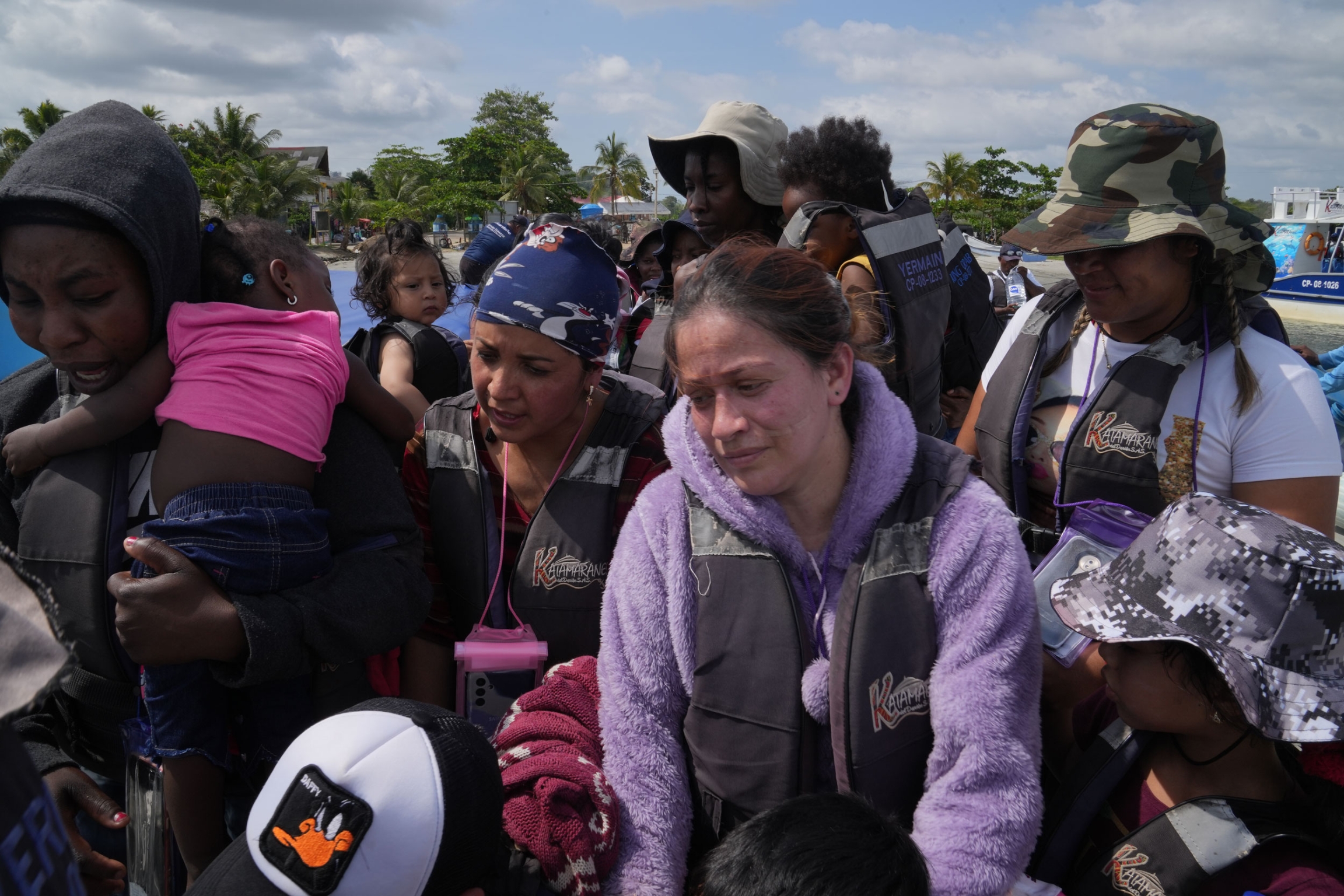
Migrants get ready to board a boat in Necocli, Colombia, one of the last stops before their trek across the jungle begins.
Manuel Rueda/The World
But US officials say it will not be so easy for migrants like Bravo or Rangel to claim asylum.
They’ve warned that there will be new procedures in place to deal with those who cross the border illegally, including express hearings, where migrants can be removed from the US if they fail to prove in phone interviews that their lives are in danger in their home countries.
Homeland Security Secretary Alejandro Majorkas also said that after Title 42 expires, penalties will be tougher for those who enter the US illegally and are found not to be in need of protection, and will include a five-year ban on admission to the United States.
“Those who arrive at our border and do not have a legal basis to stay will have made the journey often having suffered horrific trauma and having paid their life savings to the smugglers only to be quickly removed,” Mayorkas said in a press conference.
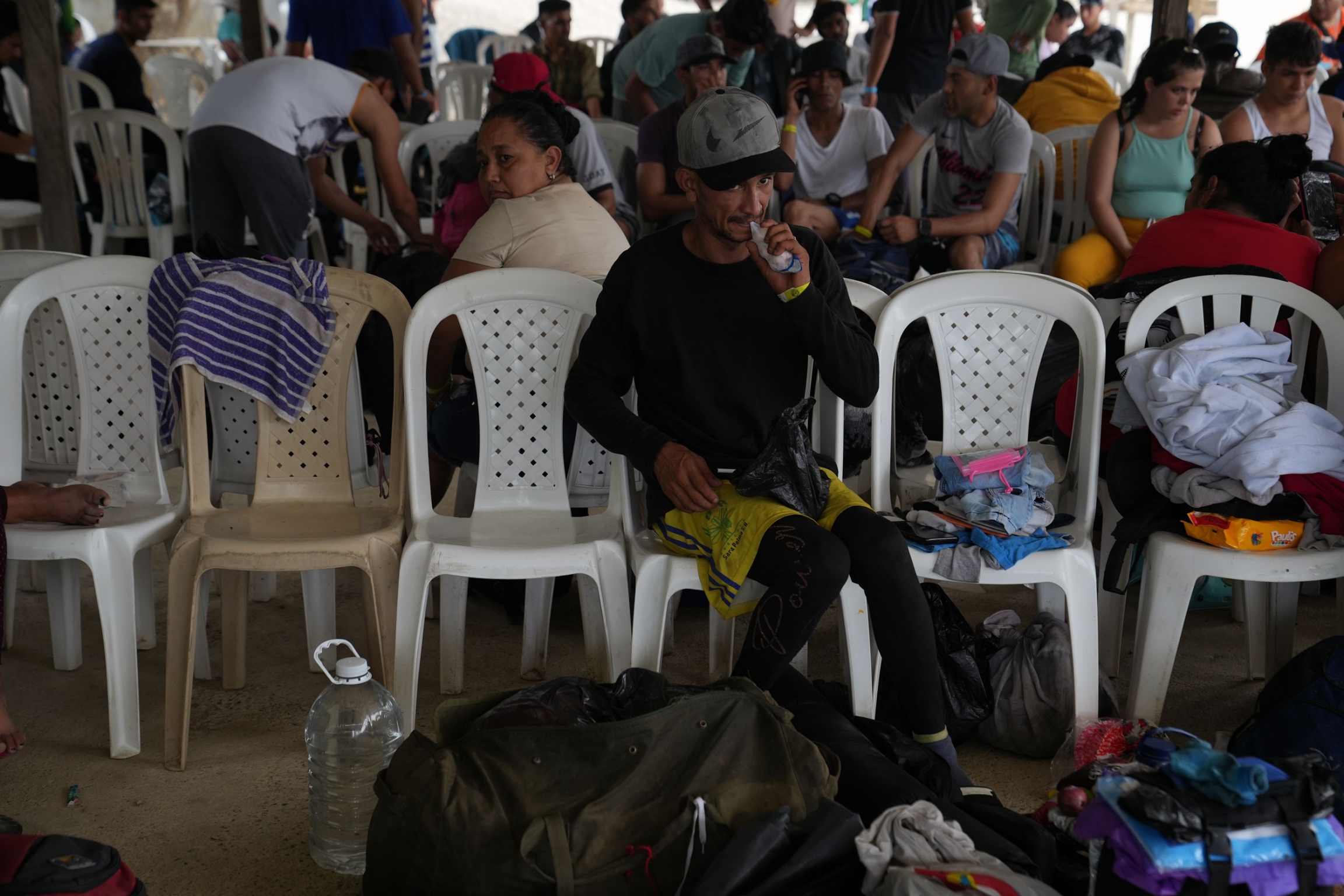
A Venezuelan migrant takes a break at a shelter in Capurgana, Colombia, before starting the trek across the Darién Gap.
Manuel Rueda/The World
But as living conditions in many South American countries deteriorate, analysts expect migrants to continue to make the journey north across the Darién Gap as they try to reach the US border.
“What we see throughout the whole continent of Latin America is that there is dollar inflation so the capacity of a household to make ends meet has diminished,” said Bram Ebus, a researcher for the International Crisis Group, who studies immigration across the Darién.
“There’s also rising insecurity in countries like Ecuador, Chile and Colombia,” which is forcing many people to migrate, he said, as well as a global food crisis caused by the war in Ukraine.
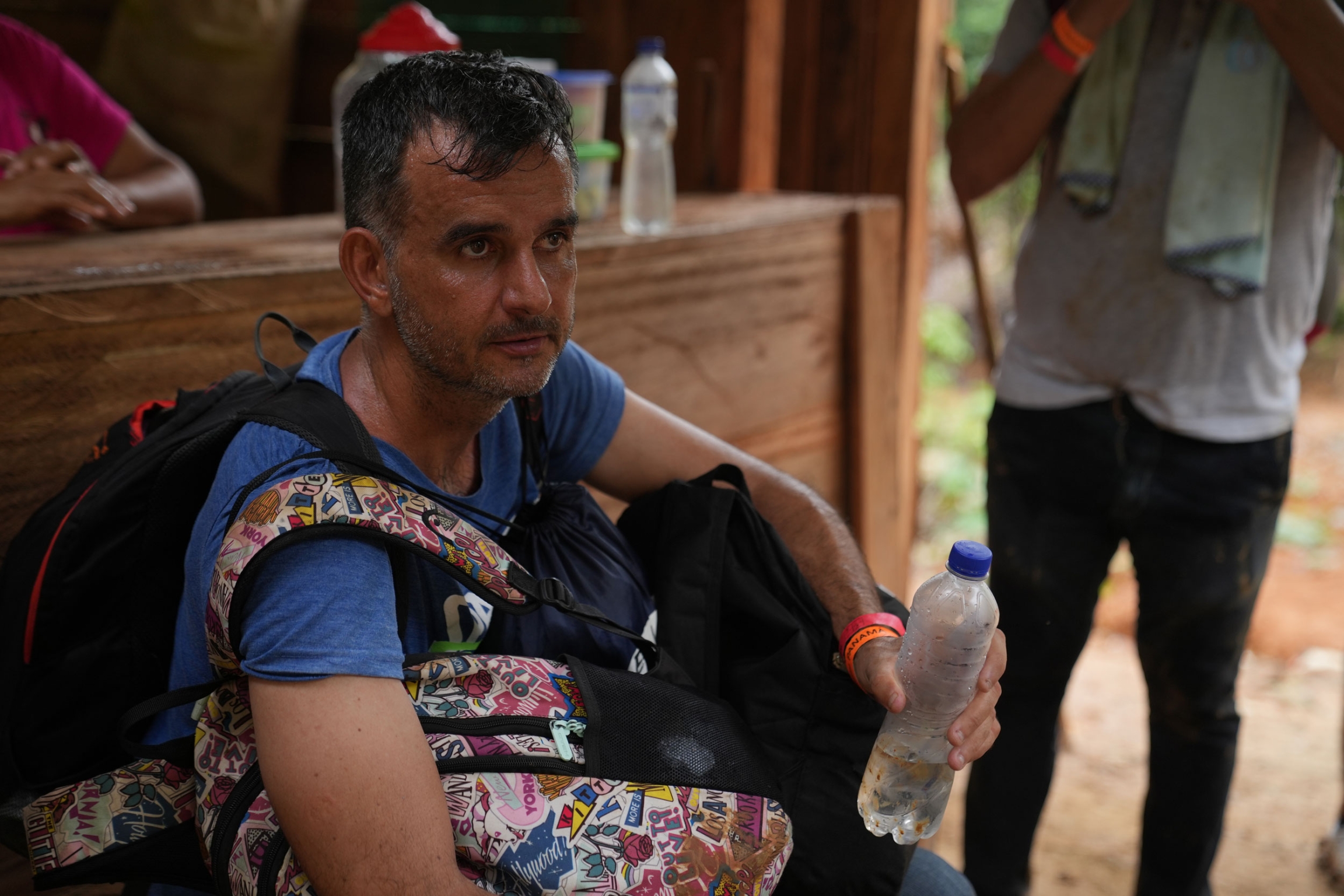
Onelio Bravo takes a break from walking at a rest stop in the Darién Gap. The trek across the jungle takes at least three days.
Manuel Rueda/The World
Recently, the US government has been trying to expand legal pathways for migrants to enter the country, so that they don’t cross the Darién jungle.
In April, the State Department announced it would open processing centers in Colombia where migrants from different countries who are en route to the US can apply for visas and entry permits.
But it’s still not clear when these centers will open. Or whether economic migrants — who make up a large number of those trying to cross the Darién — will even qualify for visas.
Meanwhile, nations north of the Darién Gap, like Mexico, are making it hard for many migrants to arrive on flights.
For many migrants from South America, Africa and Asia, making the dangerous trek across the Darién jungle is still the only way to reach the United States.
Venezuelan migrant Tiffany Villasmil was a hairstylist in Peru making about $200 a month. She said that with little money and no family in the US, there’s almost no way she can get a visa.
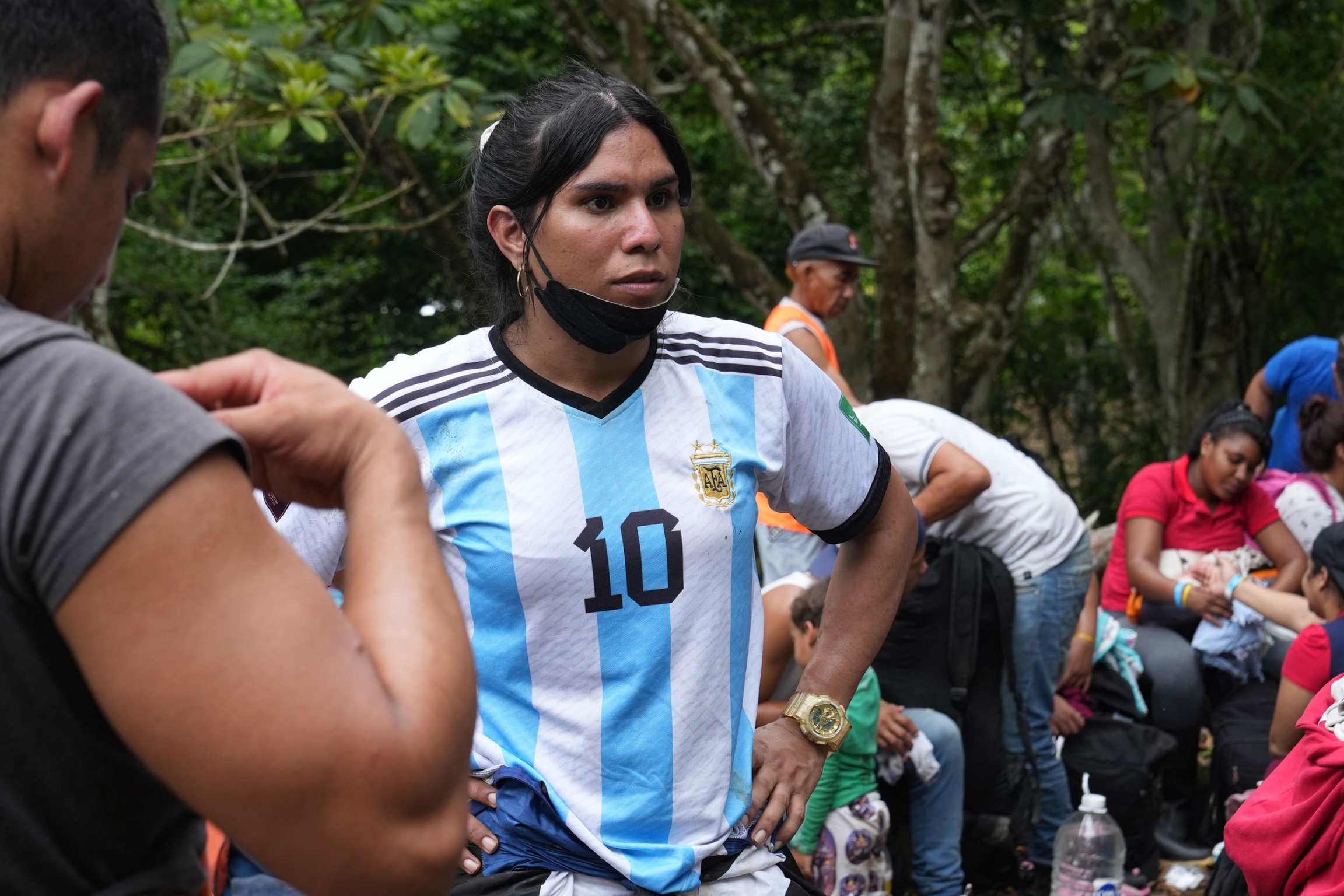
Venezuelan migrant Tiffany Villasmil says that for a low-income worker like herself, who has no family in the US, it was impossible to get a visa.
Manuel Rueda/The World
So, she packed her bags, hoped for the best, and joined a group that was trekking into the jungle with two guides dressed in orange vests.
“It would be great to have a visa, and travel on a plane,” she said.
“But we don’t have that opportunity, so we have to walk, and hope that eventually, we can help our families.”
On a recent day, two men rode bikes along a dusty road in a neighborhood in eastern Khartoum, Sudan’s capital.
They carried backpacks with life-saving medications for residents in the area who have diabetes and high blood pressure.
The men stopped by a house with green metal doors where a woman greeted them with a smile as she took the medicine.
“Come in,” she said.
But they had to go. The men, members of a neighborhood committee, had to get to other homes in the area — all coordinated online — before the fighting picked up again, as peace negotiations continue in Saudi Arabia.
Last month, a conflict erupted in the country between the Sudanese Armed Forces (SAF) — Sudan's military — and the Rapid Support Forces (RSF), a powerful paramilitary group. While many Sudanese are fleeing the country, most people remain trapped in their homes as food and medical supplies dwindle. In the absence of outside help, neighborhood committees have formed to bring in food and water, and to check on people's welfare.
Duaa Tariq shared videos of the men’s deliveries with The World. She is an activist and a member of one of Khartoum’s neighborhood committees.
Tariq spoke while standing on the rooftop of her three-story house in Khartoum, the place where she gets the best cell reception.
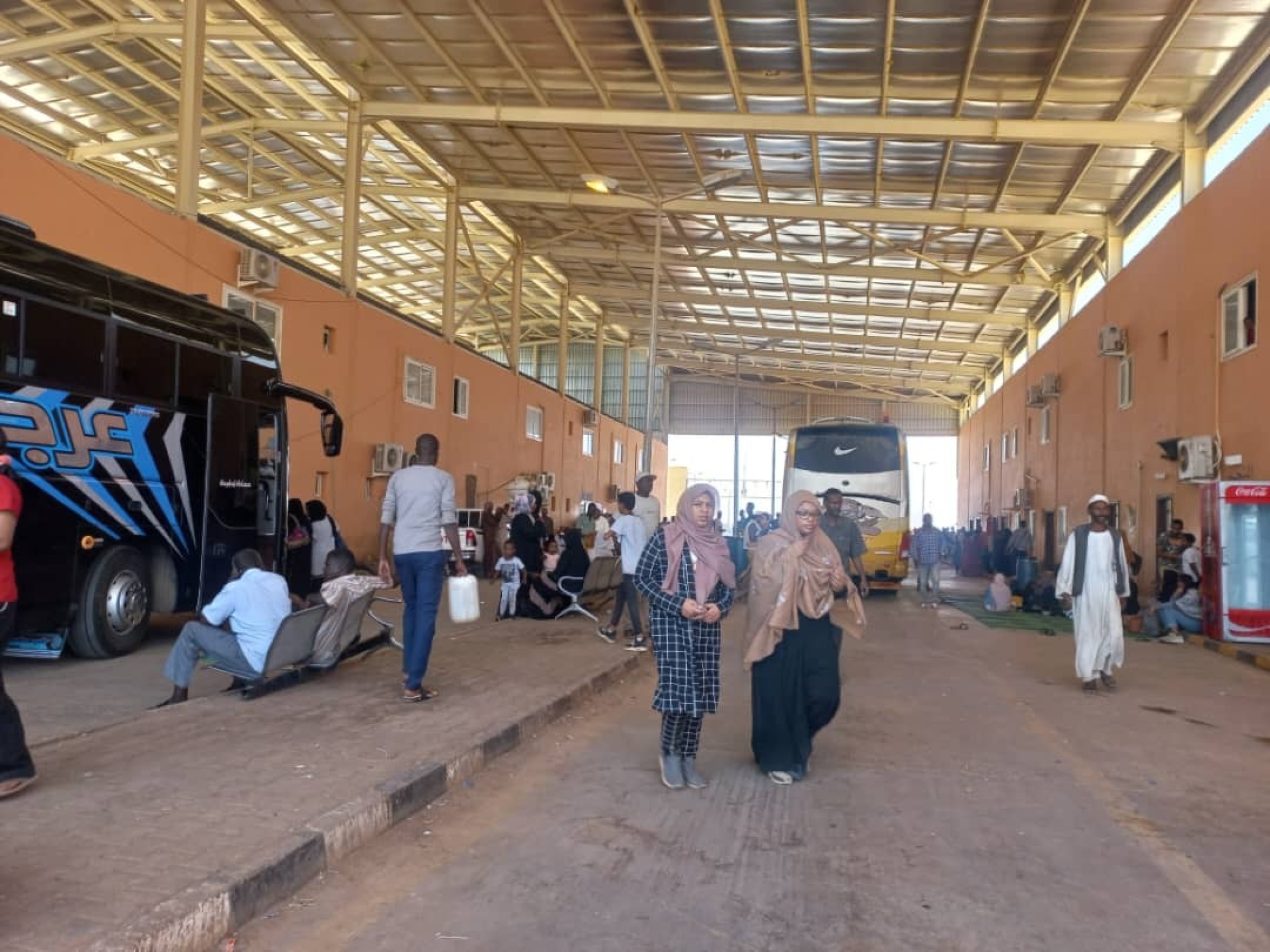
Dr. Abeer Dirar is working on the border between Sudan and Egypt. Until about a week ago, she was volunteering with her neighborhood committee in Khartoum. But when she heard about the conditions at the border, she headed straight there.
Courtesy of Dr. Abeer Dirar
She explained that since the fighting broke out in her city last month, basic services like electricity and water have been mostly cut off.
“All the shops are closed, a few pharmacies were bombed and also bakeries went out of service,” she said.
Wheat factories were hit as well, she added, so bread has become scarce.
The fighting is taking place in residential areas and has left some people trapped in their homes.
“The committees are playing the role of the government in providing safe passage for people to get food and [are] risking their lives to go get medicine and water, and [are] also working on fixing the electricity when the government bombs it,” Tariq said.
The volunteers connect and coordinate help on social media. If neighbors aren’t online, they check in on them in person. Donations help them buy scarce supplies.
The Resistance Committees, or neighborhood groups, formed during Sudan’s pro-democracy movement in 2019. Their initial focus was on political activism.
Tariq protested through her art and street graffiti. She organized sit-ins and led chants.
But the committees’ deep ties with local communities has meant that they can switch quickly to humanitarian help in times of crisis.
“We’re trying to protect each other and be around each other because it’s a very difficult time right now that we’re going through as ordinary citizens,” Tariq added.
This work is risky. Tariq’s group has lost members who were out on runs, she said. She herself doesn’t leave home much because she has heard of reports of rape and sexual harassment.
The sound of gunfire and fighter jets could be heard in the background as she spoke to The World, so Tariq paused to take shelter.
A few minutes later, she called back to say she was fine.
Leaving Khartoum doesn’t guarantee safety, either.
Dr. Abeer Dirar is working on the border between Sudan and Egypt. Until about a week ago, she was volunteering with her neighborhood committee in Khartoum. But when she heard about the conditions at the border, she headed straight there.
“The environment here [on] the border is very bad,” she said over WhatsApp. “Here, there [are] no bathrooms at all and no water.”
She sent a photo of a 2-year-old child over WhatsApp with a look of exhaustion on her face. She said she was suffering from dehydration and was having convulsions.
Dirar treated her at a mobile clinic and she is doing better now. But she said she's seeing all kinds of illnesses — lots of diarrhea, abdominal pain and food poisoning. The heat and lack of clean water and good sanitation don’t help.
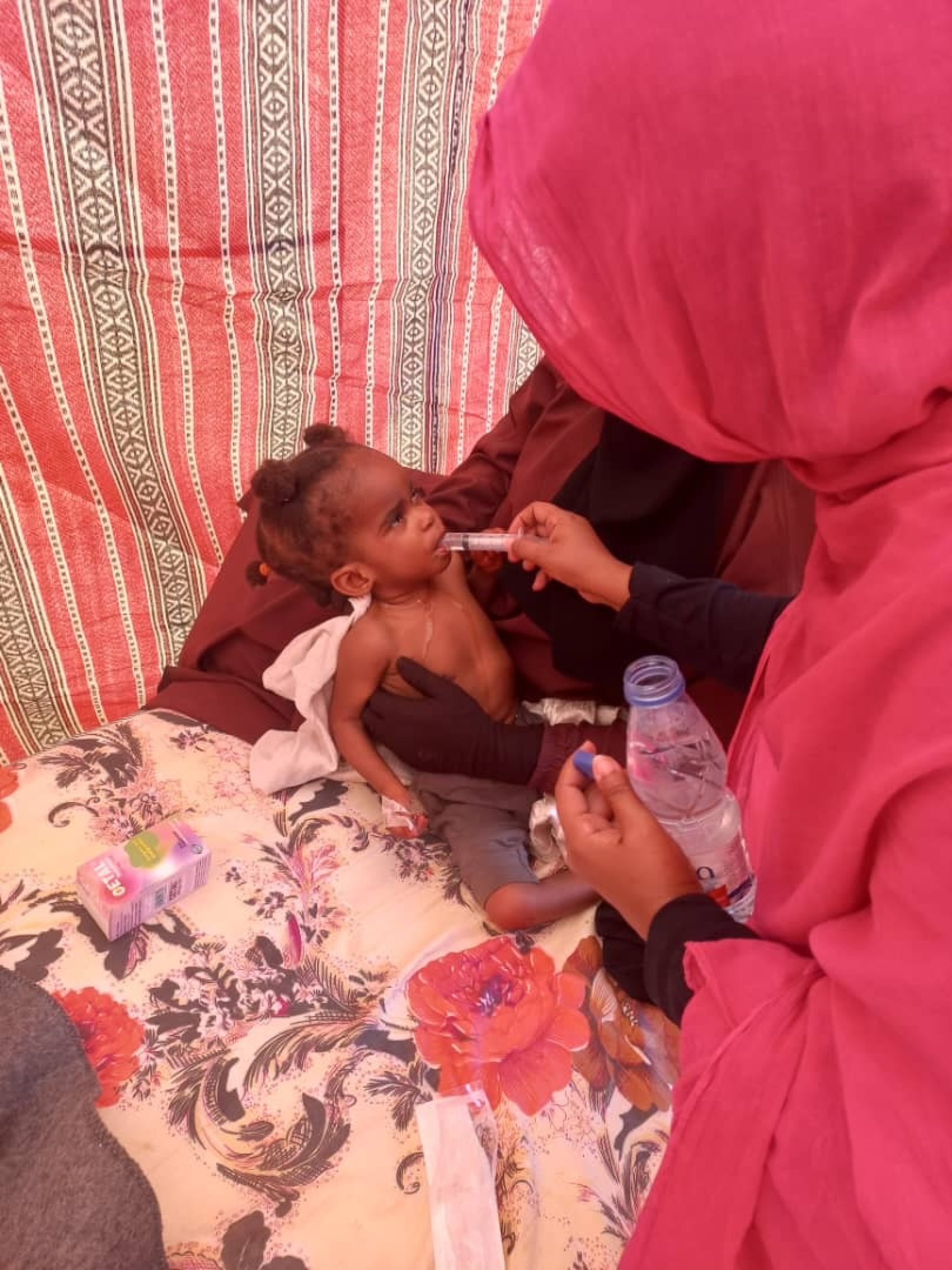
Dr. Abeer Dirar, who is working on the border between Sudan and Egypt, sent a photo of a 2-year-old whom she said was suffering from dehydration and she was having convulsions. Dirar treated her at a mobile clinic and she is doing better now. But she said she’s seeing all kinds of illnesses — lots of diarrhea, abdominal pain and food poisoning.
Courtesy of Dr. Abeer Dirar
Dirar and her colleagues have been working around the clock as more displaced people arrive every day.
Meanwhile, the insecurity has forced some community volunteers to leave Sudan.
Enass Muzamel is one of them. She’s now in Ethiopia.
“I was [in Khartoum] for eight days and I couldn’t do anything with anyone,” Muzamel said.
She continues to monitor and coordinate with the volunteers. She mentioned one group that has been responsible for collecting the dead bodies from the streets.
“They make sure that if there is a [identity] card and if the face is visible, they [take] photos and also sometimes, if they cannot reach a graveyard, they just bury and they make a note. So, it’s a tough job but those guys volunteer to do it,” she explained.
With no end in sight, Muzamel said maybe soon all the volunteers will have to leave and join the thousands of people who have already been displaced from their homes.
On a recent day, Juan Emanuel Arauco sat with his wife and daughter on a park bench in the lush, green oasis of Cuscatlán Park near downtown San Salvador, El Salvador, as other families picnicked on the grass or leisurely strolled the paths.
"Before, because of the situation we lived in, we didn’t feel safe to go out,” he said, ”but now we can come out and really take advantage." In just about a year, El Salvador has gone from one of the most dangerous countries in Latin America to one of the safest. The homicide rate dropped by over half last year.
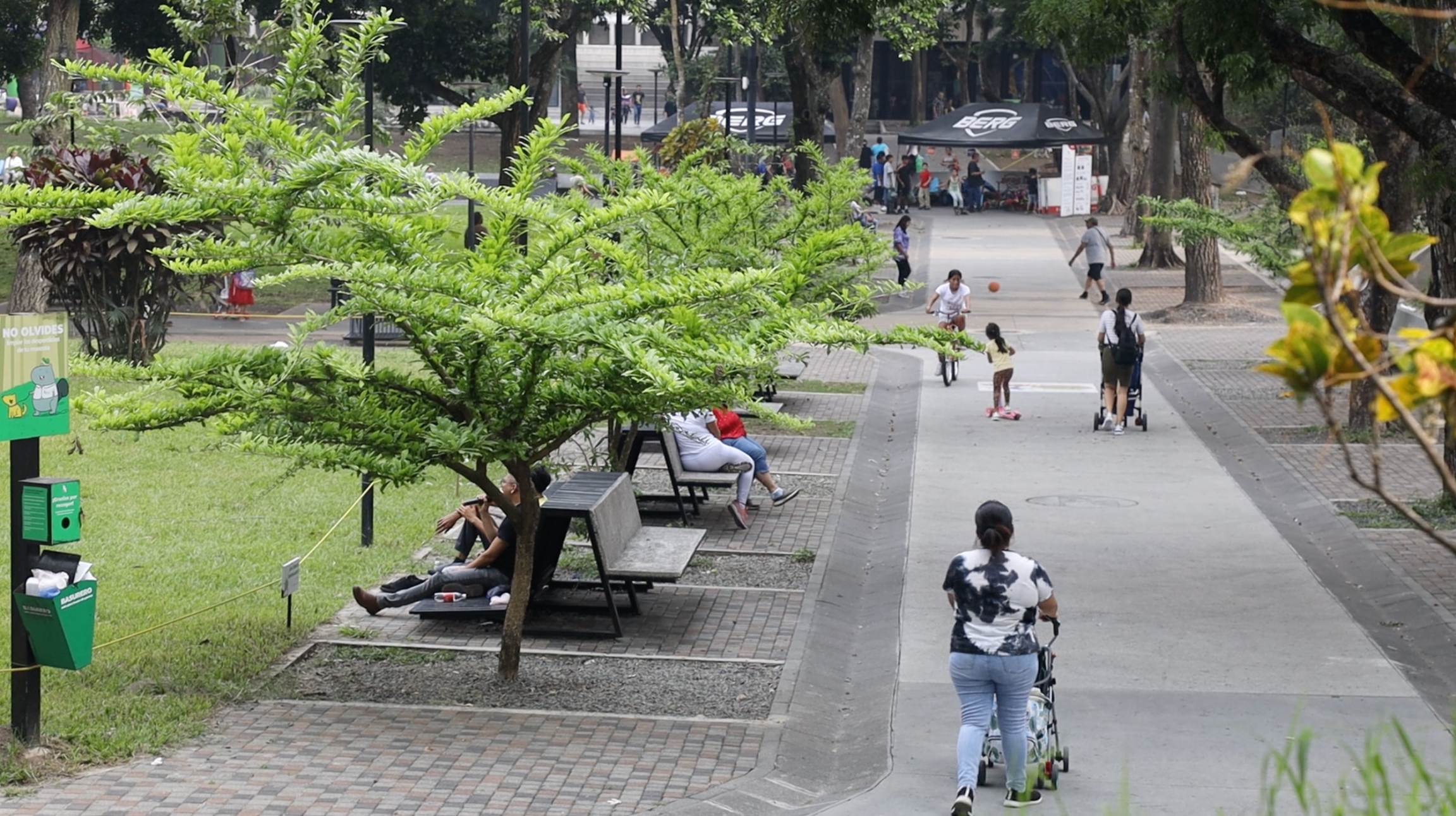
Cuscatlan Park is a lush green oasis near downtown San Salvador.
Michael Fox/The World
President Nayib Bukele is the man responsible for the astounding change. Since coming into power in 2019, he has ushered in an unprecedented crackdown on gang-related activities. But thousands of people over the last year have also been unjustly imprisoned under the recent suspension of civil liberties.
"Bukele has done things that no one else could,” said 75-year-old Isabel Mejia. She’s run a clothing stand near the city center for more than 30 years. Until recently, she had forbidden her grandchildren from visiting her there, because she was afraid they could get hurt.
"We were scared. There was so much pressure. You had to pay a cut of your profits to the gangs. I saw terrible things here,” she said. "I still haven’t been able to get them out of my head. Now, we are so much better."
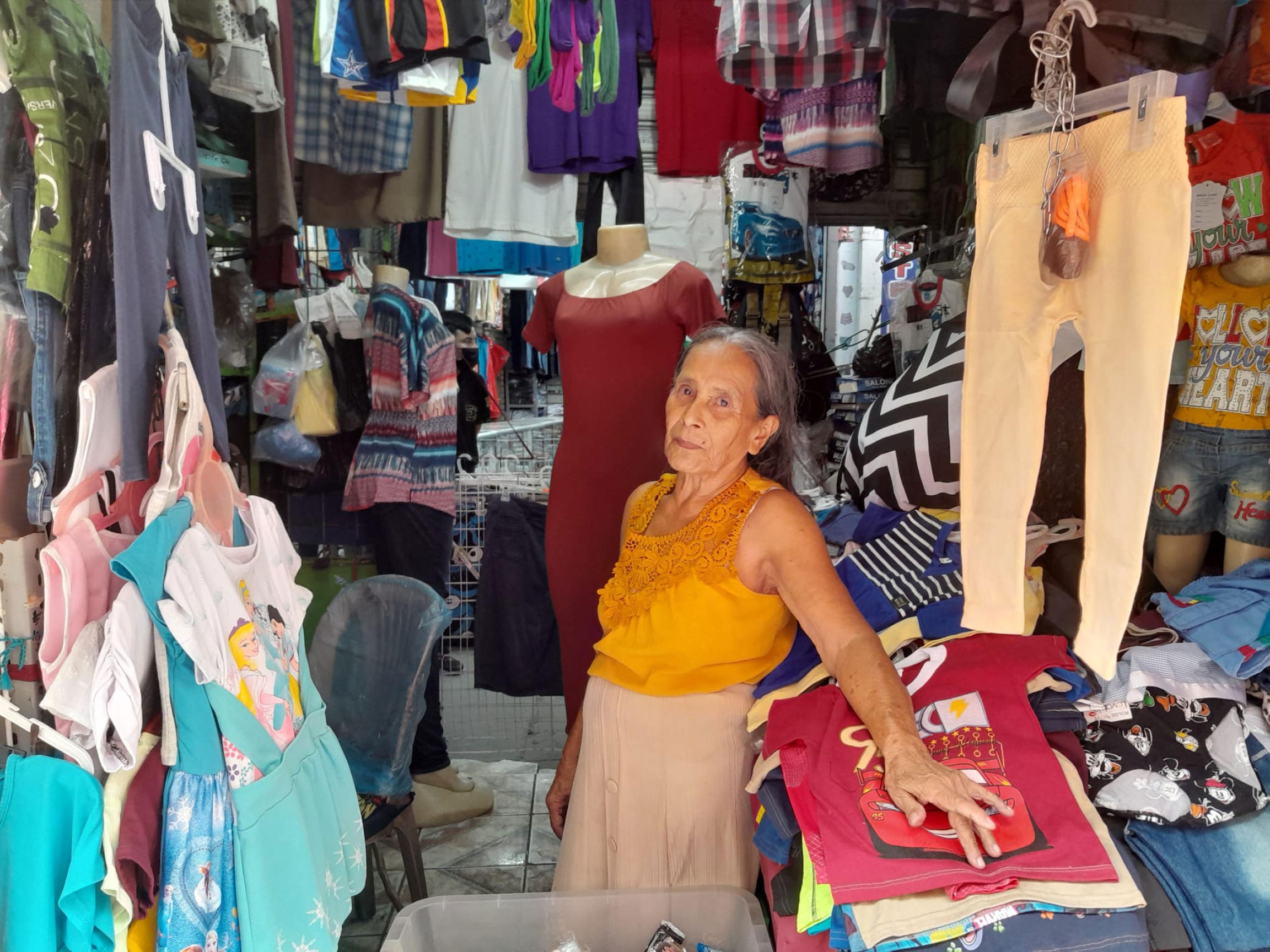
Isabel Mejia, 75, has run a clothing stand near the city center for more than 30 years.
Michael Fox/The World
Every afternoon now, downtown San Salvador is packed with people, shopping, strolling and going to cafés. It’s as if the couples and families are stretching their legs after being cramped for a long time — reoccupying a space that had been largely off limits to them for years.
Blanca Ortiz, a hair dresser in the city center, has lived near downtown for all of her 25 years. She said there are more jobs, more tourism and far more security.
"I never would have imagined this change,” she said. "Not with the way things were."

A scene from downtown San Salvador, El Salvador.
Michael Fox/The World
Bukele achieved this miraculous turnaround with an iron-fist tough-on-crime policy. In March 2022, he instituted what's called a state of exception, which limited constitutional rights, enabling him to crack down on the country's gangs. He's jailed over 65,000 people over the past year, built a new mega-prison, and packed it with former gang members.
He tweeted recently, “Strong men create good times.” On May 1, he announced that April was the safest month in the history of the country, with zero murders.
"There is no question about the success of this war on the gangs,” Bukele said in March, in a video released on his YouTube channel to mark the one-year anniversary of the state of exception. “It’s the most popular government project in the world."
But the state of exception has also wreaked havoc on the country’s human rights. International organizations have called for it to be repealed. Thousands of family members say their husbands, sons and brothers are unjustly imprisoned; that they were picked up, and are being held without due process. Family members haven't heard from them since they were jailed.
On May 1, two large marches weaved across the capital, San Salvador, in commemoration of International Workers Day. One, in support of Bukele. The other, led by family members of the detained. Many of them carried signs and pictures of their loved ones. Thousands were in the crowd.
“They took them alive. We want them back alive,” they chanted.

"They took them alive, we want them back alive" reads one shirt of a protester on Monday, May 1.
Michael Fox/The World
According to organizations representing family members of the detained, more than 200 people have died in jail over the last year. Those imprisoned are being held indefinitely.
"They took my husband on Feb. 1. He’s a hard worker and he’s never been in trouble with the law,” said Vanessa Beatriz Alfonso, in a red flowered dress, as tears streamed down her cheeks. “He has diabetes. We have a son who’s 2 and ½ years old. It’s been three months."
She said neither she nor her lawyers have been able to speak with him.
Her story is the same repeated again and again by wives, sisters and mothers.
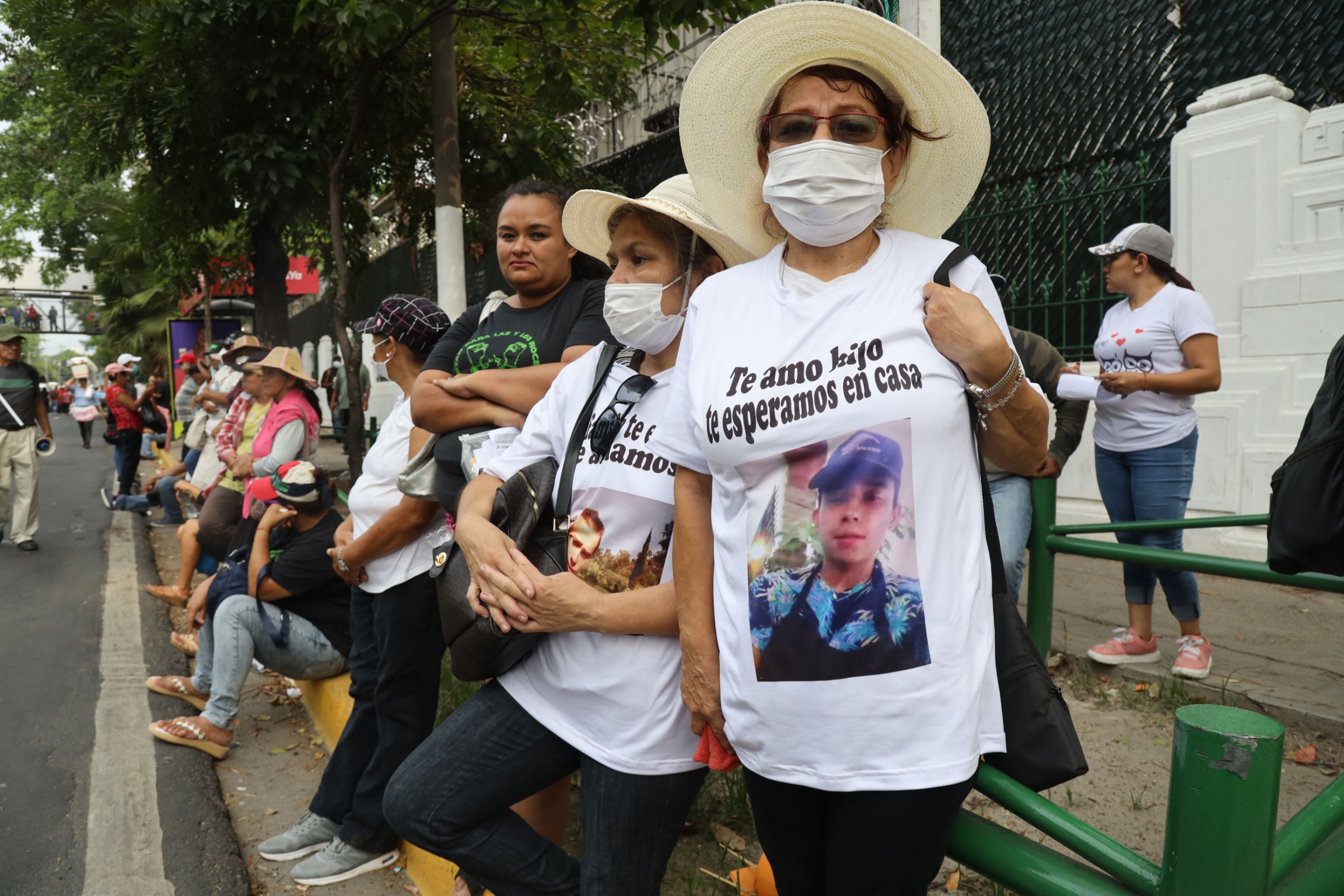
A mother of a detained son marches on May 1, in San Salvador.
Michael Fox/The World
Leaders of the Movement for Victims of the Regime — a group founded last year by families members fighting for their loved ones in detention — say that as many as half of those detained and held over the last year are innocent. They say there is no end in sight.
Social and environmental organizer Pedro Cabezas said President Bukele’s security policies are likely clearing the path for his reelection next year.
“There is no denying that he has been very effective,” Cabezas said, "because the people in their communities have seen a real change. And he is sophisticated. He’s managed to build alliances with the oligarchy, the traditional political parties and the military."
Presidents can only serve one term in El Salvador. But with a majority in the legislature and the country’s top court, many believe the president’s path will soon be cleared for reelection.
After the sun goes down on Saturday evening, Shabbat, the Jewish day of rest, comes to an end — and the streets of central Tel Aviv, Israel, fill up with people.
“Democracy,” they chant in Hebrew, emphasizing each syllable.
Week after week, tens of thousands of Israelis have been showing up for anti-government protests across the country. The biggest crowds gather every Saturday night in central Tel Aviv. More recently, there were concerns among protest supporters that the movement might be starting to lose steam. But they did it again over the weekend, for the 18th consecutive week.
Israel's Channel 12 estimated that more than 100,000 people came out to protest Israel’s far-right government and its plan to overhaul the country’s judicial system, which would hand the Legislature broad powers over the courts.
Demonstrators in Tel Aviv are highlighting a whole range of issues that they now see as under threat by this far-right government.
One group was waving an enormous rainbow flag while another was calling for workers’ rights.
Ido Dror, a 42-year-old Jewish Israeli teacher from Jaffa, a mixed Jewish and Arab part of Tel Aviv, held up a sign that read: “Palestinian lives matter. Democracy and occupation cannot coexist.”
Israel’s military occupation in the West Bank, he said, is a core issue for this protest movement.

At a protest in Tel Aviv, Israel, on Saturday, Ido Dror, a 42-year-old Jewish Israeli teacher from Jaffa, held up a sign that read: “Palestinian lives matter. Democracy and occupation cannot coexist.”
Matthew Bell/The World
“We are controlling other people with [our] military,” Dror said. “They don’t have the same rights as I have. So, it’s not a democracy [for Palestinians].”
It’s all connected, Dror said.
“The [judicial] reform is just another tool to get more power.”
Hagit Carmel, 52, who works in the department of gender and women’s studies at Tel Aviv University, said that she’s been coming here almost every Saturday for four months.
“It’s very important to see everybody protesting for one thing: don’t hurt our democracy,” said Carmel, whose T-shirt read: “No democracy, no academic freedom.”
She said that she’ll keep coming out for these protests for as long as it takes: “I mean, my Saturday nights are already fixed now. I’m not doing anything else instead of that.”
Other groups represented at the protest are Israel’s high-tech sector. Business leaders say this government’s hard-right policies are jeopardizing the economy.
And military veterans are here, too, including one group who served in the 1973 Yom Kippur War.
But some key political groups are hardly present at all, like members of the Ultra-Orthodox population, which is represented in the government led by Prime Minister Benjamin Netanyahu.
Also, Palestinian citizens of Israel — who make up 20% of the electorate — have largely stayed away.

Week after week, tens of thousands of Israelis have been showing up for anti-government protests across the country. The biggest crowds gather every Saturday night in central Tel Aviv. More recently, there were concerns among protest supporters that the movement might be starting to lose steam. But they did it again over the weekend, for the 18th consecutive week.
Matthew Bell/The World
Next to the seaside in Jaffa, a group of young Arab men relaxed on the boardwalk. They said that they won’t be going to these weekly protests, even though they want the demonstrations to succeed.
Marcel Spiliopolous, 19, who describes himself as an Arab Christian, grew up here in Tel Aviv and recently graduated from high school. He said that he feels somewhat conflicted about not going to the demonstrations.
“I think they’re doing a pretty good job. That’s their political fight. I’m just living here [in Israel],” he said. “I’m a citizen, a full citizen. I pay my taxes.”
But he said that Israel treats him and other Arab Israelis as second-class citizens.
He and his friends said that they don’t have the same rights as the Jewish Israelis they grew up with and went to school with here. And if they did, they said that they might be more willing to stand up to defend those rights and Israel’s democracy at large.
Just down the boardwalk was 30-year-old Aviv Bar-On, who lives outside Tel Aviv. He said that he agrees with the protesters, but isn’t one of them.
“I think they are taking it too [close] to the edge, too much,” he said. “They block roads and fight with police.”
More often than not, the weekly protests in Tel Aviv have been peaceful. That was the case on Saturday night.
But 25-year-old graphic design student Gaia Davidson said that she’s been coming to the demonstrations with friends almost every week, and about a month ago, she ended up in a dangerous standoff with some counterprotesters.
“Suddenly, a group of about 50 very young people, all dressed in black and with black covers on their faces, runs toward us screaming. We run away and we hide behind buildings, and they run toward us and they start throwing bottles at us,” Davidson said.
It was scary, she added: “There was a real split. Pro-democracy on the right side of the road, and the anti-democracy [protesters] on the left side of the road.”
In her view, it’s a civil war — “It’s two sides and they want the other side gone,” she said.

Demonstrators in Tel Aviv, Israel, are highlighting a whole range of issues that they now see as under threat by this far-right government.
Matthew Bell/The World
Ironically, demonstrators at both the pro- and anti-government protests have embraced the same symbol.
They both waved the blue-and-white Israeli flag with a Star of David on it.
Government and opposition leaders are engaged in negotiations, behind closed doors, to find a way forward on judicial reform.
But Josh Drill, spokesperson for the protest movement, said that he doesn’t have any faith in those talks.
“We understand that they will fail at the end of the day,” Drill said. “We will see the numbers [of protesters] not just growing, but also, you will see the protests intensify.”
Drill said civil disobedience, like blocking roads, is a big reason why these protests have — so far — succeeded in halting the judicial overhaul laid out by the prime minister.
“When a government is trying to dismantle the democratic institutions, civil disobedience is needed,” he said, adding, “If citizens do not do civil disobedience, the government will feel more flexible.”
Drill said he believes that Netanyahu understands this: “And Netanyahu is, in fact, scared. He understands that there’s a force up against him that will not allow him to pass the judicial overhaul.”
Protest leaders also know that the prime minister has the power to quickly push through the judicial overhaul.
And for that reason, they say it’s vital for large numbers of people to keep coming out to the streets every Saturday night.
It's kind of like the Olympics of pop music — the annual Eurovision Song Contest, which kicks off this week.
Before you dismiss it as a gimmick, schmaltz or a joke, Eurovision is how the world came to know bands like the Swedish supergroup, Abba.
Other Eurovision performers over the years include Celine Dion, Olivia Newton-John and Julio Iglesias, to name just a few.
Last year's winners from Ukraine are unable to host in-country this year due to ongoing conflict with Russia, so Liverpool is stepping in. To learn more about it, The World's Carol Hills spoke to Paul Jordan, who is recognized across the UK as Dr. Eurovision.
This interview was edited and condensed for clarity.
Obiní Batá, a legendary group of all-female musicians from Cuba, is known for playing the batá drum — an instrument that was once forbidden for women to touch, according to religious beliefs.
Through their music and activism, the group has been fighting discrimination and sexism for 30 years. But the road to acceptance for women percussionists has not been easy.
Some of the founders of Obiní Batá.
Courtesy of Eva Despaigne
Back in 1993, a group of women performing with the National Folkloric Group decided to put together an all-female show to celebrate Father’s Day.
Eva Despaigne, one of the show's organizers said the women wanted to honor their male colleagues with dance and music.
“It was the first time that women dared to play the batá drums in a performance setting,” Despaigne said.
The women, who were all dancers, had to learn how to play instruments — including the forbidden drum.
The batá or “talking” drum originated in Yorubaland, in modern-day Nigeria, said Susan Thomas, a musicologist at the University of Colorado, Boulder, and an expert on Cuban music.
“These were drums that could mimic the tones of the Yoruba language,” Thomas said, adding that these drums were mostly used in religious ceremonies to communicate with gods.
The double-headed drum, shaped like an hourglass, was introduced into Cuba by enslaved Africans in the 19th century; they incorporated them into the rituals of Santeria, a widely practiced religion in Cuba.
“The drums are believed to house a spirit, Anya, and it's believed in Cuba that having that person touching or playing the drum who is out of balance with the power of Anya can cause problems,” Thomas said.
Tradition dictates that only men can play the sacred batá drum. The idea is that women’s menstrual blood could be mistaken by Anya as sacrificial blood, Thomas explained, therefore making it dangerous for women to touch or play the drum.

Eva Despaigne, one of the founders of Obiní Batá and current musical director.
Courtesy of Eva Despaigne
Despaigne said the group was aware of these religious beliefs but decided that playing the batá drum in an artistic context was different — and the show was a success.
They went ahead and created the group Obiní Batá, or Women Bata, in Yoruba language.
But not everyone was happy about it.
“We faced a lot of obstacles at the beginning,” Despaigne said.
Sometimes, the group would arrive for a rehearsal and discover that their drums had been hidden. Male instructors were warned not to teach women or it could cost them a spot on a traveling tour or a major performance.
Niurca Marquez, an artist and a scholar in religious studies at Florida International University, said these taboos go beyond religion and “bleeds into the roles that are typically assigned to men and women.”
“Within music and the arts, I think we see a predominance of dancers, singers, but we don't see a large number of established instrumentalists — especially percussionists,” Marquez said.
Even so, the women of Obiní Batá persisted, and the group gained popularity.
The group has performed internationally multiple times, and trained dozens of women to play Afro Cuban drums.

Percussionist and singer Brenda Navarrete posing with batá drums.
Courtesy of Brenda Navarrete
Over the years, doors slowly began to open for female drummers in Cuba, just as women gradually took on roles in politics, academics and other areas of Cuban society.
Marquez said Obiní Batá provided much-needed representation over the last 30 years.
“So, you have an entire generation and then, some that have grown up seeing other women play the drums,” he said, adding that this allowed other women to pursue careers as percussionists.
Brenda Navarrete, one of Cuba’s young talents, began her musical career playing drums with Obiní Batá.
“Obiní Batá opened a new world for me,” she said. “It gave me a different perspective about drums and women.”
She often hears the compliment: “You play as strong as a man."
But women offer a lot more than strength when playing drums, she said.
“Our touch is more sensual, sweet, and mellow. But it doesn’t mean it’s not strong."
Cuba today has a lot more women percussionists, but Thomas said there’s still a lot more work to do.
“I wish I could say that these leading women artists had blown up the barriers for other women and that there's been a flood of women musicians after them. But I can't.”
Men still dominate the percussion scene in Cuba. But thanks to the trailblazing Obiní Batá, Cubans finally accept that women can also drum.
Earlier this year, Iraq’s Ministry of the Interior launched an app called Ballegh to great fanfare.
The government in Baghdad billed it as an opportunity for anyone in Iraq to help the government identify social media posts that were “offensive.”
The problem is, the government hasn’t defined offensive, which has allowed Baghdad to crack down and arrest just about anyone after deeming their content “indecent.”
Digital and human rights activists say Ballegh’s very existence flies in the face of free speech provisions enshrined in Iraq’s post-Saddam Hussein constitution 20 years ago. In a written interview with the "Click Here" podcast, Ayad Radhi, the IT administrator at the Ministry of Interior in charge of the app, says the government is just protecting “family values.”
Ordinary Iraqis, for their part, appear to be embracing the effort. The Interior Ministry told "Click Here" that it has received more than 144,000 reports on the platform since it was introduced in January. Radhi laid out how it works (below), while Dina Temple-Raston, host of the "Click Here" podcast, told The World about how the app is now being used to "crowdsource" morality (to listen to that interview, click on the audio player above).
This interview has been edited and condensed for clarity.
An earlier version of this story appeared on the "Click Here" podcast from Recorded Future News. Additional reporting by Will Jarvis.
Under an overpass along the waterfront in Tarragona, Spain, a sound check was wrapping up in a small, dark concert venue that smelled of beer.
Sandré, a neo-punk band from Barcelona, ripped into a heavy number with screaming vocals.
The group included Carles Pons on guitar, Marc Torrent on drums, Stafanía Lusini on bass and Rosa Pagès as the screamer. Between shouts Rosa also dove into the mosh pit in front of the stage.
After a very intense show, a young fan named Dani, or just “Dah,” approached the band outside, asking them to sign their LP record he had just bought. He said that seeing Sandré was an out-of-body experience.

Lead singer Rosa Pagès in a mosh pit during a Sandré concert, Tarragona, Spain.
Gerry Hadden/The World
“It’s the noise,” he explained. “The wall of sound, it just slams you. I’m not sure what I like about it, but the feeling is an addiction.”
Such enthusiasm still catches Sandre’s members by surprise. Sandré has been around for a few years, playing mostly at tiny clubs. But now, suddenly, they’ve been riding a new punk wave in Spain, with dozens of bands springing up across the country. The group has found itself on the bill for many big music festivals this summer, alongside popular rap, rock and reggaeton bands.
At a bar in Barcelona, Pagès and Torrent explained that what’s driving this punk resurgence is “shared rage.” Through the music, Torrent said, people can vent their anger together.
These are tough times for a lot of young Europeans. Some of them still suffer from post-COVID-19 depression. There’s also an economic crisis on the continent, with high inflation rates and low-paying jobs.
“There’s so much social inequality,” Torrent said. “Young people can’t afford rent or groceries.”
All the while, he added, social media is constantly bombarding everyone with happy images of how they’re supposed to be living.
“The truth is,” he said, “people are desperate.”
Sandré’s songs try to address that desperation. One tune, called “I Have it All,” is pure punk sarcasm.
The lyrics say: “I always wake up smiling/Happy like a meditator/I’m never rejected, or ignored.”
For some of the older people who turn up at Sandrés shows, it all might feel like déjà vu. Punk stormed into Spain from the United Kingdom in the late 1970s, just as Spain was emerging from decades of dictatorship, recalled DJ and punk musician David Caseby.
“From a very conservative, controlled country, there were all these new outlets,” he said. “And there was that shock value when punk first came out, as with Las Vulpess playing a cover version of 'I Want to Be Your Dog,' which kind of unsettled a few people in the media business.”
Las Vulpess was Spain’s first all-women punk band. Their sexually suggestive song caused a scandal on Spanish public television. And it cemented punk’s place on the scene, said Caseby, who lives and works gigs in Spain.
“Just watching a band like that coming on and just giving it all,” he said, “it was so exciting and so fresh at the time for them.”
Punk is defined by its sound and attitude. But, said Rosa Pagès from Sandré — unlike classic punk rockers like the Sex Pistols, the Ramones or The Clash — Sandré includes self-deprecation in its songs.
“We sing about things people connect with, but never too seriously,” she said. “There’s always a wink. Sure, everything’s gone to crap,” she laughed, “and everyone’s a jackass. But we’re the first to admit that we are, too. People relate to that.”
France has been rocked by months of protests against Emmanuel Macron’s deeply unpopular decision to raise the retirement age from 62 to 64.
The president has forced the change through Parliament, and his government hopes it will be implemented by the fall.
But the battle is far from over.
On Monday — International Workers’ Day — hundreds of thousands took to the streets in major demonstrations. And workers in the energy sector are now threatening mass power cuts unless Macron reverses course.
Such cuts could disrupt major events planned for coming months — including the Cannes Film Festival, the French Open tennis tournament and the Monaco Formula 1 Grand Prix.
France’s largest energy union declared Wednesday a “national day of anger.”
Members of the CGT Energy Union, and other groups, gathered in Paris’s La Defense business district.
Frederic Probel, a representative of the CGT Union at the protest, defended the threat of power cuts.
“Politicians must be made to understand the energy sector’s value,” he said.
“If we don’t work, there’s no light … And we can’t carry on working until we’re in our mid-60s. That’s the message we’re trying to convey as calmly but forcefully as possible.”
Millions of people from all walks of life have taken part in more than a dozen national protest days since the pension-reform plans were announced.
Transport workers have gone on strike and rubbish collectors have let trash pile up in the streets.
But energy workers say they will be particularly hard hit.
Probel explained that the reforms will remove a special dispensation that allows those working certain jobs in electricity and gas to retire five years early.
When they do retire under the new system, their payments will be less, he said. And this means that fewer young people will be willing to join the industry.
Power cuts are a relatively common protest tactic in France. Last month, workers cut electricity at an airport and school that Macron was visiting in the south of the country.
The president’s official residence has also been targeted along with the offices of politicians who support the reforms.
At the same time, unions say they are providing free power to some schools, hospitals and other buildings — in what they call “Robin Hood” actions as energy prices rise.
“It’s good to cut politicians’ electricity,” said Guillaume, a member of an energy union at the demonstration, who declined to give his last name because of concerns about his work.
“It’s so that they can understand what life is like for real people — for people in poverty and those in precarious situations.”
Members of Macron’s government have branded such protests illegal. Prime Minister Elisabeth Borne has urged the national grid to file criminal complaints against anyone found carrying them out.
Those at the protest on Wednesday say they were well aware of the legal risks but would do whatever it takes to force Macron’s hand.
The president has called for a period of reconciliation after the unrest of the past few months. With power cuts planned and more nationwide protests already scheduled, this seems unlikely.
For most species, a changing climate doesn’t bode well. But there are examples across the animal kingdom of ones that are finding ways to adapt to a warming world.
Scientists all over the globe have been studying the changes in animal physiology and behavior, some going back generations, which they believe is linked to rising temperatures. They say the adaptations are beneficial, but may have limitations in the long term.

Cape ground squirrels in South Africa are adjusting to climate change. Their average foot length has increased by 9% in just 18 years.
Courtesy of Miya Warrington
In the dry grasslands of South Africa, Miya Warrington, a conservation biologist at the University of Manitoba, first laid eyes on Cape ground squirrels darting about in 2021. “You see the heat and you see all the human activity,” she said. “So immediately, I start thinking about how these animals might be adapting to climate change.”
And by adapting, she means altering the size of parts of their bodies. So, Warrington set out to measure the squirrels. The first challenge was to catch them.
“They love peanut butter,” she explained. It’s “like manna from heaven for them. We put it out in these traps, and they go, ‘Ooh, peanut butter.’ And then we take them out of the traps and we do the measurements.”
One of these measurements included foot length. “And you take calipers and you just put them on from the toe to the heel,” something her colleagues have been doing for almost two decades.
This gave Warrington the ability to look back through time, compare the data to that of today’s squirrels, and test out her hunch.
What she found was that the average foot length (compared to length) had increased by 9% in just 18 years. Warrington believes that the reason could be because temperatures are getting hotter.

Scientists measure the feet of Cape ground squirrels to track their changing sizes.
Courtesy of Miya Warrington
“When their bodies get hot,” she said, “their heat radiates out of big, big feet. So, it’s one way of dissipating heat.”
The cause and effect of this needs more research, however, in part because other changes in squirrel dimensions didn’t seem to correspond to the hotter temperatures. But her work is part of a growing body of evidence that climate change can cause certain animal species to shape-shift, especially those with rapid reproduction rates, like shrews and birds.
In Finland, for instance, as winters have grown milder, the number of brown tawny owls has surged compared to gray ones. That’s because the brown owls are better at blending in with less and less snowy environments.
Anderson Feijó, a zoologist at the Chinese Academy of Sciences in Beijing, found that shape-shifting due to climate change is also apparent in fossil records. He studied about a hundred ancient frog species and found that “medium-sized frogs seem to be the most resilient to the climate variation, while those species that are too large or too small are more sensitive” and tended to disappear when temperatures become too hot or too cold.
But adaptation doesn’t always lead to visible changes. Sometimes, the changes happen inside an animal’s body.

The ability of the montane horned lizard to perform a task, such as sprinting or digestion, is optimized over a relatively narrow range of temperatures.
Courtesy of Martha Muñoz
Martha Muñoz, an evolutionary biologist at Yale University, has studied the montane horned lizard in Mexico. “Their ability to perform a task, such as sprinting or digestion, is optimized over a relatively narrow range of temperatures,” she explained. “And then decreases at higher and lower temperatures until the animal is immobilized.”
When their environment in Mexico became slightly warmer, Muñoz was curious if the lizards had adapted. So, she gathered up several dozen of them, and then “systematically cool[ed] or heat[ed] the lizards by one degree per minute, flip[ped] them onto their backs, and then determine[d] the temperature at which they los[t] the ability to flip themselves back over, this being the thermal limit to locomotion.”
After crunching the numbers, Muñoz, Saúl Domínguez Guerrero and their colleagues found that the lizards had increased their heat tolerance by about a degree. “They’re less comfortable in the cold, and more comfortable in the heat,” she summarized. And that shift happened over a single year.
While some of it was temporarily induced by the environment, some of the change was also genetic. The lizards had evolved a higher heat tolerance and were passing it down from one generation to the next. Muñoz said that this is to be expected of species with large populations.

Acropora hyacinthus coral in Rarotonga, Cook Islands.
Courtesy of Rachael Bay
This combination of genetic evolution and temporary environmental plasticity is also helping other types of species survive warmer temperatures, including the Acropora coral in American Samoa. Some of the corals have seen variations in their genes, allowing them to tolerate warmer water temperatures.
At the same time, it’s also true that “corals that have past experience with warm temperatures are better at living at higher temperatures in the future,” said Rachael Bay, an evolutionary biologist at the University of California, Davis. And although they may be protected against warming temperatures in the short term, Bay said, “we have no idea what the limits to that capacity are.”

Rachael Bay sampling coral in American Samoa.
Courtesy of Rachael Bay
Meanwhile, some animals are adapting behaviorally, such as pink-footed geese in the Arctic. These birds have developed new migration routes and breeding grounds, with warming temperatures opening up new habitats.
Thomas Lameris, an ecologist at the Royal Netherlands Institute for Sea Research, said that birds like these benefit from their social environments. “The way they behave is they often learn from their parents or from other geese,” he explained, allowing for any adaptive change in behavior to propagate quickly through a population.
He witnessed this firsthand at a remote spot on the tundra in the Western Russian Arctic when studying barnacle geese. The birds winter across western Europe and fly north to the Arctic to breed. They stop along the way, fueling up on fresh, nutritious grass that’s just emerged from the melting snow.

Scientists traveled to the remote tundra in the Western Russian Arctic to study how the migration behavior of barnacle geese has shifted due to snow melting earlier in the year.
Courtesy of Thomas Lameris
But Lameris found that in the years when the snow melts early, the geese don’t make stops to feed during their migration, making a mad dash, instead, to the breeding grounds.

In the years that snow melts early, pink-footed geese no longer make stops to feed during their migration, heading straight to breeding grounds instead.
Courtesy of Thomas Lameris
“They would really speed up their migration,” he explained. “They would be able to make the journey that would otherwise take two weeks … they could do the same thing in four days.”
And when they arrived, “they would need a longer time to recover before they could lay their eggs,” he said.
But Lameris is heartened by what he sees as an ability for a migratory species to adapt to a warming climate.
Still, adaptation — whether genetic or behavioral — can only get a species so far.
Lotanna Micah Nneji, a conservation biologist at Princeton University, pointed to the Perret’s toad, found only in Idanre Hill in southwestern Nigeria. As rainfall patterns and temperatures shift, the habitat of these toads is shrinking. Nneji has identified other locations in the area where they could live more comfortably. But, unlike birds and mammals that can cover large distances, these toads are pretty much trapped. Those other areas are simply too far from their current range and not within protected areas.
Animal adaptations, though remarkable, are sending us a message.
... "When you’re adapting your physiology ... there's an upper limit to how far that can go ..."
“Everything that organisms do is simply buying time,” said Martha Muñoz of Yale. “But if you’re going up a mountain, there’s only so far you can go. And if you’re going polewards, there’s only so far you can go. And when you’re adapting your physiology, guess what? There's an upper limit to how far that can go, too. And if we don't reverse action, they are truly running out of options because we’re giving them no others.”
Related: Bees face many challenges — and climate change is ratcheting up the pressure
On the walls in the alleyways of the Old City of Nablus, in the Israeli-occupied West Bank, there are rows of posters all over the place, showing the faces of Palestinian men in their teens and 20s. Most of them are holding weapons.
The young men, all of them assumed to be dead now, were members of Areen al-Usud, or Lions’ Den, a militant group that has emerged in the West Bank over the last year or two.
And they’re being hailed as national heroes by Palestinians in the West Bank.
“God bless the martyrs,” said the longtime owner of a takeout shop there. He didn’t give his name — and that’s not surprising, because the Lions’ Den is treated as an illegal, terrorist group by Israel.
The Israelis blame the Lions’ Den for a rising number of shooting attacks near Nablus, including the death of one Israeli soldier.
Israeli security forces have gone after the group in recent months, killing or arresting many of its top leaders.

Posters of men who are dead, who were members of the Lions' Den militant group, can be found throughout the West Bank city of Nablus.
Matthew Bell/The World
All the same, many West Bank Palestinians say that the Lions’ Den — and other upstart militant groups like it — are something that’s both new and inspiring.
At the takeout shop, some kids gathered, chiming in with, “We’re with the Lions’ Den, too!”
A 10-year-old boy proudly showed his T-shirt with the silhouette of an M-16 machine gun.
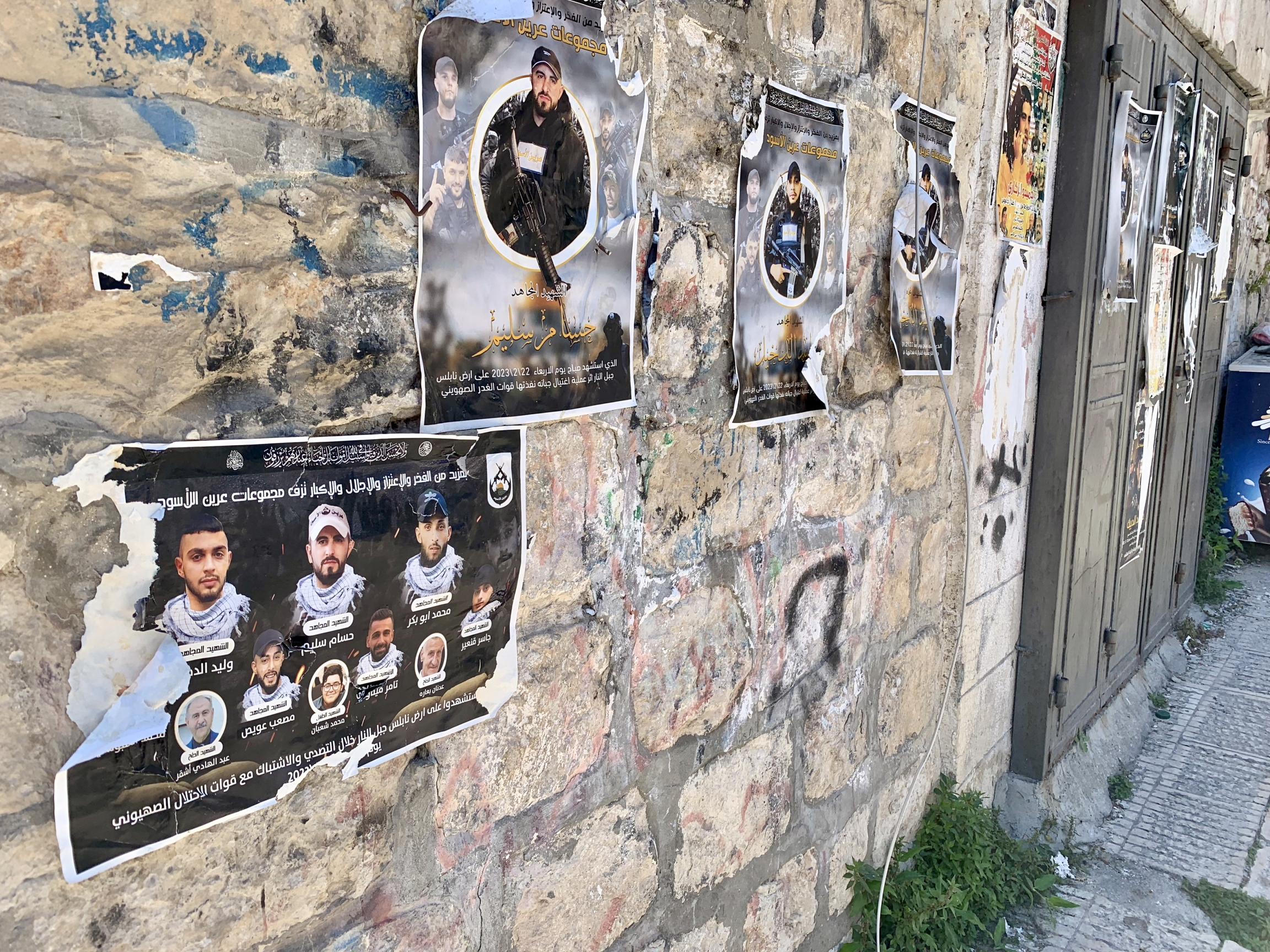
Posters of men who are now dead, who were members of Areen al-Usud, or Lions’ Den, a militant group that has emerged in the West Bank over the last year or two, can be found on the walls in the alleyways of the Old City of Nablus, in the Israeli-occupied West Bank.
Matthew Bell/The World
A 23-year-old man who gave his name as Zuhair showed his mobile phone case, which pictured the founder of the Lions’ Den, who is also now dead.
“These people are resisting against the occupation,” he said. “These are our friends. These are the ones that the Israeli occupation forces are always killing. They have boosted the morale of each and every person in this city.”
A sprawling old cemetery in Nablus was mostly empty on Tuesday afternoon, except for one section, with a cluster of about a dozen graves. They stood out among the crowded rows of aging white gravestones, because they are made of shiny, new black granite. They’re surrounded by brightly colored flowers. And a steady trickle of visitors come by to pay their respects.
This section of the cemetery is where the Lions’ Den’s dead are buried.
Among the visitors, there’s a group of teenagers, a few of them who drove from a nearby village to visit this place. Also here, relatives of the deceased leaders of the Lions’ Den.
In the West Bank city of Nablus, Samar Ibrahim visits the gravesite of her son, Tamer Kilani, who was killed in an Israeli military raid in February. She says she is proud of her son and hopes the Lions’ Den militants who’ve been killed will inspire more Palestinian youths to follow in their footsteps by fighting the Israeli occupation.
Matthew Bell/The World
One of them was Samar Ibrahim, who wore a pendant around her neck with a picture of her son, Tamer Kilani. She said that he was killed in late February in a shootout with Israeli troops just down the road from the cemetery.
Ibrahim, who sat on a bench in front of his grave, said that she could feel her son’s presence.
“First and foremost, I tell him that, ‘I’m very satisfied with what you did. You served your country. You served your people. You served your whole nation. And what you did is something I’m so proud of.’”
Ibrahim said that she hopes the members of the Lions’ Den will motivate another generation of Palestinian youths to follow in their footsteps by fighting Israel in defense of Palestinian lands, people and faith.
The enthusiastic support that people in Nablus express for groups like the Lions’ Den is not surprising at all to Tahani Mustafa, Palestine analyst for the International Crisis Group think tank.
There is not a lot of faith in the Palestinian Authority and its security forces in the West Bank these days.
And Mustafa said that the Lions’ Den, along with other self-proclaimed independent militant groups, are stepping in to fill the void. On top of that, she said that Israel’s right-wing government is taking a harder line in the Palestinian territories.
"We’ve seen some of the deadliest death tolls here in the West Bank, just through Israeli incursions, arrests and targeted assassinations."
“Israeli policies have become far more aggressive, far more intrusive,” Mustafa said. “We’ve seen some of the deadliest death tolls here in the West Bank, just through Israeli incursions, arrests and targeted assassinations. A lot of that has been very preemptive from Israel’s side.”
Several people in Nablus told The World that the Lions’ Den could help bring a final victory over the Israeli occupation one day.
Posters of men who are now dead, who were members of Areen al-Usud, or Lions’ Den, a militant group that has emerged in the West Bank over the last year or two, can be found on the walls in the alleyways of the Old City of Nablus, in the Israeli-occupied West Bank.
Matthew Bell/The World
But Mustafa estimated that the group’s members only number in the dozens. She added that many Palestinians are quietly wary about these young fighters provoking an even harsher response from Israel.
“As much as these groups do represent a very popular cause, they also lack any strategy, vision and, often, the implications of what they do can be more harmful than they can be beneficial.”
Many older Palestinians in the West Bank remember what followed the second intifada in the early 2000s.
Israeli military checkpoints, road closures and security walls stifled the local economy and disrupted daily life.
According to one recent poll, solid majorities of both Palestinians and Israelis now say they’ve lost hope in a two-state solution. And they see another violent Palestinian uprising coming soon.
On the outskirts of Barcelona, Spain, hundreds of amateur soccer players attended the draft of a new sports competition called the Queens League.
One of them was 20-year-old Paula Moreno Rincón, who struggled to explain what this new competition is about.
“It’s a new world,” she said. “It’s soccer, but with very different rules.”

Hundreds of soccer players took part in the Queens League draft.
Oysho Queens League
Rincón was not only talking about the pitch being smaller, with fewer players, or games shorter and more intense. She meant “very different,” as in a giant dice being thrown in the middle of the field to decide how many players can play, or secret cards that coaches can play at will, to eject rivals, earn a penalty kick or make goals count double.
The women’s Queens League is the follow-up to the Kings League, which only launched in January, but has already lured millions of online viewers in the Spanish-speaking world. The game is loosely based on soccer, but immersed in video game culture and reality TV antics.
In Barcelona, the second season of the Kings League kicks off the first weekend of May alongside the first season of the Queens League. This summer, the Prince Cup will launch for kids ages 9 to 11.
The Kings League also plans to expand internationally, and a new league has been confirmed in Brazil, with soccer superstars Ronaldinho and Neymar, Jr. as team presidents.

The final of the Kings League was played at Barcelona, Spain's Camp Nou stadium in front of over 90,000 fans.
Infojobs Kings League
Most of the Kings League games are streamed from an indoor soccer field on the outskirts of Barcelona, where the draft of the Queens League took place.
However, the Kings League final was played at the Camp Nou stadium, the biggest in Europe, in front of more than 90,000 fans, and with over 2 million people watching online.
The whole project was created by the recently retired soccer star Gerard Piqué, who had a glittering career playing for Barcelona and the Spanish national team.
Piqué’s right-hand man, Oriol Querol, said that he and Piqué came up with the concept for the Kings and Queens leagues last year, because they felt that traditional soccer is missing out on younger audiences and needs to change.
“Watching traditional soccer is increasingly hard. It’s 90 minutes, very long, and not many things happen,” Querol said.
He gave an example: “Today, Barcelona played 0-0, no goals.”

Gerard Piqué is the founder of the Kings League.
Infojobs Kings League
In the Kings League, though, things happen constantly.
“Rules are borrowed from other sports, like water polo, handball or even video games,” said Querol, who is also the CEO of the Kings League.
To get the audience, Querol said, they enlisted some of the biggest online celebrities in the Spanish-speaking world, who became the team presidents.
One of the team presidents at the Queens League draft was 20-year-old Esperanza Borrás, or Espe, who said she had spent a tough week studying draft prospects to find the best picks for her team, the Aniquiladoras FC.
Like most team presidents, Borrás grew an online following by sharing videos on YouTube of herself playing video games in her bedroom.

The games are streamed on Twitch.
Infojobs Kings League
Other team presidents are influencers, sports commentators or even former soccer stars, like Spain’s Iker Casillas or Argentina’s Sergio Agüero.
Whether from Spain or Latin America, there’s one thing they all have in common: millions of followers thirsty for content.
Presidents discuss the Kings League in talk shows, get in heated arguments and make anthems for their teams. They may even join an actual game and shoot a penalty kick.
For some, it’s hard to take it seriously, like Javier Tebas, the head of Spain’s soccer league, La Liga.

Ibai Llanos, left, is one of the most-popular streamers in the world and one of the team presidents.
“The only thing the Kings League has in common with soccer is the ball and the goals,” he said, adding, “I like it as a circus, but you can’t compare it with the soccer industry.”
The Kings League doesn’t really see that as a problem, Querol said.
“It’s a thin line separating sports and entertainment, and we like to cross it.”
He said the Kings League wouldn’t work if it was all a show; the same if it was just soccer with different rules.
In October, 6-year-old Karolina Daremyan was sleeping with her mother when Russian forces shelled their home in Nikopol, Ukraine. The mother was hospitalized, and the young child’s injuries were so severe that both of her legs were amputated below the knee.
United Nations human rights watchers have recorded over 500 children killed and almost 1,000 injured since the Russian invasion in February 2022. They think the true figures are considerably higher. The Ukrainian hospital system has been overwhelmed, and only a fraction of those injured children have been able to make the difficult journey to the United States for complicated medical procedures and rehabilitation.
Karolina is one of the lucky ones.
She and her godmother would become beneficiaries of a tight-knit network of do-gooders, traveling to get Karolina medical care at the renowned Shriners Children’s Hospital in Boston. The hospital has helped nearly 2,000 international children since 2005.
“The medical system is so stressed [in Ukraine], the high-resource needy cases are very difficult to support,” said Dr. Robert Sheridan, Shriners’ chief of staff. “A case that perhaps they could have managed before February 2022, they just are completely overwhelmed that they don't have the resources that that child would need.”
BREAK
Since Russia’s invasion, five Ukrainian children have made their way to Shriners in Boston, and another six have gone to other hospitals in the Shriners network across the country — including one child who lost her arm, and another injured in a collapsed building due to a missile strike.
Karolina and her family found their way to a Polish refugee camp in late spring, where they met Daria Khatina. The 35-year-old, also Ukrainian, became a close friend.
Months later, the family decided to leave the camp and go back to Ukraine. But just hours after they returned to Nikopol, Russians shelled their home.
“I didn’t want to believe it, I couldn’t believe that it happened the same exact day. It was shocking, it was painful and it was hard,” Khatina said in an interview interpreted from Ukrainian.
With her mother hospitalized, Karolina was shuttled from one hospital to another that might better perform her amputation. Her aunt was posting on Facebook about the horrific event, and supporters around the world were sending their condolences and suggesting what could be done to help the little girl. Karolina’s family was ultimately connected to the Ukrainian Embassy to the United States and Ukraine House, a DC-based nonprofit founded by the First Lady of Ukraine, Olena Zelenska.
The two groups reached out to Shriners, which reviewed her case and accepted her for treatment. With Karolina’s father taking care of her two younger siblings, Khatina volunteered to accompany Karolina on the journey, taking on a new role as godmother and leaving her own three children behind. Ukraine House and the embassy arranged travel and coordinated visitor visas.
Karolina looks up at Ambassador Oksana Markarova during her final trip to Washington DC, as Daria Khatina looks on.
Courtesy of Ukrainian Embassy
On top of the embassy’s typical work in sanctions, weaponry and geopolitics, the Ukrainian ambassador to the United States said her office wanted to get involved with humanitarian aid during the war and reach beyond their typical duties. Young students in Ukraine now, ambassador Oksana Markarova said, only study out of their school’s basements to be protected from shellings.
“No children [should] have to be subjected to that,” Markarova said in an interview with GBH News. “This unfair, unprovoked, completely unjustified war is not only unfair to our country, but then you meet children like Karolina and you see what devastating effect it has on people and families, on kids.”
Moving into humanitarian aid is how the embassy ended up helping Karolina. When the war started, the nonprofit Ukraine House shifted its focus, too, from cultural programs and promoting cross-cultural exchange to fundraising. They launched a program last year called “Unbreakable,” a prosthetics rehabilitation program that Karolina is part of.
Khatina had thought Shriners would be “very hospital,” but was delighted to see the bright colors and toys that made it a lot less scary.
Khatina and Karolina flew to Boston in January. Volunteers brought together by a local Facebook group met them at Logan Airport with welcome signs and teddy bears. They went straight to Shriners, staying in hospital apartments while Karolina underwent a laundry list of medical tests to make sure she didn’t need further operations.
Luckily she didn’t, and prosthetic care could start.
Volunteers welcome Karolina Daremyan and Daria Khatina (center and third from right) to Logan Airport in January 2023.
Photo from Ukrainian Boston Facebook page
Karolina’s team included Brock McConkey, manager of pediatric orthotics and prosthetics, and physical therapist Hilary Smith.
“My first meeting with Karolina, she was sitting there smiling, big and bright,” McConkey said. “It’s tough coming from another country and instilling trust in a foreigner, so I try to just present with some big smiles and laughs, and try not to take things too seriously. And she was very warm and welcoming to us.”
She was fitted for prostheses, which arrived a few days later.
In a video from that day, Karolina watched as McConkey unwrapped a bright pink prosthetic piece, covered in stickers. “That’s the one,” he said while she nodded.
They put on the liners to protect her knees, and then the socket, a prosthetic piece that grips the residual limb. What happened next was unexpected.
"I don’t think in all my years at the Shrine, I’ve had a patient jump up as quickly as she has, and take off."
“She stood up and took off right away. I don’t think in all my years at the Shrine, I’ve had a patient jump up as quickly as she has, and take off,” McConkey said.
“We were extremely emotional, me and Karolina,” Khatina said in an interview, wiping away tears. “She was already knowing it wasn’t just gonna be new legs. They won’t just magically grow. She knew it would be a new leg, but different, special legs.”
Those first steps happened in February. Khatina and Karolina stayed at a nearby apartment for outpatient treatment for over a month while Karolina’s left knee got stronger and she learned to live with her prosthetic legs.
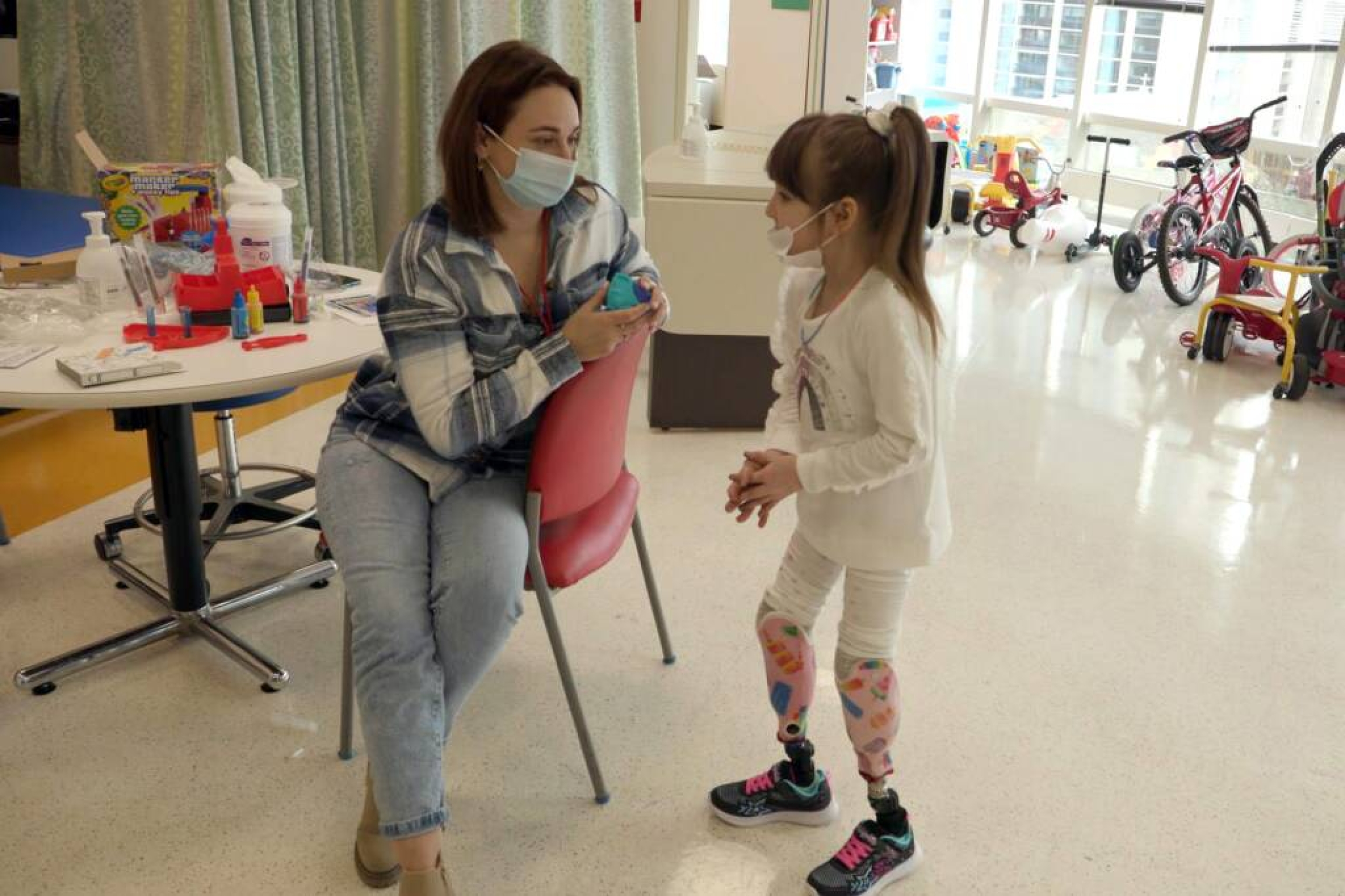
Daria Khatina and her goddaughter Karolina Daremyan during Karolina's final day at Shriners Children's Boston in March.
Howard Powell / GBH News
In just six weeks, she re-learned how to walk, run, bike and even play basketball. McConkey, Smith and the medical team at Shriners saw key improvements to Karolina’s progress, particularly that she could play with other kids for long periods of time without exhaustion or pain.
Smith video-chatted with Karolina’s mother about her continued care. She will outgrow the prosthetics within the year and return to Boston for new ones.
On Karolina’s last day at Shriners, her medical team brought her in for a final physical therapy session before she left Boston. The bright room was filled with toys and tools: scooters, bikes, a set of stairs to practice walking up and down, a little basketball hoop in the corner and a few short kids tables where she could sit and draw.
But Karolina didn’t want to draw: she was energetic and ready to get moving. There was just one problem: She couldn’t decide between riding a red scooter or a green bike. Either way, she needed a helmet. McConkey handed her a pink one.
Khatina said Karolina was excited to see her family, but doesn’t realize the danger in Ukraine. She doesn’t talk about the night of the shelling.
“Karolina is very strong and brave. And she doesn’t talk about it. She’s not saying anything about what happened, what she felt,” Khatina said.
Before they left Boston in mid-March, they visited the New England Aquarium. The pair had gone when Karolina was in her wheelchair in the weeks after they arrived in Massachusetts.

Karolina makes her first visit to the New England Aquarium before receiving prosthetic legs.
GBH News
“She was just running from one pool to another pool,” Khatina said. “She was so excited to be able to explore it herself, on her own new legs. And for me it was just a pleasure to see her be able to do all of it by herself, without having to be in the wheelchair.”
Khatina said the war “changed every single Ukrainian,” and that she was grateful to see so much support from the United States, not just for Karolina but also for her country.
“The only thing I want to say is that, as a mother, I want my kids to be healthy, happy and safe,” she said. “We want to feel safe to go to bed. We want to be sure that we’ll be awake in the morning.”
Related: ‘Trade is trade and war is war’: Romanian farmers say helping Ukraine is hurting their bottom line
This story first appeared on GBH Morning Edition on April 27, 2023.
Romanian farmer Ionuț Spiță, 44, is hoping for a bumper harvest for his rapeseed crop this year.
The vast fields of blooming yellow flowers outside the small village of Tunari, 13 miles north of Bucharest, Romania, is a scene made for Instagram selfies. But a plentiful harvest does not guarantee big profits for Spiță, the general director of this 914-acre farm.
Last year, the oil factories that usually buy up his crop of rapeseed and sunflower seed told him their stocks were already piled high. Romanian traders offered him a vastly reduced price for his wheat.
The downturn in Spiță’s profits was driven by the glut of cheaper Ukrainian grain and oilseeds that was intended for Africa and the Middle East but flooded the Central and Eastern European markets. High fuel and fertilizer costs added to his woes. Romanian farmers say if it happens again this year, they are in danger of bankruptcy.

Romanian farmer Ionuț Spiță, 44, is hoping for a bumper harvest for his rapeseed crop this year.
Raul Stef/The World
Less than a week after Russia invaded Ukraine on Feb. 24 last year, the United Nations issued an alarming warning: The war threatened an unprecedented global food crisis in countries far from Europe, the UN said.
Ukraine is the world’s fifth-biggest grain exporter and provides up to 40% of the World Food Program’s wheat supplies. But Russian bombardment of Ukrainian ports on the Black and Azov Seas meant food exports intended for Africa and elsewhere could not be shipped out.
The European Commission came up with a series of proposals to tackle the problem, including lifting all duties on Ukrainian grain and creating so-called “solidarity lanes” in Central and Eastern Europe. The Commission proposed sending the grain and other produce via road, rail or river through nearby countries like Romania, Poland and Bulgaria. The crops could then be shipped onwards from ports like Constanța in southeastern Romania, to markets in Africa and beyond.

Last year, the oil factories that usually buy up rapeseed and sunflower said their stocks were already piled high.
Raul Stef/The World
Romanian agricultural consultant Cezar Gheorghe, with Agricolumn, said he knew the plan would run into trouble. Gheorghe, who advises the Romanian Ministry for Agriculture, said he warned the government that much of the grain would never make it to its ultimate destination.
“I told them frankly, that those grains will not reach African countries. The goods will remain in the European Union because EU countries desperately needed corn, for example, last year, especially because of the huge drought in the summer.”
Nobody paid any attention to his warnings, he said.
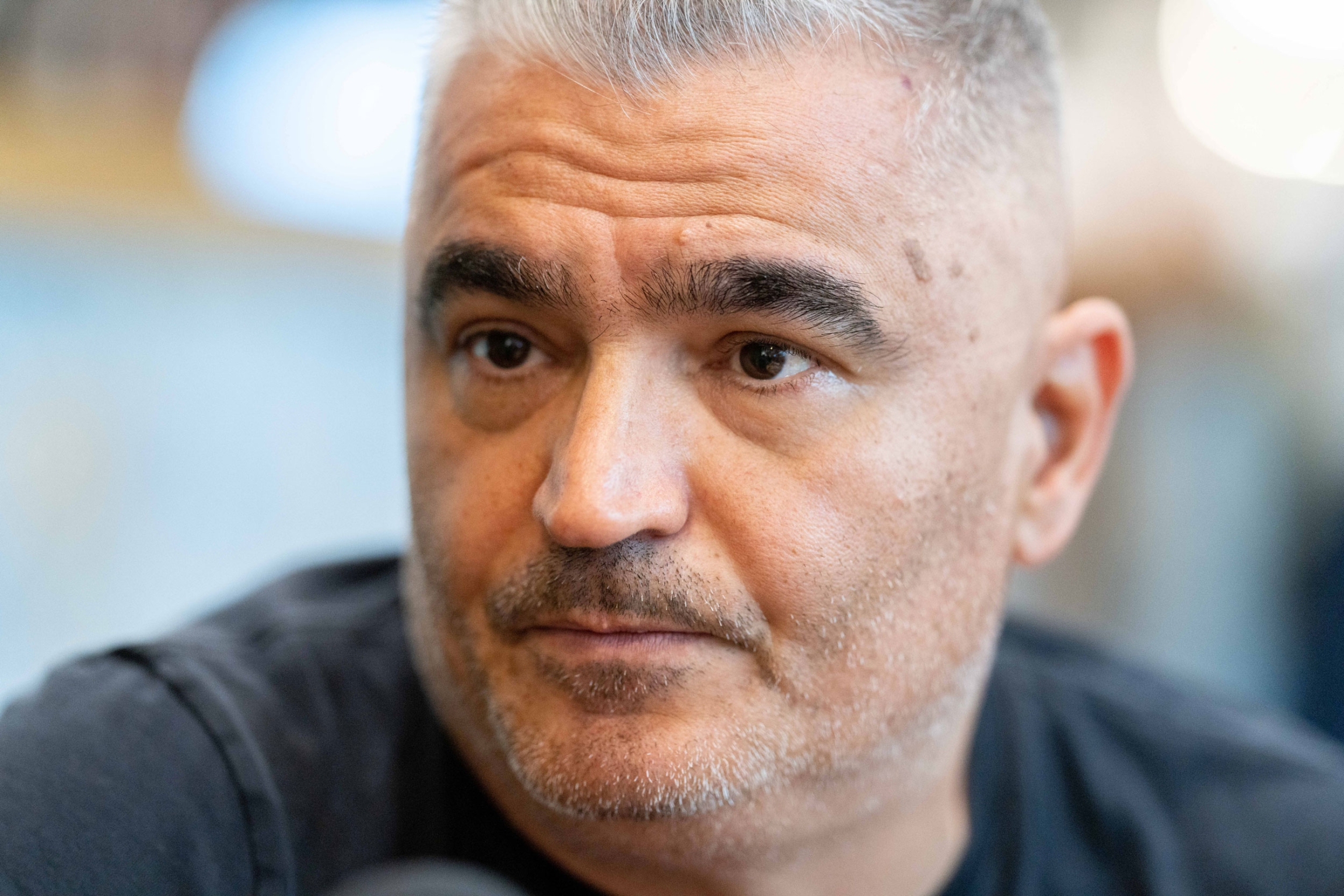
Romanian agricultural consultant Cezar Gheorghe advises the Romanian Ministry for Agriculture. He said he warned the government that much of the grain would never make it to its ultimate destination.
Raul Stef/The World
But by early September, farmers like Spiță were forced to take notice.
Prices plummeted as traders and factories in Europe began buying the Ukrainian alternative as it transited the region. Some Romanian farmers say they still have barns brimming full of last year’s stock.
Spiță calls them the lucky ones.
“They are the farmers who could afford to not sell their grain,” said Spiță, who sold all his produce but at a lower price.
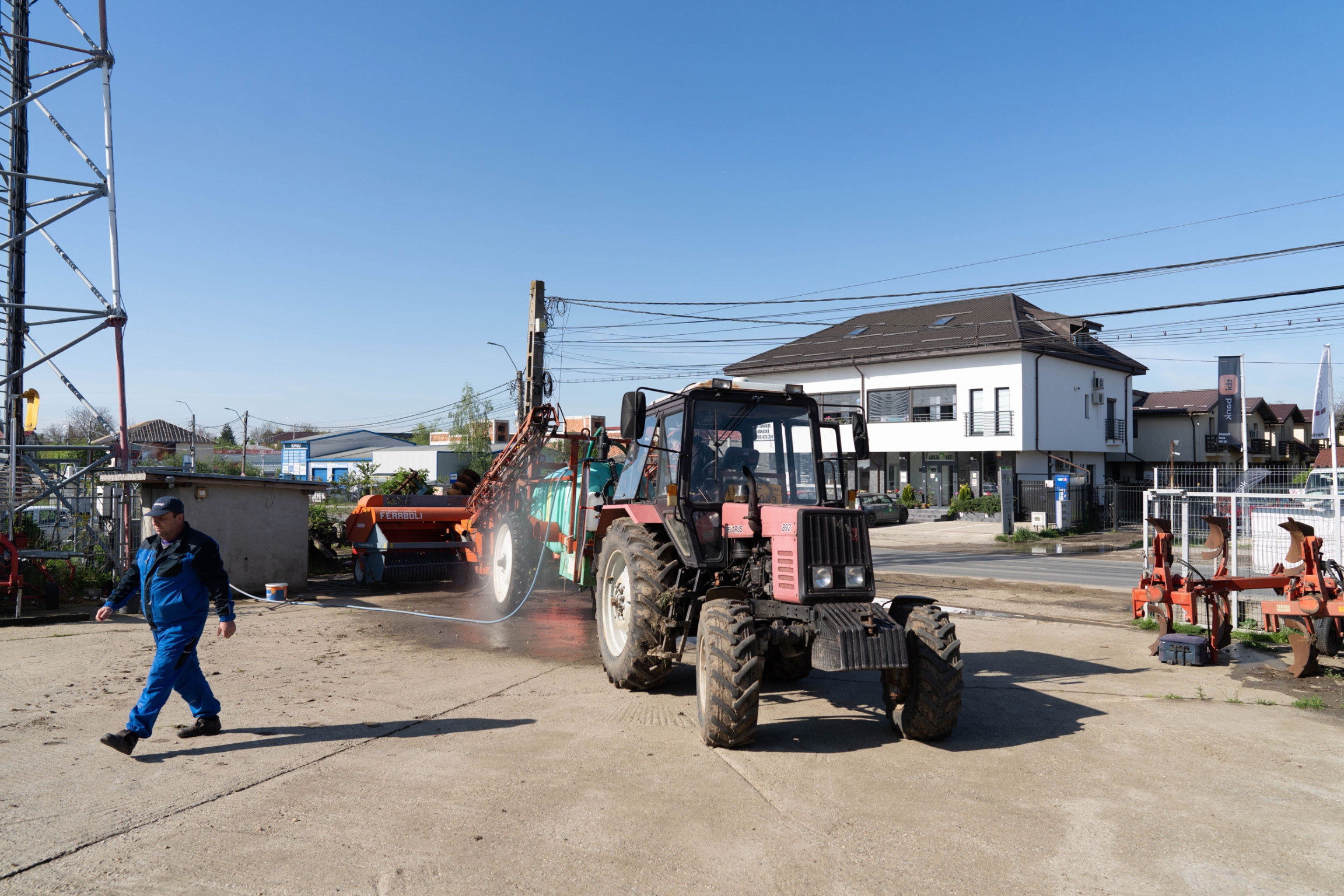
Ionuț Spiță is the general director of this 370-hectare farm.
Raul Stef/The World
Now, farmers in Central and Eastern Europe are worried about this year’s harvest.
In early April, hundreds of angry farmers drove tractors into central Bucharest, demanding action from the Romanian government. Farmers in Bulgaria and Poland took to the streets to protest, too.
A few days later, governments in Poland, Hungary, Bulgaria and Slovakia imposed temporary bans and other restrictions on grain imports from Ukraine. Only Romania held back. The country’s Agriculture Minister Petre Daea said he didn’t think it was in Romania’s interest to break EU trade rules.
Gheorghe, who advises the minister, said it was the right move and he doubts that the other Eastern European governments’ unilateral bans had only the farmers’ livelihoods in mind.
“From my perspective, there are also political interests involved, given the fact that Poland has a general election this year and in Bulgaria it is the same,” Gheorghe said.
But politically motivated or not, Romanian farmers are furious at their government’s inaction.
Up until last year, Ukraine sent hardly any grain to Romania. In the past 14 months, the Romanian Farmers Club, a lobby group, estimated that as much as half of the grain designated for transit through Romania under the European program stayed in the country.
Spiță said his country’s government has done nothing for farmers locally.

Farmer Ionuț Spiță, 44, runs a farm in the small village of Tunari, Romania.
Raul Stef/The World
Romania shares a 381-mile border with Ukraine and along with Poland, has been a stalwart supporter of the country since the start of the war, welcoming in some of the highest number of Ukrainian refugees per capita.
The protest by farmers in Bucharest as well as in Poland and Bulgaria is a rare public sign of frustration at the impact the war is having on neighboring countries.
Spiță said he sympathizes with Ukraine, but added that the government in Romania needs to protect its own population, too.
Gheorghe, the agricultural consultant, said that the Romanian people are still fully in solidarity with Ukraine but this is business.
“As Romanians, we will never give up on our commitment to helping the Ukrainian people in terms of casualties and resources for fighting the war. But the trade is the trade and the war is the war,” Gheorghe said.
On April 28, the European Commission announced it had struck a deal with Romania and the four other Eastern European countries: The sale of wheat, maize, rapeseed and sunflower seeds is to be blocked in the region and will only be allowed transit through to other EU countries or third countries.
The commission also announced financial support of $110 million for farmers in the five nations. In return, EU Trade Commissioner Valdis Dombrovskis said the four countries of Poland, Bulgaria, Slovakia and Hungary would withdraw their unilateral bans.
Details are still being finalized and are likely to be adopted in coming days, Dombrovskis said. EU ambassadors also backed a proposed extension of Ukraine’s tariff-free access to the bloc’s single market.
Farmer Spiță said he doesn’t yet know how the changes will affect his turnover this year.
"We will have to wait until this year’s harvest," he said.
But then, he shrugged.
"Farmers are resilient, we are used to having all sorts of problems every year from political ones to meteorological ones," he said. "We are survivors."
Raul Stef contributed to reporting.

Nelson and Winnie, in 1958, likely shortly before their wedding.
Courtesy of Eli Weinberg/UWC-Robben Island Museum Mayibuye Archives
It was a larger-than-life love story: the partnership between Nelson Mandela and Winnie Madikizela-Mandela.
Their relationship was not just a marriage of iconic freedom fighters – the couple was also one of the most valuable and complex assets of South Africa’s anti-apartheid movement.
Revered as Africa's husband and wife revolutionaries, their love story also became a saga of betrayal and estrangement.
South African author Jonny Steinberg explores this in his new book "Winnie and Nelson: Portrait of a Marriage," out this week, and joins The World's Marco Werman to talk more about it.

Winnie in Brandfort with Fatima Meer, whose own banning order had recently expired, 1983. Winnie visited the Brandfort post office at a scheduled time every morning and afternoon to receive calls on the public phone, a party line.
Courtesy of Steven Linde
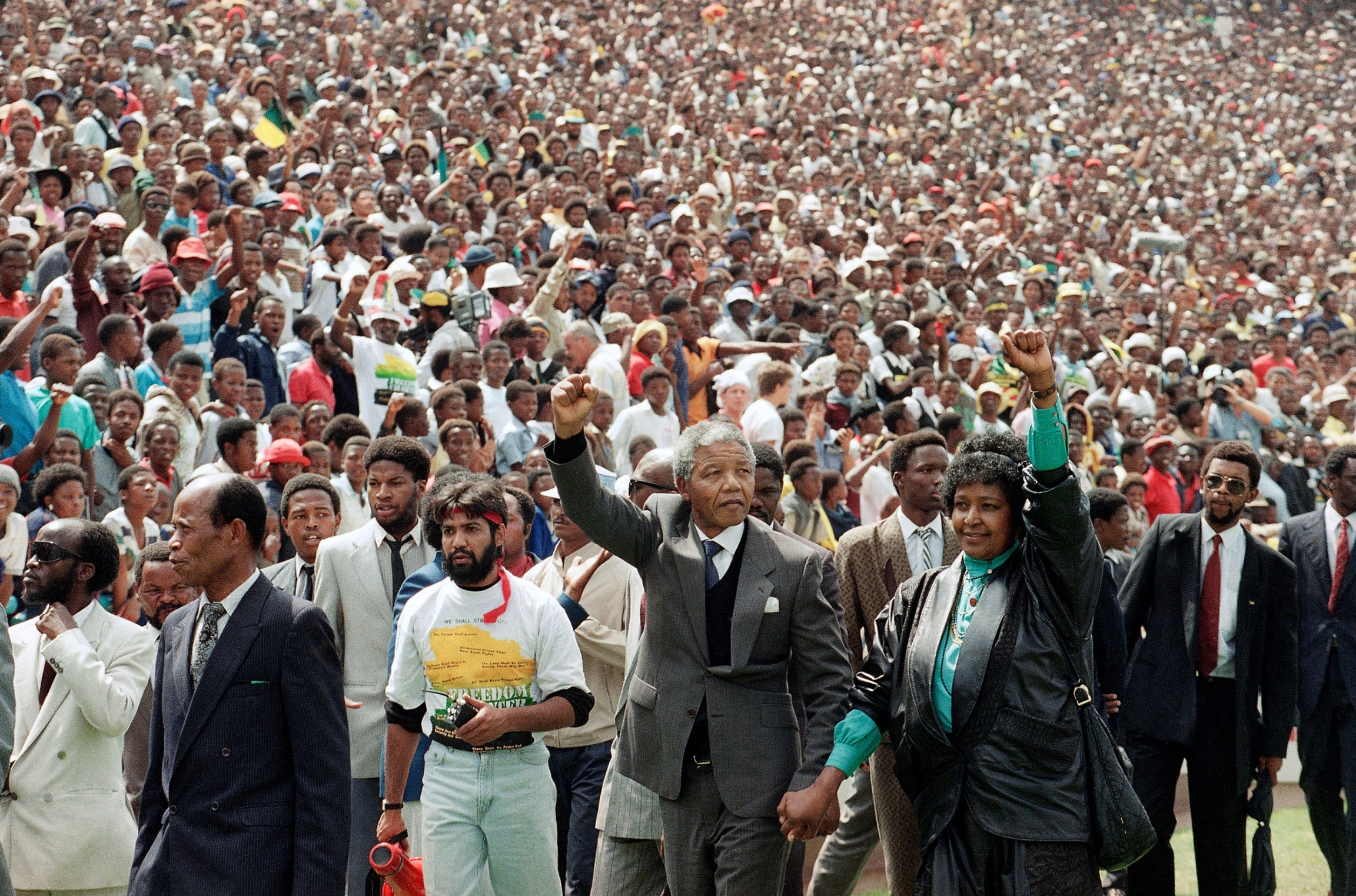
In this Feb. 13, 1990 file photo, Nelson Mandela, center left, and his wife Winnie, center right, raise clenched fists as they arrive at a welcoming rally in Soweto two days after Mandela's release from prison in Cape Town, South Africa. Mandela's fight for freedom and human rights makes him the most influential person among Africa's youth, according to a survey conducted across the continent.
Udo Weitz/AP/File
This interview was edited and condensed for clarity.
A handful of surfers were out catching waves at Imperial Beach, California, the first US beach town north of Mexico, when the lifeguard station blasted a panic-inducing announcement.
“The water is currently contaminated, and we are under a 72-hour rain advisory. Lifeguards strongly recommend exiting the water,” the warning said.
Pollution and trash carried from the Tijuana River to the Pacific Ocean have long plagued swimmers and surfers on both sides of the US-Mexico border. But in recent years, particularly at Imperial Beach, it’s gotten worse. Some locals and experts are hopeful about its cleanup after a recent court settlement.

Surfers in the water at Imperial Beach, California
Fabian Garcia/The World
Toni Cunia, who strolled along the pier, said she has seen the issues firsthand.
“I used to live on the corner over here, so I know how bad it has gotten, and it's breaking everybody’s heart. Because this was our playground,” Cunia said.
She gestured down the beach to where the Tijuana River flows into the Pacific.
“So much junk comes with it. It’s not just the water. It’s so much trash. So, yeah, it’s a problem, a major problem,” Cunia said.
And not just for swimmers: the paths along the estuary where the Tijuana River flows into the Pacific are a no-go-zone now, Cunia said.
It all starts with the Tijuana River, which collects rainwater from the surrounding watershed and flows only when it rains, explained Paloma Aguirre, who is the mayor of Imperial Beach and holds a master’s in marine biodiversity and conservation from UC San Diego.
The river discharges south of Imperial Beach, but it goes through the entire city of Tijuana before releasing into the ocean, Aguirre said. Along the way, it collects tires, trash, and worst of all, sewage.
As a result, Aguirre said, she has been unable to surf there since last September — which was what drew her to the area in the first place.

Mayor of Imperial Beach, California, Paloma Aguirre
Marco Werman/The World
“A lot of us moved to IB because of its waves. It's one of the core reasons I chose to live [here] in 2003,” she said.
The pollution is so bad that she's actually gotten sick, "not by ignoring the signs, but by getting the impact of the plume that you don't even know is coming sometimes,” Aguirre said.
A plume is a concentration of contaminated water that is prone to being dragged north by the current.
On the US side, the attitude has long been: “Tijuana, just clean up your act.”
But Margarita Diaz, who lives and works in Tijuana as executive director for the Environmental Education Border Project, said she thinks that criticism is unfair and ignores some fundamental differences between how things operate in the US and Mexico.
Tijuana is “a city with two countries, different economies, different politics and different realities,” Diaz said, adding that its economy “[doesn’t] have a lot of money invested for the infrastructure.”
Tijuana has long faced criticisms from the US that little has been done and nothing has changed. But Diaz said that Tijuana has barely kept up, given its rapid growth.
“The population in Tijuana, in 30 years, has increased by millions,” she said.
According to Diaz, the city has built some infrastructure, and the situation is the same.
“I don’t want to say that it’s OK. It’s bad. It has to be clean. I’m not saying that I’m happy with what Mexico is doing. No, we have to do more,” Diaz said.
The pollution impacts Tijuana’s residents, too. Diaz said the Tijuana city government, just over this past spring break, realized it had to protect its citizens and visitors and shut down its beaches.
The state of the beaches, she said, “is one of the most severe and egregious environmental injustices in the nation.”
Aguirre said she sees the pollution as a result of free-trade agreements that have led to the rapid development of Tijuana.
“This is a negative externality from the original NAFTA trade agreement,” she said. “We knew that we were going to see these environmental impacts associated with the free trade that was signed 20, 25 years ago.”
Some hope things may turn around with a recent legal decision.
The International Boundary and Water Commission (IBWC) and its Mexican counterpart are tasked with settling water disputes between the two countries. In a recent lawsuit by the Port of San Diego and two California border cities, the agency was instructed to do more to stop wastewater from flowing north from Tijuana.

Marco Werman/The World
According to the reports and Aguirre, the IBWC is committed now to more rigorously monitoring and mitigating the pollution in the water on the US side and better coordinating cleanup with their counterparts in Mexico.
Aguirre said that at least both sides are starting to listen to one another.
“Communication between both agencies is crucial but not easy,” she said.
“Because you have the most basic barrier, which is language. So, it’s kind of like they’re being compelled to do it. In the past, there wasn’t that much will to do it.”
Diaz said she also is cautiously confident that attitudes are changing in Tijuana and US towns like Imperial Beach.
“I hope that the governments share information and also the NGOs can help and we can move the things to a better place,” she said.
Standing before Parliament on Tuesday, Portuguese President Marcelo Rebelo de Sousa said that Portugal should formally apologize for its role in the trans-Atlantic slave trade.
"We have to take full responsibility for what we have done,” he said. “But it's not just a matter of apologizing for what we did. Because sometimes, it’s easiest to apologize and turn your back. No. We have to assume the responsibility for the future of what we did in the past — the good and the bad.”
He made the statements during official commemorations of the Carnation Revolution, which marked the fall of Portugal's dictatorship in 1974.
“The exploitation of Indigenous people ... slavery, the sacrifice of the interests of Brazil and Brazilians,” he said. "We have to assume responsibility for the worst of our past, just as we take responsibility for the best of it.”
During the trans-Atlantic slave trade, 12 million Africans were ripped from their homes, transported across the Atlantic and forced into slavery, across the Americas. The Portuguese were responsible for selling nearly 6 million people into slavery— mostly in Brazil.
Brazil was the last country in the Americas to abolish slavery. It didn't happen until 1888. And the practice still occurred well into the 1900s.
"The declaration of the Portuguese government is symbolic. But it’s late and insufficient to confront the colonial past and all of the barbaric acts carried out during colonization,” said Karine de Souza Silva, a foreign relations professor at Brazil's Federal University of Santa Catarina.
Souza Silva, who is Black, said much of Europe’s riches were made through the trafficking of people, slavery and colonization. And people have been demanding an apology and reparations for decades.
Souza Silva said that the Portuguese president’s statement this week was, in part, due to pressure — or encouragement — from the Brazilian government of President Luiz Inácio Lula da Silva, who was present for this speech in Portugal, alongside Brazil’s Racial Equality Minister Anielle Franco.
Other former colonial powers also seem to be getting on board.
The Portuguese president’s words came on the heels of an apology by Netherlands Prime Minister Mark Rutter, last December.
He apologized in three different languages, before continuing in Dutch: "For centuries, in the name of the Dutch state, human beings were made into commodities, exploited and abused,” he said. "We cannot change the past, but we can face up to it."
But these cannot be empty words of apology, said Marco Antonio André, a lawyer in southern Brazil and a member of Brazil's Black movement.
“These statements are important,” he said, "but there needs to be another step. Recognizing guilt isn’t sufficient. Just asking for forgiveness doesn’t resolve the problem caused by more than 300 years of slavery in Brazil.”
André said the Portuguese state should be internationally responsible for public policies and affirmative action programs to end racism. The racism Black Brazilians suffer today, he said, that the Portuguese state largely caused.
Professor Souza Silva agreed.
"Truly, it’s necessary for the colonial powers to invest in policies for affirmative action, for education, for combating racism, and policies supporting nations that were colonized,” she said.
Whether they will, remains to be seen. But that is what Black activists and organizations in Brazil and abroad have been demanding for decades.
And, it seems, the direction that President Marcelo Rebelo may be guiding Portugal.
Sarang Dalal, a neuroscientist at Aarhus University in Denmark, studies the tiny magnetic signals that the electrical activity in our brains produce.
For the last 15 years, Dalal published his research in the journal NeuroImage, among other places.
“It’s the leading journal in our field,” he said. “It was highly respected and got me visibility for my findings, and allowed other people to build off of what I had created.”
But this month, Dalal and over 40 other editors from NeuroImage and another leading neuroscience publication, NeuroImage:Reports, said they were leaving their posts and starting a new journal in the same field.
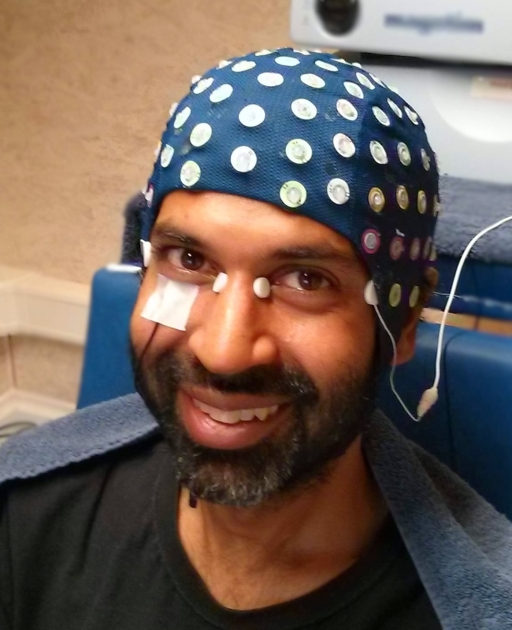
Sarang Dalal, a neuroscientist at Aarhus University in Denmark, studies the tiny magnetic signals that the electrical activity in our brains produce. For the last 15 years, Dalal published his research in the journal NeuroImage, among other places. But this month, Dalal and over 40 other editors from NeuroImage and NeuroImage:Reports, said they were leaving their posts and starting a new journal in the same field.
Courtesy of Sarang Dalal
In a statement that the freelance journal editors released on April 17, they wrote that they believe that Elsevier, a global publishing company based in the Netherlands that puts out the journals, was overcharging researchers to publish their work.
Since a researcher’s standing at a university often comes down to being published, including how often and where, and impacts hiring, promotions and funding, the editors’ collective action has gained attention in the academic community.
This isn’t the first time Elsevier’s pricing policies have prompted a group of editors to leave en masse. It happened with one of their linguistics journals in 2015 and an informetrics journal in 2019.
Audrey Fan, a neuroscientist at the University of California, Davis, said she thinks that what happened with NeuroImage is part of a broader backlash against models like Elsevier’s.
“It’s a great loss to the community to lose that venue, but I think it’s for a good reason,” said Fan, who also served as one of NeuroImage’s editors. “[This] has the ability to maintain our commitment to open access to our science.”
Until early 2020, Dalal said, it was free to publish in the journal. Costs were covered by subscriptions mostly paid by universities. But smaller institutions, including many in the US, said they couldn’t afford the high fees of publications like NeuroImage.
So Elsevier switched the journal over to a different model called open access, making it free to read the articles. But now, researchers front publication costs; they pay the journal $3,450 to publish a paper, and NeuroImage publishes hundreds of articles each year.
Audrey Fan, a neuroscientist at the University of California, Davis, said she thinks that what happened with NeuroImage is part of a broader backlash against models like Elsevier’s.
Courtesy of Audrey Fan
“It’s, from my view, quite excessive,” Dalal said. “It’s kind of out of the reach of even well-funded scientists in many cases. And then, there’s plenty of other scientists from countries where science is generally less well funded and it’s out of the reach of them as well.”
Dalal has been one of the journal’s 40-some freelance editors, who each earn $1,500 per year for their work. He joined the team about a year ago and was tasked with helping organize reviews of submitted articles, which involved asking scientists to evaluate the quality of a paper. But scientists kept turning him down.
“They didn’t want to review for NeuroImage anymore because it cost so much,” Dalal said. “Or because they couldn’t afford to publish in it themselves. We don’t compensate our reviewers, and yet, it requires a lot of their time and they were understandably getting frustrated that the publisher was profiting enormously off of the work of the entire editorial process.”
Amid this growing chorus of discontent, Dalal and the other editors, who felt similarly frustrated, said they finally approached Elsevier. They told them that if they didn’t lower their fees, they would all resign.
“I can see that they would want to make some profit,” said Maastricht University neuropsychology department head Sonja Kotz. “But the question is, what’s the margin here?”

Maastricht University neuropsychology department head Sonja Kotz served as an editor for the journal for the last 19 years.
Courtesy of Sonja Kotz
Kotz served as an editor for the journal for the last 19 years.
“In the end, Elsevier simply did not budge,” Kotz said. “I think it’s unheard of that over 40 senior editors and all handling editors of a journal step down. So this was a very collective decision.”
Cheryl Olman is a neuroscientist at the University of Minnesota. She’s published in NeuroImage, but hasn’t served as an editor. She admits the high fees were making her look for other publishing options even before this all unfolded.
“We spend our time for free reviewing all of our peers’ papers, and then, it’s our turn to publish, and we get a bill for $3,500,” Olman said. “Academic publishing to me feels fueled off of uncompensated labor for editors and reviewers.”
With finite funds, she said that paying so much to publish papers keeps her from funding other opportunities for her lab, like sending her students to an academic conference to present their work.
“I don’t have that kind of money,” she said.
Elsevier declined to comment for this story, but instead, they forwarded a statement maintaining that NeuroImage will continue to function at the same, high-quality level and remain committed to open access. They said they are disappointed with the editors’ decision to step down, especially given “our policy of setting our article publishing charges competitively below the market average.”

An assortment of images showing activation on the brain’s surface from Cheryl Olman, a researcher at the University of Minnesota.
Courtesy of Cheryl Olman
As for what comes next, Kotz said the editorial team is helping handle any previous submissions to NeuroImage, but no new ones. And they’re partnering with the nonprofit MIT Press to launch a new journal this July called Imaging Neuroscience.
“The outpour of the community has been incredible,” Kotz said. “Within a few weeks, we had 850 people signing up to review for us. Some authors even have asked whether they can pull out of their current publication at NeuroImage and transfer over. If that momentum continues, I think it’s going to be very good.”
She said that the goal is for the new journal’s fee to be roughly half what Elsevier was charging. They intend for it to replace NeuroImage as the field’s top publication.
The Indian government's new textbooks for grades 6 through 12 have some significant omissions in them related to Indian history.
The new books downplay the achievements of the Mughals — Muslim rulers from Central Asia — who ruled most of northern India for about 300 years, while Hindu rulers of Vijayanagara ruled large parts of southern India.
“The question arises, why are the Mughals dropped from the syllabus and why have they kept Vijayanagara kings?” asked Mridula Mukherjee, author of the 2008 book “RSS, School Texts and the Murder of Mahatma Gandhi: The Hindu Communal Project.”
The new textbooks have also removed the mention of India’s first education minister, Maulana Azad, a stalwart Muslim leader who fought for India’s independence from the British.
Students will also see no mention of the anti-Muslim riots of 2002, under the watch of Prime Minister Narendra Modi, when bout 2,000 people (mostly Muslims) were killed in the violence.
“They have retained a chapter on the religious violence under the opposition Congress rule though,” said Delhi University professor Apoorvanand, who goes by one name.
Muslims are the largest minority religious group in India and have seen an increase in violence against them — ranging from demolitions of their homes, lynchings and incarceration.
The National Council of Educational Research and Training (NCERT), the government-run organization under the federal Education Ministry, oversaw the textbook deletions.
At a press conference, NCERT director Dinesh Prasad Saklani defended the deletions as “necessary,” claiming that pandemic disruptions demanded workload reductions in classrooms.
But not all educators and historians see the logic in that response.
Aditya Mukherjee, professor of contemporary Indian history at Jawaharlal Nehru University, said he wondered how removing names like Maulana Azad might reduce students’ workload.
Apoorvanand said he thinks that these deletions reflect the Hindu nationalist view that India was a perfect Hindu nation before Muslim rulers arrived, prompting them to shorten chapters on caste and gender discrimination as well.
According to the Hindu nationalist view, ancient India had no discrimination or persecution of any community, Apoorvanand said.
The new textbooks also offer a revised definition of democracy with the removal of chapters on democratic dissent, protest movements and diversity.
These teachings emphasized that a key part of democracy is to hold the powerful accountable, Apoorvanand said.
“And that is not how the current government understands democracy. For them, democracy ends at casting a vote.”
For now, schools in India are on vacation. But, more than 250 million children will study from the new textbooks when they return in a couple of months.
Aditya Mukherjee said the impact of these deletions will be far-reaching because many state governments model their textbooks after federal ones. Moreover, students who take entrance exams for university will need to study from these textbooks.
This is not the first time that the BJP has tried to revise federal textbooks. In 2018, junior Education Minister Satyapal Singh dismissed Darwin’s theory of evolution because no one saw apes turn into men and wanted it removed from school textbooks. Now, students in grades 9 and 10 do not study the theory of evolution.
Some historians say these most recent changes are even more drastic. Mridula Mukherjee said rewriting history is one of the steps a society takes toward genocide.
“We have been adequately warned now, we know what happened in Germany, we know what happened in Italy, we know what happened in Rwanda, we know what happened to the Armenians,” she said.
Senior academics and scholars have signed petitions opposing the textbook cuts. And some state governments have said their students will not study from the federal government books, using the state's textbooks instead.
“However, if all such resistance fails, we will produce bigoted morons,” Aditya Mukherjee said.
The 3,000-resident Salvadoran village of El Zonte was once a sleepy beach town. But it’s quickly being transformed into a major surfing hot spot.
Kids play in the sand. Tourists watch the surfers out at the shoreline break. A woman sells drinks out of a little wooden shack.
Along a two-block sandy strip, there are lines of homegrown restaurants and new upscale hotels. One prominent feature on many signs is a big letter “B” and the words, “We accept bitcoin."
Bitcoin — the increasingly popular cryptocurrency — got its start in El Zonte, El Salvador.
"Yes, I am very proud,” said Reina Isabel, the owner of a corner store in town. "This is Bitcoin Beach and bitcoin grew from here."
Bitcoin Beach was founded in 2019 by US surfer and entrepreneur Mike Peterson, who received a donation from a wealthy benefactor wanting to create a circular bitcoin economy in the coastal village. So, they started to pay local residents in bitcoins for local jobs.
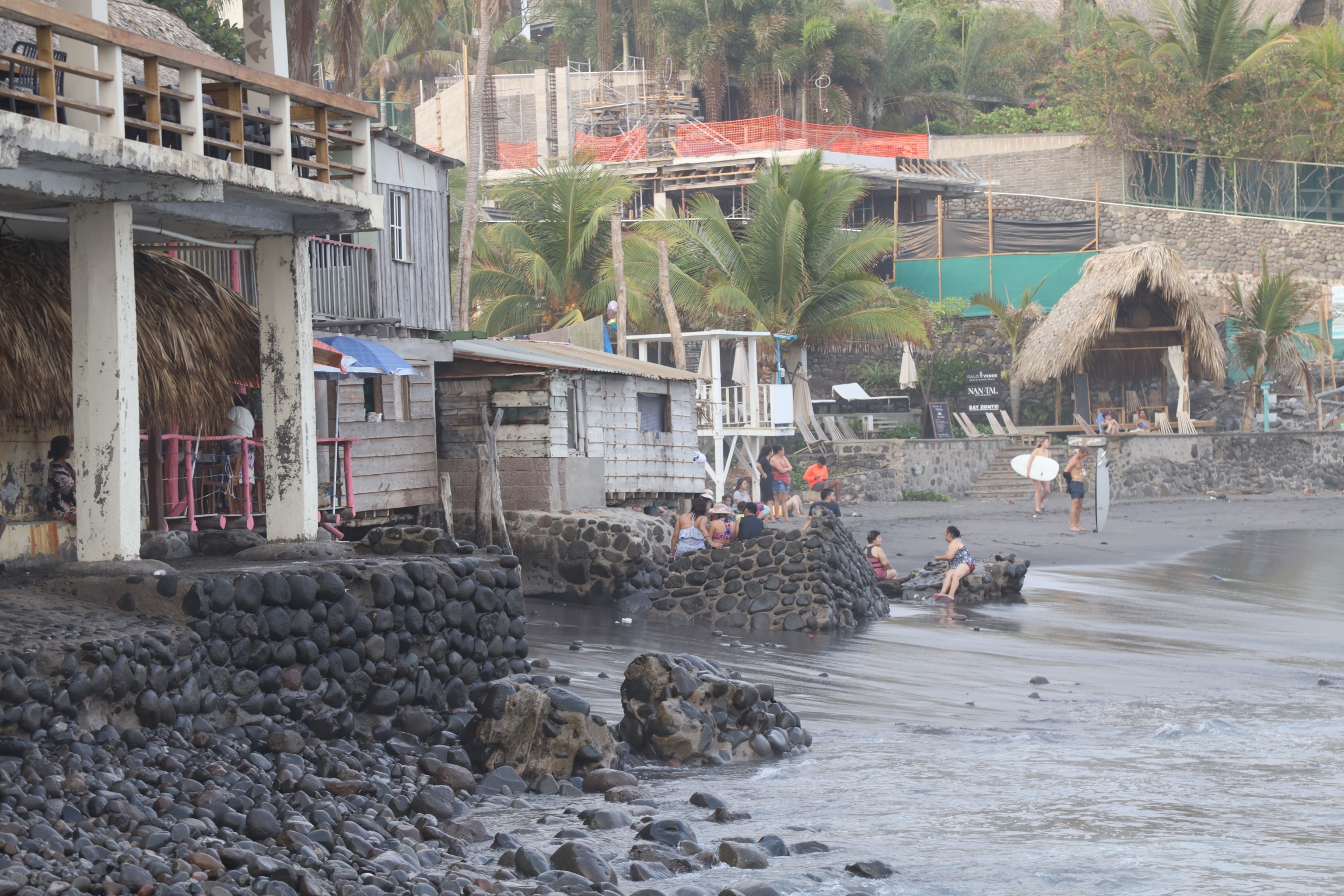
Salvadorans have become wary of accepting bitcoin as the value of the cryptocurrency fluctuates, El Zonte, El Salvador.
Michael Fox/The World
The endeavor caught the attention of President Nayib Bukele, who soon became one of the greatest champions of the cryptocurrency, and El Salvador became the first country in the world to adopt it as a legal tender.
"This is a law to benefit the population,” Bukele told Salvadorans, when he announced the new Bitcoin Law in 2021. "This is a law that puts us in the eyes of the world for something new and innovative. It’s a law that only benefits and causes no harm.”
There are more than 200 bitcoin ATMs across the country where people can pull out the equivalent of US dollars from their bitcoin accounts. And many Salvadorans have benefitted from the new currency. The whole idea behind bitcoin was to create a means for people to save and exchange currency outside of traditional financial systems — and hopefully, make money on the rising exchange.
But the bitcoin seas have been choppy.
The problem is its volatility. The cryptocurrency lost more than half its value in the first year of becoming legal tender in El Salvador. Today, it’s still trading at 40% less than when it launched on September 7, 2021.

Restaurants and new upscale hotels have cropped up along the sandy strip of Bitcoin Beach, El Zonte, El Salvador.
Michael Fox/The World
People with a lot of capital can wait it out, but that's harder for those who rely on it for their daily income.
As a result, even at Bitcoin Beach, many people say they won’t take it.
“It's up and down and if you pay me in bitcoin, I’ve got to go right at the moment to turn the bitcoin into dollars,” shop owner Marlin Flores said. He grew up in Texas, and now runs a store just off the beach.
"If I don't, it could fluctuate. It could drop.”
Restaurant owner Narcisa Lopez agreed.
"They say that its value rises and falls and it’s really hard for those of us who don’t know much about technology."
"I don’t use it or accept it,” she said. "I feel like they are trying to steal from us. They say that its value rises and falls and it’s really hard for those of us who don’t know much about technology.”
Lopez said that only five people have asked her if she accepts bitcoin since she opened late last year. And that a close friend of hers lost thousands of dollars by investing in the cryptocurrency.
She said it reminds her of when the country dollarized the economy in 2001, dumping the national currency, the colón.
"They told us everything would improve with the dollar,” she said, “but now everything’s just more expensive.”

Bitcoin Beach was founded in 2019 by US surfer and entrepreneur Mike Peterson, El Zonte, El Salvador.
Michael Fox/The World
One group that has enthusiastically embraced El Salvador’s bitcoin experiment is foreign cryptocurrency activists. They were behind Bitcoin Beach and they’ve been selling El Salvador as a destination for wealthy expats to invest in, visit and live.
The number of refugees flowing into #ElSalvador from former 1st World nations is mind blowing- especially Canada
— Bitcoin Beach (@Bitcoinbeach) April 26, 2023
There’s even a Bitcoin Beach podcast, hosted by founder Mike Peterson.
“We are live from Bitcoin Beach, the bitcoin center of the world here in El Salvador and we are very excited to showcase the amazing things that are transpiring in this country,” he said in the first episode published five months ago called, “This is why we are here.”
He even emphasized at a recent bitcoin conference in France that "it’s going to be places like El Salvador that will drive bitcoin forward.”
He may have the support of people like Bukele, but many Salvadorans fear they might not be able to catch the wave.
Related: ‘It’s a casino operation’: As Turkish lira falls, some Turks turn to cryptocurrency
This week, Azerbaijan’s armed forces established a checkpoint that cuts off and restricts access through the so-called Lachin Corridor, the one road connecting Armenia to the contested Nagorno-Karabakh territory between Armenia and Azerbaijan.
“This is very much an escalation as it comes in the wake of four months of an ongoing siege of Nagorno-Karabakh,” said Richard Giragosian, director of the Regional Studies Center in the Armenian capital, Yerevan.
Armenia and Azerbaijan have fought periodically over the territory going back to the late 1980s, and the two countries are currently negotiating a peace deal over Nagorno-Karabakh.
More than 100,000 Armenians still live in Nagorno-Karabakh, and they depend on the Lachin Corridor as the only road that connects to the rest of Armenia.
Cutting off this road puts Armenians there in a difficult situation.
Since December 2022, protesters from Azerbaijan have also attempted to block movement between Armenia and Nagorno-Karabakh, claiming to be enviromental activists.
Russian peacekeepers have been on the ground since 2020, when they helped broker a peace deal after conflict erupted again over the territory and Azerbaijan gained control of large amounts of territory.
But Giragosian said that the Russian peacekeepers now seem “either incapable or unwilling to actually enforce the terms of the Russian imposed ceasefire agreement.”
Shujaat Ahmadzada, a research fellow at the Topchubashov Center think tank in Baku, Azerbaijan, said it is important to contextualize the situation with the war in Ukraine.
“Russia’s hands are tied up because of a decision made by Vladimir Putin to invade Ukraine, and its capacity is getting tested,” Ahmadzada said.
“Russia is not capable anymore in the same way that it was doing before the war in Ukraine.”
Ahmadzada said Russia left a power vacuum that Azerbaijan is now filling by imposing its own will to gain control over the rest of the disputed territory.
The two countries continue to work toward a comprehensive peace deal. But there is still deep mistrust between them.
“There’s a commitment problem for Armenia and Azerbaijan. Armenia has a deep fear that in case of something signed, Azerbaijan would not abide by that would result in ethnic cleansing of Karabakh Armenians, or full exodus of them,” Ahmadzada said.
But Ahmadzada said he is still hopeful about the negotiation process, noting how in recent months, the two sides have been moving closer toward a deal.
Armenia has come to realize its weaker position, Giragosian said, and this is why their government is committed to signing a treaty with Azerbaijan in the coming months.
Giragosian added that Armenia is no longer pushing for self-determination, independence or for the unification of Nagorno-Karabakh with the rest of Armenia.
“Rather, it’s about the protection of the Armenians of Nagorno-Karabakh, and within the context of Azerbaijan’s territorial integrity,” he said.
This policy shift is still controversial in Armenia, where many are still angry about Armenian losses during the 2020 war. But for now, Armenians hope the world is paying attention to the plight of Nagorno-Karabakh.
Earlier this week, the US State Department called for "free and open movement" along the Lachin Corridor, and for those peace talks to continue.
The clock is ticking on a 72-hour ceasefire between the Sudanese Armed Forces and the Rapid Support Forces paramilitary group, which have been locked in a bitter fight that has left hundreds of people dead over the past 12 days.
The UN special envoy to Sudan has said neither of the generals behind the groups seemed ready to negotiate, and Khartoum residents said fighting continued despite the ceasefire.
Over the last week and a half, hundreds of people have been killed in the conflict, leaving Sudanese residents from the capital region to try and flee. But most routes out of Khartoum come with their own risks and challenges, and many Sudanese are struggling to enter neighboring countries due to visa requirements and understaffed border points.
“Trying to figure out how to get from Khartoum to a location where we could have an ease of migrating was extremely difficult,” said Mohamed el-Mobarak Kibeida, who was staying in the greater Khartoum area and recorded his journey via voice notes, which he sent to The World.
Kibeida said that as he and his family debated their options, bus drivers kept raising their prices.
“They should be labeled as war profiteers, because they’ve been doing the worst they can do,” he said.
His family pooled together their resources, and on Tuesday, they agreed to take a route headed north with the hopes of crossing the border into neighboring Egypt.
The family was able to reach a crowded bus station in the Sudanese city of Omdurman, where they managed to get a bus to the north.
As he sat on the hourslong bus ride, Kibeida said his mind was with those whom they had left behind — like his cousin, whom he said insisted on staying in Khartoum, despite the family begging for him to join them.
He said his cousin called them as they were traveling.
“He let us know bombardment has commenced” in Khartoum, Kibeida said. “And everybody is wondering why does the ceasefire only happen on TV? And it doesn’t happen for the people?”
On the bus, Kibeida spoke with other people who were also fleeing Khartoum and recorded their thoughts on his phone.
One woman, who didn’t give her name, said she’s still processing the past 12 days of conflict: “Living all the time in fear and stress and constant tensions, between the sounds of heavy artillery, having to be constantly worried about losing a family member, a friend, the person you love,” she said.
“I know this is for our safety, but it’s not easy to just leave your home and go away. And what makes it even worse is you don’t even know if you’re ever going to come back,” she added.
Mohanned Waleid was on the same bus. He said that he and his brother had made three prior attempts to escape the fighting in Khartoum over the past 12 days.
But he said he was hopeful about the conflict coming to an end.
“Seeing our country coming back to normal and living in peace again — that’s our hope,” he said.
The Russian novel “Summer in a Pioneer Tie” opens at an old, rundown summer camp in eastern Ukraine, where the young protagonist recalls falling in love with his camp counselor.
What starts as a summer romance between two teenage boys turns into a sprawling novel when the lovers improbably meet again as adults.

The cover of the Russian novel "Summer in a Pioneer Tie," a love story about two men who meet at a Soviet summer camp, contains a disclaimer saying the content is only suitable for adults 18 years and older. The book was recently banned in Russia.
Courtesy of Elena Malisova
Co-authors Elena Malisova and Katerina Silvanova posted the novel for free on a Russian fan fiction website where it garnered a huge audience.
“We were really surprised by the amount of readers we had — some even got tattoos with quotes from the book,” Malisova said.
The book became so popular that a Russian publishing house specializing in young adult novels published it in print in 2021. It quickly became a bestseller, with roughly 400,000 copies scooped up by readers.
More recently, though, the novel has come under scrutiny. Russian lawmakers condemned its publisher, Popcorn Books, for violating a new law passed last December that bans any reference to LGBTQ themes in Russian society. The publishing house has become the target of the government’s first investigation into possible violations of the new law.

Elena Malisova left Russia because she received so much harassment about the book's content. Malisova says many readers outside the LGBTQ+ community wrote to say that the book widened their perspectives.
Courtesy of Elena Malisova
The law expands on a 2013 piece of legislation banning the distribution of so-called “gay propaganda” to minors. Under the new law, any mention of LGBTQ topics in popular culture, such as books or films, could result in significant fines.
“Summer in a Pioneer Tie” has been taken off of store shelves in Russia, and websites, including online book forums, have even deleted reader reviews in order to avoid running afoul of the new law.
Satenik Anastasian, the former editor-in-chief of Popcorn Books who recently resigned, said the lawmakers overreacted to the book’s content.
“There were literally, like, no sex scenes in the book,” Anastasian said.
The book also had an “18+” label in compliance with the country’s older legislation banning “gay propaganda” for minors.
Anastasian said that before the new law was passed last year, Popcorn Books specialized in queer literature, but they strove to represent a diverse catalog of writers in order to avoid the reputation as a queer-focused publishing company.
“We knew that getting labeled as a queer publisher would be very dangerous in Russia, because once you are on the radar, you would not be able to get off of it,” Anastasian said.
Malisova and Silvanova’s novel helped open the doors for other Russian authors who write about queer topics.
“Once our book came out, many publishers started approaching authors who write queer books to offer them contracts because it turned out there is a demand for them,” Silvanova said.

Katerina Silvanova, one of the authors of the bestselling series of novels about two men who fell in love at a Soviet summer camp, says the book, which was recently banned in Russia, was a "litmus test."
Courtesy of Elena Malisova
After their book received widespread attention in Russia, Silvanova and Malisova appeared in unflattering reports on Russian state TV, which displayed their photos. They started to receive so much harassment and threats online that the two finally left the country last year.
“I feel like the people who threatened us did everything possible to ensure I’d be afraid to stay in Russia — they deprived me of my country and separated me from my family,” Malisova said.
Russian President Vladimir Putin has made promoting traditional values a defining part of his presidency and has even insinuated that LGBTQ rights are connected to “satanism.”
Irina Roldugina, a historian of queer history in Russia and a postdoctoral fellow at the University of Pittsburgh, said that Putin offers Russians a false version of history where gay people never had a place in Russia. But Roldugina said Putin’s message omits important historical truths: The Bolsheviks actually abolished a law against sodomy after the Russian Revolution in the early 20th century.
“Technically, Russia was the first major country to decriminalize homosexuality,” Roldugina said.
Starting under Stalin, gay men were prosecuted by the state for having relationships. Roldugina said that history, and the current situation in Russia, obscure a fundamental part of the Russian character.
“Russians are not inherently homophobic people, they just do not have information on LBGTQ+ issues because this kind of information is actually banned,” Roldugina said.
Russia's new anti-LGBTQ law is part of a regional trend of governments repressing writers and journalists.
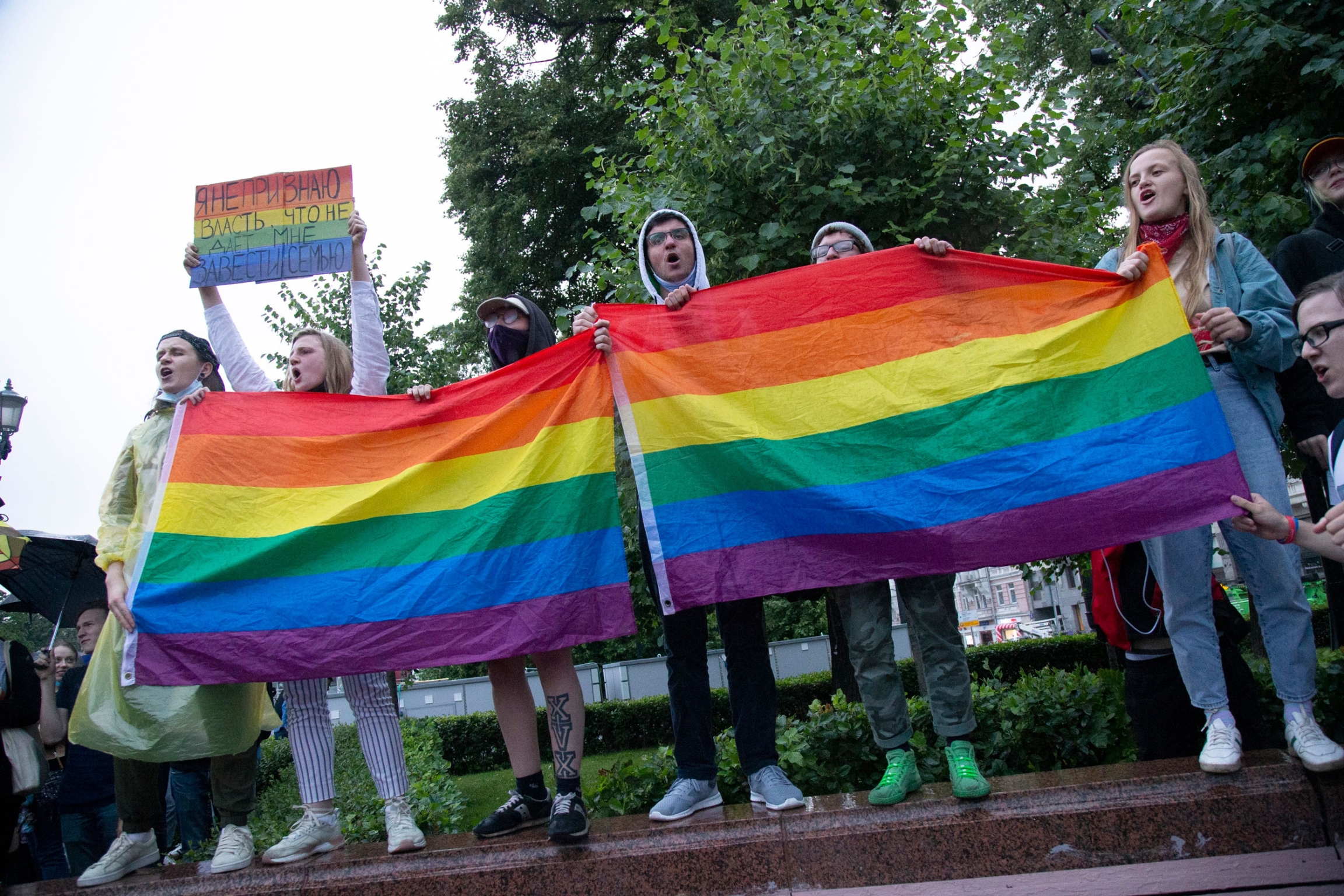
LGBTQ activists wave rainbow-colored flags during a rally in Moscow, Russia, Wednesday, July 15, 2020. Russian lawmakers on Thursday, Nov. 24, 2022 gave their final approval to a bill that significantly expands restrictions on activities seen as promoting gay rights in the country, another step in a years-long crackdown on the country's embattled LGBTQ community.
AP Photo
In neighboring Belarus, President Alexander Lukashenko’s government has closed writers’ organizations and jailed dozens of authors with the aim of stopping the development of independent literature, according to Hanna Komar, a Belarusian poet and translator who works with an initiative called Free All Words.
“They don’t want any freethinking people [in Belarus] who think critically and that’s what literature helps you do,” Komar said.
Komar, who published a book of poetry about the 2020 protest movement in Belarus against Lukashenko, has also left her home country and worries that she could be targeted by the government if she returns.
Still, there’s been significant demand for books like “Summer in a Pioneer Tie.”
“Many readers who aren’t part of the LGBTQ+ community wrote to us saying that seeing the world through the eyes of a queer person changed their opinions and widened their perspectives,” Malisova said.
Weapons manufacturers have historically been awash in money. And new data shows that military spending reached record highs last year across the globe, according to researchers from the Stockholm International Peace Research Institute.
The independent, Sweden-based watchdog said spending grew for an eighth consecutive year in 2022 to an all-time high of $2,240 billion. Europe saw a sharp increase of 13%, chiefly due to the war in Ukraine.
Nan Tian is a senior researcher at the institute in Stockholm, and he discussed the details of the data with The World's host Marco Werman.
This interview has been lightly edited and condensed for clarity.
Related: The US military faces challenges on the homefront as recruitment shortages continue
The COVID-19 pandemic has killed about 7 million people worldwide but the true tally is likely much higher. Beyond COVID-19 casualties, the pandemic has also weakened health care systems around the world, and interrupted other available care, from cancer treatments to routine vaccinations.
As a result, the global life expectancy has dropped by an average of about two years — the first such reduction since World War II.
Dr. Atul Gawande has been trying to bring global health care back on track. He's a renowned surgeon, writer and researcher who now heads global health at the US Agency for International Development.
“We have gotten ourselves out of the emergency.” he told The World’s host Carolyn Beeler. “Thanks to a combination of vaccines, natural immunity — 90% of the world has gotten infected — and, add to it that we also have antiviral treatments that also provide tremendous protection."
US President Joe Biden signed a bill on April 11 that officially ended the COVID-19 national emergency in the United States. Another public health emergency is also scheduled to end on May 11.
"Recovery from the pandemic will require as much focus and attention as it did when it first started.”
But, Gawande explained, “we now have an endemic disease that's a top-10 killer in the world, which means that recovery from the pandemic will require as much focus and attention as it did when it first started.”
In addition to deaths from the virus, setbacks to health care systems and the global economy have also contributed to lower life expectancies, especially in low- and low-middle-income countries. Wealthier countries were able to borrow against their budgets to stay afloat. Those countries are now facing debt distress, with cuts to financing and workers within their health systems.
Some smaller economies, however, have prevailed, including in Costa Rica and Ghana. Life expectancy in Costa Rica is now over 80 years — even higher than in the US.
“Their primary health care system enables there to be community health workers who visit every home at least once a year to assess the health needs the family has and make sure they're not falling through the cracks,” Gawande explained.
A girl receives a her second dose of the COVID-19 Pfizer vaccine during a vaccination campaign in San Jose, Costa Rica, Jan. 18, 2022.
Carlos Gonzalez/AP/File photo
When COVID-19 vaccines came around, it was easier to schedule appointments for everyone. Whereas in the US, the “health system is set up for people to come into it, but not to do outreach.”
Gawande said he knows first-hand about the necessity of good health care system. His paternal grandmother died many years ago of malaria. Treatment was available — but hadn’t reached places like her village in Nagpur, India.
Gawande’s father saw how advanced knowledge and training could deliver new health outcomes, but his community did not yet have the infrastructure or resources to afford it. He went on to receive medical training in Ohio, in the United States and is now a doctor. Today, his village has primary care physicians, an anesthesiologist, an obstetrician, a general surgeon, along with public health capabilities that weren't there before — and they’ve pushed India's life expectancy to beyond 70 years.
Related: 'The pandemic is still with us': The bumpy road to the end of COVID
This interview has been edited and condensed for clarity. Click above to listen to the entire discussion.
From coal to airports to cooking oil, Gautam Adani’s businesses span the gamut. Until recently, the Indian business tycoon was Asia’s richest man and the third-wealthiest person in the world.
Last year, Adani even briefly surpassed Amazon founder Jeff Bezos to claim the spot as the world’s second-wealthiest person.
But earlier this year, a big chunk of Adani’s wealth — more than $50 billion — got wiped out in a matter of days. Adani's stocks hurled into a free-fall after a New York-based short seller accused Adani of “pulling the largest con in corporate history,” with sweeping allegations of fraud and money laundering.
Since then, Adani’s companies have recovered partially but questions about his meteoric rise are still swirling. There’s also renewed scrutiny of Adani’s links to Indian Prime Minister Narendra Modi, and how their relationship may have fueled the businessman’s growth.
Sagar Kambli, an artist and a school teacher, gives final touches to a painting of Indian businessman Gautam Adani, depicting the ongoing crisis of the Adani group, in Mumbai, India, Friday, Feb. 3, 2023.
Rajanish Kakade/AP
Born in 1962, Adani was the seventh child in a middle-class family in the western Indian state of Gujarat. When he was 16, he dropped out of school and boarded a train to India’s financial hub Mumbai.
“All I knew was that I wanted to do something different and do it on my own,” he said recently to a group of schoolchildren in his home state.
As a young man in Mumbai, he worked in the diamond business, eventually setting up his own brokerage after which he moved back to Gujarat to help his brother run a plastics business. Then, in 1985, when India liberalized its import policies, Adani started a trading company, mainly importing plastic, a move which “laid the initial foundation of the global trading business I was soon to build,” he said.
Today, Adani’s portfolio consists of gas, electricity, coal, renewables, ports, media and more. His projects span worldwide — from coal mines in Australia and Indonesia to a port in Israel. The Mundra port in Gujarat, India’s largest commercial port, is Adani’s crown jewel.

Signage of Adani's compressed natural gas station are displayed at company's outlet in Ahmedabad, India, Feb. 2, 2023.
Ajit Solanki/AP
Adani and Modi hail from the same state and both come from humble backgrounds. They share a symbiotic relationship that goes back more than two decades, according to Jayati Ghosh, an economics professor at the University of Massachusetts, Amherst.
“You cannot imagine [Adani’s] rise without the political backing that he has got,” Ghosh said.
In 2002, when Modi was criticized for fomenting sectarian riots in Gujarat, Adani stuck by him.
“Mr. Adani made it very clear that he was still very much in support of Mr. Modi, and brought to bear not only his own support as a capitalist entrepreneur but mobilized others,” Ghosh said.
When Modi was elected prime minister in 2014, he flew to his inauguration in one of Adani’s planes. Later, Adani won bids to run six Indian airports despite having no experience in the sector. His wealth shot up, growing by about $100 billion in just the last three years. The Hindenburg research group released a report noting this impressive rise is no coincidence.
"We have uncovered evidence of brazen accounting fraud, stock manipulation and money laundering at Adani, taking place over the course of decades. Adani has pulled off this gargantuan feat with the help of enablers in government and a cottage industry of international companies that facilitate these activities,” the report said.
It also raised concerns about the high levels of debt in Adani’s companies.
Adani denies any wrongdoing and said that Hindenburg has vested interests because it is a short seller that is betting against Adani.
“The fundamentals of our company are very strong, our balance sheet is healthy and assets robust,” Adani said in a video released shortly after the Hindenburg report came out.
Members of opposition Congress party, demanding an investigation into allegations of fraud and stock manipulation by India's Adani Group display a placard with images of Indian businessman Gautam Adani and Indian Prime Minister Narendra Modi during a protest in New Delhi, India, Monday, Feb.6, 2023.
Manish Swarup/AP/File
R. N. Bhaskar, who has written two books about Adani, said friendly relations between businessmen and the government aren’t unusual.
“In a developing country, you have to be close to your government,” he said.
Mukesh Ambani, another Indian billionaire businessman, is also known to have benefited from close relations with the government. Bhaskar pointed out that Adani has projects in many states where Modi’s party is not in power.
"He is good in implementation, he’s good in making profits. And he creates jobs," he said.
According to Bhaskar, Adani’s success has come about not because of his affiliation with any politician but because of his business acumen.
“He's the savviest of traders that I've come across,” he said. “His warmth and simplicity in relationships is appealing and his razor-sharp mind. People haven't understood how sharp his strategic thinking is.”

An exhibitor shows the working of an assault rifle manufactured by PLR Systems Private Limited, a Joint Venture between Adani Group, India and Israel Weapon Industries (IWI), Israel, at the International Police Expo 2022 in New Delhi, India, Wednesday, July 6, 2022.
Altaf Qadri/AP
Part of Adani’s strategy, Bhaskar said, is aligning his business interests with national interests. Adani often draws parallels between his own rise and that of India. When Hindenburg accused the Adani group, the company deemed it a strike against the nation.
"This is not merely an unwarranted attack on any specific company but a calculated attack on India, the independence, integrity and quality of Indian institutions, and the growth story and ambition of India," the group said in a statement.
But Jayati Ghosh said that comparison is flawed: “In a sense, it's also a form of hubris that you equate yourself with the nation and your own personal interests with the national interest,” she said. “It's also essentially authoritarian.”
In reality, she said, India is “one of the most-unequal economies in the world.”
Activists of Communist Party of India shout slogans as they demand regulators investigate allegations of fraud and stock manipulation by India's Adani group in Mumbai, India, Monday, Feb. 13, 2023.
Rafiq Maqbool/AP
While Adani’s wealth is impressive, he’s not alone. The country added 64 new billionaires in just the last two years, according to Oxfam. Political observers often compare today’s India to the United States to the Gilded Age of the 19th century, with its robber barons.
India resembles an oligarchy, Ghosh said, where a few large capitalists “are controlling more and more of India's assets and productive structures, some because of their own expansion, but largely because of the sale of private assets and public assets, which they have been able to get larger and larger shares of.”
For the majority of the population, conditions have gotten worse in recent years, she said.
“If you look at real wages, they have been stagnant or declining. And a very small segment, the top 10% and within that, the top 1% and within that the top 0.1% have absolutely ballooned in wealth, assets and incomes,” she said.
India’s Supreme Court is now looking into whether or not Adani’s burgeoning wealth came about unfairly, including the establishment of an independent panel to probe allegations made by Hindenburg.
But R. N. Bhaskar said the tycoon remains unfazed.
“He's not bothered. He's going to continue his own plans,” he said. “He's not shriveled in any way.”
Adani has welcomed the Supreme Court’s investigation, saying that “truth will prevail.”
Winners of The Goldman Environmental Prize, the highest award of the year that goes to environmental activists leading grassroots campaigns, were announced on Monday.
One of the recipients, Zafer Kizilkaya, is the first winner ever from Turkey.
Kizilkaya is a trained civil engineer, marine conservationist and underwater photographer. He is being recognized for his work for more than a decade of creating a community-managed, 300-mile-plus marine-protected area along the Turkish coast of the Mediterranean Sea.

Aerial view of Gökova Bay, Turkey
Zafer Kizilkaya
In 2007, after returning from maritime work in Indonesia, Kizilkaya saw a problem as he dived into Turkey’s Gökova Bay.
“I noticed that there was a nuclear war that happened underwater,” Kizilkaya told The World. “There [was] nothing. Rocks [were] bare; there [was] no fish or algae.”
What he saw was a result of overfishing, illegal fishing, invasive species, such as the lionfish, and the effects of climate change. The Mediterranean Sea is one of the world’s most overfished bodies of water, and it became apparent to Kizilkaya that action needed to be taken to help protect Turkey’s degraded ecosystem.
This led to him launching his own nonprofit, Akdeniz Koruma Dernği (the Mediterranean Conservation Society), in 2012, with the help of local fishing communities.
But it wasn’t easy at first for Kizilkaya to win over the entire community.
“Nobody believed us,” he said. “The fishing communities are hard people to get, negotiate or even communicate with sometimes.”
He explained that the perception was that he was seeking to close some favorite fishing grounds forever. Though income in fishing areas was already collapsing from the degradation, closing even more areas down from fishing could exasperate the problem.

Invasive lionfish in coastal rocky habitats
Zafer Kizilkaya
“One disadvantage I had, there was no good example in front of me for Turkey,” Kizilkaya said. “Even if I am telling them good examples [of marine protected areas] from other parts of the world, it [didn't] mean anything to them at that time.”
Fortunately, other stakeholders, government institutions and certain fishing community members believed what he and his team said.

Cleanup of discarded fishing nets, Bozburun MPA, Marmaris, Turkey
Zafer Kizilkaya
With their support and negotiations for over a year, the first protected areas in Gökova Bay were officially established in 2012.
Fishermen have continued to fish in the protected areas knowingly and unknowingly, and much of Kizilkaya’s work has been spent educating local communities on marine-protected areas. He has been able to convert local fishermen and have them work with his organization as marine rangers to help stop fishing in those parts.

Zafer Kizilkaya and team on patrol
Goldman Environmental Prize
“It is great to establish those areas and immediately start patrolling [them],” Kizilkaya said. “We don’t have much time to convince all the stakeholders in the world.”
Because of his work, the Turkish government expanded the network in August 2020 by over 150 square miles, with an additional 27 square miles of no-fishing zones, totaling 310 square miles of marine-protected areas along the Turkish coastline, since Kizilkaya began his grassroots endeavor.

Diverse sponge species in Gökova Bay restoration area
Zafer Kizilkaya
There is currently a worldwide campaign for 30% of all oceans to become protected areas by 2030, and that at least 10% within that campaign should be fully protected areas. Kizilkaya said that less time should be spent on negotiation and more immediate action should happen in order to meet this goal.
“On the Mediterranean scale, the total of fully protected areas is 0.04%,” Kizilkaya said. “It's not even 1% yet, and there’s too [long of a ways] to go."
Related: You can ring this 'fish doorbell' to help marine life in the Netherlands
China, Turkey, Iraq and even the Vatican have all offered to mediate a peace deal between Russia and Ukraine.
This week, Brazil’s President Luiz Inácio Lula da Silva also threw his hat in the ring. But Lula’s recent statements about the war in Ukraine have led to some sharp pushback from the US.
The war of words between the US and Brazil began last weekend, during Lula’s trip to China. He said that countries that are supplying weapons are "encouraging the war," and need to stop — including the United States.
“The US needs to stop encouraging war, and start talking about peace,” he said.
In response, the US national security council spokesperson, John Kirby, accused Brazil of “parroting Russian and Chinese propaganda.”
Then, this week, when Russian Foreign Minister Sergei Lavrov met Lula in Brazil, he thanked him for encouraging negotiations. He also said that Russia and Brazil share common views on the conflict in Ukraine.
White House Press Secretary Karine Jean-Pierre pushed back:“We were struck by the tone of the press conference, of the foreign minister yesterday, which was not a tone of neutrality, suggesting that the United States and Europe are not interested in peace, or that we share responsibility for the war,” she said.
Lula dialed back his rhetoric and denounced the “violation of Ukraine’s territorial integrity.” But he renewed his call for negotiations between Russia and Ukraine.
“When you are looking at the war in Ukraine, Brazil has the ambition to be respected and taken seriously and sit at the table with other countries like the US and the European Union, to discuss peace, and to be a peace broker," said Bruna Santos, director of the Brazil Institute at the Wilson Center.
Santos said that Lula wants to form a peace coalition with countries like China and India.
“His idea was that nonaligned countries could serve as a broker in negotiating peace,” referring to countries that are not fully aligned with either Russia or Ukraine.
Lula’s criticism of the US resonates with his left-wing Workers Party (PT).
“For the Brazilian left, it’s very important to be nonaligned, nonautomatically aligned with the United States, and it means that sometimes, they will give messages and signals that are leaning toward Russia and Putin,” Santos said.
The Kremlin welcomes these signals, especially from a trade partner like Brazil.
Vladimir Rouvinski, a professor of international relations at Icesi University in Cali, Colombia, said that Brazil is a huge economy, making it an influential global actor.
Rouvinski said the US would like Brazil to join other nations in sanctioning Russia and providing weapons to Ukraine. But, so far, Lula has refused.
Rouvinski said he thinks that Lula wants to keep good relations with the US, but that it needs to move beyond “good wishes.” If the US wants Latin America to support their position, Brazil wants to know what gets offered in return.
Investing more in Brazil and other parts of Latin America might help. But Rouvinski said that for now, that kind of offer isn’t on the table.
The fighting between Sudan's rival armed forces entered its seventh day on Friday, despite efforts by the international community, including the United States, to push for a ceasefire ahead of the Muslim holiday of Eid.
Hundreds of people have been killed, and the impact on civilians and local infrastructure is devastating. As the number of wounded and injured civilians rises, hospitals have been unable to cope.
“The conflict affects hospitals so badly because many of them lack the simple tools and equipment to treat injured people,” said Osama Abubakr Osman, of the Sudanese Red Crescent Society, in Khartoum, adding that other challenges include unstable electricity and fuel shortages.
Dr. Alaa Eldin Awad Nogud, a surgeon in Khartoum and spokesperson for the Sudanese Professionals Organization, one of the lead pro-democracy organizations that’s been calling for civilian rule, said that medical workers have been cut off from their facilities.
"We are right now approaching a complete shutdown of the health system because of continuous firing and bombing in the streets in Khartoum,” he said, adding that the hospital he worked at had also been damaged in the fighting.
Ambulances have been unable to get to the wounded, meaning corpses have been left on the streets.
“These dead bodies in the streets are starting to decompose and this will make a very big health disaster if we couldn’t get a respectable, long ceasefire,” Nogud said.
Humanitarian organizations have been calling for the fighting to halt and for the establishment of a humanitarian corridor to allow medical workers to access the wounded, and for civilians to evacuate hostile areas.
“These routes should be safeguarded. They should guarantee the protection and safety of relief workers,” Osman said as gunfire sounded in the background.
Health workers are mobilizing to fill the gaps in care by sharing lists and contact details of doctors in different specialities.
Medical workers are also organizing themselves by neighborhoods, said Mohamed Ahmed Gibril, a doctor in Khartoum.
“So, if someone needs any type of intervention that’s not hospital based, we can go to their house,” he said.
He added that there’s a website where residents can post their emergency needs and phone numbers — allowing strangers to help them.
Online, one resident sought help for getting a tetanus shot for a bullet wound. Another requested a vehicle to evacuate their family members to a safe area.
With each passing day, the number of safe areas dwindles.
Gibril’s area was safe until this morning, he said, when a missile fell on a house nearby. He rushed out to see what happened and found a girl crying in the streets, screaming.
“She said ‘my mom is inside.’ I went inside the house. It was a disaster.”
Gibril said he provided first aid to the woman, and tried to look for a hospital — but found none that were open, and she died.
“If we had been able to reach any type of health facility, maybe she would have been saved,” Gibril said.
Want to do some good for fish in need?
Then, head to visdeurbel.nl — which literally means "fishdoorbell.nl" in Dutch.
It's a "doorbell" set up by the municipal government of Utrecht, in the Netherlands, and the Waterboard De Stichtse Rijnlanden, to help fish get through a lock in a local canal and reach their destinations.
Anne Nijs is an urban ecologist for the city of Utrecht who worked on creating the doorbell in 2021.
She explained that people can go to the program's website and watch a livestream of the fish underwater — and then, if they spot a fish, they can click to "ring" the fish doorbell to nudge someone to go and open the lock by hand.
Otherwise, fish swimming upstream have to wait a long time for the 200-year-old lock to be opened, which makes them vulnerable to prey, Nijs said.
Nijs said that for those who want to help the fish, mid-April is the best time of the season to go fish-doorbelling.
To hear the full interview, click on the audio player above.
Jesus Salvador remembers an area above the city of Granada, in southern Spain, where there used to be a canal flowing with water and a waterfall.
“If the winter was cold, the waterfall would freeze,” he said. “In warmer weather, a mist came off this canal and these hillsides were covered with green moss.”
And below, at the end, he said, there was a great place to swim — known as the “Pool of the Moors.”
Archaeologists and hundreds of volunteers spent months cleaning out and sometimes entirely redigging the acequia de Aynadamar, just above Granada, Spain. It had been abandoned for nearly half a century.
Gerry Hadden/The World
The Moors ruled the area for 800 years and built the now-abandoned canal, or acequia as they’re called in Spanish. All told, the canals form a complex network some 1,800 miles long, snaking down from the snowy Sierra Nevada mountains to the plains.
The Moors were master water engineers. But today, much of their knowledge — and the network of waterways they built throughout the region — have been lost. Now, amid drought and water shortages, archaeologists are trying to recover them.
Archaeologist Elena Correa from the University of Granada and her team, along with hundreds of volunteers, spent the last year restoring and cleaning this acequia. Its historical importance is unmatched, she said, as it once provided all the drinking water to the seat of Moorish power in Granada: the Albaicín.
The Albaicín is a hillside maze of cobbled lanes and whitewashed homes, a mix of Moorish and Spanish architecture, with the Alhambra fortress looming just in front. It’s a huge tourist draw.
Elena Correa, an archaeologist at the University of Granada, inspects part of the acequia de Aynamadar before its reopening.
Gerry Hadden/The World
These days, the water that trickles from the Albaicin’s many fountains is pumped in by modern machinery. But a millennium ago, residents relied only on gravity.
Originally, Granada’s water all came cascading down from a natural spring some 10 miles into the mountains. It’s called the Well of Tears, named after the tear-drop shape its creators gave it.
Correa and her team hiked up the canal and opened the sluice. The water began as a gush, but soon it was a trickle. Some half a mile from the city, it disappeared altogether, absorbed into the dirt canal. It’s supposed to reach the University of Granada, to be used for watering the grounds. But this is just the start, Correa said.

Newly released water from the acequia de Aynadamar, which once fed the ancient Moorish quarter of Granada, Spain, called the Albaicín, soaks into the earth a mile short of its destination. Because water levels are low due to drought.
Gerry Hadden/The World
“We inherited this from the Arab farmers,” said Luis Miguel Ortega, head of the region’s irrigation authority. “The know-how most likely came from ancient Persia, Syria and Jordan.”
The Well of Tears is still in use, providing water to a couple of close-by hamlets. Its water is crystal clear, if low due to a lack of rainfall.

The Well of Tears, some 10 miles up the mountain from Granada, Spain, is the source of water for the newly restored canal.
Gerry Hadden/The World
Ortega explained what he calls the real genius behind the acequias. Further up in the Sierra Nevada mountains, he said, there are canals that are not for watering crops directly. They run horizontally along the range until all of their water just seeps away into the earth.
“It might seem wasted, but the water is filtering down the mountainside. That’s why far below the canals, you find fruit trees and crops that normally wouldn’t flourish at such high and dry altitudes,” he said.
To reach the highest of these canals, you drive a dirt switchback a couple of hours to about 7,000 feet above sea level. Here, above the treeline, runs the Acequia de Los Hechos. It’s about 3 miles long and is meant to feed aquifers below.

The Well of Tears, some 10 miles up the mountain from Granada, Spain, is the source of water for the newly restored acequia.
Gerry Hadden/The World
Farmer Alejandro Molina tends to his potatoes and chestnut trees on his ranch here.
“The canal here provides water to all the farms you see below,” Molin said. “If you were to cut off the acequia, this place would become a desert.”
Brazil’s former President Jair Bolsonaro returned home last month to applause as he entered the headquarters of his party.
“The captain has returned,” his allies and supporters chanted, as Liberal Party President Valdemar Costa Neto also welcomed him over the packed crowd.
“You were missed and you'll always be missed, because the movement that you built in Brazil is here to stay,” he said.
Bolsonaro spent three months in self-imposed exile in Florida after losing his second-term election. Political observers are now anxious to see whether his movement will continue.
“There is no doubt that Bolsonaro, today, represents a movement with values and a virtuous economic legacy,” said Rogerio Marinho, the party’s congressional leader, in an interview with CNN Brazil.

Supporters wait for the arrival of Brazil's Former President Jair Bolsonaro outside the Brasilia International Airport, in Brasilia, Brazil, Thursday, March 30, 2023.
Eraldo Peres/AP
In Congress, Bolsonaro’s party has the largest number of seats in the Lower House, though far under a majority.
“He obviously has the ability to mobilize perhaps the most radicalized and highly visible sector of the opposition, which is the extreme right that is in the National Congress,” said Marcelo Kunrath, a Brazilian political sociologist at the Federal University of Rio Grande do Sul.
"But will he effectively be able to assume a leadership role among his larger base? That’s another question."
Kunrath said that Bolsonaro’s supporters among the far right, evangelicals and the military are not necessarily aligned as an opposition, and that Bolsonaro has lost strength since last year.
“He’s coming back from the United States in a much weaker position,” he said. “Because of the time he was silent while in Brazil, after the election, and then his time away."
And massive pro-Bolsonaro street protests are not expected any time soon.
An invasion by Bolsonaro supporters in the capital on Jan. 8 ended with arrests. The invasion was widely condemned by society and Brazil's political class — even Bolsonaro allies.
The Supreme Court has ordered Bolsonaro to testify this week over his alleged role in the Jan. 8 attack.
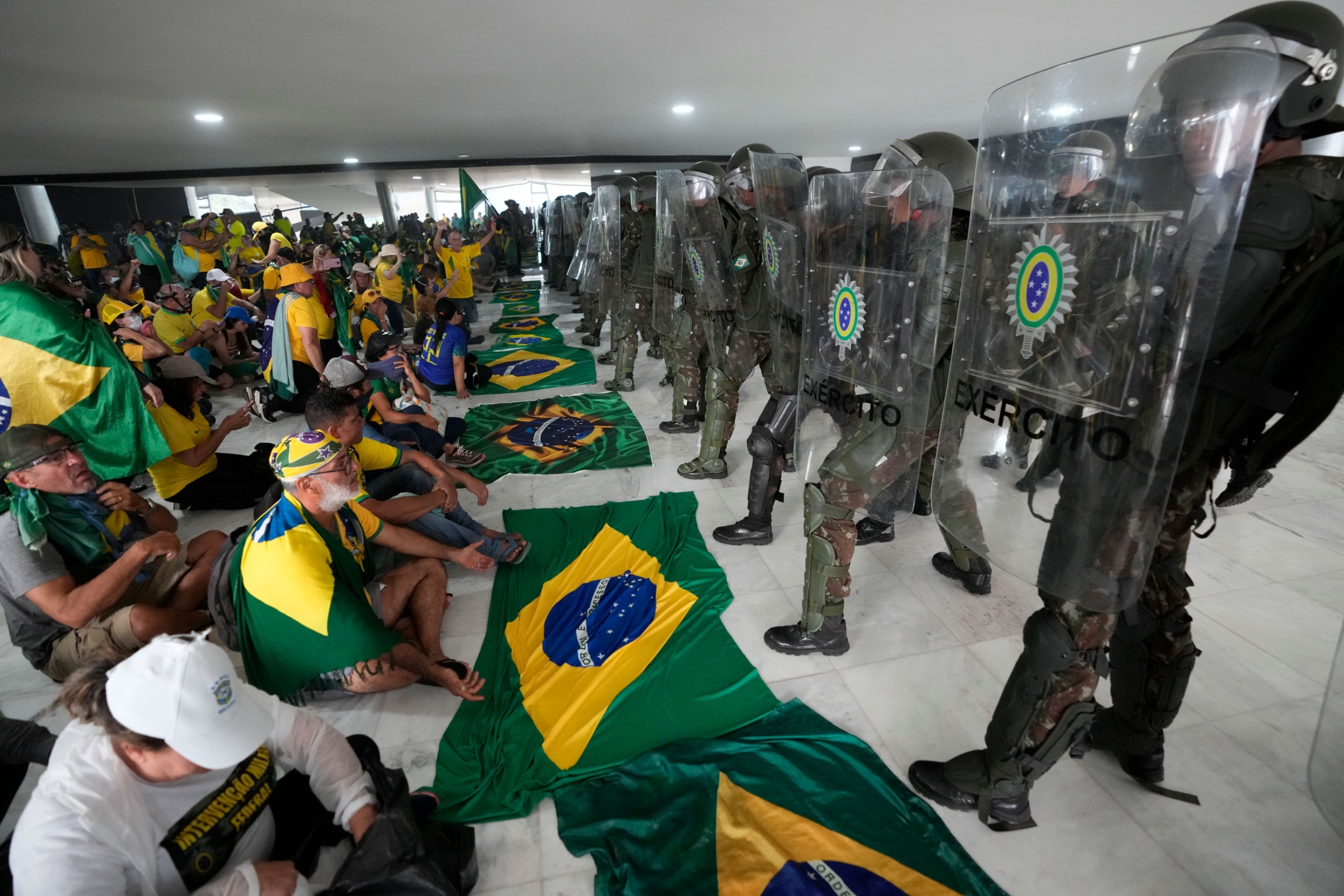
Supporters of Brazil's former President Jair Bolsonaro, sit in front of police inside the Planalto Palace after storming it, in Brasilia, Brazil, Jan. 8, 2023.
Eraldo Peres/AP/File
The former president also faces at least six lawsuits for alleged illegal acts while president — among them, abuse of power, for attacking Brazil’s voting system.
“You have his meetings with diplomats to disparage the Brazilian electoral system. And try to convince on the international stage that the Brazilian elections are corrupt,” said Larissa Peixoto, a Brazilian political scientist at Cardiff University’s Wales Governance Centre.
A conviction could block him from running in elections for up to eight years.
Peixoto also said that, while Bolsonaro has led the far right in Brazil in recent years, it doesn’t mean he’ll continue to do so.
"The movement that is attached to Bolsonaro isn’t necessarily a Bolsonaro movement. So, they will call themselves ‘Bolsonaristas,’” she said. But, the right in Brazil has had other figureheads, has had other heroes, and they tend to just be swapped over for someone else."
And others are being groomed.
Last month, former first lady Michelle Bolsonaro was appointed to head the women’s branch of the Liberal Party, her first political position. She’s a devout evangelical who campaigned hard for her husband last year.
In Brazil, politics can take surprising turns.
But one thing is clear: Bolsonaro is back, and his followers are excited.
Canada releases an Eid stamp each year during the Muslim holy month of Ramadan. Eid al-Fitr is the celebration that ends the month of fasting.
Previous mailing stamps have featured stylized Arabic text. But this year’s design is of an antique bowl that was made 700 years ago in Iran. The artifact pictured is part of the Islamic World collections at the Royal Ontario Museum.

This year's Eid stamp design by Canada Post features an antique bowl that was made 700 years ago in Iran.
Courtesy of Canada Post
Fahmida Suleman, who is the curator of that collection, has been helping Canada Post over the past two years to design this stamp. She said the bowl is symbolic because people used it centuries ago during Ramadan, likely for holding date fruits or even soup or a stew.
She added that she was also drawn to its elegant colors and design.
“It’s a lovely white glaze, but then, it has a beautiful blue, cobalt blue and black stripes,” she said.
Such a bowl would have been expensive given that it was made from a special stone paste material that was invented at the time to imitate Chinese porcelain.
Inside the bowl — in between geometric patterns and flowers — there are handwritten poems in Persian. They talk about wisdom and intellect, but also about forgetting the world’s sorrows for a moment to enjoy the food at hand.
Bronwyn Graves is the director of stamp services at Canada Post, which also releases special stamps for other holidays, such as Christmas, Hanukkah and Diwali.
"What symbols really speak to this holiday and to the community that celebrates this holiday?”
“Often when we’re looking at stamp ideas, it’s important for us to reach out to community members and say, ‘What stories should we be telling with this stamp? What symbols really speak to this holiday and to the community that celebrates this holiday?’”
The Eid stamp also features Islamic patterns by artist Unaiza Karim.

The Eid stamp released by Canada Post this year features a medieval bowl with geometric patters, flowers and Persian poetry.
Courtesy of Canada Post
“So many people don’t use stamps anymore,” Karim said. “But there are droves of people going out there buying it because it’s an Eid stamp and they find it beautiful and they love the story that goes along with it.”
Meanwhile, curator Suleman said that next year’s stamp design is already well underway. Without giving away too many details, she said, “It’s related to a special, delicious pastry that many people in the Middle East eat.”
Related: At Boston’s first Yemeni restaurant, food, community and tradition are on the menu this Ramadan
The importance of tackling climate change has never been clearer. But despite all the science that has accumulated over more than 30 years about its perils, planet-warming emissions continue to rise.
The good news is that climate solutions are now more accessible than ever. The cost of wind and solar power, for example, has plummeted in the last decade. Expanding existing efforts to reduce deforestation and increase energy efficiency has the potential to significantly slash emissions.
In the ongoing series, "The Big Fix," The World reports on what communities, individuals, governments and businesses are doing to cut emissions, as well as adapting to the impacts of climate change that are already being felt.
Check out more reporting on "The Big Fix" here. And tune into The World’s social channels for our monthly video series exploring climate change solutions around the globe.
Obada Mzaik was detained in Syria by the government after participating in a protest in 2012. It was nearly a year after Syria's civil war began.
Mzaik said he still remembers the sounds of other detainees being held at the Air Force Intelligence Branch at the Mezzeh Military Airport, in Damascus, Syria.
“I can hear the screaming, shouting. One night, I heard a small kid, I don’t know his age but he was shouting ... asking for his mom to help him out,” he said from his home in Columbus, Ohio.
More than a decade later, Mzaik is filing a lawsuit against the Syrian government for the treatment — including torture — which he said he endured in detention.
“I should have done this a long time ago, but I didn’t feel safe and secure before that. Now, I feel more secure and I feel more of a sense of responsibility to hold the Syria regime accountable,” he said about the lawsuit.
Mzaik was born in the US but moved to Syria with his parents when he was 4 years old. He was studying civil engineering when pro-democracy protests began in the country in 2011.
Mzaik was arrested and released after about a month for allegedly taking part in the demonstrations. But a year later, he got arrested again. This time, Mzaik said that he went through long hours of interrogations and was tortured.
He was moved from one detention facility to another and was kicked and punched, and beaten with a PVC pipe.
At times, Mzaik said, “I wished to die.”
He was finally released, 23 days later, after his dad paid off some officials.
Daniel McLaughlin, one of Mzaik’s lawyers, said there have been other cases against the Syrian government in US courts.
For example, in 2019, a US court ordered the Syrian government to pay $300 million for the death of journalist Marie Colvin, which was ruled as part of a criminal suit to be an extrajudicial killing.
But McLaughlin explained that what makes Mzaik’s civil case different is that it “targets the responsibility of the Syrian regime for the state’s policy of detention, torture, enforced disappearance and execution of those who are seen as a threat to the regime.”
He added that this suit is part of a broader constellation of accountability efforts, some of which are ongoing in the US and Europe.
Cases against nations are difficult to bring forward in the US because foreign sovereigns are immune from being sued. But there are exceptions for countries that the US calls state sponsors of terrorism — like Syria.
It is unlikely that the Syrian government will defend itself in a US court. But McLaughlin said it’s important for these cases to be heard in court.
“Also, in the current context, there’s been a push towards a renormalization of the Assad regime at the international level, and so, we’d think that having a US court document that there was a systemwide policy of detention, torture, extrajudicial killing, that that could help combat against the push towards the rehabilitation of the Assad regime.”
Many families who lost loved ones during the civil war, or are still searching for them, say they welcome any effort to hold Syrian President Bashar al-Assad and his officials accountable.
According to The Center for Justice and Accountability in San Francisco, which is involved in Mzaik’s case, more than 130,000 Syrians remain missing or detained.
Hala, who lives in the UK and asked that The World only use her first name because her family is in Syria, said her brother disappeared on April 13, 2013.
Hala was an activist and involved in the peaceful demonstrations that began in 2011.
Her brother, Subhi, was 21 and studying mechanical engineering. He had just received a scholarship to study in Germany.
“He’s so clever, intellectual and he’s just [such] a good person,” she said.
According to Hala, Subhi didn’t take part in the protests like she did. That’s why all these years, she has been puzzled about why he would be the one targeted.
“It should have been me, not him. So there’s an element of guilt,” she added.
Through therapy, she said that she has come to realize that the Syrian government is responsible, not her.
Hala’s family paid huge sums of money to people who claimed to have information about her brother, which turned out to be false.
“So, not even that they were trying to take money, they were playing with my mom’s feelings and hearts,” Hala explained.
Hala said she is glad that Mzaik has brought his case to a US court. But she is also managing her expectations. She knows these cases aren’t going to bring the detainees home.
“For me, it’s more about preserving our narratives, saying the truth about what happened, telling the world about our suffering.”
She hopes that as countries rush to reopen embassies and restore ties with Syria, they’re also reminded of the stories of thousands of Syrians like her brother who are still missing or detained.
The Bab al-Yemen restaurant in the heart of Boston transports its diners to an entirely different place.
There’s a carpeted seating area on the floor near the entrance with cushions, floor tables with fancy designs, clay pottery and stained glass windows.
The exterior of Bab al-Yemen, the first Yemeni restaurant in Boston, Apr. 12, 2023.
Sara Hassan/The World
Bab al-Yemen, which means “The gate of Yemen,” opened a year ago and is the first Yemeni restaurant in the city.
Its owner, Ahmed Mahmood, has made some adjustments to accommodate the holy month of Ramadan — when Muslims abstain from eating and drinking, among other things, from just before sunrise to sunset.
Mahmood has been living in Boston for nine years. He was born in New Mexico, then moved back to Yemen with his family as a child, and returned to the US later for college. He eventually worked for the New York City Department of Education as an enrollment systems manager and then in project management in Washington, DC.
When he first arrived in Boston, he noticed there weren’t any Yemeni restaurants.
“When I actually wanted to eat Yemeni food, I would go to New York City,” Mahmood said.
Then, inspired by his brother’s successful restaurant in Malaysia, Mahmood opened a quick-serve falafel and shawarma restaurant of his own. But he had to close it down when the COVID-19 pandemic struck. It did, however, open the door for a new and unique experience.
“I wanted to do the food, as well as the culture with it.”
“Food is the one language that everybody understands,” he said. “I wanted to do the food, as well as the culture with it.” That’s why he focused on the restaurant’s atmosphere to bring about a unique experience.

Products from Yemen add to the culutral atmosphere of the Bab al-Yemen restaurant, Boston, Apr. 12, 2023.
Sara Hassan/The World
On the walls, he’s placed photos of vibrant cities across Yemen, a country often associated with conflict. They include an image of his own hometown of Taiz, in southern Yemen.
There are also various types of traditional windows decorating the walls — some called qamaria, which are intricately carved and others made of wood, designed to look like those in Yemeni homes. On display, there’s also a replica of what a typical Yemeni town would look like.

A replica of a typical Yemeni town at the Bab al-Yemen restaurant, Boston, Apr. 12, 2023.
Sara Hassan/The World
There’s also a small prayer area for employees and customers to perform their daily prayers.
These days, Mahmood has special decorations up for Ramadan, including pennant flags with Middle Eastern designs hanging from the ceilings and bright cloths with crescent moons draped between the restaurant tables.
Bab al-Yemen owner Ahmed Mahmood updated his restaurant with Ramadan decorations for the Muslim holy month of fasting, Boston, Apr. 12, 2023.
Sara Hassan/The World
It also creates a festive ambiance that is generally found only in Muslim-majority countries where Ramadan is more visibly observed.
“There are no restaurants open during the day,” Yaniss Boughanem said about how Ramadan is lived in other countries. He’s originally from Algeria and works at the restaurant. “Everyone has shorter hours and schools close early.”
Boughanem makes one of the staples at the restaurant from scratch: Yemeni bread.
Yaniss Boughanem shows up his bread-making skills at the Bab al-Yemen restaurant in #Boston.
— The World (@TheWorld) April 19, 2023
It is the first Yemeni restaurant in the city and this #Ramadan, food, community and tradition are on the menu.
Tune into that story today on The World 🌍. pic.twitter.com/p9TXdMZkVM
The restaurant also opens later in the day throughout the holy month. And even though it opens about an hour before sunset for regular customers, Mahmood said that some diners who are not Muslim like to join in on the experience and wait to eat with patrons who are breaking the fast.
The Bab al-Yemen restaurant offers a buffet option for customers during the Muslim holy month of Ramadan, Boston, Apr. 12, 2023.
Sara Hassan/The World
The dining experience is also different this month. In a place that normally offers entree selections, customers are greeted by a buffet spread during Ramadan.

Intricately carved windows, known as qamaria, adorn the walls of the Bab al-Yemen restaurant, Boston, Apr. 12, 2023.
Sara Hassan/The World
Mahmood said he included lamb haneeth — slow-roasted lamb mixed with special spices and served over rice — because it’s usually the best-selling item.The dishes are prepared with recipes from Mahmood’s mother.
Fasting is only one aspect of the spirit of Ramadan.
It’s a month when many people increase their worship and charity — including prayers, reading the Quran and donating to the less fortunate.
“Growing up, Ramadan was basically a lot of family gatherings. But it's also about providing good value to the community, as well as doing good service, donating a lot of food, donating a lot of money,” said Bilal Daqqah, who was at the restaurant with his friends.
“For me, [Ramadan] means community ... patience and gratitude and recognition that, for other people, [food insecurity] is a norm.”
Another diner, Rami Bikdash said, “For me, it means community. It means patience and gratitude and recognition that, for other people, [food insecurity] is a norm.”
Customers are offered a buffet option at Bab al-Yemen during the Muslim holy month of Ramadan, Boson, Apr. 12, 2023.
Sara Hassan/The World
One of the purposes of fasting is to create empathy for those who can’t afford to buy food.
Yemen is no stranger to food insecurity. The UN’s World Food Program has said that 17 million people are food insecure in the country.
Ahmed Mahmood is the owner of Bab al-Yemen, the first Yemeni restaurant in Boston.
Courtesy of Ahmed Mahmood
It’s a result of years of conflict that includes civil war, the Arab Spring protests and a rise of insurgent groups like al-Qaeda in the Arabian Peninsula (AQAP).Many also see the current conflict as a proxy war between regional rivals Saudi Arabia and Iran.
Mahmood said that everyone in the country has been affected by war in some way.
Recent talks between Saudi Arabia and Yemen’s Houthi fighters have seen a breakthrough though. Last Friday, the two sides began a prisoner swap, exchanging hundreds of detainees, with more being released this week.
Peace efforts have failed in the past, but Mahmood is cautiously optimistic.
“I'm full of hope, I hope that something will change for people,” he said. "We've seen a lot of glimpses of hope in the past, but they didn't end up materializing and usually, Yemenis are the ones who end up suffering," he added.

Images of cities from across Yemen displayed on the walls of the Bab al-Yemen restaurant, Boston, Apr. 12, 2023.
Sara Hassan/The World
In the meantime, Mahmood hopes that through his restaurant, he can share his culture and cuisine with others to help patrons see a different and more beautiful side of Yemen.
Related: Yemenis struggle to maintain contact with loved ones amid attacks, internet blackout
On a hot, windy afternoon in January, Syed Sajjad Ali showed off bunches of juicy, greenish-red tomatoes hanging on rows and rows of vines on his farm in the southern Indian state of Telangana.
The crops are housed inside a covered structure made of sheer, white material.
“This is protected from the sun, protected from the rain, protected from the insects,” Ali, 60, said, standing beneath the white fabric roof which stretched just a few feet above his head.

Syed Sajjad Ali inspects tomatoes planted inside a Kheyti greenhouse.
Sushmita Pathak/The World
The crops are planted on a small patch of land about 1/8 of an acre. In India, the average farm size is 3 acres compared to 445 acres in the United States. The vast majority of farmers in India — and worldwide — are small farmers. They own less than 5 acres of land but grow 1/3 of all agricultural produce.
Small farms are also most vulnerable to climate change. The structure covering Ali’s tomatoes, known as a “greenhouse-in-a-box,” is part of a solution designed to help them cope with the vagaries of a changing climate. The design, essentially a low-cost, scaled-down version of a standard greenhouse, is the brainchild of an Indian startup called Kheyti.
In 2022, it was among the winners of the annual Earthshot Prize that honors environmental solutions. The idea was conceived some 10 years ago when Kheyti’s co-founders were trying to figure out what Indian farmers were struggling with the most.
“We started talking to hundreds of farmers across the country, and all of them said something that was related to climate change,,” said Khetyi co-founder Saumya, who goes by one name.
Across the globe, summers are getting hotter and rainfall is growing less predictable. As the globe warms, storms are expected to grow more intense.

Bunches of juicy, greenish-red tomatoes hang on rows and rows of vines in a farm in the southern Indian state of Telangana. They are planted inside a low-cost greenhouse designed by the Indian startup called Kheyti.
Sushmita Pathak/The World
To help Indian farmers become more resilient to this less predictable weather, Saumya and her fellow co-founders brainstormed a lot of different ideas.
“We looked at a bunch of things. We looked at insurance, we looked at different seeds. We also came across the greenhouse, which had been around for many centuries,” Saumya said.
Greenhouses help crops grow more efficiently by maintaining a controlled temperature and humid environment. They also protect crops from pests and unpredictable weather. But in India, it’s mostly wealthy farmers who can afford greenhouses. They also don’t come in compact sizes, which would be suitable for India’s majority smallholder farmers.
Saumya and her colleagues set out to design a much smaller, more affordable greenhouse by getting rid of the extra features that come with standard greenhouses, like height. Greenhouses typically are very tall and reinforced with a lot of steel.
“So, it was kind of like that whole negotiation where we said, OK, what is the bare minimum, covered structure that we can make? That was the approach,” Saumya said.
Along with the greenhouse, Kheyti also provides farmers with seeds, fertilizers, drip irrigation systems and installation help.
“Small farmers don't have market access. They don't know what inputs to buy,” Saumya said.

Kheyti's greenhouses are low-cost, scaled-down versions of standard greenhouses designed especially for smallholder farmers. Most Indian farmers are smallholders who are most vulnerable to climate change.
Sushmita Pathak/The World
Kheyti’s experts keep track of the crops’ status remotely by asking farmers to share regular photos on WhatsApp and advise and train farmers accordingly. The services, bundled with the product, make up the greenhouse-in-a-box, Saumya explained.
But convincing farmers to come on board can sometimes be difficult, she said.
“There's a lot of mistrust that farmers have toward companies who sell products and then run away,” she said.
Financing is another challenge.
“Banks don't really want to give small-farmer loans because they have no or low credit scores,” she said.
Farmers will save up money to buy a cow or buffalo but are much more skeptical about any new product.
But Saumya is optimistic. She said Kheyti’s greenhouse is in a similar position to where the tractor was about five decades ago.
“It took around 40 years until [the tractor] became mainstream in India. The greenhouse is also a similar sort of an asset, it's expensive, and it takes some time to see the return and get used to it,” she said.
So far, about 1,000 farmers across India have signed up for Kheyti’s greenhouse.
Ali got his greenhouse seven months ago and he said he is already seeing the results.
“The size of tomato and the quality of tomato is much better than [those grown in the] open field. Buyers very quickly take my tomatoes because they like this one,” Ali said.
A few miles down the road from Ali’s farm, Renuka, who goes by one name, planted tomatoes in an open patch, not in a greenhouse. Her tomatoes are smaller and haven’t had many takers, she said.

Farmer Renuka stands inside a Kheyti greenhouse where she planted cucumbers, which wouldn't have been possible to cultivate in the open because of the hot weather conditions in her state.
Sushmita Pathak/The World
For several weeks now, the going rate for tomatoes at her local village market has been a paltry 5 rupees, or around 6 cents, per kilo, she said. Factoring in transport and labor costs, she figures she will make a loss selling at those prices, so she was not even going to bother harvesting them.
Anguished, she’s decided to leave them in the field to rot.
“Water wasted, fertilizer wasted, seedlings wasted. I get angry when I look at this,” she said.

Renuka plucks a few tomatoes from her vegetable patch. She's leaving her harvest to rot in the field because it wasn't able to fetch a substantial rate at her local market.
Sushmita Pathak/The World
Kheyti’s greenhouse can help farmers get higher prices by allowing them to grow in the off-season when most people are not growing and the supply is low.
“For off-season, it will work like a wonder because you can rely on higher prices, your economic viability will be more,” said Anjani Kumar, a senior research fellow at the International Food Policy Research Institute in Delhi. “We need more and more greenhouses there is no doubt about it.”
The greenhouse can also help by allowing farmers to grow vegetables that are not commonly grown in the region. That’s exactly what Renuka did a few months ago — she pooled her savings to buy a Kheyti greenhouse for about $600 and planted cucumbers.
It is too hot to grow cucumbers in the open, she said, but in the greenhouse, she got a pretty good harvest. Cucumbers sell for higher prices than the vegetables she usually grows and over two crop cycles, she said, she’s almost recovered her investment.
She hopes to make her first profit soon.
The small greenhouse is a good idea, Kumar said, but there are some limitations. It is only suitable for farmers who grow fruits and vegetables, he said. Farmers who grow other crops may have to take up poultry or livestock to supplement their incomes.

Syed Sajjad Ali inspects tomatoes planted inside a Kheyti greenhouse.
Susmita Pathak/The World
As the climate changes, the government should also promote professions other than agriculture in rural areas, he said.
“So, that they can work on the farm, they can work off the farm and combined they can have better income.”
Whatever the solution, Kumar said government policies must take into consideration the needs of smallholder farmers.
“The bulk of the production and bulk of the cultivated area comes from the smallholders,” he said. “They are going to be the most significant part for the foreseeable future for Indian agriculture.”
And Kheyti wants to help these smallholders become climate smart. Over the next couple of years, the startup plans to get its greenhouses to 10,000 farmers.
On a Sunday morning, a dozen young children gathered in a small, tin shed with plastic sheets for a roof and no flooring.
This is an informal school for children of all ages near the Hebbal locality in north Bangalore, India, taught by college-aged volunteers. But not much studying happens amid laughter, giggles and chaos.
Children who live here also attend formal government-run schools — but not regularly — because they move frequently to new places when their parents, who collect and segregate trash, have to migrate in constant search of work.
Most of the children came from villages in the eastern state of West Bengal, where their parents say they can not find decent-paying work. Although migrant waste pickers earn more in larger cities, they also face constant harassment from the police and local residents.
College students volunteer to teach children at an informal school in Bangalore, India.
Raksha Kumar/The World
Agents who arrange migrants' work set up small tin sheds on a large, open field for the families. Police say the flimsy homes were constructed illegally and on government land, so they periodically evict the tenants. The residents say the police will sometimes take bribes to let them stay, which many can not afford.
Waste pickers in north Bangalore separate trash to make a living.
Raksha Kumar/The World
“With the minimum income they are earning from this, they are having to again pay the police to stay here in these tin sheds,” said Saniya Nourin, who volunteers at the school.
“But, those who are targeted are the ones who speak Bengali, and those who are Muslim,” said Maggie Paul, a scholar from the University of Adelaide who has been documenting Bengali migrants in India.
Bengali migrant Salmina Sheikh came from a village near the city of Kolkata a year ago to rejoin her husband, who makes about $120 a month by selling segregated waste to nearby recycling plants.
“We need this money for our children, we can barely give them nutritious food in our village.”
Salmina Sheikh, who is six months pregnant and has a 2-year-old daughter, said they need the money for their children. "We can barely give them nutritious food in our village,” she said while cooking on an open fire outside her mud hut.
She added that staying in their village means there would be no money left for her children’s education. She said the police sometimes take away their money or phones — the police have denied this.
Salmina Sheikh sits with her toddler inside her home in an informal settlement in Bangalore, India.
Raksha Kumar/The World
The Indian state of West Bengal shares a history, culture and language with neighboring Bangladesh. It’s difficult to differentiate Muslims from West Bengal and those from Bangladesh since they all speak Bengali. And many Indian migrants say they are being harassed merely for being Muslim.
“We all have documents to prove that we are Indian citizens,” said Saeeb Sheikh, a local agent who is not related to Salmina Sheikh. He receives a commission for bringing migrant workers from the poorer regions of West Bengal to Bangalore.

Homes in this informal settlement in Bangalore, India, are made of tin and plastic sheets.
Raksha Kumar/The World
A 27-year-old agent who asked not to be named to avoid trouble with authorities admitted that some workers from Bangladesh are paid less than workers from India.
Since 2019, when Indian Prime Minister Narendra Modi was elected for the second term, his party has spoken out against those they call "illegal immigrants" from Bangladesh.
Home Minister Amit Shah has also addressed the media on the issue several times.
“We will not let even one illegal immigrant stay in the country," Shah said. He has even used derogatory names to describe Bangladeshi immigrants.
Scholar Maggie Paul said that this is an ageold narrative — Muslims from neighboring countries taking away land, jobs and resources —that ultimately galvanizes votes. She traces the issue back to the British division of the subcontinent into Hindu-dominated India and the Islamic Republic of Pakistan.
Karnataka, the capital of Bangalore, will go to the polls in about two weeks to elect a state assembly. Many candidates are seeking votes by claiming they will rid the city of illegal migrants from Bangladesh.
Trash segregators in Bangalore, India, pile up glass bottles to one side as they separate waste.
Raksha Kumar/The World
“I get WhatsApp messages congratulating me on my work in removing these Muslim migrants," said a Karnataka politician who asked not to be named because he has not been cleared by his party to speak to the media.
Paul said that harassment by the authorities serves a two-fold purpose: politicians get electoral gains and migrant labor becomes all the more vulnerable and open to exploitation.
And, in a country ruled by a Hindu nationalist party, their Muslim religion pushes them toward maximum vulnerability, said author and researcher Govind Kelkar.
The People’s Union for Civil Liberties filed a case in January 2020 in the Karnataka High Court challenging an eviction of a settlement in Bangalore. The following month, the court asked the government to provide alternate housing arrangements and compensate the migrants monetarily for losses caused by evictions.
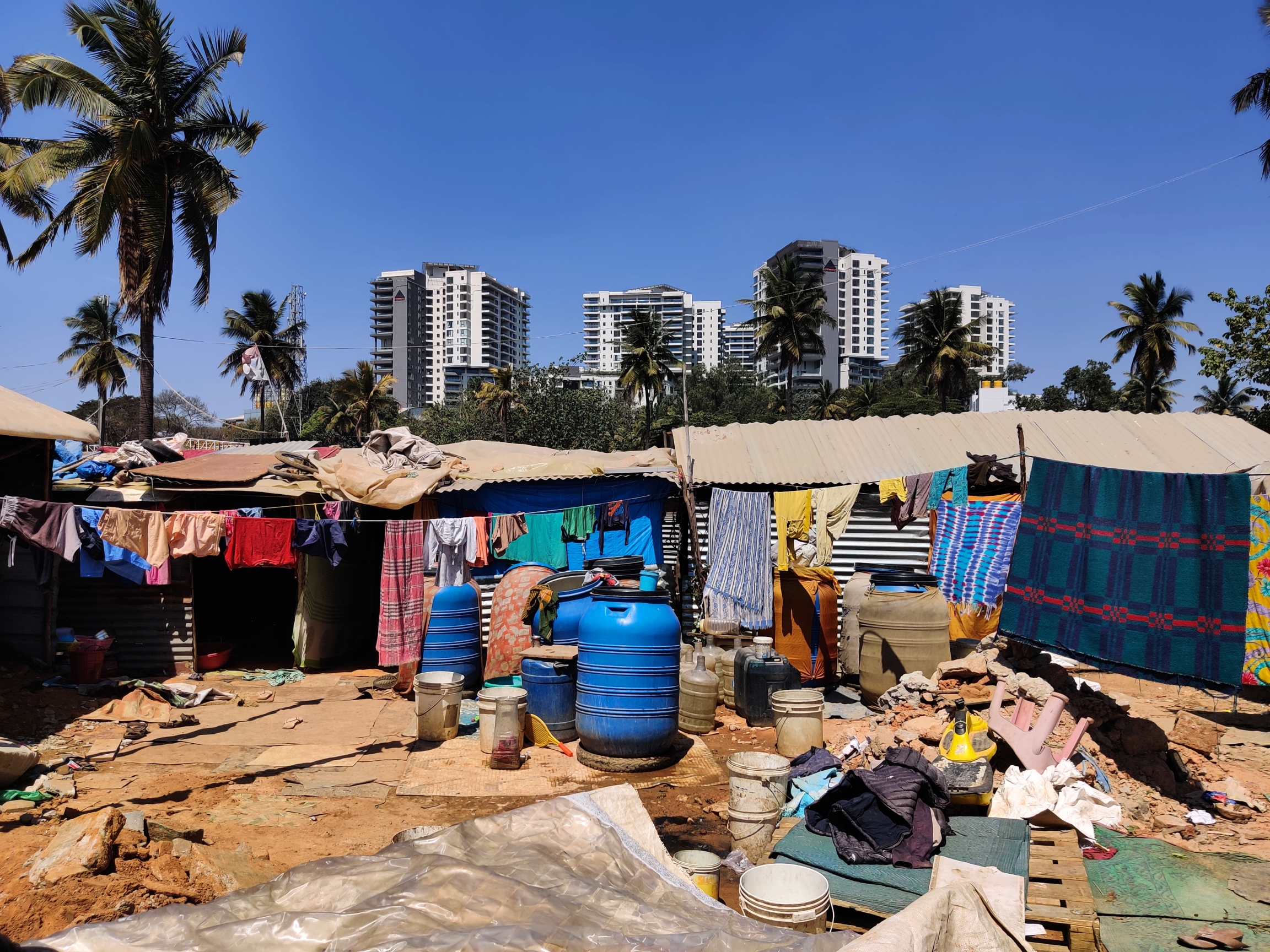
High-rises seen from a waste pickers colony in north Bangalore, India.
Raksha Kumar/The World
Ravi Nair, with the South Asia Human Rights Documentation Center, a New Delhi-based nonprofit, explained it this way:
“If the government resorts to large-scale deportation of Bangladeshi climate and economic migrants, the waste collection, sanitation and scavenging sector would collapse in all major Indian cities."
Raksha Kumar is a media fellow working on migration with the Asia Pacific Forum On Women, Law and Development. This story was part of her fellowship.
In the final days of the Muslim holy month of Ramadan, residents of Khartoum, Sudan, would normally be relaxing during fasting hours and enjoying the weekend.
Instead, they experienced aerial attacks and gunfire as Sudan’s rival armed forces turned their guns on each other.
The fighting between the country’s military, the Sudan Armed Forces (SAF), led by General Abdel Fattah al-Burhan, and the Rapid Support Forces (RSF) paramilitary, led by General Mohamed Hamdan Dagalo “Hemeti,” began on Saturday, following weeks of tensions.
Conflicting reports emerged on Tuesday of a 24-hour ceasefire between the two groups, but fighting continued hours before the ceasefire was purportedly set to begin.
Videos taken by residents show armed tanks rolling down streets, and bullets piercing through glass windows of residential buildings.
“There are clouds, clouds of smoke coming from the middle of Khartoum.”
“There are clouds, clouds of smoke coming from the middle of Khartoum,” described Khalil Yusuf al-Nour, a resident of the capital.
“Gunshots, like machine guns, and heavy guns,” he added about what he could hear from inside his home.
This is the deadly showdown that many observers warned could come, with tensions between the two forces continuing to grow since the military’s ousting of former Sudanese President Omar al-Bashir in 2019.
“Since then, they have been working independently,” said Kholood Khair, founding director of the policy think tank Confluence Advisory in Khartoum.
“They have different foreign policies, different income streams and different sorts of domestic politics policies or ideas about how to consolidate their power grab in 2019, and then the coup in 2021,” she explained.
Both SAF and the RSF have been struggling for power, even as they engaged in negotiations that many hoped would put the country back on track toward civilian-led rule.
The negotiations broke down last week amid disagreements over the details of integrating the RSF into the military.
“Both now want to have control of Sudan through court, through having control of Khartoum,” Khair said.
In media appearances since the fighting broke out, both General Burhan and General Hemeti have stated similar messages — that they are the ones protecting the Sudanese people, and that the other is an enemy of the country.
The battle on the streets has also played out on social media, with both sides posting videos purporting to show victories over strategic locations.
“They are trying to convince people that they should back their positions,” Khair said. “I think their biggest miscalculation is that they don’t understand — neither Burhan or Hemeti — understand that the people of Sudan, particularly the people of Khartoum, don’t want either general.”
The fighting has already had a heavy toll. At least 144 civilians have been killed, according to the Sudanese Doctors Central Committee. Over the weekend, the World Food Program also announced that it was suspending operations in the country after three of their aid workers were killed amid clashes in the Darfur region.
The aerial bombardment and heavy artillery has also destroyed major infrastructure, including hospitals and the international airport in Khartoum.
“The gunshots, the bombs, they never stop. They might stop for half an hour, an hour, but you know, they resume again.”
“The gunshots, the bombs, they never stop,” said Khartoum resident Fadil Mahmood, who lives near the airport. "They might stop for half an hour, an hour, but you know, they resume again.”
Mahmood said the conflict is making it harder to observe Ramadan.
Residents of Khartoum are having to make decisions about whether to risk their lives by going out to do simple tasks, like charging their phones or shopping for food, water and medicine.
“The electricity is out here because we are close to the conflict,” Mahmood said. Many shops are also closed. "We have some drinking water. It may last us three days.”
Pressure on both generals from international and regional players has so far failed to deescalate the conflict.
“The endgame for both of them seems to be the total annihilation of the other,” political analyst Khair said.
Sudan’s former civilian Prime Minister Abdalla Hamdok urged the generals on Saturday to stop fighting, warning that a war in Sudan would mean war for the entire region.
Emergency meetings were also held over the weekend by the African Union, the Arab League and the Intergovernmental Authority on Development (IGAD) — a key body in the region.
Kenya’s government later announced that IGAD had “resolved” to send the presidents of Kenya, South Sudan and Djibouti “at the earliest possible time” to Sudan for mediation — a decision complicated by the main airport not being operational.
Related: Sudanese protesters demand a 'purely civilian transitional government' activist says
South African singer-songwriter Pilani Bubu admits she comes from a family of privilege, one that encouraged education and creativity. It was like jumping “off the shoulder of giants,” she said.
"I studied law and marketing, and then, I went into the creative space and realized, actually, my best medium to communicate and to make any change was to use my best gift, which was music," Bubu said.
Born in 1984 during the last decade of the apartheid regime in South Africa's Eastern Cape — home of the Xhosa people — she was a child of the MTV generation who straddled between the worlds of globalization and the traditions of her homeland. But to really understand her heritage, she first had to leave South Africa to gain some perspective. In 2012, Bubu left her job in the corporate world and moved to New Orleans, Louisiana, in the United States.
“[I] packed my bags to go to the New Orleans Jazz Fest with my CDs, my demo CD, ‘Journey of the Heart,’ Bubu recounted. “I was supposed to stay five days during the Jazz Fest, and I stayed three months [instead].”
In the Big Easy, a nickname for New Orleans, Bubu found her music community and understood that the people she met wanted to learn more about her culture back home. That’s when she started to incorporate South African music into her repertoire.
“When you travel in the world, people will look at you as an African girl, an African child, and try to understand the story of your people and your life. And that helped me dig a little bit deeper, and I realized that there was like a wealth of stuff sitting with me that I could share,” Bubu said.
In her 2019 album "Folklore - Chapter 1," Bubu took a look back into traditional folk songs from South Africa, songs with themes that are important to her, such as spirit animals, respect for ancestors and the role of women. Then she presented the songs with an Indigenous folk sound to a new generation who, like Bubu, might have taken her own culture for granted. The album was awarded Best African Adult Contemporary Album at the 2020 South African Music Awards.
“The pull of music, the work, the culture, the heritage is so big that I can only do such a small part. But if I don't give it meaning and interpret it for the modern day, then it's just going to remain where it is, in the past,” she said.
The past is always present, and so is the future. Bubu’s album "Folklore - Chapter 2" is set to come later in 2023 as a continuation of her themes of community and tradition with a strong spiritual bent.
In the meantime, Bubu has a new album titled "Lockdown Lovestory," with songs like "Feel It" with artist AfroNautiq that help give her music a contemporary soul sound.
Mohannad Saad Mohammad got involved early on with the anti-government Tishreen or the October movement, which began sweeping Iraq in 2019.
“My friends are all poor like me,” Mohammad explained. “We all went out to protest because most of us were jobless. We were seeking a better nation.”
They demanded an end to corruption, more job opportunities and better living conditions. The Tishreen protests, which continued through 2021, forced Iraq’s Prime Minister Adel Abdul Mahdi to resign.
But today, the country still struggles with political infighting and corruption.
“What we have in this country is a fake democracy,” Mohammad said. “A real democracy is where people can speak their minds freely. Where elections are fair and people don’t get killed just for protesting.”
Under the previous regime, he said, “The Shias were marginalized. But Saddam Hussein has been gone for a long time. Even though Shias have power in the government now, we are still suffering.”
So, Mohammad said he is still fighting, even though he has already paid a heavy price for his activism.
During a demonstration on Feb. 16, 2020, which turned violent, 38-year-old Mohammad lost one eye — the other was severely damaged.
Mohammad is just one of hundreds of protesters who ended up with severe eye injuries after the crackdown. According to the United Nations, nearly 500 protesters were killed and about 8,000 more were injured in just the first few weeks of Iraq’s uprising.
Amnesty International reported that anti-riot police fired tear gas canisters at protesters, even targeting their heads, in some cases, at point-blank range.
Mohammad said he is not sure who his attackers were. Maybe Iraqi security forces or members of one of the country’s powerful militias.
Afterward, at the hospital, security forces showed up looking for him, he said. Hospital staff formed a human shield around him, and they managed to stop them from detaining Mohammad and other injured protesters.
Then, in the middle of the night, the staff helped smuggle him out of the hospital in a trash can.
Mohammad said that doctors told him that he is lucky to be alive; X-rays show dozens of pellets lodged in his head and upper body. Some of them could not be removed.

Mohannad Saad Mohammad shares X-rays from his injuries. Pellets that remain in his head and upper body can be seen on the top left corner.
Shirin Jaafari/The World
Mohammad, no longer able to work, had to give up his home in the city. He now lives on the outskirts of Baghdad with his wife and four children. They survive on donations, he said.
But losing his eyesight hasn’t stopped Mohammad from going to the streets. In fact, just recently, he was out protesting again.
“I know that I could be either killed or imprisoned, but I breathe for Iraq. This is the path that I have chosen and if I die, it will be the greatest honor of my life.”
A trove of classified, US intelligence information that was first posted on the social media platform, Discord, a few months ago, made its way into news reports over the last week.
On Thursday, a Massachusetts Air National Guard member, Jack Teixeira, 21, who had emerged as a key suspect in the leak, was taken into custody by federal agents and will be charged with the unauthorized removal of classified national defense information, Attorney General Merrick Garland announced.
Investigators believe that the guardsman, who specializes in intelligence, led the online chat group where the documents, which speak to the war in Ukraine, were posted.
The emergence of Teixeira as the apparent primary suspect is bound to raise questions about how the highest-profile intelligence leak in years, one that continues to unfold with almost daily revelations of highly classified documents, could have been caused by such a young, low-ranking service member.
The Biden administration has scrambled for days to contain the fallout from the leaked information, which has publicized potential vulnerabilities in Ukraine’s air defense capabilities and exposed private assessments by allies on an array of intelligence matters.
The incident has been embarrassing for the Pentagon and the White House. The Biden administration launched a “full-blown investigation” into the intelligence leak, while the documents, which had started showing up on Russian Telegram channels, were discussed at length on Russian state TV.
Francis Scarr, who analyzes Russian state media for BBC Monitoring, said that the leaked documents seemed to have caught pundits there unawares.
“Often, you see some kind of major development internationally and the Russian state media comes out in unison, you see across the three main channels, they almost use the same phrasing sometimes in the way they react to it.”
But Scarr said that was not the case earlier in the week when this story first appeared on Russian state TV.
“Purely because these shows on Russian state TV last for hours every single day, it’s impossible to control everything that’s said on them,” he said. “There have been a couple of cases where pundits on these shows have mentioned elements of the leak which point to Russian weaknesses and show that Russia has been deeply infiltrated by US intelligence.”
Scarr offered an example that played during a segment on a popular political talk show called “60 minutes” (not to be confused with the American news show with the same name).
“This former intelligence official mentioning this fact that the US seems to have gained information by spying, it wasn’t just open-source information and suddenly, the presenter was caught unawares by this and asked him to elaborate, and as soon as he started explaining what it meant she just quickly changed the subject.”
So, at times, when information from the documents didn’t fit the Kremlin’s narrative, Scarr said, commentators scrambled to suppress it. They also sought to question the validity of the documents and play up instances that made America look bad.
The highest-ranking Russian official to comment on the leaked documents is Kremlin spokesman Dmitri Peskov, who called the leaks “interesting” but questioned their authenticity.
He said that everyone knows that the US collects intelligence on everyone. And he claimed that Russia was already aware of a lot of the information that’s come out.
Pavel Luzin, a visiting scholar at the Fletcher School of Law and Diplomacy at Tufts University, said he wasn’t surprised by the fact that the US collected this information, “because we know for many years that the United States invests in these capabilities a lot of money.”
Luzin is also skeptical about some of the information that appears in these leaked documents. Nonetheless, he said that this information won’t affect Ukraine’s military planning.
Even taking the leak seriously, “We cannot see the number of missiles, the number of artillery shells. We cannot see the actual number of armored vehicles. What we can see in these leaks, we can find in open-sources by ourselves.”
Luzin said that overall, we know a lot more about Russia’s military capability than we do about Ukraine’s.
“The trend is that Russia is becoming weaker and weaker every single day. That doesn’t mean that Russia is becoming less dangerous. No. The weaker Russia is, the more aggressive Russia [is].”
Whatever comes out of the intelligence leak in the days ahead, Luzin said one thing has not changed: Ukraine still has to win this war on the battlefield.
The Associated Press contributed to this report.
Nine years ago, disturbing news from West Africa gripped the attention of the globe. It was when as many as 276 schoolgirls and young women were kidnapped by members of the Boko Haram militia in the town of Chibok in northern Nigeria.
When the heavily armed men came into the government’s boarding school in search of food, they found the girls aged 14 to 21 — who, at the time, were taking exams — and abducted them. Militiamen forced them to get onto a truck for a three-day journey to the Boko Haram enclave in the Sambisa Forest.
In the process, about 57 girls managed to escape. A grim total of 219 young girls were finally held hostage.
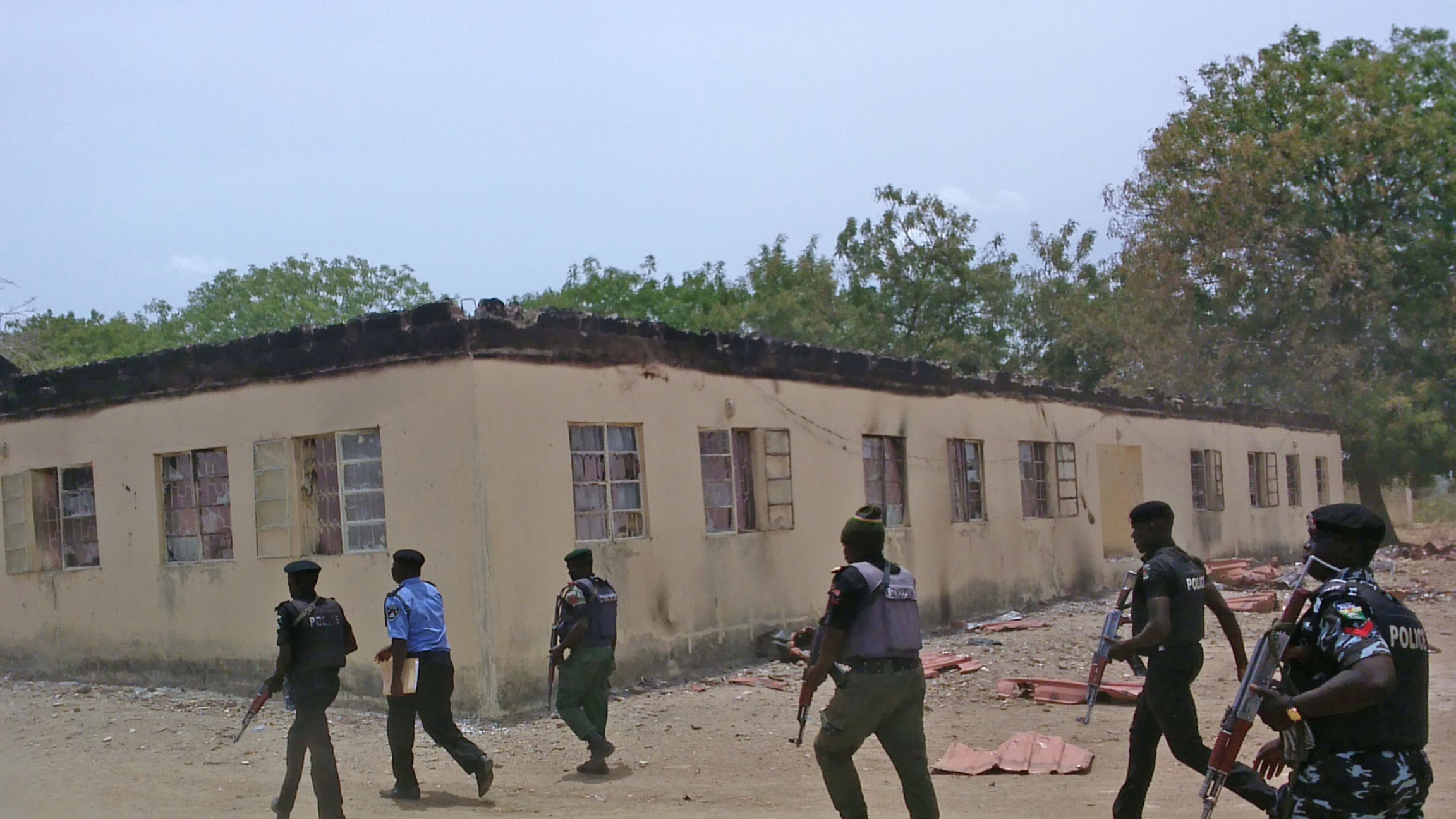
Security officers walk past a burnt-out government secondary school in Chibok in April 2014, where gunmen abducted more than 200 students.
Haruna Umar/AP file
When the news came out, there was a lot of denial and blaming from local politicians, which in the long term was detrimental for the girls, recounted Aisha Muhammed-Oyebode, human rights activist and founder and CEO of the Murtala Muhammed Foundation.
“It took them three days to get to Sambisa Forest, but because there was so much denial and there was a lot of politicking around that time because it was around elections, nobody was really paying a lot of attention,” she said. “A lot could have been done to rescue those girls if we had reacted immediately. And, I think, that was what made it even more tragic for all of us.”
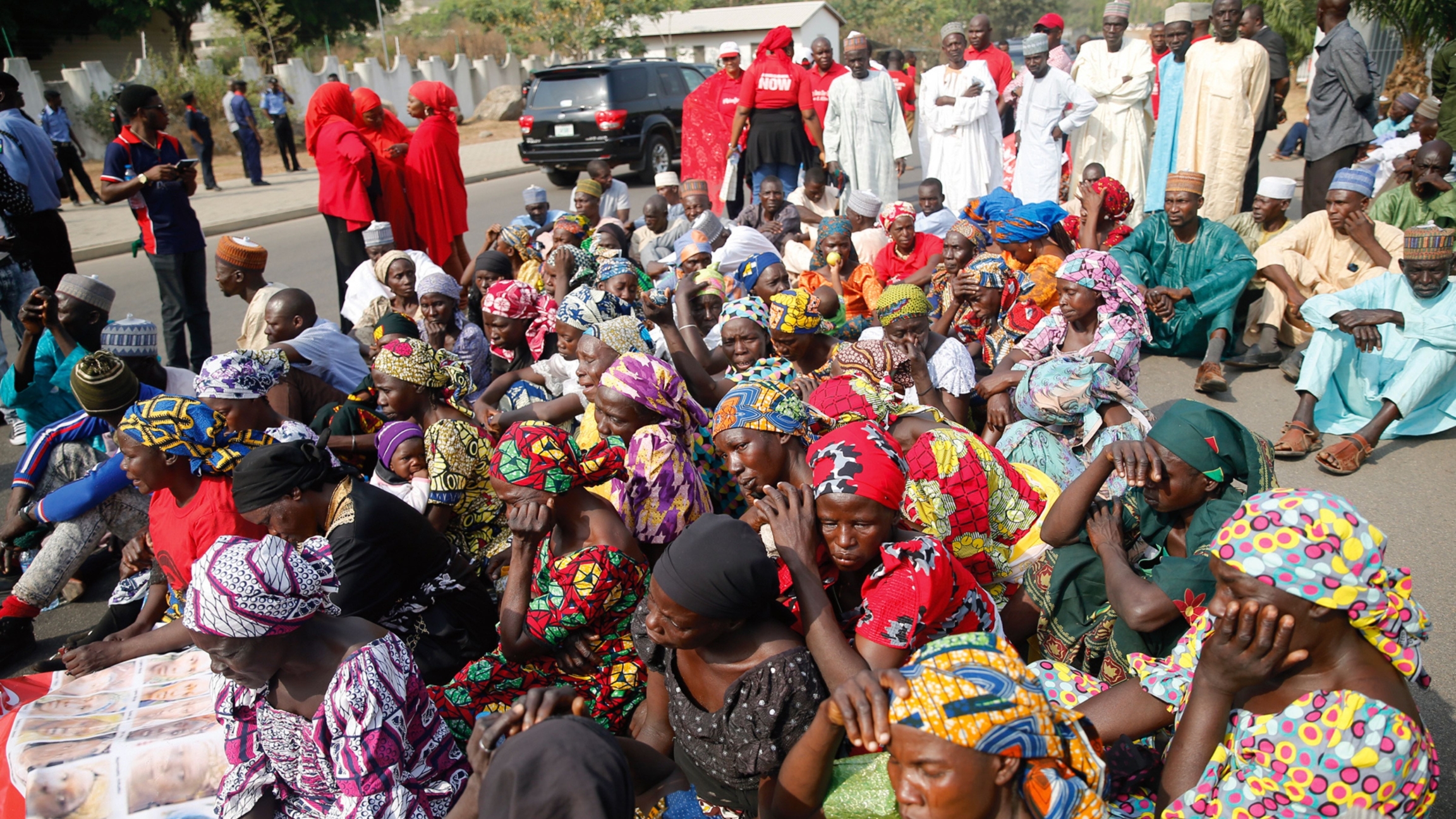
Some of the Chibok schoolgirl's parents protest in Abuja, Nigeria, in January 2016, nearly two years since the abduction of their daughters by Boko Haram militiamen.
Akintunde Akinleye
What followed was years of captivity and sexual exploitation for the girls at the hands of Boko Haram and heartache for their families. It took years for the government to negotiate a release. Many girls still remain unaccounted for.
Muhammed-Oyebode met some of the Chibok families in the years that followed the abductions. In her recent book “The Stolen Daughters of Chibok,” she presents a collection of powerful portraits, photographs and poignant essays, many by the mothers and fathers of the Chibok students, recounting the tragic impact of the abductions in their rural homes and communities.
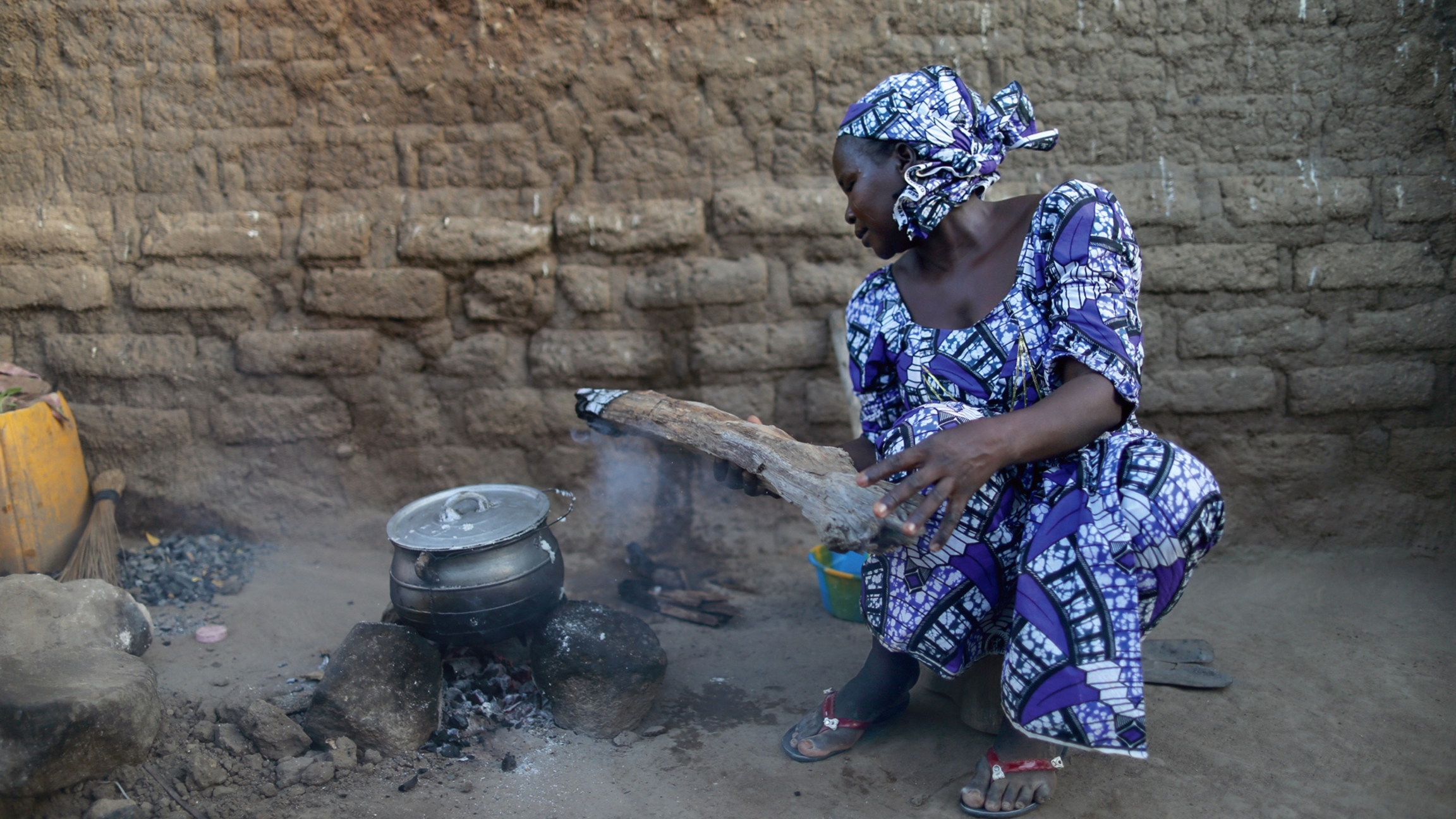
Yana Galang mother of schoolgirl Rifkatu Galang in her home in Chibok. She wrote an essay in the book "The Stolen Daughters of Chibok" about her daughter. "Rifkatu was fond of gospel music and she was playing a song on her phone. It is the last thing I remember of my daughter."
Akintunde Akinleye
“In that community, especially, they were particularly invested in their daughters going to school. These girls, most of them were in the final years of their schooling. They were actually almost done with getting ready for university, so it was really devastating for them,” Muhammed-Oyebode said.
Some of the girls who returned or were released went back to school. Nearly a hundred families have been totally bereft. “We now know from the stories that have come out that we have lost at least one-third of those girls,” Muhammed-Oyebode said. “But the families don't know which ones. So, the parents can't even grieve their deaths.”
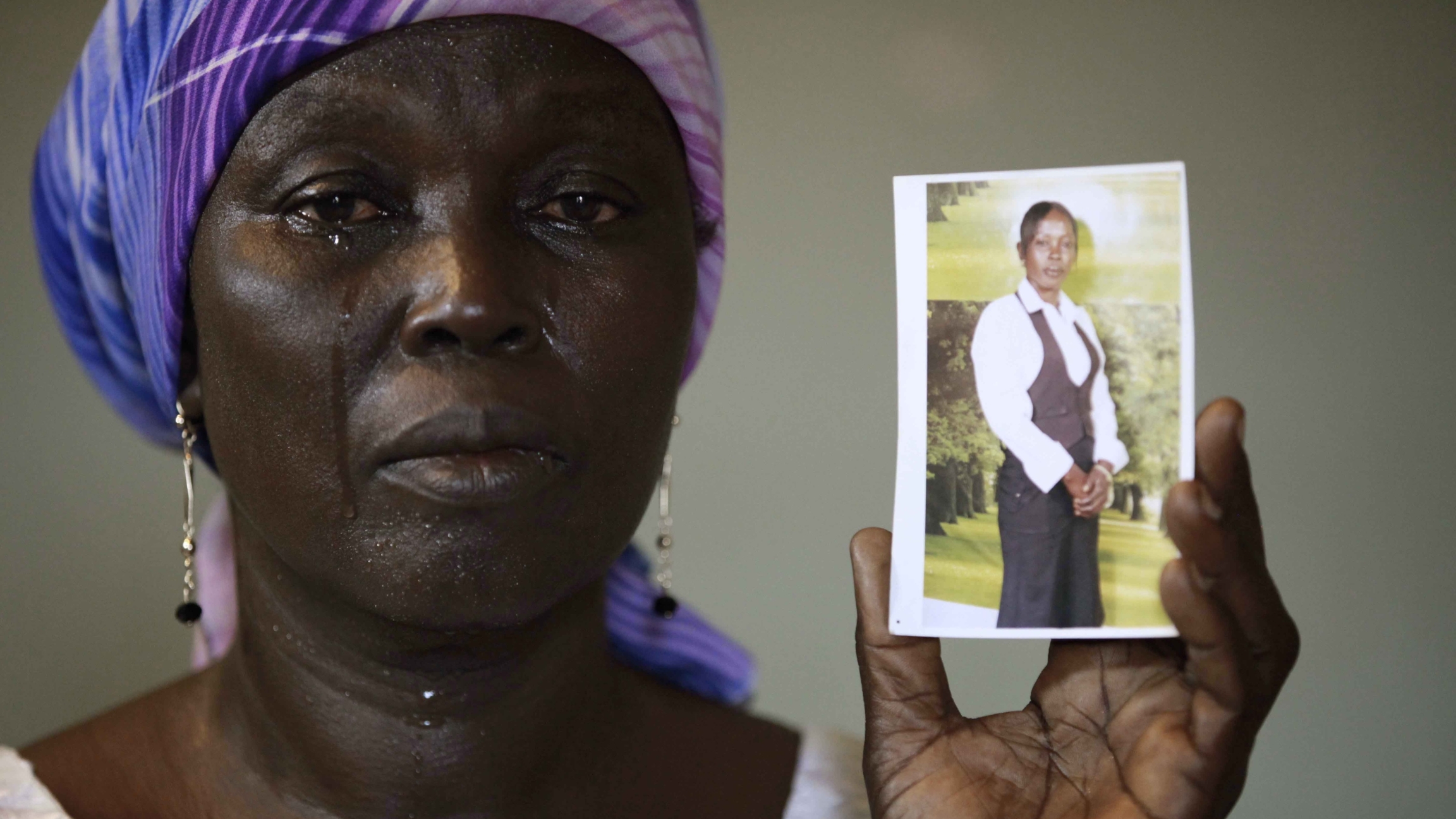
Martha Mark, the mother of kidnapped schoolgirl Monica Mark holds her daughter's photo, in the family house, in Chibok, Nigeria in May 2014. A schoolmate says Mark cried with joy when she saw a Boko Haram video appearing showing some of the kidnapped girls.
Sunday Alamba/AP File
Organizations in Chibok are working to educate people, helping them embrace those who returned, some of them pregnant or with the children they bore in captivity. Still, Muhammed-Oyebode says there is a stigma associated with the sexual exploitation the girls endured.
“I think it's going to take a lot of education for people to begin to realize that these things have happened through no fault of these girls,” she said. “And we actually have a greater responsibility because they were taken under our watch.”
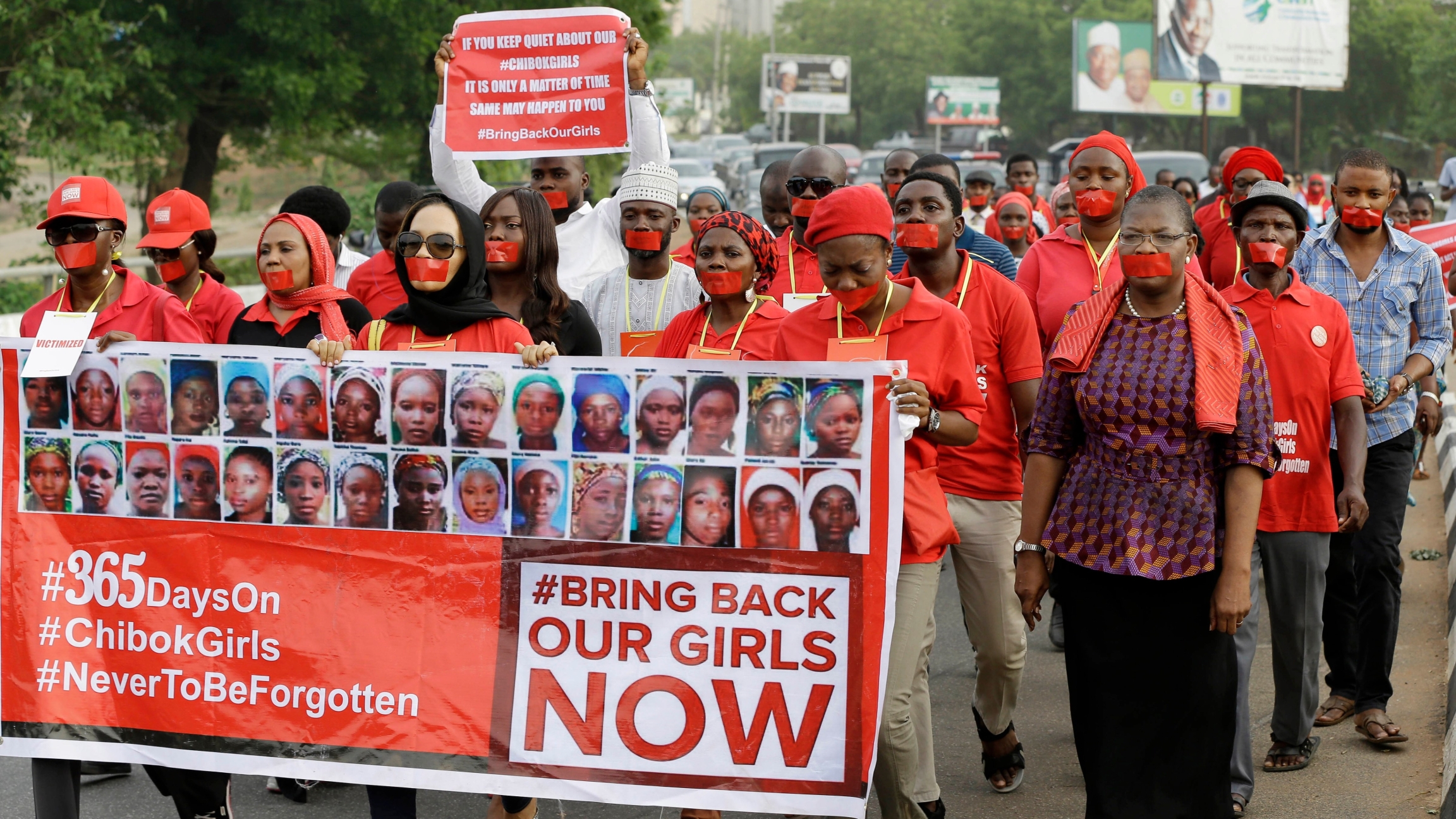
People march on a street in Abuja, Nigeria, during a silent protest calling on the government to rescue the kidnapped girls of the government secondary school in Chibok in April 2015, on the one-year anniversary of the abduction.
Sunday Alamba/AP file
Muhammed-Oyebode’s book, “The Stolen Daughters of Chibok,” with photography by Akintunde Akinleye, was published in the United States by powerHouse Books.
Listen to the full interview of Aisha Muhammed-Oyebode with The World’s host Marco Werman by clicking the audio player above.
Rifkatu Samuel, the mother of Lugwa Samuel, is pictured in her kitchen in Chibok. She wrote an essay for the book "The Stolen Daughters of Chibok" about her daughter, who was released in May 2017, three years after her abduction.
Akintunde Akinleye
When war broke out between Azerbaijan and Armenia in fall 2020 over the disputed region of Nagorno-Karabakh, Margarita Karamyan spent 10 days hiding with her relatives in a basement in Hadrut.
For Karamyan, the incessant buzzing sound of drones used by Azerbaijan remain a vivid memory of the war.
“The sound is psychological torture because you just wait wondering if you’ll get killed or not,” she said.
During the war, Azerbaijan succeeded in knocking out Armenia’s defenses with the aid of a Turkish drone called the Bayraktar TB2 and took over large parts of the contested territory. The 44-day war ended in a ceasefire brokered by Russia. But some say another round of war is inevitable.
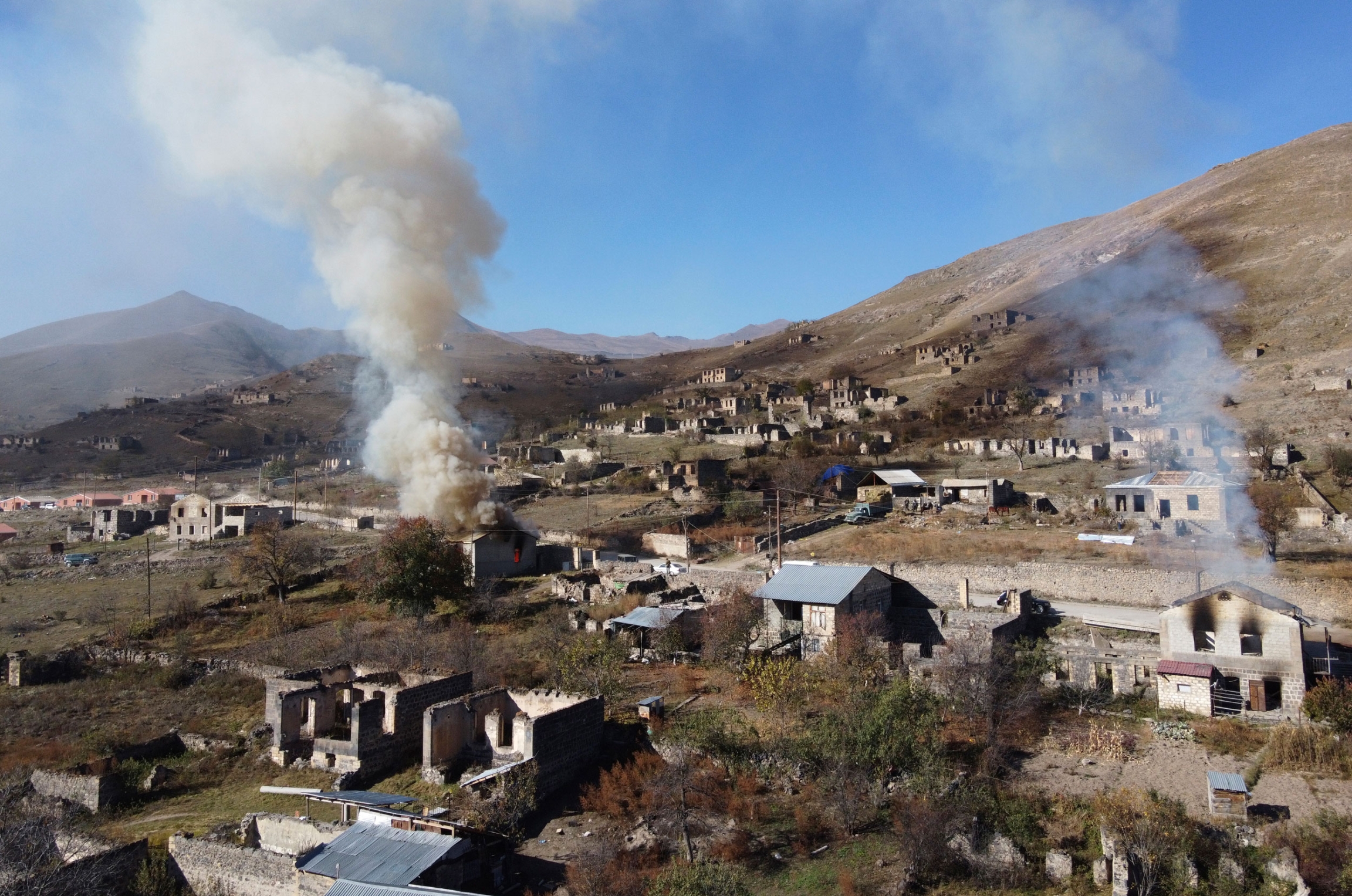
In this photo taken with a drone, smoke rises from burning houses as people leave the separatist region of Nagorno-Karabakh to Armenia, Saturday, Nov. 14, 2020.
Dmitry Lovetsky/AP
Towns like Hadrut were damaged in the fighting and remain under Azerbaijan’s control. The war displaced tens of thousands of Armenians, including Karamyan, who now lives in the Armenian capital, Yerevan.

Ukraine's military has shown surprising effectiveness using low-cost Turkish drones to attack invading Russians.
Graphic/AP
The Bayraktar drone looks like a small airplane that can strike targets with bombs. It’s also relatively cheap, making it appealing to lesser developed countries who use it in conflicts.
Ukraine used Bayraktars to help stop Russian forces from reaching Kyiv last year. The drone is so revered in Ukraine now there’s even a song about it.
After the 2020 war in Nagorno-Karabakh, trucks carrying Bayraktars rolled through Azerbaijan’s capital, Baku, in a military parade celebrating Baku’s victory.
The Bayraktar has often served as a source of pride, but for some Armenians, the drone is a symbol of alleged war crimes committed by Azerbaijan.
“These drones were used not only against the military, but also to bomb and destroy civilian communities [in Armenia],” said Arman Tatoyan, Armenia’s former human rights defender, a government role.
A Turkish company manufactures the Bayraktar; its widespread use in conflicts has helped secure Turkey’s status as a growing weapons supplier.
The drone has also become part of Turkish foreign policy. Turkey is a close ally with Azerbaijan and directly aided Baku to operate the drones used against Armenia in the 2020 war, according to Tatoyan.
Proving whether Bayraktars are responsible for carrying out war crimes against Armenians, like killing civilians, has proven extremely difficult.
Anahit Harutyunyan, the operations manager with the Center for Truth and Justice, a law clinic in Armenia that investigates potential war crimes committed by Azerbaijan, said it's rare to find debris in warzones like serial numbers that clearly identifies drones for launching attacks.
“It’s a really huge tragedy that you can't gather facts to show how our people were killed during the war because after the explosion, there’s nothing left, Harutyunyan said.
But not everyone is convinced the Bayraktar is such an important part of warfare.
Shant Abraamyan, an Armenian who grew up in the US and fought in the 2020 war in Nagorno-Karabakh himself, said he frequently saw drones flying overhead during the war. But he said that the soldiers in his group were scattered enough in the mountains that drones would not hit them.
“People like to say, ‘Oh, Bayraktar is like this big bad wolf,’ but they’re not some magical thing that’s going to win you the war,” Abraamyan said.
Abraamyan said the Armenian government didn’t come down hard enough on Azerbaijan with the weapons they had.
Leonid Nersisyan, a military analyst and research fellow at the Applied Policy Research Institute of Armenia, said that drones did play a key role in Azerbaijan’s victory, but he thinks they have received too much credit for determining the war's outcome.
Nersisyan said that Armenia’s army was poorly organized during the war while Azerbaijan, on the other hand, benefited greatly from Turkey, which provided Baku’s military with training derived from NATO protocols.
The Bayraktar may be even more effective off the battlefield.
“Drones provide high-quality videos, and they are helpful for informational warfare,” Nersisyan said.
Videos of strikes operated by Azerbaijan’s drones were some of the main footage of the 2020 war that first appeared on the internet. Nersisyan said the media sometimes overuses drone videos, which can overstate the role that the Bayraktar has in conflicts in both Armenia and Ukraine.
But Nersisyan said Turkish drones are still a major threat because Armenia never replenished their air defense systems after the last war. Armenia gets most of their arms from Russia, which is overextended in Ukraine.
“Russia practically stopped all its arms exports not only to Armenia, but also everywhere else,” Nersisyan said.
Armenia is now trying to receive arms supplies from India, but vulnerabilities in Armenia's ability to defend itself from drones remain as tensions with Azerbaijan continue to escalate.
Last fall, Azerbaijan attacked border regions in Armenia that killed more than 100 Armenian soldiers.
And for more than three months, Azerbaijani environmental activists suspected of taking orders from Baku have blocked the only road connecting Nagorno-Karabakh to Armenia, known as the Lachin corridor, which has deprived ethnic Armenians living in the region from receiving vital food and medical supplies.
Russia has peacekeepers in Nagorno-Karabakh who are tasked with providing security in the Lachin corridor, but so far, they have failed to stop the blockade.
Former US House Speaker Nancy Pelosi visited Yerevan last year in a show of support to the country, but the United States has yet to offer any tangible aid to Armenia that could help resolve tensions with Azerbaijan.
“The West only really helps us with words by telling Azerbaijan not to attack Armenia, but that doesn't stop them,” said Vaghinak Vartanov, who helps run a school in Yerevan called VOMA that trains Armenian civilians in basic combat techniques as well as first aid and mountaineering skills.

Vaghinak Vartanov, the vice president of VOMA, an organization that teaches Armenians basic combat and survival skills, said that Armenia can't count on foreign powers to defend them from Azerbaijan's aggression so Armenians must defend their small country.
Levi Bridges/The World
Many Armenians now believe that a future, full-scale war with Azerbaijan is inevitable.
On a recent Saturday night in an old movie theater in Yerevan where VOMA runs trainings, an instructor dressed in army fatigues directed a group of men and women aiming fake kalashnikovs at a Soviet-era mosaic on the wall.

Students learn mountaineering skills at VOMA, an organization in Yerevan, Armenia, that teaches civilians survival and combat skills to prepare them to defend the country from a potential invasion from neighboring Azerbaijan.
Levi Bridges/The World
In a future conflict, the students would use these skills to protect their country from a potential invasion by Azerbaijan, similar to how Ukrainian civilians have defended their country.
“We’re ready for peace,” Vartanov said as the students train, “but the only way to bring peace is to prepare for war.”
On Feb. 6, Elçin Ezer’s apartment building collapsed in the massive, 7.8-magnitude earthquake that ripped across southern Turkey.
She survived underneath the wreckage for four days, hugging her daughter as she died in her arms. Her mother and her son were in the next room, but she never heard their voices. She thinks they both died on impact.
The shaking destroyed at least 55,000 buildings in Hatay, the province for which Antakya is the capital. Thousands died — including at least 700 in the collapse of a single luxury apartment block. Survivors emerged into a waking nightmare.
Immediately after the earthquake, Ahmet Sarp used his mechanical lift to rescue survivors from upper-floor apartments in buildings that were still standing, but whose staircases had collapsed. Today, he uses it to help families salvage furniture from their damaged homes. Renting the machine and hiring workers can cost $500 per apartment.
Durrie Bouscaren/The World
Every day, Ezer walks to the pile of rubble that used to be the home she shared with her two children, who were 8 and 13. She’s haunted by the fact that rescue workers didn’t arrive at the site for days. Her ex-husband drove from Antalya to dig her and their children out, she said.
“People ask me why I came back, and I don’t know what to tell them,” Ezer said. “My legs brought me here on their own.”
Antakya today is a city of grief. At least 57,658 people have been confirmed dead in Turkey and northern Syria following the earthquakes, with many still missing. Though many residents have left the city to escape the risk of aftershocks, many remain to mourn, offer support and rebuild.
“I feel better here,” Mehtap Yılmaz said. “Here, I lost so many friends, relatives — so many close friends. But we’re trying to stick together.”
A dusty haze hovers above the ruins of buildings as crews tear down wrecked apartments. The Turkish government has promised to rebuild earthquake-damaged cities within the year. But with 1.5 million people across an 11-province disaster region now homeless, that seems impossible.
Perihan Yüksek prepares tea in a makeshift tent that functions as a kitchen.
Durrie Bouscaren/The World
These days, almost everyone lives in tents or converted shipping containers — some in formal camps, others in public parks, or among the ruins of their homes and neighborhoods. Children can attend one hour of school per day in tent camps.
In Antakya’s city center, there are creative solutions for small, daily comforts: Fresh baklava sold from a tent. A mobile ATM fashioned out of a van. A phone store set up in a shipping container.
“When I see someone who I knew before the earthquake, it’s incredibly emotional … it’s like we didn’t understand the feeling of being sad,” said Onur Aşkar, a barber who offers shaves and haircuts underneath a tarp set up in a street median.
Sami Joba chopped onions for kebabs, which he grills on a charcoal stove. He lost his restaurant in the earthquake. But his friend, who drives a school van, was also out of work. They converted the van into a setup for an outdoor kitchen, with the slogan that translates in English to: “If I don’t eat, I will die.”
Açeyla Açıkbaş, Ozhan Açıkbaş and Sami Joba run a mobile kebab shop in downtown Antakya.
Durrie Bouscaren/The World
One kebab, wrapped in a flatbread with onions and tomatoes, costs 50 Turkish lira — about $2.50. For families living in tent cities, it’s a rare chance to eat hot food that they’ve chosen for themselves.
“It’s cheap, and it has a nice taste,” Joba said, without looking up from his work. “And — we don’t have anywhere to cook now.”
For Selma Koşar, who waited with her 12-year-old son for their order, it was the first time they had had a kebab since the earthquake. The two are staying in a tent city nearby.
“It’s always soup, beans and rice,” she said. “But it’s not for me — it’s for my son. We don’t have enough money.”
After the earthquake, Koşar said, her son couldn’t speak or eat for several days. When she saw him get excited about having a kebab, she couldn’t say no.
Suleyman, a truck driver, lost his family in the earthquake. He has remained in Antakya to help families salvage furniture from their wrecked homes.
Durrie Bouscaren/The World
Throughout the daylight hours, debris is cleared and packed onto trucks, which are driven out of town and dumped along the highway. Tall mechanical lifts, which spent the first weeks of the disaster pressed into service to rescue survivors, now line up to the rickety husks of apartment buildings as people salvage furniture from their damaged homes.
Climbing up into these apartment blocks is dangerous work, but it pays well.
Anas Saghir, a Syrian refugee, said that he sent his wife and children to Konya, a city that sits further away from earthquake fault lines. But he stayed behind to work.
Every day, he said, his kids cry on the phone, asking him to come for them. They were traumatized by the frantic escape from their home in the early morning hours; the staircase of the building collapsed as the family rushed downstairs, hitting Saghir in the head.
“They’re always saying ‘baba, baba,’” he said, fighting back tears.
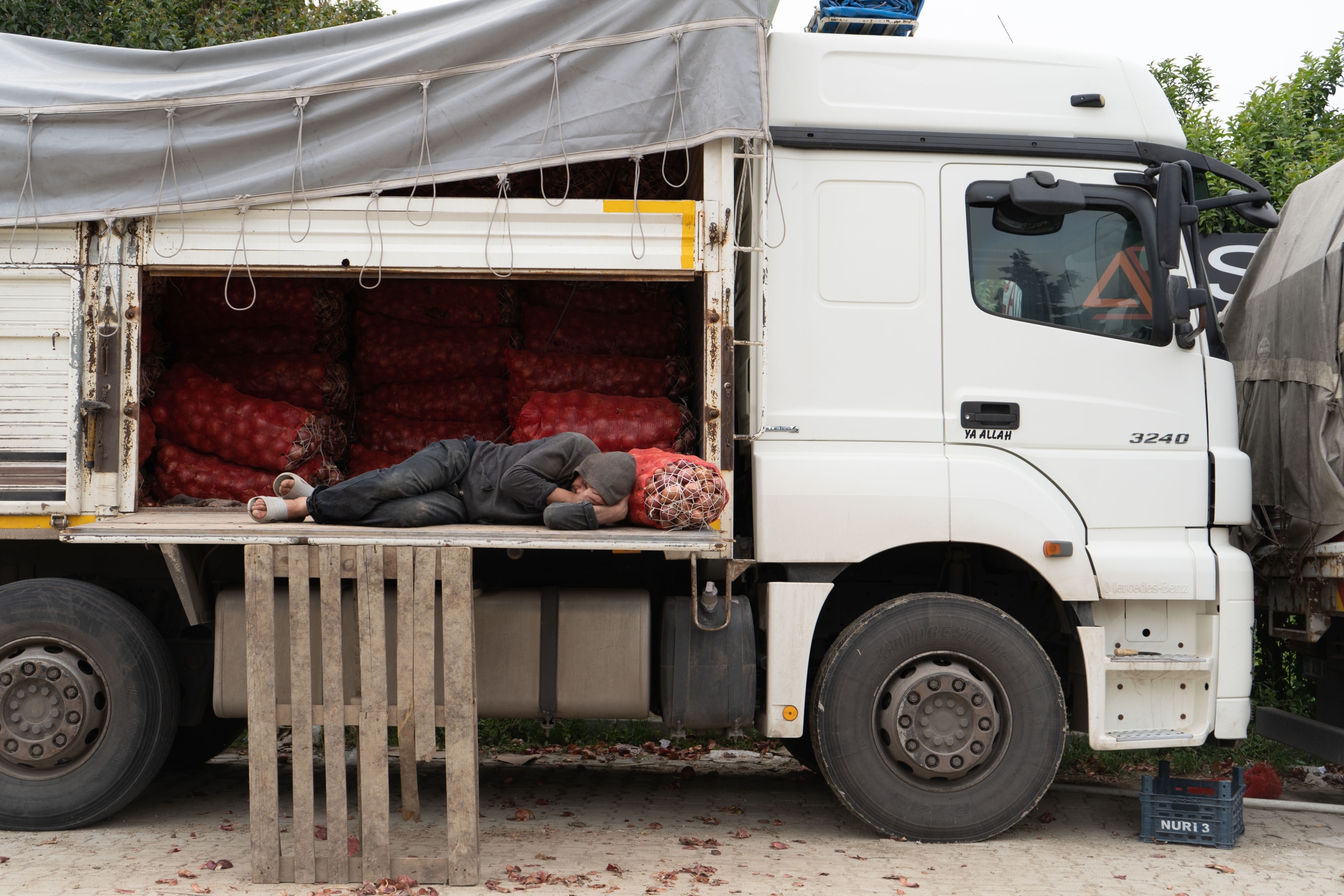
A worker sleeps during a short break while transporting onions in Hatay.
Durrie Bouscaren/The World
At night, he sleeps in a tent in the ruins of a baklava shop. He’s just grateful they all survived.
“Thank God for everything,” he sniffed.
Other families have moved to the hills where villages ring the outskirts of old Antakya.
Perihan Yüksek used a match to light a propane stove in a makeshift tent that serves as a kitchen. She came to the village after the earthquakes to be with her cousin, Bedia Yüksek, who’s mourning the loss of her daughter, Huliya.
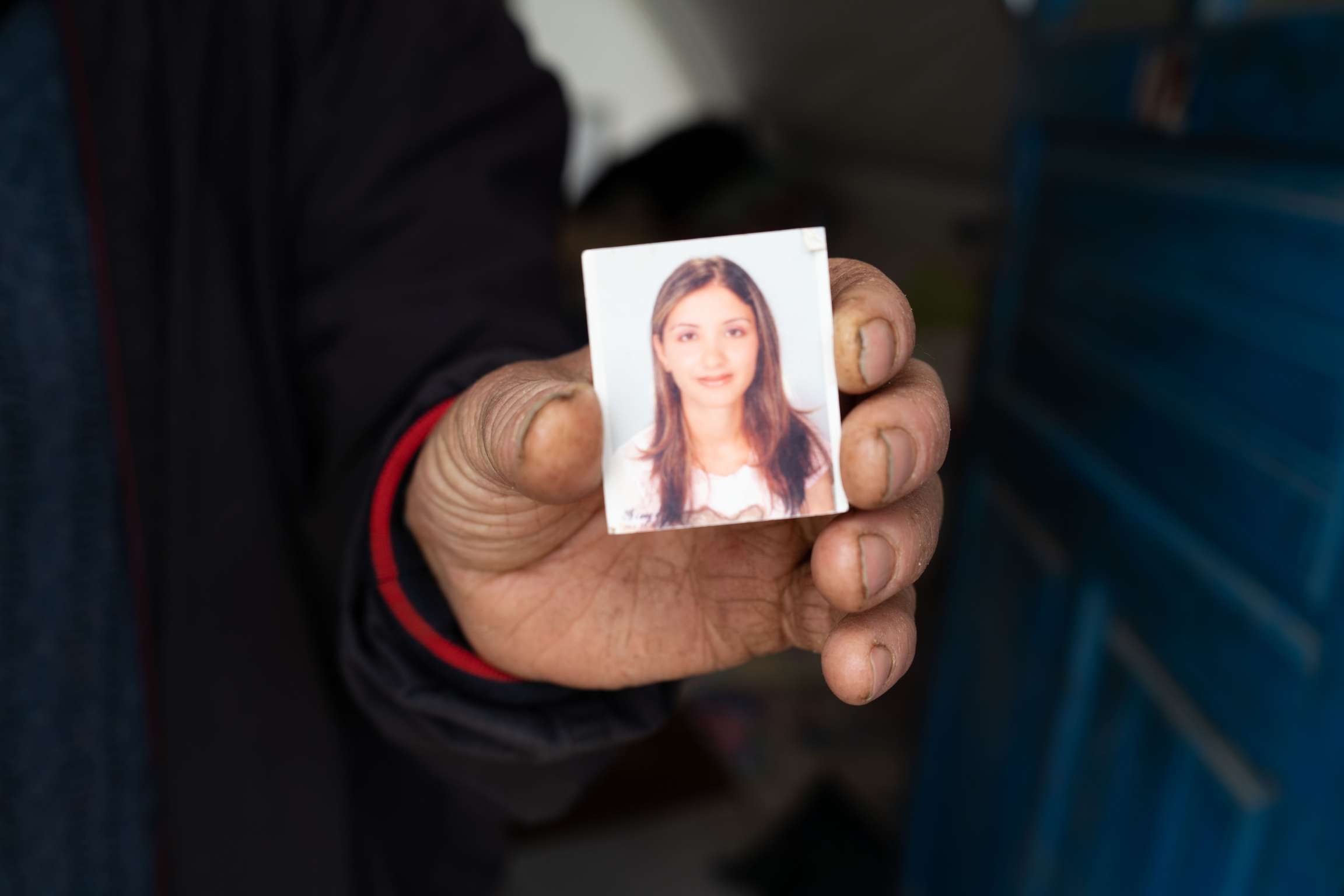
Bedia Yüksek holds a photograph of her daughter, Huliya, who died in Antakya during the earthquakes on Feb. 6.
Durrie Bouscaren/The World
“Whenever I’m in the tent, it feels like the pain is going to kill me,” Bedia Yüksek said.
Her daughter was sleeping in her apartment in Antakya when the earthquake hit. Perihan Yüksek’s son, who was also living nearby, survived, but lost both of his legs.
The Yükseks' home is still standing, but appears as if it could collapse at any moment. Bedia Yüksek and her husband set up donated tents in the garden and wired them with electricity. On a recent visit, several mattresses have been prepared for relatives who will visit in the coming days. A photograph of their late daughter sits next to the television, watching over them.
“Life continues, because it has to,” Perihan Yüksek said. “Life goes on until God takes it from us.”
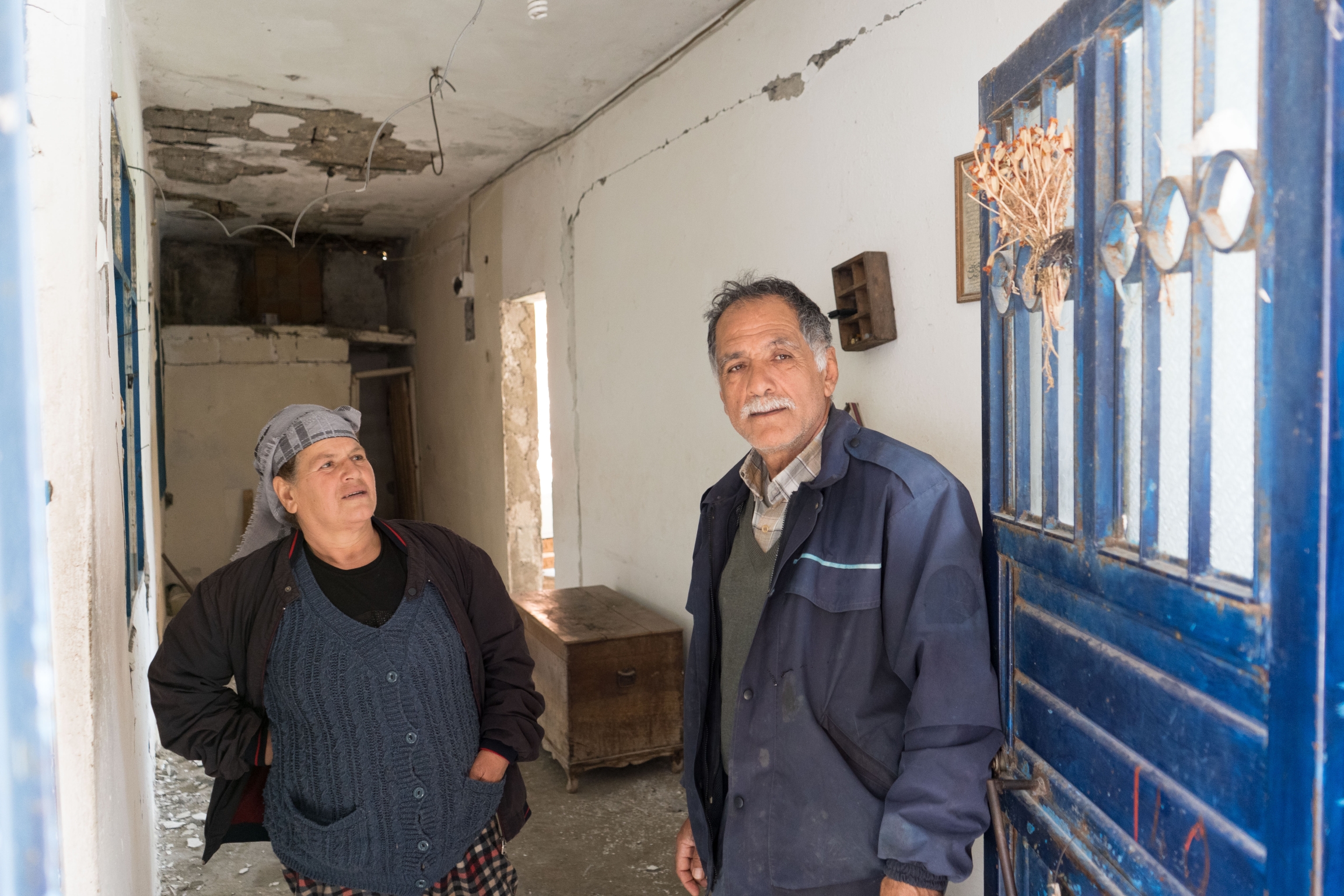
Bedia Yüksek and Mehmet Yüksek’s home remained standing after the earthquakes, but is no longer safe to live in. They’ve been staying in tents ever since.
Durrie Bouscaren/The World
Days are spent washing clothes by hand, cooking outdoors and making improvements to the tents so they stay dry in the rain. They eat eggs from their chickens and oranges from their garden. But the Yükseks are determined to stay until their home is rebuilt.
It’s like going back in time, Perihan Yüksek mused over a glass of tea. As she finished her cup, she flung the extra out onto the dirt floor.
“I guess that’s something,” she said. “If you don’t have a living room, there’s nothing to clean.”
Two prominent Chinese human rights lawyers have been sentenced to more than a decade in prison, Human Rights Watch said Monday, the latest in a crackdown by the ruling Communist Party on its critics.
The rights group said Xu Zhiyong, 50, was sentenced to 14 years and Ding Jiaxi, 55, was given 12 years in prison under the vague charge of “subversion of state power.” Such proceedings are conducted under intense secrecy.
Xu and Ding are among a generation of Chinese who held out hope that the ruling party would adopt a more liberal approach to governance after the political chaos of the 1966-1976 Cultural Revolution and the bloody crackdown on student-led pro-democracy protests centered on Beijing’s Tiananmen Square in 1989.
The current party leader and head of state, Xi Jinping, has quashed such beliefs with a renewed emphasis on strict party control over civil society and free speech. He and the loyal members he chose for the Politburo Standing Committee justify their monopoly on political power by citing China’s success as the world’s second-largest economy, with its tightly enforced social stability and rising global influence.
Both Xu and Ding had served multiple years in prison for their dissident stances and promotion of those deprived of a voice within the country’s authoritarian political system.
Sophie Luo Shengchun, a Chinese activist, is Ding's wife. She spoke to The World's host, Marco Werman, from exile in New York.
This interview has been lightly edited and condensed for clarity and length. The Associated Press contributed to this report.
In a preschool classroom in Boston’s Chinatown, kids at pint-sized, wooden tables solve puzzles and play with Legos while others crowd in front of a full-sized mirror, waving their fists in the air, pretending to be angry.
“How is this friend feeling?” preschool teacher Danielle Kelley asks the kids near the mirror.
“Frustrated,” answers a little girl in a fuzzy, bunny sweater. Then, she practices smelling flowers, blowing bubbles and taking deep breaths.
At the Acorn Center for Early Education and Care run by the Boston Chinatown Neighborhood Center (BCNC), a nonprofit that serves recent immigrant families in the area, students learn how to manage big feelings — especially pandemic-related ones — which they say families have recognized as a growing need.
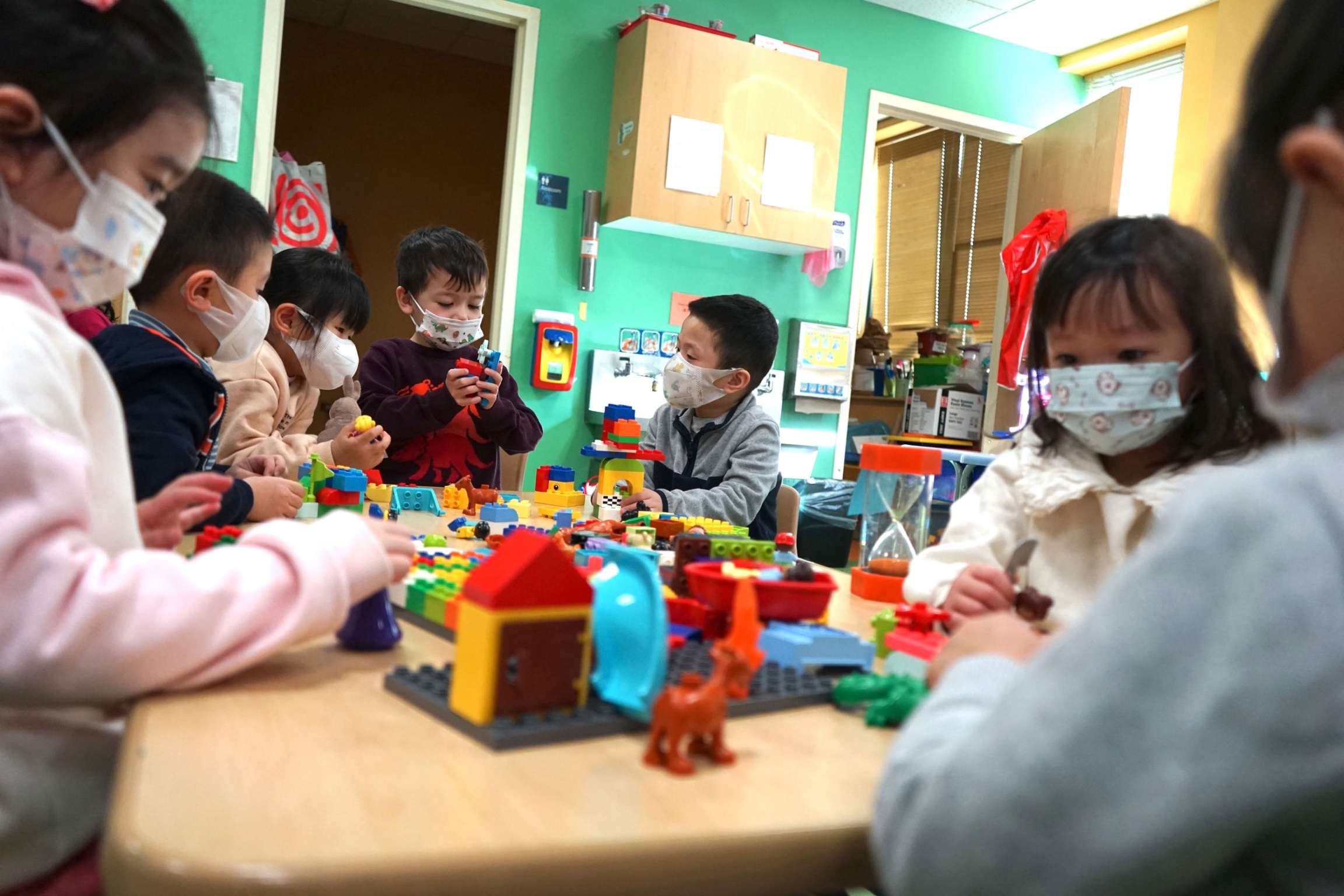
Children are abuzz with building Legos in the preschool classroom.
Heidi Shin/The World
Grace Su, BCNC’s director of family services, said that during the peak of the pandemic, the center received four times the usual referral rate for mental health counseling.
“It could be a child or a youth who was experiencing some symptoms, like not being able to sleep, not being able to eat or feeling anxious about going out,” she said.
Some observers say the challenges stem, in part, from the fact that recent immigrants in Chinatowns across the US were particularly hard hit with anti-Asian sentiments that increased during the pandemic, with half of Asian Americans in the US reporting anxiety symptoms, according to the Stop AAPI Hate Coalition.
Online learning also left its mark, with children behind in their academic and social-emotional learning and in managing their mental health needs.
To help respond to kids’ needs, BCNC brings in social workers and psychologists from Boston Children’s Hospital to help train classroom teachers to better support their students’ abilities to express their feelings — especially COVID-19-related trauma.

Students solve puzzles, take on math and reading challenges, in addition to learning about feelings.
Heidi Shin/The World
The partnership predates the pandemic, but BCNC’s chief program officer, Yoyo Yau, said the needs have become even more urgent.

A quiet calming corner where students come independently to explore how they are feeling. The staff focuses on feelings that Chinese immigrant parents might not talk about at home, things like being “angry” or “upset.”
Heidi Shin/The World
Acorn focuses on creating time and space for the children to learn to express themselves, identify and articulate their emotions and talk through challenges to find solutions, with a variety of visual aids and exercises for different kinds of learners.
In the classroom, there are three “quiet calming corners,” each one designed to help kids manage their emotions.
One corner hosts a beanbag chair and mirrors, with pictures of faces on a colorful chart in both English and Cantonese. The grid displays a range of emotions; kids try to match their own faces to the illustrations.
Staff say they focus on teaching about feelings that they might not typically talk about at home, like being angry or upset.
They also watch out for kids coming in with new fears, mood changes or feeling startled or getting scared easily. This, in addition to having physical symptoms like belly aches, nightmares, toileting regression and physical aggression.
“It helps children to name feelings so that they're not overwhelmed by what they're experiencing emotionally,” Su said.

A student draws about their emotions in the classroom’s feelings journal. Children often use this tool when they’re feeling stressed, angry, or confused.
Heidi Shin/The World
These preschoolers are known as “pandemic babies,” born during the peak of the COVID-19 pandemic, many into stressful situations, according to BCNC’s chief program officer, Yau.
Some parents lost jobs. Grandparents feared being attacked on neighborhood streets. Siblings were bullied online as anti-Asian rhetoric increased. The stress led to conflict in the families, which the kids saw and felt daily.
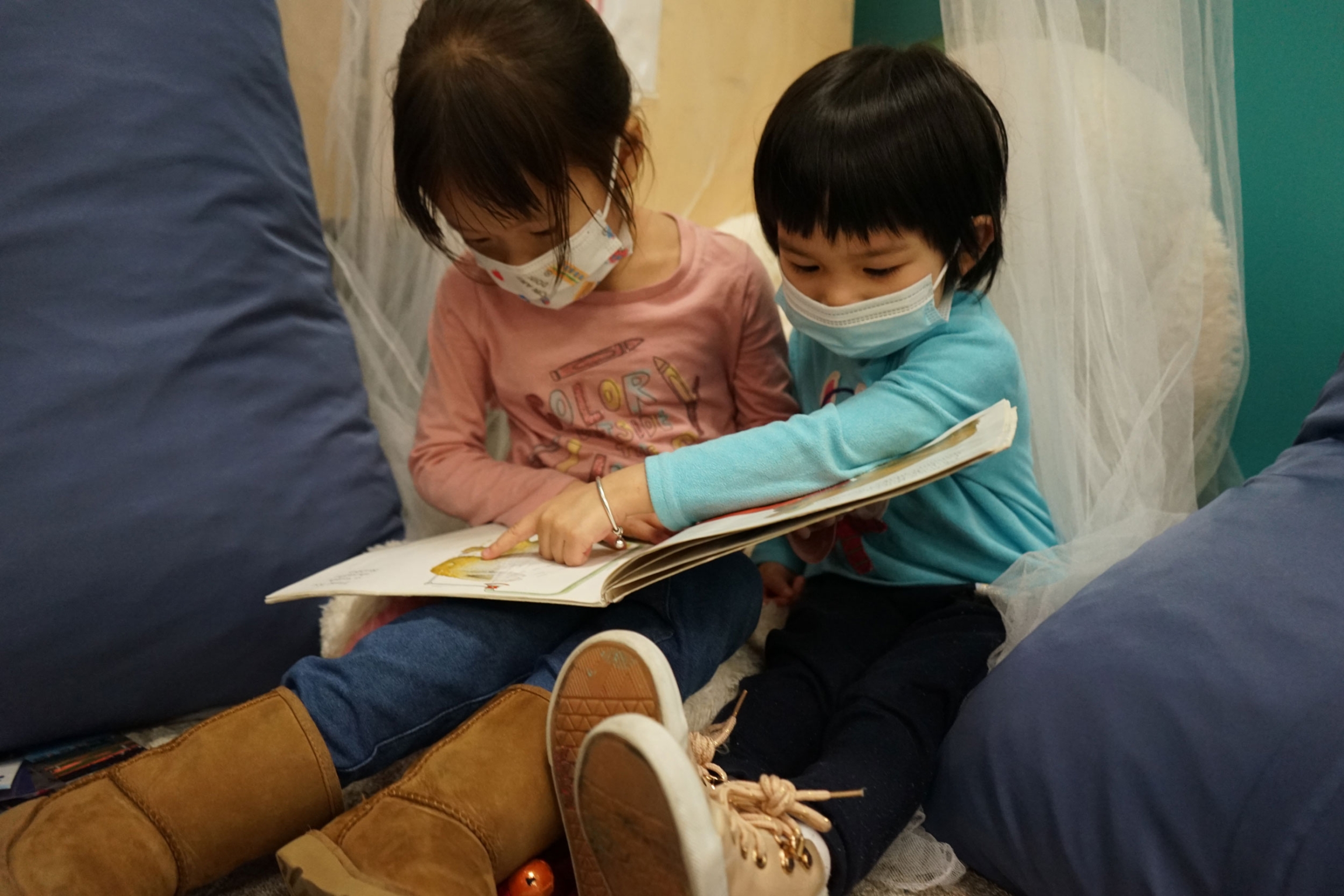
In the conflict resolution corner, children reconcile with each other when there has been a disagreement.
Heidi Shin/The World
Preschool teacher Kelley opened a spiral notepad, full of drawings and scribbles in pencil — a kind of preschooler’s version of journaling.
It’s a specific notebook that kids choose in the calming corner to express bottled up emotions.
“It only works for some of the children,” she emphasized, holding the notebook and pointing to an entry: “So, this is when one of the children was writing that they felt stressed, confused, angry. This would be angry.”
Across the classroom, near the library and toy cars, there’s the fix-it station — it’s the corner for conflict resolution, where kids are sent in groups by teachers when they fight or disagree.
The teacher helps them with conversation prompts like: “When you said that, this is how it made me feel.”
Kids choose a solution from a stack of laminated cards. Some options include: Ask with polite words. Find a teacher to help. Set the timer, so you know when your turn is up.
“A lot of them choose the timer. That's a big hit in our classroom, is going to get the timer,” Kelley said.
Teachers take note of who comes here a lot. They also observe who’s not using the calming corners, who is doing their best to get everything right, to never make mistakes, because, they say, they’ve learned that for some Asian immigrant kids, sometimes the ones who are doing well at school are the ones whose families are struggling at home.
They’re trying hard to compensate, so their parents, who are under a lot of stress, will have one less thing to worry about, Yau said.
“Having excellent grades at school does not mean [there are] no problems at home,”she said. “I hope service providers, educators [and] school counselors do not underestimate Asian immigrant kids’ mental health struggles.”
Yau said she suggests that educators pay more attention to whether a student is quieter than usual, complains about not feeling well or is feeling a lot of pressure to do well at school. Also, if a child’s pickup or dropoff person has changed, something at home might have changed, too.
The preschool program is just one part of what the BCNC does to help families.
Through additional one-on-one sessions and workshops, they teach parents that it’s OK for kids to express negative feelings at home and that it doesn’t mean their children are acting out.
They also teach parents that naming feelings is the first step toward learning how to manage them. Su said that it’s a type of parenting that they might not have grown up with themselves.
It means “leading the parents to reflect back on their childhood experiences, their relationship with their parents growing up, messages that they received as a child and how that has [an] impact on their children, now that they’re parents,” Su said.
Staff also check in with parents about their families’ needs outside of school, such as job training, English language lessons or counseling. And BCNC supports parents whose kids have additional developmental needs.
Like Shenying’s 5-year old son Caden, who attended the Acorn preschool. Shenying’s full name isn’t being used to protect the family’s privacy.

Preschoolers at the BCNC preschool are learning to manage emotions related to conflict and turn-taking.
Heidi Shin/The World
Shenying said that Caden didn’t seem to communicate and move like other kids did; he wouldn’t speak, and he’d bang his head against the wall.
“So, it was really difficult for me, and every time I saw these behaviors, it was really heartbreaking. I didn’t know how to do a lot,” Shenying said.
She soon learned her son had autism, but the process of lining up support services at school, including speech and physical therapy services, involved paperwork and wait lists of months to years, due to a backlog of requests after pandemic restrictions were lifted.
Shenying, with help from BCNC's social workers, said she learned to navigate the process — and advocate for herself.
“I know that I have a right to file a complaint, to know my rights. BCNC helped me to understand this,” Shenying said. “In the past, I was really scared about everything, but right now, I think I’ve become more powerful, brave.”
She added: “I know that if something happens, I can ask for help and I know there will always be good people who can help.”
As for Caden, he has made progress since his diagnosis, she said, and there’s been one really big significant change. In the past, Caden would push his father away. He wasn’t very affectionate — but now, he loves to give hugs.
To listen to part two of this story, click on the audio player below.
This project was supported by a reporting fellowship from The Dart Center on Journalism and Trauma at Columbia Journalism School.
In the past five years, India accounted for 11% of global arms imports — more than any other country — and nearly half of them came from one source: Russia.
India buys everything from Russian armored tanks to rifles to surface-to-air missile systems.
The Indian navy’s flagship aircraft carrier, the INS Vikramaditya, is a refurbished, Soviet-era warship. Also, Russian-origin fighter jets like the Sukhoi Su-30MKI make up a significant portion of the Indian air force fleet.
For decades, India has depended on Russia for its weapons supply. It's the cornerstone of the two countries' ties, which go back to the Cold War. But the dependence can also be a liability, as New Delhi has found out in recent weeks.
In March, the Indian Air Force informed the country’s parliament that a major delivery of Russian weapons systems had fallen through because of the war in Ukraine.
Ever since it began its invasion of Ukraine, Russia has limited its arms exports in an attempt to prioritize supplying its own armed forces. Now, India is staring at an indefinite wait for critical supplies, including the S-400 Triumf air defense system.
“The mainstay of the relationship itself is beginning to crumble,” said Rajeswari Pillai Rajagopalan, director of the Centre for Security, Strategy and Technology (CSST) at the Delhi-based think tank Observer Research Foundation. “This will also put into question the feasibility of maintaining that relationship in the longer term.”
India’s dependence on Russian weapons also came up this week during Ukraine’s Deputy Foreign Minister Emine Dzhaparova’s visit to New Delhi.
“We only think it is crucial to diversify all of the resources, not only energy, but also military resources,” Dzhaparova told reporters. “When you are dependent [on] Russia, they always use this blackmail instrument.”
Over the past year, India has been walking a diplomatic tightrope between Russia and the West. While Prime Minister Narendra Modi has called for an end to the fighting in Ukraine, he has not criticized Russian President Vladimir Putin.
India has also abstained from voting in several United Nations resolutions condemning Russia.
“India was concerned that if India took a sort of adversarial position, or called out Russia by name, Russia would stop the supplies [of weapons] or Russia would not give out the spares or Russia would delay the maintenance,” Rajagopalan said.
To complicate matters further for India, Moscow has been getting closer to Beijing, New Delhi’s biggest rival. In March, Chinese President Xi Jinping visited Moscow, and some military experts suggest China is also supplying military equipment to Russia, although Beijing denies the claim.
As China emerges as Russia’s strongest partner, Indian policymakers may be reassessing Russia’s reliability, said Rajan Menon, director of the Grand Strategy Program at Defense Priorities, a Washington, DC-based think tank, and a scholar at the Carnegie Endowment for International Peace.
But Menon said he doesn’t expect India to abandon its ties with Russia altogether.
“India simply cannot afford to burn bridges with Russia, nor does it need to because of the Russia-China alignment,” he said. “It's in India’s interest to have a strong relationship with Russia.”
Russia and China’s relationship may be making India uncomfortable, but despite the national security implications, Rajagopalan said that New Delhi will want to keep Moscow close.
“Russia is getting closer to China. Unless we stay close to Russia and not isolate them, not abandon them, Russia will grow even further closer to China. We need to avoid that. I think that will still be the argument that you will hear on the Indian side,” Rajagopalan said.
At a conference in March, India’s foreign minister, Subrahmanyam Jaishankar, echoed that sentiment: “India-Russia relations have remained extraordinarily stable. And I put it to you there is a deeper underlying convergence, a geopolitical convergence.”
The convergence dates back to the early years of the Cold War when Moscow emerged as the main supplier of weapons to New Delhi while the United States was backing India’s rival Pakistan.
“There's an entire cadre of people in the Indian political leadership and the foreign policy establishment that have memories of how reliable a partner Russia has been,” Menon said.
But at the same time, he said, India has also been moving closer to the West.
“The relationship with the US has transformed enormously. India has participated, for some years now, in a multilateral naval exercise, along with Australia, the US, Japan and East Asia,” Menon said.
All this shows, he said, that India is adjusting to new geopolitical circumstances.
“India will kind of play a balanced role between Russia and the West and will not put itself in a position where it'll be forced to make a choice,” Menon said, adding that such a position can also be advantageous for India.
“It can navigate between the two. It increases India's leverage and influence.”
On the defense front, the Ukraine war has been a reality check for India, Rajagopalan said. Long delays in getting vital defense supplies could leave India in a vulnerable position against neighbors like China.
India and China have been engaged in a standoff over their disputed border in the Himalayas. In 2020, tensions reached a boiling point when a violent scuffle broke out along the unmarked border and 20 Indian soldiers were killed.
“India is in the middle of an active conflict with China, and we need weapons systems and various platforms to defend against China,” Rajagopalan said. “I think this really would call for some introspection in terms of how India needs to have a fresh review of its defense capability acquisition, whether Russia would continue to be a reliable player or not.”
India had already been trying to reduce its dependence on Russian weapons. Its defense imports from Russia are down to 45% from 85% during the Soviet era, Menon said.
Russian weapons in India’s military are being replaced by equipment from new players like Israel, France and the US. The recent disruption in Russian supplies will only quicken the pace of India’s defense diversification, Pillai said.
India is also ramping up domestic manufacturing of weapons, although, Menon said, it has a long way to go to become anywhere near self-sufficient.
As India and Russia’s defense partnership erodes, the relationship itself is evolving, Menon said.
“This is a relationship that was very predictable in the Cold War. It's evolving in a different direction, but it's not evolving towards some irreparable breach between New Delhi and Moscow,” Menon said.
And that evolution is already palpable, India’s foreign minister, Jaishankar, has suggested.
“As a result of the Ukraine conflict, Russia will turn more towards Asia,” he said in March. “One part of that, a big part of that, will actually be visible in India-Russia relations, and that is already visible actually in trade.”
In the past year, trade between India and Russia has broken previous records and India has emerged as one of the largest buyers of heavily discounted Russian crude oil.
Michael, 27, said he started developing feelings for the same sex when he was a teenager. When he came out to his parents, he said they disowned him and threatened to poison him.
Michael, who asked not to use his last name for safety reasons and lives in Accra, Ghana, said he still does not feel free to explore his sexuality, especially in the wake of proposed anti-LGBTQ legislation currently being discussed in the country's Parliament.
“Now, I find it difficult to go to town and even just be myself. Because you don't know who will suspect you of being gay or lesbian and probably lynch you or do anything harmful to you. Because now, the homophobia is so high,” he said.
Ghana’s proposed law criminalizes gay sex, which could mean up to 10 years in jail for LGBTQ people — and their advocates. The bill calls on Ghanaians to report those they suspect of being part of an LGBTQ community. LGBTQ people will also be forced into so-called conversion therapy — a practice widely condemned globally.
Michael said some of his LGBTQ friends have been beaten, tortured and nearly killed.
Like many LGBTQ people in Ghana, Michael said he wants to flee the country before the bill is passed.
“Most of us just want to go to Europe or the US for asylum. We cannot even live in this country anymore because the bill will ignite so much hate and homophobia that even getting a job will be difficult not to talk of getting a place to live or to rent for yourself,” he said.
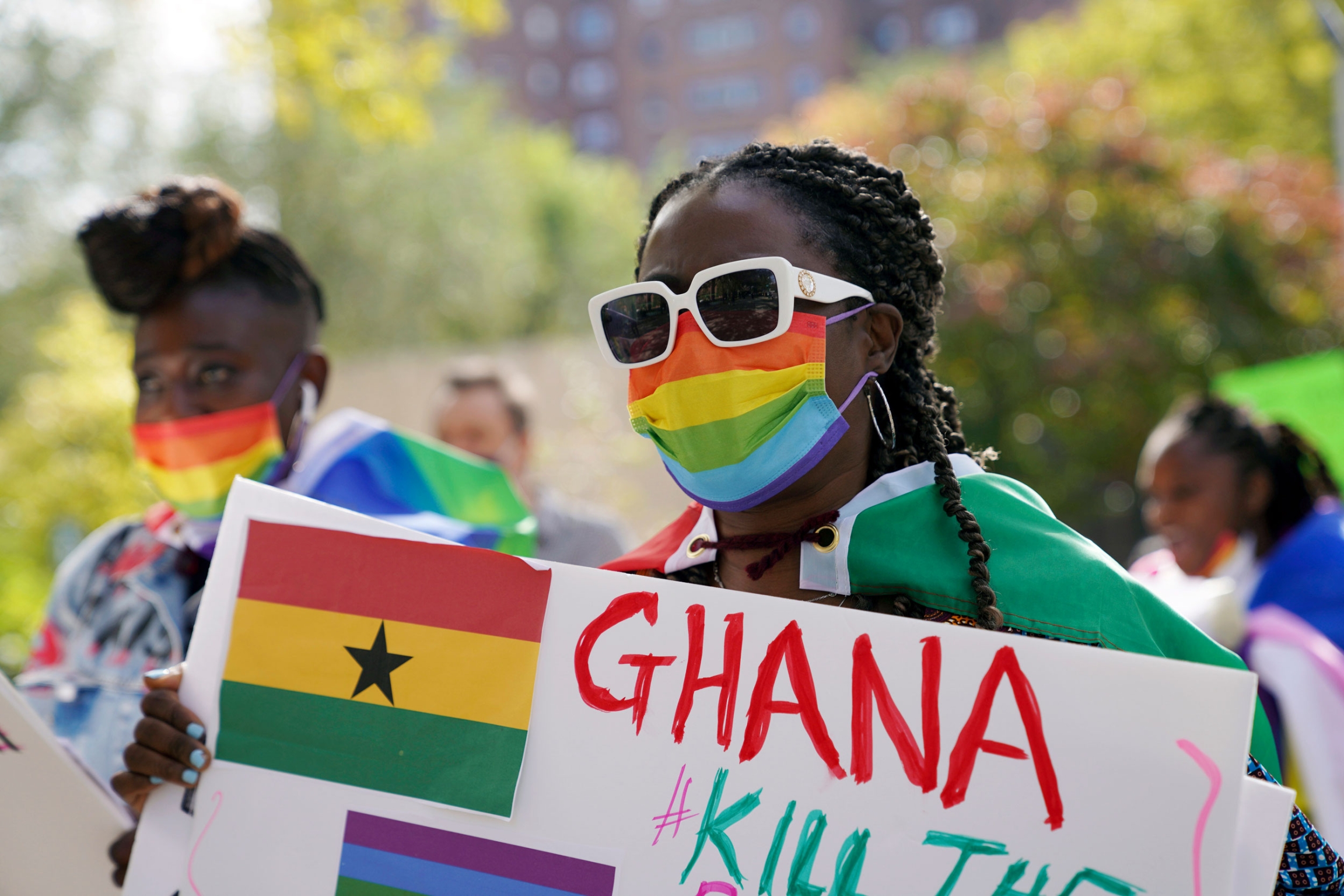
Wilhemina Nyarko attends a rally against a controversial bill being proposed in Ghana's parliament that would make identifying as LGBTQIA or an ally a criminal offense punishable by up to 10 years in prison, in the Harlem neighborhood of New York, Oct 11, 2021.
Emily Leshner/AP
Homosexuality is illegal in more than half of the countries in Africa, with four countries enforcing the death penalty. Globally, 67 countries have laws that criminalize homosexuality, and nearly half of these are in Africa.
Ugandan lawmakers passed anti-gay legislation just last month. LGBTQ people in Uganda risk life in prison under a new bill that aims to crack down on homosexual activities.
All but two of the 389 legislators voted for the hard-line, anti-homosexuality bill, which introduces capital and life imprisonment sentences for gay sex and “recruitment, promotion and funding” of same-sex “activities.”
It also includes the death penalty in certain cases.
“A person who commits the offense of aggravated homosexuality and is liable, on conviction to suffer death,” stated Robina Rwakoojo, Uganda’s chairperson for legal and parliamentary affairs.
The bill will now be sent to President Yoweri Museveni to sign into law. Museveni has been an outspoken driver of anti-gay measures and has accused LGBTQ people of undermining stability in Uganda.
Museveni at a recent meeting called on African leaders to reject “the promotion of homosexuality.”
Robert Akoto Amoafo, a Ghanaian human rights advocate, worries about the bill's impact.
“I am sad and concerned mainly about the LGBT community in Uganda, about the impact of this bill on their daily lives and especially for those who have come out as LGBT people who are known by their community,” he said.
Robert Akoto Amoafo, a Ghanaian human rights worker, is concerned about the future of LGBTQ Africans.
Courtesy of Robert Akoto Amoafo
Last year, authorities also closed down Sexual Minorities Uganda, an organization that supported LGBTQ people in the country.
A Ugandan lesbian staying in Kampala, the capital, who also requested anonymity for her safety, said the anti-gay law means she can no longer stay in Uganda with her partner.
“Even before such a law, we were being treated like pigs in this country. Now, what this anti-gay law does is to grant people permission to hate and harm us with impunity,” she said.
Akello, a gay man from Mutare, Uganda, said that some of his LGBTQ friends have already been blackmailed from people threatening to report them.
“We are extremely scared at this point,” he said.
Uganda’s anti-gay law has resonated with some African leaders.
George Peter Opondo Kaluma, a member of Parliament in Kenya, cited the Ugandan anti-gay law as his motivation to submit the Family Protection Bill to the National Assembly of Kenya.
The new bill proposes a ban on homosexuality, same-sex marriages and any other LGBTQ-related activities. It also clamps down on funding for LGBTQ advocates and allies.
Ghanaian Parliament Speaker Alban Bagbin urged lawmakers in a recent meeting to take inspiration from Uganda and expedite the passage of the country’s anti-LGBTQ bill.
Amoafo, the human rights worker, is concerned that African countries and politicians are influencing one another through this type of legislation.
“In Uganda, in Ghana, in Kenya, in Mali and in Niger, it's only politicians that are making these statements. And of course, politicians who see this as an opportunity to make more numbers for their votes,” referring to Ghana’s upcoming 2024 election.
Henry Ikenna Ugwu, a human rights activist based in Nigeria, said religious leaders and politicians in his own country are fueling hate predicated on traditional values.
“As long as traditional and cultural values continue to shape public discourse, it will be difficult for LGBT individuals to gain full acceptance and protection under the law,” he said.
Henry Ikenna Ugwu is a human rights activist based in Nigeria.
Same-sex relationships are illegal in Nigeria. And in many jurisdictions, flouting these laws could lead to long prison sentences.
Many of the laws criminalizing homosexual relations stem from colonial times.
Out of 53 countries in the Commonwealth, a loose association of nations that are mostly former British colonies, 29 have laws that criminalize homosexuality.
The original British laws applied only to men, but countries that criminalize homosexuality today also penalize lesbians.
Some African countries, however, have recently moved to decriminalize same-sex unions and improve LGBTQ rights.
In February 2021, Angola signed into law a revised penal code to allow same-sex relationships and ban discrimination on the basis of sexual orientation. Botswana's High Court decriminalized homosexuality in 2019.
Mozambique and the Seychelles have also scrapped anti-homosexuality laws in recent years. But same-sex marriages and civil unions are only legal in South Africa, and the French Islands of Mayotte and Reunion.
Ghana’s Parliament intends to pass the anti-gay legislation before the next presidential election in 2024.
Hundreds of migrants walk in the midday heat on the shoulder of a dry, two-lane highway in the southern Mexican state of Chiapas. Most of the people in this group are Venezuelan.
Xon Bravo is one of them. He’s been traveling for the last month — through the jungle from South America and across Central America. And he's not alone.
"There are so many people,” he said. "Thousands and thousands. From every country. Colombia, Haiti. China. Venezuela. Ecuador. Peru."
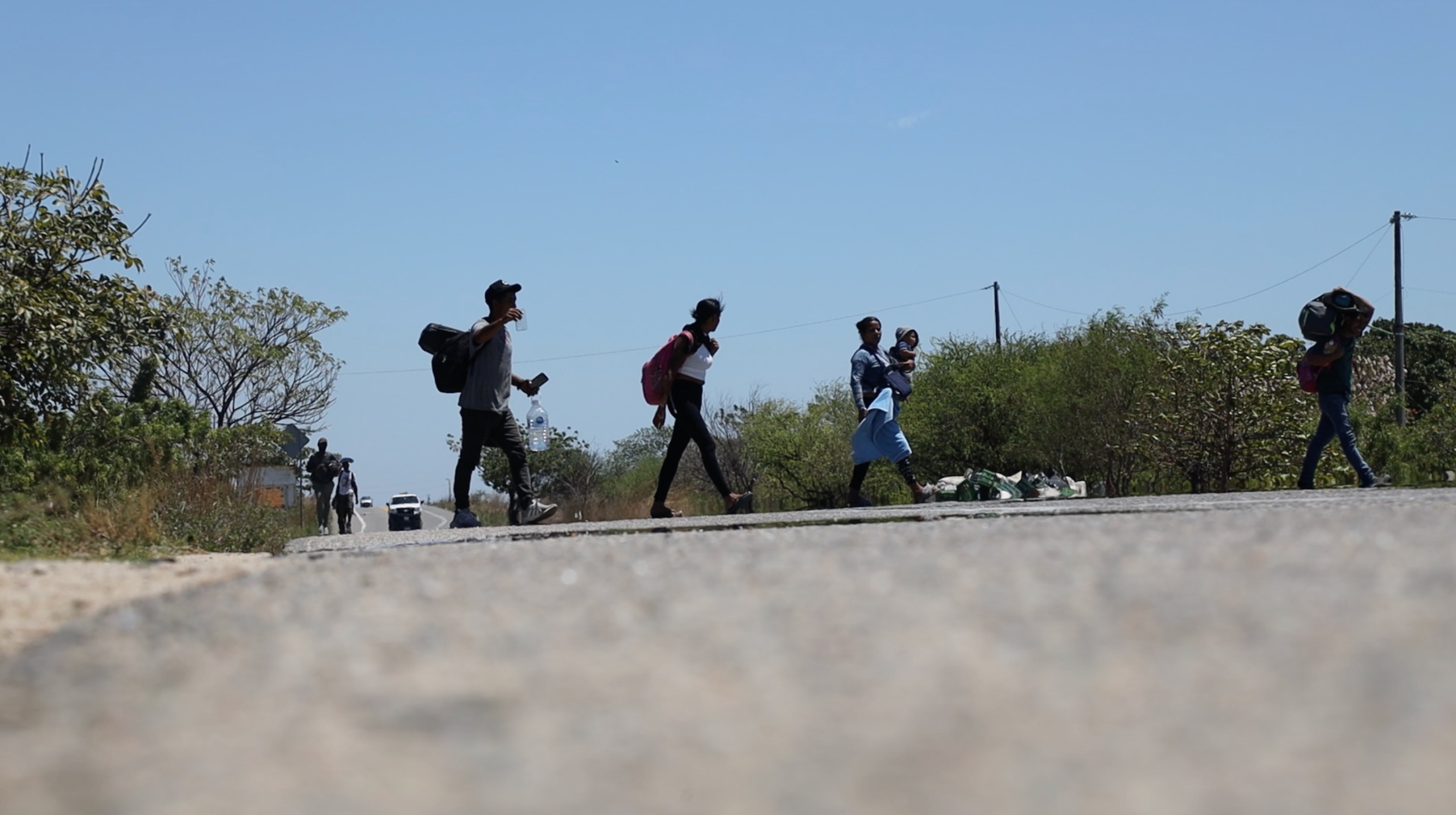
Migrants from across Latin America are trying to reach the US-Mexico border. Many are making the journey on foot.
Michael Fox/The World
Migrants like Bravo are walking north to the United States, hoping for a better life. But before they make it to that border, they must make it across Mexico's southern border, which is getting more and more difficult.
"When we are on the other side, it’ll be worth it,” Bravo said. "Every sacrifice has its reward.”
But those rewards aren’t guaranteed.

Various migrant groups can usually be found congregating in the downtown square of Tapachula, Mexico.
Michael Fox/The World
Tapachula is the primary hub in Mexico for migrants arriving from Central America. It’s a bustling, gritty city of 350,000 people. Most cross into the country illegally from Guatemala. Once here, people try to get official papers that allow them to travel north across the country. And scrape together money for the journey.
The main square downtown is packed around the clock, mainly with Haitian migrants. They change money, give haircuts and sell phone SIM cards.
Migrant Renes Casalez hawked bottled water and soda out of a large trash can that he pushed on a wheelbarrow.
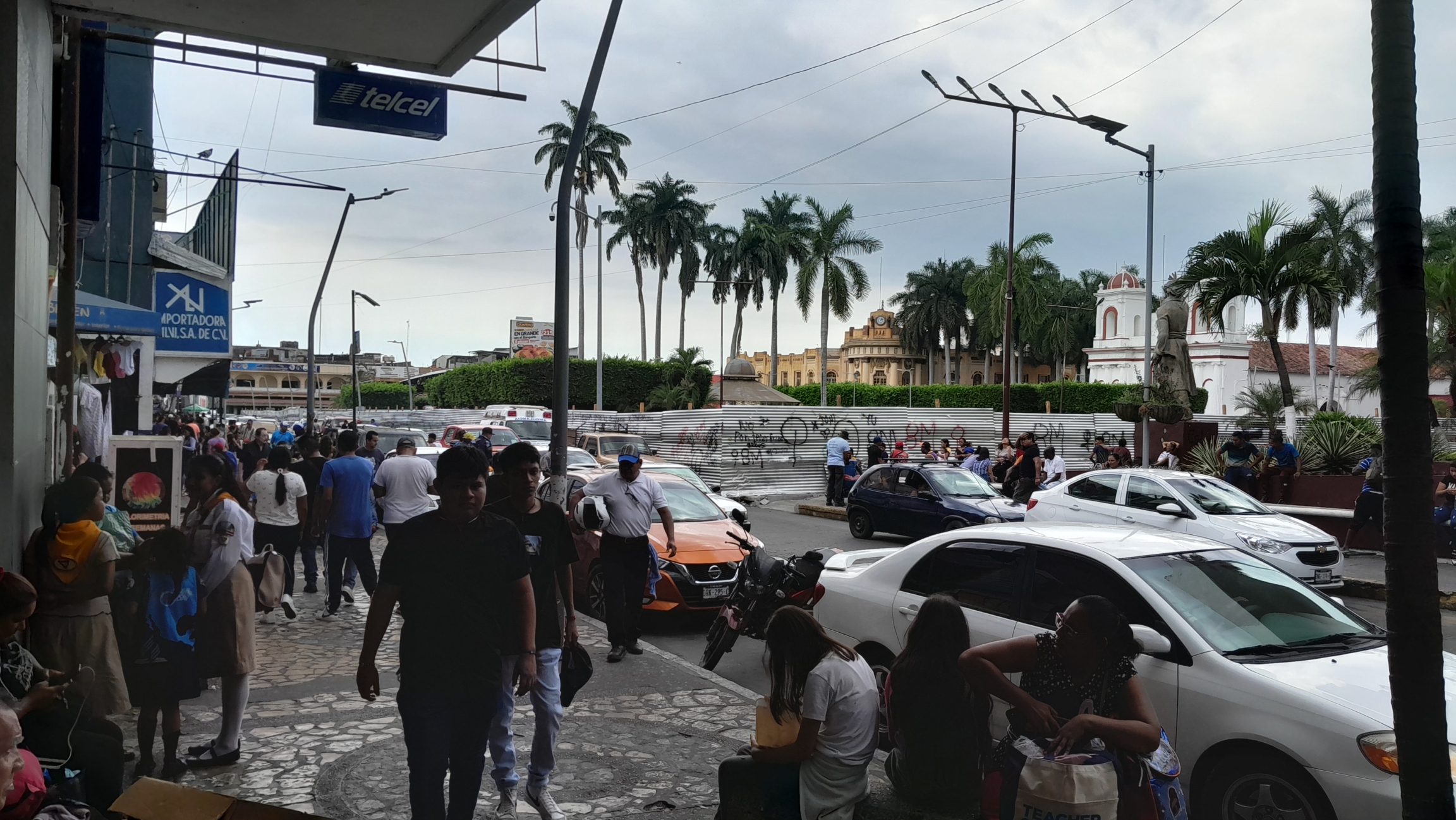
Tapachula is the primary hub in Mexico for migrants arriving from Central America. It’s a bustling, gritty city of 350,000 people.
Michael Fox/The World
“It’s really hard here,” he said. "There’s no work. I was up at 6 a.m. But I haven’t sold anything. If I could leave Tapachula now, I’d do it in a heartbeat."
Casalez and his wife walked here from Chile, where they’d lived before. They’ve been here for 11 days. But officials tell them it’ll be at least three months before they can get papers. That's the average wait for most Haitians who want to legalize their status in Mexico.
With the constant arrival of new migrants, housing is a problem. A small tent city spills out in front of the main shelter, which cannot handle the demand. People are camped across the city in public parks, riverbanks and the streets.

Venezuelan migrant Eidimar Rocillo with her two small children in Tapachula, Mexico.
Michael Fox/The World
One of those camping out is Eidimar Rocillo. She’s a single mother and pregnant. Rocillo is from Venezuela and traveled with her two children to get here. She arrived two days ago.
“The trip has been really hard. But not impossible with the help of God,” she said. “We’ve faced humiliations. Disrespect. We’ve been robbed. It’s been terrible."
Like many Venezuelan migrants, she’s hoping to acquire a transit visa to get across the state of Chiapas. Usually, it can take less than a week, but now, she said, Tapachula’s immigrant agency is backlogged.
It’s not surprising. Thousands of transit and humanitarian visas are processed in this city every month.
Mexico’s Refugee Aid Commission, COMAR, is the office where people apply for refugee status.
COMAR’s Tapachula office director, Daladier Anzueto, said that 60% to 70% of Mexico's refugee requests go to his office, and that the numbers are growing.
"Since 2018, with the beginning of the caravans, the flow of the people arriving has been increasing,” he said. “2022 was a huge year with a massive arrival of people, and it looks like this year, we are going to surpass all previous records."
He said that in the first three months of 2023, 20,000 people had already requested refugee status — and that's just through COMAR’s Tapachula office.
Haitians lead the way, followed by Hondurans, Venezuelans and Cubans, while hundreds come from Afghanistan.
People from Haiti, Venezuela, Cuba and Nicaragua are encouraged by US President Joe Biden’s new policy to prioritize migrants from their countries.

“They tell me it’s a little easier for those four countries,” Casalez, the street vendor, said. “A little better.”
Biden has promised to welcome 30,000 migrants a month from Haiti, Venezuela, Cuba, and Nicaragua, but only if they cross into the US legally. Others will be deported right back to Mexico.
No one is certain they’ll be able to make it across the US border, but many are hopeful.
“There's a lot of people suffering here,” said Jean, a Haitian migrant who asked that his full name not be used.
He lived for many years in Brazil before trekking northward, hoping to join family in New York.
“And everyone has the same idea. Everyone’s dreaming of the United States."
And those dreams are all that many migrants here have to hold on to.
Ameera Ismail Ahmed, 29, who lives in Mosul, Iraq, is having a hard time getting her children into school.
The Iraqi government doesn’t recognize identification documents issued by ISIS, the militant group that captured Mosul in 2014. ISIS was eventually driven out, but many families are still living with the residual implications of ISIS rule.
In order to attend school now, Ahmed’s kids are among thousands of Iraqi children who face the obstacle of acquiring new IDs — especially if they come from families with former ISIS ties, like Ahmed’s.
In 2014, Ahmed noticed her husband whispering on secret phone calls. It didn’t take long for her to realize that he had joined ISIS. Ahmed said she was furious.
“We had a fight,” she said. “I told him to quit. We have kids. What if something happens to you? Who is going to take care of us?”
But Ahmed had nowhere to turn. Her mother-in-law tried talking her husband out of it, but he had made his decision to join ISIS. No one could stop him.
ISIS unleashed a campaign of terror when it captured Mosul in 2014 that included beheadings and torture. The violence displaced thousands of people and destroyed much of the city.
It took five years for Iraqi security forces to drive ISIS out, with the help of the US military. Many ISIS fighters were killed. Some were detained. Others went missing.
When the dust settled, women like Ahmed were left to raise their families on their own, living in a place filled with hatred for ISIS and anyone affiliated with it.
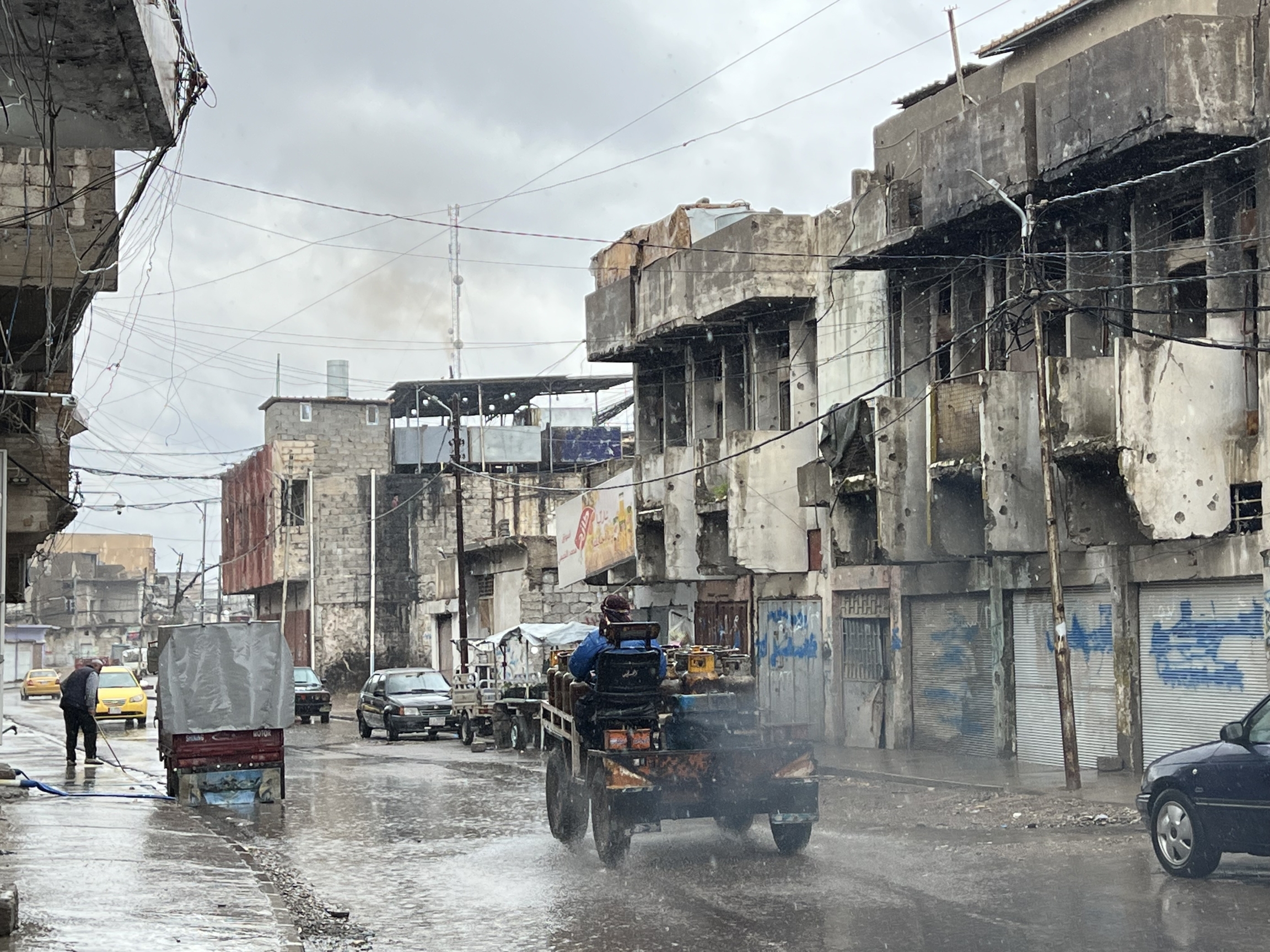
A street in Mosul, Iraq.
Shirin Jaafari/The World
Ahmed’s husband is in prison now. She said she stopped all communication with him.
But Ahmed and other women whom The World spoke to, whose families had affiliations with ISIS, say that getting new IDs to enroll their children in school is a daunting task.
Ahmed said that the state told her to renounce her husband in the presence of two witnesses. Finding witnesses is difficult, though, she said, because people either worry about testifying against someone who might have been wrongly accused, or they are concerned that the accused might eventually return and pose a threat to them.
Ahmed said the whole process is humiliating, and she felt abandoned and worried about her kids’ future.
“Every time I go to the office, they tell me my papers have been lost so I have to start the process again. I feel like they are just abusing me,” she said.
Her two sons — who are 12 and 13 — stayed at home for 2 1/2 years, she said, because people called them names, like “sons of ISIS.”
This is a reality for many families like hers.
“Tens of thousands of children continue to face barriers to accessing formal education due to a lack of civil documentation,” said Imrul Islam, advocacy manager for the Norwegian Refugee Council in Iraq.
“Often, because they come from families who are perceived to be affiliated with the self-proclaimed Islamic State.”
In order to get new documents, these families have to go to court, and sometimes, they can’t even afford transportation costs.
“We’re talking about individuals who don’t have jobs, who struggle to make ends meet and for these families, too often this cost is prohibitive because food and shelter are usually prioritized,” Islam said.
So, kids end up languishing in camps or at home, unable to get an education, he said.
“We’re talking about a generation who might have never seen the inside of a formal school. These children, many of them were born in displacement. So, every month a child spends out of school is a month closer to a lost generation."

Abdullah Hussein is the head of the community police for the Nineveh Governorate in Mosul, Iraq.
Shirin Jaafari/The World
Abdullah Hussein, the head of community police for the Nineveh Governorate, said that last year, the education directorate for the area agreed to allow kids to be admitted to schools without documents on a case-by-case basis.
He dismissed the problems these families face, maintaining that their issues have mostly been resolved.
"These formalities are simply the law. In some cases, women themselves don’t come forward to ask for help. That’s what slows down the process," he said.
Hussein pointed to the thousands of victims of ISIS, who still need support. There are so many people still living in displacement camps because their homes were destroyed during the battle to retake the city. And, many people need help processing the trauma, as well.
Likewise, families with perceived ties to ISIS should also receive support, he said.
“First and foremost, these people are Iraqis, and in most cases, the women and children have not committed any crimes," he said.
Taif Ali, 30, has been helping families believed to have ties with ISIS get their documents.
Her goal is to break the cycle of marginalization.
“I was like them,” she said. “I have been through these stages. I know a lot of women who have been sidelined by society. I survived and now I am stronger. I want to empower them.”
Ali’s husband is in prison after a group of his co-workers, as she describes it, accused him of working for ISIS. She claims they framed him because of a dispute.
She hears from women who have been sexually exploited and abused simply because they need help with getting their documents.
She faces harassment herself, she said, pulling up a Facebook post from the same day. The user cursed for her husband’s actions.
“It’s not fair,” she said. “What’s more, this kind of treatment leads to another generation that will grow up with hatred. If any other group tries to recruit these children, it will be very easy.”
Ali connects with families believed to be affiliated with ISIS and she walks them through the process of getting new documents. She also warns them of scams and potential abuse.
There are an estimated 30,000 Iraqis still held in the Al Hol camp for ISIS suspects inside Syria.
The Iraqi government has started to repatriate them.
That means more children trying to get places in schools without official Iraqi IDs.
Human rights groups say there needs to be a better process for vetting and integrating these families.
Meanwhile, recently, Ahmed managed to get one of her four kids into school in September. She’s also trying to negotiate spots for her other children. But it’s time-consuming, she said.
Safa, 10, started classes this year and said her favorite subjects are Arabic and math. Adjusting has been hard.
“The girls in school talk badly about me, and they don’t want to play with me,” Safa said.
Her mother said she understands the anger and resentment toward families like hers.
But she also sees education as a way to help build a better future for her children, especially her young son.
“I hope he finds a good job one day, so he becomes better than his father.”
In the small, northeastern village of Lledó, population 120, there’s just one bar. Marlí Mora, the owner, said it’s hard to get by during the winter.
“Especially during the long winters here, without tourists,” she said from behind the counter. “During those months, I lose money.”
In Spain, the small-town bar is cherished as the heart of a community, where locals go to drink, eat and share gossip.
But as more people decamp for the cities, many small bars like the one in Lledó are in need of help. A political party representing rural Spain has an idea: subsidize village watering holes with tax money.
Mora and other small-bar owners love the idea of subsidies and tax breaks.
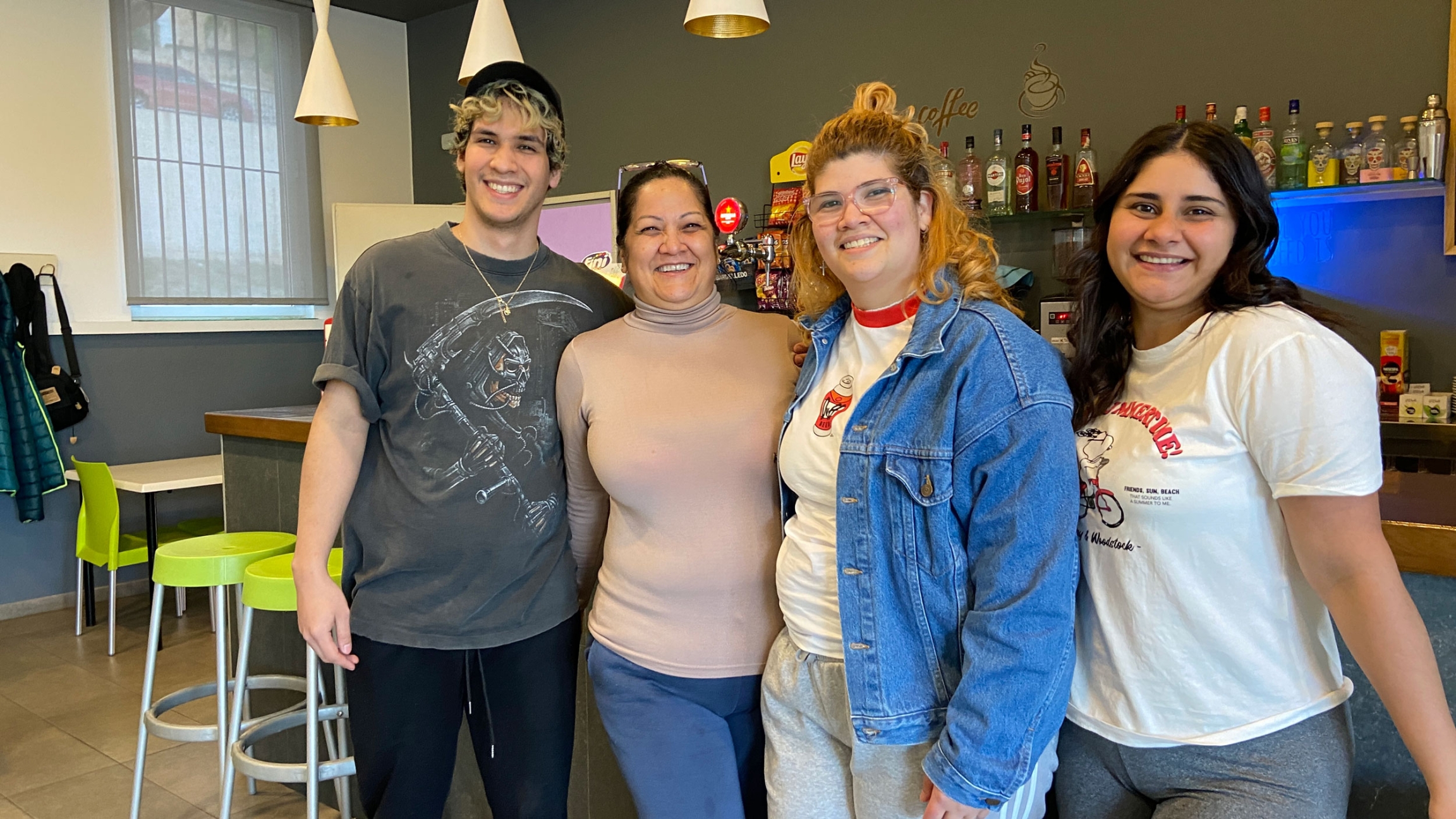
Marlí Mora, second from right, owns and runs Lledó’s only bar. She welcomes public subsidies to help her through the winter when she loses money due to a lack of customers.
Gerry Hadden/The World
This is a story about survival — for bars, but more importantly, for Spain’s tiny villages. Studies suggest the two are inextricable: When small-town bars go under, so do the hamlets that host them.
Customers Juan Robert and his buddy Javier Martinez sat on the deck at Mora’s bar, drinking beers at sunset.
“In villages like this,” Robert laughed, “people meet up either in the local store, the church or the bar.”
Without that human contact, he said, a village will die.
Villagers in Lledó gather in the afternoon for a drink, and to catch up with each other. Last year the bar was closed for months, setting off an existential crisis in town
Gerry Hadden/The World
Spain’s proposed law would help keep the drinks flowing in towns with less than 200 residents. It’s the brainchild of a small political party called Teruel Exists. The name’s a nod to a tourist slogan the region used years ago to attract visitors. Think of it like a desperate version of “I love NY.”
"I’d move away if there were no bar,” said Augusto Teruel, a local forester who was on his way out of the bar.
"This place is crucial,” he said. “You get up in the morning, have your coffee, chat with folks.”
Mora added that they also have a community room in the back. “We do movie nights for kids or host storytellers. We plan the town holidays here," she said.
Spain has hundreds of tiny villages with less than 200 residents. A proposed law would allow bars in such hamlets to receive public funding to stay open. If bars close, people say, remaining residents will leave for good.
Gerry Hadden/The World
Even the town’s political parties meet there, she said, to strategize their campaigns.
Culture, politics, food and drink — small-town bars offer it all. But to truly understand just how central bars like these are to rural life, it helps to visit a town where the bar has closed.
In the village of Darmós, about two hours from Lledó, a handful of residents loitered on the flagstone square on a recent afternoon.
The town bar was shuttered, but not permanently, local resident Enric Valles said.
“A bar in a place like this can’t survive,” Valles said. “There aren’t enough customers. That’s why it hasn’t opened yet today.”

A woman on her balcony chats with a man on the street, next to the town’s bar which was closed that day. They were both waiting for bread to be delivered from another village.
Gerry Hadden/The World
Valles and the others aren’t out here waiting for happy hour but for bread.
Darmós has no bakery, not even a store. But a woman in a small utility vehicle trundles in each day and hands out pre-ordered loaves.
After deliveries, Valles said, they’d normally hit the bar for a Vermouth.
Instead, he was heading home.
"Where can we get together?” he said, “In the middle of the street?”
Urbanites might be tempted to write off these small towns and let them die out. But they matter for farming and keeping Spain’s forests clean and free of wildfires. When people live out here, they tend to the woods.
Back in Lledó, residents went months without a gathering place before Marlí Mora showed up. The previous owners had declared bankruptcy.
Patron Juan Robert remembered those dark days with a smile. "We would come down here with our own coolers of beers, lanterns and gas heaters,” he said.
"We kept the party going. It was comical," Robert laughed, even if he and his neighbors were worried.
But Spain’s village bar law is sailing through parliament with politicians from the left, right and center all ready to raise their glasses in favor.
Back in the 17th century, an English law known as the Common Scold punished anyone who was a public nuisance, argumentative, angry or disruptive.
It was primarily women who were found guilty under the law. That's just one example of how patriarchy was evident in the past.
But male dominance over women in many aspects of life is still common today.
How did patriarchy become the norm around the world? Are men and women inherently different — and are our social constructs a natural state — or can societies be changed?
Science journalist Angela Saini explores these questions in her new book, "The Patriarchs; The Origins of Inequality" and talked to The World's host Carol Hills about her findings.
This interview has been slightly edited and condensed for clarity.
A listing of the top 10 cheeses in the world caused a stir this year when it failed to include any French products.
But less noted in the ranking by Taste Atlas, a food guide voted for by an international audience, was the inclusion of a Polish cheese called bundz.
The accolade comes amid something of a renaissance for Polish cuisine.
Bundz, a light, creamy sheep-milk cheese, has been produced in the mountainous south of the country for hundreds of years.
Józef Słodyczka is a shepherd. He’s 72, and he’s been making the cheese for almost six decades.
The secret of bundz’s success, Słodyczka said, is the high quality of the mountain grasses eaten by the sheep.
He said the cheese has to mature in a shepherd’s hut, where wood fires burn to infuse it with a lightly smoked flavor. It’s the traditional method that has been used for generations, including his father, and now, his son.
He speaks in the local mountain dialect, Goral, interpreted by a guide from the national park.
For Słodyczka, it’s currently lambing season. Next month, Słodyczka will walk hundreds of sheep up to the highlands where they’ll graze and be milked three times a day. Then, the shepherd will make the cheese by hand.
“This is very, very hard work,” he explained, lightly flexing his arm. The day starts at 4 a.m. At night, there’s little rest — he has to keep an eye out for bears and wolves that, given the chance, would take his flock.
A major concern is the lack of younger people interested in taking up the role.
But, for him, the work is all worth it — even before the cheese was getting this international recognition.
In Warsaw, a number of fashionable restaurants are putting Polish products front and center. Among them is Źródło, run by Adrian Gorniak.
As his kitchen prepared for dinner service, he spoke about the virtues of local cuisine.
“When I opened this place, there [was] only one direction in my mind, my thinking about the gastronomy. I just want to care, and I want to show Polish cuisine because we have a beautiful tradition.”
When bundz is in season, the restaurant’s chefs will serve it on top of dumplings with spinach and sun-dried tomatoes.
For Gorniak, the Taste Atlas listing is just the first step in what should be wider recognition. He said Poland is a melting pot for different ideas and traditions.
“We make it in our way, but we pick those ingredients or ideas from the different countries because Poland is in Central Europe, so we have the cross of the streets, rivers ... and the cuisine, of course.”
For others in the industry, food plays an important role in bringing a politically divided country together.
Goska Ewy, along with her husband, runs a restaurant in the southern city of Krakow.
“I think that food is one of those things that is the least political in the discussion because we’re totally polarized when it comes to our economical views, how, generally, we see human rights, the role of women, gay rights and all those things.”
Those divisions are particularly keenly felt ahead of the fall's unpredictable elections.
But culinary traditions — like the production of bundz — might just be something the whole country can get behind.
Francisco Orellana guided a group of friends on in Antigua, Guatemala, in creating a huge, ornate design on the street in front of his house, to honor Jesus during Holy Week.
With his black baseball cap, pierced ear and a sliver of a beard, 26-year-old Orellana is not the typical image of a person you'd expect to find actively participating in Catholic Holy Week commemorations.
But making an alfombra, or a carpet of sorts, for the church procession to pass over, is something Orellana has done his whole life.

A street carpet known as an alfombra created by Francisco Orellana and his friends in Antigua, Guatemala.
Michael Fox/The World
“I learned to do this from my great-grandparents and my grandparents,” he said. "They get you involved from a young age. And then when they get too old, your parents continue the tradition, and then you."
Orellana crouched down as he and his friends pulled colored wood chippings out of bags and layered them onto the cobblestone streets.
They're making a vibrant design of purple, orange, yellow and green shapes that looks like it could be in a modern art museum.
Instead, it’s going to get trampled over.
“We started about an hour ago,” Orellana said. “This design is a little more basic, because we’re making another one in the afternoon.”
Francisco Orellana works on an alfombra, or street carpet, with his friends for Holy Week, Antigua, Guatemala,
Michael Fox/The World
Neighbors up the street were also making a carpet out of pine needles and flowers.
Another was intricately designed with colored sawdust. Orellana said that some of them can even take an entire day to make.
“Each design and material is unique. But the idea is to make an offering to Jesus for everything he's given us.”
"Each carpet is different,” he said. “Each design and material is unique. But the idea is to make an offering to Jesus for everything he's given us.”
On Thursday, hundreds of people dressed in purple robes carried a huge wooden float depicting Jesus shouldering a cross. They wound through the city streets for hours, walking across the freshly made carpets.

A Holy Week procession in Antigua, Guatemala. Holy Week in Guatemala is both a religious and cultural celebration that commemorates the passion, death, and resurrection of Jesus Christ.
Michael Fox/The World
The procession essentially destroys the carpets as it passes over them. A cleaning crew follows closely behind the procession, quickly shoveling and sweeping away the remnants with the help of a bulldozer. Some people even collect the tiny remaining pieces to keep as souvenirs.

A cleaning crew picks up the remains of an alfombra following a Holy Week procession.
Michael Fox/The World
"It's kind of sad that it goes by so fast for all the time that you invest in it,” he said. “But there’s also a deep satisfaction. We’re celebrating one more year. We made it."
That is how many in the streets feel. Hundreds of thousands of people gather for the celebrations. It is the first Holy Week since the pandemic began without COVID-19 restrictions. And this year, Orellana said, people are more passionate than ever.
“It's hard to describe,” he said. “But it’s really beautiful.”
Related: Addressing migration requires long-term commitment, says analyst on Harris visit to Guatemala
By now, most of us have gotten used to the idea that COVID-19 will probably never be eliminated.
Still, every day we seem to edge closer to what could be the end of the pandemic.
The White House plans to let COVID-19 emergency declarations expire in May. The leader of the World Health Organization, Tedros Ghebreyesus, said he expects the WHO will declare an end to the pandemic later this year.
But pandemics don't draw to a close for everyone everywhere. At the same time, the end is rarely neat and simple.
To learn more about when and how the end of a pandemic is determined, The World's host Marco Werman spoke with Dr. Michael Mina, a leading epidemiologist and the chief science officer at EMed, a digital health care company, along with Zeynep Tufekci, a sociologist and professor at Columbia University.
This interview was edited and condensed for clarity.
As thousands of people make their way home on the rapid bus system in Bogotá, Colombia, during rush hour, a group of female police officers hands out purple leaflets to women, encouraging them to report cases of sexual harassment.
“It gets very crowded here, and you get lots of cases of men who harass women and even touch their private parts,” police officer Alejandra Luna said, after handing out some leaflets to a group of students. “We want women to take a stand against that, and seek our help.”
Luna is a member of the purple patrol, a group of 500 police officers in Colombia’s capital city that has been trained to respond to gender-based violence.
One of the patrol’s goals is to reduce harassment in the city’s public transport system, where last year, women reported more than 1,000 cases of unwanted touching and groping.
The Purple Patrol was created to tackle gender-based violence in Colombia's capital. One of its goals is to reduce cases of harassment in the city's crowded buses.
Manuel Rueda/The World
These kinds of assaults on women aren’t just a problem in Colombia. In 2021, the Ipsos research company conducted a survey with women in 15 countries that included the United States, Italy, India, South Africa and Brazil. Of those who participated, 80% said that at some point in their lives, they had experienced sexual harassment in public spaces, with about 40% saying they had experienced “unwanted kissing, touching and groping.”
Some places like Mexico City have tried to reduce assaults on women by creating subway cars and taxis that are for females only. While in the London Underground system, signs tell people what to do if they see a woman being harassed.

The leaflets that police officers hand out, include information about hotlines that women can call if they are harassed.
Manuel Rueda/The World
In the Colombian capital, authorities are trying to reduce harassment with better policing, but also by trying to get bystanders more involved.
“We need people to continue to report these crimes,” said Lt. Col. Ana Gutierrez, the director of Bogotá’s purple patrol. “We can’t be indifferent to what is happening to women here, and elsewhere in the world.”
The purple patrol tackles harassment through information campaigns, like with the leaflets that its officers hand out at bus stops, but also by taking measures that make it easier for women to file complaints —and they arrest offenders.
A police officer in Bogota, hands out leaflets that encourage women to report cases of sexual harassment in the city's public transport system.
Manuel Rueda/The World
The group was founded in November, and Gutierrez argues that its strategies to stop sexual harassment are already having an impact. She pointed out that in the first three months of this year, complaints for groping and unwanted touching increased by 20%. Also, the number of related arrests doubled.
“That’s a sign that people are trusting the police more,” she said. “And that they are learning that harassment is a real crime.”

Members of the purple patrol wear a special badge that makes them easier to spot.
Manuel Rueda/The World
But Gutierrez also acknowledges that police can’t stop this problem on their own.
Some of the leaflets that her officers hand out include QR codes that link to a website with videos showing people how to identify situations of sexual harassment and respond to them appropriately.
They were produced by Right To Be, a nonprofit group based in New York, which partnered with makeup company L’Oreal to create an international anti-harassment website.
“The police are rarely around when harassment happens,” said Right to Be’s founder Emily May. “So, we thought that equipping people to take care of one another ... would be a better strategy long term to address and eliminate harassment.”
In its videos and face-to-face training sessions, Right to Be teaches bystanders to respond to situations of sexual harassment by documenting them with their phones, seeking help and distracting the offenders, so that they back away from their victims. May says that these methods — which she calls the 5Ds — can help to peacefully diffuse situations in which women are being harassed.
The purple patrol Bogota responds to cases of gender based violence.
Manuel Rueda/The World
In Bogotá, the city government is also trying to use public shaming as one of its strategies. It’s handed out thousands of small whistles that people can wrap around their wrists, and is encouraging bus riders to use them, when they see someone being harassed.
“What should most protect a woman is everyone else’s solidarity,” said Claudia Lopez, Bogotá’s mayor, during an event in which she presented the new whistleblowing scheme. “It's the attacker who should be embarrassed, not the woman who is attacked.”
Related: Colombia’s police come under fire from drug trafficking groups
Vicky, 52, has been homeless in Madrid for decades. With advanced lung cancer as well as breast cancer, and a tumor behind her eye, she can only walk short distances before she’s out of breath and needs to sit.
“Is it my fault for drinking and smoking? I asked the docs,” she said. “They said that it spread and grew because I didn’t follow the treatment, or even go to my doctor’s appointments.”
In Spain, social workers estimate that dozens of people die outside each year, often alone. But in Madrid, a small group of hospice volunteers called 38 Degrees is trying to make a difference by offering end-of-life care to those who need it most.

Vicky says the love and attention she’s gotten from hospice has changed her life. Experts say someone dies on the streets in Spain once every five days, usually alone.
Gerry Hadden/The World
For many people, the idea of dying can be frightening — especially the thought of dying alone. But for people who are homeless, that fear too often comes true.
Vicky, who is terminally ill, who asked that her full name not be used to protect her privacy, said that receiving help from hospice volunteer Sole Gallego was unexpected — and life-changing.
Vicky went through one round of chemo for breast cancer. But she said that the treatment left her confused and weak. It was around this time that she met Gallego.
“If you’re sick and have no home,” Gallego said, “and you get treatment like chemotherapy, it can be very complicated. You’re out vomiting on the sidewalk. Maybe you’re in severe pain, but you have no access to painkillers. It’s terrible.”
Once a week, Gallegos visits Vicky in a Madrid park. They met through a small hospice care facility funded by the Community of Madrid called Hogar Sí, or Yes to a Home.

The Hogar Sí center for the homeless receiving hospice care has beds for 60 people. The waiting list is long.
Gerry Hadden/The World
“I didn’t need money for cigarettes or booze,” Vicky said, taking Gallego’s hand. “What I really needed was a hug. For someone to say to me, ‘Easy now, you can keep going.’ Sole’s hugs fill me with such joy.”
“We need to remember,” Gallegos said with arms around Vicky, “that there’s a human being behind the person you see on the street. No matter what their story.”
Hogar Sí, the hospice home just across the street from the park, consists of six rowhouses, with 10 sick residents in each. On a recent morning, Vicky was preparing lunch for her roommates, slicing onions and frying up garlic for a veggie stew.
Vicky prepares vegetables for a meal for her and her 9 housemates at Hogar Sí, a shelter for terminally ill homeless people in Madrid. Vicky is dying of cancer and was on the streets until recently.
Gerry Hadden/The World
"Last night, the man in the room next to mine got really sick," she said.
“It was so sad. Many times, when the ambulance takes them away in the night like that, they never come back. But anyway, that’s what this disease does.”
The incident reminded Vicky of her years on the street, before a hospital referred her here and she met Antonio. Over time, she said, he became like a father to her, showing her the ropes with where to sleep, eat and shower. He protected her.
“One morning I nudged him. I said, 'Antonio, wake up, we need to get to the church for pastries, otherwise we’ll miss out.’”
Vicky figured he was asleep so she went by herself.
“When I came back carrying our food, I saw the ambulances and the police,”she said. “Antonio was dead.”
Vicky said that was the moment when she decided to get off the street for good. As luck would have it, a bed opened up soon after at the hospice center.
“I don’t know what I would have done otherwise,” she said.
“Antonio’s death hit me hard. Seeing him dead on the street, like a dog. I wondered, what are they going to do with his body? Where will they take him? I almost went crazy.”
These questions often haunt people who are unhoused. At least 1,600 people in Madrid are currently homeless, according to city data.
Among them is Francisco, who was drinking with other guys on a busy square downtown one recent morning. He also asked that his full name not be used.
He said he used to work in the vineyards.
"And now, here I am drinking wine to stay warm,” he said.
“I have a terrible disease,” he said, picking at a line of purple scabs on his forearm. “HIV. I’ve been on the street now for a year and a half.”
When asked if he was on any medication, he said no.
“The problem is that I drink, then screw everything up. But I am scared,” he said.
Back at the Hogar Sí hospice home, Vicky’s fears were on hold for now. She just learned that Sole Gallego, the hospice volunteer, had managed to grant her a sort of last wish — to return to the Dominican Republic to visit her elderly mom and family.
“Sole is one of a kind,” she said, smiling. “You can just feel how noble she is. I’m so nervous! But until I have the tickets in hand I just won’t believe it!”

Vicky and hospice volunteer Soledad Gallego get together every few days to chat about life and, on occasion, death. Vicky has terminal cancer.
Gerry Hadden/The World
When Vicky was a kid, her mom moved away from home to work, leaving her with her dad and 13 brothers. She got pregnant at the age of 11, and her life went off the rails. During her teen years, she said, she had another miscarriage, two abortions and then she lost a child to gang violence.
Her mom helped her get to Spain decades ago to try to turn her life around, but Vicky continued to face battles with homelessness and alcoholism.
Vicky now plans to return home for a two-week visit. Doctors insist she returns to Spain to continue with her cancer treatment. But the trip has given her the unimaginable gift for a terminally ill patient — something to look forward to.
Amritpal Singh is a mechanical engineer, businessman, Sikh preacher and now — a fugitive.
The 30-year-old rose to stardom on social media over the last year or so with his speeches calling for a separate homeland, known as Khalistan, for Sikhs — who make up the majority of the population in the Indian state of Punjab.
Singh’s separatist ideas have made the authorities nervous because India has had a violent history of Sikh separatism. For more than two weeks now, thousands of police personnel have chased Singh. TV channels have reported on Singh’s whereabouts, often blurring the lines between facts and rumors. They accessed CCTV footage from street corners, which they claimed showed that he first rode an SUV, moved to a smaller car and finally, fled on a motorcycle.
Even as the police were closing in on him, Singh reportedly stopped at a gurudwara — a Sikh religious place — for food and a change of clothes.
Singh, himself, released a video saying that he will be the one who chooses when to surrender. But he has not specified when or how he will do so.
The nation remains transfixed, though opinions about Singh and his campaign are mixed.
“If you talk to Punjabis here, it’s like, ‘That’s fine, he should have been arrested,’” said Sangeet Toor, an editor of a Punjabi magazine. “But for Punjabis abroad, he has become an icon. And this incident has made him a bigger icon.”
Toor writes about farmers' rights and lived in the United States for many years before returning to India.
Toor said that Sikhs living in India generally do not support the idea of a separate nation. Many Sikhs living in India are old enough to remember what happened when Sikh separatist militants clashed with security forces in the 1970s and 1980s, he said.
In those days, the calls for a separate Sikh nation were strong. Not only did the Indian army take tanks into Sikhism’s holiest shrine, the Golden Temple, but it also killed a charismatic Sikh separatist leader — Jarnail Singh Bhindranwale — who was holed up in the temple. Singh styles himself on Bhindranwale.
In retaliation for the storming of the temple, then-Prime Minister Indira Gandhi was assassinated by her Sikh bodyguards. Afterward, the nation saw large-scale violence against Sikhs.
Thousands were killed, while many were maimed and tortured. Those who remember this violence are weary of separatism, according to Toor. But the young people of Punjab, who did not witness those days, are lured by the idea of a Sikh nation, Toor said.
One of the biggest issues that Singh raised is that of drug abuse in Punjab, which affects millions of youth in the state. Singh has blamed the authorities for not doing enough to control it.
“Do you see the drug genocide epidemic here?” Singh said on local media days before he fled. “Who is controlling the drugs? Who is responsible [for ending] this epidemic? Who is not taking any action?”
If he had a separate country, Singh said, he would do better.
Ashutosh Kumar, who teaches political science at Punjab University, echoed Toor in saying that such an ideology is not widespread in Punjab.
“Not many people believe that a separate country is the answer,” Kumar said.
Moreover, Punjab’s problems have deeper economic roots. Punjab is one of the largest producers of food grains in India. But, Kumar added, the agriculture sector is in a deep crisis.
“The soil quality has gone down, the water table has gone down, farmers are debt-ridden, industries are not coming, investment is not taking place in Punjab,” he said. “So, youth [are] completely disillusioned.”
That's why a separate country may be enticing to some, Toor said: “For any inflammatory ideas, you are going to get a lot of people behind you, especially when there is illiteracy and no opportunities for anyone to look forward to.”
For Passover, which starts on Wednesday night and goes through April 13, millions of Jews around the world will be celebrating with family, friends and acquaintances by sharing a festive meal and reading aloud the Haggadah.
The traditional Jewish text chronicles the Passover story and guides those celebrating the holiday through an epic story of redemption.
For many Ukrainian Jews both inside and outside of Ukraine, this year’s holiday is especially meaningful — because for the first time, they’ll be reciting a Ukrainian translation of the Haggadah published by a US-based organization called Project Kesher.

A table setting for Passover in an illustration by Zoya Cherkassky-Nnadi from “For Our Freedom,” a new Haggadah in Ukrainian from Project Kesher
Courtesy of Project Kesher
“There has never been a Ukrainian language Haggadah before to our knowledge,” said Karyn Grossman Gershon, CEO of Project Kesher. “After the fall of the Soviet Union, most of the Haggadot that were created were in Russian, and increasingly, that became a real problem for Ukrainian Jews.”
After Russia’s invasion in Ukraine a year ago, many Ukrainians are turning away from the Russian language. The Jewish community there and beyond is also making the shift.
That’s what prompted the Ukrainian Haggadah at Project Kesher.
“We worked with a very wonderful team to not only translate the Haggadah into Ukrainian, but also to adapt it to this moment in history, and that’s something that haggadot have always done, they’ve always adapted,” Gershon said.
Project Kesher’s Haggadah — which is only available digitally for now — includes excerpts from Jewish Ukrainian authors and illustrations showing the reality of life in Ukraine today.

Jews celebrate Passover in an illustration by Zoya Cherkassky-Nnadi from "For Our Freedom," a new Haggadah in Ukrainian, from US-based Project Kesher.
Courtesy of Project Kesher
One image shows a family sitting around their Passover table as a building burns in the background.
“It’s also Ukrainian because it really does look at what the Ukrainian people are going through right now,” Gershon said. “Whether it’s in text or in the illustrations, you see the Ukrainian people going through this period of oppression that they’ve experienced under Russia, and their fight, this existential fight for freedom.”
Yelena Goltsman, who was born in Kyiv, Ukraine, and immigrated to the US in the late 1980s and lives in New York, said the fight for freedom is an important part of Passover.
“We celebrate our path from the slavery, whatever the slavery means for every individual person at any individual time, to freedom. And this year, it is about Ukraine,” said Goltsman, who has been volunteering with displaced Ukrainians.
She traveled to Poland last year to help people who’d just left the country.
“At the moment they needed our help, and as a Ukrainian Jewish woman, I felt obligated to do all I could.”
These days, Goltsman said that she refers to herself as a Ukrainian Jew. That was not always the case.

A family gathers for Passover in an illustration by Zoya Cherkassky-Nnadi from "For Our Freedom," a new Haggadah in Ukrainian, from US-based Project Kesher.
Courtesy of Project Kesher
“A lot of people called me Ukrainian Jew, and I was always saying, no no, I’m not Ukrainian anything, please don’t call me Ukrainian because what I think about is how Ukrainian, some Ukrainian people were not friendly to Jews just to say the least,” Goltsman said.
Ukraine has a dark history of antisemitism. And many Ukrainian Jews choose to not associate with the country because of that. But Goltsman said that today, Ukraine is moving in the right direction, evolving into a more democratic and free society.
“With years, I started feeling proud of being Ukrainian Jew and I am happy to say I’m Ukrainian Jew; it’s actually a source of pride for me at this point.”
Goltsman said she’ll be using the new Ukrainian Haggadah, and so will many Jewish families who still live in Ukraine.
“When the first time I heard this news, I was like, wow, we really never had it in Ukrainian, like how come? How come we never had it?” said Yelena Pysina, who lives in the city of Cherkasy in central Ukraine.
“Having Ukrainian Haggadah is like bringing you back to the roots, and from another side, it’s something that brings you to the future that we have to start our own Ukrainian Jewish tradition” — at the Passover dinner table, Pysina said.
She said that the war in Ukraine has changed people’s sense of identity and that goes for the Jewish community, too.
Donald Trump conspired to illegally influence the 2016 election through a series of hush money payments designed to stifle claims that could be harmful to his candidacy, prosecutors said Tuesday in unsealing a historic 34-count felony indictment against the former US president.
The payments, said Assistant District Attorney Christopher Conroy, were part of “an unlawful plan to identify and suppress negative information that could have undermined his campaign for president.”
Trump, stone-faced and silent as he entered and exited the Manhattan courtroom, said “not guilty” in a firm voice while facing a judge who warned him to refrain from rhetoric that could inflame or cause civil unrest.
The next court date is Dec. 4, though it is not clear if he will be required to appear.
Across the African continent, leaders, lawmakers and ordinary citizens are following the Trump news to see what lessons it offers for the strength of the rule of law.
Chris Maroleng, executive director of Good Governance Africa, talks with The World’s host Marco Werman about how Trump’s legal woes impact the rule of law in the sub-Saharan region of the continent.
This interview has been lightly edited and condensed for clarity. The Associated Press contributed to this report.
In the 1980s, when you turned on your TV, you were bound to see a recruitment campaign from the US Army — and maybe you knew someone who was eager to enlist or was already on a deployment.
Today, the US military is struggling to make its recruitment goals.
“All the services are reporting that they anticipate not making their recruiting missions this year in 2023, so things are definitely a struggle,” said Beth Asch, senior economist with the Rand Corporation think tank.
The Army missed its recruiting target by 25% in 2022, according to Asch. And this year, the smaller, incoming military force is not the result of a strategic decision or a deliberate debate by policymakers. Still, it leaves the question of how the country will defend itself with looming threats of war.
“Having it shrink while its missions remain unchanged, while threats that are emerging in the world, clearly in Russia, and potentially, with China as well, that’s a mismatch in what the strategic environment looks like and how we’re prepared for it that is solely being driven by fewer young people being willing to serve,” said Nora Bensahel of Johns Hopkins School of Advanced International Studies.
It’s not just the Army facing recruitment challenges — the same issues are arising across all military branches and will affect everyone’s preparedness, according to Thomas Spoehr, the director of the Center for National Defense at the Heritage Foundation
“The Navy, Air Force … are all feeling this as well. They’re not going to be able to sail as many ships, fly as many planes, and in the end, unless America can figure out to change this trajectory, we’re going to have a weaker military as a result,” Spoehr said.
Spoehr served in the Army for over three decades and added that fewer recruits means more deployments for those who already wear the uniform.
Another veteran and professor at the US Army War College, John Nagl, said that if the military misses a couple of years and doesn’t have enough privates coming in, the military will not have enough people to serve at initial entry-level positions.
“That means that five years from now, we’re not going to have enough tank gunners, and 15 years from now, we’re not going to have enough sergeant[s], first-class tank platoon sergeants,” Nagl said.
With unemployment in the US being so low, historically, fewer people enlist. The number of eligible 18-to-24 year-olds is also smaller than it once was, while challenges from COVID-19 have made it difficult to do face-to-face recruiting.
Bensahal said that there is also less trust in government institutions, including the US military.
“The fact that the United States was involved in two wars for almost two decades has had an effect on the overall willingness of young Americans to serve,” Bensahal said. “I think it was exacerbated by the way that Kabul fell, whether you agreed or disagreed with the decision to withdraw US troops, the way that the American people saw it on television made the military look incompetent.”
While there is no single solution to the recruiting shortfall, Nagl said, the recruitment crisis needs to be addressed, and it’s a top priority at the US Department of Defense.
“This year, the very, very best are going to command recruiting battalions and recruiting brigades,” he said. “Because it is no exaggeration to say that the continued existence of the all-volunteer force, and the security of the nation, depends on getting more young Americans to serve in uniform.”
For human beings, Earth is a supremely human place. A world of concrete, steel, glass, plastic, cars, paved streets and highways, and lots of other human beings, generating mountains of waste. Here and there, pockets of nature for human beings.
Dutch chemist Paul Crützen coined a term for Earth’s human age — the Anthropocene. Crützen proposed that it be declared a new epoch in Earth history, terminating the one geologists say we’ve been in for the past 12,000 years, the Holocene.
This summer, a scientific panel will shift Crützen’s proposal up a notch.
The Anthropocene Working Group (AWG) was set up in 2009 by a commission of the International Union of Geological Sciences. Its task — defining the Anthropocene, geologically.
Crützen’s idea was that the Anthropocene began with the 18th-century Industrial Revolution. In 2019, a decade of research under its belt, the AWG decided it actually began around 1950, at the start of what American environmental historian John McNeill dubbed the Great Acceleration, in the wake of World War II; a period marked by massive fossil-fuel burning, resource extraction, pollution, global trade and population growth, and the parallel rise of atmospheric carbon dioxide, surface temperature, biosphere degradation and so on.
The AWG’s next task was to identify one spot on Earth where the telltale signs of human activity are best observed in mid-20th-century sediments. The technical term for this is a mouthful — a Global Stratotype Section and Point. The more popular one: a “Golden Spike.”
To be precise, that Golden Spike would be the thin sequence of layers in a core pulled from the bottom sediments of a lake, bay or estuary, or from a peat bog, ice sheet, coral reef or stalagmite, somewhere on Earth, containing the chemical and material signatures of human activity dating to the mid-20th century. Key among these — spheroidal carbonaceous particles (fly ash) from coal burning, microplastics, heavy metals, isotopes of carbon and nitrogen associated with fossil fuel burning, and radioactive Plutonium-239 from atmospheric nuclear weapons testing that peaked in the 1950s.
After years of investigation, the AWG came up with a list of 12 candidate Golden Spikes — in Japan, China, Canada, the US, Denmark, Italy, Poland, Australia and the Antarctic. Each candidate site assembled a scientific team to study their cores in the minutest detail.
Francine McCarthy, lead scientist for Crawford Lake, in southern Ontario, is proud of her sedimentary cores.
“We do have the best site,” McCarthy said. “I have to accept some kind of maternal pride.”
McCarthy has reason to be proud. Crawford Lake has been recording human activities for thousands of years. That’s because it’s very deep, and its bottom sediments are permanently isolated. Those sediments consist of many layers, laid down year after year, all precisely dated.
They record the history of coal burning, the rise of atmospheric carbon dioxide and atmospheric nuclear weapons tests, all peaking around 1950.
So do sediments from the Baltic Sea, Japan’s Beppu Bay, Sihailongwan crater lake in China and the Śnieżka peat bog at the heart of Poland’s polluted “Black Triangle.” San Francisco Bay estuary cores are rich in invasive species, mercury and SCPs. Coral samples from the Gulf of Mexico and Cairns, Australia, are also competitive.
The competition is tense. To be chosen as the Anthropocene’s Golden Spike, a candidate site must receive 60% of votes from the AWG’s 23 voting members. Multiple rounds of voting have taken place over the past year.
As the AWG prepares to announce its choice, prominent geologists disagree that the Holocene Epoch ended, and the Anthropocene began, a mere 70 years ago.
“In geological terms, that's today. It’s just yesterday morning,” said Phil Gibbard, a geologist at Cambridge University. ”We have no clue about, seen from thousands of years in the future, whether this would be more than a blip.”
Only time will tell if the Anthropocene is a blip, said Simon Turner, AWG’s secretary. Turner, standing in a hallway at University College London, where he works in the geology department, reflects on the popularity of the Anthropocene idea in nonscientific circles.
“The thing with the Anthropocene, people get it,” Turner said. “They get the idea of, like, human activity on the planet. The Holocene … I can probably pull someone over here now and say, 'have you heard of the Holocene?' And they will not have heard of it … and geology is just down the corner, so you would hope someone has.”
The Anthropocene Working Group will announce its winning Golden Spike sometime this summer, or in the early fall, in Berlin. Its proposal will then pass up the geo-bureaucratic hierarchy — first to the Subcommission on Quaternary Stratigraphy, then the International Commission on Stratigraphy and finally, the International Union of Geological Sciences.
However, approval of that Golden Spike — either as the base of a new epoch, the Anthropocene, or just the latest stage of the Holocene (in which case, it would be named after its Golden Spike; the Crawfordian, for instance) — could take years.
Ecuadorian President Guillermo Lasso is facing the political battle of his life.
After Ecuador’s top court authorized an impeachment trial against him for acts of corruption last week, the proceedings began on Monday.
Lasso is a conservative, former banker who won office in 2021 and is nearly halfway through his term.
He's accused of allowing embezzlement to continue under his watch in Ecuador’s oil shipping company, Flopec. According to evidence, he was advised of the corruption even before taking the presidency, but did not move to stop it. This is one of several accusations against him, including bribery and abuse of power.
The Ecuadorian outlet La Posta has recently accused Lasso's brother-in-law and business associate Danilo Carrera of being at the center of a web of corruption, including involvement in false energy contracts and a cash-for-appointment bribery scheme.
However, the embezzlement charge was the only one approved by the Constitutional Court to be considered for the National Assembly's impeachment proceedings.
“I am innocent,” Lasso said during a televised address to the nation the day after the court ruling. “In my personal, professional and public life, I have always acted with clear intention. And that’s why I denounce this impeachment trial, which smells very bad.”
He accused the National Assembly of trying to remove him in a bid for power.
But Ismael Quintana, a lawyer and professor of constitutional rights, said that Lasso and those who defend his government “haven’t ever sufficiently responded to the facts.”
“They are serious, and they implicate the president in political responsibility in this and other cases of corruption,” he said.
For Lasso to be impeached, two-thirds of the 137-member opposition-controlled National Assembly must vote in favor. The decision is due in one month. The president of the special impeachment commission, Viviana Veloz, said they have more than enough votes.
“The majority of the caucuses and the legislators have said that they will vote to proceed with censoring and removing President Lasso,” she told the Ecuadorian talk show, EnClave Política.
“And with the eight independent lawmakers, we have 104 votes.”
They will need support from 92 National Assembly members to impeach.
But Lasso is looking to shore up his support ahead of the vote.
Over the weekend, he authorized the civilian use of guns in self-defense. In a televised address, Lasso said the decree expands current gun laws and allows civilians to openly carry in public.
“Ecuadorians, we have a common enemy: crime, drug trafficking, and organized crime. We are going to fight it with these new urgent measures.”
Homicides have spiked to historic levels in Ecuador over the last year. Meanwhile, Lasso’s approval has plummeted to less than 13%, according to recent polls.
In February, he lost a referendum package, and his allies were trounced in regional elections.
Meanwhile, Ecuador’s powerful Indigenous movements have been gaining political ground. And they've been a vocal opposition to Lasso’s government.
Last week, they marched to demand that the Constitutional Court authorize the National Assembly to proceed with the impeachment trial.
“We are demanding that the judicial laws be carried out,” said Floresmilo Simbaña, a former leader of the country’s largest Indigenous confederation CONAIE. “There are indications of irregularities in Lasso’s administration. According to the evidence, Lasso is clearly implicated in these acts of corruption and therefore, must be removed.”
The National Assembly has 30 days to reject or approve Lasso’s impeachment. If he is removed, his vice president, Alfredo Borrero, would take over. He’s a former neurosurgeon and a political novice.
Lasso may also try to implement what Ecuador’s Constitution calls a “cross death” that would dissolve both the National Assembly and his presidency, and call for new elections.
The future is uncertain. But Lasso is now hanging on for his political life.
Since gaining independence from Sudan in 2011, South Sudan has struggled with ethnic violence, civil war and corruption that have placed it far from the initial dreams that its freedom fighters had for the country.
The daughter of two of those freedom fighters created a new documentary in 2022, called "No Simple Way Home," to reflect on the young nation and her family’s role in it.
Filmmaker Akuol de Mabior’s father was John Garang de Mabior, considered to be one of the founding fathers of predominantly Christian South Sudan.
The late-Garang fought for years against Arab leaders in Sudan, but died in a plane crash shortly after his vice presidential inauguration.
Garang is not, however, the focus of the documentary.
It’s about his wife — Akoul de Mabior’s mother: Rebecca Nyandeng de Mabior.
"I was afraid that her contributions would be forgotten — her contributions to the liberation struggle in South Sudan."
“I wanted to make a film about my mother,” Mabior said. “I think it was that I was afraid that her contributions would be forgotten — her contributions to the liberation struggle in South Sudan.”
In the documentary, Akuol follows her mother as she returns to South Sudan from exile, and is appointed as one of the vice presidents in the country’s unity government.
The documentary, “No Simple Way Home,” became available to watch on the AfriDocs streaming platform last month.
Related: Amid calls for reconciliation in South Sudan, displaced people remain in limbo
At a butcher shop in Buenos Aires, Argentina, owner Martín Riente must change price tags every day to account for the country’s rampant inflation.
Staple beef cuts like lomo, nalga and cuadril are becoming prohibitive. He said a kilo of milanesas, a traditional meat dish, costs nearly three times what its price was more than a year ago.
In business for the last 17 years, Riente, 43, is well acquainted with ever-increasing prices — but not this much, and this fast.
“I’ve never seen anything like this,” he said. “It’s appalling. It’s out of control.”

High inflation has long haunted Argentina’s economy, but it is now reaching excruciating levels.
Alan Ruiz Terol/The World
High inflation has long haunted Argentina’s economy, but it is now reaching excruciating levels. In February, the annual inflation rate hit 102.5%, the highest in three decades — meaning prices of consumer goods doubled on average from last year.
At the butcher shop, customer Claudia Chaid, 53, is stressed by the emotional toll of inflation. She said she cannot recall a time in her life when it was not a concern.
“It’s madness. It’s like a mental war one wages all the time, racing against numbers."
“It’s madness. It’s like a mental war one wages all the time, racing against numbers,” she said.
Chaid’s salary as a teacher has increased, but not enough to match inflation. Still, she felt fortunate, and said others are in a far worse situation.

Many Argentines keep their savings in dollars due to inflation.
Alan Ruiz Terol/The World
Riente said more expensive meat is one of the worst things that could happen in Argentina, where asado, or barbecue, feeds family and friends at gatherings every weekend.
“In Argentina, first comes the asado, and then comes the mother,” he said.

The rising price of asado, or barbecue, is devastating for Argentines, who often serve it to family and friends at gatherings every weekend.
Alan Ruiz Terol/The World
The price of some vegetables and fruits has skyrocketed even higher. In February 2021, a kilo of oranges cost 89 pesos ($.42). This February, the price was 350 pesos ($1.66) — a 294% increase.
Because of the devaluation of the peso, the surge is less dramatic when converted to dollars: from $0.83 to $1.78, a 114% increase, although exchange rates vary greatly.
Many Argentines keep their savings in dollars due to inflation.
Fernando Basbús, a vegetable store owner who continues to work despite being officially retired at 70, said saving in pesos is “worthless.”
“If you keep 10, tomorrow you have eight, and the day after you have six.”

In February 2021, a kilo of oranges cost 89 pesos ($.42). This February, it cost 350 pesos ($1.66)—a 294% increase.
Alan Ruiz Terol/The World
Globally, Argentina’s inflation is only surpassed by a handful of countries with collapsing economies, like Lebanon or Venezuela.
In recent years, the pandemic, the war in Ukraine and the ongoing drought all dealt blows to Argentina’s aching economy.
But the country’s long history of inflation runs deep, according to Juan Pablo Nicolini, a senior research economist with the Federal Reserve Bank of Minneapolis, Minnesota.
Nicolini, who is also a part-time professor at the Universidad Tocuato Di Tella in Buenos Aires, said that successive Argentine governments have spent more than what they collected through taxes, and borrowed money to balance the books.
But after repeated debt defaults, lenders grew skeptical of Argentina, so the only option left was asking its central bank to print more money.
“When you do that systematically, when you print more money than the quantity of goods increases over time, which is the growth of the economy, then you get inflation,” Nicolini said.
Argentine governments that have come and gone all promised to tackle inflation — each with their own recipes — but have largely failed.

Argentine governments that have come and gone all promised to tackle inflation — each with their own recipe — but have largely failed.
Alan Ruiz Terol/The World
Current Finance Minister Sergio Massa called inflation “the fever of a sick economy” at a rally in January, one that hits “regularly.” He encouraged people to “lower the fever.”
However, Nicolini doubts that that will be the case, since the Argentine government continues to spend more than what it collects, and international markets are wary of lending any more money.
“This is an election year, so there is the possibility that the government will increase its spending, and then ask the central bank for more money. So, we should not be surprised if inflation goes higher than 100% this year and the next,” he said.
At the butcher shop, Claudia Chaid said she has faith in a better future, however long it may take, because the country is very rich in natural resources.
Chaid expects the coming year to be a difficult one, but hopes things will get better after the election.
“Hopefully, the next government can do some magic trick, somehow, and solve this.”
This week, a much-anticipated, six-part series of short films called “African Folktales, Reimagined” premiered in Nairobi, Kenya, and on Netflix.
The anthology of films based on traditional African folk tales is a partnership between Netflix and UNESCO, which has been putting a spotlight on the growth of Africa’s film industries.
Tendeka Matatu, director of film in Africa at Netflix, said the goal of the partnership is celebrating African storytelling and celebrating heritage.
“Folk tales have always been an important way of passing culture and heritage and the values, you know, from generation to generation,” he added.
Last year, Netflix and UNESCO launched an Africawide contest to seek out emerging filmmakers. According to Netflix, they received around 2,000 submissions, which were narrowed down to six finalists.
“We've got six short films from six different countries. So, from Mauritania, from Uganda, from Kenya, from Tanzania, from South Africa, and from Nigeria,” Matatu said.
“Each of the stories really speaks to something that is specific and local to those countries,” he continued.
One of the filmmakers, Voline Ogutu, drew from a traditional Kenyan folk tale for her film “Anyango and the Ogre.”
“It was this fun, scary story about an ogre that is determined to eat children. But then, the children have been taught a song by their mom or their dad in some stories to make sure they don’t open for the ogre by mistake,” she explained.
Ogutu said she heard this tale many times as a child.
“This is a story you grew up hearing. This is a story that was in exam papers at some point. Growing up, we had literature classes, and we would have different folk tales within those exam papers.”
In her short film, Ogutu puts a futuristic spin on the tale, and reimagines it as a story about a woman dealing with gender-based violence.
“The ogre represents not just the man who is tormenting her and her kids. It also represents the society that is reinforcing that environment and kind of making women feel like they have to stay in such environments to endure several ogres in their lives,” she said.
Another one of the films in the anthology comes from Mauritania, where filmmaker Mohamed Echkouna grew up.
His short film “Enmity Djinn” is inspired by djinns, which are known as genies in some parts of the world.
“Djinn in Islam in general, or the way we view them in West Africa, where I grew up, is this hidden spirit that [does] not interact with humans. But there are these stories of humans using them for either evil or good,” he explained.
Echkouna said he also grew up hearing different folk tales of djinns as a child.
“At the end of every story is basically, don't do this to your brother or don't do this to your sister, or friends shouldn't be like that,” he said.
“So, there's always like a moral at the end of these stories that children learn from.”
Echkouna said he grew up in the Sahara Desert, in a small village of about 15 families. He recalls not watching his first film until he was 12 years old.
Now, his Mauritanian film will be viewed on a platform with millions of subscribers from around the world.
Environmental activist Windel Bolinget remembers what it was like to end up on a government list for the first time.
It was 2018 and his name was included on a petition to designate the Communist Party of the Philippines a terrorist group — he wasn’t even a member of the group.
“My name was just included there,” said Bolinget, an Indigenous Igorot and the chairperson of the Cordillera Peoples Alliance. “There were more than 600 names just deliberately included there as terrorists.”
This happened, he said, because of his activism in opposing development projects in the Cordillera region — a mountainous, landlocked area on northern Luzon Island, the Philippines’ largest island.
The country has long been one of the most-dangerous places in the world for environmentalists. The international nonprofit Global Witness has, for years, ranked the Philippines in the top slots of its annual list as deadliest countries to be an eco-activist. Dozens of environmentalists and land defenders also die each year.
“In the Cordillera, our ancestral domains are targeted for big hydropower or dam projects, large-scale mining,” Bolinget said. “And our communities are resisting these projects because it violates our collective rights to our ancestral lands.”
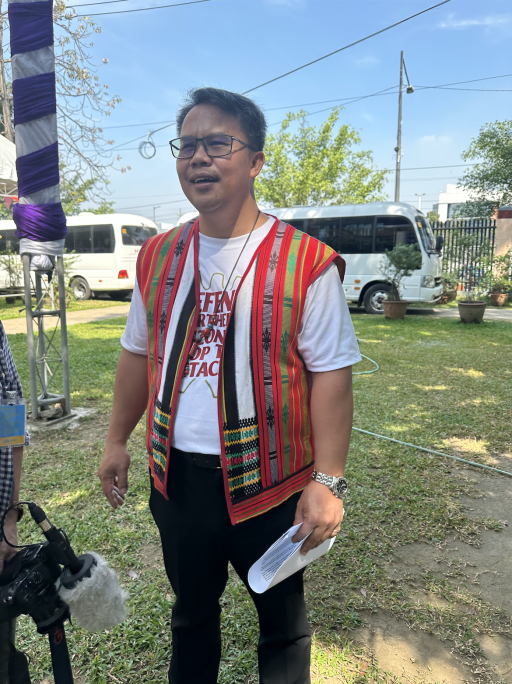
Windel Bolinget is an environmental activist who ended up in a petition to designate the Communist Party of the Philippines a terrorist group, a group he is not a member of.
Ashley Westerman/The World
The Cordillera region is chock-full of natural sources. It is also a prime target for development.
Although Bolinget’s name, and hundreds of others, were eventually removed from the petition, the intimidation against them continued.
In 2020, Bolinget was falsely accused of murder and a warrant was issued for his arrest. A manhunt ensued and a shoot-to-kill order was placed on his head. The whole thing was completely fabricated, Bolinget said, which is how his lawyers were again able to get the warrant dropped.
But earlier this year, another arrest warrant was issued. This time, for Bolinget, five other Indigenous activists and a community journalist — all from northern Luzon.
“We are called the Northern Luzon 7, charged with rebellion or insurrection,” he said. “Again, there was no due process.”
Currently, the seven are out on bail. Bolinget and others traveled to the capital, Manila, last week to tell the government about their experiences, as well as to bring up the recent spate of bombings happening in the Cordillera region.
Since early March, people there have reported that up to nine bombs were dropped near their communities. Bolinget said this has disrupted their economic livelihoods and “brought terror.”
He added that he is afraid, but remains defiant.
“Of course, that's normal for a human being [to be afraid], but their intent is to silence us. But what we are doing, it's our duty. We cannot be silent. We owe this to our children.”
The struggles of environmental activists in the country go back decades, explained Carlos Conde, a senior researcher with Human Rights Watch based in Manila.
There was a term for it in the 1970s: “development aggression.”
The Philippines has been ranked as one of the most dangerous places in the world for environmental activists.
Ashley Westerman/The World
“This mainly refers to development projects that tend to displace environment and Indigenous people's communities,” Conde said. “And this has resulted in conflict.”
He said that much of the conflict stems from the government ignoring the requirement to get consent for projects from Indigenous communities called the Free, Prior and Informed Consent: a guiding, international human rights principle that basically says governments must consult and work with Indigenous communities before making decisions — such as building developments — that affect them.

The Philippines government often ignores the requirement to get consent for development projects from Indigenous communities.
Ashley Westerman/The World
Meanwhile, increased activity by communist insurgents in some of the same areas is creating a volatile situation, he added.
“That's why, now, with the Philippine government and national security's establishment, basically, they're targeting Indigenous people’s communities. But in many instances, these Indigenous people’s communities who are against the project are not necessarily insurgents.”
Conde said there is middle ground between development that the country sorely needs and the rights of Indigenous communities, but it comes down to the government making a deliberate effort to listen to them.
The current administration of President Ferdinand “Bongbong” Marcos Jr. has so far been silent on both the Luzon 7 and recent bombings.
Some analysts say that’s just part of keeping up the facade that Marcos has united support in the north, where he hails from. His home province Ilocos Norte is a picturesque place where the Cordillera Mountains meet the waves of the West Philippine Sea.
It is also rich in natural sources, both on the land and in the sea, said activist Genaro Dela Cruz, who is from the same province and is head of the Ilocos Human Rights Alliance.
“Illocos Norte actually was named as the center for renewable energy in Southeast Asia, not only in the Philippines, because of the windmill and solar farms that generate electricity.”
Protesters say they're not anti-development, but want to protect Indigenous lands in the Philippines.
Ashley Westerman/The World
But these developments threaten the communities there, said the veteran environmental activist, who has also experienced harassment by authorities for his activism.
Dela Cruz said the idea that activists are against development is a misunderstanding.
“We are not anti-development, but we want to put up development projects for the people and not for a few ones, or the rich ones.”
He said he hopes that including his community in conversations about development will ensure the projects benefit everyone.
Related: Record-breaking inflation rates in the Philippines are pushing people to take on extra jobs
The Doctrine of Discovery, the15th-century Catholic doctrine that fueled colonization in the Americas and Africa, was rescinded by the Vatican on Thursday.
The doctrine decreed that when a nation declares it has discovered new land, it directly acquires rights to that land. The move is especially significant to Indigenous peoples around the world who have had their lands seized.
The Vatican finally responded to decades of Indigenous demands and formally repudiated the doctrine.
Cora Voyageur, a sociology professor at the University of Calgary in Alberta, and also a member of the Athabasca Chipewyan First Nation, discussed the significance of this decision with The World's host Carol Hills.
This interview has been lightly edited and condensed for clarity.
The Montreal Canadiens have become the standard for hockey excellence and are regarded as one of the greatest hockey teams of all time. They've won 24 Stanley Cups. And, so far, nobody else is even close.
But the Boston Bruins are on the verge of making history — eclipsing the Montreal Canadiens' coveted record of most points scored in a regular season, set back in 1977.
The two teams have had an intense rivalry for decades that has spilled over into their fandoms, with Canadiens’ fans, called Habs (short for the French term Les Habitants, or Settlers), hoping that the Bruins won’t be able to break the record as the season winds to an end.
To understand what’s got the two team’s fandoms so divided and the historic precedent that the Canadiens has set in hockey, Sunil Peetush, a Montreal Canadians superfan and the first official inductee into the Canadiens Hall of Fan joins The World’s Carol Hills.

Sunil Peetush (middle) with daughter Sophia (left) and son Jai(right) in front of a trophy wall outside of the Montreal Canadiens locker room.
Courtesy of Sunil Peetush
This interview has been slightly edited and condensed for clarity.
This week in Toulouse, in southwest France, thousands of students joined the latest massive rally against the government’s plan to raise the retirement age.
Jonah Michelie, a 19-year-old college student, has marched in all 10 protests this year.
“It is amazing,” he said, leading a group of about 500 fellow students toward downtown Toulouse. “Now I feel useful. I believe I can help to make this country a better place.”
Millions of French people took to the streets this week for the 10th protest this year, and it’s not just workers who are angry about raising the retirement age from 62 to 64. College students are also showing their support, even though shoring up the national pension fund would likely benefit them later in life.

Michelie helps carry a banner at the Toulouse protest. It reads, “Youth against raising the retirement age.”
Gerry Hadden/The World
Up until now, Michelie said, he’d never done anything political. But President Emmanuel Macron’s proposal to raise the retirement age struck a nerve.
“My grandfather was a Communist Party member,” he said. “They went on strike to get a 60-year-old retirement age. And we will fight to get it back!”
Michelie’s dad is a steelworker. His mom cooks and cleans in a school. He’s the embodiment of France’s working class.
On the abandoned campus at the University of Toulouse, students barricaded entrances with desks and chairs. When students want to shut down class — this is how it’s done.

The barricaded entrance to one of dozens of University of Toulouse school buildings. Students piled up desks, chairs and anything else they could find in order to shut down classes on this latest day of national protests against the newly raised retirement age.
Gerry Hadden/The World
Michelie was on campus when he climbed through the window to a study hall that had been converted into some sort of student command center with people milling around and large signs everywhere calling for revolution and protest.
“We believe we need to work 40 years,” he said, “and the age needs to be stopped at 60 for most work and 55 for the hard-working people.”
When asked about the government’s concern that they could run out of money to pay for social security, Michelie dismissed it.
"I think that it’s all a lie," he said.
"Because we all know that Macron has a preference for ulta-rich billionaires. We believe it is their part to pay more taxes.”
Michelie then rushed off to a student council meeting to plan for the day’s protest.

“Fist raised,” reads a decal on the back of a student attending a planning meeting before the day’s march. On the agenda, where to meet and how to react if the police move on them.
Gerry Hadden/The World
Two other students on campus who were guarding the entry-window to the makeshift student organizing space agreed to speak with The World: Liza and CJ. Wary of authorities and outsiders, they would not share their last names.
“I think the more we give work to older people, the more the younger people can’t work,” Liza said, regarding the retirement age. “Because there isn’t as much work as we’d like.”
“I think about 300,000 jobs are open now,” CJ added. “And at least 3 million people are looking for jobs. So, there is a mathematical problem, basically.”
In other words, the longer an older person holds on to a job, the fewer jobs there are for the young. That fear seems more real to these two than the threat of France’s social security running dry one day.
Later on, at the student council meeting, people were pounding on desks and singing as they then streamed out the door to head for the march downtown.

When the window to one seemingly empty building opened, observers could see a student protest center inside, with students busily planning strategies for the day’s demonstrations.
Gerry Hadden/The World
Michelie pointed out that the anger the French are feeling goes way beyond the pension reform that Macron pushed through with an executive order.
That, he said, was just the final straw.
“There is massive inflation,” he said, “and the salaries question; the equality between men and women. Many subjects that the government has lied about. Or done nothing about.”
Michelie remembers the massive yellow vests protests triggered by the global economic meltdown of 2008 and which continued until the pandemic hit. He was in high school.
“My friends and I just thought it was funny — but now I realize how important that movement was.”
The yellow vests movement was unlike anything France had ever seen — grassroots, decentralized and relentless. People were angry with banks, but also about job losses and the soaring cost of living.
“It was pure anger from the people,” Michelie said.
COVID-19 halted the demonstrations — but not that anger.

Students from various university departments, from the sciences to humanities, took to the streets of Toulouse.
Gerry Hadden/The World
As Michelie and his classmates reached the stream of tens of thousands of protesters downtown, the mood was jubilant.
Michelie locked arms with colleagues, ready to lock horns with his government — one that appears just as unwilling to back down.
Earlier this year, clergy from the Orthodox Church of Ukraine led Christmas prayer services at Lavra Cathedral within Pecherska Lavra — or Monastery of the Caves, in Kyiv, Ukraine.
The nearly 1,000-year-old holy site is important to millions of Orthodox Christians across Ukraine, as well as Russia.
The Orthodox Church of Ukraine is fully independent from the Russian Orthodox Church in Moscow. But some leaders of a branch within Ukrainian Orthodox Christianity still share historical ties with the Russian Orthodox Church.
“When we are speaking about the Orthodox Church, for years there is a deep conflict between at least two different communities,” said Sergei Chapnin, with the Orthodox Christian studies center at Fordham University.
Amid the ongoing war with Russia, President Volodymyr Zelenskiy’s administration is cracking down on some Ukrainian Orthodox Christian leaders because they view some of them as allies of Russia. And this division is now playing out on the grounds of Kyiv’s Pecherska Lavra — where clergy there now face eviction.
For many years, clergy in charge at the Lavra holy site were affiliated with Orthodox leaders in Moscow. All of the buildings, religious items and holy relics are considered to be in possession of the Ukrainian state, Chapnin explained.
The Kyiv Pesherska Lavra, the Monastery of the Caves, in Kyiv, Ukraine, ornate cathedral, is a UNESCO World Heritage Site and it’s the heart of Ukrainian Orthodoxy.
Daniel Ofman/The World
In December of 2022, the Ukrainian government decided to take back control of Lavra. President Zelenskiy has said that Ukraine needs to become “spiritually independent” from Moscow.
“When Zelenskiy won the presidential elections in Ukraine, he didn’t pay attention to the religious policy of the Ukrainian government at all. Until the war started,” Chapnin said.
Many Russian Orthodox church leaders have publicly supported Putin’s war effort.
“So Putin weaponized the religious factor and Zelenskiy has to reply,” Chapnin said.
Late last year, Ukrainian security services started raiding churches where clergy were suspected of being loyal to the Kremlin.
Zelenskiy’s most recent response is the eviction notice.
Earlier this month, several hundred priests, monks, students and employees of the Ukrainian Orthodox Church were given a deadline of March 29 to leave the Lavra complex.
While most members of the Ukrainian Orthodox Church condemn the Russian invasion, some leaders have indeed expressed support for Moscow, according to Kristina Stoeckl, a religion and politics professor at LUISS University in Rome.
“Some representatives of that church are openly pro-Russian, and several others are maybe less openly pro-Russian, but they are suspected to support the Russian position in the war,” Stoeckl said.
She said the Ukrainian government is trying to nudge people of faith toward the independent branch of the Orthodox Church in Ukraine.
The Kyiv Pesherska Lavra, the Monastery of the Caves, in Kyiv, Ukraine, ornate cathedral, is a UNESCO World Heritage Site and it’s the heart of Ukrainian Orthodoxy.
Daniel Ofman/The World
But this eviction order could also end up alienating some patriotic Ukrainians who happen to be connected with the other branch of the Church.
“I actually think it’s possible that there’s a coexistence of the two churches, even on those very same premises. Because there already is a dialogue forum and many of them know each other and also have friendly relationships with each other,” she said.
Some monks at the Kyiv Pecherska Lavra have said they’re staying put on the holy site, and will refuse to leave before Wednesday’s deadline.
Fifty years ago this week, “Tie a Yellow Ribbon Round the Old Oak Tree,” a single by Tony Orlando and Dawn, was on its way to No. 1 on the charts.
The famous song told the story of one man’s homecoming.
For many Americans, the song held symbolic meaning — as its release coincided with President Richard Nixon's announcement of the withdrawal of the last US combat troops from Vietnam, ending America’s direct military involvement in the war.
Although the Vietnam War didn't end on March 29, 1973 — the withdrawal, in its 50th anniversary this week — still holds an important place in US history, especially for American veterans. More than 58,000 Americans were killed in action, and some 300,000 were wounded in the fighting.
A Vietnamese newsboy sells newspapers in Saigon with the headline announcing the US troop withdrawals hours before President Richard Nixon was slated to formally announce the withdrawals, Sept. 16, 1969.
Nick Ut/AP
Until then, Nixon had resisted bringing the troops home, as did previous presidents: John F. Kennedy adhered to something called the Domino Theory. If the democratic government of South Vietnam were to fall to the Communists, so too, would other Southeast Asian nations. Kennedy’s successor, Lyndon B. Johnson, went on to send half a million US troops overseas to prevent a Communist victory.
The fighting in Vietnam was filmed and televised like no previous war.

American troops prepare to board ship at Danang in 1970 for trip back to the US under withdrawal orders. Troops are Marines of the 26th Regiment.
AP
TV news — and Walter Cronkite from CBS, for example — took a critical view. In 1968, he called for the US troops to come home.

Women Strike for Peace demonstrators sit in the street at the intersection of Executive and Pennsylvania Avenues outside the White House in Washington, DC, Sept. 20, 1967. Police lined up to limit the number of Vietnam War protesters to 100, while the rest, after some scuffling and pushing, sat down in the street.
AP
At Woodstock in 1969, Jimi Hendrix captured some of the rage that was tearing the US apart.
Two ammunition men, Spec. 4 Donald Looper 9 of Washington, DC, left, and Spec. 4 Walter Rice of Huntsville, Ala, right, watch helicopters land at landing zone Lassiter in South Vietnam, April 27, 1972, as they listen to President Richard Nixon's speech on troop withdrawals on radio. Both men are attached to the 1st Cavalry Division.
Koichiro Morita/AP
The public was torn by news of the My Lai Massacre — the mass murder of South Vietnamese civilians by American troops — the 1970 Kent State shootings at an antiwar protest, revelations from the Pentagon Papers in 1971, and media images of soldiers' coffins being unloaded from US military planes.

A GI gets a closeup photo as President Nixon meets with troops of the 1st Infantry Division at Di An, 12 miles northeast of Saigon, on his eighth visit to South Vietnam and his first as president, July 30, 1969. During his stopover, Nixon also met with Nguyen Van Thieu, the South Vietnamese president, to discuss US troop withdrawals and with senior military commanders to review tactics in the Vietnam War.
Bob Daugherty/AP
Nixon, and his National Security Adviser Henry Kissinger expanded the war, while pushing a diplomatic initiative to end it.
Anti-war leaders meet in Lafayette Park near the White House in Washington, Feb. 8, 1971, to discuss their news conference and plans for rallies to protest the South Vietnamese incursion into Laos. From left are David Dellinger, David Ifshin and Rennie Davis.
Bob Daugherty/AP
That happened in 1975, when South Vietnam fell to the North, and Saigon was renamed in honor of the Communist leader, Ho Chi Minh.
US Marines of the 3rd Battalion, 9th Marines, carry one of their dead to an evacuation helicopter on June 25, 1969, after engaging a North Vietnamese unit in the hills near the Laotian Border south of Khe Sanh in South Vietnam. The Marines are among the first troops scheduled to return home in the first major troop withdrawal by the US.
AP
US Vice President Kamala Harris began her weeklong visit to the African continent this week in Ghana where youth advocates are hoping to leverage the message that young people are powerful players in Africa’s future.
Caleb Fugah, co-founder of Dext Technology Limited, a start-up that develops science kits for schoolchildren, has set his focus on the next generation.
“The whole idea is to inspire the next generation of young Africans to succeed in science,” Fugah said.
Harris’ weeklong trip to the African continent — which also includes stops in Tanzania and Zambia — will emphasize the power of youth engagement among other issues such as empowerment for women and girls, climate adaptation and food security.
Young people form the largest group within Africa’s nearly 1 billion people. This group represents expansive possibilities for growth and development on the continent. But African youth face a profound lack of economic opportunities.
Ghana is one of the continent’s most stable, vibrant democracies, but the West African nation also faces high debt distress, inflation and a weakening currency.
Mensah Bonsu, a trader at the Kwame Nkrumah Circle in Accra, said the situation has rendered a lot of young Ghanaians hopeless, hence the desire of many like him to travel to the US to seek opportunities.
“I am very happy the US vice president is here. All that we young people want is access to the US to go and work and also school there. Because right now, Ghana is just stagnating with no clear direction,” he said.
Across Ghana, youth joblessness is stubbornly high. And many of those getting jobs receive such low wages that they continue to live in poverty.
But Harris said that she sees a lot of opportunities with young people in Africa — “the fact that the median age is 19 years old, and what that tells us about the growth of opportunity, of innovation, of possibilities, I see in all of that great opportunity.”
In addition to jobs and economic growth, young Ghanaians point to other issues facing them and the broader community, which they hope that Harris and the US will pay attention to.
Richard Mawutor Dzikunu, a sustainable development advocate, said that the continent needs more investment to help tackle maternal and child health care issues, which were affected negatively by the US Supreme Court’s ruling on Roe v. Wade, he said.
“I can tell you that sexual and reproductive rights issues are still thorny and elusive for many young people,” he said.
He said that Africa’s development challenges are directly tied to its health sector. Africa carries 25% of the world’s disease burden but its share of global health expenditures is less than 1%. Worse still, it manufactures less than 2% of the medicines consumed on the continent.
A majority of Africans, mostly the poor and those in the middle-income bracket, rely on underfunded public health facilities while a small minority has access to well-funded, quality private health care.
“Again, the spotlight on Ghana offers an opportunity that Ghana could leverage to also negotiate more or to also seek more assistance when it comes to support for global health,” he said.
Youth empowerment is central to Harris’ public message. But analysts contend that the US has its own interests and plans for this trip.
International policy analyst Adib Saani said Harris has been sent to the continent to counter the fast-growing competition from global economic superpowers like China, Russia and the European Union.
“China has really asserted their influence in Africa in trade and commerce and even in the construction industry,” Saani said.
“The Russians are also providing security assistance to many countries in Africa, especially in the Sahel region. So, what we are seeing is the US trying to fend off competition.”
He said the Biden administration is fighting hard to repair US-Africa ties damaged under Trump.
The US launched an African strategy in August last year, with a focus on bolstering democracy on the continent. In December, President Joe Biden hosted a summit with African leaders in Washington and announced support for the African Union becoming a permanent member of the Group of 20 nations.
To help address the threats of violent extremism and instability, Harris announced $100 million in support of Benin, Ghana, Guinea, Ivory Coast and Togo to fight violent extremism.
The US also intends to provide $139 million in bilateral assistance to Ghana in the 2024 fiscal year, according to Harris’ office, and has pledged billions of dollars to expand internet access in Africa.
Fugah and other young Ghanaians hope that with more US engagement in Africa — and investment — life on the continent will improve.
With more emphasis on youth in technology and innovation, he said, “we can catch up with advanced economies. We can't rely on our gold, neither can we rely on our petrol.”
The faded stamps and ripped shipping labels on a 7-foot plywood crate trace the journey of a 4-ton, 10th-century statue of Ganesha, the elephant-headed Hindu deity.
The large crate was unloaded earlier this month at Phnom Penh International Airport, in Cambodia, along with several other smaller crates containing other relics, including a rare 7th- or 8th-century sandstone statue of the Hindu sun god Surya, and a bronze bell from the 1st century BC.
Artifacts like these were looted in the 1970s when the Khmer Rouge controlled Cambodia, and continued into the 2000s. Some are now being returned amid a push in the art world, as well as from the US government, to return looted works to their countries of origin.

The name "Latchford" was hard to miss stenciled onto the crate containing a 4-ton statue, looted from a Cambodian temple years ago. Attorney Brad Gordon and Ministry of Culture and Fine Arts Official Hab Touch couldn’t help take a photo of the notorious art dealer’s name in celebration of the statue’s return.
Anton L. Delgado/Southeast Asia Globe
Almost all 13 of the Cambodian antiquities returned in this month’s shipment were linked to art dealer Douglas Latchford, who was indicted for trafficking looted artifacts in 2019, and died the following year.
In the 1970s and 80s, as Cambodia's ancient relics were spirited out of the country, museums rarely asked questions about their provenance. The international market for Cambodian antiquities expanded in the wake of war and genocide into the early 2000s.

Sok Soda, deputy director of the National Museum of Cambodia in Phnom Penh, unpacks a bronze standing Buddha statue after its return to the kingdom from the US, on March 11, 2023.
Anton L. Delgado/Southeast Asia Globe
Cambodia has sought the return of the relics for decades. But museums and private collectors are now facing pressure from the US federal government to give up these looted artifacts.
The Department of Justice sought the forfeiture of pieces from private collectors and the Denver Art Museum. Homeland Security has been investigating these particular looted objects for over five years.
The Ganesha statue was looted around 2003, from the Bak Temple at Koh Ker in northern Cambodia. It is likely that the piece has been in this box for almost 20 years. Latchford had lent the Ganesha statue to Berlin's Museum of Indian Art before he sold it to American billionaire and Netscape founder James Clark.
“[Latchford] wasn’t clever enough, it came back in the end,” said Bradley J. Gordon, a US attorney representing Cambodia’s Ministry of Culture and Fine Arts.
“The Ganesha is more powerful than Latchford’s cleverness.”

Ros Sarou, an official with the Ministry of Culture and Fine Arts, whispers a prayer after giving an offering to a recently returned, nearly 4-ton statue of Ganesh that was opened for the first time in 20 years on March 11, 2023.
Anton L. Delgado/Southeast Asia Globe
Part of Latchford’s cleverness, as Gordon called it, was using the art world as a cover for his looting. By lending pieces to prestigious museums that didn’t ask too many questions about their origins, the pieces had an air of legitimacy, which then made them easier to sell to wealthy people like Clark.
“It's not that the art world was corrupted by Douglas Latchford or art historians were corrupted or the Met was corrupted, this is the art world,” said Ashley Thompson, professor at SOAS University of London specializing in Cambodian art history.
“There is this line of colonialism up until capitalism, it’s not that the art market went wrong in this instance.”
The day after the artifacts arrived at the airport, a team pried open the boxes at the National Museum of Cambodia while Buddhist monks in orange robes threw lotus flowers.
The biggest reveal of the day was the Ganesha statue.
“This is our ancestors, our spirit,” said a nearly breathless Hab Touch, secretary of state of the Ministry of Culture and Fine Arts, as he viewed the massive stone statue.
“Normally we consider all sculptures not only sculpture, not only stone, not only bronze, but our gods, our ancestors.”

Buddhist monks throw lotus flowers at a sandstone statue of Skanda, the Hindu god of war, on a peacock as part of a blessing ceremony for more than a dozen ancient artifacts being returned to Cambodia’s national museum in Phnom Penh.
Anton L. Delgado/Southeast Asia Globe
Ros Sarou, who also works with the ministry, prayed to the statue and offered the deity water, saying that Ganesha is probably thirsty after all those years in the box.
“We never think that we can collect all these back. Now it’s true, we can see, we can receive and be very happy that he can return back to the country,” she said.
“We hope that some of the statues will continue coming back to the country.”

A nearly 4-ton sandstone statue of Ganesh, the elephant-headed Hindu deity, is unboxed for the first time in two decades at the National Museum of Cambodia on March 11, 2023.
Anton L. Delgado/Southeast Asia Globe
Sarou is proud of this moment, and hopes publicity of these returned statues will make collectors from around the world think about the pieces sitting in their own collections.
“Now we have peace in the country and that’s why we can collect all these back. It’s time for them to return home,” she said.
Beers produced in Trappist monasteries have long been considered superior — the most famous being Belgium's Westmalle beer.
The accolades come because the monks who produce the brews are motivated not by profit but by quality.
It's one of the things that Trappist monasteries began to produce, among other artisanal goods, to generate income.
In Belgium, just five such breweries can still call themselves "Trappist" — which refers to a Roman Catholic group that follows the Rule of St. Benedict.
Beer consultant Sofie Vanrafelghem had the rare opportunity to visit one of the monasteries. She joined The World's host Marco Werman from Antwerp, Belgium, to share her experience and expertise.
This interview has been lightly edited and condensed for clarity.
Related: A fading Missouri monastery finds new life — in Vietnam
One Thursday night in the winter of 1973, Jim Holland was partying in the Houston home he shared with roommates when the phone rang. It was the chair of his local draft board.
“He said, ‘Son, I'm holding your orders in my hand right now,’” Holland recalled, 50 years later. “‘In two weeks, you're going to be wearing army boots in Fort Hood.’”
He managed to avoid the draft and crossed into Canada in British Columbia. There, Holland said, he found like-minded people and landed a forestry job.
“I thought that was the top of my vision for my life. I was living in these mountains planting trees, you know, just hook, line and sinker. That was it. Jimmy boy's now a Canadian.”
The Vietnam War spawned a powerful movement of war resisters and draft dodgers, and many young men like Holland fled north into Canada. The Canadian government has estimated that as many as 40,000 young Americans crossed the border. Some made their new homes in big cities like Toronto and Vancouver, while others sought more rural escapes, and they changed the region forever.
“There was an immediate culture clash. Not just because they were American,” explained scholar Kathleen Rodgers, who wrote a book on the subject called “Welcome to Resisterville.” “More than the fact that they were American was the fact that they were countercultural, and they represented this entirely new way of living; people that had been there for generations were fairly conservative, had conservative values. And this group did not.”
Gary Wright saw it firsthand. Wright was one of those who slipped out of the US in 1968 to start his new life in Canada after being placed on an FBI watchlist for his student activism related to the war.
“So, there was the usual number of, let's see, fistfights, car burnings, you know, arguments on street corners, boycotting businesses,” Wright said.
But in time, the newcomers settled in. When US President Jimmy Carter offered to pardon draft dodgers in 1977, about half of those who had fled ended up staying in Canada.
Canada benefited from the influx of idealistic newcomers, who integrated easily into Canadian society. In fact, Wright, who was from Montana, became so much a part of town life in New Denver, British Columbia — including serving as mayor for more than two decades and sitting on the regional board — that he was awarded a national honor for public service.
The Americans who came during the ’60s and ’70s helped build the region’s current identity — a blend of back-to-the-land hippiedom and counterculture rebellion. Cannabis grow-ops, some of the country’s biggest music festivals and a strong environmentalist movement are all still thriving there, decades later.
“I think any immigrant group changes, basically, the national fabric to some extent, if they have the ability to do that,” Wright said.
But Canadians’ enthusiasm for war resisters has sometimes gone a bit far for some. In 2004, a group proposed erecting a statue celebrating Canada’s embrace of draft dodgers. The statue was to be put up publicly in Nelson, British Columbia, about 120 miles north of Spokane, Washington.
It caused an immediate uproar. Veterans’ groups threatened boycotts of the tourism-heavy city.
“I think a lot of the negative attention came from talk radio in the United States,” Rodgers, the scholar, said. “Basically [asking], ‘How could they be commemorating “cowards”?’”
Eventually, the city rejected the statue. Some of the draft dodgers and war resisters themselves, including Wright, breathed a sigh of relief.
“I’m proud of what I've done,” he said. “But we all should be pretty proud of what we've done, somewhere along the way. And either we all deserve a statue or we don’t.”
Many draft dodgers say they prefer to make their mark in subtle ways. They became teachers, environmental activists and politicians.
Holland became the mayor of Kaslo, British Columbia, and founded a successful jazz festival. Corky Evans, from Berkely, who had come to Canada as a war resister, was elected to the British Columbia Legislature. He was appointed to senior government roles, including the minister of transportation and the minister of agriculture. He even helped renegotiate a major treaty with the US over the Columbia River.
One war resister, Bob Inwood, who went to high school and college in San Jose, California, is credited with the iconic design of the historic downtown areas of the West Kootenays. Quaint towns like Revelstoke, Rossland, and Nelson all owe their charm to Inwood, who left his home for good during the draft.
“For young adults across the country, who are looking for somewhere to kind of escape the city, do something different, go back to the land, Nelson is a magnet,” Rodgers said. “And it continues to be, just simply because it has this reputation and this legacy that really comes from that era.”
Taiwan’s former President Ma Ying-Jeou flew to Shanghai on Monday, becoming the first Taiwanese leader to set foot in China since the end of the Chinese civil war.
Ma held a press conference just before getting on the plane to Shanghai. He’s taking 30 Taiwanese students along for the trip.
“I hope through young peoples’ enthusiasm, we can improve the current atmosphere in cross-strait relations, and bring peace to this place more quickly,” Ma said.
Meanwhile, Taiwan's current president, Tsai Ing-Wen, is on her way to the Americas on Wednesday. Both diplomatic trips come as voters prepare for this year’s presidential campaigns.

Former Taiwan President Ma Ying-jeou answers to press before leaving for China at Taoyuan International Airport in Taoyuan City, northern Taiwan, March 27, 2023.
Chiang Ying-ying/AP
Ma led Taiwan from 2008 to 2016.
Tso Chen-Dong, a professor of political science at National Taiwan University, said he was known for improving relations with China.
“Ma Ying-Jeou’s tenure marks the most stable and peaceful time in cross strait relations since the late 1940s,” Tso said.
Toward the end of Ma’s tenure in 2014, however, many students opposed a trade deal he planned to sign with China that they felt would undermine Taiwan’s sovereignty.

Students cheer on speakers during a gathering to mark the first anniversary of student groups stormed the Parliament in Taipei, Taiwan, March 18, 2015. Hundreds of students gathered to mark the anniversary of last year's "Sunflower Movement" that occupied the island's parliament and scuttled the ratification of a trade pact with China, Taiwan's biggest trading partner and erstwhile political foe.
Wally Santana/AP
The resulting Sunflower Movement occupied Taiwan’s Legislature and ultimately, succeeded in stopping the deal. It also helped bring the Democratic Progressive Party and current President Tsai to power in the following election.
Tso said Ma is getting old, and it’s traditional for someone like him, whose family left China after the civil war, to want to go back and honor his ancestors. He said that there’s also a political reason — defusing tensions that have built up in recent years.
“For Taiwan’s sake, the best strategy is to have the two societies see the positive sides from [each other],” Tso said to describe Ma’s thinking.

Supporters hold slogans reading ''Ma Ying-jeou Ancestor Worship. Spring blossoms. We Are All One Family," as former Taiwan President Ma Ying-jeou leaves for China, outside of Taoyuan International Airport in Taoyuan City, northern Taiwan, March 27, 2023.
Chiang Ying-ying/AP
But opinions in Taiwan are divided on Ma’s visit.
Max Yu is former dean of the political warfare academy at Taiwan’s national defense university. He said China’s government timed the visit to undermine the Democratic Progressive Party, which favors Taiwanese sovereignty.
“This event, of course, will attract attention and coverage ... prior to Tsai Ing-Wen’s planned visit to the United States.”
President Tsai will visit several Central American allies of Taiwan and meet with US House of Representatives Speaker Kevin McCarthy.
Yu said China wants to use Ma’s visit to convince Taiwanese voters that only his party, the KMT, can negotiate with China to deliver peace in the Taiwan strait. At the same time, he said, China is escalating threats to Taiwan while it’s under the current ruling party.
“China intentionally creates these kinds of fear-of-war factors in Taiwan by increasing military intimidation tactics, and that actually affects neutral voters,” Yu said.
He argues China also timed another event to embarrass Taiwan’s current president: On Monday, Honduras officially began diplomatic relations with China at a ceremony in Beijing, ending its relations with Taiwan.
Speaking at the ceremony, China’s Foreign Minister Qin Gang said his government was happy with Honduras’s decision.
That brings Taiwan down to only 13 official diplomatic allies.
The move came just days before Tsai was scheduled to visit the United States to meet with House Speaker Kevin McCarthy, as well as visit several Central American allies of Taiwan.
Tsai released a video message on Sunday as Taiwan responded by ending relations with Honduras.
“We will not engage in meaningless dollar diplomacy with China,” Tsai said. “In the past few years, China has constantly used various methods to suppress Taiwan’s international participation.”
Taiwan has lost a total of nine diplomatic allies since Tsai took office in 2016. Political scientist Tso Chen-Dong said China was much less aggressive during Ma’s presidency.
However, Taiwan’s unofficial relationships with allies are growing.
In the wake of Russia’s full-scale invasion of Ukraine, nearby countries Lithuania and the Czech Republic have boosted ties with Taiwan — in spite of Chinese pressure.
The largest delegation ever from the Czech Republic arrived in Taiwan on March 25, with about 150 politicians, entrepreneurs and professors.
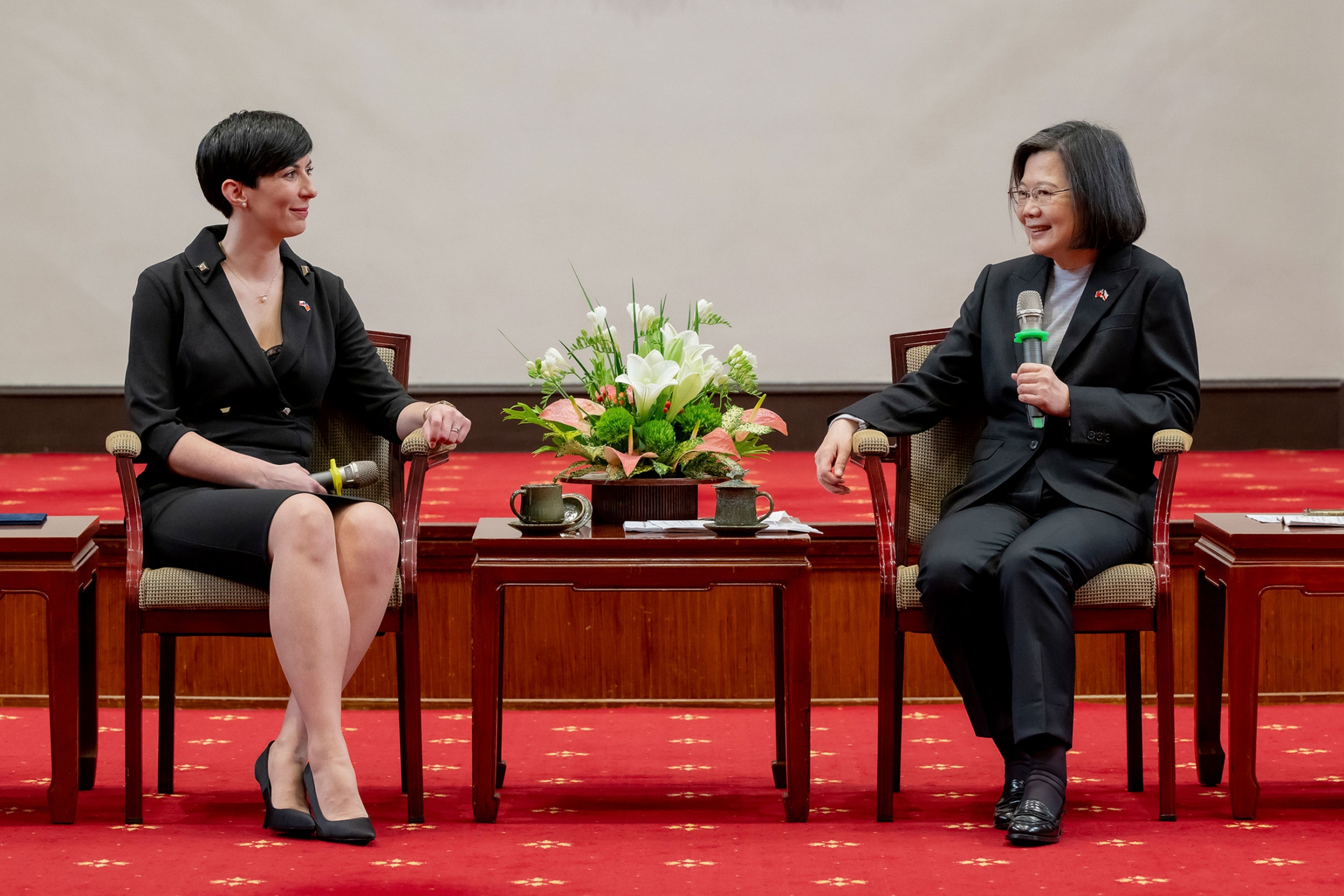
In this photo released by the Taiwan Presidential Office, Taiwan's President Tsai Ing-wen, right, speaks with Czech Speaker of the Chamber of Deputies Marketa Pekarova Adamova during a meeting in Taipei, Taiwan, March 27, 2023.
Taiwan Presidential Office/AP
On a visit to the eastern Taiwanese city of Yilan, the speaker of the Czech Parliament’s lower house, Marketa Pekarova Adamova, spoke in Chinese about the value of the relationship.
“The history between Taiwan and the Czech Republic goes back more than 30 years,” Adamova said.
“We treasure that history, so as other countries break diplomatic ties with Taiwan, we feel we should value our friendship even more.”
As Tsai prepares for her trip to the Americas, and Taiwan for its next election, the symbolism of events like these could weigh on voters’ decisions.
Reaching the Tarkwa Bay Beach in the southernmost part of Lagos, Nigeria, requires a short boat ride.
The water is surprisingly warm on that side of the Atlantic Ocean compared to the eastern shores of the United States.
It’s also where 32-year-old surfing instructor Godpower Tamarakuro Pekipuma grew up, and where he first saw people surfing the waves. Lagos has seen growing interest in water sports recently, which also prompted Pekipuma to open his own surfing school.
“The first time I saw them surfing, I thought they were like Jesus Christ walking on top of water,” he recalled. “I was like wow, Jesus, I have to learn this sport.”
But Pekipuma said his parents wouldn’t allow it. They worried about him drowning. So, he snuck out of the house to ride the waves — it was addicting, he said.
Pekipuma's parents’ fears weren’t unique. Despite having a long coastline, many Nigerians avoid the open water, especially with many of them not being able to swim.
But these days, in Lagos at least, Pekipuma said, the surfing community is growing fast.
In 2016, Pekipuma opened the GP Surfing School in Tarkwa Bay. Many of his clients are foreign tourists and affluent Nigerians returning home from abroad. But, Pekipuma said he has also taught dozens of children in the community how to surf for free.
“It makes you stay away from trouble,” he explained. “Because some of the kids, some of them are sitting at home smoking, taking drugs or [gambling], or fighting.”
He’s been teaching his son how to surf, too. Pekipuma’s own parents have also come around to the idea of him surfing for a living.
The recently formed Nigeria Surfing Federation plans to host a national surfing festival in April in order to determine who the country’s best surfers are.
Pekipuma said the hope is for them to compete in international surfing events, including the Olympics.
But, he added, they need resources and sponsorship to be able to achieve that. He hopes the Nigerian government will invest more in water sports and the country’s tourism industry.
“A lot of our kids here need to get the equipment, you know. They need to get the shelter for them to focus,” he said. “A lot of them sleep on the beach here, which isn’t fair.”
Related: Surf's up!: Riding the world's largest waves in Portugal's Nazaré
US Climate envoy John Kerry was welcomed in Mexico this week, with an official ceremony honoring the birth of Mexico’s first Indigenous president, Benito Juárez, 217 years ago.
“Today, we celebrate leadership. We celebrate the beginning of Independence for Mexico. And we celebrate together, Estados Unidos, Mexico. Para siempre,” Kerry said. “US-Mexico forever.”
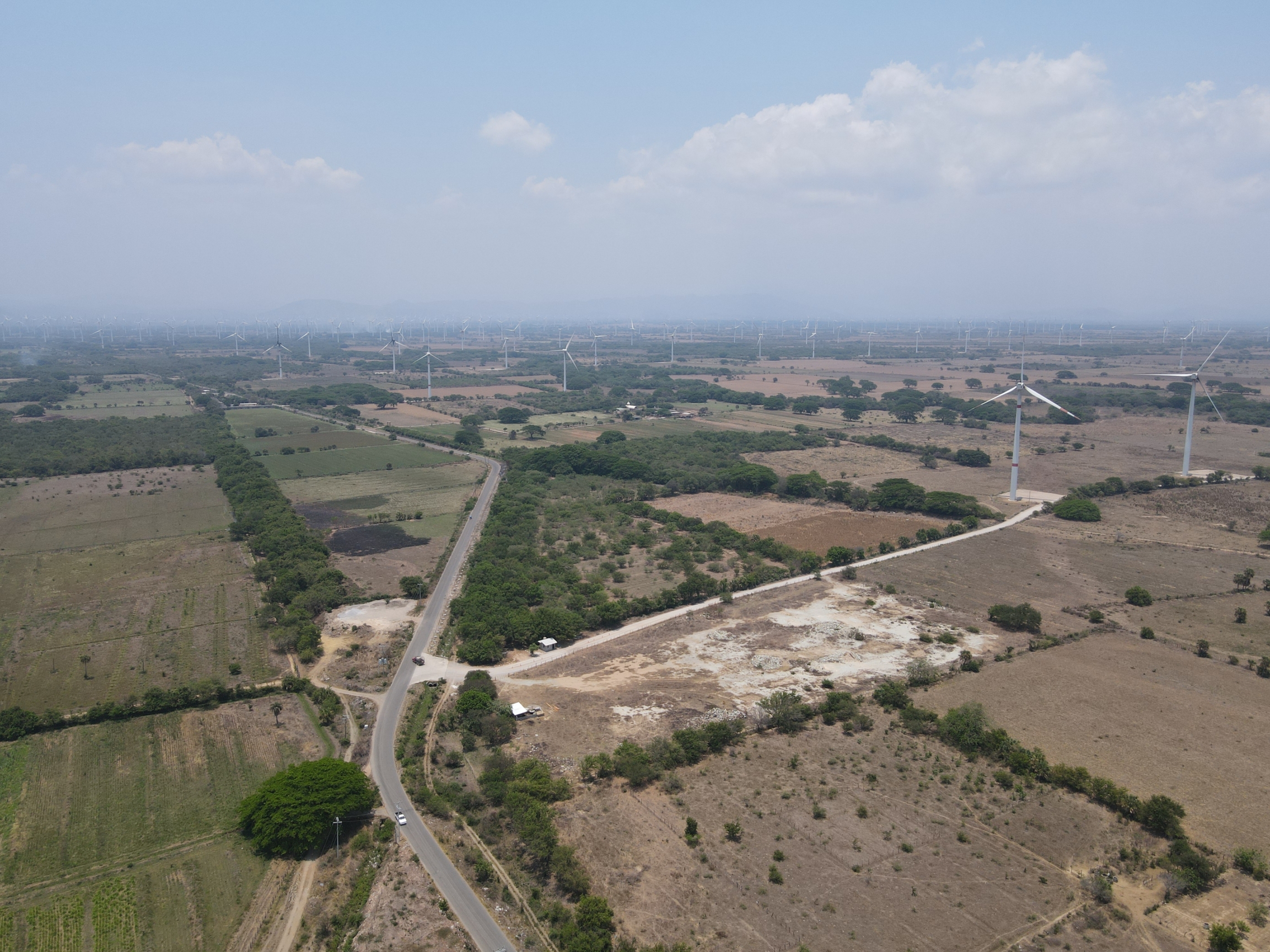
Wind farms around the town of Juchitán de Zaragoza in Mexico, which is in the middle of the Interoceanic Corridor.
Mike Fox/The World
But there was another reason Kerry was visiting the Mexican state of Oaxaca. This is the location of the new Interoceanic Corridor. It’s the signature project of President Andrés Manuel López Obrador. With a price tag of at least $1 billion, this ambitious effort includes modernizing ports and airports, building 200 miles of new railways and highways and an oil pipeline and a fiber-optic network, plus 10 industrial parks.
López Obrador is hoping to attract US investment, especially for new wind farms in Oaxaca.
Kerry this week signaled that the Biden administration is on board, and willing to invest in more than 10 wind and solar farms. But there’s a problem.
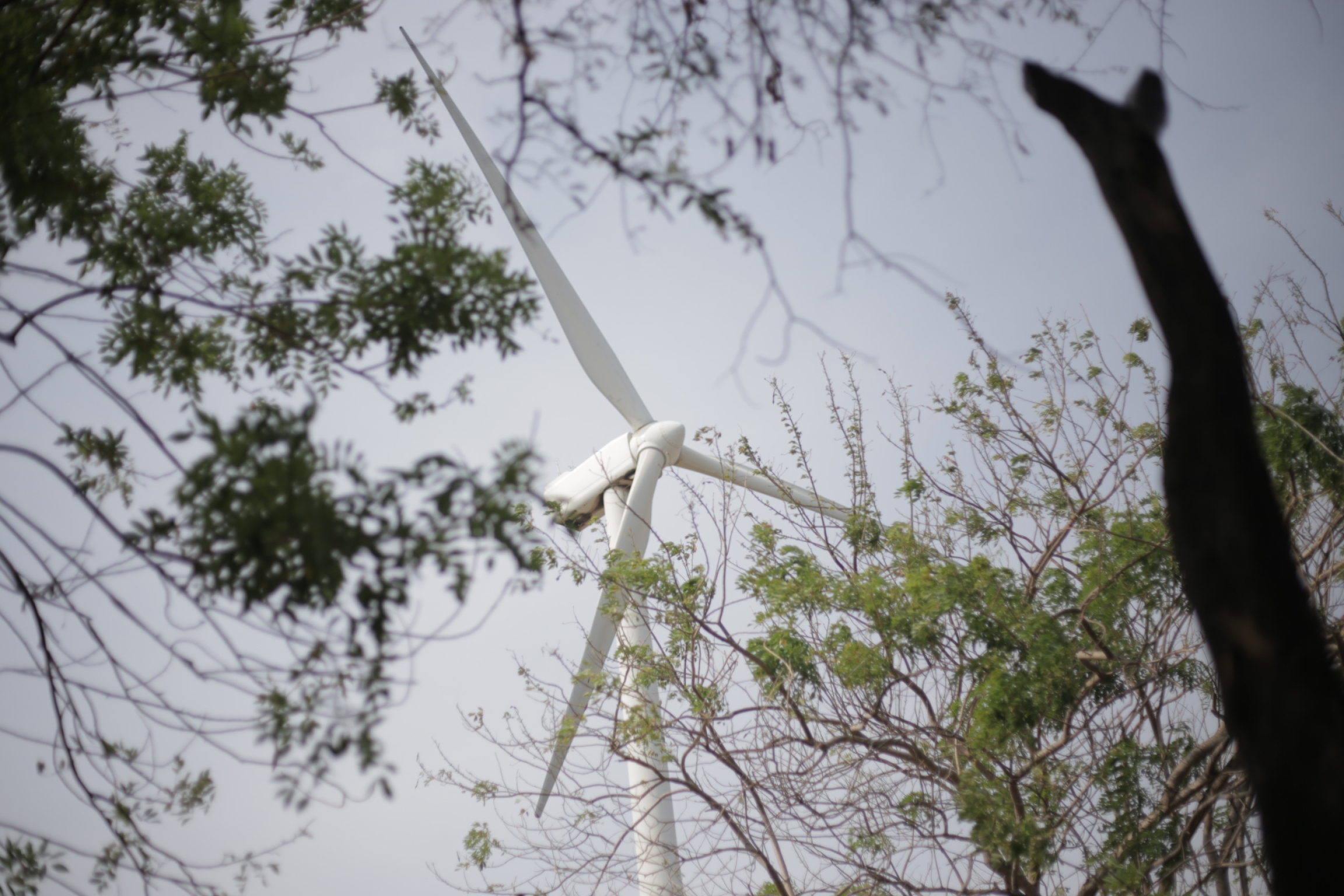
A wind generator near the town of Juchitán de Zaragoza, Mexico, which is along the Interoceanic Corridor, a signature project of President Andrés Manuel López Obrador.
Mike Fox/The World
Local residents say the wind farms already established in Oaxaca by foreign companies have disrespected communal land rights; and failed to benefit the local community; and polluted the environment.
And Indigenous groups are not happy about López Obrador's interoceanic development project. One group of residents blocked a major highway in the region just ahead of Kerry's visit. Others marched on the capital of Oaxaca and occupied the main plaza on Monday.
#AlMomento || Llega la marcha del Frente de Organizaciones Oaxaqueñas al Zócalo de la capital. Vía @MarioRomero80 @SEGO\_Oax pic.twitter.com/LKncGRAqsb
— Primera Línea Mx (@esprimeralinea) March 20, 2023
“We won’t let you remove us from our lands and violate our rights,” said an Indigenous leader in a video shared on social media. In the video, he stands with a group of protesters in front of a rail line that should be under construction. But they've been blocking it now for nearly a month.
#CirculaEnRedes
— DOMINIO INFORMATIVO DIGITAL (@DID\_Oaxaca) March 17, 2023
A casi 20 días de bloquear las vías del ferrocarril, habitantes de Mogoñé Viejo en San Juan Guichicovi #Oaxaca exigen al presidente @lopezobrador\_ instruya a @salomonj una mesa de diálogo para la atención de sus demandas.https://t.co/mVRTdV4yuy pic.twitter.com/8NMVUECbTT
Carlos Beas Torres is a leader of UCIZONI — the Union of Indigenous Communities of the Northern Isthmus — which is battling the development project.
“The Mexican government is imposing this project on Indigenous territories. The population was not consulted,” Beas Torres said. “They are removing people from their land.”
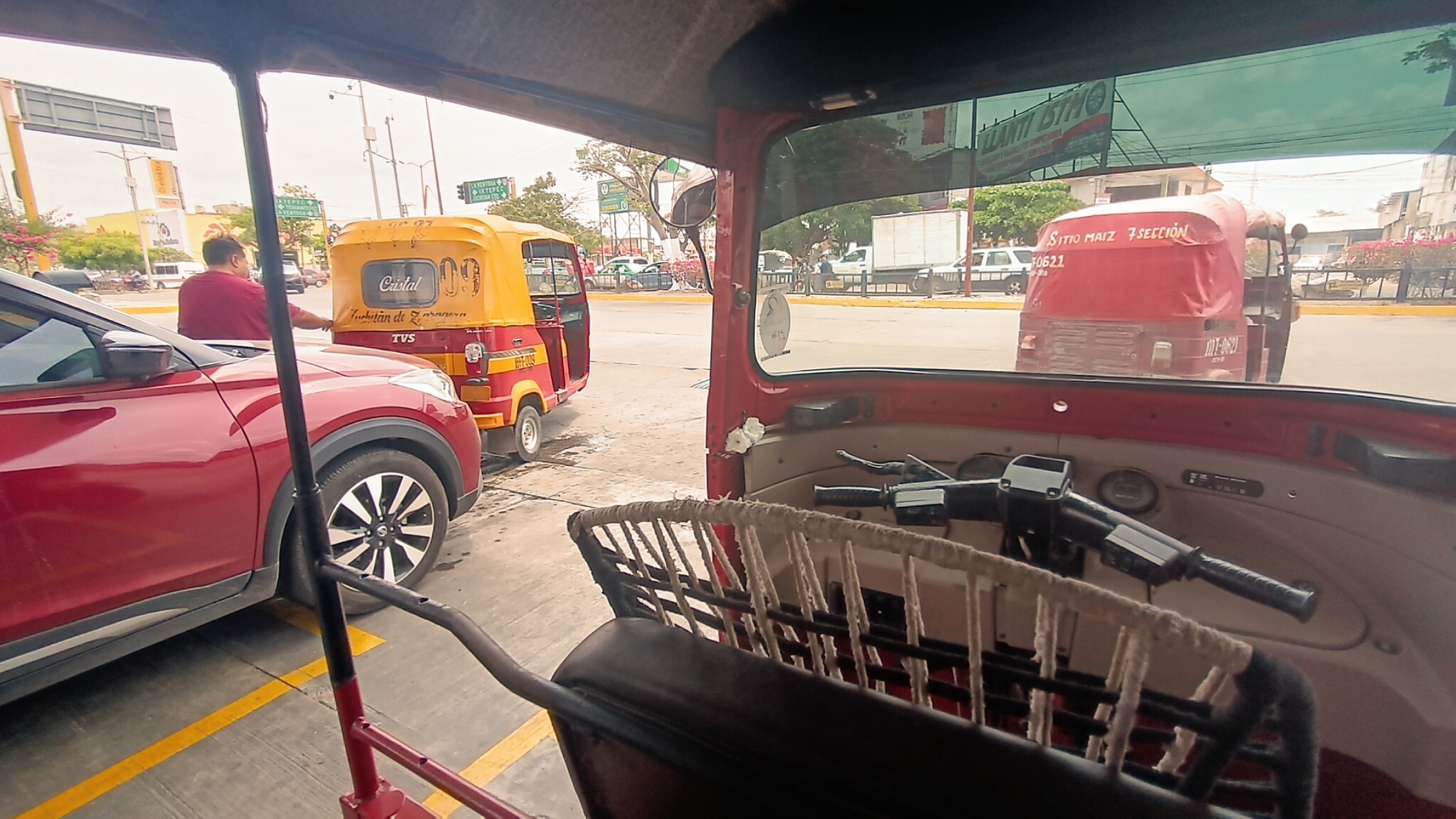
Mototaxis driving through the streets of the Indigenous town of Juchitán de Zaragoza, Mexico, that sits along the Interoceanic Corridor development project.
Mike Fox/The World
He said that he himself is being threatened. This week, a letter signed by dozens of Mexican groups demanded that federal and state authorities stop harassing Beas Torres and his Indigenous organization.
“This megaproject is looking to completely transform our region and our culture,” Beas Torres said. “We’re farmers and fishermen. This project is about industry. It will change our way of life.”
But officials say the project is a win-win. Oaxacan Gov. Salomón Jara Cruz said earlier this month that the Interoceanic Corridor would transform Oaxaca. “We will be a geopolitical and strategic point for global commerce.”
Martín Esteva Martínez drives a mototaxi in the Indigenous town of Juchitán de Zaragoza, Mexico.
Mike Fox/The World
Experts say the corridor could eventually ship 1.4 million containers a year and create hundreds of thousands of new jobs.
President López Obrador said he’s going to encourage foreign companies to set up in the region. He said there will be state subsidies and plenty of jobs.
The Indigenous town of Juchitán de Zaragoza is along the development corridor. Martín Esteva Martínez drives a mototaxi here. But he’s also in his final years of a degree in electrical engineering. He’s concerned about what this huge development project could mean for the region’s Indigenous culture.
But he also said it could be positive for Oaxaca: “Many new companies are going to come here. So, that would be an opportunity.”
There’s still a long way to go, though, and economists like Juan Carlos Moreno-Brid at the University of Mexico question the plan’s true viability.
"The reality is that up until now, we haven’t seen one investment project from a private firm, beyond the infrastructure that the government has been building. No plant or company has yet to commit to the project,” he said.
“We’ll see what happens in the future, but currently there are many uncertainties.”
Meanwhile, Indigenous communities have promised to continue to fight.
Spain’s Institute of Science and Concrete Technology laboratory sits inside a cavernous, concrete hanger on the campus of Valencia’s Polytechnical University. It hosts one of Europe’s largest disaster simulators — all kinds of them, according to lead scientist José Adam.
“Earthquakes, explosions, fire, landslides, floods,” he said. “These are the events we work on.”
Adam’s lab is getting attention after the deadly earthquakes that struck Turkey and Syria in February, which killed at least 50,000 people.
The experimental lab looks like a massive construction site. But there’s some high-tech gadgetry among the pallets of building materials and the steel cabling: a hydraulic jack in one corner that can apply tons of pressure on, say, a bridge pillar; another contraption tests how well a concrete wall stands up to fire; yet another jack applies seismic pressure against a recently erected brick hut.

Inside the Institute of Science and Concrete Technology, construction materials and machinery are stored everywhere. It looks like a real-life construction site.
Gerry Hadden/The World
The main aim here is to make buildings more resilient by improving “continuity” — how well the different parts of a building hold together.
“Continuity is a key aspect because if one of the columns collapses, the load of that column should be transferred to other elements,” Adam said.
Think of a building as a group of mountain climbers all connected by a safety rope. If one climber slips, the others can collectively stop the fall and prevent the climber from sliding away.

Dr. José M. Adam, chief researcher at the Institute of Science and Concrete Technology, stands next to a hydraulic jack capable of applying tons of load pressure on simulated bridges and buildings. The tests help researchers understand how structures break, which can lead to better design and building techniques.
Gerry Hadden/The World
Adam’s team tests for continuity on full-scale buildings outside the city.
On a recent afternoon, they sent in a remote-controlled forklift to deliberately punch out a column on a two-story structure. The building sagged for a second, but didn't collapse. The team of some 50 people erupted in applause.
But sometimes, collapse is unavoidable, the scientist explained. Take the truck bomb that brought down a full third of the Alfred P. Murrah Federal Building in Oklahoma City, Oklahoma, in 1995.
That tragedy was a seminal moment in structural design — the homemade bomb, he said, took out just three of the building’s many columns, yet it led to structural catastrophe due to the domino effect of collapsing sections. After that, engineers came up with the idea of a so-called “last line of defense” for buildings.

Buckets of microfibers sit at the ready inside the experimental lab. The fibers are mixed with concrete to give it incredible strength and resistance.
Gerry Hadden/The World
Adam is working on what is called “fuse segmentation,” essentially structural break points in the building. It’s a safety measure, and works just like electrical fuses in a home.
“You won't see these fuses, because they are inside the structure.”
Under normal conditions, the fuses are structurally sound. But if one corner of a building begins to collapse, say, after a flash-flood, metaphorically speaking, the fuses will blow.
“It breaks this segment, separating the collapsing area from the rest,” he said. “This is a smart switch device.”
In other words, you can cut your losses. Almost like a lizard that can detach its own tail to escape predators.
The lab is still perfecting these structural fuses, but part of their genius is that they cost virtually nothing because it does not require bringing new materials or mechanisms to the construction process.
It’s a matter of strategically weakening certain parts of the building, which hold up under normal conditions but collapse under high stress.
“The construction sector is very conservative,” he said. “If you want to convince people to use a device, they won't pay for it.”

The entrance to Valencia’s Polytechnical University, home to the lab trying to make buildings and bridges more resilient to catastrophic stress.
Gerry Hadden/The World
Adam said he hopes this low-cost solution can be used everywhere one day, and not just in earthquake prone areas — with climate change, no building’s safety is guaranteed, because no one can predict the weather.
“For example, storms in places where you didn't didn't have storms in the past, or strong rainfalls or landslides in a place where maybe nothing happens now but in the future.”
But no matter how good building technology gets, if contractors don’t use it, then disasters like the quake in Turkey will continue to topple towers, and kill people, in large numbers.
Haitian musician Erol Josué has just released a new album titled "Pèlerinaj," or “pilgrimage” in Haitian Creole, with 18 tracks in a mix of sacred chants and traditional rhythms with funk, jazz, rock and electronic music. The songs are in Haitian Creole and French.
It took Josué 15 years to release a new album as, over the past decade, other things took priority over music. One of them was to help fellow Haitians devastated by the earthquake that hit the island in 2010.
Back then, Josué was living abroad, carving out a name for himself on the music scenes in Paris and New York. When disaster struck, he knew he had to go back to Haiti. His song "Kafou" is about his own pilgrimage, returning to his hometown, a sprawling suburb just outside the capital Port-au-Prince, after his life abroad.
"I saw Haiti needed people, Haiti needed me to go to rebuild. I needed to put my hand into [the] reconstruction of my country,” Josué said.
Josué, one of Haiti’s most beloved artists, was ordained as a Houngan, or Vodou priest, at the age of 15. In his own way, he is also a cultural ambassador for Haiti. He has been the Director of Haiti’s National Bureau of Ethnology in Port-au-Prince since 2012, and has used this position to introduce Haitian Vodou culture to educational institutions in the United States.
Josué opens his album by invoking Vodou goddesses and saints in songs like “Rén Sobo,” “Ati Sole” and “Palave Maria,” he closes it with “Kase Tonèl,” a live recording of a Vodou ceremony and subsequent festivities.
But his achievements and titles do not insulate Josué from the violence that has engulfed his native country. Recently, gangs burnt down his family's home and Vodou temple.
"I don't know if I'm the target. I don't know if it was just random," Josué said. "Sometimes I feel bad because I think maybe it is on me, because I became someone more popular. I don't know what to believe. I just continue in the name of the spirit, the Vodou spirit, and continue to do what I have to do. I have my mission. I have my dream, my goal for my country. And I'm working on it."
Like many Haitians, Josué would like to live in a peaceful, stable country. In the meantime, his mission is to have his music do the talking, letting people know that what the globe sees in Haiti is not monolithic.
"Haiti is not only gangs and burning tires. Haiti is not only debt," Josué said. "Haiti is a free republic in what we propose as culture, as art can be a different way to understand what happened in Haiti.”
Get more music from artists featured on The World on our Global Hits playlist.
At Abbas Zakaria Galwani’s clay-pot-making factory, a handful of men pack pots in boxes.
“We sell in cities across the country and even export to other countries,” Galwani said.
His factory in Dharavi, Asia’s largest informal settlement, in the middle of Mumbai, India’s financial capital, employs 22 people. It’s one of thousands of small industries in the settlement, where more than 1 million people live and work in 1 square mile on land that is mostly government owned.

One of India’s large conglomerates, the Adani Group, won an auction in January to work with the government to redevelop Dharavi
Raksha Kumar/The World
Dharavi’s open drains, naked electricity wires and narrow pathways packed with hordes of people have been featured in films like “Slumdog Millionaire.”
For 20 years, authorities have said they want to turn Dharavi into a modern township, complete with roads, schools, parks, hospitals and housing enclaves. Redevelopment plans continue to take shape, but many local residents like Galwani have resisted the proposals, fearing the impact of gentrification.
“We have no problems if you develop our land as long as the development benefits us as well,” he said, adding, “We fear they would displace us and redevelop the land to suit their needs.”
Galwani said that his family moved into Dharavi when it was nothing more than a swamp a hundred years ago.
“We feel a symbiotic relationship with this place. We gave it a shape, it gave us an identity,” he said.
Dharavi, in Mumbai, India, is home to a lot of potters.
Raksha Kumar/The World
Families like his cleared out the marsh, built their homes and started small businesses that now contribute to over $1 billion in revenue every year.
Informal markets pack every street of Dharavi.
For real estate companies, Dharavi is a strategic location. The city’s two main train lines pass through Dharavi, and swanky neighborhoods surround it.
For real estate companies, Dharavi, in Mumbai, India, is a strategic location. The city’s two main train lines passing through it and swanky neighborhoods surround it.
Raksha Kumar/The World
A huge government hospital that caters to millions of the city’s poor and middle-class populations sits in the middle of Dharavi.
One of India’s large conglomerates, the Adani Group, won an auction in January to work with the government to redevelop Dharavi. The $2.4-billion proposed plan to redevelop 260 hectares of the settlement would accommodate some people and businesses, but displace thousands — and the details are scarce, a CBC report says.
In January, Hindenburg Research, an investment firm, accused the Adani Group of pulling off “the largest con in corporate history.”

Dharavi, in the middle of Mumbai, India’s financial capital, is Asia’s largest informal settlement.
Raksha Kumar/The World
Hindenburg published a document that said that the Adani Group was engaged in “brazen stock manipulation,” “accounting fraud” and money laundering,” which the group denied.
Since then, Dharavi residents have protested against the Adani Group. Also, the group’s market value has lost more than $110 billion as investors have pulled out.
The Adani Group has not made any statements on the redevelopment project yet.
By some estimates, Dharavi has about 20,000 mini factories contained inside it. But it is precisely these industries that the government says need relocating.
CEO of the Dharavi Redevelopment Board SCR Srinivas told local media in January that Dharavi needs to develop so it doesn’t continue to add to Mumbai’s pollution.

A wall in Dharavi, in Mumbai, India, marked by graffiti.
Raksha Kumar/The World
“Entire sewage [from Dharavi] is untreated [and] it is going into the Mithi river,” he said. “There are leather industries and textile industries there that are highly polluting.”
There is no drinking water and no sanitation. At the same time, Dharavi is bearing the burden of the city’s waste, not just its own.
According to Krishna Pujari, an entrepreneur who runs a travel company in Dharavi, 80% of the city’s waste is recycled in Dharavi.
“We are the reason waste has not piled up on the streets of Mumbai,” said Mohammad Irfan, who owns a recycling plant in Dharavi.
Smaller industries contribute to the pollution, too.
In the potters colony in Dharavi, kilns burn most of the time, adding smoke to narrow haphazardly built homes around it.
Still, people depend on their businesses for their livelihoods.
Many residents wonder whether the redevelopment plans would interfere with their ability to continue running their businesses.
Architect Sandhya Naidu said the biggest challenge in redeveloping Dharavi is ensuring that its people get to live and work there. So, any redevelopment plan “will have to be heavily influenced by people who have the lived experience of having been in Dharavi in all their lives.”
Back in his factory, Galwani was practicing a speech to give at the prestigious Indian Institute of Technology Bombay on pot making. He said that Dharavi gave him his identity.
“With time, there is bound to be change,” he said. “By all means, redevelop our informal settlement but do not put us out of work.”
In Russia, soccer is by far the most popular sport — fans often pack stadiums in their team’s scarves, waving flags and singing their team’s song.
And the country even hosted the men’s World Cup in 2018.
But a new policy known as the Fan ID law has sports fans annoyed — and many see it as a new form of authoritarian surveillance.
“The law is very simple, without Fan ID, you can’t get into the stadium, you can’t get tickets into the football match,” said Irina Borogan, an expert on Russia’s security services, based in London.
Fan IDs have been implemented sporadically in the past. But the Fan ID law was adopted last summer and implemented gradually. First, five stadiums required Fan IDs and, as of this year, all soccer stadiums now require it.
“To get Fan ID, every Russian citizen has to be registered at the special government website. It means you provide all information about you to the government,” Borogan said.
The state says it’s about public safety and security. But Russian soccer fans aren’t buying it.
At a recent game at the Spartak Moscow soccer club, fans were heard chanting, “Fan ID is killing soccer!”
There are already facial recognition cameras at soccer stadiums. People are now afraid of additional state surveillance, Borogan explained.
“That’s why they are against this law, and that’s why it prompted a lot of protest from the football spectators and the football fans,” Borogan said.
A woman walks past the WCup Fan ID distribution center as it's opened in Moscow, Russia, Dec. 7, 2017. A Fan ID is a document that all the spectators of 2018 FIFA World Cup matches needed to get access to stadiums. And now it's a law for all stadiums in Russia.
Pavel Golovkin/AP
She said the war in Ukraine is another factor.
A lot of young men are trying to avoid the draft, and they are not inclined to share all of their personal information with the state.
Ilya Chicherov, a Russian sports attorney, said the Fan ID system is arbitrary, with no way to appeal the decision if a sports fan applies and gets declined.
“The law says that if there is information that you have intention to commit something not very good at the stadium, that’s a reason not to give you that Fan ID and to allow you to the stadium,” Chicherov said.
Some analysts speculate that Russian security services are targeting those with a record of opposition.
“They want to make life less comfortable for people who are not OK with the governmental policy,” Chicherov said.
Since the implementation of the Fan ID system, Russian soccer teams have seen a big drop in attendance.
Fan groups across Russia are boycotting matches where Fan ID is required, and some prominent soccer personalities are speaking out.
Leonid Slutsky, a former coach of Russia’s national team, said that because of the new Fan ID, he’s no longer going to matches in person.
Alena Popova, a Russian opposition politician now based at the Wilson Center in Washington, said the Fan ID policy is all about surveillance.
“I’m against the creation of the total surveillance machine in my own country,” she said.
Popova said it’s highly unlikely that the government will back down. The Russian government takes a hard line against all forms of dissent.
But Popova said soccer fans are a tough group to silence.
“Protest rallies are prohibited now in Russia, so they are the only community with the chance to protest and they use that for more than 100%, so they showed many, many people that you can protest,” she said.
Popova said she hopes that Russian citizens will take notice.
On a recent afternoon, Russian and Armenian colleagues gathered in a cafeteria at Picsart, a tech company that produces photo software, from its office in Yerevan, Armenia.
They were sitting in comfy chairs and helping themselves to free snacks and drinks while two co-workers played at a pingpong table.
The office resembled any tech office in San Francisco.
For years, many Armenian migrants have gone to Russia to work low-wage jobs. But now, Russians are migrating to Armenia and helping to improve the local economy.
“Having so many new Russian colleagues on the ground has expanded the creativity, the mindset, the solutions — there's just a more diverse opportunity at the table," said Madlene Minassian, Picstart’s head of learning and development.
It’s estimated that at least 100,000 tech workers have left Russia since it invaded Ukraine last year for neighboring countries such as Kazakhstan and Armenia.
After the full-scale invasion in Ukraine began last winter, data analyst Alexei Rostotskiy attended an anti-war protest in Moscow. But denouncing the war is a crime in Russia; its punishable by jail time. Police officers quickly detained and charged him with participating in an unlawful protest.
Several weeks later, Rostotskiy managed to flee to nearby Armenia along with at least 40,000 other Russians.
Many tech workers who fled to Armenia strongly opposed the war or feared getting drafted. And most have no intention of returning home as long as Vladimir Putin remains in power.
“If I had, like, a tiny piece of belief that something can be changed in Russia I would have stayed,” Rostotskiy said.

Alexei Rostotskiy, a data analyst from Moscow, moved to Armenia shortly after Russia invaded Ukraine because he didn't agree with the direction the country is going. Like many Russian tech workers who have relocated abroad after the war started, he has no intention of returning to Russia anytime soon.
Levi Bridges/The World
Other tech workers fled Russia because the companies they worked for had difficulties paying them after Western nations implemented harsh new restrictions on Russia’s banking system.
Rostotskiy had the opportunity to work remotely, which made leaving Russia and starting over in Armenia much easier. Many Russians in Yerevan also work remotely for Russian and foreign tech companies.
“One of the best-paying jobs in Russia is in IT, so my feeling is that most of the Russians that came to Armenia have tech jobs,” Rostotskiy said.
The exodus of so many tech workers is a blow to Russia’s economy. In Armenia, affluent Russians with remote jobs have caused a housing crisis with rents soaring.
But their arrival has helped bolster Armenia’s tech scene, which has been growing steadily for years.
“The number of talent, the number of companies opening branches in Armenia, the number of startups is growing rapidly,” said Narek Aslikyan, the chief executive officer and co-founder of the Armenian Coding Academy in Yerevan.
Aslikyan said the number of tech workers in Armenia has more than doubled since the war started. It means that tech companies considering doing business in Armenia will be able to draw from a much larger talent pool.

At the Armenian Coding Academy in Yerevan, Armenia, students study to become the next generation of the country's tech professionals. Since Russia invaded Ukraine last year, thousands of young Russians have relocated to Armenia causing the number of tech workers in the country to nearly double.
Levi Bridges/The World
For years, members of the Armenian diaspora abroad have launched tech companies in Armenia with the support of venture capital from places like California, with large Armenian communities.
“I'm quite sure that if the Armenian diaspora in the United States weren’t located in California and Bay Area, and instead was mostly in Arizona, then maybe some of the Armenian startups wouldn’t have been created at all,” Aslikyan said.
Now, Russians coming from abroad are rapidly expanding tech’s footprint in Armenia even more.
Aslikyan sees this moment as a key opportunity for Armenia. He believes the presence of more Russian tech workers is spurring Armenia’s tech industry to become more global as these two groups of workers — Armenian and Russian — have to find a common language: English.
“It's an opportunity for both Armenian companies and also for the Russian companies relocating here to insist to their employees to learn English,” Aslikyan said.
Since the war started, Russians have registered thousands of new businesses in Armenia – most of them in the tech field – and the economy has grown three times as fast as it was a year ago, according to Vahan Kerobyan, Armenia’s economy minister.
Although Russian migrants have helped drive a significant amount of the growth, Kerobyan also credits other factors like increased Russian tourism in Armenia and trade with Russia.
“Many international companies left Russia, and Armenian goods now have less competition in Russia, so our exports to Russia skyrocketed,” Kerobyan said.
Kerobyan also credited government programs and a general trend with economies accelerating worldwide as they recover from the COVID-19 pandemic as part of Armenia’s rapid economic growth.
But tech remains a key part of Armenia’s economic strategy, with the war helping those efforts. Russia’s economy has grown more isolated since it invaded Ukraine, but Armenia’s is getting more competitive.
Kerobyan said that Armenian and Russian tech companies that relocated to cities like Yerevan are competing for local talent, which is good for business.
“We will have much more competitive, locally born companies that can be more successful in the international market,” Kerobyan said.
But some Russian tech workers in Yerevan are more skeptical about the future of the tech industry in Armenia.
“It's very possible that the Russian government will push IT companies to stop working remotely [in Armenia] or create big taxes to make it more difficult,” said a Russian tech worker in Yerevan named Andrey who didn’t give his last name due to fear of retaliation.
Some Russian lawmakers have proposed harsh measures like seizing property from Russians who left the country to coerce them to return home and stop the brain drain.
But those threats aren’t diminishing the optimism that Armenians feel right now about the future of tech in their country.
And if the trend continues, more Armenians might be able to stay and work at home alongside their new Russian neighbors.
This week marks 20 years since the US-led invasion of Iraq. Many of the 160,000 coalition troops who were deployed for the invasion are also looking back, remembering and reliving those tumultuous events.
Among them is Kayla Williams, a former US Army sergeant who was part of the Iraq mission in 2003 as an Arabic linguist. Williams was assigned to a signals intelligence team with the 101st Airborne Division.
She has also written about her experiences in two books, "Love My Rifle More Than You: Young and Female in the U.S. Army" and "Plenty of Time When We Get Home: Love and Recovery in the Aftermath of War."
She joined The World's host Marco Werman from Reston, Virginia, for a conversation about her experiences and her evolving thoughts and reactions to the war over the years.
This interview has been lightly edited and condensed for clarity.
Related: Young Iraqis reflect on the US-led invasion, its aftermath and their hopes for the future
Commuters in Boston, New York, Chicago and Abidjan, Ivory Coast, might run into a photography exhibit right at their bus stop.
Ethiopian photographer, artist and educator Aïda Muluneh is showcasing the culture of her birth country in a series of 12 photographs displayed at more than 300 bus shelters across these US cities and the Ivorian capital, where she is based.

A montage of two of the 12 photographs by Ethiopian artist and educator Aïda Muluneh that are part of the "This is where I am" public art photo exhibit. "If they come for me in the morning," left, and "The widows of the night," right.
Courtesy of Public Art Fund, NY
Her latest body of work is called “This is where I am,” which comes from a 1974 poem by the same name by Ethiopian writer Tsegaye Gabre-Medhin.
“The work is almost like a love letter to Ethiopia,” Muluneh said.
Muluneh seeks to capture her country’s national, political and cultural identity, while also portraying her own experiences as an Ethiopian woman and immigrant.
“We sort of carry our culture regardless of where we are. So in my home, it was very important to stay connected to my birthplace. And I wasn’t allowed to speak English in the house, because my mother felt it was very important to know our native tongue. So, these things were deeply embedded for me even though I spent most of my life abroad,” Muluneh said.

Aïda Muluneh's "To speak in silence" is exhibited at a bus stop in Abidjan, Ivory Coast. The photograph is part of an exhibit titled "This is where I am."
Ben Saïd, Courtesy of Public Art Fund, NY
Curator Katerina Stathopoulou commissioned the series with the Public Art Fund, a New York-based nonprofit dedicated to presenting art in public places.
“The goal of public art, in general, is to have art accessible, on view, free of charge, 24 hours a day,” Stathopoulou said.
That mission was a selling point for Muluneh.
“Art should not be the exercise of the elite. It has to be something that engages all stakeholders and the full community.”

Photographer Aïda Muluneh prepares a model for a photo shoot in Abidjan, Ivory Coast.
Courtesy of Public Art Fund, NY.
At a busy intersection on Massachusetts Avenue, one of Boston’s main drags, the bus stop showcases the photograph called “To speak in silence.”
It shows three women wearing yellow and red robes standing in front of a green background that is typically used to add special effects in post-production for films and photographs.

Aïda Muluneh's "If they come for me in the morning" is shown at a bus stop in Boston, Massachusetts. This is part of a public art exhibit on view from March 1 until May 21, 2023.
Timothy Schenck, Courtesy of Public Art Fund, NY
That’s what Muluneh intended to do. But once she saw the green coupled with the red and yellow robes, she decided to keep it as is.
“It became like symbolic of the Ethiopian flag, because these are the core colors within our flag,” Muluneh said.

Aïda Muluneh's "The faith of fate" is shown at a bus stop in the Boston area.
Timothy Schenck, Courtesy of Public Art Fund, NY
Those colors caught the attention of Netsanet Woldesenbet, the co-owner of Lucy Ethiopian Cafe and Restaurant, which, coincidentally, is across the street from the bus shelter.
“I was so happy to see the colors, you know, because it’s very bold and bright. Yes, absolutely, yes.”

A set is being prepared for the photoshoot of the stills for the public art exhibit "This is where I am," commissioned by the New York-based organization Public Art Fund.
Courtesy of Public Art Fund, NY.
Woldesenbet said she doesn’t see Ethiopian art around town very often, and she’s thrilled to now have work by an Ethiopian artist outside her cafe windows.
Muluneh says her primary audience is Ethiopians around the world. But she hopes everyone will find meaning in her work and also get the curiosity to go and explore other artists from the African continent.
“We are trying to build bridges. Because I think that is the only way we can really address the misconceptions and also develop new perceptions as it relates to Africa,” Muluneh said.

Close-up of Aïda Muluneh's "The Weakness of Power."
Courtesy of Public Art Fund, NY.
One bank fails, not a big deal. Unless you have a lot of money in that bank. For the rest of us, the big risk is “contagion.”
“Contagion is really, obviously, taken from a medical term,” said Galina Hale, an economist at the University of California Santa Cruz and former adviser with the Federal Reserve.
She explained that just as an infectious disease spreads, the same thing can happen in the banking world.
“So, contagion is essentially, when a problem in one financial institution is creating problems for others, otherwise healthy financial institutions.”
In the case of Silicon Valley Bank, which collapsed on March 10, it went too big on bond investments. Depositors got spooked, wanted their money out right away, and a bank run ensued. Then, fear started to spread.
“What we see internationally is mostly this wakeup call, contagion, right?” said Hale, who is also a contributor to Econofact. “So, people realize, ‘Oh, I thought the banks would never fail again, but now, they actually are. So, let me see what's happening with my bank.’”
The Federal Reserve is meeting this week to address the situation. They’ll decide whether to keep raising interest rates to tame inflation or pull back to ease pressure on the banks.
Global investors are watching anxiously as the Federal Reserve’s decision will have big impacts around the world.
Banks are different from other businesses. When one bank goes bust, it can ripple through the industry.
The problems at Credit Suisse were different than at Silicon Valley Bank. And to be clear, Credit Suisse was not a healthy bank — its balance sheet also looked shaky, filled with bad investments.
Still, when a few US banks went down, investors in Credit Suisse got panicky. Then, that set off worries about a possible chain reaction.
But this is not 2008. Regulations in the US and Europe are much stronger today than they were 15 years ago.
And after that disaster, tighter global regulations were put in place as well as country-specific laws. Banks are now required to keep more capital on hand in case there’s a bank run.
Today, banks go through tougher stress tests to ensure that they can handle a worst-case scenario.
US Treasury Secretary Janet Yellen, talking to Congress last week, said that the situation is stabilizing.
“I can reassure the members of the committee that our banking system is sound, and that Americans can feel confident that their deposits will be there when they need them,” Yellen said.
Yellen's words, and quick action, have been reassuring to the global financial industry.
“A lot of the framework that applies in the US is also applied in Europe and in Asia, meaning that across the whole financial system, the biggest, most important institutions are largely regulated in a similar way,” said Bob Elliott, the chief information officer of the investment firm Unlimited, an issuer of exchange-traded funds. “So, we can be confident that those institutions are being managed as effectively abroad as they are domestically.”
He said that when troubles start in the banking sector, investors look for a quick, regulatory response.
“And the faster and more agile that they do, the less impact that will have on investors and the macro economy. And so far, regulatory authorities both in the US, and Europe and Switzerland have done a pretty good job at being responsive.”
Kenneth Rogoff, an economics professor at Harvard University, said he thinks the problem can be contained.
“We have to understand that financial crises unfold in waves. There are more waves to come. I mean, getting to the level of 2008, which was the worst thing since the Great Depression, we’ve got a ways to go to get to that.”
Rogoff said that central bankers are keenly aware of the risks this time. But, rescue operations underway in the US and Europe have a high cost as governments once again come to the rescue with big bailouts.
“I believe they did the right thing, let me be clear,” he said. “But there was no way to do it without at least putting taxpayer money at considerable risk.”
Helping out failing banks creates two additional problems. First, it incentivizes banks to take more risks.
“Pretty much everything has been guaranteed, and that’s not a good position to be in because then, banks just take too many risks. Now, the government is saying, ‘Don’t worry about it; we’re going to regulate everything.’”
But too much regulation can slow the entire economy down, making it harder for homebuyers or businesses to get a loan.
Farrah Haytham contributed to this report.
A Philippine court has found a former police officer guilty of murdering two teenagers in connection with the country’s so-called “war on drugs.”
Former Caloocan policeman Jeffrey Perez faces up to 40 years in prison without parole for the killings of 19-year-old Carl Angelo Arnaiz, and 14-year-old Reynaldo de Guzman, in 2017, according to court documents made public on March 13.
Perez has also been ordered to pay the families a total of nearly $13,000 in civil damages.
Since former President Rordrigo Duterte launched the anti-drug campaign in 2016, convictions of law enforcement officers have been rare.
The former cop was already serving jail time for another conviction related to the same murders. In November 2022, Perez was also found guilty of torturing and hiding evidence of the murders.
Still, it took five years for the case to work its way through the courts after charges against Perez and another former policeman, who died in prison in 2019, were initially filed in 2018.
Carlos Conde, senior researcher with Human Rights Watch in Manila, said that while this latest verdict is very welcome, it shows how broken the Philippines justice system really is.
“Because this is just the second conviction for murder in a drug war case out of the thousands, probably tens of thousands of similar cases, that occurred since 2016,” he said. “The fight for accountability has barely begun.”
It wasn’t until two years into former President Duterte’s so-called “war on drugs” that the first murder conviction was handed down.
In November 2018, three former police officers were found guilty of shooting and killing 17-year-old Kian delos Santos during a drug raid the year before.
Witnesses and CCTV played a crucial role in both cases, human rights lawyer Maria Sol Taule said.
“In the Philippines, you have to have hard evidence, meaning physical evidence, like videos, CCTV recordings, documentary evidence and you don't have that, it's like a ‘he said, she-said’ thing.”
Both of these murder cases also got a lot of media coverage, which helped them, Taule said.
“But many, many victims were not covered by the mainstream media and so, you know, they end up statistics of victims of the drug war,” she said.
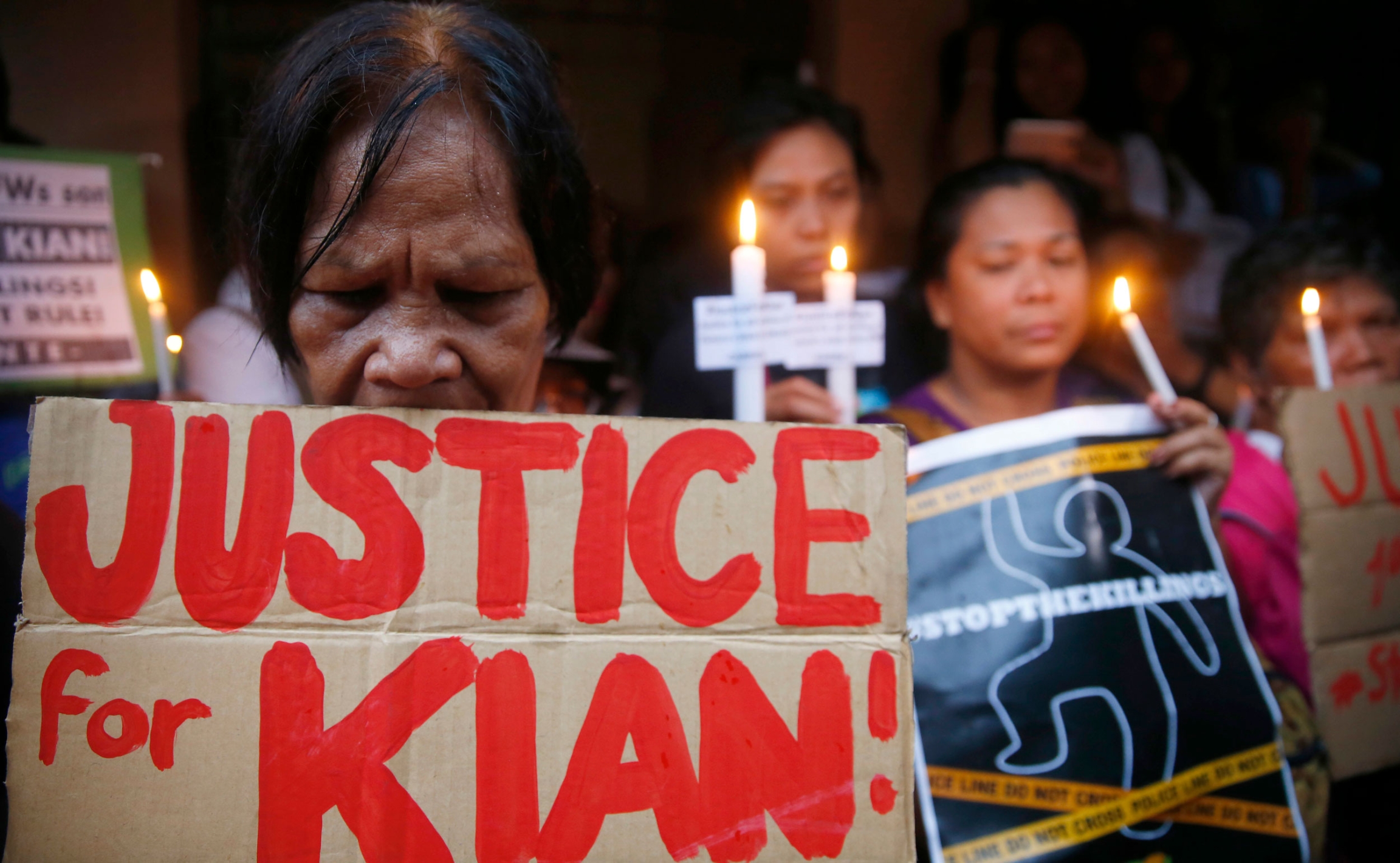
In this Aug. 21, 2017, file photo, protesters display placards and light candles outside the wake for slain Kian Loyd Delos Santos, a 17-year-old Grade 11 student, who was killed in a shootout with police, following a march in suburban Caloocan city north of Manila, Philippines.
Bullit Marquez/AP/File
Government officials say only a little over 6,200 people have died in anti-drug operations since the drug war began in 2016. But rights groups, such as CenterLaw Philippines, estimate that number could be three times higher with most of these killings being extrajudicial — committed by vigilante groups or police officers themselves.
Human rights experts also say most of the victims are poor, low-level drug pushers at best and some, like Kian delos Santos, were just in the wrong place at the wrong time.
Meanwhile, Taule said families are usually hesitant to pursue justice because these trials are so stigmatized and can also be lengthy and expensive.
“Because if you let the public prosecutors handle it, they're already overburdened,” she said.
“So you want to have a competent and focused legal counsel, that means you have to hire private counsel, it's expensive.”
The Philippine justice system is plagued by other problems, she said, including a lack of public defenders.
According to the Philippine Collegian, the student-run newspaper at the University of the Philippines Diliman, the 2,400 public defendants of the Public Attorney’s Office must juggle 816,000 cases nationwide per year. That’s an average of 340 cases per public defender.
Meanwhile, Taule said there is also a lack of available forensic scientists and doctors to perform autopsies. There are only two forensic pathologists in all of the Philippines, and one is nearing retirement age.
“We have really overburdened courts because of the drug war, which means that cases are really slow, at a snail’s pace every time,” Taule said. “It’s really hard for us.”
Rev. Flaviano “Flavie” Villanueva, a missionary with the Society of the Divine Word in Manila, said there is also a lack of political will to bring convictions.
“How do you prosecute the criminals if they are the police themselves?” asked Villanueva, who has worked with drug war victims’ families.
His Catholic nonprofit Program Paghilom has helped the widows and orphans of drug war victims with everything from food assistance to counseling for years.
Villanueva said prosecutions should not stop at low-level cops — should go much higher, all the way to Duterte himself.
“It has to go deep or even high up to the author of the killings themselves,” he said.
“If they will not be investigated, then we're just putting up a show here and are missing out on the core people who architected all this.”
But prosecutions of such high-up officials would need to happen though the international justice system, he said.
Earlier this year, the International Criminal Court announced it was resuming its investigation into alleged atrocities connected to the ongoing drug war. The initial probe was put on hold in 2021, as the former Duterte administration sought to conduct its own investigation. But the ICC said the former government has come up short of convincing them that an outside investigation wasn’t needed.
However, President Ferdinand “Bongbong” Marcos Jr. has made it clear that the ICC has no jurisdiction in the Philippines and has vowed to not cooperate with any investigation.
Businessman Kizito Tinarwo said he has many orders for products from his small steel and aluminum factory, but power blackouts have hit production hard in Zimbabwe.
He uses a gasoline-powered generator when the power goes out, but this is expensive and has its limits.
“It cuts into profits because we add to our costs of doing business,” he said. “The generator cannot run forever; it has its prescribed running hours. We switch it on and off. In the process, our lead times are affected.”
This has been the case since he started his business about four years ago. But the latest outages have been longer — sometimes lasting 19 hours a day.
Along the border between Zimbabwe and Zambia sits Lake Kariba, where low water levels have interrupted power supply to both countries. The world’s largest manmade lake by volume is on the Zambezi River, with hydroelectric power generators on both sides. Zimbabwe gets 70% of its power from Lake Kariba. But plunging water levels have worsened a yearslong power crisis — profoundly impacting the economy.

Below the Kariba dam wall, with Zambia border in the background.
ish Mafundikwa/The World
And Tinarwo is not the only one impacted by the power outages. Zimbabwe’s many minerals include platinum, gold, chrome and lithium, and mining accounts for the bulk of Zimbabwe’s export earnings.
Collin Chibafa, president of the Zimbabwe Chamber of Mines, said some 88% of the country's mines experience outages of as long as 12 hours.
He said some mining companies are now taking matters into their own hands by building solar plants.
“Obviously, those only work maybe four or five hours a day [that] we get peak production. Some of our members run diesel generators, but that's an expensive and the least-viable option. If you have people underground, they need ventilation, they need oxygen, it's really crucial that you can safely get people up from underground,” he said.
Households are not spared the inconvenience as power goes without prior notice. People with enough discretionary income may use generators, solar energy and inverters — but these options are beyond reach for the majority. Gas for cooking has become the go-to option for those who can afford it. For those who can’t, charcoal is readily available and affordable. And the sprawling, open-air market in Mbare, Harare's oldest working-class neighborhood, is the place to buy it.
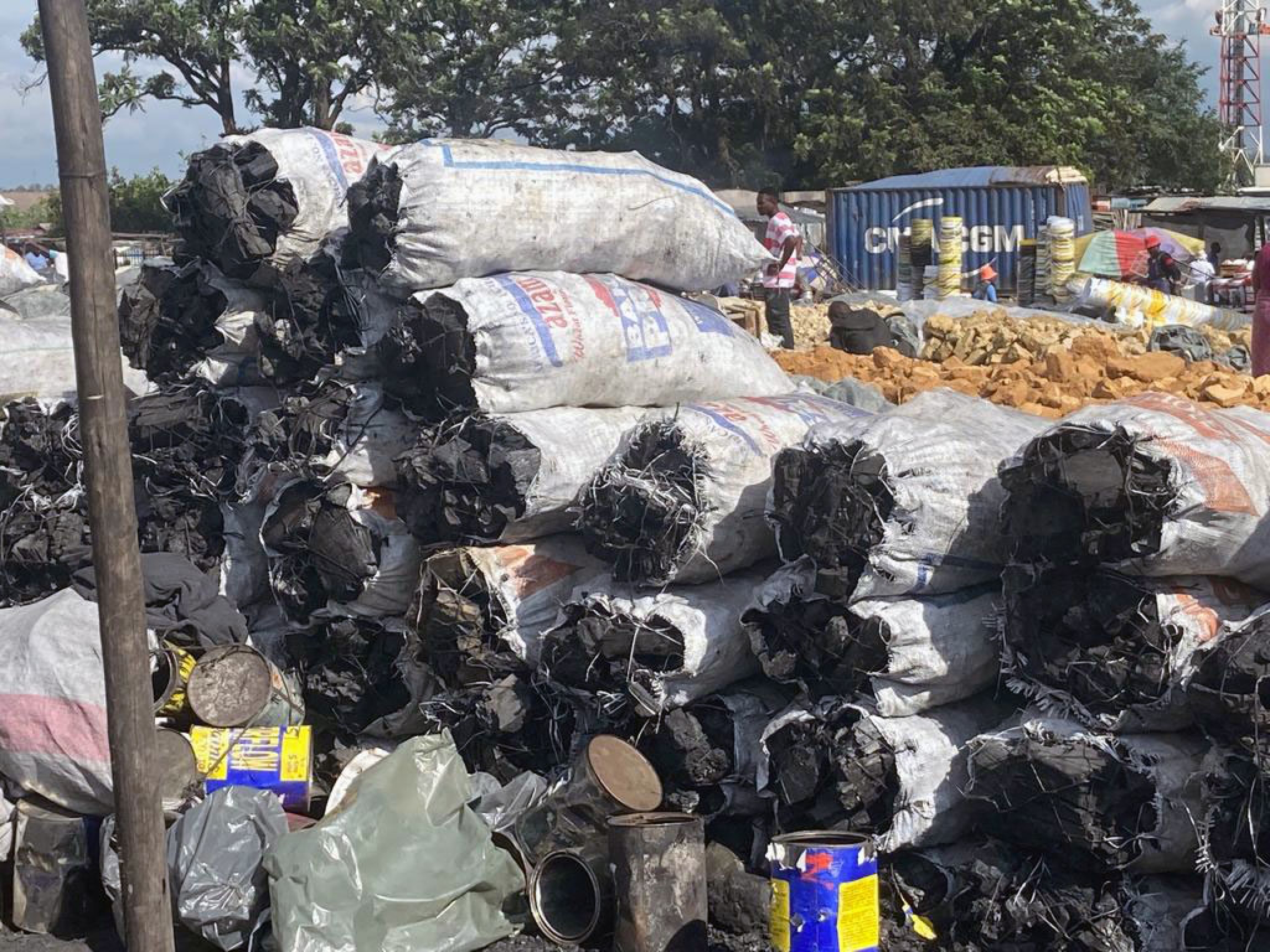
Bags of charcoal at Mbare market in Harare, Zimbabwe.
ish Mafundikwa/The World
Nyarai Mupesa, who has sold charcoal there for the past five years, said business is good whenever there is no power.
“When there are power cuts, sales are good, people need charcoal for cooking and to keep warm,” she said.
The problem is that charcoal, and the other low-cost option, kerosene, both contribute to deforestation and pollution. Chopping and burning trees for charcoal is illegal in Zimbabwe. But that has not stopped the practice. And most of the charcoal sold at Mbare is imported from Mozambique because, according to Mupesa, it is better quality.
“You pay the required duties and are issued with a receipt that enables you to get to Harare with your charcoal,” she explained.
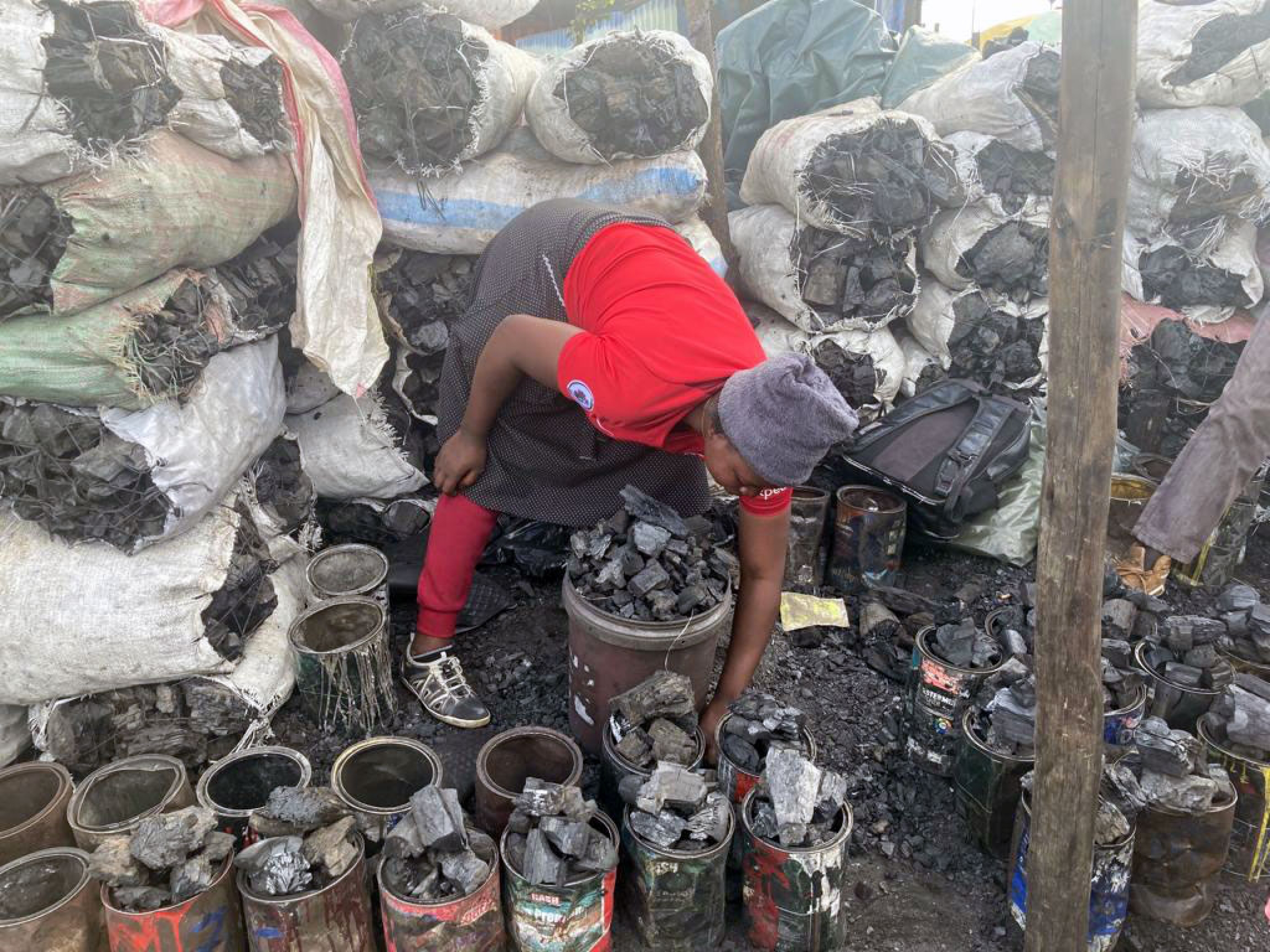
Nyarai Mupesa prepares her charcoal for sale.
ish Mafundikwa/The World
Besides the hydroelectric plant on Lake Kariba, Zimbabwe's other main power source, the Hwange thermal power station is old and breaks down frequently. New units at the power plant are set to start generating power soon. But even if it and Kariba operate at capacity, they cannot meet Zimbabwe's power needs.
Energy expert Victor Utedzi runs a solar farm.
He sees renewable energy as a solution to Zimbabwe’s power problems. So does the government. In a bid to attract more local and private investors to set up solar and hydropower plants to sell to the national grid or direct to some consumers, the government recently announced new policies.
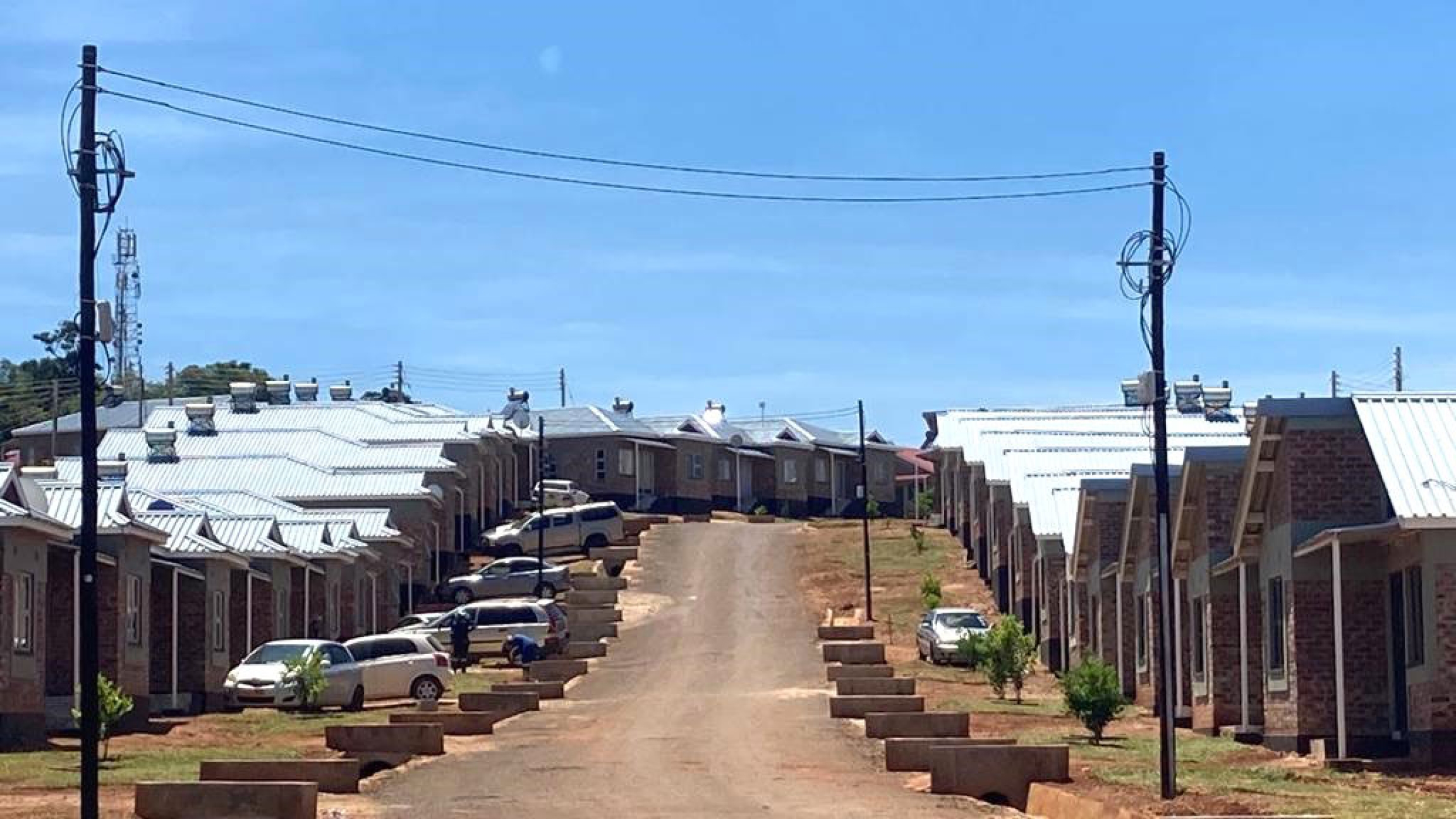
Solar water heaters are now standard features on new houses as well as some old houses in Zimbabwe.
ish Mafundikwa/The World
“The government has given a guarantee that if the utility is unable to pay, the government will step in and make the payment. The government has also opened the space even further; they allow you to sell directly to some of the largest industrial and commercial clients in the country,” Utedzi said.
The government also imports power from neighboring countries but that doesn’t always work due to currency shortages.
Building another hydropower station upstream from Kariba is seen as the best hope for solving Zimbabwe's power woes. But two decades after it was proposed, no action has been taken.
Until it becomes a reality, the rolling blackouts will continue.
The Isupovs are a family of artists who are spread across Ukraine and the United States.
Each one’s art varies, and the war in Ukraine has also influenced them differently in the way they bring creativity to their work.

Sergei Isupov, who lives in western Massachusetts, holds up one of his pieces of artwork.
Courtesy of John Polak
Sergei Isupov, 59, lives in western Massachusetts, and makes his living as a ceramic artist, combining painting and sculpture — essentially mixing 2D with 3D. His sculptures are of humans, animals and sometimes both, with incongruous elements placed together.
Sergei, who’s been in the US for more than 30 years, said that his life here has brought him incredible artistic freedom and an established, reliable world of galleries, dealers and museums for his work.
He explained that, “for creativity, conflict definitely helps. We even have this idiom, ‘If you're not sick, [there's] nothing to write about.’” That’s something that the war back home — where the rest of his family still lives — has now taken care of."
Sergei’s parents, Nelli and Vladimir, met in art school in the port city of Odesa in the late 1950s, during the Soviet period. They later settled in Kyiv to raise their two sons, Sergei and Ilya. And they basically insisted that their sons become artists, too.
Sergei’s father, Vladimir, was a well-known painter in Ukraine. In recent years, he lived on the 20th floor of a high-rise in Bucha, outside of Kyiv.
Shortly after the war started, the elevator in his building stopped working, so he didn't leave his home for three months.
After the Russian bombing and massacre in Bucha last year, he stopped making art, stopped taking calls from his family and withdrew. He died last month. And Sergei never had a chance to properly say goodbye.
Sergei’s mother, Nelli, and brother, Ilya, still live in Kyiv. And Sergei talks to them all the time.
“Sometimes [when] I talk to my mom, I hear sirens in the back,” Sergei said.
He said he’s been grappling with the thought of what he would do if something happened to his family and how he would react. His mother has refused his repeated suggestion to move to the US.
Like Sergei, Nelli Isupova is a ceramic artist, but her work is less surreal than his, and also more of a celebration of life. She makes a lot of ceramic sculptures of animals, birds, nature and even teapots with creatures on the handle.
“It's really important to be creative,” Nelli said through her son on a phone call. She explained that she's more active as an artist now than she was before the war. And she feels like it's her obligation to bring art to the public, that it's a form of peace.
“If everybody experienced life with art and colors, nobody would start a war.”
“If everybody experienced life with art and colors, nobody would start a war,” she said.
Sergei’s brother, Ilya, 52, is a painter like their late-father. His work is not quite as optimistic as their mother’s. He seems more exhausted and discouraged. He has four children and they've all been dispersed, like many other Ukrainian families. He said he feels like he’s living in a bad movie and he can't imagine painting flowers at this time.
One of his paintings shows a small blue car moving through a war zone. Someone is driving, while two terrified teenagers look out the window as warplanes fly overhead. That someone is actually Ilya, himself, with his daughters, and that dangerous ride actually really happened.
A painting by Ilya Isupov, who lives in Kyiv, of him driving his two teenage daughters through a war zone in Ukraine.
Courtesy of Ilya Isupov
Shortly after the drive, Ilya moved his family out of Ukraine. He’s had to stay back, though, because Ukrainian men under the age of 65 are required to stay in the country.
Meanwhile, Sergei, who left Ukraine decades ago and didn't really look back since, now says he thinks about it all the time. And he said he now has that little bit of sickness that an artist needs to go deeper with this work.
Related: Art historians debate identity of iconic Mariupol painter
Australian Roberto D’Andrea, a guest conductor on a streetcar in Kolkata, India, wore the green uniform of a Melbourne “connie,” or tram conductor, as he punched tickets and called out the name of each stop.
D’Andrea, a retired tram conductor, was part of the festivities last month for the tramway’s 150th anniversary, also marked by cake, music and a parade of gaily decorated old trams, led by a 100-year-old green wooden car.
D’Andrea’s love of trams has brought him back to the city again and again since he first visited 30 years ago. The “ding ding ding” noise the streetcar made, said D’Andrea, who belongs to the Calcutta Tram Users Association, reminded him of the trams in Melbourne.

Australian Roberto D’Andrea, a guest conductor on a streetcar in Kolkata, India, wore the green uniform of a Melbourne “connie” or tram conductor as part of the festivities last month for the tramway’s 150th anniversary.
Sandip Roy/The World
Melbourne and Kolkata have two of the longest-running tramways in the world.
But Kolkata’s tram system is limping along. It's down to just two lines, and despite a loyal band of supporters advocating for it, there is little political will, or room in the city's crowded streets, to bring the streetcars back to their former glory days.
Snehasis Chakrabarty, the West Bengal state transport minister, kicking off the celebrations, said that the trams face a lot of practical problems: Roads aren’t getting any wider and the number of cars on the street keeps rising.
A streetcar in Kolkata, India.
Sandip Roy/The World
“We are not here to say goodbye to trams,” Chakrabarty said. “Although, it is not possible today to run[a] tram [on] every route in [the] Kolkata metropolitan city due to congestion.”
Kolkata has far less road space compared to other Indian cities like Mumbai. So, trams have to share the road with cars, trucks, rickshaws, buses, three-wheelers and millions of pedestrians.
Many old tram routes have also been taken over by buses and three-wheelers.
Ongoing construction of the underground metro railway system also disrupted old tram routes.

Kids ride a streetcar in Kolkata, India.
Sandip Roy/The World
But the transport minister promised that trams will remain at least as a heritage ride for tourists.
Transport consultant Suvendu Seth, sitting in a bustling, new cafe in a tram depot, argued that trams should be for mass transport, not heritage.
“Why don’t we make those roads which are narrow for pedestrians and trams only? Why allow vehicles there?”
Many cities in Europe, Australia and the US got rid of streetcars during the automobile boom of the 1950s and ’60s, he said. Now, with a push toward sustainability and green transport, many cities are bringing streetcars back, often at great expense.
“And we had it all the time, and we are neglecting it,” Seth said. “That’s not a very nice thing. We should encourage it.”
Especially in a city where the air quality index is routinely over 200 during the winter months.
Art students paint a streetcar in Kolkata, India, for a celebration marking the tramway's 150th anniversary.
Sandip Roy/The World
But there’s a misconception that trams “are from another century,” he said.
The double-bogeyed streetcars of Kolkata do feel old — they have not been updated in decades and rattle noisily down the middle of the street, sometimes losing the overhead electric connection.
But tram workers have not given up. During the anniversary event, a group of streetcar workers raised slogans demanding that more services be resumed.

The festivities last month for the tramway’s 150th anniversary in Kolkata, India, were marked by cake, music and a parade of gaily decorated old trams, led by a 100-year-old green wooden car.
Sandip Roy/The World
One streetcar driver, Gopal Ram, reminisced about how his family had worked for the tramways for generations.
His great-grandfather, Antu Ram, worked on trams when it was still steam-powered. His grandfather, Mahavir Ram, and his father, Jagannath Ram, both spent their lives working on trams.
When Hindu-Muslim riots engulfed Kolkata in the 1940s, tram workers drove empty trams to restore confidence in a shattered city.
The tramway in Kolkata, India, turned 150 years old last month.
Sandip Roy/The World
“My father, himself, helped save people from a mob,” Gopal Ram said.
Gopal Ram just retired after 39 years of service. He said that he sees no future in the trams of Kolkata. For Gopal Ram, it is the end of the line.
Mohammad Hashim Khazim wasn’t supposed to be born on the day the US invaded his country.
His mother had planned to deliver him at a hospital in the Iraqi capital.
But on March 20, 2003, as American jets bombarded Baghdad, Khazim’s mother went into labor.

Mohammad Hashim Khazim was born on the day of the US invasion of Iraq. Two decades later, he said, Iraq is not in a good place.
Shirin Jaafari/The World
“She couldn’t make it to the hospital,” Khazim said. “She was too scared they might get hit on the way.”
Her only option was to deliver him at the home of a neighbor who had some experience delivering babies.
The years of war in Iraq have touched everyone’s lives in the country, but for younger Iraqis like Khazim, it is the only reality they have ever known. The invasion tore apart the nation and led to unimaginable violence and sectarian wars.
In 2014, the rise of the so-called “Islamic State” led to even more instability and bloodshed.
According to the latest estimates by Iraq’s Ministry of Planning, at least 40% of the population is under the age of 15. Those born after the year 2000 make up about half of the population. Many of these young Iraqis struggle to find stable work and are fed up with the government. This dissatisfaction led to mass protests that started in 2019.
Mohammad Hashim Khazim’s first memory of the war was in 2006, when he was just 3 years old.
He was standing outside his parents’ house in Baghdad when an armored vehicle patrolling the streets pulled up. An American soldier, a woman, emerged from the vehicle. He was shocked, he said. He’d never seen a female soldier before. But her uniform, her gun and armored vehicle, all reminded him of what he’d seen in the movies.
“I went inside the house and yelled, ‘I saw an American soldier! A woman!’” he recalled.
Khazim said he feels conflicted about the US-led invasion. On the one hand, he is happy that he doesn’t live under a dictatorship. But at the same time, he can’t wrap his head around all the atrocities that the invasion unleashed.
What pains him more, he explained, is that after all the sacrifices and deaths, Iraq is still not in a good place today.
“Our leaders only care about power,” he said. “As long as there is ignorance, I don’t see a future for this country.”
Since 2005, Iraq has held six parliamentary elections. But corruption and political dysfunction continue to plague the country. Iraq ranks 157 out of 180 countries in Transparency International’s latest corruption index.
And last year, reports surfaced about a $2.5 billion tax embezzlement at the government level. It was described as "the heist of the century."
On a recent March afternoon, the sun was about to set in Baghdad, and the golden rays beamed into a store on a busy street. Twenty-three-year-old Nada Al Quraishi, who works as a cashier, stood in front of shelves lined with rows of bottles of natural hair oil.
Twenty-three-year-old Nada Al Quraishi works as a cashier at a natural hair products store in Baghdad. Currently a law student, she worries about her job prospects when she graduates.
Shirin Jaafari/The World
Quraishi said she remembers the loud sound of the jets and the bombs that followed the US-led invasion as a small child. She said she spent long hours inside bomb shelters with her cousins who lived on the same street.
As the violence continued, her parents forbade her from going outside. So, home felt like a prison, she said.
Tragedy hit her family when one of her cousins was killed by a rocket that struck his home.
As a child, Quraishi said, she didn’t understand why the Americans were in her city. And why there was so much violence.
Eventually, she was able to go to school again and then went on to graduate from high school.
Today, Quraishi studies law and hopes to become a judge one day.
“But Iraq is full of unknowns,” she said. “Even for those educated like us, there is no guarantee we will find a job after graduation.”
In the years following 2003, about 200,000 Iraqi civilians were killed, according to Brown University’s “Cost of War Project.”
Layla Hussain Walli’s family was among them.
Walli lost all six of her children in an airstrike on April 6, 2003. On a recent visit to her home, she recounted their names one by one.
“Saba, Sajjad, Ali, Hayder, Sajja and Nouha.”
Her husband Naseef died in the attack, too.
Walli and 42 members of her family were fleeing the bombings in Baghdad to an area north of the city called Khan Bani Saad.
Layla Hussain Walli lost all six of her children in an airstrike on April 6, 2003. She also lost her husband and many of her relatives. She has no photos of her family as they were fleeing the bombardments in Baghdad. "All I have is their death certificates," she said.
Shirin Jaafari/The World
As they took shelter near an open air field, she said, they were hit by an airstrike. Everyone died except for Walli and four other women. Her youngest child was 8 months old. She was breast feeding him.
“I have died a thousand times in the past 20 years. Every year, when schools reopen, when college graduations take place, they remind me of my children.”
“I wish I had died, too,” Walli said. “I have died a thousand times in the past 20 years. Every year, when schools reopen, when college graduations take place, they remind me of my children.”
All these years later, she said, there is nothing she can tell the Americans.
“What can I say? We were just sitting there after evacuating our homes. We had done no harm. Don’t they have children or families, too?”
The invasion of Iraq and its aftermath continue to impact people’s lives.
There are also physical reminders of the war that remain.
In Baghdad today, concrete blast walls are still in place, armored SUVs cruise the streets and around 2,500 US troops are still based in the country.
Even if most Americans have moved on from the Iraq war, for Iraqis, it is a part of their past, present and future.
Related: Iraq’s revived art scene is helping to heal the country’s wounds
The turquoise waters of Lake Palcacocha are a beautiful sight to behold. On its northeastern edge, a huge glacier looms above the water, its white cliffs sparkling under the sun.
The lake is located 15,000 feet above sea level in the Andes Mountains, near the Peruvian city of Huaraz.
As temperatures become warmer and ice sheets melt in the area, the lake has become increasingly dangerous due to its overflow potential. Palcacocha is one of dozens of lakes around the world that now pose a threat to towns and villages in mountain ranges like the Andes or the Himalayas.
“If a large chunk of ice breaks off from the glacier, and falls into the lake, it will empty the lake out and generate floods and avalanches downstream,” said Jesus Gomez, an expert on glaciers at Peru’s Institute for the Study of Mountainous Ecosystems.
“It’s hard to tell when something like that could happen, so we have to constantly monitor the area.”

The city of Huaraz is in a valley below Lake Palcacocha. Some of its neighborhoods have been built along a river that comes from the lake.
Manuel Rueda/The World
The avalanche could easily reach Huaraz, a city of 100,000 people in a valley below, where several neighborhoods have been built along a river that comes from Lake Palcacocha.
“We are worried about what could happen,” said Teo Pineda, a driver who lives near the river in a three-story house. “This melting of the glaciers is already making the levels of the river go up.”
Teo Pineda lives in a house near the Qilcay River, which originates in Lake Palcacocha. He is one of 15 million people in the world who are exposed to Glacial Lake Outburst Floods.
Manuel Rueda/The World
According to a study published in February by the Nature Communications journal, 15 million people around the world are currently exposed to floods originating in high-altitude glacial lakes. Scientists call these events glacial lake outburst floods, or GLOFs.
Most people currently exposed to GLOFs live along mountain ranges in China, India, Pakistan and Peru, where glaciers have been melting over the past century. The lakes that then form below them have also become bigger.
Another study published in Nature Communications in 2020 found that the total surface area of glacial lakes around the world increased by 51% between 1990 and 2018 — with hundreds of new lakes also being formed.
In Peru, Lake Palcacocha’s surface area has grown by 30 times since the 1970s as the glacier above it slowly melts.
The lake already burst in 1941, when heavy rains eroded the land around Palcacocha.
Around 10 million cubic meters of water — the equivalent of 4,000 Olympic swimming pools — spilled out of the lake and rushed towards Huaraz, creating a flood that destroyed almost every building in its path, killing 1,800 people.
“It's probably the largest volume of water ever to impact a major urban settlement in the world,” said Steven Wagner, an archeologist who lives in Huaraz, and wrote a book about the flooding.
“That large volume of water tumbled boulders that were two stories high, they rolled along [the mountain] and made an infernal sound.”
To stop Lake Palcacocha from bursting again, officials in Huaraz built a dike on its southwest edge, where water flows out of the lake.
They also set up big, plastic tubes that siphon water out of the lake so its levels don’t rise.

Plastic tubes siphon water out of Lake Palcacocha so that its levels don't rise too drastically.
Manuel Rueda/The World
Marlene Rosario oversees these projects financed by the regional government. But she said many more adaptations need to be carried out around the lake.
“The problem with just siphoning water out of the lake is that we are not preserving the water for future use,” she said.
Huaraz has plenty of water now. But if the glacier continues to retreat, that water could become polluted, because it will come into contact with toxic minerals.
“Eventually, we will need to build reservoirs and treatment plants below the lake,” Rosario said.
Some people in Huarez say that those who are responsible for climate change should help pay for these adaptations.
Lake Palcacocha has long served as a water source for the city and surrounding villages. People hope these adjustments will preserve the lake and no longer threaten the city's survival.

Plastic tubes siphon water out of Lake Palcacocha in Peru to keep its levels in check.
Manuel Rueda/The World
In 2017, mountaineering guide Saul Lliuya teamed up with German Watch, an environmental group, to sue RWE, a German energy company.
RWE made electricity for decades in Europe by burning massive amounts of coal. The company is now phasing out its coal-fueled power plants, but a 2013 climate study claims that it is responsible for half of a percent of global emissions since the 19th century.
“I have seen firsthand how the glaciers are melting because of climate change,” Lliuya said at his home in Huaraz.
“And we need to [hold] companies that are responsible for that accountable.”

As glaciers melt in different parts of the world, they are more likely to cause floods in mountainous areas.
Manuel Rueda/The World
Lliuya’s lawsuit says RWE should pay for 0.5% of the costs of flood prevention programs in Huaraz, or what amounts to around $20,000 dollars. The case is currently being reviewed by a German court.
“If we put some pressure on those who emit greenhouse gasses, perhaps they will have to change their practices,” he added.
“We are not going to recover all the damage that’s been done, but at least we can stop this kind of pollution in the future.”
Related: Protests across Peru are keeping tourists away from the country’s top travel destinations
On Thursday, Sasha Shulyahina, who lives in Kyiv, Ukraine, celebrated her daughter Briana’s first birthday with family and friends at the church that her parents lead.
Briana was born a year ago as Russian forces pressed in on the city. Now, she’s babbling and making raspberry noises in a playpen at her parents’ church.
Shulyahina lights up when she talks about Briana: “She's just the cutest baby. She has these huge brown eyes. And she showed her personality from the first hours of us being with her.”
Last March, when Shulyahina started going into labor at 2 a.m., an ambulance arrived amid an air raid and loud explosions. Briana was born on March 16, 2022.
For Shulyahina and the whole family, Briana and the church have been a source of joy and solace through a year of war.
Shulyahina said that so far, her baby daughter seems unaffected by the war — she doesn’t notice when the lights go out or explosions are audible.
“I'm glad that she's not aware of this yet,” she said. “And I hope that we're able to not project our stress onto her, that we're able to have a calm and peaceful environment for her.”
Maia Mikhaluk and Nick Mikhaluk, Shulyahina’s parents, stayed in Kyiv when the Russian invasion began, both to remain with their then-pregnant daughter, but also to continue leading the church that they founded, International Ministry Partnerships.
Just a few days after Russian forces invaded Ukraine on Feb. 24, 2022, they livestreamed a worship service from the Mikhaluk’s living room. Shulyahina played the keyboard and Nick Mikhaluk played guitar.
The next Sunday, the congregation met in person, even though air raid sirens were wailing.
“I think that experience gave people some special sense of God's protection,” Maia Mikhaluk said. “At the times when you reach the depths of your fear, and you look up to God, there’s this peace that surpasses understanding.”
During war, they say, the church is a place to inspire hope. But Nick Mikhaluk, who preaches on many Sundays, said it’s also important to remind his congregants that theirs is a God who hands down judgment.
“God is [a] God of love, but he’s also a righteous judge,” he said. “For us it’s hard to comprehend sometimes, like love and fairness. But God is like that. So, we need to preach both.”
Although living through a war isn’t what anyone in the family would wish for themselves, they say their church and their faith are stronger because of it.
“This time really helps us really rethink our faith, really rethink what we value,” Shulyahina said.
Click on the audio player above to hear more about how the family and the church have survived a year of war.
Guyana has discovered nearly 11 billion barrels of offshore crude reserves, and the country is hoping that oil can help transform its economy and offset its ongoing poverty crisis.
The South American country is readying itself for its next round of oil auctions in April, with all the major oil companies expected to bid. Exxon Mobil Corp. is already heavily involved and has been since the late '90s when offshore exploration there began.
But what might sound like striking gold may not actually be the case. With agreements that 75% of oil revenue belongs to Exxon and partners, little is expected to reach citizens.
Lack of major oil gains are not foreign to South America; since 1980, countries in the region reap short-term gains but tend to be worse off in the long run.
Citizens have polarized opinions on the discovery with some rallying behind oil extraction in hopes of a soaring economy and new jobs. Others remain wary of the environmental drawbacks and risks of catastrophic oil spills.
While oil companies are seeking opportunities, climate-change activists are concerned. Guyana has thus far been hailed as a world leader on climate change.
The discovery means a potential release of millions of tons of greenhouse gases from a climate globally known for absorbing millions of carbon emissions each year.
Amy Westervelt is a journalist and host of “Drilled,” a true-crime podcast that looks at climate change — it's focusing on Guyana this season.
“It's worth noting that since 1980, no 'global south' country that's gotten into the oil business has ended up better off for it, not one,” Westervelt said. “So, it has this tendency to kind of bring short-term gains and ultimately, leave countries worse off or, at best, about the same as they were before oil.”
She shared some images with The World from around Guyana’s capital, Georgetown.
The Guyana Shop was put together by the attorney general and business boards to help small food businesses in Guyana package and sell their wares.
Courtesy of Amy Westervelt
The Stabroek Market is a farmers market in Georgetown, Guyana.
Courtesy of Amy Westervelt
A canal in Georgetown, Guyana. Citizens have polarized opinions, with some rallying behind oil extraction in hopes of a better economy and others remaining wary of the environmental drawbacks and risks of catastrophic oil spills.
Courtesy of Amy Westervelt
Guyana is hoping that newly discovered offshore crude reserves can help transform the country's economy and offset its ongoing poverty crisis.
Courtesy of Amy Westervelt
Guyana has thus far been hailed as a world leader on climate change, but new plans for extracting oil has environmental activists concerned.
Courtesy of Amy Westervelt
At New York City’s Metropolitan Museum of Art, a large canvas depicting a setting sun over a shimmering river that flows from Russia into Ukraine catches the eye of visitors.
“I was just looking at all the Rodin sculptures,” museum visitor Jamie Cafirma said. “And then, there’s a pop of color.”
The Met label states that the title of the work is: “Red Sunset on the Dnieper (Dnipro)” — but those parentheses captured a conflict. “Dnieper” is the Russian name for the river while “Dnipro” is its Ukrainian name.
The painter, Arkhyp Kuindzhi, trained at the Imperial Academy of Arts in St. Petersburg, and made his career exhibiting his work in both St. Petersburg and Moscow. His painting, done between 1905 and 1908, has been held up as an example of great art from Imperial Russia.
But Kuindzhi was born in Mariupol, which is now part of the modern Ukrainian state. So, there’s an ongoing debate: Should Kuindzhi be considered a Ukrainian or a Russian artist?

Visitors take in the painting "Red Sunset" at the Met.
Melissa Rodman/The World
Oleksandra Kovalchuk, acting director of the Odesa Fine Arts Museum in Odesa, Ukraine, said it’s clear that Kuindzhi is Ukrainian.
“His main subject was always somewhere in Ukraine,” she said.
"When someone is so concentrated, on the Dnieper River, for example, or other Ukrainian landscapes, you can conclude that there was a point to that. Weren’t there other rivers in the Russian Empire at that time?”

“Red Sunset on the Dnieper (Dnipro)” — but those parentheses captured a conflict. “Dnieper” is the Russian name for the river while “Dnipro” is its Ukrainian name.
Melissa Rodman/The World
After years of listing Kuindzhi’s nationality as Russian, the Met recently changed the painting’s label to state Kuindzhi’s nationality as Ukrainian.
Since this story aired on March 6, the museum has appended the phrase “born Russian Empire” to the label’s “Ukrainian” designation. In addition, the museum now titles the painting “Red Sunset,” simply avoiding the “Dnieper” vs. “Dnipro” debate.
Some critics, however, believe that one shouldn’t apply current politics to revise the art historical canon.
Elizabeth Kridl Valkenier is an art historian who specializes in 19th-century art.
Courtesy of Elizabeth Kridl Valkenier
“I really dislike narrow nationalism in any country, in any nation,” said Elizabeth Kridl Valkenier, an art historian who specializes in 19th-century Russian art. In her view, artists should be identified in the way that they described themselves at the time they lived.
In Kuindzhi’s time, the late 19th through early 20th centuries, Ukrainians and Russians were subjects of the Russian Empire. Artists and writers who wanted to make names for themselves had to travel to the imperial capital to do so.
“If you want to get a diploma that would allow you to be a professor or to work as an artist, if you need this document, you will go to Saint Petersburg or to Moscow,” Kovalchuk said, describing the Imperial Academy of Arts system.
“There are no other options for you.”
Accordingly, people now are calling for decolonizing art made under the Russian Empire’s dominion.
Pinning down Kuindzhi’s identity, how he described himself, though, is a little trickier. His family was Greek. He wasn’t a prolific writer.
“He didn’t leave a strong trace the way that some other artists did of an identity of Ukrainian or Russian,” said art historian Margaret Samu, who also is a lecturer at the Met.
There was a Ukrainian nationalist movement when Kuindzhi lived, but Samu said she hasn’t seen Kuindzhi associated with it.
Another factor in the discussion is that in March 2022, Kuindzhi’s namesake museum in Mariupol “was destroyed in a Russian airstrike,” as the Met’s label attests.

Margaret Samu, art historian and lecturer, stands near "Red Sunset."
Melissa Rodman/The World
“It makes me so sad to think that works of art can just be destroyed so carelessly,” Cafirma, the Met visitor, said.
Outside of the museum world, on Kuindzhi’s Wikipedia page, there’s been a great deal of back-and-forth editing from “Russian painter” to “Ukrainian painter,” and vice versa.
"It's easy for me as an American to say he was both, but I think that if you are in Ukraine or if you are in Russia, it’s a very different feeling,” Samu said.
At the very end of the Emerald Line 9 is Vila Natal, a neighborhood located about 18 miles south of downtown São Paolo, Brazil.
The final stop is full of enthusiastic vendors – who sing, act and rhyme – offering up fake Apple watches, Trident chewing gum in bulk, electric shavers.
The neighborhood is one of several enclaves where Venezuelan families live. Like Yoselin Calcurian, who is 35, married and has three kids: Santiago, 13, Sofia, 9, and Josué, 4.
This year marks the fifth anniversary of the massive migration of Venezuelans. Since 2018, more than 7 million people have fled the country due to political chaos and economic collapse. About 400,000 of them went to Brazil, where they have struggled to find jobs and learn a new language.
Calcurian and her three kids on the flight from Boa Vista, in the north of Brazil, to São Paulo in October of 2021.
Courtesy of Yoselin Calcurian
Calcurian left Venezuela in June of 2021. Her husband said he didn’t want to come, so she grabbed her kids and left him behind.
“He kept saying that if he was going to struggle, he wanted to struggle in his own country. And I said, 'You can go ahead and struggle in your country, because I’m leaving,'" she said.
Journeys like hers happen every day to Brazil.
According to the Brazilian Federal Police, 17,397 Venezuelans entered the country in February, more than in January and an increase of almost 40% from the same month last year.
Calcurian used to work as a school secretary in Ciudad Bolívar, in eastern Venezuela. She says it was very hard to survive, even though she owns a house there.
“Our whole salary would go toward food. And it would only last for three days. For the rest of the month, we needed to figure out how to buy groceries again,” she said.
After they first arrived in Brazil through the border, Calcurian and her kids spent three months in shelters in Pacaraima and Boa Vista, in the northern state of Roraima.
Vila Natal in São Paulo was not really her choice.
“I didn’t choose it,” she said.
“When they were doing the interiorization process they asked if we had anyone who would host us. We didn’t have anyone, we don’t know anyone here.”
The interiorization program, started in 2018, voluntarily relocates Venezuelan refugees from the northern states to other cities in the country. The program is run by the federal government, with support from the United Nations refugee agency and several partner organizations.
A shelter in Vila Natal had free spots. Calcurian and her kids lived in the shelter for a few months, and then she was able to rent a one-bedroom apartment. She converted the kitchen into a second bedroom and created a cooking area outside.
The mass migration of Venezuelans to Brazil caught many by surprise.
“We weren’t prepared to receive such a large number of migrants, and people don’t stop coming,” said Carolina Nunes, manager of operations and partnerships at the nonprofit Refúgio 343 in Brazil.
“It’s really a crisis. A crisis that keeps happening and doesn’t stop.”
Refúgio 343 helps migrants with education, health services and they partner with companies to find people jobs.
Brazil has an unemployment rate of 7.9%. That’s half of what it was in 2020, but that doesn’t mean migrants can get good jobs.
Nunes said many migrants end up working in the meatpacking industry, a sector that has challenges recruiting Brazilians because of the tough nature of the work.
“There is a whole HR team of the meat processing company JBS based at the Welcoming Operation. They hire refugees for all its plants in Brazil,” she said.
Yoselin Calcurian with her youngest son Josué, 4, and daughter Sofia, 9, in front of their one-bedroom apartment in Vila Natal that they converted into a two-bedroom.
Gisele Regatão/The World
A week after Calcurian left Venezuela, her husband also left the country, but the pair did not reunite until months later.
Calcurian’s husband now has one of those jobs at a chicken processing plant in São Paulo. But Calcurian herself is unemployed. She used to work remotely selling ads in Spanish, but she was laid off last year and hasn’t been able to find a new job.
“I lost some jobs because I can’t speak Portuguese well,” she said.
Calcurian has temporary residence in Brazil, and she has the right to work. Venezuelans here can also apply for refugee status, if they intend to stay in Brazil permanently. Calcurian holds a two-year, renewable residence visa. But she said she wants to return to Venezuela.
Her oldest son Santiago López, who is studying computer programming, wants to go back to Venezuela, as well. He misses his dad (who is different from his younger siblings’ father) and he is struggling to adapt to Brazilian culture.
“It’s so different, if I were to tell you I would spend three hours doing so,” he said.
Calcurian has been unemployed since last year, so they are planning on moving to a small city in the southern state of Santa Catarina in April.
Gisele Regatão/The World
Thalita Iamamoto, who coordinates service to refugees at Caritas, the relief agency of the Catholic Church, said that donor fatigue is a major concern in dealing with the Venezuelan crisis.
“Everybody is a bit tense, wondering how this is going to work, because the Welcoming Operation has a smaller budget now, and countries are not donating as much compared to when the crisis first exploded, in 2018,” she said.
Iamamoto said the demographics of the migrants they serve is also changing.
“Because of the Venezuelan migration, in 2021 we served more women than men for the first time,” she said.
In 2016, only 36% of the refugees they served were women. In 2021, that number jumped to 52%.
Yoselin Calcurian (center) with her youngest son Josué, 4, and daughter Sofia, 9. Her mother (left) was visiting them from Venezuela.
Gisele Regatão/The World
This month, four more of Calucurian’s family members arrived in Vila Natal, São Paulo, from Venezuela.
She said they decided to move to a smaller city, in the southern state of Santa Catarina, where they believe it might be easier for everyone to get jobs.
“We have to fight, because it’s hard here, so we have to try someplace else,” she said.
In her case, women are leading the way. Her niece is already there and at the end of April, Calcurian is planning on moving with her kids. Her husband will follow later.
Editor's note: Vanessa Regatão provided production assistance with this story.
In the days leading up to the Taliban takeover in Afghanistan in August 2021, Zaki Daryabi, founder and publisher of Etilaatroz, an investigative newspaper in Kabul, coordinated with his journalists to keep working as safely as they could.
But that soon proved to be too dangerous. When Kabul fell, the Taliban cracked down on Afghan media organizations and banned most news sites.
“Unfortunately, there were a lot of restrictions that kept coming and we faced a lot of problems. Our colleagues were tortured by the Taliban,” he said.
Etilaatroz never stopped reporting, even when the Taliban regained control of the country. Many journalists were forced to leave Afghanistan, including Zaki Daryabi who came to the US in October 2021. But he remained focused on his work.
“I feel like after 10 years, my biggest dream and responsibility was to keep Etilaatroz alive,” Zaki Daryabi said.
Last summer, Zaki Daryabi pulled together a team of seven staffers in an office building in Silver Spring, Maryland, just miles outside of Washington, DC.
“Fortunately, I could bring some of my colleagues here to Silver Spring,” he said.

The Etilaatroz office in Silver Spring, Maryland.
Valerie Plesch/The World
Some even managed to bring with them bundles of print editions of the newspaper from over the years — to preserve what otherwise would surely have been lost at the hands of the Taliban.
Today, 45 Etilaatroz journalists are spread around the world, from California, to Spain, to Turkey.
Daryabi said that the readership has significantly increased over the last two years, and they are publishing more articles now compared to before the fall from more areas in Afghanistan. Their social media presence has also ramped up a lot.
Zaki Daryabi started Etilaatroz — which means “daily information” in Dari — in Afghanistan in 2012. It has grown since then, going online in 2013.
He also launched KabulNow, an English-language news website. Etilaatroz also published a daily print edition that circulated in Kabul — the last print edition came out on Aug. 15, 2021, the day the Taliban came into power.
Less than a month later, Zaki Daryabi’s younger brother, Taqi Daryabi, was detained and severely beaten by the Taliban while filming a women’s protest with another reporter in downtown Kabul.
The incident “keeps me strong [enough] to keep going, not to give up,” Taqi Daryabi said.
Zaki Daryabi, founder and publisher of Etilaatroz, and his brother Taqi Daryabi, at the Elitaatroz office in Silver Spring, Maryland.
Valerie Plesch/The World
Photos of Taqi Daryabi’s abuse were widely shared in the media, and he said that he still suffers from nightmares. Today, he still works with Etilaatroz, editing videos for the website and social media from the Maryland office.
“I don’t wish it to happen to others so that’s why we should keep going on and try to do as much as we can do and tell the stories and let others know what is happening in Afghanistan,” Taqi Daryabi said.
Zaki Daryabi said that after the incident with his brother, the Taliban’s intelligence agency asked him to come to their office to talk.
“I didn’t go because I realized that they will take me to prison,” Zaki Daryabi said.
Zaki Daryabi knew it was too dangerous for him to remain in Afghanistan, especially after the incident with his brother and continued pressure and threats from the Taliban.
The brothers were able to get on a special flight through the United States Institute of Peace in October 2021, and they resettled in Maryland, where Zaki Daryabi had a friend.
Old print editions of Etilaatroz that was brought to the United States from Afghanistan by one of the journalists after the Taliban takeover.
Valerie Plesch/The World
An hour after they flew out of Kabul, Zaki Daryabi said that the Taliban surrounded his office and searched for him everywhere, demanding his team for his home address.
Other Etilaatroz staffers were also in danger: Journalist Farahnaz Forotan, who joined the newspaper staff a few months ago in the US, fled Afghanistan in 2020 after she was put on a Taliban hit list.
Another reporter, Kazim Ehsan, made it out of the country just a few days before Kabul fell.
Razia Alemi, Elitaatroz’s human resources and finance manager, holds the bundle of old newspapers that she was able to bring with her when she evacuated from Afghanistan after the fall of Kabul. She said she wanted to save the newspapers.
Valerie Plesch/The World
Human resources and finance manager Razia Alemi evacuated in October 2021, and was in Pennsylvania before Zaki Daryabi asked her to move to Maryland to work again with Etilaatroz.
Elyas Nawandish, Etilaatroz’s chief editor, evacuated after the takeover and spent many months in Albania before resettling in Maryland. Even while in Albania, he and other Etilaatroz journalists kept working. Albania became the temporary newsroom.
“The good feeling is that I'm happy that we can work from here without any fear and without any concern about our safety, our family,” Nawandish said.
Although it’s a challenge reporting from afar, Nawandish said, he and other Etilaatroz journalists are in regular contact with about 35 reporters in Afghanistan laboring anonymously as the Taliban have targeted them and the newspaper.
Etilaatroz has reported on the Taliban government; international organizations in Afghanistan; tightening restrictions to the country’s marriage and divorce laws; ban on women and girls’ education and on working with nongovernmental organizations; and rampant crime along the border with Pakistan.
Ehsan, who works in Silver Spring for KabulNow, recently wrote a long-form investigative piece about life under the Taliban’s Islamic Emirate and the brutal restrictions that Afghan women now face.
It's an in-depth report with statistics and interviews with Afghans, especially women, about life under the Taliban, including the alarming increase in suicides.
The article includes firsthand accounts that he was able to collect through phone interviews and reporting from Etilaatroz journalists in Afghanistan.
Kazim Ehsan is a journalist with KabulNow.
Valerie Plesch/The World
He said it would have been difficult to report on this if he was in Afghanistan.
“Although [the Taliban] did not announce it publicly, Etilaatroz already is considered as an enemy organization,” he said. “As an independent journalist, as a person affiliated with Etilaatroz and KabulNow, I would be a target.”
Bey Yi Leh, Asia program coordinator from the Committee to Protect Journalists, said that it’s become almost impossible for journalists to do independent reporting in the country. Some have been forced to work for Taliban-affiliated media that took over their newsrooms.
“We definitely have seen since the Taliban takeover that it has had a devastating effect on the media landscape in Afghanistan,” Leh said. “Media outlets are fighting censorship every day.”
Asad, who lives in Kabul and asked that his full name not be used, said he reads Etilaatroz regularly. He said it publishes the reality in Afghanistan, which he sees every day with his own eyes.
“It’s completely clear that [the Taliban] took away freedom of speech in Afghanistan, and now the local media publishes what the Taliban wants them to say,” he said.
One freelance journalist working in Kabul who is afraid to be identified said he was already summoned by a Taliban intelligence official seven months ago for posting a story about a young war victim on social media.
The Taliban official threatened him not to do that again or they would find him without warning.
“As a journalist, working here is so hard,” he said. “[The Taliban] have eyes on everything you are doing.”
Another journalist in Afghanistan who asked to remain anonymous for his safety, said that he is determined to keep working despite the many restrictions under the Taliban.
Elyas Nawandish is Etilaatroz’s chief editor.
Valerie Plesch/The World
“Yes it’s very difficult for journalists but we have ambition, we hope to finish this problem because we also are Afghan people and if we are not working for our country, we cannot improve this problem we have in Afghanistan,” he said.
Back in Silver Spring, as Zaki Daryabi continues to look for ways to evacuate his family and colleagues who remain in Afghanistan, he reflects on what has been achieved over the last 20 years — since the Taliban was ousted from power the first time, to the present.
“Freedom of expression, the independent media, and these brave journalists working from Afghanistan or outside of Afghanistan, one of the biggest achievements of that country.”
Zaki Daryabi relies solely on grants to fund Etilaatroz’s survival but his vision is to expand and collaborate with other media outlets around the world to share reports from Afghanistan.
For now, his focus is to keep the “flow of information [from Afghanistan] alive.”
Cuban American singer-songwriter Gloria Estefan is headed into the Songwriters Hall of Fame in June, and she will be the first Hispanic woman to be inducted.
She’s already won multiple Grammy Awards, a Kennedy Center Honor and the Presidential Medal of Freedom. Five of her songs have gone to No. 1 on the charts, and she’s had gold, platinum and multiplatinum records.
And she is a pioneer of Latin music, opening the door for other Latin artists who found their place on the US music scene — people like Jennifer Lopez, Shakira and Ricky Martin.
Estefan said it doesn’t surprise her that it took so long for a Hispanic woman to receive this latest honor because awards haven't been around that long, and change takes time. Plus, “every year, they choose five or six people, and there are so many incredible artists. It's a tough choice to make.”
Also, in the past, she said, some Hispanics changed their names to find work in the music and movie industries and may not be recognized for their roots.

Cuban-American singer Gloria Estefan performs during a concert in Panama City, Panama, Oct. 15, 2009.
Monica Rueda/AP/File photo
Growing up, she said, she didn't expect that her music would resonate with so many.
“I remember sitting as a child with the albums and the liner notes, reading every lyric, listening to every word, and a lot of those incredible artists — Carole King, Stevie Wonder, Elton John, the Beatles — they spoke to me. Never would I have imagined or dreamed at the time that one day, the words and the music that I would write would do the same for other people.”
Her music ushered in a shift in the industry — it brought Latin idioms and high-energy '80s production values to American audiences.
“When I joined the band, they only did Latin music, and I brought the influence of dance music and pop and ballads. We did our first two albums completely bilingual, half in English and half in Spanish.”
So, when Sony came to sign with them, she had to convince them to allow them to continue that way.
“Then, all of a sudden, we were No. 1 in Europe.”
Radio was even more challenging. She was told her music was too Latin for Americans.
“It wasn’t until an independent promoter, who had a friend in St. Louis, begged him to give it a shot and play the song 'Conga' just once. The guy did and the phones went crazy.”
A year later, “Conga” made it to the Top 10.
"Mi Tierra (My Homeland)", was her first album in Spanish that went to the international market — it represented more than simple vindication.
Cuban musicians had to leave their homeland behind to perform their music. Those who remained were severely restricted in what they could record or have played on the airwaves.
“If you weren't toeing the [President Fidel] Castro [government] line, they were frozen. The musicians who left, like Celia Cruz, the minute they left Cuba, they were erased from the musical history books, purposely," she said.
Etsefan, whose family moved to Miami in the 1960s, said it was crucial to convey that her homeland resides within her.
She has also been inspired by her father, who was a political prisoner in Cuba after he joined the Bay of Pigs invasion that tried to overthrow Castro. Her father later served in the Vietnam War with the US Army but got agent orange poisoning and died at 47.
Estefan said her father was ever-present in her songs, like "Oye Mi Canto (Hear My Song)" about freedom of speech.
“Freedom is a big subject matter to me in subtle and not-so-subtle ways. I really feel and defend the freedoms that we have in this country, because we lost ours.”
That said, her songs are appreciated a bit more in Cuba now.
“From what I hear, they play them now,” she said. “They now play my songs at the hotels, but they don't say that it's me. They don't announce me on the radio or anything of that nature. But absolutely, the people of Cuba know who I am, because I hear it when they come here to the United States and they tell me.”
Related: Cuban dissident artists behind hit protest song 'Patria y Vida' sentenced to prison
On a Saturday evening in March, the sound of music by French composer Camille Saint Saëns filled the halls of the National Theater in Iraqi capital of Baghdad.
Renowned cellist and conductor Karim Wasfi led the performance to a packed auditorium. Iraqis — young and old, men and women, hijabi and non-hijabi — had come to spend an evening filled with music.

Audience members at a concert at the National Theatre in Iraq, Baghdad, March 11, 2023.
Shirin Jaafari/The World
Music has had an important place in Iraqi culture throughout history. But years of war, sectarian violence and the rise of ISIS disrupted performances and forced many of the country’s musicians to flee.
Now that Iraq is relatively calmer, music is thriving once again.

Zahraa Malek, 26, attends a concert in Baghdad, Iraq.
Shirin Jaafari/The World
“For the last 50 years, Iraq has been in war after war, so that’s why I think we are fortunate to have such luxuries as music,” said 26-year-old Zahraa Malek, who was attending the concert with her mother and friends.
Malek grew up in Baghdad during a turbulent time. After the fall of President Saddam Hussein in 2003, different ethnic and religious groups, mainly Shias and Sunnis, fought for power in Iraq. Car bombs ripped through the city on a daily basis. Kidnappings were rampant.
Most Iraqis have some sort of experience with suicide attacks and car bombs, Malek explained.
That includes herself.
When she was younger, a car bomb exploded at the entrance of her school, killing many people. Malek said she can still hear the sound of the explosion in her head to this day.
“I was just a child,” she said, “in primary school. I thought that I was going to die. I just wanted to see my parents. I left my books everywhere. It was a hard thing for a child to consume.”
The constant preoccupation with survival made it almost impossible to focus on anything else, she explained. Her father didn’t allow her to leave home on her own. He insisted that the whole family stick together, so that if there was an attack, they would all die together.
During those years, many Iraqi musicians fled the country. When ISIS rose to power and occupied much of Iraq, it banned all music.
But Iraq feels much safer these days, Malek said, even though stability seems fragile. That’s why she and her family try to savor every moment of the concert.
On the other side of town, at a small studio, a group of young Iraqis got ready to practice the oud. It’s a pear-shaped, stringed instrument similar to a lute. And it’s central to Middle Eastern music.
But just as the group was ready to start, suddenly the power cut out — a daily occurrence in Baghdad.
Being used to power cuts, the students quickly placed their cell phones in each corner of the room, and the little bright screens lit up the room.
Thirty-two-year-old Mostafa Rashied is one of the 50 oud players in "The Peace Orchestra" that Wasfi conducts, which has been holding concerts all over Iraq in the past year.
Rashied learned English while working for different American companies and NGOs, and he said in his time working with Americans, he has been surprised by the image some of them have of Iraq.
“Guys, we’re not living [in] the desert,” he said, “we’re not riding camels, we’re riding cars. We have museums. We have theaters. We have the river here.”
In 2013 Rashied thought about leaving Iraq, like his two brothers did, who now live in Finland.
“I was trying to apply for one of the immigration programs, but then I thought about my family. I can’t leave them. And I love this country. I want to be part of the success of this country,” he explained.
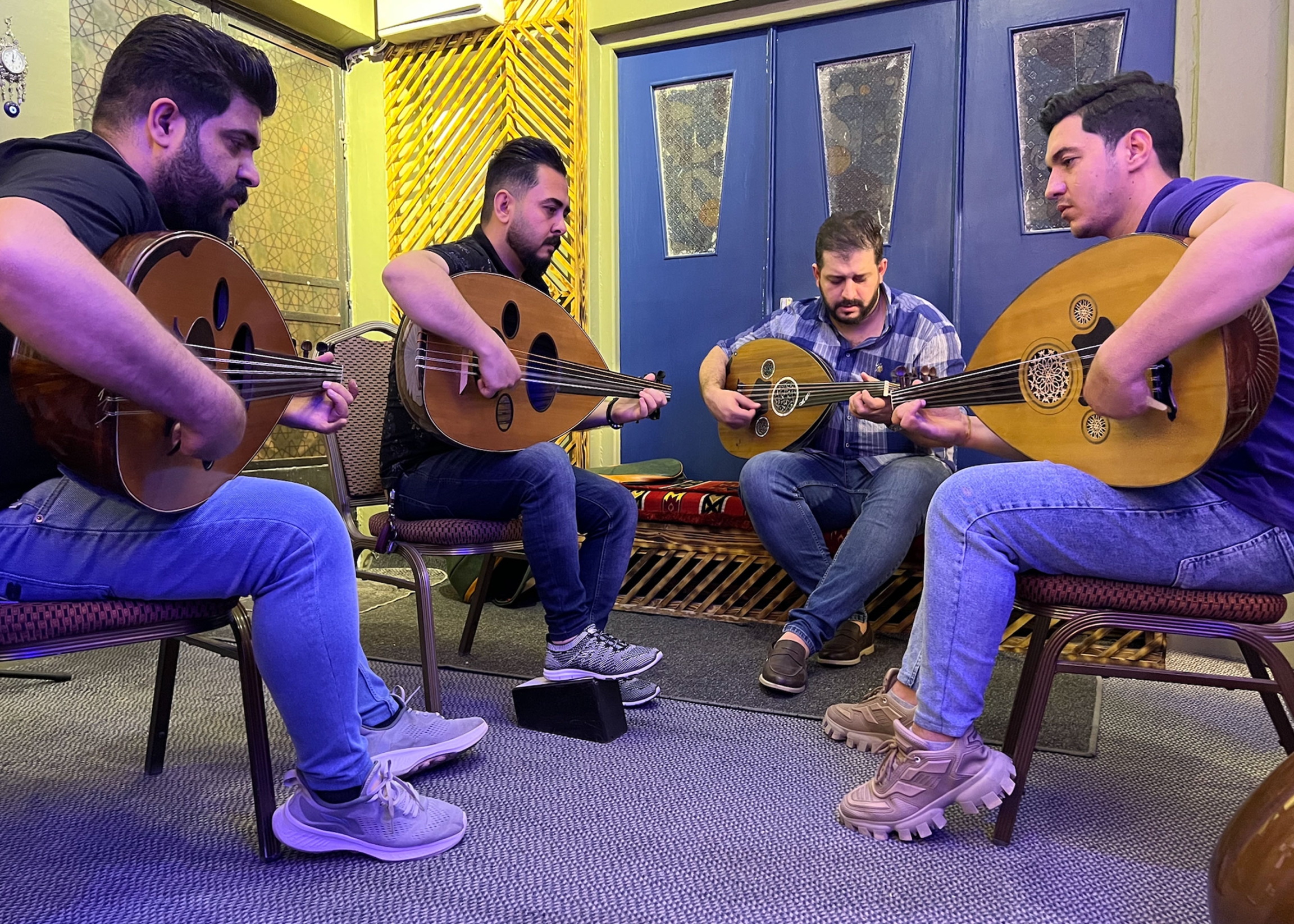
Oud musicians at a practice session in Baghdad, Iraq.
Shirin Jaafari/The World
These days, Rashied is more hopeful about the future. Iraq may still have many problems, like its ever-dysfunctional politics, he said, but overall, he’s optimistic.
“I think it’s more secure right now,” he added, “there [are] no bombs, we can live with this.”
As a result, after decades of conflict and insecurity, concert halls are filling up and music lessons are happening without interruption.
And Iraqis like Mostafa Rashied and Zahraa Malek are hoping that the relative calm continues.
So now, instead of car bombs and gunfire, the sounds of classical music and the oud can be heard throughout the city.
Related: Iraqi author Ghaith Abdul-Ahad on the 'unbuilding' of Baghdad
At the pediatric section of Maamobi Hospital in Accra, Ghana, Comfort Tetteh finished weighing her 4-week-old baby and strapped him on her back.

Vaccine uncertainty lingers as thousands of mothers with newborns remain desperate for a quick solution to protect their babies.
Ridwan Karim Dini-Osman/The World
Typically, during visits like this, newborns are immunized against several killer childhood diseases. But the baby, her fifth child, did not receive any vaccines. That day, the facility had run out of infant immunizations.
“They said we should wait and then see if it will come — maybe next month or so. So, I will keep trying until I get it for him,” she said.
In Ghana, a shortage of childhood vaccines has mothers like Tetteh going from hospital to hospital in search of immunizations to protect their infants. As a result, measles are breaking out in some parts of the country.
This has Tetteh extremely worried.
“As a mother, it is so hard to sleep at night knowing very well that your baby is not protected and could easily get the infections,” she said.
Shortages of vaccines against tuberculosis, polio, measles, hepatitis B, and tetanus have put an unprecedented strain on hospitals since late 2021.
Ghana was already reeling under a worsening economy since the COVID-19 pandemic began in 2020. But now, the country also faces a faltering economy and a health crisis.
Health officials say that pandemic-related disruptions, vaccine inequity and resource diversions have all contributed to the crisis.
In 2021 alone, 25 million children missed on out on vaccinations — the highest number since 2009.
“This is a red alert for child health. We are witnessing the largest sustained drop in childhood immunization in a generation. The consequences will be measured in lives,” UNICEF Executive Director Catherine Russell said.
Russell added that the pandemic cannot be used as an excuse for the delay in childhood immunizations.
“We need immunization catch-ups for the missing millions or we will inevitably witness more outbreaks, more sick children and greater pressure on already strained health systems,” Russell said.
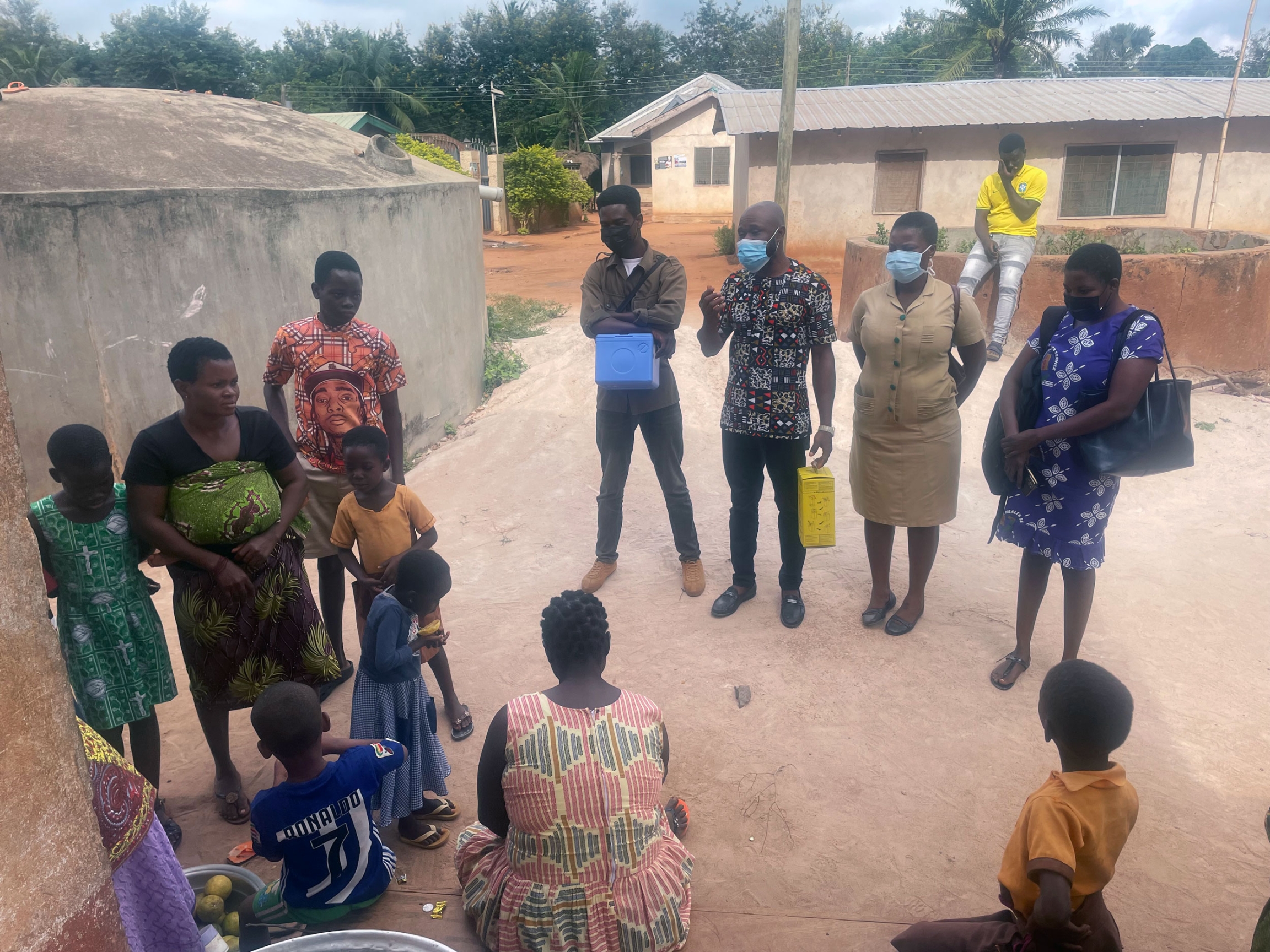
Ghana has one of the most robust and vibrant child immunization campaigns in Africa.
Ridwan Karim Dini-Osman/The World
According to the World Health Organization, worldwide manufacturing capacity has increased, but it remains highly concentrated in developed countries.
Ten manufacturers alone provide 70% of vaccine doses, excluding those for COVID-19. And just two of those manufacturers currently provide the vaccine against measles and rubella, among others.
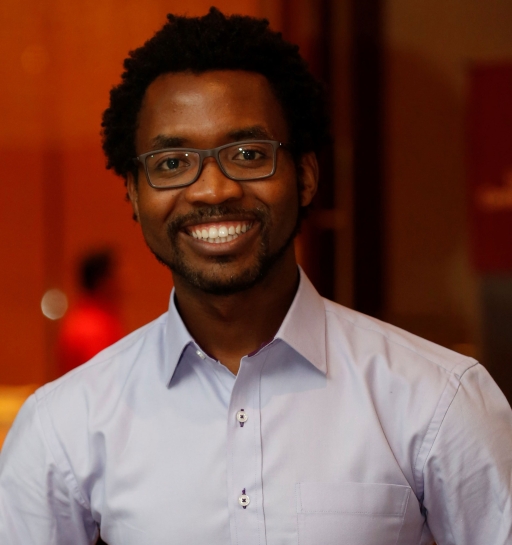
Nigel James is a global health policy researcher and public health specialist at the Pennsylvania State University.
Courtesy of Nigel James
This further exacerbates vaccine gaps for the poor and marginalized, said Nigel James, a global health policy researcher and public health specialist at The Pennsylvania State University.
“Everybody who is involved in the global supply chain for vaccines needs to understand and realize that vaccines are only as effective to the extent that we are able to get them to the people that require them,” James said.
“No one is safe until we are all protected.”
Dr. Patrick Kuma-Aboagye, director-general of the Ghana Health Service, admits that the situation is dire.
“We have had some delays in procuring some of those vaccines for which polio, MR [Measles-Rubella], and BCG [Bacille Calmette-Guerin] are in short supply,” he explained, adding that the ministry’s budget, set in the local cedi currency, was impacted by fluctuating exchange rates.
In a recent address to the nation, President Nana Akufo-Addo assured citizens that the situation would get fixed — but offered no specific timeline. He also said the Ghanaian Health Service has developed an elaborate plan to catch children up on their vaccines when they arrive.
"I want to encourage all parents and caregivers to ensure that eligible children are vaccinated once this program begins. No child should be denied access to vaccination,” he said.
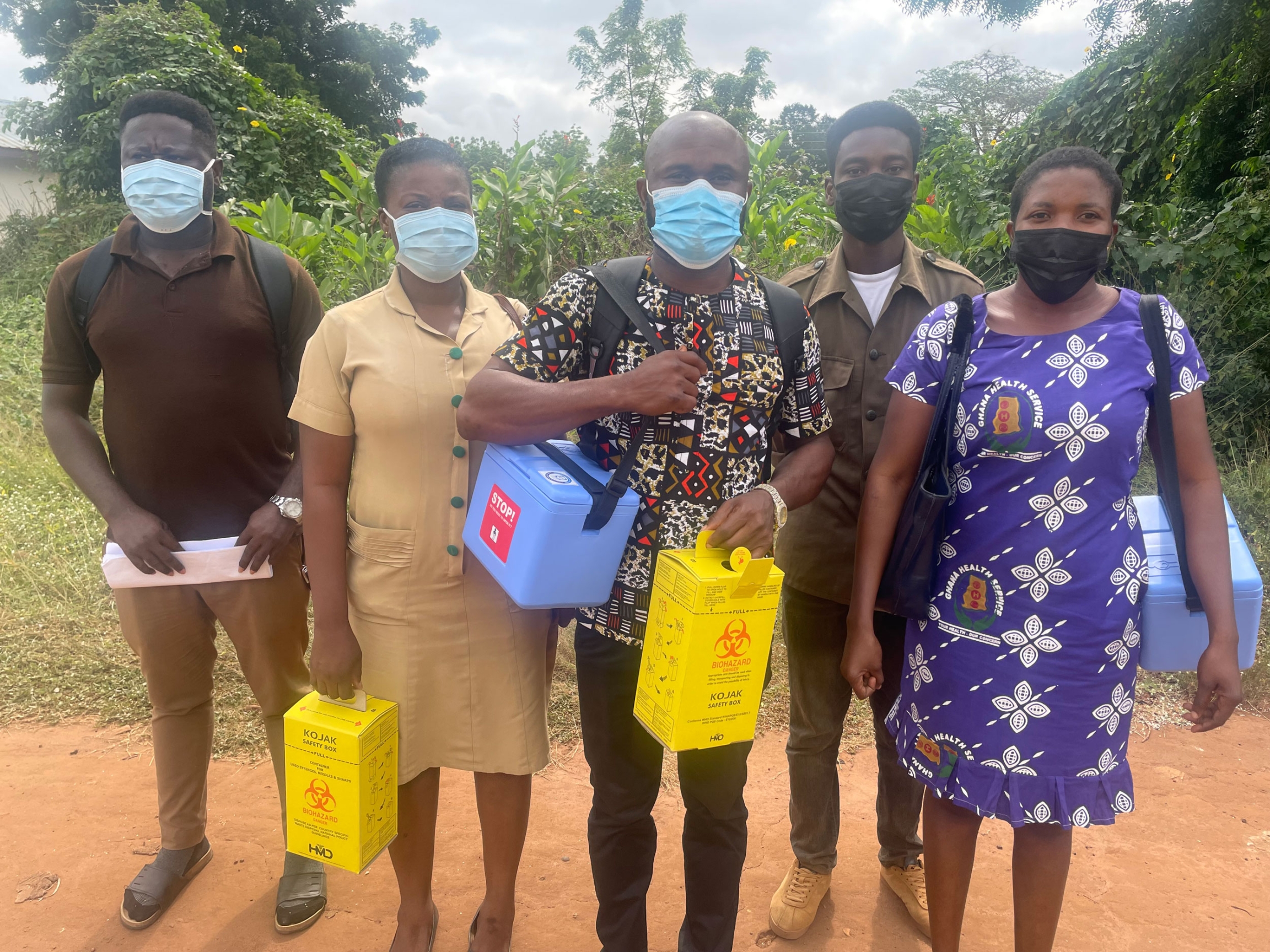
Ghana has one of the most robust and vibrant child immunization campaigns in Africa. Since 2003, there have been no deaths caused by measles in Ghana. But the current shortage threatens to erode all gains made by the country.
Ridwan Karim Dini-Osman/The World
Measles, a highly contagious disease, typically shows up more quickly when vaccination levels decline.
Over 100 cases of measles have been confirmed nationwide with almost 600 suspected cases being investigated in northern Ghana alone.

Dr. John Adabie Appiah is president of the Paediatric Society of Ghana. He’s concerned the nationwide vaccine shortages, if not urgently fixed, could erode Ghana’s gains in reducing mortality for children ages 5 and under.
Ridwan Karim Dini-Osman/The World
Dr. John Adabie Appiah, president of the Paediatric Society of Ghana, said he is concerned that the situation could erode Ghana’s gains in reducing mortality rates for children ages 5 and under.
Measles can cause brain damage, slow growth and malnutrition, he cautioned.
“If we allow this to fester on, the poorer the outlook will be for the nation,” he said.
The Paediatric Society wants to see the government settle on a dedicated, stable funding source for childhood vaccines to avert future crises.
But Janet Quaye is still dealing with the current crisis — hoping to secure immunizations for her 1-year-old child at Greater Accra Regional Hospital.
After visiting about three different hospitals, her child has only received one shot out of the many routine vaccines required.
“I am always carrying the baby from here and there [in the hot sun], and it’s not even healthy for the child as well,” she said while gently patting her child’s back as he rested on her chest.
For Quaye, who does not live near major hospitals, the transport costs are draining her meager savings and she has little time to focus on her food business.
Health worker Felicia Asante said she sometimes faces harassment and verbal abuse from parents trying to secure vaccines for their children.
“We try to explain to them that it’s a national issue — this one is beyond us,” said Asante, who works at Maamobi Hospital.
But as uncertainty lingers, desperate mothers continue to look for a quick solution to protect their babies.
Ukrainians Alina Berezova and Stanislav Linevych were dating for just six weeks when they decided to move in together.
Linevych, 31, who works for a humanitarian organization in Kyiv, said he joined Tinder as an act of defiance against the Russians. Berezova, 25, who works in IT, said Linevych’s chubby beagle mix Archie drew her to his profile.
“We need to continue to live, we need to love,” Linevych said, “because only good things can defeat that darkness.”
More than a year since Russia launched a full-scale invasion in Ukraine, millions of people are continuing to live their lives — including the search for love — even as power outages, missile strikes and curfews complicate daily life.

Alina Berezova and Stanislav Linevych talk about their relationship.
Anastasia Vlasova/The World
For many couples, the war has accelerated relationships, Kyiv psychologist Tetiana Lovchynska said.
“People are very social creatures,” she said. “And during war, we lose previous connections and previous lifestyles, and we need to rebuild.”
Lovchynska has seen hundreds of individuals and couples in therapy over the last year and has noticed a trend of moving in together and reaching other relationship milestones more quickly.
“People understand that we don’t have tomorrow,” she said. “We have now.”
On their first date, the couple lost track of time and had to race home to meet the 11 p.m. curfew. Six weeks into their relationship, Kyiv and its infrastructure was being targeted by Russian missiles and power cuts were frequent.
“I didn't have water in my flat, didn’t have light. And it was scary for me,” Berezova said, sitting next to Linevych on the couch in their apartment in a Kyiv suburb.
“I was alone. And when I was with Stanislav, it was more comfortable and more calm for me.”

Alina Berezova and Stanislav Linevych and their dog in Kyiv.
Anastasia Vlasova/The World
The couple teased each other as they recounted the story of their relationship.
“Alina told me that she feels safer when we’re together,” Linevych said. “And for me, it was very important to support her, and to be near her in stressful moments.”
Lovchynska has found that the stress of war is a litmus test for relationships.
“Some couples, they are getting even stronger,” she said, as they look past their problems and see just how important their relationship is in a time of conflict.
Alina Berezova and Stanislav Linevych moved in together after dating for six weeks.
Anastasia Vlasova/The World
For others, the stress of war exacerbates existing divisions.
“All these things that were deeply inside, they come to the surface,” she said.
Lovchynska said the number of weddings went up 20% in Ukraine last year, but the number of divorces increased, too. A primary stressor is distance. Millions of Ukrainians left the country at the beginning of the Russian invasion, mostly women and children leaving husbands and fathers behind.
“Married couples, families, they are separated,” she said. “And this distance plays a huge role.”
Add the trauma and stress of living through war or displacement, and some couples don’t have the emotional energy to tend to their relationships, Lovchynska said.
Yevheh Martynenko, a university student studying history in Kyiv, saw his relationship of two years end last spring, after his girlfriend moved away from Kyiv to be with family.
“This kind of distance, it was very bad for our relationship,” Martynenko said.
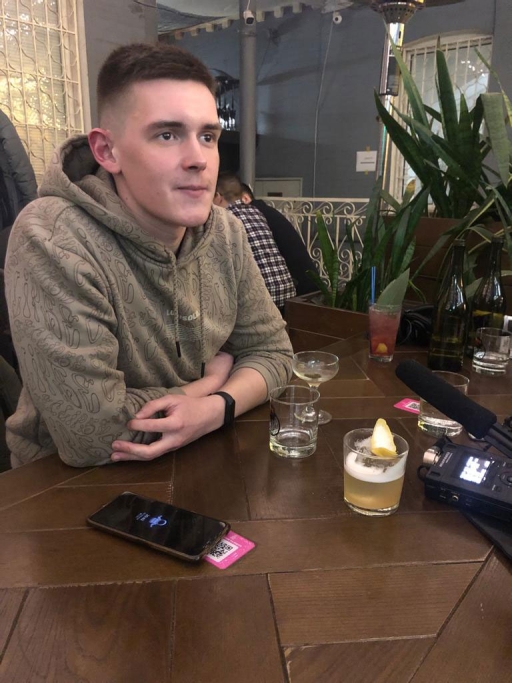
Yevheh Martynenko, a university student studying history in Kyiv, saw his relationship of two years end last spring, after his girlfriend moved away.
Patti Daniels/The World
In normal times, Martynenko said that after the breakup he could have met people to date at work, school, or clubs.
But amid war, the restaurant where he worked closed, school went online for safety, and many clubs shut down because of the curfew.
“For me, it became more difficult to meet new people,” he said.
Last summer, he downloaded Tinder and another dating app called Badoo, but he said he hasn’t had much luck.
“It’s very difficult for me to build a new relationship when you meet a person online,” he said.
Still, wedding bells continue to ring out across the country.
Right now, marriage is limited to heterosexual couples in Ukraine, but the war has added urgency to a push for change. A petition for same-sex marriage to be legalized landed on President Volodymyr Zelenskiy’s desk this summer, and he proposed civil unions as an alternative.
Last week, a Ukrainian lawmaker submitted a draft law on the legalization of same-sex partnerships to the country’s parliament.
In Kyiv, an officiant at a municipal wedding chapel told The World that a growing number of brides and grooms come straight from the front lines, wearing their camouflage uniforms and combat boots as they exchange vows.

Anna Panasenko and Max Protsyk on their wedding day in Kyiv.
Patti Daniels/The World
Anna Panasenko and Max Protsyk wore a more traditional gown and suit when they wed there in late February.
The couple, both in their 20s, met two years ago at a party held illegally during COVID-19 lockdowns and got engaged six months ago.
Speaking through an interpreter in the lobby of the Kyiv wedding chapel, they said at first they thought of postponing their wedding, hoping the war would end soon. But as it dragged on, they decided to go for it.
“Especially because the war is happening, we don’t want to postpone our life,” they said, finishing each other’s sentences as they waited their turn to walk down the aisle.
“We have to keep on living, and amongst all this evil that is happening, we want some good in our lives.”

Anna Panasenko and Max Protsyk on their wedding day in Kyiv.
Patti Daniels/The World
Friends at the ceremony said the couple supporting each other through the stress of war brought them closer together.
Panasenko works in a beauty salon, and Protsyk works in construction. He said he plans to help rebuild the country as they build a new life together.
When it was their turn to enter the chapel, the couple exchanged vows to applause and cheers from assembled friends and family, then raised their glasses in a celebratory toast.
Irina Protsyk, the groom’s mother, had come to the wedding from her home in a village outside of Zaporizhzhia, where the groom grew up. It’s now about 10 miles from the war’s front lines.
“It’s a big contrast,” she said. Soldiers are constantly passing through her village, helicopters flying overhead, and explosions sounding in the distance.
In Kyiv, the couple is all smiles, bubbling over like the champagne in their flutes. The war is on their minds, even on their wedding day, the groom said, but this moment is about celebrating a new beginning.
Filmmaker Armando Guerra, 47, who lives in Valencia, Spain, often sends supplies and money to his parents back home in Camaguey, in central Cuba.
He also tries to do whatever he can to help when he visits them. In the past, he saw them yearly. That stopped when the COVID-19 pandemic set in. But finally, he was able to see them again last month. In preparation for his trip, he went to the grocery store, like usual, to load up on essentials to bring back for them.
“We Cubans get a list from our family every time we visit the island,” he said. “‘Hey, we need a little radio for your grandfather or just notebooks.’ This time, however, my mom and my dad, the only thing they wanted was food. Just normal food.”
So, Guerra filled two extra suitcases with powdered milk, tuna cans, sausages, olive oil, some small medical kits, toilet paper and hygiene items. Once in Havana, he spent $12, or almost 2,000 pesos, on some fresh fruit and vegetables.
“My mother makes 1,500 pesos, via her pension. And I just blew it on a bunch of bananas, some garlic, onions, 2 pounds [of] tomatoes and a cabbage.”
Guerra's family isn’t poor, by Cuban standards — mainly because he’s been helping them for years. But today’s food shortages are hitting everyone. The economic crisis gripping Cuba, an isolated, socialist country largely shunned by global markets, appears to have no end in sight. Hundreds of thousands of mostly young Cubans have left the country in recent months, and those who stay behind are growing more desperate.
During his trip, Guerra documented the state of affairs in photos. Here's a gallery of his snapshots below.
Hundreds of thousands of mostly young Cubans have left the country in recent months. As a testimony to that, the highways are stark.
Armando Guerra/The World
A view of a street in Camaguey, Cuba.
Armando Guerra/The World
Armando Guerra, who lives in Valencia, Spain, recently returned to his home city of Camaguey in central Cuba where he found that things are worse than he expected.
Armando Guerra/The World
During Armando Guerra's two-week trip to Cuba last month, he accompanied his family on endless searches for food, medicine and water.
Armando Guerra/The World
The economic crisis gripping Cuba, an isolated, socialist country largely shunned by global markets, appears to have no end in sight.
Armando Guerra/The World
During a blackout affecting half the island, it's so hot the family climbs on the roof and hangs out, enjoying the breeze.
Armando Guerra/The World
Armando Guerra's dad — also named Armando Guerra — is shown on the roof of his house with his plants.
Armando Guerra/The World
Armando Guerra's dad, also named Armando Guerra, grows herbs and vegetables in clay pots on the roof of their single-story rowhouse.
Armando Guerra/The World
Armando Guerra's mom, Ondina Vazquez, and her cats are shown at home.
Armando Guerra/The World
During his recent trip to Cuba, Armando Guerra met a woman named Leanny, a doctor who was hitchhiking with her mom (she didn't give her full name because doctors in Cuba have to get permission to speak to reporters).
Armando Guerra/The World
Leanny, who Armando Guerra gave a lift to — with her mother — on his way to Camaguey, his hometown in Cuba, bakes cakes on the side to make ends meet.
Armando Guerra/The World
March 17 marked 20 years since then-US President George W. Bush told Iraq's President Saddam Hussein to step down — or else.
Then, 48 hours later, the US-led bombing campaign in the country, known as "Shock and Awe," began.
"Coalition forces have begun striking selected targets of military importance to undermine Saddam Hussein's ability to wage war," Bush announced on TV.
Cover of "A Stranger in Your Own City: Travels in the Middle East's Long War," written by Iraqi author Ghaith Abdul-Ahad.
Creative Commons
At the time, Ghaith Abdul-Ahad was a young architect working in Baghdad. With his home city suddenly in the center of the war, Abdul-Ahad ditched architecture and took jobs as a translator and interpreter for journalists, and later as a journalist himself. He went on to chronicle what he calls the "unbuilding" of Baghdad.
Abdul-Ahad's new book is a rare account of the invasion and the years that followed as seen through Iraqi eyes. It's called, "A Stranger in Your Own City: Travels in the Middle East's Long War."
He joined The World's host Marco Werman for a discussion about his book and his own experiences over the past two decades.
This interview has been lightly edited and condensed for clarity.
On the outskirts of Iraq’s capital, Baghdad, the streets don’t have names, trash is not collected and the roads are not maintained.
It’s in this area, in an unassuming brick house, that 48-year-old Muntazer al-Zaidi lives with his wife and daughter.
A small garden separates the dusty road from his home.
Zaidi has been in the global spotlight for more than a decade. His life changed on Dec. 14, 2008, when at a news conference in Baghdad, he hurled his shoes at then-US President George W. Bush.
“This is a farewell kiss from the Iraqi people, you dog,” he yelled in Arabic as he threw his first shoe toward Bush. “This is for the widows and orphans and all those killed in Iraq,” he shouted as he threw his second shoe.
The video was shown on news shows across the world. The relatively unknown Iraqi journalist suddenly became the face of resistance to some, and a troublemaker to others. Now, two decades after the US-led invasion of Iraq, he said that his country is still paying the price.
Following the press conference, Zaidi was arrested. He said he was tortured by the Iraqi security forces while in detention. In recent years, he said he has been shunned by Iraqi news outlets because “they don’t want to be associated with someone who is anti-American.
“Even the ones who say they hate America, they are afraid to confront this fact,” he said.
Zaidi also has a devout following.
Today, 15 years since the press conference, Zaidi’s views about the US have not changed.
“How can I forgive?” he asked. “These people have done these atrocities against my brother, my neighbor, my father, and they haven’t at least apologized, nor [are they] going to trial and they’re still free at large.”
He pointed to Russia’s war in Ukraine, adding that “the whole world now is weeping for Ukraine, but we were under occupation, and no one was even supporting us. Some of them were even supporting the Americans and if they were not, they just kept their mouths shut.”
Zaidi described his action at the press conference as “sort of a scream” or an attempt to draw the world’s attention to his country. He wanted to say not all Iraqis embraced the Americans at the outset of the invasion, as he said it was described by Americans. In fact, many Iraqis were suffering.
On the day of the conference, Zaidi said he picked his dirtiest, oldest shoes. As if to add to the insult.
He said he went in expecting he might be killed. So, he chose his seat carefully, picking the one in the last row. His thinking was if he got shot, no one behind him would be hit.
Zaidi had planned and prepared for a day to show his anger at the US president. In 2005, he made a video stating he is not paid by anyone nor is he affiliated with any groups.
But his anger is not just at the Americans. Iraq, he said, has gone from bad to worse. In 2011, he joined the protests against the Iraqi government.
“The Iraqi government is run by Iran,” he said. “Our politicians are being manipulated by neighboring countries. The Iranian influence, the illiteracy, the corrupt politicians, the media blackout, and corruption are all legacy of the US invasion.”
As for what happened to his shoes, Zaidi said he doesn’t know. He suspects the Americans shredded them so that they would not be made into a symbol by his supporters.
Alaa Mahsoob Mohammed supported the reporting of this story.
At Monster Project Kitchen in Soweto, South Africa, the staff prepare daily for the power to go off, switching off the music and lights and readying the gas stoves.
“Load-shedding affects us very badly,” said Fana Khumalo, who runs the restaurant, along with a number of other businesses in Orlando East, a part of South Africa’s biggest township, Soweto.
The lights may be off, but crisis mode is definitely switched on in South Africa. Despite a national state of disaster and a new minister of electricity, scheduled power outages — known as load-shedding — are heavily impacting ordinary citizens.
Businessman Fana Khumalo stands in front of Monster Project Kitchen and talks with staff in Orlando East, Soweto, Johannesburg.
Elna Shütz/The World
The average American might experience about 7 hours without electricity a year, mostly due to major weather events like hurricanes and snowstorms. But for South Africans, who have endured daily blackouts for the last four years, this is the norm.
Power gets switched off according to a particular area on a scheduled basis, in stages. For instance, at stage six, 6,000 megawatts are taken from the national grid, meaning lights out for about 9 hours a day. The government implemented load-shedding for about 43% of last year.
In mid-February, President Cyril Ramaphosa declared a national state of disaster to respond to the electricity crisis, granting the government broader powers, like exempting critical infrastructure from load-shedding. It also allowed for new electricity producers to skip through environmental regulations and unlock extra finances.
They also established a new transitory Ministry of Electricity, led by Kgosientsho “Sputla'' Ramokgopa, the new minister, who has a background in civil engineering. He hopes to end load-shedding, he said, but cautioned South Africans to be patient.
People like Khumalo feel the pressure on a daily basis. The kitchen is tucked off a busy road and serves food to up to 100 people a day.
“With traditional food, you need to prepare it in the morning, because you have to cook it for long hours,” he said.
One of their main dishes is cow heart, served alongside a stiff, staple maize porridge pap, usually shared and eaten by hand.
“Pap and mogodo, pap and heart, liver, and cow head. That's what we do. We cook here, we serve our people, we have a sit in, or you can do a takeaway.”
Employees of Monster Project Kitchen prepare cow’s heart and other traditional South African foods over gas during scheduled power cuts.
Elna Shütz/The World
Khumalo said they have become used to working on a schedule and will get by — but it’s been hard.
“You lose customers, because sometimes when they come in, there is no gas as a backup,” he said. “So, we lose money in that way.”
His businesses have also had to let go of staff and deal with excess stock. “We eat the food, what can we do? Or we give it to the orphans in the neighborhood or we share it with our friends.”
Businessman Fana Khumalo stands in front of Monster Project Kitchen in Orlando East, Soweto, Johannesburg.
Elna Shütz/The World
He feels that the government is failing ordinary South Africans and small businesses. Khumalo said he worries about corruption and that too many people in power are making decisions that only serve their interests.
“You are working on a break-even point just to keep the business going, just to think that maybe things will be better, the load-shedding will be over, so that we can go back to business normally, and give people the service that we’ve always given them.”
An eatery next door to Monster Kitchen Project in Soweto, South Africa.
Elna Shütz/The World
Of course, these problems didn’t happen overnight. Since 2007, there have been increasing bouts of load-shedding for a few months at a time, often because of compromised or failing infrastructure.
Independent energy analyst Clyde Mallinson said that a few decades ago, the country had a surplus of coal-powered electricity, based in part on Apartheid-era sanctions.
“So, what's actually happened is the coal fleet has deteriorated faster than they thought it would and we haven't put a new generation in place at a rate that can take over the job of what the coal fleet has been doing.”
He said that the current working capacity of about 100 coal-fired power production units is closer to about 40 units.

A coal truck, right, passes the coal-powered Duvha power station, near Emalahleni (formerly Witbank) east of Johannesburg, Thursday, Nov. 17, 2022. South Africa's ever-worsening power crisis, in which homes and businesses go without electricity for up to 10 hours per day, is strangling Africa's most developed economy.
Denis Farrell/AP/File
“So, we really, really are in big trouble at the moment, we've run out of time,” Mallinson said.
He warns that there’s looming electricity inequality ahead.
“The economic engine of the country is in small-to-medium-sized business operations in all of the towns and cities. And it's those that are bleeding at the moment, by virtue of not being able to have electricity or have money to backup,” he said, adding that the rest of the population has to pick up the load of “very expensive, very dirty electricity coming from a gasping, dying utility.”
The government’s current Energy Action Plan includes new, renewable energy, more imported power and improved existing power plants. The different scenarios place the end of load-shedding anywhere between a few months to a few years.
For now, load-shedding continues, and with it, the resilience of South Africans to adapt.
Thousands of protesters took to the streets in the Georgian capital, Tbilisi, this week to protest a proposed law that would designate organizations that receive a certain amount of funding from abroad as “foreign agents.”
Riot police used water cannons and tear gas to break up the crowds.
Critics of the legislation in Georgia argue that the law is modeled after a similar one in Russia that has made it harder for human rights organizations and independent media to operate. Lawmakers from the ruling Georgian Dream party have since announced they will not pursue passing the law, to appease the protesters, but a fierce debate about Georgia’s future continues.
Many feared this legislation would impede the country's aspirations for membership in the European Union. And Georgian Dream, the dominant political party, has been seen as not friendly enough to the West or harsh enough with Russia.

Protesters shout slogans during a rally against a draft law aimed at curbing the influence of "foreign agents" near the Georgian parliament building in Tbilisi, Georgia, Friday, March 10, 2023.
Shakh Aivazov/AP
Last summer, Ukraine and Moldova both received offers to officially become candidates for EU membership. But Georgia, which also applied for it, was given a list of tasks to complete in order to continue with the process, such as decreasing political polarization and limiting the influence of oligarchs.
The delay in advancement in the process has been a huge disappointment for Georgians, who overwhelmingly support EU membership.
“Europe represents stability and progress, that’s why we want to join the EU,” said 65-year-old Bidzina Tsurtsumia, who works at a small amusement park in Tbilisi.
Tsurtsumia said that joining the EU would mean becoming part of a more multicultural world and gaining distance from the Soviet era.
Georgia was once considered a favorite among countries seeking EU membership. But in recent years, the country’s majority Georgian Dream party has faced accusations of failing to improve the judiciary, protect the rights of LGBTQ people and of decreasing press freedoms.
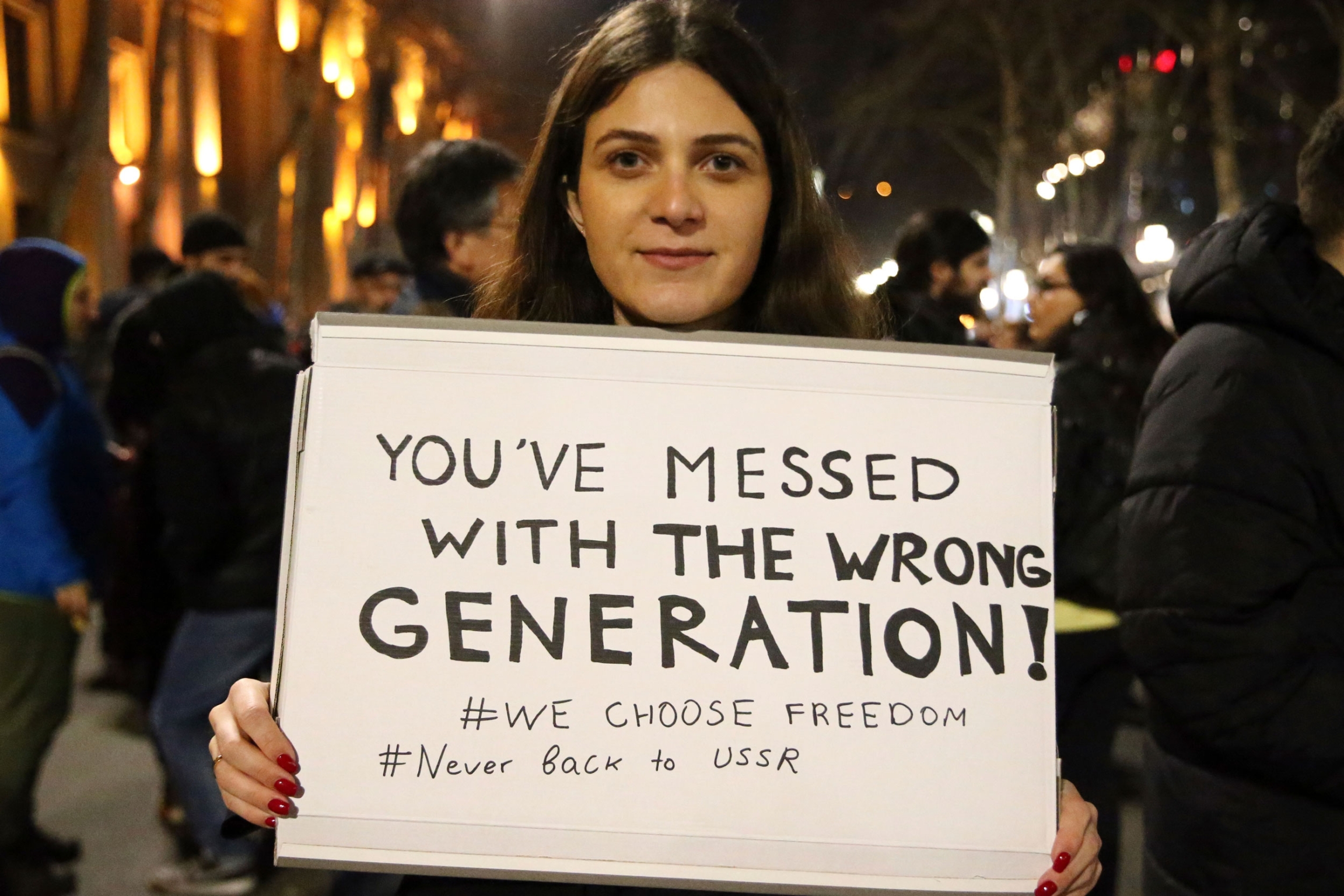
A woman holds a poster during a rally against a draft law aimed at curbing the influence of "foreign agents" near the Georgian parliament building in Tbilisi, Georgia, Thursday, March 9, 2023.
Zurab Tsertsvadze/AP
“This is not the direction that a country that wants to be liberal and democratic should go,” said Sonja Schiffers, director of the Heinrich Böll Foundation in Tbsili, a think-tank associated with the German Green Party.
Georgia gets relatively good rankings from organizations like Transparency International on issues like corruption. But, Schiffers said, the problem is that, unlike Ukraine, Georgia’s government has stalled efforts to strengthen its democracy.
The ruling party’s rhetoric has detracted from aspirations to join the EU. Recently, some members of Georgian Dream have been openly hostile to American and EU officials. And other politicians formerly associated with Georgian Dream are accused of spreading anti-Western conspiracy theories.
“We have a government which argues against the West, so it's a tragic moment,” said Giga Bokeria, leader of the opposition party European Georgia.
Bokeria hopes that Georgia will gain EU membership, because it would make the country more secure at a time when Russia is invading its neighbors.
“We need a government at this historic stage who would be banging on the doors in Washington and Brussels, explaining why both morally and pragmatically Georgia should become part of the Western security architecture,” Bokeria said.
But many leading Georgian Dream members say the party has taken significant steps to become closer to the West, at times making sacrifices like sending Georgian troops to Afghanistan to collaborate with the US and NATO.
“Unfortunately, the West has demonstrated hesitancy in coming closer to Georgia, rather than the other way around,” said Giorgi Khelashvili, a Georgian Dream politician and the deputy chair of the foreign relations committee.

Demonstrators gather with Georgian national and EU flags during a pro-EU and anti-government rally against in front of the Georgian Parliament in Tbilisi, Georgia, on July 3, 2022.
Shakh Aivazov/File/AP
Georgian Dream has also come under fire for not taking a harsh enough stance on Moscow since Russia invaded Ukraine. But politicians like Khelashvili say those criticisms are unfair.
“When you have a nuclear superpower next to you, which is threatening and menacing you incessantly, how can we risk the livelihood and lives of our population just by challenging Russia?” Khelashvili said.
But some Georgians believe that not taking a strong position against Russia’s actions in Ukraine could become a national security issue. Russia currently has defacto control of roughly 20% of Georgia’s territory.
“The problem is that Georgia cannot sit in two chairs at the same time,” said Korneli Kakachia, think-tank director of the Georgian Institute of Politics, referring to the government’s position of trying to appease both the West and Russia.
But Georgian Dream’s political messaging doesn’t turn off all Georgians.
“We’re not opposed to Russia, we just want to have relations with a peaceful Russia that’s more like nations elsewhere in Europe,” Tsurtsumia said back at the amusement park.
There, a European Union flag flutters behind Georgia’s flag — a common sight in Tbilisi, as a symbol of Georgians’ European identity and membership in the Council of Europe, a human rights organization.
The EU flag is so ubiquitous that one could easily assume the country is already part of the EU.
Georgia is still under consideration to become an EU member. But unless the government firmly embraces the West, Georgia’s path to the EU will be much more complicated.
In an old Soviet dormitory outside of Tbilisi, Georgia, Marina Radevich, who fled Ukraine last year, lives in a small, one-bedroom apartment with her mother and two small children.
She sleeps on a couch with her kids. They don’t have a shower, and there’s not even a lock on the door.
Radevich said that she misses her old apartment back in Kyiv, Ukraine.
Housing is so hard to find here, that she wishes the international community would step up: “Someone should build a refugee camp here for Ukrainians,” she said.
In the chaotic first weeks of the invasion, millions of Ukrainians fled westward to the safety of the European Union. But a smaller number of Ukrainians fled east — toward Russia.
Russian troops forbade many Ukrainian families from leaving Russian-occupied areas of Ukraine, or traveling west toward Kyiv.
So, with no other escape route, thousands of families crossed into Russia, and then headed south into Georgia.

Many Ukrainian refugees in Tbilisi, Georgia, are struggling to find affordable housing.
Levi Bridges/The World
The Georgian government has offered Ukrainians fleeing war some temporary support with free housing in hotels but much of that aid is drying up.
Georgia is still struggling to find housing for the thousands of internally displaced Georgians who left breakaway regions still occupied by Russia during separate conflicts that occurred decades ago.
One young Ukrainian woman whose name isn’t being used to protect her safety came to Tbilisi last year hoping to start over in a safe city with relatively affordable housing.
But after thousands of Russians escaping the draft at home started pouring into Georgia, rents in the city skyrocketed. A lot of the Russians coming in are wealthy tech professionals, Reuters reported, contributing to an economic boom in Georgia while also driving up prices and squeezing some out of the rental market and education.
To listen to another story on The World about Russians fleeing to Georgia, click on the audio player below:
Last fall, the woman said her landlord told her he would double her rent from $300 a month to $600 despite their contract.
“He just told me, you don't have any rights here, you are not a citizen of Georgia,” she said.
Georgia lacks legal protections to safeguard renters from a landlord’s demands.
Luckily, the woman has maintained her remote marketing job in Georgia and managed to find a new, more affordable apartment.
But other Ukrainians in Tbilisi aren’t as fortunate.

Monika Jaranowska is the director of a new kindergarten for Ukrainian students in Tbilisi, Georgia. She says many of the Ukrainian families who bring their children to the school are at risk of eviction as rental prices in the city continue to increase.
Levi Bridges/The World
Monika Jaranowska, who directs a new Ukrainian kindergarten operating out of an old arcade inside the central train station in Tbilisi, said that she witnesses firsthand the financial problems Ukrainians in Georgia experience both inside and outside the school.
“We don't have a vacuum cleaner, and I'm bringing my own from my home because we don't have money for that,” Jaranowska said during a rehearsal for an upcoming Mother’s Day event.

A group of Ukrainian women in Tbilisi, Georgia, whose children attend a school for refugees rehearse a song for an upcoming Mother's Day event. Many Ukrainian families from the school face eviction because they cannot pay the rising rental prices.
Levi Bridges/The World
Some of the mothers who send their kids to the school, most of them now single parents, she said, have been told their rents are doubling and face possible eviction if they can’t soon find a way to pay the increased housing costs.
“Ukrainians in Georgia have been left behind, they are forgotten,” Jaranowska said.

Ukrainian children study together at a new school specifically for Ukrainian refugees in Tbilisi, Georgia. Many Ukrainian families at the school are struggling to find affordable housing.
Levi Bridges/The World
Ukrainian fencer Darya Varfolomeyeva, 23, started fencing when she was just 11 years old.
“My mom told me if you want to do trainings, you have to do all your homework and only after that you can go to do your training. So, I did my homework between lessons, just to have more time, every day was the same,” she said.
Today, she trains with Ukraine’s national fencing team at a gym at the National University of Physical Education. Varfolomeyeva said she hopes to qualify for the Summer Olympics in Paris next year.
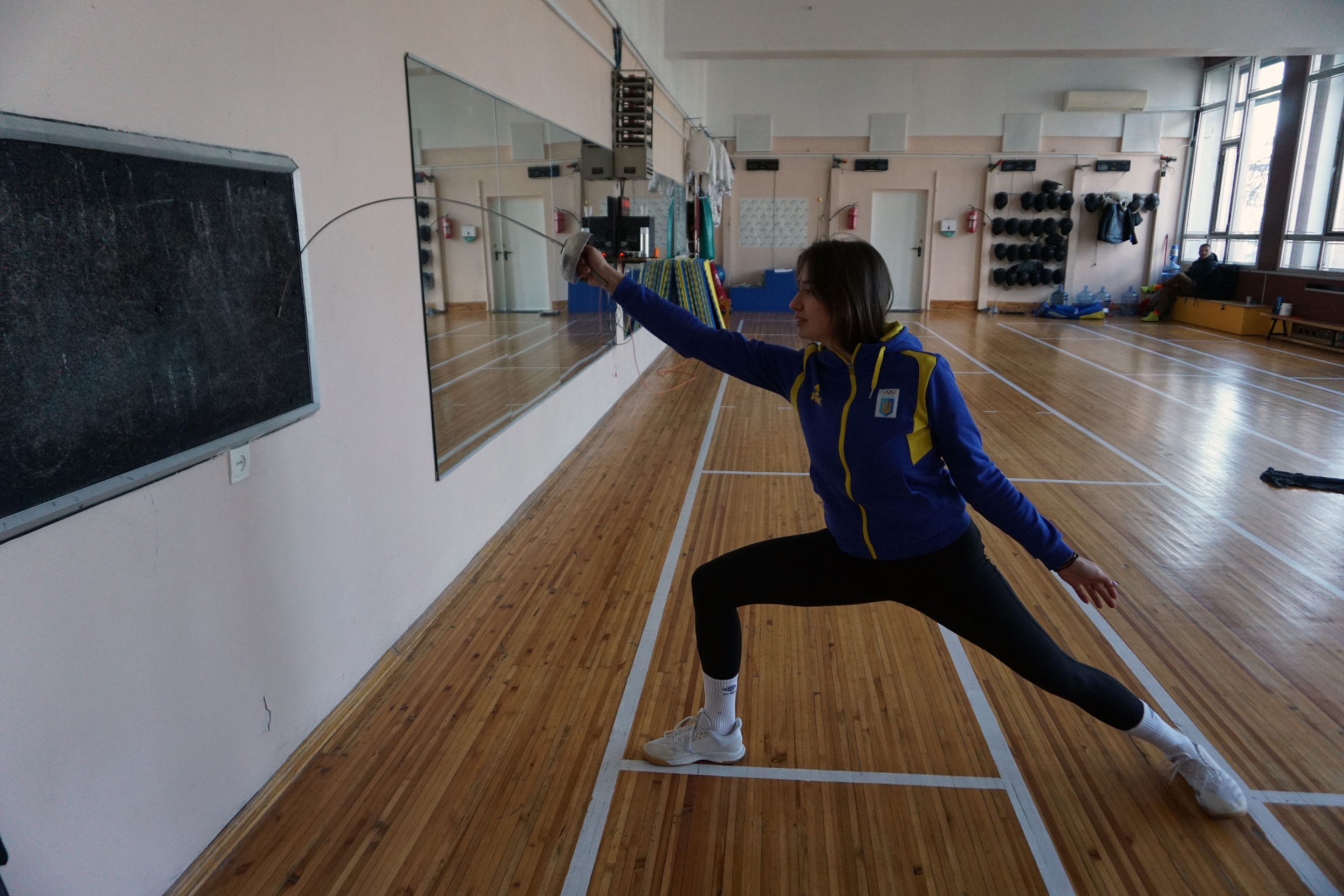
Darya Varfolomeyeva, 23, started fencing when she was just 11 years old.
Daniel Ofman/The World
But the past year has not been easy for Varfolomeyeva, who hails from Uzhhorod, Ukraine. A few days after Russia invaded Ukraine on Feb. 24, Varfolomeyeva’s mother asked her to take her sister and go abroad. They reached Prague, where they could stay with a relative.
Varfolomeyeva soon started training for a competition in Budapest, where she was welcomed by coaches and fellow fencers who bought her new fencing equipment.
But as the war continues, so does the stress. And on the other side of the conflict are the Russian athletes: It is uncertain whether or not Russian athletes will also be allowed to compete next year in the Olympics. Ukraine's president has said that Russia should not be allowed to use the Games to “promote aggression.”

Fencer Darya Varfolomeyeva has her eyes set on next summer's Olympic Games in Paris.
Daniel Ofman/The World
Russia is currently under heavy international sanctions and Russian athletes have already been banned from some international sporting events like Wimbledon in 2022.
But Thomas Bach, president of the International Olympic Committee, insists that these decisions should not get politicized.
“Governments should not decide on political grounds who is participating in which sport event,” he said, adding that qualifications must be on merit — not on politics.
In the past, when Russia had been penalized, its athletes have been allowed under certain circumstances to compete in the Olympics under a neutral banner — just not the Russian flag.

Ukraine's Parviz Nasibov, top, and Egypt's Mohamed Ibrahim Elsayed compete during the men's 67kg Greco-Roman wrestling semifinal match at the 2020 Summer Olympics, Aug. 3, 2021, in Chiba, Japan.
Aaron Favila/AP
On the outskirts of Kyiv, at an Olympic training facility, Greco-Roman wrestler Parviz Nasibov is also getting ready for the 2024 Summer Games.
He won a silver medal at the last Summer Olympics in Tokyo.

Silver medalist, Ukraine's Parviz Nasibov celebrates on the podium during the medal ceremony for the men's 67kg Greco-Roman wrestling at the 2020 Summer Olympics, Aug. 4, 2021, in Chiba, Japan.
Aaron Favila/AP
Despite all the training, he said that right now, sports do not hold the same importance to him as they used to.
Instead, he finds himself thinking about friends who have died in the war, or those still serving in Ukraine’s armed forces.
“Of course it’s difficult,” he said, adding that his family fled to Germany and he has not seen them for three months.
But Nasibov said his goal remains the same — to win a gold medal in Paris.
And if Russian athletes are allowed to compete, he said, “we’ll just have to beat them.”
Yun-Fei Ji’s art story began as a child, at 11, when his mother allowed him to study with an officer who served in the People’s Liberation Army in China.
“I grew up partially in this army base, and there was an army officer there putting together this hand-to-hand combat manual. He told me to draw figures and still life[s]. And that's how I started,” Ji said.

Yun-Fei Ji, "Early Spring Bloom," 2020, 2022, acrylic on canvas, 60 x 48 in., 152.4 x 121.9 cm.
© Yun-Fei Ji 2023. Courtesy the artist and James Cohan, New York. Photo by Matthew Hermann.
Ji, 60, a self-described global artist based in New York, was raised during the Cultural Revolution in Beijing. The sociopolitical movement began in the 1960s to denounce capitalistic practices integrated into Chinese life and lessen Western influence, including cracking down on the art world.

Yun-Fei Ji, "Sunflower Turned Its Back," 2022, acrylic on canvas, 40 x 30 in., 101.6 x 76.2 cm.
© Yun-Fei Ji 2023. Courtesy the artist and James Cohan, New York. Photo by Matthew Hermann.
Eventually, Ji became a student at China's Central Academy of Fine Arts in Beijing. Though it was said that the academy only taught socialist realism — a politicized practice of art production enforced by the Communist Party at the time — Ji had a different experience at school.
“Actually, there was experimentation … We were encouraged to think for [ourselves],” he said. “I was very interested in contemporary or modern Western art at that time early on, and then, gradually, discovered the work of ancient cave painting, Buddhist painting fountain, along with ink painting.”

Yun-Fei Ji, "Migrant Worker's Tent," 2022, acrylic on canvas, 24 x 24 in., 61 x 61 cm.
© Yun-Fei Ji 2023. Courtesy the artist and James Cohan, New York. Photo by Matthew Hermann.
Those interests in the wider world, plus the influence of his homeland, naturally carried him to Brooklyn, New York, in 1990, where his art developed further.
Today, Ji infuses Chinese traditional painting methods, such as calligraphy and ink painting on rice and mulberry paper, with contemporary themes that address environmental, social and political issues.
A common theme in some of his more recent work centers on displacement, like his acrylic-on-canvas painting from 2022, titled, “Everything Moved Outside.”

Yun-Fei Ji, "Everything Moved Outside," 2022, acrylic on canvas, 30 x 30 in., 76.2 x 76.2 cm.
© Yun-Fei Ji 2023. Courtesy the artist and James Cohan, New York. Photo by Matthew Hermann.
It depicts a figure outside, surrounded by household objects — chairs, blankets and the like — in gestural strokes that suggest movement.
“It's still a continuation of my exploration of the idea of belonging to a place. The idea of home migration,” Ji said. “These people are, you know, sort of putting their belongings outside to get ready to move.”
Ji’s work is often topical — another acrylic-on-canvas painting, “Migrant Worker’s Tent,” speaks to the ephemerality of home for those who’ve been displaced. Other pieces focus on portraiture (“The Man with Glasses”), the elements (“Early Spring Bloom”) and daily activities (“Sewing/High Noon”).

Yun-Fei Ji, "Sewing/High Noon," 2022, acrylic on canvas, 30 x 24 in., 76.2 x 61 cm.
© Yun-Fei Ji 2023. Courtesy the artist and James Cohan, New York. Photo by Matthew Hermann.
Ji’s work is exhibited globally as he continues to expand his methods.
“I [have] spent a lot of time thinking about belonging in the world of art as a sort of a global citizenship, you know, idea of resistance, the artist's role, how to respond adequately to the challenge of our time,” Ji said.

Yun-Fei Ji, "The Man with Glasses," 2022, acrylic on canvas, 24 x 18 in., 61 x 45.7 cm
© Yun-Fei Ji 2023. Courtesy the artist and James Cohan, New York. Photo by Matthew Hermann.
When the Taliban seized power in August of 2021, they banned young women and girls from attending high school.
Late last year, they also barred women from working in most local and international aid groups.
Now, the country is living with this harsh, new reality.
The United Nations has identified Afghanistan as the most repressive country in the world now for women and girls. The UN mission has said that Afghanistan’s new rulers are “imposing rules that leave most women and girls effectively trapped in their homes.”
To discuss how the international community is responding to the situation, The World's host Marco Werman spoke with Rina Amiri, the US special envoy for Afghan Women, Girls and Human Rights, who joined from New York.
This interview has been lightly edited and condensed for clarity. AP contributed to this report.
On a windy, chilly day, a young Moroccan man opened a padlock on a makeshift door to his dwelling in Almería in the southeast region of Spain.
He declined to share his name, which is common among the migrant farmworkers here who do not have working documents and fear getting deported.
The young man's home is made of four posts wrapped in layers of white plastic. He lives with his friend in the 60-square-foot space with a dirt floor and two mattresses with blankets.
There are about 100 such encampments in the area that sprung up when Almería’s farming began to boom 20 years ago.
Europe's fruit-and-vegetable farms depend on the work of migrant day laborers. But many of these workers are migrants who say they can't afford housing, so they live in makeshift, plastic housing near the farms where they work. Local governments have tried to remove these informal settlements and relocate people to shelters far from the farms — but they keep building back.

The plastic keeps crops safe from the brutal sun and wind in this arid region.
Gerry Hadden/The World
Global inflation is keeping food prices high everywhere, including Spain, where much of Europe’s fruit-and-vegetable crops are grown. But Europeans can’t blame the recent jump in tomato prices on labor costs. Migrant farmhands are paid as little as $40 a day.
Almería's farmlands are often called a "sea of plastic," referring to the miles of white plastic sheets that protect the watermelons and zucchini from the harsh sun and wind. When the plastic wears thin, the farmworkers often use it to protect their precarious shelters.
The man said that for years, he lived in another encampment called Walili, but in January, local authorities surprised residents by razing it.
"The police were outside, yelling for everyone to get out," he said. "They came and tore down everything. We said OK, and left. But I can’t take it anymore.”

After the fire in June, local authorities furroughed the open land so that migrant farmworkers couldn’t rebuild. The goal of the regional government is to raze the 100 shantytowns — but no one’s proposed new housing for the workers.
Gerry Hadden/The World
Officials said they demolished Walili because it was a public-health threat, citing dirty and dangerous conditions.
But activists and farmhands suspect that Walili was more of a public relations problem.
"Why this particular shantytown and not another one?" asked local activist Ricardo Perez from nongovernmental organization Derecho a Techo, or Right to a Roof.
“It's because it's very close to the road that goes to the tourist area of Cabo De Gata" — a coastal park with popular beaches. Tourists used to drive right past Walili to get there.
Perez said that the migrant farmworkers would love better housing but added that they have no voice and few allies.
Down at the beach that Perez mentioned, 15 minutes away, a local café owner named Antonio said he has no sympathy for the laborers. It’s a sensitive issue here, he said, so he only wanted to give his first name. The government, he said, should tear down all the shantytowns.

Most homes in the Almería shantytowns are wrapped in discarded plastic from the greenhouses that dot the region.
Gerry Hadden/The World
“How can these people come to Spain, and then not want to pay for anything?" he said. "They steal electricity, water.”
They just want to make a lot of money, he said, without giving anything back.
When Walili was demolished, the nearby town of Níjar offered the 450 displaced residents temporary shelter in an old warehouse in town. There are bunk beds inside, but for just 50 people. And a Moroccan man riding a BMX bike out front said that this was not the solution.
“There are only 23 people left in the shelter now,” Isham Maraui said. “There’s no work here. We’re too far from the farms. The bosses don’t come around here.”
By bosses, Marraui meant the farm owners. They didn’t respond to written questions about the working conditions of the day laborers. As for the rest of the Walili residents, activists said they took shelter with friends in other encampments.
Most of the shantytowns, like Atochares, are set back off the road — out of sight, out of mind, at least for now. And there’s not much in place to protect them.

The entrance to one shantytown, in Almería. Most are set back from roads and go largely unnoticed by the general public.
Gerry Hadden/The World
“A fire tore through here in June,” Moroccan farmworker Abdellah Skifi said.
“I came rushing from the fields, but it was too late. I lost everything, my hut, my clothes."
He said he even lost his dog.
Skifi was crashing in a friend’s hut. He’s been in Spain for 20 years. But like virtually all of the undocumented workers, he said, farmers won’t give him a work contract, telling him they can’t afford to because the work is seasonal.

Farmhand Abdellah Skifi at his home in one of the many shantytowns in Almería, Spain.
Gerry Hadden/The World
And without contracts, the farmhands are stuck earning about $5 an hour, with no chance to move out of the camps.
The young Moroccan man who was forced out of the bulldozed Walili encampment now sits atop a wobbly, wooden frame, hammering makeshift beams to posts as the sun went down, building himself a new, bigger hut.
Another migrant pushes a wheelbarrow, with new material for the walls — more white plastic sheeting.
Related: Migrants from northern Africa make dangerous trek through Spain’s Canary Islands
Water pours from a fountain in the central plaza of the small town of Tule in southern Mexico. The national anthem plays from the loudspeakers of city hall. Small groups of people stroll leisurely. Many of them are still wearing masks.
“Here in Oaxaca, there have been many deaths because of COVID [-19],” said Maria Jesus Hernandez, a local cook who's waiting for a friend. “Many people got scared. So, more than anything else, wearing a mask is a precaution.”

People in small groups in and around Tule Plaza in Tule, in southern Mexico, continue to wear masks.
Michael Fox/The World
That is something heard over and over again on the streets of Oaxaca: precaution, prevention, protection. Mexico was hit hard in the early days of the pandemic. More than 330,000 people have died. And many are still taking the pandemic seriously.
In towns and along roadsides, a lot of people walk the streets in face masks. Oaxaca is one of five Mexican states where mask mandates are still in effect at schools and on buses.
“Many people had a really hard time with their health during the pandemic,” said Diego Vasquez, a doctor who practices general medicine in Oaxaca. “I think that’s why, despite the vaccine, a certain percentage of the population is still concerned and still using masks.”

Students at Oaxaca University in Oaxaca, Mexico, are still masking up.
Michael Fox/The World
This reality is quite different elsewhere around Latin America. Brazil, for instance, was also hit hard by the pandemic, with 700,000 deaths. But, there, masks feel like a thing of the past.
When Brazilians celebrated Carnival in mid-February, masks were nowhere to be seen.
COVID-19 researcher Isaac Schrarstzhaupt said that’s because Brazilians, in general, do not have a culture of prevention.
“Brazilians have a culture of just letting the problem come and then having to fix things later,” he said. “But in Asia, they have a culture of prevention. They want to prevent the problem before it comes.”
Many Asian countries, and in particular, China, battled COVID-19 with strict lockdowns and restrictions. They’re opening up now. But masks have been widespread throughout.

People milling around in small groups in Tule Plaza, Tule, Mexico, continue to don masks to stave off COVID-19.
Michael Fox/The World
“I think there are cultural differences in Asia as a whole,” said Ben Cowling, a British epidemiologist at the University of Hong Kong. “Mask use in Korea, in Japan, Taiwan, Singapore has been relatively high throughout the pandemic. There were mandates in some parts of Asia, but even in places where there weren't mandates, mask use was certainly higher than in other parts of the world.”
In part, that’s because many East Asian countries have a longer history of widespread mask usage going back to the 2002 SARS outbreak.
Meanwhile, in the United States, masks and vaccines have become politicized.
“Mask wearing, especially being a very visible thing, becomes a part of identity, so people identify themselves partly by whether they are willing to wear masks or not,” said Donald Milton, a professor at the University of Maryland's School of Public Health.
Masks are not perfect. But studies in recent years have shown that they helped decrease COVID-19 cases by 10% to 20% in places where their use was widespread. And that was a godsend for health services battling waves of COVID-19, particularly before the vaccine. But for the most part, mask campaigns are being rolled back as countries try to move on.
UC Santa Cruz medical anthropologist Carlos Martinez studied public health in Mexico throughout the pandemic. He said that this is another reason why he believes many Mexicans are still wearing their masks.

A group of students at Oaxaca University in Oaxaca, Mexico, are shown wearing masks.
Michael Fox/The World
“Mexico does have a form of national health care, but particularly, in the pandemic, it became really difficult for people to access care, as in Mexico City, supplies became very difficult to access for people and I think that really penetrated public consciousness in Mexico,” he said.
In other words, with a problematic health system, masks became an easy way for people to try to protect themselves and their families.
Back in Tule, 16-year-old Norberto Fabian Lopez said that’s why he’s still wearing his.

Tule Plaza in Tule, in southern Mexico.
Michael Fox/The World
“Some of my grandparents are pretty sick with other illnesses, and I wouldn’t want to bring COVID-19 home and pass it to them.”
Lopez said he had a hard time getting used to wearing a mask in the beginning.
“It bothered me,” he said. “It felt like I couldn’t breathe well. But some of my friends died of COVID [-19] and I realized I had to take care of myself and my family.”
Like many of those on the streets there, Lopez said that wearing a mask is just a habit now. And it’s something he’s expecting to have to have to do for a long time to come.
Last year, when Russia launched a full-scale invasion of Ukraine, Zimbabwean student Korrine Sky was enrolled in medical school in the eastern Ukrainian city of Dnipro.
When Sky and her husband tried to flee at the Ukraine-Romania border, Sky said they were forced to abandon their vehicle as they waited in a long queue of cars, and were then directed to stand in the frigid cold in a separate line full of mostly Black and other diverse immigrants for hours — until the last Ukrainians crossed the border.
“We were last. They were going to make sure that the Ukrainian people were safe, and then, they would allow us after days,” she recalled. “It was so heartbreaking.”
By and large, many African countries have stayed on the sidelines of the Russia-Ukraine conflict. As major importers of wheat and fertilizers from the two warring nations, they are reluctant to jeopardize those vital supplies by taking sides, observed Olayinka Ajala, a lecturer at Leeds Beckett University in Britain.
He added that the plight of African students in Ukraine may have bolstered the positions that African countries have taken toward the conflict in Ukraine.
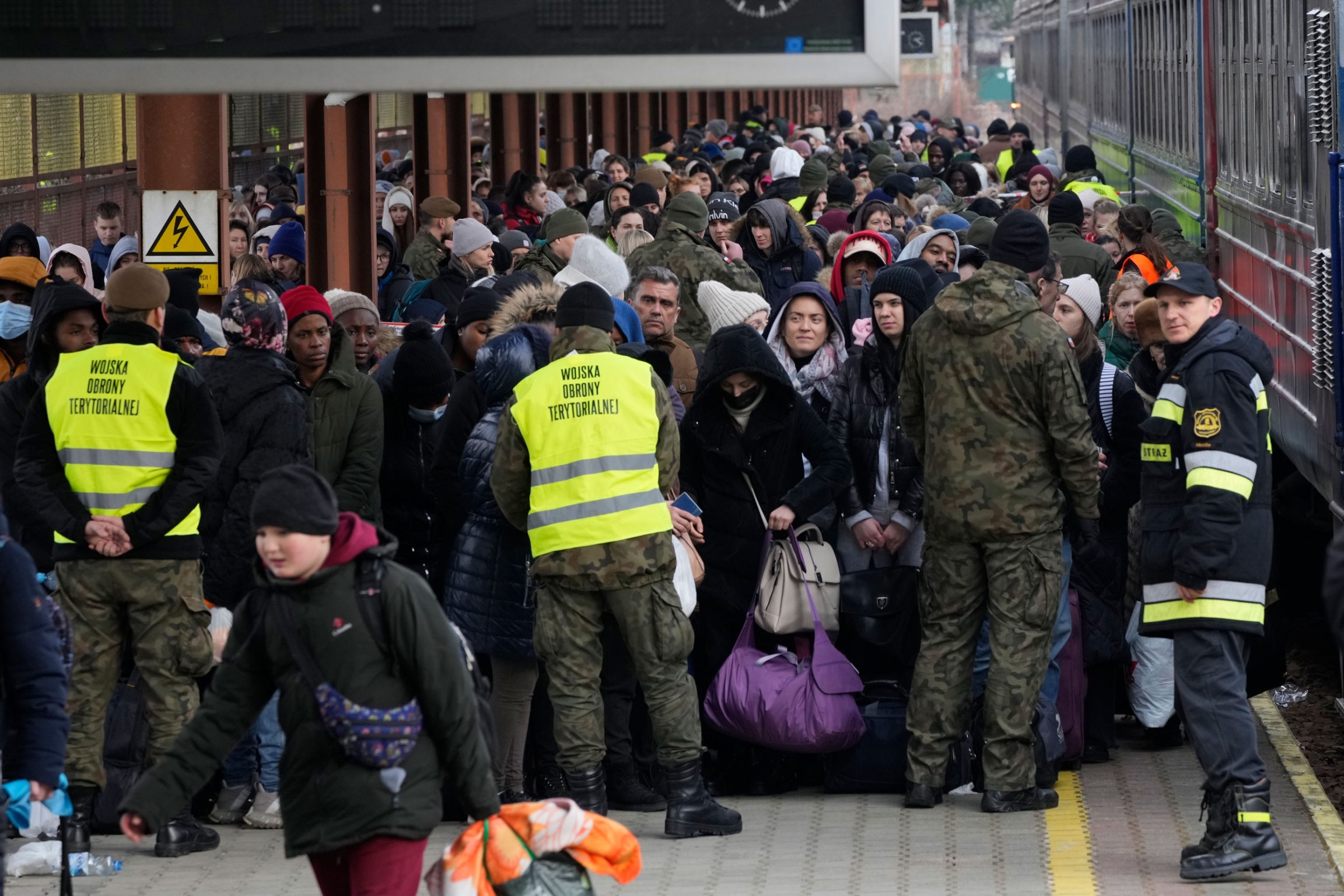
Refugees from Ukraine arrive at the railway station in Przemysl, Poland, Feb. 27, 2022. Nearly a year has passed since the Feb. 24, 2022, invasion sent millions of people fleeing across Ukraine's border into neighboring Poland, Slovakia, Hungary, Moldova and Romania.
Czarek Sokolowski/File/AP
Sky, 27, had seen and heard about videos circulating on social media showing African students being prevented — sometimes, physically — from fleeing the country, but was initially reluctant to attribute these actions to racism until her own harrowing experience.
A year later, Sky said she and other African students who fled Ukraine are struggling to survive, while Ukrainians have been welcomed and supported by other countries.
“We lost everything and nobody cares,” she said.
“Yet, when we see our counterparts, the people we left with, our neighbors, they have been accommodated and the world has opened their arms to them.”
Last year, when Russian President Vladimir Putin announced parts of eastern Ukraine were now independent states — one of the most memorable rebukes came from then Kenyan Ambassador to the United Nations Martin Kimani.
“The territorial integrity and sovereignty of Ukraine stands breached,” he said in a speech at the United Nations Security Council on which Kenya had a nonpermanent seat.
Kimani went on to compare the insecurity in these border areas to Africa’s own troubles with border disputes.
“Today, across the border of every single African country live our countrymen with whom we share deep historical, cultural and linguistic bonds,” he said.
“At independence, had we chosen to pursue states on the basis of ethnic, racial or religious homogeneity, we would still be waging bloody wars these many decades later,” he continued.
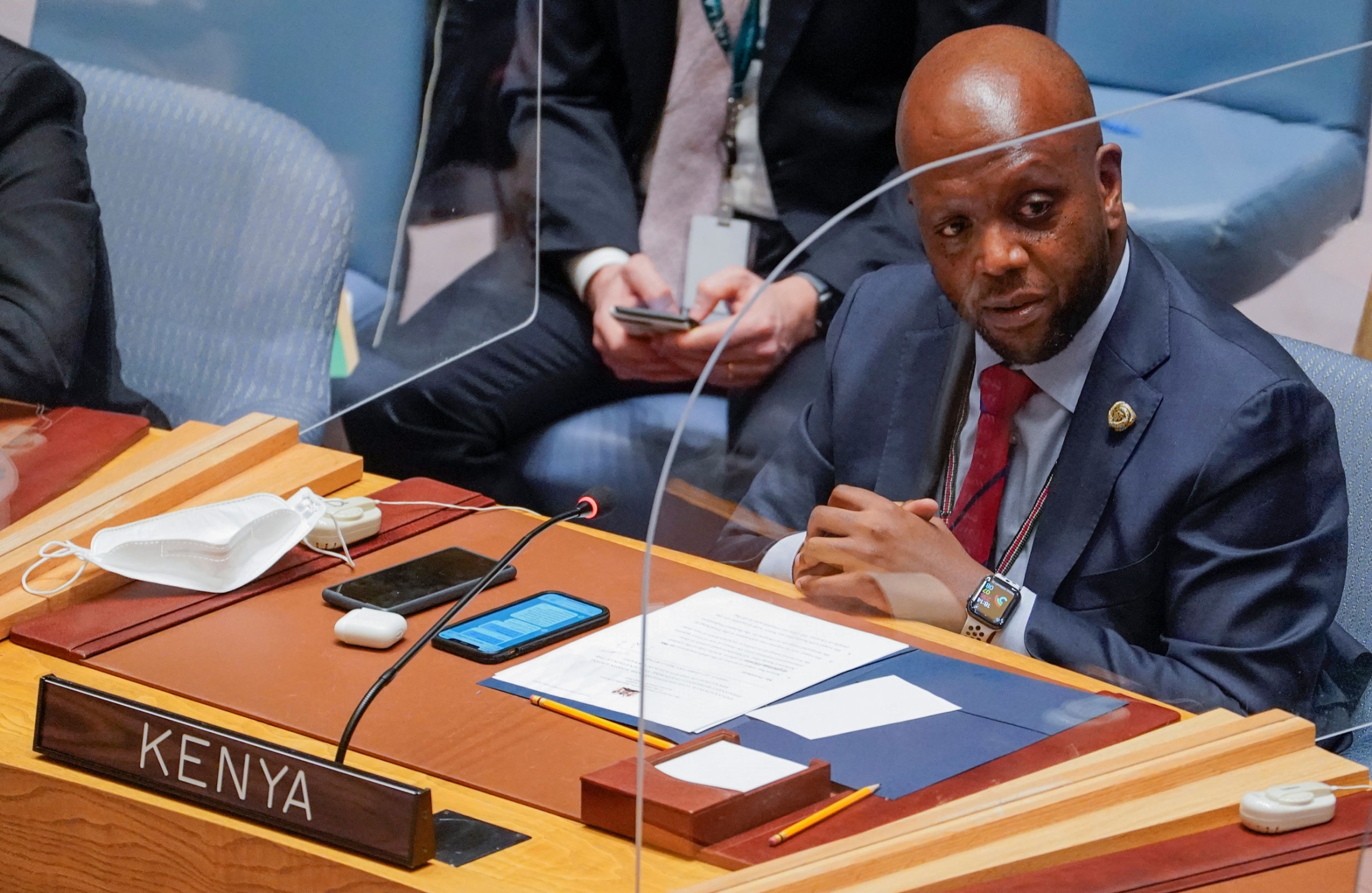
Kenya's Ambassador to the United Nations Martin Kimani addressed a United Nations Security Council meeting on the Russian invasion of Ukraine, on Feb. 25, 2022, at UN headquarters. Although Kenya and Ghana criticized Russia's actions, amid a worldwide chorus of condemnation against Russia's war on Ukraine, Africa has remained mostly quiet — a reminder of the Kremlin's considerable influence over the continent.
John Minchillo/File/AP
The speech received a lot of attention globally.
“It shows that Africa is more and more significant at the international stage when we look at the reception from all around the world,” Ajala said.
Since then, there’s been a lot of attention on how African countries have reacted to the conflict — especially those who have opted to stay silent.
“The initial reaction of African countries is not to get embroiled in another long conflict,” Ajala observed.
“Some people were not happy with that, because some people felt that if you are not aligning with the West, that means you are actually in support of the conflict.”
Ajala cautioned, however, against lumping 54 African countries together. Each one has different foreign policy objectives that should be respected, he said.
For example, some countries – like Namibia – have the policy of nonalignment enshrined in its constitution.
Others have growing trade, economic, and military ties with Russia that they might be hesitant to jeopardize.
“Many African countries depend on Russia for fertilizers, for wheat, for oil. For different things like that. So, many of them strategically found it very difficult to just turn their backs on their ally.”
South Africa, which has faced pressure to condemn Russia over the war, has also criticized the role that NATO expansion had played in the lead-up to the conflict.
Ajala added that at the end of the day, many African countries see the war in Ukraine as a European conflict that needs to be resolved internally.
Sky said she still wants to fulfill her dream of becoming a doctor, but that most African students who fled Ukraine haven’t been able to continue their education.
Recently, she launched a campaign calling for universities around the world to grant African students who fled the war the same opportunities to continue their education as their Ukrainian counterparts.
Still, despite the racism she experienced in Ukraine, and the subsequent struggles after — Sky said that African countries like hers could do more.
“I think that the African countries should have definitely made a bigger stand. Despite everything that happened, war is wrong and a lot of innocent people have died.”
Film director Colm Bairéad had a complicated relationship with the Irish language growing up in north Dublin in the 1980s.
The filmmaker is fluent in the national language, having been raised in a bilingual household; his father spoke Irish, and his mother, English. But living in a city where few people spoke Irish made him reluctant to use it outside the house.
“I always felt a little self-conscious about speaking it just because at that age, you just want to be the same as all of your peers. You just want to fit in.”
Today, Bairéad has become one the biggest champions for his mother tongue. His new film, “An Cailín Ciúin” (“The Quiet Girl”) has been Oscar nominated for best international film, the first time an Irish movie has ever been selected in this category. “An Cailín Ciúin” is now screening in selected theaters across the US.
The director and other advocates for the Irish language are hoping the film’s unprecedented success will change the relationship many in Ireland have with their native language. As it is, only 2% of the population speaks it on a daily basis.
Both Irish and English were regularly spoken on the set of “An Cailín Ciúin” as the cast and crew had varying levels of proficiency in the native language.
Bairéad speaks in Irish to his wife, the film’s producer Cleona Ní Chrualaoi, and the couple raise their children in an Irish-speaking household.
Ní Chrualaoi said it is the first time an Irish-language film has been given a proper release in British cinemas. The movie has been watched by more audiences in Ireland than any other Irish-language film to date.
Ní Chrualaoi said the film’s success has been breathtaking to witness.
“We call it ‘the little engine that could,’” she said.
“It started off in a very small place,” Ní Chrualaoi said. “It just shows you that you don't have to have big-name stars and a huge budget to make something really beautiful.”

Director Colm Bairéad is pictured next to his wife, producer Cleona Ní Chrualaoi, at the New York City premiere of the film.
Courtesy of Cleona Ní Chrualaoi
The performance by the movie’s young lead actress Catherine Clinch has been widely praised as has the film’s cinematography and direction.
Bairéad said the reception to the Irish language in the movie has also taken him by surprise. The film has toured festivals around the world including the US, South Korea and Australia. For some audiences, it was their first time encountering Irish on screen.
“There were certainly people who were surprised that we had our own language at all,” Bairéad laughed.
“Many people commented on the musicality of it, they saw it as something quite exotic I think,” he said.
Bairéad said he believes the film could change the public's perspective toward Irish in his home country.
“I think people might be more willing to give the language a chance, to give it space and to allow it to be part of our society once more.”
Ireland’s constitution lists Irish as the country’s national language and its first official language. English is recognized as the second official language. But census figures show that while 40% of the population say they can speak Irish, only 1.7% do so on a daily basis.
Learning the language is compulsory at both primary and second level education but despite 14 years of study, the vast majority of Irish do not speak it fluently.
Micheál Ó Foighil, who runs Coláiste Lurgan, a well-known Irish summer school in Galway, said the level of Irish spoken among most school leavers is “shameful.”

Deirdre Ní Loingsigh, director of the Irish Language Center at the University of Limerick.
Courtesy of Deirdre Ní Loingsigh
Ó Foighil is reluctant to blame the teachers (he was once a teacher himself), or the students, but he is scathing of Ireland's Department of Education and successive governments for what he sees as their failure to promote the national language.
“I would challenge you to find an education program anywhere in the world that is as badly delivered as the Gaeilge [Irish] learning program that our education system delivers here in Ireland,” he said.
The language has never thrived in Ireland since the formation of the state, Ó Foighil reckoned, and he believes the way Irish is taught is a big part of the problem. Students don’t learn it in the same way as other languages, like French or Spanish, he said and there’s little fun or innovation in the way classes are delivered.
In the Irish college that Ó Foighil runs, teenagers spend three weeks immersed in the language, living among Irish-speaking families and taking part in cultural activities where only Irish is allowed.
The summer camps in the Gaeltacht (Irish speaking parts of Ireland) are a rite of passage for many young teenagers. Ó Foighil said their level of fluency after two summers in the Gaeltacht far exceeds 14 years of conventional learning.
The low proficiency in spoken Irish is even more obvious when compared to nearby neighbor, Wales. An estimated 18% of people speak Welsh on a daily basis, despite English also being the working language there.
“If you go to any country in Europe, their national language is not on the endangered list,” he said.
UNESCO classifies Irish as an endangered language.
Not all Irish language enthusiasts are as critical as Ó Foighil.
Deirdre Ní Loingsigh, director of the Irish Language Center at the University of Limerick, disagrees with the UNESCO classification.
She lives in Nenagh in County Tipperary, a non-Irish speaking part of the country but said she is surrounded by people who engage with the language on a daily basis.
Ní Loingsigh uses it in her local shops, and at the school gates picking up her children, she said, and she encourages people to speak Irish even if they do so haltingly.
A video of Kildare-born actor Paul Mescal speaking Irish on the red carpet at the British Academy Film Awards (BAFTA) ceremony last month went viral in Ireland.
Mescal, who is Oscar nominated for his role in the film “Aftersun,” stumbled as he answered an Irish language TV reporter at the event in London.
He apologized for his lack of fluency.
“I’m sorry about my Irish — it was much better when I was in school,” he said.
Ní Loingsigh said the interview went viral because it is a sentiment that is so familiar to many Irish people — that is, the embarrassment of not being able to speak your mother tongue fluently.
But she said Mescal did what people should do, and that’s take a risk.
“The only way to truly learn a language is to try speaking it, and the response is nearly always positive,” she said.
There are historical reasons why Irish is spoken so little in Ireland. Eight hundred years of British occupation saw the Irish language actively discouraged or suppressed. By 1800, Irish was no longer the language of those who held political, social or economic power in Ireland.
Famine and mass emigration decimated poorer parts of the country where Irish was more widely spoken and many saw English as the language that would better prepare their children for emigration.
But Ó Foighil said it is too easy to blame the past and refuse to take responsibility for the demise of the language today. There have been calls over the years to drop the language as a compulsory subject in schools with the argument that it serves little purpose outside the school setting.
Ó Foighil dismissed those objections.
“What do you mean, where can you use Gaeilge [Irish]? This is Ireland, that should be enough. This is not England. We’re not English,” he said.
After her Viva Air flight from Colombia to Argentina was canceled on Thursday, Alexa Herrera spent hours in line at Bogotá’s airport, trying to get a seat on another airline.
But she was told that there was no space on any flights until next week.
“This is terrible,” she said. “I have to get back to work, and my son starts school on Monday.”
Viva's sudden decision to ground all of its flights left thousands of passengers stranded.
Manuel Rueda/The World
Thousands have been stranded at airports across Colombia and in several other Latin American countries following the closure of Viva Air, a budget airline that ran dozens of routes within Colombia, as well as several international routes.
The airline grounded its fleet of 18 Airbus planes on Monday night, claiming it could not afford to stay in business. It has refused to refund ticket holders, or help its passengers with lodging or food.
Sara Gonzales missed her flight to Argentina, where she is studying to become a dentist.
Manuel Rueda/The World
“You can’t even find their staff at the airport anymore,” said Sara Gutierrez, another traveler who was stranded at the airport. “They don’t answer the phones or respond online.”
In other cities like Medellín, Viva’s employees did show up at the airport, but to protest for flights to be restored.
“We want to work,” they chanted.
Protestas en el aeropuerto José María Córdova. Viajeros y empleados de Viva se unieron en arengas. pic.twitter.com/X2QxjnB41n
— Alejo Mercado (@AlejoMercado10) February 28, 2023
Since the pandemic broke out, 68 airlines have gone bust, including British low-cost airline Flybe and Italian legacy carrier, Alitalia.
Aviation analyst Miquel Ros keeps a list of these disappearing airlines on his website, Allplane.
“The large airlines that went under during the pandemic, many of them were already in a sort of chronic mismanagement and financial stress,” he said. “So, the pandemic was a bit like the last straw.
In the airport in Bogotá, Colombia, hundreds of Viva Air passengers tried to get flights on other airlines.
Manuel Rueda/The World
Industry experts say that Viva was especially hard hit by the devaluation of Colombia’s currency, which lost 25% of its value to the US dollar last year.
“Viva was making most of their money from domestic flights where they got paid in Colombian currency,” said Juan Felipe Reyes, an aviation lawyer in Bogotá.
“But their expenses, such as buying fuel or renting planes had to be paid in US dollars, making it hard for them to keep up.”
Viva says that it wants to merge with Colombia’s largest carrier Avianca, so that it can restart operations.
For Miguel Rodriguez and his family, a cheap return flight to Peru on Viva turned out to be a nightmare.
Manuel Rueda/The World
But regulators have been reluctant to approve that, because they fear that if both airlines unite, they would monopolize many routes.
Meanwhile, at the airport in Bogotá, Viva passengers continue to line up at ticket counters, hoping to get transferred to other airlines.
For Miguel Rodriguez and his two daughters, ages 2 and 4, a cheap flight back to Peru has turned into a nightmare.
“I’m a grown man, and I can withstand this” he said. “But for my daughters, it’s more difficult. So, I need help for them.”
But even as airlines like Viva take a nosedive, new airlines are taking off every month.
Hundreds of Viva Air passengers lined up at counters run by airlines that were offering free tickets to the stranded travelers. But spaces were limited.
Manuel Rueda/The World
Ros, with AllPlane, said that 37 airlines were founded across the globe last year, including another budget airline in Colombia.
“This is an industry that is full of crazy people — I’ll say that in a nice way, that are willing to go into this very, very competitive industry and try their luck.”
Ros said that aviation may not be the most stable industry. And it can be affected by pandemics, wars or collapsing currencies. But it still captures the imagination of many entrepreneurs.
The sun isn’t fully up, but Pedro Salas Díaz is already hard at work carrying 100-pound sacks of salt down the hillside to be stored for sale. He navigates his way along the rock walls that separate hundreds of small pools that have been here for centuries.
Salas Díaz is only 23, but he’s been working here for the majority of his life.
“This has been passed down from generation to generation,” he said. “From my grandfather, to my father and now, me.”
But here in this Oaxacan town of Zapotitlan Salinas, migration and climate change may spell the end of salt farming in Mexico.
Pedro Salas Díaz has worked as a salt farmer most of his life in a tradition passed down for generations.
Michael Fox/The World
Salas Díaz works alongside his father as one of the youngest in a group of less than 100 traditional salt farmers left here.
Visiting this salt farm is like stepping back in time. Even the salt-makers don’t know how many hundreds of years ago the stairs and the rock walls of the mineral springs were built.
Their salt farming technique has remained roughly the same for generations.
They use the spring water to fill the salt pools. It can take two months of watering, washing, rewashing, and breaking up the crystals, for each pool to produce a few hundred pounds of salt.
The mineral spring near the Oaxacan town of Zapotitlan Salinas.
Michael Fox/The World
Back before industrialized production, the salt here was a coveted commodity that Indigenous people called “white gold.” Popoloca peoples produced and traded it widely long before the arrival of the Spanish.
Those days are over, but it’s still a huge source of pride for the local community.
“It’s our identity,” local tour guide Leonardo Noé said.
“Our town is named Zapotitlán Salinas, or Zapotitlán 'of the salt farms.' It’s our unique identity and puts us on the map.”
But still, Noé said, many youth are leaving in search of easier, better-paying jobs elsewhere. Many have migrated to the United States.
"We need to incorporate more youth, and more people who want to learn the skill of being a salt farmer," he said.

Pedro Salas Díaz and his dad work on the salt farms that their family has done for generations.
Michael Fox/The World
In town, huge baskets holding bags of salt sit outside the shop of resident Marcelo Salas.
“When I opened this store, the first thing I wanted to do was sell this salt, because it’s part of our culture,” Salas said. “We sell about a ton of it a week.”
Across the street, Maria del Carmen Cruzalas owns and runs a taco shop.
"We are the children of salt farmers,” she said. “And there is a huge difference between refined salt and the salt we produce here. Our salt gives another flavor to the meat and sauces."
Their salt is also good for one's health. A recent study from the nearby Tehuacán Technological University found that it has 65% less sodium and is rich with 200 minerals.
That’s because this whole region used to be underwater. The ancient sea left behind salt and minerals, which the rains collect when they fall during the summer months — and replenish the mineral springs that feed the salt farms.
Migration and climate change may spell the end of salt farming in the Oaxacan town of Zapotitlan Salinas.
Michael Fox/The World
But farmer Pedro Salas Díaz said those springs aren’t filling up like they used to, and he’s concerned for the future.
"With climate change, there are times when it’s not supposed to rain and it does, and times when it’s supposed to rain, when it doesn’t. It is very concerning,” he said.
Pedro Salas Díaz, 23, has worked as a salt farmer most of his life.
Michael Fox/The World
Salt farmers here need the summer rains to fill the springs, but a rain during the dry season, right now, could ruin months of work.
But Díaz said they will weather the storm. And when his toddler son is ready, he’ll be bringing him along, too — teaching him the trade that he learned from his father and his grandfather before him.
Cambodian rapper Kea Sokun’s latest single, “Workers’ Blood,” commemorates the nine-year anniversary of a garment worker strike and the violent government crackdown that followed.
Last month, the government issued a warning to Kea Sokun over the song and music video, drawing ire specifically from Cambodia’s Ministry of Culture.
The ministry accused Kea Sokun’s video of “inciting content that may cause insecurity and social disorder,” which is against several incitement laws in the country, including Article 495, which could lead to jail time of up to two years.
In the song, Kea Sokun raps: “In 2014, there was suffering on Veng Sreng Street, anger broke out at a protest for a living wage ... Workers struggle to have rights, freedom, but the search for justice is filled with obstacles.”
Four people died in clashes with the police that day; more than 10 people were injured.
Human rights groups that commissioned the song — the Cambodian League for the Promotion and Defense of Human Rights and the Center for Alliance of Labor and Human Rights — were brought in for questioning.
Kea Sokun was then put on notice with a demand to take down the video.
Ultimately, the human rights groups that commissioned the video removed it from the internet, but the audio of the song is still available online on some sites.
“I didn’t think it was a crime or inciting,” Kea Sokun, 24, said in an interview with The World.
“The reason I compose those songs is to encourage Cambodians to love each other, to love their own country and not to become discouraged.”
This is not the first time Kea Sokun and his music have run up against the law.
The musician, who grew up in the northwest Cambodian town Siem Reap, has been rapping about social issues in his native land since he first got into music in 2015.
His first single, “A na Kot ler Som Ram” (“The Future of Trash” in English) is about the life of an orphan.
“Some people are kind and allow me to stay near them; sometimes, I am given a meal to survive the day,” he raps in the 2015 song. “Some people weren’t kind, they discriminated against me because of the way I look; they think of orphans as animals.”
Kea Sokun said he primarily sings about issues of injustice in Cambodian society — drug addiction, bad traffic, land issues and culture. Over the years, he’s released songs with titles such as “Hidden Assassin,” “Sad Nation,” and “Solidarity.”
Then in 2020, his song,” Khmer Land, Poor Nation and People’s Tears,” caught the attention of Cambodia’s Ministry of Culture for its lyrics about corruption and opposing a dictator.
“Actually, there’s cheating in every form; those who are well-educated will be killed; those who are smart will have their mouth shut,” he raps.
Kea Sokun was arrested and convicted of incitement for his lyrics. He served a year of the 1 1/2 years he was given.
But when he got out in September of 2021, he kept writing.
Now, he’s one of the most popular rappers in Cambodia, with about a quarter of a million subscribers on YouTube and a hefty following across social media, where he releases and promotes his songs.
The Cambodian government has a history of going after artists when they think their work is too political, said Virak Ou, founder of the policy think tank Future Forum in the capital, Phnom Penh.
Prime Minister Hun Sen has ruled Cambodia for nearly four decades. The former Khmer Rouge commander has made it a hallmark of his rule to silence political opponents and dissidents, as well as journalists and media he views as critical of his government.
In early February, the government shut down Voice of Democracy, Cambodia’s last independent media outlet, because Hun Sen accused their coverage of smearing his son.
But it’s been a while since the government has cracked down on a high-profile artist, Ou said. “So it’s not new, but it has been quiet for a while now. It's come back and so is the crackdown on that, too.”
Kea Sokun uses hip-hop and rap to reach a wider audience, he said — particularly, in a country where over 65% of its population of nearly 17 million is under the age of 30, according to the United Nations.
Do not count out Cambodia’s youth, Ou said.
“At this stage, they’re not as visibly active as we think they should be, but I think overall, I think they are still active,” he said. “They want to feel proud of their country, of who they are.”
The timing of Kea Sokun’s arrest is not coincidental, Phil Robertson, said deputy Asia director at Human Rights Watch — as Cambodia is holding general elections this summer, with Hun Sen poised to win yet another term.
“We're not expecting that election to be free or fair because of the government’s systematic harassment of opposition political parties and the repression of independent media,” Robertson said.
And Kea Sokun’s song about the garment workers struck the wrong note.
“The government recognizes that garment workers are massive voters they need to win over, and so, they're particularly sensitive to any sort of criticism about their labor policies,” Robertson said.
Still, while Kea Sokun might lie low for a bit, he said he’s not going to stop writing music about Cambodia’s social issues.
“It is my profession and my passion that I cannot give up,” he said.
Horm Sreynich contributed to this article from Cambodia.
In Ukraine, Svyatoslav Vakarchuk is a household name. He might be the country’s biggest rock star — like the Ukrainian Bruce Springsteen or Bono.
Vakarchuk said that the Beatles were his first musical inspiration when he was a kid in the ’80s. By 1999, he was recording hit songs with his band, Okean Elzy.
But, his success didn’t happen overnight, he said: “You know, we never woke up famous overnight, so it was like, little by little.”
Now, after countless hits, a PhD in theoretical physics and a political stint, Vakarchuk has focused his music and his activism on supporting Ukraine and its armed forces amid the war.
On Feb. 24, 2022, the day that Russia began its full-scale invasion of Ukraine, he woke up early hearing an initial attack on the city of Kyiv. His family had already left the country so he immediately tried to help others get to safety.
Ukrainian singer Svyatoslav Vakarchuk
Daniel Ofman/The World
He later volunteered and joined Ukraine's armed forces, where he became a lieutenant. However, most of his service entails supporting troops and civilians living near the front lines.
“It’s unjust that so many boys and girls now are suffering in the trenches and risking their lives and I will be sitting in a relatively safe place.”
So, he has tried to spend time with the troops and to “share this kind of risk and give them some emotional rest.”
Vakarchuk performed a song “Chovan,” meaning “Boat,” near the Antonivskyi bridge, in the Kherson region, which was destroyed by Russian forces.
“The song is about Ukraine. And it literally describes the country on both sides of the Dnipro river, left bank and right bank. This is a very symbolic song and I wanted to sing it there.”
“The bridge now is destroyed but the spiritual bridge is impossible to destroy.”
One of his favorite songs is a take on the famous song by Joe Cocker, “You Are So Beautiful,” but spelled “UA So Beautiful” in homage to Ukraine.
“For me, it’s the most-beautiful country in the world, even destroyed by the Russians, torn by the war, it’s still No. 1 for me.”
As the war continues, he went on, “I'm trying to live in the moment and I'm trying to act the way that makes victory closer.”
Natalia Zavalonkova, a former history teacher from Mariupol, Ukraine, has been staying at the PTAK Expo Center in Warsaw, Poland, for two months.
The center, which usually hosts large trade fairs and conferences, has served as a temporary shelter for Ukrainians fleeing the war since February of 2022. Inside one of the noisy, cavernous buildings, rows of camp beds are lined up side by side.
Zavalonkova is one of about 800 Ukrainians currently staying there. She carries her possessions with her in a small plastic bag at all times because she said she is afraid they will be stolen.
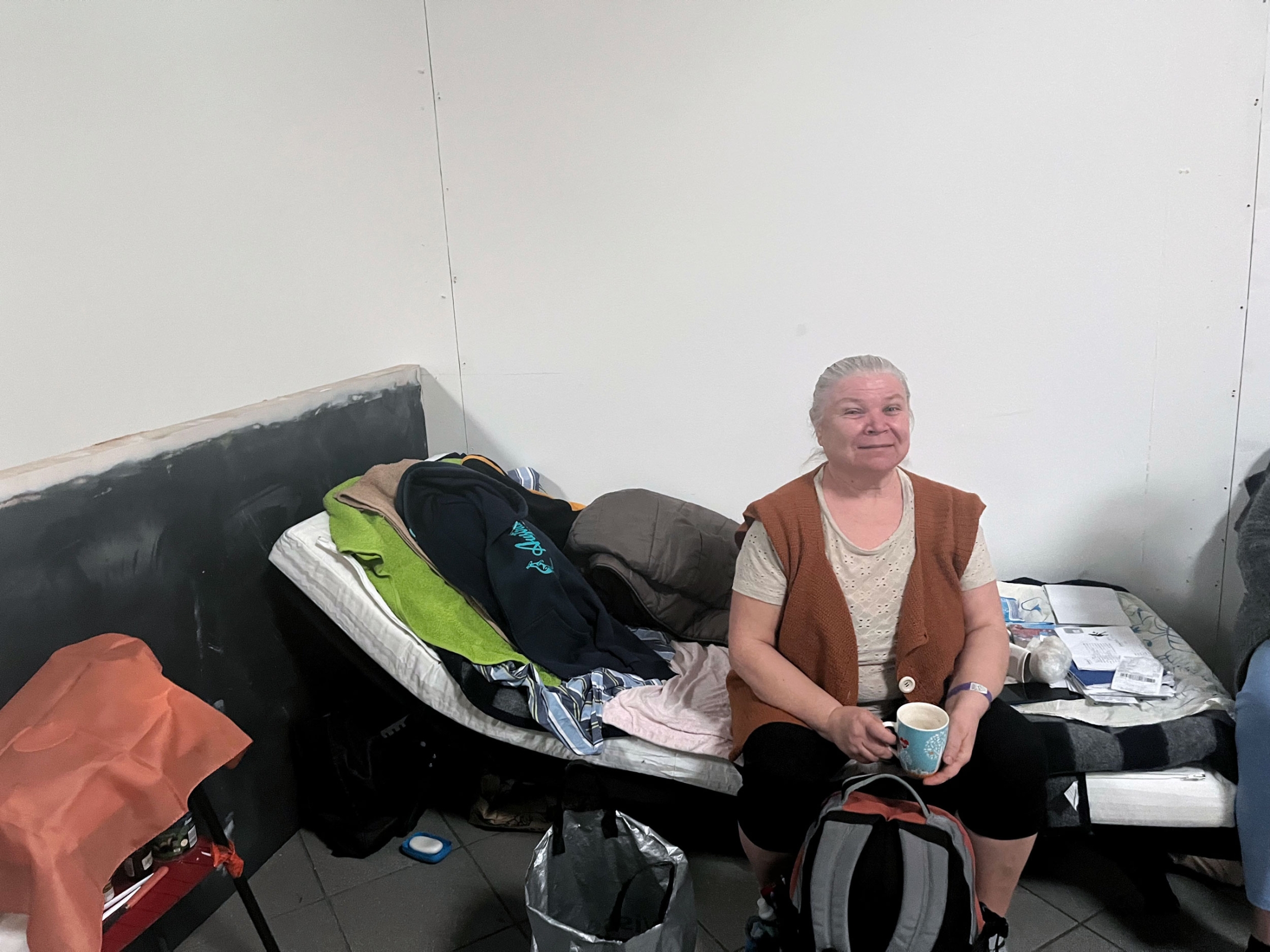
Ukrainian teacher Natalia Zavalonkova is hoping to leave the Warsaw Expo Center before her four-month time limit is up and she will be charged to stay.
Orla Barry/The World
The center includes a medical facility, a veterinary office and a kids’ playroom. The space was intended as a temporary stop-gap for refugees arriving from Ukraine, but some of its residents have been there for weeks — sometimes months.
Starting March 1, Ukrainians staying in state-funded accommodation like this one for longer than 120 days will have to pay 50% of their housing and food costs. After six months, that goes up to 75%.
When Russia invaded Ukraine on Feb. 24 last year, Poland opened its borders, promising millions of fleeing Ukrainians access to the Polish labor market, as well as health and social benefits.
Almost 10 million Ukrainians have crossed the Polish border in the past 12 months with more than 1.5 million staying on in Poland.
The country’s welcoming attitude has garnered much praise. US President Joe Biden on a recent visit to Warsaw said, “Poland’s generosity, your willingness to open your hearts and your homes, was extraordinary.”
Surveys show about 70% of Poles offered assistance to fleeing Ukrainians in the early months of the war and in 2022, Poland was estimated to have spent $8.3 billion on housing, health and other services for Ukrainians, the highest in Europe.
But prior to the war in Ukraine, the Polish government’s treatment of migrants and refugees was far from warm.
In 2021, it imposed a state of emergency at the country’s border with Belarus to prevent migrants and asylum-seekers, many from Syria and Afghanistan, from crossing into Poland.
In January 2022, authorities began construction of a 186-kilometer wall on its northern frontier to deter migrants. In November last year, the Polish government said it wanted to lower the cost impact of new Ukrainian arrivals.
Prime Minister Mateusz Morawiecki said the rules would be changed on March 1, “so that Polish taxpayers have to pay as little as possible for this potential next wave.”
Anna Chmielewska, coordinator of the Help Center for Foreigners with the Ocalenie Foundation, one of the main refugee support organizations in Poland, said the new policy is already having an impact.
“When people got information that they're going to have to pay for the accommodation, some of them decided to go back home to Ukraine, because they know that they won't be able to pay,” she said.
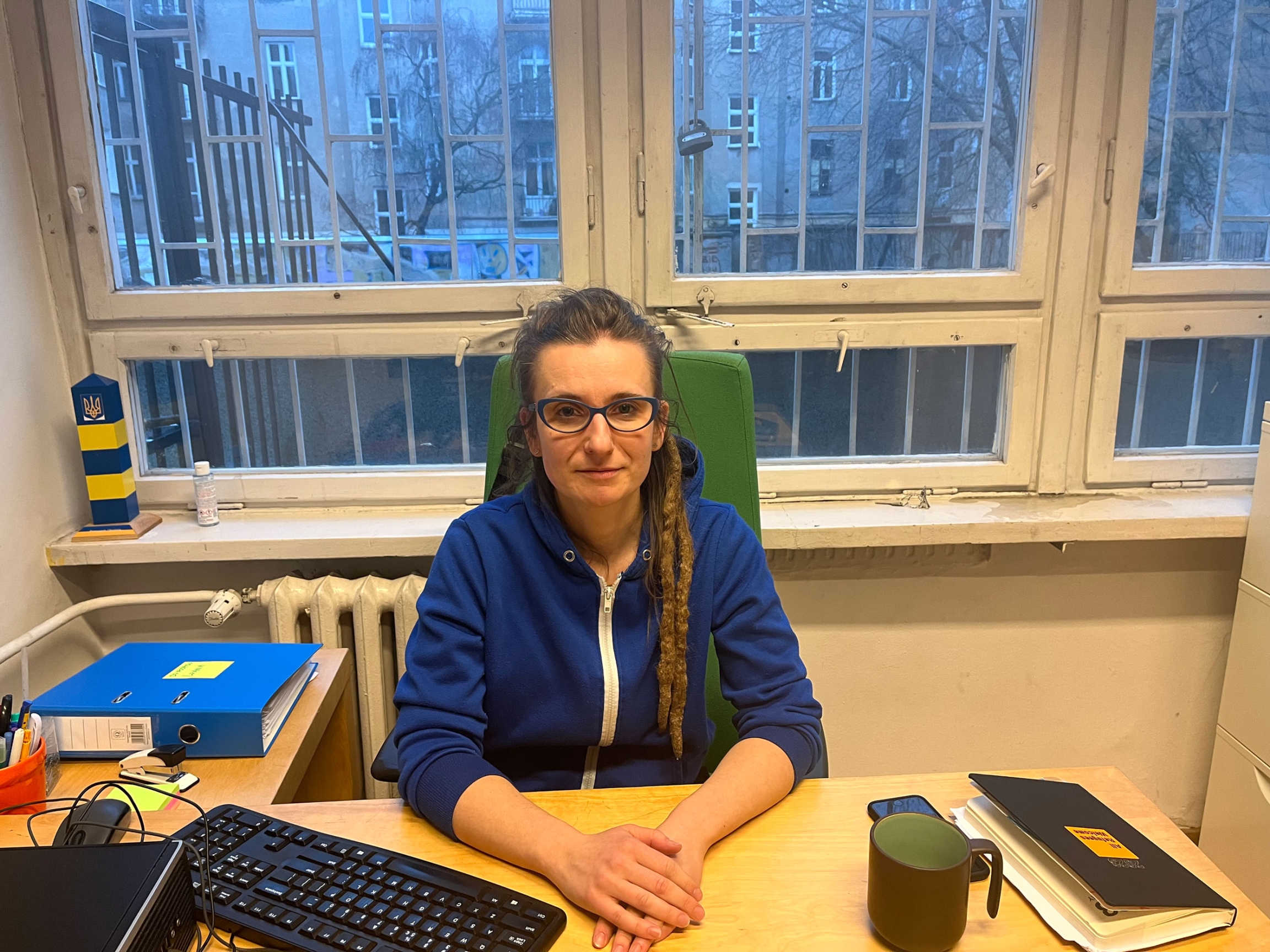
Anna Chmielewska, coordinator of the Help Center for Foreigners with the Ocalenie Foundation.
Orla Barry/The World
There are exceptions to the new rules; those unable to work because of their age or disability will be excluded, as well as pregnant women and mothers of three or more children. But Chmielewska said the exemptions fail to take into account the varied circumstances of Ukrainian refugees, most of whom are women and children. Chmielewska wonders how a single mother can be expected to look for work with no child care in place.
She believes the government’s plan is less a cost-saving measure than a political stunt.
Poland holds a general election later this year and polls show the ruling Law and Justice party currently commands about 30% of the public vote. The government will do what it can to boost that result, she said.
Not all nongovernmental organizations oppose the policy.
Dmitri Bilecki, a housing department employee at The Ukrainian House, a crisis response center that sources accommodation for Ukrainians arriving in Poland, said the Polish government cannot be expected to cover the cost indefinitely.
Bilecki believes the new charges might serve as an impetus for Ukrainians to find a job in Poland.
“They need to start finding a way to get themselves together in such a way that they can start to plan their lives,” he said.
Dmitri Bilecki works at the The Ukrainian House, a crisis response center that sources accommodation for Ukrainians arriving in Poland.
Orla Barry/The World
Some Ukrainians are reluctant to look for work because they are hoping the war will end soon and they can return home, but this is not necessarily the case, he said.
Many Ukrainian refugees are now employed in Poland, with the number of foreign workers registered in the country’s social insurance system increasing by 22% in 2022.
Bilecki said there is work available, but the jobs may not meet standards they’re used to because of their lack of Polish-language skills.
Chmielewska also said that some refugees are still processing the trauma of the war. People often need psychological support before they can even consider looking for a job, she said.
The government’s policy is intended to move Ukrainians out of state-funded accommodation as soon as possible and into the private rental sector. But the rental market, particularly in large cities like Warsaw, is under tremendous pressure.
The sudden surge in the capital’s population in the last year has driven up demand. Ukrainians now make up more than 3% of Poland’s 37.8 million population. Inflation, high energy prices and opportunistic landlords have hiked up the fees.
Prior to the war in Ukraine, Poland was already seen as having one of the European Union’s most-challenging housing situations. A survey in 2019 showed almost 50% of young people living in overcrowded households, homeownership stagnating for over a decade and a deficit of more than 2 million dwellings.
Ukrainians trying to rent privately in Poland also face an additional challenge, Chmielewska said.
“There is this kind of atmosphere that it's better not to rent a flat to a foreigner,” she said. Ukrainians and other foreigners find it difficult to rent here simply because they are not Polish, she said.
Chmielewska said that Poland’s warm reception to Ukrainians was uplifting to witness but she worries that some of that generosity of spirit may be waning.
In late 2022, more than half the Polish population were reported to be supporting refugees out of their own pockets. By January, that figure had dropped to 41%, according to the Center for Public Opinion Research in Warsaw.
The number of Poles offering to volunteer at the Ocalenie Foundation and assist Ukrainian refugees has also dropped in recent months. Chmielewska said all her organization’s volunteer workers are now non-Polish.

A children's playroom at the PTAK Warsaw Expo Center.
Orla Barry/The World
Ukrainian teacher Natalia Zavalonkova is hoping to leave the Warsaw Expo Center before her four-month time limit is up and she will be charged to stay. She is waiting on a visa to go to Britain where a woman has offered her a room in her house. They talk on the phone or on Zoom almost every day, she said.
But all Zavalonkova said she really wants is to go back home to Mariupol, and to be near the Azov Sea again.
“I miss the sea,” she said.
In Villa de Leyva, Colombia, dozens of people lined up this past weekend during the 26th-annual Astronomy Festival to look at the stars through giant telescopes set up in the town's colonial-era square.
This Andes town's dry weather makes it one of the best spots in the country to go stargazing — drawing around 5,000 people to its festival every year.
“This is really cool,” said Valentina Galvis, an eighth-grade student who attended the festival with her family. “You can talk to people who know about the stars, and they’re very eager to share their knowledge.”

Every year, about 5,000 people attend Villa de Leyva's Astronomy Festival, which is held in the town's colonial-era square.
Manuel Rueda/The World
Across the globe, cities have become a lot brighter. Suburban sprawl and urban skyscrapers, some lit with neon lights, make it harder to see the stars. But some places, like Villa de Leyva, are now trying to dim their lights in the hopes of promoting positive health benefits for locals while also attracting more visitors.
The popularity of the annual three-day festival has encouraged organizers to push for lasting improvements for the town. They’re working with the local government to modify Villa de Leyva’s streetlights so that it's easier to see the night sky.
“What we really want is to defend the right of all humans to see the stars.”
“What we really want is to defend the right of all humans to see the stars,” said Diana Rojas, the festival’s director. “So, we have to teach people about the importance of preserving dark skies and ask our governments to be smarter about artificial lighting.”

The Belt of Orion constellation, as seen from Villa de Leyva's central square.
Manuel Rueda/The World
Villa de Leyva has a population of 20,000 and is currently trying to get certified by the Starlight Foundation, an organization that runs a list of the world’s best stargazing destinations. Among the town’s plans is to change the direction of its streetlights so that they only point downward. And it is also planning to use light bulbs with lower-colored temperatures that emit softer lighting.
With tourism being one of Villa de Leyva’s main industries, Mayor Josue Castellanos hopes the certification will attract more people.
During the day, experts calibrate their telescopes at the Astronomy Festival and place special filters on them, so that visitors can also watch the sun, Villa de Leyva, Colombia.
Manuel Rueda/The World
A growing number of enthusiasts are among the younger generations.
“Children love astronomy, and our festival attracts many families,” Castellanos said. “So, we want to keep our skies dark and turn that into another attraction.”
Third grader Andres Camilo Morales from Bogotá looked at the sky through a white telescope as he shared his excitement.
“It’s so much easier here to see the beautiful stars,” Morales said. “There’s so many people here doing this, and it’s been a lot of fun.”

Third grader Andres Camilo Morales looks at the Orion nebula through a telescope placed in Villa de Leyva's central square.
Manuel Rueda/The World
Managing artificial lighting also has health benefits.
Studies have shown that the excess of artificial lighting, known as light pollution, can be bad for humans.
“When we sleep in the dark, we produce a hormone called melatonin,” said Cristian Goez, an astronomy professor from Bogotá. “But if we are exposed to too much artificial lighting, melatonin production decreases, and that can generate diseases.”
And Goez said that he hopes starlight certification for Villa de Leyva could also prompt other towns across Colombia to tackle their own light pollution.

To make the stars more viewable, the Andes town of Villa de Leyva plans to change its streetlights, so that they only point downward, and use light bulbs with warmer color temperatures.
Manuel Rueda/The World
Feb. 28 marks a national holiday in Taiwan commemorating a massacre that occurred 76 years ago.
Several memorial events took place all over the island. At one event in Taipei, the capital, protesters rushed the podium as Mayor Chiang Wan-An was giving a speech.
The protesters carried white banners and shouted: “Kneel and apologize!”
In 1947, two years after taking over the island from Japan following World War II, the Chinese Nationalist party (KMT) killed thousands of people across Taiwan. It’s often referred to in Taiwan as the 228 massacre, to mark the date on which it started.
The protesters were upset because Chiang claims he is the great-grandson of Chiang Kai-Shek, the KMT’s leader at the time of the massacre.
Chiang stayed at the podium as security guards restrained the protesters just a few feet away. He said he respected differences of opinion, and he apologized for the massacre on behalf of the Taipei city government.
Many 228 memorial groups argued that Chiang still hasn’t apologized on behalf of his family, and decided to boycott his event.
One of these groups chose to hold their memorial at one of Taipei’s most recognizable landmarks: the sprawling, 50,000-square-foot memorial hall dedicated to Chiang Kai-Shek himself.
Memorial groups held an event in front of the Chiang Kai-Shek memorial hall to draw attention to 228 victims' families, and their demand that Chiang Kai-Shek's statue be removed.
Ashish Valentine/The World
They’re not happy that this monument still occupies a place in downtown Taipei.
Amy Lee was one of many descendants of the victims of the 228 massacre who spoke at the event.
In her speech, she told Chiang Wan-An and the KMT to look at the photos of the victims on a banner just behind her, and hear the voices of their descendants.
Amy Lee speaks at a 228 memorial event in front of the Chiang Kai-Shek memorial hall.
Ashish Valentine/The World
Lee’s grandfather, Lee Ruei-Han, was one of the victims. He was 45 at the time, and a prominent lawyer.
In the years leading up to the massacre, the KMT actually started their rule in Taiwan with an immense amount of goodwill, according to historian James Lin at the University of Washington.
After 50 years of Japanese colonial occupation, many in Taiwan believed the KMT would treat them better as fellow Chinese countrymen.
Soon afterward, however, “when the Nationalist government arrived…they treated Taiwan more like a conquered territory than as a liberated people,” Lin said.
So on Feb. 27, 1947, when KMT soldiers attacked a poor widow in Taipei for selling contraband cigarettes, it struck a nerve. The island eventually erupted in protest.
“The Taiwanese thought about it as a demand for political reform,” Lin said.
“But from the perspective of Chiang Kai-Shek, this was an insurrection. And these had been common in mainland China under the [Republic of China] dating back for decades…so it was quite typical to dispatch the military and put down what they perceived to be a rebellion.”

Attendees at a 228 memorial event lay water lilies, a symbol of Taiwanese democratic struggle, at an altar to victims of the massacre.
Ashish Valentine/The World
What followed was a monthslong campaign of terror and killings.
Amy Lee’s father was 15 then.
On March 10, 1947, the family had welcomed other lawyers to their home to meet with the KMT. They were getting ready to eat a dinner of squid porridge when KMT soldiers showed up, put a blindfold on Lee Ruei-Han, and told him to get into a jeep.
The next few moments would haunt the Lee family for generations.
“My father was chasing after the jeep,” Lee said.
“So my grandfather turned and ordered him in Japanese, ‘Go back home!’ Those are the last words my father heard from my grandfather.”
Nearly 80 years later, the Lee family still haven’t been able to recover his body. All they know is that Lee Ruei-Han’s name was on a KMT “Blacklist,” along with several other prominent members of Taiwanese civil society who were also killed during that time.

Amy Lee stands next to a photo of her grandfather, Lee Ruei-Han, a prominent lawyer who was killed during the 228 massacre.
Ashish Valentine/The World
Historian James Lin said this event was the beginning of almost 40 years of martial law.
“This is when Taiwanese people began to truly fear the Nationalist government and to fear that voicing any kind of desire for political reform would result in being detained for years, or being executed,” Lin said.
Today, decades after Taiwan democratized in the late 80s, many of the facts about the 228 massacre are widely known and taught in schools.
“For Taiwan it was extremely hard fought,” Lin said.
“Many people spent many years in jail, many people lost their lives, as they struggled to make democracy a reality for Taiwan.”
But opinions are still split on Chiang Kai-Shek’s legacy. Some Taiwanese people still associate him with economic growth or nostalgia for the period of Chinese nationalism.
Chen Chia-Hao, an associate research fellow at the National 228 Memorial Museum, says that even within his own family, he can recall a bitter argument about the facts of the massacre.
Chen recalls his uncle, a retired elementary school teacher, was very strongly supportive of the KMT. He argued that the narrative around the 228 massacre was created by Taiwan’s current ruling party to harm the KMT.
“I remember at that time my grandpa was so angry, and he told my uncle, ‘I witnessed that incident, so it’s not fake! It’s real history.’”
Chen said that since democratization, successive Taiwanese governments, including KMT administrations, have supported research into the 228 massacre. But he said there are still archives that haven’t been opened for study.
Chen Chia-Hao, an associate research fellow at the National 228 Memorial Museum, stands next to famous paintings related to the 228 massacre.
Ashish Valentine/The World
Back at the memorial, Amy Lee finished her speech.
“I’m just a member of the victim’s family, a common person. I have just one small wish that real justice will be revealed in this land, the land that I love.”
The service ended as everyone laid water lilies — an old symbol of democratic struggle in Taiwan — at an altar to the victims.
Right before leaving, many sat down to eat bowls of squid porridge. Lee had prepared them beforehand — a yearly family tradition that she has taken on and continues.
Since the Taliban imposed a ban on girls’ education in Afghanistan, Ismail Mashal had used every opportunity to criticize their rule.
Last December, during an interview on a live TV program, Mashal railed against the ban, then held up his own degree and tore it into pieces.
“I can’t accept this education if my sister, my mother, can’t study,” he said, visibly upset.
Since the Taliban regained power in Afghanistan a year and a half ago, they have prohibited girls' education beyond the sixth grade. They have also limited the jobs women can have and the public places they can go.
Human rights experts say that, besides the restrictions on women, in recent months, the group has unleashed a new wave of arrests and intimidation campaigns against its critics.
Ismail Mashal’s activism didn’t stop with the TV interview, though.
Earlier this month, he was out on the streets of the capital Kabul, pushing a cart on which he had piled dozens of books from his own library.
In a Facebook post, he said he had resigned from his teaching jobs and was going around the city distributing free books.
“My hope is that one day the doors of schools and universities reopen to Afghan women and girls.”
“My hope is that one day the doors of schools and universities reopen to Afghan women and girls,” he said.
Mashal’s project was short-lived, however. That same day, Taliban gunmen surrounded him and took him away.
His whereabouts remain unknown.
“This was all his intention to raise his voice and [not] make this to become a normal thing in Afghanistan — girls not being allowed in universities or [getting an] education,” said Natiq Malikzada, a friend of Mashal who spoke with him two days before his arrest.
“He told me that the Taliban [came] several times to his house and told him that he should stop,” he added.
Worried about Mashal’s safety, Malikzada told him that it may be better for him to lay low for a while. But Mashal said he wasn’t going to stay quiet.
Last week, in a speech at the United Nations Security Council, Josep Borrell, the European Union’s foreign policy chief, described the situation in Afghanistan as “gender apartheid.”
Human rights groups like Amnesty International have also called out the Taliban’s arrests of activists and journalists.
“What we have documented at Amnesty International is this is an ongoing trend that clearly shows that the Taliban are accountable to no one,” said Samira Hamidi, the organization’s South Asia campaigner.
“This is [completely] against international human rights laws and standards and policies.”
Many of those arrested remain unknown, Hamidi said, because their families fear that speaking up would make their situations worse.
“But then of course, they try to use different approaches, and some of them eventually give up and eventually go on [the] record out of frustration and out of [having] no choice,” she added.
That is what happened in Mortaza Behboudi’s case. He is a French Afghan photographer who was arrested on Jan. 6, in Kabul.
Behboudi’s wife Aleksandra Mostovaja said she hasn’t been able to reach her husband since his arrest. Her only communication with him was a one-minute phone call on Jan 26.
Mostovaja said she could hear her husband’s jailers in the background.
“He said that I should not worry and I should tell his family he’s fine, but that’s just like Mortaza,” Mostovaja recounted.
“At the same time [in] his voice … I could hear that he was about to cry.”
Mostovaja said that at first, when her husband was detained, his family stayed quiet. They thought he would be released in a couple of days. But weeks went by and they heard nothing. Then, the Taliban accused him of being a spy.
That’s when his family decided to go public.
“For the first time in my life, I know how it feels to have a hole in my heart,” Mostovaja said, “but at the same time, [it’s] what has been making me stronger or making me be able to continue is his image.”
News of more arrests emerge daily.
Author Zakaria Osouli and women’s rights activist Nargis Sadat are the latest to have been detained. Mousa Shaheen, a popular singer, has also been arrested.
Samira Hamidi of Amnesty International said officials from the US, Europe and the United Nations visit Afghanistan and meet with Taliban leaders. But those visits haven’t made much of a difference in the Taliban’s approach to human rights.
“They are engaging the Taliban and they are justifying their engagement with the Taliban as no other solution available, but unfortunately, they’ve not used any leverage to put a time-bound kind of a demand on the Taliban,” she said.
The World reached out to Taliban spokesman Soheil Shaheen about the arrests.
He responded in a WhatsApp message saying that he doesn’t know who the detainees are and why they are being held.
Over the weekend, tens of millions of voters took to the polls in Nigeria, Africa’s largest democracy.
While turnout for presidential elections has been low in recent elections, this one has brought notable levels of engagement — especially among the youth.
“This time around, everybody, everybody is coming out to vote,” said Joy Ogbams, a businesswoman in Lagos who voted on Saturday.
Now, the voters are waiting for the results in what is shaping up to be one of the country’s most-competitive elections in recent history.
The implementation of new, biometric voter registration and electoral transmission technology has brought hopes that this could be Nigeria’s most transparent election.
But some, like Ogbams, are not convinced.
“I don’t know. This country, there’s nothing money can’t do in this country. I can’t trust them. I’m just praying our vote counts,” she said.
At another polling station, Elijah Achimi waited to vote. He said he traveled two days by bus for this election.
“I want change in my country. I’m not happy with the way the situation is going, and I’ve not seen any progress,” Achimi said.
“Right now, we need to get things right. If not, our children, ourselves, will suffer.”
While observers said the election was generally peaceful across the country, voters at one polling station in Lagos were reeling from the disappointment of their destroyed votes.
Voter Anthony Ogwo said that armed men had accosted voters at his polling station.
“They shot in the air. So, we started running, scared. And they were throwing stones at us,” he said.
He said the men took the presidential ballot box, and dumped their completed paper ballots into a nearby gutter. He pointed to a pile of dirty, torn ballots littering the ground.
“One of those is mine.”
Ogwo said he helped retrieve them as evidence: “I am not happy. Because my vote should be here.”
At a rehearsal inside Odesa’s opera house, the orchestra practices “Blue Danube,” by Johann Strauss, as the choir sings the original lyrics in German.
During a rehearsal, it’s easy to forget that Ukraine is a country at war.
Inside the elegant, neo-Baroque building from the late 19th century, the conflict outside feels distant.
The opera house is the heart of Odesa, said Lyudmila Serhiychuk, the assistant director of the Odesa National Academic Opera and Ballet Theater.
She said that as long as its heart keeps beating, it means the city itself is alive.
Odesa, home to Ukraine’s busiest port, became an early target of Russia’s military when it invaded the country a year ago. But the city — with its reputation for its humor, arts and culture — has remained under Ukrainian control throughout this war. And through it all, Odesa continues to be a central cultural hub.
Serhiychuk and her entire family all live in the city.
She said they were shocked when Russia invaded, but chose to stay and endured months of fear and uncertainty early on in the war.
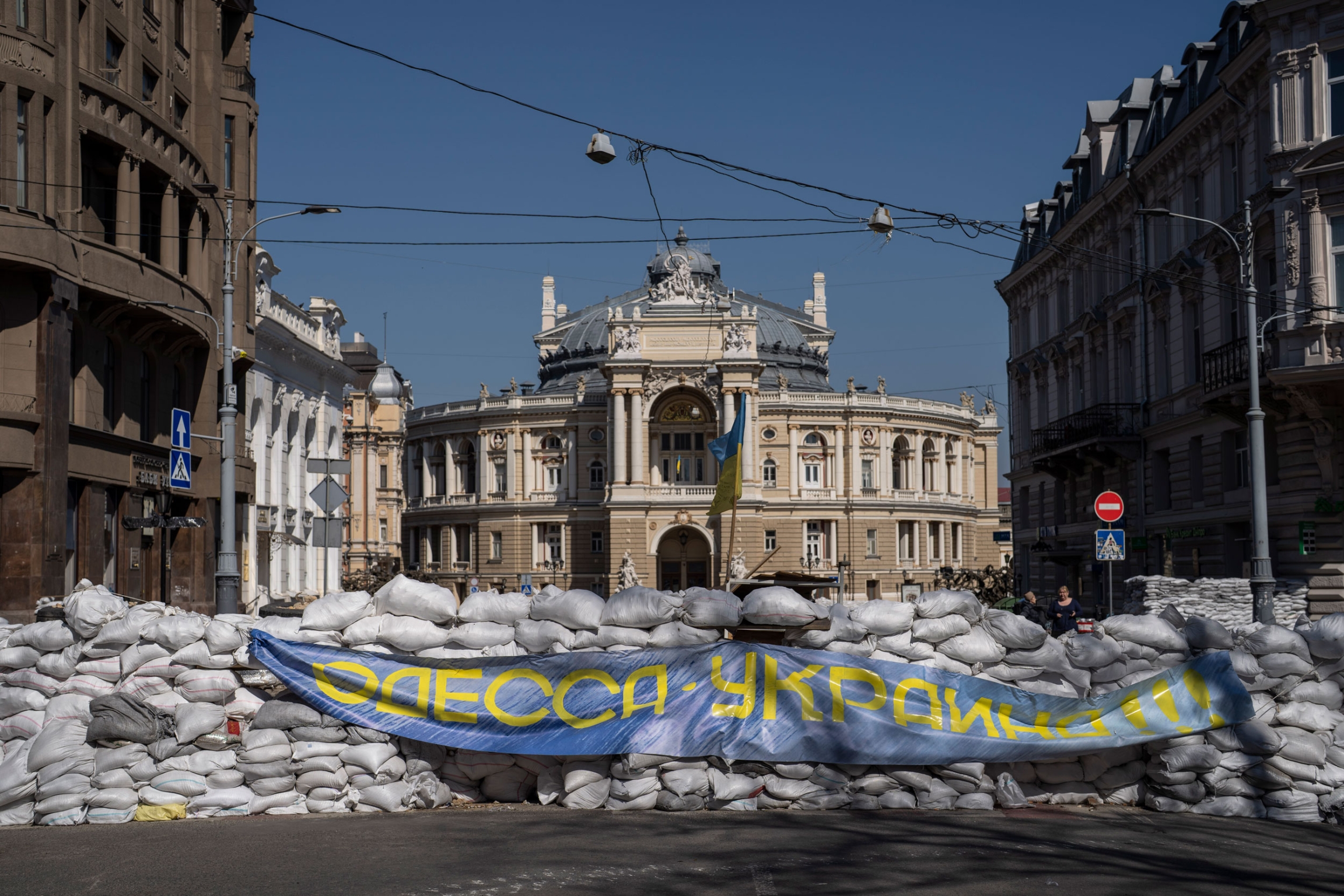
Sandbags block a street in front of the National Academic Theater of Opera and Ballet building as a preparation for a possible Russian offensive, in Odesa, Ukraine, March 24, 2022.
Petros Giannakouris/File/AP
Singer Dmytro Pavlyuk said that the opera house had to shut down for the first three months after the invasion.
But during that time, he said, the choir still continued to perform around Odesa, including parks and city squares.
They put on performances for Ukrainian troops and displaced people fleeing from other parts of the country.
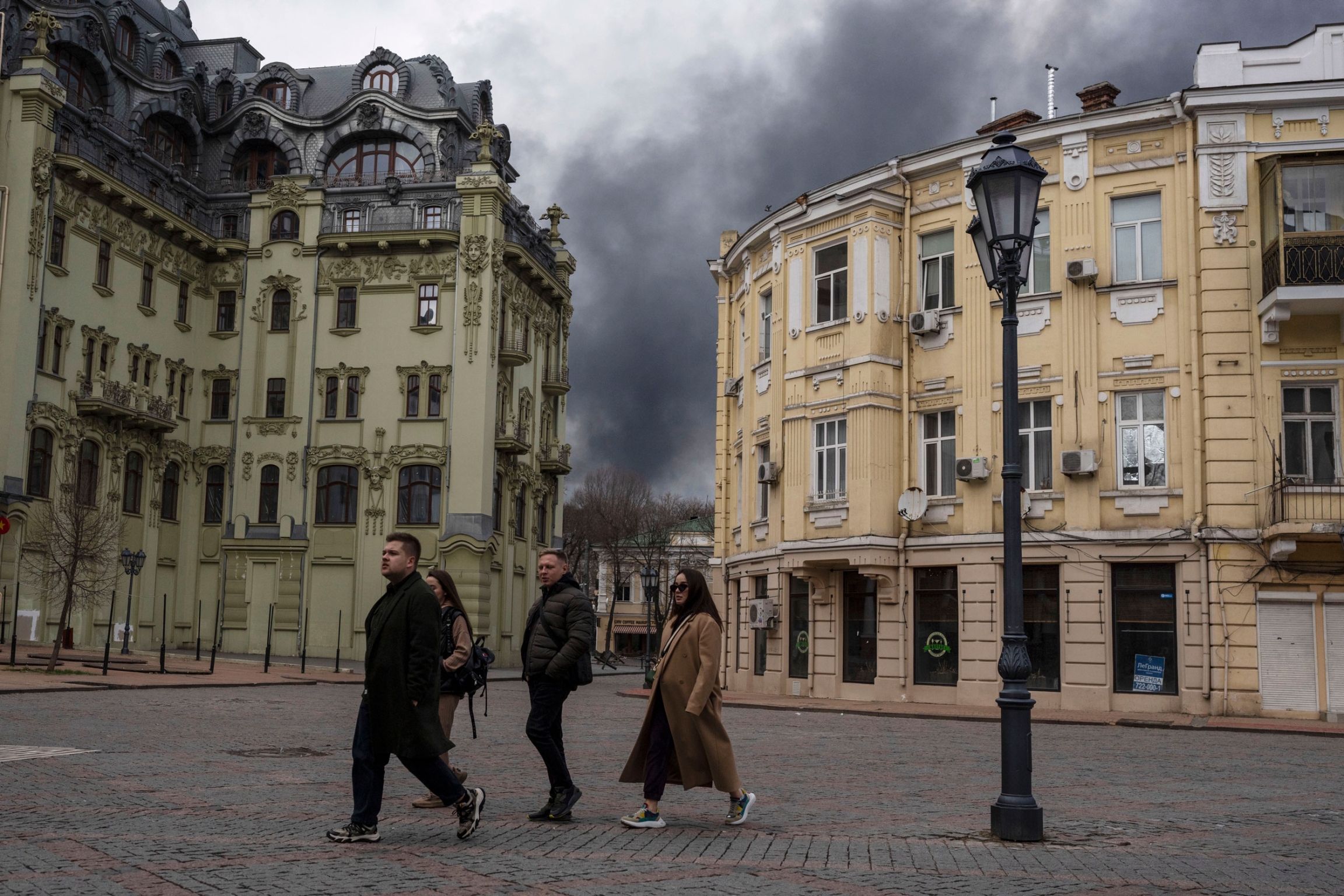
People walk in a street as smoke rises in the air after shelling in Odesa, Ukraine, April 3, 2022. The United Nations' cultural agency decided on Jan.25, 2023, to add the historic center of Ukraine's Black Sea port city of Odesa to the list of World Heritage in danger. The decision was made at an extraordinary session of the World Heritage Committee in Paris.
Petros Giannakouris/File/AP
Three months later, the opera house reopened. But audiences were restricted to the number of people who could fit into the opera house’s bomb shelter.
On one occasion, Pavlyuk said, the air raid siren went off during a performance. Everyone went down to the shelter and stayed for more than an hour. And after the siren ended, they returned to their seats to enjoy the rest of the opera.
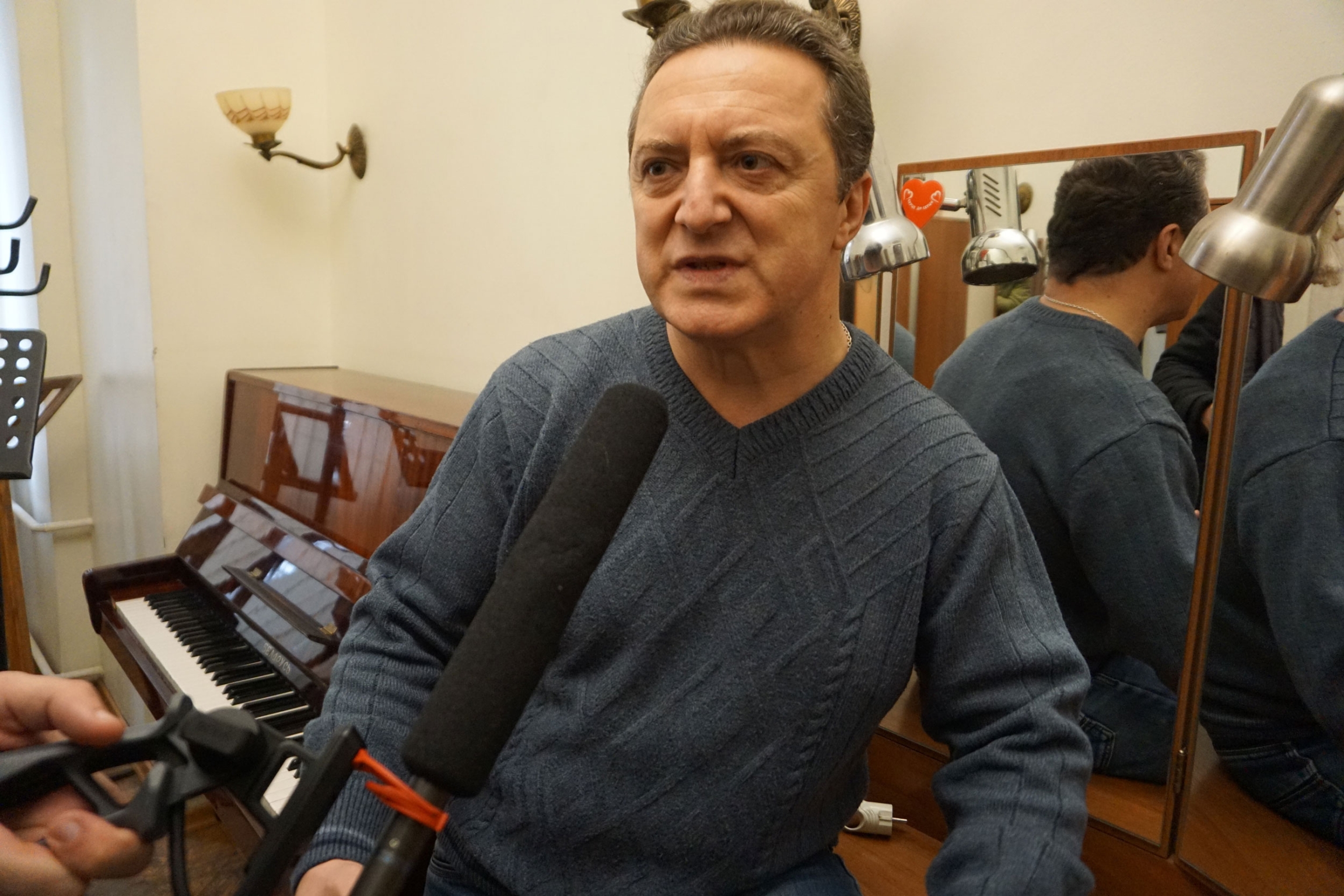
Dmytro Pavlyuk one of the lead opera singers at the Odesa opera house.
Daniel Ofman/The World
Vitaliy Bilyy, another singer, said it was necessary to accept this as a new reality.
“We just understood, you know, it’s my job, I need to do it and that’s it. It’s my occupation,” he said, adding that waiting at home would have felt worse.
Bilyy said he feels lucky to live in a part of Ukraine that is relatively safe.
He’s also thankful that he can still perform for live audiences, especially after having to shut down last year.
“I think it’s just [that] maybe somebody [can] come here to forget,” Bilyy said.
“You know, for [these] three to four hours, just to forget about this terrible [situation] right now and watch something beautiful — to listen to beautiful music,” he explained.
Russia’s military continues to target Ukraine’s electric grid, and power outages happen all the time in Odesa.
As the war continues, Bilyy said that he doesn’t plan too far ahead. Instead, he and others in the city are more focused on living for today, and dealing with the uncertainty of tomorrow.
With a snap of a finger, he knows how quickly things can change — even in the heart of Odesa.
At Iryna Terekhova’s house in the Ukrainian village of Lukashivka, the walls are crumbling, and the roof is no more. Many of the homes on her street are also badly damaged.
“A lot of people left, and many of them haven’t returned yet,” she said, speaking through an interpreter. “You can see here that only five houses are being rebuilt.”
Iryna Terekhova photographed by her destroyed house in Lukashivka, Chernihiv area in Ukraine on Feb. 20, 2023.
Anastasia Vlasova/The World
In Lukashivka and other parts of northern Ukraine, near the border with Belarus, Russian troops were firmly in control for several weeks early last year. The most intense fighting here ended months ago — after Ukrainian forces retook the area.
Today, buildings and bridges are starting to be rebuilt. But new, invisible wounds that never fully heal are still being inflicted, every day.
Iryna Terekhova photographed at the place where her neighbour and friend Vira Romashko was buried in Lukashivka, Chernihiv area in Ukraine on Feb. 20, 2023.
Anastasia Vlasova/The World
Terekhova said that she and her husband moved to this house before the Russian invasion in Ukraine began on Feb. 24, 2022. They wanted the small-town atmosphere, and space to garden. Now they’re living with neighbors until temporary housing is built.
A view of Iryna Terekhova's destroyed house in Lukashivka, Chernihiv area in Ukraine on Feb. 20, 2023.
Anastasia Vlasova/The World
“But me and my husband, we’re looking forward to going back to our house, ready to start gardening and fixing the trees. We’re still going to live here and it’s going to go back to normal.”
Irina Novikova, who lives across town, said that she was forced to host 11 Russian soldiers here during the occupation.
“So, yeah, me and my husband slept on the floor, and actually, Russian soldiers slept on the floor next to us, only the dog between us separated us.”
Iryna Novikova on her way home in Lukashivka, in the Chernihiv area of Ukraine, Feb. 20, 2023.
Anastasia Vlasova/The World
Those Russian soldiers are long gone, but Novikova said that their presence made people here suspicious of her family. Now, she said that she wishes she could leave, if only someone would buy her house.
Iryna Novikova photographed by her house with her son Denis and her dachshund Jessica in Lukashivka, Chernihiv area of Ukraine on Feb. 20, 2023.
Anastasia Vlasova/The World
About 10 miles up the road from the village is Chernihiv, the provincial capital. While Lukashivka was occupied, the city was under siege.
Besides ground forces, the area was hit by rockets and bombs while armored vehicles and tanks rolled in. Nearby towns were destroyed, leaving 600 dead and 1,500 injured, according to Viacheslav Chaus, the regional governor here.
A view of a destroyed church which used to be the base for the Russian soldiers in Lukashivka, in the Chernihiv area in Ukraine on Feb. 20, 2023.
Anastasia Vlasova/The World
He described what it was like: “We had no electricity, no food, no heat supply, no mobile connection. The food was mostly sent here by boats by the Desna river. Most of the civilians of Chernihiv were situated in the basements, in the shelters. We were fighting.”
A view of a destroyed church which used to be the base for the Russian soldiers in Lukashivka, Chernihiv area in Ukraine on Feb. 20, 2023.
Anastasia Vlasova/The World
Just outside the city center, in a heavily bombed area, there’s an apartment building that had a huge hole in the side last spring. Now, it’s being repaired; there’s fresh cinder blocks and a crane that looks like it’s in the middle of construction.
In the apartment building next door, Yury Khomytskyi and Nina Khomytskyi have been busy trying to make their apartment livable again with new furniture and radiators.
“Over here you can see, all fixed and repaired, all this was damaged, we bought a new closet, a new light, new windows by our own money,” Yury Khomytskyi said.
That money was their retirement income. Out the window, Yury Khomytskyi pointed to the ground seven floors below. There’s a crater across the street and heavy damage to a squat red pharmacy — 48 people died after two bombings.
Those explosions also blew out the windows and interior doors here and made it look like a tornado tore through the couple’s apartment.
A view of a destroyed church which used to be the base for the Russian soldiers in Lukashivka, Chernihiv area in Ukraine on Feb. 20, 2023.
Anastasia Vlasova/The World
Nina Khomytskyi said that their twin daughters have moved abroad, to Canada, with the grandkids. She said that they talk every day, and the grandkids want to come home.
Even with the apartment nearly fixed up, Yuri Khomytskyi said it will never feel normal here until the war is over.
St. Catherine’s Cathedral in Chernihiv is an imposing, 18th-century church with golden domes at the edge of the town square.
Mykolay Apanasenko is one of the priests here.
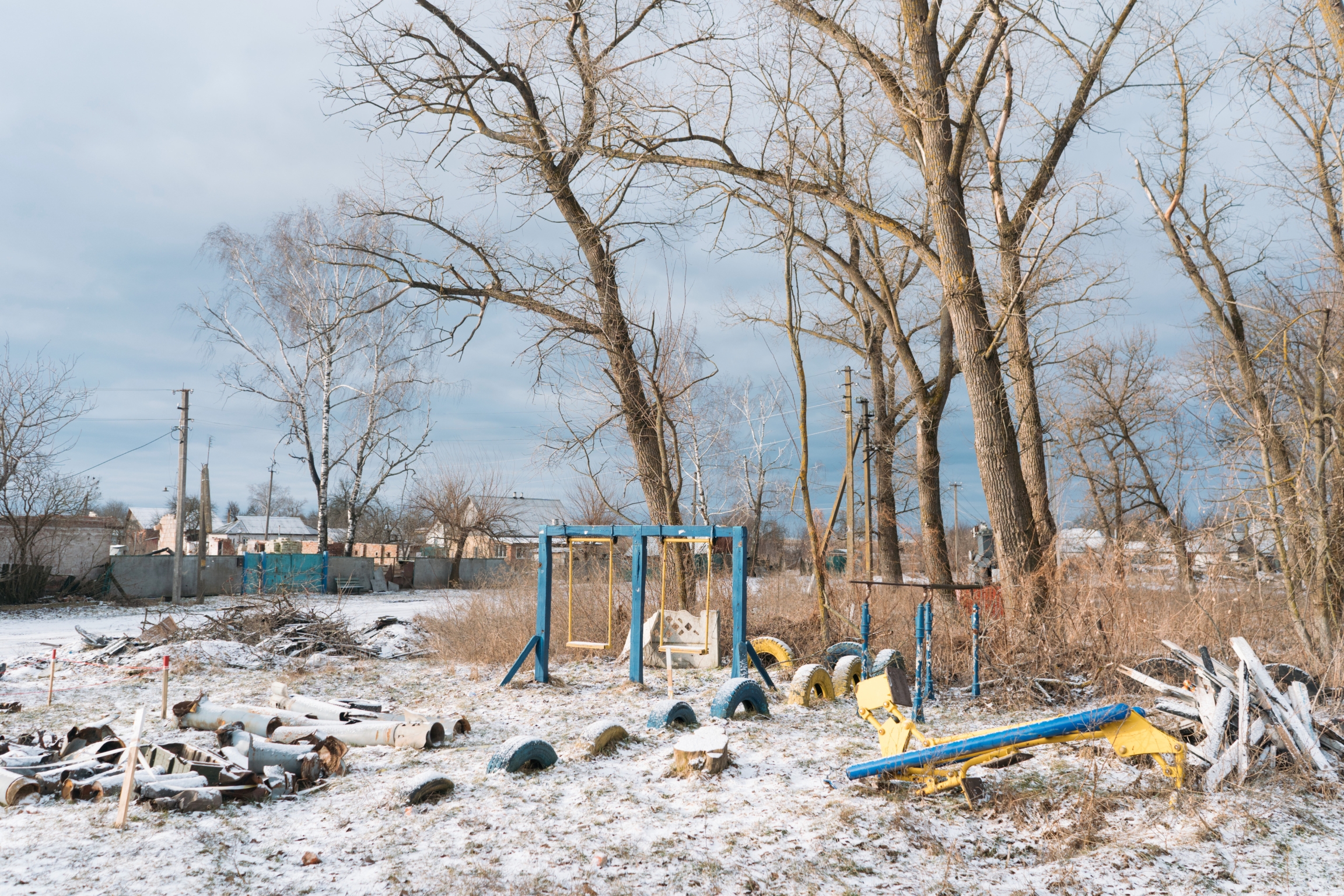
A view of the shell debris found in the area of church in Lukashivka, Chernihiv area in Ukraine on Feb. 20, 2023.
Anastasia Vlasova/The World
“Mostly, people are coming here to pray for our warriors that are defending us. And we're talking with the people and trying to tell them we have to forgive Russians. And people cannot do this.”
That’s because they’ve been through so much, the priest explained. He said a funeral service was about to begin for a Ukrainian soldier killed in combat.
The soldier, Mykola Gerashchenko, enlisted to defend his home city as it was being surrounded by Russian forces. He was killed almost 500 miles away in an area where there’s been fierce fighting since May.
His widow, Svetlana Gerashchenko, said her husband was trying to save an injured comrade when he was mortally wounded.
“He was very brave,” she said. “He was a patriot. A real hero. There are no more men like this. It's a pity that these men, these kinds of people are dying. Real men. It is a pity that his arms will not embrace me anymore.”
Like many large cities in the world, Lagos, Nigeria, is a place of great contradictions.
The growing wealth of the monied class is evident in the luxury estates and trendy restaurants serving pricey cocktails and canapes.
But behind the glitz and glamor, an estimated 40% of the population still lives under the poverty line. For most Nigerians, the economy has only gotten worse under outgoing President Muhammadu Buhari.
“It’s affecting all the poor masses, the commoners,” 28-year-old Moses Anjola said.
Despite earning a diploma in computer science in 2017, he said he hasn’t been able to find a job. The lack of work has made him feel stunted and behind in life.
“By now, I’m supposed to have kids. But because of the situation in the country, I couldn’t, and I’m growing. I want a better Nigeria,” he said.
As millions of Nigerians prepare for the presidential election on Feb. 25, the stinging economy and unemployment in the formal sector have the nation's youth particularly tuned in and ready to cast their vote.
It has also brought concerns that the votes of the country’s most vulnerable could be up for sale.
But not Anjola’s.
“Even for 1 million [naira] I won’t,” he said, shaking his head vigorously. “We’re saying enough to money politics as young people.”
Related: Millions of Nigerians prepare to vote amid chaotic cash shortage

People walk past election campaign posters of Bola Ahmed Tinubu, presidential candidate of the All Progressives Congress, Nigeria ruling party during an election campaign rally at the Teslim Balogun Stadium in Lagos Nigeria, Feb. 21, 2023.
Sunday Alamba/AP
This call for change of the status quo in Nigerian politics has echoed across Nigeria’s youth, who seem particularly geared up for this election.
“A lot of youth are more involved,” said 24-year-old Ololade Oriola at Spaces for Change, an organization that works on civic engagement and education.
“This is a youth election,” she said adamantly — pointing out the high voter registration among youth like herself.
Oriola attributes this to the #EndSARS protests against police brutality in 2020 that were largely organized by youth who became politically active on social media.
“[#EndSARS] was really an awakening moment for all of us. And we were able to learn so much from that period. I mean, it was the first time that you would see the youth come out en masse like that and you see them take charge and really self-lead themselves.”
“It was really an awakening moment for all of us. And we were able to learn so much from that period. I mean, it was the first time that you would see the youth come out en masse like that and you see them take charge and really self-lead themselves.”
The #EndSARS protests, and the subsequent brutal crackdown by Nigeria’s security forces, received global attention — including by then-presidential candidate Joe Biden.
“They were shooting, and they never stopped shooting. Some are shooting in the head. Some are shooting straight bullets,” said comedian Matthew Ifeanyi Agbeze, who was shot during the Lekki Toll Gate Massacre.
“Is this a war zone? Or are these peaceful protesters?” he asked.

Supporters of Bola Ahmed Tinubu, the presidential candidate of the All Progressives Congress, stand on a balcony during an election campaign rally at the Teslim Balogun Stadium in Lagos Nigeria, Tuesday, Feb. 21, 2023.
Sunday Alamba/AP
Two years later, Ifeanyi said he is still in pain from his injuries, but is unable to afford the recommended surgery.
He said he and other victims of the Lekki Toll Gate massacre haven’t received much formal help, if any.
“I was shot, nothing from anybody. Nothing from government,” he said.
“Nigerian election is here now. Let everybody now wake up. We need to stand as we stood,” he said, calling on Nigerians to vote for the right leaders.
For him, that leader is presidential candidate Peter Obi of the Labor Party.
The 61-year-old has emerged as a rare third-party candidate with a real chance of disrupting the typical two-horse race between Nigeria’s ruling All Progressive Congress (APC) and People’s Democratic Party (PDP).
His relatively clean track record as state governor of Anambra has made him an attractive option for many youth across the religious, ethnic, and regional lines that typically define voting patterns in Nigerian politics.

Supporters of Nigeria's Labor Party's presidential candidate Peter Obi chant during an election campaign rally at the Tafawa Balewa Square in Lagos, Nigeria, Feb. 11, 2023.
Sunday Alamba/AP
For Anjola, the computer science graduate, Obi offers a chance for a better Nigeria.
“This is the only hope as a Nigerian. Obi is my only hope,” he said.
But Obi faces stiff challenges, especially in Lagos, which is a stronghold of presidential candidate and former Lagos governor Bola Tinubu of the APC Party. He is also expected to struggle to get votes in the northern parts of the country.
The unpredictable nature of this election, bolstered by new election technologies and innovations, has boosted hopes that this could be one of Nigeria’s most competitive — and transparent — elections.
“I trust the technology,” said Raimi Ahmed Olamide, Agbeze’s friend and fellow comedian.
He’s referring to the new electronic devices to authenticate voters, and a public viewing portal for election results that have been implemented by the Independent National Electoral Commission (INEC).

Supporters of Bola Ahmed Tinubu, the presidential candidate of the All Progressives Congress, Nigeria ruling party, rides on a rickshaw outside the venue of an election campaign rally at the Teslim Balogun Stadium in Lagos Nigeria, Feb. 21, 2023.
Efunla Ayodele/AP
Still, Olamide plans to monitor the voting process at a local polling station, to “secure the vote” from rigging.
“I will be there watching. Even with my phone. I will video,” he said. “Anything I see, I’m sending it to the internet.”
He said the #EndSARS movement taught him about the power of social media, and called on young people to wield it once again.
“It’s we the youth that control the internet.”
In the town of Calafell, Spain, along the beach road, hundreds of dancers are putting the final touches on their costumes while a line of floats stretches for over a mile. Crowds of spectators abound.
The festivities are part of the vibrant, yearly Carnival happening this week, which precedes the Christian period of Lent with costumes, parades, street parties and concerts.
Although for many it's a chance to let loose, in some small towns in northeast Spain, including Calafell, there’s a movement to fight male chauvinism that has historically come up during Carnival by banning songs with sexist lyrics. But when it comes to pop music, the line between sexist and sexy can be complicated.

Pere Nin, a float organizer, helped craft the prohibition of pop songs that denigrate women. But he said that the bans are getting out of hand.
Gerry Hadden/The World
The local Sexist Lyrics Commission is paying attention to whether any parade floats play a song deemed to denigrate women.
If that happens, they’ll lose public subsidies that help pay for all of this, according to Pere Nin, a float organizer who helped make the rules against sexist lyrics back in 2019.

Performers in Spain get ready for a parade as part of Carnival.
Gerry Hadden/The World
“Each town has its own list of banned songs, and beforehand, each float has to give the town the names of the songs it wants to play,” he said, adding that the intention is good.
In this era of #MeToo, several towns in this region have embraced the idea. But in practice, he said, the question of whether to ban has gotten murky.
“It’s one thing if a song is obviously sexist,” he said. “It’s another when a song has a line or a word that might offend.”
For example, the song, “SloMo,” sung by Spanish superstar Chanel, has been flagged as problematic.

Groups of performers in costume are a colorful part of Carnival in Spain.
Gerry Hadden/The World
“This song took third place last year in the Eurovision song contest,” Nin said. “And the singer, Chanel, is committed to the cause of gender equality.”
So, why ban it here?
Another popular hit, “Suavemente,” by Elvis Crespo, has also been banned. These are songs people love. So, it’s not surprising that this hunt for the lyrically offensive is getting mixed reviews from carnivalgoers.
Dancer Sara Coam said there’s no room at Carnival, or anywhere, for macho music that objectifies women.

Kids on a float toss confetti at the crowds lining the road. Carnival in Spain is an all-ages affair and sexist tunes are increasingly frowned upon.
Gerry Hadden/The World
“If people would stop listening, the artists would stop writing sexist lyrics,” she said.
But her friend Marta Tamayo said it’s more complicated: “Sometimes, a song gets so popular that you feel like the odd person out if you don’t sing along.”
DJ Miguel Aguila, 23, who was also on hand, said he is against the bans altogether.
The most popular songs he plays, he said, are those that allude to sex.

Carnival dancers Sara Coam, right, and friend Marta Tamayo keep warm before the parade begins in Calefell, Spain. The two women say they wish sexist lyrics would go away.
Gerry Hadden/The World
“Carnival is nothing if not sexy,” he said.
Even Nin, who helped get the lyrics ban going, said the whole thing may just need a rethink.
“It’s starting to remind me of other periods we’d rather not remember,” he said. Like, the Inquisition or the dictatorship of Francisco Franco, he added.
Under Franco, authorities banned songs from the political left. This is the Carnival conundrum, Nin said: Women must be respected. But in a pop song where’s the line?
The intersection of pop culture, sexuality and misogyny can create crosscurrents that maybe carnival floats simply can’t be expected to navigate.
By 9 a.m. in Lagos, Nigeria, 100 people were already lined up outside an ATM of a local bank — trying to withdraw some naira, the local currency.
This has become the new normal since the government decided to redesign the currency, a policy decision that went into effect weeks before the presidential election that will take place on Feb. 25.
Nigerians were told to turn in their old banknotes for new ones, but now, they are struggling to procure the new cash.
“Suddenly, no money in circulation,” complained Oba Femi, who was waiting in line.
“That is very bad for any country. It’s not too good for people to go through hardships to just source for funds which are their own in the first instance,” he said.
While the country’s middle class can get by using ATM cards and electronic money transfers, many Nigerians don’t have access to the banking system.
Femi added that many necessities, like public transportation, also require cash.
Still, he said there is an upside to the money scarcity.
“The politicians cannot use it to entice people to buy votes,” he said. “So, I think it’s still a welcome development.”

Bola Ahmed Tinubu, foreground right, presidential candidate of the All Progressives Congress, Nigeria ruling party, rides on a double decker bus during an election campaign rally in Lagos, Nigeria, Feb 21, 2023.
Efunla Ayodele/AP/File
Bribing voters has long been a feature of electoral politics in Nigeria, causing many observers to speculate that the timing of the currency redesign was to make it harder for politicians to dole out cash to voters.
But right now, it’s the poor who are suffering the most. Many Nigerians don’t have access to the banking system, so they rely on cash to survive.
“I’m feeling it a lot. Because no money — no business,” explained Azubuike, who runs a small shop selling various home goods and food.
She said business has been down by 60% to 70%, and her usual customers are struggling to pay her.
As she talked, a young man tried — and then failed — to use his cellphone to electronically transfer money to Azubuike for food. The network is too slow.
“See, I want to do [a] transfer so that I can eat something. But I can’t. There’s no network,” said the man, who didn’t give his name.
“I haven’t eaten all day,” he said.
“Some people have money in their funds but they cannot withdraw it. It’s very bad. The situation is bad. You see a man crying because he wants to eat. You see a woman crying, children crying,” Azubuike said.
“The government should help us, the situation is worse.”
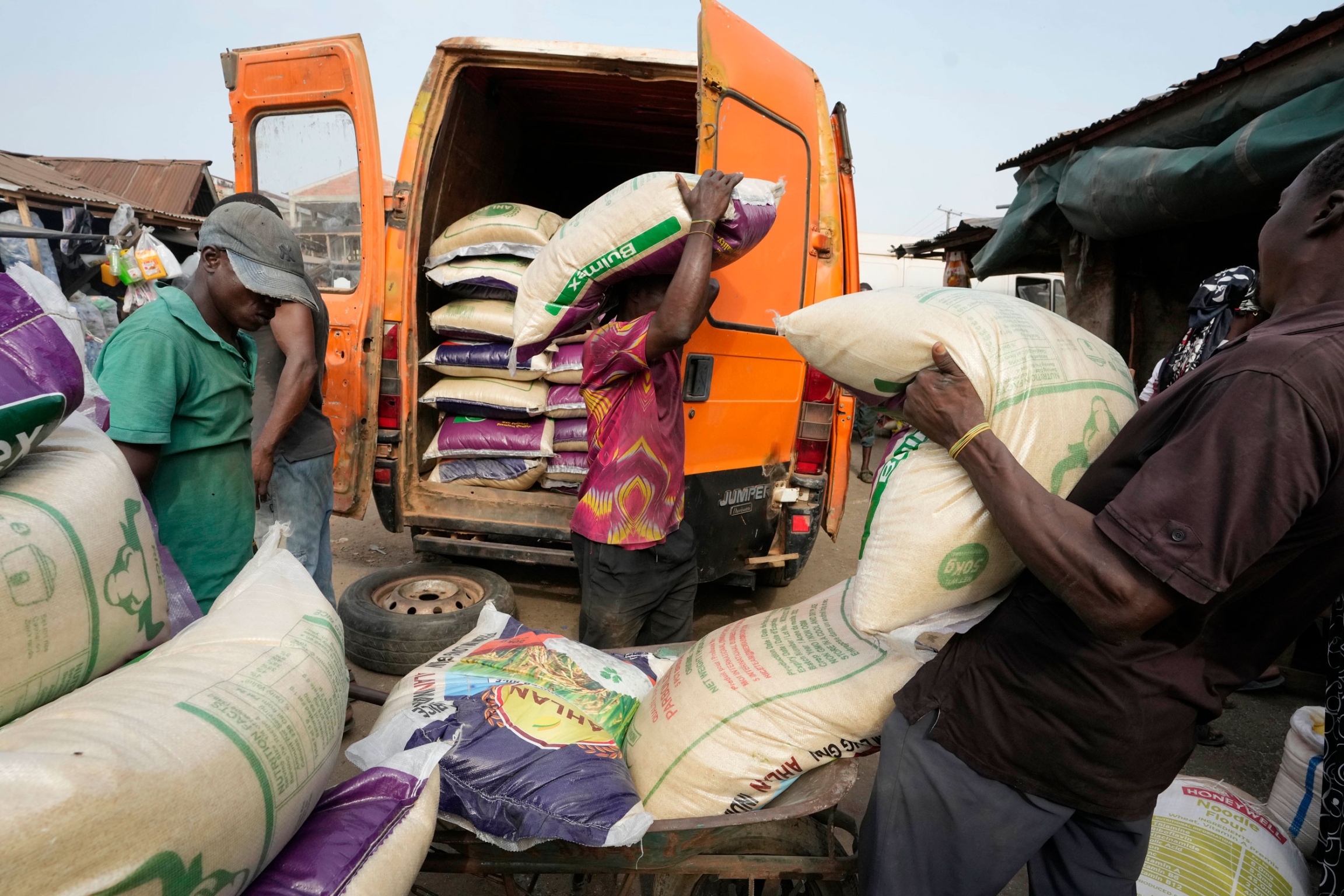
Workers loads bags of rice into a truck at a market in Lagos, Nigeria, Feb. 7, 2023.
Sunday Alamba/File/AP
This currency redesign is compounding an already dire economic situation in Nigeria.
“It’s the worst I’ve ever seen,” Azubuike said. Like many Nigerians, the economy is top of mind as the nation prepares to vote this weekend on Feb. 25.
But with so many people struggling to survive, there’s been some concerns about whether people will turn out to vote, and whether they could be vulnerable to vote buying or bribing by politicians.
In the poor Badia neighborhood of Lagos, 29-year-old Sodnyo Dagunro said he is willing to sell his vote to the highest bidder.
“If anyone give me money to vote, I will collect. But I will ask them how much they want to give me first before I vote for him,” he said.
Over the past year of war in Ukraine, some 8 million people have been internally displaced. Another 8 million left the country and settled in European countries.
Close to 100,000 Ukrainians have moved to the United States as refugees, many of them through the Uniting for Ukraine visa program that offers a two-year residency window.
Vira Ustyanska, 34, is a recipient of one of these visas. She now lives in San Diego, California, nearly 7,000 miles from her hometown of Zaporizhzhia.
Ustayanksa is an artist whose paintings have appeared in museums and private collections around the world. For the past 10 years, she said, she did not follow the news. She just wanted to make art. And she did not believe that war in Ukraine could become reality.
On Feb. 24, 2022, when Russia launched its full-scale invasion of Ukraine, Ustyanska, her daughter Vasy, and her husband Sergei, went down into a bomb shelter they had hurriedly built with neighbors.
Five days later, she noticed that people began to leave the shelter and the city. Ustyanska made the hard decision that she and 8-year-old Vasy needed to leave Ukraine.
“There was no discussion. My husband had to stay and fight,” she said.
Ustyanska said she took all the belongings needed for the journey and packed them in a small suitcase. It took about 30 minutes to get ready and then — she and her daughter left.
After staying in several shelters, living with friends and navigating a complicated visa process, they are now living in a Spanish colonial home in San Diego, with host Connie Terwilliger.
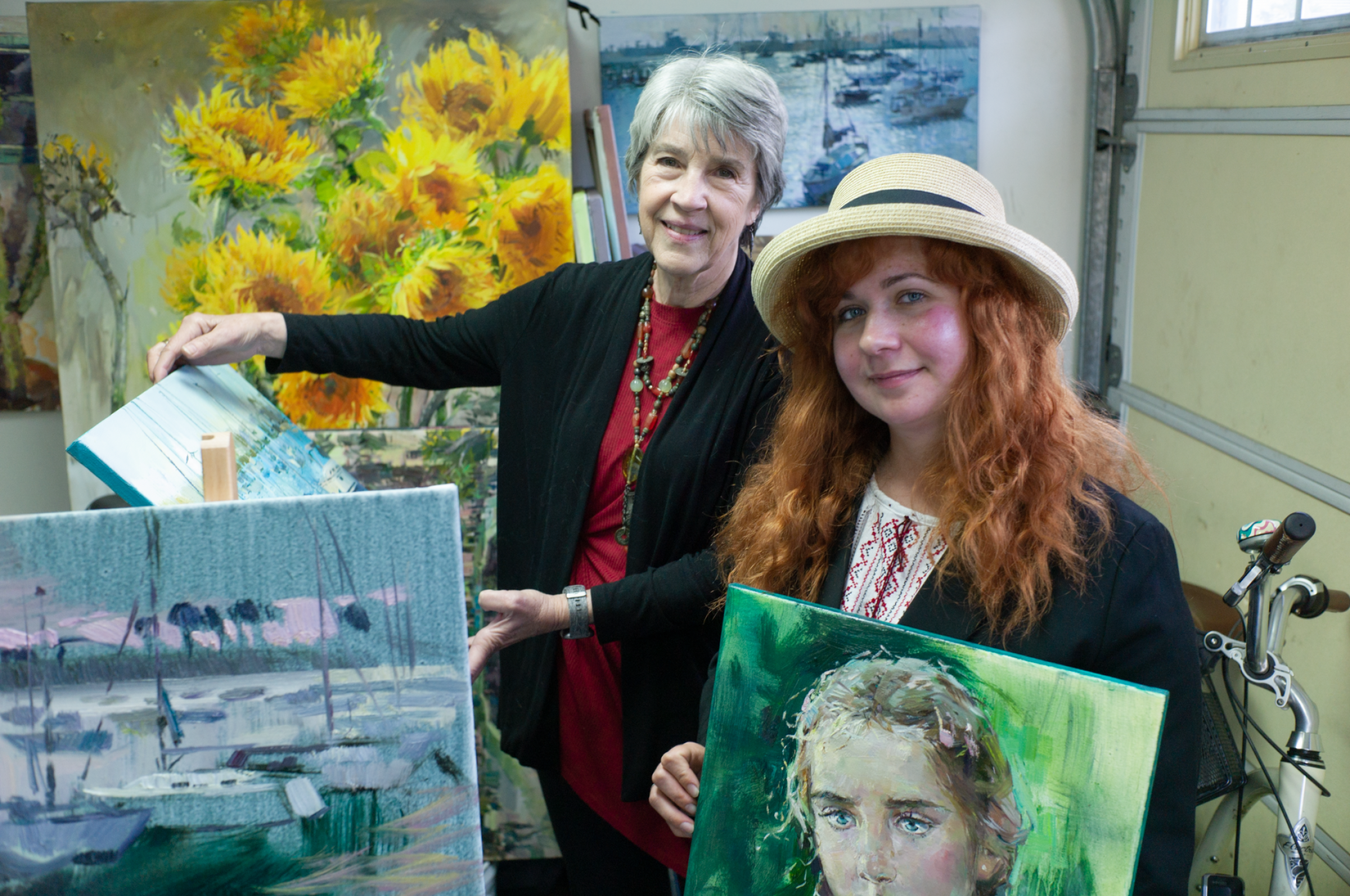
Ukrainian artist Vira Ustyanska with her host Connie Terwilliger in San Diego. At the garage-turned-art studio at Terwilliger's house, Ustyanska paints large canvases of sunflowers, her favorite subject.
Marco Werman/The World
Right after the war started, Terwilliger received an email from AirBnb, an app with which she rents out her property.
The email asked whether she would like to donate a room to a Ukrainian refugee.
“I thought, well sure, I've a nice big house and a couple of bedrooms and bathrooms that weren't being used, so I said 'yes,'" Terwilliger said.
Terwilliger is hosting them rent-free for as long as they need.
“They're my new family, actually. I never had any kids and now I have a granddaughter. It's wonderful. I'm absolutely enjoying the experience,” she said.
Every day, Ustyanska speaks with her husband, who is repairing airplanes in Zaporizhzhia, while she waits in San Diego for the war to end.
Vasy is learning English quickly and has made friends in school.

Vira Ustyanska's daughter Vasy plays with a cat in what is now her home in San Diego, California. Mother and daughter fled their town of Zaporizhzhia in the first weeks of the war in Ukraine.
Marco Werman/The World
In the garage-turned-art studio at Terwilliger's house, Ustyanska paints large canvases of sunflowers — her favorite subject.
The last six months before the war started, she painted very dark, depressive paintings with sunflowers. In San Diego, they are bright yellow against blue skies to keep out the darkness, she said.
When Russia invaded Ukraine last February, sculptor Myros Dedyshyn said something inside him changed.

Myros Dedyshyn’s sculptures now express violence.
Courtesy of Myros Dedyshyn
He generally considers his artwork to be uplifting and hopeful.
"When I see something in the world, I experience it and then [my art] is one of the ways I can express myself and other people can see it," he said.
But when war broke out on Feb. 24, 2022, Dedyshyn, who was at home in Lviv, said that it all seemed so senseless. As an artist, this new reality meant he could no longer produce the same kind of art.
“All of the [previous] works — aren’t relevant anymore since the war started.”
Dedyshyn, 63, grew up in Ukraine’s Hotzel region in the Carpathian Mountains. He said he started working with clay when he was as young as 5 years old.
His decadeslong art career has taken him all over the world, allowing him to work in a variety of mediums, from metal and resin to stone and ice.
His works can be found throughout Ukraine, with small pieces for sale in Lviv galleries as well as large, sweeping masterpieces in parks, cemeteries and resorts.
The full-scale invasion filled him with anger and fear, he said. And those emotions have informed his latest artwork, which focuses more on themes like militarization, sadness, grief and self-protection.
Instead of figures of loved ones in an embrace or beautiful bodies in motion, Dedyshyn’s sculptures now involve guns, dismembered bodies and blood.
“[My art is] not soft anymore, they’re aggressive,” he said.

Dedyshyn's sculptures used to express hopeful themes, like this one of a couple in an embrace.
Courtesy of Myros Dedyshyn
At first, Dedyshyn said he felt ambivalent about the change — a little lost. But after the initial stupor, he got to work using his art to document the war.
And he’s not alone. A year into Russia’s full-scale ground invasion, there is a myriad of artistic works that have managed to capture the conflict through Ukrainian eyes.
As for Dedyshyn, he said he doesn’t think he can return to making peaceful art like his prior works.
“Even if I’m going to come back, it’s going to incorporate me as a changed person and I think I’m going to be further from real life. More of impressions and abstraction in my future art,” he said.
But there will be art in the future. Because in a world full of destruction and creation, it’s always better to be a creator, Dedyshyn said.
Anton Loboda contributed to this story.
The ongoing war in Ukraine that began a year ago has killed thousands of people and forced millions to flee their homes. Entire cities have been reduced to rubble.
The intense confrontations have also fueled fears of an open conflict between Russia and NATO.
President Vladimir Putin launched an invasion of Ukraine from the north, east and south in what he called a “special military operation” to achieve the “demilitarization” and “denazification” of the country and protect ethnic Russians.
Moscow also wanted to prevent Kyiv’s NATO membership and to keep it in Russia’s “sphere of influence.” Ukraine and the West say it's an illegal act of aggression against a country with a democratically elected government and a Jewish president whose relatives were killed in the Holocaust.
Russian troops quickly reached Kyiv's outskirts, but their attempts to capture the capital and other cities in the northeast met stiff resistance.
In the video above, The World’s correspondents Daniel Ofman, Durrie Bouscaren and Shirin Jaafari reflect on some of the key moments they have covered over the past year.
The magnitude of the conflict, with no end in sight, has striking numbers.
Ahead of Russia’s full-scale invasion of Ukraine on Feb. 24, over 150,000 Russian troops had been amassing around Ukraine in Belarus and Russia.
At the start of the invasion, Ukraine had an active 196,600 military personnel. New conscripts and civilian volunteers bolstered the number of personnel to anywhere between 500,000 and 700,000.
Russia’s planned recruitment of about 300,000 new troops last fall proved successful, expanding their military numbers to well over a million people.
Military casualties for both nations are said to have reached the tens of thousands.

A train with refugees fleeing Ukraine crosses the border in Medyka, Poland, on March 7, 2022. The United Nations said that more than 3.6 million people fled Ukraine in the first month of the war in what is the biggest movement of people in Europe since World War II.
Visar Kryeziu/AP
Civilians in both countries have lost their lives, over 7,000 in Ukraine and more than 5,000 in Russia. Explosive weapons have caused 94% of those casualties.
Approximately 14 million Ukrainians are either internally or externally displaced due to the war, with nearly 8 million Ukrainians living in European countries as refugees.
Meanwhile, 700,000 Russians fled the country since the initial mobilization was declared, with many fleeing to neighboring countries when a draft was announced.
AP contributed to this report. With research from Fabian Garcia. Video produced by Maria Elena Romero and Andrew Blum.
At Nuevo Peru headquarters in Lima, the capital, about 100 protesters have gathered from Indigenous areas in the southern highlands.
The political party Nuevo Peru has been heavily involved in anti-government protests that have recently swept across the South American country.
“It’s not enough to make statements or posts on social media,” said Gahela Cari, an Indigenous activist and Nuevo Peru’s secretary for international relations.
“We are taking actions to help people, who have endured years of discrimination and disrespect.”
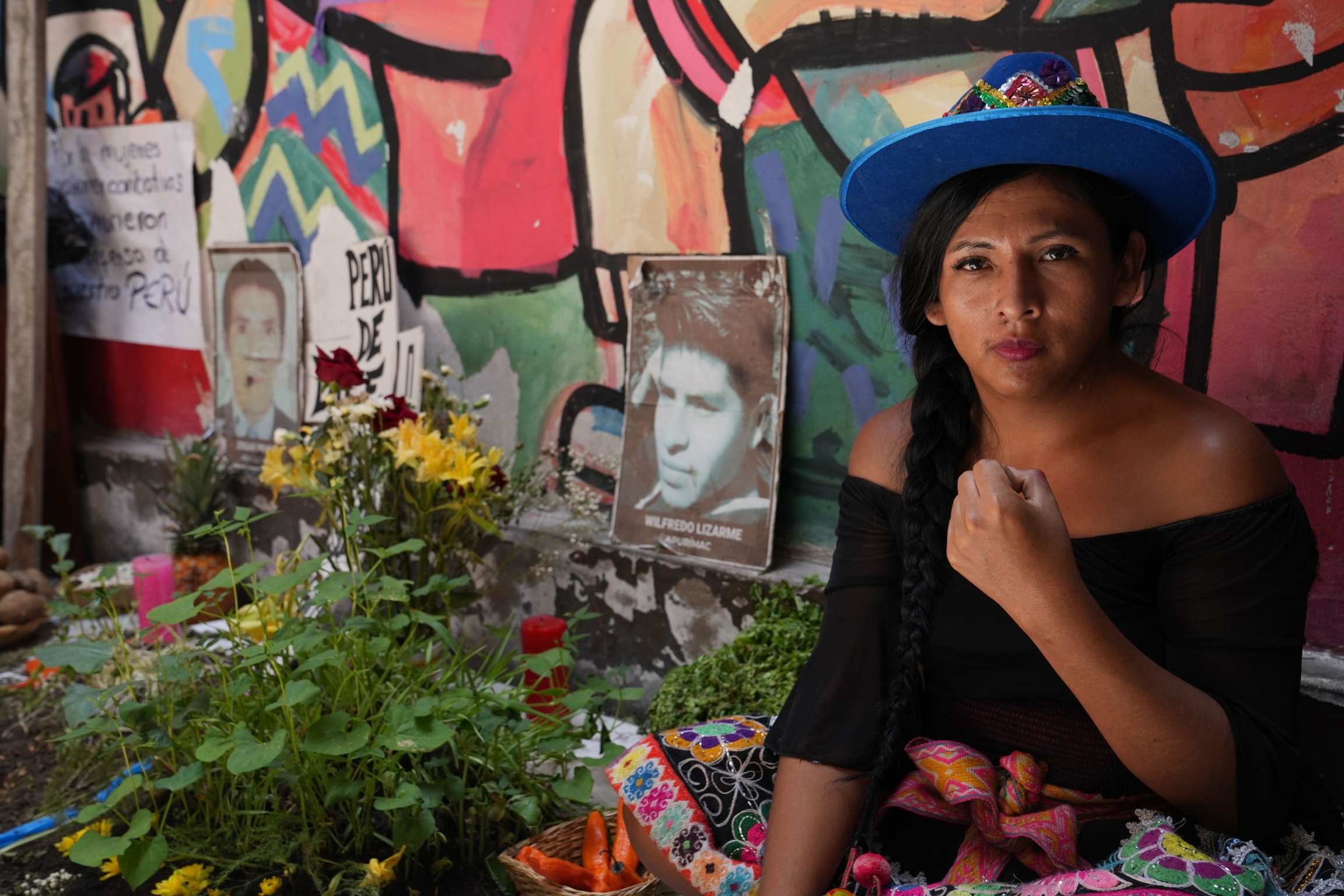
Gahela Cari is an Indigenous activist and secretary for international relations for the Nuevo Peru political party.
Manuel Rueda/The World
At the headquarters, volunteers store donations of food and clothes and cook around 500 meals per day for demonstrators.
Sixty people have been killed in Peru in protests that broke out in December of 2022, after President Pedro Castillo was arrested on treason charges and impeached by the nation’s congress.
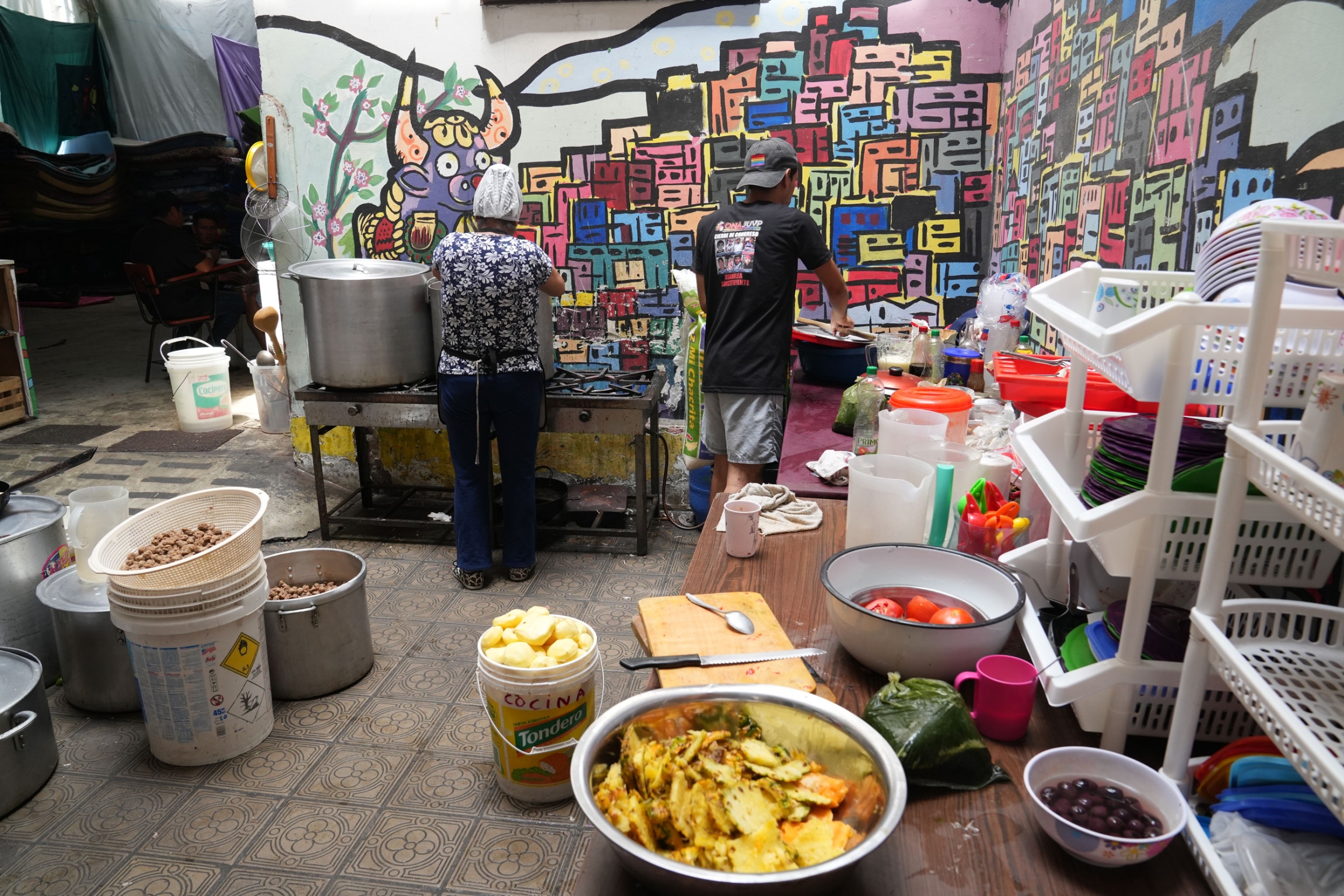
At Nuevo Peru's headquarters in Lima, volunteers cook meals for hundreds of protesters who have come from Peru's southern highlands.
Manuel Rueda/The World
The protests have been led largely by Indigenous groups who have long been excluded from local politics and are now trying to have a greater say in how their country is run.
Castillo was removed after making an ill-fated attempt to dissolve congress and rule by decree, and his impeachment complied with Peruvian laws.
But it also angered many Indigenous people who were hoping that the union leader from a small Andean village would help to bridge economic gaps.
Roadblocks went up in largely Indigenous regions like Puno, where the economy has been stifled.
Protesters also blocked access to the world famous site of Machu Picchu and thousands traveled to Lima to have their voices heard, where they have been hosted by university students and movements like Nuevo Peru, which says it wants to defend the interests of Indigenous people.
“Our people have always struggled,” said Cari, who was shot with rubber pellets at a recent protest and still has a bandage on her right leg.
“And with Castillo’s removal people felt like their votes didn’t even count anymore.”
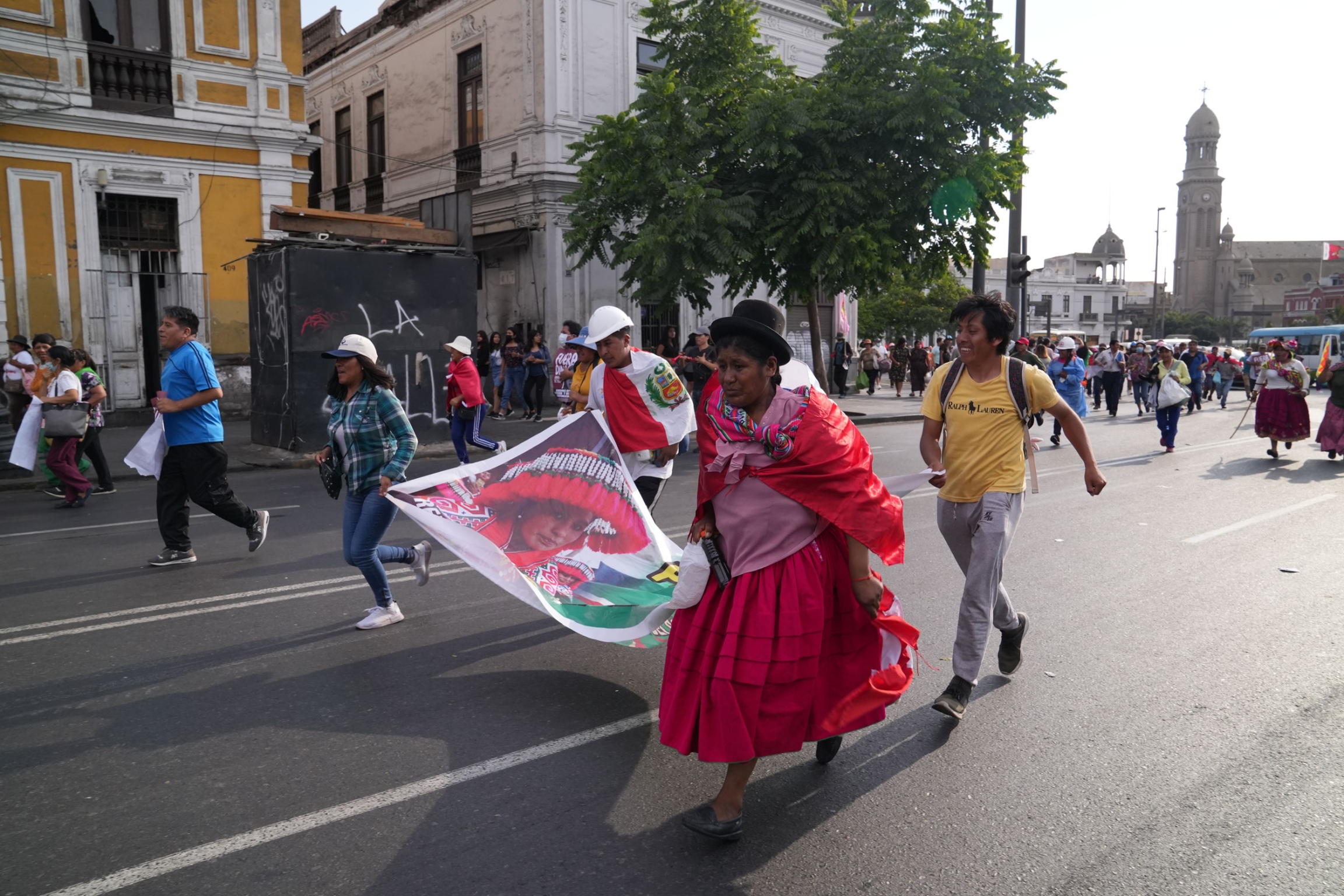
Indigenous activists runs through the streets of Lima, during a recent protests against Dina Boluarte's government.
Indigenous activists runs through the streets of Lima, during a recent protests against Dina Boluarte's government.
While protesters initially asked for Castillo’s return, their movement has now set its sight on longer lasting changes.
They want the new president, Dina Boluarte, to resign and are also asking for the country’s constitution to be changed.
“For too long we have been deprived of quality healthcare and education,” Cari said, who argues that one way to fix that would be through constitutional reforms.
Peru’s constitution currently limits the state’s role in the economy. And it makes it tougher for the government to raise taxes on the nation’s profitable gold and copper mines.
Indigenous groups hope that constitutional reforms could lead to more taxes on the mining industry. And perhaps turn the government into a major shareholder at some mines.
“These precious resources belong to the state, and we are not getting benefits from them,” said Juvenal Gil, a Quechua speaking miner from the region of Puno, who has been at the protests in Lima for three weeks.
“If these places where the gold is being mined had nice buildings and we were moving around in subways like in Dubai, I wouldn’t be complaining,” he added.
“But the truth is that we don’t even have good hospitals.”
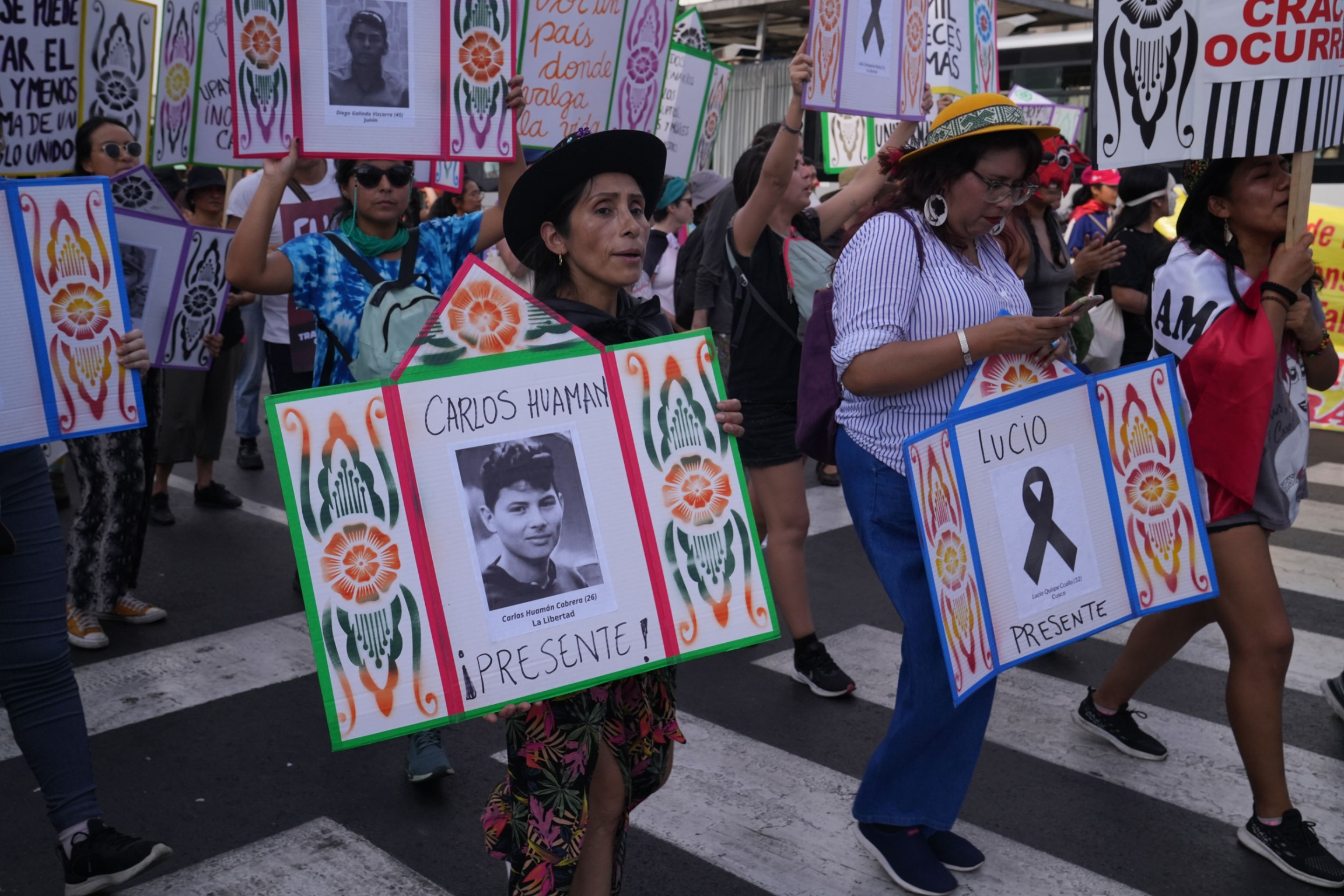
Protesters in Lima carry signs with the photos of demonstrators who have been killed.
Manuel Rueda/The World
Peru’s constitution dates back to 1993, when the country was recovering from years of hyperinflation, caused by uncontrolled government spending.
During the past three decades conservative economic policies have tamed inflation and also helped to attract foreign investment. But some also argue that these policies have led to the neglect of public services.
“If you visit my home you will see that we have no running water,” said Maruja Inki an Indigenous activist who is also from the region of Puno.
“We have to use the water that comes from a river polluted by gold mines. Or we have to collect rainwater.”
To get any changes implemented, however, the Indigenous movement needs to increase its leverage in congress, where it currently lacks any meaningful representation.
A proposal to stage a referendum on whether Peru should have a new constitution was recently rejected by Peru’s congress and elections are still scheduled for 2026 as legislators fail to agree on a new date.
Jo-Marie Burt, a politics professor and Peru expert at George Mason University, said that while Indigenous people in neighboring countries like Ecuador and Bolivia have their own parties — and a large congressional presence — it’s been tougher for them achieve this in Peru.
“Peru, unlike Ecuador and Bolivia, has its capital, its center of power in Lima," a coastal city, she said.
“Lima is the essential creole city where discrimination and stigmatization of Indigenous people is very strong, so the tendency has been for people to try to assimilate.”
Burt explained that violent conflicts in rural areas in which the state has attacked Indigenous communities and labeled them as supporters of terrorism, have also discouraged people from joining organizations with an Indigenous focus, even if they make up 25% of Peru’s population.
Back at Nuevo Peru’s headquarters, Gahela Cari said that her party has struggled to sign up new members, because many people in Peru have become disenchanted with politics.
But she hopes that the protests will help people realize that they need to fight for their rights.
“There are people taking to the streets to demand change and there are people mobilizing against inequality, and that motivates us,” she said.
Ukrainian musicians Taras Shevchenko and Kateryna Pavlenko from the band Go-A were thinking about starting a new folk electronica project back in February of 2022. But on Feb. 24, when Russia launched a full-scale invasion in Ukraine, the pursuits of many of Ukraine's leading artists and cultural institutions came to a halt.
Since the war began, artists and cultural workers swiftly shifted their focus to contributing to war efforts, while also working to maintain and promote Ukraine's unique artistic and cultural heritage.
The World takes a look back at the myriad ways in which war impacted artistic and cultural expression in Ukraine, and how advocates worked tirelessly to keep making art against all odds.
Ukrainian musicians Taras Shevchenko and Kateryna Pavlenko founded Go-A, a folk-electronica band.
Daniel Ofman/The World
In early March, as Moscow escalated its bombardment of civilian areas, museums and churches in the Ukrainian capital Kyiv were targeted. Residents of Lviv raced to ensure their city did not suffer the same fate. For a city synonymous with music and the arts, the most common sound in the city became hammering and drilling.
Workers construct metal scaffolding around the statue of Greek goddess Amphitrite in the medieval Market Square in Lviv, Ukraine.
Andrew Connelly/The World
Ukraine's military made it mandatory for all men to stay in Ukraine to serve in the war. But when the Kyiv Symphony Orchestra mobilized to go on tour as part of a cultural diplomacy mission, the Defense Ministry granted special permission for its male members to leave the country.
The Kyiv Symphony Orchestra rehearses at the National Philharmonic in Warsaw, Poland, the day before the premiere performance of the "Voice of Ukraine" tour that took them to nine cities across Poland and Germany, April 20, 2022.
Emily Johnson/The World
Other musicians, like Taras Topolia, the lead singer of the Antytila band, immediately joined Ukraine's military and served on the front lines. At the same time, Topolia continued to advocate for Ukraine through his music.
Some of the Ukrainian band Antytila's members have been serving on the front lines of the war in Ukraine.
Antytila on Twitter
As intense fighting in Ukraine tore apart entire villages, Ukraine's underground rave scene got behind Repair Together, a volunteer group that hosted "clean-up raves," a mix of traditional clean-up efforts with dance parties, to relieve stress and connect with others.
Repair Together hosts a clean-up rave in Ivanivka, Chernihivska oblast.
Repair Together/YouTube
The war in Ukraine sparked a new wave of interest in Ukrainian history, culture and writing. Ukrainian literary translators have been working on overdrive as the war drove new demand for Ukrainian publications. US-based writer Dralyuk has been translating poetry and literature from both Russian and Ukrainian into English.
A visitor reads a book at a book fair during a Publishers Forum in Lviv, Ukraine, Sept. 19, 2018. Since the war in Ukraine began nearly six months ago, the demand for Ukrainian translations and literature has increased.
Mykola Tys/AP
When war broke out in Ukraine, the Shchedryk Children’s Choir from Kyiv was poised to celebrate its 50th anniversary with a world tour. Conductor Saul Zaks went on a mission to make sure the world continued to experience the choir’s "magical" sounds. By December 2022, the choir headed to Carnegie Hall to celebrate a Christmas sensation known as “Carol of the Bells.”
Children’s choir Shchedryk rehearses on Thursday evening at St. Paul’s in New York City.
Emily Johnson/The World
Ukrainian ballet dancers displaced by the fighting found a home on international stages. The Ukrainian Classical Ballet went on a charity tour in Italy and Romania in May, with the company in Bucharest, for a performance of “Giselle.”
The Ukrainian Classical Ballet company holds up the Ukrainian flag onstage during curtain call while the Ukrainian national anthem plays as part of a performance in Bucharest, Ukraine.
Elena Graham/The World
And despite six months of grueling war with Russia, several acts from Ukraine were represented at the Edinburgh International Arts Festival, the world’s largest arts festival, held yearly in Scotland. For the performers, it was a bittersweet experience.
Some Ukrainian students were evacuated from Ukraine thanks to a Czech circus company, Cirk La Putyka. “Boom," a performance they took to Edinburgh, was rewritten to reflect the students’ perspectives of war and displacement.
Andrew Connelly/The World
On Feb. 24, 2022, veteran Leonid Ostalsev heard rockets fire at 4:30 in the morning.
Soon after, the 35-year-old received a call from Kyiv’s chief of police asking him to defend the city.
“The army gave us time to create a few waves of defending forces, and we were thinking that it would be a battle for Kyiv. But our Ukrainian armed forces, they [did] their job so [well] that no one [was] in Kyiv,” he recalled.
This week marks one year since Russia’s full-scale invasion of Ukraine.
Ostalsev had anticipated getting a call to report for duty in the weeks leading up to Feb. 24. Tens of thousands of Russian troops were already accumulating near Ukraine’s borders.
The situation in Ukraine was tense. It was hard for Ukrainians to believe that there would be a full-scale invasion by Russia into Ukraine. Yet, people were already taking first-aid classes, self-defense courses and preparing evacuation routes.
Before the full-scale invasion, Ostalsev was running Veterano Pizza, a pizzeria in Kyiv that hired other veterans. He also helped veterans start their own businesses.
Today, he’s serving in Ukraine’s patrol police, which works closely with Ukraine’s military, and has witnessed a great deal of loss and destruction on the front lines.
In the Donbas region, he led evacuation missions — amid live fire from Russian troops — helping residents flee villages and cities that were under attack.
During a stop over in the southern city of Mykolaiv, Ostalsev said that the Russian military is becoming “smarter and more accurate” with their fighting.
“Four months ago, here in this place in the south, we [were] trying to find the enemy positions … [and], you know, you have so many opportunities to kill [them]. … Now, we don't see anyone because they [are] hiding. They want to leave. And this is not good, you know, for us,” he explained.
Ostalsev said that the Ukrainian military is most in need of heavy artillery like tanks and guns as the war continues.
“I don’t have any hopes,” Ostalsev said. “It’s a war and this can be anything, so the most important thing for me is the safety of my family, my ex-wife and my son,” he said.
His ex-wife and child managed to leave Ukraine and are now in England.
But Ostalsev has unfortunately lost many close friends to war, including Rafael Agayev, someone he considers his big brother, who taught him all about the pizza business. He was killed in Mariupol in 2022.
A singular focus on his work defending Ukraine helps him cope, but it’s not easy.
For Ostalsev, the people who fight alongside him are his brother in arms — something that he said is much stronger than friends or even family.
“Because we're living together. We're fighting together. We are losing together. We're winning together,” he said.
“When you understand that you can die, when you understand that people from the left and from the right, they will help you, if someone wants to kill you. It's like — another level.”
Erfan Kudusov runs a restaurant in Kyiv that serves as an homage to Crimean Tatar heritage and identity.
The restaurant feels a little like a museum with its walls covered in photographs, paintings, postcards and other objects of cultural significance.
Kudusov, a Crimean Tatar activist, points to one painting of a stork confined to a golden cage that symbolizes the plight of Crimean Tatars.
“The cage is so tight that the bird can’t even spread its wings,” he said.
It’s been nearly a full year since Russia launched an all-out invasion of Ukraine. Ukrainian leaders say victory will come when the Russians make a full retreat out of Ukraine — including the Crimean Peninsula.
Russia occupied this territory in the southern part of the country in 2014. The Crimean Tatar people, a predominantly Muslim Turkic ethnic group, have called the area their homeland, going back centuries.
And they say their homeland is part of Ukraine, not Russia.
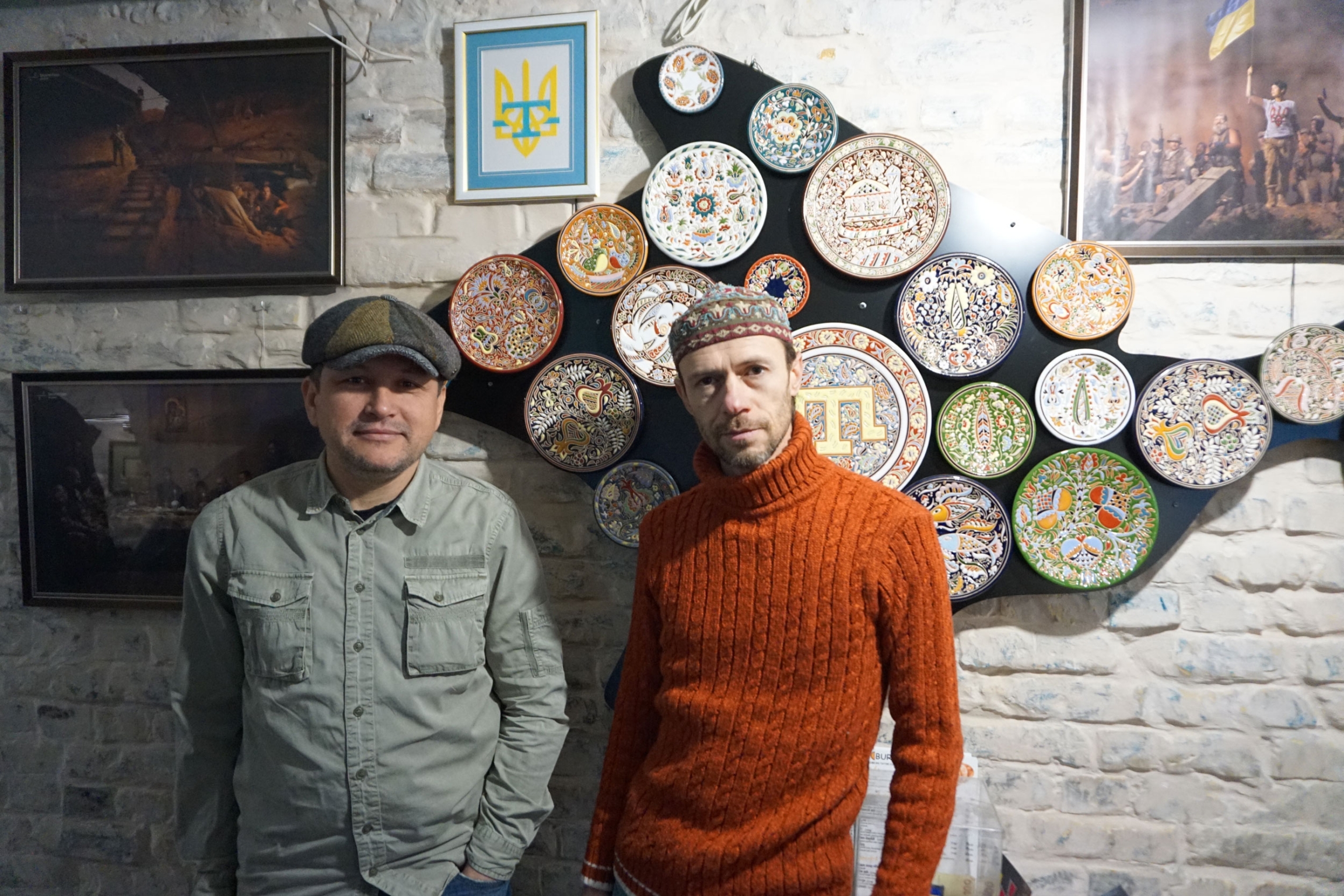
Crimean Tatar artist and activist, Rustem Skibin on the right. Erfan Kudusov, Crimean Tatar activist and restaurant owner on the left. Photo taken at Kudusov's restaurant, in downtown Kyiv.
Daniel Ofman/The World
In February 2014, Russian troops entered Crimea. Russia staged a referendum vote. Within a couple of weeks, President Vladimir Putin declared that Crimea is part of the Russian Federation.
Nearly the entire international community said the annexation was illegal. But it was a major political boost for Putin, according to Samuel Charap, a political scientist with the Rand Corporation.
“I think Putin has come to view Crimea as an organic part of Russia as much as any other undisputed region. It has this additional strategic importance as the base of Russia’s Black Sea fleet,” he said.
Crimea is a huge part of Putin’s legacy and his current political standing, he added.
For the Ukrainians, it’s simply Russian-occupied territory.

Russian Black Sea fleet ships are anchored in one of the bays of Sevastopol, Crimea, Monday, March 31, 2014.
Andrew Lubimov/AP
Last month at the World Economic Forum in Davos, Switzerland, President Volodymyr Zelenskiy reiterated that Crimea was part of Ukraine and that the country would liberate the region.
But retaking Crimea is a calculated military risk, according to Jeffrey Edmonds, with the Center for Naval Analysis in Arlington, Virginia.
“There’s a very tight choke point leading from mainland Ukraine into Crimea,” he said, adding that they would have to go by land because of Ukraine’s limited naval power.
“[The Ukrainian military] can certainly shell the [Crimean] peninsula if [it] got close enough, but it would be very hard militarily to take it.”
“They can certainly shell the peninsula if they got close enough, but it would be very hard militarily to take it,” Edmond said.
Since the start of Russia’s full-scale invasion last year, the US has said it supports Ukraine’s right to defend its territory.
But retaking Crimea by military force is far more complicated. Tension between the US and Ukraine could increase if the US determined that the escalation risks are too high.
“[The US] would continue to assess that if the Ukrainians were in a position to take Crimea,” Edmonds said.
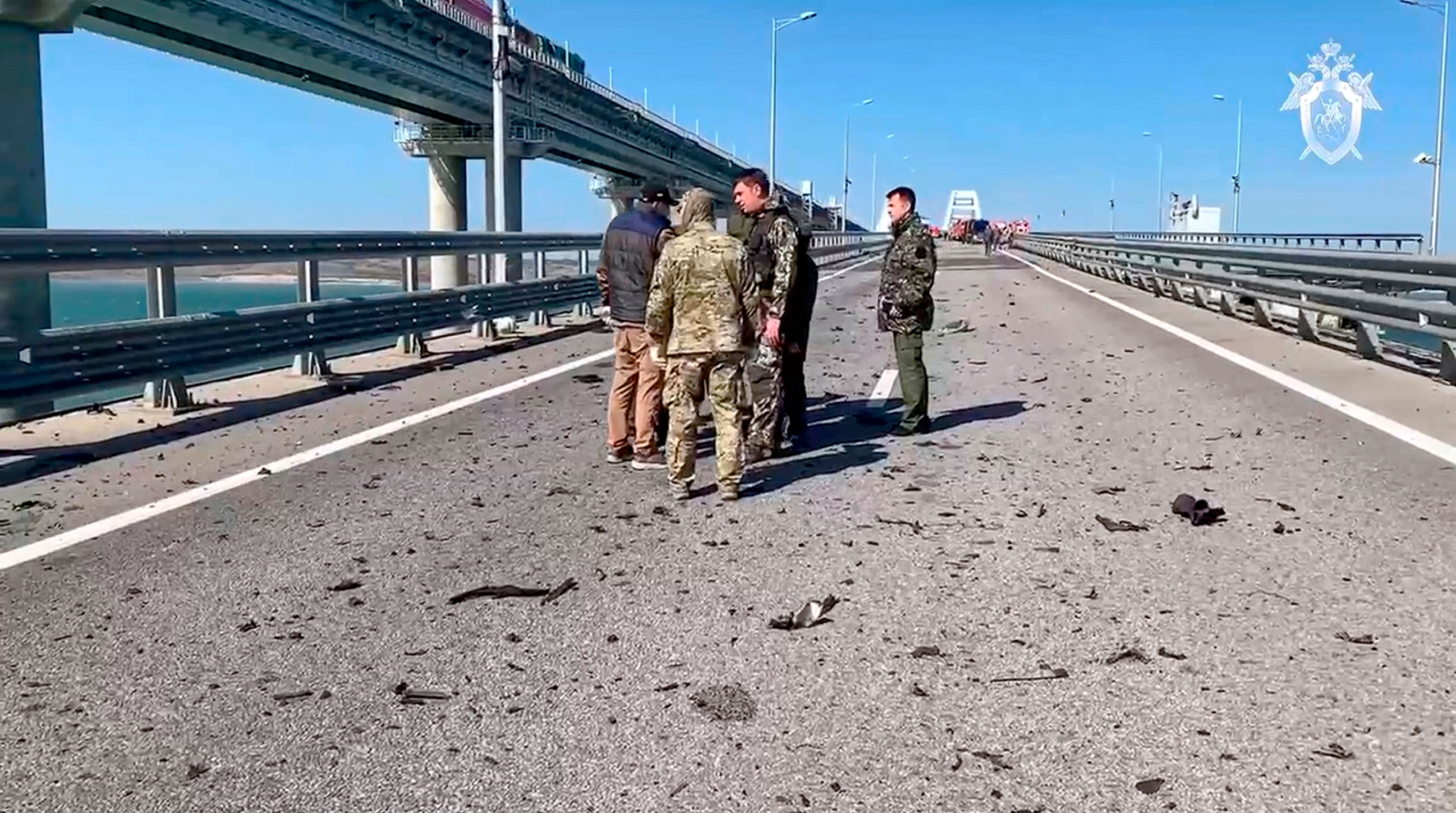
In this image taken from video released by the Russian Investigative Committee, employees of the Russian Investigative Committee work at the scene of a damaged part on Crimean Bridge connecting Russian mainland and Crimean peninsula over the Kerch Strait, near Kerch, Crimea, Saturday, Oct. 8, 2022.
Russian Investigative Committee/AP
Tens of thousands of Crimean Tatars have lived through forced displacement from Crimea, and have longed to return to their homeland.
In May 1944, as a result of Joseph Stalin’s orders, tens of thousands of Crimean Tatars were deported from Crimea and forcibly relocated to Soviet republics in Central Asia. In the process, thousands of Crimean Tatars died.
“When Crimean Tatars [were] deported in 1944, all [these] Crimean Tatar people, in countries of Central Asia, we [fought for] freedom, and [we] fight for returning to Crimea,” said Tamila Tasheva, a Ukrainian government official based in Kyiv, appointed by President Volodymyr Zelenskiy as the special representative for Crimea.
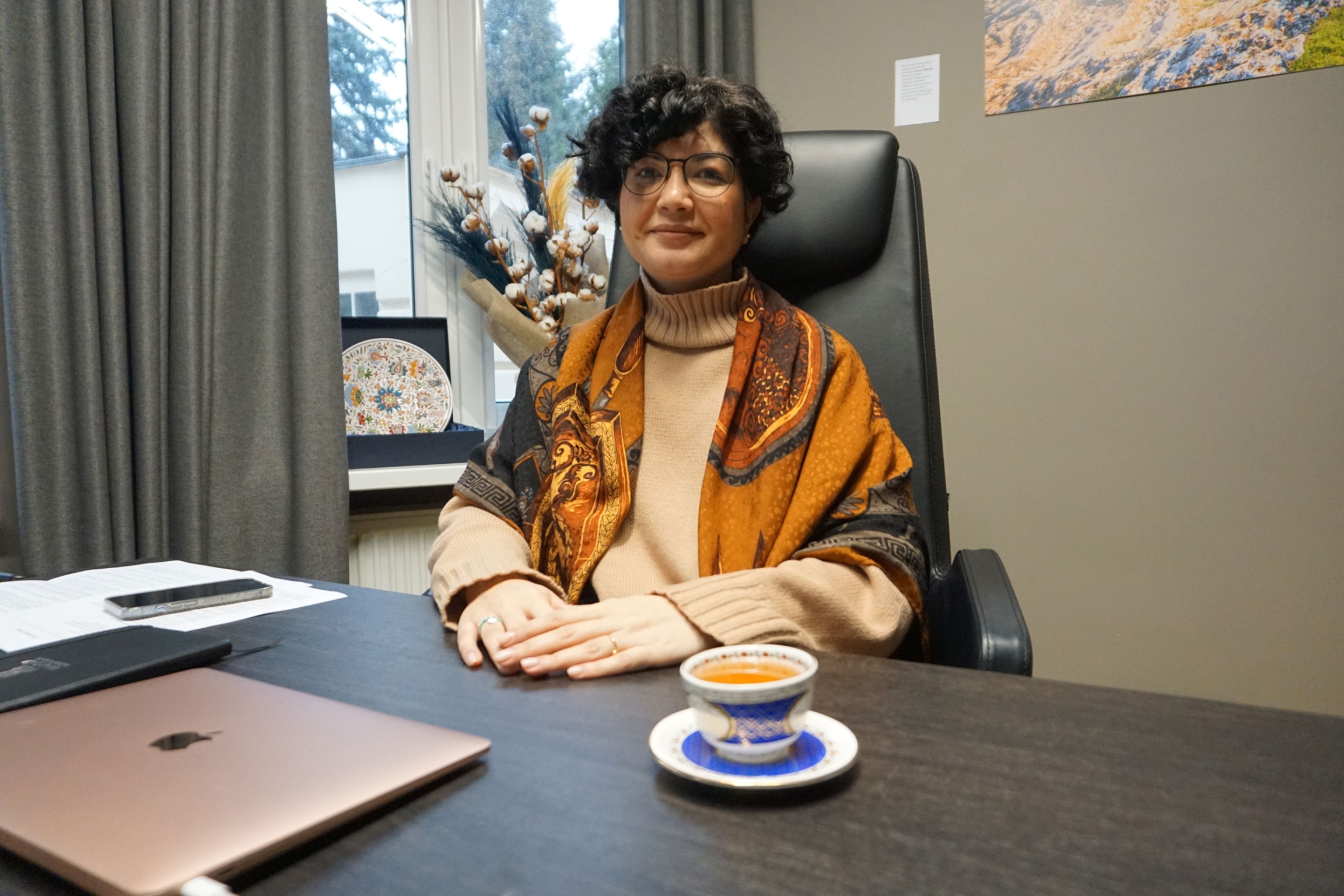
Tamila Tasheva, Ukraine’s Permanent Representative in the Autonomous Republic of Crimea, appointed by the president. Photo taken at her government office in Kyiv.
Daniel Ofman/The World
Tasheva, a Crimean Tatar Ukrainian citizen, was born in Uzbekistan and returned to Crimea in the late 1980s, when she was 5, along with many other Crimean Tatar families. She said that it was a joyful, but also difficult, time.
The government made it almost impossible for Crimean Tatars to reclaim lost property. Buying land and building new homes was also difficult.
Still, tens of thousands of Crimean Tatars resettled in their homeland as the Soviet Union fell apart and Ukraine gained independence.
Life back in Ukraine started feeling normal, but everything changed in 2014, when Russia initially invaded Ukraine and illegally annexed the Crimean peninsula.
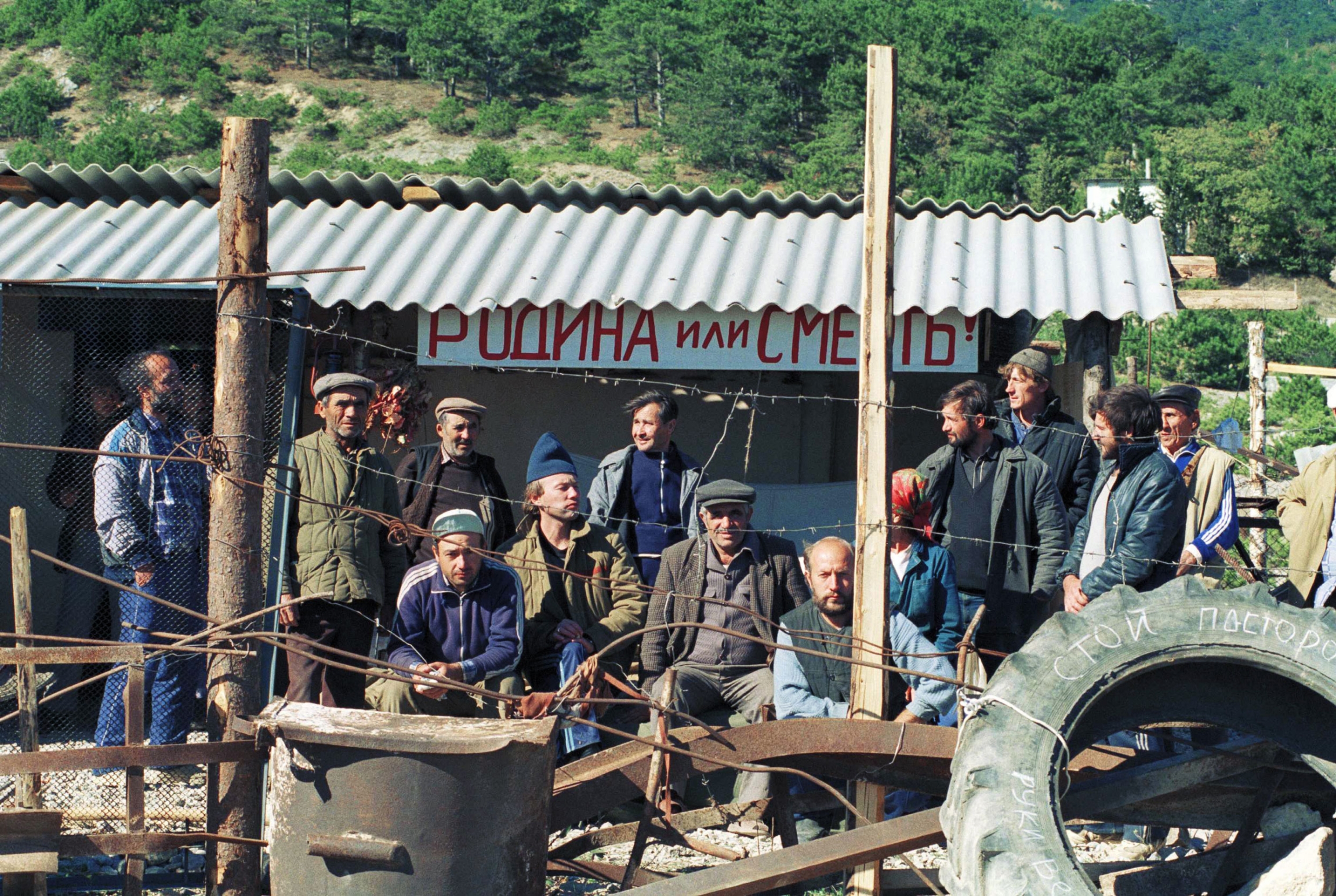
Some of 100,000 Crimean Tatars who returned to their native land stare from behind a barbed wire fence in Crimea on Sunday, Oct. 30, 1990. The slogan reads "Motherland or death."
Vladimir Lagrange/AP
Today, Tasheva’s parents still live in Crimea, in what she calls a “temporary occupied territory.”
Over the last year, Russia has intensified its crackdown on Crimean Tatar institutions and civil society.
Tasheva said that more than 150 Crimean Tatars are now locked up in Russian prisons.
“[The] Ukrainian state [doesn't] have access to Crimea, but of course we have a lot of communication and connection with our people,” she said.
She and her team are already planning for the eventual liberation of Crimea from Russian occupation.
Back at the restaurant, Kudusov served up chebureki, deep-fried turnovers filled with ground beef or lamb and onions — Crimea’s national dish.
The 54-year-old father of four pointed to the irony that most Crimean Tatars live with these days.
Crimean Tatars living in Ukraine have their freedom but not their home, while those still in Crimea have their home, but not their freedom.
He said his family waited for decades to return to Crimea — and they did, back in the early ‘90s.
Now, once more, he said, he has no doubt that Crimean Tatars driven out by the Russian invasion will return again.
Max Tkachenko contributed to this report.
Nearly one year ago, people across Ukraine woke up at the crack of dawn to the news that the Russian military was invading their country.
Since then, about 8 million Ukrainians have fled their homeland. Many have resettled indefinitely, even with loved ones still back home.
The Talyzenkov family has been living in London for most of the last year.
Early this week, Olena Talyzenkova and her two children, 9-year-old Matviy, and 14-year-old Arina, rode the train back to Ukraine together from Poland, headed for a long-awaited reunion.
“We are going to our native city [Rvine] to see my husband. We didn't see him for five or six weeks. Now, he is in the army, to serve his country, to protect us,” Talyzenkova explained.
Her husband, Serhiy Talyzenkov, a computer programmer with no prior military experience, is now serving in the Ukrainian army.
“They have just one goal, to protect their family and their land,” Talyzenkova said. “Maybe they are not the best of the best, because they never served in the army, but they know they are in the right place.”
Arina and Matviy said they were both very eager to spend time with their father again.
“I think first, when I see him, I will not tell [anything]. I will just hug him and that's all,” Arina said, adding that she anticipates a lot of tears. She said she misses spending time with her father, playing board games, riding bikes and playing badminton in the summers.
Matviy said he feels the same.
“I just want to hug him and go to the forest with him to play different games and just have a good time with him, because I miss him very much,” he said.
Talyzenkova said that living in London has been a positive experience, with friendly neighbors and supportive schools. Talyzenkova has been allowed to work and the children have received laptops and school uniforms to ease the transition.
But the separation from her husband has been challenging.
“My mom told me the family is the most important thing, so now, I even more appreciate the family. I have to keep the family."
“My mom told me the family is the most important thing, so now, I even more appreciate the family. I have to keep the family. And it's really hard to be alone, because you have to make too many decisions on your own. We discuss everything through messenger or by phone — what we can discuss — but it's not the same,” she explained.
Arina has also felt the pang of separation from her Ukrainian classmates and friends. She said they keep in touch mostly through group texts, where they share jokes, play online games together and discuss politics.
“We often discuss political things. We read news together and discuss war … it's always difficult to talk about it, but it's nice that I have someone my age and I can discuss it with them. We support each other. It's a nice thing,” she said.
Matviy said he has made some new friends in London, but he’s most enamored by his host family’s dogs, Birdy and Lola. He especially enjoys going on walks with them.
As they got closer to their final destination, Arina and Matviy said they both share the same hope:
“I hope this war will finish real soon,” Arina said. “I really hope the war will finish and everyone [can] just come back home to their houses, to their fathers, and spend a lovely time together.”
Matviy added that his wish is for everyone to one day return to their birthplace and reunite with their families.
Syria has become a pariah state under the government of President Bashar al-Assad. He's been accused of gassing his own civilians, and bombing hospitals and schools.
But the catastrophic earthquake that hit northwestern Syria last week is opening some doors.
Arab leaders who once shunned him are reaching out with aid, and assistance from the United Nations is trickling in. It took seven days for the UN to strike a deal with Syria to open two additional border crossings into the region.
Linda Thomas-Greenfield, Permanent Representative of the United States to the United Nations, speaks during a Security Council meeting on the maintenance of peace and security of Ukraine, Monday, Feb. 6, 2023, at United Nations headquarters.
John Minchillo/AP
US Ambassador to the UN Linda Thomas-Greenfield addressed the United Nations' reasoning behind the delay in a conversation with The World's host Marco Werman.
"I wouldn't put the blame on the UN," Thomas-Greenfield said.
"The US made very clear on day one that we would provide assistance directly to the Syrian people through any means possible. Where the blame lies [is] with the Syrian government. They took seven days to reopen the border. NGOs, the UN, donors were all working desperately to get assistance to the people of Syria. It is the Syrian government, the Assad regime, that let the Syrian people down."
This interview was lightly edited and condensed for clarity.
The Oscar-nominated "Stranger at the Gate" is a short documentary about a former US marine who suffers from post-traumatic stress disorder and sets out to bomb a mosque in Muncie, Indiana.
"My plan was to detonate an IED right outside the Muncie Islamic Center on a Friday afternoon when they were all gathered," Richard "Mac" McKinney said in the film.
McKinney changes his mind after the community embraces him.

African-American Muncie native Jomo Williams prays at the mosque.
Courtesy of Laura Palmer
Nobel Peace Prize winner Malala Yousafzai, the film's executive producer, drew from her own well-known personal experience to produce the film.
Yousafzai knows first-hand what it's like to confront someone consumed with hate and bent on assassination.
Yousafzai joined The World's host Marco Werman to discuss the film and her other projects.
A picture of former marine Richard "Mac" McKinney.
Courtesy of Laura Palmer

Richard “Mac” McKinney (left), Jomo Williams, Saber Bahrami and Bibi Bahrami pose together.
Courtesy of Laura Palmer
This interview has been lightly edited and condensed for clarity. Click above to listen to the entire discussion.
Related: 'It is pure magic': Pakistani song 'Pasoori' climbs the charts in India and beyond
Last week, the government of Brazilian President Luiz Inácio Lula da Silva kicked off a widespread operation to stop illegal mining on Yanomami Indigenous territory.
Videos of the operation have gone viral over social media over the last week. In one, officers from Brazil’s environmental protection agency IBAMA approach a boat of illegal miners trying to motor into the area. The officers wear bulletproof vests over tan and camouflage uniforms. Their guns are raised.
“Stop,” they yell. “Stop. Turn around now.”
The officers pull alongside the boat. "Get your hands on your heads,” they yell. “You're going to come with us.”
The miners comply without a word. There are eight of them in the boat that is packed with bags and supplies.
Since the operation kicked off, IBAMA officers have found and destroyed a plane, a helicopter and other heavy machinery.
In a press conference last week, Justice Minister Flavio Dino said they were confiscating and destroying equipment so that it can’t be reused in illegal activities and those people who refuse to leave may be arrested.
Removing 20,000 illegal miners is not an easy task. Yanomami territory along Brazil’s northern border is remote and huge — roughly two times the size of Switzerland. Wildcat gold mining on Yanomami territory increased 300% in the last four years under ex-president Jair Bolsonaro.
Last week, a delegation of Yanomami leaders traveled to the US to raise further attention to their cause.
“They want to steal our land and destroy our nature, our water,” Leader Davi Kopenawa told the UN Secretary-General Antonio Guterres at the opening of a Yanomami photography exhibit in New York. "They are bringing disease. That’s why we’re here."
Fiona Watson traveled with the delegation in the United States. She's worked with the Yanomami for decades, and she’s the director of research and advocacy at the London-based NGO Survival International.
"We had political meetings in Washington with the Organization of American States, with the State Department, USAID and various Congress people, and I think that was really important,” she said.
“Because, Lula met with Biden last Friday, and it really put the Yanomami crisis into the spotlight.”
The news reports and images of starving Yanomami children have shocked the world in recent weeks. At least 570 Yanomami children are reported to have died from malnutrition and curable diseases under the Bolsonaro government. Dozens more have been flown to hospitals in recent days. The communities are battling malaria, mercury poisoning from the wildcat gold mines, hunger and constant threats from the miners who are backed by criminal groups.
President Lula visited the region on Jan. 20, where he promised to turn the tide.
“I am here to say that we are going to treat our Indigenous peoples as first-class human beings. Not like fourth or fifth-class people,” he said. "What I have seen here is inhumane.”
Lula has declared a humanitarian crisis for Yanomami territory.
The Brazilian military has been delivering aid, food and supplies to Yanomami villages.
Yanomami leaders blame former President Jair Bolsonaro for empowering illegal miners, gutting Indigenous and environmental protection agencies and ignoring their pleas for help.
"Many teams came from Bolsonaro's government to see our reality,” Junior Hekurari, the president of the Yanomami Health Council, told the Brazilian news outlet Brasil de Fato. "I took them around and showed them first hand, but unfortunately they just turned their backs or closed their ears."
Brazil’s Supreme Court has called for an investigation into allegations of genocide by the Bolsonaro government against the Yanomami people.
But in an interview last week, Bolsonaro’s former environment minister Ricardo Salles denied any wrongdoing by the former president.
"The responsibility for that situation is in the hands of all of Brazilian society,” he said. "All of Brazilian society has ignored the situation for the Indigenous in northern Brazil for a very long time."
Salles further applauded Bolsonaro’s attempts to legalize wildcat mining on Indigenous lands, which he said could have regulated the activity and its impact.
Meanwhile, numerous videos shared online last week showed groups of miners voluntarily packing up and leaving their camps in Yanomami territory.
"This is all very positive,” Fiona Watson said. "But what I fear, is that the intentions are there. They’ve hit the ground running. But time and time again, we've seen [this] in the past with the Yanomami and indeed other Indigenous territories. It's so easy for these illegal miners to go back and of course all the politicians and big economic interests behind something like the gold industry are still there.”
Yanomami land is only one of numerous Indigenous territories that have been invaded by illegal miners in recent years. In other words, Indigenous leaders say, the government efforts are an important first step. But there is a long way to go.
A 27-year-old university student in Syria, who didn’t want to share his name for security reasons, said that there have been so many aftershocks over the past week that it’s hard to tell when the earth is shaking or if he’s imagining it.
“I keep a bottle of water next to me … or a small cup or whatever liquid based, just to make sure if I’m right or [not],” said the student, who lives in the port city of Latakia, which is controlled by the Syrian government.
The 7.4-magnitude quake left a lot of damage, he explained. Homes that are still standing are not safe to return to, so people are sleeping in mosques or churches. Help has been trickling in.
“There are so many [nongovernmental organizations] that are trying to help; other than NGOs, there are individuals who are making so much effort to give the people what they need,” he said.
How fast and how much Syrians have received aid following the earthquake depends on where people live. The response has highlighted that there really are two Syrias: one under the government’s control, where international relief organizations are helping out. Another, the opposition-controlled northwest, mostly isolated from the rest of the world.
On Sunday, the US ambassador to the UN, Linda Thomas-Greenfield, urged the security council to open another border crossing from Turkey into northwest Syria.
But Russia, an ally of Syria’s government, has veto power on the council. And so far, the Kremlin has said that one border crossing into Syria is enough.
The UN said on Monday that Syrian President Bashar al-Assad has agreed to open two crossing points from Turkey to northwest Syria for an initial period of three months “to allow for the timely delivery of humanitarian aid.”
Warm food, baby formula, diapers and clothes are some of the items being shipped to Latakia. Most are coming from the capital, Damascus.
That’s where Charlotte Streinger, a French teacher, has been organizing donation drives.
“I teamed up with three of my colleagues from the school. Spontaneously, we created this team, and we started gathering trustful contacts throughout the country with people that we know,” she said.
Streinger started an online fundraiser and she said in just three days, she managed to raise about $7,500.
“But the problem is that as with everything that is linked to Syria, it was then blocked,” she added.
Syria is under strict economic sanctions. Last Thursday, the US Treasury made a temporary exemption for aid related to the earthquake. Yet, the sanctions are still being felt on the ground.
Streinger said she could have used the money to buy things such as food, hygiene products and blankets, some of the most-needed items. Instead, she said, she is left with no cash and having to apologize to those who donated. She is trying to find a way to return their money.
“It made me feel horrible. Horrible,” she said.
The Syrian city of Aleppo — also under government control — was heavily damaged in the earthquake. Over the weekend, the head of the World Health Organization, Tedros Ghebreyesus, visited the city.
“We have just come today with supplies and look forward to continuing to support,” he told reporters.
Ghebreyesus came with a planeload of medical supplies. A second one is scheduled this week, WHO said.
Aleppo saw widespread destruction during Syria’s civil war, and filmmaker Youssef Saba said the earthquake “finished the job.”
In a series of WhatsApp messages, he explained that help is beginning to pour into Aleppo, some coming from inside Syria, and some from outside.
Aleppo even got the attention of the Syrian president himself.
Bashar al-Assad and his wife, Asma al-Assad, visited a hospital on Friday. It was all smiles and hugs in videos shared online. But for Syrians living in areas not under government control, things have been very different.
The northwest province of Idlib was hit hardest by the earthquake and more than a week later, people there said they still don’t have the equipment needed to pull victims from under the rubble.
“We want the UN to apologize. They’re making the people of … the Syrian people disappointed,” Raed al-Saleh, head of the White Helmets, told reporters last Friday.
Martin Griffiths, the UN’s emergency relief coordinator, tweeted as much on Sunday.
At the #Türkiye-#Syria border today.
— Martin Griffiths (@UNReliefChief) February 12, 2023
We have so far failed the people in north-west Syria.
They rightly feel abandoned. Looking for international help that hasn’t arrived.
My duty and our obligation is to correct this failure as fast as we can.
That’s my focus now.
“We have failed people in northwest Syria,” he wrote, adding that “my duty and our obligation is to correct this failure as fast as we can.”
Karam Kellieh, a photographer working in the northwest part of the country, said that people have lost hope of rescuing victims trapped under the rubble and that those who survived have no shelter.
“People [were] refugees before the earthquake. Now, they’re [living] in the roads, in hospitals, in schools,” he said.
Some have camped under olive trees and have been spending nights in the frigid temperatures.
"No picture of video can explain what happened in north of Syria,” Kellieh said.
Big, fast-fashion brands have traditionally ignored the secondhand market, but it’s grown too large not to get into the game.
The global market for second-hand clothes is around $72 billion, according to research from Future Market Insights. And it’s set to grow by double-digits over the next decade. No wonder the big players want in.
H&M and Spanish clothing giant Zara are leading a new trend, opening portals where customers can sell and buy their used, brand-specific shirts and skirts. The companies say they’re joining the circular economy but critics call it greenwashing.
Both companies declined interview requests with The World.
But their customers aren’t shy. On a recent afternoon, a shopper named Diana Ochoa strolled out of H&M’s flagship store in downtown Barcelona, Spain, with a bag of new T-shirts.
When asked if she’d seen H&M’s secondhand site and she said no, she’d never heard of it.
“I like the idea if the price is lower and the quality is good. It’s better to reuse clothes than to throw them away,” she said.
That’s pretty much what these clothing companies state on their websites — they claim that they want to make their own clothes last longer. It’s good for consumers, and good for the planet. But some shoppers are skeptical.
Just down the road from H&M, in a second-hand boutique called Holala, college student Laura Aguilar was leafing through racks of dresses.

Merce “Mechi” Harper came from Argentina to work in a secondhand clothing store in Barcelon, Spaina. She says she doesn’t think big clothing’s secondhand portals will compete with her store, Holala, because the fast fashion they produce is so basic and cheaply made.
Gerry Hadden/The World
“They’re faking it,” she said, accusing big clothing companies of greenwashing. “As long as the multinationals keep producing new clothes at the same pace, their second-hand sales are pointless.”
The global fashion industry is among the dirtiest on the planet. It produces a tenth of all humanity’s carbon emissions, according to the World Economic Forum. And it’s the second-largest consumer of water.
That contamination and waste is partly why clothing designer Alaia Roig quit her old job working for one of the biggest suppliers. She now works at Holala’s main shop, around the corner.
“I quit fast fashion three years ago because of the working conditions. From the very first clothing prototype, we were producing so much waste.”

H&M was among the first big, multinational clothing makers to start selling its own used clothing online. The company says it’s a green initiative but critics label call it greenwashing.
Gerry Hadden/The World
That on top of all the clothes that eventually get thrown away by consumers, she said.
Roig wondered how makers of inexpensive clothing would turn a profit selling their items second hand, when they’re already so cheap new.
Economics professor Neus Soler, from Catalonia’s Open University, said it doesn’t matter; it’s not where the profits are.
“The big advantage of these initiatives is the big data the companies will collect.
The world’s largest companies, like Google and Amazon, she said, “are all fighting to create these huge databases about you and your shopping habits.”
It’s the sale of that data that goes ka-ching, she said, not the used skirts. Soler said if clothing manufacturers really want to go sustainable, there’s only one way to do it.
“They’d need to go back to the old ways of making clothes, “so that they last a lifetime,” she said.
Back in October 2022, a day before President Xi Jinping was set to assume an unprecedented third term as general secretary of the Chinese Communist Party, an activist named Peng Lifa made his way to a highway overpass not far from the capital’s tech quarter. He was wearing a construction worker’s outfit and carrying something under his arm.
The Sitong overpass is an enclosed bridge spanning six lanes on what’s known as the Third Ring Road in Beijing. On one side of it is the old Friendship Hotel where, in the time of Mao Zedong, foreigners used to be required to stay. On the other, is one of China’s top institutions of higher learning, Renmin University.
This is where Peng decided to unfurl two banners that, in handwritten Chinese characters, condemned Xi’s “zero-COVID-19” policies.
Say no to COVID testing, yes to livelihood.
No to lockdown, yes to freedom.
No to lies, yes to dignity.
No to Cultural Revolution, yes to reform.
No to great leader, yes to voting.
Don’t be a slave, be a citizen.
Peng’s protest was one of the precursors to the largest street demonstrations in China since 1989, when students gathered in Tiananmen Square to ask for political reform and freedom of expression.
The 1989 demonstrations ended when the Beijing leadership sent in tanks. The latest protests ended when the central government unleashed a digital arsenal that was less deadly, but just as effective. Using human and electronic censors, “safe browsing” filters, GPS tracking and facial recognition software, China managed to defuse national outrage over Xi’s strict COVID-19 policies without firing a single shot.
“I think the key thing the Chinese government sees very differently about protest now versus earlier in its history is that they don’t give movements a chance to dig in,” said Robert Potter, a longtime China watcher and co-founder of threat intelligence company Internet 2.0.
“They’re very much into early intervention, particularly on mainland protests. They are very heavy-handed, very early, and that’s because they fear the huge international fiasco of a major crackdown like they had in 1989.”
That’s not to say people didn’t know about Peng’s banners. Photographs of his lone wolf protest appeared on social media not long after he’d tied his message to the bridge. Pedestrians who had seen the events unfold began sharing videos and Beijing’s censoring algorithms rushed to erase the images from the web. China began limiting hits for search terms like “Beijing” or “Sitong.”
Then ordinary citizens began employing Apple’s AirDrop feature to share the video; chat groups weighed in and began to amplify it too, helpfully offering step-by-step instructions on how to set up VPNs — or virtual private networks — so the curious could share the video on the internet outside China.
About a month after Peng’s banners vanished from China’s internet, a fire broke out on the upper floors of a high-rise apartment complex in Urumqi, a city in the far northwestern province of Xinjiang. Videos of the blaze popped up on Chinese social media sites like WeChat and Douyin. They showed flames pouring out of windows on the upper floors. Ten people died in the fire; they were all members of China’s Uyghur minority.
News of that fire might have stayed in Xinjiang, were it not for one thing: rumors that filtered out about why the Xinjiang residents couldn’t escape the blaze — people said they were locked inside the building. The central government denied the claims, but locked doors were a feature of President Xi’s “zero-COVID” policy.
In order to keep COVID-19 cases in China to as close to zero as possible, he ordered mass testing, quarantines and lockdowns — and anyone who tested positive for COVID-19 or even had neighbors who tested positive were often physically locked inside their own buildings. In fact, social media was filled with videos of authorities actually welding doors shut. The Urumqi fire became an inflection point: The people’s patience with Xi’s COVID-19 policies had run out — so they took to the streets.
Contrary to popular belief, Chinese leaders actually allow protests to happen quite frequently — even in Xinjiang — as long as they stay local.
“You’ll see large worker strike protests in China regularly. They usually coalesce around an issue specifically where they don’t blame the leadership,” Potter said.
“The traditional narrative is that if Beijing knew, they’d never let this happen, but if protestors stick to localized complaints, they’re generally allowed to protest quite a bit.”
The central government has come to see local street protests as a way for people to let off steam. The citizens have grievances. The government fixes whatever it is, and then life goes on. But the Xinjiang protests weren’t really about a local issue — they were about Xi’s restrictive COVID-19 policies — like the lockdowns that everyone in China had experienced in one way or another.
“I’m surprised protests took as long as they did to materialize,” Potter said.
Just days after videos of the Urumqi fire appeared on social media, people began to gather in a trendy part of Shanghai, holding lighted candles. It was “to commemorate the victims who just burned alive in this fire in Urumqi,” said Rayhan Asat, a Uyghur lawyer in London who watched this unfold in Shanghai.
They had gathered Urumqi Road, one of the bustling thoroughfares in the French concession neighborhood of the city. They laid flowers, sang songs and offered the occasional shout against Xi's lockdowns. What started as just a dozen people and a spontaneous vigil became a demonstration of hundreds of people hours later. State-backed bloggers blamed the gatherings on foreign “black hands,” and the government vowed to crack down on “hostile forces.”
The next morning, when people returned to Urumqi Road, something was missing: All the street signs that read Urumqi had been removed.
“Little things that could unite people, little things that the government sees as a danger or threat to their power must be eliminated,” Asat said.
“One day it could be [that] a road sign can become a threat to a very fragile and insecure government.”
China’s censorship machine is considered one of the most sophisticated in the world.
Its algorithms and armies of human censors hunt down and delete countless posts on China’s internet every day. And that apparatus went into overdrive after Peng’s banners snapped back into action after the Xinjiang fire.
As thousands of people posted videos of demonstrations, Chinese censors were overwhelmed. It turns out thousands of videos from a variety of angles were much harder for the censoring algorithm to identify than a single video shared millions of times. What’s more, there isn’t one single nationwide system; instead they tend to be regionally controled, which is how so much information on the demonstrations made it out into the world.
“It is a patchwork of systems set up individually, and they primarily act at their best at the local level,” Potter said.
“People shouldn’t see this system as invulnerable or absolute and a guarantee against successful protest and policy change in China. But it also gives protesters a myriad of ways to slip through in ways that can’t be caught.”
In other words, there are ways to trick the system. Flip a demonstration video on its side and the algorithm can’t make heads or tails of what it is. Send a recorded video of videos — that confuses it, too.
In short order, protest videos from cities all over China appeared on international social media sites like Twitter and Instagram, which are blocked in China. So, the leadership pulled another weapon out of its digital arsenal: spambots, an army of zombie computers that they use to inject irritating content into feeds outside China.
Charity Wright, a senior China analyst at Recorded Future, a threat intelligence company, was watching as these bots inserted themselves into conversations. One minute someone would think they were going to get the latest from the protests in the southern city of Chengdu, and then the next, their feed would fill up with a bunch of ads for escort services or pornography. ("Click Here" and "The Record" are part of Recorded Future News, an editorially independent arm of Recorded Future.)
“They’d hijack the conversation about the protests in China and drown it out with distracting content,” she said. “Not necessarily an alternative narrative, but just a major distraction. The primary objective, we believe, of this campaign, was to drown out conversation on platforms where they don’t have control.”
Type “#Wuhan COVID protests” and instead of information about the demonstrations, there was a solicitation for sex. The hope was that anyone searching for protest information would get so much junk in their feed, they’d give up trying to find the latest news on the ground. Wright said China used spambots to mess with news feeds in Taiwan during its most-recent elections.
While all the censorship and spambots were working in full view, Internet 2.0’s Potter said China’s network of cameras, facial recognition software,and tracking apps was processing the faces of protesters.
The surveillance system was perfected in Xinjiang, where the apartment building fire was in November. Back in 2017, the Chinese government reportedly started arbitrarily detaining Uyghur Muslims, a Turkic-speaking ethnic minority in Xinjiang, putting them in re-education camps. Part of the program included surveillance and forced labor, among other things. The US described what China was doing in Xinjiang as genocide. The UN said they were crimes against humanity. China claims to have closed the camps in 2019.
“Xinjiang, of all the places, is where the latest and the best [technology] usually shows up first,” Potter said.
“And what shows up in Xinjiang usually proliferates eastward across the country, and that gives them the ability to be very effective.”
Rayhan Asat, the lawyer, has seen the surveillance operation at work in Xinjiang. Chinese authorities picked up and detained her brother, Ekpar, back in 2016. He had been a tech entrepreneur, and was detained by authorities after returning to Xinjiang following a prestigious State Department leadership program. He was eventually sentenced to 15 years in prison on suspicion of inciting ethnic hatred.
Asat said the charges and detention came as a complete surprise.
“You could be just minding your own business, walking down the street and a police officer would come to you just to make sure you were not one of the participants in the protests,” she said.
Which may have been what happened to a 26-year-old Beijing-based editor named Cao Zhixin and three of her friends. They had attended one of those candlelight vigils in Beijing for the people in the Urumqi fire.
Last month, a video she recorded of herself surfaced on the internet. “If you are watching this video,” she tells the camera, “I have been taken away, like my other friends.” The video is a close-up of her face: She has shoulder-length hair and bangs and looks younger than 26.
She said she and her friends had protested peacefully to support the people in Urumqi. “We respected public order and didn’t have any conflict with police,” she tells the camera, “so why do you still have to secretly take us away?”
Cao and three of her friends are thought to be among the first people rounded up for taking part in the protests that happened in Beijing. Human rights organizations say that the police asked the young women about their book club and their reading list, which was apparently filled with feminist works viewed by Chinese authorities as bad and smacking of foreign influence. Reportedly, Cao was asked about her use of the messaging platform Telegram; it is blocked in China, and police have been stopping people on the street to see if the app is on their phones.
Journalists and human rights organizations have been trying to publicize the cases of Cao and her friends. As of this writing, it is unclear where they are.
Zhou Fengsuo’s experience could be instructive. He was a student leader in Tiananmen Square in 1989, and he also disappeared. Zhou was a physics major at Tsinghua University at the time and a member of the Standing Committee of the Beijing Students Autonomous Union, the student group that led the 1989 protests.
He helped organize and inspire the millions of people who took to the streets in dozens of Chinese cities in hopes of winning political reform and free speech in China. This was before the internet, before email and before social media apps could rally the masses. The Tiananmen protests ended when soldiers and tanks rolled into the center of Beijing on June 4, 1989.

One of the Beijing students' rice paper flyers during the Tiananmen Square protests of 1989.
Dina Temple-Raston/The Record.Media
Zhou said he was among the last of the Tsinghua students to leave before the tanks came in, and he remembers the student leaders had a debate about a key component of their communications system before leaving the square.
“I was part of the rear guard,” he said recently.
“When we were leaving, we had a debate about whether we should carry the copy machine out. It was the best one we had.”
Actually, it was a mimeograph machine — one would scratch something out on a kind of carbon paper, attach it to a drum, ink it up and then make lots of copies by turning a handle. It is about the same size as a desktop printer and quite a bit heavier.
“I believe we carried it back,” he said. Authorities eventually arrested Zhou a short time later, and he spent a year in a Chinese prison and then was released. He left China a short time later.
I have one of the flyers that Zhou’s machine was likely churning out that summer of 1989. I remember when I got it. I was in the square and someone handed me a piece of rice paper. The ink was still wet and I remember bringing it up to my nose — it smelled of kerosene.
The students used kerosene to thin the ink so it would go farther. I folded the flyer up, put it in my bag and only found it more than a year later. They were the students’ first three demands of the Chinese leadership. They were listed in neat handwritten Chinese characters. I showed it to Zhou and he smiled, and nodded. “Excellent. Beautiful,” he said. “These are precious today.”
And, ironically, much harder to censor.
An earlier version of this story originally appeared in The Record.Media. There was additional reporting by Sean Powers and Will Jarvis.
Mutah Wadai could have lived anywhere. The 47-year-old math lecturer has studied hard, earned a degree abroad, and received a job offer in Asia.
But he decided to return home to northern Nigeria, he said, to contribute to his country.
These days, however, Wadai regrets that decision.
“The insecurity is on the rise every day, because the government is not doing well on how to curb the insecurity,” he explained.
“Most especially in the areas of banditry. The [kidnappings]. And other social vices taking place in the northern part of Nigeria,” he said.
Wadai told The World he has experienced this firsthand.
Last year, he was abducted from his home in the middle of the night. “They came, there were about eight in numbers. All well-armed. With guns. AK-47s."
He said the kidnappers brought him to a camp where he was held for days until he was able to pay a huge ransom.
This type of insecurity, Wadai said, has become normal under the presidency of Muhammadu Buhari, who will be concluding his second and last term this year.
“There’s a lot of disappointment with his handling of the security situation,” explained Nnamdi Obasi, senior adviser on Nigeria for the International Crisis Group.
“Especially as this was one of the foremost promises in 2015, when he was running for the presidency. People just think he has failed.”
As millions of Nigerians ready to vote for a new president, Obasi said the country is facing a far worse, and far more complex, security landscape compared to the last election.
In 2015, the main problem for Nigeria was terrorism in the northeast.
Now, there’s rising violent banditry in the northwest, a growing secessionist movement in the southeast, and emboldening armed criminal gangs in the southwest.
"There are areas that are inaccessible on accounts of the security risks. There’s an estimate that says probably about 40 out of the 774 local government areas in the country have been inaccessible and the elections are not going to hold in those places,” Obasi said.
A number of attacks on electoral offices and on election officials has also brought questions about whether the election on Feb. 25 would even take place.
“Yes there is insecurity, but the insecurity is perennial,” said the head of Nigeria’s electoral commission Mahmood Yakubu in a recent interview with the BBC. “But we are committed to conducting the elections as scheduled.”
While presidential candidates have acknowledged Nigeria’s insecurity, Obasi said they haven’t offered many concrete solutions on addressing the problem.
But there’s a lot at stake in this election, he said. "For us the election is very important from a regional point of view. Nigeria has been able to stay away from military rule for the past 24 years, and has been a strong voice in discouraging military coups and other unconstitutional changes of government in Africa.”
In recent years, West Africa has experienced a number of military coups, which has brought serious concerns about the future of democracy in the region.
But in the view of Mutah Wadai, the kidnapping survivor, security was better in Nigeria during the days of military rule.
“We had good leaders. They had proper discipline,” he said.
While Wadai isn’t confident in any of the presidential candidates ability to seriously address the country’s insecurity, he said he will vote in the upcoming election nonetheless.
Afterward, however, he said it is time for him to leave Nigeria for good.
In Greece, if you do time in prison, you can expect your political party to pay a price.
A new law passed this week blocks political parties from participating in elections if their leaders have criminal convictions.
The country's center-right prime minister, Kyriakos Mitsotakis, said the law would not ban ideas. Instead, it would protect the democratic constitutional order.
But the law is clearly taking aim at the country's far-right Greek National Party.
Spyros Tsoutsoumpis, who researches far-right groups in Greece and is a lecturer in modern European history at the University of Manchester, joined The World's host Carol Hills for a discussion on what the ban means.
This interview has been lightly edited and condensed for clarity.
Inflation in the Philippines hit a new 14-year high at 8.7% in January, fueled by rising food, housing and utility costs, according to the latest government numbers released this week.
The latest rate surpasses the country’s previous record of 8.1% recorded in December, according to the Philippines Statistics Authority on Tuesday, and it puts a damper on what economists had previously hoped would be a leveling-off of inflation in 2023.
The high inflation rate is also throwing water on another indicator that the country should be celebrating — the Philippines’ lowest unemployment rate since before the COVID-19 pandemic — by creating a situation where people don’t feel like they’re making enough at their current jobs.
“Having one job really isn’t enough, especially in this economy, so we have to make ends meet,” Joy Cruz, 25, of the Metro Manila area said.
Even though she has a full-time job as a 3D artist for a global retailer, Cruz also has a freelancing job on the side, making her one of the thousands of Filipinos taking on extra work to make more money.
After working her regular 12 p.m. to 9 p.m. shift, during which she makes roughly $700 per month, Cruz said she then goes to work on her side job — where she makes about another $500 per month.
“It’s either I don’t have sleep, or I don’t have extra funds,” said Cruz, who lives by herself and likes to spend her money on weekends going out and recharging with friends. We aren’t using her full name because her full-time employer, a global retailer, does not allow moonlighting.
Like much of the world, the Philippines saw inflation rise steadily last year — fueled by, among other things, a combination of lingering pandemic economic woes and a spike in global fuel and food prices caused by Russia’s invasion of Ukraine.
“When you think about inflation, it’s a general price increase, so it means that the purchasing power of Filipinos will be lesser.”
“When you think about inflation, it’s a general price increase, so it means that the purchasing power of Filipinos will be lesser,” said Leonardo A. Lanzona Jr., a professor of economics at Ateneo de Manila University.
By mid-2023 the Philippine peso hit its weakest point in 17 years: Nearly 56 pesos to the US dollar and the currency has been hovering around that point ever since.
In order to maintain a certain standard of living, Lanzona said many Filipinos have been looking for more work on top of their regular jobs at an increasing rate for the last 10 months.
“Underemployment means that you’re currently employed, but you think that the income you’re getting is not enough, because of the quality of work and kinds of wages that you’re getting,” he said.
The Philippine government says the underemployment rate is about 14%, which is three times higher than the 4% unemployment rate.
Because of this discrepancy, Filipinos are actually not better off, Lanzona said. “There’s a lot more precarious jobs, unstable short-term jobs. Mainly because certain types of jobs that used to be available are no longer there.”
Mid-level jobs that pay decently are few and far between in the Philippines, Lanzano said — a long-term problem that the country has been grappling with for decades. This means most of the extra jobs people are taking are low-skilled or in the informal sector, such as freelancing, gig work and the like.
Epidemiologist Miko Balisi, 33, works between five and seven part-time jobs all at once. Among other jobs, he works at a regular 8 a.m to 5 p.m. job, teaches online for two universities, consults with media doctors on research and rents his property out to visitors in the seaside town of La Union.
Even though he makes somewhere about $5,000 a month doing all of this, it’s still not enough, because he has to support not only himself, but also his parents and three younger siblings, as well.
“It’s getting harder, like I still have all this income, but it still isn’t enough,” Balisi said, noting that the government has done virtually nothing for the people to help relieve inflation woes.
“Two or three hours [of sleep] is good enough for me because, you know, time is money.”
Related: The return of Chinese tourists restores hope in the Philippines' tourism industry
Professional dancer Anton Nesterko’s life changed from dancer to volunteer when Russia launched its full-scale invasion into Ukraine on Feb. 24.
He and his dance partner used to represent Ukraine in international dance competitions, becoming one of the top 10 best dance couples in the world.
“Now, because of the war, we [changed] our priority and a little bit, like, stopped our career, but [we] do everything that is possible to finish war as fast as possible and get back on the dance floor,” he told The World.
Since the start of Russia’s invasion, Ukraine’s leaders have not been shy about asking for international help. Ukrainian President Volodmyr Zelinskiy’s United24 campaign has pulled in more than $275 million worth of assistance. That’s on top of the tens of billions in military aid that Ukraine has received from other countries.
But that’s at the government level. Ukrainians also understand the critical need for volunteer support from regular people like Nesterko.
His volunteer organization, PoParam, is based at a dance studio in Kyiv. Every day, they pack medicine, first-aid kits, warm clothing and other essentials into boxes and send them off to soldiers on the front lines.
“Eleven boxes — and everything is going to send to our best warriors in the world,” he said.

Anton Nesterko is a competitive ballroom dancer and the founder of PoParam, a volunteer organization based in this dance studio in Kyiv, that sends gear like clothing, socks and sleeping bags to Ukrainian soldiers on the fronts lines.
Daniel Ofman/The World
Grassroots organizations like Nesterko’s have popped up all around Kyiv.
Some are small, with just a few people, while others have grown into big organizations with hundreds of volunteers.
Serhiy Prytula has become one of the faces of Ukraine’s volunteer movement. A former TV presenter, he founded and now leads the Prytula Charity Foundation.
Spokeswoman Maria Pysarenko said it all started in a Kyiv office, where volunteers crowded together to organize donated resources for the war effort — including military vests, helmets, energy drinks and guns for people to pick up and fight on the front lines.
“People understand that, if they didn’t do this, the army of Russia would be here. Maybe some of us would be dead, tortured, in Kyiv, so people know this priority,” Pysarenko said.
The foundation has raised more than $100 million in aid, split between humanitarian and military assistance.
Melaniya Podolyak, also with the Prytula Charity Foundation, said some donors only want to donate toward humanitarian needs — not military ones.
“However, again, there’s no humanitarian aid without successful military advancement,” she said. “So, this is really what we need as citizens of Ukraine.”
Melaniya Podolyak is a project coordinator and civic activist with the Prytula Charity Foundation.
Daniel Ofman/The World
Pysarenko said that this question comes up a lot. She said the state does cover basic needs, and heavy weapons, like rocket launchers and artillery, but volunteers are needed to “fill in gaps which can’t be covered by the state” due to the scale of the invasion.
In December, Prytula and his team went to Washington to make that case to lawmakers in Congress.
“It’s hard to divide our society into civil and military during the war. It’s better to call them people who defend our state with weapons and people who bring them the bullets,” he said.
At another volunteer organization in Kyiv, called the Good Bread Bakery, the focus is more basic — providing thousands of loaves of bread for soldiers and civilians in areas near the front line.
Volunteers in action at Good Bread Bakery in Kyiv.
Daniel Ofman/The World
The bakery was founded five years ago to provide opportunities for people with mental disabilities. Before the war, the bakery made lots of cakes and croissants.
“After the war began, we understood that there is no sense in cakes and croissants and so on, and we decided to bake bread,” said Olena Martynenko, the bakery's communication manager.
With two newer commercial ovens, volunteers are able to bake about 1,000 loaves a day that are then shipped to the front lines of eastern Ukraine.
Volunteer baker Kostya Mykhno worked as an actor up until recently. He said working at the bakery is fun but also hard work.
Because of the war, everyone in this country is going through hardship, Mykhno said. But volunteering is a way to channel feelings into something tangible — a sentiment shared widely in Ukraine.
Volunteers at Good Bread Bakery knead dough for loaves of bread for soldiers and civilians living in areas near the front lines.
Daniel Ofman/The World
Some volunteers do experience burnout. When that happens, dancer Nesterko said he reminds everyone that the war is still ongoing in eastern Ukraine and their efforts are needed.
There’s a shared sense in Ukraine that everyone can chip in and do something to help out.
Wearing proper safety equipment while playing sports may seem like a no-brainer.
But for many kids, basic products that are available on the market don’t always accommodate their unique needs. That includes clothing and gear that takes religious requirements into account.
In Canada, one mother decided that the only way around the dilemma was to find a solution of her own. So, Tina Singh designed a sports helmet that would work for her three boys while allowing them to still practice their Sikh faith.
The Singh family lives in Brampton, Ontario. On one particular day, 10-year-old Jora Singh and his two little brothers would have rather been outdoors riding bikes or skateboarding. But it was freezing, so they agreed to play basketball and ride scooters in the basement instead.

A child wearing a Bold Helmet designed by Tina Singh for Sikh kids.
Courtesy of Tina Singh
Their mother helped Jora adjust his sleek cobalt blue sports helmet she designed — that resembles ones used for skateboarding — but which has an extra dome on top.
As part of Sikh religious obligations, the boys wear their hair in a top knot about two inches high on their heads. And Jora said that regular helmets wouldn’t fit.
“It would hurt a lot sometimes,” Jora said. “And then after that, I just wouldn't wear a helmet.”
That did not go over well with his mom, who considers safety a top priority. An occupational therapist by profession, Tina Singh knows how serious a head injury can be. In Canada, helmets are mandatory for children’s activities, like cycling and playing baseball.
“We tried sizing up the helmets,” Tina Singh said.
“The EPS foam that's on the inside, we've tried hollowing out. Some people have gone as far as cutting a hole in the helmet.”
But, she explained, “in retrospect, I realized that those actions do compromise the safety or the integrity of the helmet.”
So, she tried to contact a few specialty helmet makers, but didn’t get a response.
“I didn't want my kids to have to choose between practicing faith and participating in what they want to participate in.”

A Bold Helmet advertised on www.boldhelmets.com designed by Tina Singh for Sikh children.
Courtesy of Tina Singh
“I didn't want my kids to have to choose between practicing faith and participating in what they want to participate in,” she said.
In the end, she and her husband spent more than $75,000 to come up with this new design of their own, calling it a Bold Helmet.
Jora said that he’s proud of his mom for working to make sports safer for Sikh kids.
“I think it's really inspiring. For kids like us, to make something that would fit, when it's not even for herself.”
The Singh family hasn’t been alone when it comes to needing specialized gear. There’s been an increasing demand for protective equipment to serve diverse communities.
Shireen Ahmed, a Muslim mother of four and a sports journalist, has been part of an ongoing struggle to make sports more inclusive.
“There should always be the choice,” Ahmed said. “And that was lacking for a very long time.”
In professional sports, she said, athletes have had to fight for the right to wear religious clothing, like hijabs for Muslim women or swim caps that fit over Black hair.
She added that, in amateur sport, manufacturers still cater to the mainstream, giving the excuse that the adapted equipment is unsafe.
“It's almost like everyone else is an afterthought. And when it comes to a safety perspective, I find it worrisome.”
“It's almost like everyone else is an afterthought. And when it comes to a safety perspective, I find it worrisome.”
Tina Singh said the first batch of their helmets should be ready for sale in Canada sometime next month, with their website advertising that pre-orders are also available for the US.
Related: Saudi cyclist says it takes a ‘brave heart’ to normalize the sport for women
A magnitude 7.8 earthquake emanated from southeast Turkey early Monday morning, toppling buildings and killing thousands of people in the country and in neighboring Syria.
The death toll has now surpassed 12,000, with tens of thousands of injured. Search teams from around the world have joined local emergency personnel in Turkey and Syria to look for victims.
But what caused the devastating quakes that are among the deadliest this century?
Most of Turkey, experts explain, sits on a slab of the Earth’s crust called the Anatolian Plate, which ends near the border with Syria.
“We have in the eastern Mediterranean a number of plates like a jigsaw puzzle,” said Tuncay Taymaz, a seismologist at Istanbul Technical University in Turkey.
This jigsaw puzzle is in constant motion. For instance, the massive, Arabian Plate to the south of Turkey is pushing northward, “which is mostly squeezing Turkey and the Anatolia[n] plate,” explained USGS seismologist Susan Hough.
Early Monday morning, the pressure along the East Anatolian fault zone running between the Anatolian Plate, to the north, and the Arabian Plate, to the south, had become too high for the crust to sustain, according to Zoë Mildon, an earthquake geologist at the University of Plymouth.
At a certain moment, “this rock cannot anymore withstand or resist this big energy,” said Marleine Brax, director of the National Center of Geophysics in Lebanon. “And it will slip. And this is what we call an earthquake.”
In the southern Gaziantep province of Turkey, at 4:17 a.m. local time, the part of the Anatolian Plate along the fault line slipped, lurching westward. The resulting earthquake measured 7.8 on the Richter scale, and it unleashed a ferocious amount of energy — the equivalent of detonating 8 million tons of TNT. The quake’s sheer power played a big role in making it so lethal.
Much of that energy emanates as waves.
“So, any earthquake, you can think of it as a symphony,” Hough said. “It’s releasing energy with a range of tones, or frequencies.”
Some of those frequencies cause more damage than others. There are the booming low tones — low-frequency waves like ocean swell that travel great distances but tend not to be too troublesome. And then, there are the higher-frequency waves, like choppy seas, that cause a lot of jitter.
“If you’re shaking the ground up and down every one second, that's the energy that tends to be damaging to most buildings,” Hough said.
These are the vibrations that pancaked multistory buildings and reduced high-rises to heaps in southern Turkey, and northern Syria next door.
After Turkey’s major 1999 quake, the country updated its building codes. But a lot of construction predates that change, and that’s another reason this quake was so damaging. Buildings fashioned largely from concrete unfortified with steel rebar crumble more easily when shaken.
Taymaz blames faulty ethics in his country for a good share of the destruction.
“If you do everything by the book,” like earthquake-proof housing, he said, “you will be alright. But [there are] not many obeying the rules. There are, of course, a lot of corrupted engineers, scientists, manufacturers, you name it.”
Meanwhile, as buildings were collapsing, the seismic waves rippled away from the fault line. Tremors were picked up on seismographs thousands of miles away. People actually felt the shaking in neighboring countries.
By the time the energy reached places like Lebanon, Egypt, and Israel, Hough said it was mostly made up of the low-frequency waves. The more damaging, higher-frequency waves just don’t travel that far.
“Just like if you were listening to a distant symphony, you wouldn’t hear the piccolo, you might hear the bass drum,” she said.
Some nine hours after the 7.8 earthquake, an unusually large 7.5 aftershock rang out.
Seismic processes like these can take centuries to build up, but they can change human lives in a matter of seconds. Now, the window of rescue, complicated by the bitter cold, is rapidly closing.
Measuring the dimensions of an asteroid hundreds of millions of miles in outer space is not an easy task — but there is a way.
The asteroid needs to pass in front of a bright star. When that happens, you snap a picture and you can see its silhouette. When NASA wanted to do this for one particular asteroid, the angle for the photo was elusive. But they knew that the asteroid was passing directly above Senegal. So, they got in touch with astronomers there.
Maram Kaire, a top Senegalese astronomer aspiring to build a space agency for his country, was one of them. His story, "Star Chasers of Senegal," is airing on NOVA, produced out of GBH in Boston.
Kaire discussed the project, and his personal journey, with The World's host Marco Werman.
This interview has been lightly edited and condensed for clarity.
Rescuers are racing against time to pull survivors from the rubble before they succumb to cold weather after an earthquake tore through southern Turkey and war-ravaged northern Syria on Monday.
The death toll has now surpassed 12,000, with tens of thousands of injured. Search teams from around the world have joined local emergency personnel in Turkey and Syria to look for victims.
The last three days have brought dramatic rescues, including small children emerging from mounds of debris more than 30 hours after Monday's predawn quake. There’s also been widespread despair and growing anger at the slow pace of rescue efforts in some areas.
To support the relief efforts underway, here are some organizations working to support victims of the earthquakes in Turkey and Syria, below.
(Before you donate, it is always advised to do some research. Sites like Charity Navigator can provide information on some lesser-known organizations. If you suspect any individual or organization committing fraud, you can report it to the National Center for Disaster Fraud, part of the US Justice Department.)
The Associated Press contributed to this report.
The island nation of Kiribati says it will return to the Pacific Islands Forum (PIF), ending more than six months of turmoil for the strategic bloc that represents nearly 20 nations and territories across the Pacific Ocean.
Fiji's Prime Minister Sitivini Rabuka confirmed last week that Kiribati President Taneti Maamau informed him of the country’s return to the group. A statement later issued by the Kiribati government confirmed the move, citing a “fruitful, positive and successful” bilateral meeting with Rabuka in January.
Last July, on the eve of when the PIF was due to meet in Suva, Fiji, for their first in-person meeting in three years, Maamau wrote a letter to the PIF’s secretary general about Kiribati’s intentions to withdraw from the group. His reasons included that the countries of Micronesia — one of the three ethnogeographic groupings in the Pacific — were not being respected by the bloc, nor were their needs being addressed.
“For Kiribati, this is a matter of principle and one that touches on the need for equity, equality and the inclusiveness of all members in the architecture of our premier regional institution,” the letter read.
Moetai Brotherson, a member of French Polynesia’s Assembly, described Kiribati’s exit at the time as “a crisis” because of how important it is for Pacific islands to remain united.
“The Pacific Region nowadays has become, I would say, the center of the world and we are seeing very, very big powers like the US [and] China and other countries, all of them wishing to establish power and diplomacy,” he said.
It was widely speculated that China had been behind Kiribati’s leaving; though it remained unproven. In 2019, Kiribati switched its allegiance from Taiwan to mainland China, evidence of Beijing’s growing influence in the Pacific and its more than 2 million people.
The Pacific Islands Forum works well because its members don’t align with any specific big player, Brotherson said.
“We don't look at the world as a playground for us to go and grab things. We are very happy with being ourselves, we are very happy with dealing and managing our region.”
“We don't look at the world as a playground for us to go and grab things. We are very happy with being ourselves, we are very happy with dealing and managing our region.”
So, Brotherson was both surprised and happy when he heard Kiribati would be returning to the fold. He said Pacific Islanders are tired of being "pawns on someone else’s chessboard."
"As long as we remain united we will be able to express our vision of what our region has, has to be and has to become, and of the role that we have to play on the global scale of things,” Brotherson said.
Established in 1971, the Pacific Island Forum gives leaders spread out across 15% of the earth’s surface a place to meet and discuss ideas.
"And this is why the forum is really important because it is the collective voice of all the small island states, so they can negotiate bargains with the global superpowers,” said Collin Tukuitonga, of University of Auckland.
The body, which tries to rely on negotiation and consensus has, over the years, tackled critical issues such as a nuclear-free Pacific, climate change and protecting the region’s economic interests, he said. They’ve also started a shipping line and supported the only regional university — the University of the South Pacific.
Kiribati's non-participation in the PIF would have hurt ordinary people, Tukuitonga said.
“Folks in Kiribati would miss out on fishing-related funds for development, funds from the European Union for climate change, preventing violence against women, clean water, health care — you know, practical things.”
Kiribati would also not get as much of a say at a crucial time of geopolitical struggle for dominance in the region between the West and China.
Beijing has made considerably more noise recently as it has sought to promote its ambitious Belt and Road Initiative, pouring money into the Pacific by way of infrastructure projects, as it seeks to link its supply chain throughout the entire world.
But that could be changing, said Alexandre Dayant, deputy director of the Indo Pacific Development Center at the Sydney-based Lowy Institute.
“Aid to the Pacific from China has been actually decreasing since 2016, when it reached a peak,” he said.
According to data from the Lowy Institute, China’s total financing in the Pacific was nearly $334 million in 2016. It has decreased every year since.
Dayant said it’s both a supply and demand issue: On the supply side, China’s economy is facing a slowdown and Beijing may not have the appetite right now for risky, overseas projects.
“On the demand side, I would say that Pacific Island countries have woken up to the fact that the Chinese loans are actually not as profitable and concessional than other loans that they could, that Pacific Island countries could get from other development partners, such as Japan, Australia, and so forth,” he said.
China’s decreasing financial prowess in the region could foster more competition in the Pacific, Dayant said — yet another new reality that the Pacific Islands Forum will need to tackle and work together on to move forward.
Every day, thousands of people from all across the world visit the Sagrada Familía basilica. Visitors marvel at its immensity, the organic shapes inspired by nature and the religious symbolism behind every detail.
But for all the grandiosity and opulence of the temple, its front, the Glory façade, has yet to be built. And plans to construct its front entrance have become controversial — particularly for nearby residents.
The main entrance will rise 50 feet above street level. A giant stairway will descend from it into a pedestrian avenue, stretching over two blocks. From the avenue, the view of the Sagrada Familía will be magnificent.

A view of the Sagrada Familia from Passatge de Font, a street threatened by the construction plan.
Alan Ruiz Terol/The World
But there’s one caveat — the area is full of residential homes.
Maria Teresa Grevolosa, 77, and her husband, Albert Herrando, 81, live in an apartment on the sixth floor of a residential complex, right in front of the basilica.
“We’ve been here for 43 years, Herrando said. “We don’t want to leave, we’re good here.”

Maria Teresa Grevolosa, 77, and her husband, Albert Herrando, 81, stand on the rooftop of their apartment, right next to the basilica.
Alan Ruiz Terol/The World
They said they had absolutely no idea that they might eventually have to leave for the basilica to be completed.
When she first heard that their house might get demolished, Grevoloso said she couldn’t sleep and they continued to worry about it.
Up to 3,000 others live or work in buildings that would be demolished. Some residents have created an association to defend their right to stay, and Francesc Pla is the vice president.
Sagrada Familía must adapt to the neighborhood, not the other way around, Pla said. He grew up in the area, and owns a pharmacy, also located in the designated construction area.
“It’s like a sword hanging over our heads,” he said. “Not knowing whether, or when, they’ll be kicked out.”
Francesc Pla is the vice president of an association residents organized to defend their right to stay in their apartments.
Alan Ruiz Terol/The World
The issue is a hot potato for the Barcelona City Council, which must decide what to do. The completion of the basilica always seemed far off, so mayors came and went, leaving it for the next.
Tired of waiting for local authorities to give a clear answer, neighbors have turned to the courts.
In their lawsuits, they say the Glory façade stairway was never Gaudí’s idea.
Passersby study a maquette on display at the Sagrada Familia.
Alan Ruiz Terol/The World
Julià Bretos, a writer who specializes in the history of the Sagrada Familía, disagrees.
“There’s no doubt the stairway was designed by Gaudí,” he said.
As a legal argument, neighbors cite a Spanish government memo from the 1970s, which ruled the stairway was not in Gaudí’s original plans, and authorized for the apartment complex to be built right in front of the temple.
Bretos said that was wrong.
“Almost all Sagrada Familía plans were destroyed during the Spanish Civil War,” he said. “So, Gaudí’s project had to be reconstructed, arduously, from photos, maquettes and his assistants' accounts.”
Back in the '70s, some documents that proved Gaudí’s authorship had not yet been found, Bretos said, and they didn’t know as much about the Sagrada Familía original plans as we do today.
Mistaken or not, that government memo set a precedent — further complicating matters for authorities.
Visitors inside the Sagrada Familia basilica.
Alan Ruiz Terol/The World
Architect Enric Massip-Bosch was hired a few years ago by the City Council to study how to solve the urban conundrum posed by the completion of the Sagrada Familía.
“For Barcelonians, it was always very hard to imagine the Sagrada Familía could ever be finished,” he said. “The city tolerated the construction always in temporary terms, in precarious terms.”
But temporary could mean a lifetime.
Residents hope that in solving the Glory façade conflict, a final completion date can be set. Massip-Bosch said he has already suggesteda plan to the City Council to relocate all affected families “on the same blocks or nearby.”
Until a final decision is made, the future is uncertain.
Abdul Kafi Alhamdo first felt the tremors at around 4 in the morning. He thought that there was another bombing.
Syria has been at war for more than a decade and the sound of airstrikes are not all that unusual.
“But a bombing wouldn’t last for that [long],” he said. “[After] 10 seconds, no, it’s still moving, so I knew it’s an earthquake.”
Alhamdo and his wife scooped up their two kids and started to leave the house but there was nowhere to turn. In the confusion, he recounted, he wasn’t sure if outside was any safer, so they decided to stay inside. Thankfully, their home wasn’t destroyed.
Alhamdo and his family are among those who survived the 7.8-magnitude earthquake that struck southern Turkey and northwest Syria on Monday. Alhamdo and other witnesses described a “doomsday” scene. Entire neighborhoods have been leveled. This region of Syria is home to millions of people displaced by years of civil war. Even before the quake, they had been living in already dire conditions.
It was only when Alhamdo stepped out of his home to survey the damage that he realized the scale of devastation.
He drove around nearby cities and recorded videos, which he shared with The World.
In one, he is standing on top of a pile of rubble where the city’s market once stood.
“This area five years ago witnessed a very harsh attack from war planes,” he said into the camera. “A lot of houses were destroyed. Those houses that were affected are now on the ground.”
Behind him, no structure is intact. There’s a large excavation vehicle nearby. But people are seen using their bare hands to search for survivors.
“There were screams from everywhere,” he said. “I saw some people who [were] putting their ears on the rubble, waiting [for] any response from under the rubble to know that their relatives or beloved are still alive.”
Later, Alhamdo shared another video that showed rescuers rushing a newborn away from a collapsed building and to safety.
Alhamdo messaged on WhatsApp that the baby’s mother had just given birth amid the rubble.
Meanwhile, hospitals in that part of Syria are overwhelmed.
“When I tell you this is the worst I have seen, I literally mean that,” Dr. Shajul Islam, who works at the Shafi hospital in Idlib, said in a series of voice messages to The World.
Over the last seven years, Islam, a British-born anesthesiologist, said that he has seen a lot suffering from the fighting. But this is much worse, he said.
“We’re literally at the entrance of the hospital deciding which patients we’re going to try to save, which patients we’re not going to make an attempt to save.”
At the hospital, they are putting several patients in one bed and triaging who gets a ventilator, because they have so few.
Most other hospitals in the area are closed, Islam said, either because of the war, or because they don’t have the supplies to continue operating.
Before the earthquake, Islam’s hospital used to send some patients across the border to Turkey to get treatment. They can’t do that now.
“Unfortunately, because Turkey is overstretched with the amount of casualties they have, they’ve closed the border, so they’re not accepting any of our patients,” Islam explained.
An earthquake of this magnitude would be hard to deal with for any functioning state. But this part of Syria is controlled by a rebel group. The Syrian government has fought to take back Idlib over the years, but it hasn’t succeeded.
About 3 million people have fled from other parts of the country to Idlib.
“These are communities that have been living in perpetual conflict zones,” said Jennifer Higgins, policy, advocacy and communications coordinator for Syria at the International Rescue Committee.
“They’ve witnessed multiple atrocities, and many of them are already living with life changing, not only physical, but also emotional wounds and they’ve already been displaced multiple times.”
There is only one UN-mandated border crossing that is open for humanitarian aid to get through.
“The main response for northwest Syria fundamentally moves through this Bab al-Hawa crossing checkpoint,” said Higgins, who is based in Amman, Jordan.
The vote at the United Nations to keep that border crossing open was renewed last month and is only good for six months.
“The main amount of medical supplies that are going into northwest Syria are also [going] through this crossing and we really have to think about the capacity now for that health system to be able to scale up and respond as necessary,” Higgins said.
Dani Larkin, a singer-songwriter and folk musician, was born in a small village along the Armagh-Monaghan border in the Republic of Ireland — not far from Northern Ireland, which is part of the UK.
The area was a hotbed of sectarian conflict and tension from 1968 to 1998 during what was called the troubles.
Larkin was too young to have experienced the height of the deadly violence that broke out there along religious and political lines.
“Being a person that grew up on the border and whose life, essentially, was filled with family gatherings each week, where we shared songs and stories and plays and dance of any kind,” she said, adding, “That grew into my sense of self, but I didn't know that that wasn't a common experience for everyone.”
Later, Larkin came to understand how divided her homeland was — there were two government jurisdictions and two currencies to juggle. This made her aware of what it’s like to live somewhere in the middle. It’s a theme that drives her recent recording, “Between Worlds,” about borderlands and conflict. She’s performing the album in New York this week.
To understand the divisions at home, Larkin turned to folklore — age-old stories with a shared history. That informs her songs a lot.
“My work is very much rooted to place — in the sense of the island of Ireland as a place belongs to everyone that lives. Say that the stories that we've shared over hundreds and thousands of years are accessible to [all].”
One of those stories is told in the song, “The Red (Maca's Return).”
Maca is the goddess of war and transformation.
“So, for me, that song conjures each time it is sung, it conjures magic, it conjures wonder, it conjures myth.”
Larkin now calls Belfast, in Northern Ireland, her home. But that doesn't mean she's shied away from living in other areas prone to conflict. She's lived in Israel and Colombia.
“In a way, it becomes a comfortable kind of discomfort or a familiar kind of discomfort,” she said.
The key for herself, Larkin said, is to seek beauty.
“Growing up in a place where you feel conflict and feel conflicted and feel the hurt and pain and suffering, but also alongside the joy and love and kindness and a willingness to create change. That is something that for me and for other people that I've spoken to at home, we constantly seek out.”
As the death toll continues to climb beyond 3,400 after a 7.8-magnitude earthquake struck large parts of southeastern Turkey and northern Syria on Monday — with tremors felt in neighboring countries — rescue efforts are underway to help those affected and retrieve people trapped under the rubble.
Thousands of others have been injured. And scores of aftershocks have rattled the region, including a second 7.5-magnitude tremor.
Rescue teams are facing frigid winter temperatures. Ankara has formally requested help from NATO. Meanwhile, the Syrian government is not in control of its quake-stricken areas because of its ongoing civil war. Global leaders have offered condolences and assistance to both countries.
The World's Durrie Bouscaren discussed the unfolding situation with host Marco Werman.
"People are desperately trying to reach survivors," she said. "They're trapped under the rubble and rescuers know they're facing a ticking clock. But rescue crews are spread out over an impossibly large area. The worst damage is spread over 10 Turkish provinces as well as northern Syria. And even getting to these victims is hard."
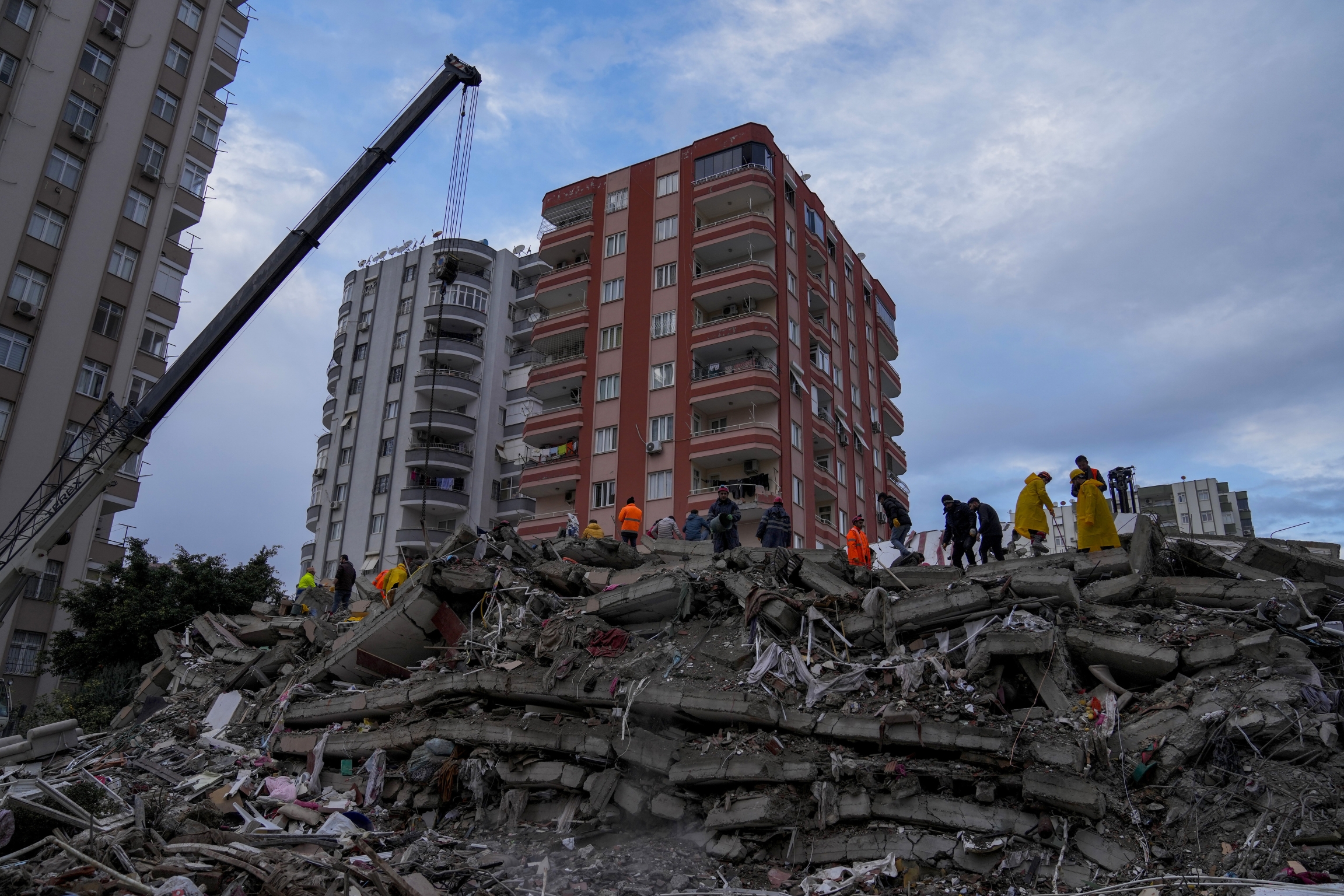
Emergency teams search for people in a destroyed building in Adana, Turkey, after a powerful quake knocked down multiple buildings, Feb. 6, 2023.
Khalil Hamra/AP
She explained that there are road closures and electricity and cellphone services are down in many areas, and multiple airports have suspended their flights. The Turkish disaster agency has asked for donations of blankets, electric generators and warm clothes. In places like Gaziantep, people with cars are trying to stay warm in their vehicles in an attempt to stay away from buildings and other structures that could collapse. They've been told not to leave the city because roads are badly damaged.
In the southeastern part of Turkey, home to minority groups and Syrian refugees, "A lot of people live in small towns and villages," she said. "They're spread out. It's an incredibly vulnerable population. People don't have a lot of savings to fall back on. They live in homes that often don't have a lot of up-to-date construction. And this just happened in probably the most-vulnerable section of the country."
With unique architecture dating back to the Inca empire, the city of Cuzco is one of Peru’s most popular tourist destinations.
But now, its cobblestone streets are mostly empty, as protests in the South American country have forced thousands of travelers to cancel their reservations.
The city of 500,000 is usually teeming with backpackers who admire the high ceilings of its baroque churches, and use Cuzco as a departure point for epic treks into the Andes mountains.
But last month, only 4% of its hotel rooms were occupied, according to the local chamber of commerce. And travel agencies are struggling to provide refunds to tourists. Many inhabitants of the city, known as Cuzqueños, say the situation has become critical.
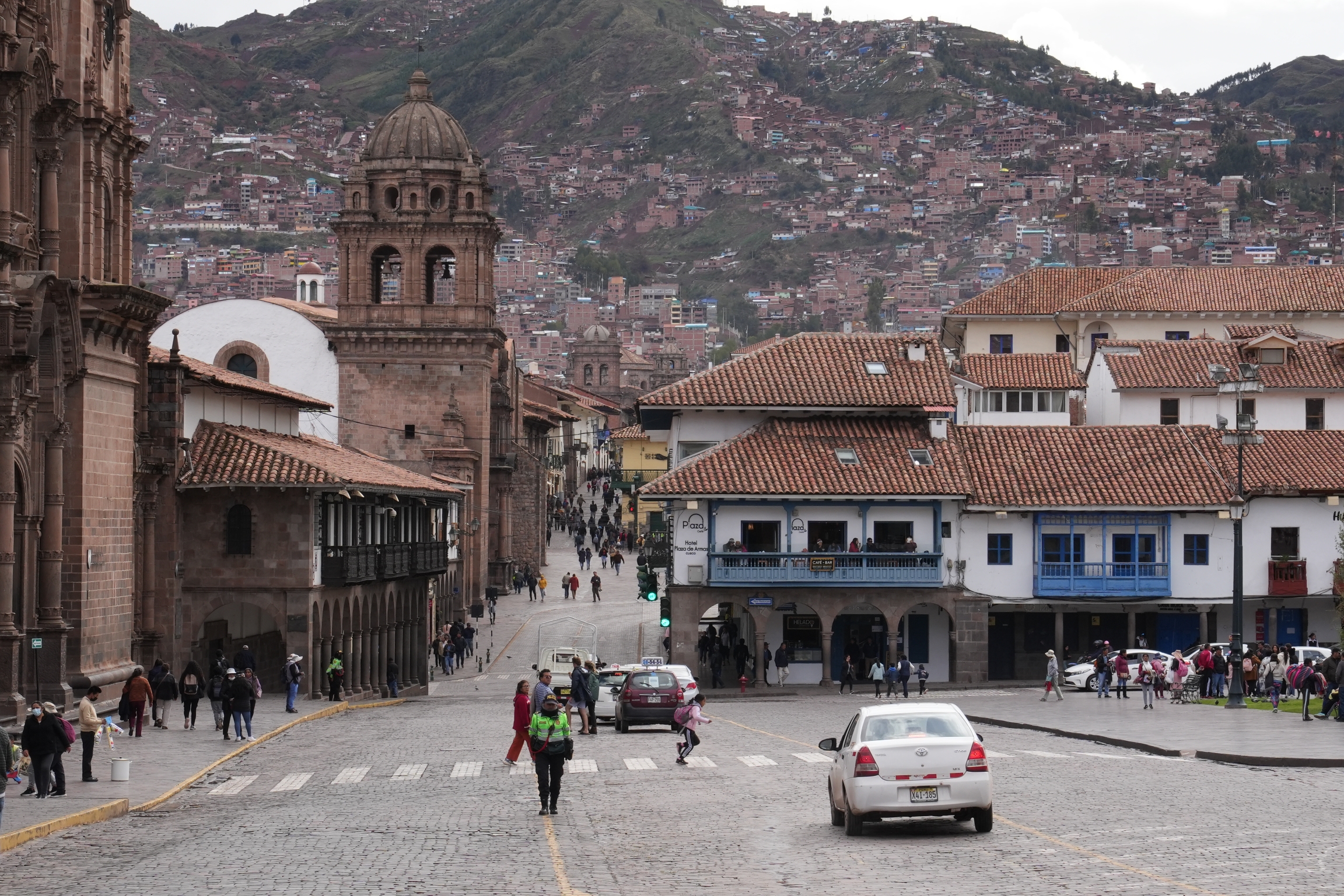
Cuzco is Peru's top tourism destination.
Manuel Rueda/The World
"We are very worried with what’s happening and sometimes we feel overwhelmed," said Maira Cano, the manager of a store that sells alpaca-wool sweaters and souvenirs near one of Cuzco’s archaeological sites. She said sales are just 20% of what they were before the demonstrations began.
“We need this situation to be solved quickly,” she added.
The protests were sparked by former President Pedro Castillo’s ill-fated attempt to dissolve Congress in December and rule by decree.
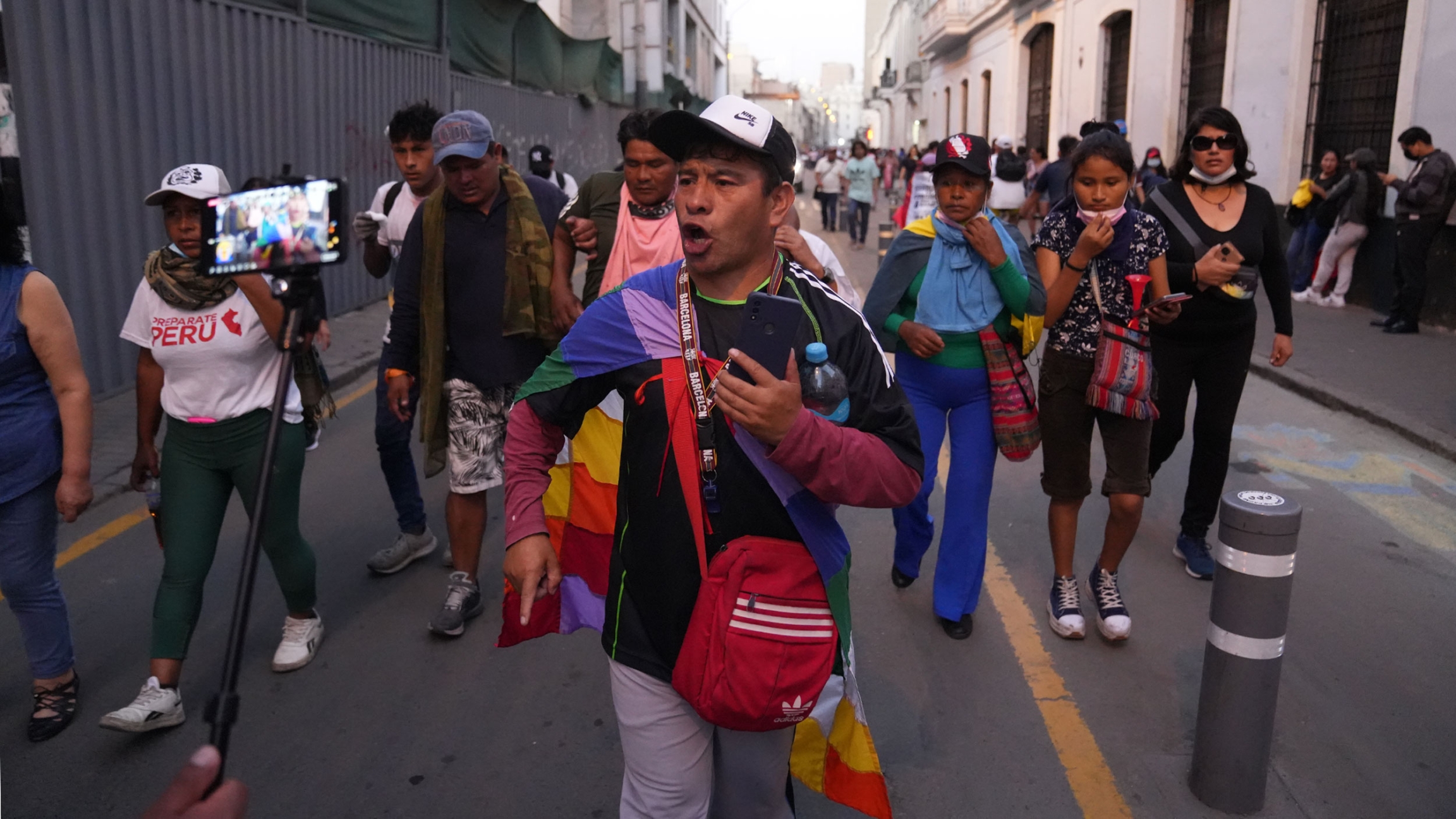
Protesters in Peru blame President Dina Boluarte for the deaths of more than 50 demonstrators, amid clashes with police and want her to resign.
Manuel Rueda/The World
He was promptly impeached and arrested on rebellion charges, and replaced by his vice president, Dina Boluarte. But while his removal complied with Peruvian law, it angered many people in the nation’s Andean highlands, who were hoping that Castillo — a former rural school teacher — would reverse the years of neglect they’ve faced from the central government.
The situation quickly turned violent in some southern cities, where largely Indigenous groups of protesters tried to take over airports, and were met by police gunfire.
The protests then moved to the capital Lima, where thousands of people have been marching to demand the resignation of Boluarte — blaming her for the deaths of dozens of protesters in cities like Juliaca and Ayacucho.
“Many lives have been lost and to honor them we need to change things.”
“We can’t tolerate so much abuse,” said Hansel Ordoñez, who showed up at a protest in Lima with a Peruvian flag draped over his shoulders. “Many lives have been lost and to honor them we need to change things.”
In many parts of southern Peru, including the area around Cuzco, protesters have also blocked rural roads with rocks and logs, in an effort to disrupt the economy.
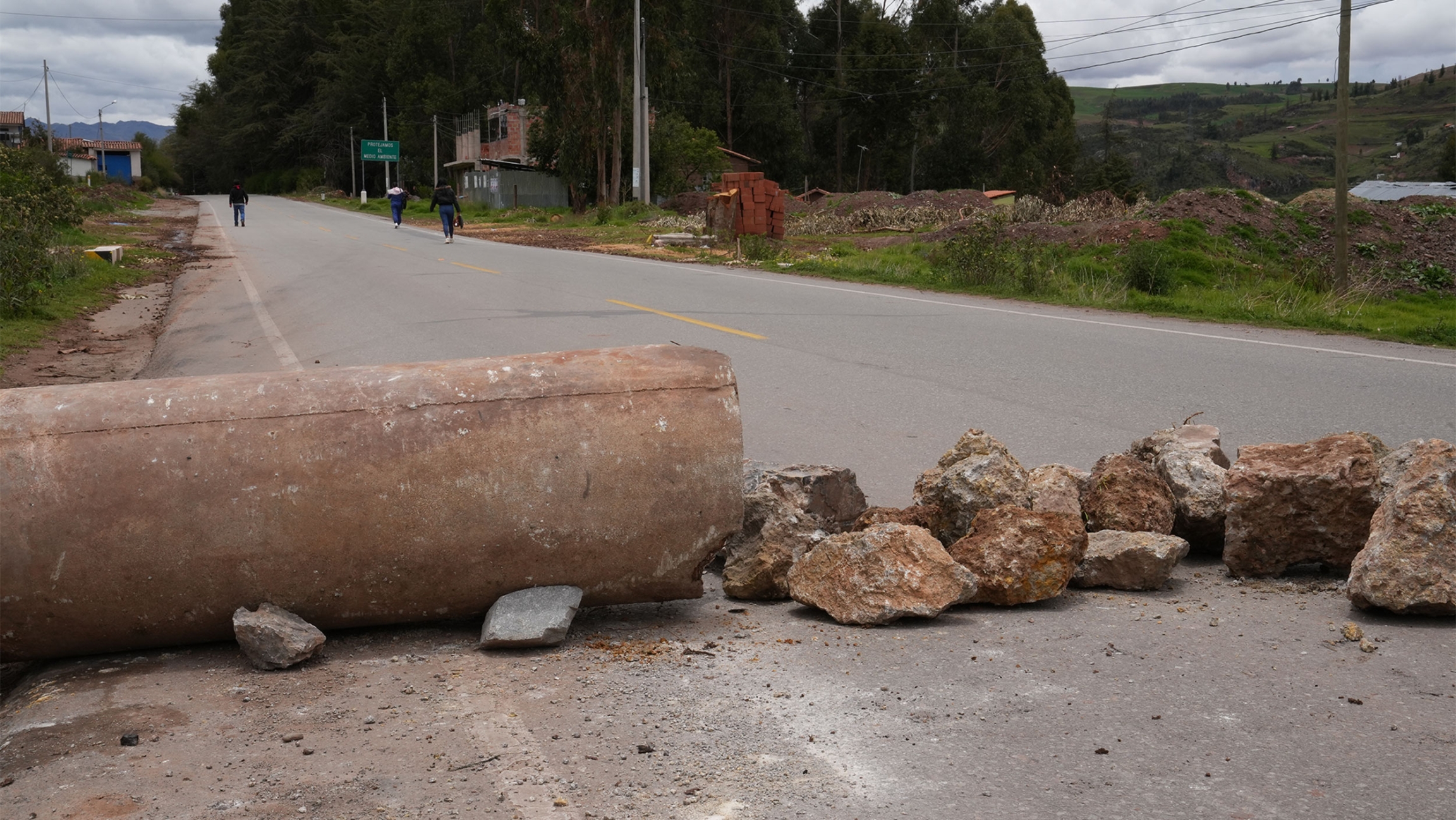
Protesters have blocked rural roads around Cuzco with rocks and logs, in an effort to stifle the economy.
Manuel Rueda/The World
And that also makes it impossible for tourists to get to popular destinations near Cuzco, like the Sacred Valley or the Rainbow Mountain.
In early January, protesters blocked a train track leading from Cuzco to the Inca ruins of Machu Picchu, and local villagers went on strike, prompting the government to shut down the world-famous site.
For the tourism industry, that was the nail in the coffin, according to John Gonzales, president of Cuzco’s chamber of commerce.
“Everyone who comes here wants to see Machu Picchu,” he explained. “So, to avoid disappointment, people are canceling their trips and choosing to go to other countries.”
Some people in Cuzco support the protests, even if they are depriving the ancient city of one of its main sources of income.
Dionisa Condori makes tips by taking photos with tourists. Every day, she dresses up in colorful traditional clothes and takes a bus to central Cuzco with her white baby alpaca in her arms.
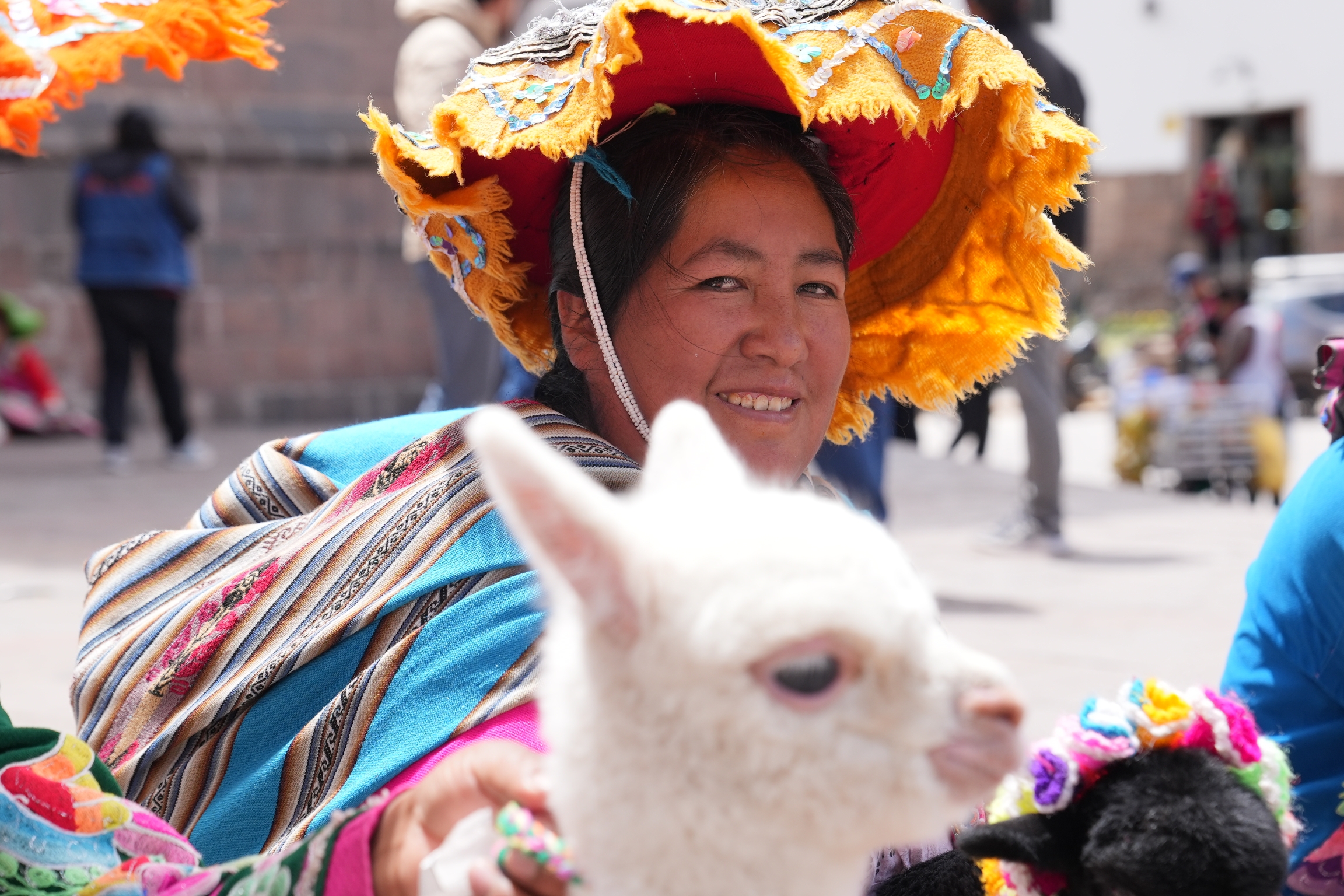
Dionisia Condori takes photos with tourists for tips. She said she supports the protests in Peru, but also wants a quick solution to the conflict.
Manuel Rueda/The World
“We want all of Congress to resign,” she said. “They have ignored Indigenous people like us for too long and left us in the margins.” She explained that her village, located outside Cuzco, still has no gas pipes.
President Boluarte has proposed moving elections up to October to reduce the opposition to her beleaguered administration. But Congress would have to approve the proposal, and it’s currently debating the conditions in which new elections could be held.
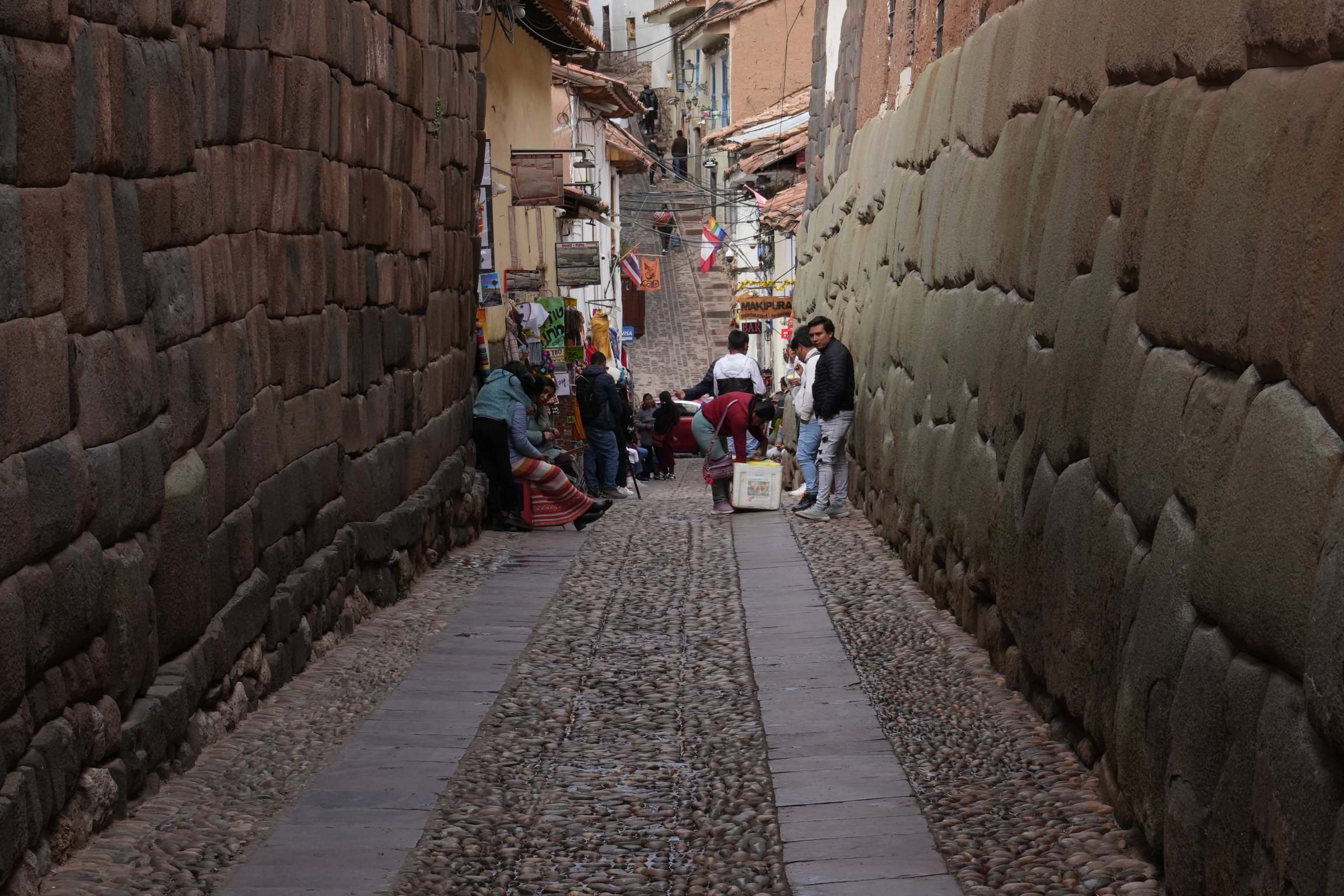
The streets in Cuzco are lined with walls that date back to the Inca empire.
Manuel Rueda/The World
While Condori supports the protests, she also wants a quick solution to the conflict. Basic necessities have become harder to come by. She said that the price of beef and chicken has gone up, with roadblocks making it harder to bring goods into the city. “It’s hard to make a living now,” she said.
And in Cuzco, most people are hoping for a solution to end the roadblocks, in the hopes that visitors will return to the city.
“We have no quarrels with tourists,” Condori said. “We hope that they can come back soon, so that everyone can benefit.”
Controversy erupted this week over New York City’s decision to move a group of single, migrant men from a Manhattan hotel, where they had been housed for months, to a new reception center created inside a cruise ship terminal on Brooklyn’s waterfront.
Many of the men refused to go and ended up holding protests and camping for several nights on the sidewalk. The city justified the move, saying it needed the hotel space to house migrant families instead.
New York City has absorbed a large influx of migrants and asylum-seekers since last spring, when states such as Texas and Arizona began bussing them north from the border. The city said almost 44,000 migrants have come through its intake system since last spring.
Mayor Eric Adams has said New York, as a sanctuary city, is committed to welcoming immigrants but its services are under incredible strain.
“Once the asylum-seekers from today’s buses are provided shelter, we will surpass the highest number of people in recorded history in our city’s shelter system,” the mayor said in October, when declaring a state of emergency.
“And every day going forward that we add more to this count, we break another record.”
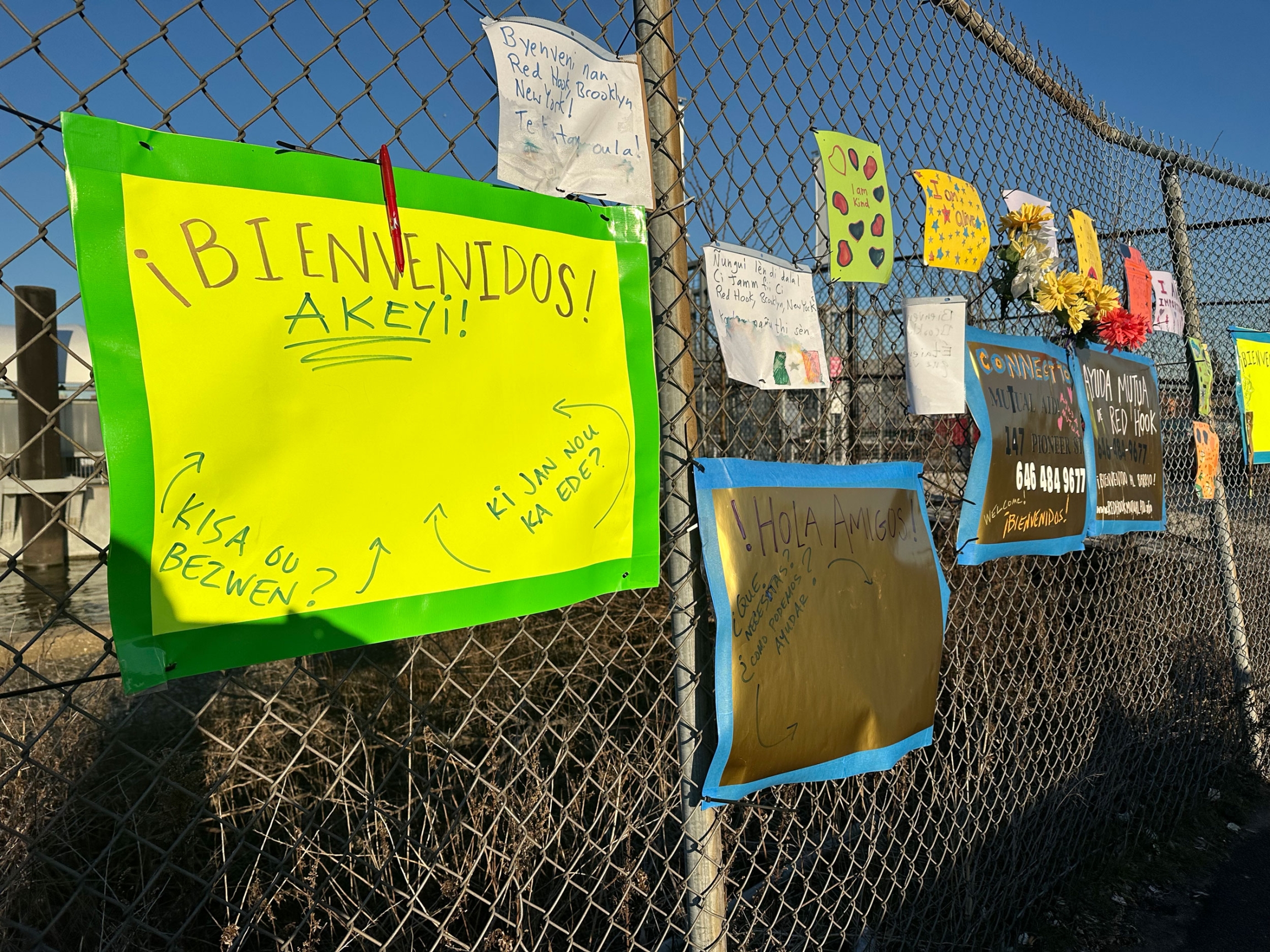
Residents of Brooklyn’s Red Hook neighborhood have placed welcoming signs in front of the cruise terminal reception center for migrants.
Gisele Regatão/The World
This new reception center is housed inside of a massive cruise terminal in Brooklyn’s Red Hook neighborhood that faces the Statue of Liberty, in New York Harbor. Immigrants sleep on camping cots, with no privacy and limited bathrooms.
The location is also an issue. Red Hook is not close to a subway station, which makes it difficult for residents to get to work. The site is set up to house 1,000 men until this spring, when cruise ships will be back.
The local volunteer organization Red Hook Mutual Aid Society has set up a welcome center near the cruise terminal where migrants can pick up food and clothes, as many of them do not have proper clothing for New York’s winter temperatures. They will also offer English classes.
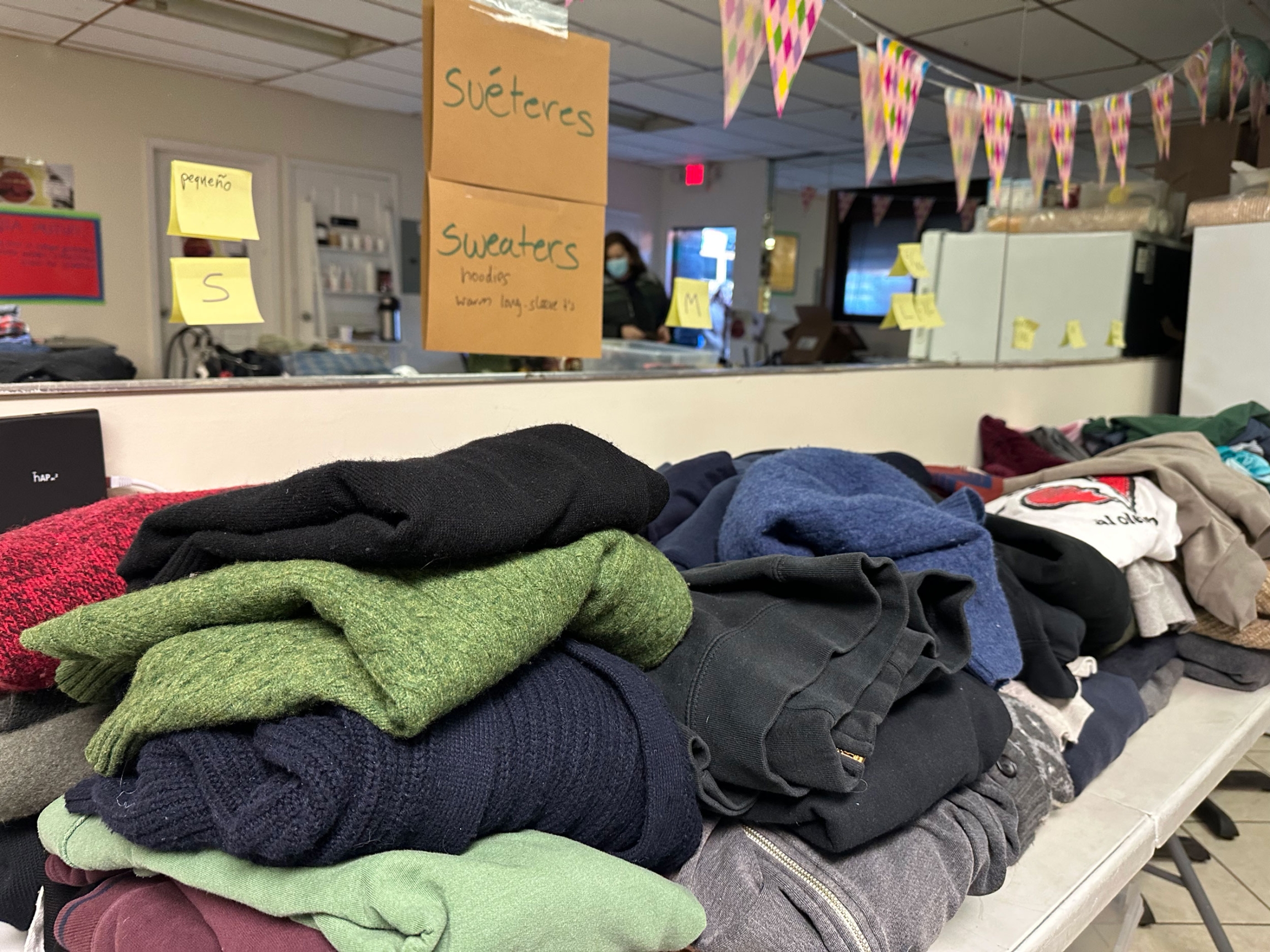
The volunteer organization Red Hook Mutual Aid is providing clothes to the migrants who have been moved to the neighborhood, many of whom don’t have winter clothes.
Gisele Regatão/The World
Many of the new arrivals are coming from Venezuela, where people are fleeing political and economic upheaval. There are more than 7 million Venezuelan refugees and migrants all over the world, making its displaced citizens the third-largest group internationally after Syria and Ukraine.
On a blustery cold afternoon this week, Venezuelan José Perez, 26, stood with a group of friends outside the cruise terminal and agreed to talk about his journey to New York. Perez, originally from Puerto La Cruz, on the eastern coast of Venezuela, arrived in New York three months ago.
He used to work at a bank in Venezuela and was studying business administration in college. He said he decided to leave his country because he couldn’t survive on his salary.
“Minimum wage in Venezuela is between $7 and $10 a month and with that, I had to pay university, gas, car insurance,” Perez said, who, after leaving Venezuela four years ago, lived in Brazil for two years, Chile for one year, then Peru and Ecuador.
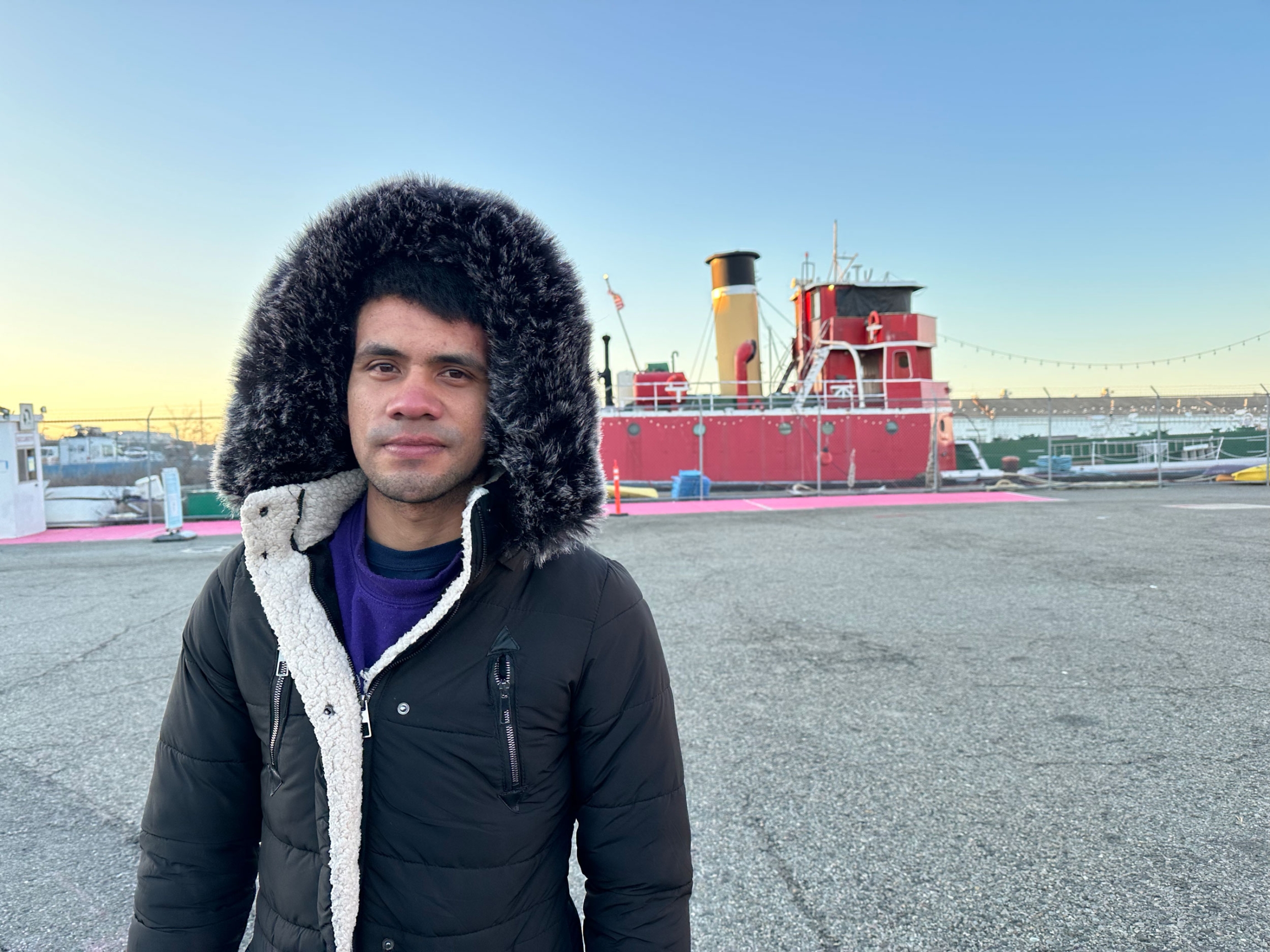
José Perez, 26, arrived in New York City last fall, but he left Venezuela four years ago. He first moved to Brazil, then Chile, Peru and Ecuador. He came to the US looking for better opportunities.
Gisele Regatão/The World
To arrive at the US border in El Paso, Texas, Perez crossed through the Darién Gap, which is a dangerous forested area between Colombia and Panama. His journey with several friends took three months.
“At night, as people were setting camp, it looked like the apocalypse, there was nothing to eat, it was horrible,” he said.
His hope is that New York will be a place where he can build a new life and bring his family. His wife is in Chile, and his parents are in Venezuela. He has one sister in Colombia and another in Costa Rica.
Perez said it was his decision to come to New York City.
“They told us that here was a sanctuary place, that we could be more at ease, not like in other states, that here they would support us more,” he said.
Last year, he had found temporary work cleaning and repairing chimneys but he is now unemployed.
Perez hasn’t yet applied for asylum, but he does have an appointment with a lawyer at the end of February.
Louise Bauso (right) is an ESL teacher who runs Red Hook Mutual Aid, an organization of local volunteers who is providing assistance to the migrants who have been moved to the neighborhood.
Gisele Regatão/The World
Niurka Meléndez, a Venezuelan migrant herself and the co-founder and co-director of the nonprofit Venezuelans and Immigrants Aid (VIA), knows that the asylum process can be long and complicated.
“I applied in March of 2015 and this coming March is going to be seven years waiting for my first interview,” Meléndez said, adding that she has a work permit because her asylum request is pending.
Her organization provides legal orientation, humanitarian help, English classes and emotional support to Venezuelan migrants in New York. She believes the city government should do more for immigrants than the basic services it offers, such as accommodation, medical care and food.
“If you ask me, OK, it’s like a good Band-Aid, but they need more than that, they need legal orientation, and they can do that,” she said.
Last month, the Biden administration changed its policy toward migrants from Venezuela, Cuba, Haiti and Nicaragua, ruling that they can no longer apply for asylum if they cross illegally into the United States.
The administration said that up to 30,000 people from those four countries would be allowed to enter legally each month, but only if they can buy a plane ticket, get a sponsor, pass a background check and meet other requirements.
As a result, the number of people crossing the US-Mexico border from these four countries is decreasing. The US Department of Homeland Security said this week that border apprehensions of people from these countries fell to about 100 a day from more than 3,000 a day in December.
In New York, about 150 to 200 migrants continue to arrive in the city each day, the Mayor’s Office of Immigrant Affairs said in a tweet on Feb. 2.
In Spain, more than a hundred teenage boys picked up ringworm over the past year.
The outbreak, unusual for the age group, is among the largest in Europe. More commonly, ringworm spreads from household pets, or even farm animals, to young children, according to dermatologists.
But in 2021, dermatologist Leonardo Bascon started seeing something new.
“Some patients were coming here with this new pattern,” he said, from his office in a hospital near Barcelona. “And they were a bit older. The mean age of our cases is actually 19.”
Bascon and his colleagues decided to investigate. They jumped on a nationwide, online chat group for Spanish dermatologists. In a week, they’d compiled 107 similar cases from across the country — and they realized it was ringworm.
From there, the doctors were able to trace the infection to the barbershop and a haircut that’s all the rage, the degradado, or, the fade — via dirty electric razors.

Spanish dermatologists blame dirty electric razors at the barbershop for a recent outbreak of ringworm among teenage boys in the country.
Gerry Hadden/The World
Every single one of the 107 patients had been to the barber to get a fade within two weeks of showing infection.
In Spain, it seems virtually every teen boy sports the fade — it starts out short on the side and gets longer and longer toward the top of the head.
“The key is shaving all the way down the skin around the ears and the nape of your neck,” said Nacho Lizan, a high school soccer player who has the fade.
Many teenage boys, like the ones shown here, in Spain, are opting for the fade, a haircut that’s long up top and shaved down along the scalp.
Gerry Hadden/The World
Shaving down to the scalp is where the infection can set in.
Barcelona haircutter Sukhreet Singh said he’s been doing a lot of fades lately, shaving one side of the kids’ heads down to the scalp.
“Sometimes, they also ask for patterns shaved into their hair, down to the scalp.”
Singh said he hadn’t had cases of ringworm in his shop. But razors like his can pick up the fungus from the skin of one client and quickly spread.
“I get 20 to 30 clients a day,” Singh said. “One could easily pass ringworm on to another.
This is a barbershop after all, he said. “We need to be vigilant.”
Singh, like most barbers, disinfects his razors and scissors with alcohol after each client. But apparently, some don’t.
Bascon said ringworm is easily treatable but prevention is best. The fungus, he said, can cause inflammation, fever and even bald spots. Imagine, he said, going to school with a bald spot.
“They are very concerned about the problem. It could lead to alopecia [abnormal loss of hair] if it's not properly treated.”

Spanish dermatologist Leonardo Bascon holds up a photo of one of his young male patients whom he believes contracted the visible ringworm infection from a barber’s electric razor.
Gerry Hadden/The World
The news has spread fast among teens, with some posting warnings on TikTok. But despite the concern, some are still sticking with the fade.
“I’ve been avoiding the barber since I heard about ringworm,” said Gael Doncell, a high school soccer player. “But next week, I’ll be back in the barber’s chair.”

Although some teenage boys in Spain say they worry about the spread of ringworm via dirty electric razors at the barbershop, they're not shying away from getting their hair cut.
Gerry Hadden/The World
He and his teammates, who also have the fade, agreed that from now on, they’d just ask the barber to disinfect the razor before they take a seat. And if they forget to ask, they said, they’ll just hope the fungus hasn’t found them.
As Russia continued firing missiles on residential areas in the east of the country on Thursday, senior officials from the European Union paid a visit to the Ukrainian capital Kyiv.
European Commission Chief Ursula von der Leyen stood beside Ukraine's president, Volodymyr Zelenskiy, and promised more aid. She also announced the establishment in The Hague of an international center for the prosecution of war crimes in Ukraine.
"Russia must be held accountable in courts for its odious crimes," she said.
Leading generals from the US and Ukraine also spoke on the phone on Thursday. They discussed developments on the battlefield and how Washington can boost the war effort. But what are Washington's current strategic goals and limitations in Ukraine? And how do they align with Kyiv?
Derek Chollet, a counselor at the US State Department who advises Secretary of State Antony Blinken, joined The World's host Marco Werman to shed some light.
This interview has been lightly edited and condensed for clarity.
The European Union is debating a fresh round of sanctions against Russia amid the war in Ukraine. And one thing it wants on the list is Russian diamonds.
But Belgium is wavering. That's because the city of Antwerp plays such a huge role in the global diamond trade.
Meanwhile, Belgium's prime minister is doing somersaults to please all parties — and stay tough on Russia.
Hans Merket is with the International Peace Information Service (IPIS), an independent research institute in Belgium, and his focus is on the link between natural resources and conflict development and human rights. He joined The World's host Marco Werman from Antwerp to discuss the situation.
This interview has been lightly edited and condensed for clarity.
With big curly hair and a silver Africa-shaped pendant around his neck, 27-year-old singer Bahjat Etorjman already looks the part of a confident pop star on the rise.
But the Libyan singer-songwriter — known professionally by his first name — admits that he was actually a shy kid when he was growing up in the capital Tripoli.
“I was a bit of an introverted child,” Bahjat said. “I started writing songs when I was like, 12 years old, as a way to cope with life.” He later began posting videos on YouTube, and soon made up his mind to become a professional singer.
But things didn’t quite go according to plan, and Bahjat had to hold tight to his dreams. In 2011, conflict broke out in his home country, forcing his family to uproot their lives and essentially start over.
“The revolution happened and it turned into a very unfortunate situation where, you know, there was a civil war,” he explained. “That didn't make it an environment where you can flourish,” he added.
Bahjat and his family packed up their lives and became refugees in Malta, where the singer still lives today. Amid the upheaval and change in his life, he did have one constant to lean back on.
“Music was the only thing that did not disappear,” he said about his experience.
“So, I started releasing music and just putting my all into it and did it day and night. I breathed it. I love it. I still love it. And yeah, I guess somehow people liked it,” he laughed.
In fact, they more than liked it. The independent musician has a growing social media following, and his song “Hometown Smile,” has millions of views and listens online. His fans even call themselves “Bahjat troops.”
“‘Hometown Smile’ is a song I wrote about how, even during the toughest of times, in the experience we went through, my mom always kept a smile on her face,” Bahjat explained.
“And it kind of taught me that, you know what, you can be going through the worst situations, but looking at the face of someone that you love and seeing that smile, you're like, ‘Yeah, I feel home now,” he said.
Bahjat mostly sings in a blend of Arabic and English in a genre he calls "A-pop," or Arabic pop.
But, he said his fan base goes far beyond the Arabic-speaking world, and stretches from India to the United States.
“I think that's the beauty of pop music,” he said. “It truly shows you how many people feel the same emotion in different ways.”
Bahjat also chooses to be straightforward with his lyrics rather than poetic — preferring to sing frankly and openly about emotions — something that’s portrayed in his song “Halba,” meaning “very much” in the Libyan dialect.
“The whole premise of the song is like, I think I'm in love, but I don't want to admit it, but I think about you quite often. Like, you know, I tell my friends about you quite often,” he explained.
“I'm very proud of ‘Halba’ because it's one of those songs where I think I was able to use a purely Libyan word and use it in a way that's easily sung by anyone.”
Bahjat says that the Libyan dialect is well-suited for pop music because of the small linguistic ways it differs from more popular forms of Arabic.
“We also have a lot of ‘e’s’ in our dialect,” making the sound “eh” as opposed to “ah” at the end of a word, he explained. “The ‘eh’ is very musical, because anything that ends and lands on a very open vowel, I would say, makes pop music very catchy.”
Along with experimenting with language, Bahjat is interested in playing around with references to pop culture.
One example is his song, “Aladdin,” based on the ambitious burglar popularized in the Disney film of the same name.
“I want to show you that, sometimes being an Aladdin means that you have no choice but to be overly ambitious and overly, you know, really eager to achieve what you want to achieve,” he said about how he reimagines the character.
“You don't have a decision on where you're born and the opportunities that brings you,” he said. And added that he aims to be the Aladdin of the music industry and hopes to popularize A-pop.
Despite his growing popularity, however, Bahjat said not everyone has been supportive of his music.
“I face a lot of backlash, and sadly, a lot of it comes from my home country because of the way I sing,” he said.
“Combined with the way I look, my fashion choices and [other] things, it just kind of makes me an easy target.”
But, Bahjat said, he is willing to take the hit so that the next generation of Libyan artists can be freer to express themselves.
Related: Elections in Libya should be part of a larger process toward peace, analyst says
When the Chinese government earlier this month made the decision to relax its pandemic restrictions and allow for travel abroad again, countries that are heavily dependent on Chinese tourism dollars were immediately buoyed.
In the Philippines, where 12% of the economy is tourism-dependent and Chinese tourists were the second-largest market pre-pandemic, the news came as a relief.
The arrival of Chinese tourists “will greatly help us in our effort to transform and recover the tourism industry,” Philippine Tourism Secretary Christina Garcia Frasco told reporters last week when the first plane of Chinese visitors arrived at the Manila airport.
“Our intention is not only to regain our pre-pandemic numbers, but to exceed it,” she said.
Tourism workers on Boracay Island, the Philippines’ most popular vacation destination, are working hard to prepare for the influx of travelers this year.
Known for its glistening white sand beach, gorgeous sunsets and incredible diving, Boracay saw more than 2 million visitors in 2019, according to the government.
But once the pandemic hit, virtually no one made any money for about two years.
“Maybe we lost, like 80% [of revenue],” Ga Arboleda, manager of DiveGuru’s boutique hotel, restaurant and dive shop said.
She added that once the pandemic took hold, many of her approximately 30 employees wanted to go back to the mainland. So for nearly two years, only she, her husband, their daughter and a couple of other employees ran the business, which barely survived, thanks to the few tourists stranded on Boracay, a special permit they received from the government to stay open and some one-off contracts to teach diving lessons.
“In 2020, we are already happy to get like 500 tourists in Boracay every month,” she said. “It just started to pick up again in the last part of 2021.”

Ga Arboleda, manager of DiveGuru’s boutique hotel, restaurant and dive shop.
Ashley Westerman Loboda/The World
That’s when Filipinos started traveling domestically again. The Philippine tourism industry is primarily fueled by domestic travelers, so once the country started loosening its harsh pandemic restrictions, experts say people launched into revenge travel mode after being cooped up for nearly two years.
In 2022, the Philippine government allowed foreign visitors back into the country and things improved further for the badly battered sector. The provincial government reports that tourism in the Philippines in Aklan Province jumped over 400% between 2021 and 2022.
Arboleda has high hopes for this year. “[From] the tourism point of view, we are hoping the Chinese will come.”
Phoebe Areno, a tourism official with Aklan Province, said tourism in the region is projected to grow more than 100% in 2023. Between Jan. 1 to Jan. 22 of this year alone, she said, over 125,000 tourists have arrived with a little more than 28% from abroad.
“We are assuming that in the first quarter we are going to receive flights coming in from mainland China,” she said.

Max Cawed gives a diving lesson.
Ashley Westerman Loboda/The World
The Philippines is banking on Chinese visitors so much that a tourism deal to boost relations with China was signed when the Philippines President Bongbong Marcos visited Beijing earlier this month.
The pandemic paralyzed the Philippines' burgeoning tourism industry, John Paolo Rivera, the associate director of the Andrew Tan Center for Tourism at the Asian Institute of Management, said. “Because of it, revenues were almost zero.”
So, the potential of Chinese tourists to the Philippines cannot be undermined, he said — and this has specifically to do with the way Chinese tourists travel.
“They go by mass tourism. A huge, huge amount of tourists, and they come by buses, in ships, in planes,” Rivera said.
“But then they're also characterized as tourists who absolutely spend [a lot] whenever they go to a country, because they spend so much on entertainment and luxury items.”
Pre-pandemic, Chinese tourists racked up some $255 billion in spending and accounted for almost 20% of tourists globally, according to the United Nations’ World Tourism Organization. For Southeast Asia, especially, data for 2019 shows that before the pandemic, Chinese tourists were the leading source of foreign travelers for the region — making up about a quarter of all tourists.
“So, the arrival of the Chinese, yes, it gives hope,” he said.
Still, Rivera and other experts say the Philippines should be cautious of the impact an increase in foreign tourists will inevitably have — particularly when it comes to the environment and the ongoing pandemic.
Dive shop manager Ga Arboleda laughed nervously when asked if she had any concerns about the expected increase in travelers.
“Well, because we don’t know [if] that virus, again, will arrive if we open the border already to all the people,” she said.
“I’m also thinking about what will happen if we get a new variant and then the vaccine we have will not shield us from that kind of variant.”
Since the start of the pandemic, the Philippines has logged more than 4 million cases of COVID-19 and nearly 66,000 people have died. In preparation for more travelers from China this year, the Department of Health has called for “heightened surveillance” of visitors from there.
Still, only proof of vaccination is required upon arrival in the Philippines for foreign travelers, or a negative COVID-19 test if the traveler is unvaccinated. And even though almost 94% of Filipinos are vaccinated, health experts say, with new variants of the coronavirus on the horizon, more booster shots are still needed.
Trying to make a living and keep her beloved employees safe and healthy is a difficult balance act, said Arboleda, who arranged last week for all of her employees to get their second booster shots.
“Most of our employees are two years or up to 21 years with us, so we really treat each other as a family,” she said.
Over the last five months, thousands of Indians have joined Bharat Jodo Yatra, or Unite India March, in a movement against the “politics of hate and division,” which some say are gaining force in India.
The 2,200-mile-long rally, crisscrossing the country from south to north, has been one of the most-ambitious political rallies since the country’s independence.
Rahul Gandhi, 52, the face of the Indian National Congress party, led the march that began in September of 2022 and ended on Monday in northern Kashmir. Gandhi — no relation to Mahatma Gandhi — is the biggest rival of Prime Minister Narendra Modi and his ruling Bharatiya Janata Party (BJP).
“The BJP thinks they can divide this country along religious lines, along its languages. This country cannot be divided,” Gandhi said shortly before he embarked on the long march from Kanyakumari on India’s southern tip.
Satish Kolkunda and his family joined the march on Oct. 30, bringing colorful posters and sandwiches as they met up with other marchers outside of their city of Hyderabad, in southern India.
“Why I started liking [Gandhi’s] leadership is, he’s truthful and honest,” Kolkunda said, adding that he was particularly impressed when, during a virtual meeting with party volunteers, Gandhi told them to question him if they thought he was wrong.

Satish Kolkunda and his family joined the march on Oct. 30, bringing colorful posters and sandwiches as they met up with other marchers outside of their city of Hyderabad, in southern India.
Courtesy of Satish Kolkunda
Gandhi is trying to drum up support for his party and, according to observers, uphold democracy in India in the face of an increasingly religious state.
“In this market of hate, I am setting up a shop of love,” Gandhi said during a speech in December in Alwar, Rajasthan.
Kolkunda said he has witnessed firsthand the divisions that Gandhi wants to overcome.
In a WhatsApp group of his school buddies, Kolkunda said, “We have a mix of Hindus, Muslims, Christians. And that divide, I see it.”
Hindu conservatives in the group removed its Muslim members, he explained, and verbally abused them.
“And these things are happening very frequently since 2014 [when Modi first became prime minister],” he said.
Modi’s government has long been criticized for policies that put minorities, especially the country’s 200 million Muslims, at a disadvantage.
“Authorities in India have adopted laws and policies that systematically discriminate against Muslims and stigmatize critics of the government. Prejudices embedded in the government of the ruling Hindu nationalist Bharatiya Janata Party (BJP) have infiltrated independent institutions, such as the police and the courts, empowering nationalist groups to threaten, harass and attack religious minorities with impunity,” Human Rights Watch has said.
Ahead of general elections in 2024, the Congress party is positioning itself as an antidote to the BJP’s Hindu nationalist push.
Political scientist Zoya Hasan, professor emeritus at Jawaharlal Nehru University in New Delhi, said the march “has challenged frontally this idea that India is a Hindu nation. It has given people hope that there is still a place for an inclusive idea of India.”
However, some political scientists argue that the Congress party has not shied away from using religion to win votes and has itself, at times, espoused a soft brand of Hindu nationalism.
“Congress’s sustained move toward Hindu majoritarianism over several decades created fertile ground for the more extreme ideology of the BJP,” Kanchan Chandra wrote in Foreign Affairs in 2019.
The response to the Unite India march, Hasan said, has exceeded expectations.
“There is an indication that Congress is serious, which was not the feeling that people would have had over the last nine years,” she said. The past few years have been among the most turbulent in its history as the oldest political party instrumental in India’s independence struggle.
Some of India’s most-famous prime ministers, including Gandhi’s father, grandmother and great-grandfather, belonged to the Congress party.
But Modi’s victory in 2014 shattered the party — it won only 19% of the vote, its worst performance in history. It didn’t do much better in the next election in 2019. Today, it only holds power in three Indian states, and Gandhi himself has never been very popular.
“The Congress faces a rather existential crisis,” political commentator Rasheed Kidwai said.
And so, the Unite India march is also being seen as a Congress party revival.
While it's too early to say whether the march will change people's perceptions of the Congress, it has succeeded in changing people’s perceptions about Gandhi, Hasan said.
“People like the idea of a leader going to the people, rather than people going to the leader and asking something from him or her.”
Gandhi’s physical image has also transformed — he’s sporting a disheveled, salt-and-pepper beard these days, a departure from his earlier clean-shaven look.
Kidwai, who noted that Gandhi’s popularity ratings in the past have usually been in the single digits, said that he has “shown a kind of deep mental strength and a kind of sense of spiritualism” during the march.
The Gandhi family has been criticized for controlling the Congress party for many years. In October, the party selected Mallikarjun Kharge as its president, the first non-Gandhi chief in 24 years. Hasan said that that appointment and the march indicate that “Congress is turning a page.”
A fresh start for the Congress is not only crucial for the party but also for India’s democracy. Congress is the biggest opposition party in India. The BJP’s other opponents are smaller, regional parties. In recent years, a weak Congress party resulted in the opposition becoming fragmented, which has resulted in the weakening of India’s democracy.
“Democracy without competition and a democracy without opposition is no democracy,” Hasan said. “The ruling dispensation has shown little tolerance for dissent or for opposition and would ideally want, you know, a stage where there is just minimum opposition or you just have the formality of opposition.”
Kidwai said that the march “looks high on optics but low in substance” and whether it will translate into more votes remains to be seen. “People of India are very emotional [in] their voting behavior. So, if Gandhi can find some kind of traction on that count, then that will act as a game-changer.”
While the rally was important, Hasan said, what comes after it will be even more important.
Nemes Tarimo died last October while fighting for Russia in Ukraine. His body arrived in his home city of Dar es Salaam, Tanzania, last Friday.
Tarimo was in his early 30s. He’d traveled to Moscow from Tanzania to study at the Russian Technological University.
The last time his cousin Rehema spoke to him was in March 2020.
“We talked more about his studies. Nemes went there [to] Russia just for studies,” she said from her home in Tanzania.
In recent months, reports have emerged that Tarimo, and another man from Zambia, were killed while fighting for the Wagner Group in Ukraine. Wagner reportedly recruited the men from Russian prisons, promising them amnesty.
Rehema, who didn’t share her last name, said that Tarimo had big ambitions — at one point, he ran for political office in his hometown. But in 2021, things took a different turn. Tarimo was arrested in Moscow on drug-related charges.
“Unfortunately, he didn’t tell me anything about the situation,” Rehema said.
Rehema said she doesn’t know what happened to Tarimo after that. But court documents and media reports show that he was sent to prison. While there, he was recruited by the Wagner Group to fight in Ukraine, likely in return for amnesty.
The Tanzanian government confirmed last week that Tarimo died while fighting in Ukraine.
“We lost somebody … a very very important person in our family, because Nemes was very very kind and a loving person,” Rehema said.
Tarimo is not the only person from an African country that Wagner has recruited to fight in Ukraine.
Last week, the death of another man from Zambia made headlines. Twenty-three-year-old Lemekani Nyirenda was studying nuclear engineering in Moscow when, he too, was arrested for drug possession.
While serving his 9 1/2-year sentence, Wagner recruited Nyirenda to fight in Ukraine. His funeral was held in Zambia last week.
Tarimo and Nyirenda were both recruited from inside Russian prisons. But there are reports that Wagner is also recruiting fighters from countries in Africa.
“Not only is Wagner recruiting individuals who want to sign up to earn money by working for Wagner in African states, but actually, they’re also bringing in prisoners, including rebels from the same groups that they’re actually helping to fight countries like the Central African Republic to counter the rebels,” explained Catrina Doxsee, associate director and associate fellow for the Transnational Threats Project at the Center for Strategic and International Studies.
Wagner has operated in Africa for years — in Sudan, Libya, Mozambique, and most recently in the Sahel region.
According to Paul Stronski, senior fellow at the Carnegie Endowment for International Peace, Russia is seen as a friendly foreign power by some Africans.
“There’s a lot of anti-Western, anti-colonial legacies still there. Russia presents itself on the African continent as a noncolonial power,” Stronski said.
“We’ve seen conflicts for years in Africa, and the United States and Europe have not responded with the same urgency as they seem to be responding in Ukraine. Europe welcomed all these Ukrainians in 2022, but if you just look back — I think it [was] six years ago, 2016, 2015 — they weren’t so welcoming when people weren’t from Europe,” Stronski added.
In the past, Wagner recruits received some training before they were sent to the battlefields in Ukraine, but today, it is not clear if they get any training, given Russia’s demand for fighters, Doxsee said.
“The conditions in Ukraine for these recruits are horrible. We’ve long known that one of the appeals for Moscow in using private military companies rather than Russian soldiers is to have a force multiplier that can in some cases be used more as cannon fodder.”
Sometimes, they’re forced to stay on the front lines longer than the initial agreement.
Doxsee said there should be a public information campaign aimed at Africans and their governments detailing the realities of signing up with the Wagner Group.
That way people would understand better the risks involved.
An unusual announcement appeared in Russian Dark Web forums in June 2020. Amid the hundreds of ads offering stolen credit card numbers and batches of personally identifiable information, there was a call for papers.
“We’re kicking off the summer Paper Contest,” it read. “Accepted article topics include any methods for procuring shells, malware and malware coding, viruses, trojans, bot development … monetization.”
Jon DiMaggio, chief security analyst at Analyst1, remembers seeing the ad when it first appeared and thinking to himself how odd it was to have some sort of academic call for papers pop up where cybercriminals tend to gather.
“They’re calling for papers, like, in the name of education of the criminal community," DiMaggio told the "Click Here" podcast. “As if they were helping out the young guys and gals coming up,” in the cybercrime world.
DiMaggio said that the summer paper contest was a strangely highbrow way to appeal to the vanity of a group that typically doesn’t get to claim much public credit for what they do: cybercriminals.
That may partially explain why the contest ended up generating a huge amount of interest. The $5,000 cash prize for the best paper probably had something to do with it, too. But it wasn’t just the novelty of introducing a contest that made DiMaggio take notice — it was who was sponsoring the competition: a Russian ransomware gang called LockBit.
That contest was the first in a long list of initiatives, unrelated to the bread-and-butter running of a ransomware gang, that a hacker named LockBitSupp did over the past two years to professionalize the group, according to DiMaggio, who spent more than a year inside LockBit private channels interacting with LockBitSupp and other members.
“LockBitSupp considers himself to be like a CEO of a company,” said DiMaggio, who believes LockBitSupp is more than just a support person or administrator for the group as his moniker implies.
This is just one of the insights from a new report called "Ransomware Diaries: Volume 1," released on Jan. 16, in which DiMaggio revealed how he infiltrated the group and what he learned while on the inside. "Click Here" was given an early look at it.
DiMaggio watched as LockBitSupp began upgrading the group’s infrastructure. He saw him recruit developers who were creating LockBit’s easy-to-use ransomware dashboards. He was privy to the group’s efforts to upend the traditional ransomware payment model by putting affiliates in charge.

LockBit's response on a Russian dark web forum after a DDoS attack on digital security giant Entrust.
Courtesy of Jon DiMaggio/Analyst 1
LockBitSupp’s focus on professionalizing the group is part of the reason why LockBit has found such success in the cybercriminal world — the group accounted for 44% of the total ransomware attacks launched last year.
“He’s running it as a business and it’s why I believe that he spends so much time on criminal forums interacting and talking and being accessible,” DiMaggio said.
“He wants LockBit to be popular and easy to approach.”
Last year, the cybercriminal world was rocked by a researcher who released years of internal chat logs from the Russian ransomware group Conti. The chat logs came to be known as the "Panama Papers" of the ransomware world, because they gave observers an unfiltered look at how ransomware operations work.
DiMaggio’s report was a version of that. By sharing some of the chats he started and was privy to, he laid out how LockBit came to eclipse other ransomware operations — and what it plans to do in the future.
DiMaggio’s relationship with LockBit and its leader started with a failed job interview. It was 2020, and LockBit was looking for coders. They put up a job posting for affiliates and DiMaggio applied. He didn’t expect to get very far in the process. "I’m not a hacker," he said.
Even so, he did get a virtual interview and got as far as the LockBit assessment test. It was meant to measure whether an applicant really had the coding chops they claimed to have or were just "script kiddies" exaggerating abilities.
“The assessment test they gave me showed I wasn’t qualified enough,” DiMaggio said. “I didn’t expect to get through, but they did let me remain in their TOX channel,” which, it turns out, was a goldmine.
TOX is a peer-to-peer instant messaging service, a kind of encrypted Skype that many cybercriminals prefer. Much of the world’s ransomware negotiations happen on TOX. So, being in the TOX channel for LockBit allowed DiMaggio to be a kind of fly on the wall, watching cybercriminals at work and in the wild.
But DiMaggio wanted to be more than a fly on the wall — he wanted to engage. So, he baited LockBitSupp. “I asked him if he thought an account being used by another ransomware group had been compromised by the FBI,” DiMaggio said.
“I didn’t care what he said, but I saw it as an opportunity, because he seemed so paranoid about that taking place.”
DiMaggio was pretending to be one of LockBit’s affiliates, or subcontractors, and he told LockBitSupp that the affiliates could be in jeopardy, too.
“And he was like, you know, I prefer to have these conversations not on these forums, but on our own infrastructure,” and he asked DiMaggio (or at least who he was pretending to be) to move the conversation there. The only problem was, LockBit was a Russian ransomware gang, and DiMaggio didn’t speak Russian.
"So, I started off the conversation with German, and of course then he says, 'I don’t speak German,'" DiMaggio said. "But here’s the thing. All of them speak a little bit of English, because English speakers are their primary victims."
So, DiMaggio would often start conversations with ransomware actors with a ploy.
"I’m like, 'do you speak English,' type of thing. And they say, 'yes.' And I’ll say, 'OK, well why don’t we try to communicate in English then?'" he said. "And then, I just have to remember to make sure my English isn’t too good as I communicate, but it works. And, and that’s exactly what I did with LockBit."
Before he knew it, he and LockBitSupp were in the group’s private channel talking and, in some ways, LockBitSupp was exactly what DiMaggio was expecting. He was a guy who exaggerated his accomplishments and trash-talked other groups. Where he was different was in his sense that, in order for the ransomware industry to get “next level” it needed to be run more like a traditional business, and LockBitSupp had a plan to do just that.
“He constantly did things to get their name out there and then capitalize on the opportunity,” DiMaggio said.
LockBit started with a logo. A few ransomware groups — like Vice Society — were experimenting with that. LockBit’s logo — a red, white and black retro-looking rendition of their name — started appearing on everything they touched: on their leaks website, letterhead, ransom notes, anything they sponsored.
Then they tried their hand at a little IRL branding. They began offering people $500 to $1,000 to tattoo the LockBit logo on their bodies.
“I heard that, I’m like, there is no way anyone is going to tattoo the name of a ransomware brand and their logo on their bodies,” DiMaggio said.
“And then people did. That’s just crazy to me.”

LockBit began offering people $500 to $1,000 to tattoo the LockBit logo on their bodies. The group's leader wrote in in a post: "All affiliates come and go, LockBit is eternal."
Courtesy of Jon DiMaggio/Analyst1
Then LockBitSupp began working more strategically. He began studying the inefficiencies and bottlenecks in the ransomware business model, DiMaggio said. He began puzzling through what stopped the average hacker from launching successful attacks — and why they weren’t using LockBit.
LockBitSupp’s solution was something he called LockBit Red, publicly branded as LockBit 2.0. Think of it as ransomware made easy. If you weren’t a great coder and wanted to make some cash launching ransomware attacks, not a problem. LockBit 2.0 was essentially point-and-click.
They created a dashboard to help hackers keep track of all the ransomware they had released into the world, and then improved the encrypter so attackers could steal data faster. They even created push notifications that would alert attackers when a victim responded to a ransom demand.
He took what used to require weeks of being on a network and manually entering commands and writing scripts, and automated it with a graphical interface for everybody. LockBitSupp certainly wasn’t the first person to try this, but he was the first to do it this well. LockBit’s central management console incorporated all the disparate elements of a ransomware attack, and put it in one place.
“They made a process that was convoluted, slow and was putting data outside of their own control, and made it fast, efficient and going into their own infrastructure to use,” DiMaggio said.
LockBitSupp's game-changer was upending the ransomware payment system — one of the biggest problems in the cybercriminal world. The difficulty isn’t so much getting a victim to pay a ransom; that was comparatively easy. The issue was paying all the people who worked on the attack.
Traditionally, ransomware gangs use subcontractors or affiliates. Think of them as specialists — people who might be particularly good at searching for vulnerabilities or cracking into particular kinds of networks.
Each hacker would do the specific thing they’re good at then and collect that percentage of the ransom at the end, almost like an invoicing system. Given the business they’re in, it isn’t too surprising that a lot of the time they didn’t get the money that was owed.
“Not getting paid was a concern that was talked about a lot, and still is talked about a lot, on these criminal forums,” DiMaggio said.
So, Lockbit flipped the script, and put the affiliates in charge.
“You, as the affiliate, you do the negotiation and collect that money yourself and then you pay us our percentage,” DiMaggio said, which is how it worked. “Inherently, it gives them trust and removes that fear of getting ripped off.”
Once LockBit did that and upgraded their ransomware product, affiliates were banging down the doors to work with them. LockBit suddenly had more ransomware work than it knew what to do with, which goes a long way toward explaining why LockBit has been so formidable in the ransomware world today, and responsible for nearly half of all the ransomware attacks last year.
Last summer, Jon DiMaggio was in one of the LockBit chatrooms when members started crowing about its latest victim: a small Canadian town called St. Mary’s.
“The conversation was almost like high-fives and laughing at the victims themselves — poking fun at how easy it was to compromise,” DiMaggio said.
The hacker version of locker-room talk.
Attackers often go into these hacker forums and begin talking about what they just stole.
“They like to go through the data to find the, sort of, most embarrassing aspects of it … and share stuff,” said DiMaggio. “And it’s usually, it’s very much like an online bully — picking on the victim, talking trash as though it’s some big joke.”
But it doesn’t feel like some big joke on the other end.
“You feel like the world’s gonna end,” the mayor of St. Mary’s, Al Strathdee, told "Click Here."
“It’s like being robbed. … I felt like we were invaded and robbed and it was a smash and grab.”
Strathdee was thrice elected mayor of St. Mary’s, a town of about 7,700 in southwestern Ontario. It sits a couple hours south of Toronto and about three hours north of Detroit. Its claim to fame? Thomas Edison worked here as a boy on the rail line and its outdoor quarry is Canada’s largest outdoor swimming pool.
It was the last place one would expect Lockbit to set its sights on, though Strathdee said, these days everyone’s a target.
“One of the things I’ve learned is that it’s more common than you think,” he said. “But at the time you think, you know, first of all, your first reaction is why us? And what happened?”

St. Mary's, a town of about 7,700 in Ontario, was a LockBit victim last year. Researcher Jon DiMaggio was in the group's channel when LockBit affiliates boasted about the attack.
Ken Lund/Flickr
Back in July 2022, the city of St. Mary’s IT department was doing some routine maintenance and discovered some irregularities.
“They immediately isolated the system and unplugged the servers,” Strathdee said, adding that “our initial thought is that they didn’t even know they hit us.”
Those push notifications that LockBit launched so ransomware attackers could track their victims may have played a role in the St. Mary’s attack.
“We’re wondering whether they have systems that went back and told them that we had discovered them in our systems, or maybe an alarm went off,” he said, adding that the final report on the breach may tell them that for sure.
There was a ransom demand and city leaders thought about paying it, though he wouldn’t say how much it was.
What Strathdee found stunning, after he did some reading about Lockbit, was that the group thought to strike his town. He was told that people could actually rent software from LockBit and take a cut, which means it could have been anyone,” he said.
In other words, it may not have been LockBit itself that hacked them, but one of those affiliate groups. Strathdee said it is pretty clear to him that just about everyone is vulnerable and everyone has to prepare for ransomware attacks now.
“You know, you talk a lot about roads and sewers, and different things like sidewalks and things, as being infrastructure,” he said.
Cybersecurity is “becoming infrastructure as well, and we have to start thinking of it more. And we need to spend more money, a lot more money than we ever expected."

In a forum, LockBitSupp talks about his plans to outfox authorities and prevent them from identifying him as a leader of the gang.
Courtesy of Jon DiMaggio/Analyst 1
Jon DiMaggio's main question: Who does this kind of thing? Who thinks a hospital or a small city or school is a legitimate target?
DiMaggio used to do this kind of profiling and analysis for government intelligence agencies. After spending more than a year lurking in chat rooms, lobbing in questions and watching the interactions between LockBitSupp and others in the ransomware world, what he’s pieced together is that LockbitSupp is a white male in his mid- to late-30s living in Russia or Eastern Europe. He grew up poor, and that’s central to understanding him.
“He says that he was picked on for not having money and not having a lot of friends,” DiMaggio said. “So, because of that, this builds in these insecurities, and when you get a lot of success, that breeds a very strong ego.
DiMaggio said LockBitSupp sees himself as a prince of darkness, like a Batman villain bent on sowing destruction. It is why he is always escalating. For example, he wants to add Denial of Service attacks to the group’s ransomware menu. Because, LockBitSupp said in one chat, “DDoS attacks invigorate” him and “make life more interesting.”
But the thing about so-called supervillains is that, down deep, they have issues. For all their bravado, they’re a little insecure. And in Lockbit’s case — maybe less surprisingly — he’s super paranoid. That paranoia let DiMaggio get closer than he probably should have, and prevented LockBitSupp, DiMaggio said, from enjoying all the money he’s making.
“He can’t travel to places. He can’t go on vacation or leave certain areas of the world,” DiMaggio said. And because of all of this, he doesn’t seem happy.

A Telegram post and tweet from someone claiming to have hacked LockBit.
Courtesy of Jon DiMaggio/Analyst 1
DiMaggio assumes once the report goes public, any personas he used to get close to LockBitSupp and his operation will be burned. But he maintains that the whole exercise was an important one, because security officials are so focused on the technical parts of ransomware, they forget that the people behind these attacks are only human.
Remembering that, he said, provides a roadmap on how to bring these groups down. DiMaggio said it would be easy to play on LockBitSupp’s paranoia and use information campaigns against him.
Which could explain why DiMaggio said his parting words to LockBitSupp would be this: “Watch your back. There’s researchers, there’s analysts, there’s law enforcement agencies and entire governments that are coming for you. Look over your shoulder. And when it’s hard to sleep at night,” DiMaggio paused, “That makes me smile.”
An earlier version of this story appeared on The Record. With reporting by Sean Powers and Will Jarvis.
Related: What comes after Hydra, the darknet marketplace that changed everything?
The Taliban has struck its first major deal with an international partner.
A Chinese company is investing more than half a billion dollars to begin extracting oil from the Amu Darya basin in the north of Afghanistan.
Graeme Smith, a senior consultant for the International Crisis Group, discussed the implications of the deal from Dubai with The World's host Carol Hills.
This interview has been lightly edited and condensed for clarity.
On an unassuming corner in downtown São Paulo, Brazil, next to dilapidated houses and walls covered in graffiti, sits the 7th best restaurant in the world.
A Casa do Porco, or The Pork’s House, opened in 2015, and has since become a destination for people visiting the city.
In Brazil, pork used to get a bad rap. But the restaurant has transformed pork into a gourmet food, kicking off a culinary trend throughout the country.
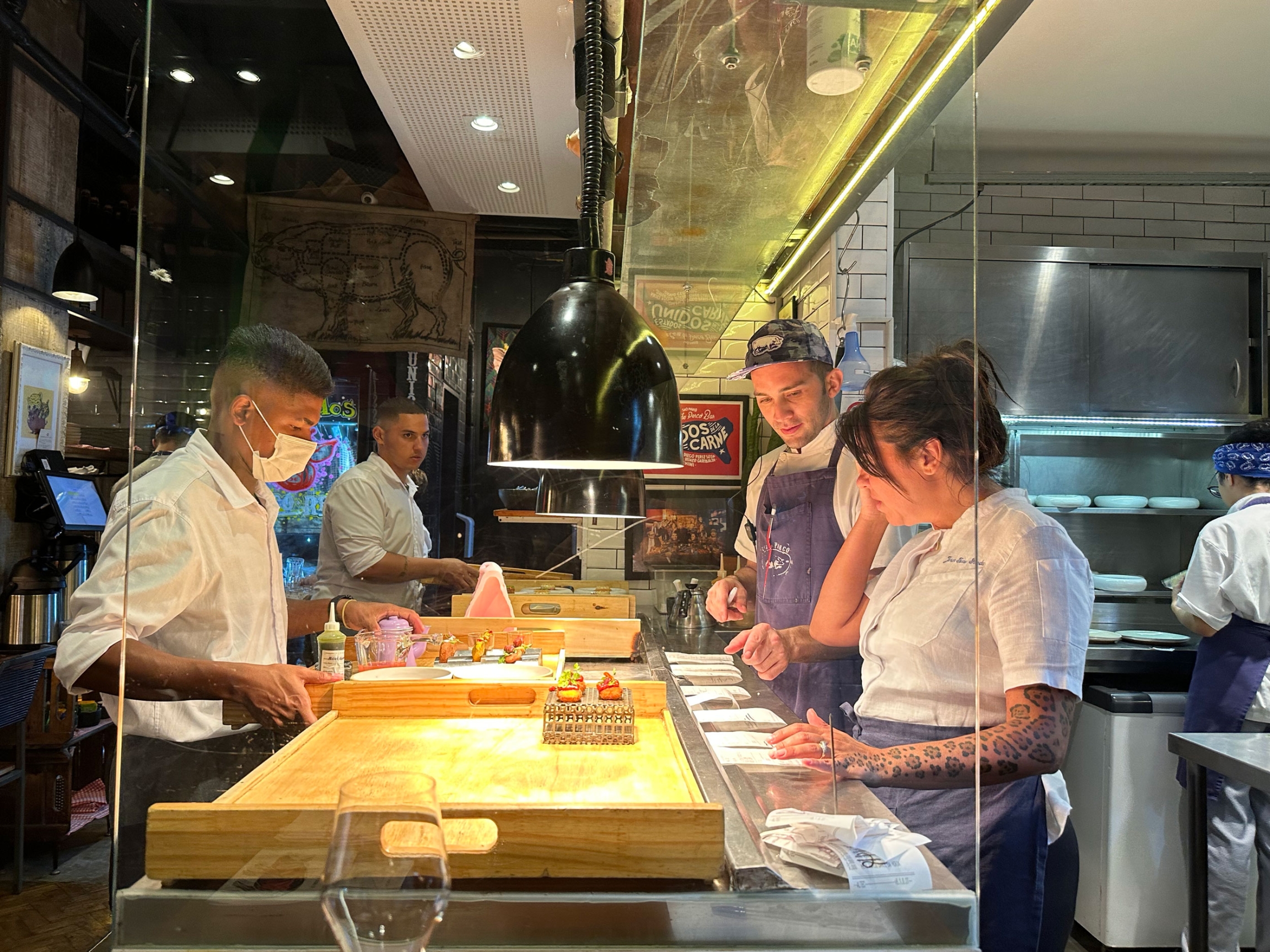
Rueda (right) commands the staff of about 100 people at A Casa do Porco.
Gisele Regatão/The World
One afternoon, three doctors from the state of Mato Grosso came on a gastronomic tour.
“Beyond the presentation, which is really cool, I liked the contrast of the ingredients,” Hyssam Hamida, one of the doctors, said.
Hamida and his two friends said they all agreed on one surprising dish: the ceviche of pig’s ear. It’s made with raw shrimp, sweet potato and seasoned with lime juice.

The ceviche of pork’s ear is served with raw shrimp, sweet potato and seasoned with lime juice. The pairing cocktail is pisco sour.
Gisele Regatão/The World
It’s not an accident that A Casa do Porco is located in downtown São Paulo. Janaina Rueda, co-chef and co-owner of the restaurant, was born in a tenement a few blocks away. She started working when she was 11 and dropped out of school in seventh grade.
Rueda opened the restaurant with her then-husband, chef Jefferson Rueda, who used to be a butcher. They serve a high-end pre-fixe menu with the price tag: $46.
“If you are going to compare it with the other restaurants that made it to the list of the top 50 in the world, it’s the most affordable, by far,” she said.
One of the reasons is its location. Rents are cheaper in downtown São Paulo. It’s an area that fell into decline in the 1970s as industries and residents moved to other neighborhoods.
But Rueda doesn’t like the claim that her restaurant is helping revitalize the area.
“I don’t like the word revitalization, because here there was always life, this area never stopped. What happened is that people started valuing it,” she said.
Rueda knows the area very well. As a teenager, she made chicken salad sandwiches to sell on the streets there. She then ran a food stand. She opened her first restaurant in 2008, Bar da Dona Onça, or Ms. Jaguar’s bar, which is her nickname — a nod to her feistiness.
Although, at 47, she’s a bit tamer, she said. “I’m now a jaguar that observes more, that’s more mature. I will only attack as a last resort,” she said.
Rueda has long dark hair, large blue eyes and a tattoo that imitates the skin of a jaguar covering her entire left arm.

Janaina Rueda, co-chef and co-owner of A Casa do Porco, was born in a slum tenement a few blocks away from the restaurant in downtown São Paulo.
Gisele Regatão/The World
As a celebrity chef in Brazil, she also gives talks all over the world. A few years ago, she led trainings with hundreds of student chefs to teach them to use natural ingredients. “It was then that I understood my role as a cook,” she said.
A Casa do Porco seats 30 people outside and 60 inside. It’s always packed and people can wait for hours for a table. In a month, they serve about 15,000 people.
“I use the pork from head to tail, that’s why the restaurant is so profitable,” Rueda said.
Janaina Rueda got divorced in 2021, but she and her ex-husband remain business partners. They create most menus together, and since the pandemic, she’s been the one leading A Casa do Porco.
The menu changes every few months. The current one is inspired by Latin American cuisine and is called “Our Latin Blood.” It has nine appetizers, four main dishes, one dessert, plus coffee.
The first appetizer represents El Salvador, consisting of a flatbread made of rice, with ham and mozzarella. It’s then followed by a Colombian arepa, or corn cake, with pork tartare.

The current menu is inspired by Latin American cuisine and it’s called “Our Latin Blood.”
Gisele Regatão/The World
The main dishes include pork chops with a salsa made of blood sausage and a crunchy roasted pork with beans and fresh vegetables. Some of the pairing cocktails are the Cuban mojito, Peruvian pisco sour and the Brazilian national drink: caipirinha.
They also have a vegetarian menu. And everything comes from two organic farms they run in the countryside of São Paulo state: one that raises organic pork and another with organic fruits and vegetables.

At The Pork House, the philosophy is to use all parts of the pork and to mix unconventional ingredients.
Gisele Regatão/The World
Luciana Barbo, a food critic based in the capital Brasília, said she will never forget the first time she ate at A Casa do Porco, a year after it opened.
“My first experience was a paradigm shift, I went crazy,” she said. That’s because, she says, growing up, pork meat had a problematic image in Brazil.
“In my childhood, in my science classes, we learned that pork meat was dangerous because it carried worms,” she said.
Barbo believes Casa do Porco changed that image and made pork a gourmet food all over the country.
“Here in Brasilia, we already had a bar also dedicated only to pork meat,” she said. She added that people now can find one of Rueda’s creations, pancetta with sweet guava, in bars in several cities across Brazil.
“They started a trend,” she said.

The restaurant seats about 60 people inside.
Gisele Regatão/The World
Today, Janaina and Jefferson Rueda run four establishments downtown, including a hotdog kiosk and an ice cream shop. They are about to open a fifth, which will offer one different homemade dish a day for less than $8, called a merenda da cidade,” or “the city’s school lunch.”
Rueda said she hopes A Casa do Porco will stay open for many years to come.
“I want it to last for 200 years, I want my sons to be the chefs here, together with the team,” she said.
Her oldest, who is 17, is already working at A Casa do Porco as a cook.
On a recent Saturday night, crowds of young people pack into an old theater in Bishkek, Kyrgyzstan, where there’s a pop-up party for the LGBTQ community.
Below a DJ on the stage, friends and couples dance in the dim light under high ceilings painted with agricultural scenes from the Soviet era.
Events like these aren’t typical in Central Asia. It’s a region where talking about LGBTQ issues is often taboo. Recently, Kyrgyzstan’s government took away transgender people’s right to change their pronouns on official documents. In nearby countries, like Uzbekistan, being gay is a crime.
But that hasn’t stopped many LGBTQ Russians from migrating to Central Asia, where they don’t need visas to live long term. When Russia started drafting men to fight in Ukraine last fall, thousands fled to neighboring countries in Central Asia. Now that the draft is paused, some Russian men are going home.
But many people from Russia’s LGBTQ community aren’t returning. Their decision to stay put is partially the result of a wider crackdown on LGBTQ rights in Russia. Some people in this story didn’t want to use their names because they’re worried about being identified by Russian authorities.
One man in Bishkek, from Siberia, said that he, like many Russian LGBTQ people, always planned to leave the country someday. He dreamed of getting married in Portugal to his boyfriend, but now, he said, those plans are on hold.
“It’s much harder [for Russians] to get a Schengen visa [that covers 27 European countries] now, and we have no idea how that might change going forward,” he said.
For the moment, getting married abroad in one of the few countries that allows same-sex marriage for nonresidents, like Portugal, seems impossible.
He came to Bishkek because he participated in a military training program in school, similar to ROTC in the US. So, there was a good chance he would have been one of the first people called up to serve in Ukraine. He also encountered homophobia serving in Russia’s military.
“Soldiers can physically abuse gay people in the army, and it’s understood that there are no laws to protect your rights,” he said.
Many LGBTQ Russians say they feel safer in Kyrgyzstan because the country has far less restrictive laws against LGBTQ people, and there are more resources for the community. But they don’t plan to stay forever.
Inside a library in downtown Bishkek, students sit at tables studying French.
One of the students who takes classes there also left Russia to avoid the draft. He hopes to move to France someday, because he loves the language and culture. He would also like to settle in a country that is more tolerant to LGBTQ people, like France, and where same-sex marriage is legal.
“I’m tired of always holding back the way I want to express myself, because you have to think all the time about whether it’s safe or not,” he said.
Russia passed a law recently that makes any reference to LGBT issues in media, such as movies or books, a criminal offense.
Some Russian politicians and religious leaders say the new law is part of a larger battle with the West that’s playing out in Ukraine. They claim to be protecting Russians from Western values that promote LGBTQ rights and threaten traditional families.
The new legislation against so-called “LGBT propaganda,” along with another recent law that requires many Russian organizations who receive foreign funding to be labeled as “foreign agents,” have both made it much more complicated for prominent groups that defend LGBTQ rights in Russia to keep working.
The man in the library finds this aspect of the laws — linking someone’s sexual identity to the influence of foreign powers in Russia — particularly offensive.
“You can’t be gay just because that’s who you are [according to the law],” he said. “No, it’s because those bad Americans or Europeans somehow seduced you and affected your thinking.”
How exactly the new law will be implemented is unclear. But Polina, a woman who works with the Russian LGBT Network, a human rights organization, said it could have a disproportionate effect on women.
”If a woman in Russia with children starts a relationship with another woman, then she could potentially have her kids taken away,” Polina said.
In theory, the authorities, or an ex-husband, could use the law in court to accuse a bisexual woman with children of subjecting her kids to illegal, LGBTQ propaganda.
But Polina also said that the law is inspiring change. Lots of Russians who never took part in activism before are getting involved. And although some activists are leaving Russia, she said that the majority stayed to continue their work.
For LGBTQ Russians who do want to leave, the closeness of Central Asia and the visa-free regimes in the former Soviet countries there makes the region one of their best options.
But the fact that countries like Kyrgyzstan have close relations with Russia also worries some people.
“There’s a lot of uncertainty, because it’s possible that Russia might ask Kyrgyzstan to deport all Russian men back home,” said the man who previously served in Russia’s military.
Back in Russia, they could potentially be jailed for avoiding the draft. Many LGBTQ Russians are instead biding their time — waiting until they can emigrate somewhere safer.
A new BBC documentary has sparked controversy across India.
The Indian government has tried to block the film “India: The Modi Question,” which looks at Prime Minister Narendra Modi’s role in the 2002 Hindu-Muslim riots in the state of Gujarat, where he was the chief minister at the time.
Several students at Jamia Millia Islamia University were arrested ahead of the planned screening. And Jawaharlal Nehru University locked its gates and cut electricity at its New Delhi campus as students gathered for another screening there. When they tried to watch it on laptops and cell phones in defiance, they were attacked by a group of masked men throwing stones at them.
Rana Ayyub, author of the book "Gujarat Files: Anatomy of a Cover Up," and an opinion columnist with The Washington Post, discussed the documentary and the situation with The World's host Marco Werman.
This interview has been lightly edited and condensed for clarity. AP contributed to this report.
More than a third of Spaniards light up on a daily basis. And when they’re done, many of their cigarette butts land in the street.
“Seven out of 10 cigarette butts in Spain get flicked to the ground,” said Rosa Garcia, the director of a nongovernmental organization called Rezero in Barcelona.
A lot of cigarette butts reach the coast when beachgoers drop them into the sand, she said, adding that more than 25% of the waste collected on Spanish beaches consists of plastic cigarette butts.
The cost each year to remove the tiny toxic nubs around Spain totals hundreds of millions of dollars, according to Garcia. A Rezero study suggests that it breaks down to anywhere between $15 to $25 per person every year.
“And even if you don’t smoke, you’re still paying for that cleanup — through your taxes,” Garcia said.
A recent decision, however, changed all of that. Spanish lawmakers have said that enough is enough — they passed legislation this month that would require cigarette makers to pay for the cleanup, but smokers worry that they’ll end up footing the bill.
Cigarette makers declined to speak to The World about their plans. But the most likely scenario is that they will reimburse individual town halls for the costs they already incur in street-cleaning. And smokers are worried that the companies might turn around and hike prices to compensate for the losses.
Barcelona has issued fines, at least on beaches, charging about $33 for dropping a cigarette butt in the surf. And last year, the city even banned smoking there altogether.
The fine was minimal, but another city initiative could hit smokers harder.
Barcelona’s City Hall is proposing a 20-cent tax per cigarette butt — which would be another $4 per pack, essentially doubling the price — but consumers would get that money back if they turn in the butts. It’s a similar scheme to getting some money back for returning soda cans for recycling.
The logistics for carrying out such a plan are still unclear.
Questions remain as to where people would return the cigarette butts. One logical choice would be at one of Spain’s 16,000 state-licensed tobacco shops, called estancos. But one estanco operator, Dani Perez, said he wouldn’t even touch them.
“In terms of hygiene it’s disgusting,” he said. “I am not going to start counting cigarette butts that have been lying on the ground, or sucked on by others.”
Nor would he have the time to do it, he said.
Cigarette butts are also filled with toxic residue from the tobacco, making them virtually impossible to recycle.
“A single cigarette butt can contaminate up to 1,000 liters [264 gallons] of water,” Garcia of Rezero said. “They are chemical bombs.”
Some startups are experimenting with biodegradable cigarette butts. But as they decompose, they’d still be releasing the dozens of toxic chemicals injected into them.
As far as cleanup goes, tobacco companies have a couple of months to roll out their plans.
Barcelona resident Andrés Conde, a 56-year-old who smokes, wonders just how companies like Winston, Camel and others will actually tackle the problem.
“What are they going to do, send brigades of tobacco employees moving down the streets of every single Spanish town?” he raised.
If they do end up passing the cost along to consumers, Conde said he knows what he’ll do.
“I won’t pay double for cigarettes,” he said. “That’s nuts. I’m going to emigrate to Latvia.” Conde normally spends his summers there — where, he said, no one would dare to even toss a cigarette butt to the curb.
And anti-smoking activists say there’s really only one longterm, viable plan: it’s not finding a way to deal with dropped cigarette butts, but getting people to quit smoking altogether.
Related: French nonprofit warns 'COVID waste' could harm the environment
After 17 protesters were killed in a single day in her region of Puno, Peru, Margarita Condori packed a suitcase, and traveled with dozens of her neighbors to the capital city of Lima.
On Tuesday, they joined thousands of Indigenous people from Peru’s southern highlands who marched through the city center to demand that the nation’s president resign.
“We feel like we’re living through a dictatorship,” Condori said. “We’re here to demand that they hold new elections, and change the constitution.”
More than 50 people have been killed in southern Peru in protests that broke out in December, and have resulted in street battles between police forces and largely Indigenous groups of protesters who have fought back with rocks, slingshots and homemade rockets.
President Dina Boluarte this week called for a truce. But few have listened to her pleas and continue to stage daily demonstrations in Lima, as well as roadblocks in rural areas that are also hurting the economy.
The protests have turned into a major challenge for Boluarte, who is Peru’s sixth president in as many years. And they highlight how the South American nation’s democracy has been afflicted by corruption scandals and congressional squabbles that have undermined trust in its institutions.
“Boluarte was imposed on us by Congress,” said Margarita Guzman, a resident of Lima who took part in Tuesday’ protest. “It’s like no one cares about our vote.”
The current wave of protests was unleashed by the removal in December of President Pedro Castillo, a leftist teacher and former union leader, who was popular among Indigenous people in Peru’s highlands.
Castillo was facing an impeachment vote in Congress, as well as several corruption investigations. So, in an effort to outmaneuver his political foes, he attempted to dissolve the Legislature and set up an emergency government that would rule by decree until new elections were held.
The military refused to support the move, and Peru’s top court said it was illegal. Within hours of announcing his plans to dissolve Congress, Castillo — an outsider with little experience in national politics — was arrested on rebellion charges and impeached and replaced by his vice president, Boluarte.
Castilllo’s removal was celebrated by his opponents in Congress, and it was largely accepted in Peru’s capital where many had been reluctant to vote for him in the 2021 election.
But it sparked large protests in cities located in Peru’s highlands, such as Cusco, Ayacucho and Puno where the bulk of his voters live.
The former schoolteacher hails from a small village in the Andes mountains and had promised to boost government spending in rural areas. Many members of Peru’s Indigenous minority see him as someone who was finally trying to stand up for them.
“Despite his corruption and his inefficiencies … he was still an Indigenous man from the northern Andes,” said Alonso Gurmendi, a Peruvian politics professor at Oxford University. “And that is important from the point of view of identifying with him in the most-excluded sectors of society.”
“Castillo in a sector of the country was still seen as the least bad of all alternatives,” said Will Freeman, a Princeton University scholar who is writing a book on anti-corruption strategies in Latin America.
“There’s an area of the country which typically leans left, which saw Castillo as a figure who might be involved in corruption, who might be an inefficient manager, but at least he wasn’t a businessman from Lima’s elite.”
After protests turned violent in Peru’s southern highlands, thousands of people from that region decided to travel to the nation’s capital to have their voices heard.
Milagros Rivera took a 16-hour bus ride from the province of Abancay where she’s a subsistence farmer. She said she felt cheated by Castillo’s removal.
“The state has always ignored us,” Rivera said. “We have bad hospitals, we have no schools, we don’t have proper roads to take our products to the market.”
The protesters from Peru’s Andes mountains have also been joined by some Lima residents who are appalled by the recent cases of police violence.
“I’m not from the left or from the right, and I’m not a Castillo supporter,” said construction worker Javier Puman, who carried a banner with a black ribbon on it. “I’m just here because the government is abusing our people, and we feel very hurt by what is happening.”
Boluarte has tried to make peace. In a press conference on Tuesday, she accused criminal groups of using the protests for their own benefit, as rioters in some parts of the country try to burn down government buildings where criminal records are held.
Boluarte also urged people in rural areas to stop staging roadblocks that are hurting sectors such as agriculture and tourism.
“Paralyzing transport, and creating chaos is not going to generate anything positive,” she said. “It’s not going to help us to recover from the economic losses we endured during the pandemic.”
Boluarte is trying to meet with local governors and mayors to discuss regional priorities and set out new development plans. But some say she needs to go further.
Gurmendi, the Oxford professor, said it's time for the government to set up town hall meetings with communities that have long been marginalized. These venues are known as cabildos in Peru, and they’re places where everyone can express their grievances.
“These protests can be demobilized by an act of contrition from the country’s elite,” Gurmendi argued. “To [admit] things haven’t worked. And we need to have a change in tune.”
While Peru has reduced its poverty rate by more than 25% since the 1990s and overcome problems such as hyperinflation and terrorist attacks, many Indigenous people are still finding it hard to access high-quality jobs and social services.
In the streets of Lima, some protesters said that they had lost faith in the current government’s ability to do anything meaningful for this minority, which makes up around a quarter of the nation’s population.
“We are going to be staging protests, until the president resigns,” said economics student Jose Raul Capablanca. “And until the people can choose their own destiny.”
When Alexandra Bain heard the news that the 23 Canadians detained in camps in northeastern Syria could be coming home soon, she was shocked and delighted.
“I am really, really happy for all Canadians,” she said. “Because the focus of the judge’s decision has implications for all Canadians. You have the right to return home.”
Bain heads a group called Families Against Violent Extremism, which has been working with families of a group of Canadians held in Syria for the past four years.
The 19 women and children as well as four men have been held in camps and prisons on suspicion of involvement with ISIS but none have been charged with a crime.
Their families filed a lawsuit against the Canadian government in 2021, arguing that it is violating the Canadian Charter of Rights and Freedoms by not repatriating their loved ones.
Since 2019, Canada has argued that it can’t take its citizens back from Syria because the detention camps there are too dangerous, and its diplomats are unable to travel there.
But last Thursday, the lawsuit was settled out of court, the families’ lawyer, Lawrence Greenspon, told the CBC.
Greenspon did not respond to The World’s request for comment.
Bain said the judge’s ruling takes into consideration what Prime Minister Justin Trudeau has repeatedly said — that a Canadian is a Canadian.
“He takes it back to the Magna Carta of 1215 and the Canadian constitution of 1867 and our Canadian Charter of Rights and Freedoms under section 6, which gives all Canadians the right to return to Canada,” Bain said.
Countries have been more accepting of bringing back women and children but not men. In this case, the federal court instructed the government to take the men back.
"The conditions of the [...] men are even more dire than those of the women and children who Canada has just agreed to repatriate," the decision reads.
"There is no evidence any of them have been tried or convicted, let alone tried in a manner recognized or sanctioned by international law."
The government can appeal the decision. But if it stands, the Canadians are coming home.
The court order marks a significant victory for the families, said Letta Tayler of Human Rights Watch, and it could be a pivotal moment for similar cases elsewhere.
“This ruling could open the door for repatriations of all the men from Canada who are held in northeastern Syria, but also could set a precedent for other courts in other parts of the world to also tell governments they must bring home all their nationals,” she said.
Tayler said that there are still nearly 42,000 people from 60 different countries living in these camps, which are run by Kurdish authorities.
“So, this major step forward by Canada does not mean that this global detention crisis has been solved,” she added.
Tayler has documented conditions in the detention camps for her organization and she describes them as dire. In a report from last December, she said that hundreds of detainees have died from malnutrition, disease and violence. Children have died in tent fires, and they face threats of sexual harassment.
Last year, ISIS supporters stormed one of the prisons in northeastern Syria, prompting Kurdish authorities to respond.
It took 10 days of battle and the help of the US and British forces to take back control of the prison. More than 500 people were killed, including prisoners and several children.
Bain of Families Against Violent Extremism said it has taken Canada far too long to take action to bring back its citizens.
“I think it’s entirely political,” she said.
The repatriation of suspected ISIS families is controversial. Some argue that they must never be allowed back home. The UK, for example, has stripped the citizenship of one woman, Shamima Begum, who traveled to Syria in 2015, when she was 15.
But human rights groups say governments should take responsibility for their citizens.
They say they should repatriate them, and prosecute those suspected of committing crimes.
"It's clear that the Canadian government has the ability to bring our Canadians home, and where there is evidence to believe they've committed an offense, charge them and prosecute them," lawyer Greenspon told CBC's Canada Tonight host Dwight Drummond.
According to Bain, this group returning to Canada will receive support from experts in child psychiatry. The children will be sent home with relatives: “the grandmothers and aunties and uncles or whoever is meeting them.”
“And then, the detainees will be dealt with by our security services and in the court,” Bain explained, adding that while the adults go through legal proceedings, they will likely be wearing ankle bracelets to monitor their whereabouts. Some might have to serve sentences, she said.
So far, no date has been set for their return.
This analysis was featured in Critical State, a weekly foreign policy newsletter from Inkstick Media. Subscribe here.
A rebel alliance can be self-explanatory, the purity of rebellion enough to cohere together a popular insurgent front. But, in the messiness of real life, the messiness of rebellion is a hobbling force, with ideological divisions keeping apart factions that should, by all appearances, be natural allies.
In “Same Same but Different? Ideological Differentiation and Intra-jihadist Competition in the Syrian Civil War,” Regine Schwab examines Ahrar al-Sham, one faction in the Syrian war, and what strategies it used to manage alliances among other rebel factions.
While violence is certainly one strategy rebel groups can employ against rival groups, it carries a high cost. For example, ammunition used against another rebel group can't be used to fight the government both groups seek to topple. After all, ammunition is a scarce resource. Moreover, killing fighters of another rebel faction also depletes strength.
“Differentiation also has consequences for other audiences such as local civilians, prospective recruits, and external supporters,” Schwab writes.
“Local civilians suffer from rebel infighting as they might get into the crossline or be consciously targeted. Hence, they should prefer nonviolent ways of managing conflict. When groups take a large ideological distance from each other, it is easier for prospective local and foreign recruits to choose their preferred group. While nonstate external sponsors might prefer to support the most radical rebel outlet, state sponsors often choose a more moderate option.”
In Syria, ideological differentiation proved a valuable strategy for Ahrar al-Sham, especially as ISIS occupied a radical extreme of the spectrum. For people looking to combat the Assad government but not driven to the same hardline rules and beliefs as ISIS, Ahrar al-Sham was a path into the fight.
In parsing out how groups occupy ideological space, Schwab sets out two axes: a territorial perspective and a social-political outlook. Territory ranged from national or those seeking to limit the war to smaller geographic confines, and transnational, like ISIS’s vision of Syria and Iraq as both under one rule.
On the pragmatic end of the social scale, Schwab writes, “groups prefer integration with society and see fitna (civil strife) as detrimental to their cause. Hence, they are willing to work with actors that do not share their creed.” This is in contrast to purist groups, which took an expansive definition of takfir or declaring other Muslims "infidels."
Ahrar al-Sham was able, especially in 2013-2014, to differentiate itself from ISIS by emphasizing its nationalist credentials and broader ideological umbrella. However, this was not a particularly moderate vision, as al-Sham regularly proclaimed Afghanistan’s Taliban as the model for its desired program. Yet, those same moves left it vulnerable against Hayat Tahrir al-Sham, which after the fall of ISIS, was able to supplant Ahrar al-Sham as the main rebel force in the country.
“By analyzing the puzzling case of Ahrar al-Sham that emerged both as a winner and a loser of intra-jihadist competition in Syria, the paper finds that ideological differentiation is used when military constraints or ideological similarity preclude the initiation of violence against rivals,” Schwab concludes.
Related: Random rules: Part I
Critical State is your weekly fix of foreign policy analysis from the staff at Inkstick Media. Subscribe here.
Warda Haydar was trying to enroll her daughter, Baylasan, for the fifth grade in a Turkish school, when the principal told her it would be impossible.
He told the mother of two from Damascus, Syria, that the school already had “too many” foreign students.
“We begged him,” Haydar said. “My husband went to the school manager every day.”
The Haydar family’s school enrollment challenge stems from a Turkish law that says no more than 30% of schoolchildren in a single class can be foreigners.
Baylasan’s school is in Gaziantep, a Turkish city near the Syrian border, with a particularly high number of Syrian residents. According to the headmaster, this particular school already had too many non-Turkish students.
Even though Baylasan had studied here for three years, she would now have to be bussed to a different school, in a neighborhood on the other side of town.
“She is the only Syrian student in her class,” Haydar said. “They placed one Syrian student in every class, and the rest are Turkish. The school is good, but the distance is long, which is the main problem.”
Haydar said that the long commute means her daughter returns well past 7 p.m. The bus drops her off in a neighborhood that her mother fears is unsafe for a 10 year old, alone, after dark. The school was supposed to provide free transportation, she said, but the bus driver soon started charging hundreds of liras per child — about a quarter of an average rent payment. He relented after parents protested, but the situation remains uncertain.

Kids Rainbow is located in one of Gaziantep’s poorest neighborhoods, where many kids get pulled out of school to help their families.
Durrie Bouscaren/The World
As the Syrian civil war enters its 13th year, more than half of the country’s population remains displaced. About 3.5 million Syrians have sought shelter in neighboring Turkey, which continues to struggle to accommodate them. About a third of Syrian children living in Turkey are not currently attending school, according to UNICEF.
After an initial warm welcome to Syrian refugees, Turks slowly realized that the West would not accept large numbers of refugees from Syria, and ublic opinion soured toward new arrivals.
Current government policies discourage Syrians from prolonged stays in Turkey. And bureaucratic hurdles make it difficult for Syrian families to attend schools, visit hospitals, or even travel without permission beyond the borders of provinces in which they are registered.

In this Thursday, June 2, 2016, photo, a Syrian refugee child works at a copper workshop in Gaziantep, southeastern Turkey.
Lefteris Pitarakis/AP
Not every school enforces the 30% rule, but Türk Eğitim-Sen, a Turkish teacher’s union, has advocated for more schools to do so.
“If there are more than 30% of foreign students, it causes issues with a language barrier for both the teachers and the class,” said Bekir Avan, the head of Türk Eğitim-Sen’s Gaziantep branch.
In a survey last year, his organization found that out of 1,352 schools in the Gaziantep area, fewer than 40 schools enrolled a student body consisting of more than 30% of foreign students. But within those schools, as many as 80% of students in some classes are refugees.
“We have to consider the right to education for all students. The Turkish students and foreign students,” Avan said. “We’re very sensitive to this.”
At a community center called Kids Rainbow in Gaziantep, Syrian kids take a variety of classes held in a mix of Arabic, English and Turkish. Their learning programs are designed to help them better integrate into Turkish schools while still maintaining their mother tongue.
Syrian filmmaker Mustafa Kara Ali and Hibah Jahjah, his wife, took over Kids Rainbow from a friend in 2020
Durrie Bouscaren/The World
Syrian filmmaker Mustafa Kara Ali and Hibah Jahjah, his wife, took over Kids Rainbow from a friend in 2020. They reestablished the project in one of Gaziantep’s poorest neighborhoods and run it entirely on international donations.
“We saw so many children out of school. Selling flowers, cleaning cars on the street,” Kara Ali said. “We’re not a school, just a safe place for children to play, do some activities.”
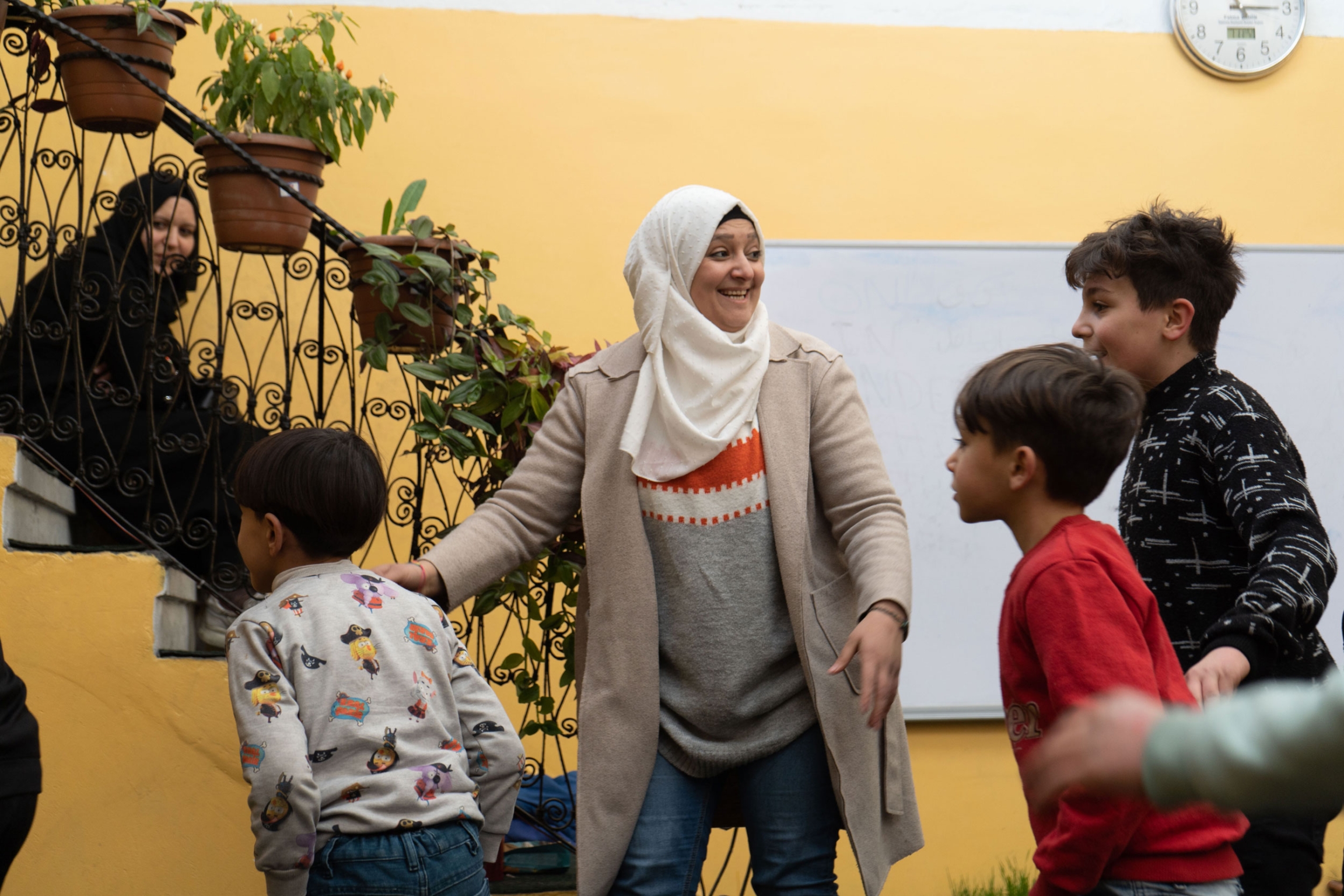
Hibah Jahjah interacts with children at Kids Rainbow, an alternative learning space.
Durrie Bouscaren/The World
The program quickly grew beyond capacity, requiring a new building. Of the 120 students who regularly attend Kids Rainbow, a third are not attending school. Another 100 students, Kara Ali said, are on a waiting list.
After speaking to parents, Jahjah realized that many Syrian children were dropping out of school because their families’ residence permits are tied to another province, effectively barring them from local schools in Gaziantep. Others were bullied in class, making going to school unbearable. Still others had their own behavioral issues — many had lost family members or had traumatic experiences during the war.
“They feel excluded, like they don’t fit in,” Jahjah said. “Often they lash out. And once your kid hits a Turkish kid – or even the opposite – Turkish teachers say they’re no longer welcome in class.”

Hibah Jahjah says Syrian children who are refugees often feel excluded from society.
Durrie Bouscaren/The World
A few months ago, after nearby schools began to implement the 30% rule, Kids Rainbow received a rush of new students.
Jahjah said a lot of parents simply took their kids out entirely rather than have them bussed to other schools. Dozens of new students came to Kids Rainbow as an alternative, straining its capacity as a small nonprofit.
Projects like Kids Rainbow are a band-aid, not a solution, Jahjah said.
“We can’t give them any kind of certificate that they graduated,” she said. “All we can do is support them, and teach them, and try to make it a little easier.”

Mustafa Kara Ali plays a game with students at Kids Rainbow.
Durrie Bouscaren/The World
Despite the hurdles, many of the students have enthusiastic ideas about their futures — to become a math teacher, a professional soccer player or a newscaster.
Before afternoon classes, Jahjah leads the kids in a group game of “keep away,” with a rubber ball. Some stand off to the side, a bit wary. But eventually, everyone gets involved.
Her goal for Kids Rainbow is to be a place where kids feel safe, and wanted. And in that, she’s surely succeeded.
At the Jiang household in Taiwan’s western city of Taichung, the Lunar New Year means hearty meals, gifts of hong bao — red envelopes with money inside — and long games of mahjong.
Jiang Du-Hsin, 86, said that being able to be together with family again this year for the holiday that started on Jan. 22, and will last until Feb. 1, has been edifying after being kept apart during the pandemic.
“It’s good for us. It’s a tradition,” Jiang said. “All of us are very happy to be together.”

Jiang Du-Hsin, grandfather of the Jiang family (right), along with his wife, Bai Yue-Qin.
Courtesy of Jiang Du-Hsin
Lunar New Year celebrations have kicked off in China, Taiwan and across the Asia-Pacific region.
In China, the holiday marks one of the world’s largest mass migrations, with many of the country’s 1.4 billion-strong population heading from cities back to their family homes. And it has public health experts fearing that China’s ongoing wave of COVID-19 could get much worse.
In Taiwan, however, cases of the coronavirus have been relatively low for a while, with many people feeling much safer celebrating the holiday there.
Jiang, who had COVID-19 about a month ago, said he's pleased with how Taiwan handled the pandemic. He’s 86, and has had four COVID-19 shots.
“More than 90% of our population has [COVID-19] injections,” Jiang said. “I don’t think that COVID-19 is a big problem for the Taiwanese people.”
Almost 9 out of every 10 Taiwanese people have had two doses of a COVID-19 vaccine — and about three-quarters have had at least one booster. Taiwan hasn’t faced the same concerns as in neighboring China, where the Lunar New Year travel comes amid lagging vaccination rates among the elderly.
Jason Wang, a health policy expert at Stanford University, said it’s unlikely that the health system in Taiwan will be overwhelmed.
“If somebody were to get COVID[-19] … you could just use telehealth and go to a designated pharmacy to get antivirals,” Wang said.
He said that the situation in Taiwan is also different from in China because of how it reopened to the public.

Lin Yu-San sells traditional snacks on Dihua Street. She says more people are visiting the street this year thanks to fewer concerns about COVID-19.
Ashish Valentine/The World
“Taiwan has had a checklist to manage the potential chaos of reopening,” Wang explained. “It was staged, phase-by-phase, to gradually relax restrictions.”
The process included waiting until vaccination rates were high enough, stocks of booster shots and antivirals were on hand, and the country had good levels of hospital and telehealth capacity.
Even prior to the pandemic in 2019, travel between China and Taiwan was already restricted. As a result, even now, Taiwan isn’t seeing the same numbers of visitors from China as neighboring countries.
Given the rise in infections in China, Wang said that Taiwanese public health authorities are concerned about emerging new variants.

Many Taipei residents visit the city's historic Dihua Street to buy goods for the Lunar New Year.
Ashish Valentine/The World
“One of the things that Taiwan’s government has already done is to monitor travelers from China, and to study the variants of travelers from China, compared to travelers from elsewhere,” Wang said.
But he added that Taiwanese officials haven't yet detected any variants of significant concern.
In a speech a few weeks ago, Taiwan’s President Tsai Ing-Wen offered support to China in dealing with its new COVID-19 wave.
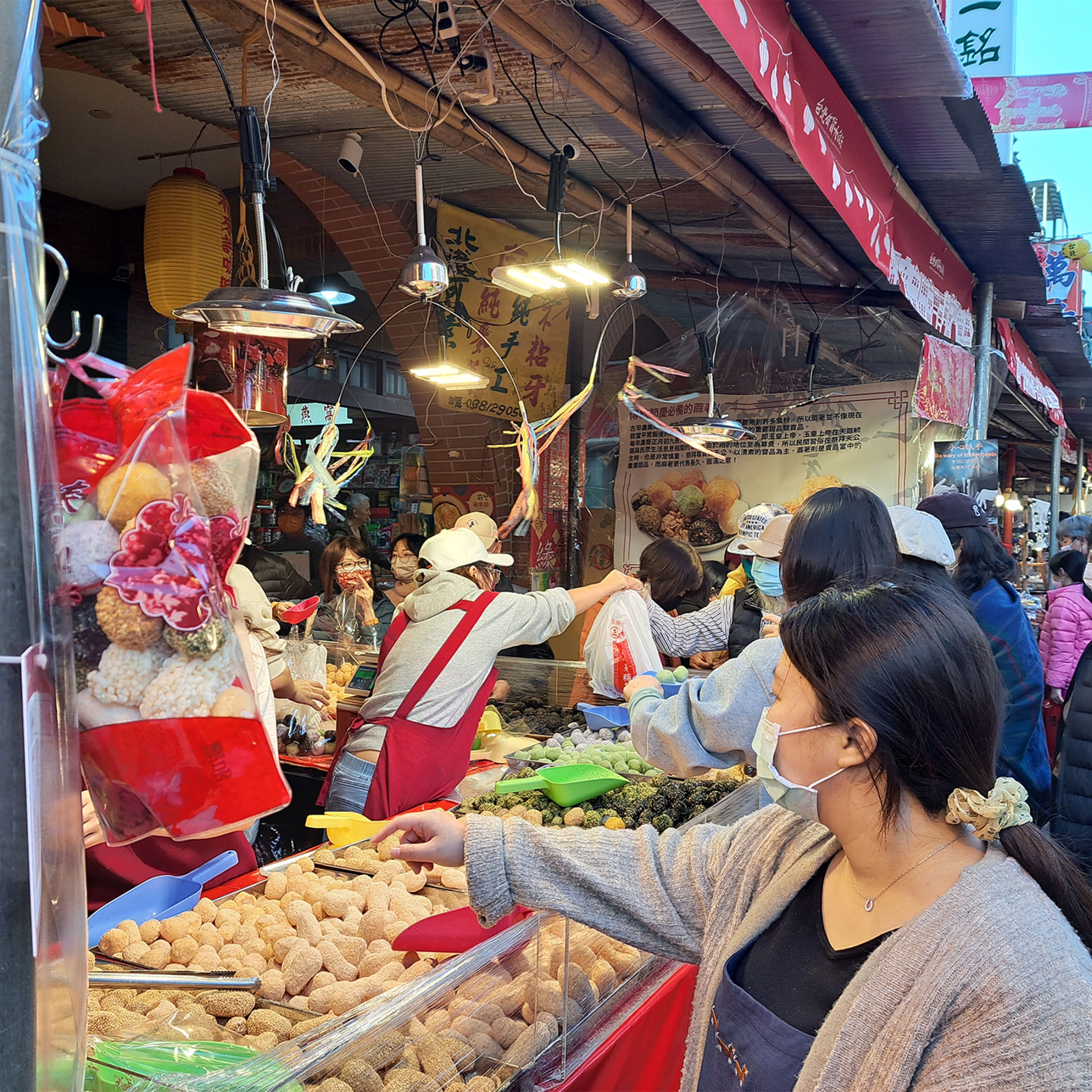
A woman shops ahead of Lunar New Year on Dihua Street in Taipei, Taiwan.
Ashish Valentine/The World
“We are aware that the pandemic situation has recently become more serious in China,” Tsai said. “If need be, we are willing, out of humanitarian concern, to provide necessary assistance to help more people get through the pandemic and enjoy good health and peace of mind in the new year.”
Claire Hollants contributed reporting from Taichung.
The Chinese gehu instrument is slowly making a comeback after years spent in obscurity.
The gehu was introduced in the early 20th century, when, after years of influence from Western orchestras, China outlawed Western music in favor of Chinese instruments. But by the late 20th century, the string instrument had nearly disappeared from Chinese ethnic orchestras, getting replaced, again, by the cello.

An up-close image of the gehu string instrument.
Courtesy of Yuxin Wu
Now, the gehu is mostly used by musicians in the Hong Kong Chinese Orchestra and Yuxin Wu, a second-generation gehu player at Boston's Berklee College of Music, who is on a mission to revive it.
"It doesn't have a very great or healthy industry environment," Wu said.
In China, there are not enough teachers for students to learn the instrument, so those looking to learn how to play the gehu are usually self-taught.
"I'm just trying to discover different styles and techniques on different kinds of stages and orchestras," Wu said.
The gehu has four strings, a fingerboard and a horizontal cylinder, and it’s played with a bow. Its sound is deep, bright, round and rich, with a wide range of notes.
As a relative of the stringed erhu instrument, it fills the need for a lower-pitched instrument in the orchestra.
"The principle of the vibration is quite different from the cello," Wu said.
That’s because the instrument is wrapped in snakeskin, creating a vibrational sound that differs from the wood of a cello. The string vibrates through a barrel on the outer bridge that connects to the python skin on the inner bridge, amplifying the vibration.
Wu said the gehu’s tone integrates with the Chinese orchestra better than the Western cello and double bass.
So far, Wu has incorporated the sounds of the gehu into both Western and Chinese symphonies, pop, jazz, and heavy metal bands. He hopes to create better education on the instrument, including how to play it, build it and maintain it.
Alice Farnham, one of Britain’s leading conductors, has seen the new Cate Blanchett movie, “Tár,” twice, the first time after the film’s lead actor asked her to watch it.
Blanchett plays the role of Lydia Tár, a world-class conductor appointed to lead a major ensemble in Berlin.
Farnham said that she thought that the film was fascinating, but the character of Tár is clearly fictional: “Lydia Tár [Blanchett’s character] is pretty monstrous but I don't know any female conductors like that, thankfully.”

Alice Farnham is one of Britain’s leading conductors.
Maryam Barari
Blanchett is tipped to win her third Oscar for her performance in "Tár," but the film has divided opinion in the world of classical music and shone a spotlight on the continuing dearth of women leading major orchestras worldwide.
Marin Alsop, the world-renowned US conductor, has described the film as “offensive” and “anti-woman.” To finally have a female conductor played onscreen by an actor like Blanchett, and then, to see her depicted as an abuser, Alsop said, was heartbreaking to watch.
Blanchett herself has defended the storyline in press interviews following Alsop’s criticism. The actor said she expected the film to elicit a lot of strong responses from people but the movie "is a meditation on power, and power is genderless."
Farnham said that for herself, the movie is less about conducting and more a reflection on power and the abuse of it.
She said it’s hard to imagine “Tár” being made even 10 years ago because back then, no one would have believed a woman could be musical director of one of the world’s top orchestras. Farnham said that she is acutely aware of how things have changed for conductors over the last decade. And, she has just published a new book, “In Good Hands: The Making of a Modern Conductor,” on the subject.
Farnham started out in the early 1990s when there were only a handful of professional female conductors in Britain, including the likes of Sian Edwards and Jane Glover.
Twenty years later, Farnham realized, almost nothing had changed. A report in 2015 found that 1.4% of conductors leading professional orchestras in the UK were women. In the US, it’s no better.
For years, Alsop was the only female musical director among the 25 largest ensembles in the United States. When her tenure at the Baltimore Symphony Orchestra ended in 2021, that figure dropped to zero.
Later that year, Nathalie Stutzmann was appointed as the new music director of the Atlanta Symphony Orchestra, making her the second-ever female conductor of a major US ensemble.
In 2013, Farnham decided to make an effort to address the problem, establishing workshops to encourage women to try conducting. She began mentoring young female conductors, including Galway-based musician Sinead Hayes. Today, Hayes leads the Hard Rain Soloist Ensemble, a contemporary music group in Belfast, and she conducts classical music orchestras across Ireland.

Sinead Hayes leads the Hard Rain Soloist Ensemble, a contemporary music group in Belfast, and she conducts classical music orchestras across Ireland.
Neil Harrison
Farnham said that for some women, confidence can be part of the problem. Becoming a professional conductor is an arduous journey and mistakes are often highly visible because a musical director can only truly hone their skills in front of an orchestra and an audience.
Sometimes, Farnham said, this public humiliation can turn women off the idea of putting themselves out there.
Hayes, of the Hard Rain Soloist Ensemble, said that she blames the gatekeepers — those who decide who gets selected for a music course, or later, who gets to lead an orchestra that will often make or break a conductor’s career.
Hayes said some gatekeepers see women conductors as a risky bet and resort to the stereotype of the male maestro. She has seen friends take time off to have children, and some managers see that as a potential loss of money for the ensemble.
But slowly, attitudes are changing, she said. Hayes has now developed her own teaching workshops known as the Sandbox Conducting Sessions to train the next generation of conductors in Ireland, regardless of gender, age or socio-economic background.
Philadelphia-based conductor Jeri Lynne Johnson is familiar with how gatekeepers can change the trajectory of a conductor’s career. In 2007, Johnson, who's African American, applied for the role of music director to a number of orchestras in the US.

Philadelphia-based conductor Jeri Lynne Johnson is shown from her time with the Sao Paulo Municipal Orchestra.
Rafael Salvador
She wasn’t successful but after the audition, the chair of the search committee offered her some feedback.
“He said,‘You just don't look like what our orchestra expects the maestro to look like,’” she said.
Johnson said that she was outraged but she now appreciates his honesty because it gave her the impetus to start her own orchestra. Today, Johnson leads the Black Pearl Chamber Orchestra in Philadelphia, with musicians from around the world.
She said that she believes that the diversity of her performers attracts a more diverse audience.
“Having Black conductors on the podium, having Latin women on the podium, having African American women on the podium, that sends the message that this music is for you,” she said.
Johnson also conducts orchestras across the United States and Europe, but she said audiences can still appear taken aback when she walks up on stage. Particularly at opera performances where the orchestra and musical director are usually out of sight.
Johnson said when she goes up on stage for her final bow, the audience sometimes stops clapping because they aren’t sure who she is.
“I'm not, you know, the white guy in the tuxedo,” she said.
“They don't know who I am until they see the stick. And then they're like, ‘Oh, she was the conductor,’” Johnson said.
Farnham said that in spite of her efforts to encourage younger women to take up the baton, she is conscious of not being pigeonholed.
“Society often assigns you the role of nurturer when you are a female conductor,” she said, adding, “It's something I'm very mindful of but I still want to be taken seriously as a professional conductor as well, because after all that’s what I am.”
Every day, hundreds of people line up at an iconic single-screen movie theater in central Mumbai, not to see the latest blockbuster, but a beloved Bollywood classic released in 1995.
For 27 years, the Maratha Mandir theater has played “Dilwale Duhania Le Jayenge,” or “The Big Hearted Will Take the Bride,” daily at 11:30 a.m. for legions of adoring fans. Many Indians affectionately refer to the film as “DDLJ,” for short.

Fans line up to see "DDLJ" at this Mumbai theater.
Justin Nisly/The World
DDLJ is the longest-running film in India’s history. Celebrated for its likable main characters, picturesque international locations and depictions of a rapidly-modernizing India, the film quickly became a hit. Nearly three decades later, it’s these same qualities that draw people to the theater each day.
“Literally at home, I have already watched this movie almost 270 times,” moviegoer Sanket Salve said. He traveled seven hours by train to watch the film on the big screen, and was excited to laugh, clap and cheer along with hundreds of other fans.
Aside from a brief pause due to COVID-19, audiences have been coming each day to the theater to experience the joy and catharsis of this film. In mid-December last year, a sign in front of the theater said it had been running for 1,354 weeks and counting.

Two attendees show off their tickets.
Justin Nisly/The World
DDLJ tells the story of traditional, good-girl Simran, and Casanova-type, party boy, Raj. They fall in love while vacationing with friends in Europe, and must find a way to stay together, despite strong objections from Simran’s father. The movie turned actors Kajol and Shah Rukh Khan into superstars.
College student Akshata Pawar said that she loves “the romance, the songs that this movie has given to all of us. They are just, wow,” noting the chemistry between the two stars.
Shah Rukh Khan and Kajol have gone on to work in several other classic films together, but DDLJ is arguably the most beloved.
In addition to its charismatic young stars, the film is known for capturing the Indian zeitgeist in the mid-1990s – from fashion trends to its inclusion of the Indian diaspora.
Rajinder Dudrah, a cultural studies professor at Birmingham City University in England, said that DDLJ “encapsulates India on the verge of change — technologically, economically, culturally, but also India on the verge in relation to its NRI [Non-Resident Indian] population.”

Moviegoers take a selfie with the iconic DDLJ poster.
Justin Nisly/The World
By this time, many people with NRI status were living across Europe and North America. They could identify with the tension of remaining true to traditional Indian roots, while also exploring the world.
And for those in India, the scenes set in Europe fed into growing middle-class aspirations.
“You didn’t have to be uber-rich, you didn’t have to be highly rich, but you could be rich in a middle-class or upwardly mobile way to have these fantasies of wanting to go abroad,” Dudrah said. “And DDLJ certainly helped with those aspirations and those fantasies.”
In today’s context, some of DDLJ’s scenes read as outdated and even patriarchal, like when Raj tricks Simran into believing they slept together. When she dissolves into tears, he assures her that her respect and honor remain intact — because nothing happened between them.
Many other scenes capture a blossoming romance filled with light-hearted bickering and pranks.
Moviegover Jeevan Kattamuri said that his favorite song is also the most well-known: “Tujhe Dekha Toh Yeh Jaana Sanam,” which describes the “crazy” feeling of falling in love.
Perhaps the most memorable sequence comes at the end of the film. After it appears that Simran’s father will never approve of them as a couple, Raj boards a train to leave. Simran begs her father to let go of her wrist so that she can join him.
And just as it seems that all hope is lost, Simran’s father relents, saying: “Ja Simran, Ja. Jee Le Apni Zindagi,” or “Go, Simran, go. Live your life.”
Simran races after the moving train. The music pulses until their hands clasp together and Raj pulls her to him.
According to the theater’s executive director Manoj Desai, a key part of the film’s longevity is the ticket prices. Only 30 to 40 rupees, or .37 to .50 cents. For three hours of epic romance, it’s a steal. And Desai has no plans to end the run.
“[As long as] the public comes like this, I’ll keep running this,” Desai said. “We don’t bother for, you know, profit.”

The Maratha Mandir theater can seat hundreds.
Justin Nisly/The World
DDLJ might have even more international fans. The film’s director, Aditya Chopra, has adapted the story for the American stage, calling it “Come Fall in Love: The DDLJ Musical.” After an extended run at the Old Globe theater in San Diego, California, the team aims to move to Broadway soon.
Back in Mumbai, the matinee screening of the film will keep running at the Maratha Mandir. So, there are plenty more opportunities for moments like this one between Pawar and her college friend.
“She was laughing, she was screaming with me,” Pawar said. “We were dancing! We danced, we danced. We loved it.”
They said they would try to come again the very next day.
Shakira is turning her recent breakup into a plentiful source of inspiration and commercial success.
The Colombian singer has teamed up with Argentine producer Bizarrap for her latest hit — a visceral, scathing diss track about the infidelity of her ex-partner, former soccer player Gerard Piqué.
The song, simply titled “SHAKIRA BZRP Music Sessions #53,” debuted at the top of the charts upon its release on Jan. 12.
With more than 50 million views on YouTube within the first 24 hours, it became the biggest-ever debut for a song by a Latin artist in the platform’s history.
Shakira wrote on Instagram that she didn’t expect the record to go straight to No. 1 — especially at her age of 45 and while singing in Spanish.
“I want to embrace millions of women who revolt against those who made us feel insignificant.”
“I want to embrace millions of women who revolt against those who made us feel insignificant,” she posted.
The lyrics, coming out as a spontaneous rant, are notably unambiguous about the reasons behind Shakira’s recent break with Piqué, the father of her two sons, after a 12-year relationship.
“I was out of your league, that’s why you’re with someone just like you,” Shakira sings in the chorus.
“I’m worth two 22-year-olds,” she croons, slamming the former FC Barcelona player for cheating on her with a younger woman. And she adds: “You traded in a Ferrari for a [Renault] Twingo. You traded in a Rolex for a Casio.”
Mockingly, the singer makes plays on words with the names of her ex and his new lover. Shakira even refers to the tax fraud case for which she will stand trial in Spain this year, and which could carry a prison sentence for failing to pay 14.5 million euros in income taxes ($15.74 million): “You left me with your mom as a neighbor, the press at my door and a debt with tax authorities.”
Such directness comes in contrast to Shakira’s previous lyrics, which used to be private and more generic, journalist Nuria Net said.
“Now, it feels more personal,” said Net, who is co-founder of the podcast studio La Coctelera music.
“What people are kind of shocked [about] is that she would name names, that she would be so specific with the jabs,” she said.
Producer Bizarrap deserves much credit, too, journalist and culture critic Yeray Sánchez Iborra said, for imbuing the song with his trademark blend of hip-hop beats, electronic sounds and an easy-to-sing-along chorus.
“Bizarrap is on a roll: Whatever he touches, he turns into gold,” Sánchez Iborra said. “He probably is the most influential producer in the world at the moment.”
Along with commercial success, the song has also attracted great controversy.
Venezuelan artist Briella has accused Shakira and Bizarrap of plagiarizing the chorus of her song “Solo Tú,” released last June.
Shakira was also criticized for being too harsh on Piqué and his girlfriend, and for using a platform as powerful as her music to diminish a younger woman.
While Piqué hasn’t explicitly commented on the song, he appeared to be doubling down on the spat by driving to work in a Renault Twingo, and by announcing a partnership between Casio and the Kings League, his latest sports venture.
To journalist Net, this hints that the public row between the two celebrities may be premeditated.
“What people are not realizing is that they're both benefiting from this.”
For a star of such caliber as Shakira, everything is strategized and calculated, Net said.
Shakira, who was born in Barranquilla, Colombia, began recording her own songs as a teenager in the early 1990s.
Net, who grew up in Puerto Rico, remembers hearing Shakira’s early records at the time, like her album "Pies Descalzos," which stood out in a pop landscape dominated by “manufactured stars.”
“She was someone our age, a young woman speaking about heartbreak, and love, and about her aspirations and dreams, so that was super refreshing,” Net explained. “She was a revelation across Latin America.”
The singer-songwriter eventually turned into a pop star reaching for a larger audience, and began recording versions of her hit songs both in Spanish and in English.
“Nowadays, you don’t need to sing in English anymore. “But in the late ‘90s, in order to cross over to new markets, you needed to sing in English.”
“Nowadays, you don’t need to sing in English anymore,” Net said. “But in the late '90s, in order to cross over to new markets, you needed to sing in English.”
In 2005, the album “Fijación Oral/Oral Fixation” featured the songs “Hips Don’t Lie,” one of her biggest hits to date, as well as “La Tortura,” a collaboration with Spanish singer Alejandro Sanz, with reggaeton-inspired rhythms.
“She was one of the first pop artists to jump on the reggaeton bandwagon when it wasn’t fashionable,” Net said. “So, she’s been at the forefront of that.”
Eclecticism became a staple of Shakira’s brand as an artist. Shakira, whose dance moves were inspired by her Arab roots, became a defining figure of a globalized music market.
Net sees Shakira as the biggest female Latin star in music over the past 30 years.
“There hasn't been another figure like her since,” she said.
In 2010, Shakira released her soccer anthem “Waka Waka (This Time for Africa),” and performed at the opening ceremony of the South Africa World Cup.
She also met Piqué, who at 23 took the trophy home with Spain and became one of the most-famous soccer players on the planet.
Shakira eventually moved to Barcelona, where Piqué spent most of his professional career at a club level before retiring last fall.
The singer said in a recent interview with Elle magazine that one of the two had to make a sacrifice, and that she put her career on the back burner for their family.
Still, over the past decade, Shakira continued to rack up commercial success, with star collaborations with Carlos Vives, Maluma or the Black Eyed Peas, and performing at the 2020 Super Bowl Halftime Show. However, Net described her artistic output as “creatively dry.”
Shakira’s latest work, though, may signal a shift.
The Bizarrap session is the latest in a trilogy of breakup songs made in collaboration with younger Latin artists, including “Te Felicito” with Rauw Alejandro, and “Monotonía” with Ozuna.
Nuria Net said Shakira hasn’t been this openly vulnerable for a long time.
“It does [take] me back to her beginnings when she was a singer-songwriter, a teenager, writing songs with her guitar,” Net said.
Shakira, herself, acknowledged feeling more creative in the Elle interview, and described making new music and working on her upcoming album amid heartbreak as therapeutic.
“Writing music is like going to the shrink, only cheaper,” she said.
Maame Appiah started to notice something unusual about her 3-year-old toddler when he was just a baby.
Breastfeeding was a challenge: “He couldn’t even suckle. He had breathing issues,” she said.
Doctors later diagnosed her son with cerebral palsy — a condition that affects a child’s brain and impacts the ability to control muscles in the body. He was also diagnosed with autism, a complex neurobehavioral disorder.
Developmental brain disorders are rarely discussed in Ghana. A lack of adequate awareness and facilities for early diagnosis makes it tough to manage. And children with special needs often face discrimination in terms of inadequate health care, education and social engagement.
Appiah sought help for her child — including prayer camps — to no avail. Over time, she was able to move past her grief and find the support he needs. Today, her son receives various therapies once a week to help him develop the skills he needs to thrive.
There are thousands more stories like Appiah’s across Ghana.
Ama Boatemaa lives with her 19-year-old child with autism in Obom-Kojontor, an Accra suburb. She said she had to defy her husband just to keep her daughter alive.
“My husband kept insisting that he’s been to so many spiritual homes where he’s been told that our daughter is a marine spirit. He once suggested we poison or kill the child. When I refused, he got very angry and abandoned us,” she said.
Boatemaa has single-handedly fended for her daughter. She said that transportation to and from the hospital or school has been the most challenging. Some drivers refused to pick her up because her daughter drools profusely. Eventually, her daughter dropped out of school.
"Sometimes, it feels like the whole world is against you," Boatemaa said.
Mary Amoah Kufour, whose 20-year-old daughter has autism, is determined to change the narrative for children with special needs and their caregivers.
Like many parents of autistic children, Kufour said she was in denial for years when she learned her daughter had autism. She already had two boys without any disabilities.
In 2016, Kufour founded Klicks Africa Foundation, a center for early intervention and support for children under the age of 5 as well as young adults on the autism spectrum.
"Sometimes, I see myself as somebody who gave birth in the past 20 years and the child never grows," she said.
Her daughter needs 24/7 support, from bathing and eating to directing her on daily tasks.

Mary Kufuor, founder of Klicks Africa Foundation, stands by a portrait of her autistic daughter, Nana Yaa.
Ridwan Karim Dini-Osman/The World
The abilities of people on the autism spectrum can vary and evolve over time. Some can live independently while others have severe disabilities that require lifelong care and support.
Kufour encourages parents and caregivers to focus on creating opportunities for children with autism to thrive.
"It is OK to cry, but you don't need to wallow in your own pity for long."
According to UNICEF, nearly 240 million children with disabilities face barriers to basic needs including nutrition, health and education.
The country’s 2016 inclusive education policy aims to increase access for children with disabilities in public schools. But the government has yet to fully implement it.
Instead, parents must enroll their children with special needs in learning centers that can cost more than $3,000 per year — a cost-prohibitive fee for most families.
Kufour is able to accommodate families with highly subsidized rates through donations and personal funds.
She said she’s on a mission to demystify autism and advocate for all children with disabilities. The majority at her center have autism while others have Down syndrome or undiagnosed, developmental delays.
At the center, instructors use everyday routines to teach communication and social skills. Students attend daily therapy sessions and visit with a neurodevelopmental pediatrician.
Instructor Akua Amoako Yeboah said that early intervention is critical for achieving certain milestones. Some children who began with various challenges are now seeing improvements.

Therapy sessions ongoing at the early intervention center at Klicks Africa Foundation.
Ridwan Karim Dini-Osman/The World
Elyse Aba Acquah, 16, is on the autism spectrum. Her instructors said she has shown significant improvement with her communication and comprehension skills.
"They teach me how to write. I can write my name, alphabets and subtraction, numbers and we do addition and subtraction, too," she said.

Elyse Aba Acquah, 16, is on the autism spectrum.
Ridwan Karim Dini-Osman/The World
Children with special needs are routinely left out of mainstream education. The COVID-19 pandemic has only exacerbated the education gap.
A 2021 UNICEF report reveals that children with disabilities have 42% fewer chances of achieving foundational literacy skills. The probability of never attending school is 49% higher for them.
Kufour spreads awareness about these challenges by livestreaming with her 400,000 Facebook followers. She said she is already seeing a shift among parents and caretakers.
"We've made a lot of impact out there," she said. "But, we have a long way to go."
Kufour is not alone in her advocacy efforts for children with autism.
Model and actor Afi Antonio created Mr. & Miss Autism Ghana, a pageant initiative that promotes social inclusion for youth with autism.
The project is a confidence-booster for parents and their children alike. Antonio said that she hopes that the pageant will open more opportunities for the youth.
“It’s been my prayer that corporate institutions or someone will use them as brand ambassadors so that people can see them on billboards and [on TV],” she said.

Afi Antonio (left) stands next to the winners of the 2022 Mr. and Miss Autism Ghana Pageant.
Ridwan Karim Dini-Osman/The World
Kufuor said that with increased awareness and support, all children with special needs can lead full lives. Her daughter has already started showing interest in fashion and hopes to pursue a career in modeling.
“Inclusive education cannot be preserved for those who can afford it,” she said, adding that all children deserve to reach their full potential.
Germany has faced mounting pressure to supply Leopard 2 battle tanks to Kyiv as the war in Ukraine rages on — or to clear the way for other countries, such as Poland, to deliver German-made Leopards from their own stocks.
Defense Secretary Lloyd Austin plans to host a regular coordination meeting of Ukraine's Western allies at the United States' Ramstein Air Base in Germany on Friday.
Western leaders have been cautious in their approach to Ukraine’s repeated requests over the past few months for heavier vehicles, including Leopard, as well as American Abrams tanks.
Meanwhile, Berlin has said that it will send its vehicles only after the US sends its tanks.
The World's host Marco Werman speaks with retired Navy Admiral James Stavridis, who is the former NATO supreme allied commander, about how a delivery of tanks would make a difference.
This interview has been lightly edited and condensed for clarity. AP contributed to this report.
Brazilian artist Dalton Paula’s home studio door is always open, but visitors must first walk through a green corridor he planted himself.
“These gardens have sacred plants,” he said. “The idea is that this is a space that welcomes, that protects.”
Growing up in Brazil as a Black man, Paula said he missed seeing people who looked like him on movies and TV. At 40, he creates paintings, photos and installations about Black communities.
His works have been acquired by major art institutions, including the Museum of Modern Art in New York and The Art Institute of Chicago.

At Sertão Negro, artists cultivate seeds and reuse water from the rainfall.
Gisele Regatão/The World
Paula lives on the outskirts of Goiânia, the capital of Goiás state. He shares his home with his partner of 14 years, film professor Conceição de Maria Ferreira da Silva. In 2021, they turned their home into an art school called Sertão Negro, or Black Hinterland.
“This is a Quilombo, a space that is based in the Afro Brazilian universe and considers the soil and the plants sacred,” he said. Traditionally, Quilombos are settlements created during colonial times by people who'd escaped enslavement.
Sertão Negro offers a wide range of classes like pottery and capoeira, movie screenings and access to a library with more than 1,000 books.

Dalton Paula sitting at his workstation inside his home/studio/art school Sertão Negro.
Gisele Regatão/The World
The school also hosts an artists' residency and sells their work. Paula is now building three bedrooms that will house future artists. They will pay for the residency and that income will help finance the school.
Sertão Negro employs nine people, including three artists who also work as assistants.
Artist and assistant Lucelia Maciel is currently working on a sculptural project. She said that Sertão Negro taught her the business side of running a studio. She enjoys working with other artists and getting Paula’s feedback, but he can be tough sometimes.
“He is demanding,” she said. “An expression that he uses a lot is: ‘Think about layers, bring more layers.’”

Lucelia Maciel is one of Dalton Paula's assistants and she also produces her own work, like these sculptures of lamps with tiny busts of people from her home state of Bahia.
Gisele Regatão/The World
Paula has been making art since he was a teenager, but he first went to college to study chemistry. And for 12 years, he worked full-time as a firefighter. When he began his visual arts studies at the federal University of Goiás, he worked the night shift.
“I would rescue people who had been shot, stabbed, injured in car crashes. And then I would study, like a zombie, falling asleep,” he said.
His firefighter colleagues became some of his first clients.
His inspiration for the school comes from the idea that art is a tool and that the role of the artist is to respond to the world, referring to the recent vandalism of government buildings by supporters of former President Jair Bolsonaro.
“In this moment, with the attacks, art is an answer to all of this,” he said.
As a Black man, he said he is often seen as a threat. To capture this experience, he created a photo performance, standing in front of walls with his eyes or head covered. In 2011, that work was selected for the group show “Rumos Artes Visuais,” organized by Itaú Cultural in São Paulo.
His big break came in 2016 when he was invited to present at the prestigious São Paulo Biennial.
Two years later, he started visiting Quilombo communities in his state. He now photographs current residents and paints their portraits using research about those who lived in the same areas in the 18th and 19th centuries.

“Esperança Garcia (18th century),” 2022, by Dalton Paula.
Courtesy of Dalton Paula
“He takes the history and he takes the photographs and he matches them. So, he gives these people who were never photographed, or drawn, an identity,” said Carolyn Alexander, owner of the Soho gallery Alexander and Bonin, which represents Paula in New York.
The intricate, layered portraits use gold leaf for hair. Each painting costs $25,000.
Alexander first met Paula at an art fair in Brazil in 2018 and invited him to New York for a residency in 2020. The pandemic limited Paula’s plans, but he produced a lot of art and sold six paintings to the city's Museum of Modern Art.
“I personally knew that Dalton Paula was somebody who I wanted to be in a life-long relationship with,” said Thomas Jean Lax, a curator at MoMA specializing in Black art and performance who orchestrated the purchase.
Lax first encountered Paula’s work in early 2020, when he visited studios and museums in Brazil. He said he appreciates that, with these paintings, Paula is imagining who his subjects could have been.
“That dimension of the unknown, of embracing the unknown, is really important not only for his work, but also gives Black artists the full range of possibilities as we bear witness to the things that they have made,” he said.
Paula’s latest piece is a commission from Pinacoteca de São Paulo, a museum devoted to Brazilian art. The installation is called “Cotton Route,” featuring several bottles and jars covered in white, cotton canvas with painted images that are displayed on several draped altars.
“I found all of this kind of enigmatic,” said Caroline Paz, a graduate student in cultural criticism who visited the show in early January.
The installation speaks to the economic and cultural impact of cotton production in Brazil and the US.
Paz said the work holds important symbolism for Black people like her.
“Many are still on the margins, it’s a constant struggle. But it’s very important to know that we have here, today, the work of someone who can show his art to the world, particularly because he is a Black artist,” she said.

Dalton Paula’s partner Ceiça Ferreira (right) and other artists and employees at Sertão Negro often eat lunch together.
Gisele Regatão/The World
Paula is now working on several new projects, including a series of paintings of Black children. And he and his partner are planning on having a child.
“My partner says that I passed through the ‘dreamline’ many times, and I grabbed dreams of those who didn’t want many dreams,” Paula said, laughing.
A few of these projects use materials that Paula has never worked with before.
“I’m always doing this exercise — when something is very set — I create new challenges for myself. And that’s the work of a lifetime, the work of an artist,” he said.
The exhibition at Pinacoteca closes at the end of January.
New York City is known for its Broadway musicals, Wall Street, the Yankees and its happening nightlife. There’s something, though, that people don’t generally associate with the Big Apple — religion. A new museum exhibit highlights sacred spaces in a city that’s often seen as broadly secular.
Azra Dawood, an architect, historian and curator, designed “City of Faith: Religion, Activism and Urban Space” an exhibition currently on display at the Museum of the City of New York through Sept. 18. It takes a deeper look at the city’s religious roots alongside its immigrant experience, with a focus on the South Asian community following the attacks of 9/11.
“New York is as religious as part of the Bible Belt, with the difference being the city's specific demographic makeup,” Dawood said during a panel discussion at the museum about the exhibit in December.

Matthew Engelke moderates a panel discussion for "City of Faith" exhibit with speakers Alyssa Maldonado-Estrada, Hussein Rashid and exhibition curator Azra Dawood, New York, Dec. 1, 2022.
Sara Hassan/The World
As an architectural historian, Dawood said she looks at built environments through the lens of religion and race, as well as the themes of empire and philanthropy. In the past, her work has focused on Protestantism, so she wanted to take discussions on religion and race in a different direction with this exhibit.
"What we're seeing in the history of the city is a series of communities arriving or growing in number.”
“The city's 'fathers’ favored Protestantism. Later, when Catholic and Jewish communities arrived and grew in numbers, they, too, had to make space for themselves, and they too, had to struggle,” she told The World.
“It's a very well-documented struggle for both communities. And so, I think what we're seeing in the history of the city is a series of communities arriving or growing in number.”

Visitors examine the displays at the "City of Faith" exhibit at the Museum of the City of New York, Dec. 1, 2022.
Sara Hassan/The World
She explained that Muslims have been in New York for hundreds of years, but that the Muslim community also had to make space for themselves. That process hasn’t been easy, especially in the aftermath of the attacks on Sept. 11, 2001, which directly targeted New York.
The Muslim community has faced challenges such as police surveillance, racial profiling and hate crimes. Attacks on members of the community even spilled over to others perceived to be Muslim, including Sikhs and Hindus. One example was Sunando Sen, a Hindu immigrant from India, who was killed in 2012, after being pushed in front of an oncoming subway train.
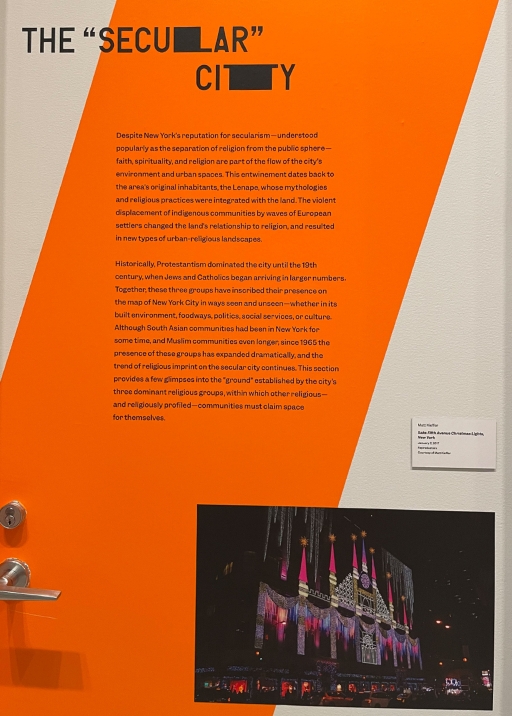
A display at the "City of Faith" exhibit discussing the sacred elements within a city that's often seen as broadly secular, New York, Dec. 1, 2022.
Sara Hassan/The World
“I think it's really poignant to look at this part of New York City,” said Shelley Yu, a Columbia University student who visited the exhibit.
“I had never known of this incident before, and to hear it being explained so poignantly, it was very touching and very sobering to hear.”
That story was conveyed through a video presentation, with images on one screen and simple white text on another black screen that explained one line at a time how the incident and trial unfolded.
It's part of an entire multimedia, sensory experience that includes photos, audio recordings, poetry, artwork and even a scent installation.
A combination of musk, frankincense, sandalwood and rose greets visitors as they enter. The sweet fusion of fragrances — ones that are often found inside mosques — was designed by the Brooklyn-based perfumer and author, Tanaïs.
In another interactive display, visitors encounter a set of bright, red folders mounted on the wall, each with a phrase written on top that’s connected to the 9/11 aftermath, such as “Blanket Surveillance,” “Repercussions” or “History Repeating.”
The folders contain files that people can pick up and read through.

One of the displays of the "City of Faith" exhibit that represents the diffiuclties for immigrants, mainly in the South Asian community, after the attacks of 9/11, New York, Dec. 1, 2022.
Sara Hassan/The World
“Being part of a marginalized identity means that your body becomes political in and of itself, and that makes you have a heightened visibility,” said Grey Bakwin, an architecture student from Barnard College, who also visited the exhibit.
"I think it's incredibly important for the history of the city to be talked about and discussed and displayed."
“And then, at the same time, being pushed and peripheralized means that there's less visibility. I think it's incredibly important for the history of the city to be talked about and discussed and displayed.”
“City of Faith” includes a range of religious immigrant experiences, like the ones Dawood mentioned.

A map of Jewish heritage sites and institutions across New York, called "What is a Jew: From Emma Goldman to Goldman Sachs," on display as part of the "City of Faith" exhibit, New York, Dec. 1, 2022.
Sara Hassan/The World
It incorporates a map of Jewish heritage sites and institutions across the city, along with an image of a 19th-century Catholic school.
To this day, there are many churches nestled throughout New York. The most famous might just be the towering St. Patrick's Cathedral, found in the heart of midtown Manhattan.
There are also the Church of Saint Mary the Virgin in Times Square and the Trinity Church Wall Street in the financial district.
Business magnate and philanthropist John D. Rockefeller was a big contributor to the city’s religious architecture. One example is the Riverside Church near Columbia University.
People likely don’t know that the iconic Rockefeller Center was, at one point, Dawood said, supposed to include religious space.
“There was a chapel planned for the very top of the building,” she explained.

Image of a 19th-century Catholic school on display at the "City of Faith" exhibit, New York, Dec. 1, 2022.
Sara Hassan/The World
Even though it was never built, “this idea that there was a chapel right at the top of this real-estate venture is very interesting.”
Dawood’s career has taken her back and forth across continents. She earned a PhD at the Massachusetts Institute of Technology and spent a year teaching architecture at the University of Houston. She also taught in her hometown of Karachi, where she worked with Pakistan’s first female architect, Yasmeen Lari, during a summer internship at the Heritage Foundation. Lari has been recognized for her extensive humanitarian work and Dawood said it was meaningful to be working for someone like her, who helped her see her own hometown in a new way.
“You develop a connection with the city, and [you learn] more about [it] in a way than you would if you simply grew up there,” she said.
Seeing things from different perspectives, she said, is also a key message that she’s trying to convey in “City of Faith.”
Related: New exhibit shows how Islamic art influenced French luxury jewelry maker Cartier
When Indigenous activists, leaders and allies gathered on Jan. 2, at Brazil’s National Indian Foundation, FUNAI, it was finally time to celebrate.
This was an agency that had previously protected Indigenous rights and native land, but which, under former President Jair Bolsonaro, had been defunded, gutted and turned against them.
“It’s so great to be back here. We haven’t had a meeting here for a long time,” the new director Joenia Wapichana told a packed crowd. "And let’s remember,” she added, "from now on, the National Indian Foundation will be named the National Foundation of Indigenous Peoples."
Wapichana was Brazil’s first Indigenous lawyer and its first female Indigenous lawmaker. She was elected in 2018, and served in Congress over the last four years.
She said that President Luiz Inácio Lula da Silva had invited her personally to head the agency as its first Indigenous director.
“It will be a challenge,” she said. But Wapichana will have help.
FUNAI will now fall under the jurisdiction of Brazil’s first Indigenous People’s Ministry, led by prominent Indigenous activist Sonia Guajajara.

Brazil's President-elect Luiz Inacio Lula da Silva holds the hand of the his newly-named Minister of Indigenous Peoples Sonia Guajajara, during a meeting where he announced the ministers for his incoming government, in Brasilia, Brazil, Dec. 29, 2022.
Eraldo Peres/AP/File photo
Guajajara was Lula's first cabinet minister to be sworn in on inauguration day, and wore a feather headdress, carrying an Indigenous shaker in her right hand. Lula embraced her when she reached the podium.
"It’s a moment of such great emotion,” she said in her first speech to supporters. “I’ve been telling a lot of people that I've never felt this excited. Never in my life.”
Indigenous territories have been devastated in recent years by fires, clear cutting, mining and logging. Amazon deforestation is at a 15-year high. More than half of the destruction in recent years has been on conservation areas and native territories.
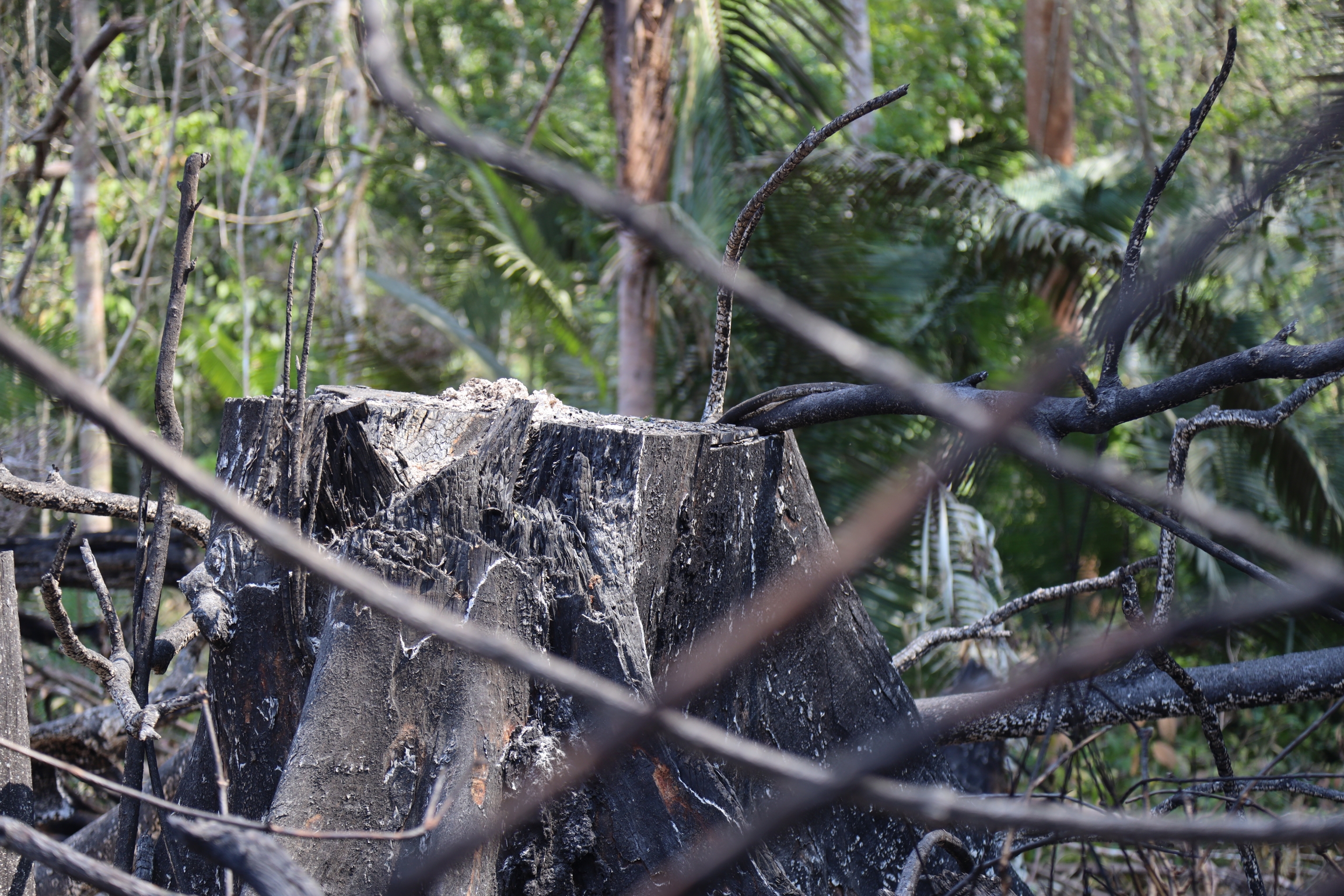
A tree stump on Indigenous land in the Amazonian state of Rondônia.
Michael Fox/The World
Indigenous peoples blame Bolsonaro for pushing for Amazon development and empowering illegal land grabbers.
Nowhere is this clearer than on Karipuna territory in the Amazonian state of Rondônia.
Walking through the jungle a few months ago, Chief André Karipuna pointed out the latest destruction of Indigenous land.
"This was all just burned," he said, staring out over the charred remnants of a once-pristine stretch of jungle. "You can still see the smoke. Less than a week ago, this was all green forest."
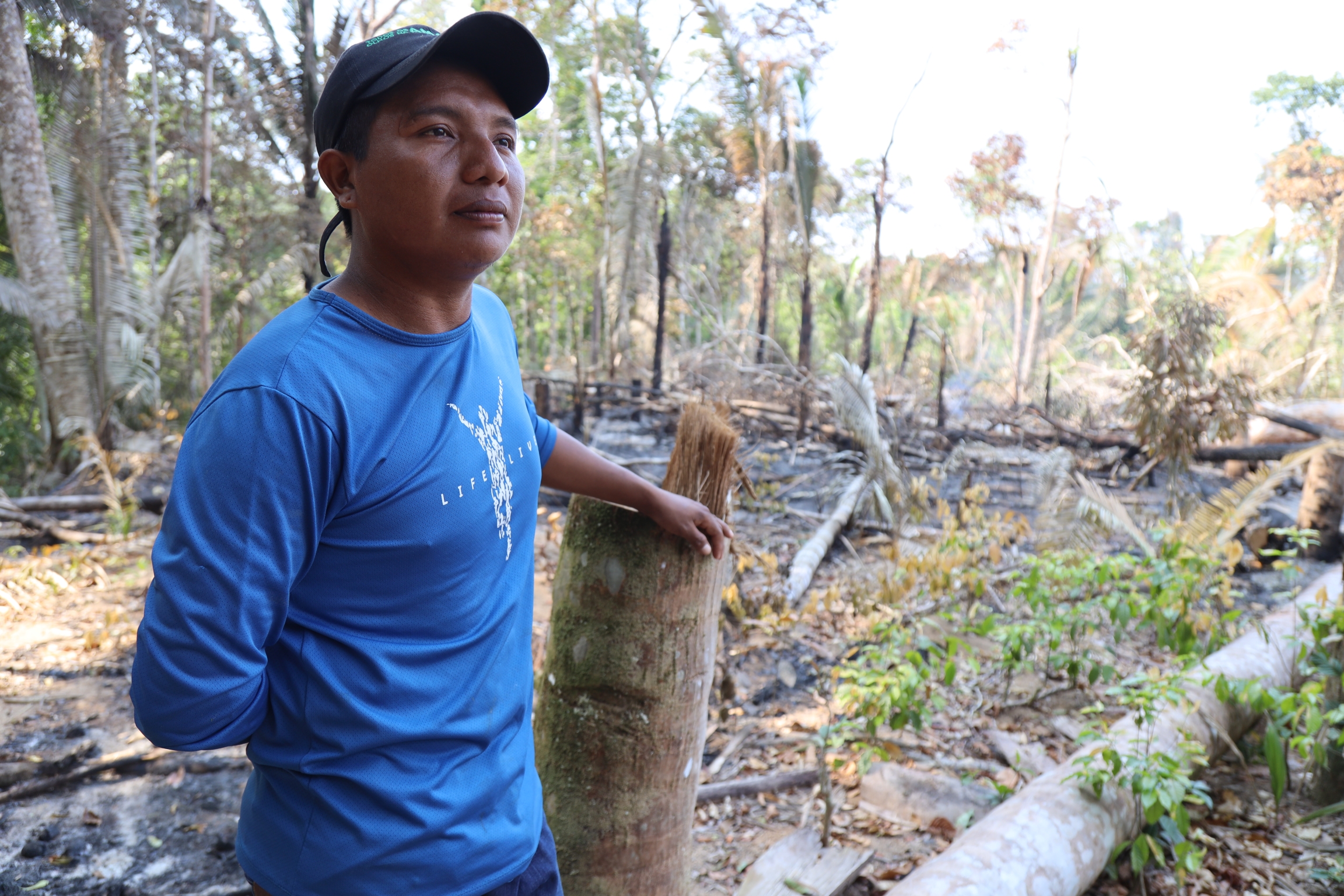
Chief André Karipuna points out destruction of Indigenous land in the Amazonian state of Rondônia.
Michael Fox/The World
But Lula has promised to stop the land invasions and the deforestation.
"The Indigenous peoples need to have their land demarcated and free from the threats of illegal and predatory economic activities,” Lula said during his inauguration speech.
“They're not obstacles to development. They are guardians of the rivers and forests and a fundamental piece of the greatness of our nation."
André Karipuna said he is excited about Lula’s victory, but concerned for what lies ahead.
"The invasions are really advanced,” he said. "We are hopeful that they'll be able to remove these invaders. But there's a lot to be resolved."
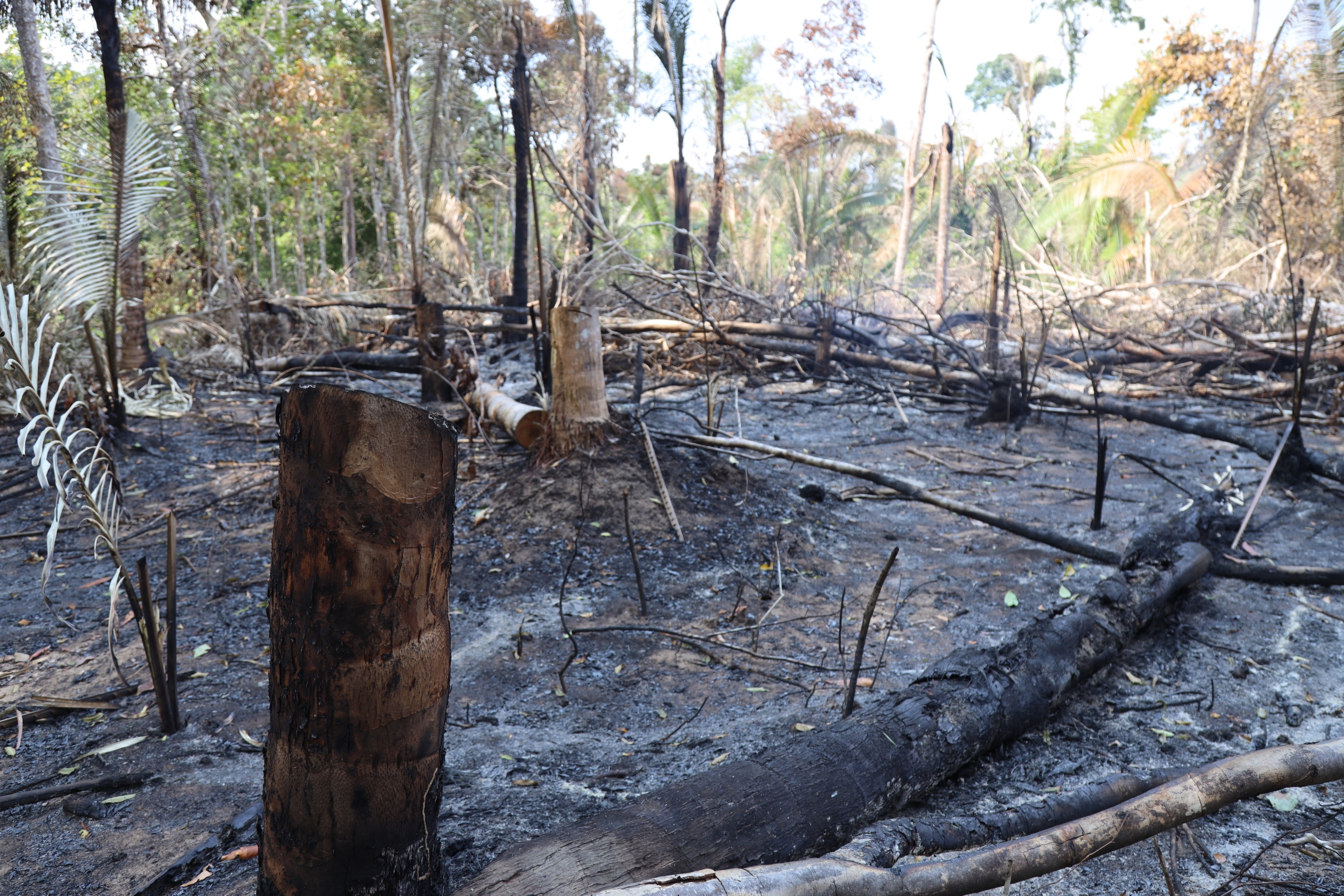
Destroyed trees in the Amazonian state of Rondônia, Brazil.
Michael Fox/The World
That's why the new Indigenous leaders in Lula’s government are hoping to take action — and fast.
At the top of their agenda is restructuring the new agencies, removing land invaders and demarcating new Indigenous land, something Bolsonaro refused to do.
Meanwhile, this month, the Brazilian government is expected to recognize 13 new Indigenous territories.
"This is a moment to rewrite the history of the Indigenous peoples of Brazil."
"This is an historic moment,” said Indigenous rights defender Ingrid Sateré Mawé. "This is a moment to rewrite the history of the Indigenous peoples of Brazil."
They have a long way to go, but Indigenous leaders say now, like never before, is a moment of relief, of celebration and hope, for them and for the protection of the Amazon rainforest.
Related: Lula vows to end illegal mining in the Amazon. But legal mining is more complicated.
Yaniel, a 38-year old taxi driver from Havana, has tried to leave Cuba for the US three times by sea — in homemade, wooden boats.
Yaniel asked that his last name not be used since it’s illegal for Cubans to try to leave the country this way.
“We build boats in hidden places, and we don’t tell anyone about our plans,” he said, not even family members.
In the past year, hundreds of these boats have been leaving from the shores of Cuba, which sits just 90 miles south of Florida’s coast. Others have been taking charter flights to Nicaragua, which is the only country in Central America that doesn’t require a visa for Cubans. And from there, they travel north into Mexico, toward the US border.
Nearly a quarter of a million Cubans have arrived in the United States in the last year. It’s the largest single wave of Cuban migrants since Fidel Castro’s revolution in the 1950s.
“It is an unprecedented exodus of Cubans that we are seeing,” said Mariakarla Nordase is the director of the Cuban program at the Washington Office for Latin America.
She said that life in Cuba has been difficult for a long time, but things got worse after the pandemic and two hurricanes hit the island.
“Cuba is facing its worst economic crisis in decades or even worse than the 1990s special period.”
The tourism industry is one of the main sources of income for Cuba. But it has been devastated in recent years and hasn’t been able to rebound.
Yaniel, the taxi driver, said it’s hard to make a living in Cuba.
“Everything is expensive and scarce,” he said. Roads are in terrible condition, and that takes a toll on his taxi.
A single tire costs about $120, he said, and that’s about three months of his salary.
Mario Caceres, a software engineer who works in a restaurant in Santiago de Cuba, said his monthly salary is enough for about two weeks’ worth of expenses. He and his wife are selling pizza slices at home to make ends meet.
“Education doesn’t have any value in Cuba,” he said. “Even educated people are still poor.” He said he would like to leave the country and have the opportunity to advance his career.
Caceres said that there are daily power outages that last between 4-6 hours. Sometimes, the restaurant where he works has to close, and he makes less money.
US sanctions on Cuba are also having an impact. The Trump administration imposed a “maximum pressure” policy.
Direct flights to Cuba were canceled for several years. Remittances from abroad were halted. The US Consulate in Cuba was closed for a few years, blocking legal pathways for migration. All of this has put pressure on Cubans to leave, according to Andrew Selee, president of the Migration Policy Institute in Washington, DC.
“So, on one hand, you have a closure of the legal options. And then, last year, Nicaragua began to allow people to travel from Cuba and it opened up a way for people to come very easily to Nicaragua and then onward to the US border; this is all happened at a time where people really want out.”
President Joe Biden has made some changes recently. US Consulate services in Havana resumed two weeks ago. Direct flights were restored. The ban on remittances was lifted. And there’s a new legal way for Cubans to come to the US.
They can get a work permit if they pass a background check and find a sponsor.
Yaniel, the taxi driver, said that he’s heard about people offering to be a sponsor for Cubans. But they’re asking for up to $10,000.
So, he said that he’s helping to build another wooden boat to try and leave the country — for the fourth time.
“I have no hope,” he said. “There’s no future in Cuba.”
Isabel, 14, lives with a dozen other children with HIV in a 2-story apartment in Kwabenya, a densely packed neighborhood on the outskirts of Accra, Ghana. Her last name is being omitted to protect her identity as a school-aged child.
A good Samaritan brought her to the home when she was just 5. Her parents died of AIDS in 2013. Extended family members feared contracting the virus and rejected her.
She said life has been good so far at Motherly Love Orphanage, a home founded by Rev. John Azumah. The pastor, who also has HIV, founded the orphanage 14 years ago to provide hope and fight stigma against orphans living with HIV.
Here, Isabel gets her essential needs met. She also completed basic education and hopes to enter high school next year.
“I want to be an air hostess,” she said. “I want to see how other countries are doing so that I can compare it to my country and maybe see if we can also improve our country, too.”
Isabel and Rejoice are both orphans living with HIV at the Motherly Love Orphanage.
Ridwan Karim Dini-Osman/The World
Globally, 2.7 million children are living with HIV. The infection in children occurs most often during pregnancy, labor or breastfeeding. Without effective treatment, more than half of all babies born with HIV die before their second birthday.
Close to 15 million children worldwide have lost one or both parents due to HIV/AIDS-related causes. Three quarters of these children live in sub-Saharan Africa, where communities often refuse to accept them, especially if they are HIV-positive.
In Ghana, there are over 230,000 children orphaned by HIV/AIDS.
Azumah has been living with HIV for 22 years. When he received his HIV diagnosis in 2000, he said he thought he was going to die. He confided in his senior pastor.
Azumah said he was excommunicated by the church after his head pastor announced his HIV status to the entire congregation. His family experienced immense stigma. Shopkeepers wouldn’t even sell to his children.
“Those days, whenever my children went to even buy foodstuff, people said there was AIDS on the money because it’s being handled by an AIDS patient. So, you see, the stigma was very bad,” he said.
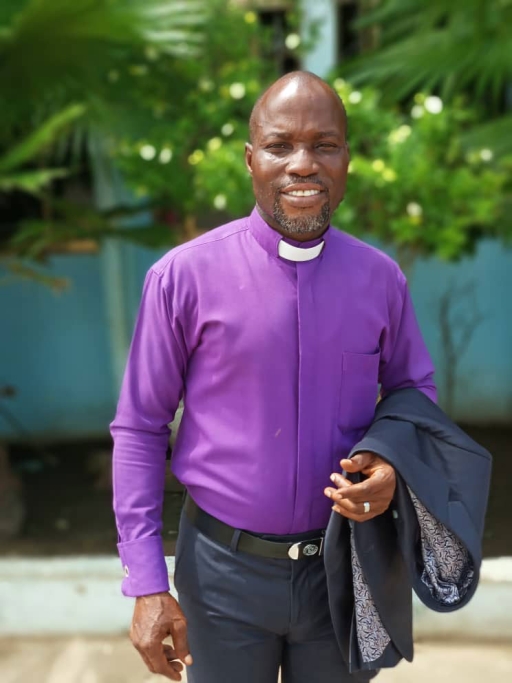
Rev. John Azumah, now 50, has been living with HIV for 22 years. He founded Motherly Love Orphanage 14 years ago to provide a loving home for orphaned children living with HIV.
Ridwan Karim Dini-Osman/The World
When Ghana’s Aids Commission reached out to him in 2010 to do advocacy work on a nationwide campaign, his life's mission formed. People started reaching out to him about HIV-positive orphans who were abandoned by their relatives.
That’s when he decided to open a home for them.
Motherly Love is a rare refuge in Ghana.
“Many people keep knocking at our door but we have limited accommodation,” he said, adding that it’s hard to reject children who may otherwise die on the streets.
But the challenges are plenty. Azumah gets antiretroviral drugs from the government for free, but“They don't take only antiretrovirals. We take other essential medicines like immune boosters, vitamin C, blood tonics … So these medicines are expensive.”
And as a nongovernmental organization, he still has to pay for food, housing (the building is rented), and private schooling, while donations have slowed during Ghana’s economic downturn.
Today, due to the ongoing COVID-19 pandemic and the war in Ukraine, many high-income countries are cutting back on aid and resources for HIV/AIDS.
Ghana’s AIDS Commission said it has serious financial challenges and continues to engage partners on how to provide better support to orphaned children living with HIV.
Child rights advocate Lilipearl Baaba Otoo lauds Azumah’s intervention.
"The state [is] supposed to be responsible for these children," she said, adding that she is pushing for better policies.
“The painful reality is that there are more of these children on the streets. Yet, most orphanages in this country often don't want to accept them after knowing their HIV status. I believe this is discrimination [and] it is unacceptable…” she said.

Penelope Mawuenam Agbai works with the West Africa AIDS foundation.
Ridwan Karim Dini-Osman/The World
AIDS agencies worldwide have formed a global alliance to ensure that no child living with HIV is denied treatment by the end of the 2030, among other aims.
UNAIDS Executive Director Winnie Byanyima said the alliance must work to ameliorate the inequality that children with HIV experience.
“With the science that we have today, no baby should be born with HIV and no child who has HIV should be without treatment. … We will not allow this shameful and avoidable injustice to continue,” she said.
Back at the Motherly Love Orphanage, the children continue to thrive and hope to contribute to a society that will embrace them.
Rejoice, 16, plans to attend high school next year and hopes to be a nurse one day.
“I want to help those who are sick and give them medicine and take care of them,” she said.
Azumah said he really has just one wish: “My joy will be that if tomorrow, I am no more, a home will be built for these children,” he said. So they’ll one day be able to say, “This is my home … I am going to where no one will stigmatize me, and I am accepted.”
More than a year after taking power in Afghanistan, the Taliban continue their drive to erase women from public life. Among their latest efforts: barring women from working in national and international nongovernmental organizations.
In response to that decision last month, several major international aid agencies suspended their operations. In addition, even the most powerful women in Afghanistan fear for their lives, and for good reason.
On Sunday, Jan. 15, a former legislator was shot and killed in her home in the capital Kabul, along with her bodyguard. Mursal Nabizada was one of the few women who served in parliament and decided to remain in the country after the Taliban took power in August of 2021.
Fawzia Koofi served with Nabizada in Afghanistan's parliament. They were friends as well as colleagues. Koofi spoke to The World's host Marco Werman from London about Nabizada and the ongoing plight of women in the country.
This interview has been lightly edited and condensed for clarity.
Cleyson Juruna stands at the edge of the Xingu river, staring out over the water. He's the young chief of the Juruna people, who have lived in the Amazonian state of Pará for generations.
“The Xingu River is our life,” he said. "She's our mother. Our arms and legs. It’s our means of transportation and our food."
But in recent years, times have been hard.
In 2016, a new hydroelectric dam began to wreak havoc on the river, decreasing water levels by 80% and killing tons of fish, a major source of food for Cleyson and his people.
Now, the Juruna face yet another threat.

Cleyson Juruna stands at the edge of the Xingu river.
Michael Fox/The World
Just upstream from their territory, the Canadian mining company Belo Sun hopes to open the largest open-pit gold mine in the Amazon. The company says the location contains almost 4 million ounces of gold, worth more than $8 billion.
Belo Sun general manager Rodrigo Costa told The World in an email that the operation would "promote sustainable development" by providing 7,000 jobs, tax revenue, infrastructure and socio-environmental projects.
But Cleyson Juruna said the mine would be a disaster.
“Belo Sun is here to practically end the lives of the native peoples who live here: the Juruna and the Arara,” he said. He pointed to a map. Roughly 6 miles divide the location of the planned mine from Paquisamba Indigenous land, where Cleyson and his people live. In the middle is the Xingu River.
“If there were any type of tragedy,” he said, “any leak of something toxic, it would contaminate the entire region, the communities and Indigenous territories. Ours and others downstream."

The Juruna people live within the Paquisamba territory in the Brazilian Amazon.
Michael Fox/The World
Belo Sun says the mine was designed to have zero environmental impact. General manager Rodrigo Costa told The World that "there will be no discharge of effluents into the environment, which is an industrial practice in organized and responsible gold mining."
But environmental and Indigenous activists are not taking chances. In December, the San Francisco-based nongovernmental organization Amazon Watch released a report underscoring the dangers of the project. It accused Belo Sun executives of spreading misleading information and downplaying risks.
Indigenous leaders protested against the mine at a Biodiversity Conference in Montreal last month.
"People need to understand that this mine will not just impact the state of Pará and the Indigenous peoples, it will impact the world,” Indigenous leader Puyr Tembé said at the conference. "You will feel the impact. Humanity needs to wake up.”
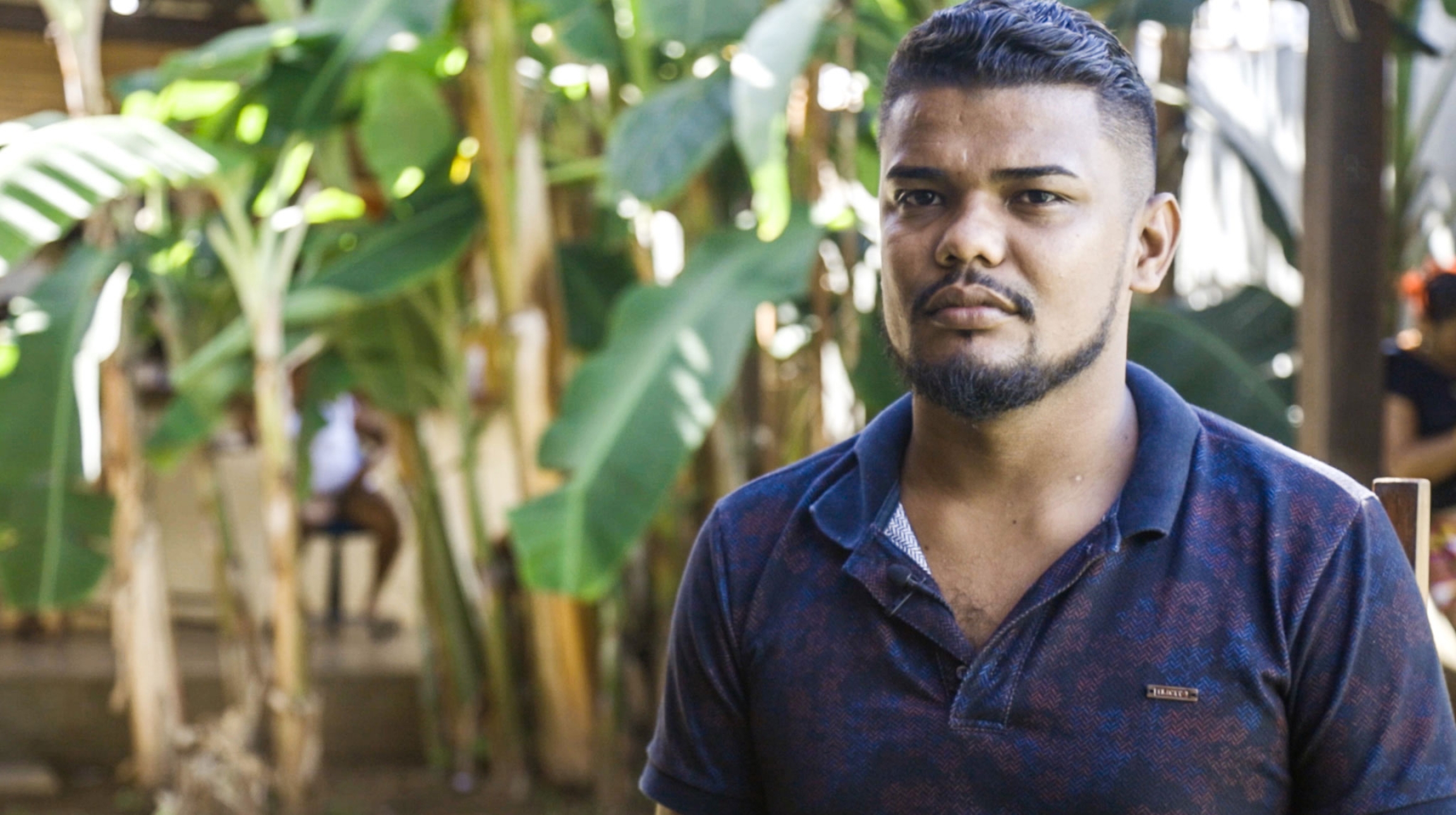
Indigenous leader Cleyson Juruna says the gold mining project would be a disaster for his people.
Michael Fox/The World
But not all community members are against the mine.
In a 2017 video from Belo Sun’s Facebook page, residents of the town of Ressaca, near the mining site, rallied in favor of the project. “We have miners, farmers and fishermen who depend on development,” said a man in a white cowboy hat. Behind him, someone held a sign reading,"Make our opinion count."
Belo Sun officials say local communities approved the project in a series of local consultation processes held over the last decade. But Indigenous and environmental activists say those meetings were flawed, with residents pressured, and local Indigenous communities never gave the green light for the project.
Mining in the Amazon comes in the form of both large-scale projects like Belo Sun’s Volta Grande mine, and from illegal wildcat miners who have pushed onto Indigenous territories in recent years.
Brazil’s new President Luiz Inácio Lula da Silva has called for sustainability and vowed to end wildcat mining.
“We're going to stop any possibility of illegal mining. We need more than just a law. It needs to be a declaration of faith,” Lula said on the campaign trail.
A gold store in Boa Vista, Brazil, Wednesday, Nov. 3, 2021. Gold illegally mined in the rainforest mixes into the supply chain and melds with clean gold to become almost indistinguishable.
Andre Penner/AP
But Lula's relationship with legal mining in the Amazon will likely be more complicated. Some operations are deeply rooted. The largest iron-ore mine in the world, for instance, has been located in the southern Amazon for half a century.
Hundreds of companies have mining applications pending across the Brazilian Amazon.
"This mining might be legal, in that there is a supposed consultation process and such,” said Gisele Costa, a professor at Amazonas Federal University, who specializes on the impacts of mining in the region, "but the extraction of that ore will still pollute the rivers, kill people and so on.”
Belo Sun is awaiting a pair of licenses for the mine to proceed. They hope they can get the green light this year. Indigenous and environmental activists have vowed to do everything in their means to ensure that that approval never comes.
Ukraine’s southern port city of Odesa has always been known as a gateway to the rest of the world.
At the beginning of the war, after Russia targeted the port, shipping came to halt.
Dmytro Barinov, deputy head of Ukraine’s Seaport Authority, said that even before the full-scale invasion, Russia began mining the area and conducting military exercises.
“That is why the vessel can’t go out from the ports. All ports were blocked,” he said. “[Ukraine brought] the submarines, the navy ships, and Russia start[ed] to attack, all ports were under attack.”
Russia was globally condemned for embargoing and attacking Ukrainian ports, which exacerbated international food shortages. Ukrainian grain was stuck inside the country, and there were fears that the corn and wheat stored in silos would begin to rot. Food prices around the world soared.
In July, the United Nations brokered a deal with Russia to create a “humanitarian corridor” in the Black Sea to resume sending grain abroad, with ships inspected by the UN and Turkish and Russian and Ukrainian authorities. Now, Ukraine says that the deal, which is set to expire in mid-March, is not meeting expectations.
Barinov said that Russia is creating delays during the inspection process at the Joint Coordination Center in Turkey.

Dmytro Barinov, deputy head of Ukraine’s Seaport Authority, said that about 17 million tons of cargo has been exported as a result of the grain deal. That’s down threefold from last year, even with the grain deal still holding.
Daniel Ofman/The World
“Now, we have more than 90 [ships] awaiting on this queue, more than one month the vessels are waiting … but Russia every day make something again” to interfere with the shipments, he said.
So far, according to Barinov, about 17 million tons of cargo has been exported as a result of the grain deal. That’s down threefold from last year, even with the grain deal still holding, he said.
Ismini Palla, a UN spokesperson for the Black Sea Grain Initiative, said that there have been vessels waiting for inspection for over a month, but she didn’t lay blame on any of the delegations.
“There are many factors that affect the timely inspection of the ship. We had numerous occasions where the joint teams have [had] to go back to a vessel to conclude the inspection.”
Palla said that sometimes, vessels don’t have the correct documents in place or there could be difficult weather conditions, or other safety concerns.
“Sometimes, there are different approaches taken by the delegation that may affect the timely inspection of the vessel,” she said.
Ukraine hopes to expand the grain deal, to include more ports, and more products that it could export into the global market.
President Volodymyr Zelenskiy has stressed the importance of the grain deal, saying that it needs longterm protection in order to avoid a global food crisis.
Valdemar de Assis corralled his herd of cattle back into their pen after a day in the field.
He’s a family farmer whose land runs alongside the Trans-Amazon highway in the Amazonian state of Pará. The lush forest here was cut decades ago amid a government push to open up the jungle. Assis grew up here on a farm. Today, he said, he has about 300 cows.
He provides milk to the local community. His farm is about 100 acres. That’s small for the Amazon, still considered a family farm. He raises pigs, sheep, chickens, corn and vegetables. Even fish. Assis' cows are his life.
“It’s so beautiful to see them walking in front of you, and also, knowing that tomorrow, you are going to have a little more income. It’s good.”
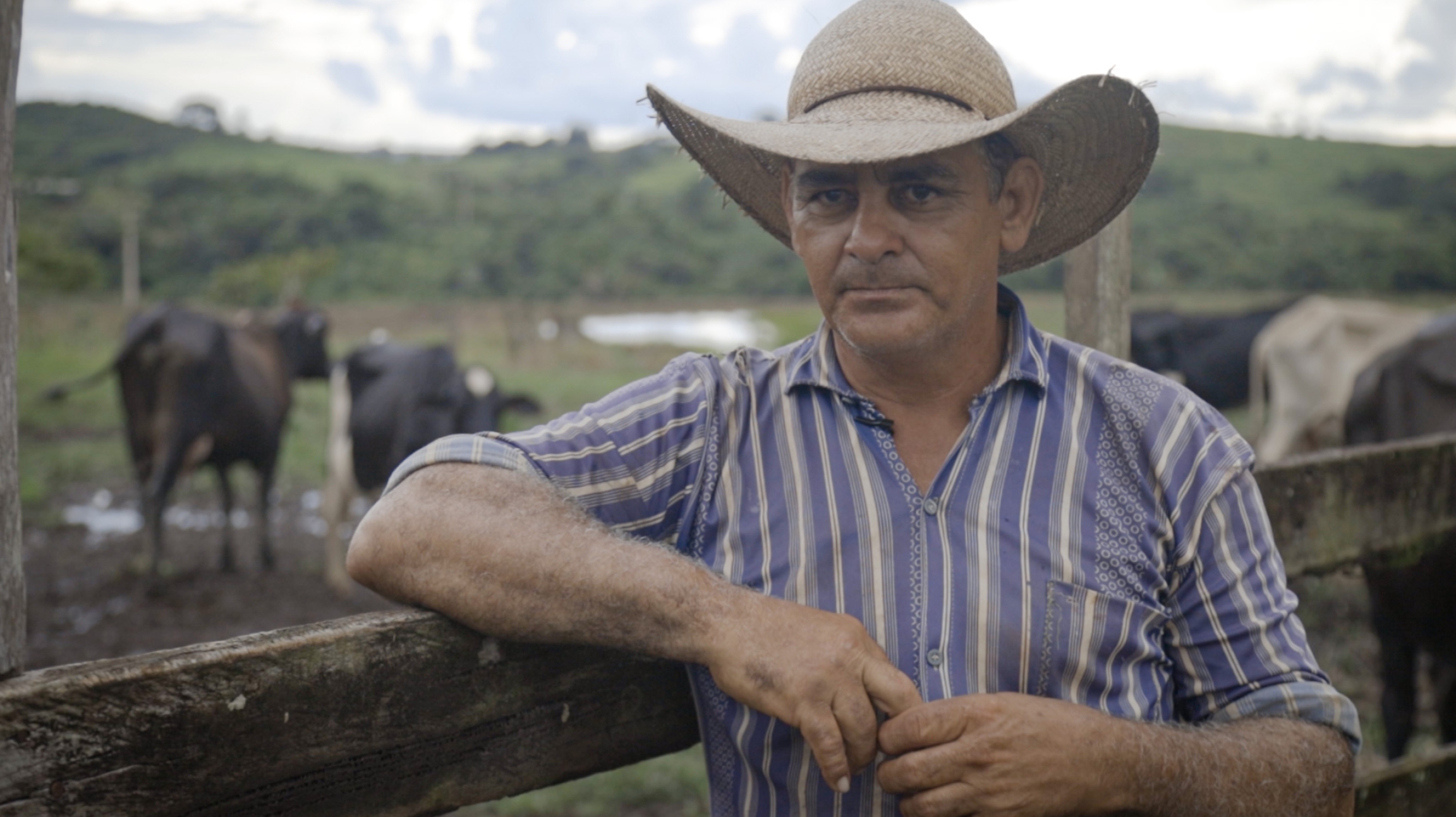
Brazilian Valdemar de Assis is a family farmer whose land runs alongside the Trans-Amazon highway in the Amazonian state of Pará.
Michael Fox/The World
Assis said that he makes about 6,000 reais, or just over $1,000 a month. That’s not bad for Brazil. Six times the minimum wage.
Farmers like him are likely to get a boost from Brazil's new president, Luiz Inácio Lula da Silva (referred to simply as “Lula"). In office for the third time, Lula promised to promote sustainable development for the Amazon — stopping deforestation while at the same time, keeping agribusiness thriving.
This is not an easy task. The Brazilian Amazon is huge and diverse, stretching across nine different states, and deforestation runs rampant.
Agronomist Anderson Borges said that small family farmers in the Amazon are responsible for roughly three-quarters of the products that feed local Brazilians. And as many as 90% of the jobs in agriculture here.
For Borges, sustainable development in areas that have already been deforested can look a lot like Assis’ land. The key ingredient, he said, is raising a variety of crops and animals.
”Having a diversity of many products means you don't need to intensify the production of just one crop, so you don't need a lot of pesticides and you don't need to deforest,” Borges said.
During Lula's second presidential term in 2008, he launched the program, Mais Alimentos, or More Food. The program supported small producers and family farmers with technical assistance, loans and government contracts to increase local agricultural production. Lula has again promised to back small producers.

Family farms are likely to get a boost from Brazil's new president, Luiz Inácio Lula da Silva (referred to simply as “Lula"). In office for the third time, Lula promised to promote sustainable development for the Amazon — stopping deforestation while at the same time, keeping agribusiness thriving.
Michael Fox/The World
But in the Amazon, family farmers make up just a small slice of the economy. And they have less than a quarter of farmland in the region. Another group is king: big ag — driven by multinational companies. Brazil leads the world in exports of both beef and soy beans. They are also the top two drivers of deforestation in the Amazon rainforest.
Lula has promised to stop deforestation. It's something he's done before. In his first term in office 20 years ago, he enacted new strict regulations, inspections, land registries, and wood- and meat-tracking systems. Those policies helped to cut deforestation rates in half within two years.
“We don't need to cut down even a meter of forest to continue to be one of the biggest food producers in the world,” Lula said at the COP27 summit in November.
The president wants to roll back deforestation without kneecapping the industry. But that’s not without its challenges.

A large cow pasture alongside Brazil's Trans-Amazon highway in the Amazonian state of Pará.
Michael Fox/The World
"You can’t amputate the arm of an important source of production, demanding sustainable practices without offering the necessary elements for them to be implemented,” said André Cotrim, an economics professor at Pará Federal University.
Suely Araújo is the former head of Brazil’s environmental protection agency, IBAMA. She said that Lula has to have a two-pronged approach against deforestation: fighting criminal actions like clear cuts and fires, while also supporting the local economy.
"We have to have a regional development plan for the Amazon, which shows that the government wants to generate income for residents of the region, but [which] does this with the forest still standing, with economic options that protect the forest.”
Araujo said that Lula did this well in 2004. And, she said, he's poised to do it again.The future of the Amazon rainforest largely depends on Lula’s success.
For the last two months, far-right supporters of former President Jair Bolsonaro had camped out in front of military barracks across Brazil.
Their chants echoed daily, calling on the armed forces to rise up against the results of last October’s presidential election that declared Luiz Inácio Lula da Silva the winner. They called on the army to reinstate Bolsonaro as president.
So, when thousands of Bolsonaro supporters invaded Brasilia last Sunday, ransacking Congress, the Supreme Court and the Presidential Palace, they believed it was the spark that would set the army into action.
But it backfired.
Instead, Lula and the Supreme Court responded swiftly — removing the protesters and ordering all pro-Bolsonaro encampments disbanded by Monday night. For Bolsonaro’s radical supporters, it was a shock.
In a video shared on social media, a woman speaks into her cellphone camera, the Brazilian flag draped over her shoulders. She holds back tears.
"Until an hour ago, we believed in the army,” she said. "That they would protect us. And the army handed us to the military police. We are being taken out of here like animals, inside buses,” she said. "I don’t know where we are going.”
About 1,500 people would be arrested and detained. Their belief in an army that would save them vanished.
Political scientist Anaís Medeiros Passos, at the Federal University of Santa Catarina, said it's a complicated moment, “because many members of the armed forces and their families actively participate in Bolsonarism, so the relationship between the military and the Bolsonaro movement will remain."
"But right now, many Bolsonaro supporters feel betrayed by the armed forces,” she said.
And Bolsonaro is more isolated than ever. The former president has been in Florida since before Lula’s inauguration. According to polls released this past week, Bolsonaro’s online support is at an all-time low. More than 90% of Brazilians condemn the attack on the capital.
That includes even staunch Bolsonaro allies, like the head of the lower house, Arthur Lira, and department store billionaire Luciano Hang.
“We have a new president. We have a new government,” Hang said in a video he released this past week, in which he denounces the violence and vandalism in Brasilia. “Let’s support the pilot, so we have a great flight, because I’m inside the same plane.”
It’s a rare moment of unity sweeping across Brazil since the capital attack.
Earlier this week, the heads of the Senate and Lower House, plus all 27 state governors met Lula and his Cabinet in Brasilia. They walked across the esplanade and surveyed the damage of the attack.
“This is an extremely important scene,” a CNN reporter said. “We rarely ever see these people together like this and we see them united. United for the country. United for democracy.”
"I think the invasion has strengthened the position of Lula's government,” said Sean T. Mitchell, an anthropologist at Rutgers University.
"Also, the similarity of Brazil's Jan. 8 to the United States Jan. 6, I think, helps consolidate Lula's international support.”
Lula is taking advantage to push full speed ahead into his new government.
“I’m meeting with ministers in each area, to get their immediate proposals,” he told the press this week. "Because in each sector, we are going to try and work immediately, even while we are still setting up the government.”
It's a unique moment of respite in a country that has been embroiled in a pitched battle over the presidency in recent months — polarized and divided. Analysts say the differences remain, though, even among the armed forces, but most of the country hopes this moment of unity can persist.
Science agencies in the US and Europe this week released their temperature data for 2022, revealing what has become an annual headline: Last year was one of the hottest on record. 2022 tied for fifth hottest, according to NASA. The US National Ocean and Atmospheric Administration, which uses slightly different data, said it came in sixth.
That’s even though La Niña cooled the equatorial Pacific, which typically turns down global temperatures.
“This was, in fact, the warmest La Niña year in the whole record,” said Gavin Schmidt, director of NASA’s Goddard Institute for Space Studies.
Earlier this week, Europe’s Copernicus Climate Change Service revealed 2022 was that continent’s second-hottest year ever, and hottest summer.
Last year was about 2 degrees Fahrenheit hotter than the preindustrial average, or 1.1 or 1.2 degrees Celsius, depending on whose data you use. That’s edging closer and closer to 1.5 degrees Celsius, a limit most countries in the world have pledged not to exceed. That goal is written into the 2015 Paris climate change agreement, alongside a less-ambitious target of limiting warming to “well below” 2 degrees Celsius. But it’s the lower target that has taken hold in recent years as both a goal and a rallying cry for aggressive climate action.
Keeping 1.5 “alive” became the mantra of Alok Sharma, the UK politician who served as president of the COP26 climate summit in Glasgow in late 2021. UN Secretary General António Guterres also frequently references the figure, among many others.
A coalition galvanized by low-lying island nations lobbied to get the more-ambitious target written into the Paris climate deal, arguing that exceeding that threshold represented an existential threat for their counties.
"It means we are dead. Just simply dead," former Maldives President Mohamed Nasheed told The World in 2021. “A whole country gone. A whole people gone. A whole society gone. A whole community gone. And this is the case with many, many low-lying islands.”
That target has always been wildly ambitious. But in the last seven years, as carbon emissions have continued to rise, it has gotten even more so. Global greenhouse gas emissions would need to be slashed 45% by the end of this decade to meet it, and a UN report published in October said there was no “credible” pathway to 1.5 in place.
Many climate scientists say that they don’t believe the target will be met.
“I'm pessimistic for the 1.5,” said Thomas Stocker, a climate scientist at the University of Bern who co-led an Intergovernmental Panel on Climate Change report on the physical basis of climate change in the years leading up to the Paris agreement’s creation.
“We're not on the pathway to actually keep the warming at 1.5 degrees Celsius,” he said. “We [would] be extremely lucky to hold the temperature warming below 2 degrees.”
Three scientists involved in tracking the global temperature data that was released this week also said they saw limiting warming to 1.5 degrees Celsius as unlikely.
“I think it's very challenging to stay below 1.5,” said Schmidt, saying he was speaking only for himself, not NASA.
“My expectation is that we will hit 1.5 degrees sometime in the 2030s,” said Samanath Burgess, deputy director of Europe’s Copernicus Climate Change Service.
“I think it's very unlikely that we avoid overshooting that level of warming,” said Zeke Hausfather, with Berkeley Earth, an independent research group that also released its 2022 temperature data on Thursday.
It’s technically still possible to keep warming at 1.5 degrees, according to the science of atmospheric warming. But a recent IPCC report shows it would require a massive shift away from coal, oil and gas at a speed that’s hard to imagine. And it almost certainly would require overshooting the 1.5 limit for a time, then removing carbon from the atmosphere again before the end of the century to bring the globe’s average temperature back down.
Still, Hausfather said he thinks that the goal itself has been useful.
“Even if it's a target we don't hit, I feel like the fact that we are trying means we'll probably end up in a better place than if we were aiming higher,” he said.
Hausfather points out countries responsible for around 80% of emissions now have targets to reach net-zero emissions by midcentury. Whether they meet them, of course, is an entirely different question, but the goal itself is based on the science behind the 1.5-degree goal.
The target being written into an international agreement “holds political leaders accountable,” Burgess said.
Even as 1.5 continues to be held up as the goal by political leaders and activists, scientists aren’t exactly shouting from the rooftops how much of a stretch it really is.
Swiss scientist Thomas Stocker said there’s a concern that doing so would stymie ambition.
“I disagree,” he said, arguing it should instead galvanize even faster action.“The consequence should be that under no circumstances will we lose the second target and make the same mistakes again.”
Some scientists worry that the 1.5-limit has been framed as a kind of tipping point, a make-or-break goal.
“The reality is that every single fraction of a degree matters; 1.5 isn't a cliff edge where bad things will happen. Bad things are already happening,” Burgess said.
Keeping warming below 1.7 degrees, say, would be better than 1.8 — 1.9 would be better than 2.
Each 10th of a degree could cause more extreme rainfall, like the kind flooding California right now, and worsen heat waves, droughts and hurricanes, and further push up sea levels imperiling low-lying island nations.
Leaders and activists in those vulnerable countries largely are not ready to talk about a post 1.5-world, at least to reporters.
"I can't afford to think that 1.5 degrees is not attainable," former Maldives President Mohamed Nasheed said in 2021. “That would be a death sentence on our countries, and many low lying islands and coastal regions.”
With current pledges made under the Paris agreement, the UN Environment Program estimates the world is on track for 2.4 to 2.6 degrees Celsius of warming by century’s end.
Anastasia Shevchenko never got the chance to say goodbye to her daughter, 17-year-old Alina, who suffered from encephalitis and was sick at a hospital in Moscow.
That’s because Shevchenko was under house arrest. Security guards monitored her every move. She was not allowed contact with anyone. No one was allowed to visit her.
“I would say that my children were arrested with me,” she said.
Shevchenko’s ordeal is captured in a new documentary called “Anastasia,” which follows her journey to scatter her daughter Alina’s ashes in the Black Sea. The film has been shortlisted for an Oscar in the documentary short film category.
Shevchenko’s activism started at a young age. She protested against everything from cutting down trees to lack of good public transport.
The assassination of opposition politician Boris Nemtsov in 2015 marked a turning point for her. She said it made her realize that “it’s impossible to stay at home” and that she needed to speak up “to say [killing Kremlin critics] is a crime and we will not forget it and we will not forgive it.”
In 2019, Shevchenko was being investigated for her activism and membership in a group called Open Russia, which was deemed “undesirable” and a "threat to state security" by the state.
The organization was started by Russian businessman and activist, Mikhail Khodorkovsky, who was living in exile in London, with the goal of promoting democracy in Russia.
The crackdown against Open Russia and its members led to its closure in 2021.
Shevchenko was put under house arrest, where she remained for two years.
“Two years, that’s a very long period of time,” she said, “so I was doing everything. I read a lot of books, I wrote my own book, it was kind of a diary, I learned dancing, moon walking, cooking, planting vegetables and flowers.”
She was worried about her 7-year-old son, Misha, who “had seen it all,” Shevchenko said.
Like, the police coming to their apartment, searching through their personal belongings, his mother going from one court hearing to another.
Still, through it all, the most painful part for Shevchenko was losing her daughter Alina, who is disabled, and not being able to hold her before she died.
In a clip from a Russian courtroom, aired by the BBC in 2019, Shevchenko blamed the prosecutor.
“You could have let me see my daughter and hug her. If I’d made it to the hospital a day earlier, I’d have been able to do that,” she said.
“I felt like … I’m betraying my own child because I cannot hold her hand, you know?” she said.
The documentary “Anastasia," made by MTV Documentary Films, takes an intimate look inside Shevchenko’s life as she tries to move on from her time under house arrest.
As she sets out on a train journey to scatter the ashes of her daughter in the Black Sea, she is accompanied by her children Misha and Vlada, as well as her mother, Tamara. (Shevchenko had separated from her husband before the trial).
“This trip was one of the first things that they did together as a family and it was the first time that Anastasia traveled at all outside of her city after being under house arrest for two years,” filmmaker Sarah McCarthy said.
Shooting the documentary in Russia brought many challenges, McCarthy added. Her Russian crew could get arrested at any moment. Sometimes, it seemed like they were being monitored.
“We had lawyers stationed all the way along the train journey,” McCarthy explained, “and we knew exactly what the protocol was if they were stopped and if they were detained.”
They shot the film using a small commercial camera.
The documentary begins with Shevchenko admitting that what she’s about to tell the world could put her in prison, but she said it is important to tell this story to show that people in Russia have been resisting Putin’s regime, sometimes, at the cost of their lives and the lives of their children.
Shevchenko fled Russia after her house arrest ended and now lives in Lithuania with her children and her mother. She helps political activists and their families who are inside Russia. She also works with other Russian activists living outside the country.
The war in Ukraine has made her even more committed to speaking out against Russia’s leader.
“While crazy Putin is in power, we cannot feel safe. So, I’m still trying and doing my best to stop him somehow,” she said.
When 22-year-old Mahsa Amini died in the custody of Iran's so-called morality police last September, mass protests were unleashed across the country. But they didn't stop at the borders of Iran.
Demonstrations calling for basic women's rights and freedom generally in Iran sprang up across the globe, and in the Iranian diaspora community of Los Angeles, members of the heavy metal group TarantisT have added their artistic voices to the protests.
Arash Rahbary is the band's singer and bassist and joined The World from his home in LA.
How do you get a country to change its national diet? That’s what China has been trying by introducing potato as a staple as part of an effort to improve food security.
Chinese farmers plant the largest amount of potatoes in the world, and the country produces about 20% of the global potato output. But while fresh potatoes are a traditional part of the Chinese national diet, they’re viewed as a vegetable rather than as a staple, and China’s per capita consumption of potato is below the global average.
In 2015, the Chinese government decided to try and change that. It introduced a policy to promote the potato as the country’s fourth staple alongside rice, wheat and maize. As Xiaobo Xue Romeiko, a professor at the University at Albany, State University of New York in the US, explained, behind the strategy lay concerns over food security and the availability of arable land.
“Potato is more versatile and it can be grown in marginal land which is not suitable as our arable land,” she said.
Potatoes are also less energy intensive to grow and, according to her research, have the potential to reduce greenhouse gas emissions from food production in China, particularly if it introduces varieties with higher yields.
Other countries may need to follow China’s lead. As pressures mount on the global food system thanks to climate change, the COVID-19 pandemic and Russia’s invasion of Ukraine, food security has become a central issue for many more governments.
“At the moment, the food system really is under the highest stress,” said Paul Behrens, associate professor in environmental change at Leiden University in the Netherlands.
In 2022, the UN’s food price index, which measures monthly changes in international prices of a basket of food commodities, has hit record highs.
Behrens said that many of the responses from governments so far have been shortsighted.
“I don’t see an awful lot of governments considering the fundamental system transitions that are needed to really secure food systems and make them more resilient to future climatic change.”
He argued that countries need to radically change their nations’ diets, specifically in high-income nations where the over-consumption of meat is driving much of the interlocking crisis.
So, what would an optimum diet that is nutritious and sticks within planetary boundaries actually look like? A group of researchers put their heads together to find out and came up with the EAT-Lancet diet, also known as the planetary health diet.
One of them was Marco Springman, a professor of climate change food systems and health at the London School of Hygiene and Tropical Medicine in the UK, and also a senior researcher at the University of Oxford.
“You shouldn’t have more than one serving of red meat per week. Not more than two servings of poultry per week, not more than two servings of fish per week. And if you have dairy, not more than one serving per day,” he said.
Counting that up, that means being vegetarian or vegan on two days a week.

Gemma Ware is the editor and co-host of The Conversation Weekly Podcast. Daniel Merino is the associate science editor and co-host of The Conversation Weekly Podcast.
At the bullfighting ring in the city of Manizales, Colombia, a crowd of nearly 15,000 people watched Matador Antonio Ferrera taunt a 990-pound bull.
They cheered as the injured beast charged at the matador’s red cape, and ran around Ferrera’s waist, its horns just inches away from his body. When Ferrera drew his sword and pointed it at the bull, they went silent — until he killed the animal by driving his blade into the back of its neck.

Thousands of fans attended the bullfights in Manizales in January. Some worry that these could be the last as Colombia’s Congress debates a bill that would ban the centuries-old tradition.
Manuel Rueda/The World
Some felt sentimental about what they had just witnessed, and wondered whether this would be one of the last bullfights they’d be able to watch on Colombian soil.
“This is the last major festival in Colombia,” said Dario Villegas, who traveled from Bogotá and was at the event, known as the corrida, with his wife and their 23-year-old daughter. “There might come a moment when this is banned altogether, even in Spain, so we have to enjoy it while it lasts.”
Bullfighting has become less popular in recent decades, as views about animal rights change. There are only eight countries around the world where this tradition is still legal — including Spain, France, Portugal and parts of Latin America — though several cities and regions within these nations have suspended or banned bullfights.
In Colombia, the senate recently voted on a bill to ban bullfights nationwide. The legislation is backed by Colombia’s recently elected leftist President Gustavo Petro, but it still needs to be approved by the house of representatives, where it has a 50-50 chance of passing. After decades of protests, it’s the closest the country has ever come to banning this tradition.

Some people watching the parade in Manizales heckled the animal rights activists. Others cheered for them and took photos with their mascot, a man dressed as a smiling bull.
Manuel Rueda/The World
“The consciousness that is linked to bullfights is a type of consciousness that comes from the past, and has done a lot of damage to earth, to nature,” said Terry Hurtado, a city council member from Cali, who has led efforts to ban bullfighting in the country.
“That anthropocentric mindset has to be shifted to one that is determined by respect for all living beings.”
Over the past five years, animal rights activists in Colombia have pressured city governments in Medellín, Cartagena and Bogotá to suspend bullfights, or make the conditions to hold them so complicated that promoters are no longer interested in staging the events.
But in Manizales, which is a smaller and more conservative city, bullfights are a big part of the local culture. And fans from all over Colombia visit the town in January for its annual bullfighting festival. This year, it featured some of the top matadors from Spain, France, Colombia and Peru.
For some of the fans at the festival, efforts to ban this tradition are an attack on their individual freedoms, and an effort by Colombia’s national government to impose its will on the nation’s provinces.
“You have to respect peoples’ traditions,” said Gustavo Mejia, who drove from the nearby city of Pereira to watch the bullfights. “Today, they want to sacrifice bullfighting. Next, they’ll go after our traditional foods!”

Animal rights activists joined a parade that takes place on the same week as the bullfights in Manizales, Colombia.
Manuel Rueda/The World
But opposition to bullfights has also grown in Manizales.
John Heymar Yepes, an animal rights activist and former member of the city council, said that over the past decade, local politicians have voted to strip bullfights of tax exemptions, and also shut down a bullfighting ring at a local army base.
He was at a parade in Manizales that is held the same week as the bullfights, and mostly features marching bands, dance troupes and beauty queens. But the animal rights activists were also allowed to participate.
As the group of two dozen activists walked down the city’s main avenue with their anti-bullfighting posters, some spectators heckled them. But others applauded them and took selfies with the group’s mascot, a man dressed as a smiling bull.
“I think what they do with the bulls is terrible,” parade-goer Maria Clemencia Rodriguez said. “They injure them before killing them.”
Supporters of bullfights say that the animals they use are bred precisely for the purpose of fighting in arenas. And that they spend their lives in free range pastures, where they’re better off than millions of cows that are used for beef.
“We’re not forcing people to watch bullfights,” season ticket-holder Luz Marina Salazar said. “We just want our freedoms and our traditions to be respected.”
In Manizales, bullfighting also attracts thousands of tourists who spend money on hotels and restaurants. The local chapter of the Red Cross owns the bullfighting ring. And profits from January’s bullfighting festival are donated to the local children’s hospital.

Thousands of tourists visit Manizales, Colombia, each year to watch its bullfighting festival, and spend money in hotels and shops.
Manuel Rueda/The World
Sergio Alzate, 22, has been a student at the local bullfighting school since he was 17. He’s already killed a 700-pound bull, and said that a bullfighting ban would jeopardize his future as a matador.
“This is a difficult time for us,” he said. “But it’s the perfect time to show that we are united and to fight against politicians who are only opposing us because they want to get votes.”
The next few months will be decisive for young bullfighters and animal rights activists in Colombia alike. This tradition may not be as popular as it was decades ago, but its dedicated fans and promoters say that they will defend it until their last breath.
It is a new year, but Haiti has yet to turn the corner on persistent challenges facing the country: a cholera outbreak, growing malnutrition and ongoing gang violence.
As of Monday, the nation now also has no democratically elected government officials. The last 10 remaining elected senators left office when their terms in parliament expired two days ago.
The World's host Marco Werman spoke with Widlore Mérancourt, editor-in-chief of AyiboPost, who joined from the captial Port-au-Prince, about the latest situation.
This interview has been lightly edited and condensed for clarity.
Related: Haitians face a ‘very dire climate’ one year after Moïse's assassination, journalist says
It isn’t often that beauty contest winners reject their crowns. But that’s what happened in a tiny village in the Priorat region of northeast Spain, in Catalonia.
The crown-winner was the village itself. It’s called Siurana. Being highlighted for your beauty would be a dream come true for most small towns, but not here.
“One fine day, some gentlemen showed up here at town hall,” said Siurana Mayor Salvador Salvadó. “They were from the Association of Spain’s Most Beautiful Villages. They’d chosen us for their list.”
Becoming “a most beautiful” town can be a boon for off-the-map places. It creates an avalanche of attention, including publicity campaigns, mentions in magazines, and most importantly, visitors.
“We told the 'beautiful town' folks to just leave their brochure,” Salvadó said. “But the town didn’t see it as such a great option.”

Siruana, Spain, is quiet and quaint and locals want it to stay that way.
Gerry Hadden/The World
Just why Siurana snubbed the honor becomes clear pretty quickly on a visit. Salvadó’s office is about 6 miles downhill from the ridge where Siurana’s picturesque stone houses are perched because there’s no room for him up there.
In fact, there isn’t even room for cars. Visitors have to park in one of two lots on the outskirts. A guy there collects $4 for the privilege. Siurana is a quaint cluster of two dozen stone homes. It sits on a ledge with commanding views of green mountains and limestone cliffs.
Alba Reyes helps run a rustic hiker’s hostel with an open fireplace. Without tourists, she said, they’d be ruined. With too many? The same.
“I think our mayor was right to reject the beautiful town award,” she said. “In terms of the economic benefits, it would only have helped two or three establishments.”
But, she said, “it would have destroyed the village’s charm for everyone.”

Siruana, Spain, has just one small hotel and two bars — not nearly the infrastructure needed to deal with mass tourism. Most of the 20-odd families who live here make their livings off of tourism but don’t want to be victims of their own success.
Gerry Hadden/The World
Reyes said that already on weekends, the place gets so crowded that tourists jostle each other on the narrow streets. In the crush, something you can barely hear gets drowned out: the near silence. The calm and quiet are part of Siruana’s draw.
Turns out, so is rock climbing. The cliffs here are world-famous. Climbers can be found all over the place, clinging to the nearly vertical walls.
Samuel Pezzeoli came from Turin, Italy, to climb. He was spotting for a Spanish friend, Marcel Rubio, who was dangling from the limestone about 20 feet overhead.
Pezzeoli said climbers are especially respectful of the environment here, but regular tourists are unpredictable.
“If thousands of people come here each year, it is inevitable that eventually the place can get trashed,” he said. “But everyone that is taking care of nature is, of course, welcome.”
Nearby, a trail runner named Jorge Roll laced for a mountain circuit. He said he’s been coming here for years and has seen the place become increasingly popular — and crowded.
He manages a hotel in Barcelona, so he knows how important tourism is.
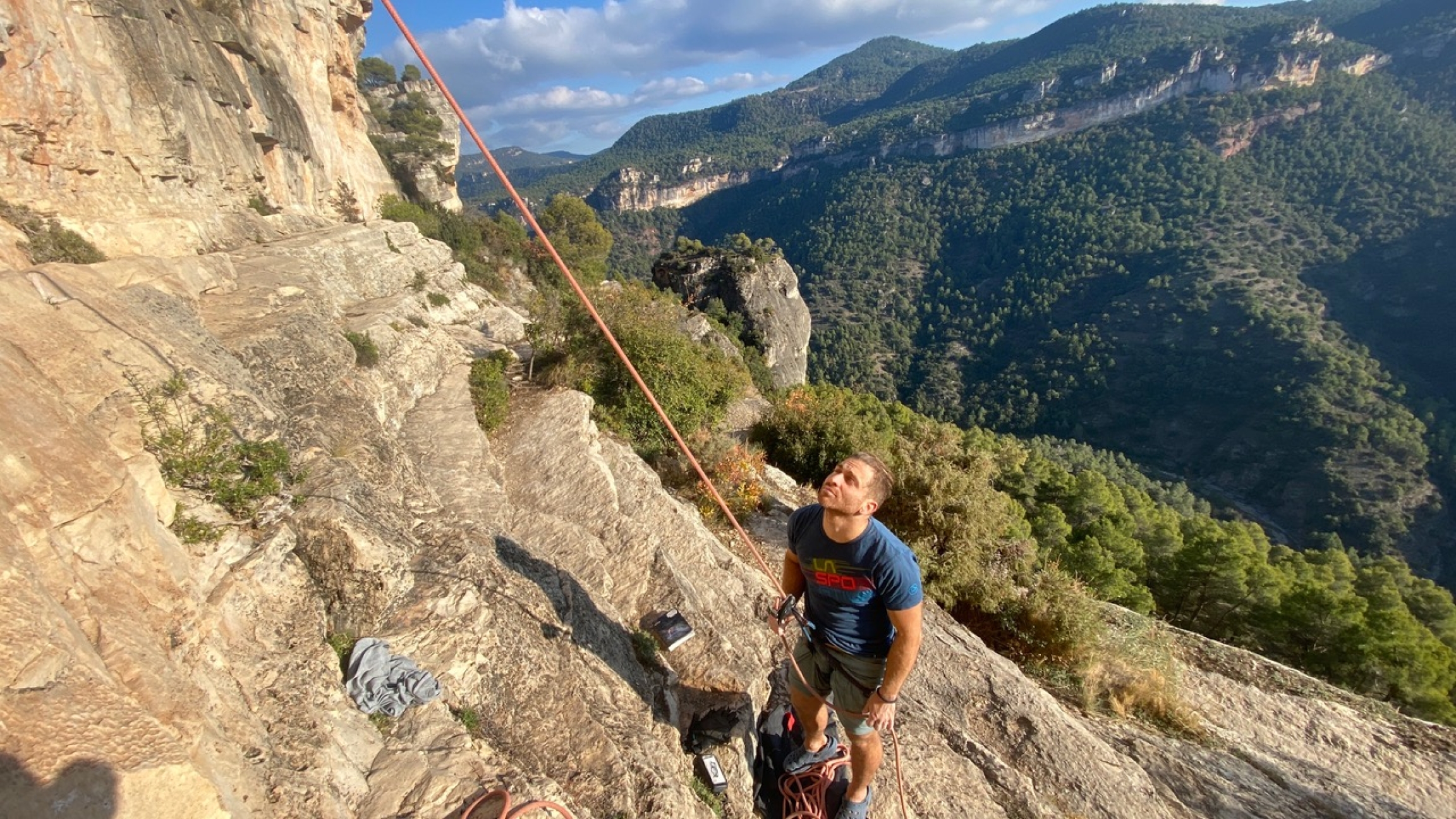
Climber Samuel Pezzeoli came all the way from Turin, Italy, to enjoy the world-class climbing just outside Siurana, Spain.
Gerry Hadden/The World
“But I also know it’s one of those contradictions,” he said. “In the end, you might kill the destination.”
Siurana wants to avoid that. That’s why they rejected the award, even if in the short run it’s had a boomerang effect, Salvadó said.
These days he, and the village, have been in the news a lot.
“One reporter even came from France,” he said. “With all the news reports, many people have come to check the place out.”
But Salvadó said he is confident that the hype will pass. And that when some other village decides to don the most beautiful crown, tourists will flock in that direction.
As North American leaders gather in Mexico City this week, US President Joe Biden has made it clear that the migration crisis at the southern border is one of the most pressing issues for his administration.
Border officials encountered a record of almost 2.4 million migrants at the southern border in 2022, shattering the old record of 1.7 million set the year prior, according to US Customs and Border Protection.
“Something you see all over Latin America right now is that people are fleeing,” said Adam Isaacson, a security expert on Latin America. He said the pandemic has led people to flee their home countries. On key points along the way, both to other countries and the US, people get stranded, including the Mexican side of the US border.
US immigration authorities say they don't have the capacity to process so many migrants, and have been turning them back to Mexico using provisions of the US code. Many of these people have been waiting for a chance to be admitted into the US for years.
Northern Mexico is a dangerous place to wait, Issacson said. Many migrants are subject to extortion, assault, abuse, rape and kidnapping, but very few organized crime cases are ever brought to justice, he added.
The US side of the border has also seen many arrivals. In El Paso, Texas, authorities are using a convention center as an emergency shelter.
Republicans have been pushing Biden to travel to the southern border and witness the situation himself. In a CNN interview in October 2021, he said he hadn't found the time.
This week, Biden visited the border for the first time during his presidency.
Julia Gillard, a policy analyst with the Migration Policy Institute said he waited this long because immigration has been a politically challenging issue.
“On the one hand, he's wanted to project that he is welcoming to immigrants. On the other hand, he's wanted to be really tough at the border, because high numbers of border arrivals are difficult politically.”
Gillard said Biden didn’t seem to have a concrete plan for the border until now. Just last week, he announced a new legal pathway for migrants coming from Nicaragua, Haiti, Cuba and Venezuela, who make up a significant portion of border arrivals. They will be allowed to apply for US work permits if they pass a background check and find sponsorship.
Biden also announced a smartphone app for asylum-seekers waiting in Mexico called CBP One. The app allows migrants to schedule an appointment at a port of entry and make an asylum claim.
But these are just “baby steps,” according to Maureen Mayer, vice president for Programs at the Washington Office on Latin America.
She said the new rules might reduce the number of migrants who show up at the border, but the asylum application process still needs major improvements, including investing more in immigration judges and court infrastructure in the US.
The average asylum-seeker currently waits from two to four years for a court to hear their claims.
Julia Gillard also said that allowing more people to apply for asylum from their home countries would help them avoid having to make a dangerous journey.
To qualify for asylum in the US, people need to show a well-founded fear of persecution. But the reality is that most migrants applying for asylum at the border are not likely to qualify.
This represents a missed opportunity for the US economy, said Giovanni Piero, who studies the impact of immigration on the job market at the University of California, Davis.
He said there are about 6 million jobs that cannot be filled, such as restaurant service, health care and elderly assistance.
“Those are jobs which don't require a college education,” he noted.
Most migrants arriving at the southern border never get a chance to even apply for permission to work in the US. Providing that, he said, would be a big step toward a long-term solution.
Just across the Arizona border lies the dry, hot northern Mexico state of Sonora. It’s known for its abundant minerals, and it sees more than 300 days a year of clear sky and sunshine — prime real estate for something like a massive solar plant, or several of them.
Mexico plans to do just that, building solar plants across Sonora, and it hopes to inaugurate the first project next month.
But that’s just the first stage. Within a few years, officials say it will be generating a gigawatt of energy, roughly the output of a nuclear power plant. Once completed, it’ll be the eighth-largest solar plant in the world.
President Andrés Manuel López Obrador said it’s just the beginning.
"We’ve already begun the solar plant in Puerto Peñasco and the idea is to replicate it. Make five plants, and at the same time, run those electric lines to the border,” he told press late last year, adding that Mexico could even supply energy to the United States.
But there's a problem. These solar projects are to be run by Mexico’s state-owned company. The US and Canada say it is a violation of trade agreeements — an issue that’s central to the talks between the leaders of Canada, the US and Mexico, which are underway in Mexico City this week.
In recent years, López Obrador has pushed an energy policy that, in short, has prioritized largely coal-powered energy from the state electricity company, sidelining renewables and private and foreign energy firms.
Mexican energy consultant Arturo Carranza said the move has been harshly criticized "not only by opposition political parties, but also by private companies already involved in Mexico's electricity sector. For them, this reform represented a change in the rules under which they had decided to bring their investments."
The US and Canada have demanded that Mexico rescind the priority status of the state electricity company and treat all firms equally. López Obrador responded by saying that his government has a right to prioritize Mexican state companies.
Last July, the US and Canada filed a complaint against Mexico for breaking rules under the North American free trade deal, known as the United States-Mexico-Canada Agreement (USMCA). It states that Mexico cannot prioritize state businesses over the private sector. They also accused López Obrador of disincentivizing investment in clean energy.
Energy consultant Carranza said the Sonora plan is Mexico’s way of offering a carrot to the United States and Canada — a promise of clean energy. The plan would also include the extraction of lithium, in part, for the US microchip industry and for car manufacturing.
Analysts say it's a step in the right direction, but it only partially resolves the root of the energy conflict. Plus, it's not clear that Mexico could even get the full plan off the drawing board.
"As a Mexican, I would love it if Plan Sonora could generate, transform, drive and supply 40% of the country with clean energy,” said Miriam Grunstein, chief energy counsel at Brilliant Energy Consulting. "But that's just a fantasy."
Even if Mexico could muster the funds to build the plants, Grunstein said, Mexico’s electricity grid would have to be updated to carry the new load, something that Mexico is not investing in.
University of Mexico economist Juan Carlos Moreno-Brid said not to expect anything substantial from this week’s summit.
"There will be nice words for the public,” he explained. "But behind the scenes, Canada and the United States are going to pressure Mexico hard to continue to change its energy policy.”
And that pressure may have an impact. Mexico imports roughly 70% of its natural gas, gasoline and diesel from the United States. And the US receives 80% of Mexico’s exports, which is a huge driver of the Mexican economy.
Moreno-Brid said that means the US has huge leverage to force Mexico to eventually bring its energy policy into line, negotiating power that will likely eventually have an impact, with or without Plan Sonora.
Related: In the north of Mexico, water cuts to cope with shortages hit poor communities hardest
Farmer Gilbert Butau appreciates his maize, but in recent years, he said, he has had to accept reality: Climate change is making it harder to grow enough maize for his family.
"In the past, if I planted 10 kilograms of maize seed, I would get at least 2 tons, but now we get 150 kilograms from the same amount of seed. The rain is now erratic — it is getting less every year," said Gilbert Butau, who farms on several hectares of land in Mudzi, a hot, dry district in northeastern Zimbabwe.
Farmer Gilbert Butau holds some red and white sorghum and sunflower, which also grows well in drier regions.
ish Mafundkiwa/The World
Zimbabwe has had to import maize, a staple food, for the past several years as the country struggles to produce enough to feed its population of 15 million people. Experts blame more frequent droughts and erratic rainfall, which has led to poor harvests and chronic food insecurity.
Over the past decade, the government has tried to wean Zimbabweans off maize in arid parts of the country, encouraging them instead to grow traditional small grains like sorghum and millet, which are more drought-resistant.
But making the switch has not been easy. Producing small grains is more labor-intensive, and most Zimbabweans still prefer the taste of corn to sorghum or millet.
Europeans introduced maize to Africa in the 16th century, and Africans quickly took to it because it was easy to grow. It could also be eaten on the cob before being harvested. Small-grain crops, on the other hand, attract pests, mainly birds, which means someone has to guard the fields against them. They also require more processing, including threshing, the act of separating the grain from the plant. Done on the ground, this often gets sand in the grain, making it unattractive to eat.
Now, diesel-powered threshers are making the chore less labor-intensive, making it more manageable to produce clean grain.
Subsistence farmer Zvanyadza Karima, also from Mudzi, owns one. He uses it to thresh his grain — and his neighbors’— for a fee.
"Using the thresher, we do not deal with bits of stone or sticks or sand; it is now clean," he said.
He added that guarding the fields against the voracious quelea birds that can quickly destroy a whole field is now a shared community activity.

Zvanyadza Karima uses a thresher, which makes small grain production much easier.
ish Mafundikwa/The World
More farmers are turning to drought-tolerant small grains. But convincing Zimbabweans to make the switch is challenging: Most people favor ground white cornmeal to prepare a thick porridge, a staple dish eaten all over the country.
Gilbert Butau's wife, Faina Butau, is originally from a predominantly maize-growing area. She said that developing a taste for the small grains was more challenging for her than it was for her six children.
"When I moved here after getting married, it was difficult for me, but I am now used to them and prefer sorghum and millet to maize," she said.
But Nomuhle Moyo, 26, said she’s sticking to maize because the one time he tried sorghum and millet, she didn’t like the taste. And the high price of sorghum and millet is discouraging.

Sorghum meal on a supermarket shelf in Zimbabwe.
ish Mafundikwa/The World
Many Zimbabweans also hold a common belief that maize is nutritionally superior to traditional gains, but UNICEF nutritionist Mara Nyawo dispelled this myth.
"They are higher in fiber, and the B vitamin, are good for immunity, and reduce the risk of chronic diseases like diabetes, heart disease, and high blood pressure,” she said, adding that small grains also reduce the risk of obesity, a growing issue in Zimbabwe.
The government has been working to persuade more farmers in drought-prone areas to grow small grains with incentives. This year, an agricultural program that targets some 3 million households is changing the contents of its free seed packs.
"Because of climate change, farmers in those [vulnerable] areas will get traditional grains that do very well in those areas,” explained Stancilae Tapererwa, a senior Agriculture Ministry official.

Maize is a popular meal for most Zimbabweans, but more are turning to sorghum and millet as alternatives.
ish Mafundkiwa/The World
The Ministry of Agriculture also encourages the uptake of small grains with a program that encourages farmers to sell their small grains and buy maize at Grain Marketing Board depots across the country, according to Vangelis Haritatos, the ministry's deputy minister.
"So, we will take that burden away so that farmers can be confident that even though I have grown traditional grains, I can still get the bag of maize."
With these efforts, attitudes toward growing and consuming small grains are slowly changing in Zimbabwe. These types of grains now appear on menus at most restaurants and they’re available at the supermarket alongside other so-called healthy foods.
They are, however, priced at a premium compared to cornmeal, putting them beyond the reach of the not-so-well-off. If prices come down, more farmers will grow more small grains and put them out into the market.
There are few spies who have burrowed more deeply into the US government than Ana Montes. She was a senior analyst with the Pentagon, and her specialty was Cuba.
But here's the twist: Montes was spying for Cuba. She memorized US state secrets and got them to the regime of former President Fidel Castro.
In 2001, she was caught and sentenced to 25 years in a US federal prison. But now, she's been released.
Jim Popkin has written a book about Montes called, "Code Name Blue Wren: The True Story of America's Most Dangerous Female Spy—and the Sister she Betrayed." He joined The World's host Marco Werman to discuss the ins and outs of the story.
This interview has been lightly edited and condensed for clarity.
Related: American lawmakers accuse China of spying on dissidents in the US
On Orthodox Christmas morning — Jan. 7 — worshippers made their way to Pesherska Lavra, the Monastery of the Caves, in Kyiv, Ukraine.
The ornate cathedral, gleaming white with golden domes, is a UNESCO World Heritage Site and it’s the heart of Ukrainian Orthodoxy.
The service was packed — hundreds of people crammed into the sanctuary to get closer to the dozen or so clergymen up front.
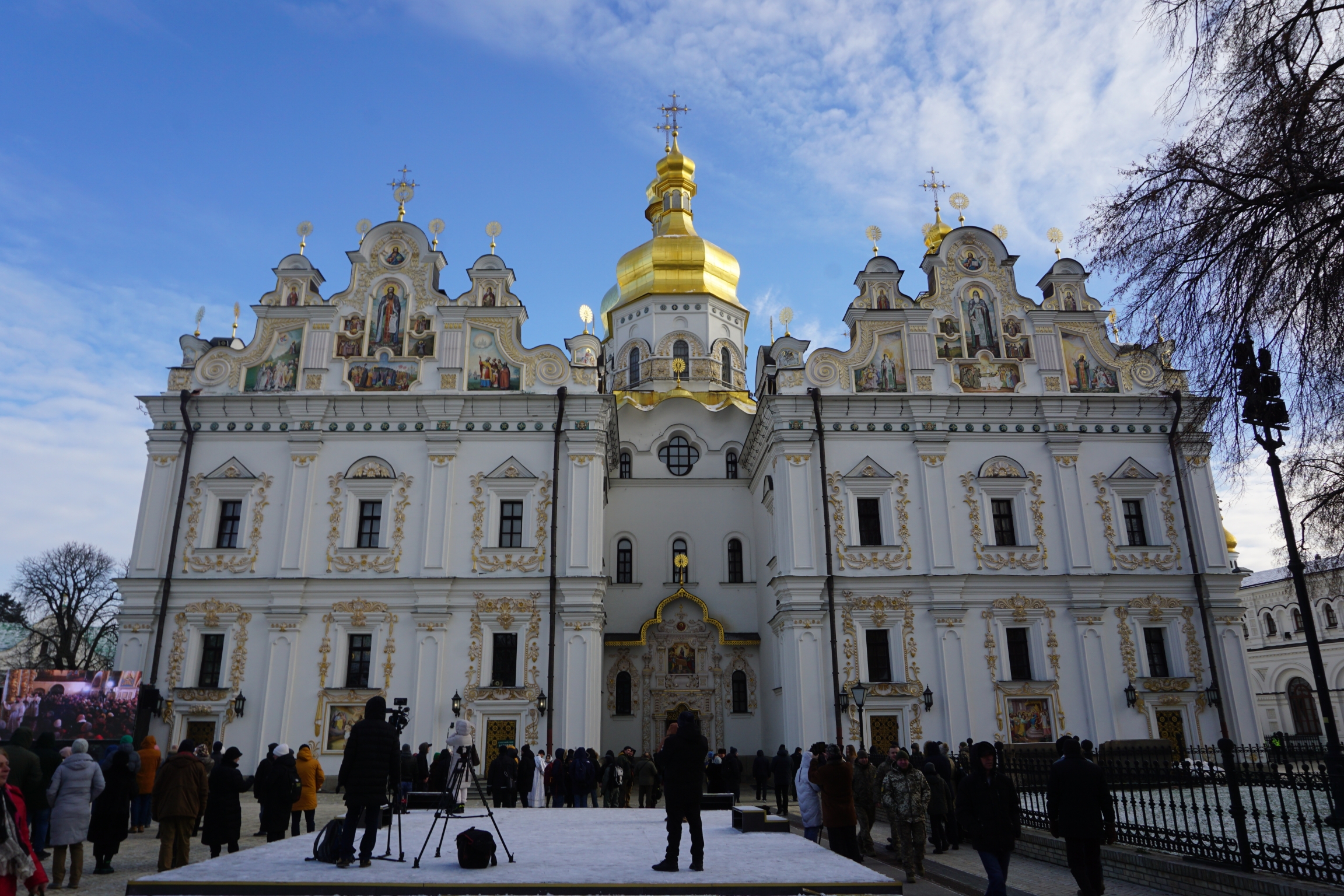
The Pesherska Lavra, the Monastery of the Caves, in Kyiv, Ukraine, ornate cathedral, is a UNESCO World Heritage Site and it’s the heart of Ukrainian Orthodoxy.
Daniel Ofman/The World
Over the weekend, Orthodox Christians around the globe celebrated Christmas. In Russia and Ukraine, the holiday took place during a time of war between the two countries.
Although Russian President Vladimir Putin ordered his forces to implement a 36-hour holiday ceasefire, Ukraine’s President Volodymyr Zelenskiy said that Russian forces continued their attacks on Bachmut in eastern Ukraine.
Metropolitan Epiphanius, the head of the Orthodox Church of Ukraine delivered the Christmas Day sermon.
“During these days of festivities with strong feelings we ask God: Help us defeat our enemy who brought grief into our home. Help us finally drive out the foreign invasion from the Ukrainian land,” he said.
Epiphanius went on to say that only “through the victory of truth” can there be a “just and lasting peace.”
He delivered his sermon in Ukrainian. And for many people here, that was a big deal.
Veronika Selega attended the service with a friend. It was her first time in this cathedral on Christmas morning.
The day before, they contemplated what to do for the holiday. “Of course, [we thought,] we’ll go to Lavra, and it’s something new, even as a tradition you know, to go here, because we [usually go] to different churches.”

On Orthodox Christmas morning — Jan. 7 — worshippers made their way to Pesherska Lavra, the Monastery of the Caves, in Kyiv, Ukraine.
Daniel Ofman/The World
Selega said that in the past, she felt uncomfortable attending the service at the Lavra cathedral, because it was controlled by the Moscow-affiliated Orthodox church.
Now, the holy site is fully under Ukrainian control, and for the first time, leaders from the Kyiv-affiliated Orthodox Church led Christmas day services.
For Selega and her friend, Oksana Nechypurenko, it was a historic day.
“It wasn’t psychologically OK, or ethically OK to be there,” Nechypurenko said. “And now, for the first [time] from the independence of Ukraine, it’s open for us and lots of Ukrainians are comparing it to some liberation of the territories.”
In recent weeks, Ukraine’s government has cracked down on religious institutions aligned with the Russian Orthodox Church, claiming that their leaders were a fifth column influenced by Moscow. And, several churches have been raided.
President Volodymyr Zelenskiy said last month that Ukraine is a “spiritually independent country” and it will not allow anyone to “manipulate Ukrainians and weaken Ukraine from within.”
Ukraine’s government is now considering banning certain religious organizations affiliated with the leader of the Russian Orthodox Church, Patriarch Kirill, a staunch ally of Vladimir Putin who has consistently supported Russia’s invasion of Ukraine.
That’s led to some stark condemnation from religious leaders in the country.
Andriy Dudchenko is the senior priest at the Transfiguration of the Lord Cathedral, in Kyiv. He said that Kirill has lost credibility as a religious figure
Dudchenko said that Ukraine is at war, and the government needs to prioritize national security.
But he said that authorities must also follow the law as they investigate religious leaders.
Andriy Dudchenko is a priest at Pesherska Lavra, the Monastery of the Caves, in Kyiv, Ukraine.
Daniel Ofman/The World
“In Ukraine, we have very liberal laws about religion, and I would [hope] that Ukraine continue[s] to have this liberal attitude. If there are some, and we know that there are, some issues of collaboration, the investigations should be made, the responsibility should be personal.”
Personal and not communal. But even if the Moscow affiliated church is not yet banned in Ukraine, this Christmas has highlighted the deep divisions between the two Orthodox churches of Russia and Ukraine.
On top of that, this year, many Ukrainians started celebrating Christmas twice.
On the traditional Orthodox date of Jan. 7 but also on Dec. 25, when Christians from Western countries celebrate.
Back at the Lavra Cathedral, Nechypurenko and Selega said that they’re not letting the Russian invasion tarnish their Christmas.
They say they’re celebrating life over death and this year, that’s certainly worth a double celebration.
Christine Harrison has taken to sitting outside, barefoot, on the balcony of her chalet in the French Alps, and soaking up the sunshine.
Harrison, from Liverpool in the UK, has been visiting the French ski resort of Praz De Lys every winter for the past 25 years. The family-friendly resort is located at an altitude of 4,921 feet and boasts 31 miles of Nordic ski slopes for sports enthusiasts.
This year, she said, just finding a slope with snow has been her biggest challenge: “There’s no snow, literally, you can't ski here. There's just grass everywhere.”
Praz de Lys, like numerous ski resorts across the Alps and French Pyrenees, is struggling to cope with the unprecedented warm temperatures this month. Some resorts like A x 3 Domaines, located close to the French border with Andorra, have shut completely.
Others, like Le Gets and Morzine, in the Portes du Soleil area, have closed several of their ski runs.
Harrison said that she, along with her partner and two teenage children, went to Les Contamines that's nestled at the foot of Mont Blanc in search of better skiing conditions earlier this week. At the top of the slopes, Harrison said, they finally found snow but as they descended below 2,000 meters, the rain started to pour down and the ski run quickly turned to slush.
“It was horrible. We managed to do about four hours and it was like, what are we even doing here? It was carnage,” she said.
Le Praz De Lys in the French alps is shown on a more wintry day in 2017.
Courtesy of Christine Harrison
The conditions are not just challenging for winter sports enthusiasts, but they could prove risky, too.
Klaus Dodds, a professor of geopolitics at Royal Holloway University of London, said skiers and snowboarders will notice that piste (downhill ski trails) and snow conditions become more uncertain in warmer temperatures.
“There's more chance of avalanches, and skiing just becomes more dangerous because snow and ice is less settled,” he said.
Dodds said he isn’t surprised by the rise in temperatures at European ski resorts this winter. After all, he said, several EU countries experienced record-breaking heat waves last summer. Scientists have been warning about this for years, he said.
“We’re not just talking about climate change now, it’s climate breakdown,” Dodds said.
It’s not only winter ski resorts that are seeing unprecedented temperature hikes this month. Cities in Germany, the Czech Republic, Hungary and France have all smashed records for the hottest start to the new year.
Warsaw, Poland, where the mercury usually hovers around freezing at this time of year, clocked up 66 degrees Fahrenheit on Jan. 1. Residents of Bilbao in northern Spain headed to the beach earlier this week as temperatures soared to highs usually seen in midsummer.
Snow loss or ice loss also has implications for water supply, according to Dodds.
Many of Europe's major rivers, such as the River Po in Italy or the Rhine in Germany, are dependent on alpine meltwater to replenish water levels. Low water levels have a negative impact on agriculture and endanger river transport, he said.
Christine Harrison (middle), with daughter Sophie and son Jack are shown at the French ski resort in snowier times in February 2020.
Courtesy of Christine Harrison
Countries like France and Switzerland have also been expressing concern that they will not have enough water to act as coolant for their nuclear power stations, Dodds said.
The high winter temperatures also pose a challenge to communities in alpine towns that are dependent on winter tourism.
Sara Burdon, communications manager at the Morzine tourist office, said local businesses are worried.
“While the summer is an important and very much growing part of the tourism here, the winter is still the main season and the one in which businesses make most of their income,” Burdon said.
For the last few years, the town of Morzine has tried to address the negative impact a ski resort can have on the environment. Ski holidays can produce a large carbon footprint between visitor flights and the use of gas-guzzling equipment like artificial snow machines and ski lifts.

Sara Burdon works in the Morzine tourism office in France said that businesses are worried about the impact of warm winter temperatures on seasonal tourism.
Sam Ingles
Burdon said the town has now installed solar panels on some of the chair lifts, while workers have adopted more sustainable ways of looking after the ski pistes, including using GPS systems to target exactly where artificial snow is required.
Last year, Morzine was awarded the Flocon Vert sustainability award — an environmental honor recognizing green development policies in European ski resorts.
Burdon said that they are still working hard to combat the heavy carbon cost of the flights.
A local environmental charity, Montagne Verte, has created a special train pass called the AlpinExpress Pass, which gives those who arrive by rail cut-price offers on their journey as well as cheaper accommodation and discounts on ski hire.
Burdon said they try to encourage their European visitors to make the journey by train whenever possible.
One silver lining from the unexpected balmy conditions this season has been lower heating bills. Last summer, the German government warned of a possible fuel shortage in the winter along with soaring energy costs — caused by the lack of a gas supply from Russia.
In December, the German economy minister, Robert Habeck, said he is optimistic the country has enough fuel to see it through the winter.
But Dodds pointed out that warmer temperatures have also been responsible for the catastrophic flooding in parts of Europe last year that devastated homes, particularly in Germany. The climate scientist said he believes that governments can still do more to prevent further temperature rises. For starters he said, nations need to stick to the targets laid out in the 2015 Paris Agreement which vowed to prevent global temperatures from rising 2 degrees Celsius above pre-industrial levels this century, and in particular, limit the increase to 1.5 degrees Celsius.
“We’re already 1.2 degrees past, so there’s little wriggle room left before we reach the 1.5 degree limit,” Dodds said. “That’s why we talk about a climate emergency.”
Israel released the longest-serving Palestinian prisoner on Thursday. Karim Younis was released just north of Tel Aviv in the pre-dawn hours — to prevent large gatherings and celebrations. He used the cell phone of a passer-by to inform his family members.
Younis was convicted of kidnapping and killing an Israeli soldier in the occupied Syrian Golan Heights in 1980, and started serving his sentence three years later, spending a total of 40 years behind bars. While incarcerated, he wrote political works and called for agreements with Israel. Coming from the village of Ara in Israel, Younis has Israeli citizenship, but Israel's interior minister, Itamar Ben-Gvir, has called for it to be revoked.
The World's Carol Hills spoke with Khaled Elgindy, a Palestinian and Israeli affairs expert at the Middle East Institute, about the implications of the release.
This interview has been lightly edited and condensed for clarity. AP contributed to this report.
Related: US senators demand full White House investigation into shooting of Palestinian American journalist
A bakers’ rebellion is looming in France as they prepare to defend their beloved baguettes. Making bread, croissants and other pastries has become next to impossible, they say, due to soaring electricity prices.
Now, they’re demanding help from the government. And if it doesn’t arrive soon, they’re threatening the unthinkable — to turn off their ovens.
Take French baker Phillipe Mendez. The sound of his electric ovens whirring to life used to be music to his ears. Now, it’s a source of stress.
“My electricity bill has gone up four-fold in the last eight months,” he said. “That’s besides the price hikes for my basic ingredients. The situation,” he added, “is becoming very complicated.”
Mendez opened his artisanal bakery nine years ago in the small Alpine village of Embrun. Business was good, until now. Inflation, the war in Ukraine and the Europe-wide energy crunch have Mendez at wit's end.
"My wife, Nathalie, has had to come in to work," he said, "as we’ve been forced to reduce our staff."
"What’s happening is a real shame," Nathalie said as she sliced bread on the electric slicer. "All of our bread is homemade. We strive for quality. But because of what’s happening,” she said, “our hands are tied."

"The French, deprived of their bread, would die,” jokes French baker Phillipe Mendez. Mendez is one of thousands of artisanal bakers warning they may need to unplug their ovens because it's too expensive to operate due to rising electricity costs.
Gerry Hadden/The World
At the end of this week the Mendezes said they’ll have to raise prices by about 10%. They said they can only hope their customers will still come by. Because it's France, good bread isn’t some luxury item — it’s like water — you have it with every meal.
Local worker Julien Breniere picked up two baguettes on his way home from work. He said he can’t start his day without them.
“They’re actually mini-baguettes,” he said. “Ficelles. In the morning,” he said, rubbing his stomach, “I toast them and eat them with butter and jam.”
“Our bread is very important,” 80-year-old customer Giselle Van Overberk said. “It’s well known,” she said, “that the French baguette is the best in the world.”
You could chalk up such comments to national pride. But French bakers sell some 6 billion baguettes a year. In December 2022, the United Nations granted baguette-baking world heritage status. And each week on French TV, there’s a reality show — just for baking bread.
On the latest episode of “The Best Bakeries in France,” two stern-looking judges weigh in on a spinach and Brebis cheese loaf baked somewhere in the Pyrenees — 8 points out of 10, they declared — with room for improvement.
Beloved bakers in France are not immune to the energy woes gripping the country. Electricity prices are set to rise further this winter, as the government struggles to compensate for the loss of natural gas from Russia. In fact, the government warns, there could be temporary blackouts later this month. But its message to bakers is, “We’ve got your backs.”
“We will not let our bakeries fail,” said France’s Minister of Finance Bruno Le Maire on the radio this week. “We’ll stand by them,” he said. “Helping with concrete measures.”
Those measures include tax breaks and emergency subsidies. But French bakers say they need more.
“They speak of an emergency bail-out check,” baker Mendez said. But red tape is a problem.
“I had to file an application about 6 inches thick,” he said. “And I still don’t know if I’m getting anything.”
Mendez said he can hang on for another couple of months. After that, he said, he’ll bake up his last batch of baguettes, then unplug his ovens for good. And that, he said, would be an existential catastrophe.
"The French,” he half-jokes, “will die without their bread."
Pope Emeritus Benedict XVI was laid to rest on Thursday. His funeral was held in St. Peter's Square at the Vatican. Pope Francis led worshipers in prayer. Benedict made history when he resigned as pope in 2013, becoming the first sitting pope to do so in six centuries. Benedict continued to influence the Church even after his resignation.
The World's host Carol Hills discussed the former pontiff's legacy with Massimo Faggioli, a professor of historical theology at Villanova University, who joined the discussion from Italy.

Cardinals arrive in procession ahead of the funeral mass for late Pope Emeritus Benedict XVI in St. Peter's Square at the Vatican, Jan. 5, 2023.
Andrew Medichini/AP

Faithful attend the funeral mass for late Pope Emeritus Benedict XVI in St. Peter's Square at the Vatican, Jan. 5, 2023.
Ben Curtis/AP
This interview has been lightly edited and condensed for clarity.
Related: Pope Francis' historic trip to Iraq embraced by many as a welcome boost
When Emilia, a British schoolteacher living in Istanbul, realized that her cat, Misket, wasn’t eating anymore, she rushed him to the vet.
After a series of tests, her cat was diagnosed with an almost-certain case of feline infectious peritonitis, or FIP. Without medication, the veterinarian told her, Misket would die within weeks. But Emilia didn't get a prescription; instead, she was handed a list of phone numbers.
“This world we had entered into — there was definitely this element of can you trust these people?” Emilia said. (Her full name isn’t being used because the legality of what happened next is unclear.)
FIP, a deadly infection that springs from a mutated form of a coronavirus that is common in cats, was untreatable until only recently. In 2019, a medication developed by Gilead Sciences, known as GS-441524, was shown to be effective against FIP in clinical trials of afflicted cats.
But Gilead never pursued licensing for the compound in animals. Shortly after the GS-441524 trials, COVID-19 appeared on the scene, and Gilead sank its resources into regulatory approvals for remdesivir, a similar antiviral medication that showed promise in human COVID-19 cases. It was to be the first drug authorized by the Food and Drug Administration to treat COVID-19.

Emilia of Istanbul is shown with her cat, Misket.
Durrie Bouscaren/The World
In the meantime, drug manufacturers abroad got ahold of the recipe, and began selling unlicensed versions of GS-441524 all over the world. In Turkey, where there are a lot of street cats, the drug is in especially high demand.
The phone numbers in Emilia’s hands were local sellers in Turkey who had access to the drug.
“But whatever we could do, we were [going to] do,” she said.
In healthier times, 7-year-old Misket was a sweet-tempered calico with a big, white belly and a fondness for his food bowl. He had grown incredibly weak in just a few short days, and had to be fed by hand with a mixture of wet food and water, with a syringe. Emilia and her husband, Emre, were desperate.
“He’d sort of just crawled into the cupboard and was laying at the bottom,” Emilia said. “A few weeks before that, he’d been absolutely fine. And then, for everything to change within a week, and to have the news that he wasn’t going to survive more than a few months was just crushing. We were absolutely devastated.”
After doing research online and consulting a WhatsApp group of cat owners whose pets had also gone through FIP treatments, Emilia and Emre settled on a seller who would send them an unlicensed version of GS-441524 through a mail service.
The medicine came in small glass vials, which Emilia and Emre would use to give Misket daily injections for about three months. Each vial contained enough medicine for two or three injections; the vials cost approximately $80. Sometimes, the price would fluctuate, or their seller would run out, resulting in a scramble to find the drug for the next week.
But after a couple of weeks, the medication started to work. One evening, while sitting on the couch, Emilia watched Misket get up and walk to his food bowl for the first time — a clear sign that he had started to feel better.
“It felt like a massive relief. We just knew we were doing the right thing,” Emilia said.
All told, Emilia and Emre estimate that they spent $2,500 on their treatments for Misket — leaving them with a deep sense of frustration that the medication wasn’t legally and widely available.
“But we didn’t ever feel like it was wrong. Because at the end of the day, we were trying to save our cat’s life, and this was the only way that we could do that,” she said.
At a private veterinary clinic in a seaside suburb of Istanbul, Dr. Sezin Çıtak calmed a fluffy gray cat for a blood draw.
FIP was always one of the saddest diagnoses to give a cat, Çıtak said, because it’s so fast, and so deadly. When GS-441524 came on the scene, it completely changed the game.
“It brought us so much happiness,” she said. “Within a week, the animals started to improve.”
At Çıtak’s clinic, the owners of afflicted cats buy the drug on their own, and bring their cats in for the injections. The drug is packaged under several different brands, her colleague, Hasan Musayev said, showing a small collection of vials.

Turkish veterinarian Sezin Çitak helped cure a cat named Ozy of feline infectious peritonitis, a chronic wasting disease, a few months ago.
Durrie Bouscaren/The World
“In this one, they write ‘for external use only.’ In others, they write on the [vial] that it’s forbidden. And you can’t get any information,” Musayev said.
Because there are no licensed drugs that work for FIP — Musayev and Citak say using GS-441524 isn’t illegal under Turkish law. But if a cat owner wants to use a medication that they can buy normally, from a pharmacy, they have had some luck using the human drug, remdesivir — with the dosage scaled down for a cat.
“Even though it’s expensive, at least there’s some kind of a solution for these cats,” she said. “Because before, all of them would lose their lives.”
Other veterinarians fear that the illegal market for GS-441524 makes it easy for unscrupulous sellers to provide fake or watered down drugs.
Gizem, a veterinarian in Istanbul who asked to go by only her first name due to the legal status of GS-441524, said her previous employer would refuse to store the drug onsite, fearing random health and safety inspections by the government.
Even if they used the medication on an animal, they would ask pet owners to sign a form releasing the clinic from all liability.
“Veterinarians want it to be legalized because they’re already applying it, they’re seeing the results, that it works,” Gizem said. “But the fact that it’s unlicensed makes it very costly, and a lot of times, we see pet owners can’t afford it and have to stop the treatment.”
At Ráječek Farm in the southern Czech Republic, bright, red hydroponic tomato plants tower more than 10 feet tall inside greenhouses.
The Sklenář family has worked the land on Ráječek Farm for four generations. The family once lost the farm to the state under communist rule. But several years after the Czech Republic switched to a market economy, the family regained control of the farm and launched a successful business growing hydroponic tomatoes.
“My parents had to reinvent the whole business again because if they did the same [farming] model as our grandparents, it wouldn’t have been economically sustainable,” said Matěj Sklenář, 28, the head agronomist at Ráječek Farm.
But last year, Russia’s invasion of Ukraine — a war aimed at pulling a large swath of Eastern Europe back into Russia’s influence — once again disrupted the growing season on Ráječek Farm.
Some fertilizers Sklenář uses on his hydroponic tomatoes come from Russia. But last year, those fertilizers became 10 times more expensive.
The drastic rise in fertilizer prices is a huge problem for hydroponic farmers because they mostly don’t use organic fertilizers like compost or manure.
“If you grow in soil and you don't add fertilizer you can still do a season with decreased yield, but with hydroponics, if you don't have fertilizers, it's just not possible to grow anything,” Sklenář said.

Matěj Sklenář, 28, the head agronomist at Ráječek Farm in the south of the Czech Republic, stands in one of the farm's hydroponic greenhouses. The farm, which has been operated by the same family for four generations, previously relied on a brand of Russian fertilizer that became about ten times more expensive last year after the war in Ukraine began.
Courtesy of Ráječek Farm
Fertilizer is used by most commercial farming operations. And industrially produced fertilizers are often credited with providing sufficient yields to feed a planet with a growing population that is projected to have reached 8 billion people.
Russia is the world’s largest producer of fertilizers. There are no sanctions against Russian agricultural products, but many shipping companies now refuse to transport Russian products, including fertilizers.
Belarus is also a large fertilizer supplier, but sanctions against Belarus for its participation in the war in Ukraine have also severely limited the country’s contributions to the global fertilizer supply.
These restrictions are causing fertilizer prices to skyrocket.
Common nitrogen fertilizers found at the store are made from ammonia, which is produced from natural gas. Russia used to export a lot of ammonia to the fertilizer market through a pipeline in Ukraine. But that’s been closed since the war started.
Fertilizer companies in Europe also make their own ammonia with natural gas from the European grid. But Europe is trying to wean itself off Russian gas right now, so fuel prices are rising.
“The war caused the price of natural gas to increase, so that’s one of the reasons why fertilizer is so expensive,” Sklenář said.
Last year, major fertilizer companies like Norway’s Yara International had to temporarily curtail production of nitrogen fertilizers because of the war.
Yara was eventually able to reroute their ammonia supply from other sources to increase production speed again. But fertilizer prices remain high, driving up food costs.
“What we’ve seen with the Russian invasion of Ukraine is that, sadly, the situation with food production has turned to the worst,” said Lars Røsæg, deputy chief executive officer of Yara International.
After the war started last year, Sklenář’s farm was hit with a double whammy because many of the workers are Ukrainian. They were back in Ukraine on holiday when the war started, and men who were old enough to serve were no longer allowed to leave the country. Sklenář has struggled to find new workers.

Six sisters from Ukraine stand in a greenhouse at Ráječek Farm in the Czech Republic, four of whom are employees at the farm and two of whom sought refuge there after the war started. Many of the farm's workers come from Ukraine, however, some of their male workers cannot leave Ukraine and return to the Czech Republic because men young enough to serve in the military can't leave the country. The farm has struggled to find workers to replace them.
Courtesy of Ráječek Farm
It’s also more expensive to heat his greenhouses now.
“We are pretty sure that this season, the profit will not be as big as past seasons,” Sklenář said.
Fertilizer costs have forced farmers all over Europe to make difficult decisions.
Kieran McEvoy, a farmer south of Dublin who grows wheat and barley, said that he usually buys all of his fertilizer around Christmas. But this time, he’s waiting.
“It’s not really a great plan I suppose, but we’re just hoping maybe there might be a little bit of a relaxation in the price of gas,” McEvoy said.

Hydroponic vegetables grow in long troughs year round inside greenhouses at Ráječek Farm in the Czech Republic. The price of natural gas used to heat the greenhouses rose so high after the war in Ukraine that the farm now plans to transition to solar power.
Courtesy of Ráječek Farm
The war has made it hard on farmers, but some fertilizer companies have increased their profits. Now, they’re looking to new sources far away from Russia.
Morocco, which holds an estimated 72% of the world’s phosphate — a key ingredient in another common fertilizer — started ramping up production this year.
In the Sahara desert, miners blast the earth with explosives to mine phosphate, sending clouds of red dust barreling across the desert.
Damian Berger, co-founder of Ishtar Analytics, a think tank focusing on North Africa and the Middle East, said that Morocco uses its mighty fertilizer reserves as a tool for soft power by helping countries throughout sub-Saharan Africa increase their food production. Less Russian fertilizer is a potential opportunity for a country like Morocco.
“Morocco has been building up its fertilizer diplomacy and industry for a situation like the one we're facing right now,” Berger said.
Morocco now plans to open a new fertilizer plant in Brazil, a country that once relied heavily on Russian fertilizer.
Russia also extends its influence in both South America and Africa. But with the war grinding on, Berger said that Morocco is becoming a safer trading partner than Russia.
The shift in the global fertilizer market is giving African countries greater power in global food production at a time when hunger is on the rise.
“There is the potential for Morocco to assume a leading role as the spokesperson of African food security concerns,” Berger said.
The war is also giving more importance to new projects aimed at creating so-called green fertilizers that don’t require fossil fuels to produce.
Yara International, the Norwegian fertilizer company, is currently building a new facility with the capacity to produce green fertilizer that they hope will be ready later this year.
“[Last year] opened the eyes of the whole world to the importance that we accelerate the green transition of the food chain in a way where we reduce the dependency on Russia, so that we can have a sustainable and secure food supply,” Yara International’s Røsæg said.

The fertilizer company Yara International's production plant in Le Havre, France. Last year, Yara International had to temporarily curtail production of nitrogen fertilizers because of the war in Ukraine, although they eventually were able to get their production up to speed again. Production problems caused by the war have made fertilizer prices skyrocket.
Courtesy of Yara International
The fertilizer shortage, and other difficulties related to the war in Ukraine, are pushing some farmers to pursue more sustainable practices.
Sklenář in the Czech Republic is now investing in solar panels so he doesn’t have to heat his greenhouses with natural gas.
For Sklenář, the difficulties associated with the war aren’t all negative.
“It hurts a little bit, but it’s worth the pain to get out of this and become independent from Russia,” Sklenář said.
“Bread. Work. Freedom,” women in Afghanistan chanted at a recent protest.
The simple slogan captures everything they are being deprived of.
Late last month, the Taliban announced a ban on women working for nongovernmental organizations. It came shortly after the group barred women from attending universities.
Since their takeover more than a year ago, the Taliban have severely limited women’s rights.
On Sunday, the deputy head of the United Nations Mission in Afghanistan, Potzel Markus, met with Maulvi Abdul Salam Hanafi, the deputy prime minister of the Taliban in the capital, Kabul, to discuss the ban.
But there has been no word so far about any breakthroughs from that meeting.
“I am living through my worst nightmare,” 21-year-old Razia said from her home in the city of Herat.
She asked that The World not mention her last name or which organization she worked for because she is afraid the Taliban will punish her for speaking to a foreign reporter.
Until last week, Razia was the sole breadwinner for her family of eight. But now, she has no job and no income.
“We, Afghan women, don’t deserve this,” she said.
In response to the ban on women employees, several international aid organizations have suspended their operations in Afghanistan.
“This is an unacceptable breach of humanitarian principles specially of impartiality, independence,and most importantly humanity,” Sofia Sprechmann Sineiro, head of CARE International, said at a press briefing last week.
The ban comes at a difficult time for the Afghan people. Millions of Afghans rely on humanitarian aid just to survive, according to the United Nations.
“Banning women aid workers has immediate, life-threatening consequences for all Afghans,” the organization’s Office for the Coordination of Humanitarian Affairs in Afghanistan tweeted: “The ban comes at a time when over 28 [million] people require aid to survive as the country grapples with risk of famine conditions, economic decline, entrenched poverty [and] a brutal winter.”
“Some organisations have lost up to 40% of their staff overnight: teachers, team leaders, logisticians, nutrition experts, community health workers, administrators, NGO heads,” wrote Hugo Shorter, the interim chargé d'affaires of the UK’s mission to Afghanistan.
Wazhma Frogh, who’s based in the US and runs an NGO in Afghanistan, found out about the ban when her employees called her frantically about a letter they received from the Ministry of Economy.
She asked The World not to publicize the name of her group because she also fears retaliation.
“What it said [was] that due to a number of complaints, female staff are not allowed to work in these organizations and it says if any organization does not obey this rule, then, they will lose their license,” Frogh said.
Frogh employs 25 women; some are students who were recently banned from attending universities. Her NGO provides a range of services to about 750 women across the country, including humanitarian aid, home-based classes and psychosocial programs for women.
Frogh called the Afghan Ministry to explain how her group helps many Afghan women. But she said it didn’t seem to make any difference.
“I just have no idea what to do and how to deal with this situation,” she said.
While organizations grapple with the change, employees are left to figure out how to survive.
Marjan worked for a local NGO in Kabul until last Thursday. She said that she got a call the previous night from her boss saying she couldn’t come to work the next day.
She, too, asked The World not to disclose her full name or details about her job out of fear of the Taliban.
Marjan said she wonders how she will pay for fuel and firewood this winter, adding that soon, her family might not even have anything to eat.
Aid groups have been forced into an impossible position, said Mohammad Qadam Shah, who teaches at Seattle Pacific University, and has researched foreign aid in Afghanistan.
“The whole country right now is hostage and the women are the main target,” he said.
Last week, Jan Egeland, the head of the Norwegian Refugee Council, said in an interview on Afghan television that his organization has already complied with the Taliban’s demands that female employees dress modestly and work separately from their male colleagues.
But the ban on women employees is a step too far, he said.
“We cannot do good work with males only,” he said, adding that the organization has “some principles. A fundamental principle and value for us is that both female and male colleagues can work according to local values and traditions.”
The NRC is among the organizations that have suspended their operations in Afghanistan. Egeland said one reason is because they can no longer access women in conservative areas.
Taiwan’s President Tsai Ing-Wen announced at a press conference last week that young men will soon have to perform a full year of compulsory military service.
It’s a step up from the current four months — and a response to increased threats from China.
“Nobody wants a war,” Tsai said. “Not Taiwan’s government or its people, or the world at large. But I say to my compatriots, peace does not just fall from the sky.”
Taiwan’s government is promising to overhaul military service. They’re planning to introduce more practical skills, give recruits hands-on training with more modern weaponry, and bump up monthly pay from $200 to closer to $650.
Recent polls show about three-quarters of Taiwanese people support the move — but when you break down the results by age, that changes.
A poll conducted by the Taiwanese Public Opinion Foundation earlier this month found that among those who are 20 to 24, only 35.6% of respondents supported increasing military service to one year.

Howard Li is shown on a hiking trip in Taiwan.
Courtesy of Howard Li
That’s a far cry from when they asked the same question in March when 56.4% of respondents approved.
Current high schoolers who were born in 2005 will be the first to do a full year under the new rules, starting in 2024.
Howard Li, a high school senior in Taipei, said that he expected something like this, but hearing the news was still a shock.
Li had already planned to do four months of military service and then take a gap year to improve his English and do an internship before attending a university in Singapore the following year. Now, all of this is changing.
However, Li has heard about rising threats from China, and the record-high number of Chinese military aircraft that passed through Taiwan’s nearby airspace recently. He said he thinks the service extension is necessary, and when the time comes, he’ll take part.
“It's a cruel decision, but it's a crucial decision, too,” Li said.

Alex Tsao is currently studying as a university student in Japan.
Courtesy of Alex Tsao
But although he believes that Taiwan’s democracy should be protected, he said, he and others his age don’t relish the idea of protecting it themselves: “People my age, we don't want to be in the army …We just want to finish our education peacefully, work, earn money and have a family.”
Alex Tsao, a college student studying in Japan, finished his four-month service recently. He said the training was useful in some ways, and did bolster his willingness to defend Taiwan, but there were also many afternoons spent sitting in a field with nothing to do.
“I feel like if one day I really have to go into battle, based on my military training, I will just die,” he said.
Tsao recalled when he was training to shoot a rifle, and his team was told that they needed to save bullets.
“You shoot eight, and then, you wait in line and then, you shoot another eight,” Tsao said. “And it takes a whole afternoon to shoot only about 40 bullets.”
Wen-Ti Sung, a professor of political science with Australian National University’s Taiwan studies program, said that Tsao’s experience is not unique, unfortunately.
“That’s a very common criticism you hear among Taiwanese society,” Sung said. “They end up doing very mundane housekeeping, maintenance work, rather than front-line kind of relevant military training.”
Kitsch Liao, assistant director of the Atlantic Council’s Global China Hub, said that he’s cautiously optimistic about the changes, but argues that it will be a challenge to overhaul military training by 2024 — citing a lack of staff and facilities for training.
“I highly doubt all these problems can be worked out in a year if they haven't been worked out in 20 years,” Liao said.
But Liang-Chih Evans Chen, an associate research fellow at the Institute for National Defense and Security Research in Taipei, is more confident about the government plan.
“We’re asking the younger generations to practice with the Stinger [missile], or the UAV [unmanned aerial vehicle]. I think that's quite modern. And that's quite practical,” Chen said. “Following the case of the Ukraine war, I think, is quite important. That's very critical for Taiwan's military reform.”
High schooler Li said that as time passes, the reality of this decision, and the reasons it was made, sinks in.
“We read it on the news, but now…it just feels so real,” Li said. “It’s happening. I have to go into a camp where thousands of men train to kill, to protect, to use deadly weapons.”
For Larysa Spisic, a Ukrainian American whose family is from Lviv, Ukraine, it’s been hard watching the war in Ukraine from afar.
“You definitely feel helpless at times because we are over here and we can give support and prayers and good wishes, but physically, we really cannot do much,” said Spisic, who lives in the Philadelphia area, which has the second-largest Ukrainian community in the United States.
Spisic, the director of the Voloshky School of Ukrainian Dance in Jenkintown, Pennsylvania, wanted to find a way to showcase Ukrainian culture and raise money for the cause.
So, she decided to stage the holiday classic, “The Nutcracker” — with a Ukrainian twist, set in a small, Ukrainian village with Ukrainian folk dancing, decorations, dolls and food on prominent display throughout. The production had a two-show run on Dec. 23 at the Josephine Muller Auditorium in Jenkintown.
Because of Russia’s invasion, she said the classic ballet by Pyotr Tchaikovsky has a special impact. The famous composer was born in Russia, but his great-grandfather was from Ukraine’s central Poltava region, according to researchers.

The Voloshky School of Ukrainian Dance in Jenkintown, Pennsylvania, staged "The Nutcracker" with a Ukrainian twist.
Courtesy of Andrew Nynka and The Ukrainian Weekly
“Ukrainians feel very strongly that we do have some personal connection to him as well, and we wanted to embrace that,” Spisic said.
It’s just one way that the community has been resilient and strong throughout the 10 months of the invasion, said Ulana Dubas of Dresher, Pennsylvania.
Dubas’ family is also from Lviv and her husband’s family is from the Kharkiv region in eastern Ukraine, small parts of which are still occupied by Russian forces.
“We did a lot of drives for clothing and food, monetary donations that really brought the community together in many ways,” she said. “And that’s continuing now because it has to.”
Dubas’ 10-year-old daughter, Mila, was one of some 50 dancers from the Voloshky School of Ukrainian Dance. The school, now in its 50th year, is considered to be a staple of the Ukrainian American community in Philadelphia.
A handful of other Philadelphia organizations and guest dancers also chipped in and donated their time to help make the production happen, including community veterans of Ukrainian folk dance, the Metropolitan Ballet Company and one of Philadelphia Ballet’s Principal Ballerinas, Oksana Maslova.

The Voloshky School of Ukrainian Dance in Jenkintown, Pennsylvania, staged "The Nutcracker" with a Ukrainian twist.
Courtesy of Andrew Nynka and The Ukrainian Weekly
This collaboration, the leaders of the production say, is a testament to the overall support Ukrainian Americans say they’ve received since Russia invaded Ukraine earlier this year.
For much of outgoing President Jair Bolsonaro’s time in office, one man was the guiding light for Brazil’s foreign policy — US President Donald Trump.
“I think we can say that Brazil and the United States are as close or closer than they’ve ever been,” Trump said during a bilateral meeting with Bolsonaro in mid-2019.
With Trump's 2020 loss, Brazil became more isolated than ever. But Brazil’s president-elect, Luiz Inácio Lula da Silva (known simply as Lula), has promised to again lift Brazil onto the international scene.
Lula is set to be sworn in over the weekend. As many as 800 caravans of supporters are on their way to the capital Brasilia from around the country — and 350,000 people are expected to attend the ceremony on Jan. 1.
“The world misses that sovereign Brazil that spoke on equal terms with the richest and most-powerful countries and at the same time, contributed to the development of the poorest nations,” Lula said on Oct. 30, the night of his election victory. “Now, Brazil is back. It’s too big to be relegated to this sad role of pariah in the world.”
More of the world’s leaders will be attending Lula’s inauguration on Sunday than at any other swearing-in in Brazilian history, including 19 heads of state from 65 foreign delegations, the majority of whom are from Latin America and Africa.
Observers say that there’s a good reason for that — they'll be strategic partners.
“I think there can be no doubt that the arrival of Lula is a game-changer for Latin American politics and for Latin American regional integration,” said Guillaume Long, Ecuador’s former foreign minister.
South-South ties were key for Lula when he previously led Brazil in the 2000s. He traveled to more than 45 countries, and opened 35 new embassies, mostly in Africa and the Caribbean. He founded the BRICS group of emerging economies with China and Russia, deepened ties with Brazil’s neighbors and pushed back on the United States' dominance in the region.
In 2005, Lula spoke out against US attempts to create a hemispherewide, free-trade zone at the Summit of the Americas in Argentina.
“For centuries, Brazil had its back to the region, and looked to the US and Europe as whatever’s good for them is good for us,” Lula told leaders, including then-US President George W. Bush. “There are no individual answers for our countries. Either we find joint answers, or there are none at all.”
“It will not be easy to fix Brazil’s broken peace and transform Brazil into an important global actor as it was before,” said Camila Feix Vidal, a foreign relations professor at Santa Catarina Federal University. ”But at the same time, we are not talking about a regular presidency. Lula has always acted very proactively in foreign affairs. I always say that Lula's a natural diplomat.”
Feix Vidal said that Lula's foreign policy will be based “not on ideology, but on pragmatism and sovereignty.”
That means that Brazil will look for solid relations with both the United States and China, its top two trading partners. But under Lula, she said, it will refuse to bow down to either.
Lula has appointed Mauro Vieira to run the Foreign Ministry. Vieira is a career diplomat who previously served at the post under President Dilma Rousseff.
“Mauro Vieira is an insider but who very much speaks the language of Lula’s vision of Brazilian foreign policy,” said Long, Ecuador’s former foreign minister.
During a recent press conference, Vieira said Lula has instructed him to rebuild international ties.
“First, with our South American neighbors. Then, with Latin America in general, and also to resume all cooperation programs with Africa,” he said.
Lula’s first international trip is expected to be the meeting of the Community of Latin American and Caribbean States next month in Argentina where he'll announce Brazil's reentry into the regional organization.
Senegalese teenager Mohammed Mandijj had already been on the road for nearly a year before setting sail from from Western Sahara to Spain several months ago.
He was one of 47 passsengers on a boat that night. Although he said that he feared for his life, he put his fate in God’s hands.
“Once at sea, I thought, I can’t die out here,” he said.
The teenager's parents had died and his brother was in Italy; he left home to earn money.
Mandijj is among a growing group of migrants from Africa, who, trying to reach Europe without permission, set their sights on the Spanish Canary Islands.
The Canaries begin just 60 miles off of the coast of the Western Sahara, in the Atlantic Ocean. That relatively short distance makes them attractive to those fleeing hardship at home. But the crossing is treacherous and help for new arrivals can barely keep up with the need.
After three rough days at sea, Mandijj’s boat washed up along Lanzarote Island’s rocky coastline. He ended up in a facility for unaccompanied minors. He spoke no Spanish, had no possessions, and he had no plan beyond escaping poverty.
But Mandijj was one of the lucky ones, said migrant activist and attorney, Loueila Mint al-Mamy.
“In the last five years, more than 400 boats have disappeared along with some 11,000 migrants on the Atlantic crossing,” she said. “The boats depend on the currents, and sometimes, they’re swept out to sea.”
And sometimes, they’re smashed against the sharp volcanic rocks that make up most of Lanzarote’s coastline. Boats called pateras in Spanish can be found in and around the island, just listing on the rocks.
Moroccan Boujama al-Maabuub, 29, arrived here on a patera 10 years ago; it made it within 60 feet of the shore before it flipped over.

The inscription on the back of the boat reads, “May God grant my dreams,” in Arabic. The boat likely left from Western Sahara, some 60-70 miles away.
Gerry Hadden/The World
“I knew how to swim a little,” he said. “But I couldn’t even raise my hands because I was so exhausted after the long trip.”
Maabuub said the water was pulling at his clothes. But in the dark, he found a piece of wood and floated until he was rescued. He was one of eight survivors out of the 27 people on his patera. The rest drowned.

The entrance to a new, temporary detention facility for undocumented migrants, on Lanzarote Island. Security at such facilities is tight.
Gerry Hadden/The World
Despite the dangers, the pateras keep coming mainly because the safer routes to Europe have been closed, Mamy said — namely, crossing the Mediterranean from Morocco’s northern coastline to Spain.
“Morocco reached a deal with the European Union earlier this year to close that route,” she said. “Morocco has militarized its northern Mediterranean coast.”
This is pushing people south, to leave from Western Sahara, or even from Mauritania, Senegal or from further afield, she said.
Earlier this month, three Nigerian men survived for 11 days balanced on the rudder of a giant container ship before reaching the Canary Islands.
In 2020, during the COVID-19 pandemic, when the tourists stopped coming, a record 23,000 migrants arrived, according to Lanzarote activist Silverio Campos.
“During COVID[-19], our seasonal workforce went down, but the pateras kept coming in larger numbers,” he said. “Yet obviously, the people weren’t coming to work. It defies logic.”
COVID-19 devastated the Canary Island economy. But the damage to many African countries was even worse.
Campos heads a government-funded halfway house for young migrants once they turn 18. It’s called Trib Arte. Residents learn basic life skills such as cooking, making tea, and cleaning up after themselves. But Trib Arte has just 12 beds, not nearly enough for the roughly 100 people released each year from the facility for minors.
Mandijj, from Senegal, secured a spot here just a couple of weeks ago.

Senegalese Mohammed Mandijj, 18, relaxes in a Lanzarote flat provided by nongovernmental organization Trib Arte, where migrants learn basic life skills in order to become independent in their new country, Spain.
Gerry Hadden/The World
“Back home. I couldn’t read or write,” he said. “Now, I’m learning Spanish and French. Thanks to these social workers, I am feeling happy.”
Mandijj said he hopes to find a job in a hotel now that the tourists are back.
Campos said that he’s a shoe-in: “Hotel managers and business owners are calling us asking us if our residents can work. When I tell them they don’t have the language skills yet they say, ‘So what?’”
The Canary Islands, and Europe in general, are bouncing back from the pandemic, which is likely to lure more desperate migrants from Africa and beyond.
Edson Arantes do Nascimento, otherwise known as Pelé, or the "king of soccer," died on Thursday. He was 82.
The standard-bearer of “the beautiful game” had undergone treatment for colon cancer since 2021. The medical center where he had been hospitalized for the last month said he died of multiple organ failure as a result of the cancer.
Pelé spent nearly two decades enchanting fans and dazzling opponents as the game’s most prolific scorer with Brazilian club Santos and the Brazil national team.
“Only the best soccer in the world could produce the greatest player of all time … Pelé.”
This is how an old black-and-white film reel, narrated in Portuguese, begins about Pelé’s career. It shows images of Pelé on the field, weaving past opponents, scoring, jumping into the air, the fans cheering.
During his two-decadelong career, Pelé scored nearly 1,300 goals in just over that many games — a world record. He led his team, Santos, to two world championships and helped Brazil to win the World Cup three times between 1958 and 1970. That’s unprecedented.
Last year, well-known Brazilian sports journalist Juca Kfouri called him, unequivocally, the greatest soccer player of all time.

Brazilian soccer legend Edson Arantes Do Nascimiento better known as Pelé poses during a photo call for the movie "Pelé," in Milan, May 25, 2016.
Luca Bruno/AP
“There is no question,” he said in an interview with the Brazilian outlet Opera Mundi. “Pelé was a force of nature and we will never see something like him again.”
Generations of Brazilians would agree.
Pelé’s cleats first touched the pitch for his club team, Santos, in 1956. He was a 15-year-old rising star. Brazilian soccer has never been the same.
Today, Willer Gomes is a Brazilian construction worker who lives in the United States, but like most Brazilian boys, he grew up playing soccer.
“Pelé is a legend,” he said. “He won it all. To us, he’s our beacon in the world.”
Pelé grew up poor in the Brazilian state of Sao Paulo. His father, himself a professional soccer player, taught him to play the sport.
In an interview a decade ago, Pelé said he remembered his father crying when Brazil lost the 1950 World Cup finals in Rio de Janeiro. At the time, Pelé was only 9, but he said he promised his father that when he grew up, he would win it for Brazil. He did — eight years later.
Pelé played 19 seasons with his club Santos and competed in four World Cups.
But he wasn’t just a Brazilian hero. He also transformed soccer in the United States.
In 1975, he came out of semi-retirement to join the New York Cosmos.
Jorge Siega is a Brazilian who played with Pelé on the Cosmos.
“Pelé was amazing. His ability. His speed, his strength. There's so many moves that I even dream of them today.”
Pelé's move to the United States was a huge win for US soccer. Siega said that attendance at games skyrocketed after Pele's arrival. The Cosmos went from only a few thousand spectators to sold-out crowds.
“When Pelé came over all of a sudden it was a full house. Any place that we went was always packed. You know, Pelé didn’t just conquer the Whole Cup, or whatever he played. He conquered the United States.”
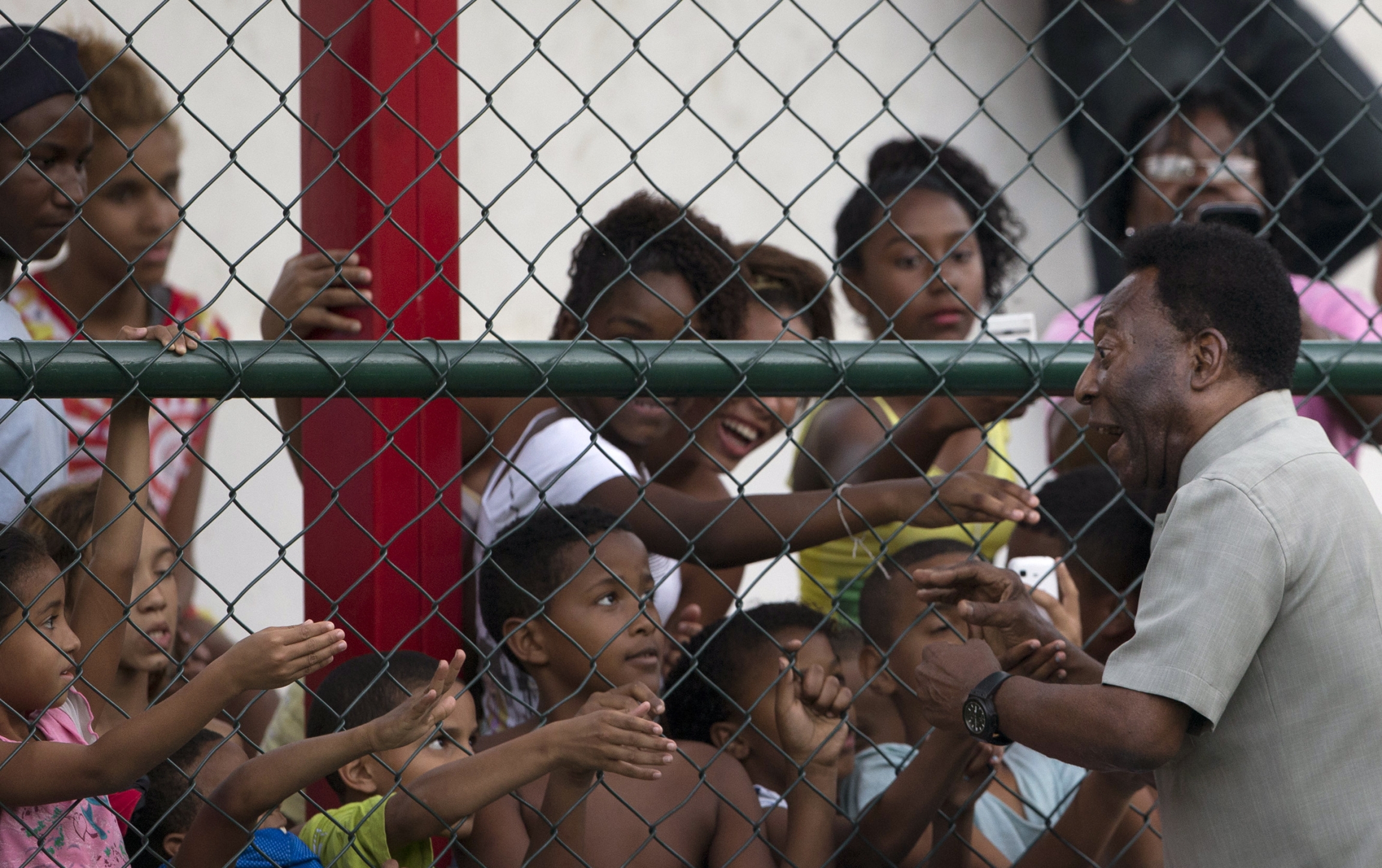
Brazilian soccer great Pelé greets children during the inauguration of a soccer pitch to be powered by player's footsteps at the Morro da Mineira favela, in Rio de Janeiro, Brazil, Sept. 10, 2014.
Silvia Izquierdo/AP
Soccer in the US began to take off. In the early 1980s, there were youth soccer leagues across the country.
“Pelé indeed was such an amazing player. He was such a unique athlete. But also I think we need to think of the context. It's the man in the historical context.”
Rafael Ioris is a Brazilian, Latin American history professor at the University of Denver.
“He was happening when soccer was becoming the most important international sport globally. Someone who managed his career well, went to the US at the right time, but I think that the world was more open to have someone be a star in such an important sport that was becoming internationalized, but also as a Black man, as a third world figure that could represent a different kind of image in that sport.”
In 2000, the international soccer governing body FIFA, named Pelé the player of the century alongside Argentina's Diego Maradona.
Books have been written about him. Movies have been made. And he is the inspiration for many of the top soccer stars today — in Brazil and around the world. Pelé will not be forgotten.
The Associated Press contributed to this report.
Brazil has a reputation for violence. Tens of thousands of lives are lost each year because of the illegal trade in drugs and guns.
Brazil's cities have some of the highest numbers of robberies and carjackings in the world. And, gun violence spiked under President Jair Bolsonaro.
In the country's tense environment, some people and businesses have long relied on private security guards for protection. But who exactly are these guns for hire?
That’s the question that our partners at The Conversation Weekly podcast asked.
Erika Robb Larkins is a professor at San Diego State University who studies the anthropology of violence. She spoke to Gemma Ware, a co-host of the The Conversation's podcast, about what she learned when she was working on her PhD.
At the time, Larkins lived in a favela in Rio, a poor neighborhood where she witnessed plenty of violence, including gun battles between drug traffickers and police. So, she began interviewing police officers.
"Lots of these high-ranking police officers would mention that they owned private security companies," she said. "Currently, in Brazil, there are more private security guards than police but we know very little about the field. They're not very well-regulated. But they're enmeshed with and intertwined with police and military in very significant ways."
So, Larkins started to follow private security guards through their training and then, into the workplace. At the time, armed theft of cargo was incredibly high in Rio.
As a result, the trainings were filled with "people that were going to go into these really high-combat situations. They were going to be carrying a gun every day," she said.
Even so, "the training is incredibly rudimentary, I mean shockingly rudimentary," she said.
To hear their more of this story, click on the audio player above.
On a recent morning just outside of Barcelona, Spain, six kids and their parents, all clad in bright yellow traffic vests, gathered on their bikes in a small square.
For the first leg of their trip to school, about a 45-minute commute, they’re taking a rural road — a long, winding descent with fast-moving cars.
This is the group’s maiden voyage. But all across Spain's Barcelona province, children are getting to school in convoys of bikes dubbed the “bicibus,” or bicycle-bus, organized, often by schools, as an answer to the push for fewer cars on the road.
More than 700 people joined the different routes during the 2020-21 school year, organizers estimate.
As with traditional bus lines, each bicibus route has stops where other cycling students can join along the way. Parents, teachers and other volunteer adults ride, too, to ensure the kids’ safety.
In the year and a half since the grassroots bici-busing began with the backing of the Barcelona City Council, these two-wheeled convoys have appeared all over the city. There are now at least 15 routes and similar bicibuses have popped up in Glasgow, Scotland, and Portland, in the US, according to Reuters.
“I’m doing this because I don’t want to pollute,” said 7-year-old Pau Barrios.
His mom, Berta Barrios, one of the chaperones, said the environmental benefits are only part of the draw of the bicibus.
“We’re here for a lot of reasons,” Berta Barrios said. “First, for safety. Second, for the sense of community it offers. We’re getting together with other families from the neighborhood.”
Before the group set off, a police escort arrived to block the traffic. He wanted the bicyclists all closer together — if they get too spread out, they’re just a bunch of people on bikes. Together, they’re a single unit. More like a bus, and cars respect buses more than bikes.
On this four-lane artery, there are cars and buses aplenty. Volunteer Berta Palau said that sometimes, their police escort is a no-show. When that happens, harried commuters honk at the riders. Let them, she said.
“This is a protest,” she said. “Even if the impact is small. At least we’re no longer a shock to people on the road.”

The Vallvidrera “mountain” bicibus stops for a group selfie on a dirt road high above Barcelona. They were halfway to school on their inaugural run.
Gerry Hadden/The World
She said the bicibuses had become part of the urban landscape. Bike lanes, though, are still lacking, she said. But Barcelona is working on it. It now has over 120 miles’ worth. It’s not Berlin, or Copenhagen, but it’s adding more each year.
Eventually, the bicibus enthusiasts say, they’re hoping to get dedicated lanes for the groups, so they won’t need police protection.
To keep up the momentum, the chaperones focus on the fun of the bicibus.
Like Berta Vazquez, a mom, who strapped a big speaker to her bike with bungee cords and blasted “Sympathy for the Devil,” by the Rolling Stones.
“We play music to create a festive atmosphere,” Vazquez said. “We’re free compared to the people crammed together in those cars and buses.”
On the morning of July 13, Boota Messaih ate breakfast at his home in Karachi, Pakistan, like always.
Then, the pastor and grandfather walked out his front door, and slipped into the Gujjar Nala, a drainage ditch flooded by this year’s historic monsoon rains.
The ditch, now carrying stormwater, sewage and trash, was 20 feet deep that day, according to his family.
“We were helpless,” said his wife, Parveen Messaih, last month, standing near where her husband fell and died. “No one was able to take him out because the water level was so high.”
Boota Messaih had lived in the informal settlement on the banks of the drainage ditch for 50 years. The church where he served as pastor was just a few doors down, and his family remembers him as a loving man, a good provider, and well-respected in the community.
More than a billion people around the world are estimated to live in informal settlements, or slums, in homes that are built illegally — and precariously — on floodplains or steep slopes not connected to basic infrastructure like sewage systems.
As climate change fuels stronger storms and more intense rainfall, a UN climate report released this year warns, the poor and those living in informal settlements are the urban-dwellers most vulnerable to the impacts of global warming.
Flooding deaths alone from this year provide plenty of examples. In April, flooding in Durban, South Africa, hit the city’s townships particularly hard, and in August, flooding in Seoul, South Korea, killed a family living in a basement apartment. Many such apartments in the capital were originally built as bunkers and were not designed for permanent living, but are comparatively cheap in the expensive city.
The two-story house that Boota Messaih shared with his extended family always flooded a little during the monsoons, but the Messaih family said they had never considered it dangerous before.
“Before this incident, nothing had happened like this,” Boota Messaih’s son, Sohail Messaih said.
Emergency responders eventually came. The water was so black with sewage, it took over an hour for them to retrieve Boota Messaih’s body, according to the family.
“His body was in front of us,” Sohail Messaih, said. “But we couldn’t get it out of the water.”

Sohail Messaih holds a photo of his father.
Carolyn Beeler/The World
Now, the Messaih family said they would like to leave their neighborhood near the open drainage ditch, but they can’t afford to rent or buy a house anywhere else. Like their neighbors, they’re members of Pakistan’s Christian minority, one of the poorest in the country, and they don’t legally own the land their house is on.
An earth-mover at work in front of their house is providing some measure of hope. It’s widening the drainage ditch and building a wall to separate it from the neighborhood.
But until Karachi builds formal sewage and trash systems in this area, people here fear clogging will keep causing flooding. For now, the family has built a homemade barrier of corrugated metal along the drainage ditch.
“After this incident, we think this might happen again,” Sohail Messaih said. “So, we put this barricade up, and then, other people followed.”

The drainage ditch in front of the Messaih house is being moved, widened, and separated by surrounding neighborhoods by a wall.
Carolyn Beeler/The World
They say it won’t stop floodwaters from breaching the banks of the drainage ditch, but it might, at least, stop someone else from slipping in.
David Satterthwaite, a lead author on a section on urban adaptation in a 2014 UN climate report, said illegally built homes are themselves often unsafe, and often also built in risky areas.
“It cheapens the cost of the house,” he said. “So, they’re doubly disadvantaged.”
Satterthwaite said that in the 1970s and 1980s, cities would frequently bulldoze these communities. He’s worried that it may become a trend again.
“You can see people concerned with climate change looking at these informal settlements and thinking, ‘OK, we've got to move these people. It's too dangerous for them,’” Satterthwaite said. “[And] then, [they] adopt the same techniques [to] forcibly move the people.”
But he argued this is a bad idea.
“Government schemes to try and move people living in some of the most-dangerous sites have almost never worked because they impose solutions on the inhabitants,” he said.
This is true for the Messaih family's next-door neighbor near the Gujjar Nala in Karachi.

Elizabeth Younus lives in the back rooms of her house, after the front rooms were demolished in an effort to clear flood-prone land near a Karachi, Pakistan, drainage ditch.
Carolyn Beeler/The World
The government recently demolished the front rooms of Elizabeth Younus’ house in a bid to clear more land around the flood-prone drainage ditch. But now, she’s just living in the back rooms that are still standing. Land elsewhere in the city is too expensive, she said.
“We can’t even afford food, how can we pay the expensive rents in other parts of the city?” she said.
Satterwaithe said community-driven solutions to climate risk tend to work better.
He points to a different informal settlement in Karachi — Manzoor Colony — where authorities planned to demolish about 1,000 flood-prone homes. In 2021, the community mapped the area, revealing dozens of drains clogged by sewage and trash that made flooding worse.
“They made a whole plan,” said architect Arif Hasan, who advised on the project.
Hasan said the communities argued those drains could be cleared, and most of the homes then spared.
“The decisions that were taken after this reduced the number of affected families from over 1,000 to about 58,” he said.
The latest UN climate report highlighted another success story of a community-led effort: a coastline community in Freetown, Sierra Leone, that chose to limit new building and construct new drainage ditches to limit future flooding.
Mary Robinson was the first female President of Ireland in the 1990s. Later, Robinson became the UN’s High Commissioner for Human Rights.
In recent years, she’s been chair of "The Elders," a group founded by Nelson Mandela, with a simple mandate: to share wisdom and experience to help solve the world’s toughest problems.
Now Robinson is focused on tackling the climate crisis. She travels the world connecting with young activists about environmental justice.
She spoke with The World's host Marco Werman about what being an Elder means to her.
This interview has been lightly edited and condensed for clarity.
The Taliban-led government has banned women from attending private and public universities in Afghanistan.
The decree has come in addition to girls already being excluded from secondary schools in the country since March. And it's sparked international condemnation, with some women staging protests in the capital Kabul.
Some male faculty members and students have also stood up in solidarity. A number of lecturers to professors have even resigned at one university. The World's host Marco Werman speaks with Obaidullah Baheer, a lecturer at the American University of Afghanistan in Kabul, about the situation.
This interview has been lightly edited and condensed for clarity. AP contributed to this report.
Related: 'We are erased': The fight to reopen girls secondary schools in Afghanistan continues
In Susan Sontag's well-known essay "On Photography," she wrote that, "To collect photographs is to collect the world."
The collections of photographs that many people see are often curated by people steeped in a mostly Western tradition — which is what makes a new photography library in Ghana so remarkable.
The Dikan Center, which just opened in Ghana's capital, Accra, was created by Paul Ninson. And it's filled with photography books and films by people from Africa and across the diaspora.
Ninson joined The World's host Marco Werman from Accra to discuss the new center and it's purpose.
This interview has been lightly edited and condensed for clarity.
On a recent snowy day in Derby, Vermont, 24-year-old Joseph Arana Sanchez pulled out a guitar and plucked out the chords to the 1960s American hit "Stand By Me."
The young man was surrounded by a group of Americans who, in one way or another, have helped more than 30 Ukrainian refugees escape war with Russia and establish themselves in Derby.

A flier for a holiday benefit concert at the Highland Center for the Arts in Greensboro, Vermont.
Mikaela Lefrak/The World
On Dec. 10, many of the Ukrainians sang in a sold-out benefit concert in a nearby Vermont town. It was the most recent example of how the local Vermont community has rallied around the new arrivals and the American couple who brought them here, Theresa and Scott Cianciolo.
The Cianciolos founded Agape Ministries in Ukraine, a Christian nonprofit that works with children and adults with developmental disabilities.
The couple had adopted twin boys with Down syndrome from the city of Odessa years ago, and they have another adopted son who has autism. For years, they've been traveling back and forth between the US and Ukraine. When Russia invaded Ukraine, the Cianciolos followed the US government's advice to evacuate.
"We had to really reflect on what was next," Scott said.
"As people of faith, we just really prayed and fasted, and somebody from our board of directors had this great idea. They said, 'You need to open up a refugee center.'”
So, the couple raised about $750,000 to purchase a 10,000-square-foot property that used to serve as a nursing home. Plumbers, electricians and contractors donated their time and supplies to renovate the house and make it accessible to children with disabilities.
"It's a peaceful home, and it's a safe home," Scott said.
The UN estimates that the war in Ukraine has internally displaced more than 7 million people. An additional 6 million Ukrainians have fled to other European countries. And about 150,000 have come to the United States, according to reports by VTDigger.
Oleg and Tetiana Nadkyrnychi came to Derby from the city of Rivne. They have two sons, a 9-year-old and a 15-year-old.
The instability of wartime was particularly hard on the elder son, who is autistic, so they decided to flee. They went to two different countries in Europe before Tetiana reached out to the Cianciolos for help in getting to the US.

Scott and Theresa Cianciolo on the porch of the Agape Ministries house in Derby, Vermont.
Mikaela Lefrak/The World
They took part in a federal program that allows Ukrainians fleeing the war to travel to the US for two years, as long as they have a sponsor like Agape that can support them financially and give them a place to live.
Oleg Nadkyrnychi is now trying to get a work permit and is practicing for his driving test.
“What next, we don’t know. But people here share food and also clothes. It’s OK. We are Ukrainian. We are tough," he said.
Many of the children at Agape have special needs — including autism, hydrocephalus and seizure disorders. There is one child who needs multiple skin grafts. At the house, they have volunteer nurses and teachers who visit daily.
"It's not the things [people donate]. It's really that people feel surrounded and cared for."
"They just step in and they build a relationship, which is the most important part," Theresa Cianciolo said. "It's not the things [people donate]. It's really that people feel surrounded and cared for."
About nine more Ukrainians are expected to arrive in Derby in the coming weeks.
Flying over the sprawling region of Yakutia — also known as the Republic of Sakha — in Russia's Far East, the landscape below fans into a flat expanse of tundra pockmarked with small lakes that formed by thawed permafrost.
Yakutia is a remote, sprawling region of Russia, nearly the size of India. Much of it rests on permafrost — essentially ground that remains frozen for multiple years. Yakutia is one of the coldest places on the planet, but it’s also one of the fastest warming ones. The changing climate thaws permafrost, releasing climate-changing carbon and methane gasses that increase global temperatures even further.
Scientists estimate thawing permafrost could eventually warm the climate by as much as all of the emissions produced by the United States combined.
Most of the world’s permafrost lies in Russia, but the war in Ukraine is now disrupting critical research there.
“When we do our analysis of where the environmental and ecological gaps are, Russia just lights up,” said Sue Natali, the Arctic program director of the Woodwell Climate Research Center.
For decades, scientists from the US and Europe traveled to faraway parts of Russia, like Yakutia, each year to launch new permafrost research in collaboration with Russian scientists.
But since the war started last February, many Western universities and research institutions have stopped funding permafrost research in Russia. A combination of moral opposition to the war, fear that foreign researchers might face safety issues while traveling in Russia, and the practical impossibility of funding research projects in the face of sanctions that make it impossible to transfer money, have all played into the decisions.
Russian scientists have also been banned from attending some scientific conferences.
Current permafrost research now focuses heavily on Alaska and Canada.
“I’m very sad, the world is losing a great opportunity for exchange between the international research community,” said Alexander Kholodov, a permafrost researcher at the University of Alaska Fairbanks, who has been restricted from visiting his research sites in Russia.
In the past, Kholodov and other researchers helped their Russian colleagues by bringing scientific equipment to Russia that was either not available in the country or too expensive.
Meanwhile, foreign researchers doing fieldwork in places like Siberia benefited immensely from Russian scientists’ local knowledge. Russia has a deep tradition of permafrost research dating back well into the Soviet era.
“Historically, in terms of permafrost science, Russia is one of the pioneers,” Kholodov said.

In this photo taken on Sunday, March 15, 2015, a Nenets family in the city of Nadym, in northern Siberia, Yamal-Nenets Region, about 1,553 miles northeast of Moscow, Russia. In a study published Wednesday Jan. 16, 2019, scientists working on the Global Terrestrial Network for Permafrost, say the world’s permafrost is getting warmer, with temperatures increasing by an average of .54 Fahrenheit over a decade.
Dmitry Lovetsky/File/AP
As the climate changes, rainfall will likely increase in Yakutia. That could make permafrost thaw even faster and speed up global warming.
Each summer, Gabriela Schaepman-Strub, a professor of earth systems science at the University of Zurich, would travel to Yakutia to research how increased rainfall might affect permafrost. Schaepman-Strub set up testing sites with sprinkler systems on the tundra, including elaborate shelters with gutters and water pumps, to study the impact.
This kind of research can present quite a few obstacles. Schaepman-Strub’s research site, located in the Kytalyk National Park, is only accessible by a boat ride up the winding Indigirka River. Clouds of ravenous mosquitos swarm in the summer air and researchers sleep in large tents.
But after nearly 15 years of traveling regularly to Russia, her university also prohibited her from working in the region after the war broke out in Ukraine.
“We invested a lot of money and manpower to assemble the systems on site, so this is a huge effort that is just being totally lost.”
“We invested a lot of money and manpower to assemble the systems on site, so this is a huge effort that is just being totally lost,” Schaepman-Strub said.
This year, she attempted to continue her experiments remotely, by having Russian colleagues check in on her research sites during the summer. But they weren’t able to devote the same amount of time and quality control. Some of the equipment at the research site malfunctioned, ruining parts of the experiments.
Schaepman-Strub had planned to run the experiment for at least three more years. But to continue, she needs to send new water pumps to Russia, which is now difficult, given the restrictions on sending money or importing goods to Russia from the West.
If she fails to get the failed part of her experiment running again next year, it will be destroyed due to overexposure to natural elements.
Her Russian colleagues have also been unable to send her this year’s data on soil moisture and temperature, since Russian authorities have implemented new restrictions on sharing data with scientists outside Russia.
“We always needed permission to export the data, but this year, permission is not being granted,” Schaepman-Strub said.
Many other scientists have also been denied the ability to receive scientific data or samples for experiments, like rocks used in geological studies.
Russian authorities have not officially stated why the scientific data is being withheld.
Meanwhile, Russian researchers are now having to do fieldwork alone.
Alexander Fedorov, deputy director of the Melnikov Permafrost Institute in Yakutsk, Yakutia's capital, said his institute had to reduce the amount of fieldwork they did this year by about half, in part because they lost so much foreign funding in 2022. They’ve had to redirect their work to things like creating computer models that can be done from an office.
“Global warming increases because of permafrost degradation and it’s a problem that’s continuing, so it will be very bad if we lose several years of data,” Fedorov said.
In this Oct. 27, 2010 file photo, Russian scientists Sergey Zimov and his son Nikita Zimov extract air samples from frozen soil near the town of Chersky in Siberia, 4,000 miles east of Moscow, Russia. Scientists say the world’s permafrost is getting warmer, with temperatures increasing by an average of .54 Fahrenheit over a decade. between 2007 and 2016.
Arthur Max/AP
Most current climate models don’t fully account for how permafrost could contribute to global warming, which means current predictions about climate change might be incorrect.
“The big issue with greenhouse gas emissions from permafrost thaw is that we're not counting them,” said Sue Natali of the Woodwell Climate Research Center.
Natali has been working with an international team to establish a network of towers across the Arctic that monitor greenhouse gas emissions from permafrost zones. The valuable data they collect can improve climate models and allow the global community to make better-informed plans to prepare for climate change.
But this year, plans to send a new tower to Russia were also put on hold because of the war.
Natali’s institute hasn’t completely banned her from working in Russia, but many logistical complications remain. Natali and her collaborators plan to put up 10 new towers over the next three years across the Earth's permafrost regions. This year, they pivoted their plans from Russia and put up a new tower in Canada.
Their project continues to expand even with temporary changes.
And there’s still hope that they will be able to continue working with Russian scientists to correct inaccuracies in today’s climate models.
Related: A heat wave in Siberia signals dangerous Arctic warming
On Monday, Russian President Vladimir Putin and his top advisers visited Minsk, the Belarusian capital.
Since Russia’s invasion of Ukraine, there has been speculation that Belarus would send its troops to fight alongside Russia. But until now, there have been no Belarusian boots on the ground. The Minsk meeting raises new questions about the role Belarus may play in the war in Ukraine.
“The visit was very significant in the sense that it was very symbolic for Alexander Lukashenko, the ruler of Belarus,” said Katia Glod, a Belarus analyst with the Center for European Policy Analysis.
Putin has met with Belarusian leader Alexander Lushenko at least six times over the last 10 months, but yesterday was Putin’s first visit to Minsk since 2019.
At a press conference on Monday, Putin said that Russia and Belarus continue to work closely, including in defense and national security. He also said that joint military training is ongoing. And Lukashenko said that without Russian support, Belarus is incapable of defending its sovereignty.
“For Lukashenko, it was important to regain his agency, to show that, ‘Look, everyone is saying that Belarus is a satellite to Russia, but no, Putin is actually coming to me.’ Probably the visit was more for Lukashenko to boost up his support,” Glod said.
Leading up to the meeting, Glod said that analysts considered two potential developments: First, that Belarus could join Russia’s war effort against Ukraine with boots on the ground; and second, that Belarus may be folded into the Russian federation and lose any semblance of sovereignty.
Neither has been confirmed, but Ukraine’s military leaders are preparing for the worst.
Last week, Ukraine's top general, Valery Zaluzhniy, said that Russia is preparing 200,000 troops for a major offensive that could come from the east, south or from the Belarusian border in the north.
Defense analyst Konrad Muzyka said that there’s already military cooperation going on between Russia and Belarus.
“They provide the terrain from which attacks on Ukraine happen,” Muzyka said. “Now, Belarus serves as a staging ground from which Iranian drones are sent from Belarus, to target areas in Kyiv, and also Russians use Belarusian air space to launch air attacks.”
Muzyka said that Belarus is also providing Russia with medical supplies, artillery and even training. And they’re conducting military exercises.
“Since April, May, we’ve noticed that the scale of Belarusian military activity is incredibly high — it’s the highest since the end of the Cold War — the Belarusian armed forces haven't left training ranges, they are training constantly,” Muzyka said.
Belarus has the ability to deploy between 15,000-18,000 men who are ready to undertake military operations, Muzyka added.
Ukraine is paying close attention since Kyiv, Ukraine’s capital, is just 60 miles from the Belarusian border.
For the last 10 months, Lukashenko has likely been resisting sending Belarusian troops to fight in Ukraine, Muzyka said, but it has become more difficult for Lukashenko to stand up to Putin.
Whether that next step is sending Belarusians to fight in Ukraine, or further integrating the Belarusian state into the Russian fold, the Minsk visit gave Putin the chance to show that he’s the one calling the shots.
Related: North Korea-Russia relations are warming up amid war in Ukraine
This year, The World featured new albums and songs from many global artists. Music is part of the show’s DNA and, as it turns out, it is something many of the show’s staff appreciate. They want to share some of the music they enjoyed this year on a playlist that will take you on a musical journey around the globe.
Every week, host Marco Werman shares with listeners some of the less mainstream artists he and others in the newsroom are dialed into. “From time to time, it's about my own taste. Other times, it's what I think will resonate with a wider audience,” Marco said.
The playlist includes some of Marco’s favorite album releases of 2022, starting with a collaboration between Vieux Farka Toure, the eldest son of the late legendary Malian singer and multi-instrumentalist Ali Farka Toure, and the Texas-based band Khruangbin.
Both artists were introduced to see if there might be enough chemistry to produce an album, reprising some of Farka Toure father's classic guitar melodies. The result, a record titled "Ali" — which has chemistry to spare — is a respectful homage to the father of Sahara desert blues. The collaboration also finds new patterns through entrancing songs like "Diarabi."
Nilüfer Yanya’s songs harness a lot of energy, and even up-tempo numbers that Marco says bring him a strange sense of calm.
“When I first heard Yanya's guitar and voice, I immediately thought of the Pretenders, whom I love,” Marco said. In her second album titled “Painless,” the British singer and songwriter included beautiful melodies like “The Dealer,” “Chase Me” and “The Mystic.”
As a studio director and producer, The World’s April Peavey not only chooses the music you hear daily on the show but also reports stories and produces interviews with global artists of multiple genres.
Among April’s favorite releases this year is "Aboogi," the latest album by Algerian Tuareg band Imarhan, recorded in a studio they built themselves in the city of Tamanrasset, in southern Algeria. “It is desert rock at its best,” April said. “And the song 'Achinkad' is a prime example.”
“Wamono Groove: Shakuhachi & Koto Jazz Funk ’76,” is a fun collection of vintage jazz and funk music from 1970s Japan, with a focus on the stringed koto and the Japanese flute the shakuhachi.
“Imagine the perfect soundtrack to a 70s Japanese cop show,” April said. She recommends the track “Nanbu Ushioi-Uta.”
Iceland’s Víkingur Ólafsson is currently one of the most celebrated and innovative concert pianists, known for his interpretations of Bach, Brahms and Mozart. On this new release "From Afar," Ólafsson performs classical music and plays traditional Icelandic songs as well.
“It’s his most personal album. In it, he plays all the tunes twice — once on a grand piano and another on an upright piano. Listen to his take of Robert Shumann’s 'Traumerei (from Kinderszenen, Op. 15),' played on an upright,” April said.
Reporter Durrie Bouscaren bumped into Nigerian Afropop singer Kizz Daniel’s latest song titled "Buga" while searching for breakfast-themed music. “Buga has nothing to do with breakfast but it’s now my favorite morning beat,” Durrie said.
In Kazakhstan, like many post-Soviet states, music and movies have long been dominated by the Russian language and culture, which was considered "high art." Recent years have given way to a Kazakh renaissance that embraces the country’s nomadic past, language and emerging independence.
“Yenlik is my absolute favorite artist in this genre,” Durrie said. “She infuses her raps with a distinct beat that has roots in Kazakh oral traditions, and 'DOP' is one of her best.”
“We’d be remiss not to include 'Baraye,' arguably the song of the Iran protests inspired by the death of Mahsa Amini while in police custody,” Durrie said. It means "Because" and lists the reasons that people are angry at the government.
Reporter Bianca Hillier has been a fan of Rina Sawayama since 2017’s "Cyber Stockholm Syndrome." The British-Japanese singer released a new album in September of this year called “Hold the Girl,” with instant classics such as “This Hell” and “Catch Me In the Air.” The song "Send My Love to John" from the same album was inspired by Sawayama’s friend, who is a queer immigrant, and his complicated process of coming out to his parents.
“Instead of focusing on the hardship of his situation, like many similar narratives do, this song is about the friend’s mother expressing a subtle but intentional acceptance of her son’s partner, John. It’s a story of empathy, told by Sawayama’s impressive vocals and acoustic guitar,” Bianca said.
The World’s engineer Mike Wilkins recommends "Boleros Psicodélicos," a 12-track tribute album by the co-founder of the psychedelic soul duo Black Pumas, Adrian Quesada. In this record, Quesada pays homage to the golden era of romantic bolero music, while bringing his own psychedelic leanings into each track.
“Accessible and hauntingly familiar, the album easily fits into both a Saturday night or Sunday morning playlist. This is a new addition to my collection, as I sought out more music from Quesada after Marco highlighted his latest effort, Jaguar Sound, in October,” Mike said.
This year, digital editor Amanda Lichtenstein became obsessed with “Mela Mela,” a song by Ethiopian artist Kassmasse in collaboration with Jamaican reggae artist Protoje that promotes peace in war-torn Ethiopia. “The hypnotic hand-clapping and slow build to a crescendo of joyful beats takes me into a transcendent state as I play the song on repeat throughout the day … I’ve never heard a song quite like this,” Amanda said.
Ever since reporter Tibisay Zea interviewed Uruguayan singer and songwriter Jorge Drexler, she has been listening to his new album, which got multiple Latin Grammy awards this year.
“My favorite song is 'Cinturon Blanco,' or 'White Belt.' It's a song about trying to be a beginner again, and all the excitement and possibilities that come with seeing things with new eyes, Tibisay said. “It reminded me of Pablo Picasso’s quote: ‘It took me four years to paint like Raphael, but it took me a lifetime to learn to draw like a child.’”
Next up are producer Anna Kusmer’s recommendations of songs by Belgian singer, rapper and songwriter Stromae, who produced an earworm of European dance parties in 2009, titled “Alors on danse” or “So We Dance.”
“It’s hard to imagine that baby-face Stromae has been on the scene for over 10 years, but I have found his most recent music to be the most interesting and enjoyable, including his 2022 tune 'L’enfer' is a hypnotizing propulsive song about depression and 'Santé,' a celebratory ode to service workers who can’t celebrate — because they’re working,” Anna said.
Check out the playlist and let us know which songs you recommend adding. Send us your suggestions to myworld@theworld.org or wherever you follow us on social media.
For many years, Namibia Flores was the only female boxer in Cuba. She always dreamed of boxing at the Olympic Games.
“Since the beginning, I’ve been training with men,” she said. “They were all men. I would do the same type of exercises they do, learn the same techniques and I would always fight against them.”

Namibia Flores was the only female boxer in Cuba for years.
Courtesy of Nambia Flores
But after almost two decades of training, Flores was never able to go to the Olympics. Not because she wasn’t good enough, but because, ever since Fidel Castro’s revolution, women have been banned from competing.
“Here in Cuba, female boxing didn’t exist in anyone's mind,” Flores said.
For those athletes who wanted a career, the only choice was to leave the country, something Flores did not want to do.
“I got offers to go live abroad,” she said, “but I’m so attached to my homeland and my family, and I didn’t want to represent any country other than mine.”
Cuba is home to many male boxing champions. In the last 50 years, the island has won more Olympic gold medals in boxing than any other country.
But the ban on women’s boxing has been controversial, especially because it didn’t apply to other contact sports, like taekwondo and wrestling.
In 2009, the International Olympic Committee gave the green light for women to box at the Games. That sparked rumors in Cuba about the government doing the same.
“I pulled up my socks,” Flores said. “I really was hopeful, so I trained harder to maintain my weight, and get stronger.”
But the announcement never came.
At that time, the former coach of Cuba's national boxing team, Pedro Roque, told a group of journalists that "Cuban women are there to show their beauty, not to take punches."
For her part, Namibia Flores persisted. She kept training. “I had a really traumatic childhood in Cuba, and boxing saved my life,” she confessed. “I wasn’t going to give up.”
Eventually, about a dozen other women joined her, with the hope that one day the rule would change and they could box for Cuba.
Finally, that day arrived. On Dec. 5, Vice President of the Cuban Institute of Sports Ariel Saínz authorized women’s boxing in Cuba at a news conference in Havana.

According to international boxing rules, Namibia Flores is now too old for competing, but she still hopes to become the coach of the first women’s boxing team in Cuba since the revolution.
Courtesy of Namibia Flores
He described it as "an important step in the development of Cuban boxing."
Saínz explained that the recently approved family code, aimed at fighting discrimination against women and LGBTQ people in Cuba's machista culture, provided an extra incentive for the move.
Alberto Puig de la Barca, president of the Cuban Boxing Federation, said Cuba has been doing exhaustive medical research to find out if it’s safe for women to compete in boxing. “And we finally concluded that there’s no problem,” he said.
Puig added that women will be required to present a pregnancy test seven days prior to any fight.
Over the weekend, sports officials chose among 42 athletes to form Cuba’s first women's boxing team in recent history. The selected boxers will debut at the Central American and Caribbean Games in El Salvador, a first step toward the 2024 Olympic Games in Paris.
But for Namibia Flores, it's too late for her to get into the ring. She’s 46 years old, and the International Boxing Association says women can compete up until the age of 40.
“This news is bittersweet for me,” she said. “Because after so many years of training, I can’t be part of the national team.”
But not all opportunities are lost.
Flores said she’s still hoping to go to the Olympics and represent Cuba one day, just not as a fighter. She’s applying to become the first coach of the new national women’s boxing team.
“Despite all the obstacles in my life, I’m proud to be who I am,” Namibia Flores said. “I wouldn't change a thing about my story, and I will keep fighting.”
The World Cup wrapped on Sunday with Argentina clinching the 2022 championship title.
But Morocco’s Atlas Lions still have a lot to celebrate. They became both the first Arab and the first African team to reach the semifinals, inspiring Arab unity around the world.
In Barcelona’s old quarter, a small, boisterous group of fans watched Morocco play against France at a restaurant called El Rincon del Raval. The owner, Mustafa al-Kantah, is Moroccan. The exuberant crowd represented a wide array of Arab nations — and beyond.
“We’ve got fans from Algeria, Morocco, Pakistan — from everywhere,” Kantah said from behind the counter. “For us, this is fantastic. Everyone’s here having a great time.”
It was a gut-wrenching game. Suffering through it together were Abdul Kihalo, from Algeria, and Zacaria Chachout, a Moroccan. They sat elbow to elbow, mint teas in hand, on the edge of their seats.
“I hope for Morocco,” Kihalo said. “Algeria and Morocco, all people, same brother. All people, family!”
“As people, we love each other,” Chachout said. “But the governments, it’s another issue. It’s politics.”

In a Moroccan restaurant in Barcelona, Arab fans with origins across Africa came together to cheer on the Atlas Lions. Viewers said politics often divides nations but sports bring people together.
Gerry Hadden/The World
Politics between Morocco and Algeria are strained, to put it mildly. Morocco has recognized Israel, whereas Algeria refuses diplomatic ties with them. And Morocco has tightened control over the disputed Western Sahara, which Algeria wants to see independent.
It was perhaps inevitable that soccer would get caught up in the animosity. In Algeria, official media have been omitting any and all news on the Moroccan World Cup squad until the director of one public TV station, Chabane Lounakel, broke the silence. He reported Morocco’s win over Spain in the quarter finals. He was fired the next day.
And a group of young Algerian soldiers are being courtmarshaled for posting a clip to TikTok, echoing Algerian spectator Abdul Kihalo: Moroccans are their brothers, they said. The soldiers then danced a bit in their barracks. For their impromptu display of good-neighborliness they’re looking at 10 years in prison.
But in Spain, where cheering for your political enemy is not a jailable offense, Arabs from across North Africa rushed to a Barcelona square after Morocco’s elimination. They played drums and danced and set off fireworks together.

Morocco fans celebrated in Barcelona after their team’s defeat to France in the 2022 World Cup semi-finals.
Gerry Hadden/The World
Moroccan Zacaria Chachout said the celebration was almost enough to forget politics for a while.
“It’s been a long time since Arabs got connected to each other,” he said. “Hopefully it will last. This is something we’ve been waiting for, for a long time.”
It was a moment of unity in a fractious world.
Related: Argentina hailed World Cup champions after dramatic win
It’s being called the greatest World Cup final of all time.
After more than 120 minutes of play, Argentina beat France in penalty kicks in an extraordinary match on Sunday at this year’s World Cup in Doha, Qatar.
France was down 2-0 in the first half of the game. But everything shifted when French player Kylian Mbappe scored a penalty kick in the 80th minute. Momentum quickened and Mbappe secured a show-stopping second goal just 95 seconds later. It was one one of the biggest comebacks in the tournament and in the history of the World Cup.
The game went into extra time and 23-year-old Mbappe scored a “hat trick” — three goals in one game — the first player to do so in a World Cup final since 1966. But it wasn’t enough for a French victory and Argentina clinched it.
“If there is a football God, today, he was convinced that this victory had to be ours,” said one Argentinian reporter among a crowd of fans dancing and singing in Buenos Aires on Sunday night.
On the field at the World Cup awards ceremony on Sunday, Messi received the World Cup trophy with a ceremonial black robe draped over his blue-and-white Argentina shirt. The Qatari bisht garment was gifted to Messi as a sign of appreciation and respect typically worn by top officials and high-status individuals.

Argentina's Lionel Messi holds up the trophy after winning the World Cup final soccer match between Argentina and France at the Lusail Stadium in Lusail, Qatar, Sunday, Dec.18, 2022.
Manu Fernandez/AP
Amid the exuberance of on-field victories and nail-biting moments, there’s also been widespread criticism of Qatar’s documented accusations of human rights abuses, including against migrant workers and the LGBTQ community.
Yet, headlines have mostly focused on the field. Critics say this World Cup is proof that what they call "sportswashing" works. Qatar is currently mounting a bid to host the 2036 Summer Olympics.
And soccer fans have no shortage of upcoming international sporting events. The next men’s World Cup in four years’ time will be jointly hosted by 16 cities across Canada, Mexico, and the United States. And the women’s World Cup takes place in Australia and New Zealand in summer 2023.
It wasn’t clear throughout the games that Argentina would win the World Cup. England, Croatia and France were all contenders. And Saudi Arabia was the only country to beat them in the entire tournament. Morocco’s team also did surprisingly well. They ended up grabbing fourth place as the last African and Arab team in the tournament. They’ll now try to win the Africa Cup of Nations in January 2024.
For longtime Argentinian football icon Lionel Messi, however, this was his last World Cup. Tearful players rushed to embrace him after the final whistle on Sunday. But Messi did say after the win that he’s not quite ready to retire yet, — so fans will have to wait and see.
Friday marks 10 years since the violent gang rape, and eventual death, of 23-year-old New Delhi medical student Jyoti Singh.
But over the past decade, stricter laws haven’t exactly reduced the amount of violence against women in the country. In fact, statistics show that India has continued to see a rise in such violence.
Singh — often referred to as Nirbhaya, which means "fearless" in Hindi — had boarded a private bus at night with a male friend in 2012 after watching a movie at the theater, when a group of men violently assaulted her.
The incident immediately sparked outrage and public protests, prompting the government to pass swift and harsher legislation to curb violence toward women.
"I remember that was [one of the] biggest protests in public I saw in my life."
"As a young student ... I remember that was [one of the] biggest protests in public I saw in my life," Natasha Narwal, a Delhi-based feminist and activist, said. Narwal also recalled the protests being one of the first times that the issue of rape and violence against women was even discussed so openly.

Indians watch a girl paint a message during a protest against the death of a young woman who was recently gang-raped, in New Delhi, India, Dec. 30, 2012.
Dar Yasin/AP/File photo
Narwal then explained to The World why the new laws haven’t been so effective.
"Harsher laws, and especially death penalties, actually do not work in solving any problem's [of] violence against women or any other kinds of crime in the society because the violence is much more endemic," Narwal said. She added that these laws usually make an example out of people, but do not necessarily change societal attitudes. And that some of the laws even hamper women's movements.
"It has been a consistent articulation in demand that there should be more focus on the creation of infrastructure, which enables women to lead lives [that] gives more autonomy," she said.
Most of the laws and education in India suggest that women should not be out late at night and go directly home instead. But Narwal said that the highest rates of violence against women usually occur within the home.
"For those women who face violence inside family homes ... where do they go?" Narwal asked. She explained that there aren’t many centers or shelters available for battered women to turn to for help.
"It's a tough battle, but I'm hopeful that young women and even men, this country will bring about positive change," Narwal said.
For now, Jyoti Singh’s deadly assault has at least started the conversation of women's rights and safety in India.
Click above to listen to the entire discussion.
Related: The pain of their daughter's gang rape and murder turned them into activists
Zinobiani is a village like many others in Georgia’s Kakheti wine region. Nestled beneath the towering Caucasus mountains, its roads are unpaved, its dwellings modest. Most people there are involved in the grape cultivation of grapes.
There is one big difference about Zinobiani: Most of its older inhabitants — mostly people over the age of 40 — speak Udi, a language with a long and rich history that linguists are feverishly documenting while it is still spoken.
Every two weeks, a language dies with its last speaker. At least 230 of them went extinct between 1950 and 2010, according to the UNESCO Atlas of the World’s Languages in Danger. And about 50% to 90% are predicted to disappear by the next century.
Many dying languages take their secrets with them. Most are just oral languages, never having been written down. And we may never know much about them.
Udi, however, is different. It has its own ancient alphabet and an unlikely grammatical feature that some linguists believe is unique.

Zhenia Mamulashvili picking grapes with Alexander Kavtaradze and Thomas Wier
Patrick Cox/The World
I met with Zhenia Mamulashvili, a grape and hazelnut farmer, in Zinobiani. Her greeting was in Georgian and a bit of English, which she learned long ago in school. It’s only when she is alone with her husband, or with other villagers, that she speaks in Udi.
In her spare time, Mamulashvili writes poetry, some of it in the Udi language. She recites one poem — an ode to someone named Zinobi Silikashvili:

Zinobi Silikashvili with his wife, Nadezhda Antipova, and their daughter
Wikimedia Commons
“Zinobi is our man,” Mamulashvili said reverentially.
Zinobi — who everyone refers to by his first name — was the founder of the village and, as far as people who live there are concerned, the man who kept the place together and kept its population speaking Udi.
Alexander Kavtaradze, Zinobi’s great great nephew, shared his ancestor’s story — one that’s familiar to every villager in Zinobiani.
Zinobi was born into a wealthy family in 1891, in a town about 120 miles from current-day Zinobiani, in what is now Azerbaijan. The Udi people had lived in that region for centuries. During the medieval era, they even ruled over their own kingdom, known as Caucasian Albania. (It has nothing to do with modern-day Albania.) But by the 1920s, the Udis became a persecuted minority, caught in the crossfire between warring Azeris and Armenians.
“Some Udis thought that the only way to survive was to move somewhere else. Zinobi led them here.”
“Some Udis thought that the only way to survive was to move somewhere else,” Kavtaradze said. “Zinobi led them here.”
That was in 1922. This month, the Udis are celebrating the centennial of their move to Zinobiani, named after their leader.
The Udi language is spoken by as many as 20,000 people today in several communities scattered across Azerbaijan, Armenia and Russia. But it’s in Georgia where the language has attracted international attention from linguists and historians.
“Their language was first written down, as far as we can tell, in the 4th, 5th centuries AD,” said Thomas Wier, a linguistics professor who grew up in Texas and now teaches at the Free University of Tbilisi, Georgia’s capital. It’s a good place to study languages. Of about 50 of the languages that are still spoken in the Caucasus region, only three have their own alphabets: Georgian, Armenian and Udi.

Ana Patchikashvili has been lobbying the Georgian government to invest in the village of Zinobiani in Georgia.
Patrick Cox/The World
“This ancient alphabet is a “very strong talisman of [Udi] identity,” Wier said. “It’s something that makes them completely unlike the many other very interesting, but different, groups of the Caucasus.”
Ana Patchikashvili only recently realized that her linguistic heritage was different. What sparked her curiosity was the presence of foreign scholars in her home village.
“When I first saw Americans and Europeans in Zinobiani, I became interested,” Patchikashvili said.

Ana Patchikashvili’s guest house in Zinobiani.
Patrick Cox/The World
She then started lobbying the Georgian government to invest in the village. Now, dirt roads are being paved, there are memorials to Zinobi and Udi culture and Patchikashvili has opened a guest house, offering traditional Udi dishes.
The developments have changed Zinobiani for the better. Fewer people are moving away, and some are even coming back. Plus, attitudes toward the city are also changing.
“When I was a kid, it was kind of shameful to say that you were Udi,” Patchikashvili said.
“Now it's becoming more popular. People are not ashamed.”
There’s another feature of the Udi language that some people are now proud of, after becoming aware of it. It’s a grammatical aspect that some linguists believe is unique to Udi. And it happens when verbs are inflected.
For example, in English, the word “kicks” consists of the root word “kick,” plus the suffix “s,” which indicates that the word is in the third-person singular.
Udi has person-agreement like that, too, linguist Thomas Wier said. But the suffix doesn't just stay stuck onto the end of the word, like “s” does in English. It can show up elsewhere in the sentence — and even in the middle of the root verb. With the hypothetical “kicks” example, in Udi it could appear as “kisck.”
“That's something that linguists have always thought was completely impossible,” Wier said. “The fact that it exists in Udi means that it's a real possible thing.”
It’s a poignant reminder of what may be lost every time a language stops being spoken. And Udi looks like it’s headed that way. The children in the village don’t speak it, and there is no immersion school to teach them the language. But Udi is continuing to be recorded and documented — and heralded by its people, whether or not they regularly speak it.
Maybe calling Udi a dying language isn’t accurate. Perhaps it’s someplace between dying and living. And maybe it's just as important that people revere the language, and that it’s a key part of Udi identity.
Sixteen years after Zinobi Silikashvili led his people to Georgia and founded the village of Zinobiani, he became one of the millions of victims of Soviet leader Joseph Stalin. Georgia had become a part of the Soviet Union, and the Kremlin did not tolerate strong-willed, independent thinkers like Zinobi. He was executed in 1938.
“My grandmother would often remember this story,” Zinobi’s great great nephew Alexander Kavtaradze said. “She was only a few months old when that happened, but she knew it from her mother and all the siblings.”
To this day, Zinobi’s spirit lives on among Georgia’s Udis, not unlike the language they once all spoke — not dead, but dormant.
For more on the Udi language and the people of Zinobiani, Georgia, listen to this episode of "Subtitle," a podcast about languages and the people who speak them. "Subtitle" is supported by a major grant from the National Endowment for the Humanities.
Paris city officials are weighing a ban on the city’s fleet of 15,000 electric scooter rentals, primarily over safety concerns and complaints that the scooters are clogging up the city’s streets.
“It’s truly an urban jungle,” said David Belliard, the Paris deputy mayor in charge of transport and public spaces.
There have been more than 300 e-scooter related accidents in the last year alone and four deaths all tied to people using the electric ride-sharing services.
While Paris was the first European city to break into the e-scooter rental market in 2018, it has now imposed what operators say are the strictest regulations in the world.
Last month, the three operators authorized in Paris — Tier, Lime and Dott — sent city officials a list of proposed changes they plan on making, including adding license plates so that police can track traffic offenses, and adding ID checks to make sure all users are over the age of 18.
They’re hoping to convince the city to renew their contracts to operate in Paris, which expire next February. But David Belliard said proposals aren’t necessarily enough.
“It’s also about the responsibility of the people using these apps, or rather the irresponsibility of the operators,” Belliard said.
Garence Lefevre, a senior director of public policy at Lime, says popularity for her company’s services has skyrocketed since the pandemic.
According to Lefevre, Lime has an average of 400,000 riders every month in Paris alone.
She also said Lime has put forward additional safety proposals, including ride discounts for people wearing helmets and fines for those who don’t park their bikes in designated parking zones.
“If these measures and all the proposals that we have made to the city are implemented in Paris, it would make Paris the most regulated market,” Lefevre said.
Many Parisians say the city’s concerns are legitimate.
“It’s very dangerous, there are a lot of accidents,” said Juliette, a 27-year-old Paris resident who added that the city’s tiny streets aren’t equipped to accommodate so many scooters.
“Maybe if we were in Denmark where you have a specific place for bikes it would be better, but in Paris there’s no room for them.”
Others are concerned about the lack of respect e-ride users have for the rules of the road, ignoring stoplights and traffic flow.
But even with all the concerns, their overall popularity continues to skyrocket.
Lime said one person uses one of their bikes every four seconds in Paris alone.
The city says it will make a final decision on whether to proceed with a ban within the next few weeks.
Most users in the United States use Facebook to post pictures of friends and family, advertise for parties and events and sell second-hand items.
But in other parts of the world, the platform is fueling hate and violence — according a new lawsuit filed in Kenya on Wednesday.
The suit comes amid growing criticism that Facebook and other social media giants are not doing enough to stop hate speech and inciting language from spreading online across Africa.
At the center of this recent lawsuit is Abrham Meareg, an Ethiopian researcher who said his father was killed last year after being targeted on social media during the Tigray conflict.
“I hold Facebook directly responsible for my father’s murder,” Meareg told The World from the United States, where he is currently seeking asylum.
His father, professor Meareg Amare Abrha, was an accomplished academic who worked at the University of Bahir Dar in northern Ethiopia.
The professor had dedicated a lifetime of research in the field of chemistry, and mentored generations of Ethiopian students.
“He was one of the most respected persons in the region, in the country,” said Meareg, who added that his father was the type of person who never failed to visit his own parents back in their village, or go out of his way to take care of sick relatives.
“He was a family man,” Meareg added. As an elder, the professor kept busy by writing articles and papers and occassionally viewing social media.
But his son Meareg knew of the power — and dangers — of the platforms.
Over the nearly two-year war in Ethiopia, he had seen Facebook become a channel for graphic photos of war victims, ethnic hate and genocidal language.
“I almost reported nearly 45 to 50 posts,” he said, but recalls only one or two posts being removed.
Then in October 2021, Meareg saw Facebook posts that targeted his father — spreading ethnically charged content and inciting lies about the professor, an ethnic Tigrayan who was living in the Amhara region of the country.
Another post identified the neighborhood where the professor lived, and people called for his murder in the comments.
Despite Meareg’s numerous efforts to report the posts to Facebook, they remained online.
Within weeks, he said his father was attacked by a group of men and gunned down outside of his home in northern Ethiopia.
The killers left him to die in the street and, according to Meareg’s affidavit, they taunted his father with similar language from the posts on Facebook.
A week after his father’s murder, Meareg said he received a notice from Facebook that one of the posts violated the company’s community standards and would be taken down.
But he said, as of early December — more than a year later — one of the posts remained online.
“The Facebook posts … it was considered a death sentence for our father,” he said.
“That’s why I’m taking Facebook to court.”
In the lawsuit, Meareg is joined by another Ethiopian petitioner, Fisseha Tekle of Amnesty International, who has been the target of online vitriol and hate speech that he said constitute a threat to his life.
“Both of my clients cannot go back to their country as it is right now. All arising from Facebook posts,” said Mercy Mutemi, their lawyer.
“What kind of a world are we living in when Facebook becomes the reason why we cannot enjoy our rights? That is the premise of the case we have made,” she continued, adding that Kenya is a suitable place for the lawsuit because it is the location of Facebook’s content moderation for the region.
At the heart of the problem, Mutemi argues, is Facebook’s algorithm — which the lawsuit argues promotes and enhances inciteful and hateful content.
They also criticize Facebook’s investment in content moderation in the region as insufficient.
“We are not second-rate users. Africans deserve better.”
“The algorithm has to be fixed and Facebook has to seriously invest in content moderation,” Mutemi said. “We are not second-rate users. Africans deserve better.”
By choosing not to invest more in content moderation, Mutemi argues, Facebook is discriminating against African users.
The lawsuit, which is also joined by the Katiba Institute in Kenya, is calling for Facebook to make fundamental changes, and is asking for more than $1.6 billion to create a fund for victims.
“If you have been a victim of human rights violations leading [to] or stemming from either the algorithmic choices or the content moderation choices, you can come to court, prove damage and then you can be awarded damages from that fund.”
In a statement sent over email to The World, Facebook said they do “invest heavily in teams and technology to help us find and remove this content.”
This includes hiring “staff with local knowledge and expertise.”
However, they did not confirm how many content moderators are employed in the region, or respond to specific questions regarding the case.
“I feel like Facebook doesn’t care about our lives,” Meareg said.
To date, his father’s body remains buried in an unmarked grave, as he and his remaining family members are unable to safely return home.
Related: TikTok can be a ‘dangerous tool for hatemongers,’ Kenyan govt warns ahead of elections
After eluding scientists for decades, a new owl has been described: Officially a distinct species, the Príncipe scops-owl is known for its unique call and genetic make-up.
It was found on Príncipe Island, a small island off the western coast of central Africa.

The Príncipe scops-owl is active at night. Its brown plumage helps it hide from predators while it sleeps in the trees during the day.
Courtesy of Philippe Verbelen
PhD candidate Bárbara Freitas was part of the international team of scientists who finally have a description of the new owl in the journal ZooKeys.
“It was a special feeling being in the field and recording a new species,” Freitas said. “It has a super unique call.”

The Príncipe scops-owl is active at night. Its brown plumage helps it hide from predators while it sleeps in the trees during the day.
Courtesy of Martin Melo
Freitas, who is with the Museum of Natural Sciences, collaborated with Martim Melo, a researcher at the University of Porto, who had been looking for the owl for decades.
They gave the owl the Latin name Otus bikegila, named after a park ranger working in Príncipe Island’s nature reserves. Freitas said the discovery would not have been made without his help, so it was only fitting to name the owl after him.
Ceciliano do Bom Jesus (right) , nicknamed Bikegila was an essential partner in finding the owl. To honor his efforts, researcher Martim Melo (left) proposed they give the owl the Latin name Otus bikegila.
Courtesy of Barbara Freitas
“It’s an acknowledgement to all of the field assistants all over the world who go with the researchers and help them find the species that they want and to walk in the places they don’t know,” Freitas said.
The Príncipe scops-owl was found deep in a nature reserve on Príncipe Island. The owls are confined to uninhabited areas, in the only remaining old growth forests of the island.
Courtesy of Martim Melo
Because the owl habitat is so small, and isolated to an oceanic island, its numbers are small. Freitas said they have proposed that the species should be classified as “critically endangered.”

The Príncipe scops-owl was heard by locals, but eluded scientists for decades. It's now been described officially as its own unique species.
Courtesy of Martin Melo
“Unfortunately this is common,” she said. It reflects the predicament of many biologists looking for unique species around the world, “we discover a species that is already under threat. Maybe we saw the last individuals of that species.”
Health workers from three of Northern Ireland’s biggest unions on Monday staged a walkout and manned picket lines outside hospitals.
“The weather here is absolutely bitter, but all the strikers are out with their hats and gloves, and members of the public have given us tea and sandwiches,” said Tanya Killen, a social worker outside a picket line at Belfast hospital.
“But this is not a situation any of us wanted to be in,” Killen added, “but people have such strong feelings.”
Across the United Kingdom this month, up to 100,000 nurses are predicted to take part in a series of strikes over pay and working conditions beginning on Thursday. The British government has so far refused to budge, which nurses warn ultimately puts patients at risk.
A recent pay increase of 4.5% and an extra $1,700 for other health staff was rejected as insufficient. Strikers are demanding the government increase pay above inflation (which is currently over 11%), boost staffing levels and address mileage costs for workers who drive.
“We have nurses, social workers, porters and other colleagues who can’t fill up their cars and are having to go to food banks.” Killen said. “People cannot afford to go to work, it’s an absolutely intolerable situation.”
Prime Minister Rishi Sunak questioned the cost of pay rises in a time of economic turmoil. Some government ministers have said that they are deeply concerned over the risks the strikes may pose to patients.
Padraig Mulholland, deputy secretary of NIPSA — the Northern Ireland Public Service Union — said that the strikes have been thought through.
“This action does not put the life and limb of patients at risk,” Mulholland reassured. “We’re very careful about that and we’re able to work with employers on it. If there is an emergency situation, we will cover it.”
Mulholland said that growing dissatisfaction in the sector is causing parts of the system to collapse, like the recent suspension of an emergency surgery unit at a hospital in County Fermanagh.
“People are now faced with traveling two to three hours in an ambulance for the nearest facilities, so the future of that hospital is under threat. Colleagues are being driven into poverty, looking for jobs elsewhere and that’s causing staff shortages.”
Ironically, the surgery unit in question was suspended due to a lack of staff, an issue that health workers across the UK say is crippling the system and threatening patient safety. There are a record 47,000 vacancies for registered nurses just in England alone. Members of the Royal College of Nursing there will stage a strike on Thursday — the first in its 106-year history.
One of those health workers is 28-year-old mental health nurse Harry Eccles, who works at a hospital on the south coast of England.
“I know many people who have left and know many people thinking about leaving and, if I’m honest, I thought about exploring different fields or working abroad where the deal is fairer,” Eccles said.
Eccles works in the field of addiction, helping people with severe drug and alcohol dependencies. Though the work can be harrowing, he loves his job and is worried that the profession is facing existential issues.
“We’re losing nurses with many years of experience, and newly qualified nurses that should have their whole careers ahead of them,” Eccles said.
“That’s a tragedy. It’s an essential role that society cannot do without, a role we all rely on, and to not even be able to afford the basics is incredibly disheartening.”
Eccles added that he sincerely hopes the government will agree to negotiations before the strikes start.
But the government even refused a last-minute offer by unions to call off the strikes if the issue of pay could be negotiated. Ministers seem to think that they can win a war of attrition, including by calling in the army to perform some duties.
But with more action by postal workers, train drivers, airport workers and even ambulance drivers all coming up this month, it is shaping up to be a winter of discontent.
Dozens of Africa's most powerful politicians are gathered in Washington, DC, this week for a three-day US-Africa Leaders Summit, which kicked off on Tuesday.
Heads of states from 49 African nations and the African Union have been invited to take part in the summit that has been billed as an opportunity for President Joe Biden’s administration to reengage the continent’s leaders.
Vice President Kamala Harris welcomed attendees this morning, promising a partnership based on candor and openness.
Linda Thomas-Greenfield, the US ambassador to the United Nations, is front and center at the conference. She sat down to talk with The World's host Marco Werman about some of the challenges the US faces in deepening ties with the continent, while countering the expanding roles there of Beijing and Moscow.
Regarding summit goals, Thomas-Greenfield described four main areas of focus:
"We really want to deepen and expand our partnership and to advance our shared priorities. We want to really amplify Africa's voice, both in our bilateral relationship, but also multilaterally. And then third, I think just to leverage the best of the United States, we're bringing the private sector in, we're bringing in civil society, we're bringing in our diaspora community that I'm going to be speaking with shortly. And really, our goal is to uplift our relationship with the continent," she said.
This interview has been lightly edited and condensed for clarity. AP contributed to this report.
As the war in Ukraine nears its 10th month, soccer games now take place without spectators. Players sometimes have to run off the field to hide in bomb shelters when air raid sirens warn of an attack.
Ukraine’s football season was temporarily halted this year after Russia’s invasion began, but authorities restarted the Ukrainian soccer season last August.
However, soccer team Tavriya Simferopol temporarily folded when their headquarters, located in the Kherson region, fell under Russian control in late February of this year.
Sergei Chebotaev, a former defender for Tavriya Simferopol, found new work playing for the local team in Zaporizhzhia, a city whose name has become synonymous with the nearby nuclear power plant of the same name.
Chebotaev lives and trains in Zaporizhzhia, but his new team can only play away games because the city is so close to the front lines.
“A missile attack could happen at any moment, and the Russians are so close that you can't even notify people with air raid sirens so they have enough time to seek safety,” Chebotaev said.
Ukraine didn't qualify for this year’s World Cup, and Russia was banned from the games. But soccer goes on in both countries, even amid war.
The revival of football is a powerful symbol for Ukraine.

Players from Ukraine's football team Tavriya Simferopol compete in their last match in 2022, just days before Russia invaded Ukraine. The region where the team's headquarters is located fell under Russian control on the first day of the invasion.
Courtesy of Tavriya Simferopol
Andrew Todos, the co-host of the podcast “Ukraine + Football,” said that soccer is such a vital part of Ukrainian society that it can even energize Ukraine on the battlefield with Russia.
“It can help soldiers fighting on the front line, who, whenever the national teams are on, are watching on their phones or on little TVs in the trenches, and it gives a sense of hope that, ‘Hey this is what we're fighting for, we're allowing people to live their lives freely,’” Todos said.
But for Ukrainians, continuing to play soccer also sends a strong message to Russia that the war can’t disrupt life in Ukraine.

Players from Ukraine's football team Tavriya Simferopol compete in their last match in 2022, just days before Russia invaded Ukraine. The region where the team's headquarters is located fell under Russian control on the first day of the invasion.
Courtesy of Tavriya Simferopol
Oleh Komuniar’s grandfather first took him to see a Tavriya Simferopol game when he was a young boy growing up on the Crimean Peninsula.
He became a dedicated Tavriya superfan who tries to never miss a match.
The team, formerly based on the Crimea Peninsula, enjoys a unique spot in Ukrainian football lore as the first to win Ukraine’s national football championship after the country broke away from the Soviet Union in 1991.
For diehard fans like Komuniar, the Tavriya team means more than sports.
“I made a lot of friends that were Tavriya fans,” Komuniar said. “Tavriya, for me, more than anything, is about people and community.”

The Ukrainian football team Tavriya Simferopol celebrates after beating Odessa's Real Pharma in 2021. Tavriya Simferopol folded earlier this year after the territory where they were based fell under Russian control during the war in Ukraine.
Courtesy of Tavriya Simferopol
But in 2014, the soccer community in Crimea started to fracture.
During the winter that year, as Ukrainians took to the streets and ousted former President Viktor Yanukovych during the Euromaidan Revolution, Komuniar marched in Sevastopol, the Crimean capital, to show his support. He took to the streets alongside members of Tavriya’s Ultras, a group of soccer megafans who share a pro-Ukrainian ideology.
Soon after the revolution that winter, Russia annexed the Crimean Peninsula from Ukraine.
In the months leading up to the annexation, Komuniar said, protests and clashes broke out on the streets between Ukrainians and Russians. His soccer fan group banded together and protected the Ukrainian protesters.
Their actions had consequences. Komuniar said that the FSB — the Russian intelligence agency that succeeded the KGB — started monitoring Tavriya’s Ultras after the fan group openly opposed the Russian annexation.
“When Crimea was conquered, we were on the first list of people they [the Russians] would send to jail,” Komuniar said.
A day before a highly controversial referendum was held to annex Crimea to Russia, Komuniar fled to mainland Ukraine and has never returned home.
After Russia annexed Crimea, many Tavriya players also left Crimea. The team eventually set up a new base in the Kherson region, just north of Crimea, and continued, until recently, to play in Ukraine under the name Tavriya Simferopol.
Some of Tavriya’s players who supported Russia stayed behind and began playing with a renamed team in Russia-occupied Crimea called TSK-Tavriya.
Football teams in Crimea remain in a special league of eight teams that are not allowed to leave the peninsula to play games in Russia or elsewhere in Europe, following a decision by Europe’s soccer governing body UEFA.
Komuniar said that when Tavriya Simferopol started playing games again in mainland Ukraine, it outraged Russia because the team represents a part of Ukrainian Crimea that lives on even after the Russian annexation.

A player from Tavriya Simferopol prepares to face off in a match earlier this year. Tavriya maintains a coveted position in Ukrainian football as one of only three teams that have ever won the Ukrainian national football championship.
Courtesy of Tavriya Simferopol
By maintaining a football team in Crimea that also bears the name Tavriya, Russia reinforces their stake in their claim to the land there.
And after Ukraine began to relaunch the soccer season last summer, Russia announced defiant plans to start a new soccer tournament for teams in Russia-occupied regions of Ukraine and Georgia. (Russia is currently banned from all international soccer competitions, including the World Cup.)
Russia’s attempt to claim Ukrainian soccer teams has deep historical significance, because Ukraine churned out some of the Soviet Union’s best players.
Ukraine was excluded from international soccer competitions after the Soviet Union fell, even though they were a powerhouse of talent, according to Kateryna Chernii, a Ukrainian doctoral candidate focusing on the history of Ukrainian soccer at the Leibniz Center for Contemporary History Potsdam, in Germany. Russia was the only former Soviet country that FIFA, soccer’s governing body, considered eligible for the 1994 World Cup.
Chernii said that Russia tried to coax the best Ukrainian players to join Russian soccer teams, even offering Russian citizenship.
“Ukrainians were basically forced to decide between a successful football career or staying loyal to newly independent Ukraine and wait, but in sports, waiting a few years is a long time,” Chernii said.
Only a few Ukrainians took Russia up on its offer, Chernii said. But memories of Ukraine’s treatment as a nonsovereign nation within international sports during the early ’90s makes the current occupation of eastern Ukraine a painful tragedy.
“Many famous Ukrainian sportsmen are from eastern Ukraine and Crimea, and there are many important sports facilities there,” Chernii said.
Nearly two dozen Ukrainian soccer teams have folded since the war began. While Tavriya Simferopol has halted playing for now, their fans fervently believe the team will return.
They expect that Ukraine will eventually win the war and Tavriya Simferopol will return to its rightful home in Crimea.
The suspected bombmaker of the explosives that downed Pan Am flight 103 — en route from London to New York — over the town of Lockerbie, Scotland, in 1988, is now in US custody. The US Department of Justice said that Abu Agila Mohammad Mas’ud Kheir al-Marimi will make his initial appearance in the US District Court in Washington, DC, though no date is set yet.
For the view from inside Libya and how Mas’ud came to now be in the US, The World's host Marco Werman spoke with Jalel Harchaoui, an associate fellow at the Royal United Services Institute for Defense and Security Studies in Paris, where he focuses on North Africa and Libya.

This image shows Abu Agila Mohammad Mas’ud Kheir Al-Marimi, who is in custody at the Alexandria Adult Detention Center in Alexandria, Va., Dec. 12, 2022.
Alexandria Sheriff's Office via AP

Unidentified crash investigators inspect the nose section of the crashed Pan Am flight 103 in a field near Lockerbie, Scotland, Dec. 23, 1988.
Dave Caulkin/AP/File photo
This interview has been lightly edited and condensed for clarity. AP contributed to this report.
Related: New suspects in the Lockerbie bombing might actually want extradition
By the time A. made it to the Kabul airport to evacuate Afghanistan amid the Taliban takeover in August of 2021, it was already too late to say most of her goodbyes in person.
A. was a member of the Afghan military for five years, including three years with an elite, all-women unit called the Female Tactical Platoon, which made her a target for the Taliban.
A.’s full name isn’t being used — only an initial — because some of her family is still in Afghanistan. They’re Hazara, a persecuted ethnic and religious minority there. A. said that talking about her work could put them in even more danger.
That day at the airport, “I called my parents. I said, ‘I’m sorry, because I didn’t [see] you guys, and I’m getting ready to go. I’m leaving Afghanistan,’” she said.
It was the first time that she’d heard her dad cry, she said. “He said, ‘I love you,’” A. recounted recently, from Tempe, Arizona, where she shares an apartment with two other women from the same platoon.
A. and her roommates are among nearly 40 platoon members who made it out of Afghanistan and are living in the US. Even though they’re safe now, they remain in legal limbo. Still, they’re trying to learn English and pursue their education in the US.
When A. joined the special forces, her parents had a hard time accepting her job, she said. She’d left university partway through a degree in engineering to pursue a military career, and they worried about her.
Just before Kabul fell last year, A. was on high-risk night missions with joint US and Afghan special forces. That meant dropping from helicopters into rough, remote terrain, questioning Taliban fighters and others thought to be connected to them. They were there gathering intel, asking about explosives or other weapons that may be hidden.
“I was in love with my job,” she said. “Wearing body armor, putting the helmet on and taking my gun to go find the enemy … taking care of people and helping people, it made me feel very strong.”
A. was doing work that few expected or accepted from Afghan women. But she saw it as a way to help her country.
As women, the Female Tactical Platoon members fulfilled a role that Afghan and American male soldiers culturally could not — interview women and children, usually wives, daughters or other family members of suspected Taliban fighters.
But it’s this work that put her and the other FTPs in danger when the Taliban came into power.
“We assumed that the FTPs would be part of the operation to evacuate,” said Bill Richardson, a US Marine veteran and retired police detective in Phoenix. “But then, we discovered that they were not part of the discussion, there was no mention of them, they weren’t on anybody’s radar.”
Richardson’s daughter, who is in the US Army and worked with A. in Afghanistan, brought their predicament to his attention. Richardson wound up helping A. and other platoon members to leave the country.

Bill Richardson is a Marine veteran and retired police detective in Phoenix. A. and other platoon members initially lived with him and his wife in Tempe, Arizona, after they arrived in the US.
Alisa Reznick/The World
One platoon member was killed before she could evacuate. But Richardson and an ad hoc group of other veterans, lawmakers and active duty soldiers managed to get the 39 others out safely last year — across the US.
“A lot of this boiled down to friendships that people had, relationships through serving together friends of friends,” Richardson said. “Or in my case, friends of friends of friends, or calling people cold and saying, ‘Will you please help?’”
But, like thousands of their compatriots, the Afghan women are also stuck — they’re here on temporary immigration status with no clear path to citizenship. Since they were part of the Afghan army, they also can’t apply for the special visas afforded to Afghans who worked for the US. A bill called the Afghan Adjustment Act could change that, but it’s stalled in Congress.
That means aspirations they have with careers and higher education are much more difficult.
A. wants to join the US military and fly helicopters. But despite looking for months, A. doesn’t have a job right now.

A. holds a mug commemorating soldiers from the Female Tactical Platoon, or FTP, and the Cultural Support Team, or CST — a mostly women unit within the US military that worked with the FTPs.
Alisa Reznick/The World
“My parents … always say, ‘You have to continue your education, you have to focus on your education, that’s OK we don't need money,’” she said. “But I don’t feel good because the people in Afghanistan are not in a good situation. And I know they need money because we are not a small family.”
Richardson said this is a persistent issue that many of the former soldiers face, and it’s hard not to think there’s some bias involved — because they’re Afghans, new to the US, or just because they’re different.
“I think the political climate has created an environment where, you know, people want to blame, and they're not accepting of someone or something that's different,” he said.
English proficiency is the first hurdle that the Afghan soldiers have to clear. A. stopped her English studies at Arizona State University earlier this year. Funding got tight, and she said that news from Afghanistan consumed her focus.
It was also difficult to make the transition from soldier to civilian, something Rebekah Edmondson said that she knows a lot about. She’s a US Army Special Forces veteran who served four tours in Afghanistan alongside the Afghan women’s platoon.
“You know, the fact that they went from repelling out of helicopters under night vision, conducting these very high-profile operations,” she said. “Now, they’re here, labeled as refugees in a country that’s not always incredibly welcoming.”
Edmondson trained the first Afghan women’s platoon more than 10 years ago. She said that long before US troops left Afghanistan, Edmondson began to worry that one day, these women would need to leave their country.

A laptop, book and pink soldier figurines sit atop a desk inside the Tempe apartment where some former platoon members live. The family of former Marine Bill Richardson gave A. an Amelia Earhart book after hearing about her plan to become a pilot herself one day.
Alisa Reznick/The World
She started trying to set up educational opportunities for them in the US, talking with universities about how they could enroll in classes and master’s programs.
“But unfortunately, you know, just with the infrastructure of that country and not having WiFi that was reliable and different things, there were opportunities present, but they weren't able to take advantage of them,” she said.
She said that’s changing now that the women are in the US. She’s helping to fund online English classes and other training for the platoon members, one of a few women veterans hired by the Pentagon Federal Credit Union to help in that effort.
She said that she tries to see it as a silver lining. But she knows things won’t happen overnight. Like A., many of the women still have family struggling in Afghanistan.
“And so it's, it's very, very difficult to expect somebody that's going through all this mental, emotional anguish to thrive immediately,” she said. “Even if they do get connected to a job and have all these resources, the majority of them are really struggling with that fact.”
Inside her Tempe apartment, A. has a collection of framed photos of her family and work from back home.
The images are tucked away inside a plastic sleeve in A.’s closet, along with a neatly folded Afghan flag. She said that having them out just brings a rush of painful memories.
“My job was taking care of the people, and work[ing] for my country, and help[ing] my country, and unfortunately, when I think about it, it makes me very sad and very angry, because I cannot do anything for the people of Afghanistan, especially the women,” she said.
Still, she said that she’s moving forward. She’ll restart English classes next year. And she wants to get her pilot’s license one day — it’s a new dream that feels close to the work she once loved.
An earlier version of this story was originally published by KJZZ.
Ishak, a Syrian shopkeeper living near the Turkish border, watched airstrikes in the distance as he stood on the roof of his house last week.
They landed so close to his village that he could see the explosions.
“We can’t describe our feelings, this fear,” said Ishak, who asked that his full name not be used to protect his safety. “You don’t know where to go. We don’t know what is being targeted, or how to avoid it.”
Several districts in northern Syria have faced bombardment in recent weeks as the Turkish military targets what it describes as terrorist enclaves belonging to the Kurdistan Workers’ Party, or the PKK. Turkish officials describe the attacks as retaliation for a deadly bombing in a busy Istanbul shopping district on Nov. 13, which claimed six lives, and say the country is preparing a ground invasion to follow.
But human rights groups warn that new attacks could trigger a fresh exodus of refugees in northern Syria and worsen an already dire humanitarian crisis. Complicating matters, two of the three areas marked as potential avenues for a Turkish offensive are currently controlled by Kurdish allies of the United States.
In Ishak’s village in northern Syria, local schoolchildren, he said, have been taken out of school — though some still attend sporadically to try to finish the curriculum for the term. Mosques and churches are empty, but most families stay home, he added.
While Turkish military sources say their bombs have destroyed shelters, tunnels and ammunition depots, local media also show the destruction of grain silos, a power station and a hospital undergoing renovations. An attack near the Suweida power plant on Nov. 23 led to power cuts and concerns of water shortages in the town of Derek, a statement by the Northeast Syria NGO Forum reads.
“When you target the infrastructure, you target the stability of an area,” Ishak said. “It’s all a pretext not to let us live in peace and freedom like other human beings in the world.”
As a member of the area’s Syriac Assyrian minority, Ishak said that he fears for his life if his village is attacked by Turkish-backed Syrian militias in a new ground invasion. This would be the fourth Turkish-led military operation to seize land from the politically fractured border areas of northern Syria.
In a lengthy sit-down interview with Al Jazeera on Sunday, Turkish presidential spokesperson Ibrahim Kalin laid out his country’s justification for the attacks, saying that investigators had clearly linked the Istanbul bombing on Nov. 13 to affiliates of the PKK. The PKK has denied involvement.
“Of course, we had to respond,” Kalin said in the interview. “For us, any and all PKK, PYD, YPG posts, establishments, military points are legitimate targets for us. … They are legitimate targets because they are terrorist organizations, and we will go after them to protect our border.”
While the United States and Turkey both see the PKK as a terrorist organization that has waged a guerilla war in Turkey’s southeast since the 1980s, their views of other Kurdish militant groups in the region differ.
Since 2016, the US has backed an umbrella group of Kurdish, Arab and other militias, known as the Syrian Democratic Forces, to fight ISIS. The SDF (Syrian Democratic Forces) is led by commanders from the Kurdish People’s Protection Units (YPG), which Turkey considers to be an affiliate of the PKK. The US disagrees.
Gregory Waters, a Syria analyst for the Crisis Group, said that reality lies somewhere in the middle.
“When you look at Turkish drone strikes in northeast Syria, many of those strikes are hitting PKK commanders,” Waters said. “Whether they are still actively in the central PKK or they have in past years moved on to roles in the SDF or YPG, there’s plenty of evidence showing that many were, for decades, senior members of the PKK, who have been wanted by Turkey for decades.”
The real question for Turkey, Waters said, is whether these missile strikes are achieving what its leaders want to accomplish: a safer country.
“Absent any peace process or diplomatic initiative, these sorts of [attacks] just constantly hitting the PKK and the PKK hitting Turkey back, it gets stuck in this cycle,” Waters said.
About 900 US troops are still deployed in Syria — many of them sharing bases with the SDF. In the early days of the Turkish air assault, one missile landed within 150 yards of US troops, the Pentagon confirmed.
“American policy in Syria is coming to a dead end,” said Salim Çevik, an expert at the German Institute for International and Security Affairs (SWP). “ISIS is no longer considered a strategic threat, and Americans are less committed to their alliance with the Kurds. But leaving them to their fate and abandoning them also undermines American credibility.”
Human rights groups have called on the US and other countries to intervene in Syria, warning that new fighting could destabilize even more people in a country where almost 7 million people are already internally displaced.
“The US has so many different things it can do to disincentive an invasion. To put pressure on [Turkish President Recep Tayyip] Erdoğan, to make the price too high to invade northeast Syria,” said Nadine Maenza, president of the Washington-based International Religious Freedom Secretariat.
In 2018, the Turkish military and a coalition of Turkish-backed Syrian forces seized the Syrian city of Afrin. Human rights observers, including Amnesty International, documented widespread abuses against civilians, including indiscriminate bombings, abductions and the killing of a prominent Kurdish politician.
“Our fear is that if Turkey invades, that will happen again,” Maenza said.
Bassam al-Ahmad, the executive director of Syrians for Truth and Justice, is originally from the northern Syrian border city of Qamishli. Ahmad, now living in France, said he is in daily contact with family members in northern Syria who have packed their bags and are ready to flee if necessary.
He said that he is horrified by Turkish allegations that the region is a hotbed for the PKK, and fears that it will lead to violence against civilians.
“In speeches, many times they don’t distinguish, or they mix between the fighters and the people,” Ahmad said. “The way they speak about this area they always use terms of genocide. Saying that we’ll clean, saying that we’ll kill. We’ll destroy.”
Ahmad said that he is alarmed by suggestions that the Turkish campaign is timed to stir up popular support for Erdoğan ahead of the country’s elections in June.
“My answer is that this is worse,” he said. “It means you have internal issues and problems, and killing the Kurds is a bridge to power.”
Friends and family of WNBA star Brittney Griner cheered on Thursday upon the news that Russia had released her in a prison swap.
It had been nearly 300 days since Griner was arrested at Moscow’s Sheremetyevo Airport in February, when customs officials said they found vape canisters with cannabis oil in her luggage. She was convicted and sentenced to nine years in prison in August.
Now, four months later, she's headed home after the US and Russia had a high-level prisoner exchange on Dec. 8. The exchange did not include the return of another American, Paul Whelan, who has been jailed for nearly four years.
Some have wondered if a prisoner swap between one of the world's most notorious arms dealers and a pro-athlete caught with cannabis oil is a fair trade.
Hugh Dugan is a former State Department special envoy for hostage affairs who has worked on deals to bring back Americans from abroad. Dugan joined The World's host Marco Werman for more on how this deal was made.
This interview has been lightly edited and condensed for clarity. AP contributed to this report.
Visible protests in China have declined after crackdowns and the loosening of some COVID-19 restrictions.
But in nearby Taiwan, many are still standing in support of what’s been called the "A4 revolution" — or "white paper protests" — named for the size of the blank sheets of printer paper that protesters held up at demonstrations in China.
Lawmakers from both of Taiwan’s largest parties have voiced support for the movement.
“We’re all the same. What we’re protecting and striving for is a free system. This is a clash of systems between democracy and authoritarianism. If we don’t stand up today, then we might be next,” Su Chiao-hui, a legislator with Taiwan’s ruling Democratic Progressive Party, said at a press conference last week.
Vigils for the victims of the Urumqi fire in northwestern China’s Xinjiang region — whose rescue, critics say, was hindered by the country’s harsh COVID-19 controls —as well as solidarity events with the A4 movement have been springing up across Taiwan.

Taiwanese activist Lee Ming-che, who spent five years locked up in China, speaks at a solidarity event for the #A4Revolution in Taipei, Taiwan, on Sunday.
Ashish Valentine/The World
Last Sunday in downtown Taipei, dozens of people gathered in front of the city’s famous Liberty Square Arch holding A4-sized pieces of paper.
One of the first to speak was Lee Ming-che, a Taiwanese nongovernmental organization worker who spent five years locked up in China until his release this past April, after sharing information about Taiwan’s democracy with Chinese people.
“When there’s a democratic movement by the people of another country to resist authoritarianism, as a human being, you should support it,” Lee said. “In this case, the country is so close to us and claims every day that it will invade Taiwan by force. After being imprisoned in China for five years, I’m deeply convinced that China’s laws are not designed to protect the rights and interests of the people, but to protect the will of the ruler.”
Vivian Chen is a 22-year-old student at National Taiwan University. She’s been to many of these events, and said that she’s surprised to see Taiwanese people who don’t often agree on important issues coming together.
“Some [attend because they] believe they are Chinese, and it’s also Chinese people suffering,” Chen said. “But I also see a lot of people, especially from younger generations; we think Taiwan is an independent country. However, human rights is a universal value. So, we come together.”
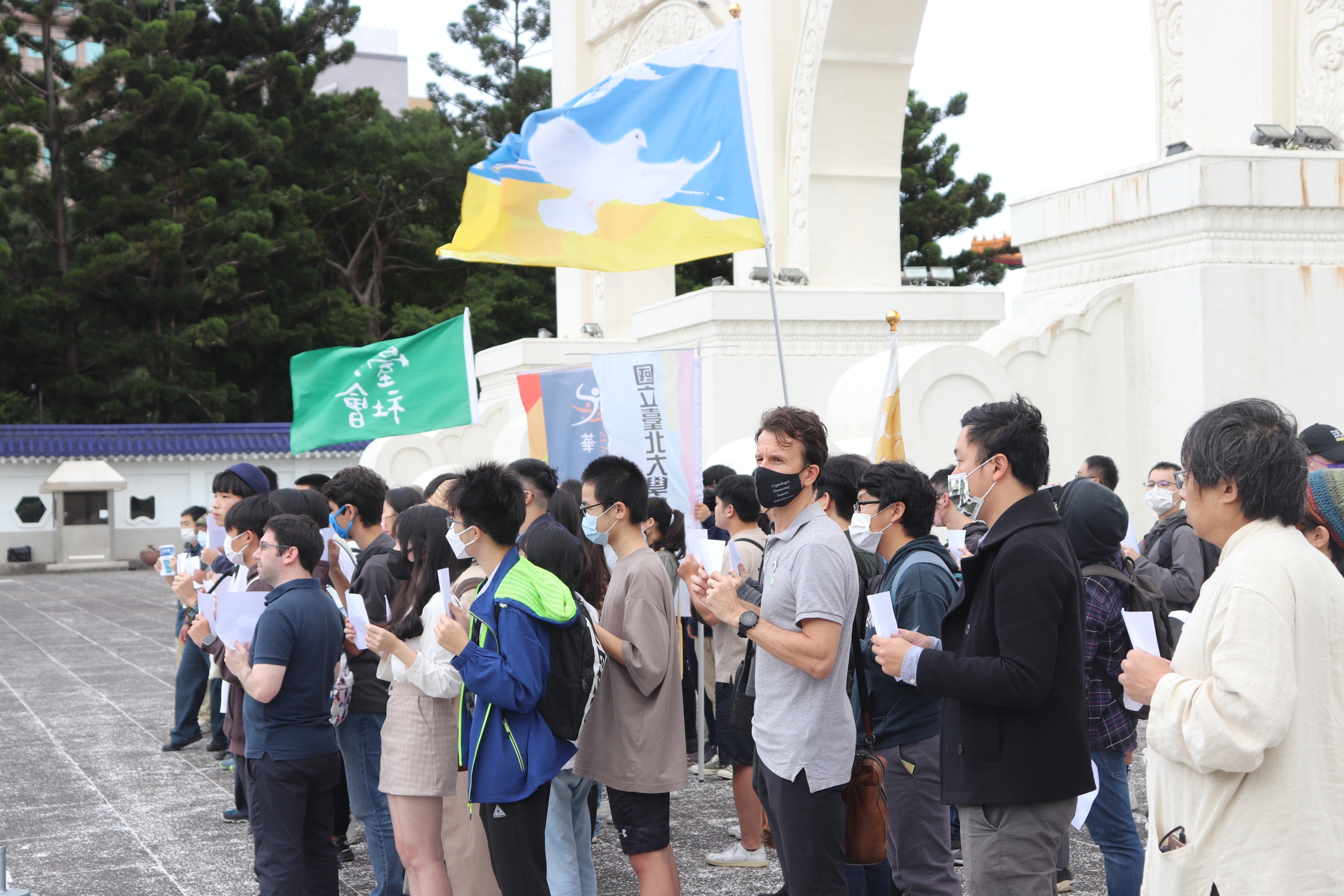
Dozens of protesters gathered at Liberty Square Arch in Taipei, Taiwan, on Sunday to voice their support for the protests in China.
Ashish Valentine/The World
Chen said that some Taiwanese people are surprised to see people from mainland China speak up for human rights and support Taiwan’s sovereignty. Chen has been thinking about one Chinese student who said many young people in China support progressive social movements in Taiwan and Hong Kong.
“But because of the political atmosphere, they cannot say that out loud,” Chen said. “So, she hoped we can understand that not all of the Chinese young people are very hostile to Taiwan.”
Some Taiwanese young peoples’ most visible interactions with similarly aged people in China are with so-called “little pinks” — young Chinese internet users who are nationalistic and often argue with supporters of Taiwan online.
Chen said that offline interactions at events like these might begin to create mutual understanding.
Ho Ming-sho is a sociologist at National Taiwan University. He said that Taiwanese people have long voiced their support for democracy in China, but for different reasons.
Back in 1989, when Chinese troops opened fire on protesters in Beijing’s Tiananmen Square, Taiwan was also still governed by authoritarian Chinese Nationalists, who emphasized that Chinese and Taiwanese were both one people.
“Many of the Taiwanese identified themselves as Chinese … it was seen as a tragedy of the nation, that this young aspiration for democracy had been dashed,” Ho said. “The whole ‘blood is thicker than water’ narrative was quite dominant in the early ’90s.”
The Tiananmen protests were an influence on Taiwan’s own Wild Lily movement, a crucial step in its path to democratization.
Ho said that many in the older generations still feel this connection with China. But after Taiwan democratized in the 1990s, and China remained authoritarian, Taiwan’s local identity has become stronger, with each generation identifying more as only Taiwanese.
Even so, many young Taiwanese people supported the 2019 Hong Kong protests, with some events in Taiwan attended by over a thousand people. Ho said that when he talks to young protesters, he notices them approaching these movements for different reasons.
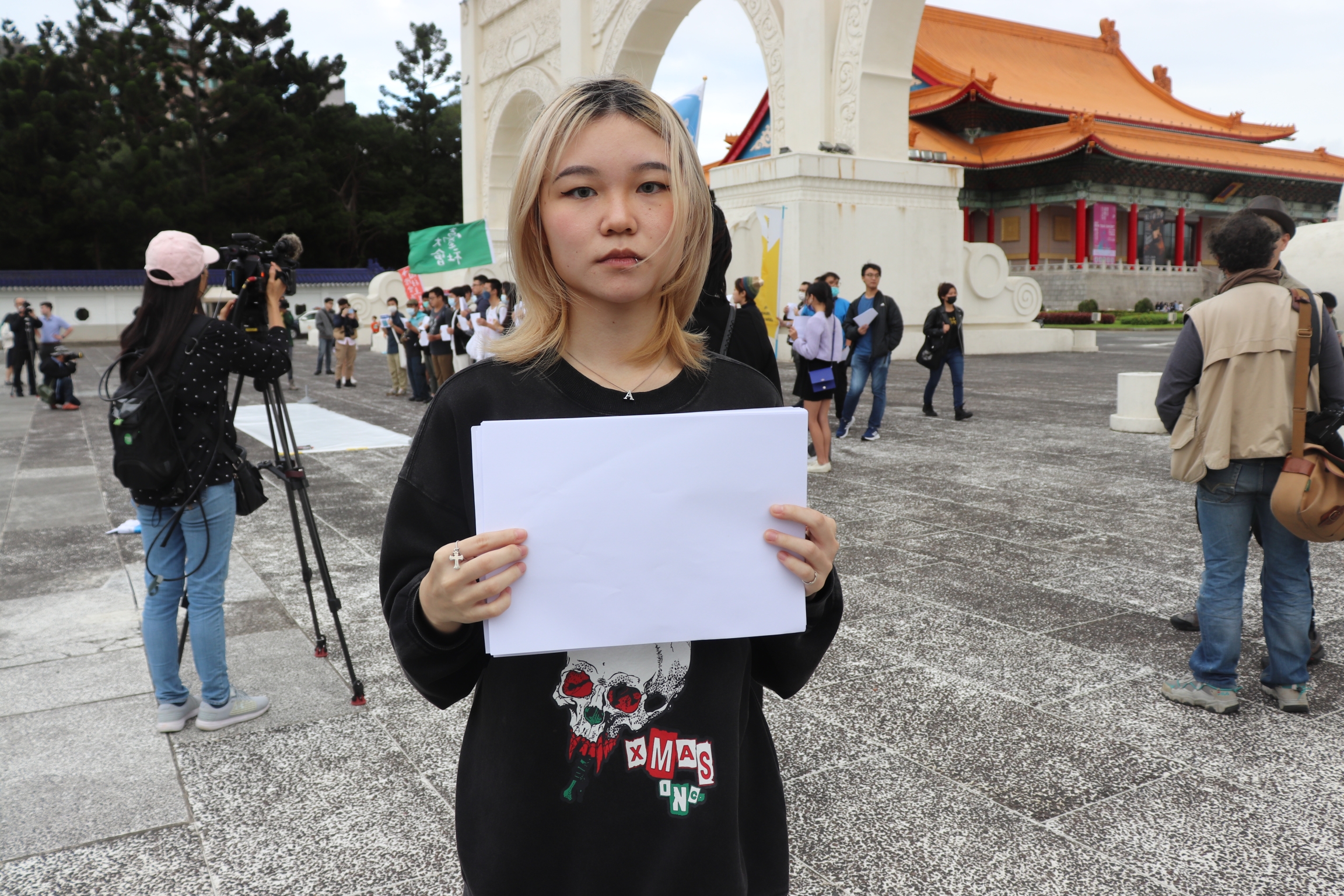
Lin Ting-yu, one of the co-organizers of the rally in Taipei, Taiwan, holds up a white A4-sized piece of paper in solidarity with protests in China on Sunday.
Ashish Valentine/The World
“There’s more emphasis on fighting against authoritarianism … we all want democracy,” Ho said. “There is no emphasis on blood, racial and ethnic ties.”
Lev Nachman is a political scientist at National Chengchi University in Taipei who studies Taiwanese social movements.
Nachman said that while these events are helping some Taiwanese people better understand Chinese perspectives, it’s doubtful these will have a big impact on developments in China itself.
That said, Taiwan still has a role to play when it comes to Chinese students here who are speaking out, Nachman said.
“I think it's incredibly brave of them to be so public about it, because even though they're in Taiwan … someone back in China is probably finding out,” Nachman said. “Something positive that the government could do is to help make sure that Chinese students who do want to stay in Taiwan have the means to do so. Especially if they are putting themselves at any sort of political risk.”
Nachman and Ho both say some more conservative corners of Taiwanese society have argued online against supporting these protests, saying that what happens in China should have nothing to do with Taiwan. Ho said, however, that these groups seem relatively small.
For now, many in Taiwan are paying very close attention to further developments.
The news coming out of the city of Suweida is reminiscent of the early days of the uprising in Syria.
Protesters stormed the governor’s office building and set it on fire. They climbed up the outside of the building and ripped down the large poster of President Bashar al-Assad. They stomped their feet on his pictures.
Rami Abdel Rahman, the head of the Syrian Observatory for Human Rights, told the AFP news agency that one protester and a policeman were killed.
This level of public outrage aimed at the Assad government is unprecedented in Suweida, experts say. The city is home to a religious minority called the Druze, and they have mostly stayed out of this decadelong civil war.
“I think for the first time now, we see demonstrators attacking government buildings, burning pictures of Assad himself,” said Qutaiba Idlibi, who heads the Syria program at the Atlantic Council.
He listed several reasons why people are protesting in Suweida.
“We’ve seen inflation rates that reach 250% in some areas around Syria, especially outside metropolitan centers,” Idlibi explained. “[And] we’ve seen a rise of tensions over military conscription of youth in Suweida, but also the latest episode was the government’s corrupt network that was helping distribute and transfer drugs, specifically Captagon, in Suweida province, and through Suweida province to Jordan.”
Syria’s whole economy has faced serious problems in recent years. The war has been devastating. But then came the pandemic. And the country is still under heavy economic sanctions.
All this helps begin to explain, experts say, why the anger is reaching a boiling point.
Joel Rayburn, former US Special Envoy for Syria, said the economic divide is a major driver for the protests.
“The normal people on the street or in the business community can look around, and they can see the Shabiha, the militia, and the businesses that are associated with the Assad family driving around in fancy, luxury cars. No fuel shortage there, living a high life, going to fancy restaurants at the same time that everyone else is struggling to make ends meet,” Rayburn said.
An editor for Suwayda 24, a local news outlet — whose name isn’t being used for security reasons —told The World in a text message that the city is quiet this week. He added that given the violent response by the security forces, protesters are planning to hold off on any future protests for the time being.
Another Suweida resident, 30-year-old Rawya, who also asked for her full name not to be used, told The World over a WhatsApp call that people went out to the streets because the economic situation in Suweida is dire.
“People here used to survive on money sent from abroad and farming, and now, these two sources have mostly dried up,” she said, adding that it’s because of the pandemic and the rise in insecurity in the area.
Rawya used to be active in a campaign called, “We Want to Live,” which calls for better living conditions for Syrians. But she said she started to get threats and stopped her activism.
Rawya explained that people in Suweida know all too well the type of brutality the Assad regime can unleash on the population, and she worries about the situation becoming even more violent.
The government might try to punish people in Suweida, she said, by cutting them off from daily necessities, like food and fuel. That’s a tactic the government has used in the recent past. She added that it could also ban protesters from getting an education or fire them from their jobs.
But she doesn’t see these protests going away.
“They might calm down for a while, but unless there is meaningful change, things will explode later on,” she said.
Fifty years ago, on Dec. 7, 1972, the crew on the Apollo 17 moon rocket took a photograph of planet Earth. That famous image of Earth would become widely known as the "blue marble."
With that image, people could actually see what this small, life-sustaining planet looks like from afar.
The photo captured the imagination of engineer and physician Mae Jemison when she was in high school. Jemison would later become a NASA astronaut herself — and the first woman of color to travel into space. She served as mission specialist on board the space shuttle Endeavor in 1992.
These days, Jemison leads the 100 year Starship project, a nonprofit whose hope is to launch interstellar travel within a hundred years. Jemison joined The World's host Marco Werman to talk about that famous Earth image and how it has inspired her.
This interview was lightly edited and condensed for clarity.
The Al Jazeera Media Network formally filed a case with the International Criminal Court on Tuesday to investigate the killing of Palestinian American journalist Shireen Abu Akleh in the West Bank town of Jenin in May.
The Israeli military has denied responsibility, but recently concluded that if one of its soldiers did possibly kill her, that it was unintentional.
Al Jazeera, however, maintains that it was a "deliberate killing" by Israeli forces.
The World's host Marco Werman spoke with Al Jazeera's Washington, DC, bureau chief Abderrahim Foukara, about new evidence found and included in case made to the ICC.
This interview has been lightly edited and condensed for clarity. AP contributed to this report. Click above to listen to the entire discussion.
Related: US senators demand full White House investigation into shooting of Palestinian American journalist
Activists in Iran have begun three days of strikes and demonstrations. Many shops in major cities are closed. Gholamhossein Mohseni-Ejei, the head of Iran's judiciary, is blaming rioters for intimidating business owners and says protesters who have already been condemned to death will soon be executed.
Unrest has gripped Iran since September, when 22-year-old Mahsa Amini died in police custody. Mahsa had been detained by Iran’s so-called morality police for allegedly violating a hijab dress-code rule.
Ali Vaez, director of the International Crisis Group's Iran Project, spoke with The World’s host Marco Werman about the continuing unrest.
This interview has been lighted edited and condensed for clarity.
Just weeks after Russian tanks began rolling into Ukraine, a representative from the cybersecurity firm Mandiant phoned executives at Naftogaz, Ukraine’s largest state-owned oil and natural gas company, with an unusual offer: Would Naftogaz be open to having Mandiant check their network for bad guys?
Russian hackers have been trying to break into Naftogaz systems for years, so when Mandiant offered to deploy hunt teams for free to see if anything was lurking in their networks, the company executives couldn’t believe their luck.
The thing is, it wasn’t really luck. The offer was part of a broad effort by Western tech companies to help Ukraine protect itself against Russian cyberattacks in a time of war. Dozens of companies from the US cybersecurity, threat intelligence and tech world — from Mandiant to Microsoft — have banded together in a kind of volunteer cyberposse, wading into the middle of the conflict without a pretense of neutrality.
They call themselves the Cyber Defense Assistance Collaboration (CDAC), and it is the brainchild of Greg Rattray, a former chief information security officer at JP Morgan Chase. For months, he has been helping build a kind of public-private partnership to combat destructive cyberattacks. This is the first time he’s speaking in depth about the initiative publicly.
US officials have been talking about public-private partnerships to fight destructive cyberattacks for years. The animating logic is that the National Security Agency and the military’s cyberarm, Cyber Command, often have intelligence about cyberattacks before or while they are happening. US cybersecurity companies have the expertise to block them. So, it would make sense that they should join forces to stop them.
What makes this particular CDAC effort different is that the partner in this case isn’t Washington. It’s Kyiv, and it has become a test case for how such a joining of forces might eventually work in the US.
“I think the war started on a Thursday and I started making calls on the Monday,” Rattray told the "Click Here" podcast, adding that some two dozen US companies quickly signed on offering to provide licenses, personnel, and expertise to help Ukraine defend its networks. "Click Here" and The Record are editorially independent units of Recorded Future, which has been involved in the effort as well.
“I think it was easier to get companies to sign on because of the clear transgressions of the Russians,” Rattray said. “Ukraine was a place where people were willing to volunteer quickly to try to figure out what could be done.”
Naftogaz is a natural target for Russian hackers with its vast network of suppliers, subsidiaries, and online billing systems — any and all of which could be open to cyberattacks. A determined adversary could then use that access to monkey-bar over to Naftogaz and potentially hobble the nation’s gas delivery systems or even turn out the lights.
Russia had already done something similar back in 2015, when it cracked into Ukraine’s electrical grid and flipped the switch on power to nearly a quarter of a million people in Kyiv for as many as six hours. The feeling was if Russia was willing to do that back then, it would be willing to do so again, during a war, when the gloves are off.
That’s what prompted Ron Bushar, a chief technology officer at Mandiant, to initiate the call to Naftogaz and ask if they wanted Mandiant’s special software programs to sweep their networks. Bushar said there was a general sense that Russian actors were probably lurking in Naftogaz networks and the sweeps, or hunts, were meant to find them.
A hunt team or sweep is the cyber equivalent of a swarm of cops looking for signs of a break in: a kind of high-tech dusting for prints, checking for theft and searching for signs that whoever broke in left nothing — like malicious code — behind.
“We do that across thousands and thousands of systems very, very rapidly,” Bushar said. “And if we see something from that sweep, then we’ll pivot to that system and do a deeper dive of that system.”
The thing was, they didn’t find much: Malicious code that could wipe information from hard drives, prepositioned malware that hackers could activate later, but no wholesale douse-the-lights badness.
“There was no overt detection of aggressive activity,” Bushar said. “But we did find evidence that these attackers had gained access and were moving throughout the environment.”
So, they find where they had slipped in and shut them out.
In the early days of the war, Russian hacking teams had put a number of slow-burn, low-grade attacks in motion all over the country, not just targeting Naftogaz. They erased hard drives and hobbled authentication systems so employees couldn’t log in.
But once Naftogaz secured and fortified its network perimeter — the walls around their computer systems — wiper malware somehow kept reappearing in their systems. Passwords and logins continued to be stolen. They could see it happening but couldn’t explain why. And then, Bushar said, it dawned on them: they “had to adopt a military mindset.”
It turns out what is different about defending computer networks during a war, Bushar and his team realized, is that the perimeter you think you secured is always changing. What they hadn’t accounted for was that the Russian troops now occupying pockets of Ukraine had started entering gas installations and trying to crack into their operating systems.
“In eastern parts of the country, as Russia was taking territory, they were obviously occupying critical facilities,” Bushar said.
Those included Naftogaz data centers and local telecoms and ministry offices.
“So, we were able to definitively point to systems and IP addresses that were physically located in captured territory and that’s where we were seeing these attacks coming from.”
In fact, sometimes the attacks looked like they were coming from inside Naftogaz itself. They came to find that it was not because they had breached the perimeter but because, Bushar said, “Russia was coming from inside the building or inside the network. They had physically captured that data center or that system so they could plug in their own systems and continue to attack other parts of the infrastructure. ... It’s almost like you’re dealing with an insider threat.”
So, they adjusted. They began cutting off systems in areas that were about to fall to Russian forces.
“We were starting to recommend that if people were retreating from a certain province, Naftogaz should start segmenting those systems off the network before they fell into enemy hands.”
And that’s what they did. Naftogaz ended up instructing their employees to contact supervisors if their towns were overrun by Russian soldiers, so their network access could be cut. They would literally call Naftogaz as they were fleeing overrun cities. Once that kind of reporting started, Naftogaz could adjust perimeter security to reflect events on the ground. Bashar said after that, the mysterious insider threats went away.
When CDAC founder Rattray began looking for volunteers for the collaborative, he said his first phone call was to Art Coviello, the former CEO of RSA Security, one of the early entrants into the world of cybersecurity and encryption. Now, Coviello runs a venture capital fund that invests exclusively in cybersecurity companies.
“Ukrainians had a capability,” he said. “The fact that a lot of companies had [software] development sites in Ukraine speaks to the technical capability and the education that was available there. They just had never had the opportunity or perhaps the financial resources to invest in their own defenses as we have here in the US.”
So, he said, CDAC came in to supplement that.
Coviello said the effort isn’t entirely driven by the war. People outside Ukraine should take note because the cyberweapons Russia wields against Ukraine are unlikely to remain there.
“I wouldn’t underestimate the Russians’ capability,” he said.
“What people fail to realize is that the US lives in the biggest digital glass house” in the world, Coviello said. “We have more to lose than anybody else because we are so interconnected and we are so dependent on technology. All of our critical infrastructures, all of our businesses have been transformed.”
Rattray said Ukraine has surprised everyone, not just on the ground but in cyberspace, too. It has proven to be very agile, quickly moving systems into the cloud where data is out of reach of bombings and basic hacks. Their technical expertise has allowed them to pivot quickly when under assault and now they have found themselves on the receiving end of tremendous assistance from the tech world.
“Russians have not been as operationally proficient as we’ve thought they would be,” Rattray said. “They’re doing things we would expect in the digital space, things like information competition, monitoring things in a classic way to gather intelligence through cyberspace. We certainly haven’t seen the type of disruption that we might have expected.”
An earlier version of this story originally appeared in The Record.Media. There was additional reporting by Sean Powers and Will Jarvis.
At St. John’s Episcopal Church in New York City’s West Village, a choir of 54 girls and boys are practicing the Ukrainian song “Shchedryk” that gave their choir its name.
They’re preparing for an upcoming concert at Carnegie Hall called “Notes from Ukraine,” that will showcase the famous Ukrainian song and other music, as Russia continues to wage a full-scale war in Ukraine.
Children’s choir Shchedryk rehearses on Thursday evening at St. Paul’s in New York City.
Credit: Emily Johnson/The World
Anastasiia Rusina, 15, joined the choir when she was 4 years old. She said she loves singing and is very excited for her first trip to the US. The well-lit church sanctuary is a stark contrast from the war-torn conditions back home in Ukraine.
“We have been rehearsing with no light, like, almost all the time, and when there are, like, sirens we would go to the basement and we would rehearse there with no lighting but with our phones,” she said.
Esther Volchova, 12, and Olha Fedko, 11, are among the choir’s youngest members, also in the United States for the first time. The singers traveled from Ukraine as well as other European cities, where some had fled when Russia invaded Ukraine in February.
The group is aware that they are on a cultural diplomacy mission. Fedko said she’s ready but a little nervous.
“I want to express thanks to them for helping Ukraine,” she said of Americans. “And I want them to hear how nicely we sing in Ukraine.”
Children’s choir Shchedryk rehearses on Thursday evening at St. Paul’s in New York City.
Credit: Emily Johnson/The World
“Shchedryk” comes from the Ukrainian musical genre called shchedrivky, with songs that welcome the start of a new year.
In 1922, a Ukrainian choir performed “Shchedryk'' for the first time at Carnegie Hall. It later became a worldwide Christmas sensation when, in 1936, American choir conductor and composer Peter Wilhousky wrote new English lyrics that turned “Shchedryk” into “Carol of the Bells.”
But the Ukrainian lyrics have nothing to do with bells, or Christmas, but instead tells the story of a swallow beckoning the head of a household to look for the bounty of the coming spring.
Ukrainian composer Mykola Leontovych wrote “Shchedryk” in 1916.
“The story of Shchedryk is the story of the Ukrainian fight for independence,” said Tina Peresunko, a leading expert on the history of Shchedryk who is currently a research fellow at National Academy of Sciences in Ukraine.
In 1917, Russia’s imperial Romanov dynasty fell and the first modern Ukrainian state was declared in 1918. During this tumultuous time, the Ukrainian government sent a choir under the direction of Oleksandr Koshetz abroad on a cultural diplomacy mission, hoping to gain allies. They toured Europe and more than 100 US cities, including the 1922 performance at Carnegie Hall. “Shchedryk” was the biggest hit of their repertoire.
But the Ukrainian republic soon fell and the Soviets killed many Ukrainians while consolidating power.
In 1921, composer Leontovych was murdered by an agent of Cheka, the Bolshevik secret police that later evolved into the Soviet KGB. Leontovych never saw how his work spread around the world.
Peresunko said research around the song wasn’t allowed during Soviet times and the full history has only been told in recent years.
“Unfortunately, the context of this 100 year anniversary is current because Ukraine today is again waging a war for independence, is fighting against Russian occupation and again Russian propaganda is telling the world the Ukrainian nation doesn’t exist,” Peresunko said.
Children’s choir Shchedryk rehearses on Thursday evening at St. Paul’s in New York City.
Credit: Emily Johnson/The World
The parallels in history aren’t lost on Marianna Sablina, the children’s choir conductor.
“It happened in a way you could not even dream up. But I think the importance of Ukrainian culture is constant, not situational,” Sablina said, referencing the attention Russia’s war has brought to Ukrainian culture.
The upcoming concert will also include a world premiere featuring the words of Ukraine’s Nobel Prize nominated poet Serhiy Zhadan, written during the current war.
At New York’s Juilliard School, where music fills the hallways, composer and teacher Trevor Weston said that a new work called “”Slowly” will premiere at the Carnegie Hall concert on Sunday.
Weston said the new work is more than just another piece. It’s a poem in response to war that has a role beyond entertainment.
“It’s a documentation of culture in a war [where] one can arguably say one country is trying to destroy another culture,” Weston said.
“And that makes a lot of sense to me because I think there’s a lot of African American music that came from the sheer point of view of resistance. If you can continue to sing your music then you are resisting what people are trying to make you do,” Weston said, adding that his identity as a Black American is an important facet to his work.
Leah Batstone, creative director of the “Notes from Ukraine” concert, hopes culture can help fight propaganda narratives.
“Since the start of the full-scale invasion it’s become even more important for us to do this project,” adding that “culture is a means of countering the ridiculous Russian propaganda claim that Ukraine isn’t a real place with its own history, its own culture,” Batstone said.
Batstone began work on the concert before the full-scale invasion and hopes larger audiences hear Ukrainian music.
“As a former musician, as a musicologist, as an educator, I think Ukrainian music is really special and unique and deserves a space in the canon of what is regularly performed around the world,” Batstone said.
“Shchedryk” will again ring out at Carnegie Hall and this weekend audiences will hear so much more of Ukraine’s musical history both past and present-day.
Related: ‘Chervona Kalyna’: This Ukrainian song has become the symbol of freedom and resilience
The floodwaters have largely receded in Pakistan since they inundated large swaths of the country in late summer, but the waters triggered a health crisis that is still unfolding.
Flooded areas have seen surges in malaria and other waterborne illnesses. More than 1 in 9 kids in impacted areas suffer from life-threatening malnutrition, according to the UN children’s agency.
“The crisis in Pakistan has become an acute child survival crisis,” said George Laryea-Adjei, UNICEF regional director for South Asia, after a recent visit.
At a camp for displaced people in the hard-hit Dadu district in Pakistan’s southern Sindh province, Dr. Junaid Ahmed said he’s seen a progression of illnesses since late summer.
When the floods started, drinking water and sanitation systems were damaged, meaning that people often had little choice but to drink contaminated water. Diarrheal disease quickly followed, Ahmed said.
Next came “huge numbers of patients with skin diseases,” from swimming or wading through floodwaters.
After mosquitoes started to multiply in the standing water covering much of the region, Ahmed said malaria cases shot up. He’s worked more than 200 mobile clinics since the floods started, and said he’s now seeing more cases of respiratory illness as winter sets in and displaced people continue to live in tents.
On a recent morning, Ahmed checked patients lining up at the clinic tent’s entrance with an electronic thermometer, sometimes using the flashlight on his phone to peer into their throats.
Sumerran Vighio was at the front of the line when the clinic opened, reporting that her 2-day-old daughter had stomachaches, fever and wasn’t eating.
A line forms outside a health clinic held at a camp for displaced people in Dadu district, Pakistan, which was hard hit by this summer’s historic flooding.
Credit: Carolyn Beeler/The World
“There’s not enough milk in my breast to feed her,” Vighio said, blaming the camp rations of two plates of rice a day.
In another corner of the tent, 8-year-old Imran Khan Jamali, who’d been shivering with fevers and refusing food and water, tested positive for malaria.
“There are lots of mosquitoes around here. Many of them,” said his uncle, Ali Khan Jamali.
The family of eight shares a tent at the camp and has only one mosquito net, which the youngest kids use.
Malaria cases in Sindh province were more than three times higher in August than a year earlier, and in the hardest-hit districts in the country cases went up again in September.
Climate change made the historic monsoon rains in Pakistan more intense this year, and it’s expected to play an increasing role in human health.
The World Health Organization expects an additional 250,000 people a year by the 2030s to die from malaria malnutrition, heat stress and diarrhea.
Pathogens that cause illnesses such as malaria and cholera tend to reproduce faster and survive longer in warmer temperatures, “so, average increased temperatures favor transmission of these diseases,” said Diarmid Campbell-Lendrom, head of the World Health Organization’s climate change and health unit.
No one is immune to the health impacts of climate change, he said, pointing to the more than 70,000 people who died during a European heat wave in 2003. But the most exposed populations will still have it the worst as temperatures warm.
“If you live in Pakistan and you don't have a safe water supply or a good sanitation system, then, increasing temperatures and floods which overflow your sanitation are going to hit you more than somebody living in a good quality house,” Campbell-Lendrum said. “So, across the board, it's those that are most vulnerable, which are most at risk from climate change.”
In Pakistan, the floods have also destroyed health infrastructure and made it harder for people to access care.
The August floods damaged 800 miles of roads and 38 health centers in the hard-hit Dadu district, where hundreds of thousands of people were still displaced this month.
Last month, patients were spending up to two days navigating floodwaters to get to a hospital, according to one physician.
Ali Khan Jamali at a health clinic for people displaced by Pakistan’s historic floods.
Credit: Carolyn Beeler/The World
At the Dadu district hospital, which serves a population of about 1.5 million, the head of pediatrics, Dr. Allah Korejo, said his unit is overcrowded, with two children in each bed in some wards.
“We need more beds,” he said.
His biggest concern is climbing rates of malnutrition as more families in this farming region fall into poverty.
“Most of the lands and crops are underwater, and the main source of income of our villagers is land,” he said. “So, their source of income is totally finished.”
Malnutrition and infectious diseases were already a big problem here, said his colleague Dr. Tasmine Panhwer.
“This flood crisis has multiplied these already existing problems to huge numbers,” she said.
She’s already seeing babies being born underweight to malnourished mothers, which can have lasting impacts on infant health.
“I think in the long term, it will affect us in terms of compromised health conditions, and it may increase neonatal mortality rate as well.”
The Intergovernmental Negotiating Committee's first mandated conference (INC-1) is underway in Uruguay, where negotiators have begun early talks in building a global treaty that would essentially eliminate all plastic waste.
With a 2024 completion deadline that was voted on in March, the future treaty aims to reduce plastics pollution on a global scale. Organizers plan to mitigate the costs and effects of plastic production as a whole and engage workers’ concerns within the industry.
"We hear a lot of urgency from the folks living and working on the front lines of the crisis."
Jane Patton, campaign manager for plastics and petrochemicals, Center for International Environmental Law
"We hear a lot of urgency from the folks living and working on the front lines of the crisis," said Jane Patton, campaign manager for plastics and petrochemicals at the Center for International Environmental Law.
"We have folks who are waste-pickers from India, Kenya [and] from the United States. And then, of course, we have folks living and working on the front line of the plastics production, the petrochemicals build out, who are here talking about both ends of the plastic lifecycle."
Stakeholders engage in dialogue at the 1st Session of the Intergovernmental Negotiating Committee to develop an international legally binding instrument on plastic pollution.
Credit: Courtesy of Angeles Estrada Vigil/IISD/ENB
Significant stakeholders also include plastics producers who say that caps on production could affect their economic turnover and their customers, as well. This includes large companies like Amazon, that rely on these materials to distribute its products to consumers.
Still, there is growing awareness that plastics producers are really at the root of the crisis, Patton said.
"There is an expanding understanding of what plastic pollution or pollution from plastics actually is," Patton said.
Stakeholders are learning more about emissions from plastic production as a part of the pollution lifecycle, including carbon, greenhouse gas and methane gas, she said.
The weeklong conference in Uruguay is only the first of five meant to carve out what the global treaty will include and how countries will enforce it.
"There's a lot of space between the treaty itself being legally binding and then its actual provisions and requirements being mandatory or binding," Patton said.
"My hope is that all of us who are working on this treaty can go back to working on something that's not this," she said, adding that she hopes the problem can be solved in a way that supports local communities and workers everywhere who are affected by it.
Earlier this month, when Ukraine’s military liberated Kherson city in southern Ukraine, residents took to the streets in celebration, waving Ukrainian flags, honking horns, and singing the national anthem.
But there is another song that has become a second anthem, of sorts. “Oi u luzi chervona kalyna,” or “Oh, the Red Viburnum in the Meadow,” has become a symbol of resistance against Russian aggression.
People sang it all around Kherson city when it was liberated.
The song title sounds perfectly innocent, said Maria Sonevystky, a professor of anthropology and music at Bard College. But it’s a “deeply patriotic song about defending Ukraine from invaders,” she said.
The chervona kalyna or the “red viburnum,” is a leafy shrub peppered with clusters of blood red berries.
Sonevytsky said the kalyna is closely identified with Ukrainian poetry and music. Ukrainian folkloric songs will often open with a naturalistic image like a tree, bird or kalyna.
“And from that kind of opening image, you unspool a kind of metaphor, or a story about politics, or the complexity of life, and that’s the case here, too,” she said.
Most believe the lyrics were inspired by a song from the 17th century.
But Sonevytsky said that the song lyrics come from a 1914 composition that is still sung today. To Ukrainians, the song is closely associated with the Sich Riflemen, a Ukrainian military unit formed inside the Austro-Hungarian army during World War I.
In 1914, what is now Ukraine was a territory divided among neighboring countries including Russia and the Austro-Hungarian Empire.
But around World War I, some Ukrainians hoped to establish an independent country.
“This was the original hope of Ukrainians,” said Andriy Zayarnyuk, a history professor at the University of Winnipeg. “They believed that this war could become a revolution and would change the geopolitics in Eastern Europe.”
But after the war, Ukraine was folded into the Soviet Union and under that system, many patriotic Ukrainian songs, like “Chervona Kalyna” were banned for being too nationalistic and tied to the Ukrainian national liberation struggle, he said.
The song was scarcely sung publicly until the end of the 1980s. Just a few years later, the Soviet Union collapsed and an independent Ukraine emerged.
When Russia first invaded Ukraine, Russian President Vladimir Putin continued to claim that Russians and Ukrainains are one people and that the Ukrainian state was created out of thin air by the Soviet Union.
But most Ukrainians see these claims as an attempt to erase the country’s culture and history.
And Sonevytsky said the song had never really left the memory of Ukrainians. In fact, just a few days after Russia invaded Ukraine in February, the song became a viral hit, she said. Musician Andriy Khlyvnyuk, lead singer of the Ukrainian band Boombox, had posted his version of the song on Instagram.
Even as this version of the song goes viral, songs like “Chervona Kalyna” are still banned in Russian occupied territories. People have been fined or arrested for singing it
That’s why residents in newly liberated Kherson turned immediately to this song.
“People literally on the very first night built a huge bonfire in the center of town, because there’s no electricity, and they sang this song, right at the top of their lungs, to kind of proclaim their freedom,” Sonevytsky said.
In the run-up to Dec. 21, 2012 — the date of Earth’s annihilation, according to a supposed Mayan prophecy — a Japanese mystic urged mankind to abandon all fear. Master Ryuho Okawa would intervene with the cosmos to avert Armageddon.
He stood before adherents — draped in spangly fabric, black hair shaped in a perfect coif — and declared in a warbling voice: “There shall be no ending of the world because I have my mission … and my mission is not over yet!”
Okawa is the 66-year-old leader of Happy Science, a religion he founded in the mid-1980s after leaving behind a stockbroker career. However, this incarnation is merely his current form. Over the millennia, a benevolent alien God named El Cantare, from Venus, has inhabited legendary figures: Socrates, Jesus, Buddha and, at present, Okawa. So he claims.
Though Japan’s population is famously averse to organized religion (more than half claim no religious affiliation), self-avowed prophets have long emerged from the fringes of society in attempts to fill the spiritual void. Happy Science is among the most enduring and far-reaching “new religious movement,” as they’re called in Japan. The organization runs dozens of missionary offices overseas, including a North American bastion in Manhattan. It also boasts more than 10 million adherents.
But this claim — like much of its founders’ teachings — is fantastical, according to Hiroshi Okawa, 33, the master’s eldest son. Once groomed as a successor, Hiroshi defected five years ago, calling his father’s operation a “cult” and a profit-machine endlessly searching for fresh converts.
“Ten million believers is a complete lie,” Hiroshi told The World. “I’d say 13,000 at most. I know this because I had inside information and access to their resources.”
(The Happy Science organization turned down an interview request from The World.)
Much of the organization’s revenue comes from followers’ donations. According to Happy Science representatives: “It really is a spiritual discipline to get rid of worldly attachments. It’s just to show your love and gratitude to God.”
New converts, after swearing their belief in El Cantare, provide their address and bank account details.
Prophetic books are Happy Science’s other major revenue stream. Master Okawa will frequently go into a trance, summon the spirit of some legendary figure and report their deepest thoughts, which are then transcribed and sold. He’s channeled Zeus, Moses, Joan of Arc, Osama bin Laden and living figures too: Hillary Clinton, Kim Jong-un and Leonardo DiCaprio.
“He doesn’t believe any of it,” Hiroshi Okawa said. “It’s a fantasy world — and he knows it.”
Hiroshi said that he too was once urged by the organization to feign supernatural powers. He studied at his father’s side, observing spiritual channelings, often in front of other top Happy Science officials.
“You ask some spirit to come inside you and start talking as if you’re them. It’s just a performance.”
“I remember Ryuho [Okawa] trying to channel Michael Jackson’s spirit and making that iconic sound” — hee, hee! — “and the impersonation was so bad. Luckily he didn’t ask me to try but, if he did, I was ready to do my impersonation [of the pop star] as best as I could.”
(Hiroshi later parlayed skills learned from channeling sessions into acting; he starred in and directed “Gray Zone,” a popular film in Japan.)
Happy Science’s follower count in Japan is likely maxed out, according to Hiroshi, and that has forced Okawa to increasingly target the West — namely America.
“He wants to be king of the world. That’s his sole motivation. But if you want to rule the world, you must first become king of America.”
In recent years, Master Okawa has intensively courted Donald Trump supporters with books such as “The Trump Secret,” “Trump Shall Never Die” and other titles drawn from supposed channelings of Trump’s eternal soul. Not only does Trump possess the “spirit of bushido” (a moral code governing ancient samurai), according to Okawa, he is also the reincarnation of America’s founder: George Washington.
The mystic’s other recent pronouncements appear calibrated to entice right-wing conspiracy theorists: China’s government is working behind Greta Thunberg; Xi Jinping is inhabited by a malevolent alien alter ego named “Xi Jinping X”; COVID-19 can be cured by “spiritual vaccines,” available at Happy Science outposts in eight US states, including Florida, Georgia and New Jersey.
The stated mission of Okawa’s organization is to spread freedom, truth and happiness. But Hiroshi warns potential converts to stay away, contending that their donations will only make his father even richer. (The organization, in denouncing Hiroshi, claims he is “jealous” and likens his falling out to the rift between Jesus Christ and Judas.)
Master Okawa, according to his son, lives “like a Hollywood star” in a Tokyo glam district, Shirokane, inhabiting a four-story mansion complete with a pool, sauna and tennis courts — often surrounded by “pleasant-looking” female secretaries.
“He’s originally from a small village in a mountainous area of Japan,” Hiroshi said, “and grew up with an elder brother who was extremely smart, referred to as a prodigy. Nobody paid attention to little Ryuho [Okawa] so he developed an inferiority complex, desperate for someone to look at him instead of his older brother.”
Master Okawa, according to his son, spends much of his time inside his mansion grousing about politics, with news channels such as CNN International playing the background, “just going on and on about this or that prime minister.”
It’s ironic, Hiroshi said, but the Veunsian deity who founded Happy Science does not appear all that happy himself.
The village of Kijumba sits surrounded by tall banana trees and cassava plants just off the newly constructed roads of the oil-rich Hoima district in Uganda.
This is where 49-year-old Hope Alinatiwe has spent her entire life, cultivating the land to feed herself and her eight children.
Like many rural Ugandans, she is cash-poor but land-rich – meaning her small plots of land are her only assets.
But recently that land has come up for grabs because of the East African Crude Oil Pipeline (EACOP), an ambitious project that will run more than 800 miles from western Uganda to neighboring Tanzania.
In 2018, Alinatiwe said she was told she would need to sell some of her land to make room for the construction of the new pipeline.
“I was told to sign the contract and to stop using the land,” she said.
So, she did. For the next four years, Alinatiwe waited for compensation, and in the meantime, her land went to waste.
By the time she was paid this past September, she had lost out on four years of farm earnings for what she said was meager compensation.
“The money we were given was too little,” for the land, based on its current value, Alinatiwe said.
Now, having lost her primary source of earning, she can no longer afford to send her kids to school and struggles to find work to feed her family.
Alinatiwe's experience highlights what has become a flashpoint in these early days of development for Uganda’s ambitious oil development: land.
Rachel Tugume, also from Kijumba, has a similar story.
"They told me, ‘Rachel, the pipeline will go through your land.’ So, I waited for them to come, and in 2019, they came and stopped me from using my land,” she said.
“If you have cassava in our place, you are a good farmer and you are a rich person,” Tugume said.
Rachel Tugume in front of her land that she was ordered to sell to EACOP to make room for the oil pipeline. She continues to negotiate for a fairer settlement.
Credit:
Halima Gikandi/The World
She was offered about $130 for her land — the amount determined by her land size at the time. She said she can make twice that amount per year by farming. And as time passes, the land has become increasingly valuable due to the nearby oil and infrastructure development.
“The price only keeps going up every year,” she said.
Up to now, Tugume has held out on selling, instead trying to negotiate with the EACOP company for a better deal for her land.
In the meantime, her demarcated land has become full of weeds as Tugume continues to abide by the terms of sale, which include ceasing to grow crops that take time to harvest. She estimates she has lost millions of Ugandan shillings in profits by not cultivating the land for years.
She said her issue isn’t with the oil pipeline itself, but with the impact it has on locals like her.
"We are near the oil and gas, we are near the airport, and we are the people who are affected,” Tugume said, estimating she has lost out on millions of Ugandan shillings of earnings by not using her land that has been earmarked for construction.
“At least they can help us,” she said. “So, we can also benefit from the oil and gas."
Rachel Tugume shows a letter from EACOP about reevaluating the value of her land.
Credit:
Halima Gikandi/The World
Displaced by oil In other parts of Hoima, construction for the oil project has already begun.
In Buliisa, on the shores of Lake Albert, a central oil processing facility is in the works.
That’s where John has lived all of his life, until he was told to sell his land to make room for oil construction. He asked to only use his first name, fearing harassment.
“I requested for land compensation,” he said, rather than getting meager monetary compensation.
When that didn’t work out, he said he refused to sell the land.
“We were taken to court,” he said, and lost.
John said he was later forced to leave his land, which he relied on as a source of income.
"My children are not in school. I cannot have money to earn my living,” he said.
Since then, he has relocated to his relative’s property, which is adjacent to another construction site.
“There is a lot of noise, a lot of sand, dust, a lot of floods of water,” John said.
Uganda’s government has said that they are compensating people fairly. “There is no area in the country that has been assessed for oil and gas development before full and adequate compensation of the project affected persons,” said Gloria Sebikari of the Petroleum Authority of Uganda, who acknowledged there were some delays in payment due to COVID-19.
But for activists, the ongoing disputes over land compensation in the areas closest to the oil development project is proof that the oil project will not benefit ordinary Ugandans.
"There is no way you can expect these huge projects to benefit the poor people, the average people,” said Dickens Kamugisha of the Africa Institute for Energy Governance (AFIEGO).
“The money will be earned and only the rich and the powerful will be the ones to take that money,” he said.
This month, AFIEGO and other organizations sued Uganda and Tanzania over the oil pipeline project at the East African Court of Justice, arguing that the project violates international law and regional environmental treaties.
Threats to vital wildlifeIn nearby Bugoma forest, conservationist Nazario Asiimwe walks through the dense bush, pointing out the diverse biodiversity.
Environmental activists are concerned that the pipeline project could potentially impact forests like this one, which is home to protected species like the chimpanzees.
Asiimwe, who works on forest conservation, worries the species could be harmed by the construction.
"Because chimpanzees, they move everywhere. They can move to where they want to construct the pipelines,” Asiimwe said.
Conservationist and tour guide Nazario Assimwe in Bugoma forest, the Hoima district, Uganda.
Credit:
Halima Gikandi/The World
Both the Ugandan government and the oil companies involved have responded to critics by saying they have taken measures to mitigate any potential negative social and environmental impact of this development project.
But AFIEGO’s Dickens Kamugisha said that is not enough, and that fossil fuels are not the answer for Uganda.
"I don't think we should be saying let's also destroy this nature for us to make money,” he said.
“We can harness our nature and ensure that we get money but we also sustain our environment.”
Related: Why African countries like Uganda are investing in fossil fuels, Part I
The seaside town of Nazaré, Portugal, is home to some of the world’s biggest, gnarliest waves.
Maybe you’ve seen the iconic videos from Nazaré online — daredevil surfers hurtling down the face of waves as tall as 6-story apartment buildings.
One reason that Nazaré has such big waves has to do with the fact that Europe’s largest and deepest underwater canyon can be found right off of its coast.
A Jet Ski steers away from a crashing wave during a big wave surfing session at Praia do Norte, or North Beach, in Nazaré, Portugal, Feb. 25, 2022.
Credit:
Armando Franca/AP
Although the big waves in Nazaré go back millions of years, surfing here has only caught on internationally in recent history, transforming a once-sleepy town into a tourist destination.
But “big wave” surfing — when the waves are at least 20 feet high — is not for the faint of heart — those waves can crash down at speeds of 50 miles per hour.
People atop a lighthouse watch a surfer drop down a wave during a big wave surfing session at Praia do Norte, or North Beach, in Nazaré, Portugal, Feb. 25, 2022.
Credit:
Armando Franca/AP
Surviving those big waves, experts say, comes down to extraordinarily tight teamwork, skill and lots of guts.
The big waves can be seen from a lighthouse in Nazaré, Portugal.
Credit:
Barbara Belt/The World
This week, weather conditions are sending massive rollers crashing onto the beach and the surf's up.
Andrew Cotton, the Jet Ski tow partner for American surfer Garrett McNamara, has been instrumental in starting the big wave surfing here, along with locals Dino Casimiro, Sergio Cosme and Pedro Pisco.
A surfer rides a big wave in Nazaré, Portugal.
Credit:
Barbara Belt/The World
"Just being in the water is a full workout physically, mentally. It's a real sense of teamwork. Nazaré has become the place to be. It's definitely the biggest and most-consistent wave on the planet."
Argentine soccer star Lionel Messi was off to a good start on Tuesday after scoring for his home country in the opening game of the World Cup against Saudi Arabia.
But the match took an unexpected, David and Goliath-esque turn, and Argentina ended up losing 1-2 — a major upset for one of the teams favored to win the competition.
This surprise defeat rises the stakes even higher for Messi, who, at 35, is facing one of the most consequential tournaments of his storied career.
Messi, widely regarded as one of the finest soccer players ever, is also one of the most-decorated athletes in the history of the sport, with a record, seven Ballon d’Or awards, the game’s top individual prize, and 36 trophies won in his club career, mostly for FC Barcelona.
Yet, for all his success at the club level, Messi has so far failed to earn his homeland the biggest trophy of all.
Replicas of Lionel Messi’s record-seven Ballon d’Or awards are on display at FC Barcelona’s museum.
Credit:
Alan Ruiz Terol/The World
According to the player himself, the 2022 Qatar World Cup will be his last shot.
Messi left Argentina at age 13 to join FC Barcelona’s La Masia, one of Europe’s finest soccer academies.
“Those were difficult days,” said Argentine soccer agent Horacio Gaggioli, who got Messi his first contract with the Spanish club, famously signed on a napkin.
Gaggioli recalled seeing the young player cry more than once as his family was separated and his mother returned to Argentina.
Messi also had to inject his legs every day to treat a growth hormone disorder.
But careerwise, migrating paid off, and Messi grew up surrounded with other great players.
Martín Flores and Pamela Peyronel visiting Barcelona’s Camp Nou stadium from Argentina.
Credit:
Alan Ruiz Terol/The World
Gaggioli said that Messi’s teammates were so good that they would often serve him goals on a platter, so he just had to nudge the ball inside the net.
“He didn’t have that with Argentina,” Gaggioli said.
Messi, playing for his home country, lost four international finals. In 2016, he announced he was leaving the team, but later retracted.
Many expected the 2022 World Cup to be different.
A turning point came last year with the Copa América, when Argentina took the trophy home after defeating in the final its nemesis, Brazil.
It was Messi’s first major trophy with Argentina, and it came as a symbol that he, too, could lead his country to international glory, like Pelé for Brazil, Cristiano Ronaldo for Portugal, or Maradona, Argentina’s last soccer hero.
“Messi didn’t feel comfortable playing for Argentina, we lost many finals, and he was heavily criticized,” said Martín Flores, an Argentine soccer fan recently visiting the FC Barcelona stadium.
“But things are different now: when he scores, he celebrates like when he was at Barcelona,” Flores said.
Messi’s career at Barcelona came to an abrupt end in the summer of 2021.
Argentine soccer agent Horacio Gaggioli at the tennis club where he got Lionel Messi his first contract with FC Barcelona, famously signed on a napkin.
Credit:
Alan Ruiz Terol/The World
Years of mismanagement brought the club to the brink of bankruptcy, and a cap on spending imposed by the Spanish league meant it could no longer retain its star player.
“I arrived to the club as a little boy,” said Messi in his final press conference. “After 21 years, I leave with my wife, and with three Catalan Argentine sons.”
Messi, fighting back tears, said that he regretted not having the chance to say goodbye to Barcelona fans, because of COVID-19 restrictions.
“I would have imagined a different farewell, with fans in the stadium, hearing one last ovation” he said.
Messi moved to Paris and signed for France’s powerhouse club PSG. After a difficult year, he was back in great shape just in time for the World Cup.
Messi’s bitter departure from Barcelona left many soccer fans hoping for a final redemptive act, and even non-Argentines relished the possibility of him winning the World Cup.
“Football owes Messi this World Cup,” said Aleida Campos, a soccer fan recently visiting the Barcelona stadium from Mexico.
“He’s the best player I’ve seen in my life. I know I’m young, but my father has seen Pelé, Maradona, and he tells me that besides Pelé, Messi is the best player he has ever seen,” Campos said.
“I don’t care if Mexico loses,” she said. “Even though my country is against Argentina, I really want Messi to win this World Cup.”
Argentina is facing México this Saturday, and Poland next Wednesday.
Another loss would automatically leave Messi out of the tournament, and would amount to a harrowing humiliation.
But some believe that Messi’s legacy as a soccer legend will not be tainted by a lack of World Cup success.
“I do think that his story, in a way, has been written,” said sports journalist Guillem Balagué, author of Messi’s authorized biography.
“If he loses, his legacy will still be unmatched and untouched,” he said. “Those that have been born in the last 30 years, 40 years, 50 years even, will think that they haven’t seen anything better.”
However, Balagué said that Qatar 2022 may not be Messi’s last World Cup.
“I see a twist: he will leave, and then, when the next World Cup gets closer, let's see where he's at, let's see if he gets invited to the national side,” he said.
In the far ends of western Uganda, surrounded by lush green farms, the city of Hoima has taken on a new name: Oil City.
It got the name after commercial quantities of oil were discovered in Uganda in 2006.
According to the country's government, there are 6.5 billion barrels of oil underground — 1.4 billion of which can be recovered.
Now, Uganda is seeking to develop and refine that oil in partnership with the French energy company Total, and a state-owned Chinese corporation.
"People will benefit directly, others indirectly," said 22-year-old Nicholas Aheebua, who works at a local market.
He pointed out the sleek new roads that have been built in the district, and the nearly finished international airport.
"Like us, youths, who are still looking for work,” he added. “People who have benefited directly will start up businesses and we shall work there. We'll be employed."
The Ugandan government is banking on these prospects of employment and development as they promote, and defend, this oil project in the face of domestic and international criticism about the environmental and social costs.
"We estimate that the country will be earning close to $2 billion annually, and this is a significant addition to our GDP," said Gloria Sebikari of the Petroleum Authority of Uganda (PAU).
She said it will also help boost Uganda's energy security.
Downtown Hoima, Uganda, November 2022.
Credit:
Halima Gikandi/The World
"Uganda plans to construct a 60,000-barrels-per-day refinery in Hoima to produce petroleum products like petrol, diesel, jet fuel and the like to be consumed in the Ugandan market," Sebikari said.
Crude oil from the projects will also be exported internationally through the East African Crude Oil Pipeline (EACOP) that will run more than 890 miles from western Uganda to the Tanga port in neighboring Tanzania.
Concerns and pushbackBut some have raised concerns about the oil development project.
In September, the European Parliament adopted a resolution condemning human rights violations and environmental dangers they said have been brought by the fossil fuel projects in Uganda.
But Uganda disagrees with the assessment.
"Some of these people are insufferable. You need to control yourself not to explode. So shallow, so egocentric. So wrong," said Uganda's President Yoweri Museveni in response.
This flashpoint is emblematic of a bigger showdown taking place on the continent, as many African countries seek to benefit from new fossil fuel discoveries despite global calls for a movement away from it.
While those calls were repeated once again at the UN Climate Conference in Egypt, Sebikari of PAU noted how investment in new fossil fuel projects remains a reality globally.
"This begs the question, why should the pressure to stop oil and gas or to delay projects be for projects in developing countries, countries that have not yet reached a certain level of development?" she asked.
"A lot of the [developed] countries developed on the back of oil and gas and other natural resources,"
Gloria Sebikari, Petroleum Authority of Uganda
"A lot of the [developed] countries developed on the back of oil and gas and other natural resources," she added.
Uganda's government argues that it should be able to do the same, especially when many people in the country do not even have access to electricity.
Instead, both the rural and urban poor rely on burning charcoal and firewood, which has led to deforestation across Uganda's protected forest and carbon emissions.
Liquefied petroleum gasSebikari of PAU said that one of the expected byproducts of the oil refining process will be liquefied petroleum gas (LPG) — or cooking gas — which can be used as an alternative to charcoal and wood.
“So, if the oil and gas sectors can support a bigger part of the population to transition away from the use of charcoal and wood fuel [toward the] use of gas, which is much cleaner than wood fuel, then we are contributing to the fight against climate change. We are reducing our emissions as a country," she argued.
This year, Uganda's Ministry of Energy launched a program to give canisters of cooking gas to poor families in anticipation of growing the domestic market in the future.
"Gas is more efficient, faster and cleaner than using charcoal or wood," said 37-year-old Noowe Kazo, one of the recipients.
"The government told us that we should stop using charcoal, because the smoke is bad for us, and because it’s damaging our environment," she said.
She added that she would be willing to buy gas with her own money if it were more affordable.
Noowe Kazo shows off the new gas stove she recieved from the government, Bukasa, Uganda, November 2022.
Credit:
Halima Gikandi/The World
For Uganda's government, Kazo exemplifies its argument that oil development can be part of the country's energy transition.
But for environment and social activists, the costs of the country's oil development are too high.
The World has more on the pushback against this oil pipeline in Part 2 of this report. Listen to the story here.
Related: 'The system is broken': At COP27, developing countries push for more money to adapt to climate change
Soccer is a national obsession in Brazil, which has won more World Cup games than any other country.
And this year, Brazil is favored to win the World Cup once again. But the national team and its fans are grappling with the team’s iconic jersey colors: yellow and green.
Those are also the country’s colors, including the nation's flag, but they have been co-opted by far-right President Jair Bolsonaro, whose political rallies are characterized by a sea of yellow and green.
Bolsonaro’s embrace of the country’s colors has divided Brazilians who reelected former President Luiz Inácio Lula da Silva (known simply as Lula) in late October.
Lula takes office on Jan. 1. Bolsonaro didn't recognize Lula's win or his own defeat, but he authorized his chief-of-staff to carry out the process of transition, which began earlier this month. Still, Bolsonaro supporters are protesting the election results and calling for military intervention. Meanwhile, the national colors continue to be a prominent part of their displays.
Supporters of Brazil's far-right President Jair Bolsonaro rallied for him wearing the country's national colors: yellow and green.
Credit:
Michael Fox/The World
“There has been a kidnapping of the flag and the shirt,” said Gustavo Turck, a journalist in Porto Alegre. “Literally, there has been a kidnapping of these symbols by this political sect.”
It has had a profound impact on the way Brazilians see their national imagery.
“My daughter is 9. It's her second World Cup,” Turck said. “But today, she sees the flag or the Brazilian soccer jersey, and she immediately identifies it with Bolsonaro.”
That is by design. Bolsonaro is not the first Brazilian leader to appropriate the country's symbols. Brazil’s military dictatorship of the 1960s and 1970s strategically used the flag and the Brazilian soccer jersey to generate unity around the regime.
“The Brazilian military used these symbols as a way of showing patriotism, and the people who were against this were seen as enemies of the state,” said Carolina Botelho, a political scientist at the University of São Paulo’s Institute of Advanced Studies.
Bolsonaro has long praised the military dictatorship and even called for its return. And that has led many of his opponents to reject the flag, the colors and the national soccer jersey.
But some say that Lula could change that. During the election campaign, Lula said the yellow and green should represent all Brazilians, not just one group.
Brazil's soccer team wears an iconic yellow-and-green jersey. The jersey, shown here for sale, has become politicized.
Credit:
Michael Fox/The World
“Happily, since Lula won, we'll be able to use it again. People already are. But it’s a process. It won’t be immediate,” said Marcelo Idiarte, a blogger and avid soccer fan, who added that he has not worn the national jersey for years, because of what it has come to represent.
“[The World Cup] could get others to use the colors. But the election is still very recent,” said sports historian Carolina Fernandes da Silva. “As are the illegal protests of Bolsonaro supporters calling for military intervention and trying to undermine the vote.”
People carry the Brazilian flag at a rally for former President Luiz Inácio Lula da Silva, who was reelected in October.
Credit:
Michael Fox/The World
Brazil's top player Neymar da Silva Santos Júnior (known as Neymar) also did not help. He avidly backed Bolsonaro, participating in live events with the president. In a video that went viral over social media, he danced to one of Bolsonaro’s campaign songs.
But some Lula supporters say that they can see beyond that.
“The flag is a national symbol. It doesn't represent one party. It represents us all, regardless of political party or ideology,” said Alex Brazil, a doctor who attended a Lula rally in late October with a green Brazilian flag draped over his shoulders. “So, taking back the flag is to rescue Brazil. It's to rescue our democracy.”
Dutch police have arrested a man suspected of working for an alleged illegal police network run by the Chinese government.
Human rights groups say the arrest could be just the tip of the iceberg. Safeguard Defenders, a Madrid-based nongovernmental organization, said that a Chinese police network is active in some 30 countries around the world. And the group says its goals are to coerce criminal suspects to return home to China — while silencing dissent overseas.
The Chinese government doesn’t deny the network exists. But it says that it's lawful, and sometimes helps “persuade” legitimate criminal suspects to return to China to face trial. The government even boasts of their success rate. China’s Ministry for Public Security claims police have persuaded some 230,000 suspects — most of them alleged telecom scammers — to return home voluntarily between April 2021 to July 2022.
What the ministry doesn’t disclose, however, is its methods. Human rights activists say that Chinese authorities use coercion and threats to pressure people to return.
“It’s very simple,” said Laura Harth, a researcher with Safeguard Defenders. “They target your family. They might take benefits away from your family members.”
They even confiscate their bank accounts or their houses, she added. “Their kids might be banned from going to certain schools, and so on.”
Harth said the global network of overseas police stations that have been set up in recent years run covert operations against political dissidents who live far away — the process usually beginning online.
“The overseas police sent a telegram message to me,” recounted political dissident Wang Jinyu, who was granted asylum in the Netherlands this year. “He wanted to meet with me. And I refused. [Afterward], he kept calling me.”
“He also asked me to go back to China to solve my problem,” Wang said. “Also, he asked me, [to think] about my parents” — a direct threat against my family.
Wang said China is after him for his anti-government posts on social media. He said that his father has been jailed back home, and that his mother has gone into hiding. Wang said that Chinese police in Europe have also been stalking him.
“I was just walking on the street and a man with clothes of the People's Republic of China army stopped me.”
Wang Jinyu, Chinese political dissident with asylum in the Netherlands
“I was just walking on the street and a man with clothes of the People's Republic of China army stopped me,” he recalled. “He says, ‘You are a criminal. I will catch you.’ Like this. And many, many times like this.”
Wang said last year, a man with a knife even tried to break into his apartment, but fled when he called the police.
It wasn’t the first time Wang has sought police protection. He called his local precinct with each threat. After the knife incident, an unidentified officer told Wang that if the Chinese government was indeed behind this, there was only one truly secure place for him.
“The safest place to stay is a prison,” the officer said in an audio recording made by Wang. “They can’t come into the prison.”
And Wang said he understands.
China denies allegationsChina denies that it’s threatening dissidents abroad. But professor Dani Bello, an expert on international security at Webster University in St. Louis, has his doubts. He said that China has been going after critics overseas since the 1990s. The only thing that’s changed is the rise in surveillance technology — making it easier to find people.
“It's shocking, but not surprising,” Bello said. “They’re trying to create an environment where people who leave China do not actually work against Beijing’s agenda.”
They can’t do it directly, Bello explained, so they look for other ways that will create an opportunity for plausible deniability.
“In other words,” he said, “‘if we’re caught, we can say we’re not doing it.’”
And that’s where activists say the overseas police service stations come in. The stations often act on behalf of domestic security authorities from specific Chinese cities. And they operate out of existing businesses, such as a restaurant or a legal services office.
Beijing insists the stations act lawfully. One Chinese diplomat tweeted recently that the services can help citizens renew their driver’s licenses.
But when a Spain-based journalist named Yuan Lee called one of the stations in the municipality of Torrejón de Ardoz, he was told they couldn't help him.
“The agent just told me if I want to renew my license, I need to go to Madrid, to a Chinese neighborhood there called Usera,” Lee said.
Once there, Lee was told, he should ask around for a man named Chen Enguang. No address or telephone number was provided. He was just instructed to ask around on the street.
“That doesn’t seem very logical,” Lee said.
So, if the overseas police can’t help with driver’s licenses, what services do they offer? In Barcelona, it’s hard to tell, because you can’t even find them. One location, listed on the official WeChat account of the police from the southern coastal Chinese city of Fuzhou, turned out to be an empty storefront.
A second address was a document translation business for Chinese citizens. And the employees inside said they’d never heard of Chinese Police Overseas Service Stations.
The Chinese Consulate in Barcelona didn’t reply to questions emailed by The World about the stations. The consul, however, recently urged the press not to create “false scandals and drama.”
Investigations worldwideNumerous countries are now actively investigating the Chinese police network, including Germany, Spain, Australia, Chile and the United States. In the Netherlands, police have just detained a suspected Chinese overseas police agent, one who called dissident Wang days earlier.
After the agent told Wang that he should meet him at the Starbucks at The Hague’s central station, or that he’d be arrested in the night, Wang agreed — but alerted the Dutch police first.
The police went with him to the train station, where he called back the suspicious number and began filming with his phone when a man answered.
“They’ve finally caught the Chinese Communist Party gangsters,” Wang said in the video, as two officers approached the man. The police asked Wang to stop filming, but they detained the suspect and took him in for questioning.
“I feel it is a little bit of a victory,” Wang said, “because finally we [caught] one guy, one Chinese overseas police” — an alleged policeman still being investigated.
Human rights groups in Europe are also feeling optimistic. Last month, the European Court on Human Rights halted the extradition of a criminal suspect from Poland to China on grounds that the man could be tortured or mistreated by Chinese authorities. That ruling, which is precedent setting, could effectively prevent dozens of nations, mostly in Europe, from sending anyone back to face trial in China.
Related: Massive data breach in China raises questions around govt's responsibility in securing data, expert says
One of the largest mass graves discovered since the Russian invasion in Ukraine lies in a wooded area just outside the northeastern city of Izium.
On a recent visit, fog enveloped the tall pine trees surrounding the graves.
The remains have been exhumed and relocated to the local morgue but a faint smell lingered. A few open, empty caskets stuck awkwardly out of the graves. Not far away, a pile of discarded disposable gloves, masks and other personal protective gear was a reminder of the ongoing forensic investigations here.
Since the recapture of Izium by the Ukrainian forces in September, investigators have been trying to identify the remains in this mass grave. Families with missing loved ones are searching for answers.
In some cases, all the victims got was a number: 146. 189. No name, no cause of death, nothing else.
Yulia Tatarinova, of Izium, Ukraine, fills in forms related to her DNA sample in hopes of finding the body of her husband.
Credit:
Shirin Jaafari/The World
Out of 451 bodies that were discovered, 150 are yet to be identified, according to Oleksandr Filchakov, head of the Kharkiv Regional Prosecutor’s Office. At least 17 bodies bore evidence of torture, he said, including ropes tied around their necks, hands tied behind their backs and cracked bones.
Liudmyla Vaschana has been searching for her 31-year-old son, Eduard, since March. When the Russian military started its attack on Izium, she said, Eduard joined the volunteer fighters called the Territorial Defense Unit. Vaschana left Izium to care for her other son, 19-year-old Oleh, who had been injured while fighting in another part of the country. He was recovering in Lviv, a city close to the Polish border.
The fighting got intense in Izium, and on March 6, Vaschana lost touch with Eduard. Four days later, she said, the house that his unit was based in was bombed. Other members of the unit told Vaschana that they searched for his body in the rubble but never found it.
A pile of discarded personal protective gear used by investigators and exhumers at the mass grave in Izium, Ukraine.
Credit:
Shirin Jaafari/The World
“I just want to find my son,” she said, adding, “That’s the most important thing.”
In September, Vaschana called a hotline set up for missing persons and reported her son missing. But she said so far, no one has gotten back to her.
When The World spoke to Vaschana earlier this month, she was visiting a mobile laboratory to give DNA samples. Technicians swabbed the mouths of visitors, then filled in a form with their personal information.
The lab, set up with the help of the French government, collects DNA from those who have missing relatives. It then runs the samples through a database collected from the remains found in the mass grave in Izium.
Relatives of victims have their DNA samples taken at a mobile laboratory in Izium, Ukraine, set up with the help of the French government.
Credit:
Shirin Jaafari/The World
“We’re asking relatives of Ukrainian soldiers to submit their DNA samples,” Dmytro Chubenko, Kharkiv Regional Prosecutor's Office spokesperson, told reporters outside the mobile clinic. “We’re constantly finding mass graves of Ukrainian soldiers, we’re examining their bodies and collecting their DNA samples [...] to try and identify as many people that were buried here as possible.”
‘We will never forgive them’There are 7,700 war crimes cases under investigation in the Kharkiv region of Ukraine alone, said Filchakov, from the Kharkiv Regional Prosecutor’s Office.
A map in his office marked the areas where those investigations are being carried out. Some are off-limits, he said, because they remain under Russian occupation. Others are mined, or are too close to the border where Russian troops are stationed.
“Geographically, we are in an unfavorable position because we are close to the border with the aggressive country [Russia],” he said.
Besides the arrests, torture and killing of Ukrainians, Filchakov added, the Russian forces have been implementing changes with the goal to erase Ukrainian identity.
Dmytro Leontyev, 41, lost his father on March 20. He said his neighbors buried him in the backyard but then Russian soldiers dug his body up and buried him in the mass grave. Leontyev hasn't been able to find his father's body. "He was a good man," he said. "He was a taxi driver his whole life. He helped everyone and everyone wanted to be his passenger."
Credit:
Shirin Jaafari
“We have found documents that were signed by the occupying authorities where they were confiscating Ukrainian school books, and they were introducing Russian school programs,” he said. “In some cases, we found evidence that the Russians were rewriting history. For example, they were saying the famous Ukrainian poet [Taras] Shevchenko was Russian.”
Russian President Vladimir Putin started this war with the excuse to protect the Russian-speaking population in Ukraine, Filchakov said.
“My family lives here, my wife, my kids, my parents and overall people in the Kharkiv region are Russian speaking. He [Putin] is directing his army to kill our wives and our children. All I can tell you is that we will never forgive them.”
Documenting war crimesBeyond Izium, there are major efforts underway to document crimes committed by the Russian forces all over Ukraine.
Truth Hounds started this work in 2014 when Russia took over Crimea.
Roman Avramenko, executive director of Truth Hounds, at its office in Kyiv, Ukraine.
Credit:
Shirin Jaafari/The World
Earlier this year, when Russia invaded Ukraine, the nongovernmental organization redoubled its efforts to reach affected areas quickly to collect and document as much evidence as possible.
“This expertise that we developed and gained during previous years really helped us to contribute to the justice processes,” said Roman Avramenko, executive director at the Truth Hounds office in Kyiv.
When it comes to building a case, Avramenko explained, time is of the essence.
“Time flies, craters [get] filled [...] people will forget details,” he said. “Some buildings have been repaired and restored. The evidence will just go away, in many cases forever, unfortunately.”
Before investigators leave on a trip, they collect as much data as they can. They search for videos, photos and social media posts online that could shed light on what happened. After verifying them, they go to the scene and begin interviewing witnesses and collecting evidence.
Avramenko gave an example of a recent successful investigation. In March, at least 10 people were killed in an attack on people standing in line for bread in the northeast city of Chernihiv. An American was among the victims.
“We were able to prove there were no immediate military targets that potentially could be legal targets for this attack,” he said. “And that the Russian troops used weapons of indiscriminate nature.”
Avramenko and his team are working to bring cases to courts in Ukraine and outside. He suspects the extent of the crimes committed by the Russian forces to be far beyond what they can document and prove in court.
“The Ukrainians have been so dehumanized in the eyes of the regular Russian soldier that they see no difference between killing a cat or killing a child,” he said.
Volodymyr Solohub supported the reporting of this story.
Jorge Drexler was nominated for nine Latin Grammy awards on Thursday and took home seven — more than any other artist up for an award at the ceremony in Las Vegas, including two of the most coveted prizes for record and song of the year.
Like many artists and musicians, Drexler used his time during the COVID-19 pandemic to get creative.
During the height of the pandemic, he composed the songs featured in his new album “Tinta y Tiempo,” or “Ink and Time,” in which he collaborated with reknowned singers like Ruben Blades, C-Tangana, and Noga Erez.
But for Drexler, who was born in Uruguay and lives in Spain, it wasn’t easy coming up with new songs during a time of complete isolation.
“The pandemic was hard on everybody, and I guess it affected people differently, depending on their personality. I found it very, very difficult, especially to finish the songs.”
He said he discovered something new about himself: that he likes writing in isolation, but only up to a certain point.
“Once I’ve got the first draft of a new tune, I need to play it or say it to another human being, I need to feel the presence of another person to direct that writing. It's strange. I didn't know I needed that.”
The album title is “kind of a prayer,” he said, a prayer for creative inspiration, to finally finish writing the songs.
“And when I found myself in that writer's block, I tried to relax and think that, you know, what has to be written will be written in the end. Just let the ink and time do the work on the blank page.”
Drexler said that with this album he is paying homage to the blank page, and that’s why the cover of the new album is completely white.
“The blank page is a promise of possibilities. Anything can fall into a blank page. But for every battle that you win against the blank page, which is every finished song you have, I have at least 10 unfinished verses or songs that won't see the light of day. So, I paid homage to them.”
Jorge Drexler accepts the award for record of the year for "Tocarte" at the 23rd annual Latin Grammy Awards at the Mandalay Bay Michelob Ultra Arena on Thursday, Nov. 17, 2022, in Las Vegas.
Credit:
Chris Pizzello/AP
In this album he also explores different styles and genres. In the song “Oh Algoritmo!” He teamed up with Israeli rapper Noga Erez, who he met on social media in the middle of the pandemic, and they created lyrics together on Zoom.
“Tell me what I have to sing. Oh, mighty algorithm! I know that you know it better than I do,” he sings.
He said the song reflects on the concept of free will.
“We talk a lot about freedom, but many many times we prefer to let somebody else or something else make the decision for [us]. They might be politicians or they might be algorithms.”
Drexler was trained as a doctor, but after studying medicine for 10 years, he realized he wanted to dedicate his life to music.
After 30 years — and many successes — he said he’s changed a lot.
“As you evolve as a human being, your songs also evolve with you, and things that were right at some point of your life, become wrong at some other point of your life. And you will find songs that contradict one another, like periods of my life that contradict one another.”
Asked what he thinks now about the Jorge Drexler of 30 years ago, he said: “I would tell Jorge of 1992 to not listen to Jorge’s 2022 advice. Just follow the way, make every mistake again, and find your way.”
The Russian military has been steadily losing ground in Ukraine for months. That’s despite the fact the Kremlin has mobilized tens of thousands of new recruits for the war.
Moscow is also getting help from abroad. Iran is supplying Russia with drones. And, according to Western officials, the Iranians are providing ballistic missiles as well.
Now, there are reports that Russia is getting assistance from the Democratic People’s Republic of Korea, as well, with the country providing artillery shells, rockets and winter military uniforms to Russia.
Yet, both governments deny it.
“We have information that despite the public denials that we’ve heard from the DPRK, that the DPRK is covertly supplying Russia’s war in Ukraine, with a significant number of artillery shells,” US State Department spokesperson Ned Price said earlier this month.
Russia’s relationship with the country goes back decades.
Sung-yoon Lee, who teaches Korean politics and foreign relations at the Fletcher School at Tufts University, said that the role of the Soviet Union is crucial to the history of North Korea.
Kim Il-sung, the founder of the North Korean state, was glorified by the former Soviet Union. Kim was an officer in the Soviet Army. After World War II, Joseph Stalin chose Kim to be the leader of North Korea, and supported his decision to invade South Korea in 1950.
“The Soviet Union became thereafter North Korea’s most important supporter militarily, politically, and perhaps most importantly, economically, throughout the Cold War,” Lee said.
That relationship was not always smooth. And with the fall of the Soviet Union, relations between Russia and North Korea cooled down a lot.
But a decade later, that changed. Pyongyang rolled out the red carpet for Vladimir Putin when he became the first top leader of either the Soviet Union or Russia to visit North Korea, Lee said. During that visit, crowds at the airport cheered and waved Russian and North Korean flags to welcome Putin. Lee said this was the start of a new era of warmer relations between Russia and North Korea.
“When it comes to security matters, the two nations have always been partners, and with Putin’s dreadful war in Ukraine, the old dynamics of the cold war, Russia, China, North Korea on one side, and the United States, South Korea and Japan on the other side, this Cold War rift has come back,” Lee explained.
He said it makes sense for Kim Il-sung’s grandson, Kim Jong-un, to be supplying Putin with military equipment.
Fyodor Tertitskiy agrees. He’s a researcher at Kookmin University in South Korea, where he studies the North Korean military.
Tertitskiy said the Russian military has lost a lot of their modern equipment in Ukraine, and they’re now using older artillery and tanks.
“For that, you need ammunition, and North Korean uses a lot of Soviet equipment, and North Korean can supply exactly this kind of ammunition which might have been provided to them by the USSR ironically,” he said.
Tertitskiy said North Korea needs the cash, as well as oil, food and humanitarian assistance from Russia. And the country is very military industry-oriented, he said, putting it in a good position to provide military hardware.
Tertitsky said there’s reason to be skeptical — there hasn’t been a smoking gun, or concrete evidence that North Korea is supplying Russia with lots of weaponry.
But he said the fact that these reports are so believable says something about the state of Russia’s military and its war in Ukraine.
In the wake of Pakistan’s catastrophic flooding this year, the World Bank estimated it will cost the country $152 billion over the next eight years to adapt to the impacts of climate change.
As warming temperatures push up sea levels, bring more intense storms and fuel deadly heat waves, the costs of readying infrastructure and populations for this onslaught in developing countries will tally into hundreds of billions of dollars each year.
Yet funding flowing to those countries is five to 10 times less than what’s actually needed, according to the UN.
At the COP27 climate summit in Sharm el-Sheikh this month, developing nations have been pushing for more funding, canceled debt and changes to the global financial system to help them address this funding gap.
“I understand that we all have to do more, Pakistan has to do more to reinvent itself,” said Pakistan’s Climate Minister Sherry Rehman, speaking about the need for adaptation. “I also appreciate and think that all our partners have to do the same.”
The need for adaptation is clear in the coastal megacity of Karachi, Pakistan’s commercial hub.
“Karachi is vulnerable when we think about all the possible four scenarios that you relate to climate change: flooding, drought, extreme heat and sea-level rise.”
Farhan Anwer, urban planner and academic in Karachi
“Karachi is vulnerable when we think about all the possible four scenarios that you relate to climate change: flooding, drought, extreme heat and sea-level rise,” said Farhan Anwer, an urban planner and academic in Karachi specializing in sustainable cities.
Critical infrastructure on Karachi’s coast now stands vulnerable to rising sea levels. Monsoon rains already cause annual flooding, including in the informal settlements built on the banks of the city’s stormwater drainage ditches.
Without a proper sewage or solid waste management system, those ditches become choked with both trash and human waste, Anwer said.
Standing near one of those ditches, Anwer explained that adapting to increasingly intense monsoon rains will require a range of infrastructure and policy upgrades.
“Unless we have an efficient sewage system, it will again be flooded with sewage water. If we don’t have a proper solid waste management system, people will continue to dump their garbage here,” he said. “If we don't have affordable housing schemes for the urban poor, they will continue to have settlements built along these areas.”
Anwer, who wrote an adaptation plan for Karachi a decade ago and consults with the World Bank, stressed that better governance in the city is essential to adapting to climate change.
But it also requires money.
Urban forestsIn response to a deadly heat wave that struck his city in 2015, Karachi resident Shahzad Qureshi launched an urban forest in his neighborhood.
Since then, he founded the organization called Urban Forest and has gained international acclaim for creating 20 small, densely planted forests across Karachi — and more around the country — largely at the invitation of private landowners.
With a positive response, he said he thought he’d landed on a model that could be scaled up to help cool the city and alleviate monsoon flooding.
Shahzad Qureshi’s first urban forest, three densely planted acres in the Clifton neighborhood of Karachi, Pakistan.
Credit:
Carolyn Beeler/The World
“This is going to be a great respite,” he thought. “We're going to change the microclimate of Karachi!”
Quershi has since been working for years to gain support to scale his forests up, with a target of covering 25% of Karachi with trees. He’s shopped this idea around to government representatives and private citizens, but said he hasn’t yet gained much traction.
“The only thing actually stopping us is money,” he explained. “That's it.”
In 2010, developed countries pledged to raise and mobilize $100 billion a year in climate finance for developing countries by 2020. They missed that target by nearly $20 billion, and don’t appear on track to meet it until 2023.
And most of that money goes toward mitigation, or projects like renewable energy plants that help slash emissions.
Shahzad Qureshi at his first urban forest, in the Clifton neighborhood of Karachi, Pakistan.
Credit:
Carolyn Beeler/The World
Only 34%, or $28.6 billion, went to adaptation in 2020, according to the Organization for Economic Cooperation and Development (OECD).
Chiara Falduto, who tracks climate finance for the OECD, said that’s partly because adaptation projects, like beefing up a city’s disaster response systems or helping farmers adapt to climate change, typically don’t offer a return on investment. And they’re largely funded by governments.
“In the case of mitigation projects, this is different,” Falduto said.
Investors at a new solar power plant, for example, can expect a direct return on their investment when electricity is generated and sold.
At the COP27 summit in Sharm el-Sheikh this month, many developing countries are pushing for wealthy nations to strengthen pledges to double adaptation finance and achieve a balance between funding for adaptation and mitigation.
And Pakistan is calling for debt relief.
“I think we need partnerships for the future where the financial burdens on debt-ridden countries need to be reduced to deal with the post-existential climate crisis world,” climate minister Sherry Rehman said at the summit.
Barbados’ Prime Minister Mia Mottley is gaining traction for an initiative that would provide hundreds of billions of dollars in grants and low-interest loans to developing countries.
In G-7 countries, she told reporters at Sharm el-Sheikh, countries can borrow at interest rates between 1% and 4%.
“In most of the Global South, the average borrowing rates are now between 12 and 14%,” she said. “So, you begin to see the disparity.”
Mottley argues that these rates mean the so-called "Global South" countries rack up high levels of debt when borrowing to recover from climate-fueled disasters, and are then unable to invest in other priorities, including adaptation.
“The system is broken, and what we need to ensure is a more level playing field for the cost of capital, because it’s the cost of capital that will be borne and will crowd out our ability to finance other aspects of our development.”
Related: A Pakistani family sees firsthand the effects of climate change, as negotiators at COP27 battle over how to pay for them
Argelita is an idyllic, white-washed mountain village in northeast Spain, with an old public washhouse, a shaded river for swimming, a bar, a medieval church and sheep grazing on the nearby hills. But one thing that’s been missing for a long time is children.
Back in the ‘70s, the village school closed down because there just were not enough children. But now, after 47 years, children finally have a place to learn in town, at the village’s new school.
“I like it here more than at my old school,” fifth-grader Lola Brun said on a recent day during recess. “There, the kids would fight a lot.”
In Spain, a decadeslong exodus from the countryside to the cities has left hundreds of villages empty, or nearly so. Castellón, a region in Spain’s northeast, knows this well. It now has one of the lowest population densities in Europe. But the tiny village of Argelita has managed to reverse the trend.
Argelita’s newly reopened school has 24 students in its second year of operation. The school was shuttered in 1974 due to a lack of kids.
Credit:
Gerry Hadden/The World
Brun is one of 24 students at the new school. Her family moved to Argelita last year from a bigger town near the coast. Her mom is one of the teachers.
“At my old school we were in class all day,” Brun said “Here we have more free time. We can go outside on the playground.”
Just over a year ago, Argelita, with a population of about 100 and shrinking, was a much quieter place. The school has changed that. But the plan to revive the aging village started even earlier.
“We weren’t looking for a strategy to stop the exodus of residents,” said Amadeu Llach, Argelita’s lieutenant mayor. “We were already depopulated,” he said. “We needed a plan to bring families back.”
That is, families with kids. But Llach said the town knew that a school building alone wasn’t going to produce miracles. First, Argelita brought back some other basics like a supermarket, and then a pharmacy.
“We almost never used to sell diapers or formula,” said assistant pharmacist Vicky Jimenez, on a tour of her tiny storefront. “Now we’ve got pacifiers,” she said, “and all the little things babies need.”
Argelita, in northeast Spain, has about 100 permanent residents. Among them, 11 kids, enough to open a school. Now more families want to move there.
Credit:
Gerry Hadden/The World
Next door, there’s another new, multiuse space. Depending on the day, residents can pop in for a haircut, or see the foot doctor or visiting physical therapist. All of this was put in place before the school opened. Only then did the town go after families.
And the plan seems to be working.
On a recent morning in the tiny town square, a young woman named Ayona Halili stopped for a coffee. “I moved to Argelita with my husband and three kids,” she said.
The Halilis are refugees from Albania. A couple of years back, Argelita put out a public call for immigrant families: “Move here with your kids, we’ll give you free housing and a job.”
Soon, Argelita was welcoming a Kurdish family from Syria, a Colombian couple with two kids and the Halilis. The influx pushed the school-age population to 11, past the legal minimum threshold for a public school.
“The town’s great,” Halilii said. “It’s so calm. It’s good for our kids. They really like it.”
Ayona Halili moved to Argelita with her husband and kids after the town sent out a call for immigrants. They’re refugees from Albania.
Credit:
Gerry Hadden/The World
Her husband was given a town job, maintaining the local forest. Their oldest son, Yegor, age 11, studies in the new school.
“I love that I can walk to school,” he said. “It’s like 10 or 15 steps from my home. It’s a small town.”
Yegor did complain about homework, unsurprisingly. But he smiled as he did so. He seemed like a happy kid.
In fact, the whole town seems happy about the new school, and the new families who’ve made it possible, local baker Aitor Balfagón said.
“It’s brought us more life to the village,” he added. “There are kids playing in the streets. Before the school, after dinner, there was no action in the streets. Everyone just stayed home.”
A student at Argelita’s new school plays in the small courtyard.
Credit:
Gerry Hadden/The World
Balfagón also happens to be the town’s mayor. In between baking baguettes, he’s managed to get some new housing approved. Because now, he said, there’s a waiting list of families hoping to move here.
At the district women’s hospital in Meerut, about 50 miles from India’s capital New Delhi, 32-year-old Moni Devi cradled her pregnant belly as she sat in a metal chair waiting for a routine checkup.
“This pregnancy was unplanned,” Devi said. She and her husband already have two children — a girl and a boy. They didn’t want any more, she said, because their family’s financial situation is unstable. Devi’s husband works in the private sector where job security isn’t guaranteed. “I considered an abortion, but my in-laws were against it, so we’re going to keep the baby,” she said.
She’s not taking any more chances though. Soon after her delivery, she said she will undergo a tubectomy, or female sterilization, to prevent any unwanted pregnancies in the future.
Women across India echo Devi’s rationale for wanting a small family. Government data shows India’s total fertility rate, which is the average number of children per woman, has dropped to two (just below replacement rate, the rate at which a population exactly replaces itself without migration). In the 1950s, it was around six, suggesting that India’s population is stabilizing.
On Nov. 15, the world’s total population crossed the 8 billion mark. India, with a population of about 1.4 billion, is the second-most populous nation in the world. The United Nations projects that next year, India will surpass China and claim the title of the world’s most populous country. But demographers in India aren’t panicking, because India’s population growth has actually been slowing down for many decades.
“The population explosion age has gone now and we are in a reasonable growth period, it is not a very alarming growth anymore,” said K. S. James, director of the International Institute of Population Sciences in Mumbai.
The credit goes to a decadesold, government-run family planning program which has successfully reduced India’s fertility rate through awareness programs and increased access to contraceptives, and without coercive measures like China’s one-child policy.
In this Monday, Feb. 10, 2014, photo, migrant women gather to attend the awareness and service camp under National Rural Health Mission at a very remote Baralakhaiti village on the sandbars of River Brahmaputra, about 43 miles north of Gauhati, India.
Credit:
Anupam Nath/AP
Family planning burden falls on womenIn rural areas across India, female health workers like Somvati Asar spread awareness about contraception in their communities. Every week, Asar goes door-to-door in a handful of villages under her care in western Uttar Pradesh, India’s most populous state. She advises women to maintain a minimum three-year-gap between successive births and distributes condoms and contraceptives. In her four years on the job, she said she has convinced dozens of women to undergo contraceptive procedures like IUD insertion and female sterilization. But she has only been able to convince one man so far for a vasectomy, she said.
“Men think getting a vasectomy is an attack on their self-respect,” Asar said. Many refuse to get it done despite governmental financial incentives to those who opt for it. Another health worker said that men flatly refuse to talk to her about family planning.
Alok Vajpeyi, a public health researcher at the New Delhi-based Population Foundation of India, said there are a lot of myths and misconceptions about male sterilization.
“Men think that they will lose their virility or they won't be able to enjoy sex after going through vasectomy,” Vajpeyi said, and as a result, “the onus of family planning rests on women — the entire burden falls on women.”
Wooden boxes full of free condoms are mounted on the walls on Meerut's district women's hospital.
Credit:
Sushmita Pathak/The World
Among modern contraceptive methods, government data shows the rate of female sterilization is nearly 38% whereas male sterilization is a paltry 0.3%. In the coming years, Vajpeyi said India needs to do more to encourage men to take part in family planning, through targeted social and behavioral change communication campaigns.
Kuhika Seth, a social scientist who studies issues related to sexuality and reproduction, said that engaging men in family planning would be a game changer.
The shift has begun in small ways. Family planning awareness drives in rural areas, for example, used to be called mother-in-law and daughter-in-law meetups. Now, the sons are also a part of it.
The burden of family planning falls largely on women. Getting men more involved would be a game changer.
Credit:
Sushmita Pathak/The World
Increased access to various types of birth controlIndia’s family planning program has relied heavily on one method of contraception — female sterilization, which is by far the most common method. Health workers and women preferred it because it was a one-time procedure that didn’t require any follow-ups.
But the method may not be appropriate for young couples who are increasingly delaying having children, said Andrea Wojnar, India representative at the United Nations Population Fund, adding that India’s youth needs reversible contraception methods.
“It's really important for the government to make sure that there is a full range of family planning options,” Wojnar said. That includes temporary methods such as IUDs, contraceptive pills, injectables and condoms. Usage of these different methods has been increasing, albeit slowly.
Posters and flyers about family planning adorn the walls at the district women's hospital in Meerut, Uttar Pradesh, India's most populous state.
Credit:
Sushmita Pathak/The World
Harnessing demographic advantagesIndia is home to the largest cohort of young people, with 52% of Indians below the age of 30. The country is currently enjoying this demographic advantage.
“Fortunately, for the coming several decades India will have [an] advantage, because India's bulk of the population will be in the working-age group,” James said.
But leveraging this demographic advantage depends on a significant increase in the rate of women who participate in the workforce. Currently, only about 20% of Indian women above the age of 15 are employed — among the lowest for emerging economies — and has been in a gradual decline for several years. Gains in family planning mean that Indian women aren’t spending as many years in child rearing and the next step is to make sure they can get an education and have access to job opportunities, James said.
Family planning is encouraged throughout the halls of the district women's hospital in Meerut, Uttar Pradesh, India's most populous state.
Credit:
Sushmita Pathak/The World
While India is a youthful country, its aging population is also growing. By 2050, India will have thrice as many people over the age of 60 as it does now.
“That will bring about challenges of greater investments needed for elderly care, pensions, housing assistance services,” Wojnar, with the UN, said.
Still, India’s growing population should be seen as an opportunity, she said.
“India has the upper hand. They have a very strong deck of cards to play in taking the population and the world forward,” Wojnar said.
“The thing to keep in mind is where women and girls have decision-making power, where they're educated and where they're able to exercise their reproductive rights and choices, this is where the country will succeed.”
Beekeeper Samuel Ramal’s hives just outside the town of Sabadell in northeast Spain look fine. But Ramal often has to defend them against hornets.
He runs back and forth in front of his hives, swinging a bamboo pole with a piece of bright yellow glue paper attached to the top of it.
“I spend all of my free time here defending my hives,” Ramal said. “We’re losing money because we’re not making honey. And, he said, "there are more hornets every day.” Ramal said he’s lost a honey harvest this fall worth more than $3,000.
In the US, there’s a huge effort underway to stop the spread of the Asian giant hornet, which preys on insects, including honeybees. Meanwhile, Europeans have been battling its close cousin, the Velutina hornet, for about 15 years. Many Spanish beekeepers have sent out a mayday for help, but so far they’ve been left to defend their hives on their own.
Samuel Ramal manages to keep smiling, despite having lost 20 out of his 100 hives to the Velutina hornets.
Credit:
Gerry Hadden/The World
The Velutina hornet often hovers in groups of two or three right outside the entrances to Ramal’s hives. In a flash, one caught a bee in mid-flight. Typically, it would cut the bee’s head off and take the body home as food. But Ramal was ready.
About 10 Velutinas stuck to Ramal’s swatter. They’re roughly four times the size of the bees. They have black bodies with orange bands, with giant heads and mandibles. They bite hard but their sting is worse.
“I’m used to bee stings but not these hornets,” he said. “I’ve been bitten twice. The wound swells up and hurts for days on end. Some people have to go straight to the hospital,” he said.
Ramal fashioned a hornet-trap out of glue-paper normally used to catch mice. He stalks the hornets who stalk his bees in front of his hives.
Credit:
Gerry Hadden/The World
The Velutina hornet arrived accidentally in Europe from China by ship about 15 years ago, wreaking havoc on honeybee populations.
Ramal said that in Spain, there’s currently no national plan or even a hotline to report the invasive Velutina.
He said he’s lost 20 out of his 100 hives this year. For now, it’s up to each town hall to come up with a plan to fight the predators. In small villages, that means, well, it's better to stock up on glue-paper than wait for the cavalry.
Beekeeper Samuel Ramal has set up electric fencing at the entrance to his hives to zap the hornets who come to catch and behead his honey bees. He also fashioned a trap from a plastic bottle. Still, he spends hours a day swatting at the invadors.
Credit:
Gerry Hadden/The World
But it’s hardly much better in cities. For one, the nests are not easy to spot. They’re high up in trees, or sometimes underground.
On a recent morning, a retired school teacher named Paco Navarro showed The World a Velutina nest in an oak tree near his home in Barcelona. He said he reported the nest in late August to the police and city hall. The exterminators didn’t arrive until early November.
The two men, Mauro and Pere, wore hornet-proof padding and carried a giant can of insecticide. They didn’t give their last names as they weren’t authorized to speak to the media. Mauro also assembled a paint-ball style gun loaded with frozen globs of poison.
He warned to stay alert in case the hornets swarmed.
A Velutina hornets’ nest in a tree just behind this reporter’s house, on the outskirts of Barcelona. Exterminators destroyed this one, but local police say the park is replete with Velutina nests and that people will just have to learn to live with them.
Credit:
Gerry Hadden/The World
Within 15 feet of the tree, he let loose a volley of poisonous balls that pierced the nest. Angry hornets zoomed everywhere. Mauro said the poison will kill most of them, but not all, and the ones that survive will settle down again and return to the nest.
“Each season we lose ground against the Velutina,” he said. “We can’t get them all. Various queens, he said, "are sure to escape." And then they start new colonies.
The Spanish government estimates the Velutina giant hornet is extending its territory southward by some 60 miles a year, putting more honeybees and other pollinators at risk.
The entrance to Ramal’s bee hive zone. The sign warns visitors.
Credit:
Gerry Hadden/The World
But not all hope is lost. Some honeybees have learned to swarm on top of the giant hornets "cooking" them until they overheat and die.
Back in Sabadell, beekeeper Ramal said his bees have at least started banding together.
“Look how the bees form a solid block just outside the entrance of their hive,” he said. “The hornets won’t attack the group. This gives returning bees a safe landing pad.”
But that doesn’t mean Ramal can let down his guard. He is quick to pick up his homemade hornet swatter and try to take down the Velutina, one swing at a time.
In the salty waters beneath the world’s driest desert, lie vast reserves of a valuable mineral: lithium.
This metal is crucial for the planet’s energy transition. It is used to power electric vehicles and store solar and wind energy, which bring some hope to a world faced with a rapidly changing climate.
The lithium mines, which occupy more than 30 square miles of Chile’s Atacama Desert, are operated by two private companies, Sociedad Química y Minera de Chile (SQM) and Albemarle. They both have rental contracts with the Chilean government.
In these facilities, salty ground water rich in minerals gets pumped to the surface. The liquid, called brine, is then stored in huge evaporation ponds that are exposed to the desert heat.
“During [a span of] 18 months, the water in the brine evaporates, and [the] lithium becomes more concentrated,” said Oswaldo Yáñez, SQM's manager of innovation and development.
This region has some of the highest solar radiation levels on Earth, and it almost never rains. “The water evaporates incredibly fast here,” Yáñez added.
The process ends at a closed plant, where lithium is turned into carbonate and shipped abroad, to places like China or the US.
In the past 10 years, the global demand for lithium has skyrocketed. And the increase in production of electric vehicles is expected to raise this demand by at least 300% in the next 10 years.
This is good news for Chile’s economy. The South American country meets about a third of the globe’s lithium demands, and plans to boost lithium production in the next few years.
Close to 60% of the world’s 86 million tons of identified lithium resources are in Bolivia, Chile and Argentina, according to the US Geological Survey, in an area known as the “Lithium Triangle.”
Indigenous people in Chile are concerned that the amount of water used in lithium operations is threatening desert irrigation and farming methods they have relied on for centuries.
Credit:
Tibisay Zea/The World
While Chile has successfully transformed the majority of its available resources into reserves available for commercial production, Argentina and Bolivia have not yet done so. This is largely because of unfavorable investment climates and more challenging geographic conditions, according to Juan Carlos Zuleta, a Bolivian researcher who has been following the lithium business for decades.
“This metal will soon be a game changer for this region’s economy,” Zuleta said.
But for him, the real opportunity is not in extracting and selling lithium. He is researching a possible association between six countries in South America to fabricate and sell lithium batteries and electric vehicles, which the country now imports from abroad.
“My idea is basically to create a hub of electric vehicles in South America for the regional market,” Zuleta said. “If we are able to produce the next generation of EVs [electric vehicles] in South America, then we could become a superpower.”
Lithium will be crucial in the transition to clean energy, but the extraction method used in the Lithium Triangle presents several environmental problems, according to James Blair, an anthropologist at Cal Poly Pomona, who has done research on lithium mining’s impact on Atacama's Indigenous communities.
“The main concern is its impact on water use and water availability,” Blair said.
“When a large percentage of the water from the brine evaporates, yes, this is exacerbating what is already a major problem of depleted water in one of the driest areas of the world.”
Indigenous peoples also worry that the amount of water used in lithium operations threatens desert irrigation and farming methods they have relied on for centuries.
Rudencindo Espíndola, an Indigenous topographer in this area, and an activist with the National Observatory of Salt Flats in Chile, said there is a conflict over the way that the industry has presented impacts as benign versus what the Indigenous communities experience.
“Brine should be treated as water. ... It’s part of our hydrogeological ecosystem and it has a lot of ancestral value for us, so it’s worth preserving.”
Rudencindo Espíndola, Indigenous topographer
“Brine should be treated as water,” Espíndola said. “It’s part of our hydrogeological ecosystem and it has a lot of ancestral value for us, so it’s worth preserving.”
He acknowledged that green energies that demand lithium are good for humanity, “but the price to produce them will be paid by Chile’s environment.”
Lithium mining is not the only industry that uses groundwater from the Atacama salt flat. Two other companies also mine copper in the region.
“Any mining has an impact,” Espíndola said. “The question is, how much impact is acceptable?”
Blair said there needs to be more independent research on local biodiversity, water flows and local communities’ concerns to find out how to reduce damage.
Chile’s Atacama desert is one of the driest areas in the world.
Credit:
Tibisay Zea/The World
A recent study linked lithium operations with a decrease in the number of flamingos in the Atacama salt flat.
Oswaldo Yáñez, a manager at the SQM mine, said the company is already working on improvements regarding water utilization.
“The idea is to extract lithium directly from the brine, without having to evaporate groundwater,” Yáñez said. He added that it will take at least five years to research, develop and implement this method.
In the meantime, he said, the tradeoff is worth it, in the name of a greener future.
As global demand for lithium keeps rising, anthropologist Blair points out that governments and consumers should do their part, too, “by encouraging battery recycling, and really just reducing car dependency, which is especially a problem in the United States.”
There are about 16 million electric cars on the roads around the world now, which is three times more than in 2018. And by 2030, that number is estimated to reach around 350 million.
Related: Chileans have long struggled with a water crisis. Management practices are partly to blame, study says.
Before catching his flight on Monday to Egypt for the COP27 climate conference, Brazil’s President-elect Luiz Inácio Lula da Silva sent out a tweet: “We are returning to the world,” he wrote.
The tweet was accompanied by a video in which world leaders were seen congratulating Lula on his electoral victory, and in which Lula said he’s going to protect the environment.
“You all know that we are going to undertake a big fight against deforestation,” Lula told world leaders in a speech on Wednesday.
“Brazil can’t remain isolated like it was these last four years. [Officials from Brazil] didn’t travel to any other countries, and no other countries traveled to Brazil."
Amazon deforestation can be seen here on Indigenous territory in the state of Rondônia.
Credit:
Michael Fox/The World
Under current President Jair Bolsonaro, Brazil went from being a leader in the international battle against climate change, to a pariah. Lula said on election night that “it’s time to turn the page.”
"Brazil is ready to resume its leading role in the fight against the climate crisis, protecting all of our biomes, especially the Amazon rainforest. Brazil and the planet need a living Amazon,” he said.
"A tree standing is worth more than a ton of illegally harvested timber by those who think only of easy profit."
That was music to the ears of the members of Brazil’s environmental communities, including Juliana Kerexu — a Guarani leader who is representing Brazil’s Indigenous peoples at COP27.
"The Bolsonaro government had no dialogue with the Indigenous peoples of the country,” Kerexu said, during a press conference at the summit this week.
"In this moment of transition, we are hopeful for more democratic days.”
Small boats move in front of an island where trees have fallen in the Bailique archipelago district of Macapá, in the state of Amapa, in northern Brazil, Sept. 12, 2022.
Credit:
Eraldo Peres/AP
At COP27 on Nov. 15, Lula met with US Climate Envoy John Kerry, who said he was glad Lula was pushing for "once-and-for-all getting it right, pulling people together in order to preserve the Amazon.”
Indigenous communities and environmental advocates say Bolsonaro’s government has been a disaster. State agencies were gutted and defunded.
The country’s emissions of greenhouse gasses are at a nearly two-decade high, largely due to out-of-control fires and deforestation. The week following Lula’s electoral win, there were more than 1,300 blazes in just the Amazonian state of Rondônia, a 10-fold increase over last year.
Federal University of Amazonas ecology professor Henrique Pereira said Bolsonaro set the country back 50 years in terms of environmental protection, and it could take Lula some time to turn the tide.
But he will have help. Back when he was president of Brazil in the mid-2000s, Lula’s chief environmental ally was his then-environment minister Marina Silva — a former union leader of Amazonian rubber tappers. She later broke with Lula's government over political differences. Now, she’s back.
“That really has brought me a lot of hope," said Suely Araujo, the former head of Brazil’s environment agency and senior specialist at the Climate Observatory, a Brazilian nongovernmental organization.
"That really touched me when I saw Marina joining Lula’s campaign.”
Marina Silva poses for a photo with a Lula supporter in São Paulo, Brazil.
Credit:
Michael Fox/The World
Following a Lula rally last month, Marina Silva said she had already given Lula a series of documents with clear proposals about how to get to zero deforestation.
"We are going to recuperate our environmental agencies that were destroyed and we are going to create a national agency against climate change," she said.
Lula is not starting anew. When he came to power 20 years ago, deforestation rates in the Amazon were even worse than today. Lula enacted a series of landmark measures. They cut deforestation rates in half within two years. And Brazil hit its 2020 goal of reducing greenhouse gas emissions from deforestation ahead of schedule.
"It was proven that Brazil can produce food and also conserve forests and its people. So, we know how to do it,” said Ane Alencar, science director at the Amazon Environmental Research Institute. "However, I think it's going to be difficult to do it again."
That’s because there are new complicated challenges. Above all, the complete lawlessness in the Amazon under Bolsonaro has empowered illegal loggers, miners and land grabbers.
In many areas, they've joined forces with powerful narco-trafficking groups, who are likely to push back on government measures to protect the forest.
But Lula says he’s ready.
Former environment agency director Suely Araujo said Lula’s participation in COP27 is a sign that Brazil is once again going to become a world leader in the fight against climate change.
"Lula is going to lift Brazil into a key role in the climate negotiations,” she said, and become “a leader in decreasing climate emissions and greenhouse gasses."
Lula is not even president yet, and at COP27, he has received invitations to 10 bilateral meetings. Unlike his predecessor, who outright rejected international support in Amazon protection, Lula has welcomed the world's help in protecting Brazil’s forests.
At COP27, he called for the 2025 climate conference to be held in the Amazon, saying it was time for “people who defend the Amazon and defend the climate to get to know the region, close-up.”
Eight billion: That's the number of people now living on planet Earth, according to a UN report. And it took only 11 years for the world's population to grow from 7 billion to 8 billion.
In a symbolic move, a baby girl born today in the Philippines was welcomed as number 8 billion, especially since it's difficult to accurately calculate the number of people in the world, with sums possibly being off by a year or two.
Meanwhile, India is projected to become the world's most populous country by next year, surpassing China.
The World's host Carol Hills discussed the issue of population growth and what it means for society with Jennifer Sciubba. She is a demographer and author of the book, "8 Billion and Counting: How Sex, Death, and Migration Shape Our World," and joined the discussion from Washington, DC.
Carol Hills: Jennifer, you've said the focus should not just be on the number of babies being born — that that's the wrong way to frame things. I wonder why and what is the right way?Jennifer Sciubba: Well, if we were in the last century, it would make a lot of sense for us to think about numbers overall, because we started last century with only 1.6 billion people and ended it with 6.1 billion. It was a century of exponential population growth. This century, even though we've already added 2 billion people, that's not what will characterize this moment for us. Instead, it's a story of differential population trends. We've never been further apart around the world in terms of births, deaths and migration. And that's where we really need to keep our focus as we go through this century, toward a time when actually global population trends will be converging.
A graphic showing global human population milestones.
Credit:
Courtesy of Jennifer Sciubba
Living standards is a big issue on this topic. And living standards for Americans — we consume a tremendous amount of resources. If the whole world lived like us, would we just be totally sunk?I think we would be. I think that where we really need to focus our innovation and our attention over the next few decades is places in the world that have standards of living that are rising to meet those in America. It's not necessarily places that actually have high fertility. I think the really remarkable place to look at is India, for example. On average, for the whole country, the fertility rate is actually below replacement, below the number needed just to replace who's already born. But we know that this is one area of the world that is about to be the most populous country in the world, really, any day now will surpass China, and standards of living there are rising. So, how do we equip Indians to have a rising standard of living, a better quality of life, but in a way that will be sustainable for them and their environment?A lot of the future growth in population is projected for Africa. What specific countries have the highest birthrate there and what are the implications of that?We might look at Nigeria. Nigeria's population is looking to double between now and mid-century, and Nigeria will replace the United States as the third most-populous country. And the leadership in Nigeria has not shown quite the level of commitment needed to rights-based family planning and reproductive health, girls education, ending child marriage, those kinds of policy measures that would help lower fertility. They lower preferences for the number of children, and they also allow people to exercise those preferences.Isn't there an inherent tension between living standards and population, meaning the higher the living standard, the fewer kids people have? Is that correct?Yes. So, when we think about 'why do people start to have fewer children?' — it's not just one thing. So, we know that with more educational opportunities, people will delay the time when they have their first child. And of course, when you delay the time you have your first child, eventually, biologically for women, you end up running out of time. We know when there are other economic opportunities outside the home, and we also know that there are some real negative pressures on fertility. I think something for us to watch out for are places where total fertility rates are very low. We're talking in South Korea, for example, less than one child per woman on average. And South Korea is not alone. It may be the lowest, but I think that a lot of countries are really seeing that very low pressure on fertility.
A graphic breaking down the difference between healthy and overall life expectancy at birth.
Credit:
Courtesy of Jennifer Sciubba/Data from World Health Organization
I want to turn to climate change. Many people worry that global population growth is bad for the fight against global warming. Others say that's not necessarily the case. Break down those two camps and how do you see it?Two out of every three people on the planet live somewhere with the low replacement fertility, meaning the number needed to just replace who's already born. So, if we want to frame the issue of population as one of overpopulation, that doesn't work when you're talking about places where people are already having few children. So, to frame it as overpopulation can be really ethically a quagmire. Certainly, there are places in the world that still have high fertility, and those places, we need to double down on our efforts to have education and family planning.We've talked about regions where populations are growing fast and regions where birthrates are crashing. There's a third dynamic, too, which is regions where populations are physically moving. How does global migration factor into understanding how 8 billion people fit together on this planet?Migration is the third pillar of population change and it's just as important as trends in births or deaths. But the impact of it is uneven. If we look globally, over 96% of us stay put. We don't move. The effect globally is that, while there are millions, hundreds of millions of people who move, the proportion of the world population who lives outside the country in which they were born has actually been steady and been quite low — below 4% — over the last several decades. But where these people move, and where they move from, is uneven around the globe.Bottom line, how many people can the planet feed and sustain?The planet can feed and sustain billions more. It is a matter of whether or not we have the political will and the know-how and the innovation to do so. This interview has been lightly edited and condensed for clarity.AP contributed to this report.
Related: China now allows 3 kids per family, but many couples say they can’t afford it
Sexual abuse scandals have plagued the Catholic Church for years. While efforts to investigate these cases have multiplied across Europe, Spain remained an outlier.
Now, not one, but two separate investigations are underway in the country: one, commissioned by the Spanish parliament; the other, by the church itself.
Catholic authorities in Spain hired the law firm Cremades & Calvo-Sotelo in February to conduct an independent inquiry into their handling of abuse allegations.
“The church is in deep pain and asks again for forgiveness for the crimes committed by our brothers,” said the head of the conference of Spanish bishops, Juan José Omella, at their plenary assembly last April.
President of the Spanish Episcopal Conference, Juan Jose Omella, speaks during a press conference in Madrid, Spain, Tuesday, Feb. 22, 2022.
Credit:
Paul White/AP
The initiative followed a groundbreaking report by El País newspaper, revealing 251 new cases, and which was sent to Pope Francis.
Meanwhile, the Spanish parliament voted to task ombudsman Angel Gabilondo with setting up a commission to investigate clerical abuse and produce a report into the issue.
According to the latest update on Oct. 28, the ombudsman’s office has documented 253 cases of sexual abuse, following 149 personal interviews and over 400 communications.
“We must put victims at the center of our work,” Gabilondo said in an address to lawmakers in June.
In the report, the ombudsman is expected to propose prevention measures and concrete actions to repair the lives of sexual abuse survivors.
“As we’ve seen in other countries, the process itself can help repair victims and society as a whole, which has an obligation of solidarity with them,” Gabilondo said.
Ombudsman Angel Gabilondo (right) oversees investigation in sexual abuse cases within Spain's Catholic Church.
Credit:
Courtesy of the ombudsman's advisory committee
One of the lawmakers listening to Gabilondo in parliament was Juan Cuatrecasas, a member of the Socialist party, and one of the country’s leading advocates against child abuse.
More than a decade ago, his 12-year-old son was molested by a religion teacher at the Colegio Gaztelueta, a Catholic school in Spain’s northern province of Vizcaya.
“Our son was like a broken toy,” Cuatrecasas said in an interview with The World. “In order to fix him, as a victim, he needed recognition and reparation.”
He and his wife, Ana Cuevas, co-founded the advocacy group ANIR, an acronym standing for Stolen Childhood National Association in Spanish.
But to Cuevas and Cuatrecasas, speaking out came at a cost.
“My husband received threats from people on the street, telling him to be careful with what he was doing,” Cuevas said.
ANIR founders Juan Cuatrecasas and Ana Cuevas in Madrid.
Credit:
Alan Ruiz Terol/The World
The Gaztelueta school, which is run by Opus Dei, a powerful and theologically conservative institution within the Catholic Church, didn’t reply to a request for comment.
In 2018, the Gaztelueta teacher was convicted of sexually abusing the son of Cuevas and Cuatrecasas, but the Supreme Court later reduced the sentence from 11 to two years. In Spain, people who receive a sentence of up to two years and have no previous criminal record can avoid jailtime. He never went to prison.
“The power of the church before a court is devastating,” said Cuevas, and added that reporting one case was like taking the whole institution to court.
In Spain, the influence of the Catholic Church is rooted in centuries of religious hegemony.
During the dictatorship of Francisco Franco, which ran for almost 40 years until his death in 1975, schools controlled by the Catholic Church proliferated.
Philosophy professor Miguel García-Baró said that Catholic institutions were shielded against external criticism, which created a “very dangerous” situation.
But García-Baró believes that things are changing — even from within Catholic institutions.
Three years ago, he received a surprise phone call from the Archbishop of Madrid, Carlos Osoro. Pope Francis had recently issued an order for all dioceses to report and investigate all sexual abuse allegations, and to establish a public system for submitting reports.
To help him in the task, Osoro saw García-Baró as a good fit: an unaffiliated Catholic and reputed scholar, who was a member of Spain’s Royal Academy of Moral and Political Sciences. García-Baró accepted.
The result was Repara, Spanish for Repair, an organization based in Madrid, offering counseling and therapy sessions to sexual abuse survivors, as well as training programs, among others services.
"I’ve seen how the Spanish church has changed its attitude in recent times,” García-Baró told The World.
An advisory committee to the ombudsman's investigation into church sexual abuse meets on Oct. 10 in Madrid.
Credit:
Courtesy of the ombudsman's advisory committee
Cuatrecasas and Cuevas admit that Madrid has led the way in helping victims among Spanish dioceses, but they see it as the exception within the church.
Asked about what other dioceses have done, Cuatrecasas replied, "a botched job."
Cuevas said that standing by sexual abuse survivors would benefit the church and its public image.
“The image they’re showing is of them standing with pedophiles, so it’s about time that they support victims instead,” she said.
García-Baró, who also serves as an adviser to the ombudsman investigation, is confident that whatever the findings of the reports, it will be impossible to ignore them.
“People want light shed on this problem, and to heal it, radically,” he said.
In the end, they left — the Russians, who had occupied the city of Izium in northeastern Ukraine.
The city lies roughly 25 miles from the Russian border in the Kharkiv region. In the six months that the Russians were there, Izium became a major operational hub.
They used a railway station to bring in supplies for the troops.
It’s been two months since Ukrainian forces took back this city, but life is far from back to normal. The World visited Izium earlier this month and saw firsthand Russia’s trail of devastation, mines and one of the biggest mass graves discovered since the war began.
The roads to Izium are still full of craters left by explosions.
Ukrainian soldiers manned several checkpoints and on the side of the road, tracks left by armored vehicles and trenches dug up by soldiers in the farm fields still looked fresh.
Closer to Izium, cars have to cross a makeshift bridge because the main bridge was blown up during the fighting.
Active fighting has stopped in Izium, leaving whole apartment blocks gutted. Intact windows are rare and there is rubble everywhere.
The city of Izium in northeastern Ukraine was liberated from Russian occupation in September but the damage left by the fighting is visible all cross the city.
Credit:
Shirin Jaafari/The World
In the days following the recapture of Izium, the atrocities committed by the Russians slowly began to emerge.
Ukrainian forces discovered several mass graves, including one that contained more than 400 bodies. They also found several torture sites, one of them at a local police station.
The city of Izium in northeastern Ukraine was liberated from Russian occupation in September but the damage left by the fighting is visible all cross the city.
Credit:
Shirin Jaafari/The World
'It will take years to return to normal'Witnesses told The World that when the Russian forces came to town last March, it was as if life stopped.
They rounded up anyone they thought had pro-Ukrainian views, they said, and it’s still not clear how many exactly disappeared.
Valentyna Dovhopola moved to Izium from a nearby village after she got married. She and her husband built a house and raised their children here.
Dovhopola said she lost her grandson in shelling last June. They wanted to bury him next to his grandfather, she said, but they haven’t found his body.
Dovhopola’s is a familiar story. Under Russian occupation, residents of Izium didn’t even have the chance to bury or mourn their loved ones.
Izium's mayor, Valeriy Marchenko, told The World in an interview that although his city has gone through a lot, things are improving.
He said most of the electricity and water has been restored. Banks are slowly reopening, and people have started to return.
According to Marchenko, in September, when the city was recaptured, 15,000 people lived in Izium. Now, it’s closer to 20,000. The pre-war population was about 50,000.
However, the next few months are going to be critical, he added. Winters in Izium are harsh and many of the residential buildings don’t have heating or are unsafe for people to return to.
Fifty-two-year-old Valeriy Marchenko, mayor of Izium, said it will likely take years for the city to return to normal.
Credit:
Shirin Jaafari/The World
To help, his office has offered to relocate residents into big military tents. But many have refused, preferring to stay in whatever is left of their own homes, Marchenko said.
Marchenko himself wasn’t in the city when it fell to the Russians last March. He said when he returned, he didn’t recognize Izium at all. So much had changed.
He was struck by how quiet and deserted it was.
The Russians had imposed a 24/7 curfew, he said, and many residents hid in their homes and basements, not leaving for weeks on end.
When the Ukrainians took back the city, those hiding in the basements didn’t even know the Russians had left.
It will take years for Izium to return to normal, he said.
Signs warn of mines left behind by the Russian forces.
Credit:
Shirin Jaafari/The World
Demining and removing unexploded ordnances left by the Russian military is a daunting task in Izium and other liberated areas in Ukraine.
In Izium, frequent signs with skulls and bones warned of the danger.
“There are mines everywhere,” Marchenko said, “even farmers can’t go back to their fields because of them.”
It’s unclear how long it will take to clear all of it. For context, he explained, “before the war, we were still finding unexploded ordnances from World War II. That’s how long these things can take.”
Abdul Ghani and his extended family fled to the roof of a nearby girls’ school in August when the floodwaters came to his town in southern Pakistan’s Sindh province. His family was still there two weeks later, without tents or any other shelter, when waves whipped up in the floodwaters destroyed their house.
“Our hearts sank,” Ghani said from the sun-scorched school roof, where the one remaining room of his home is still visible and surrounded by water. “The house that was our shelter, our children’s home, was destroyed.”
Ghani, a mason, built the nine-room home in a small farming town in the Dadu district himself. He lived there with his wife and three kids, along with his seven brothers and their families.
Heer Mallah with her children Zulgar Non, 5, Zakia, 3, and Aurong Zeb, 1.
Credit:
Carolyn Beeler/The World
Unprecedented rains in Pakistan that began in mid-June led to flooding that impacted 33 million people and killed more than 1,700 others, causing an estimated $30 million in damages and economic losses.
Some two months after the rains stopped, 7,000 square miles of land in Sindh are still submerged under water.
Five million of the 8 million people displaced by the floods are still unable to return home.
Paying for damages
The question of who should pay for damages like these wrought by climate-fueled disasters has been one of the most contentious issues at the UN climate summit this month in Sharm el-Sheikh, Egypt, with Pakistan’s floods a focal point of discussions.
“We are paying the price for other people's carbon usage,” said Sherry Rehman, Pakistan’s climate minister, who is at the summit. In recent months, she’s often cited the statistic that Pakistan has contributed far less than 1% of the world’s greenhouse gas emissions, even though it’s among those bearing the brunt of the consequences.
Pakistan is leading a negotiating bloc of 134 developing countries in calling for a dedicated pot of money to be established for “loss and damage” funding.
“Countries on the frontline of the climate crisis are facing accelerated catastrophes, and are not getting the relief and rehabilitation funding they need,” Rehman said.
For decades, developed countries have resisted calls for direct climate aid, partially out of fear of exposing themselves to claims of financial or legal liability, not to mention the complexities of defining which damages should be included.
In the floods in Pakistan, for example, it’s difficult to tease out how much climate change contributed to the estimated $30 million in damages and economic losses.
What used to be a road in Pakistan's Sindh province before it was inundated by floodwaters.
Credit:
Carolyn Beeler/The World
Warming contributed to the torrential rains that triggered these floods. An attribution study published by an international group of scientists in September found that rainfall in Sindh and neighboring Balochistan is 50% more intense now than it would have been without climate change.
But the researchers say that other factors also drove the damages, including development on flood plains, inadequate infrastructure, an outdated river management system, high poverty rates and a lack of adequate early warning systems.
Early momentum at COP27
For the first time, this year, countries have started to volunteer funds specifically for losses and damages. Several European countries, along with New Zealand, announced tens of millions of dollars in aid in the first week of the summit.
Also for the first time, negotiators at the climate summit have a mandate to discuss an official mechanism for loss and damage funding through the UN, “with a view to adopting a conclusive decision no later than 2024.
It’s not yet clear what shape any funding will take.
Developed countries want to discuss options for funding at COP27 and decide on a solution by 2024. Developing countries want to agree to a loss and damage fund this year, and hammer out the operational details until 2024, when it would then go into effect.
US climate envoy John Kerry said “not a lot of people want to sign off on something that is not yet fully defined.”
“The well-known fact is that the United States and many other countries will not establish some sort of legal structure that is tied to compensation or liability,” Kerry added.
The European Union’s head of delegation, Jake Werksman, said last week that the negotiations aim to start a broad conversation, not focus on a single solution like a fund for losses and damages.
The US and EU also favor funding to flow through existing programs and institutions, such as the International Monetary Fund or the Green Climate Fund.
Insurance and disaster protection
The G-7, meanwhile, spearheaded by Germany with a $173 million commitment, launched a “Global Shield” program on Monday, based on insurance and disaster protection for vulnerable countries.
But developing countries insist that a loss and damage fund — not just insurance or loans, which would trap them in further debt — is essential, and must be agreed to this year.
Proponents of such a fund argue that post-disaster aid, which currently seeks to address events like Pakistan’s floods, comes at the whim of donors.
So far, a UN appeal for Pakistan has brought in only a third of its goal, and that itself is only a fraction of the $16 billion the government estimates it will take to rebuild.
“International aid is given for charity. Rich people feel bad that this event is happening in poor countries, and they give money,” saidSaleemul Huq, a Bangladeshi scientist who’s attended every UN climate summit and is a longtime adviser to the Least Developed Countries coalition.
“Loss and damage is not that,” Huq added. “It is polluters taking responsibility for having caused the problem, recognizing that there are victims of the problem who they have the responsibility to help.”
Meanwhile, aid that does follow disasters can be slow to arrive, exacerbating health and economic problems.
Water-born illnesses spiked in Pakistan with the floods. Officials fear widespread increases of malnutrition — which impacted nearly 1 in 2 Pakistani children even before the floods — and upticks in child marriage rates.
Back at the girls’ school where Abdul Ghani now lives with five of his brothers and their families, it’s hard to keep the kids out of the floodwaters.
“We try to stop them, but they won’t listen,” Heer Mallah, Ghani’s wife, said while cooking stewed spinach and potatoes in the hallway of the school.
Children from Abdul Ghani’s own family and extended family play together in a courtyard in Pakistan.
Credit:
Carolyn Beeler/The World
“The children are not healthy here,” she said. “But what can we do? We’re helpless until we return home.”
Her 5-year-old son has a persistent cough. He and his 3-year-old sister have malaria, with fevers that broke after more than a week.
“We dream that our kids will get educated and become doctors. But how are they going to do that if they can’t go to school?”
Heer Mallah, Pakistani mother
“We dream that our kids will get educated and become doctors,” Mallah said with a smile. “But how are they going to do that if they can’t go to school?”
Fatima Mullah, 12, shelters with her family in a classroom just a few doors down from where she used to study as a student.
Credit:
Carolyn Beeler/The World
Ghani’s niece, 12-year-old Fatima Mallah, now sleeps in a classroom a few doors down from where she used to be in second grade. She likes playing with her cousins there, including gleeful games of tag in the school’s courtyard, but she misses school.
“She cries and says, 'bring back my books,' but we can’t, because we don’t have money,” said her mother, Shaahzadi Mallah, sitting on a traditional wood and woven rope bed in the courtyard. “We can’t even eat three meals, how can we buy books?”
The family is down to two meals a day. The cow whose milk they used to sell is tied up in the school’s courtyard, under a line of drying laundry. The cow’s grazing land is flooded, so she’s not producing enough milk for the family to sell.
Most of the places where Abdul Ghani used to work as a mason are flooded, too. He recently bought nets to start fishing the floodwaters.
Farmers are perhaps even worse off, as flooding ruined their rice crop for the year and, in many places, will prevent them from sowing wheat this month.
In affected areas, pumps powered by tractor engines are working to “de-water” towns, which often means moving water to agriculture fields or other less populated areas.
Pumps powered by tractor engines work to “de-water” flooded towns in Pakistan.
Credit:
Carolyn Beeler/The World
Government and military officials are going door-to-door conducting damage assessments. Sindh’s information minister Sharjeel Inam Memon said only when that’s complete will money be distributed to help people rebuild.
“Once the assessment figures come, then the rehabilitation work will start,” Memon said.
Related: Loss and damage: Who is responsible when climate change harms the world’s poorest countries?
Dasha Krotova was heading home to her apartment in Moscow late one evening when she felt a presence trailing her from behind.
It was two policemen, who followed her to her door.
“They started to warn me and my husband about threats,” Krotova said.
Threats related to her work with Memorial, the Nobel-Prize-winning nongovernmental organization known for exposing Soviet human rights abuses, such as atrocities committed in the Gulag labor camps, or killings in Chechnya.
Krotova had been working as a photographer and editor for Memorial when the police warned her and her husband that they were on a government watch list.
The incident happened on Feb. 24 — the same day Russia invaded Ukraine.
Two days later, Krotova fled to Warsaw. She’s now one of several Memorial employees living in exile in the Polish capital, alongside dissidents and activists from all over the Soviet diaspora.
This moment has created an unexpected opportunity for the historians among them to work together to uncover the more disturbing aspects of their shared history.
Long before Russia invaded Ukraine, the history of Eastern Europe has been written and rewritten — with governments in power using their leverage to tell the version of history they prefer.
Zbigniew Gluza is the president of KARTA, a Polish nongovernmental organization.
Credit:
Magdalena Chodownik/The World
Zbigniew Gluza is the president of KARTA, a Polish nongovernmental organization with a similar mission to Memorial — to uncover the darker aspects of Poland’s past.
For 40 years, KARTA’s team of historians has been revealing concealed parts of Poland’s 20th-century history, such as testimonies from the 1940s Volhynia massacre and a database of Poles repressed in the USSR.
“History needs to be seen in the international context, so we definitely understood that having a partnership in the east would be very beneficial,” Gluza said.
Recent collaborations with Memorial have helped expose the details behind events like the 1940 Katyn massacre, in which 22,000 Polish military personnel were killed by Soviet forces.
An agreement between rights group Memorial and nongovernmental organization KARTA.
Credit:
Magdalena Chodownik/The World
“Thank God we have a generation of people interested in true history, not the falsified Soviet history,” said Andrei Sannikov, a member of the Belarussian opposition who has been living in exile in Warsaw for 10 years.
He said that for decades now, the government in Belarus has been censoring its own history — particularly anything that contradicts the narrative of Russia being a friend to Belarus.
“We didn't pay much attention to the history lessons and even the tensions that we are having today,” Sannikova said.
Andrei Sannikov is a member of the Belarussian opposition who has been living in exile in Warsaw, Poland, for 10 years.
Credit:
Magdalena Chodownik/The World
“Not just with Russia … but even among ourselves. It is quite an indication that we have a long way to go to reconcile — even with friends.”
Friends being allies in other former Soviet countries. But Sannikov is also optimistic and believes Russia’s invasion of Ukraine has catapulted a bond between countries across the Soviet diaspora.
People aren’t just questioning the Russian version of history — but also versions of history being championed by each of their own governments.
Eugeniusz Smolar, a foreign policy specialist and former journalist, gave the example of Poland’s far-right government, which he said has been revising history when it comes to things like Polish complicity in the Holocaust.
“Poles often tend to look at themselves as the victims of history and do not recognize enough that they also occasionally behaved as the perpetrators.”
Eugeniusz Smolar, foreign policy specialist and former journalist
“Poles often tend to look at themselves as the victims of history and do not recognize enough that they also occasionally behaved as the perpetrators,” Smolar said.
Indeed, in 2018, Poland’s far-right government passed a law making it a crime in Poland to accuse the Polish people of being complicit in the face of German atrocities.
This, despite evidence that some acted as bystanders or even facilitated the Nazis in carrying out their mission.
The details of the real history have been well documented, thanks in part to the work of organizations like KARTA.
Gluza believes people’s appetites for that real history has only improved since the start of the war.
“For 40 years, KARTA and other organizations have been building up a certain energy that only now is being released into action,” Gluza said.
“Now, nobody wants to risk going back to the totalitarianism of the past — understanding real history may be one of the greatest tools to fight it."
The National Basketball Association (NBA) season is underway and the league is brimming with talent. But one of the biggest basketball stories this season is focused on a young player overseas.
Victor Wembanyama, 18, is a once-in-a-generation phenomenon. Known as “Wemby,” he’s a 7-foot, 4-inches tall athlete playing professionally in his native country of France.
Next year, he’s entering the NBA draft. But he’s already getting high praise from some of the greatest players ever.
“I’ve never seen — no one has ever seen — anyone as tall as he is, but as fluid and graceful as he is out on the floor,” legendary player LeBron James has said about Wemby.
George Eddy, a pro-basketball player in France and NBA broadcaster for 30 years, has known about Wemby’s talent for a long time. He remembers playing with Wemby’s dad and met Wemby himself when he was 15 at a local gym just outside of Paris.
Wemby’s mother was an international player on the French national team and his father was a former track and field athlete that taught his son at an early age how to run, which explains his mobility and footwork, Eddy said.
“The guy has had excellent ball handling technique since he was almost a baby,” he said.
There hasn’t been a young prospect with so much hype since LeBron James in nearly 20 years. Wemby’s high school games were even broadcast on ESPN.
But international basketball scout Jason Filippi said the excitement around Wembanyama is on a different level — and that can be a lot of pressure for a young player.
“I’ve seen a lot of young men who are being super-hyped and they buckled under the pressure. You can see that they were not at ease, they were nervous, if not on the court, at least off the court.”
In response to all this praise, Wemby said he wants to stay focused on this goal.
Filippi said that he believes Wembanyama could become one of the best players in the league.
Over the last three decades, the percentage of international players in the NBA has tripled to about 1 in 4 today.
It should come as no surprise anymore that top NBA players come from Croatia, Canada or Slovenia, Filippi said.
And Victor Wembanyama, from France, is widely expected to be the first pick in the 2023 NBA draft.
Horacio Ocon, an Argentine tourist who’s been visiting the city of Oaxaca in southern Mexico with his family, woke up one morning with a headache. His throat burned. He smelled smoke.
"I couldn’t breathe. It was really intense,” he said.
He followed the smoke to a heap of trash burning in a huge metal waste bin nearby. “It was really thick smoke. And I was surprised that they were burning it so close. It was terrible. A ton of trash and, in particular, plastics,” he said.
Since early October, burning trash has become the main means of disposing waste for the roughly 700,000 residents of Oaxaca and the surrounding municipalities. That’s around the time when the city closed its trash dump.
In the days following lively Day of the Dead celebrations in early November, the evening skies turned an apocalyptic orange, as smoke from the burning leftover trash tinged the air.
Mayor Francisco Martínez Neri has told residents in several announcements that he's working hard to find a solution. He hopes to acquire land for a new trash dump and, in the meantime, he’s asking residents to sort their organic waste and recycling in order to reduce trash.
But Oaxacans say solutions should have been implemented years ago.
“The only answer is to open the dump back up,” lawyer and environmentalist Eduardo Reyes Santiago said last week.
"Because for years, they have not taken the necessary measures. Today, you have this bomb that’s going off."
Meanwhile, trash is building up. The city of Oaxaca alone generates 1,000 tons of trash a day, which triples during its tourist season. But trash collection has been suspended since early October.
On Nov. 4, the trash collector’s union protested the situation by dumping truckloads of garbage across the city’s historic center and inviting residents to do the same.
Videos, like this one, have been shared widely over social media, showing mounds of garbage piled up in front of government buildings.
“We are fighting for the citizens,” a union representative told a local news outlet.
"They've been the most impacted. It’s been over three weeks. And months before the dump was closed, we knew what was coming, but nothing was done.”
This is particularly relevant as the world’s leaders discuss the big picture at COP27, the United Nations’ global climate conference meeting in Egypt this week.
"This is a sign on a small scale that government actors aren’t worried about issues related to the environment,” said Ingrid Sánchez , a Mexican journalist who has been following the situation in Oaxaca closely. "Above all, when there are financial costs."
Open waste burning produces 11% of global emissions of black carbon, a fine particulate that significantly contributes to global warming.
But today in Oaxaca, much of the trash that isn’t burned is ending up polluting the local environment.
“I live close to a river. And now everyone is dumping their trash there,” said Abril Villegas Garcia, an 18-year-old street vendor in the municipality of Tlalixtac, which shared the trash dump with the state capital Oaxaca.
"Maybe burning impacts the environment, but it’s better than just dumping it,” she said. "The river is really bad now. It’s really polluted. And the mentality of many people is just to keep making it worse."
In an agreement with the city, trash collectors have now cleaned the city center and begun to collect garbage on one side of town. But there's still no place to put it. The municipal government says it's shipping some waste out of state. It’s also begun dumping trash at a former factory in the neighborhood of San Juan Chapultepec.
On Nov. 10, residents responded by protesting and blocking roads. It is clear there is little end in sight to the problem.
“The people are being forced to do what we did before. Burn trash. Burn plastic. The pollution is getting worse. People are throwing it all on the outskirts of the city, into the rivers. A lot of people are tired. So, they are leaving it in the streets,” said Jesús García Santiago, who runs a convenience store to the east of the city.
"We have no answer from the local government. … But we also need to be conscious about all of the trash that we produce and consume."
Editor’s note: This story was supported by the Pulitzer Center.
Wreathed in flowers and colorful banners, the alleyways near the renowned Banke Bihari Temple in the northern Indian city of Vrindavan come alive every summer during the Narasimha Jayanti festival.
Hundreds of devotees join in processions to celebrate the half-man-half-lion incarnation of the Hindu god Vishnu.
“It was an intimate festival for us,” Purnendu Goswami said. “It brought meaning to my life and made me more religious.”
Purnendu Goswami, 49, grew up near the Banke Bihari Temple — considered a major Hindu pilgrimage center. More than 6,000 temples in this town by the banks of the River Yamuna are dedicated to the Hindu God Krishna.
But today, Purnendu Goswami, who was once proud of being, not only Hindu, but a firebrand Hindu nationalist — has rejected his ties to Hindu extremism. He said a series of personal experiences led him to believe in “radical love.”
Humanist Purnendu Goswami, 49, at their school for underprivileged children on the ashram grounds in Vrindavan, India.
Credit:
Priyadarshini Sen/The World
“As an upper caste Hindu family, we felt our biggest contribution was that we were religious,” Purnendu Goswami said. He visited temples daily, offered prayers and sang devotional songs.
Goswami’s 80-year-old father, Balakram Goswami, is a prominent religious narrator in Vrindavan. He sings hymns and recites prayers as part of his commitment to spreading the words and deeds of Ram and other Hindu deities.
Purnendu Goswami and his two brothers would join their father on his religious pilgrimages across India. They attracted hundreds of followers during their travels.
Like many pious Hindus, they revered the temple town of Ayodhya as the birthplace of their God Ram — one of the most sacred in the Hindu pantheon of deities. Every year, they would make their annual pilgrimage to Ayodhya, bathe in the holy Sarayu River and meet with religious leaders.
“Our education was mostly scripture-based,” Purnendu Goswami said. “But in Ayodhya, we learnt a lot from priest-narrators during religious storytelling at temples and monasteries.”
Wall art depicting a scene from Lord Krishna’s life near the ashram where Purnendu Goswani lives in Vrindavan, India.
Credit:
Priyadarshini Sen/The World
Religion and politics, intertwinedPurnendu Goswami’s commitment to the Hindu way of life started changing from the late 1980s.
Purnendu Goswami and his older brother, Balendu Goswami, joined the Ram Janmabhoomi movement — a campaign spearheaded by India’s current ruling party, the Bharatiya Janata Party, to demolish a 16th century mosque in Ayodhya, the Babri Masjid, and replace it with a temple.
Hindu nationalists claimed the mosque stood on the specific ground they believed to be the birthplace of the God Ram, so it was a mark of humiliation on India’s Hindu past.
“Ayodhya was a political agenda,” said Purnendu Goswami, who joined thousands of Hindu nationalists in campaigning for a new Ram temple to be built exactly where the Babri Mosque stood. He said it became a question of their ego, pride and self-respect.
At rallies and ritual congregations in Vrindavan, young Purnendu Goswami — wearing a starched dhoti (sarong-like garment) and saffron scarf — insisted that only a Hindu government could “emancipate Hindus.”
“Religion and politics were getting closely intertwined,” he said. “I felt I would gain power if I joined the movement and if I fanned the communal flames.”
On Dec. 3, 1992, he joined a group of 50 other Hindu nationalists who set out from Vrindavan to demolish the Babri Mosque in Ayodhya. They chanted fiery slogans.
But half a mile down the road from where they left, Purnendu Goswami was arrested and sent to jail.
A few days later, on Dec. 6, thousands of Hindu extremists set upon the mosque in Ayodhya and demolished it using hammers, pickaxes, crowbars and iron rods. In the riots that followed across the country, more than 2,000 people were killed — mostly Muslims.
Purnendu Goswami said there was nothing in his heart back then besides hate and fanaticism.
“If I reached Ayodhya, I could have killed people or become a martyr for the movement.”
Purnendu Goswami said he nursed an intense hatred toward Muslims. He saw them as aggressors and wanted them to be thrown out of the country and their identities to be erased.
In jail, he remembers being treated like a celebrity for doing something great for their god, country and religion. Upon his release, Purnendu Goswami was garlanded for his heroism.
“I didn’t have a shred of remorse,” he said. “I felt the demolition was a victory for Hindus.”
The ashram grounds where Purnendu Goswami lives in Vrindavan, India.
Credit:
Priyadarshini Sen/The World
Growing Hindu nationalist zealIn the years that followed, Purnendu Goswami’s Hindu nationalist zeal grew.
His family decided to build a large ashram in Vrindavan to draw prominent political and religious leaders, and Purnendu Goswami started thinking of ways to make inroads into politics.
In 1997, they built a cave on the ashram premises into which Purnendu Goswami’s older brother Balendu Goswami retreated for three years and 108 days to contemplate Hinduism.
“The cave experiment was essentially a career investment for us,” Purnendu Goswami said. “We wanted to make religion profitable and become famous.”
In December 2000, when Balendu Goswami emerged from the cave, the brothers’ fame grew. Devotees touched his feet and thought he was blessed with “the powers of divination.”
The brothers started getting invited to religious events in India and abroad.
At the ashram, Purnendu Goswami started engaging with people from different backgrounds and faith leanings, and their work broadened to include yoga, meditation and Ayurveda.
Purnendu Goswami in the neighborhood where he spent most of his childhood in Vrindavan, India.
Credit:
Priyadarshini Sen/The World
A turn toward ‘radical love’Around then, Purnendu Goswami also lost his sister in a fatal car accident that made him question justice and God's plans.
“Earlier, we would justify everything as God's will,” Purnendu Goswami said. “But both suffering and new experiences not only changed our worldview but made us question everything.”
Purnendu Goswami started thinking more critically.
"There was a lot of questioning internally," he said. "I started thinking if the gods we worshiped, the religious discourses we delivered and the rituals we performed were real or imagined."
"When those questions grew louder in my head," he said, "I was able to break free of my religious bigotry and prejudices."
The turn to atheism "felt natural" to him.
The internal changes also sparked a transformation in his surroundings — the Goswami brothers stopped all scripture classes and rituals and shut down a shelter for cows that are considered holy animals by religious Hindus.
In its place, they opened a school for poor and disadvantaged children at the ashram.
But the turn to atheism also drew disfavor from Vrindan’s religious community.
“This was quite shocking for us,” said Lalit Sharma, Purnendu Goswami’s childhood friend. “Their exposure to individualistic culture abroad possibly weakened their religious ties.”
In 2016, when Purnendu Goswami and his brother organized an atheist meeting at their ashram, the place was ransacked, violence erupted and town authorities imposed a curfew.
The threats and social alienation from Vrindavan’s religious community grew over the years. All this spurred Purnendu Goswami to rethink his “radical atheism.”
“Fanaticism is all about aggression,” he said. “Whether you believe in God or not, you can’t turn your faith into a commercial project.”
Purnendu Goswami felt his atheism came, not from a place of love, but from anger and aggression.
Today, he’s turned away from both religion and atheism. Purnendu Goswami said he’s a humanist — someone committed to helping people regardless of their religion, caste or gender — who’s made “radical love” the basis of his life’s work.
Purnendu Goswami has poured himself into revamping his ashram school for underprivileged children and, during the pandemic, he helped deliver food aid to thousands of Vrindavan’s poor.
He is now committed more than ever to his humanism amid the growing religious polarization and communal tensions in India.
Purnendu Goswami’s father Balakram Goswami at their ashram in Vrindavan, India.
Credit:
Priyadarshini Sen/The World
The elder Goswami, who’s still very religious, does not invite his son to join in any rituals or prayers. He said he respects his son’s personal transformation and views on religion.
“If you need God,” Balakram Goswami said, “then God exists, and if you don’t he does not exist.”
During the roughly six months that Victoria Obidina was imprisoned, there was one thing her captors told her over and over again: "Ukraine doesn’t want you. It has abandoned you. No one is coming to get you."
She was one of hundreds of Ukrainians who Russian forces detained as prisoners of war in May from the besieged Azovstal steel plant in Mariupol.
Ukrainian medic Victoria Obidina was a prisoner of war for six months after being taken by the Russian military.
Credit:
Courtesy of Victoria Obidina
The 32 year-old had been working as a medic with the Ukrainian military when the war began three months prior.
Just days after Russia invaded, her superiors assigned her to the Azovstal steel plant in the eastern part of the country. Her job was to help with the injured soldiers who were streaming in.
“We worked 24/7, we had no free time at all even to take a break. People would come in and come in,” she told The World in a recent interview.
Obidina bandaged wounds, drew blood and administered medication. Sometimes, she said she didn’t know if it was day or night.
Outside, the war raged on.
Mariupol was under shelling by the Russians. By early March, the city didn’t have reliable electricity, water or cellphone reception.
The siege was becoming more and more unbearable for the residents; and they had nowhere else to go.
At one point, the fighting got so intense, people were forced to move into the steel plant. The sprawling factory was built during the Soviet era and had deep, underground tunnels.
There was some food and water, Obidina said, but as more people moved in, and as the fighting dragged on, supplies began to run low.
Protecting her daughter
Before going to Azovstal to work, she had left her 4 year-old daughter, Alisa, with her relatives and a nanny.
Now, Alisa was in danger and she needed to get her to safety, despite the risks.
So, one day, she got into a car with a driver and headed out of the plant. They were the only ones leaving, she explained.
The thuds of shelling pushed them to drive as fast as they could.
After driving around in what she said seemed like a scene out of a movie, they finally managed to reach Alisa before making the dangerous journey back to the plant.
“I thought that we would either fall off the bridge ... or the rocket would hit us and that would be it.”
Victoria Obidina, medic and former prisoner of war
“When we were coming back there was an aerial bombardment,” she said. “I thought that we would either fall off the bridge, because we had to drive really fast and maneuver to avoid the falling bombs, or the rocket would hit us and that would be it.”
Victoria Obidina risked everything to get her daughter, Alisa, to be by her side when she was at the besieged Azovstal steel plant.
Credit:
Courtesy of Victoria Obidina
Once they miraculously made it safely to the plant, 4-year-old Alisa was now one of about a dozen children hiding in the Azovstal bunkers.
The Ukrainian military released a video in April of its troops making a daring trip to the plant to bring food and evacuate the wounded. One woman told the soldiers that she and her kids had been living underground for weeks. The kids said all they wanted was to see the sunlight again.
Obidina said living underground as Mariupol burned above was tough. But at least now she had her daughter by her side.
“I tried to keep her calm all the time,” she said, “to tell her that everything is gonna be fine, that this is what needs to be done.”
A humanitarian corridor
Obidina’s euphoria from having her daughter by her side didn’t last long.
After a series of negotiations, Russia agreed to allow a humanitarian corridor for people to leave the plant.
As they left, Russian forces stopped Obidina at a checkpoint and took her prisoner.
“I told [the soldiers] you need me, but not my daughter,” she said.
“I told them that a very good friend of mine is still on the bus, even though I barely knew that lady and, if possible, to let my daughter go to Zaporizhzhia.”
Left with no other choice, Obidina asked a stranger if she could take her daughter with her to give her a chance to live in freedom.
“I couldn’t cry and couldn’t show any emotions,” Obidina remembered, “because I could frighten her with that. That’s why, on the contrary, I was saying, 'It’s all good. We will meet up soon.'”
That was the last time Obidina saw her daughter in person.
Prisoner of war
Life in Russian detention was far from anything Obidina had ever experienced. She was kept in a cell with 24 other female prisoners. The food was bland, she said. They brought them water in a fire engine from a nearby lake. The detainees were allowed showers once a week, but the water was so cold, Obidina said, some preferred not to take it. They were handed one shampoo for all of them.
Obidina said she was interrogated repeatedly, choked and beaten during her time in detention.
Still, she considers herself lucky, given how the guards used stun guns and rubber batons on her cellmates.
“Sometimes we were imagining that our [Ukrainian] soldiers would come here, open the doors and say, 'you’re free to go,'” she said.
Her 6-month-long ordeal came to an end last month, when Ukraine and Russia agreed on a prisoner exchange. A group of 108 Ukrainian women prisoners were exchanged for 110 Russians.
Obidina told reporters that the first thing she would do was to go and see her daughter.
"When they released us and we crossed the bridge and took a breath of our Ukrainian air, we thought that we were even breathing in a different way,” she told The World.
“And when we heard our native language, I cannot even describe these feelings. That’s when we understood that everything is behind us. We’re finally free.”
Victoria Obidina's daughter, Alisa, celebrates her birthday.
Credit:
Courtesy of Victoria Obidina
Obidina is now undergoing medical and psychological treatment at a government facility in Ukraine.
Adjusting to her new life has been confusing, she said, even doing simple things like grocery shopping. Sometimes, when she gets up, she instinctively clasps her hands behind her back, like when she was a prisoner.
"[Then I think], 'but why? Why do I do this? I don’t have to do this anymore, I'm free,'" she said.
Her daughter is in Poland now with her grandmother.
Obidina video calls with her regularly. She plans to go to see her as soon as she is done with her treatment.
Alisa is 5 years old now, but Obidina said she speaks like an adult.
Despite everything they’ve been through, Obidina said she can’t wait to start rebuilding her life with her daughter.
Related: 'As a mother, I'm scared': Recalling the day a popular Kyiv playground was hit by Russian military
For years, Tolkunbek Akmatov spent long hours driving freight trucks and taxis through Moscow’s notoriously hectic traffic. An immigrant originally from Kyrgyzstan, moving to Russia allowed Akmatov to occasionally send money to relatives in his home country and put his two sons through university.
But for many migrants in Russia these days, success stories have become rarer.
“Work is disappearing and everyday things become more difficult [for migrants],” said Akmatov, who previously ran a Kyrgyz diaspora organization in Russia called Nookat.
The Russian economy has so far proved very resilient to the war. Economists believe sanctions could eventually devastate Russia’s economy, but the effects are taking longer than expected. Russia’s GDP contracted by more than 3% this year, but that’s less than half of what the International Monetary Fund originally predicted.
Similar to the COVID-19 pandemic, the war’s economic effects are hitting essential workers in Russia first, many of whom come from Central Asia and work in restaurants or on construction sites. Migrants employed by international companies that pulled out of Russia because of the war were some of the first affected.
“[Foreign] businesses like McDonald's, KFC and Ikea, their employees were out of a job,” Akmatov said, referring to how sanctions affected workers in Russia from countries like his native Kyrgyzstan.
Akmatov said that many of those workers who were laid off by foreign companies found other work. But as the war drags on into its ninth month, many have found that jobs are disappearing again.
In this Aug. 27, 2012, photo, Uzbekistan natives and subway janitors Kushan, right, and Umid pose for a photo in Moscow. The old Moscow is rapidly giving way to a multiethnic city where Muslims from Central Asia are the fastest growing sector of the population.
Credit:
Misha Japaridze/AP
Rakhat Sherali, a program specialist at Insan-Leilek, an organization based in southern Kyrgyzstan that aids migrant workers in Russia, said her office has received calls from hundreds of migrants who were fired from their jobs after the war started. Sherali said Russian employers typically fire migrants first and keep Russian citizens on the job. Some Central Asian migrants searching for new work in Russia said the wages offered have decreased by half of what they were before the war.
“When you have so much competition between migrants, the pay they’re offered goes down,” Sherali said.
Central Asian countries that were once part of the Soviet Union share deep cultural and historical ties with Russia. Many people in Central Asia still speak Russian. So, when the Russian economy started taking off in the early 2000s, people from Central Asia began migrating to Russia in droves in search of work.
In Bishkek, the Kyrgyz capital, a row of businesses line a street near the city’s western bus station, advertising shared taxis to cities all over Russia. From Bishkek to Moscow, it’s about a four-day trip by car. Migrant workers take shared taxis from their home country to Russia because it’s cheaper than flying.
In Bishkek, the capital of Kyrgyzstan, businesses advertise shared taxis that bring migrant workers to cities all over Russia. Although the trip by car to Moscow can take four days, it's cheaper than flying. One in seven people in Kyrgyzstan work abroad in Russia.
Credit:
Levi Bridges/The World
Business owners who run transportation companies between Bishkek to Moscow said that business diminished to just a trickle when Russia announced a mobilization campaign earlier this year to send men to fight in Ukraine, although they said it’s starting to pick up again now that the draft has wound down.
Many Russian citizens fled to Central Asia to escape the draft, but they were also joined by migrants and immigrants who sought safety in their countries of origin. In some cases, Russian authorities picked young men up right off the street and sent them to the army. Migrants in Russia have also been issued draft papers.
“I don’t feel safe going back to Russia until they stop turning people into cannon fodder,” said one young man who returned to Kyrgyzstan after 15 years of working in Russia as a cook and construction worker. He declined to give his name, because he plans to return to Russia and fears getting in trouble with the authorities.
The departure of migrants from Russia also causes financial repercussions for their families. The man who returned to Kyrgyzstan recently because of the draft left behind his wife and three children in Moscow.
Now, his wife is struggling to survive on one income.
“She’s got to pay rent, feed the kids and the snow is already falling, so we need to buy them new clothes,” he said.
Even though some migrants are leaving Russia, their relocation hasn’t yet had a massive effect on Central Asia’s economy, according to Rustam Urinboyev, an associate professor at Lund University in Sweden who researches labor migrants in Russia.
“But in the long term, if the Russian economy deteriorates and the ruble collapses, probably there would be a massive return of Central Asian migrants to their home countries,” Urinboyev said.
Although the trip by car to Moscow can take four days, it's cheaper than flying. One in seven people in Kyrgyzstan work abroad in Russia.
Credit:
Levi Bridges/The World
Sherali, of the migrant aid organization Insan-Leilek, said that nearly half of the migrants in Russia she and her associates spoke with as part of a recent survey said they would return to their birth countries if the Russian economy continues to deteriorate.
If migrants continue to return to Central Asia, sanctions could inadvertently devastate the economies of Central Asian countries like Kyrgyzstan, where remittances sent by migrants make up nearly a third of the GDP.
Central Asian governments started preparing for that possibility this year by working to create new guest-worker programs in Asia and Europe in case Russia’s economy totally collapses.
“My plan [for the future] is to work abroad, probably in Europe,” said a woman in Bishkek named Gylmairam who previously worked in Moscow for a decade.
A migrant named Gylmairam worked in Russia for a decade before returning to Bishkek, Kyrgyzstan, with her family.
Credit:
Levi Bridges/The World
This year, Gylmairam’s husband got a visa to work on an apple farm in England during the summer through a new program that recruits Kyrgyz workers.
Many analysts have argued that the war in Ukraine has weakened Russia’s influence in Central Asia, where locals fear that Russia might one day invade their countries as well, and many dream of emigrating to Europe or the United States. But economic and historical ties still bind the region closely to Russia.
Gylmairam said she hopes to join her husband in England next year as part of Kyrgyzstan’s new guest-worker program. But she said that she hasn’t ruled out going back to Russia either, if the economy there improves.
Related: Kyrgyzstan’s walnut forests dwindle with increased cattle farming, climate change
The US midterms are important, not just for Americans across the globe. Millions of people are paying close attention, especially in Russia. TV channels funded by the Kremlin are full of commentary on the US midterms.
Journalist Mikhail Fishman is keeping tabs on this. He's an anchor at the independent Russian news outlet TV Rain and is also the author of "The Successor," a new book about why democracy failed to take hold in Russia after the collapse of the Soviet Union.
Fishman spoke with The World's host Marco Werman from Amsterdam about the spin that commentators on Russian state TV are giving their audiences.
"The new Russian television sends the message that the Republicans will most likely take the House and probably the Senate, and then after that, they will stop writing blank checks to finance the war in Ukraine. That's a big hope in Russia, and that's what Russian television is spinning," Fishman said.
Marco Werman: So, aside from some prognosticating here, what's going on? What are the commentators saying?Mikhail Fishman: [Commentators are] expecting Donald Trump to get back into the White House. And that's the second part of this big hope of failing Democrats during these midterm elections and presidential election of 2024. You have to understand that Moscow at the moment, the Kremlin, is eager to get into some kind of peace talks with Ukraine, with Kyiv. It urgently needs to freeze the conflict until the Russian military is rebuilt and Vladimir Putin can send it back to invade and attack Ukraine. But right now, they need to freeze the conflict and they rely on the West, that the West will push Kyiv to enter peace talks with Moscow on Moscow's terms. And it's a major bet now on the midterms, and that after that, the White House will stop financing the war, will stop writing huge checks, and it's a big bet.I mean, listening to these commentators, it almost feels like an echo chamber, assuming these commentators are watching US media. Do you get the sense they are reformulating GOP talking points or Democrat talking points?They basically rely on Fox [News]'s coverage of the election, most importantly, hosts like Tucker Carlson or Sean Hannity. They also personally attack Joe Biden. They say that he might be personally involved financially in this war, that he probably has his own financial interest, which is hardly true, of course. So, this will also have to stop after the situation gets normal and [the] American population has its vote and has its voice heard, finally.Generally, how big of a deal are the US midterms on Russian news right now?It's quite a big deal these days, because there is a hope that these midterms will really have an impact on what's going on on the battlefield. That's one of their biggest bets at the moment. They're desperate to make [Ukrainian President Volodomyr] Zelenskiy stop the military campaign right now. They have to stop the war for at least some time until they rebuild their army.Aside from Russian state TV, what are the sources of information, and can Russian audiences easily access [them]? Like how much effort does it take to kind of get beyond the prevailing narrative? The censorship grip is extremely tight, and every independent newsroom had to leave Russia after the war. But you still have YouTube in Russian. You have Telegram channels, which are gaining popularity because there's nothing left. And on social networks, some of them are banned. Telegram is not. And on YouTube, you can find pretty much everything you want and everything you need to know the real picture.The US is portrayed as a nation that's encouraging war with other countries, even relishing it, perhaps. Aside from supplying weapons and other support to the Ukrainian military, what else do those commentators point to as evidence?Generally, the message is that Western elites — and you can hear it from Putin himself and from the state television propaganda, from the minister of foreign affairs, whoever — you will always now hear the message that the elites, the governments, are detached from their nations in the West. And this battle that Russia has entered is not with Ukraine, but with these governments, with these elites who represent evil and spread evil across the world. And you can remember Putin recently talking about two different Wests, the traditional West, which cares about traditional values and history and whatever, and the progressive neo-liberal elites who actually run the world right now. And that's what Russia has to stop, because it found itself on the frontline of this major existential battle. That's basically the narrative, part of which are now American midterm elections.You're saying it's a vast ideological critique of the US and the West? Yes, absolutely. It's a new narrative since it became clear that Russia is losing the war on the battlefield. Putin had to frame it as something different, to explain to a Russian audience why Russia is losing and why they have to be emotionally involved in what is going on. Specifically taking into account that he declared partial mobilization and hundreds of thousands of men [were] drafted in October.Yesterday, we heard provocative comments from Russian businessman Yevgeny Prigozhin. He was asked about election interference and answered, "We have interfered. We are interfering. And we will continue to interfere carefully, accurately, surgically and in our own way as we know how to do." I mean, Prigozhin does have a motive for bragging, but the US has also accused him of past meddling. What do you make of his statement yesterday?I think it reflects two trends. One is a domestic Russian trend in which Yevgeny Priogozhin is getting more and more in the spotlight. And it looks like his own political campaign. At the moment, he evolved during this war as one of the major political players on the Russian political arena. And the second thing is that in this war, there are no rules anymore. And as Putin has stated, "What are the rules? Who invented these rules? We do not play by the rules." And Prigozhin is following this line. And if there are no rules, everything is permitted. And Russia can do whatever it wants to get the result, because this is an existential battle. Everything is allowed.This interview has been lightly edited and condensed for clarity.
Nov. 4 marked 100 years since the discovery of King Tutankhamun's tomb in Egypt. The discovery is credited to British archeologist Howard Carter and his workers who came across it.
Weeks after finding it, Carter peered in to find it full of treasures. News reports went out across the globe. The world had been riveted by tomb robberies, destruction and the ravages of more than three millennia. So, finding a tomb undisturbed was a rare occurrence.
Discoveries like King Tut's tomb just didn't happen. Now, a century later, celebrations are underway in Egypt to mark the moment.
“This was an amazing discovery on so many levels,” said Peter Der Manuelian, an Egyptology professor at Harvard University and author of the book “Walking Among Pharaohs.” Manuelian said there were about 6,000 objects found and that it was very unusual to see the tomb so intact from any period in ancient Egypt.
“That set the world on fire, archaeologically speaking. And then it's also a fantastic discovery for the modern Egyptian history going on in the early 20th century. A whole different chapter in Tutankhamun's life,” he told The World.
A tourist talks in front of a picture showing British archaeologist Howard Carter in front of the sarcophagus of King Tutankhamun at his tomb the Valley of the Kings in Luxor, Egypt, Friday, Nov. 4, 2022.
Credit:
Amr Nabil/AP
Tutankhamun lived in the 18th dynasty of Egypt's New Kingdom (1550-1295 BC) at a very tumultuous time, Manuellian explained. His father, Akhenaten, ushered in a new religion focused on the sun. He only lasted about 17 years. Tutankhamun eventually took the throne as a child and served as the figurehead for “a return to orthodoxy," Manuelian said. He only stayed on the throne for about a decade — and his death remains a mystery.
In this Thursday, Nov. 5, 2015, file photo, tourists look at the tomb of King Tut as it is displayed in a glass case at the Valley of the Kings in Luxor.
Credit:
Amr Nabil/AP/File
The tomb was discovered in 1922 when private individuals were still funding excavations. Carter was at the apex of all of the news about the discovery. But Egyptians are now much more in control of their own antiquities and decision-making around them, Manuelian said.
“Over the decades, as we've learned to take a closer look at these objects, we can sort of read between the lines of the hieroglyphs, so to speak, and see which objects have been repurposed, where names have been changed or re-inscribed. And so, there is history to be gleaned from these objects,” he said.
After canvassing recently during a voting registration drive ahead of the voter registration deadline for this year’s midterm elections, volunteers gathered at the Museum of Graffiti in Miami for a game of dominoes — the national pastime played by most Cubans.
The game was hosted by a group called the Miami Freedom Project, a grassroots organization formed by Cuban American progressives that promotes civic engagement in cultural spaces in Miami — a city facing increasing housing costs and rising sea levels.
“You can talk about things that you love and care about. In this case it was, you know, climate in the city and what issues need to be addressed. And like, candidates who are related to kind of driving things forward in terms of climate since we're at ground zero,” said Leilani Bruce, who attended the domino tournament after canvassing.
People gather to play dominoes, Cuba's national past-time, at the Museum of Graffiti in Miami.
Credit:
Virginia Lora/The World
In Florida, almost a third of Latinos are Cuban or Cuban American, with a particular history of escaping Cuba's communist authoritarian rule. For many, that has meant a stronger alignment with the Republican Party's hardline stance against communism. Now, progressives in Miami are trying to break the grip that Republicans have had on the state’s Latino voters by making cultural connections to Cubans in the US ahead of Nov. 8 midterms.
Bruce said politics was never a big deal for her Cuban Jamaican family, but through events like this, she has become more politically active.
Community gatherings such as domino game nights, art workshops and community dinners create spaces for progressives to try to change the narrative that to be politically involved as a Cuban American means voting Republican and advancing conservative policies.
Leilani Bruce has attended several events organized by the Miami Freedom Project, including the dominoes tournament. She has recently become more engaged thanks in part to the cultural events she has attended through the Miami Freedom Project and other progressive organizations in Miami.
Credit:
Virginia Lora/The World
The Miami Freedom Project recently hosted an event with Cuban artists from the San Isidro movement, who recently fled the island after an increase in government censorship.
Speaking to the group, co-founder Ana Sofia Pelaez made connections between the Communist regime and authoritarian impulses many progressives see in the American right.
Some Miami progressives who worked for Democratic campaigns in 2016 and 2018 were disenchanted by the disconnect they saw between the liberal political establishment and the individuals they were trying to reach.
“You can't just show up every two to four years and just assume, when you need something, that people are going to be there for you,” Pelaez said.
Ana Sofia Pelaez (in blue), founder of the Miami Freedom Project and Iris Ruiz (in black), Cuban artist and coordinator for the San Isidro movement lead an art workshop at La Esquina de Abuela, a cultural center in Miami. Cuba’s Movimiento San Isidro is a group of Cuban artists, activists, journalists and academics that came together to protest against Cuba’s authoritarian regime.
Credit:
Virginia Lora/The World
She hopes that promoting civic engagement in cultural spaces will encourage community dialogues around local issues facing Miamians today, such as affordable housing and climate change — not just when there’s an election on the line.
“We start with the community and identify what they need and then have that lead us to the advocacy, to the campaign, to the candidate,” she said.
South Florida Republicans have been doing a version of this for a long time, and have reaped the rewards.
Giancarlo Sopo is a political strategist and founder of public relations and marketing agency, Visto Media.
“These Republican national committee, these RNC community centers, in places where Hispanics can come in, they get information about an upcoming election, they can sign up to volunteer, but they also do things like host citizenship classes, teach them small business skills,” said Sopo, who led Donald Trump’s National 2020 Hispanic advertising, much of which was focused in Florida.
“People who come from Latin America and escaped left-wing dictatorships,, they are not going to align with the left-of-center political party. They're gonna want to align more with the conservative party.”
Ana Sofia Pelaez (in blue), founder of the Miami Freedom Project and Iris Ruiz (in black), Cuban artist and coordinator for the San Isidro movement lead an art workshop at La Esquina de Abuela, a cultural center in Miami.
Credit:
Viriginia Lora/The World
In the 2000 election, George W. Bush narrowly won Florida, thanks, in part, to the large turnout of Cuban voters. In 2004, his support among Cuban Americans was 78%. While Barack Obama made some gains with Cuban voters, in 2016 and 2020, more than half supported Donald Trump.
In South Florida, the Cuban American establishment has deep roots and influence in local institutions and the media, so progressives’ efforts to sway voters will likely be an uphill battle.
Guillermo Grenier is professor of sociology at Florida International University who studies Cuban American ideology and immigration in Miami. Cubans are 35.6% of the population in Miami, but according to Grenier, it’s more than just the numbers. Newcomers build on the foundation of the Cuban American establishment, which has had a stronghold on Miami institutions from the media to local politics since the 1980s.
Grenier has been conducting FIU’s Cuba Poll, a survey on Cuban American political attitudes, since 1991, and he’s seen a pattern over the years. Newer immigrants and younger Cubans tend to be more liberal, but eventually, they fall in line.
Florida’s Republican Gov. Ron DeSantis and Sen. Marco Rubio, the country’s highest-ranking Cuban American in politics, are on the ballot again.
A strong majority of Cuban Americans are expected to back their reelection bids on Tuesday. Progressives hope their conversations with voters this year will be laying the foundation for future elections.
Editor's note: Virginia Lora comes to us from “Feet in 2 Worlds,” a project that brings the work of immigrant reporters to public radio.
Ahead of US midterm elections, candidates in Texas are battling it out to win over Spanish-speaking voters, who now make up a quarter of those eligible to vote in the state, according to census estimates. Overall, Hispanics — regardless of whether or not they speak Spanish — make up a third of all voters in Texas.
“Any candidate that wants to win the election in November needs to have at least some Latino voters [as] part of their coalition,” said Jeronimo Cortina, a political scientist at the University of Houston.
In Texas, Republican Gov. Greg Abbott and Democrat Beto O’Rourke have spent more than $9 million combined in purchasing Spanish-language media advertisements.
Along with traditional TV ads, the O’Rourke campaign has a team staffed with bilingual videographers who produce TikTok videos, with several of them going viral in both Spanish and English.
Meanwhile, Abbott’s campaign says he’s more than doubled his Spanish ad spending from previous years. The GOP is paying special attention to voters in South Texas, hoping to make gains among the Latino and bilingual voters there.
This combination of photos shows Texas Democratic gubernatorial candidate Beto O'Rourke in Edinburg, Texas, left, Sept. 30, 2022, and Texas Gov. Greg Abbott in Del Rio, Texas, right, Sept. 21, 2021.
Credit:
Eric Gay (left) and Julio Cortez (right)/AP/File photos
Republican congresswoman Mayra Flores — whose district includes Brownsville, which has historically been left-leaning — won a special election last summer, flipping the seat. Now, she’s up for reelection.in South Texas, where two other conservative Latinas could also flip congressional seats.
Many Latino voters are excited about Abbott, including Rodolfo Guajardo Jr. — a long-time Republican voter in Laredo, who said the governor is “like Superman.” Guajardo Jr. supports the wall along the US-Mexico border, and said he likes Abbott’s policies, including those such as busing migrants to other cities.
But many other South Texas voters are fed up with the continuous emphasis on border security.
“The moment they see brown skin, they're like, you're illegal.”
Kathia Rodriguez, 25-year-old library aid in Brownsville
“The moment they see brown skin, they're like, 'you're illegal,'” said25-year-old Kathia Rodriguez, who works as a library aid in Brownsville and is from Mexico. One of her top issues is abortion rights, which have been taken away since Texas reinstated a total ban on abortion after Roe v. Wade was overturned in June.
“It's illegal. Now [pregnant people] have to go through more dangerous methods, and it could lead to people losing their lives,” Rodriguez said.
Both parties are paying closer attention to Latino voters, not just in Texas, but also nationwide. A Pew Research report shows that they now make up 14% of the US electorate.
Political scientist Cortina said that Texas could be a harbinger for how the rest of the country votes.
“Texas is at the forefront of perhaps demographic change in terms of how the nation is going to be looking demographically in the next decades or so,” Cortina said.
Earlier versions of this story originally appeared in The Houston Chronicle:
Abbott and O'Rourke's big bet on Spanish speaking voters
Latino voters on the Texas border care about these issues the most
Related: The complicated history and identity of Latinos in the United States
In a rented house on the outskirts of Almaty, Kazakhstan, a pot of borscht and a pan of dumplings sizzled on the stove.
“I don’t trust anyone with it,” joked Ivan, who took charge of the cooking.
Like most of his housemates, Ivan, 33, has asked to go by only his first name, due to risks his wife and small daughter could face back home in Russia, if he speaks out against the government.
Upstairs, 14 neatly made mattresses are divided among three bedrooms.
The shelter is one of four across Kazakhstan set up by the Anti-War Committee of Russia, an organization led by exiled members of Russia’s political opposition. The group also runs small housing programs in Turkey, Armenia and Poland.
As hundreds of thousands of young men streamed into Central Asia to avoid Russia's draft at the end of September, activists realized that many of the new arrivals were now jobless, homeless and without legal papers.
Ivan, a former outerwear store manager from Samara, Russia, tastes a pot of borscht before serving lunch.
Credit:
Durrie Bouscaren/The World
Ilya Molchanov, a student who volunteered to coordinate two shelters in Almaty, Kazakhstan’s largest city, said residents are accepted based on applications submitted online — prioritizing financial need, as well as vulnerability if they return to Russia.
“I check to see if they have a past of political activities. Whether they’ve participated in protests, whether they’re a member of opposition organizations,” Molchanov said. “We do this because we want people in Russia to be more encouraged to participate in politics.”
Ilya Molchanov, is a volunteer running the shelters in Almaty.
Credit:
Durrie Bouscaren/The World
The shelter’s residents universally condemn the ongoing Russian invasion of Ukraine. Most had considered leaving the country as the Russian government continued to arrest and torture anti-war protesters. The draft was the last straw.
One activist, who asked to remain completely anonymous due to concerns for his family, said he was served a draft notice after being arrested at an anti-draft protest in Moscow on Sept. 21. He left on a train as soon as he could.
“Those who have protested will be drafted,” he said. “And either they will disappear, or they’ll be thrown into a war.”
At the border, he was allowed to pass, but his brother was forced to stay back. He is not sure why and he said he is terrified of what will happen to him.
In the shelter, chores are shared. Meals are taken together. Some have started to take Kazakh language classes, or make travelog videos for YouTube. There’s a camaraderie here that began for some as they waited together in the freezing cold to cross the land border into Kazakhstan.
“It was 20 hours of rain,” 21-year-old Daniel, from Moscow, said. They were forbidden from setting up tents, and instead relied on the kindness of locals to allow them to warm up in their homes.
His place in line was written as a number on his hand: 4,216. When he made it to Almaty, he got it tattooed on his arm.
Daniel, a 21-year-old shelter resident from Moscow, sits down for a soup of dumplings and borscht, at the shelter in Almaty.
Credit:
Durrie Bouscaren/The World
Now, 300 miles away from the Russian border, the shelter’s residents follow the news constantly.
“Western media says that everyone in Russia needs to protest and kick Putin out,” Ivan said. “But people are dying. If you go against the government, they just kill you.”
Vyacheslav, an activist from Moscow, knows this first hand. Shortly before the draft announcement in September, Russian police raided the political organization where he worked. That was the moment he knew he had to leave.
“I didn’t want to kill anyone. I didn’t want to support Putin. The choice is to shoot yourself, move to another country or go to jail,” he said.
The problem was, he didn’t have an international passport.
He went to Kazakhstan because the country allows Russian citizens to enter, visa-free and with just a Russian national ID, known as a Russian domestic passport, for a 90-day stay.
Now, he’s figuring out how to get papers to travel and reunite somewhere outside of Russia with his wife, who is pregnant.
“Kazakhstan wasn’t prepared to accept more than 50,000 Russians who plan to stay permanently,” he said. “You can see it in the cost of rent. It’s going up every day.”
Shelter residents gather for a "family photo" outside one of two rented houses in Almaty, Kazakhstan.
Credit:
Durrie Bouscaren/The World
Most of the young men don’t expect to return to Russia. Instead, they hope to secure visas to the US or Europe, and meet their families there. But Western nations are split on whether to offer asylum to Russians fleeing political persecution or the draft to fight in Ukraine.
Germany has generally accepted people fleeing the Russian draft, but Latvia, Lithuania and Estonia have refused to offer refuge.
“Today, we hardly hand out any visas to Russians, and I want to keep it that way,” Belgian Prime Minister Alexander de Croo told TV show De Zevende Dag on Sunday. “It would be a difficult signal in relation to the many Ukrainian refugees that we have taken in our country.”
Days after Putin’s draft announcement, US press secretary Karine Jean-Pierre said in a White House press briefing that the US would recognize people who have spoken out against the invasion of Ukraine.
“We see that in just the last couple of days, as we see the protests continuing in Russia. So, anyone seeking refuge for persecution, regardless of their nationality, may apply for asylum in the United States and have their claim [adjudicated] on a case-by-case basis,” she said.
To people like Ivan, that was a green light — “She gave us hope,” he said.
It wasn’t until he arrived in Kazakhstan that he learned that you can only apply for asylum if you’re already on US soil.
While in Almaty, Ivan and his housemates spend their days visiting various embassies, consulates and UN offices, hoping to apply for visas. They’re usually turned away.
“They said, if you come, we will help you,” Ivan said. “But we came and nothing is happening. No one is helping.”
On a recent trip to the US consulate general, they were told they couldn’t meet with anyone, but were given paper forms to fill out as a first step to apply for a visa. In Russian, the pages asked about their political work and fears of returning to Russia.
“It doesn’t feel safe,” one activist said.
“If you share this information with the US government, what will happen with your relatives in Russia?”
Taking photos while hiking. Positive updates on social media keep family members back home from worrying too much.
Credit:
Durrie Bouscaren/The World
For Ivan, a clothing store manager whose wife and young daughter are waiting for him back home in the small city of Samara, he said he doesn’t know what else to do now but wait.
“We have no plan,” he said. “We don’t know what to do, where. I’m thinking.”
He has less than two months left to figure it out.
When delegates from Ethiopia's federal government and the Tigray People's Liberation Front (TPLF) announced a permanent ceasefire agreement on Wednesday, it brought hopes that the country's devastating civil war might finally come to an end.
"We've agreed to permanently silence the guns and end the two years of conflict in northern Ethiopia," said Redwan Hussein, national security adviser and lead negotiator for the federal government.
His counterpart, Getachaw Reda of the TPLF, agreed.
"Our people deserve all the peace in the world, and we need to rebuild communities which have already been shattered as a result of such a bloody war," Reda said.
The war erupted in 2020 following rising political tensions between the federal government led by Prime Minister Abiy Ahmed and the TPLF, which ruled the country in the decades before him.
Related: Tensions mount at Sudan-Ethiopia border as refugees flee Tigray conflict
Over the past two years, many have warned that this conflict could lead Ethiopia — a country with a proud history and bright future — to fall apart.
The war has been defined by horrific violence against civilians and ethnic divisions not only in Tigray, where it began, but also in neighboring Amhara and Afar regions where the fighting spread.
Human rights organizations have said no party is innocent of committing human rights atrocities.
"The Ethiopian national defense force, the Eritrean Defense Forces, the Tigrayan forces, the Amhara special force, the Amhara FANO militias," listed Fisseha Tekle, Horn of Africa researcher at Amnesty International.
"All of them, they have committed serious human rights violations including rape and sexual violence," he continued.
While the real cost of this war remains unknown, observers estimate hundreds of thousands of people have been killed.
"We have treated children, and a number of innocent civilians in the hospital after drone attacks, after artillery shellings," said one health worker at Ayder Hospital in the Tigrayan capital Mekelle who asked to remain anonymous.
He added many people died due to lack of medicine, oxygen and supplies.
"After the war broke out, we faced difficulties. First thing is, there was no medical supplies, equipment, spare parts,” he said, adding that they also hadn’t received any laboratory chemicals since Tigrayan forces captured Mekelle last year.
The health worker said he hopes the ceasefire agreement will change that.
"What we need right now is humanitarian aid. We are in a dire situation. If they start the humanitarian flights or if they can open the corridor very soon, a lot of lives can be saved right now," he said.
On Wednesday, both sides expressed a commitment to facilitate unhindered humanitarian access and help war-affected areas return to normal by renewing public services and rebuilding infrastructure.
"When we heard this, we are very happy," said Ereda Sisay, a school principal in the holy city of Lalibela, which was impacted by the fighting.
"Our families, and our friends, and children died because of the war. So, the people are accepting, and we are happy for that agreement," he said.
Sisay also said that electricity came back to Lalibela on Wednesday after more than a year and a half without. For him, this is a sign that war is really coming to an end.
"The electric source was from the conflict zone,” he said.
Related: Ethiopians from conflict-torn Tigray region say they face ethnic profiling
But others remain skeptical.
"I don't think this agreement could really change the reality on the ground. Because the reality is different in Tigray," said a 23-year-old Tigrayan refugee who was forced to flee to neighboring Sudan because of this war.
He asked to remain anonymous because his family is still in Tigray.
He noted how the peace deal does not account for the Eritrean troops that have been fighting in Tigray and accused of massacring civilians there, or the ethnicized border dispute in Western Tigray, where he comes from.
Still, despite the doubts, he hopes for peace.
"If the war really stops and things start getting better. If that's possible, of course I would love to go home. I have a responsibility to rebuild Tigray," the young refugee said, adding that he doesn't know if many of his family members are dead or alive.
"I miss my family more than anyone. I really miss my family."
Related: After months of fighting, Ethiopia’s Amhara region tries to recover from war
On Oct. 10, Lyudmyla, 56, a nanny in Kyiv, Ukraine, was supposed to pick up 5-year-old Misha from home and bring him to the playground at Shevchenko Park, the same place they’ve been coming to regularly for five years.
But when she heard air raid sirens, Lyudmyla changed course — and ducked into the nearest subway station for cover for three hours. Lyudmyla didn’t find out until later that Misha’s favorite park had been bombed by Russian forces among a barrage of rockets that day.
Three weeks after the attack, Lyudmyla, who only wanted to share her first name for this story, shudders at the thought of what could have happened.
“I cried the next day, when I visited the playground,” she said. “What’s happening is very sad. Russia considers children’s playgrounds as a military target.”
For a while, the war in Ukraine felt distant for those living in the capital. Russian troops attempted to take over the city in the early days of the war but they failed. After that, the worst of the conflict was focused in the south and east.
But in the past three weeks, a series of attacks have shattered the relative calm in Kyiv. Although nobody was killed in the bombing at the park, the attack shocked parents and caregivers.
At the park, videos posted online showed a giant crater right next to the swings and monkey bars. In one video, passersby stared at the crater in disbelief.
Now, on a sunny fall day, the kids are back at the park. About a dozen run around, playing on swings, slides and other equipment. Caregivers chase after the little ones, making sure they don’t fall.
But the scar from the war is not completely gone. The giant crater has been filled up, but the swings remain out of use, taped off by the emergency services.
Thirty-two-year-old Julia, who also didn’t want to give her full name, played with her 1-year-old son, Robert.
They live close by, she said, and come here every day. She heard the Oct. 10 explosion.
Julia, 32, plays with her 1-year-old son, Robert, at the playground at Shevchenko Park in Kyiv, Ukraine. A rocket landed on the playground on Oct. 10.
Credit:
Shirin Jaafari/The World
“It was loud. It was scary,” she explained. “And after that, we stayed home maybe for a week or longer. It was scary for me to go out with a child. You know, as a mother, I’m scared three times more than other people.”
Julia said that every time she hears the sirens, she rushes back to their house. She and Robert hide in the bathroom, the safest place in the house. The whole thing confuses her son, she said.
“It’s difficult when [a] child wants to go out, he’s all in clothes and then I need to explain somehow why don’t we go or why do we need to go. We just came here, why do we need to go away from here.”
Anastasia, mother of 6-year-old Polina, said that she is considering moving out of Kyiv. She doesn’t know where the family would go but she expects the winter months ahead to be worse.
“Attacks will be more and they [target the energy infrastructure], and it can be freezing. For me, as a mother, it’s very scary. This part. That we are freezing,” she said.
The frequent electricity cuts are all the more difficult for parents with small children, Anastasia said. She carefully plans meals ahead and makes sure there are enough candles in the house.
This is their new reality, with all of its uncertainty and insecurity.
Polina gets mad about the sirens and having to take shelter. But Julia tells her that’s the way things are right now.
Julia has one wish: “Peace. The most important for us. For anybody,” she said.
Mariela Brito, 51, arrived in Chile in mid-October. She was resting at a migrant shelter in Colchane, near the border with Bolivia, following a weeklong journey through five countries across South America.
Brito had started her trip the week prior in her native country, Venezuela, where she had been working as a public schoolteacher in San Juan de los Morros, in Guárico state.
“I didn’t earn enough money to make ends meet, and my supervisors were forcing me to participate in recent pro-government demonstrations," she said. "We couldn’t protest or say anything, because we could end up in jail.”
So, she decided to migrate, leaving home with about $1,000 that she had collected after selling most of their belongings. She left by bus.
She’s one of more than 7 million Venezuelans who have left their homeland since 2015 amid ongoing economic and political crises, according to new data from the United Nations. More than 80% of them are living in Latin America and the Caribbean, in countries that are already struggling to provide health care and education to their own citizens. As one of South America’s most-stable countries, economically and politically, Chile has become an attractive destination for Venezuelan migrants — and also for crime.
“The journey was horrible.”
Mariela Brito, Venezuelan migrant
“The journey was horrible,” Brito said.
But she wasn’t only referring to the long walk through the Andean highlands or sleeping in the streets in rough conditions throughout most of the journey.
“The worst part was that a taxi driver took me off the road to a remote place close to the border between Ecuador and Perú,” Brito said.
The people she was traveling with were kidnapped by a criminal gang, which secured $800 in ransom money from them. But she was lucky that they let her go.
Others end up “borrowing” ransom money from criminal gangs, and then, they have to pay them back by carrying drugs or weapons across the border, or they’re forced into sexual exploitation.
Then there are human smugglers known as trocheros or “coyotes” who offer to help migrants cross borders in exchange for money. Some of them can be found in Pisiga, a town located on Bolivia’s border with Chile. The mayor of Colchane, Javier García, confirmed that criminal groups use the border for human trafficking and to smuggle drugs and weapons illegally into the country.
District Attorney General Raúl Arancibia said that in the district of Tarapacá, in an area known as the North of Chile (Macrozona Norte), authorities are now seeing things that were once extremely rare including “contract killings, people gone missing and extortion.” Some of the murders have been violent and gruesome.
Arancibia said criminals are involved in extorting small businesses, sex workers and motorcycle taxi drivers.
“They extort them in exchange for security. What is known as ‘a vaccine fee,’” basically offering them immunity from harm.
Migrants arriving in Colchane, on the border between Bolivia and Chile
Credit:
Tibisay Zea/The World
Mauricio Vallejos, chief of the police’s homicides department in the district of Tarapacá, said that northern Chile has seen more than double the number of homicides this year compared to 2019, and the majority of them are committed with firearms.
The authorities have also reported an increase in the illegal trafficking of ketamine, a hallucinogenic drug imported from neighboring countries, which is contributing to Chile's booming synthetic drug market.
The Chilean government has blamed international criminal organizations. Among them is a Venezuelan gang called Tren de Aragua that has become a transnational threat.
The group has followed the exodus of Venezuelan migrants and found ways to set up permanent operations in several South American countries. Chile is just the latest one.
“With the migrants, professional criminals found an opportunity to get inside [Chile].”
Pilar Lizana, researcher, Athena Lab
“With the migrants, professional criminals found an opportunity to get inside the country,” said Pilar Lizana, a researcher with the security think tank Athena Lab in Santiago. "They operate as independent cells that are connected to the main cell in Venezuela. They have people with different roles. For example, some control illegal border crossings, others go and find people that want to get into Chile, others do human smuggling.”
Lizana said large areas of the Chilean border with Bolivia are not well supervised by security forces. Another problem seems to be the lack of records for undocumented people, or encounters at the border. “When criminals see that the state is weak or is not completely present there, they have an opportunity,” she said.
In recent years, the Chilean government has invested more resources in improving technology and cybersecurity.
A woman shows her ID at the border between Bolivia and Chile.
Credit:
Tibisay Zea/The World
“We are forming new groups to study and fight organized crime in the whole country,” Chilean President Gabriel Boric said to a local media outlet in June. “These people are not welcome in Chile and we are going to prosecute them, and if it’s necessary, we are going to expel them from the country. We will not import crime.”
But according to Lizana, in some areas of Chile, organized crime has more power than state institutions, and it can be very challenging to stop, because “they will be trying to buy public officials and [force them to] pass bills that they will need to keep operating.”
She added that Chile needs to act quickly with interagency and regional approaches.
“We need cooperation from public health, education and economic departments, as well as other countries in the region,” Lizana said.
Organized crime is currently on the minds of many Chileans, even as President Gabriel Boric plans to restart the process of rewriting a new constitution, after the last one was overwhelmingly rejected in a referendum in September.
Related: New Biden policy leaves thousands of Venezuelan migrants stranded
Hans Gotterbarm contributed to this report as a producer for a radio version of this story.
Israel has held its fifth parliamentary elections in four years. And former leader Benjamin Netanyahu is set to return once again as the next prime minister, with current Prime Minister Yair Lapid conceding his position on Thursday.
The coalition that Netanyahu is expected to bring together to create a majority in the Knesset will be the most right-wing government yet for the country. His far-right allies want to overhaul the justice system to give politicians more control of judicial appointments, while weakening the Supreme Court’s oversight of the parliamentary process. And they're calling for an end to Palestinian autonomy in parts of the West Bank.
Meanwhile, Netanyahu also still faces multiple corruption charges — accusations that he's denied.
Reporter Noga Tarnopolsky joined The World's host Marco Werman from Jerusalem to discuss what the election results will mean for the country moving forward.
Marco Werman: Any surprises from the results here, or is it pretty much what we expected?Noga Tarnopolsky: I would say there are surprises. The solidity of Netanyahu's comeback is surprising. And there's a detail that I think is really important and that's mostly been overlooked. If you count the actual number of votes, the Netanyahu bloc and the non-Netanyahu bloc have virtually the same number of votes cast.And what does that tell us?Well, that the particularities of Israel's complicated parliamentary system and Netanyahu's mastery, his absolute dominance over that system and his part of it, have created a situation of this, sort of, anomaly where Knesset representation is not really representing 100% of the will of the people.For those of us who don't live in a parliamentary system, explain the basics of what Netanyahu would have to do next to form a coalition government.What Netanyahu has to do is form a majority, an alliance with other parties that will give him at least 61 seats out of 120 in the Knesset. I expect this to be fairly easy for him to do. And then next week, once the results are formally presented to the country's president, he will go to the president's home and he will say, "I have a majority of Knesset votes devoted to me and I want to form the next government." The president will then select him. And then, the difficult part begins, because Netanyahu is saddled with basically two allies: ultra-Orthodox Jewish parties, and then, this very radical extremist racist party called the Religious Zionism Party (HaTazionut HaDatit), which is actually an agglomeration of three tiny fringe parties, and he is going to have to negotiate with them.And that's the ultra nationalist party I was referring to a moment ago, right? What exactly did that group campaign on and what could their inclusion in the ruling coalition mean for Israel?They campaigned on noise. [Otzma Yehudit leader] Itamar Ben-Gvir, who campaigned, basically, on a slogan of "death to the terrorists," which is shorthand for "death to the Arabs," which was his previous slogan. He's a guy who likes to pull out a gun. He champions an Israel without what we consider the rule of law, where Jews and Arabs would not have equal rights, where, for example, in the next election it's entirely possible that Arab majority parties will not have the right to run. He proposes a radical reconception of Israel, in fact, as a kind of Jewish theocracy.I mean, it sounds like Netanyahu will be holding his nose in order to form a coalition with this group. Is that the case?I don't know. It's hard for me to enter Netanyahu's head and tell you if he'll hold his nose or not. He has enthusiastically embraced this party. He created this party, because he was afraid of losing, sort of, fringe votes on the Israeli right to small, insignificant parties. He's the guy who punched these three parties together to make a larger model, and that's sort of turned into a Frankenstein on him. So, I don't know if he's holding his nose, but he's desperate for them, because he really wants to cancel his trial. That has been made amply clear by his allies in his own party, the Likud, and by these other more religious figures.The results of this election seem to mark, I mean, if we just pull out, a continued shift to the right among Israel's electorate. What is driving this?It's a really complicated question, because I would agree with you that the majority of Israeli voters are right-wing, but they're not radically right. And I don't think that a huge surge of radicalization has happened in the last two years. What I do think is that Netanyahu created this vehicle, which is this kind of a monster party created out of three other parties that never on their own could pass the electoral threshold and have impact or even enter the parliament, and the creation of this vehicle brought out new voters, some very young who'd never voted before, some very radical who previously had felt disaffected and didn't go vote. There are a number of things behind it. I don't think that the population has shifted as greatly as the political panorama now has shifted.The Arab Israeli vote had been seen as a key factor in this race. Talk more about that. And in the end, what was the Arab-Israeli voter turnout like and what difference did it make?So, we don't yet have final figures, but the Arab turnout is projected to be around 55%, which is more than 10% more than last time. The total, what happened among Arab voters, like what happened among non-Netanyahu voters in general, is that their leaders somehow betrayed them. There are three Arab-majority parties that had joined forces in the past and really generated a lot of enthusiasm, and they fell apart as a party. Each ran as a separate miniparty. The general sense among their voters, who are mostly Arab, was that the leaders of these parties were just bickering among themselves over personal matters of ego more than anything else, and that none of them had really achieved very much for the public that votes for them, and their voters dispersed.If the results hew to the exit polls, another mandate for Netanyahu, will that further disaffection the Arab electorate in Israel?It may well create greater disaffection among Arab voters in Israel. But the dimensions of the change that I think is going to be coming to Israel are huge and it's going to affect everybody. I think even some of the people who voted for the Netanyahu bloc are going to be surprised by the pace and the radicalness of the changes that the new incoming government, as you say, the projected government, is going to try and push through. And so, Arabs may be disaffected, but they are going to be among, basically 50% of Israeli voters, who I think are about to be very shocked by what's going to come.I know you've touched on it a bit, but what is the big headline of what those changes will probably look like?Well, Israel will no longer have an independent judiciary. There will no longer be a separation of powers, because the executive will be able to determine judicial outcomes, judicial appointments. There will be a more direct line between the executive and forces of law and order. We're really talking about changing the face of Israel in a way that I think it will be doubtful that Israel will be able to call itself a functional democracy at the end of this process.This interview has been lightly edited for clarity.AP contributed to this report.
Related: President Biden’s visit to Israel focuses on regional security
For years, scientists have been taking a fresh look at the use of psychedelic drugs for treating anxiety and depression.
Now, a new British study out on Wednesday in the New England Journal of Medicine shows that psilocybin — the substance found in hallucinogenic mushrooms — can help.
But science writer Dana Smith cautions that psychedelic mushrooms are “not going to be a cure-all.”
The study hoped to find conclusive evidence that hallucinogenic mushrooms could help the roughly 40% of people with depression who don't respond to traditional antidepressant drugs.
But Smith said the results are not as powerful as the results of earlier studies.
“Psilocybin is not a magic cure."
Dana Smith, science writer
“Psilocybin is not a magic cure,” she said. “Only about 37% of people on psilocybin actually had a significant improvement in their depression scores,” she explained. It did help some people, but not everyone.
Smith also said that ingesting hallucinogenic mushrooms can be an intense experience that is not a fit for everyone. The full-day treatment can sometimes last up to eight hours and often involves several therapeutic sessions before and after. And a psychedelic trip is not recommended for those with a risk of psychosis.
But the promise and potential of psychedelics has reemerged over the last 10 years or so, especially in Europe, Smith said.
“For a long time, scientists thought that depression was caused by low levels of serotonin in the brain and that that was treated by traditional antidepressant drugs by increasing those levels of serotonin,” she said.
“But in the last couple of decades, that has really come under question. And now a theory is that people with depression actually have less connections between brain cells in areas of the brain, especially important for mood. And what it looks like is that antidepressants, and especially psychedelics, like psilocybin or ketamine — which was recently approved by the FDA for depression — help the brain to regrow those lost connections.”
Given the global mental health crisis over the last two years during the pandemic, Smith said not to give up on psilocybin and other psychedelics that can be helpful for people with depression, especially those who have been resistant to other forms of treatment.
In the United States, however, mushrooms are still a Schedule I drug, so it's very tricky to conduct research on them, even in a university setting, she said.
“You know, there is no easy fix for mental health, but it's certainly something that's worth doing for people.”
Last fall, a rare polio outbreak began in western Ukraine. A vaccination campaign in Ukraine kicked off on Feb. 14. But just 10 days later, Russia invaded Ukraine — imperiling the campaign’s success. After the initial outbreak, officials found 19 other people who tested as having had polio — a deadly disease that can lead to paralysis.
“In a number of regions, vaccinations have now been suspended mostly because of shelling and rocket assaults,” said Ihor Kuzin, Ukraine’s deputy health minister.
Kuzin also said that recent attacks on the electrical grid have made it difficult to store vaccines in proper refrigeration so they don’t spoil. Transporting spoiled vaccines is also a challenge because the war has made it impossible to carry them by plane.
But one of the biggest worries for health officials attempting to manage the polio outbreak during the war is the millions of people — many with young children — who haven’t completed a full polio vaccination and then, migrated internally within Ukraine to seek safety, or sought refuge elsewhere in Europe.
“One challenging thing about polio is the fact that 90% [of people] are asymptomatic carriers; these are individuals that would not come down with paralysis but they can shed the virus,” said Raymond Dankoli, the World Health Organization’s polio outbreak response coordinator in Ukraine.
Children look out the window of an unheated Lviv-bound train, in Kyiv, Ukraine, Thursday, March 3, 2022.
Credit:
Vadim Ghirda/AP
A rare outbreakEarly last winter, Ukrainian parents were filing into health clinics in central Ukraine to vaccinate their children against polio, a process that takes only seconds.
The oral polio vaccine has been instrumental in stopping the global spread of polio. But that same lifesaving vaccine has also been linked to a global uptick in polio outbreaks. Oral polio vaccines contain a weakened strain of the virus. And in rare instances, especially among high numbers of unvaccinated people, the weakened virus in the vaccine can mutate and start circulating, causing a polio outbreak.
The vaccine-derived polio outbreak began in western Ukraine last fall when a 17-month-old girl in the Rivne region was diagnosed with acute flaccid paralysis — a rare but debilitating side effect of polio. A second case of paralytic polio was discovered soon after in a boy who lived in the Zakarpattya region.
The two cases occurred in regions of western Ukraine that don’t even border each other, underscoring the severity of the situation. With polio, just one case is considered an outbreak because the disease is targeted for global eradication. Unlike COVID-19, which might circulate forever, polio can be completely contained if enough people are vaccinated.
People, mostly women and children, try to get onto a train bound for Lviv, at the Kyiv railway station, Ukraine, Friday, March 4, 2022.
Credit:
Andriy Dubchak/AP
'Let's wait until we go home'Health Minister Kuzin said that many Ukrainians are hesitant to make unnecessary trips to a hospital or health clinic — given that an air raid siren might go off at any time. He also said that the government has begun dispatching mobile brigades in some parts of Ukraine to deliver vaccines.
Dankoli, with the World Health Organization, said that the war could cause polio to spread further around Ukraine or elsewhere in Europe or beyond.
A lot of Ukrainians who’ve fled home with their kids could get them vaccinated elsewhere. But many are choosing to wait.
That's according to Pavlo Kovtonyuk, co-founder of the Ukrainian Healthcare Center and the former deputy health minister of Ukraine.
“The attitude is ‘let's wait until we go home and we'll go to our doctor.’ They just postpone receiving care, not just for vaccinations but also chronic issues,” Kovtonyuk said.
In his previous position, Kovtonyuk helped to usher in major reforms aimed at improving the country’s health system, reducing corruption and creating more equitable and affordable access to health care.
Kovtonyuk said that when he set out to launch these reforms, Ukraine was a very vaccine-hesitant country. In 2015, the number of children under 1 year of age who received the polio vaccine was less than 17%. The ministry launched special campaigns to increase vaccination rates, and the reforms improved patients' trust in the medical system, in part, because they allowed them to choose their own doctors. Gradually, faith in the medicine system improved, he said, and more Ukrainains got vaccinated for diseases like polio.
“We managed to get vaccination levels to an average of 80% of the population, which is good compared to what it was before, but not sufficient because for a vaccine like polio, you need 95%,” Kovtonyuk said.
Progress made in increasing the number of vaccinations in Ukraine started to level off during the pandemic, with the number of vaccines given for some diseases, like polio, even decreasing, according to data from the Ukraine’s Health Ministry.
One reason vaccination rates started to decrease, according to experts, might be partially linked to Russian propaganda about COVID-19 vaccines.
Liubomyr Mysiv, the deputy director of the Ukrainian research group Rating, said Russian propaganda convinced some Russian speakers in Ukraine that Russian vaccines against COVID-19 are safer than Western ones.
“It’s hard not to succumb to this propaganda, because it’s very well-made and it plays into people’s fears,” Mysiv said.
Fears about getting a COVID-19 vaccine could convince some to forgo getting other vaccines. But Mysiv said that his organization’s research shows that the majority of Ukrainians now view vaccines favorably.
As the war continues, attacks on Ukraine’s health care infrastructure will continue to impede the vaccine campaign against polio. Kovtonyuk, of the Ukrainian Healthcare Center, has documented 223 Russian attacks on Ukrainian health care facilities.
“Russia is using health care as a means of war,” Kovtonyuk said.
The current estimate of Ukrainian babies under 1 year old who got vaccinated against polio this year has fallen to less than 50%, which means that so far, the war has erased the huge gains that were made in stopping the spread of polio in Ukraine.
The tall, sunlit warehouse of the Green Bazaar is where Almatay, Kazakhstan's foodways converge; piles of dried fruit and nuts make their way there from the hillsides of Tajikistan. Displays of bread and cheese are carefully positioned by Uzbek chefs. Sun-sweet oranges, persimmons and apples showcase the very best of Central Asia’s local produce.
But on the far left side of the bazaar, a row of tables piled high with brightly colored, marinated salads represent the culinary heritage of hundreds of thousands of Koreans who call Kazakhstan home.
“The sauces are imported from South Korea or China, but anything that’s grown is grown nearby,” shopkeeper Vera Nikolayavna said in Russian as she reviewed the options on the table.
“It’s always better to make it yourself.”
Multicolored displays of Korean marinated salads are a mainstay at Almaty’s Green Bazaar. Several, such as a popular carrot salad, were invented by Korean cooks living in Central Asia who did not have access to produce from home.
Credit:
Durrie Bouscaren/The World
Homemade red bean cake and clear packages of dried noodles beckon hungry shoppers. One vendor hands out samples on small paper napkins; spicy cucumbers, chilled mushrooms, marinated fish — all of the side dishes traditionally served with Korean food.
Nikolayavna pulled out a red chili powder known as kochukaru, a staple in Korean households. A local variety is grown and processed in nearby Uzbekistan. She also pointed to small balls of fermented cabbage, which are used in the same way as a bouillon cube.
“These are ready to be tossed into a soup to give it flavor,” she said. “They’re really good, and they can be frozen and preserved for a long time.”
In the bazaar, green cabbage and its Korean counterpart, baechu, are sold side-by-side.
Credit:
Durrie Bouscaren/The World
In 1937, Soviet leader Josef Stalin issued an order to deport nearly 180,000 Koreans from Russia’s Far East in what historians describe as “frontier cleansing.” The families, who had migrated to the area in the late 1800s, were forced onto trains for an excruciating journey to what is now Kazakhstan and Uzbekistan. Thousands died on the journey — those who survived and lived through the winter were forced to farm rice in the unforgiving steppes.
They called themselves the Koryo-saram, or ‘The Korean People.”
“They were given time to prepare. They knew that when they arrived, they’d need seeds. And second, they took textbooks — Korean language books,” said German Kim, who directs the Institute for Asian Studies at Al-Farabi University in Almaty, and is one of the world’s leading scholars of the Koryo-saram.
The deportees carried seeds native to the Korean peninsula, such as red bean, hot peppers and corn used in breads prepared for the holidays.
“Our ancestors are from North Korea. That’s why our cuisine has North Korean roots,” Kim said. “For example, I remember from my childhood that we ate rice. But rice that we put in cold water.”
Cold rice, eaten with every meal. A dish that’s no longer served in South Korea.
“As we know in the old, old times, in the ancient times — in the Korean peninsula — all people ate this way,” Kim said. “And then, the culture of the cuisine and the culture of the meals changed.”
A vendor in the Green Bazaar smiles.
Credit:
Durrie Bouscaren/The World
In Kazakhstan, local ingredients also influenced Koryo-saram cooking. Fish from the sea were replaced with local, freshwater fish. New mushroom types were borrowed from Chinese cuisine. And in the absence of daikon radish, Korean cooks invented a now-popular carrot salad, its bright orange hues attracting Kazakh and Korean shoppers alike.
A Korean shopkeeper named Ewgeniya, who asked only to use her first name to protect her sales, said she’s seen a boom in customers in recent years, which she attributes to Kazakhstan’s love for K-pop and South Korean dramas.
“We used to have just four salads — carrot salad, kimchi, and a couple of other things,” she said as she stood behind a display of approximately 15 types of prepared food. “But then, people started to ask for specific things.”
Kimbap, for example. The long, seaweed-wrapped rice rolls of ham, fish cake and pickled radish sit neatly in a corner of her display.
“We never used to sell this,” Ewgeniya said. “But people saw it on TV shows and started asking for it, so we started to make it.”
Though she appreciates the extra attention, she said that she feels strongly that the culture of South Korea and the Koryo-saram are separate, distinct entities that will never fully mesh.
A couple pose for a portrait at their stall in the Green Bazaar, where they sell bread and qurt; small balls of fermented, dry cheese.
Credit:
Durrie Bouscaren/The World
Some Koryo-saram chefs say they see cooking as a chance to reconnect with their heritage.
Marina Choi, 34, remembers how her family in Almaty would get together every winter, right before Korean New Year, to make batches and batches of kimchi, a dish of fermented vegetables.
“We salt the kimchi for the coming year — sometimes, 200 to 300 kilograms [440 to 660 pounds] at once,” she said. “It’s a stable tradition, because the family can bond and spend time together.”
Choi said there are 18 ingredients in her kimchi — peppers, ginger, and about a dozen sauces and spices to bring out the flavor.
Marina Choi, 34, turned her family recipe for kimchi into Choi Food, a brand that she sells to reconnect with her heritage and share it with others.
Credit:
Durrie Bouscaren/The World
She developed this age-old recipe into a profitable business, known as Choi Food. Stacks of bright, clear containers beckon customers with promises of deliciously spicy, red-and-green pickled cabbage, the perfect accompaniment for a rich cut of meat or a tasty soup. On the label is an illustration of her wearing a traditional hanbok — a Korean style of dress.
“I’ve always had a motto to make everything with love, as if you’re making it for yourself,” she said. “That’s why people like it.”
When Russia invaded Ukraine, President Joe Biden said the US would hit the Kremlin where it hurts economically.
“We’re also taking a further step of banning imports of goods from several signature sectors of the Russian economy, including seafoods, vodka and diamonds,” Biden said.
Russia’s leading diamond company — Alrosa — is worth billions of dollars. It accounts for more than 90% of Russia’s diamond production.
A 2019 ad claims that 1 in 4 diamonds on the global market are extracted by Alrosa. But now, some countries are pushing to redefine the status of these precious Russian gems.
This week, meetings are taking place in Botswana to determine the status of Russian diamonds.
Ukraine is one of the countries that wants Russian gems to be officially branded as “conflict diamonds.”
But doing that would require all nations involved in the Kimberley Process Certification Scheme to reach a consensus, which was aimed at curbing trade in conflict diamonds, according to Martin Rapaport, a top diamond broker and influential voice in the industry.
Blood diamonds were a devastating part of the civil war in Sierra Leone — they were used to finance brutal violence, he explained: “The Kimberley Process was created with a specific purpose of to stop the war in Sierra Leone, which was a terrible war, it succeeded.”
“It involved the cooperation of governments, NGOs, and trade, and at the time it was a very good idea; it did work, I myself was in Kimberley, at the first meetings.”
Those meetings took place in Kimberley, South Africa. But now, Rapaport said, the process is falling short.
“The problem with the Kimberley Process is that while it is a process of trying to get governments to cooperate on insuring the legitimacy of the diamond industry, it does not deal with human rights; it has been held up as if it deals with human rights, and this misrepresentation and greenwashing is a fundamental problem.”
Also, Russia is one of the countries that was involved in the Kimberley Process and it’s unlikely to agree to a consensus. But the fact remains, Russian diamonds are still under US sanctions.
Roman Malayev is the CEO of Forever Diamonds, a family-owned jewelry business in New York City’s Diamond District.
“It’s important to be able to have guidelines to make sure that everything is ethically sourced, you want to work with manufacturers and suppliers that who follow the Kimberly act, and if you’re big enough of a company, you’re not risking your reputation in trying to do things that are not legit.”
Malayev said it’s difficult to track the origins of diamonds — they pass through many hands before they end up on display at a jewelry store.
“I don’t know how much of the retail side is concerned with origin; if there was more request for it from the consumers, then, I think that [enough] retailers can persuade the manufacturers to further that origin process.”
Malayev said that some companies, like Tiffany, are already moving in that direction.
Ultimately though, consumers — the people shelling out big bucks for diamonds — will be the ones driving this process.
“And the key factor here is going to be that society gets the level of social responsibility they’re willing to pay for, no more, no less,” Rapaport said.
Thirty-seven-year-old Diana, who lives in Kyiv, Ukraine, awoke with a jolt at 5 a.m. on Feb. 24.
Diana heard explosions, and in that moment, she realized that war had come to her city. It was terrifying — “I was in bed. And we heard bombs. It [was] awful,” said Diana, who didn’t want to share her last name out of safety concerns.
She, her husband and their 4-year-old twin daughters hid in the basement of their home for a week.
In the next days and weeks, as the war intensified, Diana and her children moved from one city to another — her husband had to stay behind to join the army. First, the family left Kyiv for the western part of the country. Then, they went to Poland. This is what Russia’s war in Ukraine has done to many Ukrainians: constant displacement.
Now, a few months later, Diana and her children are returning to Kyiv, despite recent attacks — including on critical infrastructure in Kyiv on Monday. They are among a number of Ukrainians trying to get back home, back to some sense of normality, even though it’s risky.
Diana, speaking from a long line at Przemysl train station on the Polish side of the border, said she worries about how things will be in the winter. But she’s made up her mind.
“Because it’s my country and I love my country and I love my husband. I missed him so much, and I will return to him,” Diana said just before she and her daughters headed toward a waiting train, the twins dragging their penguin suitcases behind them.
Meanwhile, in Kyiv, a day after the attacks, the city appeared to return to life. Even the street musicians seem undeterred.
Ukrainian officials said Monday’s rocket strikes left roughly 80% of the city without water. The water was restored but electricity remains sporadic.
That’s part of Russia’s war tactic, Andriy Petrovych Osadchuk, a member of Ukraine’s parliament, told The World.
“As soon as Russians [have] problems with the Ukrainian military on the front line, they [start] targeting civilians. It’s difficult to find a missile for each Ukrainian, so that’s why they select tactical, classical Russian tactics of mass destruction. Because [by] switching off electricity for the city of Kyiv, you simultaneously target 2.5 million people.”
Like so many in Ukraine, Osadchuk is worried about the winter months ahead. He said that even though winters have been somewhat warmer in recent years, a lack of heat or electricity will create a lot of problems for people, especially the elderly and the sick.
But on the outskirts of the capital, crews are already busy repairing the damage.
Yurii Herasko, 47, manages a team of workers there. Today’s mission is to replace the broken backup electrical system.
Herasko said that some of his colleagues have had to leave to fight on the front lines. So, they’re short-staffed.
Yurii Herasko, 47, manages a team of repair workers with the Ukrainian energy company called Dtek.
Credit:
Shirin Jaafari/The World
It doesn’t help that the Russian military keeps targeting the grids, plunging whole cities into darkness.
He said that he has experienced power outages at home, too. His family has stocked up on candles and camping stoves.
Herasko said that never in his 20 years of work has he been under so much pressure. Still, he sees his work as part of the resistance to Russia’s attacks.
Workers repair a backup electrical system on the outskirts of Kyiv, Ukraine.
Credit:
Shirin Jaafari/The World
“We’re not heroes,” he said. “The heroes are the ones fighting on the front lines.”
Javier Zamora, the author of "Solito," a memoir.
Credit:
Courtesy of Javier Zamora
Imagine walking from New York to Alaska, some 4,000 miles.
That's what the poet and author Javier Zamora did when he was 9 years old, leaving his life in El Salvador behind to trek to the United States. It was hardly a sightseeing trip. At times, Zamora rode in vans, buses and boats, along with a small group of other migrants. It was an epic and dangerous journey to reunite with his parents in California.
Nearly every detail of that harrowing journey is recounted in Zamora's new memoir, "Solito."
Zamora sat down to speak with The World's host Marco Werman about how writing the book was a kind of healing that continues even after its release in September.
Marco Werman: What was your reason, your family's reason, for coming to the US?Javier Zamora: There were a lot. A war had just broken through my country for 12 years. And so my dad left the year before that war ended in 1991, when I was still 1 years old. And then when I was 5, my mom left in 1995. Technically, the war was over, but, you know, there's still no jobs. And it was very difficult and there were still violence. And then when I was 9 years old, after having spent four years with my grandparents and my aunts, my parents made the harsh decision to bring me over because they thought that it was the best option, because the violence, the gang violence that was beginning to increase in this small, rural town.The details in your book are so specific and frankly astounding. I mean, the feeling of the air in the desert, the smell of your clothes. What was your process of remembering those precise details? Did you keep journals during the trip?All these images that I talked about would trigger me. And the metaphor that I like to use is that the trauma and the height of the violence and the traumatic memories that I touch upon in "Solito," those I remember like they were in a BluRay, 4K, Dolby surround-sound DVD, you know, they were so real. They are so real still. What was actually difficult to remember were the non-traumatic moments — by that I mean the boring in-between, the waiting. I waited for two weeks in Guadalajara, two other weeks in Guatemala that I was extremely bored, as a 9 year old. Those details were very difficult and those scenes, those chapters were difficult to write.I mean, you don't just kind of bring back the details and dive into your memory that way. You narrate this book so poignantly from the perspective of a 9 year old and you're now in your early 30s. How were you able to channel that childlike perspective, given what you had gone through?Again, the answer is my trauma and my mental health. If you ask my closest friends, they would tell you that I act like a child — in a great way. I still have for some reason that child wonderment and I think I have that and I retained a lot of that aspect because of what happened to me.One of the most emotional parts of your book is when you say goodbye to your grandfather, your abuelo, in Guatemala. That's partway through your travels. And I mean, you yearn to be with your parents in the US, but reuniting with them means leaving everyone else behind, everybody in your extended family. It's something that doesn't hit you until the day you leave your town of El Herradura in El Salvador. Years after that experience, even after writing "Solito," how do you continue to process what you experienced and saw on that journey?You know, for two decades, I tried to run away. From experiencing or reexperiencing not only the nine weeks of this journey, but the nine years that I spent in El Salvador and the family members that I left behind. And therapy has really unlocked so many things. And perhaps the most important is creating a path for healing, and seeing that this kid and those nine weeks and those nine years in El Salvador are not going to go anywhere. For a lot of my process, I try to hide it or hide those years away, but actually facing them and looking at them directly in the eyes has been the most radical and most helpful tool that I've embarked on. My job was not writing a book. My job was healing, and that has helped me and will continue to help me because this kid is not only right next to me or inside of me, but this kid I have now externalized into a book. And whenever I miss him and I want to continue to heal from these experiences, I just pick the book up — and talk to him.I mean, your trip originally was going to be two weeks. It turned into over two months. And you were lucky, you arrived, you reunited with your parents. Do you believe that most people who have migrated from Central America have experienced some degree of trauma or other on that trip? I mean, is that kind of what your book represents?Absolutely. And it doesn't have to be, you know, those drastic, horrific scenes that I paint that happened to me. There's still the trauma of having to flee a country and everyone and everything that you left behind. You know, that is a trauma in and of itself. It's like a spectrum. And every immigrant falls on that spectrum. And every immigrant has, I hope, should have the means to heal from that trauma. But oftentimes because we were asked to be grateful that we're in this country, we throw that trauma under the rug. And hopefully this book helps people bring those weeks, those times, those experiences up in order for them to begin to speak about them. And if they speak about it, then hopefully they can begin to heal.This interview has been edited and condensed for clarity.
Pastor Gábor Iványi’s church, the Hungarian Evangelical Fellowship, runs a number of shelters in Budapest that provide crucial support to Budapest’s homeless, refugees and Roma communities.
On the wall of Iványi’s office hangs a large photograph of one of Budapest’s most famous landmarks, the Hungarian Parliament building. In front, a man is pictured huddled on a street bench. The image symbolizes the battle between the methodist pastor and Viktor Orbán, Hungary’s prime minister.
“We help people who have been largely abandoned by Orbán’s government,” the pastor said.
It’s this sort of frank criticism of the Prime Minister Viktor Orbán that has cost Iványi and his church dearly.
Pastor Iványi in front of a photo of an unhoused person sleeping in front of the Parliament building that hangs in his church office.
Credit:
Orla Barry/The World
From actvist to autocratPastor Iványi never considered Orbán a friend, but they were once allies fighting on the same side against the communist regime in the late 1980s. Back then, Iványi said he respected Orbán. The young politician was a liberal, pro-democracy activist.
“He was clearly talented,” Iványi said, adding, “He still is, but today Orbán uses those talents to do wrong,” referring to laws targeting the homeless and asylum-seekers in recent years.
In the 1990s, after the fall of the communist regime, Orbán began to embrace Christianity and asked the Methodist pastor to officiate over a religious wedding for him and his wife. They had previously been married in a civil ceremony in 1986. A few years later, Iványi baptized two of Orbán’s children. He was happy to do so, he said.
But as Orbán became more deeply embedded in Hungarian political life, their paths started to diverge.
Fidesz, the once liberal center-right, pro-European party that Orbán governed, gradually adopted a more populist right-wing stand. Orbán’s turn to his Christian faith also proved popular with Hungarian voters. In 1998, he was elected prime minister of Hungary for the first time as leader of a conservative coalition government. At the time, Orbán reportedly asked the pastor for his public support. Iványi refused.
As Iványi watched the former democracy activist transform into an autocratic leader, he began calling him out on his actions.
In 2010, Orbán was elected prime minister for the second time and invited Iványi to a commemoration event. Iványi refused to attend. A year later, Orbán took an action that crippled the pastor’s church when he introduced a new law that stripped over 200 religious institutions, of official state recognition.
The new legislation effectively deprived the Hungarian Evangelical Fellowship and other religious bodies of significant state subsidies.
Gergely Szilvay, a journalist with the conservative news outlet Mandiner, said the new law was necessary because some religious bodies were taking advantage of the state under the old laws.
“Many self-declared church leaders used the previous law to avoid paying tax. They were effectively business churches,” Szilvay said.
But Alexander Faludy, a former Anglican priest and religion expert in Budapest, said he believes Orbán had Iványi and his church in his sights when he changed the law.
“Iványi is a painful reminder of Orbán's younger self,” Faludy said. “Orbán resents the mirror that Pastor Iványi can hold up to him.”
Faludy said it is only through the support of the public in Hungary that Iványi’s church has managed to survive. But it remains in a fragile state.
“I mean, it is, you know, inches from collapse in terms of its finances,” Faludy said.
Ukrainian refugees receive temporary shelter provided by Pastor Iványi's church, the Hungarian Evangelical Fellowship.
Credit:
Orla Barry/The World
The cost of speaking outOrbán claims to run a Christian government. But Iványi said there is nothing Christian in the way the Hungarian prime minister behaves.
“Orbán’s Christianity is political Christianity,” he said. “It has nothing to do with Christ, with humanism or with the Bible.”
As Orbán’s government introduced new laws targeting asylum-seekers and the homeless, many church leaders in Hungary stayed silent. But Iványi spoke out.
During the 2015 migrant crisis in Europe, Orbán made it clear that Hungary was not a welcoming place for asylum-seekers. Iványi’s church responded by cooking 600 to 800 meals a day at its central Budapest compound and providing shelter for up to 200 refugees every night.
In 2017, a court in Strasbourg ruled that Hungary’s church law violated the European Convention on Human Rights. It ordered the Hungarian government to pay compensation to Iványi and the other churches that had been deprived of state subsidies. Even Hungary’s own constitutional court has twice ruled that Orbán's government violated the constitution by failing to regulate the status of the Hungarian Evangelical Fellowship.
The church received 1 billion Hungarian forints (about $2.4 million) as compensation after the 2017 ruling. Earlier this year, Iványi said he believes the state still owes his church in the region of 12 billion Hungarian forints ($29 million).
People line up for a hot meal at one of the homeless shelters run by Pastor Ivanyi's church.
Credit:
Orla Barry/The World
In March, Hungarian tax officials raided Iványi’s office, claiming the church owed over 3 billion Hungarian forints ($7.2 million) in payroll taxes. Iványi said he wasn’t surprised by the action but his staff were deeply shaken. Members of the public gathered outside the building, chanting their support for the pastor. Iványi said he would happily pay the debt if the government paid his church back all the subsidies it has withheld for many years.
Last year, the state returned church status to the Hungarian Evangelical Fellowship, but the church remains deeply in debt.
Iványi said he knows his life would be easier if he wasn’t such a vocal critic of the prime minister but his faith doesn’t allow him to remain silent.
The fact that the church has managed to keep its head above water is a miracle, he said, a pure miracle.
Related: 'Nothing Orbán says is by accident': Jewish leaders in Hungary grapple with anti-Semitic tropes in politics
This analysis was featured in Critical State, a weekly foreign policy newsletter from Inkstick Media. Subscribe here.
In late October, the Associated Press reported that the Russian military has actively recruited former Afghan special forces to fight in Ukraine. The numbers involved are, at most, a few thousand, and in a war where tens of thousands have already died, it’s at most a modest boost to one front. Instead, it highlights the modern iteration of an old phenomenon: foreign fighters, trained in one military, brought in by another state to augment their existing combat strength.
In “Leaning on Legionnaires,” Elizabeth M.F. Grasmeder examines this kind of foreign fighter in a modern context, especially as it complements and complicates understandings of mass citizen mobilization that became the norm of industrialized warfare ever since the French Revolution.
“Legionnaires,” Grasmeder defines, “are uniformed personnel who serve in a state’s armed forces, but who — at the time of their service — are neither citizens of that state nor, in the days of empire, subjects of the government in whose military they serve.”
For her study, Grasmeder looks at how militaries from 1815 to 2020 incorporated these kinds of foreign combatants. They are distinct from allied militaries, which operate under at least one parallel chain of command. They are also unlike private contractors or mercenaries, which sit outside the rules and bounds of a formal military structure. Instead, Grasmeder looks at how these foreign legionnaires are added to the formal military of a country, and the kind of needs that might drive such action.
“By answering the military’s need for sheer numbers, legionnaires can help states sidestep some of the long-term economic or political ramifications associated with imposing or expanding a citizen draft."
Elizabeth M.F. Grasmeder, "Leaning on Legionnaires"
“By answering the military’s need for sheer numbers, legionnaires can help states sidestep some of the long-term economic or political ramifications associated with imposing or expanding a citizen draft. In other cases, legionnaires provide an expedited source of battle-tested or skilled soldiers,” Grasmeder writes.
Countries at war may seek to increase the number of people under arms for various reasons. This could include fearing battlefield defeat, pressing an advantage, or worrying about a new threat. How a country chooses to do so is balanced against other concerns, like depleting the country’s labor force or antagonizing the citizenry to the point of resistance.
“With suspicions about potential citizen-recruits, governments must consider whether new enlistees could be unenthusiastic and poorly execute their military duties, thereby diminishing military effectiveness. Governments may even fear that citizen-recruits could present tangible dangers, such as by seeking to mount insider attacks or by acquiring training for later use against the regime,” Grasmeder writes.
If the government’s claim to popular legitimacy is thin, citizen-soldiers can be seen as a risk, potentially even a coup risk. Leaning on foreign fighters, instead, gives a country the capacity to fight its wars without threatening internal political balance.
“When states find themselves simultaneously threatened externally and constrained domestically, they are likely to enlist legionnaires as a tool to balance between these political and security pressures,” concludes Grasmeder. “In cases where the state’s very existence is in jeopardy, its demand for troops becomes inelastic, and governments recruit legionnaires as a part of a strategy to maximize the manpower they can field for national defense.”
Related: When putsch comes to shove: Part I
Critical State is your weekly fix of foreign policy analysis from the staff at Inkstick Media. Subscribe here.
On Saturday, about a 120,000 people celebrated Pride in Taipei.
It’s one of the biggest pride events in Asia, and Taiwan is the only place in the entire continent where same-sex marriage is legal.
Last year’s Pride had to move online due to COVID-19. Attendees expressed sheer joy this weekend as thousands packed Taipei’s City Hall Plaza to watch performances and speeches, then parade through the heart of downtown.
It rained the entire day, so anyone looking from above would see countless umbrellas and Pride flags flowing down the main streets. Passersby often stopped to cheer the parade on and take photos.
Pride in Taipei was a celebration of achievements and identities — but also a protest. Groups representing transgender people, sex workers and people living with HIV and AIDS all gave speeches calling for further social and political change.
Over a 100,000 people arrived at Taipei's City Hall Plaza despite heavy rain for Taiwan's annual Pride celebration on Oct. 29.
Credit:
Ashish Valentine/The World
Taiwan legalized same-sex marriage three years ago. Since then, queer identities have become more normalized, according to Sean Sih-Cheng Du, secretary-general of the Taiwan Tongzhi Hotline Association, one of Taiwan’s oldest queer and trans-focused nongovernmental organizations.
“More and more people are willing to come out, and to get married, and are being blessed by others,” Du said.
Still, queer couples mostly can’t adopt children, get legal recognition if one partner is from a different country, or use assisted reproductive technologies.
Trans and nonbinary Taiwanese people had their own 3,000-person-strong Trans March the evening before Pride. Many trans activists are pushing the government to make it easier for them to change their gender on official IDs.
Performers dance onstage during the Trans March in Taipei, on Oct. 28.
Credit:
Ashish Valentine/The World
Jaeden Soo is a trans and nonbinary advocate who lives in Taipei.
Soo said that right now, it’s possible for trans people in Taiwan to change their officially registered gender, but they have to go through a long and painful process.
“You also have to go through gender-reassignment surgery, whether you like it or not. So, this is a very violent regulation,” Soo said.
Soo said gender-reassignment surgery is very expensive, and many trans people don’t want it in the first place. Soo and other trans advocates say that not having an ID that reflects their accurate gender means they’re constantly misgendered in places like hospitals and schools.
Soo was part of the grassroots movement that saw marriage equality legalized in Taiwan. They say that since marriage equality was passed, trans issues have gained promince in Taiwan, but awareness of trans and nonbinary identities also needs to be improved.
“I do deal with gender dysphoria,” Soo said. “And as a trans person and a nonbinary person, you cannot deal with people just not knowing who you are, what you are. And it's a lot of hassle to have to explain or defend your existence just on a Tuesday, you know ... some days I brush it off, but some days it just really gets to me.”
Individual trans people in Taiwan have successfully sued local governments to be able to change their IDs without undergoing surgery, but for now, Taiwan’s constitutional court is still considering a decision to remove the surgery requirement for all trans people.
Despite these issues, Soo said they think queer and trans communities have made more progress here than in many neighboring countries because of Taiwan’s history of struggle against authoritarian rule.
“We came from 38 years of martial law. We knew what it was like to have our safety and freedom violated on such an extreme level, and we really never want that to happen again,” Soo said. “Modern, democratic Taiwan is built on Taiwanese having the courage to challenge the status quo and to challenge the state.”
Attendees raise flags that combine symbols of Taiwanese sovereignty with rainbow Pride colors, at Taiwan's Pride celebration on Oct. 29.
Credit:
Ashish Valentine/The World
Wen Liu, an expert on LGBTQ issues in Taiwan at the Institute of Ethnology at Academia Sinica, agrees.
“The demands for free assembly, free press, just basic liberty and human rights around that time was really connected to the gender and sexual liberation movement,” Liu said.
As queer and trans Taiwanese people push for better rights in their own country, many also fear that the progress they have made could be undone if Taiwan’s political system is annexed by China.
On the streets at Pride, many people were carrying flags or symbols that linked Taiwanese identity and sovereignty with LGBTQ pride.
“In our generation, we really see the threats of China to undermine Taiwan's democracy, and Taiwan's task and need to preserve a democratic system ... in which LGBTQ rights can survive,” Liu said.
Queer communities from all over Asia and the world were represented here.
Scholar Wen Liu said that for the new generation, especially those that came of age during or after Taiwan’s 2014 student-led Sunflower Movement, attitudes are changing.
“This younger generation of folks are ... mostly pro-LGBTQ rights. So, they are our hope and optimism,” Liu said. “They're really challenging the status quo of traditional politics.”
Angela Astudillos grew up in Iquique, a coastline city in northern Chile. It's known for its sandy beaches, surfing waves and tax-free zone that attracts both domestic and international tourists. But it's also where thousands of tons of secondhand clothes are imported and resold all over Chile and South America.
Astudillos, an environmental activist who runs the environmental organization Desierto Vestido, has been following the used clothing market for years, said it is a big business.
Some 59,000 tonnes of unwanted clothing arrive in Chile each year from places like Europe, Asia and the United States.
Credit:
Tibisay Zea/The World
Some 59,000 tons of unwanted clothing arrive each year from places like Europe, Asia and the United States. They are then classified into four different categories: new, like new, fair and trash, she said.
“Trash, because it comes in dirty, stained, torn or rotten, so it’s impossible to sell.”
The clothes that are considered trash are picked up in trucks and dumped onto a massive landfill, right in the backyard of a poor municipality called Alto Hospicio, Astudillo explained. That's about 6 miles south of Iquique into the Atacama Desert, and it’s home to some of the poorest residential neighborhoods in northern Chile.
It is unclear who is in charge of hiring the vehicles.
“The trucks usually come at night, when it’s easier to hide,” Astudillo said.
“The Chilean government doesn’t allow clothes in landfills,” so, many of the clothes often end up in the desert, too. It’s also illegal to dump them there, but the authorities do little about it.
Last June, Astudillos conducted a study with the group SumOfUs to identify the clothing brands dumped in this area of the desert. She said that on-site investigations required researchers to wear hazmat suits, given the preexisting pollution in the area.
Hundreds of packages of clothes, known as "fardos", arrive every day at Iquique Port, Chile.
Credit:
Tibisay Zea/The World
The group reported that many of the most world-renowned fashion brands were discovered within an hour's search.
Toxic smoke reaches neighborhoodsDuring her studies of the area, Astudillos also discovered a fire in a dumping ground close to an area called Paso de la Mula, located in Alto Hospicio.
“About 100,000 tons of clothes were on fire,” she said.
A fire at a dumping ground near the Paso de la Mula favela, in Alto Hospicio, Chile.
Credit:
Courtesy of Yubisay Mosqueda
And the fire burned for two whole weeks, but it remains unclear what caused it. City workers started to dump sand on the burning clothes to try to contain the flames.
“It was terrible for the environment,” she said.
Toxic smoke from the burning clothes reached into nearby communities, polluting the air among large sectors of Alto Hospicio.
Astudillo said that it was difficult for her to breathe, and that she and her neighbors were forced to stay home with the windows closed.
Part of the clothes were burned, and the rest still remain underneath the sand. Some fabrics can take up to 200 years to biodegrade, she said.
Astudillos worries about the environmental impact and said that no one is taking responsibility for it.
The town’s mayor, Patricio Ferreira Rivera, sent a statement to The World:
“There are no legal places in Chile to dump clothes, so my city has been sacrificed for years; importers [bring in] too much ‘garbage’ and do not take responsibility for the trash they produce,” he said.
Educating youthFrustrated and angry, Astudillos is now embarking on a new mission to educate young people across local neighborhoods about recycling.
Activist Angela Astudillos teaches a group of children how to recycle at Escuela Nirvana in Alto Hospicio, Chile.
Credit:
Tibisay Zea/The World
On a recent morning, Astudillo brought a pile of washed jeans that she had picked from the dumpster to the Nirvana school in Alto Hospicio. Along with the students, they started to make decorations for the school building with denim.
Martina Martin, an 8-year-old girl from the area, said she’d been to the landfill many times with her mother.
“If you like clothes that you see over there, you can pick it up to create new outfits,” she told a friend.
And then she said she had a message for people everywhere: Don’t buy clothes that you don’t need.
Hans Gotterbarm contributed to this report as a producer for the radio version of this story.
Related: Chile tries to protect its 'flowering desert' from climate change, tourists
As Europe braces for the arrival of more Ukrainian refugees this winter, many question if the continent will be prepared.
In Poland, which has taken in more Ukrainian refugees than any other EU country — 1.5 million — some are saying the answer is no as resources quickly dry up.
“We need much bigger funding for refugees,” Rafal Trzaskowski, the mayor of Warsaw, said during a press conference last month.
Mayor of Warsaw Rafal Trzaskowski speaks to the press after meeting a Taiwan official who donated 1 million USD to help Ukrainian refugees staying in Warsaw in Warsaw, Poland, Oct. 5,2022.
Credit:
Omar Marques/The World
Warsaw, which according to the city government has accepted 170,000 Ukrainian refugees since February, has already spent $80 million to help Ukrainians resettle. Under the Temporary Protection Directive (TPD), registered Ukrainians can access the labor market, free health care and the Polish school system and receive many of the same social benefits entitled to Polish citizens.
But as funding runs out, so have a number of services such as free public transport for Ukrainian refugees and subsidies for people hosting them.
Trzaskowski and other mayors across Poland have been calling on the central government for more financial assistance, but say old political games are getting in the way.
People walk past a banner with information for Ukrainians who fled the war at the Zachodnia bus station in Warsaw, Poland, Oct. 5,2022.
Credit:
Omar Marques/The World
Notably, Trzaskowski has accused the far-right central government of taking money away from larger cities like his, which are run by more liberal opposition parties.
“So, paradoxically, in times of crisis, instead of giving us money, the government actually focuses on taking money away from us,” Trzaskowski said, adding, “It seems that the government doesn't have a strategy on helping refugees.”
Ukrainian vollunteers inform Ukrainiand in front of an aid tent for displaced Ukrainians who fled the Russian invasion of Ukraine next to the Zachodnia bus station in Warsaw, Poland, Oct. 5,2022.
Credit:
Omar Marques/The World
Bartosz Grodecki, a member of the central government who works on the budget for refugees in Poland, refutes that claim. He argues that towns already have enough money, and that the central government has already pledged $3.4 billion in aid for this year.
Ukrainian President Volodymyr Zelenskiy's portrait hangs among aid information papers next to baby cars inside an aid tent for displaced Ukrainians who fled the Russian invasion of Ukraine next to the Zachodnia bus station in Warsaw, Poland, Oct. 5,2022.
Credit:
Omar Marques/The World
While he agreed there could be more funding, he said that money should be coming from an EU level.
“We have welcomed the most number of refugees [of any EU country] … which is why we should be financially covered by the European Commission,” Grodecki said.
Bartosz Grodecki, undersecretary of state of the Ministry of the Interior and Administration of the Republic of Poland, poses for a portrait at his office in Warsaw, Poland, Oct. 4, 2022.
Credit:
Omar Marques/The World
While the EU sent an additional $144.6 million earlier this month to help Poland respond to Ukrainian refugees, the interior minister criticized the amount as small compared to what the country needs.
Indeed, the Organization for Economic Cooperation and Development (OCED) estimates that Poland will have spent $8.4 billion responding to Ukrainian refugees by the end of this year, more than any other EU country.
Much of that support has been coming from individuals. The Polish Economic Institute estimates that private citizens spent as much as $2.1 billion helping Ukrainians in the first three months of the war alone.
People walk past electronic displays with Ukraine flag colours in Warsaw, Poland, Oct. 3,2022.
Credit:
Omar Marques/The World
But with Poland’s inflation rate at 17.2% in September and a looming winter energy crisis, that funding source may also be running low.
Then, there’s the vast network of people who volunteered in the early days of the war but are now experiencing “refugee fatigue.”
“People are tired,” said Helen Krajewska, who works with the Warsaw-based, nongovernmental organization Polish Humanitarian Action.
She said that what people need now is support.
Helena Krajewska, press officer of Polish Humanitarian action (PAH) poses for a portrait in Warsaw, Poland, Oct. 4,2022.
Credit:
Omar Marques/The World
“Not only financial support, but even support from just normal people to say that we are all in this together because help is not a sprint, it's a marathon.”
Ksawery Nałęcz-Jawecki, a 32-year-old who works in advertising, knows what the marathon feels like.
In March, he and a few friends set up a volunteer food kitchen outside one of Warsaw’s largest train stations.
Ksawery Nalecz-Jawecki is a Polish activist who independently created an aid point for Ukrainians who fled the war. He poses for a portrait in Warsaw, Poland, Oct. 3, 2022.
Credit:
Omar Marques/The World
“During the busiest period, we were serving around 10,000 people a day,” Nalecz-Jawecki said.
The Polish government then stepped in to provide funding, which helped them serve more than half a million people total.
But that funding ran out in early July, forcing the operation to shut down entirely.
Nalecz-Jawecki said that part of it is understandable.
People line up to pick a free SIM card from the PLAY telecommunication company for Ukrainians who fled the war at the Zachodnia bus station in Warsaw, Poland, Oct. 5,2022.
Credit:
Omar Marques/The World
For now, there are still fewer Ukrainians coming into Poland compared to the start of the war.
But with winter around the corner, and Russia’s recent barrage of missile strikes targeting key infrastructure and civilians, analysts expect those numbers to rise again.
Nalecz-Jawecki said that he’d be ready to start up his operation again.
“It’s an easy decision,” he said. “When someone is in need or in pain, it’s easy to find the strength to help.”
His only hope is that those with the potential to help fund such an operation will feel the same way.
Related: Poland is feeling the pinch after cutting Russian energy imports
Transcript:
MARCO WERMAN, HOST: Russian leader Vladimir Putin likes to compare himself to the 18th-century Russian czar Peter the Great. Putin says his goals are the same as a czar. He's on a historic quest to win back Russian territory. But author and Kremlinologist Mark Galeotti has another take. He says Putin risks looking more like Nicholas II. That's Russia's last czar who had a historic falling out with the Russian public and was forced to abdicate. I asked Galeotti, author of the new book "Putin's Wars: From Chechnya to Ukraine," why he thinks the war in Ukraine will be Putin's final military action.
MARK GALEOTTI, GUEST: Firstly, because this much-vaunted military has been chewed to pieces, and although they're busy trying to replenish it with mobilized reservists, people who scarcely remember which is the dangerous end of a Kalashnikov. Nonetheless, we're seeing that just as Ukraine is increasingly acquiring a 21st-century army because of the training and kit that NATO's providing. Well, now the Russians increasingly are fielding what could be described as a late Soviet 20th-century army. So, I think, first of all, just Putin's capacity to fight more wars, he's going to be dramatically limited, whatever happens in Ukraine. But secondly, it also speaks to, I think, the dying days of Putinism. Putin, like any other kind of leader who depended not on democratic legitimation or anything else, depended on the myth, the myth of his own success, the myth that he was a man who never makes a blunder, that he always wins his wars, which in the past he had. Now that is becoming very much a thing of the past. And it's quite interesting. Even in my last trip to Russia before my ban again, you're beginning to hear people talking about him as the old man. I find [it] fascinating for a leader who, you know, even though he's now 70, had still tried to build his image around his political and practical and personal virility. He may well remain in power for a long time. We wait and see whether mortality, fate and political machinations allow that. But he will undoubtedly be a much, much weaker figure, no longer the kind of the great warlord who could unleash his armies when he chooses.
The book cover for Mark Galeotti's book, "Putin's Wars: From Chechnya to Ukraine."
Credit:
Courtesy of Mark Galeotti
WERMAN: The historical context, as your book shows us, is really important. I mean, you start with Chechnya, but allow me to just go back even further. I mean, Russia has been embattled from its western flank for a long time, a battleground, as you point out, since the 1300s. Is there some value in seeing Putin's war in Ukraine through that long historical lens?
GALEOTTI: There is some value in the sense of it helps us understand, I think, Putin's own frankly, rather warped, but nonetheless kind of historically based notion. Look, Ukraine posed no serious military threat to Russia. But nonetheless, for someone like Putin, who, frankly, you know, we know he pays attention to history. History is one of the few things he reads. He may not understand it very well, but he's certainly interested in it and viewed through that prism. Absolutely. There is this notion that whenever Russia is weak or divided, it is vulnerable and that Russia's neighbors are always potential aggressors. So I think it really contributed to this. I mean, you can use a slightly extreme word, paranoid mindset with which Putin looked at the West.
WERMAN: I'm speaking with Russia expert Mark Galeotti, whose new book, "Putin's Wars," has just been published. If we look at the wars Russia has waged since Vladimir Putin became president, as you do in your book Chechnya in the 1990s and the aughts, of course, loom very large. What lessons had Putin take from the first and second Chechen wars?
GALEOTTI: The main thing is precisely one of, to put it very crudely, brutality, that if you are going to fight a war, you fight a war without any limitations. Remember, the Chechen war was actually against a country which was meant to be part of the Russian Federation, even if it was a rebellious part. But nonetheless, its capital city, Grozny, was laying waste. It basically looked almost like Hiroshima after the A-bomb had hit it. Generally speaking, it was the sense that you go all in. And although it didn't mean to say that, it was always about fighting wars with savagery, if you look at the very brief five-day war with Georgia, you know, the Russians could have gone further, but they actually sort of very pointedly stopped before going to the Georgian capital, Tbilisi, and withdrew to the areas that they were claiming. But there was always that sense, and we've seen this play out very, very brutally in Syria, that terror is always on the table. It is always one of the potential instruments that you use.
WERMAN: You alluded to this earlier, Mark Galeotti, but to what degree did the U.S., the West and Naito kind of prod the tiger, you know, provoke Putin? Because we remember those video clips of Lindsey Graham and Amy Klobuchar telling Ukrainian generals that they had their back.
Mark Galeotti
Credit:
Courtesy of Mark Galeotti
GALEOTTI: Yeah, this is a difficult one. I mean, to be perfectly honest, I mean, I think the real blunders I mean, they date back to the 1990s. We mishandled Russia immediately after the collapse of the Soviet Union very badly and in effect contributed to the circumstances which led to the rise of not necessarily Putin himself, but a Putin someone like him. I think the trouble is we depend way too often on so-called strategic ambiguity, which is more or less saying, look, you know, we will do things, but we're not going to tell you what they are. And in fact, with someone like Putin, I think what we need to be is very, very specific. If you do X, we will do Y. But more broadly speaking, I think by this time, Putin now lives in an enclosed bubble of yes men and cronies. I mean, look, I remember speaking to Russian intelligence officer who said to me, a retired one, I should add, who said to me, look, we've learned you do not bring bad news to the czar's table. So I think that although, yes, they may well be have been all kinds of missteps and so forth, when it comes down to it, I don't think it really mattered. Putin had convinced himself that Ukraine is not a real country, had convinced himself that the 2014 revolution of dignity that brought the new government in place was some kind of CIA and God bless them, MI6 coup. In those circumstances, I don't think there's much we could have done to change his mind anyway.
WERMAN: Is Putin obsessed with the war in Ukraine to the exclusion of other things like domestic politics and economics?
GALEOTTI: Absolutely. You've got to understand that the Russian system, you know, although it presented itself as a so-called power vertical, some kind of sort of disciplined, monolithic, centralized system, actually was in effect designed under Putin to be in unstable. You have constant struggles between individuals, institutions and factions. And the thing point was this guy, Putin power, this allowed him to constantly divide and rule. He was the final decider who could decide who got control of which industry or who got which particular job or whatever else. But it depends on putting being present. It depends on Putin doing his job. And at the moment, Putin clearly isn't. He is obsessed with the war and therefore, he's neglecting managing the economy, managing society, managing the elite. And therefore, we're seeing increasing tensions are rising. We're seeing figures actually sort of criticizing each other publicly in a way we haven't seen at any point under Putin, especially the defense minister. We've seen a whole series of mysterious deaths that, in my opinion, [have] nothing to do with the Kremlin because the Kremlin has all kind of other ways of punishing people if it wants to, but a rather a return of 1990-style business in which murder is an acceptable way of running a takeover deal. All of these things point to the fact that there is growing instability within the Russian system because it is built been built around Putin and there is now a Putin-shaped hole at the heart of it.
WERMAN: Mark Galeotti is a historian, a political scientist and a former advisor to the UK Foreign Office. His latest book is called "Putin's Wars From Chechnya to Ukraine." Mark, thanks so much for being with us.
GALEOTTI: My pleasure.
This transcript was created on deadline and may be updated. The World’s authoritative record is the audio record.
Luiz Inácio Lula da Silva (“Lula”) beat out incumbent Jair Bolsonaro — by less than 2 percentage points — in the final round of Brazil’s presidential election on Sunday.
Lula pledged to unite a very divided electorate, while Bolsonaro delayed in responding to the victory.
In the hours leading up to Lula’s victory, his supporters crowded into São Paulo’s Paulista Avenue.
Brazilians celebrated as former President Luiz Inácio Lula da Silva beat out incumbent Jair Bolsonaro in the final round of the presidential election on Sunday.
Credit:
Michael Fox/The World
“It’s an honor to be here,” said Maiuco Barbosa Soares, alongside his children. “We want democracy. We want respect. Our current president doesn’t value the poor and the workers. That's who I am. The people want change.”
Soares is from Bahia — in northeastern Brazil. And it's people like him that put Lula over the top on Sunday in one of the most-contentious races in the country’s history. The northeast voted 70% in favor of Lula.
Many here share a common story: They came to Brazil’s financial capital in search of work — the same journey that brought Lula’s family here from the state of Pernambuco 70 years ago.
The northeast is the poorest region of Brazil. In his acceptance speech, Lula promised that his No. 1 commitment would, once again, be fighting poverty and hunger.
“We’re going to bring back the social inclusion programs that lifted 36 million Brazilians out of extreme poverty,” Lula said. “Brazil can no longer live with this immense bottomless pit, this immense inequality.”
The election itself went off without a hitch. But videos shared widely over social media showed federal police stopping traffic and boarding buses. The police carried out over 500 operations along roads and highways across the country, reportedly to stop criminal actions. Many feared it was an attempt to stop people from voting, particularly in northeastern Brazil.
Voters showed up at the polls on Sunday for Brazil's final round of the presidential election.
Credit:
Michael Fox/The World
At one point, the hashtag, “Let Northeast Vote” even went viral on Twitter. But if it was an attempt to stop voters, it didn’t work. Voter turnout was higher than in the first round.
But the deep divisions in the country have only hardened.
Carolina Massad, speaking from a polling station in an upscale São Paulo neighborhood, said she wanted to cry when she voted.
“I felt like whichever candidate I voted for would be harmful to me. I was sad to vote. Either one that I [would choose] wasn't right,” she said.
Retiree Issac Nahon said the vote was simply a question of good versus evil.
“If Lula wins, they will end our property rights, end our freedoms, end our jobs,” Nahon said.
But Lula has promised to unite the country. In a speech on Sunday night, he said he would stop deforestation, protect the Amazon and repair the rifts between the executive branch, the Supreme Court and Congress. He said he would govern for all Brazilians, not just one party. But it will be a challenge.
As of Monday afternoon, Bolsonaro has yet to accept his defeat.
However, some of his top allies, including the head of the Lower House Arthur Lira, have made statements recognizing the results.
Supporters of Brazil's president-elect Luiz Inácio Lula da Silva rallied for him ahead of the last round of voting on Sunday.
Credit:
Michael Fox/The World
“Brazil showed, once again, the vitality of its democracy,” he said. “The will of the majority should never be contested.”
But around the country, some Bolsonaro supporters took to the streets to reject the incumbent president's loss.
In this video, truckers block a major highway and protesters waved Brazilian flags.
A man off-camera says, “Today is Oct. 30. The Brazilian people know we have suffered a serious coup, and we are not going to accept it.”
As of Monday morning, truckers had blocked highways in at least five states. They said they would only leave if the military intervened.
Although the country’s future is uncertain, a number of Lula supporters on Paulista Avenue agreed that a huge weight they’d been carrying for more than four years has finally been lifted.
Every weekday at 5 p.m., a siren blares through the city of Shimla to signal the end of the workday. It’s a practice that began during the British rule of India. Shimla, a small town nestled in the Himalayas, was their summer capital.
The British would often sojourn to the hills to escape the blistering heat. The northern Indian hill towns — with their breathtaking views and lush, cedar forests — became a favorite haunt of British high society.
Northern Indian hill towns, with their breathtaking views and lush cedar forests, were a favorite haunt of British high society in the 19th and early 20th centuries.
Credit:
Sushmita Pathak/The World
After India declared independence in 1947, the hill stations became modern tourist spots that are now thronged by domestic and international travelers alike. But reminders of the British still linger in the hill stations in the form of Gothic lodges, anglicized street names, churches — and ghosts.
“The British have left, but they left their ghosts behind.”
Sumit Raj, runs Shimla Walks tour company
“The British have left, but they left their ghosts behind,” Sumit Raj said with a laugh while strolling along The Ridge, a popular hilltop promenade in Shimla’s city center.
Raj runs a company called Shimla Walks, which conducts heritage walking tours. He is a Shimla native and grew up hearing all kinds of spooky stories.
“One story about an orange seller is very famous,” he said. “Somebody used to sell oranges at night. The moment you [would] ask him the rate of the oranges, he would give you an orange and suddenly you would see it turning into a skull.”
Sumit Raj is a Shimla native who conducts heritage walking tours in the city. He grew up listening to spooky tales of his hometown and has gone looking for ghosts several times.
Credit:
Sushmita Pathak/The World
Many of the stories Raj has heard over the years feature Shimla’s colonial-era residents. There’s a headless horseman who rides at night, an Englishman who waits mysteriously beneath different lampposts and parading soldiers who have been seen even in broad daylight.
Shimla’s colonial-era ghosts were first popularized by Rudyard Kipling, the famous author of “The Jungle Book.” In 1888, he published“The Phantom Rickshaw” and other short stories set in Shimla. Kipling called it “a collection of facts that never quite explained themselves.”
In the feature story, a British man’s former lover dies after he leaves her for a younger woman. But soon, he is haunted by visions of his dead ex-girlfriend in a rickshaw. The golden-haired woman’s apparition follows him around Shimla, imploring him to take her back.
“It became so popular that Shimla became famous for ghosts,” Raj said.
Practically all the British-era buildings in the town are rumored to have some paranormal activity or another. Government housing often finds no takers because people fear they may be haunted.
But the ghosts aren’t all necessarily evil. There’s an English nurse who comes to intervene when patients are being neglected, scaring human nurses who are slacking on the job. One British gentleman’s spirit, which supposedly lives in Shimla’s Tunnel 103, is actually believed to have saved some people from being crushed under the train, Raj explained. It’s a kind spirit who chats with passersby, but has never harmed anyone.
Shimla Tunnel 103, also called Inveram tunnel, is said to be haunted by a kind spirit that belongs to an English gentleman who chats with passersby.
Credit:
Sushmita Pathak/The World
Raj knows all of this from hearsay. He has never met the tunnel ghost, or any of Shimla’s other supernatural beings, even though he’s gone looking for them many times.
“When I come to know that something is happening, I try to go and experience it,” he said. “But fortunately, or unfortunately, I have never experienced it.”
Shimla isn’t the only place whose colonial-era residents refuse to be exorcized. Mussoorie, another small town in the Himalayas, is also the setting for many paranormal tales.
“Tourists are seduced by the town’s literary ghosts,”Arup Chatterjee, a professor of English at O.P. Jindal Global University near Delhi, wrote in The Conversation.
“Every once in a while, an ordinary night’s peace is disrupted by the purportedly paranormal interventions of a dead memsahib [a title given to upperclass white women, often used by non-white subjects] such as the spiritualist, Frances Garnett-Orme.”
Garnett-Orme was allegedly poisoned in Mussoorie’s Savoy Hotel in 1911, and her ghost is said to haunt the hotel even to this day. According to Ruskin Bond, author of several short ghost stories based in Mussoorie: “If you live in the Indian hills, it is only a matter of time before you meet a ghost.”
Ghost tales of Indian hills are a popular category in Indian literature.
Credit:
Sushmita Pathak/The World
Today, ghost tales of Indian hills are a popular category in Indian literature. Raj considers the stories part of Shimla’s heritage, much like its colonial-era architecture.
“It is a legacy. So, we must preserve it,” Raj said. “It is always going to be part of Shimla.”
But some modern-day Shimla residents are ready to leave the colonial past — including ghosts — behind. Sonal Thakur, 29, grew up hearing the spooky tales, too, but doesn’t think much of them. In fact, she said they may have been part of a larger conspiracy by the colonizers.
“I think the Britishers spread this rumor because they wanted the Indian people [to] fear them,” she said.
She doesn’t want Shimla to be known as the land of ghosts, but rather, as the land of gods, referring to the many Hindu shrines in the region.
But like gods, ghosts too are a subject of faith, said Minakshi Chaudhry, who has written two books on Shimla’s ghosts. People are often conflicted in their feelings about ghosts and may feel hesitant to talk about them. While she was doing her research, people slammed their doors in her face.
“Supernaturalism is something which is very close to everyone’s heart — you don’t go around basking in its glory or in its evilness,” Chaudhry told The World during an interview at her cottage in Shimla. “
As far as Shimla people are concerned, when I was working on the first book, they were very skeptical. They were very reluctant to tell me the stories. However, once the book was published, I met hundreds of them who told me ‘you didn't cover our ghosts,’ and they were not joking, they were serious.”
Reminders of British rule still lingers in Shimla in the form of Gothic lodges, anglicized street names, churches — and ghosts.
Credit:
Sushmita Pathak/The World
Chaudhry has documented dozens of unexplained sightings featuring all kinds of paranormal beings.
“I found that, apart from the English ghosts, we have a lot of Indian chudails [mythical creatures resembling a woman] and rakshas [demons] out here,” she said.
There’s an Indian ghost that loves to imitate humans. And an apparition in a sari who glides alongside cars and guides them off a cliff. The stories are hugely popular — Chaudhry’s first book is in its 26th impression and the second is in its 17th. So, what explains this enduring craze for scary stories?
“For thousands of generations, everyone has been attracted by the unknown.”
Minakshi Chaudhry, author
“For thousands of generations, everyone has been attracted by the unknown,” Chaudhry said. “Whether it's Europe, Latin America or in Asian countries, everyone is interested and excited about the unknown. If this unknown was not here, life [would] be so boring. It gives you that zing.”
Ghost stories, she said, in their own peculiar way, enrich our lives.
Related: Haunted India: A new ghost compendium features 700 creatures from A to Z
Editor's note: This story aired in two parts. To listen to part one, click on the audio player above. The second part is below:
Strange noises emanated from his apartment: grinding, clanking metallic sounds that kept the neighbors awake at night. They had no idea that Tetsuya Yamagami, a 41-year-old living alone, was inside fashioning a DIY shotgun from aluminum pipes, nine-volt batteries and homemade gunpowder.
He’d eventually use that weapon to assassinate Japan’s most prominent politician: former Prime Minister Shinzo Abe.
But Abe was not his original target.
Yamagami wanted to murder a self-proclaimed messiah.
Hak Ja Han Moon calls herself “God’s only begotten daughter,” a female successor to Jesus Christ. Disciples believe she and her late husband, Rev. Sun Myung Moon, are a new-and-improved Adam and Eve, sent to restore the world to an Eden-like state.
At 79, Mrs. Moon still leads the sect, commonly known as the Unification Church. But her salvation isn’t free. The Moons’ holy scripture states to followers: “Why are you thinking of donating an amount that is not even worth a meal for lunch? You should be offering your entire life's assets.”
Yamagami’s mother, a devout believer, did as the messiah bade. Over the years, she donated roughly $700,000, bankrupting the family. Yamagami, once an excellent student, had in recent years resorted to low-end factory work. This “cult,” he wrote in a letter, “has distorted my whole life.”
But Yamagami couldn’t reach Mrs. Moon, who lives in the US. So, he settled for killing Abe.
On July 8, as the politician addressed a small crowd in the city of Nara, near Osaka, Yamagami walked up and shot him — twice. Yamagami was tackled and arrested. He quickly confessed.
The assassination stunned Japan, which has extremely low gun crime rates. In its aftermath, the crime was widely deemed “senseless,” the work of a lunatic. An op-ed in The Washington Post likened Yamagami to John Hinckley Jr., the American who shot former US President Ronald Reagan in 1981 just to impress the actress Jodie Foster.
But Yamagami’s rage made perfect sense to Unification Church defectors. They’ve long wondered: Why does no one know, or care, that Abe and other political elites are so cozy with this cult?
“Of course, what Yamagami did was wrong,” said Keiko Kaburagi, a defector in her late 40s. “But what led him to take that action? His experience is identical to my own.”
As a teenager, Kaburagi was also swept into the faith by her mother, who dumped the family’s savings into the church’s coffers. Kaburagi calls it a “fear-based” religion, threatening damnation against those who refuse its commands. Japanese worshippers are shamed for the sins of their forebears: colonizing Korea (home of the church’s headquarters) and, during World War II, forcing Korean women into sexual slavery.
“They teach us Korea is the Adam nation and Japan is the Eve nation,” Kaburagi said. “As Eve, Japan must now play the feminine role, nurturing Adam with money.”
Kaburagi became an apostate in 2012 when church founder Sun Myung Moon died. She recently published a book about leaving the organization.
“He was supposed to work miracles. But he just died from pneumonia like any ordinary man.”
Her self-described “brainwashing” wore off, she said, and, after defecting, she took steps to protect her identity. Keiko Kaburagi is not her given name. She changed it to avoid persecution by the church, which, in her view, is a dangerous and frighteningly well-connected organization. Just look at who their friends are, she said.
One of Mrs. Moon’s events last year was co-headlined by former US President Donald Trump and Abe, both of whom praised her “tireless efforts” around the world. Before Abe’s death, few people in Japan knew the church was linked to Abe and his Liberal Democratic Party or LDP, which has dominated Japanese politics for seven decades.
But Kaburagi knew.
“Followers would receive messages on our mobile phones, telling us to vote for certain people.”
And if they preferred an alternative candidate?
“No one would react that way. Whatever the church says is absolute.”
Abe was the “lynchpin” connecting Japan’s ruling party and the Unification Church, according to Koichi Nakano, a political scholar at Sophia University in Tokyo.
Neither Abe nor other high-ranking party stalwarts actually believed the Moon gospel. But they were quick to praise the Moons — usually behind closed doors — to lock in votes from roughly 100,000 adherents in Japan. In a country with low voter turnout, that’s enough to tilt an election.
“In more recent years, they’ve also been training and providing secretaries to certain politicians,” Nakano said. “Electoral campaign staff, too. It’s all about votes, funding and manpower.”
And what has the church received in return?
This is the subject of an ongoing government probe, one that has already revealed that half of the ruling party’s lawmakers have ties with the church — a fact Nakano called “shocking.” Critics of the Moon sect insist its political patrons guarantee perks: tax-exempt religious status and possibly lawmakers discouraging police from investigating their heavy-handed tactics.
The current premier, Fumio Kishida, vows to totally sever the Liberal Democratic Party’s ties with the sect. The government has not ruled out dissolving the church completely — a move that would please certain sectors of the public.
“Their central dogma,” Nakano said, “has to do with ripping people off. Sorry to put it this way. But that’s what they do.”
The Moonists, meanwhile, insist their crusade must go on. Among them: Se-ta Funato, a Japanese devotee who spreads the gospel on YouTube. (He prefers to go by Se-ta.)
At 22, Se-ta has the fresh-faced, exuberant demeanor of a counselor at a Christian summer camp.
“Maybe it’s difficult for people to understand,” Se-ta said. “But our essence is all about spreading love.”
Se-ta grew up in the church, praying to a portrait of the messiahs in a special altar room in his house. As a child, he couldn’t fathom why his father, working for a vending machine company, donated so much money to the church.
“I couldn’t ask for toys or even snacks. I had to suppress those desires.”
But as an adult, he understands. Only those sanctified as “True Children” of the Moons will enter heaven. Though the “True Father” Sun Myung Moon has ascended to the spirit world, the “True Mother” remains on Earth to incite her disciples into action — often with stern admonitions.
“Mothers should not just be loving and tender-sweet,” Moon said to followers at a speech in New York earlier this year. “Mothers should be able to spank.”
The late Mr. Moon was no coddler either. He castigated adherents who did not save enough souls, even commanding them to “liberate” their deceased ancestors from damnation in the afterlife through a special ceremony. Only the church could perform it — for a fee.
“Wait and see. If you go to the spiritual world without offering the ancestors a liberation ceremony,” Mr. Moon said, “your ancestors … will wring your neck. They’ll say, ‘You idiot. What have you done on Earth?’”
In Japan, praying to ancestors is a deeply ingrained practice, even among those who self-describe as nonreligious. The Moon sect taps into this belief, teaching disciples that unsaved ancestors can sow misfortune among the living, causing sickness, accidents, even marital infidelity.
“Whoever is not a member of our church, whether it’s people around us or our own ancestors, they will all go to hell,” Se-ta said. “It’s our job to help them … but in order to send them to heaven, you need to pay.”
Spiritual deliverance is not cheap. Saving seven generations on both sides of a worshipper’s family, paternal and maternal, runs more than $9,000 in Japan. Saving every ancestor going back 200 generations runs more than $40,000. “Blessings” for dead predecessors are sold separately.
Asked why the church doesn’t conduct these rituals for free, Se-ta cited the Bible.
“Maybe you’ve heard about Abel and Cain,” he said, referring to the sons of Adam and Eve. “In their time, they’d offer up a sheep, because livestock was valuable to them. But in modern times, it’s necessary to sacrifice money.”
This is the belief that drove Yamagami, the assassin, to his breaking point. His mother has long endured great misfortune. Her husband, Yamagami’s father, committed suicide in the 1980s. Another son suffered cancer in the 1990s. All the while, she kept donating, driving the family to hunger. In 2005, Yamagami reportedly tried to take his own life, hoping to trigger an insurance payout to his broke siblings.
Though Abe was perhaps Japan’s most popular politician in a generation — no prime minister served longer — there’s been a remarkable dearth of public rage toward his killer.
“Public sentiment is more focused on venting anger at the LDP,” Nakano said, “and the protection they provided the Unification Church.”
Yet, the ruling party has so far refused a third-party investigation into its semi-secret alliance with the Moonists.
“The official line,” Nakano said, “is, ‘We’re not doing an investigation. We’re just doing a checkup. We’ll ask each member to tell us about their ties.’”
Kishida, the current premier, appears reluctant to humiliate party stalwarts who could easily vote to replace him.
The “checkup” system, Nakano said, “is like asking thieves, ‘Did you steal anything?’”
It’s possible, he said, “that we may never really get the full picture.”
Even if the Moon sect’s political protectors prove loyal, the church’s future in Japan looks grim.
Se-ta, a member of the youthful vanguard, concedes that “it’s going to be really difficult” to convert new followers.
“Some believers have already decided to leave. Our public image could not be worse than right now.”
Though it’s unseemly to admit, the assassin made headway toward his goal: disgracing the church and illuminating its vast patronage web.
As a disciple of the “True Mother,” Se-ta would have every reason to revile anyone who once plotted on her life. But he doesn’t. Asked if he’d like to say anything to Yamagami, he spoke of Christian forgiveness.
“He’s a complete stranger. But as a fellow second-generation kid, I feel sorry for him,” Se-ta said. “I’d just tell him, ‘Hey man, life must’ve been hard for you.’”
Vladimir Kara-Murza, 41, has never been someone to mince words.
He is a seasoned Russian politician who has been speaking up against President Vladimir Putin for years.
“This regime that is in power in our country today, it’s not just corrupt — it’s not just kleptocratic, it’s not just authoritarian, it is a regime of murderers,” Kara-Murza told CNN about Russia’s invasion of Ukraine.
That interview aired on April 11. The next day, Vladimir Kara-Murza was arrested in Moscow.
Almost 20,000 Russians have been detained for protesting the war in Ukraine, according to OVD-info, a nongovernmental organization in Russia. Many of them are ordinary citizens who decided to speak up against their government. They've ended up in a jail cell, sometimes just overnight, or maybe for a couple of weeks. But there are also hundreds of dissenters behind bars in Russia, like Kara-Murza, one of the Kremlin's fiercest critics.
State Department spokesperson Ned Price responded to news of his arrest.
“This is someone who has previously endured arrests, and even near-fatal poisonings, in connection with nothing more than his peaceful activities on behalf of the human rights and civil liberties of the Russian people,” Price said.
Vladimir Kara-Murza has been in prison for more than six months now, and he is facing multiple fabricated criminal charges, his wife, Evgenia Kara-Murza, told The World.
“As the government calls it, disseminating fake news about the Russian armed forces in the country, but of course, it was for denouncing the crimes committed by the Russian forces in Ukraine,” she said.
Evgenia Kara-Murza said that Russia has criminalized any anti-war speech.
The courts are citing one speech that Vladimir Kara-Murza made in the Arizona House of Representatives back in March. He said: “Today, the whole world sees what the Putin regime is doing to Ukraine. The cluster bombs on residential areas, the bombings of maternity wards, and hospitals and schools, the war crimes, these are war crimes that are being committed by the dictatorial regime in the Kremlin.”
Evgnenia Kara-Murza said that her husband is now facing a long prison sentence because of his stance.
“He was charged of high treason by the Russian authorities. So now, he’s still kept at [a] Moscow state pretrial detention center, waiting [for] trial, and I think he’s going to be moved to a solitary cell; he’s now facing up to 24 years in a strict regime prison.”
Vladimir Kara-Murza has given speeches about human rights abuses in Russia, state suppression of information, and he’s been clear about opposing the war in Ukraine.
“Every single thing that he says is truth. The problem is, is that for the current Russian regime, this equals treachery, this equals high treason, because if anyone contradicts the official narrative, that is seen as treason,” Evgnenia Kara-Murza said.
The Kremlin sees no room in today’s Russia for people like Vladimir Kara-Murza.
Sergei Davidis is a human rights advocate and a longtime colleague and friend of Vladimir Kara-Murza.
“Russian authorities want to suppress every free voice and since Vladimir is very influential person, he’s voice is very loud, it can be explained why they decided to prosecute him,” Davidis said.
Until recently, Davidis was the head of the independent political prisoner support group, Memorial – one of the organizations that won this year’s Nobel Peace Prize.
Davidis, speaking from Vilnius, Lithuania, said that over the years, the Kremlin has cracked down on free speech.
“Our authorities have accepted a huge bunch of new repressive criminal laws, we got [these] new articles of criminal code, prosecuting for anti-war position only in March.”
Davidis said that about 200 people have been prosecuted under Russia’s new war censorship laws — and that Vladimir Kara-Murza is one of them.
“[The] number of political prisoners is growing, and even [at] a higher rate than it used to. But generally, as an institution, politically motivated prosecution is aimed at the control over society.”
Evgenia Kara-Murza said that she is not going to remain silent, though. While Vladimir Kara-Murza remains in prison, she has been speaking up for him and other political prisoners in Russia.
“I know what the Russian regime is trying to do. They are trying to silence such voices as Vladimir’s, or Alexei Navalny’s, or Ilya Yashin, anyone who’s brave enough to speak up. I’m not going to let them do this.”
Evgenia Kara-Murza said that she was reluctant to take on the role of continuing her husband’s work.
“He knows that I never wanted this, I was never interested in any public work, in any public advocacy, so I know that he appreciates me doing it.”
Evgenia Kara-Murza said that she fears that Vladimir Kara-Murza will remain in prison for as long as Putin is in power.
But at the same time, “We all know how every single authoritarian or totalitarian regime ends in the end. Dictators all believe themselves to be invincible somehow, to be eternal, but they all collapse in the end.”
About half a million ethnic Russians call Latvia home. But since the war started in Ukraine, some say they are increasingly worried about their place in Latvian society.
They’ve been living in Latvia for decades, but with Latvian public opinion turning sharply against Russia, many Russian Latvians sense that they’re being marginalized.
In August, as Russian forces waged war in Ukraine, the Latvian government toppled a Soviet-era monument to the Red Army’s victory over the Nazis that stood in the capital, Riga.
Many Latvians had long been uncomfortable with the towering obelisk — for them, a symbol of five decades of Soviet occupation of Latvia. Russian President Vladimir Putin’s war in Ukraine amplified this discomfort into stronger anti-Russian sentiment.
“We are fighting right now by demolishing monuments against Putin's idea of a Soviet Union number 2,” said Latvian historian Valdis Kuzmins from Latvia’s National Defense Academy.
“He wants the Soviet Union back. He said [so] himself many times.”
Latvia has been dismantling Russian symbols since long before Putin came to power, from street signs to statues. And as NATO members, Latvians oppose Putin’s expansionist war. But the August removal of a Soviet-era obelisk struck some of Latvia’s ethnic Russians as too much.
The sounds of cranes clearing rubble from the monument site still bothered Alasia Dudrova, an ethnic Russian doctor in Latvia.
“They think the monument was a symbol of some kind of oppression from the Russian people,” she said. “But it was just a symbol that all the world won [World War II].”
Cranes and bulldozers are still removing the rubble from what remains of Latvia’s Soviet obelisk, a monument to Soviet victory over fascism in World War ll. The government toppled it in August, saying it had become a symbol of Russia’s expansionist goals in Ukraine.
Credit:
Gerry Hadden/The World
Dudrova said she’s lived in Latvia her whole life, speaks the Latvian language and has Latvian friends. “But what Latvian politics (sic) did here is very stupid in my opinion,” she said.
Most ethnic Russians like Dudrova immigrated during Soviet times and have long lived in peace — if somewhat separately — especially when it comes to language. Many Latvians also speak Russian, as the two groups mixed and intermarried over the years. Latvia has also tried to help Russian families integrate.
But Dudrova said the mood in Latvia has changed since Russia invaded Ukraine in February. Latvia, along with a cadre of other governments, is actively trying to keep Russians out — even those who are fleeing conscription.
For the first time in her life, she now thinks twice about speaking Russian in certain public places. Some ethnic Russians in Latvia say they feel unfairly pigeon-holed as “Putinists.”
Ethnic Russians are part of a larger group of people who speak Russian as their first language in Latvia — a population that is increasingly diverse politically, socially and along ethnic lines.
In April, a group of Russian speakers held a protest against Putin’s invasion in Riga. But many ethnic Russians and Russian speakers stayed away. The divisions within Latvia’s Russian population run along generational lines — the older folks tend to remember the Soviet Union fondly.
Also, the closer you get to Latvia’s border with Russia, the more pro-Kremlin people are, according to newspaper editor Laima Linuža. Her local paper is published in Latvian and Russian in the eastern town of Ludza. Editors took an early stance against the Ukraine invasion. Linuža said the social media attacks and threats to their newsroom began immediately.
Days later, a giant red letter Z — a symbol of the Russian army — was glued to the newspaper’s office window. But Linuža said these days, as the war turns in Ukraine’s favor, pro-Putin voices have gone quiet. Indeed, finding ethnic Russians willing to speak with a reporter is tough.
“I don’t want to comment on politics,” one ethnic Russian man said as he raked leaves along a street only four miles from the Russian border. Nor did he want to give his name.
But as the war rages on, and tensions between the West and Russia rise, Latvia is pushing even harder to erase any vestige of Soviet culture.
Since the 1990s, conservative politicians have had their sights on the dismantling of Soviet-era Russian-language public schools. Critics say the schools perpetuate a dual society, some using curriculum that promotes Russian imperialism.
But Irina Romanova, a principal at Russian School Number 22, in downtown Riga, disagreed.
"We strive to teach our kids how to debate, to be critical thinkers," she said, "and to be cultured. These are universal values."
Irina Romanova is the principle at Riga’s Russian School Number 22. It was once possible to graduate high school in Latvia only speaking Russian. But since the fall of the Soviet Union Latvia’s been phasing out its many Russian schools. Today, almost all classes are taught in Latvian. Romanova understands the shift, but says it weighs on her heart.
Credit:
Gerry Hadden/The World
But the days of Russian schooling are numbered. Romanova said they can no longer use Russian textbooks in class. Just about everything is now in Latvian. And even Russian as a second language might not make the syllabus, she said, because Latvia has passed a law that only official EU languages can be offered. And Russian is not on that list.
Russian-speaking parents wait outside Russian School Number 22, in Latvia’s capital, Riga. They say there aren’t enough native Latvian teachers to help their kids transition from Russian to the official language.
Credit:
Gerry Hadden/The World
Romanova said she understands that Latvia wants to protect its national language, but the decision weighs on her heart.
And besides, Russian families will always speak Russian at home, she said. It’s not like they’re going away.
Related: Desperate Ukrainians crossing into Latvia while Russians are blocked
Heating bills will surge. There may be blackouts. But as Europe’s looming winter energy crisis draws closer, Waldemar Czapor said that he has a plan.
The 47-year-old genealogist, who lives in the town of Przemysl on the Polish-Ukrainian border, points to a small cast iron fireplace in the corner of his living room.
“We’ve got some wood stored … what else can we do,” said Czapor, who lives with his partner and two young daughters in a 900-square-foot apartment.
Waldemar Czapor, 47, speaks on the phone next to a fireplace at his house on Oct. 6, 2022 in Przemysl, Poland.
Credit:
Omar Marques/The World
“Winter is coming.”
As more Europeans feel the weight of the energy crisis, brought on by the war in Ukraine, fears are growing that pressure will mount for EU leaders to loosen sanctions against cheap Russian oil. But Poland, once the third-largest importer of Russian gas, is not giving in.
Waldemar Czapor, 47, turns on the water boiler at his house on Oct. 6, 2022, in Przemysl, Poland.
Credit:
Omar Marques/The World
“We are not going to surrender,” Polish Prime Minister Mateusz Morawiecki told The Washington Post in a recent interview. “We are not going to leave Ukraine without support.”
It’s a sentiment shared by most Poles, with a recent YouGov poll finding that Poles were most likely of any EU country to support further sanctions against Russia in the face of rising prices.
“We understand the situation is difficult,” Czapor said. “After all, there’s a war going on 12 kilometers [7.5 miles] from our house.”
Waldemar Czapor's coffee was being prepared on the gas-powered stove at his house on Oct. 6, 2022, in Przemysl, Poland.
Credit:
Omar Marques/The World
Like many Eastern European countries that share a border (and tense history) with Russia, Poland has long been skeptical of the Kremlin’s foreign policy.
"This fear that Russia is using against Europe, it’s something we [in Poland] have known about for many years,” said Joanna Mackowiak-Pandera, president of the Warsaw-based think tank Forum Energii.
"We have been frustrated that other countries did not see this threat."
Indeed, a recent Pew Research poll found that 94% of Poles see Russia as a major threat.
But even if public discontent for the Kremlin still outweighs the burden of the oncoming energy and cost of living crisis, that doesn’t mean Poland isn’t feeling the weight. In fact, the country is dealing with some of the toughest economic consequences.
Waldemar Czapor, 47, and his daughters Ada, 6, and Rozalia, 8, pose for a portrait at his house on Oct. 6, 2022, in Przemysl, Poland.
Credit:
Omar Marques/The World
Poland’s inflation rate reached an astonishing 17.2% in September, well above the 10% average in Europe.
Energy prices are also soaring, with some universities saying they’re being forced to move classes online after energy bills shot up by as much as 700%.
The situation led to a standoff earlier this month between Poland’s central government and a number of opposition mayors from cities across the country who said the central government wasn’t providing them with enough relief.
People hold banners and city flags during a protest organized by several towns and cities authorities against the lack of support by the central government to tackle to high prices of energy ahead of the winter season in front of the Polish Parliament on Oct. 7, 2022, in Warsaw, Poland.
Credit:
Omar Marques/The World
“It’s impossible to pay for these 1,000% increases,” said Jacek Karnowski, the mayor of Sopot, a town of around 40,000 people on the Baltic coast.
Karnowski was one of dozens of mayors who protested in central Warsaw earlier this month, demanding that the government step in to cap energy prices.
Mayor of Sopot, Poland, Jacek Karnowski poses for a portrait during a protest organized by several towns and cities authorities against the lack of support by the central government to tackle to high prices of energy ahead of the winter season in front of the Polish Parliament on Oct. 7, 2022, in Warsaw, Poland.
Credit:
Omar Marques/The World
In the end, the mayors got their way.
The Polish government agreed to impose energy price caps through the end of 2023; most consumers will see their monthly energy bills increase, but only by 8% to 15%.
People hold banners and city flags during a protest organized by several towns and cities authorities against the lack of support by the central government to tackle to high prices of energy ahead of the winter season in front of the Polish Parliament on Oct. 7, 2022, in Warsaw, Poland.
Credit:
Omar Marques/The World
Preparing for shortagesThere are also fears that subsidies could lead to energy shortages.
“We see a lot of governments focusing on subsidizing energy instead of saving energy,” said Mackowiak-Pandera, who argues the issue with focusing on subsidies versus saving is that people will be less conscious about how much energy they’re using.
People hold banners and city flags during a protest organized by several towns and cities authorities against the lack of support by the central government to tackle to high prices of energy ahead of the winter season in front of the Polish Parliament on Oct. 7, 2022, in Warsaw, Poland.
Credit:
Omar Marques/The World
“We should expect that there may be no electricity for up to three hours a day in some regions.”
Then, there’s the issue of coal, which is used to heat around a third of Polish households.
A view of the coal storage of the Zeran coal-powered heat station on Oct. 10, 2022, in Warsaw, Poland.
Credit:
Omar Marques/The World
While Poland has historically relied on Russia for about 75% of its coal imports, a recent embargo has cut off those supplies. And that’s a problem.
“Polish households are struggling with where to get coal from and how to heat our homes,” Mackowiak-Pandera said.
Because of an embargo against Russian imports, about 60% of Polish households say they don’t have enough coal to get through the winter. Poland is now importing natural gas from other countries, including the US, and Norway via the Baltic Pipe, which opened up early this month.
A view of the coal storage of the Zeran coal-powered heat station on Oct. 10, 2022, in Warsaw, Poland.
Credit:
Omar Marques/The World
“I'm 100% convinced that next winter will be easier and so will the one after that,” Mackowiak-Pandera said. “But now, we are in the middle of a difficult, painful divorce — and we need to see it through.”
Czapor, staring at the empty fireplace in his living room, said that he has a simpler solution: "For Russia to end this war."
But he quickly admitted that he doesn’t think that is a reality — “So, we will manage the best we can around the fireplace,” he said.
Europe is looking for any way to save energy this winter, with the war in Ukraine disrupting supplies across the continent.
One idea has been to make daylight saving time permanent. That would require countries not to "fall back" in November. Keeping the afternoon longer would mean that people will also wait longer to turn on their lights in the evening, which would save on electricity.
But ending the semi-annual clock change is trickier than it seems, in part because, while some studies suggest that energy is saved by sticking to the summer schedule, the flip side is that, depending on when people wake up, they could just be turning the lights on earlier in the morning.
In either case, the European Union’s 27 member states are each free to decide their own way forward. And if they all choose differently, keeping track of time in Europe could become chaotic.
Not as dramatic, though, as this daylight saving spoof movie trailer!
Related: Why sleep experts say it’s time to ditch daylight saving time
Hundreds of women crowd into the packed open hall of the More of Christ church in Florianopolis, Brazil, in a rally ahead of this Sunday’s presidential election.
They’re wearing yellow and green — the colors of Brazil’s far-right President Jair Bolsonaro, whose wife, the first lady, Michelle Bolsonaro, is here to address the crowd.
The first lady has been traveling with an entourage of allied congresswomen and female politicians. She’s met with thousands of women in each city who praise Jair Bolsonaro’s fight for so-called conservative family values.
“We are at war,” Michelle Bolsonaro said from onstage. “A war of good versus evil. We will say no to abortion. No to the legalization of drugs. No to gender ideology.”
Evangelicals now make up a third of the population of Brazil. And their votes could be decisive in this weekend's tight presidential election. Michelle Bolsonaro, wife of the incumbent president Jair Bolsonaro, is playing a role in bringing out evangelical voters.
“We came from far away,” said supporter Rosana Bauer, who wore a huge, Brazilian flag draped around her body. “We’re here for Bolsonaro and [the first lady] Michelle. Michelle is a marvelous woman. A religious woman. And we are here to fill her with love and strength, because we’re going to win this election.”
According to the latest polls, Jair Bolsonaro sits seven points behind former leftist President Luiz Inácio Lula da Silva.
Hundreds of women attended a rally in support of incumbent President Jair Bolsonaro at More of Christ church in Florianopolis, Brazil, in a rally ahead of this Sunday’s presidential election.
Credit:
Michael Fox/The World
But the women in the audience here, where a screen onstage says “Women with Bolsonaro,” maintain that the polls have been wrong about Jair Bolsonaro before.
“This is a revolution,” said 30-year-old Suzane Siqueira, outside the church. “Like it or not, this is a spiritual war. Good versus evil. I really believe that. And that’s why we’re here for Bolsonaro.”
That religious language has been a key strategy for Jair Bolsonaro to win over the faithful, despite financial hard times, rising inflation and hunger. And as the campaigns have intensified ahead of this weekend’s vote, Michelle Bolsonaro has become a shining ambassador of Jair Bolsonaro’s message.
“Michelle Bolsonaro is really important,” said political scientist Vinicius do Valle. “Her discourse has been, ‘Don’t look at my husband. Look at me. You will be voting for me and what I represent.’ This has been the message at many churches here.”
Pentecostal pastors across Brazil have attacked former president Lula and urged their congregations to back Jair Bolsonaro in this weekend’s elections. The political campaigning from the pulpit has been constant in recent months. It's also led some people to leave their churches.
Evangelicals now make up a third of the population of Brazil. And their votes could be decisive in this weekend's tight presidential election. Michelle Bolsonaro, wife of the incumbent President Jair Bolsonaro, is playing a role in bringing out evangelical voters — especially women. Hundreds attended a rally where Michelle Bolsonaro spoke on behalf of her husband.
Credit:
Michael Fox/The World
Earlier this month, Indigenous leader Jeane Morepe'i spoke to The World from the Satire-Mawe neighborhood on the outskirts of Manaus. She talked about her aunt, Francinete Lima, who lives in a hillside cinderblock home.
“She left her prayer circle because instead of talking about Jesus, they were only discussing politics,” Morepe'i said.
Two-thirds of evangelicals back Jair Bolsonaro compared with less than a third for former president Lula, according to a recent poll. But Lula has been trying to win over the faithful.
Last week, he met with evangelical leaders in São Paulo.
According to the latest polls, Jair Bolsonaro sits seven points behind former leftist President Luiz Inácio Lula da Silva. His wife, the first lady, Michelle Bolsonaro, is doing her part to get out the vote — especially among women.
Credit:
Michael Fox/The World
There, he delivered a letter to the evangelical community responding to the disinformation campaign against him, which accused him of wanting to close churches and legalize abortion and pedophilia.
“For me, family is sacred,” he told them.
He said he was personally against abortion, and called the fake news attacks on him a “sad scandal” that faith was being used for electoral means.
The evangelical vote will be key in this weekend’s election. Evangelicals now make up just less than a third of Brazilians. Regardless of the outcome of the presidential vote, it’s a sign of the power of evangelicals in Brazil, which will likely only grow in the coming years.
Ukrainian President Volodymyr Zelenskiy is clear about the threat.
He said that “every downed Russian missile is another Ukrainian life saved.”
The Russian arsenal includes ballistic missiles, long-range cruise missiles and swarms of drones.
Ukraine’s military has the capability of defending itself from many of these attacks. But over the last three weeks, its air defenses have been overwhelmed. Dozens of civilians have died, many more have been injured.
Zelenskiy said that there’s a lot at stake, and he’s doing “everything to get more modern and effective air defense systems for Ukraine.”
In fact, Ukrainian officials have been asking Western countries for this technology for months.
Earlier this month, at NATO headquarters in Brussels, Gen. Mark Milley, the US chairman of the joint chiefs of staff, spoke about this issue.
“What we think can be provided is an integrated, air missile defense system, so that doesn’t control all the airspace over Ukraine, but they’re designed to control priority targets that Ukraine needs to protect.”
US Secretary of Defense Lloyd Austin elaborated on US plans: “You’ve heard us talking about providing NASAMS, and that’s a good capability, that’s really going to help the Ukrainians.”
NASAMS, or National Advanced Surface-to-Air Missile Systems, are what Ukraine has been asking for.
Professor Iain Boyd is the director of the Center for National Security Initiatives at the University of Colorado in Boulder.
He said that to understand how these air defense systems work, you need to understand the weapons that Russia is using.
“A cruise missile is maintaining its velocity, it’s not slowing down, it’s maintaining its altitude, it’s not coming down; whereas, a ballistic missile, it kind of follows like if you’re firing a cannonball, it follows an arc and you can kind of see where it’s going, it goes up and it comes down again. Ballistic missiles are kind of like that.”
Boyd said that cruise missiles are harder to shoot down, because they’re less predictable. But in all these cases, he explained, “What does all the action are missiles themselves, so you destroy somebody else’s missile with one of your own missiles.”
It’s not as simple as just pressing a button, though — air defense systems also rely on human operators, starting with the radar station where incoming projectiles are first detected.
“The information is coming in from the radars, they’re seeing what trajectory the weapon is flying, and then the operators they’ll make the assessment of when to fire and then a really important part of all of this is the assessment of whether you’ve been successful or not.”
Boyd said that Ukraine uses the S-300 air defense system developed by the Soviet Union. But it’s an older technology, and Ukraine said that it needs better tools to defend itself.
“This type of warfare does come down to numbers in the end, you know, how many weapons does the offensive side have and how many defensive weapons does the defense, Ukraine and its side have?”
And that’s how Russian drone attacks work.
William Courtney is a former US ambassador who’s now with the RAND think tank.
He said that drones are relatively cheap and they’ve been used to overwhelm Ukrainian air defenses.
“Particularly, if there’s a swarm attack where there are a bunch of them, some of them will get shot down but others will go through.”
Courtney said the US has been reluctant to provide some of its more expensive technology to Ukraine, like the PATRIOT air defense system.
But there’s no silver bullet here, Boyd said, because of the nature of Russia’s attacks.
“One of the main challenges for Ukraine is just that Russia is throwing a lot of different things at them. It’s not all the same cruise missile even, it’s not all the same ballistic missile and they are these drones, they’re coming from the sea, they’re coming from the air. So, in some ways it’s the diversity of threats that’s part of the challenge.”
Ukraine’s partners are responding to the challenge.
The Biden administration said that it’s speeding up the delivery of two NASAMS for Ukraine. Germany said it’s providing a different air defense system. Several other Western countries are pledging to offer new weaponry too.
In 2018, the police came to a home in Saugus, Massachusetts, to rescue Anabelle Masalon, a Filipina housekeeper who had been essentially a prisoner of the family from the United Arab Emirates that employed her.
She had been forced to work 21-hour days, earning no more than $400 a month, unable to leave the house alone. Now, she was liberated — but she had no phone, no money and just a few hastily packed clothes. She was traumatized and dependent on acquaintances for housing.
Masalon was told she could apply for a form of immigration relief called a T-visa. The visa is a lifeline for those who have suffered sex or labor trafficking in the United States, allowing them a pathway to legal residency. But unlike asylum claims and other types of visas, most T-visa applicants cannot legally work until their visa is approved.And the process can take more than a year.
“It's very difficult because we cannot get a job,’’ Masalon said. “How can I eat?”
Many survivors like Masalon escape from a trafficking situation with little more than the proverbial shirt on their backs.
The GBH News Center for Investigative Reporting spoke to nearly a dozen people in Massachusetts who say they were victims of forced labor, having to sneak down the back stairs to escape or call 911 for help. An ongoing GBH series on labor trafficking has found that those victims are often overlooked and their abusers go unpunished.
Victims of labor trafficking — even more than sex trafficking victims — lack sufficient government services, according to a recent federal report on human trafficking.
And immigration advocates say T-visa applications can take too long to process, too many applications are denied and there’s a lack of knowledge about who can even qualify for them. Although the federal government allows for as many as 5,000 T-visas a year, only a fraction of that number are issued — an average of just over 600 a year between 2008 and 2022, according to federal data.
Julie Dahlstrom, director of the Immigrants' Rights and Human Trafficking Program at Boston University School of Law, says despite a commitment at the federal level to support the T-visa program, there are many obstacles to making it work.
“It's not functioning well, and it's not protecting those who are most vulnerable,” Dahlstrom said. “It's incredibly important for us to look at this program, look at the failures of it, and see how we can do this work better.”
Barriers to T-visa reliefMasalon said she arrived in the United States in 2018 with a family from Abu Dhabi who sought medical care for their twins with special needs. She worked from early morning to 2 a.m., cleaning, cooking and caring for the children.
Masalon said the family she worked for locked her in the house when they left. She didn’t attempt to escape because she needed her meager salary to send home to her own three children in the Philippines. And she was scared of her employers.
“These people are very powerful,’’ Masalon explained. “They can do everything.”
She says she’ll never forget when she was rescued — getting into the squad car and driving away. She felt bad about leaving the children she had cared for, but she was relieved to be out of the house.
“I covered my face. My employer, the man, he was so angry,” she said.
After Masalon escaped, she found housing with an acquaintance in Stoneham. At first, she was afraid to go out, traumatized by her experience and worried that the police would return and take the side of her employer. She was introduced to Dahlstrom and a group of student attorneys who helped her pursue a T-visa.
T-visas are reserved for foreign nationals who can prove to the federal government that they are a victim of a “severe form of trafficking.” To apply for a T-visa, a victim has to submit a detailed recounting of the trafficking incident. Police reports, affidavits and any other evidence can be submitted, along with a certification by a law enforcement officer that the victim cooperated with any criminal investigation into the trafficking. In Masalon’s case, both the Massachusetts attorney general’s office and the Saugus Police Department provided certification for her T-visa application, which helped her case.
Benefits of a T-visa include four years of lawful immigration status and work authorization, the opportunity to apply for a green card, access to federal refugee benefits like cash assistance and food stamps, and the ability to bring family members to the United States.
But median processing times for T-visas increased from about 12 months in fiscal year 2018 to 18 months in fiscal year 2021, according to federal data.
Julie Dahlstrom, director of Boston University Law's Immigrants' Rights & Human Trafficking, and former student attorney Betsy Byra helped Anabelle Masalon get a T-visa for the abuses she suffered during labor trafficking.
Credit:
Sarah Betancourt/GBH News
Caddie Nath-Folsom, a staff attorney with the Justice Center of Southeast Massachusetts, says application forms have gotten much longer and the government doesn’t have the capacity to cope with the volume of paperwork.
“The biggest challenge survivors are having right now is the unbelievable delay and processing of these applications,” she said.
US Citizenship and Immigration Services, the agency in charge of T-visas, didn’t respond to requests for comment on that claim.
President Joe Biden's administration appears to be speeding up the process. The median processing time is now 11.3 months, according to US Citizenship and Immigration Services data. But there were still over 5,000 applications pending as of June 30.
“I can't even imagine being in limbo like that,” said Betsy Byra, one of the law students who worked on Masalon’s case. “It's a really hard thing to have to tell your story and then just kind of wait and see what happens.”
Struggles after the abuse endsNath-Folsom said many victims are stuck in this limbo, going months or years with little to no pay, and facing both trauma and unpaid debts associated with the trafficking.
“Trafficking survivors, almost by definition, are in severe financial straits,” she said. “They all desperately need to work when they escape.”
Some trafficking victims can get a special work authorization on request of federal investigators, but the majority of those applying for help are not given that option.
Masalon was connected to the nonprofit International Institute of New England, one of four Massachusetts providers of the federally funded Trafficking Victim Assistance Program, known as TVAP.
She said the program provided her with the $200 a month she needed for rent in a space with other Filipinas, helped with food stamps, and gave her a gift card every month. She also attended free English classes.
In an August interview, Andrew Lennon, a program manager for the institute, says each person is allotted between $6,000 to $7,500 a year. As of October, that amount of funding provided by the federal government was slashed in half, according to Lennon. But they still assist.
The institute tries to use about 20% of the TVAP funds for administrative expenses. The rest is spent on immediate needs like rent, food and transit for the victim. Survivors get the autonomy of deciding how to use the money.
“It’s basically to help provide funds for folks who are in between a very bad situation and a T-visa,” he said.
Demands for these services have been rising. The organization saw 19 clients in fiscal year 2020, 86 in 2021, and 104 through the first part of 2022.
“The attorneys we work with have mentioned that they are noticing an increased number of T-visa cases coming in,” Lennon said.
The nonprofit US Committee for Refugees and Immigrants, which proctors the TVAP program, is seeing an increase across the country of people accessing the program.
But the aid is not guaranteed. Survivors of trafficking have to meet a laundry list of qualifications to get trafficking victim assistance funds, including being willing to assist law enforcement in the investigation of their traffickers.
The nonprofit believes that the rules prevent all but a few victims from benefiting from the program, noting that the federal government certified only 412 victims for the TVAP program in 2018. In a 2020 report, AnnaMarie Bena, senior vice president of the US Committee for Refugees and Immigrants, said the system is "broken" and the federal government is "clearly issuing fewer certifications than there are actual, identified trafficking victims."
The nonprofit wants to see social workers assess a victims’ eligibility based on their trafficking experience, make the recommendation to the US Department of Health and Human Services, and have the agency make the final call without input from law enforcement.
Bena also said victims of trafficking need to be able to work while their applications are pending.
“We would want people who have been labor trafficked — for goodness' sake — to at least have authorization,” she said. “To be able to work quickly and know that they can do it legally and take care of themselves and kind of get them back on that path.”
A growing number of denialsVictims have a reason to worry as they wait — an increasing number of applicants are being denied, records show. USCIS rejected 39% of the applications it processed in fiscal year 2021. That is more than double the 19% that were denied in 2016.
Some immigrants didn’t want to apply at all during former President Donald Trump's years in office, worried about placing themselves on the federal government’s radar, said Yael Schacher, deputy director for the Americas and Europe at Refugees International. The chance of rejection from an administration prioritizing deportation seemed like a bad idea, she said.
“Essentially, if you were rejected, the possibility that you would be put into removal proceedings went up," she said.
Schacher said applicants from Central American countries are disproportionately getting rejected. Immigrants can contest denials, but are often unsuccessful. Schacher authored a 2019 report titled “Abused, blamed and refused,” describing the rise of denials as “based on new, overly narrow, and harsh interpretations of the standards" of law.
Rejections come for a multitude of reasons, but many of them, advocates say, shouldn’t be happening. For example, the US State Department acknowledged in its 2022 Trafficking In Persons annual report that people are being denied based on “unlawful acts traffickers compelled victims to commit.”
The federal government also has denied visas to people who escaped their traffickers but took years to file an application. Martina Vandenberg, president of the The Human Trafficking Legal Center in Washington, DC, says this is a misreading of the law.
“The idea you have to apply for a T-visa quickly with deadlines is absurd because many people are so traumatized and thwarted in their efforts to find assistance that they don’t apply for years after they have been abused and trafficked,” she said.
A little-known saving graceBeyond these barriers, many immigrants simply don’t know about the T-visa, or find out years after they were subjected to labor trafficking.
“It's both that people don't necessarily know about it, but it's also that identifying cases as being appropriate for [T-visas] and having folks who would be able to take advantage of it come forward are difficult things,” said Audrey Richardson, managing attorney of the Greater Boston Legal Services’ Employment Law Unit, which works with survivors to secure visas.
Mayra Molena shows GBH News a photo of the papusas she sold from her home after her boss at a local construction firm stopped paying her in 2013. Forced to make ends meet, she took out funds from loan sharks and struggled immensely before apply for a T-visa.
Credit:
Sarah Betancourt/GBH News
Mayra Molena spent six years selling papusas — a stuffed flatbread native to South and Central America — out of her East Boston apartment before learning the abuses she suffered under a Massachusetts construction outfit constituted labor trafficking.
She wasn’t brought into the country by her employer, and she wasn’t physically kept in a building against her will. But her circumstances qualified her for a T-visa, according to her attorney, because she was a victim of fraud and coercion.
The 44-year-old worked for a construction firm from 2010 to 2013, sometimes working over 60 hours weekly putting up sheetrock in Greater Boston’s new office buildings.
But in December 2013, checks from her employer started bouncing, eventually totaling about $20,000 she was not paid.
She kept calling her boss.
“I left him messages saying the checks were bouncing but he didn’t reply to my calls,” Molena said. “I didn’t think I could pursue it more, I left the job, because I’m not going to work if I’m not getting paid.”
Molena started selling papusas, making nowhere near the wages of her old job.
“It affected me a lot. I had a daughter in El Salvador. I couldn’t send as much back as I had to,” she said.
Molena started borrowing from loan sharks at high interest rates, and the stress of not being able to pay them back landed her in the hospital from high blood pressure in 2019.
That’s when an organizer at MassCOSH’s Centro de Trabajadores had her meet with Boston-based immigration attorney Talia Barrales.
“She told me about the T-visa, the process, and that I could qualify,” Molena said.
Beyond wage theft, psychological abuse and threats of deportation can be used in a successful T-visa application.
Enilda Lobo was threatened with deportation continously by a manager at the Boston restaurant Cosi. She now has a T-visa as a result of the abuse.
Credit:
Sarah Betancourt/GBH News
Enilda Lobo, 45, an El Salvadoran immigrant, was granted a T-visa after she was harassed at a former Boston location of the chain restaurant Cosi in 2016.
Lobo says she and other Spanish-speaking employees made $9 an hour — less than minimum wage and less than their bilingual colleagues earned.
Within a couple years, she says, a manager began harassing the undocumented employees.
“One day I showed up to work early, and he proceeded to tell me he was a Trump supporter. That all of us who came here illegally should leave, and that it wouldn’t take much to get us fired from our jobs,” Lobo said.
The man, she said, told her that he came to the United States legally from Colombia. He threatened to call US Immigration and Customs Enforcement to get them deported.
“I asked my husband if I could resign because immigration could show up,” said Lobo. The stress kept her up many nights.
Lobo left in 2019 to work at a nonprofit organization. Barrales heard her story and told her that she could qualify for a T-visa because her labor was obtained through use of force when her manager threatened to have her deported. They applied in March 2021, and the visa was approved in April 2022.
Barrales explained that Lobo and Molena qualified for a T-visa even though the abuse they suffered might not seem as obvious as a domestic worker being brought into the country and locked in a house.
“Why do we need to get to that level of exploitation for it to be worthy of a T-visa?” she asked. If someone was, against their will, “used for free labor for one day, or was for 20 years kept as a nanny” she said, “it still meets the legal definition of obtaining the labor, recruiting someone through fraud, force or coercion.”
Getting legalWhen a trafficking survivor does get a T-visa, the relief is dramatic — and emotional.
About 17 months after her escape, Masalon found out she qualified for a visa because she worked under threat and coercion and was robbed of fair wages. She’ll never forget crying over the call she got while riding a bus.
Masalon now lives in Malden with other trafficking survivors and works as a housekeeper and for Domino’s pizza.
She used the T-visa to help her children — teenagers who she hadn’t seen in 11 years — come to the United States. This is a common benefit of the program. Over 8,800 visas for family members were granted between 2008 and 2022, federal data shows.
“My children are here,’’ she said. “We are reunited again.”
Asked if she plans to file a criminal case against her employer, Masalon said no, because of the man’s children.
“I feel now that I am safe,” she said. “I feel sorry for the kids, for the children. But for the employer? No.”
An earlier version of this story was published by GBH News.
Boston University journalism student Jean Paul Azzopardi contributed to this article. This story was reported as part of a partnership with the International Consortium of Investigative Journalists and other media partners.
It’s been nearly 50 years since Morocco invaded its adjoining territory of Western Sahara, forcing hundreds of thousands of native Sahrawi people off their lands, and constructing a 1,700-mile wall lined with 7 million landmines to divide the region in two.
Human rights groups say that Moroccan authorities have a long history of jailing, torturing or disappearing most pro-independence Sahrawi voices, but the situation has gone largely unnoticed by the international community.
To break through the silence, Sahrawis, now living in refugee camps in neighboring Algeria, came up with a creative solution: They decided to hold a film festival while in exile to attract attention to the plight of what’s been called Africa’s last remaining colony.
A cultural fair held in conjunction with the FiSahara film festival to showcase Sahrawi dance, music, and art, Algeria.
Credit:
Scott Gurian/The World
Director Tiba Chagaf, standing on a dusty outdoor stage in the Ausserd refugee camp near the city of Tindouf, Algeria, a few weeks ago, kicked off this year’s FiSahara International Film Festival with a rousing call out to his fellow Sahrawis, to which the crowd responded, “We join our hands together for freedom.”
Algerian filmmaker Rabah Slimani receives the FiSaharafirst prize White Camel award for his documentary “Wanibik.”
Credit:
Courtesy of Gonzalo Cases/FiSahara
The idea was first launched back in 2003 by a group of filmmakers from Spain — Western Sahara’s former colonial power. Chagaf said that the festival has two main goals. It’s partially to spread awareness of the Sahrawi push for freedom and self-determination, but it’s also about helping them to document and archive a culture whose very existence is under threat — in an attempt to preserve a record for future generations.
“If we just give people food to fill their stomachs, but not food for their minds, they won’t have an identity as a Sahrawi people, and our culture would cease to exist.”
Tiba Chagaf, director of FiSahara International Film Festival
“If we just give people food to fill their stomachs, but not food for their minds, they won’t have an identity as a Sahrawi people, and our culture would cease to exist,” he explained.
Watch some of the FiSahara festivities here.
Housing with local refugee familiesInternational festival attendees are flown in on a charter plane from Madrid, Spain. Over a span of four days, they stay in the homes of local refugee families, sharing meals with them and experiencing daily life in the camps. Life can be difficult, with blistering heat in the afternoons and occasional sand storms. Residents have to rely on the United Nations for the delivery of water and food rations.
Tiba Chagaf, the director of FiSahara and the Abidin Kaid Saleh Audiovisual School, speaks with some of his film students.
Credit:
Scott Gurian/The World
But, despite the odds, each evening, the festival screens films about the conflict and other human rights-related topics. Tents showcase Sahrawi nomadic culture, music and dance.
Maria Carrion is FiSahara’s executive director, and she’s well-acquainted with the challenges of holding an event like this in the middle of the desert. She explained that there are no theaters, so organizers have to build temporary screens. Strong winds sometimes force people inside, there are power outages and the equipment often breaks because of the elements.
Plus, when the festival first started, the locals were not used to watching feature length films.
“They treated it like more of a social event, with people coming and going,” Carrion said.
But now that they’ve grown accustomed to it, it’s become a powerful experience, she said, especially since they can now see their own lives represented on the screen.
Sahrawi Arab Democratic Republic President Brahim Ghali greeting film festival attendees.
Credit:
Scott Gurian/The World
Carrion added that while it might sound strangeto organize a film festival in a refugee camp, it actually serves an important purpose.“The Saharawi people have been very clear from the beginning that no amount of rice, lentils or medicines are getting them out of here,” she said. “The only thing that will do that is if their voices are heard. And this festival is a way of echoing that call for freedom and for justice.”
Sahrawi President Brahim Ghali also expressed hopes that the festival would increase pressure from the international solidarity movement to end the ongoing conflict, and help Sahrawis in their campaign for decolonization and independence.
Growing popularityFiSahara started out as an annual event, but it’s proven so popular that organizers have created a solar-powered, mobile cinema that shows films in the camps throughout the year. And they even opened a film school to teach local Sahrawis how to make movies of their own.
Azza Mohamed, 19, is one of the students. She had a short film in this year’s festival addressing the problem of drug use in the refugee camps.
Sahrawi children in a refugee camp studying the Quran, Algeria.
Credit:
Scott Gurian/The World
Mohamed acknowledges that, amid all the serious issues that refugees face — like access to adequate food, water and sanitation — making films might seem like an odd choice as a profession. But, she believes that it’s a good way to actually help her people in their struggle.“You can be a doctor and you can save a few lives,” she said, “but after you die, you’ll no longer be able to help people. If you’re a filmmaker, though, you can have a larger footprint, because your work will live on in history.”
Although this was the 17th edition of FiSahara, it was the first one to take place since a long-standing ceasefire broke down and open hostilities resumed between Morocco and fighters from the Sahrawi government’s armed Polisario Front in November 2020.
Scott Gurian is the host of the Far From Home podcast.
Related: Spain and Algeria at odds over Western Sahara, energy and migration
Maria Domiguez really wants to go to college. She’d be the first in her family to do it.
“Mainly, because my dad, he didn’t get the opportunity to go to college because of financial issues back in Mexico,” she said. “And he says if he would have had the money, he would have gone.”
But Dominguez is still not exactly sure how to make it happen. Her parents brought her to Phoenix from Chihuahua, Mexico, when she was less than a year old. Today, she’s a high school senior — the oldest of four siblings and the only one who isn’t a US citizen.
A few years ago, Deferred Action for Childhood Arrivals (DACA) would have opened new doors for young, undocumented people like Dominguez. The Barack Obama-era program was established in 2012 and provides temporary protection from deportation and work permits to some undocumented people brought to the US as children. But a yearslong court battle has meant that applicants like her have been blocked from applying.
A case brought by Texas and other states challenging the program made its way to the Fifth Circuit Court of Appeals this year; a three-judge panel ruled the program was illegal. Under the new ruling, around 600,000 current DACA recipients can keep their status and reapply. First-time applicants are still blocked.
So, Dominguez is trying to figure out how to pay for school.
“In eighth grade, we always heard that there are scholarships available for everyone — you heard all that — but you never heard the inclusion of what if you’re not from here. You know? What do you do then?” she said.
DACA recipients, undocumented people and allies have staged weekly demonstrations outside US Sen. Mark Kelly’s office to ask the lawmaker to support legislative action to protect people brought to the country as kids, especially as the DACA program remains in legal limbo.
Credit:
Alisa Reznick/The World
More than a dozen US states offer in-state tuition to undoucumented residents. But Arizona is one of just three states specifically prohibiting it. Under the current law, undocumented students pay several thousand dollars more than the the local rate at public universities. Federal financial aid isn’t an option, either.
The advocacy group FWD.us estimates 100,000 students who graduated high school around the country this year were undocumented. And most can’t get DACA. Some are blocked by litigation.
But Mark Delich with FWD.us, said that many more never have the chance because they entered the US after June 15, 2007. It’s a hard cutoff laid out by the Obama administration.
“So, as you kind of progress, and people start arriving in 2009, 2010, even at a very young age, those individuals will not be allowed in DACA, so, that number’s going to continue to grow,” he said.
FWD.us said that 2022 is one of the first years where most young people didn’t qualify.
The Biden administration recently released new DACA guidelines meant to strengthen the program against legal wrangles. But it still has that same cutoff date for having entered the country — June 15, 2007. Many young people today will still be left out.
Jose Patiño is the director of education and external affairs for a Phoenix-based immigrant advocacy group called Aliento. He visits high schools around Arizona to help families understand how to get to college if they’re undocumented.
He’s a DACA recipient himself.
“The first couple years, we saw a lot of DACA recipients themselves. Then, after 2019, it’s been people who are undocumented,” he said. “And then now, in these last couple years, it’s people who are not eligible for the DACA program itself, even if it were to open up.”
A note drafted by a demonstrator urges US Sen. Mark Kelly to make good on tweets and statements of support he’s issued in support of the Dream Act. The piece of legislation was first introduced more than two decades ago to provide a pathway to permanent status for undocumented people brought to the US as kids. Advocates deliver the notes weekly.
Credit:
Alisa Reznick/The World
Patiño starts off a lot of these talks with his own migration story, and asks people to do the same. Families talk about when they arrived in the US, and Patiño does a mental calculation about whether their kids could get DACA.
He’s had to break a lot of bad news.
“It’s harder when their parents are there, because the youth, they’re kind of trained to hold back their emotions from vulnerability,” he said. “But the parents, just, you see the hope just leaving from their eyes.”
Patiño knows what it’s like to be undocumented. He was already through high school and college by the time DACA was established. Now, he said that he’s watching a new generation of young people navigate that same uncertainty.
“There’s fear of even telling teachers or counselors, there’s a lot of anxiety, and it’s very disheartening, because my hope was that all the advocacy we did was partly for myself, but also to destimgatize just being undocumented,” he said.
Maria Praeli, government relations manager with FWD.us, said that getting DACA made all of that possible for her. And without that access, everyone loses.
“So, thinking about all the teachers that we’re losing out on, the doctors, the nurses, the bus drivers, all the jobs that DACA recipients and immigrants hold,” she said. “I think it’s equally or even more consequential that the United States as a whole is going to miss out on their full potential.”
It was August in the Finger Lakes region of western New York, and Leanna Young said the corn in the vegetable garden had been coming in well.
She and her community grew it for food and for ceremonial purposes. Until the bulldozer came.
“They drove the bulldozer right up and into there,” Young said, pointing at a barn agape with splintered walls. “And that’s a medicine space.”
A farmhouse on the same property was also destroyed in early August.
A series of evictions, arrests and house demolitions in recent months is only the latest salvo in a longtime leadership dispute within the Cayuga Nation.
A series of evictions, arrests and house demolitions in recent months is only the latest salvo in a longtime leadership dispute within the Cayuga Nation.
Credit:
Emily Johnson/The World
There are about 500 enrolled members of the Cayuga Nation, but it’s estimated that thousands more with Gayogohó:no ancestry are scattered across New York, other parts of the United States, and Canada.
Young said the property, known as the Varick house, served as a community center — that the barn was being used as a traditional longhouse for ceremonies and as a school to learn the Cayuga, or Gayogohó:no language.
Toys, photos, and personal letters were scattered amid the wreckage of the demolished property — indicating that the house was in use.
Credit:
Emily Johnson/The World
Children’s art hung on the broken walls. Toys, photos and personal letters were scattered amid the wreckage.
“This house was full of love,” said Charity Jones, an enrolled Cayuga Nation member.
To hear more of this story, click on the audio player above.
Frida Guzman, 20, wasn’t sure if college was within her reach.
She is originally from Mexico City and moved to Gilbert, Arizona, when she was 15 years old to attend high school — without her parents by her side. She stayed with relatives.
“English is not my first language. So, I had to go to English as a Second Language (ESL) classes for some time,” Guzman said. “I honestly didn’t know what was going to be after high school.”
But she did well in her classes, got a scholarship to Chandler-Gilbert Community College, and now is in her second year of studying business. She said that sometimes, she’s still surprised that she’s an American college student.
When she learned that the TV show, “The College Tour,” was looking for college students to feature, she jumped at the chance.
Guzman was featured on the first Spanish-language episode of the show, which takes viewers on a virtual tour of different colleges across the United States; it also features students’ academic journeys. People can stream the half-hour long episodes online.
“When I came here, I didn’t feel like there was a lot of representation for me,” Guzman said. “It’s important for [people] to know that immigrants or first-generation students or women can do it.”
Television producer Alex Boylan, who is based in Los Angeles, came up with an idea for the show after his college-bound niece toured a few campuses in California.
“Soon after that, she was like, ‘I want to go look at schools in Arizona and I want to look at schools in Florida, Texas, New York and everywhere else,’” Boylan said. “Her mom was like, ‘What do you think, we’re made of money?’ Most people do not have the finances to travel across America and just go step foot on campus at every place they want to.”
That’s something that Boylan, who went to school in Jacksonville, Florida, wanted to change. Each episode of “The College Tour” is focused on one school.
“So, no matter where you are in your potential college journey search, whether you’re a young person in high school or an adult learner, you get to get a real sense of what that campus, the culture, the feeling is really all about,” Boylan said.
The show has released about 100 episodes in its first two years.
“There’s 2,500 four-year institutions and above, there’s another 900 community colleges across the country,” Boylan said. “That’s a lot. We want to tell the story of every single one of them.”
Now, the show is making those tours accessible to even more families. Producers released their first Spanish-language episode in August, featuring the Maricopa Community Colleges.
Boylan said they were in the process of filming an English episode at the school when they started to think about the large population of students from families whose parents and grandparents only speak Spanish.
“We want to make sure we’re speaking to them because when you look into the LatinX and Hispanic market, when their young person is going off to school, the whole family feels like they’re going off to school,” Boylan said. “It’s their culture.”
Erin Smith, the counseling department lead at Marcos De Niza High School in Tempe, Arizona, said that these are themes that she sees firsthand.
Marcos De Niza High School serves a lot of low-income and Hispanic students, many of whom think college is simply not an option for them, she said.
“Maybe they need to work to support their family at home,” Smith said. “We definitely have conversations with them all the time about how accessible it is, especially at the community college level.”
Often, when the school’s students talk to her about college, the first questions they ask are about whether it’s something they can afford or if it is even within their reach.
As for Guzman, after getting her associate’s degree, she plans to transfer to Arizona State for a bachelor’s in business administration. She’ll be the first in her family to do so.
“When I saw the difference between my country and this country, I felt like this was the perfect place for me to grow,” she said.
Editor’s note: An earlier version of this story originally appeared on KJZZ. KJZZ is licensed to The Maricopa County Community College District.
Zhang Mancheng and his wife run a small sushi restaurant on a café-lined street in Shanghai. Since the start of the pandemic in 2020, they have had to close their four other restaurants one by one. This sushi place, he said, is hanging on by a thread.
“Everyone’s suffering this year because of the COVID measures,” Zhang told The World. “Our customers don’t have as much income as before, so they’re spending less. Including me, I’m spending less too.”
Bars and restaurants on this Shanghai street used to be packed every night, with people overflowing onto the sidewalks. Today, the only lines are people waiting for COVID-19 tests.
For small business owners, there’s a lot at stake in this year’s week-long National Congress of the Communist Party, and they’re watching developments more closely than usual for signs of change. The refrain, “after the Party Congress,” has been heard constantly in China, referring to the idea that once this week’s big official meeting wraps up on Oct. 21, maybe things will get back to normal.
The Oct. 16 opening ceremony was live-streamed everywhere from bus stops to Buddhist temples. But while the party elite meets in Beijing and applauds for Chinese leader Xi Jinping, elsewhere COVID-19 lockdowns are still wreaking havoc. Small business owners are some of the hardest hit.
Dan Wang, chief economist at Hang Seng Bank, told The World that the unpredictable nature of the pandemic in China and the ensuing lockdowns have had a huge impact because businesses don’t know how to plan ahead.
“When they see one lockdown, they might want to wait it out,” she said.
“And when it’s over, they would think, OK, maybe there is no next one, but this year it was like one after another,” she said. “People have been waiting and that kind of just stops all kinds of investment.”
They just want to wait it out and see what's going to happen after the Party Congress, she said.
Commuters wearing face masks ride bicycles along a street in the central business district in Beijing, Thursday, Oct. 20, 2022.
Credit:
Mark Schiefelbein/AP
Zhang, the sushi restaurant owner, said he hopes that after the Party Congress, the government will ease COVID-19 restrictions soon. And he said he hopes they might announce some economic stimulus for small businesses.
But in a speech on Oct. 16 at the opening of the Party Congress, Chinese leader Xi Jinping once again stood behind his zero-COVID-19 policy. He made no mention of a stimulus plan for businesses.
Economist Dan Wang said the signs are clear.
“I think the hope was that after the party Congress, the zero-COVID policy would be greatly relaxed,” she said. “But from the signals sent out so far, it's not going to happen. It would be pretty much a continuation of what we see right now.”
That means, she said, the private sector will be squeezed even more than before. Currently, 1 in 5 young people in China is unemployed. Key economic data which was due to be released this week has been delayed indefinitely, leading analysts to speculate that economic growth could be slower than expected.
Big cities like Shanghai and Beijing are feeling the brunt of the slowdown. But even in smaller places there are signs of a struggling economy.
In a small town in central Henan Province, boarded up shops on a main shopping street have “for rent” signs outside. Liu Juan owns a shoe store across the street. She said she did OK during the first two years of the pandemic, but this year fewer people are coming into her shop.
“These days people are only willing to spend on absolute necessities, like food,” she told The World. “So if they don’t need a new pair of shoes, they’re not going to spend money.”
Liu and her family suffered another setback last year. Government policies forced her other business — an afterschool tutoring center — to close. She says the family lost half its income.
“All the desks are still in the classrooms,” she said. “We’re waiting to see whether we might be allowed to reopen.”
Others are not willing to wait. Fox Li runs a small foreign trade company in Beijing, exporting products abroad. He said he and his wife have made preparations to leave China with their 5-year-old son.
“I’m not confident about China’s future,” he said. “I’m worried about the economy and also about the political future of the country.”
He has sold the family’s apartment and is preparing to apply for foreign citizenship. Li said he worries that after the Party Congress ends, things will get much worse.
“I want to leave China while we still can,” he said, “and not to get caught up in the chaos.”
But for others, there is no such easy escape route. Back at the sushi restaurant, Zhang and his wife said they don’t have the resources to start over somewhere else.
“This year has been difficult,” he said, “let’s just wait and see whether next year is better."
As the Party Congress ends, he and others are still waiting for things to improve.
Related: Electric vehicles are gaining popularity across China as govt creates incentives
In Chile's Atacama Desert, it almost never rains. The area is so dry that it even serves as a practice site for expeditions to Mars. But once or twice every decade, the skies open up and it rains, causing dormant seeds underground to grow.
As a result, a spectacular “flowering desert” of plants that are mostly endemic to the Atacama region attract tourists and botanists from around the world. But the great interest in the flowers is also the same thing that’s endangering them.
Pata de guanaco
A caterpillar moves along flowers in the Atacama Desert, Chile.
Credit:
Tibisay Zea/The World
This natural phenomenon of the blooming desert usually happens every 5 to 7 years, and it’s difficult to predict.
“There needs to be a perfect combination of precipitation and temperature for the flowers to bloom,” said Monserrate Barrientos, a tour guide for the flowering desert in Copiapó.
The most emblematic of the plants is a little pink flower — known as pata de guanaco, or “guanaco’s foot” — that carpets large swaths of the desert during the bloom. Guanaco is a wild llama native to the area, whose feet look similar to the leaves of the flower.
“The leaves are thick, to [be able to] store water,” Barrientos said.
For many scientists, the flowering desert is an exciting event, because it proves the resilience of certain types of flora, like the pata de guanaco, in the world's driest desert.
Benito Gomez Silva, a microbiologist at the University of Antofagasta, is studying microorganisms that are very resistant to extreme water scarcity.
“If a plant can resist long periods of drought, its genetic material has useful information for people who work on genetically modified plants,” he said.
But the flowering desert is facing several threats. One of them is climate change, according to Cesar Pizarro, a biologist with the Chilean Department of Conservation.
"Longer droughts or heavier rains could affect the frequency of the desert bloom,” he said. "And, eventually, it could even stop happening."
Flora grows in the Atacama Desert in northern Chile.
Credit:
Tibisay Zea/The World
Another threat is traffickers who collect the native plants, as well as visitors who pluck flowers to bring home with them.
During his first visit to the Atacama region earlier this month, Chile’s President Gabriel Boric announced the creation of the Desierto Florido National Park for the first quarter of 2023 in an attempt to preserve the area.
Flowers bloom in the Atacama Desert in Chile once every 5-7 years.
Credit:
Tibisay Zea/The World
Environmental organizations have raised concerns in recent years about the possible negative effects of large numbers of tourists visiting the flowering desert, as well as the illegal trade of native flower species and the development of motorsport in the region.
Boric said that unscrupulous people are damaging this desert.
“We need to protect the region and educate people about it,” he declared while standing in front of a field of pink flowers.
An increased level of protection will ensure that tourists behave responsibly.
Chilean tourists Carlos Silva and Ana Maria Acuña drove 23 hours from across the country just to see the flowering desert.
“This is a birthday gift for my wife, Ana,” Silva said.
And Ana said that she’s been inspired by the visit.
“Humans have a lot to learn from nature. It’s so resilient to scarcity, to difficulties.”
Professor Benito Gomez-Silva agreed that there is a lot to learn.
“It’s like translating the information that our little brothers, the microorganisms in the desert, provide for us,” he said.
A tourist poses in a field of flowers in the Atacama Desert in northern Chile.
Credit:
Tibisay Zea/The World
Especially with our changing climate, Gomez-Silva said that these desert plant species could have a lot to teach us, humans.
Related: Fire and climate change are altering Patagonia’s ecosystems
"The Seven Moons of Maali Almeida," by Shehan Karunatilaka, winner of the Booker Prize 2022.
Credit:
Courtesy of WW Norton & Company
Sri Lankan writer Shehan Karunatilaka's acclaimed novel, "The Seven Moons of Maali Almeida," has clinched the 2022 Booker Prize — one of the most prestigious literary awards in the English language.
The book is a whodunit and a satire set against the backdrop of Sri Lanka's long-running civil war in the 1980s and '90s.
The main character in the novel has woken up dead and what seems to be a celestial visa office. The cynical narrator helps him come to grips with his new reality.
Karunatilaka writes:
"If you had a business card, this is what it would say:
Maali Almeida
Photographer. Gambler. Slut.
If you had a gravestone, it would say:
Malinda Albert Kabalana
1955–1990.
But you have neither. And you have no more chips left at this table. But you now know what others do not. You have the answer to the following questions: Is there life after death? What's it like?"
Shehan Karunatilaka sat down to talk with The World's host Marco Werman about the ideas behind "The Seven Moons of Maali Almeida" and what inspired him to write it.
Marco Werman: Shehan, why did you use what is essentially a ghost story to describe Sri Lanka's civil war? Shehan Karunatilaka: If I was writing this as a thriller, I would say too many plots — because you had a ethnic conflict between the Tamil Tigers and the Sri Lankan army that was happening in the north and the east and it's a tiny little island shaped like a hand or a teardrop. So that was happening. And then meanwhile down south there was a working class Marxist-Leninist insurrection where the counterterror unit would abduct a lot of campus radicals and disappear them. So there was that happening, simultaneously, and also they had the Indian peacekeeping force who came to keep peace, as the name suggests, but ended up embroiled in a war with the Tigers. And then we had different sides arming each other. So this was the reality we lived in. But I was a teenager at the time. Later, when I look back on it, I thought, this is the perfect setting for a ghost story because there's plenty of victims and corpses, but no one knows who killed them. So a murder mystery and a ghost story seemed the perfect way to set it.Well, the main character in your novel is a war photographer. How did that character come to you?I looked at the victims of '89, and there was quite a well-known character called Richard de Zoysa, who was not a war photographer, but he was an activist and a journalist. So I researched his life and he was a closeted gay man. Making him a war photographer, it was just that I realized our memory of the war, and Sri Lankans have very short memories because we've sorted through so many crises, and I just thought, I'm sure there were photographers roaming these war zones. What happened to them and what happened to their photographs? So, this idea that there was this box full of photographs of unseen atrocities under this guy's bed. It was just an intriguing conceit to base a mystery around. And so the "seven moons" in the title is him. A, he's trying to find out who murdered him because he was in cahoots with all of these factions that I outlined. But also, he has this box full of photographs, which he thinks if he exposes to the world — the war, all the atrocities would end. Well, as you said, Shehan, you were a teenager during the civil war. What do you remember about 1989 in your homeland?I do remember seeing bodies burning on the side of the road. But, you know, the threat wasn't as immediate as it was for, say, my wife's family. She grew up in the plantations, in the tea plantations. And there, there was a lot of violence and a real threat. Her dad was in charge of a tea plantation and there was a real threat to his life and so on. So I think they feel much more traumatized. And of course, during the civil war, I have many friends who were Tamils living in Jaffna, in the East, who had to flee the country. And they tell me some harrowing stories. So my experience is really second-hand and that's something that's in Maali Almeida's character. I mean, he feels this guilt that he's living in this Colombo bubble while there are wars being fought not too far from where he is."Seven Moons" deals with so many universal themes: corruption, race-baiting, cronyism. But there must be elements in your novel that are purely Sri Lankan events or characters that just could not be found anywhere else, right?I had to envision the afterlife — if it's a ghost narrating it. And I borrowed from a range [of ideas]. I mean, the idea of the light is seen in near-death experiences and in Western mythology — walking into the light. This idea of seven moons, that the spirit hovers for seven days before it goes to its next destination. I mean, that's seen in Tibetan Buddhism and in Hinduism and it's even practiced. We have seven days, after the wake, we have an almsgiving, but also Sri Lanka — if you look at the Sri Lanka tragedy, there's a lot of absurdity to it and a lot of pointlessness to it. And I think this is something, maybe it's my sensibility, certainly the Sri Lankan sensibility, we tend to crack jokes. I mean, even during this last year where times have been quite challenging, the memes on the internet and yeah, just the jokes shared in the petrol queues, it seems like that's our coping mechanism. So there was a fair bit of gallows humor in it.Shehan, you write for everyone. You've also said you write especially for Sri Lankans. I'm wondering, though, if you can tell us about some of the potential readers you're especially keen to reach?Look, you write it for Sri Lankans, I mean, that's primarily who you write it for, and I suppose, readers like yourself, and we have three languages: Sinhalese, Tamil and English, but something that would be read across all [three], and so there's plans afoot to now get the translations out. But I just wanted, I guess, Sri Lankans to ponder the question of whether we should face our past or whether we should ignore it. And so this book forcefully argues that maybe we should revisit the grim chapters in our history and at least learn lessons from them rather than repeat them. I read, some years ago, a memoir by Virginia Woolf's lesser-known husband, Leonard Woolf, about his time working in British colonial Ceylon, now Sri Lanka. I mean, that had been my only exposure in literature to your country. And I imagine for many readers of English literature around the world, theirs as well. How do you see your mission as a writer, if I can be so grandiose in this postcolonial era?Leonard Woolf is more famous in Sri Lanka than his wife. "Village in the Jungle" is considered a classic, and that's a big chasm — from Leonard Woolf's "Village in the Jungle" to "The Seven Moons of Maali Almeida." There's a lot of Sri Lankan writing that's happened since the '90s. Michael Ondaatje, he wrote "Running the Family," which was one of the first books where I really saw myself, it was talking about my neighborhood. But when he won the Booker Prize for the "English Patient," he created the Gratiaen Prize, which has encouraged writing. And so there's numerous voices, but that's just in English. I mean, across the other two literatures as well, there's, there's so many stories. It's a range of voices. And if I do have a mission, it's to encourage more and more voices. But also, I hope the success of this book will encourage publishers also to look at stories coming out of the island. Because up until recently and even with myself, Sri Lankan writers expect perhaps to be published in India, but no further than that. So maybe this can open the island's many stories to more readers.This interview was lightly edited and condensed for clarity.
Related: Novelist Abdulrazak Gurnah: ‘Colonialism and its consequences are still with us’
Over the course of the war in Ukraine, concerns about the effectiveness of the United Nations — especially the Security Council — have continued to grow.
"This security council was laden with so much power and authority to ensure that there is global peace and security," said Nigerian academic George Mbara about the history of the council.
But for many, the institution's failure to end the wars in Ukraine and Ethiopia has brought calls for change.
For years, demands for reform have also come from African leaders, who argue that they deserve more representation on the council given the large percentage of council issues that involve Africa.
“As Africans, we want reform of the Security Council. We want it now, and we want Africa to take its place there."
Michel Xavier Biang, Gabon's ambassador to the UN
“As Africans, we want reform of the Security Council. We want it now, and we want Africa to take its place there,” said Gabon’s Ambassador to the UN Michel Xavier Biang this month.
The council is composed of 15 members, with only five permanent members: China, Russia, the United Kingdom, the United States and France. African countries Gabon, Ghana and Kenya currently hold non-permanent positions.
In 2005, under the Ezulwini Consensus, African countries jointly said they should be given two permanent seats on the council, and five non-permanent seats.
If that were to happen, however, Mbara said there is a lot to consider.
"How stable are their local economies? How stable is their civil populace, do they have the support of their people? And thirdly, what is their role in their regional politics?" he asked.
While the idea has gotten more support from beyond Africa, including recently by US President Joe Biden, many are skeptical.
"You are going to make it harder, almost certainly, to do business," said Elliot Abrams of the Council on Foreign Relations.
"The larger the group becomes, the more difficult it is, the more unwieldy it is to get votes and to get things done," he added.
The coalition of separatist parties ruling the regional government of Catalonia has broken up after a decade of joint efforts to secede from Spain.
The collapse of the two-party alliance signals the end of an era for the independence movement in Catalonia, a region in Spain’s northeast corner bordering France, which has its own language and a distinct culture.
Junior coalition partner Junts — or the Junts per Catalunya party, meaning "Together for Catalonia" — pulled out of the government on Oct. 7. They left due to differing strategies with Catalonia government head Pere Aragonès and his Esquerra Republicana de Catalunya (ERC) party, meaning "Republican Left of Catalonia," which favors dialogue with Spain over unilateral action.
“I am more committed than ever to Catalan independence,” said Aragonès, who ruled out a snap election and pledged to carry on with a fragile minority government.
Protesters hold ''esteladas'' or Catalonia independence flag as they take part in a demonstration to commemorate the fifth anniversary of an independence referendum that marked the high point of their movement to break away from the rest of Spain, in Barcelona, Spain, Saturday, Oct. 1, 2022.
Credit:
Joan Mateu Parra/AP
Complicated allianceOver the past decade, the grassroots independence movement gave rise to a complicated alliance between Junts and ERC, who needed each other to stay in power while competing for separatist voters.
The territorial conflict reached a boiling point in the fall of 2017, when a failed bid to establish a Catalan republic following a unilateral referendum drew worldwide attention, but prompted Spain to oust separatists from power and imprison them.
Pro-independence parties overcame mutual distrust to reclaim the regional government, but they have since grown divided over the path forward, wrangling over whether to defy Spain again or engage in talks.
The failed secession bid, particularly the unauthorized referendum, marked a turning point in their alliance, journalist Joan Serra said in an interview with The World.
Serra, who co-authored a book on the infighting between Junts and ERC called "Enemics íntims," roughly translated as "Frenemies," sees their differing views on the referendum as the “original sin” that led to their breakup.
Despite Spain’s violent crackdown of the referendum on Oct. 1, 2017, more than 2 million Catalans voted for independence, but most of those who were against it stayed at home.
Five years on, Junts still defends the referendum results as final and advocates for “peaceful confrontation,” while ERC has come to see the vote as insufficient to achieve independence, favoring an agreed referendum instead.
But neither option is perfect: one, because Spain already proved once how it can quash a breakaway bid; the other, because an agreed referendum, if even possible, will take time.
Tensions between Spain and Catalonia began to cool in 2018 after separatists helped the Socialist Pedro Sánchez become Spain’s prime minister, ousting the conservative government that crushed the 2017 bid.
Sánchez engaged in talks with the Catalan government, and eventually issued pardons for nine separatist leaders facing prison sentences for sedition.
Spanish Prime Minister Pedro Sanchez, right, and Catalonian regional President Pere Aragones during a meeting at the Cercle d'Economia forum in Barcelona, Spain, Friday, May 6, 2022.
Credit:
Joan Mateu Parra/AP
Walking a tightropeWith a Spain-wide election coming up in 2023, Sánchez is walking a tightrope: His Socialist-led coalition government relies on ERC votes, but making concessions to Catalan separatists could trigger electoral backlash elsewhere in Spain.
In reaction to the breakup of the separatist government, Sánchez insisted on the need for stability, and said he remains committed to dialogue.
“Spain has its own way of seeing things,” Aragonès said. “But we must build wider majorities, gain international support and learn our lessors from the 2017 vote.”
In the meantime, Aragonès faces the tough task of pushing his political agenda in Catalonia’s regional parliament, where his party only controls 33 of 135 seats.
Spanish Prime Minister Pedro Sanchez and Catalonian regional president Pere Aragonès, right, meet at the headquarter of the Government of Catalonia in Barcelona, Spain, Wednesday, Sept. 15, 2021. Spain's prime minister and the leader of Catalonia are restarting negotiations in hopes of finding a solution to the ongoing political crisis caused by the region's separatist movement.
Credit:
Joan Mateu Parra/AP
In the last regional election, separatist parties racked up 74 members of parliament combined and surpassed, for the first time, 50% of votes, but the collapse of their coalition now means Aragonès will need to seek parliamentary support from other groups.
After leaving the government, Junts urged Aragonès to submit himself to a confidence vote in parliament and let lawmakers decide on his continuity. But Aragonès declined, saying Catalonia needs stability.
“His government has lost democratic legitimacy,” said Junts head Laura Borràs, accusing Aragonès of prioritizing pacts with Sánchez over the pro-independence bloc.
From the opposition, said Borràs, Junts would try to rebuild the unity of the independence movement.
“But only with those who truly want to move toward independence,” she said.
Goran Dimitriev pulled along a suitcase as he walked the last 50 yards down a road from a Russian border hut and into Latvia.
Six days earlier, he had dropped his entire life and run from Kherson, Ukraine.
“I was trying to just live my life there,” Dimitriev said. “But after the referendum to join Russia, we knew we could be considered Russian citizens. I could have been drafted into Putin’s army.”
The Kremlin is mobilizing 300,000 more troops to join the invasion of Ukraine and Putin has annexed four Ukrainian regions after Kremlin-orchestrated referendums that the West denounced as shams.
Latvia, like the rest of European Union countries, has closed its border to virtually all Russians — even those fleeing conscription into the army. These days, it’s desperate Ukrainians like Dimitriev who are crossing into Latvia from Russia, most notably young men fearing they might be drafted.
Latvia has taken in some 30,000 Ukrainians since the war began on Feb. 24, keeping them housed and fed, including refugees like Dimitriev from Kherson.
“I worked as a shoe salesman back home,” he said. “It’s horrible to have it all taken away, especially our freedom.”
Goran Dimitriev, a 28-year-old shoe salesman from Kherson, reached the Latvian border seven days after fleeing home. He's Ukrainian, but Kherson was officially annexed by Russia, and he feared he might be conscripted into the Russian army.
Credit:
Gerry Hadden/The World
Russians no longer welcomeBut Russians are no longer welcome to cross the border.
“The Latvian government has declared a state of emergency along the border,” border commander Ivars Ramsans said. “Special units are now out in our forests, patrolling.”
Those units might just catch the odd Russian draft dodger, Latvian defense analyst Toms Rostoks said. But, he added, the larger goal is to simply not be caught off guard; to be ready for whatever an increasingly unpredictable Russia or its allies might do.
Latvia’s mistrust of Russia runs deep. And in 2004, Latvia and the other Baltic states — Estonia and Lithuania — formally joined the European Union and NATO.
But the government’s hard-line stance against granting Russian draft dodgers asylum has been controversial. Some people say that they should be let in on humanitarian grounds.
But Rostock, who once worked in Latvia’s Defense Ministry, said the government isn’t taking any chances.
“We suspect that among the Russians who flee Russia at the moment, there are too many who actually support the war effort, but they don't want to be part of it,” he said. “They don't want to risk their lives.”
So, Latvia’s borders remain firmly closed to them.
Related:Latvians brace for harsh winter under new austerity measures to lessen dependency on Russian energy
Mass graves offend something deep in the human conscience because they fly in the face of our instinct to honor the dead. Years ago, Dina Temple-Raston, the host and executive producer of the "Click Here" podcast, as well as a senior correspondent at The Record, wrote a book about a war crimes trial in Rwanda and always assumed mass graves were the work of perpetrators — a ham-handed effort to cover up unspeakable crimes.
But in Ukraine, that’s only half the story.
“In Bucha we have different kinds of mass graves,” said Mykhaliya Skoryk-Shkarivska, the city’s deputy mayor.
The first is the kind that Ukrainians actually stumble upon, unexpectedly, in the forest or on the outskirts of town. “These are the mass graves where Russians executed people, [dug] the holes in the graves to hide them,” she said.
And then there is a second kind of mass grave; the kind that appeared in many of the Russian-occupied cities in Ukraine — these mass graves were dug by local people to prevent disease, or to stop stray dogs from desecrating the bodies. In Bucha, the largest is near the Church of St. Andrew, in the center of town. Municipal workers and hospital employees dug it when they were still under occupation this past spring.
“Russians allow them to do a temporary cemetery, so they dug a big trench and put like, they are saying … about 67 bodies inside,” said Skoryk-Shkarivska, who advised the mayor on digital innovation before the war.
“You have to bury people even without the documentation. And when you do it without the documents, you have to dig them out [to identify them]."
Skoryk-Shkarivska, advised the mayor of Bucha on digital innovation before the war
Eventually, there would be hundreds of bodies in the temporary cemetery at St. Andrew.
“You have to bury people even without the documentation. And when you do it without the documents, you have to dig them out” so people can identify them, she said. But there was no one to connect a name to a face with a body.
To keep track of hundreds of DNA samples, establish cause of death and gather evidence of possible war crimes, someone has to organize millions of little digital clues. It fell to Skoryk-Shkarivska, in charge of all things digital for Bucha, to build a system to modernize something she’d never expected to modernize: a way to account for the dead.
“Our system was not able to manage such a big amount of requests looking for the bodies or looking for the disappeared people and, of course, to recognize the corpses, ” she said. “Nobody in Bucha expected it to become a place of tragedy.”
Creating a system to account for the deadBefore the war, Skoryk-Shkarivska’s digital innovation involved getting city data on computers and automating tax collection. City workers provided permits for single funerals on the cemetery grounds.
Life as she knew it changed on a Thursday, announced by black smoke. Her first glimpse of what was to come was out near the airport. She was driving to get some gas in her car when she saw Russian aircraft flying low and she turned to see that the Ukrainian helicopters parked on the tarmac were already on fire.
“I heard heavy battles, very close,” she said.
That was the starting gun. The world watched as things got worse from there. Russian troops entered Bucha on March 3, and they left 32 days later, leaving death and destruction in their wake.
Skoryk-Shkarivska, also called "Mika" by her foreign friends, had fled from Bucha hours after she’d seen the helicopters ablaze. She had been an activist and a journalist and was sure she would be included on a Russian hitlist. She gathered her son and didn’t wait to find out.
When Mika returned to Bucha in mid-April, the city’s satellite communications and electricity were back on and she had already mapped out what she would do next. “We asked our colleagues to provide us some smartphones and one iPad,” and she began collecting data on the dead.
“We had lots of imprisoned people. We had lots of killed people,” she said.
Bucha had police databases, missing persons reports, photographs of the disappeared on Telegram channels, but the problem was all these little clues were siloed. There was no central repository, no single database to search. Mika came to find out that even Ukraine’s morgues were mostly pen-and-paper operations.
Digitizing records was something Bucha’s city officials had always intended to do — but never got around to.
Mika decided it was time to change all that. “We received data from five morgues around Bucha and we created a primary database,” she said. The database ingested everything the morgues knew about the more than 400 bodies they had examined, but didn’t have room to keep.
They had catalogued not just sex, approximate age and hair color, but a collection of details that might help families find their loved ones. Things like tattoos, birthmarks and scars. Mika created a second database that cataloged who went into which mass grave and where. Then she cross-referenced the information, so that when families arrived with details about their missing relatives, she knew exactly where to look.
Her system allowed the families, not just to honor the dead, but to hold real funerals and proper burials for the people of Bucha. Knowing precisely what happened to each of them — before they were put in the mass graves — will take some time. “I think that in one year, in two years, maybe three years time, we will have not only the names and the data from the morgue, but also the results of the investigations,” she said, adding that it will be a painstaking forensic endeavor that will unfold in slow, incremental steps.
The database helps anchor things, offering not just a semblance of order, but closure, too. “We are still helping families to recognize their killed relatives,” she said.
As forensic pathologists, ballistics experts and international authorities descend on the city of Bucha, Mika has given them a place to start.
‘War crimes are about organizations’Ambassador Stephen Rapp was the chief prosecutor of a Rwandan war crimes trial at the International Criminal Tribunal for Rwanda. Temple-Raston met him more than 20 years ago while writing a book about the trial of the journalists behind the radio station, RTLM, that helped foment the genocide.
In the intervening years, he’s been involved in war crimes prosecutions in Sierra Leone and Syria, and then became an Ambassador-at-Large focused on war crimes at the State Department. So, he is intimately familiar with what it takes to build these kinds of cases, and he’s advising the Ukrainian government on how it might build cases against Russian soldiers who committed atrocities during the war.
“Building a war crimes case is quite different from building a normal violent crime case,” Rapp said.
“Most violent crimes involve some planning, but they are over and done with in a few minutes. You can control the crime scene and you can take advantage of video cameras.”
In Bucha, crimes were committed all over the city for 32 days. And, while there will be social media posts, CCTV footage and witnesses’ secret iPhone videos to help build these cases, finding all that digital evidence — in a city of 30,000 in the midst of war — only scratches the surface of why trials for war crimes continue to be so complicated.
The physical evidence tells just part of the story.
“You have mass graves, bodies left on the street for three or four weeks with hands tied behind their back, with bullets in the back of heads,” Rapp said. “Those are situations in which there are war crimes without question. But then there’s the issue of who committed those crimes? Who’s really responsible? Were they rogue units? Scared young soldiers who just acted out of their own impulses? Or was that part of a strategy in which the military command really looked to intimidate the population? That’s what we have to prove.”
Before 2014, answering those kinds of questions was nearly impossible. Then, two things happened. Mass surveillance moved from something that was largely in the purview of governments to becoming open source.
And no collective of citizen investigative journalists leveraged that better than an organization called Bellingcat. It was behind a number of remarkable investigations, but the one that put it on the map was the downing of Malaysia Airlines flight MH17, which disappeared from the radar over Ukrainian airspace in 2014. All 298 people aboard were killed.
Bellingcat began looking through social media posts around eastern Ukraine, the area where the airplane went down. They managed to uncover the actual video of the Russian surface-to-air missile launcher, not just coming into Ukraine shortly before the crash, but actually heading back to Russia the very next day carrying just three missiles instead of four.
Dutch investigators were then able to find intercepted calls from that same period, and what they heard was confusion after rebels realized they may have just downed a commercial plane, and their arguments over how to whisk the missile launcher back to Russia. In the end, four men — three Russians and a Ukrainian — were charged for the murder of all 298 people in absentia.
The story, unfortunately, doesn’t have a completely satisfying ending: eight years later, there’s still no verdict in the case. But Rapp said it is a good illustration of just how much digital information can help prosecutors make a seemingly impossible case stick. And, he added, that was back in 2014. There is a lot more digital dust now, which could help when it comes time to prove who is responsible for crimes like the ones in Bucha.
“It’s people up the chain,” he said.
People like Russian President Vladimir Putin. People who ordered the bombardment of civilian targets in Ukraine. People who told soldiers to show “no mercy” to the residents of occupied cities.
“Of course, it’s not an easy way to prove this system of command responsibility from the highest level,” prosecutor general of Ukraine Andriy Kostin told CBS’s "Face the Nation" recently. “We know who is responsible for it. Because the crime of aggression is the mother of all of these crimes: of war crimes, genocide, because without aggression, there will be no other war crimes. And for that reason, for the crime of aggression, the highest political and military leadership should be prosecuted and should be punished.”
Ambassador Rapp, who is part of a group strategizing how those trials might be organized, said it is a little more complicated than that. He said prosecutions need to be structured and systematic to bring speedier justice. In Rwanda, among others, there was the trial over the media, and a case focused on genocide and rape in the university town of Butare.
“They could be working with police in particular on a strategic approach, or perhaps moving in the direction of having a special court or a special division within the national court and within the national prosecutor service to deal with more mid-level offenders,” he said.
Actually trying to prosecute Putin would be more complicated, he said, though Rapp made clear that Putin isn’t doing himself any favors by not having court martials or investigations when news of fresh atrocities surface.
“Putin giving awards to at least one of the major units involved [in Bucha] as heroes and defenders of the fatherland, that you could impute responsibility all the way up to him, potentially,” he said.
That is what Mika wants. She wants Putin, and everyone who might have been responsible for what happened in Bucha, to be held to account.
In the meantime, it is hard to shake the feeling that Bucha is a prelude. Mika said that while she’s worried about what Putin might do next — her life in Bucha has to go on. So, she’s making those accommodations you have to make when you’re at war. She carries her smartphone everywhere now, because Bucha has instituted a new missile warning system — which sounds like an Amber Alert, but in this case it, warns of rocket attacks.
She said the war has changed everyone.
“My little son, he’s 7 years old. He’s all the time talking about killing Putin and about Russians as enemies,” she said. And while he is back at school, sometimes his class is held in the basement when the smartphone alerts ring.
“It’s hard to be in a position that every minute you have to stop what you are doing and hide from the air attack.”
She said he builds pillow forts to protect them both now and has taken to singing Ukrainian patriotic songs.
Sometimes they sing them together.
Related: Spain passes law to remember and exhume victims of civil war and dictatorship
An earlier version of this story originally appeared in The Record.Media. There was additional reporting by Sean Powers and Will Jarvis.
The word that’s most often used to describe Russian Gen. Sergei Surovikin is ruthless: His nickname is “General Armageddon.”
Some say that’s because of his hot temper, while others believe the nickname reflects his approach to war.
On Russian state media, Surovikin is praised for his years of military experience. He’s described as all-business — someone who gets the job done.
Surovikin has just been appointed to lead Russia’s war effort in Ukraine following a lot of turnover among the country’s top military commanders. Analysts say that the Kremlin never planned the war to last for many months, and many of its stated goals have not materialized. But despite the seasoned general’s reputation, some experts are skeptical about whether he can shift the war in Russia’s favor.
Irina Boragan, an expert on Russia’s security services, said that Surovikin already has a well-established record.
“He’s a professional army officer,” she said. “He’s 56 years old, and he started his military career during the Soviet times.”
During the war in Afghanistan, Surovikin served in a special forces unit. Later, during the final days of the Soviet Union, Surovikin was in the thick of things as Kremlin hard-liners tried to oust Mikhail Gorbachev.
When protesters took to the streets, Borogan said, Surovikin responded: “Surovikin was a young officer, and he commanded a rifle division and he ordered his soldiers to open fire on the protesters and as a result three men were killed.”
The officer spent a few months in prison, but that didn’t stop his rise up the ranks in Russia’s military. Surovikin later served in Chechnya, and he led Russian forces in Syria, eventually becoming commander of Russia’s air force.
“He became known as a very reckless and brutal commander because he launched a series of attacks against civilian infrastructure in Syria, and he became notorious for indiscriminate bombardment of civilians in this country.”
In 2020, Human Rights Watch listed Surovikin as a possible war criminal.
During that time, Gleb Irisov was an officer in the Russian air force. He said that he met Surovikin on multiple occasions and that the general was not well-liked.
“The majority of Russian air force officers used to be very disappointed with his personality,” he said.
Irisov said that Surovikin would lash out at subordinates and even resort to violence.
But, Surovikin is the kind of officer that the Kremlin can rely on, he said: “He seems to be very loyal directly to the highest Russian political power. Directly to president, to government, not to his chain of command, but directly to this political power.”
In 2017, Surovikin was awarded the “Hero of the Russian Federation” medal — Russia’s highest honor.
At a ceremony in Moscow that year, the general expressed his loyalty to President Vladimir Putin, saying, “We’re ready to execute your orders.”
Robert Hamilton is a retired US Army colonel and is now a research professor at the United States Army War College.
Hamilton was based in the Middle East and kept up communications with the Russian military operating in Syria, including Surovikin.
“We had daily interaction with the Russian headquarters in Syria, and I sat in on all the calls with Gen. Surovikin, so [I] got a little sense for him as a commander.”
So, what will Surovikin bring to the job as commander of Russian forces in Ukraine?
Just this week, Russia launched long-range missiles into Ukrainian city centers.
“Those types of attacks [are] because he oversaw those types of attacks in Syria. I don’t [think] there’ll be any institutional or personal break, or restraint if the Kremlin orders the targeting of civilians in Ukraine.”
That means more civilian casualties in the future. But Hamilton said that turning things around for the Russian military on the battlefield is another matter altogether.
“Having Surovikin in theater in charge may not be as big an advantage as it would normally be, because he may not have the authority to make the types of decisions that a normal theater commander would have to make, because I think, probably, he has to seek approval from the Kremlin to do things that in Western militaries, a theater commander would just have the authority to do on his or her own.”
Some experts say that Putin appears to be micromanaging Russia’s war in Ukraine.
As for Surovikin, his record shows that he’s not one to protest — he’s likely to keep following orders.
On a crisp October afternoon, Bakhadir Fazilov approached a tall walnut tree, wrapped his legs and arms around the trunk and began climbing toward the top — more than 40 feet above ground.
At the top of the tree, Fazilov nimbly stepped out onto a flimsy branch and began shaking the limbs until the walnuts came crashing down to the ground.
Kyrgyzstan is home to the largest natural walnut forest on Earth. It’s a unique ecosystem with more than 30,000 acres that rises above the bustling town of Arslanbob, not far from the Uzbekistan border. But climate change and increased cattle farming have created intense pressure on the walnut forest.
Bakhadir Fazilov, 44, climbs a walnut tree and shakes the nuts off the branches. In southern Kyrgyzstan, locals harvest walnuts by climbing the trees themselves or waiting until storms blow the precious nuts onto the ground.
Credit:
Levi Bridges/The World
Every fall, locals like Fazilov camp out in the ancient, shadowy walnut forest in southwestern Kyrgyzstan for up to two months. In a good year, harvesters can pick literally a ton of nuts, and buyers come from as far away as Turkey and Russia to purchase the crop. But this year, the harvest was so poor that few locals even bothered to lug their tents up into the mountains to pick the walnuts.
“Last summer, the weather was really hot, so all the nuts fell off,” Fazilov said.
The walnut forest where Fazilov sets up camp with his wife and four children each fall is government land. Fazilov rents about 10 acres for about $80. In a good year, he can earn more than $1,200 for the season. But this year, he might only make of half that.
Bakhadir Fazilov and Nuribat Fazilova spend up to two months camped out in the walnut forests of southern Kyrgyzstan each fall harvesting the nuts with their four children. They shell the nuts during the cold winter months when work becomes scarce and sell them to wholesalers.
Credit:
Levi Bridges/The World
Livestock present an even more pressing challenge to the walnut forests than climate change.
Many Kyrgyz make a living herding cows and sheep that graze on pastures in the nearby mountains that rise above the walnut trees. Most of those pastures also belong to the government, but authorities don’t put many limits on livestock grazing.
In the region surrounding the walnut forest, livestock numbers have been increasing by 3% to 4% annually, and the pastures are getting depleted. Now, herders let animals roam the walnut forests in search of food.
The thick forest also provides a shade for animals and herders during the sweltering summer months. Cows eat the little walnut saplings, which means there’s no new growth. And horses roaming through the forests also eat the bark, which kills the old trees.
“Just look at all the wounds on this tree,” Fazilov said, pointing at the yellow wood where a horse had stripped the bark. “We can’t pick a good harvest because of this [damage].”
A cow searches for food in the walnut forests of southern Kyrgyzstan. As the summers become hotter because of climate change, herders increasingly spend the hot months in the shade of the walnut forests with their cattle. The cows eat up the new saplings so the forests no longer rejuvenate.
Credit:
Levi Bridges/The World
Fazilov said he would like to put up fencing in this stretch of forest that he rents to keep the animals out, but he said that he can’t afford it.
In rural Kyrgyzstan, many have few economic opportunities besides migrating to Russia or staying at home and working the land — which often means herding animals.
Environmental workers there say that many Kyrgyz are distrustful of banks, so people invest what savings they have in animals. The idea is that selling animals for meat is a better investment than the meager interest earned in a savings account.
But herding animals has led to severe environmental problems, such as increasing desertification and a loss of plant diversity.
On a hill in the pastureland high above the walnut forest, livestock have eaten all the plant life down to the dirt. The only vegetation that remains is bits of dry chaff and grass lying on the ground above black dust.
“This hill is naked, the animals ate everything,” said Nurgazy Nurbaev, a manager at the Kyrgyz environmental organization CAMP Alatoo, as he gazed out at the desiccated pasture. “There’s 2 ½ times more animals grazing here than the pasture can support,” Nurbaev said.
Dust trails up behind a line of cattle. In some parts of Kyrgyzstan, cattle have overgrazed the land so much researchers believe they are contributing to desertification.
Credit:
Levi Bridges/The World
At the top of the hill, CAMP Alatoo has installed two big metal cages secured with padlocks. Inside there’s grass and shrubs growing.
“This is what the pasture would look like if there were no animals,” Nurbaev said, gesturing toward the cages.
CAMP Alatoo’s researchers collect data in these cages to gauge how much grazing the land can actually support. They make recommendations to herders about how to better manage the land. But CAMP Alatoo’s project manager, Jyrgal Kozhomberdiev, said that not enough herders are following their advice.
“Many people are just continuing [on], [with] business as usual,” Kozhomberdiev said.
The environmental organization CAMP Alatoo uses cages to monitor Kyrgyzstan's pastureland. Livestock can't graze inside the cages, allowing researchers to monitor plant life and form plans to better manage the pastures.
Credit:
Levi Bridges/The World
Kozhomberdiev hopes that technology can be part of the solution. CAMP Alatoo helped to digitize different pasture management programs around the country. Local pasture committees can use this information to figure out where to move herds to less congested pastures and gauge their environmental impact.
And this year, CAMP Alatoo helped develop a new smartphone app called Pasture Monitoring that herders and researchers can use to document the changing environment.
Available in Kyrgyz, Russian and English, the app requires users to take a picture of the landscape they see and then select from checklists that describe characteristics, such as plant species and soil quality. Users also tag their location and can choose to link the information they collect to a server that scientists can access.
“This type of information was not collected since the Soviet Union collapsed, due to a lack of funding, so we think that this mobile app can facilitate the process [of data collection],” Kozhomberdiev said.
Scientific research on Kyrgyzstan’s pastureland has been virtually nonexistent for several decades. It's the herders who have some of the most in-depth knowledge about how the changing climate is affecting local ecosystems. While they have exacerbated recent environmental problems, they can now be a key part of the solution.
During harvest time in southern Kyrgyzstan, walnuts are served in dishes alongside most meals.
Credit:
Levi Bridges/The World
There are actually two ways to harvest a walnut in Kyrgyzstan — some may wait until a strong storm blows through and knocks the nuts to the ground. But many locals hope to continue to camp out in the walnut forest, climbing up the trees to shake the nuts free each fall.
Zuna Nhuien, age 23, from Kharkiv, poses for a portrait as she waits in a line to cross the passport control to board a train toward Zaporizhzhia at Przemyśl train station on Oct. 6, 2022, in Przemyśl, Poland.
Credit:
Omar Marques/The World
Zuna Nhuien hasn’t been to her home of Kharkiv — Ukraine’s second-largest city — since early March.
But the 23-year-old said that she could not contain her excitement as she prepared to board the next train from Przemyśl, which lies on Poland's border with Ukraine, to Kyiv.
“I’m not scared,” she said. “Maybe that sounds naive, but I just really miss my home.”
She’s not sure what she’s coming home to, though. Kharkiv has been under Russian shelling for months, but she still calls her city “the most beautiful place in the world.”
Nhuien is one of hundreds — mostly women and children — lined up outside the central train station in the southeast Polish town of Przemyśl, which for months, has been the gateway into Europe for Ukrainians fleeing Russia’s invasion of their country.
In the early days of the war, which began on Feb. 24, some 50,000 people crossed through here every day. That was seven months ago, when civilians were traveling in one direction — west. These days, there is more of an even split between those crossing in and out of Ukraine, with about 25,000 people traveling in each direction.
Especially given Russia’s latest escalation, understanding why so many Ukrainians are heading back into a war zone may seem confusing. But the majority of people whom The World spoke with at the central train station in Przemyśl kept repeating the same refrain: "Ukraine is home."
A Ukrainian carries her baby as she gets off a train from Zaporizhzhia at Przemyśl train station on Oct. 6, 2022 in Przemyśl, Poland.
Credit:
Omar Marques/The World
“[The decision] is easy,” said a 28-year-old woman from Kyiv who didn’t want to give her name.
The woman — who has never fully left her home in Kyiv since the start of the war — held hands with her boyfriend, who lives in Germany. The two met as pen pals during the early days of the war. Asked if he plans to visit her in Kyiv, he said that he wants to but was discouraged.
“It’s not safe,” she said. “Why would he risk his life? It’s not his war.”
Safety concerns aside, she reiterated that she’s not scared to go home.
“The fear just left me after the first months,” she said. “Now, you just have anger and you want it to be over … that’s all.”
At the town hall in Przemyśl, officials made preparations for a long winter.
Ukrainians carry their bags as they move towards the passport control to board a train to Zaporizhzhia, Ukraine, at Przemyśl train station on Oct. 6, 2022 in Przemyśl, Poland.
Credit:
Omar Marques/The World
Boguslaw Swiezy, the deputy mayor of Przemyśl, said that the city is expecting an even second, larger wave of Ukrainian refugees this winter.
Already, more than 6.7 million Ukrainians have crossed into Poland since the start of the invasion, according to UNHCR data.
“We are afraid the next wave of refugees will be moved by the energy crisis and problems with heating their homes,” Swiezy said. “Winter is coming, and we expect that the winter will push another wave of refugees, especially from eastern Ukraine.”
Russian strikes have destroyed 30% of power stations in Ukraine since Oct. 10, Ukrainian President Volodymyr Zelensky said on Tuesday. Damage to infrastructure across the country — including residential buildings — only exacerbates the situation.
A banner saying "You're safe here" hangs at the Przemyśl train station on Oct. 6, 2022 in Przemyśl, Poland.
Credit:
Omar Marques/The World
“We must prepare for the next winter — in our state, on our land, for all citizens,” Zelenskiy warned in June.
In Przemyśl, Swiezy said that the city is preparing to add more reception points at the border for refugees plus 150 long-term accommodations for those who choose to resettle there (the city has mostly been a point of passage for Ukrainians entering the European Union.)
Przemyśl is also one of hundreds of towns that have received their first shipments of iodine pills from the Polish government — evidence that Poland is taking Russian President Vladimir Putin’s nuclear threat seriously.
Ukrainians carry their bags as they wait to buy train tickets to move toward other Polish cities after arriving from Zaporizhzhia, Ukraine, at Przemyśl train station on Oct. 6, 2022, in Przemyśl, Poland.
Credit:
Omar Marques/The World
Back at the central train station in Przemyśl, another train pulled into the station — this one from the eastern Ukrainian city of Zaporizhzhia, home to Europe’s largest nuclear power plant.
One of the first people to exit the train was a woman named Irina, who was visibly stressed and tired.
She said that she and her husband tried moving back home to Zaporizhzhia just a few weeks ago after spending months living in Europe.
Iodine tablets are pictured as Polish cities prepare distributing points for civilians due to nuclear threat by the ongoing Russian invasion of Ukraine at the Przemyśl mayor's office on Oct. 6, 2022, in Przemyśl, Poland.
Credit:
Omar Marques/The World
But in the last few days, there have been more missile attacks in Zaporizhzhia, so they decided to leave again.
“We feel like we’ve been thrown out of our own city,” she said, waving her hand in disgust and then, walking away before The World could get her last name. They now plan to stay in Poland for the indefinite future.
Two young brothers, Alex and Dima R. — who didn’t want to give their full last names for safety reasons — are also from Zaporizhzhia but have been living in the Czech Republic for two years now.
Natalia, Alex and Dima from Zaporizhzhia, Ukraine, pose for a portrait after arriving in a train from Zaporizhzhia at Przemyśl train station on Oct. 6, 2022, in Przemyśl, Poland.
Credit:
Omar Marques/The World
Alex said that they’ve come to the station to pick up their mom who has been in Ukraine for the last month.
“The problem is our stepdad … he was in the war … and … ”
The 25-year-old stopped himself for a few seconds before going on: “He was badly injured at the end of August and passed away in September. So, our mom had to get to Ukraine to fill out paperwork and prepare his funeral and stuff.”
At this point, they don’t know when or if they will go back home.
Ukrainian nationals who lived in exile wait in line at passport control to board a train toward Kyiv, Ukraine, at the Przemyśl train station on Oct. 6, 2022, in Przemyśl, Poland.
Credit:
Omar Marques/The World
The same goes for Olga Balabanova, a 35-year-old professional runner who said that she has received refugee status in Sweden.
Balabanova cradled her 2-year-old son Dominik in her arms. They’d just come back from a short visit from Sweden to Dnipro in central Ukraine to see family.
Olga Balabanova, 35, holds her son Dominik, 2, and pose for a portrait after arriving in a train from Zaporizhzhia, Ukraine, at the Przemyśl train station on Oct. 6, 2022, in Przemyśl, Poland.
Credit:
Omar Marques/The World
“You feel you are at home, but I understand that it’s too dangerous to go back with the kids [permanently],” she said.
“It’s like a lottery … where will the bomb will be tomorrow?”
For now, Balabanoza said that she’s thankful that her family is settled in Sweden.
But she said that her heart is in Ukraine, and she’s waiting for the day that she can go back for good.
Taiwan was one of the few remaining nations that stayed closed throughout the pandemic — it had stopped giving out most kinds of visas, and anyone who was allowed to arrive had to follow a strict quarantine.
Now, days after its neighbor Japan reopened for tourism, Taiwan began welcoming back outsiders on Oct. 13. Travelers are still advised to test negative for COVID-19 before leaving their hotels. Arrivals are still capped at 150,000 per week, for now. But travelers and tourism business owners say they’re thankful that their main source of revenue is returning.
Taiwan’s President Tsai Ing-Wen visited Taoyuan International Airport to thank staff for keeping the country safe, and to announce the reopening.
“I want to tell our friends overseas that Taiwan is ready,” she said. “You’re welcome to come.”
Edward Rada is an American visitor who arrived in Taiwan on Thursday night.
“I bought this ticket three months ago,” Rada said. “And who knew that the day I landed would be the day that they stopped the quarantine, hallelujah.”
Edward Rada, a visitor from the US, arrived in Taiwan the day that the country removed its mandatory quarantine requirement.
Credit:
Ashish Valentine/The World
Rada has close business and personal connections in Taiwan. So, since the borders closed, he was practically counting the days until he could come back.
Keeping Taiwan’s borders closed was a key part of its COVID-19 strategy. For a long time, it worked. In fact, for 200 days in the summer and fall of 2020, as infections skyrocketed in places like the US, Taiwan didn’t log a single case.
Even going into 2021 and early 2022, despite a few surges, cases and death rates in the country were relatively low. Earlier this year, however, the highly infectious omicron variants entered Taiwan.
Jason Wang is a professor of pediatrics and health policy at Stanford University. He said that these variants were so infectious, they eventually made contact-tracing impossible. Once that happened, Taiwan “basically had to switch to a policy of living with the virus,” he said.
For Wang, the key difference separating Taiwan from many other nations that adopted this approach earlier is that “when the virus was very deadly, there were very few cases, and so, very few deaths.”
Wang said that the virus only started to spread quickly in Taiwan after it had already achieved a roughly 85% vaccination rate.
“So, even though in 2022 a lot of people actually got infected, overall, the cumulative deaths per population is still among the lowest in the world,” Wang said.
As the borders reopen, almost 9 out of every 10 people in Taiwan are now fully vaccinated.
With domestic spread accounting for more cases than arrivals from abroad, Wang said that keeping the border closed wasn’t necessary anymore.
Michael Wu, who runs a private tour company called My Taiwan Tour, said that reopening is a relief.
Before the pandemic, Wu’s company received thousands of international tourists each year. He even gave tours to celebrities like Ryan Reynolds.
Then in March 2020, Taiwan closed its borders. Wu said that he lost his entire income source overnight.
“I mean, the whole revenue disappeared in just one night … you don't know what to do for the next six months or a year,” Wu said.
The same thing happened to Lin Ruo-Rong, who manages the Star Hostel in Taipei.
“We were so busy dealing with all the cancellations at the time,” Lin said.
Lin said that the hostel lost 70% to 80% of its revenue over the pandemic. She had to come up with new ways of making money by catering to the domestic market.
“So, we decided to do monthly rentals for people who needed a place,” Lin said. “We also have a common area, which was not really used during the pandemic. So, we started a co-working space.”
Wu did the same. He started a side business, creating local, personalized experiences for Taiwanese people.
But neither business was able to make as much money as before.
For example, in May 2021, due to a COVID-19 surge, Taiwanese people also stopped traveling for a while.
“We lost millions of Taiwanese dollars,” Wu said.
That’s why, when Taiwan announced it was reopening, “finally, we saw a light at the end of the tunnel,” Wu said.
He’s already been receiving inquiries for his tourism business again and expects to start doing tours again later this month.
Some challenges remain. Both Wu and Lin say it’ll be a long time before business picks back up to pre-2020 levels. But for many both in Taiwan and abroad, it’s long-awaited good news.
Before every production at Gólem Theater, a Jewish theater company in Budapest, Hungary, artistic director András Borgula gives his cast a crash course on being Jewish. For one week, actors eat kosher food, visit the Jewish community center, meet local rabbis and learn some of the Talmud, the source for Jewish law.
“We turn the actors and the artists into Jews for a week,” he said.
Gólem Theater sits in the center of what was once Budapest’s Jewish ghetto. Just a few feet away from the playhouse is a square where the bodies of more than 2,000 Hungarian Jews murdered in 1944 are buried. About 430,000 Jews were also deported to Nazi concentration camps during World War II, the majority to Auschwitz.
Today, Hungary’s Jewish population is estimated to be less than 100,000.
Borgula said he asked municipal authorities in Budapest in 2005 if he could open his theater on this particular site. They wanted to pay tribute to what happened to Hungarian Jews, but also “to try and bring Jewish life back to where it belongs,” he said.
Borgula, a well-known Jewish figure in Budapest, is also an outspoken critic of Hungarian Prime Minister Viktor Orbán, which makes him somewhat of an exception within the Jewish community. Orbán has been accused of using anti-Semitic tropes to promote his vision of Hungarian nationalism — but some say that Jewish leaders have been slow to speak out about it.
András Borgula is the founder and director of the Golem Theater, a Jewish theater company in Budapest, Hungary.
Credit:
Orla Barry/The World
In July, Orbán sparked international outrage when he warned against mixing with "non-Europeans.”
“We are willing to mix with one another, but we do not want to become peoples of mixed race,” Orbán said during an annual address to members of the Hungarian minority in Romania.
A long-term adviser to the prime minister, Zsuzsa Hegedüs, who is Jewish, resigned. She said the speech was a “pure Nazi text worthy of Goebbels,” referring to the Nazi propaganda chief.
“I am a Jew and our generation’s job is to stop anything like this because we have seen what happened. Not just with Jews. In Rwanda, as well. Ethnic hatred leads to genocide,” Hegedüs said. Orbán said later his words were misunderstood and that the speech “was not about racism, but cultural differences.”
Hegedüs withdrew her criticism but Borgula remained appalled by the speech.
“I mean, this is pure madness that any leader in the 21st century would say such a thing. In any other European country, the leader would be out of office the next day, but in Hungary, the reaction was ‘hmmm,’” Borgula said, shrugging his shoulders.
Inside The Great Synagogue of Dohány Street, Budapest, Hungary.
Credit:
Orla Barry/The World
The Federation of Hungarian Jewish Communities (MAZSIHISZ) wrote a letter to Orbán seeking a meeting following the outcry but has so far received no response.
András Heisler is the president of the Federation of Hungarian Jewish Communities.
Credit:
Orla Barry/The World
Federation President András Heisler said that the prime minister is a “strong and clever politician” but that “nothing Orbán says is by accident.” Heisler refrained, however, from further criticism of the Hungarian leader.
Hungary’s Chief Rabbi Róbert Frölich is similarly cautious. Frölich wrote on Facebook that "there is only one race on this planet: the Homo Sapiens.” Today, he says his view of the Hungarian leader is a private matter and he no longer wants to talk about it.
Rabbi Slomó Köves, head of the EMIH Orthodox umbrella of Jewish communities in Hungary also said Orbán’s speech in Romania was “problematic,” but he said he accepted the subsequent clarification.
“The prime minister apologized and made it clear what he meant or didn't mean by this statement, and I’m glad about that,” the rabbi said.
Rabbi Slomó Köves is the head of the EMIH Orthodox umbrella of Jewish communities in Hungary.
Credit:
Orla Barry/The World
But Borgula said Orbán never apologized. He has a theory that many of the leading figures in Hungary’s Jewish community are so reluctant to openly criticize Prime Minister Orbán because of ties to financial support.
“Those rabbis and the community leaders are strongly supported by the government and most of their funding, if not 100% of their budget, comes from the state,” he said.
Most Jewish leaders agree, however, that Orbán’s constant denigration of George Soros, one of Hungary’s most famous Jews, is problematic. The billionaire investor and philanthropist was born in Budapest. His family split up in 1944 and used false papers to avoid being sent to the concentration camps. They fled to London in 1947 and Soros later moved to the US where he currently lives. Orbán regularly accuses Soros of encouraging mass immigration to undermine Europe. In August he told the Conservative Political Action Committee (CPAC) conference in Texas that Soros has an “army at his service: money, NGOs,universities, research institutions and half the bureaucracy in Brussels.” “He uses this army to force his will on his opponents, like Hungarians,” the prime minister told delegates.
Sculpture of a weeping willow tree in Raol Wallenberg Holocaust Memorial Park at The Great Synagogue, Dohány Street, Budapest, Hungary.
Last month, in a radio interview, he said Soros and other shareholders of energy companies were raking in billions, while the war in Ukraine drags on.
Chief Rabbi Róbert Frölich said Orbán’s demonization of Soros is uncomfortable for the Jewish community. Before the 2018 general election, which focused heavily on immigration, pro-government posters appeared across Hungary bearing the face of a laughing George Soros with the message, “99% reject illegal immigration.” The slogan underneath read: “Don’t let Soros have the last laugh.” Frölich said the posters were offensive.
“The terminology, the iconography, the portrait of a laughing Jew. It was very clear, everything showed him as an evil Jew.”
Still, the chief rabbi said he doesn’t consider Orbán to be an anti-Semite and physical attacks against the Jewish community in Hungary are rare.
Hungary’s Chief Rabbi Róbert Frölich.
Credit:
Orla Barry/The World
Gólem Theater founder Borgula agreed that violent attacks on Jews are unusual in Hungary but verbal harassment, he said, is common. Borgula faces so much abuse on social media that he has set aside an hour every week to deal with it. Every Monday, Borgula takes on someone who has posted an abusive comment about him online.
“Usually I try and answer them, sometimes I’ll make fun of them. And then I post the conversation we have up on Facebook. … It’s the best way I can think of to deal with it and then move on,” he said.
This month Gólem Theater is staging a play called “Bad Jews,” by American writer Joshua Harmon.
“I’m expecting plenty of reaction about that on social media,” Borgula said.
Last Friday, tens of thousands were in the streets of Recife, Brazil. It was a sea of red — the color of presidential candidate Luiz Inácio Lula da Silva’s Workers Party. The former president known simply as “Lula” was in town for a campaign rally, and his supporters were ecstatic.
They chanted and sang. The march extended for blocks, winding across town. This is Lula country — the state he was born in, Pernambuco. And locals here voted overwhelmingly for him in the first round: 66.7% for Lula versus 27% for President Jair Bolsonaro across northeastern Brazil.
Priscila Marinho was among those who supported Lula.
“I have benefited directly from the public university,” she said. “I also did a master’s, and I had this opportunity because of the Lula government.”
In the Oct. 30 runoff election in Brazil, there are two very different visions for the future of public education. Incumbent Jair Bolsonaro has steadily been making cuts, while his challenger, Lula, vows to expand it. A Lula poster in Brazil is shown here.
Credit:
Michael Fox/The World
“Without a doubt,” said Marinho, who is young and Black, “Black youth are here marching to guarantee that the next generations have their rights to education preserved.”
In the Oct. 30 runoff election in Brazil, there are two very different visions for the future of public education. Incumbent Jair Bolsonaro has steadily been making cuts while his challenger, Lula, vows to expand it. That’s what he did when he ran the country in the 2000s, and in northeastern Brazil, voters feel their very livelihoods depend on his return.
Lula’s legacy for Brazil’s education system runs deep. When he ran the country from 2003 to 2010, he created nearly 200 private and federal university systems and campuses. The number of students nearly doubled, and access for people of color expanded dramatically. By 2011, 70% of public universities had affirmative action programs. Experts say that Lula's policies were a huge success, particularly in northeastern Brazil.
Experts say that Lula's policies were a huge success, particularly in northeastern Brazil, a region with a larger Black population than elsewhere in the country, where residents had largely lacked the ability to access higher education.
People on the streets of Recife, Brazil, rally for presidential candidate Luiz Inácio Lula da Silva’s Workers Party.
Credit:
Michael Fox/The World
“For those who had never had access to university education before, it was really important,” said Amazonas Federal University professor Gisele Costa. “If you have a master’s or a doctorate, that’s like a title of nobility for a population that’s 29% functionally illiterate.”
By contrast, Bolsonaro has long fought with the country’s university system. His first year in office, he rolled out major funding cuts and a proposed education reform that sparked some of the largest student protests against his government. Funding cuts have continued throughout his presidency. Last year, his then Minister of Education Milton Ribeiro said that higher education should be scaled back.
“Universities should be for the few, not for everyone,” he said. "We have too many engineers and lawyers driving Uber, because they can’t get a job in their area.”
Bolsonaro has also criticized Brazil's education system for having a liberal bias. He’s tried to reign that in by replacing some federal university directors and transforming more than a 100 high schools into civic-military academies.
Last Friday, tens of thousands were in the streets of Recife, Brazil. It was a sea of red — the color of presidential candidate Luiz Inácio Lula da Silva’s Workers Party. The former president known simply as “Lula” was in town for a campaign rally, and his supporters were ecstatic.
Credit:
Michael Fox/The World
Right now, he’s backing a bill in the Senate that would authorize homeschooling, a move welcomed by his evangelical Christian base.
Bolsonaro supporters have also called for the return of the civic-moral education classes that were mandatory under Brazil’s military dictatorship, as a guest argues on the conservative “Collab Podcast.”
But people on the streets of Recife say that’s not the direction they want for their country.
“We’ve seen what Lula can do. How the lives of the people improved,” university professor Valeria Silva said. “Today, going with Lula again means picking up his development project so that people have education and health and can get out of this situation of hunger and poverty.”
Hunger and poverty have indeed been rising in northeast Brazil, which is one reason people here voted nearly 2 1/2 times more for Lula than Bolsonaro in the first round of the election.
They hope they can lift him to victory again in the second round on Oct. 30.
Related: ‘It will be a challenge’: Lula, Bolsonaro head to runoffs in tight Brazil elections
In recent days, residents of the Ukrainian cities of Kyiv and Odesa say they have been hearing the buzzing sound of drones overhead more often.
Some have been capturing them in videos and photos, documenting how they are being used by Russian forces as deadly weapons and a means to sow fear in civilian areas.
In Odesa, for example, the Russians used to attack places on the outskirts of the city, said Volodymyr Dubovyk, who teaches international relations at Odesa National University.
“But with the drones attack, they [are] very visible and people [are] basically getting their heads up in the sky and seeing them buzzing,” he said. “And, it’s terrifying because it’s slow moving and no one knows where they’re going.”
Russia has intensified its attacks on civilian areas in recent weeks following major losses in several regions in Ukraine. These attacks also follow a truck bomb attack on the Kerch Bridge on Oct. 8, which was a strategic route linking annexed Crimea to Russia. Ukraine has not publicly claimed responsibility, and Russia announced this week it has arrested eight suspects, including five Russians and three citizens of Ukraine and Armenia.
Part of Russia’s response to losses in Ukraine and the bomb on the Kerch Bridge has involved the use of "kamikaze" or suicide drones.
Ukraine's president, Volodymyr Zelenskiy, accuses Iran of providing these drones to Russia and has asked the international community for more air defense support.
Analysts say intelligence reports as well as video footage and photos from the ground support Zelenskiy’s claim. They say Shahed-136 delta-wing and the Mohajer-6 are being deployed in Ukraine. Some of these Iranian drones, they add, are repainted and rebranded in Russia.
Dubovyk, who is currently a visiting professor at Tufts University in Massachusetts, described the use of Iranian drones to attack Ukraine as “humiliating for the Russian military.”
That’s because “They always praised themselves as the strong military which has enough of these weapons but it turns out it doesn’t,” he said.
Last month, Ukraine responded to Russia’s use of Iranian drones on its territory by downgrading its diplomatic ties with Tehran.
Russian presidential spokesman Dmitry Peskov has called the accusations “bogus" and Iranian officials have denied sending drones to Russia.
Iran’s Foreign Minister Hossein Amir-Abdollahian said “the Islamic Republic of Iran has not and will not provide any weapon to be used in the war in Ukraine. We believe that the arming of each side of the crisis will prolong the war,” he said, according to a readout of his call with his Portuguese counterpart published on Saturday.
But Peter W. Singer, a strategist with the New America think tank and author of “Wired for War,” pointed to evidence that connects Iran to the drones.
“The first is trackers who have been tracking the movements of cargo planes from Iran during this period to Russia,” he told The World, adding that a variety of pictures of them in action has appeared online. US and British intelligence reports also support the claim they are being used.
“So, put me in the camp of no, I don’t believe Iran, in this instance, that they’re not playing a role,” Singer said.
The Shahed-136 drones are cheap and easy to make, he said. They carry explosives and self-destruct once they hit their target — that’s why they are called suicide or kamikaze drones.
In the air, they’re actually slow moving — “Snoopy and his biplane back in World War 1 could actually fly faster than them,” as Singer put it, but they are having an impact on the ground, partly because the Russian military deploys them in batches or swarms.
“It means they can be in a high number. They can also be in multiple different places,” he said.
The news that Russia is relying on Iranian drones says a lot about the state of its military capabilities, Samuel Bendett, an expert on Russia’s military and weapons at The Center for Naval Analyses, a nonprofit research and analysis organization in Arlington, Virginia, told The World.
“How is it that one of the most-advanced militaries in the world is unable to manufacture relatively cheap, loading munitions at scale?”
Bendett said that Russia quickly ran through a large number of its domestic drones in the first few months of the war and faced a gap in its capabilities, which its own domestic industry was unable to address fast enough.
“They need something right now and not a month from now or two months from now,” he said.
That's where Iran comes in.
Iran has been developing its own unmanned aerial vehicles for decades, Bendett explained. It has been supplying them to militias in Iraq, Syria, Yemen and Lebanon.
“So, all of that accumulative experience over many decades is basically resulting in a current Iranian drone lineup. Russia really doesn’t have that long-term expertise. Even though it was one of the major military powers during the Cold War that also used UAVs. A lot of that expertise was lost in the 1990s and early 2000s,” he said.
Ukraine is also getting drones from the US and Turkey. And in response to Zelenskiy’s repeated pleas for more effective air defenses, the British government announced it would provide missiles for advanced NASAM anti-aircraft systems that the Pentagon plans to send to Ukraine, according to the Associated Press.
The UK is also sending hundreds of aerial drones for information-gathering and logistics support, plus 18 howitzer artillery guns.
“These weapons will help Ukraine defend its skies from attacks and strengthen their overall missile defense alongside the US NASAMS,” UK Defense Secretary Ben Wallace said.
Singer said that these weapons are unlikely to determine which side is going to win the war. But their impact cannot be ignored.
In the past, he said, there was a debate within military circles about the value of drones in conventional warfare.
“The events of the last months have ended that debate. It does give us a taste of hey, we’re going to see a lot more of this,' not just in the war in Ukraine but in all wars to come,” Singer said.
Colombia's capital city is hundreds of miles away from the Amazon rainforest. In September, the city’s air was heavily polluted with carbon particles that came from fires in the rainforest. And local authorities told people to avoid exercising outdoors.
These kinds of warnings are becoming more common, said Carolina Urrutia, Bogotá’s secretary for the environment.
“It's frustrating because it's something we can’t control.” she said. “But at the same time, it's a chance for us to show people how forests and urban areas are connected.”
Urrutia and other environmentalists across South America are holding their breath as Brazil stages the second round of its presidential election later this month.
The nation’s conservative President Jair Bolsonaro is running for another four-year term and has promised to continue facilitating mining and agro industry in Brazil’s portion of the Amazon.
Colombia's capital city Bogotá fills with fog after fires in the Amazon.
Credit:
Manuel Rueda/The World
Under Bolsonaro’s watch the rate of deforestation in the Brazilian Amazon has doubled, as his government promotes the expansion of industries like soy, timber and cattle ranching in the region.
So far this year, more than 7,000 square kilometers of the Amazon rainforest have been cleared in Brazil, or an area that is 10 times the size of New York City.
That worries Urrutia and other environmentalists in South America who have been studying the connection between the Amazon and other ecosystems on the continent that are home to tens of millions of people.
“For us in the Andes, this progressive deterioration of the Amazon is a life threatening situation,” Urrutia said.
That’s because destruction of the Amazon doesn’t just affect air quality. It also jeopardizes the water supply of many countries in South America.
On the western side of the continent, countries including Colombia, Ecuador and Bolivia depend on rain that originates in the Atlantic Ocean. This rain lands on the Amazon jungle, which soaks up the water and then releases some of it back into the atmosphere through evaporation. Eventually, air currents carry this moisture west, toward the Andes mountains.
If the rainforest is destroyed, this critical cycle can be altered, said Paola Arias, a climate researcher at the University of Antioquia, in Medellin.
“When you have a lot of deforestation, you have less moisture that is transported toward our region,” Arias said. “And then, if you start having less moisture, it will be more probable to have less precipitation.”
In Bolivia, meanwhile, the Amazon’s deforestation reduces the amount of snow falling on glaciers that supply water to many cities and villages in the high altitude area known as the altiplano, said Marcos Andrade, the director of the atmospheric physics lab in La Paz.
He explained that the snow, which is formed with moisture coming from the Amazon, protects the glaciers from melting too fast.
“If we deforest the lowlands, we could have problems having moisture arriving in this region,” Andrade said.
Arias called Bolsonaro’s efforts to develop the Amazon a “nightmare.”
“I think we have to change the way we see the economy, where we are thinking that all these ecosytems, all these things that we call nature are under our service, but we really don’t think that we are coexisiting with other species. This large scale production of everything has to stop.”
Brazil’s president said that the residents of the Amazon need jobs and the region must be integrated into the global economy.
His administration has made it possible for companies to avoid fines for clearing the rainforest. And it's also pushing for a law that would allow gold mining inside Indigenous reserves.
“There are 20 million people in the Amazon including Indigenous people and river dwellers whose survival depends on using the resources the forest provides,” Bolsonaro said at the UN’s General Assembly last month, where he insisted that much of the rainforest remains untouched.
Bolsonaro has also backed infrastructure projects that worry some of Brazil’s neighbors. Like a plan to build a road between Brazil and Peru, which would cut through a largely untouched area of the Amazon, and reach the city of Pucallpa.
Felix Ochavano is a leader of the Iskonawa tribe in Peru. He said the road would put uncontacted tribes at risk.
“It’s going to bring more migration into the region,” Ochavano said. “And that can increase gold mining, and also expose our relatives to new diseases.”
Ochavano said that governments across South America should consult with Indigenous people before they make new plans for the rainforest.
He’s hoping for a change in Amazon policies regardless of who wins the election in Brazil and other countries.
“The people in the Amazon have rights just like anyone else,” he said. “We need to develop the rainforest so that it benefits everyone’s survival."
Journalist Balázs Gulyás describes himself as a devout Catholic who goes to mass every week. But he acknowledged that he is in the minority in Hungary.
Gulyás said for many Hungarians, their religion is more about having a cultural identity.
Eighty percent of the country identifies as Christian but only about 15% of Hungarians say they attend church on a weekly basis.
A church in Budapest, Hungary.
Credit:
Orla Barry/The World
Yet, Hungary’s prime minister, Viktor Orbán, portrays himself as a defender of Christianity not only in Hungary but in Europe. And while he has a loyal fan base among religious leaders in the country, critics question the sincerity of his faith and wonder if his pro-Christian rhetoric is simply about staying in power.
In April, Orbán, won his fourth consecutive term in office with an overall majority.
“Here in Budapest tonight, the whole world has seen the victory of Christian Democratic politics,” he said later that day.
Orbán has also become a favorite among religious conservatives in the US.
In August, he received a standing ovation at the CPAC conference in Texas after reading a paragraph from the Hungarian constitution, declaring marriage to be only between one man and one woman.
Hungary's government is a significant financial supporter of the country’s religious institutions, in particular its Christian churches.
Alex Faludy, a former Anglican priest who is an expert on Hungary’s churches, said the state spent more money on the church during the pandemic than Hungary’s struggling health care system.
Financial donations keep religious leaders onside, he said.
“It's very difficult to speak prophetic words of protest when you’ve got coins in your mouth,” Faludy added.
Alex Faludy is a former Anglican priest who is an expert on Hungary’s churches.
Credit:
Orla Barry/The World
Orbán wasn’t always such a fervent defender of Christianity. He began his political life in the 1980s as an anti-communist with little time for religion. Orbán, who’s a Calvinist, appears to have become more dedicated to his faith in the late 1990s, remarrying his wife in a religious ceremony.
But Faludy said that it was around 2002, when Orbán lost a surprise election removing him from power, that he seemed to turn to God.
Orbán is believed to have taken the defeat particularly badly.
“There is a school of thought, which I find plausible, that Zoltán Balog, a Calvinist pastor who is now the presiding bishop of the Hungarian Reformed Church, played a significant role in Orbán's process of recovery of self-confidence, telling him, ‘Viktor, you know, you mustn't give up because God has this purpose for you,’” Faludy said.
After Orbán returned to power in 2010, he quickly began making amendments to the Hungarian constitution. He altered the document’s preamble to include several references to God, Christianity and traditional family values.
In 2020, the constitution was rewritten to change the definition of the family, which it now declares is “based on marriage and the parent-child relation. The mother is a woman, the father a man.”
Faludy said that for ethnic Hungarians living in neighboring countries, Christianity is often the glue to their Hungarian cultural identity, and Orbán has capitalized on that.
“Those, of course, are all communities that Orbán has given the vote to, so it's quite a useful voter mobilization tool,” Faludy said.
Support from Catholic leaders for OrbánEvery year, on Orbán’s May birthday, Budapest’s Inner City Church holds a mass in his honor.
Father Zoltán Osztie said he does so at the request of his congregation. But the parish priest also supports Orbán.
He is a “brilliant and inspired person,” he said, adding, “His political vision has clearly borne fruit over the last decade.”
Osztie isn’t the only Catholic leader in the country who supports Orbán.
László Kiss-Rigó, the bishop of Szeged, said it was Orbán — and not the pope — who got it right when responding to the migrant crisis in 2015.
Europe is being inundated, he said, by people who are posing as refugees, but who actually present a grave threat to the continent’s “Christian, universal values,” reiterating a similar claim by the prime minister.
Osztie said church leaders in Hungary are free to criticize the Fidesz government and the prime minister without consequence.
But that has not been the experience of all religious leaders.
Márta Bolba is a Lutheran pastor who runs Mandák House in Budapest’s eighth district.
Credit:
Orla Barry/The World
Márta Bolba is a Lutheran pastor who runs Mandák House in Budapest’s eighth district, an area that is home to some of the most disadvantaged communities in the capital.
The church-led community center provides support and accommodation to migrants, refugees and Roma people.
Bolba said that when her center opened up to refugees from Syria and Afghanistan in 2015, she was accused of being a traitor to her country.
Now that her center is primarily assisting Ukrainian refugees, Bolba said she is considered a hero.
Bolba has been outspoken in her criticism of Orbán’s regime and said that she is in no doubt that her church has suffered financially because of it — support from the state has dwindled to almost nothing. The Lutheran pastor also said that she faces regular attacks on social media and in the far-right press.
“There has been hate speech against me. There were threats. There were articles written about me that I was handing out drugs to kids. It happens continuously.”
Bolba said she has become accustomed to the verbal abuse and rarely lets it bother her but when she hears Orbán talk about the importance of Christian values, she becomes incensed: “I feel really angry. I feel that my Christian faith is being attacked, misrepresented and misused.”
Bolba said she believes Orbán’s pro-Christian message is all just political opportunism.
“And clearly, it’s working for him,” she said.
Targeted for criticizing the regime
Balázs Gulyás is a columnist with the conservative weekly newspaper Magyar Hang.
Credit:
Orla Barry/The World
Balázs Gulyás, columnist with the conservative weekly newspaper Magyar Hang, is not convinced by Orbán’s dedication to his faith.
“He was a member of the communist youth during the communist era. Then, he became a liberal politician, then, he turned to the right and now he is far-right.” It’s all about power and money,” Gulyás said.
Gulyás said he has also been targeted for writing critical features about the Fidesz regime.
After a recent article about one of Orbán’s oligarch friends, Gulyás said the police turned up at his door: “They asked me why I had written the article but then later dropped the investigation.”
Another Sunday morning while he was at mass, he said, his car was vandalized outside the church.
Gulyás said most of the abuse happens on social media but he doesn’t feel his life is in danger.
“I feel like they are constantly pushing you under the water but just before you drown, they let you let you up.”
Gulyás said that he believes that the church and state are far too close in Hungary, a suggestion which government spokesperson Zoltán Kovács dismissed.
“In Hungary, church and state are strictly separated,” he said. “The churches are, as a matter of fact, explicitly forbidden to take part in political life by the Hungarian constitution.”
Hungarian government spokesperson Zoltán Kovács.
Credit:
Orla Barry/The World
Kovács said he finds nothing unchristian in the government’s attitude to migrants and refugees.
In 2015, the state built a razor wire fence along its borders with Serbia and Croatia to prevent migrants entering the country. Kovács said the government’s approach was correct because “most of the migrants were not genuine refugees.”
“Nobody, including the pope, has suggested that you can’t differentiate between those who come with good intentions and follow the rules and those who come in a violent manner and are not going to follow the rules,” the government spokesman said.
Kovács pointed instead to Hungary’s response to Ukrainian refugees fleeing the war.
“The war in Ukraine is a clear illustration of how we follow the rules, how we follow the imperatives of the Christian faith,” he said.
Kovács said Hungary has taken in more than a million Ukrainian refugees over the past eight months, and that the government has “provided everything” for them.
The Hungarian Helsinki Committee, a human rights nongovernmental organization, said the majority of Ukrainians appear to have transited through Hungary and have not applied for, or received, temporary protection status.
“Most accommodation centers are run by local municipalities in difficult financial situations,” the group said.
The “Hungarian care system is not at all prepared for an expected increase in Ukrainian refugees” arriving in the winter months.
Additional reporting by Orsolya Polyacskó.
The death of 22-year-old Mahsa Amini in Iran has ignited the most powerful protests the country has seen in years.
Authorities there have rolled out a host of new tools to throttle mobile phone connections, block social media sites, and make it harder for people on the ground to organize.
The "Click Here" podcast team spoke to one man who has been protesting since Amini’s death was announced, and he talked to us about the dangers of using social media and technology while participating in street demonstrations. He asked us not to use his real name because speaking to foreign reporters could get him arrested. Amin talked with us about getting around internet restrictions, the dangers of using social media in Iran, and how protesters handle their passwords.
Click Here: When did you first hear about the protests?Amin: It didn’t start with me going to the protests. It started with me hearing that a woman named Mahsa Amini was arrested by Iran’s “morality police,” and rushed to the ER a few hours later. We all thought the same thing — that something bad happened to her. As hours passed and photos started coming out, it became obvious that the authorities had hit her in the head or something. A few hours later, she passed away. There were some minor protests outside the hospital where she was, and after that we were all waiting for the big protest. I remember saying to my friend, ‘This is the moment.’ When the picture of Mahsa in the hospital went out on Instagram, I remember feeling the blood boiling inside my veins. It was hatred and anger – all that at the same time.Did this start as a women’s movement, and then it became something bigger?It definitely started as a women’s movement. Women’s rights in Iran is a tricky subject because the majority of people in Iran agree that women are oppressed. Iran is ruled by a dictatorship, an oppressive regime. There’s so many different oppressions women go through, and this was just a trigger for all that to explode. The protests started as a women’s movement, but I don’t mean a movement only by women, but a movement for women. Over that time, I’m happy to say it’s kept that spirit, but now it’s maybe about something bigger, too. There are people who are pursuing regime change through these demonstrations, and there are people who want more freedom to come out of this.Is there something about these protests that feels different to you when compared, say, to the 2009 Green Movement that protested election rigging?Yeah. There’s one moment that jumps out. You might have seen a picture of a girl who’s burning a scarf on a stick and she’s standing on top of a car. I was there. I was maybe five meters away from her when she did that. That was something that was happening again and again: girls going on top of the cars and burning their scarves. We knew that the Islamic Republic was going to crack down on us. We knew that it was going to get violent. That very same day that I saw that girl on the car, they beat me up with a bat. But at the same time, there was this feeling of achievement, like we are finally free. We are doing this, and nobody has stopped us yet. Even talking about it right now, I have goosebumps. That was a cheerful moment for me, even though I got beaten up 40 minutes after that. You told us that when you go out to these protests, you don’t take your phone. Why is that?It’s always safer to not bring your phone even for recording audio or taking photos. The main issue with bringing your phone out is if they catch you, that’s going to give them some serious evidence against you. If they catch you and you have photos of the protests, then you’re in trouble because no regular passing citizen would do that, at least not in their book.Also, I need to be careful about access to my social media accounts. For example, I have a Twitter account and my Twitter account talks about the Islamic Republic Supreme Leader and everything political. But it’s a nameless account. Most social media accounts that deal with political stuff in Iran are nameless because they want to stay away from the threat of the government getting onto them. If I bring my phone with me to a protest, and they get me, then they have all the proof they need that I’m anti regime and I’ve tried to get people to come to protest.Everyone I know leaves all their passwords for social media, email, everything with their family. And in case they’re not back by the time they’ve told their family, those family members ought to destroy everything unless that’s gonna be used against their loved one.What is it like going online in Iran?Iran cannot access many different Western services. That’s not only because of the censorship in Iran and filtering, but also because censorship from the US. Because we’re Iranians, companies are not allowed to give us access to certain services. So we are under pressure from both the Islamic Republic’s government and the sanctions from the West, which leads to people trying to come up with alternatives. What kinds of alternatives? For example, you have Uber. We have a Snapp. You have Amazon. We have Digikala. These kinds of services obviously are not as good as their American counterparts, but they’re good enough. Like, most Americans are gonna be surprised to see the level of sophistication they have. The other part is the social media counterparts. Iran’s government tries to shift people from using WhatsApp, Telegram, Instagram, Twitter, to their Iranian counterparts. That’s because the government has better surveillance over those alternative platforms. So, how do you organize on social media? Is the regime able to throttle things so it’s hard to organize?So the way it works is Telegram, Twitter, Facebook, and some other social media websites are always censored within Iran. Almost everyone learned how to use VPNs on proxies and stuff like that to kind of get around the censorship. Right now, even my grandmother, who is 78, asks us to set up VPNs for her and show her how to use them. So, what’s been happening more recently with Iran’s internet since the latest protests started?After the first couple days of protests, Iran has tightened its grip over their internet. Many VPNs that people could use to get out of the censorship before simply don’t work because you just have access to the internal internet. Most people who find a way out of the country’s internet have ties to businesses or have a family member that has a tie to a business. That way you can kind of route your way through one of those safer servers. That’s what I’m doing right now.How would you describe the protesters you’re seeing in Tehran?So the main body of protesters I’ve seen is around 18 to 35 years old. You see middle-aged people, but it’s mainly young people. The number of people who’ve participated in them is not on par with the revolution yet. People are scared to come out, and they’re within their rights to be scared to come out. I think people inside Iran are changing. For example, the “morality police” have always been violent. They’re evil. I think the reason people hear more and more violent stories about the morality police is because the newer generation doesn’t submit to their standards like the older generation did.When you go out, you visibly see many people not wearing a hijab right now, and police are out there, but they don’t have the guts to get someone on that right now. I think that’s an achievement.So, it isn’t that the “morality police” got tougher… it’s that the younger generation decided to test them more? Is that how you see it?I think so.Does this feel different from other demonstrations and protests you’ve seen?Yeah, it feels different, it definitely feels different.Where do you see this movement going?No matter what’s going to happen in the coming days, I don’t think the hijab is going to be the same. Maybe the “morality police” will still be around, but it’s not going to be to the same degree. And I feel like it’s a fight that’s not going to end. Maybe it’s going to get quiet, but it just needs another spark, and then you’re going to have another fire, another protest. I think the struggle for hijab and women’s rights is going to continue. I’m hopeful it’s going to lead to some bigger change.It’s not a revolution yet, but it might very well be on the path towards it.This interview has been edited and condensed for clarity.
An earlier version of this story originally appeared in The Record.Media. There was additional reporting by Will Jarvis.
On a chilly October morning outside the main hospital in the capital Riga, an elderly woman, wrapped in a shawl, sold wool socks to people heading inside.
“Have a look,” she said. “Dig around in the pile for the warmer ones.”
Extra wool clothing for the cold — indoors. That makes sense for Latvia right now, because the government has capped heat in health facilities at about 65 degrees Fahrenheit.
Latvia is among several European countries scrambling to find ways to stay warm this winter without having to depend on Russian energy. Time is running especially short in the northern Baltic states, where winter sets in early. So, residents there are bracing for the cold months ahead.
An elderly entrepreneur hawks socks near the entrance to Latvia's largest hospital. The socks could come in handy; to save on heating costs this winter, the hospital must keep temperatures below 65 degrees Fahrenheit.
Credit:
Gerry Hadden/The World
School teacher Anastasija Buškevachkevah didn’t stop to purchase the wool socks on her way in to the hospital— but winter was on her mind.
“I was in hospital in [the] summer,” she said. “It was OK. But now in [the] winter, no one knows. Really we are afraid.”
Buškevachkevah has lymphoma. The hospital is scary enough, she said, without having to worry about staying warm. Winters in Latvia are long and harsh. Temperatures can stay below zero for weeks. The government’s austerity plan, in an attempt to maximize on savings, also applies to other public spaces — including schools and universities.
This winter, University of Latvia’s natural sciences campus is closing down one of its two big buildings, keeping it just warm enough so the pipes won’t freeze over, professor Juris Paiders said.
“We now accept the lower standard for heating. You should use warm underwear, for example, like me,” he added, while opening a button on his dress shirt and tugging on his longjohns underneath.
But there are also bigger problems than having to stay warm, according to Samanta Zvagule, an undergraduate environmental science student. Closing half the campus means that half the laboratories are now off limits.
“I’m really sad and disappointed,” she said. “We have a lot of laboratory work, like twice a week. We cannot do that.”
But Zvagule said she’s taking the situation in stride, especially when she thinks of all the suffering among Ukrainians as they defend themselves against Russia.
Russia is Latvia’s giant neighbor to the east, and it supplies the nation with most of its electricity and natural gas. But like the rest of Europe, Latvia’s is trying to change that. One of the ways is by importing liquified natural gas through other Baltic states, and ramping up renewables. But the transition will take time. For Latvians, who number about 2 million people, this winter is likely to be tough.
That’s especially true for people who live in places like Riga’s Khrushchyovkas — Soviet-era housing blocks that are now drab, dilapidated and poorly insulated.
On a recent evening, resident Evita Rozenfelde said that she’s worried about her next few utility bills, and keeping her children comfortable.
One of many Khrushchyovkas in Riga, Latvia. The Soviet-era apartment blocks were built cheap and meant to last just 50 years. They're badly insulated to boot, and more expensive to keep warm — which is bad for residents who are seeing their energy bills soar.
Credit:
Gerry Hadden/The World
“I haven’t turned on the heat yet,” she said. “But when I do, the government won’t let me turn up the thermostat above 65 degrees.”
At another Soviet-era building, office worker Marika Šūtele said she and her husband are steeling themselves for the worst.
“As for our two teenage boys,” she joked, “they both play hockey. They’re used to ice. So, for them, the apartment won’t be so cold.”
Šūtele does worry, however, that the factory where her husband works might close down due to the high heating costs. The big question, she said, is what the government will do to help.
So far, authorities have announced some limited subsidies. It also said that it has enough natural gas reserves to get everyone through this winter — if people are careful with their usage.
Stacks of traditional firewood and pressed sawdust bricks. They used to be a cheap way to heat your home in Latvia, but with inflation and soaring demand, wood heat has already tripled in cost so far this year.
Credit:
Gerry Hadden/The World
With fuel prices already so high, many people are falling back and relying on firewood. Latvia is mostly made up of forest areas, and more than half of its homes are heated with wood, or by-products, such as compressed blocks made from sawdust. But another problem is that wood prices are also skyrocketing.
“One bag is six euros [about $6]. I’m not sure how anyone could afford it,” said interpreter Imants Liepiņš, pointing out all kinds of wood products for heating at a store.
Keeping his house warm until May with sawdust blocks would run him about 3,600 euro, or roughly $3,500, more than three times what he would normally pay during the season.
Wood pellets, another popular fuel, have also shot up in price. At a Riga hardware store, a bag of pellets sells for $9.
“Well, if you need heat, you have to buy it,” office worker Artis Strautiņš said. “There’s no choice.”
No choice but to pay more for less heating, as the country braces for a cold winter.
Related: The invasion in Ukraine could mean less reliance on energy from Russia, analyst says
Last September, at the Reina Sofía Museum in Madrid, Spain, commemorations ahead of the 50th anniversary of Pablo Picasso’s death began with a warning:
“Picasso must stop being the Picasso we’ve always known and become a different Picasso,” said art professor Estrella de Diego, who gave the inaugural lecture.
Her students at the Complutense University no longer saw the Spanish painter as a genius, she explained, but rather as an authoritarian man whose works should be taken down from museum walls and put in the repository.
“I don’t want to cancel Picasso,” De Diego said, adding, “How can we accept Picasso’s paradoxes? Can we be critical from a gender perspective and yet appreciate his art?”
De Diego’s remarks came amid growing calls to revisit the narrative surrounding Picasso, especially regarding his relationship to women, often characterised as dominating and abusive, yet central to his development as an artist.
A person views "Woman in blue,"1901, at the Reina Sofía Museum.
Credit:
Alan Ruiz Terol/The World
The governments of Spain, where Picasso was born in 1881, and France, where he spent most of his life and died in 1973, have unveiled a program of activities featuring more than 40 museum exhibits in Europe and the US to mark his death anniversary next April.
Organizers have insisted that revisiting Picasso in a new light is precisely one of their goals, with at least one exhibit, at the Brooklyn Museum, in New York, centered on his relationship to women.
However, it’s unclear how far museums are willing to go in challenging the legacy of an artist long seen as central to the development of modern art throughout the 20th century, and who co-founded Cubism.
“I’ve always been a feminist,” said France’s Culture Minister Rima Abdul Malak. “But we need to be careful: We can’t summarize Picasso’s work through his relationship with women.”
Spain’s commissioner for the commemoration of Picasso’s death, Carlos Alberdi, said that “some criticism from feminist scholars is a bit excessive.”
In an interview with The World, Alberdi defended Picasso as a man ahead of his time who surrounded himself with “extraordinary women of great character.”
Two of the most important women in Picasso's life, Marie-Thérèse Walter and Jacqueline Roque, died by suicide after his death. Another two suffered mental breakdowns.
Picasso’s own granddaughter, Marina Picasso, has been one of his most vocal critics, writing in a 2001 memoir that he would dispose of women after he “submitted them to his animal sexuality, tamed them, bewitched them, ingested them and crushed them onto his canvas.”
"Bust of a woman," 1906, is featured at the Reina Sofía Museum.
Credit:
Alan Ruiz Terol/The World"Bust of a woman," 1906, is featured at the Reina Sofía Museum.
Artists in their own rightA year ago, in Barcelona, students of the Massana School of Art and Design staged a protest performance at the Picasso Museum.
They stood silently before the painter’s works, wearing custom T-shirts. One read “Picasso, women abuser.”
Another one had the names of eight women often referred to as Picasso’s muses: Eva Gouel, Olga Khokhlova, Fernande Olivier, Marie-Thérèse Walter, Françoise Gilot, Geneviève Laporte, Jacqueline Roque, Dora Maar.
Art teacher Maria Llopis, who joined her students’ protest action, said that their goal, more than criticizing Picasso, was shedding light on women, some of whom were artists in their own right.
“Dora Maar was a surrealist photographer, whose work was very powerful, but her artistic career stopped when she met him,” Llopis said.
Students of Art History at Complutense University, from left to right: Elena Ontañón, Irene Menchero, and Rafael Rentero.
Credit:
Alan Ruiz Terol/The World
Speaking to The World, art history students at Madrid’s Complutense University were critical of Picasso.
Sophomore Elena Ontañón acknowledged Picasso’s importance in art history, and said that considering him a “bad person” doesn’t mean she wants to get rid of his art: “I’m only asking for both parts to be taken into account.”
“Picasso is a key element in art history. Most contemporary art has been influenced by him,” first-year student Natalia Gamba said. “But, of course, he’s also a misogynist.”
“We can’t put his works in the repository, or we would end up doing the same with most painters,” Gamba said, suggesting instead to make museum labels more explicit.
Huang Zijing, 19, is a medical student at Peking University, but he also practices the aleph-beys, the Yiddish alphabet.
Huang took a class on Jewish culture last year at Peking — known as the Harvard of China — and became fascinated with klezmer music. Now he’s enrolled in the first Yiddish language course ever offered in China.
“It is a symbol of the history of the Jewish people,” he told The World. “So I think by learning this language, I can know about the Jewish culture and the language better.”
The Yiddish language once thrived among European Jews before World War II, but now UNESCO considers it endangered. Over the past few years, there’s been growing interest in the language, including in China, where students at one of the country’s most prestigious universities are learning the language.
The class he attends is taught by assistant professor Yang Meng, who studied German before she switched to Yiddish.
“Sometimes I feel it's not I chose to learn Yiddish, but Yiddish chose me,” she said. She was doing research on World War II Jewish refugees in Shanghai when a professor told her there was no one studying Yiddish in mainland China. She thought, “Why not give it a try?”
In China, most people are unfamiliar with Jewish culture. There are Jewish studies departments at a handful of universities, but it remains a niche subject. Positive stereotypes about Jewish people have fueled a steady trade in books and videos about Jewish innovation and even Jewish child-rearing practices. But there is also a growing trend of negative depictions of Jews on social media.
Part of Yang’s aim in teaching Yiddish is dispelling those stereotypes.
“Many Chinese take for granted that all Jews are the same,” she said. “I think that is a very problematic approach to understand the Jewish people. This class also touches upon the Jewish culture. So we’ll mention the problem of global anti-Semitism.”
Yang Meng teaching her Yiddish language class at Peking University.
Credit:
Courtesy of Yang Meng
She said it took years to convince Peking University to add a Yiddish language course. Now, 30 students show up to the class each week.
One of the challenges for her students is that there aren’t many people around to practice because there are very few Yiddish speakers in China. But Yang said that’s also part of the draw for them.
“Yiddish is now an endangered language, and that part has sometimes made Chinese students more into it, you know, to explore something which is now so-called disappearing,” she said.
Yang uses clips from TV shows like “The Big Bang Theory” and “Unorthodox” to give her students exposure to the language. And she gives them cultural context for the words they hear in the shows.
“They are also surprised to find that Yiddish is becoming part of the English language in American society,” she said.
Yang’s students told The World they are learning much more than just the language. Huang said he is learning about the Jewish experience, and especially lessons in adaptation.
“Through the whole history they move a lot,” he said. “They made something new to survive. And now I think they're thriving. So I think it can be learned from Jewish people or the Jewish culture, and use it in my own development or even the whole country's development.”
Yang Meng teaching her Yiddish language class at Peking University.
Credit:
Courtesy of Yang Meng
Other students said they appreciate the exposure to other parts of the world.
“I think it’s meaningful to learn about other people and cultures, to help me widen my worldview and explore more about humanity,” said Lin Rong, a 24-year-old doctoral student in space physics.
Lin said learning Yiddish has made him think more about the dialect he grew up speaking with his parents in Fujian province.
“I think there is something to learn from Yiddish,” he said. “We need to work on preserving the sounds and words of our dialects.”
In a recent class, Huang performed a classic Yiddish song, “Oyfn Pripecheck,” for his classmates. The song is about a rabbi that teaches Yiddish to children.
Even though he's just learning the language, he said the song evokes a strong mix of emotions for him.
“The melody is sad but I can get some hope inside it,” he said. “You have to learn the language because you have to remember the history, to remember the culture, not to forget it.”
His teacher, Yang, said that learning Yiddish offers a way to combine the present with the past, and, in a way, to bring people a little bit closer.
“It’s now not about space but about time,” she said. “To make the world also smaller, a kleyne velt, a ‘small world.’”
Taiwan celebrated National Day on Monday, marking the anniversary of a 1911 uprising in China that ended thousands of years of imperial rule and ushered in a new republic.
It’s also commonly known as Double Tens day since it falls on Oct. 10.
The nation marks the occasion with a parade and televised speeches from its leaders, and in the evening, fireworks light up the sky in all of its major cities.
Underlying the festivities are increased concerns about Taiwan’s relationship with China as well as changes in its own national identity.
The government announced the theme of this year’s National Day would be “defense.”
“It is regrettable that, in recent years, the Beijing authorities' escalation of their military intimidations, diplomatic pressure, trade obstructions, and attempts to erase the sovereignty of the Republic of China [Taiwan] have threatened the status quo of peace and stability in the Taiwan Strait and the region," Taiwan’s President Tsai Ing-Wen said in an addresss to the nation.
Tsai emphasized a preference for dialogue with Beijing, saying “armed confrontation is absolutely not an option for our two sides,” but also noted that “the broadest consensus among the Taiwanese people and our various political parties is that we must defend our national sovereignty and our free and democratic way of life. On this point, we have no room for compromise.”
The message isn’t lost on Lai I-Chung, president of the Prospect Foundation, a Taipei-based think tank.
“Right now, the majority of society believes that China is a threat, and that our forces probably won't be able to defend just on our own against a Chinese attack,” Lai said. “And we need to quickly improve our capability to defend ourselves.”
For Taiwanese people, living under the threat of war with China is nothing new. But Lai said something began changing in the past 10 or 15 years, when China rapidly developed its navy and air force.
He said that Russia’s invasion of Ukraine this year has also worried people.
“So, when Putin really launched an attack on ... Ukraine,” Lai said, “the threat started to be taken more seriously by the general public here.”
Lai said that within the past year, he’s seen discussions of reforms to Taiwan’s military reserves take center stage.
“In the past, those were not even in the public discussion. And right now, they are a feature in many of the talk shows or the discussions every day,” Lai said.
Taiwan has recently announced a historic increase to its defense budget, and its Ministry of National Defense is considering lengthening the period of mandatory military service from four months to one year.
It isn’t just Taiwan’s relationship with China that’s changing. The same thing is happening with individual relationships to Chinese identity, as younger generations are figuring out new definitions of what it means to be Taiwanese.
Historian James Lin at the University of Washington said that you can see this from a poll that Taiwan’s National Chengchi University has been conducting for the past 30 years.
“We've seen a dramatic decline in those who identify as Chinese and those who identify as both Taiwanese and Chinese,” Lin said.
The poll’s most recent results, from June of this year, show that upwards of 63% of respondents identified as only Taiwanese, roughly 30% identified as both, and only about 3 1/2% identified as Chinese.
Sociologist at National Taiwan University, Ho Ming-Sho, also points out that among Taiwanese people under 40, 10% more of the respondents identified only as Taiwanese. Both Ho and Lin think it’s likely this trend will continue, as younger generations embrace a stronger Taiwanese identity.
National Day itself refers to a revolution that happened in China — not in Taiwan. At the time, Taiwan was a Japanese colony. But after World War II and the Chinese Civil War, the government of the Republic of China retreated to Taiwan, imposing their own culture on the local population. The next 40 years would be known as the "White Terror" — a period of martial law, disappearances, and executions.
But then, in the late '80s and early '90s, grassroots movements achieved a transition to democracy in Taiwan. A new generation of leaders started overhauling undemocratic institutions like the original Republic of China-imposed constitution from within.
Ho said that surprisingly, some Taiwanese people are now owning the symbols that used to oppress them.
Ho studies social movements in Taiwan, and recalls his observations of the 2014 Sunflower movement. At the time, students occupied Taiwan’s Legislature for weeks and successfully blocked a free trade agreement the government was going to sign with China. He was surprised to see many of the students bringing Republic of China national flags to the protest — to use them as a symbol of Taiwanese resistance to greater reliance on the People’s Republic of China.
“People opposed that and asserted Taiwan’s subjectivity and identity. And during that occasion, there were people who brought out our [national] flags. This was a Taiwanese identity event. People just didn’t see that as a weird combination,” Ho said.
Twenty years ago, he argued, the national flag wouldn’t have been seen by young people as representing Taiwanese sovereignty in this way.
“More and more people here in Taiwan identify themselves as Taiwanese and think of themselves as not Chinese, and increasingly see China as a hostile foreign force ... that’s trying to exterminate Taiwan's democracy,” Ho said. As a result, “they have been more willing to embrace the National Day, even though its origin has nothing to do with Taiwan.”
Under martial law, Ho said, National Day parades often featured tanks and aircraft, and tried to showcase the military’s ability to defend against Chinese attacks. Although there’s a renewed focus on defense, recent National Day parades under the democratic system have reflected societal changes by showcasing Taiwan’s own diversity.
This year, the parade’s first performance was a collaboration between a rock band that sings in Taiwanese Hokkien and a group of Amis Indigenous singers.
Historian Lin said that although the symbolism of the Republic of China still carries associations of martial law for some Taiwanese people, for many, “there's still the the idea that you can demonstrate sovereignty through a national day ... the Republic of China nonetheless represents a form of governance, where Taiwanese people are still voting for who's in power.”
Mikhail Khodorkovsky is a businessman and Russian opposition figure, and the former chief executive officer of the Yukos Oil company. He was a political prisoner for a decade between 2003 and 2013, sentenced under the administration of Russian President Vladimir Putin.
Khodorkovsky also founded the Open Russia foundation with the aim of "building and strengthening civil society in Russia." He enlisted global figures such as Henry Kissinger and Lord Rothschild to serve on the board, among others. The group had to temporarily cease operations in 2017 after a decision by Russian courts, but is currently operational outside of the country.
Khodorkovsky recently released a new book, written with Martin Sixsmith, called "The Russia Conundrum: How the West Fell for Putin’s Power Gambit — and How to Fix It."
He joined The World's host Marco Werman from London for a discussion about Russia, Putin and the war in Ukraine, speaking through interpreter Elena Cook.
Part IMarco Werman: We'd like to focus on your new book and your own personal story. But first, the question that is on everyone's mind, what is Vladimir Putin thinking at this moment? How close is he to pulling the nuclear trigger?Mikhail Khodorkovsky: Well, what Putin is thinking about now, you should ask of Putin himself, or a psychiatrist. But if you try to evaluate him as a pragmatic person, if you think he is a pragmatic person, at the moment, he's still thinking that mobilization might help him. And [while] it is not clear to him that, in fact, mobilization hasn't helped him, at the next stage, which is using nuclear weapons, that next stage is not going to happen. This is the topic for the next year, for the beginning of the next year.So, you've sat across the table from Putin many times. You've incurred his wrath. Who do you think Vladimir Putin is listening to right now? Like his advisers, are they people you once knew?Today, there's no point in thinking that somebody is imposing some solutions or decisions [on] him. He's taking his own decisions. But among his entourage, his inner circle, there are, of course, people like [Yevgeny] Prigozhin, Mr. [Ramzan] Kadyrov. The majority, however, consist of people proposed by Mr. [Yury] Kovalchuk. This part of his inner circle is controlled by Kovalchuk, and they have maximum access to Putin. They have his ear.So, are you saying there's nobody around him who can provide some opposition or some kind of dissenting opinion?Well, over the last 20 years, those people who were in conflict with Putin, or [opposed] him, expressed different points of view that Putin didn't like, they have been removed from his inner circle. Today, when the level of risks for people in his entourage has growing much higher, we can see that conflict has arisen in his inner circle. At the moment, these conflicts sometimes break through into the public domain, which haven't affected Putin himself directly. Whether anyone in these conditions could tell Putin face-to-face something he doesn't like to hear, of course this might happen. Whether Putin is ready to acknowledge this unpalatable truth, I don't think so.But when you hear him talking about using a tactical nuclear weapon, is there anyone around him who would say, "Not such a good idea"? Does anyone dare to question him?I think that Putin, himself, realizes full well that using nuclear weapons is not really the best idea. He's not quite as crazy as that. I think what is more likely is that the part of his circle who are crazy and who understand that they're going to be responsible if the war is lost, they would bear the responsibility, this part of his entourage are trying step-by-step, to pressurize Putin into getting him to fight to the very bitter end, including using nuclear weapons. If Ukraine were to receive the necessary number of weapons in order to finish the war off this year, we would say with confidence that Putin's opinion about the use of nuclear weapons will not have formed. However, if this conflict extends for another year, it's quite likely that the combination of this pressure that he experiences from his inner circle and his own depression as a result of an obviously lost war, this might lead to the fact that he discovered that he's cornered, and by the beginning of spring next year, he might come to use nuclear weapons.Do you think you understand Putin's own personal limits?I think what you have in your head is something quite bizarre. You think that there are some red lines? There are no red lines, in fact. What I think is that there is a perception, a feeling for the situation, and that largely is connected to the tiredness that is accumulating with the psychological aspects, the depression, that is accumulating and growing as well, with the constant pressure of his entourage. And this is developing, this is flowing dynamically. This is not to say that there is some red line that you step over and you launch nuclear weapons. No, this is not the case. "I feel, (I, Putin), I don't like it. I feel really badly. And then I get to the stage, where I don't care anymore. And then I'm launching nuclear weapons." This takes time. So, what is important now is to finish off the war as soon as possible rather than extend it for a long period of time.Mr. Khodorkovsky, today you live in London, and from that perch you wrote your new book, "The Russia Conundrum," a sort of manifesto for a post-Putin Russia. Do you think Putin has long in power?Having started the war with Ukraine, he has reduced the time in power. If, before the beginning of this war, I thought that the likelihood of him staying in power until 2036 was quite considerable, now I think it's more likely that by 2026, 10 years earlier, he's going to either disappear or he [will] be taken out of that chair. But this would largely depend on the results of the war in Ukraine. Let's suppose that if Putin were offered by the West, those conditions that Elon Musk had suggested recently, I think it's quite likely that Putin, today, would want to accept those conditions and he would stop at the borders of those four regions. But the accumulated inertia, those national patriotic forces that have formed during this new military operation would not allow him to stay in these negotiations and ceasefire for a long time. And, I think, within a few months or maximum a year, we would have another war, a new war with those million people who have been mobilized, conscripted, drafted, this Putin's army with a defense industry that will have changed to a military production manufacturing regime. And this would be a much harder continuation of the existing war.Part IITo listen to the second part of this interview, click on the audio player below.
Right now, though, no one is around Putin to provide contrary, dissenting opinions, as you said. What is the state of opposition and dissent across Russia? I mean, so much of the opposition is now in exile or in jail or they've been killed.We have three types of opposition to the regime in Russia. One is the communists who, at present, have almost merged with Putin. The second are national patriotic forces. These are those people or the moving force of the war in Ukraine at the moment, the moving factor. And the third one is democrats. I wouldn't call them liberals, but these are democrats, democratic forces. And this part of the opposition, at the moment, is experiencing a lot of change. Those democrats who stood for legal methods of fighting the regime, participating in elections, peaceful protests, that part of the opposition is slowly losing their influence on society. Those people in opposition who are gaining influence, are those who think that to confront this regime, it can only be done by force, or at least by threat of force, threat of violence. And I think this process will come to fruition within the forthcoming few months.Will it really happen that quickly, given the strength Putin's security forces have over the country?Well, people will mobilize, they are mobilizing, and there are already draft offices, conscription offices burning, being set on fire in the dozens. Mobilization has been declared. People are going to find themselves on the battlefield and they will be coming back, both injured or deserters with weapons in their arms. These are the processes which will take a few months, perhaps until the summer of next year. And this will grow and become much more obvious, much more significant, and politically, this is quite fast.Mr. Khodorkovsky, in the 2000s, you led the important oil firm, Yukos, and you famously challenge Vladimir Putin face-to-face on live TV in Russia. That video has basically disappeared from the internet. Take us back to that point in time. What were you trying to accomplish?Has it really disappeared from the internet? Quite recently, I looked at the link and it was still on YouTube. That was the point in time when Russian businesses wanted to move on to become transparent. Our company, Yukos, was one of the leading Russian companies at the time, and we wanted to have an IPO in America. At the time, the Sarbanes-Oxley Law was adopted in the US that demanded that companies control corruption practices within their own companies if they wanted to do an IPO in the stock market in the US. So, my colleagues in the Russian Union of Industrialists and Entrepreneurs decided to go to Putin with a proposal and say to him, "Let's start global work cleaning up, getting rid of corrupt practices in the country." Unfortunately, it turned out that Putin, in fact, had already decided the opposite. He had already decided that he was going to make corruption one of the linchpins of his regime. With the help of corruption, he decided to control his closest circle, and fighting corruption was something totally unacceptable. And that was clearly obvious in that video when we're talking about corruption. Putin, contrary to what any normal politician would do, who in any case would say, "Oh yes, let's fight corruption," and then would do nothing. Putin didn't even find it in himself to say those words.That event ended with a lengthy jail sentence for you. You were one of the most powerful men in Russia at the time, and you ended up in a gulag, a Siberian labor camp. You say prison changed you and your view of the world. Can you explain what you mean?When I left to go to prison, I was a businessman. Ten years of prison made entrepreneurship less interesting for me than it was for me before jail. I suddenly realized, in myself, that it is impossible to be free in business if the whole country is not free, if people in the country are not free. And fighting for democracy was first and foremost the main objective that had to be resolved, that had to be achieved, even compared with economic issues.Can you imagine going home again, Mikhail Khodorkovsky? And where do you consider home?Home, for me, as well as for many other people, is the place where my family and my friends are. At the moment, this circle has been dispersed across a whole range of countries. But if we are talking about my native land, my motherland, my fatherland, it's Russia. It's the only one. And I would like to be able in my lifetime to see that Russia has come back onto the path of democratic development. And if I can do anything to promote it, I will do it. If and when Putin leaves the political stage, or just dies, this possibility will arise with a quiet livelihood inside the country. And then for Russia, it would be dangerous to have this idea of searching for a good or kind czar. There could never be a kind czar in Russia. Such kind czars, like Gorbachev, lose power. What is important for Russia is to change the structure of power. Russia should become a parliamentary republic. Russia should become much more federalized in its makeup. But it should remain as Russia. And in that case, the world would have a non-aggressive neighbor and Russia would be at the possibility of democratic development. And whatever I can do in order to put it in place, I will do.This interview has been lightly edited and condensed for clarity.
Related: Russian oil tycoon Mikhail Khodorkovsky speaks out against Russia's intervention in Ukraine
Ramzan Kadyrov, the leader of Chechnya, a Muslim-majority republic under Russian rule in the Caucasus Mountains, is a recognizable figure.
He’s a modern-day warlord who gets into Twitter fights with Elon Musk. He sends long messages to his roughly 3 million followers on Telegram, and he makes video calls with his fighters in Ukraine. His fighters, the “Kadyrovtsy” or “Kadyrovites” as they’re known, have reportedly been fighting since the war in Ukraine began.
Last week, Russian President Vladimir Putin promoted Kadyrov to army general. Ramzan Kadyrov is a long-time ally of Putin and is known for his inflammatory remarks and abysmal human rights record. He has also described Russia's invasion of Ukraine as a “holy war.” But his relationship with Putin is complicated.
Ramzan Kadyrov, 46, is the son of Akhmad Kadyrov, the Chechen separist leader who fought against the Russians in the 1990s and 2000s. Russia fought two wars in Chechnya, and during that time, Grozny, the Chechen capital, was leveled, and tens of thousands of civilians were killed. Later, human rights groups discovered mass graves in an abandoned village in the vicinity of the nearby Khankala military base.
In the aftermath, rose the Kadyrovs — father and son — with a pro-Kremlin stance. When the elder Kadyrov was assassinated in 2004, Ramzan Kadyrov took over with the blessing of Russia’s leader.
“President Vladimir Putin came to power in the year 2000 and became known to the Russian public for this war against Chechnya, to bring back Chechnya into the Russian Federation,” said Valery Dzutsati, who teaches international relations at the University of Kansas. “And [Akhmad] Kadyrov implemented Russian policies of subjugation, of repression and all kinds of other policies in Chechnya.”
So, in a way, Dzutsati said, Ramzan Kadyrov is crucial to Putin’s identity as the Russian leader who brought Chechnya back to the empire.
“They depend on each other, Putin and [Ramzan] Kadyrov,” he explained.
Chechnya provides a model for Russia’s goals in Ukraine, said Miriam Katharina Heß, a research fellow on extremism and terrorism at the German Council on Foreign Relations.
Additionally, she said, the Chechen leader has global influence.
“[Ramzan] Kadyrov can be used to consolidate alliances with the Arab world. By, for example, staging himself as a Muslim and demonstrating [that,] in Russia, it is possible to conflate foreign policy and religion [by] calling fighting in the Ukraine war a jihad,” Heß explained.
Last week, Ramzan Kadyrov announced that his three sons will go to Ukraine to fight. He posted a video online showing the teenagers training with guns, rocket launchers and tanks.
Cerwyn Moore, who teaches international relations at the University of Birmingham in the UK, said that he doubts Ramzan Kadyrov’s sons will actually go to the front lines in Ukraine.
He added that Ramzan Kadyrov likes to project the idea that his forces are making a big difference on the ground, but the reality is different.
“The pro-Kremlin Chechen forces often are criticized for being sort of TikTok warriors, and by that, I mean people that tend to post images and footage, but don’t actually engage in any of the real front-line, major combat operations,” Moore said.
There are also Chechen fighters, Moore said, allied with Ukraine, fighting against the Russians.
Moore added that he believes that what Ramzan Kadyrov says and does is for domestic consumption.
“I don’t think we should put as much emphasis on what he says as some commentators might want to suggest. However, we should understand that it does resonate very much within the local communities and region of the North Caucasus.”
He went on to add that Ramzan Kadyrov is trying to project solidarity with Putin’s Russia at a time when people in places like Dagestan — which is next to Chechnya — are protesting against Moscow’s recruitment drive for the war in Ukraine.
But as close as Putin and Ramzan Kadyrov might seem, their alliance may not last, Dzutsati said.
Lately, Kadyrov has criticized Russia’s military performance in Ukraine.
“They have made mistakes, and I think they will draw the necessary conclusions,” Ramzan Kadyrov said in an audio message posted to his Telegram channel earlier this month.
“If things don’t turn out well for Russia and Putin, [Ramzan] Kadyrov is likely to be among the first, if not the first, governor of a Russian region who will try to establish his own state,” Dzutsati said.
In Leicester, England, on the city’s eastern Belgrave Road, Hindu temples and Islamic schools sit blocks apart from each other. Diwali decorations are festooned across lampposts, and shoppers mill around storefronts displaying dazzling Indian saris.
Everything now appears relatively normal, but in mid-September, rising tensions between Hindus and Muslims in the city erupted in the streets.
On Sept. 17, groups of Hindus marched through a Muslim district chanting slogans that have become synonymous with anti-Muslim violence in India. That night, hundreds of men clashed and threw glass bottles as police struggled to keep order. Groups of Muslim men descended on a Hindu temple and desecrated a flag. Since then, almost 50 arrests related to the events have been made, including some on weapons and assault charges.
Neil Lathia is a politics and economics student at the University of Leicester, who lives near one of the trouble-hit neighborhoods.
“When it's happening on your doorstep and you're seeing hooded figures marching down and fighting other people, it’s quite scary.”
Neil Lathia, a student at University of Leicester, lives near where violence on the street in Leicester, England, has erupted.
Credit:
Andrew Connelly/The World
The violence followed a number of other incidents in recent months between Hindus and Muslims in the area, including clashes after a cricket match between India and Pakistan at the end of August.
Leicester’s mayor has launched an independent inquiry into the recent disturbances, which will look into whether extremist groups from outside played a role in stirring up the violence.
Hindu and Muslim leaders in the city issued a joint statement in September calling for calm, the Guardian reported.
Leicestershire police issued a statement to say they did not “support an unplanned protest,” that they had no prior knowledge of the event and officers simply did the best they could until more help arrived, according to the Guardian.
Shockat Adam Patel is a long-time Leicester resident and community volunteer for Muslim Engagement and Development (MEND), a nongovernmental organization.
He said that he thinks the recent street violence was inevitable.
Shockat Adam Patel is a volunteer for an anti-Islamophobia nongovernmental organization.
Credit:
Andrew Connelly/The World
“I was saddened, heartbroken almost, but not shocked unfortunately,” Patel said. “We have seen, for the last decade, a change in how people were behaving to each other. We were becoming a lot more ghettoized with people living in different communities. And there's been an influx of a new community that has come from a very nationalistic India.”
He said that an escalation of violence against Muslims in India led under Hindu nationalist Prime Minister Narendra Modi is corresponding to an increase in incidents in Leicester.
Shockat Adam Patel said that city officials, police and community leaders have long taken for granted Leicester’s reputation as a model for integration. And they have overlooked the building tension.
“The Muslim community didn’t just start going and beating up Hindu individuals. This was in response to what they felt was provocation for a sustained period. Saying that, there’s absolutely no condoning of any form of violence and innocent people have been caught up in it, which is unacceptable,” Patel added.
Chris Allen, associate professor in the criminology school at the University of Leicester, also said that authorities have taken the city’s harmonious reputation for granted.
“It’s a convenient message for the city’s leadership, that may have worked on a kind of superficial level, but it's not a city that is completely integrated,” Allen said. “If you scratch the surface, you see 10 years of austerity, cutbacks and increasing divisions between the rich and the poor. We have seen, for example in Europe, that there is always a more receptive audience to far-right ideologies during times of economic downturn. ”
The pandemic, the energy crunch and a looming recession all put pressure on the social fabric of Leceister. But Allen insists that the influence of India’s Hindu nationalist politics cannot be dismissed.
“I think the fact that [the rioters] were chanting the same slogans that the Hindutva movement has used when perpetrating violent, anti-Muslim attacks in India is a signal that there was some inspiration,” he said. “As to what the precise role is, and to what extent that is present in Leicester, I think it's very difficult to tell.”
Social media may have also played a role in stoking these tensions. Leicester’s police chief said that “destructive” rumors — such as the reported kidnap of a girl, later debunked — were spread widely, encouraging people to incite further unrest.
As the riots played out in Leicester, the BBC analyzed 200,000 tweets related to the mayhem. It found that over half were sent from accounts in India with hashtags such as #Leicester, #HindusUnderAttack and #HindusUnderattackinUK.
Lathia, the student, said: “I think Indian politics, especially the right-wing extremist Indian politics, is playing a massive part. I think they've seen the flames and they're just adding fuel to the fire. I don't think it should be happening, and it's very dangerous.”
Human Rights Watch has condemned the Indian government for passing laws that discriminate against Muslims and for “empowering nationalist groups to threaten, harass and attack religious minorities with impunity.”
Lathia, a Hindu, is keen to stress that the rioters were a tiny unrepresentative minority.
“I've spoken to some of our friends who are Muslims, and it's [in] no way a battle for religion. It’s been branded as Hindus versus Muslims, but I don't think it's necessarily true, and it upsets me because it profiles all of us into one kind of group.”
Rita Patel, a local politician with the Labour Party, points to broader issues, such as the shrinking public space for young people, as a problem, and funding cuts for community groups.
Rita Patel is a politician in Leicester, England, for the Labour Party.
Credit:
Andrew Connelly/The World
“Those youth organizations would arrange camping trips, car mechanics classes, provide a place to hang out, listen to music and do activities together. You had young people from different communities that lived in a particular area coming together. That led to a better understanding of people and building community cohesion.
Rita Patel said that malign external influence can only thrive if there is fertile ground.
“When we take away those kinds of opportunities, communities get fragmented, people lose touch with each other, they are more prey to and vulnerable to assumptions on social media, misinformation and fake news. And that’s exactly, I think, what’s been happening.”
Ukraine’s thriving underground rave scene came to a stand-still when Russia invaded the country in February. As the war has torn apart houses and entire villages, the chance to release stress and dance the night away has been out of reach. Even for people who are now in relatively safe regions — it’s just not realistic.
“If you spend your time in the capital — in Kyiv — and just go to a party or whatever, it feels not right,” said Dima Kyrpa, a Kyiv resident. “Because you understand that just [125 miles] from you, there is a real war and people die every day and houses are destroyed. So, it’s not right.”
Kyrpa saw the need to reconcile a yearning for fun amid an ongoing war by co-founding Repair Together, a volunteer group that helps clean up homes and villages that have been damaged by the war. The group hosts traditional clean-ups and weekly building camps where volunteers rebuild homes, but their clean-up raves are getting the most attention.
The group sets up a DJ amid the rubble, so while volunteers clear debris, they also dance and make new friends. A live-stream from a clean-up rave last month shows volunteers helping to repair a brick wall with one hand while pumping their fist to the beat with the other. One young woman has a Ukrainian flag draped around her shoulders as she sways to the music.
Kyrpa, 34, said DJs play a wide range of music at the raves. They have even featured some major artists, like Onuka. She was a frontrunner in Ukraine’s electronic music scene and performed for “Repair Together” in the downstairs of a ruined cultural center in Ivanivka, an urban area within the Chernihivska region. One of her musicians continued to volunteer with the group. “Repair Together” has also hosted ТУЧА, an artist whose song, "Воїн," is about a Ukrainian warrior.
Kyrpa said listening to these songs and dancing at the clean-up raves is therapeutic for volunteers. But the music isn’t just for fun — it also makes the work more sustainable.
“In order to repair all these things that unfortunately were destroyed, volunteering must become a lifestyle for our whole generation. ... And in order to do that, volunteering must be partly joyful besides being useful.”
Dima Kyrpa, founder, Repair Together, Kyiv, Ukraine
“In order to repair all these things that unfortunately were destroyed, volunteering must become a lifestyle for our whole generation,” he said. “And in order to do that, volunteering must be partly joyful besides being useful.”
Since April, Repair Together has cleaned up 16 villages, 200 houses, and three cultural houses — public buildings that host libraries, children’s theaters and local choirs. Kyrpa said he also has teams rebuilding 16 private homes right now. It’s taken more than 3,000 volunteers to get the job done.
“Mostly, we have Ukrainians, but the initiative became international,” he said, adding that volunteers have come from the Netherlands, Slovakia, Germany and the US.
“For instance, we have one guy who arrived three days ago from Michigan. He is an experienced and professional carpenter.”
Donations are coming in from abroad, as well. But Kyrpa said the group doesn’t accept donations from Ukrainians, because they feel those resources should be going toward defense, not reconstruction.
Related: ‘You continue to live’: Some people step up to help Ukrainians cope with the trauma of war
In Spain, local mussels are a summer delicacy. But this year’s Mediterranean harvest was nearly wiped out by unusually warm seas. And if that wasn’t bad enough, the entire crop of baby mussels seeded for next year’s harvest has also died off.
Most Mediterranean mussels are grown in the Ebro Delta, in Spain’s northeast, and often enjoyed by consumers nearby.
At typical Spanish mussel joints, waiters place rubber buckets on the floor around the tables where customers can chuck their empty shells. One such place is called Avi Agustí, a wooden hut held up by vertical pilings. At outdoor tables, tourists can sample the local haul, steamed and usually as fresh as they come.
The mussel "docks" in the Ebro Delta support thousands of submerged ropes on which the mussels grow. The shallow water here became too hot this summer, killing tons of mature mussels and all of the newly-seeded ones destined for harvest next year.
Credit:
Gerry Hadden/The World
This year, however, the mussels had to be trucked in from Italy, according to owner Jonah Gomez.
“We’d reserved this entire mussel dock for these tourist tastings. But all of the mussels on our 75 lines have died.”
Jonah Gomez, Avi Agustí mussel joint
“We’d reserved this entire mussel dock for these tourist tastings,” she said. “But all of the mussels on our 75 lines have died.”
Jonah’s son, Eric, pulled up one of the thick ropes dangling from the dock into the 10-foot-deep water. It was caked with the mollusks. Each was hand-glued to the line a year ago. They look like they’re fine, but, in reality, they’re not.
One of thousands of mussel ropes populated with dead mussels that must now be cleaned off.
Credit:
Gerry Hadden/The World
Holding up the batch, Eric said they’re “all dead, due to the water temperature.”“This summer’s heat was uncommon,” Jonah said. “The sea is always warmer in August, but once it gets above 82 degrees [Fahrenheit], the mussels die.”
Spain had a record 42 days of water temperatures over that 82-degree line. It was an unprecedented underwater heat wave.
“It climbed past 86 degrees, then all the way to 90,” Jonah said. “Not the air temperature, but the water. It’s unacceptable.”
Unacceptable, but also uncontrollable. Seawater is influenced by air temperature, among other things. And in Spain, this summer was very hot. And day after day, week after week, that heat warmed the sea.
Spain does produce mussels in other regions. But Delta mussels are loved for their small size, and unique flavor — one that they get from the brackish waters where the Ebro River spills into the Mediterranean — and mussel-enthusiasts really love them.
So, it’s become a problem for restaurants like Pepe’s Bar, a nearby beachside spot. In the kitchen a cook watched over mussels steaming in a cauldron. But like Avi Agustí’s, they were also imported, these ones from Greece.
Dead mussels to be removed from a mussel rope. 8 millions pounds of the molluscs were lost this year due to warm waters.
Credit:
Gerry Hadden/The World
Waitress Sandra Teayazco said that diners will often ask whether her mussels are from the Delta.
“When you tell them the Delta mussels are finished, many customers say ‘forget it,’” she said.
Lluisa Ripoll is a fifth-generation fishmonger who owns a food stand at Barcelona’s iconic Boqueria market. It’s where tourists and locals can be seen rubbing shoulders as they shuffling past each other. These days, Ripoll said she has only Atlantic mussels on ice, which are bigger and saltier than their Mediterranean cousins. They’re delicious in their own way, she she explained, but she worries about the loss of biodiversity, and how that could affect sales.
Mussel ropes hang in the 12-foot-deep waters of the Ebro Delta.
Credit:
Gerry Hadden/The World
“If there are no Delta mussels, the price of other mussels goes up due to supply and demand,” she said. “It’s a problem for us, because we can no longer offer them.”
Spain has lost roughly 8 million pounds of Mediterranean mussels this season. But Ripoll’s family has survived thus far by adapting. Just a couple years ago, she said, she never dreamed that customers would buy seafood online. It’s now a big part of her business. She adds that she’s confident she’ll make it through the mussel shortage, because sells a variety of fish and other seafood.
For the Gomez family down at the Ebro Delta, however, the outlook is grimmer.
“You just lose your entire investment like that,” said Jonah, tossing her lifeless mussel line back in the water. “Even the imported ones died,” she said. “So now, we have to go back and import again.”
Jonah Gomez and her son Eric own a major mussel concession on the Delta. They had to import mussels from Italy this year for their tourist 'tastings.'
Credit:
Gerry Hadden/The World
She said she can only hope that, in October, the water temperature drops enough.
“But you never know,” she said. “We’re forever vulnerable to these conditions.”
Growers worry that, with climate change, this summer’s heat wave could now be the new normal. The only solution they can think of is moving their docks farther out to sea into deeper, cooler and saltier waters. Even if that were to alter the flavor of their mussels, they say, it would be better than having none at all.
Related: A UN report says Earth faces 'unprecedented' threat to biodiversity
Lola Svanidze has lived in Georgia for four years. She says some Georgians swear at her in the street for speaking Russian.
Credit:
Patrick Cox/The World
Lola Svanidze has lived in Georgia for four years, longer than most Russians.
Her father is Georgian, but she grew up in Russia. As a result, she doesn’t speak Georgian.
When Svanidze and her friends speak Russian in public, she said Georgians sometimes insult them and swear at them. She says that’s especially true since the war in Ukraine began.
“I understand if you feel aggressively toward people who sit in Russia right now and support this whole thing,” Svanidze said.
But she said that aggression directed at her and other Georgia-based Russians is misplaced.
Tens of thousands of Russians have entered neighboring Georgia since President Vladimir Putin ordered a partial mobilization of Russian men to fight in Ukraine. Recent figures by the Georgian government put that number at about 60,000 people.
Estimates vary, but it’s likely that before September’s influx of Russians, more than 50,000 Russians already resided in Georgia, which has a total population of 3.7 million people. That includes about 30,000 who left Russia in the early weeks of the Ukraine war.
Many of them don’t speak Georgian, which has sparked a more linguistic type of conflict. In fact, national tensions became so fierce at a popular bar in Georgia’s capital, Tbilisi, that the place even started requiring Russian citizens to agree to a series of statements about their politics before entering.
For some people, the hostilities toward Russia — and by extension, Russian immigrants — is deeply rooted in history.
In 2008, the Russian army entered Georgia and occupied South Ossetia, a region of the country that it still controls. Since 1993, Russian-allied forces have controlled another region, Abkhazia. Before that, Georgia was a largely unwilling member of the Russian and Soviet empires. In the 1970s, Moscow even briefly tried to outlaw the Georgian language.
Georgia has been independent for more than 30 years, but the war in Ukraine has brought new worries about Russia’s intentions. Additionally, Russian citizens are able to enter Georgia without visas.
Tato Londaridze is the manager of the Dedaena Bar, Tbilisi, Georgia.
Credit:
Patrick Cox/The World
But some Russians who’ve fled to Georgia are adapting.
Andrei Babitsky is a Russian who has lived in Georgia since the beginning of the Ukraine war, Tbilisi, Georgia.
Credit:
Patrick Cox/The World
Like journalist and political dissident Andrei Babitsky, who left Russia 20 hours after it invaded Ukraine.
Because he lives in Georgia now, Babitsky considers it “common decency” to learn the language.
He said that studying Georgian is like working out at the gym: Do it regularly and you’ll see improvement.
Babitsky's newfound mastery of Georgian has started paying off.
“I am like this only Russian guy who tries speaking Georgian,” he said. “Everybody loves me.”
Babitsky said it’s never been easier for him to get a taxi or book a table at a popular restaurant. So, he’s trying to convince other Russians by telling them about these advantages. So far, though, he said, the message isn’t getting through.
Patrick Cox is the host of "Subtitle," a podcast about languages and the people who speak them. "Subtitle" is supported by a major grant from the National Endowment for the Humanities.
Andriy Zelinskyy, a Kyiv resident, didn’t grow up with religion in western Ukraine because the republic was then part of the former Soviet Union, which banned it in favor of atheism.
That began to change when he was 12 — the Soviet system was falling apart, and Ukrainians were undergoing a process of religious discovery.
“We were all co-educating each other, we were all seeking our ways to a new period in human history, because we are talking about the end of the Soviet era,” he said. “So, the church was everywhere, and the dream of an independent free Ukraine was everywhere as well.”
Ukraine became an independent country in 1991. And with that, religious institutions started opening up.
Zelinskyy, now in his 40s, felt called by the Ukrainian Catholic Church, and he became a Jesuit priest. But he focused for many years on academia, not pastoral care — until 2005, when he became a military chaplain.
Now, Zelinskyy is among those in Ukraine trying to help others in the country cope with the ongoing trauma of war. He visits troops on the front lines and provides counseling and religious services.
Being a military chaplain, he said, is a deeply meaningful way to serve.
For many years, Zelinskyy said, it was hard to imagine Ukraine going to war. But that’s exactly what happened in 2014, when Russian forces invaded Ukraine. Zelinskyy followed Ukrainian troops to the front lines. He was in the trenches with them, often for months at a time.
“It was then I [became] a witness to this miracle, how at the beginning of the 21st century, somebody can be so authentic in terms of values. When values are not mere words but when they become somebody’s life, especially in the face of death.”
Zelinskyy talks about the values of freedom, dignity and sacrifice.
On the front lines, he said that he’s witnessed that these are not simply words for Ukrainian troops.
But it comes with a cost.
“When you are witnessing the atrocities, when you are witnessing this amount of violence especially nowadays, that’s when our humanity feels wounded, and wounded humanity is not good, wounded humanity requires treatment, and it is important to provide proper treatment.”
And that’s where Zelinskyy’s role comes in, he said, as a military chaplain.
Part of the treatment or the service that chaplains provide, is simply their presence even under dangerous circumstances.
“There is one important art that a military chaplain must be armed with, and that is the art to be able to listen and to hear what people have to say to you,” he said. “You got to help a wounded person get in touch with his or her own spirit, with his or her dreams, to help people find hope.”
Helping veterans find hope after they reenter society as civilians is vital, too.
Nataliia Zaretska is a military psychologist.
She said that she often confronts some resistance from veterans. For many of them, meeting with a psychologist is still taboo.
“All veterans, all militaries are the same, so it’s natural, it’s normal, stigma of psychological or mental health support, sure, so it’s OK,” she said.
Zaretska, 47, is working with the Center for Psychological Assistance in Bucha, a Kyiv suburb that was occupied by Russian forces, and later liberated by Ukraine.
Evidence of Russian atrocities in Bucha became well-known around the globe.
When Zaretska first arrived there, she took time to process what she was seeing.
“I had several days when I was in deep sorrow, just it was my reaction as a human, because I understood that, I know what it is,” she said. “I know a lot about torturing, I know a lot about very awful things from my professional life.”
She heard plenty of awful things from people in Bucha, including the stress and isolation they went through under Russian occupation.
“It’s important to understand the principal difference between normal peaceful life and war life, it’s absolutely another life, but it is still life,” she said. “So, when you are under war, when you are under occupation, you continue to live.”
Zaretska said that there’s a specific type of psychological pressure called compression. And, coming out of that state, she said, is a process.
“After the release, every person needs time to feel that, maybe I’m not in a hostile environment. So, every person needs time to give back control of her or his life.”
Zaretska said that this process can’t be rushed, or there could be negative consequences.
She said that her role, as a mental health professional, is to help people tap into their inner strength.
“Mentally or emotionally, I can say to you that I’m proud of people. After going through all these awful situations, and being alive, and being ready to communicate, they are really very very strong people, they are stronger than most of us.”
Zaretska said that there’s a lot of work to do for the people of Bucha.
She’s been on overdrive for months now, but she said that she’s focused on one long-term goal: “I want Bucha to be a symbol of recovery. Bucha is already the symbol of war crimes, of Russian war crimes, I want Bucha to be a sign of recovery, and I’m sure that it’s absolutely realistic.”
Zaretska said that Bucha is already on that path. And looking ahead, she said that she hopes people throughout Ukraine get the care and support they deserve to come to terms with all the suffering they’ve been through.
A human tower rising higher than 26 feet swung perilously as 7-year-old Mar Mollà reached its top amid cheers from the crowd.
“The views were great,” she said later. “I could see all the colors and the arena vibrating.”
Last weekend, the town of Tarragona, in Spain’s northeastern region of Catalonia, hosted a massive tournament featuring the finest teams of human tower builders, or castellers.
Because of the coronavirus pandemic, four years had passed since the last time the competition was held there.
Castellers de la Vila de Gràcia team competes in a massive human tower competition after a four-year hiatus due to the coronavirus pandemic.
Credit:
Courtesy of Pau Heitmann/CVG
One of the teams competing on Saturday was the Castellers de la Vila de Gràcia. Mar Mollà was one its youngest members. She also had one of the most difficult tasks.
As she made her way up to the top of the castell on Saturday, her father, Daniel Mollà, watched nervously.
“I was worried,” he explained, minutes later. “But it’s up to her; she’s the one who knows if [the castell] will fall or not.”
Castellers de la Vila de Gràcia team concentrates on building their tower.
Credit:
Courtesy of Pau Heitmann/CVG
To build a castell, dozens of people must stand at the base pressed against each other to provide stability, and, if things go wrong, a safety net. Others venture upward, climbing and being climbed over; forming one tier, and then another, and another. Finally, a kid crowns the human tower by raising a hand.
Human towers are graded according to their height and difficulty. To get the full score, crowning the castell is not enough — it must be dismantled without collapsing.
While falls are rare, they do occur, and kids wear helmets to avoid severe injuries.
After one castell by Barcelona’s Colla Jove team crumbled on Saturday, a man laid on the floor, blood spilling from his head, as health professionals tried to place him on a stretcher.
One of his colleagues, Vanessa Matas, said: “You feel sad, and worried, and hope that nobody gets injured.” Then, she added, you do it again.
Centuries-old traditionHuman towers are a centuries-old tradition in Catalonia, and are widely seen as a symbol of its own distinct culture and nationalist aspirations.
The history of castells started in the region of Tarragona more than 200 years ago.
“The oldest reference to castells dates back to 1791, to a local festival in the town of Valls,” historian Àlex Cervelló said.
Human towers are thought to be a spin-off of a religious dance that featured acrobatic constructions known as Ball de Valencians.
According to Cervelló, participants might have competed against each other, building higher and more complex structures, until castells became a separate tradition.
Throughout the 19th century, castells expanded from the Tarragona region to the rest of Catalonia.
Following the Spanish Civil War in the 1930s, the Francisco Franco dictatorship tried to deprive castells of any hint of Catalan nationalism, Cervelló said, as part of its persecution of political dissidence.
In the 1980s, shortly after Franco’s death, teams of castellers began incorporating women, making it possible to build towers of unprecedented height, and kickstarting a golden era.
In 2010, the UNESCO recognized castells as Intangible Cultural Heritage of Humanity.
Castellers de la Vila de Gràcia team competes in a human tower competition in Catalonia.
Credit:
Courtesy of Pau Heitmann/CVG
Competition winners
Castellers de la Vila de Gràcia team competes in a human tower competition, with towers reaching up more than 26 feet in the air.
Credit:
Courtesy of Pau Heitmann/CVG
After the Castellers de la Vila de Gràcia crowned their most challenging castell on Saturday, the head of the team, Eduard Cecília, instructed his colleagues to stay focused.
The crowd began to celebrate as they dismantled the castell, tier after tier, but Cecília insisted: “Keep calm! Keep calm!”
At the end of the day, the team won the Saturday contest, and ended up coming in eighth in the final ranking.
The best teams competed on Sunday, with the Castellers de Vilafranca taking the top spot, followed by the Colla Joves Xiquets de Valls.
Júlia Pozo, who looks after the youngest members of the Castellers de la Vila de Gràcia, praised the bravery of Mollà and other kids climbing to the top of castells.
Ultimately, she said, they’re the ones who decide whether a castell is crowned.
“If they are afraid and don’t want to climb, they let us know, and we either try to find someone else, or we dismantle it,” Pozo said.
But some, she said, will venture upward even if they are afraid, pulled by their “casteller spirit.”
“They are like hooligans,” she said.
The cheating scandal that has rocked the chess world for weeks now continues to set off fireworks.
On Sept. 19, reigning World Chess Champion Magnus Carlsen of Norway made a handful of moves and then withdrew from an online chess match against 19-year-old American player Hans Niemann at the $350,000 Sinquefield Cup in St. Louis.
Carlsen later filed cheating allegations against Niemann.
My statement regarding the last few weeks. pic.twitter.com/KY34DbcjLo
— Magnus Carlsen (@MagnusCarlsen) September 26, 2022
Now, the latest twist? The website, chess.com, a hub for competitive chess players, has published a 72-page investigative report that accuses Niemann of rampant cheating— not just in the one match against Carlsen.
The report accuses Neimann of receiving illegal assistance in more than a hundred online matches.
Chess.com did not make allegations about Neimann's play in in-person competitions.
Maurice Ashley, a Jamaican-born chess grandmaster and US Chess hall-of-famer, said that chess fans around the globe have been riveted by the drama.
"It's massive," Ashley said. "I mean, imagine Tom Brady gets on the field and takes a high a snap and then decides, 'I'm leaving, it's over,' and doesn't say anything at all about why he's leaving."
Niemann has previously admitted to cheating when playing online chess when he was 12 and 16, but denied ever cheating over the board.
In a statement published days before Carlsen’s accusations, the president of the International Chess Federation, Arkady Dvorkovich, said the governing body shared Carlsen’s “deep concerns about the damage that cheating brings to chess” and is prepared to investigate incidents “when the adequate initial proof is provided.”
Listen to Ashley's Sept. 20 interview with The World by clicking the audio player below:
The Associated Press contributed to this report.
Hajarah Nakalyango says she works between 80 and 100 hours a week to pay her way through nursing school and support her 3-year-old son.
The 30-year-old Christian convert, who fled violence in Uganda in 2017 and is estranged from her Muslim parents, is a home health care aide outside of Boston.
“To get the amount of money you want, you have to work a lot of hours,” she said.
One of the reasons she has to work so much is that she is categorized as a foreign student — and pays twice as much as an in-state student at Mount Wachusett Community College in Gardner, Massachusetts. Until her asylum status is approved, she's ineligible for financial aid.
“If my finances weren’t my problem, I could now be focusing on my education a lot,” she said. “It’s really annoying. The world needs us.”
To meet high-skilled workforce demands in industries such as health care and IT, analysts say that the US will need to rely more on skilled immigrants like Nakalyango. That’s because the number of college-educated workers is shrinking and baby boomers are retiring more quickly than previous estimates suggested.
This all comes as overall college enrollment is dropping. A new report by the think tank MassINC shows that there has been a 25% increase in the number of workers in Massachusetts with degrees in each of the past four decades.
But now, the state is facing a 10% decrease by 2030, in part, because international immigration has slowed since 2016, according to Ben Forman who directed that research for MassINC.
“It's kind of like going 90 miles an hour and hitting a brick wall,” he said.
Like many other states, Massachusetts has built a knowledge economy based on the idea that companies and hospitals could depend on college-educated workers.
Forman said the trend is troublesome and frustrating.
“We talked about these issues for decades and decades, and now, we’re feeling the problems we predicted, and everybody thinks, ‘Oh, the pandemic came and disrupted everything.’ And the pandemic didn't help at all, but we’ve got to recognize that these problems were there well before the pandemic,” he said.
Brooke Thomson, executive vice president of government affairs at Associated Industries of Massachusetts, said that her group wants the federal government to expand access to work visas.
“The volcano hasn't even erupted yet. We're sitting on top of it,” she said, adding that her members, who lean conservative, try to avoid being dragged into debates surrounding immigration, especially like the one that happened after Venezuelan migrants were flown to Martha’s Vineyard last month.
“It does frustrate them that there is tension around situations like this and not [a] focus on the things that could really impact our bottom line economically,” Thomson said. “These political sideshows are really just distracting. They’re not helping.”
The skilled-worker shortage is not new or unique to Massachusetts.
Ben Forman directs research at the Boston-based think tank MassINC, which found Massachusetts is now facing a 10% decrease in workers with a college degree by 2030, in part, because international immigration has slowed since 2016.
Credit:
Kirk Carapezza/The World
“There is a shortage everywhere,” said Dany Bahar, who teaches public policy and economics at Brown University in Providence, Rhode Island.
Approaching a demographic cliff, between 2019 and 2017, the number of new high school graduates in New England is expected to shrink by nearly 13%. So, Bahar said northeastern states especially need more immigration.
“[The] Massachusetts governor and the governor of New York, they should be sending letters to [Florida Gov. Ron] DeSantis thanking him for sending those immigrants,” he said.
Bahar, an immigrant from Venezuela, said it’s frustrating to see other migrants — who are fleeing violence and poverty in his home country — being used as political pawns to mobilize conservative voters. He said the Florida governor's “stunt” in Martha’s Vineyard shows how racism and xenophobia continue to influence policies related to immigration.
“If there’s anything wrong with America and immigration, it’s that we need more of it,” he said.
But others have a different opinion. An August poll from NPR/Ipsos finds a third of all Americans agree that “native-born Americans are being systematically replaced by immigrants” and Republicans are far more likely to endorse rhetoric that echoes the so-called “replacement theory” — the false conspiracy theory that Jews and “elites” are deliberately replacing white Americans with immigrants and people of color.
But Nakalyango, the nursing student, is pretty sure that by the time she graduates from nursing school in two years, she’ll have proved those people wrong.
On Sept. 28, Iranian musician Shervin Hajipour dropped a song called "Bareye," which means, “For the Sake of.”
In the somber ballad, he sings of why Iranians are rising up in protest: “For dancing in the streets," he intones. “For my sister, for your sister, for our sisters.”
The protests in Iran, which emerged in response to the death in September of 22-year-old Mahsa Amini after her arrest for allegedly violating the Islamic Republic’s strict dress code, have embroiled dozens of cities across the country and evolved into the most widespread challenge to Iran’s leadership in years.
A series of festering crises have helped fuel public rage, including the country's political repression, ailing economy and global isolation.
The scope of the ongoing unrest, the most sustained in over a decade, remains unclear as witnesses report spontaneous gatherings across the country featuring small acts of defiance — protesters shouting slogans from rooftops, cutting their hair and burning their state-mandated headscarves.
“For the Sake of” has been a huge hit. Hajipour’s original post on Instagram was watched close to 40 million times and received 1.5 million likes, even during an almost total internet shutdown in Iran.
But all the attention came at a cost for Hajipour. He has been arrested and the music video has been taken down from his Instagram page. His lawyer said he was released on bail Tuesday and rejoined his family in the northern city of Babolsar.
Iranians though, have been resharing his music in hopes of keeping the spotlight on his situation. Some say this song has become the anthem of the protests.
The Associated Press contribued to this report.
In eight years, Noreen Dertinger had never seen a loon chick on Lake Kennebec.
She purchased her lakeside property, located about two hours southwest of Ottawa, Ontario, in 2002. A few years later, she started collecting data on her local loons for the Canadian Lakes Loon Survey.
For Dertinger and countless other “cottagers,” the common loon is an icon of the North American wilderness. The large water bird has a haunting cry, a graceful dive and sleek black-and-white feathers. But over the past few years, research in both Canada and the US has begun to show that a new generation of loons in the central part of the continent is in jeopardy.
Noreen Dertinger was delighted to spot a loon chick on her lake in 2010, after eight years without seeing a single one.
Credit:
Courtesy of Noreen Dertinger
Dertinger was seeing this decline with her own eyes. Every year, she recorded information about the loons on her lake. And every year, she reported that she had not seen a chick.
Until in 2010, one finally hatched. “It had a bit of a sad ending,” Dertinger said.
That summer, the chick caught a fishing lure in its beak. Dertinger and her neighbors rallied in an attempt to save it, but they believe it died.
“That was pretty sad, considering that it was the very first one that we knew about,” she said.
Dertinger is one of thousands of volunteers who have collected survey data on the loons in Canada over the past 40 years. And she wasn’t the only volunteer who noticed the lack of chicks. So in 2019, researchers at Birds Canada stopped to analyze all four decades of data. And they found a major decline in loon chicks.
They weren’t alone. That same year, a researcher in Wisconsin found the exact same thing.
Noreen Dertinger captured an image of this loon on its nest in 2021, on Lake Kennebec in Ontario.
Credit:
Courtesy of Noreen Dertinger
The Wisconsin parallelWalter Piper, a biologist at Chapman University in California and a scientist at the National Loon Center, started studying the loons in a targeted area of Wisconsin in 1993.
In recent years, he noticed that something seemed off.
“I got this sinking feeling that chick mass was lower than it had been,” he said. “That we weren't getting those big, strapping, healthy chicks as often.”
So in 2019, Piper also sat down and crunched the numbers.
“That's when all of these dramatic patterns dropped out,” he said.
Loons were having fewer chicks. The chicks were getting smaller and less likely to survive. And most surprisingly, young, non-breeding adults were declining dramatically.
“I was stunned, and still am kind of stunned and shocked,” Piper said. “Because you don't expect your study animal to suddenly begin to vanish.”
Walter Piper is a biologist at Chapman University in Orange, California, and a scientist at the National Loon Center.
Credit:
Courtesy of Walter Piper
For Piper and the researchers in Canada, each study confirmed the validity of the other. Now they’re sharing data and forming working groups, as they try to figure out the cause.
“There's so many possibilities,” Piper said.
His newest, unpublished data suggests heavier rains are reducing water clarity, making it harder for loons to hunt. The rain also boosts black fly populations, which drive parents away from their nests.
In Canada, researchers believe acid rain and mercury in the water are driving factors.
All these issues are caused or aggravated by climate change — a threat that knows no borders.
That’s why collaboration will be key to learning more, Piper said.
A new effort in Minnesota“Oh, look at it,” said Jodi Eberhardt, watching a loon through her binoculars on one of the last warm days of fall.
“It's flapping its wings,” she said. “That's a nice wing stretch.”
Eberhardt was on board the StewardShip, a “floating classroom” operated by the National Loon Center in Crosslake, Minnesota.
Eberhardt volunteers with the National Loon Center, and she also collects data from her own Lake Ossawinnamakee in Minnesota.
That lake is part of a new study by Piper to see if Minnesota faces the same declines as Wisconsin and Canada.
Eberhardt was lucky to have a loon chick in her bay in this spring.
“It's just neat to see them go from being little and protected by the parents,” she said, “to be on their own and independent, and get ready to take off.”
But it’s after they head south where the biggest mystery still lies.
Natasha Bartolotta, communications and outreach coordinator for the National Loon Center (left) and volunteer Jodi Eberhardt (right) search for banded loons on Cross Lake.
Credit:
Emily Haavik/The World
The next research frontierThe strong, healthy juvenile loons leave home in the winter and head to the Gulf of Mexico, until they’re ready to breed. But most of them aren’t coming back, and there’s no data on why.
“It's a complete black hole,” Piper said.
In fact, the only clues have come from citizen scientists down in Florida.
“Every once in a while somebody walking along the beach in Tampa will find one of our loons that's washed up on shore,” he said. “And someone will happen to jump on the phone and give us a call.”
But it’s not nearly enough data to solve the mystery. So, the next step is to extend the scientific collaboration to Florida. And with those long stretches of coastline to cover, volunteers could be more crucial than ever.
Birds Canada and the National Loon Center are trying to recruit more people like Eberhardt on her dock in Minnesota, and Dertinger in her kayak in Canada.
“The lakes and the rivers would just not be the same without the loons,” Dertinger said.
But as long as people with a passion for loons continue to watch over them, Dertinger is hopeful there will still be loons to watch.
The war in Ukraine seems to be edging closer to a dangerous tipping point. Ukrainian troops have pushed Russian soldiers out of the city of Lyman, a key logistics hub in the northeast of the country. Meanwhile, thousands of mobilized Russian troops are reportedly being sent home, deemed unfit for military duty.
Anxieties are especially high after a Ramzan Kadyrov, Chechen leader and key ally of President Vladimir Putin, called for the use of a "low-yield nuclear weapon" in Ukraine.
Even some of the Russian leader's closest advisers don't know what Putin is thinking. That's according to former US Ambassador to Russia John Tefft, someone who has spent plenty of time in the room with Putin himself.
"On a given day, I'm not sure who knows exactly what Vladimir Putin is thinking," Tefft told The World.
"And I think those of us in the West need to be careful and humble in our estimates of the man, because we just don't have the kind of access or the understanding of his current mindset at this point."
Tefft said that Putin has backed himself into a corner in Ukraine: "This is a man who learned life in the streets of Leningrad when he was growing up — a very tough upbringing."
"And he's a guy who, I think, consistently has doubled down in dealing with things. He doesn't back down. He pushes forward and tries to get his way. And I think what we've had in Ukraine is a strategic mistake that he made launching the invasion in the beginning, a strategic mistake of the first order. But he seems to be making additional mistakes now, hoping that he can rectify the situation and still achieve his dream of taking control of all of Ukraine."
Tefft, who also served as US ambassador to Ukraine, Georgia and Lithuania, is now a senior fellow with the RAND corporation. He joined The World's host Carolyn Beeler to discuss his views on Putin's approach to war based on years as a diplomat in the region.
Carolyn Beeler: So, let's talk about the thing overshadowing all of this. Nukes. Chechen leader Ramzan Kadyrov, a close Putin ally, generated a lot of headlines this week when he called for the use of a "low-yield nuclear weapon." Russian leaders try to counter that sort of talk. Do you see this nuclear threat as rising right now?John Tefft: Putin looks at this and sees the impact that it has, certainly in Western media. But I've talked to some other experts and most of them right now, the ones that I listen to, don't think that use of nuclear weapons is anytime imminent, that he's in fact bringing in more troops, conscripting more people in this partial mobilization, as he calls it, that this signifies an attempt to keep going and press ahead inside the war. Now, the other thing is, I think Putin still hasn't given up on the idea of somehow increasing opposition to Western support for the war, primarily in Europe, but I think also perhaps even in the United States, he hasn't been very successful in that. And maybe he calculates that brandishing this idea of possible tactical nuclear weapons use on the battlefield will scare people and try to do that.This weekend, former CIA director and retired Army Gen. David Petraeus told ABC News that the US would destroy Russia's troops if Putin uses nuclear weapons in Ukraine. Is this what US officials, those currently in office, are trying to convey to the Kremlin?Part of the whole reason for this war, you'll remember, was Putin's miscalculation, not just of what was happening inside of Ukraine and not just his dream of controlling it, but his misreading of the West from the very beginning. And I think it's important that we continue to send very clear signals about what the costs of this would be. I listened to my friend Bill Burns the other day, and he was saying how carefully they're monitoring the situation, including movements of critical weapons systems that might give some indication of what was happening. So, it seems to me they're doing about all that you can do at this point, at least from my perspective, outside of government.Do you see any off-ramps or opportunities for conversations with Russian officials?No, I think that the administration has tried very hard to signal that it's willing to countenance negotiations. But I have to say, right now, I don't see that Putin is in any mood to actually engage in any kind of negotiations. And if there were to be some, I suspect he would try to find a way to just cut a deal that would continue to hold a lot of Ukrainian territory. And the Ukrainians have made it clear they're not going to stand for that. So, I think we need to keep open the possibility of talks, but I don't see right now that there's any real prospect in the immediate future for these. I would just say I think Putin is calculating of trying to get through the winter because that will probably minimize some of the fighting, but it will also allow him to put greater pressure on Europe, particularly in terms of energy supply, and to see whether that changes the political equation, the political support for Ukraine inside of Europe.You mentioned the winter. I know you're a diplomat and not a military general. But how do you see colder temperatures, energy security playing into the fighting this winter?Obviously, the Europeans have been doing everything they can to stockpile energy. We would all hope that this winter is not going to be a very cold one in Europe. I'm not sure that Putin really has gotten it right on this point, because what I hear, not just from governments, but I've had some friends who have just come back from Europe, from Britain, from Germany, and they keep telling me that the support for Ukraine at the grassroots level is still very, very strong, just as it is here in our country. People identify with Ukraine fighting against this repressive power that's trying to just take over their country. And people understand that, not just an intellectual level, but I think an emotional level. But I think we shouldn't overestimate the divisions inside of Russia. And we should always remember that Putin has spent 20 years making sure that he is at the top and that he is unchallenged at this point. There's never guarantees, of course, but I think he's still very much in charge and calling the shots literally and figuratively.Finally, what are you keeping an eye on going forward to understand where this is headed?Well, I was listening this morning to a colleague who said that he'd recently been in Ukraine and had been out to the front lines. And he said in his week or so of going around, he didn't hear a single person in military or private say, "We need to stop this war." People seem to be united behind this effort to try to push the Russians out. And so I think that's a key one. The other part is I try to watch, as carefully as I can at this point, the public attitudes inside of Russia. Clearly, the mobilization has caused divisions at the top, and it's obviously hit home for a lot of people, just judging from the number of Russian young people, young men and who are who have left the country. But, you know, what about the average person who has been a supporter of Putin for many years? He sees all of the people who have been killed, all of the soldiers who have been brought home and buried. When are they going to start asking, "Has this been worth it? What are we achieving with all of this horrible loss of life? Are we really the great Russian power, which is what our president said he wanted to achieve?" I try to watch that as carefully as I can, but it's very hard, especially since many of the media who follow this very carefully, in the past, many of the people responsible have left the country now, and we don't get the kinds of information that we used to.This interview was lightly edited and condensed for clarity.
At Union Wharf in Portland, Maine, seagulls flutter over big, white lobster boats unloading their catch into plastic crates.
It’s a typical day on the wharf — and relatively quiet.
But in the summer of 2018, during former President Donald Trump’s trade war with China, the mood along Portland’s waterfront was different.
Businesses that export Maine’s lobsters abroad received the distressing news that China had slapped the United States with a 25% tariff on US lobster exports. China is one of the most important international markets for Maine lobsters.
“I was just shocked,” said Annie Tselikis, executive director of the Maine Lobster Dealers Association, an organization that supports live lobster wholesalers and lobster processors in Maine. “Lobster was [going to] take a pretty big hit, and it was very scary for a lot of people.”
The next year, Maine’s lobster exports to China plunged by more than 40%. Although many of Maine’s lobster exporters were able to pivot and find new markets elsewhere in Asia and the Middle East, the complications of the trade war with China are still felt by many US businesses all across the country to this day.
For Maine’s lobster exporters, one of the biggest consequences of the trade war has been losing part of the Chinese market to Canada. North America’s lobster fishery is separated by an international border between Canada and the United States. Once tariffs made importing US lobster to China more expensive, many Chinese importers started working with Canadian lobster exporters.
“With the trade war and the tariffs that were placed on US lobster exports, that then gave Canada preferential treatment in the Chinese market because they did not go to market with the same tariffs that we did,” Tselikis said.
Just days before President Joe Biden took office in January 2020, the United States signed a deal with China to mitigate the effects of the trade war called The Phase One Trade Agreement. The deal was supposed to increase US exports to China in a wide range of imports, including Maine lobster, by requiring China to buy an additional $200 billion in US goods and services than they did before the trade war. The agreement also provided some minimal tariff relief, but did not completely remove any of them.
But two years later, large parts of the agreement are still unfulfilled. Maine’s lobster exports to China still haven’t bounced back. Tariffs on Maine lobster have come down a bit, but they remain in place. Today, the current duty rate for lobster exports to China is 37%, according to the Maine International Trade Center.
In recent years, Canada’s lobster exporters have been doing much larger business with China than their counterparts in Maine.
Stewart Lamont, managing director of Tangier Lobster Company, a live lobster exporter in Nova Scotia, estimates that after China announced its first round of tariffs on US lobster, he received as much as a 50% uptick in business inquiries from prospective clients in China.
The interest from China grew exponentially,” Lamont said. “All of [a] sudden, American lobster wasn't more competitive, and so, it was an unintentional benefit that came to Canadian exporters.”
The Phase One Agreement was supposed to stop this trend and bring the China market back for Maine’s lobster exporters and other US businesses affected by the trade war. But even after Phase One came into effect, Lamont said, many of his new Chinese clients stuck with him.
Maine’s lobster exporters were not the only industry let down by the Phase One Agreement. When the agreement expired this year, it surfaced that China had bought none of the additional $200 billion in US goods they had pledged to buy.
Chad Bown, a senior fellow at the Peterson Institute for International Economics who has written about the Phase One Agreement, said that the deal looked too aspirational from the start, because US exports to China had already fallen so low during the trade war that it would have been hard for China to suddenly start buying so many US goods.
“The cost of the trade war — so, US tariffs on China and China’s retaliatory tariffs — were tremendous for the US economy and a lot of those costs continue to this day, because most of those tariffs remain in place.”
The Chinese government maintains that they did their best to comply with Phase One.
He Weiwen, a senior fellow at the Center for China and Globalization in Beijing, said that Phase One benefited both countries, because it opened some trade back up and got things moving in the right direction. But now, he recommends that the US drop its remaining tariffs to bring China back to the bargaining table to negotiate a new, better deal.
“As soon as the US removes the tariffs, [then] China will remove the counter tariffs, I'm quite confident,” Weiwen said.
For the estimated 20,000 people who are directly employed by Maine’s lobster industry, any hurdle to bringing lobsters to market is a blow to an industry that is having an exceptionally tough year.
Tselikis of the Maine Lobster Dealers Association said that tariffs have put Maine at an unfair disadvantage with Canada.
“It's hard to compete in an international market when you're not on the same playing field,” Tselikis said.
Until the US and China sign a new trade agreement, many US industries will struggle to do business with the world’s second-largest economy.
On Sunday evening, crowds cheered and chanted as presidential candidate Luiz Inácio “Lula” da Silva passed incumbent Jair Bolsonaro in the vote count and took the lead.
Cars honked their horns as they drove by.
But it went from ecstatic to subdued within an hour as it became increasingly clear that this election was going to be much tighter than expected.
“We’ve been following the polls,” said Wilson Gomes, a Lula supporter who was outside as the news came in. “And we weren’t expecting that Bolsonaro would receive such expressive support as Lula.”
Lula, with 48% of the vote, and 43% for Bolsonaro.
Presidential candidate "Lula" among supporters on Sunday during Brazil's election.
Credit:
Michael Fox/The World
For Lula supporters, the victory felt like a defeat. In a speech after the ballots were counted, Lula responded to peoples’ fears.
“Folks, we are gonna win these elections,” he said. “This is just a little extension.”
Lula told the crowd that he would hit the ground running today.
Bolsonaro also spoke to supporters in Brasilia on Sunday night and said he’d be doubling down on several key states in southeastern Brazil where he hadn’t met expectations.
There are many theories about why pollsters got the election so wrong amid Bolsonaro’s apparent surge. But one thing is clear. Lula clocked in right about where he had been trending for weeks. Bolsonaro’s added support seemed to come from voters who decided to defect from the more centrist third-party candidates.
Regardless, if the political climate was intense before, now it’s going into overdrive, experts predict.
“This result will give Bolsonaro more enthusiasm to bring forth his discourse that his supporters cannot trust the polls and increase the risk of political violence in the campaign,” said Mauricio Santoro, a political scientist at Rio de Janeiro State University.
Speaking with voters on Sunday at the polls in São Paulo, it is apparent that the country is polarized.
On Sunday, Berenice Vieira arrived at the voting center with her husband and teenage son wearing matching Brazilian soccer jerseys, the colors of the Brazilian flag — yellow and green. Bolsonaro’s colors.
“This election is really important,” she said. “We are defending our country, because there is one candidate that defends Brazil, that defends our homeland and family, and the other candidate that doesn’t.”
Almost every Bolsonaro supporter who spoke with The World said they were afraid that if elected, Lula would sink the country into a quagmire of corruption and so-called “socialism,” rolling back their freedoms.
On the flip side, Lula supporters said they were fighting for nothing less than the country’s democracy, trying to stop rising authoritarianism, violence, racism and continuous attacks on state institutions and social rights, including Indigenous communities in the Amazon.
Voters take part in presidential elections as well as local and regional contests.
Credit:
Michael Fox/The World
And while the battle for the presidency has captured headlines, the fight for Congress has been just as acute and will have a profound impact on these issues moving forward.
More than 1,500 state and federal congressional seats were up for grabs — including over two dozen senators and governors.
An unprecedented number of Indigenous, Black and local candidates ran for office. And some of them won. Sonia Guajajara, the leader of the country’s largest Indigenous organization, was elected to Congress. As was the first Black transgender woman Erika Hilton. Six of the Landless Workers Movement candidates won state and federal congressional seats.
“This was a hard election,” Landless Workers Movement leader João Paulo Rodrigues said in a voice message shared with The World. “But we were politically victorious, even if we didn’t have all of the electoral wins that we needed.”
Bolsonaro and his allies also won big. The president’s Liberal Party now has the largest bloc in Congress with 99 congressional representatives. Several former members of Bolsonaro’s government are also on their way to Brasilia.
“Bolsonaro’s former ministers of agriculture, science, human rights, justice, environment and health and his vice president were all elected to Congress,” Mauricio Santoro said.
“So, it will be a very conservative legislative power, especially the Senate, the upper house. And if Lula is elected, it will be a challenge.”
And that is also what the next few weeks will be — a challenge.
Lula and Bolsonaro will be pulling out all the stops.
Supporters of presidential candidate "Lula" rally ahead of Sunday's elections.
Credit:
Michael Fox/The World
Lula’s supporters see this as a silver lining, of sorts.
“Had Lula won by a large margin. Had he won outright, then it would have been guaranteed that Bolsonaro would have contested the results,” UCLA Historian Bryan Pitts said.
“Completely without evidence. But he would have contested all the same, and had the potential to gain support from some of the military and the military police.”
With a close election, Pitts said, it’s harder for Bolsonaro to contest the results.
The second round vote is on Oct. 30.
Related: Lula battles Bolsonaro for chance to defend the poor again in Brazil
The World's Carol Hills and reporter Michael Fox explore institutional religion in Brazil, how President Jair Bolsonaro tapped into religion in his rise to the presidency, and the ripple effects of his alliance with evangelicals throughout the country. This special edition of The World is part of our reporting series called, Sacred Nation, focused on the intersection of religion and nationalism around the globe.
US Congressional Democrats are calling on the White House to conduct and release the findings of a full investigation into the shooting death of Palestinian American journalist Shireen Abu Akleh in May.
An investigator from the research group Forensic Architecture shared with The World a computer reconstruction, built by its team, of the spot in the West Bank where Abu Akleh was shot. It determined that she was shot by an Israeli marksman and that she was clearly identifiable as a journalist.
Earlier this month, the Israeli military announced long-awaited results of its investigation into the deadly shooting of Abu Akleh, saying there was a “high probability” an Israeli soldier had mistakenly killed her during a raid in the occupied West Bank last May.
But the military provided no evidence to support its claim that a fierce gunbattle was under way at the time that Abu Akleh was shot.
Now, the US Congress is pushing for further accountability. Democrats Sen. Patrick Leahy and Sen. Chris Van Hollen and others have reached out to the State Department with a series of questions about the case.
Sen. Van Hollen joined The World's host Marco Werman to discuss why a US-led independent invesigation into the case matters.
Marco Werman: I'd like to begin with what's known as the Leahy Laws, named after Vermont Sen. Patrick Leahy. The law basically says the US government will not provide assistance to foreign security forces where there is a credible implication of gross violations of human rights. Does the killing of Shireen Abu Akleh activate the Leahy Laws? Sen. Chris Van Hollen: Well, that depends on all the facts. And we've been trying to get the facts so that we can have accountability in this case. The most recent analysis that you are reporting on is consistent with analysis done by The New York Times, CNN, The Washington Post. And it's why we keep pushing the Biden administration to conduct an independent analysis of their own, reach their own conclusions, about what happened so that we can consider the next steps for accountability. But getting the facts is a prerequisite to applying any of those laws. What has been the response from the White House to your request?Well, so far, the White House and the State Department have not been responsive. As Sen. Leahy, myself and others wrote to Secretary [of State Antony] Blinken on July 12, with a series of questions trying to get the facts in this case. We have yet to get a response. And it's my view that the Biden administration has a duty to get to the bottom of the killing of an American citizen and a journalist — where the Biden administration says a high priority is to protect journalists in conflict zones — that we have to pursue the facts wherever they lead us. That's what Secretary Blinken himself said some time ago, and we're going to continue to hold the administration to that.You and Sen. Leahy have authored an amendment that would force the State Department to issue a report on Shireen Abu Akleh's killing. If the killing were found to be intentional, what would that mean for lawmakers?Well, again, I just don't want to jump to the conclusions of a report. This is why we keep pushing for the facts. And we are totally not satisfied at all with what the Biden administration has provided. As you probably know, the Israel Defense Forces (IDF) issued a report claiming that the shooting was justified because there was an ongoing exchange of fire at that time between IDF forces and Palestinian militants. But this most recent evidence, along with the earlier evidence from independent news sources — again, like The New York Times, Washington Post and others — indicates that there was no such exchange of fire. And this is the key issue we have to resolve. And the Biden administration has a duty to work with us to get the facts.So, given all the sources you have, what other facts are lawmakers looking for?Well, what we're looking for is for the Biden administration to conduct this independent analysis, because they ultimately are the ones that have to make the determination under US law. So, this is why getting the facts is so important, and we're going to continue to push to do that. I also included an amendment in the State Department authorization bill that was passed by the Senate Foreign Relations Committee the other day to require the administration to provide us with a copy of a report done by the United States security coordinator on the ground there. They have not provided that to us yet, despite the fact we asked for it back in July.If a State Department report showed her killing as intentional, would you press to cut funding to Israel?Well, again, I don't want to get ahead of the facts. Clearly, if that were the case, that would trigger the Leahy Laws. Sen. Leahy himself made that statement on the floor of the Senate. But that, obviously, is contingent on the finding of the facts. And this is why it's important that the administration not sweep this under the rug, and we're going to hold their feet to the fire so that they can't do that.Senator, with some exceptions, there has long been an overarching belief in Congress that the US bond with Israel is unbreakable. Are we at a moment where that's being questioned?I think it is unbreakable. I think we have a very strong partnership with Israel, which is why it is especially disappointing in this case that we can't get more facts and cooperation. Secretary Blinken asked the IDF to review their rules of engagement after this case. In other words, review when fire is appropriate and when it's not. He pressed that for a little while, but then he dropped that request when he got some pushback. So, we have a close partnership. So, this is a moment where we want the Israeli government to help us get to the bottom of the shooting death of an American citizen and a journalist. And we need the Biden administration to be very focused on getting the facts. Secretary Blinken, himself, originally called for an independent investigation. Those were his words. We said, "Yes, we agree." He's backed off. We haven't. We need the Biden administration to do its duty in this case of a killing of an American citizen and journalist.World leaders and human rights groups have pointed to what they see as a pattern of human rights violations over the years that Israel is responsible for. Why is the death of this Palestinian American journalist different for Senate Democrats?Well, all violations of human rights, wherever they happen in the world, are important. What we have here is a situation where you do have an American citizen — a Palestinian American. You also have a journalist. And the Biden administration has repeatedly said that protecting journalists in conflict areas is one of their top priorities. So, if that's true, if protecting journalists is a top priority and protecting American citizens is a top priority, this is a clear case where the Biden administration has to show that it means what it says.This interview has been lightly edited and condensed for clarity. AP contributed to this report.
This Sunday’s upcoming elections in Brazil are being closely watched.
It’s the battle of two presidents. Former President Luiz Inacio Lula da Silva is hoping to unseat current far-right President Jair Bolsonaro, who has been a close ally of Donald Trump. (In Brazil, presidents are allowed two terms and they can run again, after at least one term has elapsed.)
Lula is poised to take this first round vote on Sunday. He leads the latest polls by 14 to 17 points. If he can win half of the valid votes, he can take the election in the first round.
Despite spending time in prison for a corruption conviction, Lula continues to have much support. Many Brazilians believe he can bring back better days.
“At the moment, I will vote for Lula, because he’s kind of our light at the end of the tunnel. He’s our hope,” said one computer programmer in northeastern Brazil.
Lula has been campaigning up and down the country in recent weeks. Videos shared across social media show big rallies, events and marches.
Last weekend, a crowd broke out into spontaneous applause at a food court in an upscale shopping mall in the southern Brazilian city of Florianopolis, chanting “Lula.”
Bolsonaro has gutted workers rights, social policies and state institutions. Many blame him for his dismal approach to COVID-19, which has led to nearly 685,000 deaths. Brazil is now facing rising unemployment, inflation, poverty and hunger.
According to a recent study, 33 million Brazilians don’t have enough to eat each day.
That number has doubled in just the last two years. Lula has promised to fix it if he’s elected again.
“We have to guarantee that every person in this country can wake up and have breakfast, lunch and dinner, each day,” he told supporters at a rally in Amazonas state.
Lula is familiar with hunger pains.
He was born poor in northeastern Brazil, in a home with dirt floors.
As a union leader in São Paulo, in the late 1970s, he led huge strikes that would signal the beginning of the end of the country’s 21-year dictatorship.
He went on to establish the Workers Party and won the presidency in 2002, governing the country for two terms and lifting tens of millions from poverty.
When he left office his approval rating was nearly 90%.
“My four children studied at the university, because of him,” said Dona Rosa, a former street vender turned businesswoman, who spoke at a Lula rally this week.
That sentiment is held across the country.
Vinicius Castello is a city councilman in the northeastern city of Olinda.
“Lula was the president that made it so that poor people had a right to exist,” Castello told Kawsachun News recently. “And that’s the country we have to build now,” he said.
People have felt this excitement for Lula before.
Four years ago, he was also leading the polls in the lead-up to the presidential elections.
But he was jailed and blocked from running after he was convicted of allegedly accepting a beach-side apartment from a company seeking government contracts.
His imprisonment was part of a widespread anti-corruption operation, which, over seven years, issued 1,400 search and seizure warrants and convicted almost 280 people.
Many of them were top politicians, including members of Lula’s Workers Party.
Lula’s conviction opened the doors for Bolsonaro’s rise to the presidency.
But the former president’s supporters rallied in his defense. They set up a vigil outside the jail and said his conviction was politically motivated.
And that’s what the Supreme Court eventually found, too.
Lula was freed after 580 days.
Over the next two years, this and more than two dozen other corruption cases against him would all be tossed out for a variety of reasons.
“It was clear that the law here was being used as a political weapon,” said
Fabio de Sa e Silva, a professor of Brazilian studies at the University of Oklahoma.
“I mean, you can't file 20-something lawsuits against somebody and have all those lawsuits being deemed, you know, lacking. Grounds to proceed with by several judges in the country. There's clearly something wrong here with the way you're using your prosecutory power and your power as a judge.”
Last year, Supreme Court Justice Gilmar Mendes called the country’s anti-corruption operation the biggest scandal that has befallen the Brazilian judiciary in the country’s history.
But it’s left its mark — on Brazil, and on Lula.
“Though the convictions against Lula have been annulled by the Supreme Court and proven to be politically motivated, it has tarnished the image of the Workers Party and that has an impact into Lula’s popularity,” said Rafael Ioris, a professor of Latin American history at the University of Denver.
Roughly 40% of the population says they would not vote for Lula under any circumstance.
But Bolsonaro’s rejection rate is even higher — more than half of Brazilians say they would never support Bolsonaro. And that’s going to make it difficult for the current president to make up ground against Lula in the coming days.
Brazilians will find out on Sunday.
The feeling on the streets of Brazil is one of both tension and excitement.
The country is preparing for the first round of its presidential elections on Sunday. The vote is between far-right President Jair Bolsonaro — an ally of former US President Donald Trump — and former left-wing President Luiz Inacio Lula da Silva. Lula is well ahead in the polls.
Marches and rallies in defense of both candidates have littered the country in recent weeks. And their videos have been shared across social media.
But the presidential candidates are not the only ones organizing.
Brazilians will also elect 500 congresspeople, more than a thousand state lawmakers, two dozen senators and 27 state governors. Plus, this year, more Indigenous people, women and Black candidates are running for office than ever before.
For the first time, the country’s largest Indigenous organization APIB is fielding Indigenous candidates in states across the country, with the hope of launching a congressional caucus of Native peoples. The first female Indigenous congressional member, Joênia Wapixana, was only elected just four years ago.
“Hey folks, I’m here to talk to you about the importance of putting our Indigenous people in important positions of power,” said Indigenous activist Samela Sateré Mawé in a video posted online.
“We have suffered violence against our people,” Sateré Mawé went on. “There have been bills pushing [for] the destruction of our territories, the environment and against our lives, and we need to change this.”
They are hoping to push back on the country’s big ag (agriculture) caucus in Congress. That group includes roughly half of the members of the lower house, who have been important allies for Bolsonaro and his aims to open up the Amazon for development.
But Indigenous peoples are not the only ones hoping for change.
Leaders of Brazil’s Landless Workers Movement met with the press to discuss how they’ve helped to launch thousands of local grassroots committees. They are now organizing in neighborhoods up and down Brazil in support of Lula’s candidacy.
The landless movement is also fielding its own candidates for the first time. Fifteen members are running for state and federal office in a dozen states, with campaigns focused on promoting local family farming, labor rights and environmental sustainability.
“These candidates are a sign of the landless movement’s achievements,” said activist Luma Vitorio, who has been working closely with the movement. “We need to speak for ourselves. We can’t continue to outsource that job to others.”
These groups are hoping to gain ground against the far-right wave of candidates that rode into local and national office in 2018 on Bolsonaro’s coattails.
“The more that we have diversity of representation in legislative bodies, the better it is for our political system.”
Luciana Santana, political scientist, Federal University of Alagoas
“These legislative elections will be important,” said Luciana Santana, a political scientist at the Federal University of Alagoas. “The more that we have diversity of representation in legislative bodies, the better it is for our political system.”
But this campaign season has not been easy, with some candidates facing intimidation.
Brazilian police have confirmed that a Bolsonaro supporter killed a colleague who defended Lula during a political argument on Sept. 7, the day of Bolsonaro's big politicized Independence day rallies. They worked on the same farm in Mato Grosso #Brazil https://t.co/FGStLVsS9W
— Michael Fox (@mfox_us) September 9, 2022
“We were marching and we were intimidated,” said Lula ally and Workers' Party Congressman Paulo Guedes in a video shared widely over social media. “A member of the military police shot three times into our sound truck. Thank God he’s now detained. But this is absurd. And it’s the third time it’s happened.”
Black, gay and transgender candidates have also been in the crosshairs.
Matheus Gomes is a Black city councilman in Porto Alegre, who’s running for a seat on the Rio Grande do Sul state assembly. He and other members of the city’s Black caucus received a new string of death threats over email.
“They’re trying to intimidate us,” Gomes told The World. “The last message I received said that I should give up politics. They mentioned Bolsonaro. This is, by far, the most tense feeling on the streets I have ever experienced during an electoral campaign.”
That tension is palpable. According to reports, this is one of the most violent electoral seasons on record.
In a recent poll, two-thirds of Brazilians said they were afraid of being attacked because of their political preferences. Many blame the violent rhetoric of Bolsonaro and his allies for instigating the threats and attacks. But Bolsonaro insists he is not responsible for local actions and that the conflict goes both ways.
Luciana Santana, the political scientist, said that the violence is the result of the country’s deep political polarization.
“It’s a very delicate situation,” she said. “And it’s really concerning, because some public officials are even empowering these people who are carrying out these violent actions.”
Many Brazilians are hoping that these elections may start to turn the tide.
The polls are open from 8 a.m. until 5 p.m. on Sunday, with results expected to be released only hours later.
Related: Evangelicals in Brazil want to make contact with Indigenous groups. But why?
Masuma Mohammadi was a radio reporter for the United Nations News service for a popular news program in Afghanistan called “Hello Countrymen, Countrywomen,” before the Taliban took over the country in August of 2021.
Her work as a journalist and women’s rights activist made her a target for the Taliban. She was forced to flee and found refuge in the US, a country she had visited only once, years ago.
Mohammadi has been in San Jose, California, with a residency at San Jose State University, for six months now. Her research detailing the persecution of the ethnic Hazara in Afghanistan is work she could never do in her home country.
“Afghan women have been completely removed from the structure of [public] life in Afghanistan,” Mohammadi said, adding that the country is experiencing a profound human rights and humanitarian crisis.
Girls aren’t allowed to attend high school, women are barred from working in offices and nongovernmental organizations, and they’re not allowed to travel or go long distances without a male chaperone.
But through the power of the internet, she and other Afghans like her — journalists, activists and academics — are able to continue their research outside of Afghanistan in the US, thanks to the Afghan Visiting Scholars program, a collaboration between some Bay Area universities.
The program is the brainchild of Halima Kazem-Stojanovic, who was a refugee herself more than 40 years ago when Afghanistan fell to the former Soviet Union.
“My family came as Afghan political refugees in what I call the first migration of Afghans into the United States,” Kazem-Stojanovic said. “My parents knew other Afghan families who lived in San Jose including [the famous author] Khalid Husseini's parents. Our fathers were friends.”
The family settled in San Jose just before she started kindergarten.
Kazem-Stojanovic is now an oral historian on Afghanistan at Stanford University’s Hoover Institution, but for 10 years, she was a journalism and human rights professor at San Jose State — and a core faculty member of its Human Rights Institute.
Because her work has often taken her to Afghanistan, she has many connections there.
“This has meant incredible opportunities to make very close friendships in Afghanistan. I trained more than 300 journalists in the last 20 years in Afghanistan,” she said. “Many became wonderful friends, and that's a very dear title we have among Afghans, when you're considered a cousin, even though you're not by blood.”
As Kabul fell to the Taliban, she received hundreds of messages on her WhatsApp and Signal accounts, like: “How do we get out of here?” “Can you send money?” “I can't go home.”
Kazem-Stojanovic said most of the people she was in contact with are in hiding. One photographer she knew dug a hole in his yard to bury his awards, including his Pulitzer Prize.
She reached out to her network in the US to help Afghan academics and journalists get out of the country — but also, to support people once they arrived in the US.
As the child of an economics professor who couldn’t teach in the United States, Kazem-Stojanovic was keenly aware that these refugees would need financial and professional support to establish themselves on this side of the Pacific.
“I thought, possibly, I could give some — a few — an opportunity not only to come here, but continue their public-facing work,” Kazem-Stojanovic said.
She found ready collaborators at the University of California, Berkeley’s Human Rights Center and her own San José State University. And so began the Afghan Visiting Scholars program.
“Together, we quickly rolled out a crowdfunding campaign [now ended] because universities work very slowly, the wheels don't turn very fast and we were in an emergency.
“We were in a crisis,” Kazem-Stojanovic said ruefully. “I think we raised over $300,000. And that was the easy part, because then it was, 'all right, well, how do we get people here?'”
She added, “We thought that if we could reach out to members of Congress and senators with lists of people … but they couldn't do very much. The evacuation lists were so long. There were so few places.”
The list of schools that have taken on more Afghan scholars, and participated in the work involved to apply for J-1 academic visas and J-2 visas (for immediate family members), is small but growing; including the University of California, Berkeley, and University of California, Santa Cruz, as well as Yale University, Tennessee State University and The University of Texas at El Paso.
‘Room and space for Afghans to do the work’One year later, Kazem-Stojanovic maintains a list of roughly 130 people waiting for academic visas, many of them in Pakistan, India and Turkey. Others are already in the US on humanitarian parole, which allows them to stay for two years.
People get on the list in a variety of ways — starting with an application process.
“Placing the applicant depends on where they are geographically, the field they are in and a variety of immigration factors,” she said. “We have various routes for bringing scholars here. We have to be creative because each person has a unique situation.”
So far, she has found placements for 15 Afghan scholars.
In addition to helping bring Afghans to safety, she said, the program is an avenue for illuminating stories that are often untold in the West.
“There's still so much need to understand this country [Afghanistan] and this part of the world. And I would like to see native Afghans contribute to that,” Kazem-Stojanovic said. “So much of what's published in the West is by non-Afghans. You know, a lot of American and European anthropologists and historians. And there's room and space now for Afghans to do the work.”
The Afghan Visiting Scholars program isn’t the only one of its kind. Stanford University is working with New York-based Scholars at Risk, and the New University in Exile Consortium boasts nearly 60 universities around the world that agreed to host displaced scholars from countries where their lives were in danger.
According to the International Refugee Assistance Project, an estimated 83,000 Afghans were evacuated to the United States, and about 76,000 of them do not have access to a pathway to permanent legal status. The Afghan Adjustment Act, now pending on Capitol Hill, would allow them to apply for permanent legal residency, as happened for Vietnamese people after the Vietnam War, and Kurds after the Iraq War.
“Pass the Afghan Adjustment Act,” Kazem-Stojanovic said. “The people who are here have gone through so much. They need peace of mind. They need to know that their lives are secure in the future and they will be wonderful, incredible assets to this country.”
Expanding possibilities in the USFaisal Karimi is another Afghan who has benefited from the Afghan Visiting Scholars Program.
After 20 years as a journalist, academic and women’s rights activist, Karimi’s life was turned upside-down last year. The assistant professor of journalism and communications at Herat University in western Afghanistan had to flee, along with his wife and children.
“I produced dozens of stories about Taliban policy and ideology. My life, my family was in danger. … We received many calls, threats and messages from the Taliban.”
Karimi destroyed his SIM card to obscure his movements, but managed to get in touch with nongovernmental organizations that had worked with him in the past, to evacuate his colleagues, as well as himself, within 10 days of the collapse of Herat to the Taliban.
The 22-hour public bus trip to Kabul over bombed-out roads was harrowing, as was the refugee camp his family lived in for seven months in Albania, but so was the prospect of starting from scratch in a strange land he’d visited once in 2013.
“I never [thought] that I’d come back again forever, to be a San Josean.”
So many refugees evacuated to the US and other countries wind up doing poorly paid or physically demanding jobs in health care, meatpacking and restaurants.
At an American university, Karimi is able to continue to make use of his intelligence and education, not to mention his English-language skills. Today, he’s a visiting research scholar at San Jose State, studying the Taliban and publishing news stories from the US.
“From here, we’re covering women’s challenges in Afghanistan, women's protests,” he said. “The local media, they’re not allowed to.”
Karimi hopes to pursue a doctorate degree in communications here, and then a career as a journalism professor.
“California and the United States is my second home. I really appreciate America’s people: their support, their kindness, everything they’ve provided for me and my family to stay in the United States.”
For Mohammadi, too, the chance to keep working is important. Although she's still learning to navigate an entirely new system and culture, she said that she is grateful to be in a position to make a positive difference in her home country from the relative safety of San Jose. And, it’s work that would be hard for a non-Hazaras, she said.
“We don’t hear stories from people, stories from victims, what situation they are living under, what their problems [are], what’s their request from the US, from the international community. In this way, we raise their voices,” Mohammadi said.
An earlier version of this story was published by KQED.
In Iran, a phone app called Gershad is in huge demand right now. The mapping app, launched in 2016, allows people in Iran, primarily women, to mark the location of the country's morality police. That way, other people can avoid them.
Protests sparked by the killing of 22-year-old Mahsa Amini in police custody are not letting up in Iran. Amini was stopped by the morality police for not wearing her hijab properly.
Now, the app has been updated to also include the location of riot police. The app currently has over 10,000 users, according to its website.
Firuzeh Mahmoudi, one of the founders of the app, is also the executive director of the human rights group United for Iran. She joined The World's host Marco Werman from San Francisco to tell us more about the app and the uprising taking place in the country now.
Marco Werman: Tell us a little bit more about how the Gershad app actually works here.Firuzeh Mahmoudi: So, it essentially allows users to report and view the location of the morality police throughout the country.Right. So, it's crowdsourced and then, wherever those forces are, there's a pin drop, that kind of thing?Exactly. And if multiple users use the same point near the same area, they get all clumped together. And users can only report if they're within a 500-meter vicinity of a location to avoid spamming by government officials. I mean, we hear a lot about the morality police. That's actually shorthand for a much longer title. Who are they exactly? The morality police were created under President Ahmadinejad. Essentially, their role is to ensure that that people are being proper, they're using their hijab properly, and they stop — 90% of who they stop are women — and it's essentially one of the government's arms to oppress people, using this ideology. And the hijab is a physical thing, but it's much more than that. It's a tool of oppression, to oppress half of the population. And that's the identity by which the Islamic Republic has built its name on.I'd like you to help us understand what it's like to live with the morality police around you all the time. I know you were once arrested by the morality police. Tell us about that experience.I left Iran when I was 12. My mother could not leave. So, I went back to Iran when I was 16 and I was arrested quite briefly, five hours. My mom and me and my sister, we all went together because they did not want me to go in alone. I had to sign that next time I would get 50 lashes and then we were released. It's horrifying, the idea of "getting 50 lashes next time." I was worried I was not going to be able to leave the country because I have a bit of an accent in Farsi. But that is nothing compared to what Iranian women face and fear every day. They don't have body autonomy, like they cannot just go out as they wish. The control and the power is not just on their physical body, but its permeates their emotions, their spirit, everything. It's their entire body — being oppressed.When you think about what is happening in Iran right now, what occurs to you? What occurs to you about right now and the future?It's heartbreaking to see millions and millions of people oppressed and being forced to lead a life that they don't want. And it's just absolutely heartbreaking, it is also so inspiring. They are incredibly brave, this young, new generation. They have no fear in their eyes. I see the fear on the other side. Although they're the ones with bullets. What are the chances — there are more of us than there are your bullets. So, we don't know exactly how this round is going to go. This protest has turned into an uprising and a movement. And I feel like the genie is out of the bottle. They have no place to go. They've created a situation where they either have to give up their entire identity, which is no longer going to be the Islamic Republic or they are forced to continue to oppress. And the people are essentially saying, "We're done."This interview has been edited and condensed for clarity.
Jenny Liu is a schoolteacher in Zhumadian in central China. With about 7 million people, it's still considered a small city. When she’s not working, her days are spent on the go, shuttling her kids around town.
Liu drives a Seahorse, a Chinese brand mini-electric car.
China started investing in new electric vehicles (EV) years ago. This year, about 25% of new cars sold there are electric.
Liu told The World that she’s usually driving around in her electric car from morning until night.
One day, her first stop was dropping off her daughter at kindergarten.Next, she took her 12 year-old son to his tutoring session and picked up some groceries. In the afternoon, it was more pick-ups, drop-offs and errands.
“Everyone here has an electric car,” she said. Liu’s family actually owns three electric vehicles — the mini-electric car, an electric scooter and a three-wheeled golf cart. They’re all for short trips within the city.
They also own a gas-powered car, but Liu said they only use it for long-haul trips outside the city.
Car buyers check out the Avatr 11 electric vehicle in China.
Credit:
Rebecca Kanthor/The World
“It’s just too expensive to drive,” she explained. The mini-EV costs her family less than $4 a week to charge up. Gas and parking would cost at least five times as much.
Across Chinese cities, electric cars can be seen everywhere, and can be spotted by their green license plates. Tiny mini-EVs are especially popular in smaller cities. They’re even smaller than the SmartCars seen on roads in the US. And these mini-EVs are customized with colors and decals — for example, some cars are decorated with Mickey Mouse, Hello Kitty or the black-and-white splotches of a dairy cow.
Zhang Bo, 32, owns a shiny silver Wuling Hongguang, which was the best-selling EV in China, a Chinese joint venture with GM. He uses his car to commute to work.
“It’s really convenient for city driving,” he said. It’s also budget-friendly. This model goes for under $5,000.
Yang Jian, a journalist who writes about the car industry in China, said that government subsidies have been a big reason for the EV market’s success, but he senses that it is now growing even stronger because buyers are interested in the cars themselves, not just the subsidies.
“Now there is a real demand for EVs, especially among the young population.”
Yang Jian is, journalist
“Now there is a real demand for EVs, especially among the young population,” he said. “They really like the car, from the exterior to interior to [its] performance. They like to try new things.”
And there are plenty of options to try, for every budget, from tiny, cheaper models all the way up to luxury cars made by Chinese and foreign automakers.
Bill Russo is a car industry expert in Shanghai. He said that the range of options is key to China’s EV success.
“If the Chinese EV market were an ice cream shop, it would be Baskin Robbins,” he said. “You know, 31 flavors. There’s basic EVs, midmarket EVs, and then there’s more premium [ones with] more technology. I call them smart EV offerings — even some high end brands, like the HiPhi — which is selling an EV that is more than $100,000.
In the coastal city of Shanghai — a city of 25 million people — you can see the full range of electric vehicles on the roads, from electric scooters and electric buses, all the way to Teslas and other luxury cars. Hart Yang, 24, is a physical education teacher at an elementary school, and like many people in China from his generation, he’s the first car owner in his family. He bought a black Tesla Model 3.
“I chose an electric car mostly for the free license plate,” he said. In Shanghai, the cost of a license plate alone is more than $13,000, Yang explained. But electric and hybrid car buyers in Shanghai get a green license plate at no cost.
That perk will be taken away from hybrid car buyers at the end of this year, but the Chinese government has signaled it will continue to support the EV car market into 2023.
Tesla, which has a factory in Shanghai, is a popular EV car purchase in bigger cities. But Chinese brands are competitive, with names like Future and Build Your Dream. High-end Chinese EV makers are tapping into an aspirational market.
A mini-electric vehicle parked in the street, Zhumadian, China.
Credit:
Rebecca Kanthor/The World
At a recent luxury car event on the outskirts of Shanghai, people were milling around an Avatr 11. It’s a high-tech collaboration between Changan, one of China’s biggest car companies, and Huawei, the mobile phone company. The car sells for nearly $50,000.
Elliot Richards, who makes YouTube videos about Chinese electric cars, said that for top-end electric car buyers here, it’s all about the technology.
“Chinese consumers think that this is like a mobile phone purchase,” he said. “They just change it every six months into the new technology, like an iPhone. Let’s drive this for six months, enjoy it, sell it. Get the new model from another company.”
The model he’s driving doesn’t require a key. You use your phone to unlock the doors. The car is full of perks: three large screens on the dashboard and the backseats even feature back massagers. Cameras and sensors are positioned throughout the car.
YouTuber Elliot Richards test drives a Chinese luxury electric vehicle.
Credit:
Rebecca Kanthor/The World
When the onboard computer senses its passengers are in a happy mood, an automated woman’s voice offers to put on some upbeat music and lighting inside the car.
These high-tech features will eventually be standard in most Chinese EVs, Richards said.
Electric cars in China benefit from a strong infrastructure that supports the industry. In Shanghai, there are 109,000 public charging stations.
“There are so many,” Richards said. “And if I go further outside of Shanghai, I know the motorway network, every service station has chargers. It’s so easy that I didn’t even consider it a problem in China.”
But others find it more difficult to drive electric cars on long-haul trips. Hart Yang, the Tesla owner, said he ran out of power for his car on a trip into the mountains several hours away from Shanghai. The remote rural area he traveled to was not well equipped with charging stations, so he had to come up with an alternate solution.
Outside of China’s wealthier coastal cities, though, many people still rely on China’s extensive rail network or gas-powered cars for longer trips.
The Chinese government has announced that it is investing in new charging stations for rural areas across the country, in the hopes that a stronger charging infrastructure will pave the way for Chinese drivers to go all in on electric.
Protests in Iran show no signs of letting up. Yesterday, riot police clashed with demonstrators in dozens of cities across the country. Today, students at Shiraz University of Medical Sciences chanted slogans.
They were condemning police brutality and calling for more freedom for Iranian women. The demonstrations come after the death of 22-year-old Mahsa Amini, who was accused of violating the law on headscarves. Amini died in police custody.
Robert Malley, the US special envoy for Iran, joined The World's host Marco Werman from Washington to discuss how the Biden administration views the protests and what this could all mean for efforts to secure a nuclear deal with Iran.
Marco Werman: Rob Malley, what's going through your mind as you watched day after day these protests in Iran? Are they a game-changer for the country?Robert Malley: We've all watched, sort of transfixed at the sight of brave Iranian women and men protesting. And what we do know is what we're going to do. We're going to speak forcefully about the fundamental rights of the Iranian people as we want to do across the world. We're going to condemn and sanction those Iranian institutions that were responsible for the death of Mahsa Amini. We've already sanctioned Iran's morality police and finally, and importantly, we're going to continue to help the Iranian people find ways to exercise their right to access information in the face of Iranian government attempts to block their access to the internet. We've taken steps already by loosening our sanctions in a way that would allow Iranians to talk to each other, communicate with each other and with the outside world.Well, as you say, as Iran has gone to shutting down the Internet quite forcefully, the US in response, has been trying to get communications equipment into the hands of demonstrators. Has that been successful?So what we really have done is try to open the door to US companies to allow them to provide tools to ordinary Iranians and allow them to overcome and circumvent the surveillance tools on censorship. We've seen that it's had some effect already, but of course, it's in the face of a widespread attempt by the Iranian government to block that communication.So in 2009, when there were widespread protests in Iran, culminating in that killing of a 26-year old Neda Agha-Soltan, the Obama White House did not want to support the protests, fearing charges of foreign interference. Now the US is engaged and supporting the protesters. What changed? I wasn't part of the Obama administration at the time. I think the Obama administration in due course, did condemn the repression. But listen, all I could speak about is what the Biden administration is about. And it's not about regime change. This is not a policy that is trying to fuel instability in Iran and try to topple the regime and the government. It's a policy that is trying to be true to US beliefs that people have the right to exercise fundamental freedoms.At the same time as these demonstrations are happening, there is the languishing Iran nuclear deal with discouraging levels of progress recently to revive the 2015 agreement. With that effort stalled. How has that changed the calculus with supporting these protests? In other words, how do you see the relationship between the protests and the nuclear talks?Some people have asked us why would we continue to pursue a nuclear deal in the face of the repression of this Iranian government. It didn't take what just happened, the tragedy that occurred to Mahsa Amini, for us to know what this Iranian government is about. The reason we're pursuing a nuclear deal is [that] we don't want this government to have its hands on a nuclear weapon. It's really as simple as that. And so that remains a fundamental national security interest of the United States. And, yes, we can do both things at the same time. We can be true to our values and speak out forcefully on behalf of ordinary Iranians who want to exercise their fundamental rights, even as we pursue another fundamental national security interest, which is to make sure that Iran doesn't acquire a nuclear weapon. And so those who say we shouldn't engage with them, we would ask the question, "What are we going to do to stop Iran from acquiring a nuclear weapon?" Isn't diplomacy the best way, if we can do it? And by the way, we also have to engage with the Iranian government to secure the release of four of our citizens who have been unjustly detained, one of them for seven years. And to those who think that there's a contradiction, I would ask, what would they do to try to prevent Iran from acquiring a nuclear weapon?A US diplomat told journalists this week that the negotiations on that nuclear deal with Iran have hit a wall. What is the wall? How do you see it? We were close to a deal, we thought about a month ago, and then Iran, for its own reasons and reasons that one should ask them, decided to reintroduce an issue that has nothing to do with the deal, which has to do with the International Atomic Energy Agency's investigation into past Iranian activities, and in particular, the presence of uranium particles on the site. So without getting into the details, what Iran has asked for is for us, the United States and European countries to put pressure on the international agency to conclude those investigations. That has nothing to do with the deal, number one, and number two, it's something that we won't do. It's a decision Iran has to make. So that's the wall we're facing right now. But it's a wall that only Iran could overcome. What we can do is continue to maintain our pressure to make sure that Iran doesn't acquire a nuclear weapon.As you pointed out, Rob, President Trump famously exited the Iran nuclear deal in 2018. One thing Iranian negotiators have said is that they want guarantees that the election of a new Republican president in 2024, if that happens, would not mean the US will back out of another nuclear deal. Do they have a point? I can understand why they would want that guarantee. We've told them from the minute these negotiations began over a year and a half ago, that's not the way our system works. If a future president decides again recklessly to unilaterally withdraw from the deal at a time that the deal was working, if that's what they decide to do, there's nothing we, as in Biden, can do to stop that.Rob, finally, is Iran intent on having nuclear weapons? I mean, is that what US policy assumes? Is that the underlying belief?Without getting into sort of what our intelligence community would say, I think at this point, it doesn't appear that Iran has made a decision to acquire a nuclear weapon. It doesn't mean that they're not expanding their program so that they could be on the threshold of doing so. But they do not appear today to have made that decision. Again, we can't build our policy on what we assess to be Iran's intent. We base our policy on what we see Iran is doing. And our policy is guided by the president's very firm commitment to prevent Iran from acquiring nuclear weapons through diplomacy, if that's at all possible.Rob, as you've served in this role as US special envoy for Iran, is there an anecdote you can share with us that kind of really sheds light on where things stand at this moment in time with Iran?You know, I don't think there's an anecdote that I would be prepared to recount at this point. I do think, though, that it is quite telling that we have been relatively close to a deal on more than one occasion, last spring and in August. And both times, Iran, for some reason and again, you should ask them and have their officials on your program, once, because they wanted us to commit to lifting the foreign terrorist organization designation of the IRGC, or the Iranian Revolutionary Guard Corps, which has nothing to do with the deal. And we we spent a lot of time in which we told them, you want that lifted, you gotta do something in exchange in terms of the behavior of the IRGC. In the end, they dropped that. Now it's this question of the investigation by the IAEA. Again, nothing to do with the deal, delaying the deal. What does that say? You'd have to ask them. Are they at the moment of truth? Do they take a step back? Are they not prepared to to get back into the deal? Are they hoping for concessions that won't come? Our door is still open, if they want to go through, if they want to, to get this deal. But those two episodes show that at some point, the real discussion that needs to take place is not so much between the US and Iran, it's between Iran and itself. Is it prepared to take the steps necessary to get back into the deal? And if the answer is no, then we're going to have to see what other paths are available. But that's the urgent conversation that we think needs to take place.It sounds like you're take is that it's hard to negotiate with a country that moves the goalposts.Yes. It's also hard to negotiate with a country that refuses to talk to us, which has made everything more difficult, more time consuming, more prone to misunderstanding. We're prepared to have direct talks. They're not. So we've had to make do with with a very unsatisfactory, indirect conversation. This interview was lightly edited and condensed for clarity.
The sounds of drums at this time of the year in Kolkata mean only one thing — it’s time for Durga Puja, the festival of the Hindu Goddess Durga as she comes home to Earth with her family.
The five-day festival brings the city to a standstill as throngs of people visit the temporary temples to the goddess that spring up.
This year, the main festival kicks off on Oct. 2, but the drums have been beating a few days earlier than usual to welcome UNESCO officials and international guests. Durga Puja was recently added to UNESCO’s list of intangible cultural heritage. This will be the first Durga Puja with that UN recognition.
The goddess Durga riding on a truck en route to worship.
Credit:
Courtesy of Bishan Samaddar
Dol Das, with a big drum slung across his shoulder, said the government summoned him to Kolkatta from his village to play drums a few days earlier than usual, but he's not complaining. The extra festivities during Durga Puja means extra money.
Durga Puja is a religious festival filled with prayers, chanting and elaborate ceremonies led by Hindu priests. But it’s also full of artistic expression.
"At the end of the day, this is completely art, art and art," said Dhrubojyoti Bose Suvo, the secretary at MASS ART. He’s organized a preview festival of some selected pujas so foreign guests can get a sense of how Kolkata “transforms to a public gallery.” Up to 3,000 temporary temples called pandals spring up on the streets and in parks, community centers and apartment complexes, to house clay images of the goddess. Some are just cookie-cutter boxes made of cloth and bamboo. Others are elaborate installations.
Durga Puja was once all about the goddess herself, with her 10 arms riding a lion and killing the buffalo demon. But past Durga pujas have reproduced a Thai temple, Dubai's Burj Khalifa and the Hogwarts castle.
Theme pujas have become all the rage.
One ordinary street in a residential south Kolkata neighborhood has a pandal that pays tribute to Vincent Van Gogh. Sunflowers nod overhead while waves of speckled blue paper billow above, all made of paper and cloth.
“We’ve pulled his starry night out of the frame and spread it across the whole neighborhood,” said Ram Kumar Dey, one of the organizers of this year’s Durga Puja.
Some of India’s most well-known artists have designed the Durga image in earlier years, but he said now Durga Puja has gone international and his neighborhood club, which is organizing this year's Durga Puja, felt they needed an “A-list international name” like Van Gogh. Their theme is “Starry Night.”
The Bakul Bagan Durga puja chose Vincent Van Gogh's "Starry Night" as their theme in 2022.
Credit:
Courtesy of Bishan Samaddar
This year's pujas also pay tribute to India’s freedom struggle, the war on plastic pollution and a folk art museum.
A Durga Puja installation covering 6,000 square feet was created by the Vivekananda Park Athletic Club in Kolkata.
Credit:
Courtesy of Bishan Samaddar
One Durga Puja installation by the Vivekananda Park Athletic Club plays with the theme of perspetives, using iron pipes and sheets spread over 6,000 square feet to create the illusion of an old mansion on its side. The effort required the labor of 44,100 total hours.
Niladri Chatterjee, an academic who has documented pujas for years, said that over time, he has seen Durga pujas making social commentary on hot-button issues like literacy, wife-beating and domestic violence.
“At first I was disturbed,” he said. “I thought, ‘What is this nonsense?’”
But he realized this was a new kind of social messaging via popular art, reaching huge crowds.
During the pandemic lockdown, a Durga Puja reimagined the goddess and her family as a migrant mother and her children struggling to get home. It became the talk of the town.
As Durga Pujas got more creative, Chatterjee said it was an “enormous boon” for young artists who had graduated from art colleges and were looking for “any kind of lucrative work.”
The festival is now a major driver of the state’s economy, according to Debanjan Chakrabarti, the director of British Council East and NorthEast India, which commissioned a report on it. The report found the total economic worth of Durga Puja in 2019 was a little over $4.5 billion, despite 2019 being a down economic year.
“That’s just about a shade under 3% of the state’s GDP [gross domestic product] from a 10-day festival,” Chakrabarti said.
That money reaches deep into the unorganized sector of the economy, going to carpenters, electricians, clay workers, food vendors, painters.
Many get over half their annual income from this one festival.
Now, the Durga Puja festival is being rebranded as a citywide pop-up art installation to attract new audiences. But it’s not a biennale with a single curator.
Currently, most of the art work ends up as scrap after the festival, while a handful make their way to collectors. Preview organizer Suvo said he wants to create an online auction so that art lovers around the world can purchase Durga Puja artifacts.
And Suvo is already planning next year’s preview.
A stylized Durga image at an installation in Kolkata.
Credit:
Courtesy of Bishan Samaddar
But the artistic reinvention of Durga Puja has led some to wonder how well art and religion can mix.
The Durga Puja preview is a way for foreign dignitaries and art lovers to get a taste of the festival’s artwork before the actual religious rituals begin and mammoth crowds choke the streets.
Art historian Tapati Guha-Thakurta, who prepared the Durga Puja dossier for UNESCO, said Durga Puja was “never purely religious, it was always a communitarian space, and now it’s becoming more and more an exhibition space.”
But she added that despite its reputation for excess and revelry, “the purely liturgical element is still retained.” Even if a theme puja comes with a cutting edge fiber-glass Durga, there is still a small clay Durga or pot that gets worshiped over five days and eventually immersed in the river.
Some politicians are raising eyebrows at one of this year’s big theme pujas — a reproduction of the Vatican, but housing a Hindu goddess.
“The history of art is really rooted in humanity’s sense of wonder and trying to make sense of a very chaotic world,” Chakrabarti said.
That is just as true about faith as it is about art.
Twenty-eight-year-old Sali Hafiz never imagined she’d rob a bank.
But on Sept.14, that’s exactly what she did.
Hafiz walked into her bank in the Lebanese capital Beirut, waved a gun in the air and demanded $20,000.
The whole incident was live-streamed online. And it’s not a one-off. There were at least eight similar incidents by other bank customers the same week, according to media reports.
Bank heists have become common in Lebanon amid the country’s economic crisis, and people have started using them to demand their own savings frozen by the financial system.
People waiting outside a Fransabank branch to withdraw money, in Beirut, Lebanon, Sept. 26, 2022.
Credit:
Bilal Hussein/AP
The government finally ordered all the nation’s banks to be shut down, and only partially reopened them this week. The Association of Banks in Lebanon said that they would reopen in a limited capacity to businesses, educational institutions and hospitals. Many banks have also now hired security guards, according to Naharnet news website.
Reached over WhatsApp at an undisclosed location in Lebanon, Sali Hafiz said she doesn’t consider herself a criminal for what she did. And she even had to adopt a persona to be able to go through with the plan.
“In my mind, I pretended I was a character in a movie,” she said.
After a few tense minutes, bank employees scrambled to give her handfuls of cash, and Hafiz walked out with $13,000.
In the end, no one was hurt and the gun Hafiz used turned out to be a toy that belonged to her nephew.
But the anger continues across the country.
“What we’re witnessing in Lebanon is just a symptom of the economic violence that has been enforced on the people for decades.”
Hussein Cheaito, economist, Tahrir Institute
“What we’re witnessing in Lebanon is just a symptom of the economic violence that has been enforced on the people for decades,” said Hussein Cheaito, an economist with the Tahrir Institute.
Since 2019, he said, Lebanon’s currency has lost 90% of its value. Foreign investment mostly dried up and many depositors withdrew their money from the banks. This led to a shortage of foreign currency, including US dollars. In response, the banks set a limit on how much customers could withdraw — between $200 and $400 dollars a month, depending on the bank, Cheaito said.
Customers can also exchange their dollars for Lebanese pounds at a much lower rate.
A worker at a money exchange bureau counts Lebanese pounds in Beirut, Lebanon, Sept. 22, 2022.
Credit:
Bilal Hussein/AP/File photo
“So, these heists are just, in a way, an expression of hopelessness really, because there are no other channels for people to regain access to their savings,” Cheaito explained.
Hafiz, who held up the bank earlier this month, said she needed the money for her sister’s cancer treatment.
She was in hiding when she spoke with The World.
Samia Sibaii, who works with an advocacy group called “The Depositors Outcry Association,” said there are many people like Hafiz in Lebanon who can’t withdraw their savings for emergency needs.
“Depositors in Lebanon are around 2 million,” she said.
Sibaii, a math teacher, said all her own inheritance money is frozen in a bank.
“I’m facing many problems. Like, I couldn’t pay for my son’s university fees. Then he stopped studying for about six months,” she said.
She went on to add that for the last three years, her advocacy group has tried everything from filing multiple lawsuits to protesting in the streets to pleading face-to-face with the president and the prime minister.
“Nobody, nobody in this whole country is willing to give solutions,” Sibaii said.
People stand inside the money transfer offices of Western Union and OMT in Beirut, Lebanon, Sept. 22, 2022.
Credit:
Bilal Hussein/AP/File photo
These multiple bank heists in Lebanon might be surprising to those living outside the country, said 45-year-old Ibrahim Abdallah.
“People will not understand that because it’s like against [the] law or something. It’s not against [the] law. The banks are against [the] law,” he said.
Abdallah has been protesting in front of banks for months, he said. He has about $3 million that he can’t take out. It’s his savings from 16 years of working in Dubai as a sales manager for a real estate developer.
“I don’t want to die, I don’t want to be a criminal. The bank is enjoying profits [from my money] and I can’t afford medicines for my parents, I can’t afford food, I can’t afford electricity bills,” Abdallah said.
Abdallah returned to Lebanon to be closer to his parents who are in their 70s and 80s. He also wanted to study for an MBA. Instead, he said, his life is consumed with figuring out how to get back his own money.
“They are forcing us now to become part of attacking banks,” he said. “It’s not our nature. It’s not us.”
Related: ‘We live paycheck to paycheck’: Workers at a paper factory in Beirut worry about making ends meet in a dire economy
"Ducks: Two Years in the Oil Sands," by Kate Beaton, tells the story of working in Alberta's tar sands, along with thousands of others from her native Cape Breton.
Credit:
Courtesy of Drawn and Quarterly
It is an age-old story — leaving home for work to build a better future for yourself and your family.
It's a story that graphic novelist Kate Beaton knows well. Beaton is from Cape Breton, Nova Scotia, and her story took her almost clear across Canada, more than 3,000 miles west to northern Alberta, to join thousands of others who also left their homes for a better economic future.
Her latest book, a graphic novel, is "Ducks: Two Years in the Oil Sands."
Beaton joined The World's host Marco Werman to talk about her compelling personal story of working in the Athabasca oil sands of Alberta, where these boom economies have led to tremendous environmental and human cost.
Growing up in Cape Breton, Beaton said that she wasn't aware of the tar sands when she was very small.
"It was a place that people started going to in the '80s and '90s, but not in the numbers that made a real difference until maybe the late '90s, when it really started booming," she said.
"And then everybody started going. And they were running news stories around here about how, you know, the streets were emptying and the classrooms had empty desks because they were gone to the oil sands."
Marco Werman: Symbolically, you kind of illustrate that with the empty chairs around the dining tables in Cape Breton. Kate Beaton: But that's not new here. We have had many generations of labor migration to wherever the engines of capitalism have been running to, to the Boston States' auto factories booming in the 70s, and in Ontario and Detroit, a mining boom in Sudbury.So the "Boston States," is that what Cape Bretoners call the US? Or New England, specifically?It's kind of New England. They would land around Boston and they'd call it the Boston States. Yeah, I had a grand aunt who worked as a maid, for instance, in a mansion in Boston. But that was the place to go for work. And they would work there and they'd send money home. And that pattern would repeat wherever the big job booms were. And I sort of fell in step with a pattern that had been going on and on for all this time. I thought nothing of going to the oil sands because people have been doing this where I'm from for so long."Ducks" takes place mostly in Alberta, but you often take readers back to Cape Breton in the book. Almost like a dream. Like one minute you're in the industrial work camp, the next you have your feet in the sand of a pristine beach, almost like your body and mind are in two places at once. What do you think is the long-term effect on workers being split like that? How did it affect you?Oh, it had a big effect on me, for sure. You were split. And so most of your life is in this work camp, where you are not living as your full self. You're cut off from things and you're counting down the days to when you're home. And when you're in the camp, you're isolated. And the sense of being totally outside of society is a very real feeling, that you're the shadow population.The book is called "Ducks," and the meaning is revealed later on in the book when the international news media picks up the story that hundreds of migratory ducks were killed after they landed in one of these tailing ponds at one of these mining sites. Why was that moment so meaningful to you that you decided to give this book the title "Ducks"?Well, the metaphor is apt. These were migratory animals who landed in a pond that they thought was a safe space, that they thought was natural. And it ended up being toxic. It was a dangerous place for them to land. And you could make the same argument for some of the people who landed there. This incident with the ducks was the first time that I saw the oil sands on national and international news. You know, you could sort of see the eyes of the world taking a look at the oil sands or going, "Oh, God, that's bad," you know, "We don't like that." These ducks all died. And I had seen people die — 2008 was a particularly bad year for accidents on Highway 63, which was nicknamed the Highway of Death.
The graphic novel, "Ducks: Two Years in the Oils Sands," by Kate Beaton, tells the compelling personal story of leaving home in Cape Breton to work in Alberta's tar sands.
Credit:
Courtesy of Drawn and Quarterly
And that's a highway that connects some of the living areas with these mines?Yes, that's right. It's the highway that goes from Edmonton to to Fort McMurray. And also, at the same time, there is a part of the book where a Cree elder, Celina Harpe, is talking about how there is increased incidences of cancer, rare cancers in the Indigenous communities around Fort McMurray. And the response to that is sort of — silence. But the ducks got all this attention because of maybe how cinematic it was. And so that always stuck with me. That the human cost went under the radar.Homesickness is a major theme of your book, and one way it manifests is through music, I noticed. Cape Breton has so much great music, trad-modern fiddlers like Natalie MacMaster and Ashley MacIsaac. We asked you for a song that brought back feelings of home when you were away in Alberta. Who are we hearing and why does this music resonate with you? You're hearing John Allan Cameron sing "Headed for Halifax." He's singing about leaving Cape Breton for work. "I'm heading for Halifax to see what's to spare in the way of some work. And if there's nothing there, then it's Toronto out West or God only knows where." That was true before I was born. It's true now. You know, I listened to this growing up and I knew, that's going to be me. And it was. This is the life in Cape Breton. But he's he's also singing, you know, "Wherever I go, there's bound to be someone from home," because that is also true. Wherever the work is, we're all going. We're going together. This interview has been lightly edited and condensed for clarity.
On a recent morning, a luggage handler wheeled a dolly teetering with suitcases down a crowded hall. But he was not headed for the airport baggage carousels — in fact, he was two miles from Barcelona’s airport, at a shopping mall.
The handler stopped at a small store called Envera, where manager Jonatan Romero signed for the long-unclaimed bags.
“This is a space where we take in all the lost objects found in airports and on airplanes,” Romero said. “Anything that gets lost and is not claimed, we take and open.”
Airports around the world are still struggling to find workers to keep up with the post-pandemic travel rebound. As a result, this summer has seen a record number of lost bags. In Spain, some 20,000 suitcases now sit in airport warehouses. Many never get claimed. So Envera, a nonprofit group, has found a way to give the bags — and their contents — new homes.
Staff members sort the contents, sterilize everything, assign prices and sell them.
“We donate second-hand clothes,” he said. “We’ve got scuba suits and gear, ski boots, curling irons and hair dryers.”
Perusing these shelves feels a bit like rummaging through someone else’s private stuff — sunglasses, cheap souvenirs and fridge magnets, flip-flops, hats, books, bikinis.
Enerva is a nonprofit that sells the contents of lost luggage in Spain.
Credit:
Gerry Hadden/The World
At Envera, proceeds create jobs for people with mental and physical challenges. Staff member Manoli Martín has a badly herniated disk and had to give up mainstream work.
“We’re going to open one of the newly arrived suitcases,” she said with a smile. “Let’s see what surprises we find inside.”
Martín unzipped the little carry-on, imprinted with a Big Ben photo on the outside. On the inside, it was packed with stuff, such as a fake plastic license plate from Granada, a souvenir bowl from Thailand and stretchy rubber exercise bands. She said it’s the kind of item that will sell quickly and for cheap. The mint-condition suitcase itself will go for about $15.
Lots of keychains and other travel souvenirs lost in transit find a second life at Envera.
Credit:
Gerry Hadden/The World
But this week’s oddest item, Martín said, was a self-massaging mat, basically a yoga mat covered in tiny, blunted nails.
The tiny shop, located right across from a giant Carrefour supermarket, attracts customers as they pay for their items on their way out.
Customer Ana Treciera popped over to rummage through Envera’s kids section while her husband waited by the grocery cart.
“Today, I’m buying this wooden choo-choo train for our 2-year-old,” she said.
The price: 2 euros, about $1.92. Most everything here is marked down at least 70%.
“We’ve bought lots of stuff here,” Treciera said. "Shoes, toys. I think we pick up something every time we come grocery shopping.”
Though somewhere, there might just be another toddler who had a good cry when he lost his train. But one kid’s loss is another’s gain.
Envera is located within a supermarket, making it very easy for customers to stop in on a regular basis to find something special.
Credit:
Gerry Hadden/The World
“It’s a circular system,” manager Romero said. “We give second life to these items so that we don’t need to keep manufacturing more.”
But make no mistake, Romero said. This is not a second-hand store.
“In a second-hand store you buy stuff people didn’t want,” he said. “Here, we sell things people did want — but lost. There’s a huge difference.”
There may be an element of tragedy to it all. But Romero said the lost belongings are of the highest quality. And the proceeds are for a good cause.
Envera sells clothing that's been lost in transit but it's not a second-hand shop, the manager says.
Credit:
Gerry Hadden/The World
Once in a while, Envera workers open a suitcase and find some kind of identification. In those cases, they contact the owner.
Once, Romero said, it was a pretty famous guy. The first clue was a trophy inside the suitcase: The Golden Cleat, professional indoor soccer’s highest award.
“I think the owner’s name was Ricardinho,” he said. “It was his trophy, which he’d clearly lost, but we found.”
Ricardo Filipe da Silva Braga, popularly known as Ricardinho, is considered the best professional indoor soccer player in history.
And he went down to Envera to get his golden cleat back.
Related: As summer travel kicks off in Europe, airline strikes could thwart holiday plans
For seven years, the Amazon.com of darknet marketplaces was a one-stop shop called Hydra. It started out as an online bazaar for illegal drugs, but
OMG!OMG! is one of the darknet markets fighting for primacy after the takedown fo Hydra.
Credit:
Image from The Record.Media
ended up revolutionizing the way drug deals were done, and eventually grew into a billion-dollar business complete with codes of conduct, customer support and legal and medical services. It had just started branching out into financial services when German authorities shut its servers down in April.
The "Click Here" podcast spoke with Niko Vorobyov, the Russian author of Dopeworld and Kim Grauer, director of research at Chainalysis and an expert in cryptocurrency economics and crime, about Hydra, its closure in April and who or what is likely to replace it.
Click Here: To the uninitiated, what set Hydra apart from other darknet marketplaces like Silk Road or AlphaBay?Niko Vorobyov: Hydra was such a huge monopoly. Even the dealers who are basically independent of Hydra, who are selling on their own channels, chances are they got their supply, or their supplier got their supply from someone who was on Hydra. Kim Grauer: It was by far the fastest growing darknet marketplace out there, and it was doing so much more than just selling drugs. It’s doing money laundering. It’s involved in ransomware attacks.Niko, you’ve used Hydra to buy drugs… you said Hydra helped revolutionize the way illegal drugs were sold in Russia. Can you explain?NV: So, I’m a narcotics connoisseur, of sorts. And one time there was me, this girl and these two other guys who were quite experienced with buying from Hydra. And what they do is they send coordinates that you can paste into your phone and you also get sent these pictures with like these terribly drawn arrows in Microsoft paint. And that shows you where exactly like which tree or which bench or which bin or which pipe they’ve hidden the stuff in. And then off you go.So, it is like a treasure hunt?NV: The packet is actually buried, like on a little bit under the tree. We didn’t bring any shovels or anything like that, that’d be too obvious. So instead we’re standing by this tree… picking up bits of dead wood around this and just digging frantically around this tree. It took us a while to dig — like five or ten minutes — and then we open it up to make sure it was the real deal, because sometimes there’s a risk that you find something and it’s actually like another package for someone else.Because there are so many Hydra packages hidden, you can accidentally find the wrong thing?NV: Totally. If you’re walking along a path or something in the park and you see some snow tracks going in an odd direction and you follow them, eventually you’re gonna find some drugs because like, this is the standard way of hiding drugs in Russia.Some researchers say Hydra “professionalized” the darknet market by setting standards and becoming more of a one-stop shop… can you talk about that? What did they do differently?KG: They do a lot of vetting, not anyone can join. You have to be a certain level of vendor in order to participate in Hydra. NV: The whole point is to isolate every bit of every stage of the supply chain. The customer doesn’t know the kladman [drug distributor] who doesn’t know their boss, their boss doesn’t know their supplier.KG: I think one of the biggest things that it offered was a Ruble-to-US dollar conversion point. That’s a huge benefit in the crypto space. Ransomware groups used Hydra a lot, not only to purchase software to carry out their attacks further, but to launder money.Sort of like the Swiss bank of crypto?KG: They also don’t ask a lot of questions at times about who the people are that they’re receiving funds from. They will take 5% or 10% as a fee, and that’s the price of not asking questions.I think these networks are really good at moving large quantities of money for high net worth individuals in a way that doesn’t attract international attention. I think people want to think about crypto crime and regular crime as very distinct and very different, but there are a lot of similarities, and darknet marketplaces really are just marketplaces for goods and services that also happen to be illegal.One of the things that happens with darknet marketplaces is as you get bigger, you become targeted by law enforcement for takedowns. Hydra knew that was happening. They’re so large that law enforcement was definitely licking their lips at the thought of taking them down. And they eventually did last Spring.Hydra lasted a lot longer than most other darknet markets. But in April, German Federal Police seized Hydra servers, effectively shutting the organization down. Where does that demand go?KG: Definitely there’s going to be something that takes its place. Whether it’s Hydra, I don’t know. But the demand is there and people will find a way to carry out these types of transactions. NV: There’s like three or four websites competing between each other for a monopoly. One of them was called OMG!OMG! There’s also been a resurgence of old school dealers doing hand-to-hand sales for those people who still have those contacts. This is mostly in small towns, not so much Moscow. KG: I think what you’re getting at is the whack-a-mole problem, which is present in darknet marketplaces, but also present in literally all crime. You put a cop on the corner of a hot street and then everyone moves to another street. So was it effective? To some degree, but it does cause this substitution effect in behavior.Often ransomware gangs are shuttered one day and then reconstitute themselves a short time later. Will that happen here?KG: One of the cool things about blockchain analysis is we can track that. So say you’re a vendor or a customer who buys and sells from Hydra. Because of the transparency of blockchains, we can see all of those transactions happening on the blockchain. So we can see, ‘Hey, this customer, they used to be purchasing from AlphaBay. Then they went to Dream Market. Now they’re on Hydra.’ We can see where they’re going next.The question of ‘is Hydra getting reconstituted’ is something that we’re also paying attention to, but I haven’t seen many signs of it as of yet. NV: This is gonna take a while to do. Hydra had doctors and lawyers on staff and whoever they had on their payroll, nobody really knows each other in real life. So I think it’ll eventually come back, but it’s going to take a while for all the relevant people to find each other in the wilds of the internet.An earlier version of this story originally appeared in The Record.Media. There was additional reporting by Will Jarvis.
The interviews have been edited and condensed for clarity.
Related: Son of Conti: Ransomware tries its hand at politics
A NASA spacecraft named Dart has rammed into an asteroid in an unprecedented practice run, should such a space rock threaten Earth one day.
It struck a 525-foot asteroid called Dimorphos. The impact occurred 7 million miles away, with the spacecraft plowing ahead at 14,000 mph. Scientists expected the move to create a crater and alter the asteroid’s orbit.
Watch the moment of the impact here:
Don't want to miss a thing? Watch the final moments from the #DARTMission on its collision course with asteroid Dimporphos. pic.twitter.com/2qbVMnqQrD
— NASA (@NASA) September 26, 2022
Telescopes around the world were aimed at the same point in the sky to view the spectacle.
Dart’s radio signal abruptly ceased upon impact. And it will take as long as a couple of months to determine how much the asteroid’s path has been changed.
The $325 million project was the first attempt to shift the position of an asteroid or any other natural object in space.
Dimorphos is a moonlet of Didymos, a fast-spinning asteroid five times larger that flung off the material forming its junior partner. And the pair have been orbiting the sun for eons without threatening Earth.
For the first time in 21 years, Tanzania has submitted a film to the 2023 Oscars.
“Vuta n’Kuvute,” or “Tug of War” in English, was directed by Tanzanian filmmaker Amil Shivji.
The film, based on Adam Shafi’s famous novel of the same name, revisits the colonial and revolutionary past of the island of Zanzibar.
Set in the 1950s, the movie follows the budding romance between a spirited revolutionary and runaway bride during a time of tumultuous change.
To hear more about “Vuta n’Kuvute,” click on the audio player below to hear a story from The World, which originally aired on Jan. 17, 2022.
When it comes to sports, Kenya is mostly known for its long-distance runners.
Marathoners, like Eliud Kipchoge, have been dominating the field for decades.
Now, a young Kenyan sprinter, Ferdinand Omanyala, is looking to expand on that legacy.
"When I joined, I had this dream of changing the notion that Kenyans can't sprint. Kenyans are known for long- and middle-distance. That's something I wanted to change," Omanyala said in an interview from the capital, Nairobi.
"When I put my mind into something, I have to achieve it. So, I said, ‘One day, I'll become a pro,’" he said.
The 26-year-old is already making a name for himself at home and abroad.
In August, Omanyala won a gold medal in the 100-meter sprint at the Commonwealth Games — the first time Kenya won in the event in more than 60 years, according to Athletics Kenya.
Ferdinand Omanyala of Kenya runs in his men's 100m heat during the athletics in the Alexander Stadium at the Commonwealth Games in Birmingham, England, Aug. 2, 2022.
Credit:
Alastair Grant/AP/File photo
But the sprinter really started to gain national attention last year, when he ran 9.77 seconds at an event — breaking the continental record for Africa and making him the eighth-fastest man in the world.
It's been a quick rise for someone who never set out to run track.
"I never knew there was sprinting in Kenya," said Omanyala, who initially aspired to become a professional rugby player in college.
But he recalls how someone pointed out his speed while on the rugby field and encouraged him to pursue running.
"I was surprised," Omanyala said. " I said, ‘Let me just try.’"
Now, Omanyala is inspiring a new generation of Kenyans to try sprinting, too.
He has already noticed more athletes racing in the short-distance competitions in Kenya.
"It's motivating to see how I'm encouraging young athletes, and I'm coming with this revolution of sprinters to come and just compete."
Ferdinand Omanyala, Kenyan sprinter
"People are coming out of their comfort zones," he said. "It's motivating to see how I'm encouraging young athletes, and I'm coming with this revolution of sprinters to come and just compete, and everybody wants to make a living out of this, which is a good thing."
But Omanyala said the Kenyan government needs to build more facilities and stadiums to encourage aspiring sprinters.
Especially those who live outside of Nairobi, who might struggle to access professional tracks or coaches to time them accurately.
"Most of the people are going to the events in high schools or colleges. Somebody is timing them and giving them the wrong times, and then, they come to the events and they run slower times, like 12 seconds, and then, they get discouraged or they give up," Omanyala said.
"I want to encourage them that it is not something that will come in a day, or a month or even a year. It takes time." he said.
It entails time and grueling hours of training every day — just to shave off a few milliseconds.
Omanyala is currently enjoying a well-deserved — albeit short — break from track season in order to spend time with his family.
But, he said his long-term goal is to beat the world record held by Jamaican Athlete Usain Bolt and to compete in the next Olympic Games.
"I've already started working on that," he said. “And I believe I'm the Olympic champion for 2024.”
Related: Kenyan tennis star Angella Okutoyi inspires a new generation
US Department of Health and Human Services Assistant Secretary Adm. Rachel Levine, who leads a newly created, federal long-COVID-19 office, was joined by Jason Maley, a physician who leads the Critical Illness and COVID-19 Survivorship Program at Beth Israel Deaconess Medical Center in Boston for a panel hosted jointly by The Studio at the Harvard T.H. Chan School of Public Health and The World from PRX and GBH.
Levine’s office is in charge of implementing a national research strategy and supporting families affected by the condition.
The panel, moderated by Carol Hills, senior producer and host of The World, explored the state of research, potential treatments and proposals to address the broad societal impacts of this novel, and sometimes debilitating, condition, which may affect as many as 1 in 5 adults after COVID-19 infection.
The event was also streamed via Harvard T.H. Chan School of Public Health and can be found on The World’s Facebook page.
Jessica Flores stood by a series of unmarked graves on a hill near the Ebro River in Spain’s Iberian Peninsula, grieving for the grandfather she never knew, Andreu Flores, who was killed in the country’s civil war in 1938.
Until recently, the Flores family had no idea where Andreu Flores had been buried.
The family isn’t alone; some are missing, and many are buried in unmarked tombs, a legacy of Spain’s civil war in the 1930s and the ensuing brutal dictatorship under Gen. Francisco Franco that went on for decades.
In July, Spain approved a new Democratic Memory law that declares Franco’s regime illegal and makes the central government responsible for the recovery of the bodies of tens of thousands of people missing from the Spanish civil war and the dictatorship.
It also bans the Francisco Franco Foundation, a private institution dedicated to preserving the autocrat’s legacy, and all glorification of the former dictator.
The government is to draw up maps of where the bodies of an estimated 100,000 people still missing may be located. It is also setting up a DNA bank to help with the identification processes.The missing are those who opposed or were considered to oppose Franco and were subsequently killed and buried in unmarked graves.
The 65 graves, which contained 177 unidentified victims of Spain's civil war have been marked with cement and gravel and will become a permanent memorial site under Spain's new Democratic Memory law.
Credit:
Gerry Hadden/The World
The law aims to improve on a 2007 Law for Historical Memory that experts and activists agreed fell far short of emptying the hundreds of still-untouched mass graves and addressing many other issues.
Spain’s political right is furious about the new Democratic Memory law, claiming it takes the country backward and opens old wounds.
“Today, the government is passing a false history law,” Ivan Espinosa of the far-right party, Vox, the third-largest party in Spain’s Parliament, told reporters.
Espinosa said the new law is another attempt to divide Spaniards: “It is going to dynamite the pact that allowed for Spain’s democratic transition [1975-1978].”
Still, what’s drawn the most attention with the new Democratic Memory law are the tens of thousands of unmarked graves waiting to be exhumed.
In 2018, Jessica Flores’ aging father submitted his DNA to a regional database of war victims.
Jèssica Flores visits the mass grave in northeast Spain where her paternal grandfather, Andreu Flores, was found and identified after 83 years. Andreu Flores died from wounds suffered during the Battle of the Ebro, the bloodiest clash of the Spanish civil war. For decades thereafter, under the dictator Francisco Franco, victims' families were forbidden from searching for their missing kin.
Credit:
Gerry Hadden/The World
Her father died before a match came through but the results showed that Andreu Flores’ remains were among 177 victims buried behind an old stone house that had been used as a field hospital. Andreu Flores died of a head wound in one of the war’s bloodiest clashes, the Battle of the Ebro.
The exhumations and DNA matching is still fairly new. So, when Jessica Flores got the call this year saying her grandfather had been identified, she was incredulous.
“But more than anything, I felt joy,” she said. “Joy that we’ll have his remains. That we’ll be able to lay flowers, knowing where he is.”
The Associated Press contributed to this report.
Purple velvet curtains drape the window fronts at the official royal gift shop located just a stone’s throw from Buckingham Palace in London.
The shop has remained closed since Queen Elizabeth II’s death earlier this month.
But next door at Majestic Gifts, business is booming. Demand for royal memorabilia has skyrocketed since the queen’s death in the United Kingdom.
“It’s been really really busy for the last couple of weeks,” said manager Nasir Abdul, who admits the shop could have been more prepared for this moment.
Abdul said that when the news broke on Sept. 8, he rushed to place orders for hundreds of commemorative T-shirts and mugs emblemed with the queen’s face and referencing her years of service.
Lambert Souvenirs near Charing Cross in London.
Credit:
Rebecca Rosman/The World
The biggest sellers over the last few weeks have been items commemorating the queen’s Platinum Jubilee, which was celebrated in June to mark her 70 years on the throne.
Suzanne Kempe, who came to London for the day to take in the atmosphere, showed off some magnets with the queen’s face on them, which she’s planning on sending to friends in France.
“I was just looking at anything here really and seeing what was new,” she said.
Merchandise from the Platinum Jubilee generated more than $326 million in sales over the summer alone, according to the UK Center for Retail Research.
Shyam Sanghani, who runs Love London Souvenirs in Russell Square, said that anything with the queen’s face on it has been a hit for his family run shop, which recently celebrated 37 years in business.
Shyam Sanghani, owner of Love London Souvenirs in London, shows a queen-themed souvenir display table.
Credit:
Rebecca Rosman/The World
Indeed, a 2021 poll found the queen’s brand allure was greater than Nike, Ferrari and Pepsi.
But Sanghani doesn’t think king-related merchandise will see as much popularity.
“For the past 70 years, it’s always been the queen. It’s going to be difficult — I don’t think we will sell as much for Charles.”
Royal superfan Anita Atkinson disagrees.
Commemorative mugs sells for 25 pounds in a London shop.
Credit:
Rebecca Rosman/The World
“I have full faith in Charles’s selling power,” said Atkinson, who with 13,000 items and counting, has perhaps the largest personal collection of royal memorabilia in the world.
She has a small museum next to her house in Durham that’s filled with tea towels, calendars, oil paintings and hundreds of china plates. One of her favorite items is a framed napkin used by King Charles in 1977.
Atkinson’s collection is currently worth $225,000 but she said she isn’t interested in the money.
“I’m not bothered whether this collection is valuable because to me it's valueless,” she said. “I’m never going to sell a single piece of it, so it doesn't matter if it's worth a penny or a million pounds.”
Commemorative plates from the queen's Platinum Jubilee sell for 25 pounds in a London shop.
Credit:
Rebecca Rosman/The World
Atkinson said that she plans to eventually pass the collection down to her grandchildren, and she hopes they will inherit the royalist ferver she’s been building up for decades.
But for people who do place a monetary value on these items, experts say hold on to them — they’ll be worth more and more in the coming years.
Szandi Minzari knows she’s different from most Roma women in Hungary. The divorced, single mother is one of the leading broadcasters on Radio Dikh, a radio station in Budapest, whose presenters are all Roma.
The station began broadcasting in February 2022 with the aim of raising the profile of Hungary’s large Roma community, as well as upending some of the negative stereotypes that still exist about the group.
Last week, the European Parliament issued a statement saying that Hungary is no longer a fully functioning democracy. EU lawmakers laid out a long list of fundamental rights they believe are under threat, including the electoral system, judiciary independence and the protection of minorities.
The Roma are Hungary’s largest ethnic minority.
Minzari’s weekly radio show “Zsa Shej,” which means “Let’s go, girls,” in the Romani language, tries to cover subjects that are usually taboo in the Roma community, including those pertaining to relationships, menstruation and family issues.
“We like to cover topics that usually don’t get talked about around the kitchen table,” Minzari said.
Szandi Minzari knows she’s different from most Roma women in Hungary. She uses the Roma Dikh platform to discuss issues that the Roma community usually shies away from, she said.
Credit:
Orla Barry/The World
Her co-host, Melanie Nagy, is also a divorcee and a single mother. Divorce is really uncommon among Roma, Minzari said, adding that many Roma women often stay in abusive relationships out of fear of poverty or shame.
One of Minzari’s friends, who was recently divorced, has now been ostracized by her family, she said.
“They [her family] said that you brought a big shame on us, on our family, on our names. So, you are on your own.”
Listeners of Radio Dikh, which is the Romani word “to see,” are both Roma and non-Roma. The station’s motto is “about Roma, not just for Roma.” The shows feature music and literature by Roma artists.
Minzari’s father comes from a long line of traditional musicians, although he doesn’t play an instrument. He runs his own construction company, employing mainly Roma workers.
Minzari describes herself as half-Roma, half-Hungarian because her mother is not Roma. When her parents first got together more than 35 years ago, there was a lot of hand wringing in her father’s family, Minzari said.
“My grandmother was putting wet towels on her head, like doing this big show because she wanted my father to stay inside the Roma community, to marry a ‘gypsy’ girl who can cook, who can bear children,” Minzari laughed.
Minzari is proud of her Roma roots, but she still remembers being singled out in school by her teacher and labeled cigány, meaning “gypsy.”
That was 23 years ago. Segregation of Roma children continues in Hungarian schools to this day.
In 2020, the country’s Supreme Court ordered an elementary school in Gyongyospata to pay compensation to Roma families for “unlawful segregation and substandard education.” Before the ruling, Hungarian Prime Minister Viktor Orbán suggested the school should refuse to pay out any money if ordered. Instead, he suggested it was the Roma children who had created a threatening environment in the school, which led non-Roma parents to take their children to a school in a neighboring town.
Bernard Rorke, the advocacy and research manager with the European Roma Rights Center in Budapest, has been campaigning against school segregation in Hungary since 2000.
Conditions for Roma have deteriorated since Viktor Orbán returned to power in 2010, Rorke said.
“The European Commission initiated infringement proceedings against Hungary for school segregation more than five years ago and more recent EU reports have noted that segregation in Hungarian schools has actually worsened,” he said.
“But the Orbán government has done nothing to address it.”
Bernard Rorke is the advocacy and research manager with the European Roma Rights Center in Budapest.
Credit:
Orla Barry/The World
But not everyone agrees.
István Forgács, who is Roma and a regular commentator on Hungarian TV, believes that segregation in schools comes down to demographics.
“The Roma have more children than non-Roma” he said, “and the high number of Roma kids in certain schools is mostly because of this difference.”
Forgács said he believes Orbán has been doing a good job as prime minister over the last 12 years and has “helped the Roma socially integrate.”
“This government has helped people to have more income, both Roma and non-Roma. It has helped Roma to have more jobs and also to get closer to the non-Roma community,” Forgács said.
But Rorke, with the European Roma Rights Center, said unemployment remains a big issue among Roma in Hungary, and those who have a job are often paid far less than the minimum wage.
If the government’s Roma strategy is so effective, he said, why are there worsening levels of poverty? He said that many Roma are still living without access to clean water and sanitation.
During the migrant crisis in 2015, when over 1 million people fled to Europe, mainly from Syria and Afghanistan, Hungary refused most asylum requests. Hungary’s Justice Minister László Trócsányi said the country was unable to take in migrants because it already had its hands full dealing with its own Roma population. A razor wire was erected along borders with Croatia and Serbia to keep migrants out.
Roma commentator Forgács said he wasn’t offended by the remarks and that the Orbán government just wanted to point out that it has its own challenges providing for its own people.
Orbán’s name is rarely heard on Radio Dikh — Minzari said she shies away from politics. In Hungary, the majority of the country’s news media is government-controlled or owned by Orbán allies.
Péter Erdélyi is the director of the independent news outlet 444.hu in Budapest.
Credit:
Orla Barry/The World
Péter Erdélyi, director of the independent news outlet 444.hu in Budapest said he is not surprised to hear Radio Dikh does not discuss Orbán's right-wing Fidesz party-led government.
“There are lots of very difficult issues that people need to talk about in Hungarian media, but they won't because they know that, as soon as there is even a remote whiff of criticism of government policies, there could be all sorts of problems around funding and licenses and whatnot. There's an understanding that you are allowed to keep doing what you do, if you do not engage in politics,” Erdélyi said.
Minzari said the only criticism she has received about her show, so far, has come from members of the Roma community who disagree with her views. Non-Roma listeners have been hugely supportive, she said.
And even if people do complain, at least we’ve got them talking, Minzari said.
“That’s all a radio show can ask for.”
Related: What does Hungary's crackdown on free media mean for the rest of the world?
Harinitesh Selvakumar, 21, chose to study at Hebei Medical University in China because he said it was more affordable than a private university in India, his home country.
Just a few months after arriving in 2019, when news started spreading about a virus from Wuhan, Harinitesh said he decided to fly home for winter break and wait it out.
“We had expected that we would stay out of the university for two to three months, but we hadn’t expected it would be this long,” he said.
More than 2 1/2 years later, he is still taking classes online.
Harinitesh is one of hundreds of thousands of international students whose futures are on the line as they wait to get permission to return to their universities in China.
He wants to return to China to finish his degree, but his university has yet to receive the green light from the government to allow foreign students to return.
Harinitesh said he’s worried that his career goal of becoming a doctor is getting derailed.
“Just getting the theory knowledge is not going to help you treat a patient in real life,” he said. “You need to have that clinical and physical experience, too. That’s what we’re lacking and that’s what we’re striving to get back to.”
Curtis Chin is a former US ambassador to the Asian Development Bank and chair of the Milken Institute Asia Center. Chin heard about the students’ predicament on Twitter where many have been using the hashtag #takeusbacktoChina to call attention to their situation.
“These are not rich kids necessarily,” he said. “Sometimes, the family has sacrificed to put a young person into university. And clearly, they might have liked them to have gone to the US but China provided a closer, cost-effective and still competitive education. So, they put their hopes in China.”
Students from some countries have had an easier time getting permission to return, he said — for reasons that remain unclear.
“China has wanted to position itself as a rival, as an equal to other places like the United States and Europe and Australia that have been seen as sources of education, as a way to move up. In many ways, China’s closing its borders to international students has been a big soft-power failure.”
Many students said they’re struggling to attend classes from different time zones or on shaky internet connections. Students in Pakistan have reported that the flooding there has made it difficult for them to continue their classes.
Last month, there were signs of change. The Chinese government announced that they were lifting the entry ban for international students.
Lyn Lim, a second-year design student from Malaysia, was able to finally arrive in China.
“It’s a very long journey,” she said. “I’m quite lucky — that’s what I’ve been telling myself all this way. It takes so much work to get into China and then, after you get into China, you have to do so much more to be to get into school and attend classes.”
She flew back on a charter flight of 300 students. The Malaysian government helped pay for it. Most students aren’t so lucky, though.
Purushottam Subedi, from Nepal, is a second-year civil engineering student who said the price of flights back to China is now 10 times what it was before the pandemic.
“There’s one problem,” he said. “That’s too expensive.”
Many students agree. Students in Pakistan have been active on Twitter, calling for the national airline to reduce ticket prices. When students are allowed to return to China, they are expected to cover flight costs and up to 21 days of mandatory quarantine in a hotel. That can amount to thousands of dollars.
And despite the government’s announcement, many students on Twitter say nothing has changed. Their universities still won’t give them the permission letters they need to reapply for student visas.
Philip Altbach, a professor at Boston College’s Center for International Higher Education, said that unlike American universities, Chinese universities do not depend on tuition from international students — many of whom are on full scholarship. Bringing them back is simply not a priority, he said.
“All of this, like everything in China, is top down,” he said. “So, if the authorities say, 'Hey, guys, do it,' it'll take them some time, but they'll do it. The policies could change.”
Until then, he said, international students enrolled in Chinese universities will be forced to make a difficult choice. They can hope for the best and keep waiting for a chance to return to China. Or, they just give up and start their college education all over again somewhere else.
Related: Shanghai sees exodus as people flee China's lockdown woes
At a job fair in Bogotá, Colombia, Nicolas Londoño stood under a white tent and showed a group of young men how to change a baby’s diapers.
As some of the audience members giggled and made jokes, Londoño used a doll to explain how to remove a dirty diaper, use talcum powder and hold a baby properly.
According to a recent survey, women in Colombia spend three hours more each day on average than men, doing domestic tasks.
Credit:
Manuel Rueda/The World
Londoño works for the Bogotá city government, and he’s part of an educational program called Escuela Hombres al Cuidado or Care School for Men. The program aims to battle centuries of living in a culture that teaches men to focus on being breadwinners and tries to convince men to get more involved at home.
“When we do things like this, we help to ease the burden on women,” said Londoño, who is also a psychologist. “But we also gain a better understanding of what is going on around us and are able to better connect with the people we love.”
At a job fair in Bogotá, Colombia, Nicolas Londoño showed groups of young men how to change a baby's diapers. Londoño works for the Care School for Men, an educational program funded by the city government.
Credit:
Manuel Rueda/The World
According to a recent survey, women in Colombia are spending an average of three hours more than men, daily, doing unpaid domestic tasks.
That means they have less time for other pursuits, such as furthering their education, applying for jobs or exercising.
The city government believes that these gender disparities can be reduced if men are more involved in domestic tasks and in the upbringing of their children. Last year, it launched Care School to teach men how to handle simple domestic tasks, among other things.
“We can all learn to care,” said Diana Rodriguez, the director of the city Department for Women.
“Women were not born with a care manual under their arm, knowing how to care. So, the Care School for Men offers the possibility of learning how to cook, how to give a bottle, how to sweep, how to wash floors.”
The program is part of a broader city-led effort to give women more downtime and encourage families to redistribute responsibilities at home.
In low-income neighborhoods across the city, Rodriguez’s department has also set up community centers known as careblocks that assist women who are staying at home and feel overburdened with domestic work. The buildings are usually two to three stories high and include free laundromats for women who were previously spending several hours each week washing clothes by hand.
Marlovia Gutierrez takes her laundry every week to a free laundromat at a careblock in the Bogotá, Colombia, suburb of Usme. Previously she was washing by hand.
Credit:
Manuel Rueda/The World
At the careblocks, women with small children can leave their kids in day care centers called “nests,” while they take swimming lessons or learn skills like sewing that can help them get jobs.
“These places save you time, but they also help you to become a more well-rounded person,” said Marlovia Gutierrez, a 62-year-old homemaker who is raising her grandchildren, and regularly goes to a careblock in the suburb of Usme.
Women learn how to make clothes and use sewing machines at the careblock in the Bogotá, Colombia, suburb of Usme.
Credit:
Manuel Rueda/The World
Gutierrez has her clothes washed every week at the careblock. She’s also learned how to ride a bike there. And on Saturdays, she takes lessons at the careblock to finish up her high school degree.
“I’m very grateful for this chance to continue to study and become a better person, even though I am an older person,” she said.
While their laundry is being washed and the kids are taken care of women can participate in different activities at Bogotá, Colombia's careblocks, including swimming lessons.
Credit:
Manuel Rueda/The World
There are currently 11 careblocks in Bogotá and the city plans to have 45 of these community centers up and running by 2035.
Rodriguez, from the Department for Women, said that 30% of women in the city still spend 10 hours or more each day doing unpaid domestic work. She’s hoping the careblocks will reduce that and that the school for men can help redistribute labor at home.
“Because of the sexual division of labor, men have been deprived of the beautiful moments of caring for their children for their grandsons,” she said.
“So, engaging in care, redistributing care is also something that is wonderful for them.”
Chancay is known as a sleepy fishing and farming town, about 50 miles north of Peru’s capital, Lima. It’s been popular with tourists and birds that migrate every year to and from North America.
But now, this little town of about 60,000 people is where a huge commercial port and industrial zone are being built.
The project was planned almost 10 years ago by the Peruvian government, as a way to boost exports and compete with other ports located on the Pacific coast of Latin America. But it wasn’t until recently, when a state-owned company from China decided to invest $3 billion, that it really took off.
Construction began last year and has already radically changed the area.
“We've seen a number of acquisitions of ports by Chinese companies in the past, but this is the largest that I know of in the Latin American region,” said Margaret Myers, the director of the Asia and Latin America Program at the Inter-American Dialogue, a think tank in Washington, DC.
The new megaport will become a key link between China and Latin America, Myers said.
“In the case of Peru, a lot of this trade would be in copper but also goods from wide ranging other countries, including potentially agricultural products from Brazil.
Myers said it would be critical for China to be able to transport goods that are important to China’s energy and food security.
The port in Peru is part of China’s “Belt and Road” project, a global infrastructure plan to boost China’s international trade routes. Chinese leader Xi Jinping launched the effort in 2013.
Myers said the political winds in Latin America are shifting in China's favor.
“A lot of these countries are welcoming of Chinese engagement in the way of trade, and very much see China as a critical economic partner as they too aim to address what is a very difficult economic period."
Peru’s new deep water port will have the capacity to serve the largest cargo ships in the world.
In a recent visit to Chancay, Peru’s President Pedro Castillo said the facility will help Peru’s economy and position the country as a major player in international trade.
“We need to bring technology and progress to our country,” he said.
The government said the project will generate 1,300 construction jobs, and 5,000 permanent jobs once it’s finished in 2024.
But people in the town of Chancay are not happy.
Miriam Arce is the president of the Association to Defend Housing and the Environment in Chancay port, a group that has been advocating to relocate the port.
She said Chancay’s residents are seeing their lives changed forever.
"Our beach, our coastline is now in the hands of private companies. We can’t enjoy them anymore."
Arce used to listen to the sound of waves and seabirds. Now, she hears the sound of construction workers using demolitions to flatten the terrain where there used to be a hill. They also placed huge cement piles on the shore to contain the waves.
“Tourism is non-existent and fishing is not possible anymore,” she said.
Arce’s group is also asking the government to conduct an independent environmental impact study.
“The only study they did was paid for by the Chinese company,” Arce said.
Residents are getting the equivalent of $150 a month from the Chinese company. But that’s not enough to find a new place to live for the people who will likely be displaced.
She’s now organizing people to demand reparations.
“But we are David and they are Goliath,” she said. “The town of Chancay will never be the same.”
"The Backstreets: A Novel from Xinjiang" is a short and powerful book that serves as a metaphor for the life of its author, Perhat Tursun.
He's Uyghur, a member of the mostly Muslim ethnic minority in western China. Human rights groups believe China has detained more than 1 million Uyghurs in recent years in so-called "reeducation camps."
Perhat Tursun is one of them. He disappeared in 2018.
His novel was released 30 years ago, but has just been published in English for the first time. One of the book's translators, Darren Byler, a Uyghur scholar, joined The World's host Carol Hills from Vancouver to discuss the text.
Carol Hills: This novel really takes you into the psychological headspace of someone who feels alone, unseen, ignored and actively shunned. Tell us the backstory of the author Perhat Tursun.Darren Byler: Perhat Tursun is one of the leading authors writing in Uyghur language today. He writes in a modernist style, really influenced a lot by world literature. And so, he used that literature and that voice to really examine and articulate what he himself has experienced as a Uyghur person living in a space that's been inundated by a settler population over the last several decades. He himself has had a difficult time within the Uyghur literary community, and being accepted, because he writes about difficult themes, like depression and sexuality, and of course, the political. And so, he's also trying to navigate that space. And you see that in how he lives his life and how he writes his work.It's interesting, because you're speaking in the present tense about him. You know, "he writes, he does this." But of course, we don't know if he's writing at all, because he's been disappeared. What happened to him?Right. Well, I try to keep him in the present tense because we think he's alive. And I don't want to act as though he's dead. He was taken in 2018, as far as we know. I visited the region several months later and went to all of the bookshops, tried to talk to his friends. And what I learned from them is that, yes, he had indeed been taken, but they didn't really know much more than that. And then a year later, we learned that he had been sentenced, at least allegedly, to the 16 years in prison. We don't know what the charges are, but he and around 400 other public intellectuals were taken around this time. It seems to be part of an orchestrated campaign to remove cultural leaders from the Uyghur society. And so, Perhat Tursun, because of sort of who he is, was targeted.Do we know where he is, what prison he's in?We don't even know that. I went to his apartment building, couldn't really get past the front gate. And everyone I've spoken to really has no information. It's likely he's held in the same place as other intellectuals, which is a particular prison. But we can't confirm this. So, we think he's in Urumqi, that's the capital of the region, but beyond that, we don't know.Has his family been in touch with him or been allowed to visit or lawyers or anyone?That I don't know. It's so hard to get any information out and to speak openly with anyone. So, we really can't communicate with his family members. I think them speaking to me would put them in jeopardy. So, there's a lot of sensitivity around this work and around asking questions. What we have is the communication I had for him before he was taken, where he was urging me to publish his work. And I'm honoring his request by translating and publishing this with a co-translator who also took great risks in assisting me in the process.How long ago did you hear about Perhat Tursun and what was your relationship with him?I first learned about Perhat's work over a decade ago, but didn't know about this particular novel, "The Backstreets," until 2014, which is when I was doing ethnographic fieldwork in the region and was researching migration to the city. What kind of experiences young people have when they come to the city from rural villages, from the Uyghur countryside. So, I'd been interviewing those folks and I was speaking to someone who was a friend of Perhat's, and he said, "Oh, Perhat has written a book that's sort of on this theme, you should read it. It's called 'The Backstreets.'" And so, that's how I got interested in it, started reading it and then realized, "Oh, this is a work of world literature that really deserves translation and deserves a broader audience." He's working in the same themes as great works of literature like "The Invisible Man" by Ralph Ellison or J. M. Coetzee's work, "The Life & Times of Michael K." It's showing what oppression feels like, how it's lived, and how people survive it, and using a lot of humor as it does that by showing all of the absurdities of life in those conditions.It's interesting. Perhat Tursun started writing this book in the early 1990s, long before the Chinese government started interning Uyghurs in camps. But it still feels very relevant. I mean, can you reflect on that, how what he started writing in the early 1990s still connects to what's going on today?Well, Perhat started writing this book back in the '90s, but he has actually been editing it all along the way. And it really got its first public circulation only in 2012. So, he had written it, but it hadn't been published. And I think, most of what he wrote in the '90s stays true to the present. The '90s is when there was a large population of Han Chinese people, which was the majority group, moving into the Uyghur region, and really beginning to transform the Uyghur countryside, sort of overwhelming Uyghur villages, taking the land and then capturing their institutions, the banking system, the education system, the government offices. And so, the main protagonist of the book is a temporary worker in a government office who is confronted by a Han boss who's always seeing him as less than the other workers in the office. And so, what is happening in the '90s and 2000s is something that's being portrayed in this book, sometimes in a sort of exaggerated way, but in many cases, in a really true-to-life way, as well. The, sort of, subtleties of discrimination are really shown in this book.Yeah, it's interesting. The book kind of reminds me of the Czech writer, Franz Kafka. It's nightmarish, there's fantasy, it's dystopian. Here's a typical sentence. "When I sat in the office, I always had the fantasy that my body had a relationship with everything else in the office." I mean, is Kafka a literary influence of his?Oh, yes, for sure. Kafka, [Albert] Camus, all of the existentialist fiction writers are people who inspired him. People talk about Perhat as the Uyghur Franz Kafka. He's infamous because of his past fiction writing. And, when I would meet him in a crowded space, you would see people kind of casting sidelong glances at him all the time as he walked through space. So, he has a persona that has been projected onto him that's sort of Kafkaesque, as well. And then, of course, he works as an office worker, Perhat does, in real life and then he's writing fiction at night, which is pretty similar to how Franz Kafka did his work.Will this English translation of "The Backstreets" be the first time the novel is published?It will be the first Uyghyr-language novel to be published in English, and the first time it will be published for an audience outside of China.This interview has been lightly edited and condensed for clarity.
Related: Leaked Xinjiang police files are a 'devastating' glimpse of abuses against Uyghur detainees in China, expert says
On a recent evening in Albacete, Spain, around a dozen dancers ran through a final dress rehearsal for an inclusive dance piece called “The Nobodies.”
Cris Cabezuelo, 30, sat center stage, under a spotlight, as a dozen of her fellow dancers slid around and over her, caressing her face and her shoulders.
The dancers helped Cabezuelo, who has Down syndrome, to stand.
“I came to know this wheelchair when I was 5,” she said during the routine. “I don’t like it but it helps me to dance. Without it, and my friends, I wouldn’t be able to dance at all.
Cabezuelo and the other dancers are part of an emerging art form — inclusive dance — in which dancers may be in wheelchairs, or on crutches, or have no obvious challenges at all, and professionals often mix with amateurs.
Cris Cabezuelo, 30, is shown being hugged by her fellow dancers.
Credit:
Gerry Hadden/The World
There are inclusive dance companies all over the world, including in Latin America and the US.
In Russia, there’s a yearly international competition. It’s similar to the Eurovision song contest, with groups in flashy costumes performing before a live audience.
Performers say the art form has evolved enough to drop the “inclusive” part in the name. Everyone’s just a dancer — they say, and no labels are needed.
Choreographer Ramon Marcos has been directing inclusive dance for a dozen years. He’s one of the pioneers.
Marcos said that he stumbled upon the form as he was finishing his studies, and it changed his life.
Dancers in the inclusive dance work, "The Nobodies," are shown onstage.
Credit:
Gerry Hadden/The World
“Imagine, I’d been dancing since 8. I was studying to be a dance teacher. But when I saw this inclusive dance, I realized I had no tools for really reaching people,” he said.
Marcos has danced all over the world. But he said that with inclusive dance, he faces the same prejudices that his diverse dancers deal with daily — from within the art world.
“They say, ‘Oh, you’re dancing with abnormal people now because it’s much easier,’” he said. “Or, you must have gotten injured.”
What they don’t understand, he said, is that inclusive dance is an entirely new language. Like switching from English to Spanish, he said.
Tomas Calonge is a performer in the inclusive dance work, "The Nobodies."
Credit:
Gerry Hadden/The World
“I think I’m a part of a new artistic movement that people will study years from now. Like, say, expressionism,” he said.
For Marcos’ dancers, the performance is all about bringing that new movement to life.
“I really like performing,” said 34-year-old Tomas Calonge. “I’m a star. I love being surrounded by colleagues.”
Calonge also has Down syndrome. His favorite part of the hourlong performance, he said, is when “They drag me by feet. Then, I climb up on a table behind a curtain and it’s disco time.”
Later that night, before a packed house, Calonge let loose. As disco music blared, he danced on a table, shouting for the audience to get up and join the dance. They obliged.
Thirty-two year-old Safa Emad witnessed the clashes between Shia cleric Moqtada al-Sadr’s supporters and Iraqi security forces and other armed groups in Baghdad’s Green Zone on Monday.
From her apartment, she saw smoke rising from the area, and some bullets struck the windows of her neighbor’s apartment.
Had the situation gotten any worse, she said, she and her husband were considering leaving with their 5-year-old daughter. But after the Iraqi security forces imposed a curfew, they had no choice but to stay put.
Although the neighborhood is calmer now, she’s still worried about their safety.
“Things are very difficult in Iraq these days with the insecurity. It’s like we go from war to war, from one escalated situation to another,” she said.
The protests in Iraq this week is just the latest example of the instability in the country in recent months. Iraqi politicians have spent much of the past year fighting each other instead of forming a government.
Sadr won the majority of the Parliament seats in last October’s election. But the powerful Shia cleric wasn’t able to form a coalition because he didn’t want to negotiate a power-sharing agreement with other Shia leaders.
Instead, Sadr withdrew his lawmakers from the Parliament, demanded new elections and on Monday, said he is resigning from politics altogether.
In response, his supporters stormed the Green Zone. On Tuesday, in a press conference, Sadr called on his protesters to withdraw from the streets. They listened and left the area in armored vehicles while waving their weapons in the air. At least 34 people were killed in Baghdad and other cities.
“What we’ve seen since June is this kind of growing culmination and rift between al-Sadr and other established political elites in Iraq,” said Shamiran Mako, who teaches international relations at Boston University. “Between al-Sadr and other established political elites in Iraq, primarily Sunnis and Kurds but also, and I think importantly, other Shia factions.”
Some of these other Shia factions are supported by Iraq’s neighbor, Iran. In the past decade, the Islamic Republic has managed to gain considerable influence in Iraq through political and religious figures and armed groups.
Sadr has presented himself as anti-foreign intervention, and Mako said this has won him a lot of support among Iraqis.
“Iraq has a really high youth population. And the youth tend to kind of gravitate toward Moqtada al-Sadr because of his nationalist rhetoric. And his noninterventionist rhetoric.”
There was another resignation leading up to Sadr’s that is significant, said Ruba Ali al-Hassani, a sociologist and a postdoctoral fellow at Lancaster University in the UK.
Grand Ayatollah Kadhim Husayni al-Haeri, who is a marja' or a source of emulation for Shia Muslims, said he no longer wishes to serve in this role. He asked his followers to instead look to Iran’s supreme leader for guidance.
The news raised some eyebrows, Hassani said.
“Marja’ actually don’t resign,” she said. “It’s a lifelong commitment. So, Moqtada al-Sadr replied that Haeri looks like he was coerced into resigning.”
Marsin al-Shamaray, a researcher at the Harvard Kennedy School, explained in a tweet that Sadr’s withdrawal from politics was a response to Haeri’s statement.
“Haeri is attempting to strip Sadr of religious authority [and] to redirect Sadrists who follow him to follow Khamanei,” she wrote.
Whatever is behind these two announcements this week, Iraq remains politically divided and without a permanent government.
“We still have a government that’s temporary, unelected and has no authority to pass any laws. There is no budget yet and it’s almost September,” Hassani said.
The instability has created a “culture of fear,” Hassani said.
“Iraqis feel very disrespected, demeaned, ignored, overlooked, unheard, dehumanized by the violence that is taking place.”
Boston University’s Mako warned that if these political tensions continue and unless there is a negotiated settlement, Iraq could get closer to a civil war.
In response to the clashes this week, the United Nations mission in Iraq called for calm and peace.
In a statement, it cautioned that the “very survival of the Iraqi state is at stake.”
There's been a new revelation in the case of a British woman accused of joining ISIS as a teenager that now implicates Canada.
Shamima Begum left the UK as a teenager for Syria in 2015, with two of her friends Kadiza Sultana and Amira Abase. In Begum's case, the British government accused her of joining the terrorist group and stripped her of her citizenship.
But a book about Begum and other women who joined ISIS, called "Guest House for Young Widows," says that a spy for Canada's intelligence service helped smuggle the teenager into Syria. And this information is casting her story in a new light.
Azadeh Moaveni is the author of the book. She's also the director of the Gender and Conflict Project at the International Crisis Group in New York. She spoke with The World's host Carol Hills about the new revelation and its implications.
Carol Hills: Can you remind our audience about who Shamima Begum is?Azadeh Moaveni: She was 15. She was in high school in early 2015 when she was groomed and eventually trafficked to the Islamic State in Syria. She left with two other friends. They were part of a group of girls that Islamic State recruiters had been working on, both online and on the streets of London, trying to get them to Syria, because part of the Islamic State's project was to bring in brides for fighters. And that was very much at the center of how it attracted so many thousands of people from around the world.And what is Shamima Begum's status now and where is she?Shamima is now in northeast Syria. She's in a detention camp for, basically, women and children who were affiliated with ISIS fighters. And legally, the trouble is that many of these women were teenagers when they were brought to ISIS with their families or were groomed or trafficked there.And I assume that she has lawyers who are trying to push her case to get her back to the UK.She does. There have been multiple cases. Most recently, they've appealed to bring her back to the UK so that she could appeal the loss of her citizenship there on grounds that it's quite impossible to do that from a desert camp. But the accusation that she was trafficked is at the center of the case made by her lawyers. So, these revelations are potentially going to really upend, possibly, the legal outcomes for her, because if they can show that she was trafficked by a spy working for Canada as a teenager, then, I think that could have a sort of powerful boost for her legal team.Explain the accusation that centers on someone working with Canada's intelligence service who trafficked her. What is the claim?So, these actually are not entirely new claims because the background that's been filled out in the last few days by the new reporting shows that he was a Syrian man, he had applied for citizenship or a visa to Canada. And the Canadians said that he would get that in exchange for spying. So, what he did was he ferried Westerners. He would take them down to the border and then send their information to Canada, which is in an intelligence alliance with the UK, with the US.So, essentially, this was a sort of Western intelligence manner of getting information about citizens of these countries who are traveling to this very dangerous place, who are also potentially going to become involved in terror plots in other parts of the world, too. But to your point about what does it mean that Canada was employing an agent to do this, there was a great deal of that going on at the time. You know, double agents, Western intelligence agencies trying to get information about their nationals, so they could stop them if they came back to their home countries and prosecute them. In this case, though, I think it raises really serious legal implications, because these were minors. In this instance, I think it has really grave implications for Canada, which is why it seems, according to the new reporting, that the Canadians were so eager to cover this up and ask the British to help them with that.How has Canada responded to these accusations?Canada has said that it will investigate them thoroughly. The reaction has been quite opaque. But I think another point to raise is, why we're learning about these things now, because the journalists who've been doing this reporting have seemingly known about this for some time, and it's very much in the public interest to know that there was a Canadian asset involved in the trafficking. It's kind of central to the decision by the British authorities to strip Shamima Begum of her British citizenship. So, the media has very much been a real character in the development of the case of Shamima Begum, because they arrived very quickly after she surfaced, and she became a monster in the British press.So, what comes next for Shamima Begum? Where does this case go?I suspect that her legal team will bring another appeal to the British courts, asking for her to be brought back to the UK to appeal the loss of her British citizenship from there. It's a sort of circular way of getting her back to the UK for prosecution or whatever is deemed appropriate for her, without challenging the citizenship stripping from this camp in Syria, where it's inconceivable that they could manage it from there. And also, it is a bit of a battle of public opinion.This interview has been lightly edited and condensed for clarity.AP contributed to this report.
Related: Three months after ISIS attacked a prison in northeast Syria, the fate of at least 100 child detainees remains unclear
On Thursday, students of all ages in Lviv, Ukraine, dressed in vyshyvankas, or traditional Ukrainian embroidered clothing — and bringing gifts of flowers for their teachers — headed to School Number 27.
Oksana Vasko was there, dropping off her third-grade son.
“The first thing that I’m thinking about it’s, is it safe to visit the school nowadays, because [there] is war in my country. [But] we have to continue [to] study because it is the only hope, our children.”
Thursday was the first day of school in Ukraine, a national holiday. Even though the war with Russia rages on, many children in Lviv are returning to school, which for many, was paused in February.
More than half of the country’s schools are reopening to in-person learning, The Washington Post reported.
President Volodymyr Zelenskiy said that a lot of students are also going to class far from home, or online because of the war.
The Russian military has damaged 2,400 schools across the country, and 269 were completely destroyed, according to officials, The Washington Post reported.
Hundreds of children have also died or gone missing while thousands were among the Ukrainians forcibly transferred to Russia from Russian-occupied areas.
But in a written statement, Zelenskiy told Ukrainian students that their education is as important as ever for the future of the country.
“Because this knowledge gives us strength. This knowledge has become our weapon,” he said, adding, ““Knowing” and “defending” always go hand in hand.”
Vasko, the parent, said that she knows that Lviv is relatively safe — but the air raid sirens do go off every couple of days here.
“Today, we have just only one lesson, like welcome, returning back to school, and after that, they have [the] repetition of how they need to behave in extreme situation[s] and they will go to the shelter and will learn what to do.”
Dozens of schools in Lviv either have a bomb shelter or access to one.
Student Serhii Pavlenko said that the atmosphere on day one was not great: “We not learning [anything], our teacher show[ed] us where [the] bomb shelter [is], and like, lesson about war.”
Another student, Alexander Kiendrats, was a bit more upbeat.
“I think it’s a little bit different because, in this year we have a war with Russia, so maybe sometimes we will have alarm, so we will need to go down, but I think it will also [be] good for us, so I hope we will be OK,” he said.
Schools in Lviv are serving new students — about 150,000 internally displaced people have moved here.
Maryna Sologub is from Lysychansk, a city in eastern Ukraine that’s now occupied by Russian forces.
The day is bittersweet, she said. Her daughter Eva Sologub’s old school in Lysychansk burned down as a result of Russian shelling.
Maryna Sologub brought her daughter, Eva Sologub, to the School Number 27 in Lviv, Ukraine.
Credit:
Daniel Ofman/The World
But Eva Sologub said the day went well. Still, she said that she hopes to go back to Lysychansk some day, when they rebuild the city.
But Maryna Sologub said that she’s worried there might just be nothing for them to return to.
English teacher Marta Trush said that she already sees changes in her students from the impact of war.
“Nowadays, they become an adult, not a [child], an adult.”
Marta Trush said that she worries her students have lost part of their childhood.
“All the theme of our talking is war, not about how they spent their holidays, only war.”
English teacher Marta Trush in Lviv, Ukraine, said that she already sees changes in her students from the impact of war.
Credit:
Daniel Ofman/The World
And Marta Trush is dealing with the impact of the war herself. Her father is on the front lines somewhere in the south. She last spoke with him 10 days ago.
Marta Trush said it’s tough finding a balance in times like these.
“It’s very hard to balance because I think about my father, also my brother had died two weeks ago. Unfortunately, it’s very hard. [But] we must to live, we must to fight, we must to think in a good way, so that’s all.”
Her brother, Danilo Trush, was 25, and served in Ukraine’s military.
But she said that she’s trying to stay positive, and keep focused as the school year starts. And she’s hoping for the fewest visits to the bomb shelter as possible.
People living in the Chinese megacity of Chongqing and surrounding areas have suffered through a summer of power cuts, drought and temperatures topping 113 degrees Fahrenheit.
To make matters worse, a recent rise in COVID-19 cases has meant that people have to stand outside in long lines for mandatory testing.
With air conditioning restricted, public health workers and office workers have been using giant slabs of ice to cool off. The region has endured more than 70 days of sweltering heat, the country’s longest heat wave on record.
In Chongqing — a city of 31 million people — caves and World War II bomb shelters have been transformed into popular spots for people to escape the heat. Supermarkets have also been refuges from the heat, where elderly people have brought their own chairs to camp out in the air conditioning. Some people took to swimming pools to play mahjong. Parents who can afford it moved into hotels so their kids could sleep better at night.
Parts of Chongqing went dark because of power rationing. Videos on social media showed people riding eerily dark subways, lit up only by their bright cell phone screens. In another major city, Chengdu, malls were forced to cut the escalators and air conditioning.
Power shortages shut down many electric vehicle charging stations. A video on social media showed a taxi driver waiting in line to charge his car. “I’ve been waiting for four or five hours,” he said.
The heat and drought have caused other major problems. Last week, Chongqing residents cheered on volunteers fighting forest fires that were spreading through the mountains surrounding the city. Nighttime images of the fires made the mountains look like a bubbling volcano.
Chongqing resident Simeng Shi, who lives nearby, has been monitoring the situation.
“The fire alert is still very high,” she said after the blazes had been extinguished.
“The temperature has lowered, but that doesn’t mean that the fire alert is not there. If the rain does not come, it’s very easy to start a fire again, so everyone is still watching.”
Earlier this week, people were waiting for long-awaited rain.
But now there’s the new concern of flooding. The government has already begun taking action. On Tuesday, more than 100,000 people were evacuated from flooded areas in Sichuan Province.
Experts say that even though China’s record-long heat wave has ended, the effects may be felt for a long time.
The drought has led to hydropower shortages, so now coal usage has gone up. And the government is warning that autumn harvests are under “severe threat” because of the parched landscape.
Scott Moore, a professor at the University of Pennsylvania, who has written books on China’s water policy and sustainable technology, said China might have to look outside the country for certain crops.
“It’s probably going to lead to an increase in imports, particularly of grains and staple crops, which is probably going to place upward pressure on global food prices,” he said.
But he said the biggest takeaway is that this summer should be a wake-up call — not just for China, but for people around the world.
“Whatever we’re doing on climate, it’s not enough and we need to do a lot more and a lot faster,” he said.
“For China, this is a heat wave from hell, right, but this is something we’re facing at less than 2 degrees [Celsius] of warming. We’re currently on track for 4 [degrees], so … think about that.”
That’s a frightening prospect that experts say hasn’t quite sunk in for many people in China.
Related: In the north of Mexico, water cuts to cope with shortages hit poor communities hardest
The western city of Lviv, Ukraine, has been considered a safe haven since Russia invaded the country in February.
But the city has been attacked by Russian missiles at least four times. Air raid sirens continue to go off every few days.
The World’s Daniel Ofman spoke with Mayor Andriy Ivanovych Sadovyi, in Lviv, about how the city is preparing for a long winter ahead amid the ongoing war with Russia.
According to Sadovyi, the city has organized temporary housing to accommodate internally displaced people throughout the winter months and they are also rebuilding municipal accommodations for IDPs.
Medical supplies, however, are in short supply.
During the Russian invasion, Lviv’s medical community hosted more than 5,000 wounded Ukrainians, the majority of whom were civilians — women and children, Sadovyi told The World.
He said he hopes to create a "national ecosystem for rehabilitation."
“I want to have an innovative manufacture of prosthetics. We must build permanent housing for elderly people. We must build temporary housing for people with disabilities after combat trauma,” Sadovyi said, noting that caring for childrens’ medical needs will require special consideration.
Lviv’s mayor also has to consider how families will have enough fuel to get through the cold winter months.
Russian missiles hit the city at least four times, completely destroying three electrical stations, an oil base and damaging infrastructure, he said. He worries that Russian missiles could do further damage to remaining electrical stations in the city.
“I must prepare [the] city [for] an emergency situation,” he said. “We must have a 100% guarantee that every citizen will have heat during the winter.”
While housing, heat and electricity are typical concerns for most mayors, Sadovyi said that his life completely changed since the war started and that these days, his mind is also on territorial defense.
“I must support the Ukrainian army. I must give maximum allowances for my new citizens — internally displaced people. And I must, all day, improve [and adapt to] different situations.”
It’s hard to predict the future, he said, and it’s a tough job, but Sadovyi said he’s up for the challenge.
“Never give up,” he said. “Only victory.”
Related: Medics on Ukraine’s front lines say war takes a heavy toll on mental health
Dozens of Danish adoptees who were born in South Korea are demanding that the South Korean government come clean about their origins. They say adoption practices in the 1970s and ‘80s often included false claims about the circumstances of their births.
The legal case involves more than 50 Korean adoptees and could have larger implications for international adoption practices.
Peter Knudson, a cosigner on the application filed to South Korea's Truth and Reconciliation Commission last week, joined The World’s host Carol Hills from Copenhagen to discuss the group’s concerns.
“Basically, we are asking the commission to find the truth about our adoptions,” Knudson told The World.
“We have reason to suspect that a lot of the information about us, at least the information we know, is incorrect. And we have documentation in a number of cases that documentation has been changed, or information has been changed. So, basically, we want the commission to look into the circumstances surrounding our adoption,” Knudson said.
The deadline for adoptees outside of Denmark to add their information to the inquiry application is Sept. 11.
Carol Hills: What is the evidence that a lot of the information that adoptees received was false about their origins? Peter Knudson: So, the most common one is about being an orphan. So, almost all of us in our adoption file, it says that we are orphans. But some of the adoptees have visited the adoption companies in [South] Korea, and on that occasion, they've actually gotten access to documents that show the birth parents' names. And you cannot have a situation where, on one side you're adopted as an orphan [with unknown parents], and on the other side, you have information about the birth family. I mean, both things can't be true at once.What do adoptees who are bringing this case forward believe that the adoption agencies in South Korea did in terms of altering the information about the adoptees?So, a lot of the adoptees, again, believe that the adoption companies in Korea changed information in order to make the adoption process easier. It's different kinds of information, like I mentioned before, than something like whether you're an orphan or not, your birth date. So, some people find out that they actually may be even up to a year older than what is stated in the adoption file. And we have some serious cases also where an adoptee, or where a child, was released for adoption, and then, for some reason — and we presume or guess that it's because the child passed away — then another child had been sent in that child's place.And the child that's been sent in that first child's place, the child who died, they're given the name and details of the child who died?Yes. And one of these cases actually is in Denmark. And we know that there has been some sort of mix-up because there's one adoptee who, for some reason, has two separate sets of adoption release forms, and everything, in her one adoption case.Peter, tell us your own story. You were adopted from South Korea by Danish parents. What do your adoption papers say about you?So, my adoption papers also say that I'm an orphan and that I was found in the streets. In the mid-'90s, I was on the motherland tour to Korea, and part of the tour was to visit your adoption company, and if you were interested, you could send your information in advance, and then the adoption company would try to find information about you. And when I went there, they said that there was absolutely no additional information. And then in 2001, I actually moved to Korea and I wanted to stay there for a couple of years. So, in relation to my visa application, I needed a document from the adoption company stating that I was an adoptee, because then I could get a special kind of visa for Korea. And when I went there to get that document, they told me that my birth family was looking for me. First of all, I thought it was a little bit strange, because how did they know it was my birth family since I was an orphan? And then I think it was a slip of the tongue, but the caseworker said that they had had detailed information about my family [the whole] time. So, that is how my birth family could find me.And did you meet your birth family?Yes. Then I met with my birth family and we still have, I think, a good relationship. I'm also one of the lucky ones, so to speak, because I met them while I was living in Korea. So, I got this kind of day-to-day relationship with them, spanning a couple of years, which is somewhat different from most of the adoptees who visited their birth families, a couple of weeks with a few years in between. So, I think I'm very lucky to have to have a really close relationship with my birth family.And did your birth family tell you the circumstances of why they put you up for adoption?Yes, I was adopted because I was born out of wedlock. And even today, that is a difficult situation to be in for a Korean woman. And then, think back to 50 years ago, that would have been really, really terrible. So, that was the main reason for me to be given up for adoption. But I also know that my family, they lived at that time very close to Korea Social Service, which I'm adopted through. And they delivered me to KSS a couple of weeks before my adoption. This is a story my birth family has told me, whereas my adoption file says that I stayed in an orphanage for a number of months.How exactly was the South Korean government involved in all this? So, all the papers in my adoption file, they have an official statement from a ministry. So, somehow this has been approved by the South Korean government.Why would the adoption agencies in Korea have done this? Why would they have falsified the information about the babies and young children being adopted by Danes?I can't speculate into the motives of the adoption companies, but I can, of course, come up with a guess, right? And to me, it's a probability that it's all about business, that the funding somehow is better when they release a child for international adoption as opposed to a domestic adoption.This interview has been lightly edited and condensed for clarity.
In the first days of Russia’s assault on Ukraine in February, the renowned Czech circus company Cirk La Putyka arranged the evacuation of several dozen young dance students from Kyiv. After three days sheltering in a metro station, 17-year-old acrobat Katya Smirnova was rushed to the Czech border, but still didn’t believe the mission would be successful.
“The journey was scary. We thought that we would arrive at the border, and no one would be there. But they came. They saved us.”
A convoy of cars took Smirnova and her classmates to Prague, where they now study circus techniques alongside their young Czech colleagues. “Boom,” the show they have taken to Edinburgh, was rewritten to reflect the Ukrainian students’ perspectives of war and displacement.
The show featured frenetic juggling, breakdancing and aerial acrobatics, overlayed with spoken word reflections about coming of age during a conflict. The stage was a blizzard of bodies dancing, doing handstands and swinging from the ceiling.
“Boom" was rewritten to reflect the students’ perspectives of war and displacement.
Credit:
Andrew Connelly/The World
Scotland has so far welcomed over 10,000 Ukrainian refugees since war broke out in February. About 700 are being accommodated on board a cruise ship docked in Edinburgh.
“One night a hundred Ukrainians came to the show. At the start of the performance, when we speak in our own language, one of the guys in the audience started to cry,” Smirnova said.
This August, the Scottish capital hosted hundreds of thousands of visitors taking in music, theater, dance, and comedy performed by artists from over 50 countries at the Edinburgh International Arts Festival. On Monday, the world’s biggest annual arts festival came to a close.
The students still don’t know how long they might be exiled. Men in Ukraine are still banned from leaving and must wait to be drafted into the war, creating agonizing decisions for Smirnova’s colleague, Oleksii Vakal.
“It’s easy to return to Ukraine but really hard to get out again,” Vakal, 17, said. “So, we’ll see. I hope that when I’m going to be 18, this situation will be finished.”
Smirnova, from the eastern city of Kharkiv, said that representing Ukraine during wartime comes with an added sense of responsibility.
“We worry that soon people may not be interested in the war, that’s the reason why we are here.”
Vakal agreed.
“It’s important to represent the same thing but in different ways, through song, through dance, through circus. Some people say that we are the “heads-down generation” but we want to show our freedom through our art.”
Freedom Ballet of Ukraine showcases “Boudoir,” a racy and anarchic cabaret developed at Kyiv’s Molodyy Theater.
Credit:
Andrew Connelly/The World
At a nearby venue, the Freedom Ballet of Ukraine showcased “Boudoir,” a racy and anarchic cabaret developed at Kyiv’s Molodyy Theater. To thumping music, performers in tuxedos and lingerie waltzed across the stage and leapt from the top of props, occasionally dancing with audience members.
Igor Kuleshyn, 30, and fellow dancer Pavlo Bondarenko, 34, were given special permission by the Ukrainian government to travel to Edinburgh.
Credit:
Andrew Connelly/The World
Backstage, dancer Igor Kuleshyn reflected on the importance of cautiously restarting cultural life for the people in Ukraine’s beleaguered capital.
“People just need to go somewhere to do something else for an hour or two, to meet friends, to go to the cinema, the theater, because this war is around us every minute, every second. Today in Kyiv there were four air raid sirens,” he said.
Kuleshyn, 30, and fellow dancer Pavlo Bondarenko, 34, were given special permission by the Ukrainian government to travel to Edinburgh.
“It’s a little bit difficult to understand that you can leave the country and the rest of the men cannot,” Bondarenko admitted.
Though both men are keen to stress that the performance is not about the war, they recognize that representing Ukraine at this festival is an important act of cultural diplomacy.
“We know why we’re here, why the Ministry of Culture allowed us to be here, we have an important mission.”
Both men were joined by their wives and young daughters during the festival, who are planning to stay in the United Kingdom until it’s safe to return. More valuable than anything, this long-awaited family reunion in Edinburgh gave them a glimpse of how things used to be before the war.
“It’s like the old life, our lives are separate from before and after the war. It’s like two different lives.”
But while the families will stay here, in a few days’ time the men will return to Ukraine and await the call for military service.
“Friends back home say, ‘Oh, you’re in Scotland, you left?’ I say, “yes, but don’t worry I’m coming back,”” Kuleshyn said with a dark smile.
Even if these artists would like to forget the war, their very presence at festivals like this seems like an act of defiance.
And with creeping levels of war fatigue among Western electorates, Ukrainians are desperate to maintain as much attention as possible to their country’s struggle. If not by news from the battlefield, then through cultural accomplishments.
Brenda Sánchez, a school teacher in Monterrey, Mexico, lives with her three kids in a poor area of the city known as Poniente, about 2 1/2 hours south of the Texas border.
Amid a severe water shortage in Monterrey, she said the government had a rationing plan in place to maintain access to water on a regular basis — but that it’s rarely put into practice where she lives.
“We were supposed to have water for six hours a day during the mornings, but it never happens,” she said. “We’ve had up to six weeks without any running water at home," she said.
Authorities have been restricting the city’s water supply since March, in order to ration the dwindling supply. But water cuts seem to be impacting low-income neighborhoods more than wealthier areas.
In her neighborhood, she said, people line up for hours to receive water rations from delivery trucks. “We have to choose between going to work or waiting for the water,” she said.
Extreme heat and drought have left three dams that serve the city of nearly 5 million people, practically empty. Even the rain that is expected over the next few months won’t be enough to solve the problem, experts warn.
This is what life has become for many people in Monterrey.
People in the Colonia Valle de Lincoln, in the area of Poniente, Monterrey, line up to get water from the delivery truck.
Credit:
Courtesy of Brenda Sánchez
But that's not everyone's experience.
Sánchez started noticing that in some wealthier neighborhoods, water cuts seemed less frequent, or not occurring at all.
She mentioned it to her brother-in-law, Antonio Hernández, who is a biologist and researcher in Monterrey. So, he started investigating.
He visited the municipality of San Pedro Garza García, where the governor of Nuevo León, Samuel García, lives. It is one of the wealthiest municipalities in the state of Nuevo León, and in all of Mexico.
He asked people there if their water had been cut off, and was surprised to hear that most of them said that access had not been affected.
“I found a few people relaxing in a pool. A big pool,” he said.
Water cuts in Monterrey, Mexico, seem to be impacting less wealthy communities while wealthier ones are not experiencing as many water cuts.
Credit:
Courtesy of Brenda Sánchez
Hernández scanned the area using satellites and found green gardens and more than 600 swimming pools full of water.
“It was disturbing,” he said, "to see these people without any water restrictions, and then [comparing] it to the situation of members of my own family who don’t have any running water.”
In Monterrey, water distribution is the responsibility of Water and Sewage, a state agency. The agency's head, Juan Ignacio Barragán, confirmed the unequal distribution of water throughout the city.
“Historically, wealthy people have chosen to live close to the sources of water, so they don’t face this problem,” he said.
Supplying water to areas that are far from the reservoirs is an ongoing challenge, Barragán said. These areas have also seen a growth in population, he added.
Barragán said the government has started a program to regulate water pressure. The idea is to conserve water that they can then pump to underserved communities. He also said that the agency is working to improve its outdated pipeline infrastructure.
But another problem is water concessions to private industries, like beer and soft drink bottlers.
José Antonio Benjamín Ordoñez Díaz, a researcher and environmentalist at the Monterrey Technology Institute and Higher Education, said the state of Nuevo León, where Monterrey is located, is a very dry area that historically has suffered from water scarcity.
It's a city that should not have so many industries that use extremely high amounts of water, he said.
Barragan said that only 4% of the water of the state of Nuevo León goes to private companies. But Ordoñez Díaz pointed out that this represents 19% of Monterrey’s total water supply.
Authorities have been calling on these industries to share the water that the government granted decades ago. Oftentimes, their water usage goes unchecked.
But cutting water to these companies can generate another problem, Barragan said.
“We would have a job crisis.”
Brenda Sanchez, the teacher in Poniente, said that water should be prioritized for human consumption in Monterrey.
“I understand that we have limitations right now, but we all should have the same limitations and the same right to use this vital resource,” she said.
Related: Conservationists focus on community reforestation efforts to save Mexico’s wetlands
Hurricane Ida killed dozens of Lousianans and displaced tens of thousands of others. Among the hardest hit were bilingual and French-speaking communities close to the Mississippi Delta.
Alces Adams lives halfway between New Orleans and the Gulf of Mexico in the small community of Cut Off in Lafourche Parish. Hurricane Ida destroyed his trailer.
People in this part of Louisiana — bayou country — have long learned to live under adverse weather conditions. But things have gotten much worse in recent years. Rising sea levels, erosion and storm after storm have flooded entire communities. For some French speakers, Hurricane Ida was the last straw, and now many are moving away.
A year after Ida, Adams' trailer looks just as it did the day after the storm — twisted and torn apart with furniture spilling out, as if attacked by a pack of wild animals. Next to it is a new trailer, Adams’ temporary home provided by FEMA, the Federal Emergency Management Agency.
Alces Adams in front of what is left of his trailer, Cut Off, Louisiana.
Credit:
Courtesy of Julia Kumari Drapkin
Adams was born a block away in his grandparents’ house. His family’s older generation spoke only French. Adams said his grandmother learned English, but refused to speak it, except for one word: “Yeah.”
“English was forced on us about 100 years ago,” Adams said. That’s when English was declared the only language of instruction in public schools.
Adams recalled listening to his older relatives as they told him stories in French. Even then, he said, he considered the language beautiful. “I loved listening to that.”
Adams’ grandmother and others told him stories of storms and floods they had survived. It helped prepare him — still a child — when Hurricane Betsy battered the region in 1965.
“I was thinking of getting a sash or vest or something: ‘I survived Betsy, Katrina, Ida,’" Adams said. “All the monsters that I survived."
Adams doesn’t know what’s next for him. He comes from a long line of Cajuns who he said were compelled to move from one place to another, to escape poverty or discrimination, or hurricanes and flooding.
The French language has been a constant in all of this generational change. Adams knows that each time a French speaker moves away, it’s another micro-blow to the survival of French in southern Louisiana.
Tulane University linguist Nathalie Dajko and Alces Adams in a storage unit containing Alces’ possessions, Cut Off, Louisiana.
Credit:
Courtesy of Julia Kumari Drapkin
Tulane University linguist Nathalie Dajko has been tracking the decline of French in Lafourche and neighboring Terrebonne Parishes for nearly 20 years. She was in graduate school at Tulane when Hurricane Katrina hit in 2005. It left hundreds of thousands of people homeless. Some even ended up in camps that were scattered across several southern states. Dajko visited a few of the camps as part of a gig she had with Save the Children, a nongovernmental organization.
“Every now and again, we'd come across these French speakers,” Dajko said.
“They would be so excited to meet somebody who spoke French, and they would talk about how they missed the French.”
They told Dajko about constantly moving, about the language dying and the land eroding. She came to understand the strength of their attachment to the land.
After that, she began visiting French speakers still living in bayou country. She recorded their conversations as part of a research project that eventually became a book, “French on Shifting Ground,” about the double loss of language and land.
Louisiana French isn’t standard Parisian French. But French has had longstanding roots in the region after France claimed it in 1682. With the area drawing French speakers, the language gained a foothold. It even spread to local Indigenous tribes in the 1700s. They’d formed protective alliances with the colonial French against the British. Some of their descendants still speak French, especially those who live closer to the ocean — and the floods and storms.
Across a causeway from one of the larger bayous in Terrebonne Parish is an island called Isle de Jean Charles. Abandoned dwellings are everywhere: collapsed walls, caved-in roofs, debris. A couple of the houses are being fixed up. But most aren’t.
Near the end of the road, a house with a sign outside says, “Isle de Jean Charles is not dead. Climate change sucks.” Chris Brunet, who answered the door in a wheelchair, said he spoke French at home and English at school. Like Alces Adams, Brunet’s grandmother only spoke French; his parents were bilingual. Everyone living on the island was a member of the Biloxi-Chitimacha-Choctaw tribe.
Chris Brunet outside his home, Isle de Jean Charles, Louisiana.
Credit:
Courtesy of Julia Kumari Drapkin
Brunet said he’s always lived on Isle de Jean Charles, even as most others left.
“Hurricane Ida is the first storm to damage the house,” he said, pointing out his damaged roof. “But it’s still standing and it’s repairable.”
It’s one of the few salvageable dwellings here. Most are, as Brunet put it, “gone.”
Also likely to be gone soon is this entire island. In the past 65 years, Isle de Jean Charles has shrunk from 22,000 acres to just 320.
It’s not just the storms. There are many reasons why the land is vanishing: rising sea levels, the rerouting of the Mississippi river — some of it natural, some engineered — canal construction, land erosion, some of that caused by oil and gas extraction. Then there’s the levee system, expanded after Hurricane Katrina: a life-saver for those living within it; potentially catastrophic if you’re on the outside of it.
That’s why Brunet, and almost everyone else on the island, is leaving, with federal government assistance, to a city 35 miles inland where virtually no one speaks French.
“If I had to predict, I would suggest that people are not going to maintain French,” linguist Nathalie Dajko said.
That’s the usual pattern when a community is forced to move, Dajko added. As closely as they may stick together in their new home, they’re leaving a place — an isolated place — that holds strong associations with the French language.
Still, Dajko has studied these French and bilingual communities for close to two decades, and said they’re full of surprises.
“People have been predicting the death of Louisiana French for generations and it just won't die,” she said. “You cannot predict what people are going to do. They're worse than predicting the weather. They always do something you don't expect.”
Dajko clings to this sliver of hope. Indeed, it is the hope of many in the region that the French language will survive the floods of bayou country.
For more on the French speakers of southern Louisiana, listen to this episode of "Subtitle," a podcast about languages and the people who speak them. "Subtitle" is supported by a major grant from the National Endowment for the Humanities.
Lisa LaFlamme is a familiar presence in Canadian homes as the chief anchor of Canada's most watched nightly News program.
LaFlamme worked for CTV for 35 years, so viewers were surprised when the network announced they were replacing her with a male anchor 20 years her junior. The decision, made by Bell Media, CTV's parent company, surprised LaFlamme, too.
“On June 29, I was informed that Bell Media made a ‘business decision’ to end my contract, bringing to a sudden close my long career with CTV News. I was blindsided, and I'm still shocked and saddened by Bell Media's decision,” she said in a video posted on her social media last week.
Tons of speculation in the press followed about what went on behind the scenes. Was it a budgetary decision? Was it a personality clash with new management? Or maybe it had something to do with the color of LaFlamme’s hair.
“When 2020 started, I was a brunette,” she said on the network’s “2020 Year-in-Review special.”
But when her salon closed during the COVID-19 lockdown, she decided to stop dyeing her hair.
“I finally said ‘why bother? I’m going gray!' Honestly if I had known the lockdown could be so liberating on that front, I would have done it a lot sooner.”
Former colleagues told Canada's Globe and Mail newspaper that management was not too happy with the decision. CTV denied it, but that hasn't put the matter to rest.
Hashtags with the words ``ageism” and “misogyny” have been trending on Canadian social media since the announcement. Even Wendy's Canada swapped out its mascot's red hair for gray on Twitter:
Because a ⭐️ is a ⭐️ regardless of hair colour. #LisaLaFlamme #NewProfilePic pic.twitter.com/g7i7kqwYrw
— Wendy's 🇨🇦 (@WendysCanada) August 25, 2022
Dove Soap got in on it too. It launched a social media campaign called "Keep the Grey" and encouraged everyone to turn their profile pictures grayscale in solidarity.
Clearly, this is a marketing campaign. The point is to sell soap.
Still, it taps into feeling for many that ageism and sexism are still alive and well in the workplace.
On Aug. 14, protesters gathered outside the offices of Al Bandary International Group, a conglomerate based in Qatar, that has construction, real estate, hotels, food service and other ventures.
The group of workers blocked the street, as seen in videos posted on social media, demanding several months of overdue pay. But security forces rounded them up and detained them.
“We spoke to workers while they were in detention and they talked about treatment that was really inhuman,” said Mustafa Qadri, with Equidem, a nongovernmental organization that advocates for the rights of migrant workers in the Gulf countries.
Qatar, like other nations in the region, relies heavily on foreign workers. They make up an estimated 95% percent of the private sector workforce. They come from countries like Nepal, Bangladesh, Kenya and the Philippines, paying exorbitant fees to recruiters just to get to Qatar.
In 2010, when Qatar was selected to host the 2022 FIFA World Cup, thousands of construction workers were needed to build the new stadiums and venues. And many of these workers have reported working under harsh conditions.
Some of the protesters told Qadri that they worked without any air conditioning, in a country where summer temperatures can reach 113 degrees Fahrenheit.
“Workers complained that the detention guards said — and I quote — ‘if you can protest in the heat, then you can sleep in the heat.’”
After several days of detention, some of the workers were deported, Qadri said.
They did receive their wages, but they lost their livelihoods.
“Nonpayment of wages is one of the highest, most frequently reported problems by workers,” Isobel Archer, Gulf program manager at the Business and Human Rights Resource Center, told The World.
“Crucially, as illustrated [in the recent incident], workers do not have the right to peaceful assembly, to advocate for themselves, to withdraw their labor,” she said, adding that employers can file charges against workers who do not show up for their shifts.
FIFA, the international governing body of association football, has said in the past that it is working with the Qatari government and international labor organizations to improve conditions.
Last May, FIFA president Gianni Infantino was asked about reports of deaths of migrant workers on World Cup construction sites in Qatar.
“FIFA is not the police of the world or responsible for everything that happens around the world,” he said.
In March, the head of the Qatari World Cup Supreme Committee, Hassan al-Thawadi, responded to concerns about human rights violations.
“We have always welcomed constructive criticism, we’ve always had our door open,” he said.
Activists note some changes that have taken place in the past few years. For example, the government took steps to end kafala, the controversial sponsorship program that restricted employees' freedom and movement. It also adopted a minimum wage of roughly $300 a month.
But there’s still a long way to go.
Froilan Malit Junior has worked on migration and labor issues with the Philippine ambassador to the United Arab Emirates. He said that the countries sending workers to Gulf states need to communicate with these countries to resolve disputes and also to protect workers.
“Sending countries, diplomatic missions, have a massive, massive role,” he explained, “not just benefiting from the remittances, but also educating workers about what to do if certain disputes occur, where to call, who to call.”
Qadri, with Equidem, said workers should have the right to protest. He also suggested setting up a center run by migrants themselves, where they can voice their concerns.
To the general public, he said, pay attention to what is happening in Qatar.
"It's not just a one-off case,” he said, referring to the recent deportation of workers. “And you know, if you're like me, you're a football fan, you're a soccer fan. I'm really asking questions, 'can I legitimately, morally watch this tournament at the end of the year?'"
There is still time to address these grievances, before the games begin, Qadri added.
Related: Migrant smuggling networks arise from the 'lack of legal pathways' into the US, expert says
Does France’s strict form of secularism violate religious freedoms?
It’s hardly a novel question these days. For years, people have been questioning the concept of laicité — France's strict form of secularism — and how it plays into religious freedom.
In recent years, French President Emmanuel Macron has tightened the government’s grip on laicité, causing people of all faiths to accuse his administration of sometimes going too far.
That’s especially true for French Muslims.
Last summer, French lawmakers adopted a highly controversial “anti-separatism” bill.
For Macron, who spearheaded the bill, the legislation is designed to stop “Islamist separatism,” by reinforcing French secularist principles.
But for many Muslims, the law — which contains 51 articles aimed at curbing radicalization — targets their ability to practice their religion freely.
Jean-Paul Héraudeau stands in front of a statue of the Virgin Mary in a town in France.
Credit:
Rebecca Rosman/The World
But it’s not just Muslims who say they sometimes feel hindered in their ability to practice their religion openly.
In this special hour of The World, Paris-based reporter Rebecca Rosman takes a trip across France where she speaks to Catholics, Jews, Muslims and atheists about their right to believe, or not to believe, in France today.There’s the story of one town’s battle to keep a statue of the Virgin Mary standing in a public square.
One man’s plan to create a “French Islam” and the backlash behind it.
The French Jews who say they don’t feel safe practicing their religion at home.
The guiding principles behind the right to commit blasphemy.
And much more.
Related: Sacred Nation series on Evangelicals in Brazil
Six months into Russia’s invasion of Ukraine, the war has affected everyone in Ukrainian society, with thousands of casualties and millions of people displaced.
Air raid sirens, for many, are now a part of daily life.
Many Ukrainians have devoted themselves to national service during this time. And serving on Ukraine's front lines against Russian aggression for six months straight has taken a major toll on mental health.
Viktor Pylypenko, a medic currently in the north of Russian-occupied Mariupol, said that staying mentally strong after six straight months of combat is difficult.
Viktor Pylypenko is a military veteran in Ukraine who has served for six straight months on the front lines in Ukraine's defense against Russian aggression.
Credit:
Courtesy of Viktor Pylypenko/Facebook
When Pylypenko sees others struggling, he said he tries to find ways to calm them down ease them out of their shock.
“I saw some of the guys after receiving shell shock in a complete mental breakdown when they were trying to run away, so we were trying to catch them because they were running away in the direction of the enemy,” he said.
But Pylypenko says he’s not immune himself. When he gets anxious, he said, he has turned to Tibetan chanting to calm him down.
Humor — especially dark humor — also helps. Pylypenko said that on one occasion, he was treating someone who was severely injured and the patient started taking selfies to lift the mood.
But moments like this, Pylypenko said, are the exception.
Yekaterina Pryimak is a former medic with the Ukrainian army who served on the front lines.
Credit:
Courtesy of Yekaterina Pryimak
Yekaterina Pryimak, a former medic with the Ukrainian military, has also started to feel the impact of six straight months on the front lines.
When war broke out on Feb. 24, Pryimak immediately sprung into action and opened an aid center. Many veterans, former medics, and volunteers joined her.
For the first month, she barely ate or slept, she said. She threw herself into fundraising, delivering food and medicine, buying military gear and evacuating people.
Her team also trained medics who were then sent to the front lines.
Putting her entire life on hold has been difficult, she said. She has many friends who are currently serving in Ukraine’s armed forces and some of them have died in combat.
She’s now seeing a therapist once a week, she said. Her organization also provides mental health support for anyone who needs it.
Pylypenko said he’s also considering seeking mental health support to cope with the daily distress of war.
“The front-line villages are destroyed, every time we are moving we see how fields are burning, burning after shelling of Russian artillery. Like the whole place is under fire,” he said.
Pylypenko recently sent a video that he recorded from the back of a military truck that shows a small front-line village that’s completely decimated, with debris everywhere.
Some residents refuse to leave, however, despite the danger.
Earlier this week, Valery Zaluzhny, commander-in-chief of Ukraine’s Armed Forces, said that about 9,000 Ukrainian troops have died since Russia’s invasion.
Both Pryimak and Pylypenko told The World that they’re confident that Ukraine will win the war.
But that victory, they both said, will come at a heavy cost.
Related: Tensions along Ukraine’s border remain high. Military veterans there say they’re ready for anything.
At the hallowed courts of Wimbledon last month, 18-year-old Angella Okutoyi swung her racket with a strong forehand, determined to win her doubles match.
When she did, the crowd erupted into cheers.
“Kenya, for the first time ever, has a Wimbledon champion, and her name is Angella Okutoyi,” the announcer said.
A month later, that high has not yet worn off.
"I was crying and it was really emotional,” Okutoyi said from the Nairobi Sports Club, where she practices.
“It has always been my dream to be in the Grand Slam and to win a Grand Slam title for my country.”
That dream comes after a long road of hard work, perseverance and determination against the odds.
Angella Olutoyi, 18, is an inspiration in Kenya to aspiring tennis players.
Credit:
Halima Gikandi/The World
Okutoyi first picked up the racket when she was 4 years old, at a time when she and her family often struggled to make ends meet.
Her mother died during childbirth, so she and her twin sister were raised by their grandmother.
"It wasn’t easy while growing up. I remember there were times [when] we didn't have [a] meal and I would still go and practice and play,” she said.
“Maybe the only meal I would see was dinner, and maybe dinner was just water. But we’d still survive.”
Tennis came as a welcome relief amid the struggles of daily life.
“I just remember myself being happy on a tennis court,” Okutoyi laughed, adding that those tough years also gave her the mental toughness required to succeed as an athlete.
Okutoyi grew up in a country known more for its runners, but she benefited from role models like Serena Williams, who proved that excellence and grit could outmatch resources and background.
"I know her background is kind of like mine. She didn't grow up in a [well-to-do] family, but she's still managed to achieve what she has achieved. So she's really inspirational for me,” Okutoyi said.
For the people around Okutoyi, it was obvious that she had the potential to go professional; at 6 years old, she was already winning tournaments against much older kids.
"Since those days, they were telling me I'm really good in tennis and I can be the best,” she explained.
“I believe from what I've been doing, winning the trophies when I was young, I think that's when I got the belief and the confidence that maybe I can actually be good in this sport of tennis,” Okutoyi added.
That early confidence has bolstered her as she’s traveled around the world, competing in tournaments against people with better facilities, resources and often more privileged backgrounds.
Okutoyi’s ascendance comes at a time when the makeup of the sport has radically changed in Kenya, where it was once a sport reserved for the wealthy.
"In the past years, the children who've been playing tennis in Kenya are mostly from the underprivileged communities,” said Osogo, who also runs the Zion Zone Tennis Foundation, which teaches tennis to disadvantaged children in Naiorbi’s slums.
“So, it just changed the notion that it has to be for the rich."
Since Okutoyi won at Wimbledon, she’s been getting a lot of attention at home.
Veronica Osogo, a tennis coach who teaches private lessons at the same club, said Okutoyi is already inspiring a new generation of tennis players in Kenya.
“If you come here on Saturday or the neighboring club, it's full. It's parents bringing the children," Osogo said. “Every time you turn around it’s: 'Angela has done it,'” Osogo said.
While facilities in Kenya are still lacking, she said that Okutoyi has shown Kenyans they can excel at the sport despite the limitations.
"Now I can say the future of tennis in Kenya, it's really bright,” she said.
While Okutoyi aims to be the best, she hopes to see Kenya’s future players “do greater things than what I've done."
Six months into Russia’s invasion of Ukraine, US President Joe Biden chose Ukrainian Independence Day to announce almost $3 billion in funding toward new weapons for Ukraine.
“This is about assistance to provide Ukraine with the anti-air systems, with anti-drone technology, with the UAVs, with radars that will help them over the longer term deter and defend themselves against any future aggression, well after this is over,” said Ned Price, the US State Department’s top spokesperson.
Price joined The World’s host Carol Hills to delve into US policy on the war.
Carol Hills: So, how much longer can the US sustain this level of funding?Ned Price: We have made very clear that we are going to be with Ukraine for as long as it takes. We have had a tremendous partner in the US Congress. We're able to do much of this because of the funding, the emergency supplemental funding that Congress put forward earlier this year. It was $40 billion.A New York Times story this week noted that aid agencies have pointed out how the West is focusing on Ukraine, where the population is mostly white and Christian, leaving few resources for those fleeing violence and being pushed to the brink of famine in Africa and the Middle East. Is that a fair critique?It's not a fair critique, because the United States is the world's humanitarian leader. We've spoken of the aid and assistance we provided to Ukraine, but we have done that across continents, across countries, the world over. We have announced billions of dollars for Africa, for other parts of the world.It's been six months since Russia invaded Ukraine and the war has sort of slowed to a grind. How do US officials see this war playing out?Our long-term goal is simple. It is to see that Ukraine remains independent, to see it remain sovereign, to see it remain democratic, but with the means to defend itself against any further aggression. We are going to stick by Ukraine until Russia is prepared to negotiate.Even if that takes years?We will be there with Ukraine for as long as it takes.What if Ukraine decides to carry the war to Russia? Will the US continue to back them?Everything we have provided Ukraine to date has been for their self-defense. Ukraine has every right to use force on its own territory. We have provided them with the weapons and the systems they need, not only to defend themselves, their civilian population, their infrastructure against this Russian brutality, but to take aim at Russian aggressors on sovereign Ukrainian territory, who are carrying out this war.The US says that Ukraine will not use US-supplied rocket systems to hit Russian territory. But what about special operations against targets across the Russian border? Is that OK with Washington?What is OK with us and what we have provided are systems for Ukraine to use to defend itself against Russian territory. We've been clear that the weapons we've provided, the systems we've provided, are for use on sovereign Ukrainian territory. I'm just not going to entertain hypotheticals that go beyond that.Now, Russia has another big card to play, a cold winter in Europe. How do you see the winter ahead, especially when it comes to Europe's reliance on Russia for energy?We have been working intensively with our European allies, but also partners around the world to do a couple of things. One is near-term, to see to it that there is adequate global energy supply, including shifting supply of LNG, for example, from the Indo-Pacific to Europe, ahead of this winter. We have also tapped into our Strategic Petroleum Reserve at an unprecedented level. Countries around the world are doing the same to see to it that we can stabilize the global energy supply.The situation with the Russian-occupied Zaporizhzhia nuclear plant in Ukraine, it's really unprecedented in a war for that to happen. How concerned are you about that situation?Well, we are concerned and we're monitoring it very closely. We know that in combat operations, Russians staging their forces at this nuclear power plant — it is the height of irresponsibility. What we're calling for is an end to combat operations, to Russia's combat operations in and around the nuclear plant. We're calling, with our international partners, for a demilitarized zone. And we're also calling for access on the part of the IAEA [International Atomic Energy Agency] to this nuclear facility as soon as possible. We've heard from the Russians that they expect the IAEA could visit as soon as next month. That is too long. This needs to happen as soon as possible.But if Russia allows IAEA inspectors to visit the plant, isn't that ceding authority of that plant and giving Russia, sort of tacitly saying, yeah, it's your plant?Well, it is Ukraine's plant.No, it is Russia's plant if they're the ones giving the authority to IAEA inspectors.This is a plant that is on sovereign Ukrainian territory. It is our position that Russia should vacate its positions at the plant that day, that the IAEA should have access to this plant. Russia has no right to anything that is on sovereign Ukrainian territory.You said the war in Ukraine will only end at the negotiating table. Who is in a position to facilitate that?Well, ultimately, these are going to be decisions that our Ukrainian partners will have to make for themselves. It is our charge, in the meantime — and by "our," I mean the collective "we," the United States and our partners and allies around the world — to provide Ukraine with what they need to strengthen their hand on the battlefield, knowing that if they are stronger on the battlefield, they will be ultimately stronger at any negotiating table that's to emerge.President Vladimir Zelenskiy keeps saying he wants to retake Crimea. He really wants to regain things he's lost. What sort of initiatives are Ukraine and its allies prepared to offer as an off-ramp to get negotiations going and to really find a peace with Russia?Well, again, these are all decisions that President Zelenskiy and his government, and ultimately the Ukrainian people, will have to make. We don't dictate targets. We don't dictate tactics. But every inch of land that Russia has seized or attempted to seize legitimately belongs to Ukraine.So, even if they want to retake Crimea, the US is willing to hang in and keep funding indefinitely?Again, we don't dictate targets. We don't dictate tactics. We provide our Ukrainian partners with what they need for self-defense. But Crimea is Ukraine.Can't the US help fight this war in providing aid and weapons as it is doing, and also help negotiate an end to it, at the same time?I am sure we will have a helping role to play, an assisting role to play, when it comes to any diplomacy that leads to an endgame when it comes to Russia's war against Ukraine. The challenge is that we have a willing Ukrainian partner, but there is no Russian counterpart to meet them at the negotiating table. So, there is not a true role for the United States to play at this time beyond providing Ukraine with what it needs to strengthen its hand on the battlefield, which will, in turn, strengthen its hand on any negotiating table that emerges.This far into the war, what do you think is different in the world order now than it was before this invasion?Well, we're defending the principle that might doesn't make right, that big countries can't bully small countries, that borders can't be redrawn by force and that a country's foreign policy can be dictated only by the sovereign decisions of a sovereign government and an independent people. That is something that Russia is trying to challenge. It's also something, by the way, that other countries around the world are trying to challenge. And there's one particularly large country, economically powerful country halfway around the world in the Indo-Pacific, that would like to see an opening to challenge these very principles. That's why it's so important that we do, and the international community does, everything we can to preserve, defend and reinforce these rules.This interview was lightly edited and condensed for clarity.
Related: Many Germans fear 'active participation in war' as country increases military aid to Ukraine
The United States saw its first polio case in nearly a decade this summer. The virus has also infected several children in Israel this year and has been found in London's wastewater. Genetic analysis has linked some of these cases to the oral vaccine long used to prevent polio.
To discuss the situation, The World's host Carol Hills spoke with Oliver Rosenbauer, the spokesperson for polio eradication at the World Health Organization, who joined from Geneva.
Carol Hills: So, how does the oral polio vaccine actually cause polio?Oliver Rosenbauer: Well, they're not exactly caused by the polio vaccine itself. What is happening is the oral polio vaccine that is being used — and that's been used all over the world billions of times, and through which polio has been almost globally eradicated — it contains a live vaccine virus. It's a weakened vaccine virus, but it's live. So, what happens is that you give this vaccine to a child and that child develops immunity, and then the vaccine virus basically multiplies in that child's gut and is actually excreted in the stool, just like a normal polio virus would. And it can actually spread to other children. In 99% of the cases, that's actually a good thing, because you passively immunize other children that way. The problem is, if you allow this vaccine virus to continue to spread in the community and to continue to circulate, and if that happens, it can become, again, genetically changed from a weakened vaccine virus to a strong vaccine virus, able to cause paralysis. And that's what is known as a vaccine-derived polio virus.What's interesting is this oral vaccine has been around for decades. Why are we seeing these cases pop up now?Well, I think we're not just seeing these cases pop up now. We've been seeing them pop up throughout the use of this particular vaccine. It's just that it's popped up in a place like New York, which hasn't had polio in a long, long time. The risk of these things emerging are very, very low. And the reason why we use this particular vaccine is that it has the ability to interrupt person-to-person spread. There's another vaccine that is used. It's called the inactivated polio vaccine — or the Salk vaccine, if you like — and it's injected. It contains an inactivated polio vaccine and it offers excellent personal protection. But the drawback on that is [that] it offers very limited ability to be able to stop person-to-person spread of the virus, and in an eradication effort, that's what we're really after.So, is there any risk of a widespread outbreak in places like the US and the UK of polio now? I mean, should we be worried?I would say the following: I think both the UK and the US did a fantastic job in identifying a public health risk. You know, there's one case in New York, which is a paralytic case — one person paralyzed by the disease, which is tragic — but for the most part, the virus has been only isolated in sewage systems. So, the local authorities have identified this risk and are, right now, doing all the right things in addressing this public health risk. And the name of the game now is to make sure that you do not allow polio to reestablish a foothold in your community. And to do that, you make sure that your population is fully vaccinated.There's been such a push to get people vaccinated against COVID-19, with messaging about how the vaccine is safe and effective, there's no risk of getting COVID-19 from the vaccine. Do you worry about how this news about polio might impact people's decisions to get vaccinated against COVID-19 or other viruses?We're worried about any person who is not vaccinated against polio, because then that individual is not protected. And certainly the vaccine that's being used in the United States, the inactivated polio vaccine, it's one of the safest, if not the safest vaccine that is out there. It is a killed vaccine virus, so there is absolutely no chance of catching polio from it. There is no chance that you would see these vaccine-derived polio cases arise with inactivated polio vaccines. The only thing that it will do, is to protect you from lifelong paralysis. And, most of us have forgotten what polio actually is. It is a devastating, deadly disease. It is an extremely painful disease. And it is so easily preventable, and so, if it's a matter of getting one injection in the arm, which is completely safe, and then be sure and be assured that you're not going to catch this disease, I think it's worth doing, definitely.This interview has been lightly edited and condensed for clarity.
Related: An upcoming vaccine drive in Afghanistan is an ‘unprecedented opportunity’ to eradicate polio, UN official says
When Robert Singer traveled to Kyrgyzstan several years ago to see the place where his half-sister is buried, all he found was an empty field in the village of Sretenka.
There were no graves in the cemetery where Singer’s mother buried his half-sister during World War II. Village testimonies, along with archival documents, provided some of the only evidence that the empty field once served as a cemetery.
“Local villagers [in Sretenka] told us many times that people wanted to build there, and they didn’t allow them to because they knew many Jews are buried in this area,” Singer said.
An estimated 40,000 Jews arrived in Kyrgyzstan during World War II, but today the Jewish community has shrunk to roughly 1,500 people. Many graves in cemeteries from the Jewish families who once lived here have started to deteriorate.
Credit:
Levi Bridges/The World
Singer’s mother was one of an estimated 40,000 Jews who fled fighting in the western part of the Soviet Union during World War II and sought refuge in Central Asia. His mother escaped what is now Moldova and arrived in Kyrgyzstan with three of her sisters and a baby daughter who later died. The rest of his mother’s immediate family perished in the war.
Locals in Sretenka took in Singer’s mother and hundreds of other Jews during the war. In Soviet times, private property didn’t exist, so Singer said local families didn’t charge the displaced Jewish families rent.
“They [locals in Kyrgyzstan] literally saved the Jewish population,” Singer said.
“I never heard from my mother one complaint, one negative word, about what happened during the war. Despite all the difficulties and pain, it was just the best memories, about friendship.”
Singer’s mother went to what is now Ukraine after the war, but many Jews remained in Kyrgyzstan and other parts of Central Asia for generations. Most Jews eventually left countries like Kyrgyzstan in the ‘90s after the fall of the Soviet Union and emigrated to Israel, Europe and the United States.
Many Jewish graves in Kyrgyzstan contain inscriptions in both Russian and Hebrew.
Credit:
Levi Bridges/The World
Jewish history in Central Asia Today, only about 1,500 Jews still live in Kyrgyzstan. A synagogue and a Jewish school remain in the capital, Bishkek, and a memorial dedicated to the Jewish population in Kyrgyzstan was recently put up at the cemetery in Sretenka. But other physical memories of this recent history are fading.
Jews have lived in the Central Asian region for centuries, some working as traders along the Silk Road. Irena Vladimirsky, a historian at Achva Academic College in Israel, said that in the early years of the Soviet Union, citizens didn't have the right to move freely. But Soviet authorities sent specialists from what is now Russia, Belarus and Ukraine — many of them Jews — to places like modern-day Kyrgyzstan to develop the region.
“They were mostly Soviet authorities, Party members and later, intellectuals, doctors and academicians [who were sent] to establish institutions for higher education,” Vladimirsky said.
Many Jews were also forcibly exiled to Central Asia, including Vladimirsky’s own family. Starting in the 1920s, both landowners and political opponents of Soviet leadership were sent to Central Asia. More political exiles followed in the '30s during Joseph Stalin's purges. Vladimirsky’s great-grandfather was wealthy and openly opposed the revolutionary Bolsheviks, so he was exiled from Ukraine (then a part of the Soviet Union) to Central Asia. He wound up in the KarLag labor camp in Kazakhstan — one of the largest in the Soviet Union — where many prisoners were put to work mining coal.
“My great-grandmother traveled all the way from Ukraine with six children to join him there and [all she could do was] pray that someone would give him the opportunity to see his family, because he worked in the labor camp,” Vladimirsky said.
Not all Jewish families in Central Asia have such a clear understanding of their past. Soviet authorities attempted to ban religion and the topic was taboo. Some Jewish families kept silent about their religion and family histories even after the Soviet Union collapsed.
“That habit not to share this information with anybody just for safety reasons, it still remained in place,” said George Kolotov, a photographer who spent his youth in Kyrgyzstan, but now lives in Maryland.
Kolotov said that growing up, he knew that his family had some Jewish ancestry, but they weren’t religious and he still doesn’t have all the details about that history. And as an adult, he struggled to define his identity.
“We were raised as a people of the Soviet Union, we had no particular identity,” Kolotov said. “After the collapse of the Soviet Union, we actually couldn’t find ourselves — who we are, who we belong to.”
Sometimes Jewish families living outside Kyrgyzstan ask cemetery workers to clean up the graves of their relatives so their memory doesn't fade away.
Credit:
Levi Bridges/The World
A small, but thriving Jewish communityFor some of the Jews that remain in Kyrgyzstan, community life and a sense of identity centers around a Jewish school in Bishkek. The school holds many Jewish events, helping to keep the community together. But earlier this year, some locals tried to shut it down.
Last winter, city council members and local residents gathered outside the school calling for its closure. Kyrgyzstan faces a chronic shortage of schools to educate the rapidly growing youth population, and opponents argued that the Jewish school took away much-needed classroom space from local Kyrgyz students. The threats to close the school were a sign to some of just how fragile the small Jewish community in Kyrgyzstan remains.
“If the school closes tomorrow, then the Jewish community won’t survive,” said Singer, who is now the chairman of the Center for Jewish Impact and previously helped aid Jewish schools in remote communities like Central Asia.
The school in Bishkek was ultimately saved from eviction by a direct order from Kyrgyzstan’s president. Despite these recent events, Vladimir Kristman, the director of the school, said that Kyrgyzstan has always been a very tolerant country.
“During the Soviet Union, there was almost no anti-Semitism in Central Asia,” Kristman said, “it was a welcoming place for everyone — not just Jews. And it’s the same today.”
For the moment, the Jewish community in Kyrgyzstan remains strong, but small. Jewish cemeteries in Kyrgyzstan serve as some of the most enduring physical remains of the community’s larger presence here.
In a far corner of the Ala-Archa Cemetery in Bishkek, a section of Jewish graves rises up from beside a brick wall alongside a gas station. There’s also a labyrinth of Muslim graves, some crowned with bright red Soviet stars. But the Jewish graves are adorned with Stars of David and most have inscriptions in Hebrew.
Some Soviet-era graves in Kyrgyzstan, most of them Muslim, are adorned with large red stars.
Credit:
Levi Bridges/The World
This corner of the cemetery is now slowly going back to nature, with trees and bushes growing up around Jewish graves. Some of the headstones have broken off and fallen onto the ground.
On a recent afternoon in the cemetery, several workers cut a path through a stand of lilac bushes growing up around a grave in the Jewish section. They swept off the dirt and left it immaculate.
The workers said that sometimes people from Israel call and ask them to clean up the graves where their families are buried, so their memory doesn’t disappear.
Related: Some Afghan university students find refuge — and hope — in Kyrgyzstan
The hit song this summer in the Chinese-speaking world may be an unlikely one, but it features magic and time travel. Artist Zhou Jie Lun — or "Jay Chou" as he’s known in English — is a Mandopop megastar, and he’s released his first album in six years. He’s been mixing R&B, rap and classical styles for more than 20 years, and has a huge fan base.
The hit song is called “The Greatest Works of Art.” In the music video, Jay Chou travels to Paris, finds an antique piano and travels back in time to pay his respects to great artists throughout history. He performs magic tricks for Claude Monet, René Magritte, Salvadore Dali and the Chinese artist Sanyu, and in his imagination, his magical illusions inspire their masterpieces.
And if that’s not enough, the song also features a cameo by Chinese classical pianist Lang Lang, in which the two face off in a piano battle. The track also features a violin solo by award-winning violinist Ray Chen.
Shanghai resident Lillian Zhang, who's been listening to the song, said that Jay Chou’s music has accompanied her throughout her life.
“When I was in middle school, he’d just come out and become a singer,” she said. “His songs were so unique and so edgy at that time, but everyone loved it, everyone was crazy about it. From middle school until college, I listened to his songs.”
Zhang said she’s pregnant now and her husband plays Jay Chou’s music for her and their unborn child every day, including the “Greatest Works of Art” song. She said it’s been very popular this summer, because fans were hungry for new music from Jay Chou, who doesn’t put out songs as much as he used to.
“So, when the songs came out, everyone was [like ‘we] to have to listen to them,’” she said.
Han Jia is also a longtime fan of Jay Chou, although she admitted that the track isn’t in her top 10 list of his songs. She prefers his earlier songs. But she said that it doesn’t matter, because anything he puts out is going to be a hit.
“[Jay Chou] is no longer a singer. He’s an icon.”
Han Jia, longtime fan of Jay Chou
“He’s no longer a singer,” she said, “he’s an icon.”
The music video has gotten 167 million views on Chinese social media and broken the record for album sales in China.
Hong Kong DJ Ocean Chen said the song has been on heavy rotation on RTHK radio since it was released last month. She said the music video has been popular, but the song still has its critics.
“The lyrics, the people are saying, are meaningless,” she said. “It’s just counting some of the greatest artists — just a breakdown list. People keep on asking, ‘what did he want to say?’”
She also said that opinions have been divided online.
Mandopop superstar Jay Chou gestures while talking about his latest Netflix show "J-Style Trip" and life with his children during an interview, Taipei, Taiwan, April 26, 2020.
Credit:
Chiang Ying-ying/AP/File photo
“The comments are very extreme,” she explained. “The bad comments are mostly thinking about this song: it sounds the same as 20 years ago. [On] the positive side they are thinking, Jay Chou is still hanging there, and is still doing the same thing of Jay Chou.”
So, basically the haters hate what the lovers love. Jay Chou is still Jay Chou. And this song is unmistakably his.
Related: 'It is pure magic': Pakistani song 'Pasoori' climbs the charts in India and beyond
The Confederate festival in Santa Bárbara d’Oeste in São Paulo, Brazil, is a celebration of everything you might imagine from the Southern United States: square dancing, fried chicken, burgers, beer and country music.
Also — there are “a lot of Confederate flags. Everywhere. All over the place,” Reuters reporter Asher Levine told The World in an interview with host Marco Werman in 2015.
That’s for real.
In news footage from last year’s event, people proudly wear the Confederate flag on hats and shirts. They wave it. A huge flag covers the entire stage.
Historically, it has been the symbol of the April event. But not anymore.
In June, the Santa Barbara d’Oeste City Council took up the issue during a three-hourlong public forum.
“We can’t ignore or deny the racist connections that the Confederates evoke in Brazil and around the world, when the flag is directly related to racist movements in every country,” said one historian at the hearing.
“That’s what we’re calling for today. This symbol needs to be banned across Brazil,” Andre Alexandre da Silva, the head of a local chapter of the Union of Black Men and Women for Equality, told the City Council.
The group that puts on the festival did not participate in the forum. They say the flag is a symbol of their heritage.
Many city councilors disagreed.
“We are a racist country, and we need to evolve,” said Esther Moraes, who spearheaded the initiative to prohibit the flag. “Our job as city councilors is to treat this issue with the seriousness that it deserves.”
The City Council voted unanimously to ban the use of the Confederate flag at public festivals.
Sidney Aguilar Filho is a Brazilian historian who testified at the hearing. He said that they asked him if it was possible to separate the Confederate symbology from the racist mindset and practices that it embodies.
“No,” Aguilar Filho told The World. “Using the Confederate flag in our time indicates a racist interpretation of the world.”
Luciana Brito is a historian from the Federal University of Recôncavo da Bahia, who has studied the story of the Confederates in this region closely.
She said the whole reason these Southerners moved here following the Civil War was because Brazil had not yet abolished slavery. And they were looking to continue their racist beliefs and way of life.
Brito said this was expressed in letters exchanged between family members who would emigrate to Brazil, and which Brito researched in the United States.
“There was propaganda for these families to emigrate to Brazil and take their beliefs with them,” Brito said. “Including the belief of inequality between races. The inferiority of Black people, the continuity of slavery, the importance of racial segregation.”
“And that is what the Confederate flag represents,” she added.
Black movements in Santa Barbara d’Oeste have applauded the ban.
The City Council made it clear that the festivals celebrating American culture can continue, but without the use of a racist symbol — the Confederate flag.
On Monday, five-time presidential candidate Raila Odinga filed a legal challenge to Kenya's 2022 presidential elections.
But countries around the world have already congratulated his competitor, William Samoei Ruto, who was announced the winner of the election last week by a slim margin of 1.64%.
The president-elect, who has served as deputy president for the past 10 years, has been elected at a time when Kenya's flailing, debt-laden economy has left a lot of people struggling to make ends meet.
“Ruto is a leader who will bring development,” said 22-year-old David Kariuki, a motorcycle taxi driver, speaking from a political rally earlier this month. “The quality of life is very low.”
Kariuki exemplifies the type of ordinary voter that Ruto has been targeting throughout his campaign, under the banner: "Hustler Nation."
“A hustler is a hard-working Kenyan who is ready to work hard,” Ruto explained last year.
“Wake up early, sleep late, do the right things, and climb the economic ladder,” he added.
Ruto, who self-identifies as a hustler, has often cited how — unlike most of his political opponents — he does not come from a wealthy or influential family.
Instead, as his humble origin story goes, he started out selling chicken on the streets and worked his way up to be a man of immense wealth and land.
That message has resonated with many Kenyans.
“He was their underdog, who was seen to be fighting for their interests against this classist, elitist group,” said Njoki Wamai, assistant professor of international politics at the United States International University Africa.
Ruto entered the political scene 30 years ago, beginning as a member of Youth for Kanu ’92, the youth wing of former President Daniel arap Moi's political party.
“The Youth for Kanu ’92 was also accused of political violence and instigating instability,” Wamai said.
As he has amassed personal wealth, Ruto has also faced several allegations of corruption and land grabbing across his political career.
Still, he was seen as an effective political leader, especially as Minister of Agriculture, according to Wamai: “Lots of changes and quick changes came about during his tenure.”
Ruto’s national profile grew following the deadly postelection violence of 2007, when he and the current president, Uhuru Kenyatta, both faced charges at the International Criminal Court.
“Both Ruto and Kenyatta used the ICC against the ICC, and also to bolster their own popularity,” Wamai said, noting how they teamed up to fight those allegations and later won two consecutive elections.
In the years leading up to this election, Ruto steadily grew his support base across ethnic lines, especially in Mount Kenya, a politically powerful area that has produced three presidents.
Ruto, who identifies as a devout Christian, spent a lot of time appealing to religious and conservative voters there.
“They started taking him very seriously, ordinary people,” Wamai said. “He invested a lot in those churches.”
The 2005 film “Lord of War,” starring Nicolas Cage, was largely based on Viktor Bout, a Russian arms dealer.
His reputation for ruthlessness has earned him the nickname “The Merchant of Death.”
Bout is currently serving a 25-year sentence for conspiracy to kill US citizens and officials. The Kremlin wants him released as part of a potential prisoner swap between the US and Russia in response to the sentencing of American basketball player Brittney Griner two weeks ago in Moscow.
Griner had pleaded guilty to drug charges — for bringing cannabis into the country and was sentenced to 9 1/2 years in a Russian prison.
Griner’s lawyers are appealing the sentence. Meanwhile, officials from the Biden administration have stated that they’ve offered the Kremlin a serious proposal, and they’ve urged the Kremlin to act on it.
So, who is Bout?
“Viktor Bout’s a really bad guy, and he’s caused a lot of havoc in the world, he’s caused a lot of death in the world,” said Witney Schneidman, who was deputy assistant secretary of state for African affairs during the Clinton administration.
At the time, there was a civil war in Angola, between government forces and a rebel group called UNITA.
Schneidman was involved in negotiating a peace deal between the two factions.
“Increasingly, this guy named Viktor B. was mentioned, it was apparent that Viktor B. was selling arms to the government, and he was selling arms to UNITA, i.e., he was fueling the war that we were trying to end.”
And Bout’s operation extended far beyond Angola — he shipped weapons all across the globe.
Douglas Farah is the co-author of a book about Bout called “Merchant of Death.”
“What he did was take those wars that were being fought with machetes and hunting rifles and inject AK-47s, rocket propelled grenades, light anti-tank weapons, attack helicopters into already-existing conflicts, which blew them out in terms of scale and how much damage can be done.”
Bout, Farah said, speaks multiple languages and was an energetic entrepreneur; the Russian operative gained access to Soviet weapons stockpiles that he could sell on the black market.
Russian security services expert Irina Borogan said that Bout’s background played a key role: “He’s a former Soviet military intelligence officer and he kept close connections with Russian military intelligence, and his old connections were very helpful for him.”
Borogan said that it would have been impossible for Bout to operate on the scale that he did without those high-level, security connections.
“It’s clear that he had to inform [the] Kremlin about some of his operations, and it’s clear that some of his operations [were] directed by the Kremlin.”
After some time though, the US and other governments went after him. Eventually, there was a warrant out for his arrest in South Africa, and he was wanted by Interpol. That was in 2002.
Bout was forced, at least temporarily, to retreat to Russia.
CIA Director William Burns said at the Aspen Security Forum that the US then organized a sting operation: “It was in 2008 that the Drug Enforcement Agency lured Viktor Bout from his protected area in Moscow to a hotel room in Bangkok; these DEA agents wanted to buy arms from him, they were posing as members of the FARC rebels, which is the Colombian rebel groups.”
One of the goals of the operation was to connect Bout’s weapons sales back to the US. They wanted Bout to clearly state that his weapons can hurt — and even kill — Americans.
“And when they said they wanted to buy weapons to kill Americans and Viktor Bout said, ‘Yeah, I’ll sell them to you,’ he broke American law. And right then, agents arrested him, they jumped out, the DEA did an incredible audacious sting.”
He was held in a Thai prison from 2008 to 2010. The Kremlin also tried to extradite him to Russia while Bout maintained his innocence.
Bout spoke with the press from behind bars back in 2009: “If they [are] stating I’m the biggest arms dealer, so where is the proof of this? Did you see anywhere any single fact of which date, what exactly, to whom I sold, and where is proof of that? Except the rumors?”
In 2010, Bout was extradited to the US and charged by federal authorities with conspiracy to kill US citizens and officials.
He’s served more than 10 years of his 25-year prison sentence.
Schneidman said that Russia wants him back because he’s a high-profile prisoner.
“He becomes a propaganda piece for the Russian government, to say to the Russian people, ‘Look, we saved our national who was being held unfairly, and we won his freedom.’”
On the US side, there are conflicting ideas about the prisoner deal.
Some say they encourage more unfair detentions, and they also undermine the US justice system.
However, Borogan said that she believes that Bout is no longer a threat, so she supports the idea of a swap.
“The security services, they have their own reasons, the government, they have their own reasons, but I mean, being a human being, you can’t say, ‘No, let this basketball [player] stay in [a] Russian prison,’ you can’t say this, you can’t.”
In the searing heat of an August day in southeast England, Orsk the bison is grinding his hoof into the ground.
A cloud of dust rises to encircle him as he urinates onto the sand, kicks it around a bit and tumbles the floor, rolling around and covering himself in his own scent.
His reason is romance. Just meters away in the woods are three female bison, and since their arrival, Orsk has been regularly scenting to advertise himself as a potential suitor. That time, sadly, may never come.
Orsk is a habituated bison, and lives in an enclosure in West Blean and Thornton Woods, an 800-hectare forest by Canterbury. Last month, three females were released into the ancient woodland, becoming the first wild bison to roam the UK in over 6,000 years.
These wild bison have been brought in as ecosystem engineers, to restore wilderness to a woodland formerly used as a timber plantation.
Orsk the bison is grinding his hoof into the ground in a wild area of southeast England.
Credit:
Richard Kemeny/The World
They will thrash around the forest, eating bark and killing trees, eating and dispersing seeds, creating new habitats for other species and generally, transforming a monoculture forest into a rewilded one.
“Already, you can see that they are moving through the forest, doing exactly the sort of thing we had been really hoping that they would do,” said Paul Whitfield, director general of the Wildwood Trust.
The bison use their huge bulk to fell certain trees with great ease. This creates space for them to move, while also letting in light that will change the consistency of the woodland and provide new habitats for other animals to thrive in.
“Where there were literally trees growing right next to each other, there’s now quite a wide pathway that they’re using on a regular basis,” Whitfield said.
Wild bison have been brought in as ecosystem engineers, to restore wilderness to a woodland formerly used as a timber plantation in southeast England.
Credit:
Richard Kemeny/The World
The dust baths, complete with urine and dung, fertilize and enrich the soil, breathing new life into the ground and helping with the establishment of key funghi populations.
Bison also rub their thick fur against trees, which tears the bark of certain trees in a ring. This can eventually kill the trees, yet leaves them upright, creating standing deadwood, an important habitat for a whole range of insects, as well as birds like the lesser-spotted woodpecker.
“Probably the best way to describe it is what the bison will do is create food webs,” said Whitfield. “So, they create lots and lots of niches and space for other species to move in.”
The hope is that these animals will not only diversify and improve local ecology but transform the woods into a more complex state, able to sequester more carbon from the atmosphere.
Aside from helping to mitigate some of the impacts of climate change, the forest should also become more resilient to them, Whitfield explained.
“So, in the middle of a hot, dry summer ,you will have a woodland that’s far more capable of tolerating drought and disease,” Whitefield said. “And in a wetter, warmer winter, again, it will be able to deal with that better and avoid disease.”
The effects of the bison reintroduction is being measured by an extensive monitoring system. The bison are fitted with GPS trackers to show how their movement has changed the local ecology. Drones will fly overhead, mapping changes in vegetation. And a team of dedicated researchers including surveys of animal and plant life, soil quality, and even the bison dung.
Last month, three female bison were released into the West Blean and Thornton Woods, an 800-hectare forest by Canterbury, in southeast England.
Credit:
Richard Kemeny/The World
The bison release comes at a time when the UK is facing a difficult summer, of intense heat waves and now drought. Indeed, the UK is in a poor place both environmentally and ecologically, said Richard Bunting, a spokesman for Rewilding Britain.
“If you look at Scotland, for example, a lot of the very beautiful mountains there are actually ecologically poor, they’re ecological deserts in many ways because the woodlands that should be there have been destroyed over the centuries.”
Only around 1% of the UK is currently being rewilded, explained Bunting, which offers a huge opportunity to expand this conservation strategy.
“What it does offer is nature-based solutions to these serious problems and at the moment we’re really only scratching the surface of those solutions,” he said.
For now, the bison have been released into a fairly small plot of just a few acres.
Over time, they will spread throughout the forest to continue their work. The females will soon be joined by a wild bull from Germany, and if all goes to plan, they will breed new genetic lines. Other animals — each with distinct ecological roles — will also join the bison over the coming months and years, including longhorn cattle, iron age pigs, and Exmoor ponies.
For Bob Smith, director of the Durrell Institute of Conservation and Ecology at the University of Kent, there is a growing recognition that restoring natural woodland would be a robust climate mitigation strategy.
“Long term, woodlands with large herbivores across the UK would be one of the best ways to capture carbon. Especially in a way that then meets all the biodiversity targets that we have,” he said.
Whitfield says that when it comes to tackling biodiversity loss and climate change, the bison project is just one part of the puzzle. But it’s an optimistic one, he stressed, and that is key.
“I actually think that is really powerful, and possibly more powerful than what they’re actually going to do in the woodlands here,” he said. “It will inspire people to be positive and do stuff, rather than just giving up and being depressed about how awful it all is.”
The neighborhood of Gràcia takes pride in being like a little village within Barcelona, Spain, with its narrow streets, lively plazas and a strong sense of community.
Every August, the neighborhood celebrates the Festa Major de Gràcia, or Gràcia Street Festival. The almost-weeklong event running through Sunday, features a contest for the best-decorated street, with residents working hand in hand for months to produce the most impressive ornaments, often employing recycled materials.
In 2020, the festival was canceled due to the pandemic, and in 2021, it was held amid restrictions — this year, the festival is finally back in full swing.
The Festa Major de Gràcia or Gràcia Street Festival in Barcelona, Spain, has become so popular that some residents wonder if it's still their party.
Credit:
Alan Ruiz Terol/The World
Festa Major de Gràcia has become so popular, with more than 2 million visitors, that some locals are left wondering if it’s still their party.
In a veiled criticism of the festival, residents of Carrer Progrés, one of the 23 streets competing in this year’s contest, chose to decorate the street with a ferris wheel, a roller coaster and other attractions.
“It’s a theme park,” Dani Vazquez, a resident of Progrés said. “This is what this festival and our neighborhood as a whole are becoming.”
The annual Festa Major de Gràcia, or Gràcia Street Festival, in Barcelona, Spain, is a picture-worthy event.
Credit:
Alan Ruiz Terol/The World
Because of the gentrification, he said that many people his age can no longer afford to live in the neighborhood once they have children, and have to move to other parts of the city, or leave Barcelona.
As Vázquez sat on the middle of the street, chatting with some neighbors, visitors would pass by, taking pictures of the decorations.
In a veiled criticism of the popularity and crowdedness of the Gràcia Street Festival, in Barcelona, Spain, or its theme park quality, residents of Carrer Progrés street chose to decorate the area with a ferris wheel, a roller coaster and other attractions.
Credit:
Alan Ruiz Terol/The World
With residents on each street striving to have the best decorations, they face an uneasy dilemma, since winning the contest will all but surely mean more visitors flocking in.
This year, the winner was Carrer de Verdi, with decorations honoring “Don Quijote de la Mancha (Don Quixote),” the classic novel by Miguel de Cervantes.
Other streets put up decorations inspired by a Viking village, Mexico’s Day of the Dead, or the TV series “Money Heist,” among others.
The streets for the Festa Major de Gràcia or Gràcia Street Festival in Barcelona, Spain, are colorfully decorated with themes.
Credit:
Alan Ruiz Terol/The World
Jenny Fang, from China, was visiting Barcelona for the first time this week when she came across the festival — and also the queues of people waiting to enter the streets.
“Most of the streets are very crowded, so I avoided them unless I can just go through them without any queue,” she said.
Some locals visit Gràcia in the morning or early in the afternoon, when they know the neighborhood will be less crowded.
As part of the Festa Major de Gràcia or Gràcia Street Festival in Barcelona, Spain, residents decorate their streets with colorful, themed installations.
Credit:
Alan Ruiz Terol/The World
Anouk the Wit, a Barcelona local originally from the Netherlands, came to the Gràcia festival with her son on Tuesday.
Before being a mother, she would often come to the festival with her friends, she said, but it would get too crowded.
“I’m a foreigner, but I’ve been living here for more than 30 years, I’ve seen the [tourism] boom, and I don’t like it,” she said.
In 2020, the Festa Major de Gràcia or Gràcia Street Festival in Barcelona, Spain, was canceled due to the pandemic, and in 2021, it was held amid restrictions — this year, the festival is finally back in full swing
Credit:
Alan Ruiz Terol/The World
This story was supported by funding from the Pulitzer Center on Crisis Reporting. It's the combination of a two-part series. Listen to the audio for both parts by clicking the players above (part two) and below (part one).
At the Lumley Government Hospital in Freetown, Sierra Leone, officials return from an ongoing COVID-19 vaccination drive.
Nurse Theodora Bome said it’s been difficult convincing people to get the jab. She said that they used to record just 30 vaccinations a day, far from their daily target of 600.
But since they started taking the jabs to public places a couple of months ago, like markets and lorry parks, the numbers have begun to rise.
“Before, people were saying the vaccine is killing them — [they believed] we are injecting diseases into their system,” she said. “But now, we are counseling them. So, that’s motivating them to come and take the vaccine.
For much of the pandemic, West African countries have lacked the vaccines needed to protect their populations against COVID-19. Now, supply in the region has finally caught up with demand for the vaccine.
A banner posted on the street of Freetown, Sierra Leone, encourages people to get vaccinated against COVID-19.
Credit:
Ridwan Karim Dini-Osman/The World
Still, too few people are vaccinated. That’s why governments and health care workers in the region — especially in Sierra Leone and Ghana, where vaccine rates are comparable — are stepping up efforts to bring the vaccine directly to people, and to address questions about the shots.
And while vaccinations are on the rise, health care workers face plenty of challenges, including disinformation and fears stoked by social media and even some religious leaders. The already-strained health care system is also faced with the Marburg virus, monkeypox and Ebola.
Ramping up efforts in Sierra Leone Over the past two years, Sierra Leone — with a population of 8 million people — has recorded nearly 8,000 cases and more than 100 COVID-19-related deaths. And with only 24% of the population fully vaccinated, health experts warn of a possible spike in infections.
To respond to the needs, the government has increased routine COVID-19 vaccination sites from 72 to 724 across the country since March. It has also initiated a strategic vaccination drive by introducing monthly, five-day intensive campaigns.
And some hesitant Sierra Leoneans, like Edmond Ernest Jr., are now responding.
Previously hesitant Ernest Edmond Jr. is now urging his fellow Sierra Leoneans to take the jab.
Credit:
Ridwan Karim Dini-Osman/The World
The 27-year-old cricketer said that he missed out on many competitions because of his previous refusal to get vaccinated. But now, after health care workers spent time with him, responding to his concerns, he got the shot. Today, he is advocating for other people to get the shot.
“If you take the vaccine, you are a little bit safer than an [unvaccinated] person,” he said. “And I guarantee you, 100%, that you are safe, so go ahead and take it. … It is better to be safe than sorry.”
But others, like Muctarr Barrie, in Sierra Leone, are still holding out. Barrie, a third-year university student, hasn’t gotten the vaccine — a decision that he said has disrupted his education.
His school currently does not allow unvaccinated students access to lecture halls, he said, so he gets lecture notes from his classmates.
His parents believe that local remedies are sufficient, and are apprehensive after reading about life-threatening side effects on social media. That has dissuaded him from getting the shot.
“In any decision I make in life, my parents make a choice for me,” he said. “That’s a fact — as you know, we are in Sierra Leone. So, my parents are skeptical about the vaccine issue.”
Trying to achieve herd immunity in GhanaGhana, which has recorded about 170,000 cases and nearly 1,500 deaths from COVID-19, is also racing against time to achieve 80% herd immunity.
So far, the country has administered more than 18 million shots and has fully vaccinated just 25% out of its 31 million people.
Here, vaccine hesitancy has led to hundreds of thousands of vaccine doses expiring, according to the Ghana Health Service. And some medical professionals have even been attacked verbally and physically.
“Some people sack you, pour water on you, they insult you,” said Delight Yevu, a vaccination officer who was headed to remote villages in the Ketu North municipality, to bring the shot to locals there.
The farming community of Deme is home to around a thousand people.
Sixty-year-old Ben Yergbeh, a longtime farmer here, didn’t get vaccinated because, he said, he saw in the news that the jab was killing people and leaving many critically ill.
Farmer Ben Yergbeh fears taking the COVID-19 shot will kill him. He is also concerned the side effect might prevent him from working on his farm for days.
Credit:
Ridwan Karim Dini-Osman/The World
He said that he doesn’t want to risk side effects keeping him, or his wife and 10 children, from working on the farm for a few days.
“I’m afraid that when I take the injection I will die. Because I heard that people are saying that when they took the injection they were not feeling well,” he said.
Other community members echo Yergbeh’s skepticism.
“Why are nurses just going around giving injections when they have not tested my blood whether I’m sick or not?” asked 33-year-old Wisdom Bedzra, while doing laundry under a big tree in Deme. “This whole thing doesn’t make sense to me.”
Bedzra said he doesn’t understand how some countries with high vaccination rates are still recording a large number of cases. But health officials eventually convinced him earlier this month to get the shot — the first in his village to do so, according to vaccination officers.
Wisdom Bedzra shows his COVID-19 vaccination card after taking the shot.
Credit:
Ridwan Karim Dini-Osman/The World
“Anyway, it is normal,” he said after taking the jab. “But I don’t know the impact it will have on me in the near future.”
Dispelling disinformation Yet, some health experts are concerned that the low deaths recorded in Africa — contributing to low- and no-risk perceptions — may not paint a true picture of the situation. They argue that most countries on the continent lacked effective medical facilities to test and trace all deaths during the pandemic.
Rabiu Alhassan, a fact-checker at GhanaFact, has done studies on COVID-19 misinformation and said that there’s a need for more awareness campaigns.
“West African countries have to wake up to the realization that the digital shift has meant that the online space can be used for evil by bad actors,” he said. “Fact-checking organizations should collaborate with traditional media organizations to … reach more people when tackling misinformation.”
Iddi Iddrisu, who works in the department of Social and Behavior Change at the UNESCO office in Accra, the capital, leads a team of journalists and social media influencers in brainstorming a radio drama to dispel COVID-19 vaccine misinformation.
“The messaging in there will let people understand the real situation and will also feature trusted messengers, including doctors and religious leaders, who have a lot of influence in our community,” he said.
Dr. Kwesi Djokoto is acting director for the Volta region at the Ghana Health Service.
Djokoto said that there’s a new, nationwide approach to take vaccines directly to the people — instead of having them visit centers to queue to get the shots — and answer their questions directly, door to door.
Dr. Kwesi Djokoto is acting director for the Ghana Health Service in the Volta Region.
Credit:
Ridwan Karim Dini-Osman/The World
“If you look at potentially what can be lost if this intervention is not put in place, you would realize that it is way more economical to go door to door, house to house, kitchen to kitchen, bedroom to bedroom and ensure that everybody gets vaccinated,” he said.
Ghana and Sierra Leone have relied on their long-standing relationship with Gavi, the vaccine alliance leading COVAX, which supplies free vaccines and logistics to low-income countries especially in Africa.
Fred Osei-Sarpong, the World Health Organization’s Emergencies and Immunization officer based in Accra, said it helps that COVAX has restrategized its vaccine distributions — moving to a strategy based on what’s called “demand planning.”
“So, what COVAX is currently doing is to ask countries to request based on their consumption,” he said. “Countries will request and then they will supply.”
As Ghana and Sierra Leone begin to see an uptick in their COVID-19 vaccination rate, the hope is that the rest of West Africa will adopt similar initiatives to ramp up their vaccination drive.
West African countries like Ghana have plans to manufacture their own vaccines, but experts say it will take a strong regulatory system to achieve this.
In February, Anna Myslytska was studying at the Kyiv School of Economics when the war came to her family’s hometown. A Russian missile hit a neighboring block.
“I was supposed to have an English exam. I was preparing for that exam,” Myslytska, 18, recalled. “And then, the next day, that all just disappeared. You were figuring out what was more valuable to put in your rucksack to take with you.”
The university shut down. Myslytska and her family fled to Romania before resettling in eastern Spain where she’s rebuilding a new life. With her country in chaos, she’s managed to continue her education with remarkably little disruption. She took her economics and general studies courses completely online, including a Greek and Roman mythology class taught by a professor at the University of Pennsylvania and produced by an American company, Coursera.
Myslytska said it’s a class she wouldn’t have taken before, because it’s a subject not linked to her field of study — economics.
Kyiv School of Economics student Anna Myslytska fled Ukraine when Russian missiles destroyed her hometown. She’s continued her education, taking courses online from Spain.
Credit:
Courtesy of Anna Myslytska
In Ukraine, it’s estimated that half of all universities switched to online teaching by the end of March and more are likely to reopen in an online format during this coming academic year.
Several American-based online learning platforms, such as Coursera and Boston-based edX, have made their coursework free to Ukrainians whose education has been upended by the war. Students, as well as universities, are embracing the new offerings.
“When the unfortunate war started in Ukraine, we felt that we had to act,” said Anant Agarwal, founder and CEO of edX, a nonprofit created 10 years ago by computer scientists at the Massachusetts Institute of Technology and Harvard University. The platform offers existing courses taught by professors at more than 160 colleges and universities.
Citing the Russian government’s military actions against Ukraine, edX severed its relationship with Russian institutions.
“We had a number of universities in Russia who we had partnered with, and so, one of the actions that we took was that we cut our ties with the Russian institutions,” Agarwal said.
Then, in March, edX announced it would work with the Ministry of Education and Science of Ukraine to offer all Ukrainian colleges access to its platform.
Anant Agarwal speaks at the TEDx conference in Edinburgh, Scotland, in June 2013.
Credit:
TEDx under a Creative Commons license
“These are courses and programs on our platform that Ukrainian students who are registered at the universities can now take up completely for free,” Agarwal explained.
Since February, edX says it’s served nearly 3,000 students like Myslytska at more than 40 Ukrainian institutions. The courses are offered in English, however, so only a minority of students can take them.
Some of the most popular courses for Ukrainian students include Exercising Leadership and Introduction to Computer Science — both from Harvard — and Advanced Data Structures from New York University.
For institutions like the Kyiv School of Economics, which offers mostly business classes, these new broad-based classes mark a major shift.
“We reshaped the curriculum,” said Yegor Stadny, vice president for undergraduate programs at the economics school.
Stadny said the school has resumed some in-person classes, but online courses offered by Ukrainian and American universities have been critical in providing shell-shocked students with more stability and opportunity.
“The mental condition of our students was not so good,” he said. “We just thought it would be better to make the curriculum and the schedule more flexible.”
Higher education is a ‘bulwark’ against authoritarianismSince the start of the war, more than 1,500 Ukrainian educational institutions have been partially or totally destroyed in what Ukrainian academics say is Russia’s deliberate attempt to undermine their ability to teach their own history and culture. Russian soldiers have burned books, libraries and archives. They've shelled theaters and schools, including the main campus of Kharkiv University.
“The most important thing right now for Ukrainian higher ed is to try to continue in an era when many higher educational institutions have been destroyed,” said Alexandra Hrycak, who teaches sociology at Reed College in Portland, where her research focuses on Ukraine.
Hrycak’s parents immigrated to the United States after the Soviet Army occupied their hometown and declared them — and their families — “enemies of the people.”
Today, she said, the Kremlin is trying to turn back the clock to that era filled with misinformation, indoctrination and silencing.
“Russia really seeks to eliminate Ukraine from the map and replace it with some kind of proxy state,” Hrycak said.
That’s why, she said, Ukrainian professors seeking academic freedom are moving online, using their smartphones to record violent acts of war, teaching courses from bunkers and preserving their culture.
“There has been a deliberate attempt by Russian occupying forces to expunge textbooks and other kinds of learning materials and replace them with a Russian curriculum that completely erases Ukrainian history,” she said.
“Higher education is a bulwark against the threat of authoritarianism,” said Georgetown University President John DeGioia, who applauds how educators in the US have stepped up to help Ukrainians stay in school.
In 2012, Georgetown was one of the first universities to make some of its courses available for free online. Back in 2020, Georgetown commissioned a study which found that education can help tame authoritarian attitudes in the United States and abroad.
DeGioa said the mission of the American university goes beyond coursework. Essential parts include the formation of young people’s intellect, faculty research and contribution to the common good.
“These are three inextricably linked elements, but all three contribute to this challenge of responding to the threat of authoritarianism,” DeGioia said, adding that authoritarian tendencies — preferring strongman leaders and uniformity — are at odds with the mission of a university that supports autonomy and diversity.
For students like Myslystka, the free, online courses have been invaluable. But while she’s learning a lot in her Ukrainian and American-based courses online, she said, she’s eager to return to Kyiv and resume in-person classes.
Like many Ukrainians, she fears that if the educated don’t go back to rebuild the country, Ukraine will never fully recover from the war.
“The more you know, the more tools you have in your brain to deal with some problems, including huge problems like the Russian invasion,” she said.
As a part of the Afro-Andean Funk duo, Araceli Poma, a Latin Grammy-nominated Peruvian singer and producer — together with bassist, composer and producer Matt Geraghty — often makes music about Indigenous language, culture and shamanism.
Their latest project named “ The Sacred Leaf,” the first release as Afro-Andean Funk, was inspired by the coca leaf, which is sacred to Indigenous Peruvians.
As a part of the Afro-Andean Funk duo, Araceli Poma, a Latin Grammy-nominated Peruvian singer and producer, together with bassist, composer and producer Matt Geraghty, often makes music about Indigenous language, culture and shamanism.
Credit:
Bill Wadman
Poma's grandmother was skilled at reading coca leaves for people who wanted to get guidance from the plant — similar to reading one’s fortune in tarot cards.
“‘The Sacred Leaf’ is very important because it is the connection with my grandmother. I think I have the responsibility to spread the culture that my grandmothers gave me,” Poma said.
In the first track, which bears the name of the album, Poma sings in Quechua, in an effort to preserve the native language of her grandmother.
One of the goals of this new album is to unite cultures through music, something at the core of Afro-Andean Funk, which came together in 2021, according to Geraghty.
“What we've done with Afro-Andean Funk is to go deep on Peruvian roots music. The beautiful thing about Araceli’s musical heritage is that she comes from both the Andean culture as well as the Afro Peruvian roots culture,” Geraghty said. “So, we have been bridging the gap between those two worlds within Peru to [create] the music that is, world music, funk, rock, jazz and finding those commonalities through our original compositions.”
Any economic crisis will impact poor and working-class people first and with the strongest repercussions. But in Sri Lanka, where inflation hit 61% last month, people across the economic spectrum are being squeezed. Essentials such as gas and medicine have become hard to find, even for thosewho have the means.
As recently as 2016, the World Bank called Sri Lanka a “development success story.” After the country’s civil war ended in 2009, the gross domestic product in the middle-income nation was rising, and poverty was on the decline.
“There was a lot of reason to be optimistic,” said economist Anushka Wijesinha, co-founder of the public policy think tank Centre for a Smart Future.
He pointed to decades of investment in social infrastructure, health and education, and a tourism industry that was taking off. Foreign and domestic investments had started to flow and jobs were being created in the apparel industry and other sectors.
But that postwar optimism was relatively short-lived, and has all but evaporated today. The country’s economic crisis has sent the quality of life plummeting in the Indian Ocean island nation of 22 million people.
Piumi Mark and Alexander Mark, for example, who both work in online marketing outside of Colombo, found themselves unable to get to the hospital a few months ago. Piumi Mark had food poisoning.
“We didn’t have fuel to [get to the hospital] in our own car, so we were struggling for a good three hours to find a cab.”
Piumi Mark, resident of Colombo
“We didn’t have fuel to come in our own car, so we were struggling for a good three hours to find a cab,”Piumi Mark said on a recent afternoon.
She and Alexander Mark were having an afternoon drink at a seaside Colombo hotel with their 6-year-old daughter Kendra in tow.
Alexander Mark called the situation hopeless: “We have vehicles at home. We have money to buy fuel, and we can’t,” he said. “There’s nothing you can do. It’s a very bad feeling.”
Nationwide gas shortages have left their car stuck in the garage. They can’t even take their daughter on vacation over her school break and have delayed trying for another child because of the crisis.
Self-described “foodies,” the family used to frequent Colombo’s best restaurants. Now, they eat at home and have cut down on their food consumption to combat a ballooning grocery bill.
“For us, we have cut down a lot,” Piumi Mark said. “But for [our daughter], we try to give her as much as we can.”
Piumi and Alexander Mark, with daughter Kendra, in Colombo, Sri Lanka.
Credit:
Carolyn Beeler/The World
Their recent drink at a hotel — in a combined trip to central Colombo that included work meetings and a family visit — was the first such treat in months.
“The current situation is horrible. Even we are feeling it, ” Alexander Mark said. “So, we always feel, ‘What about the others who can’t even afford what we can afford?’”
Postwar economic growthSri Lanka’s postwar economic growth was built on consumption and debt spending on public infrastructure projects, economist Wijesinha said.
When the pandemic hit, tourists stopped coming to the country and remittance payments declined. The COVID-19 crisis, combined with ill-timed tax cuts, an import ban on fertilizers and risky fiscal policy, all left the country unable to pay its bills.
Then in May, the country defaulted on its debt. Inflation was at 61% in July, and now, the country doesn’t have enough currency in reserve to import basic necessities, creating widespread shortages of food, fuel and medicines.
Mohammed Safry’s employment history tracks the country’s economic trajectory.
Mohammed Safry lives with his parents, wife and 3-year-old daughter in a two-bedroom home in the suburbs of Colombo. His mother has a garden out front, and his daughter likes to practice the alphabet with posters hanging up in the hallway.
Before the pandemic, Mohammed Safry was a chauffeur. And when tourists stopped coming to Sri Lanka, he traded in his car for a motorbike — to start making food deliveries. But by July, he was unable to reliably get gas for his motorbike, so he bought a bicycle instead. That’s cut in half the deliveries he’s able to make.
While biking around the city, he said he’s doing mental math on his family’s income and expenses.
“If I’m riding my bike, I’m thinking, ‘What are we going to eat, how much can I earn?’” Mohammed Safry said from the couch in his living room.
Until this year, the family could buy whatever groceries they wanted and still have enough left over at the end of the week to go out to dinner, or do something fun.
But since the economic crisis started, it’s become a struggle just to put enough food on the table.
“Before I wasn’t worried about food,” Mohammed Safry said. “Now, I’m worried. Very worried.”
Mohammed Safry and Fathima Rukaiya, with their daughter Sara Safry, at their home in the suburbs of Colombo, Sri Lanka.
Credit:
Carolyn Beeler/The World
Before the economic collapse, the shoebox-size basket of produce in the family’s fridge on a recent day would have cost between 200 and 300 Sri Lankan rupees, less than a dollar at today’s exchange rate, Mohammed Safry said. Now, they’ve had to pay 1,700 rupees, or about $4.50.
The government’s official inflation rate for food in Colombo is 91% year-over-year in July, but many residents report grocery bills that have far outstripped that increase.
Plus, today, Mohammed Safry can only afford to buy his parents’ medications a few days at a time.
Cooking over firewoodBecause there’s a cooking gas shortage nationwide, Mohammed Safry’s wife, Fathima Rukaiya, had to start cooking over a woodfire in their backyard.
Faiza Safry sits in her home in the suburbs of Colombo, Sri Lanka.
Credit:
Carolyn Beeler/The World
But when she was hospitalized for smoke inhalation, Mohammed Safry's mother, Faiza Safry, took over.“When I was little, I saw my mother cooking on a wood-fired stove,” Faiza Safry said through an interpreter. “I never in my wildest dreams thought that this would happen, that the country would go backward like this.”
Also, the family worries about the Safrys' daugher's future.
Fathima Rukaiya hoped to eventually send her 3-year-old, Sara, to the fee-based school she attended, but now doesn’t know if that will be possible.
And she has a more fundamental concern.
“When we were young, we enjoyed life,” Rukaiya said through an interpreter. “But now, it’s very difficult to see how the children can enjoy anything. I’m angry that the situation has come to this.”
The road out of this crisis lies through a bailout package from the International Monetary Fund, which may take several months to finalize. It will almost certainly require Sri Lanka’s government to enact fiscal measures that will squeeze families like these even more.
“There’s a sense of dread,” economist Wijesinha said, wondering if it’s going to actually get worse before it gets better. “How quickly is that going to happen? Do we have what it takes to turn it around?”
Related: A community kitchen in Colombo feeds Sri Lankans in need
While countries around the world have begun congratulating Kenya’s president-elect, William Ruto — the current deputy president — election results remain controversial and disputed within the country.
On Tuesday, Kenyan presidential candidate Raila Odinga rejected the election results, which Kenya's Independent Electoral and Boundaries Commission (IEBC) announced on Monday after a day of tensions and fighting at the national tallying center.
Ruto won the election with a margin of 1.64% of the vote, according to the IEBC.
Odinga, who is in his fifth run for president, called the results “null and void.”
“We totally and without reservations reject the presidential results announced yesterday,” Odinga said to a crowd of supporters who cheered him on.
Odinga cited how four of seven of Kenya's electoral commissioners have also denounced the results announced by the IEBC chairman, Wafula Chebukati.
The dissenting commissioners alleged they had not been given the chance to discuss election discrepancies or agree on the final results.
“[The results] belong to himself [Chebukati], and do not represent the declaration and announcement by [the] independent electoral and boundaries commission,” said the IEBC’s vice chairman, Juliana Cherera.
Odinga has said he will pursue all constitutional and legal avenues to protest the results of the election. He has a week to file a petition with the supreme court.
The disagreement follows an election period that many observers have lauded for greater transparency and efficiency.
Joyce Majiwa of the Elections Observation Group (ELOG) noted how the electoral commission uploaded copies of the result forms from all of the polling stations onto the IEBC website, allowing anyone to tally the results independently.
ELOG's projected outcomes were consistent with the electoral commission’s results.
For 29-year-old Daniel Kalya, the process this time around has given him more trust in the IEBC.
He was part of a team of volunteers who also combed through polling data to tally the results.
“The overall feeling was one of pride and being impressed by how much progress had been made given the country's history,” Kalya said.
But many of Odinga's supporters are less trusting.
University student Francis Omondi said the disagreement among the electoral commissioners, and allegations of electoral fraud and rigging raised by Odinga’s supporters, makes him suspicious about the veracity of the results.
“There might be something behind it,” he said. “The IEBC should be independent. We want to know what went wrong.”
He said Odinga should take the dispute to court while also encouraging his supporters to be peaceful.
“Nothing like riots, nothing like chaos. We follow the constitution,” he said.
But in downtown Nairobi, taxi driver Titus Mutia is ready for the election period to be over.
“Business has really been affected by this election,” he said. “Customers are afraid to come.”
While this election has been relatively peaceful, there were reports of some protesting and burning tires in response to the election announcement. And, many shop owners shuttered local businesses over fears of violent reactions to the election.
“The election is over,” Mutia said, adding that Odinga should accept the results.
A collective of female skateboarders in Bolivia has caught the attention of audiences around the world.
The young women hail from Indigenous backgrounds. But what distinguishes them the most is the clothes they wear as they practice their kickflips.
Instead of baggy jeans, loose T-shirts and baseball caps, they dress in colorful and puffy skirts called polleras, traditionally worn by Indigenous women from the high mountains of the country.
A skatepark in the outskirts of Cochababma, Bolivia.
Credit:
Courtesy of Luisa Dörr
The decision is not just a fashion choice. These young women are trying to change stereotypes that are rooted in Bolivian society.
Polleras were introduced to Bolivia in the 16th century, when Spanish colonizers imposed the attire on local women as a way of distinguishing them from their own people.
The pollera ended up becoming a symbol of the Quechua and Aymara ethnic groups that are found in the Andean region of South America. Over time, it also became an object for discrimination.
Deysi Tacuri Lopez, her mother and her aunt at their home in Cochabamba, Bolivia.
Credit:
Courtesy of Luisa Dörr
“I never would have imagined myself wearing the traditional clothes of a cholita,” said Deisy Tacuri, who is part of the skateboarding collective Imilla Skate.
Cholita is the word used in Bolivia to refer to Indigenous women.
Tacuri said that she and other women in her family experienced discrimination for wearing this type of skirt.
“My family never encouraged me to look like a cholita,” she said, “and my mother would say, ‘Women in the city need to wear pants.’”
Fernando Molina, author of the book “Racism in Bolivia,” said that, up until recently, cholitas were treated as second-class citizens. They were socially excluded, and denied access to common spaces, public transportation and higher education.
“Many Indigenous women were stuck cleaning houses, cooking or washing clothes,” Molina explained.
Skating at the Pairumani park, Cochababma, Bolivia.
Credit:
Courtesy of Luisa Dörr
But some things have improved. Indigenous peoples were recognized in Bolivia’s constitution in 2009, under former President Evo Morales — the first Indigenous president of Bolivia — and they now enjoy greater political power.Though, Molina said the problem of discrimination persists.
“There was a lot of reaction against the empowerment of Indigenous people, and white people remain the dominant class in Bolivia.”
He said that Bolivia needs better policies, reparations and affirmative action to change that.
“It’s not only about laws or the constitution, it’s how we put them into practice.”
Molina said initiatives like the skateboarding collective can help change perceptions.
Deisy Tacuri has been trying to do just that. She helped create a new skateboarding school in the city of Cochabamba.
She said that more people, especially women, are skateboarding now, and the city is offering more public spaces for them to practice the sport.
It’s not unusual to see women on skateboards wearing polleras, Tacuri said.
“It makes us feel empowered; it’s the way we show we are proud of our identity.”
The skateboarding collective appears in a new documentary that comes out in a few weeks. It shows the women traveling across Bolivia, teaching skateboarding to young kids and, of course, wearing polleras.
Related: 'October Massacre' victims' trial highlights traumas in Bolivia
“Dictatorship never again” was the hashtag and the theme of the widespread protests across Brazil on Thursday.
Large banners with that phrase hung in a courtyard at the University of São Paulo, where thousands turned out to hear the reading of a manifesto in defense of democracy that has captured the country’s attention.
More than a million Brazilians from across the political spectrum, including former presidents, ex-supreme court justices, bankers and artists, have signed a letter in “defense of democracy” in anticipation of turmoil surrounding the upcoming presidential election in October. President Jair Bolsonaro has been questioning whether the upcoming election, in which he is running for a second term, will be fair. Critics say he is laying the groundwork to challenge the results.
In São Paulo, a classical guitarist accompanied a lawyer and former politician Flavio Flores da Cunha as he read part of the letter to the crowd.
“Instead of a civic party, we are facing a moment of immense danger to the democratic norms, risks to the country’s democratic institutions and insinuations of contempt for the results of the elections,” he read.
At the protest at São Paulo University law professor Ana Elisa Bechara read the letter’s closing words.
“In the Brazil of today, there is no more room for authoritarian setbacks. Dictatorship and torture belong to the past. The solution to the immense challenges facing Brazilian society has to be tied to respect for the results of the elections,” she read to applause.
The Aug. 11 events were not your typical protests. Though they come as the presidential election is heating up, they were not a campaign rally by Bolsonaro’s opponents.
Many in the crowds wore suits and ties. Lawyers. Teachers. Businessmen.
“This was really significant,” said Rio Grande do Sul Federal University Sociologist Marcelo Kunrath. “It was even able to involve key business sectors, including the São Paulo Federation of Industries, which is a sign of the unity in defense of democracy that goes far beyond the political left.”
The timing of the rallies on Thursday was significant.
They were inspired by a similar letter that was read during protests on Aug. 11, 1977, which denounced the military dictatorship that ruled Brazil at the time, and demanded the rule of law.
Bolsonaro has ridiculed the current democracy letter and the movement demanding respect for elections.
“They’re trying to push me to the side, saying that I’m preparing a coup,” he said. “What coup? Demanding electoral transparency?”
Brazil’s electronic voting system is world-renowned for being fast, efficient and secure. But Bolsonaro has attacked it for years, denouncing supposed fraud, without evidence. He’s called for paper ballots and recently proposed that the military be tasked with filming Brazilians inside voting booths in order to ensure transparency.
“The mobilizations this week may indicate that there is a significant force of society with the capacity to block coup attempts, which are surely being discussed by Bolsonaro and his allies in the case of an electoral defeat,” Kunrath said.
Bolsonaro has an approval rating of 40%, and he still has widespread appeal from evangelicals and far-right supporters.
But former President Luiz Inacio Lula da Silva remains seven points ahead of him in the latest polls. The electoral campaigns officially begin next week.
Bolsonaro has called for his supporters to hit the streets en masse on Sept. 7, for huge rallies coinciding with commemorations for the country’s Bicentennial Independence.
Hayrettin Kaplan's favorite spot in his apartment in Istanbul’s central Beşiktaş neighborhood is an alcove on the top floor.
There, Kaplan can sit in a cozy chair and look out on the trees and the gabled roofs, along with the sparkling waters of the Bosphorus Strait.
“I put a television there. I go up and sit and I really love it,” he said.
Kaplan, who raised four children there, is worried that he may have to leave the only place he has called home for 50 years. Two months ago, his landlord demanded a threefold rent increase, and he has no idea how he's going to come up with the money.
Kaplan isn’t alone.
This summer, Turkish inflation reached levels not seen since the 1990s, and nowhere is it more clear than in the rental market. Tenants are seeing their rents double, or even triple, in just one year.
In an effort to prevent mass evictions, the government has put a temporary ban on landlords raising rents more than 25% per year until July of next year, but few appear to be following the rule, according to renters, real estate agents and others.
“No one is following the 25% rule,” said real estate agent Hüseyin Daşçı. “I’m a renter myself, and my rent went up 40%. And who would say anything?”
The 25% rule only applies while renewing a lease, and there appear to be few penalties unless a tenant decides to go to court.
Landlords can almost always make more money if they find a way to force out an existing tenant and get a new one — which drives up prices even more.
Real estate agent Hüseyin Daşçı sits in his office in the central Istanbul neighborhood of Beşiktaş. Though he used to rent apartments to middle-income Turkish families and university students, he's found that most of his old clients have been priced out of the neighborhood.
Credit:
Durrie Bouscaren/The World
“Property owners aren’t accepting increases of less than 40, 50, 70%,” Daşçı said. “You have to tell the tenants — even if you leave, you’re going to pay more.”
Pasted to the window of Daşcı’s office are apartment listings in the Beşiktaş neighborhood, which has seen some of the most dramatic increases in Istanbul. Two-bedroom apartments regularly go for 10,000 Turkish liras a month, 12,000 if they're furnished. It works out to be between $550-$670.
The prices are two or three times what these same apartments would have cost two years ago, Daşçı says.
But many have been priced out, anyway.
Daşçı used to see families and students on these streets, he said. Now it’s just tourists in short-term rentals, and empty properties bought for investments. And he says it saddens him.
“The locals have left,” Daşçı said.
Inflation The root of Turkey’s rent crisis is inflation, explained macroeconomist Selva Demiralp of Koç University.
This month, Turkish inflation of consumer prices reached new highs of nearly 80%, according to official statistics — many independent economists believe the number is even higher.
The situation is compounded by the Turkish government’s refusal to increase interest rates to cool the markets, according to Demiralp.
“Normally, what happens is central banks implement tight monetary policy to fight inflation, whereas in Turkey that’s not happening,” Demiralp said.
As the Turkish lira loses value, people don’t have anywhere safe to put their money, Demiralp added. So, they turn to tangible investments, like durable goods or real estate, which increases consumer demand.
On top of that, people who left Istanbul during the pandemic are now moving back. Turkey also gives citizenship to people who buy property here, and foreign demand for real estate is on the rise.
“As the housing market gets tight, it’s reflected in the rent, because the landlords, observing the values of their houses [going] up, are going to charge higher rent,” Demiralp said.
Trying to use price caps to control these prices doesn’t work if they’re not enforced, Demiralp said.
‘A temporary solution’On a nearby hillside named Maçka Park, after the Turkish word for “democracy,” a young couple sat with their baby.
Sevda and her husband Serkan said their landlord followed the law this year, but that they’ve heard horror stories from their friends whose rent doubled. The couple asked not to share their full names because of Turkey’s laws against publicly criticizing the government.
“I think some people are trying to make it like an opportunity to raise the prices,” Sevda said.
The law lasts for one year, Serkan pointed out. It’s set to expire the month after Turkey’s next presidential election in June 2023. Maybe politicians are just buying time, he suggested.
“Trying to put a limit is not the solution. It’s just a temporary solution,” Serkan said. “How long this will continue, that’s the question, actually.”
In his Colombo office, Moses Akash apologized for the food that had taken over the space — a pan of jackfruit sitting on a desk, bags of rice.
“This was not a planned project,” the energetic 34-year-old said of the community kitchen he’s now running as director of the Voice for Voiceless Foundation.
Since June, the Sri Lankan nonprofit launched 12 sites around the country, serving a hot lunch five days a week to around 1,800 people.
The initiative is a response to Sri Lanka’s economic crisis, which has sent food prices surging 75% and has caused widespread shortages of cooking gas.
Prior to launching the first community kitchen in a Colombo church, Akash said his team was handing out rations, such as rice and milk powder, to people in need.
There’s not a tradition in Sri Lanka, Akash said, of nonprofits regularly providing hot meals to the needy.
But he soon realized that, without cooking gas, people couldn’t prepare the donated food they were receiving at home. He met a single mother with a 2-year-old child, he said, who told him that she’d been eating jackfruit for three days because she had no way of cooking anything.
“So, that is where we realized that giving dry rations is not going to resolve this problem,” Akash said. “Like her, there are a lot of families who are unable to cook.”
Akash explained that the kitchens were originally expected to operate only through the end of the month, but that their run has now been extended through at least October.
“We don’t see the light at the end of the tunnel,” Akash said. “We are sinking further down.”
Moses Akash, director of Voice for Voiceless Foundation
“We don’t see the light at the end of the tunnel,” Akash said. “We are sinking further down.”
Sri Lanka defaulted on its debt in May, and has run out of money for essential imports, including gasoline, medicine and cooking fuel.
People switched to cooking over firewood, but that’s now hard to find in Colombo.
On a recent afternoon, Akash oversaw the serving line while volunteers ladled out rice and four different types of curry to more than 300 guests, many of whom found themselves seeking a free hot meal for the first time this year.
Moses Akash, director of Voice for Voiceless foundation, serves up the last lunch offerings at a community kitchen in Colombo alongside volunteer Irani Kalawa Devage.
Credit:
Carolyn Beeler/The World
Wasanthi Hereth was squeezed into a crowded row of chairs, feeding her 3-year-old son. She said she had food at home, but no cooking gas to prepare it with.“I’ll make an evening meal at home with a wood fire,” she said through an interpreter.
Another visitor, Suneetha Ihinge, said with food prices increasing, the roughly $6 a day she makes as a maid is only enough to pay for one daily meal for her husband and herself.
A recent UNICEF assessment in Sri Lanka found that many people are skipping meals or eating less to get by.
Seven out of 10 families reported cutting down on food consumption, according to spokesperson Bismarck Swangin.
Malnutrition in children was already high in Sri Lanka before the economic crisis began, and they’ve become particularly at-risk now during the crisis.
Sri Lankan schools have also stopped offering free lunches to students, which both increases the risk of children going hungry and reduces the incentive for them to go to school, Swangin said.
UNICEF has been raising funds to treat 56,000 kids for malnutrition, and estimates that half the children in Sri Lanka need some sort of humanitarian assistance.
“We are seeing a crisis not like any other,” Swangin said. “Here, you have Sri Lanka, a progressive, stable country. But unfortunately, we are having to talk about more or less the same type of issues that you would talk about in a conflict country.”
Even at the community kitchen in Colombo, the food is cooked over a wood fire on the building’s roof, because of the cooking gas shortage.
These kitchens are now mostly run on donations, largely from Sri Lankans living abroad.
But Akash said his foundation is now partnering with supermarkets to use their leftover vegetables, and distributing seed and fertilizer to its community kitchens around the country so that they can start growing their own produce.
“I don’t know how long people will be able to donate with this crisis, because it is a challenge for them also,” Akash said.
Related: Sri Lankan doctors say the country can't survive on donated drugs forever
When Boris Dralyuk was 8, his family moved from the southern port city of Odesa, Ukraine, to the Pacific shores of Los Angeles.
At first, he wanted to assimilate as quickly as possible. But it didn’t take long for him to want to reconnect with his family roots.
So, before he was even a teenager, he started reading, writing and translating poetry from Russian into English.
“I felt that the work that I was translating, even at a very young age, was really my work, every English word was a word that I had chosen,” he said, adding, “I felt a great pride in it.”
These days, Dralyuk, a writer based in LA, translates poetry and literature from both Russian and Ukrainian into English.
Dralyuk said that this has become even more important since Russia’s invasion of Ukraine. Some publishers are scrambling while Ukrainian literary translators are working in overdrive — because the war is driving demand for Ukrainian publications.
"I’m contacted every day by an author or a publication asking for a new translation. ... It’s been really incessant, it’s also been extremely encouraging.”
Boris Dralyuk, writer based in Los Angeles
“I’m contacted every day by an author or a publication asking for a new translation, asking to consult about translators, it’s been really incessant, it’s also been extremely encouraging.”
Dralyuk defines it as an art of expression, but also diplomacy.
“So, I feel that you’re using all of the resources at hand as a writer, all of the talent you have as a writer, but you’re also serving as a diplomat, as an ambassador for this foreign text, for the culture that it represents.”
Paulina Lavrova, the director and owner of Laurus, a Kyiv-based publishing house, said that book orders are up right now.
Many people in Ukraine are displaced and out of work, and so, they’re looking for a distraction — and they’re turning to books, she said.
For years, a lot of books in Ukraine were printed in Russia, but now, she said, many Ukrainians refuse to buy books published there; they want to buy Ukrainian ones.
Lavrova said that publishing houses in Ukraine are struggling to keep up with demand; the supply chain is in shambles. Some printing houses were destroyed by Russian missiles; paper costs are way up; and writers, editors and translators are often just trying to get by.
Ukrainian publishing houses outside of Ukraine are experiencing the rush, too.
Zenia Tompkins is a literary translator with a nonprofit called TAULT, The Tompkins Agency for Ukrainian Literature in Translation.
“I’m not accepting any book projects before 2024 at this point personally, you know, I think the stronger translators are in similar positions.”
Although publishers are trying to speed up the process, it takes a long time to properly translate a book — and money.
“You know, on our end, in the last year, we’ve had two translators quit part-time jobs, to be able to translate full time.”
But it wasn’t that long ago, she said, when publishers were not so interested.
“It does feel like, for some reason, the world wasn’t noticing Ukraine as a cultural country; I [didn’t] really process this until recent weeks, that I think Ukraine was just dismissed as these backwaters of Russia.”
Tompkins, who grew up in a Ukrainian diaspora community in New Jersey, has gotten close with people from Ukraine’s literary scene.
For her, translations are not just about doing business.
“That’s what keeps me motivated to translate, is the satisfaction of those personal relationships, and knowing that I’m taking the work of someone I very much admire and respect and giving them a bigger stage to stand on,” she said. “So, it’s not this weird abstract mission; it’s very much, I’m doing this for my friends at this point, and I’m doing this for some of the most important people in my life.”
Sri Lanka’s economic crisis has affected every aspect of society, including the country’s health care system.
Widespread drug shortages have left patients and doctors pleading for donations online and resorting to second-choice treatment regimes. More than 100 medications and medical supplies are in shortage across the country, according to the Sri Lankan Ministry of Health, including the rabies vaccine and saline bags.
Sri Lanka imports at least 80% of its drugs and medical supplies, and the economic crisis has left it with inadequate foreign reserves to pay for them.
The problem caused widespread concern starting in March, when the country completely ran out of many common medications, including chemotherapy drugs and heparin, a blood thinner widely used during surgery and to prevent clotting.
Dr. Anver Hamdani, who since April has been charged with addressing the drug shortages for Sri Lanka's Ministry of Health, said that 14 vital items and 312 essential items went out of stock. His office started to solicit donations from international agencies, foreign governments and individuals, in the form of cash, drugs and medical supplies. And though the situation improved, hundreds of items still remain in short supply.
People wait to receive medicine at a pharmacy in a government hospital for children in Colombo, Sri Lanka, June 6, 2022.
Credit:
Eranga Jayawardena/AP/File photo
Private pharmacies are stocking fewer drugs. At government pharmacies, where drugs are free for customers, some medications are simply out of stock.
Colombo resident Kamaldin Soodin said that the three prescriptions his wife needs are no longer available at the government-run pharmacy where he usually goes, so he has to pay for them at a private pharmacy now. He can only afford to buy enough medication for two weeks at a time.
Meanwhile, Rageesh Wellalage, an anesthesiologist in southern Sri Lanka, explained that his hospital is out of two common IV antibiotics and is running short on catheters and suture materials — sterile surgical threads used for stitches — prompting them to ask patients to provide their own.
“We have to ask the patient to get the suture material from outside,” Wellalage said, including patients who need a C-section to deliver a baby. “Otherwise, we can't start the Cesarean section.”
The country’s fuel crisis is causing similar challenges. One man outside a hospital in Colombo said that he had to find the fuel for an ambulance to transport his son after a serious motorcycle accident. His son’s leg ended up needing to be amputated.
Fuel shortages are also preventing or delaying doctors, nurses and technicians from getting to work.
Shaheem Fazmi said he waited all day at a clinic in Colombo seeking treatment for injuries sustained in a crash because his doctor was hours late.
“We need a certain number of staff to run an operation theater,” said Dr. Thilina Kannangara, who works in the northern district of Kilinochchi and spoke on behalf of the Government Medical Officers’ Association, a union representing most of Sri Lanka’s doctors.
When the staff doesn’t have gas, he said, routine surgeries get delayed.
“Let’s say usually [for a surgery] [what] we can do in one week’s time, we might have to wait two weeks.”
According to the doctor’s union, some hospitals have put nonemergency surgeries completely on hold.
According to the Ministry of Health, about a quarter of the country's drugs and medical supplies are now coming in as donations.
“Running a national health care system on donations is only a temporary short-term fix,” said Vasan Ratnasingam, a spokesperson for the doctor’s union
He worries that if global goodwill dries up, Sri Lanka's entire health care system will be in “severe crisis.”
Related: Amid fuel crisis in Sri Lanka, bicycling is no longer a 'poor person's mode of transport'
Dressed in white, Gladys Aguilera attended a rally in solidarity with dozens of policemen who have been killed in Colombia recently.
Her son is a detective in a remote area of the country. And she’s constantly worried about his safety.
“Just wearing a police uniform turns him into a target,” Aguilera said. “So, every day I pray to God for his protection.”
A recent wave of attacks against police has put Colombia’s security forces on edge, and sparked several demonstrations in support of law enforcement. In marches, candlelight vigils and outdoor masses, people have gotten together to pray for fallen cops.
Gladys Aguilera attends a rally in support of police officers in Bogota. Her son is a detective and she’s constantly worried about his safety.
Credit:
Manuel Rueda/The World
In July, 13 police officers were killed, and almost 90 attacks were staged against police and military targets, mostly in rural areas, according to CERAC, a think tank that monitors violence in Colombia. The group’s director, Jorge Restrepo, said it was the most dangerous month for the country’s security forces in the past two decades.
Attacks against police suggest that Colombian authorities are still struggling to pacify many rural pockets of the country, despite a 2016 peace deal between the government and the nation’s largest guerilla group, the FARC (Revolutionary Armed Forces-Peoples' Army).
Now several smaller criminal organizations are fighting over drug-trafficking routes, illegal mines and other resources abandoned by the rebel group. And they’re targeting police officers, human rights leaders and environmental groups that get in their way.
“After the signing of the peace deal with the FARC, attacks against the police and military reduced significantly in many areas of Colombia,” Restrepo said.
“This huge increase in attacks that started at the end of June means that many criminal groups are now designating the military and the police as a [target]. And that’s a big shift.”
At a monument in Bogota demonstrators placed photos of the police officers who have been killed recently.
Credit:
Manuel Rueda/The World
Colombia’s government has blamed most of the recent police killings on the Gulf Clan, a drug-trafficking group that runs extortion rackets and exports massive amounts of cocaine to the United States.
Its leader, Otoniel, was extradited to New York in May, where he faces terrorism and drug-trafficking charges.
Security analysts believe that over the summer, the Gulf Clan has been retaliating for Otoniel’s extradition and say the group has focused on easy targets.
Many of the officers who were killed over the past two months have been rookie cops in their 20s, who were shot at while patrolling towns in the north of Colombia, where the Gulf Clan has hitmen and informants.
One officer was murdered while he was having lunch. A video published on Twitter shows people rushing him to an ambulance.
Restrepo said that the Gulf Clan might be trying to strike fear into the police officers, so that they stay out of its business. But the group could also be trying to send a message to Gustavo Petro, Colombia’s newly inaugurated president.
“They are trying to appear strong,” Restrepo said. “So that they can extract more benefits” from the incoming government.
During his inauguration speech on Sunday, Petro said that he wanted to start peace negotiations with Colombia’s rebel groups and drug cartels in order to reduce violence in rural areas.
That proposal was welcomed by the Gulf Clan, which said in a statement that it will stop attacking police and military targets as a “sign of good will.” The group also said it is interested in peace talks, though it gave no indication of how long its truce will last.
Colombia’s newly inaugurated president Gustavo Petro has said that he wants to start peace talks with drug cartels and rebel groups.
Credit:
Manuel Rueda/The World
But making peace with groups like the Gulf Clan can be complicated.
Sergio Guzman, a political risk analyst in Bogotá, said that following Otoniel’s extradition, the Gulf Clan no longer has a clear chain of command. International treaties also mean that peace talks are no longer just a question of giving amnesty to criminals who lay down their guns.
“The Rome Statute ,which Colombia is a part of, requires armed actors who demobilize or demilitarize to make a full commitment to the truth, repair their victims and actually serve jail sentences that are quite robust,” Guzman said. “And we don’t know yet if they’re willing to do all those things.”
There are other groups that have been staging attacks on police, like the National Liberation Army, which has also expressed interest in starting peace talks with Colombia’s new government.
At the rally in support of police, Gladys Aguilera said that while peace deals come about, she wants the new government to ensure better working conditions for police officers.
At an outdoor mass in Bogotá, people prayed for the police officers who have been killed recently.
Credit:
Manuel Rueda/The World
Police in Colombia are already facing greater government scrutiny for their handling of protests last year, in which dozens of people were killed. And they’re often transferred with little notice to violent locations, where they are paid low salaries and forced to spend months at a time away from home.
“These are human beings who are trying to protect us,” Aguilera said. “And they’re already making many sacrifices to serve their country.”
In the Kibera slum in Nairobi, Kenyans jogged slowly alongside a caravan of sleek SUVs, cheering on presidential candidate Raila Odinga, who was there to cast his vote.
"I was so excited to see him that I couldn’t even sleep," said Sulfa Adhiambo Abdul, who was in the crowd.
Millions of Kenyans took to the polls on Tuesday to vote for the country's new leader. And for the first time, the election has largely been framed as a discussion about Kenya's haves and have-nots, with Odinga, a member of the political elite from a “dynasty” family, facing off against Deputy President William Ruto, who campaigned with a “hustler” message.
Odinga is popular in this part of Kibera, an area he once represented in Parliament. After four attempts at a presidential run, supporters think now is Odinga's time.
"He fought for our rights," said Mophat Asiira, recalling Odinga's track record of supporting the multiparty politics in Kenya and opening of the democratic space.
Presidential candidate Raila Odinga casts his vote inside a polling station at the Kibera Primary School in Nairobi, Kenya, Tuesday, Aug. 9, 2022.
Credit:
Mosa'ab Elshamy/AP
Unlike previous elections, this time, Odinga has support from his former political rival Uhuru Kenyatta, the current president.
In 2018, they made amends in a surprising turnabout referred to as “the handshake.”
Across town, in the neighborhood of Mlango Kubwa, voters lined up at a polling station filled with armed security officers.
Mlango Kubwa, like Kibera, has been declared hot spots for potential election-related violence in Nairobi.
"I've voted for Ruto,” said Lucy Wangui Kanyeria, proudly displaying her ink-stamped finger.
Deputy President William Ruto is the other top contender in this year's election.
Despite serving as Kenyatta's second-in-command for the past 10 years, Ruto has since fallen out with his boss in a public feud that has glossed the covers of local newspapers all year.
Ruto has since cast himself as a self-made man from a humble background, in contrast to the so-called “dynastical elite” from which Odinga and Kenyatta both hail.
“Ruto is a hustler like me, someone from the bottom,” said Kanyeria, referencing Ruto's “Hustler Nation” slogan.
Kanyeria survives on a couple dollars a day by selling bars of soap.
"Life is hard for us," she said, adding that she believes Ruto will improve the economy.
She said whoever loses, however, should accept defeat so that there's peace.
Deputy President and presidential candidate William Ruto casts his vote in Kenya's general election in Sugoi, 35 miles northwest of Eldoret, Kenya, Tuesday Aug. 9, 2022.
Credit:
Brian Inganga/AP
Kenya has been marred by election violence, often along ethnic lines, in previous elections.
"In the previous elections, by now, everyone would have closed [their shops] because they feared violence," said Karuta Kanyinga, a governance expert at the University of Nairobi.
"But the preelection violence hasn’t been there," during this election, he noted.
One reason for this, Kanyinga said, is that more people are voting about issues, rather than along ethnic lines.
But Kenyan elections are known for their surprises, and observers will be closely watching the final announcement, and the final vote count.
“For the first time in decades, we seem to have the lowest amount of turnout in both the presidential elections and lower elections," Kanyinga said.
Special attention has been on the youth who represent a large share of Kenya's population but have had low voter registration during this election.
"As youth, and in general, as a citizen I think it's my civic duty," said 23-year-old law student Jemimah Odipo, who voted in the wealthy Westlands neighborhood.
"I think the current youth are more focused on changing our future than we are on voting on tribal lines or voting for someone we think our parents or probably our husbands would want," she added.
Related: Kenya’s popular band Sauti Sol calls on Kenyans to vote
As the US finds itself embroiled in the war in Ukraine, though not with troops, we are reairing our series, “How Wars End,” about the lack of resolution in wars around the world.
To understand what has changed about warfare, The World's host Marco Werman spoke on Monday with two academics who were key to the series, Stephen Biddle of Columbia University and Monica Duffy Toft of Tufts University.
Although wars continue to be difficult to end, with the “last true victory” in World War II, Toft said, some tactics have changed — especially as it pertains to authoritarian states.
For instance, Russian President Vladimir Putin is trying to “depopulate” Ukraine, Toft said, resulting in widespread devastation, or “dead cities.”
Putin can't change people's minds, so he is “having to resort to, sort of basically, barbarism,” she said.
His actions, and the current climate, raises another big question: What is the meaning of victory?
“What we're seeing now is the mediation of cyberspace, social media, however you want to put it, allowing for different leaders and populations to accept different interpretations of victory,” Toft said. “And I think that you're only going to see that intensify.”
For instance, what if Putin just declared victory?
“He's got control of the media space in Russia,” she said. “And so, I think that that has intensified this ability to sort of change the meaning of victory and sort of mold it, saying, yes, we've won and perhaps persuade the populations that that's the case.”
Biddle agreed.
“We were pretty harsh back in the original show on the United States for viewing war as something more akin to a football game. That's not the way real war works. War isn't a game. If the defeated side doesn't accept the political settlement that's on offer, the war doesn't end. It just transmogrifies. It becomes guerrilla insurgency or other things,” he said. “Today, we get the opportunity to observe Vladimir Putin making literally the same mistake, albeit at even greater human costs.”
To hear their full conversation, click the audio player above. And, listen to our “End of War” series below, which is airing this week and will be updated as the series continues.
The end of war, part 1: The Iraq WarWars often end without clear winners and losers, with conflict lasting generations. In a series that originally aired in 2008, Jeb Sharp looked at why the Iraq War didn't end with the US capture of Baghdad.
Here's part one, which has been updated to reflect current events.
On a scorching, cloudless morning, two small kids race down a public dock on the Durance River, in the Hautes Alpes, in France.
But there’s no water for them to jump into. The normally floating dock is resting on sand. The Durance has run nearly dry. What’s left is a narrow stream that’s receded about a quarter-mile away.
“Normally, the river’s full, and you see sailing, skiing, paragliding, and what’s it called, kite surfing?” said Marie, the kids’ grandmother, who asked not to use her last name.
Today, the only boat in sight is a marooned catamaran.
A quicksand warning where water once ran. France’s Durance River, which cuts through the Hautes Alpes on its way south, has receded dramatically exposing tourists to new, dangerous terrain.
Credit:
Gerry Hadden/The World
“It’s so sad,” Marie said. “This part of the river is actually dammed to create a reservoir. It provides water to the south of France as well.”
This year’s unusually hot, dry summer in Europe has brought drought to some record highs. That’s terrible news for many in the French Alps. Because water is what lures the tourists — for rafting and river sports in summer and, of course, skiing in winter.
Marie, like so many people here, hopes this year is an anomaly. But she and others suspect these arid conditions are part of a trend exacerbated by global warming. What local business owners know for sure is that it’s already hitting them hard.
A bit downstream, Thierry Lefevre owns a windsurfing school that used to be on the shoreline. That’s now 300 yards away. On a typical morning, he said, he has between 60 and 80 students ready to get wet.
“Today, we had just one,” he said. “We’re seeing less clientele but the worst is that we might have to shut down mid-August, depending on the water level. Normally, we’re open in September.”
There are dozens of businesses along the Durance like LeFevre’s. At another, a tourist named Oralie Gamonie paid $20 for a spin on the lake, on a bouncy inner tube. She said that’s not what she drove three hours to do.
Construction is underway at the Les Orres ski station in the Hautes Alpes. They’re building an indoor virtual sports center to hedge their bets against future snowless winters.
Credit:
Gerry Hadden/The World
“I’m disappointed the lake’s so low,” she said. “I’d signed up for a flight in a propeller-driven hydrofoil. But they canceled it because the spot it takes off from is now just mud.”
This is where the drought’s damage is most visible. All around the edge of the reservoir, you can see a 50-foot-high, whiteish, rocky ring that’s normally underwater. But this problem begins high in the mountains. This past winter, little snow fell. And it’s barely rained since May.
At a ski resort called Les Orres, altitude 8,000 feet, Sebastian Aubert’s heading up a new, virtual reality training complex. Construction is underway right next to the main chairlift.
“These days, there are pros and beginners who want to practice their various sports all year round,” he said. “By this time next year, you’ll be able to ski here in the middle of summer, indoors.”
It’s all possible, he said, due to augmented reality glasses and ski-treadmills that can change inclination and speeds.
But it’s not just virtual skiing, said the mayor of the village of Les Orres, Pierre Vollaire.
You can bike, kayak, rock climb — snow or no snow outside the windows. The village has less than 600 residents. And 275,000 annual visitors. Losing them, he said, is out of the question.
A dock to nowhere: Floating docks like this one are normally used for swimming and boating. This one’s now some 300 yards from the receding waters of the Durance.
Credit:
Gerry Hadden/The World
“With the heat waves and the drought, it’s been a tough year,” Vollaire said. “It’s clear the planet’s getting warmer and warmer and we’re keeping that well in mind. All of our projects are related to that.”
Vollaire said that about 12,000 people work in skiing throughout this region of the Alps.
The indoor virtual sports center alone will add another 800 jobs. The investment is huge, but Les Orres has gotten subsidies from the government. That makes the risks easier to take on.
Back on the Durance River, windsurf school owner Lefevre said that small business owners like him don’t have that luxury.
“What can I do? When the season’s done we’ll clean up and then sell off our gear until we can balance the books. After that, I just don’t know.”
The new US ambassador to Kenya, Meg Whitman, has arrived at her new posting just in time for the country's presidential elections on Tuesday.
She spoke at her first press conference in the capital, Nairobi, on Sunday.
Whitman is mostly known for her experience leading top corporations like Ebay and Hewlett Packard and said she will bring that professional experience to her first diplomatic posting.
“I think my business background can be very helpful to an important agenda item for both our countries, which is improved economic, trade and development,” she said.
Whitman's arrival comes amid a flurry of US diplomatic activity on the continent.
US Secretary of State Antony Blinken is currently traveling the continent to launch a new US Strategy for sub-Saharan Africa. This closely follows recent official visits by US Ambassador to the United Nations Linda Thomas-Greenfield and USAID Administrator Samantha Power to discuss pressing issues such as food security on the continent.
“Kenya is one of the most important countries in Africa,” Whitman said. “The flurry of diplomatic activity is a recognition of the importance of Africa.”
The US and Kenya have a long diplomatic relationship and have recently been seeking to grow their trade and economic ties. Last month, the two countries launched a new strategic trade and development partnership.
Kenya also hosts the regional offices of many big American companies including Facebook, which has recently been criticized for not doing enough to stop hate speech during Kenya's election.
In response to those concerns, Whitman said she could leverage her background in Silicon Valley.
“I have a long background in Silicon Valley. Many of these companies are in Silicon Valley,” she said, adding, “I want to make sure that the companies who are responsible for these platforms also understand the positive and the negative effects around elections like this one coming.”
Whitman also said that she would prioritize the issue of extraordinary long wait times for those seeking US visas at the Embassy.
“The situation is unacceptable,” she said. “We welcome Kenyan visitors and we celebrate our strong people-to-people ties. And this is not helping that at the moment.”
Related: TikTok can be a ‘dangerous tool for hatemongers,’ Kenyan govt warns ahead of elections
Sauti Sol, one of Kenya's most-famous bands, is known for their vibrant Afropop hits and swoon-worthy love songs.
But ahead of Kenya's presidential election on Tuesday, the four-person group is lending their voices for a more political purpose — encouraging Kenyans to vote.
They recently released a series of politically conscious songs under a project dubbed #Tujiangalie, which in Swahili means, “We should look into ourselves.”
The title comes from their popular song by the same name a few years ago.
“It's like a man in the mirror situation. Because, you know, we have always pointed the finger at whoever is doing something wrong without being reflective on how much we contribute to the wrong," band member Bien-Aimè Alusa said.
The songs call out the socioeconomic and political ills in Kenya while also encouraging listeners to think about what they can do as citizens to improve society.
In one song, "In My Head," featuring Kenyan rapper Khaligraph Jones, they sing about issues such as high youth unemployment and corruption.
“In my head, I want to believe what my favorite politician is telling me. I would love to believe the fairy tales and fantasies that they are building the castle,” said Alusa about the message behind the song’s lyrics.
"But I would be lying to myself because they have promised things before that they haven't delivered.”
The superstar isn't alone in feeling that way.
Political candidates are making huge promises during this election, but voter apathy — especially among youth ages 18 to 35 — has been a noted concern for election officials.
The song "Tano Tena," or “Five Again,” featuring Nviiri the Storyteller and Bensoul, reflects the voter frustration that may underlie the apathy.
The song title refers to Kenya's five-year presidential terms.
“I'm not going to give you another five years to ruin my life. I'm not going to give you another five years to be on the driver's seat and drive me in the wrong direction," Alusa said.
"It's just a song that really speaks to the moment in terms of, ‘Who are we electing?’ Are we doing a background check on these guys?" he explained.
Later in the song, they sing: "I won't die for five again" — bringing to mind how in past elections, Kenyan youth have been used for political gain and incited toward violence.
Sauti Sol and other musicians have been calling for peaceful elections and for youth to push for change in positive ways.
"Give the power to the youth, we’ll kill them with the truth,” they sing in “Tano Tena.”
“The end goal of this particular project is to make as many youth as possible go to the ballot and express themselves, because a lot of the youth in Kenya feel like their voice doesn't really count,” Alusa said.
In the song, “Girls on Top,” featuring musicians Brandy Maina and Maandy, they encourage Kenyans to vote for women — one of the most underrepresented groups in the country.
“We need a lot more representation from our sisters because it's important for a gender balance to be there in society, in our leadership.”
Polls open in Kenya on Tuesday, Aug. 9.
The white domes and minarets of the Gyanvapi mosque rise above an intricate patchwork of alleys in Hinduism’s holiest city, Varanasi, in northern India.
The mosque was built after destroying a Hindu temple called Vishwanath, dedicated to Lord Shiva — on the same site — which was commissioned during the reign of the Mughal dynasty that ruled over much of India between the 16th and 18th centuries.
It has been a source of tension between Hindus and Muslims for hundreds of years. But in recent months, tensions have ratcheted up after a controversial decision by the country’s top court to allow a video survey of the mosque.
Judges ordered the video survey in May, in response to a petition by a group of Hindu women who believe it still houses idols of Hindu deities and were seeking permission to worship at the mosque.
Surveyors found a stone shaft in a pond inside the mosque where Muslims perform ablution before offering prayers. The Hindu side argues that it’s a symbol of their god, Lord Shiva.
The discovery has sparked a frenzy of legal petitions from Hindu groups including demands to ban Muslims from the mosque.
In this March 20, 2019, photo, Aijaz Mohammed Islahi, a caretaker of the 17th-century Gyanvapi mosque, right, sips tea outside the heavily guarded Vishwanath temple and mosque complex near the site of a proposed grand promenade connecting the sacred Ganges river with a centuries-old temple dedicated to Lord Shiva, in Varanasi, India.
Credit:
Altaf Qadri/AP
'These are the abodes of God'The court dispute has made Gyanvapi a religious flashpoint — much like the Babri mosque, which was torn down decades ago in Ayodhya, Uttar Pradesh. Many Hindus believe that the Babri mosque stood at the spot where the Hindu deity Lord Ram was born. In 1992, a Hindu mob armed with sticks and pickaxes demolished it, sparking deadly riots across the Indian subcontinent.
A lengthy court battle ensued over ownership of the land, and in 2019, India’s Supreme Court handed it to the Hindu side. Construction of a grand Hindu temple has already begun at the site. Its foundation was laid down by India’s Prime Minister Narendra Modi in 2020.
The outcome of the Babri mosque case has opened the door for more such disputes, said Saumya Saxena, who studies legal history and politics at the University of Cambridge. Petitions about temple-mosque disputes have been flooding Indian courts in recent years.
The Gyanvapi mosque is among a number of Mughal-era structures — including the Taj Mahal — that some Hindus say they want to take back.
“These are not mere buildings, these are the abode of God,” said Vimal Valappil, 37, who runs a website called Reclaim Temples, which has a section dedicated to “temples under Islamic occupation.”
To a lot of devout Hindus, Valappil said these sites represent their deities in captivity.
“They want these sites to be liberated. This is a historical injustice which needs to be rectified,” he said.
Like many Hindus, Valappil believes that when the Mughals arrived in India, they went on a rampage to destroy Hindu temples and to construct mosques in their place.
Historian Michael Dodson at Indiana University in Bloomington said it’s true that the Mughals destroyed temples but warns against oversimplification. Dodson said the dominant narrative that the Mughals were iconoclasts who were hostile to Hindus can be traced back to the British who ruled India after the Mughals.
“It’s part and parcel of British attempts to divide and rule. The British were never happier than when Hindus and Muslims were divided because it kept them from joining forces to overthrow the British themselves,” Dodson said.
The Mughals, he said, were actually predominantly tolerant and syncretic.
“They were Muslims, of course, but they had large numbers of Hindus in their military, in their nobility, in their government,” Dodson said.
There’s also no evidence that the destruction of the temple in Varanasi was motivated by animosity toward Hindus. Demolishing significant structures of political enemies was common at the time and was not limited to the Mughals, he added.
“The destruction of the temple is not an anti-Hindu act, but rather an act of demonstrating one’s political power,” Dodson said.
Hindus and Muslims have coexisted in Varanasi for hundreds of years, Dodson said, and the politicization of the dispute for national purposes is worrying.
“The potential for violence is great,” he said.
Hindu-Muslim relationsThe Gyanvapi case has dominated news debates on Indian TV.
During one such show, a spokeswoman from Modi’s ruling party made comments about Prophet Muhammad that sparked outrage from several Islamic countries as well as protests by Muslim groups in India. A Hindu tailor in the city of Udaipur was murdered by two Muslim men for supporting the spokeswoman’s comments.
There are fears that the violence that erupted back in 1992 over the Babri mosque could erupt again.
“Hindus are not weak, we will snatch what is rightfully ours. We can do anything to bring justice to our god,” said Vishnu Gupta, the head of a Hindu nationalist group called the Hindu Sena.
He said if Muslims want peace, they should hand over all disputed sites to the Hindus.
Saxena, the researcher, said these disputes are “simply a microcosm of what’s going on generally, which is marginalization of religious minorities in almost all realms.”
In recent years, human rights groups say violence against Muslims, who are a minority in India, has gone up. Several new laws put Muslims at a disadvantage. Prominent Muslims have been arrested for speaking out. She said the temple-mosque disputes are enabled by the politics of Hindu nationalism, which sees India as a Hindu country rather than a secular state.
“Conversations of inflation, conversations on how the rupee is falling, conversations on unemployment — if one were to raise them, it would almost be termed anti-national because the national cause has become this idea of restoring a glorious Hindu past,” Saxena said.
While the Gyanvapi mosque sparks a national debate, some in Varanasi feel the dispute is being overblown.
Vishal Mehrotra, who runs a saree shop close to the mosque, remembers flying kites near it as a kid. He said Hindus and Muslims in Varanasi know better than to let old disputes create a rift between them.
“In Varanasi, Hindus and Muslims share an interdependent relationship,” Mehrotra said. “Neither can prosper without the other.”
As national tensions grow, he doesn’t think it has led to hard feelings between local Hindus and Muslims — and he hopes it never does.
Related: 'India is a tinderbox': Religious tensions come to a boiling point after brutal murder of Hindu tailor
In Moscow, 31-year-old WNBA star Brittney Griner was sentenced by a Russian court to nine years of prison time.
Griner was detained at Moscow's Sheremetyevo International Airport in February when security found vape cartridges containing cannabis oil in her luggage.
Last month, Griner pleaded guilty to possessing the drugs but said she packed them by mistake.
In a closing statement that Griner gave before her sentence was handed down, from behind the bars of a cage inside the courtroom, she said, “I understand everything that is being said against me, the charges that are against me, that’s why I plead guilty, but I had no intent to break any Russian law,” adding, “I know everybody keeps talking about political pawn[s], and politics, but I hope that that is far from this courtroom.”
The US government called Griner’s sentence on Thursday “a miscarriage of justice.”
Now, Griner’s release will likely come down to a potential prisoner swap with the Russian government.
US officials say that Griner was “wrongfully detained” in Russia. They say they’ve been working tirelessly to bring her home and that they’ve offered a “significant proposal” for her release and the release of another American in Russian detention, Paul Whelan.
News reports say that the Biden administration is considering a prisoner swap in which the Russian government would release both Griner and former US Marine Paul Whelan, in exchange for the release of convicted Russian arms dealer Viktor Bout.
Kimberly St. Julian-Varnon, a PhD candidate at the University of Pennsylvania and an expert on Russian history, has been following the case closely.
Bout, she said, “was convicted for arms dealing including dealing arms to FARC in Colombia, so he has a 25-year sentence, he served 10 years of that in federal prison, his lawyers have been pushing for a swap, the Russian states been interested in him since he was arrested, so I think that’s an important part of this.”
But a swap could be difficult to achieve, she said, partly because of how high-profile the Griner case has become.
“The Biden administration could have less wiggle room in terms of negotiating with Russia, because Russian knows how much public pressure is on Joe Biden to get Brittney Griner out, and Russia has always had all the cards in the situation, but now Russia understands that Biden will respond to public pressure from the United States.”
And that means Russian officials will be likely to drive a hard bargain especially since relations between the US and Russia are so bad right now.
“If Russia makes more demands and they want more people out of American federal prisons, they have leverage now to do so.”
Now that Griner has been sentenced in Moscow, negotiations for any possible prisoner swap can begin.
“This is standard for the Russian criminal justice system in general, but particularly toward Americans who’ve been detained and convicted in Russia, now that there’s a conviction, this step is done and now we’re on to a significant conversation about negotiations who will be swapped for who and timeline for that to happen.”
US officials say that Whelan was also “wrongfully convicted.” He’s served more than three years in prison, on what are widely believed to be trumped-up charges.
Outside the courthouse on Thursday, Elizabeth Rood, the deputy chief of mission at the American Embassy in Moscow, delivered a statement to the press.
“Secretary of State Blinken, President Biden’s national security team and the entire American government remain committed to bringing Ms. Griner home safely to her family, friends and loved ones.”
Until then, Griner will likely start serving her 9-year sentence at a Russian prison colony as her friends, family and fans wait for a deal that would set her free.
Conservationists are attempting to reintroduce the cheetah to India after it was declared extinct on the subcontinent in 1952.
Sixteen cheetahs from South Africa and Namibia are being prepared for the journey to Indian national parkland next week — it’s the first time that a large carnivore is being moved from one continent to another for reintroduction to the wild.
Yadvendradev Jhala, dean of the Wildlife Institute of India, is playing a key role in the project.
“I think the world needs to restore its lost fauna and flora, especially those which have been caused by human actions,” he said. “The cheetah was hunted to extinction in India, and now, we have the economic ability, the threats to the extinction have been exterminated and [we have] the scientific know-how to bring back the lost element of our ecosystem and our lost heritage. So, it is the right time to bring the animal back to India.”
Today, there are fewer than 15 Asiatic cheetahs — a subspecies that once roamed India — which are located in Iran. So, conservationists turned to Namibia, South Africa and Botswana where there's a surplus cheetah population of around 4,000, according to Jhala.
Although the cheetahs being brought to India will find the right environment for their needs, and they are an adaptable species, Jhala said, the big cats will have to switch from hunting antelope and impala to spotted deer as their major prey.
In choosing individual cheetahs for reintroduction, conservationists looked for animals that can hunt for themselves, but are not afraid of humans, in the sense that they don't approach them, but allow for a vehicle or human to approach within about 160 feet.
“If they move out of our protected area, you'd need to capture them and bring them back” since there are no fences around the parks in India, Jhala said.
“They are totally nonaggressive,” he added. “I have been very close to a wild cheetah on foot, and I was amazed. I worked with lions and tigers … but with the cheetah, you can take a lot of liberties. They are such placid, wonderful animals.”
To listen to the fill interview, click on the audio player above.
The fuel shortage in Sri Lanka has cleared many of the cars, buses and motorbikes from Colombo’s streets. Unable to get gas to fill their tanks, more commuters are now turning to bicycles to get around.
Bike shops in Sri Lanka’s largest city have reported higher sales — with the largest domestic bike manufacturer seeing a 300% increase in demand.
Some companies are also adjusting their delivery methods. In May and June, Uber Eats and its local competitor, PickMe, announced that they were adding bike delivery options to their apps. But that’s starting to take a toll on the people who actually have to work the streets.
“It’s really hard,” said courier Chathuranga Rajapaksha, while biking through the city on a hot and humid afternoon, logging his 25-30 daily miles. “But there’s nothing else to do, we have to do our work.”
Rajapaksha, who wore tinted cycling glasses and a helmet, used to ride his motorbike or car to make deliveries before the country’s gas shortage woes began.
Chathuranga Rajapaksha began using his bike to make deliveries in Colombo when Sri Lanka’s fuel crisis started.
Credit:
Carolyn Beeler/The World
But the Indian Ocean island of 22 million people defaulted on its debt in May, and is now out of money to pay for the imports of basic necessities, including food, cooking fuel, gasoline and medicines.
And when fuel does become available, it often requires waiting in lines for days to purchase some.
Those who used to bike regularly before the fuel crisis are seeing comparatively calmer streets and an uptick in bikers as a welcome silver lining to the country’s economic crisis.
“It’s heaven compared to what it used to be,” said Mithun Liyanage, who trains cyclists and triathletes at his gym Endurance Lab. “Roads are less congested, there’s plenty of space for cyclists to get by, and it’s actually lovely right now.”
Since the fuel crisis started, Liyanage has been approached by corporations to provide bike safety training for employees, and said that demands for his “learn to ride” lessons have increased.
One of the riders he trains, amateur triathlete Deethri Samarajeewa, said she has become something of a bike guru for her own friends.
Amateur triathlete Deethri Samarajeewa says many of her friends have started biking due to Sri Lanka’s fuel crisis.
Credit:
Carolyn Beeler/The World
“So many friends have asked me, ‘Oh, where can I get a bike? I want to cycle,’ because they can’t get to places,” she said.
Samarajeewa started biking in 2019, and said her friends couldn’t comprehend why she would wake up at 4:30 a.m. to train, before Colombo’s streets were choked with traffic.
“Now, when they cycle, they’re like, ‘Oh, I get it!’”
Lumala, the country’s largest manufacturer of bicycles, said that demand has risen about 300% in the last six weeks. However, the company can’t meet those demands with the mere 12,000 bikes it produces each month. But it’s planning to increase its supply.
“We’ve expanded our production now, and will have a lot more bikes out on the market by October,” said Tariq Miflal, CEO of Lumala’s parent company. “Until then, we have simply sold out our existing stocks.”
Uber Eats announced in May that it would add bike delivery to its services. A delivery rider is pictured here in Colombo, Sri Lanka, in July.
Credit:
Carolyn Beeler/The World
Prices have also shot up for bicycle production, due to the higher cost of raw materials, including tires, paint and fuel.
Sajith Nasar, the manager of a bike shop in Colombo called Velo, estimated that his retail prices are up 25% to 30%.
“The supply is less, the demand is high, so the prices have gone up,” Nasar said.
The Sri Lankan government has banned the import of hundreds of items, including bicycles, in an effort to reduce the number of dollars flowing out of the country.
Many people now feel no choice but to pay these higher prices.
Mohammed Safry bought a bike in late July so that he could continue making a living delivering food, since he can’t get fuel for his motorbike. He worries about his reduced income, given that he’ll be able to make fewer deliveries. He sees his purchase as a step backward for him and his country.
“Before, we thought we have the motorbike, the next step is to buy a car. Now, it’s the reverse,” Safry said. “We have the motorbike, and now, we have to reverse to the bicycle.”
Biking has always been a popular way to get around in many parts of Sri Lanka, notably the northern city of Jaffna.
But in Colombo, the country’s largest city and financial hub, Lianage said the brand of your car has long been a status marker.
Biking, he argued, used to carry a certain stigma.
“That stigma has come down a little bit,” Lianage said. “So now, they are not looking at cycling as a poor person’s mode of transport, they are slowly changing their mindset.”
It’s not clear yet how many of the city’s new bikers will stick with it once fuel flows freely again, and how many will return to cars or motorbikes to get around — often more quickly — in Colombo’s tropical heat.
Related: Sri Lankans wait in line for days to refuel their vehicles amid shortages, economic crisis
Haiti was once lush and teeming with biodiversity. Plants used to flourish there that were found nowhere else in the world. Take the northern Haiti magnolia, known for its flowers with bright white petals and delicate fragrance.
But today, with Haiti among the most deforested countries on earth, sightings of the native magnolia had not been recorded there since 1925. In fact, no one had even snapped a photo of it. Then in June, a team of naturalists with Haiti National Trust trekked to Haiti's longest mountain range, the Massif du Nord, to try to find the elusive flower.
Expedition leader Eladio Fernandez, from Santo Domingo in the Dominican Republic, said the search was like "an act of faith."
"You know, when you look for these lost species, there's a little fever in you that kind of drives your energy," Fernandez told The World's host Marco Werman.
Before the trek, the team researched the original specimen collected by Swedish botanist Erik Leonard Ekman in 1925. They referred to the specimen's labels and matched those with the magnolia's locality. They were able to identify the exact town and base camp used by Ekman using Google Earth. And then they surveyed the area for these last fragments of forests where the magnolia might be growing.
The northern Haiti magnolia known for its bright white flowers and delicate fragrance hasn’t been spotted since 1925.
Credit:
Courtesy of Eladio Fernandez
Fernandez said that the three-day hike up steep ravines while carrying heavy camera equipment was not always pleasant. At times, hungry and tired, some team members started to lose faith.
On the third day, after a five-hour trek, they arrived at the site and set up camp near a welcoming family. They showed them printed images of the magnolia flowers but the family said they hadn't seen one.
Ferndanez said at first, it was "highly depressing" that no one in the area had seen the flower. And most of his team was already exhausted.
But Fernandez was determined. He continued to search for the magnolia with naturalist Marcsillion L’Homme, while the others stayed behind.
"We were walking by this ravine. It started to rain. And I ... looked behind the mountain. I saw the skies were clear. And I said, 'It's only a cloud. Let's just wait.' And while we were waiting and I took my binoculars, I actually saw the first tree in the ravine, and there it was."
Getting a glimpse of the rare flower that had been lost to science for nearly a hundred years was "incredible," Fernandez said.
Ecstatic, they laughed and celebrated the discovery of about 16 magnolia trees, with some that had flowers.
Then they walked back to the campsite with a cutting and showed off the fragrant flower — much to everyone's delight — with each person taking a turn to inhale its perfume.
Marcsillion L’Homme (left) and Eladio Fernandez (right) naturalists who found the white flowers with their delicate fragrance on a mountain trek.
Credit:
Courtesy of Andres Miolan
Elation aside, Fernandez said that the really big, difficult work still lies ahead.
"We need to go back. We need to collect seeds. We need to set up a nursery. We need to get the community involved. We need to do education. We need to find the funding for this," he said.
Fernandez would like to see further collaboration between naturalists from Haiti and the Dominican Republic, two sides of the same island whose shared history has been fraught with conflict.
"This expedition [is] a good example of what can be done if we all combine and collaborate for the better."
For someone high up on the world’s most-wanted terrorist list, Ayman al-Zawahiri managed to escape death for a long time.
“I think he [had] very, very good personal and operational security,” said Aaron Zelin, a fellow with the Washington Institute for Near East Policy.
Douglas London, who worked for the CIA for 34 years, described Zawahiri as “the textbook example for his organization of staying out of danger. He isolated very well and there was a very small circle of people who knew where he was at any time.”
Yet, according to the Biden administration, the US carried out an operation last Saturday that killed the top al-Qaeda leader who was living in a safe house in the heart of the Afghan capital, Kabul.
“Justice has been delivered, and this terrorist leader is no more,” Biden said in a speech on Monday.
Zawahiri had been involved in jihadi movements going back to the 1960s, Zelin explained. Zawahiri, born in Egypt, went from leading the Egyptian Islamic Jihad in the 1980s to becoming a deputy to Osama bin Laden of al-Qaeda.
The US accused him of coordinating the attacks on American embassies in Kenya and Tanzania in 1998 and of helping to carry out the bombing on the USS Cole in the Yemeni port of Aden two years after.
“Zawahiri and bin Laden were close,” Zelin said. “They worked together on all the plans that al-Qaeda tried to do pre- and post-9/11.”
After the US killed bin Laden in 2011, Zawahiri became the top al-Qaeda leader.
He spent more than two decades on the run.
Biden said that he authorized the strike that killed Zawahiri a week ago.
“Our intelligence community located Zawahiri earlier this year,” Biden said in his speech to the nation on Monday night. “He had moved to downtown Kabul to reunite with members of his immediate family.”
The US was reportedly able to target Zawahiri when he appeared on the balcony of the house he was staying in, a move that surprised some analysts who had followed him in the past.
“It’s clear [...] that he finally made a mistake by feeling a little too comfortable now that the Taliban is back in control of Afghanistan,” Zelin said.
The operation to kill Zawahiri would have required a lot of prep work and was more challenging since the US no longer has a military presence on the ground in Afghanistan.
Seth Jones was involved in similar operations during his time as a civilian with US Special Operations in Afghanistan.
“They require a combination of human intelligence on the ground, so spies, that has to be married up with other types of all source intelligence collected from signals, phones, computers, and geospatial information,” said Jones, who is now senior vice president at the Center for Strategic and International Studies.
Jones added that drones played a key role in this operation.
“A system like the MQ-9 [...] can loiter for long periods of time over the target and collect information including video imagery of the target,” he said.
But drones are only helpful when they have a “starting point,” said Douglas London, formerly with the CIA, who is now with the Middle East Institute. “They can’t just know where to go without being guided there. Generally, start points are provided by human sources.”
That means people on the ground with reliable information.
London said that by moving to Kabul, Zawahiri made his location known to a lot more people.
“The Western intel community’s services are strongest in Kabul, there are still Westerners in Kabul, there’s still not necessarily US intel boots on the ground but it’s also a busy city with lots of communications,” he said.
Former Afghan official and writer Tabish Forugh said that he wasn’t surprised that the head of al-Qaeda was living in the heart of Kabul, not far from the former US Embassy.
“We have always been telling the world that these terror networks have been interconnected, intertwined, they share operations infrastructure,” Forugh said.
As part of the deal that set the stage for the US withdrawal from Afghanistan, the Taliban agreed not to allow groups like al-Qaeda to operate freely.
But Forugh said he never trusted the Taliban to keep that promise, and he was surprised that the US did.
“If after 20 years of the US engagement in Afghanistan, you still have the leader of al-Qaeda back in Kabul, hosted by the Taliban, it means that something was fundamentally wrong about strategies, policies and operations of the war on terror,” he said.
Forugh added that it also means that the US might have withdrawn its troops from Afghanistan, but that the war continues from the skies.
Back in the day, computers took up entire rooms, using punch-card technology to do basic math.
Today, your typical smartphone would run circles around those dinosaurs. But room-sized computers have not gone away — they have just increased their computing power exponentially. And various countries now host what are simply referred to as supercomputers.
But it can be difficult to wrap our heads around just how fast these things are and what exactly they can do.
Barcelona’s supercomputer is called MareNostrum —which means “our sea” in Latin, what the Romans used to call the Mediterranean Sea — and it’s about to get a massive upgrade.
In the dimly lit supercomputer’s refrigerated glass chamber, the machine noises do kind of sound like the sea.
The chamber is about the size of a basketball court. And there are rows upon rows of processors stacked on black shelves, their green lights blinking. More than 4,000 cables connect them together, forming a kind of hive mind.
“If you have a thousand chips working on the same problem, they’ll solve it a thousand times faster.”
Mateo Valero, director of the Barcelona Supercomputing Center.
“This allows them to exchange information very quickly,” said Mateo Valero, the director of the Barcelona Supercomputing Center. “The strength is in their unity. If you have a thousand chips working on the same problem, they’ll solve it a thousand times faster.”
But really, how fast is fast?
Valero gave a real-world analogy, starting with a joke: “As we say in Spanish, ‘What we have here are all the ingredients to make a great paella.’”
He said that in a few months, the MareNostrum 4 will be replaced by the 5 — a single-digit leap in name only.
“What I mean is, the MareNostrum 5 will be able to compute in one hour what the 4 needed an entire year to complete.”
To put it into human terms, he said, imagine a race. The collective brains of all humanity against the MareNostrum 5. The supercomputer gives humans a thousand-year head start on some calculations. And the mighty 5 would catch up humans in about a second.
This space, in Barcelona’s Supercomputer Center, will house the MareNostrum 5, set to arrive later this year.
Credit:
Gerry Hadden/The World
But why do we even need these supercomputers? They cost hundreds of millions of dollars to build, and millions more to maintain and keep cool. And the electricity the MareNostrum uses could light about 8,000 homes.
Valero has a simple answer: It’s worth it. Because supercomputers can solve the world’s energy problems — and many others — light years before human brain power ever could.
In fact, right now, there are some 800 people using the MareNostrum in-house, and thousands globally, harnessing its speed to model global warming, develop new vaccines and map the seafloor in unprecedented detail.
Atmospheric scientist Oriol Jorba uses the supercomputer to predict air pollution a week in advance that he shares with Barcelona officials, which they then use to create alerts.
“For people with asthma or health issues, this is relevant information,” he said. “We can also predict dust storms, so that airports can adjust flights.”
Jorba said the combination of traditional scientists collecting data in the field and the MareNostrum crunching it gets help to people faster.
“That’s what motivates us,” he said. “Ultimately, we can save lives.”
Just down the hall, cancer researcher Salvador Capella is on the same mission. He’s running a global children’s cancer project, amassing staggering amounts of data, then unleashing the MareNostrum onto them.
“Because when you have cancer,” he said, “you have many things happening at the same time. So, some of them are of genetic origins and others are from environmental [ones]. So, we need to say, ‘Well, what is common to all of them?’And then try to understand whether that’s the cause of a specific cancer.”
Capella said the MareNostrum can detect subtle patterns in hours, patterns that could give clues toward treatments. The same work would take humans years to complete.
The MareNostrum 4, has been housed in this gothic-era chapel, for nearly 20 years, Barcelona, Spain.
Credit:
Gerry Hadden/The World
There are currently five supercomputers in Europe. They’re interconnected, which makes them run even faster. It boggles the mind, and, for some, provokes some age-old questions. Will these things actually start to develop self-awareness? Will they be alive?
Supercomputers, Varelo at the Supercomputing Center said, will never be more than a tool in the hands of us humans. Albeit a tool that surpasses our own computational capacities. Returning to his food analogy, Valero said that if the supercomputer is, in fact, a paella, humanity’s collective brain is just an olive.
Related: Scientists hail latest quantum computer as 'holy grail' of computing
The Bogotá, Colombia, band Meridian Brothers is famous for fusing tropical rhythms like cumbia with psychedelic sounds.
But recently, they have been experimenting with a rhythm known as salsa dura, which was developed 50 years ago by Latino immigrants in New York.
Meridian Brothers are about to release a new album called "El Grupo Renacimiento," in which they pretend to be a fictional band from the 1970s. Bandleader Eblis Alvarez said that it’s part of an effort to breathe new life into the salsa dura genre, with content produced in this decade.
The Meridian Brothers play at Latino Power, a tropical music venue in Bogotá, Colombia.
Credit:
Manuel Rueda/The World
“Here in Bogotá, you will listen to salsa [at] every party. Or in families or [at] Christmas parties,” Alvarez said from his cozy studio in Colombia’s capital city. “Salsa is alive but they’re still playing the ’70s hits.”
Alvarez said that while recording the album, the five-member band tried to keep up with the traditional patterns of salsa dura — the fast pace and underlying percussion.
Still, the songs he composed keep some of the psychedelic flavor that the band is known for, which comes from the use of electronic keyboard effects.
The lyrics of some of the songs on “El Grupo Renacimiento” express anguish with the problems of the world. For example, “Bomba Atomica" talks about the dangers of a nuclear war.
Alvarez said that by focusing on global problems, he pays tribute to old salsa classics like “Plastico” by Ruben Blades, about plastic or false personalities, or “Juanito Alimana,” a Hector Lavoe song about crime in New York.
“Their themes, their lyrics were about mostly personal issues but also about troubles with the collective of humanity, you know, moral dilemmas like crime and prostitution,” Alvarez said.
In their new album, the Meridian Brothers also tackle modern-day issues.
Their main single is called “Metamorphosis” and the lyrics talk about a character who wakes up and finds himself turned into a robot; his emotions are now controlled by the internet.
“Brothers of the future, I need illumination,” the chorus goes. “Perhaps with an herbal bath I can escape transhumanism.”
To make this retro-style album, the Meridian Brothers teamed up with Ansonia, a record label that was born in New York in the 1940s and has produced recordings with legendary salsa stars like Ismael Rivera, whose songs still play in clubs and radio stations across the Spanish-speaking Caribbean.
Ansonia was owned for decades by a Puerto Rican family in New York, and it stopped making new content in the early ’90s.
But a few years ago, the label was bought by Liza Richardson, a DJ based in Los Angeles who has also selected music for Netflix shows, like “Narcos.”
The Meridian Brothers play at Latino Power, a tropical music venue in Bogotá, Colombia.
Credit:
Manuel Rueda/The World
Richardson said that she wants to revive interest in Ansonia by working with contemporary bands. One of the songs on Meridian Brothers’ new album, “La mujer sin corazon,” was originally recorded by Ansonia in 1959.
“I think we can bring attention to our catalog by working with new artists and younger artists,” Richardson said. “[Be]cause it's such a vast catalog, and we have so many records we still want to release and will be releasing. And we want to do new projects too to keep things fresh and exciting.”
For Alvarez, recording an album with Ansonia is a dream come true. At home, he has a vast collection of vinyl records that includes albums produced by Ansonia in the 1960s, featuring Puerto Rican and Dominican bands from that era.
“I’m now in the same label where Ismael Rivera also released some records and that for me is surrealistic,” Alvarez said.
Eblis Alvarez says that the bands new album is part of an effort to breathe new life into the salsa dura genre.
Credit:
Manuel Rueda/The World
He laughed and added, “I cannot believe that I deserve that, but since it got that way I will try to do my best.”
Alvarez is hoping that the partnership with Ansonia takes his music to new audiences in the US and also puts a greater spotlight on Bogotá’s tropical music scene.
In August, Meridian Brothers will perform in several US cities, including New York, Los Angeles, Austin, Texas, and New Haven, Connecticut.
“It’s cool that people know that in Bogotá, we have a [tropical music] movement with a lot of bands,” he said. “It’s not big, but it's alive.”
A new song by the Norwegian rap duo Karpe has skyrocketed on the music charts.
The song “PAF.no,” one of the biggest hits in Norway this year, features a chorus in Arabic that has everyone singing along — and also discussing what it means to be Norwegian.
“We had no idea this song was going to go ... go No. 1,” said Magdi Omar Ytreeide Abdelmaguid, one half of the duo.
The other half of the hip-hop duo, Chirag Patel, said he was skeptical of their new album’s potential for success on the charts, in part because it incorporates multiple languages, including Norwegian, Arabic, Gujarati and English.
Patel's family originally hails from India while Abdelmaguid's father is Egyptian and his mother is Norwegian. The duo's experience of growing up in immigrant households in Norway in the 1990s has inspired much of their music and artistry.
The chorus is derived from a popular Tunisian folk song called “Sidi Mansour.”
Abdelmaguid said that he and Patel were looking to blend a “Tunisian wedding vibe” with a “Norwegian club vibe.”
“For us,” Abdelmaguid said, “this Tunisian folk song was a song we’ve heard in, like, so many happy immigrant moments — like Arabic weddings — and we heard this song so much when we were kids.”
Oslo-based musicologist Kjell Andreas Oddekalv said that even if you don’t understand the cultural significance of the tune, the song is “a banger” with a strong hook that has people humming it for days.
“PAF.no” is one of six songs off the duo’s ambitious concept album called “Omar Sheriff,” that was produced alongside a sci-fi film streaming online. The film stars both Abdelmaguid and Patel as alter-egos, Omar and Sheriff.
“PAF.no” has remained in the country’s top-40 since hitting No. 1 over six months ago. And while the track was a hit-single, the album itself broke streaming records in Norway.
This isn’t the first time Karpe has topped the charts in their two decades of performing, but the duo sees this latest success as indicative of how Norway has changed.
“Norway was a very different country 20 years ago compared to now,” Patel said.
In 2022, 15% of Norway’s more than 5.4 million people were foreign born, according to Statista. Another 9% were born to at least one foreign-born parent.
When Patel was growing up, there was no one who looked like them on TV or in Parliament, he said.
“The stuff we rap about are topics that are related to us being the only ones that had a different religion or color in the classroom,” Patel said.
“But it was very different doing it now then when we did it 10 years ago,” Abdelmaguid added.
The duo's experience of growing up in immigrant households in the Norway of the 1990s has inspired much of their music and artistry.
Credit:
Courtesy of akam1k3
A decade ago, in July 2011, a far-right extremist bombed Norway’s government headquarters. And then went on a shooting spree at a summer camp. In total, 77 people died.
The killer’s manifesto, published hours before the attacks, demanded that Muslims in Europe “assimilate 100%” or be deported. Many saw the attacks as a turning point on Norway's national conversation about immigration and what it means to be Norwegian.
A week after those attacks, the rap duo Karpe performed at a memorial concert for the victims, hosted at one of Oslo’s main cathedrals.
One song they played, written by Abdelmaguid a few years prior, spread a message about tolerance and focused on the experience of being a Muslim youth.
Marta Bivand Erdal of the Peace Research Institute Oslo said that in the aftermath of the 2011 terror attacks, Norwegians opened up about immigration, national identity and belonging.
“There’s been an increase in awareness that we need to tackle these issues properly and we need to have open discussions and dialogue and listen to each other’s experiences, worries and concerns,” she said.
Musicologist Oddekalv said Karpe has played an important role in those discussions.
“They just have so much full-on mainstream cultural impact. Their songs have become important in the political debates of the mainstream.”
Karpe members said they want to use that influence to bring about some change, too.
The song’s name, “PAF.no,” is also the website address for the Patel and Abdelmaguid Foundation.
Founded in 2020, the foundation has donated the master rights and revenue from all six of Karpe’s previous studio albums, EPs and singles to charities and projects assisting immigrants and refugees. So far, they have earned about $200,000.
The charity also gives them the chance to be the kind of role models they sought when they were growing up.
“We have the opportunity to inspire — not to make music for money — but to make a difference,” Abdelmaguid said.
Related: 'It is pure magic': Pakistani song 'Pasoori' climbs the charts in India and beyond
Conservationist Arturo Pantoja Garcia loves to give tours of the forest around Casa del Agua, or House of Water, a research and environmental education center on the edge of the Centla swamp in Mexico’s southeastern Tabasco state.
Casa del Agua attributes its reforestation success to community involvement since the beginning.
Credit:
Courtesy of Casa del Agua
Amid a multitude of trails, with trees that reach dozens of feet overhead, Pantoja Garcia tells stories about the forest that he and his team have planted over three decades.
“People said I was crazy when I was planting trees,” he said. “In those days, no one cared for them.”
Pantoja Garcia used to make a living hunting deer, rodents, lowland paca (larger rodents), ducks, turtles and fish in the wetlands.
“I hunted everything, to sell and to eat. Who would have guessed that after all that, I would become a conservationist?”
When the Casa del Agua conservation project began 30 years ago, much of the land served as pasture for grazing cattle. There are now lush mangrove forests, thanks to Casa del Agua’s reforestation and community education efforts.
Wetlands are the foundation for 75% of fisheries around the world, said Juan Carlos Romero Gil, a biologist with Mexico’s National Commission of Protected Natural Areas, who helped to found Casa del Agua. But they’re some of the least understood ecosystems, he said.
On the weekends, conservationists host a steady stream of visitors who take a nature tour or check out the environmental education displays.
They emphasize how wetlands restoration can go a long way toward helping to remove carbon from the atmosphere, because mangrove forests can store three to four times the amount of carbon per acre than neighboring rainforests, which is backed by a recent Intergovernmental Panel on Climate Change report.
The group’s reforestation project has made a big impact on local residents' respect for the wetlands.
Just after dawn at Casa del Agua, workers water plants in one of the three nurseries on the property — about 15,000 baby trees stand in tiny rows and they're all native species: Tinto, or blackwood, and a tree the Mayans called Pukte. Some saplings go to the reforestation teams and others get handed out to residents in the dozens of communities spread out across the wetlands.
Casa del Agua has three nurseries on the property with about 15,000 baby mangrove trees.
Credit:
Michael Fox/The World
Lucrecia Jimenez Hernandez, from a community just up the road, has worked on several reforestation projects over the last two years.
“Before, plants didn’t really matter to me,” she said. “Not now. Now I care. And those of us who work on the reforestation, benefit financially and we also know how important it is to have our trees, to care for them and to plant them.”
The project pays those involved about $10 a day, which is over Mexico’s minimum wage. Lucrecia said it’s an important source of revenue for her and her family.
Asuncion Hernandez Garcia, an independent tour guide, fisherman and restaurant owner who goes by the name Negro Chon, often takes groups out on the water, where two of Mexico's largest rivers pass on the way to the ocean, carrying a third of the country’s fresh water.
“This reforestation is important,” he said. “We’ve noticed a difference, because the fish reproduce within these mangrove forests, and all sorts of other reptiles and amphibians also feed on the fish. So, this is a blessing for us.”
Local fishermen used to set fire to vegetation along the waterfront in order to more easily access fishing holes. But this practice is less frequent, in large part, due to the organization’s work.
Asuncion Hernandez Garcia, a tour guide and fisherman who goes by the name Negro Chon, often takes groups out on the water in his boat.
Credit:
Michael Fox/The World
Since the beginning, Casa del Agua has promoted reforestation and environmental education as methods that yield financial benefit. And the group attributes much of its reforestation success to community involvement from the start.
This September, Casa del Agua is planning a week of activities to accompany the 30th anniversary of their conservation and reforestation project.
Biologist Romero Gil said they’ve planted roughly a million trees on more than 2,500 acres of land.
“Sustainability takes time,” he said.
Related: In Cancun, this man is turning seaweed trash into natural-building treasures
In Zimbabwe, buying a loaf of bread these days can quickly add up. With inflation soaring at a high of 192% in June, some Zimbabweans are having to decide between bread or transport.
Fortune Moyo, a life coach, said that’s because banks are limiting withdrawals to just about 5,000 Zimbabwe dollars a week, which might sound like a lot of money, but the equivalent is about $11.
Moyo said he could buy about six loaves of bread with that money or pay for his weekly commute.
"It is money for transport; you want to go up and down for a week with public transportation, perhaps that may cut it."
The oversupply of the Zim dollar and its rapid devaluation against the US dollar are cited as some of the drivers of inflation. This past week, the government launched a gold coin to try to ameliorate the situation.
The 1.1-ounce coin, dubbed Mosi oa Tunya, the Indigenous name for Victoria Falls, is priced at the prevailing international gold market rate plus a 5% production cost at about $1,823.80, convertible into cash locally and internationally.
The government’s rationale is that people will use the oversupply of Zim dollars in circulation to purchase the gold coins, reduce the number of bills in circulation and eventually stabilize the local currency.
The coin may be an attractive investment for companies that deal in cash, or individuals flush with cash — but many are dubious about the government’s plan to rein in inflation with the gold coin.
The price of a single Mosi oa Tunya is beyond the reach of most Zimbabweans. And, there is not much trust or confidence in any government-backed initiative.
The price of bread is soaring in Harare, the capital of Zimbabwe, due to inflation. This loaf is 800 Zim dollars ($2).
Credit:
ish Mafundikwa/The World
A history of hyperinflation This is not the first time that Zimbabwe has grappled with hyperinflation. In 2009, authorities stopped measuring it when it hit 231,000,000%.
Moyo said that today’s inflation is a far cry from the mid-to-late 2000s, when people lined up daily at ATMs to withdraw billions with little value. The government kept printing money and ended up with a 100-trillion-Zimbabwe-dollar-bill. It’s now a collector’s item.
"At that point, I was running a business. I remember I had close to 12, 14 bank cards, and I'd go to ATMs and withdraw from each account to have enough money for the day, not necessarily for the business, but for me," Moyo said.
There was also a shortage of just about everything, partly because Zimbabwe imports much of its fuel, food and other essentials, and nobody outside the country accepts the Zim dollar. So, after lining up at ATMs to get their money, people would join another line to buy whatever was available in the shops.
People stand in a bank queue in Harare, July 25, 2022. Zimbabwe on Monday launched gold coins to be sold to the public to try to tame runaway inflation that has further eroded the country’s unstable currency.
Credit:
Tsvangirayi Mukwazhi/AP
Nakai Matema, a Harare filmmaker, remembered the price volatility when goods were available.
"You would go in for that can of baked beans, for example, you could walk around the shop, and the price you saw when you walked past it, has changed by the time you get to the till."
In 2009, the government scrapped the Zim dollar and allowed the use of "a basket of currencies" including the US dollar, the British pound, the Botswana pula, the South African rand, and the euro.
Inflation plummeted, and the shops were full again.
After that financial disaster, the government shocked Zimbabweans when it brought back the local currency in 2019.
“The reintroduction of the Zimbabwe dollar was one of those [moments] where you raise your eyebrows. You are like, how is this going to work because all you are doing is printing paper, it's got no value whatsoever, you are just flooding the market [with cash],” Matema said.
With the year-on-year inflation rate now at about 257%, according to the government, it hopes to alleviate inflation with its new gold coin. Like gold everywhere, it sells at rates set on international markets.
Retired economics professor Tony Hawkins said that normally, governments issue bonds to raise money, but that would not work in Zimbabwe because of hyperinflation.
“There is no way you are going to get people to buy bonds at whatever rate of interest.”
People walk past the Reserve Bank of Zimbabwe building, in Harare, July 25, 2022. Zimbabwe on Monday launched gold coins to be sold to the public to try to tame runaway inflation that has further eroded the country’s unstable currency.
Credit:
Tsvangirayi Mukwazhi/AP
A gamble with goldThat economic reality has forced the government to gamble with gold, hoping it will curb inflation and currency fluctuations.
However, convincing Zimbabweans to invest in the gold coin may be a tough sell.
"I'd need an independent party that can authenticate whether it is actual gold or whatever percentage they are saying it is because someone could gold plate a coin and I have no means of authenticating it,” said Tate Kutsanzira, an accountant in Harare, who summed up the skepticism of many Zimbabweans.
Brian Mutandiro, a managing director of a medical insurance company in the capital, said that the idea is a good one, but that only sweeping policy changes, not the Mosi oa Tunya, will rein in the runaway inflation.
"It is a noble attempt because gold is a good store of value, but we need to start addressing the real problems; we need to start looking at the fundamentals rather than tinkering."
Evangelical Christians have played an unprecedented role in the government of Brazilian President Jair Bolsonaro. And one member of his Cabinet has championed the evangelical cause above all the rest: former Minister of Human Rights, Women and Family Damares Alves.
Alves has led a sometimes silent, sometimes vocal campaign to push policy priorities favored by evangelical conservatives.
Alves is a former preacher who, on the day she was sworn in as a Cabinet minister, shared a viral video where she cheers, "Girls wear pink and boys wear blue.”
“This is a secular country,” Alves said during her inauguration speech, “but I am terribly Christian.”
Alves is a lawyer by training. She helped form an anti-abortion group and cut her teeth in politics for 20 years as a congressional adviser. She worked as a political aid to congressmen and senators.
She is also an evangelical pastor — and known for being charismatic and emotional, with a gift for oratory that she inherited from her father, himself a Pentacostal pastor who founded close to 100 churches across Brazil.
Alves transformed the Ministry of Human Rights, Women and Family. She blocked family planning policies, like distributing condoms, and instead, pushed campaigns calling for abstinence until marriage. She’s helped organize local activists to protest against abortion, which is legal in Brazil only in extreme circumstances.
All of this has lifted Alves to stardom among many evangelicals in Brazil.
And she is hoping to cash in on that support, by winning a legislative seat this year.
It's unclear yet, whether she may be aiming for Congress or local office, but with the growing influence of evangelicals across Brazil, and Alves’ image as Bolsonaro’s minister of family values, she has a good chance of getting there.
Of all the humanitarian vessels rescuing migrants in the Mediterranean Sea, where at least a thousand people have died so far this year, few, if any, are better prepared to save lives than the Open Arms Uno.
The boat, recently acquired by the Barcelona-based, nongovernmental organization, Open Arms, has a hospital, 26 hospital beds, four, semirigid inflatable boats, and a landing strip for a helicopter. It’s about 216 feet long and 49 feet wide; in case of an emergency, there’s room for over 1,000 people.
“I would dare to say that it’s the best mass-rescue ship in the Mediterranean,” said Oscar Camps, a lifeguard and founder of Open Arms.
But there’s a caveat: The Open Arms Uno has yet to begin rescuing people.
Oscar Camps is a lifeguard and the founder of Open Arms.
Credit:
Alan Ruiz Terol/The World
The boat first arrived on May 22 to the port of Barcelona, where it was greeted with a public celebration; two months on, the vessel is still pending permission to begin operations.
Camps blames Spanish authorities for the delay and accuses them of “administrative persecution.”
“They asked us all kinds of things, and some were just absurd,” he said.
On paper, he said, the certification process in Spain should have been straightforward: Before a philanthropist loaned it to the NGO last November, the boat was operating in the Northern Sea under the flag of Ireland, a fellow European Union country.
But the ship was not registered as a rescue boat in Ireland, but one providing support to oil rigs, the maritime captain of Barcelona, Javier Valencia, explained in a written response to The World
That meant the ship then had to be adapted to meet new requirements.
For starters the boat was required to increase the minimum safe manning from 9 to 12 people over fatigue concerns, and all documents had to be translated from English to Spanish to ensure effective communication among crew members.
Valencia said that the ship was only registered in Spain on June 2, so the certification process could not start until then, but it’s now nearly complete.
Bureaucracy Itamar Mann, a professor of international law focusing on migration at the University of Haifa, Israel, said it’s hard to prove whether Spain is intentionally delaying the certification of the Open Arms Uno.
The Open Arms Uno is about 216 feet long and 49 feet wide and carry up to a thousand people in an emergency.
Credit:
Alan Ruiz Terol/The World
What’s certain, he said, is that European governments have for years used maritime travel regulations to hamper the work of sea rescue NGOs.
Charities have been vocal in denouncing such practices, with Doctors Without Borders claiming that ships are routinely held hostage by unrealistic standards, and inspections misused in “a sustained campaign to criminalise saving lives.”
“All these administrative, and you might say, bureaucratic, requirements are entry points for governments to try to control these acts of solidarity that do not always fit their general immigration policies,” Mann said.
‘From heroes to villains’The number of refugees and migrants crossing the Mediterranean peaked in 2015, with more than a million reaching Europe.
That year, Camps founded Open Arms, and he recalled that collaboration was common between maritime authorities and sea rescue organizations.
But that changed amid the political backlash caused by the rise of anti-immigration movements.
The Open Arms Uno has four, semirigid inflatable boats.
Credit:
Alan Ruiz Terol/The World
“We went from being heroes to villains, from working closely with Italy’s Coast Guard to being portrayed as criminals by the media,” Camps said.
A tipping point, he said, came in 2018, with the rise of the far-right League in the Italian election, which led to party leader Matteo Salvini serving as deputy prime minister and minister of the interior.
In 2019, Salvini delivered on his “closed ports” policy by denying a safe harbor to one of Open Arms’ vessels. The boat was stranded for 19 days off the island of Lampedusa — with more than 100 rescued migrants on board.
With Salvini facing a trial on charges of kidnapping that could carry a prison sentence of up to 15 years, Camps said that justice is proving them right.
Similar standoffs are likely to come, Camps said, and added that the Open Arms Uno will be of utmost value since its facilities allow for lengthy expeditions without compromising the safety on board.
The Open Arms Uno has 26 hospital beds.
Credit:
Alan Ruiz Terol/The World
Missing migrantsIn 2020, the EU shut down Operation Sophia, its former naval mission in the Central Mediterranean to combat people-smuggling and to prevent deaths at sea, following concerns by some member states that the presence of rescue vessels there was a pull factor leading to more migrants venturing across the sea — a notion debunked by scientific studies and EU officials.
Mann called such an idea a “figment of the imagination” and a “recipe for catastrophe,” and added that denying migrants safe routes leads to them taking more dangerous ones.
At least 24,386 people have either died or gone missing in the Mediterranean since 2014, according to the Missing Migrants Project by the International Organization for Migration.
Earlier this month, a Brazilian Supreme Court Justice ordered the government of President Jair Bolsonaro to do more to protect the lives and territory of the country’s isolated tribes.
They number in the thousands, and there are about 100 distinct tribes scattered throughout Brazil’s Amazon region. Contacting these people directly is illegal. That’s because they’re vulnerable to ailments like the common cold.
It’s also about respecting their desire to preserve their way of life. This hasn’t stopped Christian missionaries, though, and Bolsonaro has done his best to support their cause.
In 2020, Bolsonaro appointed an evangelical pastor and missionary, Ricardo Lopes Dias, to oversee the country’s department of isolated and recently contacted tribes. Dias had worked as a missionary with New Tribes Mission Brazil for a decade.
New Tribes is now called Ethnos 360. It’s a Florida-based evangelical group that trains missionaries to spread the gospel to Indigenous people and, in particular, those who have never heard about Christianity. According to the website, the group has 3,000 missionaries around the world and training programs in more than a dozen countries.
It caused a stir in early 2020, when it raised $2 million to buy a helicopter to increase access to Native peoples in remote regions of Brazil.
Indigenous leaders fought the appointment of Dias. And they won. He was removed less than a year later, following a court order.
But Dias’ appointment was a sign of how Bolsonaro has embraced the evangelical cause.
Bolsonaro has consistently backed the missionaries. So, what’s behind their interest in Indigenous communities?
Experts say Bolsonaro’s real interest in the Amazon is not the people or their souls, but the mineral riches that are found there.
“For Bolsonaro, the Amazon is a great treasure chest, but there are Indians in the way,” said Rodrigo Toniol, an anthropologist at the Federal University of Rio de Janeiro. “The arrival of evangelicals to Indigenous territories is part of a process that’s far beyond just converting them. For Bolsonaro, it’s not about saving souls.”
Religious intolerance is a problem in many parts of the world. But in Brazil, it’s become a big issue in recent years for some Brazilians, and in particular, for people who practice different forms of the country’s Afro Brazilian religions — Umbanda and Candomblé.
They have been facing prejudice, discrimination, attacks on their places of worship. And, researchers say, it’s only getting worse.
“Since the creation of Brazil, there has been a project to exterminate the Black population and everything that could be related with Afro Brazilian culture,” said Livia Casseres, the coordinator of racial equality at the Rio de Janeiro ombudsman’s office. “Today, we are in this situation of complete abandonment by the state. And rising levels of violence and intimidation.”
Every few days, there’s another headline about a new attack on an Afro Brazilian religious temple — stoning, vandalism, fire and death threats.
Members of African-derived religions in Brazil say the current wave of attacks they’re facing is an extension of the racism and persecution that goes back to the days of slavery, first from the Catholic Church, then the Brazilian state. But today, researchers say, fundamentalist Christians are behind most of the attacks.
And in Rio de Janeiro, many of them are aligned with criminal groups.
“In Rio de Janeiro, there’s been a growing relationship between some radical neo-Pentacostal sectors and criminally armed paramilitary groups,” Casseres said. “And this has pushed the violence against religious temples to absurd levels.”
In 2019, those groups made a violent push to shut down 15 Afro Brazilian places of worship in one neighborhood. Last year, there were 1,564 cases of religious intolerance just in the state of Rio de Janeiro alone. That’s according to the Public Security Institute, a Brazilian nongovernmental organization. It shows an increase of more than 10% compared with the previous year.
Members of Afro Brazilian churches blame President Jair Bolsonaro for fueling this climate of fear and hate, with his incendiary rhetoric.
Ralph Drollinger is the founder of Capitol Ministries. He was also former US President Donald Trump’s White House Bible Study pastor.
Back in 2019, he traveled to Brazil to help launch a similar study group in the country’s Congress.
Around for more than 25 years, Capitol Ministries is still active with members of the US Congress.
Drollinger is clear about the group’s goals in a place like Brazil.
“Why not go right to the fulcrum of power and get them into the gospel and present the gospel to them, because everything will permeate much more quickly,” he told the Christian Broadcasting Network a few years ago.
Protestant evangelicals from Brazil and the United States have a long history of close relations. Today, Capitol Ministries is a powerful player in that relationship. In Brazil, the group has strong ties with President Jair Bolsonaro's government.
“Ralph Drollinger always says that reaching the top echelon — the leaders — that’s how we are going to be able to rebuild our nation with an evangelical perspective,” said Raul Jose Ferreira Jr., the leader of Capitol Ministry’s Bible Study in Brazil’s Congress.
Currently, Capitol Ministries has a presence in most state capitals across the US. And it aims to set up operations in 200 countries around the globe. The group grew quickly under Trump with support from top members of his administration, and expanded its connections abroad.
Drollinger said that they are not lobbying, just spreading the gospel.
But with those teachings comes Capitol Ministries’ own analysis of political and cultural issues from a conservative evangelical perspective.
“From looking at their Bible studies, we see a vision of the world where it’s clear that they are culturally conservative, with strong rhetoric against abortion, against LGBTQ. And for the freedom of the economy,” said Rodrigo Tapia, a doctoral student at the Federal University of Rio Grande, who has been researching Capitol Ministries closely. “They are importing their vision of the world from the US. Importing their ideas.”
Analysts say that Drollinger’s Capitol Ministries is taking that idea to a whole new level by directly influencing top political leaders each week.
In Brazil, with a robust evangelical caucus, the group has a receptive audience.
Brazil has the largest Catholic population in the world. But the number of Protestant evangelicals is growing fast. They make up roughly a third of the country today. And, they’re expected to become the majority in less than one generation.
Politically, Jair Bolsonaro is their candidate in the presidential election coming up in October. The president has promoted their policy priorities, and he’s hoping to benefit from them again as he runs for reelection later this year.
Evangelicals voted en masse for Bolsonaro, lifting him to power with his slogan, “Brazil above everyone, God above all.”
“Bolsonaro’s against abortion. He defends family values, so we see in him someone who is embracing our cause,” pastor Diego Valentin da Silva said.
Bolsonaro has allocated state funds for evangelical TV stations and appointed evangelical pastors into key positions in his government. He also opened his doors to top church leaders, marched with Christians in the capital Brasília, and late last year, he appointed André Mendonça as the country’s first evangelical Supreme Court minister.
Bolsonaro’s religious messaging is unprecedented for a Brazilian head of state. Previous presidents, including Luiz Inácio Lula da Silva, developed solid relationships with church leaders. But, Bolsonaro has lifted evangelical language and policy priorities to the fore.
University of São Paulo political scientist Vinicius do Vale said that this is because Bolsonaro knows it’s how he can mobilize supporters and win people’s hearts, even during tough economic times in Brazil.
“He doesn’t want to discuss inflation,” do Vale said. “He wants to talk about homosexuality. He’s wants to discuss abortion. He wants to talk about God.”
When Julie Sedivy was four, her family fled their native Czechoslovakia. It was 1969, and Soviet tanks had rolled into the country following a period of political reform known as the Prague Spring.
Sedivy’s family pretended they were taking a weekend minibreak. They got visas to visit neighboring Austria.
“We left the country in a small car packed with three days’ worth of stuff,” Sedivy said. “No family photos, no large amounts of cash. Basically, what you would take for a long weekend.”
The day they crossed the Iron Curtain into Austria was the first day of forgetting for Sedivy — forgetting family, friends and a language. She’d started the imperceptibly slow process of losing her mother tongue.
Would it be possible for her to reclaim her native Czech language years later, without having to relearn it from scratch? Recent studies show that reexposure to one’s mother tongue can expedite learning faster than for those who engage with a language for the first time. But it would take decades before Sedivy would return to the Czech Republic and realize this for herself.
Julie Sedivy (center) and two siblings on their arrival at Montreal’s airport in 1971.
Credit:
Courtesy of Julie Sedivy
After a few months in Austria, the family received word that Canada had offered to resettle them. They flew to Montreal — their new home. Sedivy’s parents enrolled her into preschool where she learned in French and sang “Frère Jacques.”
As is so often the case with immigrant families, Sedivy and their siblings quickly picked up the local languages, French and English, while their parents struggled to keep up. They spoke Czech at home. But increasingly, the children felt more at ease speaking French and, increasingly, English.
“That began the period of life that is common for so many immigrants,” Sedivy said. “The parents continue to speak their native language and the kids, to growing degrees, start answering back in English.”
It’s not just immigrant and refugee kids who slowly lose the ability to speak their mother tongue. Many international adoptees experience something similar. So, too, do children who are born in Indigenous communities, whose languages are not widely spoken. More often than not, those first languages remain forever forgotten.
Julie Sedivy’s father at her baptism, 1967.
Credit:
Courtesy of Julie Sedivy
Sedivy’s father never felt at home in Canada. He clung to Czech culture, and he wasn’t able to master the English language, even as he watched his children growing up speaking fluent English. He eventually moved back to the Czech Republic, where he stayed until his death years later.
Sedivy, meanwhile, thrived in North America. She studied and taught linguistics in the United States and Canada. It wasn’t until later that she made the connection between her professional love of languages, and her personal linguistic story. She said the first time she remembers being aware of a sense of linguistic loss was immediately after the death of her father.
“He was my most significant connection to the Czech language,” Sedivy said. “Along with the loss of him as a father, I suddenly became aware of the loss of Czech from my life.”
Julie realized the only way she could reengage with the Czech language was to go to where people spoke the language every day.
She recalls her reaction to hearing Czech on her first trip back, as she listened to voice announcements at Prague’s main station.
“That's when I first had this visceral sense of there being an entire nation that speaks this language,” Sedivy said. “Being in this public place where Czech was the language that was spoken over loudspeakers was something that literally sent shivers all through my body.”
This was the first of many trips to the country of Sedivy’s birth. In 2015, she went to the rural Czech village where her father grew up. The place was full of surviving family members who spoke little to no English. She was forced to produce the language daily, hourly. Being immersed in it “had a phenomenal effect.”
The Moravian countryside, Czech Republic.
Credit:
Courtesy of Julie Sedivy
It wasn’t just new words. Sedivy’s recall of the Czech she spoke as a child was strengthening. She was remembering words for household objects and the food she ate. One of them is vepřo knedlo zelo, a classic Czech dish. It's a complex word that basically sticks together the words for “pork,” knedlíky, a type of dumpling, and zelí, a sauerkraut-style cabbage, she said.
Sedivy says she can even “smell it” when she hears it in Czech.
“I can't smell it in English,” she said. “I have to translate it into my mind — into the Czech word — to be able to evoke that sense of the house smelling of that particular food being cooked.”
“I can make myself conjure those memories if I use the word in English, but it's a more deliberate conjuring as opposed to something that feels automatically packed into the word.”
A family gathering in Julie Sedivy’s uncle’s wine cellar.
Credit:
Courtesy of Julie Sedivy
Sedivy became convinced that she was drawing on her onetime fluency that had remained lodged, dormant in her brain. Her background in linguistics kicked in. She knew where to look for studies of people in her situation — internationally adopted children, for example.
She read several studies of children who were born and spent the very early part of their lives in one country and were then adopted and brought to a different country where they had no further relationship to their birth language at all.
Some of these studies have shown that adult adoptees, who appear to have no recollection of their mother tongue, learn those languages fast when reexposed to that language — faster than people exposed to that language for the first time.
This is potentially great news for refugees and others who have forgotten their first language and wish to reclaim it.
Sedivy wrote about her own linguistic journey, and about research that sheds light on it in a book called “Memory Speaks,” published this year by Harvard University Press.
For Sedivy, the experience of rediscovering her first language didn’t get her stuck in the past, as she occasionally feared it might. In fact, it turned out that rediscovering the Czech part of her identity made the Canadian part that much more comfortable.
It was a great relief to be able to flip “back and forth between perspectives on things, without feeling that I didn't belong in either of those perspectives,” she said.
“I live in multiple perspectives. I live in multiple homes.”
Related: A love letter to Haitian Creole: 'Kreyòl pale, Kreyòl konprann'
For more on Julie Sedivy’s reclamation of her mother tongue, listen to this episode of “Subtitle,”a podcast about languages and the people who speak them. “Subtitle” is supported by a major grant from the National Endowment for the Humanities.
Inside Iraq's Parliament building were some wild scenes on Wednesday. Protesters breached the building, which sits inside Baghdad's heavily militarized Green Zone. They are allied with Shia cleric and politician Muqtada al-Sadr, someone who gained renown during the American invasion of Iraq.
Sadr's movement is in a deadlock with political rivals for control of Iraq's government.
Hamzeh Hadad, a visiting fellow with the European Council on Foreign Relations, joined us from Baghdad, to break down what exactly happened.
Haddad said that protesters started gathering in Tahrir Square in Baghdad on Wednesday evening and made their way to the Green Zone.
"Without any resistance from security forces, they were able to bring a few walls down and the protesters enter the Green Zone. And eventually from there, they entered Iraq's Parliament," he said.
Marco Werman: How were the protesters eventually cleared out of the building? Hamzeh Hadad: So, throughout that time, there was coverage and live-tweeting from various people. But of course the most important one was from Muqtada al-Sadr himself. And eventually he had a tweet saying, "protesters, you've done your job, you've scared the corrupt. It's time to go home now. You've sent your message," and you slowly started seeing the protesters make their way back home. And this morning in Baghdad, everything was back to normal.The protesters are part of Muqtada al-Sadr's movement. Sadr, let's remember, is a former US adversary. What triggered these protests and what exactly are the protesters' demands? The protesters were Sadrists, and they were protesting the announcement of the Sadr's rivals, the Coordination Framework, which is a coalition of the major Shiite parties other than the Sadrist movement. They had come together ... and said [they] have Mohammed Sudani as their nominee for prime minister. And then, 24 hours later, we started seeing these protests. It was the moment of opportunity for the Sadrists to flex their muscles and show his political rivals that whoever they choose for prime minister, whoever forms the next government, that they have the ability to to mass protest and challenge any government.So, do the Sadrists feel left out of the process?Well, they put themselves out of the process in October 2021. Iraq had their sixth parliamentary elections after the US invasion in 2003, and the Sadrists actually won the most seats at the time with 73, far from the 165 needed for a majority. But Iraq has yet to see a political party win that much in an election. And so the Sadrists had 73. They were the leading party in negotiating for a government, but they weren't able to bring enough numbers to form a government. And so the Sadrists actually resigned, which was a move that hasn't been done before and caught everyone by surprise.The Sadrists during the US occupation were decidedly opposed to the Americans being there. What do they stand for today? They claim to be Iraqi nationalists. And a lot of observers, when they read that, they assume that means anti-Iran. But that's not necessarily true. There's not a single political party in Iraq, whether it's Shias, Sunni or Kurdish, that's anti-Iran. But what we're seeing in Iraq is, for for the first time in many years, some stability. When there's less violence, there's more opportunities for political parties to play politics. And that's what we're seeing now, political parties trying to play a game of dominance and exert themselves over one another because they see that they can take the opportunity to do so. I think these political rivals could actually work together to get to some kind of agreement on a path forward for Iraq. Well, Iraq is a funny country, and I suspect that, you know, something like what happened yesterday could escalate. Now, having said that, this isn't the first time the Sadrists have actually stormed the Green Zone and stormed Parliament. They've done it before as a form of sending a message, and it's really a strong message. But that's where we have to be cautious and hope that Iraq's political leaders know when to stop playing politics, not push too far and eventually come together to form a government because there is no party with a majority and we have to have a coalition for a new government.This interview has been lightly edited and condensed for clarity.
Seven months ago, Ahmed earned a good living as a tailor in Istanbul, supporting his wife and their 10-year-old son.
They had fled the Syrian city of Aleppo in 2012, around the start of the country’s civil war, as the front lines drew closer to their home. They built a new life for themselves in Turkey, making friends and learning the language.
But all of it came crashing down last January when Ahmed was stopped by authorites for a random ID check on his way home from the grocery store, and deported to Syria, despite having legal papers that allowed him to live in Turkey.
“I’m being strangled here,” Ahmed said. “I just want to return to my wife and son. That’s the bottom line.”
Because he is in a part of the country controlled by pro-Turkish militias, The World is not publishing his last name out of concern for his safety.
Ahmed’s story has strong parallels to testimonies given by other Syrians who say they were arrested at random checkpoints, detained and coerced or forced to sign legal documents saying they were voluntarily returning to Syria.
It’s part of a larger sweep that has been ramping up in Turkey since January.
In the Turkish city of Istanbul, police have continued a stepped-up campaign of random ID checks in immigrant neighborhoods. This past week, officials acknowledged that at least 19,000 people in the city have been deported over the past eight months. It’s not clear how many of them are Syrians. A government spokesman declined to comment on the cases mentioned in this story.
“No sane person would voluntarily return to Syria at this point,” said Nesreen Alresh, a Gaziantep-based activist working with the Voices for Displaced Syrians Forum (VDSF). “People risked their lives to be here, they didn’t come as tourists.”
Syria, a nation of 17.5 million people, remains controlled by militias and government forces, with clashes breaking out regularly. With 90% of the population living below the poverty line, millions of people are relying on humanitarian aid, deliveries of which are unreliable and based on agreements between warring factions.
And yet, sending Syrians back to Syria is a popular idea among Turkish voters. It has become an election promise for opposition candidates, as reports of hate crimes and bullying toward Syrian refugees continue to rise.
On May 3, in a televised address, Turkish President Recep Tayyip Erdoğan announced a government plan to resettle up to a million Syrian refugees in parts of Syria under Turkish control. The country has already begun to build 100,000 cinder block homes funded by relief groups.
“We have not only opened our doors to save the lives and dignity of the oppressed, but we have also made every effort to help them return to their homes,” Erdoğan said. “We believe that our God bestows much more on us.”
Already, Erdoğan said that 500,000 refugees have resettled in “safe zones” created by the Turkish military in northern Syria.
The United Nations, however, estimates the number of total refugee returns from Turkey to be closer to 140,000 across the entire country of Syria.
And yet, these returns are likely not entirely voluntary. In a VSDF report based on interviews with returnees from several nations to Syria, 22% of respondents said they were forced by their host countries to return. Another 16% said they were pressured by authorities to go.
The returns have put families like Ahmed’s in a precarious situation.
Ahmed is the primary breadwinner for his wife and son and his deportation to Syria, he said, has left them homeless.
“My family sold the furniture, and now they’re living with the neighbors,” Ahmed said. “Business owners won’t allow women to work if they have a child.”
Desperate, he scraped together a personal loan to send her 500 Turkish liras, or $28.
His only hope at this point, he said, is to borrow enough money to pay smugglers to help him cross the border back into Turkey. He would be breaking the law for the first time, he said, but it would potentially enable him to bring a case to court alleging that he was wrongly deported.
“I dare to speak because I know that I’ve done nothing wrong,” Ahmed said.
‘I have no criminal cases against me’Ahmed’s experience isn’t isolated.
Hussein, a Syrian refugee who says he was deported from Istanbul in March, recalls being stopped by a plainclothes policeman who asked to see his ID. He presented a temporary protection card given to Syrian refugees in Turkey, but admitted that he had had difficulties updating his information in an online system two months prior.
To his surprise, he was handcuffed and taken on a bus with dozens of others to a migrant detention center.
“I have no criminal cases against me, nothing,” he said.
After 10 days in detention, Hussein said that he and 150 others were put on a bus, and sent to Kilis, a city on Turkey’s eastern border with Syria. He remembers a fenced area with low, prefabricated containers used in construction areas. People were told to wait outside before being called into the trailer in groups of five.
There, Hussein said, a Syrian translator told the men to sign papers so they could return to their home city, Istanbul. But some members of the group spoke Turkish and realized that they were being asked to sign a document agreeing to “voluntarily return” to Syria.
"They said, 'Sign it with your dignity — or you’ll be beaten,'" Hussein said.
Hussein said he personally witnessed men who refused to sign and were beaten into submission. Word spread quickly, down the line.
So, he signed.
The group was bussed across the border, into a section of Syria under the control of Turkish-backed militias.
Hussein has been there ever since. In Turkey, he was working to support his family — his wife and two children stayed in Syria. He was hoping to bring them to Turkey.
Now, he said, he has no work and no prospects. Utilities are minimal — his family relies on expensive water deliveries and privately generated electricity.
Also, he worries about an expected military incursion from Turkey, which Erdoğan has said he is planning in an effort to combat Kurdish militias accused of working with the PKK.
Complicating matters, these militias are also backed by the United States, a NATO ally.
“The security situation is stable now, but it can turn upside down at any moment,” Hussein said.
Translation from Arabic provided by Kinan Diab of the Voices for Displaced Syrians Forum.
Related: Jackie Chan is producing a movie in Syria. Some Syrians are outraged.
Sri Lanka’s fuel crisis has been affecting every aspect of life on the island nation of 22 million people, including the country’s ability to harvest fish from the surrounding sea.
The impact is clearly visible at a main fishing harbor just outside the financial capital Colombo, where double the usual number of boats are docked.
Boat captain Saman Indica said he usually spends little more than a week at the dock between his several-week trips catching salmon and other large fish — just long enough to unload his catch, get new supplies and refuel.
“But this time, it took us 2 1/2 months to get the diesel,” he said through an interpreter, “so, it’s been a long time since we went out.”
Boat captain Saman Indica says he had to wait 2 1/2 months to fill his fishing boat up with diesel fuel, Sri Lanka.
Credit:
Carolyn Beeler/The World
Sitting behind the wheel of his boat at the Dikkowita Fisheries Harbor, looking every bit the part of boat captain with a long, bushy black beard, Indica said his seven crew members and their families depend on the income from the fishing trips.
“Sitting at home for 2 1/2 months means there’s no income for our families,” he said.
Sri Lanka is struggling with the worst economic crisis the country has seen in generations. The island imports its fuel, and lacks enough dollars to buy adequate supplies of gasoline, diesel, cooking gas and kerosene.
The country defaulted on its debt in May, and is now in talks with the International Monetary Fund about a bailout deal.
Earlier this week, finally fueled up, Indica planned to head to sea just as soon as he could secure more cooking gas.
He said that for the first time, he’s been nervous about his ship getting robbed.
Boat captain Saman Indica fears cooking gas, also in short supply in Sri Lanka, could be a target for thieves.
Credit:
Carolyn Beeler/The World
“While we were in port, we had to have one of the crew on guard day and night,” he said. “We don’t want anyone sneaking in here and stealing anything, especially the gas cylinders.”
Fishing and related industries employ more than 10% of Sri Lanka’s population, according to government statistics. And fish makes up about half of the animal protein in people’s diets.
A customer inspects the fish at Chaminda Jayalath’s stall. Jayalath says he’s able to buy only half as much fish as usual.
Credit:
Carolyn Beeler/The World
In the kitchen of the Galle Face Hotel, a colonial-era seaside spot in Colombo, chef Saman Jayawardana said that fish dishes make up about 20% of sales from his guests. And for staff meals, it’s on the menu all seven days of the week.
“Every day it is there,” he said, standing in his chef’s uniform in his gleaming kitchen.
Lots of Sri Lankans don’t eat beef or pork for religious reasons, and fish — fried, fresh, dried or fermented — is an important part of the cuisine.
The country’s fuel shortages mean that it’s harder for hotels and restaurants to supply fish, so less of it is on sale at markets around the country.
Just north of Colombo, fish stalls lining a canal-side road now stand mostly empty. One of the handful of them that is open is receiving about half the catch that it used to get, according to fish seller Chaminda Jayalath.
Double the usual number of fishing boats are seen at the Dikkowita Fisheries Harbor, a main harbor in the Colombo area, Sri Lanka.
Credit:
Carolyn Beeler/The World
Prices are up and his revenue is down by half.
“Even more than the lack of diesel, it’s the lack of kerosene oil,” Jayalath said from behind his counter, taking a break from scooping up shrimp into plastic bags for customers. “Because the small boats that go out for the day use kerosene oil and there’s no kerosene at all.”
Across the street from his stall is the canal, where these smaller day boats used to pull up to sell their catch to vendors. Now, there are lines of overturned boats on the banks of the canal, looking like they haven’t been touched in weeks.
A lack of supply and rising inflation are driving prices up. Jayalath said that he’s selling prawns for about $11 a pound. Four months ago, however, it was less than half of that, just over $4. He said price hikes for the other half-dozen fish varieties on his counter are similar.
Inflation for food items across the board was up more than 75% year-over-year in June, according to Sri Lanka’s central bank.
Fewer boats travel the canal, selling their catch to vendors in Sri Lanka.
Credit:
Carolyn Beeler/The World
Magline Rajaamine was buying cuttlefish, prawns and mackerel at the fish stall to make a curry for her family. She said she’s buying about a half or a quarter as much fish as she used to, since prices have skyrocketed, and making it stretch for the same number of meals.
Rajaamine, a head nurse at a private hospital in Colombo, said she’s cutting back on vegetables and other food too, but isn’t going hungry.
Others are not so lucky, and the UN World Food Program says that 5 million Sri Lankans have reported that they’re skipping meals to get by.
Related: Sri Lankans wait in line for days to refuel their vehicles amid shortages, economic crisis
Spain’s biggest hit this summer is a song that has yet to be officially released — sung by an artist often mistaken for someone she’s not. Sounds obscure, but we’re talking about the megastar Rosalía.
Her latest hit is called “Despechá,” or "Heartbroken," and she’s uploaded only a partial recording of it onto her Instagram and TikTok feeds.
The 43-second teaser shows Rosalía filming herself jumping around on a bed, like a teenager who can’t wait to hit the dance floor. The tune, and her attitude, are pretty infectious. And the clip has been downloaded hundreds of thousands of times by fans.
Rosalía is currently on tour in her native Spain — something that may come as a surprise for many, given that she’s usually mistaken for Latina — or someone who is from Latin America.
And the song is being talked about on TV and radio there.
On a recent evening at sunset on a beach in Barcelona, two local college students, Mimi Granet and Carlota Ibar, recognized the tune.
“It’s very catchy,” said Ibar. “So, the melody stays in your head for a long time so you can’t stop singing.”
“It’s the kind of song you would listen to with friends when you go get some drinks,” Granet added. “Or just to hang out.”
Ibar also said that everyone is already singing the song, even though it hasn’t been officially released yet. “It’s gonna be quite the song.”
Posted just over a week ago, the video has been viewed millions of times and has inspired dance trends across social platforms.
An award-winning global artistRosalía is, of course, already huge. Her 2018 album “El Mal Querer,” loosely translated as “The Bad Loving,” wove traditional flamenco hand-clapping with techno loops and rap. And it earned her top honors at the MTV Music Awards and a Grammy Award for Best Latin Rock, Urban or Alternative Album.
"I come from Barcelona. I’m so happy to be here,” she told viewers to thunderous applause, “representing where I come from and representing my culture.”
Rosalia arrives at the Billboard Latin Music Awards at the Watsco Center in Coral Gables, Fla., Sept. 23, 2021.
Credit:
Marta Lavandier/AP/File photo
The award she won was for best Latina artist, even though she’s not from Latin America. But she has appeared in songs with Latino reggaeton superstars like Bad Bunny and J. Balvin, and has released hits with Latin rhythms.
A proud hometown Rosalía is from a sleepy village outside Barcelona called Sant Esteve de Sesrovires where, it’s safe to say, she’s well-loved.
“I’m so proud of her,” said Mireia Ventura, the owner of a bar on the town square. “I’ve known her since she was a toddler. She went to school with my son,” she said. “She was such a nice, caring kid.”
Serving beers at the bar was 18-year-old Meyer Castro, who’s been in Spain for two years, and is originally from Venezuela.
“When I arrived and they told me that Rosalía was from here, I was shocked,” he said. “I assumed she was Latina. Maybe from Colombia.”
In one of her hit songs called “Con Altura” or "With Altitude," Rosalía sings along to a reggaeton beat — about as Latino as you can get.
A couple of years ago, Rosalía tried to explain her unique style to Billboard Magazine.
“I’ve been studying flamenco and I saw that flamenco has Colombiana style, Guajira style, rumba style,” she said. “And this is so connected to Latin America. And when I went to Panama, or when I went to Mexico, I felt like I was at home. So, yeah, I feel Latina.”
Though some Latinos disagree. They say it’s not about your feelings, but where you’re from.
Rosalía does know the distinction. And knows that flamenco, which she’s become known for, is from the other side of Spain.
Rosalia arrives at the 62nd annual Grammy Awards in Los Angeles, Jan. 26, 2020.
Credit:
Jordan Strauss/Invision via AP/File photo
But, by and large, most people seem to give the singer a pass. Another immigrant in her hometown, a Bolivian programmer named Fernando Orellano, just laughed it off.
“There must be something Latina about her,” he said. “It could just be because she’s Spanish, given the connections between Spain and Latin America.”
Those connections are historical, linguistic and, of course, cultural. And this summer, they’ve come together in a dance song soon to be released, but already a hit.
Related: 'It is pure magic': Pakistani song 'Pasoori' climbs the charts in India and beyond
On a sweltering summer night in Shanghai, a group of more than 50 people chased after flying plastic discs under the bright lights of a soccer pitch.
Soccer may be China’s national sport, but enthusiasm for frisbee — a quintessential American sport — is soaring in China.
Wang Kai and his wife Amy Yan started the Shanpo Frisbee Club two years ago.
“COVID travel restrictions have made it harder for people to go traveling,” Wang said. “Frisbee is a great way to get exercise outdoors and make friends.”
This year, he said they’ve noticed a huge uptick in interest. When they started, the club had fewer than 500 people. Now there are more than 2,000. Wang leads trainings six nights a week at locations around Shanghai.
A woman practices Ultimate Frisbee at Shanpo Frisbee Club.
Credit:
Courtesy of Amy Yan/Shanpo Frisbee Club
At this night practice, a good half of the crew were rookies. For You Yifan, 22, it was her first time training with the club. She and her friend were still struggling to pass a frisbee between them.
“I was looking for a team sport,” she said. “I like basketball and soccer, but they aren’t as inclusive. Frisbee welcomes all genders. They’re really friendly here.”
Ultimate Frisbee is one of the few no-contact, mixed-gender sports in China. That may be one of the reasons that women, especially, are flocking to it now.
Amy Yan, Wang Kai’s wife and the official photographer for the club, said social media like Douyin, the Chinese version of TikTok, have helped grow interest for the sport.
“Before they saw it on social media, most people didn’t realize frisbee was a sport,” she said. “They thought it was just something to play with your dog!”
Ultimate Frisbee has been growing in China since the early 2000s.
Credit:
Courtesy of Amy Yan/Shanpo Frisbee Club
On Xiaohongshu, the Chinese version of Instagram, frisbee-related searches have jumped 17 times from last year.
Photos featuring young women in yoga pants playing frisbee and posing for the camera are popular. Many come with the tagline: “Put down your phone and pick up frisbee.”
Hui Li, in her 40s, first experienced Ultimate Frisbee last year at a team-building event for work. She liked it so much she decided to keep going back.
“It’s really easy to get into frisbee,” she said. “You can see, there are men and women, people of every different age and physical level here. You can always find someone to practice with.”
It might be the current trend, but Ultimate Frisbee has been growing in China since the early 2000s.
When American Matt Sheehan spent time in China, he was one of a small number of Ultimate enthusiasts.
“Often one American in one city in, say, central China would kind of plant the seed of Ultimate there,” he said. “They would teach a few Chinese people and share the culture of the sport.”
Now Sheehan is a fellow at the Carnegie Endowment for International Peace in Washington, DC. But back in 2015, he was known for co-founding an Ultimate team in Xi’an, a city in northern China. He also filmed a series of funny instructional videos in Mandarin, teaching Chinese people how to play frisbee. Now, he said, Ultimate Frisbee has finally made it.
“We've seen huge changes in terms of Chinese people themselves picking up the sport, taking on leadership and starting their own teams,” he said. “It’s a really beautiful process to watch.”
Sheehan said that aside from the sport itself, the chilled-out social vibe of Ultimate has had an impact on the Chinese friends he's made through the sport.
“It might sound kind of corny, but I have personally seen it radically change a lot of Chinese people’s lives,” he said. “It's just a chance for them to really express themselves and just live a little bit freer.”
Ultimate Frisbee is one of the few no-contact, mixed gender sports in China.
Credit:
Courtesy of Amy Yan/Shanpo Frisbee Club
That culture of the sport is also appealing to more Chinese parents. At a weekend frisbee training, two 6-year-old twin girls were passing a frisbee back and forth on a field.
Their mom, Joy Wu, said she chose frisbee because the positive spirit of the game appealed to her.
“It teaches them to keep trying and never give up. Learning frisbee will help them be healthy and happy,” she said.
Even more Chinese people may soon get the chance to learn Ultimate Frisbee. In April, China’s Ministry of Education approved the flying disc as a part of its physical education curriculum. This month, the government announced it would establish a national Ultimate Frisbee league.
But not everyone is thrilled. On social media, some soccer players have complained that they have to compete with frisbee players for limited practice space.
But Ronny Gu, who was playing soccer on the pitch next to the Ultimate club, said the rivalry is exaggerated.
“This is a public space,” he said, “so whoever rents the field first should get access to it. But I hope when COVID is over, the frisbee players can practice somewhere else.”
If interest in Ultimate Frisbee continues to grow at this rate, soccer players might just have to get used to sharing.
Related: Mermaid diving is making a splash in China
Most of us rarely look at our clothing tags, but it's possible that our clothes were manufactured by Uyghur people working under forced labor conditions in Xinjiang, China.
A new US law called the Uyghur Forced Labor Prevention Act bans the import of those items to the United States. The law was intended to disrupt connections to Xinjiang, where more than 100,000 Uyghur Muslims and other minorities in the region are working in factories against their will, according to the US Department of Labor.
Now, US companies are beginning to reexamine their supply chains to make sure they're adhering to the new law, said human rights lawyer Rayhan Asat, a senior fellow at the Atlantic Council.
"Under the Uyghur Forced Labor Prevention Act, the Custom Border Protection commissioner must apply a presumption that goods mined, produced or manufactured wholly or partially in the Xinjiang region are produced by forced labor in violation of the US law," she said.
It's the first time that the US has a law to impose demanding standards on importers to disprove the use of forced labor in their goods coming into the US, she noted.
Until now, it's been challenging to hold companies accountable due to the opaqueness of supply chains and an absence of auditors. Under the new law, companies can be expected to conduct more rigorous, third-party due diligence and also ensure that their internal compliance policies are up to standards, Asat noted.
"Companies should establish very strong company management systems and identify and assess risk in the supply chain."
One month since the law went into effect, Asat said that she’s starting to see companies change the way they're doing business to make sure they're in compliance with the law.
This extends beyond the United States to Europe.
"I'm confident that we're at a turning point for countries and continents like Europe that are ready to tackle this as a global problem," Asat said.
Meanwhile, Chinese leader Xi Jinping has shown no sign of backing off policies that impact Uyghur labor concerns in the region, highlighting social stability and security as overarching goals, the official Xinhua News Agency said Friday.
"So far, the international community has failed to impose any sort of costs [or compel] meaningful action on the Chinese government to correct its behavior in relation to one of the gravest human rights abuses and crimes against humanity of our time," Asat said.
AP contributed to this report.
Donna O’Connor from Chicago had been planning to go to Ireland to spread her parents' ashes for more than two years.
Both of her parents were born in the United States but her great-grandparents are from County Mayo in the west of Ireland. O’Connor said her family had always felt a strong affinity with Ireland.
“My father and grandmother always reminded my sibling and me of how important our Irish Catholic heritage was and to not be the one to break that thread” she said.
O’Connor planned to spend a few months in Ireland and arranged to bring her 13-year-old cat, Ruari, with her on the plane. Her airline, Air Canada, said the cat would be considered as her carry-on luggage and everything else had to go in the hold.
O’Connor kept her parents' ashes in a small urn and at the end of June, she packed it in her suitcase and flew to Dublin. After a delayed, 19-hour journey, O’Connor arrived at Dublin Airport and stood for three hours at the baggage carousel waiting for her bag to appear. It never arrived.
After an almost three-year hiatus, travelers like O’Connor are returning to airports in record numbers. But a severe shortage of baggage-handling staff means thousands of passengers are arriving at their destinations without their luggage and little idea if they will ever see it again.
Earlier this month, London’s Heathrow Airport, one of the busiest airports worldwide, introduced a cap on the number of passengers airlines are allowed to bring on flights. The measure was intended to ease the huge queues at security and departures and reduce the numerous incidents of luggage being lost.
Last week, Delta airlines flew a plane from London to Detroit packed with a thousand pieces of stranded luggage and no passengers.
British travel consultant Paul Charles with The PC Agency said this is just one of the problems caused by serious staff shortages postpandemic.
“The ongoing shortage of baggage handlers, the shortage of cabin crew, pilots and others involved in aviation has led to all sorts of consequences. There simply aren't enough people to handle the amount of baggage that we're putting through the system,” he said.
Charles calls it the “summer of stress.” The airlines don’t have enough staff to answer customer complaints, he said.
Charles said that he himself rarely places a suitcase in the hold for fear of losing it. If you must do it, he said, attach your name, address and contact details clearly to the bag.
“Take a picture of the suitcase and all its contents before you fly, so you have a record of everything if you are claiming back on travel insurance,” Charles advised.
And all passengers should place a smart tracking device like an Apple AirTag in their suitcases, he said.
Paul Charles is a British travel consultant.
Credit:
Courtesy of Paul Charles
‘It’s very battered’ O’Connor went to the lost luggage section of Dublin Airport to file a report and found hundreds of other passengers waiting to do the same. Distraught, she rang the airline but received no response.
For the next week, O’Connor went back and forth to Dublin Airport every day. One day, she spent more than 12 hours in the terminal building. After a while, the passengers started to get to know each other.
“One man, the father of a toddler, wouldn’t leave the airport because the airline had lost his child’s car seat,” O’Connor said.
Most of the time, the passengers sat for hours on the airport floor sharing their stories or trying to phone their airlines. Sometimes, passengers would refuse to even leave the lost luggage area for food or drink because they were so afraid they would miss someone with news about their bags, O’Connor said.
At one point, the police were called because passengers became so irate. But when the police officer heard their plight, “they just felt sorry for us, took some details and let us be,” O’Connor said.
As the days passed, O’Connor became increasingly distressed. She had planned a trip to Ireland with her father before he became ill. He died in the summer of 2020. Her mother passed away 30 years ago in 1992, but O’Connor said her father had always wanted them both to be buried together.
Now, she said, she was alone in Ireland, without their remains and no idea if they would ever be returned to her.
O’Connor contacted the airline, Air Canada, every day but she said she never got through. Two weeks after arriving in Ireland, she had a missed call. A woman from the airline left a voice message saying her bag was being sent back to her home in Chicago. O’Connor tried to ring the number back to tell them she was in Ireland but she got through to a recorded message. She never heard back.
O’Connor said that dealing with the airline’s lack of interest compounded her distress.
“I understand how business works and that sometimes there's delayed bags or lost bags, but you don't just, you know, leave the person to fend for themselves.”
After 2 1/2 weeks in Ireland, O’Connor’s bag arrived at Dublin Airport. She said it appeared pretty “banged up.”
“It looks like it's been dropped from a plane at about a thousand feet. It's very, very battered.”
But inside, the urn was undamaged.
A few days ago, O’Connor went to Castlebar in County Mayo and scattered her parents’ ashes. It was an emotional experience, she said, but it was also a relief to finally be able to lay them to rest together.
O’Connor has booked a plane ticket to fly home to Chicago in early September. This time, she said, she’s flying with Air France.
Burdened by luggage Jenn M. Choi, who lives in Berlin, bought four AirTags before her family holiday in Mexico earlier this month. Choi said that she did it after reading numerous horror stories of bags going missing but still she didn’t think it would happen to her.
Jenn M. Choi put smart tags in her luggage, which got lost en route from Berlin to Mexico.
Credit:
Courtesy of Jenn M. Choi
“I'm into tech, so it was more like, ‘Oh, this will be a fun experiment.’ I didn't actually think that we were going to lose our bags.”
After landing in Cancun airport with her husband and 1-year-old son, Choi checked her AirTag. The device stated that all their bags were still in Frankfurt airport. Choi said after filing a report that their bags were missing, they were advised to keep an eye on the airline’s tracking system which would tell them where their bags were.
But the system never worked, she said. It was the AirTags that let them know when their bags were on the move. A week later, the three suitcases arrived in Mexico. Choi said she was happy to see them but had become accustomed to traveling light.
“The whole experience helped me realize that we have too much stuff, like we're too consumerist. And when our bags arrived I was like, ‘Oh, this is kind of like a burden now,’” she laughed.
Air Canada was contacted for a response but they did not respond by publication time.
One month ago, the government in Sri Lanka said the country was nearly out of gasoline.
Government employees were told to stay — mostly — at home. Classrooms were shuttered. The country’s farmers and fishermen have also been feeling the pain, because they don't have enough fuel to power their tractors and boats.
Then, about a week ago, gas stations across Sri Lanka received their first new shipments of fuel. Motorbikes, rickshaws and cars have now trickled back to the streets of Colombo, the country’s financial capital and largest city. But gasoline and diesel are being tightly rationed, and traffic is still much lighter than usual.
Many people still can’t get to work. And cars are just sitting unused in garages. Meanwhile, long lines outside of gas stations have become ubiquitous.
Hotel driver Kalum Jayantha said that for the past two months, his job has mostly entailed waiting in fuel lines.
Last Thursday, he waited for several hours at a station in Colombo that had just gotten its first shipment of fuel in a month, only to have supplies run out right as he pulled up to the pump.
“An incredible wave of sadness swept over me,” he said while standing in his chauffeur's uniform outside his car, which was still parked at the pump 24 hours after he first arrived at the station.
But he decided to keep waiting overnight, because without fuel, he said can’t work to support his family.
“If I lose my job because of this fuel crisis, my only option would be to leave the country.”
Kalum Jayantha, hotel driver
“I have two young daughters,” he said. “If I lose my job because of this fuel crisis, my only option would be to leave the country.”
Hotel driver Kalum Jayantha arrived at a gas pump in Colombo, Sri Lanka, last Thursday, just as the station began running out of fuel after receiving its first supply in a month.
Credit:
Carolyn Beeler/The World
Sri Lanka imports its fuel, and it no longer has enough foreign currency to buy adequate supplies from abroad.
The government blames the country’s economic crisis on the COVID-19 pandemic, which severely reduced the number of tourists who would bring foreign currency into the country.
But many economists also point to poor financial management under the tenure of former President Gotabaya Rajapaksa, including ill-timed tax cuts in 2019 and a food crisis brought on by an abrupt ban on importing chemical fertilizers in 2021.
In May, Sri Lanka defaulted on its debt for the first time in the country’s history, scaring off international lenders.
Shortages have eased somewhat from a month ago though, when the government announced it would temporarily halt sales to private vehicles as the country came close to running completely out of fuel.
But lines remain long — and supplies limited.
Last week, Nishantha De Kostha waited in line for six days to get diesel for his truck, which he drives for a government agency. He's been sleeping in fits and starts in the reclined passenger seat of his vehicle, and walking to his nearby office for a meal and to wash up once a day.
“It’s important to prepare yourself psychologically.”
Nishantha De Kostha, government truck driver
“It’s important to prepare yourself psychologically,” he said, adding that it’s best not to think too much about all the time spent in line.
Nishantha De Kostha waited in line for six days to get diesel for this truck, which he drives for a government agency, Colombo, Sri Lanka.
Credit:
Carolyn Beeler/The World
A whole subculture has now popped up around the fuel crisis. Drivers in line conduct Zoom meetings on laptops in their cars. They even drop their keys off with the person behind them in line if they have to step away, in case the line inches forward while they’re gone.
Smartphone apps have also begun publicizing where the next fuel tanker trucks are reportedly scheduled to arrive. And a black market for fuel has also cropped up, selling a liter at a time.
To make matters worse, Sri Lankan media have reported that some people have even died waiting in line, and that at least one man has been killed in an altercation over gas.
Gayathri Sivayoganathan, a mother of two, recently took a day off work while her mother watched her children — in hopes of getting gas in Colombo.
“I want to be positive. Somehow, I will get it today,” she said, several hours into sitting in her car, whiling away time on social media and chatting with her husband on the phone. “I don’t think I can get another day off.”
Sivayoganathan said that she spent 16 years living in the north of the country while Sri Lanka’s civil war was raging, and that these long fuel lines remind her of that time.
“We, again, are waiting in the queue to get the essentials,” she said. “The war is fighting for the basics now.”
The line she was waiting in stretched for a mile behind the gas station. Hasitha Ganesh Fernando was the last car there as of midmorning on Friday.
Fernando was decidedly less optimistic about getting fuel than Sivaygoganathan, and had a change of clothes hanging in the back seat in case he had to wait overnight.
“There’s no point in going home without petrol,” he said.
Neither Sivaygoganathan nor Fernando were able to get gas that day. The supply of fuel that had arrived midmorning ran out by the early evening.
The current supplies of gas and diesel are still being tightly rationed. They’re expected to last weeks, but sustained relief isn’t expected until the Sri Lankan government can finalize an economic bailout package with the International Monetary Fund.
But that’s estimated to be months away. The former head of the Central Bank of Sri Lanka told local media on Monday that the deal could come through by December, which means that line-weary Sri Lankans won’t be getting the relief they’re looking for anytime soon.
Related: 'We are ready to face any violence': Protesters in Sri Lanka brace for a crackdown
Here in the US, turning 21 is usually a reason to celebrate. But for 200,000 young people, adulthood catapults them into a bizarre legal limbo thanks to the Immigration Act of 1990.
That’s what happened to Eti Sinha and her twin sister, Eva Sinha. When they turned 21, they “aged out” of their parents’ family green card application.
"It's just the system that's just so messed up," Eva Sinha said.
"It's extremely difficult to process that, and keep having more and more obstacles in your way just to continue a life — in the only place I call home."
Many children who illegally entered the US are protected under Deferred Action Childhood Arrivals (DACA). But those, like Eti Sinha and Eva Sinha, who came legally on their parents’ work visas have no such protections. When they turn 21, even though they have lived in the US nearly all their lives, they are subject to deportation.
Eti Sinha and Eva Sinha pose in front of the Golden Gate Bridge in San Francisco in 2010.
Credit:
Courtesy of Monica Sinha
A family makes a bid for the American dreamThe Sinha sisters were 7 years old when they moved with their mom from Delhi, India, to San Francisco. They joined their dad, who was studying to transition out of his first career in the oil industry. Now, he runs his own Silicon Valley consulting firm, and their mom is the director of admissions at a local university.
"We kind of had a pretty typical American upbringing. We learned how to ride our bikes in Golden Gate Park. We loved eating all the Asian food in San Francisco and [the] Bay Area," Eva Sinha recalled.
In time for middle school, the family moved to the suburbs: Fremont, in the East Bay, where they did all the things you do growing up in Fremont.
"We went to Centerville Middle School and Irvington High School," Eti Sinha said. "We hiked Mission Peak. During lunch breaks, because it was an open campus, we would rush over to 7-Eleven, grab some taquitos and rush back to campus before class started. Eva was president of the French club. I was secretary of the French club."
"We never really felt out of place," Eva Sinha said. "We had a lot of other friends who were immigrants, you know? Second- and third-generation immigrants — and I've had quite a few friends who were immigrants themselves, who came [to the US] in elementary school along with their parents."
Eti Sinha and Eva Sinha graduated from Irvington High School in Fremont in 2014.
Credit:
Courtesy of Monica Sinha
But there was a critical difference between them and most of their friends, a gulf that widened as they grew older: Eva Sinha's and Eti Sinha's presence in this country was conditional, set to expire when they turned 21.
As children, they had been dependents, riding on their father’s temporary visa status and, later, his family application for a green card, for the right to live and work in the US more or less indefinitely. When they became adults, the federal government considered Eva Sinha and Eti Sinha foreign nationals.
The green card backlogJust after the family arrived in the US, a backlog started to develop in Washington, DC, because of a bizarre quota system set in place back in 1991.
Green card applicants from every country get roughly the same percentage of green cards given out in any one year, whether they're from Albania or Zimbabwe, India or China. There are far more people from India and China applying, however. These two countries, in particular, have huge populations, and many highly educated individuals are attracted to the job market in Silicon Valley.
Starting in the early 2000s, year after year, their wait for green cards got longer and longer, stretching for decades for some applicants. It only dawned on the Sinha sisters in high school that their green cards might not arrive in time for college.
"Most of my friends had gotten their green card by the time they were in high school," Eva Sinha said.
That’s what their parents presumed would happen for them. That was a big part of the reason why their family moved here from Delhi.
"Our parents applied in 2011, when we were in middle school," Eva Sinha said. "You know, they still don't have their green card today. So, in high school, we realized, OK, as much as our experiences are similar to our peers, we don’t actually have the same amount of opportunity."
That's because the lack of a green card meant that when they turned 21 while in college, during their senior year, they would suddenly switch from dependent to adult.
Suddenly, they would become ineligible for everything from in-state tuition at a public school, to all kinds of grants and loans. Some people suggested Eva Sinha and Eti Sinha apply as undocumented, to take advantage of Deferred Action for Childhood Arrivals, or DACA, programs. But they didn’t want to risk getting cut off from any pathway to citizenship.
When asked if the Sinha sisters blame their parents, Eva Sinha said no.
Eti Sinha and Eva Sinha strike a pose at the summit of Mission Peak in Fremont.
Credit:
Courtesy of Monica Sinha
"They paid all their taxes," she said. "They've maintained their [legal visa] statuses, made sure that, you know, that they're following all the rules. And, you know, once their turn in line comes up, they would get their green card. It’s just, there's a backlog."
The Sinha sisters found a way forward. They both convinced their respective financial aid departments — at University of California, Santa Barbara and University of California, San Diego — to let them pay the lower, in-state tuition all the way through, even though they were both going to become “international” students in a few years. They got no financial aid.
After they graduated — cum laude, both of them — Eti Sinha and Eva Sinha became experts in the US visa system.
Eva Sinha currently works as a financial analyst in San Francisco, and her employer sponsored her for an H-1B, the most common visa in Silicon Valley.
That H-1B is temporary, of course. It expires in 2026, unless her employer applies for a renewal, or a green card, or she returns to her “home country,” a country she’s visited but doesn’t consider home.
"We are, like, as American as people who are American citizens," Eva Sinha said. "We grew up here. We want to continue our lives here. We want to contribute to the American economy here. Everybody else perceives us as American as well, from our peers to my, like, managers, etcetera. I think we're American in every way but on paper."
"It's so obvious to everyone but, for some reason, not the US government," Eti Sinha added.
Eti Sinha searched for full-time work after college, but couldn't find a company willing to sponsor her. So, she's now on an F-1, an academic visa. "I am a PhD student at Cornell University in New York, studying biomedical engineering," she said.
After Eti Sinha graduates, she’ll have to do the same thing as Eva: find an employer to sponsor her for an H-1B and then, hopefully, a green card. Essentially, they’re both hopscotching from one temporary visa to another, to stay in this country.
There’s a name for this dilemma, for what Eti Sinha and Eva Sinha became: “Documented Dreamers.” Most of them are Asian, with roughly 70% being Indian, according to the advocacy group Improve the Dream.
At a recent committee hearing in Sacramento, Eva Sinha testified on behalf of a bill put forward by State Sen. Maria Elena Durazo of Los Angeles. "Senate Bill 1160 will allow dependent visa students that meet existing eligibility requirements to pay in-state tuition at California’s public colleges and universities," even after they turn 21, Durazo said at the hearing.
This bill isn’t for the Sinha sisters. It’s for the students, the "Documented Dreamers" coming after them. Even though SB 1160 can’t address federal immigration law, it can make the cost of a college education in California a little more feasible.
That’s good enough for Eva Sinha, today.
"Doing it piece by piece, at least we can get some movement going. Having one big legislation, which will definitely solve everything? In the way that our government is designed? It’s just going to take forever," Eva Sinha said.
Their best hope now is a bill that was passed by the House of Representatives earlier this month.
"There is a realistic chance we could permanently end aging out by the end of the year," said 26-year-old Dip Patel, founder of the advocacy group Improve the Dream, which coined the term "Documented Dreamers."
The bill was included as an amendment to the National Defense Authorization Act, the military spending bill that must be approved each year. The Senate will now vote on its own version of the NDAA. But supporters believe that even in an election year, when many politicians are nervous about taking a stand on immigration reform, the bill will get through.
"The NDAA is a must-pass bill. So, we know that by December some form of the bill is going to become law. And the fact that we've got it in with bipartisan support in the House, you know, increases the odds of this becoming law," he said.
As they watch how the bill progresses, the Sinha sisters and 200,000 young people like them are holding onto their dream of a future here in the US, the only place they've ever called home for the world.
Correction: An earlier version of this story misspelled a name. It has been corrected.
An earlier version of this story originally appeared on KQED.
Pope Francis has issued a historic apology on behalf of the Catholic Church for its role in what he referred to as Canada’s “catastrophic” policy at Indigenous residential schools. He was greeted by representatives of Canada’s three main Indigenous groups — First Nations, Metis and Inuit — as well as political and church dignitaries upon his arriaval at Edmonton on Sunday.
Thousands of Indigenous people gathered in Alberta province on Monday to hear the long-awaited apology to Indigenous communities for generations of abuse and cultural suppression.
“I am deeply sorry,” Francis said to applause from school survivors and other Indigenous community members. He called the policy a “disastrous error” that was incompatible with the gospel, and called for further investigation and healing.
But some say the apology is long overdue and doesn't go far enough.
The Catholic Church continues to owe survivors about $30 million in compensation that has not been paid, said Crystal Fraser, an assistant professor of Native studies, history, classics and religion at the University of Alberta. She also pointed out that the Catholic Church continues to profit from their land holdings in Canada.
"Our lands that are currently owned by the Catholic Church, are they willing to return those to their rightful owners, to Indigenous nations?" she asked.
There's also an ongoing question about access to records, archives and a vast collection of cultural artifacts that continue to be housed in Rome, Fraser said, that were acquired "through mysterious circumstances, or through a gifting process that cannot be traced."
Fraser discussed how abuse at residential schools began with the removal of children from their families — including their lands, languages and cultures.
"Indigenous families were seen as uncivilized and backwards and savage and really a barrier to civilization, and so this was removal from land and family and language and culture and immersion into a Euro-Canadian education, which included Christianity, the speaking of French or English."
"Indigenous families were seen as uncivilized and backwards and savage and really a barrier to civilization, and so this was removal from land and family and language and culture and immersion into a Euro-Canadian education, which included Christianity, the speaking of French or English."
She added that the abuse extended to child labor. Residential schools depended on the children to operate and they were treated with extreme violence.
"The rates of abuse and sexual assaults were very high at these institutions. And the rates of death were also sometimes as high as 50%."
Members of Fraser's own family attended some of the residential schools and she lived nearby one growing up. But she said that she didn't learn much about the schools until she atended college in the mid-2000s, because these stories of abuse were a taboo subject.
"I did not have a great understanding of what that place was," she said. "I knew that not good things happened there. You know, my parents always warned me, never, never go there. I knew that some of the children that were my friends and that I hung out with, that that is where they lived, that they were away from home. That they didn't have parents."
The discoveries of hundreds of burial sites at former schools over the past year are what drew international attention to the abuses at the residential schools in Canada, as well as the United States.
Related: How Native students fought back against abuse and assimilation at US boarding schools
AP contributed to this report.
Growing up in Syria, Mohammad al-Abdallah loved watching Jackie Chan movies. They were dubbed in Arabic, and Chan’s acrobatic style of martial arts just blew him away.
“Like, even in school, sometimes people tried to copy him. So, he was a legend to our generation,” Abdallah said.
Abdallah comes from a family of activists in Syria. He was jailed and tortured by the government, he said, and had to flee to the US. He now directs the Syria Justice and Accountability Center, a human rights organization in Washington.
Syria is home for Abdallah, but one that he can’t return to. At least not now. So, this past week, when he found out that Chan was producing a film in his home country, his ears perked up; but after he learned the details, he was disappointed.
Chan’s production team began filming “Home Operation,” in Syria this past week. The location is a city called Al-Hajar al-Aswad, outside of the capital, Damascus. The area was a stronghold for the opposition during the war. The news has outraged some Syrians like Abdallah, who say their destroyed homes are not props for foreign film productions.
“These used to be homes of people and schools of children and hospitals for elders and it all does not exist now, and the government of Syria is just renting it to Jackie Chan and his production company to make a movie.”
In 2015, ISIS took over the city, and three years later, Syrian government forces drove the militants out.
Years of fighting leveled Al-Hajar al-Aswad. Today, what’s left is mostly just pulverized buildings and destroyed roads.
“As far as we know, there might still be bodies under the rubble,” said Alia Malek, a Syrian American writer and director of the international reporting program at City University of New York’s Newmark Graduate School of Journalism.
Malek has written about high-level Syrian security officers taken to court in Germany for their crimes. She said that Al-Hajar-al-Aswad is the site of potential war crimes.
“So, these sites should be preserved, in theory, if we are a world that cares about accountability and justice,” she said.
“Home Operation” is based on a true story. In 2015, the Chinese navy carried out a rescue operation in Yemen to evacuate a group of Chinese citizens and other people. They were trapped there because of the war.
The operation was touted as a huge success in China. Now, the Chinese government wants to chronicle the event in this movie, which is also getting support from the United Arab Emirates.
The movie is being shot in Syria instead of Yemen because of the ongoing war there. There are no reports about Chan himself being on the ground in Syria.
Malek pointed out that using a city in Syria that hasn’t recovered from war as a backdrop for a movie normalizes brutality and atrocities.
“It’s becoming increasingly more normal — the idea that authoritarian or totalitarian regimes are able to act with impunity,” she said. “The more normalized Arab or Syrian death is, the more we are all, as a human race, diminished by that.”
In recent years, as the fighting slowed down, foreign filmmakers, YouTube celebrities and influencers started going to Syria on government-sponsored trips. They claim to show the “real Syria” where things are perfectly normal and people are living side by side in peace.
“The idea that you can go and get a great TikTok video or Instagram video or YouTube video from Syria is part and parcel of that normalization,” Malek said.
Last week, Syrian President Bashar al-Assad, himself, strolled through the ruins of Aleppo, another city destroyed in the war. Photos posted online showed him and his family in casual summer linen, looking as if they are on a Mediterranean vacation.
“They walk around like, ‘Oh, where did this destruction come from?’ As if they didn’t have a hand in it,” Malek said.
For Syrian filmmaker Waad al-Kateab, influencers and artists flocking to Syria for content is just painful.
“It’s really difficult just to think about it,” she said.
Kateab made a documentary about the uprisings in Syria called “For Sama,” that was nominated for an Oscar in 2020. She fled her home in Aleppo and now lives in the UK.
She said that she’s also troubled about “Home Operation” being shot in Syria.
“We’re worried to see our own neighborhoods, where we grew up, our own houses, which were destroyed by the regime, [become] like a part of a film set,” she said.
Chan’s publicist didn’t respond to an interview request for this story.
In the kitchen of Restaurant Polfareren, reindeer ribs and miso-marinated cod are plated with precision. Each dish is part of a limited, high-quality menu, changing with the seasons.
Chef Josh Wing’s restaurant would be unsurprising in a cities like Paris or San Francisco. But it’s nowhere near a major metro.
Welcome to Longyearbyen.
Nestled between glaciers and permafrost and surrounded by the Arctic Ocean, this Arctic, research hub has developed a reputation for superb wines and Nordic fine dining.
The world’s northernmost permanent settlement is halfway between the tip of Norway and the North Pole, in the Norwegian archipelago of Svalbard.
And it’s just a snowmobile ride away from polar bears and ringed seals.
Longyearbyen originated as a coal mining town, and while many of the mines are now relics, the last active one isn’t expected to close until 2023.
Credit:
Emily Haavik/The World
Today, the tourist destination has about 17 restaurants and a dozen hotels. Just a few decades ago, it was a coal-mining town with no restaurants.
Steve Torgersen, who moved to Longyearbyen with his family at the age of 15, said it was a company town back then, where residents lived in the coal company’s houses and ate at the company canteen.
“And it was in 1979, that was the first time you could go to another place to eat than the canteen,” he said.
That place was Huset, the first restaurant in Svalbard. Torgersen left high school to work there in 1990.
At that time, the food scene in Longyearbyen was growing slowly. A second restaurant opened in 1993, then a third. Hotels began popping up in the early ’90s.
Today, Torgersen owns a travel company, a bar and two restaurants. One of them is Gruvelageret, which offers a fine dining experience — and lots of local cultural history.
“People get more information and more knowledge about the place, and the history, and what has happened,” he said.
The Svalbard reindeer is a subspecies that’s a little smaller than its counterparts in other areas of the world. This one walks leisurely through town, seemingly unafraid of its human neighbors.
Credit:
Emily Haavik/The World
An Arctic menu These days, Longyearbyen holds a powerful pull for young chefs like Josh Wing at Restaurant Polfareren. The small hotel restaurant specializes in Nordic-inspired fine dining with hints of Japanese influence.
Wing is from Montana, and he moved to Longyearbyen to work at Huset. There, he learned the art of Norwegian fine dining.
“That simplicity, the quality of ingredients, and focus you put on what you're plating was very, very eye-opening to me,” he said.
Wing has now been in Longyearbyen for six years. He was hired at Polfareren in 2017, and became head chef in 2019. Like other chefs in this region, he encounters his share of challenges creating a high-quality, gastronomical experience at 78 degrees north of the equator.
Mary-Ann’s Polarrigg offers fine dining surrounded by memorabilia from the mining days. To get to this beautifully plated reindeer steak, guests would have already walked through a replica coal-mining scene.
Credit:
Emily Haavik/The World
Many products have to be ordered from Tromsø, in mainland Norway, two weeks ahead of time. Then, they take a boat journey that’s three days at minimum.
“If it’s really, really rough seas, we might be delayed for a day,” Wing said.
This process makes produce, especially, difficult to preserve.
“Light, leafy vegetables and kale sometimes don’t really make that journey very well,” he said. “Delicate fruits don’t really make it.”
Wing serves as many local items as possible, such as reindeer, cod and ptarmigan, an Alpine game bird.
“This year, I ordered five reindeer from one of the trappers that we work with,” he said. “The ptarmigan I usually get from friends that are hunting locally.”
Wing catches the fish himself.
There’s little vegetation growing in Svalbard. But for one month a year, an ephemeral treasure comes out of the earth and onto Polfareren’s menu.
“There are little Arctic mushrooms that are fantastic,” Wing said. “A friend of mine goes and picks and brings them to me.”
In the high tourist season, Wing estimates about 80% of his guests are visitors.
“I’ve met so many people that come up here just for the food,” he said. “Which is pretty incredible when you think of all of the things that you can do here.”
Longyearbyen has fewer than 2,500 residents, but it’s home to a university, a post office, and a church. Svalbard Church is part of the Church of Norway and is open to the public 24 hours per day.
Credit:
Emily Haavik/The World
‘A kick of euphoria’Andreas Viestad, a Norwegian restaurateur, food writer and TV host, has filmed several episodes of his show, “New Scandinavian Cooking,” in Svalbard.
“It’s become this sort of hub of research, but also of tourism and gastronomy,” he said.
Viestad said the reasons for the rise of Longyearbyen’s food culture are complex. To start, because of the tax regime, hotels and restaurants could import fine wines cheaply. Huset was the first, building a wine cellar to rival those in mainland Europe.
“Some of these hotels built really world-class wine cellars, where you could get well-matured bottles of wine at a price unlike anywhere else in the world,” Viestad said.
Viestad said the reputation of those wine cellars became a magnet for young, ambitious Scandinavian chefs who wanted to work a couple of years in “the wild.”
Then, there’s another more practical explanation for the advent of haute cuisine in Longyearbyen.
Visitors include researchers, extreme campers and students. But it’s also become a high-end tourist destination — and travelers in that category expect to get what they pay for.
Hotels are commonly $300 to $500 per night, or more in peak tourist season. A tasting menu at a place like Huset runs about $100, while an appetizer, main course and dessert at Polfareren may cost about $50 to $70.
In the high tourist season, when the sun is out and the snow hasn’t melted, Restaurant Polfareren is booked up just about every night. Chef Josh Wing says about 80% of his guests are tourists.
Credit:
Emily Haavik/The World
“When you’re traveling on such an adventure, you really want everything to be an adventure, even the dinner,” Viestad said.
While some people may be drawn to Longyearbyen for the restaurants, Viestad warned that the food can’t be separated from the place.
“It is an almost magical experience,” he said. “To have a meal and walk out into the cold and the snow, but it’s still bright as in the middle of the day, even though it’s midnight, it creates … this kick of euphoria.”
That’s a euphoria that chefs like Wing and Torgersen are working to create for each visitor, with every single menu.
Related: Svalbard’s polar bears persist as sea ice melts — but not forever
Maju, a regular at the Manuscript Writing Café, in Koenji, in west Tokyo, is working on a novel in her spare time.
The woman — who didn’t want to give her full name — hunched over a laptop, said that she comes here at least once a week to make as much progress as possible on her first novel. It’s her passion project, she said, which she toils over while holding down a full time job.
Maju said that she has found that the café is especially helpful when she needs an extra push, and she finds the prices reasonable.
“I'm very grateful that [the manager] asks about my progress,” she said. “It gives me a change of pace and we also exchange words. That’s what makes this place different from the other cafés.”
At The Manuscript Writing Café, there are no excuses for missing a deadline.
The self-declared “anti-procrastination café” only accepts customers who are struggling to write. People self-identify, but they also fill out a form with the details about the deadline they hope to meet.
There is no barista, tea, or food. But they are welcome to bring in their own food or drink, and there’s a convenience store across the street, according to Takuya Kawai, who launched the café in April.
For Kawai it’s all about the pared-down experience: “We don’t play any music, and there isn't the noise of any staff members fussing over your order or coming to bring out food. There are also no kitchen sounds to distract you.”
In some ways, it is a makeshift café that resembles a library study space located in a bar that was forced to close under Japan’s numerous COVID-19 state of emergencies.
For $3.50 per hour, the café offers small, partitioned bar desks fitted with self–cooling laptop stands, an office lamp, phone chargers and a handful of writing resources, such as dictionaries and encyclopedias, which customers are free to use.
The atmosphere is serious and the tension is palpable.
Kawai contemplated a variety of café concepts before he developed the Manuscript Café, including a video editing space that failed to take off. He believes there is no such thing as the perfect writer.
“I think no writer can always 100% make a deadline,” he said. “People are always looking for ways to extend them. I think it is easy to write but reaching the point where you start to write is the challenging part.”
Already, more than 500 customers have passed through the space in search of a procrastination antidote, according to Kawai. Not bad for a tiny, 10-seat café that is only open sporadically, and doesn’t have daily hours. Kawai is the only staffer.
Kawai has developed an unusual hourly monitoring system for customers and promises not to let them leave without completing their goal. The system entails registering your word count upon entry, detailing how many hours you intend to stay and selecting the level of verbal check-ins at 30-minute intervals.
“The strictest rule we have is that when you come into the café, you need to write down the goal you want to achieve,” Kawai said. “If you are not able to finish it, you will need to stay back until it's done.”
He explains that customers can choose from a mild, normal or severe caution.
“The mild caution is for people who can concentrate and don’t need any check-ins. Normal is an hourly check where I stand behind them and ask them for progress,” he said. “Severe is where I stand behind them and peek at their computers. I don’t look intricately at what they are writing. But people are so engrossed in their work or they have headphones in that they don't even notice me.”
When you read the rules on the website, they seem quite rigid, but Kawai’s anti-procrastination strategy is actually far more nurturing.
“During the check-in, I ask people how much they have completed, which the guest usually replies with half or one-third, and I reward them with candy or sweets.”
Many customers here come to get away from the distractions at home.
“A lot of the customers tell me that when they are about to start writing, they get distracted by their kids, they feel sick, their pets need feeding, they get hungry or the café they are in gets too noisy. There are a lot of obstacles.”
Kawai said that his aim is to help guests concentrate rather than to scold.
“It is kind of like a game that we play with customers. You need to follow the rules and finish the task to the end. If you say you have finished when you haven’t, that doesn’t serve you any purpose. I am not the person who has commissioned the piece.”
The concept has resonated with locals and has attracted a cult following.
“Japanese people are very serious about rules, and they are very careful about what others are doing, so I think this concept works well in terms of following the rules. No one really tries to break the rules, in general.”
Koki, who didn’t give his full name, was at the café to work on building a website. It’s his seventh trip.
He said that it’s not only that he can concentrate better, it’s the way Kawai manages everyone’s progress.
“It’s not like at high school where teachers are strict and tell you what to do,” he said.
“It doesn’t feel like a place where things are mandatory. It’s a concept where the manager works with the customer to guide you to do your work in a good environment.”
So far, the café has only had one customer who wasn't able to complete their writing goal in time. Kawai said that he fulfilled his duty by staying back after closely monitoring the customer until midnight.
The café’s success rate speaks for itself. But it simply harnesses what you set out to accomplish.
Europe’s spate of fierce wildfires abated somewhat Thursday amid cooler temperatures, with French firefighters starting to get the upper hand over two major blazes, Spain taming a fire that killed two people and no new outbreaks reported in Portugal.
But a fire in Slovenia on the border with Italy kicked up strongly Thursday, forcing the evacuation of three villages.
If the temperature in Spain doesn’t drop from the high 90s soon fires like this one are likely to start across the bone-dry region.
Credit:
Gerry Hadden/The World
Spanish firefighters were tackling nine blazes, with two said to be especially dangerous in the northwestern Galicia region. Some of the 11,000 people evacuated because of the fires in Spain began returning home, and a major highway in the northwestern Zamora province reopened after two days.
Temperatures above 104 degrees and a drought have worsened Spain's wildfires this year. Thursday's highest temperature in Spain was forecast to be 90 degrees.
The largest wildfire in northeast Spain, as of mid-July, consumed more than 4,000 acres in a single night. In Sant Fruitós de Bages about an hour outside of Barcelona, hundreds of people were evacuated from their homes.
Francisco Hernandez was in a field in front of a charred hillside forest and saw the blaze firsthand.
The wildfire in northeast Spain has reached homes and highways.
Credit:
Gerry Hadden/The World
“I came down around 4:30 in the afternoon, and that entire hillside was a ball of fire,” he said. “In 15 or 20 minutes, the fire consumed everything.”
Hernandez said four or five helicopters were dumping water over the land, but it didn’t have any effect. He was terrified that the fire would cross a farmer’s field and reach his home.
“But luckily, some farmers came and plowed [to get rid of low grass and brush] in front of our street,” he said. “Otherwise, that fire could have reached my home within 10 minutes.”
Waiting to go back home Hernandez got lucky. About 1,000 other nearby residents were forced to flee. Many slept in the local civic center on Red Cross cots.
The next morning, people were milling about, waiting to find out if it was safe to go back home. Like Toni, who asked not to use his full name, who sat at the civic center with his dog, Boss.
Evacuees in the Spanish town of Sant Fruitós de Bages wait to learn of the fate of their homes as a huge wildfire rages nearby.
Credit:
Gerry Hadden/The World
“We have been evacuated from a housing development called Les Brocardes,” he said. “It’s been a day, and we don’t know whether our houses have been damaged.”
Toni said that he and his wife stayed in their home until the last minute, trying to wet the trees down with the garden hose as the flames approached. Looking back, he said, it was absurd.
“When it became hard to breathe, and we saw that all the neighbors’ cars were gone, we decided we had to leave, too.”
Twin sisters, Mireia Vila and Rose Vila were also at the civic center, waiting for news too, about their family home.
A civic center in Sant Fruitós de Bages, Spain, was prepared to sleep evacuees a second night.
Credit:
Gerry Hadden/The World
“It is very sad because we have a lot of memories with the swimming pool, all the trees that we have planted. Every single space you see,” Mireia Vila said. “You remember your childhood.”
“People from [Les] Brocardes are like a family,” Rose Vila said. “Everybody knows everybody. It’s like a crisis in a family. It is not the houses.”
Nor is it the stuff in the houses that really matters, she said.
More than 4,000 acres have burned in the fire outside Sant Fruitós de Bages, Spain.
Credit:
Gerry Hadden/The World
The Associated Press contributed to this report.
On Thursday morning, while Sri Lanka’s new president, 73-year-old Ranil Wickremesinghe, was being sworn in, it was breakfast time at the protest camp that’s just a stone’s throw away from his office.
Volunteers cooked huge pans of rice and dhal, wrapping hundreds of portions in newspaper packets to hand out to protesters.
Sarath Raja prepared the day’s meal over a woodfire. Cooking gas is nearly impossible to get.
Sarath Raja, a protester in Sri Lanka, kneels near a fire pit at a protest camp.
Credit:
Carolyn Beeler/The World
Raja said that he joined the protest movement after quitting his job as a fruit seller. He made about $4 a day and inflation was cutting into what he could afford.
“Inflation needs to be brought under control,” he said. “If the people in government leave, the economic situation will automatically get better.”
Protesters have been in the streets for months now as the country has faced economic turmoil and severe shortages of basic goods. They scored a major victory by bringing down the previous president, Gotabaya Rajapaksa. But they see his replacement, Wickremesinghe, as more of the same, and they’re vowing to force him out, too.
“Gotabaya also said he wouldn’t leave. But we chased him out,” Raja said. “So, chasing Ranil won’t be difficult. We are much stronger now.”
Protesters are meeting here to discuss how to shift their tactics, to oppose a new administration. But their key demands remain the same. They want a full housecleaning in government; immediate relief for food and fuel shortages; a new constitution; and more limited powers for the presidency.
Chanu Nimasha, an LGBTQ activist who’s lived at the protest camp since March, said that they’re preparing for a crackdown.
Protesters in a protest camp in Sri Lanka say they are preparing for a crackdown.
Credit:
Carolyn Beeler/The World
“We are ready to face any violence,” she said. “Ours is not a violent struggle, so we may get beaten up. “
Nimasha spoke from inside the camp’s “equality tent,” where a rainbow flag flapped wildly in the wind blowing off the sea.
She said that the movement is calling for a government that better represents the people.
“Parliament should be dissolved and elections held, or Ranil should step down and allow an all-party government to be formed,” she said.
A wall at a protest camp in Sri Lanka bears messages of protest.
Credit:
Carolyn Beeler/The World
Nimasha said that she used to employ 15 people in a construction business, but work dried up months ago when inflation sent the price of cement and steel through the roof.
She’s protesting for economic reform, but also calling for LGBTQ rights to be codified into law.
Harassment of LGBTQ people here is widespread, and Nimasha said it has to stop.
“We joined this protest to fight for our rights,” she said.
Dayani Abeydeera and her two children are Sabrina, 7, (in her lap) and Udveka Abeydeera, 13, are shown at a protest camp in Sri Lanka.
Credit:
Carolyn Beeler/The World
The protest camp is made up of about 70 tents wedged into a grassy strip between a busy beachside road and oceanfront buildings. One tent has a library, another one, IT help. There’s a medical tent. And one cheekily named “Teargas Cinema.”
Many people here say they’re planning to stay until Wickremesinghe resigns.
But for Dayani Abeydeera and her family, the head of government is almost irrelevant.
“It doesn’t matter who becomes president,” she said. “What we need is economic stability, jobs and education.”
Protesters in Sri Lanka have been on the streets for months calling for changes in government, from top to bottom. They are organizing at a protest camp.
Credit:
Carolyn Beeler/The World
Abeydeera was sitting in the shade in front of her tent while her 7-year-old daughter, Sabrina, crawled in and out of her lap.
Sabrina and her 13-year-old sister have been mostly out of school for the past three years — first due to the pandemic, and now because no one can get to school without any gas for their cars.
Abeydeera said that she wants her kids to have a better life than she did. And right now, they don’t.
“The quality of life in Sri Lanka is much lower now,” she said. “Our children are living with many problems that we didn’t have when we were kids.”
If things don’t improve, she says the family might be forced to leave the country and rebuild their lives abroad.
Bees commonly buzz around in the summertime, but their numbers have noticeably diminished in recently years.
Bees are critical for pollinating crops and producing honey and the significant drop in global bee populations has experts worried.
The European Parliament recently released figures showing that about 84% of crop species and 78% of wildflowers across the EU depend to some extent on pollination. Nearly $16.5 billion of the bloc’s annual agricultural output “is directly attributed to insect pollinators.”
The decline in bee numbers is also worsening in Canada. This year, Alberta province suffered a 50% loss of its bee colonies.
Rod Scarlett, the executive director of the Canadian Honey Council, spoke to The World's host Marco Werman from outside Edmonton, Alberta, about the crisis.
Marco Werman: So, a 50% loss of beehives for commercial beekeepers, Rod. What's behind that drop?Rod Scarlett: Most people say it's varroa, which is a mite, and it's kind of sucks on the bees guts. That mite, we've been trying to eradicate, or at least control as best as possible. And it appears, like last year, we just didn't do a very good job of it.And is the danger of that mite a new thing, or has that been going on for a few years?Oh, it's been going on for 25 years. It's just the products that we use to try to control the mite, the efficacy of those products seems to be going down and down. And so, we're trying to develop new techniques where you add in organic compounds and things like that to control the mite population over the course of the season. But last year, ultimately, it didn't work.So, I'm really curious how this affects commercial beekeepers in Alberta and what their options are to replace them?In Alberta, there's about 320,000 colonies and, each year, beekeepers lose probably 20% to 22% of those colonies. And that's a manageable number for beekeepers to handle. This past year, it was significantly higher — as you mentioned, 50%. So, to replace those colonies, beekeepers first have to either buy packaged bees, which is imported packages or imported colonies, mini-colonies from Australia, New Zealand or Chile, or they take their strongest colonies and split them in two, to get their numbers back. But that impacts the amount of honey that that colony could produce over the course of a year and the pollination capabilities of that colony. So, while they may get the numbers back, it has an economic impact both on the honey production side, so their financial well-being if they're strictly a honey producer, or they'll get paid less for pollination because they don't have strong enough colonies for the pollination contracts that they've signed. So again, it has an economic implication. If we experience the same thing next year, we are in a critically poor situation.Like how poor? What would you be facing?Certainly pollination problems. Also production problems, and production problems could impact things like seed canola. Commercial canola crops constitute 21 to 22 million acres in Canada. And the pollination that is done on seed canola feeds the commercial canola. If they can't meet the demands of contracts and sell honey or pollinate, it has some really severe economic implications. But there's the environmental side, too, of not having honeybees around to do pollination.So, the decline in the bee population has been going on for years. Where do the troubles in Canada right now fit into the overall decline around the globe?We've had regions and provinces in the past where there have been significant losses, but other provinces have been able to supply stock and help alleviate the pressures that the region that had that loss would have experienced. This year, it's pretty much Canada-wide, and so other provinces and other regions are unable to help. And that's what makes this issue in Canada this year so much different than in the past.This interview has been lightly edited and condensed for clarity.AP contributed to this report.
Related: Mayan beekeepers launch legal battle to protect the environment
On a sunny day in April, during the Arctic’s peak tourism season, guides Timo Virma Virta Santucci and Teemu Tissari led a group of visitors out onto the sea ice.
They had just crossed the island of Spitsbergen in the Svalbard archipelago, located about halfway between Norway and the North Pole, when they spotted a mother polar bear and her two cubs.
For tourists, it was a lucky sighting.
As sea ice melts across the Arctic, polar bears have begun to decline, because they need the sea ice to hunt seals — their primary prey. They also need it to walk to their denning areas. But animals don’t always respond predictably to shifting living conditions, and the polar bears of Svalbard have been resilient — at least for now.
“They learn from their parents that, OK, this is a good hunting ground,” Tissari said. “And then when that is changing, then of course they're, like, a bit lost.”
Guides in the Arctic archipelago of Svalbard have to carry firearms for polar bear defense. Polar bears are strictly protected here, and even a shot in self-defense will be closely examined.
Credit:
Emily Haavik/The World
Jon Aars, with the Norwegian Polar Institute, studies the Barents Sea polar bear population, made up of about 3,000 bears around Svalbard and Russia. About 10% of them stay mostly on the land on and near Svalbard.
Aars said the sea ice in this area is declining more than twice as fast as anywhere else in the Arctic. But the polar bears here — unexpectedly — are thriving.
“One explanation is that they were hunted quite extensively until they were protected in 1973,” Aars said. “So … they are still in sort of a recovery phase.”
The other reason lies within the bears themselves.
“Polar bears are what you call ‘plastic,’” Aars said. “They are already designed in a way that makes it possible for them to switch the way they live.”
The polar bears that live on Svalbard appear to be hunting more reindeer and taking more birds’ eggs. Mother bears are swimming farther to get to their denning areas. These are clever workarounds, but they’re not necessarily efficient.
“If you walk 100 kilometers, you use only a fraction of the energy that you would use if you swim the same 100 kilometers in cold water,” Aars explained.
And while eating reindeer may be a good survival technique, they’re nothing like seals, which provide thick blubber that can sustain a polar bear for months.
A mother polar bear and two cubs left these tracks as they headed out onto the sea ice. Polar bears range in size just like people, and their paws can be a foot wide.
Credit:
Emily Haavik/The World
A pending tipping pointWhile these polar bears have proven to be resilient as the sea ice continues to melt, scientists do not believe they’ll be able to keep it up.
“If it was that simple, I think polar bears would have expanded into areas where you don't have sea ice already,” Aars said.
In fact, as Aars’ colleague Dr. Andrew Derocher points out, history may be the best predictor of the future.
“If we go back about 10- or 11,000 years ago, to the end of the last Ice Age, and look at where polar bears existed, they were around southern Sweden, around Denmark,” he said.
Derocher used to work in Svalbard. Now he’s a professor at the University of Alberta, and works mostly with polar bears in Canada. If these creatures were capable of adapting to land, Derocher believes, they would have done so.
“We would see them in southern Alaska along the panhandle,” he said. “We should see polar bears in Maine. … But of course we don't, because the bears didn't adapt. They just disappeared.”
Dramatic changesTissari is used to seeing the earth — and the ice — beneath him change.
Winter is shorter every year. Sometimes, there’s rain in January. One popular fjord no longer freezes over.
“It feels like we're witnessing something very dramatic here,” Tissari said. “This place will not be the same 20 years from now.”
Teemu Tissari has lived in the Arctic archipelago of Svalbard since 2015. He works as a guide for Svalbard Adventures, where he leads snowmobile trips to the east coast of the largest island, Spitsbergen.
Credit:
Emily Haavik/The World
Santucci used to work as a guide in Finland, and he traveled north to work for Svalbard Adventures, drawn by the challenge. These days, his prevailing emotion is anxiety.
“We're going toward something that we're not controlling,” he said. “It's big, beautiful glaciers behind Longyearbyen. And we kind of know that within the next 50 years, it's not going to be there anymore. So then,you feel that you're doing something wrong.”
That April polar bear sighting was Santucci’s first of the season. He knew the visitors who experienced it had glimpsed something special.
“If I were you,” he said, “I would feel lucky.”
Arctic guide Timo Virma Virta Santucci just spotted his first polar bear of the season on Svalbard.
Credit:
Emily Haavik/The World
‘Cautiously optimistic’It remains unclear exactly how Svalbard will change over the coming decades, but it will likely lose its 300 land-loving polar bears.
“The fact that polar bears in Svalbard that are local never seem to move might indicate that that part of the population that is in Svalbard will just die off if sea ice disappeared for the whole year,” Aars said.
That doesn’t mean polar bears will disappear completely.
“I'm optimistic that in the very high reaches of the Arctic, we'll be able to keep the bears in those areas,” Derocher said.
Right now, the sea ice in the highest Arctic is too thick for polar bears. In the coming decades, as the earth continues to warm, that could change.
“It looks like there still will be enough sea ice for them to persist,” Derocher said. “And so, I'm cautiously optimistic, looking forward. But that also depends on what we do now, so that we can have those bears there in 50 or 100 years from now.”
Even if they survive, the higher those bears go, the harder it will be to catch a glimpse of them.
For those hoping to experience the magic of seeing a polar bear for themselves, the clock is ticking.
When it comes to cricket, Australia and Sri Lanka are usually bitter rivals.
But in late June, after Australia's cricket team won a match in the Sri Lankan capital Colombo, Australian cricketers got a surprising response from spectators: Sri Lankan fans cheered while wearing the bright yellow colors of the Australian team.
The whole stadium was full of Australian flags and big posters that read, “Thank you, Australia.” Sri Lankan fans were showing gratitude to Australians for coming to their country during one of the toughest times of their history.
A Sri Lankan cricket fan wears yellow representing the rival Australian team and waves an Australian flag, in a display of gratitude for the visitors coming to his country during its economic and political crisis as a show of solidarity.
Credit:
Courtesy of Indoosan Shanthakumaran
For months, Sri Lanka has been in the throes of a debilitating economic crisis that, in recent weeks, has led to political upheaval.
President Gotabaya Rajapaksa fled the country and resigned, after protesters stormed his mansion, angry at his government’s response to the collapsing economy.
Long lines for food and fuel and hourslong power blackouts have become the norm for Sri Lankans.
But that hasn’t stopped the runs and wickets. The sport of cricket has continued on the island, with matches happening alongside protests.
The spectacle of cricket amid the crisis appears striking in drone shots of the matches.
“Every place outside the stadium will be pitch dark [because of the power cuts and] only the stadium will be having lights,” cricket blogger Indoosan Shanthakumaran said.
When the Australian men’s cricket team arrived in Sri Lanka in early June for a six-week tournament, there was a lot of anxiety. Clashes had been breaking out during anti-government protests. There were also ethical concerns about holding an expensive tournament when many Sri Lankans were struggling to put food on the table.
But having the Australian visitors there had a positive impact for many people.
“Sri Lanka was going through turmoil, and Australia agreed to travel here, so it was like a very, very emotional moment for all of us,” Shanthakumaran said.
Sri Lanka’s cricket secretary Mohan de Silva said that Australia’s tour was a “huge endorsement of the fact that Sri Lanka is a safe place.”
There were economic benefits, too. Officials said that revenue from ticket sales would be donated toward public welfare. Plus, desperately needed foreign currency trickled in through TV broadcast rights.
But more than anything, the matches were a welcome distraction.
“When you wake up in the morning, you don’t know how much fuel is left, how to manage. There’s a lot of uncertainty. So, in those times you need something to anchor your day,” cricket fan Aravinthan Arunthavanthan said. Cricket gives people something to look forward to, he added.
During the first match with Australia, Arunthavanthan said the atmosphere in the stadium was electrifying.
"There was a lot of anticipation and expectation and there was an air of hope, and it was surreal to be honest."
Aravinthan Arunthavanthan, cricket fan
“The vibe was different. There was a lot of anticipation and expectation and there was an air of hope, and it was surreal to be honest. We wanted to be there just to be there, irrespective of the outcome of the game,” Arunthavanthan said.
The first few games didn’t go in Sri Lanka’s favor.
But in late June, Sri Lanka won a crucial match at the very last ball, clinching a series win that caused the whole country to erupt with joy.
When everything else seemed bleak, cricket gave the small island something to celebrate — as it has over the decades, through war and natural disasters.
In 1996, at the height of the country’s civil war, Sri Lanka hosted and won the Cricket World Cup. Then, in 2007, during the last phases of that war, a ceasefire was announced so that people could watch a World Cup semifinal match between Sri Lanka and New Zealand.
A cricket fan holds the Sri Lankan flag during a match with Australia in Colombo.
Credit:
Courtesy of Indoosan Shanthakumaran
Arunthavanthan said that, more than just a game, cricket is something that unites Sri Lanka — a country with deep religious and ethnic divisions.
For many, it can also be a way out of poverty.
“If you see the Sri Lankan team at present, many of them have started from humble beginnings. So, it instills belief, inspiration and hope,” Arunthavanthan said. At age 3 or 4, Sri Lankan kids often get their first bat and ball, he added.
Blogger Shanthakumaran said that Sri Lankan cricketers are very influential and are active members of society. They’ve been vocal about the economic and political crises in the country.
And in 2004, when a massive tsunami in the Indian Ocean wiped out hundreds of villages in Sri Lanka, cricketer Muttiah Muralitharan was at the forefront of relief efforts. Together, he and his on-field rival, Australian spin bowler Shane Warne, helped raise funds for Sri Lankans who had lost loved ones and their homes.
This time, too, Australian cricketers appealed for help for Sri Lanka, releasing videos in partnership with the Australian High Commission in Colombo and with UNICEF.
The Australia tournament came to an end in mid-July, but matches with Pakistan are already underway in Sri Lanka.
Meanwhile, as the country's lawmakers select new President Ranil Wickremesinghe — the ex-prime minister who is highly unpopular among the public — the future remains uncertain.
But whatever happens in the current crisis, Shanthakumaran said that Sri Lankans are thankful that at least the cricket matches will go on.
At midday during a sweltering heat wave, farmers in northeastern Spain would normally be heading from their fields to the shade of the village bar. But farmers Ramon Bonet, Ramon Boleda and Joan Bonet are stuck driving around counting rabbits.
Around the village of Verdú, just outside the city of Lleida, they see dozens of them scamper among crops and dart in and out of underground warrens.
“The rabbits have chewed the skin off the vines,” Boleda said. “This vine is done for. This entire harvest is lost.”
Rabbits in Spain are nothing new, but this year’s population explosion is unusual. Locals fear the long-eared bunnies may have gained a permanent upper hand and they’re wreaking havoc on crops like peaches, pistachios, olives and grapes.
Grapevines destroyed by Lleida’s plague of rabbits, causing millions of dollars in damage.
Credit:
Gerry Hadden/The World
The plantations around the city of Lleida are sometimes called Europe’s fruit basket. There are millions of dollars at stake here, as well as the supply of many farm products favored by shoppers from Berlin to Budapest.
A short drive away, Boleda found new losses among his pistachio trees.
“The rabbits eat the bark all around the trunk,” he said. “They’ve destroyed more than 400 trees.”
Boleda said that’s about $100,000 down the rabbit hole. And the plague is getting worse. There are now up to 1,000 rabbits per square kilometer here, local farmers say. Fifty is the acceptable number, according to the Spanish government.
A grapevine has been killed off by marauding rabbits.
Credit:
Gerry Hadden/The World
Everyone agrees the bunnies need to be culled. The problem is how to do it.
After the drive around, Ramon Bonet tested his 12-gauge shotgun. He said rabbits have always lived in Iberia — in 300 BC, the Carthaginians named the peninsula España, or Land of Rabbits, and it stuck.
Humans and bunnies have long coexisted. But recent hotter temperatures are causing rabbits to reproduce faster. Bonet said the pandemic hasn’t helped.
“During these years of COVID restrictions,” he said, “no one was out hunting. … Plus, there are just fewer hunters in general. Our average age is now over 60.”
But hunting is the only tool farmers have.
Antoni Torres, a local hunting warden, said that in Lleida county alone, rabbits have overrun 99% of the farmland.
“We’d need to double the number of hunters,” he said, to reduce rabbit numbers.
“But then you create other problems. You can’t have that many people with guns hunting at once.”
“We need to be able to put out poison,” Ramon Bonet said. “Either they die, or we do.”
The remains of a rabbit most likely shot by a hunter. On a busy night a single hunter can bag close to a hundred rabbits. But it’s not enough to stop their numbers from increasing.
Credit:
Gerry Hadden/The World
That’s exactly what was written on a giant sign residents woke up to on a recent Sunday. It was hanging from this bridge on the edge of Verdú. “Farmers or rabbits,” it read.
And there was something else. Dead rabbits were hung off the bridge with ropes around their necks.
The anonymous gesture attracted TV crews, and sparked a minor, unexpected animal rights backlash in the village.
“The next day the animal rights folks had hung their own sign,” farmer Joan Bonet said.
“It said, ‘to protest, you don’t need to shed blood.’ It had a picture of a bunny giving us the finger,” he said.
The farmers here will keep protesting, as they did recently, driving through town on their tractors.
Officials have offered up to 300 humane no-kill rabbit traps, but farmers have laughed at the offer, saying that it's impractical.
They hope that if shoppers find less produce to choose from this coming fall, society might support their fight to keep the rabbits in check.
Related: 'Fire flocks’ of sheep and goats get deployed to help battle forest fires in Spain
In the American South during the Jim Crow era, Chinese-run grocery stores were a fixture in segregated Black neighborhoods.
Crystal Kwok is the director of a new documentary, "Blurring the Color Line," in which she outlines her family’s experience in Augusta, Georgia, and the relationships between Chinese Americans and Black people during that time.
In the American South during the Jim Crow era, Chinese-run grocery stores were a fixture in segregated Black neighborhoods.
Credit:
Courtesy of Crystal Kwok
The World's Rebecca Kanthor sat down to speak with Kwok about her film.
Rebecca Kanthor: Why did you start the film with the question of where Chinese Americans sat on segregated buses during Jim Crow?Crystal Kwok: I visited the Rosa Parks Museum in Alabama and I decided to kind of take my phone and just randomly ask people. I asked several people outside the museum. And it was interesting. They just had no idea, because this question never popped up. It never occurred to people that there were non-Black and [non-] white people on the segregated bus.How did that question lead to your documentary, “Blurring the Color Line"?It started off as a very personal project of mine because I was very close to my grandmother growing up. She had this very thick Southern accent. And she would tell me stories, including how she ran away and how she slowly took money to plan her trip to run away. She was about 17 at the time and running away from the segregated South. But as I started to do my research going to Augusta, Georgia, and, you know, learning about the racial history, I realized that there was a much bigger story of race relations between the Chinese and Black community. And so, it started shifting into something much bigger and much deeper.In history books, we don’t read much about Chinese Americans in the segregated South. We've been othered in such ways that it's like the default mode for people to assume that we are not a part of a legitimate American history. History is produced by the people in power. We don't think about things on the margins. It's reduced to, “OK, which fountain did you drink from the white fountain or the Black fountain?” “Where did you sit on the bus?” or “How did you enter the theater?” And so, you know, we get so reduced to these binaries.How integrated into the Black community were the Chinese-run grocery stores?The white community, at that time, they didn't want to do business with the Black people. So, that's how the Chinese stepped in. Slowly, slowly, these families, including my grandmother's family, they left from San Francisco over to Augusta, Georgia, to join this small, but very strong, community of Chinese grocers. The Chinese allowed the Black customers to pay with credit, meaning a lot of times, they didn't get their paycheck until the end of the month, and they were allowed to sign off and just take things home. So, between storekeeper and customer, yes, it was friendly. But at the same time, I think the Black community recognized there was a power structure. In my family, they were friendly, but they kept their distance. They were not allowed to become friends or even associate with any of the Black neighbors. Whereas in some cases, which I discovered, the ones who allowed their kids at the time to play with their Black neighbors, this all played out during the riots, the big 1970 race riots.How did it play out during the 1970 riots? There was a huge protest and a riot. You know, it was just kind of like complete destruction mode, really. So, most of the stores were devastated at that time. There were two stores that stayed untouched. They were the ones who had relationships, who had friendly relationships with their Black neighbors. They were friends. And the Black community would validate. They said that they remember telling the protesters, the rioters, they said, don't touch this store.Why did you think that it was important to put so much attention on structural racism in the film?As much as I wanted to stage my story around Chinese and Black community voices, you know, the stories about them, but the foundation of it is the white supremacist structure that brought these two marginal communities together in the first place. I love this analogy: white supremacy isn't the sharks in the water, it's the water.In the film, there are many uneasy moments as you unpack with your family the prejudice that led to tensions between the Black and Chinese American communities back then. Why did you decide to keep some of these uncomfortable moments in the film? I want people to leave with questions. I want people to have uncomfortable conversations at home. I think we don't do enough of that.This interview has been lightly edited and condensed for clarity.
For Vladimir Putin, young Russians are the key to the future. But to understand what that means today, we need to turn back the clock a few decades to the heyday of the Soviet Union.
A youth group known as the Young Pioneers was on the march. Children with their red neckerchief and Vladimir Lenin badges were featured in parades. They spouted Communist slogans at events.
Membership was obligatory if you were hoping to pursue higher education or a career in government.
Now, the patriotic youth movement is making a comeback in Russia. It's happening at the same time that school curricula are being revamped. And it's all part of an attempt to steer young Russians away from Western influence, prompted by a new law signed this month by President Vladimir Putin.
Members of the Pioneers, a Communist youth organization, give the Pioneer salute at ceremonies marking the organization's anniversary, May 19, 1981.
Credit:
Boris Yurchenko/AP
The World's host Marco Werman spoke about the rise of the new youth movement with Nina Khrushcheva from Moscow. She is a professor of international affairs at The New School in New York and is also the author of several books including, "In Putin's Footsteps: Searching for the Sould of an Empire Across Russia's Eleven Time Zones."
Khrushcheva is also the great-granddaughter of Nikita Khrushchev, the first secretary of the Communist Party of the Soviet Union.
Marco Werman: Professor, I just want to ask you first about your reaction, hearing that old audio of those young pioneers. Was that part of your own political education?Nina Khrushcheva: Well, it was part of my education. It wasn't even political. It was obligatory. So, there was no other choice. You were supposed to be a pioneer. But as for today, I was not surprised. I mean, I think the Putin administration, for already two decades, has been moving in that direction. In fact, I think in the early 2000s, there was already a textbook for smaller schoolchildren in which his portrait in the young pioneer red necktie, looking very much like a young Lenin, was already inserted. So, they were supposed to learn about Putin's greatness as a young pioneer once, and children were supposed to follow up.So, how do you see the gist of this new legislation? Is it an effort to turn back the clock in terms of how Russian youth understand and participate in politics? What is the intent?The way, at least, the Kremlin sees it is that the United States has flags raised all over. They have the Pledge of Allegiance. They have all these things that exert Americanism. So, "why can't we do the same to exert Russian-ness and if some of those features were in the Soviet Union, why not? That's not bad."I mean, a lot of school-age children, especially older ones, are exposed to other realities online. If this is basically an effort to shape how young people in Russia view their leaders, in particular, Putin, is it likely to work?I don't think so, although I was talking to some young people yesterday ... And I said that probably is not going to work because now it's formalized. And once it's formalized and there is no choice, then that's how the Soviet Union was shooting itself in the foot. And they were not agreeing with me. In fact, they were saying that the idea that Russia is being so mistreated by the West and, for that reason, we do need a special ideological education, in fact, for some is quite popular. I still think as a Soviet person, a year from now, they would be spitting and hating and they would be watching via VPN, TikTok videos at school somewhere in the bathroom. But for now, some people are very much against it, but some people are quite excited.What sort of digital media literacy do most Russian youth have? Can most of them spot fake news and propaganda?No. I mean, you know, and who can? I mean, please, I teach in the United States. So, no, of course they can't. They do have access. You can actually go on Facebook, you can have Instagram. I mean, it is a little bit annoying, it takes one minute to get the VPN working. The greater problem with propaganda and why in, sort of, this Putin's world TV works is because when they watch the other side and it's so angry against Russia, so, ultimately you have to go to your own site, because if you are so hated by everybody else, even of your own system, you are very critical, ultimately, you would have to think, "we cannot do all these horrible things, because look at us, we have beautiful streets, we are kind to refugees who came from Donetsk," and so on and so forth. So, you choose your party in a sense, and that's something that actually has worked for Putin's propaganda.Nina Khrushcheva, this law in Russia comes right in the midst of Putin's war on Ukraine. Is there a link, do you think, between this new emphasis on indoctrinating youth and the war in Ukraine?Oh, absolutely. I mean, it is all about the war in Ukraine. It's all about the war, period. I'm in Moscow now, so I walk around and, you know, the paintings on buildings ... [are] all about victories in [the 1600s] or defending the motherland in 1200-something. And there are all these laws now to make sure that nobody has a peep out of that militaristic system, that after 22 years, Putin finally has been able to install.Will this new movement likely be prominent in Crimea or newly occupied areas of Ukraine?They would have to. In Crimea, it's already flourishing and I'm sure it will be even more so. All those young children who will be told that they're liberated because, if they're going to be Nicolai, rather than the Ukrainian Mykola, God forbid, was in fact even last year, there were lectures on what the intent in this "special military operation" in Ukraine was. Now, it's part of the textbooks, now it's part of the curriculum, and it becomes part of the historic, heroic narrative of Russia's military greatness that always is a victim of the West and therefore always has to defend itself. And I mean, I personally did not think in the 21st century, after the collapse of the Soviet Union in '91, after all the things we've learned about the KGB, about Stalin, about injustices of Russian and Soviet history, we're going to be back at square one.Nina Khrushcheva, there are, of course, big battles going on here in the US, your adopted country, about what is and isn't taught in schools, especially when it comes to history. Do you see parallels between these efforts to revamp curriculum in Russia and the US at the moment?Yes, I do. I think the time now is of a revolution. I mean, the Black Lives Matter movement was a revolution. I mean, what Putin did, in a sense, was, I personally call it a palace coup. But yes, I think in general terms, the world is moving toward liberalism and sort of more diversity and screaming about it. And then the world that represents the old and talks about traditional values and the traditional color of skin and traditional gender is fighting like hell against it. And I think that is centrifugal. Centrifugal forces happen all over the world. But because Russia and the United States are such a giant pieces of land, it's probably visibly and more pronounced there than in other smaller places.This interview has been lightly edited and condensed for clarity.
Related: Russia’s feminists are protesting the war and its propaganda with stickers, posters, performance and graffiti
To swim in the waters of Cancun’s celebrated beaches these days, beachgoers must first step over mats of seaweed and then push through it to take the plunge.
Sargassum is a brown, stringy seaweed that lines the shore in thick clumps and covers water surfaces stretching out about 20 feet.
“I was just commenting to my wife that there’s a lot of it and it smells bad,” tourist Roberto Arizmendi said.
The smelly seaweed collecting along Cancun’s shores are threatening the region’s efforts to boost tourism. But one resident who saw an opportunity in the menacing seaweed decided to transform it into useful building materials.
Omar Vazquez Sanchez used to lead one of many sargassum cleanup crews contracted by coastal hotels to clean their beaches on a daily basis. Some crews say they drag out about 30 truckloads of seaweed per day — most of which ends up in giant piles dumped out of town.
About four years ago, Sanchez got the idea to turn the seaweed into what he calls “sargablocks.”
Sargassum accumulates in huge heaps along the coast in Cancun as seen in this drone footage.
Credit:
Michael Fox/The World
He built his first building with sargablocks modeled after his grandmother’s tiny home and he named it Casa Angelita, after his mother.
“It’s withstood five hurricanes and six tropical storms and it’s still intact,” he said.
Sanchez’s small operation sits just off the highway in the Mexican town of Puerto Morelos, about a half hour south of Cancun.
Huge mounds of seaweed sit out back baking in the sun. It takes three days for the sargassum to be dried, composted and processed.
Sanchez said their sargablocks are made from a mixture of ground sargassum, limestone and other organic material.
"Sargablocks" are made from sargassum seaweed that is accumulating along Cancun's coastlines.
Credit:
Michael Fox/The World
Turning sargassum into bricks has helped to abate several environmental threats.
When sargassum starts to decay, it can release toxic hydrogen sulfide, which is a poisonous gas to humans. Sargassum also cuts off oxygen levels in water, creating deadly conditions for many marine animals and the region’s coral reefs.
“We began to see the death of marine life on a massive scale in the summer of 2018,” researcher Rosa Elisa Rodríguez said during a talk with the University of Mexico a couple of years ago.
She said that as much as 40% of Mexico’s Caribbean coral reefs were lost between 2018 and 2019 due to the arrival of massive waves of sargassum.
The seaweed grows naturally in beds on the surface of the South Atlantic. There, it’s an important part of the ecosystem — a breeding ground for local marine life. But scientists say the beds have exploded in size in recent years due to rising sea temperatures, excess fertilizer runoff and possibly also Amazon deforestation, which dumps high levels of nutrients into the sea — helping the algae bloom.
This May, 62,000 tons of it washed up on beaches in and around Cancun — the highest total seen yet.
Back at Sanchez’ brick-building operation, two young men in jeans, sandals and baseball caps shoveled the sargassum mixture into big buckets. They carried it up a ladder and dumped it into the top of a blue 7-foot-tall block-making machine.
The machine compacts the dirt, and pushes out two footlong, brown sargablocks at a time along a little conveyor belt.
Sanchez and two employees placed the blocks in rows to dry in the sun. After about six hours, they were ready.
Sargablocks lay out to dry in the sun.
Credit:
Michael Fox/The World
Vazquez said the machine can make almost 485 blocks an hour or 3,000 blocks a day.
“They’re very resistant. And they have this added value that no product in the world has,” he said.
“We clean the beaches. We help clean up all of this sargassum, which kills fish and the reef, and we create jobs for people in need.”
Sanchez has 16 full-time employees. Most of them have battled addictions, something Sanchez himself has faced.
Sanchez has had a hard life. His mother immigrated, undocumented, with him and his siblings to the United States when he was just a kid. He said instead of studying, he had to work in the fields. Today, he said, he wants to give back.
“I want this to be one of the most important businesses in the country, so that others don’t have to emigrate elsewhere. Leaving their family and suffering like we did,” he said.
As part of his mission, he’s also donating sargablock homes to low-income families — they each require up to 20 tons of the seaweed. He’s built 13 homes so far.
Elizabeth del Carmen López, a street vendor, received her home in December. The single mother had previously lived in a one-room wooden shack with her two daughters.
“It was pretty much our Christmas present,” she said. “The house is beautiful. It’s refreshing. Cool in the heat. And we feel safer.”
Sanchez and his operation isn’t going to stop sargassum from arriving on Mexico’s shores. Experts say the algae is going to keep coming and it’s likely going to get worse.
But Sanchez said what he did was take a big problem and come up with a small solution — one he hopes to see grow in the coming years.
“We are destroying our planet,” Vazquez said.
“We need to contaminate less. Destroy less. Protect the mangroves and the forest. Global warming is a reality. And that is something that everyone needs to understand. What are we going to leave for our children?”
A catchy, toe-tapping tune about the difficulties of unrequited love and distance is making waves in Pakistan, India and across the globe.
Since its February release, the song “Pasoori,” which translates to “difficulty” or “conflict” in Punjabi, has racked up more than 250 million views on YouTube and on Instagram. And, the audio has been remixed at least 350,000 times by fans from all over the world.
In fact, 14 seconds of the track are audible in episode 4 of the new TV show, "Miss Marvel," and The New Yorker magazine also wrote about it.
“Pasoori” is not the first Pakistani song to top India's charts on Spotify or Apple, but it was the first on Spotify's global charts. And five months after its release, it's still going strong. There are people dancing to it, working out to it, lip-synching to it, and, of course, covering it.
The song was written by Ali Sethi, a writer, musician and Harvard University alumnus from Lahore, Pakistan. The duet between Sethi and newcomer Shae Gill appears on season 14 of "Coke Studio Pakistan."
"Coke Studio" is a wildly popular show that brings together musicians from across genres and styles to collaborate and jam to new compositions. India has a "Coke Studio," too, but there are people on both sides of the border who prefer the original Pakistani series.
these 17 seconds of pasoori playing in ms marvel changed the trajectory of my life i’m so serious pic.twitter.com/EU6lcZsyMs
— ridz (@filmkirbys) June 29, 2022
Sangiita Kochhar in Delhi has been "obsessed" with the song: "I love listening to ‘Pasoori,’ and the video is extremely colorful with an amalgamation of so many art forms that it's a delight to watch. Plus, the music has so many elements to it — it's a little classical, there's a little Sufi [element], a little Qawali [a form of Sufi Islamic devotional singing] with these really modern beats that you can really move your feet to."
Singer Sethi calls this style "ragaton" — raga meets reggaeton.
Bhawna Sharma is a medical student in Jaipur and remembers when she first heard it. She subscribes to the "Coke Studio" channel and got a notification when the song was released.
"This song was a beauty," she said. "It's Shae Gill's first song and it is pure magic. It moves you."
Last week, Sharma recorded an acoustic cover, even though it's been done so much, she said — she felt compelled to make it her own, as well. She said that she loves the lyrics and was astounded to learn that the first line "aag lavaan majboori nu," which translates to “set fire to my problems,” was something that Sethi spotted on the back of a truck.
Sangiita Kochhar said that the theme of unrequited love is not new. But what she loves most about it is that "it talks about this insane desire to transcend borders, and with every stanza, the beat and the lyrics reiterate this urgency to let love win."
Sethi has said numerous times that he is amazed by the song's reach. This appeal has been analyzed by many. In an op-ed for the Indian publication Firstpost, critic Vinayak Chakravorty said there is "a socio-political context beneath the obvious interpretation, which pertains to ongoing cross-border conflict and the need to end it."
Of course, as with anything that involves both countries, there have been “ours vs. theirs” squabbles. And when anyone has said that they detected Indian influences in the song, both sides were outraged.
This is also where the song’s popularity is limited to those with internet access. A radio DJ told The World off-the-record that, although she gets requests to play it on the air daily, she has been instructed to tell callers that it will "play later." But she can't play it because none of India's radio stations have broadcast rights to the song.
It's available for streaming everywhere, and although most Indians don't speak Punjabi, the official video has subtitles in three languages: Urdu, Hindi and English.
There's also an English version by Dutch singer Emma Heesters, an instrumental version from Kashmir on the rubab by Sufiyan Malik, and one on the veena by musician Kushala and one by three siblings from Hyderabad.
As Sharma said, "Even in India, we can connect to the song. Music has no boundaries and that is the best part I love about music."
Related: The ‘strange grace’ of singer Arooj Aftab
At 13, Renata Flores was participating in an “American Idol”-style show in Peru but it got canceled, so she posted her song on YouTube. It was a cover of “House of the Rising Sun” by the British band The Animals, translated into Quechua.
The video exploded. Eight years later, she’s a rapper and leader among a few Peruvian artists making music in the Indigenous language.
During a recent visit to her home studio in the Andean town of Ayacucho, Flores looked like any other 21-year-old. She wore ripped jeans, a bright green top and colorful necklaces, and her hair was up in ponytails and braids.
This image illustrates the cover of "Isqun," Renata Flores' first album, released in March 2021. The album portrays women as protagonists in Peru’s history.
Credit:
Handout from Facebook
But she was hard at work on her second album, which is coming out in the next few weeks, and she continues her mission to use hip-hop to fight discrimination.
Flores and three young musicians were putting final touches on a song inspired by the holiday celebrating Peru’s independence from Spain, which is coming up on July 28. The song will probably be called “Raimi,” which means “Party” in Quechua.
“In the Andes region, independence took much longer and came after a lot of fighting,” Flores said. “Even today, I feel people here are not really free.”
Flores lives in Ayacucho, which is a 12-hour drive southeast of Lima. In the 1980s, the city was the cradle of the Sendero Luminoso, or Shining Path, a communist guerrilla group.
Flores said her new album is both personal and political.
Renata Flores has been inspired by her grandmother Julia, who speaks Quechua and she says has been discriminated against for struggling with her Spanish.
Credit:
Handout from Facebook
“The songs will have a connection to what I feel and what I experienced and to Mother Earth,” Flores said. “The planet is a living being that provides us with food, but we haven’t treated her well.”
Since releasing her first album in March of last year, Flores has grabbed national and international attention. She had a small movie role and collaborated with popular Peruvian singers like Eva Ayllón. She also scored a few corporate sponsorships, including with the telecommunications company Entel and the drink manufacturer Inka Cola.
“It’s very difficult to find that mix from trap to hip-hop in Quechua and even more difficult for a woman to do it,” said Rosa Chávez Yacila, a journalist who covers gender issues and Indigenous populations for the website Ojo Publico in Peru.
Chávez said Flores evolved quickly as an artist. Her first album, “Isqun,” or “Nine,” places women as protagonists in Peru’s history, a turning point in the young singer’s career.
“She finds a purpose, she realizes she has something to say, and she follows that mission,” Chávez said.
Américo Mendoza-Mori, a leading academic in Quechua at Harvard University, agrees.
“Renata is not just becoming an advocate about the use of the language, but becoming an advocate on cultural reclamation,” Mendoza-Mori said.
He said Quechua is the most-spoken Indigenous language in the Americas — about 10 million people use it. But it has long carried a stigma. He said that during Peru’s civil war, which began in 1980 and continued until 2000, 75% of those killed spoke an Indigenous language.
Renata Flores, who incorporates Quechuan into her hip-hop music, and her musicians put final touches on a song to be included on her next album.
Credit:
Vera Haller/The World
“At some point in our history, speaking Quechua or an Indigenous language could lead people to die,” he said.
Renata Flores dressed to perform in one of the videos of the upcoming album.
Credit:
Handout from Instagram
Flores is part of a generation that didn’t grow up speaking Quechua and is trying to reconnect with the culture. In her music videos, she wears colorful, Indigenous clothing, often against the backdrop of traditional celebrations.
Flores’ path to music started with her parents, who used to play in a rock band. Her mother, Patricia Rivera Canchanya, runs a music school in Ayacucho.
The idea of singing in Quechua came from Rivera, who said she played a tape of a blues song in the Indigenous language for her daughter.
“She liked it, and I gave her the task to make a version with the piano because it was her main instrument,” Rivera said. “She sounded it out phonetically and sang it. It sounded beautiful.”
Other covers in Quechua followed, including Michael Jackson’s “The Way You Make Me Feel.” At 16, Renata Flores started writing her own songs.
Renata Flores performs wearing traditional Quechua clothes.
Credit:
Courtesy of Patricia Rivera
Rivera says her daughter now carries a big responsibility by addressing her cultural heritage in her music.
By the time she was 14, Flores was investigating her ancestry and talking to her grandmothers.
“We used to speak to her in Spanish, we would only use Quechua when trying to hide something from her,” Rivera said, laughing.
Flores started studying Quechua and now takes classes three times a week.
The rapper has found a big following on social media — on YouTube, Instagram and TikTok. But she still doesn’t get radio play.
“I believe it’s because I sing in Quechua, they say people won’t understand it,” Flores said. “That’s one of the reasons I’m using more Spanish in the new album.”
She said that she wants people to understand her, to get the message. Flores is broadcasting to the world that she’s Quechuan and she’s proud.
Vera Haller and Gisele Regatão are both journalism professors at Baruch College in New York City.
Support for this story was provided in part by a PSC-CUNY Award, jointly funded by the Professional Staff Congress and The City University of New York.
Legislators in Colombia are discussing a controversial bill that would regulate the use and distribution of coca leaf and its derivatives, including cocaine.
The bill was first proposed in August 2020, and would set a legal market price for the coca leaf, while allowing the government to buy coca harvests directly from growers.
The bill’s supporters hope this piece of legislation will gain traction now that Colombia’s Truth Commission has called for the legal regulation of illicit drugs, and incoming President Gustavo Petro brings some radically different views on drug policy, compared to his predecessors.
If the bill is approved, it would be the first time that a country legalizes a drug as addictive and harmful as coca.
“After decades of a failed war on drugs, there is no surprise that Colombia is looking at something different,” said Coletta Youngers, a drug policy expert with the Washington Office of Latin America (WOLA).
The war on drugs is a phrase used to refer to a government-led initiative to combat illegal drug use, distribution and trade by dramatically increasing prison sentences for both drug dealers and users.
The strategy was consolidated in the United States in the early 1970s after President Richard Nixon declared drug abuse as “America’s public enemy No. 1.” He equipped law enforcement with the tools to disrupt drug cartels, increased border interdiction and pursued complimentary international diplomatic initiatives. He also expanded programs for drug abuse education, treatment, rehabilitation and research.
Prohibition policies were adopted across Latin America, in a joint effort with the US. But many experts question its effectiveness.
“Colombia, as well as other countries in the region, did everything that they were supposed to do in terms of combating the drug industry,” Youngers said, “and yet you find more drugs than ever before, more drug trafficking routes across Latin America; drug use has steadily gone up. And you have horrific corruption and violence associated with prohibition policies."
For Youngers, the only winners in the war on drugs are the cartels. And those who paid the highest price are the poorest, especially women who go to prison for minor drug offenses.
Younger’s research shows that in most Latin American countries, drug-related crimes are the main cause of female incarceration.
It happened to Patricia Merchán, a mother of seven who grew up in a dangerous neighborhood in Bogotá, Colombia. She and her family faced extreme poverty after the father of her children walked out, she said.
“I didn’t have any food for my kids. We had no money for clothes, or diapers. We had nothing,” Merchán said.
After spending several years trying to find a good job, Merchán said she didn’t know what to do. Then, someone in the neighborhood offered her work selling drugs.
“He told me it would solve all my problems quickly,” she said.
Merchán sold small amounts of marijuana and cocaine to users in the neighborhood for a few years until she was arrested and sentenced to four years in prison.
She said that the hardest part was leaving her kids. The youngest was 7 months old.
Merchán got out of prison in 2019 and helped start Mujeres Libres, a nonprofit that supports former prisoners in Colombia.
“When a woman is detained for selling drugs out of her home or on the street corner or transporting drugs the very next day, somebody else is there to fill her place,” Youngers said. “The incarceration of these women does nothing to disrupt drug markets or thwart the drug trade.”
Steve Rolles, a policy analyst with the Transform Drug Policy Foundation in the UK, advised the lawmakers in Colombia who wrote the bill. He agrees cocaine legalization is the way to go.
“Cocaine markets exist now, they are worth hundreds of billions of dollars a year, and the truth is that people will use cocaine, whether it's legally regulated or whether it's sold by the cartels. There's no third option in which cocaine magically disappears,” Rolles said.
But he admits that this bill, by itself, would not have a big impact on organized crime because it would only regulate cocaine that is consumed in Colombia. That is a very low amount compared to what’s exported to the US and Europe.
“But the whole point of this bill is that it would begin a conversation and show that cocaine can be regulated in a responsible way,” Rolles said.
He thinks no place in Europe or in the United States will agree to legalize cocaine anytime soon. However, if the bill is approved in Colombia, it could pave the way for other countries to start looking in that direction.
But critics like Jonathan Caulkins, a professor of public policy at Carnegie Mellon University, said that legalizing cocaine would be a disaster for America “because the increase in dependence would be far worse than the current problem that we have.”
He said that legalizing cocaine would transform the market for the drug — leading to “big declines in price. Big increase in potency, the proliferation of product forms, you get marketing. You have to worry that sometimes the industry controls the regulators.”
In the case of Colombia, the bill would prohibit the marketing of cocaine.
It’s unclear if or when this bill would pass. In April 2021, it received unanimous support from a committee in the Senate. Since then, there hasn’t been more discussion, but many are hoping the debate will resume after Petro takes office in August. He was elected as the first leftist president in Colombia.
President Joe Biden, who arrived in Saudi Arabia on Friday for the first time since he took office, met with King Salman and Crown Prince Mohammed bin Salman.
Even before Biden met face-to-face with MBS, Saudi Arabia was the clear winner in this diplomatic exchange, according to Andreas Krieg, who teaches conflict and security at King’s College London.
“For Biden to actually come, to undermine his own campaign promise of ostracizing or making MBS a ‘pariah,’ for him to now go to Saudi Arabia and shake hands [per se] with the crown prince, [this was] already a success [for Saudi Arabia],” Krieg said.
Actually, there was a fist bump between the two leaders on Friday, not a handshake, at least on camera. But Krieg said that the crown prince has won back some of the legitimacy that he lost in the wake of the 2018 murder of Washington Post columnist Jamal Khashoggi, according to American intelligence agencies, by Saudi agents at the behest of the crown prince.
MBS didn’t have to pay much back in return during their visit, Krieg said. Biden is facing political and economic challenges and low approval ratings at home. So, he has decided to set aside human rights concerns raised by Khashoggi’s murder, she said, to try to lower gas prices before the US midterm elections.
But Saudi Arabia has already increased its production, and experts say it is unlikely to start pumping more oil into global markets.
Meanwhile, for Saudis like Lina al-Hathloul, whose sister, a women’s rights activist, was detained for nearly three years in Saudi Arabia, Biden’s past words about holding the crown prince accountable ring hollow today.
“If President Biden truly wants stability in the region, he must hear the people’s voices,” Hathloul told the audience at a forum run by The Project on Middle East Democracy in Washington, DC, earlier this week.
Next to her sat Maryam al-Khawaja, a Bahraini human rights defender whose father, a political activist, was sentenced in 2011 to life in prison in the Gulf country of Bahrain.
Khawaja asked rhetorically if the US president would meet with political prisoners in Saudi Arabia or whether he would speak with detainees’ family members who have been banned from traveling as a punishment.
To Khawaja, Biden’s trip to Saudi Arabia sends a clear message — “That your human rights do not matter. As a population, your governments matter, your monarchies matter, but you as a people, you don’t exist.”
The activists speaking at the forum this week included Sanaa Seif, sister of Alaa Abd el-Fattah, an imprisoned Egyptian writer who has been on a hunger strike for 100 days.
They said that they requested a meeting with Biden before his trip, but didn’t get one.
Charles Dunne, a former senior diplomat, now nonresident scholar at the Middle East Institute, said that Biden’s backpedaling on human rights puts him in a weaker position on this trip.
“He now needs the Saudis more than they need him. And so, the president is going there at somewhat of a disadvantage, having promised that he’d make the Saudis a pariah because of their human rights violations,” Dunne said.
Saudi and American leaders have plenty of other things to discuss. Iran is at the top of their agenda.
There are talks about a defense alliance that would include the Israelis, alongside Gulf countries, and the US, pooling together security resources against the common adversary of Iran.
“The Israelis have demonstrated time and time again in the last few years their intelligence reach and capabilities into Iran are quite considerable, and this is a huge asset to Saudi Arabia’s own security interests,” Dunne explained.
The Saudis are looking to consolidate regional alliances, according to Dania Thafer, director of the Gulf International Forum based in Washington. Saudi’s interest in strengthening regional ties got more attention, Thafer said, in 2019, when the Trump administration decided not to respond to attacks carried out by Yemen’s Houthi rebels on Saudi oil facilities.
“They [Saudis] took this as the US [was] not interested in maintaining their security,” Thafer said, “so there has been a shift now to more regionalized security arrangements.”
She pointed to the 2020 Abraham Accords as an example. Those agreements normalized relations between Israel and several Arab countries. She said the Saudis have also been looking to get closer to other powers such as Russia, and the crown prince doesn’t seem particularly interested in helping Biden and the Democrats win the midterm elections in the US “since he had a much better relationship with the Republican party and the past president.”
Friday’s Biden-MBS fist bump will help the crown prince both domestically and internationally, experts said. It is not clear, though, what the US comes away with.
“It's a superpower in decline that is coming to a region without a clear strategy, without a clear vision, where Middle Easterners are asking themselves what is America actually still delivering?” Krieg said.
Editor's note: Some readers may find parts of this story disturbing.
It’s been four months since a privately owned zoo, located about an hour north of Kyiv, was occupied by Russian soldiers. But the damage and trauma left behind continues to reverberate there among people and animals alike.
“They have gone through all these explosions and situations they aren’t used to,” Alina Malynka, the zoo’s veterinarian, said. “But they’ve gotten used to the sirens … and they’re calming down bit by bit.”
She was one of the six staffers trapped inside Zoo XII Months when Russian soldiers set up camp there at the end of February during their ultimately and unsuccessful march to take Kyiv.
It was a very tense 35 days, she said.
“We were not so much scared … we were just not ready or used to this situation,” she said.
Before Russia invaded Ukraine, Zoo XII Months, like many similar institutions across the country, were starting to make a comeback from the COVID-19 pandemic.
Now, due to depleted money reserves and uncertainty on when the conflict may end, zoo staffers say they’re in worse shape than ever.
Zoo XII Months veterinarian Alina Malynka poses in front of the bails of hay where she slept when Russians occupied the zoo for over a month at the end of February. She was one of the six zoo staff members trapped inside for over 35 days.
Credit:
Ashley Westerman/The World
A zoo under occupation Russia’s invasion of Ukraine made its way to the zoo park just days after Moscow invaded on Feb. 24.
The 45-acre zoo is located right off the bank of the Dnipro River, just outside the small village of Dimydiv. That's only a few miles away from other Russian-occupied areas that made bigger headlines, such as Bucha, Gostemel and Irpin.
Russian soldiers broke down the gates and parked a tank right in front of the administration building, said Zoo XII Months owner Mikhail Pinchuk, who opened the place in 2015 with his own collection of exotic animals.
He was actually stuck outside of the zoo during its occupation, as Russians had blown up all the bridges around the village, and wouldn’t allow anyone in or out, he said.
Inside, six zoologists had to fend for themselves and the animals. The park has a variety of stable zoo animals, including camels, a rhinoceros, a hippopotamus and a variety of birds, apes and big cats.
Pinchuck said, thankfully, the Russian soldiers harmed no animals and no staff.
“They were in fact wandering around looking with eyes wide open. They couldn't expect to see this sort of thing,” he said. “They even made some remarks that they wouldn't mind returning, you know, more like visitors rather than this.”
Zoologist Serhii Burch said the soldiers were not openly hostile toward the staff.
“They weren’t pointing their guns at us. They were simply asking questions, taking notes and that’s it,” he said.
Zoologist Serhii Burch feeds zebras by hand in their enclosure. Burch was one of the six zoo staff members trapped inside the zoo for the 35 days Russian soldiers occupied it.
Credit:
Ashley Westerman/The World
Meanwhile, the Russians ransacked the offices and made off with everything from magnets and underwear to socks and expensive equipment. Staff had to sleep where they could, often in the warehouse behind the giraffe enclosure where grain and plants are stored.
The animals were deeply affected by the soldiers’ presence, veterinarian Malynka said. In order to ration food, staff had to cut down the amount they were feeding the animals.
“Speaking of apes, let’s say they eat three times a day. So, we had to cut down to one meal a day,” Malynka said. “If we’re talking about predators, let’s say tigers. They would eat up to 7 or 8 kilograms of meat and we had to lower that down to 3 or 4 kilograms of meat."
If the zoo had been cut off any longer, they would have run out of food, she said.
At the same time, all the animals were scared and stressed.
“We had one ape that killed itself, striking itself against the wall. We had a lot of birds that died, due to all of the explosions,” Malynka said.
One of the older giraffes fell down from fright of the loud noises, and the young male hippopotamus spent a majority of the occupation hiding underwater inside his enclosure, staff told The World.
Overall, the zoo has lost 15 animals and many animals still show signs of trauma and react negatively toward loud noises, she said.
Zoo XII Months white rhinoceros, Archie, sits in his enclosure on a recent summer day. Many of the big animals at the zoo have become afraid of loud noises and explosions since the beginning of the war.
Credit:
Ashley Westerman/The World
Stressed animals, few visitorsPark XII Months was eventually liberated, but problems persist.
The animals remain distressed and, with virtually no visitors, the zoo isn’t making money. Pinchuk said that before the pandemic, they would see some 20,000 people per month.
“These days, sometimes … two, sometimes five [visitors],” he said. It is not enough for a place that costs about $1 million a year to run; a lot of that is going to just keeping the animals warm during the harsh Ukrainian winter, Pinchuk said.
And with the price of gas rising and the uncertainty of the war, they are preparing themselves.
“I understand that even if we go through this winter, there will be no other chance after that because [the zoo] is so big,” he said.
Zoos, ecological parks and nature reserves are often collateral damage during war.
Some of Ukraine’s largest and best-known zoos are located in cities, such as Odessa and Kharkiv — places in the eastern part of the country, near the front lines of the war.
Mykolaiv Zoo, a government-run institution in Ukraine’s south on the Black Sea, recently reopened on the weekends. Still, there are very few people left in the city, hence few visitors, its zoo director Vladimir Topchy said.
The zoo has somehow sustained no damage and they’ve lost no animals and staff so far, he added. However, the animals remained stressed from explosions and other loud noises, and there are eight unexploded shells still sitting in the zoo.
“Money-wise we are not doing great,” Topchy said. “We’re running out of money.”
Ultimately, Topchy said, it’s not sustainable long term to stay open and, if they close, it’s up in the air what would happen to the animals. Evacuations of animals to other parts of Ukraine or even to European zoos are becoming more and more difficult, particularly at zoos in places that are currently Russian-occupied.
While institutions across Ukrainian have banded together to try and help, the situation remains difficult, said Dmitri Tkachev with the Ukrainian Association of Zoos and Aquariums. Money is everyone’s biggest need right now, he said.
“Due to the coronavirus pandemic, we had no opportunity to earn money. This depleted our reserves,” said Tkachev, who is also the director of BION Terrarium Center in Kyiv. They have had to evacuate some of their animals and had a breeding center in eastern Ukraine destroyed by shelling.
“We were absolutely not prepared for such a situation,” he said.
Related: Modular housing in Ukraine provides shelter — and hope — for internally displaced people
Nancy Landa, who was born in Mexico and came to Los Angeles as a child, excelled in school and was the first-ever Latina student body president at California State, Northridge.
After college, she went on to work for a California State Assembly member. But one morning while driving to work in 2009, she was pulled over by Immigration and Customs Enforcement agents for being in the country illegally — she had been brought to the country from Mexico by her parents. That night, she was deported to Mexico, with nothing.
In Tijuana, she had to begin building her life back from scratch, so she took the only job she could find at a customer service call center.
“For me, that was a blow,” Landa said. “Because I had a university degree, five years of working experience in the US, [I was] managing projects, and the best job I could get was answering phones.”
Nancy Landa was deported from the United States before she could attend graduate school. After experiencing challenges integrating into the Mexican educational system, she studied abroad in London to get her master's degree.
Credit:
Courtesy of Nancy Landa
Landa still wanted to follow the dream she had in the US — obtaining a master’s degree in public policy. But to continue her studies, she had to get something called an apostille, a complicated verification process that Mexico uses to validate previous studies. She soon learned that not all of her college credits transferred.
She’s not alone. Young Mexican citizens like Landa, who return to Mexico — either voluntarily or through deportation — often find it difficult to continue their studies. Some give up, while others have to redo years of coursework just to get back to where they left off in the United States.
“At that time, the assessment was, ‘Well, we cannot count your entire US education. We can only count between 40%-60% of your education,’” she said. “For me, that was ridiculous, to start almost from scratch on that. I refused to do that, and that’s why I looked for opportunities elsewhere.”
The Mexican government instituted reforms in 2015 to try to make transferring credits easier, but Landa found that the federal government is no longer pushing changes to the system, leaving a lot of returning Mexicans, like Munoz, without the resources they need.
Landa eventually got her degree in global migration from University College London. She now works in Mexico City as an advocate to improve the ability of students to stay and study in Mexico.
Landa said that she believes that Mexico is missing out on a lot of talented students. Some give up and never go back to school, while others, like her own brother, never get to pursue an advanced degree.
“You hit this glass ceiling, really, where because you can’t enroll back in school, you can’t advance your career,” she said.
Dania Munoz, unlike Landa, had protections under the Obama administration’s Deferred Action for Childhood Arrivals, also known as DACA, which afforded temporary relief from deportation (deferred action) and work authorization to certain young undocumented immigrants.
Munoz was raised in Houston, attending school all the way through community college. But after her father got sick in 2018, the family returned to San Luis Potosi in Mexico.
She tried enrolling in a university there, but just like Landa ran into difficulties — she was told she’d have to retake several years of coursework.
“I could easily show my degree from Houston Community College,” Munoz said. “I have a lot of acceptance letters from different colleges, so yeah, I was a little mad.”
Eventually, Munoz reached out to Dream in Mexico, a group of returning Mexicans that helps other returnees navigate the country’s higher education system.
Dania Munoz found help through Dream in Mexico, an organization that guides returning Mexicans looking to continue their studies. Now, she's almost completed her nursing degree.
Credit:
Courtesy of Dania Munoz
“I started looking online and I found them on Facebook. I clicked on their YouTube videos and stuff,and I was able to talk to one of the leaders of the group. He sent me everything, a guide to get all the paperwork done in Mexico,” Munoz said.
Munoz eventually enrolled in school and is almost done with her coursework to become a nurse. She thinks even though her journey was difficult, it was worth going through it.
For others in the same predicament, “I hope they get to experience something a little less complicated in the future,” she said. “There’s definitely a chance here. The process is tough but it’s ultimately worth it.”
Daniel Arenas is one of the co-founders of Dream in Mexico. He grew up in South Carolina in the early 2000s, before DACA. Because he was undocumented, Arenas wouldn’t qualify for in-state tuition or financial aid, and attending an in-state school would cost him $20,000 per year.
“In high school, I wanted to go to college and it didn’t matter what country it was in,” Arenas said. “I really wanted to go to college, and it didn’t matter if I had to be apart from my family.”
Daniel Arenas came back to Mexico in search of cheaper college tuition. Now, he helps other returning Mexicans make similar transitions to the country's educational system.
Credit:
Courtesy of Daniel Arenas
So, instead, he enrolled at the Monterrey Institute of Technology, in Monterrey, Mexico, where he said that he paid half of what he would have in the United States. He stressed that returning to Mexico for education is still a good option for DACA recipients in the United States.
A lot of undocumented immigrants brought to the US as children “think there aren’t great universities in Mexico or that it’s not possible, or that your education in the US isn’t going to be valid,” he explained. “That’s where we had to change things and help people by helping them think outside the box.”
US President Joe Biden signed a joint declaration with Israel's leaders on Thursday while visiting Jerusalem. The document was concerned wtih keeping Iran — an adversary of Israel — from acquiring a nuclear weapon. So far in Israel, Tehran and its nuclear program have loomed large in much of the discussions during Biden's trip.
Israel’s caretaker prime minister, Yair Lapid, pushed Biden to go beyond his official stance on Iran, and called on all nations to act if Iranians continue “to develop their nuclear program.”
Adopting different approaches, Israel has conducted covert sabotage and assassination operations to slow Tehran down, while the US has insisted on diplomacy and restoring the 2015 Iran nuclear deal that former US President Donald Trump withdrew from.
During a news conference in Jerusalem, Biden also added that he was “not going to wait forever” for Iran to rejoin those talks.
Sina Azodi, a nonresident fellow with the Atlantic Council in Washington, joined The World's host Marco Werman to discuss the context of the latest situation.
Related: President Biden’s visit to Israel focuses on regional security
Marco Werman: What does it mean for Iran, especially as multiparty talks for a revived nuclear deal are still alive?Sina Azodi: I think that for Iran, it was to be expected. But I think what really distinguishes this statement, or President Biden's remarks, is the fact that President Biden announced that he will not take the Islamic Revolutionary Guard Corps (IRGC) off of the Foreign Terrorist Organizations (FTO) list, even if it comes at the cost of the collapse of the talks, which is quite interesting, because he will be risking a conflict in the region should Israel decide to take action against Iranian nuclear facilities, which by default will drag the United States into the conflict.So, the IRGC, as you pointed out, is designated as a terrorist group by the US, right?Yes, it is. But what really annoys Iran is the FTO designation, which is a State Department list. And it's quite irritating for Iranians.So, why is Iran such a high priority for Biden on this visit?I think the nuclear program is a great deal for the United States. We have seen that Iran has expanded its nuclear program. It has more knowledge, and that knowledge is not reversible. So, you cannot really take that knowledge out of the brains of Iranians. They have more technologies that are closer to a nuclear weapon. They are very close to this threshold of having enough fissile material for one single nuclear weapon. Now, I have to emphasize that this is not the same as having a bomb. It's enough fissile material to produce a bomb, should Iran decide to go for a bomb. So, the US is increasingly concerned with the new technologies that the Iranians have acquired over time, new centrifuges that Iranians have introduced. And for Israel, that's a security threat.So, I want to get back to those Iranian capabilities in a moment. But first, for Biden's trip in the Middle East, what have you seen in Iranian state media or from Iranian officials about his trip? What are they focused on?I mean, if you're sitting in Tehran and you see that a bunch of countries are joining their forces to basically defend against the backbone of your defense strategy, well, it's quite concerning from a Iranian standpoint. I personally think it would increase Iran's insecurities in the region because, as I said, the pact is supposed to counter the threat of the Iranian ballistic missiles program, which Iranians have for years invested in.As you said, Sina, Iran now has the fissile material to get to the next step in bombmaking. How likely is it that Iran will race to get the bomb if these negotiations fail and there is no nuclear deal?The security ramifications will be severe for Iran. One, there is a good chance that the United States would, in support of Saudi Arabia, deploy nuclear weapons to the region, which Iran would see as a threat, and it's a quite valid threat. Saudi Arabia may just go ahead and develop its own nuclear arsenal, which is another concern for Iran. So, I believe that unless there's a major shift in the security environment, I don't think Iran will go ahead and weaponize its nuclear program. However, that being said, I think Iran has always been interested in having the option of having a nuclear weapon.So, when the original Iran nuclear deal, the JCPOA [Joint Comprehensive Plan of Action]was struck under Biden's former boss, President [Barack] Obama, it was a long negotiation, but the doors were open with possibility. How different would you say the path of negotiation has been for Biden's White House?I believe it was two months ago that it came out that Biden had refused to commit his own administration to stick to the agreement. This is quite worrisome for Tehran, that it enters negotiations, it opens up its economy again and then, there's a good possibility that the sanctions will come into place. When Obama was in power, he was able to come to this understanding that Iran has its own legitimate rights. And the people who are in Tehran, also believe that we have to negotiate directly with the United States.And you're saying this is the thin ice that Biden's White House has had to operate on with Iran, kind of a lack of faith that signatures really have permanence.The saying goes, "You fool me once, shame on you, fool me twice, shame on me." I think this is the view in Tehran.This interview has been lightly edited and condensed for clarity.AP contributed to this report.
Last month, hundreds of Ghanaians took to the streets to protest for two consecutive days against rising food prices and the high cost of living.
Trader Mary Asamoah joined the protests. She said that life has become unbearable over the last few years for her and her family.
“How is President Akufo-Addo able to sleep at night for all the difficult times we are going through? Prices of food have become abnormal with so many taxes on fuel. The country is now on its knees. This is not what he promised us in 2016. The government has taken us for a ride, but we’ll surely fight back in the next election.”
Ghana, one of West Africa's most prosperous nations, is now facing some serious economic challenges due to the COVID-19 pandemic and the Russia-Ukraine conflict, which has affected food and fuel prices.
In a huge reversal for President Akufo-Addo, the government is now seeking a loan from the International Monetary Fund to tackle Ghana’s economic woes.
A plume of black smoke billows as protesters burned car tires amid a protest against soaring costs of living in Ghana.
Credit:
Ridwan Karim Dini-Osman/The World
Akufo-Addo had campaigned on a “Ghana Beyond Aid” promise to avoid an IMF bailout during his tenure, touting that Ghana’s economy could thrive without help from international donors.
But the president recently said the decision to go to the IMF has become crucial to restoring public finances.
“We have decided to seek the collaboration of the [IMF] to repair in the short-run, our public finances, which have taken a severe hit in very recent times,” he said.
Ghana has struggled with high inflation and a weakening currency since January, as the price of food, fuel and basic needs continue to skyrocket.
Inflation rose to nearly 30% in June — the highest in 19 years.
Ghana also experienced several economic setbacks after lawmakers stalled on a $1 billion loan agreement with international banks and an unpopular electronic payments tax that was meant to generate revenues underperformed.
The government instituted a plethora of emergency measures, including a 50% cut to subsidized fuel for all ministers and heads of government institutions in April.
Ministers’ salaries were temporarily cut by 30%.
The Central Bank last month raised its main interest rate to 19%— the second major increase this year.
But none of these measures yielded desired results.
Ghana's 31 million people are reeling under serious economic challenges. The country is now asking for a bailout from the IMF.
Credit:
Ridwan Karim Dini-Osman/The World
Many Ghanaians say the government’s decision to seek a bailout from the IMF comes as a surprise and a disappointment.
Michael Koomson, a street hawker in Accra, said that returning to the IMF was inevitable and that the president’s repeated pledges of a “Ghana Beyond Aid” was a sham.
“Is the president going to pick up his spit again from the floor? He was the same person who said that we’ll never go to the IMF but here we are now — we are all going there. And this is the only way out,” he said.
This will be Ghana’s 18th time seeking funds from the IMF.
Teachers on strikeThe IMF bailout comes amid a national teachers’ strike sparked by Ghana’s economic crisis.
Kwaku Asamoah has been teaching for the past five years in Madina, a sprawling suburb outside Accra, Ghana’s capital.
But for almost two weeks, he has stayed away from the classroom and spends all his time at home.
Kwaku Asamoah is among nearly 350,000 teachers in Ghana who are currently on strike to demand a cost of living allowance.
Teaching, earning $250 a month, is one of the lowest-paying jobs in Ghana. The rising cost of living has made life extremely difficult, and he said he can barely feed his wife and two children.
“The system is just hard. We are really struggling. The life of a teacher right now is unbearable. Yes, it is.”
The rising cost of living has pushed some 350,000 to go on strike, leaving formal education in a state of paralysis.
Credit:
Courtesy of UNICEF
Teacher Prisca Nartey, in the Accra suburb of Nungua, expressed similar sentiments.
“We the teachers in Ghana have been taken for granted for far too long. We have reached our limits in these hard times. The hardship is just too much. If the government fails to respond positively to us, we’ll never step foot in the classroom,” she said.
Teachers hope that Ghana’s attempts to restore the economy will impact teachers’ salaries. But it remains unclear whether the government will use part of the IMF loan to meet the teachers’ demands.
For striking teachers like Kwaku Asamoah, no amount of negotiation will take them back to the classroom until their demands are met.
“We are drumming home our frustrations to the government that it is enough. At least the cost of living allowance will help mitigate the hardship of teachers in this country,” he said.
Kwaku Asamoah hopes to be paid soon so he can go back to do what he loves best— teaching.
Short-term bailout, long-term growthThe IMF team arrived in Ghana last week to kickstart talks.
Ghana may seek between $1.5 to $3 billion from the IMF to shore up the country’s finances and win back access to the global capital markets. This would allow the country to balance its nearly $1 billion deficit.
The IMF raised some concerns about Ghana's debt position. IMF representative Carlo Sdralevich said that investors’ concerns have triggered credit rating downgrades amid other adverse developments. But the IMF confirmed its commitment to supporting Ghana and said it would undertake a debt sustainability analysis before any agreement on a deal is made with the government.
Dr. Theo Acheampong is an economist.
Credit:
Courtesy of Dr. Theo Acheampong
Theo Acheampong, an economist, said that Ghana’s economic woes began long before the pandemic and that mismanagement is to blame.
Ghana is actually ranked higher than Senegal or Ivory Coast in terms of debt sovereignty, he said, but those countries are managing better than Ghana.
Acheampong is also concerned that the IMF bailout may come with conditions that could worsen Ghanaians' lives, like cuts to government spending to restore debt sustainability.
“Already, debt to [gross domestic product] and other metrics is way out of gear. We are talking almost 78% of GDP as of the last quarter of this year. So, within that, I see probably also the government agreeing with the fund to limit hiring in certain aspects of the public service,” he said.
When Ghana last sought IMF assistance in 2015, it received almost $1 billion, and there was a freeze on public-sector employment such as teachers, nurses and civil service positions.
Beyond the IMF bailout, Acheampong said the country needs to do more to stabilize and grow the economy such as exporting more, importing less and producing more of the food that Ghanaians eat.
This would allow Ghana to continue to "address issues of rising inequality within the system,” Acheampong said.
Related: 'Everything is destroyed': Extreme flooding in Ghana tests climate resilience
President Joe Biden first traveled to Israel back in 1973 when he was a newly elected member of the US Senate.
On Wednesday, he arrived for his 10th trip there, and his first as president.
The top agenda item for Biden is regional security. Scheduled meetings with Israeli officials focus on strengthening the regional relationships that Israel has forged with some of its Muslim neighbors.
Israel has new diplomatic relationships with some of their Arab regional neighbors Bahrain, the UAE, Morocco and Sudan.
Reporter Yardena Schwartz, who has been following Biden's visit in Jerusalem, said this is a focus for the president: “One of his goals in coming here is to help Israel and its new allies in the region develop a defense system to counter Iran with the help of Israeli technology.”
Israel isn't the only country in the region that's worried about Iran and its proxies, Schwartz said.
Also, the Israeli-Palestinian conflict is also high on the president’s agenda.
Biden will visit the occupied Palestinian territories in East Jerusalem and the West Bank during his Middle Eastern trip.
The US hopes to reset the relationship between itself and Palestinians which suffered under former President Donald Trump.
Dalia Hatuqa, a Palestinian journalist, noted that Biden will only spend about four hours talking with Palestinians, including Palestinian Authority President Mahmoud Abbas.
To listen to her interview on The World, click on the player below:
“Speaking to lots of Palestinians on the ground, a lot of them say that they're under no illusion that the visit will achieve a political breakthrough,” she said.
Thus far, Biden hasn’t reversed the major changes that Trump implemented by closing down the Palestinian representative office in Washington, DC, shutting down the US consulate to Palestinians in Jerusalem, and also cutting financial support to the PA and funding to the UN refugee agency for Palestinians, she said.
Even so, Palestinians would like to see a number of things happen, she said, including pressure on Israel to stop settlements and to give slain journalist Shireen Abu Akleh’s family justice.
“I think that Palestinians might talk about continued settlement activities in the West Bank and how they dim any prospect for a viable Palestinian state coexisting alongside Israel.”
With some 7 million internally displaced people in Ukraine since Russia first invaded in February, affordable housing is top of mind.
Hundreds of thousands of displaced people have ended up in the western Ukrainian city of Lviv, near the Polish border, where prefabricated homes have become a fast and affordable way for the city to house refugees.
“We want people to feel like they have a home,” said Viktor Gabitov, the administrator for Modular Housing Village Number 4 and a refugee himself from Odessa.
This particular village holds up to 320 residents and some 260 people live there today.
Credit:
Ashley Westerman/The World
Tucked behind the National Forestry University of Ukraine, about 20 minutes southwest of Lviv’s city center, the manufactured village of gray-paneled shipping containers sits neatly in two, large square sections.
Inlined by a concrete sidewalk, a common area has been fashioned in the middle with gravel, some trees and play equipment for children.
This particular village holds up to 320 residents and some 260 people live there today, Gabitov said.
“The first wave of refugees were from Kharkiv, Donetsk, and Luhansk oblasts,” he said, noting that many have actually been in Lviv for a while, but were living in places like schools and cinemas and needed better housing.
Inlined by a concrete sidewalk, a common area has been fashioned in the middle with gravel, some trees and play equipment for children.
Credit:
Ashley Westerman/The World
Each module is 130-square feet and includes four beds, shelves and a place to hang clothes. Residents must share bathroom, laundry and kitchen facilities, where they receive one meal a day and can also cook independently.
Resident Natalia Makarvos, 44 of Kherson, said she is thankful to have such a place to live. When she and her 16-year-old daughter first arrived in Lviv in mid-May, they lived with Makarvos’ parents.
“I think it’s the best possible place to stay here in Lviv,” she said. “First of all, it’s from the Lviv government and you can stay here for free.”
Ulia Zhutomirska echoes that sentiment. She arrived in Lviv from Zhytomry Oblash in early March with her three sons.
“I like to stay here. I feel comfortable living here and I’ve already found a job,” she said. “I feel safe here.”
Residents must share bathroom, laundry and kitchen facilities, where they receive one meal a day and can also cook independently.
Credit:
Ashley Westerman/The World
Russia’s invasion of Ukraine has created an unprecedented housing crisis, sending cities, particularly in the west, scrambling to put roofs over people’s heads as their populations ballooned rapidly.
But while prefabricated housing may have been a fast and affordable way to do that, many experts say this is not a long-term housing solution.
When the first prefabricated villages were installed in Lviv, Mayor Andriy Sandoviy praised the plan and suggested it would be for the long-term.
“We estimate that over 500,000 are going to stay longer term. So, we’re going to need to build over a million square meters of housing,” he told Radio Free Europe.
Donated by the Polish government, Lviv’s prefab villages are run by the city and an army of volunteers. They cost about $800 per-square-meter to construct, Lviv chief architect Anton Kolomyeytsev said.
“Maximum effort for minimum money,” he said.
And while these “quality containers” work nicely in the summer, the modules can also be adapted for the winter — which the city is already preparing for, Kolomyeytsev said.
“These are a good temporary solution, they’re very mobile and we can even put one on top of the other and add heated corridors,” he said.
Each module is 130-square feet and includes four beds, shelves and a place to hang clothes.
Credit:
Ashley Westerman/The World
Still, housing advocates and researchers say these shouldn’t replace finding permanent homes for refugees.
The nongovernmental organization Cedos recently released an analysis of how the war has affected housing in Ukraine.
Valeria Lazarenko, a researcher with Cedos, said there are a host of potential problems like the basic level of comfort for families.
“Because it’s basically one room for a family, regardless of how many people, kids and pets that you have,” she said, noting that many people living in modular housing are from areas in Ukraine that could take a very long time to rebuild.
Meanwhile, she worries that the mostly plastic modules are unlikely to provide adequate warmth during the harsh Ukrainian winter.
This housing model has been put into practice before in Ukraine.
Similar modular villages were erected in 2015 in a few cities in the east to house people who fled Crimea and the Donbas. The state promised to eventually provide housing for these refugees, but that housing never came.
The only long-term housing solution is for social housing to be provided by the state, Lazarenko said, but right now there’s no mechanism for that in Ukraine.
“Who will be in charge of it? Who will pay for this? Who and how will manage this housing? These all questions [sic] are still not answered,” she said.
Related: Ukrainian refugees found shelter in Spain’s empty hotels. But then, tourists came back.
It has been a busy spring for the Russian-speaking ransomware group Conti.
After an unprecedented leak of its internal chat logs earlier in the year that had experts predicting the group’s demise, Conti — or at least some subset of it — came back with a vengeance.
In April, it attacked Costa Rica, hacking into dozens of its government agencies and encrypting key servers at the Ministry of Finance, known as the Ministerio de Hacienda. Then, a month later, another ransomware group called Hive took aim at the nation’s health services — canceling schedules and erasing medical records. (Researchers are divided on whether Conti, infamous for its hacks on health services during the pandemic, played a hand in that operation as well.)
Costa Rica’s new President Rodrigo Chaves declared a national state of emergency in May, marking the first time a national leader responded to a cyberattack the same way they might respond to a military attack or natural disaster.
“We are at war and that is not an exaggeration,” Chaves told reporters days after taking office.
Conti doubled down: “We are determined to overthrow the government by means of a cyberattack,” they said. “We have already shown you all the strength and power.”
Conti is thought to have shut down the last of its public servers this week. But no one expects them to go away completely. The attack on Costa Rica has raised the specter of ransomware actors changing direction and the concern is that the next generation of ransomware attacks — or the next generation of Conti, the Son of Conti — will focus not just on money, but on politics.
Dina Temple-Raston of the "Click Here" podcast spoke with Jorge Mora, Costa Rica’s former director of the Ministry of Science, Innovation, Technology and Telecommunications (MICITT) and Mario Robles, the CEO and founder of White Jaguars, a Costa Rican cybersecurity company that helped the San José government respond to the attack.
Click Here: Jorge, you were with MICITT when the attack happened. What went through your mind when you realized Conti had targeted you?Jorge Mora: I was very worried. When I saw it was Conti, the same group that had attacked other countries and other institutions around the world, I was very worried. In the initial stages of the attack, Costa Rica’s Finance Ministry told us they had it under control, but it was clear they didn’t. Conti started to encrypt the ministry’s data, and we struggled to understand the real impact. Mario Robles: Of course, we knew about Conti, and there were some alerts of potential ransomware attacks here in Costa Rica. But people had the sense it couldn’t happen here.Jorge, you left your post on May 7, just before President Rodrigo Chaves took office. He declared a national emergency in response to the attacks by Conti. Was that the right move?JM: Under the previous administration, we asked, "What’s the signal we’re sending to the international community by declaring a national emergency?" We coordinated a lot with other countries, like the United States, Spain and Israel. We also worked with the private sector to increase the cybersecurity systems. At this moment, I don’t think the national emergency was necessary.What lessons were learned from this attack by Conti?JM: Maybe the first lesson is the importance of living in a connected and digital world. There are new security challenges. The dangers are in your house and your office, because you enter a digital world. Both in the private and public sectors, we need to increase the budget in Costa Rica to protect digital systems and boost education about cybersecurity, because people don’t know how to protect themselves online. MR: The problem is more fundamental. Costa Rica doesn’t have enough resources for enforcing or auditing institutions. So, we’re talking about a group of people, less than five people, handling cybersecurity controls in more than 300 institutions. That’s crazy.Before Conti went after Costa Rica, how prepared do you think the country was for this kind of attack?JM: We worked a lot with the European Union in cybersecurity training, and with IT teams in the public sector over the last couple of years. So, we always told the Costa Rican government that these kinds of incidents were a probability, and we need to work to reduce the risk, but they didn’t listen. CH: Hackers struck again in May, but this time they targeted the Costa Rican Social Security fund, which manages the country’s public health system and pension checks. Some people think Conti was involved or at least worked with another group to launch that attack ... what was your reaction when that news came, Mario?MR: To be honest, that’s the attack that scares me the most because it affected the Costa Rican people directly. At the moment, for instance, you don’t have a way to know your health care records. People say they were waiting for surgery for more than a year. And right now the appointment schedule is just lost. Medical records are blocked or are not available. So, there is no way that doctors can see the historical information for treating a new patient. I think that’s critical.So, why Costa Rica?JM: One hypothesis is that Costa Rica had the ability to pay, and it was vulnerable. There is also reason to believe that Conti had shifted its focus to the region. We think they had been in contact with other cyber gangs in the region ... particularly in Peru ... and we think that played a role. MR: I think it is about relationships and geopolitics. Costa Rica may have also been targeted because of its strong ties to the United States. Many US companies are here, and we’ve been very public about encouraging the nation to have a strong relationship with the US. So, for a Russian group trying to hit a small country in Central America, it makes sense that we would be targeted and that it would be us.Do you think we’re seeing the beginning of a new trend — country extortion instead of more run-of-the-mill ransomware attacks? Do you think Costa Rica will be hit again?JM: Yes, I think we are going to have more incidents in the future. At this moment, Costa Rica doesn’t have enough of a budget to protect all the institutions, and we have a digital divide in public situations. So, these two situations make us vulnerable. We need to try to work to reduce this risk as much as possible. We need to prepare with the backups, communication and cybersecurity strategy plans. We also need to increase international collaboration. For example, the United States helped us a lot by offering a $10 million reward [for any information leading to the arrest of leaders of Conti]. MR: If we get hit again, I don’t think it’s going to be shocking for the people here. They’re kind of getting used to it. It’s bad to say that, but I think it’s what’s happening. They’ve gotten kind of numb.Do you think Conti still exists?MR: Um. I think they do. They just say they are disbanding the group, but I’m not completely sure ... I don’t think they’re going to stop this. So, they’re going to come back with another name. I don’t think they’re going to stop.This interview has been lightly edited and condensed for clarity.
An earlier version of this story originally appeared in The Record.Media.
A group of volunteers were afloat in a small blue and white boat, or panga, just off the shore of Laguna La Cruz — a wetland area on the southern end of Bahia de Kino, Sonora, on the Gulf of California.
“There’s one! There’s one,” a volunteer shouted, pointing to a submerged buoy on the wide, nylon net the group set earlier in the morning to trap and monitor green sea turtles.
When the buoys sink below the surface, it lets the volunteers know a turtle is in the net. The volunteers quickly moved closer to pull the oceangoing reptile out of the water.
Green sea turtles are an endangered species and among the largest of their kind in the world. They’re also the only herbivorous sea turtles. Now, some conservation groups, like the volunteers in the panga, are trying to protect them.
It was a hot May morning, and three young men sweated as they heaved the large, gray and green turtle out of the net. Its flippers flailed and slapped as the volunteers carefully lowered it into the bottom of the boat and covered its head with a damp towel to keep it calm.
“It’s a little stressful for them, but it’s the only way,” said Cosme Becerra, a former fisherman who left the family trade more than a decade ago.
He leads this conservation group, known as the Kino Bay Tortugueros — which means something like "turtle wranglers" in Spanish.
Damar Becerra and Alfonso Morales are with the Kino Bay tortugueros conservation group.
Credit:
Kendal Blust/KJZZ
Many approach Laguna La Cruz to eat seagrasses that grow in the wetland area. But they can also get tangled in nets fishermen use in this region, preventing them from surfacing for air and drowning them — the leading cause of turtle deaths in this area, Cosme Becerra said.
Not long ago, Cosme Becerra’s nets were among those that occasionally ensnared turtles.
The turtle’s cry“We never hunted them,” he said. “The turtles we caught were bycatch when we were working with large nets. And, well, sometimes turtles got caught. If they were alive, we let them go. But if they were dead, we ate them, if they were in good condition.”
And on a few occasions, he sold the turtles for quick cash to help out with family emergencies, like once when his son was in the hospital.
Then, in the mid-1990s, he was tasked with killing a turtle for a public official who was having a party. He kept it in his family’s bathroom until the day of the event.
Alfonso Morales lifts a sea turtle to place it in the bottom of the boat, where it will stay until the crew reaches the shore.
Credit:
Kendal Blust/KJZZ
“And the turtle was constantly making its noise: huuuu, huuuu,” he said, imitating the sound of the turtle’s breathing. “And all night that breath, that noise kept me awake, on the one hand. On the other hand, Moni, my wife, wouldn’t let me sleep.”
All night, she pleaded with him to free the turtle, saying it sounded like a woman crying and that its tears were puddling on the bathroom floor.
“‘Let her go, please,’ she begged,” he recalled. “I didn’t want to let it go because it wasn’t mine. It belonged to this official.”
But eventually, he conceded. In the morning, they released the turtle.
“And since then, we haven’t eaten or killed turtles,” he said.
Grupo Tortuguero de Bahia Kino
Volunteers weigh each sea turtle before it's released.
Credit:
Kendal Blust/KJZZ
In 2010, Cosme Becerra and his brothers started working in sea turtle conservation, joining a national network of volunteers, known as Grupo Tortuguero de Bahia Kino, who monitor turtles and collect data on their health, reproduction and migration patterns.
He said it’s a way to repay, in part, what he took from sea turtles in the past.
In the 12 years since they started, they’ve registered more than 800 sea turtles off the coast of Kino Bay. And now, 15 members, and three generations, of the Becerra family volunteer as tortugueros.
“I have my … everybody,” Cosme Becerra said with a laugh. “Now, I have Cosme Damian III following in my footsteps. That’s my legacy.”
Cosme Becerra said his grandson, now in second grade, gave a presentation to his class about his family’s conservation work last school year. It was a proud moment, he said, and one that gave him hope for the future. He’s seen the way working in conservation has changed his family, and his community.
And now, the tortuguero group is working to train others to do similar work in the region as well.
Giving backFive young adults from the nearby town of Punta Chueca, in the Indigenous Comcaac Nation, joined the Becerra team out on the boat this time as they loaded up turtles — seven in all.
Damar Becerra, Cosme Becerra's niece and part of a new generation of Becerra conservationists, walked the Comcaac trainees through registering the turtles. For each one, they took down basic information: the number of scales, or scutes, on its shell; visible injuries, illnesses or barnacles and if it had a small metal tag on each back flipper — indicating that it had been registered somewhere before.
The first turtle they captured that day was Nalo, who was first registered two years ago.
As the group motors backed to the shore to collect additional data on the turtles, Nalo breathed heavily in the bottom of the boat, and the young Comcaac trainees poured water over him and the turtles to keep them hydrated until they reached the shore.
“It’s like putting in my grain of sand, doing my part,” said Alfonso Morales, 22. “It’s like exchanging a little bit of work to protect this species for all that it’s given us.”
A sea turtle waits as volunteers remove it from the net they set to catch and monitor the species.
Credit:
Kendal Blust/KJZZ
Like Becerra, Morales joined the tortuguero group as a way of giving back to sea turtles — a species that he said has provided sustenance to his people for millennia, helping them survive in the Sonoran desert. In the Comcaac creation story, a turtle carried sand from the ocean floor that the creator used to form the land.
“It’s a fundamental part of our culture, our songs, our stories,” he said. “And for us, it’s important to preserve the species just like it’s important to preserve our culture.”
“They have the ability to register a lot of turtles, and many different species,” added Damar Becerra. “They can really help us with information about sea turtles in this region.”
In part, that’s because the nearly 116-square-mile Infiernillo Channel lies within Comcaac territory. Protected under the Ramsar wetlands convention, the channel is known for its incredible wealth of seagrass beds, mangroves and other important habitats for marine species, including all five sea turtle species in the Gulf of California — green, hawksbill, loggerhead, leatherback and olive ridley.
The sea turtles jostled in the bottom of the boat as volunteers brought them back to the shore.
Credit:
Kendal Blust/KJZZ
Community outreachPulling up to the beach of the Laguna La Cruz, also known as the Santa Cruz Estuary, the tortugueros carried the turtles to shore one by one.
Using tape measures, scales and other equipment, they weighed and measured each turtle, then tagged and named them.
As they worked, nearby beachgoers approached for a closer look at the huge turtles and asked questions about the tortugueros’ work and about the animals. Some of them — especially children — liked to help give the turtles names, like Pirata, or Pirate.
“That’s the most important thing we do,” Cosme Becerra said afterward. “We’re planting that seed in the community.”
For Damar Becerra, it’s a sense of pride, answering as many questions as they can and being recognized for their conservation efforts.
Nowadays, other fishermen sometimes bring the tortugueros turtles that have gotten caught in their nets, or in ghost nets, as abandoned nets are often called.
“It means we’re doing our job,” she said.
Cosme Becerra, like all of the Kino Bay Tortugueros, wears a shirt that describes their conservation work.
Credit:
Kendal Blust/KJZZ
Damar Becerra, 22, has been volunteering with the conservation group for about four years, taking over for her father when he stepped down.
At first, she said, she was afraid — worried that the turtles might bite her as she pulled them out of the water. But, like the other women in her family, she wanted to be where the action is, just like the men.
“And I told myself, ‘Why not do it? I’m a woman, but I can do the things that men do,’” she said.
Now, her favorite part of the work is being out on the boat.
It’s not easy work, particularly because needed funding can be hard to scrape together, she said. But her family always finds a way.
“We don’t give up,” she said. “We’re a family that never gives up.”
As the work wrapped up that morning, the final turtle, Frida, crawled back to the sea and swam out into the calm, blue waters.
“Although the turtles have to pay this little bit, it’s worth it,” Cosme Becerra said of the discomfort turtles suffer when being captured and handled. “That’s how we get the information we need to protect them.”
It’s for the good of the turtles, he said, and for all of us.
An earlier version of this story was originally published by KJZZ in Arizona.
Cedar trees once surrounded the mountains of the Monastery of St. Anthony in Qozhaya, in northern Lebanon, but they're dwindling away.
Lebanon’s old-growth cedar forests have been decimated by centuries of logging. Now, rising temperatures from climate change are set to take the rest.
Yet, these sweeping, giant evergreens remain an important symbol for Lebanon and the Lebanese Maronite Church.
“It’s like the relationship between a father and son. … You watch it grow up,” said Father Kamil Kayrouz, a monk who has lived at the monastery since 1986.
“If you take care of it, the tree will take care of you as well.”
Father Kamil Kayrouz stands near a small grove cedar trees outside the Monastery of St. Anthony. “These were planted when I came here,” he mused. Already, they’ve grown quite tall.
Credit:
Sara Hteit/The World
Members of the Maronite Church, which adopted the cedar as a religious symbol in the 12th century, feel the crisis deeply. They even stitch the trees onto vestments worn by priests.
The Monastery of St. Anthony is perched on the side of a low, rocky canyon known as the Valley of Qozhaya, or The Living Treasure, in Syriac.
Fruit trees, tended by the monks, now climb up the hillside.
It’s unclear when the monastery was established, but monks believe that it’s at least 1,000 years old. It connects to the larger Kadisha Valley region, with a small, 25-acre preserve established in 1876, known as the Cedars of God.
Views of a pilgrimage site in a cave at the Monastery of St. Anthony. Devotees once chained themselves inside the cave, hoping for their ailments to be healed.
Credit:
Sara Hteit/The World
For monks living in the Kadisha Valley, the cedars symbolize the Virgin Mary, as well as eternity.
The trees are resilient — adapting to harsh climates and rough, rocky terrain.
Reaching over 100 feet tall and outliving empires — some are believed to be more than 3,000 years old — the trees can seem immortal.
“We pray for the future, and we ask God to stay with us. As the cedars are also staying with us,” Kayrouz said.
Views of the church at the Monastery of St. Anthony, built into a cave in the cliffside. The monks believe the site is about 1,000 years old.
Credit:
Sara Hteit/The World
Wood from the cedars was prized by Phoenician shipbuilders, held up ancient temples in Jerusalem and was used by the Ottoman Empire to build railroads.
The trees captured the imaginations of early writers, and appeared in religious texts from the “Epic of Gilgamesh” to the Old Testament, where the cedars of Lebanon are referenced some 75 times.
Kayrouz referenced a Bible story of Jesus appearing to his followers, which he said occurred on a nearby hill.
He’s read this story several times since becoming a monk nearly 50 years ago, when he refused to join a Christian militia at the outbreak of Lebanon’s civil war.
“During the war, I was trained to use a gun, but I was asking myself, how do I kill someone like me?” Kayrouz said.
“Every day, when I see the mountain, the valley, the trees and the history that happens here— I feel I’m really close to God.”
Views of the Monastery of St. Anthony of Qozhaya, a small valley named “Treasure of Life” in Syriac. The monastery houses a dozen monks and supports three who live as hermits. The monastery is undated but believed to be about 1,000 years old.
Credit:
Sara Hteit/The World
But the trees of God are now in crisis. They need a deep freeze in order to germinate properly. And a native sawfly that thrives in warmer conditions is chewing up young saplings.
In just 80 years, if carbon emissions that contribute to global warming continue at the current rate, scientists believe cedar trees will only be able to survive in the northern tip of Lebanon, where altitudes are higher and the air is cooler.
From his perch in the monastery, Kayrouz said he feels almost powerless to stop climate change.
But he regularly visits an interfaith reforestation project, trying to plant a corridor of cedars in a U-shape bend that connects to the Cedars of God.
Father Kamil Kayrouz, a monk, looks out from a balcony at the Monastery of St. Anthony of Qozhaya. The nearby mountains were once blanketed with ancient cedar forests, before centuries of logging destroyed nearly all of them.
Credit:
Sara Hteit/The World
Reforestation director Charbel Tawk, of the Friends of the Cedar Forest Committee, said the nonprofit uses largely municipal and church-owned lands for their plantings.
He attributes at least some of his luck to religious sentiments toward the trees.
“At the end of the day, we say that something from above is taking care of the forest with us,” Tawk said. “Something divine.”
In seven years, Tawk said, his committee has planted more than 1,700 acres of cedars and other native trees in northern Lebanon.
The rate of survival, he said, is about 80%.
Lately, they’ve watched the cedars start to grow at higher altitudes than ever before — above 7,000 feet above sea level.
Charbel Tawk, of the Friends of the Cedar Forest Committee, attributes at least some of his luck to religious sentiments toward the trees. “At the end of the day, we say that something from above is taking care of the forest with us,” Tawk said. “Something divine.”
Credit:
Sara Hteit/The World
“We are having very good results,” Tawk said. “Maybe it’s because we’re helping with irrigation, or maybe from climate change — we don’t know.”
On Aug. 6, Tawk said, the committee hosts an annual event inviting members of all religions to gather at the trees.
“When they go to the forest, they know very well they’re going to a holy place,” Tawk said. “The whole area is considered a sacred place.”
Related: Solar power is the 'only business that's booming' amid financial and electricity crises in Lebanon, experts say
Basilia Chuquispuma Castro is 54 years old and runs a family farm in a remote valley in Peru’s Ica region, about four hours south of Lima. The last hour of that drive is on a dirt road that cuts through dry, sandy hills.
Chuquispuma works the land with her parents and sons. The family has been growing beans, pumpkins and other vegetables on 12 acres. Last year, she had her first harvest of Hass avocados.
“My sons started to say, let’s plant Hass, Hass is for export,” she said.
Basilia Chuquispuma, 54, runs a family farm in a remote valley in the Ica region, four hours south of Lima, Peru. She recently began growing Hass avocados, but was disappointed when she got a low price for this year’s harvest, July 1, 2022.
Credit:
Vera Haller/The World
Before that, she grew Fuerte avocados, the variety most commonly found at Peruvian markets — it’s a bit larger and has green skin. Hass was developed by postal worker Rudolph Hass in the 1920s in La Habra Heights, California, and has been transplanted everywhere. Particularly in the past eight years, consumption of Hass avocados has exploded as the industry highlighted its health benefits.
But Chuquispuma didn’t get a good price for her Hass this year. She sold most of her crop for less than 50 cents per kilo and her final harvest got just 20 cents — a fraction of the $1.30 per kilo she got last year. She is not part of a cooperative and doesn’t have a deal with a buyer; she sells her avocados to whomever comes by. Without a phone or internet, she doesn’t have access to other markets. And her costs are up.
“Fertilizer is super expensive, almost three times as much,” she said.
Chiquispuma is part of an agricultural revolution in Peru that has seen thousands of farmers switching to Hass avocados, hoping to profit from growing global demand. Peru’s avocado production increased more than fourfold in the past 12 years, and the country is now the second-largest exporter in the world, behind Mexico. It expects to export more than 600,000 tons of Hass avocado this year, according to Peru’s Ministry of Agriculture and Irrigation.
As Chiqispuma’s experiences show, Peru’s green-gold rush has lost some of its shine. After years of getting high prices for their fruit, Peruvian growers and exporters have seen the prices fall dramatically this season.
With global demand for avocados rising, many small farmers in the Tapara River Valley in Peru’s Ica region have switched to the Hass variety, which they can sell for export, July 1, 2022.
Credit:
Vera Haller/The World
This is especially so in Europe, which is the largest market for Peruvian avocados (53%), followed by the US (16%) and Chile (14%), according to statistics from Peru’s National Agriculture Health Service (SENASA). Several players in Peru’s avocado market say higher oil prices due to the war in Ukraine and increased avocado farming across the world are to blame.
“Spain, Israel, and Morocco produced more fruit than last season,” said Omar Díaz Marchena, an agronomist and the general manager of Westfalia Fruit Peru, part of the South African company and one of many multinationals in the country.
Westfalia is one of the biggest exporters of Hass here and in the world. They buy the fruit from about 300 Peruvian farmers — 230 of them small. This year, they expect to export 46,000 tons of avocado, 15% more than last year, Díaz said.
One benefit to small farmers who sell crops to Westfalia is that the company gives them access to international markets, Díaz said.
“A grower in the Ayacucho region can sell to Japan, for example.”
Peru has become the world’s second-largest exporter of Hass avocados behind Mexico because many farms, including this one in Peru’s Ica region, have switched to this variety, which is popular for export, July 1, 2022.
Credit:
Vera Haller/The World
Díaz said that the price per kilo the company is paying Peruvian growers fell about half from last year’s $2 high. Considering avocado production is growing globally, there is no going back. The $2-per-kilo era is probably over, he acknowledged.
Where does that leave the hundreds of Peruvian farmers who switched to Hass?
Omar Diaz, the general manager of Westfalia Fruit Peru, said that the company has four nurseries, including this one in a Peruvian valley of the Andes Mountains near San Miguel, where agronomists experiment with more efficient irrigation systems and develop avocado trees that yield more avocados, July 3, 2022.
Credit:
Gisele Regatão/The World
“The prices are still competitive and more profitable than other crops,” Díaz said.
Growing in a desertConcerns about water are also increasing, especially in Peru’s coastal regions where much of its agricultural production is found.
“The problem is that the coast is a desert,” said Andrés Tello, a forest engineer.
About eight years ago, the government funded several massive irrigation projects in the coastal north, in the Olmos region, and that’s where many big companies grow Hass.
Large, dry and craggy hills tower over avocado farms in the Tapara River valley in Peru’s Ica region, July 1, 2022.
Credit:
Vera Haller/The World
Tello explained that avocados need more water than other fruits, about 50% more than grapes. In the Ica region, the government prohibits new wells to avoid shortages. As wells dry out, some farmers are digging deeper, putting more pressure on water reserves.
“In some valleys it is reaching up to 150, 200 meters deep. Then it has already become groundwater,” he said. “That water is already like a nonrenewable resource.”
Carolina Ramírez Gonzalez, the director of economic studies at the Ministry of Agriculture and Irrigation, agreed that water is an issue but said that there are reasons so many of Peru’s avocados are grown in arid, coastal areas.
“It’s not because we wanted to do it like that, but because of logistics, maybe the facilities, several factors that are around companies or producers,” Ramírez said.
Harvesting the AndesThese water concerns are pushing avocado growers higher to the Sierra of the Andes. Ramírez said that farming the Sierra is more sustainable.
“We have water in the highlands,” she said. “We have to manage it well.”
Farming in the Sierra region also gives Peru an advantage in the global market because it allows it to harvest longer in the season.
Avocado production has expanded to the sierra of the Andes Mountains, where there is more rain than along Peru’s arid coast. Here, avocado trees are grown in the sierra near the town of San Miguel, July 3, 2022.
Credit:
Vera Haller/The World
“The supply of Peruvian avocado used to be during five months; now, it’s 10, 11 months a year,” said Juan Carlos Paredes Rosales, president of the Peruvian producers association ProHass, which represents 70% of the exporters.
In the Sierra near the town of San Miguel, a 12-hour drive south east of Lima, Rolando Campos Ludeña switched to Hass avocados from the corn and tomatoes he and his wife Mabel Palomino Marapi used to grow on their land on a steep mountain slope.
He’s doing better than Chuquispuma. For one, he grows organic avocados, which sell for more. And he sells to Westfalia, which he said offers him a better price.
Rolando Campos and his wife, Mabel Palomino, have been able to buy a house and a pickup truck since switching from vegetable farming to organic Hass avocados on their small farm in the sierra near San Miguel, July 3, 2022.
Credit:
Vera Haller/The World
“Before, there were buyers who would come by and offer whatever they wanted,” he said.
Campos said Hass has been profitable for his family. They built a house, bought a pickup truck and their son is headed to college in Bolivia to study medicine on a scholarship.
Other small farmers are not doing as well. In Peru, less than 20% of avocado exports come directly from small farmers, according to Cesar Armando Romero, an expert on international trade at the Ministry of Agriculture and Irrigation.
Armando explained that many small farmers are hesitant about joining cooperatives.
Cristina Jácobo Morales is the supervisor of a tree nursery that Westfalia Fruit Peru operates in Chilca, Peru, about an hour and a half south of Lima. Here, she tends to newly grafted seedlings, June 27, 2022.
Credit:
Vera Haller/The World
“It’s like a social trauma,” he said.
According to him, an agricultural reform that took place in Peru in the 1970s distributed land, but the cooperatives that were formed were plagued by corruption.
Image problemLarger players have challenges too. With increased competition in Europe, they need to expand markets in Asia, and grab more of Mexico’s share in the US.
Rafael Molina Barentzen, director of operations and co-founder of American Fruits Export, recently opened an office in Florida, where he hopes to find ways to increase his sales in the US. But he is worried that an image problem will stand in his way. Last year, the company exported 500 tons of avocados — 70% to Chile and 15% each to Europe and the US.
“There is this bad perception of the Peruvian avocado” in the US, Molina said. “Unfortunately, we have created it ourselves because there have been exporters who send fruit that is not good.”
A worker at Westfalia Fruit Peru’s nursery in Chilca, Peru, monitors avocado tree seedlings that are placed under special lights to encourage growth, June 27, 2022.
Credit:
Vera Haller/The World
His company is also looking for land to grow its own avocado, giving the company more control over quality because they can’t always trust the farmers they buy from.
“You are not totally sure that they have carried out adequate control, that they have made the appropriate applications,” he said.
Cloned plants and climate changeMolina is not the only one looking for ways to mine more profits from avocados in Peru. At Westfalia, agronomists are developing cloned Hass trees that produce more fruit and irrigation systems that save water.
And then, there is the challenge of a warming planet.
Miguel Gomez, a professor of applied economics and management at Cornell University and an expert in global food chains, said Peru is right to expand avocado farming away from the desert coast.
“One of the reasons for investing in avocados in the Sierra, I think, is in preparation for adaptation to climate change,” Gomez said. “One of the concerns in the future will be if temperatures warm in the coastal areas, it will become more difficult to produce avocados.”
Gomez said sustainability and increased production are necessary for Peru to remain an export leader.
Employees care for rows of specially grafted seedlings of Hass avocado trees at a nursery operated by Westfalia Fruit Peru in Chilca, Peru, June 27, 2022.
Credit:
Vera Haller/The World
“If I had to commit to something, I would say that avocado trade in international markets is going to double in 10 years’ time.” he said. “There is still huge room to increase consumption in Europe, but in India and China, the increase in avocado imports has been impressive.”
China is currently importing about 40,000 tons of avocados from different countries, according to the Hass Avocado Board. And, the US buys 1.5 million tons annually. It’s easy to see how Peruvian growers will need to lure both.
Vera Haller and Gisele Regatão are both journalism professors at Baruch College in New York City.
Support for this story was provided in part by a PSC-CUNY Award, jointly funded by The Professional Staff Congress and The City University of New York.
The value of the euro is sliding — big-time. The currency is nearly the same value as the US dollar: one to one.
This significant change is good news for Americans planning a European holiday who will enjoy up to 15% in discounts.
But economist Eswar Prasad, a trade policy professor at Cornell Univeristy, told The World's host Marco Werman that this could have a big impact on the US trade deficit.
Americans will see cheaper prices on those coveted imports — a great deal on a Spanish bottle of wine, for example — which helps to moderate inflation, Prasad said. But ultimately, other forces at work are driving up inflation. Europeans visiting the US will feel that pain — detering tourists from visiting the US.
"It also means that it's going to be much harder for American exporters to sell their goods in Europe and elsewhere because now, those exports have gotten a lot more expensive for people in the rest of the world because they have to pay more."
"It also means that it's going to be much harder for American exporters to sell their goods in Europe and elsewhere because now, those exports have gotten a lot more expensive for people in the rest of the world because they have to pay more ... for those imports from America," Prasad said.
The US will likely import more and export less from other parts of the world in the coming months.
Prassad said that soaring inflation and tightening interest rates suggests that a recession may be on the horizon. But it's not just a matter of whether an economy goes into recession, it's about the timing of it compared to other economies.
When it comes to currency, Prasad said, the US economy will still be doing somewhat better than the Euro zone.
"Even if the US were to go into recession, you might see the euro continuing to slide because it might mean that the euro economy is even weaker than that of the US," Prasad said.
Related: Hospitality industries in the US struggle to find workers, but international labor is ticking up
The Kurdish group that runs the autonomous region in northeastern Syria announced a state of emergency this week in response to threats from Turkish President Recep Tayyip Erdoğan to start a new military campaign in northern Syria.
The Autonomous Administration of North and East Syria called on “all councils, bodies, committees and institutions to prepare for an emergency situation and to put all capabilities in self-defense projects.”
Threats from the Turkish president have been coming in since May.
“We will clean up Tal Rifaat and Manbij of terrorists,” Erdoğan said, referring to the two cities west of the Euphrates river in Syria, at a parliament meeting last month.
The cities are controlled by the People’s Protection Units (YPG), which Ankara considers a terrorist group. And Turkey claims the YPG has ties to the Kurdistan Workers’ Party (PKK), which it also considers a terrorist group, because it has waged a war against Turkey for decades.
Erdoğan said he plans to establish an 18-mile “safe zone” in northern Syria to counter the US-backed Kurdish group, and threats of a renewed military offensive have people there on edge.
Fared al-Mahlool, who lives in the area, said he has been hearing about the news for some time.
“Every day, there are Turkish forces entering the country through the border.”
Fared al-Mahlool, lives in Syria
“Every day, there are Turkish forces entering the country through the border,” he told The World over WhatsApp.
Mahlool fled to Idlib from a village further south when his home came under attack in 2019. He lost his aunt and he said that all of his family members were injured.
An attack on Manbij and Tal Rifaat, he said, would threaten the relative and fragile stability in northern Syria.
“The displaced people want to go back to their homes,” he said. “The Turkish operation doesn’t help.”
This wouldn’t be the first time that Turkey has carried out a military operation inside Syria. In 2019, after former President Donald Trump pulled American troops from the border, Turkey entered northern Syria and sent thousands of people fleeing to Iraq. Since then, Turkey has kept a presence inside Syria.
Merve Tahiroglu, Turkey program coordinator at the Project on Middle East Democracy, a Washington-based nongovernmental organization, said that the Turkish president’s threats this time have more to do with what’s happening inside Turkey.
“Currently, [Erdoğan] is performing really badly in all opinion polls, and Turkey is facing a pretty consequential election next summer,” she said.
Inflation in Turkey soared to nearly 80% last month, its highest level in about two decades. And food prices have skyrocketed.
So, Erdoğan is trying to shore up support from a key swing constituency — the hardcore Turkish nationalists, Tahiroglu explained.
“In previous years, every time he has carried out an operation in Syria targeting the YPG, he did manage to increase his popularity and votes among the nationalists,” she said.
Nicholas Heras of the Newlines Institute, also based in Washington, said that Turkey has already amped up its activity in northern Syria in recent weeks, targeting the SDF, the defense arm of the Autonomous Administration.
“There have been a rising number of Turkish drone strikes against various officials, both in the Autonomous Administration, as well as tied to the SDF,” he said.
Heras pointed out that the Biden administration can’t ignore these tensions with Turkey, a NATO ally. Roughly 900 American troops are currently in Syria. The US has strategic interests there, Heras said, both for countering extremist groups and in relation to Russia.
“Ukraine, Ukraine, Ukraine is the focus of the Biden team's foreign policy. And what they hope to have in Syria is a long-term, quiet presence that has geopolitical impact,” Heras said.
In Turkey, Erdoğan has also presented this military operation as a way to help pave the way for the Syrian refugees in his country to return to Syria, yet another move that would boost his standing with the nationalist voters, Tahiroglu said.
“[It’s] to show his domestic base that he is doing something to create safe zones in Syria, where part of the Syrian refugee population in Turkey can be transferred to and thereby, quote-unquote, 'solve Turkey’s refugee crisis,'” she added.
But about 77% of Syrians in Turkey say they don’t want to go back, according to a UN survey from last year. Previous projects to return Syrian refugees have largely failed.
Last week, speaking to journalists on the sidelines of the NATO summit, Erdoğan seemed to walk back his comments about a military operation in Syria.
“We are in no rush,” he told the journalists.
For now, people in northern Syria are waiting to see what he'll do next.
Related: MBS visits Ankara as Turkey attempts to repair relations with its regional rivals
Haiti marked one year since the assassination of President Jovenel Moïse on Thursday.
Gunmen in the capital of Port-au-Prince broke down the door to Moïse's home in 2021, and then shot and killed him in his bedroom.
Today, Haitians are nowhere near closure. Efforts to find those responsible and hold them accountable have been fruitless, and Moïse's death has created a power vacuum.
Meanwhile, Haiti's acting president, Ariel Henry, has an ever-weakening grip on power. The US-backed government is facing political paralysis and an economic meltdown. And armed gangs still control much of everyday life in the country.
Widlore Merancourt, editor with the news outlet AyiboPost in Port-au-Prince, spoke with The World's host Marco Werman about what this somber anniversary means for Haitians.
Marco Werman: How has the country changed since the killing of President Jovenel Moïse?Widlore Merancourt: The country was already in deep trouble before the assassination of the president. He was a very unpopular president. He was trying to change the constitution in an unconstitutional manner. The country further plunged into insecurity during his term. So, when he's killed in this brutal fashion, it's a step further in the wrong direction for most Haitians.From your perspective, Widlore, have efforts to identify, locate and punish the assassins, has that made any progress?I'm not certain we've made any progress. Right after the assassination, dozens of people were arrested. We now have a fifth judge that is going to be in charge of the investigation. We had four judges consecutively having the case, then they dropped it for different reasons. One of them did not [even] receive the file for the case. So, [there are] a lot of questions, but not many answers one year later.Yeah. Well, now on to investigating judge number five. That speaks to the political gridlock you mentioned earlier. Who do Haitians blame for why the investigations have not gone further?There are accusations against the prime minister himself. Remember, he fired a prosecutor in the Ministry of Justice because they were trying to interview him regarding his role in the assassination.Widlore, you also mentioned the desperate lack of security in Haiti. Armed criminal gangs are becoming more prominent. Port-au-Prince alone has more than 200 gangs. In the course of your day, or your work, do you encounter the gangs? Do they impact your life?Just [last] Friday, I was going into a retreat with my team, a team of journalists, who spent some time as a group, [to] relax a little bit, because the past year has been very tough. But when we reached a slum very close to the capital, we encountered bandits fighting with the police. And we could not cross to go to the north of the country. And this is just one example of what Haitians have to go through. You have the north of the country increasingly cut off from the capital, and you have, effectively, the south of the country that you also cannot reach, because bandits close the roads and you have to pay fees to cross with your car. And sometimes the car is attacked. And regularly, we have kids being killed, pregnant women being killed. So, it's a very dire climate where you have thousands and thousands of people being displaced, because bandits are taking over more and more swaths of territory.So, what happens when Haitian police try to confront the gangs? Does that ever happen?There were allegations also that some police officers are corrupt. ... And they [don't have enough arms]. And another problem is that some of these gangs have connections with powerful people in politics and in business.Yeah, our listeners might wonder how gangs can accumulate so much power. Tell us, if you would, about the group called "5 Secondes" or "5 Seconds." They took over one of the country's largest courthouses last month. What happened?The 5 Secondes guys are specialized in kidnapings, mass kidnapings in the south of the capital. The 5 Secondes gang is run by a young gentleman named Izo. He's a wannabe artist who is using social media to terrorize people and also to make fun of his victims. ... Recently, his Instagram page was verified. ... Recently, I was talking to a woman. She has one family member who was kidnaped and they gave $100,000. So, they kidnap poor people, they kidnap rich people. They use this money to buy more guns. Most of the guns that were retrieved by the police in Haiti come from the United States.You also said these gangs were using Instagram. There are other platforms I know, like TikTok and Twitter, to recruit, but also to scheme. Do you have any idea whether any of those platforms are aware of what's going on or have tried to shut down how the gangs that were using them?TikTok actually took down one of the most popular pages of Izo, this gang that we just talked about. But these gangs still have accounts on these platforms, and these gangs are speaking [Haitian] Creole. And it's unclear how many Creole-speaking moderators, for instance, a company like Meta or TikTok, would have. And it's very difficult for these companies to moderate in a language that they do not understand.Everyday life just sounds so on edge in Haiti, Widlore, and for a journalist who has to cover that insecurity, I'm just wondering, when do you find moments to exhale? I mean, you spoke about going to that retreat with some of your colleagues and that was scuppered.Yes, I mean, being a journalist in Haiti is learning to live with fear and to continue anyway, every day. I meditate, and we did not go to the north like we planned, but we went to another quiet base up in the capital to spend two days with the team. But, at the same time, we know, as leaders in these newsrooms, how hard it is for our teams to concentrate when, sometimes coming to work, they are encountering bodies in the streets or they have family members who were kidnaped. You have families, many are reporting a story that is not just a story for a foreigner to tell. It's your story and you are embedded in it. You have to be patient. You have to take time for yourself and reflect when you can. And sometimes, like most Haitians, especially living in the capital, you don't go out. You don't go to parties. You don't spend time outside in restaurants, etc., because you have to take precautions, especially when you have so many enemies in high and powerful positions.Related: 'Haitians deserve a chance to determine their own future,' former US envoy says
This interview has been lightly edited and condensed for clarity.AP contributed to this report.
Iryna Levyk fled Ukraine with her two kids at the onset of the Russian invasion, urged by her husband, who had to stay behind.
They found shelter in Calella, a seaside town in Spain where hotels left empty by the coronavirus pandemic were turned into safe havens for refugees.
Kids played in the hotel hall, and families from all over Ukraine got together and supported each other.
Related:Refugees find a welcome in Catalan Guissona’s ‘Little Ukraine’
“It was very warmhearted,” Levyk recalled. “We were all on the same boat.”
But as the weather got warmer, and COVID-19 restrictions were lifted, tourists began to flock in, forcing Ukrainian families out.
During the last week of June, Levyk and her children had to pack up and go to another hotel in Calella.
“It’s completely normal,” she shrugged. “This is a touristic place, and this is what they live off [of].”
Calella, a town of nearly 20,000 in the northwestern autonomous region of Catalonia, is a poster child for one of the country’s most popular touristic assets: beach towns on the Mediterranean coast.
With the local economy relying heavily on tourism, the long-awaited arrival of international visitors this summer is seen by some as the light at the end of the tunnel.
It’s not only Calella — it’s Spain as a whole. After a two-year hiatus from the coronavirus pandemic, tourism is back. The turning point came this past April with the Easter holiday: Tourists spent $8.1 billion — nearing prepandemic levels, and 10 times more than the same month a year ago.
But for Ukrainian refugees, the return of tourism is also revealing just how challenging it is to find long-term accommodation.
Moving around In Spain, 120,000 Ukrainians have been granted asylum since the war began. Calella has hosted around 1,500 of them at some point in the past months, and more than 600 are still there, according to local officials.
Spain’s refugee reception system, which is run with support from nonprofits such as the Red Cross, provides people with shelter upon their arrival.
Unlike other European countries, which relied more heavily on local families to host refugees, Spain has used its vast network of hotels to provide shelter.
But more recently, many Ukrainians have had to leave their hotel rooms, which had been booked by tourists paying high season fees.
It’s something that refugees are warned about — they might be taken somewhere else at any point while they’re in the early stages of the program.
“They don't have the right to choose the place where they are going to be staying.”
Cristina Domínguez, coordinator of the international protection program of the Red Cross
“They don't have the right to choose the place where they are going to be staying,” said Cristina Domínguez, the coordinator of the international protection program of the Red Cross.
But the longer refugees stay in one place, even if they know it’s provisional, the more familiar they get with their new community, and the harder it will be to leave.
A councilor for the local government of Calella, Montse Mateu, said that some Ukrainian families had a hard time leaving the town, but otherwise, had no option if they were to remain beneficiaries of the reception program.
“They would be left with zero, with no aid, so it’s better for them to stay inside the program,” Mateu said.
Still, she takes pride in how Calella has welcomed Ukranians and is saddened by media reports about refugees being ejected from hotels, arguing that everybody is doing their best to help them.
“Nobody has been kicked out,” she said.
Affordable housing in short supply Leyk said that she is looking forward to finding a job and getting her own apartment with financial support from the government. But that may take time.
While Calella has plenty of hotels, cheap apartments are in short supply.
In Spain, the rate of affordable housing per 100 people is one of the smallest in Europe: 0.9, four times below the EU average of 3.8, according to a 2020 report by the Spanish government.
There are 290,000 apartments that qualify as social housing — roughly the same number as those categorized as tourist accommodation.
For now, Levyk said that she is happy to stay in the hotel — but while she may live next door to tourists, she is not on a vacation.
“Every day, every minute, in our heart, we remember why we are here. And we’re really grateful for this.”
With no end in sight for the war, Levyk hopes that Western allies will double down on support for her country.
“Ukraine really needs help with closing the sky, because many civilians including children are dying every day from bombs and rockets,” she said.
In the meantime, she has no option but to wait and continue to settle down in Spain.
“It would be the most unbelievable and great thing that the war finishes and we can all safely go home, but for now, we have what we have,” she said.
Her kids are on school break, which means that she can’t look for a job now. School resumes in September, which coincides with the end of the tourist season, so maybe finding an apartment will be easier then.
Stanislav owns a successful marketing business in St. Petersburg, Russia and has spent the past five months trying to make ends meet in a world where sanctions against Russia have all but unplugged the economy.
“I have some clients from the Netherlands and from Israel, and they cannot pay for my services right now because my bank is blocked by sanctions. … I’m trying to find a solution,” said Stanislav, who asked to be identified by only his first name so that he can speak more freely.
His solution is a rather newfangled one: cryptocurrency — or crypto for short.
While Visa and Mastercard have stopped processing transactions from Russia because of the sanctions, crypto exchanges continue to do business there. Crypto executives say they have stayed on so that everyday Russians can keep paying their bills.
But it is only a temporary fix. Stanislav said that crypto isn’t really designed to pay monthly bills: commissions and transaction fees make it prohibitively expensive in normal times — the times before the sanctions.
“If you’re trying to transfer someone $1,000, you can spend about $30 or $40 for a commission,” Stanislav said. “But if you don’t have any other option, why don’t you?”
Western Union on steroidsFor Russian professionals who can afford to leave the country, converting ruble savings into a digital currency and then reconverting it into the local currency wherever they end up can be a lifeline, which has brought another unexpected change to Stanislav’s life: He’s become a kind of crypto consultant, teaching friends and family how to use digital currencies.
His sister left Russia to join their mother in Egypt shortly after the war began and Stanislav taught her how to set up digital wallets and foreign debit cards as well as how to withdraw bitcoin and turn it into cash.
“You take some rubles here, you buy some USDT on Binance. Then, you convert it on the other side.”
Stanislav, St. Petersburg, Russia, resident
“You take some rubles here, you buy some USDT on Binance,” he explained. USDT is a cryptocurrency that is pegged to the US dollar, and Binance is an online cryptocurrency exchange. “Then, you convert it on the other side.”
Stanislav also uses “peer-to-peer” exchanges. Essentially, he knows a guy who knows a guy who will trade crypto for rubles.
“Even you can go to the café and just sit with him by the table,” he said. “You will send them the transaction, and they will change it into cash so you can use it.”
It’s working for his sister in Egypt, but Stanislav said that he can’t really go invoice-to-invoice and paycheck-to-paycheck only using crypto.
“The quality of my life here will be radically decreased. You cannot buy the parts for your car, you cannot buy things for a newborn. You cannot buy any furniture. So, it will be like, I [don’t know]. It’s like we are [going back] 20 years.”
‘Like a swastika’While all this is unsettling for Stanislav, what he finds most worrisome is the way that vestiges of a nationalist past are beginning to reappear all around him.
The Z symbol is everywhere in Russia to promote its military operations in Ukraine.
Related: ‘No Z allowed': Some European countries move to ban the symbol used to promote Russia's war in Ukraine
“I’m with you,” it is meant to say, “and you and I are supporting the fight against the Ukrainian government.”
But for Stanislav — who is half Russian, half Ukrainian — the Z symbol has taken on more sinister overtones.
“It means you are working for the war, you’re supporting it,” he said. “But it is the same as the German swastika for me and for people who understand what is happening now. It scares me.”
There are other worrisome signs.
The St. Petersburg skyline is awash in Russian state flags — “On every building, on the school, and the libraries, this is what I can see,” he said, adding, “Before, we had no flags, but now they are everywhere.”
Stanislav’s kids are in private school, but in the government schools, he said, kids are already being subjected to a kind of patriotic education that puts the war in Ukraine in the best possible light.
“They are talking about how this is not a war, but it is a special operation to free Ukraine,” he said.
“My business was generating for me and my family €6,000 a month [$6,265],” he said, adding that he got the equivalent of that much in rubles. But, business is down.
“Now, it is €4,000 [$4,265] instead of €6,000 [$6,265] and in one month, I expect it will decrease like 50% because clients are going to stop their marketing budgets.”
Back in March, Russia seemed to embrace cryptocurrencies as a monetary alternative when it announced that it might be willing to accept Bitcoin from friendly countries as payment for its oil and gas exports.
The Ministry of Finance put the kibosh on such talk last week. It said that crypto could be used for the sorts of things small business people like Stanislaw need, but not as a legal tender.
Stanislav, for his part, remains realistic about the challenges that lie ahead. He knows he will probably have to leave with his family, and start somewhere else.
He’s considering a move to Turkey.
“But for now,” he said, shaking his head, “No happy news. No optimism.”
An earlier version of this story originally appeared in The Record.Media. It was written by Dina Temple-Raston, with additional reporting by Sean Powers and Will Jarvis.
Since the COVID-19 pandemic began, there’s been a scramble for workers across the United States. With fewer employees available, service in the hospitality sector has slowed down, creating a crunch at restaurant kitchens, hotels, factories and even in high-tech.
The main factor for the shortfall has been a lack of foreign workers. Plus, the availability of US-born workers is also taking a nosedive.
About 30% of employees in the hospitality, retail and food industries in the United States are immigrants.
Credit:
Jason Margolis/The World
According to a chart compiled by the Federal Reserve Economic Data (FRED), there have been consistent ups and downs over the years in the number of unfilled job vacancies for each unemployed worker. At some points there are more jobs than workers and vice versa.
But the trend shifts drastically during the years of the pandemic.
“It’s just completely unprecedented. It’s spectacular really,” said Brian Kovak, a labor economist at Carnegie Mellon University in Pittsburgh, after poring over more than a half century of data.
FRED economic data chart showing total unfilled job vacancies for the United States.
Credit:
FRED.StLouisFed.org
"Now the labor market is much tighter. And that means there are nearly twice as many job openings as there are unemployed workers searching for jobs."
Brian Kovak, labor economist, Carnegie Mellon University, Pittsburgh, Pennsylvania
"Now the labor market is much tighter,” he said. “And that means there are nearly twice as many job openings as there are unemployed workers searching for jobs."
It’s something that economists call “labor market tightness.”
“It’s extremely difficult,” said Christopher Bender, the CFO of Stoneacre Hospitality Group, which consists of two restaurants and a soon-to-be-opened bed and breakfast in Newport, Rhode Island.
The Stoneacre Hospitality Group consists of two restaurants and a soon-to-be-opened bed and breakfast in Newport, Rhode Island.
Credit:
Jason Margolis/The World
Bender said that during the height of the pandemic, like many restaurants, they had to find creative ways to make do with a smaller staff.
“Sometimes that means we can only activate certain areas of the restaurant at a time,” he said.
At his Stoneacre Garden location, a restaurant serving Asian-inspired cuisine near Newport’s waterfront, the empty tables mean less money for Bender and his employees — and longer waits for his customers.
“There has been a boom of retirement during the pandemic. And there has been a much slower inflow of immigrants in the US.”
Giovanni Peri, economist, University of California, Davis
Economist Giovanni Peri, at the University of California, Davis, summarized how this crunch developed over the past two years. “There has been less willingness of workers to accept some of the job conditions,” he said. “There has been a boom of retirement during the pandemic. And there has been a much slower inflow of immigrants in the US.”
Those slower inflows have been of people on green cards and work visas — as well as undocumented workers, who are harder to track. And their absence has been acutely felt across certain industries.
Peri says that about 30% of employees in the hospitality, retail and food industries are immigrants.
Herman Sachek, from the Czech Republic, cuts vegetables at his job in Newport, Rhode Island.
Credit:
Jason Margolis/The World
And like Peri’s estimate, about 30% of the staff at the Stoneacre restaurants in Newport is also from overseas, mostly from Eastern Europe. Last summer, people like Herman Sachek, from the Czech Republic, couldn’t make it back to the US for their jobs. “Because of COVID[-19] and because of restrictions, I couldn't get my visa,” Sachek said, who ended up working in Prague instead.
He said he’s happy to be back in Newport this summer cutting vegetables at the restaurant.
Also working at the restaurant, bussing tables, was 20-year-old Vili Pendicheva from Bulgaria. “I got here on a J-1 visa that they provide to students.”
The J-1 visa allows students like Pendicheva to work in the US through the summer, then travel for a month after.
“The working visa is three months and then you get a one month bonus,” she said. A bonus month to travel and explore.
Restaurants and hotels in popular summer tourist areas — from North Carolina’s Outer Banks to Cape Cod to Branson, Missouri — all rely heavily on workers with temporary visas, both the J-1 and what’s known as the H-2B. Small business owners say year after year, they can’t hire enough Americans to fill the positions.
Christopher Bender, the CFO of Stoneacre Hospitality Group, stands next to his employee Vili Pendicheva from Bulgaria.
Credit:
Jason Margolis/The World
Critics say that businesses should offer to pay higher salaries. But, business owners counter that, even if they do, there just aren’t enough locals near their towns that swell during tourist season.
Christopher Bender at Stoneacre said that he pays above-average wages to his employees and has offered them three days off each week. But without his overseas staff working during the summer months, he said that “it would be virtually impossible, or we would most likely have to move to a different [smaller] location.”
But Bender said he’s seeing closer-to-normal staffing levels with his international workers, and the more general data also echoes those numbers.
Vili Pendicheva, from Bulgaria, works two jobs bussing tables at two different restaurants in Newport, Rhode Island.
Credit:
Jason Margolis/The World
“What we’ve seen in the last six months is that the immigrant labor force is rapidly catching up to the pre-pandemic trend,” said economist Brian Kovak from Carnegie Mellon.
But he added that “the US-born labor force remains about 4 million workers below that pre-pandemic trend.”
And with even fewer American workers, that can translate into intense competition to hire workers coming from abroad.
Bender said that in Newport, they’re trying to work with what they have.
“Fortunately, the restaurant community in Newport is pretty tight-knit. So, we do work with a couple of the other local restaurants and we try to share back and forth as we find many of the students coming, especially on the J-1 visas.”
That includes people like Vili Pendicheva, who is currently working two jobs bussing tables at two different restaurants. But she said she’s not complaining about the longer days, because it’s a much more lucrative summer gig than what she’d find back home in Bulgaria.
“On a good day here when it's really busy, if I earn, let's say, like, I don't know, $300,” Pendicheva said, “I'll earn that there [in Bulgaria] for the week.”
Related: Despite flurry of efforts to recruit immigrants with medical experience, many remain sidelined
Ryanair cabin crew members gathered in front of the arrivals area at Barcelona airport on June 24 to protest against unfair labor conditions.
“They’ve lowered our base salary,” flight attendant Florencia Basenko said.
“They need to give us back what we had before COVID,” she said, “because travel is back and we’re working as hard as ever.”
As many Europeans pack up for their first summer vacations since COVID-19 restrictions were lifted this month, strikes by airline employees could threaten holiday plans.
Basenko said Ryanair cabin crew members take home about $12,000 a month and that it’s not enough to live on and cabin crews are demanding raises and better working conditions.
Friday’s strikers were a small but passionate group of about 15 people. They admit they’re not having much impact on their flights — yet.
But across Europe, walkouts by crew members of various airlines led to dozens of canceled or delayed flights.
Ryanair chief Michael O’Leary dismissed the strike before it began.
Ryanair in Bordeaux, France, only had one baggage check-in person on June 25, 2022.
Credit:
Gerry Hadden/The World
“We think these strikes have no support,” O’Leary told British TV’s Inews. “They’re the last sting of a dying wasp.”
But labor unions say this is just the beginning and that O’Leary may have underestimated their stinging power because worker discontent isn’t confined to Barcelona.
Strikes are planned all summer long.
In Bordeaux, in southwest France, Ryanair crews walked out on June 25, along with crews in Belgium, Portugal and Italy.
The airline in Bordeaux had just one bag-checker working midday on Saturday.
A line of some 500 travelers stretched across the terminal into the food court.
At the end of the line, Tony Scott and Joe Scott, from London, were trying to stay calm.
“We were anticipating a problem, but we’ll see,” Joe Scott said.
Ryanair cabin crew members gathered in front of the arrivals area at Barcelona airport on June 24 to protest against unfair labor conditions.
Credit:
Gerry Hadden/The World
“You just assume there will be a strike wherever you’re going,” Tony Scott said, “and then you get stoical about it.”
Fellow traveler Gerald Deschosoix was less poised. He was supposed to present a film at a festival in Italy later that day.
“We’ve been in line for what, about 20 minutes?” he said. “And we haven’t moved at all.”
For travelers, the delays and chaos will likely worsen as peak tourist season arrives.
The problem extends beyond strikers and short-staffed airlines. Airports themselves can’t find enough workers for security and baggage handling.
In terminals across Europe, many staff simply haven’t returned after the long, enforced break caused by COVID-19.
Charles de Gaulle airport in Paris has 2,000 job vacancies, for example.
Ryanair workers in Bordeaux, France, demanded raises and better working conditions on June 25, 2022.
Credit:
Gerry Hadden/The World
Barcelona economist Antonio Nuñez said the pandemic caused people to rethink their lives, and their jobs. To lure them back, he said, airlines must make work more attractive: “There’s no magic formula. The industry needs to raise workers’ wages.”
But Nuñez added that raising salaries will drive ticket prices up. Add to that today’s record inflation rates and the global spike in fuel prices, and Europe could be seeing the end of Ryanair’s model of cheap, bare-bones flights.
“We accept that our grocery bills are going up,” Nuñez said. “It will be the same with air travel.”
Europeans will eventually get used to paying more to fly, he said, or they’ll find other ways to travel. But for this summer, unless unions and airlines shake hands fast, vacationers will most likely suffer delays, chaos and cancellations.
Related: Barcelona is one of Europe's loudest cities. It's trying to turn down the volume.
On Monday, 50 people were found dead or dying inside a tractor trailer in San Antonio.
The temperature outside was nearly 100 degrees when they were discovered, and more than a dozen others saved from the trailer were hospitalized for heat-related illnesses, including heat exhaustion and dehydration.
Authorities say that this is among the deadliest-known tragedies connected to a human smuggling operation across the US-Mexico border. San Antonio Mayor Ron Nirenberg said, "This is nothing short of a horrific human tragedy."
Guadalupe Correa-Cabrera, a public policy professor at George Mason University in Virginia, spoke with The World's host Carol Hills about the networks behind the illegal smuggling operations.
Related: More migrants are attempting to cross into the US via the perilous Rio Grande
Carol Hills: Fifty people have died as of this afternoon. Others have been hospitalized. This is not the first time a tragedy like this has happened. Can you put this into context for us?Guadalupe Correa-Cabrera: Absolutely. This is not the first time that a tragedy like this has happened. Maybe the magnitude has shocked us. But in the year 2017, in the same city, 10 migrants died inside a trailer. And that is not the only event that we have had. Cars trying to cross the border when law enforcement have tried to stop them or there are other operations through the sea. Also, we have seen dozens, maybe hundreds, of people dying when they are trying to cross the Sonora-Arizona borders through the desert of Arizona. Or through Falfurrias County in Texas. They walk, they stay in stash houses in different cities of Texas or Mexico at the border, and they walk with the help of a guide, also part of the migrant smuggling operation. So, there are so many ways that migrants lose their lives in accidents or trying to escape from law enforcement.Where are the smugglers themselves from?That is an important question. We are talking about migrant smuggling networks. Therefore, the ones that operate at the border. In this case, we see are guides who can be Mexicans, Mexican Americans or people born and raised in the United States. But these migrant smuggling operations involve people from different parts of the world. Usually migrants, their initial part of the journey, connects them with people from their own countries. So, we're not just talking about people from Central America. We're talking about people from Brazil, from Haiti, from Cuba. And when we are talking about what is happening, we usually see that they are with a driver, but the drivers are just part of the network. So, it's difficult to say who is in charge of running these migrant smuggling operations. We know that, for example, in the year 2017, that the only person that was focused on as part of the investigation was a driver of the 18-wheeler. And the driver of the 18-wheeler was a US citizen. And that's something that does not matter so much, because, as I said, when we see that there's one person in charge of leading the migrants, we're just seeing a guide. We're not understanding the network, who is really leading that network. It's not a Central American migrant or a Central American citizen, most of the time when we are talking about operations at the border. When we talk about operations at the border, they live in Mexico or in the United States, but usually we are seeing just guides. Mexican, Mexican Americans or American citizens.Democrats and Republicans in the US have already accused each other. They say each group's immigration policies have led to these circumstances. What connection do you see between US immigration policy and human smuggling at the border?Well, the limitations with regards to legal migration, the lack of legal pathways when there is availability of jobs, that is what causes the growth and the existence of migrant smuggling networks that facilitate human mobility or the access of the people who are in need of the jobs in the United States. We're mainly talking about economic migrants when we are thinking about this. Of course, there are so many people that cannot live in their places of origin because of violence, because of a number of reasons that push them from their countries. They are in search of a better life and that life can be given in the United States.Among migrants who are trying to reach the US, are there warnings and information that they pass along to one another about the risks of getting involved with smugglers and coyotes?Absolutely. But they are making the choices based on cost and effectiveness. And even though they understand the risks, they understand the challenges, they understand the dangerous, they still want to make it, because they know once they cross the checkpoint, once they are in the United States, they're going to have a better life. So, they are willing to maybe die. It's a possibility. Many of them know that others die. Many others know that women are raped and women are even conscious about that.You've studied this issue. How do we prevent these kinds of awful things from happening — of migrants dying in container trucks?There are a number of causes of this phenomenon, pull and push factors. Bad policies, lack of legal pathways for regular migration. And at the same time, we have the root causes of migration: poverty, inequality, violence and, you know, a very unequal system overall in the global economic system. So, we need to address the different causes of these. The dismantling of migrant smuggling networks is also a very important investigation about who is doing this, who is taking advantage of these and the fixing of the immigration system in the developed world that is broken, the existence of jobs and these incentives.What are short-term, specific things that could really prevent this kind of thing from happening?Short term would be the dismantling of migrant smuggling networks, investigation and collaboration to deal with this and to prevent people from dealing with the migrant smugglers. But we're not going to solve this with law enforcement. We have to deal with the root causes of undocumented migration, have to deal with poverty, inequality, violence, all that has to be done at the same time. There's not only a way to deal with this to prevent this from happening because if law enforcement tries to dismantle these networks, there are going to be advances, but they are going to be changing their strategies. And if there is demand, there's going to be a supply.This interview has been lightly edited and condensed for clarity. The Associated Press contributed to this report.
Haitian Creole, or Kreyòl Ayisyen, has always been maligned and disrespected by French-language purists, who saw the language in Haiti as an inferior, nonstandardized version of French.
But many Haitian Creole speakers, whose ancestors created the language along with the world’s first Black republic, believe otherwise.
Just turn the speakers up in Haiti, and you'll hear lyrics like these: "I tell you everything in my heart, because I love you. My gut says you’re the one I want." (Mwen di w tout sa k nan kè m paske se ou m renmen. Zantray mwen di m se ou mwen vle.)
Romantic, right? These song lyrics by Haitian singer Daan Junior illustrates the romantic, joyful and soft side of creole. The language also embodies strength and liberation — like the Haitian people's spirit of resilience in the face of colonial oppression and social stigma.
Haitian comedian SeJoe said on his Amazon Prime comedy special, “You can speak any language you want, but don’t leave Haitian Creole behind.” (Ou ka pale nenpòt lang ou vle. Plis lang ou pale, plis li bon pou ou. Men, kreyòl la, pa mete l dèyè.)
Don't leave it behind, because creole is a language with a revolutionary past. Now, Florida International University linguists have partnered with the language learning app Duolingo to offer a new Haitian Creole course for English speakers — it’s an opportunity to explore how creole can sound and feel: sweet and romantic, but also even rebellious.
Related: Radio Haiti finds a new home with a trilingual archive at Duke University
The course was inspired by Haitians in the diaspora, especially in the US, who are often disconnected from their heritage language — their families' mother tongue — because of immigration and the pressures of assimilation into the dominant culture. Many of their children, for decades, have had inconsistent exposure to the language in personal, school or professional settings. But the Haitian diaspora is increasing their influence online, with people connecting through their culture, food and politics. And, as a result, there's a newfound interest in Haitian Creole for language learners.
“This is the language that allowed enslaved people to unite and create a nation and stake a claim right after the French Revolution, right after the US revolution, and say all folks have a right to human dignity."
Nyya Flores Toussaint, Haitian American linguistics scholar
“This is the language that allowed enslaved people to unite and create a nation and stake a claim right after the French Revolution, right after the US revolution, and say all folks have a right to human dignity,” said Nyya Flores Toussaint, a Haitian American linguistics scholar who studied at Florida International University as an undergraduate.
Toussaint worked alongside an FIU professor to create a Haitian Creole curriculum. He then partnered with Duolingo to produce a new course in the language for English speakers. Toussaint said the new course was inspired by Haitians in the diaspora who are searching for ways to reconnect with their culture, with the language of their families and with their ancestors.
“Language not only tells the present story of what we’re saying, but by the words we choose and by the grammar that we have made, it tells a much larger story of who we are," Toussaint said.
Duolingo partnered with Haitian-run businesses across the county, giving away a free month of the app’s premium subscription service when customers patronize and practice Haitian Creole participating businesses.
Credit:
Courtesy of Duolingo
For many second- or third-generation Americans, the children and grandchildren of immigrants, that larger story of who we are can get lost. And the connection to the heritage language, and ability to speak it fluently, is often the first to go.
That's true for any immigrant, no matter what language they speak.
“I didn’t have that background because I was born in New Jersey to a Haitian mother and grandmother that had been in New Jersey since 1976,” Toussaint said. “And so, though people in my house spoke creole, creole wasn't taught to us. And so when I got to FIU, I took those few classes. We found Duolingo to be a good, accessible source for us to be able to allow those Haitian Americans to learn their mother tongue.”
Toussaint said the Duolingo course allows English speakers to connect with Haitian values, culture, spirituality, history and language. It includes more than 100 lessons on how to use Haitian Creole vocabulary and abbreviations, differences in grammar and conjugation and the throat and nasal sounds you make when pronouncing words in Haitian Creole.
Like "love": renmen. Or "rice": diri.
“So, you won't have to conjugate, which is something that's really hard for me in Spanish, having to conjugate verbs,” Toussaint said. “You will not have to do that no matter who you're talking about. It's always the same verb.”
Cindy Blanco, a senior learning scientist at Duolingo, researches how learners learn on the app. One way to make lessons engaging is to make them like a game.
“It doesn't have to be the case that language learning is kind of sitting alone in a corner, memorizing verb tables. ... You know, language learning should be fun.”
Cindy Blanco, senior learning scientist, Du
“It doesn't have to be the case that language learning is kind of sitting alone in a corner, memorizing verb tables,” Blanco said. “You'll see in the course lots of these gamification features where you do things [that] gradually get harder, you earn more points, you advance down the course doing more and more advanced content and different vocabulary topics. You know, language learning should be fun.”
Linguists at FIU brought the Haitian Creole expertise, and Duolingo brought the software. Through their partnership, they've created a journey into Haitian culture, customs and sounds.
Duolingo partnered with local Haitian restaurants to promote the new language course, and advertisements at local bus stops urged people to practice their Haitian Creole at those restaurants.
Duolingo partnered with Haitian-run businesses across the county, giving away a free month of the app’s premium subscription service when customers patronize and practice Haitian Creole participating businesses.
Credit:
Courtesy of Duolingo
Ginette Derelus, a cook at Manjay Restaurant at The Citadel near Little Haiti, Miami, said Haitian culture also exists in unexpected places.
“My background is Haitian Bahamian. I was born in the Bahamas. Both of my parents is Haitian,” she said. “Mostly everybody is like, ‘Oh yeah, um, how you speak like that?' I’m like. 'I'm a Bahamian.’ They're like, ‘Oh, I didn't know there are Haitians in the Bahamas.’ Yes, we do.”
At Manjay, I asked Derelus for extra banan peze and pikliz, their fried plantains and a spicy, fermented coleslaw. We spoke English and Haitian Creole. And I noticed that her accent, when she spoke English, sounds a bit different than the accent Haitian immigrants in the US typically have.
“I'm married to a Haitian. I have three kids and they are Haitian Bahamian,” Derelus said. “My dad unfortunately passed away, but that's what I am trying to teach my kids right now, the background of being unique and appreciating your culture.”
The Haitian diaspora expands far beyond the US. The top three languages spoken in the Bahamas, for example, are English, Bahamian Creole and Haitian Creole. A creole language is often derived from a combination of different languages, like French, English, Spanish or Portuguese.
Derelus, whose parents were born in Haiti, said she had to make a strong effort to maintain her cultural and linguistic identity while assimilating into English-speaking countries. She said her father would “make sure she learned creole,” but would also make her use English so that she didn't fall behind.
Related: This Haitian schoolteacher helps new arrivals from Haiti resettle in Arizona
Nick “Tiko” Andre is a professor of Haitian Creole at Florida International University. His former student, Nyya Tousaint, was the one who helped develop the curriculum for the Duolingo course. Professor Andre said Haitian Creole has its own distinctive grammar system with no gender attached to its pronouns.
Since creole is mostly influenced by French and West African language families near Benin, Andre said it may take time for English speakers to get used to Haitian Creole nasal sounds and word order. For example, “my book” would be “book my” (liv mwen) in Haitian Creole. The possessive pronoun in creole would go after the noun, not before it.
Haitian Creole and French are the official languages of Haiti. Haitian Creole became an official language in Haiti’s constitution of 1987. But Andre said the language has always been a “national language of the people," despite the class differences with French speakers, who were thought to be more educated than Haitian Creole speakers. Andre said the people used creole to communicate “since the foundation of Haiti as a nation” in 1804, after a 13-year resistance against slavery.
“We have this language that we use because, you know, ‘tout Ayisen pale kreyól,'” Andre said.
“Tout Ayisyen pale kreyòl.” “Every Haitian speaks creole.” His sentiment reminds me of the phrase “Kreyòl pale, Kreyòl konprann,” or “Creole spoken is Creole understood.” That’s a popular expression that highlights a cultural bond among Haitian people. You can feel the bond through Haiti's music genres, such as konpa, rara, rap creole, and twoubadou.
Haitian Creole is one of several Black and Indigenous languages Duolingo is working to make available. Toussaint said that as the language gains popularity, it’s important to never forget its revolutionary roots.
“People have bravely spoken this language under the faith that these listeners would intentionally seek to understand them and that they together could preserve a language that was being created in such a heavy context. A very heavy context,” Toussaint said.
"And that language not only could be preserved, but that it could unite them to make a claim in the world that Black folks, that all folks, deserve human rights and human dignity," he said.
This story originally appeared on WLRN.
Malak el-Dirani, a midwife in Lebanon’s Bekaa Valley, said that she regularly sees patients who try to end their pregnancies on their own.
They lift something heavy, fall down the stairs, hit themselves in the abdomen or take herbs or pills, she said.
“They know we don’t do abortions, so they’ll never say, ‘I took these pills, can you help me,’” Dirani said in Arabic, through a translator. “They’ll say, I’m bleeding and I don’t know why.”
According to Lebanese law, dating to 1943, three doctors must agree that a patient’s life is in danger before they terminate a pregnancy. There are no exceptions for rape or incest. The penalty for having an abortion is prison for six months to three years.
In Beirut, many doctors still do the procedure illegally for about $500. For early-term abortions, pills such as misoprostol can also be found online, or purchased with a prescription for the treatment of stomach ulcers — though they’re not easy to get.
But in the conservative Bekaa Valley, where Muslim and Christian-majority towns both dot the highway, and more than a third of Lebanon’s Syrian refugee population lives, views on abortion are more rigid.
A sign outside the gynecologist’s exam room at the Salama clinic in Lebanon’s Bekaa Valley.
Credit:
Sara Hteit/The World
Some patients risk trying to end pregnancies on their own.
“There are a lot of clinics that aren’t well-equipped. They’re in houses, or dangerous places,” Dirani said. “Women are putting themselves at risk. They can have an infection, or bleed to death … And if she dies, the family is destroyed as well.”
Planning pregnancyDirani works at Salama, a rare, low-cost reproductive health clinic for Lebanese women and Syrian refugees that opened in 2017. The project is named for the Arabic word for “safety.”
Salama, which has two locations in the area, is a member of the International Planned Parenthood Federation and received startup funding from the United Nations Population Fund (UNFPA) and the Japanese government.
Like their patients, the clinic’s providers are a diverse mix of Christian, Muslim and secular women.
Malak el-Durani, a midwife, smiles in a patient room at the Salama clinic in Lebanon’s Bekaa Valley.
Credit:
Sara Hteit/The World
Lina Sabra, who started the clinic, said that Salama’s goal is to prevent unsafe abortions. More of their patients are trying to prevent pregnancy, she said.
“Society is changing … sometimes, we even see men coming to ask for condoms, or another family planning method to help their wives,” Sabra said. “We are not saying you won’t have children — you’ll have the number you want, but you have to plan when to have them.”
For the equivalent of about 50 cents to $1 per visit, Salama offers pap smears, contraception, STD tests, fertility counseling and prenatal visits. They don’t perform abortions, but they do offer follow-up care and counseling for patients who have terminated their pregnancies elsewhere.
“She should not be pregnant for at least six months after an abortion, so we give her counseling about family planning, and we make her aware of unsafe abortion — what are the complications,” Dirani said. “It’s dangerous for her life, for her family.”
But as the Lebanese government faces bankruptcy and financial support for Syrian refugees falls away, sexual health staples such as birth control pills and condoms are increasingly out of reach for even working, middle-class patients.
“In Bekaa, especially, it’s really conservative. Abortion is illegal, but it’s not really a topic that people talk about. It’s taboo,” said Baidaa Dolbani, a social worker at Salama.
Malak el-Durani, Lina Sabra and Baidaa Dolbani stand outside the Salama clinic in Lebanon’s Bekaa Valley.
Credit:
Sara Hteit/The World
For many women in Bekaa, Salama workers said, sex education isn’t taught in schools and sex before marriage is out of the question. Teen marriage is widely accepted, and big families are fashionable. It’s common for men to pressure their wives to have more kids.
“They even lack knowledge about pleasure, or contraception or prevention of STDs,” said Dr. Larissa Skaf, an OB-GYN at Salama. “You see young adults or teenagers that can get sexually assaulted, raped and they don’t know anything about it. They can’t defend themselves.”
Skaf does not perform abortions, but is occasionally asked by her patients to do so. She said that it’s excruciating to refuse.
Baidaa Dolbani, a social worker, organizes paperwork in her office at the Salama clinic in Lebanon’s Bekaa Valley.
Credit:
Sara Hteit/The World
“I have a lot of patients that come, telling me, ‘I already have five or six kids, we are barely eating, and I need an abortion,” Skaf said. “It really saddens me. Because I’m personally against abortion but at the same time I’m not against it being legal — every person has their own situation.”
Skaf said that she often sees patients who have managed to find abortion pills illegally, but didn’t know how to take them properly.
“They bleed, and they think it’s over — but the fetus is still going. They get anemia and sometimes infections, they need surgeries afterwards,” Skaf said.
A religious issue At Salama one afternoon, Hanin, a 19-year-old mother of two from Syria, was getting an IUD insertion, a form of birth control that lasts for three to seven years. Her full name isn’t being used to protect her privacy.
She said that she isn’t done having children, but needs to postpone it for now, for financial reasons.
Hanin, who was accompanied by her 17-year-old sister-in-law, Amina and her mother, Sitta, said that they support Lebanon’s abortion restrictions because “Abortion is haram [forbidden by Islamic law],” Hanin said.
Others feel differently.
A 24-year-old university student, Zahraa, spoke from a hair salon where women can freely remove their headscarves and get a haircut or even a tattoo.
Two university students, Zahraa and Malak, sit together at a hair salon in Lebanon’s Bekaa Valley as they discuss abortion rights. Both say they oppose the procedure, but think it should be legal.
Credit:
Sara Hteit/The World
She said that her opinion would anger her father — so she asked not to share her last name.
Zahraa said that she doesn’t believe in premarital sex, and she doesn’t think that abortion is right. But through a translator, she said that she can see cases where an abortion is necessary. Not long ago, she said, it happened to her neighbor.
“There are a lot of babies coming into this world as a victim because of an unhappy marriage or an unwanted pregnancy,” Zahraa said. “Women are putting themselves in a very unsafe position, maybe they’re hurting themselves.”
Children of unwed mothers are ostracized in Bekaa, Zahraa said. And divorces in Lebanon are governed by religious laws, so women might lose custody of their children if they leave an abusive marriage after having kids.
Related: Abortion access in China has changed drastically amid declining birth rate
Translations from Arabic provided by Sara Hteit.
During the two-month lockdown in Shanghai this past spring, a very particular kind of entertainment video began to spread on social media, featuring African children taking cues from a voice offscreen to parrot Chinese greetings, word-for-word.
“Wish you win the fight over COVID and the lockdown ends soon,” said one group of African children, who then broke out into dancing.
These are known as “blessings videos,” a growing trend in China over the last seven years that has been criticized for content that exploits Africans for the sake of entertainment.
Runako Celina, a BBC journalist who worked on a new documentary uncovering the people and profits behind the trend, said that entrepreneurs hire crews based in at least seven countries across Africa to produce these videos.
“There are scattered operations across the continent. Many of them work as a network, and they know each other,” Celina said.
Clients pay anywhere from $10 to $70 for a personalized blessings video.
Some who provide this service claim that a portion of the profits go directly to the children involved or to supporting the local community. But they’re not just filming children — some videos feature muscle men, or young women, for example.
Celina and her team pored through hundreds of these videos and said that they might seem innocent at first, but there’s something problematic about them.
“Immediately, it kind of rang alarm bells to me. ... It's just this idea of swanning into someone's community and sticking a camera in their face and telling them to say whatever you want. You know — it's a slippery slope.”
Runako Celina, BBC journalist who worked on "Racism for Sale," a new documentary about the "blessings video" trend
“Immediately, it kind of rang alarm bells to me,” she said. “It's just this idea of swanning into someone's community and sticking a camera in their face and telling them to say whatever you want. You know — it's a slippery slope.”
Some videos depict children who are prompted by crew members to use swear words or act in inappropriate ways.
Celina describes a particularly shocking example from 2020: “You see a group of young African children huddled around a blackboard, and they are instructed by someone offscreen to say, in Chinese, ‘I'm a Black monster. My IQ is low.’ Then, at the end of the video, they wave their hands and cheer and smile.”
The documentary followed her and her team as they searched in Malawi for the villages where the video was made and the film crew that made it. What they found was disturbing.
“We're talking big amounts of money here,” she said. “And in both of the villages that we visited in Malawi, and the children that we spoke to, we saw the same thing. The kids were earning less than half a dollar a day.”
At least one of the children in the documentary reported physical abuse at the hands of the film crew as well.
Related: Chinese Genshin Impact is one of the most-profitable video games on Earth. It balances mass appeal with Beijing’s blessing.
A growing marketThe people who produce these videos say they’re harmless — and there's growing demand.
Malaysian Zac Koh sells blessings videos on Facebook to clients in Malaysia and China. He said the videos aren’t racist or exploitative — it’s just business.
Koh said he works with up to 40 field crews in Africa as well as in Ukraine and Thailand.
Crews typically work from 10 a.m. until sundown, creating about 200 short videos a day. They try to offer same-day service to clients in Asia. Koh couldn’t say how much the children featured in his videos get paid.
“I can tell you that every month, we take a portion of the money and give it to the kids and it is to build the local economy and give them more work opportunities. The adults get a salary, but I don’t how much either,” he said.
He said that the BBC documentary depicted a boss that “was not very nice,” but that the film crews he works with treat children featured in his videos very well.
Koh said that his clients think videos of Africans dancing are funny and that there’s high demand for this type of entertainment within a growing market across Asia, including Japan.
A call for wider conversations about anti-Blackness Officials in China and Malawi reacted strongly to the "Racism for Sale" documentary, which came out last week.
They tweeted that there should be no tolerance for racism.
The Chinese man who filmed the racist video in Malawi was arrested in neighboring Zambia. Civic groups in Malawi held a protest, demanding he be tried there and that the children involved be compensated.
Celina said she hopes the film is viewed widely across China.
“There needs to be this wider conversation about anti-Blackness and racism that, in a sense, also underpins this industry,” she said.
On Chinese social media and in anti-discrimination WeChat groups, there have been calls to stop supporting the blessings video industry. But others argue that the videos are innocent, and that they’re actually helping poor communities.
A Chinese woman who has done anti-racism work in the past said the people enjoying the blessings videos are ignorant.
She requested that we not use her name because she has been harassed by authorities for arranging cross-cultural events.
“Even if they are not intentionally being racist, I think the act of commodifying Black people is wrong,” she said.
“But many people here don't really take this that seriously. They think, 'everyone looks happy, I'm not hurting anyone.' They don't have much interaction with Black people and they haven't considered how their actions could have an impact on them.”
And she said she hopes that the conversation about racism that the video controversy sparked will continue.
Syria's government is enriching itself in the drug trade, according to a new investigation by the German newspaper Der Spiegel.
The report found that senior members of the Syrian government are at the center of the illegal drug trade of the smuggled drug known as Captagon. A picture is now emerging of Syria descending into a narco state.
The World's Carol Hills spoke with Natasha Hall, a senior fellow with the Center for Strategic and International Studies, about Syria's drug trade and the country's descent into a narco state status.
Related: Syria is at the center of a booming trade in a little pill that's cheap, easy to produce and completely illegal
Carol Hills: The term narco state conjures up a lot of images. Why does it apply to Syria at this point?Natasha Hall: Well, I think that Syria has actually been a narco state for quite some time, but it's sort of risen to the media stature at this point as the drug trade increases. Small factories began emerging in 2013 and were likely connected to Hezbollah, which is a main ally of the Assad government. But as the plundering and seizures of assets that the regime has undertaken, as it's taken more territory in Syria, has somewhat dried up, this new revenue stream began to emerge and now what we're seeing is sort of industrial production-level capacity of this drug called Captagon.Captagon is the drug in question. What is it?So, it has a bit of a storied history. It was developed in 1960 by a German pharmaceutical company for the treatment of attention deficit disorders. But by the '80s, it was banned because of its side effects. But it continued to thrive on the black market, particularly from Bulgaria. It no longer uses the original ingredient, which was fenethylline, which is harder to come by. It's now primarily using pseudoephedrine.And is it a stimulant, a depressant? What are its addictive qualities? I mean, why do people take it?So, it's essentially a low-grade amphetamine. It could potentially become more dangerous, since obviously, it's not a standardized recipe, and we've seen that in the United States as low-grade-type amphetamines have become more dangerous and addictive over time.So, what is the evidence that the family of Bashar al-Assad is involved in the illegal Captagon business?So, that's what's so interesting about these new investigations in Germany because previously, there had been quite a bit of evidence beginning to mount that the Assad regime was at the center of this renewed and more robust drug trade. But it was very difficult to link these huge shipments that we were seeing in Salerno, in Italy, in the Gulf and other places with the actual point of delivery. And in this case, the case in Essen, Germany, could now change that.Briefly describe the case in Essen. What happened?Essentially, what was found is that one particular individual had long had ties to ports in Latakia, which is also a stronghold of the regime, in exporting the drug from there. But essentially, the investigators had been tapping into his phone lines and also tracking the trade for many years now, actually, before they were actually able to arrest him upon his arrival in Germany and tie him to a trade of nearly 130 million euros [$137 million], street value in Captagon.What does this mean for the future of Syria's economy? I mean, is this kind of it?I think it's difficult to determine now, but certainly that's what policymakers need to be looking into. What are the long-term development plans of this industry? You have Lebanon on one side and Iraq on the other, which have militias that are all tied to the Assad government, as well as Iran and global drug trade network. So, this is kind of the perfect storm for a global drug trade to emerge. And within that, you have a country that has been ravaged by war, didn't make more than probably $860 million in legal exports just a couple of years ago. And that compares to billions that it's been making from the Captagon trade.This interview has been lightly edited and condensed for clarity.
Illona Kocharyan and her husband shuttered their boutique dry goods store in Kyiv, Ukraine, when the war broke out.
Her family waited out the war in Austria for two months before returning home in mid-May and reopening the store on May 30.
“We wanted to come home and open the shop and continue our work,” she said. “It’s difficult, yes, but we have to work and we will work every day.”
The Finik Family store in Kyiv, Ukraine, carries goods that hail from Ukraine, Armenia, the Middle East and even from as far as Hawaii.
Credit:
Ashley Westerman/The World
Nearly half of the country’s small businesses closed when the war began. Now, many Ukrainians like Kocharyan are returning home, and reopening their businesses. But with the future unclear, they face some serious challenges.
Some 4.5 million Ukrainians displaced by the war have returned home, according to the International Organization on Migration.
“Some of them have exhausted all of their resources,” IOM communications officer Varvara Zhluktenko said. “Also, if the security situation is much better, it also facilitates return.”
However, over 60% of returnees are without income since the war began and more than a third of the returnees say that they feel unsafe, according to IOM.
This uncertainty is acutely felt by the small business community, which depends on stability and spending customers, said Oksana Myronko, a spokeswoman for the European Business Association, a Kyiv-based nonprofit organization.
“The best thing that could happen for small businesses in Ukraine is for the war to end,” Myronko said.
Small businesses under threatUkraine’s once-vibrant small business environment has been decimated by the war. In March, 42% of the country’s small businesses had closed, according to the European Business Association.
By May, about a quarter were able to reopen, but the instability makes it hard to predict their long-term success.
“It’s really hard to predict something when you don’t understand what will be next in the country, and where the rocket will be next,” Myronko said.
And with no end to the war in sight, the financial sustainability of many of these businesses is deteriorating.
Credit:
Courtesy of the European Business Association
According to EBA findings, only about 34% of all small businesses have reported that their financial resources will be enough for several months, Myronkos said. Financial confidence was 7% higher before the war began.
Few businesses have enough money to stay open for at least a year.
‘We’re just breaking even’ Finik Family is located on a leafy street near the city center in Kyiv. The inside is lined wall-to-wall with neatly designed packages of pears, figs, peaches and their signature stuffed dates. They also sell coffee and other beverages.
The store’s goods hail from Ukraine, Armenia, the Middle East and even from as far as Hawaii, Kocharyan said.
Illona Kocharyan said that after several months, she was eager to reopen her dry goods store in Kyiv, Ukraine.
Credit:
Ashley Westerman/The World
Business these days isn’t bad, but it isn’t good, either, Kocharyan said.
“We’re just breaking even,” she said, noting that they’re making five times less in in-store sales than before the war, and 10 times less in online orders.
It’s enough to sustain for now, but not enough to expand, she said.
There have also been supply issues, she said, particularly with vendors in the eastern part of Ukraine, closer to the front lines. And in some cases, she said, they’ve had to lower prices.
Related: Global arms industry getting shake-up by war in Ukraine — and China and US look like winners from Russia’s stumbles
Finik Family is located on a leafy street near the city center in Kyiv, Ukraine. The inside is lined wall-to-wall with neatly designed packages of pears, figs, peaches and their signature stuffed dates. They also sell coffee and other beverages.
Credit:
Ashley Westerman/The World
But Kocharyan said that they’re committed to keeping the place going, and she doesn’t want to leave Kyiv again.
“I think that all will be good; all will be good. But not in one year or two years — it will be good in several years. Ukraine is a good country,” she said.
Saudi Arabia's Crown Prince Mohammed bin Salman arrived in Turkey for talks President Recep Tayyip Erdoğan on Wednesday. The visit is an attempt to normalize relations between the two countries.
Ankara and Riyadh fell out after the murder of journalist Jamal Khashoggi in 2018 by agents of the Saudi government at the kingdom's consulate in Istanbul. The two countries were also on opposing sides during the Qatar diplomatic crisis that began in 2017.
Related: Uyghurs in Saudi Arabia risk deportation to China
The visit by Crown Prince Mohammed also comes as Turkey seeks to improve ties with a number of its regional rivals — including Israel, Iran, the United Arab Emirates and Egypt. Turkey has been struggling to contain its economic crisis and falling currency. Meanwhile, Erdoğan hopes to bring more stability to the country ahead of presidential elections next year.
Related: US sales of missiles to Saudis signal business as usual — almost
To discuss the rapprochement, Steven A. Cook, who follows the Turkey-Saudi relationship and is a senior fellow with the Council on Foreign Relations in Washington, spoke with The World's host Carol Hills.
Carol Hills: Steven, this isn't the first visit between MBS, the crown prince, and Turkey's president, Recep Tayyip Erdoğan. They visited in Saudi Arabia in April. Do you think this is the more significant of the two visits?Steven A. Cook: Well, it certainly is a more elaborate visit. President Erdoğan is hosting a state banquet for the Saudi crown prince. And I think the Turks are kind of pulling out the stops in order to court the crown prince. Of course, it's an extraordinary turnaround since President Erdoğan led the international effort to heap criticism on Mohammed bin Salman after the murder of journalist Jamal Khashoggi.It certainly is. What does Turkey get out of fully normalizing relations with Saudi Arabia?The Turkish economy is in pretty bad shape and President Erdoğan has been forced to make a number of foreign policy U-turns, particularly with countries in the Persian Gulf, seeking finance and investment from those countries, hoping that this will spur Turkish economic growth, help refloat the Turkish lira ahead of presidential elections coming just about a year from now.So, what specifically does Turkey want from Saudi Arabia?Well, they certainly want whatever investment and whatever selling off of state assets the Turks are willing to do. But most importantly, they're interested in a currency swap. This is something that the Turks have been going around the world, seeking to swap their currency, which has lost more than half of its value over the course of the last couple of years, for deposits in the Saudi currency. The Turks have a currency swap agreement with the United Arab Emirates, with China, with Qatar, and it would be beneficial to them if they could enter into such an agreement with the Saudis. It also would signal to international markets a certain amount of confidence in the Turkish economy and President Erdoğan's stewardship of the Turkish economy.So, does this visit by MBS to Turkey, does it basically say that the Khashoggi affair is now water under the bridge?Even before President Erdoğan went to Saudi Arabia, the issue of Jamal Khashoggi's brutal murder in Istanbul became water under the bridge when the Turkish authorities transferred the case against those suspected of killing Khashoggi to Saudi authorities, essentially burying it and ensuring that those responsible won't really be held responsible.And so, that's that. Are there any international repercussions for sweeping the Khashoggi case under the rug at this point?There don't seem to be any international repercussions. After all, President Biden is going to visit Saudi Arabia in mid-July and he'll also meet with the Saudi crown prince. So, essentially the memory of Jamal Khashoggi and the memory of his brutal murder will be kept alive by human rights activists, his friends and others. But there's likely to be very little geopolitical accountability for the crown prince.MBS has been on a tour of the region in the last week. He's been to Egypt, Jordan and now Turkey. As you mentioned, he's also set to receive a visit from President Biden. Do you think this signals the end of his pariah status?Undoubtedly, that's the case. But he was never a pariah in the Arab world. Saudi Arabia is an important player, and as the heir to the throne and the keeper of the two holy places, Mecca and Medina, he was never a pariah. Even in the United States, its European partners have inched closer and closer to Mohammed bin Salman. Essentially, President Biden is the last holdout, and I think that his visit will absolutely bring an end to this episode where people sought to avoid being seen with the Saudis at the very least, but the rehabilitation of Mohammed bin Salman is well underway.And that rehabilitation is because all these countries that are now kind of cozying up to him need what he has.That's exactly the case. In the case of the United States, the president is doing everything he can to mitigate the pain that Americans are feeling at the gas pump right now. And Saudi Arabia is really the only country with the spare capacity who can produce oil cheaply enough to moderate prices in the relative short term.A lot of the major players in the region, like Saudi Arabia, Turkey, Israel, Egypt, they seem to be resolving their issues at the moment in an effort to move things forward. What is happening here?Yeah, it's been rather extraordinary. In the Middle East, a year or so ago, people were wondering where the next war would come from and which conflict would produce the next actual shooting war. But countries have determined that they have been unable to impose their will on each other through proxy fights and trying to outmaneuver each other in Libya or Syria or Iraq, other places where there is actual fighting, and have determined that the best way to go about — actually the regional competition is to reduce those tensions. In the case of Turkey and Saudi Arabia and the United Arab Emirates, for example, where there were very significant differences, and actually a war of words among these governments, the Saudis and Emiratis haven't exactly fallen in love with the Turks, but they see Turkish vulnerability in the deterioration of the Turkish economy and have sought to gain some leverage with the Turks that way instead of on the battlefields of Libya or Syria.How should the Biden administration be viewing this meeting between MBS and Erdoğan?Well, I do think that the Biden administration is somewhat relieved that the president is not the only one who is letting bygones be bygones with Mohammed bin Salman. It is something that I think the administration welcomes. They certainly don't want to see lots of tension in the Middle East as the president focuses on the conflict in Ukraine. So, less regional tension in the Middle East is better for the United States. At the level of politics and optics, again, the more people who rehabilitate Mohammed bin Salman before the president arrives in Saudi Arabia is probably better for the White House.This interview has been lightly edited and condensed for clarity.AP contributed to this report.
Enoch Amoah woke up at about 2:30 a.m. to find almost everything in his room floating.
Fearing for his life, he waded through floodwaters to a safer spot.
This was the second such incident in three days for Amoah, who lives in the sprawling suburb of Alajo, just outside of Ghana’s capital, Accra, where heavy rains have created chaos and desperation.
“This one is very very bad. It is not easy. Everything we have in our rooms is destroyed."
Enoch Amoah experienced extreme flooding in Alajo, a suburb of Accra, Ghana
“This one is very very bad. It is not easy. Everything we have in our rooms is destroyed,” he said.
Accra has been hit with a series of flooding in May and June this year, leaving many experts worried about the city’s capacity for climate resilience if trends continue.
Alajo is completely flooded, leaving roads shredded and dozens of buildings submerged. In recent days, pedestrians could be seen scrambling for safety under shop awnings or inside buildings and containers.
Related: ‘Too little too late’: Ghana’s small farmers worry fertilizer aid won’t arrive in time to avert food crisis
An Alajo home is still flooded long after floodwaters have receded.
Credit:
Ridwan Karim Dini-Osman/The World
Standing barefoot with just a towel tied around his waist, Amoah said he doesn’t know where to go next since he has no relatives in Accra.
“It just came at once. We don’t know where to pass. We did not take anything. All our hard-earned belongings are gone,” he said.
Even though Africa has contributed relatively little to the planet's greenhouse gas emissions, the continent suffers some of the world's heaviest impacts of climate change — from famine to flooding.
Parts of West Africa have been hit with unusually huge amounts of rainfall this year, exposing vulnerabilities in many cities like Accra.
The Ghana Meteorological Agency has put the entire nation on notice for more rains this month.
Felicity Ahafianyo, head of meteorology at the Central Analysis and Forecast Office, said that conditions may worsen worse before they improve in southern, flood-prone areas like Alajo.
“We still have to pay attention to the forecasts from the Ghana Meteorological Agency. Per our model charts for the weekend, and the coming week and then up to 28 June, there are still higher chances of rain occurring over most places,” she said.
Flash flooding has shut down parts of Accra as contaminated waterways put people at the risk of diseases such as cholera, typhoid and dysentery.
A major drain overflows during heavy rains and flooding.
Credit:
Ridwan Karim Dini-Osman/The World
Disappearing wetlandsThe influx of property developers who have built commercial and residential properties over wetlands is one of the root causes of Accra’s worsening floods, according to new research by the Institute for Environmental and Sanitation Studies at the University of Ghana.
Wetlands function as natural sponges that trap and slowly release rainwater, slowing the speed and distribution of floodwaters over the floodplain.
Professor Christopher Gordon is a founding director of the Institute of Environmental and Sanitation Studies at the University of Ghana.
Credit:
Ridwan Karim Dini-Osman/The World
“Some of the areas under protection as wetlands of special importance, or the Ramsar Sites, we’ve had encroachment of up to 40% of them,” said the institute’s founding director, professor Christopher Gordon. “And we have remote sense imagery which shows the change from vegetated areas to bare and built-up areas. So it is a problem,” he said.
Related: Accra’s only surviving greenbelt is under threat. Ghanaians are fighting to protect it.
Ghanaian President Nana Akufo-Addo recently directed local authorities to demolish illegal homes built in or near streams and creeks that are impeding the flow of water — but that doesn’t address the problem of wetlands encroachment.
Wetlands are critical to mitigating floodwaters, yet the United Nations says they are now disappearing three times faster than forests.
“The worst-case scenario is that practically half of Accra will be unlivable — all will be damaged,” Gordon warned.
He said that efforts should be made to restore most of the depleted wetlands, but added that it would be a long and expensive undertaking.
View of a part of the Sakumono lagoon and wetlands in the Greater Accra region, June 8, 2014.
Credit:
Natborks/Wikimedia Commons
Investing in climate resilience Rapid urbanization, inadequate infrastructure and the growth of informal settlements jeopardize those who already live in precarious conditions.
Alajo resident Isaac Asomani and his family were forced out of their home by the floods and are now stranded.
Sitting in front of a local pharmacy with his wife and three young children, he said that all attempts to catch a ride to a family member have failed.
“The water has come up to the windowsill,” he said. “The road is also flooded. No car, no bicycle, no motorbike, nothing. You can’t go anywhere,” he said.
Asomani worries that he may never be able to rebuild their lives.
“I have no option until the government comes in. My years of investment are all gone. I have no option than to throw the things away,” he said.
Some residents patch up a road after being destroyed by floodwaters.
Credit:
Ridwan Karim Dini-Osman/The World
Flood-related catastrophes have increased by 134% since 2000, according to the World Meteorological Organization.Experts say that African countries need reliable financing options to be able to adapt to the adversities of a changing climate and recommend urgent investments in capacity development as well as new technologies like early warning systems.
But there’s a gap of $20 billion to reach the $100 billion target for climate finance as pledged by Western countries in the Paris Agreement.
African climate negotiators at the last climate conference in Glasgow, Scotland, lamented the challenges of making headway on finance.
The $100 billion unfulfilled promise represents only .4% of the total global finance mobilized to tackle COVID-19 pandemic in less than two years.
Related: Did the world 'build back better' since the start of the pandemic? Not so much.
The UN climate change conference in Egypt this year will give Africa an opportunity to leverage and secure a good deal for the region. But African negotiators are concerned that the Russia-Ukraine conflict has diverted attention from the West’s climate finance obligations.
Meanwhile, Alajo residents continue to count their losses as more rains are forecasted through the end of June.
“Now, we would have to start life afresh and it won’t be easy at all because the economy is hard. God should just have mercy on us," resident Amoah said.
Europe has struck a deal to buy natural gas from Israel to make up for lost Russian imports.
Madrid, no doubt, is happy about the decision, because Spain’s biggest gas provider, Algeria, is threatening to close the taps, or raise prices.
So far, Algeria hasn’t followed through on its threats to cut supplies or charge more. But last week, Algeria severed trade and diplomatic ties with Spain, and has now threatened to cut off coveted gas sales.
Related: 'Fire flocks’ of sheep and goats get deployed to help battle forest fires in Spain
This comes after Spain upended a long-standing agreement with Algeria regarding its former colony, Western Sahara. Spain backed Morocco's claim that the region should have some limited autonomy, while remaining under Moroccan rule. (About 80% of the country is controlled by Morocco, and the other 20% by the independence-seeking Polisario Front.)
The dispute has brought up conflicts with Algeria around energy prices, the border and migration.
Years of fighting The conflicts are rooted in one of those seemingly intractable geopolitical stalemates. Since the Spanish left Western Sahara in 1975, Morocco and Algeria have been at odds, sometimes violently, over the region’s future.
After years of desert fighting between Morocco and Algeria, and Morocco and the Polisario Front, a ceasefire went into effect in 1991. But Morocco still wants the vast region to its south. It says it was once part of a greater Morocco. And Algeria backs the Polisario Front in Western Sahara.
The United Nations, meanwhile, has long said the people of Western Sahara, the Saharawi, should decide their own fate. For nearly half a century, no one has quite known what to do next. So, most countries have essentially done nothing. Until recently.
This past spring, Spain’s Prime Minister Pedro Sanchez told Parliament that he was backing Morocco’s plan for autonomy in Western Sahara, under Moroccan rule. In return, Sanchez said, “we’ve protected our territorial claims.” That is, Spanish sovereignty over Ceuta and Melilla.
Migration issues Ceuta and Melilla are Spanish enclaves in North Africa, surrounded by Morocco — vestiges from the colonial era —and Morocco lays claim to them. They’re also significant because they are among the places from where migrants are constantly trying to cross into Europe.
Professor Rafael Grasa at Barcelona’s Autonomous University said that Spain may have struck this sudden deal to solve that border problem.
“Spain could no longer accept the avalanches of migrants encouraged by Morocco. Or the shocking news reports of people being hurt.”
Rafael Grasa, Barcelona’s Autonomous University
“Spain could no longer accept the avalanches of migrants encouraged by Morocco,” he said. “Or the shocking news reports of people being hurt.”
Last March, some 1,300 migrants, mostly from sub-Saharan countries, rushed the fences in Ceuta. Hundreds made it over. But many got cut on the barbed-wire or hurt in tussles with police.
“Spain believed this was never going to end, which appears to be why it decided to negotiate,” Grasa said.
Related: Barcelona is one of Europe's loudest cities. It's trying to turn down the volume.
By backing Morocco’s plans for Western Sahara, Spain may have gained some stability at its North African borders. But the deal comes at the expense of its relationship with Algeria, according to Dr. Hisham Hellyer at Cambridge University’s Center for Islamic Studies.
He said that using migrants as leverage to gain concessions from Europe isn’t new.
“So, the Turks have done that and other states in North Africa as well,” he said. “And of course, when it came to the Turks, they got a huge payoff from the EU.”
The European Union has paid Turkey hundreds of millions of dollars to ensure that huge numbers of, particularly Syrian, refugees are taken care of in Turkey.
“So that Europeans wouldn't have to deal with them,” Hellyer said.
“Migrants to Spain come through Morocco, Libya and Algeria,” Grasa said.
In fact, on June 8, on the day that Algeria cut diplomatic ties with Spain, 113 African refugees reached the Spanish island of Mallorca. They’d set sail from Algeria.
A 'diplomatic blunder'?Grasa calls the Moroccan deal a diplomatic blunder. Especially when you factor in something in short supply these days: natural gas.
As Europe weans itself off Russian gas, Spain’s buying a lot more gas from the US. But it’s expensive, and fuel prices of all sorts have shot up there.
At a Barcelona gas station, 32-year-old delivery driver Alex Manuel pumps about $55 of gasoline into his truck. It’s just a third of a tank. But he’s short on cash.
“When gas prices go up, so does the price of food, transportation, everything,” he said. “The only thing that hasn’t gone up is my salary.”
But in diplomacy there’s always a Plan B — and C — Hellyer said. And the public may not know what’s going on behind closed doors.
“I would suspect very strongly that the Spaniards wouldn't have taken this step without being very, sort of, open-eyed about what sort of risks and what sort of benefits [there are],” he said.
Hellyer also points out that Spain isn’t alone in backing Morroco’s autonomy plan for Western Sahara. France, Germany, and the Netherlands have given it the nod, as has the US.
Christina Wang, a mother of two, considered having an abortion when she was pregnant with her second child.
It was at a time before China’s one-child policy was reversed, and she risked getting fired from her job if she went through with the pregnancy.
“I was just a mess. For three months, I just couldn’t make a decision,” she said. “I went to the hospital and the doctor asked, ‘Do you want to keep it?’ I kept going back and forth, but finally, I decided to have the baby.”
For more than 30 years, the Chinese government had restricted most people to having only one child. Women had to apply for permission to give birth and prove that they didn’t have any other children. That led to a massive drop in the country’s birth rate.
Illegal and forced abortions were common. But in 2015, that policy changed, and two children were allowed. Then last year, the government loosened the policy even further, which now allows couples to have up to three children.
Related: Shanghai sees exodus as people flee China's lockdown woes
When Wang finally decided to have her second child, she and her family ended up facing the consequences. She had to quit her job at a university, and she couldn’t get a hukou, or "identity papers," for her daughter without having to pay a heavy fine.
Wang's parents didn’t approve of her decision even though they, themselves, did the same thing decades earlier, after Wang’s mother became pregnant with her when their birth control failed.
“My mom was the same,” she said. “She wasn’t supposed to have me. After I was born, she was sterilized and docked a year’s salary, but luckily she was not forced to have an abortion.”
Surgical instruments after an abortion procedure at a clinic run by Marie Stopes International in Xi'an in central China's Shaanxi province, Dec. 13, 2010.
Credit:
Ng Han Guan/AP/File photo
Scientist Yi Fuxian remembers that era.
Related: Uyghurs in Saudi Arabia risk deportation to China
“So many women who were being threatened with forced abortions would reach out to me for advice,” he said.
Yi is a demographer at the University of Wisconsin. Back in 2000, he began a crusade against China’s one-child policy, arguing that it was completely unnecessary. He wrote articles online and recommended that the government abandon the policy altogether. At the time, his views were not welcome, and a book he wrote on the topic was banned.
“The government didn’t realize how serious China’s population crisis would become. They were afraid of an explosion in population growth and worried the health care system couldn’t handle it. So, they chose to regulate the number of births,” he said.
And in China, where boys have long been heavily favored, many parents would secretly abort female fetuses. Single women often turned to abortion, too. The result, Yi said, is that China currently has one of the highest abortion rates in the world.
Related: Poland’s ‘pregnancy registry’ will further restrict abortion access, activists say
Now, as a result of the failed one-child policy, China is saddled with a whole stack of problems — an extreme gender imbalance, a declining birth rate and a quickly aging population. Also, reforms to family planning policies haven’t been the quick fix that officials had hoped for. And as China’s birth rate continues to drop, Wang said that few people want to have any more children.
“No one even wants a second child, because the costs of raising a child are just too much, and there is little social support.”
Christina Wang, mother of two children
“Don’t even talk about three kids,” she said. “No one even wants a second child because the costs of raising a child are just too much, and there is little social support.”
Related: Northern Ireland decriminalized abortion 3 years ago. But services are still difficult to access.
Earlier this year, China’s family planning association announced that it would take measures to reduce the number of abortions for unmarried women.
Yi, the demographer, said that now the government is trying to swing the pendulum back in the other direction.
“The government used to encourage abortion and in some cases would do forced abortions,” he said. “But now, they are trying to limit abortions. Now, in hospitals, it isn’t as easy to get an abortion; instead they want to encourage women to give birth.”
He added, though, that it's easier said than done.
“It’s easy to force people not to give birth,” Yi said. “But to force people to have children? That’s impossible.”
On Monday, thousands of Indigenous people from tribes across Ecuador marched to the capital Quito, marking the eighth consecutive day of protest.
“The people united will never be defeated,” chanted a group of people as they crossed a bridge in the direction of the capital, livestreamed over Facebook by one local news channel.
“We are here with one idea, one heart. ... We will continue to fight until they respect our rights.”
Chants heard at a recent Indigenous rights protest in Quito, Ecuador
“We are here with one idea, one heart,” said one leader from the edge of the march alongside a row of burning tires. “We will continue to fight until they respect our rights.”
Indigenous groups are rallying for a range of rights that have been long-neglected in Ecuador; it's turning out to be one of the largest protest movements the country has seen in recent years.
They say many live in chronic poverty and lack basic access to education. Those who live in the Amazon have also been devastated by foreign oil operations, and newer mining projects are also threatening their land.
Indigenous people make up roughly 6% of Ecuador’s population, according to government figures. And 70% of Ecuadorians are mestizo, with mixed Indigenous and European ancestry.
Conservative banker Guillermo Lasso was elected last year on a campaign promise to revive the economy, erase the deficit and jumpstart oil deals. But this didn’t sit well with most Indigenous groups.
Indigenous leaders tried to negotiate with the Lasso administration, but after getting nowhere, they started protesting last week.
They have 10 demands including: reducing the price of gas, halting new mining and gas projects, providing funds for health care and education, and economic relief for millions of families in debt.
“Down with Lasso. Down with Lasso,” cried supporters lining the side of the road as Indigenous people from the Amazon made their way through a town south of Quito.
“For the last year, we have democratically requested that they listen to these 10 demands,” said Leonidas Iza Salazar, the president of CONAIE, the country’s largest Indigenous confederation, which is leading the protests. “The president of the republic should respond to these substantial issues to support the Ecuadorian people,” he said.
State security forces have been cracking down on the protesters.
Videos posted over social media show people running and state forces firing rubber bullets and tear gas canisters into crowds at close range.
In another, a man’s face is covered in blood. He takes a sip of water while someone yells, “Get him to the hospital.”
President Lasso has decreed a state of exception in six provinces, giving security forces increased power and limiting some civil liberties, such as prohibiting large gatherings.
An overnight curfew is in effect in the capital of Quito.
“Even in a state of exception, state forces should not unnecessarily harm demonstrators,” said Maria Espinosa, a lawyer with Amazon Frontlines, a group that supports Indigenous organizing in Ecuador.
“But they are attacking people disproportionately. They are using weapons, not just with the goal of dispersing the crowds, but with the goal of attacking.”
Dozens have been injured and detained. One person has been killed.
As of Monday, roadblocks made of burning tires, trees, and debris stretched north and south across the country.
“Here we are!” yells someone off camera in this video shared over Twitter, as members of an Amazonian Shuar community stand around several huge trees blocking the highway.
Nuevos punto bloqueados en los bloques 14-17 comunidades ShuarTiguano y Comuna Kumuna Kichwa Rumipamba en la Parroquia Dayuma #Orellana #ParoNacional#ParoNacionalEc2022#CONAIE#ParoEcuador#ecuador#Quito https://t.co/HURAGaCUGS
— CONAIE (@CONAIE_Ecuador) June 20, 2022
In a message over social media on Monday, President Lasso attacked the Indigenous movements for violence and vandalism.
“We cannot allow a few violent people from stopping millions of Ecuadorians from working,” he said. “I am here to defend Quito, each family and the country.”
But Lasso’s words may not sway public opinion.
During the pandemic, Ecuador’s health care system and economy took a beating, and they still haven’t rebounded. Now, more sectors of the middle class are backing the Indigenous protests.
Quito-based political analyst Decio Machado said Lasso’s popularity has slumped below 20%.
“The country right now is in a situation of absolute tension, because there is brutal polarization between the protesters and the few people who support the government, plus the state security forces, which are mobilized across the country and which are repressing the people."
Decio Machado, political analyst, Quito
“The country right now is in a situation of absolute tension because there is brutal polarization between the protesters and the few people who support the government, plus the state security forces, which are mobilized across the country and which are repressing the people,” Machado said.
Last week, Lasso responded to the Indigenous protests by promising to fix the health system, double the budget for education in Indigenous languages and increase credit and subsidies for farm workers.
Indigenous leaders said these are positive steps, but don't address the overarching issues.
Protest leaders say they will not back down.
And if past national actions in Ecuador are any sign of what is to come, tension on the streets in the coming days will continue.
“Lasso’s government has its back against the wall,” Machado said.
“The fear that it may fall is creating violent tension in the streets. And the situation of tension could result in many deaths. That’s our biggest concern.”
Belgian authorities returned a gold-capped tooth belonging to the slain Congolese independence hero Patrice Lumumba in Brussels on Monday — in another step toward reconciling Belgium's bloody colonial past.
Lumumba was the charismatic leader who led Democratic Republic of Congo as it gained independence from Belgium in the 1960s. He was then executed by a hit squad led by Belgian officials in a most gruesome manner. Lumumba was buried in a shallow grave and his remains were virtually erased with sulfuric acid.
But one of his gold-crowned teeth somehow survived.
Related: Belgian King Philippe’s visit to DR Congo stirs hope for a 'win-win partnership,' historian says
On Monday, Belgium returned the tooth to DR Congo and to Lumumba's family.
The private ceremony came weeks after Belgium’s King Philippe visited DR Congo to express his "deepest regrets" for his country's abuses in the former colony. After the return of the tooth, Belgian Prime Minister Alexander De Croo told Congolese officials and Lumumba's family that the restitution came way too late.
“It is not normal that Belgium held onto the remains of one of the founding fathers of the Congolese nation for six decades," De Croo said.
Congolese Prime Minister Jean-Michel Sama Lukonde said that the return will serve as an essential part of his country's national memory.
Related: Charges dropped against Congolese Canadian doctor accused of starting COVID outbreak
To discuss the return of the relic and its significance, The World's host Carol Hills spoke with Georges Nzongola-Ntalaja, the DR Congo's representative to the United Nations.
Carol Hills: George, the discovery of Lumumba's tooth is a story in itself. What happened?Georges Nzongola-Ntalaja: Well, the story was known for quite a while because the person who did it, the Belgian police officers who took the tooth, bragged about it openly and was interviewed by researchers. Professor Ludo De Witte wrote this really excellent book on Lumumba's assassination.So, it was a Belgian who was involved in Lumumba's assassination who took the tooth after killing him?Yes. He's the one who sliced his body like an animal, put that into sulfuric acid and then he took the tooth as a trophy, as a hunter's trophy somehow.And how did the tooth then end up with Belgian authorities to return to the Lumumba family?The Belgians, after the publication of Ludo De Witte's book, "The Assassination of Lumumba," the Belgian authorities learned about this. The Belgian police went and raided the house of the policeman and took the tooth that he had left behind with his daughter.It's really just an unbelievable story of just heinous behavior. What makes this moment — the return of Lumumba's tooth — so important?You do have some peace of mind once you know that the remains of your loved ones have been, you know, set to rest in a peaceful place. According to our culture, it is extremely important to bury the dead. We don't like the dead being left to rot in the sun or to be thrown in the rivers or lakes. We like to have them buried. And so, for the Congolese, it is another important moment in our history to honor this man or this mausoleum and to have a place where people can go and reflect on Lumumba's importance to our country's history, helping our country become independent and his dream, his vision for the future, which he wasn't able to fulfill.It's interesting, because the Belgians literally tried to erase him from Congolese history.Exactly. And [we] would have completely forgotten about that. And I think they didn't want to have a place where people can go and honor Lumumba. This is exactly what we have achieved.Do you believe Belgium should offer some kind of financial restitution to Democratic Republic of Congo for its involvement in the political instability there?Well, I'm speaking for myself and not for the government, but in my own view, I think that that is something that has to be negotiated [by sitting] down to see what form reparations should take. It may not necessarily have to be money, but it could be in terms of services, improving the health care system, the school systems, infrastructure, roads, for example. We have a country that has no paved roads, there are very few. Those are issues that should be negotiated by the two governments.This interview has been lightly edited and condensed for clarity.AP contributed to this report.
One afternoon earlier this year, Naomi King, 5, found herself flying up a mountain, surrounded by ghosts.
“I’m hiding from the goblins and trying to be extra sneaky,” she said, almost under her breath.
Monsters danced across a sparkling landscape on the TV screen in front of her.
“She’s been learning about stealth in video games,” her father, Austin King, said. “That’s like her latest thing.”
And that latest thing is all part of Genshin Impact, a video game that has quickly risen to become one of the most profitable in the world, raking in more than $1 billion in revenue every six months. Apple and Google Play both named it “game of the year” in 2020. And best of all, it’s free.
“I think the surprising thing about this one that was a really big deal, especially when it first came out, was just how good it was.”
Austin King, editor at Screen Rant and host of the podcast Dragon Quest FM
“I think the surprising thing about this one that was a really big deal, especially when it first came out, was just how good it was,” said Austin King, who’s also an editor at Screen Rant and host of the podcast "Dragon Quest FM."
The other surprise? Where Genshin Impact came from: China. The game’s developer, HoYoverse (formerly MiHoYo), is based in Shanghai, not the traditional gaming powerhouses of Japan, South Korea and the United States. And it’s seen its game reach global success from inside a country where the central government shows every sign of hating video games — from setting strict time limits on children's gaming to keeping a stranglehold on approving titles for Chinese audiences.
Genshin Impact’sunexpected global success highlights a precarious balance: How Beijing goes about nurturing Big Tech while holding true to Chinese Communist Party ideology.
Related: Chinese govt cracks down on online gaming, TikTok — claiming that tech has outsize influence on society
'Electronic heroin'Video games have been in the Beijing central leadership’s crosshairs for decades. According to Daniel Ahmad, a senior analyst at Niko Partners, a research firm covering the video gaming industry, China has “paternalistic oversight of entertainment.”
Ahmad and his colleagues have been following China’s love-hate relationship with gaming for years. In 2000, the country laid down a ban on all foreign video game consoles. Gaming, the party deemed, was akin to “electronic heroin.”
"‘We don’t want children to become addicted to video games.’ That was the official party line.”
Daniel Ahmad, senior analyst, Niko Partners
“The concern back then was, ‘We don’t want children to become addicted to video games,’” Ahmad said. “That was the official party line. It’s always been the party line.”
The government reversed course in 2015, allowing foreign consoles into what had become the world’s largest market for gaming. Today, the country boasts more than 700 million gamers, though China’s attitude toward gaming for children has not warmed. Last August, the government announced it would begin limiting kids under 18 to just three hours of video games per week.
For one hour each Friday, Saturday and Sunday night, Chinese children can log in to their devices using their name and a specific ID number, which is then checked against a Ministry of Public Security database to identify the player and determine whether he or she is a minor.
“I would say that this is certainly the most stringent regulation or anti-deferral system put into place in maybe 20 years of regulations,” Ahmad said. “And this will be the one that has the most impact.”
The irony is that Genshin Impact, China’s most popular game, is all about addiction. HoYoverse doesn’t make money from downloads because it is free; it makes money from users spending real money as part of the game.
“There’s an addicting quality to it,” King, from Screen Rant, said. “You can play totally free, but there’s in-game currency that you get from completing quests, finding treasure, things like that. But if you don’t want to take the time to do all that, you can buy passes and other things to get that currency faster.”
Related: A fresh call for ‘pingpong diplomacy’ on the 50th anniversary of the first US-China games
You don’t pay money to get a particular character to round out your team. You’re paying for the chance to get the character or weapon you want, like spinning a prize wheel or opening a pack of baseball cards. If you don’t like what you get, just give HoYoverse more money and spin again.
Genshin Impact is following the model of “gacha games,” a phrase derived from Japanese vending machines that spit out random toys. It’s a popular model for free mobile games in search of revenue, especially those from Japan. But Genshin Impact itself — the content, the restrictions, the themes — feels distinctly Chinese.
Ahmad said developers included traditional and mythological aspects of Chinese history.
“So, there will actually be places in the game that are pretty much one-to-one recreations of places in China,” he said.
And because HoYoverse is a Shanghai-based company, it had to follow strict Chinese rules around game content. While the government may have lifted the ban on foreign consoles, it still tends to micromanage what exactly can show up in a game sold to Chinese audiences.
One example: blood. Censors don’t like it in video games. If it shows up in a game at all, it must be black, not red. Same-sex relationships are also off-limits. Last year, Chinese game developers signed a pledge to ban content that depicts “sissy men” or “gay love” — anything that might undermine the party’s anti-LGBTQ stance.
Most of all, though, the Chinese government has strict rules around language. What words can appear in a game, what themes are off-limits. There can be no references to the Dalai Lama, for example, and, if you’re a developer hoping to get your game approved by censors, it’s a safe bet to avoid any mention of Chinese leader Xi Jinping.
Ahmad said politics are generally best left out: “Hong Kong, Taiwan … it’s best to just avoid controversy in entertainment and media in general.”
Navigating censorsJeff Knockel, a researcher at the Munk School of Global Affairs at the University of Toronto, has been studying Chinese censorship for more than a decade. In that time, he and his colleagues have looked at social media, instant message platforms, news media and entertainment — all in an attempt to see what gets past the censors, and what doesn’t.
Similar phrases always pop up across platforms: Falun Gong, the controversial spiritual movement; Taiwan; Tibet; anything that could be a headache for the Communist Party.
“We really wanted to get down to this question of, 'Do all apps in China censor the same things or are they just sort of left to come up with what to censor on their own?'” Knockel said.
He said he started looking at censorship in Chinese video games simply because there were so many of them. And what Knockel found was that censorship of games in China can be a bit capricious.
“You really see a lot of diversity in the content that’s censored in each game,” Knockel said. “So, you would, of course, see typical things like government criticism being censored, collective action being censored, things that have a more prurient nature.”
Related: Amid esports boom, China introduces new restrictions to regulate the industry
The party rules around these censors are intentionally vague. For example, games cannot have content that could “endanger social morality or national cultural traditions,” an edict that is intentionally unclear.
“And you can imagine why this sort of situation would be desirable for the Chinese government,” Knockel said, “because by keeping it vague, it forces companies to sort of censor additional things just to make sure all the categories are covered that might get them in trouble.”
Knockel said he knows of game developers in China that have taken to keeping a running list of unacceptable words, then sharing it with other developers who copy and paste those words to their lists. And because the authorities don’t do this officially, they have deniability.
Domestic game developers have navigated these censors for years, and if you’re a foreign company hoping to break into China’s $45-billion market, you have to play by China’s rules. “Localizing” games for different national markets is standard practice: Translate the game and cut anything that could be construed as insensitive or out of touch. China is more stringent.
Foreign developers must first partner with a Chinese company, like Tencent, then work with them to ensure the game’s content is in line with party rules. Chinese characters cannot be adversaries in story lines; political content is strictly off-limits; no worshiping money; no “effeminate” men.
“If you look at the number of domestically approved titles that have been approved, it’s always significantly higher than the number of imported or foreign or overseas games.”
Daniel Ahmad, senior analyst, Niko Partners
“I would say that if you look at the number of domestically approved titles that have been approved, it’s always significantly higher than the number of imported or foreign or overseas games,” Ahmad said. “ And you’ll find that even when developers submit a game, there’ll be this sort of back-and-forth between the regulators and the developer, where the regulators will tell them you can’t have this, or you can’t have that, or this needs to change.”
Games allowing free expression also find themselves banned in China. In 2020, the pro-democracy activist Joshua Wong was playing Animal Crossing: New Horizons, a game that allows users to customize their own private island. Wong decorated his virtual lawn with a banner reading “Free Hong Kong, revolution now.” Not long after, the game disappeared from Taobao, China’s version of eBay. It was a shot across the bow for game developers: If your game allows unfettered free expression, it’s not allowed in China.
In Genshin Impact, like many other Chinese games, this censorship manifests through the in-game chat function. Type in the word “Tibet” and you get five asterisks. “Hong Kong,” you get eight. Because Gensin Impact is a globally popular game that happened to be made in China, those rules get exported. No matter where in the world you play the game, the Chinese censors are always on.
Meet the young people where they areWhether Beijing will try to harness the game’s popularity for its own image is so far unclear.
It’s no new strategy for the Central Propaganda Department to evolve with new forms of media and get its message out, whether that be through rap videos, films and television shows, social media influencers or video games. In a recent report from Recorded Future’s Insikt Group, researcher Devin Thorne notes that a main priority of the CCP is to influence young people overseas.
That strategy stems, he writes, “from the belief that young people are impressionable, will hold foundational opinions and ideologies well into the future, and can serve as a bedrock of support for the party and China once they mature into positions of influence.” The Record is an editorially independent unit of Recorded Future.
It’s a bit of a double-edged sword. Overseas youth also pose a particular threat to the Chinese Communist Party, as they understand the culture, they speak the language and, unlike those living within China’s borders, they can loudly speak their minds.
The party’s response? Meet the young people where they already are.
“Video games [are] one form of media that the party recognizes is highly attractive to young audiences in China, but particularly overseas.”
Devin Thorne, researcher, Recorded Future’s Insikt Group
“Video games [are] one form of media that the party recognizes is highly attractive to young audiences in China, but particularly overseas,” Thorne told digital marketing company Click Here in an interview. “And the question that we see work units under the Central Propaganda Department actively researching is how to disseminate Chinese culture — as curated by the party, obviously — and Chinese policies into video games.”
The party, he notes, understands that the sort of “hard” propaganda is less salient for young audiences. More than a decade ago, China was trying its hand at “patriotic” video games like Shining Sword and Glorious Mission, an online first-person shooter put out by the People’s Liberation Army. But these sorts of “red” games, as analysts called them, found little lasting success.
Instead, Thorne said, the video games the CCP finds most useful for its propaganda efforts are those that avoid overt party praise or strong nationalist themes.
“When you start to have a lot of political motives that come in and you start to put a lot of overt messaging about socialism and the Communist system — I mean, maybe there’s a way to do it,” Thorne said, “but I think that’s a pretty tricky balance to maintain that and the entertainment.”
Thorne wouldn’t go so far as to label Genshin Impact, or similar Chinese games, as propaganda.
“I don’t know that they were specifically designed with this sort of political influence goal in mind,” he said.
Related: Chinese blockbuster war film salutes China's military might and heroism
But he pointed out that — from the party’s perspective —Genshin Impact does have propaganda value.
“And the propaganda value that has been highlighted in party state media in relation to Genshin Impact’s popularity overseas is that it’s transmitting Chinese culture, particularly traditional Chinese culture,” Thorne said. “It’s sort of packaging that in a very fun and engaging way that’s going to draw audiences in.”
For now, Genshin Impact is still one of the world’s most popular video game titles. It was the most tweeted-about game of 2021, according to Twitter, and more than half its players can be found outside China.
Austin King, the American host of Dragon Quest FM, said he doesn’t see the game as “explicitly pro-China.” He’s been playing since the day it came out and writes for Screen Rant about the game’s newest updates and story lines. More than anything, he said, Genshin Impact showed the potential of China’s video game industry.
“I don’t want to say necessarily that it’s made people take [China] seriously when it comes to gaming,” King said. “But I definitely feel like it’s one of those things where it’s made people be more excited for games that are coming out of this country.”
This article originally appeared in The Record on June 7, 2022. It was written by Will Jarvis, with additional reporting by Dina Temple-Raston.
Last August, about 150 students from the Asian University for Women were evacuated from Afghanistan as the Taliban took over.
After a few months at Fort McCoy in Wisconsin, the women were sent to universities around the US to continue their education. Eight of the women are here in Milwaukee, studying in the Intensive English Program at the University of Wisconsin-Milwaukee.
On a recent afternoon, five of the Afghan refugees were working on their vowel sounds with English instructor Jennifer Mattson.
The students seem upbeat and chatty. But these young women are still reeling at how much their lives have changed.
"It is not easy to just build a new life for yourself," 20-year-old Mahrukh said. "I know we have to start to build a new life, but still, we have lots of concerns."
WUWM is only publishing the students’ first names to protect their families in Afghanistan.
The students were able to escape Kabul because of the efforts of their school, the Asian University for Women in Bangladesh, which was holding remote classes for the students living in Kabul during the coronavirus pandemic.
It was a harrowing few days as the students tried multiple times to enter the Kabul airport, which was flooded with people trying to flee. They say during one of the escape attempts, a Taliban guard fired shots into the ground in front of them. Farzana, 21, said that she almost gave up hope.
"I didn’t believe, I just said, 'That’s it, it’s over,'" she recalled. "I cannot make it. I will be like my mom, just spend all of my life inside the home and be invisible."
Farzana said that during the final escape attempt, which was successful, she had to leave her home with just 15 minutes notice. Her mother wasn’t there, so she couldn’t say goodbye.
"I called her and said, 'I’m going to leave again — I’m going to try again.' So, it was very sad for me. I didn’t get to say goodbye," she said.
According to Humans Rights Watch, the Taliban government has restricted girls' education since coming to power, and millions of Afghan people are facing severe food insecurity.
The students say leaving their families behind was the hardest thing they’ve ever done. But 21-year-old Tahera said it was their only choice.
"We lost everything we had in Afghanistan, but we had to fight for our rights," she said. "We want to continue our education, we want to continue our life. If we had stayed in Afghanistan, it was really hard for [all] girls."
Now, they are continuing their education in Milwaukee. UWM got involved because of its Intensive English Program, which prepares international students to earn a degree at an English-speaking university.
English Language Academy director Brooke Haley said that UWM was eager to help.
"This is the first time that UWM has taken in refugees like this," Haley said. "And when we first had the ask, it was a five-year full scholarship — up to a year of language study and then up to four years of undergraduate study."
UWM couldn’t provide that level of financial support, but it did discount the English program by 40%, which is now the official refugee rate, Haley said. The rest of the tuition costs are coming from Eastbrook Church, which is also providing host families for the students.
"It’s a great example of a public university working with private, even religious organizations in the community for a common goal — to support people who need it," Haley said. "I think it’s kind of a beautiful model."
Eastbrook is fundraising for the first year of the students’ undergraduate studies at UWM, which they’ll start in fall after completing the English program. Once their immigration status is settled, they'll be able to apply for federal financial aid.
Before, the students say they had five-year full scholarships at the Asian University for Women. Farzana says she worries about being able to afford a four-year degree at UWM.
"I’m very thankful of the people here and everyone that are supporting us," Farzana said. "But I’m just saying, we have very stressful life. We have many stresses, many things to think about, and then this is also one of the things we have to think about."
Mahrukh used a metaphor to describe it, saying it’s like carrying stones. One stone is worrying about their family, another is worrying about their country. Adding a third stone — the uncertainty about their own futures — won’t break them.
"It can’t change the girls who studied, who have a dream from Afghanistan," she said. "We are that much strong to start a new journey in a different country."
They still have dreams, even though leaving Afghanistan has altered them. Mahrukh wants to work for Doctors Without Borders. Farzana wants to be an advocate for refugees who have no say in the wars that displace them. She wants to help people like herself and her friends.
This story was originally published by WUWM.
Chile has been facing a megadrought for more than a decade, with central regions receiving 30% less rainfall than usual over the past 13 years.
Around 8% of Chile’s population does not have access to clean drinking water or proper sewage systems, according to the Chilean Ministry of Social Development.
For years, people believed that climate change was to blame. But a recent study published in the Switzerland-based journal Water found that this shortage was not only due to the megadrought, but has also been caused by water misuse and management practices established under the country’s current legislation.
Related: Why Chile moved ahead with COVID vaccines for the very young
That includes the process of diverting water sources away from populated areas toward crops instead — like avocados — that require a lot of moisture to grow.
Cistern truck delivering water in Petorca, Chile.
Credit:
Courtesy of Veronica Vilchez
In the municipalityof Petorca — a rural area about 120 miles north of the capital, Santiago — the population now relies on water delivery trucks for its drinking water supplies after the nearby River Petorca dried out several years ago.Veronica Vilchez, a farmer who lives in the area, said that a truck delivers between 20 and 40 liters of water a day for her family. That’s only enough for each family member to take a two-minute shower.
This is despite a court ruling from March 2021 that set a minimum of 100 liters per day per person for Petorca.
“We don’t have people here who enforce the ruling,” Vilchez said.
She added that she lives with five other family members and that they all have to find creative ways to reuse the water multiple times.
“I clean the floor with the same water I use to wash my hair, do the dishes and water the plants,” she said.
“Our horses, cows, sheep, they are all dying. Schools are closing and people are moving away because there is no water.”
Veronica Vilchez, farmer who lives in Petorca, Chile
“In Petorca, it smells like death,” she said. “Our horses, cows, sheep, they are all dying. Schools are closing and people are moving away because there is no water.”
Vilchez is part of the organization Mujeres Modetima, a group of women activists who deliver water to nearby communities. But while people are suffering from severe water shortages, she said that she can see, from her window, rows of green trees from the avocado plantations covering the hills nearby.
Related: Electricity rates have skyrocketed in Brazil. The govt says the water crisis is to blame.
As a major avocado exporter, Chile produces nearly 220,000 metric tons of avocados per year, and the majority of them grow in Petorca. Avocado producers pump thousands of liters of water per second to irrigate the area, according to Chilean hydrologist Pablo Garcia-Chevesich, a professor at the University of Arizona.
He said that Chile is one of the few countries in the world that allows full privatization of water.
“Just because a water course is flowing, in Chile, you can get the water rights from a river, and they give it to you for life, for free,” he said. “And then you can [divert] that river and use it [for] your convenience.”
It’s a water code that goes back to the early 1980s under the dictatorship of Augusto Pinochet. Now, 90% of the country's fresh water rights are held by private companies.
Related: In Mexico, shuttered cemeteries mean financial ruin for thousands of flower farmers
Chile’s economy, being the largest in South America by per-capita gross domestic product, is built on water-intensive, extractivist industries, principally mining and agriculture.
So, García-Chevesich discovered that the root cause of Chile’s water crisis is overconsumption of water by the agriculture and mining industries, not climate change.
“The pattern is the same: A big exporting company arrives, takes all the water rights, drills very deep wells, [diverts] the rivers, and that means the aquifers deplete, the rivers dry out and the farmers don't have any more water,” he said.
“The final purpose for the freshwater is to create profit, not to provide welfare for citizens.”
Pablo Garcia-Chevesich, Chilean hydrologist and professor at the University of Arizona
“The final purpose for the fresh water is to create profit, not to provide welfare for citizens,” he added.
A person holding a sign that reads, “No more water robbery" in Petorca, Chile.
Credit:
Courtesy of Veronica Vilchez
The researcher said that “[the] water crisis is by far the most urgent health, economic and environmental problem” in the South American country. Meanwhile, Chile’s President Gabriel Boric is now proposing a new constitution that would prioritize water for human consumption. It would also allow the government to suspend the rights of usage on threatened water sources.
But the plan needs a two-thirds majority in Congress to pass before it can be put to a national referendum for voters to decide on.
Garcia-Chevesich said that while deprivatization of water is a long overdue policy in Chile, it won’t solve the existing water emergency: “We will have to look at different sources of water, like [conducting] desalination, for example.”
He also said the country urgently needs an education program about the water crisis as well as a national ration plan.
In April, the governor of Santiago, Claudio Orrego, did announce a possible four-tier alert system to ration water to the city of nearly 6 million people.
Related: Iran's 'system is essentially water bankrupt,' says environmental expert
“We're in an unprecedented situation in Santiago's 491-year history where we have to prepare for there to not be enough water for everyone who lives here,” Orrego said.
The four stages of the proposal, which hasn’t been implemented yet, will be based on the capacity of the Maipo and Mapocho rivers. The process will begin with public service announcements, moving onto restricting water pressure and ending with rotating water cuts of up to 24 hours.
The European Union’s executive arm recommended putting Ukraine on a path to membership on Friday, a symbolic boost for a country fending off a Russian onslaught that is killing civilians, flattening cities and threatening its very survival.
In another show of Western support, British Prime Minister Boris Johnson met with President Volodymyr Zelenskiy in Kyiv to offer continued aid and military training. The European allies' latest embrace of Ukraine marked another setback for Russian President Vladimir Putin, who launched his war nearly four months ago, hoping to pull his ex-Soviet neighbor away from the West and back into Russia’s sphere of influence.
Related: Lviv rents skyrocket as displaced Ukrainians scramble for housing
At Russia’s showpiece economic forum in St. Petersburg on Friday, Putin said Moscow “has nothing against” Ukraine joining the EU, because it “isn't a military organization, a political organization, like NATO.” He also reprised his usual defense of the war, alleging it was necessary to protect people in parts of eastern Ukraine controlled by Moscow-backed rebels and to ensure Russia’s own security.
Johnson’s trip to Kyiv followed one Thursday by the leaders of Germany, France, Italy and Romania, who pledged to support Ukraine without asking it to make any territorial concessions to Russia.
Related: Ukrainian doctors train for the possibility of a chemical attack from Russia
The European delegation's visit to Kyiv was heavy on symbolism. But what Ukrainians really want to know is whether it will translate into more shipments of heavy weapons to the front lines.
That’s top of mind for soldiers like Ukrainian Cpl. Andrii Shadrin, a 26-year-old medic who has been fighting in the eastern Ukrainian Donbas region. He's been deployed there a half dozen times since 2014. That's when Russia annexed Crimea, the peninsula where Shadrin was born. Shadrin joined The World from a makeshift Ukrainian base in the Luhansk region.
Carolyn Beeler: What have recent days been like for you? Cpl. Andrii Shadrin: It's been harder, harder than ever, I suppose. We've faced the strong enemy, so we had to think about how to change our movements and what we are doing. So, it's hard, but we're still operating, and I think it's kind of a success.And what have you been doing? Well, we are having a bunch of equipment placed all around the frontline in the Luhansk and Donetsk regions, and we are supplying the infantry with new equipment. We're installing it and making it operative and showing the infantry personnel how to use it properly. Each evening, we are checking on what is wrong and what isn't functional, trying to collect the information from the infantry, what can be wrong. And then, the next day, we're moving to the frontlines and fixing what's been broken by the Russians if it is possible.Russia controls much of Luhansk, where you are. How close are Russian troops to your base right now?I can’t provide this information, unfortunately. I’m sorry. We are reachable to the Russian artillery. So, not only the aviation and the rockets.So, are you seeing or hearing Russian drones flying overhead in addition to artillery?Yes, sure. Even though we've destroyed plenty of their air force and drones, they still like working together with the drones, so they can get online information of the effectiveness of the artillery working. But they just bring thousands of shells on the heads of Ukrainian infantry units like ours. They're using old-fashioned Soviet artillery systems, while Western countries are trying to make their weapons as accurate as possible. The Soviet doctrine, the Soviet strategy is to bring a wall of fire and just to make the whole region a wasteland. That's what they do right now, pretty much.So, the leaders of France, Germany, Italy and Romania arrived in the capital of Kyiv on Thursday. What would you tell them if you were able to stand in front of them and give them a message? I would ask the French president — or say — a big thank you for the Caesars, we got here. We like them, pretty much. I've seen them at work. The Caesars are the French artillery systems. I've seen them operating. And they're really, really effective. But in abandoned Russian tanks, we get so much French equipment, especially night vision systems that were made in France and shipped to Russia. And I suppose that a lot of them were made before 2014 when the embargo on weapons started working. So, you know, the whole Western world is supporting us and supporting us in a really good way, especially Great Britain and the US. And then we find Western equipment in abandoned Russian vehicles. That makes you pretty confused about what's going on in the world.You said you see Western weapons in Russian tanks and are confused. What do you mean? They have the system of night aiming that was made in France, and they're used to aim at night. And it's a big threat for Ukrainian infantry and for us, sometimes; the operator of a Russian armored vehicle can see you and effectively shoot you up to 2 kilometers at night with his 30-millimeter automatic cannon. I know you've been hit by shrapnel three times. How are you emotionally and mentally right now? How is your morale? How is your unit's morale? Well, death is still better than living in Russia, for us. I don't think we're going to give up. We've been given no choice, only to fight. So, we're fighting, doing everything we can and a little bit more, I suppose.You are a trained medic. Can you tell me about some of the soldiers that you've had to treat? I've been treating three civilian women in the Luhansk region. They were going to the grocery shop to buy a loaf of bread. And they were shot by shrapnel in their legs. And as a trained medic, when I put on a tourniquet, I always say that it's going to hurt … one woman was telling me … ‘who’s your daughter, I know it's going to hurt. I don't care.’ And when we were putting those women inside the vehicle, one of them asked me to kill as many Russians as I can.So, you have the support of the civilians. I wanted to ask you about your family. Your parents were born in Soviet Russia. I understand they moved to Crimea where you were born. What sort of communication do you have with them?Now, I have no communication. I've been in touch with medics who were in the Kyiv region … in the beginning of March, when those satellites of Kyiv were freed from Russian forces. And they were calling me and crying. Absolutely, adult people, soldiers; a lot of them have been serving for eight or more years. They were calling me and crying and I was trying to tell it to my mother. She told me that, "you know, when you're chopping in the woods, there are some small scraps of wood flying around and those people dead in Bucha are those scraps of wood when you chop the forest." And that was it for me. Like, I’m all done. "Thank you, mom. Bye. Hope I never see you."How do you keep going day after day? You've been out there for a long time. Well, nobody except me is going to do it. And you can always run away from something evil. But you will never defeat the evil running. So, we need to solve this Ukrainian-Russian problem. And I think the biggest threat [to] European security is Russia. I hope someday it's going to end. I hope that someday we're going to start building a European country, without looking back to this Soviet corpse that is smelling pretty bad behind our backs.This interview has been lightly edited and condensed for clarity.
The Associated Press contributed to this report.
Sergii Pakhomenko came to the western Ukrainian city of Lviv some three months ago after Russian shelling of his hometown of Mariupol made conditions there unlivable.
“Very, very rapidly our life deteriorated to the level where we had to use bonfires to even boil water ... all under complete and constant siege and bombardment,” said Pakhomenko, a 49-year-old history and political science professor at Mariupol State University.
Pakhomenko and his family fled by car in mid-March and arrived in Lviv, a city near the Polish border that has become a popular transit site for people displaced by the conflict.
But rent prices in Lviv have skyrocketed since the war began, making it difficult for displaced people like Pakhomenko to find stable, affordable housing.
Lviv, with an estimated 721,000 people, has taken in hundreds of thousands more since Russia first invaded Ukraine on Feb. 24. Rent prices immediately spiked in March and April. Places that normally cost about $800 rose to three times or more, according to housing experts.
“The situation on the market was particularly dire at the time so the prices spiked up significantly."
Sergii Pakhomenko, Ukrainian displaced from Mariupol to Lviv during the war
Related: The Ukrainian city of Lviv is a sanctuary. But a humanitarian crisis is deepening.
“The situation on the market was particularly dire at the time so the prices spiked up significantly,” Pakhomenko said.
At first, they lived with one of his colleagues in the outskirts of Lviv, but after helping his wife and daughter get to Lithuania, Pakhomenko decided to find a place of his own.
It wasn’t easy.
Pakhomenko finally found a two-bedroom apartment to share with a roommate near Lviv city center for a little over $300.
He said he lives in an old building that’s wet, humid and cold.
Pakhomenko cobbles together rent with income he continues to receive as a professor along with a small stipend from the Center for Urban History of East Central Europe in Lviv, where he works.
Rent prices across the city are starting to level off, but it’s not enough for the long term, he said, particularly if his family returns and they have to find larger accommodations.
‘They also need to eat’Yulia Boyko, founder of Compass Realty in Lviv, said at the start of the war that her office was getting hundreds of calls a day even as rent prices doubled, tripled and even quadrupled before her eyes.
Nearly four months later, rent is starting to go down because people who may have transited through initially have settled abroad. Meanwhile, many people are also moving back to their homes in Ukraine.
“But now, we have a different problem,” Boyko said, noting that rent prices actually need to go back to prewar levels to make living in Lviv sustainable for refugees.
Meanwhile, runaway inflation has prompted owners to set rent in US dollars rather than local currency.
“And if you see the exchange rate right now, $1 is about 36 hryvnia and before war it was about 28, so prices are becoming too expensive because of the dollar,” she said.
People who still have jobs are being paid primarily in the local currency, Boyko said, while many others have lost their incomes altogether and are running out of money.
“And [displaced Ukrainians] are also on hold. They don’t know what will happen next, or how long war will last. ... They cannot spend their entire budget on rentals. They also need to eat.”
Yulia Boyko, Compass Realty, Lviv, Ukraine
“And they are also on hold. They don’t know what will happen next, or how long war will last,” she said. “They cannot spend their entire budget on rentals. They also need to eat.”
High rent is even pushing some people to return home to the east and closer to the front lines of the war.
The International Organization for Migration says that over 7 million people have been displaced since February, but 4.5 million of them have returned home because they’ve exhausted all their resources and cannot afford to live anywhere else.
Landlords are hesitant to lower their prices, arguing that they also have to make money. Boyko said that she stopped working with some owners because they refused to lower their desired rent to a more affordable price.
“People are hard to convince,” she said.
A need for regulationThe housing crisis in Lviv has revealed a more pressing issue: Ukraine’s need to regulate the rental market.
“Often people perceive rent not as a business but as a kind of mutual help. ... This informality builds a really unequal power relationship.”
Alona Liasheva, sociologist and housing activist, Lviv, Ukraine
“Often, people perceive rent not as a business but as a kind of mutual help,” said Alona Liasheva, a sociologist and housing activist. “This informality builds a really unequal power relationship.”
She said that most Ukrainians think of housing as an asset and that only about 20% are renters.
“And the rent market is almost ignored as a sphere of life that needs to be regulated by the state. [It] needs to be treated as [a] business,” she said.
This would allow for more progressive housing policies and empower tenants to demand fair treatment.
Some grassroots and municipality-level advancements have been made, but Ukraine needs to completely change its mentality about housing to spur real change, she said.
For now, Pakhomenko in Lviv said he will not try to negotiate a lower price on rent with his landlord.
He said he’d rather stay in his own apartment — even if it’s damp and cold — rather than have to depend on anyone else’s hospitality.
“[At the beginning], you are greeted,” he said.
“But with the passing of the time, that welcome runs out and I would rather be on my own.”
Sylvia Fifer always loved to dance.
Now 85, she met her husband at a dance in London one Saturday night in 1955. For more than six decades, they would go dancing a few times a week.
“I didn’t say we were good,” Fifer joked. “But we enjoyed what we did.”
Their last dance together was in April 2020, when her husband contracted COVID-19 and died within a week of the diagnosis.
The grief was almost more than Fifer could bear.
“I was very, very lonely,” she said.
When Fifer sought help from her general practitioner, she was given more than just a pill. She wrote Fifer a social prescription — to a dance club.
Sylvia Fifer, 85, enjoys tea at The Posh Club.
Credit:
Peter Robertshaw/The World
Social prescriptions are relatively common in the United Kingdom, especially to treat loneliness and isolation. When these conditions were exacerbated by the pandemic, the UK already had a strategy in place to help those who need it most.
Medicine works for kidney ailments, diabetes and heart disease, but loneliness isn’t an organ or a disease that a pill can target, according to Dr. Ashwin Kotwal, a geriatrician and assistant professor at the University of California San Francisco’s School of Medicine.
“As people get older, their lives become increasingly medicalized. Very few clinicians are actually thinking about people as a whole person.”
Dr. Ashwin Kotwal, geriatrician and assistant professor at the University of California San Francisco’s School of Medicine
“As people get older, their lives become increasingly medicalized,” he said. “Very few clinicians are actually thinking about people as a whole person.”
It requires a different approach.
Doctors now know that social isolation is linked to an increased risk of health problems like dementia, heart disease and stroke. Loneliness also increases the risk of high blood pressure. And people with fewer connections are also at greater risk of premature death.
In 2017, US Surgeon General Vivek Murthy called loneliness an epidemic. But in the five years since Murthy highlighted the issue, the US has devised no strategic approach to mitigate loneliness.
Related: The ‘forgotten victims’ of femicide in France: Women over 65
In the UK, however, doctors can deliver social prescriptions through link workers — a unique role that the National Health Service began to fund in 2019.
Every general practitioner has access to a link worker and there are now more than 1,000 across the country.
Fifer wasn’t necessarily looking for a social prescription when she made an appointment with her general practitioner in London.
“I just wanted company.”
Sylvia Fifer, 85-year-old British woman who lost her husband to COVID-19
“I poured my heart out to her,” she said. “I just wanted company.”
Her doctor chose to treat her depression and loneliness by increasing Fifer’s antidepressants and also issuing a prescription for social dance.
Fifer’s link worker chatted with her several times before giving her a referral to try out The Posh Club.
‘Hello, Posh Club!’On a Wednesday morning in March, a long line formed outside St. Paul’s Church in London’s borough of Hackney, as people waited to enter The Posh Club.
“I’ve got on my posh scarf and my 100-year-old posh jacket,” said Anita, 78.
Anita, 78, dances at The Posh Club.
Credit:
Peter Robertshaw/The World
The Posh Club is a unique place that offers a weekly afternoon tea party and cabaret for older people.
The Posh Club is a weekly afternoon tea party and cabaret for older people.
Credit:
Peter Robertshaw/The World
The “posh” name is tongue-in-cheek. Entry to the club is less than $10. There is, however, one rule: “If you ain’t over 60, you ain’t getting in,” Azara Meghie, the host, quipped.
Under a disco ball inside a church-turned-club, many people gathered, accessorized with high heels, silk ties, shimmery shawls and tassel earrings, with Donna Summer’s “Hot Stuff” blaring through speakers.
“I never envisioned that I would feel so strongly about meeting people,” said Fifer, who has been attending weekly for almost a year.
The Posh Club was started by a queer nightlife collective called Duckie in 2013, after one of the group’s leaders noticed that his own 80-year-old mother was living in near isolation.
The entrance fee comes with unlimited servings of tea and coffee, plus sandwiches, cakes and entertainment. The acts include dancers, musicians, drag performers and comedians.
Hackney club host Azara Meghie laughs with her mother Lorna, a Posh Club regular.
Credit:
Peter Robertshaw/The World
It also challenges stereotypes of what an older person enjoys, Meghie said.“They're still being treated like there's life there.”
A squad of volunteers, much younger than the guests, brings the club to life each week.
Ministries of lonelinessIn 2018, then-British Prime Minister Theresa May appointed a minister for loneliness and announced a national strategy to combat loneliness and social isolation.
Later, the role was absorbed into the department for digital, culture, media and sport.
Last year, Japan also added a minister of loneliness and Australia has proposed a national strategy.
Meanwhile, the US has no prescription for dealing with isolation and loneliness for its 54 million seniors.
American doctors tend to think it’s not their job to treat loneliness, said Dr. Carla Perissinotto, a UCSF geriatrician and professor.
“The medical model for a long time has really separated social health — health outside of the physical being — from health.”
US Surgeon General Murthy, who did not respond to requests for an interview, — has made combating loneliness his mission, calling it a “public health threat” and a “growing health epidemic.”
Related: How poetry has helped a hospital chaplain in the pandemic
He advocates for greater attention to loneliness as a health issue in America in his book, “Together: The Healing Power of Human Connection in a Sometimes Lonely World.”
Social prescribing doesn’t fit neatly into the US health care system, a fee-for-service setup in which providers earn money based on the number of services. The more times a person goes to the doctor, the more money health care providers make.
The system incentivizes the wrong behavior, said Abner Mason, founder and CEO of California-based SameSky Health, which helps older people of color access Medicaid and Medicare Advantage.
“If you make more money the sicker people are, it's just not a good health care system.”
Abner Mason, founder and CEO of SameSky Health
“If you make more money the sicker people are, it's just not a good health care system,” he said.
The Affordable Care Act set out to change the system to one in which providers are reimbursed based on the quality of care. Financial incentives encourage providers to create programs that reduce poor health outcomes — including loneliness.
This could also help save money for the government.
Related: Can we improve the way we age?
A 2017 AARP study found that Medicare spends an average of $1,608 more annually for a person with limited social connections than for a socially active one — that’s an estimated $6.7 billion in added Medicare spending each year.
Not a perfect systemSocial prescriptions come at a cost — not only in terms of the addition of link workers — but also for the patients.
Britain’s National Health Service doesn’t cover Sylvia Fifer’s fee to enter The Posh Club, or any other costs incurred.
Fifer met new friends who love dancing as much as she does.
Credit:
Peter Robertshaw/The World
“It’s based on the assumption that there are services available in the community already and that somebody is funding them,” said Dan Hopewell, a director at the Bromley by Bow Center in London.
But that assumption is erroneous. The Posh Club’s funding, for example, ran out in March. They now await funding from the National Lottery, according to the club’s website.
Fifer, who lives in a big city, may have other options. But social prescriptions are harder to fill in small towns or rural areas, where choices are limited.
Related: Feminist tango collectives take center stage in Argentina
The NHS does not provide subsidies for transportation to fill social prescriptions.
The National Academy for Social Prescribing also found racial inequities in the system, with Black, Asian and ethnically diverse people underrepresented in social prescribing.
Volunteers bring the club to life each week, dancing along with club-goers.
Credit:
Peter Robertshaw/The World
For Fifer, it’s been a life-changer. She made a friend at The Posh Club who lives nearby, which has helped immensely with her loneliness.
“Being thrust on your own is very difficult,” Fifer said.
“But you know, when Elaine phones up and says, ‘Where are we going tomorrow?’ It’s brilliant.”
Sofie Kodner and Zachary Fletcher are writers with the Investigative Reporting Program at the UC Berkeley Graduate School of Journalism. The IRP reported this story through a grant from The SCAN Foundation.
In Brazil, the bodies of British journalist Dom Phillips and Brazilian anthropologist Bruno Pereira who went missing in the western Amazon on June 5 have been found while two suspects have been detained in the case.
“It was really very brutal the way our companions were executed. Their bodies were buried really far from the river,” said Kora Kanamari, an Indigenous leader from the Javari Valley Indigenous territory, in a message sent to friends over WhatsApp on Wednesday night that was also shared with The World.
Related:'We still have a little hope of finding them': A journalist and anthropologist working in the Amazon have gone missing
Phillips and Pereira were in the region interviewing people from Indigenous communities for a book that Phillips was writing about sustainable development in the Amazon.
Pereira had worked for many years at Brazil’s Indigenous Agency. Their work called attention to the increasing numbers of illegal fishermen, hunters, loggers and narcotraffickers on Indigenous land.
Indigenous and environmental leaders are mourning the deaths and asking questions about the government's role in protecting the Amazon.
The search Pereira, 41, and Phillips, 57, were last seen on their boat in a river near the entrance of the Javari Valley Indigenous Territory, which borders Peru and Colombia. That area has seen violent conflicts between fishermen, poachers and government agents.
Related: Brazil’s Lula makes a comeback on a campaign to defend democracy
The 10-day search for their bodies was exhaustive, and largely led by the Union of Indigenous peoples of the Javari Valley together with Brazil’s federal police, and military leaders.
The police have arrested two brothers in the case: Amarildo and Oseney da Costa de Oliveira. They are both illegal fishermen who allegedly threatened Phillips and Pereira earlier in their trip. On Wednesday, the federal police said that Amarildo had confessed to killing the men using a firearm and led them to the remains.
“A crime was committed. We have the material evidence. We are now in the phase of uncovering all of the authors of this criminal act and the circumstances and the real motivation of the crime.”
a top member of the Federal Police in Manaus
“A crime was committed,” said a top member of the Federal Police in Manaus during a press conference on Wednesday night. “We have the material evidence. We are now in the phase of uncovering all of the authors of this criminal act and the circumstances and the real motivation of the crime.”
Authorities said Wednesday that they expected to make more arrests in the case. None had been made as of Thursday, but police said searches for the boat the two had used were about to restart while Phillips’ and Pereira’s bodies will arrive in Brasilia on Thursday evening for further investigation.
Related: Brazil's public health workers race to tackle dengue surge
Guilherme Torres of the Amazonas state police said that the missing men's boat had not been found yet but police knew the area where it purportedly was hidden.
“They put bags of dirt on the boat so it would sink,” he said. The engine of the boat was removed, according to investigators.
Authorities have said a main line of investigation has pointed to an international network that pays poor fishermen to fish illegally in the Javari Valley reserve, which is Brazil’s second-largest Indigenous territory.
Pereira, who previously led FUNAI's local office in the region, had taken part in several operations against illegal fishing, which usually lead to seizure of fishing gear and fines for violators. Only the Indigenous can legally fish in their territories.
But police have not ruled out other motives, such as drug trafficking.
Luto, or ‘mourning’ The Portuguese word luto, or “mourning,” has been shared by friends over WhatsApp, posted to social media and published on top of a black background on the front page of an environmental journal in Brazil.
Composer André Abujamra remixed a song featuring Pereira singing in an Indigenous language.
Pereira’s wife wrote on Twitter: “Now that Bruno’s spirits are wandering in the forest and spread among us, our strength is much greater.”
Agora que os espíritos do Bruno estão passeando na floresta e espalhados na gente, nossa força é muito maior.
— Beatriz Matos (@irekaron) June 16, 2022
"Now we can bring them home and say goodbye with love,” said Phillip’s wife Alessandra Sampaio, in a statement. “Today, we also begin our quest for justice. I hope that the investigations exhaust all possibilities and bring definitive answers on all relevant details as soon as possible.”
“It’s sad but we need to take advantage of this moment, so we can ensure that their death is not in vain. “We need to organize in their memory. We need to continue their work.”
Barbara Arisi, anthropologist
“It’s sad but we need to take advantage of this moment, so we can ensure that their death is not in vain,” said anthropologist Barbara Arisi, who has lived and worked closely with communities in the Javari Valley. “We need to organize in their memory. We need to continue their work.”
Illegal invasionsIllegal invasions into Indigenous territories have spiked under Brazilian President Jair Bolsonaro. He has vocally backed development in the Amazon and gutted resources to state agencies that once protected reserves, conservation areas and Indigenous territories.
Related: Samba schools at Carnival take a stand against the racism and violence that Black Brazilians face
Bolsonaro has been a frequent critic both of journalists and Indigenous experts and his government was accused of being slow to act in the disappearances. Before the bodies were discovered on Wednesday, he criticized Phillips in an interview, saying that locals in the area where he went missing didn't like him and that he should have been more careful in the region.
“We are concerned for the safety of our region and the Indigenous peoples after everything that has happened here,” said Eliesio Marubo, one of the leaders of the Union of Indigenous peoples of the Javari Valley. “We have been abandoned by the state. And we will surely continue to be abandoned. We have done our part. But the state must assume the responsibility of protecting the lives of those here.”
UNIVAJA, an association of Indigenous peoples of the Javari Valley, mourned the loss of “two partners” in a statement Wednesday, adding they only had help and protection from local police.
Colleagues of Pereira called a vigil outside FUNAI's headquarters in Brasilia.
The Associated Press contributed to this report.
TikTok is known for its fun and silly viral videos. But a new report by the Mozilla Foundation has found that election disinformation and hate speech are being spread across Kenya on the popular social media platform.
“That, I think, is part of TikTok's narrative, which is that they’re this place for a lot of fun and for a lot of, you know, silliness and happiness,” said Odanga Madung, the Mozilla fellow who authored the report. “But in reality, the truth is that that platform is as political as it can get,” he added.
Related: Ngũgĩ wa Thiong'o’s famously banned play returns to Kenya
In the report, Odanga analyzed more than 130 videos that violated TikTok’s policies by spreading disinformation and hate speech in relation to Kenya’s upcoming presidential election in August.
He explained that the posts are “trying to incite certain groups against others or very clearly trying to instill fear into certain ethnic groups.”
The videos have already garnered more than 4 million views.
The government has also expressed concerns about the role that social media is playing ahead of the election.
“The social media space has become a dangerous tool for hatemongers and disinformation propagandists.”
Samuel Kobia, chair of the National Cohesion and Integration Commission
“The social media space has become a dangerous tool for hatemongers and disinformation propagandists,” Samuel Kobia, chair of the National Cohesion and Integration Commission (NCIC), said last month.
The NCIC government agency was established after Kenya’s violent 2007 election, when more than a thousand people were killed in ethnic violence.
Kobia also said that the agency plans to create a system to monitor social media outlets throughout the campaign season.
Related: Kenyan environmentalists protest proposed forest bill amendments
But Mozilla’s Madung said that social media platforms like TikTok also need to do more to moderate content and support their overworked moderators.
“[TikTok moderators] are required to review over 1,000 videos a day. And what that means is, sometimes they do not have the luxury of watching a full video ..."
Odanga Madung, fellow who authored Mozilla Foundation report on TikTok
“[TikTok moderators] are required to review over 1,000 videos a day,” he said. “And what that means is, sometimes they do not have the luxury of watching a full video all [the way] through or they have to watch it at three times the speed.”
Madung also said that TikTok needs to be more transparent about its fact checking process, and how it labels false content.
The World reached out to TikTok about Madung’s findings and a TikTok spokesperson replied that they had a "dedicated team working to safeguard TikTok during Kenyan elections."
Related: ‘They don’t help us’: Apathy, disillusionment with the Kenyan govt blamed for low voter registration
The statement continues:
"We prohibit and remove election misinformation, promotions of violence, and other violations of our policies and partner with accredited factcheckers, including Agence France-Presse (AFP) in Kenya. We're also engaging locally with NGOs [nongovernmental organizations] and will roll out product features to connect our community with authoritative information about the Kenyan elections in our app."
When looking for dolphins, follow the birds.
That’s the advice of marine biologist Ayaka Öztürk, who spends her days observing dolphins swimming in the waters of Turkey’s Bosphorus Strait.
On one outing, Öztürk and her colleagues from the Turkish Marine Research Foundation (TUDAV) watched a small pod of dolphins with their calves swimming through one of the world’s busiest commercial shipping lanes.
“The dolphins are feeding on the fish, so the fish come up to the surface and the birds can also feed on them,” Öztürk said. “Birds follow dolphins and we follow the birds!”
But lately, the Black Sea has spelled troubled waters for the dolphins. Since February, hundreds of dolphins have been found dead along the coasts of Ukraine, Bulgaria and Turkey. And scientists have pointed to the war in Ukraine as a possible cause.
Some dolphins have gotten entangled in fishing nets and washed ashore in a phenomenon known as “strandings.” Scientists speculate that navy sonar systems used to locate other vessels hundreds of feet under water are creating powerful sounds that disorient marine animals.
Öztürk and her colleagues from the Turkish Marine Research Foundation settle in on their boat to search for dolphins.
Credit:
Durrie Bouscaren/The World
In just the first month of the war, scientists counted more than 80 dolphin deaths along the Turkish coast, an “extraordinary increase,” TUDAV reported.
In normal times, there would only be a few.
Pre-war estimates put the Black Sea dolphin population near 253,000.
According to Öztürk, the fact that common dolphins and bottlenose dolphins are being caught in fishing nets is odd, because they tend to know how to swim out.
The Turkish coast sits some 400 miles from the coast of Ukraine, on the southern edge of the Black Sea.
Many dolphins also live in the narrow, polluted waters of the Bosphorus Strait — dodging oil tankers and litter from Istanbul’s 16 million people.
Twice a month, Öztürk’s team completes a survey trip with cameras in tow, hoping to better understand if the dolphins they see are long-term residents or new arrivals from the north.
Anecdotally, Öztürk said, she’s seeing an unusually high number of common dolphins in the Bosphorus Strait; a species that tends to prefer deeper, open waters. This could mean they’re seeking refuge from unusual activity in the Black Sea.
Or they could be following higher than usual volumes of fish.
“This year, they tend to stay around. Which is unusual,” Öztürk said. “But we don’t really know.”
We’ll have to ask them, she laughed.
Related: At the mouth of the Black Sea, a ship spotter watches for clues amid Ukraine war
Marine biologist Ayhan Dede and doctoral student Aylin Güler keep an eye out for dolphins on a survey trip in the Bosphorus Strait.
Credit:
Durrie Bouscaren/The World
Listening to dolphinsTo hear the dolphins’ vocalizations, the researchers have installed hydrophones (underwater microphones) in the Bosphorus.
“It’s this multisensory noise,” said Dr. Ayhan Dede, a marine biologist with TUDAV and Istanbul University. “It’s unbelievable."
Dolphins use echolocation to hunt, navigate, and avoid predators – especially in murky waters. Their hearing is sensitive, and when damaged, it can be life-threatening.
That’s why the underwater navy sonar systems used in the Russian invasion of Ukraine are being strongly considered as the source of the problem.
To hear the dolphins’ vocalizations, the researchers have installed hydrophones in the Bosphorus.
Credit:
Durrie Bouscaren/The World
Simon Elwen, director of the South Africa-based Sea Search, said that their research on underwater mammals exposed to naval exercises shows that they respond to loud sonar as they would to a killer whale attack.
“Essentially, they get a big fright, they rush to the surface, and they scatter,” Elwen said.
Deep diving animals that surface too quickly can experience decompression sickness the same way a scuba diver might, Elwen said.
In shallower water, explosions or loud noises can permanently damage a dolphin’s hearing – and therefore their ability to use echolocation to hunt, navigate, and find each other.
“Behavioral changes like that can result in moving away from normal habitat, and – what seems to be happening in the Black Sea — getting caught in fishing nets because they aren’t familiar with the area, or panicking and not paying attention, or impaired hearing,” Elwen said.
This research was done during naval exercises in peacetime, in controlled settings, he cautioned.
“You can imagine that in war, a lot of the health and safety and environmental protocols do fall aside,” Elwen said.
Proving that a dolphin has suffered acoustic trauma is difficult.
Scientists must take a sample from the animal’s inner ear within 24 hours of the animal’s death. There are only a few specialized labs in Europe with the ability to analyze the samples, which requires an export permit.
“Behavioral changes like that can result in moving away from normal habitat, and – what seems to be happening in the Black Sea — getting caught in fishing nets because they aren’t familiar with the area, or panicking and not paying attention, or impaired hearing."
Simon Elwen, director, Sea Search, South Africa
Scientists are trying to determine if underwater navy sonar systems used in the Russian invasion of Ukraine are a possible cause of recent dolphin deaths in the Black Sea.
Credit:
Durrie Bouscaren/The World
Distressed dolphinsÖztürk and her team remain on the lookout for dolphins in distress.
She’s in regular touch with city cleanup crews, fishermen and the Turkish Coast Guard, who alert her when they find a stranded dolphin.
So far, she’s found one dolphin washed ashore who was pregnant and near term – her belly full of fish.
She was healthy, Öztürk said, but somehow got entangled in a fishing net and suffocated.
"It was very, very heartbreaking," Öztürk said.
Dolphins can stay underwater for long periods of time but must reach the surface to breathe.
Did this dolphin die because her hearing was damaged in the war?
Öztürk said it’s too soon to say.
Alternative causes of death — like disease or pollution — still have to be ruled out.
“We just have to keep monitoring what’s going on,” Öztürk said. For now, she said, it’s a strong hypothesis.
Nala Phiri first noticed something was off about her walking soon after her son was born in 2016.
“I couldn’t walk the way I used to,” she said. “I was limping, and I’d literally be dragging my leg along.”
Phiri returned to the hospital in Lusaka, the capital of Zambia, where she had given birth. The X-rays came out normal. The doctor was not sure how to explain it.
Phiri was eventually diagnosed with multiple sclerosis, a disease in which the body’s immune system attacks the nerves of the brain, spinal cord and eyes. But it took three years and several medical evaluations before the diagnosis was even considered a possibility.
An estimated 2.8 million people worldwide live with MS. Most cases are found in North America and Europe. The disease has long been thought to be near-nonexistent in sub-Saharan Africa. But this notion is now being challenged by the growing presence of neurologists in the region.
Related: ‘Hope is not a plan’: Dr. Atul Gawande says global COVID funding is dwindling but the crisis continues
Nala Phiri relaxes on the couch while watching her son Sangu play in their living room. She first noticed symptoms of multiple sclerosis soon after Sangu was born in 2016.
Credit:
Farah Dosani/The World
A long road to diagnosisPhiri tried physical therapy after her first medical evaluation, but her walking never fully recovered. Soon after, other problems arose that began to affect her ability to work as a banker.
“After some time, I would notice I wasn’t able to write,” Phiri said. “I would hold the mouse and not know that I was pressing on it.”
Over three years, Phiri was evaluated by 10 doctors. Each provided a different diagnosis: tendonitis, sciatica and stroke – among others.
By 2019, her leg had become weaker and increasingly numb. At the age of 34, she started to walk with a cane. This caught the attention of fellow church member, Dr. Deanna Saylor, a neurologist from Johns Hopkins. Saylor, based in Lusaka since 2018, specializes in MS.
“I was at church and noticed a young woman with a small child who was walking with a cane,” Saylor said. “I overheard her talking about how her problems had come back yet again.”
Saylor introduced herself and asked Phiri to come to her clinic. She agreed.
The next day, Saylor ordered a workup for Phiri at the University Teaching Hospital, including an MRI of her brain and spinal cord.
The results were unequivocal.
After three years, Phiri finally had an answer to her symptoms.
“I don’t feel that any of the doctors had considered multiple sclerosis,” she said.
Related: Brazil's public health workers race to tackle dengue surge
Saylor said that, like most other medical providers around the world, she was taught that MS is very rare among Black Africans.
“That dogma is just so strong that MS doesn’t exist in sub-Saharan Africa. It’s so strong that people have stopped looking for it."
Dr. Deanna Saylor, neurologist
“That dogma is just so strong that MS doesn’t exist in sub-Saharan Africa. It’s so strong that people have stopped looking for it,” Saylor said.
This notion results in a long road to diagnosis that has consequences for patients living with the disease.
MS flareups occur sporadically, but symptoms never fully resolve.
“Over time people can become quite disabled if they’re not treated,” Saylor said.
Nala Phiri adjusts the length of her cane while in the kitchen with her daughter Namila. Her leg weakness had progressed to the point where she had to walk using a cane. It has improved since being on treatment for multiple sclerosis.
Credit:
Farah Dosani/The World
Raising MS awarenessThe cause of MS is largely unknown. The disease tends to affect adults beginning in their 20s and 30s. People who live further from the equator are more likely to have it and this is thought to be related to Vitamin D.
Saylor has been exploring the origins of how MS was understood to be rare in sub-Saharan Africa.
“I think the short answer is that people equated the absence of data to the absence of disease,” Saylor said.
Alarmingly few studies exist on MS prevalence in the region.
Saylor argues that historical estimates were also heavily biased; they were based on research out of South Africa during apartheid or from private hospitals in countries during and soon after colonialism.
Getting a better idea of the disease also requires the right technology and experts to diagnose it.
"We always like to say here: Is it the absence of MS in sub-Saharan Africa or the absence of neurologists and MRIs?” Dr. Mashina Chomba said. He is among the first group of Zambian neurologists who trained in the new neurology residency program at University Teaching Hospital, established in 2018 and led by Saylor.
Related: As global oil prices surge, some African countries may see a silver lining
Sub-Saharan Africa has the fewest neurologists per capita in the world — more than 100 times less than the United States. The program has trained seven neurologists to date and set up a clinic and hospital service.
“We got to see patients with different presentations that were sent to our care. ... We got to see [that] we have patients who fit the description of multiple sclerosis.”
Dr. Mashina Chomba, neurologist
Neurologist Deanna Saylor (far left) evaluates patients at University Teaching Hospital during rounds with the neurology residents. Dr. Mashina Chomba (far right) is among them and is one of the first Zambian neurologists trained through the new program.
Credit:
Courtesy of Dr. Deanna Saylor
“We got to see patients with different presentations that were sent to our care,” Chomba said. “We got to see [that] we have patients who fit the description of multiple sclerosis.”
Since starting the program, they have diagnosed and treated about two dozen patients living with MS, such as patient Muchimba Kabeta.
Twice a year, Kabeta, 33, heads to the chemotherapy unit at the University Teaching Hospital to receive an infusion of the medication Rituximab, to help prevent MS flare ups.
Related: Why auto-disable syringes are key to vaccinating the world
Twice a year, Muchimba Kabeta gets infusions of the medication Rituximab at University of Teaching Hospital in Lusaka, Zambia. He was diagnosed with multiple sclerosis after ten years of struggling with symptoms.
Credit:
Farah Dosani/The World
Kabeta, a relatively new patient, is still learning how to position his hand correctly for the treatment.
“I haven’t been a patient for too long. ... My mind is still in denial.”
Muchimba Kabeta, 33, MS patient in Zambia
“I haven’t been a patient for too long,” he said. “My mind is still in denial.”
Kabeta was diagnosed after almost 10 years of unexplained symptoms.
He had been training to become an orthopedic surgeon, but ultimately had to stop because of his disabilities. He now works for the Zambian Ministry of Health.
Even as a physician himself, he never considered the possibility of having MS as an African man.
“And that’s the very first step,” Kabeta said. “If we can just say ‘what if’ [or] ‘could it be this,’ I think that would go a long way in MS awareness among the doctors.”
Soon after his diagnosis, Kabeta and Saylor started the Zambian Multiple Sclerosis Society. In addition to spreading awareness, they aim to create a support and resource network among MS patients. The group has also advocated for better access to MS medications from the government.
Muchimba Kabeta gets infusions of Rituximab twice a year to help prevent flares of his multiple sclerosis. After starting treatment, he has not had a flare since.
Credit:
Farah Dosani/The World
Along with their research, Saylor and Chomba are making efforts to educate the community. Their MS patients had symptoms for an average of four to five years before being diagnosed. Many of them also had more financial means than the average Zambian.
“That makes us worried that we are probably missing quite a lot of patients in our population who are not lucky enough to have the same resources and ability to pay for multiple consultations with doctors until they get diagnosed. We’re probably seeing the tip of the iceberg."
Dr. Mashina Chomba, neurologist
“That makes us worried that we are probably missing quite a lot of patients in our population who are not lucky enough to have the same resources and ability to pay for multiple consultations with doctors until they get diagnosed. We’re probably seeing the tip of the iceberg,” Chomba said.
The realization about MS in the region follows a pattern where a country lacks medical expertise and resources in a particular field. That can lead to misperceptions, Chomba noted, like when Zambia lacked oncologists until the 1990s.
“We trained the first oncologists in Zambia, and we started diagnosing a number of cancers that we thought were very, very rare,” Chomba said.
After Phiri was diagnosed with MS, she was able to get treatment and has not had a flareup since. She hopes others will never have to go through the same struggle that she did.
“I’m open to speaking to whoever who would listen. ... So that even when they see another person experiencing something similar, it doesn’t have to take that long.”
Nala Phiri, MS patient, Zambia
Nala Phiri was diagnosed with multiple sclerosis in 2016 after three years of unexplained symptoms. She is pictured here with her children Namila and Sangu outside of their home in Lusaka, Zambia.
Credit:
Farah Dosani/The World
“I’m open to speaking to whoever who would listen,” Phiri said. “So that even when they see another person experiencing something similar, it doesn’t have to take that long.”
Phiri is now a mother of three. And she no longer uses a cane.
As summer nears in Europe, firefighters in Spain are gearing up to battle forest fires.
On a recent day, men armed with gas-powered weed-whackers were working the perimeter of Barcelona, a city hemmed in by the sea on one side and, inland, by a huge forest called Collserola Park.
Here, where the city meets nature’s edge, it’s crucial to keep the area clean in order to prevent forest fires. Shepherds are now being trained to start “fire flocks,” herds of sheep and goats that graze at the edge of forests to prevent wildfires from spreading to populated areas.
Related: Barcelona is one of Europe's loudest cities. It's trying to turn down the volume.
Weed-whacking worker Richard Verdum laughed at the idea. “If you bring in sheep and goats, they’ll eat everything within reach. All the vegetation will die,” he said.
But experts say that’s not exactly right. Spanish ecology professor Ferran Paunè explained that unchecked forest growth has thrown Spain’s countryside out of balance and goats and sheep — natural ruminants, or grazers — can help.
“As a society we look at a forest as a very good thing. ... But for our countries, it is a big problem, because there are few wild animals in the woods."
Ferran Paunè, ecology professor
“As a society we look at a forest as a very good thing,” he said. “But for our countries, it is a big problem, because there are few wild animals in the woods,” he said — and virtually none that graze.
“You recover vegetation, but not fauna. If you do not have herbivores, you have fire,” Paunè said.
Four flocks of sheep and goats are now working the hills above Barcelona.
Dani Sanchez, 35, said his so-called “fire flock” tidies up the forest better than any machine.
“My sheep and goats are firefighters. ... They’re our firewall.”
Dani Sanchez, 35, shepherd
Barcelona shepherd Dani Sanchez, 35, follows his flock through a park just above the city. His "fire flock" eats the underbrush that can fuel forest fires.
Credit:
Gerry Hadden/The World
“My sheep and goats are firefighters,” he said with pride. “They’re our firewall.”
Sanchez leads his 130 animals through a stand of pines just yards from Barcelona’s outermost road — within earshot of the weed whackers.
Vast strips of forest floor look like they’ve been mowed over the last two months.
Sanchez’s fire flock is part of a pilot program run by Paunè, the ecologist, and the Catalan government.
If all goes to plan, they’ll provide the entire Catalan region with flocks, from the Ebro Delta to the south, all the way to the French border.
“We need even more flocks out here grazing,” Sanchez said.
A sign in Barcelona's Collserola Park reads "No lighting fires." The summer is about to begin and people across Spain are expecting an increase in fires with the high temperatures.
Credit:
Gerry Hadden/The World
‘This isn’t sustainable’Hotter, dryer days due to climate change and neglect in keeping forests clean are two main reasons behind the increasing intensity of the fires.
Last year, in the Catalonia region of Spain, there were a record 51 blazes in July alone.
One of last summer’s worst fires swept through the mountains about an hour away from Barcelona. Overnight, a 30-foot-high wall of flames incinerated about 7,400 acres of dense, overgrown wilderness.
Planes and helicopters dumped water as local farmers bulldozed crops, making a protective fire-cut around the town of Santa Coloma de Queralt. Their actions likely saved the village.
Related: Residents remember their losses as they rebuild from La Palma's volcanic eruption
The next day, fire inspector David Borrell said that it’d be much more affordable to pay people to return to the countryside — to become its custodians again — compared to spending millions in fighting these ever-bigger and more frequent fires, or having to rebuild afterward.
“This isn’t sustainable,” he said.
Spain’s forests have grown large as people abandon the countryside for cities.
“Having a mix of farms, forests and grazing lands lets us to break up these large forests."
Related: Spain vows to help rebuild La Palma after devastating volcano eruption
A new generation of shepherds Back in Barcelona, Sanchez passes mountain bikers and hikers all day long. Occasionally, he scolds a dog owner for not using a leash.
But mostly, people enjoy the presence of his flocks.
“Ever since the sheep arrived, we’ve been running into each other,” a young jogger said as he ran by. “It’s great. It also gives Barcelona residents a different view on nature.”
But where there are flocks, there must also be shepherds.
As fate would have it, for reasons ranging from COVID-19 to worries over global warming, the job is gaining in popularity — even among younger people.
An hour south of Barcelona, some 20 young people attended shepherding school under a hot June sun.
One class taught how to use flocks to clear land around the suburbs — they call it “precision grazing.” An instructor explained how out-of-control fires can easily sweep through residential areas.
But fire prevention isn’t what pushed 24-year-old Aina Solana to leave behind her life in downtown Barcelona, where she’d been a dancer and student.
“I remember one day walking the streets of Barcelona,” she said. “Looking around, I said to myself, I don’t see beauty here.”
Related: Foragers in Catalonia embrace a new mushroom-hunting season after last year’s strict lockdown
Shepherd-in-training Aina Solana rests with goats on a hot day. Losana has given up city life to reconnect with her roots and with nature.
Credit:
Courtesy of Paroma Basu
Last year, Solana moved to her ancestral home, high in the Pyrenees, where her grandparents had been shepherds.
She decided to follow their path.
“In Barcelona, I didn’t even know what I was eating or where it came from. Now that I’ve returned to the country, I know that my eggs come from my neighbor. It gives me peace of mind.”
Aina Solana, 24, shepherd-in-training
“In Barcelona,” she said, “I didn’t even know what I was eating or where it came from. Now that I’ve returned to the country, I know that my eggs come from my neighbor. It gives me peace of mind.”
Solana and her classmates are nearly finished with their studies.
Afterwards, they could choose a solitary life in the mountains, or join a cheesemaking co-op.
But the shepherding gig with the most openings? Leading a so-called fire flock.
Because the rate of forest fires is only likely to increase.
The Cuban boxing team made a triumphant professional debut on May 20, in Aguascalientes, Mexico.
It was Cuba’s first professional boxing match since the Cuban government lifted a decadesold ban on the professional sport in April.
Two-time Cuban Olympic gold medalist Julio César La Cruz easily overcame Colombian Deivis Cásseres with a knockout — just a minute and 40 seconds into the second round.
And in a quick, precise move, Cuban boxing star Arlén López hit Fernando Galván’s chin with his left hand and won the match in the first round.
All six members of the Cuban team "Los Domadores" (Spanish for “The Tamers,”) easily won their fights, with five knockouts and a victory by unanimous decision.
Boxing roots in Cuba Boxing has been popular in Cuba for more than 100 years.
It arrived on the island as a tourist attraction, mostly featuring championship bouts between North American boxers, writes researcher Louis Pérez Jr. in his book, "On Becoming Cuban: Identity, Nationality and Culture."
Related: Cuban govt supporters resorted to tactics they haven't used in decades to suppress political dissidents, professor says
Pérez Jr., who studied Cuban culture in the 19th and 20th centuries, said that the sport quickly became popular with the locals, many of whom became world-class champions themselves.
Boxers known as “Kid Chocolate,” the first Cuban to hold a world boxing title in the early 1930s, or “Kid Gavilán,” the undisputed world welterweight champion in the 1950s, are considered national heroes in Cuba.
Not long after the Communist revolution, then-President Fidel Castro banned professional sports on the island in the early 60s. He said the industry was riddled with corruption and that athletes were exploited by big economic powers.
Related: Kiki Valera on Son cubano and how he developed a unique musical perspective
Aerial shot of boxers training at the Rafael Trejo boxing gym in Old Havana, Cuba, April 6, 2022.
Credit:
Ramon Espinosa/AP/File photo
As a result, many professional athletes left the island and moved to other places, like the US, Mexico, Puerto Rico and countries in Europe. Those who remained on the island have, for years, excelled during Olympics Games and in the amateur system.
Cuba has won 37 gold medals in boxing — second place on the all-time medal table, after the United States.
'The best is yet to come'Alberto Puig de la Barca, president of the Cuban Boxing Federation, explained how the decision to lift the ban on professional boxing gained traction.
Related: For the first time, 'children of the revolution are fighting the revolution' says former US rep
“A few years ago, we began to study what was happening in the professional boxing world and it resulted in the approved agreement between the country’s sport and the Cuban Boxing Federation with the Golden Ring Promotions [a Mexican sports management company], for the representation of Cuba in its entry into professional boxing,” Puig de la Barca said.
He said there are two main motivations to lift the ban on professional boxing. For one, Cuban boxers are ready for a new challenge.
“We want to clash with the best in the world,” he said.
Puig de la Barca said professional boxing is more humane nowadays and officiating is more ethical than it used to be.
The other motivation is money.
Related: How Indigenous women revolutionized Bolivian wrestling
Up until now, Cuban athletes had not been able to cash in on the big prizes. Now, they will get 80% of the prize money for each fight. The coach will get 15% and the medical staff will get 5%.
At the event in Mexico, the Cuban team wore matching red shorts instead of gear with brand names from sponsors — an important income source for many professional athletes.
Right after his debut, Cuban fighter Julio Lacruz told Cuban journalists that he was thrilled to be able to fight as a professional for the first time.
“The best of Cuban fighters is yet to come,” he said.
Hundreds of years ago, Chinese women in the rural Hunan Province came up with Nüshu, a language that men could not understand. They needed a way to communicate with each other in a society that kept them largely invisible.
Back then, it was common for Chinese women’s feet to be bound, making it almost impossible for them to walk freely by themselves. They weren’t even allowed an education. And they spent their days locked in their rooms, embroidering and making crafts. So, women wrote this new language — Nüshu — onto handmade fans.
Hu Xin as seen in the film "Hidden Letters," directed by Violet Feng.
Credit:
Courtesy of Feng Tiebing
Film director Violet Feng said she only learned about Nüshu as an adult.
"Throughout the years, because of this secret language, women built this beautiful underground sisterhood."
Violet Feng, director of "Hidden Letters" film
“They created this secret language andthey would write poems and songs,” she said. “And throughout the years, because of this secret language, women built this beautiful underground sisterhood and shared their dignity and hope between themselves.”
Related: China's last remaining lantern craftspeople uphold a waning tradition
Nüshu is considered the only written script in the world for and by women and has been named an intangible cultural heritage by UNESCO.
The language has survived to this day, passed down from generation to generation. But it’s now in danger of going extinct.
Today, there are only a handful of women left who can read and write it. So, Feng decided to film the lives of two women — one in rural China and one in Shanghai — who are trying to preserve it.
“I wanted to follow the younger generation because they’re the ones that are at the crossroads, dealing with navigating their identity within the context of where China is.”
Violet Feng, director of "Hidden Letters" film
“I wanted to follow the younger generation because they’re the ones that are at the crossroads, dealing with navigating their identity within the context of where China is,” she said.
Her film, “Hidden Letters,” premiered on Saturday at the Tribeca Film Festival in New York. Feng said what interested her about the ancient Nüshu language was how it might relate to the lives of Chinese women today.
Here's a sneak peek of our documentary film, Hidden Letters!! 🌷 @Tribeca For more info visit https://t.co/me8uzLS2q5 #worldpremiere #tribeca #tribeca2022 #hiddenlettersfilm pic.twitter.com/hYKWqyhXKI
— Hidden Letters Film (@HiddenLetters_) April 25, 2022
“Every woman's personal experience in their daily struggles is political,” she said. “We're always, always struggling between the social expectations, between our traditional values. And we want to be our individual identities. And that dilemma and struggle is in every woman, including myself.”
Related: Uncle Roger, YouTube's culinary avenger for Asian food
Simu as seen in the film "Hidden Letters," directed by Violet Feng.
Credit:
Courtesy of Feng Tiebing
Speaking about those struggles is not always welcome. And women’s bodies are on the frontlines.
The Chinese government has abandoned its one-child policy, and now allows couples to have up to three children, in the hopes of boosting China’s birth rate. But more and more young Chinese women are rejecting the path of marriage and children altogether.
“There's still not yet a support system for women, you know, legally and socially and emotionally to help us, to fulfill those kinds of expectations,” Feng said.
Feng added that the Nüshu language gave women in feudal China some agency.
Related: Shanghai sees exodus as people flee China's lockdown woes
“The power of it, even back then, is very much the Chinese way of feminism. It's not about throwing away the system or changing the system and having protests, which was completely impossible at the time. But they found a different way and they found a different approach.”
Today though, Nüshu is being used in ways that are at odds with its original purpose. In one scene in the film, a so-called “princess school” uses Nüshu to teach young girls etiquette wrapped in traditional Chinese values.
“You begin to see workshops to kind of reintroduce how women should behave, how to be elegant, how to be obedient and all of those things,” Feng said.
“People are using Nüshu to help women be all of those things, which is totally the opposite of what it was before.”
Related: China is boosting its efforts to nab gold medals at the Olympics
Today in China, Nüshu is also being commodified for economic gains. Government officials have discussed how they can build local tourism around the language. And entrepreneurs have used it to market their products — including a KFC ad featuring Nüshu.
In the film, the women who care the most about the language struggle with how to preserve its authenticity. But filmmaker Violet Feng said, in the end, that saving the language itself is not as important as preserving that supportive space for the kind of sisterhood that Nüshu helped to create.
“To me, Nüshu is not just a language. It is art. It is a voice embedded in that art.”
Violet Feng, director of "Hidden Letters" film
“To me, Nüshu is not just a language. It is art. It is a voice embedded in that art,” she said. “And in that sense, as long as we carry the legacy of it, as long as it lives in the heart of every woman, I don't think it will ever die.”
When 27-year-old Klaudia Kuzdub discovered she was pregnant in March 2021, she said she couldn’t contemplate the idea of having a baby at the time.
“I thought, ‘I am not ready. I don't want it.’ It wasn't planned at all, so I didn't know what to do,” said Kuzdub, who comes from the small city of Kielce, in southern Poland.
Two months prior, the Polish government had outlawed abortion in all but the most exceptional of circumstances — if the health or life of the pregnant person is at risk, as well as in cases of rape or incest.
And recently, the government also announced plans to establish a database listing all pregnant people in Poland, sparking concern among abortion rights activists in the country that the registry would make it harder than ever to access a safe abortion.
Related: This Polish activist sent abortion pills to a woman in need. Now she's on trial.
In Kuzdub’s situation, she immediately contacted Abortion Dream Team, a Poland-based abortion support group, which then directed her to an international women’s group abroad. They offered to send her abortion pills through the mail.
Ten days later, the medication arrived and Kuzdub ingested it, but she went to her local hospital to have a scan when she became worried that it hadn’t worked. The doctor became agitated when she found out the reason for Kuzdub's visit.
“She [the doctor] became really, really angry. She didn't ask me how I was feeling, what symptoms I had, nothing. ... The only question the doctor kept asking was, ‘Where did you get the pills? This is illegal.’”
Klaudia Kuzdub, 27, Poland
Klaudia Kuzdub, 27, shared her abortion story with the media after a harrowing experience.
Credit:
Courtesy of Klaudia Kuzdub
“She [the doctor] became really, really angry. She didn't ask me how I was feeling, what symptoms I had, nothing,” Kuzdub said.
“The only question the doctor kept asking was, ‘Where did you get the pills? This is illegal.’”
The doctor threatened to call the police and the hospital’s lawyer.
Terrified, Kuzdub left the hospital, going against the doctor's recommendation to stay for testing, because she feared that the doctor would alert authorities.
Abortion rights campaigners worry that Poland’s new “pregnancy register” will increase incidents like this.
Related: Even once female Ukrainian refugees reach safety, they face new burdens as single heads of household
It is not a criminal offence for a woman to have an abortion in Poland but assisting someone to have an abortion is punishable by law unless it's carried out under exceptional circumstances.
Abortion rights activists are concerned that having a database means the state could feasibly keep tabs on people who are pregnant and investigate if that pregnancy suddenly ends.
Doctors are not obliged to report abortions to the police, but abortion rights activists predict that that’s what will happen.
The Polish government says the central medical database will also include details like blood type and allergies.
Health Ministry spokesperson Wojciech Andrusiewicz said on Polish TV last week that the database was being established following a recommendation from the European Union.
In May, the EU Commission proposed a scheme to digitize medical records across the bloc. But the commission stated that patients should be able to control who has access to their files, and the plan remains at the proposal stage.
Andrusiewicz argued that the system will benefit Polish citizens traveling abroad, because doctors in other EU countries would be able to access their records in cases of medical emergencies. He said that only doctors would have access to the data.
But many women’s rights campaigners in Poland don’t trust medical professionals to keep the data private.
Marta Lempart, leader of the movement Polish Women’s Strike, has reason to be suspicious. Lempart took a COVID-19 test in December 2020 using Poland’s national health care service. Her positive test result was revealed on national TV, even before she had received the results herself, she said.
Lempart is a well-known figure in Poland and one of the key organizers of some of the biggest protest rallies against the country’s abortion laws in recent years. She pointed out that she has had numerous run-ins with Poland’s right-wing government and most of the country’s TV stations are state-controlled.
Related: Near-total abortion ban takes effect in Poland amid protests
Marta Lempart, a leader of Polish Women's Strike, uses a megaphone to address protesters who gathered for a protest, on International Women's Day in Warsaw, Poland, Monday March 8, 2021.
Credit:
Czarek Sokolowski/AP
Activists are also concerned that people who have miscarried could also become targets of police investigations.
Lempart said there is already a dearth of psychological support for those who’ve had a miscarriage. Fearing a potential police investigation will only add to the trauma, she said.
“So, in this horrible state, she might be questioned, harassed, abused, treated as a suspect, I cannot even imagine,” Lempart said.
The new abortion laws came into force in January 2021.
Since then, there have been a handful of cases of women who have died after doctors refused to carry out a termination.
Izabela Sajbor, from Pszczyna, in southern Poland, was admitted to the hospital when she was 22 weeks pregnant. Doctors had already told Sajbor that the fetus had severe abnormalities and would almost certainly die in the womb. Her water broke prematurely and she knew she was at high risk of sepsis if the fetus was not removed.
But doctors refused to terminate the pregnancy.
By the time the baby’s heartbeat stopped, Sajbor was already in critical condition. "Because of the abortion laws, the doctors can do nothing," Sajbor told her mother in a text message.
Less than 24 hours later, she died of septic shock.
Doctors are said to be afraid of carrying out an abortion since there is no definitive answer as to what constitutes a threat to a pregnant person’s health or life.
But Lempart has little sympathy for the medical professionals.
“I don't care what their explanation is. I don't care. Women die,” she said.
Only one in 10 Poles are reported to be in favor of the restrictive abortion laws.
Lempart said no Polish doctor has been charged or put in jail for carrying out an abortion in the last 30 years. She said she believes doctors are refusing to terminate pregnancies to protect their careers rather than fear of imprisonment.
Lempart herself is facing numerous charges and court trials in relation to her activism.
“I have about 100 trials, charges, investigations pending,” she said.
The charges include insulting a police officer, breaking anti-COVID-19 regulations, illegal occupation of a traffic lane and littering. Lempart said one of the charges could see her facing an eight-year jail term. But she refuses to be intimidated or silenced.
A month after Kuzdub walked out of the hospital in Kielce, the police turned up at her grandparents’ house looking for her.
They said they wanted to talk with her about what had happened at the hospital. But when Kuzdub went to the station for the meeting, there was no mention of the hospital visit.
“They were asking me only who gave me the abortion pills and who knew about the abortion. That's all. They never asked me about the situation in the hospital at all,” she said.
Kuzdub doesn’t know why the police decided to investigate her case.
A few days after she left the hospital, she told her story anonymously on YouTube.
The video went viral and Kuzdub said a couple of Catholic newspapers later reported her story and identified her.
She has since spoken to Polish media widely about what happened.
Kuzdub said she doesn’t know if the police investigation stems from a call from the hospital or following pressure from the state following her media exposure.
The police did not say if they were investigating her case any further, she said, but Kuzdub plans to leave Poland soon and move to Italy.
It’s a Catholic country, too, she said, but in Italy, nobody terrorizes you for terminating a pregnancy.
It's been a historic week of reckoning in Democratic Republic of Congo as Belgium's King Philippe paid a visit to the former Belgian colony in Central Africa.
"This regime was that of an unequal relationship," King Philippe said on Wednesday. He called it unjustifiable and said it was marked by paternalism and racism.
Related: Benin negotiates with France to return precious objects taken during colonial war
The Belgian rule over Congo was brutal. By some estimates, up to 10 million people were killed by atrocities, famine or died from introduced diseases from 1885 to 1908, when the territory was personally owned by Belgian King Leopold II. But from the Western perspective, Congo was a place to exploit.
Related: ‘It’s absolutely ludicrous’: Traveler up in arms after being forced to take Ryanair’s Afrikaans-language test to fly
There is a lot to understand about Belgium's colonial rule in Central Africa and how modern Democratic Republic of Congo reconciles the past and sees its future.
Charles Tshimanga-Kashama, an associate professor in the history department at the University of Nevada, Reno, joined The World's host Marco Werman to discuss the visit and its implications for the future.
Related: As global oil prices surge, some African countries may see a silver lining
"For the Congolese people, this is historical, because the last visit from a Belgian king, it was a long time ago between the two countries," Tshimanga-Kashama said. "This is a really big event and especially in the context of what's going on right now."
Marco Werman: How is Belgium's colonial rule remembered today in Congo?Charles Tshimanga-Kashama: So, in Congo, we have a generation of people who have not known about Belgian colonialism. But for most Congolese, they remember the brutality of the Congo free state, which was led by King Leopold II. And they expect King Phillipe to apologize for the past, for the brutality of that regime, for the exploitation of the Congo. But since his visit, yesterday, King Philippe, he said it once again that he was presenting his deepest regret to the Congolese people. So, so far, he has not apologized.King Philippe this week in Congo said he deeply regretted what happened, but has not apologized. I mean, that's the monarchy and the Congolese are still waiting. But has Belgium's government done enough to acknowledge that history? Following the death of George Floyd here in the US in 2020, there is ongoing debate in Belgium. So, the Congolese diaspora living in Belgium launched a debate, they began asking the Congolese government to revisit Belgian colonialism in the Congo. So, as we speak, there is a commission, a special commission working with a number of experts, trying to get a good understanding of what's happened in the Congo at the time of Belgian colonialism. So, I'm one of the experts working with them, giving them my feedback. So, as we speak, there is this ongoing debate. So, Charles, you've recently joined a special Belgian parliamentary commission working to recognize Belgium's colonial past in the Congo. What are your hopes for this commission?My hope is that this is not just something that is used to kick the can down the road. My hope is that we can, after the work is done, [that] recommendations made by experts would be followed by legislations and [there would be] new ways of doing business between the two countries. That's my hope. And I have to emphasize the word hope.So, how do you see Belgium and Congo moving forward from here?Here is my expectation: I hope to see some changes. I want the paradigm to shift. You know, the Congo is one of the places with so [much] raw material. Most of the tools that we use today are from the Congo. Cobalt, which is used to make batteries for electric cars, coltan, which is used to make cell phones, laptops and so on, [are] from the Congo. Going back to even King Leopold II, the Congo has been seen mostly as the place you can go, dig, get raw materials and to use them to make many of the manufactured goods that we are using in the Western world.So, the Congolese president says this: If you want to go to the Congo to do business, we want a kind of a win-win partnership, which means we don't want you to just come and dig, get the raw material, but we also want you to help the Congolese government build some plants in the Congo, so that this can also create jobs and help Congolese people to continue moving forward. What do you think it will really take for Belgium and Democratic Republic of Congo to work together as equals, because Belgium has not left the Congolese on equal footing?Yes. So, that's why I think that the pressure coming from the ground, the pressure coming from the diaspora, the pressure coming from the academic world, I hope that this maybe [will] lead Belgium to be making some needed adjustment. I'm not foolish. I understand that relationships between states are based on interest. And as we speak, Belgium is more powerful than the Congo. So, it's up to the Congolese to work hard to become really equal partners with Belgium.This interview has been lightly edited and condensed for clarity.
"Gangubai Kathiawadit," a blockbuster film in India out this year, features the harrowing life of a sex worker.
Set in the 1950s and '60s in Mumbai (then called Bombay), the film’s protagonist is a young woman who gets trafficked as a sex worker and goes on to become a champion of sex workers' rights.
Played by Bollywood starlet Alia Bhatt, she makes fiery speeches demanding respect for her profession.
Similar demands have been reverberating off-screen too.
Sex work is technically legal in India, but workers say they face stigma, harassment and violence — especially at the hands of the police.
In recent years, sex workers across India have been forming collectives, demanding full decriminalization of sex work and calling for it to be recognized as labor.
Related: Indian activists hope elderly priest’s death marks a turning point for human rights in India
A few weeks ago, their efforts scored a major victory.
In late May, India’s supreme court reiterated that sex work is a profession and ordered police to stop the abuse of sex workers.
“Police should treat all sex workers with dignity and should not abuse them, both verbally and physically,” the judges noted.
Sex workers across India welcomed the court order and in some cities, took to the streets to dance and celebrate.
“It has given [us] hope,” said Rachana Mudraboyina, a transgender activist and sex worker in the city of Hyderabad. “[Such] judgments work as a pressure on society.”
Rachana Mudraboyina is a trans-gender activist and sex worker. The recent supreme court order recognizing sex work as a profession "gives [us] hope," she says.
Credit:
Sushmita Pathak/The World
Mudraboyina, who started sex work in the early 2000s, recounts horrific stories of violence against members of her community. She said that clients have thrown chili powder into workers’ eyes and even hit them. Men on motorbikes have attacked sex workers on the street with beer bottles.
One time, she said, policemen stripped transwomen sex workers’ clothes and beat them until they collapsed.
“Police are sex workers’ biggest problem. They verbally abuse us, insult our family and treat us as if we’re not human.”
Sunitha, sex worker in Hyderabad
“Police are sex workers’ biggest problem,” said Sunitha, another sex worker in Hyderabad who goes by only one name. “They verbally abuse us, insult our family and treat us as if we’re not human.”
Sunitha, 40, says police are the biggest problem for sex workers like herself. She said the recent Supreme Court directive which orders police to treat sex workers with dignity makes her very happy.
Credit:
Sushmita Pathak/The World
In the order, judges acknowledged this violence.
“When the Supreme Court said it, it almost felt like a validation of the violations that the sex workers have faced through the generations of police rule,” said Meena Seshu, a longtime sex worker rights activist and co-founder of the nonprofit Sampada Grameen Mahila Sanstha.
The court order from late May is one of several decisions bolstering sex workers' rights in recent years.
Last year, India's Supreme Court told the government to issue identity cards to sex workers so that they may access benefits and voting rights. Another major positive indication, Seshu said, was when the supreme court set up a panel in 2011 “to talk to sex workers to find out what they want.”
Related: Sex workers in Europe struggle to survive as clubs slowly reopen
Sex worker Ayeesha Rai, from the collective Veshya Anyay Mukti Parishad, said that her community is becoming more vocal and more visible in the mainstream, but the law is working against them.
Even though voluntary sex work by adults has been legal in India for decades, related activities, like soliciting or running brothels, are not. So brothel keepers become criminals.
That, in effect, criminalizes sex work too, Rai said.
“We are demanding full decriminalization along with the third parties, because we believe that these third parties are part of our sex work.”
Ayeesha Rai, sex worker from Veshya Anyay Mukti Parishad collective
“We are demanding full decriminalization along with the third parties, because we believe that these third parties are part of our sex work,” Rai said.
The ban on brothels and pimps is part of an antitrafficking law which Seshu and other sex worker rights activists say conflates consensual sex work with trafficking.
For a long time, advocacy around sex work was focused on the rehabilitation of sex workers and the prevention of trafficking. It created a misconception that all sex workers are trafficked and need to be rescued, Seshu said.
Related: Once the go-to place for surrogacy, India tightens control over its baby industry
When police raid brothels, sex workers — including adults — are often sent to rescue homes where they are kept for months, often against their will. Meanwhile, their children are left to fend for themselves, she said.
“Adult women in sex work have never been treated as adults, almost as if they did not have the ability to consent about their own work, about their lives.”
The Supreme Court recommended that states conduct surveys of rescue homes “so that cases of adult women who are detained against their will can be reviewed and processed for release in a time-bound manner.”
Not everyone is welcoming the court order, though. Some antitrafficking groups have criticized it.
“I can foresee a … large contingent of criminals escaping under the garb of ‘voluntary work,’” Sunitha Krishnan, a prominent antitrafficking activist, wrote on her blog.
Krishnan views sex work as “intrinsically harmful [the] for body, mind and soul,” and argues that it is a form of slavery.
Related: Superhero Priya tries to rescue New Delhi from air pollution on Earth Day
V. Sailakshmi, a 39-year-old sex worker in Hyderabad, feels otherwise. “If we’re doing this willingly, how can it be wrong?” Sailakshim said.
Seshu said organizations that want to abolish sex work altogether have the ear of the government and society.
“Society’s morality about sex, per se, colors everything to do with sexual service providers,” she said, adding that there will be pushback against the decriminalization of sex work.
And so, while sex workers are rejoicing, Seshu said that the overall mood is of caution.
Few people may be bigger Ime Udoka fans than Godwin Nnanna.
Nnanna, president of the Nigerian American Multi-Service Association, a Boston-based nonprofit, knew about Udoka even before he was named the head coach of the Celtics last year, not because he keeps close tabs on the NBA’s coaching ranks, but because of Udoka’s time playing for Nigeria’s national basketball team.
Related: Hundreds of feet in the air, Sonoran highliners face fears and find balance
“So, we as a community were obviously very excited when we saw him coming here,” Nnanna said.
There are a few big reasons for that. Udoka, whose father, Vitalis, came to the United States from Nigeria, is the sixth Black coach in the history of the Celtics. But he’s also the first NBA coach of African origin.
Now, with the Celtics looking to bring home a banner under the guidance of the first-year head coach, the local Nigerian community is beaming at the success of one of their own.
While Udoka’s hire came with a bit of history attached, Nigerians in the NBA are nothing new. Hall of Famer Hakeem Olajuwon broke down barriers when he came from Nigeria to the University of Houston. Giannis Antetokounmpo is known as the Greek Freak, but both of his parents emigrated from Nigeria. When the Celtics took on the Heat in the Eastern Conference Finals they faced Victor Oladipo, whose parents are Nigerian immigrants, and Bam Adebayo, whose father is Nigerian.
But it's a big leap from playing in the NBA to coaching in the league.
“It’s a game that has a lot of Black presence, but often don’t have a lot of Black coaches."
Godwin Nnanna, Nigerian American Multi-Service Association, president
“It’s a game that has a lot of Black presence, but often don’t have a lot of Black coaches," Nnanna said.
Recently, there’s been notable change on that front. Half of the league’s teams currently have a Black head coach. But if the Celtics win these Finals, Udoka would become only the seventh full-time Black head coach in league history to earn a ring.
Nnanna hopes that Udoka’s presence can help continue to inspire others and push change among coaching ranks.
Related: Far from the sidelines of the Boston Marathon, Ukrainian runners keep up their training
“We as Nigerians see ourselves fundamentally as a part of the Black story in America. And he’s writing his history along those lines as being a part of this racial group that has been so present in this game, but also have not had, fundamentally, such a presence in terms of coaching as they ought to be,” he said. “The coaching presence is not reflective of the playing presence, and I think he’s pushing the boundaries of those areas.”
When Nnanna spoke to GBH News, it was still early in the Celtics' season and a lot of uncertainty swirled around just what kind of team Boston would produce. But now that Udoka has guided them to the Finals, that early season excitement around the C’s has gone through the roof.
Cecilia Lizotte was born and raised in Nigeria and came to the states in 1999. Ten years ago, she opened up Suya Joint, a Roxbury restaurant serving Nigerian and West African dishes.
Lizotte, like any other member of the local community, is stoked to see what Udoka’s done with the Celtics.
“I would basically like to say, yeah, Nigerians were born leaders,” she said with a laugh. “So, whether we like it or not, when we come to foreign countries, we work extremely hard to succeed, right?”
Lizotte can relate to what Udoka has to go through as a leader herself at the restaurant, where she’s busy running both the business side and working in the kitchen.
“You get goosebumps. It’s an amazing feeling … to see someone that comes from a similar background [succeeding],” she said. “And of course, it’s tough to lead people, but in terms of even what I do and what he does, I think it’s a huge achievement.”
Related: Amid chaos, young Afghan refugees find something familiar in St. Louis — soccer
Lord Aneke was one of Lizotte’s customers this past weekend when he and a couple of buddies visited for a Sunday lunch. He said there’s a saying in Nigeria that goes “No matter what we do, we perform as high as we can.”
“He’s embodying it for us. I think he’s killing it for his first year,” Aneke said. “And being able to get in the psyche of the players, learn the players, figure out how they work together, that’s not an easy thing. … And you can sense a sense of respect that the players have for him as well, you know what I mean? Which makes the chemistry so perfect, right?”
Unfortunately, not everything is perfect for Nigerian basketball right now. Udoka, who played for Nigeria’s men’s national team in the 2006 FIBA World Championships and in the 2005 and 2011 FIBA Africa Championships, spoke out before Game 2 against the government’s decision to withdraw the men’s and women’s teams from international competition, which could keep them out of the Summer Olympics in Paris in 2024. He said the potential for growth and talent level in Nigeria is vast.
“I try to look at the good that I had at the time, but it was a lot of unorganization, last-minute planning, so some of these things aren’t surprising. I talk to the younger guys who have played in the NBA recently with the Nigerian team, and it sounds like a lot of the same things I went through as a player there. So, not a lot has changed, and it is disappointing. Looks [like] a little bit of restructuring at the top would help.”
Ime Udoka, Celtics coach
“I try to look at the good that I had at the time, but it was a lot of unorganization, last-minute planning, so some of these things aren’t surprising,” he said at a news conference before Game 2 of the Finals. “I talk to the younger guys who have played in the NBA recently with the Nigerian team, and it sounds like a lot of the same things I went through as a player there. So not a lot has changed, and it is disappointing. Looks [like] a little bit of restructuring at the top would help.”
Related: Race, sexual orientation play a big role in WNBA star Brittney Griner's arrest in Russia, scholar says
Still, Udoka is proud of his background. While he hasn’t seen the excitement over his success firsthand, he’s aware of what people are saying.
“I heard that I've been argued over what tribe my father’s from, and they’re trying to claim him and where I come from, and all that,” Udoka said to some chuckles in the press room on Thursday. “But for me, it’s a source of pride and anytime there’s some firsts, we’ve talked about, it’s a big thing. So coming up through the Nigerian program as a player, although being born in America, it’s a source of pride for me and my father and playing with the [Nigerian Basketball Federation]. So, my sister started that, and I kind of got into it with the world championships and the African championships, so I’m deeply rooted in that and loved my time there, so it’s a source of pride for me, for sure.”
An earlier version of this story originally appeared on GBH News.
When 24-year-old sitar player Huma Rahimi fled from Afghanistan last year, she said she gave her instrument to a man to hide for her before she left.
In Afghanistan, under Taliban leadership, playing music in public is forbidden and harsh consequences mean musicians’ lives are at risk.
“When I came from Afghanistan, I didn't bring my sitar, because if the Taliban knows that we are musicians, it will be dangerous for all of us. It was difficult."
Huma Rahimi, sitar player from Afghanistan in Portugal
Related: ‘They may not know my face in the future’: Female news anchors anguished by Taliban order to cover head to toe
“When I came from Afghanistan, I didn't bring my sitar, because if the Taliban knows that we are musicians, it will be dangerous for all of us. It was difficult,” Rahimi said.
Last December, Portugal welcomed Rahimi among nearly 300 Afghan musicians and some of their relatives affiliated with the Afghanistan National Institute of Music (ANIM), Kabul's only music academy.
After a few months of limbo in Qatar, the group landed in Lisbon with high hopes for their futures as working musicians. Yet, six months later, their future remains unclear.
“We are here to have a good life. ... We came with an important mission, to preserve Afghan music for the future.”
Ahmad Naser Sarmast, ANIM founder and director
Huma Rahimi with her new sitar on the terrace at the refugee center outside Lisbon where she is staying.
Credit:
Francesca Berardi/The World
“We are here to have a good life,” said Ahmad Naser Sarmast, ANIM's founder and director. “We came with an important mission, to preserve Afghan music for the future.”
Related: Afghan women say Taliban's new rules aim to make them 'disappear from public life'
Ahmad Naser Sarmast, founder and director of the Afghanistan National Institute of Music, puts on his face mask as an airplane arrives at Lisbon military airport bringing music students, faculty members and their families from Afghanistan, Monday, Dec. 13, 2021.
Credit:
Armando Franca/AP
Many of the musicians are struggling to adjust to their new lives.
Rahimi, a member of ANIM’s Zohra orchestra, Afghanistan's first all-female music ensemble, currently stays at a refugee center in an industrial area just outside Lisbon, called the Centro de Acolhimento para Refugiados, run by a nongovernmental organization in partnership with the government.
She said she was glad when Sarmast, ANIM’s director, found her a sitar to borrow — even if its sound wasn’t as good as the one she had in Kabul.
She now uses the sitar to teach students staying at another refugee center in the area.
“It's difficult to come somewhere that you don't know the language, the culture, and you don't have anything here. ... But I'm glad that I am safe here and I'm trying to be positive and work hard to see my future.”
Huma Rahimi, sitar player from Afghanistan in Portugal
“It's difficult to come somewhere that you don't know the language, the culture, and you don't have anything here,” she said. “But I'm glad that I am safe here and I'm trying to be positive and work hard to see my future.”
She hopes that ANIM will reopen in Portugal and that she’ll be able to continue teaching the sitar in a school, like she did back in Kabul.
Related: Amid chaos, young Afghan refugees find something familiar in St. Louis — soccer
Huma Rahimi plays her sitar.
Credit:
Francesca Berardi/The World
The group has already organized a few concerts and established a partnership with the music conservatory in Lisbon.
World renowned US cellist Yo-Yo Ma, 4th right, plays with Portuguese and Afghan music students at the Music School of the National Conservatory in Lisbon, Tuesday, March 29, 2022.
Credit:
Armando Franca/AP
Rahimi thinks about the stark differences between her life now and her rural upbringing in Afghanistan, where it was difficult for girls to study — let alone to play music. “I believe in myself,” she said.
Related: As Canada prioritizes expedited arrivals for Ukrainians, at-risk Afghans remain trapped abroad
Other refugees are finding it harder to stay positive.
Jamal Hashemi, a 30-year-old pianist, composer and ANIM member, said he thinks incessantly about the family he had to leave behind in Kabul.
“Because of my [musical] activities, my family … they are in danger. I am afraid to call my wife, really. When I call, they start crying … and I say, ‘oh, my God, what should I do?’”
Jamal Hashemi, pianist from Afghanistan now in Portugal
“Because of my [musical] activities, my family … they are in danger. I am afraid to call my wife, really. When I call, they start crying … and I say, ‘oh, my God, what should I do?’”
"Afghanistan Islamic Emirate," is written on the main entrance of the Music Institute, in Kabul, Afghanistan, Sunday, Feb. 20, 2022.
Credit:
Hussein Malla/AP
Hashemi and the other musicians were granted asylum, but they still need Portuguese residency papers to bring their families to Portugal. It could take months before they receive those documents.
While waiting, Hashemi tries to help his relatives by sending them most of the $160 he receives from the refugee center intended for food, telephone services and transportation.
Hashemi rarely leaves the center to try to save as much money as possible for his family back in Afghanistan.
“I'm just thinking about my future. What should I do? What should I do for my family? How can I earn money? I can't see the beauty of Portugal now because I don't care,” Hashemi said.
Related: 6 months after evacuation, thousands of Afghan families are waiting to reunite
He did take one trip with his Portuguese teacher to Nazare, a seaside village north of Lisbon. It was the first time he saw the ocean, he said, but it was a completely numbing experience.
Hashemi does find a little hope through connections with local musicians who reached out to ANIM members and invited them to play music at popular music venues, such as Tejo Bar, in Lisbon’s historic Alfama neighborhood.
Related: ‘We have no future’: Afghan women protest Taliban restrictions
Meeting musicians from all over the world inspired Hashemi to imagine opening an artists’ association in Portugal, similar to the one he founded in Kabul, known as azhang, a Dari term that refers to the power of the collective.
“We have to explain the meaning. For example, we have water, a lake, and one drop of water comes to this lake. And you can see this wave becoming bigger and bigger and bigger. This process, we call it azhang,” he said.
An Afghan boy carrying musical instruments disembarks from an airplane at Lisbon military airport, Monday, Dec. 13, 2021. A group of students, faculty members and their families from the Afghanistan National Institute of Music arrive in Portugal, where they are being granted asylum and where they hope to rebuild their acclaimed school.
Credit:
Armando Franca/AP
One local musician in Lisbon gifted Hashemi a piano, for which he said he feels extremely grateful.
His own piano remains in Kabul, hidden in the back of his parents' house under a mountain of bags filled with garbage.
The new one sits in the corner of his room in Lisbon, a small space he shares with a refugee from another country.
While his roommate is out, Hashemi plays the piano.
It’s the one thing that reminds him of who he is and — even here — still makes him feel at home.
At first glance, Japan’s Tokyu trains look like a relic from the 1980s. What’s less obvious is that these trains don’t leave a carbon footprint.
Satoru Nishino, a company spokesperson, said that the Tokyu railway has been trying to find creative ways to use less electricity and cut costs.
Related: Albanese sworn in as PM in Australia ahead of Tokyo summit
“Some train cars have been in use for decades,” he said. “They use a lot of electricity, just like old cars. So, they’re being replaced by newer ones.”
Today, Tokyu trains involve hydropower, geothermal power, wind power and solar power, according to VOA News.
It’s the first time that a railway in Japan has become entirely net-carbon neutral. In Tokyo, a city that transports 20 million people by train every day, the reduction in carbon emissions is substantial.
Nishino said that the company is also gearing up to expand its use of renewable energy to include office buildings and reducing carbon emissions during building construction.
“I think it is very significant for Japan to have railroad companies that decarbonize their operations. I think that everyone should promote decarbonization.”
Satoru Nishino, Tokyu, spokesperson
“I think it is very significant for Japan to have railroad companies that decarbonize their operations,” Nishino said. “I think that everyone should promote decarbonization.”
Hironori Kato, a transport expert at The University of Tokyo, said that the railway’s decision to switch to renewables is ambitious.
Related: Japan gears up for evacuation drills amid spate of North Korean missile tests
“It is quite a challenging task for them, because the COVID-19 pandemic has seriously and negatively damaged their revenues. Ridership declined quite significantly and also, of course, by using renewable energy, the cost is more expensive than using traditional energy sources.”
Last year, renewables accounted for an estimated 21% of all electricity generated in Japan. The government aims to double that percentage by 2030. And, it wants to achieve net-zero greenhouse gas emissions by 2050.
Other train companies in Tokyo are also beginning to decarbonize their rail networks, which signals a big shift in the private sector.
But there’s no single nationwide electricity grid in Japan, which makes it difficult to switch to renewable energy, said Llewellyn Hughes, with the Crawford School of Public Policy at the Australian National University.
He explained that the power grid on Japan’s four main islands was built by nine different electricity companies; each one serves a particular region.
Related: Netflix’s 'Old Enough!' reality TV show sends very young kids on errands by themselves
The train companies, though, are pushing the Japanese government, he said, to make some much-needed upgrades to the grid.
“They have, essentially, gone to the government and gone to their electricity providers and said, ‘Look, we've got a global commitment to decarbonize our electricity supply, and you need to build a system that lets us do that,’ and that's been quite influential in helping push that system forward in Japan.”
Llewellyn Hughes, Crawford School of Public Policy at the Australian National University
“They have, essentially, gone to the government and gone to their electricity providers and said, ‘Look, we've got a global commitment to decarbonize our electricity supply, and you need to build a system that lets us do that,’ and that's been quite influential in helping push that system forward in Japan.”
Last year, the G-7 pledged to work toward phasing out coal-powered energy by 2035. Japan was the only member reluctant to agree.
The resource-poor nation is highly dependent on imported fossil fuels, and it has no plans to phase coal-fired energy out entirely.
The government plans to restart nuclear power plants and introduce carbon capture and storage, which is expected to provide 30% to 40% of the country’s total energy supply by 2050.
All nuclear power plants went offline following the Fukushima nuclear accident in 2011.
Related: Did the world 'build back better' since the start of the pandemic? Not so much.
It remains a sensitive topic in Japan, Hughes said, and the government will need to convince the public before advancing its nuclear energy policy.
There have been calls for the government to drop nuclear energy in favor of increasing the share of renewables.
But securing a stable, reliable energy supply remains a technological challenge.
Budget airline Ryanair says it's forcing South African travelers to the UK to do a test in the Afrikaans language to prove their nationality in an apparent effort to weed out those with phony passports.
Dublin-based Ryanair, Europe's biggest airline, mainly operates routes around Europe and doesn't fly to or from South Africa. It confirmed Monday that it's administering the quiz after reports about the test circulated over the weekend, sparking anger among travelers.
Afrikaans is one of South Africa's 11 official languages and is the first language of about 13% of the country's population. It's a Dutch-based language developed by many of the country's white settlers who came from the Netherlands and is associated with South Africa's apartheid regime of white minority rule that ended in 1994.
Related: Remembering the life and legacy of the late FW de Klerk, South Africa's last apartheid president
Regardless, passengers who do not complete the language test will not be allowed to board their flights. Despite a public outcry calling the procedure racist, the airline has said that it plans to continue using the test.
Related: Immigrant students settle with govt over fake university
The World reached out to Ryanair for comment and the company responded with the following statement:
“The South African government has already warned passengers (and airlines) of the risk of syndicates selling fake SA passports, which has substantially increased cases of fraudulent South African passports being used to enter the UK. In order to minimise the risk of fake passport usage, Ryanair requires passengers on a South African passport to fill out a simple questionnaire in the Afrikaans language. If they are unable to complete this questionnaire, they will be refused travel and issued with a full refund instead. Airlines operating to the UK face Home Office fines of £2,000 [$2,502] per passenger for anyone who travel illegally to the UK on a fraudulent passport/visa. This is why Ryanair must ensure that all passengers (especially South African citizens) travel on a valid SA passport/visa as required by UK Immigration.”
Dinesh Joseph, who is a South African-born leadership and management trainer based in London, was recently on vacation and was one of the people forced to take the test before boarding his flight from the Canary Islands back to the UK. He described the experience to The World's host, Marco Werman.
Images of Afrikaans test required for Ryanair passengers from South Africa traveling to the UK.
Credit:
Courtesy of Dinesh Joseph
Marco Werman: Tell me how this all happened. How'd you find out you had to take a test? Where were you flying from and to?Dinesh Joseph: I was on vacation in Lanzarote, Canary Islands. A beautiful five days in the sun. I was asked to go to the baggage check-in and print my boarding pass. I wasn't allowed to check in online. Strangely enough, I was told to go to the Ryanair customer service desk. I just kind of made my way over to the service desk, gave my passport and gave the boarding pass in to get stamped. And in return, I was presented with this Afrikaans test.You're an English speaker, as you said. Do you have any Afrikaans under your belt?I mean, I grew up in apartheid South Africa, and Afrikaans was a mandatory language that we had to take at school. So, you know, I'm one of the people, but that was, what, 25 odd years ago? I just about passed it at school anyway. So, I had some basic understanding of the language, but I said to them quite clearly, "Look, I cannot complete this test or pass it without the use of Google Translate." You know, I have a very, very minimal basic standard of Afrikaans. And I think my face looked like I was about to go nuclear on them. So, they were like, "We don't really know what to say to you using Google Translate." So, I just picked up my phone and grabbed a pen and started translating and filling in the quiz as we went along.Related: World leaders agree to help South Africa phase out coal
Wow. What were some of the questions?Crazy. Yeah. So, some of the questions were really basic ones, like who's the president of South Africa? What's the highest mountain? What is your international dialing code? What side of the road do you drive on?So, you wrote a letter, I understand, to Ryanair. What did you write?Yes, once I got on the plane and I processed all of this and I arrived back home, I spoke to a group of close friends and my family. And everybody is like, "No, you've got nothing to be worried about, but this is wrong. This is not right. What is going on?" So, I logged on to their official complaints portal and let them know exactly the experience I'd gone through and that I wasn't happy about it.Have you heard back from them?Absolutely not. Not a word. There has been zero communication.Related: Belarus plane hijacking snarls Biden's hopes to repair strained US-Russia relationship
We know from Ryanair, they say this policy about taking this Afrikaans test was put in place because of the "prevalence of fraudulent South African passports." What do you make of that?I think it's absolutely ludicrous. I genuinely think it's ridiculous because if they're trying to prove that my passport is fraudulent or it's real to verify my identity, how will a general knowledge quiz about South Africa link to my passport? You know, on what planet does that happen? You've got to look at other evidence, like more rigorous evidence, like bank statements or my British residency card or my social security number — we call it a national insurance number here in the UK. There are a load of different other ways of verifying a person's identity. Getting them to fill in a test has absolutely no bearing or no relevance to my passport. If anything, it's going to prove how well I know my South African general knowledge and whether or not I can speak a foreign language.As a South African, what's your association with the Afrikaans language?Look, I'll be honest with you, I don't have a negative association with it personally. I've got nothing against the language of Afrikaans. However, it was the language of the white minority during apartheid times. It was something that you had to take when you were at school. It does bring back a lot of memories of things that have happened to me in the past, things that I can associate, basic racism, an unconscious kind of bias against you. It's quite triggering from that perspective. But you know what, for me, it's the ability to be able to make a choice — my choice of language is English. It's the language that I'm proficient in. I don't understand why they would want people to do it and why they chose that language. Who at Ryanair actually let this test out. And on top of it, Marco, if I can add on, the actual form itself looks like a grade two children's test. There are spelling mistakes, there are grammar mistakes in it. There's no Ryanair logo or administrative titles on it or anything of the sort. It's incredible.This interview has been lightly edited and condensed for clarity.AP contributed to this report.
The Guardian journalist Dom Phillips and Brazilian anthropologist Bruno Pereira went missing on Sunday while traveling by boat in one of the largest Indigenous territories in the Brazilian Amazon.
It’s an area that, in recent years, has become increasingly dangerous due to invasions from illegal loggers, miners and narcotraffickers.
Related: Brazil’s Lula makes a comeback on a campaign to defend democracy
The news of their disappearances have rattled Brazilians and highlights the threat to those who strive to defend Indigenous lands in the Amazon.
“We still have a little hope of finding them. Even if I don’t find the love of my life alive, they need to be found. Please, intensify the search.”
Alessandra Sampaio, wife of Dom Phillips
“We still have a little hope of finding them,” said Phillips’ wife, Alessandra Sampaio, in an emotional video posted online on Tuesday. “Even if I don’t find the love of my life alive, they need to be found. Please, intensify the search.”
Some fear that Phillips and Pereira may have been kidnapped, disappeared or killed by members of criminal groups in the area. According to reports, Phillips, who was researching the Indigenous Javarí Valley in the far western Amazon, and Pereira, an anthropologist and a former longtime employee of Brazil’s Indigenous affairs agency, FUNAI, received threats during their trip.
Related: Brazil's public health workers race to tackle dengue surge
There are 20,000 illegal miners reportedly on the land of the Yanomami people in Brazil’s Northern Amazon, something that Phillips reported on extensively for The Guardian.
“Indigenous groups have been denouncing the land invasions carried out by illegal loggers, miners, fishermen, hunters as well as the presence of narcotraffickers,” said Guenter Francisco Loebens, who works in the region with Brazil’s Indigenous Missionary Council.
At a press conference on Tuesday, Eliesio Marubo, the lawyer for the Union of Indigenous Organizations of the Javari Valley said that they were actively searching the region where Phillips and Pereira were last seen. So far, they had found nothing.
“The Brazilian government announced through official channels that they had a search team on the ground, but they didn’t and we have been searching alone, with the support of the military police,” he said.
Marubo said that the union had identified three suspects who may be responsible for the men’s disappearances, and that military police had detained one person.
Related: Samba schools at Carnival take a stand against the racism and violence that Black Brazilians face
Phillips’ and Pereira’s disappearances are part of a concerning trend of violence in the Amazon region against journalists, environmentalists and Indigenous peoples.
Thirty-five Indigenous people were killed in land conflicts in the region last year — up from 20 the year before, according to a recent report from the Pastoral Land Commission.
The huge majority of those were in the Amazon, which is home to the largest number of uncontacted tribes in the world.
“This is just one of many regions where people are being killed.”
Barbara Arisi, anthropologist
“This is just one of many regions where people are being killed,” said anthropologist Barbara Arisi, speaking about the Javari Valley.
Last year, one Yanomami village came under attack from illegal miners in speedboats. Two children drowned in the confusion.
Antenor Vaz worked for more than 30 years with Brazil’s Indigenous Agency, FUNAI. He said that illegal land invaders have been empowered by the government of President Jair Bolsonaro.
“These criminal groups feel legitimized with the discourse of the president, which supports illegal miners on Indigenous land, backs cattle ranching on Indigenous land and weakens the protections of Indigenous rights to their territories,” he said.
Related: Brazil — known for anti-tobacco policies — is considering legalizing e-cigarettes
Brazil’s Indigenous Agency FUNAI used to protect Indigenous territories with robust resources, teams and equipment. Today, former employees say, the agency has been gutted, resources cut and employees fired
“FUNAI now is completely demoralized,” said Armando Soares, who worked with the agency for nearly four decades, including many years in the Javari Valley. “In my day, we yelled and land invaders stopped. We told them to drop their weapons and they dropped everything. They were scared. We were respected. Now, they’re killing our people.”
Land invasions of Indigenous territories more than doubled during Bolsonaro’s first year in office. They’ve continued to rise each year.
“We knew it was a dangerous place, but Dom really believed it’s possible to safeguard the nature and the livelihood of the Indigenous people,” Dom Phillips' sister said in an online plea for help. “We’re really worried about him. And urge the authorities in Brazil to do all they can to search the routes they were following.”
During a recent rehearsal at the Bogotá Philharmonic Orchestra’s headquarters, more than 40 musicians practiced a piece by Louise Farrenc, a 19th century female composer.
Conductor Paola Avila, 29, who studied with renowned orchestra director Marin Alsop, led the vibrant orchestra comprised of bassoons, french horns, violins and trumpets.
The Bogota Philharmonic Women’s Orchestra gets ready for a show at the Jorge Eliecer Gaitan theater in Bogotá, Colombia, June 1.
Credit:
Manuel Rueda/The World
The all-women’s orchestra was launched earlier this year as part of an effort to decrease gender disparities in Colombia’s classical music scene. It highlights the contributions of women and offers a place where younger generations can develop their talent once they have graduated from conservatories.
“None of the professional orchestras in Colombia have more than 30% of women in their artistic personnel.”
Paola Avila, conductor, Bogotá Philharmonic Orchestra
“None of the professional orchestras in Colombia have more than 30% of women in their artistic personnel,” Avila said. “And we want to give all the women who really deserve it, the chance to be on stage, playing and conducting.”
Related: The Kyiv Symphony Orchestra fights on the war's 'cultural front'
Gender disparities are still very common in classical music orchestras across the world.
In Austria — the land of Mozart — the Vienna Philharmonic only began to accept women as full members in the late 1990s.
In Colombia less than 30% of musicians at professional orchestras are women.
Credit:
Manuel Rueda/The World
And in the United States, female conductors are rarely hired to lead the nation’s top orchestras. In fact, only 15% of all orchestra conductors in the country are women, according to a survey conducted by the League of American Orchestras in 2016, the latest year for which stats are available.
Paola Avila conducts as the Bogotá Philharmonic Women’s Orchestra rehearses a piece by female composer Louise Farrenc, May 31, 2022.
Credit:
Manuel Rueda/The World
Colombia only has a handful of women conducting professional orchestras. And Avila said it's because in previous decades, women lacked opportunities to lead orchestras as guest conductors.
In an attempt to change this, younger generations are now gaining the experience required to direct professional orchestras.
Related: TikTok fame allows Colombian band Monsieur Periné to do its own thing
“I think this comes from a very long journey of injustice for us.” she added. “We didn’t have the chance to be a conductor until 10 years or 20 years ago, to receive [that] education, like real education.”
Trumpet player Jenny Garzon leads the orchestra’s brass section. She said that the lack of female conductors also said something about Colombian society.
“The problem is that we’ve become used to only seeing men in leadership roles, whether it's in government or at a company.”
Jenny Garzon, trumpet player who leads the brass section, Bogotá Philharmonic Orchestra
“The problem is that we’ve become used to only seeing men in leadership roles,” she said. “Whether it's in government or at a company. But projects like this are a first step to changing that.”
Related: Disney’s ‘Encanto’ depicts Colombia as a magical place full of possibilities — a welcome change for local audiences
The city government, led by Claudia Lopez — Bogotá’s first-ever female mayor — finances the all-female orchestra.
The women’s orchestra tries to play pieces by female composers at all of its shows.
Credit:
Manuel Rueda/The World
And the orchestra, which plays a couple of shows every month, tries to include works by female composers in each presentation.
Related: Former FARC rebels reimagine peace with this new cultural gathering space in Colombia
Cello player Sara Catalina Alvarez is the orchestra's youngest member. She's 18 and is still finishing up her university studies.
Credit:
Manuel Rueda/The World
Conductor Paola Avila said that it can be challenging to find music from female composers.
To save money, the orchestra mostly plays pieces from authors who have been deceased for decades, making their music now free to use.
But in the past, there were few publishing houses that edited manuscripts written by women.
“We don’t have access to edited parts the same way that we have for Mozart or for Beethoven,” because female composers weren’t played enough, Avila explained.
“We need to be very lucky that some editor did that job.”
Still, Avila is confident that the orchestra will make an impact and show young girls that they can be whatever they want to be.
“In the end, we are artists, too,” Avila said.
“We have, in that sense, the same possibilities as men.”
The all-women’s orchestra is already integrating new generations into its ranks, like Sara Catalina Alvarez, an 18-year-old cello player, who is still finishing her studies at a university in Bogotá.
Earlier this year, she passed the orchestra’s blind auditions, in which the performer’s identity is concealed from the judges to prevent bias.
“I feel very lucky to be here,” Alvarez said.
“I always wanted to be part of the philharmonic, and this is a great first step.”
At a recent COVID-19 summit, US President Joe Biden appealed to world leaders to reenergize a lagging international commitment to attacking the virus and warned against global complacency.
“This pandemic isn’t over,” Biden said.
The coronavirus has killed more than 999,000 people in the US and at least 6.2 million people around the world since it emerged in late 2019, according to figures compiled by Johns Hopkins University. Other counts, including by the American Hospital Association, American Medical Association and American Nurses Association, have the toll at 1 million.
Related: Shanghai's unvaccinated elderly remain vulnerable under lockdown
Yet, funding for global COVID-19 vaccination campaigns is sharply down — and there could be a steep price to pay.
Biden used the first COVID-19 summit to announce an ambitious pledge to donate 1.2 billion vaccine doses to the world, and later requested an additional $22.5 billion to support the global fight against the coronavirus.
But the urgency of the US and other nations to respond has waned amid a faltering resolve that jeopardizes the entire global pandemic response.
Related: Brazil's public health workers race to tackle dengue surge
Dr. Atul Gawande, renowned surgeon, writer and researcher who leads global health at USAID, spoke with The World’s host Marco Werman about plummeting resources in the fight to confront the pandemic.
Marco Werman: Dr. Gawande, in the first year of the pandemic, there was some hope that the US might take a leading role in efforts to help vaccinate the world. Now, US funding for many efforts to control COVID — both at home and abroad — has simply dried up, yes?Dr. Atul Gawande: It is so classic in public health. And you'd think after a pandemic that killed 6 million people directly, a total of 15 million people indirectly, caused the first reduction in global life expectancy in a century, that we would not be in the typical boom-bust cycle of public health. But the reality is that that's where we are. Rates are really low on the global level. I know we're still in a spike here around omicron, and that slows the level of willingness, interest in addressing what is likely to be around the corner, which will be another variant. There's a wide range of outcomes. We have a lot of tools that allow us to disconnect cases from deaths. We have the vaccines. We have rapid diagnostic tests. We have oral anti-viral pills. Those things, those tools haven't gotten out to the poorest couple billion of the world.When you say a wide range of outcomes, Dr. Gawande, what do you worry about? What's at the extreme end of those outcomes?The worst case scenario is a variant that escapes our vaccines, especially a variant that is more lethal and escapes our vaccines. You know, the FDA is going to be coming up, in the next few weeks, with a decision on approving a new variant vaccine, a booster that would take into account some of the recent variations, that is likely to be available. And there's development of further vaccines, perhaps even a vaccine against all coronaviruses that we should be investing in. This is not the moment to say, "eh, this time it's done." I think the reality is that we are going to be living with COVID. COVID will have surges and variant changes. The flu does this every year. COVID seems to do it every 4 to 6 months and move faster. This is an order of magnitude more contagious than the flu, and that means that many more people are more quickly affected and it causes major damage.Well, a vaccine-resistant variant would be scary. Let's be totally honest with what this drop in funding to control COVID means. I mean, have US efforts to try and lead on global vaccination — is this just no longer a priority for Washington and Big Pharma, and the attempts to target some of the poorest, least vaccinated countries, have they effectively stalled?Yes. This is something that will grind to a halt in the months to come. And we're seeing in places like Zambia, tripling and quadrupling of the rates of vaccination. In Uganda, these kinds of investments have gotten them to 50% of the adult population [being] fully vaccinated in a matter of about two to three months. And the same things can occur in covering a much larger number of countries. And, by the way, these are the places where a lot of the variants emerge. So, shutting off the funding, which is where we are right now, is going to see these kinds of efforts that I lead here at USAID grinding to a halt.This is not the way the ideal scenario for conquering COVID was supposed to go. There was COVAX [where] wealthy countries [were] going to help poorer countries. That's not happening. What does it mean to have let the world down this way, both practically, in health terms, but also morally?Oh, and we're replicating that process. Right. We have bought up the world supply of oral antiviral medications like Paxlovid, which can reduce the mortality of this disease by 90%, including in unvaccinated people. And then we've said, "well, you're on your own." You know, we have railed against the way China operates in the world. But China is right there offering — on concerning terms — access to some of these capabilities.Related: This Shanghai writer and translator shares his experience of the city's 2-month lockdown
Well, as you say, China has some troubling aspects to how they're approaching this. But I'm wondering if you can point to a place that might offer a roadmap, a country or a government that is doing some things right in terms of prevention and managing the pandemic.I've been struck, for example, by Gavi, which is the vaccine alliance that brings countries together to back efforts for the lowest income parts of the world, to get the right COVID vaccination capability. They are forging ahead. It is hard without the US leadership at the table, but they are driving this forward and they have places like the EU — even in the midst of Russia's war on Ukraine — they are getting support from the EU, and I think we want to mirror that kind of capability.What do you think the global landscape of COVID will look like when the world is ready to say this is no longer a pandemic? Living with COVID is going to be about making it into a manageable respiratory illness. And that means being able to have it so people, when they get a respiratory illness, can be tested for COVID, for TB [tuberculosis], where TB is prevalent for the flu, and then get the appropriate treatment, depending on what your test turns up. We would also be in a world where you would have regular monitoring, both in hospitals but also in wastewater, looking for which viruses are in circulation and are starting to creep up. Those are the basic components of living in a world where this just becomes a manageable endemic respiratory illness. The thing to understand is we've added a major new disease to the list of things that afflict human beings in the world. And even if the crisis is felt to be over, we are in a place where, for example, the United States, you know, last year we had 15% to 20% higher levels of people coming into hospitals because they had the severe respiratory illness going through the population. And if that's going to going to occur on a regular basis, then we have to build out systems both at home and abroad that accommodate that and bring the arsenal that we have to make it so those cases don't turn into deaths.Atul Gawande, here in the newsroom, some of us often look back at your acclaimed book, "Being Mortal" for lessons on how we, as humans, have to face things differently and think about death and dying. For many people, we just ignore it. Is that what we're doing with the pandemic? And what is the price humankind could pay?The lesson around dealing with a serious illness, potentially a terminal illness, is not that different from where we are now. Hope is what you always have in front of you. But hope is not a plan. You hope for the best, but you have to prepare for the worst. And the way we do that in caring for people facing a serious illness is simply to be clear. What are your priorities? What are you willing to do besides just survive? What are you willing to endure? What are you willing to go through? And it's the same discussions that we're having around COVID in the face of a disease that is not going away, that's going to have surges, we want to be able to keep schools open. We want to be able to keep going to work. Well, then let's use our tests. Let's use our vaccination capabilities. Let's use our treatment capabilities. And yes, at times when things get dangerous, let's put on those masks. We can have that same kind of discussion about this illness that we want to have, about any kind of serious illness that we might be facing in society.This interview was lightly edited and condensed for clarity. AP contributed to this report.
On a 1.5-acre vegetable farm in Accra, Ghana, 54-year-old Kassim Ahmed spends time weeding among his crops of okro, green chili and cauliflower.
He’s been farming for 26 years. This year, Ahmed said production costs have skyrocketed.
He used to be able to purchase four 55-pound bags of fertilizer for his crops at about $7 each. Now, they cost $41 each.
“We cannot buy the fertilizers anymore. Because even when you get some, it is too [little] for the work. Times are really hard. It is so difficult."
Kassim Ahmed, smallholder farmer, Accra, Ghana
“We cannot buy the fertilizers anymore. Because even when you get some, it is too [little] for the work. Times are really hard. It is so difficult,” he said.
The war in Ukraine has disrupted the flow of food supplies around the world, leading to major fertilizer shortages and price hikes that are exacerbating a growing global food crisis. The African Development Bank has pledged $1.5 billion to tackle the problem, but smallholder farmers like Ahmed worry that it may already be too late to mitigate this year’s woes.
Related: Accra’s only surviving greenbelt is under threat. Ghanaians are fighting to protect it.
Farmers in Ghana need 600,000 tons of inorganic fertilizer annually.
Credit:
Ridwan Karim Dini-Osman/The World
In Ghana, fertilizer costs have more than quadrupled this year.
Like many farmers, Ahmed now resorts to cow dung instead of fertilizer. He is worried he may not get much yield from his crops this year and is already contemplating quitting farming.
Many Ghanaian farmers have now resorted to the use of cow dung as fertilizer to cope with the shortage.
Credit:
Ridwan Karim Dini-Osman/The World
“Our brothers in Europe, America, they are telling us [that] when you go there, the rich people are farmers,” he said.
“But we don’t know about Africa. In Ghana, we the farmers grow the economy and yet we are the poorest.”
Agriculture is the backbone of the Ghanaian economy, contributing to about one-fifth of the country’s gross domestic product, employing more than than half the labor force.
Even before Russia invaded Ukraine in February, sub-Saharan Africa already had the world’s lowest fertilizer usage rates.
Related: Ghana’s school kids go hungry after caterers quit amid soaring food prices
For every 2.5 acres, farmers only use about 10% of average fertilizer amounts used elsewhere in the world.
Ghanaian farmers need more than 600,000 tons of fertilizer to grow their crops every year. They largely rely on imports because the country does not produce its own inorganic fertilizers.
'Extremely dire'The situation is extremely dire, according to Ghana’s Minister of Food and Agriculture Afriyie Akoto, who spoke at a recent press conference.
“We reckon that the demand for fertilizer in Ghana is about 600,000 metric tons and so far this year, we haven’t even done a 100,000 metric tons. So we are way way off. We are in a catastrophic situation, you have to be able to adapt and come out stronger."
Afriyie Akoto, Minster of Food and Agriculture, Ghana
“We reckon that the demand for fertilizer in Ghana is about 600,000 metric tons and so far this year, we haven’t even done a 100,000 metric tons. So, we are way way off. We are in a catastrophic situation, you have to be able to adapt and come out stronger,” he said.
The number of people affected by a food and nutrition crisis in West and Central Africa is expected to reach a new record high this month — quadrupling in just three years from 10.7 million in 2019 to 41 million in 2022.
The World Food Program warns that this could trigger massive displacement due to disrupted food systems, limited food production and barriers to regional trade as countries continue to reel from socio-economic fallout due to the pandemic.
Related: As global oil prices surge, some African countries may see a silver lining
As an emergency stopgap, the African Development Bank Group (AfDB) said it will acquire about 500,000 tons of fertilizer to give to farmers in West Africa by the end of August.
Nigeria will supply 300,000 tons of Urea fertilizer and Morocco will supply 200,000 tons of phosphates and blended fertilizer.
AfDB President Akinwumi Adesina said that this will help farmers produce wheat, maize, rice and soybeans.
“Food aid cannot feed Africa. Africa does not need bowls in hand; Africa needs seeds in the ground and mechanical harvesters to harvest bountiful food produced locally,” he said. “Africa must feed itself with pride. There is no dignity in begging for food.”
Akinwumi Adesina, president, African Development Bank
African Development Bank Group President Dr. Akinwumi Adesina.
Credit:
Courtesy of African Development Bank Group
“Food aid cannot feed Africa. Africa does not need bowls in hand; Africa needs seeds in the ground and mechanical harvesters to harvest bountiful food produced locally,” he said. “Africa must feed itself with pride. There is no dignity in begging for food.”
The AfDB's $1.5 billion African Emergency Food Production Facility aims to fast-track food production by providing 20 million African smallholder farmers with certified seeds to produce 38 million tons of food. This is a projected $12 billion increase in food production in just two years.
The AfDB is talking with fertilizer producers in Ghana and abroad about reducing costs to farmers. And Ghana’s Ministry of Food and Agriculture also said it is proactively working with local fertilizer producers to scale up the production of quality organic fertilizers.
Even Aliko Dangote, Africa’s richest man, late last month commissioned a $2.5 billion fertilizer plant with the capacity to produce 3 million metric tons of Urea yearly.
Ahmed Kassim's 1.5-acre vegetable farm in Accra, Ghana.
Credit:
Ridwan Karim Dini-Osman/The World
'Too little too late'But members of the Ghana Peasant Farmers Association have misgivings about how this fertilizer initiative is going to benefit farmers.
Member Bismark Owusu Nortey said he’s concerned that Ghana will not receive enough fertilizer in time to stem the crisis.
“Now almost every farmer in the southern and northern zones, either they’ve started planting or they are preparing now to plant. If this initiative will lead to the supply of fertilizers after August, then it might be too little too late."
Bismark Owusu Nortey, Ghana Peasant Farmers Association
“Now, almost every farmer in the southern and northern zones, either they’ve started planting or they are preparing now to plant. If this initiative will lead to the supply of fertilizers after August, then it might be too little too late,” he said.
Bismark Owusu Nortey is with the Ghana Peasant Farmers Association.
Credit:
Ridwan Karim Dini-Osman/The World
He also pointed out that fertilizer distribution initiatives in the past never reached farmers in need. He called for transparency and accountability this time around.
“How do we ensure that smallholder farmers are properly profiled and targeted to benefit from it? Because that has been a major problem – the farmers in need often don’t get the fertilizers when they eventually arrive. They go to commercial farmers and some ‘powerful’ people,” he said.
Nortey said they expect to meet with farmers to discuss how to take advantage of the initiative.
Back at the vegetable farm, Ahmed said he looks forward to the arrival of fertilizer to increase food production for this year, but it comes with a healthy dose of pessimism.
“You will always hear fertilizer is coming but they don’t involve us. It’s like they already have the people they want to give it to. So, we are waiting. When it comes and we get some, then we can thank God.”
In 2017, a group of indigenous forest patrol in Ecuador's Amazon discovered a serious threat to their community.
“We flew a drone over an inaccessible area, and placed camera traps along remote trails,” Alexandra Narváez said. “And we saw mining excavators in the river, and trucks cutting down trees.”
Narváez belongs to the Cofán community, a 1,200-member Indigenous tribe that has lived in the Ecuadorian Amazon for centuries. She said that she and her team were angry to see these machines doing work there without the people’s consent.
It turned out that the Ecuadorian government had signed 20 deals for large-scale gold mining in Sinangué. An additional 32 were in the process of being approved.
Narváez, together with another activist, Alex Lucitante, organized a group of Indigenous people in Sinangué to protect the land. With the help of international organizations, the Cofán filed a lawsuit against the Ecuadorian government in 2018. It resulted in 79,000 acres of rainforest being protected from gold mining.
Now, thanks to their efforts, the two activists have been awarded the Goldman Environmental Prize, which “recognizes individuals for sustained and significant efforts to protect and enhance the natural environment, often at great personal risk,” its website says.
Gold, copper, silver and oil — all of these natural resources are found in this region. But mining operations are also a threat to the people who live there.
Thisancestral land has been severely damaged by decades of mining operations. For this reason, in 2017, the Cofán, led by Narváez and Lucitante, created La Guardia Indigena, an Indigenous forest patrol, which uses drones and GPS tracking devices to monitor the land.
Alex Lucitante and Alexandra Narváez were awarded the Goldman Environmental Prize for their work to preserve the rainforest in Ecuador's Amazon.
Credit:
Courtesy of Amazon Frontlines
“We surveil our territory,” said Narváez, who was also the first woman to join the patrol. “We walk around and make sure no outsider contaminates our river, or hunts animals without our permission.”
Narváez gathered the evidence to be presented in court.
“We got photos and video to prove our allegations were real,” she said.
In the meantime, Lucitante led dozens of protests against these newly discovered mining operations.
For Lucitante, who works as a traditional healer, the Cofán territory is sacred and it’s not for sale.
“It would be like selling your own mother. It feeds us, and nourishes us spiritually.”
Alex Lucitante, Indigenous activist
“It would be like selling your own mother,” he said. “It feeds us, and nourishes us spiritually.”
Their activism attracted support from international environmental groups like Amazon Frontlines, which provided technical support for the legal battle.
Victor Marco, media coordinator with Amazon Frontlines Ecuador, said that the problem goes beyond the big mining companies.
“Once that infrastructure tears roads, it encourages smaller miners, illegal poachers, to use those paths to penetrate the lands,” he said. “And there's no recourse for people trying to stop them, They're not heard.”
According to Marco, the main challenge in Sinangué was to convince Indigenous people that change was possible.
“When you have a community that has felt disenfranchised for so long, they don’t believe they can take ownership back.”
The legal battle went on for a few years, until Ecuador’s supreme court ruled in their favor.
Now, Indigenous communities must approve any mining project on their lands.
The Cofán people have a lot to celebrate, according to Marco.
“To win a constitutional court ruling of this magnitude is one of the most powerful things that can happen, not just for Ecuador, but for Indigenous people all across South America,” he said. “To partake in your territory and your in your land is a part of what makes an Indigenous community thrive and live.”
To protect the planet, Lucitante said, it’s often up to Indigenous people to take the lead.
Rosa emerged from the tent she’s lived in for nearly eight years with specks of dust in her red henna-dyed hair. The flimsy tarp has been no match for the tireless succession of dust storms that have swept across Iraq and swathes of the Middle East this year.
“Even people’s faces are covered in dust. ... It gets into everything.”
Rosa, a Yazidi woman living in a camp for displaced people in Erbil, northern Iraq
“Even people’s faces are covered in dust,” she told The World, pointing to the fine grayish powder coating the small informal settlement occupied by Yazidi people in the northern Iraqi city of Erbil. “It gets into everything.”
Related: Iraq's Yazidis stuck in 'tug-of-war' between regional armed groups
About a dozen dust storms have blown across Iraq this year. While these types of storms are a yearly occurrence in Iraq and neighboring countries, experts warn of an increased frequency and intensity attributed to climate change, drought and desertification.
Those hit hardest by extreme weather patterns are Iraq’s most vulnerable, according to analysts.
Related: ‘I had no life left here’: Iraqi Kurds are at the center of the migration crisis in Europe
People push a cart during a sandstorm in Baghdad, Iraq, Monday, May 23, 2022.
Credit:
Hadi Mizban/AP
Rosa said her neighbor was hospitalized for severe breathing difficulties. She’s among thousands hospitalized due to the storms that have swept through the central and southern parts of the country in recent months, according to Iraq’s Ministry of Health, who also confirmed that at least one person has died.
People with breathing problems are treated at a hospital during a sandstorm in Baghdad, Iraq, Monday, May 23, 2022.
Credit:
Hadi Mizban/AP
As the dust settles, the Yazidi women living in the encampment get to work — expertly using water and squeegees to guide the grime from their fragile, but cherished, homes.
The clear water quickly turns to mud as it zig-zags across the unpaved settlement near one of the many glistening new skyscraper projects shooting up across the capital of the semi-autonomous Kurdistan Region.
The women have spent countless hours cleaning in recent months, but insist this is not the worst they’ve experienced as a result of Iraq’s propensity for extreme weather.
When torrential rains caused flash flooding in December, Rosa’s family lost everything — furniture, clothes, identification documents.
“If the police didn’t come to help, we might have drowned,” she said. The incident killed at least 11 people in Erbil.
Residents have since dug a shallow moat around the encampment in the hopes that it will prevent future flooding.
A policeman stands during a sandstorm in Baghdad, Iraq, Monday, May 23, 2022.
Credit:
Hadi Mizban/AP
Experts say that those living in Iraq should prepare for more extreme weather and its stormy consequences on the war-scarred society.
“We're seeing Iraq really dealing with a massive ecological crisis."
Zeinab Shuker, sociologist, Sam Houston State University, Texas
“We're seeing Iraq really dealing with a massive ecological crisis,” said Zeinab Shuker, a sociologist at Sam Houston State University in Texas.
“The poor, the unhoused IDPs [internally displaced people], the farmers, those who live in rural areas, those with limited access to resources, those who are most impacted by the storms,” she said, listing those immediately impacted by the extreme weather.
As the fog settled over cities across Iraq last week, many were still out on the streets, forced to work out of financial necessity.
Related: Heat wave sparks blackouts, questions on India's coal usage
“At the end of the day, it’s work,” said Ayman, a food delivery app driver who declined to share his last name. He said that he hits the streets, protected with only a face mask and helmet on his motorcycle, no matter the weather.
Many in Iraq struggle to find adequate work — especially Syrians like Ayman. About one-third of Iraq's population now lives in poverty, according to the United Nations.
A man pushes a cart during a sandstorm in Baghdad, Iraq, Monday, May 23, 2022.
Credit:
Hadi Mizban/AP
The spiraling cycle of increasing temperatures, droughts, water shortages, combined with government mismanagement have all contributed to worsening extreme weather events that will have disastrous long-term social, political and economic implications, Shuker said.
Related: Drought in Iraq and Syria could totally collapse food system for millions, aid groups warn
Shivan Fazil, a researcher with the Stockholm International Peace Research Institute, also said that the impacts of climate change will “exacerbate existing inequalities and grievances in Iraq.”
“[Iraqis] interact with the shortfalls in basic services and lack of economic opportunities. Hence, exacerbating several key drivers of insecurity in an already fragile setting.”
Shivan Fazil, researcher, Stockholm International Peace Research Institute
“They interact with the shortfalls in basic services and lack of economic opportunities. Hence, exacerbating several key drivers of insecurity in an already fragile setting.”
Iraq is not the only country in the region dealing with the impacts of climate change, with recent storms also hitting Iran, Syria and the Gulf States.
“This is a multilateral, crossborder crisis,” Shuker said.
Iraq’s government, however, needs more capacity, funding and institutions to fully focus on lessening its impacts.
Eight years ago, Naomi Connor traveled from Ireland to England to access abortion services.
“It probably cost around £1,100 ($1,400) because I had to fund the flights and the procedure. At least I had a credit card, but I was thinking about the women and pregnant people who didn’t,” Connor recalled. “It was a law that heavily impacted the most marginalized.”
Related: Roe v. Wade highlights the important role of high courts in democratic societies
She’s referring to the 1967 Abortion Act, which permitted doctors in England, Scotland and Wales to allow access to safe, legal abortions up to 24 weeks into a pregnancy. This legislation was never extended to Northern Ireland due to the power of religious and social conservatives, prompting thousands of people to travel on boats and ferries, mainly to England, to get an abortion.
Northern Ireland’s power-sharing government was set up after the 1998 Good Friday Agreement. The major parties — Sinn Fein and the Democratic Unionist Party — have frequently let disagreements lead to government shutdowns. It was during one such shutdown in 2019 that an amendment to decriminalize abortion was passed by Parliament in London.
But three years later, abortion is still difficult to access, as the service has not been centrally commissioned by the Northern Irish Health Minister Robin Swann. This means that abortions are provided on an ad-hoc basis and in some regions, not at all. Swann has claimed that the conservative DUP has blocked proposals.
Naomi Connor (right) and Emma Campbell (left) are convenors of the abortion rights group, Alliance for Choice.
Credit:
Andrew Connelly/The World
Connor, who now works for the abortion rights campaign group Alliance for Choice, said that the restrictions have left a painful legacy.
“The reality is that women are going to have abortions whether people like it or not. I think the biggest thing is that women had to do it in secrecy with a deep, pervasive sense of stigma, worry and shame if anyone found out.”
Naomi Connor, abortion rights advocate
“The reality is that women are going to have abortions whether people like it or not. I think the biggest thing is that women had to do it in secrecy with a deep, pervasive sense of stigma, worry and shame if anyone found out,” added Connor, noting that the only other options were going through with an unwanted pregnancy or an abortion by “backstreet means.”
Related: India's abortion law still lacks a rights-based approach, gynecologist says
Until a few years ago, numerous women in Northern Ireland were prosecuted for purchasing abortion pills. The maximum sentence for carrying out an abortion was life imprisonment.
Dr. Fiona Bloomer, a specialist on abortion policy at Ulster University, in Belfast, Northern Ireland, said that underfunding puts a strain on medical professionals.
“The abortion providers are doing this on top of their additional duties, and they don’t have the full resources that they need,” Bloomer said. “We’re essentially having a service that’s being operated on the basis of their goodwill.”
Bloomer said that conservative politicians put people in Northern Ireland at risk, particularly when COVID-19 hit. Surgical abortions were still not available, and not everyone could access pills online.
“At the height of the pandemic, women and pregnant people still had to travel to a clinic or to England where they don’t know the staff, don’t know the area and are far away from family and emotional support,” she said.
In the year after the new policy went into effect, 63 abortions were performed in Northern Irish hospitals, a two-thirds increase from the previous year. Anti-abortion campaigners, such as Bernadette Smyth, were dismayed.
“We were outraged,” Smyth said. “Our government was undermined. The people were undermined.”
Smyth is the founder of an advocacy group called Precious Life; its office in central Belfast is adorned with motivational quotes and rubber models of wombs. Smyth has been campaigning against abortion for three decades.
“Abortion isn’t health care, so there was no need for abortion to be implemented here by our existing government,” Smyth asserted. “In Northern Ireland, we still maintain that pro-life culture, unlike the rest of the UK where you can have three, four, five abortions and it becomes part of the culture because it’s legal.”
Related: This Polish activist sent abortion pills to a woman in need. Now she's on trial.
Smyth said that despite the law change, she’s not backing down, especially now that the US Supreme Court looks set to make a major reversal on abortion.
“While I have breath, I will continue, and then hand the baton to another generation.”
Bernadette Smyth is the founder of anti-abortion group, Precious Life.
Credit:
Andrew Connelly/The World
But Mick Fealty, editor of influential political news website Slugger O’Toole, said that the next generation may not hold the same beliefs.
“Northern Ireland has come from a place of deep social conservatism, but that’s no longer on the march here, it’s on the retreat.”
Mick Fealty, editor, Slugger O’Toole
“Northern Ireland has come from a place of deep social conservatism, but that’s no longer on the march here, it’s on the retreat.”
Historically, this region is divided between Catholics and Protestants. Religious leaders from both traditions tend to be anti-abortion. But a major survey on social attitudes in Northern Ireland recently revealed that a third of the population said that they don’t belong to either religion.
“I think that third group is going to increasingly have a disproportionate influence on the future direction of Northern Ireland,” Fealty said.
The British government is becoming increasingly impatient with Northern Ireland’s recaltitrance on the abortion issue and has indicated it would take legal steps to commission services in the coming weeks if there was no sign of progress.
Nevertheless, Connor, the abortion rights activist, said that the developments in the US are only adding to the sense of urgency in Northern Ireland.
“We are always going to have to be vigilant. Always. We never take the justice, the rights, the access for granted,” she cautioned. “The moment you start taking it for granted is the moment that it can slip away.”
Since the start of the war in Ukraine in February, 28-year-old Orest Leshnevskyy has helped treat hundreds of children with various health problems — from cancer to kidney failure to heart problems.
As the war raged on, hospitals in other parts of the country were affected, he said. People started to move from areas under fighting to Lviv in the west, where Leshnevskyy is based, and it’s considered relatively safe.
“As a physician, it’s my duty to help,” he said, speaking from Lviv. “I am safe here but it’s a really hard time.”
Leshnevskyy and his colleagues had never trained to deal with war casualties and here they were — thrown into a chaotic war. They wanted to be prepared in case the fighting intensified even more. One skill they wanted to improve on, he said, was how to deal with a possible chemical attack by Russia.
In response to their concerns, the Chicago-based MedGlobal, a medical and humanitarian nongovernmental organization that does humanitarian work in conflict zones, developed training for them on the subject.
So far, there have been no official confirmed cases of Russian use of chemical agents in the war in Ukraine.
Related: Ukrainian ballet dancers displaced by war find a home on international stages
On April 11, media reports emerged about allegations of chemical use in the southern city of Mariupol but it was not officially verified.
Still, Leshnevskyy said that he insisted on the training, which began in April and is ongoing, because before February “no one even imagined [...] that a neighboring country would invade its friendly nation. Can we be worried about using chemical weapons? Yes, yes, we are worried about that because we don’t know what Russia will do next.”
Leshnevskyy wasn’t alone — doctors all over Ukraine have expressed interest.
“All of them [in the sessions] were interested to know more about how to be prepared for chemical weapons, which was surprising for me. I mean, I was reading some of the reports about the prospects of using chemical agents by the Russians but I didn’t expect Ukrainians to be that concerned. But they were.”
Dr. Zaher Sahloul, MedGlobal
“All of them [in the sessions] were interested to know more about how to be prepared for chemical weapons, which was surprising for me,” said Dr. Zaher Sahloul, who heads MedGlobal. “I mean, I was reading some of the reports about the prospects of using chemical agents by the Russians but I didn’t expect Ukrainians to be that concerned. But they were.”
In a video he shared with The World, rows of medical workers wearing white lab coats listen intently to a presentation on the topic. Some crane their necks to get a better look at the model in a hazmat suit in front of the auditorium.
Related: Ukraine’s information war is winning hearts and minds in the West
In another session, this one conducted over Zoom, a chemical expert in Florida explains the different types of chemicals to the physicians in Ukraine — “choking agents like chlorine, blister agents, mustard gas, the nerve agents,” he says.
Sahloul has personal experience with chemical weapons.
Sahloul is Syrian American and he explained that Syrian physicians developed their skills about chemical attacks during the war in Syria. A 2019 report by the Global Public Policy Institute, a think tank in Berlin, put the reported incidents of chemical weapons use in Syria between 2012 to 2018 at more than 300.
The United Nations and the Organization for the Prohibition of Chemical Weapons investigated some of them and concluded that the government of Bashar al-Assad was responsible.
Sahloul remembered one incident, in August 2013, when one of his colleagues, an anesthesiologist in charge of a small hospital outside of Damascus, came under attack.
“Within a couple of hours, he had 700 plus patients. All of them [were] suffocating. All of them had twitches and convulsions,” Sahloul recalled.
The physician had to make a split-second decision, Sahloul said, about who to save and who to let go. Despite his best efforts, he couldn’t save everyone, he said, and by the morning, more than 144 of his patients died — two-thirds of them were children.
Related: Thousands join Ukraine's foreign legion to fight against Russia — including one Utah woman
“We accumulated a lot of knowledge on chemical agents painfully in Syria,” Sahloul said. “Many experts who provide the training, they provide the training on theoretical knowledge [...] but only Syrians have practical knowledge.”
Sahloul said that he sees a lot of similarities between the tactics that Russia used in Syria and the ones it is using in Ukraine — the targeting of medical facilities, disregard for civilian life, and the undermining of international law.
Another painful lesson Sahloul said he has learned from the experience in his own country is that it’s essential for medical workers to protect themselves while helping others.
“Because if you lose a physician or a nurse, it’s very difficult to replace [them], especially in a war situation where you already have a shortage of health care workers,” he explained.
Sahloul said that his team will continue to provide training and support in Ukraine.
Related: How weapons get to Ukraine and what’s needed to protect vulnerable supply chains
Leshnevskyy, the surgeon in Lviv, said that he keeps his chemical mask and protective gear nearby.
He said that he feels more confident now that he has some training — but he prays he will never have to use what he learned.
In a lab situated just steps away from the Black Sea, scientist Berat Haznedaroğlu is on a mission to turn algae into biofuel.
Here, long pools of cloudy, green algae swirl under the hot sun in the lab’s greenhouse with the help of a squeaky motor.
“Right now, they’re just getting fat,” said Haznedaroğlu, who is the director of the Istanbul Microalgae Biotechnologies Research and Development Center. “As you can see they’re just using air — carbon dioxide and sunlight.”
This project, based at Boğaziçi University, is Türkiye’s first initiative to turn algae into fuel for airplanes. It’s also — Haznedaroğlu believes — the first carbon-neutral algae biofuel lab in Europe.
Related: Biomass energy may soon lose its green label in the EU
Berat Haznedaroğlu, director of the Istanbul Microalgae Biotechnologies Research and Development Center, checks the motor keeping an algae pool flowing. The movement allows researchers to maximize the sun exposure of the microalgae, which are photosynthetic.
Credit:
Durrie Bouscaren/The World
This particular strain of algae is jam-packed with fatty lipids — like the rib-eye steaks of the plankton world. The fatter the algae, the more biofuel they can create.
But producing algae biofuel to scale is easier said than done.
“These guys are microscale, so you need a little more expensive equipment and also a lot of energy,” he said.
Haznedaroğlu and his team drain the algae pools into large metal tanks and then use ethanol and chloroform to break the algae down into fatty acids.
Irem Karamollaoğlu, project expert for the lab, checks a motor in an algae seeding pool at the Istanbul Microalgae Biotechnologies Research and Development Center. After growing in small pools, the algae is transferred to the larger racetrack ponds for a few weeks before being processed into fuel.
Credit:
Durrie Bouscaren/The World
The resulting oil is checked for quality, and sent to a refinery nearby to be made into jet fuel.
“For biofuel you just have to grow a lot of [algal]-biomass,” Haznedaroğlu said.
Berat Haznedaroğlu, director of the Istanbul Microalgae Biotechnologies Research and Development Center, stands amid equipment used to extract lipids from microalgae and convert them into fatty acids. After testing for quality, the oil is shipped off to a nearby refinery to be turned into jet fuel.
Credit:
Durrie Bouscaren/The World
‘It’s a supply and demand issue’Airline travel is currently responsible for about 2.5% of global gas emissions. But batteries large enough for long-haul flights would likely be too heavy to be practical, so solar and wind are not generally considered to be an option.
European airlines are clamoring for algae-based fuels to meet European Union sustainability goals, with several airports — including in Los Angeles, Brisbane and Stockholm — offering regular distribution of sustainable aviation fuels, or SAFs.
Algae biofuels are considered renewable because the algae absorb carbon while growing — even more efficiently than corn and soy.
Regulators have approved algae-based biofuels to be blended with conventional jet fuels in a 50/50 ratio, without any modification into airlines’ jet engines.
But there’s not quite enough of it yet.
Without government incentives, algae-based jet fuel costs about $2,500 to $3,000 per ton — about three times the price of its conventional counterparts.
Still, producers have a hard time keeping up with demand.
Just one of Haznedaroğlu’s 2,600-gallon tanks can only grow enough algae for 15 to 40 gallons of fuel at a time. In comparison, a Boeing 737 passenger jet burns 800 gallons of fuel in an hour.
“It’s still a supply and demand issue. You can’t grow enough algae to replace half of the [conventional jet fuel] in the whole world.”
Berat Haznedaroğlu, director of the Istanbul Microalgae Biotechnologies Research and Development Center
“It’s still a supply and demand issue. You can’t grow enough algae to replace half of the [conventional jet fuel] in the whole world,” Haznedaroğlu said.
Clear bottles showcase the supplements, pigments, and other products that Haznedaroğlu’s team derives from algae, with biodiesel the second from the left.
Credit:
Durrie Bouscaren/The World
The future of algae biofuel Almost a decade ago, algae was a darling of hedge fund investors and oil companies hoping to go green — as well as the US government.
It grows quickly, it can thrive in wastewater, and it doesn’t require valuable agricultural land and expensive fertilizers to produce it.
“So, in theory, it’s win-win-win,” said Kevin Flynn, a phytoplankton expert with the Plymouth Marine Laboratory in the United Kingdom. “But when you do the calculations, the total amount of land and nutrients needed to do this is phenomenal.”
Flynn used to believe in algae biofuel as a solution to help reduce carbon emissions globally.
But in 2015, he led a European algae industry initiative which concluded that to make a dent in Europe’s energy needs with algae biofuels, one would have to flood an area three times the size of Belgium to a depth of nearly a foot to grow enough of it.
Despite investor interest, algae biofuels seemed too expensive and unpredictable outside of a lab. In 2016, the price of crude oil dropped below $40 a barrel, driving markets away from sustainable fuel development efforts.
“Investors lost interest, practically overnight,” said Rebecca White, a microbiologist who now heads the Algae Biomass Organization, a Minnesota-based industry group. “It was definitely a bubble, and it definitely burst.”
At the time, White worked for San Diego-based Sapphire Energy and saw how investors were promised rapid timelines to scale up production, despite glaring technical problems.
“There was a lot of hype … and then when it came down to the work, it was much harder than anticipated.”
Rebecca White, head of the Algae Biomass Organization
“There was a lot of hype … and then when it came down to the work, it was much harder than anticipated,” she said. “They couldn’t harvest it efficiently.”
But in recent years, many of those technical issues have been resolved, White said. Companies such as Neste and Honda are reentering the industry with algae biofuel initiatives.
Haznedaroğlu said his goal is to see the price of algae-based fuel down to $1,000 per ton — a price point that he believes would be low enough to compete with conventional jet fuel.
One way is to offset the costs by selling other algae-based products, like supplements and animal feed. The lab has a separate greenhouse with an enclosed tube system for food-grade algae products.
Irem Karamollaoğlu, project expert for the lab, stands near a rack of clear, interconnected tubes used to grow food-grade algae at the Istanbul Microalgae Biotechnologies Research and Development Center.
Credit:
Durrie Bouscaren/The World
“Fuel is the cheapest product you can get from algae — and by cheapest, I mean the lowest-value product,” Haznedaroğlu said. “The other pigments [food-grade algae products] go for like, 2,000 euros [about $2,129] per kilogram.”
Haznedaroğlu said he puts faith in algae because it can grow almost anywhere.
"Anybody can grow algae, we just need to realize that we need to grow a lot.”
Berat Haznedaroğlu, director of the Istanbul Microalgae Biotechnologies Research and Development Center
“Very easily, you can open a trench and put a very basic liner. There you have a pond. Anybody can grow algae, we just need to realize that we need to grow a lot,” he said.
At the end of the year, Haznedaroğlu’s team will have its first real test: A demonstration flight, taken by Turkish Airlines, with up to 5% of its fuel provided by their algae lab.
He hopes it’s just the start.
“We just need to take baby steps,” he said.
From airplanes to energy here on the ground, there’s an alternative to coal that’s grown in recent years: biomass. That is, plant and wood residue burned for energy.
The most successful — and controversial — of such fuel is the tiny wood pellet. In Europe, pellets fire power plants and home furnaces in what’s become a multibillion-dollar-a-year industry. It’s expanded because the European Union labels pellets as renewable — a label that environmentalists say is misguided.
Related: Europe’s new liquified gas infrastructure puts climate targets in question
Complaints are loudest from the Baltic states, where pellet makers are felling old-growth forests to feed the demand.
Siim Kuresoo works for a nongovernmental organization called the Estonian Fund for Nature. He describes Estonia’s old-growth forests as magical and a haven for biodiversity.
“You have young trees, old trees really huge in size, compared to managed forests. And lots of bird songs, especially this time of year.”
Siim Kuresoo, Estonian Fund for Nature
“You have young trees, old trees really huge in size, compared to managed forests,” he said. “And lots of bird songs, especially this time of year.”
Estonia’s woodlands are sometimes filled with people, drawn there by ancient pagan beliefs in the animistic nature of the forest. On the autumnal equinox, for example, groups gather to leave offerings around fires and to connect with what they believe to be a higher force.
But the sacred sites for these rituals, and the biodiversity found in Baltic forests, are disappearing as the trees come down.
For over a decade, pellet makers have been cashing in on a lucrative, subsidized, European market for biofuel — felling forests and grinding the trees to dust. The clients are mainly giant power plants. The US is the world’s largest pellets producer. But in Europe, Estonia and its neighbor, Latvia, are the pellet kings.
Related: EU proposes oil ban after bloc’s largest economy drops opposition
In 2020, UK power-giant Drax burned some 85,000 tons of Estonian pellets. Will Gardiner, head of operations for Drax, speaking this year to the UK’s Channel 4, said that they adhere to sustainability guidelines “where the forests are managed in such a way that there’s no damage to biodiversity.”
Drax is one of more than a dozen large power suppliers in Europe that has switched to pellets over the last several years. The industry has expanded from next to nothing after starting in 2009, when the EU classified biomass as renewable. The idea was that residuals, like sawdust or plant cuttings, could be burned for energy. But the EU didn’t differentiate between that waste and living trees themselves. It inadvertently set off a logging and pellet-making boom.
Using pellets instead of coal has allowed power suppliers to collect renewable energy subsidies from Brussels. The industry says that wood is renewable because trees grow back. But the problem, Kuresoo said, is that when you cut down a 100-year-old tree, “It contains carbon from the last 100 years.”
And when you burn the wood, all that carbon goes back into the atmosphere at once, at a time when scientists say it’s critical to reverse emissions.
“The problem with this is that the trees won't grow back as fast as we need them to grow back,” Kuresoo said.
Related: As Germany reckons with Russian energy, this village is caught in the crossroads
The pellet industry points out that it is reforesting. But usually, it’s done plantation-style, with single species of trees evenly dispersed. So, even if forests do eventually grow back, the habitat won’t be the same.
Nils Torvalds is in charge of setting Europe’s renewable energy policies.
His office did not respond to an interview request, but in January, he told European biomass leaders that, while preserving biodiversity is important, pellets do have their place in the transition to clean energy — even if there are trade-offs.
“That’s part of development,” he said. “Even if biodiversity is at risk, well, life is always risky business. And that goes for all of us.”
But now, after more than a decade of enjoying the “renewable” label, biomass is losing political support in Europe.
Dutch member of parliament, Rob Rooken, spoke at a biomass protest in November. He said that burning wood to generate energy was a ridiculous idea.
“At the moment, more than 50% of all wood being cut in Europe is being burned. It’s a scam. We should stop with biomass. It’s that easy.”
Rob Rooken, Dutch member of parliament
“At the moment, more than 50% of all wood being cut in Europe is being burned,” he said. “It’s a scam. We should stop with biomass. It’s that easy.”
Related: Can heat pumps help bring peace to Ukraine?
But it may not be as easy as he's implied. The European Parliament’s environment committee did vote this month to scrap the renewables designation for biomass. But the entire parliament and every EU member state must ratify the change for it to become law.
If that happens, instead of being subsidized, pellets could face an emissions tax, making them more expensive. Ecologists hope that that will lower demand, reducing deforestation in the Baltic states and elsewhere.
Torrential rains and sustained winds over 100 miles per hour ripped through Mexico’s Oaxacan coast as Hurricane Agatha made landfall near Puerto Angel on Monday as a Category 2 gale.
Mudslides hit at least two highways and electricity was knocked from many communities. At least 10 people were killed and 20 disappeared, as of Tuesday, according to the Oaxacan state governor.
“It rained really hard on Monday morning,” said Carlos Sánchez, who runs a community radio station in the municipality of Juchitán, a couple of hours up the Oaxacan coast. “There were serious floods in homes in lower-lying areas.”
Related: More migrants are attempting to cross into the US via the perilous Rio Grande
Videos shared over social media show buildings destroyed, roads out and homes flooded with pools of water — with residents working to keep things dry.
Hurricane Agatha has been downgraded into a tropical depression, but it’s still expected to bring heavy rains to the Yucatán Peninsula this week. It’s also possible it may reform as a new storm in the Caribbean in the coming days, heading east toward Florida.
Agatha was the strongest hurricane to ever hit the country in May. It went from tropical storm to Category 2 hurricane seemingly overnight.
“It is unique. It is rare that we would see a storm form this early and intensify this quickly. But it’s par for the course that we’ve been seeing in the last few years, with this rapid intensification from initial growth to mature hurricane quickly.”
Jill Trepanier, Louisiana State University, geographer and hurricane specialist
“It is unique. It is rare that we would see a storm form this early and intensify this quickly,” said Jill Trepanier, a geographer and hurricane specialist at Louisiana State University. “But it’s par for the course that we’ve been seeing in the last few years, with this rapid intensification from initial growth to mature hurricane quickly.”
Related: ‘That news hit us like a bomb’: Asylum-seekers still in limbo after ruling to keep Title 42 intact
Trepanier said that there is one key factor driving the hurricane’s ability to get big fast: sea temperatures. They’ve been on the rise for decades. Now, of course, sea temperatures also fluctuate due to a number of factors, including weather phenomena like La Niña, which brings warmer water to the Atlantic and the Caribbean. That’s the case this year.
“The temperature right now, that I can see, is that the Gulf of Mexico and the Caribbean is about a half a degree to 2 degrees Celsius warmer than normal,” said Trepanier, while reviewing a Sea Surface Temperature chart updated daily by the National Oceanic and Atmospheric Administration (NOAA).
“But then, if you look at ocean temperature near the eastern seaboard, like New Jersey, the Carolinas, New York, because of the movement of the Gulf Stream, right now, it’s about 4 degrees higher than normal, Celsius. So, if a storm happens to make it up into that part, it’s going to intensify quickly.”
Related: Hundreds of feet in the air, Sonoran highliners face fears and find balance
Mexican meteorologist José Martín Cortés said that people need to be ready.
“All of the forecasts show that we are going to have above-normal tropical activity. A very active hurricane season,” he said.
If it is another above-average year, it would be the seventh in a row. The US National Oceanic and Atmospheric Administration reported last week that six to 10 Atlantic hurricanes are expected this year, and half of them major ones.
Related: ‘It’s like cultural rescue’: Eelgrass festival in Mexico celebrates Indigenous Comcáac conservation efforts
“As always, if you live near anywhere in the tropics from the months of May until December, you should have your eyes in the sky,” Trepanier said. “Be aware of things like rapid intensification. Just because it forms really close to the coast does not mean that it will not have the energy available to turn into something fierce. It does not have to have a long life to become a Category 4 hurricane.”
The lush greenery of Ghana’s Achimota Forest Reserve beckons nature lovers from across Accra with its colorful, chirping birds, fresh air and abundant wildlife.
Ekow Boakye, 29, said the forest’s unique biodiversity soothes and comforts him on the weekend after a hectic week.
“I love the way nature is blending with the animals,” he said.
This vibrant 1.4-square-mile reserve serves as the only greenbelt in Ghana’s capital. The forest, created nearly 100 years ago for research, recreation and conservation, hosts a wide variety of animals, including lions, monkeys and parrots.
“Having these animals here, it feels so good. Like having lions so close to you and hearing them breathe for the first time, it was marvelous."
Ekow Boakye, 29, visitor to Achimota Forest Reserve, Accra, Ghana
Related: As global oil prices surge, some African countries may see a silver lining
“Having these animals here, it feels so good. Like having lions so close to you and hearing them breathe for the first time; it was marvelous,” Boakye said.
But a leaked report out earlier this month suggests the Ghanaian government has sold a portion of the protected Achimota forest, sparking a public outcry.
A lion looks at visitors at Achimota forest.
Credit:
Ridwan Karim Dini-Osman/The World
Effective May 1, the land on which the forest now exists “shall cease to be a forest reserve,” according to the leaked report.
Ghana’s president reportedly approved the declassification of Achimota Forest and the lands minister signed the executive order.
Many Ghanaians have been livid over this move and are sounding the alarm.
“The government told us to trust them to green this country. But at the moment, we see an active role also by this government, always focusing on the quick extractive benefits and not thinking about the general interest of Ghanaians in general. And that for me, is unfortunate."
Daryl Bosu, deputy national director, A Rocha Ghana
“The government told us to trust them to green this country. But at the moment, we see an active role also by this government, always focusing on the quick, extractive benefits and not thinking about the general interest of Ghanaians in general. And that, for me, is unfortunate,” said Daryl Bosu, deputy national director of A Rocha Ghana, a conservation nongovernmental organization.
Bosu said the decision to declassify the forest as a reserve casts doubt on Ghana’s commitments to climate action — especially in the area of adaptation. For example, the forest plays a crucial role in mitigating chronic flooding in Accra.
Related: Ghana’s fishermen are drowning in plastic. The govt is trying to tackle pollution before it’s too late.
When the Achimota Forest was gazetted in 1930 by Ghana’s colonial authorities as a reserve, it totaled nearly 5.5 square feet.
As of 2013, the forest reserve had shrunken to about 3.9 square feet, with 27% depleted by human activities.
Many Christian worshippers in Accra visit the age-old forest to pray and sing together. Apostle Kojo Asiedu said he visits the forest reserve with his congregants to feel close to God.
“We believe the hand of God is in this forest...We believe God exists here and this is where our prayers will be heard."
Apostle Kojo Asiedu
“We believe the hand of God is in this forest ... We believe God exists here and this is where our prayers will be heard,” he said.
There is concern among environmentalists and worshippers alike that this decision could threaten to undo nearly 100 years of conservation and protection efforts.
Daryl Bosu is deputy national director of A Rocha Ghana, a nongovernmental conservation group.
Credit:
Ridwan Karim Dini-Osman/The World
Related: ‘We might be pushed out of business’: Ghana’s vegetable sellers see produce dwindle due to climate change
Bosu said that the government needs to initiate a transparent dialogue with stakeholders throughout the country on the matter. He also vowed to drag the government to court if any move to declassify or sell portions of the forest is carried through.
“And what we are going to do as civil society is to push for the government to rescind this [executive order] and if we fail by just talking to him and sending petitions and all of that, we might have to take recourse to the courts,” he said.
The government, however, has refuted claims that it intends to sell portions of the Achimota Forest Reserve.
Lands and Natural Resources Minister Abu Jinapor said that the government is only returning peripheral portions of the Forest Reserve to its custodial owners, identified as the Owoo Family.
“On the contrary, we intend to enrich the Achimota Forest, revamp it, and hopefully in the not-too-distant future, transform it into the likes of high parks of London and Central Park of New York,” he said.
Jinapor also said the government may commission an independent audit of the specific portions of lands within Achimota Forest reserve that were declassified recently for the Owoo family.
He said the rationale for declassifying and ceding .6 square miles of lands to the Owoo family will be brought to light in the independent audit.
Achimota forest was established 100 years ago as a research, recreation and conservation space.
Credit:
Ridwan Karim Dini-Osman/The World
Meanwhile, minority leaders in Parliament are demanding a public inquiry into the alleged sale of portions of the Achimota Forest.
Minority leader Haruna Iddrisu told Parliament last Tuesday that “this must be treated as an urgent matter,” and asked the president and other leaders to “go and look at the Land Use and Spatial Planning Act 926,” which focuses on rezoning and reclassification.
The inquiry will establish exactly which members of the Owoo family acquired the lands under the guise of declassifying the forest.
“The mandate was not given to the president,” he said, adding that reliance on an executive order and the Forest Act of 1927 is “an outdated law.”
Some 14 civil society organizations have already petitioned Ghana’s Commission for Human Rights and Administrative Justice (CHRAJ) to look into reversing the executive order and purported sale of portions of the Achimota forest.
The groups also want the commission to establish potential conflicts of interest and reveal any procedural flaws in the alleged allocation of lands in the forest.
“Ghana’s forest reserves should be protected in perpetuity for the purposes for which they were gazetted. Loss of any amount of forest reserve or other protected area, no matter how small, should never be allowed..."
Petition of 14 civil society groups
“Ghana’s forest reserves should be protected in perpetuity for the purposes for which they were gazetted. Loss of any amount of forest reserve or other protected area, no matter how small, should never be allowed. The de-gazetting of some of the Achimota Forest sets a very bad precedent for Ghana’s other protected areas,” the civil society groups wrote in their petition.
A group of tigers explore at Achimota forest's zoo area.
Credit:
Ridwan Karim Dini-Osman/The World
Back at the Achimota, visitor Boakye said that he was skeptical about the government's intentions.
“Nature is wide, nature flows, and nature isn’t restricted. So, why do we want to cut off a bit of nature? Sometimes, things are best left as they are,” he said.
In Spanish, it’s called Río Bravo, which means “fierce river.” It’s the 1,896-mile-long Rio Grande river that separates the United States from Mexico.
For years, it has been used by migrants to illegally cross into the US. But a series of drownings over the past few months has activists in the area concerned. They attribute the deaths to heightened border security that has led some migrants to take up dangerous routes.
Three bodies were found in the river last Sunday, according to Mexico’s National Immigration Institute. Local news media reported that six migrants drowned in less than 24 hours while trying to cross the river.
“The current doesn’t take you where you want to go,” said José Loya, a migrant from Venezuela who recently made the crossing.
Related: ‘It’s like cultural rescue’: Eelgrass festival in Mexico celebrates Indigenous Comcáac conservation efforts
During his journey, he went through six countries across Central America and Mexico. He said that he was robbed, kidnapped and extorted before he was able to reach the Eagle Pass river crossing in South Texas. The water seemed to be shallow at the beginning, he said, but then it surprised him when it became 8 feet deep.
“For the first time, I thought about turning back, it was very scary,” he said. “To survive, you have to know how to swim and how to control your nerves.”
Loya made it safely into Texas, and is now applying for asylum from there. Since the Trump-era Title 42 legislation has been imposed, allowing the US to turn away migrants at the US southern border, there are no legal pathways to applying from outside of the country.
Migrants who attempt to cross the river are not always aware of the dangers they may encounter, said Eddie Corrales, director of the South Texas Human Rights Center.
Corrales said that there are no warnings for water being released from Falcon Dam, an earthen embankment dam on the Rio Grande located between Texas and the Mexican state of Tamaulipas.
“It creates a very treacherous undertow, and it can be totally unexpected,” he said.
A tragic endThat was the tragedy for Nicaraguan journalist Calixto Rojas, who fled his country in 2018. In a letter he wrote to Radio Dario, where he used to work as a radio host, he said that he was threatened by the government of President Daniel Ortega after attending an opposition protest. He then moved to Belize, where he said he struggled financially. In April, he decided to embark on a trip to the United States by land.
A month ago, Rojas tried to swim across the Rio Grande. In a video recorded by a Fox News reporter, Rojas is seen struggling to tread water. His friend is nearby, holding onto a cement pillar in the middle of the river, screaming for help.
Related: As Mexico's last glaciers melt, communities that depend on mountain springs scramble to find solutions
Eventually, Rojas goes under, and does not come back up. He was swept down the waterway, and his body was found near an islet further down the river.
Rojas’ death was witnessed by dozens of people, including Mexican and US border officials who were at the scene. But they were instructed not to attempt any rescues because it came after a member of the National Guard lost his life in the same stretch of river while trying to pull a woman from the water just nine days prior.
Offering a public serviceThe recent news of people drowning in the Rio Grande has encouraged a professional swimmer in Nicaragua to offer a public service.
Mario Orozco owns a swimming school in the city of Estelí, and he started teaching free lessons to Nicaraguans planning to cross the Rio Grande.
“We took [up] the initiative in March, after several of my friends died while trying to cross the river. This was a tragedy, so I decided to teach people how to swim in open waters.”
Mario Orozco, owner of a swimming school in Estelí
“We took [up] the initiative in March after several of my friends died while trying to cross the river,” he said. “This was a tragedy, so I decided to teach people how to swim in open waters.”
Orozco has said that he doesn't encourage people to attempt crossing into the US, but he wants to help them survive if they do decide to try.
The crossing can be between 300 to 600 feet wide. The most popular starting point is Piedras Negras, right across the Eagle Pass, said Valeria Wheeler, who runs the Mission Border Hope shelter in the area.
Related: Indigenous communities score victories against two mining projects in Mexico
Wheeler said that her shelter is now welcoming 500 people a day, compared to around 30 people before the COVID-19 pandemic.
She said that she has helped three families so far this year who have lost a loved one to drowning.
“They don't even have the time to grieve."
Valeria Wheeler, Mission Border Hope shelter
“They don't even have the time to grieve because they have to go and recognize the body of their family member, go to the funeral home to make the arrangements, so they can take the remains with them,” Wheeler said. “This can be expensive and traumatic.”
Wheeler said it is hard to know how many people lost their lives to drowning in the river: “Many bodies are never recovered.”
A spokesperson with the US Customs and Border Protection said that they are working to publish official numbers of rescues in the Rio Grande this year.
The United Nations’ International Organization for Migration (IOM) recorded 1,248 migrants dead or missing in the Americas in 2021. This is the highest number since they started recording the numbers in 2014.
The majority — 728 people — died or disappeared along the US-Mexico border. The IOM said that the main direct cause of death along the border has been drowning in the Rio Grande.
But these numbers are not deterring migrants from trying to reach the United States.
Related: Russians and Ukrainians attempt to flee to the US through Mexico
This past April, 234,000 people tried to cross the border, according to the US Customs and Border Protection.
That’s more than double the number from the same month in 2019, before the pandemic.
Wheeler said that as long as the legal path for crossing the border remains closed, more migrants will keep trying to make it across the Río Bravo.
At first, Abduweli Ayup didn’t see his brother’s name on the list — he didn’t want to.
“I wanted everything to not be true,” said the longtime Uyghur activist and linguist who is based in Norway.
Ayup is one of many Uyghurs living in the diaspora who are combing through the names of the Xinjiang Police Files. The leaked prison data from China’s Xinjiang region shows the names and photos of approximately 22,000 people arrested during China’s “Strike Hard” campaign, alongside their charges and sentences.
Related: Leaked Xinjiang police files are a 'devastating' glimpse of abuses against Uyghur detainees in China, expert says
Under the auspices of preventing terrorism, the Chinese government has sentenced an estimated 1.8 million people to prison, forced labor or mind-numbing “reeducation camps.”
The Xinjiang police files were published online last week by the US-based Victims of Communism Memorial Foundation and analyzed by Adrian Zenz, a German anthropologist known for his work to uncover human rights abuses in Xinjiang.
The files were obtained by a third-party hacking attempt, the website says, by an individual who “acted on a solely individual basis, attached no conditions to their provision or publication and wishes to remain anonymous due to personal safety concerns.”
Internal police documents detail training drills and include orders that guards shoot escaping detainees. Speeches from officials show regular visits and directives from top party officials, eliminating any doubt that Beijing is unaware of the violence against the detainees.
Strikingly, the documents come from Public Security Bureau computer systems in only two counties: Kashgar Prefecture and Tekes Prefecture.
Related: Uyghurs in Saudi Arabia risk deportation to China
China’s Foreign Ministry spokesman, Wang Wenbin, called the leak “lies and rumors” and the “latest example of the anti-China forces’ smearing of Xinjiang.”
But the Uyghurs around the world who have identified their friends and relatives in the documents say that they’re authentic.
‘It’s just like I’m in prison again’Ayup fled China in 2015 after being arrested and tortured for trying to open Uyghur-language schools for children. Two years later, he spoke to international media outlets about a group of Uyghur students in Egypt who had been arrested and were being processed for deportation to China. They had contacted him, asking for help.
When Ayup’s brother, a local Communist Party official, was arrested shortly afterward in China, Ayup said, he thought that it may have been retaliation by the Chinese government for his decision to speak out. But he never knew for sure.
“Until now, I didn’t know the real reason. I suspected [it was] because of me, but I didn’t have any evidence.”
Abduweli Ayup, Uyghur activist and linguist who is based in Norway
“Until now, I didn’t know the real reason,” Ayup said. “I suspected [it was] because of me, but I didn’t have any evidence.”
Related: This Uyghur woman was separated from her husband by Chinese authorities. She hasn't given up hope.
The newly leaked documents confirm that party officials recommended that Ayup’s brother be imprisoned just two weeks after Ayup spoke to news organizations about the Uyghur students facing deportation. Ayup’s brother was sentenced to 14 years in prison.
Later, Ayup’s brother’s daughter — a student who lived in Japan and was regularly harassed by government agents about her uncle’s activism — was also arrested on a trip back to China. She died in custody.
“It’s just like I’m in prison again,” Ayup said. “I don’t know who will be next.”
Thousands of booking photos show the prisoners’ faces — some crying, some defiant. The youngest is a 14-year-old girl. Ayup said that they're hard to look at.
“This is a nightmare for everyone,” Ayup said. “We have to be strong, and we have to tell the truth … crying and closing yourself [off], it didn’t solve the problem. Only we can fight. We don’t have any [other] option.”
Cut off from communicationIn another, separately leaked database of about 11,000 prisoners, one Uyghur woman living abroad recognized 56 people she knew.
“I couldn’t believe my eyes,” she said through an interpreter. “These are students, farmworkers, even people who are illiterate.”
Related: US bans some solar products from Xinjiang, citing human rights abuses of Uyghur people
The woman fears for the safety of her relatives in China if she speaks to the press, so her name and country of residence aren’t being used.
“This is the thing that makes me sad the most. Because my eyes see, my ears hear, but I cannot dare to [speak out].”
Unnamed Uyghur woman
“This is the thing that makes me sad the most. Because my eyes see, my ears hear, but I cannot dare to [speak out],” she said.
Like many Uyghurs living in the diaspora, she hasn’t been permitted to speak to her family in China since 2016, and has no way of knowing if they are safe.
Uyghurs living in China may face arrest if they receive phone calls or texts from relatives abroad.
Today, sitting safely in her home in another country, she goes through the database as often as she can, trying to find a name she may have missed before. It’s a small act of remembrance, even though she feels powerless to help.
“I believe none of them are guilty,” she said. “I feel quite desperate right now.”
Last Monday morning, some 400 asylum-seekers gathered around a megaphone in a little plaza shaded by old trees in the northern Mexican city of Nogales, Sonora, just across the street from the border crossing into the US.
Migrants trying to begin the asylum process in the US have marched, prayed and protested in events like these ever since the Trump administration enacted Title 42 at the border. The pandemic-era protocol allows immigration officers to quickly turn away migrants and asylum-seekers because of COVID-19.
Related: For immigrants fleeing gender-based violence, it’s a long road to asylum in the US
On April 1, when the Centers for Disease Control and Prevention announced that Title 42 would end May 23, it was the change that many migrants in Nogales had been hoping for. The rally was supposed to be a celebration.
“We had the news that this was going to end precisely today. We had that illusion, and we were happy because it was finally ending after so much time.”
Jesse, asylum-seeker
“We had the news that this was going to end precisely today,” said Jesse, an asylum-seeker who helped organize the event. Her full name isn’t being used because she received threats back home and worries about her safety. “We had that illusion, and we were happy because it was finally ending after so much time.”
Then, in a highly anticipated decision handed down just days before, a court in Louisiana ruled the health statute would have to stay in place.
Last Friday, Judge Robert Summerhays ruled the CDC couldn’t end Title 42 without measures such as a public comment period or cost considerations. The policy was enacted under the Trump administration without either step. In Summerhays’ 40-page decision, the word “COVID” appears just nine times.
The Department of Justice said it plans to appeal, but proceedings are expected to take months.
Related:This Haitian schoolteacher helps new arrivals from Haiti resettle in Arizona
“That news hit us like a bomb,” Jesse said. “It was very, very difficult for us, the powerlessness.”
Jesse brought her five kids here almost a year ago after fleeing violence in southern Mexico. She said that she didn't participate in any political movements or marches before this.
But coming here and being blocked from accessing asylum at the Nogales crossing, she began working with other mothers who were going through the same thing.
Still, she said, seeing all of the families gathered here motivates her to keep fighting for their rights. She clutched a clipboard with handwritten song lyrics and a testimony that she read to the crowd.
She said that she wants people to understand that migrants in Nogales are vaccinated and tested for COVID-19 before entering the US — they’re not a threat in terms of the coronavirus.
‘I don’t have any option but to wait’Joanna Williams, with the Nogales-based advocacy group and migrant shelter Kino Border Initiative, said the situation at the US southern border is more complicated now.
“Not only did we have hopes that weren’t realized, but also [Title 42] becomes indefinite. This isn’t a matter of a 30-day extension of Title 42 — this is, ‘Well, [it goes on] until we figure out what the federal court system is going to do.’”
Joanna Williams, Kino Border Initiative
“Not only did we have hopes that weren’t realized, but also [Title 42] becomes indefinite,” she said. “This isn’t a matter of a 30-day extension of Title 42 — this is, ‘Well, [it goes on] until we figure out what the federal court system is going to do.’”
Related: Russians and Ukrainians attempt to flee to the US through Mexico
In the meantime, Williams said she worries migrants here will get desperate waiting, with no end in sight, often unable to access school for their kids or get health care. She thinks more people might try to cross into the US through the desert.
Jodel, another asylum-seeker from Haiti, whose full name also isn’t being used for safety reasons, and who was also at the protest, said that he knows people who have died that way. Others never made it here.
“They left their countries because of the violence, but they encountered more violence on the road, too,” he said.
He knows what that's like. He and his wife left Haiti for Chile a few years ago after his parents were both killed in gang violence there.
They had a daughter in Chile. She was barely 2 when they left for Mexico. Jodel said that his family sticks out as migrants and have dealt with racism. He said that they have been targeted by organized crime, and they’re vulnerable waiting here at the border.
“For immigrants [in Mexico], it's much worse, but for people of color, it's much, much worse,” he said.
Related: Pressure mounts for Biden to end Trump-era Title 42 that shuts out migrants seeking asylum
They’ve been to different Mexican cities and bounced around the border over the last nine months. He said life is just standing still. When she’s old enough, his daughter won’t be able to go to school in Nogales, and he and his wife don't have permits to work. But, he said that they’re not leaving.
“I don't have any option but to wait,” he said. “We can't cross the river, and we can't cross the desert, either.”
He said both options are too dangerous. That's why they're trying to ask for asylum here, at the border crossing. So, Jodel said, they'll wait. He just doesn’t know how long it will take.
An earlier version of this story was published by Fronteras.
Abigail Kelly, an opera singer in England, led a Zoom class where she asked everyone to imagine a “magical” doughnut and then pretend to smell it.
“Mmmmmmm,” she sang, with a long rolling pitch.
She encouraged the students, all of whom are long COVID-19 patients, to make similar, exaggerated responses (on mute).
The class, which took place earlier this year, is part of a six-week online program in the UK called ENO Breathe in which opera professionals instruct patients on everything from breathing meditations and posture exercises to singing gentle lullabies.
Related: Shanghai sees exodus as people flee China's lockdown woes
“Using singers, first of all, as session leaders is fantastic because we have been so obsessed with our breathing for the majority of our careers,” said Kelly, a soprano who has played leading roles such as in “The Marriage of Figaro,” with the English National Opera. “I am totally obsessed with my breathing.”
Few proven treatments exist for long COVID-19, an umbrella term for conditions that can continue for weeks, months or more after an initial infection, and which can’t be explained by anything else.
In the UK, more than a million people are estimated to be in this situation.
That includes Brent Hinks, who got seriously ill with COVID-19 at the start of the pandemic.
Then, certain symptoms lingered well after the infection. The 58-year-old’s memory got foggy, he tired easily, and he’d wake up in the middle of the night feeling like he was in a tunnel that was collapsing on his chest.
“I’d just gasp, absolutely gasping,” said Hinks, who lives just outside of Bristol, England, and teaches college students struggling with English. “It’s terrifying, and you’d think ‘I can’t breathe. I’m going to die. I don’t know what to do.'”
THREAD: Few proven treatments exist for people with long Covid. Breathlessness is one of the most common symptoms. In England, professional opera singers – who’ve spent their careers obsessing over their breath – are trying to help 1/
— Elana Gordon (@Elana_Gordon) May 27, 2022
Clinicians specializing in long COVID-19 refer patients to the program, who then do a one-on-one with an instructor to ensure it’s the right fit. Hinks directly inquired about ENO Breathe after hearing about it and took the class this past winter. Through the sessions, he said, he realized that he’s not alone. And, when he experiences his chest caving in and feels like he can’t breathe, he pauses now instead of panicking.
“I think, 'right, now, what did they tell me?' And I’ll put my hands behind my head or something, and I breathe,” he said.
Brent Hinks, long COVID patient, England
“I think, 'right, now, what did they tell me?' And I’ll put my hands behind my head or something, and I breathe,” he said.
He may hum a lullaby from the course too (his favorite is “Summertime” from “Porgy and Bess”).
Related: Why auto-disable syringes are key to vaccinating the world
He doesn’t think his long COVID-19 or breathlessness is going away. But he can better manage it: “I think, you know what, I’m not going to die, I’ll be fine. I know what it is now. I know how to deal with it.”
‘A vicious cycle’Breathlessness can have physical and psychological triggers, according to Dr. Keir Philip, a fellow at the National Heart and Lung Institute at Imperial College and a researcher on the opera project.
For patients with long COVID-19, breathlessness may have its roots in physical changes to the hearts, lungs or muscles. Researchers are still trying to understand what exactly is going on. When it goes wrong, for whatever reason, it can be hard for someone to breathe normally again.
“So, as we become anxious about being breathless, and as we change the way in which we breathe in a less efficient way, that actually creates a bit more of a more vicious cycle in which people can become more breathless,” Philip said.
Dr. Keir Philip, a fellow at the National Heart and Lung Institute at Imperial College and researcher on the opera project
“So, as we become anxious about being breathless, and as we change the way in which we breathe in a less efficient way, that actually creates a bit more of a more vicious cycle in which people can become more breathless,” Philip said.
In partnership with @ImperialNHS, the programme brings together musical and medical expertise and uses lullabies as its musical starting point.
Below is a sneak peek of @SorayaMafi and @JakeArditti performing ‘Evening Prayer’ from Hansel and Gretel for #ENOBreathe. pic.twitter.com/BqexcyqROj
— English National Opera (@E_N_O) January 28, 2021
ENO Breathe tries to address that, he said, through exploring the way that people breathe — their pattern and which muscles they’re engaging with — and how it affects them psychologically.
Related: Did the world 'build back better' since the start of the pandemic? Not so much.
“We can try and reduce the amount of anxiety which breathlessness has caused and is causing, and also improve the efficiency in the way people are breathing,” Phillips said.
Click below to listen to a lullaby (lodelo) performed by Suzi Zumpe, singing specialist and creative director of ENO Breathe
From pilot to over a thousand participantsThe idea for a breath retraining and wellness program came in the summer of 2020, when performance stages went dark and it became clearer that many patients continued to have post-COVID-19 symptoms.
English National Opera, one of Britain’s main opera companies, connected with respiratory specialists at Imperial College Healthcare in London and came up with the online course, first piloting it with just a handful of patients.
They then put the intervention to the highest test: conducting a randomized control trial; 74 people with long COVID-19 participated in the course and 76 people with long COVID-19 engaged only with regular clinical care.
Through surveys, they found that the course didn’t have a major impact on people’s physical health, but overall, participants reported notable improvements in their quality of life and mental health, and to a smaller degree, their breathlessness.
Few proven treatments exist for long COVID-19, which can refer to a variety of different conditions. But the need is growing: a new analysis from the US Centers for Disease Control and Prevention suggests that more than a third of people may experience at least one condition, whether that’s heart or breathing problems, at least a month after being infected.
Hannah Davis, co-founder of the Patient-Led Research Collaborative, a group of long COVID-19 patients from around the world, studies their conditions.
While she is glad that ENO Breathe may be helpful for some patients, she said that what’s most needed is more research into all of the underlying physical causes of long COVID-19 symptoms and their treatment.
“From what we know about post-viral illnesses, even though an opera and singing program may help some components like mental health and connecting with others, and community support, it feels very optimistic to think of it as a treatment for the physical issues that long COVID brings,” she said.
More than a thousand people have since taken part in the ENO program. It’s now being replicated in Wales and organizers said they’ve received interest from more than two dozen countries, from Japan to Peru.
In the kitchen at Deering High School in Portland, Maine, Khadija Ahmed showed half a dozen food service workers how to cook a meal not often found in statewide school menus: chicken and kale stew, a common dish in northern African countries.
“This is the spice for the chicken, and you’re making the other spice for the greens, right?” Ahmed said to one of the cafeteria workers. “So, give me more for the chicken than for the kale. Don’t be stingy!”
Khadija Ahmed, right, shows Portland Public Schools’ Food Service Director Jane McLucas how to make a sweet grits pudding while district food service staff look on. Ahmed has worked with schools in Portland and the neighboring town of Westbrook to develop recipes based on regional African cuisines.
Credit:
Ari Snider/The World
Ahmed, who is from the Democratic Republic of Congo, works at Good Shepherd Food Bank and runs an African grocery delivery business.
She also created the recipes for this districtwide effort to broaden meal options at high school cafeterias. She said they're based on dishes that she makes for her own children — a mix of African and American flavors and ingredients.
Related: Ghana’s school kids go hungry after caterers quit amid soaring food prices
Every day, millions of students in the US eat free or low-cost meals offered under the National School Lunch Program. The offerings have to meet minimum nutritional guidelines, but they often lack a certain imagination. In some districts, however — including the public school system in Portland — that’s starting to change.
Maine might seem like an unlikely place to test run school lunches based on regional African cuisines. After all, it’s still the whitest state in the country, according to the 2020 Census. But Portland, the state’s largest city, is home to a growing number of immigrants from Angola, the Democratic Republic of Congo, Burundi and Rwanda. Students there speak more than 50 languages.
Zoe Grodsky, left, with the Cumberland County Food Security Council, talks with students at Portland High School in Portland, Maine, during the final taste-testing event of the semester.
Credit:
Ari Snider/The World
“The reason we wanted to kind of start this project was just looking at the school itself and how diverse it is. But also looking at the school meal and not seeing much diversity in it,” said Mercia Ckaba Thomas, with Cultivating Community, a local food and agriculture nonprofit that came up with the idea for this project.
Thomas was born in Gabon, but she went to school in Portland and remembered eating a lot of hot dogs and breaded fish.
Related: The Korean Vegan reflects on food, family and life
This semester, the district gave high school students the chance to taste test three new dishes: kidney beans with spiced beef and cabbage slaw, chickpeas and chicken over yellow rice, and chicken and kale stew.
Students were asked to give feedback on the dishes through focus groups, written responses, and by voting on boards like this one at Portland High School in Portland, Maine.
Credit:
Ari Snider/The World
Getting more students to participate in school meals depends, in part, on drumming up support at districtwide taste-testing days, like the one held recently at Portland High School.
Rosa Pedro, who is from Angola, is a freshman at the school. She said she’s eaten her share of french fries and pizza. So, she’s happy to give the chicken and kale stew a try.
“I love it,” Pedro said. “Just needs a little more salt and stuff like that, but I love it.”
Related: This artist wants you to take a bite out of art history
Lily Chaleff, the schools and youth program manager at Cultivating Community, said diversifying school meal options is about more than just representation.
“School meals, including both breakfast and lunch, are a huge [part] of food security,” she said.
Portland High School students Henriques Correia, left, and Rosa Pedro during the most recent taste-testing event. Pedro, who is from Angola said she loved the chicken and kale stew.
Credit:
Ari Snider/The World
Chaleff led this project — and said that one of the goals was to reduce the stigma associated with school meals by providing options that everyone can get excited about.
"We really want students to be enjoying that and choosing to take it and getting a delicious and well-rounded meal that meets everyone's nutritional needs.”
Lily Chaleff, schools and youth program manager at Cultivating Community
“So, we really want students to be enjoying that and choosing to take it and getting a delicious and well-rounded meal that meets everyone's nutritional needs,” she said.
Chaleff is also hoping the district can begin incorporating halal meat —which is prepared according to Islamic dietary laws — into its dishes. She said that this will help ensure that Muslim students have the same access to school nutrition programs.
“Because I know that's still a barrier for students to feel like they can participate in school lunch,” she said.
Chef Khadija Ahmed sprinkles spices on sliced chicken breasts that will be used in a stew inspired by North African cuisine. Ahmed says she based the recipes for this project on meals she makes for her own children — merging African and American flavors and ingredients.
Credit:
Ari Snider/The World
After the most recent taste test event, 85% of students who tried the chicken and kale stew gave it a positive review. But Chaleff noted that many high schoolers chose not to try the dish at all.
They will have plenty of opportunities, though, to sample new meals next fall. Based on the positive feedback from this semester, Portland Public Schools will soon be serving up jollof rice, spiced beef, cornmeal porridge and other African-inspired dishes.
Related: Uncle Roger, YouTube's culinary avenger for Asian food
Ahmed said that she hopes the recipes she’s created can be a sign of welcome for new immigrants arriving in the district.
“So, we welcome you. Guess what? We know what you like,” Ahmed said.
Starting school in a new country, in a new language, is hard enough, she said — maybe lunch, at least, can offer a taste of something familiar.
These days, the hot topic in Shanghai is getting out of the city.
Last week, videos began circulating of long lines of people at the train station in the city, waiting to leave. Many of them were migrant workers who’d been out of a job for months.
One video that went viral featured interviews with people who had walked for hours or ridden their bikes to the station with luggage in tow.
Other people — those with money or an education — plan to leave China altogether. Shanghai is considered the most-advanced city in the country, and the fact that the lockdown has gone so poorly has been a wake-up call.
Related: China's foreign minister starts Pacific tour in the Solomons
China's zero-COVID-19 policy has shattered many people's trust in the government, especially in Shanghai. The two-monthlong lockdown has left people exhausted and plotting to escape. The lockdown is set to end on June 1, but for some, the damage has already been done.
“I think a lot of people thought Shanghai would be an exception, and Shanghai could control things pretty well.”
Mimi Zhang , Shanghai resident who escaped lockdown
“I think a lot of people thought Shanghai would be an exception, and Shanghai could control things pretty well,” Mimi Zhang said.
Zhang went to college in the US and then worked in Silicon Valley. She returned to China two years ago, splitting her time between Shanghai and her parent’s home in a nearby province.
Even though she escaped Shanghai’s lockdown, she said that she’s ready to make a life elsewhere.
“How could people imagine in the 21st century in China, there's no war and I am starving,” she said. “That is a very horrible thing, and that deepens people's fear about staying here.”
Zhang said that she will go abroad again to get her master’s degree and hopefully gain US citizenship. But the clock is ticking. China has stopped issuing new passports, and it’s discouraging international travel, except for emergencies.
Related: Leaked Xinjiang police files are a 'devastating' glimpse of abuses against Uyghur detainees in China, expert says
Hamilton Li is an immigration lawyer in Shanghai. He said that he’s been getting a lot of calls. Li said that many of his clients are thinking about where they can move. Canada and Singapore are popular options.
Shanghai’s foreign population is clearing out, too.
K.F. is a South American woman who asked to use only her initials for privacy. She has been locked inside her high-rise apartment with her 8-year-old son for nearly three months. And the experience has taken its toll.
“I had no plans to leave China. But after this, my son developed depression and an eating disorder, and it’s cruel and inhumane to keep children locked inside apartments.”
K.F., Shanghai resident
“I had no plans to leave China,” she said. “But after this, my son developed depression and an eating disorder, and it’s cruel and inhumane to keep children locked inside apartments.”
She has lived in Shanghai for 16 years and said that it won’t be easy to pick up and go — but the zero-COVID-19 policy is driving her away. She said that she will make preparations to leave as soon as this lockdown is lifted.
“Because they’re not going to change the policy, and I can’t risk [going through] it again, so, I just decided that I’m done,” she said.
Related: Shanghai's unvaccinated elderly remain vulnerable under lockdown
Krystal Soroko is from the Bahamas, but she grew up in Shanghai and calls it home. She said that she has no plans to leave, but she’s helping others in chat groups navigate the logistics of getting out.
“So, there’s just a lot of confusion over what is actually needed to leave,” she said.
Soroko has been giving advice on how to find a driver when taxis and subways aren’t running, where to get a bilingual COVID-19 test and the biggest one — how to persuade the housing compound to let you out. Sometimes, it requires a letter from the government.
“We’ve actually had some compounds who say, ‘No, we don’t care who calls us; you’re not leaving,’” she said.
This has been a huge problem for people who went ahead and booked flights out of Shanghai. Some were allowed to leave their compounds, but only if they promised not to return. Unlucky travelers whose flights were canceled wound up marooned at the airport.
Related: Merchant mariners stranded on ships in Shanghai during COVID lockdown
Other people with flights out have been bringing food to share with stranded passengers.
One man was stuck at Pudong International Airport for five weeks. He declined an interview for this story, saying that he’s writing a screenplay about his experience.
In Afghanistan, the Taliban recently ordered all women to wear head-to-toe clothing in public, with only their eyes made visible. The rule also applies to female TV anchors.
Related: Afghan women say Taliban's new rules aim to make them 'disappear from public life'
In the newsroom at TOLOnews, Afghanistan's most popular broadcaster, the announcement was met with anguish.
"This decision not only makes me angry, but wearing the [face covering], I can[not] communicate well with my audience and they may not know my face in the future. It is very difficult for us."
Tahmina Usmani, TOLOnews presenter, Kabul, Afghanistan
"This decision not only makes me angry, but wearing the [face covering], I can[not] communicate well with my audience and they may not know my face in the future. It is very difficult for us," TOLO presenter Tahmina Usmani said.
She began covering her face on Sunday, a day after the Taliban's new rule went into effect.
And TOLO presenter Yalda Ali posted a video online before she went on the air with the caption: "A woman being erased on orders from the Virtue and Vice Ministry."
In this tweet, Ali writes: "History will make the final comment on this picture. A great deal of society has been wiped out by education, work and various aspects of human life. Afghan women are currently the most deprived and condemned in the world."
تاریخ به پر دې تصویر حتمي تبصره او قضاوت کوي.
د ټولنې یوه لویه کتله له زده کړو، کار او د انساني ژوند له بېلابېلو برخو محوه شوي/ کېږي.
افغان ښځینه اوسمهال د نړۍ تر ټولو محرومې او محکومې هغه دي. pic.twitter.com/F6AfT3R6Vn— Yalda Ali (@Yalda__Ali) May 22, 2022
Related: ‘We have no future’: Afghan women protest Taliban restrictions
Many female news presenters defied the ban on day one.
But TOLO news director Khpolwak Sapai said they had to obey the Taliban.
"They told us very clearly that we have to obey. And we were told that there isn't any room for discussion,” he said.
TOLO’s male anchors put on COVID-19 face masks in an act of solidarity.
“[It was] like moral support and a gesture of unity, a gesture of sympathy with our female journalists and presenters."
Khpolwak Sapai, news director, TOLOnews, Kabul, Afghanistan
“[It was] like moral support and a gesture of unity, a gesture of sympathy with our female journalists and presenters,” Sapai said.
There is concern that the Taliban may decide to ban female anchors altogether from the newsroom according to their interpretation of Islamic law.
Mahbouba Seraj, a women's rights activist in Kabul, said that requiring female TV anchors to cover themselves head to toe takes away essential freedoms.
"The women in Afghanistan are being used in such unbelievable ways. It's becoming like a nightmare..."
Mahbouba Seraj, women's rights activist, Kabul, Afghanistan
"The women in Afghanistan are being used in such unbelievable ways. It's becoming like a nightmare because every single time [the Taliban] are turning around and coming up with something new to limit the freedom — the access — [to] life [itself] for the women of Afghanistan,” Serja said.
“And I don't understand why there is such a deep, deep dislike [of women] by the Taliban. But it is happening, and I cannot deny it because I see it every single day.”
UN High Commissioner for Human Rights Michelle Bachelet is visiting the Xinjiang region of China, a trip that has been delayed for a while.
It's the first trip to China by someone in her position since 2005. Bachelet's six-day visit will include the cities of Guangzhou, Kashgar and the Xinjiang region’s capital Urumqi, but the extent of her access while she’s there remains unclear. The UN and China both barred foreign media from accompanying her.
Related: This Uyghur woman was separated from her husband by Chinese authorities. She hasn't given up hope.
Bachelet's trip is focused on allegations of abuses against Muslim minorities in Xinjiang, but rights groups fear her limited access will help to whitewash the crackdown that some Western countries have labeled as genocide.
Related: Uyghurs in Saudi Arabia risk deportation to China
The visit comes just as thousands of photos and official documents — known as the Xinjiang police files, leaked to academic Adrian Zenz through hackers — were published by a consortium of media, including the BBC.
They reveal violent methods used against detainees in Xinjiang and a shoot-to-kill policy for people trying to escape.
Darren Byler has read the report. He specializes in China's treatment of Uyghurs at Simon Fraser University in British Columbia. He discussed with The World's host Marco Werman what new insights the leaked data gives us.
Marco Werman: These are literally police photos of Uyghurs who have been detained in Xinjiang. How do they further the story of what we know about the persecution of Uyghurs already?Darren Byler: Well, I suppose that the greatest impact of these images is that they're images, that it's visual documentation of things that we've seen written in internal police documents already. And they're so gripping. They put the viewer in the position of the police officer taking that image. And you see tears welling up in people's eyes. You see how they're treated as criminals. And there's something really eerie in all of these images of faces because the eyes are all aligned in the same position, which is an indication that it's used as part of a face recognition surveillance system. So, it's just sort of devastating just to look at the images. And then there's these other details about shoot-to-kill those that tried to escape. Another detail about 2 million people estimated from a local official that are "infected with extremism," which is the euphemism used for those that should be detained. So, it's just really driving home the point that this is real, this is happening.Do these photos, these mug shots, basically, do they also confirm numbers or data you and other scholars already had?Yeah, that's right. So, the 2 million number that the local official says is the number of those that have extremism in their minds, that confirms the estimates that we had before of 900 to 1.8 million people that were detained. It's actually a bit higher than what we had seen before. And it also confirms that people are being detained for really innocuous thought crimes, for things that aren't crimes at all, for being related to someone who's been going to the mosque too often or has read the Quran on their own.I mean, details like these have leaked out over the past few years. I'm just wondering, what is the main narrative that these pictures now alter?What they're showing is the criminalization of average citizens, of regular Muslims, regular Uyghurs, Kazakhs and Hui people that are from this region, 15 million people in total. It is showing us that 10% to 20% of the adult population has been criminalized and has been detained. They are from the earliest stages of detention, so, the processing intake moments. But we know also from the other documents that are included in this and other documents that this process is ongoing, that many of these people — hundreds of thousands of them — are still missing. Some are now in factories, some are actually in formal prisons and others are still awaiting their trial. They're in detention centers, which we see documented in these images.Does the 2 million figure refer to the number of Uyghurs in detention currently?It's hard to know exactly. That was this local officials estimate. So, it's hard to know exactly if they are still all in detention. But it's giving us a classified document, a statement from an official saying that this is what they think the target should be.
Police officers stand at the outer entrance of the Urumqi No. 3 Detention Center in Dabancheng in western China's Xinjiang Uyghur Autonomous Region, April 23, 2021.
Credit:
Mark Schiefelbein/AP/File photo
So, let's drill that 2 million number down to just one person. Can you give us an example of one of the photos and what we know about the person who's depicted?One of the most gripping images is of this woman who has tears in her eyes. And she has just been criminalized and our understanding is that she is being detained because she's a relative of someone, whose son was detained previous to this because of his religious beliefs. So, she's really guilty by association. Another couple of images showed the children of a couple who are also being documented, likely to be sent to a state-run residential school, which is typical for lots of children in this region now.What do we know about who might have leaked these photos and documents?Well, it's really important, actually, to protect the personal details of the person who's released these documents because their safety is a concern, which means that they're a Chinese national. It could be that they are working within the police force or within the party system, a civil servant of some sort who has classified access, or it could also be that they're a contractor, someone who's working with one of the technology firms who's charged with collecting this data and housing it and making it accessible for artificial intelligence analysis. It's one of the first internment camps systems that's using artificial intelligence as part of the diagnostics and also control of populations in internment.Do you know anyone or do you recognize anyone in the photos?I don't recognize anyone in this photo set of people that I know. But yes, dozens of people I know from the region when I lived there in 2014 and 2015 were later detained. And I know this from going back in 2018 and going to their neighborhoods, talking to the neighbors and them confirming that these people had been taken. So, I have many personal friends who are in camps that are quite similar to the ones that are documented in these images.So, this latest report coincides with a visit to Xinjiang of UN high Commissioner for Human Rights Michelle Bachelet. There's some ambiguity about the purpose of her visit. Do we know what kind of access she'll have to actual Uyghurs?It's not entirely clear. I know that she and her team are quite aware of the situation on the ground. They've spoken to so many of us prior to their visit. So, I think they're doing their due diligence by actually going to visit. But I think they're quite aware of how the visit will be planned and how access will be actually quite tightly controlled. There's also a lot of changes that have happened since the first waves of mass internment. And so they're, I'm sure, going to see factories where people are working and appear to be kind of within a normal factory complex, at least during this visit.How surprised were you when you saw this new evidence and the details?Well, it confirms a lot of what I've seen in internal police documents and other evidence over the years. But it's always just shocking to see it presented visually in high resolution. You staring directly into the face, into the eyes, of someone whose life has been completely shattered just moments before and is now disappearing. For me, it recalls images I've seen in Cambodia or in the Holocaust. Of course, these people are likely still alive, the people we see in these images, but it's a similar dynamic of a systematic targeting of an ethnic group.This interview has been lightly edited and condensed for clarity.The Associated Press contributed to this report.
The name Cartier has been synonymous with opulence and luxury going back nearly two centuries.
British King Edward VII described Cartier as the “jeweler of kings and king of jewelers,” according to Francesca Cartier Brickell, whose ancestors founded the company in 1847.
Related: For this man in Istanbul, the pandemic renewed a lifelong passion for drawing
Now, a new exhibition at the Dallas Museum of Art called “Cartier and Islamic Art: In Search of Modernity,” tells the story of how some Cartier pieces were inspired by Islamic art.
There are about 400 pieces, including glittering tiaras, necklaces and brooches, cigar boxes, pattern sketches and photos of Islamic architecture — all of which provide a behind-the-scenes glimpse into Cartier's design process.
A 1922 Cartier bandeau made with platinum, gold, diamonds, coral, onyx, tortoiseshell and black enamel. The design for this piece was traced back to a mosque in Cairo.
Credit:
Courtesy of Dallas Museum of Art
The family business was started in Paris by Louis-François Cartier and later, his son and grandsons took over.
They expanded the company and found inspiration from the art and designs of places such as Russia, India and the Middle East.
In 1903, Louis-François Cartier visited the Musée des Arts Décoratifs in Paris, which was running an exhibition on Islamic art. That was the beginning of Louis-François Cartier's fascination with the format, shapes and techniques used in Islamic art.
“There were a series of major exhibitions that were happening in Europe at the beginning of the 20th century, and of course, with things like the Ballets Russes and 'Scheherazade,' the performance of "A Thousand and One Nights" being done, introduced in 1910. So, there becomes this big zeitgeist, synergistic sort of moment of interest, and that really spurs this as a sort of source of a modern expression,” said Sarah Schleuning, senior curator of decorative arts and design at the Dallas Museum of Art.
Related: After years of conflict and rebuilding, Mosul University's Central Library marks new beginning
Louis-François Cartier collected pieces from those exhibitions — Persian miniatures, cigar boxes with geometric designs and photos of Islamic architecture.
And slowly, those designs were incorporated into Cartier pieces.
Study of patterns from 1910.
Credit:
Courtesy of Dallas Museum of Art
Schleuning described one of them: A 1922 bandeau, a type of headband that women wore around the head, made of coral and onyx.
“It looks like this colonnade of arches, and we were able to trace back this connection with a mosque in Cairo and these photographs that were in the Cartier archives. It was something that was exhibited at the 1903 exhibition of Islamic art at the Musée des Arts Décoratifs.”
Sarah Schleuning, Dallas Museum of Art, senior curator of decorative arts and design
“It looks like this colonnade of arches, and we were able to trace back this connection with a mosque in Cairo and these photographs that were in the Cartier archives,” she said. “It was something that was exhibited at the 1903 exhibition of Islamic art at the Musée des Arts Décoratifs.”
Cartier clients would often have their own gemstones and asked Cartier to design around them, Schleuning explained. But the company also sourced its own material from different parts of the world.
For example, in the fall of 1911, Jacques Cartier, the youngest son of Alfred Cartier and grandson of the company’s founder Louis-Francoise Cartier, set off on a trip to India. Along the way, he visited the Gulf country of Bahrain, where pearl diving was popular.
“The most important mission bestowed upon me during this trip is to investigate the pearl market and to report back on the most effective way for us to purchase pearls,” he wrote to his brother Louis-François Cartier.
Related: An African violin? New study tests which indigenous woods could make one.
Schleuning pointed out that we know a lot about how Cartier pieces came together because the family meticulously documented everything.
A 1947 bib necklace made with gold, platinum, diamonds, amethyst and turquoise cabochons.
Credit:
Courtesy of Dallas Museum of Art
“These books and portfolios and resources were available to the designers as was the fact that the works of art that Louis privately collected, he photographed,” she said.
One diamond and turquoise tiara has the Persian motif boteh or what’s become known in the West as paisley, as the main part of its design.
Asked about France’s colonial past and the current debate surrounding the return of objects from European and American museums to their original homes, Schleuning said that a part of the project at the Dallas museum is to connect Cartier’s designs with the sources that inspired them. The bandeau is just one example.
A 1923 bandeau made with platinum and diamonds.
Credit:
Courtesy of Dallas Museum of Art
“[It’s] to say, ‘Hey this wasn’t just a phenomenal colonnade of arches but this came probably from this mosque in Cairo and here, we can trace that and so now, we’re broadening that understanding,” she said.
The exhibition is a collaboration between the Dallas Museum of Art, the Musée des Arts Décoratifs in Paris and Maison Cartier. It runs until Sept. 18.
On a hot afternoon, hundreds of students of the Nima Cluster of Schools in Accra, Ghana, dashed out of their classrooms for a midday break.
Usually, they enjoy a free lunch of rice and stew from a national school food program.
But school cooks are currently on strike, as of last Monday, to protest unpaid wages and inadequate grants — leaving many kids with hunger pains.
Related: As global oil prices surge, some African countries may see a silver lining
Going to school without a free lunch has been hard on students like 9-year-old Frederick Anaaba.
“There is no food at home. And the people who bring us food have not been coming. If sir is teaching, I cannot concentrate because my stomach will be paining me.”
Frederick Anaaba, 9-year-old student in Accra, Ghana
“There is no food at home. And the people who bring us food have not been coming,” he said. “If sir is teaching, I cannot concentrate because my stomach will be paining me.”
Nearly 4 million children attending Ghana’s 10,000 public schools rely on a free school lunch.
For many, it’s the only meal they get in a day. Without it, they may risk sickness or even death. Some also consider dropping out of school.
The country’s national school food program was launched in 2005 to help alleviate poverty and enhance food security in Ghana. The program also encourages the use of locally sourced raw materials, supporting sustainability for area food producers.
But food prices in Ghana have more than tripled this year. Transportation costs have also soared. Last month, the country's inflation rate climbed to the highest level in more than 18 years at 23.6%.
The Russia-Ukraine conflict has caused global prices for grains, cooking oils, fuel, fertilizer and other commodities to shoot up. The United Nations has warned that this will exacerbate food, energy and economic crises in poor nations.
Food in a household — including items that might be used to prepare school lunches in Ghana — is shown. Food prices in Ghana have more than tripled since the beginning of 2022, and school caterers are on strike.
Credit:
Ridwan Karim Dini-Osman/The World
Ghana’s school children are on the receiving end of this long chain of consequences.
Samuel Amponsah, a social studies teacher at the Nima Cluster of Schools, said that the strike is hampering academic work.
Related: Ghana’s fishermen are drowning in plastic. The govt is trying to tackle pollution before it’s too late.
“The school feeding program enables the students to show up at school prepared to learn. But since the caterers stopped cooking, we are seeing more absenteeism,” he said.
This has other implications, he added: “It can reverse all the progress we have made in education, especially at the primary school level. The government should try and fix this as soon as possible.”
‘No increment, no cooking’Ghanaian caterers, who each have independent contracts with the government, are asking the government to raise the daily feeding grant from about 12 cents per child to about 39 cents.
They also want the over $30 million owed to about 11,000 members to be paid as soon as possible.
The caterers will not return to work until their demands are met, according to Helena Appiah, general secretary of the Ghana School Feeding Caterers Association.
The cooks prepare lunches from home and bear the responsibility to transport it to the various schools under contract with them, she said.
But the rising price of transportation and gas has become cost-prohibitive.
Appiah said that some association members who took out loans to be able to provide food for the schoolchildren now face harassment by their creditors.
Several meetings with the government on the matter so far have been unfruitful.
“Nothing good came out of the meetings. They said they can’t help us. They are not in the capacity to help us, so our decision is no increment, no cooking.”
Helena Appiah, Ghana School Feeding Caterers Association, general secretary
“Nothing good came out of the meetings. They said they can’t help us,” she said. “They are not in the capacity to help us, so our decision is no increment, no cooking.”
Siiba Alfa, head of communications for Ghana’s school feeding secretariat, reassured caterers that their concerns were getting fast-tracked and urged them to return to work, but did not give a timeline.
Alfa explained that they were working to follow up on the money needed to resolve the payment dispute.
Related: Ghana’s fantasy coffins: Fulfilling burial dreams one coffin at a time
“They should be assured that everything is being done possible to ensure that payment is paid,” he said.
Worsening hunger, malnutritionChild rights advocate Vera Elikem Awuye said that the current situation is deeply concerning for children who are already living in impoverished situations.
“Especially those in very poor communities depend on the school feeding program to survive and also get their nutritional benefits,” she said. “We need to be expanding the school feeding program and not stifling it.”
Awuye said that the program relieves parents of the financial pressure that often leads children — especially girls — to drop out and take on hazardous work or early marriage.
Child rights advocate Vera Elikem Awuye said that she fears that the situation with school caterers on strike will worsen hunger and malnutrition in Ghana.
Credit:
Ridwan Karim Dini-Osman/The World
“I think that the government should reach a consensus with these caterers and provide them with the resources for them to provide quality food, nutritional food for these children,” she said.
Related: With soaring debt, Ghana considers controversial mobile money tax
Back near the playground at Nima Cluster of Schools, 13-year-old Issifu Rahman sat on a concrete slab with his head on his elbow. The fourth grade student said skipping lunch worried him a lot.
“In the house, we mostly eat in the evening and so, if I don’t get the jollof rice here, it means I will be hungry until evening,” he said.
“We really want the caterers to come back.”
At a two-day festival on the coast of northern Mexico earlier this month, scientists, chefs and local residents gathered to celebrate eelgrass — a unique type of seagrass that grows in the Gulf of California.
Seagrass is on the decline in the world’s oceans, but the Indigenous Comcáac people who live in the region have managed to protect the eelgrass that grows in their waters.
"From my parents I learned about medicinal plants and the songs of plants, as well as about traditional foods."
Laura Molina demonstrates tortilla-making from ground eelgrass seeds
"From my parents, I learned about medicinal plants and the songs of plants, as well as about traditional foods,” said Laura Molina, who is Comcáac.
She remembers how her mom made tortillas out of flour ground from eelgrass seeds known as xnois in Comcáac language, a mix between wild rice and nori seaweed.
Related: Indigenous communities score victories against two mining projects in Mexico
Laura Molina, who is Comcáac, remembers how her mom made tortillas out of flour ground from eelgrass seeds known, or xnois in Comcáac language. It tastes like a mix between wild rice and nori seaweed.
Credit:
Sam Schramski/The World
Seagrass is getting a lot of attention these days because of its capacity to store carbon, estimated to sequester up to half the so-called “blue carbon” in the world’s oceans and coastal ecosystems — putting it on par with global forests.
Ángel León, a Spanish chef and owner of Aponiente restaurant, has made it his personal mission to protect threatened seagrass beds off the Spanish coast. He's interested not only in the plant’s environmental benefits but also its culinary potential in the kitchen as a nutrient-rich superfood.
León sent chef and ecologist Greg Martínez to the festival on his behalf to demonstrate his restaurant’s version of a xnois paella.
Conservation biologist Juan Martín also represented Aponiente at the festival. He said the hope is that if seagrass becomes a sought-after superfood in Spain, it’ll be better protected there.
“It's very nice that a guy with an apron, a cook, with dreams, has done this: given glamor to a threatened species which currently lacks it,” Martín said.
Seagrass is down about 30% globally since the late 1800s. Through León's restaurant and related nongovernmental organization, he has heavily financed seagrass restoration projects.
Related: Self-taught chef introduces rural Vermonters to traditional Thai cuisine
Chef and ecologist Greg Martínez demonstrates a version of a xnois paella.
Credit:
Sam Schramski/The World
In the Mediterranean region, including Spain, eelgrass beds only cover an estimated half of their historic area due to coastal development and agricultural runoff.
In northern Mexico’s Comcáac country, however, locals have done a much better job of protecting eelgrass. In fact, satellite imagery indicates that the plant has remained intact in more or less the same patches for the last 20 years.
The festival was organized to call attention to Comcáac conservation efforts with interactive activities and cooking demonstrations held between Puna Chueca (a Comcàac community), and the town of Kino Bay, in Sonoro, Mexico. The Borderlands Restoration Network, the University of Artizona Southwest Center, the Eleventh Hour Project and Salarte all helped organize it.
Gary Paul Nabhan, an ethnobotanist and writer who also helped organize the festival, thinks that the Comcáac people should earn money for their conservation work — much like certain landowners earn money for carbon credits when they preserve forests.
Related: As Mexico's last glaciers melt, communities that depend on mountain springs scramble to find solutions
"The Comcáac have 96% of all the eelgrass habitat left in the Gulf of California. ... They're the original stewards of most of the eelgrass left on the coast of Mexico today. That means that whatever they're doing has been more effective than their neighbors."
Gary Paul Nabhan, ethnobotanist and writer
"The Comcáac have 96% of all the eelgrass habitat left in the Gulf of California,” he said. “They're the original stewards of most of the eelgrass left on the coast of Mexico today. That means that whatever they're doing has been more effective than their neighbors."
The labor-intensive seagrass harvesting process has also been perfected by the Comcáac as a traditional practice.
First, seagrass collectors gather the tangled clumps of seagrass floating on the water's surface.
First, collectors gather tangled clumps of seagrass floating on the water's surface. They dry the eelgrass seeds. And then there’s toasting and milling.
Credit:
Sam Schramski/The World
Then, they dry the eelgrass seeds.
"You have to beat it so that the seeds fall out of the shoots. And then later you can pick out all the little seeds, which you run through a sieve."
Comcáac leader Erika Barnett
Eelgrass laid out to dry.
Credit:
Sam Schramski/The World
"You have to beat it so that the seeds fall out of the shoots. And then later, you can pick out all the little seeds, which you run through a sieve,” Comcáac leader Erika Barnett said.
And then, there’s toasting and milling in another series of demanding steps historically done by hand.
Erika Barnett toasting eelgrass seed during xnois festival cookoff in Kino Bay, Mexico.
Credit:
Sam Schramski/The World
Barnett said that before the eelgrass festival, she was hesitant to process and cook with xnois because of the amount of work involved. But now, she said she might consider reviving the tradition.
“My dad told me that he was 7 years old the last time he tried zostera marina,” she said, using the scientific name for eelgrass. “He said that he was very happy and proud of us for having done this important work; it’s like cultural rescue.”
Related: Desalination brings fresh water — and concern — to an Indigenous village in northern Mexico
Whether Barnett collects the tangled shoots along the Gulf again, interest in seagrasses is likely to increase on a global scale.
As the planet continues to warm, more people are trying to figure out how to boost the carbon dioxide sequestered in the world's oceans. Seagrass floats to the surface as a viable solution.
Seaneen Molloy had become accustomed to rolling her eyes at the overdramatic portrayals of her home of Northern Ireland.
“Nothing’s ever portrayed us as actual real people,” Molloy said. “We’re either portrayed as the sort of blighted victims of a terrible war or just idiots that are fighting over nothing.”
Related: Oscar-nominated 'Wolfwalkers' blends environmental, spiritual history of Ireland
That changed with the hit comedy, “Derry Girls,” which premiered in 2018 and aired its final episode in the UK this week. The show strikes a chord especially with women like Molloy who grew up in Northern Ireland in the 1990s, a period of conflict between Catholics and Protestants known as the “troubles.”
“My first reaction was [that] the accents didn't make me want to throw the TV out the window.”
Seaneen Molloy, fan
“My first reaction was [that] the accents didn't make me want to throw the TV out the window,” Molloy said.
She kept watching for the humor — and stayed for the relatability: “It just makes me feel like someone has sort of ripped into my life.”
“Derry Girls” doesn’t ignore the daily realities of bomb threats and machine guns from that era. But the show is told from the perspective of five teens whose biggest priorities are boys, dreams and getting into all kinds of mischief.
Related: The woman who shot Benito Mussolini was forgotten for decades. Ireland wants to change that.
There’s Erin, the angsty ambitious one; Orla, her flaky cousin; high-strung, studious Clare (played by Nicola Coughlan of the hit Netflix show, “Bridgerton”); James, aka the wee English fella who becomes the butt of all jokes; and Michelle, the brash one with a filthy mouth.
“Everyone went to school with a ‘Michelle’ in Ireland,” said Tanya Sweeney, a columnist and features writer for the Irish Independent.
Sweeney applauds the show’s creator Lisa McGee for her sharp writing, attention to detail, and above all, her ability to tell a story that resonates.
“McGee certainly does not want to minimize the impact of the ‘troubles’ on Northern Irish society. But at the same time, she's doing that thing where she is actually providing a very authentic account because teenagers just didn't care,” she said.
“I have friends who went into Belfast on Saturday mornings — their bags were checked by soldiers but they didn't care because they had to get into town to buy the top that they wanted for that night.”
Tanya Sweeney, Irish Independent, columnist and features writer
“I have friends who went into Belfast on Saturday mornings — their bags were checked by soldiers but they didn't care because they had to get into town to buy the top that they wanted for that night.”
Some say that they were surprised to see the show resonate abroad because many of the jokes and jargon require local knowledge to fully understand.
But that’s part of McGee’s genius, Sweeney said: “This is a show for [people from Northern Ireland], and everyone else who can enjoy it can just crane their necks a little harder to understand what we're saying, and they can just look in a little, you know, a little harder.”
Related: The Irish govt and Catholic Church apologized for abusive mother-and-baby homes. Survivors say it’s not enough.
Take an episode from season two when Catholic and Protestant students meet for a special “Friends Across The Barricade” trip and are asked to name their similarities and differences, which are then jotted down on a blackboard.
They can only come up with differences, including stereotypes and expressions such as: Protestants hate Abba; Catholics have more freckles; Protestants love gardening; and Catholics love JFK.
“It was just so well-observed,” said Sarah Dorman, who lives in London but is originally from a suburb just outside Belfast.
Her favorite: Protestants keep their toasters in the cupboard.
“That is very Northern Irish, and it is true; people do say that, and I'm from a Protestant community and my mum does keep her toaster in the cupboard.”
The scene has become so famous that the blackboard itself is now on display at the Ulster Museum as part of an exhibit on stereotypes.
The show’s two-part series finale, an hourlong special that takes place around the 1998 Good Friday Agreement referendum has it all — a string of A-list cameos, 1990s nostalgia and the slapstick silliness that has kept fans coming back.
But critics also praise the penultimate episode for its emotional maturity, striking a perfect balance between humor and the depth of the vote in front of them.
For many in the UK, the show has also been a history lesson — for better or for worse.
Siobhán McSweeney, who plays the not-so-pious nun and school headmistress, Sister Michael, said that she was “deeply shocked” to receive messages from fans who told her that the show has taught them more about Northern Ireland history than anything they learned in school.
McSweeney told BBC 4’s Today show: “I think if you put aside the absolute disgrace it is that there’s such a gap in the educational system here that they have to look to a comedy to find out about Northern Irish politics that still have an effect, I think it shows how good the medium of comedy can be to spread a message.”
Under Shanghai’s strict COVID-19 lockdown over the last two months, Wu Li Kai and his wife, Wang Yili, say they have managed well, overall.
But at 87, and 84, respectively, it hasn’t been easy.
Wu and Wang live on the third floor of an old row house in Shanghai. When Wu had a stroke last year, it became difficult for him to walk the rickety staircase in their building.
Their children and grandchildren have not been able to visit since March. The couple relies on a live-in caretaker to help with daily needs.
“I don’t go out for the daily COVID testing. ... Public health workers don’t come up either. I do rapid tests on my own. We’re staying inside, watching TV, listening to music and having coffee and fruit.”
Wu Li Kai, 87, Shanghai
Related: Merchant mariners stranded on ships in Shanghai during COVID lockdown
“I don’t go out for the daily COVID testing,” Wu said. “Public health workers don’t come up either. I do rapid tests on my own. We’re staying inside, watching TV, listening to music and having coffee and fruit.”
China’s elderly population — who are among the most vulnerable to COVID-19 — are not yet fully vaccinated, including Wu and Wang.
The country's zero-COVID-19 strategy is unsustainable in the face of the omicron variant, according to the World Health Organization. But if China discards the policy, there is concern that the health care system may not be able to support an overload of positive cases.
Less than 40% of Shanghai’s 60-plus population has been fully vaccinated.
Related: Shanghai’s delivery drivers — the unsung heroes of a long pandemic lockdown
“I need to take care of my husband and I was afraid of any side effects."
Wang Yili, 84, retired public health worker
“I need to take care of my husband, and I was afraid of any side effects,” said Wang, a retired public health worker.
The local neighborhood committee called Wang to remind her to get the shot but she said they did not insist on it.
Many elderly people fear vaccinations because they have a much higher rate of chronic conditions, said Jia Miao, a sociologist who researches Shanghai’s elderly population.
Miao said that she only managed to convince her mom recently to get vaccinated.
“At the early stage of the mass vaccination, we [had] no idea if it is safe enough for elderly people. ... So, at the very beginning, the government only encouraged the young adults to get the vaccination.”
Jia Miao, sociologist focused on the elderly, Shanghai
“At the early stage of the mass vaccination, we [had] no idea if it is safe enough for elderly people,” she said. “So, at the very beginning, the government only encouraged the young adults to get the vaccination.”
A lot of older people still think it’s better to avoid getting vaccinated. China doesn’t have a vaccine mandate, but about 88% of the general population is vaccinated.
Related: Pet owners in Shanghai struggle to care for their animals during COVID lockdowns
Professor Jin Dong-yan, a virologist at the University of Hong Kong, thinks the government and physicians and health care workers dropped the ball in protecting the elderly.
“Initially, they felt that as long as they vaccinate the younger generation, then the elderly might already be protected," he said. "That was their original judgment, and it was wrong. You need to vaccinate the older people to protect them, even if the younger people are all vaccinated. That is the cruel reality.”
Hong Kong’s experience with its fifth COVID-19 outbreak is a good example.
The city has the world’s highest COVID-19 death rate in part, he said, because of the low vaccination rate among its older population. Since then, the vaccination rate has improved, he said.
“The most important lesson is to vaccinate the elderly as early as possible and give them booster shots as needed.”
Jin Dong-yan, virologist and professor, University of Hong Kong
“The most important lesson is to vaccinate the elderly as early as possible and give them booster shots as needed,” he said.
But across China, mass testing is the real focus these days, with much less talk about vaccinations.
A research team from the US and China said that the country risks more than 1.5 million deaths from COVID-19 if it discards the zero-COVID policy without safeguards in place.
Wang is worried, she admitted, but she said she remains cautious.
“I’m listening to government directives, staying home and testing regularly," she said. "I thoroughly disinfect all the packages that come into our home. After the lockdown is over, we will just have to be extra careful.”
Wang and Wug have been through tough times before — they survived the Japanese military bombing Shanghai during World War II and harsh persecution during the Cultural Revolution.
For them, the pandemic is just one more challenge to face.
United States President Joe Biden has signed off on a plan to send US special forces back to Somalia, reestablishing a small US military presence to provide support for Somali forces in the ongoing fight against the militant group al-Shabab.
“The decision to reintroduce a small but persistent presence was made first and foremost to maximize the safety and effectiveness of our force and enable them to provide better support of our partners."
White House Press Secretary Karine Jean-Pierre
“The decision to reintroduce a small but persistent presence was made first and foremost to maximize the safety and effectiveness of our force and enable them to provide better support of our partners,” White House Press Secretary Karine Jean-Pierre said.
The announcement came a day after President Hassan Sheikh Mohamud was newly elected to office following long-delayed elections.
In a statement online, Mohamud thanked Biden for redeploying US troops. Some Horn of Africa analysts, however, have raised questions about the long-term strategy of a US military presence in Somalia.
Related: Three months after ISIS attacked a prison in northeast Syria, the fate of at least 100 child detainees remains unclear
The decision effectively reverses former President Donald Trump's move in January 2021 to withdraw hundreds of US troops operating in Somalia.
“I view that as being done more for domestic political reasons in terms of ending these sort of 'forever wars,'” said Omar Mahmood, a senior analyst with the International Crisis Group, referring to post-9/11 conflicts.
But these troops remained in the region by essentially repositioning to Kenya and Djibouti, Mahmood said.
For years, the US has worked with international partners to establish security in the country, which has faced ongoing terrorist attacks by the al-Qaeda affiliated al-Shabab group.
But during a congressional hearing in March, US Africa Commander Gen. Stephen Townsend warned that the group and others remain a big problem in the region.
“[Al-Shabab] are among the world’s fastest-growing, wealthiest, and deadliest terrorist groups, and remain grave and growing threats that aspire to kill Americans both there and in our homeland."
US Africa Commander General Stephen Townsend
“[They] are among the world’s fastest-growing, wealthiest and deadliest terrorist groups, and remain grave and growing threats that aspire to kill Americans both there and in our homeland,” Townsend said.
In 2020, al-Shabab fighters attacked a military camp used by Kenyan and US troops in Kenya, killing three Americans.
They’ve continued to wreak havoc in Somalia, attacking civilians and soldiers alike.
The US has been training an elite Somali special forces team to counter the group, but the repositioning of US troops meant that trainers now had to fly in and out of the country, Mahmood noted.
“I think it impacted [the elite training] because they weren't there day-to-day on the ground,” he said.
Related: After months of fighting, Ethiopia’s Amhara region tries to recover from war
Mahmood raised a question about the US’ long-term goals in Somalia.
“Maybe you can kind of put a little bit of pressure and have some tactical success against the group. But where is the strategic endgame there?”
Omar Mahmood, senior analyst, International Crisis Group
“Maybe you can kind of put a little bit of pressure and have some tactical success against the group. But where is the strategic endgame there?” he said.
Despite large financial and military resources from international partners over the years to help combat al-Shabab, the militant group continues to control large swaths of territory in rural central and southern Somalia.
“Yes, they are an actor that engages in terrorist violence as well, but they are also a governing actor that operates on the ground, that has relationships, that has control in areas where the federal government just hasn't been able to penetrate,” Mahmood said.
He said there’s increasing recognition that a military defeat of al-Shabab isn’t possible, and that officials will need to look for alternatives — which might include a negotiated settlement.
Related: US’ indefinite ban on Iranians drafted into Iran’s Revolutionary Guard continues to separate families
But before any resolution can be found, Somali officials need to come together following a volatile year of delayed elections and clan clashes.
“The environment in Somalia is so divisive, it's become so polarized. This election has exacerbated that,” Mahmood said. “Without focusing on that first, I think it's going to be very hard to make progress on other fronts,” like security.
Daria Kostenko, a dancer with the Kyiv municipal theater, which is closed indefinitely, said that after the war in Ukraine broke out, ballet was far from her mind.
All she could think about, she said, was keeping herself and her family safe. She fled to Slovakia. But now, nearly three months into the war, she said that she’s glad to be working.
Related: Ukraine’s information war is winning hearts and minds in the West
Kostenko is dancing with the Ukrainian Classical Ballet, which is doing a charity tour in Italy and Romania. Last weekend, the company was in Bucharest, Romania’s capital, for a performance of “Giselle.”
“We need the work, we need the money,” she said.
Ukrainian Classical Ballet dancers apply makeup in dressing room backstage before the performance in Bucharest, Romania.
Credit:
Elena Graham/The World
Theaters and performance venues all over Ukraine shut down when Russia invaded, leaving numerous musicians, artists and dancers out of work as they scrambled for safer ground or left the country.
“Dancers [now] have nothing because a lot of people from our art [left] with one suitcase.”
Ivan Zhuravlov, dancer and Ukrainian Classical Ballet artistic director
“Dancers [now] have nothing because a lot of people from our art [left] with one suitcase,” said dancer and the Ukrainian Classical Ballet's artistic director, Ivan Zhuravlov.
Related: Thousands join Ukraine's foreign legion to fight against Russia — including one Utah woman
Some have found homes on stages alongside dancers from other countries with companies across Europe.
Zhuravlov himself said that he is uncertain where he’ll land after the tour ends. He used to live in Bucha, Ukraine, which has been devastated by the war.
Daria Kostenko, Mariia Heichuk and Stella Fedorovich are shown backstage preparing to perform in “Giselle” with the Ukrainian Classical Ballet in Bucharest, Romania.
Credit:
Elena Graham/The World
In five days, Zhuravlov said, he gathered up about 30 dancers from national theaters and companies all over Ukraine, many of whom had already fled the country, to rehearse for four days in Poland before performing a 12-show tour in Italy in April. Afterward, the company embarked on a six-show tour that included the Bucharest performance.
Related: The Kyiv Symphony Orchestra fights on the war's 'cultural front'
Summer is the low season for the ballet, and without a tour this spring, Zhuravlov said his dancers would be out of work for at least six months. That would mean a financial hit, and an especially long break for dancers who start training at age 5.
Dancers with the Ukrainian Classical Ballet warm up in Sala Palatului theater, Bucharest, Romania.
Credit:
Elena Graham/The World
“For ballet dancers, ballet takes up 90% of their brains,” Zhuravlov said before a performance of “Giselle” in Bucharest on Saturday. “And now, the war canceled their professional life. It’s too difficult because it’s not just about work. It’s about your love, about your soul, about your spirit. It’s like oxygen.”
‘If we stopped, Russia would win’It’s an experience that Kostenko knows all too well.
Related: 'Their lives collided with war': Ukrainian refugees in Poland open their own schools
Careers in ballet are competitive and short. To stay employable, there has to be somewhere to dance, she said.
Ukrainian Classical Ballet dancer Ilona Kravchenko rests and stretches during rehearsal.
Credit:
Elena Graham/The World
“Every artist, every dancer, needs to do classes every day because we lose our form, we lose our shape when we rest [even] three days,” she said.
A pause during a rehearsal from the Ukrainian Classical Ballet at Sala Palatului theater, Bucharest, Romania.
Credit:
Elena Graham/The World
Kostenko said it’s hard to keep a smile on her face and perform in character while she’s worried about her family members in Kharkiv, whom she only hears from a few times a month.
“But these tours help us forget about this situation for a little bit,” she said.
A scene from the performance of “Giselle” with Mariia Heichuk (front center) and Stella Fedorovich (back right) with the Ukrainian Classical Ballet in Bucharest, Romania.
Credit:
Elena Graham/The World
Dancer Mariia Heichuk, who was already with the company before the war started, agreed that it’s a challenge to concentrate on stage, but she said that performing helps show how strong Ukrainians are.
“If we stopped, Russia [would] win. We must continue our lives, our culture — because Russia has bombed our museums and [other] important places, and we can’t stop it.”
Ilona Kravchenko and Jan Vana perform in “Giselle” with the Ukrainian Classical Ballet in Bucharest, Romania.
Credit:
Elena Graham/The World
Stella Fedorovich, who used to dance at the Dnipro Opera and Ballet Theatre, said the tour has helped her support her family financially and reassures them that she’s safe.
Ukrainian Classical Ballet dancers Kostiantyn Maiorov and Daria Kostenko rehearse onstage in Bucharest, Romania.
Credit:
Elena Graham/The World
She said she has neverending hope that she'll dance in Ukraine next season. But if she can’t, she doesn’t know whether she’ll leave her country behind to continue dancing in another country.
Daria Kostenko rehearses onstage with the Ukrainian Classical Ballet in Bucharest, Romania.
Credit:
Elena Graham/The World
“It’s a hard question,” she said. “It’s very hard. I don’t know.”
During Saturday’s performance of “Giselle” at the Palace Hall in Bucharest, the dancers played tormented lovers and a grieving mother.
The Ukrainian Classical Ballet company bows with the Ukrainian flag following the playing of the Ukrainian national anthem in Bucharest, Ukraine.
Credit:
Elena Graham/The World
But the staged emotions were no match for the real ones on display at the end of the show — when the dancers unfurled the Ukrainian flag and sang along to the national anthem. The tears then were real.
Just outside Shanghai’s port, 100 ships remain stalled due to the huge back up of global supply chains during the pandemic. But the people who work on these cargo ships are in a different kind of limbo.
When Shanghai went under a strict COVID-19 lockdown over six weeks ago, some crew members got stranded on their ships.
Twenty-eight-year old Madeleine Wolczko, from Washington state, works as a second mate on a container ship that carries goods between China and the US.
Her large ship — the length of nearly three football fields — arrived in Shanghai in early February. It was on an “Asia run,” with four stops in Asia before returning to the US' West Coast.
Related: Shanghai’s delivery drivers — the unsung heroes of a long pandemic lockdown
After the crew quarantined and unloaded their cargo, the vessel was in dire need of some maintenance, so the crew hunkered down on the ship to wait for repairs that they thought would take about five weeks.
But then Shanghai went under lockdown. The Chinese shipyard crew was forced to leave before they could complete all the repairs.
Related: At the mouth of the Black Sea, a ship spotter watches for clues amid Ukraine war
Madeleine Wolczko, second mate on a cargo ship, has been stranded in the Shanghai port during the COVID-19 lockdown.
Credit:
Courtesy of Madeleine Wolczko/Instagram
Over the course of its 22-year life, the vessel can get very rusty and beat up, Wolczko explained, especially after going through huge storms in the middle of the ocean.
“You don't really realize how much these ships flex and bend, but they do because they're very long and they're made of metal,” Wolczko said. “So there's a lot of fractures that happen. It requires a massive amount of work.”
The ship was completely unseaworthy.
Now, Wolczko and her crewmates are stranded in Shanghai, and still restricted to their ship for nearly three months now.
Related: Pet owners in Shanghai struggle to care for their animals during COVID lockdowns
"We had a lot of days where we didn't have electricity. There were multiple days where our toilets wouldn't flush. And then if we don't have electricity, the stewards can't cook. So we were having frozen peanut butter bread for meals some of the time."
Madeleine Wolczko, second mate on a cargo ship, stranded in Shanghai under COVID lockdown
“We had to pump rainwater every time it rains,” she said. “We had a lot of days where we didn't have electricity. There were multiple days where our toilets wouldn't flush. And then if we don't have electricity, the stewards can't cook. So we were having frozen peanut butter bread for meals some of the time,” she said.
Wolczko has been using her photography skills to document the ordeal, regularly uploading videos and photos of the ship and her crewmates on Instagram and YouTube.
“People are amazed because you just never see that kind of stuff. It's just kind of an opportunity in itself to be able to show some of the things that happen to merchant mariners all over the world.”
Wolczko’s video series is a lively production full of salty language, as well.
In the first episode, the crew accepts a shipment of food from the Shanghai government to supplement their dwindling supplies. They received peppers, cucumbers, and eight giant winter melons, each the size of a toddler. They’re common in China, but the US-based crew clearly didn’t know what to do with them.
“They boiled it with onions and it was not very good,” she said. “I don't think they really knew what to do with it, and we got the best that they could do.”
A screenshot from the series, "Restricted to Ship," Episode 3, details the delivery of food and supplies to the crew members stranded.
Credit:
Courtesy of Madeleine Wolczko/Instagram
The web series features candid interviews with some of her crewmates like Ernesto Lagramada, who was born in the Philippines and lives in Seattle, Washington.
Like everyone else restricted to the ship, he misses home.
“I’m so really, really homesick. I want to see my stepmom, and my farm. I miss my cow. I miss my chicken, I miss my dog. I miss my cat. I miss my goat."
Ernesto Lagramada, crew member stranded in Shanghai
“I’m so really, really homesick. I want to see my stepmom, and my farm. I miss my cow. I miss my chicken, I miss my dog. I miss my cat. I miss my goat,” he said.
Screenshot of Ernesto Lagramada in "Restricted to Ship" series. Lagramanda was born in the Philippines and lives in Seattle, Washington. Like everyone else restricted to the ship, he misses home.
Credit:
Courtesy of Madeleine Wolczka/Instagram
Wolczko said her crewmates have enjoyed being part of the video project.
“I think it gives people a sense of being heard and seen and then they can talk to their families through the camera, you know, and their families can watch it over and over again, which has been super sweet,” she said.
“This just melts my heart. Being able to provide that.”
Wolczko said that since the pandemic began, extended shipping delays have become more common for merchant mariners. Shore-leave, the ability to get off the ship and explore different countries, has been suspended.
“That's one of the great parts of shipping,” she said.
“You go to different countries, you can get off the ship and go eat the cuisine and explore a little. And that part of shipping has been totally off the table since 2020 because of COVID-19.”
Wolczko said most people don’t realize how crucial global shipping is to the economy.
“In the United States, the merchant marine has been shrinking dramatically since World War II anyway. Our fleet is tiny. we're just dwindling into nothingness.”
Madeleine Wolczko, second mate on a ship stranded in Shanghai port durin COVID lockdown
“In the United States, the merchant marine has been shrinking dramatically since World War II anyway. Our fleet is tiny. we're just dwindling into nothingness.”
But she said, the vast majority of the world’s imports and exports still rely on ships, so without a merchant fleet, the US will face big problems.
Madeleine Wolczko, second mate on a cargo ship, documents her life while under lockdown on a ship in the Shanghai port.
Credit:
Courtesy of Madeleine Wolczko/Instagram
More immediately pressing, Wolczko and her crewmates wonder when they will be able to leave Shanghai.
Officials recently announced that the aim is to end Shanghai's lockdown by June 1, amid a major economic slump in China.
While workers have been allowed to return to the shipyard, repairs are stalled and their ship remains unseaworthy.
Wolczko and her crewmates haven’t set foot on land for months now.
“We're still totally in shambles here,” she said. “And then we have three ports in Asia before we're even able to go back across the ocean to get home after this. It's just so far into the future that I’m just — I'm not even thinking about it,” she said.
For now, Wolczko said she will continue to document the experience and hopes to create something meaningful from it.
At the age of 18, Iman Jalal has already fled her home three times.
The teenager has been stuck in cycles of danger and displacement ever since ISIS attempted to seize control of Sinjar, the ancestral homeland of the Yazidi people, nearly eight years ago.
Jalal attempted to return to her war-scarred district to rebuild her life after living in a camp for displaced people.
But recent fighting between the Iraqi army and a local militia in heavily populated civilian areas has led to the displacement of an estimated 10,000 people, according to Kurdish officials, as Jalal and others fled to camps in the semi-autonomous Kurdistan region.
“We were frightened. The bullets hit our house. ... All my siblings were scared. So we were forced to leave and return to Kurdistan."
Iman Jalal, 18, recently fled Sinjar again due to recent fighting between Iraq's federal government and militia groups
“We were frightened. The bullets hit our house,” Jalal said, referring to the Iraqi military offensive on May 1 to push out the Sinjar Resistance Unit (YBS) from the area.
Iman Jalal, 18, holds up a picture of her family’s burned tent at Sharya camp. Her family has returned to the displacement camp despite fears of another fire after recent fighting in Sinjar.
Credit:
Yasmine Mosimann/ The World
YBS, a local Yazidi militia group, helped push ISIS out of the area in 2015. It has strong ties to the Kurdistan Workers' Party (PKK), an insurgent group from Turkey.
The Iraqi military said its aim was to dismantle YBS checkpoints, clear the PKK from the area and reestablish government control.
“All my siblings were scared. So we were forced to leave and return to Kurdistan,” Jalal said.
Fighting ceased on May 3, and the Iraqi army said it had reestablished control of Sinjar.
But violence and subsequent displacement dealt a blow to Baghdad’s efforts to encourage more Yazidis to return to their ancestral homeland after years of war.
“How can we return? The same conflict remains,” Jalal said.
Sharya camp in the semi-autonomous Kurdistan region of Iraq is home to members of Yazidi ethno-religious minority. Most have lived in the camp for the past eight years.
Credit:
Yasmine Mosimann/The World
The latest violence comes despite an agreement brokered by the United Nations in October 2020 between Baghdad and the Kurdish government to implement order in the area. Under that agreement, Iraq’s federal police hold sole state authority.
Critics say the accord has not proven successful because its architects did not consult powerful militia groups in Sinjar and Yazidi leaders.
The agreement failed to simplify the maze of armed forces operating in the disputed area between the federal Iraqi government and the Kurdistan region of northern Iraq.
The Iraqi army patrols the area. So do Kurdish rebels against whom Turkey regularly launches airstrikes. There’s also Iran-backed militia groups. Locals say these actors do not have the best interests of Yazidis in mind, and have hindered efforts to rebuild the still-dilapidated town of Sinjar.
This month’s events triggered memories of when ISIS killed and captured about 10,000 Yazidis in what the United Nations has classified a genocide. Men were slaughtered enmasse and women were subjected to sexual slavery.
“Whenever the children hear any shooting they run to their moms and they say ISIS has come for us."
Fais Haji, Sinjar resident who recently fled due to the fighting
“Whenever the children hear any shooting they run to their moms and they say ISIS has come for us,” said Sinjar resident Fais Haji, who also fled recently.
Yazidi families living for nearly eight years in Sharya camp grow flowers and other plants, which they say helps them feel more at home.
Credit:
Yasmine Mosimann/ The World
Sinjar resident Haji believes the solution is for all armed groups to withdraw from civilian areas in Sinjar and leave security to local police. Hundreds of protesters have staged daily protests to echo this call for a full withdrawal of all armed groups.
“We came to the streets to demonstrate against all of them. We say we don't want anyone except the local police and intelligence security of Iraq."
Dr. Hussein Rasho, physician and protest organizer, Sinjar, Iraq
Adults and children in Sinjar protest and hold signs, calling on all armed groups to leave the area. The demonstrations come after recent fighting between the Iraqi army and a local militia.
Credit:
Courtesy of Dr. Hussein Rasho
“We came to the streets to demonstrate against all of them. We say we don't want anyone except the local police and intelligence security of Iraq,” said Dr. Hussein Rasho, a physician who helped organize the protests.
He said the sheer scale of violence at the center of a civilian area prompted the protesters to take action.
“It was crazy. We hadn’t seen such a thing since the third of August 2014,” Rasho said. He works at a local hospital and treated the injured as they came in from the most recent fighting.
Food aid is delivered to Sharya camp in the semi-autonomous Kurdistan Region of Iraq, home to thousands of displaced Yazidis.
Credit:
Yasmine Mossimann/The World
Rasho said Sinjaris now feel stuck in a tug-of-war between different security actors.
Many of those displaced said they won’t return to Sinjar until they can hold their fate in their own hands. At the same time, those in camps fear they will live under plastic tarps indefinitely.
“If it's safe we want to go back to Sinjar, but if it isn’t, we don’t want to live in tents forever. ... Tents are not a solution."
Shami Murad, Sinjar resident who fled the fighting and is now at a camp for displaced people
Shami Murad stands waiting for her turn to register for food aid at Sharya camp’s registration office, days after fleeing fighting in Sinjar.
Credit:
Yasmine Mosimann/The World
“If it's safe we want to go back to Sinjar, but if it isn’t, we don’t want to live in tents forever,” said Shami Murad, Jalal’s cousin, recalling the electrical fire that burned down their tents last time they were at the displacement camp.
“Tents are not a solution.”
The Associated Press contributed to this report.
On May 14, a white gunman went on a shooting rampage at a supermarket in Buffalo, New York, killing 10 people and injuring three others.
Eleven of the victims were Black.
The mass shooting highlights the growing threat posed by far-right extremism — not just in the US — but across the globe.
Related: Families seek justice for youth killed while protesting last year
Amarnath Amarasingamm, a professor at Queen's University in Ontario and an expert on extremism, helped authenticate the 180-page document that the Buffalo shooter published online.
Amarasingamm said the shooter wrote that he was deeply influenced by the white supremacist who killed 51 Muslims in Christchurch, New Zealand, in 2019, and basically plagiarized his points.
Related: A ‘deepening chill’ among historians over Holocaust revisionism in Poland
Marco Werman: Our first impulse often is to think of a terrible shooting like this as a domestic thing. But you're alluding to the Christchurch shooter and the last 27 pages of this shooter's document. It is a global phenomenon, isn't it?Amarnath Amarasingamm: Yeah, I think the far-right movement now, it has domestic expression, I would say, you know, his attack is very much a kind of anti-Black anti African-American attack. Whereas in other parts of the world that have been inspired by this movement, the victims have been the Muslim community or immigrants or refugee centers, that sort of thing. And so they're part of this transnational hate movement, which is driven in the online space and kind of solidified in the online space. But it manifests itself on the ground colored by kind of domestic politics, in a way. So for him, he's still part of this transnational thinking of white genocide and the great replacement that he feels is happening in parts of Europe and other parts of the world. But for him, the way it plays out in his local context is through anti anti-Black racism.What do we know about how these sorts of extremists are learning from one another around the world? The online community is quite powerful. They share these manifestos around. They have long running conversations on some of these more darker corners of the internet about what's happening to the white community and this kind of emergency mindset, I would say, right, this idea of the white population is being slowly eroded and killed off and that's being deliberately planned and carried out by kind of a shadowy cabal of Jewish media...So it's very much woven into a kind of conspiratorial mindset of demographic takeover. And you can see it dripping throughout his old manifesto which is this "someone needs to do something right away" phonemenon. And that part is also dangerous because it creates the impression that this is a kind of moral emergency for them that they need to react to before it's too late. So again, let's scrutinize the word "theory" here, as in "great replacement theory." That does seem to give these ideas more weight than they deserve. It's not a theory. It's a conspiracy theory. They believe that there is a deliberate campaign by evildoers, most often the Jewish community, to kind of deliberately put plans into place to kill off the white race, so whether that's manufacturing policy that would increase immigration or refugees, whether that's propaganda through the media to convince the rest of us that immigration is a good thing, they believe it's a kind of orchestrated plan to kill off the white people, basically. And so this notion of the white genocide that's happening, that's part of what drives, at least in this case, this kind of sense of urgency and emergency that we need to, you know, that he needs to do something and someone needs to act and he needs to inspire other attackers and the next generation of attackers to kind of do something as well. In his manifesto he says, "I don't want to die." Right? "I want to be arrested alive. I want to be taken in alive because I want to see from jail whether what I did actually accomplished anything." And he fully expects, he says, to be released from prison and celebrated once this kind of race war begins. And so there is this sense of an impending liberation or awakening within white consciousness that's supposed to vindicate his actions. And all of these attackers from New Zealand to El Paso [Texas] onward will be celebrated as the people who led the charge, I guess, to wake up a sleeping masses.Have you found that kind of thinking with the other attackers, like in Christchurch or in El Paso?There was a 16-year-old who was arrested in Singapore who was influenced by great replacement ideas. And the Poway synagogue shooter, also influenced by great replacement ideas. And so it's become a kind of powerful consolidator of various different ideas, I think, in the far-right space. And it's becoming, as some people have noted recently, it's becoming much more mainstreamed as well through platforms like Fox News and Tucker Carlson and others who may not use the words great replacement precisely, but they kind of peddle in those ideas that somehow, you know, the very slogan "Make America Great Again" is an idea that something about what it means to be a true American is being eroded, the Western culture is in danger and somebody needs to do something about it. It's becoming much more mainstream, which is deeply worrisome, I would say. How do these global extremists communicate with one another? Sometimes they don't. I think there's this assumption, I think through our al-Qaeda lens or the ISIS lens, that somehow these are fully fledged organizations where there is a hierarchy and a leadership and things like that doesn't necessarily exist in the kind of far-right movement that we're seeing now. These are much more nebulous networks of people who are just reading each other's content, often anonymously. I mean, they're not out there with their real name and location or anything like that. And so they're kind of part of this broader social movement, extremist movement, transnationally "organized" is the wrong word, but you know what I mean? But the attack often happens through these kind of lone-actor attacks. Right. So all of these individuals take it upon themselves to put this ideology into effect individually and domestically and locally. But the broader ideology still remains.Help us understand how these fringe twisted ideas went mainstream so rapidly in so much of the world.I mean, it really got going, I would say, after the Syrian migrant crisis in 2015. It was then that groups like Generation Identity in Europe really got speaking in this kind of language of "we are being overrun," right? That there is a mass migration of, in this case, Muslims from Syria, who are not going to integrate, who are not going to assimilate to "our way of life," who are slowly going to erode kind of the purity of Western culture and so on. That started around that time. Before that, you had Renauld Camus' book called "The Great Replacement," published in 2011 in French, where he initially began discussion of these great replacement ideas. His book, at least a shorter version of it, was translated into English. A lot of American and Canadian far-right influencers on YouTube and other platforms were very much linked to this broader alt-right generation-identity scene as well. And so you had ideas seeping in through those people and they became just, when we say, "YouTube celebrities," that kind of dismisses their importance, but some of them became quite influential, far-right talking heads with, you know, hundreds of thousands of followers and putting out content regularly. And then I would say it was fully mainstreamed under the Trump administration. Right? This idea that something about what it meant to be a true American was being eroded and that this was happening with some sort of deep state cabal came out of the mouth of the president himself or not. This interview was lightly edited and condensed for clarity.
This month, a play called “Ngaahika Ndeenda,” or “I Will Marry When I Want,” was performed for the first time at the Nairobi National Theater in both its original Gĩkũyũ and in English.
“When I heard they were being played again, or it was being played, no matter what format, I was of course happy."
Ngũgĩ wa Thiong'o, playwright
“When I heard they were being played again, or it was being played, no matter what format, I was of course happy,” said legendary Kenyan author Ngũgĩ wa Thiong'o, who co-authored the play with Ngũgĩ wa Mirii in 1977.
It’s come a long way since then.
The play was first conceived through the Kamĩrĩĩthũ Community Education and Cultural Center, which provided adult education and literacy programs for the rural poor.
Thiong’o explained it was a collaboration with the center’s participants, who were able to draw from their real struggles and experiences and use theater as a means of education.
“The theater was going to be very good because they would act in a play and others could come and join,” he said.
But soon after the popular play’s premiere, which had drawn a national audience, it was banned under the government of Kenya’s first president, Jomo Kenyatta.
“Kenyatta [put] me into a maximum security prison for writing a play!” Thiong’o chuckled. He was detained for a year without specific charges and later forced into exile. He now lives and teaches in California.
Despite the consequences, Thiong’o said the incident made him realize the power of writing in local African languages, and would go on to write many novels in his native Gĩkũyũ.
Related: Radio Haiti finds a new home with a trilingual archive at Duke University
Even with the ban on this play and other of Thiong’o’s works, it nonetheless attracted generations of activists and artists lured by its progressive social critiques.
Related: ‘They don’t help us’: Apathy, disillusionment with the Kenyan govt blamed for low voter registration
“We've all known about it for so long. I knew about it when I was in high school,” said Nice Githinji, an actor with the Nairobi Performing Arts Studio, which produced the play.
“I think it's a play that most of us growing up, either we read it or knew that it was there,” she said, recalling how they would share a single banned book among progressive students.
Githinji plays a poor, rural woman named Wangechi who, along with her husband, are told by a wealthy Kenyan family that they are living in sin.
They are persuaded into having a proper Christian marriage. In the end, however, they wind up losing their land in their efforts.
For Githinji, it’s a necessary but rare criticism of Christianity and its history in Kenya.
“The thing that keeps on jumping out on the page for me is just how we forgot that we had our traditional ways of praying, we had our traditional ways of speaking to whichever creator is out there. ... They just came and shoved the Bible down our throats, and with that came colonialism."
Nice Githinji, actor, Nairobi Performing Arts Studio
“The thing that keeps on jumping out on the page for me is just how we forgot that we had our traditional ways of praying, we had our traditional ways of speaking to whichever creator is out there,” Githinji said.
“They just came and shoved the Bible down our throats, and with that came colonialism.”
The play highlights pivotal moments in Kenya’s history, including the brutal violence of British colonialism, exploitation by foreign companies and land grabbing.
Perhaps most controversial, however, is the damning critique of the failures of Kenya’s newly independent government and the collusion of elites in meeting the basic needs of the struggling masses.
“After watching [the play], I understand why he was arrested. It makes so much sense."
Mueni Mwando who recently attended the premiere
“After watching it, I understand why he was arrested. It makes so much sense,” said 26-year old Mueni Mwando, who was unfamiliar with the history of the play before she attended the premiere.
“It’s such a relevant play,” she added, noting how the dominant theme of inequality in Kenya remains an issue today.
“This is the best time for this play to come back up right now. Because now we have to think about who we are putting in that seat,” said Mwando, referencing Kenya’s upcoming presidential election in August.
Related: Kenyan environmentalists protest proposed forest bill amendments
For Thiong’o, who has lived far from home for decades, the fact that the play can be performed without issue is a sign that Kenya has become more open.
“No society can develop without a vigorous exchange of ideas,” he said.
Last week, the Biden administration turned its attention to Southeast Asia with a historic convening in Washington.
For the first time, leaders of the Association of Southeast Asian Nations (ASEAN) representing a 10-country regional bloc were summoned to the White House to launch a “new era in relations,” President Joe Biden said.
Biden pointed to a host of global challenges that make the ASEAN-US partnership “critical” at this time, alluding to Russian aggression in Ukraine, among other issues. But some experts who focus on Southeast Asia say the administration came up short at the summit.
Related: Amid war in Ukraine, India maintains 'strategic partnership' with Russia
Derek Grossman, a senior defense analyst at RAND Corporation, said as far as he can tell, “there were no specific deliverables.” Even the headlining commitment of $150 million for the region’s pandemic preparedness, infrastructure, security and other efforts is laughable, he said.
“I think it’s pretty insulting, to be honest,” Grossman told The World.
“I think it’s pretty insulting ... To pledge such a paltry amount to a region that Biden himself, at the White House, during the summit, that ASEAN centrality is at the heart of his administration’s Indo-Pacific strategy.”
Derek Grossman, senior defense analyst, RAND corporation
“To pledge such a paltry amount to a region that Biden himself at the White House, during the summit, you know, he said that ASEAN centrality is at the heart of his administration’s Indo-Pacific strategy.”
Many aspects of this strategy are clearly aimed at countering Beijing’s economic power in the region, but they are not explicitly anti-China. And not releasing more details about the Indo-Pacific Strategy’s economic framework during the summit was a missed opportunity, Grossman said.
Those plans are slated to be released later this month.
“I mean, when you look at what China’s doing on the other side of the ledger here, I mean, they’re literally investing billions — with a B — dollars through their Belt and Road initiative throughout Southeast Asia,” he said.
Beijing’s Belt and Road Initiative is a program worth trillions of dollars that looks to establish a vast network of investment and infrastructure spanning Asia, Europe and Africa.
Exact numbers are hard to come by, but in 2019, China invested an estimated $166 billion into Southeast Asia and its emerging markets, according to the nonpartisan, Philadelphia-based Foreign Policy Research Institution.
Today, the total would be billions more.
With a total population of over 600 million, ASEAN has a gross domestic product of some $2.55 trillion. If it were its own country, the bloc would be the 5th largest economy in the world.
China’s trade with Southeast Asia totaled $685 billion in 2020. That’s nearly twice the $362 billion the region traded with the US in the same year.
Related: Southeast Asia allies express concern over US commitment amid Afghanistan crisis
Still, Marc Mealy, senior vice president for policy at the DC-based US-ASEAN Business Council, points out that six of the United States’ top 30 trade partners in the world are in ASEAN, with Vietnam leading the pack. This indicates the importance of the relationship between the two countries, he said.
The $150 million investment may not be a stand-out commitment in light of Congress’ allocation of $40 billion in aid to Ukraine, but other notable commitments were made at the summit, Mealy said.
Yohannas Abraham, who currently serves on President Biden’s White House National Security Council, was announced as the nominee for US Ambassador to ASEAN. The post has been vacant since the Trump administration.
Mealy also noted that other initiatives were announced, including the revamping of a training initiative for young Southeast Asian leaders, as well as a bilateral agreement between Malaysia and the US on semiconductor supply chains.
Meanwhile, Indonesian President Joko Widodo met with billionaire businessman Elon Musk on the sidelines and Mealy’s group hosted an event that brought together ASEAN leaders with US chief executive officers and cabinet secretaries.
“I think there’s lots of other initiatives that, at the end of the day, really do offer some tangible benefits in terms of strengthening the US-ASEAN economic relations."
Marc Mealy, senior vice president for policy, US-ASEAN Business Council, Washington, DC
“I think there’s lots of other initiatives that, at the end of the day, really do offer some tangible benefits in terms of strengthening the US-ASEAN economic relations,” Mealy said.
Related: Opening the door to Chinese investment comes with risks for Southeast Asian nations
Still, for a region that feels perpetually ignored by the US, it’s unclear whether the summit ultimately sent the intended message.
Reactions from some Southeast Asian figures, such as leaders of Singapore and Vietnam, appear positive, according to Hunter Marston, a doctoral researcher at Australian National University in Canberra, and a contributor for 9DashLine, a platform that focuses on Asian and Indo-Pacific relations.
“I think the Biden administration walked a fine line and not pushing ASEAN states too hard to either break ties with Russia entirely, which it understands is unrealistic given Russia's strategic importance to many Southeast Asian countries, and also not to sort of choose sides in this competition with China."
Hunter Marston, doctoral researcher, National University, Canberra, Australia
“I think the Biden administration walked a fine line and not pushing ASEAN states too hard to either break ties with Russia entirely, which it understands is unrealistic given Russia's strategic importance to many Southeast Asian countries, and also not to sort of choose sides in this competition with China,” he said.
Southeast Asian leaders still crave more specifics, Marston said, particularly on how the US can help them economically.
“So hopefully, we'll see the Indo-Pacific economic framework announced soon with further detail,” he said. “And if that contains a little more meat on the bones, it'll only add to the appeal that Washington strategy has for regional partners.”
In a packed hall buzzing with excitement in São Paulo, Brazil’s former President Luiz Inácio Lula da Silva announced his pre-candidacy for Brazil’s upcoming presidential elections in October.
The crowd rang out with spontaneous chants of approval at the May 7 launch for Lula's candidacy.
“Times are hard,” said Marinela Santana with the activist group March of Black Women in São Paulo. “Many families are hungry. Many are hopeful of today. Lula, we need you!”
Speaking to his supporters, Lula promised to bring back better times. Besides the pandemic, he said, Brazil has faced rising poverty, hunger and increasing authoritarianism under President Jair Bolsonaro.
“We want to return so that no one ever dares to challenge democracy again. ... And for fascism to go back to the sewers of history, where it should never have left.”
Brazilian former President Luiz Inácio Lula da Silva
“We want to return so that no one ever dares to challenge democracy again,” he said. “And for fascism to go back to the sewers of history, where it should never have left.”
Lula’s campaign rallies for democracy and unity against the far-right incumbent. But Bolsanaro could still push to victory with unwavering support from about a quarter of the country.
Related: Progressive evangelicals in Brazil wage a battle ‘against Bolsonaroism’ ahead of elections
Confetti showers former Brazilian President Luiz Inácio Lula da Silva and supporters after the announcement of his candidacy for the country’s upcoming presidential election, in São Paulo, Brazil, Saturday, May 7, 2022.
Credit:
Andre Penner/AP
Lula has joined forces with former right-wing political rival Geraldo Alckmin, who will be his running mate, in the hopes of winning over more centrist Brazilians.
Alckmin is the ex-governor of São Paulo who lost to Lula in the 2006 presidential election. Alckmin also spoke to the crowd via teleconference from his home, after testing positive for COVID-19.
“No differences past or present would be a reason to stop me from defending with all of my conviction Lula’s return to the presidency.”
Geraldo Alckmin, running mate with Luiz Inácio Lula da Silva
“No differences past or present,” he said, “would be a reason to stop me from defending with all of my conviction Lula’s return to the presidency.”
He is not the only one.
The event was also the launch of the Together for Brazil Movement, a coalition of seven labor unions, seven left parties and dozens of social movements all organizing for Lula’s return.
“Today is going to go down in history as the day that we again began the reconstruction of democracy in our country."
Rosa Amorim, activist, Landless Workers’ Movement, Pernambuco, Brazil
“Today is going to go down in history as the day that we again began the reconstruction of democracy in our country,” said Rosa Amorim, a young activist with the Landless Workers’ Movement, from Pernambuco.
“Lula is the only viable candidate for the hope of a new country.”
Lula is the most iconic figure of the Brazilian left.
He’s a co-founding member of the Workers’ Party who served two terms as president in the 2000s. He launched social programs, lifted millions out of poverty and left office on Jan. 1, 2011, with an approval rating of 87%.
But around this time four years ago, in the run up to Brazil’s last presidential election, Lula was in jail on a corruption charge that would block him from the race — despite leading the polls.
Today, he’s free to run.
The Supreme Court threw out the charges against him last year, when it decided that the case against him should not have been tried in the Southern Brazilian city of Curitiba. They determined that the judge who convicted him was biased and collaborated with prosecutors to lock him up.
Related: Evangelicals in Brazil 'have taken power’ with latest Supreme Court justice appointee
Lula again leads all of the polls — anywhere from five to 17 points ahead of Bolsonaro.
Former Brazilian President Luiz Inácio Lula da Silva speaks during the announcement of his candidacy for the country’s upcoming presidential election, in São Paulo, Brazil, Saturday, May 7, 2022.
Credit:
Andre Penner/AP
But Oct. 2 is still a long way off.
“Today, Lula is a viable candidate and he has a chance of winning the election. ... On the other hand, Bolsonaro also has a chance of winning, even if he’s behind in the polls."
Luciana Santana, political scientist, Brazil
“Today, Lula is a viable candidate and he has a chance of winning the election,” political scientist Luciana Santana said. “On the other hand, Bolsonaro also has a chance of winning, even if he’s behind in the polls. ... That’s because he controls the federal government, with huge resources,” she said.
Over the last 30 years in Brazil, no sitting president has lost a bid for reelection.
President Bolsonaro also has unbending support from his loyal followers, who make up roughly a quarter of the population. Bolsonaro recently held one of his iconic motorcycle rallies in the southern state of Paraná, where crowds lined the streets waving Brazilian flags.
Related: Bolsonaro accused of crimes against humanity over negligent COVID response
Brazil's President Jair Bolsonaro waves to supporters as he arrives at the Labor Day and Freedom rally, in Brasilia, Brazil, Sunday, May 1, 2022.
Credit:
Eraldo Peres/AP
“There are 650,000 dead from COVID-19, an army of unemployed, income has dropped, inflation has returned to two digits like we hadn’t seen in 25 years and even with all of that, Bolsonaro’s supporters believe in him and they will continue to vote for him."
Luciano da Ros, political scientist, Federal University of Santa Catarina, Brazil
“There are 650,000 dead from COVID-19, an army of unemployed, income has dropped, inflation has returned to two digits like we hadn’t seen in 25 years and even with all of that, Bolsonaro’s supporters believe in him and they will continue to vote for him,’ said Luciano da Ros, a political scientist at the Federal University of Santa Catarina.
Bolsonaro actually rose in the polls recently, when a prominent right-wing third-party candidate dropped out of the race.
Due to the country’s polarization between Lula and Bolsonaro, third party candidates will likely play a much smaller role in this year’s elections than in the past.
“The third way is kind of squeezed out by the far-right candidate [Bolsonaro], and the left candidate [Lula] who occupies the left and much of the center. What’s left over isn’t much,” da Ros said.
“And the polarization is even greater this year, because it’s the first time since the end of the dictatorship that you have two presidents — one current, one former — competing against each other.”
The issue of corruption will likely also play a much more reduced role than in the past.
Corruption was a major concern for Brazilians four years ago. The Workers Party lost many local races due to its ties to the Car Wash corruption scheme.
But now, Bolsonaro and some of his family members and associates are all also wrapped up in their own scandals.
“Your average voter in Brazil isn’t worried about corruption. He's worried about surviving. He’s concerned about having public policies that serve him directly,” Santana said.
There are already concerns about Bolsonaro’s willingness to respect the results — regardless of the outcome.
Bolsonaro has long attacked Brazil’s Supreme Court and criticized the country’s electoral system.
Last week, he said his political party would contract a private company to audit the elections, which he said might just be impossible.
An electronic voting machine sits in a mock voting booth, on display for the media at the headquarters of the Supreme Electoral Court as analysts test the electronic voting system in Brasilia, Brazil, Friday, May 13, 2022.
Credit:
Eraldo Peres/AP
Bolsonaro has said he’s not looking to stage a coup, but many fear he may be trying to build an election fraud narrative to culminate in something similar to the US Capitol attack on Jan. 6, 2021, in case he loses the election.
“He is still very intensely questioning the electoral process,” Santana said. “This is not good for democracy and it can lead to some things that could harm the integrity of the country’s elections.”
It’s going to be a chaotic five months. Official electoral campaigns kicking off in mid-August.
When Ukrainian President Volodymyr Zelenskiy made a plea for foreign volunteers to come to Ukraine to support the fight against Russia, about 20,000 people heeded the call — including one woman from Utah.
"It's just not right to sit on the couch, knowing you can make a difference."
Glenna, volunteer combat medic, Ukraine
"It's just not right to sit on the couch, knowing you can make a difference,” Glenna said, while speaking to journalist Volodymyr Solohub in Kharkiv. Glenna asked to use her first name only due to security concerns.
Related: The Kyiv Symphony Orchestra fights on the war's 'cultural front'
On March 31, a little over a month after Russia invaded Ukraine, Glenna flew from from the US to Germany, and then to Poland, arriving on April 1.
Traveling by train into Ukraine took a full day. At one point, she said that she had to walk 6 miles in a snowstorm with all her gear because of a ticket transfer issue.
Once in Ukraine, she made her way to a small pin-up tent with a sign that read, “Legion,” referring to the International Legion for the Defense of Ukraine.
Foreign legion members hail from about 52 countries around the world including Germany, Croatia, Canada, Japan, the United Kingdom and the United States.
Glenna joined a 75-person unit based in Kharviv, eastern Ukraine, as one of few combat medics — and the only female. She does not have formal medical training but briefly worked with an ambulance and served in the United States Navy. She also received some combat training upon her arrival in Ukraine.
Related: 'Their lives collided with war': Ukrainian refugees in Poland open their own schools
Her platoon was hit by heavy Russian artillery and cluster bombs, she said. Based just seven miles from the front lines, she said the air raids and missile strikes keep her up at night.
Some of her platoon mates have decided to return home after experiencing intense shelling — and she said can’t blame them.
Related: ‘Home is home’: Ukrainians in Poland consider options as Russia’s war enters new phase
“I just pray to God that I never actually have to [medically] treat one of these guys, because I don't know how I would be able to do it. … I'd gladly fight by them and die by them. They're just family."
A few days after the fall of Kabul, in Afghanistan, 18-year-old Aghela Amiri was randomly stopped by a Taliban fighter.
He complained that her sleeves were too short and that her hair was showing —he told her it was unacceptable for a Muslim woman. Before she could say anything, the man whipped her arms.
She took pictures of the bruises when she got home. She said that she felt humiliated, scared and angry.
“This type of fanatical thinking is the root cause of all our misery in this country.”
Aghela Amiri, Kabul resident
“This type of fanatical thinking is the root cause of all our misery in this country,” she said.
Related: Amid chaos, young Afghan refugees find something familiar in St. Louis — soccer
Since that incident last August, Amiri has stopped wearing colorful outfits in public. These days, she wears a long, black, loose cloak. She makes sure that her hair is not showing.
Last August, when Kabul, Afghanistan, fell, Aghela Amiri, 18, was whipped by a Taliban fighter who criticized the length of her sleeves and the fact that her hair was showing. She took photos of the bruises when she got home.
Credit:
Courtesy of Aghela Amiri
But now, the Taliban are imposing even stricter rules. Over the weekend, Taliban officials issued a decree listing several new restrictions. Among them, women must wear a burqa, the head-to-toe covering that has mesh across the eyes.
The decree also requires that women only leave home when absolutely necessary. If they don’t follow these rules, their male relatives will be punished.
“I was shocked. They’ve imposed so [many] restrictions on women I don’t know what else is left,” Amiri said.
In response to the Taliban's decree, small groups of women in Kabul and other cities are going out to protest.
Julia Parsi, a women’s rights advocate, was an organizer of one of the protests this past week.
Related: As Canada prioritizes expedited arrivals for Ukrainians, at-risk Afghans remain trapped abroad
“We marched in the streets, but the Taliban stopped us and told us to go home,” she said from Kabul.
Parsi said that she and others tried to reason with the men. They told them they are upset about the new restrictions, and that women in Afghanistan are observant Muslims and they already dress modestly in public.
“I will never agree to cover my face,” Parsi said. “I won’t be able to breathe.”
Julia Parsi, a women’s rights advocate, organized a protest in response to the Taliban’s new rules requiring women to wear a burqa, and to stay home.
Credit:
Courtesy of Julia Parsi
Women protesters in Afghanistan have paid a heavy price since the Taliban took control of the country nine months ago. One woman with whom The World spoke said that she was arrested and detained for several weeks for protesting, and that her family was threatened as well. So, she has paused her activism for now.
The dress code is just one of many restrictions the Taliban have imposed on women. They have also limited access to education and employment.
Parsi, who has two daughters, said that her heart breaks when she sees them at home instead of school.
“They have no future in this country,” she said. “That’s why I risk my life to protest. I’m scared, but what other choice do I have?”
For Zahra Rahimi, watching all this from outside of Afghanistan is painful.
Related: 6 months after evacuation, thousands of Afghan families are waiting to reunite
She was a reporter for a TV program in Afghanistan. She said that when the Taliban came to power, she and her family were threatened, leaving her with no choice but to flee. She is now living in Canada.
Small groups of women in Afghanistan have taken to the streets to protest the Taliban’s latest restrictions on women. Courtesy of Julia Parsi.
Credit:
Courtesy of Julia Parsi
Rahimi said that sometimes Taliban leaders claim that women’s rights is a Western concept and that only the elite in Kabul care about issues like women’s education and employment.
“My own father comes from a remote area in Afghanistan. He used to take me and my sister to school every day on a motorcycle. The trip was two hours long but he wanted us — his daughters — to be educated.”
Zahra Rahimi, Afghan in Canada
“My own father comes from a remote area in Afghanistan,” she said. “He used to take me and my sister to school every day on a motorcycle. The trip was two hours long but he wanted us — his daughters — to be educated.”
Rahimi’s family is still in Afghanistan, and she is most worried about her 15-year-old sister.
“Every night, when I talk to her, I tell her to be careful,” Rahimi said. “I tell her to wear whatever the Taliban have ordered. Don’t risk your life.”
“My sister is very upset but there is nothing I can do,” Rahimi added.
Related: A long journey from Kabul brings one family to New Bedford
Rahimi and other critics of the Taliban restrictions on women say the group has one goal — to make women disappear from public life.
The Taliban might have weapons and political power, but many Afghan women still say that they won’t stop fighting for their basic rights.
When Monica Zheng came to the US from China in 2011 to study journalism, she had high hopes for a new life in the country.
Instead, for years now, she’s been mired in legal proceedings. She’s one of hundreds of foreign students who banded together in a lawsuit after they learned that the New Jersey university that they attended was fake — set up by Immigration and Customs Enforcement as part of a sting operation.
Related: Colorado law students gain ‘powerful’ lessons providing free legal services to immigrants
Last week, Zheng and hundreds of former students reached a settlement agreement in their class-action lawsuit against the government in a federal court in New Jersey.
Zheng, who eventually obtained a green card and is now working in the tech industry in Texas, said that the settlement isn’t enough to make up for the disruption to her life and career that resulted from the ICE sting operation.
“I literally did everything by the book, but it ended up, they used this sting operation on poor students. I pay taxes, I do everything by the book. It feels pretty crappy for a couple of years.”
Monica Zheng, former student of the sham ICE university who is part of the class-action lawsuit against the US government
“I literally did everything by the book, but it ended up, they used this sting operation on poor students,” she said. “I pay taxes, I do everything by the book. It feels pretty crappy for a couple of years.”
Under the settlement’s terms, the government will pay over $450,000 in legal fees but isn’t admitting to any wrongdoing.
There isn’t any financial compensation for the former students, but they will be able to receive expedited processing of new visa applications, have their immigration records wiped clean of fraud accusations, and be able to reenter the United States if they leave the country.
Zheng’s storyAfter two years at college, Zheng graduated, but she was still on a student visa, which only allowed her to stay in the United States for one more year.
She found a job in information technology in Texas, and her employer wanted her to keep working for them.
Related: Despite flurry of efforts to recruit immigrants with medical experience, many remain sidelined
Zheng had plans to go back to school to get a PhD, but wanted to make some more money before then.
So, Zheng did what many students do — she enrolled in a master’s program that allowed her to get credit for working, also known as curriculum practical training.
That way, Zheng would be able to get another student visa, and earn money.
To get that visa, Zheng used a visa broker, who are often called on to help foreign students navigate these types of visas that are enmeshed in bureaucracy. It was through that broker that Zheng found out about the University of Northern New Jersey.
Zheng checked out the university and did her usual due diligence: “I called the person and then I checked multiple times because I’m a very cautious person,” Zheng said. “So, I check everywhere. I double-check on the DHS website, I check everywhere, and everything seemed legit. Even my employer checked and saw it was authorized.”
Related: 'Hidden discrimination': California university joins national trend to protect against caste bias on campus
Zheng attended the school for a few months and then switched to a different graduate program at another university, one that she attended in person, where she could study information technology.
At the University of Northern New Jersey, she was only doing curricular practical training, which gave her school credit for working. After leaving UNNJ, she thought nothing was suspicious about her experience — thousands of other students use similar arrangements each year.
Then, one day in April 2016, two years after she had left UNNJ, Zheng received a letter from the US Citizenship and Immigration Services informing her that her visa had been canceled. It said that she had committed fraud, but gave her no further information.
“It [felt] horrible. I am pretty sure I had a panic attack when I opened the letter.”
Monica Zheng, former student of the sham ICE university who is part of the class-action lawsuit against the US government
“It [felt] horrible,” she said. “I am pretty sure I had a panic attack when I opened the letter.”
Zheng was bewildered. She sought help from the international office at her then-school in Texas, where she was getting a doctorate. The office pulled up an article from The New York Times, with the headline: “New Jersey University Was Fake, but Visa Fraud Arrests Are Real.”
Immigration and Customs Enforcement had been running UNNJ for three years, as a front for a sting operation against visa brokers. Zheng and over a thousand other students, had “attended” the fake university, almost all of them doing curricular practical training without having any idea that the school wasn’t real.
Related: Echoing WWII rescue efforts, ethnic Russian researchers in the US support Ukrainian scholars
Seeing the article, Zheng realized that there were other people in the same position that she was, many of them Chinese nationals, and she began reaching out to them. Soon, they came together on the lawsuit in the hopes that they get their visas restored. That was in 2016.
Elizabeth Montano, an attorney for the students from the Miami-based firm Kurzban Kurzban Tetzeli & Pratt, said in the New Jersey Monitor that the government did not provide any information about how many foreign nationals are still in the country and how many went back to their home countries.
The 100 people whom she’s been in touch with about the settlement live near New Jersey, according to Montano.
A case of ‘gross overreach’The US Immigration and Customs Enforcement agency set up the fake university in New Jersey as a part of a sting operation to crack down on brokers who were taking kickbacks from schools. In total, 22 visa brokers were arrested.
A screenshot from the fake school, University of Northern New Jersey, or UNNJ, set up by Immigration and Customs Enforcement as part of a sting operation. The school has been shut down and the website is archived.
Credit:
Screenshot from the archived site for UNNJ
ICE also ran a similar operation in Michigan, which led to the arrests of 161 students and the deportation of 600 people.
ICE shut down UNNJ in 2016 after the academic brokers were arrested for fraud, and immediately terminated all related student F-1 visas based on “fraudulent enrollment,” the suit states.
Many of the students had paid thousands of dollars to brokers and thousands more to the school in tuition. Some of the students were threatened with deportation, and many left the country as a result.
The civil lawsuit bounced around the federal courts system for years as the students argued they had been unfairly targeted by the government.
At one point, an appeals court castigated the government, saying it went to great lengths to create this fake university — with a campus, logo and ICE agents posing as school officials.
“In a case of gross overreach, [the federal government] said, ‘Well, let’s just assume all the students committed fraud,” attorney Ira Kurzban said.
He represents a group of these foreign students, including Zheng, who sued the government.
“[The government] had no basis to do that. They hadn’t interviewed or even spoken to any of those students.”
Ira Kurzban , attorney for the students
“[The government] had no basis to do that. They hadn’t interviewed or even spoken to any of those students.”
On top of that, ICE’s fake university seemed so real, that even a judge noted “that the only thing left out was their rankings in the NCAA [National Collegiate Athletic Association],” Kurzban recalled.
Today, the website for UNNJ is still archived on the internet, showing smiling faces of students and proclaiming that the university offered “the highest quality of undergraduate and graduate education for students throughout New Jersey, the United States, and the world.”
A screenshot from Google Street View of the University of Northern New Jersey's main campus and admissions at 25 Commerce Drive, Cranford, New Jersey 07016.
Credit:
Screenshot from Google Street View
The World asked ICE for a response but the agency said it doesn’t comment on litigation proceedings or outcomes. An ICE spokesperson said it was tasked with enforcing all immigration laws, including those impacting student visas.
No clear pathway for foreign students The hoops that many students and former students have to jump through to stay in the United States has made situations like the UNNJ sting possible, explained Jill Welch, with the Presidents’ Alliance on Higher Education and Immigration, an advocacy group of university leaders.
“International students are very closely monitored and regulated and they’re very limited in what they can do workwise while in the United States,” Welch said.
She said that she believes that the fact that students educated in the United States can’t then easily get work permits doesn’t make much sense as a policy goal.
“You think when someone gets a full degree here, they can stay and contribute their skills and talents in the US economy, but there’s no direct path to do that,” Welch said.
Other countries, like Canada, have a clear path for foreign students to then join its workforce, she said.
University of Colorado law school professor Violeta Chapin, standing next to a projector, showed her students several images of different groups of immigrants at the US southern border, plus refugees fleeing Ukraine.
“There are some really sort of stark visual differences between the treatment of Ukrainian refugees and treatment that we saw of refugees, mostly from Latin America and from Haiti, over the last few years, but also just over the last few months,” she said.
Related: Despite flurry of efforts to recruit immigrants with medical experience, many remain sidelined
This class is part of the law school’s Immigration Defense Clinic. It’s one of nine clinics at the university in Boulder that allow students to get hands-on experience representing clients. They provide free legal services to immigrants in the community. Some of the students come from immigrant families themselves.
Chapin, who was born in Costa Rica, is the clinic’s director.
“Immigrants, if they want a lawyer — and many of them do, and need a lawyer — they have to pay shocking amounts of money for an immigration lawyer. Many of them just simply can't afford it.”
Violeta Chapin, University of Colorado, law school professor
“Immigrants, if they want a lawyer — and many of them do, and need a lawyer — they have to pay shocking amounts of money for an immigration lawyer,” she said. “Many of them just simply can't afford it.”
One of Chapin’s students, Larrisa Alire, who is in her second year of law school, said that she has been passionate about immigration rights since her teens.
“My high school was [about] 90% Latino, and a lot of my peers were undocumented, and they really didn't learn that they were undocumented until we were, you know, old enough to get our first job, and you realize you don’t have a social security number,” she said.
Immigration Defense Clinic students Larrisa Alire and Marina Fleming, in their second year at law school at the University of Colorado, provide free legal services to immigrants.
Credit:
Courtesy of Larrisa Alire and Marina Fleming
Immigrant law is complex. But just like her classmates, Alire has learned a lot during the yearlong course. Since last fall, the students have helped nearly 139 clients renew their status with Deferred Action for Childhood Arrival (DACA), an Obama-administration law that allowed young people who came to the US as children to remain in the country.
Related: 'Hidden discrimination': California university joins national trend to protect against caste bias on campus
The students also work under Chapin’s supervision and bar license, which allows them to assist on criminal cases.
“This semester, I had a criminal immigration case, and my client was a lawful permanent resident charged with petty crime,” Alire said.
The clinic has also represented more than 20 longtime university employees from El Salvador, who have temporary protected status (TPS), which allows them to work.
The students are helping them become permanent residents. This includes María Teresa Navas Mejía, who has worked at the university for 23 years. She is a housekeeper in the dorms and said that she loves her job.
Navas Mejía got her green card last August.
Violeta Chapin, University of Colorado law school professor and director of the Immigration Defense Clinic, helped university employee Irma Bernard become a naturalized US citizen.
Credit:
Stephanie Daniel/The World
“I feel so happy. When they told me that they were going to give me my residency, I just cried because, for me, it was a big achievement,” Navas Mejía said in Spanish.
Related: Echoing WWII rescue efforts, ethnic Russian researchers in the US support Ukrainian scholars
Carina De La Torre translated for her. De La Torre is a recent Colorado law school graduate and former student of Chapin’s. She now works at the university as a racial justice clinical fellow with the law clinics. She plans on taking the bar in July and pursuing immigration work with a nonprofit organization.
“My parents are immigrants. I have a lot of undocumented family members, and I just saw how unfair and unjust our immigration system is.”
Carina De La Torre, Colorado University law school graduate
“My parents are immigrants,” she said. “I have a lot of undocumented family members, and I just saw how unfair and unjust our immigration system is.”
One of her main jobs is working with TPS holders, like Navas Mejía, who often work in dining and custodial services at the university.
“These employees are part of our community. Their kids [are] students here at CU [University of Colorado],” she said. “They own houses. They go to the same schools that professors have their children at.”
The school is supportive of the clinic, said Patrick O’Rourke, executive vice chancellor and chief operating officer for the University of Colorado’s Boulder campus.
“It's also important for us to be able to have a workforce that knows that, if there's a need, that we will try to be able to react to that need and protect them,” he said.
The clinic is a valuable way for students to learn, he said, while also serving the university’s broader mission: to advance humanity.
“Part of what we need to be able to do is understand the challenges that undocumented workers face and be able to recognize their rights and have our students invested in being able to make the world a more just place,” he continued.
Related: ‘Help wanted’: Immigrants find opportunities to learn English, get jobs amid labor shortage in New Hampshire
For second-year student Marina Fleming, the work she’s done with the clinic has underscored the importance of immigration law.
“It allows you to see all of the doors that can be available to you as a practitioner and how many doors you can potentially open up for other people who are navigating any number of immigration issues in their lives.”
The first-generation college student said that the clinic is her favorite part of law school. It makes the learning feel real.
“Being able to go to court and just speak to a judge and to feel what it feels like to stand up, to assert your voice, not for yourself, but on behalf of another person is powerful,” she said.
In a quest to wean off of Russian natural gas, European countries are racing to build new infrastructure to be able to accept liquified gas from producers further afield.
Analysts are tracking nearly a dozen liquified natural gas (LNG) import facilities across Europe that have been proposed since the beginning of the war in Ukraine — with Germany alone housing six of them.
“This is the scenario that will make us independent,” German Economy and Climate Minister Robert Habeck said, while in the North Sea port town of Wilhelmshaven last week, where he went to sign lease agreements for four new floating natural gas storage facilities.
Gas produced in places like Qatar and the US can be cooled and shipped to these floating facilities, then regassified and distributed into Germany’s network.
Related: As Germany reckons with Russian energy, this village is caught in the crossroads
Before the war in Ukraine started, Germany got more than half of its gas from Russia. It’s knocked that down to about a third in the past few months, but says the new liquefied natural gas infrastructure is necessary to meet its energy needs in the medium-term.
During his visit to Wilhelmshaven, Habeck said the first two floating facilities will start operating up by the beginning of next year, providing about a quarter of the gas that Germany got from Russia before the war, with the rest coming online by May 2023. The government is also planning two permanent facilities to import LNG.
But the plans are not without controversy.
Germany aims to become carbon neutral in 2045, a goal that was enshrined into law last summer. And many environmentalists fear that this new infrastructure will lock-in use of fossil fuels longer than necessary.
“We need to get rid of fossil fuels and we should not build new fossil infrastructure. We see it as moral and economic and ecological madness.”
Reinhard Knof, operates statewide environmental group in Schleswig-Holstein
“We need to get rid of fossil fuels and we should not build new fossil infrastructure,” said Reinhard Knof, who runs a statewide environmental group in Schleswig-Holstein, where one of the floating terminals and a permanent LNG facility. More than half-funded by the federal government is planned in the town of Brunsbüttel.
“We see it as moral and economic and ecological madness,” Knof said, while standing on a tall earthen dike near the mouth of the Elbe River, at an industrial port where the terminal will be built.
Reinhard Knof near the site of the planned natural gas terminal in Brunsbüttel, Germany.
Credit:
Carolyn Beeler/The World
Knof was quoting UN Secretary General Antoinio Guterres, who said last month that “investing in new fossil fuel infrastructure is moral and economic madness.”
The move came after the latest UN Intergovernmental Panel on Climate Change report found that using only existing and previously planned fossil fuel infrastructure for the rest of its lifespan would put the most ambitious Paris climate agreement target of limiting warming to 1.5 degrees Celsius out of reach.
New investments, Guterres said, “will soon be stranded assets, a blot on the landscape and a blight on investment portfolios.”
The German government says natural gas will be phased out in the medium-term, and new gas infrastructure will be built to eventually switch over to handle hydrogen fuel.
Related: Germans turn down the heat, drive less and take cold showers to use less Russian energy
Hydrogen produced by renewable energy is considered a small but important, low-emissions energy source for hard-to-decarbonize industries and transport sectors.
It’s not yet clear how much this kind of retrofit would cost, or how quickly it could happen.
Already, Reuters has reported that Qatar is balking at Germany’s desire to sign shorter-term contracts for LNG.
“For us,this seems to be kind of a fossil trap,” said Constantin Zerger, head of energy and climate protection at Environmental Action Germany.
“We are building a new fossil infrastructure in Germany, which is connected to fossil infrastructure overseas, which is connected to new extraction projects. And this will all add up to additional greenhouse gas emissions all around the world.”
Constantin Zerger, head of energy and climate protection at Environmental Action Germany
“We are building a new fossil infrastructure in Germany, which is connected to fossil infrastructure overseas, which is connected to new extraction projects,” Zerger said. “And this will all add up to additional greenhouse gas emissions all around the world.”
The White House has pledged to more than double LNG exports from the US to Europe by 2030.
And planned gas liquefaction projects have been moving forward faster than they were before the Russian invasion of Ukraine, said S&P Global Commodity Insights natural gas analyst Jack Winters.
“There has been a lot of activity that has picked up,” he said.
Related: A massive security flaw exposed in Germany — then a criminal investigation
Winters said that in the next five years, capacity for liquifying natural gas in the US will jump 60%.
“You would need a production increase from the US producers to be able to feed this … LNG export capacity expected to come online,” he said.
This all brings Constantin Zerger to say something surprising for an environmental activist — that it might be better for Germany to keep burning coal a bit longer than planned, than to spur this kind of natural gas development.
“We will have coal, which is from an environmental point of view, of course, terrible. But it might buy us some time to get the renewables in place."
Constantin Zerger, head of energy and climate protection at Environmental Action Germany
“We will have coal, which is from an environmental point of view, of course, terrible. But it might buy us some time to get the renewables in place. And this might be a better option than building new LNG terminals,” he said, citing a concern over a fossil-fuel “lock-in” with expensive and long-lived infrastructure.
Germany already missed its greenhouse gas reduction targets last year, and the economy and climate minister Robert Habeck has said that it’s likely to also miss them this year and next. But, he insists, the new gas infrastructure doesn’t put the country’s longer-term targets at risk.
The mayor of Brunsbüttel, the North Sea town where both a floating and permanent facility are planned, supports the new infrastructure and the jobs and revenue it will bring to his town.
But he acknowledges that Germany is in a tough spot with conflicting goals, as it tries to transition away from Russian energy.
Related: 'We are not alone': Volunteers provide critical support for Germans struggling in the aftermath of deadly flood
“It’s indescribably difficult,” Martin Schmedtje said. But he also believes the new natural gas terminal is necessary to keep the German economy growing, and give nearby chemical companies time to transition to renewable energy.
“We need this terminal,” he said, voicing an opinion that’s grown widely across Europe since the Russian invasion of Ukraine began.
In India, abortion has been legal — within certain confines — for more than 50 years.
India's abortion law is progressive, but it is also problematic, says Dr. Suchitra Dalvie, a practicing gynecologist in Mumbai, India.
Dalvie, the co-founder and coordinator of the Asia Safe Abortion Partnership, a regional network with members across Southeast Asia, sat down with The World's reporter Chhavi Sachdev to unpack India's abortion law.
Related: This Polish activist sent abortion pills to a woman in need. Now she's on trial.
Chhavi Sachdev: What do you do at Asia Safe Abortion Partnership? Dr. Suchitra Dalvie: We do safe abortion rights advocacy with young people and health care providers in 25 countries. We train and mentor them to understand where one locates safe abortion rights within the context of gender and sexuality, as well as human rights. We then build their capacity to be able to have the right facts and arguments to advocate for safe abortion laws, whether it is with the community-level policymakers or those who are drafting the law. And the reason we locate it within the whole spectrum of gender and rights is because in our experience, when you isolate safe abortion as a separate issue, it gets labeled either as a women's issue or not an important enough issue. Related: San Marino votes to legalize abortion, ending a 150-year-old ban
How did you get involved in this work?So as a gynecologist, honestly, I didn't realize for many years, safe abortion rights are really at the very core of the whole fight of feminism, autonomy, agency and dismantling the patriarchy in many, many ways. At the time that I was doing my residency, which was much before social media, we had no access even sometimes to the language. In retrospect, it sounds funny, but I didn't even know the words "misogyny" and "patriarchy" because they were just not part of the lexicon at that point. But I was actually performing a role within the patriarchy in a fairly misogynistic way because that's the way the medical system functions, particularly in India, where, in those days, there was so much of a focus on contraception and family planning. Unmarried girls having abortions were treated fairly badly.
I used to feel very uncomfortable, but there was really no space for these conversations of questioning. And that stayed with me. Later on, I worked with the Family Planning Association of India, which is an affiliate of the International Planned Parenthood Federation. And as a result of the work with FPAI, I was exposed to a very rich and very varied sort of understanding of what are the lived realities of these women. I recognized that when you really unpack the various layers of patriarchy, all the oppressive frameworks of patriarchy, the core of it really is the need to control women's sexuality. Because unless you can make sure that a particular woman has sex only with her husband, and that too, only after marriage, there was no way in the earlier days to ensure that the son she bears is that of the man.
Right from the high premium on virginity before marriage, to the kinds of controls on women's mobility on their work, on their education, the entire focus is to make sure that you're a good wife, and therefore, eventually, a good mother. And in the context of some countries like India, Nepal, Vietnam and China, the whole sex ratio issue is not just about being a mother, it's about being a mother to a son. I realized that the reason why abortion is so stigmatized, controlled and even criminalized, is because if a woman is able to terminate an unwanted pregnancy without consequences she's basically like a man! She can have sex without the fear of pregnancy. And that frees up women to such an extent that then why would they accept the shackles of anything else? Why would marriage be the only reason to do anything when you can have children whenever you want, whenever you don't want?
I realized that that was really the essence of the controls of patriarchy, to make sure a particular woman becomes a mother for the children of a particular man. And that's all that my role is. So, that's kind of how I initially drifted toward it, but then realized that this is what I wanted to work on. So, once I left my work at FPA, I was part of a group of people who co-founded the issue of safe abortion partnership. This was in 2008, at a point where there was very little conversation happening around it, although medical abortion pills were already available, but not being spoken about. So, many of us who came together, quite a few doctors, but many were not. There were legal professionals that were journalists, there were theater people, whoever was interested in working on safe abortion rights. From that time utill now, the work has really grown. It's become what I like to say movement building. Related: In Thailand, new abortion freedoms face spiritual resistance
Tell me about the situation in India when it comes to the scope of the abortion law. In many ways, India is actually quite well off in terms of the abortion law. The Medical Termination of Pregnancy Act [MTP] was first passed in 1971, and amended again in 2021. The core points are that abortion is allowed, under certain circumstances, up to 20 weeks, and now up to 24 weeks, if it is done by a registered medical practitioner — defined as someone who's done gynecology in a particular way — in a place which has been authorized by the government. A woman can terminate a pregnancy if the pregnancy will save the life of the woman. Or if a pregnancy is caused due to rape or incest because continuing such a pregnancy is a high risk to the woman's mental health.
Considering it was drafted in the 1960s, it's quite a broad sweep, a lot of things could fit into mental health. And it's allowed if there is any "fetal abnormality." I'm using the words as quoted from the law, and it is very ableist.And the most important clause, in practice, is that a woman who gets pregnant despite having used contraception can get an abortion. Earlier, it said "a married woman and her husband." The recent amendment has removed the word "marriage." So, it just says "women," which, in a sense, really opens it up because the entire act is supposed to be implemented in good faith.How does it work practically if someone approaches you?So, legally speaking, if I am a pro-choice doctor who's supportive, it's very open for me to be able to help anyone; as long as you're above the age of 18, there is no burden of proof. If you're below 18, then all other issues come into place. But although this sounds liberal and amazing, the reality is that about 70% of all abortions in India are happening through medical abortion pills, which are mostly being self-used. So, these are not necessarily prescriptions that are being given by doctors but women who are managing to access and use it themselves.
They're obviously doing it safely because maternal mortality rate, if anything, has gone down in the last five years, but the fact remains is this is in contravention of the medical termination of pregnancy act because the woman is not licensed as a service provider to herself. So, in many ways the MTP, although it covers a large sweep of canvas, unless we decriminalize it from the Indian penal code, we can't really say that women have the right to safe abortion in India.Related: Abortion is illegal in Malta. Activists are trying to increase access.
But do people know they have access to safe abortion?The problem is that a lot of people don't know that the MTP act exists. There is a general background stigma around abortion because of course, in our society, motherhood is so glorified; infertility is stigmatized; abortion is stigmatized. Many women assume that because no one talks about it, and there are no big posters and that there is no public information available that it's probably not legal. On the backdrop of that, in the last two decades, we also had this huge explosion of material talking about being against sex determination, saying, "Don't kill the poor, innocent girl child in the womb."
Now, when you translate that into local language, you can't really juxtapose a message next to it saying, "But by the way, abortions are legal in the country." A lot of women genuinely believe that all abortions are illegal. And this is something which has come out in repeated studies — not only women in the community — but community health workers approved by the government also genuinely believe that most abortions are illlegal. Many people feel that abortions for unmarried girls are actually OK. Why? Because it will help her in her future marriage prospects.
So, you see, it's never about women. And even the whole "Save the Girl Child" campaign, if you really unpack it, and I have a selection of some very interesting posters, one which was endorsed by the government at the time — there is this cricketer, an army field marshal, somebody who's playing a musical instrument. And the headline says, "Where would you be if your mother was aborted?" So, if your grandmother had aborted your mother, how would these illustrious men of India be born? So, the woman's role is only as a conduit for these illustrious men.
A poster supporting "Save the Girl Child" issued by the Indian government.
Credit:
Indian government
India has a law prohibiting sex deterimination because a lot of people choose to abort a male fetus. Can you speak to that? Finding out whether you are going to have a female child or making sure you have a female child during IVF [in-vitro fertizlization] or through the lab is what is prohibited because the assumption is if you know it's a female child, you're going to go ahead and have an abortion. So, when you've got police and authorities and somebody doing a raid on an ultrasound clinic or gynecology clinic, the message that goes out in the community is that something illegal is happening there, which means probably also that abortion is illegal. This is why people go to illegal places in the informal sector and risk their health and even their life because they are not aware of how to access it in a legal and safe way.
Just to clarify, the iPill is an emergency contraception pill — it's not the abortion pill. It has to be taken within 72 hours to prevent conception, prevent a pregnancy. But if you've seen any of those ads in detail, the way they positioned it was, "Abortion is so terrible, please have the iPill." As per the FDA approval in India, it is available over the counter. The medical abortion pill, on the other hand, which has been approved and registered, is marketed as a combination pack of two different pills. There's mifepristone and misoprostol. That is not supposed to be available over the counter, but it has become freely available.
That is illegal in the strictest sense, but it's not unsafe. It's safer than what women have been doing for illegal abortions so far. In fact, the MTP act was drafted by the Shanti Lal Shah commission, who were actually appointed to review the very, very high rate of maternal mortality in India in the 1960s. And they toured the country for about two or three years, and found out that the largest number of deaths were being caused by what was then called septic abortions. Because women who didn't want any more pregnancies — but had no way of either preventing or not continuing — would put in a stick or a twig which was dipped in poison or something, doing hot stone massages, falling, jumping off the stairs, all kinds of horrible things on the assumption that if you shock your body enough, it's going to sort of release the pregnancy, which would lead to very horrific internal injuries and very often death, as well.
There are so many reasons people want to terminate a pregnancy. Especially in cases of premarital or extramarital relationships, just the growing pregnancy is something you can't hide, beyond a point. And there are serious consequences for the women. A lot of the so-called "honor killings" happen because of this. Women will commit suicide. So, there is a risk of death for the woman whether she tries an unsafe abortion or not. In that context, if you're able to take a medical abortion pill and procure an abortion safely, good for them, I say. But is it so freely available? I was reading that last year in Mumbai, the FDA had conducted sting operations to bust pharmacies that sold abortion pills; FDA agents were posing as pregnant women to check and then arresting the retailers. Absolutely. But it's not that black and white. The FDA's role is to make sure that medicines are prescribed and sold as per whatever the law and regulations. But, how often have you heard of them doing raids for anything else? I mean, do we really think that in the whole of India, the medical abortion pill is the only one which is being sold without a prescription? I was part of a study a long time back; we did a value chain analysis, and we interviewed quite a few pharmacists about this. And their logic was, "Oh, abortion pills are being misused." So, I said, "OK, how?" They said: "There are all these young women, they're not married, they just have sex, and then they just buy the pill." So, I said, "OK, so just help me here. They're using an abortion pill to get an abortion.
So, can I understand what the misuse is? You're making it sound like they're using TB drugs to actually get an abortion." Their response was, "No, no, if you make abortions too easy, then India ka kya hoga ... 'what will happen to India?'" So, the "too easy" part of it is what bothers people because you want the women to have the suffering and the punishment of having had sex outside of the rules of the patriarchy. If you make it too easy, then what's left? There's nothing to control. The FDA, the sting operations, the everything, everything is just — you just see the tip of the whole patriarchy is pushing the whole thing. So, what if now you know what you need to do. How do you go about it?A lot depends on your social capital. Who do you know who knows these things? Because this isn't easily available as information. In a rural setting, if you're aware, you have an ASHA [community health worker] or if you're aware that there's a clinic nearby, you may access the clinic. This will work if you're a married person who already has children because you fit within the norm of who they want to see in the clinic. If you are unmarried, you are not likely to go anywhere openly, you will then ask around to some kind of underground social network. Then you may be guided to someone, say: "My uncle's friend who is working in a pharmacy shop." So, then there's always a little black market and exploitation, you may find the retail price is around 500 rupees [$6.40] "but we will get it for you if you give us 2,000 rupees [$26]."
You may actually find that you have crossed the limit of what you can do with pills, you may need to have somebody do it surgically, with anesthesia, what we call an evacuation of the uterus. In which case, if you have the money, that's great, becase it will cost a lot in a private clinic. And in the public sector, you may or may not get it. But if you're desperate enough to want it, and you don't really want to be treated with all your rights and dignity intact, then you're fine to go and get it done there. The iPill ads are everywhere. Where are the MTP posters? It's a law of the land, the government facilities are all deemed to recognize. You don't see large posters everywhere, you see massive posters saying, "Save the Girl Child." What about saving this adult woman who's carrying this pregnancy?What about the amendments? Have they improved things for pregnant people who need a choice? In terms of the amendments that were made in 2021, some of them are interesting insomuch as I think they mean well, but they are a little too superficial to actually make a genuine difference. The one which really works is removing the word married because it at least takes away the control that some not very pro-choice doctors have used in the past to not offer abortions to women. Because again, just because there's a law doesn't mean all gynecologists are pro-choice. There are so many who say, "Oh, well, you're married! Or have the first child and come to me for the second." Increasing the gestational age from 20 to 24 [weeks] happened after a long series of court cases, and I'm not really sure it's necessarily a good thing, because the increase of those four weeks is specifically identified as for certain categories of vulnerable women: survivors of rape, or incest or having a disability. The problem with that is, again, it's paternalistic. You have to have suffered somehow to be eligible for it. And I've heard this said very often in many of these meetings, "Oh, but they deserve the abortion."
So, a woman has to actually deserve an abortion, which is very problematic because it shifts you from the rights-based conversation. Who has to decide that a certain type of woman is vulnerable? Anyone can be vulnerable. And the other thing they have done is actually removed any gestational limit if the fetus has a serious disability — which is so problematic because it is so ablest. The assumption is that you don't want a fetus with disability to be born. I would have still been OK with it if the framing was the person may not want to raise a child with these disabilities because of a lack of capacity or the desire or whatever. But, it's still not about the woman, it's because you don't want the fetus with disability to be born. So, it's the same as the sex-ratio problem. Rather than creating a society where the girl child is as wanted as the boy child, which has all your economic, political implications, you want to make sure the girl child is born only to service the men.
Similarly, rather than saying, "Let's create a society where disability is not an issue," they say, "Let's definitely end and eliminate those weaknesses." And to decide, there's a whole medical board which will sit there: one gynecologist, one radiologist or pediatrician, someone other specialist, some NGO [nongovernmental] representative. I have to ask, is this "Who wants to be a millionaire?" Like, the whole audience will vote and then you decide? Who are you to tell her whether she should continue the pregnancy or not? It depends on so many things, your socioeconomic status, your capacity, whether your husband is supportive or not. We've had horrifying stories. One time, a man got his wife to the hospital. She'd been in labor for a long time and she wasn't delivering, and they said, "She needs a Cesarean section, but you'll have to now take a vehicle and go somewhere else because we don't have facility here."
In this terrain, that taxi was going to cost him something like 8,000 rupees [$103]. And apparently, he basically calculated all that and said, "If I have to pay this money, I will have to sell my buffalo. If I sell my buffalo, what will we eat? If she dies, I will get another wife." Literally he has said this. And of course, she died because there was no way to save her. But this was his calculation. Now, I understand it's horrific to do this. But his livelihood depends on the buffalo; the woman is dispensable. This is the reality of our society and where women's life is placed in the whole hierarchy of things. Which is why it's very problematic when you make superficial claims and say, "Oh, the government gave women of India the Amended MTP act in March 2021." But what was the intent behind it? It is still not a rights-based approach. You're either a victim, or you are ableist. Or you are somehow going into the whole eugenic, patriarchal mindset, which is, to me, seriously problematic in 2022.
These amendments are minor improvements. That they removed the word married is excellent. But considering that we've already passed the transgender bill, they could have said, "person" also, but it still says "woman." So, little things which could have been done also haven't because there is no holistic rights-based approach behind this. The law has really provided every possible facility for privacy, confidentiality, autonomy within the extent of whatever is approved. That's not the practical reality. But we are still better off than many other countries. I must say that at least there is a law, there are quite a wide range of provisions, even though they are not rights-based. This interview was lightly edited and condensed for clarity.
Georgia Reck was at work in Porto Alegre, in southern Brazil, when she suddenly got the chills. By the time she got home, she could barely lift herself up the stairs to her second-story apartment.
“I had the chills,” she said. “High fever. Headaches. I started to have neck pain. But the main thing is that I was really tired. I couldn’t even sit up. I had to lay down.”
She thought she had COVID-19, but tests came back negative. A week later, her gums started to bleed. A neighbor suggested she had dengue, a disease transmitted by the Aedes aegypti mosquito. She tested positive.
Related: Brazil heads into latest COVID surge amid public health information blackout
“I never imagined I could have dengue. ... I always thought dengue was only found in neighborhoods without proper sanitation, with trash and overgrown vegetation.”
Georgia Reck, cat-sitter, Porto Alegre, southern Brazil
“I never imagined I could have dengue,” she said. “I always thought dengue was only found in neighborhoods without proper sanitation, with trash and overgrown vegetation.”
Infectious disease specialists say that a perfect storm of heavy rains and a lull in public health prevention programs during the pandemic has allowed the mosquito-borne disease to flourish — leading to a spike in cases throughout the country.
In Porto Alegre — the capital of Brazil’s southernmost state — dengue used to be unheard of. But not anymore.
“The number of patients arriving with dengue is historic. ... We’ve seen hundreds of cases of dengue just in this one hospital.”
Alexandre Zavascki, head of infectious diseases, Moinhos de Vento, Porto Alegre, Brazil
“The number of patients arriving with dengue is historic,” said Alexandre Zavascki, the head of infectious diseases at Moinhos de Vento, the largest private hospital in Porto Alegre. “We’ve seen hundreds of cases of dengue just in this one hospital.”
Brazil hasn’t seen this level of dengue since before the pandemic. More than 650,000 people have already fallen ill with the disease since the beginning of the year. As of May 2, 160 were confirmed dead. Brazil's Ministry of Health points to a 35% increase in dengue cases in the first two months of this year, compared to 2021.
Dengue causes high fever, extreme fatigue, severe muscle aches and joint pains. Recovery times can be excruciatingly long and complicated. A vaccine is available, but only works for those who have already contracted the disease.
“It’s really concerning. ... We’ve already seen a tragic number of cases of dengue this year. And it’s not just dengue. Zika and chikungunya, which are also transmitted by the Aedes aegypti mosquito, are also on the rise.”
Alexandre Barbosa, vice president, Brazilian Society of Infectious Diseases
“It’s really concerning,” said Alexandre Barbosa, vice president of the Brazilian Society of Infectious Diseases.
“We’ve already seen a tragic number of cases of dengue this year. And it’s not just dengue. Zika and chikungunya, which are also transmitted by the Aedes aegypti mosquito, are also on the rise.”
In this Jan. 27, 2016, file photo, samples of Aedes aegypti mosquitoes, responsible for transmitting dengue and Zika, sit in a petri dish at the Fiocruz Institute in Recife, Pernambuco state, Brazil.
Credit:
Felipe Dana/AP/File
Health researcher Isaac Schrarstzhaupt said his hypothesis is that these types of infections temporarily dropped over the last two years, because fewer people were circulating due to the COVID-19 pandemic.
Brazil, which has long battled against dengue, has seen rising numbers of cases in recent decades. In 2019, the country saw over 2.2 million cases, roughly 70% of all dengue cases in Latin America. Some health professionals fear this year could be even worse.
When heavy rains associated with La Niña weather patterns hit major parts of Brazil this year in the spring and early summer months, the country was still dealing with the omicron variant.
Those rains left stagnant water — the perfect breeding ground for Aedes aegypti.
Related: ‘It’s a gigantic tragedy’: Flooding in Brazil’s Bahia state displaces tens of thousands
During the rainy season, Brazilian cities usually run campaigns to educate people about dengue and mosquito prevention, sending out public health teams door-to-door to explain how to keep yards clear of stagnant water, and spray mosquito-infested areas with insecticides.
But all these measures came to a halt when COVID-19 hit. And it’s been a slow start to get things rolling again.
Related: Omicron hits Indigenous communities in Brazil as fake news and denialism undermine vaccination efforts
But cities are now taking action.
In a video shared online, municipal police and public health workers in the southern Brazilian city of Florianopolis cleared out an overgrown abandoned lot with several busted-up cars.
In mid-April, the city declared an emergency situation over the dengue spike.
Health workers are again spraying and visiting residents.
A government worker sprays insecticide outside homes on the outskirts of Brasilia, Brazil, Tuesday, Nov. 24, 2020.
Credit:
Eraldo Peres/AP
Nowhere is this more urgent than in the central Brazilian state of Goiás — ground zero for this year’s dengue epidemic.
The number of cases in the state are five times the national average.
In late April, health officials in the capital, Goiânia, found Aedes aegypti mosquitoes in 28.7% of the homes they visited. Health professionals there have confirmed one case of a new, more transmissible and dangerous dengue variant in the city, which was previously unreported in Brazil.
“Controlling Aedes [aegypti mosquito] is rooted in changing people's relationship with the environment."
Flúvia Amorim, head of health monitoring, Goiás state, Brazil
“Controlling Aedes [aegypti mosquito] is rooted in changing people's relationship with the environment,” said Flúvia Amorim, the head of health monitoring for the state of Goiás.
“Mosquitos need places to breed, and unfortunately, here in Goiás during the rainy season, the principal places for breeding are in disposable plastic materials, which have not been thrown away properly.”
The city of Goiânia has published a series of short videos online called “Myths and Truths about Dengue,” to combat misinformation.
It also launched a catchy jingle to encourage people to clean up their environment.
In a video posted on March 21, people cleaned their yards to a sertaneja-style song typical of the region, with the words, “Turn over your cans, close your garbage, pick up your trash. Mosquitos won’t breed in my house.”
These local and regional efforts are trying to make up for lost time.
According to Amorim, health workers have so far visited 143,000 homes just in the state of Goiás.
But many doctors say that's still not enough — the country needs a coordinated effort on the national level — which is not happening.
If there is one bright spot on the horizon, the weather in the coming months will likely be favorable as the center and north of the country shift into the dry season. And the south is heading toward winter and cooler temperatures, which mosquitoes don’t like.
Many hope it can help Brazil get this epidemic under control.
A-list stars, big, bloody fight scenes and a Viking prince seeking revenge for the murder of his father.
“The Northman” has it all.
But for film buffs and nerds alike, there’s something else that makes “The Northman” even more impressive — it went to extreme lengths to present historical accuracy on everything from the sets to the stitching on the costumes.
Related: This once-frozen pass is a trove of Viking artifacts. Now, there's a race to preserve them.
Film director Robert Eggers spent $90 million to bring the Norse legend of Amleth to life on the screen, and he consulted a number of experts to do so, including Nille Glæsel.
Glæsel is a Danish reenactor and Viking-era clothing consultant who lives in Norway and was hired alongside costume designer Linda Muir.
She said that the film is like watching a museum exhibit on the Viking Age come to life. And she would know.
“I’ve worked with many museums. If you go into a banqueting hall or into a house or on a boat of [film director] Robert’s [in the movie], you are a part of that life. He’s simply a master of creating life in pictures.”
Nille Glæsel, Viking-era consultant on the film
“I’ve worked with many museums,” she said. “If you go into a banqueting hall or into a house or on a boat of [in the film from director] Robert’s, you are a part of that life. He’s simply a master of creating life in pictures.”
Glæsel said that she had access to resources and material that she couldn’t have afforded working on her own or with museums.
“I was standing there cutting handwoven fabric [that] was $300 per meter,” Glæsel said. “It was a level I never dreamed of.”
“We were very much in dialogue about everything in small detail — and Robert is so nerdy, or what shall I say. He goes so much in details, in tiny, tiny small things.”
Nille Glæsel, Viking-era consultant on the film
“We were very much in dialogue about everything in small detail — and Robert is so nerdy, or what shall I say. He goes so much in details, in tiny, tiny small things.”
Case in point: A headband worn by Amleth, portrayed by Swedish actor Alexander Skarsgård.
Related: Music to soothe the soul: Ludovico Einaudi's 'Elegy for the Arctic'
“This headband is made out of something called tablet weaving,” Eggers explained in an interview with Vanity Fair.
He recalled how he asked Glæsel if some berserkers, including Amleth, in the film could have leather headbands.
“And she said ‘Yeah, if it was ****ing Woodstock. And she was very insistent that it would be tablet weaving and that is what is accurate.”
Berserkers were elite warriors of the Viking Age, but many of their traditions were lost to time. In one notable scene, the berserkers are psyching themselves around a fire the night before going into battle.
Jonas Lorentzen is a Danish musician and actor who both starred in “The Northman” and helped create the film’s music. He also consulted as a voice coach on the berserker scene.
Jonas Lorentzen acted in "The Northman" and helped create its music.
Credit:
Courtesy of Jonas Lorentzen
“It’s based on a few different depictions of warrior shamans, with this horned helmet and double spears,” Lorentzen said. “And the way they are dancing comes from a description of some Nordic warriors called the Varangian Guard dancing for the emperor. So, it’s inspired by both archaeological and source material.”
A helmet plate patris with a weapon dancer and a bear warrior from Björnhovda, Torslunda parish, Algutsrum district, Mörbylånga municipality, Öland, Kalmar county, Sweden. Fig. 1 from the article "Helmets and swords in Beovulf" by Knut Stjerna from a festival publication by Oscar Montelius published in 1903.
Credit:
Achird/CC BY 2.0
One compromise in the film appears to be around hairstyles. Some scholars say that real-life Vikings sported what we might refer to today as bowl cuts. But most of the on-screen Vikings have long hair. Glæsel said that might not be entirely correct.
“There’s a tapestry where you see the haircut and that is to the shoulder,” Glæsel said.
But there is at least one example of a notable, long-haired Northman: King Harald Hårfagre, which she said translates to “king with the beautiful, long hair.”
“So, maybe it was exceptional that he had long hair,” Glæsel said. “But we cannot really know.”
But for all the serious detail and research, “The Northman” has been a slow burn at the box office.
In its first few weeks, the film has earned just over $50 million, not yet turning a profit.
The inviting aroma of cooked sticky rice wafts out of the kitchen of Saap, a Thai restaurant located inside a blue mansion at the top of a hill in Randolph, Vermont.
Nisachon, who goes by Rung, and Steve Morgan, her husband, started the modestly priced restaurant as a way to share their love of cooking and traditional dishes with Randolph’s 5,000 residents, as well as the wider New England area.
Rung, who grew up on a farm in Isaan, Thailand, learned to make Thai dishes from her mother. Inspiration for the Saap menu comes from Rung’s childhood memories of homestyle cooking as well as the street food from her home region.
“We eat food really different from Bangkok,” Rung said. “Customers like Bangkok food: pad thai, pad see ew, panang curry.”
Some of those dishes are available at Saap, but more traditional dishes from Isaan dominate the menu, featuring cuisine of Thai’s northeast province, where Rung grew up.
Isaan is rural, swampy and very hot. Its cuisine often features pickled vegetables and meats, epic spice levels — courtesy of chilies — and lots of sticky rice.
Rung said she loves pickled foods and dishes that are very spicy, she said.
At Saap, when Rung prepares the broth for an herbaceous chicken soup called tom yum ghai isan, she often throws in lemongrass, kaffir lime and galangal, a ginger-like root — the holy trinity of Isaan Thai cuisine.
Related: Amid narcotics reform, Thai cooks replace MSG with cannabis
Tom yum ghai isan soup at the Saap restaurant in Vermont.
Credit:
Mikaela Lefrak/Vermont Public Radio
New beginningsRung and Morgan met on an online dating site. After talking over Skype for six months, they decided to meet in person in Isaan, Thailand. According to Morgan, Rung greeted him at the airport with bags of fresh mango and other local snacks.
Having worked for years as a cooking instructor and chef at a hospital, Morgan started falling for her at the same time he fell for the food in Isaan.
After a few more visits, the pair got married and Rung moved with her daughter to Vermont in 2010.
She remembered arriving in New England for the first time in late fall, and asking Morgan what had happened to all the trees to make them die. “It’s just winter,” he told her. “They’re not dead — the leaves will come back.”
Nisachon and Steve Morgan at their restaurant, Saap, in Vermont.
Credit:
Mikaela Lefrak/Vermont Public Radio
Related: Thailand legalizes kratom, a mild narcotic leaf
Rung got a cleaning job, but she used to talk with Morgan at night about her dream to open a Thai restaurant in her new hometown.
Eventually, they took the leap.
The pair rented a space and decorated it with a mix of Vermont and Thai decor — red plaid curtains here, Buddhist statues there.
They selected a Thai word, saap, meaning “delicious,” for the new restaurant’s name.
“I was like, saap, that sounds like a Vermont word!” he said, referring to the state's famed maple syrup.
When concocting their menu, Rung pushed to include well-known Thai dishes like pad thai noodles. But Steve encouraged them to stick to the vision for a more traditional menu featuring Isaan cuisine.
“I knew if she cooked food like it was from home, and we paired it with local beer, local cider, people would drive for it."
Steve Morgan, co-owner, Saap Thai restaurant, Randolph, Vermont
“I knew if she cooked food like it was from home, and we paired it with local beer, local cider, people would drive for it,” he said.
Food from Isaan usually comes with sticky rice rather than jasmine rice. It also uses different types of noodles, and relies heavily on ingredients like chili peppers, fresh herbs and pickled vegetables. Isaan food also features a lot of salads like som tam and fried chicken dishes like khao man ghai tod, which appear on Saap’s menu.
The pair eventually reached a compromise. The menu boasts a dish called pad thai sai khai — similar to pad thai, but with the addition of an egg crepe and special garnish to make it feel “a little bit different,” Morgan said.
“We try to offer cuisine that you can’t get at other Thai restaurants," he added. "But at the same time, [we] have other approachable things that people expect to find. There are really adventurous eaters and there are some that aren’t, and that’s fine.”
Related: In Thailand, you could win a free cow with a COVID jab
Rung prepares food in the kitchen of the Saap Thai restaurant in Vermont.
Credit:
Mikaela Lefrak/Vermont Public Radio
A family affairSaap is very much a family affair.
Rung is the restaurant’s only chef, and most of the employees, including wait staff, are family members who squeeze in shifts between other jobs. Staffing one of their biggest challenges. They planned to hire another chef to assist Rung, but it’s been challenging to find other chefs in the area who are familiar with Islaan food.
Still, the place has created quite a buzz.
Rung recently found out that she became a finalist for the prestigious James Beard Foundation award for best chef in the Northeast.
The four other finalists were in Portland and Boston — cities with thriving food scenes.
Rung and her family even had to travel to markets in Boston to find some of the authentic ingredients needed for recipes used at Saap that are hard to come by in Vermont.
But Rung said she doesn’t have much time to be homesick, with news about the award bringing in a lot more business.
Rung became a finalist for the prestigious James Beard Foundation award for Best Chef in the Northeast.
Credit:
Mikaela Lefrak/Vermont Public Radio
She said she was absolutely shocked to receive the news of the award, and that she still doesn’t know how the foundation found out about Saap.
Her family tried calling them to learn more, but the foundation was very guarded about its process, saying only that the foundation activates scouts to all corners of the country to find the most worthy restaurants.
“I can’t believe [it], top five in all of New England,” Rung said. “I [am] happy, and I want to say thank you.”
At a small park in the Colombian city of Cali, friends and family of Nicolas Guerrero staged a concert to commemorate the first anniversary of his death.
The graffiti artist was shot in the head during a peaceful protest along one the city’s main avenues, with witnesses saying that the 27-year-old was killed by police who tried to clear the area using tear gas and live rounds.
Related: Body armor factories in the Americas are sending gear to war-torn Ukraine
But so far, prosecutors haven’t pressed charges against anyone for Guerrero’s death. His mother, Laura Guerrero, said this is why the family is organizing protests in his memory.
“I don't want more mothers to have to bury their children. We need justice, so that this doesn’t happen again.”
Laura Guerrero, mother of Nicolas Guerrero, who was killed while protesting
“I don't want more mothers to have to bury their children,” she said outside an amphitheater where a documentary on Guerrero’s death was screened. “We need justice, so that this doesn’t happen again.”
Laura Guerrero, poses for a photo next to a mural in Cali, that depicts her son, Nicolas Guerero. The 27-year-old graffiti artist known also as "Flex" was killed during a protest in May of last year.
Credit:
Manuel Rueda/The World
Over a year has passed since protests broke out on April 28, 2021, against tax hikes and income inequality in Colombia, which resulted in the deaths of more than 50 people.
President Iván Duque had announced a proposal to increase income taxes and sales taxes on many segments of the population, which had already been hit hard by the pandemic.
Relatives of young activists murdered during the protests said that police are to blame for many of those deaths. And they’re taking to the streets once again to seek justice.
“For months, we have been called vandals or terrorists. We don’t only need justice, but for the memory of our loved ones to be dignified.”
Crisol Sanchez, sister of Daniel Sanchez, who was killed while protesting
“For months, we have been called vandals or terrorists,” said Crisol Sanchez, the sister of Daniel Sanchez, a 16-year-old killed also during a protest in Cali last year. “We don’t only need justice,” she added, “but for the memory of our loved ones to be dignified.”
For almost two months, protesters across the country blocked roads and staged marches to demand the withdrawal of Duque’s tax proposal — which was quickly revoked — and then to voice their frustration with police violence, unemployment and other problems that they blamed on the president’s conservative government.
Related: TikTok fame allows Colombian band Monsieur Periné to do its own thing
In Cali, Colombia’s third-largest city with some of the biggest income disparities, protesters blocked the entrances to some neighborhoods and took over a few police stations, after police violently dispersed the first wave of protests.
Parents of youth killed during last year's protests showed up at the inauguration of the Siloe People's tribunal. The symbolic tribunal will collect testimonies from witnesses at the protest in Cali, Colombia.
Credit:
Manuel Rueda/The World
The city of about 2 million people, which has a large Afro-Colombian population, experienced some of the worst protest-related violence, with police and radical groups of protesters, who used molotov cocktails, clashing regularly in May and June.
Human Rights Watch says it has collected evidence indicating that police killed at least 25 people across the country at the time.
Temblores, a Colombian organization that monitors police abuses, estimates that police killed 40 people there. Three policemen were also killed during the unrest.
Human rights groups claim that at least 25 people were killed by police during protests held between April and June of last year. Only five police officers in Colombia are facing trial for the killings so far.
Credit:
Manuel Rueda/The World
So far, only five police officers are facing trial for last year’s protester deaths, but no one has yet been convicted. And government critics say the inaction highlights the need to make changes to Colombia’s justice system.
The national prosecutor’s office, or Fiscalia, is in charge of investigating police officers who commit human rights abuses. But its director is hand-picked by the president.
Related: This Colombian company is trying to convince farmers to use beetle poop fertilizer
“That makes it very hard to have independence and autonomy within the criminal justice system,” said Juliana Bustamante, a law professor at the University of Los Andes in Bogotá.
While prosecutors are quick to investigate protesters who committed crimes like looting, injuring officers or destroying public property, they have been reluctant to go after police officers who attacked protesters, because it would be bad for the government’s image, she said.
In Nicolas Guerrero’s case, prosecutors still haven’t conducted a forensic test on the bullet that killed him, to verify whether or not it comes from a weapon used by police.
A mural of Nicolas Guerrero, who was shot in the head during a protest held in May of last year.
Credit:
Manuel Rueda/The World
And it's not the only case where they appear to be dragging their feet.
Abelardo Aranda said his son Michael Andres was shot in the stomach during a protest on May 28, 2021, in Siloe, a working-class area of Cali. And no one has been indicted so far in the case of the 24-year-old’s death either.
“When someone who works for the government is murdered, you even see them offering rewards. Instead, when our children die, the government says they were vandals or guerrillas.
Abelardo Aranda, parent of Michael Andres, who was killed while protesting
“When someone who works for the government is murdered, you even see them offering rewards,” Aranda says. “Instead, when our children die, the government says they were vandals or guerrillas.
Abelardo Aranda says that no one has been indicted for his son's death so far. Recently he attended the inauguration of the Siloe People's tribunal in Cali, Colombia.
Credit:
Manuel Rueda/The World
Aranda and other parents of youth killed during the protests recently launched an initiative known as the Siloe People’s Tribunal, which plans to collect oral testimonies and videos taken by witnesses at the protests.
Related: Amid immigration crackdown, Colombia revokes national IDs for thousands of Venezuelans without warning
The tribunal is organized by human rights groups and led by an international panel of academics who will review the evidence and issue a symbolic ruling in September.
Relatives of youth killed in last year's protests spoke at the inauguration of the Siloe People's tribunal on May 3rd.
Credit:
Manuel Rueda/The World
It doesn’t have the power to arrest anyone or to order any forensic examinations. But victims of police violence are hoping that this “people’s tribunal” will put more pressure on authorities to investigate last year’s crimes.
“For us, it is a relief to be in a place where we are listened to,” Aranda said. “And it's good to be with people who will help us move these cases forward.”
North Korea flight-tested a ballistic missile that was likely fired from a submarine on Saturday, South Korea’s military said, continuing a streak of weapon tests that could culminate with a nuclear test in the coming weeks or months.
Before that, on Wednesday, South Korean and Japanese militaries detected a suspected ballistic missile fired from near the capital, Pyongyang.
Both exercises come ahead of the inauguration on Tuesday of South Korean President-elect Yoon Suk-yeol, who has vowed to take a tougher approach over the North’s nuclear ambitions.
So far this year, North Korea has fired missiles 15 times, including the country's first test of an intercontinental ballistic missile since 2017, in March, which demonstrated the capability to reach as far as the United States.
In response, Japan is gearing up to restart missile evacuation drills this summer.
The recent spate of North Korean missile tests is déjà vu for many people in Japan.
Back in August of 2017, residents woke up to an ominous alert, reminiscent of an air raid, warning people to take shelter from a passing North Korean intercontinental ballistic missile.
In the northernmost island of Hokkaido, residents practiced ducking and covering their heads. They are told to evacuate to a sturdy building and keep away from windows.
North Korea has been clearly exploiting a favorable environment to push forward its weapons program with the UN Security Council divided and effectively paralyzed over Russia’s war on Ukraine.
Related: How governments finance the ruin of our oceans
The unusually fast pace in testing activity underscores a brinkmanship aimed at forcing the United States to accept the idea of the North as a nuclear power and remove crippling sanctions, experts say.
At an April 25 parade, North Korean leader Kim Jong-un vowed to speed up the country’s nuclear weapons development, putting Japan, South Korea and the United States in a direct line of attack.
Hiroki Takeuchi is associate professor of political science at Southern Methodist University in Texas. He said that while Japan has good defense capabilities, it is not prepared against multiple missiles.
“So, the real capability comes from the ability of launching multiple missiles at the same time. And I think it still takes time for North Korea to develop that capability.”
Under the US-Japan Security Alliance, Takeuchi said, the United States is committed to defending Japan.
James Acton is a physicist and co-director of the Nuclear Policy Program at the Carnegie Endowment for International Peace.
He said that he’s not sure the US is ready.
“In terms of [US] homeland missile defenses, they have not performed all that well in testing. And moreover, testing was not realistic. So, I believe even with North Korea's older ICBMs [intercontinental ballistic missiles], it still would have been able to penetrate US defenses. But [North Korea is] clearly taking measures to increase its likelihood of penetrating those defenses.”
Acton said that North Korea’s weapons development is believed to exploit gaps in the US arsenal. But it doesn’t mean its technology is entirely reliable.
“The US will test a new missile 10, 20, 30 times before it's ready to deploy because it wants to know it's really, really reliable. North Korea doesn't demand that same level of reliability. You know, it's often content just to see one successful test before it deploys a system.”
James Acton, co-director of the Nuclear Policy Program at the Carnegie Endowment for International Peace
“The US will test a new missile 10, 20, 30 times before it's ready to deploy because it wants to know it's really, really reliable,” he said. “North Korea doesn't demand that same level of reliability. You know, it's often content just to see one successful test before it deploys a system.”
North Korea appeared to be more than content in showcasing its latest monster missile.
On March 25, North Korea unveiled a dramatic, Hollywood-style propaganda video showing leader Kim Jong-un, clad in a leather jacket and sunglasses, walking in front of the massive “monster” missile.
Related: Netflix’s 'Old Enough!' reality TV show sends very young kids on errands by themselves
Acton said that he thinks that the video was staged.
“North Korea appears to have done two attempted full-scale ICBM tests this year,” he said. “But I've got to say, the first one appears to have been the new monster missile. The second one appears to have been an older ICBM, but still a real ICBM.”
Political scientist Hiroki Takeuchi said that ties between Japan and South Korea may undergo a diplomatic reset, which could prove a deterrent against North Korean provocation.
“The recent statement from the new president of South Korea for changing or improving South Korea-Japan relations is a very good, good sign for both Japan and South Korea to prepare for North Korea's threat.”
Takeuchi said that the new president of South Korea could play a role in forging a trilateral alliance with the United States.
The Associated Press contributed to this report.
On a scorching-hot afternoon in early May, shopper Jyoti Jain covered her face and head with a scarf and wore a full-sleeved shirt at a market in Jaipur, in northern India.
She took all measures possible to protect herself from a severe heat wave that’s gripped much of India and Pakistan in recent weeks.
“I rarely step out of home these days, and even if I do, I make sure I carry my sunscreen and a water bottle."
Jyoti Jain, Jaipur, India
“I rarely step out of home these days, and even if I do, I make sure I carry my sunscreen and a water bottle,” Jain said, squinting her eyes from the sun through a pair of glasses.
South Asia is no stranger to extreme heat. Heat waves of varying intensities occur in different parts of India almost every year. But scientists say rapid climate change is making it worse.
A fresh spell of extreme heat began over the weekend with temperatures in many states crossing 110 degrees Fahrenheit.
Related: Heat wave sparks blackouts, questions on India's coal usage
Jyoti Jain is one of the few shoppers at a market in Jaipur in northern India. She uses a face and head covering and wears a full-sleeved shirt to protect herself amid a severe heat wave that's gripped India in recent weeks.
Credit:
Sushmita Pathak/The World
“Heat waves definitely are happening more frequently. ... They are more intense, their spatial extent is more, and [so is] their duration."
Arpita Mondal, climate studies professor, Indian Institute of Technology, Mumbai, India
“Heat waves definitely are happening more frequently,” said climate studies professor Arpita Mondal, at the Indian Institute of Technology in Mumbai.
“They are more intense, their spatial extent is more, and [so is] their duration. There is evidence in the scientific community that climate change can alter all of these characteristics and that is probably what is showing up right now,” she said.
Related: A warming climate leads to more pediatric ER visits, study shows
Bearing the brunt of extreme heatBack at the Jaipur market, most shoppers said they don’t go outside unless it’s absolutely necessary. Some said they order groceries online and work from home.
But rickshaw driver Vishram Saini does not have that option. His day starts at about 8 a.m. and ends at sunset. His passengers include children taken to and from school each day. The rickshaw's interior has become extremely hot for kids, he said.
As his three-wheeled rickshaw zips through Jaipur’s streets, it feels like someone is blowing a giant hair dryer in one’s face. Over the weekend, the maximum temperature in the state of Rajasthan where Saini lives reached 117 degrees. He said the heat makes him feel weak and dizzy.
Related: As Mexico's last glaciers melt, communities that depend on mountain springs scramble to find solutions
Blue-collar workers like rickshaw driver G. S. Chauhan spend most of their day working outdoors bear the brunt of the heat wave.
Credit:
Sushmita Pathak/The World
Priya, who works as a waste picker and lives on the edge of the Bhalswa landfill in northern Delhi, said she’s been experiencing similar symptoms.
“We don’t have an option, even if it’s hot we have to work,” said Priya, who goes by only one name.
Working in the intense heat has taken a toll on her health.
Adding to her woes, a major fire broke out at the landfill, sending smoke into her shantytown that’s located at the foot of the trash hill. Too weak to work, Priya said she has been sending her children to scavenge for metal or plastic scraps.
A waste picker in Delhi takes a quick break from work to fill up his water bottle. Laborers, construction workers, delivery persons and other blue-collar workers have no option but to work through the afternoon when exposure to the sun is the greatest.
Credit:
Sushmita Pathak/The World
“Heat waves are especially difficult for blue-collar workers who have to work outdoors and specifically those who need to work during the afternoon times when the exposure is highest."
Avikal Somvanshi, researcher, Center for Science and Environment, New Delhi, India
“Heat waves are especially difficult for blue-collar workers who have to work outdoors and specifically those who need to work during the afternoon times when the exposure is highest,” said Avikal Somvanshi, a researcher at the Delhi-based Center for Science and Environment.
“So, whether it’s construction workers, or delivery guys, or Uber drivers all these people are at high risk.”
At least 25 people have died in the western state of Maharashtra since March due to heatstroke.
Related: Drought, high temps in Somalia are pushing people to move to other towns
Landfills in the Indian capital of Delhi such as this one in the northern part of the city caught fire amid a severe heat wave.
Credit:
Sushmita Pathak/The World
A vicious cycleMost of northern India and huge swaths of south-central India have experienced unusually high temperatures this year. As a result, electricity demand has surged, according to Somvanshi. He’s been tracking the relationship between electricity demand and heatwaves for the past four years.
“There’s a direct correlation and it’s not linear, it’s actually exponential. Every degree rise then leads to more ACs [air conditioners] getting on,” he said.
He estimated that in the summer months, almost 50% of Delhi's electricity demand comes from air conditioners and coolers.
About 70% of India’s electricity comes from coal and rising demand amid the heat wave has caused a shortage of coal supplies. To avoid power cuts, the government has prioritized trains full of coal and is dispatching them to power plants where supplies are running low.
But burning coal releases huge amounts of greenhouse gases, which trap heat and contribute to global warming.
“In a quest to keep ourselves cool during these heat waves, we are heating the environment even more."
Avikal Somvanshi, researcher, Center for Science and Environment, New Delhi, India
“In a quest to keep ourselves cool during these heat waves, we are heating the environment even more,” Somvanshi said.
A woman draws water from a common pump in the slum next to a landfill in northern Delhi. But residents say they need to buy drinking water separately because the water from the pump is not fit for drinking. Experts are warning of dehydration during the ongoing heat wave.
Credit:
Sushmita Pathak/The World
The role of climate changeHeat waves are common in India, but this year is different, Somvanshi said, adding that “the nature, the behavior and the extent of heat waves has changed.”
Extreme weather started about a month earlier than usual — March was the hottest March that India has ever recorded. Also, heat waves used to occur in smaller areas. Now, they are widespread, with sustained, high temperatures throughout, Somvanshi said.
More research is needed to attribute this ongoing heat wave to climate change but one thing is beyond doubt, according to Mondal, the climate professor.
“Most models are telling us the future is going to be warmer unless the emissions are significantly cut and if the world on an average is going to be warmer, you are going to expect more and more of these extremes in [the] future."
Arpita Mondal, climate studies professor, Indian Institute of Technology, Mumbai, India
“Most models are telling us the future is going to be warmer unless the emissions are significantly cut and if the world on an average is going to be warmer, you are going to expect more and more of these extremes in [the] future,” she said.
The extreme heat is also affecting crops, including wheat, which is particularly sensitive to temperature changes.
“If you reach a threshold, then there is what is called senescence of wheat [or] aging, which results in crop loss,” Mondal said.
Amid a global wheat shortage due to the war in Ukraine, India has been trying to boost its wheat exports. The heat wave has put a damper on those efforts and wheat farmers across India are reporting crop damage.
On a positive note, Indian authorities have begun to track heat waves, according to Mondal. With an economy largley dependent on agriculture, the Indian government was mostly interested in predicting monsoon rains, she said.
"It’s only recently that it has been recognized by our meteorological department that heat wave forecasts are also equally important, and essentially, are the preliminary steps towards doing anything about this,” Mondal said.
After Russia’s full-scale invasion of Ukraine began on Feb. 24, the musicians of the Kyiv Symphony Orchestra scattered, sheltering wherever they could. According to conductor Luigi Gaggero, it was a frightening time.
“I was in contact with many of them and would get this answer: ‘Sorry, Luigi, can you call me in one hour? They are bombing now, so I want to speak a little bit later,’” he said. “And so on and so on. And you think, let's hope that this evening they are still alive.”
When they finally reunited to rehearse, Gaggero was overjoyed to see them — but didn’t have very high expectations, musically speaking, because they’d all had more important things to do than practice. But the orchestra surprised him.
“Music for musicians is like the air we breathe and so, again, everybody was breathing again, and that was unbelievable.”
Luigi Gaggero, conductor, Kyiv Symphony Orchestra
“Precisely because of this situation, the energy — because they were missing, not only their job, they were missing the existential reason of their lives,” he said. “So, music for musicians is like the air we breathe and so, again, everybody was breathing again, and that was unbelievable.”
The Kyiv Symphony Orchestra rehearses at the National Philharmonic in Warsaw, Poland, the day before the premiere performance of the "Voice of Ukraine" tour, April 20, 2022.
Credit:
Emily Johnson/The World
Just one month later, the orchestra was mobilizing to go on tour on a mission of cultural diplomacy: cultural emissaries in a war that is playing out on more than just physical front lines. The Ukrainian Ministry of Defense granted special permission for the male musicians to leave the country, calculating that the world will be more motivated to protect Ukraine if it sees its culture as something precious and worth saving.
Related: 'Their lives collided with war': Ukrainian refugees in Poland open their own schools
“Actually, one of our musicians of the symphony orchestra started to drive the ambulance, and he is still in Ukraine, in Kyiv doing that,” said orchestra spokesperson Liza Sirenko, speaking outside a rehearsal at the National Philharmonic in Warsaw, Poland, on the eve of the tour. “One of our musicians signed a contract to be a territorial defense. But when our government saw that today the cultural front is important, as well as military, we decided to do this tour.”
The Kyiv Symphony Orchestra rehearses at the National Philharmonic in Warsaw, Poland, April 20, 2022.
Credit:
Emily Johnson/The World
Over the course of a week and a half, through the end of April and early May, the orchestra performed in world-class venues across nine cities in Poland and — pointedly — Germany, which has been widely accused of taking a relatively soft stance toward Moscow. At a time when the world is listening to Ukrainians more than ever before, the tour was named “Voice of Ukraine” for a reason.
The intention was “to share and to prove that our culture is unique,” Sirenko said. She added that some of the German concerts had sold out in advance, something that would have been inconceivable only a few months ago.
The echoes of history were evident on the tour. More than 100 years ago, during another period of immense turmoil, the Ukrainian National Chorus had also departed Ukraine on a mission of cultural diplomacy. It was in the brief moment when the Ukrainian People’s Republic was declared in 1918. That choir brought the song “Shchedryk” to the world. It’s the Christmas song, “Carol of the Bells,” now known around the globe.
Meanwhile, the program of the “Voice of Ukraine” tour featured mostly the work of composers from the region, from the 17th century through the present.
Related: ‘Home is home’: Ukrainians in Poland consider options as Russia’s war enters new phase
“It's Ukrainian composers who show our culture as no one can, because it's Maksym Berezovsky, who is Ukrainian actually, even though Russia called him [a] Russian composer because he worked in the Russian empire. But he's Ukrainian,” Sirenko said.
Setting the record straight on Berezovsky’s heritage was just one way the orchestra aimed to reclaim the narrative on Ukrainian identity.
The Kyiv Symphony Orchestra rehearses in Poland.
Credit:
Emily Johnson/The World
The program also included a symphony by Borys Lyatoshynsky, who died in 1968 and whose work was restricted by Soviet censors during his lifetime. The orchestra performed the uncensored version of Lyatoshynsky’s symphony, assistant director Ivan Stetskyi said.
“The composer lived through the horrors of World War II, all the repressions to our Ukrainian composers who just wanted to develop our culture and do something new and uplift Ukrainian art,” Stetskyi said.
Stetskyi said upon his return to Ukraine that he would help in the war effort however he could, and would pick up a weapon if he had to, but that the work of cultural diplomacy was important.
“Our culture is on the same level as all others, but it just hasn’t yet reached all the world’s concert halls, our Ukrainian music,”
Ivan Stetskyi, assistant director, Kyiv Symphony Orchestra
“Our culture is on the same level as all others, but it just hasn’t yet reached all the world’s concert halls, our Ukrainian music,” he said. “But with time, I expect it will be heard.”
Even conductor Gaggero, who is Italian, had not heard of many Ukrainian composers before traveling to Kyiv 10 years ago.
Related: Why Ukrainian Americans are committed to preserving Ukrainian culture — and national sovereignty
“I think there are still today, a lot of masterpieces and a lot of great Ukrainian composers who, in Western Europe, we still don't know. So, I think that would be the first small contribution to [share with the] public this great music,” he said.
On opening night, it was a full house at the Warsaw Philharmonic. In a surprise moment not noted in the program, the orchestra began performing the Ukrainian national anthem. The crowd stood. Some wiped away tears.
The “Voice of Ukraine” tour was just the beginning of Ukraine’s cultural diplomatic efforts. A new orchestra, the Ukrainian Freedom Orchestra, will also be on tour this summer, starting in July. It will be comprised of members of Ukrainian orchestras and European ensembles, as well as Ukrainian refugee musicians.
Delivery driver Liu Yongliao takes a moment to rest between deliveries on the side of a wide, empty street in Shanghai.
He said that he works until 11 p.m. each night and averages around 50 to 60 deliveries a day. And that’s actually less than normal, because most businesses are still closed due to Shanghai’s strict COVID-19 lockdown.
Delivery workers like Liu, zooming by on electric scooters, are pretty much the only people on Shanghai streets now. For residents, they are the heroes who have kept the city running during the lockdown period.
After more than a month, millions of people in Shanghai are still stuck indoors. Some Shanghai residents have recently been given the all-clear to wander outside, depending on their COVID-19 test results, but few places are open.
Related: Pet owners in Shanghai struggle to care for their animals during COVID lockdowns
Shanghai streets remain empty and most shops are closed. Parks are blocked off, and cars are few and far between.
As the city loosens its lockdown restrictions, it still feels like a ghost town.
Liu Yongliao was stuck inside just like everybody else when the lockdown began. But last week, after testing negative multiple times, he got a pass that allows for him to get back to work.
China has an estimated more than 7 million couriers.
Drivers' vests and helmets indicate their company affiliations: yellow for Meituan, blue for Eleme and Shansong, green for Dingdong. All drivers wear face masks and drive bikes weighed down with white plastic bags full of groceries or other essentials.
Drivers' bikes get weighed down with plastic bags full of groceries or other essentials.
Credit:
Rebecca Kanthor/The World
Most are migrant workers from smaller cities or rural areas who come to big cities for better pay. As part-time gig workers, though, they have less protection under the law. They can choose their own schedule, but have to put up with long hours and dangerous work conditions.
Related: Could a court case in Lebanon shift attitudes toward migrant domestic workers?
Researcher Zizheng Yu said that, even in normal times, the platforms’ algorithms have delivery workers constantly racing against the clock to get paid, because they don’t have a contract or a basic salary.
“They need to work really hard, to work more and they have to compete with the algorithm, and if they don’t deliver on time, then they will be deducted some pay. And so it hurts them a lot."
Zizheng Yu, researcher, King's College London, England
“So, they need to work really hard, to work more and they have to compete with the algorithm, and if they don’t deliver on time, then they will be deducted some pay. And so it hurts them a lot,” he said.
Still, a fast delivery worker can earn $1,500 dollars a month — a pretty good salary in China.
Driver Liu Yongliao is 42 and never finished high school. He said he’s been willing to work as a delivery driver, because it’s the best way he can support his wife and child back home — nearly 900 miles away in Shaanxi Province. He’s held the job for three months.
Most people stuck indoors during the lockdown are dependent on couriers, while delivery workers are dependent on each other. They’ve created support groups on social media and share information on where to get a PCR test, where to find a decent meal or a place to stay.
Liu Yongliao said he’s been sleeping outside in a tent.
“If I go back home and there’s a positive [COVID-19] case, then I’m stuck inside and can’t work. ... It’s hard, but there’s no other way during this time.”
Liu Yongliao, delivery worker, Shanghai, China
“If I go back home and there’s a positive [COVID-19] case, then I’m stuck inside and can’t work,” he said. “It’s hard, but there’s no other way during this time.”
Couriers drop off packages at a gate in Shanghai, China.
Credit:
Rebeca Kanthor/The World
Lewis Li, who works informally as a volunteer to support delivery workers’ needs, said that only a fraction of the drivers have been allowed to keep working during the lockdown.
Shanghai's COVID-19 lockdown restrictions have kept people confined to their homes for weeks on end. Delivery workers are only allowed out if there are no positive cases in their apartment compound, and after they have taken multiple COVID-19 tests.
“The ones who have been able to get out are prevented from going back to their homes at night because of the lockdown restrictions. ... Their companies and the government have set up accommodations, but they’re often very far away, or don’t have enough beds, so many delivery people are sleeping under bridges or in the subway.”
Lewis Li, volunteer supporting delivery drivers' needs, Shanghai, China
“The ones who have been able to get out are prevented from going back to their homes at night because of the lockdown restrictions,” he said. “Their companies and the government have set up accommodations, but they’re often very far away, or don’t have enough beds, so many delivery people are sleeping under bridges or in the subway.”
During the lockdown, Li and other volunteers raised money and donated supplies to couriers. One courier named Su, who didn’t want to give his full name for fear of losing his job, said he picked up a sleeping bag, tent and yoga mat from a volunteer.
Su said he’s been a delivery worker for three years. During the lockdown, he’s been sleeping in a friend’s car parked on the side of the road.
“I’m working 12 hours a day delivering medicine mostly,” he said. “In normal times, I’d be delivering take-out, but most restaurants are still closed.”
Su said he does two or three rapid antigen tests per day. He must also register every 24 hours for a digital code that serves as a work pass.
Police are checking couriers' passes at traffic lights. If they’re out on the street without a pass, he said they can be fined almost $100 and face up to 10 days in jail.
Police are checking courier’s passes at traffic lights.
Credit:
Rebecca Kanthor/The World
For many delivery workers, the financial incentives are a big draw toward working during the lockdown. Some said they can make more money than usual because of the high demand and tips from customers.
But another delivery worker named Liu, who wouldn’t give his full name, said he’s losing money by working during the lockdown because prices have gone up.
Food is more expensive and he spends a good portion of his earnings on a motel room, because he doesn’t want to sleep on the streets.
Related: Apps help cut food waste and costs in Canada as prices rise
Liu said he’s disappointed in how Shanghai authorities have handled the lockdown. It’s a real mess, he said.
Then, he zoomed off on his scooter to make another delivery.
Haitian radio journalist Jean Dominique was gunned down outside the radio station he owned and ran in Port Au-Prince, on April 3, 2000.
No one knows exactly who was behind the assasination — but Dominique had plenty of enemies.
Over four decades, Dominique’s station, Radio Haiti-Inter, championed the stories of the poor and landless — upsetting Haiti’s French-speaking elite. Programs were broadcast not just in French, but also in Haitian Creole, the universal language in Haiti, spoken by rich and poor alike. The station shut down soon after Dominique’s death.
That trove of audio material has now found a second life in the form of a trilingual archive at Duke University. The collection includes audio and videotapes in French, Haitian Creole and English — dating all the way to 1957.
Related: This Haitian schoolteacher helps new arrivals from Haiti resettle in Arizona
Jean Dominique on his return from exile to Haiti, 1986.
Credit:
Courtesy of Radio Haiti Papers, David M. Rubenstein Rare Book & Manuscript Library, Duke University
Centering Haitian Creole Before Radio Haiti, Haitian Creole was only heard on the airwaves for commercials.
But Dominique and his wife, Michèle Montas, gradually began to center Haitian Creole in their news coverage, starting with cultural programs.
In 1972, alongside his sister, Madeleine Paillère, Dominique adapted “Gouverneurs de la Rosée,” or “Masters of the Dew,” a well-known novel written in French about farmworkers rising up and organizing against their oppressive landowners in Haiti. It kept the French narration but translated the dialogue into Haitian Creole.
Because it was fictional, Montas said that it didn’t bother Haitian authorities.
“Talking about actual events happening would have worried [Haitian authorities]."
Michèle Montas, widow of Jean Dominique, owner of Radio Haiti
“Talking about actual events happening would have worried them,” Montas said.
Montas ran Radio Haiti’s newsroom for decades. After Dominique's assassination, she took on a more public-facing role but attacks and threats forced her to eventually shut the station down in 2003.
Montas said that hearing Haitian Creole language gave ordinary Haitians a sense of belonging — to the radio station and to society at large.
Haitian Creole emerged out of the trans-Atlantic slave trade in the 17th and 18th centuries, when hundreds of thousands of African people were enslaved in Saint Domingue, the French colony that later became Haiti.
Enslaved people came from different ethnic and linguistic groups across Africa and did not share a common language, according to Laura Wagner, the founding director of Radio Haiti archives at Duke University.
Haitian Creole emerged in order to communicate, Wagner said, and this allowed them to eventually organize among themselves against their enslavers.
Michèle Montas and Jean Dominique, 1983
Credit:
Courtesy of Radio Haiti Papers, David M. Rubenstein Rare Book & Manuscript Library, Duke University
Some Haitian Creole speakers prefer to call the language Kreyòl because it is a fully developed language. In linguistics, a creole is less grammatically stable.
Montas said that Haitian Creole comes most naturally to Haitians, including herself.
Growing up, Montas said that she spoke French with her parents and Haitian Creole with her nanny.
“At school, we spoke French to the teachers,” she said. “When we were out playing in the yard, we would speak [Haitian] Creole to each other. Of course, we were punished for it, but we did anyway.”
‘Brilliant and fearless’Dominique bought Radio Haiti in the 1960s, when the country was under a dictatorship.
“[Jean Dominique] was this brilliant, fearless journalist and activist."
Laura Wagner, founding director of Radio Haiti Archives, Duke University
“He was this brilliant, fearless journalist and activist,” Wagner said.
Dominique was akin to broadcast journalist Edward R. Murrow, in that he was “the most-recognized voice in Haitian media,” according to Wagner. And like American journalist and civil rights leader Ida B. Wells, she said, he was “doing investigations while also speaking truth to power.” He also “focused on the lives of ordinary people,” she said, comparing him to American writer Studs Terkel.
When Dominique spoke, people listened, Wagner said.
Dominique liked to talk, but he was also a keen listener, especially to marginalized people, Wagner said.
He liked to say, “I need to sit on my school bench and learn from the people.”
"Gouverneurs de la Rosée" performers and others at Radio Haiti.
Credit:
Courtesy of Radio Haiti Papers, David M. Rubenstein Rare Book & Manuscript Library, Duke University
In "The Agronomist,"a documentary about Dominique’s life, he can be heard in an outtake talking about the plight of Haiti’s poor and landless people.
“Six million people. ... Poor, illiterate, Black, dirty. At the bottom of human life. But this country has something to tell you.”
Jean Dominique, outtake from "The Agronomist" documentary about his life
“Six million people,” Dominique said in his emphatic style, punching each word.
“Poor, illiterate, Black, dirty. At the bottom of human life. But this country has something to tell you.”
Related: Meet the trusted guide to Port-au-Prince’s streets
For Haitians, in HaitiDominique’s spirit lives on in the trilingual archives of Radio Haiti at Duke University today.
"It was extremely important to me when I donated Radio Haiti’s archives to Duke University that the audio archives be made available to Haitians in Haiti,” Montas said.
Related: 'Haitians deserve a chance to determine their own future,' former US envoy says
Michèle Montas and Laura Wagner.
Credit:
Photo courtesy Laura Wagner
Wagner herself learned to speak Haitian Creole in her 20s and became a fluent speaker by the time she met Montas at Duke University more than a decade after Dominique’s assassination.
Montas said that Wagner's decision to introduce each recording in English, French and Haitian Creole was exactly what she wanted.
Related: 'Haitians deserve a chance to determine their own future,' former US envoy says
A painting by Maxan Jean-Louis depicting the aftermath of the assassination of Jean Dominique.
Credit:
Courtesy of Radio Haiti Papers, David M. Rubenstein Rare Book & Manuscript Library, Duke University
That decision — to provide descriptions in Haitian Creole of 5,000 separate audio files — has made a difference for the many Haitians who couldn’t read French or English.
Related: A group of Haitian migrants says they were abused at the US-Mexico border. They’re suing the US govt.
“The [Haitian] Creole description meant access. ... It also meant respect for the language that had had no respect before.”
Michèle Montas, widow of Jean Dominique from Radio Haiti
A small part of Radio Haiti’s archives before they were digitized.
Credit:
Courtesy of Radio Haiti Papers, David M. Rubenstein Rare Book & Manuscript Library, Duke University
“The [Haitian] Creole description meant access,” Montas said. “It also meant respect for the language that had had no respect before.”
But those involved in the project recognize that little has improved for the Haitian Creole language or its speakers in Haiti.
Montas said that in some ways, things have gone backward.
The voices of poor Haitian Creole speakers are still excluded from the national conversation, she said.
But at least Radio Haiti’s archive is now preserved and accessible as a beacon of possibility.
"Subtitle," a podcast about languages and the people who speak them, produced an episode about Radio Haiti and its archive. The podcast is supported by a major grant from the National Endowment for the Humanities.
The European Union is proposing a ban on Russian oil imports with its sixth set of sanctions. The decision is being discussed by EU leaders in Brussels this week.
“[Russian President Vladimir] Putin must pay a high price for his brutal aggression,” EU Commission President Ursula von der Leyen said Wednesday when introducing the package.
If the new sanctions are approved by all 27 member states, Europe would stop buying crude oil from Russia within six months and refined products by the end of the year, to allow countries to find alternate sources in an “orderly” transition, von der Leyen said.
“It will not be easy, because some member states are strongly dependent on Russian oil. But we simply have to do it.”
Ursula von der Leyen, EU Commission President
“It will not be easy, because some member states are strongly dependent on Russian oil,” von der Leyen said. “But we simply have to do it.”
About 60% of Russia’s oil exports go to Europe.
Hungary and Slovakia, which get about 60% and 90%, respectively, of their imported oil from Russia, according to the International Energy Agency, have said they do not support an embargo and will push for an extension to the timeline.
Related: As Germany reckons with Russian energy, this village is caught in the crossroads
The proposed ban comes after Germany dropped its opposition to the move. Europe’s largest economy has reduced its dependence on Russian oil from about a third of its supplies before the war to about 12% today.
In an interview with German public broadcaster ZDF this week, Robert Habeck, minister of economy and climate protection, said that Germany would not stand in the way of an embargo.
He acknowledged that prices will go up if Russian oil supplies are shut off “and that is the price that we can and must bear. But it no longer means that the entire economy will collapse.”
Most of the remaining Russian oil flowing to Germany goes to a refinery near the border with Poland that supplies Berlin. The refinery is owned by Rosneft, Russia’s state-owned oil company, to refine Russian oil. And it supplies the vast majority of Berlin’s gas stations.
Related: 'Their lives collided with war': Ukrainian refugees in Poland open their own schools
“We have a problem here that we’re trying to solve,” Michael Kellner, who represents Berlin in the German Parliament, said on German TV earlier this week. “Namely, that we have put critical infrastructure into Russian hands.”
The German government is now pushing a proposed law that would allow it to take temporary control of key energy infrastructure. If the refinery were taken out of Russian hands, Kellner said, oil could be shipped to a port in Rostock to meet about 60% of the refinery’s demand. Poland, too, has said it will help, he added.
However Berlin resolves this problem, prices at the gas pump are likely to rise higher.
The price of crude oil jumped 3% on Wednesday with the news of the EU’s planned embargo.
Back in March, gasoline shot up to $9 a gallon in Germany, though it’s ticked down a bit since.
Those costs have been the most visible impact of the war so far for many Germans, including Fabien Neumann, an optician who lives in western Germany.
“I have to pay much more for [gas for] my car,” she said.
Related: ‘Home is home’: Ukrainians in Poland consider options as Russia’s war enters new phase
But, she said she thinks that rising gas prices from an oil embargo would be worth it.
“I think we have to stop Putin, so I think everyone has to pay a little bit more for stopping the war.”
Fabien Neumann, optician, western Germany
“I think we have to stop Putin, so I think everyone has to pay a little bit more for stopping the war.”
Officials in Ukraine have been calling for a full embargo on Russian energy for weeks.
Moscow rakes in $850 million a day in natural gas and oil sales to Europe.
Related: At the mouth of the Black Sea, a ship spotter watches for clues amid Ukraine war
But some Ukrainians who have lived through the horrors of the war are skeptical that an embargo would force Putin to change course.
Ielyzaveta Abrosimova fled from Kharkiv with her family in early March and is now living in northeastern Germany.
“There are so many sanctions already made,” she said. “The whole world is shouting, Ukraine is crying and shouting. And unfortunately, it goes on. Personally, [Putin] doesn’t feel that pressure, no matter what you stop.”
The EU’s latest sanctions on Russia would also include penalties targeting Russian military officers, its largest bank and three Russian broadcasters.
This analysis was featured in Critical State, a weekly foreign policy newsletter from Inkstick Media. Subscribe here.
How do people carry on in the wake of violence? Much of international relations looks at the how of violence, at the ways and means of doing harm and shaping politics through it. The aftermath of that violence is then a fixed point, full of broken bodies and broken people, the harm done treated as a narrative end.
The study of love and care as emotions and as having an impact of their own suggests there is much more of a political dimension to life after violence.
Related: Discourse of justice: Part I
But human experience is much broader than that. The study of love and care as emotions and as having an impact of their own suggests there is much more of a political dimension to life after violence. In “Taking Love and Care Seriously: An Emergent Research Agenda for Remaking Worlds in the Wake of Violence,” authors Roxani Krystalli and Philipp Schulz strive to bring discussions of love and care into the broader academic discourse over how to understand people’s reaction to violence through practices that sit outside of furthering violence.
Last week, we looked at how a human rights discourse is used to advance political claims by Colombians who are excluded from the state. Krystalli and Schulz’s work on love and care, too, features interviews with the victims of violence in Colombia.
“Talking to you is political work. Talking to people all day — victims, state officials, the public — that is political work..."
“Talking to you is political work. Talking to people all day — victims, state officials, the public — that is political work. I talk to people about being displaced, about losing everything,” a victim leader in Bogotá’s Rafael Uribe neighborhood told the authors. “Then I talk to people about the struggle (la lucha) to deal with all these entities. Talking to hundreds of students, from Universidad Nacional, from Spain, from Sweden, that's work. Knocking on doors all day to see if people have all the forms they need, if they have medicine, if they have services. That's work, political work.”
Related: Managing the aftermath: Part I
As the authors' document, there’s a space for conversations about harm and healing, but what can be more challenging for people is to express the loss of meaningful bonds forged by the conflict. The authors interview a former guerilla who said she experienced greater camaraderie and brotherhood among her former unit than she ever did with her siblings. It’s a loss felt acutely after demobilization.
The sense of disconnection from community and purpose after demobilization takes on a political dimension.
This sense of disconnection from community and purpose after demobilization is not uncommon among returned soldiers. But for the former guerrilla interviewed, it takes on an additional political dimension when she feels that she cannot publicly express that aching loss of no longer serving with her former unit because it might give people the impression she longs for a return to violence, or it might suggest that she sees the war as still unsettled. This same sentiment is reflected in the other theater of field research, interviewing former child soldiers pulled into war in Uganda. Demobilization, even demobilization from a horrific force, means breaking the bonds of purpose and camaraderie that held the formation together in the first place.
Related: Managing the aftermath: Part II
In the wake of violence, people can heal and pursue politics through the lens of care.
“In more practical and applied ways, then, taking love and care seriously also carries the potential to craft more careful policies and programs in (post-)conflict and transitional settings,” conclude the authors, noting that an emphasis on the interdependence of people in and after war offers an alternative framework to just thinking about individuals. In the wake of violence, people can heal and pursue politics through the lens of care. Politics then becomes love by other means.
Critical State is your weekly fix of foreign policy analysis from the staff at Inkstick Media. Subscribe here.
Nowhere is Germany’s current energy conundrum more evident than in the small seaside town of Lubmin, on the Baltic coast, where the controversial Nord Stream 2 pipeline from Russia hits German soil.
At an industrial port located a few miles outside of town, the gas terminal’s tangle of shiny new pipes sit unused.
But Russian gas is still flowing to a sister pipeline, Nord Stream 1, at the same site.
“It’s up and running,” a regional Parliament member, Hannes Damm, said on a visit to the site on a recent morning.
In a race to decrease its dependence on Russian energy, Germany has announced plans to phase out coal purchases from Russia this summer and oil by the end of the year.
Related: Germans turn down the heat, drive less and take cold showers to use less Russian energy
In February, just days before Russia invaded Ukraine, Germany halted the Nord Stream 2 gas pipeline project, designed to double the flow of Russian gas directly into the country.
But German officials say they won’t be able to completely turn off the taps of Russian gas for years.
At an industrial port located a few miles outside of Lubmin, the gas terminal’s tangle of shiny new pipes sit unused since Nord Stream 2 was canceled in February.
Credit:
Adrian von Stechow/The World
Damm, a Green party member in the state Parliament of Mecklenburg-Western Pomerania in northern Germany, said he supports the Nord Stream 2 cancellation, pointing out that it didn’t provide many employment opportunities.
About 10-15 people would have worked there, according to Lubmin Mayor Axel Vogt.
But Damm acknowledged that cutting off Russian gas completely and abruptly would impact Germany’s industrial sector.
Near the port, the seaside village of Lubmin depends on tourism and energy production for its local economy.
“It would be a real catastrophe if [Russian gas were cut off]."
Thilo Siegert, catering company owner, Lubmin, Germany
“It would be a real catastrophe if [Russian gas were cut off],” said Thilo Siegert, who owns a catering company in town and serves fried dough and fish sandwiches at a snack stand off the town’s boardwalk.
Related: Seemingly small shifts in global temperatures have huge consequences for the planet
Thilo Siegert owns a catering company in town and serves fried dough and fish sandwiches at a snack stand off the town’s boardwalk.
Credit:
Adrian von Stechow/The World
Nord Stream 1 brought in about $2.6 million in tax revenue in 2019, which represents about a sixth of this year’s municipal budget, according to figures provided by Vogt.
The second pipeline had a similar capacity, and was expected to bring in a similar amount of tax revenue.
Now, Siegert worries that the lost revenue will hamstring planned infrastructure projects in East Germany, an area some say has already been left behind since reunification in 1990.
“I know that things are going to slow down a bit now,” he said.
Siegert said he opposes the war in Ukraine. But he doesn’t think boycotting Russian energy will shrink Russian President Vladimir Putin’s war chest, nor does he see the country as an enemy.
“Here in East Germany, we have had many, many years of very close cooperation with Russia, and that won’t go away so easily,” he said.
Martina Shulz, who was visiting Lubmin from a nearby town, said she doesn’t have any warm feelings toward Russia. But she does have conflicting views on the cancellation of Nord Stream 2.
“One [point] is that the money has already been invested and you can’t just shut down something that’s been constructed and is ready to use. ... The other thing, of course, is the political issue. These are the two hearts beating in one chest.”
Martina Shulz, visistor in Lubmin, Germany
“One, is that the money has already been invested and you can’t just shut down something that’s been constructed and is ready to use,” she said. “The other thing, of course, is the political issue. These are the two hearts beating in one chest.”
Her husband, Rudi Shulz, said they both worry that Russia’s state-owned gas company, Gazprom, will cut off Germany’s gas supplies completely — like it did to Bulgaria and Poland last week.
“I worry that we won’t be able to afford things, it would be economic chaos,” he said. “The big companies here, they all rely on it.”
Across Germany, energy prices were 35% higher in April than they were a year before, and inflation and consumer prices are up as well.
Related: As global oil prices surge, some African countries may see a silver lining
Nuclear power shutdownThis is not the first time that Lubmin’s energy economy has been caught in the political crosswinds.
At the same industrial port with the gas pipelines is a Soviet-era nuclear power plant, shuttered well before the end of its lifespan, as part of German reunification.
Today, seemingly endless stretches of concrete buildings await the removal of radioactive material in a decommissioning process that will take several decades.
At the same industrial port with the gas pipelines is a Soviet-era nuclear power plant, shuttered well before the end of its lifespan, as part of German reunification.
Credit:
Adrian von Stechow/The World
The rest of Germany’s nuclear power plants are scheduled to close by the end of this year, the deadline written into a post-Fukushima phase-out.
That’s part of the reason why Germany has become so reliant on Russian gas.
At a cafeteria for workers cleaning up Lubmin’s nuclear plant, Matthias Krippner said that he thinks this latest reversal in energy policy — canceling Nord Stream 2 — is a bad idea.
“This is a typical example of the crazy politics in Germany. On the one side, we want to tear down coal, nuclear power plants and everything, and want to replace it with gas plants. And now they are scared, ‘Oh we have contracts with the Russians.’ Yeah."
Matthias Krippner works on cleaning up Lubmin's nuclear plant
“This is a typical example of the crazy politics in Germany. On the one side, we want to tear down coal, nuclear power plants and everything, and want to replace it with gas plants. And now they are scared, ‘Oh we have contracts with the Russians.’ Yeah,” he said.
It leaves many wondering which sources Germans can turn to for their energy needs.
“I think a lot of people don’t think about how to manage energy,” Krippner said. “A lot of people thinking the energy comes from the plugs in the wall.”
Germany has knocked the percentage of natural gas it gets from Russia down to a third from about half before Russia invaded Ukraine, and hopes to decrease it much more in the next two years.
Related: Amid war in Ukraine, India maintains 'strategic partnership' with Russia
Renewable energy Germany is rushing to build new infrastructure so it can start importing liquified natural gas from places like the US and Qatar. It plans to build four floating LNG facilities as soon as the end of the year, and two permanent terminals by 2026.
But there’s a concern, in Germany and around the world, that building out new pipelines and other infrastructure will lock countries into burning fossil fuels decades into the future — something climate scientists say is unsustainable.
As it fast tracks new gas projects, the German government has also released an aggressive new package of energy policies that aims to speed up the transition to renewable energy, with a goal to produce all of the country’s electricity without any new carbon emissions by 2035.
The coalition government already had these plans before Russia invaded Ukraine, but there’s added urgency now.
At the Lubmin port, just offshore from the gas terminals and shuttered nuclear power plant, wind turbines produce renewable energy.
Credit:
Adrian von Stechow/The World
At the Lubmin port, just offshore from the gas terminals and shuttered nuclear power plant, wind turbines produce renewable energy.
Damm, the Green party politician, hopes the site can be transformed from what he calls a “black spot” on the map — one that reveals Germany’s dependence on Russia — to a place of hope.
“This place here is kind of the door, maybe, to the new era of renewables,” he said. “And that would be the best weapon against this addiction of Russian gas.”
On a rainy morning in Juba, Elizabeth Thonyuak prepared food for her five children and helped them get ready to walk to a school located near her tented house.
“This is the home we know, this is our life, there is no other."
Elizabeth Thonyuak, internally displaced person in Juba, South Sudan
“This is the home we know, this is our life, there is no other,” she said as she walked down a crowded path through a camp for internally displaced people in Juba, South Sudan’s capital.
South Sudan gained its independence in 2011. But two years later, the country descended into eight years of civil war, altering the lives of millions of South Sudanese people who fled their homes during the conflict.
Related: South Sudan’s leaders make peace
Elizabeth Thonyuar sits with her children in her tent at a camp for displaced people in Juba, South Sudan.
Credit:
David Lomuria/The World
In 2013, what began as a power struggle within the ruling Sudan People's Liberation Movement (SPLM) party, quickly turned into a war between forces loyal to Salva Kiir, the country's president since 2011, and Riek Machar, Kiir's former deputy and current first vice president. Machar is also the deposed leader of the armed opposition group, Sudan People’s Liberation Army-in Opposition (SPLA-IO).
Now, amid a renewed call to jumpstart a truth and reconciliation process, South Sudanese leaders have urged all those living in the United Nations’ protected civilian camps to return home, assuring safety and security throughout the country.
But for Thonyuak, life in the camp is all she has known for the past eight years and doesn’t intend to leave anytime soon.
“Go where? To do what?” she quipped, adding that she doesn't think she will be safe at home in Mia Saba, a neighborhood about 3 miles northwest of the camp.
More than 4 million people in South Sudan have been uprooted and displaced by the country’s lengthy war.
Related: 'Their lives collided with war': Ukrainian refugees in Poland open their own schools
Elizabeth Thonyuak stands in front of her tent at a camp for displaced people in Juba, South Sudan.
Credit:
David Lomuria/The World
In March, President Kiir said that his government is working with other parties to bring a lasting peace and called for a national truth and reconciliation process that begins with the declassification of intelligence documents and public disclosure of war perpetrators.
“I have pledged that I will not deliberately return this country to war and I remain committed to this pledge. There are challenges we need to confront honestly as the people, along with our partners, to maintain totality and bring prosperity to our people."
President Salva Kiir, South Sudan
“I have pledged that I will not deliberately return this country to war and I remain committed to this pledge. There are challenges we need to confront honestly as the people, along with our partners, to maintain totality and bring prosperity to our people,” he said, adding that his government will give presidential pardon to all who will be implicated by the release of intelligence material.
Margaret Nyakhor has lived in the Juba camp since 2016, when the first fragile peace agreement failed and fighting broke out in Juba. She said she is waiting it out at the camp until she deems it safe for her to return home.
“People are still fighting outside there. We hear them saying there is peace, but people are still running to the camps. How can I go back?”
Margaret Nyakhor, internally displaced person, Juba, South Sudan
Margaret Nyakhor sits with a friend at a tea spot in a camp for internally displaced people in Juba, South Sudan.
Credit:
David Lomuria/The World
“People are still fighting outside there. We hear them saying there is peace, but people are still running to the camps. How can I go back?”
Nyakhor said she was one of a few people who attempted to leave the camps in 2020, but returned shortly after. She said she couldn’t find support to rebuild her life. “No NGOs [nongovernmental organizations] helped us. Not even the government,” she said, adding that she found her house looted.
Related: The fighting in northern Ethiopia cooled down months ago. But many survivors of sexual violence are only now receiving care.
Years of regionally mediated peace negotiations and failed ceasefires eventually led to a peace deal in 2018, hinged on forming a unified military. This paved the way for the formation of a transitional government of national unity (RTGoNU), composed of all warring parties. But few anticipated gains have been achieved.
In September 2020, the United Nations mission in South Sudan began the process of transferring management of protected camps to the government, in a bid to shift primary responsibility for the protection of all citizens.
This sparked resistance from camp residents who claimed that the process was premature, without adequate security measures in place.
People line up at a camp for internally displaced people to receive food in Juba, South Sudan.
Credit:
David Lomuria/The World
The International Organization for Migration said they continue to support voluntary repatriation of displaced people, but the process has been slow going. Communal conflict, drought and flooding have also complicated the process of returning home for many.
“Most of the families who want to go home would need to set themselves up for a new start. There is a need to regain the economic loss."
Peter Van Der Auvaraet, head of South Sudan mission, International Organization for Migration
“Most of the families who want to go home would need to set themselves up for a new start. There is a need to regain the economic loss,” head of IOM mission Peter Van Der Auvaraet said.
The unity government has begun to integrate a national army ahead of February 2023, when the transitional period is slated to end. But the process faced a setback as infighting within the Sudan People’s Liberation Movement/In-Opposition (SPLA/IO) army continues.
Over the past weeks, violent clashes have continued in the country’s northeastern states of Unity and Upper Nile. The armed opposition SPLA/IO has accused government troops of attacking their bases.
The UN mission has since withdrawn its peacekeeping troops from camps in the three major towns of Bor, Wau and Juba, leaving them under the care of the government of South Sudan.
A forum for truth and reconciliation launched in April, and leaders from both sides agreed to recommit to the 2018 peace agreement, with the goal of working toward the formation of a reunified national army under one command.
But, back at the Juba camps, Riek Gathkuot, a community leader and volunteer in the camp’s informal security watch group, said he can't imagine rebuilding his life outside the camp — and doesn’t think it will happen anytime soon.
“We are here. Myself, I would like to leave the camp, but I can’t if no one gives us compensation to rebuild our lives."
Riek Gathkuot, community leader and volunteer, camp for internally displaced people, Juba, South Sudan
“We are here. Myself, I would like to leave the camp, but I can’t if no one gives us compensation to rebuild our lives,” he said.
Community leader Nyouon Kew Riek sits outside his tent in Camp 2, Juba, South Sudan.
Credit:
David Lomuria/The World
Life in the protected camps is far from what citizens yearned for when South Sudan gained independence, but they feel much safer there than the homes they fled.
When Jean, a physician from Democratic Republic of Congo, sought asylum in the US for his human rights work, he planned to continue working here as a doctor. His full name isn’t being used since his asylum claim is pending.
Jean soon discovered that it would be nearly impossible to return to his profession. He said the licensing exam alone was prohibitively expensive — and that’s even before he confronted the bigger hurdles of transferring credits and landing a medical residency.
Related: 'Hidden discrimination': California university joins national trend to protect against caste bias on campus
Instead, he settled for working as a certified nursing assistant (CNA) — bathing, feeding and dressing hospitalized patients.
“You need to humble yourself,” he said. “You know many things, but just humble yourself to do what you can do.”
Jean is a physician and surgeon from The Democratic Republic of Congo. Like many physicians who arrive in the US as refugees or asylum-seekers, Jean is effectively locked out of his profession.
Credit:
Ari Snider/The World
Jean's story is not a new one. Immigrants to the US, in all sorts of professions, face barriers to getting credentialed. And when it comes to caring for patients, there are good reasons for making sure doctors are qualified. But some health care experts say there’s also good reason to help foreign-trained medical professionals continue their careers in the US.
Susan Bell, a medical sociologist at Drexel University, agrees with the latter.
“We desperately need in the United States a more diverse health care system [with] providers to be able to provide care to an increasingly diverse patient population.”
Susan Bell, Drexel University, medical sociologist
“We desperately need in the United States a more diverse health care system [with] providers to be able to provide care to an increasingly diverse patient population,” Bell said.
There’s also a shortage of health care workers in the US, which became starkly evident as the pandemic strained medical systems across the country.
As states scrambled to recruit more health care workers, some took new interest in the estimated 270,000 immigrants in the US with medical backgrounds who were unemployed or working below their skill level at the start of the pandemic, according to the Migration Policy Institute, a nonpartisan think tank.
Related: Echoing WWII rescue efforts, ethnic Russian researchers in the US support Ukrainian scholars
New Jersey stepped out ahead of the rest in early 2020, becoming the first state in the country to offer temporary medical licenses to foreign-trained physicians.
But only a handful of licenses were granted, and the program was temporary.
For many immigrants with health care skills, despite a flurry of efforts to loosen requirements for foreign-trained medical professionals during the pandemic, the only realistic path back into their field is to start all over again. Often, that means taking a certified nursing assistant course, like the one taught by Aimee Biba at Portland Adult Education in Maine, which is part of the public schools system.
Biba was a nurse anesthetist in DR Congo before moving to the US in 2011, and said she was not able to get credit for previous work or educational experience. So, she went back to nursing school for four years while continuing to work full time as a housekeeper to support her family.
Sally Sutton, program coordinator at the New Mainers Resource Center, a workforce integration program at Portland Adult Education, said Biba’s experience is fairly common.
“It's a real challenge to both figure out how to support yourself and your family, and figure out how to get back to work towards your career and all of the expenses that that takes,” Sutton said.
Related: ‘Help wanted’: Immigrants find opportunities to learn English, get jobs amid labor shortage in New Hampshire
For physicians, Sutton said it’s even more challenging because they must complete a residency program — and compete against recent US medical school graduates for a limited number of spots.
The result, she said, is that almost none of the foreign doctors she’s worked with are able to return to their profession.
“We don't have systems here that know how to take advantage of people who are here as refugees and asylum-seekers.”
Sally Sutton, New Mainers Resource Center, program coordinator
“We don't have systems here that know how to take advantage of people who are here as refugees and asylum-seekers,” she said.
Washington state tried to tackle the residency problem with a new law that allows foreign medical graduates to obtain temporary licenses without completing a residency.
But that two-year license can only be renewed once.
Related: Colorado joins handful of states that give financial aid to undocumented college students
“I mean, I've talked to some physicians [in Maine] who are ready to move to Washington state,” Sutton said. “And again, you know, that's not even quite the right answer yet."
In the face of these barriers, CNA instructor Biba said that she feels a responsibility to help her students, many of whom, like her, were medical professionals in their home countries.
“This is what I [tell] my students, you know, you just need discipline,” Biba said. “Know what [you are] doing, knowing your goal.”
But even as she encourages her students to stay determined, Biba said the many barriers to certification are leading to a lot of wasted talent.
The effort to document war crimes in Ukraine has gotten strong international support and the International Criminal Court is currently on the ground investigating. But what does it actually take to put a former leader on trial at The Hague? Before the International Criminal Court existed, there was the International Criminal Tribunal for the former Yugoslavia. The marquee case was the trial of Serbian leader Slobodan Milosevic, the so-called “Butcher of the Balkans.” The World’s Chris Harland-Dunaway tells the story of two men from the court: a prosecutor and an insider who flipped on Milosevic.
The main square of the historic Alfama district in Lisbon, Portugal, fills with the sounds of fado music as women sell traditional cherry liqueur in tiny chocolate cups.
The festive atmosphere here draws packs of tourists to this area of the country every year.
But activists say that iconic neighborhoods like Alfama have been threatened largely because of the government’s golden visa program for foreign investors.
“I'm afraid that this neighborhood is dying a little bit every day. I'm very afraid of that."
Luis Mendes, geographer, University of Lisbon
“I'm afraid that this neighborhood is dying a little bit every day. I'm very afraid of that,” said Luis Mendes, a geographer who studies housing at the University of Lisbon.
Related: Canada’s soaring housing prices leave potential homeowners with limited choices. Local and federal govts are trying to help.
A man uses an electric scooter at a viewpoint overlooking the old Alfama neighborhood in Lisbon, Portugal, Oct. 6, 2021.
Credit:
Armando Franca/AP
Mendes blames it in part on the country’s golden visa program under which foreigners have flocked to invest in Portuguese properties and businesses in coastal cities such as Lisbon and Porto.
Portugal’s golden visa program began in 2012 to attract foreign investors. It was part of a package of incentives to rejuvenate the Portuguese economy following the 2008 global financial crisis.
Under the program, golden visa holders can become permanent residents in Portugal if they invest a minimum of between $294,000 and $525,000 in real estate, depending on location and rehabilitation costs. Golden visa holders must spend at least seven days in Portugal for the first year and 14 days every two years after that. After five years, they can become citizens. Foreigners who live in Portugal less than six months a year can do so tax-free.
In January, to relieve the pressure in popular coastal cities like Lisbon and Porto, the government changed the golden visa program so that foreigners can no longer qualify for the visa with a coastal residential purchase. However, properties in Portugal's interior, which have been less popular with investors and tourists, still qualify under the new guidelines.
So far, Portugal has issued more than 10,000 golden visas in exchange for $6 billion in investments, sparking a boom in real estate development and tourism.
People like Mendes say the visa program has been a double-edged sword.
“We have all the employment created, all the economy boosting. We have an enormous amount of rehabilitation work being done in the neighborhood,” Mendes said.
Related: Life Insurance Corporation of India is a household name in the country. It could soon be India's largest-ever IPO.
Mendes pointed out a late 19th-century mansion decorated with traditional blue and while porcelain tiles located on Rua Remedios, one of Alfama’s main streets. He said the building was purchased by Chinese investors and converted into luxury apartments. But the building is currently sitting empty, he said, adding that many of the area's buildings have been converted to short-term tourist rentals surrounded by conveniences that cater to them.
“What you see is souvenir shops and bars and the art gallery. Which is good. But it's all that we have here in Alfama. And the grocery store, the bakery, the butchery disappeared. And that's a very high impact for the inhabitants,” he said.
By January, real estate values were already up by more than 50%. The average rent in Lisbon is now nearly $1,000 a month.
But Portugese developers and real estate investors have denied that the golden visa program alone has inflated home prices, claiming that other factors like high taxation and antiquated housing legislation have contributed to the housing crunch in coastal areas.
Related: Indigenous communities score victories against two mining projects in Mexico
A tree rises between buildings in Lisbon, Portugal's Alfama old neighborhood, Nov. 17, 2020.
Credit:
Armando Franca/AP
There are also other factors pushing out locals.
When the golden visa program began in 2012, the government also ended rent control, allowing property owners to raise rental prices and evict those who can not afford the new rates.
Rita Silva, a housing activist with the organization Habita, said housing and rental prices have risen to levels beyond reach for many of Lisbon’s Portuguese residents.
“For us, it's stratospheric prices. It’s not prices that we can afford."
Rita Silva, housing activist, Habita, Lisbon, Portugal
“For us, it's stratospheric prices. It’s not prices that we can afford,” she said.
A big part of her job is helping local residents fight eviction orders. She said she’s handled dozens of those cases since the golden visa was implemented.
"We are seeing more and more middle-class [people] that were all OK. They were living in the rental house and quiet and they thought they were going to live in that house for the rest of their lives in peace. And now, they don’t because rents are increasing, contracts are being interrupted and they don't have alternatives,” she said.
Related: In southern Romania, villagers are uneasy about a NATO missile defense system in its backyard
A man walks in Lisbon, Portugal's old Alfama riverside neighborhood, March 13, 2020.
Credit:
Armando Franca/AP
Irene Costa, 69, is facing eviction after 50 years in the same apartment building at the back of a quiet courtyard in the Alfama district. As a retired house cleaner, she shares her tiny one-bedroom apartment with a black cat. The apartment is crammed with her belongings.
She said her problems started when her original Portuguese landlord died. The current owner, an investor from Brazil, wants her out so he can sell her unit.
Costa lives on a pension of $300 a month and said she doesn't have the kind of money needed to purchase the unit or to rent it under the new owner. She said that she doesn’t know where she’ll go.
She said it’s an agonizing situation and that sometimes she feels betrayed.
A number 28 tram drives through a narrow street in Lisbon, Portugal's old Alfama neighborhood, Dec. 17, 2021.
Credit:
Armando Franca/AP
Mendes said one quarter of Alfama residents have either moved or been evicted in the last decade.
Sara Paixao grew up in the area, and still works as a waitress here. She said she welcomes tourists and foreign residents but misses the old neighborhood — she remembers playing with her cousins and brothers in the streets.
Paixao said that today, everything is more expensive and most of her neighbors are gone.
“It’s sad. I think it’s sad. Because the neighborhood lost the magic of the people.”
On the outskirts of Sudan’s capital, Khartoum, families with children walk around a large field, peering curiously at a menagerie of wild animals at the Sudan Animal Rescue.
“Right now, we have 10 acres that we've developed. We have about 17 lions, six hyenas, as well as gazelles, snakes, ostriches, monkeys and different types of species,” said Osman Salih, the founder.
The journey of the Sudan Animal Rescue, which takes in vulnerable wild animals from around the country, began two years ago.
Salih, a young software engineer at the time, had posted photos of lions wasting away.
“I visited a local park and I found that they had a lot of animals, including five lions, that were in really bad shape and starving,”
Osman Salih, founder, Sudan Animal Rescue
“I visited a local park and I found that they had a lot of animals, including five lions, that were in really bad shape and starving,” he said.
Related: Colombia to declare hippos an invasive species
The photos sparked outrage on social media and among Sudanese people — but also support.
Osman Salih, founder of the Sudan Animal Rescue, Khartoum, Sudan, Dec. 4, 2021.
Credit:
Halima Gikandi/The World
Salih realized there was a wider problem of zoos and animal parks in Sudan being neglected after years of economic and political turmoil.
“All these animal parks suffered because there weren't any visitors and there wasn't any funding from the government,” Salih explained.
One of the lions, named Kandaka, which means “Nubian queen,” became especially popular.
Now, two years later, the health of those same lions has improved, and they can be seen roaming around. And Kandaka has also recently birthed cubs.
Related: Sudanese protester to military: ‘Our numbers are too big to be ignored’
In a different enclosure, a young hyena named Bita eagerly approaches visitors on the other side of her fenced home.
“[Bita, the hyena] is really domesticated and you just feel like you're dealing with a dog. She really craves attention and loves all these back rubs and playing around.”
Osman Salih, founder, Sudan Animal Rescue
“She's really domesticated and you just feel like you're dealing with a dog. She really craves attention and loves all these back rubs and playing around,” Salih said.
Young Bita plays on the ground. She was a house pet before she was brought to the Sudan Animal Rescue, Khartoum, Sudan, Dec. 4, 2021.
Credit:
Halima Gikandi/The World
He explained how Bita was raised as an exotic house pet at a home in Khartoum.
“Somebody kept her as a pet from a very young age, and he had literally, you know, tied [her] with a chain and collar in his garden. And she was getting, you know, bigger and older,” he said, noting it didn’t take much to convince the owner to let her go.
“At the end of the day she’s a wild animal and they are unpredictable,” he added.
While the Sudan Animal Rescue has become a popular visiting place for families and schoolchildren, Salih said that not everyone thinks supporting wild animals is a good use of resources, especially as some Sudanese people struggle to put food on the table.
Related: Kenya launches its first-ever national census for wildlife
But, he said, protecting Sudan’s wildlife and environment is worth it.
“Because of all the civil wars and the droughts, we lost a lot of the animals, including elephants and giraffes and rhinos.”
He hopes the center can become a starting point for bringing awareness to the country’s wildlife, and possibly creating a future tourism industry around it.
Update: A previous version of this article defined Kandaka as "lioness." We have corrected it to say “Nubian queen."
The halls at the new Warsaw Ukrainian School (SzkoUA), in Warsaw, Poland, are already lined with all kinds of student artwork. One drawing shows Ukrainian Easter bread. Another holiday-themed picture reads, “Stop War,” in English and Polish.
The over 200 students in grades one through 11 fled some of the most dangerous spots in Ukraine: Mariupol, Kharkiv, Bucha and Irpin.
Related: ‘Home is home’: Ukrainians in Poland consider options as Russia’s war enters new phase
Student art hangs at the new Warsaw Ukrainian School (SzkoUA), in Warsaw, Poland.
Credit:
Emily Johnson/The World
The school’s director, Oksana Kolesnyk, herself escaped bombings in Chernihiv with her daughter, who is in fourth grade, on March 6.
“These children who are studying here, truly their problem is that their lives collided with war.”
Oksana Kolesnyk, Warsaw Ukrainian School (SzkoUA, director
“These children who are studying here, truly their problem is that their lives collided with war,” Kolesnyk said.
Russia’s full-scale invasion of Ukraine on Feb. 24 interrupted the school year for millions of Ukrainian children who still had three months left. Polish schools have opened their doors to these students, but many parents say that they still want their children to get a Ukrainian education.
Related: Even once female Ukrainian refugees reach safety, they face new burdens as single heads of household
So, in recent weeks, some Ukrainians in Warsaw have opened their own schools to let these displaced children finish the school year in their own language and according to their own education system.
The province where Warsaw is located has taken in more Ukrainian refugees than any other area of the country and already had a sizable diaspora community with support from Ukrainian House and other nongovernmental organizations.
At the Warsaw Ukrainian School, which opened on April 11, spots filled up rapidly — they may accept as many as 270 students.
Classes are conducted in Ukrainian — a priority for many refugee parents who say that they are more determined than ever to raise their children holding their Ukrainian identity close. That includes those who had spoken Russian at home up to now, according to Kolesnyk.
Kolesnyk said that the school is careful not to stigmatize them, though: “We are creating a comfortable environment here, so that no matter what part of Ukraine a child is from, they feel comfortable.”
Oksana Kolesnyk is the director of the Warsaw Ukrainian School (SzkoUA), in Warsaw, Poland. She escaped bombings in Chernihiv, Ukraine, with her daughter.
Credit:
Emily Johnson/The World
With so many Ukrainian adults looking for work in Poland, teaching roles at the school were competitive as well; there were 600 applications for 22 spots, according to Kolesnyk.
She said that the staff hopes that the school won’t have to be open for long.
Related: At the mouth of the Black Sea, a ship spotter watches for clues amid Ukraine war
“We all want to go back home,” Kolesnyk said. “But for now, there are places where there is nothing to go back to. And that’s why talking about future prospects — we can’t.”
This same story is playing out all over Poland, where there are now more than 1 million Ukrainian children, according to UNICEF information from March. Some schools in Ukraine are still up and running in a remote capacity, with students logging on from wherever their families have landed.
Eighth-grader Yllia, who is living in a rural village in southeastern Poland, is pulling double duty.
“Right now, I’m studying at two schools at once. ... Ukrainian school through distance learning so that I won’t be counted out. And here [in Poland] in school to learn the language.”
Yllia, eighth grade
“Right now, I’m studying at two schools at once,” she said. “Ukrainian school through distance learning so that I won’t be counted out. And here [in Poland] in school to learn the language.”
The Polish and Ukrainian systems of education are different. Yllia, like many Ukrainian students, needs to take exams in Ukraine to get into the next level of learning.
Some parents say that a big concern for them is making sure that their children are able to resume their education without missing a step by the time they hopefully return home.
Students at the Warsaw Ukrainian School (SzkoUA), in Warsaw, Poland, study in the Ukrainian language.
Credit:
Emily Johnson/The World
Back in Warsaw, in another part of town, 9-year-old Denys had finished his evening classes at another Ukrainian school, named the First Ukrainian School in Poland, started by the foundation, Unbreakable Ukraine.
His mother, Polina Aydin, picked him up at the end of the school day. She wore pearl earrings and her hair in an impeccable bun and an oversized shirt featuring the British rock band The Cure.
If her shirt looked out of place, there’s a good reason, she said: When she left Kyiv, she had just 20 minutes to get her son and her mother packed and out the door, so she had only the clothes she was wearing.
“When we came here, I had to buy something affordable,” she said. “It’s not winter anymore.”
Aydin wanted Denys to continue getting a Ukrainian education because they hope to return home to Kyiv one day.
Related: No Z allowed: Some European countries move to ban the symbol used to promote Russia’s war in Ukraine
Unbreakable’s school in Warsaw, which has 79 students, is currently being run out of a Polish school building — hence, the evening classes.
Its staff say they are hoping to find a more permanent solution for next year. The group has also started two other schools, one in Krakow and another in Wrocław, but both of those are being run online. In total, in grades one through 11 at each site, they are serving over 600 students, according to school information.
“He is very happy that there are five or seven children in the class,” Aydin said. “And this is good because there is a personal approach, and the lady [the teacher] is also from Ukraine so psychologically, they understand each other very well."
But Aydin is also insisting that her son learn to speak Polish.
“We are living here, and I want him to be able to say something [in Polish] and we don't know how long we will stay here.”
Polina Aydin, mother of student at First Ukrainian School in Poland
“We are living here, and I want him to be able to say something [in Polish] and we don't know how long we will stay here,” she said.
Third grader Denys is already making his first friends at the Unbreakable school and said that his new teacher is sweet and not as strict as his old one back in Kyiv.
“Here it’s great, it’s better than my school in Kyiv,” he said. “But I still miss my school in Kyiv.”
Denys has been reading the news closely. He said that there’s no telling what Russia’s President Vladimir Putin and Belarus President Alexander Lukashenko might do, and it’s possible that the Russians will again try to take Kyiv.
“We don’t know what’s in the heads of these two psychopaths,” he said.
Nataly Rovitskya is hyperaware of the fact that these kids are conscious of living through war. She’s the director of Denys’s school and since 1990, she worked at the School No. 66 in Mariupol, the first Ukrainian-language school in a widely Russian-speaking region, according to Rovitskya.
Nataly Rovitskya, the director of Unbreakable Ukraine's new school in Warsaw, spent 20 days sheltering in a basement in Mariupol, Ukraine, before she made it to Poland.
Credit:
Emily Johnson/The World
Rovitskya spent 20 days sheltering in a basement from the constant bombing in Mariupol before she made it out, arriving in Poland in early April.
“They need to study and not have it be difficult,” she said. “And for it not to be difficult, they need to learn in their native language.”
At the Unbreakable school, she said, they try not to use the word “war.” They take an individual approach with students, asking them how they are doing on a daily basis. But all of them, teachers included, are dealing with trauma.
“Right now, this work and this project is giving me a chance to live because here there are children, our Ukrainian children, and I work for Ukrainian children,” Rovitskya said. “All I can do, I will do for Ukrainian children. But [in] my soul, it’s very difficult, my heart is breaking."
Classes run through June at the Unbreakable school. What next year will look like for Ukrainian schoolchildren scattered around the world is uncertain.
Last year, Kalsang Youdon, a Tibetan who immigrated to Canada from India, celebrated her son’s fourth birthday in their cramped Toronto apartment. After more than a decade of renting in the city, she decided that she was ready to buy a place of her own.
She remembers saying that she was going to have a house so that she could invite more than two of her son's friends over at a time.
This month, her son’s fifth birthday came and went. And they still live in the same apartment.
“It didn't happen. It really made me upset,” she said.
Prices in the Toronto region — already one of the most expensive markets in Canada — have soared. Since the start of the pandemic, the cost to purchase a house in many areas has climbed at a pace well ahead of income growth, with the average price of a house up more than 50% in two years.
For Youdon, who's lived in the city for 15 years, and who works at a childcare center, even the most rundown houses now seem out of reach.
Related: Apps help cut food waste and costs in Canada as prices rise
Canada’s local and federal governments are now pursuing a suite of measures to try and rein in prices, including a boost to interest rates this month and a proposed two-year ban on purchases by foreign buyers.
Mike Moffatt, senior director of the Smart Prosperity Institute at the University of Ottawa, said that areas like southern Ontario already faced a shortage of supply before the onset of the pandemic.
“We've seen in markets like London, Ontario, for instance, prices nearly double since the beginning of the pandemic, and it's been driven by preexisting housing shortages coupled with just a flood of money from low-interest rates and white-collar workers being able to save during the pandemic,” he said.
By early 2022, the cost of a house in the greater Toronto area had jumped almost 28% over the prior year, according to the brokerage firm Royal LePage. In some cases, it’s had a knock-on effect, where sellers took their profits and moved to smaller, more remote communities, pushing up prices there, according to Paul Kershaw, who lives in British Columbia and founded Generation Squeeze, a policy advocacy organization to support younger Canadians.
Related: As Canada prioritizes expedited arrivals for Ukrainians, at-risk Afghans remain trapped abroad
“At an intergenerational family table, you'll have an older demographic, who are more likely to be homeownerss, and they experience housing price increases in one way — often it's a big benefit [to them] ... but they're concerned about their kids or their grandchildren."
Paul Kershaw, founder, Generation Squeeze
“At an intergenerational family table lately, you'll have an older demographic, who are more likely to be homeowners, and they experience housing price increases in one way, often it's a big benefit. But they're concerned about their kids or their grandchildren, or the grandchildren they'd like to have, and their millennial kids haven't started families yet.”
Canada’s finance minister, Chrystia Freeland, recently referred to housing costs as a “generational injustice.”
“We cannot have a Canada where the rising generation is shut out of the dream of home ownership.”
Chrystia Freeland, Canada’s finance minister
“We cannot have a Canada where the rising generation is shut out of the dream of home ownership,” Freeland said.
The Bank of Canada has begun by hiking interest rates, which will raise the costs of borrowing, but should also slow the price increases.
Freeland recently proposed a two-year ban on overseas buyers. The measure would not apply to permanent residents or foreign students, but instead target speculators living overseas. Their impact is most debated in Ontario and British Columbia, where the provincial governments have already created an additional tax for foreign purchasers.
Tom Storey, a Royal LePage realtor in Toronto, said that nationally, foreign buyers represent about 5% of sales.
Related: Canada promised to resettle 40,000 Afghans. Many are still waiting for answers.
“It's easier for the government to ban people that can't vote, because obviously, then that helps them in terms of the people who are actually living here. But I don't think that segment of the market being removed is going to actually change true affordability,” Storey said.
Ricardo Tranjan, a policy economist who worked for the city of Toronto on poverty reduction, said the government isn’t tackling one of the big sources of the problem — working families are being priced out, in part, because buying homes has become such a popular investment for other Canadians.
“Between 30 and 40% of homes in Canada are owned by multiproperty homeowners, meaning people who have one, two, three, four homes,” Tranjan said. “It's a much harder issue to tackle, than the sort of foreigner-buyer boogeyman.”
He said that policies that would have the greatest impact on housing affordability will be harder to enact, for example, any measures making real estate a less attractive investment, even if they would help working-class homebuyers and renters, who also face rising costs.
Kalsang Youdon, speaking from her daycare located in a church, said she has come to suspect she will probably have to leave Toronto if she wants to buy a home.
Related: Extreme weather events lead to Christmas tree shortage in Canada
“My son is growing and I feel like we're going to be getting more in debt, than leaving him anything.”
Kalsang Youdon, Toronto resident
“My son is growing and I feel like we're going to be getting more in debt, than leaving him anything,” she said. But, she explained that moving to another, lower-cost city such as Calgary, where a friend recently relocated, would also mean leaving a large community of other Tibetan immigrants in Toronto.
“I have my brother here, you know, [people] he gets to call uncle and auntie,” she added.
Youdon said that she can ask one of them to pick her son up from school if she’s sick. “But let's say if I move to Calgary, who am I going to ask?”
Natalia Babenko watched as her 4-year-old daughter Mariia napped beneath a blanket in a converted office space just outside of Warsaw, Poland. A Barbie doll sat on the windowsill and a children’s TV show played on a laptop.
“It's a warm place. ... There's hot water. There's a kitchen. There's a place where you can prep, where you can wash the sheets, all this they gave to us.”
Natalia Babenko fled with her family from Ukraine to Poland
“It's a warm place,” she said. “There's hot water. There's a kitchen. There's a place where you can prep, where you can wash the sheets, all this they gave to us.”
Babenko has been living in the office building with her mother, three children, and other family members since March 11, after they fled the southeastern city of Mykolaiv, Ukraine.
As free accommodations go, it could be worse. It’s clean and safe. But a converted office space — however well-equipped — is not home, and Babenko said she can’t stop thinking about returning to Ukraine.
It’s been nearly two months since Russia invaded Ukraine. As Russia now shifts its aim toward control of Ukraine’s eastern regions, many of the 3 million Ukrainians who found safe harbor in Poland now find themselves at a crossroads: Return home or accept the idea of starting over in a new country?
Natalia Babenko's 4-year-old daughter Mariia naps under a donated Frozen-themed blanket in a converted office building outside of Warsaw. They have been living here along with four other Ukrainian families since fleeing their homes in Mykolaiv, Ukraine.
Credit:
Emily Johnson/The World
Related: Even once female Ukrainian refugees reach safety, they face new burdens as single heads of household
Four other refugee families are living alongside Babenko’s family in the sterile office building, sharing one small kitchen and two bathrooms. Toys, books and a donated chalkboard line the walls of the common area where, twice a week, a volunteer has been coming to teach Polish lessons.
“We're trying to have positive thoughts,” Babendko said. “But, we are just waiting for victory. And then, we'll go home.”
Babenko and her family left Mykolaiv on March 11 when fighting broke out just a half a mile from their home.
Her grandfather stayed behind to look after their houses. He reported that despite the assault on Mykolaiv, they were unharmed.
“For the moment, the buildings are whole,” she said. “There is somewhere to return and something to do at home and we think there will be rebuilding in Mykolaiv and Ukraine.”
Related: No Z allowed: Some European countries move to ban the symbol used to promote Russia’s war in Ukraine
Many Ukrainians aren’t so lucky. In swathes of Ukraine under Russian occupation, some homes are now inaccessible, even if they remained intact.
This is the case for Tanya, who didn’t want to give her last name because her husband had to stay behind when she fled with her 16-year-old daughter, Nastia, from the Zaporizhzhya region in southeastern Ukraine.
Their town is now totally occupied.
“In my head were my husband's words,” she said, remembering the moment he urged her to leave without him. "‘Think about your child.’”
Nastia was gearing up to graduate this spring when war disrupted her plans. Now, she’s picking up Polish quickly but said she didn’t imagine pursuing higher education in a new country. She dreamed of going into a career training medical workers but now she’s not sure if her family can afford it.
“For now, I understand this isn't a possibility,” Nastia said. “It's very expensive. I don’t know. Maybe, now, something different.”
Related: Why Ukrainian Americans are committed to preserving Ukrainian culture — and national sovereignty
Many people are returning to cities that were recently liberated or located in the relative safety of estern Ukraine. In Kyiv, 50,000 people are returning every day, according to Kyiv’s mayor, Vitali Klitschko.
Kasia Komar-Macyńska, a volunteer with Ukrainian House in the Polish town of Przemysl, 15 minutes from the border, said that she’s also seen a lot of Ukrainian people cross back into Ukraine.
“Maybe half of all the people who are here in Przemysl [have left]. They want to go back to Ukraine, and in my opinion, it’s too fast."
Kasia Komar-Macyńska, volunteer, Ukrainian House, Przemysl, Poland
“It’s hard to say the amount, but it's a lot of them,” Komar-Macyńska said. “Maybe half of all the people who are here in Przemysl. They want to go back to Ukraine, and in my opinion, it’s too fast.”
Ukrainian House converted from a cultural space to a reception center to receive Ukrainian refugees. Organizers set up 50 beds in the ornate theater and on a recent weekday afternoon, a handful of people were napping or reading, while others looked through clothing donations set up on the stage.
Related: Russians in Georgia help to evacuate Ukrainians
A temporary shelter in an old theater space houses Ukrainian refugees transiting through Przemysl, about 15 minutes from the Ukraine border.
Credit:
Emily Johnson/The World
Ukrainian House has started to offer Polish lessons for people who want to stay in Przemysl for the long term, but most of their services are geared for those who are more transient.
Many Ukrainians who arrive in Poland want to stay as close as possible to the Ukraine border, but organizers have encouraged refugees to continue onward toward other towns and cities with better resources.
“[Przemysl is] not a good place to find a job, not just for refugees,” Komar-Macyńska said. “It’s a small town.”
Related: Ukraine’s LGBTQ community finds refuge in Berlin
The city of Krakow had 800,000 residents before the war; now, it’s a city of 1 million. Attendance at the Ukrainian Catholic Church in Krakow skyrocketed. But Father Dmytro Fedlyuk said many of his newfound parishioners have been going back to Ukraine, and some never intended to stay long.
“There is one woman who actually came and told me she's leaving her kids with her mom here. ... And she told them that she's going back because she's a very good shot and she's needed now in the war.”
Father Dmytro Fedlyuk, Ukrainian Catholic Church, Krakow, Poland
“There is one woman who actually came and told me she's leaving her kids with her mom here,” Fedlyuk said. “And she told them that she's going back because she's a very good shot and she's needed now in the war.”
Father Dmytro Fedlyuk lights candles before a christening at the Ukrainian Catholic church in Krakow, Poland.
Credit:
Emily Johnson/The World
Looking ahead, most Ukrainians also want to be part of the rebuilding process.
“The thing I’ve really noticed is that everyone's longing for home, no matter how well the Poles have treated people,” he said. “Even though things have been decent here for people who have come, home is home.”
Last January, ISIS fighters carried out a brazen and coordinated attack on a prison in northeastern Syria.
They set off bombs at the entrance of the Al-Sina'a prison, killing dozens of people initially, and later, hundreds more.
The fighting went on for over a week. In the end, the Kurdish-led Syrian Democratic Forces in charge of the prison managed to take back control, with some help from US forces.
Related: Former ISIS member is found guilty in US federal court
But roughly three months later, the fate of about 100 children, who were held at the prison, remains unclear — and human rights groups say they are deeply concerned about their well-being.
During the battle at the prison, one teenager, who said that he’s from Australia, sent audio messages to his family.
“I just got shot by an Apache [a type of helicopter], my head is bleeding. I have injured my head and my hand. There’s no doctors here who can help me,” he said.
The audio messages were shared with The World by a human rights group. The name of the boy was bleeped out for his own safety. But he says he is 17 and that he was held in the prison for three years.
That was back in January.
Related: For many Syrians, Russia's invasion of Ukraine feels painfully familiar
Letta Tayler, from Human Rights Watch, who’s been following this teenager’s case, said that she hasn’t heard from him since.
“I cannot stop thinking about this boy. Because his text messages to me and his communications with me were just so devastating.”
Letta Tayler, Human Rights Watch
“I cannot stop thinking about this boy. Because his text messages to me and his communications with me were just so devastating.”
Aid groups say that there were at least 700 minors at al-Sina’a prison at the time of the attack. But Kurdish authorities have not provided detailed figures. SDF spokesman Farhad Shami did not respond to repeated requests for an interview with The World.
But earlier this month, the United Nations said that at least 100 children, some as young as 10 years old, are still unaccounted for.
“We have no idea if they are alive, wounded, sick or dead,” Tayler from Human Rights Watch said.
UNICEF told The World in an email that it does not have any updates about the children.
In February, The New York Times reported that the bodies of two teenagers had been found in the area.
Related: Despite killing of ISIS leader, the terror group is not defeated, experts say
The majority of the prisoners who were held at al-Sina’a are from Iraq and Syria. But new documents show that besides the Australian boy, there are minors who were born in Austria, France, Germany, Sweden, the UK and at least one American teenager.
In response to questions about the American minor, a US State Department spokesperson said via email that the agency can’t comment on specific cases, but that “the US government has repatriated 15 adult US citizens and 24 US citizen minors from Syria and Iraq.”
Sasha Hoffman, a researcher with the Rojava Information Center, a volunteer media group in northeastern Syria, said that the physical damage to the prison has not been repaired and that the prisoners have been moved to a new location.
“The compound where the ISIS members are being held right now is this new compound and they will not be transferred back to the old facilities,” Hoffman said.
What to do with the families of suspected ISIS members has been a major issue since the fall of the so-called caliphate in 2019. Thousands of women and children remain in camps or prisons in Syria and Iraq. Some are citizens of countries that are not willing to take them back.
In March, Save The Children said that “it will take 30 years before foreign children stuck in unsafe camps in northeast Syria can return home, if repatriations continue at the current rate.”
The charity didn’t comment for this story.
Some countries have repatriated their citizens who were in detention at the prison but the pace has been very slow.
Related:A prison battle in Syria puts the spotlight on the plight of child detainees
Fionnuala Ní Aoláin, UN special rapporteur on the promotion and protection of human rights while countering terrorism, and her colleagues, have written letters to governments that have minors who are citizens of their countries in detention, calling for their repatriation.
In a letter to the British government dated Feb. 1, 2022, they wrote that the “boys were primarily brought to Syria or Iraq by parents or other family members, or were born in Syria to individuals who traveled there. An unknown number of children were allegedly conceived from acts of rape and sexual coercion during the conflict or forced marriage.”
They also sent a letter to American officials.
“These are children. They have no responsibility for the circumstances of their birth. They did not choose to go or be born in northeast Syria. And they deserve to be treated with the full compassion and the rights of the child.”
Fionnuala Ní Aoláin, UN special rapporteur on the promotion and protection of human rights while countering terrorism
“These are children. They have no responsibility for the circumstances of their birth,” Ní Aoláin told The World. “They did not choose to go or be born in northeast Syria. And they deserve to be treated with the full compassion and the rights of the child.”
In fact, she said, they should be treated as victims of ISIS, not accomplices, given how the terror group indoctrinated children for its own purposes.
“The prison is not the solution to this problem,” she added.
The US and other countries provide some funding for these prisons.
In 2020, The Global Coalition To Defeat ISIS, led by the US, gave more than $2 million to the Kurdish authorities running the detention facilities. Some of that aid was in the form of riot gear and security equipment.
Last year, the British government said it would give $20 million to upgrade the main prison in Syria.
The coalition also sent in more armored vehicles to northeastern Syria in February, adding that the vehicles had “quickly proved their worth” in the fight to take back the Al-Sina’a prison.
But Tayler, of Human Rights Watch, sees this as shifting the burden onto the Kurds, “who have a lot on their hands.”
“They are an undermanned, cash-strapped force, fighting a war on various fronts. And what I find unconscionable is that the home countries of these boys outsource management of their citizens inside a warzone.”
Experts like Tayler say these prisons remain a target for ISIS. And keeping young boys locked up, without due process, under inhumane conditions, could lead to security threats in the future.
“The longer that they know that their home countries have shut the door on them and thrown away the key, the more they might think, ‘Well, OK, I might as well join ISIS.’”
Tayler said that it’s time for these children’s home countries to step up and find a political and humane solution.
When a heavy oil tanker, painted red, slid into view on April 12, Yörük Işık immediately hopped to his feet — training his camera on the horizon. With a few clicks on his phone, he pulled up its details.
“It didn’t declare a destination yet, so that’s interesting. It’s definitely carrying Russian crude,” he said, peering at the tanker.
Işık, an independent Istanbul-based geopolitical analyst, is among a small group of ship watchers — some hobbyists, some professionals — who observe ship traffic in Turkey’s Bosphorus Strait.
Işık often applies intel gathered to his work as a maritime consultant and as a non-resident scholar with the Middle East Institute.
With Russia burdened with sanctions amid the war in Ukraine, observing ship traffic in the Bosphorous can offer key insights into how Putin is funding his war efforts.
Since ancient times, the Bosphorus Strait has been one of the world’s busiest, and most strategic waterways, where ships often pass to transit goods throughout the world. On a daily basis, commuters of all kinds cross the Strait on 20-minute ferry rides, while small fishing boats crisscross the waters, dodging international cargo ships and the occasional military vessel.
To the untrained eye, it’s chaos. To Işık, it’s a carefully choreographed dance.
“Right now, we suddenly see ships carrying hydrocarbon goods — petrol and crude especially — to India. ... Really, the Bosphorus is a place you can follow the world.”
Yörük Işık, ship watcher and independent geopolitical analyst, Istanbul, Turkey
To the untrained eye, ships passing in the Bosphorus Strait is chaos. To Yörük Işık, it’s a careful, choreographed dance.
Credit:
Durrie Bouscaren/The World
“Right now, we suddenly see ships carrying hydrocarbon goods — petrol and crude especially — to India,” Işık said. “Really, the Bosphorus is a place you can follow the world.”
Tracking shipsIşık keeps an app on his smartphone called MarineTraffic, to show him which boats to expect. He looks for boats with an interesting element, like weapons exporters or a ship carrying the flag of a country that acts as a tax haven. Because the system relies on human-entered data, Yörük said he often finds ship operators trying to cheat the system.
“The ship might claim it’s going to a city in the south, but the ship you see is going north,” he said. “Or it looks like it’s coming from a totally different place than it claims it’s coming from.”
He runs a robust social media presence and a popular ship-spotting consultancy called the Bosphorus Observer. He happily accepts photos and tips from Turkish commuters and foreign sailors alike, crowdsourcing answers to his questions on the water.
From his perch on the Bosphorus, Işık has observed Gulf countries transport arms to fighters in Yemen and Libya. He watched as Russia ran troops and supplies to Syria to support Bashar al-Assad’s government. In 2016, he helped Dutch journalists track down a Russian tanker smuggling jet fuel to Syria.
Lately, Işık’s eyes are fixed on the Ukraine crisis.
In the run-up to the war, he watched as Russia used the Bosphorus to transfer navy ships from its positions in the Mediterranean to the Black Sea, one at a time. Back then, the Russian government claimed it was for military exercises.
“[Vladimir] Putin, since day one, has been engaged in wars. ... But we continue to engage with Russia for energy security … and this is the result.”
Yörük Işık, ship watcher and independent geopolitical analyst, Istanbul, Turkey
“[Vladimir] Putin, since day one, has been engaged in wars,” Işık said. “But we continue to engage with Russia for energy security … and this is the result.”
Turkish officials have vocally condemned Russia’s invasion of Ukraine, and the country has sold military drones to the Ukrainian Armed Forces. But Turkey, a NATO member, has stopped short of joining Western sanctions against Russia.
In February, the Turkish government invoked the 1936 Montreux convention, which allows Turkey to ban foreign military ships from the Bosphorus and Dardanelles straits during times of war.
Işık turned his focus to commercial ships from Russia, which are still allowed to transit.
On a global scale, the Ukraine crisis is forcing freighters to lengthen routes to avoid violence near the Black Sea.
Russia, shut out by European markets through Western sanctions, is now selling oil for lower prices, to whomever will buy it — their destinations now further away than those of former customers. The actual volume of oil tankers transiting the Bosphorus Strait appears to be about the same, Işık noted, but their destinations have changed to places like India and China.
If a boat is headed toward the Gibraltar Strait, which is usually not a destination port, it could be a sign that its cargo might not have a buyer yet.
Other times, Işık spots cargo ships full of grain, a major export from both Ukraine and Russia. But Russian forces are reportedly blocking cargo shipments of grain out of Ukraine, raising concerns of food shortages in Latin America and sub-Saharan Africa.
Yörük Işık is among a small group of ship-watchers who are keeping a careful eye on unusual activity in the Bosphorus.
Credit:
Durrie Bouscaren/The World
Drifting minesIn recent weeks, drifting naval mines have also been found floating in the Turkish waters of the Black Sea. The US Embassy released a warning, urging caution if traveling by boat.
On March 31, Ukraine blamed Russia for planting mines along the coast, and allowing them to drift into open waters. The next day, Russia blamed Ukraine.
“Some mines look like the safety cap wasn’t even taken off … my personal suspicion is on Russia. ... These are all Soviet-era mines, so just looking at it we cannot tell who it belongs to.”
Yörük Işık, ship watcher and independent geopolitical analyst, Istanbul, Turkey
“Some mines look like the safety cap wasn’t even taken off … my personal suspicion is on Russia,” Işık said. “These are all Soviet-era mines, so just looking at it we cannot tell who it belongs to.”
So far, the mines found in Turkish and Romanian waters have been safely detonated. But early last month, an Estonian cargo ship sank off the port city of Odessa after an explosion, possibly due to a stray mine. Four sailors remain missing.
Işık worries about the safety of people transiting the Black Sea if loose mines continue to pop up, but also about the effect they could have on commercial shipping — and the global economy.
“Many ports are already closed. It would add an amazing price for the insurance, et cetera. So, it might make it impossible for any legitimate company to operate,” Işık said.
But no matter what happens, he’ll be there to watch it.
When Anton Dolin, a well-known film critic in Russia, opened the front door of his Moscow apartment on March 6, he found the letter Z in spray paint across the door.
Dolin said he does not consider himself a political activist. But after Russia invaded Ukraine on Feb. 24, Dolin became more outspoken in his criticism of the regime, posting comments on his Facebook page condemning the war.
He knew that this was a warning from supporters of Russian President Vladimir Putin, telling him he was being watched.
“They wanted to show us that they know where we live. They know who we are. They know what we think about the war."
Anton Dolin, film critic from Russia
“They wanted to show us that they know where we live. They know who we are. They know what we think about the war,” he said.
A letter Z is spray painted on the door of film critic Anton Dolin.
Credit:
Courtesy of Anton Dolin
The letter Z has become a symbol of support in Russia and around the world for the country’s attack on Ukraine. Now, European countries like Lithuania and Latvia are moving to ban the letter as one step toward stemming Russia’s pro-war propaganda.
Since early March, the letter Z has appeared on advertising billboards and on the sides of buildings in St. Petersburg and other cities.
A Russian TV presenter wore a T-shirt with the Z symbol on the front on a popular political talk show. The state TV channel RT refers to the war in Ukraine as "Special Operation Z," and Russian riot police have been seen with the letter taped to their helmets.
In March, Russian athlete Ivan Kuliak appeared at the Gymnastics World Cup in Doha with a letter Z taped to his chest as he accepted his bronze medal. Standing next to him was gold medalist Illia Kovtun from Ukraine.
Related: 'I know that he will not stop fighting,' wife of Kremlin critic Vladimir Kara-Murza says
What does Z mean?No one is exactly sure of the symbol’s original meaning.
Military experts first noticed it painted on the sides of Russian tanks and armored vehicles as they amassed on the Ukrainian border in early February.
Russian media analyst Vasily Gatov, a senior fellow at the USC Annenberg Center on Communication, Leadership and Policy, said the most popular theory is that it represents where the troops and their tanks are usually stationed in Russia.
“Z means zapad or ‘west,’ referring to the western military district. O means central. And V refers to eastern military districts."
Vasily Gatov, senior fellow, USC Annenberg Center on Communication, Leadership and Policy
“Z means zapad or ‘west,’ referring to the western military district. O means central. And V refers to eastern military districts,” Gatov said.
Russia’s Defense Ministry has since put up an Instagram post claiming that Z refers to za pobedu, meaning “for victory,” in Russian.
He pointed out that the way the letter Z is written by pro-war activists today is also similar to how it was drawn in “Zorro” comics. The fictional character of Zorro is an avenging vigilante who fights to protect the common people. The comic was extremely popular in Russia when it was first released there in the 1960s, Gatov said.
A food delivery courier rides a bicycle along a street with a huge letter Z, which has become a symbol of the Russian military, and a hashtag reading, "We don't abandon our own," on a building during sunset in Moscow, Russia, March 30, 2022.
Credit:
AP
Fleeing ZThe day Dolin discovered the letter Z painted on his door was also his last day in Moscow.
Two days earlier, Russia’s parliament had passed a law threatening to sentence anyone found spreading "false news" about the Russian military to up to 15 years in prison. The ruling was seen as a way to silence anti-war protesters in Russia.
Dolin had hosted a video on YouTube featuring Russian filmmakers speaking out against attacks on Ukraine. At a film event in Samara, in southern Russia, Dolin also gave a speech denouncing the invasion.
Dolin said he knew then that he would have to leave his home country with his family.
“We never decided that we will leave Russia forever. But it was clear that during this period of war, it’s not safe for us,” Dolin said.
There was also a rumor that Putin was planning to announce a full military mobilization, meaning that Dolin and his 19-year-old son could be forced to join the Russian army and go to war. Dolin said the idea was simply unthinkable.
Today, the Russian film critic lives with his family just outside Riga, the Latvian capital.
Stemming Russian propaganda in EuropeLast month, the Latvian parliament voted to ban public displays of the letter Z, saying it is a symbol that is being used to glorify the Russian invasion of Ukraine.
Dolin welcomes the gesture but is not sure it will have much effect.
“I don't think it can really help politically. It's just another way of showing that all of this war is criminal. But can prohibiting the letter help in any way? Maybe, but I'm not really sure.”
Related: Are sanctions against Russia working? An expert weighs in.
The letter Z has now started to pop up in Lithuania too, spray-painted on doors and on the sides of cars, according to Lithuanian Member of Parliament Monika Ošmianskienė.
Ošmianskienė tabled a motion in parliament in Vilnius last week that called for public displays of the letters Z and V to be outlawed along with other symbols that show support for Russia’s invasion in Ukraine.
The motion passed with one objection and two abstentions.
Related: As the war rages in Ukraine, Radio Sputnik occupies the airwaves in American heartland
Lithuania, which spent half of the 20th century under Soviet rule, shares part of its border with Russia.
Ošmianskienė said some citizens are nervous that Russia could turn its focus on Lithuania next. But she said that her main concern is the spread of disinformation, and she hopes that the ban will stave off pro-war propaganda.
Gatov said the use of the letter Z is also a reminder of how the swastika, a holy symbol in Hinduism, Jainism and Buddhism for centuries, was adopted by Adolf Hitler as his party’s emblem in Germany in 1920.
Sticker with a letter Z is seen on a car during a rally in support of Russia in Belgrade, Serbia, March 13, 2022.
Credit:
Darko Vojinovic/AP
A few weeks ago, Dolin’s elderly father died suddenly in Russia.
Dolin didn’t attend the funeral because he was afraid that he would be arrested if he returned. The film critic said he believes the war killed his father, not literally, but emotionally.
“I think this war actually killed him. Not in a direct way, but I think he couldn't support what was going on,” he said, adding that his father was devastated to see what his country was doing to Ukraine.
Dolin said he doesn't know when or if he'll ever be able to return to Russia.
It has been two decades since widespread child abuse in the Catholic Church was first exposed in the United States. Similar scandals have erupted since in North America, Oceania and, most recently, in Europe.
Now, a growing number of survivors from Latin America — home to the world’s largest Catholic population — are coming forward and taking legal action against Catholic bishops and priests.
One of them is Eneas Espinoza, a 49-year-old activist from Chile.
He was 5 years old when he started attending a Catholic school run by Marist Brothers in Santiago, the capital of Chile. Shortly after, he said one of the priests named Adolfo Fuentes Corral molested him. That was the first of a series of abuses that continued over the course of three years, until Fuentes Corral was transferred to another school in a different city.
"These priests were seen as respected, powerful, even divine people within my family."
Eneas Espinoza, sexual abuse victim and activist from Chile
“I was so confused,” he said. “Because these priests were seen as respected, powerful, even divine people within my family. They didn’t look like traditional abusers,” he said.
Related: Gruesome boarding school discovery forces Canada to reckon with its cultural genocide history
Eneas Espinoza is a 49-year-old activist from Chile who experienced clerical sexual abuse as a child.
Credit:
Courtesy of Juan Pablo Barrientos
Espinoza did not share his experience with anyone at that time, and continued to attend the school for seven more years. But three years later, he was sexually abused again by another priest named Cristian Precht.
It took Espinoza four decades to come forward and tell his story.
“It was when I learned that I would be the dad of a baby boy. That [struck] me, and I knew I couldn’t contain this secret anymore.”
Espinoza said that the taboo around speaking out against child sexual abuse, especially if it involves the church, is a huge barrier for survivors in Latin America.
“My mom used to work as a volunteer for the Marist brothers,” he said. “So, I would keep hearing the name of the abuser at home, even after I finished school, he would call my mom and send greetings to me.”
Espinoza founded Chile's Survivors Network to support others who have experienced child sexual abuse by Chilean institutions, including the Catholic Church.
Members of this group met with Pope Francis in 2018 when he visited the country. The Argentinian Pope apologized to the victims and promised a formal investigation, but no one has been held to account so far.
Espinoza said his abusers are all free.
Cristian Pretch was expelled from the church by the Pope in 2018, but he has not been prosecuted. Adolfo Fuentes Corral continued to be a Catholic priest, and eventually was transferred to Peru, he said.
Moving a priest to a different city or country has been a common practice used by the Catholic Church to conceal this type of crime, according to Victor Sande, campaign coordinator for the Child Rights International Network in the United Kingdom. The group published a report that documents over 1,000 cases across 19 countries in Latin America.
Related: What the debate over Biden receiving Communion may mean for the world
It’s difficult to estimate the scale of the problem, according to Sande, because many cases go unreported. He said there are huge barriers for survivors in Latin America to come forward and find justice.
"Government decisions might be influenced by not wanting to create any tension between the church and the state.”
Victor Sande, campaign coordinator, Child Rights International Network in the UK
“The separation between the church and the state doesn't exist so much in Latin America,” he said. “So, government decisions might be influenced by not wanting to create any tension between the church and the state.”
Sande said another big obstacle for survivors of childhood sexual abuse in accessing justice in Latin America is the statutes of limitations for these types of crimes. In Venezuela, they must be reported within 10 years.
That was a problem for José Leonardo Araujo, 33.
He is among the first survivors of clerical sexual abuse in Venezuela to speak publicly about his experience. After dealing with major depression for years, he finally felt emotionally ready to take legal action — 17 years after the abuse took place. But the time had expired for him to seek justice.
Araujo’s abuser was not held accountable and was transferred to Mexico where, he said, he continued to sexually abuse other people.
Related: COVID downward spiral in Latin America disrupts life-saving services
Araujo said that in Venezuela, there is not enough support for victims of child sexual abuse.
“All I found was an organization that helps victims of domestic violence, but that wasn’t exactly my case, so I felt like I didn’t quite fit in there," he said.
He is hoping that more victims mobilize and come forward.
José Leonardo Araujo is among the first survivors of clerical sexual abuse in Venezuela to speak publicly about his experience. He moved to Mexico where he found a better support system for victims.
Credit:
Courtesy of José Leonardo Araujo
“In Venezuela, people have been dealing with other urgent problems like food shortages, hyperinflation and political repression,” he said. “So, conversations about sexual abuse or domestic violence have not been a priority for politicians.”
Araujo moved to Mexico, one of the few countries where authorities are finally discussing whether a statute of limitations should continue to apply to cases of child sexual abuse.
He is in contact with other victims of the same abuser, and they are all hoping to find justice. But with so many obstacles, some are skeptical that cases will ever be prosecuted.
“Something that often happens is that the church will announce its own commission of inquiry,” Sande, the campaign coordinator, said. “This is a tactic arguably to deflect attention from inquiries by a government or a law firm. And it's also a way of keeping control of the discussion and the facts.”
For Sande, international media could be instrumental in exposing the truth, because they help influence the national coverage in different countries.
Related: Chile has a growing Muslim community — but few know about it
“You often have news organizations in Latin America, which for whatever reason, whether it's [a] lack of resources or not wanting to challenge the church, won't investigate clerical abuse cases in depth.”
Last month, the Spanish newspaper El Pais announced the first-ever investigation into claims of abuse within the Catholic Church in Latin America.
It created an email address for survivors to send their claims. So far, they are digging into more than 1,000 allegations.
The incentive is giving some hope to survivors like Eneas Espinoza, who think Latin America could become the next region globally to witness mass revelations of clerical sexual abuse.
“It’s the tip of the iceberg,” he said.
Just days before Carnival, Rio de Janeiro’s Samba City was bustling with activity.
The sprawling complex of barracks is where Carnival workers spend much of the year stitching sequined costumes for samba schools — cultural groups based in communities around Rio.
Inside one of the barracks, members of the Salgueiro samba school rushed to put the finishing touches on a towering parade float. It’s decorated with giant figures of Black dancers frozen in elegant pirouette poses and wearing tutus with African patterns. The display is an homage to Mercedes Baptista, Brazil’s first Black ballerina.
“She was an extremely important figure – she opened the door for many others,” said Alex de Souza, Salgueiro’s creative director. “What we did was transform this history of Black resistance into costumes and parade floats.”
Related: Brazil — known for anti-tobacco policies — is considering legalizing e-cigarettes
Through glittering costumes, provocative floats and bold song lyrics, several samba schools at this year’s Carnival — the first since the pandemic hit — are paying tribute to the country’s Black history while also lambasting the racism and violence that Black Brazilians continue to face.
Brazil’s Carnival, which began earlier this week and runs through Saturday, is famous around the world for its extravagant parties and dizzying samba beats. Yet, the annual celebration also has a long history of political and social resistance. Samba schools, born in Rio’s low-income neighborhoods — or favelas — have long used the parade to denounce oppression and injustice.
But de Souza said that there is a fresh urgency to speak out against racial injustice as Brazil grapples with its own racial reckoning not unlike the one sweeping through the US.
“The celebration of Black culture has been present in samba schools for a long time. And in 2020, with everything we saw around the world, with the protests, with the global outcry over the death of George Floyd, this reignited a discussion abroad and in Brazil over racism.”
Alex de Souza, Salgueiro, creative director
“The celebration of Black culture has been present in samba schools for a long time,” Souza said. “And in 2020, with everything we saw around the world, with the protests, with the global outcry over the death of George Floyd, this reignited a discussion abroad and in Brazil over racism.”
Related: 'African. Worker. Killed': Thousands demand justice for killing of Congolese refugee in Brazil
More than half of Brazil's population is Black, but it still struggles with racial inequality.
For Leonardo Gallo, with the Salgueiro samba school, says it’s a remnant of the country’s painful colonial past. Brazil imported more enslaved Africans than any other country and was the last nation in the Americas to abolish slavery in 1888.
Today, a majority of people in Rio’s impoverished favelas are Black. Residents are routinely gunned down as drug gangs fight each other and the police. Last year, police officers massacred 25 people during a raid in one slum.
Separately, in recent years, there have been several high-profile killings of Black Brazilians that have sparked a national outcry.
In its headline song for Carnival, Salgueiro denounces the rampant violence: “One day, my Black brother cried out for some phony freedom,” the lyrics go. “Today, the cage is the favela. We are trapped by birth, scarred by bullets like a whip.”
Related: Electricity rates have skyrocketed in Brazil. The govt says the water crisis is to blame.
For many in the Salgueiro favela, Carnival represents an escape from this tough reality, explained Gallo, one of the song’s composers. But he also sees samba as a way to battle oppression.
“Samba has always been the voice of the marginalized. Samba teaches me, it encourages me, it liberates me, it shows me the world. Samba defines me — it’s my ancestors, it’s our origins.”
Leonardo Galllo, composer
“Samba has always been the voice of the marginalized,” Gallo said. “Samba teaches me, it encourages me, it liberates me, it shows me the world. Samba defines me — it’s my ancestors, it’s our origins.”
Other samba groups, like Beija-Flor, are taking a stand, too. Just a few days before Carnival, hundreds of revelers packed into a bright rehearsal hall in Nilópolis, a distant suburb with a violent reputation. They trickled in, in pairs and groups, clad in royal blue and white — the official colors of Beija-Flor — to see the school’s last rehearsal before the big parade on Saturday.
The mostly Black crowd swayed to the music, embraced and wiped away tears.
Related: Progressive evangelicals in Brazil wage a battle ‘against Bolsonaroism’ ahead of elections
“Raise your fist for equality, uncover what history has hidden,” they chanted in unison. “The whip is gone and the lash is broken, but you still don't recognize what Black people built.”
Beija-Flor’s message resonated with Matheus Vinicius dos Santos. The 26-year-old who was born in Nilópolis, said that he knows what it’s like to live on the margins.
Dos Santos, who wore an elaborate costume and a string of blue rhinestones draped across his forehead, tapped his foot to the rhythm of tambourines and brass drums. For Carnival this year, he said that he will parade with the school, bringing visibility to the fight for racial justice.
“Samba says so much about Black resistance, about how much Black people have suffered,” he said on the sidelines of the rehearsal. “When a samba school brings this struggle to the stage, it’s seen by so many people.”
When Ram Devineni decided to create India's first female comic superhero, he had plenty of inspiration.
Indian mythology is full of gods and goddesses who come to the aid of mortals in trouble. The goddess of fortune, Laxmi, shows up riding an owl. The goddess of knowledge, Saraswati, travels on a peacock.
Devineni's hero, Priya, travels around the world on a flying tiger named Sahas, helping people find solutions to the problems they face. In the seventh comic of the series, “Priya and the Twirling Wind,” she tackles climate change in northern India and the toxic haze that affects New Delhi.
A page from the comic “Priya and the Twirling Wind.”
Credit:
Courtesy of Ram Devineni
The comic book is 18 pages long, but there are also puppets and a short animated film online. And the physical comic book itself has an extra element: augmented reality. If you scan certain panels, you can see and hear the puppets on a smart device.
Related: Oscar-nominated 'Wolfwalkers' blends environmental, spiritual history of Ireland
The story is fairly simple. Little Somya's asthma is so critical that she ends up in a hospital. Her cries for her mother catch Priya’s attention, who is passing by with Sahas. So, Priya takes her to a magical land where the air is clean and easy to breathe. But unfortunately, there's trouble even there — miners are cutting down trees.
“And then, it becomes up to Somya, Priya and the women in the village to stop deforestation of this forest that Priya and they live in," Devineni said.
Somya, Priya and the village women put their arms around the tree trunks, forming a human chain so that the miners’ henchmen cannot cut them down — a direct homage to what's known as the chipko movement that began in 1973 in the Himalayan region of Uttarakhand, referring to how women pressed their bodies against trees to defend them. It's been hailed as one of the earliest women-led environmental movements.
Devenini said that they found images from the 1970s in northern India. Village women had realized that deforestation was affecting not only their food chain and natural resources, but also causing unprecedented flooding, so they decided to take a stand.
"We took the photographs and images from the chipko movement and reimagined them to modern times."
Ram Devineni, documentary filmmaker and creator of the Priya comic book series
“Literally, we took the photographs and images from the chipko movement and reimagined them to modern times,” he said.
A page from the comic “Priya and the Twirling Wind” when Priya tries to save the trees from being cut down.
Credit:
Courtesy of Ram Devineni
In her first five comics, Priya tackled gender issues — like women who survive acid attacks and trafficking.
The original comic, "Priya Shakti," was created as a direct response to the brutal gang rape in a New Delhi bus in 2012.
In the story, Priya survives an assault and finds herself being judged and blamed. She flees to the jungle, where she notices a tiger stalking her. Finally one day, she finds her shakti, or "power," and looks it in the eye. Since then, the tiger (whose name Sahas means courage) remains her loyal companion in the fight against injustice.
He's also a very sustainable mode of transportation.
“You could theoretically say Sahas is climate friendly,” Devineni said with a laugh. “Sahas totally works on natural energy.”
Related: Did the world 'build back better' since the start of the pandemic? Not so much.
Devineni is a documentary filmmaker, but he chose to address these issues in graphic novel format to reach wider audiences.
“I felt it was important that Indian men needed to talk to teenage boys about how we treat or mistreat women.”
Ram Devineni, documentary filmmaker and creator of the Priya comic book series
“I felt it was important that Indian men needed to talk to teenage boys about how we treat or mistreat women,” he said. “And I know teenage boys just don't watch documentaries.”
Growing up India, he said that he read a lot of mythology comic books, which remain popular. So, he wanted to use this route to make an impact.
His audience has gradually expanded.
The new comic, “Priya and the Twirling Wind,” is for younger children. And the goal is to make the problem of air pollution feel less overwhelming.
Related: India’s Warrior Moms tackle indoor air pollution — ‘the silent killer’
Seven-year old critic Mahira Ajatshatru said it's working. She said she liked the story of Priya and Sahas.
“It helped me understand how we can fight against pollution in cities. The pictures in the comic made it even easier to understand the story.”
Her mother, Jessica Gupta, agreed that comics are a fun and versatile medium of storytelling for children.
“Comics can go one step ahead of books by using a lot more imagery to communicate complex concepts in a meaningful way.”
Jessica Gupta, mother of comic book fan
“Comics can go one step ahead of books by using a lot more imagery to communicate complex concepts in a meaningful way,” she added.
Devineni hopes that children will channel their own superpowers to find a solution.
“Priya and the Twirling Wind” launches online on Friday.
The Japanese TV show “Old Enough!” on Netflix, which showcases toddlers running errands by themselves, has captivated audiences in the United States. The original Japanese version is called “Hajimete no otsukai,” which translates to “My first errand.”
The hit TV show has left many people comparing parenting styles and children’s safety between Japan and the US. But there is more that goes on behind the scenes that allows children to get around independently.
To an American audience, toddlers crossing the road to go to the supermarket unsupervised or helping with household chores would be considered alarming or negligent. But in Japan, children as young as 6 can be seen taking the train or walking to school. And it’s not viewed as something unusual. In fact, a local survey of 400 mothers conducted in 2019 showed that 64% of elementary students in Japan go to school by themselves.
In the suburbs of Tokyo, second-grade students make their way to school between 8:15 and 8:25 in the morning. The steady flow of children resembles a caravan or a “walking school bus.” Most noticeably, there isn’t an adult in sight.
Related: Netflix hit ‘Squid Game’ exposes the growing resentment between rich and poor, psychiatrist says
The vice principal, Hiroyuki Hata, said that in Japan, it’s very rare for parents to accompany their children to school.
“Traditionally, parents don’t come to pick up or drop off their kids,” he said. “It’s always been this way, even when I was a young boy at school.”
He looked at a color-coded map. There are four routes students take to walk to school, which are carefully planned and monitored by parents and volunteers.
“This red-colored course is our main route, so students close to this one must follow this route to come and go home from school, which makes it easy to look for them if something were to happen.”
Second-grade teacher Naoko Tanaka said the children are never really walking alone. They walk to school in coordinated groups. She added that it's safety in numbers.
“To make sure students are safe from cars, normally we hold special classes and the sixth-grade students are also expected to take care of the younger students.”
Naoko Tanaka, second-grade teacher in Japan
“To make sure students are safe from cars, normally, we hold special classes and the sixth-grade students are also expected to take care of the younger students,” she said. “We also rely on the community to look out for the kids.”
Local police officers also visit the school to teach students how to cross the road, and students then practice at mock crosswalks.
The children study a variety of situations, including how to cross the street in the rain, how to get home when an earthquake hits, what to do if you encounter someone suspicious on the way home and how to ride an elevator safely.
Related: Move over, telenovelas. The latest binge-watching craze? Turkish dizis.
“For instance, on rainy days, we tell kids about the dangers of trucks and how umbrellas make it hard for them to be seen. So, we tell them not to bring their umbrellas with them.”
They’ll wear some type of raincoat instead. And one student explained that she just closes her umbrella when she’s at traffic crossings.
At morning homeroom, second-year students talk about the road safety rules they’ve learned.
“We always look left and right and cross at the white crossing.”
Juno Nakata, 7-year-old student
“We always look left and right and cross at the white crossing,” 7-year-old Juno Nakata said.
Ember Campion, also 7, said that she’s always prepared in case she encounters someone suspicious.
“On my backpack, I have an alarm that goes ‘beep beep beep.’ I always have it and if I see a scary person I’ll use it,” she said. “When I need help, it will go ‘beep beep beep’ and I will run to a house nearby and ask them to call the police.”
Kazuya Takahashi is a Tokyo-based educator and a junior high school teacher who won the annual Global Teacher Prize in 2016. He said that, in Japan, where earthquakes are commonplace, self-reliance is a survival skill that can be learned from a young age.
“If an earthquake hits and public transport is disrupted, they have to memorize how to go home from school on foot.”
Takahashi said teachers have their hands full, not only teaching, but also making sure children are following the allocated routes on their way home. Unlike the mornings, children have a bit more supervision in the afternoons given the amount of increased traffic later in the day.
“It sounds strange, but the teachers do a lot of work. They go out checking on what students are doing,” he said. “Maybe a lot of students would stop at a game center or eat ice cream.”
They’ll usually caution students who don’t go straight home. Plus, knowing that they’re potentially being monitored helps students not to wander off their routes too much.
In Japan, the level of independence given to children can also be explained by the country's relatively low level of crime. In 2019, the homicide rate in Japan was a low 0.3 cases per 100,000 people compared to 5.0 homicides per 100,000 in the US.
Related: Netflix’s big bet on foreign content and international viewers could upend the global mediascape — and change how people see the world
Takahashi explained that what is also unique about Japan is the number of police stations located in almost every neighborhood.
“There are actually a lot of police stations compared to the US. They are small police stations. If you live in the US, it’s hard to find a police station in the neighborhood, and they are usually in big buildings,” he said. “But Japanese police stations are like matchboxes, small booths.”
Trust is also extended to the community to look over the children.
In most suburbs of Tokyo and across Japan, a chime rings at 5 p.m. sharp every day. It’s a reminder that children are making their way home from school.
Second-grade teacher Tanaka explained that the broadcast plays an important role notifying the community to help local children return home safely.
“The mornings in this neighborhood are safe, as there has never been any incident at that time, but the evenings are more risky.”
Naoko Tanaka, second-grade teacher in Japan
“The mornings in this neighborhood are safe, as there has never been any incident at that time, but the evenings are more risky,” she explained. The 5 p.m. chime that is broadcast in this area basically says, “Please look after the children as they go home from school.”
Hata, the vice principal, said that while the popular TV show “Old Enough” is entertaining, he believes it's also an exaggeration for the sake of ratings.
Related: David Dalaithngu shaped Australian cinema — and paved the way for Indigenous actors in the industry
“I've had my own kids run errands for me when they were small. But I think it's really uncommon to make children run errands all over the place at such faraway distances,” he said.
At the heart of Japanese parenting is a proverb that famously states, “if you love your child, send them on a journey.”
It means that, without overprotecting your kids, let them do things they can actually achieve.
“I’ve lived in the United States and also Venezuela, so I know just how dangerous it is all over the world,” Tanaka said. “Japan is special.”
President Joe Biden pledged an additional $1.3 billion Thursday for new weapons and economic assistance to help Ukraine in its strong but increasingly difficult battle against the Russian invasion, and he promised to seek much more from Congress to keep the guns, ammunition and cash flowing.
The latest military aid, Biden said, will be sent “directly to the front lines of freedom.”
“Putin is banking on us losing interest,” Biden said. The Russian president is betting that “Western unity will crack ... and once again we’re going to prove him wrong.”
The new package includes $800 million in military aid for much-needed heavy artillery, 144,000 rounds of ammunition and drones for the escalating battle in the Donbas region of eastern Ukraine. It builds on roughly $2.6 billion in military assistance that Biden previously approved.
Related: Germans turn down the heat, drive less and take cold showers to use less Russian energy
There’s also a fresh $500 million in direct economic assistance to Ukraine for government salaries, pensions and other programs. That raises the total US economic support to $1 billion since Russia’s invasion began nearly two months ago.
Bill Browder was at one time among the largest investors in Russia. He’s the CEO and co-founder of Hermitage Capital Management and the author of "Freezing Order: A True Story of Money Laundering, Murder, and Surviving Vladimir Putin's Wrath." He spoke to The World's host Marco Werman.
Related: Amid war in Ukraine, India maintains 'strategic partnership' with Russia
Marco Werman: Are sanctions working or are they having their intended effect? Bill Browder: Well, sanctions are like medicine, which you apply to a disease. It depends on where you are in the course of disease, how effective they're going to be. So, if we had used even a portion, a small portion of these sanctions before Putin invaded Ukraine, he might have had a different calculation than he had by us not using them and then applying them long after he invaded Ukraine. And he was convinced that we weren't going to sanction him seriously because over the last 20 years, when he's done other terrible atrocities, we've done nothing. Now, we have these sanctions in place. At this point, in my opinion, they're not going to affect his calculus. So, what's the purpose? In my opinion, the purpose is to deplete him of the resources to fight this war. And that's a much longer-term thing to judge.So, let me start with this. Are you saying it's too late in the game, really, for sanctions to be effective? I'm saying that we have to do everything we can, but we really blew our chance to do it on a much lower scale before. We could have had a much bigger impact if we had done it earlier. And now, because we've done it late, we just have to be complete about it. And if we're not complete about it, then the war will carry on longer than we would like it to.So, when we last had you on the program in early March, the US justice Department had launched a task force called KleptoCapture to track down Russia's elites and prosecute those who violate US sanctions and then seize their assets. It's been active now for about two months. Are there signs yet of what impact this specific project is having?Well, I think there's been some nice photo-ops from this whole story of yachts seized in different parts of the world, which is very satisfying from an emotional perspective. But I know how the Department of Justice works, and the real stuff is going to be happening over the next five years, not over the next few weeks. And that's going to be very ugly and detailed prosecutions of different oligarchs, and that's going to send a shot across the bow of all these people. But I wouldn't think that there's any major accomplishment other than a few photo opportunities that they've gotten under their belt so far.Five years, that doesn't sound like it's going to have much of an impact on the war right now.I don't think it will. The things that will have an impact on the war are weapons for Ukrainians and broad sanctions against all the oligarchs, not just a few of them.So, the latest round of sanctions announced this week, they're going after Russians and Russian entities helping avoid sanctions, it sounds like the US is going after basically different heads of the same Hydra. How can we be complete about cutting off Russia's cash flows? Well, you know, as you say, it's like cutting off the head of the Hydra. Another one grows back or another analogy is Whac-A-Mole. You know you, you have to keep on whacking. The Russians are very adept at obfuscation and hiding and all sorts of other ways of avoiding these types of legal challenges. And so, we have to be nimble and also, of course, correcting ourselves. And so, this is good. This is what should be done, is sanction the people, then sanction their family members and sanction their trustees and then sanction the people doing business with them. And so basically, it becomes a totally inhospitable place for them to do anything.What else could the US or Europe be doing? What would be more effective right now?Well, nothing's more effective. We need to be doing all these things in conjunction, but there's one huge elephant in the room and that is, while we're doing all these sanctions, which are good, and I think that will ultimately have some effect — and I say we I mean, the Western world and particularly the Europeans, are still sending Vladimir Putin a billion dollars a day for the purchase of his oil and gas. And if the war costs him a billion dollars a day to run, we send him a billion dollars a day in hard currency for oil and gas. And that has to stop.By not sanctioning Russian energy, as you said, the elephant in the room, aren't all Western countries in a way enabling Putin? There's no question that everybody who sends him money for his gas is enabling Putin. And there are some countries we're not going to able to stop from doing that. China is not going to stop. India is not going to stop. We're in a highly porous world where it's not going to be possible to totally and completely economically isolate him. But we can go pretty far, that's for sure.In your book, "Freezing Order," you speak of the lengths Putin has gone to to try and silence you for going after his money flows out of Russia. It's clear he doesn't want these flows uncovered, and it seems he's been successful. What do you think we don't fully realize about Putin's wealth?Well, the other thing that's going on is that in order for him to achieve this level of secrecy and money laundering and exporting all of his dirty money to safety in the West, he's had to employ a large group of what I call Western enablers. And so, we look at Putin and we say he's a bad guy, and I don't think anyone argues with that now. But we have a lot of people who are working in big law firms, big lobbying firms, private investigation agencies, PR firms that are basically working on behalf of the Russian security services in the United States and Great Britain and all sorts of other places. You know, these are people who are actively involved in laundering money, laundering reputations, et cetera. And these are the same people whose wives are at the Human Rights Watch dinner raising money. I mean, it's just absurd that we have these Westerners working for the Russian government in America as we speak, and nobody is really sort of focused on that. And these people don't seem to be ashamed of doing it.And why don't we know more about that?Because we haven't ostracized them. We haven't said this is wrong. This is terrible, it's immoral. And in fact, we haven't made it illegal and it should be. We should not have people working for the Russian security services, taking money to do their dirty work in America — it just shouldn't be allowed.So, what do you see as the end of Putin's war and the end of Putin? I mean, walk us through one likely scenario that does not involve kind of natural death.There's sort of three scenarios, one good one and two bad ones. The good scenario is that the Ukrainians continue to perform well in these military confrontations. We give them more and more military equipment. We do more and more economic strangulation of Putin. And he loses the war; if he loses the war, the Russian people will no longer have him. They'll get rid of him on their own. That's the best scenario. I give it a 15% probability. The most likely scenario is it continues to go on and on. There's no clear winner. No clear loser. More and more heartbreak and death and destruction and horribleness on and on and on — 70% scenario. And then the real nightmare scenario is somehow he wins in Ukraine. Maybe he sets off a nuclear bomb in a town in Ukraine and then everybody gives up. In which case, then he'll be at the Estonian border or the Polish border with his guns pointed at NATO, his nukes, pointed at London, New York and Berlin, and asking us whether we want to go to war with him and seeing whether we blink.That last one sounds like a nightmare.That is the worst scenario, which is why we have to invest everything we have in the first scenario. This interview has been lightly edited and condensed for clarity. The Associated Press contributed to this report.
Activists and human rights groups are calling on Saudi Arabia not to deport four members of the Uyghur Muslim minority back to China.
The calls came after a woman published a video online last week. In the video, a Uyghur woman in a black hijab says that she and her 13-year-old daughter are in a police car and being taken to the airport in Riyadh, the capital, to be deported.
“Please save us. Please save us quickly,” she pleads.
Tonight Saudi Arabian authorities plan to extradite two Uyghur women, including a 13-year-old girl, to Chinese authorities. Torture, separation and possible death await them in China from saudiarabia
“Buheliqiemu Abula and her teenage daughter, 13, were made to take tests for COVID-19 today in preparations for their deportation to China,” Amnesty International said in an April 13 statement.
Abula’s ex-husband and a friend of his, also Uyghurs, have been detained in Saudi Arabia since November 2020, according to France 24.
Related: This Uyghur woman was separated from her husband by Chinese authorities. She hasn't given up hope.
Activists and human rights groups say if the four are deported to China, they could face grave danger.
“We were quite shocked to see the video. We know that if they were sent back to China, they would be facing arbitrary detention, they would be taken to [...] internment camps where they would face risk of torture as well as persecution.”
Alkan Akad, China researcher with Amnesty International
“We were quite shocked to see the video,” said Alkan Akad, China researcher with Amnesty International. “We know that if they were sent back to China, they would be facing arbitrary detention, they would be taken to [...] internment camps where they would face risk of torture as well as persecution.”
There is considerable and reliable evidence that the government in Beijing is committing human rights violations against the Uyghur people, Akad added.
These range from forcibly putting them in so-called reeducation camps, and subjecting them to forced labor, torture, sexual assault and sterilization. Some people have simply disappeared.
Related: US bans some solar products from Xinjiang, citing human rights abuses of Uyghur people
Aydin Anwar, an Uyghur American and advocate for Uyghur rights, said that more than 90 of her relatives have gone missing from inside China.
In a talk that Anwar gave at Duke University last year, she listed some of the things that could get Uyghur people in trouble with the Chinese government.
“Abstaining from alcohol, praying, fasting, going to a mosque, telling others not to sin, having too many children, having WhatsApp,” she said, going on to list more examples.
Several countries, including the United States, have called China’s actions against the Uyghurs genocide.
“I believe this genocide is ongoing and that we are witnessing the systematic attempt to destroy Uyghurs by the Chinese party-state," said former Secretary of State Mike Pompeo in a press statement.
Nury Turkel, vice chair of the US Commission on International Religious Freedom, said that what is shocking to him is that some Muslim-majority nations have looked away, or worse.
“Over the years, particularly in the last 3-4 years, the Chinese Communist Party has been actively recruiting, enlisting support from the Muslim countries. And Saudi Arabia has been one of the key players in this,” he said.
During a 2019 visit to China, Crown Prince Mohammed bin Salman was quoted by state-owned CCTV saying that “China has the right to take anti-terrorism and deextremism measures to safeguard national security.”
The Saudis also endorsed China’s policies in two joint letters to the United Nations.
Related: New Zealand condemns China’s treatment of Uyghurs but won't call it ‘genocide’
“It is unconscionable knowing that Saudi Arabia and this particular Saudi leader, who is groomed to be the custodian of the two holiest mosques, does not even raise a finger to the Chinese,” Turkel said.
The Saudi Embassy in Washington did not respond to The World’s request for comment for this story.
But it’s not only the Saudis, Turkel added, who are taking China’s side. Pakistan, Iran, Syria and the Palestinian authorities have all sided with Beijing.
Turkel explained that China has presented a soft image of itself in many Muslim-majority countries by building schools, roads and hospitals in these countries.
“And they say ‘where the West bomb your cities and kill your people, we’re here to build your country,’” he said.
And then, there are the economic ties.
The Chinese are “buying silence from these countries,” Turkel said. “Some of these [Muslim-majority] countries believe mistakenly that they can use China to counter Western influence, the United States, in particular.”
Meanwhile, in the wake of the news about the deportation of the mother and daughter, along with two other Uyghur men, activists in the US pressured Saudi Arabia to halt their deportation.
Some took to the streets, including Mosaab Sadeia, who attended a protest in New York City.
“The message that we were sending was [this is] an absolute desecration of Ramadan, it’s a violation of Islamic values and it’s a violation of international law.”
Mosaab Sadeia, Free Uyghur Now
“The message that we were sending was [this is] an absolute desecration of Ramadan, it’s a violation of Islamic values and it’s a violation of international law,” he said.
Sadeia, who leads a group called Free Uyghur Now, said the activists even called the airline that was scheduled to take the four individuals back to China and pleaded with the representatives to “be on the right side of history.”
Related: US Customs and Border Protection monitors imports to curb products made by forced labor
Their efforts paid off. At least for now.
“Literally, the flight was supposed to take off at 7:04 [p.m.] Eastern time, and at 7:08 [p.m.] we got the news that they did not board the flight,” Sadeia said.
UPDATE: Hemdullah Abduweli, Nurmemet Rozi, Buheliqiemu Abula and Babure did not board the plane. They’ve been moved from the airport to a nearby deportation facility in Riyadh.
They're still at imminent risk of deportation, but the Turkish govt is willing to grant them asylum. https://t.co/EAaN8ojR8P
— Aydin Anwar (@aydinanwar_) April 14, 2022
That was on April 14. Human rights groups believe the four individuals are still in Saudi Arabia. They say they don’t know much about their current conditions.
Akad from Amnesty International said that none of the detainees have been charged with a crime and that one thing is absolutely clear: They don’t want to go back to China.
“One of the detainees told the authorities that they would rather die in Saudi Arabia than be sent to China,” Akad said.
On a recent day at a barbershop in Ghana’s capital, Accra, a group of young men argued about the impact of rising fuel prices on the Ghanaian economy.
Twenty-two-year-old barber Daniel Fosu said his customers have dwindled by more than half since fuel prices began skyrocketing in January.
“Most of my customers now spend more than twice the amount we charge for the haircut [$4] on transport [$9]. Because of that, they have stopped coming. They say it doesn’t make economic sense."
Daniel Fosu, 22, barber, Accra, Ghana
Daniel Fosu says his sales are dwindling becuase clients can't afford the transport costs to get to his barber shop.
Credit:
Ridwan Karim Dini-Osman/The World
“Most of my customers now spend more than twice the amount we charge for the haircut [$4] on transport [$9]. Because of that, they have stopped coming. They say it doesn’t make economic sense,” Fosu said as he moved a razor through a customer’s hair.
Filling up at the pump costs about $6.25 a gallon in Ghana, now that fuel prices have shot up by more than 20% since January.
Meanwhile, the minimum wage still averages at about $2 per day.
And while surging oil prices hurt everyday consumers in Africa, some oil-producing countries have seen higher budget revenues which, in turn, have boosted investment spending in other areas.
Related: Ghana’s fishermen are drowning in plastic. The govt is trying to tackle pollution before it’s too late.
But the situation is hitting the pockets of people like Fosu very hard.
“Life has become really unbearable. Where am I going to get the money to pay for rent and my utility bills if things continue the way they are?”
Due to surging oil prices, filling up a tank of gas can cost $6.25 a gallon in Ghana.
Credit:
Ridwan Karim Dini-Osman/The World
A windfall for Africa’s oil-producing countriesIn 2020, oil demand plunged when pandemic lockdowns led the price to fall below zero for the first time in history.
But those prices have since risen sharply to more than $100 per barrel.
Russia’s invasion into Ukraine in February has also contributed to the crude oil market shake-up.
Before the crisis, Ghana had been grappling with its weakening local currency — called the cedi — against the US dollar, which limited the country’s capacity to purchase fuel imports. The country’s high debt also made it hard to borrow from the international capital market.
Related: With soaring debt, Ghana considers controversial mobile money tax
But Ghana currently produces some 190,000 barrels of crude oil a day — and most of it gets exported.
Total petroleum revenues from Ghana’s three oil fields increased by 17.5% from $666 million in 2020 to $783 million in 2021, due to higher crude oil prices, according to Ghana’s Public Interest Accountability Committee (PIAC).
The PIAC 2021 annual report said that this was despite a 17.7% decline in annual crude oil production from 66,926,806 barrels in 2020 to 55,050,391 barrels in 2021.
“If you look at Ghana’s case, where they did their budget on the basis of about $60 a barrel, now we are talking $100 or so a barrel, then the revenue is actually going to significantly improve."
Theo Acheampong, energy economist, University of Aberdeen
Dr. Theo Acheampong is an energy economist at the University of Aberdeen in the United Kingdom.
Credit:
Courtesy of Dr. Theo Acheampong
“If you look at Ghana’s case, where they did their budget on the basis of about $60 a barrel, now we are talking $100 or so a barrel, then the revenue is actually going to significantly improve,” said Theo Acheampong, an energy economist at the University of Aberdeen.
The current global oil price surge looks good for governments in places like Ghana, he said, but could worsen inflation in countries like Botswana, Guinea Bissau, Mozambique and South Africa, where consumers tend to spend more overall on transportation, food and beverages, as measured by the consumer price index (CPI).
“Surging oil prices, there are winners and there will be losers. The winners will be the commodity-exporting ones, the net exporters. And the losers will be the net importers,” Acheampong said.
Empty shopping basketsGhana is also dealing with high inflation due to price hikes for fuel, goods and services.
On a recent day at a market in Accra’s central business district, resident Rose Lawson carried a near-empty basket while shopping for groceries.
Food prices have more than doubled since Lawson visited the same market two weeks ago.
She attributes this to fuel price hikes.
“The traders tell us that they cannot bear the costs. They have to pass on the costs to us. And they think we have the money, but we don’t because everything is rising, except salaries,” Lawson said.
Ghana's Peasant Farmers Association said food supplies will diminish if soaring transportation costs are not addressed.
The United Nations has warned that if food prices continue to rise, by June, hunger and malnutrition will worsen in West Africa, leaving some 38 million people extremely vulnerable.
Related: This Ghanaian chef quit his job to fight hunger in vulnerable African communities
Lawson said she’s had to adjust her eating habits at home.
“We have to reduce the intake of meat and now stick to cheaper alternatives — vegetables and other forms of protein, like beans, because that’s all we can get. It’s really been difficult."
Rose Lawson, shopper, Accra, Ghana
Many Ghanians are making adjustments with their eating habits at home to keep up with rising fuel costs.
Credit:
Ridwan Karim Dini-Osman/The World
“We have to reduce the intake of meat and now stick to cheaper alternatives — vegetables and other forms of protein, like beans, because that’s all we can get. It’s really been difficult,” she said.
Oil exploration on the rise While surging oil prices hurt consumers like Lawson, it also means good business for oil-producing countries in Africa.
Soaring oil prices are driving the growth of oil exploration in some parts of Africa, where high oil prices have motivated major oil companies to increase their presence.
In 2021, Ghana’s Ministry of Energy began drilling a well in the Voltaian Basin as part of an exploratory study.
Italy’s multinational oil and gas company Eni recently discovered oil in Ghana. And the country's Energy Ministry has invited tenders to increase oil and gas reserves. They are currently in negotiations with Aker Energy to develop a new oil field and with Tullow Oil to drill seven wells.
Oil-producing countries in Africa are set to enjoy the revenue boom as global prices surge.
Credit:
Courtesy of the Petroleum Commission of Ghana
Drilling is also underway in places like Namibia, where TotalEnergies and Shell have made significant discoveries.Still, oil-exporting countries like Ghana, Nigeria and Angola missed an opportunity to sell their crude oil in the international market, when the United States and Europe placed sanctions on Russian oil, Acheampong said.
Africa does not have sufficient refineries to meet the demand, so oil-producing countries still need to spend revenues gained from the windfall on importing petroleum products.
Acheampong said that oil-exporting countries in Africa should still take steps to cushion domestic consumers.
"If you take Angola as an example, we are probably talking about a $2.5 billion windfall, Nigeria probably another $1.7 billion and this is all money that could be used to subsidize domestic fuel prices,” he said.
Related: Only 1 in 7 households in Ghana has a toilet. Communities are fighting to ensure sanitation for all.
Back at the market in Accra, shopper Lawson agreed.
"Remove the taxes on the fuel prices. That may not necessarily reduce the costs of the food, but it will definitely stabilize it,” she said.
For now, however, Ghana’s government is not considering any fuel price subsidies.
Consumers like Lawson may have to brace themselves for more fuel cost spikes.
And analysts say the prices could reach an all-time high by the end of 2022.
Russian President Vladimir Putin is continuing what he calls his “special operation” in Ukraine. Since the conflict began on Feb. 24, thousands of Russians have been arrested for protesting against Putin’s actions, and many Russians who criticize the government have fled the country.
Some residents of former Soviet countries feel that the clampdown on dissent is a step backward, toward some of the most repressive days of the former Soviet Union.
Related: Kyiv children’s choir’s world tour was canceled amid war. This conductor is finding other ways to share their music.
During Josef Stalin’s reign of the Soviet Union, millions of people even loosely suspected of being against the regime were killed or sent to labor camps. Historians have argued that some of Stalin’s actions should be labeled as genocide.
Lasha Bakradse, the director of the State Museum of Georgian Literature, was on a commission to improve the Stalin Museum in Gori, Georgia. But the talks never led anywhere. Bakradse says that, in the end, the government wasn’t interested in change.
Credit:
Levi Bridges/The World
Tinatin Japaridze, author of the book, “Stalin's Millennials: Nostalgia, Trauma, and Nationalism,” said that many Georgians are still reluctant to discuss the horrors of the Stalin period.
“I grew up in a household that still tried not to talk about that era,” said Japaridze, who has family members that were killed in Georgia under Stalin.
Related: Libraries around the world are helping safeguard Ukrainian books and culture
Japaridze said that millennials in Georgia, like herself, who were born in the waning days of the Soviet Union — it fell in 1991 — are simply not interested in Stalin.
“[Millennials] don’t talk about Stalin. They don't talk about the Second World War because somehow it's seen as a thing of the past.”
Tinatin Japaridze, author of the book, “Stalin's Millennials: Nostalgia, Trauma, and Nationalism,”
“[Millennials] don’t talk about Stalin. They don't talk about the Second World War because somehow it's seen as a thing of the past,” Japaridze said.
She argues that millennials were born into a system that was, in part, shaped by the Stalinist generation. Not paying attention today to what happened under Stalin is worrying, Japaridze said, particularly as politicians like Putin try to put their own spin on historical events. Japaridze said that knowledge is the only way to avoid repeating past mistakes.
It’s something that some historians and activists want to change.
But for some in Georgia, Stalin’s birthplace, he represents a rags-to-riches tale — regarding him as the country’s most-famous native son who put the country on the map.
Related: Ukraine’s LGBTQ community finds refuge in Berlin
Stalin came from humble beginnings, but eventually helped orchestrate the Russian Revolution. By the end of the 1920s, he rose to become the uncontested leader of the former Soviet Union — the world’s largest country at the time.
“For a small country that’s always seen itself on the periphery, the fact that one of the world’s most-famous leaders came from Georgia has paradoxically provided a sense of national pride,” said Timothy Blauvelt, a history professor at Ilia State University in Tbilisi.
The Stalin State Museum, situated behind the small, white cottage where Stalin was born in Gori, Georgia, is dedicated to the leader’s life. The lime-green railcar he once traveled in is also parked there.
The house that Stalin was born in stands in a park in the Georgian city of Gori.
Credit:
Levi Bridges/The World
Outside the museum, vendors sell refrigerator magnets with an image of a grinning Stalin and an inscription that reads “the hope of the world.” A busy street beside the park where the museum stands bears the name Stalin Avenue.
Gori’s Stalin museum, operated by Georgia’s government, hasn’t changed much since the Soviet Union. The exhibits present the man as a strong leader who helped the country defeat the Nazis in World War II. A small, one-room exhibit was added in 2010, which is dedicated to the Soviet citizens killed under Stalin during a period known as the purges.
Several photos of the gulags and a couple pieces of paper with short descriptions about the brutality of that time hang on the wall.
Related: 'I know that he will not stop fighting,' wife of Kremlin critic Vladimir Kara-Murza says
“It is not educational,” said Lasha Bakradse, the director of the State Museum of Georgian Literature in Tbilisi. “If students come [to the Stalin museum] they can’t understand anything from such so-called exhibitions.”
Several years ago, Georgia’s Ministry of Culture asked Bakradse to join a commission to brainstorm ways to improve the Stalin museum.
Bakradse has advocated for the museum to remain just the way it always has — as an example of the lies perpetuated by the Soviet state — but with the addition of a new, more comprehensive “parallel exhibition” that explains the true history of Stalin’s purges.
Josef Stalin’s private railcar stands outside a museum dedicated to the former Soviet leader in his hometown of Gori, Georgia. Critics of the museum say it fails to give an accurate view of Stalin’s life because of the lack of emphasis on the millions of Soviet citizens who were killed or sent to labor camps during a period of his reign known as the purges.
Credit:
Levi Bridges/The World
But Bakradse said that, in the end, the government just wasn’t interested in changing the museum. On a recent visit to the museum, staff said they could not comment about the Soviet citizens who died during the Stalin era and that the museum’s director would not be available to answer questions from journalists.
The country’s educational system is also problematic, according to Bakradse. Although Georgia’s school curricula does generally mention ugly details about the widespread killing that occurred under Stalin, school books do not offer a full picture of events, he said.
“It is absolutely not enough for understanding what was [the] Soviet Union and understanding what was a totalitarian system.”
Lasha Bakradse, director of the State Museum of Georgian Literature in Tbilisi
“It is absolutely not enough for understanding what was [the] Soviet Union and understanding what was a totalitarian system,” Bakradse said.
During the Stalin period, Soviet children were taught to adore Stalin almost as a father figure. And old attitudes die hard. A 2012 survey found that many Georgians had a positive view of Stalin.
In Tbilisi, visitors can tour a small, Soviet-era museum that contains a secret underground cavern where a young Stalin supposedly helped run an illegal printing press along with other revolutionaries.
A rope plunges into a well at a Soviet-era museum in Tbilisi, Georgia, where visitors can explore a secret underground cavern where a young Josef Stalin supposedly helped operate an illegal printing press. Some researchers say evidence now suggests Stalin had a limited role in the operation, or perhaps never even visited the site.
Credit:
Levi Bridges/The World
Tamaz Muladze, 71, a tour guide at the printing press museum, talked about life under Stalin with a sort of admiration for a time when the state gave matches and salt away for free, and everyone had the right to an education. He admits that innocent people tragically died during the Stalin period — but rationalizes it as a necessary sacrifice.
“During the Soviet Union, there were many traitors, so without the repressions, they never would have won the war,” Muladze said, referring to the Soviet Union’s defeat of Nazi Germany under Stalin’s leadership.
There have been efforts to minimize Stalin’s outsized influence on Georgian history. A tall Stalin statue in Gori was taken down in 2010 as part of a national movement to rid Georgia of old Soviet monuments. But some locals have advocated to put the old Stalin statue in Gori back up. Another Stalin statue still stands in front of the museum.
A statue of Josef Stalin stands in a park in his hometown of Gori, Georgia. Although many Stalin statues were taken down in Georgia as part of an initiative to rid the country of Soviet monuments, locals in some Georgian villages have put the statues back up.
Credit:
Levi Bridges/The World
In several Georgian towns where Stalin statues have been removed, locals have reinstated them. Researchers say that some Georgians, mainly the older generation, view Stalin not for who he was, but more as a nostalgic symbol of a time when life felt more stable.
“They respect [Stalin] mechanically because [there’s] this attitude from the Soviet totalitarian society that you should obey — and it’s still working,” said Irakli Khvadagiani, a researcher with SovLab, an organization that documents the history of Stalin’s purges in Georgia.
“In Stalin’s case, people are saying, 'Yes, I know that he was a murderer, millions died, but I respect him because he was a great leader, he won the Second World War,' so that’s still feeding this cult of Stalin.”
Irakli Khvadagiani, researcher with SovLab
“In Stalin’s case, people are saying, 'Yes, I know that he was a murderer, millions died, but I respect him because he was a great leader, he won the Second World War,' so that’s still feeding this cult of Stalin,” Khvadagiani said.
Irakli Khvadagiani stands in the entrance of a Tbilisi apartment building that was a prison during Josef Stalin’s purges. As a researcher with SovLab, an organization that documents the history of the purges, Khvadagiani has tried to get the dark history of buildings like this memorialized with plaques, but his organization has faced pushback from the authorities.
Credit:
Levi Bridges/The World
SovLab has tried to get officials to put historical plaques on buildings in Georgia associated with the purges.
But Khvadagiani said that the government is reluctant, in part, because they feel pressure from Russia to avoid shining a spotlight on the past. Last year, Russia shuttered the organization Memorial International, which documented abuses committed under Stalin.
“Everyone knows that if former Soviet republics deal with the Soviet legacy of totalitarian rule, then for Putin's Russia, it's a sign that they are trying to escape from the influence of the Russian state,” Khvadagiani said.
Shchedryk Children’s Choir from Kyiv, one of Ukraine’s most-recognized youth musical ensembles, was poised to celebrate its 50th anniversary this year with new recordings and a world tour.
Then, on Feb. 24, Russia invaded Ukraine.
The choir had to halt all rehearsals and celebratory plans as children and their families scattered across Ukraine. Some fled the country, while others sheltered in their homes.
Related: Far from the sidelines of the Boston Marathon, Ukrainian runners keep up their training
But the choir has still managed to find ways to share their music with the world, thanks, in part, to the efforts of Danish Argentinian Israeli conductor Saul Zaks.
As the artistic director of the Summa Cum Laude International Youth Music Festival, in Vienna, Zaks first heard the Kyiv choir during the festival's 2019 Youth Choir competition. They won first place.
Related: Ukraine’s LGBTQ community finds refuge in Berlin
“I remember when I was judging them in the competition, I just couldn't move…It's such a special sound … like it comes from another constellation. ‘Fantastic’ is too little to say. It's almost magical."
Saul Zaks, artistic director, Summa Cum Laude International Youth Music Festival, Vienna, Austria
Shchedryk Children’s Choir from Kyiv is one of Ukraine’s most-recognized youth musical ensembles.
Credit:
Photo by Enrique Manzano, courtesy of Saul Zaks
“I remember when I was judging them in the competition, I just couldn't move,” Zaks said. “It's such a special sound … like it comes from another constellation. ‘Fantastic’ is too little to say. It's almost magical.”
When the invasion began, Zaks first attempted to evacuate members of the children’s choir out of Kyiv and into Denmark, arranging transportation and lodging. But the effort proved impossible.
Related: Ukraine is now urging people to evacuate the Donbas. This Ukrainain American pastor is risking his life to help.
Tanya Kalyta, head of the Cultural Diplomacy International Institute, which represents the choir internationally, came to Zaks with another idea: Help shine a spotlight on the singers — all between the ages of 11 and 16 — by getting the choir’s songs out into the world.
The children’s choir has so far only managed to record two songs, both lullabies, from St. Andrew’s Church in Kyiv.
Shchedryk Children’s Choir from Kyiv, Ukraine, won first place at the Summa Cum Laude Youth Music Festival.
Credit:
Photo by Enrique Manzano, courtesy of Saul Zaks
Zaks immediately got to work on the new mission, contacting international choirs and children’s organizations to spread the word and find ways to share the music.
In collaboration with Choir of the Earth, Zaks has put out a request to global children's choirs to perform a traditional folk song from the Shchedryk Children’s Choir repertoire called “Rocking the Sun to Sleep."
Zaks also said that Bel Canto Youth Chorus of the Bach Choir of Bethlehem would like to help publish the scores of the songs performed by Shchedryk Children’s Choir.
He says he hopes that somehow, the choir's music might reach Russian audiences, too.
“I believe that deep, deep into their souls, they will connect with this sound and they will say, ‘We have to stop.’ Because we have to find out as humans what we are doing. I mean, what is this all about? I mean, what are we doing?
Deisy Ramírez woke before dawn on the day of her final asylum hearing last November. She was shaky with nerves, but she got up and made a cup of tea to calm herself. Her fate was in the hands of one of the toughest immigration judges in San Francisco.
Ramírez and her lawyer had prepared three times for her to testify, but each time, the scheduled hearing was postponed due to COVID-19. Revisiting the things she had lived through was still gut-wrenching every time.
Ramírez, 24, grew up in the rural highlands of San Marcos province in Guatemala. She’s one of eight children, and she said her father often beat her mother and mistreated his daughters. When Ramírez was 14, she said, her father sold her to Ernesto and Eugenia Cinto, the owners of a bar where he often drank. It was a 30-minute walk from her home.
She was imprisoned by the family, required to cook, clean and serve the patrons of the bar without pay. She said she was forced into a sexual relationship with the couple’s 18-year-old son, Dembler Cinto, who routinely beat and raped her. He fathered her two children.
“They treated me like a slave,” she said. “I was so scared that whole time.”
Deisy Ramírez, asylum seeker
“They treated me like a slave,” she said. “I was so scared that whole time.”
Ramírez is one of thousands of people pursuing protection from gender-based violence in a US asylum system that was gutted during the presidency of Donald Trump and has been only partially restored by President Joe Biden.
The Biden administration is now preparing to lift Title 42, the public health regulation that was deployed in March 2020 at the start of the COVID-19 pandemic to expel asylum-seekers at US borders. But Biden has not yet delivered on a pledge to clarify the grounds on which people can qualify for asylum.
Over a year ago, the president promised a rule that would spell out who can be considered a member of a “particular social group,” a vague asylum category that comes from a 1951 international refugee convention. Advocates hope a new definition will cover people who’ve suffered gender-based violence, and they say the delay is putting women like Ramírez, who’ve fled persecution inflicted specifically because they are women, at risk of further violence.
In 2019, when Ramírez was 21, she managed to escape Guatemala with her children, then 3 and 5 years old.
Once she reached San Francisco, Ramírez spent six months searching for a lawyer to help her make her case in immigration court. She eventually found pro bono help from the Oakland nonprofit Centro Legal de la Raza, crucial assistance that many asylum-seekers lack.
Monica Valencia, her attorney at Centro Legal, bolstered Ramírez’s asylum application with more than 500 pages of documents, including reports on country conditions and affidavits from experts.
But as she prepared for court on that nervous morning of Nov. 17, Ramírez knew she would have to tell her story out loud and ask for protection from Judge Joseph Park.
Park was appointed to the bench in 2017 by then-Attorney General Jeff Sessions. In his first three years as a judge, Park denied nearly 87% of the asylum cases that came before him, far more than the 67% average denial rate nationally.
Related: Thousands of migrants heading north to the US-Mexico border face a ‘collapsed’ asylum system, advocates say
Under US asylum law, Ramírez would have to convince Park that she had a well-founded fear of persecution in Guatemala based on one of five grounds: race, religion, nationality, political opinion or membership in a particular social group — and she’d have to show that her government was responsible or had failed to protect her.
Valencia submitted expert testimony in Ramírez’s case showing that domestic violence, rape, femicide and forced marriage, including parents selling their daughters into early marriage, are common in Guatemala and treated with impunity.
She based the case, in part, on a ruling, known as Matter of ARCG, that recognized Guatemalan women fleeing domestic violence as members of a particular social group with grounds to pursue asylum. But that argument ran counter to the way asylum law was interpreted during the Trump presidency.
In 2018, Sessions vacated that standard and ruled that domestic violence, and other “private criminal activity,” was not generally grounds for asylum. A group of retired immigration judges called the Sessions ruling “an affront to the rule of law.” Scholars say it bucked more than three decades of US and international refugee law that recognizes victims of gender-based violence as eligible for protection.
“It used to be thought that things that happen to people in the privacy of their homes weren’t of concern to human rights,” said Karen Musalo, director of the Center for Gender and Refugee Studies at UC Hastings College of the Law. “So, women could be burned to death, beaten and killed.”
“The idea of refugee protection is that the international community protects people when their government fails them.”
Karen Musalo, director of the Center for Gender and Refugee Studies at UC Hastings College of the Law
But since the 1980s, the understanding of human rights has evolved to recognize that “women’s rights are human rights and governments have the responsibility to protect the human rights of their citizens,” Musalo said.
“The idea of refugee protection is that the international community protects people when their government fails them,” she added.
In June, Merrick Garland, Biden’s attorney general, reversed Sessions’s decisions on domestic violence. And over the past year, immigration judges, including Park, have begun approving a larger share of asylum claims.
Still, asylum rulings remain vulnerable to the political leanings of future administrations. That’s because the immigration courts lack independence from the Department of Justice, and because the asylum category of a “particular social group” is poorly defined.
In his second week in office, Biden issued an executive order promising to review — within six months — whether US protections for people fleeing domestic or gang violence are “consistent with international standards.” The order also promised a new rule — within nine months — to define “particular social group.”
But more than a year later, the review and the rule are nowhere in sight, and asylum-seekers like Deisy Ramírez face a murky situation in immigration court, as judges tackle a backlog of cases made worse by the pandemic.
Related: Thousands of Haitians trying to reach the US are in limbo in Tapachula in southern Mexico
The delay in defining the grounds for asylum, like Biden’s delay in lifting Title 42 at the border, reflects a tension between those in the administration who want to stake out humanitarian positions, and those who fear that rolling back restrictive Trump-era policies could hurt Democrats in the midterm Congressional elections, Musalo said.
“There’s controversy and conflict between different positions within the administration,” said Musalo. “As we’ve seen from other immigration-related decisions in this administration, there have been opposing viewpoints.”
Deisy Ramírez says her children gave her the strength to break free from an abusive relationship where she was held against her will.
Credit:
Tyche Hendricks/KQED
Reliving trauma in courtAs Ramírez prepared for her day in court, she was not following these legal and political ins and outs. She just knew that she and her children had endured horrors in Guatemala and they had fled to the US in search of safety.
“It was the most difficult decision I’ve ever made,” she said. “I thought, ‘What am I going to do if they find me? They’re going to kill me, and they could kill the children, they could hurt them, they could sell them.’”
On the morning of her hearing, Ramírez put on a long, flowered skirt, combed out her waist-length brown hair and got a ride to the courthouse in downtown San Francisco. She passed through the metal detector, and took the elevator to the fourth floor. The courtroom was empty except for two lawyers and a paralegal from her legal team. Ramírez also had allowed KQED reporter Tyche Hendricks to attend this sensitive hearing that would change her life.
A clerk turned on a video link that would connect the judge and the court interpreter, and he dialed the phone line for the ICE prosecutor. Then he walked back down the empty hall to his office.
The brown wood paneling of the courtroom walls was scratched and scuffed. On the back of one of the wooden benches for spectators, someone had carved the words "love" and "happy."
Related: Mexico expels Central American migrants to rural Guatemala
Park appeared on a large video monitor and explained the proceedings. His voice was distorted, as if he were speaking from the bottom of a swimming pool, but when the interpreter repeated his words in Spanish, her voice was clear.
Over the next hour and a half, Valencia led Ramírez through her harrowing testimony.
“Why do you believe your father sold you to the Cinto family?” asked Valencia.
“My father told me we, as women, were worthless,” Ramírez replied. “And we belonged to him like his property.”
“Are you married to Dembler Cinto?” asked Valencia.
“No. When I was 14 years old, I was forced to be with him,” said Ramírez. “His parents told me, when my father dropped me off, that I would be his woman.”
“What kind of words did he use when he abused you?” asked Valencia.
“He said that women were born to serve men,” Ramírez answered, her voice cracking. “He said I was [a] whore and that I was his slave.”
“Were there ever physical markings on your body?” the lawyer asked.
“Yes, every time he hurt me I had bruises on my legs and arms, on my waist and my face,” Ramírez replied. “My nose and mouth would bleed.”
Ramírez described years of forced servitude, degrading language and regular beatings and rapes. She said she was required to wear skimpy clothing when working in the bar, where men would grope her body. A few times, she said, police officers came and drank at the bar.
“They could see I was a 14-year-old child who was bruised,” Ramírez said. “And they never tried to help.”
Besides, she had never seen police aid battered women. When Ramírez still lived at home, she said her mother had gone to the police after being beaten bloody by her father, but officers said it was a domestic matter and wouldn’t intervene, just as they ignored other neighborhood women who suffered abuse.
Ramírez said she was typically locked in the house and Dembler Cinto threatened that if she ever told anyone about her treatment or tried to leave, he would kill her and harm the children.
“I didn’t want [my children] to suffer as I had, because it scars you, really, for life. ”
Deisy Ramírez, asylum seeker
Recounting the traumatic experiences was grueling. To help her stay steady, Ramírez told me later, Valencia had taught her breathing exercises.
“She always ended our conversations with an exercise so that I knew I was in a safe place,” said Ramírez. “Her words helped me so much.”
“They’re grounding techniques for coming back to your body,” said Valencia, who practices meditation.
Ramírez said the practice helped her summon the courage to tell her story in court. But she had found her greatest courage three years earlier when she made her escape from the Cinto family.
Deisy Ramírez watches her children play at a playground in San Francisco on Nov. 22, 2021. “You’re only a child once,” says Ramírez, who spent much of her own childhood in forced servitude.
Credit:
Tyche Hendricks/KQED
The escapeIt was the kids, Stefany and Alexis, who gave her the strength to break free, she said. As they grew from babies into children, their father became increasingly abusive, whipping them with a belt.
“It was really difficult to see how he hit them, how he spoke to them,” she said. “I didn’t want them to suffer as I had, because it scars you, really, for life. ”
As her children were getting bigger, Ramírez, too, was growing from a teenager into a woman. One morning she saw her chance and took it.
“I told myself, ‘It’s today. If I don’t try today, then when?’”
Deisy Ramírez, asylum seeker
“I told myself, ‘It’s today. If I don’t try today, then when?’” she said.
That February day in 2019, she said Dembler Cinto and his father were out buying liquor to restock the bar and his mother was grocery shopping. With a rare hour alone, Ramírez said she took a wad of Dembler’s cash, grabbed the children and flagged down a pickup truck that had a daily route driving villagers to the bigger town of Coatepeque about 40 minutes away.
“From there, my idea was, get to Mexico. Because if I stay in Guatemala, they’ll find me more quickly,” she told me.
At first, Ramírez was too fearful to speak to people. She knocked on doors, offering to do laundry in exchange for food or money. Sometimes she and the kids slept in bus stations under one blanket. But they also met kind strangers who helped, and Ramírez said she learned there were people she could trust.
Ramírez bought a cellphone and called her mother. It was the first time they had spoken in years, and she learned that several of her siblings had moved to San Francisco, escaping the violence back home as soon as they could leave.
“My mom gave me my sister’s number because she knew I needed help,” she said.
So Ramírez set out for the US-Mexico border, and when she got there she gave her sister’s phone number to border officials.
“My sister told them she had a room where my kids and I could stay. It was like it fell from the sky, because I really had no idea what I would do,” said Ramírez. “But she opened her doors to us. And then she helped me find work and start to get stable.”
Asylum grantedAs the asylum hearing concluded, Valencia narrowed in on a few final points crucial to proving her case before the judge.
“Did you ever ask for help?” she asked.
“No,” Ramírez said. “I was afraid if I went home, my dad would take me back to the Cinto family. He said they were my owners.”
Ramírez explained she had no basis to trust that local authorities would protect her, and she didn’t believe she could be safe anywhere in Guatemala.
“Women in Guatemala are treated badly,” Ramírez said.
To Valencia’s surprise, ICE prosecutor Juliet Boss said she wouldn’t cross-examine Ramírez.
“She’s covered everything,” Boss told the judge.
She said that if Ramírez won her case, the government would not appeal. That lined up with Biden administration guidance last year telling ICE attorneys to use their discretion on whom to prosecute, but it was not what the Centro Legal team expected from the usually aggressive ICE prosecutors.
Then it was the judge’s turn. Ramírez and her lawyers gazed at the video monitor where Park sat in his black robe. Of the 40 judges on the San Francisco bench, they knew he was one of the least likely to grant asylum. If Ramírez lost, she could be deported.
“Ma’am, we’ve heard your testimony,” Park said. “The court has determined that you are eligible and deserve asylum at the court’s discretion. So, you and your children will be asylees in the United States.”
After a thank-you from Ramírez and a few formalities, the video feed clicked off. Ramírez and her lawyers were left alone in the courtroom. They stood up and hugged each other. Everyone cried.
“Gracias, gracias, gracias,” thanked Ramírez. “You are really special people.”
The women collected their jackets and files and walked past the security guards and out onto the street. As they headed for a nearby Peet’s coffee shop to celebrate, they began to chatter.
“I was nervous about this judge,” said Valencia. “Deisy’s case is the strongest asylum case I’ve ever argued, but he has a reputation for being tough.”
She added, “I’ve never had an ICE prosecutor decline to cross-examine.”
At the counter, Ramírez ordered a hot chocolate with whipped cream.
It was the third asylum case the Centro Legal team had won in just four days, said Valencia’s colleague, Abby Sullivan Engen, and likely the result of the Biden administration’s more generous interpretations of asylum law.
A few weeks later, another client — also a woman fleeing gender-based violence in Guatemala — won asylum from an equally tough San Francisco immigration judge.
Iris Diéguez testified she had been married to a Guatemalan police officer who raped and threatened her and that, when she got a restraining order, his fellow officers refused to enforce it.
Judge Julie Nelson acknowledged that Diéguez must have felt frustrated, since she’d been waiting for her day in court since 2013.
“But,” she told Engen, “it may work in her favor, given changes in the law.”
As the hearing concluded, Nelson explained her reasoning to Diéguez.
“You have argued that you were harmed because you were part of the social group of Guatemalan women … I do find this is a recognizable particular social group, based on the law,” she said. “And I do find that you testified in a credible manner that [your husband] and others treated you the way they did because of their animus toward Guatemalan women and you as a Guatemalan woman.”
Then Nelson granted asylum to Diéguez and her daughter.
Related: How the Biden administration might undo some of Trump's immigration policies
Ramírez and Diéguez now have the security of knowing they can live permanently in the United States. But advocates say too many asylum-seekers are left guessing about their chances for protection, because the Biden administration hasn’t issued the rule promised in February 2021 to clarify the grounds for asylum based on belonging to a “particular social group.”
“I think it will be more clear for applicants and it will be more clear for adjudicators,” said Musalo. “It will make things run more smoothly.”
Deisy Ramírez says asylum protection will allow her to focus on rebuilding her life and making a safe home for her children.
Credit:
Tyche Hendricks/KQED
A better life in San FranciscoNow that she has asylum — and soon, a green card, establishing her as a permanent US resident — Ramírez can take stock of the new life she’s building for her family.
I met up with her a few days after the asylum hearing at her home in San Francisco’s Bayview district, and we headed for a nearby park.
As we walked down the street in the late autumn sunshine, Stefany and Alexis, now 8 and 6, skipped ahead. The kids stopped to marvel at a procession of ants climbing a tree trunk, then took off running when we reached the playground.
“They’re inseparable,” Ramírez said. “I don’t know if it’s because of what they’ve been through, but they do everything together.”
As she walked, Ramírez pushed a stroller. Her kids now have a baby sister, Irma. We settled on a park bench, and she bounced the baby on her lap and told me how she had met Irma’s father.
In San Francisco, Ramírez started attending her sister’s church. There she met other Guatemalans, including Cristian Aguilar, a young man who had once been a childhood playmate in her village of San José Chibuj. Ramírez said Aguilar became a trusted friend. In time, their bond grew into love and they married.
“At first it was really difficult,” she said. “But he always gave me a sense of security. And he’s great with my kids. They feel so comfortable with him.”
Aguilar works as a medical courier, driving blood between hospitals and clinics. The cost of living in San Francisco is high, but they manage by sharing the four-bedroom townhouse with his parents and siblings, making it a household of 10.
They hope to have a place of their own one day, and Ramírez, who studied only through seventh grade in Guatemala, eventually hopes to go back to school and find a good job. She knows that in this country it’s hard to support a family on one income.
For now, though, Ramírez is focused on healing. She’s seen a psychologist, and she’s building relationships with her siblings and her mother, who she said is still suffering abuse back home. Ramírez hasn’t spoken to her father, so she may never know why he sold her to the Cintos. Maybe it was a way to cover his bar tab, she said. She just wants to put it behind her.
The most important thing for Ramírez is the well-being of her children — and she knows that’s connected to her own status as a woman.
“Here in the United States, women are free, they’re equal, they can do anything,” she said. “I have opportunities here that would be impossible in Guatemala. And my daughter, my children, will be safe here.”
She takes them to the playground almost every day.
“I want their minds to be peaceful so they can enjoy their childhood,” she said. “Because you’re only a child once in your life. And I believe they deserve to be happy.”
An earlier version of this story appeared on KQED.
It’s been called the most-significant prosecution of an ISIS member in the US.
A man accused of taking part in the kidnapping and murder of Americans in Syria has been found guilty of all charges.
On Thursday, a federal jury found El Shafee Elsheikh, a former British citizen, guilty of all eight counts, including hostage-taking, conspiracy to murder US citizens and supporting a terrorist organization.
Related: Despite killing of ISIS leader, the terror group is not defeated, experts say
“This is a small piece of justice that will help us heal a little, but I don’t think there will ever be closure,” Carl Mueller, father of one of the victims, Kayla Mueller, told the media outside the courtroom.
Elsheikh was accused of being part of the so-called “Beatles,” a group of British men who kidnapped, tortured and beheaded roughly two dozen hostages in Iraq and Syria between 2012 and 2015 — among them American and British citizens.
The victims included reporters James Foley and Steven Sotloff and aid workers Kayla Mueller and Peter Kassig.
The hostages called their kidnappers the Beatles because of the men's British accents.
"Elsheikh, without a shadow of a doubt, is an ISIS Beatle," prosecutor Raj Parekh told the jury, ABC News reported.
But defense lawyer Nina Ginsberg countered that the US never presented any hard evidence that the defendant was anything other than a foot soldier in ISIS, battling the Syrian army.
Related: A prison battle in Syria puts the spotlight on the plight of child detainees
The group’s ringleader, known as Jihadi John, beheaded victims in graphic videos. He was reportedly killed in a drone strike in 2015. But the two others in the group, Elsheikh and Alexanda Kotey, were captured three years later by Kurdish forces and handed over to British officials.
Elsheikh was extradited to the US in 2020, after negotiations between the UK and US governments. As part of the deal, Washington agreed not to pursue the death penalty for him.
Nessma Bashi, a legal officer with the Syria Justice and Accountability Center, attended some of the hearings and said that former hostages gave harrowing testimonies.
Among them, a French man who described overhearing torture.
“He said something along the lines of ‘the worst sound was actually when the beating stopped. When the voices went away because you knew that the person was killed,’” Bashi said.
Witnesses also recounted psychological torture. Like when the kidnappers made them sing a version of “Hotel California” and emphasize the refrain “you will never leave.”
“There were emotional moments in the court where members of the audience were crying because the witnesses were discussing these atrocities that happened to them. [...] I can’t even begin to fathom what the families went through hearing in detail what their loved ones went through,” Bashi said.
This was the first time that such a high-profile ISIS fighter was tried in a federal court in the US.
“I think what you have here is a dramatic example of the superiority of the conventional federal system for the prosecution of crimes in the federal district courts,” said Eugene Fidell, an expert in military justice who teaches law at New York University.
Fidell pointed out that cases move much faster in federal courts than at Guantanamo. He applauded the legal team in the Elsheikh case.
“In the calmness of the city of Alexandria, Virginia, justice is being administered. People whose lives and family members were affected by the conduct of the perpetrators are getting closure, and I think that’s quite important in terms of the administration of justice,” he said.
“There are lessons to be learned here,” explained Jason Blazakis, a counterterrorism expert at The Middlebury Institute of International Studies.
“The United States has made too many mistakes in the past, particularly in the wake of 9/11,” he said. “Guantanamo Bay has quite a few remaining individuals, many of whom will never actually have a court date, and I think the fact that this was a federal trial illustrates that the US government can successfully prosecute terrorists in federal court.”
Blazakis served as the director of the Counterterrorism Finance and Designations Office in the Bureau of Counterterrorism at the US State Department from 2008 to 2018 and studied the Beatles.
He told The World that he believes that there is a fourth member currently in a Turkish prison, and he would like to see him extradited and tried in the US, as well.
Kotey has already pleaded guilty in the US and will be sentenced this month.
Bashi, of the Syria Justice and Accountability Center, said that these cases are important, not just for the families of the American and British hostages, but also for the families of Syrians whose loved ones are still missing.
Bashi and her colleagues have been taking detailed notes in the courtroom.
What witnesses tell the court could provide clues about mass graves, she said. For example, one former hostage described being held in a room in Raqqa, Syria, which had a window through which they could see the Euphrates River and a grave.
“Any information that might give us an indication of the location of mass graves is really helpful for us so that way we can help identify the locations of where individuals might be buried,” Bashi explained.
Those who were in the courtroom on Thursday said Elsheikh was motionless as the verdict was read.
He will be sentenced in August and faces a maximum sentence of life in prison.
The Associated Press contributed to this report.
In Germany, on Good Friday, it’s time to put away your dancing shoes.
Dancing is banned on certain religious holidays known as “silent days,” to encourage an attitude of reflection.
For Jakob Faltenbach, the manager of the Milchbar nightclub in Munich in Bavaria, Germany’s most-Catholic state, that means closing the place down on all silent days, including Good Friday.
“You can hardly believe it — that in the middle of Europe, in a modern country like Germany that often represents progress, that there’s still stuff like this here.”
Jakob Faltenbach, Milchbar nightclub manager
“You can hardly believe it — that in the middle of Europe, in a modern country like Germany that often represents progress, that there’s still stuff like this here,” he said.
In Germany, famous for its techno clubs and traditional ballroom dance classes that are taught in high schools, the dancing ban — or Tanzverbot — which goes back at least a hundred years, isn’t respected everywhere. And, whether the state should tell people what they can and can’t do on their days off is hotly contested.
Related: Ukraine’s LGBTQ community finds refuge in Berlin
“The dancing ban is very controversial because people who don’t feel attached to Christianity wonder why they should respect the ban,” said Erik Thies, a pastor of the Protestant church Alte Pfarrkirche Pankow in northern Berlin, where locals gathered on Tuesday night to reflect on the Holy Week leading up to Easter.
“Good Friday is one of the most important silent days for Christians. On this day, Christians reflect upon the suffering and death of Jesus, and dancing and celebrating just don’t fit,” he said.
“People who like the tradition sense that the dancing ban might get overturned, and they feel attacked — they think it just can’t happen, it’s such an important holiday, how can it disappear?”
Erik Thies, Alte Pfarrkirche Pankow, pastor
“People who like the tradition sense that the dancing ban might get overturned, and they feel attacked — they think it just can’t happen, it’s such an important holiday, how can it disappear?”
He said that he thinks it would be good to find a middle ground on the issue.
A 2017 survey found that a slim majority of Germans still support the dancing ban overall, but every year on silent days, students and political groups bring headphones and loudspeakers and do a dance of defiance in front of public or religious buildings.
Related: Germans turn down the heat, drive less and take cold showers to use less Russian energy
A few tram stops away from the church, bars ramped up for the night. One bar serves cocktails alongside a mix of electro and house. The staff say they’re open every day no matter what. Young people here mostly don’t even know there’s a ban.
“No clue, actually,” admitted one young German enjoying drinks with his friends.
“I think in a country that has free religion you shouldn’t have holidays based on religion,” another said.
Both bargoers said that they will probably be out partying on Friday.
So much for a dancing ban in Berlin.
Faltenbach of the Munich club said that he has been to court over this multiple times, and mostly won. The Munich City Council was pretty lenient about the ban’s enforcement for a long time, he said. But then the church complained to the state government, and a crackdown began. Faltenbach said that he once had to pay a fine of $1,100.
Only organizers have to pay a fine, though — the worst thing that can happen if someone turns up to a party is getting sent home, the law says.
“It was always like this: The police would come, look and see if anyone was dancing, and then sometimes, we’d get a fine afterwards,” he explained. “Then, we would appeal against it.”
On these religious days, he said he’s allowed to play music that “is suitable for the solemn nature of the day.”
So, he sent a playlist to the authorities for approval. But all they said was: “Well, we’re not music critics.” Still, Faltenbach said, Katy Perry is probably out.
Not long after the bombs started falling on Kyiv, Eugen Godun knew he wouldn’t be running the Boston Marathon this year.
Godun, who ran his first marathon in 2014, was planning to run Boston for the second time on Monday. But when the Russian invasion of Ukraine began in February, he fled the capital, leaving behind any hopes of standing at the starting line in Hopkinton.
“I couldn’t run, and I couldn’t even begin to think about running for the first couple of weeks, I think, of the war,” he said. “Because I need to move across the country, leave my house, I have no running … shoes because I left by home with just a bag and that’s it.”
The Boston Marathon has long been a haven for runners from across the globe. This year marks the first race on Patriots’ Day since 2019, as the world’s most famous marathon returns to full strength — or, at least, something like it. While the celebration of running has been years in the making, April 18 will be another loss in a flood of sacrifice for Ukrainians like Godun. For him and other athletes in the country, running has become a way to hold on to a routine and a sense of normalcy shattered by war.
Related: Refugees find a welcome in Catalan Guissona’s ‘Little Ukraine’
A growing culture hits the ultimate roadblockVolodymyr Solohub, a Ukrainian journalist whose work has appeared on PRX’s The World, is hoping to run the Boston Marathon next year. But unlike in the United States, organized running is a relatively young sport in Ukraine. Solohub got into running after Ukraine's Revolution of Dignity in 2014, which is right around the time he said it began to really gain traction in his homeland.
Now, the sport is everywhere in Ukraine.
“In the past three, four years, basically every major brand has its own running club,” he said. “I see Nike running club, Puma running club, you know, Adidas, they all have their own running clubs. I see people running in groups on the streets all the time. I don’t think I’ve seen that before.”
He can’t exactly put his finger on why running took off, pointing maybe to those big sneaker brands beginning to invest in Ukraine. But the impact is clear. He said before the coronavirus pandemic stalled events, every major city had at least one marathon and a half marathon.
When the Russian invasion began, however, that blossoming culture got nipped in the bud.
“We literally stopped running,” Solohub said.
“People are dying. ... They stay in shelters. And you’re, like, out there in a different part of the country — but still in the same country where the war is — and you’re, like, running.”
Volodymyr Solohub, Ukrainian journalist
The first run Solohub got in post-invasion was more than a week after the attacks started. At that time, he was in the relative safety of western Ukraine, but it still took him about five or six days to feel comfortable and safe enough for a run.
Related: Body armor factories in the Americas are sending gear to war-torn Ukraine
Even then, it didn’t feel like before.
“It was very weird, at first, to put on my running shoes and my gear and go for a run as if nothing is happening, because there’s a war happening,” he said. “You even think if this is appropriate to go for a run when people are dying and they’re being shelled or killed. They stay in shelters. And you’re, like, out there in a different part of the country — but still in the same country where the war is — and you’re, like, running.”
Solohub is still hoping to run the Berlin Marathon in September and Boston next year, though nothing is certain anymore. He’s dropped from running five times a week to once a week, maybe twice, if he’s lucky.
An invasion is the ultimate roadblock for a sport that centers around schedule and routine, one that has runners plan entire years around upcoming races. Now, the calendar has been flipped upside down for just about every Ukrainian runner.
A training trip becomes an escapeAndriy Zagoskin left Ukraine for Egypt at the beginning of the year to train for the Boston Marathon in a warmer climate, away from the snow and ice that made running in his country less than ideal. The plan was to be out of the country from January until about April.
The war turned that training trip into an extended stay abroad, with Zagoskin currently in Turkey with his wife, Nataliia, and their 3-year-old son. That marathon preparation ended up sparing Zagoskin’s family from the worst of the invasion.
Andriy Zagoskin stands with his wife, Nataliia, and their son, Fima, at the 2021 Berlin Marathon.
Credit:
Courtesy of Andriy Zagoskin
“I say it this way: So, we escaped the cold, but turned out we escaped the war,” he said. “My 3-year-old son didn’t have to hide in the bomb shelter and hear the sirens and shelling and missiles.”Because he’s in Turkey, Zagoskin could still run in Boston — and until recently, that was his plan. But the tentacles of conflict have a long reach. Between the money for a trip that could be spent otherwise on familyand his own state of mind, Zagoskin concluded that Boston just wouldn’t be the best decision.
“My morale when I went for another long run, I felt unusual … like I was weak,” he said. “I had sleep, but it turns out this (situation) really impacts the training. So, when my coach told me that, yeah, that’s absolutely expected when you … read a lot of bad news and you’re concerned and worried and anxious, this results in poor performance.”
Related: Navigating war without sound: Ukraine’s deaf refugees
The power of something to look forward toFor others, the war took running away directly. Yaroslav Korolyk was in Kyiv for the first 10 or 11 days of the invasion. At first, he always wanted to go for a run. The air raid sirens made that close to impossible, though.
“It’s kind of hard to go for a run when you don’t know what rockets [may] hit the city,” he said.
Korolyk fled from Kyiv to western Ukraine and has been able to pick up running a bit more regularly since relocating. He ran the Boston Marathon virtually in 2020 and was looking forward to running it in-person for the first time on Monday.
Although he can’t do Boston this year, the sport is still giving him something to look forward to, even if the races he’s hoping for may seem like a big reach right now.
“At this moment, I’ve told my coach, ‘Let’s imagine that we are preparing for a marathon which will take place in Stockholm in June and just prepare for that one,’” he said. “And, yeah, I understand that I’m not going to run this marathon. But it helps to go for a run when you have a little goal for that.”
"I’m feeling guilty that while our citizens are in shelters and [there’s] bombshells and you can run, it looks like not the right thing to do. But I understand I can’t help them with no running."
Eugen Godun,
Even if the Boston Marathon and other races have been taken away, running has given some athletes in Ukraine a sense of normalcy. After about three weeks of the war, Eugen Godun decided it was time to try to move on. He started to buy running gear again, having already donated a lot of money to the Ukrainian military.
“Every time, you choose is it the right way to spend your money to buy all the running stuff? Or maybe you need to spend it in the other way,” he said. “And I decided that I’ll be more productive like this, with running.”
But he said it feels strange to be dishing out cash for shoes and going for a run when there’s a war going on. Then again, war can make just about any joyful activity seem odd.
Eugen Godun stands after completing the Boston Marathon in 2019.
Credit:
Courtesy of Eugen Godun
“I’m feeling guilty that while our citizens are in shelters and [there’s] bombshells and you can run, it looks like not the right thing to do,” he said. “But I understand I can’t help them with no running.“So, yes, I’m feeling weird, I’m feeling guilty for that,” he continued. “And I think for everything I do which is not for our win in this war — so every breakfast in some café, every coffee — it’s filled with a little bit [of guilt] because I can do that.”
In many ways, running is a truly foundational sport. All a person needs is the ground beneath them, and the ability and will to go.
Related: 'I know that he will not stop fighting,' wife of Kremlin critic Vladimir Kara-Murza says
The Boston Marathon is a celebration of that simplicity, a sacred ground for competitors who make the pilgrimage to Hopkinton, some from thousands of miles away. And while runners in Ukraine, whose flag bears the same colors as the race, have had that jubilee taken away from them this year, they’re already planning for their next opportunity to cross the finish line on Boylston Street, proudly wearing that blue and yellow.
“At this point in time and in the future, it will be my third try to go for Boston,” Yaroslav Korolyk said. “And yeah, I think it will be very special. ... And I will obviously take our flag and finish with it.”
An earlier version of this story was published by WGBH Local News.
When Anastasia Cernova fled from Kyiv in the early days of the war, Berlin’s LGBTQ community was a big part of her decision to travel to Germany after making a split-second choice to jump on an evacuation train.
“I have many friends here in Berlin who are political refugees from Ukraine, Russia and Belarus.”
Anastasia Cernova fled from Kyiv to Berlin, seeking an LGBTQ-friendly haven.
“I have many friends here in Berlin who are political refugees from Ukraine, Russia and Belarus,” said Cernova, an LGBTQ activist.
After making a gruelling, nonstop three-day journey to the German capital, she immediately began helping other LGBTQ people get to Berlin.
“When I arrived here, I didn't go for a shower, or to bed,” she said. “I started to help other people because I didn't want anybody to go through the things that I did. And it was like psychotherapy for me.”
Related:Race, sexual orientation play a big role in WNBA star Brittney Griner's arrest in Russia, scholar says
Every day, about 1,500 people from Ukraine arrive in Berlin’s central station.
At least 10 Berlin organizations are now working together to provide new arrivals with information on where to access LGBTQ-friendly accommodation, legal advice and health care.
A sign for refugees from Ukraine is displayed at the main train station in Berlin, March 15, 2022.
Credit:
Markus Schreiber/AP
Volunteers help steer people to a centralized information hub — affixed with rainbow signs — where LGBTQ people can find free food, water and a place to rest.
“People just need to be welcomed and to feel safe and to know there are people like them who know what they need."
Matthias Bröring, volunteer
“People just need to be welcomed and to feel safe and to know there are people like them who know what they need,” volunteer Matthias Bröring said.“If a trans person, for example, needs hormones for their treatment, we can provide addresses of doctors who supply that.”
Anyone with concerns about sexually transmitted infections or HIV medication needs can get connected with a nonjudgmental doctor, Bröring said.
Volunteers also help people connect with the wider LGBTQ community in the city.
“In Berlin, we have a big culture of LGBT organizations,” Bröring said. “There’s a lesbian center, there’s a gay center, and they all provide information and help.”
Ukrainian refugees queue for food in the welcome area after their arrival at the main train station in Berlin, March 8, 2022.
Credit:
Michael Sohn/AP
Berlin’s rich LGBTQ history dates back centuries — the first-ever gay magazine was published here in 1896, and in the 1920s, the Schoneberg neighborhood was considered the world’s first gay district.
There are also about 6 million Russian speakers living in Germany, many of whom moved here after the USSR collapsed in the 1990s. In more recent years, the capital has become a relatively safe haven for people from across the region looking to escape homophobia and transphobia.
Related:Russia’s feminists are protesting the war and its propaganda with stickers, posters, performance and graffiti
People dance after the annual Gay Pride parade in Berlin, July 22, 2017.
Credit:
Markus Schreiber/AP
Svetlana Shaytonova, a spokesperson for Quarteera, an organization of LGBTQ Russian speakers living in Germany, said that she and her colleagues have rallied to help those fleeing Ukraine over the past weeks.
“It’s a very vulnerable situation to be on the border with a lot of people, and you don’t know how they’re going to react to trans people or queer people."
Svetlana Shaytonova, apokesperson for Quarteera, an organization of LGBTQ Russian speakers living in Germany
“It’s a very vulnerable situation to be on the border with a lot of people, and you don’t know how they’re going to react to trans people or queer people,” she said.
Cernova, from Kyiv, said she didn’t have trouble crossing the border. But she said that she knows about a transgender woman who faced challenges because her passport still listed her gender as male.
“They stopped her and started to put the gun to her face and said, ‘Oh, we can kill you because you are a man, you should go to the army,’” she said.
Quarteera has been gathering reports of transphobic incidents at the border. They are also helping to provide safe accommodation — making sure that couples aren’t split up, and ensuring that LGBTQ people can stay in Berlin.
“In Ukraine, it wasn’t possible [for same-sex couples] to register a marriage,” she explained. “So, our job is to make sure that the couples who arrive don't get allocated to different regions of Germany.”
For many LGBTQ people, Berlin is seen as a safer option than staying in neighboring Poland or Hungary where conservative governments have recently passed various legislation targeting the community.
Related:‘It’s about love’: Kenyan filmmaker says he’ll appeal a government ban on his LGBTQ doc
But Cernovasaid the decision one's home country to leave is still never easy.
“Germany is really safe for people like us,” she said. “But I miss my home. Sometimes, I wake up and I am thinking about maybe I should go back to Kyiv.”
But for now, the community in Berlin is helping new arrivals feel as welcome as possible.
Many activists, journalists and academics, among others, have fled Russia as the government's crackdown on dissent continues amid the war in Ukraine. Others have even been arrested.
Russian politician Vladimir Kara-Murza, an outspoken critic of the Kremlin, was also detained earlier this week, and given a 15-day prison sentence.
Related: Ukrainian seafarers stuck at US ports face tight restrictions, legal hurdles
He was an associate of Russian opposition leader Boris Nemtsov — who was shot and killed in 2015 — and of oligarch-turned-dissident Mikhail Khodorkovsky.
Kara-Murza said he experienced two poisoning attempts. The first one wasn't confirmed, but his wife, Evgenia Kara-Murza, said that in 2017, doctors verified he had been poisoned.
Related: As the war rages in Ukraine, Radio Sputnik occupies the airwaves in American heartland
She spoke with The World's host Marco Werman from northern Virginia about her husband's current detention.
Marco Werman: Can you share with us the latest, what you know about your husband's case?Evgenia Kara-Murza: Well, I spoke to him this morning, and he asked everyone not to lose faith. He says, "We will prevail, even if the path to freedom is much longer, much more difficult and much bloodier than we would ever have imagined." He was sentenced to 15 days in jail for disobeying an order of a police officer, which is absolutely ridiculous, because Vladimir, as a peaceful opposition activist, knows very well how you should behave while being arrested. Then, he spent the night at the Khamovniki Police Department in Moscow. He was denied access to his lawyer. The lawyer could only join him the next morning before the court session actually started, and the court session was extremely short. Everything was done in half an hour to 45 minutes. In that time, all the requests by my husband and his lawyer to at least call in and question the police officers who had made the arrest were denied. All my husband's arguments in this case were denied, and he was sentenced to 15 days in jail.So, you spoke to him when he was in detention. Did he describe his surroundings?Well, he's, should I say, lucky. But he's at one of the better detention centers of Moscow. There are others that are much worse, where torture and humiliation and deprivation are common. In this particular detention center, they occur like everywhere else, but not on a regular basis. So, I guess, we could say that he is luckier than some. He's not the only one who has been arrested since the beginning of the war for speaking out against Putin's aggression in Ukraine. Over 15,000 Russians have been arrested since the beginning of the war. They went out in the streets to protest this war despite great personal risks because new restrictive measures and restrictive laws are being adopted every day. And under one of them, for example, you can get sentenced for up to 15 years in prison for just calling this war a "war," and for disseminating, as the Russian government calls it, "fake news," but actually objective, true information about Putin's army's atrocities in Ukraine. Criminal cases are being initiated every day against those who go out in the streets to oppose this war, despite everything.Why do you think your husband has been arrested at this moment?Well, it could have happened at any moment. This is not the first time he's been targeted. He already paid a high price for his advocating for the introduction of targeted sanctions against murderers and thieves in Putin's regime. He has been doing this work since 2010. And his close colleague and friend, who began this work with him, paid the ultimate price for that. He was murdered on the Bolshoy Moskvoretsky Bridge in Moscow. Boris Nemtsov was just shot in the back — five bullets in the back. That was what he got for advocating for the introduction of targeted sanctions. As for Vladimir, he paid a high price, as well, because he was twice poisoned for this particular work of his. And he had to twice relearn to walk and hold a spoon in 2015 and 2017. So, compared to that, 15 days in jail seems sort of a milder persecution. However, we're not yet sure if that's it because it might well be that they will use this time, these 15 days, to come up with something else to charge him with. And, as it happened in other cases against opposition activists in Russia, for example, in Alexei Navalny's case, he wasn't even allowed to get out of prison, and the cases against him kept piling up. So, it's not unusual for Russia to pile up cases against opposition activists nowadays while they're already serving sentences.So, this arrest of your husband, Vladimir Kara-Murza, came right after an interview that CNN published with him, in which he called Vladimir Putin's government a "regime of murderers." Do you believe the arrest is connected to that?It could be. I mean, I told you of his charge, and the charge sounds absolutely absurd. But in calling this the regime of murderers, my husband just called a spade a spade. We have known for years what Putin's regime truly is. Putin didn't just become a dictator overnight. He has been persecuting. He has been imprisoning, poisoning and killing his own citizens for two decades.I mean, your husband, as you said, he's been the target of multiple poisoning attempts. He speaks out vocally against Putin, and he's in Russia. In your mind, why was it important for him to be in Russia, despite the risk?The fact is, Putin is not destroying just one country right now. He's destroying two. When he's finally in jail, somewhere when he is — and I believe this day will come, I have to believe that, otherwise, how can we go on — but when he's finally in jail and when all the murders in his regime are in jail, the country will be in ruins. Everything will be destroyed by him, by his actions. And the Russian people will have to rebuild everything from scratch. And I believe Vladimir, he believes he needs to be where the Russian people are fighting this regime. He has to be on the front lines because he believes that, as a Russian politician who wants to bring change to his country, he has to be with the country's people fighting the evil.Your husband has come on our show several times and I put that same question to him. He says the same thing, he's a Russian politician, and for that reason, he should be in Russia. But I'm wondering, today, do you agree with his position?I have deep respect and admiration for my husband. The things he believes in, his commitment, are exemplary, they are amazing. And I cannot not support him in his fight. I will always, always stand by his side and I will always do whatever it takes to make sure that he continues to fight and that he's — like after his two poisonings, I did everything I could to bring him back home safely, and I will do the same this time. But I know that he will not stop fighting. Even if I bring him back, he will continue his fight and he will probably go back and continue it there. He's an amazing person and a true Russian patriot. You know, he's the true Russian patriot because he believes that you cannot equate the country to its regime. Those are two different things. Regimes, governments can be different. Some, you can support. Others you will hate with all your might. But the country, it doesn't make the country better or worse. It's the same country. You love your country, you want the best for it and you fight for it. That's what my husband has been doing for all these years.This interview has been lightly edited and condensed for clarity.AP contributed to this report.
When activist and politician Sunny Cheung left Hong Kong and moved to the United States two years ago, he thought he would be free.
Now 29, Cheung had taken part in the 2014 Umbrella Revolution in Hong Kong, a movement to demand more transparent elections. In 2020, he decided to run for office, representing the opposition Pro-Democracy party, and won a primary election that summer.
But that got him in trouble.
“I was scared of China's National Security Police. ... They arrested everyone who participated in the election.”
Sunny Cheung, Hong Kong activist and politician currently based in the US
“I was scared of China's National Security Police,” he said. “They arrested everyone who participated in the election.”
That summer, China had introduced a controversial national security law in Hong Kong, making it easier to go after pro-democracy activists. Critics say the law violates the "one country, two systems" principle shared between China and Hong Kong.
Related: In Hong Kong, lighting a candle for Tiananmen victims is now a crime
Cheung managed to flee to the US, but his troubles followed him there with ongoing threats. The US Department of Justice has accused the Chinese government of harassing and spying on dissidents living in the United States.
In September of 2020, Cheung joined the Hong Kong Democracy Council, a nonprofit organization based in Washington, DC, where he continues his activism.
Cheung said he constantly gets threatening messages on social media from suspicious accounts.
“They look like fake accounts, and they say they would try to kill me if I continue to do my activism in the US. That is alarming,” he said. “They want you to know that they are here.”
Related: The problem with offers of citizenship to those fleeing Hong Kong
Cheung said his parents in Hong Kong also get threats.
“The Beijing government is using a lot of surveillance technology to intercept messages or signals, you know, put my parents in danger. Because if the authorities know that they have been contacting me, then they will be in danger. So, I lost communication with my parents.”
Cheung said he has caught people taking pictures of him at protests in Washington, DC, and suspects he is being followed.
Related: Ai Weiwei: Hong Kong security law ‘the last nail of the coffin’
The World was not able to independently verify these claims.
The Chinese government has “an organized system of espionage around the world,” according to Mark Clifford, president of the Committee for Freedom in Hong Kong, and the author of “Today Hong Kong, Tomorrow The World.”
“The Chinese Communist Party works abroad through underground organizations. ... It's secret, but it has aboveground allies, seemingly very innocent associations that bring people in to do their bidding without necessarily knowing what they're doing."
Mark Clifford, president, Committee for Freedom in Hong Kong
“The Chinese Communist Party works abroad through underground organizations,” he said. “It's secret, but it has aboveground allies, seemingly very innocent associations that bring people in to do their bidding without necessarily knowing what they're doing,” he said.
Assistant Attorney General Matthew Olsen announced three criminal cases of transnational repression against individuals suspected of working for China’s secret police.
“We will defend the rights of Americans and those who come to live and work and study in the United States,” he said in a press conference on March 16. “We will not allow any foreign government to deny them the freedom of speech or the protection of our laws, or to threaten their safety or the safety of their families.”
A lot of the harassment happens online, said Lhadon Tethong, an activist with the Tibet Action Institute in Boston.
She has been trying to educate Tibet immigrants on how to protect themselves against cyberespionage.
“Chinese agents perform online digital attacks."
Lhadon Tethong, activist, Tibet Action Institute
“Chinese agents perform online digital attacks,” Tethong said. “They try to get people to click on malware by sending phishing emails. Oftentimes, you click on a particular attachment and don't realize that it will infect your computer with software that allows them to hear what you're saying, to see what you're doing, to take your files.”
Tethong said that she is very happy that the US government is paying attention to this kind of repression.
“If everyone is scared away from political organizing and activity in the free world, then China is proving to be really successful not just in its occupation of Tibet, but in its crushing of our right to even tell the world what's happening.”
Clifford said that US law enforcement officials should be careful to avoid racial profiling when prosecuting cases of transnational repression.
“The issue of violence against Asians, particularly since COVID[-19] started, is very real. So, it's really tough to balance because we don't want to be imagining that every Chinese person is somehow engaged in wrongdoing.”
Clifford said democratic nations are waking up to threats from authoritarian governments.
The US Department of Justice mentioned that Belarus, Egypt, Iran and Russia have also engaged in transnational repression.
Since March, they have been investigating three cases, and all suspects are accused of working for China’s state security.
Germans increasingly support a ban on Russian oil and gas imports, putting the public at odds with the federal government’s policy of a stepwise reduction in coal, oil and gas from Ukraine’s aggressor.
Politicians and representatives of Germany’s powerful industrial lobby say quickly switching off Russian natural gas supplies would have catastrophic impacts on the European economy, but public opinion polls show that a slim majority of Germans support the move, even as the war pushes gas and electricity prices to record highs.
“After the Second World War, Germany really gave the promise ‘never again.’ And now, terrible atrocities are happening every day. Children get killed, hospitals get bombed. And right now, we’re standing by and we’re even financing the aggressor.”
Sebastian Rötters, Urgewald, campaigner
“After the Second World War, Germany really gave the promise ‘never again,’” said Berliner Sebastian Rötters, who campaigns for an embargo at his job with the German environmental nonprofit Urgewald. “And now, terrible atrocities are happening every day. Children get killed, hospitals get bombed. And right now, we’re standing by and we’re even financing the aggressor.”
Related: Amid war in Ukraine, India maintains 'strategic partnership' with Russia
The European Union agreed last week to ban coal imports from Russia starting in August, but European countries continue to spend around $850 million a day on oil and gas imports.
Ukraine has called on Europe to stop funding Russia’s war chest with its energy purchases, and European pressure is increasing on Germany, one of the staunchest opponents of a full embargo.
Pressure is heating up inside Germany’s borders as well, with vocal politicians and the public calling for a complete embargo on Russian fossil fuels.
Related: As the war rages in Ukraine, Radio Sputnik occupies the airwaves in American heartland
Like many Germans, Rötters has started conserving energy at home — in his case, by taking cold showers — but he’s convinced that individual actions are not the answer to this collective problem.
“This is a moral question, it’s a humanitarian question, to really do whatever we can to stop this,” he said.
Germany has for years been moving away from fossil fuels in an effort to combat climate change, and now gets more than 40% of its electricity from renewables.
But moving off of coal and nuclear power has left it hugely reliant on Russian energy.
Until recently, about half of Germany’s coal and natural gas — and about a third of its oil — came from Russia.
Those shares have declined since Russia invaded Ukraine and Berlin scrambled for alternative suppliers.
Related: Russians in Georgia help to evacuate Ukrainians
Now, Germany is slated to stop importing Russian coal by August, in accordance with the latest batch of EU sanctions, and the German government says it can wean itself off of Russian oil by the end of the year.
But Russian natural gas, the government says, will take longer to phase out.
And until then, many Germans will continue indirectly supporting a war they oppose.
“It's, of course, weird to be using Russian energy, but it's not really like we have an option to change it.”
Johnathan Spitz, Ukrainian in southern Germany
“It's, of course, weird to be using Russian energy, but it's not really like we have an option to change it,” said Johnathan Spitz, who together with his Ukrainian wife is hosting two Ukrainian refugees in their home in southern Germany.
Their home is heated by gas, which across Germany means it’s partly heated by Russian fuel.
To avoid contributing more than necessary to the Russian war chest, the family has turned down some of their radiators.
Related: Ukraine is now urging people to evacuate the Donbas. This Ukrainain American pastor is risking his life to help.
And Spitz, who’s the founder of a small startup that uses artificial intelligence to help manufacturers make their operations more efficient, has offered his services for free to businesses trying to wean themselves off Russian gas. (No one has taken him up on the offer yet.)
“My focus has mainly been on the industry side, which I think is even more important than the way that homes are heated,” Spitz said.
The Federation of German Industries, which represents 37 industry associations and claims to represent some 8 million employees, says cutting off imports of Russian natural gas before alternate supplies are secured would have “unforeseeable consequences for supply security, growth, employment and our ability to act politically.”
In a speech to the Bundestag last month, Chancellor Olaf Scholz said it would plunge not just Germany but all of Europe into recession; put hundreds of thousands of jobs at risk and endanger German industry.
Today, economic institutes advising the German government warned of a $240 billion hit to the German economy if Russian energy supplies are immediately interrupted.
To Spitz, that kind of economic sacrifice can’t compare to the existential ones being made in Ukraine.
“I still think it's much better to be without a job than without a life. Having even 10% more unemployment is not as bad as women being raped, children getting killed, homes being destroyed.”
Johnathan Spitz, Ukrainian in southern Germany
“I still think it's much better to be without a job than without a life,” Spitz said. “Having even 10% more unemployment is not as bad as women being raped, children getting killed, homes being destroyed.”
Oliver Grosscurth, a high school English teacher in northern Germany who now counts Ukrainian refugees among his students, sat down with his wife at the beginning of the war to think about how they could help.
“I follow the news because this war, it hits home,” he said. “And we talked about what can we do as one household.”
His family has turned down the thermostat about 2 degrees Celsius (3.6 degrees Fahrenheit), reduced the number of hours the heat is on, cut down on trips in their gas-powered car and relied more on their bikes and electric vehicle to get around.
Grosscurth doesn’t support a full ban on Russian energy, but does hope the government pays attention to public opinion and dramatically slashes imports.
“The German people, I think, have a different attitude toward this whole boycott, cutting down imports, than most of the politicians have,” he said.
Late last month, the minister of economy and climate action, Robert Habeck, took to Instagram to urge Germans to conserve energy, saying with every cubic meter of gas saved, the country was becoming more independent of Russia.
But some want the government to take more concrete steps to promote energy efficiency.
The German Federation of Sustainable Economy, for example, is calling for a speed limit on German roads that don’t have one, including its famed autobahn.
“We use a lot of fossil fuels because we are driving, or some people are driving very fast,” said the Federation’s Phoebe Köster, “and we could reduce them by having speed limits. And this would be very low-hanging fruit.”
The group is also pushing for car-free Sundays.
“This could be one measurement which actually would reduce the use of cars,” Köster said, “but also start this [process] of rethinking mobility.”
The German governing coalition last week unveiled a legislative package aimed at speeding up the country’s transition to renewable energy over the next decade.
But it maintains, as the German ambassador to the US, Emily Haber, tweeted on Wednesday, that “going cold turkey on fossil fuels from Russia would cause a massive, instant disruption,” especially to German industry. “You cannot turn modern industrial plants on and off like a light switch.”
Russian President Vladimir Putin’s rationale for attacking Ukraine, she added, is “not the result of a classic cost-benefit analysis.”
Ceasing energy imports, she said, would have unclear impacts on Russia, but the impact on the German economy would have knock-on effects around the world.
On a windy day in March, the cargo crew of Ocean Force headed down the ship’s ladder to pose for a group photo.
After eight months aboard the merchant vessel at Philadelphia’s port, the seven-member, all-Ukrainian crew is preparing to finally step onto US soil any day now.
Related: Amid war in Ukraine, India maintains 'strategic partnership' with Russia
Last year, Ocean Force was seized by US federal authorities after its previous owner ran into financial and legal issues. Capt. Gennadiy Shevchenko and the rest of the crew were brought in to keep the heavy load carrier running. But for months, they have not been paid. And, due to expired visas and international law requiring ships to be maintained at all times, the crew has been unable to leave the port.
In the meantime, the war in Ukraine that began on Feb. 24 has shattered any plans that he and other crew members had for their futures.
“We had [been] planning to go back to Ukraine, you know, buy a new car, maybe settle down in your apartment, you know. Illusion. Yeah. Now, we have what we have.”
Capt. Gennadiy Shevchenko, Ocean Force
“We had [been] planning to go back to Ukraine, you know, buy a new car, maybe settle down in your apartment, you know. Illusion. Yeah. Now, we have what we have,” said Shevchenko, who has spent more than 35 years as a seafarer.
Related: As the war rages in Ukraine, Radio Sputnik occupies the airwaves in American heartland
Shevchenko and the rest of the Ocean Force crew are among the hundreds of thousands of Ukrainian and Russian seafarers who boarded ships before the war began and are now in limbo at ports around the world. Many are struggling to get off their ships — to return to Europe, or go somewhere else — as companies try to sustain the staff they need to support supply chains. Some are also stranded at Ukrainian ports.
Getting flights back home, accessing bank accounts, collecting paychecks and finding a place to go are just some of the myriad challenges that the seafarers are now faced with.
Ukrainians make up about 5% of the global shipping workforce, according to the International Chamber of Shipping.
Because the Ocean Force has now been sold, and outstanding debts are expected to be paid, the crew will finally be able to get off — and experience at least some relief through a new temporary visa. For at least the next 18 months, Shevchenko will reside in the US.
“We [are] happy [about that] because the Ukrainian border is closed,” Shevchenko said.
Ocean Force's Capt. Gennadiy Shevchenko and the rest of the crew were brought in to keep the heavy load carrier running. He and the crew have been in limbo in a Philadelphia port.
Credit:
Teresa Krug
But for many others, the future is still uncertain. In the US, Ukrainian seafarers are up against strict mobility issues.
“The big issue right now is with Customs and Border Protection,” said Eric White, Florida’s inspector for the International Transport Workers’ Federation (ITF). “By and large, [Ukrainians] are not allowed off the ship even to go to Walmart or something, much less go home.”
White said that decisions are being made by Customs and Border Protection on a case-by-case basis at ports, prohibiting many Ukrainians from setting foot on dry land — even those with valid visas.
The fear is that Ukrainian seafarers will overstay their visas and not return to their ships.
Related: Russians in Georgia help to evacuate Ukrainians
“And even when you have the exceptional circumstance where they are allowed to go home, it's done with an escort of an armed guard all the way until their plane leaves the ground,” White said.
It’s not just seafarers who are frustrated. Last month, several major shipping organizations sent a concerned letter to the departments of Homeland Security and Treasury, first reported by The Wall Street Journal.
In part, it reads: “We understand there are some field offices that are prohibiting disembarkation of Russian and Ukrainian crew members even though they may have valid US visas,” which is “creating confusion for these individuals and operational challenges for the shipping community.”
In some cases, to speed the process along, Ukrainian seafarers who spoke to The World said that they’ve been advised to request asylum — not necessarily because they want to stay in the US, but because it would give them a legal route to get to an American airport.
Across Philadelphia's bay, Ukrainian Vlad Schmelkov said that he was trying to make quick decisions about his future in the limited days that he was at the port.
Initially, Schmelkov said that he wanted to stay in the US. But he quickly changed his mind, because it’s expensive, and he wants to be close to his family. He started the process of applying for a US visa so that he could access Philadelphia’s International Airport just down the road and hopefully go to a country where his family would be fleeing to.
“Yeah, it's not [a] very easy decision,” he said. “Now, I'm mulling over this issue.”
Because his ship is Russian-owned, Schmelkov was nervous that he would end up in St. Petersburg soon — a place where he personally knows of other Ukrainian seafarers who have been harassed or disappeared after authorities went through their phones.
“I thought that I should sign off from this vessel because it's really dangerous [for] Ukrainians to [go to] Russia.”
Vlad Schmelkov, Ukrainian seafarer
“I thought that I should sign off from this vessel because it's really dangerous [for] Ukrainians to [go to] Russia,” he said.
Related: Ukraine is now urging people to evacuate the Donbas. This Ukrainain American pastor is risking his life to help.
When word came through that his ship would be going to Panama first, he decided to stay on board — make more money — and then hopefully hop off there before the ship made its way to Russia.
For Ukrainian Oleksandr Dudnyk, whose ship docked in Savannah, Georgia, getting a visa wasn’t a problem. Instead, he needed to first get permission from his company to leave.
After repeatedly asking to be let out of his contract, which was already expiring, Dudnyk finally went on strike.
“After two hours when we sent this letter, we received information about our crew change,” he said, adding, “It was awesome. I was very happy.”
He’s now headed back to the Ukrainian border where he plans to evacuate his mother and move her to a neighboring country.
As for other seafarers who remain stuck — including several fellow crew members on his ship who are still also trying to get off — Dudnyk said that he aches for them.
“We are very worried for our families, and it's very hard to stay very far from them when something happens at home that you can do nothing [about].”
One of the internet’s most-watched food critics isn’t a real person. He’s a character: Uncle Roger, a cantankerous avenger of culinary crimes, excoriating celebrity chefs who make Asian dishes incorrectly.
Uncle Roger is the creation of Nigel Ng, a Malaysian Chinese comedian who now lives in London. His YouTube channel has nearly half of a billion views. This success is largely owed to Uncle Roger’s comically unsparing words toward dishes like Jamie Oliver’s egg-fried rice or Rachel Ray’s phở. He addresses crimes of commission (frying rice in olive oil) and omission (failure to add MSG).
Related: This artist wants you to take a bite out of art history
The World’s Patrick Winn spoke with Nigel Ng about foodies, cultural appropriation and the universality of the grumpy uncle. Ng is currently on a stand-up comedy world tour in which he performs as Uncle Roger.
Related: 'Eating to Extinction' author rallies for a more diverse global food system
Patrick Winn: Tell me about the role of food in your upbringing.Nigel Ng: I grew up as a typical Malaysian. I didn’t go to international school or anything. I grew up middle class. In any Asian country, we have a pride about food. Every street corner, there’s a stall, a truck, hawker center, all hours of the day. Most are really good quality, meaning they actually taste good. We all have opinions about food, more so than people growing up in the West. I think in the West, going out to eat feels like an occasion, whereas going out to eat in Malaysia means going to some guy who set up an umbrella under a tree with a plastic table. We do it so much and develop strong opinions about food.Who made your comfort food?Grandma, but she passed away when I was quite young. My mom mostly. I think in most Asian households, mom is the queen of cooking. She made dinner most weeknights.What is mom's greatest hit?Steamed fish. I miss that so much, man. With a little sauce, a plate of rice. And this other dish: bitter melon, bitter gourd, with some scrambled eggs. It’s so delicious and reminds me of home every time.Why did you have this Uncle Roger character focus so heavily on food?It was a coincidence. The first food review video Uncle Roger did was the BBC egg-fried rice video. That was sent by a fan of my old podcast. And I thought, holy cow, this is horrifically and hilariously wrong. It’ll make a great video. I already had the Uncle Roger character bubbling around. I thought, why don’t I combine this character with this YouTubey format: reaction videos. The moment that video went viral, I got sent so many other videos of people messing up fried rice. So, it became a thing. I couldn’t keep reviewing fried rice so I started branching out to other foods. I started looking at Thai green curry, ramen, basically any Western media organizations messing up Asian food.Does Nigel share the opinions of Uncle Roger?Yeah! Someone sent me Gordon Ramsey doing ramen, and I was watching it while doing a sketch show that I’m in. I was just watching it on lunch break, by myself, and other people could hear me going, “What? What?! Holy s, what’s he doing?” So, I do share opinions with Uncle Roger. He packages up those opinions and makes it comical. But the core of it is true to what I think.I want to ask about foodie culture in which non-Asian chefs often spotlight foods they might not understand, pulling them into the Western mainstream. When did you become aware of this?When I left Malaysia, I came to the US for university. I realized a lot of dishes had this weird, Westernized rendition — all these tweaks and modifications that made it feel really foreign: bit sweeter, too much sauce, a lot of sugar, like, what’s happening here? It wasn’t until I was sent the BBC egg-fried rice video that I realized, oh, this is endemic in society. My fans kept sending other videos, other travesties. In the West, making Asian in the “authentic” way — authentic in air quotes because that’s a loaded term — it’s just very hard to make it the way we make it in Asia. You’re not going to get ingredients like galangal at Walgreens. Chefs in the West, when they write cookbooks, the way to sell them is by making them accessible. They really have no incentive to make it authentic. You’d sell fewer cookbooks. People will open the book at Barnes and Noble and say, "Oh, I can’t find these ingredients. Screw this, I’ll buy something that’s simpler, made with ingredients at the grocery store in Chicago or London or wherever." This is the reason there are so many abominations of Asian food. The economic structure gives no incentive towards making it traditional.How knowledgeable are you about food?Look, I’m not a chef. I’m a comedian. But I will first sit down with a chef over Zoom [before roasting a celebrity chef’s rendition of an Asian dish]. I’ll buy an hour of their time to talk about the dish with people who not only know the right ingredients but know the XYZ behind that ingredient. When you can substitute things, when you can’t. There’s a way to modify it for local tastes while still respecting the origination of it. Again, I specify that I’m a comedian. So please, just watch my videos for the entertainment factor. I’ll try my best to get the details right. I don’t have a whole team of researchers. But if I can get most of the details right, and I’m just one guy booking time with other chefs, then Jamie Oliver has no excuse.I want to ask about this phrase "cultural appropriation." Does that resonate with you at all? Or, as a comedian, does it feel too preachy?Yeah, it’s too preachy. It just turns people off. Like, ugh, here we go again, another lecture.But are you smuggling in these concepts through Uncle Roger?Yeah, that’s what a good comic should do, right? Otherwise, it’s like getting up there and going, “Let’s talk about capitalism!” People will turn off. They’ll close the YouTube window. People don’t want a lecture, they want a good laugh. But of course, Uncle Roger touches on it. Every time Jamie Oliver makes a dish, Uncle Roger touches on cultural appropriation. To do it in a funny way, that takes skill. Anyone can write a blog or a tweet saying cultural appropriation is wrong. A lot of food “journalists” — again, air quotes on journalist — do this kind of thing. Very social justicey, buzzwordy. But to make it funny, that takes skill.I hate to dissect your jokes, but what is the root thing about Jamie Oliver screwing up a dish that makes it so funny? Is it the overconfidence?His overconfidence! His showiness. It’s so funny how wrong he is, just twirling the pan around like a circus performer. And so Western. He made a Thai green curry with three chilies. He made a Thai red curry with one chili. Everyone knows, the green comes from the chili. It’s supposed to be spicy. Using three is ridiculous, so misguided. The mistake is so extreme that it becomes funny.The core audience at your stand-up shows, has it changed because of Uncle Roger?Well, it’s bigger. Before Uncle Roger blew up, I was getting mostly Asians. Now, it’s a mix. Asian people, white people, Black people. That’s the nature of YouTube. The algorithm just pushes things out to everyone. I think it’s mostly people with an interest in Asian food. That’s everyone really. Everyone eats Thai food. Everyone eats fried rice.Do you think there's a universal quality to Uncle Roger that makes him click with everyone — from Korean fans to Indian fans to Nigerian fans?Sure. Don’t you have an uncle like this? Big attitude, a bit condescending, know-it-all type? I think most families have the annoying uncle who thinks he knows better than everyone. Uncle Roger is an Asian-accented uncle, but I think every family has this character: grumpy, opinionated, stuck in his ways, but also somewhat charming. Sometimes these cantankerous uncles, the way they s on people is funny.Do you actually have an uncle like this?I do have an uncle who is like this to some extent. Not as extreme, not as grumpy. It’s really a combination of my uncles, my dad, the middle-aged uncles at the local coffee shop, loudmouthed types with their leg up on the chair. It’s a pastiche of all these people. If you grew up in Asia, you’ve definitely interacted with someone like this.Are fans who don't know Straits Chinese culture missing anything about this character?If you grow up in Malaysia, you’ll notice subtleties in how I phrase things, how the English is broken. That’s how I grew up speaking English. How I repeat certain phrases, the slang words. But if not, that’s fine. If my comedy only appeals to Malaysians, I’ll have a tiny career. Uncle Roger is relatable through jokes, through an attitude that translates across cultures.Do you cook?I usually eat out, man. I rarely cook myself. It takes so much prep. More people should stop cooking. I’ve seen how they cook. If I’m in London, I’m always at restaurants with friends, people I work with, dates. Tonight, I’m going to get Korean barbecue at K-Town in Manhattan.How's the US tour going?The shows have been great. It’s a dream to tour globally. I did Gramercy Theater in New York, and to see my name in the marquee, that’s a good feeling. A dream-come-true kind of feeling.This interview has been lightly edited and condensed for clarity.
The pandemic has brought about the largest global vaccination effort in history.
An estimated 15 billion injections happen each year around the world. During the pandemic, that number has nearly doubled.
But COVID-19 vaccinations use a special kind of syringe that many worry could be in short supply. In late 2021, UNICEF projected a shortfall of up to 2 billion auto-disable (AD) syringes for this year.
Related:Why Chile moved ahead with COVID vaccines for the very young
Roneek Vora, the sales director with Revital Healthcare, a family-owned medical supplier in Kenya, said the demand for syringes is overwhelming.
“We have doubled our capacities based on the demand and we're looking to triple our capacities before the end of this year."
Roneek Vora, sales director, Revital Healthcare, Kenya
“We have doubled our capacities based on the demand, and we're looking to triple our capacities before the end of this year,"he said.
AD syringes have become the gold standard for immunization campaigns and injection safety around the world. They emerged in the 1990s amid a global push to improve injection safety and education in low- and middle-income countries where community workers often give vaccines outside clinics.
AD syringes have features that prevent reuse, automatically locking once the injection begins or ends, depending on the type. It may break if an attempt is made to reuse it, or the needle may automatically retract. The kind used for immunizations is designed for a fixed dose — to make it easy for community workers to draw the exact amount of vaccine.
Related:Omicron hits Indigenous communities in Brazil as fake news and denialism undermine vaccination efforts
Auto-disable syringes, critical to global COVID vaccination efforts, are in short supply.
Credit:
Courtesy of Lydia Mbwali
But there's a mismatch between the size of the standard .5-milliliter AD syringe and Pfizer’s smaller-than-average COVID-19 vaccine dose of .3milliliters.
Moderna and Pfizer’s pediatric doses require custom-made AD syringes, as does Moderna’s booster dose. This month, the World Health Organization called on vaccine makers to prioritize standard dose volumes when developing vaccines, and to scale up production of customized AD syringes.
Neither Pfizer nor BioNTech responded to multiple interview requests.
For global vaccination efforts that rely on AD syringes, this mismatch between the dose and the syringe type can create further logistical headaches.
The limited availability right now means some campaigns may have to use flexible dose syringes — which have some safety features and require more training.
Related:Ghana revs up its COVID-19 vaccination campaign as omicron cases surge
At the same time, companies like Revital in Kenya are working to fill the overall gaps. Revital is one of the only companies in Africa that makes AD syringes, and the only one on the continent that has been authorized through the World Health Organization and United Nations Children's Fund.
Vora, Revital's sales director, hopes to get authorized soon in order to supply those smaller syringes needed for Pfizer's vaccine.
“The whole purpose behind establishing this industry is to ensure that Kenya and Africa as a continent become self-reliant,” he said.
Global health workers still remember the days when reusable syringes were used; itproduced less medical wastebut brought a lot more risks, according to Lisa Hedman, who oversees supplies and access to medicines at WHO.
Over the years, contaminated injections and syringe reuse led to a lot of deaths and disability from infectious diseases like HIV and hepatitis, she said, even where it seemed like enough regular syringes were available.
“There’s some belief that if you have enough, this isn't the problem. People won’t reuse if you have enough. But when you saw the number of infections related to immunization campaigns, you actually have to do something to ensure that the injections are safe."
Lisa Hedman oversees supplies and access to medicines with the World Health Organization
“There’s some belief that if you have enough, this isn't the problem. People won’t reuse if you have enough. But when you saw the number of infections related to immunization campaigns, you actually have to do something to ensure that the injections are safe,” she said.
One report found that in the year 2000, contaminated injections caused some 20 million hepatitis B infections, 2 million hepatitis C infections, and a quarter of a million HIV infections.
A nurse leaves after vaccinating people against the coronavirus at St. Mary's Hospital Lacor in Gulu, Uganda, Sept. 22, 2021.
Credit:
Nicholas Bamulanzeki/AP
Josephine Babirye, a nurse and assistant district health officer in the rural district of Luuka in Uganda, said AD syringes are widely accepted because they’re simple and safe.
“[Auto-disable syringes] come when they are already sterilized, they are ready to use, attached together with the needle."
Josephine Babirye, nurse and assistant district health officer, Luuka, Uganda
“They come when they are already sterilized, they are ready to use, attached together with the needle,” she said.
In fact, they are the only type used by health workers in the country.
Hedman said that with the pandemic, more AD syringes are urgently needed.
“We don't actually have manufacturing capacity for this particular type of syringe where we can just ramp up and say, ‘OK, we're just going to increase production of these products,’” she said.
Even as syringe makers around the world scale up and help alleviate short-term concerns, the need for boosters and possible new COVID-19 vaccine formulas makes it hard to plan for enough future syringes, Hedman said.
They’re still needed for non-COVID-19 immunization campaigns and new malaria and HIV treatments. InPakistan, health workers are also switching to auto-disable syringes more broadly in health care.
Vora with Revital in Kenya said that she doesn’t expect this work to slow down anytime soon.
When Sara Selim heard the iron gate creak open as she got ready for bed one night in October last year, a pang of fear instantly gripped the 22-year-old.
Residents of the Iraqi Kurdish village of Lheiban know better than to leave their houses when the sun sets behind the slopes of nearby Qarachogh mountain.
It’s been over four years since ISIS was declared territorially defeated in Iraq, but bands of militants still roam these lands.
Related: After years of conflict and rebuilding, Mosul University's Central Library marks new beginning
Before Selim could check the door, four armed men in military fatigues barged into the house.
“Where’s Mam Hassan?” the militants screamed, she said.
The men were looking for her father-in-law, Hassan Mohammad Hassan, the village’s mokhtar or community leader. The militants were after Hassan for working with Kurdish Peshmerga forces, the military force of Iraq’s semi-autonomous Kurdistan region.
In this area, ISIS takes advantage of the security gaps created by territorial disputes between the semi-autonomous Kurdistan Region and the federal Iraqi government — often leaving villagers to fend for themselves.
The family told the militants that Hassan was out at his farm, but the men didn’t believe them. They made Selim guide them room by room to look for her husband's father.
“[The militants] said, ‘If you aren’t going to tell us where Hassan is, we are going to take [the child],’ and grabbed him by the arm."
Sara Selim, 22, Lheiban, Iraq
“They said, ‘If you aren’t going to tell us where Hassan is, we are going to take [the child],’ and grabbed him by the arm,” she said, pointing to Hassan’s 5-year-old son, Mohammad. But before long, word got out about the four militants and villagers managed to chase them out.
Related: Iraqi mothers risk it all to bring justice for their slain activist sons
Hassan Mohammed Hassan, Lheiban village’s community leader, poses for a picture among sheep at his farm with his 5-year-old son Mohammed, nicknamed Kako. The property borders a small oil field where Hassan works in security at night.
Credit:
Yasmine Mosimann/ The World
This type of frenzied attack is typical of ISIS.
Gone is the powerful ISIS organization that took over more than a third of Iraq and Syria. Now, motley gangs launch hit-and-run attacks — sporadically targeting infrastructure, and killing and intimidating security forces and vulnerable citizens.
ISIS militants attacked a prison in Syria in January. A day later, in Iraq, the group waged a deadly attack on Iraqi armed forces. These incidents stoked fears that ISIS might be staging a comeback.
The attack on the prison complex, known as al-Sinaa or Gweiran prison, was the largest since the group was declared territorially defeated.
Related: ‘Strangers in their own land’: Iraqi Yazidis and their plight, 7 years on from genocide
But according to Michael Knights, a fellow at the Washington Institute, ISIS has never been weaker in Iraq.
“At the moment, Islamic State [ISIS]attacks in Iraq are at the lowest level — not just in terms of the numbers, but also in terms of the complexity and effectiveness."
Michael Knights, fellow, Washington Institute
“At the moment, Islamic State [ISIS] attacks in Iraq are at the lowest level — not just in terms of the numbers, but also in terms of the complexity and effectiveness,” Knights said.
Knights, who co-authored a study on the attack metrics of the insurgency, said this is a result of pressure from antiterrorism operations, including the killing of ISIS leaders, and the expansion of security forces into remote rural areas.
In February, ISIS leader Abu Ibrahim al-Qurayshi blew himself up during a US commando raid in northwest Syria, where he’d been in hiding. His replacement has been announced, but little is known about him.
The group has still been able to launch isolated fatal attacks, but in many villages like Lheiban, intimidation tactics are more common than mass carnage.
Villagers describe the fear that plagues farming in areas stalked by ISIS militants.
Credit:
Yasmine Mosimann
Iraqi commander Abdallah Attieh said that right now, ISIS has no power.
“They might carry out a few attacks occasionally, " Attieh said, “but they can’t hold territory for more than 10 minutes.”
He said militants descend from their cave hideouts in the nearby mountains to demand food and protection money from local villagers.
Related: ‘I had no life left here’: Iraqi Kurds are at the center of the migration crisis in Europe
“They might carry out a few attacks occasionally, but they can’t hold territory for more than 10 minutes.”
Iraqi commander Abdallah Attieh
Iraqi commander Abdallah Attieh sits behind his desk at a military base in Makhmour.
Credit:
Yasmine Mosimann/ The World
Villages like Lheiban often get caught up in these disputes, falling victim to these security gaps.
One night in December, when a shepherd warned Hassan of over 25 militants descending from the mountain toward the village, the community leader called both security forces to warn them of the imminent attack.
“I called both Peshmerga forces and the army. They both said 'it’s disputed territory — we can’t move in without coordination.' ... We were helpless. And the government wouldn’t come, so what do we do?"
Hassan Mohammad Hassan, community leader, Lheiban, Iraq
“I called both Peshmerga forces and the army. They both said 'It’s disputed territory — we can’t move in without coordination,'” Hassan said.
So, the men of the village prepared for the attack. They gathered weapons, night-vision goggles and took to the rooftops.
“We were helpless. And the government wouldn’t come, so what do we do?”
The men engaged in an all-night firefight with the militants. Security forces finally showed up at 5 a.m., hours after the attack began.
An Iraqi soldier at a base in Makhmour stands in front of framed pictures of armed forces killed in action.
Credit:
Yasmine Mosimann/ The World
Hassan said he is disappointed in both forces but is relieved that, today, after three separate ISIS attacks, both Iraqi military and Kurdish outposts are now positioned at opposite ends of Lheiban.
Officials say these outposts and newly established joint brigades will help secure the disputed territories.
But the lingering effects of the terrorist attacks endure in areas where ISIS has had a presence.
More than half of Lheiban’s inhabitants have fled.
Mohammed Hassan, 5, nicknamed Kako, plays with an assault rifle by his father Hassan Mohammed Hassan.
Credit:
Yasmine Mosimann/ The World
Those who remain say they are constantly on edge.
By the gate of the house, 5-year-old Mohammed plays with his father’s assault rifle.
His family said the child isn’t able to shake the feeling that the "scary men" will return.
Just a few decades ago, as many as 14 different glaciers covered the top of Mexico’s tallest mountain — Citlaltépetl or Orizaba peak — in a permanent white shield. But not anymore.
The areas where the glaciers used to reach down are still visible. There’s a clear delineation on the mountainside where the shrub tundra vegetation gives way to a landscape of gray rocks that once laid beneath packs of snow and ice.
Side of the Orizaba peak mountain where the shrub tundra vegetation gives way to the landscape of grey rocks that once laid beneath packs of snow and ice, Mexico.
Credit:
Michael Fox/The World
Today, there’s only one glacier left in this area. It’s called Jamapa. And scientists say that as much as 60% of it has melted. Until recently, experts estimated that it had maybe just 40 years left. But now, they say it will disappear within the decade.
It's not just a sad, symbolic mark of the march of time and climate change. It also has practical implications. Rivers and streams there are fed by glacial runoff, and that fresh water is decreasing.
“The possible disappearance in the next 10-15 years puts the population that depends on this water in serious danger,” said Carlos Welsh, the coordinator of the Center of Earth Sciences at the University of Veracruz. “Not just because of the loss of the glacial runoff, but for the rising temperature and the decrease in precipitation that’s happening in the region.”
Related: Indigenous communities score victories against two mining projects in Mexico
Ricardo Rodríguez Demeneghi, a local guide and former mountaineer at Orizaba, said he’s summited the mountain some 300 times. He’s been on training exercises as director of the Red Cross’ Mexican alpine school and while preparing for trips to the Himalayas and up Argentina’s Aconcagua — the tallest peak in the Americas.
Up the side of the mountain — just down from the Orizaba Peak National Park — Demeneghi pulled over on the side of the road at the edge of an old aqueduct that used to carry water down to the populations living below. Today, it’s dry, crumbling and overgrown with vegetation.
A colonial aqueduct near Orizaba peak in Mexico.
Credit:
Michael Fox/The World
Further down the road is a dried riverbed.
“This river always had water, although it decreased [at] certain times of the year. Now it’s a dried river. It only has water during the rainy season.”
Ricardo Rodríguez Demeneghi, local guide and former mountaineer at Orizaba
“This river always had water, although it decreased [at] certain times of the year,” he said. “Now, it’s a dried river. It only has water during the rainy season.”
That’s a problem for the villages and towns on the southern side of the volcano that get much of their water from springs up the mountain. There isn't always enough to go around.
Jesus Gonzalez is a small farmer who lives in the village of Chichipica, near the Orizaba peak in Mexico.
Credit:
Michael Fox/The World
Jesus Gonzalez, a young farmer who lives in the village of Chichipica, stood beside an open water trough where his family accesses spring water from further up the mountain.During the dry months, they’re only allotted around 60-70 gallons of water every eight days.
“Yeah, I’m concerned about what may happen over time,” he said. “But we’re doing our best to conserve the little water we have.”
It’s the same story 20 minutes south, in the town of Atzitzintla. In the local Indigenous language Náhuatl, the name means “the place of the little rivers.” But that’s not the case anymore.
Today, residents only have water once or twice a week for a couple of hours at a time. During that time, they have to fill up their water tanks. And if that’s not enough, they purchase water trucked in from a nearby town — something they will likely have to rely more on in the future.
Climatologists say glaciers across the planet are melting much faster than expected, impacting drinking water supplies from the Himalayas to the Andes mountains. In a report by Nature, an international weekly journal of science, it states that an estimated 1.9 billion people will be affected by lower snowpack and melting glaciers as the climate warms.
Related: Desalination brings fresh water — and concern — to an Indigenous village in northern Mexico
But that's not the only factor pushing Orizaba’s glacier toward extinction. The volcano, once covered in pine forests, is pockmarked by fields where crops are grown and sheep graze. A 2014 report states that in a 25-year period, Orizaba lost 87% of its vegetation.
Demeneghi said that authorities turn a blind eye to this deforestation even though it’s illegal.
“If we lose the forest, we lose the glacier.”
Ricardo Rodríguez Demeneghi, local guide and former mountaineer at Orizaba
“If we lose the forest, we lose the glacier,” he explained.
A tree that's been cut down near the Orizaba peak in Mexico.
Credit:
Michael Fox/The World
That’s because the forests help keep the mountainside cool; trees help condense and capture moisture from wet clouds traveling from the Caribbean coast.
Decades ago, Demeneghi founded the organization Save Orizaba Peak, which helped to reforest an area on the volcano.
Eight years later, they can see the results. The area is thick with conifer pines, some about Demeneghi’s height, some reaching far higher. Young saplings sprout up in between. The temperature is remarkably cooler than the surrounding land.
Together with local communities, and the national park, Save Orizaba Peak planted 5 million trees and built hundreds of miles of fire lines to help control potential wildfires.
It was a big success — an example of how local communities can adapt to a changing climate. That is, until private funding ran out, governments changed and the COVID-19 pandemic hit.
Related: Russians and Ukrainians attempt to flee to the US through Mexico
The loss of vegetation on Orizaba peak, the decreasing rain and the melting of the glacier there is also having a tremendous impact far away.
The Jamapa river begins as runoff from the Jamapa glacier and runs 174 miles downstream until it pours into the Gulf of Mexico. The river is essential for roughly 1.5 million people who use it for drinking water, irrigation and fishing.
But according to Carlos Welsh from the University of Veracruz, melt-off from the Jamapa glacier is already 30% lower than just a decade ago.
“This river has decreased 60% over the last 15 years,” small farmer and water activist Enedino González said in late March, speaking from the edge of the Atoyac River, which runs into the Jamapa river. “It’s putting at risk people’s lives and our ability to irrigate crops and access drinking water.”
Down where the Jamapa river empties into the ocean, fishermen are having a harder time finding fish. Saltwater from the Caribbean has been detected 5 miles upstream, threatening coastal communities and their ability to use the Jamapa for drinking water or irrigation.
"We have to put respect for nature at the center of our lives.”
Emilio Zilli Debernardi,
“We have to take action,” said Emilio Zilli Debernardi, a former assistant director of Veracruz University who started the organization Volcano to the Ocean to bring residents together from across the 28 municipalities in the Jamapa River basin.
“We have to fill the Jamapa river basin with trees. We have to let them grow. We have to put respect for nature at the center of our lives,” he said.
In a town on the hillsides of Orizaba in Mexico, a wall painting reads: "The planet is in danger. In exchange, I offer you life. Just treat me with love and care. Looking for: Residents that don't pollute and don't destroy."
Credit:
Michael Fox/The World
Zilli takes groups of students and adults out several times a week to visit the Jamapa river and its tributaries up — to witness, firsthand, the impacts of the shifting climate, and to discuss how to respond to it in their own communities.
Related: A group of Haitian migrants says they were abused at the US-Mexico border. They’re suing the US govt.
As Mexico’s last glaciers continue to melt, there’s no going back. But local environmentalists like Gonzalez and Demeneghi said that they hope that, with education and action, they can help to mitigate the damages and soften the inevitable blow.
“It seems like we are in a clear process of extinguishing our species,” Zilli said. “It’s clear that there is knowledge. It’s clear that there is consciousness. But what we really need to do is take actions to confront global warming. And, we have to start with ourselves, our families, our neighborhoods, our regions, our states — and strengthen public policies.”
In a virtual call between US President Joe Biden and India’s Prime Minister Narendra Modi on Monday, Russia’s war in Ukraine was a main talking point.
The US has imposed sanctions on Russia and continues to condemn Russia's actions in Ukraine, and India has spoken up against the killing of civilians and sent aid to Ukraine. But the world's largest democracy has purchased oil from Russia at a discount and has abstained from voting in any Russia-related matters at the UN Security Council.
During the call, the Indian prime minister made no public commitment to refrain from Russian oil.
When asked why India has largely remained silent, White House Press Secretary Jen Psaki said that any country that doesn't stand against Russia is essentially standing with them.
But India’s reasons for their response to the Ukraine crisis so far are complicated.
Related: Life Insurance Corporation of India is a household name in the country. It could soon be India's largest-ever IPO.
India’s dependence on Russia for armaments is one factor, but skepticism toward the West also plays a role. And a “heavy dose of nostalgia” is another factor, according to Harsh V. Pant, an international relations professor at King's College London, and vice president at the Observer Research Foundation, an independent think tank in Delhi.
At times when the West did not come to India’s aid or share technology, he said, India was a “nuclear pariah.”
“I think the Soviet Union was a country that we could rely upon. ... And India forged a strategic partnership. And though we said we were non-aligned, I think much of the rest of the world believed that we were in the Soviet camp, and for good reasons."
Harsh V. Pant, international relations professor, King's College London
“I think the Soviet Union was a country that we could rely upon,” he said. “And India forged a strategic partnership. And though we said we were nonaligned, I think much of the rest of the world believed that we were in the Soviet camp, and for good reasons."
Pant also points to various historical cultural exchanges between the two countries that reinforced these bonds.
"For a certain generation, what is happening today and their response to it is colored by that historical imagination of what this relationship was and how Russia, then the Soviet Union, stood up for India at some of the most difficult periods," Pant said.
Related: A test for Hindu nationalism as India's biggest state goes to the polls
Growing up in India, many Indians held positive images of the former Soviet Union, with plenty of Russian fairy tale books and those related to physics and engineering, too. Others remember watching Soviet gymnastics or attending Russian cultural events in their towns and cities.
"We used to get the ‘Soviet Union Monthly,’ a publication which used to provide us with information about some of the best welfare work in the Soviet Union and how the state provides education, health and facilities as such."
Vishy Teki, documentary filmmaker, Hyderabad, India
"We used to get the Soviet Union Monthly, a publication which used to provide us with information about some of the best welfare work in the Soviet Union and how the state provides education, health and facilities as such," said Vishy Teki, a documentary filmmaker who lives in Hyderabad.
And many schools even offered Russian as a foreign language. These cultural bonds continue today, as Bollywood songs and stars have become famous throughout Soviet republics.
Pant underscores that the United States did send aid to India through the 1960s, but whenever India faced conflict with China or Pakistan, Russia stepped up. And the former Soviet Union used its veto power at least six times at the UN Security Council in support of India.
The former Soviet Union also shared critical technologies like nuclear submarines and aircraft carriers, "which, because of America's nonproliferation commitments, America was not willing to do," Pant said.
Modi has stated that India is on the side of peace and diplomatic talks. He also said that in terms of economics, defense, education and politics, India has bonds with both Russia and Ukraine.
India's discounted, wartime oil purchases from Russia ultimately account for “a very small percentage of India's energy sector, and it's not going to make a major difference either to India's energy security needs or to Russia's Forex reserves."
The main reasons for India's refusal to condemn Russia may center on security and defense.
Today, Russia supplies about 55% of India's armaments. And India shares two neighbors with Russia: Afghanistan to the west and China to the east. India needs Russia's backup, Pant said.
Related: Body armor factories in the Americas are sending gear to war-torn Ukraine
In India, on social media as well as in mainstream media, many have voiced mistrust about the West’s narrative of Russia’s war in Ukraine.
Teki in Hyderabad said he was concerned about the violence in Ukraine, but that understanding Russia's perspective is also important — especially in understanding NATO's stake in the situation.
"NATO has always shown a security threat to countries in Europe but it has a vested interest in controlling the energy sector in Europe," Teki said, adding that "the global powers have not handled Russia's insecurities and security threats."
In the last month, representatives from Austria, Britain, China, Greece, the US and Russia have all come to India to discuss the Ukraine crisis. India has mostly abstained from taking a side.
But Pant said India's position has evolved in the last month.
"Today, India is largely focused on some of the fundamental principles like territorial sovereignty, territorial integrity, the UN Charter, international law. I think India is trying to frame it in a manner that helps India in the Indo-Pacific," pointing to its relationship with China.
Pant also thinks there is an opportunity for India to become self-reliant in manufacturing defense equipment.
"I think if COVID[-19] was an indicator that over-reliance on China [for medicines, vaccines, even electronics] is bad, the Ukraine crisis is an indicator that overreliance on Russia, for whatever reasons, is equally bad.
But experts monitoring the conflict say it seems unlikely that India will change its position on Ukraine any time soon.
In Liberty, Missouri, Russian-funded news programs from Radio Sputnik can be heard daily on KCXL — it’s one of a handful of US stations that broadcast its shows.
Radio Sputnik’s hosts often attempt to convince Americans that the reality of Russian President Vladimir Putin’s war is unlike anything the “mainstream media” reports.
For instance, Jamarl Thomas, on a recent episode of Radio Sputnik talk show “Fault Lines,” blamed Ukrainian President Volodymyr Zelenskiy for starting the war.
Related: Russia’s feminists are protesting the war and its propaganda with stickers, posters, performance and graffiti
While many hail Zelenskiy as a national hero, Thomas has called him a NATO puppet and a patsy president.
It’s an example of how, far beyond Ukraine, an information war is unfolding on social media, TV stations and airwaves — waged mainly by the US and Russia who produce competing narratives to justify their perspectives and influence audiences.
KCXL’s program director Jonne Santoli-Schartel said that she believes that what Russia is doing in Ukraine is “100%” wrong.
“I don’t agree with a lot of shows on KCXL, but I run them because it’s so important to get different opinions.”
Jonne Santoli-Schartel, KCXL program director
“I don’t agree with a lot of shows on KCXL, but I run them because it’s so important to get different opinions,” she said.
Getting a mix of voices on the air — “to me, that’s what America is all about,” she added.
Related: Russians in Georgia help to evacuate Ukrainians
The US’ National Association of Broadcasters has called for Radio Sputnik to be taken off the air, stating that the First Amendment “does not prevent private actors from exercising sound, moral judgment” and that “our nation must stand fully united against misinformation and for freedom and democracy across the globe.”
And although the station has received plenty of hate calls since the Russian invasion began, Santoli-Schartel said, she has no plans to pull Sputnik.
In that same spirit, she said that the station would be willing to broadcast a Ukrainian program.
“I still would, and if they'll pay for it, absolutely,” she said. “Yeah, my heart goes out to the people in Ukraine.”
The station broadcasts the Russian-government-funded programming six hours a day. (The rest of the station's content runs the gambit from evangelical programs to far-right talk shows, including conspiracy theorist “Alex Jones” and “TruNews.”)
Differentiating propaganda from legitimate news The small, independent radio station gets paid $5,000 each month by Radio Sputnik to broadcast its shows, according to Foreign Agents Registration Act filings.
Related: Ukraine is now urging people to evacuate the Donbas. This Ukrainain American pastor is risking his life to help.
In 2019, a judge ordered Florida-based RM Broadcasting, LLC — an intermediary for two US radio stations including KCXL, and Rossiya Segodnya, a media organization sponsored by the Russian government — to register as a foreign agent with the Department of Justice under the Foreign Agents Registration Act, or FARA.
Since then, the company has had to regularly disclose how much it is paying broadcasters like KCXL for airtime on behalf of the Russian government.
FARA, enacted in 1938, grew out of fears that countries like Germany were attempting to influence public opinion in the lead-up to World War II.
“It’s been the intent of the law from the beginning to catch propaganda efforts and require disclosure of them,” said Matthew Sanderson, a lawyer specializing in FARA with the firm Caplin and Drysdale.
One of the first registrants under FARA was Transocean News Service, a German media agency that, in the 1930s, came under the control of the Nazi regime and began offering pro-Nazi propaganda as stories for US publications to print for free or a small fee.
“The trick, obviously — especially in this day and age — is to differentiate propaganda efforts from legitimate news services,” Sanderson said.
It’s a line that Radio Sputnik and its sister network, RT, formerly known as Russia Today, have straddled.
They have reached an audience in the US since 2017 and 2010, respectively, though RT America shuttered last month, citing “unforeseen business interruption events.”
‘Whitewashing’ Putin’s actions Liz Wahl, who worked as a news anchor for RT America from 2011 to 2014, said that the news staff did have some degree of journalistic independence when it came to covering stories that were critical of the US. They included topics such as police brutality, income inequality and others that suggested the decline of Western institutions — “all these kinds of issues that really are important,” she said.
But after Russia annexed the Ukrainian territory of Crimea in 2014, that journalistic independence disappeared, Wahl said, and the show was pressured to “whitewash” Putin’s actions. She said that she can’t help but see echoes of this now as the Kremlin justifies the invasion of Ukraine in order to “denazify” it.
Related: Body armor factories in the Americas are sending gear to war-torn Ukraine
“It's kind of chilling looking back on that time, on the kinds of narratives that I was pressured to push,” Wahl said.
She said that she felt pushed to highlight alleged neo-Nazi elements of the Ukrainian government. When she went to fact-check these claims, she found that, for the most part, the sources were colleagues at RT.
“There just wasn't a justification. It made no sense to focus on this element of Nazis in Ukraine.”
That year, she announced her resignation from RT America on air.
Wahl, who now hosts a podcast, “Radicalized,” on disinformation and extremism, said that her RT producers and news directors promoted the notion that RT America told stories ignored by the mainstream media.
“But the wider goal was really to make the US look like [its] democracy was in decline, in disarray, and that we’re just kind of hypocritical.”
Russian censorship According to USC Annenberg professor Nicholas Cull, this Kremlin strategy is ripped from the pages of an old, US playbook.
“To understand the game with Sputnik, you have to think about the Russian understanding of American broadcasting during the Cold War,” Cull said. “As far as the Russians interpreted it, the US achieved success in the Cold War by broadening the differences and creating doubt within the Soviet Union.”
Nicholas Cull, USC Annenberg, professor
“To understand the game with Sputnik, you have to think about the Russian understanding of American broadcasting during the Cold War,” Cull said. “As far as the Russians interpreted it, the US achieved success in the Cold War by broadening the differences and creating doubt within the Soviet Union,” through radio programs like Radio Free Europe and Voice of America.
Today, these two US government-funded media organizations reach more than 300 million people in over 40 languages across the globe, according to the US Agency for Global Media.
Cull said that this can be credited in part to their editorial independence from the US government.
“Voice of America and Radio Free Europe/Radio Liberty are fiercely defensive of their editorial independence,” Cull said.
And their editorial teams haven’t shied away from criticism of the US.
In 2019, for example, Voice of America’s reporting series on child brides included in-depth coverage of the issue within the US.
“So, they include the United States [in their] criticism when criticism is due, and you will not find that on Russia Today or Sputnik.”
In contrast, the Kremlin has attempted to squash criticism of its war in Ukraine and blocked Voice of America and RFE/RL inside Russia in March.
But RFE/RL’s former president, Thomas Kent, said that the US shouldn’t take this censorship lesson from Russia’s playbook.
“In your heart, you really feel this should be stopped,” he said. “In your head, you say to yourself, ‘Our country is based on freedom of speech and freedom of information’ – even freedom of information we don’t agree with.”
Before sunrise, dozens of residents of the holy city of Lalibela, in northern Ethiopia, have come to pray in the large, rock-hewn churches dating back to the 13th century.
Wax candles flicker softly, as priests chanted in the ancient Ge’ez language, still in use with the Ethiopian Orthodox Church.
Worshippers praying at the 13th-century churches of Lalibela, Ethiopia, Feb. 16, 2022 .
Credit:
Halima Gikandi/The World
As conflict between Ethiopia’s federal government and the Tigray People's Liberation Front expanded over the past year, Lalibela has gotten caught in the middle.
“We pray about the peace not only in Ethiopia but for all of the world. ... We are praying about the war, we are praying about the peace.”
Desew Weday, beacon, Lalibela, Ethiopia
“We pray about the peace not only in Ethiopia but for all of the world,” deacon Desew Weday said. “We are praying about the war, we are praying about the peace.”
Related: Despite lull in fighting, ethnic militias in Amhara continue to mobilize
Lalibela is considered a strategic location in the Amhara region, with neighboring Tigray to the south.
Last year, control over the town went back and forth between the warring parties until federal forces retook it in December.
When fighting became intense in the surrounding area, Weday said he and others took refuge in the complex of 11 churches cut out of rust-colored granite.
Worshippers at the 13th-century rock-hewn churches of Lalibela, Ethiopia, on Feb. 16, 2022.
Credit:
Halima Gikandi/The World
“They tried to hide themselves in the tunnels, they tried to hide themselves in the church. Because we don’t have any options,” Weday said.
They would pray up to 12 hours a day for months.
Related: After months of fighting, Ethiopia’s Amhara region tries to recover from war
Many locals said they felt abandoned by government officials who fled the city when Tigrayan forces approached.
“The local government left the city, but the religious father stayed here,” local tour guide Beyene Eshete said, referring to priest Tsege Selassie Mezgebu, the administrator of the Lalibela monastery.
“When I heard Tigrayan rebels were approaching the city, I was in the capital Addis Ababa. ... So I rushed back to Lalibela.”
Tsege Selassie Mezgebu, priest, Lalibela, Ethiopia
“When I heard Tigrayan rebels were approaching the city, I was in the capital Addis Ababa,” Father Mezgebu said. “So, I rushed back to Lalibela.”
For months, church leaders played a critical role in keeping Lalibela safe — it's also a UNESCO world heritage site.
Woman praying at the 13th-century rock churches of Lalibela, Ethiopia, Feb. 16, 2022.
Credit:
Halima Gikandi/The World
They negotiated with Tigrayan fighters to keep weapons away from the churches and stepped in to mediate when militiamen started looting.
Tigray forces managed to destroy government offices and other offices, but Lalibela’s ancient churches were left relatively unscathed.
“Damage would be worse and worse if the religious father was not here,” Eshete said.
Fighting has stopped for the moment in the Amhara region, but continues in neighboring Tigray and Afar regions.
Related: Fighting continues in Ethiopia amid UN call for human rights probe
Father Mezgebu said religious leaders have a role to play.
“We must continue to be mediators, like elders,” he said.
Priest Tsege Selassie Mezgebu, the administrator of the Lalibela monastery in Ethiopia, Feb. 16, 2022.
Credit:
Halima Gikandi/The World
However, due to the conflict, he noted that he hadn’t been in touch with his counterparts in Tigray, considered the historical seat of the entire Ethiopian Orthodox Church.
While the fighting has stopped in Lalibela, the impact of the conflict lingers.
To date, there’s no electricity or running water. A heavy military presence of federal soldiers persists.
For 14-year-old student Alador Yibekal, that’s reassuring.
“We feel safe now,” Yibekal said while standing outside his school, where officials set up a distribution site for water. “Because the soldiers are here.”
Roda Sisay, the principal, said many students have yet to return to school — which only just reopened.
“Almost 350 students [do] not come. Because of the economical impact and many of the children there [were] displaced and many, many students also afraid.”
Roda Sissay, principal, Lalibela, Ethiopia
“Almost 350 students [do] not come. Because of the economical impact and many of the children there [were] displaced and many, many students also afraid.”
Principal Roda Sisay in front of a recently reopened school in Lalibela, Ethiopia, Feb. 15, 2022.
Credit:
Halima Gikandi/The World
For six months, Sisay said, the school was used as a military camp by Tigrayan rebels.
Even now, defunct military vehicles are parked in front of the school. In the back, destroyed playground structures.
Pages of books and school papers still litter the ground, having been used to make fires.
It’s up to the teachers to explain the war to their students.
“We say to the people of Tigray and the people of Amhara and the people of Ethiopia, is the same. But this problem [is a] political issue,” Sisay said.
Young man prays at the Lalibela rock churches in Ethiopia, Feb. 16, 2022.
Credit:
Halima Gikandi/The World
Hundreds of Russians pressed forward in a dark, Istanbul concert hall as they awaited the appearance of anti-war rapper Oxxxymiron on Tuesday, with many fans chanting against Russia’s President Vladimir Putin.
A sign in the background over the stage said: “Russians against war.”
Oxxxymiron, who canceled sold-out performances in Moscow and St. Petersburg when the Russian invasion began, announced on Instagram that the Istanbul charity concert was the first of a series in cities where Russians have fled.
By the end of the night, organizers claimed the concert had raised $30,000 for Ukrainian refugees.
It was a scene perhaps no longer possible in Moscow, where Putin has vowed to pursue an ominous campaign against so-called “scum and traitors” who oppose the war in Russia. For hundreds of Russians who have left the country in recent weeks, many of them vocal opponents of the war in Ukraine, the concert was a balm.
“It feels like Moscow just migrated here, at least our circle. There was like a great exodus when the war escalated.”
Olga, a Russian in Istanbul
“It feels like Moscow just migrated here, at least our circle,” said Olga, an IT professional who declined to share her surname because she still fears criticizing the Russian government publicly. “There was like a great exodus when the war escalated.”
Related: Harsh sanctions, military support are key to Ukraine's defense, former amb to Ukraine says
More than 3 million people have fled Ukraine in the violence of the past three weeks, according to the UN. But at the same time, a smaller, more privileged migration route is emerging in eastern cities like Dubai, in the United Arab Emirates, Tbilisi, Georgia, and Yerevan, Armenia.
Alongside Istanbul, these cities are becoming hubs for the new Russian diaspora: the often young, highly educated and globally mobile who have decided to leave Russia in the wake of Putin’s invasion of Ukraine and economic sanctions from the West.
Olga said that she hopes to eventually return to Moscow, but knows it might not be possible. When she left, she decided to pack a single Christmas ornament that would remind her of Russia. The situation reminds her of scenes from history books, when hundreds of thousands of “White Russians” who opposed the Bolsheviks emigrated to Turkey in the late 1910s and early 1920s. She doesn’t think that they realized they would never go home, either.
Through social media and word of mouth, Russians are helping each other leave the country and relocate, navigating visas and job options in foreign countries.
Related: In Putin’s information war, refugees beg their families to accept reality
Irina Lobanovskaya wrote a “Relocation Guide” that was originally intended for friends and acquaintances, but has been viewed more than a million times. A companion Telegram channel has more than 100,000 subscribers.
“It was like a tsunami, the amount of people who needed this information was enormous,” said Lobanovskaya, a marketing officer for an artificial intelligence startup who fled to Istanbul.
“A lot of Russians who came here now are not planning to stay and live here very long — for now, it’s a place where many of them are staying temporarily, catching their breath and trying to figure out their plan for the future,” Lobanovskaya said.
It’s hard to know how many Russians have arrived in Istanbul, but most estimates are in the tens of thousands. Turkish Airlines is running several flights a day from Moscow, all wide-bodied, Boeing 777 jets that often sell out.
“I was trying to help my friend evacuate, and he had to buy a ticket to Sri Lanka,” said Russian activist and journalist, Mita Aleshkovsky.
Some people will fly anywhere, he said, just to get out.
“Of course, the majority who are leaving are against the war, and the majority, they hate Putin,” Aleshkovsky said.
But their political affiliation does little to protect them from broad economic sanctions imposed by Western governments and companies. Visa and Mastercard have stopped services for Russian cardholders, including those who are living abroad. Access to PayPal has been disrupted as well as online tools that are popular among remote workers, such as Adobe Photoshop.
Russian President Vladmir Putin has also banned exports of foreign cash worth more than $10,000.
“They are killing the opposition, and they’re killing the ability for people who are against Putin to resist, survive and leave,” Aleshkovsky said. “We are going to face the situation when those thousands and hundreds of thousands of people, they’re going to be really refugees. Without everything, in like — weeks.”
Related: Russians in the UK face hate speech, verbal abuse as war rages in Ukraine
In a small, Istanbul café specializing in historic and traditional recipes, 26-year-old Ksenia Demakhina picked at a plate of candied walnut and clotted cream.
“I didn’t see my future in Russia … maybe since the war started. For me, the war started eight years ago in Crimea.”
Ksenia Demakhina, Russian in Istanbul
“I didn’t see my future in Russia … maybe since the war started. For me, the war started eight years ago in Crimea,” Demakhina said.
Demakhina, a trained psychotherapist, has been involved in Russian anti-war protests since she was a teenager. She moved to Istanbul in November, when news first broke of Russian tanks gathering on the Ukrainian border.
“I was like 'Mom, I should leave.’ I didn’t have a visa [to Europe,] and Istanbul is the easiest way,” Demakhina said. “I just left Russia to [go] somewhere.”
To leave was a last resort; she loves her country and her family, she said. But it was a necessary act of self-preservation, she said. Police had already begun to harass her family due to her political activities. On Feb. 24, the day that Russia invaded Ukraine, her fears of war were confirmed — she couldn’t stop crying.
“I understood that it’s impossible for me to come back. I thought that I might never see my grandmother alive,” Demakhina said. “Of course, I’m worried about my Ukrainian friends. But I thought about my family, too. Putin destroyed my life and a lot of other people’s lives.”
Related: Race, sexual orientation play a big role in WNBA star Brittney Griner's arrest in Russia, scholar says
Dhemakina said she’s spent the past weeks with an overwhelming feeling of sadness and guilt. She doesn’t think everyday Russians should bear the full responsibility of Putin’s actions in Ukraine because criticizing the government is so dangerous in Russia.
“But I still feel responsibility,” she said, her voice breaking. “It’s very important to say I’m sorry — I did my best.”
On a recent morning, Ahmet Faruk was out on the streets of Istanbul, looking for the subject of his next art piece.
He walked slowly, stopping to inspect the buildings around him. Here, narrow, cobblestone roads lead to the Süleymaniye Mosque, a touristy spot. But it's the neighborhood behind the famous landmark that most interested him.
“Whenever I walk around this neighborhood, it inspires me with some details that I find in [the rubble]. And today, I think it’s not going to disappoint me.”
“Whenever I walk around this neighborhood, it inspires me with some details that I find in [the rubble]. And today, I think it’s not going to disappoint me,” he said.
Credit:
Courtesy of Ahmet Faruk
Architectural details, geometric shapes and colors — these kinds of details speak to him. And the Süleymaniye neighborhood, with its historic buildings from the Byzantine and Ottoman empires, has plenty of character to absorb. Suleyman the Magnificent (1520–1566) — whose reign was the longest of all the Ottoman sultans — founded the quarter.
Faruk, 27, studied the history of the Ottoman Empire. Now he teaches history at the Ibn Haldun University in Istanbul. He said that he has been fascinated with architecture from a young age. When he was 7, he would leaf through encyclopedias and travel magazines, captivated by the pictures of old monuments. He would try to copy them with pen and pencil on paper.
As he got older, though, drawing faded away into the background of his life. Work and studies took priority. That is, until two years ago — when the pandemic hit. Istanbul, like so many other cities around the world, came to a standstill.
Related: In a Turkish border town, migrant ‘pushbacks’ from Greece turn deadly
“I was at home. I had more time than any time before. This was one of the few advantages of this pandemic for me,” he said.
Faruk picked up his sketchbook, pens and pencils and wandered around the city, looking for forgotten, underappreciated buildings. Then, he brought them to life on the pages of his sketchbook. Lately, he has been focusing on Islamic architecture, specifically, mosque domes and minarets.
“You know, [Istanbul] is a big, cosmopolitan city, everyone is in a rush. It’s huge and crowded, and usually, you miss so much beautiful stuff.”
“You know, [Istanbul] is a big, cosmopolitan city, everyone is in a rush,” he explained. “It’s huge and crowded, and usually, you miss so much beautiful stuff.”
As he journeyed through the streets, he picked different things to draw. An old, rundown building here, a mosque with tall minarets over there. It was like all of the sudden, this neglected passion of his had found its way back into his life.
Credit:
Courtesy of Ahmet Faruk
Most of his excursions are spontaneous. Sometimes, he draws quick sketches on the spot, or takes photos of a site and finishes it at home. Depending on how elaborate the work is, it can take him hours or days.
In the Süleymaniye neighborhood, Faruk settled on a subject for that day: A wooden, three-story house. Some of its windows were broken, but flower pots and laundry hanging out to dry were signs that this was someone’s home.
The humble structure stood out to him for its charm and personality and the fact that it was just a part of the everyday landscape — not a tourist attraction.
Credit:
Courtesy of Ahmet Faruk
Related: Turkey's 'whirling dervishes' strive to keep the practice sacred amid tourist demand
Faruk sat on some steps opposite the house and started to draw. With a few short, quick flicks of the hand, an outline emerged on paper. Every now and then, he paused, looked up and then continued with his black pen.
Faruk has made dozens of drawings like this in the last two years. He also works in color and sometimes, adds in paint. His drawings reflect the busy, populous feel of Istanbul, with buildings practically on top of each other, sometimes appearing to almost spill out of the picture plane.
Some of his work is detailed, elaborate and exacting while others have a more gestural, impressionistic style.
One of his pieces went viral on social media. It showed nine different styles of minarets, each from a different period in Islamic history.
Credit:
Courtesy of Ahmet Faruk
“It reached millions of people. It was really unexpected for me.”
“It reached millions of people,” Faruk said. “It was really unexpected for me.”
Some people criticized him for not including minarets from other parts of the Muslim world.
So, he started to research.
“It’s maybe like a hundred times more diverse than I knew,” he said. “I mean, just discovering very unique styles in a small village in Malaysia or in Java, in Sumatra, in Bengal or in West Africa. I was like OK, I’m not just drawing. I’m learning by drawing.”
Related: Massive sinkholes appear in farmers’ fields in central Turkey due to climate change and drought
Faruk updated his minaret series and started another one focusing on the different styles of domes on mosques. He added color to the domes, using watercolors.
Since then, he has been getting commissions from all over the world, including from a Turkish couple in Vienna.
“They ordered four paintings with [an] Istanbul theme, with [a] Turkish cultural theme. Apparently, the reason was that their child came back from school one day with Santa Claus [stories], and they were like, ‘Oh, what’s happening? We need to teach our child about our culture and heritage. So, let’s decorate our home with Ahmed Faruk’s art,’” Faruk said with a chuckle.
Drawing is now a big part of Faruk’s life. He'll continue teaching, but he can now afford to spend more time on drawing because he is selling his work.
But this is more than just a business for him.
Related: Move over, telenovelas. The latest binge-watching craze? Turkish dizis.
Istanbul is changing fast, he added. Not a day goes by without new demolition projects somewhere in town. A few buildings that he’s drawn — mainly residential ones — no longer exist. They were replaced by modern high-rises.
Credit:
Courtesy of Ahmet Faruk
“Sometimes, it feels like a desperate attempt to save or protect, just like protecting something or someone you love,” he said. “But you can’t protect it. It’s going away. I am at least saving them visually.”
For Faruk, the pandemic gave him a chance to slow down, to pay attention to his surroundings and to document the city’s transformation.
He said that drawing has also helped him cope with stress.
“When I just take my sketchbook and start drawing, I forget about the rest,” he said. “And it’s opening a new fictional world in my mind that helps me to calm down, relax.”
Ukraine's President Volodymyr Zelenskiy addressed the US Congress on Wednesday, speaking via a video feed from Kyiv.
Zelenskiy made an emotional appeal for more help to fight Russia.
He spoke mostly through an interpreter, but at the end of the speech, he turned to English and said peace in the world depends on nations that are strong and can lead the way.
Related: A Ukrainian nuclear plant survived Russian attack. But it raises security concerns over reactors in war zones, analyst says.
Strong nations are "brave and ready to fight for the life of its citizens and citizens of the world, for human rights, for freedom, for the right to live decently and to die when your time comes, and not when it's wanted by someone else — by your neighbor," Zelenskiy told lawmakers.
Zelenskiy specifically asked for the US to help close Ukraine's airspace by imposing a "no-fly" zone.
US President Joe Biden, speaking later in the day, said the US would continue to support Ukraine with more weapons.
Related: 'The risk of escalation is too great' for a no-fly zone in Ukraine, analyst explains
"We are united in our abhorrence of Putin's depraved onslaught, and we're going to continue to have their backs as they fight for their freedom, their democracy, their very survival," Biden said.
But Biden did not directly address Zelenskiy's request for a no-fly zone.
Former US Ambassador to Ukraine William Taylor joined The World's host Marco Werman to discuss Zelenskiy's speech and the US' response so far to the Russian invasion of Ukraine.
Marco Werman: There was also the graphic video that Zelenskiy played for American lawmakers. He evoked Pearl Harbor, 9/11. Martin Luther King Jr.'s "I have a dream" speech. Will any of his appeal sway Washington to get more directly involved in the war in Ukraine?Amb. William Taylor: We are directly involved. The United States is directly involved — directly involved in several respects. One is the provision of a lot of this equipment, the weapons that has been flowing in there since 2014, has dramatically accelerated and then dramatically accelerated again over the past three weeks. In terms of direct involvement with US forces, certainly not on the ground — there's a big debate, and President Zelenskiy raised it again today about whether or not US forces should be in the air above above Ukraine, and that's apparently not going to happen. There are other ways that President Zelenskiy suggested that we could provide that kind of assistance. but, directly involved? Yes, we're directly involved.Zelenskiy's big wish for US involvement is creating that non-fly zone, trying to prevent Russian aircraft from flying over Ukraine. Is closing the airspace above Ukraine realistic?It is realistic, actually. You can do it in several ways. What we've all been thinking about and kind of picturing in our mind is US Air Force or NATO Air Force pilots manning jets above Ukraine. That's one way to do it. But there are other ways to do it. There are weapons systems, the ground-to-air anti-aircraft, anti-ballistic missile, anti-missile defenses — there are lots of different ways to to protect the Ukrainian airspace and to defend against intrusions into the Ukrainian airspace that don't require US Air Force pilots to go over the territory of Ukraine. So, that can be done. And again, that's what President Zelenskiy hinted at. I mean, he kind of recognized — more than hinted — he recognized that it's very difficult and probably impossible for the United States to send its pilots across the border into into Ukraine.Volodymyr Zelenskiy himself seemed to walk this fine line this morning, perhaps already aware that a no-fly zone imposed by the West is a nonstarter. So, if not a no-fly zone, what is the main thing Zelenskiy needs from the US right now?He needs continued dramatic flow of anti-aircraft missiles, the shoulder-fired, anti-aircraft missiles, called stingers. And he needs a dramatic increase in the flow of anti-tank weapons, and those are called javelins, that are man portable and fired from the shoulder and extremely effective against these Russian tanks. He also mentioned specifically what I mentioned earlier, that is the ground-to-air, anti-aircraft, weapons and anti-missile weapons. It turns out, of course, that the majority of the shelling going into these cities — and it's outrageous — it is barbaric — it's criminal — and most of that is not coming from Russian aircraft. Most of that is coming from ballistic missiles and cruise missiles and long-range artillery and some of that can be knocked out of the sky. In the list of hardware and equipment and weapons that President Biden went down in his comments later in the day, I mean, guns, anti-tank weapons, mortar rounds, 20 million rounds of ammunition. Did you hear him responding directly to Zelenskiy's wishlist earlier in the day?I did. I did. I thought he was clear about the anti-aircraft systems. He mentioned 800 anti-aircraft systems, without being specific about which kinds there were, but that clearly addresses President Zelenskiy's concern about the sky. President Biden made his remarks a few hours after Zelenskiy spoke. What was his primary message, in your view?I think his primary message was, "We are with you, President Zelenskiy. You are fighting our fight. You are fighting for the things that we, the United States, believe in. Your message, President Zelenskiy, got through. We heard you. Americans heard you. The Congress heard you. American people are supporting you overwhelmingly and we are going to continue that support and it's going to be solid. It's going to be specific and we will continue." The other thing he mentioned a couple of times was that, "We will continue for the duration." He said this could be a long fight. He hoped it's not, but he said, "We are with you, Ukrainians, for the duration."Yeah, that was an interesting line. I mean, Biden almost seemed to prepare Americans for what he said could be a long and difficult struggle. What do you think he was telegraphing?So, one of the things he was acknowledging was the Ukrainians' determination not to give in, in any circumstances. We know that the Russian military is very big. It doesn't appear so far to be very good — particularly on the ground — in particular, around Kyiv, and some of these other large cities. But nonetheless, it's very big and it can go for a long time. It's a very big force. And if it does succeed in breaking through in some of these cities, the Ukrainians will continue to fight no matter what. And that, I think, is what President Biden may have been talking about when he said this could be a long ride.In your view, what has been the most effective pressure point the US has used on Russia, up to now? The incredible sanctions, the harsh sanctions, the likes of which no country has ever seen. No country has had their central bank shut down. Part of what President Zelenskiy said was, I think, useful, too, which was — keep putting them on. "Every week," I think he said, "put a new tranche of sanctions on a new group." There are still banks that are still able to deal with SWIFT, and those can go. Those can be knocked out of SWIFT. And that — combined with the continued support for the Ukrainian military — unity, strong sanctions and strong support for the Ukraine military — that's been key.This interview has been lightly edited and condensed for clarity.
A soot-stained wall encased in glass remains in the entrance to Mosul University’s newly reopened Central Library in northern Iraq.
It is the last reminder that this building, which once contained one of the finest book collections in the Middle East, was destroyed five years ago by ISIS.
Related: Iraqi mothers risk it all to bring justice for their slain activist sons
The library, which was opened in 1967, is said to have once held a million books. The collection included countless texts on science, philosophy and law as well as ancient texts including a ninth-century Quran.
The library’s reopening on Feb. 19 represents a significant milestone in the return of arts and literature to a city whose culture became a target of ISIS militants.
“The happiness we are feeling is indescribable.”
Yunus Ali, local volunteer
“The happiness we are feeling is indescribable,” said Yunus Ali of the library’s restoration.
Mosul University’s restored Central Library reopened on Feb. 19, 2022.
Credit:
Yasmine Mosimann/ The World
The 32-year-old, a local schoolteacher, was one of the volunteers who flocked to the library in 2017 after it was retaken by Iraqi forces.
By then, the attacks had mostly tapered off, but some militants remained in the area for weeks.
“We came here while the mortars were still falling on us. The liberation operation on the west side [of the city] was still ongoing,” Ali said.
ISIS militants took the northern city of Mosul in June 2014. They sought to purge society of everything that didn’t conform to their violent interpretation of Islam, including many of the books in the Mosul library.
ISIS also destroyed many archaeological relics — deeming them pagan — and Islamic sites considered idolatrous.
Several years later, when the battle to retake the city by Iraqi forces reached the University of Mosul, the library was hit by several missiles from the US-led coalition. Most of the library’s remaining books were then torched by ISIS.
Ali said that he and other volunteers didn’t expect to find any books at the library. The building was just a shell.
Related: ‘Strangers in their own land’: Iraqi Yazidis and their plight, 7 years on from genocide
But they pilfered through the rubble and collapsed shelves and managed to save about 30,000 volumes.
“It’s true that we struggled and suffered a lot during the ISIS occupation and the operation to liberate the city,” Ali said, adding, “But today, the reopening of the library makes us forget our exhaustion.”
A play on stage at the University of Mosul features a dramatic reenactment of ISIS’ brutal massacre, Feb. 19, 2022.
Credit:
Yasmine Mosimann/ The World
Mosul, which was the biggest city in ISIS’ self-declared caliphate, boasts a relatively educated, diverse population that has actively fought to preserve its heritage sites and libraries. In the chaos that followed the US-led invasion of 2003 that toppled Saddam Hussein, residents nearby hid some of the city’s centuries-old manuscripts in their own homes to prevent theft or destruction by looters.
Now, with German funding and help from a United Nations Development Program team, the building has been fully restored and ready to serve the university’s 50,000 students. In addition to the saved books, new books were bought, donated and gathered from nongovernmental organizations, the university and private individuals across the world.
Related: ‘I had no life left here’: Iraqi Kurds are at the center of the migration crisis in Europe
The two-story library, alongside the university’s student center and recently reopened theater, can seat over 1,000 students and has the capacity for over 100,000 books, plus dedicated spaces for studying, meetings, computers and exhibitions, a UN report says.
The reopening was a profound moment for students like Ghufran Abdelmalek, who hopes to work on her senior thesis at the library.
“Daesh [ISIS], as you know, destroyed everything here. They stole all the books — all we have."
Ghufran Abdelmalek, University of Mosul, student
“Daesh [ISIS], as you know, destroyed everything here. They stole all the books — all we have,” the 24-year-old Abdelmalek said.
Abdelmalek, now an English literature student at the university, said her education was put on hold when ISIS took over the city.
Ghufran Abdelmalek (right) and her sister Rahma Abdelmalek (left) peer at books salvaged from the ruins of the destroyed University of Mosul Central Library on Feb. 19, 2022.
Credit:
Yasmine Mosimann/ The World
Girls and women were largely confined to the home, in line with ISIS’ extremist interpretation of Islamic gender roles. Girls under 15 were technically allowed to attend school, but many parents chose not to send their children to schools that enforced a religious and militarized curriculum.
Related: Drone attack on Iraq’s prime minister raises concerns of more violence
Abdelmalek said she would read and write in her diary to pass the time and cope with her stress during the war.
“I wrote, ‘If you read this, I might be dead,’ in my last diary entry from the war,” Abdelmalek said.
She lives in western Mosul, where a fierce battle to retake the city from the militants came at great human and material cost.
Abdelmalek said that the war still haunts her but she has found solace in poetry from other cultures about conflict.
As she walked through the library with her sister, peering at the shelves, she stopped in the international collection to read a translation of a Chinese poem, and welled up with emotion.
The Associated Press contributed to this report.
Maria Moroz presses a cellphone to her ear as she struggles with a shaky Wi-Fi connection over the din in an Italian bar.
It’s been just two weeks since she fled her adopted city of Kharkiv, in eastern Ukraine. And already, she’s found herself on the front lines of an information battle.
“Now, I call my parents and I show to them what happened here. Like people from all world now help us. But our brothers kill us now,” Moroz said. “And I want them to look [at this with their] eyes. Not from news, Russian news. I want them looking from my phone, from these eyes.”
Maria Moroz was fleeing from Kharkiv, Ukraine, and heading to Romania. She's shown in the Romanian city of Suceava, at customs.
Credit:
Raul Stef/The World
It's a situation that many Ukrainians with families watching Russian state media propaganda are finding themselves in — trying to share the painful reality of war in Ukraine with their loved ones in Russia.
There’s been a steady stream of grisly news: apartment buildings bombed, a maternity ward destroyed and nearly 3 million Ukrainians desperately fleeing their nation.
Related: Russians in the UK face hate speech, verbal abuse as war rages in Ukraine
But on Russian state media, a much different picture is being painted — one where Russia is “liberating” Ukrainian cities from what the Kremlin calls “Nazis,” with Russian troops engaging in a so-called “peacekeeping” mission.
Moroz’s ordeal began on the morning of Feb. 24, when she was awakened at 5 a.m. to the sound of missiles nearby. She bolted upright, threw things into a bag and ran to a nearby bomb shelter where she stayed for the next seven days.
Tents and services are set up at customs in Siret, Romania, to help receive refugees from Ukraine.
Credit:
Raul Stef/The World
“I wake up, and it’s war. It’s like movie, like 'Armageddon,' you know,” she said.
But the rest of her relatives live in Russia and Crimea, an area annexed in 2014. It was during this war that Moroz first understood the power of state-controlled Russian media.
Related: Ukrainian refugees trying to get to the UK are stuck in the French port city of Calais
Announcers, she said, would claim that Russian speakers in Ukraine would be discriminated against, even attacked or killed. It took only two or three years, she said, until her parents — both Russian speakers — started to believe the same.
“My father, very smart father — he didn’t want to listen to me, he just wanted to see what it said on TV. Like, really, it’s some magic.”
“My father, very smart father — he didn’t want to listen to me, he just wanted to see what it said on TV,” she said. “Like, really, it’s some magic.”
Tents and services are set up at customs in Siret, Romania, to help receive refugees from Ukraine.
Credit:
Raul Stef/The World
After attending university, Moroz moved to Kharkiv, started her own business as an event planner, and fell in love with her new city.
Earlier this year, she invited her parents for a two-week visit, and slowly saw their fears about Ukraine start to melt away.
“For two weeks, we go everywhere around — theater, cinema, restaurants,” she said. “And just after some days they understand it’s so nice [a] country. And they [were] so happy here. And I [was] happy I show[ed] them [the] real situation.”
Related: For developing countries, the war in Ukraine means even higher food prices
As she fled Kharkiv, Moroz continued to post updates on Instagram and other social networking sites.
She hoped to cut through the noise of Russian media, to reach her relatives who might listen to her and understand.
Only a few days ago, relatives asked her about claims on Russian TV that the United States and Ukraine were conspiring to produce bioweapons in Ukrainian labs. The accusation has been widely debunked.
“Still now, my dad checks Russian news all day. But afterward, he understands that it’s not always true. And my mother prays for my life.”
“Still now, my dad checks Russian news all day. But afterward, he understands that it’s not always true. And my mother prays for my life,” Moroz said.
Little by little, she said, friends and relatives in Russia and Crimea have reached out to her. Some with private messages of support, but sharing fears that they cannot risk arrest for protesting in Moscow. Others simply want to talk or debate — those are the ones that bother her the most.
Related: Ukrainian, Russian tourists stranded abroad
“We have no power to have a discussion with people who just sit at home, relax and speak about our situation,” Moroz said. “We have our truth.”
Ukrainian refugees are shown at customs in Siret, Romania, many of them traveling with just whatever they could carry — including their pets.
Credit:
Raul Stef/The World
As for the future, Moroz said that she’ll stay in Europe until she can safely return to Ukraine.
“Everybody from my city wants to go back,” she said. “We believe in our future, in our country because we really think it’s [a] great nation ... When this situation began, we understood how deep [it] is [in] our souls.”
Zin Mar Aung is Myanmar’s minister of foreign affairs. One of them, at least.
The country has two governments: a military junta that seized power in the February 2021 coup — as well as a revolutionary government, set up by elected officials who have escaped the army’s clutches.
Zin Mar Aung serves the second one, known as the National Unity Government or NUG. Hunted by military forces, she and fellow Cabinet members work from undisclosed locations and manage affairs over encrypted apps.
Related: From bookworm to bomb maker: The evolution of a Myanmar revolutionary
An armed uprising in Myanmar’s plains, towns and jungles intends to create a new Myanmar, rid of the dictatorial military that has hovered over the country since the 1960s. Realizing that dream is the job of guerrillas. Zin Mar Aung’s job is convincing other countries that there is one true government of Myanmar, and it is not the one with tanks and fighter jets.
The revolution’s top diplomat is particularly keen for the United States to recognize the NUG as the rightful government. This would unlock aid and assistance, as well as a whopping $1 billion. The money was stored in the US Federal Reserve back when Myanmar had only one government.
Now that it has two, the US is fidgeting over the cash — even though it decries the junta and, for three decades running, praised Myanmar’s pro-democratic movement.
White House favorite Aung San Suu Kyi, though now imprisoned, is nominally among the NUG’s leaders. Zin Mar Aung, a former political prisoner, is a twice-elected parliamentarian under Suu Kyi’s party.
Related: US journalist jailed in Myanmar for nearly six months is freed
Minister Zin Mar Aung spoke to The World about her government’s quest for recognition, no-fly zones and parallels between Myanmar and Ukraine.
The World: Minister, when you speak to US officials, what reasons do they give for not accepting your government?Zin Mar Aung: Their diplomatic reasoning is “We’ll engage with the state, not necessarily its government.” But even if the US government doesn’t recognize us officially as the government of Myanmar — at least not yet — they do recognize our struggle to restore democracy. I must admit, their position is not very clear. But they acknowledge our efforts.If you received official recognition from the US, how would that help your revolution?Official recognition will bring benefits that go beyond moral support. We could get real help — like humanitarian assistance. And real funding. It would give us access to the roughly $1 billion that has been frozen in the US. That could bring us closer to a turning point in the revolution.I’m glad you brought up the $1 billion in the Federal Reserve. Would that be a real game-changer for you? What would you do with that money?Our revolution has gotten zero funding from any other country. None. Only the public is supporting us as we forge ahead. Not just in terms of war but with strikes and demonstrations. Maybe you’ve seen that we sell government bonds now. The Myanmar diaspora across the world has raised millions of dollars so we can provide real services on the ground and finance the revolution. Look, people in Myanmar have to set up their very own defense forces to fight the military, which is slowly killing them. But if we access that billion dollars, we’ll be able to really provide more humanitarian assistance — and logistics for the defense forces.Some of the revolutionary fighters on your side are asking for a “no-fly zone.” Outside forces actually shooting down fighter jets over Myanmar. What do you think of this idea?This idea comes from the fact that the terrorist military uses air strikes to target our ground forces. It’s clear they can’t win by fighting on the ground. So, they launch indiscriminate attacks from the air. They hit civilians. And medical facilities and schools and religious sites. They’ll bomb villages and hit women, children and elderly people. This is why many on our side talk about a no-fly zone. The air force is the terrorist military’s only advantage. Without air support, their troops can’t win against our revolutionary fighters.You are pretty well known for activism. You’ve met Hillary Clinton and Michelle Obama. Are any famous political figures helping you out behind the scenes?To be open with you, I get some moral support. But there’s really no one like that helping us behind the scenes.Everyone is focused on Ukraine right now. But your country has something in common with Ukraine. Russia sells weapons to the Myanmar junta. So does China. What is your message to countries that provide weapons to your enemies?We’ve requested a total arms embargo from the UN. And from individual countries, too. There are many countries selling weapons to the military. My message to them is very clear: You are part of the killing. You’re part of every civilian life that is taken away.What type of relationship does the National Unity Government want with China?We seek engagement with China but they seem very prudent. Our message to China has been clear: democracy in Myanmar is not a threat to China. It’s a benefit to China. Democracy will mean we are stable. And able to offer sustainable investment. The coup has only made Chinese investors less interested in Myanmar. To be clear: for this revolution, we’re not requesting Chinese help. We just ask China to not support the terrorist junta and not legitimize them.Imagine your side wins this civil war. Tell me about the new Myanmar you would try to create.We believe our democratic forces will remove this military from power. We’ll rebuild the nation and start a new chapter. We will extract the military from the political sphere. And we’ll resolve the problems of ethnic inequality and ethnic self-determination. We have something called the Federal Democracy Charter. It’s our road map for rebuilding Myanmar after the revolution. We want to avoid a political vacuum. Armed groups, people who have led strikes against the regime, parliamentarians — we will come together and transition into a federal democracy. That’s our open door to a future Myanmar.Minister, what else would you like to add?I’d like to make a comment about Ukraine and Russia. When you have a big powerful nation using military might to invade a sovereign nation, naturally that grabs the world’s attention. In Myanmar, weapons are also used to attack, torture and persecute civilians — all the way up to our president, who is in prison. But we notice how the world’s response differs. You know, International Women’s Day is happening [March 8] and we all know about domestic violence and the need to help people who are hurt in a domestic environment. Other countries hesitate to support us because they think, unlike Ukraine, Myanmar’s problem is “domestic.” But don’t we deserve the same consideration? We are victims of domestic violence. Countries should take a stand and say, no, we won’t let them be victimized any longer.This interview was lightly edited and condensed for clarity.
When Polina Skovoroda-Shepherd organized a peace concert last Saturday to raise money for Ukrainian refugees in Brighton and Hove, on the southern coast of England, she feared the event would be a target for anti-Russian hate.
Skovoroda-Shepherd, who was born in Siberia, is now a choir leader of two Russian choirs in the United Kingdom that came together for the peace concert. The singers come from several European countries including Russia and Ukraine. But some local Russian community members in Brighton who helped organize the event were too nervous to attend, Skovoroda-Shepherd said.
Related: Ukrainian refugees trying to get to the UK are stuck in the French port city of Calais
“[Some Russian community members] told me that they're afraid to come to the concert themselves because they have been getting violent messages and phone calls."
Polina Skovoroda-Shepherd, peace concert organizer and choir leader, Brighton, England
Polina Skovoroda-Shepherd conducts the London and Brighton Russian choirs as they perform at BHASVIC, Six Form College of Brighton & Hove.
Credit:
Courtesy of Tanya Rocks
“They told me that they're afraid to come to the concert themselves because they have been getting violent messages and phone calls,” Skovoroda-Shepherd said.
On the heels of the British government's new sanctions on 386 Russian lawmakers, including asset freezes and travel bans, incidents of anti-Russian sentiment have been recorded in the UK. Verbal attacks and hate speech has also been lobbed at Russians across Europe, including the Czech Republic, Germany, Portugal and Norway.
Related: Ukrainian, Russian tourists stranded abroad
Squatters display banners and a Ukrainian flag as they occupy a building which is believed to be owned by a Russian oligarch, in London, March 14, 2022.
Credit:
Alberto Pezzali/AP
In Prague, a university professor wrote on social media that he would no longer teach any Russian students. The post was later deleted. In Bietigheim, in southwestern Germany, a restaurant put a statement on its website saying customers with Russian passports would not be served. In Wales, Cardiff Philharmonic dropped Pyotr Ilyich Tchaikovsky, a Russian composer, from its repertoire for an upcoming concert.
Skovoroda-Shepherd, who featured music from Tchaikovsky in her concert on Saturday, said she was dismayed by the move.
“I feel that it's destructive. I feel it's negative. I would urge people to see the beauty of the music despite some current dictators in that country,” she said.
Related: Many Ukrainians face a future of lasting psychological wounds from the Russian invasion
Skovoroda-Shepherd points to “cancel culture” — the contemporary trend of ostracizing a person or concept en masse through social media — to explain recent actions taken against Russian composers and artists, both living and deceased.
The Munich Philharmonic Orchestra fired its lead Russian conductor Valery Gergiev earlier this month after he failed to speak out against the war in Ukraine. Skovoroda-Shepherd argued that Gergiev may have been reluctant to speak out for fear of repercussions for his family.
The British-based choir leader said she doesn’t feel nervous about condemning Putin’s actions because she’s not a household name in Russia.
But some well-known Russians are making their feelings known.
Moscow-born pianist Petr Limonov, who lives in London, conducted an orchestra of 200 musicians in Trafalgar Square last weekend to protest the war. The performers played a series of Ukrainian songs including the Ukrainian national anthem in a version arranged by Keith Terrett.
Many of the musicians played through tears, Limonov said.
“I've never seen so many musicians crying as they were playing and I was conducting them. It was just incredibly moving. I cannot describe it,” she said.
Limonov said he has experienced no animosity in London for being Russian and disagrees with those who say they are nervous to speak up out of fear of retaliation.
“The time for us Russians has come to just rise up and say ‘no’ and to stop thinking about the consequences of, you know, being locked up, or some sponsorship deal being canceled."
Petr Limonov, Moscow-born pianist living in England
Moscow-born pianist Petr Limonov, who lives in London, conducted an orchestra of 200 musicians in Trafalgar Square last weekend to protest the war.
Credit:
Courtesy of Chris Gloag
“The time for us Russians has come to just rise up and say ‘no’ and to stop thinking about the consequences of, you know, being locked up, or some sponsorship deal being canceled,” he said.
Limonov said his cousin in Moscow has been protesting on the streets in Russia. His aunt called him in tears, terrified that the cousin would be arrested and jailed.
When he texted his own mom in Russia about the impromptu concert supporting Ukraine in London’s Trafalgar Square, she messaged back to say his family supported him “unconditionally.”
Many airlines have canceled flights to Moscow because of the invasion. Limonov said he is unlikely to return home anytime soon. He said he’s heard about Russian authorities stopping and searching travelers’ phones for text messages that hint at opposition to Putin or the war.
“I will not perform in Russia until we change our political system drastically,” he said.
Related: Ukrainians abroad return to defend their homeland
Celebrated Russian chef Alexei Zimin may soon find himself unwelcome in his home country. He runs a well-known Russian restaurant called Zima in London’s Soho area and is also famous back home for his cookbooks and two restaurants, one in Moscow, and the other in Penza, in western Russia.
A former TV presenter, Zimin last week began posting videos of himself on Instagram singing songs by a dissident Russian poet.
“Stop the war, get the troops out and bring our soldiers home,” he wrote in Russian.
Within a few days, he said, he lost 3,000 followers.
At his London restaurant, Zimin is also receiving abuse — just for being Russian. Offensive messages have been left on the restaurant’s voicemail calling him “Putin’s Russian” and threatening to burn down his establishment.
But Zimin said he’s not bothered by the trolling.
About 10% of the restaurant’s earnings is now going to support the humanitarian effort in Ukraine. Zimin knows speaking out against the war could hurt bookings at his two restaurants back in Russia. But he said he is prepared to accept that.
“If I lose, I lose. If you need to lose two restaurants for this then, yes, let's do it. Let’s do without two restaurants.”
Alexei Zimin, Russian chef and restaurant owner in London
Celebrated Russian chef Alexei Zimin may soon find himself unwelcome in his home country.
Credit:
Courtesy of Alexei Zimin
“If I lose, I lose. If you need to lose two restaurants for this then, yes, let's do it. Let’s do without two restaurants.”
Skovoroda-Shepherd, the performer and choir leader in Brighton, said Saturday's concert went off without incident in front of a full house.
The only abuse she has received to date has been from strangers on social media. But a number of her friends’ children have been bullied in school — verbally and physically — in the last few weeks for being Russian.
On a recent phone call home, her mother suggested that if “Russophobia” becomes too much in Britain, she could always move back to Russia.
Skovoroda-Shepherd laughed and said she doesn’t think that’s a good idea, not for her — and certainly not right now.
Nearly 30 years after the drug kingpin Pablo Escobar was gunned down, Colombia is still dealing with an unusual part of his legacy: hippos.
Back in 1981, Escobar built a private zoo in his massive estate located 124 miles north of Bogotá. He smuggled in exotic animals from Africa, including zebras, rhinos, giraffes and a few hippos.
Related: For developing countries, the war in Ukraine means even higher food prices
After Escobar’s death, most of the animals were transferred to local zoos or local captivity facilities, according to Nataly Castelblanco, a marine biologist who is studying the impact of hippos on Colombia’s ecosystem.
But the Colombian government couldn’t figure out what to do with the hippos, she said. Hippos are costly to transport, and amid violence in the area at the time, they were left to wander free in the wetlands surrounding the Magdalena River, she said.
With nice warm weather and no predators, the animals have flourished. According to the most recent census conducted last year by the Alexander Von Humboldt Biological Research Institute, there are now 133 of these animals in an area of about 200 square miles.
But hippos are seen as a threat to people and the environment. For decades, local scientists have been calling on the government to make the unpopular decision of culling the population before it expands to other regions.
The Colombian Environment Secretary Carlos Eduardo Correa announced in February that, within weeks, he would sign a resolution to declare hippopotamuses an invasive species. It means that the government would get a green light to consider castration, sterilization and euthanasia, Correa said.
“It is the right move. Hippos spend most of their time in the water where they defecate and urinate, and that is causing the displacement and even extinction of many species native to Colombia.”
Nataly Castelblanco, marine biologist
“It is the right move,” marine biologist Castelblanco said. “Hippos spend most of their time in the water where they defecate and urinate, and that is causing the displacement and even extinction of many species native to Colombia.”
Related: Amid immigration crackdown, Colombia revokes national IDs for thousands of Venezuelans without warning
Castelblanco also said that hippos can be dangerous. Despite being herbivores, they cause more deaths in Africa than lions and crocodiles together, she said. In Colombia, they have not yet caused any deaths, but have occasionally attacked people.
Luis Enrique Díaz, a farmer who lives in the area, told reporters about his unfortunate encounter with a hippo two years ago. In a video posted by a local news agency, Diaz said the animal attacked him from behind and permanently injured his leg and back.
Veterinarian Gina Paola Serna and her team conducts a sterilization in hippos in Colombia in March 2021.
Credit:
Courtesy of CORNARE
In spite of the threats, the idea of sacrificing hippos is highly unpopular among locals, according to David Echeverri, a biologist who oversees and takes care of the animals in the field.
Echeverri said that many residents of Puerto Triunfo, where Escobar used to live, consider hippos as part of the community.
“They are seen as charismatic animals. They are chubby, their babies are cute; so, many people who grew up in the area are used to them and love them,” he said.
Magdalena Torres has for 20 years lived in front of a pond where hippos bathe. She said that nobody in town wants to see these animals killed.
“It would be unfair to them, it’s not their fault,” she said.
“Hippos are now Colombians.”
Magdalena Torres, local resident
Torres said that she believes “hippos are now Colombians.”
The animals also play an important role in the local economy of Puerto Triunfo. Escobar’s land was turned into a theme park that attracts thousands of tourists from all over the world. And the hippos are one of the main attractions.
Related: Disney’s ‘Encanto’ depicts Colombia as a magical place full of possibilities — a welcome change for local audiences
But hippos are colonizing areas as far as 124 miles from Puerto Triunfo, where people are not as familiar or happy with them, said María Piedad Baptiste, a researcher with the Alexander Von Humboldt Biological Research Institute.
“The perception of the animal is different depending on the region,” she said. “The farther they are from the city, the less acceptance they have.”
Baptiste explained that in rural areas, the animals are impacting important economic activities such as fishing or harvesting.
In 2007, complaints of damaged crops prompted authorities to consider killing them for the first time, according to biologist Echeverri. They decided to sacrifice a male called Pepe, who had killed six pigs and attacked several fishermen.
But a photo of the soldiers who escorted the German hunter who sacrificed Pepe unleashed the anger of several animal rights groups that protested in front of the Ministry of the Environment and demanded the dismissal of all of those involved in the decision.
The controversy led the ministry to suspend the hunt for hippos and in 2012, a court prohibited it.
Since then, politicians have avoided the difficult decision of culling the animals, because it might have political costs, said Sebastián Restrepo, a professor of environmental and rural studies at University Javeriana in Bogotá.
“The topic is on the agenda of politicians running for municipal and national offices in May. Many of them are taking radical positions that are concerning to scientists because in the end, it is a clear case of animalistic populism.”
Sebastián Restrepo, University Javeriana
“The topic is on the agenda of politicians running for municipal and national offices in May,” Restrepo said. “Many of them are taking radical positions that are concerning to scientists because in the end, it is a clear case of animalistic populism.”
In the middle of the debate, the option to sterilize the animals was thought to be a less radical solution. The procedure has been done a few times and it is “complicated, lengthy, expensive and dangerous,” biologist Echeverri said.
He explained that they have to inject a potent sedative before it’s safe to approach hippos. Then, these very heavy animals need to be transported to a designated area where they conduct the sterilization with a specialized team of veterinarians. It costs approximately $10,000 for each, according to Echeverri.
A more recent option that is being tested is birth control — 24 hippos have been given an immunocontraceptive vaccine called Gonacon, donated by the US Department of Agriculture. But the effect of the drug only lasts nine months.
Related: Former FARC rebels reimagine peace with this new cultural gathering space in Colombia
Echeverri and other advocates are asking zoos around the world to take in the Colombian hippos — and pay for the logistics to transport them.
But marine biologist Castelblanco said that hippos live for up to 50 years, so even if they are sterile, they will keep damaging the environment. For her, the only option is to eradicate the species from Colombia.
“I think we have to talk here about euthanasia conducted by professionals, by veterinarians seeking to minimize animal pain and suffering as much as possible.”
She said that Colombia is facing a choice: either preserve the hippos or the environment.
And with so few resources, Colombia may finally opt for the environment.
The government has not made an official announcement yet about what comes next.
More than 2.5 million Ukrainians have fled their country in the last two weeks, triggering Europe’s largest refugee crisis in decades.
In a landmark policy, the European Union has agreed to temporarily take in refugees without visas.
Related: For developing countries, the war in Ukraine means even higher food prices
Pressure is mounting for the British government to do the same. But despite promises to take as many as 200,000 Ukrainian refugees, only 1,000 Ukrainians have entered the UK under asylum since the start of the Russian invasion. By contrast, Poland has taken in 1.4 million refugees; Hungary has accepted 225,000; and 50,000 have been processed in Germany.
British Prime Minister Boris Johnson has defended the UK’s strict policy, citing necessary security checks.
“People want us to be generous, but also careful,” he said.
But for the more than 17,000 Ukrainians who have applied for UK visas under the Ukrainian Family Scheme, the application process has created a bottleneck, with hundreds stuck in the French port city of Calais.
To accommodate those fleeing the Russian invasion, the city has temporarily converted a youth hostel — l’Auberge de Jeunesse — into a shelter for some 160 Ukrainian refugees, mostly women and children.
Related: Ukrainian, Russian tourists stranded abroad
Maria Onofreychuk, 23, traveled for three days straight from the Romania-Ukraine border to get to Calais. Just like so many others here, Onofreychuk said that her journey still isn’t over.
Ukrainian refugee Maria Onofreychuk, 23, is hoping to be reunited with her uncle in London. For now, she's in Calais, France.
Credit:
Rebecca Rosman/The World
“I want to go to England because that’s where I have my relatives and friends,” said Onofreychuk, who is traveling with her younger sister.
They’re trying to reach an uncle in London.
Under current regulations, Ukrainians with immediate or extended family members in the UK can apply for a visa.
Even though Onofreychuk and her sister meet those requirements, they have been stuck in Calais for over a week now, waiting to hear about their applications.
While they’re grateful for the free housing being provided by the French government, Onofreychuk said that they’re still quickly running out of money.
“I can just say that it is very difficult. I'm very exhausted by it,” she said.
Related: Many Ukrainians face a future of lasting psychological wounds from the Russian invasion
Natacha Bouchart, the center-right mayor of Calais, said that she is working to continue to be able to accommodate Ukrainians arriving in her city, but she’s also calling on the British government to speed things up.
“Unfortunately, the mayor of Calais isn’t the one who gets to decide who gets to go to the UK, it’s the British immigration authorities — they’re the ones stopping people from passing.”
Natacha Bouchart, mayor of Calais
“Unfortunately, the mayor of Calais isn’t the one who gets to decide who gets to go to the UK, it’s the British immigration authorities — they’re the ones stopping people from passing,” she said, adding that she worries that the city is at risk of becoming overwhelmed.
British Immigration Officers at the ferry terminal in Calais, France, have set up an information booth for Ukrainians looking to reach the UK.
Credit:
Rebecca Rosman/The World
Others have been more direct.
Last week, the French Interior Minister Gerald Darmanin accused the British government of showing a “lack of humanity” in its response to the current crisis. Others are calling for the British government to temporarily exempt Ukrainian refugees from any visa application requirement, as the EU did last month.
Related: A race against time to preserve Lviv’s cultural treasures
Following the recent backlash, the British Home Office on Thursday said it would announce a second scheme for Ukrainian refugees without family ties to the UK, the details of which will be announced next week.
While many human rights activists have applauded efforts by France and other EU countries to welcome Ukrainians, they also point out a double standard.
“Less than a mile from here, there are people who have fled very similar conflicts,” said Clare Moseley, who runs the NGO Care4Calais.
“People from Syria, people from Yemen, people from Afghanistan … they're sleeping outside,” Moseley added. She also called out the Calais mayor over a 2017 law that banned volunteers from distributing food to refugees.
Early in the morning in the northern Ethiopian town of Woldiya, about an hour from the border with Tigray, hundreds of men and women march in near darkness toward a large stadium.
“Someone who has no courage is a national burden,” they chant in Amharic against the backdrop of morning prayers. “Tell him to fight.”
Related: After months of fighting, Ethiopia’s Amhara region tries to recover from war
These are new recruits training for FANO, a volunteer Amhara ethnic militia that has been assisting the federal government in fighting against the Tigray People’s Liberation Front (TPLF).
“They [TPLF] did a lot of inhumane things — raping our women, destroying things.”
Moges Kebede, former soldier
“They [TPLF] did a lot of inhumane things — raping our women, destroying things,” said Moges Kebede, a former soldier who has organized this training.
“We don’t want this to happen again,” he said, noting that the purpose of FANO is to protect ethnic Amharas, the region and its borders from enemies.
New recruits for the FANO Amhara militia practice marching drills, Woldiya, Ethiopia, Feb. 20, 2022.
Credit:
Halima Gikandi/The World
In February, Amnesty International published a report accusing Tigrayan fighters affiliated with the TPLF of deliberately killing and raping civilians in parts of the Amhara region, which they briefly controlled last year.
It joins an exhaustive list of gruesome atrocities recorded in the yearlong conflict between Ethiopia’s federal government, and the TPLF, which ruled the country for 20 years before Prime Minister Abiy Ahmed came into power.
Related: Fighting continues in Ethiopia amid UN call for human rights probe
Fighting has exacerbated tensions between the Amhara and Tigray communities, with both accusing the other of ethnic-based violence. All parties in the conflict, including FANO, have been implicated in human rights abuses.
Civilian members of the FANO Amhara militia during a procession in Ethiopia's Kobo district, Feb. 20, 2022.
Credit:
Halima Gikandi/The World
But FANO isn’t simply reactionary in this conflict. Ethiopia’s federal government has mobilized them since the fighting broke out in November 2020 in Tigray.
Related: Ethiopian PM begins 2nd term saying war exacts 'heavy price'
“They facilitated the entry of not just the Amhara formal security forces, but also the militia into the war to take over that western part of Tigray, creating therefore, a very useful buffer zone between Tigray and the Sudan border,” William Davison, senior analyst for Ethiopia at the International Crisis Group, said.
Internally displaced people at a school in Ethiopia's Kobo town, near the border with Tigray, Feb, 20, 2022.
Credit:
Halima Gikandi/The World
In December, FANO played a crucial role in helping federal troops and Amhara special forces push Tigrayan forces out of Amhara and fend off their march to the capital Addis Ababa.
But concerns have also been raised over the proliferation of small arms among civilians and informal armed forces.
“Understandably, for the federal government and also, to some degree, the regional government, they want to formalize these militia.”
William Davison, senior analyst for Ethiopia at the International Crisis Group
“Understandably, for the federal government and also, to some degree, the regional government, they want to formalize these militia,” Davison said.
“They want to have control of them. The more of them that could be brought into state structures, the better.”
But militias like FANO haven’t always been on the same page with the government, both national and regional.
“The government has their priorities, and we have ours,” Kebede, the general, said. “Our most important thing is to protect Amhara from any threats.”
Moges Kebede oversees a training for new civilian recruits to the FANO Amhara militia in Woldiya, Ethiopia, Feb. 20, 2022.
Credit:
Halima Gikandi/The World
At Kobo Robit, a town 30 minutes from the border with Tigray, FANO trainees and locals prepared a huge feast to celebrate the graduation of 2,000 new recruits.
They’ve set up at a school, which locals say was occupied by TPLF soldiers last year.
Behind the school are mass graves covered by rocks.
Graves behind a school in Kobo Robit, Ethiopia, Feb. 19, 2022.
Credit:
Halima Gikandi/The World
“The TPLF killed many people here and in surrounding villages,” said Mola Mengesha, a trader who will be graduating as a FANO recruit.
Mengesha said Tigrayan forces also killed his brother.
While the fighting has since stopped, much of this area remains without electricity or running water.
This means that people like Mengesha’s wife and others must walk up to five hours to fetch water from the nearest river.
“We can’t farm, we can’t do business. So, our mentality now is to fight,” he said, adding, “We need to sacrifice ourselves for the next generation.”
Luz Dary Cogollo runs a food stall at La Perseverancia, a busy market in Colombia’s capital city. She specializes in ajiaco, a traditional soup made with three kinds of potatoes and chicken boiled with onion and local herbs.
Cogollo said that lately, her ingredients have been getting more expensive, and her business is struggling to stay afloat.
With food prices rising across the world because of the pandemic and the war in Ukraine, many people around the world are bracing for even tougher times.
Related: Colombian farmers bet on bird-watching lodges to conserve forests
“A year ago, I was buying 100 pounds of potatoes for $12. Now, it can cost up to four times as much. Prices have gone through the roof.”
Luz Dary Cogollo, food stall manager, La Perseverancia market, Bogotá, Colombia
Luz Dary Cogollo (left) and one of her workers prepare ajiaco soup at the Perseverancia market in Bogotá. The soup is based on potatoes, whose price has risen steeply over the past year.
Credit:
Manuel Rueda/The World
“A year ago, I was buying 100 pounds of potatoes for $12,” Cogollo said. “Now, it can cost up to four times as much. Prices have gone through the roof.”
Before the war broke out in late February, Ukraine was a major exporter of wheat and corn. Many countries in Africa and Latin America also depended on fertilizer produced in Ukraine and Russia to grow their own staples.
Related: This Ghanaian chef quit his job to fight hunger in vulnerable African communities
As shipments of these commodities are disrupted by the Russian invasion of Ukraine, developing countries like Colombia are struggling to find new suppliers, while their governments are quickly trying to come up with new ways to control eye-popping inflation rates.
Some officials fear that the war’s economic fallout could also increase malnutrition as food becomes more expensive and forces the poorest households to skip meals.
“For a long time, we have not been self-sufficient when it comes to food inputs. ... So anytime there is a global crisis that affects fertilizer, prices of food here can go up.”
Rodolfo Correa, secretary of agriculture, Antioquia, Colombia
“For a long time, we have not been self-sufficient when it comes to food inputs,” said Rodolfo Correa, secretary of Agriculture in Antioquia, Colombia’s second-largest state. “So, anytime there is a global crisis that affects fertilizer, prices of food here can go up.”
In Colombia, food prices rose by 23% in February, according to government statistics, partly because of hikes in fertilizer prices.
Before the war, Colombia imported 40% of its fertilizer from Russia and the Ukraine. Now with these supplies of fertilizer unavailable, it is becoming more expensive for Colombia to grow potatoes and other staples.
Credit:
Manuel Rueda/The World
When the war broke out at the end of the month, the South American country was buying 40% of its fertilizer from Ukraine and Russia. That supply is mostly inaccessible now, and importing fertilizer from other countries is also becoming more expensive.
The cost for Urea, one of the most common fertilizers, rose by 30% in futures markets since the war in Ukraine began. And that’s making it harder to grow food in many parts of the world.
In Argentina, a recent study said that up to 25% of the local wheat crop could be lost this year due to fertilizer shortages.
In Mexico, newspapers are reporting that tortillas — a staple for Mexicans — have reached the highest prices in a decade because the war in Europe is also diminishing the global corn supply.
Before the war, Ukraine was the world’s fourth-largest corn exporter. And the fifth-largest wheat producer.
At the La Perseverancia market in Bogotá, Colombia, customers have noticed that food prices have soared. The war in Ukraine could make matters worse.
Credit:
Manuel Rueda/The World
African countries that were importing large amounts of wheat from Russia and Ukraine are already struggling to find new suppliers. So, some are trying to replace wheat with other cereals.
“Prices are rising across the board but not as much for things like sorghum or barley or millet, which are more domestically produced cereals in Africa."
Danielle Resnick, researcher, Brookings Institution
“Prices are rising across the board but not as much for things like sorghum or barley or millet, which are more domestically produced cereals in Africa,” said Danielle Resnick, a researcher at the Brookings Institution who focuses on African economics.
In West African countries like Senegal, the government is doling out subsidies to rice farmers to increase the supply of that cereal, she explained.
Related: ‘We might be pushed out of business’: Ghana’s vegetable sellers see produce dwindle due to climate change
But giving farmers subsidies to boost domestic food production is not easy for low-income countries that have already spent billions of dollars to help people affected by the pandemic.
“Many of these [African] governments are quite cash strapped,” Resnick said. “Many are in debt distress or defaulted on their debt during the pandemic.”
In Colombia, the number of people who don’t eat three meals a day tripled during the pandemic, and now makes up about 30% of the population. Economists say hunger could increase if food prices continue to soar.
“Colombians who live in poverty are already spending around 25% of their income on food. ... So, changes in prices disproportionally affect those families.”
Luis Fernando Mejia, director, Fedesarollo think tank, Bogotá, Colombia
At the La Perseverancia market in Bogotá, Colombia, customers have noticed that food prices have soared. With the war in Ukraine, inflation could get worse.
Credit:
Manuel Rueda/The World
“Colombians who live in poverty are already spending around 25% of their income on food,” said Luis Fernando Mejia, director of the Fedesarollo think tank in Bogotá. “So, changes in prices disproportionally affect those families.”
As the war in Ukraine continues, Colombia has taken some measures to slow down food inflation, like dropping taxes on imports of grains and fertilizers. Plans are also underway to invest in local fertilizer factories.
At La Perseverancia market, customers are hoping that those policies work.
Magdalena Moreno, a shopper at one of the market’s fruit and vegetable stalls, said that oranges are costing twice as much as they did a year ago.
“Now, we will have to see what this war brings,” she said. “But even if everything is expensive — at least we’re lucky that it’s safe here.”
Yuriy Shevchenko and his girlfriend left Kyiv, Ukraine, three weeks ago for a relaxing beach vacation in the Dominican Republic.
They had planned to stay at an all-inclusive resort in the Caribbean peninsula of Punta Cana for a week, but in the middle of their vacation, the war started back home. Suddenly, their trip — and their lives — were upended.
Shevchenko and his girlfriend are part of a group of about 3,000 Ukrainians in the Dominican Republic who haven't been able to get a flight home since Russia began its invasion in Ukraine on Feb. 24, according to the island’s Ministry of Tourism.
Related: Ukrainians fleeing war are welcomed at Romania’s southern border
For Shevchenko and his girlfriend, it’s been hard to sit idly by as their country suffers, he said. Last week, Shevchenko got the news that a close friend was killed by a Russian bomb.
“I can’t eat normally, I can’t laugh, I can’t do anything that tourists usually do. We are very worried about our families, our friends, the people we know.”
Yuriy Shevchenko, Ukrainian tourist, Dominican Republic
“I can’t eat normally, I can’t laugh, I can’t do anything that tourists usually do,” he said. “We are very worried about our families, our friends, the people we know.”
They’re not the only ones — thousands of tourists are going through similar situations in other popular destinations around the world as many countries suspended air traffic with Russia or banned Russian aircrafts from flying over its airspace.
Related: 'We have compassion for them': Romania is taking in thousands of Ukrainian refugees
The Dominican government announced a series of measures that guarantee lodging, food and local transportation to Ukrainians stranded on the island.
The Ministry of Tourism designated a beach resort in the nearby area of Puerto Plata to host stranded tourists for two weeks, with all meals included.
Shevchenko and his girlfriend are now staying at a small, private hotel owned by a Dominican resident who is not charging them any money. He said he was grateful for the hospitality of the locals on the island.
“There are a lot of pretty, kind and nice people here,” he said. “I didn't expect to meet [locals] at all. They helped us.”
Still, many Ukrainians on the Caribbean island are eager to get back home.
“I hear from men and women that they can’t wait to get back so they can join the struggle,” said Kateryna De Los Santos, a Ukrainian immigrant who lives on the island and is helping with humanitarian assistance for tourists in the Dominican Republic.
Related: The Ukrainian city of Lviv is a sanctuary. But a humanitarian crisis is deepening.
De Los Santos has organized volunteers and set up a social media group for coordinating assistance for the stranded Ukrainian tourists. More than a thousand members have joined the group.
“The response has been amazingly warm. I get calls from people who offer to drive people for free, cook meals, or host in their houses.”
Kateryna De Los Santos, a Ukrainian immigrant, Dominican Republic
“The response has been amazingly warm,” she said. “I get calls from people who offer to drive people for free, cook meals, or host in their houses.”
She also put together a fundraising campaign to help stranded tourists get back home.
Last week, De Los Santos helped organize an anti-war protest in Punta Cana that attracted hundreds of locals and tourists from diverse nationalities, including people from Russia vacationing in the Dominican Republic.
Kateryna De Los Santos helped organize an anti-war protest in Punta Cana that attracted hundreds of locals and tourists from diverse nationalities, including people from Russia vacationing in the Dominican Republic, in early March 2022.
Credit:
Courtesy of Kateryna De Los Santos
About 530 Ukrainians have taken two humanitarian flights from Punta Cana to Amsterdam and Warsaw since the war started, according to local reports. But it is unclear how many of these flights will be arriving in the next few days.
Flights from Punta Cana back to Europe are not easy to find, and they are expensive, De Los Santos said.
“The main issue is the money because when there is a war going on, you don’t know how long you will have to stretch whatever savings you have,” she said.
Related: A race against time to preserve Lviv’s cultural treasures
Tourism officials said that more than 14,000 Russian tourists are also stuck in the Dominican Republic. But Russian travelers are in a less stressful situation, according to Pepe Villalba, who is fluent in Russian and works as a local tourist guide in Punta Cana.
He said that many flights to Moscow were canceled or delayed, but Russians have been able to find daily flights back home.
On the day the war started, Villalba said, he had planned to bring Russian and Ukrainian tourists on a boat excursion to the neighboring island of Saona.
“All the Ukrainians canceled their reservations,” he said. “But the Russians all made the trip.”
However, Villalba noticed that none of them mentioned the war.
Sanctions against Russian banks are not yet active, but some Russians abroad have reported on social media that they are unable to get cash out of ATMs.
Also, many of those affected are not getting help from travel insurance companies because they don't offer coverage in the event of war.
Tourists from Ukraine and Russia are stranded in other countries.
In Egypt, about 20,000 visitors from Ukraine are stuck at resorts on the Red Sea, according to data from the Ukrainian Embassy in Cairo. The Ministry of Tourism offered them the option to be transferred to three-star hotels paid for by the government. However, it is unclear how long this offer will last.
In Cuba, an airport official in Varadero told reporters that nearly 2,000 Russian tourists have taken chartered flights to Moscow.
And on the archipelago of Zanzibar, just off the coast of mainland Tanzania, hundreds of Ukrainians are currently stuck without a way out. The authorities have announced that they will offer accommodation and other assistance.
Ukrainian and Russian tourists are also trapped in North America, Europe and other parts of the Caribbean and elsewhere.
On March 9, 230 Ukrainians waited at the airport in Punta Cana to take a humanitarian flight to Poland.
Credit:
Courtesy of Katerina De Los Santos
As for Shevchenko and his girlfriend, it’s unclear how long they will be in the Dominican Republic — and they are making do — but they said that they're upset about what's happening in Ukraine.
“We are angry. We feel this situation is unfair because our lives were good. We got some plans and at this time, everything was broken because some guy decided that he could play God,” he said. “All this fighting makes us crazy because we see that children die. [Russia] bombed, killed [and targeted] kindergartens, schools, hospitals.”
When he gets back home, Shevchenko said, he wants to enlist as a volunteer in the military. And his girlfriend, he added, hopes to be reunited with her family in the Kyiv region.
A curious sight meets those arriving in Lviv’s medieval Market Square: A statue of Roman god Neptune entirely wrapped in plastic and foam, with only his trident protruding as protection against attack from Russian forces.
“It won’t be enough to withstand shelling, but we need to do something.”
Andriy Kozyckyj, historian, Lviv
“It won’t be enough to withstand shelling,” local historian Andriy Kozyckyj admitted, gazing up at the monument, “but we need to do something.”
Related: Many Ukrainians face a future of lasting psychological wounds from the Russian invasion
The statue of Roman god Neptune wrapped in plastic and foam in Lviv's medieval Market Square
Credit:
Andrew Connelly/The World
Lviv is a timeless-feeling city, and a city racing against time.
The sheer number of well-preserved ancient buildings and monuments here earned its designation as a UNESCO World Heritage site in 1998. But two decades later, this heritage is under existential threat from Russian attack, and a walk around the old town reveals how the city is hastening to defend it.
Kozyckyj, 51, has been overseeing the guarding and storage of his own university’s historical artifacts, working 12-hour shifts.
Related: The Ukrainian city of Lviv is a sanctuary. But a humanitarian crisis is deepening.
Workers construct metal scaffolding around the statue of Greek goddess Amphitrite in the medieval Market Square in Lviv, Ukraine.
Credit:
Andrew Connelly/The World
“We have a sad history of items leaving us. Both the Nazis and then, the Soviets looted the city’s priceless artifacts so, it’s better to keep them here if we can.”
Andriy Kozyckyj, historian, Lviv
“We have a sad history of items leaving us,” Kozyckyj said. “Both the Nazis and then, the Soviets looted the city’s priceless artifacts so, it’s better to keep them here if we can.”
Lviv is primarily a Ukrainian-speaking city and nationalistic feeling runs deep.
Related: 'We have compassion for them': Romania is taking in thousands of Ukrainian refugees
“Russian media describes us as a nest of Nazis and nationalists. Genocide starts with the dehumanization of the other so, they could strike us next,” he said. “Our neighbors are putting tape on their windows to protect from blasts and during the air raid sirens, we run to the basement. If we didn’t believe it was a risk, we wouldn’t do it.”
Across the square stands the butter-yellow, 17th-century Renaissance townhouse that contains the Lviv Historical Museum.
Artifacts in the Lviv Historical Museum, one of the oldest museums in Ukraine — established in 1893) — have already been taken away for storage.
Credit:
Andrew Connelly/The World
Its director, Roman Chmelyk, said that it’s not only Ukrainian history at stake.
“We have over 350,000 artifacts here from all over Europe: antique furniture, silverware, portraits and manuscripts from the 11th century,” he said.
Related: 'The risk of escalation is too great' for a no-fly zone in Ukraine, analyst explains
For now, those pieces have already been taken away to storage at an undisclosed location.
Local historian Andriy Kozyckyj and his colleagues have been working 12-hour shifts to guard and store historical artifacts in Lviv, Ukraine.
Credit:
Andrew Connelly/The World
“We couldn’t believe this would happen,” Chmelyk, 59, said. “We thought we would be sheltering artifacts from the east of Ukraine, not our own stuff.”
Other parts of the city’s cultural legacy are also under threat — not just tangible artifacts.
At Lviv’s Les Kurbas Theatre, the performers have become stars of their own tragedy. They had to halt their latest production — the psychological thriller “Mindgame” by Anthony Horowitz — just two days in.
“The most dramatic performance is happening right now.”
Andrii Vodychev, actor
“The most dramatic performance is happening right now,” actor Andrii Vodychev said.
Actor Andrii Vodychev of the Les Kurbas theater in Lviv, Ukraine, is volunteering to help displaced Ukrainians currently sheltering there.
Credit:
Andrew Connelly/The World
Vodychev, who is originally from the Crimean Peninsula, which was annexed by Russia in 2014, studied drama in the eastern city of Kharkiv, which has been under heavy bombardment since war erupted.
Vodychev, 47, moved to Lviv specifically to work at this prestigious theater, though now, the 18-strong troupe has been split up.
“Most are volunteering at the theater; others have joined the territorial defense forces and some,” Vodychev said shuddering, “are now fighting in Mykolaiv.”
The southern city is a key strategic target for Russian forces and heavy civilian and military casualties have been reported there.
Lviv seems safe for now, but Vodychev said that he knows what is at stake. He said that freedom of expression has been crushed in his homeland of Crimea since the Russian occupation.
“Artists are not free,” he said. “Dissenting actors are sent to jail, and minorities are persecuted. Chekhov, Dostoevsky, Tolstoy, they all wrote about the horrors of totalitarian societies. What a shame that their warnings were not heeded in their own country.”
Lviv's Les Kurbas Theatre has become a shelter for displaced Ukrainians fleeing war
Credit:
Andrew Connelly/The World
According to the mayor of Lviv, the city is currently hosting more than 200,000 displaced people. A few dozen are sheltering here in the theater.
Mattresses are laid out on the stage; some squeeze into balconies on the upper circle. When the air raid siren sounds, everyone goes down to the basement to shelter among the props and scenery.
For a city synonymous with music and arts, the most common sound in the city right now is hammering and drilling.
Andriy Pochekva oversees the restoration and preservation of the city’s cultural heritage such as the downtown, 14th century basilica. As he spoke, workmen on cranes placed steel plates onto the stained-glass windows.
“For centuries, Moscow has tried to take away our culture,” he said. “The aim is to destroy the identity of the country.”
Workers install steel plates onto the 14th-century central basilica in Lviv, Ukraine, to protect against potential Russian attack.
Credit:
Andrew Connelly/The World
Pochevka was blunt — he described it as “cultural genocide.”
Pochekva, 44, added that a lack of available climate-controlled storage space in the region is also a problem. So, these ancient works of art risk being damaged even if they avoid bombardment.
They hope for the best, he said, and plan for the worst.
“Russia already targeted churches,” Pochekva said, referring to the damage sustained to an Orthodox church in Kharkiv. “They don’t care about heritage.”
Meanwhile, another steel plate was placed onto the windows above the basilica.
“We hope that the work we are doing won’t be necessary,” he said.
The Iberá wetlands in northern Argentina is a seemingly magical place where endangered marsh deer step silently through still waters.
Huge docile rodents, known as capybara, graze along the grassy shores, while alligators wait motionless among the reeds and marsh weeds pushed up from the cool waters. It’s the world’s second-largest wetlands — home to hundreds of birds and endangered species.
A capybara in the Iberá wetlands of northern Argentina, 2018.
Credit:
Michael Fox/The World
A bird flying over the Iberá wetlands in northern Argentina before wildfires devastated the area, 2018.
Credit:
Courtesy of Silvia Leindecker
But for the last two months, the area has been engulfed by flames.
Aerial shot of wildfires burning parts of the Iberá wetlands in northern Argentina, 2022.
Credit:
Courtesy of: Matias Rebak/Fundacion Rewilding Argentina
Videos shared online show huge lines of orange blazes enveloping the ecosystem. Firemen stand on the side of a road, preparing for action, as huge plumes of ash and smoke spill into the air.
The ongoing drought in South America has led to wildfires in the wetlands. Firefighters now have them largely under control in northern Argentina, but with climate change, and the cattle industry, wildfires are increasingly expected to be a threat to nature and wildlife in the region.
South America has been experiencing unusually high #wildfire activity, with dry conditions across northern Argentina and Paraguay resulting in record wildfires.
The #CopernicusAtmosphere Monitoring Service CAMS has been monitoring the situation.
More 👉 https://t.co/INUcboOwYZ pic.twitter.com/2lkETI0B0E
— Copernicus ECMWF (@CopernicusECMWF) March 2, 2022
“I’ve never seen a drought like this. I’ve never seen the Iberá water level so low.”
Walter Javier Drews, park ranger
“I’ve never seen anything like this,” said Walter Javier Drews, a 59-year-old park ranger who has spent many days over the last two months personally fighting the blazes. “I’ve never seen a drought like this. I’ve never seen the Iberá water level so low.”
Drews said that the water is about 3 feet below its normal levels. Whole areas that are usually soaked in water have become dry and exposed.
After two years of drought, and two months of intense heat compounded by little rain, the usually moist swamp grass became abundant fuel for the fires, which spread quickly without anything to stop them.
Related: Seemingly small shifts in global temperatures have huge consequences for the planet
“Every year, we have some fires. But this year, every one of the areas where our organization works were on fire at the same time,” said Talia Zamboni, a biologist with Rewilding Argentina, a conservation organization that works to reintroduce native species, including jaguars, anteaters and the scarlet macaw.
Fences burned down in parts of the Iberá wetlands of northern Argentina that were charred by wildfires, 2022.
Credit:
Courtesy of: Matias Rebak/Fundacion Rewilding Argentina
The fires have destroyed hundreds of thousands of acres of protected areas. Part of that area is made up of the National Park, which constitutes the smallest of three conservation zones in the area. More than half of that park, around 60%, was burned by the fires. Another area, the Provincial Park, lost just over 13% to the blazes.
Meanwhile, the full impact on the wildlife there remains unknown.
“We don’t have an estimation of the animals dead,” Zamboni said. “We’ve seen some of the most abundant animals in the park, like alligators or capybara, dead, or found some of the injured sustaining serious burns. We also found yellow anaconda in the same situation.”
Related: Feminist tango collectives take center stage in Argentina
Zamboni said some of the reintroduced species were injured or killed, but that they were also able to rescue many animals, including river otters, musk hogs, jaguars and macaws.
Most of the blazes are now under control after being relieved by heavy rains last week. And Zamboni and those on the ground are now shifting gears from months of fighting the fires to finally getting a chance to rebuild.
“If these animals come in, they trample everything and compete with the local ecosystem for scant resources.”
Talia Zamboni, biologist, Rewilding Argentina
“Right now, the most important thing is fixing the fences that were burned by the fires — to stop cows from coming into the reserve from neighboring cattle ranches,” Zamboni said. “If these animals come in, they trample everything and compete with the local ecosystem for scant resources.”
This region of Argentina is known as cow country. There are nearly 5 million cows across the state. And they’re the largest source of income, with cattle ranches surrounding the Iberá wetlands.
And they are, in part, to blame for the devastating fires.
Related: How the Beatles inspired a rock revolution in Argentina
Many of the blazes were started by neighboring cattle ranchers clearing their pasturelands. It’s a practice that goes back centuries. Under normal circumstances, their fires would be extinguished quickly by the normally waterlogged ecosystem. But not anymore.
Despite last week's rains, fires continue in #Argentina's Iberá & Pilcomayo National Parks. This satellite images @planet are from March 7. https://t.co/iOvgLRivCy
— Michael Fox (@mfox_us) March 8, 2022
“Many of the fires could have been avoided.”
Walter Javier Drews, park ranger
“Many of the fires could have been avoided,” park ranger Drews said. “We need to educate people to respect some basic rules when they are setting fire to their fields and when cattle ranchers use fire to clear their land.”
He also said that they need firewalls around the conservation area, and they need to train local teams of firemen.
That is because this will happen again, said biologist Sofía Heinonen, the director of Rewilding Argentina.
Related: COP26 made incremental progress but failed to deliver on ‘transformational’ change, negotiators say
“Climate change in the state of Corrientes is real. You feel it,” she said. “In the last 20 years, there have been three historic droughts and each time, they are worse, more extreme. So, clearly, we have to change our way of doing things.”
Heinonen said that Iberá is fortunate to be large enough that many native species will quickly repopulate the areas that were charred.
An alligator in the Iberá wetlands of northern Argentina, 2022.
Credit:
Courtesy of Fundacion Rewilding Argentina
And that's already starting to happen. Meanwhile, buds are flowering and native grass is already growing back in some places.
“We are rebuilding,” said María Isabel Brouchoud, the owner of Cabañas Camba Cua, a cabin and camp site in the town of Carlos Pellegrini that lost a pier and a nature-viewing overlook to the fires in January. “The beautiful thing is that, with the help of the rain that fell last week, the grass is already coming back.”
Drews said that it pays off to be ready for the next wildfires: “We can’t avoid fire, but we can avoid it being so serious. We need to prepare.”
In Isaccea, on Romania’s southern border, a Ukrainian refugee named Anna has just arrived at customs and is having her passport checked.
Related: Many Ukrainians face a future of lasting psychological wounds from the Russian invasion
Anna asked that her last name not be used because her parents are still in the city of Kharkiv. The bombing has been really awful there, she explained.
Anna, a Ukrainian refugee who has just arrived in Isaccea, on Romania’s southern border, said that she feels let down by the international community.
Credit:
Raul Stef/The World
“I was born in Kharkiv, I studied in Kharkiv, I worked in Kharkiv, and it was my one home in this world. And now, I don’t have it.”
Anna, refugee
“I was born in Kharkiv, I studied in Kharkiv, I worked in Kharkiv, and it was my one home in this world. And now, I don’t have it,” Anna said.
Related: The Ukrainian city of Lviv is a sanctuary. But a humanitarian crisis is deepening.
A few hours from the city of Odessa, fears of an attack there have led thousands of people to flee across the border to Romania. Every few hours, a boat full of people and cars makes its way across the Danube River to customs in Isaccea.
Credit:
Raul Stef/The World
In Kharkiv, Anna worked as an attorney. After Russia began its invasion in Ukraine on Feb. 24, her family decided that she would leave Ukraine on her own, so she could find work abroad and send money home to help them get through the war.
“Actually, I [took] some classes in international law. And why did I do it if, in real life, it doesn’t work?” she said. “I saw, by my own eyes, dead people on the [ground] in my native city … and Putin can do this without any punishment.”
Related: 'We have compassion for them': Romania is taking in thousands of Ukrainian refugees
Two million people have fled Ukraine in less than two weeks, the UN refugee agency said on Tuesday. Thousands are arriving daily to Isaccea, on Romania’s southern border.
Credit:
Raul Stef/The World
Anna is among the 2 million people who have fled Ukraine in less than two weeks, the UN refugee agency said on Tuesday. Many are also internally displaced as Russian forces continue to advance on the country from multiple directions.
Related: 'The risk of escalation is too great' for a no-fly zone in Ukraine, analyst explains
A few hours from the city of Odessa, fears of an attack there have led thousands of people to flee across the border to Romania. Every few hours, a boat full of people and cars makes its way across the Danube River to customs in Isaccea.
The refugees from Ukraine to Romania's southern border are mainly women, children and elderly people. Men, ages 18 to 60, can’t leave Ukraine if they’re eligible for the draft.
Credit:
Raul Stef/The World
Once at customs, refugees are directed to inflatable orange tents serving hot tea and sandwiches while they wait to go through passport control.
The refugees from Ukraine are mainly women, children and elderly people. Men, ages 18 to 60, can’t leave Ukraine if they’re eligible for the draft.
Every few hours, a boat full of people and cars makes its way across the Danube River to customs in Isaccea, on Romania's southern border.
Credit:
Raul Stef/The World
Romania has taken in about 82,000 refugees, and its neighbor Moldova has taken in the name number. Separately, many people are just passing through both countries en route to Western Europe.
According to the UN refugee agency, approximately 260,000 refugees have fled Ukraine through Moldovan border crossings over the past two weeks.
Romania has taken in about 82,000 refugees, and its neighbor Moldova has taken in the name number. In Isaccea, alone, on Romania’s southern border, thousands are arriving from Ukraine.
Credit:
Raul Stef/The World
The community has stepped up to help here — many locals are volunteering at shelters and collecting donations, offering beds in their own homes.
The Ukrainan refugees at customs in Isaccea are mainly women, children and elderly people. Men, ages 18 to 60, can’t leave Ukraine if they’re eligible for the draft.
Credit:
Raul Stef/The World
But it’s just a temporary solution. Both Romania and Moldova are among the poorest countries in Europe and don’t have the infrastructure to accommodate large numbers of refugees.
Once at customs in Isaccea, alone, on Romania’s southern border, refugees are directed to inflatable orange tents serving hot tea and sandwiches while they wait to go through passport control.
Credit:
Raul Stef/The World
Moldova is particularly vulnerable if this war continues and Russia’s invasion expands past Ukraine’s borders.
Once at customs in Isaccea, on Romania's southern border, Ukrainian refugees are directed to inflatable orange tents serving hot tea and sandwiches while they wait to go through passport control.
Credit:
Raul Stef/The World
That’s because Moldova does not belong to the EU or NATO, and it has a breakaway border region called Transnistria that favors Russia. This has Moldovans worried that the country could be Russia’s next target.
Unkrainian refugees wait in inflatable tents to keep warm before going through passport control at customs in Isaccea, on Romania’s southern border.
Credit:
Raul Stef/The World
Romania seems a bit more secure as it has protection through NATO.
The country is also becoming an important part of supply routes into Ukraine. With Ukraine’s airspace closed to civilian flights, trucks and vans are a common sight passing through these border crossings, bringing medical supplies and food into Ukrainian cities, and driving refugees into safety out of the country.
Raul Stef contributed to this report.
The scars of war are visible all around the Amhara region of northern Ethiopia.
Military tanks and vehicles collect rust alongside the road. Homes destroyed by weapons barely hold up against the elements.
Related: Fighting continues in Ethiopia amid UN call for human rights probe
Last year, the region became the heart of the ongoing fighting between Ethiopia’s federal government and the Tigray People’s Liberation Front (TPLF).
The conflict first broke out in Tigray in November 2020 following mounting tensions between the federal government, led by Prime Minister Abiy Ahmed, and the TPLF leaders, who had led the country for 20 years prior.
Overturned military tank in front of homes in Amhara Region, Ethiopia, Feb. 17, 2022
Credit:
Halima Gikandi/The World
It’s since expanded to neighboring Amhara and Afar regions, killing thousands of people and displacing hundreds of thousands more.
While fighting has lulled in Amhara since December after federal forces pushed out the TPLF, the region is still struggling to recover. To date, many areas still don’t have electricity, running water or adequate food.
Related: Ethiopian PM begins 2nd term saying war exacts 'heavy price'
The months of fighting have disrupted a critical farming season, leaving millions of people in need of food assistance in Amhara as well as in the Tigray and Afar regions, where the fighting continues.
On a recent afternoon at a crowded warehouse in Meket, in Ethiopia’s Amhara region, hundreds of people rushed to collect food aid — wheat and other grains — supplied by USAID.
People collect food aid at a distribution warehouse in Meket District, Amhara Region, Ethiopia, Feb. 17, 2022.
Credit:
Halima Gikandi/The World
“Because of the war, the harvest was small,” explained 18-year-old Tesfa Kasow, who has waited for hours to get food.
“But the aid is helping,” she added.
“People didn’t harvest. So, they don’t have any food.”
Mulat Baye, distribution warehouse manager in Meket
“People didn’t harvest. So, they don’t have any food,” said Mulat Baye, who manages the distribution warehouse in Meket, which he said is serving food to more than 48,000 people.
“But peaceful conditions continue. There’s hope for the next harvest season,” he said.
Related: Ethiopia officials accuse Tigray rebels of massacre as conflict expands
Recovering from the horrors of the war will take much longer.
“Classes have started again, but I can’t fully concentrate on my studies,” said 22-year-old Minelik Desalegn. “I haven’t recovered.”
Student Minelik Desalegn standing in front of the graves of his sister and her family who were killed during the fighting between the federal troops and the TPLF, Amhara Region, Ethiopia, Feb. 17, 2022.
Credit:
Halima Gikandi/The World
Desalegn said that when the TPLF controlled his area last year, the fighting was intense.
One night this past October, an aerial weapon fell on his sister’s house, killing her and her husband and their 4-year-old daughter.
Desalegn’s nephew, 12-year-old Muluken Tilahun, was the only survivor.
“I was sleeping. Then, when I woke up, there was fire burning,” Tilahun said.
Related: 'Eritrean forces have to get out of Ethiopia,' analyst says
“I was injured on my legs and hands,” Tilahun said.
Desalegn, the uncle, said that the family is unable to afford medical treatment.
Muluken Tilahun, 12, who lost his parents and sibling during the war, is missing school due to his injuries resulting from the conflict, Feb. 17, 2022.
Credit:
Halima Gikandi/The World
At a nearby church where Tilahun’s parents are now buried, young religious students recited scripture verses under the watchful eyes of priest Ayalew Setegn.
“Many people were injured and houses damaged in the area,” priest Ayalew Setegn said.
“I tell people to go pray, go to church. I pray God will bring peace.”
Ayalew Setegn, priest
“I tell people to go pray, go to church,” Setegn said. “I pray God will bring peace.”
But so far, peace has been elusive. Multiple attempts at mediation by the African Union, UN and US and European envoys have failed over the past year.
In another area of the same district, farmer Gashaw Demise stood in front of his destroyed home.
Farmer Gashaw Demise stands in front of his home, which was partially damaged during the conflict. His family was killed when the house was struck by a weapon, Amhara, Ethiopia, Feb. 17, 2022.
Credit:
Halima Gikandi/The World
“Emotionally, I’m not in good shape,” he said quietly.
Four of his family members were killed when an aerial weapon fell on their home as the TPLF occupied the area.
“My daughter and many others died,” he said.
When the federal government retook the region in December, Demise said that he felt more secure.
But recently, he’s seen military forces leave the area, making him worry that the TPLF could come back.
At the 17th-century Saints Peter and Paul Garrison Church in Lviv, Ukraine, on Sunday, worshippers lit candles and prayed for the Russian invasion in their country to end.
For many, memories of the 2014 conflict with Russia in the country’s east are still fresh, as evidenced by the photos in the church of fallen soldiers surrounded by salvaged bullet and shell casings, Christian iconography and a giant, wooden cross with an image of Jesus printed onto a Ukrainian flag.
“Only God can help us. We are praying for the safety of Ukraine’s soldiers and civilians, and for the country’s skies to be protected.”
Olena Vitkovytska, churchgoer, Lviv
“Only God can help us,” Olena Vitkovytska, 45, said, exiting the church. “We are praying for the safety of Ukraine’s soldiers and civilians, and for the country’s skies to be protected.”
At Saints Peter and Paul Garrison Church in Lviv, Ukraine, memorials can be found to fallen soldiers from the 2014 conflict with Russia in the eastern part of the country.
Credit:
Andrew Connelly/The World
Related: 'We have compassion for them': Romania is taking in thousands of Ukrainian refugees
She echoed an almost universal demand here for international forces to impose a no-fly zone over the country.
The western city of Lviv is regarded as one of the safest parts of Ukraine, at least for now. On the first day of the invasion, an airport 80 miles southeast to Lviv was bombed by Russian forces but no fighting has occurred in the city itself.
On Monday, the city’s mayor, Andriy Ivanovych Sadovyi, said Lviv is currently hosting more than 200,000 displaced people, with over 50,000 going through the train station daily, as signs point to a deepening humanitarian crisis.
The city is running out of housing and temperatures are plunging, the mayor said.
Although March 6 marked Forgiveness Sunday, Vitkovytska said that she’s not feeling very forgiving toward Russia.
“We were praying for [forgiveness] for our sins, to bless the country for peace, and for God to give wisdom to Russian troops to end this war, but not to forgive them.”
Worshippers gather at Saints Peter and Paul Garrison Church in Lviv, Ukraine, on Forgiveness Sunday, March 6.
Credit:
Andrew Connelly/The World
Lviv is a sanctuary — for now — but shocking scenes are playing out elsewhere in the country.
Related: 'The risk of escalation is too great' for a no-fly zone in Ukraine, analyst explains
On Sunday in Irpin, a suburb of the Ukrainian capital of Kyiv, a family with two children and several other civilians were killed after Russian forces shelled a checkpoint as they were trying to flee the town.
Ukrainian President Volodymyr Zelenskiy vowed revenge for the attack, saying that Ukraine will neither forgive nor forget.
In Lviv, there’s a major effort to collect supplies to send to the rest of the country, especially the most vulnerable areas. Some Ukrainian civilians are receiving weapons training, on the outskirts of Lviv, while others are keeping their hands busy, or donating blood.
In an office building off a busy downtown street in Lviv on Sunday, Olena Lukina was among a small group of women ripping donated bed sheets and rolling them into bandages to be delivered to wounded troops on the front lines.
Olena Lukina in downtown Lviv, Ukraine, rips donated bed sheets and rolls them into bandages to be delivered to troops on the front line.
Credit:
Andrew Connelly/The World
Lukina, 43, a psychology lecturer, said that this simple task is good for bolstering mental health, improving concentration and instilling some much-needed calm. But the anxiety is still there.
When asked if Lviv will stay a free city, she paused.
“It’s a difficult question,” she said, tailing off before adding quietly, “I’m afraid.”
“Everything has changed. Sometimes you feel normal. There are crowds everywhere almost like when we hold the city’s literature festival. But then the air raid sirens, the checkpoints, the curfew and the refugees.”
Olena Lukina, volunteer, Lviv
“Everything has changed. Sometimes, you feel normal,” she said. “There are crowds everywhere almost like when we hold the city’s literature festival. But then the air raid sirens, the checkpoints, the curfew and the refugees.”
Related: Why Zelenskiy’s ‘selfie videos’ are helping Ukraine win the PR war against Russia
On Monday, Karyina Omelchuk and Polina Volodina, who sat in a restaurant on the other side of town, are among the group of refugees coming into the city from other parts of the country.
Karyina Omelchuk and Polina Volodina both escaped the war-ravaged cities of Donetsk and Melitopol and are now living at a temporary shelter in Lviv, Ukraine.
Credit:
Andrew Connelly/The World
Volodina, 25, from the southern city of Melitopol, played videos on her phone showing locals standing in front of a Russian military convoy whose soldiers fire guns in the air.
Volodina said that her parents back in Kharkiv are afraid. "They think the same thing will happen here as back home and I can’t explain to them that it’s quiet here because they don’t know what is quiet,” she said. “I can tell them about the quiet, the good food, the light and the warmth, but they don’t know these words now.”
Omelchuk and Volodina are staying in a hostel provided by a local volunteer group. It’s basic, but a significant improvement from the metro station in Kharkiv where Omelchuk spent seven days and seven nights.
Omelchuk, 27, who worked as a circus artist in Kharkiv, has had to uproot her life before — she’s originally from Crimea, the peninsula annexed by Moscow in 2014.
Now, she and her mother, who was traveling with her, are moving again.
Related: A Ukrainian nuclear plant survived Russian attack. But it raises security concerns over reactors in war zones, analyst says.
“Tomorrow, we will try to get the train to Poland. After that, we don’t know. We hope the war will be over very soon so we can return to our independent country.”
Omelchuk is leaving her boyfriend behind in Ukraine due to the mass mobilization of fighting-age men.
Volodina, who is staying in Lviv, said that she’s tired but she will assist the relief effort however she can — she will even donate blood.
“It’s just whatever we can do. I can work with children, and I have a lot of blood [to give],” she said.
The Russian invasion of Ukraine has now displaced almost 2 million people in less than two weeks.
Most men between the ages of 18 and 60 are forbidden from leaving Ukraine.
Ukrainian refugees arrive across the border to Siret customs at the crossing point near the town of Suceava, in northern Romania.
Credit:
Raul Stef/The World
Though Poland has taken in the bulk of refugees, two of Europe’s poorest nations — Romania and Moldova — have accepted more than 160,000 people so far, according to the United Nations.
Related: Why Zelenskiy’s ‘selfie videos’ are helping Ukraine win the PR war against Russia
At a border crossing near the Romanian town of Suceava in the country’s northeastern corner, a cluster of volunteers and aid group tents receive hundreds of Ukrainian refugees a day. Many refugees have arrived disoriented and tired in the bitter cold, some in tears.
At Siret customs at the border crossing point near the town of Suceava, in northern Romania, volunteers hand out supplies to Ukrainian refugees.
Credit:
Raul Stef/The World
A woman named Nastya, who only gave a first name, waited at the border crossing for a bus to Germany with her 11-year-old daughter. After staying in bomb shelters, they fled Kyiv for the Romanian border. Nastya said that she can’t stop thinking about her parents, who were too sick to travel. Just a few weeks ago, she and her siblings had celebrated her mother’s 83rd birthday, surprising her with a vacation to Egypt that they had all pitched in for. Now, it feels like a distant dream.
Back home, “We have [a] great life,” she said. “All my life is there.”
Related: 'The risk of escalation is too great' for a no-fly zone in Ukraine, analyst explains
Volunteers and aid groups in Romania are providing assistance to Ukrainian refugees at border crossings including at Sighet and Siret, in the north, and Isaccea, in the south.
Volunteers hand out food and supplies to Ukrainian refugees at Siret customs at the border crossing point near the town of Suceava, in northern Romania.
Credit:
Raul Stef/The World
The Romanian government has also offered medical services, railway transport and schooling for children for refugees from Ukraine.
“I want it to be clear from the outset: No Ukrainian, no Ukrainian will be denied entry into Romania. Moreover, we are in talks with our neighbors in the Republic of Moldova, to help them as well … This situation, according to our assessment, will continue for a long time, and the complications will worsen.”
Nicolae Ciucă,Romania's prime minister
“I want it to be clear from the outset: No Ukrainian, no Ukrainian will be denied entry into Romania,” Romania’s prime minister, Nicolae Ciucă, said on a visit to Siret on March 5. “Moreover, we are in talks with our neighbors in the Republic of Moldova, to help them as well … This situation, according to our assessment, will continue for a long time, and the complications will worsen.”
But here at the crossing in Siret, in the poorest part of the country, it appears to be largely foreign aid groups and the local Romanian community receiving people — mostly women and children — not the federal government.
Ukrainian refugees arrive across the border to Siret customs at the crossing point near the town of Suceava, in northern Romania.
Credit:
Raul Stef/The World
Related: A Ukrainian nuclear plant survived Russian attack. But it raises security concerns over reactors in war zones, analyst says.
One man from a nearby village, Ilut Gherghe, handed out warm hamburgers from a paper bag in his arms.
A Ukrainian refuge is shown at Siret customs at the border crossing point near the town of Suceava, in northern Romania.
Credit:
Raul Stef/The World
“We have compassion for them. It’s a kind of moral support.”
Ilut Gherghe, volunteer, Siret customs border crossing
“We have compassion for them,” Gherghe said in Romanian, through a translator. “It’s a kind of moral support.”
A line of tents filled with refugees and aid workers also dispensed warm clothes, groceries and diapers. Turkey’s disaster aid agency brought a portable kitchen — complete with a rotating spit of roasted meat for doner sandwiches, and kettles of hot tea.
Related: Russia's invasion in Ukraine ‘is far from done,’ retired Lt. Col. Alexander Vindman says
Also available: free SIM cards for internet access, a mobile vet clinic, and chocolate — in high demand.
Refugees from Ukraine arrive at Siret customs at the border crossing point near the town of Suceava, in northern Romania.
Credit:
Raul Stef/The World
Two students from a nearby university worked at a table filled with candy and toys. Vlad Mardare, 20, handed them out to every child that passed by — hoping to offer comfort.
“Maybe he’s stressed out or maybe he’s crying – you just give him the toy and in that moment he smiles, he calms down. That’s what matters,” Madare said.
He recalled a moment recently when he gave a toddler a fluffy stuffed rabbit out of sight of the mother. The mother, who until that moment had been distracted and crying, suddenly stopped.
Ukrainian refugees are shown at Siret customs at the border crossing point near the town of Suceava, in northern Romania.
Credit:
Raul Stef/The World
“We didn’t even exchange a word but the look she gave me, I said [to myself], ‘Man, I have to wake up tomorrow and the day after tomorrow to get here and to help,’ you know?” Mardare said.
In the past 24 hours, 7,000 people have passed through this gate, according to Romanian officials. Many came to this country because it was the only way they could get out of Ukraine.
Now, volunteers coordinate buses and shuttles to Poland, Italy and Germany so families can reunite with other relatives in Western Europe.
Amid a rush to board a bus to Berlin, one woman panicked when she learned it was full. She insisted that she'd been waiting for four days and needed to get on that bus.
A volunteer reassured her that another bus was coming and that help was available to find a place to stay for those who needed it.
Amid a rush to board a bus to Berlin, one woman refugee from Ukraine panicked when she learned it was full but a volunteer assured her another was coming.
Credit:
Raul Stef/The World
Romanians posted messages offering beds on a Facebook group called United for Ukraine. Farms, hotels and monasteries have opened their doors.
In the town of Suceava, the Mandachi Hotel and Spa, a four-star hotel converted its ballroom into a temporary shelter, with mattresses on the floor numbered with small paper labels.
In the town of Suceava, Romania, the Mandachi Hotel and Spa that converted its ballroom into a shelter, served a pea and beef stew with slices of bread to Ukrainian refugees.
Credit:
Raul Stef/The World
Over the past week, more than 2,000 people and 100 pets have taken shelter here, with row upon row of numbered mattresses under an incongruous glittering disco ball.
Viktoriia, a math teacher from Kyiv who only gave her first name, sat with her 6-year-old daughter Katya in her arms. They’d been at the shelter for a day or so, waiting for a bus to Germany to join Moroz’s adult daughter, who left through Poland.
Ukrainian refugees Viktoriia and her daughter Katya are shown at the Mandachi Hotel and Spa, which converted its ballroom into a temporary shelter in Suceava, Romania.
Credit:
Raul Stef/The World
“I never expected this to happen.”
Viktoriia Moroz, Ukrainian refugee
“I never expected this to happen,” Moroz said, holding back tears.
Katya climbed in her lap.
“Yeah, it’s a bit strange,” Moroz said of their predicament. “But the people are so kind.”
For people like Moroz, the decision to leave Ukraine was clear. The bombs came too close. Escape routes were getting cut off.
In the town of Suceava, Romania, the Mandachi Hotel and Spa, a four-star hotel, converted its ballroom into a temporary shelter, providing food and other supplies to Ukrainian refugees.
Credit:
Raul Stef/The World
But others, like Ivana Kasprova and Tatiana Bachinski, two friends from western Ukraine (an area that’s yet to come under attack), said they weren’t ready to leave their country behind.
The friends fled with Bachinski’s 6-year-old son and Kasprova’s 12-year-old granddaughter. Their plan is to leave the children with relatives in Poland and return to their hometown to support the resistance.
It’s not an easy decision.
In the town of Suceava, Romania, the Mandachi Hotel and Spa, a four-star hotel, converted its ballroom into a temporary shelter, serving food and other supplies to Ukrainian refugees.
Credit:
Raul Stef/The World
“We had to get the children out first because in the worst-case scenario, if we have to leave quickly — they might slow us down,” Bachinski said.
In the hotel’s converted ballroom, kids found each other and made new friends. They kicked around a ball, shrieking and giggling, while their parents looked on, their minds elsewhere.
Raul Stef contributed to this report.
As Russia continues to bomb Ukrainian cities and the humanitarian crisis deepens, Ukrainian President Voldomyr Zelenskiy has called repeatedly for a “no-fly zone."
A no-fly zone would protect Ukrainians,as well as Ukrainian military installations, from destruction from the air by Russian bombs, explained Rachel Rizzo, a senior fellow at the Atlantic Council’s Europe Center.
Related: A Ukrainian nuclear plant survived Russian attack. But it raises security concerns over reactors in war zones, analyst says.
The US has imposed no-fly zones in the past in Iraq and Bosnia, for example.
But while the US and many other Western countries have backed Ukraine with weapons shipments, the US and NATO have shown no interest in sending troops into the country and have rejected Zelenskiy's repeated pleas to establish a no-fly zone, for fear of triggering a wider war.
Related: Russia's invasion in Ukraine ‘is far from done,’ retired Lt. Col. Alexander Vindman says
A no-fly zone would basically commit NATO to shoot down all Russian planes that violate the airspace within the no-fly zone, Rizzo said.
“In essence, NATO would be committing to shoot down Russian planes. And a no-fly zone can't just be established, it has to be enforced."
Rachel Rizzo, senior fellow, Atlantic Council's Europe Center
“In essence, NATO would be committing to shoot down Russian planes. And a no-fly zone can't just be established, it has to be enforced. And if NATO's the one enforcing it, NATO's then getting involved directly in this war in Ukraine. The worry, then, is that we would see a swift and severe escalation on the side of Putin and his military,” she said.
At this point, top Western leaders are not seriously considering a no-fly zone, Rizzo explained, because "the risk of escalation at this point is too great,” she said.
Related: 'The Kremlin really controls the armed forces of Belarus,' analyst says
NATO allies don't want to give Russian President Vladimir Putin an excuse to indiscriminately bomb further, and they don’t want to give him an excuse “to test our collective defense measures on NATO's eastern front, mainly Poland and the Baltics,” Rizzo said.
To listen to the full interview, click on the player above. AP contributed to this report.
When American pianist Pamela Howland was in Warsaw, Poland, on holiday, she went on what she thought was a simple mission: Find a live Fréderic Chopin concert.
After all, Warsaw is the city of Chopin — it’s his hometown.
But Howland was in for a rude awakening when, back in the summer of 2006, she discovered that in Warsaw, she couldn’t even find a magnet with Chopin’s name on it.
This mission — ultimately to revive Chopin’s music in Warsaw — became Howland’s life’s work.
A week prior to their trip to Poland, Howland and her husband had been in Vienna, where it seemed they couldn’t escape the sounds of classical composer Wolfgang Amadeus Mozart. There were concerts on every corner, decorative plates, Christmas ornaments and gold-wrapped marzipan chocolates all bearing the prodigy’s name.
Related: 'Food for our soul': Cellist Camille Thomas performs solo at Paris museums during lockdown
The couple noted this difference to Jarek Cholodecki, the owner of the Polish bed and breakfast where they were staying.
“How could it be, no Chopin in Warsaw?”
Jarek Cholodecki, owner, Chopin Salon, Warsaw, Poland
“I became a little bit nervous and really quite suspicious,” Cholodecki said. “How could it be, no Chopin in Warsaw?”
Cholodecki agreed to make some calls for them. But everyone told him the same thing: Chopin was only available on Sunday afternoons in the summer at Lazienki park.
Warsaw residents enjoy an unusually warm and sunny day in the middle of winter next to the monument to Polish composer and pianist Frederic Chopin in the Lazienki Park in Warsaw, Poland, Friday, Feb 20, 2015.
Credit:
Czarek Sokolowski/AP
The classical composer — known for his mesmerizing nocturnes and mazurkas (a Polish folk dance) — has long been the pride and joy of the Polish capital. Chopin left Warsaw when he was 20 years old, refusing to return as long as Russia occupied the country. He never saw his homeland again.
Today, his heart sits in an urn located inside the city’s Church of the Holy Cross.
So, how could it be so difficult to hear a live Chopin performance?
Cholodecki said that Poland was still rediscovering its identity after decades of being under Russian communist rule. After World War II, Russia ruled over Poland until 1989.
“Chopin was like a backbone of Polish culture, but not very important for me, to be honest with you,” he said.
Related: A new monument in Poland sparks concern about Holocaust revisionism
But Howland wasn’t ready to accept that. She offered to return to Cholodecki’s bed and breakfast to play Chopin at her own expense.
Several years later, that’s exactly what happened.
After securing some funds, Cholodecki put a grand piano in a spare room attached to his bed and breakfast, and in 2009, he invited Howland back to perform Chopin’s works and lead a workshop for young artists from all over Eastern Europe.
Related: Barcelona opera reopens to full house — of plants
In 2009, Pamela Howland hosted a music workshop for students from across Eastern Europe.
Credit:
Courtesy of Wendell Myers
In 2010, on Chopin’s 200th birthday, Cholodecki and Howland launched the Chopin festival that takes place annually.
Their goal has been to make Chopin’s music more accessible and bring his music back to his preferred venue — the salon.
At the height of the 19th century, there were over 40 salons throughout Warsaw, but that number dwindled down to virtually zero as technological acoustic improvements made larger venues more attractive.
“In the Polish musical national discourse, [Chopin] needed to be rescued from the salon."
Halina Goldberg, musicology professor, Indiana University
“In the Polish musical national discourse, [Chopin] needed to be rescued from the salon,” said Halina Goldberg, a musicology professor at Indiana University who specializes in Chopin.
“It was a way of elevating him ... of saying this is not just some frilly salon music. This is not just trivial. This is great music that belongs in a concert hall.”
But for Cholodecki and Howland, salons felt more personable than large stages.
“In these giant spaces, the musician becomes totally detached from the audience, just concentrated on the notes,” Cholodecki said. “Which I think is ... depressing.”
For nearly 10 years now, Cholodecki has hosted nightly Chopin performances in a space called Chopin Salon, attached to his bed and breakfast. He converted it into a 19th-century Viennese style salon, complete with a grand piano, old-fashioned wicker chairs, and portraits of the grand maestro himself.
To date, the space has hosted more than 2,400 performances with maestros from across the globe.
Chopin Salon in Warsaw hosts an evening concert featuring the works of Fréderic Chopin.
Credit:
Rebecca Rosman/The World
Howland passed away from pancreatic cancer last September.
But Cholodecki said that thanks to her legacy, “the next generation of musicians in Warsaw will be better trained, better motivated, and generally less pessimistic about the future.”
As for her mission to revive a a city-wide appreciation for Chopin, Howland received approval from one of her biggest musical idols.
On World Music Day in 2013, Howland placed a grand piano on the back of a moving trailer, hopped on and started playing Chopin across the city.
As she was passing the Church of the Holy Cross, where Chopin’s heart rests, a motorcade passed by. At the end of it was Paul McCartney — Howland’s modern-day music idol — giving her a big thumbs up.
It was the Beatles singer’s first visit to Warsaw.
“I wish Paul [McCartney] knew that, you know, a few years earlier, he would not have seen Chopin on the street at all."
Wendell Myer, husband to the late Pamela Howland, American pianist from Wisconsin
Pamela Howland met Paul McCartney on World Music Day in Warsaw, when Howland was playing Chopin in the streets.
Credit:
Courtesy of Wendell Myers
“I wish Paul knew that, you know, a few years earlier, he would not have seen Chopin on the street at all,” Howland’s husband Wendell Myer said.
“It's Pam that was really instrumental in making that happen."
Tonga is finally reconnected to the outside world, following the eruption of a massive underwater volcano in mid-January that plunged the country into a near-total telecommunications blackout.
When the Hunga Tonga Hunga Ha’apai volcano erupted on Jan. 15, an underwater fiber optic cable that provides internet and telephone services to Tonga was displaced and severed in multiple areas, said Samiuela Fonua, chairman of Tonga Cable Ltd., which owns the cable.
Related: Tonga volcanic eruption is a '1-in-1,000-year event,' volcanologist says
Fonua, currently stranded in New Zealand because of the eruption, said only satellite connectivity was up and running a few days after the eruption, cutting off nearly all telecommunications across the small Pacific island nation.
During the 40 days offline, Tongans struggled with a massive community clean-up effort and also dealt with the first cases of COVID-19 brought into the area through international aid workers.
Crews were finally able to complete the repairs to the international cable on Feb. 22, reconnecting service providers to Tonga’s main islands — including Tongatapu, where the capital Nuku’alofa is located.
Related: Flights sent to assess Tonga damage after volcanic eruption
The outer islands are serviced by a domestic underwater cable that was also damaged in the eruption and is still in need of repair, something that could take up to a year, Fonua’s group said this week.
Fonua estimates the entire repair will cost more than $2 billion.
“The extent of the damage is far beyond any expectation, really."
Samiuela Fonua, chairman, Tonga Cable Ltd.
“So, it’s quite a lot of us, because the extent of the damage is far beyond any expectation, really,” he said.
Scientists say the eruption was hundreds of times more powerful than the atomic bomb dropped on Hiroshima. The eruption, combined with the tsunami wave it created, caused widespread damage across Tonga. Three people died. Tsunami warnings rang out across the Pacific — from Japan to the West Coast of the United states.
‘And suddenly it went out’Images of battered coastlines, flooded homes and entire landscapes covered in volcanic ash circulated online in the following days — thanks to various officials with satellite uplinks.
But it wasn’t until telecoms were restored that Tongans got the first real look at the true extent of the damage.
“After all this time, we’ve heard just stories, but never got to see [the full damage] through the media, through Facebook, through the news.”
Saimonita Poango, Tonga
“That’s when we actually saw pictures and clips of the devastation,” Tongan resident Saimonita Poango said. “So, after all this time, we’ve heard just stories, but never got to see it through the media, through Facebook, through the news.”
In this photo provided by the Australian Defense Force, an officer of Department of Foreign Affairs & Trade Crisis response team assesses damage to Atata island, in Nuku'alofa, Tonga, following the eruption of underwater volcano, on Feb. 4, 2022.
Credit:
CPL Robert Whitmore/Australian Defence Force/AP
Poango was with his wife, eating at a seaside restaurant on the main island of Tongatapu, some 40 miles from the volcano, when the eruption happened. The building shook and the windows looked like they were about to break, as explosion sounds went on for about 10 minutes, he said.
Afterward, as they navigated heavy traffic, trying to get to the next village to pick up his mother, the ash overtook them, he said. Then “the sunshine went out and the ash and the rain came down.”
“We were still phoning everyone; we were still calling our sisters and brothers overseas in Australia,” he said. “And suddenly, it went out — approximately 14 minutes after we heard the explosions.”
Life in Tonga amid the telecoms blackoutDuring that time, Poango stayed at his home on Tongatapu near the international airport with about 20 members of his family, scrambling to secure basic supplies like food and clean water.
The eruption blanketed everything in about 2 inches of ash — “just like a snow had fallen [overnight],” he said.
But experts warned that the fallen ash could contaminate crops and drinking water, which is typically collected by gathering rainwater or extracting water from boreholes on the island.
In this photo provided by the Australian Defense Force, Australian Defence Force and Department of Foreign Affairs & Trade crisis response team personnel make a damage assessment operation in Nuku'alofa, on Atata island in Tonga, following the eruption of underwater volcano, on Feb. 4, 2022.
Credit:
CPL Robert Whitmore/Australian Defence Force/AP
Communities spent a lot of time over the last month cleaning up the immense amount of ash everywhere.
Alice Helu Funaki, who also lives near Tonga’s international airport, was among them. Her family owns a plantation where they grow crops such as taro, yams and sweet potatoes.
“The geology division of the Ministry of Land and Natural Sources advised that if we don’t clean it up immediately, [the ash] would turn into cement and cause more damage to the roof."
Alice Helu Funaki, Tonga
“The geology division of the Ministry of Land and Natural Sources advised that if we don’t clean it up immediately, [the ash] would turn into cement and cause more damage to the roof,” Funaki told The World.
She was at a gas station with her two of her three young children when the eruption happened, and said she lost both electricity and telecommunications at 7 p.m. that evening.
It took them about three weeks to clean up all the ash on the farm and in their house. They did the work themselves, while others who could afford it hired cleaning services.
Funaki said that going through this experience with children has been emotional and difficult. The kids couldn’t play outside for days.
“We tried to be creative but I kept telling them in the simplest way they could understand that we’re OK, we’re going to be fine.”
Related: It took a cyclone for some Tongan women to get reproductive health care for the first time
Still more to doBack online, Funaki immediately reconnected with family members living outside of Tonga.
Funaki said she still feels overwhelmed and that Tonga hasn’t really caught a break since the eruption.
The influx of international aid following the volcanic eruptions brought in the first cases of community-transmitted COVID-19 to Tonga since the pandemic began. Until Feb. 1, officials had only recorded one case from a traveler in transit.
In this photo provided by the Australian Defense Force, HMAS Adelaide is docked at Nuku'alofa, Tonga, Thursday, Jan. 27, 2022, after carrying disaster relief and humanitarian aid supplies.
Credit:
POIS Christopher Szumlanski/Australian Defence Force/AP
Now, Tonga has more than 350 COVID-19 cases, but no deaths, according to Johns Hopkins University. The country has loosened the restrictions imposed last month to contain the virus, but various limits remain.
Funaki is finding ways to be positive by thinking of others who are less fortunate than her.
“Though I am feeling overwhelmed, there’s still food, we just had rain for the past two days … there’s a lot still to be grateful for.”
Heavy fighting broke out near the Zaporizhzhia nuclear plant in Ukraine last night.
Located in northwestern Enerhodar, the plant is the largest in Europe.
Ukraine says the attack by Russian forces caused a fire to break out at the facility. Firefighters were able to put out the blaze several hours later.
The attack briefly raised worldwide fears of a catastrophe in the most chilling turn yet in Moscow's invasion of Ukraine.
Related: Russia's invasion in Ukraine ‘is far from done,’ retired Lt. Col. Alexander Vindman says
United Nations and Ukrainian officials confirmed that no radiation was released in the incident.
Authorities said that Russian troops had taken control of the overall site but that the plant staff continued to run it.
Atomic safety experts said a war fought amid nuclear reactors represents an unprecedented and highly dangerous situation.
To get a better understanding of the risks at nuclear power plants in war zones, The World's host Carol Hills spoke to Henry Sokolski, executive director of the Nonproliferation Policy Education Center.
Related: Ukrainians abroad return to defend their homeland
Carol Hills: We know there was a fire at the plant. What are the risks?Henry Sokolski: The risks would be, instead of shooting at an auxiliary building, some young buck might aim the artillery or the missile out of a spent-fuel pond [pool] storage building, or the containment building for the reactor core, or the electrical lines coming in that supply the electricity to keep both of those facilities cool so that they don't melt down or produce spent-fuel fires. If any of that might have occurred, the hyperbole of many Chernobyl's isn't really far from the mark.Ukraine has said the power plant is now occupied by the Russian military, and we know that employees are still operating the plant. But how do we know the situation is under control?Well, I mean, the IAEA [International Atomic Energy Agency] wants to get there. I don't know that that's a complete thought. You want to probably have some way to know without having physical visits that things are operating properly, particularly at facilities that might be subject to war operations. And we just don't have that. I mean, we have to go on the reports of the people operating that are in control of it. And I don't know that this is a big issue, because only one of the six plants is operating now. The others were all shut down for fear that the containment buildings would have been penetrated and that the big radiological release that I talked about might occur. What you do is you shut the thing down so that the pressures and heat aren't as great. And so, the emissions from penetration wouldn't be quite as dramatic. But you know, that means that most of these facilities are not operating right now.What are these plants built to withstand?Not as much as being advertised. What they're built primarily to withstand is pressures from the inside of the plant getting out. And so, some of the containment systems are as low as 15 or 20 pounds per square inch. They were not meant to prevent ballistic objects from penetrating from outside. The spent-fuel pond [pool] building is incredibly soft in comparison to the containment building.But are they routinely built to, say, withstand an earthquake?They are supposed to be sited to not have to experience the earthquakes. In Japan, they have not done well in earthquakes. I don't know whether the seismic issue is a big one in Ukraine. But I think we have oversold to ourselves how resistant these plants are to the kinds of military operation threats that are going on here in Ukraine and that could occur in the Middle East. We did a big study on what would happen if missiles hit various portions of reactors in the Middle East, and the radiological models and patterns were very disturbing. We didn't have the presence of mind to do it for Ukraine, but obviously, this should be a wake-up call. I don't know that these kinds of studies have been properly done within our own government. I say that as somebody who worked at the Defense Department, at a pretty senior level.There are a lot of nuclear power plants across Ukraine. I mean, what are the risks to them at this point?I think they're similar. The Russians have not promised anything but to operate, if they choose, militarily against those facilities in the future. I mean, they were asked not to and they said, "No, we reserve the right to attack them, as well." People should be probably relieved about this [outcome], but biting their nails about other plants.This interview has been lightly edited and condensed for clarity.AP contributed to this report.
Cathedral bells rang out across Europe on Thursday in a gesture of solidarity with Ukraine and a prayer for peace, marking one week of war.
Related: For many Syrians, Russia's invasion of Ukraine feels painfully familiar
Russian forces continued to pummel Ukrainian civilian centers. Russian troops have reportedly nearly captured two strategic cities on the Black Sea coast: Kherson and Mariupol. In Moscow, Russian President Vladimir Putin spoke on Thursday evening (local time).
"The special military operation is going by the book," Putin said.
He said Russia's objectives are being met. Putin also said that Russia was fighting to demilitarize Ukraine. He called it an anti-Russian state that was created by the West.
Related: Ukrainians abroad return to defend their homeland
Retired Army Lt. Col. Alexander Vindman, who worked in the White House as the top Ukraine expert on the National Security Council, joined The World's host Carol Hills to discuss the current outlook and specific military strategies used by both Ukraine and Russia.
Related: 'The Kremlin really controls the armed forces of Belarus,' analyst says
Carol Hills: Tell us about the Russian offensive along the Black Sea, including encircling the critical city of Mariupol. How strategically significant is this? Alexander Vindman: It's pretty significant for at least one of their lower-level objectives, which is this idea of building a land bridge from the Russian territory across the Crimea. Crimea has been annexed as Russian territory and logistics are really tough to get in there. They've got one rail and road bridge across the Kerch Strait, so they're attempting to build this land bridge. But they still have a hurdle of seizing Mariupol, which is encircled — but putting up a valiant fight.What impact does it have on northern cities like Kyiv and Kharkiv? If Russia controls the southern ports? It would undermine trade. It would make it easier on Crimea, but it wouldn't really have a strategic impact on Kyiv. What's going on now is that there are ships off the coast of the largest port city of Odessa. If the Russians are successful in Odessa, and they secure the entire south of the country, it would make Ukraine a landlocked country.What is your overall assessment of how Russia has conducted this war thus far?Very poorly. When countries conduct these large-scale offensives, they're derived from guidance from the political leadership, and the political leadership couched this as a "cakewalk," and they couched it as a "peacekeeping operation" where they would be welcomed in with open arms. In fact, the Ukrainians have put up stiff resistance and destroyed significant portions of the Russian armed forces. I'm thinking through this idea that Russians came in with the objective of demilitarizing Ukraine, but the Russians may very well leave as the demilitarized country. Because Russia has a lot of armed forces, they have a lot more forces to push in. But in terms of front-line combat units, the fighting forces, they assembled about 70% of their entire national ground force on the border of Ukraine. And they've already committed 70% of that combat power to this fight in Ukraine — with little to no effect. So, those ground forces that are meant to take cities and hold cities are in no position to do so. What's largely intact are the long-range fires. So, these are the planes, helicopters, artillery and ballistic missiles. Those things are still intact — the vast majority — and Russia continues and will continue to punish Ukraine through these airstrikes. But the military that you need to win this war — because this is not something that gets won in the air — we're probably within days of a turning point where it's not going to be able to achieve its objectives on the ground.So, if it's not going well for Russia, do you expect Russia's military to change its strategy?They've already changed the strategy at least once, possibly twice already. The first time was, again, rolling into these cities, leaving their supply lines exposed, getting a punishing resistance. They're taking losses, but they also need to be sustained with fuel and ammunition and food for the troops and those convoys coming in behind on these roads that are unsecured have been getting destroyed. This convoy that's north and west of Kyiv, that people have been talking about for days, is basically bogged down. It's stalled. It doesn't have the fuel. It doesn't have the ability to sustain itself. And Ukrainians are pretty much letting it sit there parked because it's a quagmire. I mean, as a matter of fact, I wouldn't be surprised if Russian forces started to abandon their vehicles, just march up north if that convoy stays parked there until the Ukrainians take it over and turn against the Russians. This is the trend line, but we could start to see Ukraine, after a devastating attack and destruction of major cities and loss of a lot of life, leaving with its sovereignty and territorial integrity intact. It's not something anyone would have expected. That's almost certainly going to be the case now. The question is, how much punishment they take and how much the Russian forces get ground down. This is far from done. This is going to play out over weeks and potentially months unless the Ukrainians have some major successes in taking out planes and long-range fires from Russia, that make it impossible for Russia to continue this campaign. This is going to play out over a long, long period of time, and the only way they could do that is if they get the support they need from the West. And what kind of support do you think they need from the West?They certainly need more of these anti-tank rounds, these javelins and all these other systems. They need more stingers because they need to be able to overcome the defenses of these planes and helicopters flying and the air defense that Russia has a right to knock out stingers. So, they need more of those, they just need greater numbers. But they also need things like unmanned aerial vehicles.Are you talking about a drone?Yes, exactly. It's an unmanned combat aerial vehicle operated from Ukrainian territory by Ukrainian armed forces that could strike deep targets. So, these long-range fires, these ballistic missiles that are raining down on the cities, those are being fired from across the border in Belarus. Ukraine tried to, but they have limited means to do so. They should be able to go after those targets. Are you concerned that this war could expand beyond Ukraine's borders?Absolutely. We have to remember that it's the largest country in the world attacking the largest country in Europe. That already illustrates how big the scale of this military offensive is, certainly the largest since World War II — and with devastating losses. Russia, by Ukrainian tallies, which I think are not too far off the mark, has lost 9,000 — 9,000 dead. In the entirety of their 10-year war in Afghanistan, they lost between 13,000 and 15,000 troops. That is a devastating loss for a week. So as this situation extends, Russia is going to incrementally ratchet up the tension. And in this ratcheting approach to take the temperature of NATO's responses, and in this incremental approach, we have the danger of maybe stumbling into a much, much larger confrontation. I think that's not unlikely. We already see some of this provocative action from Russia with regard to alert of its nuclear forces. We see this with regard to, you know, flying into Sweden's airspace and things of that nature. So, we see all these dangers unfolding. So, the only real way to end it is to give the Ukrainians everything that they need to end this war quickly.Finally, you were born in Ukraine. How has this war impacted you personally? Well, it's awoken something that I didn't even know really existed. I came here as a toddler, so my thoughts are always with America and American security. But I feel deeply for the Ukrainian people where my roots are, where my ancestors hail from and the suffering there. And I also have a deep sense of pride for how valiantly they've fought to preserve their freedom and to safeguard their homes. And I'm proud to start calling myself a Ukrainian American, something I was resistant to doing.This interview has been lightly edited and condensed for clarity.
Ukrainian Canadians are gearing up for a sizable group of newcomers after Canada’s government said it would prioritize applications from Ukrainians who want to come to the country.
Canada has the third-largest Ukrainian population in the world after Ukraine and Russia. And Ukrainian Canadians say they can easily support tens of thousands of newcomers.
At a rally in Toronto to protest against Russia’s invasion of Ukraine, many Ukrainian Canadians said they are keeping close track of their relatives back home.
Related: For many Syrians, Russia's invasion of Ukraine feels painfully familiar
Vlad Kyrychenko arrived in Canada from western Ukraine with his wife and their infant daughter 20 years ago, hoping for more economic opportunities. Most of their family still lives near Ukraine’s capital Kyiv, and he said that he and his wife are on the phone with them every day.
"My grandma, who is 98 years old, she’s in complete shock and disbelief at what is going on."
Vlad Kyrychenko, Ukrainian who's lived in Canada for 20 years
"My grandma, who is 98 years old, she’s in complete shock and disbelief at what is going on," Kyrychenko, a financial analyst in Toronto, said. “She lived through the Second World War and now, at this age, she’s in the middle of [a] war again.”
Wally Dmytruszko, a retired steelworker who came to Canada from western Ukraine as a child, also has family there. He said that he was outraged by Russian President Vladimir Putin’s assault.
Related: Poland prepares to accept thousands of refugees from Ukraine
“He’s massacring our people for no reason. And that’s why we’re here, to tell the world that we do care about our people.”
Dmytruszko’s cousins and uncles live near the cities of Odessa and Lviv, but he said that he can’t contact them.
There’s been peace for 30 years, and now we’re hurting because our people are dying..."
Wally Dmytruszko, retired steelworker who came to Canada from western Ukraine
“It’s a tough, tough situation. There’s been peace for 30 years, and now, we’re hurting because our people are dying. So, it bothers me,” he said.
Ukrainians have played an important role in Canada’s development since the late 19th century. The government gave out free land on the Canadian Prairies — a region in western Canada — as a way to settle the area. Nearly 170,000 Ukrainian peasants took up the offer.
Jars Balan, a Ukrainian Canadian historian who specializes in the history of this development, said that for many it was a dream come true.
Back then, 160 acres "for a peasant from western Ukraine was a huge amount of land, and they could just, you know, fantasize about how rich they were going to be with that kind of a grubstake,” he said.
There have been four waves of Ukrainian immigration since. The most recent group has arrived since the time Ukraine gained independence from the former Soviet Union in 1991. Now, 1.4 million Canadians claim Ukrainian heritage.
Balan said that most of the latest arrivals are well-educated and integrated into Canadian society, but remain fiercely proud of their heritage.
“Very quickly, many of them start to think about, OK, we want our kids to learn Ukrainian. We want our kids to feel Ukrainian. So, what can we do? What kind of activities? And so, you can have Ukrainian soccer clubs. Ukrainian dancing is absolutely huge,” he added.
The size of the community also gives Ukrainians a lot of political influence. They’re in all the major political parties. The Deputy Prime Minister Chrystia Freeland is of Ukrainian heritage.
Related: Ukrainians abroad return to defend their homeland
Andy Semotiuk, an immigration lawyer and former president of the Canada Ukraine Foundation, said he’s depending on his community’s relationship with the government to help find a way to bring Ukrainian refugees to Canada.
“It’s especially urgent, especially because it's a looming crisis, both humanitarian as well as financial and social,” he said.
Semotiuk has been leading talks with the Canadian government on setting up a special program for Ukrainians fleeing the war. He said that currently, there is no program available for Ukrainians who want to claim refugee status. Ukrainians must have a visa to enter Canada, but visas are not being issued because the Canadian Embassy in Ukraine is closed.
Semotiuk estimates that 200,000 to 300,000 Ukrainins could resettle in Canada over the next five years.
Related: The invasion in Ukraine could mean less reliance on energy from Russia, analyst says
Immigration consultant Iryna Matsuik said that the Ukrainian community can accommodate most of them.
“Considering there are 1.4 million of us, I think that, as a community, we have the means to support [the arrival of Ukrainians].”
Iryna Matsuik, immigration consultant
“Considering there are 1.4 million of us, I think that, as a community, we have the means to support [them],” said Matsuik, who is based in Saskatoon, Saskatchewan.
Matsuik has been working with other volunteers across Canada to raise money and help find jobs and accommodation for the Ukrainians who may be arriving soon.
She said they will also need financial support from the Canadian government. So far, the government has said that Ukrainians already in Canada on temporary visas can stay. But any other changes remain a work in progress.
For 27-year-old Majd Khalaf, Russia’s invasion of Ukraine has brought back memories that he’s tried to forget.
“For me and many Syrians, it’s really traumatic because we know exactly what Russia will do,” Khalaf said last week.
Khalaf was an engineering student at the University of Aleppo when the war in Syria began in 2011. He was 19 when he joined the protests in the hopes of bringing about democratic change.
Related: Ukrainians abroad return to defend their homeland
Assad’s government used brutal tactics against protesters, and enlisted the help of a regional ally, Iran, to crush the opposition. But to stay in power, Assad eventually needed air support. That’s where Russia got involved.
Russia’s military involvement in Syria turned the tide in favor of the Syrian government, and it emboldened Russian President Vladimir Putin, some experts say.
“What’s happening to Ukraine is a result of what the world let Putin do to Syria,” Marwan Safar Jalani, a Syrian human rights scholar based in the UK, tweeted last week.
The solidarity that Syrians are showing with Ukrainians doesn’t only come from a common experience with Russian military occupation; it’s coming from an increasing recognition that what’s happening to Ukraine is a result of what the world let Putin do to Syria.
— Marwan Safar Jalani | مروان سفرجلاني (@MarwanSJalani) February 24, 2022
In a speech in 2015, Putin said his country was intervening in Syria at the request of Assad. Putin said the goal was to go after ISIS terrorists.
But in reality, Russian jets targeted opposition areas indiscriminately.
Related:'The Kremlin really controls the armed forces of Belarus,' analyst says
Khalaf, the engineering student, joined a group of volunteers called the White Helmets. They were often the first on the scene after Russian airstrikes. Khalaf said the recent videos from Ukraine remind him of his experience in Syria.
“It was the same happening in Syria when the Russian and Assad regimes used to target the first responders, the ambulance, civilian homes, market,” he explained.
In 2019, an investigation from The New York Times revealed that the Russian Air Force repeatedly bombed hospitals in Syrian opposition areas.
“Air power in Syria was decisive,” said Jennifer Cafarella, a national security fellow at the Institute for the Study of War. “The Assad regime’s air force was quite limited, and so, what the Russians were able to bring was a core capacity to increase, essentially, the level of destruction and the level of violence from the air — which is something that neither Assad nor the Iranians could provide and, ultimately, did have a devastating effect on the Syrian opposition.”
Russia had other interests too, she added. It used Syria as a testing ground for weapons, some of which it is using in Ukraine today.
This week, Human Rights Watch and Amnesty International said that Russian forces appeared to have used widely banned cluster munitions. An unnamed US defense official told reporters that Russia has deployed launching systems capable of sending thermobaric rockets at Ukrainian targets.
Related: The invasion in Ukraine could mean less reliance on energy from Russia, analyst says
“Thermobaric bombs are known as vacuum bombs. They suck oxygen into the blast and can cause awful internal injuries, especially to the lungs. We have seen this before from Russia, especially in Aleppo, Syria,” tweeted Catherine Philp, a correspondent with The Times of London.
Thermobaric bombs are known as vacuum bombs. They suck oxygen into the blast and can cause awful internal injuries, especially to the lungs. We have seen this before from Russia, especially in Aleppo, Syria 3/
— Catherine Philp (@scribblercat) February 25, 2022
Russia used different cruise missiles and weapons systems in Syria, Cafarella of the Institute for the Study of War explained.
“They’ve even been piloting some advanced, anti-drone capabilities at their air base to try and protect that air base from attacks,” she said. “So, there’s a wide variety of both ways of fighting and capabilities that the Russians have tested and improved upon in Syria.”
The US condemned Russia’s involvement in Syria, but Cafarella said Washington could have done a lot more, like imposing sanctions, just as it is doing now. It also could have given the Syrian opposition more support, she added.
For Syrians like Salma Almidani, the international community’s response fell short, and it made them feel like the country was being abandoned.
Almidani, who was born and raised in Damascus, empathizes with people in Ukraine today.
“We know what displacement is like,” she said. “We know what it’s like to have bombs rain down on you. We know what it’s like to have to hide in shelters, we know what it’s like to not know where to go.”
Almidani fled the war and resettled in the US, where she studied public health. Now, she is hearing about Syrians with medical backgrounds getting ready to help those in Ukraine.
Related: Poland prepares to accept thousands of refugees from Ukraine
“I’ve seen doctors who worked in field hospitals in Aleppo already ask, ‘Are there any medical missions to Ukraine right now?’ Our hospitals were bombed when they were above the ground. What happened is a lot of hospitals went underground,” she said.
Russia’s involvement in Syria hasn’t been limited to the battlefield. Pro-Kremlin propaganda and misinformation has flooded digital platforms. Russian trolls went after the White Helmets, the volunteer rescue group, accusing them of staging attacks and being part of terrorist groups.
“Syria emboldened Russia,” said Muhammad Najjar, who fled Syria in 2012. “Putin’s ego grew vastly in Syria. He felt he can do anything, he can destroy, he can kill, he can use whatever weapons with full impunity.”
Najjar lived in a refugee camp in Turkey and recently resettled in the US where he is studying at Columbia University. He said it saddens him that the Russian government didn’t face repercussions for its actions in Syria and that it continues to support the Assad government to this day.
He hopes that Russia’s invasion in Ukraine will bring a more decisive response from the international community.
“Syria paid a heavy price,” Najjar said. “We paid in blood.”
Last Thursday, Natalia Osinchuk was on vacation with her boyfriend, Yevhenii Vladimirtsev, in Sri Lanka. And then, war broke out in their country, Ukraine.
“The vacation was great but after the news, it wasn’t enjoyable anymore, so we just changed our ticket and headed back,” she said.
And while 1 million people have fled Ukraine, according to the UN, the couple was among a number of people at the Przemysl station on Wednesday who were going in the opposite direction — back home, where Russia began its invasion a week ago.
Related: There's a double-standard when it comes to media coverage on refugees, analyst says
After several flights and a long car journey from Budapest, the couple planned to get a train back to Lviv, the city in western Ukraine where they live and work as software developers.
Yevhenii Vladimirtsev and Natalia Osinchuk were on vacation in Sri Lanka when war broke out. They now intend to volunteer for the army and refugee organisations in their hometown Lviv.
Credit:
Andrew Connelly/The World
Osinchuk, 24, said that she will volunteer to assist the army and refugees escaping Ukraine.
Ukraine’s army has distributed weapons to anyone who wishes to defend the country and has deployed thousands of reservists.
Related: 'The Kremlin really controls the armed forces of Belarus,' analyst says
Osinchuk’s and Vladimirtsev’s suitcases were full of rechargeable battery packs, which they said they will distribute to friends and family.
“Who knows what’s going to be next; maybe we’ll have no electricity in the future,” Vladimirtsev, 23, said.
Vladimirtsev is young enough to be drafted into the army. He said that he doesn’t relish the prospect, but he’s ready to answer the call if it comes.
“I met a British guy who is going to Ukraine right now to fight on a voluntary basis. That motivates me. If someone from Britain is ready to go and fight Russia for me, for my people, why wouldn’t I do that?”
Yevhenii Vladimirtsev, Ukrainian returning home
“I met a British guy who is going to Ukraine right now to fight on a voluntary basis,” he said. “That motivates me. If someone from Britain is ready to go and fight Russia for me, for my people, why wouldn’t I do that?”
Ukrainian President Volodymyr Zelenskiy has defiantly remained in Kyiv even as it falls under daily attack. A few days ago, he banned men of military age from leaving Ukraine and encouraged foreign fighters to come and help defend the country.
It’s a message that resonated with others at the train station.
Like Alex Sokol, who was skiing in the Pyrenees when Russian forces invaded Ukraine. Sokol, who was at the train station, decided to head back home to Kyiv, though he has no military background.
“I have seen weapons only on TV. It’s better to give weapons to people who are experienced,” he said. “But there’s lots of other things I know how to do. So, I will do them, to help my country.”
Sokol, 45, works as a human resources manager in a Ukrainian bank. His family is in the capital, Kyiv.
Related: The invasion in Ukraine could mean less reliance on energy from Russia, analyst says
They asked him to stay out of Ukraine, “but I can’t. In this situation, it’s better to go and do something rather than just sitting and watching the news.”
On Tuesday in Kyiv, a Russian airstrike hit a TV tower that also damaged Babyn Yar, the nearby Holocaust memorial. According to Ukrainian officials, five civilians were killed in that attack.
Ukrainians wait to board trains back home at the train station in Przemysl.
Credit:
Andrew Connelly/The World
Ukraine has not disclosed its military losses altogether but said more than 2,000 civilians have died, a claim that could not be independently verified. Russia has said that nearly 500 of its troops have been killed and almost 1,600 wounded.
Related: Ruble plummets as sanctions bite, sending Russians to banks
Envoys from Ukraine and Russia are expected to meet Thursday in Belarus for a second round of talks aimed at ending the fighting. But there appeared to be little common ground between the two sides.
Sokol said that he appreciates all the assistance that Western countries have so far provided but maintained that the most useful support would be to help “close the sky” and protect the country from aerial attacks.
Pavlo, 43, who only gave a first name and stood nearby, pulled out his phone and showed a photo of friends who have been drafted into the army, seen smiling and wielding Kalashnikov rifles.
Pavlo, a merchant seaman from the port city of Odessa, was at sea when he heard the news of the Russian invasion.
Credit:
Andrew Connelly/The World
Pavlo works as a merchant seaman and was in the middle of a long voyage through Europe and the Americas when Russia declared war on Ukraine. He came rushing back.
“I will fight, I will build, I will cook, whatever is needed. I only have one motherland,” he said.
Now, he’s on his way to his hometown, the key port city of Odessa on the Black Sea. Odessa has a reputation across Ukraine for a culture with a sense of humor, and it’s the birthplace of many famous comedians.
“I think only fools don’t feel fear. But we will try to laugh. Odessa is a very funny city. We will try to laugh,” Pavlo said.
Katarzyna Piasecka contributed to this report
Nearly 900,000 people have fled Ukraine since the war there began less than a week ago. They've headed west seeking shelter in neighboring European countries.
By and large, Poland, Moldova, Hungary, Slovakia and Romania have welcomed their neighbors. Refugees have been sheltered in repurposed schools, private apartments and conference centers — even wineries.
Related: Poland prepares to accept thousands of refugees from Ukraine
That's quite a contrast from the reception and treatment of refugees trying to reach Europe while fleeing war in the Middle East and Africa.
H.A. Hellyer, a scholar at the Carnegie Endowment for International Peace, said that there’s definitely a double standard when it comes to how nations approach refugees and asylum-seekers, both in terms of how politicians discuss these situations and how the media cover it.
“Indeed, many people die in the Mediterranean Sea just trying to flee from war, because we don't want to have all of these brown people and Black people coming into ‘fortress Europe,’” he said.
Related: 'The Kremlin really controls the armed forces of Belarus,' analyst says
The contrast with how the media and politicians portray Ukrainian refugees is stark and blatant.
Over the last week, Western media have commented on perceived commonalities with Ukrainian refugees as “European and blond and blue-eyed, [who] use Instagram and Netflix,” Hellyer said.
“I think we have to ask ourselves — why did we not behave like this when even Russian forces were engaged in terrible actions in Syria? Was it simply because they weren't white and Christian?”
H.A. Hellyer, fellow, Cambridge University
“I think we have to ask ourselves — why did we not behave like this when even Russian forces were engaged in terrible actions in Syria? Was it simply because they weren't white and Christian?”
The implicit claim with this type of media coverage is that non-Europeans are somehow “used to this sort of thing, they're going to be refugees because their societies are just basically designed like that,” he said.
Related: ‘It was like a nightmare’: Russians react to news of Putin bombing Ukraine
Hellyer points out that during any conflict, journalists, politicians and policymakers must take their own biases, assumptions and prejudices into account.
These biases play out in the choice to use terms like "refugee" or "migrant," he said.
Those who flee war zones are refugees who do so out of necessity — whether it's someone from Syria, Mali or Ukraine.
“We have inbuilt biases that stem from our own position out in the world, our own prejudices, our own privilege,” he said.
To listen to the full story, click the audio player above.
Belarus is playing a critical role in Russia's invasion of Ukraine. The country has become a staging ground for the Russian military's push into Ukraine.
Moscow deployed forces to Belarusian territory just weeks before invading Ukraine, under the pretext of "joint military drills."
A Ukrainian military official said Belarusian troops joined the war Tuesday in the Chernihiv region in the north, without providing further details. But Belarusian President Alexander Lukashenko has said his country had no plans to join the fight directly.
Belarus also hosted the first attempts at negotiations between Ukraine and Russia this week. Delegations failed to make progress as shelling continues for the sixth day in several cities across Ukraine.
Related: The invasion in Ukraine could mean less reliance on energy from Russia, analyst says
Katia Glod, a fellow at the Center for European Policy Analysis in Washington, joined The World's host Marco Werman to talk about Belarus' role in the Russian government's invasion of Ukraine.
She said that its support for Russia now is "the price that Belarus had to pay" in terms of economic integration and defense.
Belarus depends heavily on Russia economically, she said, but increased sanctions now on Russia may lead Lukashenko to rethink his policies.
Related: Ruble plummets as sanctions bite, sending Russians to banks
Marco Werman: Why is the Belarusian government so involved in Vladimir Putin's war?Katia Glod: Well, the regime of Alexander Lukashenko has been very close with the Kremlin since the fraudulent election — presidential election — of August 2020, when Lukashenko is believed to have lost the election and he was not recognized as the legitimate president by the West, and the only support he received was from Vladimir Putin and from the Kremlin. Since then, the Kremlin has been very involved in the politics in Belarus, as well as in the economics, giving Belarus money to survive after the West imposed sanctions on Belarus, and also supporting Lukashenko politically. The Kremlin did not do it just for granted — it wanted something in exchange, and the price that Belarus had to pay in return was getting closer to Russia in terms of economic integration and in terms of defense. And the latest development is a very clear example of how close Belarus came to Russia in defense and how, basically, the Kremlin really controls the armed forces of Belarus, and Lukashenko is not really in command any longer. There's a lot of disinformation out there. President Lukashenko said today that Belarus would not send troops to Ukraine. At the same time, Ukraine said today that Belarus has sent in troops. How involved in the conflict is Belarus, actually? So far, we can say for certain only that the Russian army has attacked Ukraine from Belarus. Russian convoys of weapons and troops — they moved from the side of Belarus. They occupied the area around Chernobyl, and they are currently moving closer toward Kyiv. We also know that there have been several missiles shot from the territory of Belarus. However, we don't really know if the Belarusian troops or Belarusian weapons have been involved in the war in Ukraine. Indeed, Lukashenko has said that this is not the case. I don't think we can trust his word, but also for political reasons, because war is so [very] unpopular in Belarus, and Belarusians receive so much more alternative information than, for example, people in Russia, it would be very bad for public opinion in Belarus, for Lukashenko to get directly involved. But what is also quite likely is, in case Russia would need more support — this is what Lukashenko said two days ago — that "If there's [a] need for Belarus and for Russia to participate in this war, we will." I would trust his word that he would do this. You mentioned the fraudulent 2020 election that brought President Lukashenko another term in office. An important moment in the recent relations between Belarus and Russia. We also saw last year the largest anti-government protests in the history of Belarus. So, how is Lukashenko's future tied to the outcome of what happens in Ukraine?Well, on the one hand, Lukashenko is now very much dependent on Putin. He depends on Putin economically and politically, economically because the West has imposed quite severe sanctions on Belarus following this fraudulent 2020 elections. The effect of these sanctions has been felt quite strongly in the recent months. Therefore, economically, it depends on the Kremlin giving Belarus loans. However, we have also seen that the Kremlin hasn't been so generous as it had been in the past years. For example, last week, Lukashenko asked for a $3.9 billion loan from the Kremlin, and the Kremlin had agreed to give only $1 billion. And if Russia also answers to the burden of sanctions, they would not be able to support Belarus financially. It's hard to imagine what Lukashenko would do — and he might as well think about changing some of his policies. Policies like what? What can you imagine happening? He might start talking to the Belarusian opposition. He might start releasing political prisoners and he might start, well, first of all, he might support start supporting, militarily, Russia less. But that, of course, remains to be seen how the current conflict will play out.AP contributed to this report.
This interview has been lightly edited and condensed for clarity.
On a hot, humid Saturday at Winneba beach, Ghanaians flock to one of the largest fish markets in Ghana’s central region. Here, fisherman Kwame Nkum is repairing a fishing net that he says was damaged after getting entangled in plastic waste.
The massive heaps of plastic trash strewn along the beach are “very disturbing,” he said, with empty bottles, grocery bags, discarded face masks and gloves everywhere.
“For some years now, whenever we cast our nets, all we catch are plastics."
Kwame Nkum, fisherman, central Ghana
“For some years now, whenever we cast our nets, all we catch are plastics,” Nkum said. “Sometimes, after a whole haul, you can only get a dozen fishes and the rest is just waste.”
Ghana launched a national plastic action plan a few years ago to mitigate the problem — including a push for more recycling and funding to support it — but vulnerable communities continue to bear the brunt of the damage caused by plastic pollution.
Related: Only 1 in 7 households in Ghana has a toilet. Communities are fighting to ensure sanitation for all.
Fishermen sort their early morning catch from the nets, at the fishing beach in James Town, Accra, Ghana, Thursday, July 9, 2015.
Credit:
Sunday Alamba/AP
Nkum noticed that the COVID-19 pandemic has worsened an already bleak situation, with “all the disposable masks and gloves people are throwing around,” adding to the piles of litter.
“If things continue like this, I don’t know what we are going to do,” he said.
Open drains are engulfed by plastic waste in central Ghana.
Credit:
Ridwan Karim Dini-Osman/The World
In Ghana, the fishing industry employs nearly 3 million people and generates over $1 billion in revenue each year. According to the United Nations Development Program, of the 1.7 million tons of plastic waste generated every year in the country, only 2% gets recycled.
Currently, more than 11 million metric tons of plastic are flowing into the ocean annually. By 2050, there could even be more plastic in the sea by weight than fish. Ocean plastic pollution harms marine life in two ways: through ingestion and entanglement.
Related: ‘We might be pushed out of business’: Ghana’s vegetable sellers see produce dwindle due to climate change
To try to get a handle on the problem, the country launched the Ghana National Plastic Action Partnership in 2019.
It’s one of a handful of plans around the world, backed by the United Nations Development Program and the World Economic Forum, to fund and facilitate initiatives to accelerate viable solutions to plastic waste and pollution.
The plan also encourages businesses to make products out of recycled plastic. Nelplast Ghana Limited is answering that call.
At a factory in Ashaiman-Atadeka, a suburb of the capital Accra, uniformed workers transform shredded, recycled plastic into blocks used to build houses or walkways. The blocks, made from 80% broken plastic products and 20% sand, have a life span of 500 years.
Workers shape molded blocks at Nelplast in Ghana.
Credit:
Ridwan Karim Dini-Osman/The World
Nelson Boateng began his business, Nelplast, in 2013, with a focus on manufacturing plastic bags.
But about eight years ago, when a deadly flood and fire was caused partially by plastics blocking major open drains, Boateng began to rethink his business.
“At that point, I felt very bad about the tragedy and realized that I contributed to what happened. So, we sat down with the management to think of a product that doesn't go out to pollute, but rather saves the environment.”
Nelson Boateng, Nelplast, Ashaiman-Atadeka, Accra, Ghana
Nelson Boateng is the CEO of Nelplast in Ghana.
Credit:
Ridwan Karim Dini-Osman/The World
“At that point, I felt very bad about the tragedy and realized that I contributed to what happened. So, we sat down with the management to think of a product that doesn't go out to pollute, but rather saves the environment.”
In 2019, Boateng got a $40,000 grant from the United Nations Development Program to buy more machines to mix and melt down recovered plastics. He said the support more than doubled his production capacity.
“At first, we were doing 200 bricks,” he said. “Now, with their support, we moved from 200 to 1,000 bricks per day. And that has [had] a great impact on our business.”
Nelplast Ghana has employed more than 300 people.
Augustina Yeboah is among Boateng’s more than 60 factory workers who mix, melt and mold the bricks.
“The job is very good. It enables me to provide [for] the basic needs of my family. But more fulfilling for me is that I get to contribute my quota to the sustainability of the environment."
Augustina Yeboah, worker, Nelplast, Ghana
Augustina Yeboah molds plastic bricks at Nelplast in Ghana.
Credit:
Ridwan Karim Dini-Osman/The World
“The job is very good. It enables me to provide [for] the basic needs of my family. But more fulfilling for me is that I get to contribute my quota to the sustainability of the environment,” she said.
It’s challenging, however, to keep up with the sheer amount of waste.
Waste-pickers can bring Boateng about 20,000 tons of plastic a day, but they’re only able to recycle about 3,000 tons per day.
“So now, our main issue is how to increase the capacity. I need more investment — like $2 million — to be able to recycle and get more plastics off the streets,” he said.
Related: How the West’s obsession with fast fashion compounds an environmental nightmare in Ghana
Nine other businesses have gotten similar support from the United Nations Development Program.
But that’s only part of the solution.
UNDP project coordinator Kingsley Bekoe said he’d like to see plastics companies take more responsibility for what happens to their products after customers discard them.
“How do we get [companies] to be able to pay for some of the mitigation measures that we are putting in place for the pollution that is caused by plastics?”
Kingsley Bekoe, UNDP project coordinator
Kingsley Bekoe is a UNDP project coordinator.
Credit:
Ridwan Karim Dini-Osman/The World
“How do we get [companies] to be able to pay for some of the mitigation measures that we are putting in place for the pollution that is caused by plastics?” Bekoe said. In Europe, for example, electronics companies have an obligation to finance collection, recycling and end-of-life disposal.
Oliver Boachie, a science, technology and innovation adviser to the Ministry of Environment, said the government is also set to launch a bottle deposit program this year, to incentivize people to return empty bottles.
“This is the collection infrastructure and the collection architecture that we are going to implement. Then, once that has been done, then the recyclers can have access to them,” he said.
Boachie said the Ghanaian government is also working to identify plastic manufacturers and sellers who may eventually have to pay some form of plastics tax.
The government says it's not ready for a strict ban on plastic bags — a step that other African countries like Kenya, Tanzania and Rwanda have taken — primarily because many companies and families are still dependent on plastics. But authorities are exploring biodegradable alternatives.
“The ultimate goal should really be about reduction and eventually a complete phase-out of single-use plastics. That is the way to go."
Charles Mwangi, Pan-African Climate Justice Alliance
“To boost a more circular economy, as a continent, I think we need to become much more innovative in terms of the use of biodegradable materials,” said Charles Mwangi with the Pan African Climate Justice Alliance.
“The ultimate goal should really be about reduction and eventually a complete phase-out of single-use plastics. That is the way to go.”
Meanwhile, vulnerable communities disproportionately bear the brunt of environmental degradation caused by plastic pollution, according to a 2021 UN report.
A fisherman casts his net in Ghana.
Credit:
Courtesy of Hamish John Appleby/IWMI/Flickr
This month, leaders will meet for a UN environment summit in Nairobi, Kenya, to talk about the first-ever global agreement on plastic pollution.
Back at Winneba beach, fisherman Nkum hopes for the day when he can cast his nets and actually just catch fish again — not plastics.
"God didn't bless us with the ocean to worry about where the next fish is going to come from,” he said. “This must not continue. We all need to do our part in ending the littering.”
In the early morning hours of Feb. 3, residents in and around the town of Atmeh in northwest Syria heard the sound of helicopters circling overhead.
Next, witnesses later told reporters, came calls ordering people inside a three-story residential building to surrender followed by gunfire that lasted around two hours.
Related:A prison battle in Syria puts the spotlight on the plight of child detainees
A US-led coalition was carrying out a raid targeting ISIS leader Abu Ibrahim al-Hashimi al-Qurayshi. A bomb killed him and his family in their home near the Turkish border, according to US military officials.
Qurayshi was killed along with about a dozen other people including children and women, in the shelling and clashes that ensued after the US commando raid, according to the Britain-based Syria Observatory for Human Rights and the opposition-run Syrian Civil Defense, first responders also known as the White Helmets.
The raid was complex and entailed months of planning, collecting intelligence and rehearsal, according to Col. Myles B. Caggins III, who was the spokesperson for the Global Coalition to Defeat ISIS in Iraq and Syria from August 2019 to September 2020 and is currently a fellow at the Council on Foreign Relations.
“These rehearsals take place in the United States or some other secure location and prior to the mission there have to be a variety of clearances to move in the air, on the ground. There are numerous contingencies and backup plans,” he said, adding that this operation was even more complicated given that there are no US or coalition bases in northwest Syria.
But he and other experts say that while Qurayshi’s assassination dealt a “significant blow” to ISIS, it does not spell the end of the terror group that once held large swaths of territory across Syria and Iraq.
A secretive figure Qurayshi, 45, was somewhat of an obscure figure. In his short tenure as the leader of ISIS, he never sent out a video or audio message and didn’t appear in public. Qurayshi was from Iraq and he became the leader of ISIS in 2019, after his predecessor, Abu Bakr al-Baghdadi, was assassinated in a similar US raid.
Related: 'I can barely buy bread': In war-torn Syria, fighting the coronavirus is compounded by immense challenges
Last week, from the Roosevelt Room, President Joe Biden described Qurayshi as someone responsible for heinous acts.
“He was the driving force behind the genocide of the Yazidi people in northwestern Iraq in 2014. We all remember the gut-wrenching stories, mass slaughters that wiped out entire villages.”
President Joe Biden
“He was the driving force behind the genocide of the Yazidi people in northwestern Iraq in 2014,” Biden said, referring to the minority group. “We all remember the gut-wrenching stories, mass slaughters that wiped out entire villages.”
Caggins was in Erbil, in northern Iraq when Baghdadi was killed. He recalled the local media coverage.
“Every network was covering the Baghdadi raid wall-to-wall and as they covered the Baghdadi raid, they were including footage of when ISIS was tearing across Iraq and Syria,” he said.
A few days later, he met with some local reporters.
“The energy and the questions from the reporters were not just looking for answers, it was expressing on behalf of the community of viewers and listeners that they had the relief and joy that Baghdadi had come to his death.”
Iraqis and Syrians have borne the brunt of the atrocities committed by ISIS.
As of today, the group no longer controls any territory for its so-called caliphate.
Meanwhile, Caggins looks at the demise of Qurayshi with tempered optimism.
“Because the death of any leader of ISIS or terrorist group is a tactical win, but with each one of these wins it’s not time to spike the football. There’s still plenty of work to be done to eliminate ISIS forever.”
Col. Myles B. Caggins III, spokesperson for the Global Coalition to Defeat ISIS in Iraq and Syria from August 2019 to September 2020
“Because the death of any leader of ISIS or terrorist group is a tactical win, but with each one of these wins it’s not time to spike the football. There’s still plenty of work to be done to eliminate ISIS forever,” he said.
ISIS still a threat Ibrahim al-Marashi, who teaches Middle East history at California State University, San Marcos, agrees that it is too soon to celebrate the defeat of ISIS.
“[ISIS] has branches in Iraq and Syria. It has branches in Afghanistan that conducted a very deadly attack in August. And then, it has branches in North Africa: Egypt, Tunisia, sub-Saharan Africa. About maybe seven affiliates in Africa,” he said. “That doesn’t sound like a defeated insurgent group. That sounds like an insurgent group with still a global reach.”
The killing of Qurayshi comes on the heels of one of ISIS’ biggest and most daring attacks in recent years.
On Jan. 20, the group attempted to release hundreds of suspected ISIS members from a prison in the northeast of Syria. The fighting went on for about a week and ended only after US forces intervened.
According to the United Nations, ISIS currently has between 6,000 and 10,000 fighters across Syria and Iraq.
Marashi explained that the group doesn’t have the strength to capture much territory, so it has reverted back to its early days, when it was an underground network.
“[It’s] just simply enduring, and waiting out the chaos. Because the chaos ultimately serves its existence,” he said.
As for who ISIS’ next leader might be, Marashi said it’s hard to say. He expected Qurayshi's appointment because of his previous role as a spokesman for the group. But this time around, the successor is much more opaque.
According to Marashi, ISIS has a council of men who will likely choose the next leader. But long-term development goals for the region — like stability, jobs, and food security — will make it harder for ISIS to recruit and grow.
Assassinating another leader of the group won’t mean the end of ISIS, he said.
The Associated Press contributed to this report.
Four years ago at the Pyeongchang Winter Olympics, China won just nine medals. That’s compared to 88 medals last year at Tokyo’s Summer Games. So, when they won the bid for this year’s Winter Olympics back in 2015, the race was on to improve their game.
A total of 109 medals will be awarded at the Beijing Olympics, and Team China is determined to give it its best shot.
Before the Games began, Chinese leader Xi Jinping said that the goal of this Olympics wasn’t the medal count. Instead, he said that participation was key. Team China has athletes in almost all the events this time. But winning still has its allure.
Related: Manufactured snow for the Winter Games could lead to water scarcity, environmentalists say
Susan Brownell is an anthropologist who studies China and the Olympics.
“They, both, continue [the] rhetoric [that] medals are not as important as they used to be, while, of course, doing their best to maximize the number of medals they're winning at the Olympic Games,” she said.
Brownell said China turned to a shortcut that many other countries have also been using: recruiting foreign athletes to compete on their teams.
“It actually was late to the game,” she said. “And it has just taken off since then. So, this is a really, really new phenomenon.”
Related: Human rights groups weigh boycott of 2022 Winter Olympics in Beijing
With Eileen Gu’s amazing win on Tuesday, it already looks like China’s strategy is working. Gu, born in America, nabbed China’s first-ever gold medal in women's skiing.
But in other cases, the strategy has yet to pay off. American-born Beverly Zhu, or Zhu Yi as she is known in China, was brought onto the Chinese figuring skating team to bolster its chances of success. But when she fell twice during the competition, nationalist sports fans turned on her across social media. But the Chinese government then scrubbed their comments from the internet. Zhu will still have a last chance to redeem herself in competition on Feb. 15.
China’s men’s and women’s hockey teams invested heavily in foreign-born athletes, hoping to avoid potential embarrassment on their home turf. Less than half of the players on either team were actually born in China.
On Thursday, the men’s team lost 0-8 against the US. Still, fans were largely positive about the team on social media. The women’s team was eliminated in the preliminary round of competition.
Related: Move over soccer: Brazil’s award-winning volleyball teams compete for Olympic gold
But recruiting foreign athletes isn’t the only trick China’s got up its sleeve.
They’ve also handpicked summer sports athletes to compete in winter events.
“They've just been scientifically selected because they have the right physical capability to become a leading athlete. And then it's just a matter of teaching them what to do.”
Justin Downes, worked in China's ski industry for 15 years
Justin Downes has worked in China’s ski industry for 15 years.
“They've just been scientifically selected because they have the right physical capability to become a leading athlete,” he said. “And then, it's just a matter of teaching them what to do.”
He said athletes from track and field have been picked to cross over to events like skiing and bobsledding.
That’s how 22-year-old javelin thrower Wang Peixuan became China’s first female athlete competing in luge. Her performance Tuesday wasn’t great — but that’s not the point, said Mark Dreyer, who had recently written a book on China’s sports ambitions.
“They're unlikely to be winning medals this time around,” he said. “But who knows, you know, some of these athletes are pretty young. So, four, eight years from now, they could compete.”
He said China also has a strategy behind which winter sports it’s targeting.
Related: Japan continues to dominate in skateboarding at the Olympics
“China’s gone after some of these less popular sports, like luge, skeleton and bobsled, and with the resources that it has, tries to make gains,” he said.
He said it’s also going after sports that have more medals, like biathlon, cross-country skiing and snowboarding. They’ve invested heavily in infrastructure and manpower. China built a high-tech wind tunnel to simulate ski jumping conditions for its athletes and a brand-new track for sliding sports. They’ve also brought in foreign coaches to give them an edge.
It’s a long-term strategy, he says, and Team China hopes it will pay off.
“If China throws money at it, which it has done and has the capacity to do, it could definitely catch up quite quickly.”
Mark Dreyer, author of "Sporting Superpower: An Insider’s View on China’s Quest to Be the Best"
“If China throws money at it, which it has done and has the capacity to do, it could definitely catch up quite quickly,” Dreyer said.
Not quick enough for this Olympics, he added, but a few Winter Olympics down the line. So, watch out, Chinese athletes could be making a lot more trips up to the podium.
Large-scale military exercises commenced on Thursday in Belarus, with at least 30,000 Russian troops taking part, according to Western officials.
The Kremlin has sent additional war ships to the Black Sea, while the number of Russian troops deployed near the border with Ukraine is at around 100,000 and climbing.
Related: Russia has been at war with Ukraine for years — in cyberspace
Ukrainian President Volodymyr Zelenskiy has downplayed the threat of war, claiming it has been hyped by the media. But the mayor of Kyiv, Vitali Klitschko, has let people know that, if necessary, they can seek refuge in one of hundreds of bomb shelters throughout the city of nearly 3 million people.
“We have published information about where bomb shelters are located throughout the city. The subway system can also be used as a bomb shelter if, God forbid, there’s an invasion.”
Vitali Klitschko, mayor of Kyiv, Ukraine
“We have published information about where bomb shelters are located throughout the city. The subway system can also be used as a bomb shelter if, God forbid, there’s an invasion,” he said in an interview with Current Time television network on Tuesday.
Related: Ukraine says it’s ramping up its cyberdefense in light of Russian attacks
Kyiv does not look like a city on the verge of war — cafés are open, bars are buzzing and there’s a sense of calm. But beneath the surface, there’s also a feeling that things could change for the worse very quickly — and people are preparing in different ways.
Some are fleeing the country, while others are trying to stay focused on continuing to just live their lives. And still others are looking to join the fight as best they can.
On the outskirts of Kyiv in a forested area — between the capital and its international airport — something called "territorial defense training" is underway, where civilian volunteers learn how to be soldiers.
On one particular day, the training was led by reservist officers — volunteers associated with the military — and about 150 people lined up in a frigid open field. Most wore camouflage, helmets and other military gear.
At a “territorial defense training” on the outskirts of Kyiv, Ukraine, civilian volunteers learn how to be soldiers. They practice with replica rifles or wooden cutouts in the shape of rifles and moving through different positions.
Credit:
Daniel Ofman/The World
They began in the morning with the national anthem before breaking off into smaller units and warming up with some stretches.
Then, everybody got replica rifles or wooden cutouts in the shape of rifles.
Related: Russia could unleash disruptive cyberattacks against the US — but efforts to sow confusion and division are more likely
Each officer led his unit in a skills-training session. Volunteers practiced how to move from one firing position to the next and crawled in the snow, shifting their bodies from left to right.
Ivan, an instructor who didn’t want his full name used, said that anyone is welcome to join the training: “We are happy to accept anyone who wants to defend the country.”
Ivan, whose regular job is in IT, said that people don’t want to fight Russia but they will if they have to.
At a “territorial defense training” on the outskirts of Kyiv, Ukraine, civilian volunteers learn military skills from reservist officers.
Credit:
Daniel Ofman/The World
“I think that [it’s] natural for people in our country to help protect their land, so, not only those who are military staff, [others are also] going to defend,” he said. “We need to join to be organized, to be trained and we can help if that’s needed.”
Ivan, instructor, territorial defense training
“I think that [it’s] natural for people in our country to help protect their land, so, not only those who are military staff, [others are also] going to defend,” he said. “We need to join to be organized, to be trained and we can help if that’s needed.”
Related:Tensions along Ukraine’s border remain high. Military veterans there say they’re ready for anything.
Others are turning to less militaristic training.
Ksenia Kharchenko, a mother who lives in Kyiv, is taking first-aid and CPR classes.
CPR and first-aid classes in Kyiv, Ukraine, are filling up fast as people prepare for possible war with Russia.
Credit:
Daniel Ofman/The World
“Yes, this is stressing me out,” she said. “I have been discussing with my girlfriends, they are getting prepared, they also have kids and so on. People are really afraid, they are like packing backpacks and [everything].”
Ksenia said that she’s been through some tough times in Ukraine — and that living under constant threat takes a toll.
“We are angry, we are preparing and we are getting [ready] as much as we can,” she said.
This analysis was featured in Critical State, a weekly foreign policy newsletter from Inkstick Media. Subscribe here.
One of the questions advocates of police abolition get asked most often is “if someone burgles my house, who will I call if there aren’t any police?” That specific question is absurd — few police anywhere in the world will actually get your stuff back after your house has been burgled — but the questions underneath it are worth contemplating (and abolitionists have spent a long time contemplating them). What does a world without police look like? How is the provision of day to day security organized when the state is not making an effort to determine who will and will not experience physical violence in a community? People all over the world and in various time periods have come up with answers to those questions, some more successful than others. This week and next on Deep Dive, we’ll look at recent research on alternate forms of local security provision in areas that, if you asked police, they would say are “underpoliced.”
Related: What does ‘legitimacy’ mean: Part I
One modern site of alternative local security provision is the outskirts of many major cities, where population density is high but city services tend not to reach. A new article in the journal African Affairs by researcher Kamau Wairuri tracks a particular instance of conflict about security provision under those conditions, in the urban periphery of Nairobi, Kenya. Wairuri’s account is particularly notable because it describes a conflict between a form of alternative security provision and an effort to increase police accountability in much the same way that police reform (as opposed to abolition) movements have urged around the world.
Related: Polish border police push back migrants at Belarus border
In 2013, a Kenyan police constable known popularly as Katitu shot and killed a young man named Kenneth Kimani in the Nairobi township of Githurai. Katitu claimed that Kimani was a thief, and that shooting the young man was all part of his police duties. Kimani’s family disputed the charges, and filed a complaint about the killing with Kenya’s Independent Policing Oversight Authority (IPOA). The IPOA investigated and sided with the family, recommending that Katitu be prosecuted for murder. Shortly before his arrest in 2014, Katitu then shot and killed another man he accused of being a thief: Oscar Muchoki, Kimani’s older brother and an important witness against Katitu in his murder trial.
Related: What does ‘legitimacy’ mean: Part II
The work of the IPOA, then a new organization in Kenya, had not led to an embrace of a new era of police accountability in Githurai.
Katitu was arrested shortly thereafter, and Githurai erupted. Mass protests shut the neighborhood down, and eventually the paramilitary Special Service Unit was called in to brutally end the uprising. These protests, however, were not to oppose the police killing of Kimani and Oscar. Instead, they were in defense of Katitu, and an expression of outrage at the false but widely held perception that he had been arrested for killing Oscar. The work of the IPOA, then a new organization in Kenya, had not led to an embrace of a new era of police accountability in Githurai. Rather, it heightened the tensions between the IPOA’s vision for policing and the reality of security provision for people in Githurai.
Related: Sweden’s gun violence rates have soared. But this Swedish city is bucking that trend.
Wairuri spoke to 33 Githurai residents who observed or participated in the protests to better understand why they took place and what people hoped to achieve. What they told him illuminates a great deal about both alternative security provision and the problems faced by police reform efforts that see “police accountability” as their ultimate goal.
Wairuri’s interlocutors described a security situation in Githurai in which people relied on vigilantism to get redress for crimes.
Wairuri’s interlocutors described a security situation in Githurai in which people relied on vigilantism to get redress for crimes. The state had crushed a local vigilante group in the years before Katitu’s killings, so people had turned to a kind of hybrid institution: police vigilantes. These were people employed as police who acted to resolve disputes and seek redress informally rather than through formal legal processes. In many cases, these informal forms of dispute resolution involved significant violence, but many people saw the violence as legitimate because it offers a method of quick, public redress that Kenyan courts cannot produce. Katitu was a leading police vigilante in Githurai, and when he was arrested, many saw it not as a victory for police accountability but as the removal of a quasi-state figure who was, if not accountable, at least responsive to their needs.
One virtue of the discourse around police abolition, as opposed to reform, is that it is rooted in the lived reality of existing security arrangements, many of which already function outside the structures of conventional policing.
The protests, then, were not against the concept of police accountability but, as Wairuri writes, “against the interference of a state that has failed to protect people in the local security management systems that people see as effective and efficient.” The vision of police reform articulated by IPOA failed to engage with the forms of security provision actually present on the ground in Githurai. When police reform efforts attempt to enact an idealized form of policing without understanding the constellation of formal and informal institutions that produce most peoples’ security arrangements, they run the same risks that IPOA faced in the Katitu case. One virtue of the discourse around police abolition, as opposed to reform, is that it is rooted in the lived reality of existing security arrangements, many of which already function outside the structures of conventional policing.
Critical State is your weekly fix of foreign policy analysis from the staff at Inkstick Media. Subscribe here.
Some 1,000 people turned up in Hero’s Park in Manila, the capital of the Philippines, for Mayor Isko Moreno Domagoso’s proclamation rally on Tuesday — the official first day of the 2022 election campaign season.
The former actor-turned politician has attracted attention because of his work and advocacy for the disadvantaged during his brief stint as mayor of Manila.Moreno, who has a rags-to-riches story of his own, has long advocated for more, decent housing and government investing in job creation as solutions to help the urban poor.
Related:Remote learning in the Philippines has no end in sight
Now, Moreno is among the 10 candidates running to replace current President Rodrigo Duterte and one of several who could be considered proxies of the sitting president.
Duterte, who is constitutionally limited to a single, six-year term, has led a tumultuous and unpredictable administration since taking office in 2016. In addition to his deadly yearslong war on drugs, Duterte has also been accused of cozying up to China, mishandling the country’s COVID-19 response and not following through on infrastructure and job-creation promises — all punctuated by crass rape jokes and explicit-filled outbursts that have made him world-famous.
Filipinos want changeMyres Bandojo, who was waiting for the Moreno rally to begin wearing a shirt that bore the mayor’s image, is someone who can’t wait for change. The middle-aged woman said she likes what he’s done for her hometown, that he works fast and cares about the elderly.
Even though the campaign season just began, Bandojo said her vote “is set” and she is enthusiastic that Moreno has what it takes to bring real change to the Philippines.
Twenty-three-year-old Paul Reyes, who was also attending the rally in Hero’s Park, said that he is interested in what Moreno has to say: “I want to know his platforms in governance, and I just want to make sure that his platforms are suitable to my agenda.”
Reyes said that he wants to see a leader who will stand up to China’s aggression toward the Philippines in the South China Sea.
In 2016, the Philippines won an arbitration case at The Hague after Manila challenged many of Beijing’s claims to islands in the South China Sea. But many Filipinos, including Reyes, criticize Duterte for not taking advantage of that ruling and allowing China to continue to build airstrips and bully fishermen in the disputed waters.
Hours later, Moreno, 47, told the crowd of enthusiastic rallygoers that he gets things done. His tone was calm, yet inspiring.
“I listen to specialists,” he said. “I listen to good people with good intention … we always come up with a solution.”
Campaign kickoff nationwideSimilar proclamation rallies were held across the country, including in many candidates’ hometowns.
Related: Health care workers in the Philippines reject new COVID-19 rules as 'inhumane'
Opposition leader and current Vice President Leni Robredo, the only woman running for president, kicked off her campaign in her hometown of Naga — a town in Southern Luzon, nearly eight hours east of Metro Manila.
Robredo, clad in her signature pink, promised to establish a government to address the needs of the people, to take care of the nation’s finances and to focus on the marginalized.
Analysts say that Robredo can distinguish herself from the current administration, but her victory will depend on whether Filipinos have the appetite to elect another “establishment candidate.”
Just north of Manila, thousands packed Philippine Arena to attend Bongbong Marcos’ proclamation rally. The Duterte ally and son of the late dictator Ferdinand Marcos promised to unite the country under two powerful political families: his own and the Duterte’s. His running mate, Davao Mayor Sara Duterte Carpio, is the daughter of the current president.
Related: A star-studded list of candidates files for president in the Philippines
“That’s why the Marcos-Duterte tandem is a nice example because if one from the north can unite with one from Mindanao, I believe that we can unite the whole Philippines,” he said in Tagalog to the cheering crowd.
Critics of Marcos, who has been the subject of several recent controversies involving the media, are quick to point out that his campaign may not be legitimate because he’s been convicted of tax evasion. In the Philippines, public officials who have been convicted of tax crimes are supposed to be barred from participating in elections.
What’s at stake“What we have seen is a consolidation of the forces,” Dindo Manhit, political analyst and president of Stratbase ADR Institute, a Manila-based think tank, told The World.
The latest polling from Pulse Asia suggests that over 50% of voters would pull the lever for Marcos, whose support is concentrated in the sprawling Manila metro area.
“What we have seen is a consolidation of the forces.”
Dindo Manhit, political analyst and president of Stratbase ADR Institute
Related: Nobel Peace Prize is 'a testament to how truth prevails,' Rappler journalist says
The December poll showed Robredo in second with 20% of the vote. While Moreno is polling third at 8%, and boxer-turned-politician Manny Pacquiao also sits at 8%.
Still, Manhit said not to dismiss the other candidates — all of whom could siphon influence away from Marcos in other parts of the country.
“We could see a very tight and competitive race going into March or April,” Manhit said. “Or, you could see a landslide by Marcos if those things don’t happen.”
The top issue for voters is the economy, he said: “They want jobs and livelihood opportunities. They want wages, better wages so they can deal with the reality of cost-of-living. So, that is the greatest challenge — who can best address that.”
The migrants arrive early in the morning in Turkish villages along the Greek border, residents say.
Often barefoot and inadequately clothed, they follow the smoke from the chimneys of houses along the river that mark Turkey’s border with Greece, and knock on doors, seeking help. Others seek shelter in deserted farmhouses in the area.
Last week, 19 migrants froze to death near the Turkish border town of Ipsala.
Their deaths shed new light on pushbacks — the practice of immediately forcing refugees and migrants back over a border without the chance for them to apply for asylum.
Witnesses say pushbacks at the Greece-Turkey border are routine. But Greece strongly denies these claims.
Related: Afghans endure indefinite limbo at 5-star hotel in Albania
A view of Ipsala from the bus station. For many migrants and refugees, this town is their last stop before walking into Greece.
Credit:
Durrie Bouscaren/The World
Survivors who were traveling with the group said they were arrested on Greek territory, stripped of their belongings, and forced back into Turkey.
“We had nothing with us, no clothes. Not even shoes. ... Does anyone do such torture [to] others?”
Riyaz A., migrant from Bangladesh in Turkey who survived a "pushback" by Greek authorities, according to his testimony
“We had nothing with us, no clothes. Not even shoes,” said a survivor identified by Turkish state media as Riyaz A. “Does anyone do such torture [to] others?”
Riyaz said he was from Bangladesh, in an emotional interview given to a handful of pro-government Turkish media channels and later posted on YouTube. He also said he was traveling with about 50 people from Pakistan, Nepal, Bangladesh, Afghanistan and an unspecified African country.
He said the migrants were held in a Greek detention center for two or three days without food or water.
On Feb. 1, Greek police deported the young men across the river that forms the Greece-Turkey border and forced them to walk into Turkish territory, according to Riyaz’s testimony.
The majority of the group stopped to rest on that rainy night, many without coats. But Riyaz said he and a friend made the decision to keep walking.
“The Turkish police provided us with food, jackets and medical treatment,” Riyaz said. “This is why we are fine now, otherwise we could have died.”
An ambulance carrying the bodies of victims enters the Medical Forensic Institution in Istanbul, Thursday, Feb. 3, 2022.
Credit:
Emrah Gurel/AP
Selim Vatandaş, an analyst and researcher for the Istanbul-based International Refugee Rights Association, visited the scene near Ipsala immediately, to interview first responders and witnesses.
“There’s no doubt that it violates international conventions to which Greece is a party."
Selim Vatandaş, analyst and researcher, International Refugee Rights Association, Istanbul, Turkey
“There’s no doubt that it violates international conventions to which Greece is a party,” Vatandaş said.
The 19 victims were all young men under the age of 30, he said. They were found in various levels of undress — a fact confirmed by blurred out photographs of the bodies, released by Turkish officials.
Victims were found with no wallets or cell phones, Vatandaş said, making it difficult for authorities to contact their families. Forensics teams will have to resort to DNA samples from hair and dental records to identify them.
“In this kind of situation, it takes three to five months, unfortunately,” Vatandaş said.
The Greek government has denied any responsibility for the deaths.
Greek Minister of Migration and Asylum Notis Mitarachi has accused Turkey of creating “false propaganda.” In a Feb. 2 statement, he claimed that the migrants never made it to the Greek border, and that any suggestion they had been pushed back into Turkey was “utter nonsense.”
Related: ‘We have no future’: Afghan women protest Taliban restrictions
On Sunday, protests in Athens took place against border pushbacks.
Members of human rights and migrant rights groups hold placards in Turkish and English as they gather in front of the Greek consulate in Istanbul, Saturday, Feb. 5, 2022, to protest the deaths of migrants at Turkey-Greece border.
Credit:
Emrah Gurel/AP
Over the past two years, the United Nations has documented 550 cases of Greek authorities forcing migrants out of the country. It now faces at least eight lawsuits in the European Court of Human Rights.
“What’s concerning is that they’re very consistent, the number of reports is increasing and also the level of violence during these pushback incidents is also increasing."
Louise Donovan, communications officer for the UN Refugee Agency, Athens, Greece
“What’s concerning is that they’re very consistent, the number of reports is increasing and also the level of violence during these pushback incidents is also increasing,” said Louise Donovan, an Athens-based communications officer for the UN Refugee Agency, UNHCR.
Donovan said it has been challenging to independently verify the details of last week’s case at the Turkish border. Her office is calling for an independent investigation.
Related: ‘The best is yet to come': Thousands of Bulgarians return home during pandemic
After being pushed back from Greece, migrants must trudge through miles of rice fields such as this one. Without shoes or clothing, it’s a brutal experience.
Credit:
Durrie Bouscaren/The World
Pushbacks are not unique to Greece. Turkey has also been documented as pushing migrants back from its border with Iran.
Fewer people are making the dangerous trip to Europe, but the journey is getting deadlier. An estimated 111 migrants and refugees have been reported dead or missing in the Mediterranean region since Jan. 1.
Despite the risk, migrants in Turkey continue to walk to the Greek border in hopes of a safe crossing.
In Ipsala, farmers say they regularly find groups of migrants hiding in their rice fields. Sometimes, people drown trying to cross the river over to Greece. Local village leaders regularly put out calls for clothing donations on WhatsApp.
In Ipsala’s main square, a woman named Sevinç Anne, or Mother Sevinç, sells fresh rounds of fried dough for two Turkish liras — about $0.15. Many of her customers are the migrants who get off buses that arrive in town every night, she said.
“We collect shoes and socks for them when they get pushed back,” she said.
Related: A group of Haitian migrants says they were abused at the US-Mexico border. They’re suing the US govt.
Sevinç Anne, or Mother Sevinç, sells homemade rounds of fried dough in Ipsala’s main square. Many of her customers are migrants and refugees passing through on their way to the Greek border, or returning after a pushback. “They’re hungry and I feed them,” she says. “What can I do? I can’t let them go.”
Credit:
Durrie Bouscaren/The World
Some stick around for a month or so, earning money at local factories before trying to cross again.
“They’re hungry and I feed them,” she said. “What can I do? I can’t let them go.”
Editor's note: Translations from Hindi and Bengali provided by Muktadir Rashid.
Editor's note: This story is part two of a series. To listen and read part one, go here.
Holocaust historian Jan Grabowski was raised in Warsaw, Poland, but these days, he says he doesn’t always feel at home here.
“It's not pleasant,” said Grabowski, who spends his time between the Polish capital and Ottawa, where he teaches Holocaust history. For more than 20 years, Grabowski has been studying the relationship between Jews and non-Jews living in Poland during the Holocaust.
Grabowski is also one of a growing number of historians who worry that Poland’s ruling far-right government is trying to cover up the darker side of the country’s past, including Polish complicity during the Holocaust, effectively silencing historians who veer from Poland’s official narrative.
Related: A new monument in Poland sparks concern about Holocaust revisionism
Last year, Grabowski’s work became the subject of international attention when he and his colleague Barbara Engelking were ordered to issue an apology over a history book they edited called, “Night Without End: The Fate of Jews in Selected Counties of Occupied Poland.”
One chapter focuses on a small town mayor named Edward Malinowski who was accused of giving up Jews to the Nazis.
Malinowski’s family sued Grabowski and Engelking, citing a 2018 law passed by Poland's ruling Law and Justice Party, which made it a crime in Poland to accuse the Polish people of being complicit in the face of German atrocities.
“We have to send a clear signal to the world that we won’t allow for Poland to continue being insulted,” Patryk Jaki, then-deputy justice minister said before Parliament.
Following public outcry, notably from the United States and Israel, the law was later amended to remove criminal provisions.
But that hasn’t stopped people from filing civil lawsuits against historians, which threaten to leave them financially and emotionally destroyed.
“You can sense this deepening chill amongst humanists…people don’t fear incarceration but they certainly fear losing their jobs."
Jan Grabowski, Holocaust historian, University of Ottawa, Canada
“You can sense this deepening chill amongst humanists ... people don’t fear incarceration but they certainly fear losing their jobs,” Grabowski said.
Related: An underground network of locals in Poland self-organize to help migrants who face 'pushbacks' by the govt
People are seen arriving at the site of the Auschwitz-Birkenau Nazi German death camp, where more than 1.1 million were murdered, in Oswiecim, Poland, Jan. 27, 2020.
Credit:
Czarek Sokolowski/AP/File
About 3 million Polish Jews were killed during the Holocaust. Just 10% of the Jewish population survived. The vast majority of responsibility for Jewish deaths in occupied Poland falls on Nazi forces.
What’s being debated, however, is the degree to which some Poles helped Jews, acted as bystanders or facilitated the Nazis in carrying out their mission.
Jan T. Gross, a Princeton scholar who also specializes in Holocaust studies, sent shockwaves throughout Poland with his book, “Neighbors.” Published in 2001, the book uncovered details about the 1941 pogrom in the town of Jedwabne, in which 400 Jews were set on fire in a barn by their neighbors.
These uncomfortable truths conflict with the current government’s idea that any statement about Polish complicity during the Holocaust is defamatory and a threat to national pride, Grabowski said.
Grabowski and Engelking later won their case on appeal, but their story is hardly the first example of historians being silenced for their work in Poland.
In 2017, Pawel Machcewicz was forced out of his job as director of a newly opened World War II museum in Gdansk, after he refused to take down an exhibit that compared how people experienced the Holocaust across Europe.
Poland’s then-culture minister accused the museum of not focusing enough on Polish suffering during the war.
“The museum became the arch enemy of the Law and Justice Party. ... It shows how deeply the Law and Justice Party is interested in history and to what extent it interferes with the historical narrative.”
Pawel Machcewicz, former director of a WWII museum in Gdansk, Poland
“The museum became the arch enemy of the Law and Justice Party,” Machcewicz said. “It shows how deeply the Law and Justice Party is interested in history and to what extent it interferes with the historical narrative.”
Related: 'Obliged to exile': Cuban activist Tania Bruguera on the plight of artist Hamlet Lavastida
Machcewicz said he’s been subjected to harassment, interrogation and even two civil lawsuits brought on by the Law and Justice Party.
“You feel that you are under surveillance,” he said. “Anything can happen. I don't want to exaggerate it, but for many months I somehow thought about what would be the next step of the government, what would happen to me next?”
Beyond intimidation, Machcewicz also pointed out that the government has poured millions of euros into nongovernmental organizations and what he calls quasi-academic institutions willing to promote its alternate version of history.
The Jewish Historical Institute contains some of the country's most important Holocaust archives.
Credit:
Rebecca Rosman/The World
When it comes to talking about Polish complicity, Monika Krawczyk, director of the Jewish Historical Institute, treats the subject with caution.
In January of 2021, Krawczyk was appointed to oversee some of the country’s most important Holocaust archives. The institute is funded by Poland’s Culture Ministry and located in the heart of the former Warsaw Ghetto.
Krawczyk said it’s hard to judge the actions of Poles during the war, and she accuses some historians of doing exactly that.
“There are many books that look in a more empathic way toward the situation of the Jewish community [in Poland]. And there are also books which try to be more, let's say, not taking any sides.”
Monika Krawczyk, director, Jewish Historical Institute, Warsaw, Poland
Monika Krawczyk is new director of the Jewish Historical Institute in Warsaw, Poland.
Credit:
Rebecca Rosman/The World
“There are many books that look in a more empathic way toward the situation of the Jewish community [in Poland]. And there are also books which try to be more, let's say, not taking any sides.”
Related: Afghan migrants remain stranded at Poland-Belarus border as leaders punt responsibility
The Jewish Historical Institute is located in the heart of the former Warsaw Ghetto, Warsaw, Poland.
Credit:
Rebecca Rosman/The World
Krawczyk’s line of thinking is exactly what worries many historians — especially when antisemitism in Poland was so widesperad at the time.
“Anyone who studies Holocaust knows that the greatest threat for Poles rescuing the Jews were other Poles,” Grabowski said.
How that story gets told is, in many ways, riding on next year’s parliamentary elections, Machcewicz said.
“If the democratic system is rebuilt in Poland, I think that history will regain its autonomy,” Machcewicz said. “The legacy of manipulations and distortions that will be left as a sort of warning for all of us,” Machcewicz said.
But if the Law and Justice Party keeps control, he fears this dark chapter risks becoming something more permanent.
Over the past couple of days, India has been in mourning for Lata Mangeshkar, known as the Nightingale of India, who died on Sunday at the age of 92 after a seven-decadeslong career in music.
Tributes flooded social media and her songs were on the radio all weekend while people across the world shared memories of the Queen of Melody. Mangeshkar was cremated with full state honors in Mumbai on Sunday, a funeral attended by film and music luminaries as well as Prime Minister Narendra Modi.
“There never was anyone before her. There isn't anyone today, and there will never be another tomorrow. It's not only India, the world has lost a great, great gem of an artist.”
Lalit Pandit, composer
“There never was anyone before her. There isn't anyone today, and there will never be another tomorrow,” composer Lalit Pandit said. “It's not only India, the world has lost a great, great gem of an artist.”
Mangeshkar was born in 1929 into a musical family. She was acting and singing by the age of 5. When she was 13, her father unexpectedly died, and she was thrust into the professional world, first as an actor who also sang, and then, exclusively as a singer who dubbed songs behind the scenes, a profession known as playback singing in India.
Related: India postpones in-school learning as omicron surges
In 1942, Mangeshkar recorded her first song for a Marathi-language film and in 2019, her last release was a tribute to the Indian army. In the interim, Mangeshkar sang more than 5,000 songs in 36 languages, worked on more than 1,000 movies and gave live shows across the world.
She was known for perfectionism and getting it right in just a few takes even when songs were recorded with live orchestras.
Writer and film buff Jerry Pinto recalled a story from her early days: A famous actor of the 1940s said her voice was too “small town,” that it smelled of daal-bhat — rice and lentil soup, he said. But Mangeshkar, instead of taking that as an insult, took it as a challenge and went and worked on her Urdu diction so that she was flawless in diction, he said.
Over the years, she saw every genre and style of music come and go — from classically tinged music to disco and pop. She gave voice to songs of valor and romance, exultation and despair, heartbreak and hope.
“She had an aura,” according to music director Pandit whose association with the Mangeshkar family goes back a generation.
As a child, he sang with Mangeshkar and their fathers knew each other. He said that when he grew up and she was to sing his songs, he was understandably nervous — she was already a legend.
“She was the best singer in the world.”
Related: Haunted India: A new ghost compendium features 700 creatures from A to Z
They went on to collaborate on some of the most popular songs of the 1990s and 2000s, including the hit films “Dilwale Dulhania Le Jayenge” and “Kabhi Khushi Kabhi Gham.”
“There was not only music, but her knowledge, her memory, her sense of humor … And she had different hobbies. She was a photographer, she loved wildlife, good food and she loved cricket.”
Lalit Pandit, composer
“There was not only music, but her knowledge, her memory, her sense of humor … And she had different hobbies,” he added. “She was a photographer, she loved wildlife, good food and she loved cricket.”
She was also active on social media, often taking to Twitter to comment on a cricket match or a good movie.
Along with musicians and the film fraternity, cricketers and politicians from India and even Pakistan have paid tribute to her. Young singers have been sharing musical tributes and covers on social media. Fans have collectively remembered how her songs were the soundtrack to milestones in their lives.
Award-winning sand sculptor Sudarsan Pattnaik has been a superfan for more than 30 years. Every September, on Mangeshkar's birthday, he said he would sculpt something in her honor on the beach at Puri, a holy site in the state of Odisha.
When he heard she was hospitalized for COVID-19 in January, Pattnaik was concerned.
“I went to our holy beach. I created a sculpture and prayed for her recovery.”
On learning of her passing, Pattnaik made a fresh sand sculpture with a giant vinyl LP and her likeness.
Meri Awaaz hi Pehechan hai..
I offer my humble tributes to Nightingale of India #LataMangeshkar through this sandart at Puri beach. May Mahaprabhu Jagannath grant sadgati to the legend. Om Shanti 🙏🏻 pic.twitter.com/ksTgZfeX6u— Sudarsan Pattnaik (@sudarsansand) February 6, 2022
Film writer Pinto tried to put his finger on what made her so unique: “We never heard her breathing.”
Mangeshkar was known to have a range of three octaves and a piercing pitch-perfect soprano voice.
“Because the voice had been stripped of everything that was human, because it had been denatured in a way, because of its impossible, improbable octave, because of its pitch, it became completely human,” he said.
Along with winning every musical award in India, Mangeshkar also won India's highest civilian award, the Bharat Ratna, as well as the Legion of Honor from France. She was a member of Parliament for six years.
Mangeshkar never married; she is survived by three sisters and a brother, all of whom are accomplished singers.
Thousands of people hit the streets in major cities across Brazil on Saturday demanding justice for the killing of Congolese man Moïse Kabagambe, who was beaten to death in late January.
Kabagambe was a 24-year-old Congolese refugee who had lived in Brazil for a decade. He was killed on Jan. 24 in front of the Rio beachside kiosk where he worked.
His death calls attention to endemic violence facing Brazil’s Black communities wherein assaults and killings of Black people often occur with no accountability.
Related: 'This is a war scene’: Rio residents grieve, protest against deadly police raid
According to Kabagambe’s family members, he had gone to the beach kiosk to demand unpaid wages.
“He was working. We work hard. ... We fled Africa to come to Brazil. Brazil, a mother who embraces everyone. Brazil, our second home. How are you going to kill our brother, who was working?”
Family member of Moïse Kabagambe, who was beaten to death on Jan. 24, 2022
“He was working. We work hard,” a family member told TV cameras last week. “We fled Africa to come to Brazil. Brazil, a mother who embraces everyone. Brazil, our second home. How are you going to kill our brother who was working?”
Security cameras caught the deadly assault on tape. The video went viral and shocked the country.
Kicking off the weekend demonstration in São Paulo, one member of the African immigrant community cried out, “Justice, justice, justice,” amid chants and reggae music.
In one video from Rio de Janeiro, Congolese protesters chanted: “African. Worker. Killed.” People in the crowd wore T-shirts bearing the image of Kabagambe.
There are roughly 35,000 African immigrants in Brazil. This past weekend, many spoke out about the discrimination they encounter on a routine basis.
"Brazil opened its doors to me, but I ask: Did it really welcome me?" said one woman wearing a skirt with the map of Africa on it and a red shirt with Kabagambe’s face. “I have a degree, I have knowledge, but because of the color of my skin, only cleaning jobs are open to me.”
Related: Hunger, unemployment, health care inequity: The pandemic's devastating impact on Brazil's Black communities
Racism against African, Caribbean and Afro Latino immigrants runs deep in Brazil, said Wisly Jules, head of a Haitian immigrant group in the city of Florianópolis.
“I’ve had people tell me that since I’m a foreigner, Haitian and Black, I can’t speak up. I don’t have the right. ... Yes, there’s discrimination.”
Wisly Jules, head of a Haitian immigrant group, Florianopolis, Brazil
“I’ve had people tell me that since I’m a foreigner, Haitian and Black, I can’t speak up. I don’t have the right,” he said. “Yes, there’s discrimination.”
Jules also spoke with The World in 2019, shortly after the violent killing of Kerby Tingue, a 32-year-old immigrant from Haiti. He was beaten outside of a Florianopolis nightclub and then pushed onto an interstate highway Br-101, where he was hit by a truck and died instantly.
“His death impacted us a lot,” Jules said. “We realized that us immigrants are isolated here. He was killed, and it was like nothing had happened. And it’s not just Kerby. There are many immigrants dying.”
Five Congolese immigrants have been killed over the last six years in Brazil, and no one has been held accountable. That’s one reason protesters were out in force this past weekend.
Reginete Bispo was among them. She’s a member of Movimento Negro, a decadesold movement for Black rights in Brazil and co-founder of the Black women’s Institute Akanni.
“The killing of Moïse Kabagambe isn’t an exception. ... This happens daily in Brazil. And that’s because Brazil has yet to free itself from the legacy of almost four centuries of the slavery of Black men, women and children.”
Reginete Bispo, Movimento Negro, Brazil
“The killing of Moïse Kabagambe isn’t an exception,” she said. “This happens daily in Brazil. And that’s because Brazil has yet to free itself from the legacy of almost four centuries of the slavery of Black men, women and children.”
Related: 'Born in Blackness': A new book centers Africa in the expansive history of slavery
While precise figures on violence against Black immigrants in Brazil are hard to find, Bispo said her organization has documented more than a dozen killings in recent years just in her state of Rio Grande do Sul.
Analysts say racism is at the core of the violence facing Black immigrant communities.
“In Brazil, it’s more important to talk about racism than xenophobia. ... You don’t see cases of xenophobia against white people. Since this is a racist country, Black people are the greatest victims of violence.”
Karine de Souza Silva, international law professor, Federal University of Santa Catarina, Brazil
“In Brazil, it’s more important to talk about racism than xenophobia,” said Karine de Souza Silva, a professor of international law at the Federal University of Santa Catarina, who works closely with immigrant groups in Brazil. “You don’t see cases of xenophobia against white people. Since this is a racist country, Black people are the greatest victims of violence.”
A young Black person is killed every 23 minutes in Brazil, according to figures from the Latin American Social Science University Flacso.
President Jair Bolsonaro has yet to make any statements about the killing. Many of those on the streets accuse the president of rhetoric that enables this type of violence.
“Right now, in their discourse and policies, Bolsonaro and his allies are working to [further] normalize actions like this."
Ailce Moreira, member of the Black Evangelical Movement, Recife, Brazil
Related: Progressive evangelicals in Brazil wage a battle ‘against Bolsonaroism’ ahead of elections
“Right now, in their discourse and policies, Bolsonaro and his allies are working to [further] normalize actions like this,” said Ailce Moreira, a member of the Black Evangelical Movement who demonstrated on Saturday in her hometown of Recife.
“It’s important to go to the streets every time this type of crime happens. Because we need to say that positions and actions moved by racism won’t be tolerated.”
Like in the United States, video footage of violence against Black communities has spurred widespread Black Lives Matter-style protests in recent years.
In Rio de Janeiro, police have detained the three men responsible for Kabagambe’s death. Family members hope that this time there may be justice.
JustiçaporMoise I Na capital de São Paulo, o ato teve início com militantes da comunidade africana na cidade pedindo por Justiça! Acompanhe a cobertura no Brasil de Fato: https://t.co/kXiOBMXLRC
Vídeo: Gabriela Moncau pic.twitter.com/x7VcP6A2a0
— Brasil de Fato (@brasildefato) February 5, 2022
Protests are happening across #Brazil today demanding justice for Moise Kabagambe, a young Congolese refugee who was beaten to death by a group of men at a beachside kiosk in Rio de Janeiro.#justicaparaMoise #Moise #BlackLivesMatter #VidasNegrasImportamhttps://t.co/45LLR7vW5K
— Michael Fox (@mfox_us) February 5, 2022
"Àquele Brasil que me abriu as portas, eu pergunto: será que me acolheu mesmo?" Imigrante africana desabafa: "sou formada, tenho conhecimentos, mas por causa da cor da minha pele, só me restam os trabalhos de limpeza" 🎥 Gabriela Moncau
Acompanhe: https://t.co/kXiOBMXLRC pic.twitter.com/OcqQxLrySV
— Brasil de Fato (@brasildefato) February 5, 2022
Kenya’s general election is only six months away, but many potential voters are questioning whether to vote at all.
“If you go out to vote for politicians, they just help their families,” said 25-year-old Mary Nyambura, a food stand vendor in Nairobi.
“They don’t help us,” she said, adding, “We’re just hustling.”
Related: This start-up turns locust swarms in Kenya into animal feed
Nyambura isn’t registered to vote and doesn’t plan to. And she’s not alone.
“Generally, turnout for voter registration this time around has been low, if compared to the past.”
Rasi Masudi, Director of Voter Registration and Electoral Operations at the IEBC
“Generally, turnout for voter registration this time around has been low if compared to the past,” said Rasi Masudi, director of voter registration and electoral operations at the Independent Electoral and Boundaries Commission (IEBC), which oversees Kenya’s elections.
The commission had only reached about a third of its target to register 6 million new voters by the time registration ended on Sunday.
Related: After months of closure, Kenya's schools adjust to sudden reopening
“The major reason is basically a very high incidence of voter apathy. We have never seen a situation like this before,” said Masudi, who worries that it will translate to low turnout on Election Day.
“We have engaged with faith-based organizations. We have engaged with the political parties, we have engaged with the civil society youth forums,” in order to increase turnout, he added.
But distrust in Kenya’s political system runs high, said Daisy Amdany, executive director of the Community Advocacy and Awareness Trust.
Related: In Kenya this month, prisoners voted for president for the first time ever
“The law gives us legitimate means by which we can affect change. So, the first thing that we need to do is to actually have our voters’ cards ready,” she said.
But she also understands where the voter apathy comes from. Amdany argues that recent controversial bills passed by Parliament and proposed changes to Kenya’s electoral bill are making people more suspicious.
“They're actually shifting goalposts, they're changing the law. All these are things that happened in 2007,” she said, referring to the deadly election violence that year.
Still, 21-year-old Carrytone Iyagunda remained optimistic as he lined up at an IEBC booth to register to vote for the very first time.
“To register to vote is my freedom. If you register, you can choose a leader who will help with progress.”
Carrytone Iyagunda, 21-year-old registering to vote for the first time
“To register to vote is my freedom,” he said. “If you register, you can choose a leader who will help with progress.”
It was the same sentiment shared by 28-year-old Alvaro Thuo when he voted for the first time. But now, he said that he feels disillusioned.
Related: Photos: Kenyan elections are mostly smooth as both sides await the results
“I feel like the current crop of leadership has let us down,” said Thuo, citing corruption.
Since Thuo has voted in the past, he remains registered. But he puts the odds of him voting this time at around 10%-15%.
“Why bother to line up if the next crop of leader does nothing to better your life?” he asked.
US officials say that Russia has deployed 70% of the troops — and weapons — it would need to launch a full-scale invasion of the country.
Russia has dismissed those accusations and criticized the US for deploying some 3,000 additional troops into NATO countries in Eastern Europe.
But a military buildup on the Ukrainian border isn’t Russia’s only form of combat. Russian cyberattacks against Ukraine have been a menace for some time.
“Russia has been conducting cyberoperations against Ukraine for the better part of the last seven years, and there [has] been some increase of the tempo of operations in the last couple of months.”
Dmitri Alperovitch, Silverado Policy Accelerator
“Russia has been conducting cyberoperations against Ukraine for the better part of the last seven years, and there [has] been some increase of the tempo of operations in the last couple of months,” said cybersecurity expert Dmitri Alperovitch, with the Silverado Policy Accelerator think tank in Washington.
He said that the most recent incident of a cyberattack against Ukraine was just last month: “[A] sweeping cyberattack left many official government websites unusable; the hackers posted a message in Russian, Ukrainian and Polish. It warned readers to quote, ‘Be afraid,’ and “Expect the worst.””
Related: Russia could unleash disruptive cyberattacks against the US — but efforts to sow confusion and division are more likely
The hackers claimed that people’s personal information on at least 70 government, nonprofit and information technology websites was made public. Ukrainian authorities said this was false, and within 24 hours, all the websites were restored.
The Kremlin denied responsibility for the attack but some security experts say it’s part of a long history of cyberwarfare waged by Russia against Ukraine.
“Two years in a row [in 2015 and 2016], they shut down the electric grid [in Ukraine] right around Christmastime, and also they were responsible for a Ukrainian origin event known as NotPetya which, unfortunately, had global cascades,” said Chris Krebs — who ran the US government’s cybersecurity agency from 2018 to 2020.
The NotPetya attack was in 2017, and it’s considered perhaps the most devastating cyberattack ever in Ukraine, causing billions of dollars in damages.
Since 2014, when Russia annexed the Crimean peninsula and invaded eastern Ukraine, the government in Kyiv has transformed its approach to national security. The country modernized its weapon systems, beefed up its armed forces and bolstered cybersecurity capabilities.
Related: Kyiv’s Go_A Band reinterprets Ukrainian folk music with electronica
Ukraine’s National Cybersecurity Coordination Center, which opened last year, is a big part of that effort. The center’s office is in the heart of the capital, a five-minute drive from Ukraine’s parliament building.
Large, interactive screens with maps, graphs and charts show real-time information.
Serhiy Prokopenko, head of the NCSCC Support Service of the NSDC Staff, said the office focuses on both the public and private sectors, which is critical because Russian cyberattacks are not just targeting Ukraine’s government; people from the private companies can also come to the center to learn more about cyberdefense.
“They can go here and work with real situation[s] in order to understand how to protect their customers. Some analytics, [some] sort of intelligence they get here, the process is [ongoing].”
Serhiy Prokopenko, head of the NCSCC Support Service of the NSDC Staff, said the office focuses on both the public and private sectors, which is critical because Russian cyberattacks are not just targeting Ukraine’s government.
Credit:
Daniel Ofman/The World
Serhiy Demedyuk, the deputy secretary of Ukraine’s National Security and Defense Council, said that the threat level of cyberattacks by Russia is very high right now — and is aimed at government institutions and critical infrastructure.
Related:It’s just a ‘panic attack’ – Russian media blames US for escalating Ukraine crisis
But sometimes, he said, as with the January attack, the hackers are simply trying to send a message: “The major goal behind this attack was not to disrupt something, but it was like a hybrid attack to sow panic and chaos, more like psychological warfare, but basically, we were ready and prepared to defend against them.”
Demedyuk said that Ukraine is vulnerable to more attacks in the future because of the two countries’ shared past.
“There are pros and cons to having this joint past with Russia. The cons are that Russians know Ukraine’s specifics and infrastructure, but we know how they operate, we know their modus operandi, so we know how to defend against these possible attacks.”
Serhiy Demedyuk, deputy secretary of Ukraine’s National Security and Defense Council
“There are pros and cons to having this joint past with Russia. The cons are that Russians know Ukraine’s specifics and infrastructure, but we know how they operate, we know their modus operandi, so we know how to defend against these possible attacks.”
Related: Tensions along Ukraine’s border remain high. Military veterans there say they’re ready for anything.
Demedyuk said that Ukraine is improving its cyberdefense capabilities and, if necessary, people here are prepared to go on the offensive.
“Our intelligence has identified vulnerabilities in Russia’s infrastructure, and we are ready and capable of attacking this, but obviously, we’re not doing this because we’re trying to adhere to the norms of international law,” he said. “However, if and when Russia decides to start an outright war on Ukraine, we will be defending against this with all available resources.”
In other words, the message to Russia is that Ukraine is ready.
Demedyuk pointed out that the threat of cyberattacks from Russia is an international problem: “Ukraine is no longer the sole object of Russia’s attacks, Ukraine has been a test field for Russia in the past. They’ve tested and honed their skills and now they are applying these skills in the EU countries and the United States.”
And he said it’s not just about protecting Ukraine. Officials here are working more closely with the US and Europe on cybersecurity. They’re sharing intelligence, he said, and helping their Western partners improve their own defenses.
Wander the aisles of any Western big city supermarket and it may seem like anything is possible. Strawberries in February, five flavors of yogurt from Iceland, chocolates from Belgium, Switzerland and Uganda.
The food supply for some appears vast, diverse, almost limitless. But author Dan Saladino says this is an illusion.
His new book, "Eating to Extinction: The World's Rarest Foods and Why We Need to Save Them," is chock-full of stories about the dwindling diversity within the world's food systems. He writes that humans once consumed 6,000 different plants, but that now, rice, wheat and corn make up half the calories of a typical diet.
"In Victorian England, it was possible to eat an apple a day for four years without eating the same variety. And people were writing about apples at that time as if they were wines."
Dan Saladino, author of "Eating to Extinction"
"In Victorian England," Saladino explained, "it was possible to eat an apple a day for four years without eating the same variety. And people were writing about apples at that time as if they were wines."
That's no longer the case.
Saladino also points to eastern Turkey, where some farmers still grow emmer wheat that was domesticated about 10,000 years ago. This traditional variety was nearly replaced by high-yielding, faster-growing and more uniform types of wheat.
Related: Massive sinkholes appear in farmers’ fields in central Turkey due to climate change and drought
"We've lost that diversity and genetic resource that has given the food system for thousands of years resilience because these locally adapted wheats have traits such as disease resistance, drought tolerance, and I think people are waking up now to the idea of biodiversity."
Dan Saladino, author, "Eating to Extinction"
"We've lost that diversity and genetic resource that has given the food system for thousands of years resilience because these locally adapted wheats have traits such as disease resistance, drought tolerance, and I think people are waking up now to the idea of biodiversity. What I'm talking about is agrobiodiversity — diversity within the food system."
The same can be said for bananas. There are 1,400 banana varities in the world, but the Cavendish banana is the most widely traded type out there because it's easier to grow and transport. When a fungal disease recently hit the Cavendish banana and started to spread around the world, it devastated farmers' livelihoods, Saladino said.
Related: This Ghanaian chef quit his job to fight hunger in vulnerable African communities
"It's almost as if we pushed the system to its limits," Saladino said.
From seeds to beer to cheese, the world's diversity of food varieties have shrunk over time, with the decline of small-scale farming and locally focused food networks.
But the news is not all doom and gloom.
"We know our food system needs to change. We will not be able to remain on target in terms of emissions and climate unless the way we produce food changes."
Dan Saladino, author, "Eating to Extinction"
"We can change the global food system. ... We know our food system needs to change. We will not be able to remain on target in terms of emissions and climate unless the way we produce food changes. And there are many powerful levers and mechanisms at the world's disposal," Saladino said.
Related: Move over, meat! Plant-based alternatives in China are booming.
Those billions of dollars spent each year to subsidize particular food systems "could be put to use to bring diversity back into the system and create ways of producing food in more or greater harmony with nature."
Listen to the full interview by clicking the audio player above.
Back in 2008, when Beijing held its first Olympic Games, the big worry was smog. Athletes were worried about breathing it in while competing. This time around, the concern is about the snow — and the environmental impact of making lots of it.
These Winter Games will be the first Olympics to use completely manufactured snow. That’s because Beijing is in a really dry region. In the winter, it gets almost no natural precipitation.
Since November, snow cannons have been running around the clock on Olympic ski slopes. An estimated 49 million gallons of water, some of it pumped in from wetter regions, have been used to make snow for downhill, ski-jumping and snowboarding events. Technicians prepare snow to exact specifications for density and moisture for each snow event.
Manufactured snow for the Winter Games is not new.
Maddy Orr, the founder of Sports Ecology Group, said manufactured snow has been used at the Winter Olympics since the 1980 Games in Lake Placid, New York.
“Using it 100%, meaning every single snow surface is 100% composed of artificial snow, that's new.”
Maddy Orr, founder of Sports Ecology Group
“Using it 100% — meaning every single snow surface is 100% composed of artificial snow — that's new.” she said.
Organizers say they have enough water available for now. But Orr is worried about the water scarcity that could be caused in the region if snow-making continues to draw water away from agricultural or domestic use.
“Beijing was awarded these Games on a promise to bring 300 million new participants into the sport, which on paper looks awesome,” she said. “The winter sports community is really excited about that new market. But there's an environmental cost to that.”
Related: Human rights groups weigh boycott of 2022 Winter Olympics in Beijing
Environmentalist Zhang Junfeng agrees. For the past few years, his organization Le Shui Xing, has been monitoring the region’s water supply.
I’m worried about the long-term impact of snow sports that are so water intensive."
Zhang Junfeng, environmentalist, Le Shui Xing
“With the growing effects of climate change, this region will only become more dry, and I’m worried about the long-term impact of snow sports that are so water intensive,” he said.
Making snow is also one of the reasons that hosting the Olympics is a very energy-intensive endeavor. This year, Beijing pledged to make the Games the greenest and cleanest ever. They even said these Olympic games will be the first carbon-neutral ones.
Related: As demand grows to cancel Tokyo Olympics, who has the power to call it off?
Organizers are repurposing old Olympic venues, while building newer low-energy ones. They’re using electric and hydrogen-powered vehicles and high-speed train lines.
They’ve built a renewable energy grid and are offsetting emissions by planting trees. They say they are monitoring their carbon emissions and will publish a report after the Olympics conclude.
Observers say this plays into China’s pledge for the whole country to be carbon neutral by 2060.
"A lot of the local officials in Beijing, and even central government officials, are claiming that the Beijing Olympics [are] going to be a model of China's carbon neutrality future,” said Yifei Li, author of a book on the Chinese government’s green goals.
He thinks Beijing’s focus on green technology and new buildings exemplifies the government’s top-down approach to environmental sustainability.
Related: Japan continues to dominate in skateboarding at the Olympics
“What is problematic is this single-minded focus on hard infrastructure,” he said. “These new technologies can only work if they are working together with an assortment of other efforts from the ground up.”
Instead, he said, as China touts its sustainability, it silences critical voices. Back in 2015, after scientists criticized the location of an Olympic venue right in the middle of a nature reserve, the government scrubbed their posts from social media.
Outside China, scholars are questioning whether any Olympic Games can really be green. Researcher Sven Daniel Wolfe worked on a study measuring the sustainability of Olympic Games from 1992 onward. He said they’ve actually gotten less sustainable, not more.
Related: Move over soccer: Brazil’s award-winning volleyball teams compete for Olympic gold
“Organizers and authorities are saying one thing, but the results, unfortunately show something different,” he said. “Each [of the] games are ‘the green games' or ‘the games in harmony with nature’ or ‘the most sustainable Olympics,’ and they have worse and worse outcomes.”
He and other scholars are calling for independent monitoring of the Olympics —to prevent this greenwashing.
Years after the 2008 Olympics, China’s air quality has, in fact, improved. But whether Beijing 2022 will be seen as an important step in achieving China’s carbon neutrality target or just another green public relations pitch is still yet to be determined.
Editor's note: Part I of the broadcast story is above. Listen to Part II of the story here.
Ah Too was never a tough guy. More of a bookworm. He’d always enjoyed building things so he went to college for engineering and later scored a great job in Yangon, Myanmar’s largest city, with a foreign engineering firm.
Anyone who came across Ah Too a little more than a year ago would’ve seen a skinny, sleep-famished guy hunched over a laptop. He was a workaholic. No time for a girlfriend. He saw his buddies maybe once a month. But all that hustle brought him closer to his dream. He was fixated on building his credentials until one day he could live and work abroad.
Related: US journalist jailed in Myanmar for nearly six months is freed
“As soon as the coup happened,” he said, “all of that was gone.”
On Feb. 1, 2021, the army coup d’etat came down like a hatchet, cleaving Ah Too’s life into two chapters: before the coup and after. He has learned much about himself in the past 12 months. He is braver than he ever imagined — even capable of taking human life if pushed to extremes by a military that, since the 1960s, has held his country in a stranglehold.
Ah Too’s resistance started off mild. Each night, along with innumerable others across Yangon, he would bring pots and pans over to his window and whack them with all his might. The masses made a racket to vent their rage. They hated the army for raiding government offices and locking up elected officials, including the political icon Aung San Suu Kyi, the most famous person from Myanmar ever born.
The millennials and Generation Zers were especially livid. Their parents and grandparents had only known totalitarian rule. But they were promised a break from the past. Roughly 10 years ago, the military loosened its grip a bit, promising elections, more free speech and basic dignities.
US President Barack Obama flew to Yangon in 2012 and proclaimed: “Something is happening in this country that cannot be reversed.”
Related: 6.2 million Burmese could go hungry by October. It’s the worst situation in ‘living memory,’ UN official says.
At the time, it really felt that way — at least in the cities. In the borderlands, the army continued brutally tormenting ethnic minorities, as they had for decades, but life for urban lowlanders did improve. For the first time, the public was allowed to buy cheap mobile phones, open Facebook accounts and even protest in the streets without getting shot.
But last year, the generals changed their minds, deciding they wanted total power after all. The “something” that Obama observed was easily reversed.
Shortly after the coup, massive anti-coup protests broke out across the country. Police and troops responded by mowing down peace marchers with assault rifles, killing at least 1,500 civilians to date. That caused Ah Too to think: They murder us en masse, and we just beat pots and pans?
Charred houses sit in ash between the trees in Mwe Tone village of Pale township in the Sagaing region, Myanmar on Feb. 1, 2022. Mwe Tone was one of two villages residents and Myanmar news outlets said were burned down Monday, Jan. 31, 2022, by soldiers they believe were looking for members of an armed militia opposed to the military government that seized power in February last year.
Credit:
AP
He wanted to do something. So, he got some friends together to go burn down a local district office. The posse waited until nightfall and crept toward the building. When two of his friends ambled under a streetlight’s glow, he urged them to stick to the shadows.
“I told them, ‘Try to stay invisible!’”
Then two gunshots rang out. Both friends dropped to the pavement. No one had seen an army sniper crouching in a nearby tower.
Ah Too and his friends rushed their wounded pals to a hospital. One died. The other lost a leg. Ah Too’s rage was inconsolable. Someone in the crew suggested going back to the scene of the shooting, staking out that tower, and ambushing the sniper.
“We found the sniper’s location and just waited until he climbed down.”
“We found the sniper’s location,” Ah Too said, “and just waited until he climbed down.”
Related: Souring on peace marches, Myanmar protesters seek weapons
Eventually, he did, oblivious to the ambush. When the sniper’s feet hit the ground, Ah Too and the others pounced, laying into him with swords, slashing at his arms. The sniper fired wildly before he dropped the gun. This time, his bullets missed. Ah Too forced the sniper to the ground and helped to finish him off.
He’d killed a soldier. There was no turning back now.
Ah Too was a revolutionary.
Before fleeing the city, Ah Too told his parents what he’d done. His father warned him: You are courting a premature death. But Ah Too knew that already. It was time for him to venture toward the mountains into a “black zone,” army lingo for areas beyond their control.
On official maps, Myanmar looks like a single, cohesive country. This is deceptive. The army rules the core of the country, a swath of dry plains and rain-soaked deltas. But the mountainous perimeter belongs to various minigovernments with their own leaders, flags, anthems and armies.
There are many such statelets run by ethnic minority groups such as the Kachin, Karen, Arakan, Wa, Shan and others. Some even produce their own electricity and issue ID cards.
Myanmar’s formal borders were drawn long ago by the British Empire, which brought together dozens of different civilizations under one roof, called it a colony (Burma) and ruled it for more than 120 years. The colony became an independent country in 1948 — but since then, many minority groups have fought to go their own way. Today, Myanmar’s military is obsessed with dominating every inch inside the old colonial boundaries it inherited from the British.
This ideology animates the military: a conviction that an elite circle of lowlanders from the majority race, Burmese, should dominate unruly minorities at the fringe.
In Myanmar’s public school textbooks, minorities are depicted as simple folks in need of discipline. In pro-military newspapers, their guerrilla defense forces are called “terrorists.” But since the coup, this ideology has withered among the public. Young Burmese are acknowledging: We are not superior to armed minorities; rather, we need them, for they possess weapons, fighting prowess and territory, all key ingredients to revolution.
Related: Aung San Suu Kyi's lawyer sees little chance for a fair trial
Tens of thousands of Burmese urbanites have poured into jungles to seek training from Indigenous guerrillas, Ah Too included. After escaping Yangon, he settled in with a liberation force in the eastern hills — he prefers not to make public the exact location — and took on a new revolutionary name: Ah Too.
That is where, for the first time, an M-16 was pressed into his trembling hands. The oblong piece of black metal, an instrument of death, made him sweat. He told himself: You must unlearn this notion that this gun is frightening or strange.
Myanmar's leader, Aung San Suu Kyi, waits to address judges of the International Court of Justice in The Hague, Netherlands, Dec. 11, 2019. Police in Myanmar have filed an 11th corruption charge against Aung San Suu Kyi, the country's elected leader who was ousted from power by a military takeover a year ago, state-controlled media reported Friday, Feb. 4, 2022.
Credit:
Peter Dejong/AP
Ah Too and other urban trainees were led to a clearing in the jungle. A guerrilla commander held up a photo of Gen. Min Aung Hlaing — the army chief and coup plotter — and tacked it to a distant post.
“He made a deal with us,” Ah Too said. “If we could shoot Min Aung Hlaing in the head, we’d get more potatoes for dinner.”
“We were all motivated by anger,” he said. “We’d all shout ‘Min Aung Hlaing, motherfucker!’ when training.”
Some of the city kids wilted, struggling with the scant food, the daily regimen of 100 pushups and sleeping in bamboo barracks. But most persevered. Ah Too felt strangely at peace.
“As an engineer, I used to sleep two hours a night. Maximum four,” he said. “Now, I was getting real sleep, as long as I wasn’t on night watch.”
Ah Too suspected he was not elite commando material. Some of the heavier artillery pieces strained his muscles. But that was OK. Because Ah Too soon realized that the skills he’d nourished in his previous life would not go to waste in that rain-soaked jungle.
He’d always loved building things. Why not build explosives?
In recent months, across Myanmar’s lowland towns and cities, junta officials have lived in fear of bombs. Explosions have ripped through police stations and checkpoints, knocked over regime-owned cell towers and killed regime officials.
The bombs are laid by underground cells, many composed of Burmese men and women who’ve returned from guerrilla training in the highlands. They are assassins in plainclothes, filtering back into their old neighborhoods in the heavily defended heartland.
In Yangon, there is a glimmering, golden pagoda shaped like a Hershey’s Kiss: Sule Pagoda, a mainstay of postcards and, in more peaceful times, tourist selfies. In its shadow lies a cluster of administrative buildings. One is a police station. In late September, an explosion tore through the police station. Ah Too claims he had a role in designing that bomb. (The World cannot verify his claims.)
Ah Too says he uses encrypted chat apps to teach urban cells how to build explosives using whatever materials they can acquire. “It’s stressful,” he said. “Every time we finish a mission, we plan the next one, always knowing our people may be arrested at any time.”
The roadway up to the railway station sits empty in Mandalay, central Myanmar on Feb.1, 2022. Opponents of military rule in Myanmar marked the one-year anniversary of the army's seizure of power with a nationwide strike Tuesday to show their strength and solidarity amid concern about what has become an increasingly violent contention for power.
Credit:
AP
Arrest can lead to torture, torture can lead to death. Even mild dissidence can result in maimings at police hands. The junta brazenly publishes mugshots of suspects with bloodied, swollen faces: a warning that defiance brings disfigurement.
Several young people were illegally arrested at their houses inYankin,Yangon last night and their faces with bloods on them were shown on Military Junta’s controlled TVchannel this evening.This photo onTV confirmed that their faces are swollen and bloods.Plz save myanmar citizen. pic.twitter.com/iolhJdggqj
— May Thazin (@MayThaz21052097) April 18, 2021
To counter the resistance, the army has gone to gruesome extremes:torching whole neighborhoods and immolating women and children.
Waving placards isn’t going to stop them, Ah Too says.
“We’ve had to upgrade our strategy. This is not the time for peace marches.”
“We’ve had to upgrade our strategy,” he said. “This is not the time for peace marches.”
He invests great hope in the uniting of lowlanders and borderlanders — the army’s worst nightmare.
Western governments, especially the US, have cheered on nonviolent protests. Said the US ambassador to the United Nations, Linda Thomas-Greenfield, shortly after the coup: “They’re marching in the streets. They are raising red balloons and beating pots and pans. And they are demanding their democracy back.”
They have less to say about armed struggle. The diplomatic set seems stuck on the old script: one in which civilians demand basic rights, get shot, and the White House praises their “courage and determination.”
For decades, the face of the pro-democracy struggle was Aung San Suu Kyi, the Oxford-educated political leader whose words swayed policymakers from Washington to London to Tokyo. She is now in military detention. Aged 76, she may never be free, not if the army holds power.
The new face of the pro-democracy movement is someone like Ah Too. There are multitudes like him: citizens convinced they will never know peace until this military is swept from this Earth.
“Everyone wants democracy like you have in America,” Ah Too said. “I’ll sacrifice my life for it.”
But what he really wants is more firepower. The revolution is high on morale, low on rifles and bullets.
Ah Too, ever the workaholic, will not laze around in expectation of handouts. In the coming months, he intends to return to the lowland cities and connect with urban assassination cells to upgrade their bomb-making skills. If he lives to see the revolution succeed, he hopes to travel and catch up on his reading.
Maung Moe is a journalist from Myanmar operating under a professional name, not the one on his identity card because reporting on the military is extremely dangerous.
Editor's note: This story was broadcast in two parts. Part one is above. To listen to part two, click the audio player here:
About 50 miles northeast of Warsaw is Treblinka, a forest-covered village next to one of Europe’s largest World War II-era extermination camps.
More than 900,000 Jews were sent to Treblinka from all over Europe during World War II. Fewer than 100 survived.
Today the site has become a Holocaust memorial funded by the Polish government.
Related: An underground network of locals in Poland self-organize to help migrants who face 'pushbacks' by the govt
But a new monument honoring a non-Jewish Polish person has raised concerns among Holocaust historians about how the current far-right government is distorting history.
Unveiled in November 2021 at the former Treblinka train station, the monument features a 21-year-old Polish railway worker named Jan Maletka, who was shot and killed at the station in August 1942 for trying to give water to Jewish people trapped in cramped wagons dying of thirst.
“We think such persons [as Jan Maletka] have to be remembered."
Pawel Maliszewski, tour guide, Treblinka Memorial, Poland
“We think such persons have to be remembered,” said Treblinka Memorial tour guide Pawel Maliszewski.
Related: Teresa Romanowska survived Nazis, Soviets and cancer, but died of COVID-19
But many historians say the memorial paints a misleading, or even false, picture of the past. During the Holocaust, the majority of Poles who gave water to Jewish people at that time actually demanded money in exchange, according to Jan Grabowski, a teacher at the University of Ottawa who specializes in Polish-Jewish relations.
A new monument at the Treblinka railway station has sparked debate among Holocaust historians.
Credit:
Rebecca Rosman/The World
As for the case of Jan Maletka, he said there’s little evidence to corroborate his story.
“There’s no corroboration in documents — nothing — and nothing that would allow anyone to build a monument. ... Just think of what kind of slap on the face it is for each and every victim of Treblinka.”
Jan Grabowski, Polish-Jewish relations expert, University of Ottawa, Canada
“There’s no corroboration in documents — nothing — and nothing that would allow anyone to build a monument,” Grabowski said. “Just think of what kind of slap on the face it is for each and every victim of Treblinka.”
Related: From Auschwitz to Jerusalem, Holocaust survivor Giselle Cycowicz shares her story
Grabowski said the Maletka memorial is just the latest example of a larger trend by Poland’s Law and Justice Party to rewrite history. About 20 similar monuments to so-called “righteous Poles” have been erected across Poland since 2019.
“It’s a part of a relentless drive to distort [the] narrative and to present [the] Holcoaust as a pleasant time when Poles sacrificed themselves to save the Jews,” Grabowski said.
Historical evidence — including Grabowski’s own research — shows that sacrificial behavior was actually a rare exception.
He adds that extortion, violence and general antisemitism was widespread among Poles.
Related: Educators in France advocate for better Holocaust curriculum
A memorial at Treblinka honors the nearly 900,000 people who perished there.
Credit:
Rebecca Rosman/The World
Treblinka guide Malisewzki doesn't deny this, but he still defends the Maletka memorial.
“This is the question — that, if in the sea of bad behaviors, is it worth to commemorate good behaviors?” Maliswzeki said. “The Treblinka Museum thinks yes, it’s worth it.”
But the distortion this creates has a trickledown effect that threatens how Poles perceive their own history, Grabowski said.
Related: Young people in Poland are rediscovering their Jewish roots
Take Auschwitz, Poland’s largest death camp where more than 1 million Jews from all over Europe were killed.
The Auschwitz museum is run by the Polish government, and Grabowski said that the tour in the Polish language tells a different story from the English-speaking tour. Today in Poland, 70% of non-Jewish Poles think they suffered as much as Jewish people did during the war.
“You have a situation now where over 50% of Poles are convinced that Auschwitz was primarily a place of Polish suffering,” Grabowski said.
A monument at Treblinka reads "Never Again" in several languages.
Credit:
Rebecca Rosman/The World
Andrzej Leder, a philosopher and psychotherapist, has a unique perspective on the issue.He said he’s not surprised that the current government has invested so many of its resources into this historical revisionism.
“Polish identity is built on history and on a specific vision of history,” Leder said. “That version of history says we are the historical victims. We are heroic, we are always good, and the good guys. and we are the victims.”
He understands why many Poles are tempted to adopt this narrative.
And while Poland is still a democracy, Leder said he worries about the long-term effects of not telling the whole, unvarnished story.
“The only thing I think is sad and really problematic is that we will have again a generation which will know nothing about Holocaust history in Poland,” he said.
That’s why he thinks historians like Grabowski are more important than ever.
But the ability to conduct historical work fairly and accurately has also come under threat in Poland in recent years.
Ukrainian musician Taras Shevchenko wanted to embark on a new electronic project. Then, he crossed paths with folk singer Kateryna Pavlenko.
“We thought that, wow, we can combine, you know, Ukrainian folk music with modern electronic music,” Shevchenko said.
Related: Tensions along Ukraine’s border remain high. Military veterans there say they’re ready for anything.
In 2012, Shevchenko, a keyboard player and percussionist, and Pavlenko, both of whom played with numerous rock and metal groups in the past, formed the electro-folk band they call Go_A.
Their band’s name alludes to their brand of music — drawing from the word “Go,” as in movement, and “A,” referencing the ancient Greek letter alpha, a nod to getting back to one’s roots.
Since then, the group has found plenty of success. Go_A was nominated for the Ukrainian music awards called Yuna as a discovery of the year in 2020.
They also represented their country in 2021 at the annual Eurovision Song Contest, Rotterdam, Netherlands, where they became the first contestants to perform their song, “SHUM,” entirely in Ukrainian, for which Pavlenko whipped up original lyrics.
Related: It’s just a ‘panic attack’ – Russian media blames US for escalating Ukraine crisis
Their repertoire features songs about spring rituals, gathering together and the changing of the seasons as just a few of their themes.
“Our ancestors believe that when they gather and sing very loudly, winter go[es] home and spring [comes] to Ukraine.”
Kateryna Pavlenko, singer, Go-A
“Our ancestors believe that when they gather and sing very loudly, winter go[es] home and spring [comes] to Ukraine,” Pavlenko said.
“SHUM” is about “awaken[ing] and boredom and connect[ing] people with nature, about coronavirus … that people can connect and make this world much better,” she said.
For both Shevchenko and Pavlenko, music has been a part of their lives since they were very young.
“Well, I think it was my mother since I was just an infant. She was singing to me. She was a big Beatles fan, so I listened to [the] Beatles also. And of course, I didn't understand the lyrics, but my mother just tried to explain to me what it was,” Shevchenko said.
Later, he heard the band Queen and immediately, “I thought, ‘OK, this is what I want to do in my life. I want to make music.’”
Pavlenko’s passion for music also stems from childhood: “When I was [a] small child, I hear[d] my [grandmother]. She sang me [a] lullaby. She sang me Ukrainian folk songs … I remember a time when my grandmother gather[ed] with other old women and they [sang] Ukrainian folk song[s] in polyphonic. It was very amazing,” she said.
To listen to more of their story and music, click on the audio player above.
Yekaterina Pryimak, a former medic with the Ukrainian army, remembers learning in grade school in the mid-1990s about how her country decided to give up its nuclear weapons as part of the Budapest Memorandum.
Pryimak said she felt proud that Ukraine would never have to fight in a war.
“Knowing that we are a peaceful country — it inspired me,” she said.
Yekaterina Pryimak is a former medic with the Ukrainian army who served on the front lines.
Credit:
Courtesy of Yekaterina Pryimak
Related: It’s just a ‘panic attack’ – Russian media blames US for escalating Ukraine crisis
Under the agreement, the United States, Russia and Britain gave assurances “to respect the independence and sovereignty and the existing borders of Ukraine” and “to refrain from the threat or use of force” against the country.
But the agreement did not prevent Russia from attacking Ukraine in 2014 and illegally annexing the Crimean peninsula. And in Eastern Europe today, military tensions remain at a high point.
Russia has continued to build up its forces near Ukraine’s borders in the tens of thousands. The US and other Western powers are saying that an expanded war is imminent, while Russia says that it has no plans for war.
The Biden administration announced on Wednesday that it is sending about 2,000 US-based troops to Poland and Germany this week and moving part of an infantry Stryker squadron of roughly 1,000 troops based in Germany to Romania as demonstrations of American commitments to its allies on NATO’s eastern flank.
Pentagon Press Secretary John Kirby said the US forces will not enter Ukraine and will move to their new positions in the coming days under US command.
The moves underscore growing fears across Europe that Russian President Vladimir Putin is poised to further invade Ukraine. And, smaller NATO countries on the eastern flank are concerned about the possibility of the conflict spilling over beyond Ukraine.
Related: Russia may ‘break a tooth’ if they ‘take a bite’ out of Ukraine, analyst warns
Ukrainian authorities are saying that there’s no need to panic. But some people in Ukraine, especially military veterans like Pryimak, say that they’re prepared for anything with Russia.
“They’ve already been our enemy for eight years, and they have waged a hybrid war against us for eight years. And all those troops at the border, that doesn’t bring up the threat level, it’s just another tool they’re using in an ongoing war against us.”
Yekaterina Pryimak, former medic with the Ukrainian army
“They’ve already been our enemy for eight years, and they have waged a hybrid war against us for eight years,” Pryimak said. “And all those troops at the border, that doesn’t bring up the threat level, it’s just another tool they’re using in an ongoing war against us.”
She said that her family is planning for the worst-case scenario: a full-blown Russian invasion: “I have a plan for my grandmother. I will evacuate her. I want my close family to be safe. We can’t live in fear, but we must have a plan.”
Viktor Pylypenko, another veteran, said that he has similar plans — he’s advised his parents and extended family to prepare to leave the capital.
“I have one nephew and two nieces, and I am advising my sister, if the war will happen, I’m advising her to leave to the west [of the country],” he said. “She’s the mother of three children, and she cannot risk their lives, and she cannot risk her own life.”
Pylypenko is still in the army reserve so, in the event of a larger conflict, he said that he will probably go to the front lines.
Viktor Pylypenko, a military veteran in Ukraine, said that he’s advised his parents and extended family to prepare to leave the country's capital in the event of conflict with Russia.
Credit:
Viktor Pylypenko's Facebook page
“I know that war is destruction and evil, but still I’m ready,” he said. “I’m ready to fight because I have experience, I’m ready to help.”
Pylypenko has combat experience and served in eastern Ukraine from 2014 to 2016.
Related: 'We cannot close the door or turn the page': Belarusian dissidents in Lithuania fear Lukashenko's crackdown
It was a rough time to be in the military, something that veteran Leonid Ostaltsev can attest to.
Back then, the Ukrainian military simply didn’t have the gear it needed.
Ostaltsev said that he had to Google how to set up a military checkpoint, because he and his fellow servicemembers had no military experience.
“We didn’t know anything; I was a pizzaiola [making pizza]; friends of mine [were] different workers [in factories]. We weren’t military, we didn’t know anything about this.”
Leonid Ostaltsev, military veteran in Ukraine
“We didn’t know anything; I was a pizzaiola [making pizza]; friends of mine [were] different workers [in factories],” he said. “We weren’t military, we didn’t know anything about this.”
Ostaltsev remembers getting some much-needed aid from the US at the time, which came in the form of military food rations, called MREs — or Meals Ready-to-Eat.
Ostaltsev said that he has no idea what Putin is planning, but he will be ready to join the fight if necessary.
Leonid Ostaltsev, a Ukrainian military veteran and reservist, is also the founder of Veterano Pizza and Veterano Group.
Credit:
Daniel Ofman/The World
Pryimak, the former medic, said that she appreciates the support Ukraine is getting from its partners, but she wishes that the country didn’t need outside assistance.
“Freedom is in our DNA. You can’t find a people who value liberty and freedom as much as we do.”
Pryimak said that she’s hoping for a brighter future when Ukrainians don’t have to worry about the constant threat of conflict with their Russian neighbors.
The Associated Press contributed to this report.
Dr. Hannah Ha knew her mother loved to sing.
When Ha was growing up in San Jose, her mom, Nguyễn Thi Tâm, always stole the show at family karaoke parties. Her parents would invite other Vietnamese refugees to share food, companionship and music for hours.
“We knew that she had a great voice. Growing up, we would hear her singing so many great American songs.”
Dr. Hannah Ha, St. Louis
“We knew that she had a great voice,” said Ha, now a physician based in St. Louis. “Growing up, we would hear her singing so many great American songs.”
Her mom would even reminisce about her teen years performing for American and Vietnamese troops in Saigon. But it wasn’t until decades later that her mother casually mentioned something about a movie wanting the rights to use one of her songs in a scene. They had sent her a long contract to sign.
Ha was convinced her mother, now 77, was being scammed.
Phương Tâm on the front cover of Đẹp magazine in 1965.
Credit:
Courtesy of Phương Tâm
“So I said: ‘Mom, you have to be very careful. Don’t give any information to people you don’t know,’” Ha said.
Her mother ended up ignoring the inquiry. It wasn’t until months later, when Tâm again mentioned the film, that Ha slowed down enough to ask questions — and she learned that not only had her mother recorded songs back in Vietnam, but that some had made it to YouTube.
“It was a shock for me, to look at the comments and to hear so many people writing positive comments [about] how wonderful these songs are,” Ha explained on Tuesday’sSt. Louis on the Air.
Far from simply entertaining troops, Ha learned, her mom had been a recording artist who worked with South Vietnam’s top composers in the scene’s 1960s heyday. She performed under the stage name Phương Tâm.
Phương Tâm’s daughter brings her music back to the spotlightAs Ha eventually learned, the song being sought for the film wasn’t one of Tâm’s (the recording had been misattributed). Yet that discovery led to further discoveries — and new experiences for both mother and daughter.
“For me to discover that she had recorded these tracks in Vietnamese over 55 years ago was an amazing journey. But I think what was really touching for me was to have her hear the songs.”
Dr. Hannah Ha, St. Louis
“For me to discover that she had recorded these tracks in Vietnamese over 55 years ago was an amazing journey,” Ha said. “But I think what was really touching for me was to have her hear the songs.”
Of the decades-old recordings, said Ha, “She had no idea they even existed.”
For Ha, uncovering the recordings kicked off a crash course in the music scene that once thrived in her parents’ homeland, and the country where she lived until she was 8. Before the fall of Saigon, the country’s recording industry was vibrant.
“It went through the psychedelic phase, the go-go dancers, it got into the heavy acid rock, and ballads all along the way,” said Mark Gergis, the London-based producer of the 2010 album, “Saigon Rock and Soul.”
But everything ended suddenly in 1975. As the US evacuated and Saigon fell to the North Vietnamese Army, families like Tâm’s fled. Ha’s parents left for the US three days before the fall of Saigon, escaping with very little. They didn’t take with them the magazine covers that Tâm graced as a rock star. And in Vietnam, the new Communist regime cracked down on Americanized music.
“We're missing so much history in that sense, with lost master tapes, lost stories, lost lives,” Gergis said.
Busy raising three kids in the US, Tâm never mentioned her singing career to family and friends.
“I think it's very common for immigrants to come to their new country and to start over, to do a reset,” Ha noted. At that time, she added, her family was in survival mode.
“And I think the music now is starting to get recognition because we're no longer in survival mode. We're in a time where we want to know more about our past. We're curious, especially for the younger generations.”
Dr. Hannah Ha, St. Louis
“And I think the music now is starting to get recognition because we're no longer in survival mode. We're in a time where we want to know more about our past. We're curious, especially for the younger generations,” she said.
Between 1964 and 1966, Phương Tâm recorded a collection of hits — twist and surf styles, jazz tunes and early rock songs.
Credit:
Courtesy of Phương Tâm
Vietnamese music from the war era is now being rediscovered by collectors like Gergis, who sees a global appetite for music from that time and place.
In 2020, Gergis agreed to help Ha uncover her mother’s story. The pair spent countless hours surfing YouTube, sourcing what they could from surviving 7-inch records and reel-to-reel tapes.
And now, one year after Ha’s discovery, and a half-century after they were recorded, 25 of Phuong Tam’s songs can be heard on both CD and digital album: a new release called “Magical Nights - Saigon Surf Twist & Soul.”
For Tâm, rediscovering her old recordings has given her a greater appreciation for Vietnamese music. Back in the 1960s, the American songs were always her favorite.
“Now I love [Vietnamese music],” she said.
She is especially fond of the song that reminds her of her late husband: “Neu Co Xa Nhau,” which translates to “If We’re Far Apart”: “Now I want to listen to that song all the time.”
Gergis said the new album is one of the most immersive projects he’s been a part of — “with so many twists, mysteries and locked doors to find keys for.”
He added, “And what makes it very special for me is that it is a family story. It's a mother-daughter story. It chronicles Hannah's incredible roller-coaster journey to uncover this legacy of her mother.”
Ha said her mother was one of the last people involved with the project to see the finished album.
“She did not get to see the final product until we had the actual CD,” Ha said. “She has so many friends, and I knew that it would be revealed before it was completed.”
Said Ha, “She cannot keep a secret.”
This story was originally published as part of “St. Louis on the Air,”which brings you the stories of St. Louis and the people who live, work and create in our region. The show is hosted by Sarah Fenske and produced by Alex Heuer, Emily Woodbury, Evie Hemphill and Kayla Drake. Jane Mather-Glass is our production assistant. The audio engineer is Aaron Doerr.
An oil pipeline ruptured in Ecuador's Amazon region on Jan. 28, spilling thousands of barrels of oil into the jungle.
In a press release issued hours after the spill, OCP Ecuador, the private company that built and operates the pipeline, said the break was caused after a mudslide amid heavy rains. It also stated that the oil flow was under control and that the company was “taking all measures to minimize any environmental damage.”
Ecuador’s minister of energy tweeted that 100 technicians along with machinery and equipment had been sent to the spill site.
But downstream, communities who depend on the Amazon’s Coca River are seeing the impact — even hundreds of miles away. The Coca River is one of the largest and most important tributaries in Ecuador; it feeds into the Napo river, and eventually, the Amazon.
“Everything is covered in oil. The river. The surface of the water. ... Decades ago, this was the cleanest river. Now it’s the most contaminated. The deadest river. It’s such a shame.”
Valerio Grefa, Indigenous Kichwa leader who lives along the Coca River in San Pablo, Ecuador
Related: West African villagers take on an American oil giant in a new novel by Imbolo Mbue
“Everything is covered in oil. The river. The surface of the water.” said Valerio Grefa, an Indigenous Kichwa leader who lives along the Coca River, in the village of San Pablo. “Decades ago, this was the cleanest river. Now, it’s the most contaminated. The deadest river. It’s such a shame.”
Images shared widely over social media are devastating.
One man filmed as the torrent of crude spilled over an embankment in a thick, black waterfall and poured into the Coca.
“Thousands and thousands of liters of oil,” the man said. “It’s terrifying. It contaminated the Coca River. My God.”
Devastating scenes from the Ecuadorian Amazon after yesterday's @OCPEcuador pipeline bursted: “The river is contaminated. Look. Thousands of liters are being spilled into the river. Thousands and thousands. Thousands and thousands. The Coca River is contaminated. Oh my God." pic.twitter.com/faofa6G5ip
— AFrontlines (@AFrontlines) January 29, 2022
This was the second major oil disaster in the Ecuadorian Amazon in just two years. The last, which occurred, on April 7, 2020, spilled at least 15,800 barrels into the Coca River, impacting 27,000 people across 105 communities. The same people are being hit yet again.
“These communities are in a very very serious situation, because they don’t have access to the river water, so they can’t fish there and they can’t drink from it.”
Alexandra Almeida, biologist, Acción Ecológica, Ecuador
“These communities are in a very very serious situation,” said Alexandra Almeida, a biologist with the environmental group Acción Ecológica. “Because they don’t have access to the river water, so they can’t fish there and they can’t drink from it.”
Related: Ugandan farmers take on French oil giant in game changer case for multinationals
Oil contamination from spills and poor cleanup has long plagued Ecuador’s Amazonian communities. Cancer rates are higher than normal in many areas. Lawsuits have often languished in the courts. A case is currently pending in Ecuador’s Supreme Court over the 2020 oil spill.
Meanwhile, Ecuador’s President Guillermo Lasso is pushing for more oil production.
Related: Ecuador’s recent presidential election edges closer to resolution
On the campaign trail in early 2021, he said he wanted to double oil production up to a million barrels a day, in part to pay off the country’s national debt and shore up the economy. Most of that extraction would come from the oil-rich Amazon region.
Human rights groups say that plan has a cost.
"Oil’s history in Ecuador is atrocious, but so long as it happens in the Amazon, on Indigenous territories far from the city elite, it appears that the government doesn’t really seem to care.”
Brian Parker, senior attorney, Amazon Frontlines
“The people that are suffering are the people that are living in the Amazon,” said Brian Parker, a senior attorney with Amazon Frontlines, a nongovernmental organization that works with local Indigenous groups. “Oil’s history in Ecuador is atrocious, but so long as it happens in the Amazon, on Indigenous territories far from the city elite, it appears that the government doesn’t really seem to care.”
Environmentalists say the government and the private oil companies should be taking measures to avoid oil disasters like this.
Indigenous leaders are demanding action and threatening another lawsuit if that doesn’t happen.
“We demand that the state provide environmental remediation. We want justice."
Lola Piyaguaje, vice-president, CONFENIAE Indigenous organization
“We demand that the state provide environmental remediation. We want justice,” said Lola Piyaguaje, vice president of CONFENIAE, the largest Indigenous organization of the Ecuadorian Amazon, during a declaration over the weekend given alongside the river.
“We are contaminated. We are bathing in dirty water. Can you imagine if we drink this water, how many of us will get sick from cancer and skin diseases?”
A seaside resort in the Balkans is the last place Elyas Nawandish expected to be.
When he arrived in the summer, he said, the beach was full of tourists, which was a very new experience for Afghans who had fled to Albania from Afghanistan.
As chief online editor of the newspaper Etilaatroz, Nawandish used to oversee investigations into corruption by the Afghan government and human rights abuses by the Taliban.
“It is the people’s right to know what’s going on in the country and we are one of the only independent outlets. ... We knew we were in danger, but we did it — we accepted the risk.”
Elyas Nawandish, Afghan media professional in Albania
Elyas Nawandish is a media professional waiting in limbo at the upscale Rafaelo in Albania.
Credit:
Andrew Connelly/The World
“It is the people’s right to know what’s going on in the country and we are one of the only independent outlets,” Nawandish, 29, explained. “We knew we were in danger, but we did it — we accepted the risk.”
Related: ‘We have no future’: Afghan women protest Taliban restrictions
But the risk proved too much.
In September, he said his colleagues were detained and tortured by Taliban forces after covering a women’s rights protest. Photos of protesters’ injuries made news around the world.
Nawandish fled, becoming one of the 2,000 at-risk Afghans working in law, politics and civil society who were flown to Albania.
Related: Some Afghan university students find refuge — and hope — in Kyrgyzstan
Albania's staunchly pro-American government agreed to host them at the Rafaelo, a hotel complex in the town of Shëngjin, while they await vetting and processing for resettlement in the US or Canada. The stark contrast between the comfortable conditions here and the acute suffering of those back home is not lost on Nawandish.
“I was asking some of my friends here not to post photos of the beach or the hotel, as it might cause bad feelings back home. When we see the pictures coming out of Afghanistan, what the people are suffering, we feel guilty that we are safe,” he said.
Related: ‘I had to burn a lot of my stuff’: Two Afghan women on what they left behind when they fled the Taliban
All the temporary residents of the Rafaelo are grateful for the Albanian government’s hospitality, and to the US organizations and charities that are sponsoring their stay, but there is no avoiding the sense of limbo.
Their temporary legal status means that Afghans in Albania cannot officially work, though some entrepreneurial spirit is alive and well.
The luxury Rafaelo resort is in stark contrast with conditions in Afghanistan. At least 2,000 Afghans took refuge in this hotel but many feel guilty about those left behind.
Credit:
Andrew Connelly/The World
In a seafront pizzeria currently closed for the winter, a radio blasted out some familiar Afghan tunes.
Walwala Jalalzay and Maryam Aslami fried up homemade bolani, a flatbread stuffed with potato, onion and pumpkin. Until recently Jalalzay, 22, was a program assistant for a US-funded think tank and Aslami, 19, was an English teacher.
“I didn’t hear anything about Albania before until I came here,” Aslami said, “but the Albanians are hospitable and kind. Though when I see most of the Afghans, they are not so comfortable here because they don’t know what will happen to them,” Aslami said.
Serving both curious local Albanians, as well as fellow Afghans, Walwala said the work is a welcome distraction.
“It really helped me with recovering from the trauma we had,” Jalalzay said. “I’m constantly busy, I don’t have time to overthink about my family that I left behind — my parents and brother. That’s why this shop helped me a lot mentally,” she said.
In the courtyard of the Rafaelo stands a replica Statue of Liberty, but slow bureaucracy has meant that only a handful of the Afghans here have made it to the US. A few hundred have been accepted by Canada.
One of the hotel’s restaurants has become an informal office for the Rafaelo’s media workers.
Related: A long journey from Kabul brings one family to New Bedford
An Afghan restaurant in Albania.
Credit:
Andrew Connelly/The World
Mina Raoufi was working for the Hasht-e-Subh newspaper, hiding her equipment as the Taliban began to patrol the streets of Kabul.
“There were worries and fears, but I kept going to the office with my camera and my tripod wrapped in a plastic bag,” she said.
A split-second decision to get out of Afghanistan has altered her life’s course forever and, like so many at the Rafaelo hotel, feelings of relief were quickly replaced by guilt.
“I can’t really enjoy it here, because I’m always hearing news from my friends and family back home,” she said. “Now that I am in a safe place, I feel even more responsible for them than before.”
Mina Raoufi, Afghan journalist and aspiring Olympic weightlifter in Albania
Mina Raoufi is a media professional and aspiring Olympic weightlifter waiting in limbo at the upscale Rafaelo in Albania.
Credit:
Andrew Connelly/The World
“I can’t really enjoy it here, because I’m always hearing news from my friends and family back home,” she said. “Now that I am in a safe place, I feel even more responsible for them than before.” It’s a heavy weight to carry, but Raoufi is used to that. She’s also a weightlifter alongside her work as a journalist.
“I was in the national weightlifting team and federation for four years. There is no female Afghan weightlifting competitor in [the] Olympic or international tournaments, so I want to be the first one,” she said.
Anila Meco, country director in Albania for Save the Children, said this kind of limbo state for Afghans here poses risks for physical and mental health.
“We’ve had cases of people that have cancer, and they need to start a long treatment, but they are refusing to start it already because they think they should start that process in the final destination,” she said.
Back on the beach, Nawandish headed back for an editorial meeting with his colleagues scattered around the world.
He’s now entering his sixth month here, at the mercy of the US immigration system. Thousands more Afghans are stranded in third countries from Uganda to Kosovo to Qatar, their new lives so close, yet so far out of reach.
“Most of the people are physically here,” Nawandish said, “but mentally, they are not here.”
Ugandan satirist Kakwenza Rukirabashaija recently spent 28 days in military detention. His crime? Calling Ugandan President Yoweri Museveni's son "obese" in a series of tweets last December.
His lawyer says Rukirabashaija was tortured while in detention.
Rukirabashaija, a satirical fiction writer, was detained on Dec. 28, and charged with two counts of “offensive communication” for his alleged efforts on Twitter to “disturb the peace” of President Yoweri Museveni and his son, Lt. Gen. Muhoozi Kainerugaba, who commands the East African country’s infantry forces.
Related: Belarus theater company flees amid opposition crackdown
The writer has been detained twice before over his work highlighting the failures of Museveni, Uganda’s leader since 1986.
Rukirabashaija, 33, was awarded the PEN Pinter Prize for an international writer of courage last year. English PEN, a human rights organization for writers, has called for his release.
The case has renewed focus on the alleged excesses of the security forces in enforcing Museveni’s authority.
Ugandan poet and activist Stella Nyanzi knows all too well about offending the president. She is currently living in exile in Germany after facing similar charges of "offensive communication" as her friend and colleague, Kakwenza Rukirabashaija.
Related: Anti-coup protesters in Sudan say they won't back down
Nyanzi joined The World's host Carol Hills to talk about her ordeals in detention and the dire lack of freedom of speech in Uganda under longtime ruler Yoweri Museveni.
Carol Hills: Stella Nyanzi, You spent time in prison twice in Uganda. What were some of the things you said or wrote that got you into trouble? Stella Nyanzi: As a poet, living in an oppressive society, I've written about the anguish that you Ugandans go through all the time, and a lot of what I write is directly critical of Yoweri Museveni. For example, when he spoke on a national public holiday and said he was not working for Ugandans, but instead he's working for his family, I wrote and named him metaphorically as a "pair of buttocks." I have criticized his wife for being without enough brains to run the Ministry of Education, and I had a fundraiser for brain cells for the wife. I metaphorically wrote about his mother's genitals strangling him to death, such that the womb that produced him would have done the world so much good if, in fact, he hadn't been born. However, all my satirical writings against the regime seem to actually offend the first family. I want you to tell us about Kakwenza Rukirabashaija. He's a friend of yours, and he's the satirist who's gotten in trouble recently. What did he say exactly in this series of tweets about Museveni' son in December? Right, So, Kakwenza has written about the obesity of the first son, who is the commander of the land forces and ... qualifications? Where are the qualifications of the president's son to be in power, the commander of the land forces? So I think irrelevant to the content of what is written, what the regime power holders find problematic is the audacity of everyday Ugandans to criticize the abuses and excesses of the power holders. Rukirabashaija is now out on bail. He was detained for 28 days. He's been charged with offensive communication. You were charged with that at one point. What does that mean? Offensive communication is a vague aspect of the Computer Misuse Act, a weaponization of the law to fix and silence those of us who are critical of power holders in Uganda. So you're suggesting that these laws were created capriciously to allow the government to go after critics of the first family? Exactly. And so a number of us who cannot protest on the streets physically because of fear of arrest and criminalization and punishments, monetary fines and prison time have resorted to expressing our discontent online. However, the Computer Misuse Act was put in place to further shrink and perhaps suffocate the voices of those of us who are dissenters against the power holders in Uganda.I want to get back to Rukwenza Rukirabashaija. His lawyer says that he was tortured while he was in military detention recently, and he's now getting medical treatment. You said you were tortured when you were in prison. What happened? In detention, a number of us who are political prisoners, who are prisoners of conscience simply because we are questioning or criticizing or condemning the excesses of power in our country are subjected to torture — outright torture — physical, mental, emotional, traumatizing torture during interrogation. In my case, I was abducted by men in masks from a private car after a fundraiser. I was beaten up during questioning. The second time I was arrested, I was pregnant and expecting a child. Again, I was tortured, this time by prison wardresses — women — working and paid for by salaries from the taxes of Ugandans. I was kicked, I was punched. I was denied food on some days. They tortured me to the extent that I had a miscarriage. But for me, part of the pain of these prison wardresses is that even when I said to them that "I am bleeding," they were so unsympathetic that they say to me, "You, you are in your 40s, you a post-menopausal woman." And even after the prison doctors had confirmed, indeed, I had suffered a miscarriage, the prison authorities denied me access to my private doctors. And so the torture of political prisoners is real. Perhaps much worse than myself, Kakwenza Rukirabashaija was more brutalized because he was in military detention. We don't even know what military installation had him abducted on behalf of the first son.And this is the most recent incident where he was detained for 28 days, he's now out on bail. Yes. Yeah, it's really difficult. You know, listening to you speak about what happened. I wondered if you've been in touch with Kakwenza Rukirabashaija since he was released a few days ago. I spoke with him the day he was released. He was dumped outside his home at 3:30 in the morning. We had been hearing tales of the sort of wounds he encountered from his torturers, so I spoke with him on the phone and he said, "Stella, indeed. My kidneys have deteriorated, my left ankle..." so, the ankle on his left leg is broken. And indeed there is a report that confirms wounds and internal bleeding. Related: Cuban govt supporters resorted to tactics they haven't used in decades to suppress political dissidents, professor says
Kakwenza Rukirabashaija is still in Uganda. You made the decision to leave. Why? I left Uganda because it is dangerous. It is risky for anybody to speak critically. In order to keep alive while I speak, I need to speak from outside. I refuse to silence myself. I'll keep speaking out and I hope I can do so safely.This interview has been lightly edited and condensed for clarity. AP contributed to this report.
A 17-year-old boy trapped at Al Sina’a prison in northeastern Syria managed to send frantic audio messages to his family in Australia amid fighting between ISIS followers and the Syrian Democratic Forces (also known as SDF) over the past week.
“I need help please. I’m very scared. There’s a lot of people dead in front of me. I’m scared I might die anytime. Please help me.”
17-year-old trapped in Al Sina’a prison, Syria
“I need help please. I’m very scared. There’s a lot of people dead in front of me. I’m scared I might die anytime. Please help me,” he said in a recording that The World obtained through Human Rights Watch, which has been in touch with the boy.
The 17-year-old, whose family did not wish for him to be identified publicly, is one of at least 700 children at the prison, according to the United Nations, along with at least 5,000 male detainees who have been locked up at Al-Sina’a prison since the fall of the so-called Islamic State in Syria in 2019.
Related: 'I can barely buy bread': In war-torn Syria, fighting the coronavirus is compounded by immense challenges
ISIS militants have been trying to free thousands of trained ISIS fighters being held at the prison — the majority of whom are from Syria and Iraq — but there are also individuals who traveled from Europe, the US and Canada to join the group.
For years, human rights groups and families of the detainees have called for the repatriation of these prisoners, but this has become a highly political issue because home countries refuse to take them back.
The intense clashes between the SDF and the inmates in the past week have put a spotlight on the plight of these children.
The SDF regained control of the prison on Wednesday.
Daring attackThe attack began last Thursday when two car bombs detonated outside the prison in Al Hasakah. In the chaos that followed, hundreds of detainees escaped into the city. The ones who stayed inside the prison took hostages and then clashed with SDF forces.
At one point, the fighting got so intense that the US-led coalition carried out airstrikes, while American and British ground forces also joined.
Related: Cyprus takes a hard line against immigration, trapping migrants in limbo
“We provided some support, real-time surveillance, some airstrikes and some ground support, mostly in the form of Bradley Fighting Vehicles positioned to help assist security in the area,” John F. Kirby, the Pentagon spokesperson told reporters on Tuesday.
After the SDF retook full control of the prison, videos posted on Twitter showed ISIS members lined up outside the prison.
SDF soldiers celebrated by raising their rifles in the air.
“[It was] a Frankenstein’s monster of prison break, special forces direct action combat and a highly televised, high stake[s] game of hostage.”
Nicholas Hera, deputy director of the Human Security Unit, Newlines Institute
Nicholas Hera, deputy director of the Human Security Unit at the Newlines Institute in Washington, summed up the ordeal as “a Frankenstein’s monster of prison break, special forces direct action combat and a highly televised, high stake[s] game of hostage.”
He and other security experts say the clashes at Al Sina’a prison (also known Gweiran) is a reminder of the threats that ISIS still poses to the security of the region: “The Gweiran prison battle demonstrates that ISIS is not done.”
Detained against international lawAustralia’s foreign minister, Marise Payne, responded to questions on Tuesday about the 17-year-old caught up in the fighting in Al-Sina’a prison.
Payne said she was seeking advice about the matter and that “Australia does not have diplomatic representation in Syria.”
The boy was with his family in Syria and had been in ISIS territory in 2019 when he and his mother were transferred to a camp in northeast Syria before they were separated; the boy was taken to the prison, according to Australian news outlet, ABC.
Related: Report: Syrian government manipulates exchange rates to pocket aid money
Letta Tayler of Human Rights Watch said she connected on Wednesday with the Australian boy, as well as an American man and a Canadian man trapped in Al Sina’a prison.
In an interview with The World, she expressed frustration with the slow response by countries whose citizens remain in camps and prisons across northeast Syria.
While ISIS has used children in its propaganda videos and trained them to fight, Tayler said not all of them participated in the group’s atrocities. Most of the children were either taken to Syria by their parents or were born there, she said.
“These boys have been deeply traumatized, many of them were dragged by their parents to live under ISIS or were born under ISIS. They are often deprived of contact with loved ones. They’ve gone from being held by ISIS to being held by the northeast Syrian authorities and now, they are caught in the crossfire from both sides.”
Letta Tayler, Human Rights Watch
“These boys have been deeply traumatized, many of them were dragged by their parents to live under ISIS or were born under ISIS,” she said. “They are often deprived of contact with loved ones. They’ve gone from being held by ISIS to being held by the northeast Syrian authorities and now, they are caught in the crossfire from both sides.”
When the so-called ISIS caliphate fell in 2019, the US-led coalition and the Syrian Democratic Forces rounded up ISIS suspects and put them in camps — where they have remained ever since.
Adolescent boys are separated from their mothers in camps and transferred to different locations, including Al-Sina’a prison.
Related: Syrian refugees and migrants in Turkey face a difficult decision to return home
This practice is against international law, Tayler said, adding that “none of these boys [have] been brought before a judge. None of these boys [have] been charged with any crime.”
The Kurdish authorities who control northeastern Syria have not released a list of the detainees’ nationalities. This is a highly political issue. Often the prisoners’ home countries don’t want them back. In some cases, they have stripped them of their citizenship.
“These children never should have been detained in this prison in the first place. Shame on their home countries for leaving them. For abandoning them,” Taylor said.
The situation is not too different for Iraqi or Syrian minors, said Nicholas Heras, with the Newlines Institute.
“They have nowhere else to go,” he said. “Either their tribe, clan or family hasn’t taken them back yet or, alternatively, they are so committed to ISIS’ ideology that there’s a process of deradicalization that has to occur.”
But so far, that hasn’t happened, or the process has been extremely slow. These children, along with their family members, remain stuck in camps or prisons in Syria’s northeast.
“Most countries are worried that you have highly radicalized young men who, if they go back to their countries of origin, could, in fact, become part of a terrorist cell and could cause problems and conduct attacks and support ISIS in their country’s border,” Heras explained.
The attack on the prison, he said, shows that the international community needs to take concrete steps to deal with hundreds of detainees still being held in northeastern Syria.
Sisters Eve Bandola and Enzel Bandola miss going to school. They’ve been learning remotely ever since March 2020, when the Philippines shuttered schools in response to the COVID-19 pandemic. Eve Bandola said she especially misses her friends and teachers.
Their father Avel Bandola said that when they first heard about the remote learning plan two years ago, teachers told them it would be temporary and that face-to-face classes would eventually resume.
“If there’s lots of children online they tend to make noises and can’t get into focus,” said the 41-year-old who works as a messenger in Marikina City, just outside Manila, the capital.
But for families in the Philippines, distance learning has no end in sight, unlike in countries throughout North America and Europe that have started to send students back to the classroom. Lacking critical resources to sustain virtual learning, teachers, students and parents across Metro Manila are exhausted and frustrated.
Related: Uganda's schools reopen, ending world's longest lockdown
Abigin Bandola and Avel Bandola's daughters both attend school online due to COVID-19 protocols in the Philippines.
Credit:
Ashley Westerman/The World
This week, students in the capital region returned to remote learning after being off all last week for a “health break.” The Philippines Department of Education called for the pause on Jan. 14 amid rising COVID-19 cases among teachers throughout Metro Manila.
In November 2021, after 20 months of distance learning, a pilot program was launched that allowed 100 schools across the nation to try in-person classes. But because of the rise in cases linked to the omicron variant, schools in Metro Manila suspended the program.
Related: India postpones in-school learning as omicron surges
Eve Bandola and Ensel Bandola both attend school virtually since the start of the pandemic in March 2020.
Credit:
Ashley Westerman/The World
Meanwhile, primary schools in five provinces surrounding the region will remain closed through the end of January.
The Philippines remains near the top of the list of countries that have kept students out of the classroom the longest since the start of the pandemic. And it has mostly remained that way, leaving some groups like the UN’s children agency, UNICEF, to worry about a “lost generation.”
The Bandola sisters' parents said they try to stay positive and encouraging when it comes to helping their two daughters do their lessons from home, but the current process is difficult.
The girls learn through the “module method,” where parents pick up a lesson booklet — or module — from the school, and then students go through the lessons with their teachers online, from home, filling out the booklets along the way. Later, the parents deliver the booklets back to the teachers at the school for grading.
Avel Bandola said the lesson plans are often unclear and the booklets sometimes have errors. He worries that his daughters aren’t picking up everything they need to learn through this learning method. Their mother, Abigin Bandola, worries that her daughters are losing important socialization skills, but she said she has no choice but to keep doing all they can to keep her girls’ lessons on track.
She doesn’t want her daughters to return to school until the Philippines has reached “zero-COVID” status.
Related: Uruguay's virtual education was ahead of the curve when the pandemic hit
Module learning booklets are sent home with students who then go through the lessons with teachers online.
Credit:
Ashley Westerman/The World
Pleading with governmentEducation activists say the government is not addressing the needs of students or teachers when it comes to virtual learning or a plan to return to the classroom.
“We will feel more safe if the government will allocate a specific budget for the health and wellness aspect of teachers."
Rosanilla Constad, deputy secretary, Alliance of Concerned Teachers, Philippines
“We will feel more safe if the government will allocate a specific budget for the health and wellness aspect of teachers,” said Rosanilla Constad, the deputy secretary of the Alliance of Concerned Teachers.
ATC is the largest union for public school teachers in the Philippines with some 180,000 members.
Constad, a special education teacher at a high school in Butuan province, said her group believes a specific COVID-19 budget could do everything from helping teachers obtain the proper technology to supporting educators if they contract the coronavirus. It would also give teachers and educators a say when it comes to making decisions about whether to return to in-person classes, she said.
Without more money, Constad noted, students will continue to stay out of the classroom.
The Department of Education did not respond to The World’s request for comment for this story.
Persistent problems Since the Philippines transitioned to mostly remote learning, the agency has worked to provide some laptops and SIM cards, but it’s just not enough, activists say.
Nearly two years on, educators say many problems faced early on in the pandemic remain, including a lack of proper technology for students to complete their lessons.
“Not all students are capable of having gadgets…such as drawing tablets, headsets with noise-cancelling features, web cameras, laptops. ... I should say it would be a great help if the government can provide us with those tools.”
James Morris Jr., assistant principal, Nuestra Señora de Guia Academy, Marikina City, Philippines
“Not all students are capable of having gadgets ... such as drawing tablets, headsets with noise-canceling features, web cameras, laptops,” said James Morris Jr., the assistant principal at Nuestra Señora de Guia Academy, a private high school in Marikina City. “I should say it would be a great help if the government can provide us with those tools.”
Out of a population of over 109 million people, nearly 23% of Filipinos live below the poverty line, according to government data released in 2021. A nationwide survey conducted last year by the Social Weather Stations also revealed that some 42% of students did not use any distance learning device for school.
Morris also teaches math and, like many teachers, said he doesn’t feel as connected to his students because getting feedback is difficult and many students are trying to learn in difficult home environments.
To make distance learning even more challenging, the internet in the Philippines is unreliable, expensive and slow — the slowest in all of Southeast Asia.
Morris said it costs families money to upgrade their internet so their children can do their lessons. Troubleshooting connectivity problems waste valuable teaching time.
Many teachers have had to use their own money to obtain the resources they need, like tech training and gadgets.
“I was forced to buy this tablet with a stylus with a pen, so I could easily teach math — particularly problem solving — since I’m doing algebra and graphing,” Morris said. “So, I really needed that tool for me to be able to teach math.”
Even as an administrator, Morris said he doesn’t know when it will be possible to bring students back into the classroom.
“We really don’t know yet what is going to happen next,” he said.
The World Health Organization’s Regional Director for Europe Dr. Hans Kluge released a statement this week stating, “The pandemic is far from over, but I am hopeful we can end the emergency phase in 2022.” He added that it’s too early for nations to drop their guard, given the number of people who remain unvaccinated around the world. But the highly contagious omicron variant may also leave behind high levels of immunity.
Meanwhile, a new subvariant of omicron, known as BA.2, has been found in around 40 countries, and was flagged as a “variant under investigation,” with more than 10,000 cases officially reported worldwide.
As part of The World's regular series of conversations about the pandemic, reporter Elana Gordon moderated a discussion with epidemiologist Bill Hanage of the Harvard T.H. Chan School of Public Health about what researchers have learned so far about omicron and how that could inform our preparations for the next variant.
See more of the Coronavirus Conversations series here: https://www.theworld.org/categories/coronavirus-conversations.
A week and a half ago, 8-year-old Davi Seremramiwe Xavante became the first child in Brazil to be vaccinated.
In a video of the event, he’s shown taking the shot like a champ before a roomful of press representatives in São Paulo.
AGORA: primeira criança do Brasil é vacinada contra a Covid-19 em São Paulo.
Davi, um indígena de 8 anos, deu a largada na imunização infantil.
Vídeo: @SamPancher pic.twitter.com/YAcCXujRUn
— Metrópoles (@Metropoles) January 14, 2022
His father, Indigenous Xavante leader Jurandir Siridiwe, thanked those involved in the effort to fight the coronavirus in a message that he shared via Twitter: “May all of the children of Brazil be vaccinated.”
It’s significant that the first child to receive a shot in Brazil is Indigenous. Brazil’s health regulatory agency approved vaccines for children, aged 5 to 11, earlier in the month. Native Brazilians have been especially hard hit by omicron as fake news and denialism have weakened vaccination efforts.
Related: Brazil heads into latest COVID surge amid public health information blackout
Although vaccines are available, 1,258 Indigenous people have died from COVID-19 since the beginning of the pandemic, according to the country’s largest Indigenous association, APIB, many of them leaders and elders.
Last Saturday, under a clear blue sky, a group of adolescents lined up to be vaccinated on Xokleng Indigenous territory, in the hills of southern Brazil.
A group of five nurses administered the shots. which were welcomed, as the Xokleng have had a difficult time lately with the pandemic.
“In 2020, we practically only had one death. But in 2021 we lost a lot of youth. We lost a 22-year-old girl, a man of 50, someone who was 31 and his brother. And recently, a girl who was only 20. So, 2021 wasn’t very good for us, even though we had a vaccine.”
Brasílio Priprá, Xokleng leader
“In 2020, we practically only had one death,” said Xokleng leader Brasílio Priprá. ”But in 2021 we lost a lot of youth. We lost a 22-year-old girl, a man of 50, someone who was 31 and his brother. And recently, a girl who was only 20. So, 2021 wasn’t very good for us, even though we had a vaccine.”
The most recent death was just two weeks ago.
Related: Progressive evangelicals in Brazil wage a battle ‘against Bolsonaroism’ ahead of elections
“Generally, the people who died were the people who hadn’t been vaccinated,” Priprá said. “They weren’t vaccinated, and they got sick.”
It’s a similar story across the country as omicron has spread fast — along with the flu.
According to COIAB, the largest Indigenous organization of the Brazilian Amazon, 60% of the residents in some villages are fully vaccinated. That’s in part due to a stream of fake news and anti-vaccination messages that Indigenous people there have received, COIAB and other experts said.
In one video that has been shared widely over WhatsApp in recent days among the Kayapó people in the Brazilian Amazon, President Jair Bolsonaro said that the shot could cause chest pain and shortness of breath.
“Parents, you have to be conscious of your responsibility in vaccinating, or not vaccinating, your child,” he said. “I repeat, my daughter will not be vaccinated.”
In another WhatsApp video doing the rounds, a woman speaking in Portuguese tours an anti-vaccination event in the United States. She describes a row of pictures staked into the ground, which allegedly show people who have died from the vaccine. A sign in the background falsely claims, “The jab has killed more kids than [COVID-19].”
“Not even 50% of the Kayapó are vaccinated now, and there has been a lot of resistance,” said Cassuça Benevides, with the Kabu Institute, which represents the Kayapó people. “What arrives to the people here is largely fake news, videos over WhatsApp shared in groups. Many COVID-19 denialist videos.”
Related: ‘It’s a gigantic tragedy’: Flooding in Brazil’s Bahia state displaces tens of thousands
These videos are influential in many isolated communities where people get a lot of their information from social media and evangelical churches. Indigenous leaders, the Kabu Institute, and other Native groups say they have done their best to promote vaccines and respond to the misinformation — holding meetings, health education days and sharing information online.
Kayapó leader Doto Takak-Ire said he was able to convince those in his village to get vaccinated, and he hopes they can encourage other communities to follow their lead, using the vaccine alongside traditional medicine. But, he said, “People are afraid.”
“Some fake news says this vaccine has the mark of the beast, or it’s a thing of the devil,” Takak-Ire said. “So, those people who frequent the church got scared.”
Luiz Penha, a Tukano Indigenous leader with COIAB, blames the government for its lack of support, the slow vaccination campaign and for spreading misinformation that is costing people their lives.
According to reports, five members of the Kayapó people died from flulike symptoms just in the last two weeks.
“We can never have our family members back. Many family members, many leaders have been lost. The community misses them a lot. That’s really hard.”
Luiz Penha, Tukano Indigenous leader with COIAB
“We can never have our family members back,” he said. “Many family members, many leaders have been lost. The community misses them a lot. That’s really hard.”
In August, Brazil’s Indigenous members of APIB denounced Bolsonaro before the International Criminal Court, holding the president responsible for Native deaths during the pandemic and for encouraging the invasion of their lands. Two months later, Brazil’s COVID-19 Senate investigation charged Bolsonaro with crimes against humanity for failing to adequately defend Indigenous lives during COVID-19.
Related: Electricity rates have skyrocketed in Brazil. The govt says the water crisis is to blame.
“The government treats Indigenous people like it always has. We are not a priority. There is huge prejudice and discrimination,” said Marcos Kaingang, a member of the Kaingang people who live on territory near Porto Alegre, the capital of Brazil’s southernmost state.
“Each new variant comes, but there is no support. We had delta. It hit Indigenous communities hard. And nothing was done. If it wasn’t for our organizing, things in the pandemic would have been worse because the government did very little.”
At a small, yellow telecommunications shop in suburban Accra, Ghana, Salormey Ayertey attends to her customers. They come to deposit or withdraw cash from their mobile money accounts, which are run by an array of network providers.
Ayertey has been a mobile money vendor for 11 years, and it’s her only source of livelihood. Ghana’s proposed government “e-tax” could threaten telecommunications businesses like hers. And many worry that the cost-prohibitive measure would impact the millions who depend on mobile money transfers on a daily basis.
“We are not happy about [the e-tax] at all. This is how we are also able to put food on the table. The business will collapse and it will affect us."
Salormey Ayerty runs a telecommunications shop in suburban Accra, Ghana
Salormey Ayertey attends to a customer at her telecommunications shop in suburban Accra, Ghana.
Credit:
Ridwan Karim Dini-Osman/The World
“We are not happy about it at all. This is how we are also able to put food on the table. The business will collapse and it will affect us, she said.
Related: Tuvalu cashes in on its coveted internet domain name amid rise in online streaming
Ghana has one of the fastest-growing mobile money markets in Africa, with about 19 million active mobile money accounts driving the digital financial services industry, according to its central bank.
But Ghana’s debt has nearly doubled in 10 years. At the end of November 2021, it hit about 78% of its gross domestic product, up from about 40% a decade ago, according to Ghana’s Ministry of Finance.
As part of its austerity measures, the Ghanaian government proposed a 1.75% tax on mobile money transactions and electronic bank transfers of 100 cedis (about $16) and above.
Ayertey said that if the tax gets implemented, some of her customers are threatening to go back to the cash system.
"It will not help us because they [customers] are complaining that if they bring that [mobile tax], they will not do mobile money again,” she said.
Related: ‘We need a rescue plan’: Hunger in Lebanon surges amid economic crises
Mobile money stands are go-to points for Ghana's unbanked.
Credit:
Ridwan Karim Dini-Osman/The World
‘Getting tougher every day’When news about the 1.75% proposed tax began to circulate, the Mobile Money Agents Association in Ghana immediately reported widespread withdrawals from the mobile money platforms.
Mavis Mensah, a Ghanaian who uses a mobile money platform, hopes the government reconsiders the proposed tax.
“Things are getting tougher and tougher every day. So we are pleading with the government if they can do something about it, it will be very nice, because it is too much."
Mavis Mensah, mobile money client, Accra, Ghana
“Things are getting tougher and tougher every day. So, we are pleading with the government if they can do something about it, it will be very nice because it is too much,” she said.
Mobile money appeals to thousands of Ghanaians — especially those without a bank account — because it allows for the transfer of funds between cellphones without having to rely on the formal banking system.
The technology was pioneered in 2007 by Kenya’s Safaricom with its M-Pesa platform.
Mobile money platforms electronically record all transactions, improving security and transparency for all payments.
Credit:
Ridwan Karim Dini-Osman/The World
About 2 billion unbanked adults — mostly in developing countries — often face barriers to tasks as simple as receiving wages or sending money to family members.
Giving unbanked Ghanaians access to mobile money — especially women and people living in remote rural areas with unstable incomes — boosts economic growth.
Customer Andreas Akakpo also raised concerns about government spending.
"When you collect the tax and you don't make good use of it, I don't see why the tax should be collected. Go to the [countryside]. People are suffering," he said.
Related: ‘It’s a casino operation’: As Turkish lira falls, some Turks turn to cryptocurrency
A parliament, dividedThe tax, referred to as the “e-levy,” has sharply divided Ghana’s hung legislature, even leading some lawmakers to engage in physical brawls in Parliament last month during the contentious vote.
Members of the opposition National Democratic Congress have been fiercely opposed to the tax since it was first proposed in November 2021.
The NDC contends it would disproportionately affect lower-income people and those outside the formal banking system who rely on mobile money transfers.
“We remain resolute and determined to fight e-levy, the full course of it. We are in it for the long haul. It is no longer a matter to be discussed anywhere. We are not for it and we’ll not be for it."
Haruna Iddrisu, minority leader in Ghana's parliament
“We remain resolute and determined to fight e-levy, the full course of it. We are in it for the long haul. It is no longer a matter to be discussed anywhere. We are not for it and we’ll not be for it,” said Haruna Iddrisu, minority leader in Parliament, in an address to the press last month.
Ghana has over 19 million active mobile money subscribers.
Credit:
Ridwan Karim Dini-Osman/The World
Deputy Majority Leader Alexander Afenyo-Markin sees it as a ploy by the minority to stall progress.
“As a majority, we can’t be cajoled into pettiness because we see this as a strategy by the minority — as it were — to create a standoff,” he said.
Finance Minister Ken Ofori-Atta argued that the tax would raise about $1.15 billion in 2022, ensuring that the country moves toward “a more sustainable debt level,” he said.
It would also ensure that Ghana has "revenues to sustainably invest in entrepreneurship, youth employment, cybersecurity, digital and road infrastructure," he said a few days ago in Accra to the press.
He said the tax is a way for all Ghanaians to "help support their country and grow this economy."
Related: ‘We live paycheck to paycheck’: Workers at a paper factory in Beirut worry about making ends meet in a dire economy
The mobile money boomMany African economies continue to reel from the impact of COVID-19.
But since the start of the pandemic, global mobile money transactions have boomed, especially in sub-Saharan Africa, which represents 43% of all new accounts, according to the Global System for Mobile Communications Association.
Registered mobile money accounts in Africa grew 12% to 562 million in 2020, while monthly active accounts were 161 million — an 18% increase, according to the 2021 State of the Industry Report on Mobile Money.
Global daily mobile transactions exceeded $2 billion for the first time in 2021 and may surpass $3 billion a day by the end of 2022, according to the report.
But excessive taxation on mobile phone-based transactions could potentially reverse the gains for financial inclusion, according to a Foresight Africa 2019 report.
Ghana has over 40 million mobile phone subscribers, according to government data.
Credit:
Ridwan Karim Dini-Osman/The World
African countries must take a careful look at cost-benefit analyses before implementing a mobile money tax, the report said. Without fair tax policies, it warned, the incentive to use cash instead of mobile money may reverse advances in an increasingly cashless, digitized economy.
Ken Ashigbe, CEO of the Ghana Chamber of Telecommunications, said a lower tax rate of 0.25% or 0.5% might have been better.
“What has happened in other countries is that when these things have been allowed to happen, you find out that people have gone back to cash."
Ken Ashigbe, CEO, Ghana Chamber of Telecommunications, Accra, Ghana
“What has happened in other countries is that when these things have been allowed to happen, you find out that people have gone back to cash,” he said.
Ken Ashigbe is CEO of the Ghana Chamber of Telecommunications.
Credit:
Ridwan Karim Dini-Osman/The World
Back at the telecommunications shop in suburban Accra, Salormey Ayertey agreed. She believes a downward adjustment of the tax will help prevent her business from collapsing.
“If they reduce it, it will actually help us. It means people will still come here to do mobile money and my business will be saved,” she said.
A vote on the tax resumes in parliament this week. If passed, the tax would go into effect next month.
Until recently, Hadil al-Mowafak, a Yemeni who lives in California, hadn’t heard from her brother who lives in Sana’a, Yemen’s capital, in days. Usually, she touches base with him pretty regularly.
Mowafak describes her brother, who has a wife and kids, as “just a normal guy, trying to live a normal life.”
But life in Yemen is far from normal. A seven-year war has devastated the people and the economy. Now, it seems the conflict is escalating.
Related: US Special Envoy for Yemen Tim Lenderking says the solution to the war in Yemen is diplomatic, not militaristic
The Saudi-led coalition carried out airstrikes in Yemen last Friday, hitting two separate targets: a detention center, where migrants are held, and a telecommunications tower, cutting off internet access for most of the country for four days. At least 60 people were killed in the attack, including three children.
During the blackout, Yemenis in diaspora, like Mowafak, a research fellow with the Yemen Policy Center, a think tank based in Germany, are desperately trying to get news about their loved ones.
“I’ve been concerned the whole time, just not knowing what’s going on,” Mowafak said.
It’s been a stressful couple of days for Shireen al-Adeimi as well. She is an assistant professor at Michigan State University’s College of Education. Her mother was on the phone with a relative, and their call was interrupted as the bombs fell on Friday.
“One of the airstrikes was close to my mom’s aunt’s house,” she said. “It was actually across the street from the telecommunications buildings, and she had to be rescued in the middle of the airstrikes by another cousin.”
After the attacks, she lost touch with her family.
“Messages were left unread, everybody just went silent online.”
Shireen al-Adeimi, Michigan State University’s College of Education, assistant professor
“Messages were left unread, everybody just went silent online.”
Related: A rusting oil tanker off Yemen’s coast is at risk of exploding. It could cut off humanitarian aid to millions.
Later, Adeimi’s mother was able to reach her aunt on a landline. She was unhurt, but her home was damaged. There was broken glass everywhere, she said.
Turning to comic relief Mowafak said it can be difficult to get the world to pay attention to the ongoing war in Yemen.
So, at the start of the pandemic, Mowafak decided to film a series of videos about the war and post them on YouTube. She uses comedy to broach the subject.
In one, posted in May 2020, she plays the role of a news anchor. She looks into the camera directly and reads the headline: “Breaking news: In [a] one-of-a-kind incident in Yemen, a Yemeni citizen dares to enjoy life.”
“I realized that comedy is one of the best ways to transfer messages to people across the political divide. That’s why I chose this medium,” she said.
Related: Saudi Arabia is 'desperate to get out' of Yemen's yearslong civil war
In other videos, Mowafak talks about the Houthis (the main group fighting in Yemen), or about US foreign policy in Yemen.
“On the rare occasion that the world focuses on Yemen, there is this tendency to either support one party over the other. If people really wanted to support the Yemenis, they would call for accountability on all sides.”
Hadil Almowafak, Yemeni in California
“On the rare occasion that the world focuses on Yemen, there is this tendency to either support one party over the other,” she said. “If people really wanted to support the Yemenis, they would call for accountability on all sides.”
Mowafak said she has received a lot of support. She does get occasional negative comments, but overall, the videos have been well-received, she said.
The project is on pause, for now, she said — she hasn’t had as much time for it lately, juggling work, but she hopes to go back to producing videos again soon.
High tensions, weapons sales and terror designationThe war in Yemen includes many different sides. The Saudi-led coalition includes several actors, including the United Arab Emirates. The Houthis are supported by Iran.
In the past few weeks, tensions between the Houthis and the UAE have intensified. The Houthis were poised to control two major energy hubs in Yemen — Marib and Shabwa. These oil-producing areas are strategically important for the Houthis — or anyone looking to gain the upper hand in the conflict.
Related: In Ethiopia, a taste of home for displaced Yemenis
But there was a campaign by Saudi Arabia and the UAE to push the Houthis out of these areas. The Houthis responded by targeting an oil field and an airport in the UAE, killing three people on Jan. 17. On Monday, they fired missiles at the UAE again. This time, the US Air Force said it intervened and intercepted missiles.
In response to the attacks by the Houthis, President Joe Biden is now considering designating the group as a terrorist organization, which would be a reversal of his earlier decision to delist the group.
Baraa Shiban, a caseworker with the human rights group Reprieve in London, said millions of Yemenis live in areas under Houthi control and a terrorist designation could be devastating for them. He pointed out that Yemen imports almost 80% of its food from outside, which arrives on ships that need to buy insurance.
“The insurance companies will fear any trade in regards to Yemen. This will basically result in food prices to skyrocket.”
Baraa Shiban, Reprieve, caseworker
“The insurance companies will fear any trade in regards to Yemen. This will basically result in food prices to skyrocket,” he said.
Aid organizations working in Houthi territory could also face complications, he said, unless there are clear exemptions. Shiban said the last time the Houthis were designated as a terrorist group under the Trump administration, there were no clear humanitarian exemptions.
It is not clear yet if Biden will in fact go through with this decision.
But Adeimi, the education professor in Michigan, said the last thing people in Yemen need right now is to lose access to vital aid and food from outside.
“It’s essentially a death sentence for millions of Yemenis if Biden goes through with this,” she said.
What would help the Yemeni people, Adeimi said, is for the Biden administration to stop selling weapons to the Saudis and the UAE.
The omicron variant of COVID-19 continues to surge across parts of the globe, while other places seem to be approaching or passing the peak of its spread.
Researchers are still studying the omicron variant and its effects. As part of our regular series of conversations about the pandemic, The World’s reporter Elana Gordon moderated a discussion with epidemiologist Bill Hanage of the Harvard T.H. Chan School of Public Health about what researchers have learned so far and how that could inform our preparations for the next variant.
"The pandemic is far from over"In the United States, the director of the National Institute of Allergy and Infectious Diseases, Dr. Anthony Fauci announced on Sunday that parts of the northeast and upper midwest were already headed for a decline. It follows similar trends seen in the United Kingdom and South Africa. And researchers are projecting a lower spread of the virus in many countries by the end of March.
Related discussion: The pandemic, women's health and pregnancy
The World Health Organization’s Regional Director for Europe Dr. Hans Kluge released a statement on Monday stating, “The pandemic is far from over, but I am hopeful we can end the emergency phase in 2022.” He added that it’s too early for nations to drop their guard given the number of people who remain unvaccinated around the world. But the highly contagious omicron variant may also leave behind high levels of immunity.
But the head of the WHO, Dr. Tedros Adhanom Ghebreyesus, is still emphasizing the risks posed by newer variants.
Related discussion: Children's mental health during COVID
“It’s dangerous to assume that omicron will be the last variant or that we are in the endgame. On the contrary, globally, the conditions are ideal for more variants to emerge,” he said.
Meanwhile, a new subvariant of omicron, known as BA.2, has in fact been found in about 40 countries, including the US, UK, India, Germany and Australia. It was flagged as a “variant under investigation” on Friday, with more than 10,000 cases officially reported worldwide.
What does the Pacific microstate of Tuvalu and the online live-streaming giant Twitch have in common? Not much. But one makes the other a lot of money — simply because of its name.
Tuvalu is in the unique position to capitalize on its much sought-after domain name — .tv — the worldwide abbreviation for “television.”
“Essentially, it’s just like having land and leasing that land out to others."
George Siosi Samuels, managing director, Faiā, a community tech consultancy
“Essentially, it’s just like having land and leasing that land out to others,” said George Siosi Samuels, the managing director of Faiā, a community tech consultancy.
Related: How social media has changed society
Through Faiā, Tuvalu leases out .tv for a set number of years to service providers, who then lease the license out to companies to use in their internet addresses — with Tuvalu getting a cut.
In a new deal struck with US-based web-hosting company GoDaddy, Tuvalu is now poised to make an estimated $10 million a year, thanks to increased demand for use of .tv amid the online video streaming boom.
This good fortune all started in the 1990s, when the International Telecommunication Union was assigning countries a string of characters to put at the end of their web addresses so that online users would know where the website addresses were based. Tuvalu was assigned .tv.
Think: “.uk” for the United Kingdom and “.ph” for the Philippines.
But it would take several years for the small archipelago nation of approximately 12,000 residents to truly understand the power of that assignation. Through a series of contracts with foreign companies, the tiny country was able to start making money on .tv in 1998, by leasing the coveted address to interested service providers.
With its first $1 million, Tuvalu was able to cover its fees to join the United Nations.
Related: The people powering AI decisions
Tuvalu's Prime Minister Kausea Natano remotely addresses the 76th Session of the UN General Assembly at United Nations headquarters in New York, on Saturday, Sept. 25, 2021.
Credit:
Eduardo Munoz /AP/Pool
Still, it wasn’t until they entered into an agreement with Virginia-based VeriSign Inc. in 2001, when the money really started rolling in. VeriSign opened up .tv to the world, allowing the domain to be licensed for use by all kinds of businesses.
According to Domain Tools, .tv is licensed to 458,195 websites, including Twitch, with its online address: twitch.tv.
The multibillion dollar platform, established in 2011, and bought by Amazon in 2014, is the “unquestioned king of live-streaming content,” said Travis Keeling, a content creator on Twitch. Under the username MayorPublic, he uses the site to meet and play with other online gamers like himself.
But there’s so much more on Twitch than just gaming, he told The World.
“You have everything like real-life situations, like just people out walking around and stuff. But you also have cooking streams, gaming, news, all sorts of stuff,” Keeling said.
While its competitors YouTube and Facebook may have more users, Twitch claims more live-streaming hours than both — some 65% in 2020, according to Streamlabs Blog.
Through its most recent contract with VeriSign, Tuvalu earned $5 million a year, or 1/12 of its annual gross income of over $67 million in 2020, according to the World Bank.
Samuels said .tv provides an additional revenue stream for the remote microstate located between Hawaii and Australia. The island’s economy is otherwise heavily dependent on fishing and remittances from overseas workers.
“And this becomes a way for them to use such funds to invest back into the country,” he said.
Related: Nigerians eagerly await lift of monthslong Twitter ban
In this Oct. 13, 2011, file photo, residents collect their morning ration of fresh water made from desalinated sea water in Funafuti, Tuvalu, while the atolls are suffering a severe drought and water shortage.
Credit:
Alastair Grant/AP/File
Tuvalu could be making even more money soon.
When its second contract with VeriSign expired in 2021, the right to manage .tv went up for bidding again. This time Tuvalu went with GoDaddy. And while the government has yet to give an exact number for the contract, experts say the country could potentially make up to $10 million a year on the domain.
The .tv status is not the only way Tuvalu has become a leader in the digital space, Samuels said. Last year, the nation announced they were going to use blockchain technology to go completely cashless.
Samuels said Tuvalu has created a unique opportunity for itself and is proof that big things can come from small places, “to sort of leap-frog themselves and [leverage] the scalability and lack of restrictions that the digital world has that benefits them and our people,” he said.
On a recent Friday evening, spectators gathered around a circular, wooden stage at a cultural center in Konya, Turkey. A single beam of light shined down on a man who placed a red sheepskin cloth on the floor.
A procession of semazen appeared wearing tall headpieces and long, white robes covered by dark cloaks. They ranged widely in age, but are all were men who enact the sema, a ritual meditation known in popular culture as actions of the “whirling dervishes.”
“The acts of the sema represent the other world. ... Remembering the other world, remembering the creator, all the time.”
Osman Sariyer, 32, semazen and tour guide, Irfan Civilization Research and Community Center, Konya, Turkey
“The acts of the sema represent the other world,” said 32-year-old Osman Sariyer, a semazen and tour guide with the Irfan Civilization Research and Community Center in Konya, where the ritual demonstration took place. “Remembering the other world, remembering the creator, all the time.”
Related: ‘She’s in our hearts’: Devotees from China and Taiwan come together to celebrate the goddess Mazu
Osman Sariyer, 32, spins during a sema ritual at the Irfan Civilization and Culture Center in Konya, Turkey. By day, he works for the center as a tour guide.
Credit:
Durrie Bouscaren/The World
Countless semazen — those who do the sema — live in the modern Turkish city of Konya, the final resting place of Jalalluddin Rumi, the 13th-century Persian poet, Islamic philosopher, and Sufi mystic who first popularized the sema.
Today, semazen must grapple with the push and pull between the promise of tourism income for the community and the nagging feeling that the sema should be a private affair.
In December, Konya hotels sell out for weeks as tourists arrive from around the world to pay their respects on the anniversary of Rumi’s death. In 2008, UNESCO inscribed the sema as one of the “masterpieces of the oral and intangible heritage of humanity.”
In this hubbub — where busloads of tourists arrive to buy tickets to sold-out “dervish shows,” and flock to the shops where they sell tiny figures of semazen souvenirs — it can start to feel overwhelmingly commercialized.
Visitors pray before the green tomb of Rumi, who died in Konya.
Credit:
Durrie Bouscaren/The World
But performing the sema for tourists is a way to share this ritual, Sariyer said. At the cultural center, the tickets are free, according to a long-held tradition that prohibits the exchange of money or engagement with politics when it comes to this practice.
“As semazens, we believe in the brotherhood of other religions, and we do not exclude anyone. Anyone coming here from any religious energy will feel that energy, and that’s what we’re trying to do here,” he said.
As the music begins, a solo from a type of flute known as the ney symbolizes the breath of God, blowing life into human forms. The semazen shed the outer layer of their clothing — an act of shedding the ego. They bow and begin to spin.
It’s hypnotic. The movement, the swishing of the feet. The smell of incense. Many of the ritual performers have a look of peace on their faces — eyes half-open, leaning back.
It’s a slow, controlled spin. One foot stays planted on the floor. At times, one hand reaches up to the sky, while the other points downward — a position meant to bring love from God down to Earth and its people.
A young semazen during a sema ritual at the Irfan Civilization Research and Culture Center in Konya, Turkey. There is no age limit to learn the ritual, and some who do it publicly begin at an early age.
Credit:
Durrie Bouscaren/The World
But outside the ritual, Sariyer explained, most semazens live regular lives. They get married, have kids and work desk jobs.
Related: Chile has a growing Muslim community — but few know about it
A private ritual made publicThe origin story of the sema goes back more than 700 years, when Rumi is said to have walked through Konya, and got inspired by the clanging sound of goldsmiths hammering in a Seljuk bazaar.
According to tradition, Rumi began to spin as a form of meditation and prayer, and his followers continued the practice, passing down the tradition for centuries.
Ismail Fenter, 66, a semazen with the International Mevlana Foundation, said the ritual sema for the public is a demonstration, but it’s “really a very private thing.” (Mevlana means “our leader,” referring to Rumi.)
Fenter, originally from California, grew up Catholic and became a semazen after converting to Islam. Sufism is an Islamic philosophy of practicing faith through personal, direct experience with God.
“To have it done for money, to turn it into dance and art…I mean, from the true Mevlevi [Rumi follower] perspective. And I’m speaking only for myself. It’s not preferred.”
Ismail Fenter, semazen, International Mevlana Foundation, Turkey
In the foreground, a dede bows at the end of the sema ritual. Dede is a title bestowed on those who lead the sema, and serve as religious teachers.
Credit:
Durrie Bouscaren/The World
“To have it done for money, to turn it into dance and art ... I mean, from the true Mevlevi [Rumi follower] perspective. And I’m speaking only for myself. It’s not preferred.”
Historically, semazens were organized in orders throughout the Ottoman Empire and beyond. The orders were banned in 1925, as Turkey became a secular republic. So, they went underground.
The semazens grew and learned about the practice within these orders, explained Nadir Karnıbüyükler Dede, a leader at the International Mevlana Foundation. When they were abolished, it became harder to pass on the traditions to the new generation.
“After the law was put in place, the tradition was continued by people who can live it in their soul."
Nadir Karnıbüyükler Dede, leader with the International Mevlana Foundation
“After the law was put in place, the tradition was continued by people who can live it in their soul,” Karnıbüyükler said.
The law is still on the books in Turkey, but rarely enforced today.
Related: Turkey’s modest fashion market hits its stride
Keeping it sacredIn his office at a construction firm, Adnan Küçük keeps a small square board on the floor — just 3-feet tall and 3-feet wide — to practice the turns of the sema.
“It gives you this excitement, this feeling of being overjoyed ... I remember times that I would try to whirl more and more, so that feeling would never end,” Küçük said.
He’s been practicing sema for over 20 years.
Küçük’s father was one of those who upheld the tradition in those difficult decades, from the 1920s through the 1990s.
“After the closure of the orders, there were no real dedes, or Sufi leaders left to lead the path,” Küçük said.
By the 1990s, when Küçük was a teenager, there were very few young semazens in Konya. But one day, a Polish official called Konya’s tourism office to ask if they had any whirling dervishes they could send to participate in a youth festival.
Tourism officials recruited Küçük and his friends for a crash course in how to be a semazen. They were fitted for robes, learned how to turn, and flew to Poland for a demonstration that turned out to be a resounding success.
Küçük began doing the ritual publicly, in Konya and beyond, as demand increased for the ritual at weddings, with tour groups and even at shopping malls.
“They’d take us to a hotel, people would be eating — and as we’re preparing the sema they’re serving alcohol,” he said. “Which completely contradicts the ritual.” Alcohol is forbidden in Islam.
A semazen leans his head back while turning during a sema ritual at the Irfan Civilization Research and Culture Center in Konya, Turkey.
Credit:
Durrie Bouscaren/The World
Küçük believes that no one should do the sema for any reason other than to express one’s dedication to God.
Now, he only gathers with a small group of friends to do the sema privately, meeting at least once a week before the pandemic began.
“In modern society, our minds are already so busy with worldly matters,” Küçük said. “There needs to be a place that’s cleansed of all that. These places give you room to breathe.”
Adnan Küçük, semazen and construction worker, Konya, Turkey
“In modern society, our minds are already so busy with worldly matters,” Küçük said. “There needs to be a place that’s cleansed of all that. These places give you room to breathe.”


