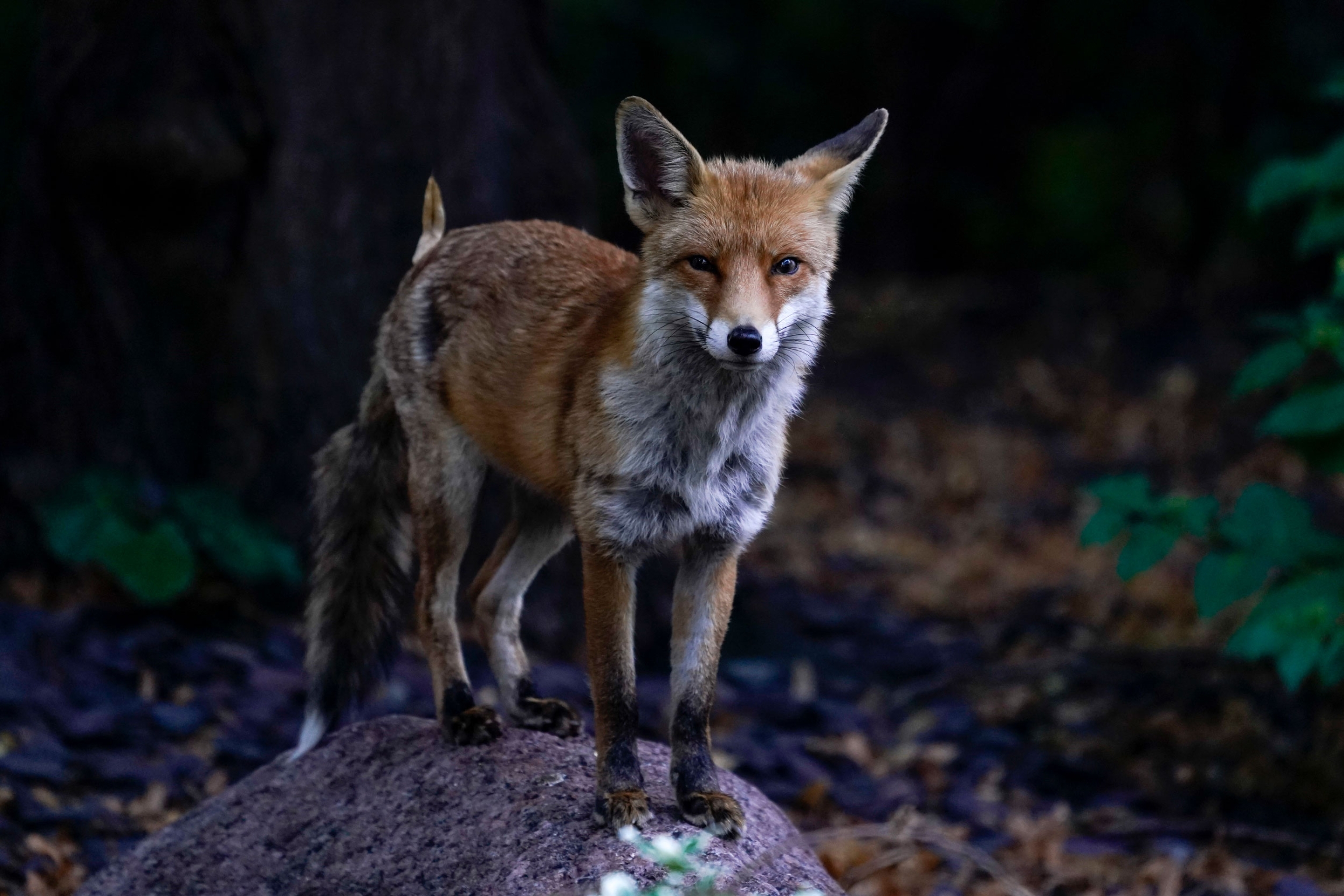
A fox stands outside Southwark Crown Court in London, Wednesday, July 26, 2023.
Credit:
Alberto Pezzali/AP
The first thing you see when you step into the Campo del Cielo nature reserve parking lot is what looks like a large bowl in the ground about half the size of a football field.
It’s a crater made by a massive meteorite. One of thousands that peppered this whole area roughly 4,000 years ago.
The reserve has been a place for people to see some of the largest meteorites in the world. But Argentina has been trying for years to prevent the theft of the space rocks.
Just behind it is an interactive museum, with hundreds of meteorites on display.
Gancedo meteorite display in Buenos Aires, Argentina.Michael Fox/The World“The experience is magnificent,” said Alexis Saul, who was visiting with his wife and daughter, from a couple of hours away. “It’s so important for the world. We need to value this place so much more than we do.”
Groups of green parrots flew overhead. On a short walk around the area, a row of huge meteorites can be seen, including the second and third largest in the world, weighing almost 29 and 31 metric tons, respectively. They sit on large circular slabs of concrete and visitors can walk right up to them and touch and hug them. It’s a pretty incredible experience.
Ayelen Santillán has worked as the main guide at the park for the past decade. She said there’s no place like this on the planet.
“This is unique, because although the largest meteorite is in Africa, you don’t have the ability to get up close like you do with these meteorites,” she said.
Close-up of Gancedo meteorite in Buenos Aires, Argentina.Michael Fox/The WorldBut theft there has been a major problem. Santillán said the quantity of the theft is impossible to calculate. But it has happened for decades. And it’s still happening.
In 2015, Argentine police foiled the theft of 3,300 pounds of space rocks from Campo del Cielo.
In another news report from 2019, a group of people was caught trying to steal three large meteorites. This June, two people were detained again in western Argentina, trying to make off with 77 stolen space rocks. Back in 1990, a US meteorite collector even tried to steal El Chaco, then, the second largest meteorite in the world.
Meteorites of varying sizes used to litter the ground.
“They aren’t that easy to find now,” said one Argentine researcher, in a clip from a 2014 documentary about the Campo del Cielo meteorite field. “But there were plantations, where the entire road was lined on both sides with meteorites. Every rock you found here was a meteorite.”
Campo del Cielo Museum is located in Buenos Aires, Argentina.Michael Fox/The WorldThe Argentine state has tried to respond. Since the 1990s, laws have prohibited the removal and sale of the country’s meteorites. In 2004, Argentina passed a law declaring the meteorites a cultural patrimony of the nation.
Rogelio Daniel Acevedo is a geologist and meteorite specialist, who’s retired from Argentina’s science and research agency, CONICET.
“So, they can’t be sold,” he said. “If I find one on my property, I don’t have to turn it in, but I can’t sell it.”
Nevertheless, he explained, in the markets of the world where precious metals and rocks are sold, there is always an Argentine meteorite for sale.
Be it at a gift shop in the United States or online, a quick search on eBay revealed dozens of listings just for Campo del Cielo meteorites.
View from the Campo del Cielo viewing tower.Michael Fox/The World“It’s really unfortunate,” said guide Santillán. “This question of meteorite theft and contraband is really hard to control.”
She said that even though the sale of Argentina’s meteorites abroad is still illegal under Argentine law, it’s hard to regulate.
Her message: Please don’t buy or sell our meteorites. “This is something that belongs to us,” she said. “Something that’s unique — [a] world heritage.”
But Santillán said these meteorites are just used, sold and commercialized, like everything today.
And that, she said, is a shame.
The post Argentina tries to fight the theft of its precious meteorites appeared first on The World from PRX.
Vanya, a Ukrainian soldier, pulled up his T-shirt to reveal a nasty scar that he got while fighting in the war in Ukraine — he said that he was hit half a millimeter from his heart.
Vanya is staying at Lisova Polyana, or Forest Glade, a veterans’ mental health and rehabilitation center in a quiet, wooded area just 30 minutes from downtown Kyiv, Ukraine’s capital.
(None of the soldiers that The World spoke to for this story are identified by their full names because they are on active duty and in many cases, returning to the front lines.)
Vanya has been at Forest Glade for four days and said that he was hoping he would be better by now, though he didn’t share the details of his treatment or recovery.
Soldiers play pool at Lisova Polyana (Forest Glade), a veterans’ mental health and rehabilitation center run by Ukraine’s Ministry of Health.Emily Johnson/The WorldHe is among the 220 men and women being treated at the center, which is run by the Ministry of Health; it works on “invisible wounds,” including stress disorders, depression, anxiety, PTSD and traumatic brain injuries. They also treat people who were tortured or held in captivity.
After nearly 1,000 days, Russia’s war against Ukraine is causing mental health issues for soldiers and civilians alike. Ukraine’s Health Ministry estimates that 15 million people will need psychological support in the future — or 40% of the population.
The Ukrainian government said it’s in the process of developing a comprehensive new veterans policy that includes psychological care and career support for people transitioning back to civilian life. In the meantime, mental health professionals are scrambling to modernize an outdated system to accommodate the vast needs.
Kseniia Voznitsyna, the chief doctor at Forest Glade, said that Ukraine has experienced psychologists, but even they may need additional skills training to deal with military trauma.
“This is happening now with a lot of trainings in Ukraine — this process is happening widely,” she said.
A large wooden map of Ukraine covers the wall in the office of Forest Glade’s chief doctor, Kseniia Voznitsyna.Emily Johnson/The WorldAt Forest Glade, she explained, they take an integrative approach: “It’s a bio-psycho-social approach. We have a big team. Psychologists, psychiatrists, neurologists, physical therapists, speech therapists.”
Clinical case managers work individually with the soldiers, ensuring that they show up for appointments, and they plan excursions for them, Voznitsyna said. Patients receive plenty of complementary methods of treatment, including everything from acupuncture to yoga to art rehabilitation classes.
Forest Glade has a long waitlist, and patients usually stay for several weeks before returning to military service.
Vanya receives a haircut, one of the services offered to soldiers and veterans receiving treatment at Forest Glade.Emily Johnson/The WorldSoldier Volodymyr, speaking in front of a group of other men in line to get a haircut, referenced the physical therapy, but not the mental health treatment he was receiving at the center.
“It’s great,” he said. “I was treated here, it’s a little easier on my foot, easier on my back.”
He could stay longer, he said, but as platoon leader, he was eager to get back to his men in eastern Ukraine.
War trauma ‘is not for one day’For many Ukrainians, seeking out mental health care means overcoming long-held stigmas going back to the Soviet period when political opposition figures were often sent to psych wards.
“Because Soviets used this as an instrument, this is a huge stigma towards psychiatry,” said Dr. Orest Suvalo, executive director of the Institute of Mental Health of the Ukrainian Catholic University. “We even still feel it now, after 30 years of Ukrainian independence.”
Meanwhile, demand is only growing. PTSD isn’t the only consequence of traumatic experiences. Ukrainians are also dealing with depression, substance abuse, loss and anxiety.
“It’s important to pay attention to the trauma-informed approach to train people and explain to people in many different specialties how to speak with people,” he said. “Because we are predicting that everyone could have some kind of traumatic experience.”
Dr. Oleh Berezyuk at Unbroken, a national rehabilitation center in Lviv, said that the country’s mental health challenges are multilayered; there is the sheer number of people who need help, plus, the brutal nature of their trauma.
Memorials to lost soldiers fill Sophia Square in Kyiv. Emily Johnson/The World“We have to care for every soldier, for every civilian who suffered from the war trauma, which is very important because war trauma, it’s not for one day,” he said. “And you cannot treat it just by one simple intervention. You have to prepare people to live in a different reality.”
That’s why Unbroken is treating mental and physical trauma together in the general hospital, a successful model that they are recommending to other hospitals, Berezyuk said.
Others, like Victor Dosenko, a professor of pathophysiology at the Bogomolets Institute of Physiology in Kyiv, are working specifically on PTSD.
Dosenko is studying biomarkers and how to detect PTSD.
“It’s a bad opportunity, but medicine, medical progress moves forward when there are challenges,” said Dosenko, who has also been advocating for a PTSD center in Ukraine.
The importance of preparing a family Veterans need to return to an understanding society where they can find work and medical help, said Tetiana Kril, head of the mental health program and psychological support centers Razom With You.
When her husband returned home from fighting in 2017 after Russia’s earlier invasion of eastern Ukraine, “I realized how important it is to prepare a family,” she said. “Because every soldier returns to his family. And today, there are already 3.5 million veterans in Ukraine, and by the end of the war, we expect there will be 5 million.”
Kseniia Voznitsyna, the chief doctor at Forest Glade, emerges from an office where the walls are covered in colorful mural tributes to the Ukrainian armed services.Emily Johnson/The WorldYrii Liashuk, who works for Razom for Ukraine, said that when he was discharged from the military last year due to an injury, his family was supportive. His wife became his “personal psychologist,” he said.
He joined the military in 2012 and had thought it would be his lifelong career.
He stays busy with a job as a security officer and running a company that makes drones. He believes veteran reintegration will be one of the biggest challenges ahead.
“Society needs to be prepared for the fact that heroes with unique challenges will live with us,” Liashuk said. “We need to understand this.”
The post ‘We have to care for every soldier, for every civilian’: Ukraine faces major mental health challenges as a result of war trauma appeared first on The World from PRX.
Vishwanath Srikantiah, an urban planner in Bengaluru, India’s tech hub, sat on the edge of a 50-year-old water well in a quiet neighborhood near the airport.
When Vishwanath first encountered the well several years ago, he said it was full of garbage. His organization, Biome Environmental Trust, helped clean and restore the well, which is now adorned with artwork. It also has a protective metal cover and a pulley for residents to draw water for washing or bathing.
“Even during the crisis when there was no water in the city, this well always had water,” Vishwanath said, referring to a looming water emergency in Bengaluru earlier this year.
Vishwanath’s organization brings many of these humble wells back to life through the Million Wells for Bengaluru project. Vishwanath estimated that they’ve gotten to around 280,000 of them over the past decade.
A few years ago, this well in Bengaluru, India, was full of garbage. Now, it has a protective metal cover and a pulley for residents to draw water for washing or bathing.Sushmita Pathak/The WorldSmall, shallow wells could hold the key to alleviating Bengaluru’s ongoing water problems. Using age-old, well-digging techniques, they help residents tap into a forgotten water source: the shallow aquifer.
For centuries, Indians depended on open wells. However, with the advent of deep drilling technology, traditional wells fell out of use.
Now, in an era of climate change, Vishwanath said, wells are a simple yet effective choice to make the city more water-secure: “Truly, it’s a low, shallow-hanging fruit.”
Today, Bengaluru gets most of its water from the Cauvery River, about 60 miles away and at a lower elevation than the city. The municipal piped network delivers this water to homes. But newer parts of the ever-expanding city don’t have government water connections yet.
“The infrastructure is barely able to match the city’s growth, and so, where the piped network does not reach, the dependency is completely on groundwater,” Vishwanath said.
In a part of the Indian city of Bengaluru where water shortages occur year-round, residents stock up on water in blue, cylindrical drumsSushmita Pathak/The WorldGroundwater is pumped up from great depths through borewells — narrow shafts that dig as deep as 1,800 feet below the ground to extract water, much farther down than traditional wells. Bengaluru has an indiscriminate number of borewells, and new ones are being drilled constantly.
“When you go deeper into the ground, the water becomes more saline, more unreliable, and the borewells tend to dry out,” Vishwanath said.
That’s precisely what happened earlier this year — many of the city’s borewells ran dry. Traditional, open wells, on the other hand, go less than 100 feet below the ground. This part of the earth is like a sponge, Vishwanath said: “It can hold water and release water, provided we understand the recharge zones and make sure that rainwater percolates.”
Water from a well requires much less energy because it only needs to be drawn up to 20 feet or 30 feet.
A recharge well outside Vishwanath Srikantiah’s home in Bengaluru.Sushmita Pathak/The World“It’s very energy efficient. It’s cheap water. It has less carbon emissions,” Vishwanath said.
The Million Wells initiative harnesses the knowledge of traditional well-diggers called Mannu Vaddars, many of whom lost work when India shifted to mechanically dug borewells.
Sahana Goswami is a senior program manager for urban water and climate resilience at the World Resources Institute India.
“This sort of campaign is very important because you’re widening our scope and saying, ‘Here’s another resource that we can tap into when we need,’” she said.
After all, relying too much on one source of water is at the root of Bengaluru’s water problems.
“You should have a diverse set of sources of water,” Goswami said. “So, if one is diminished, you still have the other one that you can draw from.”
Vishwanath Srikantiah lifts up the metal grate covering a recently revived 100-year-old well near a lake on the outskirts of Bengaluru, a megacity in India.Sushmita Pathak/The WorldIn the face of climate change, she said, solutions like the Million Wells initiative become all the more urgent, especially as summers in Bengaluru are getting hotter and rainfall is becoming more erratic.
At the same time, the city is urbanizing rapidly.
“The way we have developed, we have all these paved surfaces. The natural capacity of water to get absorbed into the ground is also getting diminished,” Goswami said. “We have had more incidences of acute rainfall but short duration, high rainfall, which usually flows away. So, how much water has been absorbed into the ground has been a bit lesser.”
Capturing rainwater is essential to recharge the shallow aquifer, something lakes do naturally. While Bengaluru has many lakes, some are drying up.
In the evening light, the pattern of the metal grate reflects beautifully on the water surface. Soon after the lake beside it was rehabilitated, water filled up in this recently revived well.Sushmita Pathak/The WorldBut Vishwanath pointed to the successful rehabilitation of Sihineeru Kere (“Sweet Water Lake”) on the outskirts of Bengaluru, and a nearby well. The Environmental Foundation of India intervened in 2022, filling it with rainwater and treated wastewater.
Through Vishwanath’s Biome Environmental Trust, a treatment plant next to the lake purifies water from the shallow aquifer, which will soon be supplied directly to locals, and well-diggers cleaned and de-silted the well.
Vishwanath described the collaboration as a success, but he’s eager to see it replicated because climate change “is coming like a tsunami, so we don’t have time to be able to deal with it,” he said. “So, that’s the impatience that I feel as much as the satisfaction.”
Vishwanath Srikantiah stands near Sihineeru Kere (“Sweet Water Lake”) on the outskirts of Bengaluru, a megacity in southern India.Sushmita Pathak/The WorldThe post Why a megacity in India is reviving the humble water well appeared first on The World from PRX.
Katsumi Kusumoto has become a celebrity chef in Japan for his awareness of the environmental pressures on food systems and his adaptation of menus to be less reliant on mass-produced animal protein.
Thinking outside the bento box got Chef Kusumoto to partner with a high-tech food company in Israel called Forsea.
“The Japanese consumed 160,000 metric tons of eel in 2000. Today, they consume only 30,000, and that’s because it’s just not available,” said Roee Nir, co-founder and CEO of Forsea.
Nir says most eel varieties are in short supply as endangered and protected species. Eels are also expensive because they are raised for several years before harvesting.
Earlier this year, The World staff visited Israel and saw what Forsea was working on.
Roee Nir, CEO and co-founder of Forsea, sits down with The World’s Marco Werman to discuss the company.Alon Farago/The World“What we do is grow mini-tissues called organoids, and we basically mimic the natural development of cells,” Nir said. “Our tissue is a natural composition of fat, muscle and the actual extracellular matrix.”
The “extracellular matrix” is animal flesh, but developed in a stainless steel bioreactor.
“We’re not an eel company. We’re a cultivated meat company focused on fish and seafood, and our first product is the meat of the freshwater eel.”
Roee Nir, co-founder and CEO of Forsea
“We’re not an eel company,” said Nir. “We’re a cultivated meat company focused on fish and seafood, and our first product is the meat of the freshwater eel.”
In its current research and development phase, Forsea’s operations occur on one floor in a building in Rehovot, just outside Tel Aviv.
The eventual eel meat is developed right down the hall from Nir’s office.
Moria Shimoni, another of Forsea’s co-founders and chief technology officer, gave The World a tour of the area.
“This is where the magic happens,” said Shimoni before correcting herself. “Actually, all of the places … is where the magic happens: It starts with the cell isolation, it continues with the media development. This is actually the media. The media inside the bio-reactor is the media we developed.”
When Shimoni says “media,” she means the complex formula that feeds the eel cells that grow in the bioreactor.
Moria Shimoni, co-founder and CTO of Forsea, shows The World’s Marco Werman an eel cell line that is kept in the deep freeze until it’s ready to go in the bioreactor.Alon Farago/The WorldIn that sense, the magic really does happen in the bioreactors: stainless-steel tanks that mimic each cell line’s temperature, oxygen and nutritional needs as the team at Forsea trial-and-errors their way to something that tastes like unagi.
Nir said that cultivated meat grown in a lab has many benefits over conventional fish farming, but there’s one big thing: “The aquaculture that has been helping close the supply-demand gap for decades has been quite impactful for the environment,” he said. “And what’s expected to close the supply-demand gap of fish and seafood is cultivated meat.”
Cultivated meat also eliminates the need to grow animal-feed crops. As far as climate change emissions, various studies have shown that cultivated beef could improve the situation over real cows. However, other studies suggest that the infrastructure around cultivated beef could actually increase those emissions.
There are other benefits the cultivated eel industry is promoting, like a massive drop in microplastic pollution as a result of abandoning fishing nets.
A Forsea staffer shows a bioreactor that is the home for eel cell line development.Alon Farago/The WorldBut all of these positives depend on one big obstacle.
Faraz Harsini, a senior scientist at the Washington, DC-based Good Food Institute, who focuses on developing lab-grown meat, said, “With cultivated meat, the challenge is really to scale it up.”
Right now, the cultivated meat industry has proof of concept. But there’s a way to go still before you find cultivated eel in a cooler in the produce department.
Harsini said that better, more cost-effective bioreactors and cheaper media will be required to feed the cells.
But if that happens, Harsini will be optimistic about the benefits.
“This is something people don’t realize: The United Nations says that the top drivers of the next pandemic are due to increased demand for animal protein.”
Faraz Harsini, senior scientist at the Good Food Institute
“This is something people don’t realize: The United Nations says that the top drivers of the next pandemic are due to increased demand for animal protein,” he said.
In other words, as the production of conventional chicken, pork and beef is increasingly industrialized to feed the world’s growing population, the probability of another outbreak of some disease — avian flu, swine flu or COVID-19 — will increase.
Cultivated meat lowers that risk.
“Because it’s a process that is completely under control, you are constantly sampling and testing for any microbes and contamination, and if you have contamination, you just waste a batch,” Harsini said.
Farmers pump their livestock with antibiotics to prevent infections and to make them grow faster. Cultivated meat also eliminates the need for antibiotics.
And Harsini, like many scientists, is deeply concerned about where continued reliance on antibiotics in the current food system will take the planet.
“According to WHO’s former director, it’s going to be the end of modern medicine when we have [an] antibiotic-resistant pandemic,” he said. “Again, that’s a problem completely mitigated with cultivated meat.”
Israel has become an incubator for companies on the cutting edge of cultivated meat. Just down the road from Forsea is Aleph Farms, which is working on cultivated beef.
Many scientists are deeply concerned about where continued reliance on antibiotics in the current food system will take the planet, so they’re working on safer alternatives.Alon Farago/The WorldNo fewer than half a dozen cultivated meat operations are scattered around the country.
Tami Tvash, vice president for research and development at Aleph Farms, showed The World several new creations, including what can only be described as “beef ink,” a combination of muscle and fat cells designed to smell and even sound like steak when it’s on a hot skillet.
“And with this ink,” Tvash said, “we’re actually printing a steak, so we can print areas with muscle cells, we can do areas with fat components in a steak.”
Aleph Farms is working on a minute-steak, and once that gets scaled up, thicker cuts of meat will follow.
Why is this all happening in Israel?
Faraz Harsini of the Good Food Institute, which has an affiliate office there, says the Israeli government has actively supported food innovation because “Israel relies heavily on importing meat, and so for them, it’s a matter of national security.”
It likely should be one for the rest of the world, too.
This work is something Nir at Forsea is excited to do every day.
“How many industries do you know that are targeting two of the world’s biggest problems: nutrition and climate?” he said.
Nir expects Forsea’s first product will reach the market late next year or early 2026.
Editor’s note: A previous version of this story incorrectly identified a last name. The original version had Faraz Farsini, but the correct name is Faraz Harsini, which has been updated to reflect this.
The post Seafood cultivated in a lab could help mitigate the next pandemic appeared first on The World from PRX.
In Namibia, a plant colloquially known as the encroaching bush is threatening the land with desertification. In addition, the country faces a growing housing shortage. MycoHAB, a nonprofit in Namibia, has found a solution to both problems for the price of one.
Chris Maurer is an architect behind MycoHAB, which aims to combat the housing crisis and climate change by researching and producing sustainable building materials.
The organization has found a process that can take the encroaching bush, use it as the substrate — like soil but for growing mushrooms — and use the mushrooms to feed people. Then, the waste material is used to build bricks for new houses.
Maurer spoke to The World’s co-host, Carolyn Beeler, to learn more.
Carolyn Beeler: So how does this material compare? This mix of the woody stuff from these invasive bushes and the, let’s say, roots of the mushrooms? How does that material compare to a traditional building material, like concrete for example, on strength and price and all those good things?Chris Maurer: It compares very well to concrete in terms of strength. The blocks that we make in Namibia have compressive strengths of around 6 megapascals, which is very similar to what concrete blocks are in that part of the world. The compression strength is just one type of characteristic that we look at in building materials. It’s also insulative. It tends to be fire-resistant and it’s sound-attenuating, so it can have all kinds of multifunctional effects.What are the downsides of this material, and what are the negatives?Well, I guess if you do compare it to concrete and other materials like that, you wouldn’t use this exposed to the elements the same way that you could some of those materials. The houses we’re building in Namibia now, we’re using a mud plaster to protect it from rain and things like that, very similar to wood construction. It can last forever. There’s lots of wood buildings that are centuries old. Biogenic material lasts a very long time if you protect it, but things like concrete are better for using underground in areas where it can become very wet or humid.So, you’ve built one of these homes so far, is that correct? And if so, describe what it looks like.Yeah. So, it’s made out of 900 or more of these blocks that we’ve made in Namibia. Each one of those blocks are about 10 kilograms each. So, this one very small house that we built sequestered 9 tons of carbon. It used 9 tons of encroaching bush and it made 3 tons of mushrooms in its production. It’s a very small house. It’s a one-bedroom, one-bath, but it’s basically a model for how we hope to go forward and scale this up to hundreds of homes, thousands of homes and, you know, one day millions of homes with this process.So, only one of these homes is standing so far. What are the challenges to scaling up this approach to building fundraising?We’re currently funding to scale the process now. We’ve basically made this demonstration project in Namibia. It was a collaboration between my studio, Red House, Massachusetts Institute of Technology Center for Bits and Atoms and Standard Bank Group, which funded this as part of their environmental and social governance program. Now that we’ve proven that it can be done, that you can take, encroach or push and turn it into food and housing in a vertically integrated process, we’re pulling in investors and doing this at industrial scale.And how does cost compare with these bricks to traditional building materials?Well, not to be too cheeky, but the materials are free, but we don’t sell them necessarily. At this point, we’re using the mushrooms, we’re selling those. And that’s basically going to be our revenue-generating process. And then, the building materials are going strictly toward humanitarian housing at this point. As I mentioned, this was started under an environmental social governance program with Standard Bank. And so, they are committed along with partners like the Shack Dwellers Federation and the Bio Brick Foundation to support housing for the nearly half of all Namibians that are living in informal settlements now.Now, what’s your ultimate goal? Looking down maybe 5-10 years, how do you hope this changes buildings and homes in Namibia?Well, I hope in Namibia and throughout the world that we’re using more of these bio fabrication functions because it can store carbon dioxide. And I want to see architecture start to become a solution for climate change, rather than a major part of the problem.This interview has been lightly edited and condensed for clarity.
The post New project seeks to solve housing crisis using mushroom byproduct and troublesome weed appeared first on The World from PRX.
Days ago, a story started making the rounds on social media. It claimed that Olena Zelenska, the first lady of Ukraine, had recently purchased a $4.8 million Bugatti Tourbillon while she was visiting Paris for D-Day celebrations in June.
An unnamed source in the story said she used American military aid money to pay for the car, and the story included what it said was an invoice for the vehicle. The Bugatti dealership in Paris said it was a lie, but by the time they released a statement, it was too late. The story had already gone viral.
These are the kinds of disinformation campaigns that Antibot4Navalny, an anonymous group of disinformation researchers, have been flagging since last fall in a bid to blunt Moscow’s efforts to confuse and misinform.
The “Click Here” podcast from Recorded Future News spoke recently by encrypted app with one of the leaders of the group about efforts to unmask Russian bots, their work with global researchers on disinformation and why some people are saying Antibot4Navalny is punching way above its weight as it takes on the Kremlin.
“Click Here”: What’s the best way to describe Antibot4Navalny?Antibot: Most people describe us as an anonymous group of analysts tracking Russia-related influence operations on X, formerly Twitter. We’ve been in operations since November 2023, but I personally have been researching Russian disinformation since March 2018.What makes you different from other anti-disinformation groups?In a nutshell, we don’t focus on exposing or debunking fake narratives individually — in order to avoid getting on the wrong side of the Brandolini law. You can’t take aim at individual stories and be effective. That’s why we chose to expose the channels that are pushing these stories … and dig deeper to explain what the disinformation is trying to do — its underlying agenda — on a regular, systematic basis.How many of you are doing this?We’re a small group. I’m the only one working full-time on this. We also count on what I would call enthusiasts, who contribute their research on a regular basis. And then in addition to that, we have dozens of loyal followers who give us specialized help when we need it.And what made you go from disinformation researcher to leading the organization?Before October 2023, when we really began in earnest as a group, there hadn’t been an occasion to research how Russian influence campaigns were targeting other countries. Our key focus at the time was looking at disinformation targeting Russia and Ukraine. And those were campaigns driven by troll farms, paid humans.
Then in late October of last year, we uncovered a massive bot campaign. Bots [computer software] were posting and reposting a highly produced Russian-language video that was clearly aimed at changing the narrative of the war in Ukraine.
It was saying two things at the same time: One, that Russia and Ukraine were brothers, and two, that the fighting was essentially breaking up a family. We assumed that it was targeting Russian and Ukrainian audiences.
But a short time later, we could see that the very same bots had widened the aperture and had started to target France, Germany, the US, Israel and Ukraine all at the very same time. They started promoting fake articles that were meant to convince people to stop sending Western aid to Ukraine.
This seemed to present an opportunity to use all our experience tracking internal Russian information campaigns and help Western audiences know what to expect. Antibot4Navalny has been tracking Doppelgänger, one of these Russian disinformation groups, can you talk about them a little bit?Doppelgänger started operating in mid-2022. Back in October, when we saw these viral posts on X claiming Ukraine’s defeat was imminent, we began to investigate. The articles were being shared on fake websites that looked like well-known news outlets in the West.
We identified the bots behind the campaign, found some unique photos that had not previously been published, and made everything public. That helped us connect to media outlets like Le Monde and Liberation, and other researchers working on the Doppelgänger problem began contacting us.
We discovered all kinds of funny details about the campaign like the way they developed these accounts. They were alphabetic. All the US-associated bots started with D names; French ones used names that began with J, and German ones started with R.What does a typical day look like for you? Eighty percent of my time is promoting the work we do. I compile new findings, pitch stories to media outlets, and post detailed X threads for our followers. The other 20% of my time is spent on what I think I do best: find patterns, analyze content, and automate our day-to-day routine.
However, for the past several months, 0% of my time has been spent on what I think I do best: expose new bot and troll crowds and build automated detectors.
The team spends most of its time collecting data on bots’ nightly runs. They would most benefit from automation, but we cannot afford it yet.How do you expose bots and trolls? Is technology changing the way you do it?Overall, there are two streams of work: exposing a new “crowd” of bots and following the new accounts joining it to analyze trends, narratives and priorities. We focus on finding a few “species” that we suspect are inauthentic in some way and then we find what’s common between them. Then we gather sufficient evidence to prove that the accounts are inauthentic and let the world know.
Because we track and record the content they promote and/or the topics they comment on, we get a lot of coverage.
To try to make this work at scale, machine learning used to help dramatically, until Twitter discontinued free access to their Application Programming Interface (API). We are still struggling to recover.
What’s important to understand is that the point isn’t really just to look at what bots are writing about or what their specific talking points are. What they are trying to accomplish is more subtle than that. Bots are about introducing uncertainty and confusion — to undermine, not a particular story, but news more generally, to disrupt the conversation itself. That’s why they bring in as many talking points and perspectives as possible, even if they are contradicting each other. It adds to the confusion.How have disinformation groups, like Doppelgänger, transformed over the past few years?Doppelgänger and other influence operators are constantly experimenting in order to work around social media abuse protection measures (and X is struggling to catch up with those changes); X is becoming increasingly less transparent and accessible for researchers; and Doppelgänger seems to be learning from its own mistakes.
For example, the recurring pattern is: A few citizens of a third country are hired to do something on the ground that favors the Kremlin’s interests or agenda; a few days later, Doppelgänger bots are focusing on massively promoting it. It might be taking aim at an official or to chip away at support for Ukraine or some other targeted country.
Now, it seems like Doppelgänger is learning from its own experience when covering on-the-ground influence operations.
Last fall, Doppelgänger bots promoted unique photos of Stars of David in Paris that were never published before. That showed very strong evidence of connection between Doppelgänger operators and people behind the offline operation.Their bots promoted a publication by Doppelgänger’s original site (artichoc[.]io), which used a broadly circulated photo of red handprints at a memorial by AFP — which helped with “plausible deniability.” Bots promoted publication by Le Figaro, a legitimate, reputable media outlet — which made the tweets posted by the bots look more authentic.What have people gotten wrong about bots and their operations?The most common misconception is that bots’ key goal is to promote a specific set of talking points to make an audience believe something specific.
In reality, the biggest achievement of influence operations based on trolls-for-hire is, in our opinion, that regular users suspect each other to be pro-Russian, pro-China, pro-Iran, what have you. Once they encounter someone from an opposing point of view, they prefer to stop the conversation altogether. In a sense, the Godwin’s law is not there any more. It was replaced with “you’re a troll-for-hire.”
The biggest achievement of FIMI (Foreign Information Manipulation and Interference), as well as of domestic troll farms in Russia, is that it ruined the benefit of doubt. Regular users stopped trusting each other, especially with those holding views different from theirs. Polarization and atomization improved; it became increasingly difficult to seek tactical allies for the sake of common goals among those bearing differing views. It’s “divide and conquer” at its best.How do we fix it?There are some options to explore: Make user-generated data of social media companies as widely and freely available to researchers as possible; stimulate third-party developers to build an ecosystem of third-party analysis tools and libraries; social networks providing users multiple tools helping to analyze the accounts they never encountered before.What are your proudest achievements?There are several. Among some of them, we exposed Matryoshka, a completely new influence operation that was never researched before us. Following our initial exposure, it was further researched by other organizations.
We also collected what we believe is a top-3-largest dataset on Doppelgänger bot activity that can be made available for journalists for analysis and reporting. We collected over 3,500 articles that were promoted by social media bots on X, along with every relevant evidence out there.What do you make of all the media interest in the work you’ve done?We were surprised to see how incredibly interested the media is in Russian disinformation influence campaigns. In just over six months, we were quoted in about 60 stories by non-Russian media in relation to the Russian state’s FIMI alone.
At the same time, it turned out that most media outlets are not used to being paying customers for researchers; they typically trade exposure to researchers for viral stories from them, unlike photo agencies, stringers or paparazzi.The interview has been edited for clarity and length.
An earlier version of this story appeared on the “CLICK HERE” podcast from Recorded Future News. Additional reporting by Sean Powers and Jade Abdul-Malik.
The post Meet Antibot4Navalny: the mysterious researchers exposing Russia’s war on truth appeared first on The World from PRX.
Saliha Gündüz, a PhD student from Turkey, has just handed over her smartphone to one of the founders of The Offline Club in Amsterdam, who places it carefully in a “phone hotel” — essentially a locker with dividers that holds up to 60 phones.
Phones are placed in a “phone hotel,” or a locker with dividers, as people try to disconnect from technology at The Offline Club.Orla Barry/The WorldGündüz said she doesn’t feel apprehensive yet — and she settled down to a cup of herbal tea at the New Yoga School cafe in the center of Amsterdam.
“The withdrawal symptoms will kick in later,” she said. “But maybe a withdrawal is what’s needed if I’m going to cure myself of my addiction.”
Gündüz estimates she spends up to six hours a day on her phone.
“I just want to get a hit of dopamine but then it wears off, and I want the same thing again. It’s an endless cycle.”
Gündüz is among 20 people of all ages and nationalities who turned up at The Offline Club on a wet Friday evening in May to see if they could wean themselves off of their addiction.
DisconnectingThe club’s founders — Ilya Kneppelhout, Valentijn Klok and Jordy van Bennekom — started the venture in 2022 with a plan to host offline weekend getaways. Kneppelhout said, at the time, each of the co-founders felt their phones had been dominating their lives.
Earlier that year, he took a short trip to the north of the Netherlands on his own with “some books, a journal and myself.”
No phone. He said something shifted over those four days.
“I felt so much creativity and, at the same time, a sense of peace.”
Van Bennekom did the same and loved it. They began organizing weekend getaways with groups in a house in the countryside. Everyone was required to hand over their phones upon arrival. The three-day events were a hit. But Kneppelhout said that not everyone can afford to pay a few hundred dollars for the experience. So, the idea of The Offline Club was born.
People chat with each other while they disconnect from their phones for a couple of hours at The Offline Club.Courtesy of The Offline ClubEach attendee at the club pays around $8 at the door. The events and venues differ each time. At the New Yoga School in Amsterdam, van Bennekom lays out the rules for the evening.
First, there’s 45 minutes of quiet time, then a 30-minute break to chat, then a further 30 minutes of time to yourself. Most people bring books to read. Soft music plays in the background as van Bennekom lays out coloring books and markers for anyone who wants to draw or doodle.
People read, knit, play games and partake in other activities while trying to disconnect from technology at The Offline Club.Courtesy of The Offline ClubOn that rainy Friday, three men from Puglia in Italy were huddled in one corner drinking tea. Two of them were visiting their friend Pietro Maggi who lives in Amsterdam. Maggi, who works for electric carmaker Tesla, said the evening was his idea and that he persuaded his two visitors to join him.
“Sometimes, I feel overwhelmed by technology,” Maggi said. “After a full workday, a lot of us just go back home and start streaming movies or scrolling through our phones and I think, in a way, we are detaching from ourselves and from our thoughts.”
People drink tea or have other refreshments while they’re disconnecting at The Offline Club.Courtesy of The Offline ClubHis friend, Damiano Caforio, said he was curious about the event. Maggi joked that Caforio might find the evening useful. Caforio shook his head at the suggestion that he might have a mild smartphone addiction: “I don’t have any social media accounts except Facebook. I don’t have Instagram, I don’t even have LinkedIn.”
But then, he admitted that there might be some truth to Maggi’s accusation.
“I keep looking at the news constantly, checking to see what’s going on in the world, or, more specifically, with my job.”
He works at the Italian Chamber of Commerce.
Phones are locked away in containers while people unplug from technology for a couple of hours at The Offline Club in the Netherlands.Courtesy of The Offline Club“I need to know what’s going on, I feel I need to control the environment.”
Even on the flight over, Caforio said, he downloaded wifi so he could message his friends on WhatsApp even while he was in the air.
“Actually, I desperately need this experience tonight,” he laughed.
It wasn’t long before they said they felt more relaxed and grounded. The friends started reminiscing about the days before smartphones — when every phone call cost money. When they were teenagers, Caforio, said they had a special code to let girls know they were thinking of them.
You would call her and then hang up before she answered to avoid being charged, he said. Then she’d know she was on your mind. And if you really liked her, you would leave several missed calls. If she did the same back, Caforio said there was no feeling in the world quite like it.
Some people read books while they’re at The Offline Club.Courtesy of The Offline ClubOffline activitiesLeah Davies from Wales said she spotted a post about The Offline Club on Instagram.
“I saw people reading books and knitting and playing piano,” she said. “And I just loved the idea of being able to go somewhere where you’re not checking your phone all night.”
Ilya Kneppelhout is one of the founders of The Offline Club in The Netherlands.Orla Barry/The WorldDavies attended while she was on a weekend break with her partner. She agreed that it’s not the first thing that comes to mind for most visitors to Amsterdam.
“But this is our first night, we have three other nights for all the debauchery,” she joked.
Davies said she would like to see phones restricted at other events too, like concerts and nightclubs, “so people can just dance or talk like you did in the ‘90s.”
Phone-free music events are already happening elsewhere in the Netherlands. In Tilburg, a city in the south of the country, another group, Off the Radar, organizes music gigs where attendees are expected to hand in their devices at the door.
There isn’t anything quintessentially Dutch about the desire to have smartphone-free events, said Ilya Kneppelhout, co-founder of The Offline Club. But work-life balance is an important aspect of life in the Netherlands.
“We work to live here, not the other way around,” he said.
A study by the Organization for Economic Cooperation and Development (OECD) found only 0.3% of employees in the Netherlands work very long hours in paid work, the lowest rate in the OECD, where the average is 10%. In January, smartphones were banned in secondary schools across the country under government guidelines.
A similar ban is set to be introduced in Dutch primary schools in the 2024-25 school year. A study last month by Radboud University in the Netherlands found that students were generally positive about the change, saying breaks were more enjoyable and there was less bullying during school hours.
Plans to expandThe Offline Club’s founders are hoping to expand the concept to other cities worldwide. Right now, the trio operates events in six different cities across the Netherlands. Kneppelhout said the sudden success of the venture took them by surprise.
Some people like to draw or color while they’re at The Offline Club.Courtesy of The Offline ClubIn February, they posted a couple of reels on Instagram after their first club event. The videos gained millions of views and their feed was filled with requests asking them to hold similar events abroad.
It was all a bit overwhelming, Kneppelhout said, but in a good way. He said he also sees the irony of an Instagram post about a club that advocates for an offline lifestyle going viral. Ultimately, Kneppelhout said, I would like to delete all our social media apps and for the initiative to still be a success.
The post This club in the Netherlands offers a much-needed break from technology appeared first on The World from PRX.
When North Korea hacked Alejandro Caceres, he expected the US government to rush to his defense. When they just shrugged, he took matters into his own hands.
Click the blue player above to hear the full story.
An earlier version of this story appeared on the “CLICK HERE” podcast from Recorded Future News. Additional reporting by Sean Powers.
The post Meet the guy who single-handedly took down North Korea’s internet appeared first on The World from PRX.
GPS satellites do more than just tell us where we are. The world’s industrial control systems use their signals to tell precise times. That’s why when Russian and Ukrainian officials began jamming GPS satellite signals to throw missiles off course during the war, an unexpected thing happened — the lights went out. That is until some American researchers figured out a fix.
Dina Temple-Raston, host and managing editor of the CLICK HERE podcast from Recorded Future News, explains.
Click above to hear the full story.
An earlier version of this story appeared on the “CLICK HERE” podcast from Recorded Future News. Additional reporting by Sean Powers.
The post A wrinkle in time: GPS jamming in Ukraine and its ripple effects appeared first on The World from PRX.
In the 1950s, when Emelia Lozano Gonzalez was 7 years old, her baby sister Cecilia got sick with double pneumonia. Antibiotics were hard to come by back then, and her 22-month-old sister died.
“After, I remember going into the fields with friends,” she said, “collecting flowers for my sister’s funeral. That’s my memory.”
Gonzalez has carried around this memory only in her head for the last 65 years — until now. Today, she can open her wallet and pull out what looks like a black-and-white photo of a little girl in a field of flowers, with another kid in the background.
“Look what they made me,” she said. “I got so emotional when I first saw it because it looks so much like me.”
But it isn’t her, exactly.
Gonzalez provided this information to a Spanish company called Domestic Data Streamers, which then uses artificial intelligence to create a so-called “synthetic memory.”
Upon closer reflection, the image is an imperfect composite of the memory — it shows some distortion in the faces, blurry limbs and an ever-so-slightly stitched-together landscape.
But it doesn’t have to be perfect because memories themselves are vague and change constantly over time, said Domestic Data Streamers’ Marina Olivares.
“Memory is [a] construction in a way,” Olivares said, “because, sometimes, we have a memory of something that our parents have explained that happened to us, and then, we generate an image of that, but we didn’t really recall it before.”
In keeping with the fuzzy nature of remembrance, synthetic memories have a dreamy quality built into them.
One of the company’s designers, Pau Garcia Sanchez, said they’re after an emotional response from people. Too much detail or realism, he said, and our intellects start to nitpick over small details, like the color of a childhood couch.
The less-than-real imaging is also a safeguard.
“The potential misuse of this technology [is] to create fake news and fake memories, so this is something that we should acknowledge, as any technology can be used and can be put for bad practices,” he said.
Google which partly funds Domestic Data Streamers, has been sued by consumers for alleged misuse of users’ personal data. But controversy aside, the synthetic memories, Sanchez said, are being offered for free to vulnerable populations, such as people living with dementia. The synthetic memories were used to help people remember real events.
“You feel afraid when you feel that you are losing your memory. Finding something that feels familiar is such a relief, so connecting to a part of your past where you’re safe; it’s giving people a lot of relief,” Sanchez said.
The process is free and participants must be willing to share a lot of information upfront during the first part of the process — the interview.
As the participant shares a memory, an assistant types keywords into a laptop. They never take a photo of the participant or ask for one. Everything is based on the memory described by the participant — such as arriving each summer at a family lake house.
After about 20 minutes, the participant is left holding a Polaroid-style image, which reflects the shared memory. It’s not an exact replica, but it’s enough to trigger an emotional response.
People usually smile when they see their synthetic memory, even when it’s a sad one, like picking flowers for a sister’s funeral, Domestic Data Streamers said.
“It’s a fond memory, but also a tough one … one that’s just so hard to bear,” said Gonzales, the participant who lost her baby sister. “But now, somehow, having the synthetic memory is helping me to accept it as part of my life.”
After all these years, a synthetic rendering of a memory based on 65 years of remembering, and reremembering, has brought Gonzalez some peace. She said she’ll stick the photo to her fridge with a magnet.
The post How AI is helping to re-create childhood memories appeared first on The World from PRX.
On Friday, Tigran Gambaryan — the head of financial crime compliance for Binance, the world’s largest cryptocurrency exchange — found himself in the last place he’d ever expected to be: a Nigerian courtroom on trial for something his company might have done.
A former investigator with the IRS, he’d spent more than a decade following illicit cryptocurrency transactions back to the people who made them. Rolling up, among others, the alleged founder of AlphaBay, Alexandre Cazes, and Silk Road’s “Dread Pirate Roberts,” Ross Ulbricht.
But now, after a spectacularly bad turn of events, Gambaryan is at the center of a battle between his company and regulators of the Nigerian government. Nigerian regulators have charged him personally for a roster of alleged crimes that they claim Binance has committed, and it is unclear how a middle manager, a former cop, has ended up shouldering the blame. Gambaryan has pleaded not guilty. He says he’s done nothing wrong.
Even so, Nigerian authorities have detained Gambaryan since late February. “Click Here”spoke to more than a dozen current and former IRS and FBI agents who either knew Gambaryan well or had worked with him, and they all voiced the same concern: Why isn’t the US government doing more for one of its own?
“You’re leaving a fellow law enforcement officer, even though he’s out of the game, kind of hanging,” said Matt Price, a former IRS agent who worked with Gambaryan on cases and at Binance. “We can’t believe they’re not doing anything.” And while Gambaryan’s plight appears to have been elevated inside the Biden administration in recent days, agents are asking, “What took them so long?”
“I have done nothing wrong,” Gambaryan said in a cell phone video he filmed back in March. “I’ve been a cop my whole life. I’m asking the United States government to assist me … I need your help, guys. I don’t know if I’ll get out of this without your help. Please help.”
Charges after an escapeGambaryan’s video summed in 40 seconds what is otherwise a very complicated series of unfortunate events: “Hello my name is Tigran Gambaryan and I’m the head of financial crime compliance at Binance,” it began. “I have been detained by the Nigerian government for a month and I don’t know what is going to happen to me after today.”
As Gambaryan recorded the message, it was clear he was worried guards would stop him or grab his phone because just a few hours earlier he had awoken from a nap to learn that the Binance colleague who had originally been detained with him, Nadeem Anjarwalla, had somehow escaped. “I had nothing to do with it, I was not involved in any of it,” he said in the video.
Anjarwalla was Binance’s regional manager in charge of Africa and the afternoon of that video, according to three people familiar with what happened, Gambaryan found a Post-it note from Anjarwalla that essentially said he was sorry, but he was making a break for it. Anjarwalla had put pillows under the covers of his bed so guards would think he was still there.
While it is unclear exactly how he got out of the government compound, it appears he asked guards if he could go to a nearby mosque to say prayers for Ramadan, and while he was at the mosque, he gave them the slip.
As a result, it was left to Gamabaryan to break it to his captors that his colleague was gone. The Nigerian government now claims that it is in negotiations with Kenya to have Anjarwalla extradited.
Their anger and embarrassment at having lost Binance’s country manager seems to have fallen mostly at the feet of Gambaryan. Within days of the escape, the Nigerian authorities charged him, Anjarwalla and Binance itself with tax evasion and money laundering.
The fact that Gambaryan found himself on the receiving end of all of this is particularly ironic because his job at Binance was to act as a liaison between law enforcement and the company and he traveled to Nigeria to teach local investigators how to track shady transactions back to the criminals behind them.
An unexpected announcement The timing of the Nigerian government’s decision to detain Gambaryan and Anjarwalla in February came just months after the Justice Department reached a plea agreement with Binance’s founder and former CEO, Changpeng Zhao. Zhao had agreed to plead guilty to a roster of charges including tax evasion and money laundering related to lax oversight at the Binance exchange.
Zhao, known as CZ, agreed to step down as CEO, surrender his passport, and pay a multibillion-dollar fine. The announcement, rumored for months, rocked the crypto world and, some observers say, may have planted an idea into the minds of some Nigerian officials.
“CZ was sort of a cult figure within the industry,” said Jacob Silverman, who wrote a book with Ben McKenzie on the crypto industry entitled “Easy Money: Cryptocurrency, Casino Capitalism, and the Golden Age of Fraud.”
He said that people had looked up to CZ because he had managed to build the biggest crypto exchange in the world at breakneck speed, though “he had had a reputation for, you know, to use the old [Mark] Zuckerberg phase, ‘move fast and break things.’”
Silverman said there was always a whiff of something being not-quite-on-the-up-and-up about Zhao. Among other things, he would never travel to the US. He lived in the United Arab Emirates, but he was from Canada.
“People kept wondering, what’s this guy up to in Dubai?” Silverman said, adding that kind of mystery was rife in the early days of the industry.
“There was a sense that the existing rules — especially the existing rules around banking and how money moves — shouldn’t really apply. And that’s certainly what animated a lot of the overseas growth of crypto, especially in East Asia and in Africa. There was this notion that ‘we should be able to move money wherever we want to without really much heed for how we’re doing it or how much we’re sending or to whom.’”
In its case against Zhao, the Justice Department said the former CEO prioritized Binance’s growth, market share, and profits over US law. He admitted to facilitating billions of dollars in cryptocurrency transactions without adhering to some of the most fundamental rules of banking. Binance didn’t implement anti-money laundering protocols or adhere to “know your customer” procedures, which require that a bank or financial institution should know basic information about their customers.
“For several years after Binance first opened in 2017, you could register a Binance account with just an email address and a password,” Silverman said. “And CZ knew that they were flagrantly in violation of Know Your Customer and anti-money laundering laws and regulations.” The Justice Department said as much when it charged Zhao, using internal texts and emails as proof that the attitude was “do it now, and ask for forgiveness later.”
A very familiar looking set of chargesIn early January, just weeks after the Zhao plea agreement was made public, Gambaryan was part of a group of Binance employees who traveled to Abuja, the Nigerian capital, to meet with regulators from the Economic and Financial Crimes Commission.
“It was more of a training event with the EFCC, this is something that Tigran did quite a bit,” Price said. “He did these trips a lot and I had done it quite a bit. You come in and talk to law enforcement people, it’s usually a soft approach and you’re trying to build relationships and trying to train them how to do crypto investigations.”
So in other words, Gambaryan was there to teach the Nigerian regulators how to track cryptocurrency transactions back to the bad guys. But the January trip, the first of two Gambaryan would make in the first part of 2024, took a bad turn. Nigerian officials said they were concerned that Binance was evading taxes and violating anti-money laundering rules.
A Nigerian official allegedly took someone from the Binance team aside during the early January trip. The official said that regulatory authorities were planning an investigation of the company and that the cost of settling the company’s legal problems would come to some $150 million. The authorities floated the idea of detaining some of the people in the delegation.
“Obviously Tigran said, ‘shit, I got to get out of here,'” Price said, adding that Gambaryan canceled his remaining appointments and hopped a plane back to the States.
Yuki Gambaryan, Tigran’s wife, told “Click Here” that she heard about it all in almost real time. “He texted me, saying that, ‘Hey, this is just a heads up, but things are not going well right now and we might get detained.’ So I was aware of it.”
Then, just weeks later, Gambaryan got an invitation from the Nigerian government to meet with regulators again. Gambaryan told his friends that he felt he had an obligation to go. I asked his wife whether she was worried when he left for that second trip at the end of February.
“I was. One hundred percent. Everybody was,” she said.
Soon after officials detained Gambaryan and Anjarwalla, they asked Binance to turn over all the Nigerian transaction data they had. Local newspaper reports then said the government had limited the request to the top 100 users. Central bank officials then began accusing Binance of manipulating the exchange rate of the local currency, the naira, and said the company couldn’t account for tens of billions of dollars in transactions.
All of which Binance has denied.
‘Some pretty bad people were using the platform’The Justice Department’s indictment against the former CEO of Binance showed Zhao and his lieutenants had a penchant for rule-breaking.
“You had, for example, employees of Binance joking about the price of an AK-47 and as if they knew about it in the context of a conversation of terrorist groups using Binance,” said Silverman, the author of that book on cryptocurrencies. “I think the company, at least at the top levels, definitely had a sense that some pretty bad people were using the platform.”
Binance has been left to convince skeptics that they have changed. Richard Teng, the company’s new CEO, is a former Singaporean regulator. He hired people like Gambaryan to help redeem the brand. Nigerian regulators are either unconvinced, or opportunistic. It is hard not to see echoes of the charges the Justice Department brought against Zhao in what Gambaryan is battling in Nigerian courts now.
Nigeria has the second largest cryptocurrency adoption rate in the world, after India. Its crypto transactions topped $56.7 billion last year, according to Chainalysis, a blockchain data platform.
We spoke to half a dozen people close to Tigran’s case in both the US and Nigeria and they say there may have been something else about the Zhao plea agreement that caught the eye of Nigerian officials. CZ agreed to pay a record $4.3 billion in fines and restitution to the US government — one of the biggest fines in corporate history.
Silverman said it sends another message: “I think that indicates the gravity of the situation and maybe the amount of money sloshing around,” he said.
It doesn’t seem like a coincidence that days after Nigerian officials detained the two Binance executives in a government compound, they mused in the local press about potential billion-dollar fines.
Economic woesNigeria’s case against Gambaryan is about more than just trying to hold Binance and the cryptocurrency industry to account. There is a larger context: Nigeria is in the midst of a full-blown economic crisis.
The numbers tell the story. Inflation in Nigeria is now well over 30%. Food prices are up even more than that and the local currency, the naira, has declined in value against the US dollar by some 40% since the beginning of the year. Just to keep up with inflation, Nigerians have started flocking to cryptocurrencies — and trading stablecoins, which are pegged to the US dollar — amongst themselves, peer-to-peer.
Binance just facilitates those trades, it doesn’t control them. But it has angered Nigeria’s central bank nevertheless.
According to Feyi Fawehimni, a Nigerian scholar who has been writing about the nation’s economic and political affairs for more than a decade, it was easy to blame Binance for economic problems.
“People who wanted simple answers simply turned on them and said, Oh, OK, this economy is struggling. Nobody has dollars, who’s fault is this?” he said. “The dollar rate has jumped so significantly and the central bank had no control, so Binance became a kind of scapegoat.”
Central bankers didn’t want to blame the people trading naira, so they blamed the Binance platform instead. “These are unpopular people, right?” he said. “Nobody likes Binance. The US government doesn’t like them. The UK government doesn’t like them. Everyone is suspicious of them as a crypto platform across the world so someone in the government made the calculation that if we go after these people, nobody’s going to really fight for them.”
And the calculation was right. Gambaryan has given critics of Binance a human shape, a shorthand not just for crypto and all the problems it has caused in Nigeria. They didn’t have a former CEO to blame so they settled for a compliance officer.
Nearly all the current and former IRS agents we spoke to for this story said Nigeria wasn’t alone in being unable to see the difference between Gambaryan and the company he worked for — the US government seemed to be doing that, too.
It wasn’t until mid-March that the US State Department seemed to focus on the case. Gambaryan’s wife said he had six visits from embassy personnel in Abuja while he was being held in the government compound. And they’ve visited him once since he’d been moved to Kuje prison. “They seem kind of out of touch to me,” she said. “They don’t seem to understand our sense of urgency.“
We spoke to four people at the State Department familiar with the case. They declined to be identified by name because they are not authorized to speak. But they claimed that the State Department didn’t like to interfere with legal proceedings in other countries and quickly added that Binance wasn’t just any company, before mentioning the Zhao plea agreement and the parade of cases against the industry more generally.
At the end of March, after Gambaryan had been in Nigerian detention for over a month, his case was flagged at the Justice Department’s Office of International Affairs. It’s part of the Criminal Division and is supposed to help the department sort through international criminal matters. It is unclear what the response to that query was.
But the rank-and-file agents we spoke to all agreed that the Gambaryan case was moving slowly. The thought is that if he was an ExxonMobil or Apple executive detained overseas, would the response have been quicker?
The only official email that we discovered that went out about Gambaryan among the rank and file came from a special agent in the Cyber Crimes Unit in DC. It was sent to a small group of agents, nearly all of whom either knew Gambaryan well or had worked with him. Two people who had seen the email described its contents as mentioning that Gambaryan had been detained and that he would always be part of the law enforcement family. There was no mention of elevating this up the chain of command, but the email did suggest that everyone keep Yuki Gambaryan and Tigran Gambaryan in their thoughts and prayers.
“I guess the best word for me would be, I think, it is sad,” said John Baker, who was at the IRS with Gambaryan and retired from the government a couple of years ago, so was at liberty to say on the record what other agents told us privately.
“Originally I was thinking he’s well known, so well regarded that somehow the United States would get involved to kind of figure out what’s going on. He has friends in various agencies, including the FBI or the US Attorney’s Office. But it sounds like most people don’t even know what’s happened to him or haven’t heard.”
“Go after the companies and the people making the decisions,” he said. ”But when we’re dealing with people who are, you know, middle management, employees, people who have no way to make a decision other than to receive a paycheck, that’s crazy to me.”
The CEO of Binance, Richard Teng, said on Bloomberg television last week that the company is talking to the Nigerian government to get Gambaryan back. “Our key priority is to get Tigran home safely, right?” he said on the sidelines of a cryptocurrency conference in Dubai. “Tigran is a person of the highest integrity, people that know him know that he has devoted his entire lifetime previously with US agencies. We are giving him and his family all the support needed and our key priority, our prayers, is to bring Tigran home safely as soon as possible.”
So given all of this one could be forgiven for wondering why Gambaryan returned to Nigeria at the end of February after that earlier close call. Hindsight is always 20-20. But his friends say that when the Nigerian government invited him back for that fateful February meeting, Gambaryan thought he saw an opening to make things right.
Former IRS agent Price said that was just the way Gambaryan was. “He believed he could solve it,” he said. “Knowing Tigran’s personality, I certainly could see him believing he would be the only one that could fix it.”
On May 17, a Nigerian judge ruled that Gambaryan can stand trial on behalf of Binance because he is the company’s chief compliance officer and represented the company in meetings in Nigeria. Meanwhile, on April 30, a US court sentenced Chengpeng Zhao, the former Binance CEO, to four months in prison.
An earlier version of this story appeared on the “Click Here” podcast from Recorded Future News.
The post The company man: US glacial response to Nigeria’s detention of former IRS crypto investigator rankles federal agents appeared first on The World from PRX.
The US Congress has just passed a bill that could lead to a ban on the Chinese-owned video app TikTok. Europe’s cracking down, too — not just on TikTok but also on its new spin-off platform, TikTok Lite.
The lite version is slightly different from what most TikTok users know the app to be. This new version pays people to watch videos.
Jennifer Gay, a TikTok content creator, sits outside the US Capitol, April 23, 2024.Mariam Zuhaib/AP“It’s totally nuts,” Spanish YouTuber Feliking told his 150,000 subscribers earlier this month. “They will literally pay you to watch videos. You’ll accumulate more and more coins for as long as you can hang in there.”
So far, it’s available in Japan, France and Spain. But the scheme has health officials warning of addiction, and European leaders are demanding answers.
The videos on the lite version are the same as those on TikTok, but as users continue to watch videos, they accumulate virtual coins that can be cashed in to use on sites such as Amazon and PayPal.
“You get 150 coins for every minute you’re connected,” said TikTok user Les Gens D’Internet in France. “And if you connect every day for 10 straight days, you get a bonus!”
The hype is high, but so far, TikTok itself has been silent. The company did not respond to The World’s interview request, nor has it said how many downloads TikTok Lite has had in its first month.
The controversial company has said it created the app to reach people in remote parts of the world where internet and cell phone coverage are weak. The “Lite” in TikTok Lite refers to the new app’s smaller bandwidth.
However, as TikTok seeks to expand its market, it risks losing a big one: Europe.
“We have already launched formal proceedings against TikTok on the grounds of addictive or potentially addictive behavior,” said Johannes Bahrke, a spokesman for the European Commission. The Commission opened its case against TikTok in February, accusing it of failing to keep kids off its platform.
TikTok Lite, with its watch-and-reward system, is under even harsher scrutiny.
It launched this month without presenting a risk assessment for mental health and addiction, as required by European law. According to Commission officials, TikTok claims to have the assessment in hand but says it hasn’t been able to share it for technical reasons.
So, Bahrke said that TikTok was given a deadline of 24 hours to share the assessment. “On the grounds of protection of minors and the mental health of users,” he said.
But that deadline came and went, and still, TikTok isn’t talking.
The TikTok Inc. building is seen in Culver City, Calif., March 17, 2023.Damian Dovarganes/APFile photoThe Commission has now given TikTok until April 24 to explain itself. If it doesn’t, the Commission says it will suspend the app’s rewards section and freeze its coins. It would be the first such penalty against a social media platform since Europe passed a strict new law governing online services last August.
Some mental health workers in Spain welcome the crackdown.
“The symptoms include a lack of emotional well-being and belonging, dissatisfaction with life and a rise in anxiety and depression,” said Jannira Becerril, a therapist at Centre Bonanova, a clinic in Barcelona. More and more adolescents are grappling with screen-time addiction, she said.
TikTok Lite is following the formula of other popular apps and online games, Becerril added, like Fortnite or Candy Crush.
“You’re being rewarded,” she said. “… whether it’s with virtual tokens or with more time on the platform.”
That’s essentially the app’s design — to give users’ brains a hit of dopamine, the neurotransmitter associated with reward and pleasure.
“It leaves users more and more vulnerable to becoming addicted,” Becerril said.
As online influencers tout TikTok Lite as an easy way to get a paid side hustle, another issue pops up: It doesn’t actually pay very much. For a full hour engaged on TikTok Lite, users earn under a dollar.
If Europe does suspend this rewards system, TikTok Lite stands to lose a lot more than just its customers.
The post EU threatens to shut down popular app that pays users to watch videos appeared first on The World from PRX.
Thousands of tourists flock to Mazatlán each year for its beautiful beaches, great food and party scene — mostly from within Mexico.
Mazatlán on the Pacific coast of Mexico, was the first place in continental North America on the path of totality. Tibsay Zea/The WorldBut thanks to the total eclipse on April 8, many international tourists are in town, including Brian Day, a staff scientist for NASA’s Solar System Exploration Research Institute.
Day is part of a delegation from NASA in Mazatlán who came to engage with the public and set up a livestream of the total solar eclipse for NASA TV.
On April 7, Mazatlán held a special astronomy conference organized by the mayor’s office and it was open to the public. Daniel Hernandez, with the Astronomical Society of Mazatlán, also attended the conference.
He said that over the last year, Mexican astronomers have been hosting public talks about the eclipse in schools and universities in Mazatlán and other cities. The goal is for more people to become interested in astronomy and science in general.
On April 8, thousands came to Mazatlán from all over the world to experience the solar eclipse. Tibisay Zea/The WorldAfter the conference, the city threw a large public party in downtown Mazatlán, with a parade headed by the mayor and several beauty queens. The event attracted thousands of people who came for the entertainment including dancers and a live band playing banda, a form of traditional music from Mazatlán.
Scientists, astrophotographers, and eclipse-chasers booked their trips months or even years ago.
But domestic visitors like Julian Camilo were able to be more spontaneous. He and his wife, Mary Camilo, decided to come to Mazatlán just two days ago from Mexico City. They were lucky to find bus tickets. But they couldn’t find any accommodation, so they had to sleep in a tent at a public park.
Many international tourists came to view the total solar eclipse, including scientists from around the world. Tibisay Zea/The WorldAccording to the mayor, hotels are at capacity. The city is expecting about $70 million in revenue.
The last total eclipse experienced here was in 1991, and some still remember it.
Maria Estrada said it was an unforgettable experience. She convinced her family in Mexico City to come to Mazatlán for the eclipse. Her granddaughter, Amayranis, said the plane ride was the most exciting part so far, but she’s excited to view the eclipse with her special painted eclipse glasses.
Mazatlán on the Pacific coast of Mexico, was the first place in continental North America on the path of totality. Tibisay Zea/The WorldBut not everybody is excited about the eclipse.
Julio Camacho, who sells fresh oysters at the beach, said he stayed home today because his wife is pregnant and he believes watching the eclipse could harm the baby.
Ancient civilizations in Mexico believed eclipses were bites taken out of the moon or the sun. This idea became the Mexican belief that if a pregnant woman viewed an eclipse, a bite would be taken out of her baby’s face and cause facial deformities.
Hernandez, with the Astronomical Society of Mazatlán, said this is one of the strongest superstitions that still persist in Mexican culture.
Camacho, the oyster seller, said he and his wife will watch the eclipse on social media or TV.
The post A total solar eclipse in Mazatlán draws thousands of international tourists appeared first on The World from PRX.
Middle-school math: Fractions, decimals. A-squared-plus-B-squared, X to the power of N.
For a lot of students, this is tough stuff.
That’s why Antoine Carrier, also known as A’Rieka, the “rapping math teacher” from Bordeaux, France, takes it slow with a rap that walks 11-year-olds through multiplication tables.
Without them, you can’t pass pre-algebra, A’Rieka said, adding that his raps turn math into something that goes in one ear — but not out the other.
“Instead of my students just opening a notebook and going over a lesson feeling unmotivated,” he said, “they can go on online, click on a rap, and study the material to the music.”
It keeps them focused, he said, especially at home. That’s the magic of Rapématiques.
A’Rieka posted his first Rapématiques, or rhyming math lesson, two years ago.
In all his videos, the tattooed, hoodie-wearing, 30-something teacher stands before a whiteboard, rapping and waving a sharpie around.
A’Rieka now has dozens of raps posted across his social media. And nearly 90,000 followers on Instagram.
Outside one middle school in Bordeaux, a group of students said they know A’Rieka’s songs. And they love what he’s doing.
“It’s a great idea,” said 13-year-old Roxanne, because our generation listens to tons of music and we learn all the lyrics by heart. By contrast, she said, “math is hard for us to absorb. Rap helps a lot.”
“I wish other teachers, like for science, would do the same thing,” said another teen named Eva.
Other teachers are actually making guest appearances. In one rap about exponential numbers, A’Rieka’s colleague Chloe Laf takes the mic, dropping mad rhymes about an inverted parabola aligned symmetrically along the Y-axis.
These performances are unforgettable — and that’s the point.
Kids can scroll through Rapémathiques to learn about anything in their syllabus: angles, order of operations, percentages, perimeters. Each topic has its own beat and catchy refrain.
“When I upload a new video,” A’Rieka said, “I get to school the next day, and often the kids are already singing the chorus.”
In singing along, the students also answer for themselves that age-old, existential middle-school math question: Why are we even learning this?
Perhaps — against all the laws of probability — it’s because math might just be kinda, sorta, cool.
Lawrence Collins contributed to this report.
The post What rhymes with isosceles triangle? This French math teacher has the answer. appeared first on The World from PRX.
A recent leak of secret contracts, presentations, client lists and chat logs are pulling back the curtain on China’s secret world of hackers for hire.
The target of the leak is a Chinese intelligence company called i-Soon.
The FBI has charged seven Chinese nationals and what it has called a sinister plot. The suspects hacked into online accounts of US and foreign critics of China, as well as businesses and politicians. The leak of documents from China suggests that this kind of hack is likely not the work of just a few people.
As Dina Temple-Raston from the “Click Here” podcast reports, the leak provided concrete evidence of just how closely China’s cybersecurity community is working with the Chinese government to hack adversaries inside and outside of China.
Click above to hear the full story.
An earlier version of this story appeared on the “Click Here” podcast from Recorded Future News. Additional reporting by Sean Powers.
Related: China’s dominant role in producing hacking bugs
The post Inside the i-Soon papers and China’s secret world of hackers-for-hire appeared first on The World from PRX.
MIT graduate student Talia Khan said this year — for the first time in her eight years at the Massachusetts Institute of Technology — she feared for her safety.
Khan, a 26-year-old daughter of an American Jewish mother and Afghan Muslim father, said the polarized climate on campus turned her studies, friendships and mental health upside down.
“I personally had best friends who I spent a lot of time studying with, and they told me that the people who were killed in the Nova [festival] massacre deserved to be killed because they were partying on stolen land,” she said. “It took me so long to process that anybody could say that. There’s no excuse for killing, raping, kidnapping innocent people — kids our own age. It could have been me at that concert.”
Since the Israel-Hamas war erupted five months ago, many students now find themselves isolated on deeply divided college campuses where pro-Palestinian and pro-Israeli students protest, clash and misunderstand each other.
Many worry about their safety. More than a quarter of Jewish college students who participated in a survey by a Tufts University researcher in the weeks following Hamas’ Oct. 7 attack said they need to hide their Jewish identity to fit in. That’s almost double the rate who felt that way in spring 2022.
With both antisemitism and Islamophobia on the rise, a separate report from the University of Chicago found more than half of Jewish and Muslim students — and a sixth of all college students surveyed — feel unsafe on campuses because of their views on the conflict. That’s about 2 to 3 million students nationwide.
“Campus fears are more intense and more widespread than we’ve previously known,” said political scientist Robert Pape, the author of the University of Chicago report.
“Oct. 7 caught us all by surprise, but it especially caught college campuses and universities by surprise,” Pape said.
Campuses are now different places, with students self-reporting that they feel afraid because they’re hearing pro-Palestinian protest chants like “global intifada” and “from the river to the sea, Palestine will be free” that they interpret as a call to genocide.
For Muslim students like Jana Amin, an Egyptian American junior at Harvard, the intimidation and fear from the “doxxing truck” that appeared on campus in October lingers.
Harvard junior Jana Amin’s image appeared on a doxxing truck labeling her as an antisemite because of her pro-Palestinian activism. “I was devastated and really scared for my own personal safety on campus,” Amin said. “Might someone recognize me from the truck and then choose to kind of take it a step further and turn to violence?”Kirk Carapezza/GBH NewsAmin’s image appeared on the doxxing truck’s large screen that broadcast images of students involved in pro-Palestinian causes and labeled them “Harvard’s leading antisemites” as it drove around campus. Amin said she felt “devastated” and scared.
“Might someone recognize me from the truck and then choose to take it a step further and turn to violence?” Amin said. “This is our home, too.”
Weeks after the doxxing truck left Harvard Square, Amin said she still hadn’t recovered.
“I definitely think that just seeing the truck allowed to stay there, with my face, forever altered how I was going to think about my time at Harvard,” she said.
Jewish and pro-Israeli students are exhausted and losing patience with college leaders and classmates, according to Miriam Blue, executive director of the Hillel Council of New England, a hub for Jewish campus life at Boston College, Simmons University and other campuses
“They’re burnt out. They’re scared. They’re threatened, sometimes daily,” Blue said.
Pro-Palestinian protests occur in areas where Jewish students live off campus, including downtown Boston, which makes navigating their daily life challenging. Some protests have drawn thousands of student activists.
“It’s literally in their face all the time,” she said.
Blue said one reason no one is talking across the divide may be because many college students were middle and high school students during COVID-19, so they’re still emerging as adults. They’re also spending a lot of time online in front of screens.
“They don’t have to look someone in the eye,” she said. “They can just turn off their camera. They can just ‘unfollow.’ They don’t have to engage in anything that puts them out of their comfort zone.”
Becca Packer is a senior at Berklee College of Music and a founding member of the campus Hillel group. Packer said many of her peers are not willing to have difficult conversations. “It’s their way or the highway,” she said.Kirk Carapezza/GBH NewsBecca Packer, a senior at Berklee College of Music, said many of her pro-Palestinian peers are unwilling to have difficult conversations about the conflict.
“It’s their way or the highway,” said Packer, a Jewish student who belongs to a recently formed Hillel group at Berklee and who has cousins in the Israeli Army.
Sitting in the back of a coffee shop off Boylston Street on a recent morning, Packer recalled how some of her peers shared antisemitic posts on social media and attempted to deny violence against Israeli women after the deadly attacks on Israel by Hamas.
“People are very quick to jump on a train when there’s a trending view going around,” she said. “One of my first things that I knew I had to do was get on Instagram and try and be that opposing perspective that people aren’t going to see because I knew exactly what was going to happen.”
Packer said a lot of the antisemitic social media language described Jewish and Israeli people as “colonizers.” Her classmates also shared infographics saying that American Jews control media and entertainment.
It made her wary of the students in her midst.
“You don’t think that the people who are sitting in your classrooms next to you have those views, and they don’t express them in person either,” she said.
On smaller college campuses like Berklee, Suffolk University and Emerson College, Blue said Jewish students, even if they’re not pro-Israeli activists, are sometimes questioned or even excluded because of their race or ethnicity.
“‘Oh, you’re Jewish, what do you think?’ or ‘You’re Jewish, you’re not welcome in this club,’” she said, referring to progressive organizations.
Some colleges have taken steps to ease the fear.
Dartmouth College created a curriculum called “Politics of Israel and Palestine.” Professors who specialize in the Middle East make themselves available through in-person and online forums that give students, faculty and the general public opportunities for open, uncomfortable conversations about the war.
“The climate has been, honestly, incredibly supportive,” said Roan Wade, a pro-Palestinian student activist at Dartmouth who was arrested last semester after she occupied an administrative building during a peaceful protest.
Wade, who was raised Catholic, said such measures have helped, but the campus climate is still troubling. She said she’s been harassed, doxxed and called “a terrorist” online and on campus by a small group of Zionist students.
“It’s been very heated,” said Kevin Engel, a pro-Palestinan activist at Dartmouth who was also arrested for trespassing during a protest. “We’ve seen a lot of pushback from the administration on issues such as divestment or even acknowledgment of Palestinians.”
After a 12-day hunger strike, Engel said the college finally recognized Palestinian students.
“Prior to this there was not even an email about Palestinian students,” he said. “So it’s been very tough.”
Engel, a first-year student from Oklahoma, said administrators and pro-Israeli students have characterized him and other activists as violent. During one sit-in, he said a group of drunk students called him a terrorist.
Earlier this month, the college clarified that the pro-Palestinian protests on campus have been nonviolent.
At MIT, students and faculty said the climate remains tense.
Some professors whose research is supported by federal funding said that they have been intimidated and falsely accused of committing “scientific complicity” and taking money directly from the Israeli Ministry of Defense.
Since MIT prohibits large banners or flags being displayed by individuals or groups without permission, graduate student Talia Khan posted this sign supporting Israeli hostages in a window on the Cambridge campus.Kirk Carapezza/GBH NewsTalia Khan, the MIT graduate student, said many of her classmates, wherever they stand on the Israel-Hamas war, fear getting canceled on campus and online for expressing their views.
“They’re afraid of seeming anti-woke,” she said. “I think that social media has really changed what it’s like to be a young person on campus.”
Some of Khan’s former friends and current classmates have blocked her on Instagram and other social media platforms after she became outspoken in her support of Israel.
“They didn’t want to listen. They wanted to stay in their bubble,” she said. “It’s awkward seeing people that you were once really good friends with who now refuse to talk to you or look you in the eye just because you believe that Israel has a right to exist and they do not [believe that].”
Khan said she is in a unique position to help bridge ideological divides on campus due to her Israeli and Muslim background. Earlier this month, she was invited to the State of the Union address by House Speaker Mike Johnson.
Standing under MIT’s Great Dome, she said administrators still haven’t done enough to repeatedly condemn and discipline those who espouse hateful rhetoric on campus.
That would bring her closer to feeling safe again, she said.
*Editor’s note: An earlier version of this story misquoted Miriam Blue. She said Jewish students have been excluded from progressive clubs generally, not pro-Palestinian clubs specifically.
An earlier version of this story was published on GBH News.*
The post On campus, Jewish and Muslim students fear for their safety appeared first on The World from PRX.
On a recent day in the Cardamom Mountains of southwest Cambodia, a local resident steered a boat along a calm waterway, pointing out plants grown by community members: durian, banana, jackfruit, avocado.
This area has seen increased patrolling by the Cambodian military, environmental officials and staff of the New York-based nonprofit Wildlife Alliance, according to the man, who asked to remain anonymous out of fear of retribution.
“All of this farmland belongs to people. Starting from the border of the forest, that’s where people have enjoyed farming every year for a long time,” he said. “We’ve done farming here for many years already before they came to do conservation.”
Cambodia’s monsoonal wet season drenches Toap Khley village in the Southern Cardamom National Park’s Areng Valley.Anton L. Delgado/Southeast Asia GlobeThe small farms dotting the riverbank are part of a protected area that is now being enforced through a forest carbon offset project known as the Southern Cardamom REDD+ Project. A new report from Human Rights Watch found that the project had violated the rights of Indigenous Chong people who live here, documenting forced evictions, arrests and harassment.
The project brought in more than $18 million by 2021 through carbon credit sales. Companies including Delta Air Lines, Stella McCartney, McKinsey and Boeing bought the credits in an attempt to reduce their overall carbon footprint, in this case, by supporting a project that patrols a conservation area to prevent deforestation.
The industry has faced a slew of critical coverage in the last few years, with accusations that projects have overstated their climate benefits. The research from Human Rights Watch indicates that these projects can also harm local and Indigenous groups in the name of conservation.
A sign in Chamnar village, the furthest community in Areng Valley, indicates that a new water tower was supported by the Southern Cardamom REDD+ project within the national park.Anton L. Delgado/Southeast Asia GlobeEmpty boats line one side of the riverbank, as the Chong Indigenous fishers and farmers are restricted from crossing over to cultivate their crops, the resident explained.
The local people support conservation of forested areas, he said, but want to continue cultivating crops in areas that have long been agricultural plots. Instead, members of his community have been arrested for collecting sustainable forest products, had their crops destroyed and huts burned down, according to the report.
“People are farming on land that they have customarily thought belongs to them but the interpretation of the project is that this farming amounts to an environmental crime,” said Luciana Téllez Chávez, senior researcher at Human Rights Watch and the lead author of the report.
“Some people have also been jailed for basically just performing the activities that have formed the core of their livelihoods for generations.”
Luciana Téllez Chávez, senior researcher, Human Rights Watch
“Some people have also been jailed for basically just performing the activities that have formed the core of their livelihoods for generations.”
A bathroom, supported by the Southern Cardamom REDD+ Project within the national park, is visible from the rain-drenched gate of a home in Samraong village.Anton L. Delgado/Southeast Asia GlobeThis carbon offset project was able to sell credits at higher prices because it received additional certifications reserved for projects that specifically benefit local and Indigenous communities. But Human Rights Watch found that the process of obtaining “free, prior and informed consent” from residents did not begin until 2 and 1/2 years after the project had already started.
“I cannot imagine a more egregious problem than reversing free, prior and informed consent. If you say that happened and the opposite happened, why should I trust anything you say anywhere else?” said Danny Cullenward, a climate economist and lawyer.
For Cullenward, the report findings are made even worse by the fact that some of the issues were documented in the project’s own audits years before the investigation. The auditing firm SCS Global Services, for instance, noted that the free, prior and informed consent meetings with residents began 31 months after the January 2015 project start date, but still determined that the project was “in conformance” with certification requirements.
“Every single party in this transaction has a financial interest in there being more credits issued,” Cullenward said. “It’s a lose-lose situation here because, either one of the parties has really screwed up at its job or the rules are so weak, you really don’t want to have any confidence in their application elsewhere.”
The credits are certified by the US nonprofit Verra, the world’s leading carbon credit certifier, which is meant to confirm that the projects produce certain environmental and social benefits.
Verra began its own investigation of the project after Human Rights Watch shared its preliminary findings in June. Joel Finkelstein, Verra’s senior director for media and advocacy, told The World that the allegations are appalling. He believes Verra’s auditing system is something the organization can really stand behind.
“It’s a system designed to get to meaningful, credible, high-integrity climate impact and ethical processes in these projects,” he said. “If that was not the case here, our investigation will find that out and there will be censures for that, too.”
Verra would not provide a timeline for when its investigation will be completed, and said its policy is to not provide commentary while an investigation is ongoing. SCS Global Services said in an email that its policy was to not comment on ongoing reviews. Cambodia’s Environment Ministry did not respond to multiple requests for comment. Wildlife Alliance said in a statement that the Human Rights Watch report “fundamentally distorts the reality of the project.”
A local resident walks down the red road to Chamnar Village in the Areng Valley of the Southern Cardamom National Park.Anton L. Delgado/Southeast Asia GlobeAt his family home, a Chong Indigenous man in his late 50s said the rangers and officials carrying out the carbon offset project have cut down crops grown by his community.
“They should be protecting only the forest, not [patrolling] the plantations and trees that people have planted for years,” the man said, who also asked to remain anonymous for fear of retaliation from the Wildlife Alliance.
He still farms in the area despite the patrols, but is afraid of being spotted. He doesn’t earn enough for his family’s daily living expenses, and had to take out private loans for $150.
“I only ask the companies that gave to [Wildlife Alliance] and the REDD+ Project to review the map that overlaps with people’s land,” he said. “Do not hurt the people anymore.”
The authorities don’t go after people who have excavators, he said, but they come for people with small farms like him.
Additional reporting and translation by Phon Sothyroth.
The post ‘It’s a lose-lose situation’: Carbon ‘offset’ project in Cambodia accused of human rights violations appeared first on The World from PRX.
The recent Alabama Supreme Court decision that embryos are people has sparked a debate that sounds familiar to many in Latin America.
Costa Rica was the first country in the world to ban in vitro fertilization. In the year 2000, Costa Rica’s High Court ruled that excess embryos created and discarded in the IVF process have a constitutional right to life.
About a dozen years later, the Inter-American Court of Human Rights struck down Costa Rica’s IVF ban. And the new ruling helped usher in an era of reproductive freedom. It was a decision some called the Roe v. Wade of Latin America. To discuss the situation, The World’s host Carolyn Beeler spoke to Lynn Morgan, a medical anthropologist focused on Latin America. Among other books, she’s written “Icons of Life: A Cultural History of Human Embryos.”
Carolyn Beeler: Lynn, let’s go back to Costa Rica’s IVF ban in 2000. How and why did it end up banning in vitro fertilization?Lynn Morgan: In 1995, Costa Rica permitted in vitro fertilization. The Catholic Church was not happy about this decision, and an attorney who was working for the Conference of Catholic Bishops (USCCB) asked the high court to recognize that the embryos had a right to life. He argued that the embryos that were created through IVF were subject to what he called a disproportionate risk of death and should be protected, and nobody was paying much attention to this at the time. But the Costa Rican Constitutional Court agreed with him. They ruled that human life does begin at conception and that the embryos are therefore protected by a provision in the Costa Rican constitution that held that human life is inviolable.Important to note that Costa Rica is Catholic by law.Costa Rica is a Catholic country within its constitution, but it also guarantees freedom of religion. So, this was a quarter of a century before the Alabama Supreme Court did the same thing. The Costa Rican High Court ruled that embryos have full personhood with full legal rights and protections, including fertilized eggs and those that are created in the IVF lab and are sitting in a freezer.One of large capacity IVFCryo One storage containers that can hold approximately 1,000 egg samples, immersed in liquid nitrogen, at the Aspire Houston Fertility Institute in vitro fertilization lab in Houston, Feb. 27, 2024.Michael Wyke/APSo, that ban was in effect for a dozen years. And then the Inter-American Court of Human Rights ruled on the matter, overturning the ban. What did it decide, that court?That court decided that embryos are not juridical persons and that the rights of embryos may not take precedence over those of women. It said that states do have responsibilities to embryos and fetuses, but that those responsibilities accrue gradually over the course of the pregnancy. And it said the best way to protect the rights of embryos is to protect the rights of pregnant people. It also stated, really importantly, that conception should be defined not as beginning with fertilization but as beginning when an embryo gets implanted in the womb. So, this would exempt IVF embryos. It also said that the IVF ban in Costa Rica violated the rights to privacy, the rights to liberty, the rights to personal integrity, the right to form a family and the right to be free from discrimination. And it made a big splash throughout the whole hemisphere.So, the Inter-American Court of Human Rights has jurisdiction over many other countries, of course, not just Costa Rica. What were the repercussions of this decision beyond that one country?Right so, when the Inter-American court ruled that the IVF ban was a violation of human rights, it ordered Costa Rica to lift the ban and to make the procedure available to everybody. That ruling was considered binding on the 22 countries of the Americas that accept the jurisdiction of the Inter-American Court of Human Rights. So, what this meant was that it applied not only to people in Costa Rica, but it said that everybody in those 22 countries cannot be barred from having access to in vitro fertilization. But because the court’s ruling was so broad in terms of defining that embryos aren’t persons, it also had major implications for other reproductive health issues like emergency contraception, stem cell research and abortion. So, it was immediately read as a landmark abortion case for Latin America, hence some people calling it the Roe v. Wade of Latin America.What were those implications? Was it increased access to abortion in Latin American countries?Yeah, it has led to that. A lot of people have said that the Inter-American court ruling was highly influential in the recent decisions to legalize abortion in Argentina, as was done in 2020, in Mexico in 2021 and in Colombia in 2022. So, it has had and continues to have major implications across Latin America, although not in the United States.Right, because the US never ratified the American Convention on Human Rights. So, the ruling isn’t binding here.That’s right.A small petri dish holding several embryos is positioned onto a microscope stand used to extract cells from each embryo to test for viability at the Aspire Houston Fertility Institute in vitro fertilization lab in Houston, Feb. 27, 2024.Michael Wyke/APSo, when Costa Rica’s IVF ban was overthrown and did not have the impact of increasing access to abortion care in some Latin American countries, that was the opposite of what a lot of folks in Costa Rica would have wanted, right?Yes, indeed. And that was a major setback for anti-abortion conservatives. They hoped that they could bank on Costa Rica’s reputation as a champion of human rights. They hoped to set up a sort of pro-life movement across the Americas. And that’s not, in fact, what happened. What happened was quite the opposite.Latin America is still fairly Catholic, and the Vatican officially opposes IVF. Could you tell me how popular IVF is today in Latin America?IVF is hugely popular in Latin America. The estimates are somewhere between about 200,000 and 500,000 babies have been born through IVF in Latin America. And a lot of people consider it a gift from God. They don’t consider it a violation of Catholic doctrine because it does produce babies.As you mentioned, this is a personal decision for families. When you think about how folks are grappling with issues of reproduction and faith, is there one conversation you’ve had in the past that really sticks with you?When I was doing fieldwork in Costa Rica, I was talking with a father about the controversy over in vitro fertilization. And he said, it’s true that only God can make children, and children are a gift from God. He also said that God gave us doctors and God granted them the knowledge to treat infertility. And shouldn’t we respect them and their knowledge also as a gift from God? And I think he was pointing out that not all people, even people of faith, think that it’s a good idea to elevate the rights of embryos above the rights of all the other people that are in God’s realm.This interview has been lightly edited and condensed for clarity.
The post Why an international court struck down Costa Rica’s IVF ban appeared first on The World from PRX.
In a report released this month, Access Now, a digital rights organization, joined forces with the Citizen Lab, a cybersecurity watchdog organization at the University of Toronto, to document a roster of Pegasus cases in Jordan. The spyware is one of the most notorious hacking tools used by governments to slip into mobile devices and vacuum up their contents.
“Our investigation unveils the widespread hacking,” the report said, “demonstrating the relentless nature of this targeted surveillance campaign” in Jordan. While the report suggests that Jordanian authorities are behind the campaign, the authors stop short of saying so directly.
Citizen Lab had previously reported that it had been able to confirm that two organizations in Jordan were Pegasus spyware customers. The first publicly confirmed case of the use of Pegasus in Jordan happened in early 2022, when a human rights lawyer named Hala Ahed revealed that forensic artifacts linked to the spyware was found on her phone.
“Ahed’s device [was] unsuccessfully targeted with Pegasus spyware for a second time on or around Feb. 20, 2023,” the Access Now report said. “The hacking attempt occurred amidst a broader campaign of harassment against her.”
‘We’re proud of our truthfulness’Daoud Kuttab, an award-winning Palestinian American journalist based in Jordan, was also the subject of a Pegasus spyware attack. He was a Ferris Professor of Journalism at Princeton University and is currently the director of the Community Media Network, an NGO that, among other things, runs a community radio station and a news website in Jordan.
The Community Media Network is unusual in the region because it has earned a kind of Good Housekeeping seal of approval from Reporters Without Borders, which promotes and defends freedom of expression around the world. The group said the Community Media Network provides unbiased, trustworthy reporting.
“We are proud of our truthfulness, our professionalism,” Kuttab told the “Click Here” podcast in a recent interview ahead of the report’s release. He believes he was targeted by Pegasus spyware because he published some stories from the Pandora Papers, a mysterious leak of some 12 million financial documents that revealed where influential people around the world had stashed their money, including Russian President Vladimir Putin’s inner circle and Jordan’s King Abdullah.
Kuttab said soon after his network published a piece on shell companies the king allegedly had set up to buy property in the US and the UK, he got an angry text message from officials in the Jordanian General Intelligence Directorate. He said they wanted him to pull the story.
“I told them that wouldn’t do any good because, in today’s world, you cannot keep bad news away,” Kuttab said in an interview. “The best way to deal with a bad story is to present your own story and try to hope that it will go viral.”
Eventually, after some back-and-forth, Kuttab did take the story down from his website. But a short time later, he published his account of the entire episode in Foreign Policy Magazine. Not long after that, according to Kuttab, he came to find out much later that his phone was infected with the Pegasus spyware.
That was in March 2022.
According to the Access Now report, forensic analysis of his phone suggests Kuttab’s mobile device was then targeted seven more times, unsuccessfully, until September 2023.
Zero-click exploitsPeople targeted by Pegasus don’t have to click on anything to be infected. The software uses something called a zero-click exploit to crack into a device.
“[For] a zero-click exploit, you wouldn’t see anything. You wouldn’t get a text message or an email,” said John Scott-Railton, a researcher at the Citizen Lab. “Your phone would just be uninfected one minute and then a spy in your pocket the next moment.”
Pegasus just finds some vulnerability on your device and takes advantage of it and it is so sophisticated that The New York Times Magazine has dubbed it “the world’s most powerful cyberweapon.”
Scott-Railton agrees. “One minute, your phone is yours, filled with your private data. And the next minute, some autocrat, perhaps halfway around the world, is dumping your digital life out on the proverbial table,” he told “Click Here” before this latest report was published. “That’s what’s so scary about this technology.”
NSO Group Technologies, the Israeli company that created Pegasus, says it only sells the tool to nation-states for national security purposes. In fact, one of the spyware’s early adopters was Mexico. They used it to spy on the drug cartels and to roll up drug lords. NSO declined an interview request for this article, but it has said publicly that anyone using their spyware on targets within civil society is doing so without their permission.
Scott-Railton said that it would be naive to create something like Pegasus and not expect it to be abused. “There’s something about it, something about that temptation of total access to a person’s innermost world on their phone that just makes it really, really, really prone to abuse,” he said.
Human Rights WatchAmnesty Tech and Human Rights Watch (HRW) discovered last year that the personal mobile devices belonging to two of its Jordan-based staff were targeted with Pegasus as well. Adam Coogle, a deputy director with HRW’s Middle East and North Africa division was hacked with Pegasus through a zero-click attack.
According to the Access Now report, the attack occurred exactly two weeks after HRW published a report on the increasing government repression in Jordan. “We have typically had a relatively adversarial relationship with the authorities, which isn’t surprising given the fact that we report on their human rights abuses,” Coogle told “Click Here” in an interview. “Because of that … I’m not terribly surprised that we, or our staff, would be targeted.”
Even so, Coogle said that learning he’d been hacked changed his mindset. While he hasn’t confirmed the Jordanian government was behind it, he said the whole experience rattled him. “The idea that you are on their radar, you’re being directly targeted by a security apparatus of a country is a little bit … unnerving,” he said. “And then you start to think about what was on my phone, what could they have potentially gained access to, and that’s a conversation that goes on in your head for a long time.”
In the conclusion of its report, Access Now called on the Jordanian government to investigate the allegations of spyware abuse. “We urge all world governments, including Jordan’s, to halt the use of Pegasus spyware and implement an immediate moratorium on the export, sale, transfer, servicing and use of targeted digital surveillance technologies,” it reads, “until rigorous human rights safeguards are put in place to regulate such practices.”
An earlier version of this story appeared on the “Click Here” podcast from Recorded Future News.
The post Spyware found on phones in Jordan appeared first on The World from PRX.
On a recent afternoon in Kyiv, Ukraine, about 20 skilled workers were busy producing high-end military drones at a workshop called Airlogix.
Alexey, one of the workers, was making a mold for the back wing of a drone.
“We focus on the quality,” he said. “We can’t allow there to be any problems, because there’s a high level of responsibility here.”
He said everyone here feels patriotic and knows their work is a matter of life and death.
At Airlogix, about 20 skilled workers manufacture drones in the Kyiv-based workshop. Daniel Ofman/The WorldIn the two years since Russia first launched its full-scale invasion of Ukraine, drones have played a major role in the war. Ukraine has used sea drones to destroy Russian ships on the Black Sea. And they’ve used aerial drones across the front lines.
Drone manufacturing is also one way Ukrainians are trying to become more self-reliant as the war continues.
“Since this [first] moment, it really became the war of drones.”
Roman Lozynskyi, member of Ukraine’s parliament, former soldier and drone pilot
“Since this [first] moment, it really became the war of drones,” said Roman Lozynskyi, a 30-year-old member of Ukraine’s parliament who also served as a soldier for more than a year.
Lozynskyi piloted drones, and he said they are critical for two reasons: They’re used for reconnaissance, and they’re used as weapons.
“We destroyed a lot of Russian armored vehicles, even tanks, by small bombs, and by drones,” Lozynskyi said.
A close-up of a drone model. Anastasia Vlasova/The WorldThe way it works is that an explosive device is strapped onto a drone about the size of two footballs. Using a remote control, a soldier flies the drone, crashing it into the target.
Other drones can drop explosives like a bomber plane. These kinds of drones are cheap and easy to make. And some Ukrainians have even volunteered to assemble them at home.
“It’s between like $300 and like $600 or $700, this drone which can damage a tank or armored vehicle, and stop it. It’s a change-maker now,” Lozynskyi said.
Ukraine’s President Volodymyr Zelenskiy said that the country plans to produce 1 million drones this year.
An assortment of drone parts at the Airlogix workshop in Kyiv, Ukraine.Daniel Ofman/The WorldLozynskyi said that this is, in part, because Russia has a lot more artillery, and that Ukraine is using drones to compensate for that shortage.
“If you don’t have enough ammunition for your artillery systems, you have to use something else to stop all armored vehicles, tanks, and tries of Russian troops to occupy our territories,” he said.
But Lozynskyi said that this war isn’t just about the quantity of drones, it’s also about technology and innovation.
‘This is our new intelligence’Back at Airlogix in the upstairs office, several experts in computer science, design and aerodynamics were working together on drone designs.
Vitaly Kolesnichenko, chief executive officer and founder of the company, pointed to a computer screen depicting a 3D model of a new drone. It’s about the size of a bicycle and looks like a small plane.
“This is our new intelligence — surveillance and reconnaissance drone.”
Vitaly Kolesnichenko, chief executive officer and founder, Airlogix, Kyiv, Ukraine
“This is our new intelligence — surveillance and reconnaissance drone. We want to make it with more endurance, up to 10 hours, and to have less weight,” he said.
Vitaly Kolesnichenko is the chief executive officer and founder of Airlogix. Daniel Ofman/The WorldDrones like this can fly in the air for hours, and they have cameras that operate like an eye in the sky.
Anastasiia Dakhovnik, one of the design engineers, began working here soon after Russia’s full-scale invasion. She said it’s been rewarding to see her designs put into action.
“I’m very proud that I work for our victory and see that our job changes and helps our people, and it calms me,” she said.
CEO Kolesnichenko said that they’re in a race against Russia to produce high-quality military drones.
Bohdan Danyliv, the drone project coordinator with the Prytula Foundation, a Kyiv-based nonprofit that helps acquire military equipment, also thinks about the time pressure.
“When we find something new, it’s a matter of time that they will start doing it. The problem is, who will be first, who will be smarter, and how effectively we’ll be using it, that’s the question.”
Bohdan Danyliv, drone project coordinator, Prytula Foundation, Kyiv, Ukraine
“When we find something new, it’s a matter of time that they will start doing it. The problem is, who will be first, who will be smarter, and how effectively we’ll be using it, that’s the question,” he said.
Bohdan Danyliv is the drone project coordinator with the Prytula Foundation.Anastasia Vlasova/The WorldDanyliv said he spends most of his time talking to troops on the front lines to understand their needs. He also trains soldiers on how to use drones.
He said that drones have drastically changed the nature of this war.
“The war right now is like on the television, you see everything, it’s like big brother. You see the enemy a couple of kilometers away, what he’s doing. They can see what we are doing. So now, we have to work on electronic warfare,” he said.
Bohdan Danyliv, the drone project coordinator with the Prytula Foundation, a Kyiv-based non-profit that helps provide equipment for the Ukrainian military.Anastasia Vlasova/The WorldElectronic warfare allows soldiers to jam and disable the other side’s drones. It’s tit-for-tat — one side develops something, and the other side tries to thwart it.
Danyliv said that soldiers on the front lines are motivated to keep innovating and fighting for their country. The war-fatigue narrative is overblown, he added. Ukraine doesn’t need anyone to fight for them, he said, they just need the weapons.
In the meantime, Ukraine will use whatever it can get its hands on. And for now, that means producing a lot of drones.
Editor’s note: Volodymyr Solohub contributed to this report.
The post ‘War of drones’: Ukrainians step up drone production in fight against Russia appeared first on The World from PRX.
Listen to a related interview on The World with Dina Temple-Raston, host of the “Click Here” podcast, by clicking the audio player above.
The US and partners around the world ousted Russian government hackers from a network of more than 1,000 home and small business routers, FBI Director Christopher Wray said on Thursday.
The law enforcement action, dubbed Operation Dying Ember, has not been previously announced.
“Working with US and worldwide law enforcement partners, we ran a court-authorized technical operation that knocked the Russian GRU [Main Intelligence Directorate] off well over 1,000 home and small business routers,” Wray told an audience at the Munich Cyber Security Conference in Germany.
“And [we] locked the door behind them, killing their access to a botnet they were using to run cyber operations around the world.”
In a subsequent announcement, the Department of Justice on Thursday said the operation in January neutralized routers “used to conceal and otherwise enable a variety of crimes.”
“These crimes included vast spearphishing and similar credential harvesting campaigns against targets of intelligence interest to the Russian government, such as US and foreign governments and military, security, and corporate organizations,” the agency said.
The nature of the botnet differed from Russian government networks the FBI has disrupted in the past in that the GRU did not create it on its own, the agency said. Instead, the operation relied on “non-GRU cybercriminals” to install Moobot malware on Ubiquiti Edge OS routers using default administrator passwords, DOJ officials said.
“GRU hackers then used the Moobot malware to install their own bespoke scripts and files that repurposed the botnet, turning it into a global cyber-espionage platform,” the agency said.
In the operation, the Mirai-based Moobot malware was leveraged “to copy and delete stolen and malicious data and files from compromised routers.” To “neutralize” GRU access, the FBI and its partners modified the routers’ firewall rules to block remote management access.
Eyes on ChinaThe announcement of the new takedown comes amid a broader survey of a number of successful cyber operations the US has launched alongside partners in the past few years.
“The good news is that we’ve learned what success can look like, we’ve lived it,” Wray said. “For the past several years, the bureau has been laser-focused on leading joint sequenced operations with our partners.”
The bad news, he said, is that while the bureau has improved at launching coordinated operations against cyber adversaries, “the world has become more dangerous than ever and chief among those adversaries is the Chinese government.”
He reiterated previous comments about how the cyber threat posed by the Chinese government is “massive,” adding that their “hacking program is larger than that of every other major nation combined and that size advantage is only magnified because the PRC uses AI, built in large part on stolen innovation and stolen data, to improve its hacking operations.”
The Chinese Communist Party is bullying nations it sees as adversaries or detractors, Wray said. Cross China, and “you might find your companies harassed and hacked by a web of PRC proxies.”
Wray’s decision to take aim at China’s cyber operations so publicly comes just a week after the US announced that hackers tied to the Chinese government were targeting US critical infrastructure by pre-positioning themselves with offensive cyber weapons in key US networks like telecommunications, water and aviation.
“These days it has reached something closer to a fever pitch,” Wray said of the Chinese operations. “What we’re seeing now is China’s increasing build-out of offensive weapons within our critical infrastructure poised to attack whenever Beijing decides is right.”
James Reddick contributed to this story.
An earlier version of this story was published at The Record.
The post Countries fear state-sponsored cyberwar appeared first on The World from PRX.
The costs of the war in Ukraine can be measured first and foremost in human lives lost, in destroyed communities and infrastructure.
But environmental damages are also widespread and will continue to impact Ukrainians for decades to come.
In early June 2022, the Kakhovka Dam on the Dnipro River burst, unleashing much of the water from a reservoir roughly the size of the Great Salt Lake in Utah. Large swaths of the reservoir dried up, while towns and villages south of the dam were flooded. Floodwaters contaminated with sewage, oil and land mines swept away houses and forced evacuations.
This incident sparked global attention on the environmental impact of the war for the first time.
But damage to the environment has been ongoing since February 2022, when the full-scale invasion started.
In the video above, The World’s Carolyn Beeler explains how the war has impacted the environment in Ukraine.
Related: A coalition of Ukrainians is documenting environmental crimes Old-school trench warfare along the front lines has torn up forests and triggered fires.
Industrial sites and oil depots have been bombed and destroyed, sending contamination into the soil and groundwater.
Damaged wastewater and sewage facilities have contaminated drinking water, while mines and unexploded ordinance have rendered agricultural land unusable.
Beeler also speaks about the effort by the Ukrainian government and local nongovernmental organizations to document the damage.
Related: Farmland off-limits in Ukraine due to mines
From Parisian pigeons to New York City rats, every city has its pesky wildlife creatures.
In London, it’s the city’s 10,000 urban foxes that have become both a malevolent menace and misunderstood mammal — it just depends on who you ask.
“One thing you can certainly say about the fox is it's an animal that's been persecuted its whole existence,” said professional wildlife photographer Matt Maran, co-author of the book "Fox: Neighbor. Villain. Icon."
A fox stands outside Southwark Crown Court in London, Wednesday, July 26, 2023.
Alberto Pezzali/AP
Maran said his fascination with London’s foxes stems at least in part because of the creature’s ability to adapt to its surroundings, even as other animals were phased out of the city.
“We used to have bears, wolves and lynx roaming these lands,” Maran said. “But somehow the fox has managed to survive all of that persecution.”
Wildlife photographer Matt Maran.
Rebecca Rosman/The World
For many Londoners, there’s less of a fascination and more of an irritation, especially as urban foxes become bolder, increasingly making their way into gardens and raiding trash bins.
“I think most people consider them perhaps a nuisance,” London resident Sara Johnson said. She regularly sees foxes rummaging around the garden of her home located just next to Hyde Park.
“[London] is not a natural habitat for foxes,” according to Eivand Johnson, her husband. “There’s so much food in the city that’s thrown out that foxes can live off of these provisions that are left from restaurants and even private homes.”
To which Maran said — can we blame them?
“Why would you blame an animal for going to get easy pickings?” he said, “They're really great survivors.”
These are what you call human problems, Maran said, not fox problems.
Wildlife photographer Matt Maran looks out for foxes.
Rebecca Rosman/The World
Maran points to other places where humans have found solutions to living with disruptive wildlife. For example, specially designed bear resistant trash cans used inside national parks in the US. Why doesn’t London have fox-proof bins, he said.
Wildlife photographer Matt Maran prepares to photograph a fox in his neighborhood community garden.
Rebecca Rosman/The World
After all, foxes have been a staple of the city’s landscape for decades.
“The whole thing with foxes is they've been prevalent in London since the 1930s,” said Trevor Williams, founder of the Fox Project, a charity that operates a wildlife ambulance service that treats more than a thousand foxes a year.
But when Williams launched the organization in 1991, it was because he felt there were too many misconceptions going around about foxes.
“I've always felt there was a need for an organization, an information bureau really on foxes, and that's what I wanted to establish,” he said.
There are some points Williams wants to make straight: Foxes are generally not a threat to humans or domestic animals such as cats or dogs. They haven’t carried rabies in the UK since 1902. The fox population in London isn’t growing — it’s actually gone down since its peak in the mid-'90s.
And those wailing screeching sounds that they sometimes make at night? They can be annoying, but they’re generally just mating calls or a simple fox conversation.
“It's those kind of misconceptions which blow up and they get worse by urban myth,” Williams said.
“Everybody gets more and more frightened because we love being frightened in England.”
Costa Rica’s Monteverde Cloud Forest Biological Preserve is one of the country's top ecological destinations.
And there's a good reason for that. It has a lush green jungle, and it’s home to more than 2,000 species of plants and trees, 400 different types of birds and 120 amphibian and reptile species that thrive in a unique ecosystem that is nearly permanently in the clouds.
Or, at least, it used to be.
As temperatures in the area warm, the clouds are beginning to lift. On one particular day a couple of weeks ago, it was abnormally windy and mostly dry. Decades ago, there were only 25 days annually when it didn't rain. Now, there are more than a hundred dry days a year.
"For cloud forests, that's a lot of dry weather,” said Monteverde resident scientist Alan Pounds who has been at the reserve since the 1980s. "Plants and animals in the cloud forest are adapted for this constant input of mist and cloud; like all these little orchids that grow on branch tips have evolved to be bathed in this moisture most of the time and so they can be really affected by these kinds of events."
Fungai in Costa Rica’s Monteverde Cloud Forest Biological Preserve. It is home to more than 2,000 species of plants and trees.
Credit:
Michael Fox/The World
Already two species of local frogs have gone extinct: the golden toad and a local breed of the harlequin frog. And there are concerns that the extravagantly feathered Quetzal bird, whose native mating habitat is in the cloud forest, may now be in danger.
Alan Pounds is a residen scienists in Monteverde in Costa Rica and has been at the reserve since the 1980s.
Credit:
Michael Fox/The World
Pounds wrote one of the first papers on the impact of climate change in tropical forests in the late 1990s and said the future of the cloud forest itself is at risk.
"If we continue on the present trajectory, I think it's safe to say the cloud forest is going to disappear,” he said. "It’s already turning into something else. It’s turning into more of a seasonal rainforest."
Pounds said even if the reserve gets the total rainfall it did before, it’ll come in clumps, rather than dispersed evenly throughout the year. The transformation means a hit to the local ecosystem, with some species being pushed out or killed off, and different ones moving in as temperatures warm.
Costa Rica’s Monteverde Cloud Forest Biological Preserve. Decades ago, there were only 25 days annually when it didn't rain. Now, there are more than a hundred dry days a year.
Credit:
Michael Fox/The World
Sensitive species could face extinctionMonteverde is just one of many places in Costa Rica that are seeing an impact.
The privately run Tirimbina Biological Reserve is located about 100 miles east of Monteverde. Tirimbina boasts of having the longest suspension bridge in Costa Rica, nearly 1,000 feet across the rushing Sarapiquí River. And it’s based in a tropical rainforest, not a cloud forest like Monteverde. But climate change is taking a similar toll there.
The privately-run Tirimbina Biological Reserve boasts of having the longest suspension bridge in Costa Rica, nearly 1,000 feet across the rushing Sarapiquí River.
Credit:
Michael Fox/The World
“If you came here 25 years ago, you’d find that more than 300 days out of the year it was raining, raining, raining — constant rain,” Tirimbina biologist Sergio Villega said. "But not today. Daily rainfall has decreased dramatically."
Sergio Villega is a biologist at the privately-run Tirimbina Biological Reserve in Costa Rica.
Credit:
Michael Fox/The World
Villegas said there are studies that temperatures near the reserve have increased by almost half degree over the last 20 years.
“For a person, that might not seem like much, but for a little frog or a fish or a sensitive species, this could mean the difference between a decline in the population or not,” he explained. “Some species may move to higher regions. But others may have nowhere to go and they may be condemned to extinction or [become] highly endangered."
A poison dart frog in Costa Rica.
Credit:
Michael Fox/The World
Stemming the tideCosta Rica, as a country, has been doing its best to stem the tide.
“Costa Rica has been one of the top Latin American countries on the forefront of the battle against global warming,” said Alonso Villalobos, a political scientist at the University of Costa Rica who specializes in climate and sustainability.
"Combating climate change has been state policy going back over four administrations — from the mid-2000s on,” he said.
Hummingbirds at Costa Rica’s Monteverde Cloud Forest Biological Preserve.
Credit:
Michael Fox/The World
They've created national plans against global warming, pushed for carbon neutrality and transitioned to renewable energy.
"Previous governments have approved binding international commitments such as the Paris Agreement,” said Pascal Girot Pignot, the director of the geography school also at the University of Costa Rica.
“And public policies such as Carbon Neutrality, the Climate Change National Adaptation Policy and its National Adaptation Plan and the Decarbonization Plan,” he added. “These commitments are based on a long tradition in national and international environmental law in which Costa Rica has been a leader."
Costa Rica’s Monteverde Cloud Forest Biological Preserve is home to species that thrive in a unique ecosystem which is nearly permanently in the clouds.
Credit:
Michael Fox/The World
But it can’t be done alone. If other countries don’t also contribute, climate change will still affect Costa Rica.
"Climate change is not something that’s going to happen,” in the future, Tirimbina biologist Sergio Villegas said. "It already is happening and we're witnessing the consequences."
Related: Animal species are evolving to adjust to climate change, but scientists say time is running out
Six months after record-breaking earthquakes devastated southern Turkey and northern Syria, the historic city of Antakya is a rolling landscape of cracked high-rises, tent cities and piles of debris.
The freezing temperatures of the earthquake’s immediate aftermath have been replaced by dust and 95-degree-Fahrenheit days.
Despite the Turkish government’s promise to rebuild affected areas within a year, nearly everyone in the city continues to live in tents and converted shipping containers — set up in front of gardens, olive orchards and open fields.
Donated tents, designed for the winter cold, soak up the heat of the sun. But skin infections, borne by flies, are common. Organized settlements of container homes are set up on hot concrete, surrounded by barbed wire, and are reliant on regular shipments of drinking water.
Of the more than 50,000 deaths reported in Turkey, half occurred in Hatay, the country’s southernmost province. Grief pervades almost every corner of the province but, slowly, the residents who remain are carving out a life amid the rubble.
Here is a photo essay by The World's Durrie Bouscaren.
Some homes and buildings remain standing in central Antakya, Turkey, awaiting demolition.
Credit:
Durrie Bouscaren/The World
Mustafa Güler, a tinsmith in Antakya’s covered bazaar in Turkey, lost 57 members of his family in the earthquakes.
Credit:
Durrie Bouscaren/The World
A motorcyclist rides past a demolished building in the beach town of Samandağ. A converted shipping container serves as an insurance office.
Credit:
Durrie Bouscaren/The World
From their terrace, a family watches a building next door get torn down. Asbestos wasn’t banned in Turkey until 2010, and environmentalists fear the dust created by earthquake debris is toxic.
Credit:
Durrie Bouscaren/The World
A child walks through a tent camp in an olive orchard in Antakya, Turkey.
Credit:
Durrie Bouscaren/The World
A container camp in Antakya, Turkey.
Credit:
Durrie Bouscaren/The World
An informal tent camp set up in an olive orchard in Antakya. The Turkish government has prioritized its own citizens for container housing, and most residents of informal tent camps are Syrian refugees.
Credit:
Durrie Bouscaren/The World
Syrian children outside their tent in Antakya, Turkey. Many Syrian families who lost their homes in the earthquake are living in tents.
Credit:
Durrie Bouscaren/The World
A tent hospital set up on Samandağ beach, not far from a large dump site for earthquake debris.
Credit:
Durrie Bouscaren/The World
Many shops have reopened for business in converted shipping containers, like this liquor store.
Credit:
Durrie Bouscaren/The World
Semih and Serap Bozaydi reopened their tailoring shop in a market of small, prefabricated buildings set up by the government. The shopkeepers will be charged rent starting in October, and the Bozaydi’s aren’t sure they’ll stay. “It feels like a temporary life,” Semih said.
Credit:
Durrie Bouscaren/The World
Mişel Atik, director of the Samandağ Environmental Protection and Tourism Association, stands outside the ruins of the historic house that he had painstakingly restored. The morning of Feb. 6, Atik had randomly awoken just a few minutes before the earthquake, and escaped through a window just before his home collapsed.
Credit:
Durrie Bouscaren/The World
Environmentalists help hatching sea turtles reach the surface on Samandağ Beach, just a few meters from a large dump site for earthquake debris.
Credit:
Durrie Bouscaren/The World
Related: Life returns to Antakya, a city nearly leveled by earthquakes in southern Turkey
For centuries, shark fin has been considered a delicacy in Chinese cooking — a symbol of hospitality, status and good fortune. The fin itself doesn’t have much taste, but it provides a gelatinous texture to a popular soup served at fancy banquets and luxury restaurants in China, where people pay up to $200 for a single bowl.
But there is a huge problem with this soup: Tens of millions of sharks are killed every year to make it. Many come from South America, where the shark fin trade has expanded and flourished.
Peru is the world's largest exporter of shark fins, according to Oceana, an international organization devoted to ocean conservation. Around 95% of their shipments go to Hong Kong, where buying and eating shark fins is legal.
But most of these fins don’t come from Peruvian waters, explained Alicia Kuroíwa, a biologist and researcher with Oceana. “Around 75% of the sharks come from neighboring Ecuador, where there are far larger populations of sharks and fewer regulations,” she said.
César Ipenza, an environmental lawyer based in Peru, said there are criminal organizations that smuggle fins to Peru or hide them among frozen fish.
“Once there, there’s a system that allows for officials to issue illicit permits to ship them abroad,” Ipensa said.
Both Peru and Ecuador are grappling with corrupt officials, a lack of capacity and the large profits at play.
In Hong Kong, a pound of shark fins can cost up to $700, compared to $7 in Peru.
Selling shark fins in Hong Kong is legal, but people need a special permit to sell endangered species. People can face up to 10 years in prison for illegal trading, but prosecutions are rare.
Around the world, it’s not uncommon that shark hunters cut the fin off and throw the animal back into the sea. Unable to swim, they sink and die of blood loss or are eaten by other predators. This practice is known as finning, and it’s banned in many countries.
Finning doesn’t happen so much in Ecuador or Peru, Alicia Kuroíwa said, where sharks are caught and retained whole to satisfy a modest demand for shark meat.
But foreign ships may engage in finning and get away with it, according to Evan Ellis, a Latin American research professor with the US Army War College.
“You’ve seen Chinese-flagged vessels operating farther and farther off their coasts after they pretty much depleted fish stocks closer to [their] own shores,” Ellis said. "Their fishing fleets have had to go farther and farther away to find fishing stocks that have not been exhausted."
Recent investigations show that hundreds of Chinese fishing vessels are operating almost 24/7 off the coast of South America.
Last year, China accounted for about 80% of the fishing in the international waters off Ecuador, Peru and Argentina.
According to Ellis, it’s challenging for authorities there to catch illegal foreign ships. “Oftentimes, vessels also will change names and registries that make it difficult for them to do so. And you have other practices such as turning off the transponder systems.”
Without advanced techniques, proving that a specific vessel has been engaged in illegal fishing is difficult.
The lucrative trade of fins is threatening species of sharks in South American waters, according to María Cristina Cely, a marine veterinarian and an environmental activist in Ecuador.
“Industrial fishing is depleting the overall fish population in Ecuador, which forces many local fishermen to look for exotic and more lucrative species like sharks or to go fishing in protected areas like the Galapagos islands.”
Maria Cristina Cely, marine veterinarian and environmental activist in Ecuador
“Industrial fishing is depleting the overall fish population in Ecuador, which forces many local fishermen to look for exotic and more lucrative species like sharks or to go fishing in protected areas like the Galapagos islands,” Cely said.
The business is thriving across South America despite legislative efforts to stop it.
Last month, authorities in Panama seized its largest amount of illegal shark fins. And just a month earlier, Brazilian officials caught 29 tons — the world's largest-ever shipment of illegal shark fins. Authorities estimate that close to 10,000 sharks were killed for this single shipment.
Panama’s Congress is currently discussing a bill that plans to restore and protect shark populations off its waters, but the country has still not banned shark fishing and the export of shark fins.
In Ecuador, people have been able to catch sharks by categorizing it as “incidental catch,” or an unintentional catch while fishing other species, which remains legal in the country.
However, in February 2022, Peru convicted two shark traffickers to four and a half years in prison for carrying 1.8 tons of fins from six species of shark, which they were going to sell to a seafood company. It took four years for the case to be completed, and there have been no convictions since.
Ipenza called it a “major success for Peru,” as this was the first time this country had ever sentenced anyone for illegal shark fin trading.
Related: An important fishing village in Senegal is on the verge of disappearing as sea levels rise
Tetyana Samoylenko tried to save all the vegetables in her root cellar before the water started filling it last winter, but she couldn’t get them all.
Now, shriveled black potatoes float in about 3 feet of water that flowed to the village of Demydiv in the early days of the full-scale Russian invasion.
Samoylenko lives not far from a dam separating the Irpin River from the Kyiv Reservoir, which Ukrainian forces blew a hole through in February of 2022.
A view of the flooded area in Kozarovychi village in the Kyiv region of Ukraine on June 10, 2023.
Credit:
Anastasia Vlasova/The World
Thousands of acres of land about 25 miles north of central Kyiv were flooded. That water has been credited with preventing Russian troops from advancing toward Kyiv in their early push for the capital. The new wetland has become a largely welcome addition to the natural landscape, though the water remains an inconvenience for Samoylenko and others in her village whose homes were flooded.
The water reached Samoylenko’s floorboards at its highest. Her water pump was destroyed and her well was contaminated, so she can’t drink the water anymore.
“It’s too dirty,” she said. “All of the sewage system got flooded, too, and all the toilets. Everything was floating here.”
A view of a flooded household in Demydiv village in the Kyiv region of Ukraine on June 10, 2023.
Credit:
Anastasia Vlasova/The World
Now, her sister and brother-in-law, who live in a part of the village that still has clean drinking water, drop off several, 5-liter bottles of drinking water each day.
It’s been like this for well over a year, but Samoylenko is still glad the dam was damaged.
“I’m not mad,” she said. “Had this not happened, Russians would have reached Kyiv.”
That’s largely the public sentiment here, where some people have started calling the Irpin a “Hero River.” The dam hasn’t been repaired; the 7,000 acres remain flooded.
On a warm June afternoon, people sat relaxing on the dam, biking across its span, or hiking along the water line. Swans floated by on the water.
Volodymyr Nechyporenko, who lives in a nearby town, fished in the shallow water.
“It was the right decision to [burst the dam],” he said through an interpreter, “because if they hadn’t blown it, the Russians would be in Kyiv.”
He fishes here about once a week, sometimes frying up the bigger catch to eat, and he wants the wetlands to stay as they are.
Roman Lysenko, a biologist with the Ukrainian Nature Conservation Group, said conservationists in Ukraine mostly say the same thing.
The biologist, Roman Lysenko, photographed by the flooded area in Kozarovychi village in the Kyiv region of Ukraine on June 10, 2023.
Credit:
Anastasia Vlasova/The World
“It's quite like what it used to look like in the spring, maybe a hundred years ago,” he said.
Lysenko said the dam was built in the 1960s, and that dried out a natural floodplain. Now, the Irpin River is running closer to its natural course again.
“Now, almost everything that remains under the water is natural floodplains,” he said.
On a visit to the new wetland in June, Lysenko surveyed the pioneer species establishing themselves in the new ecosystem, noting plant species growing near the waterline and a gray heron that flew low over the water.
Credit:
Anastasia Vlasova/The World
“It’s a good sign. I think we will see that biodiversity will bloom here,” he said.
The flooded wetland is a nursery for fish and a good habitat for plants that need fluctuating amounts of water, he said, but for birds, “it’s like heaven.”
This is not how conservationists would have restored this ecosystem had they planned it. Fertilizer and sewage was likely swept into the water when the dam was damaged, Lyzenko said, and homes were flooded.
But now, the area is closer to its natural state than it has been in decades, Lysenko said: “Maybe it’s optimal. It’s optimal for nature, and it’s still optimal for the defense of our country.”
The Ukrainian military has told residents this new wetland will stay here until at least the end of the war.
Ukraine is now considered the most heavily mined country in the world.
Nearly 1,000 civilians have been killed or injured by landmines and unexploded ordnances since the beginning of the full-scale Russian invasion in February 2022.
And about a third of the country needs to be cleared of these explosives.
A view of a field which is still mined in Makariv village, Kyiv region, Ukraine on June 8, 2023.
Credit:
Anastasia Vlasova/The World
Most of that land is along the border with Russia, in eastern Ukraine. But it also includes parts of the Kyiv region, where Russian forces battled with Ukrainians early in the war.
Yuriy Zahoryui manages a 15,000-acre farm north of Kyiv, in an area that Russian forces reached in their failed push for the Ukrainian capital early into the war.
Security cameras at the farm caught tanks rolling over the land.
Zahoryui said that about 10% of his farm fields are still mined, including one he showed to The World.
“Last spring, we found around 10 anti-tank mines here, and one local resident got injured when one of the mines blew up,” he said, adding, “Where we’re standing right now was sort of a gray zone, because [the] Ukrainian military was positioned over there behind the forest, 500 feet away from here. And over there, there is a highway leading towards Kyiv.”
Yuriy Zahoryui shows the mines found on his field in Makariv village, Kyiv region, Ukraine on June 8, 2023.
Credit:
Anastasia Vlasova/The World
About 20% of Ukraine’s farmland was off-limits in 2022 due to unexploded ordnances or active fighting, in a country where agriculture is a major driver of the economy.
Zahoryui spoke to The World’s environmental correspondent, Carolyn Beeler, about the impact of the war on the farm.
Click the audio player above to hear the full story.
Thomas Sperle held up an old photo of a bog and looked directly at the exact same spot, 50 years later. The photo shows a marshy area, with water winding through the grass. Today, it’s mostly dry.
“In this part of the bog there were no trees,” Sperle said. “And nowadays, a lot of trees.”
This photo, taken 50 years ago, shows a healthier bog, with water winding through the grass.
Credit:
Emily Haavik/The World
The trees represent new growth. But in a bog, a tall tree is not a sign of life.
“The tree is a sign that the water level in the ground of the bogs is sinking,” Sperle said.
Thomas Sperle surveyed 124 bogs over three years, counting plant species by hand.
Credit:
Emily Haavik/The World
Germany’s Black Forest is the backdrop for countless fairytales. But there’s a darker story emerging about a loss of biodiversity that’s hard to see with the naked eye. And it’s not the only place where a pretty picture can mask a trend of extinction.
Across the globe, the extinction of species doesn’t necessarily mean a desolate landscape – so it takes specialized, time-intensive research to find out what plants the planet is losing.
In 2017, Sperle started surveying dozens of bogs in Germany’s Black Forest. For three years he counted plants, some just a few centimeters long. He often spent nights in his camper van. He made lists of plants and their quantities and compared them to a survey from 50 years ago.
“I find out that nowadays much less species are growing,” he said.
In the nutrient-poor ecosystem of a bog, plants have to get creative. This tiny red specialist plant is a carnivore, trapping and eating insects.
Credit:
Emily Haavik/The World
Two plant species have gone extinct, and several more will likely disappear in the next 15 years.
“If this trend in the future will go on, we have … the extinction of I think 10 species in all the bogs,” Sperle said.
The plants that are dying out are mostly what are called specialists, which do well in a very specific setting. Meanwhile, generalists, which can thrive almost anywhere, are increasing. Sperle and his research partner, Helge Bruelheide, attribute the homogenization to hot, dry summers from climate change.
“It results in a type of globalization,” Buelheide said. “So you lose the difference between different habitats.”
Bruelheide is a professor of geobotany at Martin Luther University in Halle, Germany. In another study in northern Germany, he found that over two decades, the landscape had gotten greener.
“Most people think, ‘Wow, yeah, it’s a good sign,’” he said. “Because if something gets greener, we have less concrete and more nature.”
But in this case, greener meant a loss of other colors.
“Colorful meadows have disappeared,” he said. “Less colorful flowers mean you have less pollinators.”
This bog in the Kohlhütte nature reserve has a low water level, and the dry conditions are contributing to a loss of species.
Credit:
Emily Haavik/The World
At the University of Minnesota, Elizabeth Borer is also researching biodiversity – but through a more experimental lens.
“I want to know what will happen if I change the conditions, often trying to simulate something like what future Earth might look like,” she said.
As humans burn fossil fuels, it’s not just carbon that is released. Nitrogen and other nutrients are going into the air and falling back down in the rain. Borer simulates these higher nutrient levels in a controlled setting to see what happens to plant biodiversity.
“What we see there is a continued loss of species from those areas,” she said.
Elizabeth Borer is a researcher and professor at the University of Minnesota.
Credit:
Emily Haavik/The World
More nutrients might sound like a good thing.
“If you have a single outcome in mind, which is more plant, you are likely to get more plant,” Borer said.
There’s more vegetation overall in the short term because the generalist plants are thriving. But they’re often crowding out the specialist plants, so biodiversity declines.
“The little seedlings or small-statured plants don't have the light resources they need,” she said.
What does a loss of biodiversity actually mean for the planet? Fewer plants mean fewer pollinators, which are important for food production. Plants also store carbon and keep it out of the atmosphere. Bogs are especially good at this.
“The bogs are holding carbon dioxide in very great size,” Sperle said.
Thomas Sperle loves the bogs of the Black Forest, and he works hard to protect them. “They are rare,” he said.
Credit:
Emily Haavik/The World
Back in the Black Forest, Sperle said if nothing is done, these particular bogs could disappear completely by the end of the century. So he’s moving from research to action.
Four years ago, he surveyed a tiny birch tree called a Betula nana and discovered there were only 50 left.
“This is a very small tree,” he said. “It is also a specialist of bogs.”
This variety of birch tree is about the size of a bonsai. It was almost extinct for lack of water. And unlike taller, generalist trees, this tiny one is supposed to live in the bog. So Sperle had an idea.
“We take in water from a little stream opposite the bog,” he said. “The tube brings the water in the bog where this little birch is growing.”
With the extra water, they managed to stabilize the 40 remaining plants.
Betula nana is just one small species, but every loss has untold consequences for the planet.
“We don't know exactly what role every species or every system of species has,” Sperle said. “And we cannot say, ‘Oh, that's going away. It is nothing.’”
Sperle said it will take both research and action to find out what kind of extinctions are hiding behind beautiful trees and vibrant green spaces, and keep any more species from disappearing.
In the city of Chernihiv, in northeastern Ukraine, the wreckage of a bombed home improvement store has stood twisted and rusting since Russian forces attacked it on just the fifth day of the full-scale invasion in February of 2022.
One morning this past spring, ecologist Kateryna Polianska carefully crunched over broken glass and stepped around piles of metal roofing that appeared to have melted into heaps in the inferno of the attack.
“This is evidence that there were huge temperatures, there were a lot of burning materials inside of this building,” said Polianska, who works with a leading Ukrainian nongovernmental organization called Environment People Law and has crisscrossed Ukraine collecting samples of soil and rubble from sites like this one.
Polianska usually wears gloves as she digs through the rubble of affected sites.
Credit:
Anastasia Vlasova/The World
Nearly a year and a half into Russia’s full-scale invasion of Ukraine, its impact has been felt most acutely in lost lives, flattened cities and destroyed infrastructure. But the environmental damage from combat has also contaminated Ukraine’s soil, water and air at a cost the government estimates to be $56 billion. This impact is likely to be one of the longest-lasting legacies of the war, persisting for decades after the fighting stops.
At the destroyed home improvement superstore in Chernihiv, Polianska said the immediate concern was air pollution as the paint, plastic, insulation and other building materials housed there went up in flames. Nationwide, excess greenhouse gas emissions from the first year of the war are estimated to be similar to the annual emissions of the country of Belgium.
The destroyed home improvement superstore in Chernihiv, Ukraine.
Credit:
Anastasia Vlasova/The World
But as the wreckage has sat largely unattended, Polianska said there are now other concerns.
“We can see there is a lot of ash,” Polianska said as her footsteps through the wrecked store sent dust she warned may contain dioxins and cancer-causing materials into the air. “If there is some windy weather, it can just blow up, and people in the nearest buildings can breathe these things.”
Disposal of war waste in Ukraine – where asbestos is widespread in buildings – is also a concern for Polianska. Ukraine lacks special landfill facilities that would prevent toxins from being blown away or leaching into the soil or groundwater after being disposed of, she said.
Polianska collects samples out of the rubble to send back to labs for testing.
Credit:
Anastasia Vlasova/The World
“When people try to rebuild their houses,” she said, “they just collect and remove this waste to another place. But it doesn’t solve the problem.”
Polianska wore gloves as she dug with a gardening spade into the rubble at the home improvement center, putting samples of burned insulation into plastic baggies for laboratory testing. She’s still waiting for those results, but previous testing has shown high concentrations of heavy metals in the soil underneath burned Russian tanks.
Nationwide, groundwater and soil have been contaminated by munitions and chemicals leaked from bombed industrial sites; forests have been mowed down and set ablaze by artillery strikes and missiles, agricultural fields have been compromised by mines, and drinking water has been cut off after sewage and wastewater treatment facilities have been damaged.
Russian forces targeting oil depots and energy facilities have sent more than 30,000 tons of oil into the water and soil.
In the town of Kalynivka, about 20 miles outside of Kyiv, a Russian airstrike on an oil depot last March sent 6,000 tons of oil into the soil, according to government environmental inspectors.
"The explosion was so big, we were scared even sitting in the basement. It was burning and smoking for five days after they blew up everything."
Yulia Samokhatka, resident of Kalynivka, Ukraine who has been affected by the Russian airstrikes.
"The explosion was so big, we were scared even sitting in the basement,” resident Yulia Samokhatka said. “It was burning and smoking for five days after they blew up everything."
The oil that seeped into the ground eventually made its way into a nearby lake, covering about half of its 15 acres.
Almost a year and a half after the explosion, small oil slicks are still visible on the lake’s surface. Residents complain of a foul smell.
Lyudmyla Odynets, who can see the lake from her house, said people used to come there from neighboring towns to swim and sunbathe.
“Now, we wish we could go to our own backyard without this terrible smell,” she said.
Odynets worries about the health impacts of the spill. Her water comes from a well, but hasn’t noticed a funny smell or taste, so she’s continued drinking it.
Odynets guesses that local officials have higher priorities right now than cleaning up this spilled oil but that sooner or later, the war will be over and “we will still have a disaster here.”
That’s the case in many other parts of the country. Government estimates from early in the war suggest that more than a quarter of the country’s protected areas have been impacted by combat.
When the Kakhovka dam burst in June, waters rushing down the Dnipro River flooded about 250 square miles of forests, wetlands and several national protected areas, and has put animal species in the Delta region at risk of extinction.
On the edge of Kyiv, in the Holosiivski National Park, a Russian ballistic missile was shot down in early June, leaving an impact crater about 20 feet long inside a ring of charcoal-black trees.
When the missile was shot down, the fuel inside of it started a fire in the forest, said Oleksandr Novitskiy, an inspector with the national park agency.
Many forest fires in Ukraine have been triggered by artillery strikes from Russian forces.
Credit:
Anastasia Vlasova/The World
The fuel that didn’t burn up soaked into the soil, leaving an acrid smell still apparent a week after the explosion.
“These pine trees are over 100 years old. They will die,” Novitskiy said. “Even the human efforts to replant something, regrow something, will not rectify all the damage that has been done.”
Old-fashioned trench warfare waged with tanks and heavy artillery has mowed and burned down forests on a much larger scale along the more than 600-mile frontl ine in eastern Ukraine.
“In a nutshell, the forests are being destroyed,” said Yehor Hrynnyk, a biologist at the Ukrainian Nature Conservation Group. “Places where intense fighting took place in forests, these forests are no longer forests at all. They look like something on the moon.”
Yehor Hrynnyk, a biologist at the Ukrainian Nature Conservation Group.
Credit:
Anastasia Vlasova/The World
Artillery strikes and bombings have also triggered forest fires. According to one analysis, half of the roughly 20,000 wildfires in Ukraine last year occurred within about 40 miles of the front lines.
“And of course, it will take decades for the forest to regrow and in some cases, these ecosystems, there is no possibility to restore them,” Hrynnyk said.
That’s true for all of the ecological destruction caused by Russia’s war on Ukraine.
Some areas will take years to clean up, but ecologists warn others may never fully recover.
Related: A ‘green road’ leads displaced Ukrainians to shelter in ecovillages
Between 2014 and 2017, Senegal and Mauritania found world-class deposits of natural gas along their Atlantic shores. It was one of the largest discoveries of natural gas in the last two decades. A plan to export that gas abroad has brought hope for the two nations’ economies.
“I want us to profit from the gas,” said Aguibou Ba, executive director of Senegal's National Institute for Oil and Gas. “Because as soon as we start extracting, I expect the electricity prices of fuel — even food prices — will drop and become affordable for us."
A man walks on the beach past an offshore gas terminal in Saint-Louis, Senegal, Jan. 19, 2023.
Credit:
Leo Correa/AP/File
The joint project with Senegal and Mauritania involves two energy giants: BP and Kosmos Energy. The first phase of the project is almost finished, which means it could start producing and exporting liquified natural gas as soon as this fall.
Germany and Poland have already signed deals with Senegal's government.
Experts say natural gas won’t transform Senegal into a rich country overnight, but it could bring significant economic growth.
“It might help the government to achieve universal access to electricity by 2025,” said William Davis, an economic analyst with the Natural Resource Governance Institute in the United Kingdom. “And so, an individual person might get access to electricity that they never had before, as a result of this project.”
But many locals are skeptical about any promises of a more prosperous future from natural gas.
Fishermen on a traditional boat known as pirogue leap over a wave heading out to the Atlantic Ocean as an offshore gas terminal is seen at the horizon in Saint-Louis, Senegal, Jan. 18, 2023.
Credit:
Leo Correa/AP/File
In the coastal city of Saint-Louis, in northern Senegal, there is an ancient, vibrant fishing village just 75 miles from the offshore platform where the natural gas is being extracted.
On their way out to the sea, fishermen pass right by the drilling rig.
“We used to have a lot of fish at sea and now we don't have that anymore.”
Pa Badiane, local fisherman in Saint-Louis, Senegal
Pa Badiane, a local fisherman, said this natural gas project has only brought unemployment and poverty to the community. “We used to have a lot of fish at sea and now we don't have that anymore,” he said.
To make way for the drilling of natural gas, access to waters teeming with fish has been cut off, and the fishing boats are not allowed to go into certain areas. “The coast guards pass by every day, you're not allowed to get anywhere nearby,” Badiane said. “And if you do, you will be attacked. Very recently, a pirogue attempted to get nearby, and the marines just cut the pirogue in half. They just hit it.”
A representative of the local government conceded that the natural gas project does have downsides for local fishing communities.
A woman sits next to crates filled with fish as she works at the shore of the Senegal River in Saint-Louis, Senegal, Jan. 20, 2023.
Credit:
Leo Correa/AP/File
“Authorities have to think about gas leaks in the area that can affect the fish population,” said Boun Daouda Soumaré, director of the Communal Development Agency of Saint-Louis.
Soumaré added that people should be patient, as jobs and other benefits from the gas deal will materialize in the future.
Boun Daouda Soumaré is the director of the Communal Development Agency of Saint-Louis.
Credit:
Maria Elena Romero/The World
But Pa Badiane, the local fisherman, said he doesn’t trust the government, “because we have the feeling that, given all the parties involved, Senegal will not have much on its own. And if there is, it might be taken for other purposes,” he added.
This lack of trust is common in many African countries, as Will Davis explained. “Transparency and accountability [are] key factors in making sure that the revenues are used well for the benefit of the population rather than the political priorities of the government of the day, or even the personal priorities of politicians who are in power.”
The city of Saint-Louis is also grappling with a rise in sea level, which has already displaced thousands of people.
Fishermen interviewed for this story said the natural gas project — combined with the impact of climate change — might be the end of their way of life.
Officials from the two gas companies involved in the project turned down interview requests for this story.
Journalist Borso Tall helped produce this story.
Related: An important fishing village in Senegal is on the verge of disappearing as sea levels rise
Stuart Banks was inside the submersible Alvin as it descended to the ocean floor when the discovery was made.
“Suddenly, there was this huge built-up reef that just went on and on and on,” said Banks, a senior marine scientist at the Charles Darwin Foundation.
He was one of two scientists and a pilot who were aboard the Atlantis deep-water research expedition submersible when they unexpectedly discovered these deep-sea coral reefs off Galapagos earlier this year.
Stuart Banks, a senior marine scientist at the Charles Darwin Foundation, examines a live coral specimen collected from the deep-sea reef during the Atlantis expedition, July 12, 2023.
Credit:
Gisele Regatão/The World
Once the shock and awe of the discovery subsided, the scientists went to work.
They used the submersible’s external mechanical arms, nets and a vacuum-like device to collect samples.
It was like striking gold for Banks and the other scientists on the expedition. The reef, Banks said, “was a highly productive, ancient, extremely physically vulnerable, unmapped habitat.”
A few months later, Banks showed off some of the coral samples in a lab room at the Darwin Foundation on Santa Cruz Island in the Galapagos.
Corals are laid out on the counter — spiny fossils in plastic bags and live specimens, orange and purple, floating in alcohol-filled jars.
“This is a fossil coral,” Banks said as he held up a dark-colored specimen. “It looks a bit grotty but that’s kind of what fossil coral looks like at the bottom of the ocean.”
Stuart Banks, a senior marine scientist at the Charles Darwin Foundation, holds a coral fossil collected from the deep-sea reef during the Atlantis expedition, July 12, 2023.
Credit:
Gisele Regatão/The World
The importance of the discovery lies with its location in the deep sea about 1,600 feet below the surface.
These cold-water corals support important marine ecosystems — and they are as vulnerable to climate change as the more recognizable shallow, tropical reefs.
“You have huge areas of the world’s oceans which are completely unmapped which are all deeper than people can easily reach by research diving — like 95% of the world’s oceans,” Banks said.
Michelle Taylor, the other scientist aboard the Alvin, said that when the submersible's outside cameras illuminated the breathtaking view of the reefs, it was like shining a light on the global importance of deep-sea corals.
“These areas are beautiful. They’re diverse. They are going to be impacted by climate change but for the moment it’s out of sight, out of mind,” Taylor said.
Ancient living deep coral reef (Mixed Madrepora sp. and Dendrophyllia sp.cold water coral) framework at 500-meter to 400-meter depth.
Credit:
Courtesy of L. Robinson (U. Bristol), D. Fornari (WHOI), M. Taylor (U. Essex), D. Wanless (Boise State U.) NSF/NERC/HOV Alvin/WHOI MISO Facility, 2023/Woods Hole Oceanographic Institution
Taylor studies deep-sea corals with an eye toward learning how to protect them. Some of the Galapagos specimens are being shipped to her lab at the University of Essex in England for study and analysis.
With the Galapagos discovery, researchers like Taylor can begin to understand the impact of climate change.
“We are going to spend time cataloging all of the animals we saw, the density of them, how many of them there were — we’re going to use that as a baseline,” she said.
Basically, in future dives, researchers can use the baseline to see how changes in the ocean’s temperature and higher acidity caused by carbon absorption have affected the reefs.
Taylor said that scientists in geochemistry at the UK’s University of Bristol will take a different tack — going back in time to study the gene history of coral fossils.
“You can find what the chemistry of the ocean around Galapagos was like 10,000, 50,000, 100,000 years ago, just by looking at coral fossils,” she said. “Then, we can look at all the live stuff we collected and we can start seeing just how different the environment is for these corals now than it was then.”
The Galapagos are an archipelago of volcanic islands about 600 miles from Ecuador’s mainland that sit at the intersection of several ocean currents. They famously support an unrivaled diversity of land and marine life.
A blue-footed booby perches on a cliff on Santa Cruz Island in the Galapagos, part of an archipelago that is supports an rich diversity of animal and marine life, July 12, 2023.
Credit:
Gisele Regatão/The World
The islands have long been a center for naturalistic research. It was Charles Darwin’s expedition here in 1835 that resulted in his seminal work, “On the Origins of Species.”
The discovery has done little to pierce the usual routines of the islands. At a dock not far from the Darwin Foundation, local fishermen unloaded their daily catch. Sea lions lounged on nearby benches. Tourist boats returned to port laden with sated visitors after a day of snorkeling.
Fishing boats return to port in Puerta Ayora in the Galapagos town of Puerta Ayora.
Credit:
Gisele Regatão/The World
But scientists around the world are fascinated by the discovery. Sebastian Hennige, a leading researcher of ocean acidification and its impact on deep-sea coral at the University of Edinburgh, said deep-sea corals play a big role in the ocean.
“They’re rainforests of the deep. They create these vast structures, and they support thousands of different species,” he said. “So, they're really, really important in terms of the framework and the habitats they build, and the other species which they support.”
He said the Galapagos discovery will result in knowledge vital to the conservation of deep-sea corals.
“The first part in solving a problem is being aware of the existence of the ecosystem, and then how that may be under threat from different things in the future,” Hennige said.
Hennige and the other scientists all agree that more deep-sea exploration is needed to fully understand the impact of climate change on cold-water corals. But these expeditions are complex, expensive and sometimes risky, as seen recently by the implosion of a submersible on a private expedition to the Titanic wreck.
Daniel Fornari is a marine geologist at Woods Hole Oceanographic Institute on Cape Cod, which operates the Alvin submersible. Fornari, the co-leader of the Atlantis expedition, said the discovery of the Galapagos reefs has advanced research tremendously.
“The fact that we discovered it and mapped it reasonably well so we can go back to do more work on it is huge from the point of view of scientific productivity and the ability to not have to wait years and years to write yet another proposal and get yet another ship,” Fornari said.
Stuart Banks, a senior marine scientist at the Charles Darwin Foundation, was one of three people aboard the submersible when the deep-sea coral reefs were discovered off the Galapagos earlier this year, July 12, 2023.
Credit:
GiseleRegatão/The World
Banks, the Darwin Foundation scientist, is organizing another expedition off Galapagos for this fall.
He and the other scientists are pretty sure there are more reefs down there that are yet to be discovered, and this may lead to more research that will ultimately protect those rainforests of the deep ocean.
Editor's note: Support for this story was provided in part by a PSC-CUNY Award, jointly funded by The Professional Staff Congress and The City University of New York.
The quaint fishing port of Akureyri, in Iceland, has set itself a big goal — to become of the world’s first carbon-neutral city by 2030.
Akureyri is Iceland’s second largest city, with 18,000 residents. It gets all of its electricity from hydroelectric dams and all of its heat and hot water from geothermal boreholes.
Credit:
Gerry Hadden/The World
New arrivals in Akureyri, in northern Iceland, can begin their visit feeling carbon- and guilt-free. By taking an electric scooter from the airport all the way downtown.
Credit:
Gerry Hadden/The World
The 18,000 people who live there are ready to do what it takes to stop emitting more harmful greenhouse gasses than it absorbs.
There are two challenges keeping Akureyri from being carbon-neutral currently. The first is that most people fly in on commercial jets — that carbon footprint alone is giant. The second is gas-guzzling cars — each licenced driver owns about two of them.
But once on the ground, it can almost feel like a challenge to find ways to pollute.
For starters, from the airport into Akureyri, visitors can use a dedicated bike and scooter path for the 10-minute ride into town, carbon-free.
Hydroelectric plants provide 100% of Akureyri’s electricity, powered by snow-fed rivers cascading down from the surrounding mountains.
“The power installation produces electricity for 8,000 to 10,000 electric vehicles,” said Gudmundur Sigurdarson, the visionary behind Akureyri’s carbon-neutral plans.
“In theory, we could produce all the electricity we need for transport from the local river,” said Sigurdarson, who is also the town’s informal spokesman and a guide for all things green.
“We want the people living here to have all the opportunities to live as green a lifestyle as possible,” he said. “So, you can rent a scooter. There are charging stations for cars and recycling stations everywhere. So, there are no excuses not to take part in this green wave.”
Just about everything is recycled here. From soda cans and plastic water bottles to heat-trapping greenhouse gasses like methane.
Sigurdarson walked up to the top of a grassy hill just outside town that used to be Akureyri’s main landfill.
“Under here we have cars, animals, jeans, everything,” he said.
The landfill is not obvious, but for the dozens of black pipes sticking up from the ground.
One of dozens of pipes sunk into Akureyri’s old, buried landfill channels methane gas for use as a fuel for local busses. The methane would otherwise leach out into the atmosphere over time.
Credit:
Gerry Hadden/The World
The pipes capture the tons of rising methane that would otherwise escape into the atmosphere over time. Instead, the greenhouse gas gets pumped to a storage station for refinement as a fuel to run the town’s buses. Free buses, to boot. As Sigurdarson might say, there’s no excuse not to use them.
Methane captured from the town landfill is pumped to processing stations and converted into fuel for all of Akureyri’s public buses. Which are free to ride.
Credit:
Gerry Hadden/The World
Same goes for Akureyri’s cooking oil recycling bins. The drop-off points are everywhere. The oil gets turned into biodiesel for ships.
One of several cooking-oil recycling bins around Akureyri. The idea is to make it so easy to recycle that no one has an excuse to not do it.
Credit:
Gerry Hadden/The World
In fact, nothing organic in Akureyri goes to waste. Uneaten food, grass clippings, even animal carcasses get turned into compost.
“Today these are horses and pigs,” said Christian Olaffsson, who runs the local composting plant. He was pointing to a long conveyor belt piled with animal remains. It all gets mixed with wood chips and grass and other materials, then stored outside for months before being given away — again, for free — to anyone who wants it.
The smell is overpoweringly pungent, but Olafsson said he got used to it.
Christian Olaffsson runs Akureyri’s composting plant.
Credit:
Gerry Hadden/The World
The composting plant, the last stop on Sigurdarson’s green tour, seems to embody what Akureyri’s shooting for.
“We talk about the plant as a climate hero,” Sigurdarson said. Because for every 1 kilo that goes in, it reduces our emissions by 1 kilo of CO2.”
In other words, carbon neutrality. But the second of the two things slowing Akureyri’s progress toward that goal are the gas-guzzling cars.
There are some 16,000 of them in town, Sigurdarson said. That’s about two per licensed driver. Getting people to go electric is proving tough, despite all the charging stations, because electric vehicles are expensive.
And besides, Akureyri has a deeply rooted, old-fashioned car culture. In fact, there’s a parade every Wednesday when dozens of guys in vintage vehicles gather along the fjord and then roll out for a slow cruise — creating a lot of noise and exhaust.
Akureyri’s biggest challenge to going carbon neutral is cars. The town has a deeply rooted car culture. Each Wednesday night owners of vintage —and fossil-fuel-guzzling — vehicles parade them around town. The exhaust can be overwhelming.
Credit:
Gerry Hadden/The World
One driver said he felt too old to consider switching to an electric vehicle.
“I am 66 years old. Maybe I’ll be buried in a car like this,” he said.
That’s hardly the voice of a green revolution.
But to be fair, the vintage car fellows are a small group of people.
And Akureyri did have a milestone to celebrate around this year’s summer solstice: The number of electric vehicles registered in the town hit 1,000.
The city of Saint-Louis, in northern Senegal, is grappling with a dire reality: rising sea levels.
The former administrative capital of French West Africa, Saint-Louis sits between the Senegal River and the Atlantic Ocean. Its highest point stands just 13 feet above sea level, and it gets waves from both fresh and seawater that have become a growing threat.
Fishing is one of the main industries in Saint-Louis. But the city’s fishing village of Guet Ndar is now on the verge of disappearing.
“We had to walk very far to reach the ocean, but now we have it right in front of our houses.”
Cheikh Badiane, retired fisherman
“Growing up, what we used to see is not what we're seeing today,” said Cheikh Badiane, a retired fisherman who grew up in the neighborhood and still lives there with his children and grandchildren. “We had to walk very far to reach the ocean, but now we have it right in front of our houses.”
Several decades ago, Badiane recalled, the water was half a mile away. Now, it washes up to the houses on the shore, sometimes seeping through the windows.
In 2018, a high-tide event destroyed many houses, mosques and schools in Guet Ndar. About 1,500 people were forced to move to Diougop, a displacement camp funded by the United Nations that’s 5 miles away inland. Most of them still live there.
Back in 2018, a school was destroyed by a high-tide event on the coast of Saint-Louis, Senegal.
Credit:
Maria Elena Romero/The World
All the tents at the camp look identical, with white walls, a blue roof and little plastic windows. There are a few trees and everything is surrounded by sand.
“We are here, but that's not what we truly want. We really miss the beachside,” said Sailo Boufal, a mother who has lived in the camp with her kids for four years, after their house was destroyed.
She said the relentless heat is the worst part of it.
“We don't have electricity. We are already dead because of the heat, nobody can go in the tents before 10 p.m.”
Sailo Boufal, a mother at the displacement camp who says she and her kids miss the beachside, lies down on the floor of a grocery shop where she works.
Credit:
Maria Elena Romero/The World
Boufal said she doesn’t see a future for her family at the camp, even if the government builds new houses for them. So, she said she’s considering getting on a smuggling boat and trying to make it to the Canary Islands, in Spain, like many of her neighbors have already done.
Cheik Badiane, a retired fisherman in the vibrant fishing village of Guet Ndar.
Credit:
Maria Elena Romero/The World
And even though retired fisherman Badiane’s house was not destroyed at the time, he and his neighbors have received notice from local authorities warning them that they might also have to relocate soon.
Badiane said, though, that he’s reluctant to leave.
“We have decided to become a coalition and stand strong against the government who wants to take us away from here,” he said. “This is all we know, and all we have.”
But Mandaw Gueye, director of the Regional Agency for Development in Saint-Louis, said that in the next few years, about 15,000 more fishermen and their families are expected to move into the area close to the Diougop camp.
“Even if they don’t want to,” he stressed.
He said the government is building a more permanent housing solution there, and arranging to provide shuttle buses for fishermen to reach the coast.
There are also plans to build a new sea wall, scheduled to be completed by 2050, after previous ones failed to prevent floodwaters from reaching the village.
But that might be too late.
It's estimated that in West Africa, over 40 million people in these lowest-lying zones, will be exposed to sea level rises by 2030 — less than a decade away.
The sea walls that have been previously built have not been effective in preventing flooding and erosion.
Credit:
Maria Elena Romero/The World
Natural barriers at riskSome of the biggest and fastest-growing cities in African countries are on the coasts and vulnerable to rising seas, said Mark Duerksen, a researcher with the Africa Center for Strategic Studies, and an expert on urbanization on the continent.
“It's an open question whether they will all survive and find strategies to host all the people who want to live and work along these bustling shorelines.”
The Diougop camp, where some 1,500 people were displaced by sea level rise, is surrounded by sand.
Credit:
Maria Elena Romero/The World
Frequent flooding, storms and coastal erosion are also destroying natural barriers like wetlands, coastal dunes and barrier islands, which create more vulnerability to sea level rise.
“This is compounded in many African cities where there are relatively weak environmental protections and significant shortages of existing and affordable housing,” Duerksen added.
The United Nations predicts that, over the next couple of decades, around 200 million people could be displaced as a result of flooding and shoreline erosion. The situation is particularly bad in West Africa, where a large percentage of the population lives on the Atlantic shore.
Many young people in Saint-Louis have decided to leave for Europe by sea. "No Barca-Barsak" is a common phrase written on walls and ships in the fishing village of Guet Ndar. It roughly translates to “Don’t go to Barcelona because you will end up in the cemetery.”
Credit:
Maria Elena Romero/The World
An important cultural legacy that is also threatened by rising seas in Saint-Louis is the city center — a UNESCO World Heritage site, full of colorful architecture, where important jazz and dance festivals take place every year. It includes historical buildings from the 19th and early 20th centuries, which could all disappear with the rising waves.
Local journalist Borso Tall contributed to this story.
Related: Is it time for Senegal to end its romance with the French baguette?
It’s known as the “Blue Blob”: a mysterious patch of cold water in the North Atlantic Ocean. It’s just a dot in an otherwise vast, and warming, sea.
But the blob has caught the attention of scientists. The cold water is bringing colder weather to Greenland and Iceland, and slowing the melting of their glaciers — at least temporarily. One of Iceland’s largest glaciers is the majestic Langjökull, located about an hour and a half from the capital, Reykjavik.
About 10% of Iceland is still covered by glaciers — what Icelanders call their “white diamonds.”
On the drive up, the ice looks like a great white wave floating between the earth and sky — immense, immaculate and mesmerizing. Langjökull draws tens of thousands of visitors a year, many of whom arrive on tour buses that speed along the rough volcanic track towards the glacier’s base camp.
Millions of tourists come to base camps like this one, at Langjökull, to hike on the glaciers. About 10% of Iceland is still covered in ice.
Credit:
Gerry Hadden/The World
The Shah and Chakore families recently visited the area from South Carolina. They’re originally from northern India near the Himalayas, so they know about the importance of glaciers.
“Well, if they all melt it will be a disaster, obviously,” Chandray Shah said.
“If the glaciers are melting,” said Haman Chakore, “the whole world will be underwater.”
In fact, Iceland’s glaciers began melting a long time ago, going back at least to 1890 when ice melt was first measured. From then through 2019, Langjökull lost 29% of its mass.
Langjökull looms like a white wave over Iceland’s volcanic landscape.
Credit:
Gerry Hadden/The World
But there may be a glimmer of hope for this so-called Blue Blob region, an area of ocean water more than one degree cooler than the North Atlantic average temperature. That might not sound like a lot, but glaciologist Guðfinna Aðalgeirsdóttir said it matters. The colder water is lowering the air temperatures on land.
“From 1995 to 2010, we had about a meter of the surface thickness of the glaciers disappearing every year,” Aðalgeirsdóttir said. “And after 2010, at the same time as this Blue Blob was appearing, this rate of mass loss actually decreased” by about half. “So, we see that the glaciers actually sense this cooling effect of this Blue Blob.”
People in Iceland have also sensed the cooling temperature.
“We see a rise in people buying warmer clothes later in the year,” said Johannes Johannesson, a salesman at a camping store in Reykjavik. “People are still buying jackets in June.”
He said, though, that he’d never heard of the Blue Blob.
Glacial run-off feeds Iceland’s rivers and hydroelectric plants. The Blue Blob, a mysterious body of cold water in the North Atlantic, has brought colder weather to shore slowing the ice’s melt.
Credit:
Gerry Hadden/The World
Slowing glacial meltScientists know little about where the Blue Blob came from. But scientific modeling suggests it will be around for a while, said glaciologist Aðalgeirsdóttir, though not for long. She also stressed that it’s not completely halting glacial melt, just slowing down the rate of loss.
“So, this is like a regional North Atlantic effect,” she said, “that slows down the mass loss of the Icelandic glaciers until about 2050. And after that, it picks up again.”
Cristian Eli Gunnarsson, who is a guide on the Langjökull glacier, has seen the retreat of the frozen giants firsthand. Since 2020, he said, this glacier has retreated a full mile, leaving just a rocky plain behind.
Across the vast plain are a bunch of metal sign posts marking the years where the ice once was as it retreated: 1940, 1960, 1980. It’s a timeline of loss — and it’s accelerating.
“The distance between the 1940 and 1960 [glacial melt] lines is the same distance from the 2020 sign to today. So, it is now 10 times faster. Which is ridiculous.”
Cristian Eli Gunnarsson, a guide on the Langjökull glacier
“The distance between the 1940 and 1960 lines is the same distance from the 2020 sign to today,” Gunnarsson said. “So, it is now 10 times faster. Which is ridiculous.”
A series of signs marking where the Langjökull glacier once stood form a timeline of loss, as the ice retreats due to global warming.
Credit:
Gerry Hadden/The World
He wondered how much time the Blue Blob is really buying them. And these days, he said that when he takes groups of people up on the ice, they find something different.
“It’s like walking in wet sugar,” he explained.
He’s worried he may be out of work soon, saying that tourists aren’t likely to come for a slog through the slush.
Related: How the Trump administration's climate denial left its mark on the Arctic Council
Ali Abbas Hasan has been a wheat farmer in southern Iraq for two decades. Each year, he planted his crops in the fall, and would need to water them four times a day.
Year after year, he said, water became more scarce. His only source was the water coming from two major rivers in Iraq: the Tigris and Euphrates, which run from the north to the south of the country.
Hasan made it work for a while, but he said recently the lack of usable water for his crops became so bad, he decided to sell his farm.
“I loved farming,” he said. “It’s beautiful work. It’s hard to suddenly lose what you worked so hard for.”
Hasan is not the only farmer who has sold his land in recent months. He knows several others who have done the same. Because no water means no crops and no income.
Iraq's Ministry of Water Resources has warned that the country is facing its worst water shortage in a century. It said 7 million people are experiencing reduced access to water. Shrinking water levels, rampant salinity and contamination have left communities with no choice but to migrate.
For centuries, people living in what’s now the state of Iraq have relied on the Tigris and Euphrates, and they are still vital for millions of people. In 2016, the United Nations named the marshes of southern Iraq a UNESCO World Heritage Site. But this ecosystem is in danger, and experts are worried.
“The Tigris and Euphrates will be completely dry by 2040,” Iraqi water expert Jamal Ibrahim al-Halbousi warned on television last month. “I don’t think Iraqi leaders really understand. This is the end of Iraq as a country, as a civilization. Iraq won’t exist without its two rivers.”
Environmental activist Laith Ahmed shared a video that shows a man riding a boat in Iraq’s marshes — in the floodplains between the Tigris and Euphrates — where a thick layer of dead fish is floating on top.
“Our boat is sailing through dead fish,” the man said in the video, adding, “What a shame, what a shame.”
Ahmed said when he sees videos like these, his heart breaks. He explained that people of Iraq’s marshlands, known as the Marsh Arabs, have fished, farmed and raised water buffalos for centuries.
But their troubles began in the 1990s when the government of Saddam Hussein drained large swaths of the marshlands to punish the people for rebelling against him.
A series of canals diverted the water, drying up 90% of the marshes and displacing thousands of people. Over the years, the marshlands have slowly started to recover. But today, the region’s people face a new ecological disaster.
“When they lose the water, they cannot live anymore because they are losing their buffaloes. So, they moved from the marshlands to other cities,” Ahmed explained.
This week, the United Nations cautioned that southern Iraq is experiencing its worst heat wave in four decades. Their water levels have dropped significantly as well, it added.
Ahmed Bayram of the Norwegian Refugee Council, listed several factors that contribute to Iraq’s water crisis, including extreme heat waves, low rainfall and two decades of war that destroyed Iraq’s water infrastructure.
Making things worse is the construction of dams in neighboring Iran and Turkey.
“These farming communities around the marshes have been there for centuries,” Bayram said. “Generation after generation have kept that land, have looked after that land. These families are now rethinking their future and that’s what really worries us: when people leave their land.”
When farmers leave, he added, Iraqis across the country suffer because lack of farming will lead to food insecurity.
Last year, Bayram and his team found that some farmers in southern Iraq had lost up to 90% of their harvests.
The water situation is not much better in cities.
“The tap water is not usable unless you are using it to wash clothes or something like this,” said 39-year-old Zuhair Muhammad, who lives in Basra in southern Iraq, and relies on bottled water for drinking and cooking.
Muhammad, who lives alone, spends about $7-$10 on bottled water per week. He can afford it, but many others can’t. That’s why people are moving to other parts of the country in search of better access to clean water.
Meanwhile, as Iraq dries up and as the impacts of climate change makes life more difficult, people like Ahmed are trying to raise awareness about protecting the environment by posting on social media.
“I’m in love with nature,” Ahmed said. “I want to be part of saving this nature and the biodiversity in Iraq.”
It was a bright June day in Berlin, and four ultralight solar panels lining the front of a balcony were soaking up the sun. They were hanging from velcro straps just below some flower boxes.
This balcony was at the office of We Do Solar, where co-founder Karolina Attspodina was showing her product: easy-to-install, plug-and-play at-home solar.
“Anyone can actually put it up on their balcony, whether they're tech-savvy or not,” she said, pointing to an extension cord. “And everything works from a normal power socket.”
On a sunny day, these panels can meet about a quarter of an average household’s energy needs. That means, in the long run, huge cuts to energy bills.
In February 2022, We Do Solar launched its product in Germany, and early interest was strong. Then, just a few days later, Russia invaded Ukraine.
“As soon as, I think, the war started, people really panicked,” Attspodina said. “The demand just went sky high. We were sold out for quite some time.”
Russia’s invasion of Ukraine last year upended energy markets throughout Europe. But no country was hit harder than Germany. At the time, more than half of Germany’s gas came from Russia. The country had to double down on fossil fuels in the short term: keeping coal-fired power plants open longer and building new liquefied natural gas terminals. But in the long term, the war pushed a government falling behind on renewable energy goals to enact some ambitious new policies. Some of those changes are going well, but they face headwinds elsewhere.
For many individuals, soaring gas prices meant bringing solar power home. For the federal government, it meant a new renewable energy target: getting all of the country’s electricity from renewable sources by 2035. To make that happen, Germany adopted a new set of ambitious energy policies last spring. That included removing value-added taxes on solar panels, which has kept We Do Solar busy. Attspodina, who’s Ukrainian, sees these policies as a silver lining to the war.
“Sometimes I feel like something needs to happen for people to move and for people to change.”
Karolina Attspodina, co-founder of We Do Solar
“It is unfortunate that it happened in [the] way that this shift is happening because of the war and because of such a sad situation,” Attspodina said. “But sometimes I feel like something needs to happen for people to move and for people to change. And that's exactly what we're seeing right now.”
Germany’s new energy policy also classified switching to renewable energy as a matter of public safety that can override other public interests, like preserving views that are in place. That means that the government has new power to mandate changes. One being discussed now is requiring electricity-based heat pumps instead of gas boilers in new or updated heating systems.
Henrik Beuster, a spokesperson at the city’s grid operator, Stromnetz Berlin, said switching to heat pumps is necessary to reach Germany’s climate goals. But the policy has been extremely controversial, partly because heat pumps are expensive.
“In Germany, in general, we are not so flexible when it comes to change,” Buster said. “This is something where people said, ‘Okay, I have to do something, and it will be expensive for me.’ So, I think this is what people might fear.”
Beuster said that politicians should take a lesson from the success of solar and offer citizens incentives to opt in. Berlin, for example, is offering a 500 Euro credit for installing at-home solar. By not forcing people but rather offering them an incentive to save money, Beuster said that people would be more willing to make the switch for themselves.
As part of its new renewable energy policy, Germany is also betting big on wind power: In the next decade, they plan to double their onshore wind capacity. That means that outside of cities, the German landscape is undergoing a transformation.
Just two hours from Berlin lies the tiny village of Feldheim: Germany’s first energy-self-sufficient town. After the end of the Cold War, this former communist farm collective decided to pool its resources toward a new shared goal: wind production. By 2010, the town of only 125 people was entirely energy-self-sufficient. Now, they’ve expanded their operations, and residents are reaping the benefits — paying a tiny fraction of the market price for their electricity, and earning a fraction of what’s sold on the national market.
Past acres of massive wind turbines, tour guide Kathleen Thompson says that since the town bought its first turbine in 1995, it’s added 54 more that help keep the lights on throughout Germany.
“We use less than 1% of the electricity that’s being generated here in Feldheim,” Thompson said.
For Germany to reach its goals, more places need to look like Feldheim. The government has committed to covering 2% of its land in wind power by 2032. That may not sound like a lot, but it would more than double the current capacity. But rural Germans have protested the wind intrusion in most nearby towns and nationwide. With hundreds of lawsuits stalling projects, the federal government will likely use its newly mandated power to push wind through.
However, Feldheim’s mayor Michael Knape says there’s another way: If towns can lead their own change, everyone benefits. In the 1990s, he said, it wasn’t so bureaucratic or expensive for a town to produce its own power. Starting in the mid-2010s, new regulations meant a shift in ownership from local citizens to large corporations.
“We chose the right time period with the right laws in place,” Knape said. “I don’t think that if we started today, Feldheim could afford to do the same.”
To Knape, getting local buy-in should mean letting citizens actually buy in. Whether that’s sharing ownership, like in Feldheim, or at least paying neighbors for building near their land.
Germany may be learning that lesson. Its updated renewable energy policy includes new incentives and protections for community-owned renewables. And the government is simplifying the approval process for wind, solar and other projects.
As German Chancellor Olaf Scholz said in a speech last year, the country sees “Putin’s war” as an “accelerator of necessary change.”
Related: Renewable energy seen as an answer to Ukraine’s wartime energy woes
Last fall, Oscar Olivares completed what he said is one of the world’s largest ecological murals made entirely out of bottle caps, in Guatire, Venezuela.
It’s 385 square meters, made out of 400,000 bottle caps and took about three months to complete, according to the 26-year-old visual artist from Caracas.
Olivares' mural features colorful birds, including the macaw, found throughout South America.
Credit:
Courtesy of Oscar Olivares
The endeavor would not have happened without community investment — residents of Guatire and neighboring towns collected over 1 million bottle caps for the project and also helped him complete the mural.
In the process, Olivares was able to educate residents on the importance of recycling. He said that there is no real education or policies about living a sustainable lifestyle, so his bottle cap projects have led to more people wanting to recycle and be part of his work.
The World caught up with Olivares to learn how he does it and how fighting climate change is a community effort.
Carol Hills: Oscar, you started your career as an illustrator. Were you already interested in bottle caps as a way to make art, or did you think of them when you started thinking about pointillism and how to replicate that?Oscar Olivares: Well, it was a mixture of a lot of things. I received a proposal from a municipality in Caracas, and they had a lot of bottle caps they had collected, but they didn't know what to do with them. They wanted to make something with art, but they didn't know anything about what could be done with that. And they told me about that. At first, I was thinking about it, but, you know, I wasn't too interested in the project until I went to this museum in France. At the first moment, I thought we were just going to make one mural. When I returned to Caracas, I just took a lot of bottle caps, threw them on the floor, and said, ‘If I can make an eye, we can make everything with bottle caps.’ This is the kind of art that when you are very close to it, you just see the bottle caps of the brands, some bottle caps [are] very ugly or very dirty because they come from the trash, you know. But when you walk a few steps far from the mural, you can see all the art. So, it was a result of a proposal from this municipality, but also because of this visit to the museum that changed my mind about it.
Olivares said that he received over one million bottle caps donations from residents of Gautire, Venezuela and surrounding states. Many people became interested in his project and were looking for ways to learn how to properly recycle.
Credit:
Courtesy of Oscar Olivares
Walk us through the process of planning a mural. How do you know how many bottle caps you'll need? How many different colors? And how do you design them?The first [thing] I need is the size of the wall. With the size of the wall, I know how many bottle caps. In one square meter, you need 1,100 bottle caps. With that, I begin to make the design of the mural. In the design, I have to think about what kind of colors I'm going to find to make these kinds of murals. Because, for example, in Venezuela, you can find more than 16 different tones of blue. That's not common in other countries. For example, in Mexico, you will find more tones of green.
Oscar Olivares
Credit:
Isaac Paniza
Now, one of your murals, you say, is the largest eco mural in the world, and it's made completely out of bottle caps. Tell us about it.Yeah, that's a mural that is in Guatire. It's a town that is 30 minutes by car from Caracas. [The mural] has more than 400,000 bottle caps. In three months, the community of Guatire collected more than 1 million bottle caps for this mural; we have even bottle caps for more projects in the future. It was an amazing experience. I thought it was going to take us more than three months, but the people were so willing to help us. There were days when more than 100 people volunteered to help us with the mural.
Olivares and volunteers are surrounded by the recycled bottle caps that they used to build a colorful mural in Guatire, Venezuela.
Credit:
Courtesy of Oscar Olivares
And what is this mural design of?We have a lot of things because it's very large — 90 meters long. We have the Parranda de San Pedro, which has some people dancing with flags and colors. Then we have four macaws; they’re very beautiful birds with a lot of colors. [They’re] very typical in Venezuela, Brazil, Colombia and the Amazon. After that, we have the troupial, Venezuela's national bird. We have a landscape of the mountains of Guatire, and at the end of the mural, there is the planet Earth because I think this kind of art is not just something for Venezuela, for the kids who are making it, but for the world.
Olivares paid tribute to Venezuela's national bird, the troupial when creating his eco-mural.
Credit:
Courtesy of Oscar Olivares
When people recycle bottles in the US, they tend to throw out bottle caps. I'm wondering, is that the case in Venezuela? And is your art, too, kind of a way to tell people, ‘No, don't throw out those bottle caps, save them, and we're going to use them for art.’Yes. Yes. It's very interesting because, in Venezuela, there are very few policies about recycling and very [little] information about how to recycle. There are a lot of people who want to recycle more, but they don't know how to do it. And the murals have been a very good way to collect the bottle caps in every place we go. For example, there are, and there have been murals in Caracas [where] people from another state have sent the bottle caps to help us in the mural.
With volunteers' help, Oscar Olivares completed a 90-meter-long ecological mural made completely of recycled bottle caps. The bottle caps otherwise may have been thrown in the trash. According to Olivares, there are no hardline recycling policies in the country, and many don't know the proper way how to recycle. His project has fostered conversations that are helping lead to sustainable practices.
Credit:
Courtesy of Oscar Olivares
Do you have any future eco murals planned?It's very interesting and exciting because I plan to make the first eco-mural in the US. I'm going to announce it very soon. We also have plans to make some in Panama, Italy and a lot more in Venezuela. We have maybe more than 10 murals confirmed for the next two years. The most special thing is that it's not made just by an artist. It's by the people who collect the bottle caps. That is really taking consciousness about the Earth and recycling.
A mural by Venezuelan artist Oscar Olivares which is set to expand to the floor.
Credit:
Courtesy of Oscar Olivares
The interview has been edited for length and clarity.
Last fall and winter, Russian attacks on Ukraine’s energy infrastructure knocked out more than half of the country’s capacity to generate electricity. According to UN estimates, the average Ukrainian household spent five of the final 12 weeks of 2022 without power.
Generators helped keep the lights on in many homes and businesses, but they were noisy, susceptible to breakdown and required a steady supply of diesel to keep them humming along.
“At some point, too many of those generators came to Ukraine,” said Andrii Korol from the Energy Act for Ukraine foundation. “You walk on the street, it’s like a street of generators.”
Widespread blackouts are over for now, but Korol and others in Ukraine say the increased focus on energy security has raised interest and demand for renewable energy.
Energy Act for Ukraine, which launched last April, is outfitting schools and hospitals with what it sees as a better alternative to generators: backup batteries that are charged by solar panels. The foundation aims to deploy 150 of these systems in Ukraine and has completed projects at two hospitals and one school so far.
The school, which serves more than 2,000 students in the city of Irpin, was “able to function non-stop” through the winter thanks to the solar panels on the school’s blue corrugated metal roof, according to director Ivan Ptashnyk.
Solar panels are seen on the school’s blue metal roof.
Credit:
Anastasia Vlasova/The World
“There were in-person classes during winter, during blackouts, where students were in classes and were using power thanks to the solar panels,” Ptashnyk told The World through an interpreter earlier this summer.
The rooftop solar panels charge up a bank of batteries in the school’s basement that can meet the school’s critical energy needs for the eight-hour school day, Ptashnyk said, including powering lights in classrooms, the basement bomb shelter and the internet.
The school also has a generator, but the solar energy, Ptashnyk said, is free.
“We don’t pay a dime for it, and this is our future.”
Ptashnyk is not alone in that view.
Ivan Ptashnyk happily shows off the "free" solar energy that keeps his school running.
Credit:
Anastasia Vlasova/The World
The Ukrainian government outlined ambitious targets for renewables last year in its national recovery plan. President Volodymyr Zelenskiy said the country will become “a leader in building modern green energy.”
DTEK, Ukraine’s largest private power producer headed by Alexander Selischev, is also touting its small but growing renewables business.
“Now we understand, especially after this winter, that energy matters,” Selischev said. “And more and more, our authorities, investors, general public understand that energy security and renewables, it’s like the same.”
All eight of DTEK’s traditional thermal power-generating stations have been damaged by Russian strikes or occupation, according to Selischev.
Most of the country’s wind turbines are currently in occupied territory, but at least renewables can be more dispersed, Selischev said, less centralized and vulnerable to attack.
“It’s much harder to destroy thousands of turbines than destroy one thermal block,” Selischev said. “So, it’s more safe.”
A bomb shelter at the school.
Credit:
Anastasia Vlasova/The World
The company recently finished construction on the first phase of a new wind farm in southeastern Ukraine, just 60 miles from the front lines. It produces enough energy to power a small city, and Selischev said that completing it amid frequent air attacks sends an important message.
“We believe that our industry, our country, has a future, and we continue construction,” he said.
The Ukrainian government is seeking to align itself more closely with Europe, including its energy sector. But it would need to roughly double its prewar renewable energy capacity to bring it up to the European average. So far, it’s rare to see solar panels on a rooftop in Ukraine, “but that’s already started to change,” said Hanna Rutkovska, a renewable energy expert at a leading Ukrainian environmental organization called EcoAction.
Rutkovska told The World that interest in renewables has spiked since the full-scale invasion started.
“And I think that it changed because people who had money said, ‘Okay, I actually can give these high upfront costs, but I will have [an] energy supply during disruption,’” she said. “‘It will make my life normal — I want to work,’ and renewables became this option for people.”
EcoAction is offering grants to organizations launching renewable energy and energy efficiency projects. It has seen a strong demand for applications. It’s also installed solar panels and a heat pump at a hospital outside of Kyiv.
“I think that during the recovery, we’ll see much more of these projects,” she said.
But to translate these small projects into a national energy transition, Rutkovska believes the national government needs to make clear whether it’s prioritizing renewables over other power sources as it seeks international funding to rebuild.
“We are talking a lot about it, and we see the Ukrainian government talking a lot about it,” Rutkovska said of a renewable-fueled recovery. “But we also need actions, and we need a clear plan and roadmap in our head.”
Some more details emerged last week during a conference at which Ukraine courted international funding for rebuilding in London. The Ministry of Energy announced new targets for expanded wind, solar and energy storage capacity by 2050. But Rutkovska said the government still hasn’t released the kind of renewable energy roadmap that experts like her are watching for.
Related: A year of war in Ukraine: A timeline of key moments
Trigidia Jiménez was born in an Indigenous village in the Andean mountains of Bolivia at 14,000 feet above sea level.
She grew up in a family of farmers, and she loved working the land.
But like many others in her town, she moved to the Bolivian capital in search of new opportunities and eventually became an agricultural engineer.
She worked and got married, but after 15 years of being in the city, she realized she wanted to return to the mountains.
“I needed to be in touch with the sun, fresh air and work our land,” Jiménez told The World over Zoom.
Trigidia Jiménez said that her ancestors would eat a cup of cañahua for breakfast every day, similar to the way one eats oatmeal.
Credit:
Courtesy of Trigidia Jiménez
Back in the Andes, she started thinking about an ancestral green that was almost extinct — cañahua.
It's similar to the quinoa plant and virtually unknown outside of Bolivia and Peru.
“That's what our ancestors used to eat every day. A cup of cañahua for breakfast,” Jiménez said. “We make it like oatmeal.”
Cañahua is "nutritious, high in protein, amino acids and iron.” It has also proven to be very adaptable to climate change, according to Jiménez. Despite unusual and extreme weather conditions, the crop can grow “everywhere around here,” she said.
Jiménez started small, with about an acre of land, producing enough grain for just one family. Two decades later, cañahua is being produced on approximately 5,000 acres.
Bolivia's government offers subsidies to low-income families to buy cañahua, and that's helped build the market.
“Now, this crop provides a source of income for 1,500 families,” she said.
A need for crop diversityAs climate change impacts agriculture in many parts of the world, the need for crop diversity is becoming more urgent.
“We realized that we've been reliant on too few food crops,” Jeff Maughan, a professor of molecular genetics at Brigham Young University in Utah, told The World.
He said it’s a scary idea to just be reliant on five or six plant species when you start to think about diseases or changes in the weather.
“It'd be like having a portfolio for your 401K, but only had five stocks in it,” he said. “Nobody would do that. You need to spread that security.”
Twenty years ago, Maughan and other researchers at BYU got interested in quinoa as a higher protein crop for subsistence farmers in the Andean region. At the time, he recalled, people would ask him, “What is quinoa?”
Today, quinoa is everywhere — from your favorite supermarket to fancy restaurants. Maughan and his team have successfully introduced the South American grain in Morocco, Rwanda and Saudi Arabia.
“It's important to learn from Indigenous communities about foods they've been producing for thousands of years,” said Juan Gonzalez, an expert in sustainable development at Columbia University.
He said that we’re learning from how it's been done during most of human history so that we go back to that.
Cañihua is a nutritious grain originating from the Andes, now with over 200 varieties. It is often likened to the quinoa plant.
Credit:
Courtesy of Trigidia Jiménez
“And what I mean by go back is not that everyone has their own plot of land and start producing their own food,” Gonzalez said. “That's not the society we live in, but rather learn from the techniques that are being used by more traditional communities and understand that there's value in that.”
Trigidia Jiménez earned international recognition for helping to revive cañahua cultivation.
“Cañahua made me a stronger woman," she said. “Powerful and happy.”
It's also helped sustain the local communities where it's produced.
Jiménez is now looking at ways to expand her business and export the ancient grain to the United States.
Half Moon Bay is probably the most famous beach in Antigua and Barbuda. But on a gorgeous day in late May, it was completely empty. The only person on the sand was a tractor worker, removing sargassum, a type of seaweed that was covering the whole beach.
“We got to do what we got to do,” said Avery Henry, the owner of Beach Bum Bar and Grill, a restaurant right at the beach. “In Florida now they are crying, and we have been crying for ages. But now they are starting to feel what we are feeling.”
Avery Henry, the owner of Beach Bum Bar and Grill on Half Moon Bay, said tourists get here and turn around after they see the sargassum covering the sand.
Credit:
Gisele Regatão/The World
Those planning a Caribbean trip this summer better check the sargassum forecast. This seaweed has been growing in excessive amounts in the Caribbean since 2011, and now growing in Mexico and parts of Florida, as well. Earlier this year, scientists detected a record bloom.
In late May, the only person at Half Moon Bay in Antigua was a tractor worker, removing sargassum that was covering the whole beach.
Credit:
Gisele Regatão/The World
On many islands, locals like Henry have to cope with piles of the macroalgae on the sand — and its stinky smell — which sometimes leaves his restaurant totally empty. Tourists get here and turn around, he said, which is a huge contrast from a few years ago.
“At one point, Half Moon Bay was ranked top five in the world,” Henry said.
Avery Henry, the owner of Beach Bum Bar and Grill on Half Moon Bay, was dealing with an empty restaurant as sargassum filled the sand.
Credit:
Gisele Regatão/The World
In the ocean, sargassum is an important nutrient for fish and other sea animals. The problem is when it gets to the beach. As it decomposes, it attracts bacteria and produces a gas that smells like rotten eggs.
Nobody is certain about what brought sargassum to the Caribbean 12 years ago, according to Chuanmin Hu, an oceanography professor at the University of South Florida. “As of today, it's still a mystery,” he said. “But there are some hypotheses, some of which are more plausible than others.”
One viable hypothesis is that, in 2010, there was an ocean current much stronger than usual. It came from the northern Atlantic and pushed sargassum to the tropical Atlantic, where it found perfect conditions to grow. “Light, nutrients, temperature,” Hu said. “In the tropical Atlantic, everything is just right. So, we started to see more and more sargassum.”
Hu’s team detected a record amount of sargassum in the Caribbean in March.
“I was a little scared, because I know the worst is yet to come in the summer,” he said. The May report showed a drop, but Hu said sargassum is still going to be all over the Caribbean, Mexico and parts of Florida, particularly in June and July.
In the ocean, sargassum is an important nutrient for fish, but when it gets to the beach it decomposes, attracts bacteria and produces a bad smell.
Credit:
Gisele Regatão/The World
Local authorities can try to collect sargassum in the ocean using boats, he said, but that’s expensive.
“It's hundreds of miles. It's not just a local thing. So, there's no way to stop this phenomenon in nature. This is just like, nobody can really stop a hurricane,” he said.
A few miles from Half Moon Bay, another beach on the island of Antigua was sargassum-free last month.
Fabio Giorgi, the general manager of The Inn at English Harbor, said that at this beach, Freeman’s Bay, it only comes about three times a year.
“You can see even today, there is some out there, there is some brown,” he said, pointing to dark puddles in the ocean. “But they don’t come in, they keep going up, so we are lucky.”
In Freeman’s Bay, also in Antigua, sargassum is a rare appearance, and locals say it only appears on the beach about three times a year.
Credit:
Gisele Regatão/The World
When the seaweed does come in, Giorgi said, they can call the environmental department to do the cleaning, but they take care of it themselves. The process takes about three days.
“We clean, but there is still some in the sea when that happens, so then you need to wait until the next day for them to come up,” he said.
While the sargassum keeps coming, local communities are also finding new uses for it. According to Hu, it can be used as fertilizer, and other things.
“A lot of people make bricks, construction material from sargassum, and they make shoes, or even clothes,” he said.
Hu said there might be some pharmaceutical use for sargassum as well, but research is in development.
But for most of the Caribbean, there is still no remedy for it.
On a bright spring day, Ayyad Mohmmed Ali stood at the edge of his farm, facing a row of about a dozen new construction sites nearby. A river separated his farm and the buildings.
“It’s really painful to see this,” he said. “In Iraq, we don’t like to build vertically and now, you’re seeing all these lands being turned into buildings.”
Mohmmed Ali has planted date palm trees and vegetables at his boostan, which is Arabic for grove, for the past three decades.
This green bit of land is his sanctuary, he explained. It’s where he comes to escape the noise and pollution of the capital Baghdad, a city of roughly 8 million people.
Ayyad Mohmmed Ali says his palm tree grove is his sanctuary, where he can escape the noise and pollution of Baghdad, a city of roughly 8 million people.
Credit:
Shawn Yuan/The World
In the early 1980s, Iraq had an estimated 30 million palm trees. It used to be among the top producers of dates in the world. But war, construction and the impact of climate change have taken a toll. By 2009, there were fewer than 9 million date palms left in the country.
“This is like the hair of the Iraqi desert and we’re watching the Iraqi landscape go bald with the stresses of war,”
Kali Rubaii, assistant professor, Department of Anthropology, Purdue University
“This is like the hair of the Iraqi desert and we’re watching the Iraqi landscape go bald with the stresses of war,” said Kali Rubaii, who teaches anthropology at Purdue University, and has researched the environmental impacts of war in Iraq.
As part of her research, Rubaii interviewed date farmers who were displaced after the US invasion of Iraq in 2003 and she said the lack of date farming told a story of dispossession.
Iraq used to be among the top producers of dates in the world, but war, construction and the impact of climate change have taken a toll on the country's palm trees.
Credit:
Shawn Yuan/The World
Palm trees need consistent care: watering, pruning and fertilizing. And when farmers had to leave, the trees suffered.
“So many people are forced to sell their land for very cheap and, oftentimes, farmers have found themselves working on land that they used to own,” Rubaii explained.
Iraq has also been getting hotter and drier. According to the UN, it is the fifth-most vulnerable country to the impacts of climate change.
“There’s a section of the southern part of Baghdad, if you drive through, you can see a lot of trees that look like they’ve been decapitated,” Rubaii added, “because sometimes when trees die, they keel over or, if they’re not surviving, sometimes they get cut from the top.”
Making matters worse is Iraq’s construction boom — especially in bigger cities like Baghdad. It means that more farmers are choosing to cut down palm trees entirely to make way for building projects.
More farmers in Iraq are choosing to cut down palm trees to make way for building projects.
Credit:
Shawn Yuan/The World
“The farms have a problem,” explained Labeeb Kashif al-Gitta, “there is no water, there is no commercial income from this farm, so I cut the palm trees and I build buildings instead and get more profits.”
Labeeb Kashif al-Gitta created the startup Nakhla with some friends in 2018 to help landowners maintain their palm trees.
Credit:
Labeeb Kashif al-Gitta/The World
In 2018, Gitta and a few of his friends came up with an idea to help address the problem. They created a startup called Nakhla — Arabic for "palm tree."And the concept was this: homeowners with palm trees on their land could sign a contract with Nakhla to have the company take care of the trees.
Many times, Gitta said, people just cut down the trees because they are too much work to maintain.
“Palm trees, for them, is [a] very heavy project. They need to take care of it four times per year,” he said.
Nakhla’s team waters, prunes, fertilizes and vaccinates palm trees — to protect them from things like fungus.
Come harvest time, Nakhla either packages and hands over the dates to the tree owner or takes the product to market, depending on the type of contract.
These types of services are not common in Iraq, but Gitta said the company is growing.
It is expanding its client base and recently signed a contract with the municipality of Baghdad to take care of the city’s many palm trees.
“Last year, in houses, we had 300 palm trees, in farms, we had 1,000 palm trees, and in the street, we had 6,000,” Gitta explained.
The Iraqi government is also funding reforestation projects.
But biologist Ayyad Wajeh al-Shahwany explained that to truly bring back Iraq’s palm trees, a lot more needs to be done.
Private projects like Nakhla and others are good, he said, but they need more support from the government and international organizations.
In the early 1980s, Iraq had an estimated 30 million palm trees. But by 2009, there were fewer than 9 million date palms left in the country.
Credit:
Shawn Yuan/The World
Kali Rubaii, from Purdue, said that many Iraqis see the value in helping to save the country’s iconic palm trees.
“People are stubborn and they are not going to stop. They are finding different grassroots tactics to keep their trees alive and also to keep the date economy alive, and maybe even grow it back.”
Iraqi date palms are incredibly resistant plants, she added. They can cope with all kinds of environmental stress, like storms, wind and drought.
They just need a little help to thrive.
Related: 'It's a mass ecological crisis': Extreme weather in Iraq hits those already struggling the hardest
Passersby do a double take when they see Kaz Kobayashi and Ikki Goto.
The two men glide through Tokyo’s bustling Ikebukuro district in full-length samurai outfits, while wielding objects that look like swords. They are members of the Gomi Hiroi Samurai or the trash-collecting samurai.

Kaz Kobayashi and Ikki Goto, part of the Gomi Hiroi Samurai group, are actors who perform as samurai who clean up Tokyo.
Julia Kim/The World
“Yesterday was Friday so people are smoking and drinking around here, so there’s a lot of trash,” Kobayashi said.
On closer inspection, their samurai swords — or katanas — are actually just very long tongs, used to pick up litter. Kobayashi said the tongs are important for novelty value.
“We’re doing this as entertainment … but it can be tiring sometimes. It’s tough, man.”
The Gomi Hiroi Samurai do this three times a week. There’s four of them, and they’re professional actors. In their spare time, they volunteer to keep the streets of Tokyo clean. Goto formed the group in 2009. Since then, they have become a viral sensation on TikTok, with over 700,000 followers and counting.

Kaz Kobayashi and Ikki Goto, part of the Gomi Hiroi Samurai group, are actors who perform as samurai who clean up Tokyo.
Julia Kim/The World
Here in Ikebukuro, they target back alleys and parking lots, which are rife with litter. Kobayashi and Goto, working in sync, slice and spin their tongs through the air, meticulously seizing cigarette butts one by one before tossing them into the wastebaskets strapped to their backs.
Manaka Nishibiro, a nursery teacher trainee, watched them from a distance.
“Picking up trash is unpleasant for most people, but their performance makes it look so fun,” Nishibiro said, adding that she hopes it might encourage others to do the same.

Kaz Kobayashi and Ikki Goto pick up litter in Tokyo as part of an acting troupe, the Gomi Hiroi Samurai, who have an environmental mission.
Julia Kim/The World
An hour later, Kobayashi and Goto took their wastebaskets to a recycling base. There, they separated out every piece of rubbish they’ve collected. They said that they hope to recruit more Gomi Hiroi samurai in Japan — and around the world — to spread their message: “We punish immoral hearts.”
It means that trash in and of itself isn’t bad. Instead, it’s people and the actions that stem from their negative mindsets. And a growing sense of negativity is something that Kobayashi said worries him.
“This is a problem in Japan,” he said. “People don’t go outside.”

Kaz Kobayashi and Ikki Goto, actors, use their roles in the Gomi Hiroi Samurai as a way to entertain and encourage people to keep the outdoors clean.
Julia Kim/The World
Last month, a government survey showed that 1.5 million people are living as social recluses in Japan. With loneliness and depression on the rise, Kobayashi said he hopes that their fun, zany take on something as mundane as trash-collecting helps people reengage with the outside world.

Kaz Kobayashi and Ikki Goto, part of the Gomi Hiroi Samurai group, are professional actors who volunteer to clean up litter in Tokyo. Their mantra is “clean space, clear mind.”
Julia Kim/The World
“Samurai is a warrior,” he said. “Our philosophy is to help people.”
For these eco-warriors, “clean space, clear mind” is more than just a saying — it’s the way of the Gomi Hiroi samurai.
Listen to the other stories in the four-part Waste Pickers series on The World:
Trash sorters in Ghana face health and safety risks
Back in 1992, security guards at the Universidad Libre in the Colombian city of Barranquilla came up with a way to help the medical school — and themselves.
On quiet nights, they lured waste pickers onto campus to collect old cans and cardboard boxes — it was a trap. The guards beat them with bats, and shot them, according to court documents. Then, they sold the bodies to the medical school, where the students needed cadavers to learn on.
This went unnoticed for weeks, until one waste picker survived. After he was put in a bathtub full of formaldehyde, the man escaped and alerted the police. On March 1, as the city celebrated its annual carnival, officials found the bodies of 11 waste pickers in the university’s morgue.
“It’s something that still makes us feel pain,” said Marisol Mogollon, a waste picker in Bogotá. “Just to think that we were treated as disposable beings.”
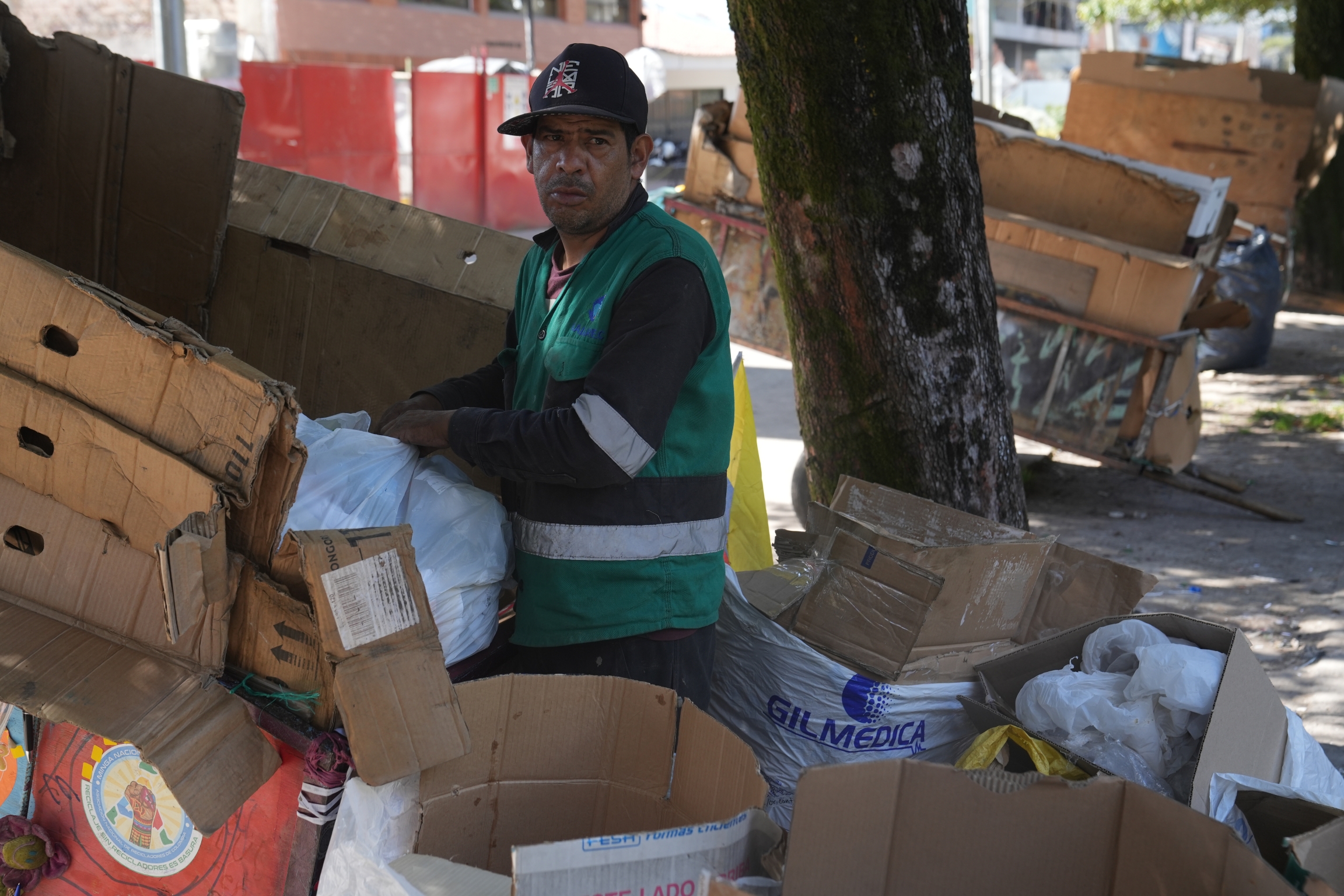
Waste picker Alfredo Rodriguez separates cardboard from plastic at a park in a wealthy area of Bogotá, Colombia.
Manuel Rueda/The World
The crime shocked the nation but it also galvanized waste pickers in Colombia. They went from being one of the most marginalized groups in the country to being highly visible, fighting for their rights in the streets and in courts. Nowadays, Colombia is a global leader when it comes to granting rights to these workers, said Federico Parra, an urban anthropologist who specializes in grassroots organizations.
“This [crime] created a huge movement that impulsed the waste pickers' organizations to fight for their rights,” he said.
Many waste pickers in Colombia are now recognized as public service providers, and they can go anywhere in the city to collect goods that can be recycled — without fear.
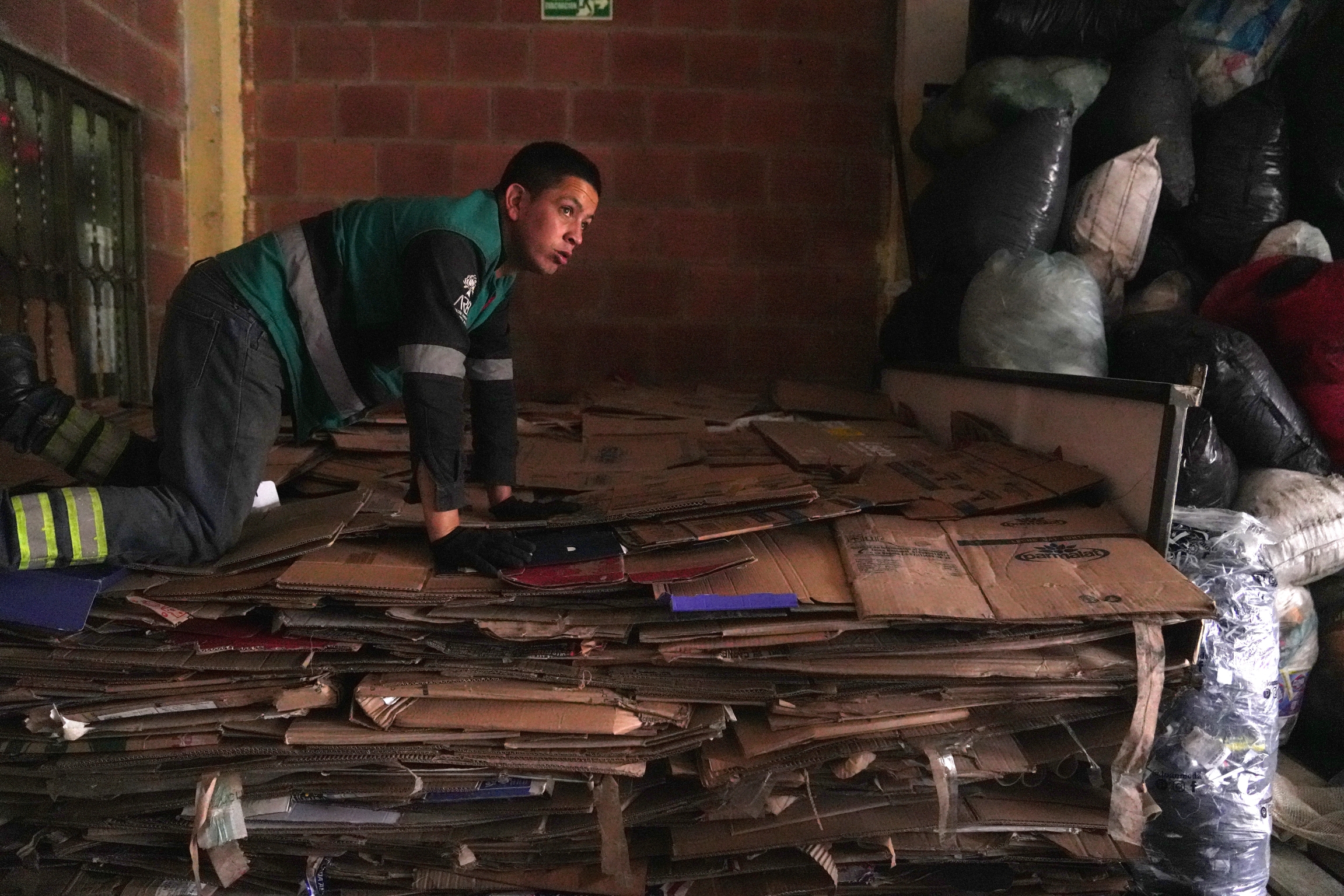
Miguel Lugo organizes cardboard at a warehouse run by ARAUS, the Usme Waste Pickers Association.
Manuel Rueda/The World
A lot of them still get around the city on foot, pulling heavy wooden carts. But they have formed associations that own trucks, and collect their trash at designated points. Previously, waste pickers had to drag their carts for several miles to get to warehouses where they sold items like cardboard, bottles and tin cans.
Alfredo Rodriguez is a waste picker in Chapinero, a wealthy district in the north of Bogotá. As he pulled his wooden cart along a street lined with office buildings and expensive apartments, he said the job still pays little, and requires long hours. But slowly, the conditions have been improving.
“We used to fight over trash bags in the street,” he said. “Now, it’s more orderly, and we also get gloves, face masks and boots with steel tips.”
In Colombia, waste pickers have filed several lawsuits against city governments that have privatized waste collection and given some recycling responsibilities to government contractors.
In 2011, the nation’s Constitutional Court ruled that municipal governments had to take actions to protect waste pickers, because they are a vulnerable group that provides an important service.
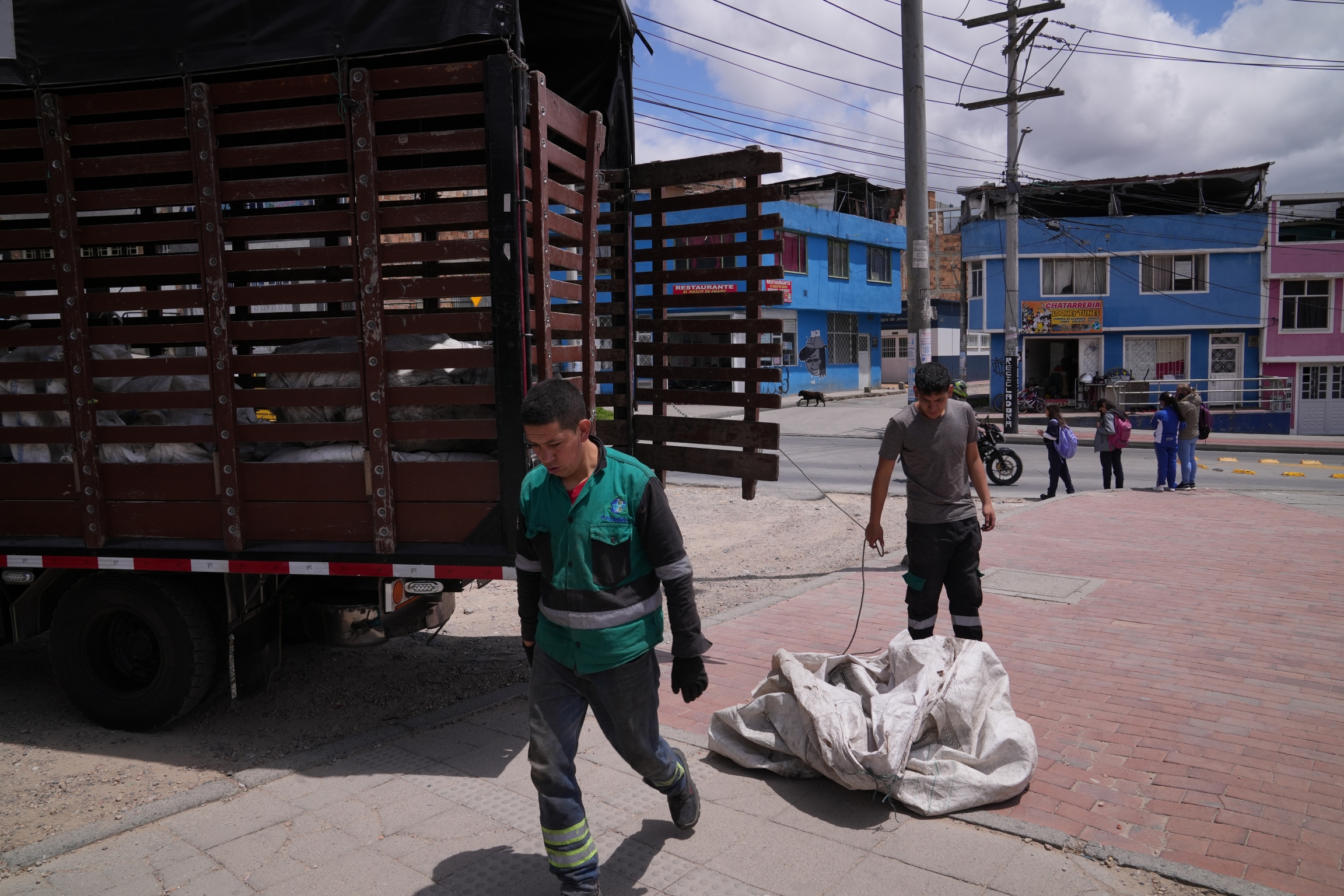
Miguel Lugo and William Lugo stop at a school where they are going to collect trash that can be recycled. The ARAUS waste pickers association owns a truck that has helped it to increase its monthly haul.
Manuel Rueda/The World
Following that groundbreaking ruling, cities like Bogotá have begun to require that contractors pay waste pickers a portion of the funds that they get from waste management taxes.
So, in Bogotá, waste pickers don’t just get paid for what they sell to warehouses each day. They also get a monthly fee that comes from the waste management tax. It’s known as the tarifa.
“We get anywhere from $30 to $90 from the tarifa, depending on how much [trash] we gathered,” said Sandra Martinez, a waste picker in Usme, a district at the southern edge of Bogotá. “It’s not much, but it helps to pay the bills.”
At the end of the month, waste pickers’ associations also get paid a fee, which varies according to how many tons their members collect.
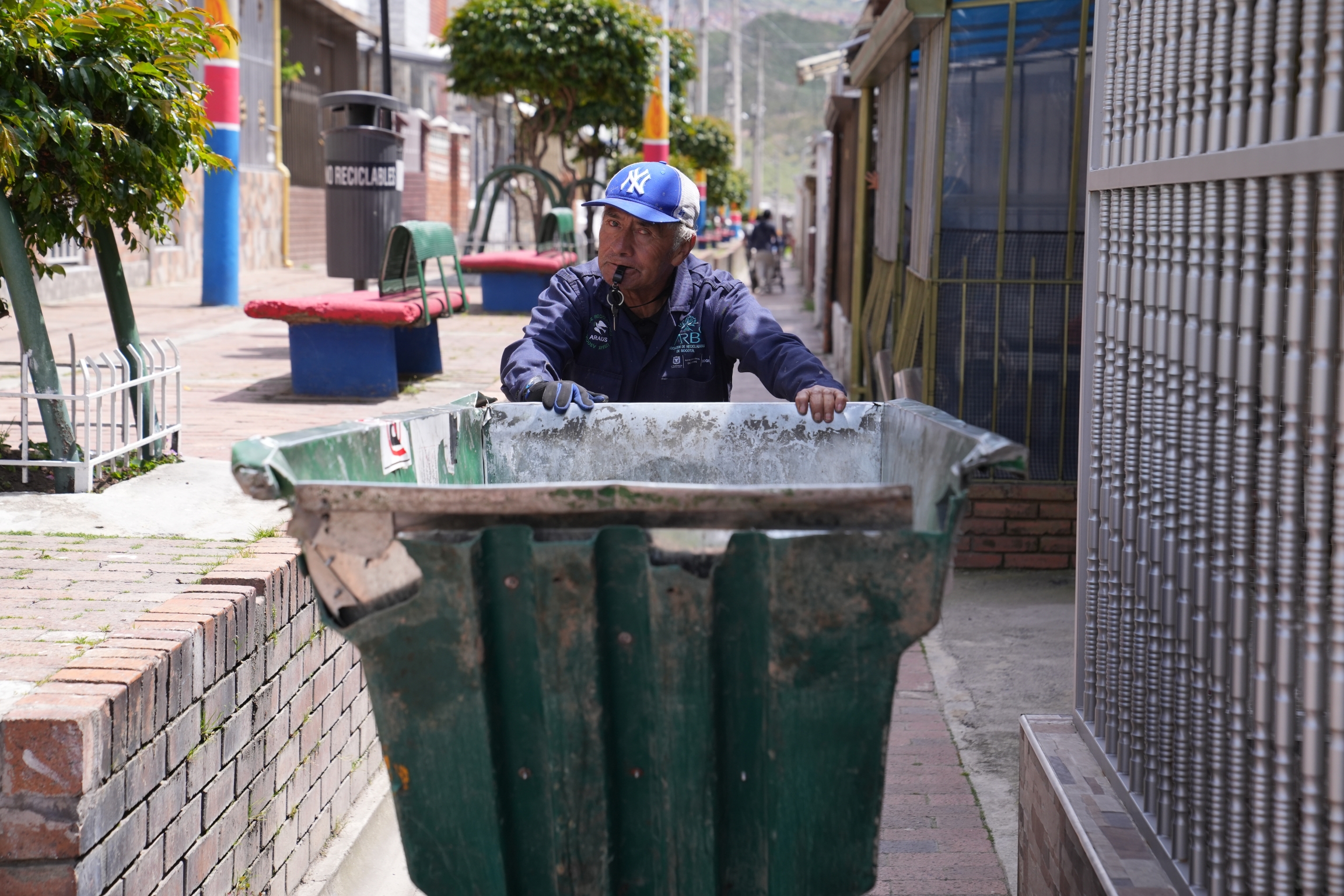
Waste picker Emiliano Martinez pushes his cart through a neighborhood in Usme, where he collects trash door to door.
Manuel Rueda/The World
Jorge Ospina directs ARAUS, the waste pickers association in Bogotá’s Usme district. His association has 75 members and gets about $5,000 a month from local taxes.
“Thanks to the tariff, our association has enough money to rent three warehouses, and we’ve also bought a truck.” he said.
At one of the warehouses, two employees stripped labels away from hundreds of plastic bottles, so that they could sell them to a local recycling plant.
Thanks to the warehouse, there’s no longer any need to sell trash to middle men. And the association’s members can get better prices for what they collect.
Waste picker Edgar Rodriguez loads cardboard on a truck owned by ARAUS, the Usme Waster Pickers Association. The truck helps the association to collect more trash and makes things easier for waste pickers in the district of Usme.
Manuel Rueda/The World
But waste pickers in the city still face many challenges. Prices for some items, like cardboard, have fallen recently. And for some waste pickers it’s also become harder to gather decent amounts of trash.
Martinez said many Venezuelan migrants who are out of work are also roaming the streets of Bogotá looking for items that can be sold to recycling plants.
“They open the trash bags before we can get to them,” she said. “And with the economic crisis, even homeowners are holding on to stuff, and selling it themselves to warehouses.”
But the biggest challenge for Bogotá’s waste pickers are large contractors that are also trying to get a piece of the recycling business.
Jorge Ospina, (center) standing with other waste pickers who are affiliated to the ARAUS association. Ospina has been the group’s director for more than 20 years and under his leadership they have been able to rent warehouses and get their own truck.
Manuel Rueda/The World
Ospina, from the ARAUS association, said that some of these companies have even formed dubious associations that are trying to claim some of the monthly payments that are reserved for waste pickers.
“Before the tariff system began, we only had around 40 waste pickers’ associations in Bogotá,” he said. “But now, there are 450. The city government has to eliminate the fake organizations, so that only the authentic waste pickers benefit from the monthly payments.”
Still, for many waste pickers in Bogotá, like Martinez, this is an industry that has changed for the better, even if these transformations were sparked by a horrible set of murders.
“Our job has more recognition now,” she said. “We used to be perceived as junkies, or disposable people. But now, our role in the city is respected.”
Listen to the other stories in the four-part Waste Pickers series on The World:
Trash sorters in Ghana face health and safety risks
In Mumbai, waste pickers do the heavy lifting of recycling
Tokyo’s trash-collecting samurai takes a fun, zany approach to cleanup
Ali Mohammad, a recycler in Dharavi, an informal settlement in Mumbai, one of India’s largest cities, sorts through a mountain of plastic ice cream cartons, which are destined to become anything from hair combs to water buckets.
“The life of plastic never ends. It breaks, then, in one month or so, it comes back as another thing,” he said.
Ali Mohammad sorts through ice cream containers for recycling.
Justin Nisly/The World
After moving here from Uttar Pradesh, a large state in northern India, Mohammad has spent the past four years separating, washing and chopping plastic as part of Dharavi’s bustling recycling operation.
In Mumbai, home to 20 million people, waste ends up in Dharavi with recyclers like Mohammad. A quarter of the people living here are employed in recycling at least 60% of the city’s plastic — a recycling rate far higher than the average in the US.
The recyclables that Mohammad digs through in a one-room, independent shop come from waste pickers who gather the recycling from the landfills and streets. Both groups of workers are crucial — and interlinked — in India, which is grappling with how to manage the rapid growth of plastics and other solid wastes.
Ice cream containers from popular Indian brands wait to be recycled.
Justin Nisly/The World
In Mumbai, a city crushed by the amount of garbage discarded each day, waste pickers help make this metropolis livable. And for every bottle and bag collected, that’s less plastic that ends up in the ocean.
The process begins in neighborhoods like Bandra, 20 minutes from Dharavi where Sheikh Salim gathered litter on the side of a road.
Salim, a waste picker, set down an enormous bag and listed the contents so far: “There is paper, these are bottles, this is a metal container, a thin sheet of plastic.”
He added, “I will take this waste to the scrap dealer who will weigh it and whatever, 150 rupees [$1.80], I will get.”
From the scrap dealer, most of the dry waste will eventually go to a recycler. In Mumbai, that could be a small-scale operation in Dharavi.
Though municipalities often also have a centralized, official version of waste management — for instance, garbage trucks that collect each day from households and some recycling centers — they tacitly rely on waste pickers and unlicensed recycling centers to augment their services.
Swati Singh Sambyal, an independent waste management expert, said that this interconnected waste management process is convoluted: “There’s a formal system of management, there’s an informal system of management, and that’s where the chaos is.”
Sambyal noted that since the Indian government issued its Solid Waste Management Rules 2016, the mindset of many Indians has been changing — and that is a good thing.
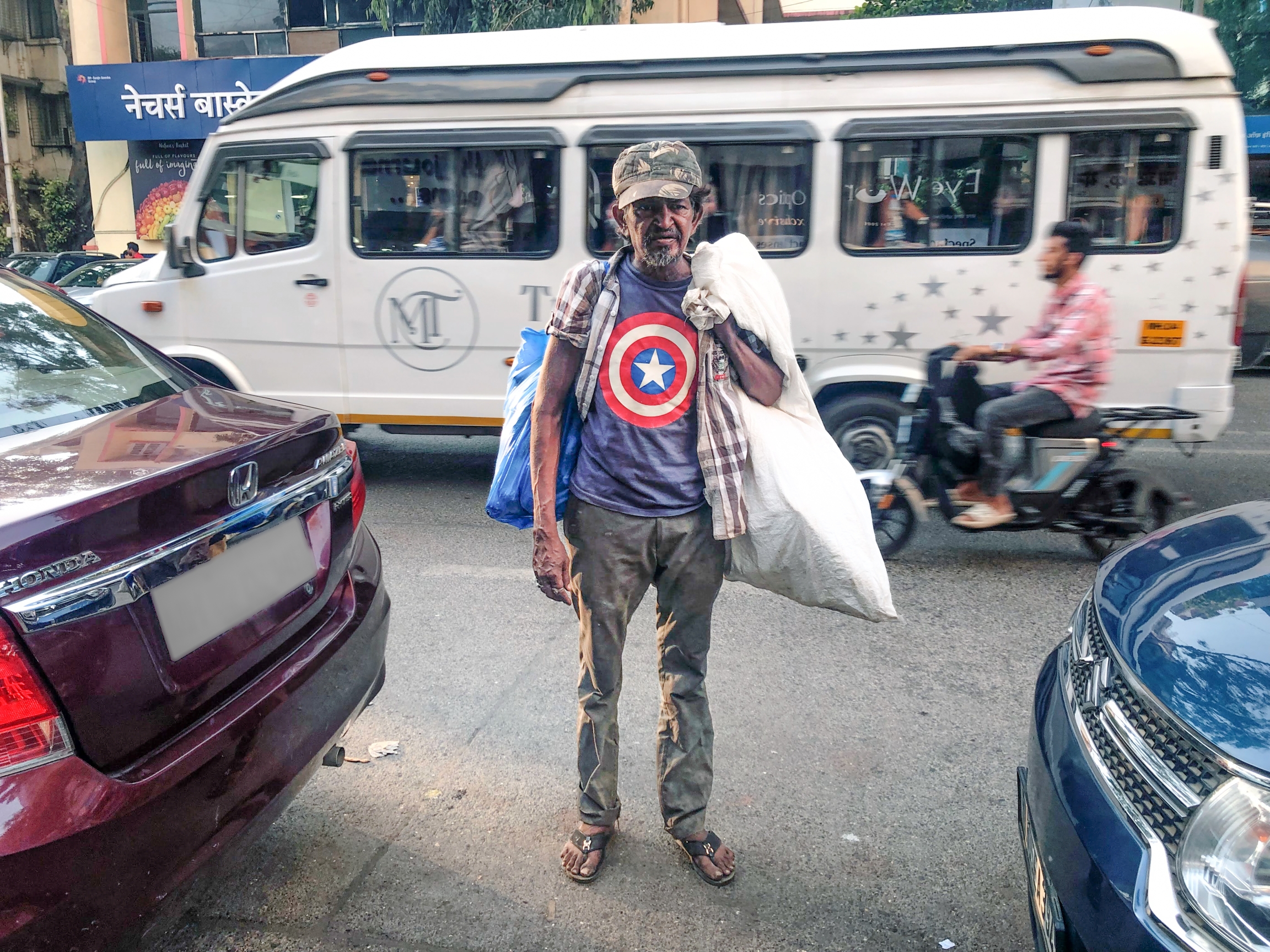
Sheik Salim collects recyclables in his bag along a street in Bandra, in Mumbai, India.
Justin Nisly/The World
These rules, which mandate that homes and businesses should separate dry, wet and hazardous waste, have sparked a growing awareness about the importance of scientifically managing trash.
Still, many households don’t. Instead, they might toss plastic water bottles in with food scraps and diapers. And Sambyal said that even when families do separate their trash, the city garbage collectors might toss it all together.
“Perhaps, if I’m doing it [waste segregation] as a resident, it’s being collected and then mixed, and then, say, going to a facility where it’s burned. Me segregating then goes down the drain.”
Or, municipal sanitation trucks might just dump everything into landfills that other waste pickers then dig through, which is dangerous work.
As experts consider ways of improving this system, Sambyal said an important question to ask is: “How do we formalize the informal sector, or if we’re not able to do so, how do we bring them into our processes?”
It’s a question Sushila Sable is also asking. She is part of a women’s empowerment group in Mumbai called Stree Mukti Sanghatana.
For decades, she did the hazardous and difficult work of gathering recyclables from a nearby dumping ground. Now, she works to organize them.
Sable said it is high time that waste pickers be officially recognized for their important role.
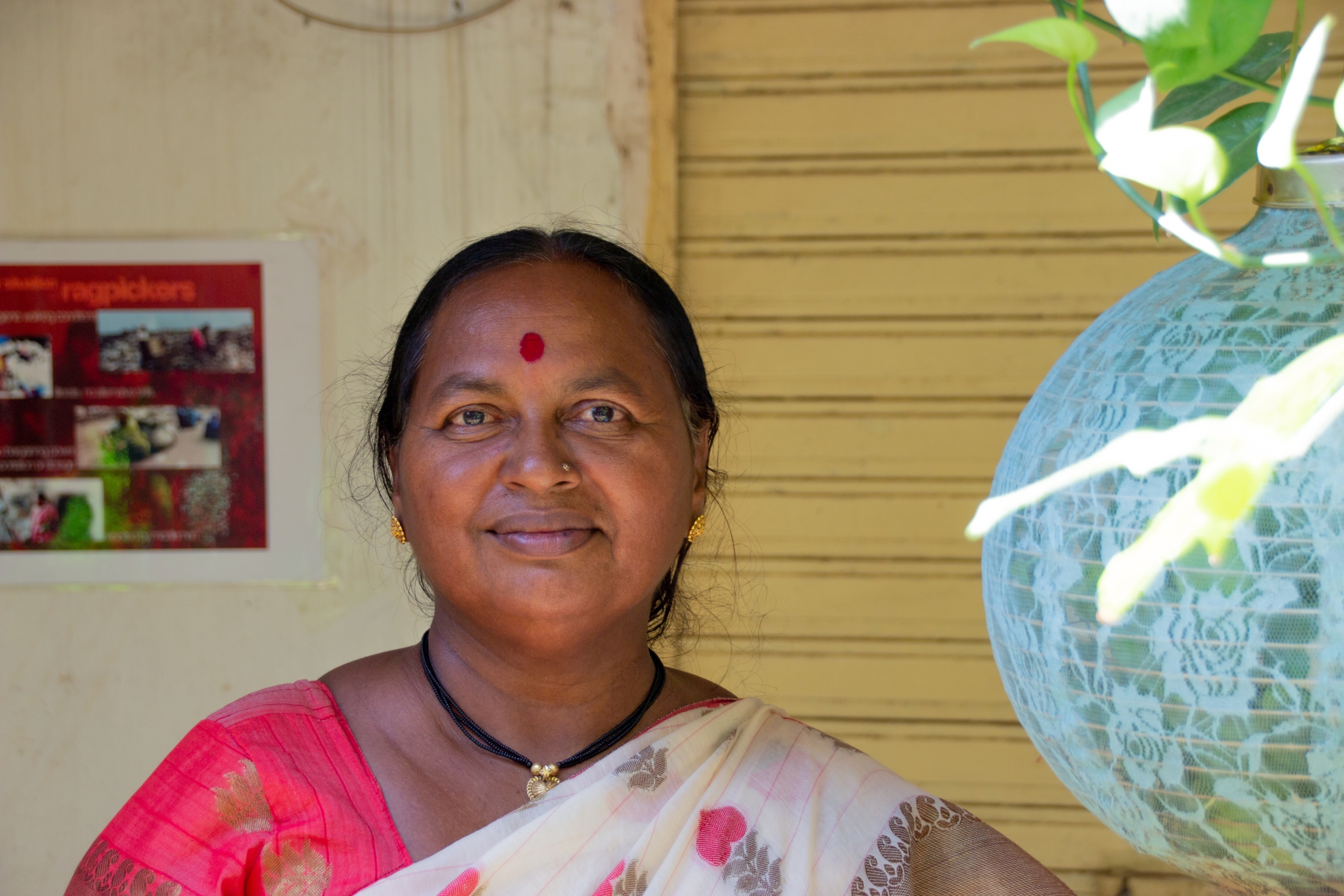
Sushila Sable, a former waste picker, now manages a women's empowerment group.
Justin Nisly/The World
“From the year 2008, we have been demanding that we be given an identity card, to be recognized and live a life as humane as possible given the circumstances we work in. But [we] have not got the identity card.”
Official IDs protect them from police harassment, reduce the stigma of the job, and waste pickers say it could improve their access to subsidized housing, health care and education for their kids.
The good news is some Indian cities have already begun to incorporate waste pickers into their waste management systems. For instance, the city of Ambikapur, in the state of Chhattisgarh, has given several hundred waste pickers ID cards, so they can collect garbage from people’s homes — where it’s been presorted.
Later, the dry waste will be separated into a whopping 156 different items.
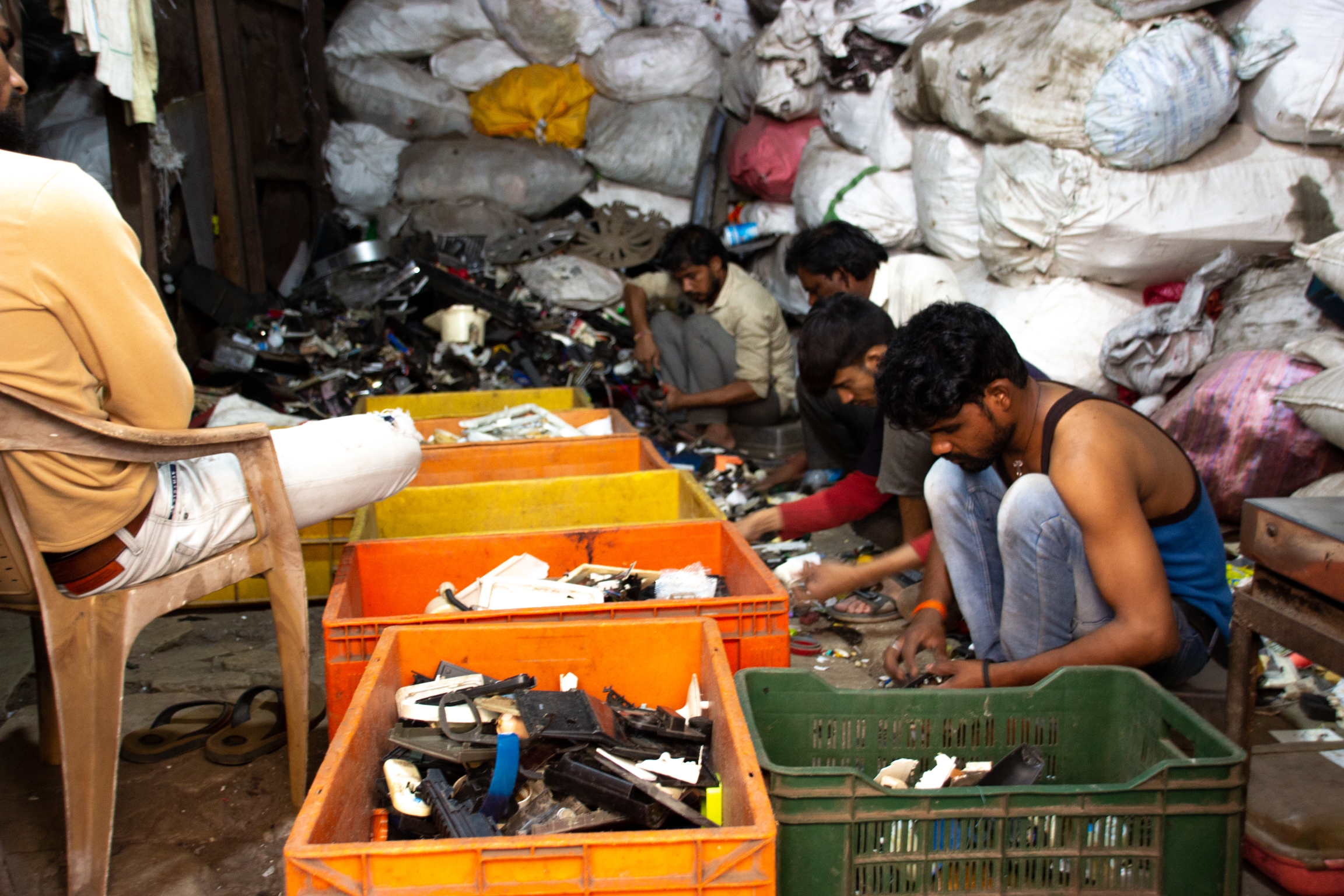
In Dharavi, an informal settlement in Mumbai, India, men separate plastic and metal components for reycling.
Justin Nisly/The World
Ritesh Saini, based within the city government, is the local officer for the country’s Clean India mission, Swachh Bharat. Saini explained that they divide their dry waste so carefully because “the more we segregate, the more revenue we can earn.”
As an example, he cited an average water bottle.
“The cap is separated, the plastic wrapper is separated, and the bottle body is separated,” and by selling each piece to a different vendor, Saini said, the city generates a lot more income.
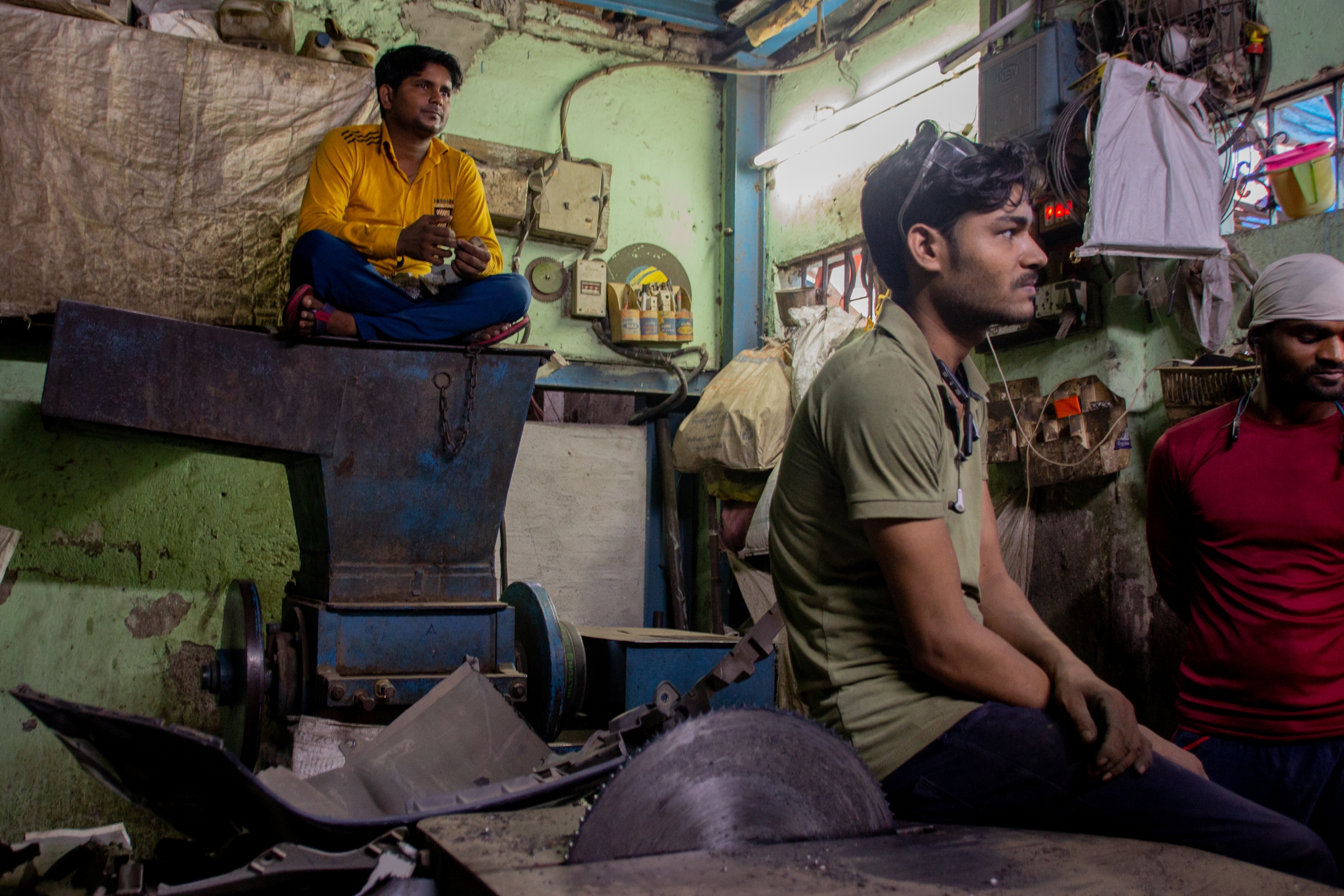
Raju Rajput (left) and his colleagues take a break from recycling plastic car bumpers in his shop.
Justin Nisly/The World
Back in Dharavi, Mohammad said that business is booming for recyclers like him, as Indians throw away more trash than ever. In fact, the Indian government predicts that the country’s plastic use will more than triple in the next decade.
It’s a big reason why waste pickers are asking for more protection and recognition for their role in waste management.
“We work for cleanliness of the surrounding living spaces as well as protecting the environment,” Sable said. “Slowly, the world is recognizing us and our role.”
Listen to the other stories in the four-part Waste Pickers series on The World:
Trash sorters in Ghana face health and safety risks
Tokyo’s trash-collecting samurai takes a fun, zany approach to cleanup
This story was produced with support from the Pulitzer Center on Crisis Reporting.
Thirty-six-year-old Johnson Doe has worked as a waste picker in the sprawling Kpone Landfill in Accra, Ghana, for 20 years.
It’s not the type of job he imagined for himself as a young man, but it’s how he supports his wife, two children and his parents.
”I wanted to be a military pilot but, you know, life happens,” he said.
Waste pickers are the largest workforce in the recycling chain responsible for collecting and recovering up to 60% of all plastics.
Ridwan Karim Dini-Osman/The World
Doe — and about a thousand other waste pickers there — collects items such as plastic bottles, aluminum cans and scrap metal, which he sells to recycling companies that buy them by weight. The money it brings in depends on market demand, Doe said, but typically, he makes $13 a day.
Doe is among the more than 20 million waste pickers around the world — the largest workforce in the recycling chain — who recover up to 60% of all plastics globally. Additionally, their work helps reduce greenhouse gas emissions.
And yet, in Ghana and elsewhere, waste pickers like Doe say they are rarely valued for what they do — they barely make a living, and are vulnerable to exploitation and exposure to pollution and toxic chemicals.
“Many people think the mentally ill people are those who work at the dumpsite,” Doe said. “So, that’s how they see us, like we are illiterate. Some people even call us criminals.”
At the Kpone Landfill, all sorts of insects, including maggots, and other pests can be found on decaying garbage, feasting on scraps of food and nesting in rotting material.
Then, there’s the medical waste scattered throughout — syringes, blood, pins, needles and other equipment.
Waste pickers collect items such as plastic bottles, aluminum cans, and scrap metal and then sell them to recycling companies who buy them by weight. The prices they get for the materials depend on the market demand.
Ridwan Karim Dini-Osman/The World
It puts waste pickers at risk of infectious diseases such as HIV and Hepatitis B and C, Doe said.
Still, many of his colleagues sift through the garbage with their bare hands or worn-out gloves; some don’t have any protective gear at all.
Doe said he remembers a woman who, while sorting, punctured a plastic bag containing a toxic substance. The acid splashed on her body and burned her clothes.
“Now, she’s bedridden at home and looks completely deformed,” he said.
Johnson Doe has been working at the Kpone Landfill in Accra, Ghana, for about 20 years now. He says it is his best option for making a living to take care of his wife, two children and his parents.
Ridwan Karim Dini-Osman/The World
Emergencies happen a lot at the landfill, Doe said — with people collapsing from exhaustion, or getting dehydrated, or experiencing difficulty breathing.
But they face stigma when seeking medical help, he said, as health workers often describe them as dirty and refuse to attend to them.
Additionally, waste pickers at the landfill do not have access to clean water, handwashing facilities or sanitation facilities.
Another waste picker, Grace Avemegah, said the situation can be especially problematic for women.
“There are no washrooms here to change your sanitary towel during that time of the month,” she said. “This means you have to keep your pad on from morning until evening, which is not good for our health. When you become so pressed, you are compelled to do it in the open.”
Solomon Noi, the head of waste management at the Accra Metropolitan Assembly, said that a lot of industries channel harmful substances to the landfill.
Waste picker Grace Avemegah says it’s difficult to practice good hygiene and for women to meet their menstrual needs due to absence of sanitation facilities at the Kpone Landfill in Accra, Ghana.
Ridwan Karim Dini-Osman/The World
As a result, the air is heavily polluted, which can “choke your respiratory system, and therefore, we cannot rule out upper respiratory tract infections,” he said.
Waste pickers inhale harmful gas and their skin is “exposed to certain corrosive and carcinogenic elements within the wastes that they are scavenging on.”
Also, plastics leach hazardous chemicals into the environment, including endocrine-disrupting chemicals (EDCs), which are linked to reduced fertility, pregnancy loss and irregular menstrual cycles, and other conditions, according to a 2020 report by the Endocrine Society and IPEN (International Pollutants Elimination Network).
Noi said that the health risks faced by waste pickers are rife across the developing world, particularly in Brazil, India, Colombia, Mexico and the Philippines where the amount of waste being generated is rising rapidly, but the technological and financial tools to manage it don't exist.
“That’s why all these countries in Latin America, Asia and Africa record huge cases of waterborne diseases and infections like hepatitis, cholera and the rest,” he said. “So, it is a global problem that should be tackled at the global level through concerted efforts.”
Noi said he would like to see universal health care — but also policy changes in Ghana.
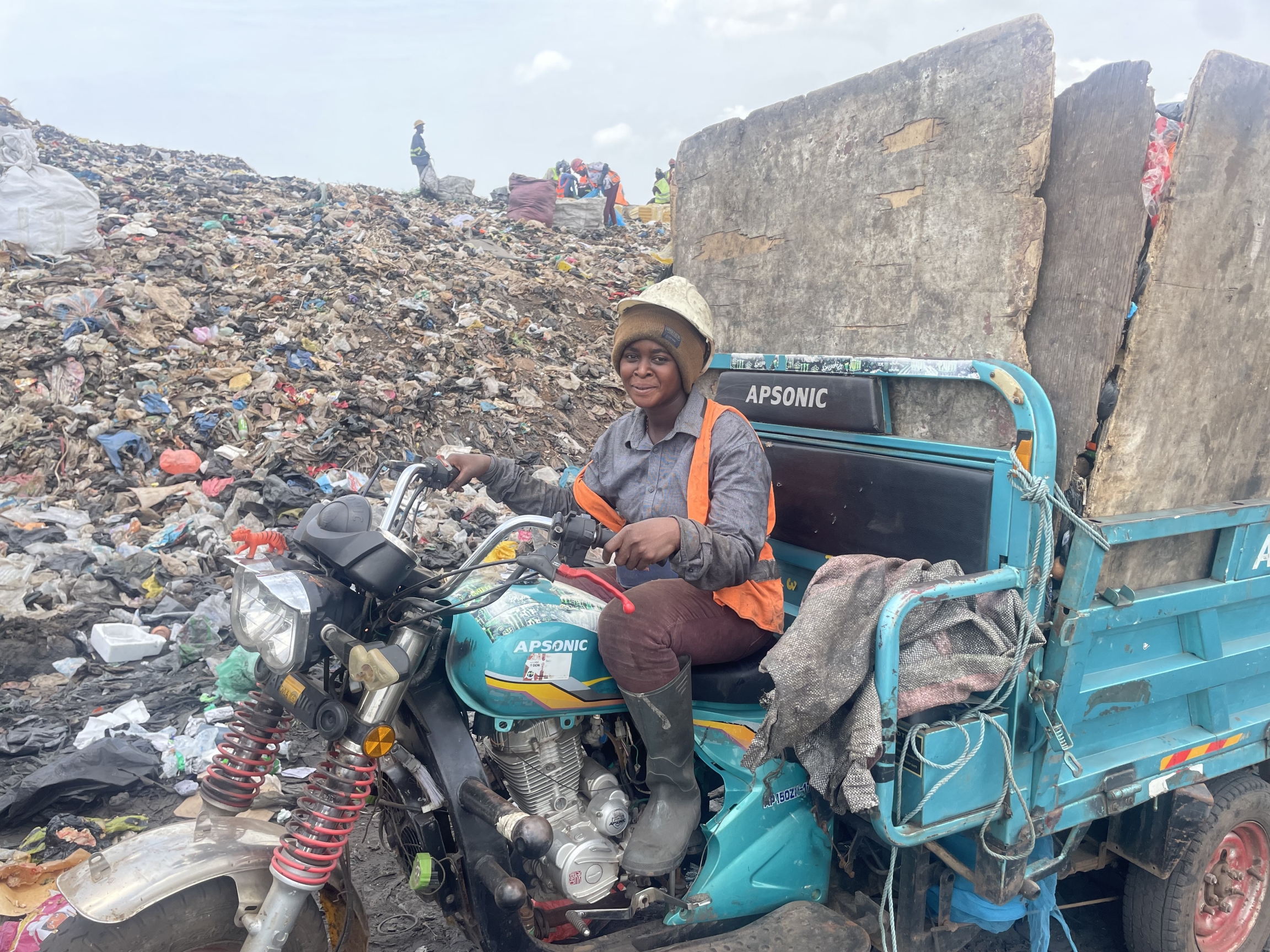
Waste pickers, who collect and sort recyclable materials from garbage, face widespread social stigma that often prevents them from accessing basic services including health care.
Ridwan Karim Dini-Osman/The World
“We should have a sanitation master plan, and there should be effective and efficient bylaws that will compel particular industries to treat their wastes and render them nonharmful,” he said.
Proper sorting and treatment of waste before it reaches the landfill, coupled with personal protective equipment, is crucial, said Michael Affordefe, a medical waste expert at the Accra School of Hygiene.
“That is the only way we can break the chain of transmission of some of these infections from the medical waste,” he said.
Ghana’s Health Facilities Regulatory Agency is alarmed by the rate at which untreated medical wastes are being dumped at the Kpone Landfill, but it is challenging to prosecute noncomplying hospitals, according to Agyemang Badu, the agency's head of operations.
“We know about the plight of the waste pickers, but you see, it is just quite recent that, as an agency, we were given a lawyer,” he said. “Prior to that, we didn't have any attorney to make sure that the enforcement bites.”
Next year, nations are set to develop a legally binding agreement on plastic pollution. The new global plastics treaty aims to put waste pickers at the center of its strategy to curb plastic use and pollution.
Listen to the other stories in the four-part Waste Pickers series on The World:
In Mumbai, waste pickers do the heavy lifting of recycling
Tokyo’s trash-collecting samurai takes a fun, zany approach to cleanup
Last Thursday, the El Fuego (The Fire) volcano in Guatemala took things to another level.
A huge, mushroom-shaped plume of black smoke erupted into the sky as red-hot lava rocks sprayed over the hillside. Authorities took action, ordering more than a thousand residents to evacuate.
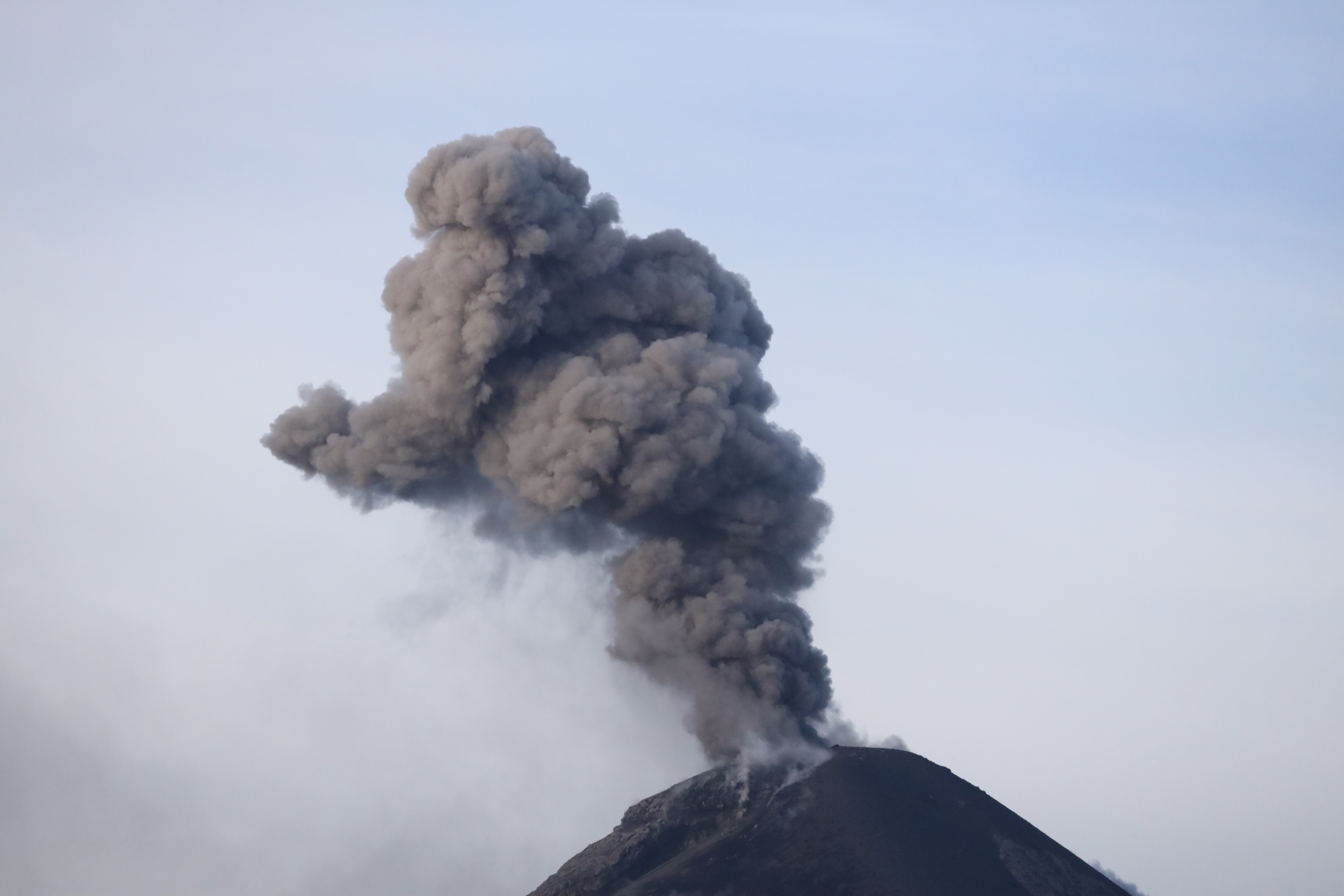
Last Thursday, the El Fuego (“The Fire”) volcano in Guatemala took things to another level. A huge, mushroom-shaped plume of black smoke erupted into the sky as red-hot lava rocks sprayed over the hillside. Authorities took action, ordering more than a thousand residents to evacuate.
Michael Fox/The World
“It’s best to avoid any problems,” one mother told a local TV outlet, as she sat inside a packed, yellow school bus, waiting to be taken to a shelter. Her toddler son stood on her lap, teething on the seat in front of them.
“I have to be very careful with him,” she said. “He has lung issues, so it’s impossible for me to stay.”
Guatemalan officials said that 280,000 people were impacted by the fallen ash across the country.
Local residents are not the only ones potentially in harm's way. Tour companies guide 100-200 people up the hillside to witness El Fuego each day. It’s not an easy hike.
Michael Fox/The World
The mother and son were headed to one of two dozen shelters opened for residents outside of the volcano’s path.
“People are afraid after what happened in 2018,” one evacuee told a news agency, inside of a large gymnasium filled with families and their belongings. “So, they already have their bags ready, and when authorities say they have to evacuate, they are ready to go.”
More than 300 people died in 2018 when El Fuego exploded, spewing smoke and ash, and causing pyroclastic lava flows to pour down hillsides and into populated areas. Shocking videos from that time show people running or racing away in a car as huge plumes of smoke stretch across an apocalyptic sky.
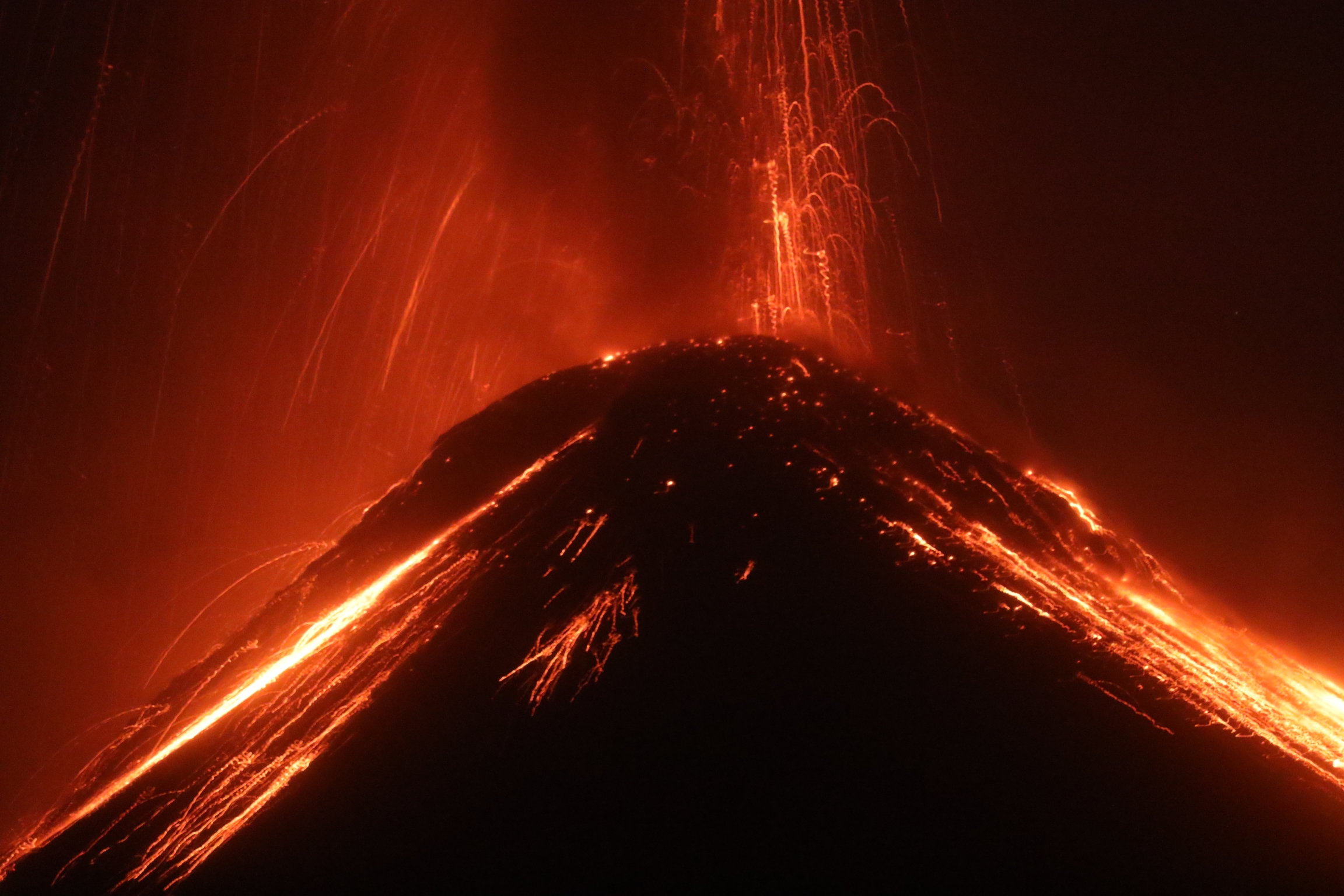
A handful of tourists have perished on El Fuego over the years. But that’s largely been due to the elements and the high altitude, not the volcano.
Michael Fox/The World
Local residents are not the only ones potentially in harm's way.
Tour companies guide 100-200 people up the hillside to witness El Fuego each day. It’s not an easy hike.
Polish tourist Tomek Grzeda hiked up Acatenango with his family last month.
“The first, big eruption after we got to the camp, our daughter started crying. Because she was afraid of the noise and how it looks — the lava coming from the volcano. It was incredible. Super powerful, but also scary,” he said. “But after that, we got used to it. We understood how it worked. The guide explained everything. We felt safe on the top.”
El Fuego erupted all night long. But not like it did last week.
More than 300 people died in 2018 when El Fuego exploded, spewing smoke and ash, and causing pyroclastic lava flows to pour down hillsides and into populated areas.
Michael Fox/The World
Pablo Arcón, the head of Pablo’s Tours, said they started to evacuate people off the mountain around 6 a.m.
“We’ve never had a problem like rocks falling on the base camp, or something like that,” he said. “We evacuate because of the high concentration of ash and because of the roads, which can get knocked out and make it hard to get people home.”
He said that’s what happened in 2018. But no hikers died.
A handful of tourists have perished on the mountain over the years. But that’s largely been due to the elements and the high altitude, not the volcano.

Tour companies guide 100-200 people up the hillside to witness El Fuego each day. It’s not an easy hike.
Michael Fox/The World
Brayam Mendez is the head of environmental management for the Municipality of Acatenango. He said that you can’t predict volcanoes, but they are used to El Fuego.
“It always does this,” he said. “When there’s a problem or activity increases, and you can’t see through the ash, we close the park and there are no visits. But after a few days, we open it back up.”
That’s where they are now. Most residents have now returned home.
Arcón said that he’s expecting they’ll get the green light from Guatemala’s tourist agency to again start tours up the mountain later this week.
For most species, a changing climate doesn’t bode well. But there are examples across the animal kingdom of ones that are finding ways to adapt to a warming world.
Scientists all over the globe have been studying the changes in animal physiology and behavior, some going back generations, which they believe is linked to rising temperatures. They say the adaptations are beneficial, but may have limitations in the long term.

Cape ground squirrels in South Africa are adjusting to climate change. Their average foot length has increased by 9% in just 18 years.
Courtesy of Miya Warrington
In the dry grasslands of South Africa, Miya Warrington, a conservation biologist at the University of Manitoba, first laid eyes on Cape ground squirrels darting about in 2021. “You see the heat and you see all the human activity,” she said. “So immediately, I start thinking about how these animals might be adapting to climate change.”
And by adapting, she means altering the size of parts of their bodies. So, Warrington set out to measure the squirrels. The first challenge was to catch them.
“They love peanut butter,” she explained. It’s “like manna from heaven for them. We put it out in these traps, and they go, ‘Ooh, peanut butter.’ And then we take them out of the traps and we do the measurements.”
One of these measurements included foot length. “And you take calipers and you just put them on from the toe to the heel,” something her colleagues have been doing for almost two decades.
This gave Warrington the ability to look back through time, compare the data to that of today’s squirrels, and test out her hunch.
What she found was that the average foot length (compared to length) had increased by 9% in just 18 years. Warrington believes that the reason could be because temperatures are getting hotter.

Scientists measure the feet of Cape ground squirrels to track their changing sizes.
Courtesy of Miya Warrington
“When their bodies get hot,” she said, “their heat radiates out of big, big feet. So, it’s one way of dissipating heat.”
The cause and effect of this needs more research, however, in part because other changes in squirrel dimensions didn’t seem to correspond to the hotter temperatures. But her work is part of a growing body of evidence that climate change can cause certain animal species to shape-shift, especially those with rapid reproduction rates, like shrews and birds.
In Finland, for instance, as winters have grown milder, the number of brown tawny owls has surged compared to gray ones. That’s because the brown owls are better at blending in with less and less snowy environments.
Anderson Feijó, a zoologist at the Chinese Academy of Sciences in Beijing, found that shape-shifting due to climate change is also apparent in fossil records. He studied about a hundred ancient frog species and found that “medium-sized frogs seem to be the most resilient to the climate variation, while those species that are too large or too small are more sensitive” and tended to disappear when temperatures become too hot or too cold.
But adaptation doesn’t always lead to visible changes. Sometimes, the changes happen inside an animal’s body.

The ability of the montane horned lizard to perform a task, such as sprinting or digestion, is optimized over a relatively narrow range of temperatures.
Courtesy of Martha Muñoz
Martha Muñoz, an evolutionary biologist at Yale University, has studied the montane horned lizard in Mexico. “Their ability to perform a task, such as sprinting or digestion, is optimized over a relatively narrow range of temperatures,” she explained. “And then decreases at higher and lower temperatures until the animal is immobilized.”
When their environment in Mexico became slightly warmer, Muñoz was curious if the lizards had adapted. So, she gathered up several dozen of them, and then “systematically cool[ed] or heat[ed] the lizards by one degree per minute, flip[ped] them onto their backs, and then determine[d] the temperature at which they los[t] the ability to flip themselves back over, this being the thermal limit to locomotion.”
After crunching the numbers, Muñoz, Saúl Domínguez Guerrero and their colleagues found that the lizards had increased their heat tolerance by about a degree. “They’re less comfortable in the cold, and more comfortable in the heat,” she summarized. And that shift happened over a single year.
While some of it was temporarily induced by the environment, some of the change was also genetic. The lizards had evolved a higher heat tolerance and were passing it down from one generation to the next. Muñoz said that this is to be expected of species with large populations.

Acropora hyacinthus coral in Rarotonga, Cook Islands.
Courtesy of Rachael Bay
This combination of genetic evolution and temporary environmental plasticity is also helping other types of species survive warmer temperatures, including the Acropora coral in American Samoa. Some of the corals have seen variations in their genes, allowing them to tolerate warmer water temperatures.
At the same time, it’s also true that “corals that have past experience with warm temperatures are better at living at higher temperatures in the future,” said Rachael Bay, an evolutionary biologist at the University of California, Davis. And although they may be protected against warming temperatures in the short term, Bay said, “we have no idea what the limits to that capacity are.”

Rachael Bay sampling coral in American Samoa.
Courtesy of Rachael Bay
Meanwhile, some animals are adapting behaviorally, such as pink-footed geese in the Arctic. These birds have developed new migration routes and breeding grounds, with warming temperatures opening up new habitats.
Thomas Lameris, an ecologist at the Royal Netherlands Institute for Sea Research, said that birds like these benefit from their social environments. “The way they behave is they often learn from their parents or from other geese,” he explained, allowing for any adaptive change in behavior to propagate quickly through a population.
He witnessed this firsthand at a remote spot on the tundra in the Western Russian Arctic when studying barnacle geese. The birds winter across western Europe and fly north to the Arctic to breed. They stop along the way, fueling up on fresh, nutritious grass that’s just emerged from the melting snow.

Scientists traveled to the remote tundra in the Western Russian Arctic to study how the migration behavior of barnacle geese has shifted due to snow melting earlier in the year.
Courtesy of Thomas Lameris
But Lameris found that in the years when the snow melts early, the geese don’t make stops to feed during their migration, making a mad dash, instead, to the breeding grounds.

In the years that snow melts early, pink-footed geese no longer make stops to feed during their migration, heading straight to breeding grounds instead.
Courtesy of Thomas Lameris
“They would really speed up their migration,” he explained. “They would be able to make the journey that would otherwise take two weeks … they could do the same thing in four days.”
And when they arrived, “they would need a longer time to recover before they could lay their eggs,” he said.
But Lameris is heartened by what he sees as an ability for a migratory species to adapt to a warming climate.
Still, adaptation — whether genetic or behavioral — can only get a species so far.
Lotanna Micah Nneji, a conservation biologist at Princeton University, pointed to the Perret’s toad, found only in Idanre Hill in southwestern Nigeria. As rainfall patterns and temperatures shift, the habitat of these toads is shrinking. Nneji has identified other locations in the area where they could live more comfortably. But, unlike birds and mammals that can cover large distances, these toads are pretty much trapped. Those other areas are simply too far from their current range and not within protected areas.
Animal adaptations, though remarkable, are sending us a message.
... "When you’re adapting your physiology ... there's an upper limit to how far that can go ..."
“Everything that organisms do is simply buying time,” said Martha Muñoz of Yale. “But if you’re going up a mountain, there’s only so far you can go. And if you’re going polewards, there’s only so far you can go. And when you’re adapting your physiology, guess what? There's an upper limit to how far that can go, too. And if we don't reverse action, they are truly running out of options because we’re giving them no others.”
Related: Bees face many challenges — and climate change is ratcheting up the pressure
A handful of surfers were out catching waves at Imperial Beach, California, the first US beach town north of Mexico, when the lifeguard station blasted a panic-inducing announcement.
“The water is currently contaminated, and we are under a 72-hour rain advisory. Lifeguards strongly recommend exiting the water,” the warning said.
Pollution and trash carried from the Tijuana River to the Pacific Ocean have long plagued swimmers and surfers on both sides of the US-Mexico border. But in recent years, particularly at Imperial Beach, it’s gotten worse. Some locals and experts are hopeful about its cleanup after a recent court settlement.

Surfers in the water at Imperial Beach, California
Fabian Garcia/The World
Toni Cunia, who strolled along the pier, said she has seen the issues firsthand.
“I used to live on the corner over here, so I know how bad it has gotten, and it's breaking everybody’s heart. Because this was our playground,” Cunia said.
She gestured down the beach to where the Tijuana River flows into the Pacific.
“So much junk comes with it. It’s not just the water. It’s so much trash. So, yeah, it’s a problem, a major problem,” Cunia said.
And not just for swimmers: the paths along the estuary where the Tijuana River flows into the Pacific are a no-go-zone now, Cunia said.
It all starts with the Tijuana River, which collects rainwater from the surrounding watershed and flows only when it rains, explained Paloma Aguirre, who is the mayor of Imperial Beach and holds a master’s in marine biodiversity and conservation from UC San Diego.
The river discharges south of Imperial Beach, but it goes through the entire city of Tijuana before releasing into the ocean, Aguirre said. Along the way, it collects tires, trash, and worst of all, sewage.
As a result, Aguirre said, she has been unable to surf there since last September — which was what drew her to the area in the first place.

Mayor of Imperial Beach, California, Paloma Aguirre
Marco Werman/The World
“A lot of us moved to IB because of its waves. It's one of the core reasons I chose to live [here] in 2003,” she said.
The pollution is so bad that she's actually gotten sick, "not by ignoring the signs, but by getting the impact of the plume that you don't even know is coming sometimes,” Aguirre said.
A plume is a concentration of contaminated water that is prone to being dragged north by the current.
On the US side, the attitude has long been: “Tijuana, just clean up your act.”
But Margarita Diaz, who lives and works in Tijuana as executive director for the Environmental Education Border Project, said she thinks that criticism is unfair and ignores some fundamental differences between how things operate in the US and Mexico.
Tijuana is “a city with two countries, different economies, different politics and different realities,” Diaz said, adding that its economy “[doesn’t] have a lot of money invested for the infrastructure.”
Tijuana has long faced criticisms from the US that little has been done and nothing has changed. But Diaz said that Tijuana has barely kept up, given its rapid growth.
“The population in Tijuana, in 30 years, has increased by millions,” she said.
According to Diaz, the city has built some infrastructure, and the situation is the same.
“I don’t want to say that it’s OK. It’s bad. It has to be clean. I’m not saying that I’m happy with what Mexico is doing. No, we have to do more,” Diaz said.
The pollution impacts Tijuana’s residents, too. Diaz said the Tijuana city government, just over this past spring break, realized it had to protect its citizens and visitors and shut down its beaches.
The state of the beaches, she said, “is one of the most severe and egregious environmental injustices in the nation.”
Aguirre said she sees the pollution as a result of free-trade agreements that have led to the rapid development of Tijuana.
“This is a negative externality from the original NAFTA trade agreement,” she said. “We knew that we were going to see these environmental impacts associated with the free trade that was signed 20, 25 years ago.”
Some hope things may turn around with a recent legal decision.
The International Boundary and Water Commission (IBWC) and its Mexican counterpart are tasked with settling water disputes between the two countries. In a recent lawsuit by the Port of San Diego and two California border cities, the agency was instructed to do more to stop wastewater from flowing north from Tijuana.

Marco Werman/The World
According to the reports and Aguirre, the IBWC is committed now to more rigorously monitoring and mitigating the pollution in the water on the US side and better coordinating cleanup with their counterparts in Mexico.
Aguirre said that at least both sides are starting to listen to one another.
“Communication between both agencies is crucial but not easy,” she said.
“Because you have the most basic barrier, which is language. So, it’s kind of like they’re being compelled to do it. In the past, there wasn’t that much will to do it.”
Diaz said she also is cautiously confident that attitudes are changing in Tijuana and US towns like Imperial Beach.
“I hope that the governments share information and also the NGOs can help and we can move the things to a better place,” she said.
Winners of The Goldman Environmental Prize, the highest award of the year that goes to environmental activists leading grassroots campaigns, were announced on Monday.
One of the recipients, Zafer Kizilkaya, is the first winner ever from Turkey.
Kizilkaya is a trained civil engineer, marine conservationist and underwater photographer. He is being recognized for his work for more than a decade of creating a community-managed, 300-mile-plus marine-protected area along the Turkish coast of the Mediterranean Sea.

Aerial view of Gökova Bay, Turkey
Zafer Kizilkaya
In 2007, after returning from maritime work in Indonesia, Kizilkaya saw a problem as he dived into Turkey’s Gökova Bay.
“I noticed that there was a nuclear war that happened underwater,” Kizilkaya told The World. “There [was] nothing. Rocks [were] bare; there [was] no fish or algae.”
What he saw was a result of overfishing, illegal fishing, invasive species, such as the lionfish, and the effects of climate change. The Mediterranean Sea is one of the world’s most overfished bodies of water, and it became apparent to Kizilkaya that action needed to be taken to help protect Turkey’s degraded ecosystem.
This led to him launching his own nonprofit, Akdeniz Koruma Dernği (the Mediterranean Conservation Society), in 2012, with the help of local fishing communities.
But it wasn’t easy at first for Kizilkaya to win over the entire community.
“Nobody believed us,” he said. “The fishing communities are hard people to get, negotiate or even communicate with sometimes.”
He explained that the perception was that he was seeking to close some favorite fishing grounds forever. Though income in fishing areas was already collapsing from the degradation, closing even more areas down from fishing could exasperate the problem.

Invasive lionfish in coastal rocky habitats
Zafer Kizilkaya
“One disadvantage I had, there was no good example in front of me for Turkey,” Kizilkaya said. “Even if I am telling them good examples [of marine protected areas] from other parts of the world, it [didn't] mean anything to them at that time.”
Fortunately, other stakeholders, government institutions and certain fishing community members believed what he and his team said.

Cleanup of discarded fishing nets, Bozburun MPA, Marmaris, Turkey
Zafer Kizilkaya
With their support and negotiations for over a year, the first protected areas in Gökova Bay were officially established in 2012.
Fishermen have continued to fish in the protected areas knowingly and unknowingly, and much of Kizilkaya’s work has been spent educating local communities on marine-protected areas. He has been able to convert local fishermen and have them work with his organization as marine rangers to help stop fishing in those parts.

Zafer Kizilkaya and team on patrol
Goldman Environmental Prize
“It is great to establish those areas and immediately start patrolling [them],” Kizilkaya said. “We don’t have much time to convince all the stakeholders in the world.”
Because of his work, the Turkish government expanded the network in August 2020 by over 150 square miles, with an additional 27 square miles of no-fishing zones, totaling 310 square miles of marine-protected areas along the Turkish coastline, since Kizilkaya began his grassroots endeavor.

Diverse sponge species in Gökova Bay restoration area
Zafer Kizilkaya
There is currently a worldwide campaign for 30% of all oceans to become protected areas by 2030, and that at least 10% within that campaign should be fully protected areas. Kizilkaya said that less time should be spent on negotiation and more immediate action should happen in order to meet this goal.
“On the Mediterranean scale, the total of fully protected areas is 0.04%,” Kizilkaya said. “It's not even 1% yet, and there’s too [long of a ways] to go."
Related: You can ring this 'fish doorbell' to help marine life in the Netherlands
Want to do some good for fish in need?
Then, head to visdeurbel.nl — which literally means "fishdoorbell.nl" in Dutch.
It's a "doorbell" set up by the municipal government of Utrecht, in the Netherlands, and the Waterboard De Stichtse Rijnlanden, to help fish get through a lock in a local canal and reach their destinations.
Anne Nijs is an urban ecologist for the city of Utrecht who worked on creating the doorbell in 2021.
She explained that people can go to the program's website and watch a livestream of the fish underwater — and then, if they spot a fish, they can click to "ring" the fish doorbell to nudge someone to go and open the lock by hand.
Otherwise, fish swimming upstream have to wait a long time for the 200-year-old lock to be opened, which makes them vulnerable to prey, Nijs said.
Nijs said that for those who want to help the fish, mid-April is the best time of the season to go fish-doorbelling.
To hear the full interview, click on the audio player above.
Jesus Salvador remembers an area above the city of Granada, in southern Spain, where there used to be a canal flowing with water and a waterfall.
“If the winter was cold, the waterfall would freeze,” he said. “In warmer weather, a mist came off this canal and these hillsides were covered with green moss.”
And below, at the end, he said, there was a great place to swim — known as the “Pool of the Moors.”
Archaeologists and hundreds of volunteers spent months cleaning out and sometimes entirely redigging the acequia de Aynadamar, just above Granada, Spain. It had been abandoned for nearly half a century.
Gerry Hadden/The World
The Moors ruled the area for 800 years and built the now-abandoned canal, or acequia as they’re called in Spanish. All told, the canals form a complex network some 1,800 miles long, snaking down from the snowy Sierra Nevada mountains to the plains.
The Moors were master water engineers. But today, much of their knowledge — and the network of waterways they built throughout the region — have been lost. Now, amid drought and water shortages, archaeologists are trying to recover them.
Archaeologist Elena Correa from the University of Granada and her team, along with hundreds of volunteers, spent the last year restoring and cleaning this acequia. Its historical importance is unmatched, she said, as it once provided all the drinking water to the seat of Moorish power in Granada: the Albaicín.
The Albaicín is a hillside maze of cobbled lanes and whitewashed homes, a mix of Moorish and Spanish architecture, with the Alhambra fortress looming just in front. It’s a huge tourist draw.
Elena Correa, an archaeologist at the University of Granada, inspects part of the acequia de Aynamadar before its reopening.
Gerry Hadden/The World
These days, the water that trickles from the Albaicin’s many fountains is pumped in by modern machinery. But a millennium ago, residents relied only on gravity.
Originally, Granada’s water all came cascading down from a natural spring some 10 miles into the mountains. It’s called the Well of Tears, named after the tear-drop shape its creators gave it.
Correa and her team hiked up the canal and opened the sluice. The water began as a gush, but soon it was a trickle. Some half a mile from the city, it disappeared altogether, absorbed into the dirt canal. It’s supposed to reach the University of Granada, to be used for watering the grounds. But this is just the start, Correa said.
Newly released water from the acequia de Aynadamar, which once fed the ancient Moorish quarter of Granada, Spain, called the Albaicín, soaks into the earth a mile short of its destination. Because water levels are low due to drought.
Gerry Hadden/The World
“We inherited this from the Arab farmers,” said Luis Miguel Ortega, head of the region’s irrigation authority. “The know-how most likely came from ancient Persia, Syria and Jordan.”
The Well of Tears is still in use, providing water to a couple of close-by hamlets. Its water is crystal clear, if low due to a lack of rainfall.
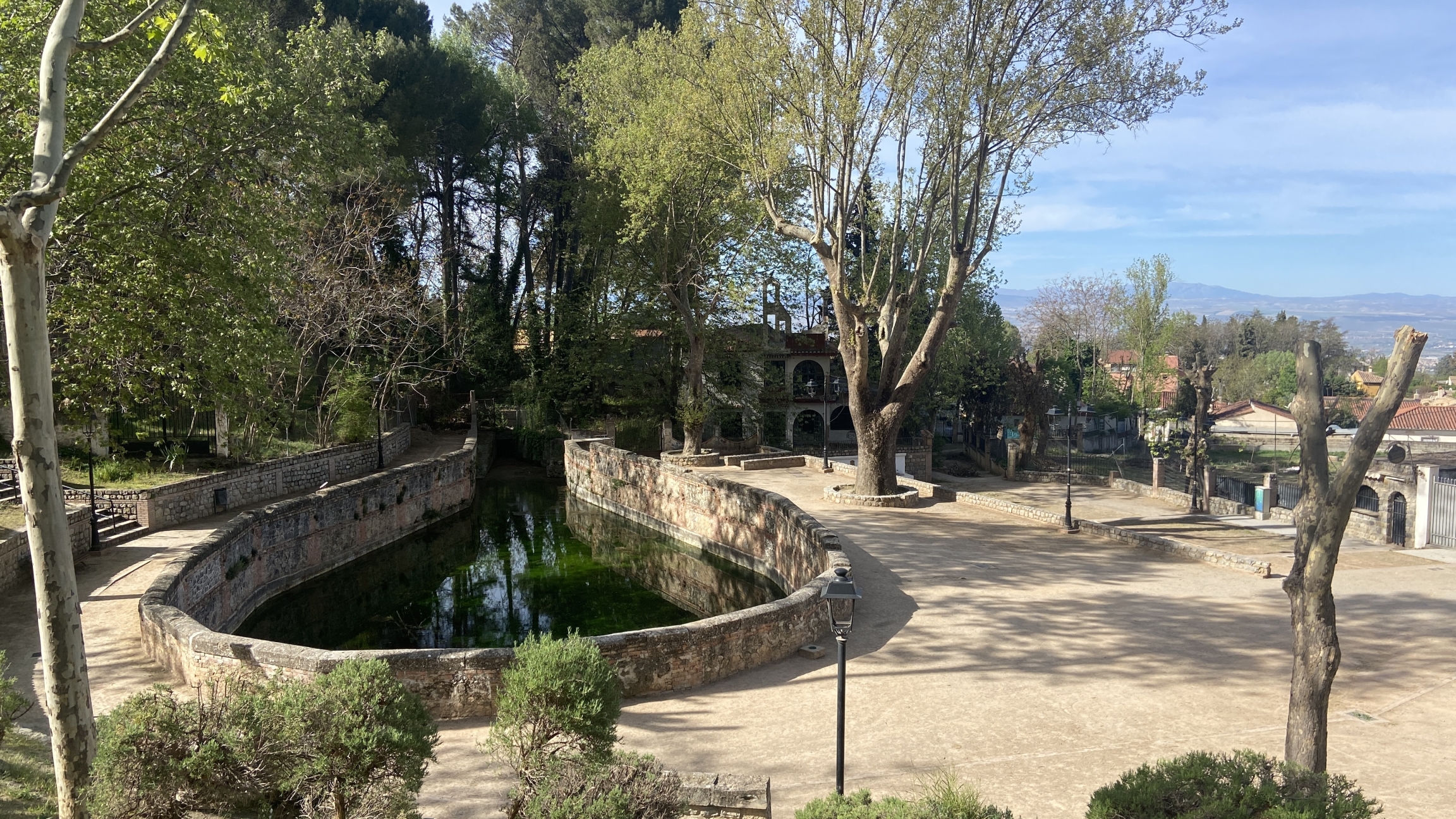
The Well of Tears, some 10 miles up the mountain from Granada, Spain, is the source of water for the newly restored canal.
Gerry Hadden/The World
Ortega explained what he calls the real genius behind the acequias. Further up in the Sierra Nevada mountains, he said, there are canals that are not for watering crops directly. They run horizontally along the range until all of their water just seeps away into the earth.
“It might seem wasted, but the water is filtering down the mountainside. That’s why far below the canals, you find fruit trees and crops that normally wouldn’t flourish at such high and dry altitudes,” he said.
To reach the highest of these canals, you drive a dirt switchback a couple of hours to about 7,000 feet above sea level. Here, above the treeline, runs the Acequia de Los Hechos. It’s about 3 miles long and is meant to feed aquifers below.
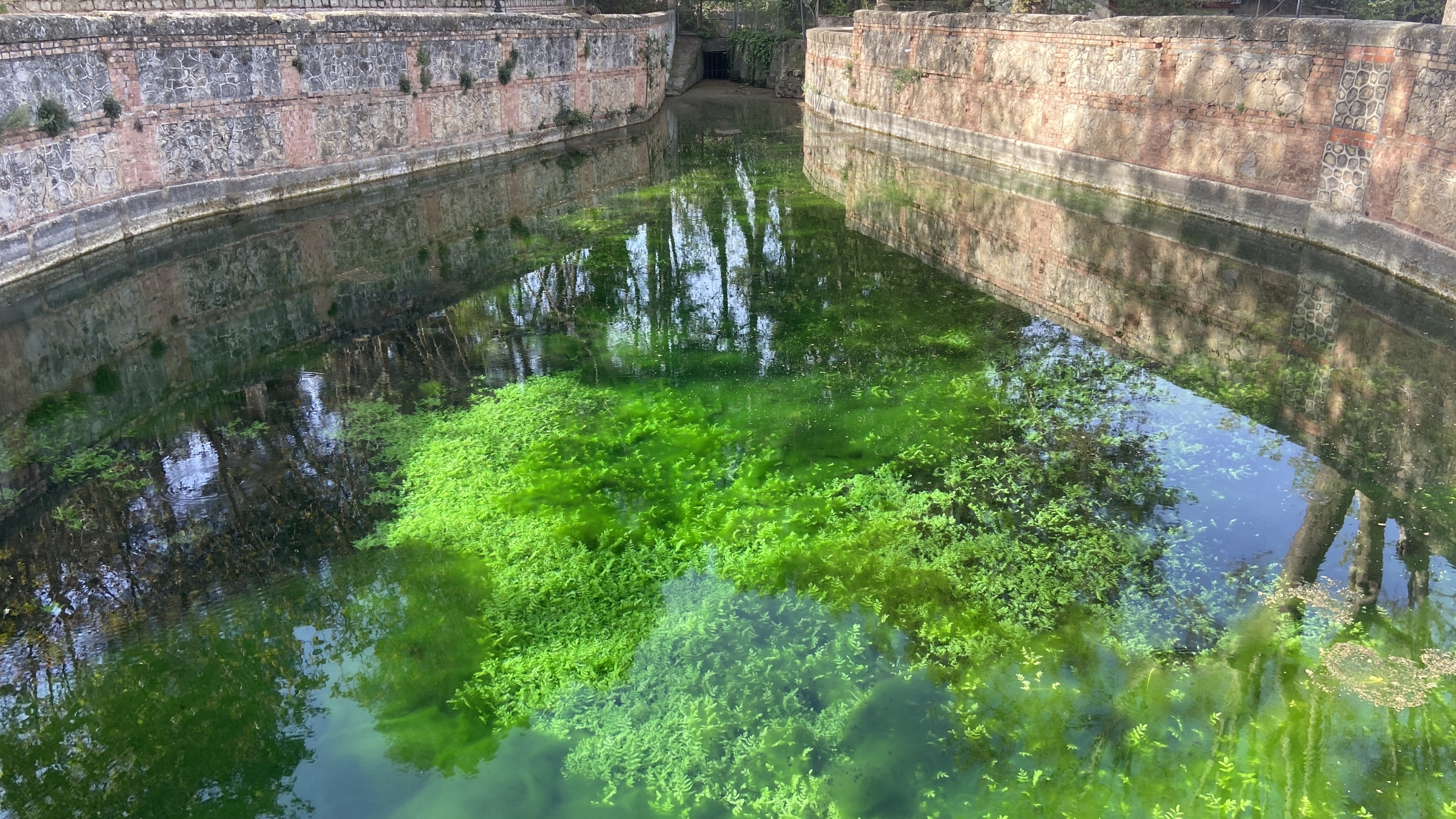
The Well of Tears, some 10 miles up the mountain from Granada, Spain, is the source of water for the newly restored acequia.
Gerry Hadden/The World
Farmer Alejandro Molina tends to his potatoes and chestnut trees on his ranch here.
“The canal here provides water to all the farms you see below,” Molin said. “If you were to cut off the acequia, this place would become a desert.”
The importance of tackling climate change has never been clearer. But despite all the science that has accumulated over more than 30 years about its perils, planet-warming emissions continue to rise.
The good news is that climate solutions are now more accessible than ever. The cost of wind and solar power, for example, has plummeted in the last decade. Expanding existing efforts to reduce deforestation and increase energy efficiency has the potential to significantly slash emissions.
In the ongoing series, "The Big Fix," The World reports on what communities, individuals, governments and businesses are doing to cut emissions, as well as adapting to the impacts of climate change that are already being felt.
Check out more reporting on "The Big Fix" here. And tune into The World’s social channels for our monthly video series exploring climate change solutions around the globe.
On a hot, windy afternoon in January, Syed Sajjad Ali showed off bunches of juicy, greenish-red tomatoes hanging on rows and rows of vines on his farm in the southern Indian state of Telangana.
The crops are housed inside a covered structure made of sheer, white material.
“This is protected from the sun, protected from the rain, protected from the insects,” Ali, 60, said, standing beneath the white fabric roof which stretched just a few feet above his head.

Syed Sajjad Ali inspects tomatoes planted inside a Kheyti greenhouse.
Sushmita Pathak/The World
The crops are planted on a small patch of land about 1/8 of an acre. In India, the average farm size is 3 acres compared to 445 acres in the United States. The vast majority of farmers in India — and worldwide — are small farmers. They own less than 5 acres of land but grow 1/3 of all agricultural produce.
Small farms are also most vulnerable to climate change. The structure covering Ali’s tomatoes, known as a “greenhouse-in-a-box,” is part of a solution designed to help them cope with the vagaries of a changing climate. The design, essentially a low-cost, scaled-down version of a standard greenhouse, is the brainchild of an Indian startup called Kheyti.
In 2022, it was among the winners of the annual Earthshot Prize that honors environmental solutions. The idea was conceived some 10 years ago when Kheyti’s co-founders were trying to figure out what Indian farmers were struggling with the most.
“We started talking to hundreds of farmers across the country, and all of them said something that was related to climate change,,” said Khetyi co-founder Saumya, who goes by one name.
Across the globe, summers are getting hotter and rainfall is growing less predictable. As the globe warms, storms are expected to grow more intense.

Bunches of juicy, greenish-red tomatoes hang on rows and rows of vines in a farm in the southern Indian state of Telangana. They are planted inside a low-cost greenhouse designed by the Indian startup called Kheyti.
Sushmita Pathak/The World
To help Indian farmers become more resilient to this less predictable weather, Saumya and her fellow co-founders brainstormed a lot of different ideas.
“We looked at a bunch of things. We looked at insurance, we looked at different seeds. We also came across the greenhouse, which had been around for many centuries,” Saumya said.
Greenhouses help crops grow more efficiently by maintaining a controlled temperature and humid environment. They also protect crops from pests and unpredictable weather. But in India, it’s mostly wealthy farmers who can afford greenhouses. They also don’t come in compact sizes, which would be suitable for India’s majority smallholder farmers.
Saumya and her colleagues set out to design a much smaller, more affordable greenhouse by getting rid of the extra features that come with standard greenhouses, like height. Greenhouses typically are very tall and reinforced with a lot of steel.
“So, it was kind of like that whole negotiation where we said, OK, what is the bare minimum, covered structure that we can make? That was the approach,” Saumya said.
Along with the greenhouse, Kheyti also provides farmers with seeds, fertilizers, drip irrigation systems and installation help.
“Small farmers don't have market access. They don't know what inputs to buy,” Saumya said.

Kheyti's greenhouses are low-cost, scaled-down versions of standard greenhouses designed especially for smallholder farmers. Most Indian farmers are smallholders who are most vulnerable to climate change.
Sushmita Pathak/The World
Kheyti’s experts keep track of the crops’ status remotely by asking farmers to share regular photos on WhatsApp and advise and train farmers accordingly. The services, bundled with the product, make up the greenhouse-in-a-box, Saumya explained.
But convincing farmers to come on board can sometimes be difficult, she said.
“There's a lot of mistrust that farmers have toward companies who sell products and then run away,” she said.
Financing is another challenge.
“Banks don't really want to give small-farmer loans because they have no or low credit scores,” she said.
Farmers will save up money to buy a cow or buffalo but are much more skeptical about any new product.
But Saumya is optimistic. She said Kheyti’s greenhouse is in a similar position to where the tractor was about five decades ago.
“It took around 40 years until [the tractor] became mainstream in India. The greenhouse is also a similar sort of an asset, it's expensive, and it takes some time to see the return and get used to it,” she said.
So far, about 1,000 farmers across India have signed up for Kheyti’s greenhouse.
Ali got his greenhouse seven months ago and he said he is already seeing the results.
“The size of tomato and the quality of tomato is much better than [those grown in the] open field. Buyers very quickly take my tomatoes because they like this one,” Ali said.
A few miles down the road from Ali’s farm, Renuka, who goes by one name, planted tomatoes in an open patch, not in a greenhouse. Her tomatoes are smaller and haven’t had many takers, she said.

Farmer Renuka stands inside a Kheyti greenhouse where she planted cucumbers, which wouldn't have been possible to cultivate in the open because of the hot weather conditions in her state.
Sushmita Pathak/The World
For several weeks now, the going rate for tomatoes at her local village market has been a paltry 5 rupees, or around 6 cents, per kilo, she said. Factoring in transport and labor costs, she figures she will make a loss selling at those prices, so she was not even going to bother harvesting them.
Anguished, she’s decided to leave them in the field to rot.
“Water wasted, fertilizer wasted, seedlings wasted. I get angry when I look at this,” she said.

Renuka plucks a few tomatoes from her vegetable patch. She's leaving her harvest to rot in the field because it wasn't able to fetch a substantial rate at her local market.
Sushmita Pathak/The World
Kheyti’s greenhouse can help farmers get higher prices by allowing them to grow in the off-season when most people are not growing and the supply is low.
“For off-season, it will work like a wonder because you can rely on higher prices, your economic viability will be more,” said Anjani Kumar, a senior research fellow at the International Food Policy Research Institute in Delhi. “We need more and more greenhouses there is no doubt about it.”
The greenhouse can also help by allowing farmers to grow vegetables that are not commonly grown in the region. That’s exactly what Renuka did a few months ago — she pooled her savings to buy a Kheyti greenhouse for about $600 and planted cucumbers.
It is too hot to grow cucumbers in the open, she said, but in the greenhouse, she got a pretty good harvest. Cucumbers sell for higher prices than the vegetables she usually grows and over two crop cycles, she said, she’s almost recovered her investment.
She hopes to make her first profit soon.
The small greenhouse is a good idea, Kumar said, but there are some limitations. It is only suitable for farmers who grow fruits and vegetables, he said. Farmers who grow other crops may have to take up poultry or livestock to supplement their incomes.

Syed Sajjad Ali inspects tomatoes planted inside a Kheyti greenhouse.
Susmita Pathak/The World
As the climate changes, the government should also promote professions other than agriculture in rural areas, he said.
“So, that they can work on the farm, they can work off the farm and combined they can have better income.”
Whatever the solution, Kumar said government policies must take into consideration the needs of smallholder farmers.
“The bulk of the production and bulk of the cultivated area comes from the smallholders,” he said. “They are going to be the most significant part for the foreseeable future for Indian agriculture.”
And Kheyti wants to help these smallholders become climate smart. Over the next couple of years, the startup plans to get its greenhouses to 10,000 farmers.
On a Sunday morning, a dozen young children gathered in a small, tin shed with plastic sheets for a roof and no flooring.
This is an informal school for children of all ages near the Hebbal locality in north Bangalore, India, taught by college-aged volunteers. But not much studying happens amid laughter, giggles and chaos.
Children who live here also attend formal government-run schools — but not regularly — because they move frequently to new places when their parents, who collect and segregate trash, have to migrate in constant search of work.
Most of the children came from villages in the eastern state of West Bengal, where their parents say they can not find decent-paying work. Although migrant waste pickers earn more in larger cities, they also face constant harassment from the police and local residents.
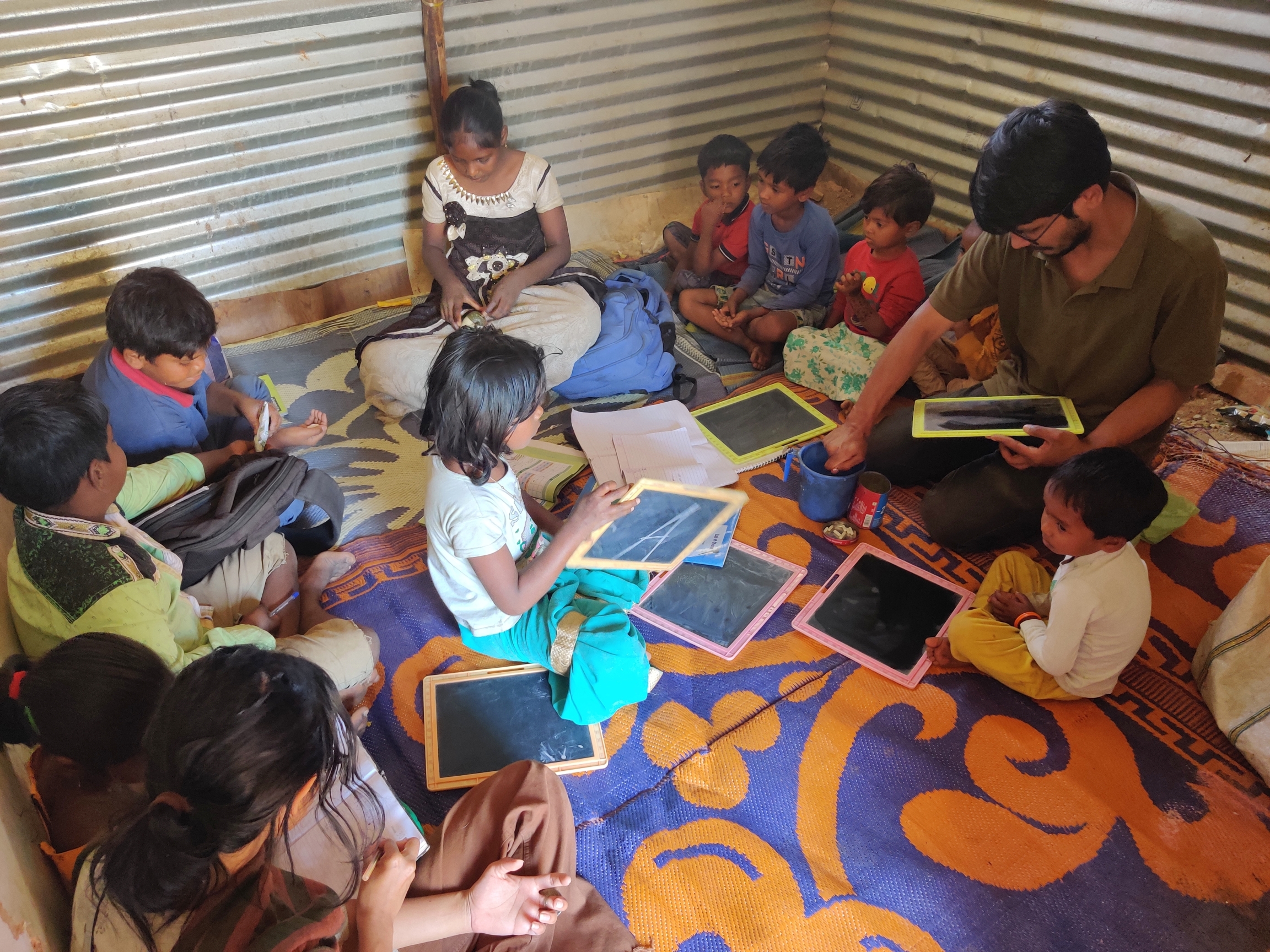
College students volunteer to teach children at an informal school in Bangalore, India.
Raksha Kumar/The World
Agents who arrange migrants' work set up small tin sheds on a large, open field for the families. Police say the flimsy homes were constructed illegally and on government land, so they periodically evict the tenants. The residents say the police will sometimes take bribes to let them stay, which many can not afford.
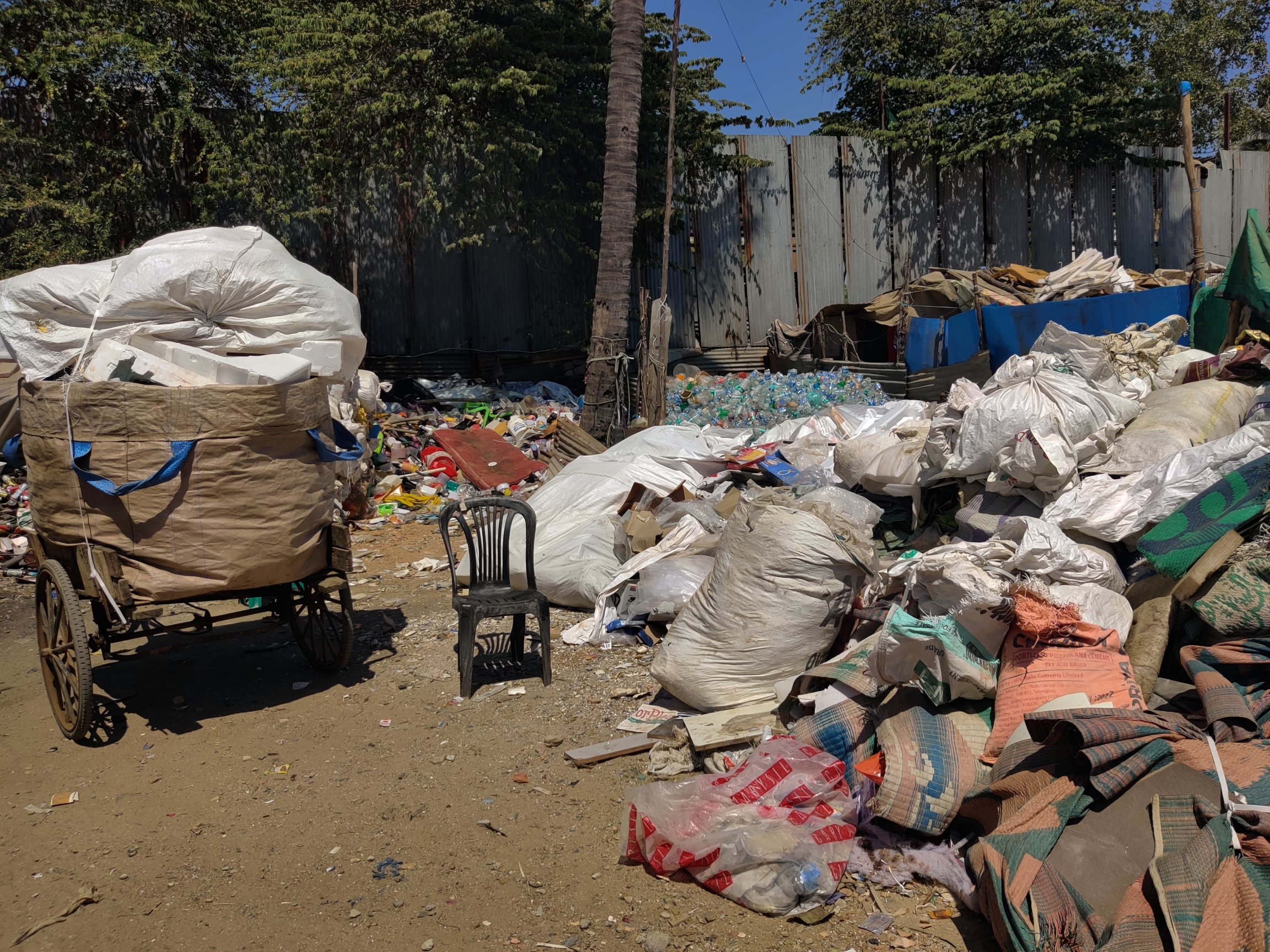
Waste pickers in north Bangalore separate trash to make a living.
Raksha Kumar/The World
“With the minimum income they are earning from this, they are having to again pay the police to stay here in these tin sheds,” said Saniya Nourin, who volunteers at the school.
“But, those who are targeted are the ones who speak Bengali, and those who are Muslim,” said Maggie Paul, a scholar from the University of Adelaide who has been documenting Bengali migrants in India.
Bengali migrant Salmina Sheikh came from a village near the city of Kolkata a year ago to rejoin her husband, who makes about $120 a month by selling segregated waste to nearby recycling plants.
“We need this money for our children, we can barely give them nutritious food in our village.”
Salmina Sheikh, who is six months pregnant and has a 2-year-old daughter, said they need the money for their children. "We can barely give them nutritious food in our village,” she said while cooking on an open fire outside her mud hut.
She added that staying in their village means there would be no money left for her children’s education. She said the police sometimes take away their money or phones — the police have denied this.
Salmina Sheikh sits with her toddler inside her home in an informal settlement in Bangalore, India.
Raksha Kumar/The World
The Indian state of West Bengal shares a history, culture and language with neighboring Bangladesh. It’s difficult to differentiate Muslims from West Bengal and those from Bangladesh since they all speak Bengali. And many Indian migrants say they are being harassed merely for being Muslim.
“We all have documents to prove that we are Indian citizens,” said Saeeb Sheikh, a local agent who is not related to Salmina Sheikh. He receives a commission for bringing migrant workers from the poorer regions of West Bengal to Bangalore.

Homes in this informal settlement in Bangalore, India, are made of tin and plastic sheets.
Raksha Kumar/The World
A 27-year-old agent who asked not to be named to avoid trouble with authorities admitted that some workers from Bangladesh are paid less than workers from India.
Since 2019, when Indian Prime Minister Narendra Modi was elected for the second term, his party has spoken out against those they call "illegal immigrants" from Bangladesh.
Home Minister Amit Shah has also addressed the media on the issue several times.
“We will not let even one illegal immigrant stay in the country," Shah said. He has even used derogatory names to describe Bangladeshi immigrants.
Scholar Maggie Paul said that this is an ageold narrative — Muslims from neighboring countries taking away land, jobs and resources —that ultimately galvanizes votes. She traces the issue back to the British division of the subcontinent into Hindu-dominated India and the Islamic Republic of Pakistan.
Karnataka, the capital of Bangalore, will go to the polls in about two weeks to elect a state assembly. Many candidates are seeking votes by claiming they will rid the city of illegal migrants from Bangladesh.
Trash segregators in Bangalore, India, pile up glass bottles to one side as they separate waste.
Raksha Kumar/The World
“I get WhatsApp messages congratulating me on my work in removing these Muslim migrants," said a Karnataka politician who asked not to be named because he has not been cleared by his party to speak to the media.
Paul said that harassment by the authorities serves a two-fold purpose: politicians get electoral gains and migrant labor becomes all the more vulnerable and open to exploitation.
And, in a country ruled by a Hindu nationalist party, their Muslim religion pushes them toward maximum vulnerability, said author and researcher Govind Kelkar.
The People’s Union for Civil Liberties filed a case in January 2020 in the Karnataka High Court challenging an eviction of a settlement in Bangalore. The following month, the court asked the government to provide alternate housing arrangements and compensate the migrants monetarily for losses caused by evictions.
High-rises seen from a waste pickers colony in north Bangalore, India.
Raksha Kumar/The World
Ravi Nair, with the South Asia Human Rights Documentation Center, a New Delhi-based nonprofit, explained it this way:
“If the government resorts to large-scale deportation of Bangladeshi climate and economic migrants, the waste collection, sanitation and scavenging sector would collapse in all major Indian cities."
Raksha Kumar is a media fellow working on migration with the Asia Pacific Forum On Women, Law and Development. This story was part of her fellowship.
On Feb. 6, Elçin Ezer’s apartment building collapsed in the massive, 7.8-magnitude earthquake that ripped across southern Turkey.
She survived underneath the wreckage for four days, hugging her daughter as she died in her arms. Her mother and her son were in the next room, but she never heard their voices. She thinks they both died on impact.
The shaking destroyed at least 55,000 buildings in Hatay, the province for which Antakya is the capital. Thousands died — including at least 700 in the collapse of a single luxury apartment block. Survivors emerged into a waking nightmare.
Immediately after the earthquake, Ahmet Sarp used his mechanical lift to rescue survivors from upper-floor apartments in buildings that were still standing, but whose staircases had collapsed. Today, he uses it to help families salvage furniture from their damaged homes. Renting the machine and hiring workers can cost $500 per apartment.
Durrie Bouscaren/The World
Every day, Ezer walks to the pile of rubble that used to be the home she shared with her two children, who were 8 and 13. She’s haunted by the fact that rescue workers didn’t arrive at the site for days. Her ex-husband drove from Antalya to dig her and their children out, she said.
“People ask me why I came back, and I don’t know what to tell them,” Ezer said. “My legs brought me here on their own.”
Antakya today is a city of grief. At least 57,658 people have been confirmed dead in Turkey and northern Syria following the earthquakes, with many still missing. Though many residents have left the city to escape the risk of aftershocks, many remain to mourn, offer support and rebuild.
“I feel better here,” Mehtap Yılmaz said. “Here, I lost so many friends, relatives — so many close friends. But we’re trying to stick together.”
A dusty haze hovers above the ruins of buildings as crews tear down wrecked apartments. The Turkish government has promised to rebuild earthquake-damaged cities within the year. But with 1.5 million people across an 11-province disaster region now homeless, that seems impossible.
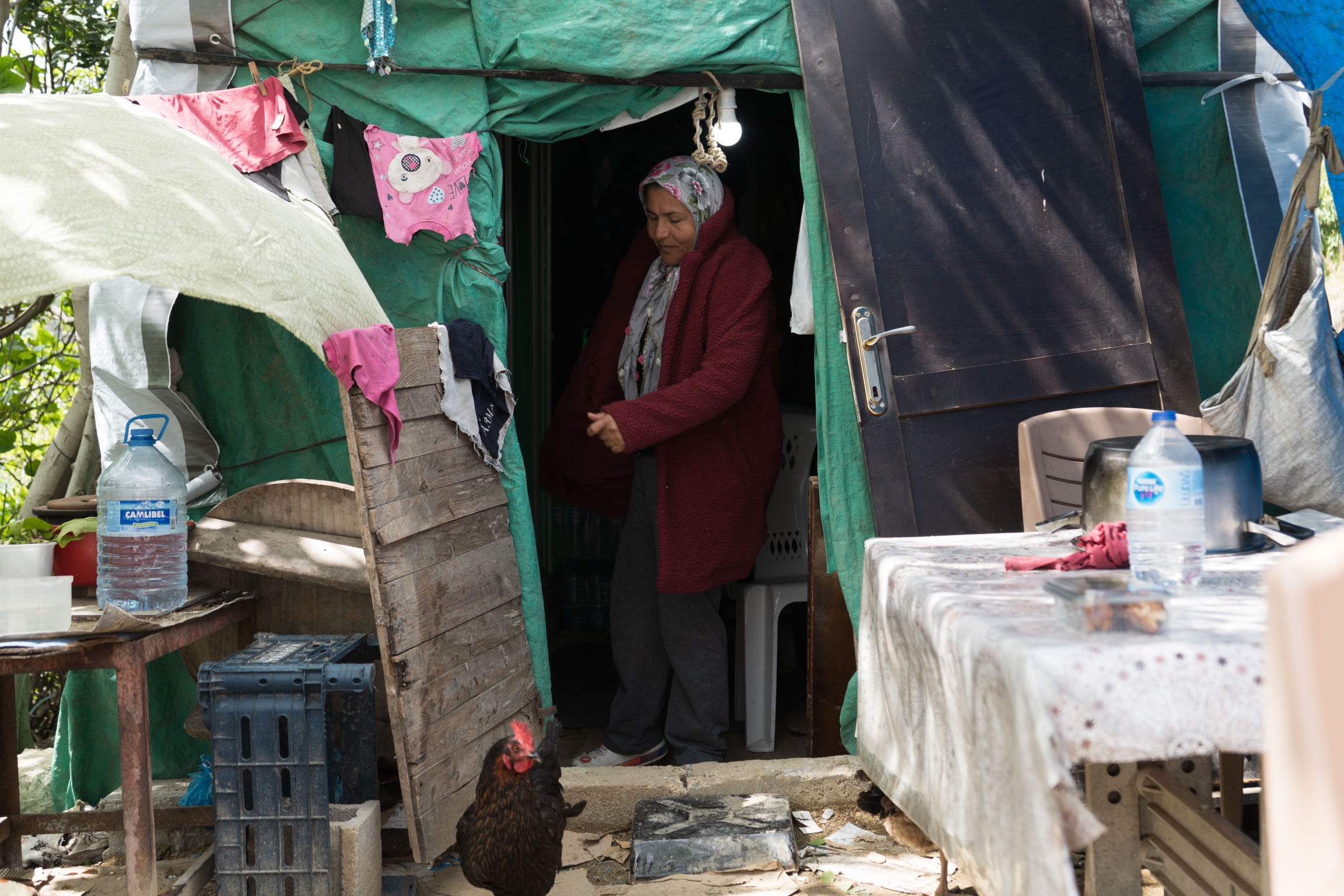
Perihan Yüksek prepares tea in a makeshift tent that functions as a kitchen.
Durrie Bouscaren/The World
These days, almost everyone lives in tents or converted shipping containers — some in formal camps, others in public parks, or among the ruins of their homes and neighborhoods. Children can attend one hour of school per day in tent camps.
In Antakya’s city center, there are creative solutions for small, daily comforts: Fresh baklava sold from a tent. A mobile ATM fashioned out of a van. A phone store set up in a shipping container.
“When I see someone who I knew before the earthquake, it’s incredibly emotional … it’s like we didn’t understand the feeling of being sad,” said Onur Aşkar, a barber who offers shaves and haircuts underneath a tarp set up in a street median.
Sami Joba chopped onions for kebabs, which he grills on a charcoal stove. He lost his restaurant in the earthquake. But his friend, who drives a school van, was also out of work. They converted the van into a setup for an outdoor kitchen, with the slogan that translates in English to: “If I don’t eat, I will die.”
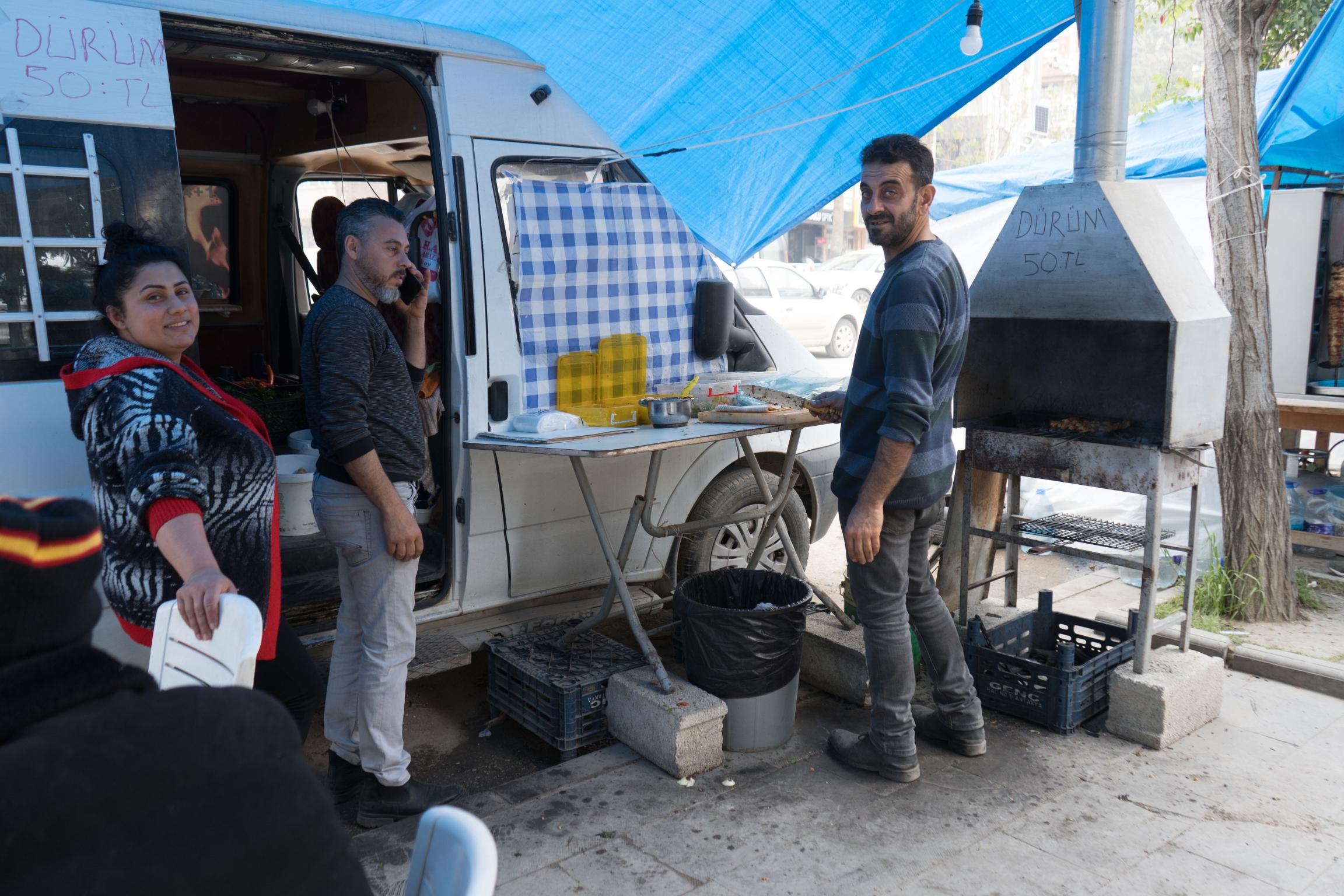
Açeyla Açıkbaş, Ozhan Açıkbaş and Sami Joba run a mobile kebab shop in downtown Antakya.
Durrie Bouscaren/The World
One kebab, wrapped in a flatbread with onions and tomatoes, costs 50 Turkish lira — about $2.50. For families living in tent cities, it’s a rare chance to eat hot food that they’ve chosen for themselves.
“It’s cheap, and it has a nice taste,” Joba said, without looking up from his work. “And — we don’t have anywhere to cook now.”
For Selma Koşar, who waited with her 12-year-old son for their order, it was the first time they had had a kebab since the earthquake. The two are staying in a tent city nearby.
“It’s always soup, beans and rice,” she said. “But it’s not for me — it’s for my son. We don’t have enough money.”
After the earthquake, Koşar said, her son couldn’t speak or eat for several days. When she saw him get excited about having a kebab, she couldn’t say no.
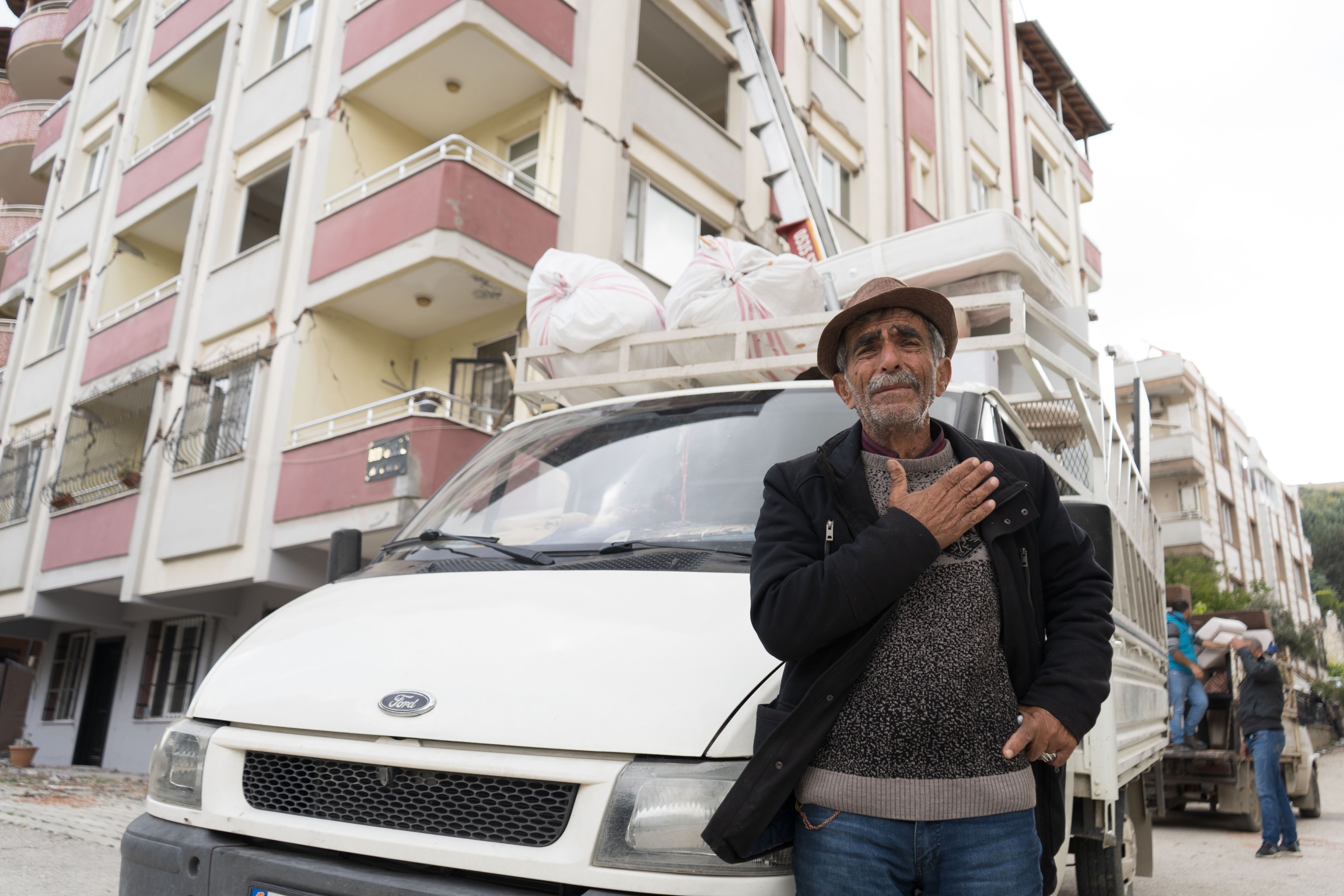
Suleyman, a truck driver, lost his family in the earthquake. He has remained in Antakya to help families salvage furniture from their wrecked homes.
Durrie Bouscaren/The World
Throughout the daylight hours, debris is cleared and packed onto trucks, which are driven out of town and dumped along the highway. Tall mechanical lifts, which spent the first weeks of the disaster pressed into service to rescue survivors, now line up to the rickety husks of apartment buildings as people salvage furniture from their damaged homes.
Climbing up into these apartment blocks is dangerous work, but it pays well.
Anas Saghir, a Syrian refugee, said that he sent his wife and children to Konya, a city that sits further away from earthquake fault lines. But he stayed behind to work.
Every day, he said, his kids cry on the phone, asking him to come for them. They were traumatized by the frantic escape from their home in the early morning hours; the staircase of the building collapsed as the family rushed downstairs, hitting Saghir in the head.
“They’re always saying ‘baba, baba,’” he said, fighting back tears.
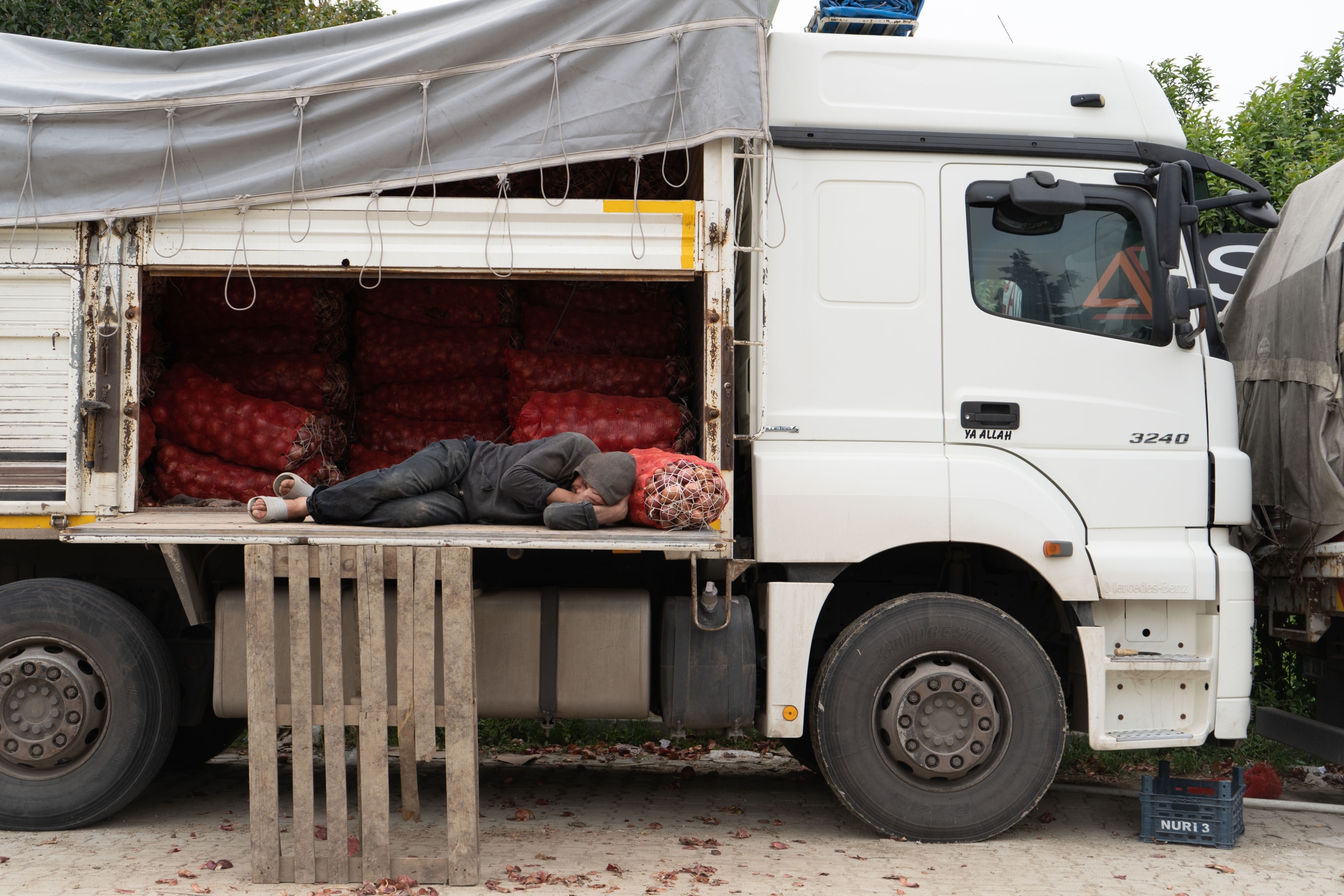
A worker sleeps during a short break while transporting onions in Hatay.
Durrie Bouscaren/The World
At night, he sleeps in a tent in the ruins of a baklava shop. He’s just grateful they all survived.
“Thank God for everything,” he sniffed.
Other families have moved to the hills where villages ring the outskirts of old Antakya.
Perihan Yüksek used a match to light a propane stove in a makeshift tent that serves as a kitchen. She came to the village after the earthquakes to be with her cousin, Bedia Yüksek, who’s mourning the loss of her daughter, Huliya.
Bedia Yüksek holds a photograph of her daughter, Huliya, who died in Antakya during the earthquakes on Feb. 6.
Durrie Bouscaren/The World
“Whenever I’m in the tent, it feels like the pain is going to kill me,” Bedia Yüksek said.
Her daughter was sleeping in her apartment in Antakya when the earthquake hit. Perihan Yüksek’s son, who was also living nearby, survived, but lost both of his legs.
The Yükseks' home is still standing, but appears as if it could collapse at any moment. Bedia Yüksek and her husband set up donated tents in the garden and wired them with electricity. On a recent visit, several mattresses have been prepared for relatives who will visit in the coming days. A photograph of their late daughter sits next to the television, watching over them.
“Life continues, because it has to,” Perihan Yüksek said. “Life goes on until God takes it from us.”
Bedia Yüksek and Mehmet Yüksek’s home remained standing after the earthquakes, but is no longer safe to live in. They’ve been staying in tents ever since.
Durrie Bouscaren/The World
Days are spent washing clothes by hand, cooking outdoors and making improvements to the tents so they stay dry in the rain. They eat eggs from their chickens and oranges from their garden. But the Yükseks are determined to stay until their home is rebuilt.
It’s like going back in time, Perihan Yüksek mused over a glass of tea. As she finished her cup, she flung the extra out onto the dirt floor.
“I guess that’s something,” she said. “If you don’t have a living room, there’s nothing to clean.”
This analysis was featured in Critical State, a weekly foreign policy newsletter from Inkstick Media. Subscribe here.
New research suggests that elephants may be self-domesticated, which could tell us not only about the similarity between elephants and humans but also about why humans evolved the way we did.
A theory known as the human self-domestication hypothesis suggests part of what is unique about human behavior — our development of cultures, tools, and languages — came about because of an evolutionary process that did not favor aggression. But that theory is hard to test as so few living beings are self-domesticated.
Enter the elephant, joining bonobos as another species that may also be self-domesticated, as suggested by Limor Raviv, Sarah L. Jacobson, Joshua M. Plotnik, Jacob Bowman, Vincent Lynch, and Antonio Benítez-Burraco, writing in a new article in the Proceedings of the National Academy of Sciences.
They write that “elephants indeed exhibit many of the features associated with self-domestication (e.g., reduced aggression, increased prosociality, extended juvenile period, increased playfulness, socially regulated cortisol levels, and complex vocal behavior.)”
This, they say, is reinforced by genetic evidence, insofar as “genes positively selected in elephants are enriched in pathways associated with domestication traits and include several candidate genes previously associated with domestication.”
One particularly interesting point of potential proof is “an extended juvenile period and enhanced play behaviors have been hypothesized to be a crucial outcome of self-domestication, contributing in turn to the behavioral changes associated with self-domestication, particularly to cultural niche construction, in a sort of positive feedback loop.”
Elephants take longer to develop, and more of what they learn is taught, as opposed to innately known. They also note that “enhanced playfulness in adulthood can counteract tendencies toward dominance, promoting more egalitarian and cooperative behaviors and thus contributing to the sophistication of culture.” Every playful adult elephant is (maybe) a sign of evolutionary success.
The socialization patterns of elephants, the authors argue, “parallel what we find in humans.”
Human self-domestication is thought to have been “triggered by several (potentially interacting) factors, including the reliance on more variable and nonlocal food sources that require more cooperation to obtain, and the adaptation to harsh environmental conditions like those resulting from the Last Glaciation, which increase the need for resource sharing.” They theorize that there were also several potential triggers for elephants, too.
The point isn’t just that we now know more about elephants, though, for pachyderm fans, that is exciting, too. It’s that we might know more about ourselves and how we humans came to be as we are.
“If elephants have undergone self-domestication, one can expect to see at least some of human’s unique social and cognitive abilities in elephants as well, especially those associated with cultural niche construction and cultural evolution,” they write.
“Our hypothesis for self-domestication in elephants thus has important implications for studying the process and outcomes of cultural evolution, which is seen as one of the most prominent and powerful hallmarks of humanity.”
Critical State is your weekly fix of foreign policy analysis from the staff at Inkstick Media. Subscribe here.
For human beings, Earth is a supremely human place. A world of concrete, steel, glass, plastic, cars, paved streets and highways, and lots of other human beings, generating mountains of waste. Here and there, pockets of nature for human beings.
Dutch chemist Paul Crützen coined a term for Earth’s human age — the Anthropocene. Crützen proposed that it be declared a new epoch in Earth history, terminating the one geologists say we’ve been in for the past 12,000 years, the Holocene.
This summer, a scientific panel will shift Crützen’s proposal up a notch.
The Anthropocene Working Group (AWG) was set up in 2009 by a commission of the International Union of Geological Sciences. Its task — defining the Anthropocene, geologically.
Crützen’s idea was that the Anthropocene began with the 18th-century Industrial Revolution. In 2019, a decade of research under its belt, the AWG decided it actually began around 1950, at the start of what American environmental historian John McNeill dubbed the Great Acceleration, in the wake of World War II; a period marked by massive fossil-fuel burning, resource extraction, pollution, global trade and population growth, and the parallel rise of atmospheric carbon dioxide, surface temperature, biosphere degradation and so on.
The AWG’s next task was to identify one spot on Earth where the telltale signs of human activity are best observed in mid-20th-century sediments. The technical term for this is a mouthful — a Global Stratotype Section and Point. The more popular one: a “Golden Spike.”
To be precise, that Golden Spike would be the thin sequence of layers in a core pulled from the bottom sediments of a lake, bay or estuary, or from a peat bog, ice sheet, coral reef or stalagmite, somewhere on Earth, containing the chemical and material signatures of human activity dating to the mid-20th century. Key among these — spheroidal carbonaceous particles (fly ash) from coal burning, microplastics, heavy metals, isotopes of carbon and nitrogen associated with fossil fuel burning, and radioactive Plutonium-239 from atmospheric nuclear weapons testing that peaked in the 1950s.
After years of investigation, the AWG came up with a list of 12 candidate Golden Spikes — in Japan, China, Canada, the US, Denmark, Italy, Poland, Australia and the Antarctic. Each candidate site assembled a scientific team to study their cores in the minutest detail.
Francine McCarthy, lead scientist for Crawford Lake, in southern Ontario, is proud of her sedimentary cores.
“We do have the best site,” McCarthy said. “I have to accept some kind of maternal pride.”
McCarthy has reason to be proud. Crawford Lake has been recording human activities for thousands of years. That’s because it’s very deep, and its bottom sediments are permanently isolated. Those sediments consist of many layers, laid down year after year, all precisely dated.
They record the history of coal burning, the rise of atmospheric carbon dioxide and atmospheric nuclear weapons tests, all peaking around 1950.
So do sediments from the Baltic Sea, Japan’s Beppu Bay, Sihailongwan crater lake in China and the Śnieżka peat bog at the heart of Poland’s polluted “Black Triangle.” San Francisco Bay estuary cores are rich in invasive species, mercury and SCPs. Coral samples from the Gulf of Mexico and Cairns, Australia, are also competitive.
The competition is tense. To be chosen as the Anthropocene’s Golden Spike, a candidate site must receive 60% of votes from the AWG’s 23 voting members. Multiple rounds of voting have taken place over the past year.
As the AWG prepares to announce its choice, prominent geologists disagree that the Holocene Epoch ended, and the Anthropocene began, a mere 70 years ago.
“In geological terms, that's today. It’s just yesterday morning,” said Phil Gibbard, a geologist at Cambridge University. ”We have no clue about, seen from thousands of years in the future, whether this would be more than a blip.”
Only time will tell if the Anthropocene is a blip, said Simon Turner, AWG’s secretary. Turner, standing in a hallway at University College London, where he works in the geology department, reflects on the popularity of the Anthropocene idea in nonscientific circles.
“The thing with the Anthropocene, people get it,” Turner said. “They get the idea of, like, human activity on the planet. The Holocene … I can probably pull someone over here now and say, 'have you heard of the Holocene?' And they will not have heard of it … and geology is just down the corner, so you would hope someone has.”
The Anthropocene Working Group will announce its winning Golden Spike sometime this summer, or in the early fall, in Berlin. Its proposal will then pass up the geo-bureaucratic hierarchy — first to the Subcommission on Quaternary Stratigraphy, then the International Commission on Stratigraphy and finally, the International Union of Geological Sciences.
However, approval of that Golden Spike — either as the base of a new epoch, the Anthropocene, or just the latest stage of the Holocene (in which case, it would be named after its Golden Spike; the Crawfordian, for instance) — could take years.
Environmental activist Windel Bolinget remembers what it was like to end up on a government list for the first time.
It was 2018 and his name was included on a petition to designate the Communist Party of the Philippines a terrorist group — he wasn’t even a member of the group.
“My name was just included there,” said Bolinget, an Indigenous Igorot and the chairperson of the Cordillera Peoples Alliance. “There were more than 600 names just deliberately included there as terrorists.”
This happened, he said, because of his activism in opposing development projects in the Cordillera region — a mountainous, landlocked area on northern Luzon Island, the Philippines’ largest island.
The country has long been one of the most-dangerous places in the world for environmentalists. The international nonprofit Global Witness has, for years, ranked the Philippines in the top slots of its annual list as deadliest countries to be an eco-activist. Dozens of environmentalists and land defenders also die each year.
“In the Cordillera, our ancestral domains are targeted for big hydropower or dam projects, large-scale mining,” Bolinget said. “And our communities are resisting these projects because it violates our collective rights to our ancestral lands.”
Windel Bolinget is an environmental activist who ended up in a petition to designate the Communist Party of the Philippines a terrorist group, a group he is not a member of.
Ashley Westerman/The World
The Cordillera region is chock-full of natural sources. It is also a prime target for development.
Although Bolinget’s name, and hundreds of others, were eventually removed from the petition, the intimidation against them continued.
In 2020, Bolinget was falsely accused of murder and a warrant was issued for his arrest. A manhunt ensued and a shoot-to-kill order was placed on his head. The whole thing was completely fabricated, Bolinget said, which is how his lawyers were again able to get the warrant dropped.
But earlier this year, another arrest warrant was issued. This time, for Bolinget, five other Indigenous activists and a community journalist — all from northern Luzon.
“We are called the Northern Luzon 7, charged with rebellion or insurrection,” he said. “Again, there was no due process.”
Currently, the seven are out on bail. Bolinget and others traveled to the capital, Manila, last week to tell the government about their experiences, as well as to bring up the recent spate of bombings happening in the Cordillera region.
Since early March, people there have reported that up to nine bombs were dropped near their communities. Bolinget said this has disrupted their economic livelihoods and “brought terror.”
He added that he is afraid, but remains defiant.
“Of course, that's normal for a human being [to be afraid], but their intent is to silence us. But what we are doing, it's our duty. We cannot be silent. We owe this to our children.”
The struggles of environmental activists in the country go back decades, explained Carlos Conde, a senior researcher with Human Rights Watch based in Manila.
There was a term for it in the 1970s: “development aggression.”
The Philippines has been ranked as one of the most dangerous places in the world for environmental activists.
Ashley Westerman/The World
“This mainly refers to development projects that tend to displace environment and Indigenous people's communities,” Conde said. “And this has resulted in conflict.”
He said that much of the conflict stems from the government ignoring the requirement to get consent for projects from Indigenous communities called the Free, Prior and Informed Consent: a guiding, international human rights principle that basically says governments must consult and work with Indigenous communities before making decisions — such as building developments — that affect them.

The Philippines government often ignores the requirement to get consent for development projects from Indigenous communities.
Ashley Westerman/The World
Meanwhile, increased activity by communist insurgents in some of the same areas is creating a volatile situation, he added.
“That's why, now, with the Philippine government and national security's establishment, basically, they're targeting Indigenous people’s communities. But in many instances, these Indigenous people’s communities who are against the project are not necessarily insurgents.”
Conde said there is middle ground between development that the country sorely needs and the rights of Indigenous communities, but it comes down to the government making a deliberate effort to listen to them.
The current administration of President Ferdinand “Bongbong” Marcos Jr. has so far been silent on both the Luzon 7 and recent bombings.
Some analysts say that’s just part of keeping up the facade that Marcos has united support in the north, where he hails from. His home province Ilocos Norte is a picturesque place where the Cordillera Mountains meet the waves of the West Philippine Sea.
It is also rich in natural sources, both on the land and in the sea, said activist Genaro Dela Cruz, who is from the same province and is head of the Ilocos Human Rights Alliance.
“Illocos Norte actually was named as the center for renewable energy in Southeast Asia, not only in the Philippines, because of the windmill and solar farms that generate electricity.”
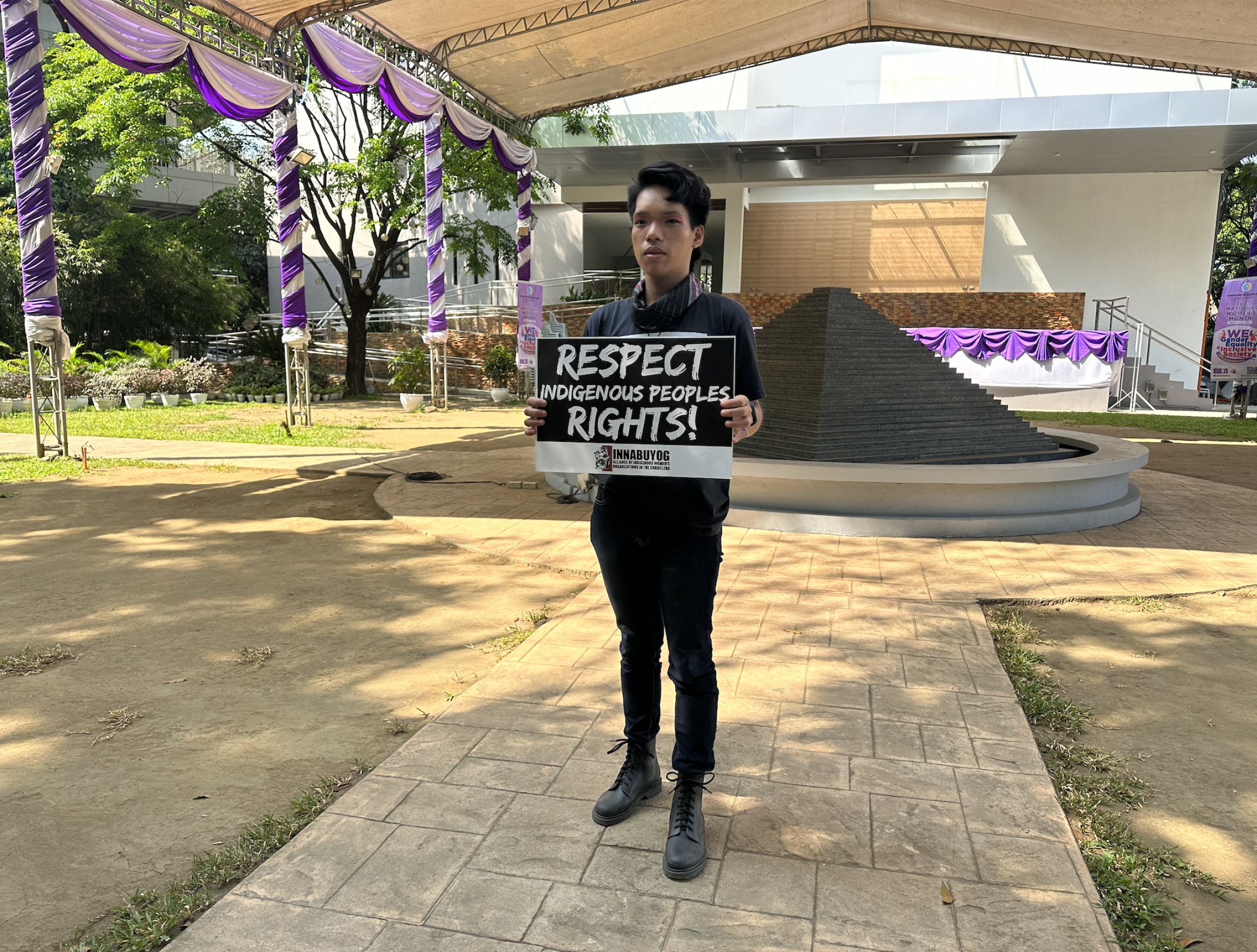
Protesters say they're not anti-development, but want to protect Indigenous lands in the Philippines.
Ashley Westerman/The World
But these developments threaten the communities there, said the veteran environmental activist, who has also experienced harassment by authorities for his activism.
Dela Cruz said the idea that activists are against development is a misunderstanding.
“We are not anti-development, but we want to put up development projects for the people and not for a few ones, or the rich ones.”
He said he hopes that including his community in conversations about development will ensure the projects benefit everyone.
Related: Record-breaking inflation rates in the Philippines are pushing people to take on extra jobs
Spain’s Institute of Science and Concrete Technology laboratory sits inside a cavernous, concrete hanger on the campus of Valencia’s Polytechnical University. It hosts one of Europe’s largest disaster simulators — all kinds of them, according to lead scientist José Adam.
“Earthquakes, explosions, fire, landslides, floods,” he said. “These are the events we work on.”
Adam’s lab is getting attention after the deadly earthquakes that struck Turkey and Syria in February, which killed at least 50,000 people.
The experimental lab looks like a massive construction site. But there’s some high-tech gadgetry among the pallets of building materials and the steel cabling: a hydraulic jack in one corner that can apply tons of pressure on, say, a bridge pillar; another contraption tests how well a concrete wall stands up to fire; yet another jack applies seismic pressure against a recently erected brick hut.

Inside the Institute of Science and Concrete Technology, construction materials and machinery are stored everywhere. It looks like a real-life construction site.
Gerry Hadden/The World
The main aim here is to make buildings more resilient by improving “continuity” — how well the different parts of a building hold together.
“Continuity is a key aspect because if one of the columns collapses, the load of that column should be transferred to other elements,” Adam said.
Think of a building as a group of mountain climbers all connected by a safety rope. If one climber slips, the others can collectively stop the fall and prevent the climber from sliding away.

Dr. José M. Adam, chief researcher at the Institute of Science and Concrete Technology, stands next to a hydraulic jack capable of applying tons of load pressure on simulated bridges and buildings. The tests help researchers understand how structures break, which can lead to better design and building techniques.
Gerry Hadden/The World
Adam’s team tests for continuity on full-scale buildings outside the city.
On a recent afternoon, they sent in a remote-controlled forklift to deliberately punch out a column on a two-story structure. The building sagged for a second, but didn't collapse. The team of some 50 people erupted in applause.
But sometimes, collapse is unavoidable, the scientist explained. Take the truck bomb that brought down a full third of the Alfred P. Murrah Federal Building in Oklahoma City, Oklahoma, in 1995.
That tragedy was a seminal moment in structural design — the homemade bomb, he said, took out just three of the building’s many columns, yet it led to structural catastrophe due to the domino effect of collapsing sections. After that, engineers came up with the idea of a so-called “last line of defense” for buildings.

Buckets of microfibers sit at the ready inside the experimental lab. The fibers are mixed with concrete to give it incredible strength and resistance.
Gerry Hadden/The World
Adam is working on what is called “fuse segmentation,” essentially structural break points in the building. It’s a safety measure, and works just like electrical fuses in a home.
“You won't see these fuses, because they are inside the structure.”
Under normal conditions, the fuses are structurally sound. But if one corner of a building begins to collapse, say, after a flash-flood, metaphorically speaking, the fuses will blow.
“It breaks this segment, separating the collapsing area from the rest,” he said. “This is a smart switch device.”
In other words, you can cut your losses. Almost like a lizard that can detach its own tail to escape predators.
The lab is still perfecting these structural fuses, but part of their genius is that they cost virtually nothing because it does not require bringing new materials or mechanisms to the construction process.
It’s a matter of strategically weakening certain parts of the building, which hold up under normal conditions but collapse under high stress.
“The construction sector is very conservative,” he said. “If you want to convince people to use a device, they won't pay for it.”

The entrance to Valencia’s Polytechnical University, home to the lab trying to make buildings and bridges more resilient to catastrophic stress.
Gerry Hadden/The World
Adam said he hopes this low-cost solution can be used everywhere one day, and not just in earthquake prone areas — with climate change, no building’s safety is guaranteed, because no one can predict the weather.
“For example, storms in places where you didn't didn't have storms in the past, or strong rainfalls or landslides in a place where maybe nothing happens now but in the future.”
But no matter how good building technology gets, if contractors don’t use it, then disasters like the quake in Turkey will continue to topple towers, and kill people, in large numbers.
Australian Roberto D’Andrea, a guest conductor on a streetcar in Kolkata, India, wore the green uniform of a Melbourne “connie,” or tram conductor, as he punched tickets and called out the name of each stop.
D’Andrea, a retired tram conductor, was part of the festivities last month for the tramway’s 150th anniversary, also marked by cake, music and a parade of gaily decorated old trams, led by a 100-year-old green wooden car.
D’Andrea’s love of trams has brought him back to the city again and again since he first visited 30 years ago. The “ding ding ding” noise the streetcar made, said D’Andrea, who belongs to the Calcutta Tram Users Association, reminded him of the trams in Melbourne.

Australian Roberto D’Andrea, a guest conductor on a streetcar in Kolkata, India, wore the green uniform of a Melbourne “connie” or tram conductor as part of the festivities last month for the tramway’s 150th anniversary.
Sandip Roy/The World
Melbourne and Kolkata have two of the longest-running tramways in the world.
But Kolkata’s tram system is limping along. It's down to just two lines, and despite a loyal band of supporters advocating for it, there is little political will, or room in the city's crowded streets, to bring the streetcars back to their former glory days.
Snehasis Chakrabarty, the West Bengal state transport minister, kicking off the celebrations, said that the trams face a lot of practical problems: Roads aren’t getting any wider and the number of cars on the street keeps rising.

A streetcar in Kolkata, India.
Sandip Roy/The World
“We are not here to say goodbye to trams,” Chakrabarty said. “Although, it is not possible today to run[a] tram [on] every route in [the] Kolkata metropolitan city due to congestion.”
Kolkata has far less road space compared to other Indian cities like Mumbai. So, trams have to share the road with cars, trucks, rickshaws, buses, three-wheelers and millions of pedestrians.
Many old tram routes have also been taken over by buses and three-wheelers.
Ongoing construction of the underground metro railway system also disrupted old tram routes.

Kids ride a streetcar in Kolkata, India.
Sandip Roy/The World
But the transport minister promised that trams will remain at least as a heritage ride for tourists.
Transport consultant Suvendu Seth, sitting in a bustling, new cafe in a tram depot, argued that trams should be for mass transport, not heritage.
“Why don’t we make those roads which are narrow for pedestrians and trams only? Why allow vehicles there?”
Many cities in Europe, Australia and the US got rid of streetcars during the automobile boom of the 1950s and ’60s, he said. Now, with a push toward sustainability and green transport, many cities are bringing streetcars back, often at great expense.
“And we had it all the time, and we are neglecting it,” Seth said. “That’s not a very nice thing. We should encourage it.”
Especially in a city where the air quality index is routinely over 200 during the winter months.
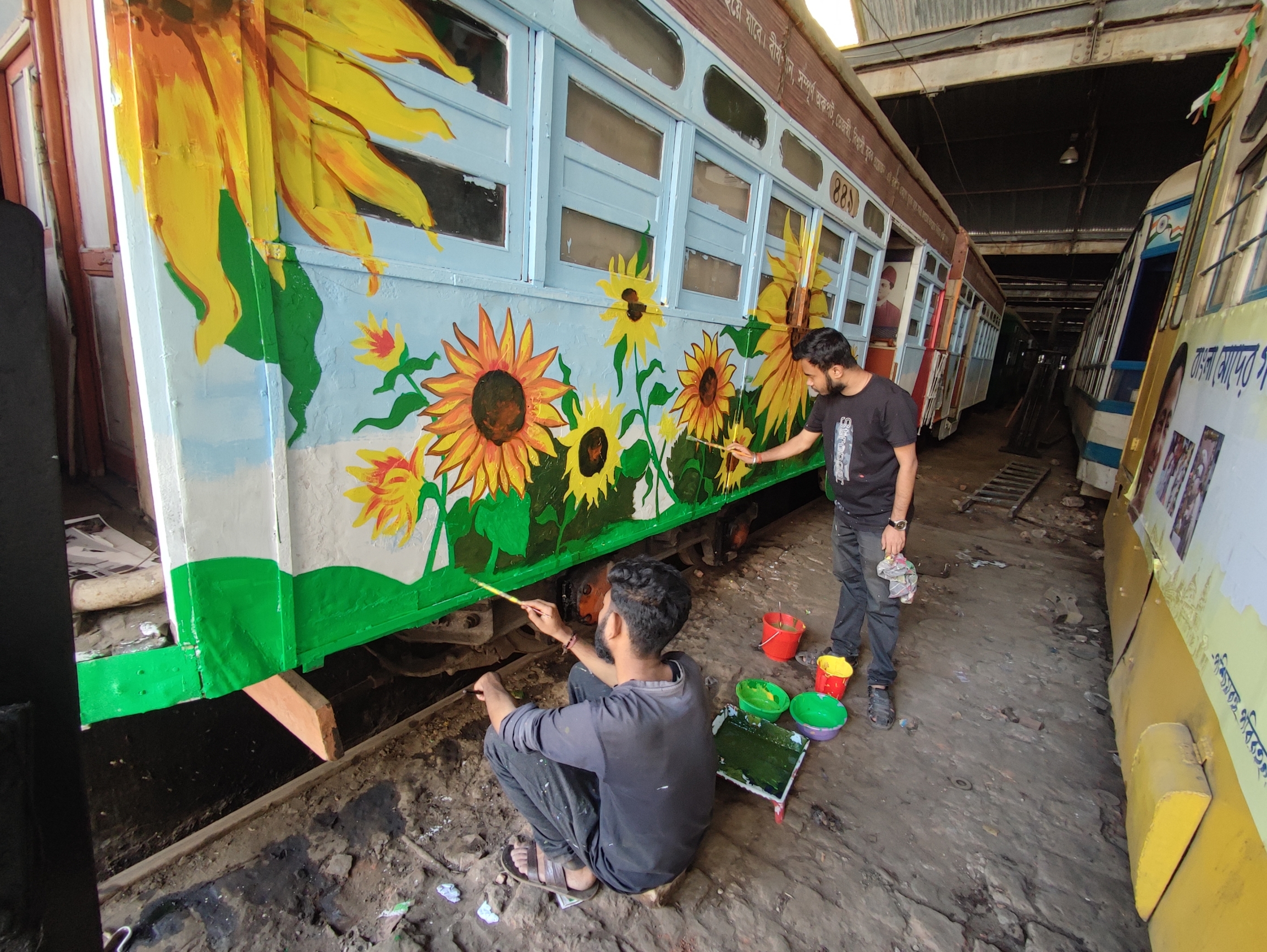
Art students paint a streetcar in Kolkata, India, for a celebration marking the tramway's 150th anniversary.
Sandip Roy/The World
But there’s a misconception that trams “are from another century,” he said.
The double-bogeyed streetcars of Kolkata do feel old — they have not been updated in decades and rattle noisily down the middle of the street, sometimes losing the overhead electric connection.
But tram workers have not given up. During the anniversary event, a group of streetcar workers raised slogans demanding that more services be resumed.

The festivities last month for the tramway’s 150th anniversary in Kolkata, India, were marked by cake, music and a parade of gaily decorated old trams, led by a 100-year-old green wooden car.
Sandip Roy/The World
One streetcar driver, Gopal Ram, reminisced about how his family had worked for the tramways for generations.
His great-grandfather, Antu Ram, worked on trams when it was still steam-powered. His grandfather, Mahavir Ram, and his father, Jagannath Ram, both spent their lives working on trams.
When Hindu-Muslim riots engulfed Kolkata in the 1940s, tram workers drove empty trams to restore confidence in a shattered city.

The tramway in Kolkata, India, turned 150 years old last month.
Sandip Roy/The World
“My father, himself, helped save people from a mob,” Gopal Ram said.
Gopal Ram just retired after 39 years of service. He said that he sees no future in the trams of Kolkata. For Gopal Ram, it is the end of the line.
Businessman Kizito Tinarwo said he has many orders for products from his small steel and aluminum factory, but power blackouts have hit production hard in Zimbabwe.
He uses a gasoline-powered generator when the power goes out, but this is expensive and has its limits.
“It cuts into profits because we add to our costs of doing business,” he said. “The generator cannot run forever; it has its prescribed running hours. We switch it on and off. In the process, our lead times are affected.”
This has been the case since he started his business about four years ago. But the latest outages have been longer — sometimes lasting 19 hours a day.
Along the border between Zimbabwe and Zambia sits Lake Kariba, where low water levels have interrupted power supply to both countries. The world’s largest manmade lake by volume is on the Zambezi River, with hydroelectric power generators on both sides. Zimbabwe gets 70% of its power from Lake Kariba. But plunging water levels have worsened a yearslong power crisis — profoundly impacting the economy.
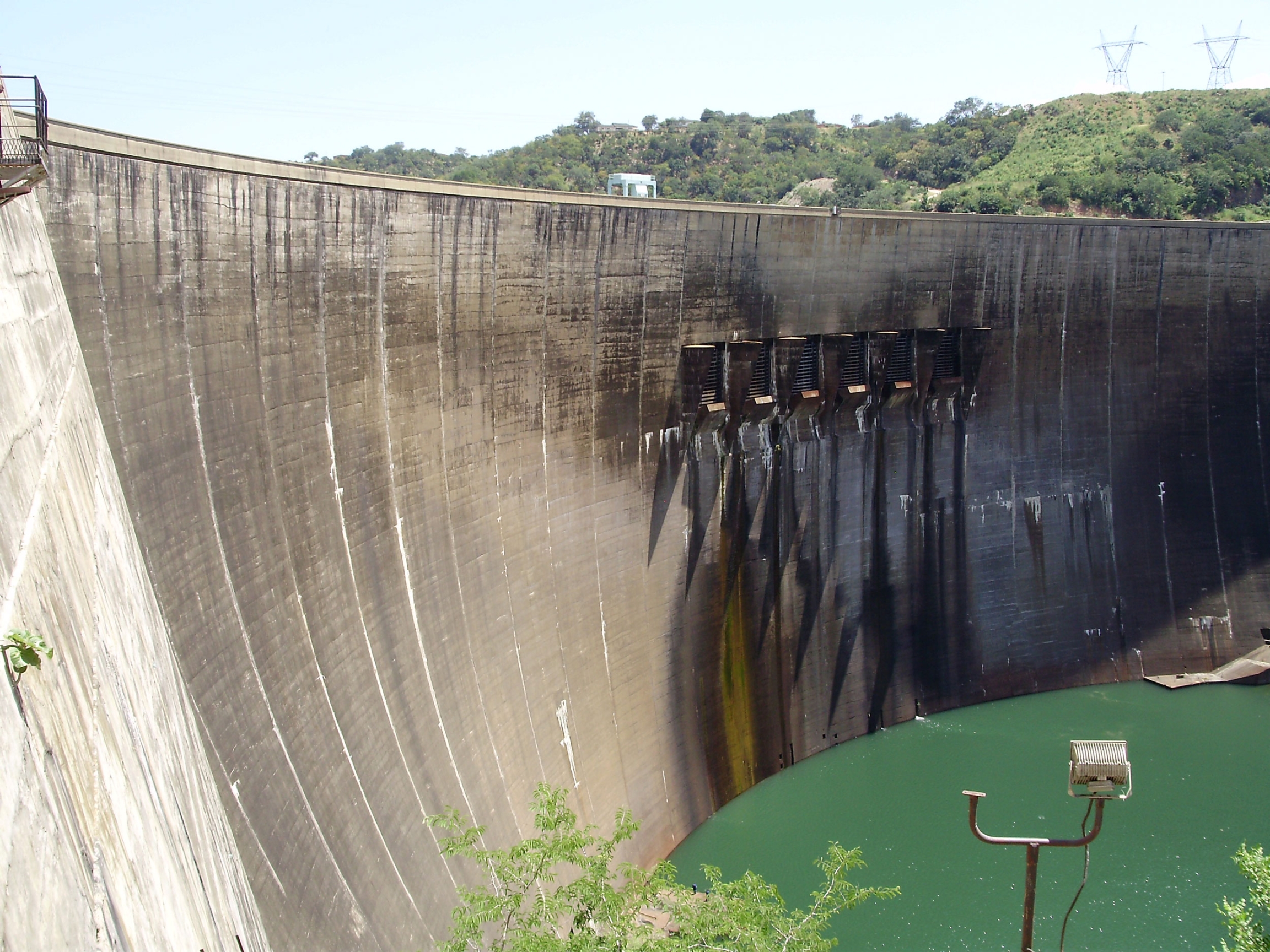
Below the Kariba dam wall, with Zambia border in the background.
ish Mafundikwa/The World
And Tinarwo is not the only one impacted by the power outages. Zimbabwe’s many minerals include platinum, gold, chrome and lithium, and mining accounts for the bulk of Zimbabwe’s export earnings.
Collin Chibafa, president of the Zimbabwe Chamber of Mines, said some 88% of the country's mines experience outages of as long as 12 hours.
He said some mining companies are now taking matters into their own hands by building solar plants.
“Obviously, those only work maybe four or five hours a day [that] we get peak production. Some of our members run diesel generators, but that's an expensive and the least-viable option. If you have people underground, they need ventilation, they need oxygen, it's really crucial that you can safely get people up from underground,” he said.
Households are not spared the inconvenience as power goes without prior notice. People with enough discretionary income may use generators, solar energy and inverters — but these options are beyond reach for the majority. Gas for cooking has become the go-to option for those who can afford it. For those who can’t, charcoal is readily available and affordable. And the sprawling, open-air market in Mbare, Harare's oldest working-class neighborhood, is the place to buy it.
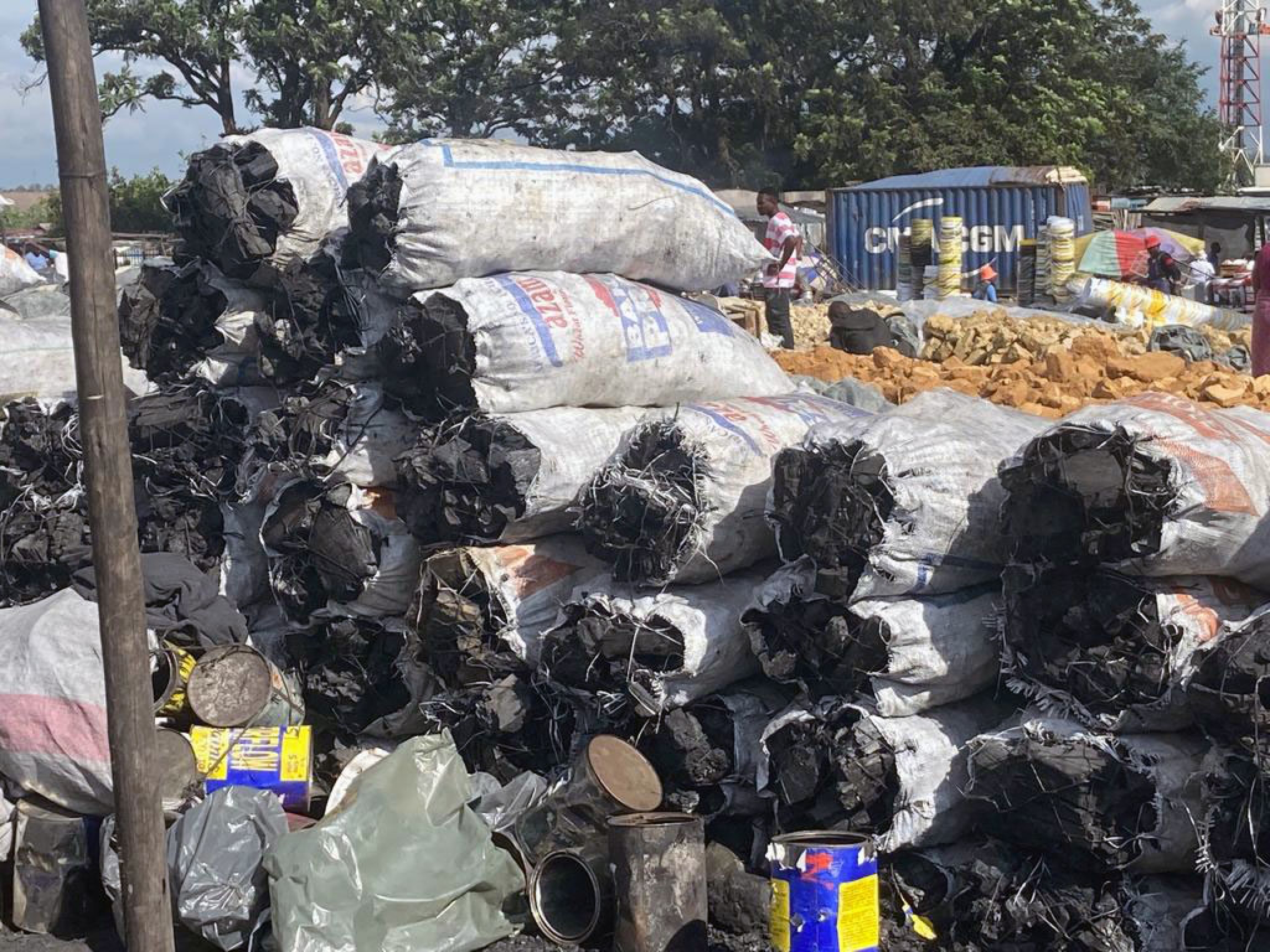
Bags of charcoal at Mbare market in Harare, Zimbabwe.
ish Mafundikwa/The World
Nyarai Mupesa, who has sold charcoal there for the past five years, said business is good whenever there is no power.
“When there are power cuts, sales are good, people need charcoal for cooking and to keep warm,” she said.
The problem is that charcoal, and the other low-cost option, kerosene, both contribute to deforestation and pollution. Chopping and burning trees for charcoal is illegal in Zimbabwe. But that has not stopped the practice. And most of the charcoal sold at Mbare is imported from Mozambique because, according to Mupesa, it is better quality.
“You pay the required duties and are issued with a receipt that enables you to get to Harare with your charcoal,” she explained.
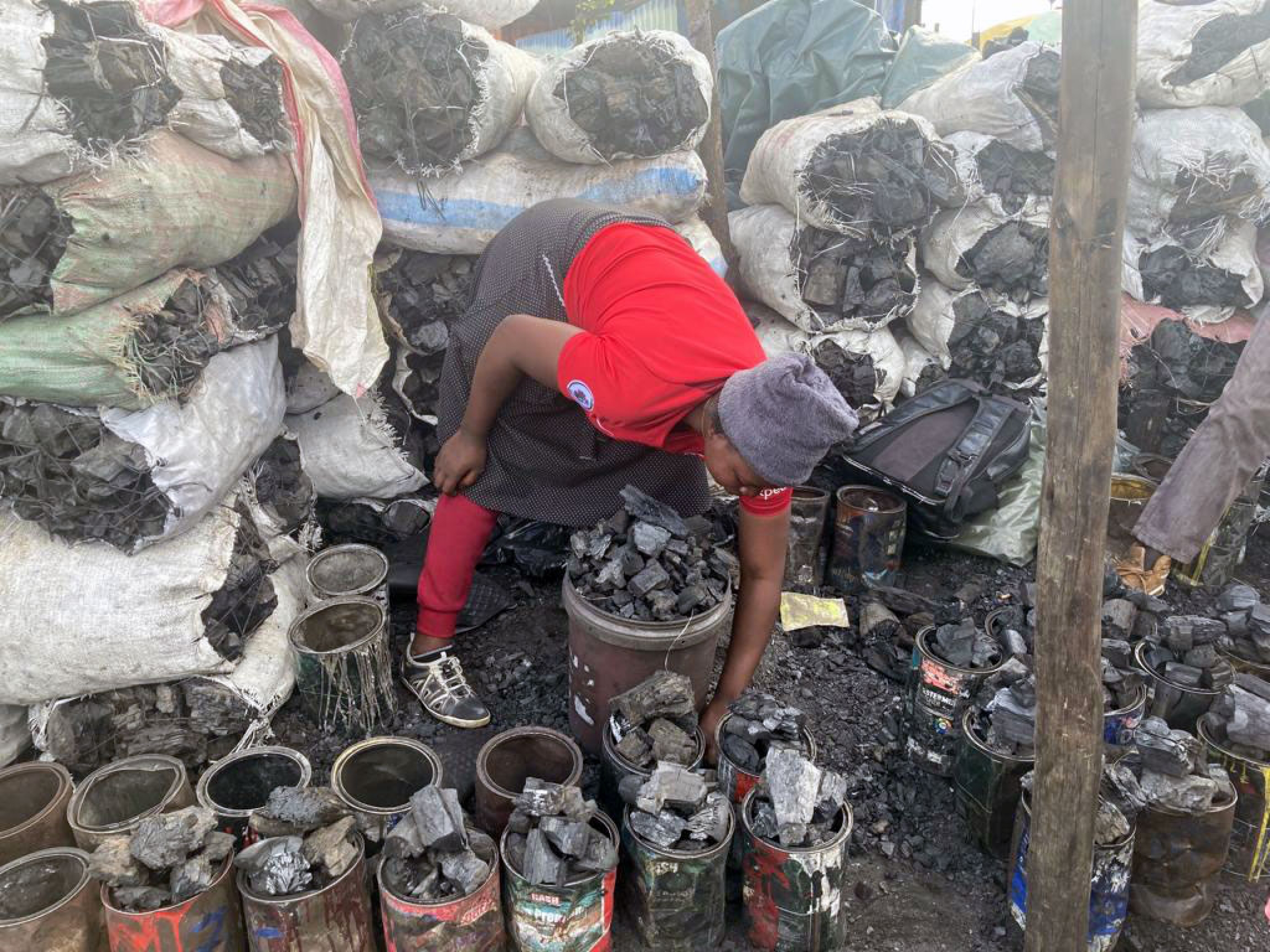
Nyarai Mupesa prepares her charcoal for sale.
ish Mafundikwa/The World
Besides the hydroelectric plant on Lake Kariba, Zimbabwe's other main power source, the Hwange thermal power station is old and breaks down frequently. New units at the power plant are set to start generating power soon. But even if it and Kariba operate at capacity, they cannot meet Zimbabwe's power needs.
Energy expert Victor Utedzi runs a solar farm.
He sees renewable energy as a solution to Zimbabwe’s power problems. So does the government. In a bid to attract more local and private investors to set up solar and hydropower plants to sell to the national grid or direct to some consumers, the government recently announced new policies.
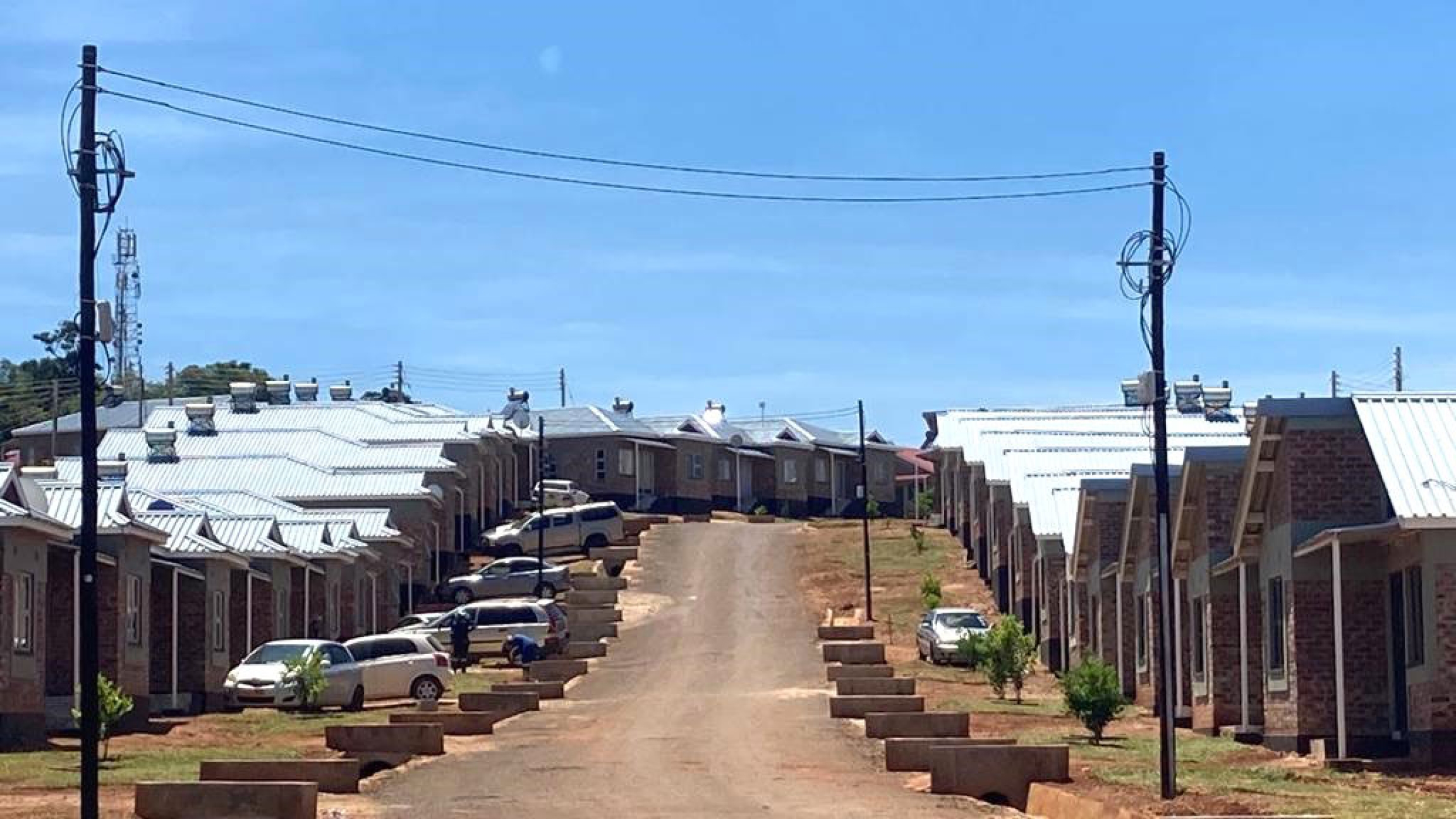
Solar water heaters are now standard features on new houses as well as some old houses in Zimbabwe.
ish Mafundikwa/The World
“The government has given a guarantee that if the utility is unable to pay, the government will step in and make the payment. The government has also opened the space even further; they allow you to sell directly to some of the largest industrial and commercial clients in the country,” Utedzi said.
The government also imports power from neighboring countries but that doesn’t always work due to currency shortages.
Building another hydropower station upstream from Kariba is seen as the best hope for solving Zimbabwe's power woes. But two decades after it was proposed, no action has been taken.
Until it becomes a reality, the rolling blackouts will continue.
Guyana has discovered nearly 11 billion barrels of offshore crude reserves, and the country is hoping that oil can help transform its economy and offset its ongoing poverty crisis.
The South American country is readying itself for its next round of oil auctions in April, with all the major oil companies expected to bid. Exxon Mobil Corp. is already heavily involved and has been since the late '90s when offshore exploration there began.
But what might sound like striking gold may not actually be the case. With agreements that 75% of oil revenue belongs to Exxon and partners, little is expected to reach citizens.
Lack of major oil gains are not foreign to South America; since 1980, countries in the region reap short-term gains but tend to be worse off in the long run.
Citizens have polarized opinions on the discovery with some rallying behind oil extraction in hopes of a soaring economy and new jobs. Others remain wary of the environmental drawbacks and risks of catastrophic oil spills.
While oil companies are seeking opportunities, climate-change activists are concerned. Guyana has thus far been hailed as a world leader on climate change.
The discovery means a potential release of millions of tons of greenhouse gases from a climate globally known for absorbing millions of carbon emissions each year.
Amy Westervelt is a journalist and host of “Drilled,” a true-crime podcast that looks at climate change — it's focusing on Guyana this season.
“It's worth noting that since 1980, no 'global south' country that's gotten into the oil business has ended up better off for it, not one,” Westervelt said. “So, it has this tendency to kind of bring short-term gains and ultimately, leave countries worse off or, at best, about the same as they were before oil.”
She shared some images with The World from around Guyana’s capital, Georgetown.
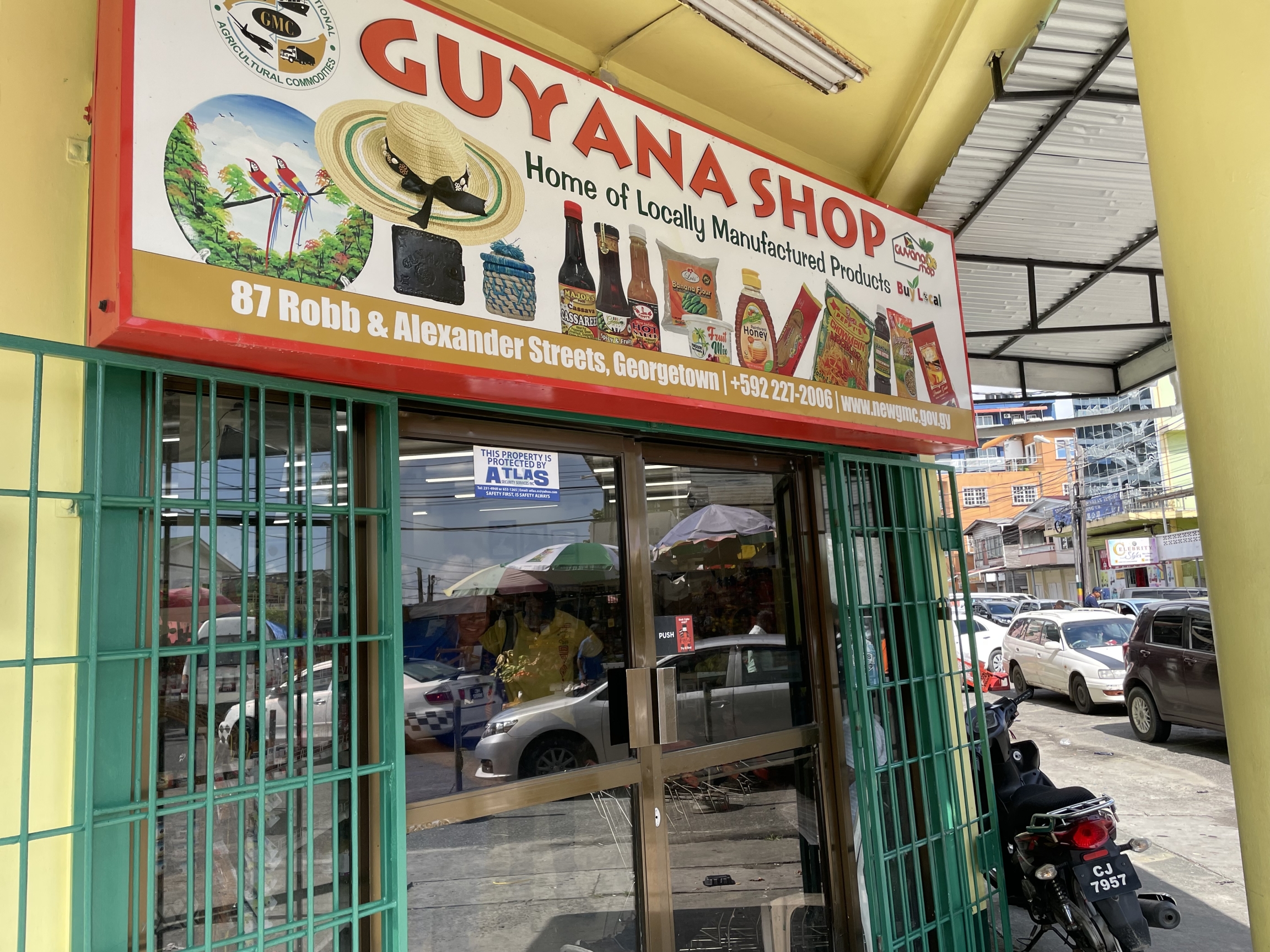
The Guyana Shop was put together by the attorney general and business boards to help small food businesses in Guyana package and sell their wares.
Courtesy of Amy Westervelt
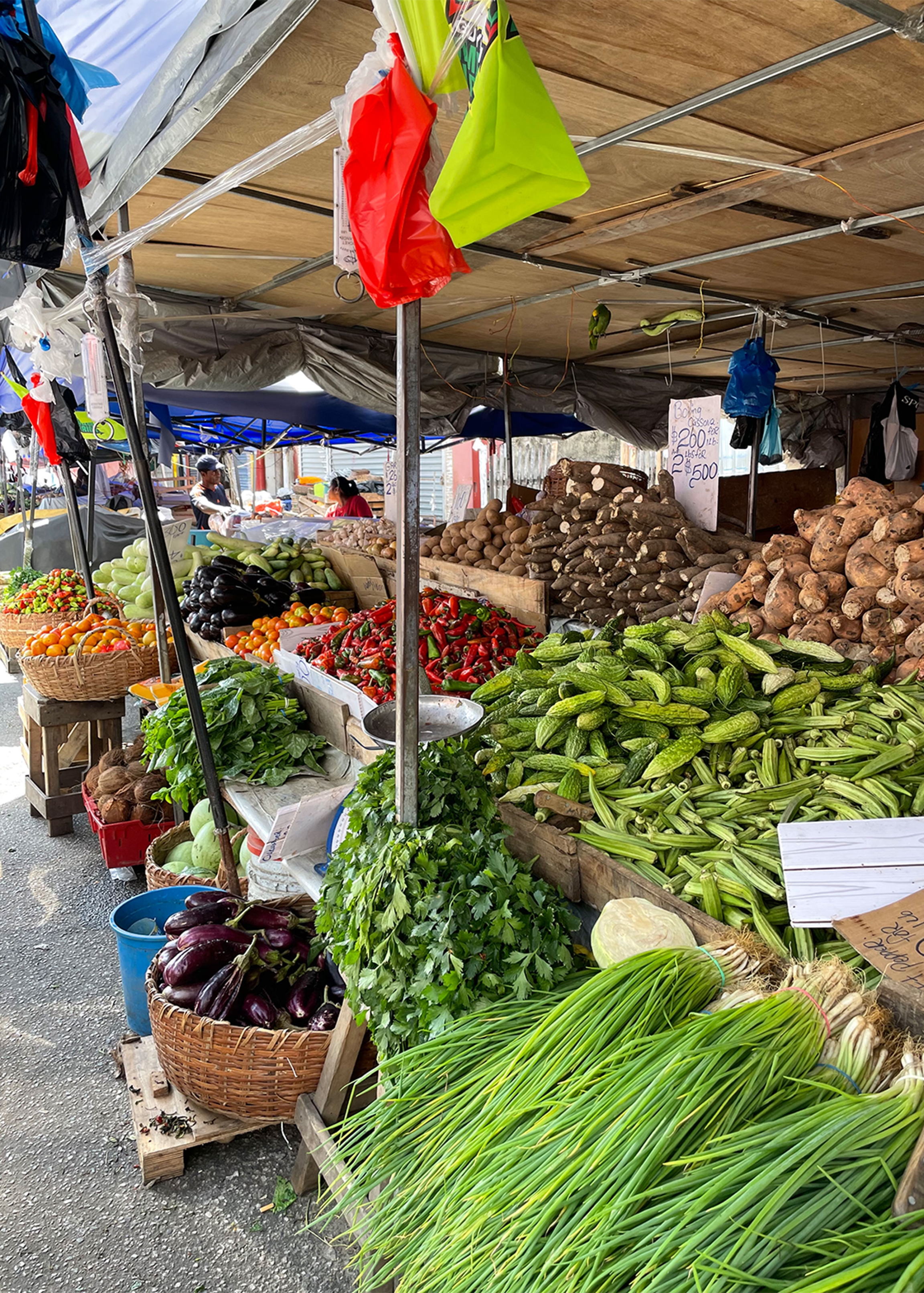
The Stabroek Market is a farmers market in Georgetown, Guyana.
Courtesy of Amy Westervelt
A canal in Georgetown, Guyana. Citizens have polarized opinions, with some rallying behind oil extraction in hopes of a better economy and others remaining wary of the environmental drawbacks and risks of catastrophic oil spills.
Courtesy of Amy Westervelt
Guyana is hoping that newly discovered offshore crude reserves can help transform the country's economy and offset its ongoing poverty crisis.
Courtesy of Amy Westervelt
Guyana has thus far been hailed as a world leader on climate change, but new plans for extracting oil has environmental activists concerned.
Courtesy of Amy Westervelt
At Monster Project Kitchen in Soweto, South Africa, the staff prepare daily for the power to go off, switching off the music and lights and readying the gas stoves.
“Load-shedding affects us very badly,” said Fana Khumalo, who runs the restaurant, along with a number of other businesses in Orlando East, a part of South Africa’s biggest township, Soweto.
The lights may be off, but crisis mode is definitely switched on in South Africa. Despite a national state of disaster and a new minister of electricity, scheduled power outages — known as load-shedding — are heavily impacting ordinary citizens.
Businessman Fana Khumalo stands in front of Monster Project Kitchen and talks with staff in Orlando East, Soweto, Johannesburg.
Elna Shütz/The World
The average American might experience about 7 hours without electricity a year, mostly due to major weather events like hurricanes and snowstorms. But for South Africans, who have endured daily blackouts for the last four years, this is the norm.
Power gets switched off according to a particular area on a scheduled basis, in stages. For instance, at stage six, 6,000 megawatts are taken from the national grid, meaning lights out for about 9 hours a day. The government implemented load-shedding for about 43% of last year.
In mid-February, President Cyril Ramaphosa declared a national state of disaster to respond to the electricity crisis, granting the government broader powers, like exempting critical infrastructure from load-shedding. It also allowed for new electricity producers to skip through environmental regulations and unlock extra finances.
They also established a new transitory Ministry of Electricity, led by Kgosientsho “Sputla'' Ramokgopa, the new minister, who has a background in civil engineering. He hopes to end load-shedding, he said, but cautioned South Africans to be patient.
People like Khumalo feel the pressure on a daily basis. The kitchen is tucked off a busy road and serves food to up to 100 people a day.
“With traditional food, you need to prepare it in the morning, because you have to cook it for long hours,” he said.
One of their main dishes is cow heart, served alongside a stiff, staple maize porridge pap, usually shared and eaten by hand.
“Pap and mogodo, pap and heart, liver, and cow head. That's what we do. We cook here, we serve our people, we have a sit in, or you can do a takeaway.”
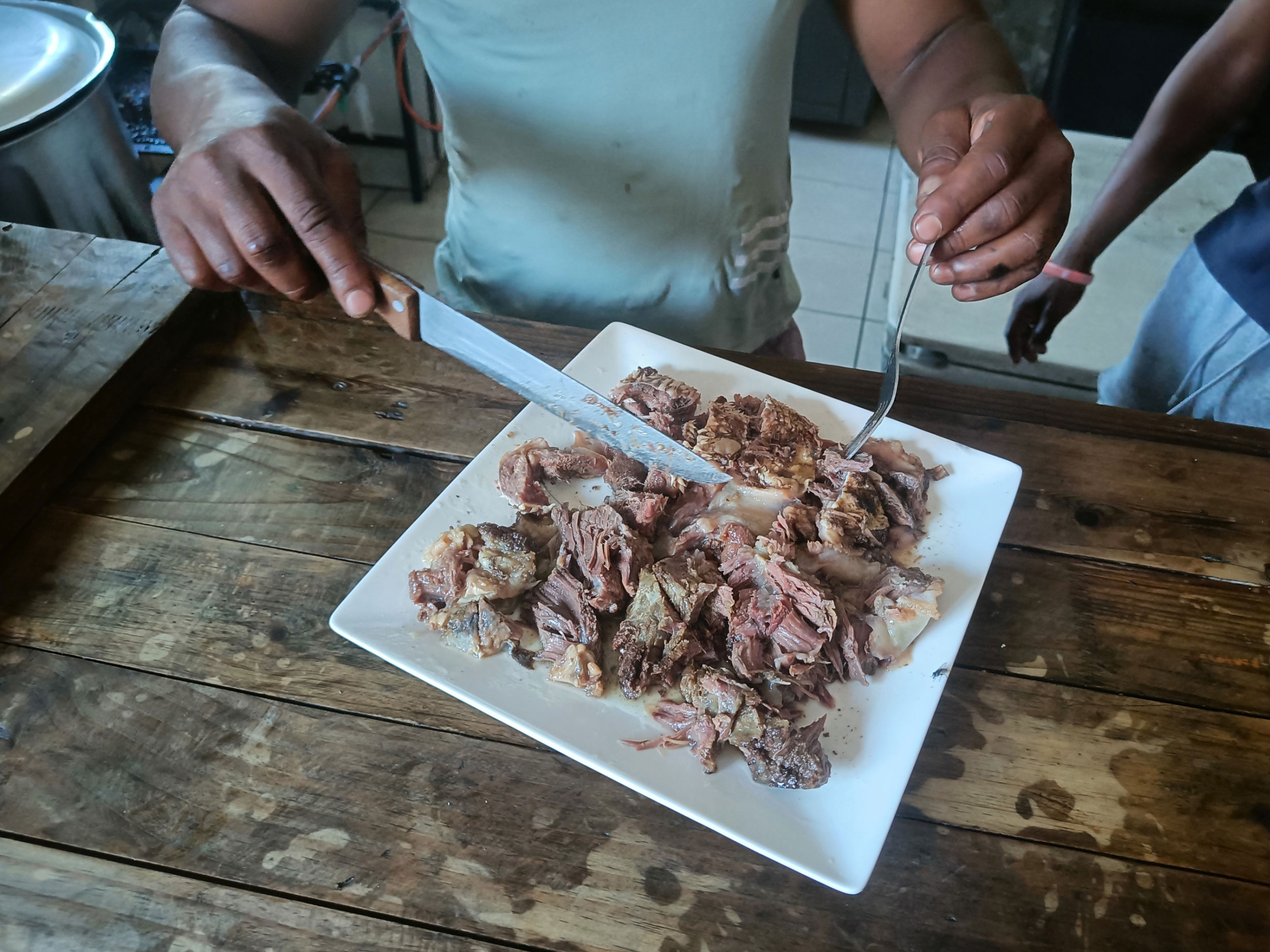
Employees of Monster Project Kitchen prepare cow’s heart and other traditional South African foods over gas during scheduled power cuts.
Elna Shütz/The World
Khumalo said they have become used to working on a schedule and will get by — but it’s been hard.
“You lose customers, because sometimes when they come in, there is no gas as a backup,” he said. “So, we lose money in that way.”
His businesses have also had to let go of staff and deal with excess stock. “We eat the food, what can we do? Or we give it to the orphans in the neighborhood or we share it with our friends.”
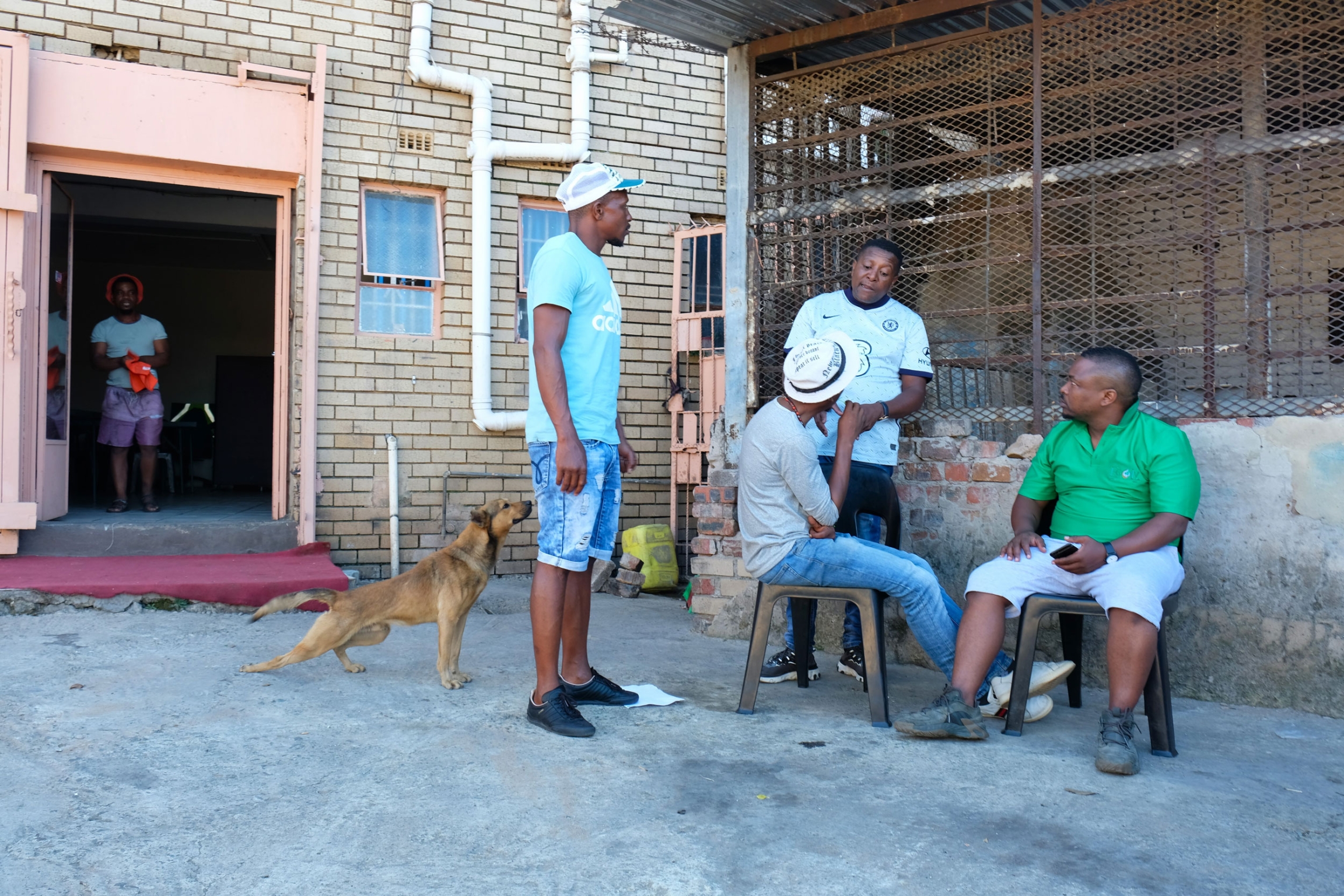
Businessman Fana Khumalo stands in front of Monster Project Kitchen in Orlando East, Soweto, Johannesburg.
Elna Shütz/The World
He feels that the government is failing ordinary South Africans and small businesses. Khumalo said he worries about corruption and that too many people in power are making decisions that only serve their interests.
“You are working on a break-even point just to keep the business going, just to think that maybe things will be better, the load-shedding will be over, so that we can go back to business normally, and give people the service that we’ve always given them.”
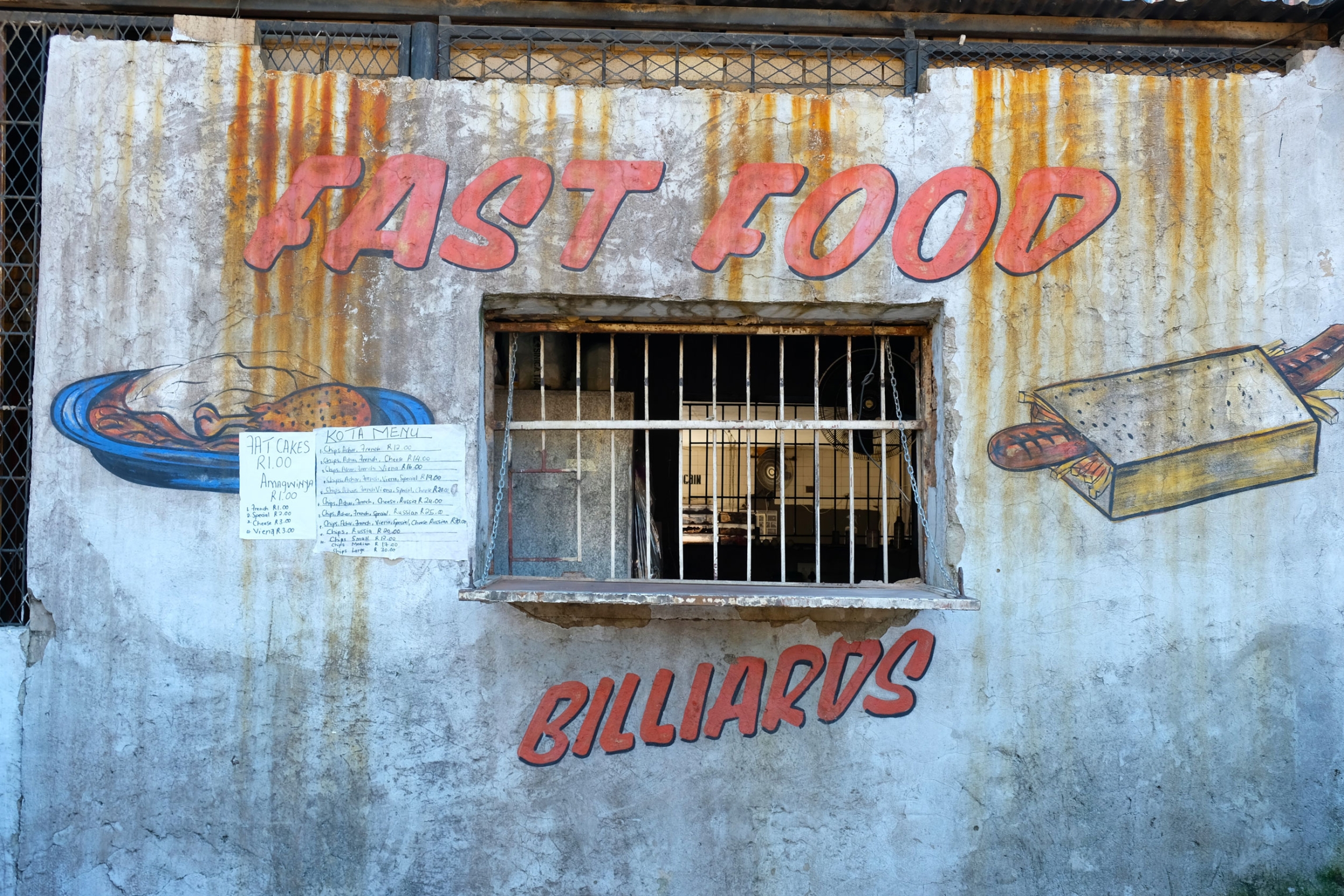
An eatery next door to Monster Kitchen Project in Soweto, South Africa.
Elna Shütz/The World
Of course, these problems didn’t happen overnight. Since 2007, there have been increasing bouts of load-shedding for a few months at a time, often because of compromised or failing infrastructure.
Independent energy analyst Clyde Mallinson said that a few decades ago, the country had a surplus of coal-powered electricity, based in part on Apartheid-era sanctions.
“So, what's actually happened is the coal fleet has deteriorated faster than they thought it would and we haven't put a new generation in place at a rate that can take over the job of what the coal fleet has been doing.”
He said that the current working capacity of about 100 coal-fired power production units is closer to about 40 units.
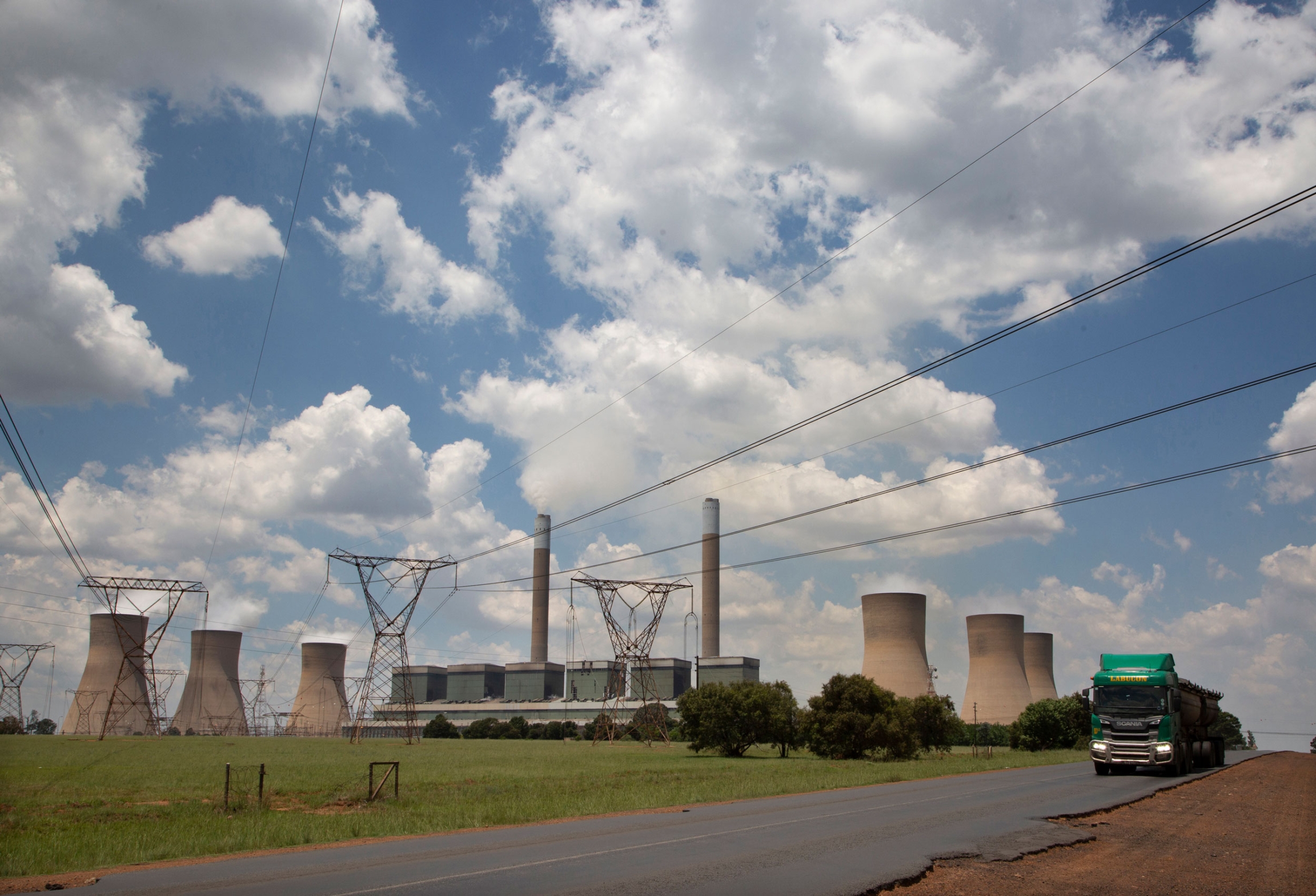
A coal truck, right, passes the coal-powered Duvha power station, near Emalahleni (formerly Witbank) east of Johannesburg, Thursday, Nov. 17, 2022. South Africa's ever-worsening power crisis, in which homes and businesses go without electricity for up to 10 hours per day, is strangling Africa's most developed economy.
Denis Farrell/AP/File
“So, we really, really are in big trouble at the moment, we've run out of time,” Mallinson said.
He warns that there’s looming electricity inequality ahead.
“The economic engine of the country is in small-to-medium-sized business operations in all of the towns and cities. And it's those that are bleeding at the moment, by virtue of not being able to have electricity or have money to backup,” he said, adding that the rest of the population has to pick up the load of “very expensive, very dirty electricity coming from a gasping, dying utility.”
The government’s current Energy Action Plan includes new, renewable energy, more imported power and improved existing power plants. The different scenarios place the end of load-shedding anywhere between a few months to a few years.
For now, load-shedding continues, and with it, the resilience of South Africans to adapt.
The sun isn’t fully up, but Pedro Salas Díaz is already hard at work carrying 100-pound sacks of salt down the hillside to be stored for sale. He navigates his way along the rock walls that separate hundreds of small pools that have been here for centuries.
Salas Díaz is only 23, but he’s been working here for the majority of his life.
“This has been passed down from generation to generation,” he said. “From my grandfather, to my father and now, me.”
But here in this Oaxacan town of Zapotitlan Salinas, migration and climate change may spell the end of salt farming in Mexico.
Pedro Salas Díaz has worked as a salt farmer most of his life in a tradition passed down for generations.
Michael Fox/The World
Salas Díaz works alongside his father as one of the youngest in a group of less than 100 traditional salt farmers left here.
Visiting this salt farm is like stepping back in time. Even the salt-makers don’t know how many hundreds of years ago the stairs and the rock walls of the mineral springs were built.
Their salt farming technique has remained roughly the same for generations.
They use the spring water to fill the salt pools. It can take two months of watering, washing, rewashing, and breaking up the crystals, for each pool to produce a few hundred pounds of salt.
The mineral spring near the Oaxacan town of Zapotitlan Salinas.
Michael Fox/The World
Back before industrialized production, the salt here was a coveted commodity that Indigenous people called “white gold.” Popoloca peoples produced and traded it widely long before the arrival of the Spanish.
Those days are over, but it’s still a huge source of pride for the local community.
“It’s our identity,” local tour guide Leonardo Noé said.
“Our town is named Zapotitlán Salinas, or Zapotitlán 'of the salt farms.' It’s our unique identity and puts us on the map.”
But still, Noé said, many youth are leaving in search of easier, better-paying jobs elsewhere. Many have migrated to the United States.
"We need to incorporate more youth, and more people who want to learn the skill of being a salt farmer," he said.

Pedro Salas Díaz and his dad work on the salt farms that their family has done for generations.
Michael Fox/The World
In town, huge baskets holding bags of salt sit outside the shop of resident Marcelo Salas.
“When I opened this store, the first thing I wanted to do was sell this salt, because it’s part of our culture,” Salas said. “We sell about a ton of it a week.”
Across the street, Maria del Carmen Cruzalas owns and runs a taco shop.
"We are the children of salt farmers,” she said. “And there is a huge difference between refined salt and the salt we produce here. Our salt gives another flavor to the meat and sauces."
Their salt is also good for one's health. A recent study from the nearby Tehuacán Technological University found that it has 65% less sodium and is rich with 200 minerals.
That’s because this whole region used to be underwater. The ancient sea left behind salt and minerals, which the rains collect when they fall during the summer months — and replenish the mineral springs that feed the salt farms.
Migration and climate change may spell the end of salt farming in the Oaxacan town of Zapotitlan Salinas.
Michael Fox/The World
But farmer Pedro Salas Díaz said those springs aren’t filling up like they used to, and he’s concerned for the future.
"With climate change, there are times when it’s not supposed to rain and it does, and times when it’s supposed to rain, when it doesn’t. It is very concerning,” he said.
Pedro Salas Díaz, 23, has worked as a salt farmer most of his life.
Michael Fox/The World
Salt farmers here need the summer rains to fill the springs, but a rain during the dry season, right now, could ruin months of work.
But Díaz said they will weather the storm. And when his toddler son is ready, he’ll be bringing him along, too — teaching him the trade that he learned from his father and his grandfather before him.
In Villa de Leyva, Colombia, dozens of people lined up this past weekend during the 26th-annual Astronomy Festival to look at the stars through giant telescopes set up in the town's colonial-era square.
This Andes town's dry weather makes it one of the best spots in the country to go stargazing — drawing around 5,000 people to its festival every year.
“This is really cool,” said Valentina Galvis, an eighth-grade student who attended the festival with her family. “You can talk to people who know about the stars, and they’re very eager to share their knowledge.”

Every year, about 5,000 people attend Villa de Leyva's Astronomy Festival, which is held in the town's colonial-era square.
Manuel Rueda/The World
Across the globe, cities have become a lot brighter. Suburban sprawl and urban skyscrapers, some lit with neon lights, make it harder to see the stars. But some places, like Villa de Leyva, are now trying to dim their lights in the hopes of promoting positive health benefits for locals while also attracting more visitors.
The popularity of the annual three-day festival has encouraged organizers to push for lasting improvements for the town. They’re working with the local government to modify Villa de Leyva’s streetlights so that it's easier to see the night sky.
“What we really want is to defend the right of all humans to see the stars.”
“What we really want is to defend the right of all humans to see the stars,” said Diana Rojas, the festival’s director. “So, we have to teach people about the importance of preserving dark skies and ask our governments to be smarter about artificial lighting.”

The Belt of Orion constellation, as seen from Villa de Leyva's central square.
Manuel Rueda/The World
Villa de Leyva has a population of 20,000 and is currently trying to get certified by the Starlight Foundation, an organization that runs a list of the world’s best stargazing destinations. Among the town’s plans is to change the direction of its streetlights so that they only point downward. And it is also planning to use light bulbs with lower-colored temperatures that emit softer lighting.
With tourism being one of Villa de Leyva’s main industries, Mayor Josue Castellanos hopes the certification will attract more people.
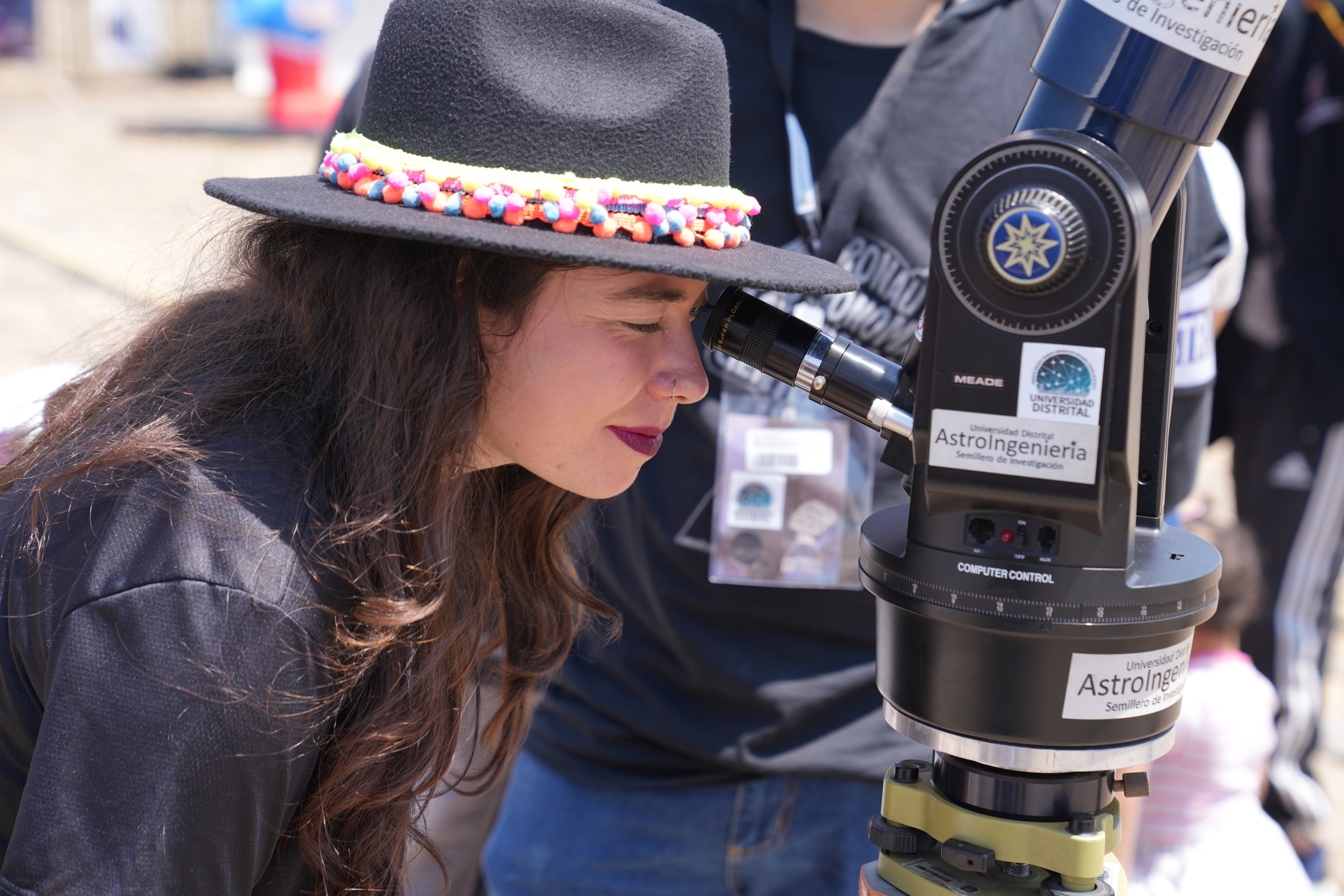
During the day, experts calibrate their telescopes at the Astronomy Festival and place special filters on them, so that visitors can also watch the sun, Villa de Leyva, Colombia.
Manuel Rueda/The World
A growing number of enthusiasts are among the younger generations.
“Children love astronomy, and our festival attracts many families,” Castellanos said. “So, we want to keep our skies dark and turn that into another attraction.”
Third grader Andres Camilo Morales from Bogotá looked at the sky through a white telescope as he shared his excitement.
“It’s so much easier here to see the beautiful stars,” Morales said. “There’s so many people here doing this, and it’s been a lot of fun.”

Third grader Andres Camilo Morales looks at the Orion nebula through a telescope placed in Villa de Leyva's central square.
Manuel Rueda/The World
Managing artificial lighting also has health benefits.
Studies have shown that the excess of artificial lighting, known as light pollution, can be bad for humans.
“When we sleep in the dark, we produce a hormone called melatonin,” said Cristian Goez, an astronomy professor from Bogotá. “But if we are exposed to too much artificial lighting, melatonin production decreases, and that can generate diseases.”
And Goez said that he hopes starlight certification for Villa de Leyva could also prompt other towns across Colombia to tackle their own light pollution.

To make the stars more viewable, the Andes town of Villa de Leyva plans to change its streetlights, so that they only point downward, and use light bulbs with warmer color temperatures.
Manuel Rueda/The World
Syria has become a pariah state under the government of President Bashar al-Assad. He's been accused of gassing his own civilians, and bombing hospitals and schools.
But the catastrophic earthquake that hit northwestern Syria last week is opening some doors.
Arab leaders who once shunned him are reaching out with aid, and assistance from the United Nations is trickling in. It took seven days for the UN to strike a deal with Syria to open two additional border crossings into the region.
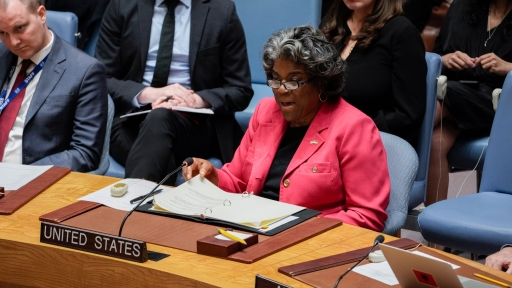
Linda Thomas-Greenfield, Permanent Representative of the United States to the United Nations, speaks during a Security Council meeting on the maintenance of peace and security of Ukraine, Monday, Feb. 6, 2023, at United Nations headquarters.
John Minchillo/AP
US Ambassador to the UN Linda Thomas-Greenfield addressed the United Nations' reasoning behind the delay in a conversation with The World's host Marco Werman.
"I wouldn't put the blame on the UN," Thomas-Greenfield said.
"The US made very clear on day one that we would provide assistance directly to the Syrian people through any means possible. Where the blame lies [is] with the Syrian government. They took seven days to reopen the border. NGOs, the UN, donors were all working desperately to get assistance to the people of Syria. It is the Syrian government, the Assad regime, that let the Syrian people down."
This interview was lightly edited and condensed for clarity.
Last week, the government of Brazilian President Luiz Inácio Lula da Silva kicked off a widespread operation to stop illegal mining on Yanomami Indigenous territory.
Videos of the operation have gone viral over social media over the last week. In one, officers from Brazil’s environmental protection agency IBAMA approach a boat of illegal miners trying to motor into the area. The officers wear bulletproof vests over tan and camouflage uniforms. Their guns are raised.
“Stop,” they yell. “Stop. Turn around now.”
The officers pull alongside the boat. "Get your hands on your heads,” they yell. “You're going to come with us.”
The miners comply without a word. There are eight of them in the boat that is packed with bags and supplies.
Since the operation kicked off, IBAMA officers have found and destroyed a plane, a helicopter and other heavy machinery.
In a press conference last week, Justice Minister Flavio Dino said they were confiscating and destroying equipment so that it can’t be reused in illegal activities and those people who refuse to leave may be arrested.
Removing 20,000 illegal miners is not an easy task. Yanomami territory along Brazil’s northern border is remote and huge — roughly two times the size of Switzerland. Wildcat gold mining on Yanomami territory increased 300% in the last four years under ex-president Jair Bolsonaro.
Last week, a delegation of Yanomami leaders traveled to the US to raise further attention to their cause.
“They want to steal our land and destroy our nature, our water,” Leader Davi Kopenawa told the UN Secretary-General Antonio Guterres at the opening of a Yanomami photography exhibit in New York. "They are bringing disease. That’s why we’re here."
Fiona Watson traveled with the delegation in the United States. She's worked with the Yanomami for decades, and she’s the director of research and advocacy at the London-based NGO Survival International.
"We had political meetings in Washington with the Organization of American States, with the State Department, USAID and various Congress people, and I think that was really important,” she said.
“Because, Lula met with Biden last Friday, and it really put the Yanomami crisis into the spotlight.”
The news reports and images of starving Yanomami children have shocked the world in recent weeks. At least 570 Yanomami children are reported to have died from malnutrition and curable diseases under the Bolsonaro government. Dozens more have been flown to hospitals in recent days. The communities are battling malaria, mercury poisoning from the wildcat gold mines, hunger and constant threats from the miners who are backed by criminal groups.
President Lula visited the region on Jan. 20, where he promised to turn the tide.
“I am here to say that we are going to treat our Indigenous peoples as first-class human beings. Not like fourth or fifth-class people,” he said. "What I have seen here is inhumane.”
Lula has declared a humanitarian crisis for Yanomami territory.
The Brazilian military has been delivering aid, food and supplies to Yanomami villages.
Yanomami leaders blame former President Jair Bolsonaro for empowering illegal miners, gutting Indigenous and environmental protection agencies and ignoring their pleas for help.
"Many teams came from Bolsonaro's government to see our reality,” Junior Hekurari, the president of the Yanomami Health Council, told the Brazilian news outlet Brasil de Fato. "I took them around and showed them first hand, but unfortunately they just turned their backs or closed their ears."
Brazil’s Supreme Court has called for an investigation into allegations of genocide by the Bolsonaro government against the Yanomami people.
But in an interview last week, Bolsonaro’s former environment minister Ricardo Salles denied any wrongdoing by the former president.
"The responsibility for that situation is in the hands of all of Brazilian society,” he said. "All of Brazilian society has ignored the situation for the Indigenous in northern Brazil for a very long time."
Salles further applauded Bolsonaro’s attempts to legalize wildcat mining on Indigenous lands, which he said could have regulated the activity and its impact.
Meanwhile, numerous videos shared online last week showed groups of miners voluntarily packing up and leaving their camps in Yanomami territory.
"This is all very positive,” Fiona Watson said. "But what I fear, is that the intentions are there. They’ve hit the ground running. But time and time again, we've seen [this] in the past with the Yanomami and indeed other Indigenous territories. It's so easy for these illegal miners to go back and of course all the politicians and big economic interests behind something like the gold industry are still there.”
Yanomami land is only one of numerous Indigenous territories that have been invaded by illegal miners in recent years. In other words, Indigenous leaders say, the government efforts are an important first step. But there is a long way to go.
A 27-year-old university student in Syria, who didn’t want to share his name for security reasons, said that there have been so many aftershocks over the past week that it’s hard to tell when the earth is shaking or if he’s imagining it.
“I keep a bottle of water next to me … or a small cup or whatever liquid based, just to make sure if I’m right or [not],” said the student, who lives in the port city of Latakia, which is controlled by the Syrian government.
The 7.4-magnitude quake left a lot of damage, he explained. Homes that are still standing are not safe to return to, so people are sleeping in mosques or churches. Help has been trickling in.
“There are so many [nongovernmental organizations] that are trying to help; other than NGOs, there are individuals who are making so much effort to give the people what they need,” he said.
How fast and how much Syrians have received aid following the earthquake depends on where people live. The response has highlighted that there really are two Syrias: one under the government’s control, where international relief organizations are helping out. Another, the opposition-controlled northwest, mostly isolated from the rest of the world.
On Sunday, the US ambassador to the UN, Linda Thomas-Greenfield, urged the security council to open another border crossing from Turkey into northwest Syria.
But Russia, an ally of Syria’s government, has veto power on the council. And so far, the Kremlin has said that one border crossing into Syria is enough.
The UN said on Monday that Syrian President Bashar al-Assad has agreed to open two crossing points from Turkey to northwest Syria for an initial period of three months “to allow for the timely delivery of humanitarian aid.”
Warm food, baby formula, diapers and clothes are some of the items being shipped to Latakia. Most are coming from the capital, Damascus.
That’s where Charlotte Streinger, a French teacher, has been organizing donation drives.
“I teamed up with three of my colleagues from the school. Spontaneously, we created this team, and we started gathering trustful contacts throughout the country with people that we know,” she said.
Streinger started an online fundraiser and she said in just three days, she managed to raise about $7,500.
“But the problem is that as with everything that is linked to Syria, it was then blocked,” she added.
Syria is under strict economic sanctions. Last Thursday, the US Treasury made a temporary exemption for aid related to the earthquake. Yet, the sanctions are still being felt on the ground.
Streinger said she could have used the money to buy things such as food, hygiene products and blankets, some of the most-needed items. Instead, she said, she is left with no cash and having to apologize to those who donated. She is trying to find a way to return their money.
“It made me feel horrible. Horrible,” she said.
The Syrian city of Aleppo — also under government control — was heavily damaged in the earthquake. Over the weekend, the head of the World Health Organization, Tedros Ghebreyesus, visited the city.
“We have just come today with supplies and look forward to continuing to support,” he told reporters.
Ghebreyesus came with a planeload of medical supplies. A second one is scheduled this week, WHO said.
Aleppo saw widespread destruction during Syria’s civil war, and filmmaker Youssef Saba said the earthquake “finished the job.”
In a series of WhatsApp messages, he explained that help is beginning to pour into Aleppo, some coming from inside Syria, and some from outside.
Aleppo even got the attention of the Syrian president himself.
Bashar al-Assad and his wife, Asma al-Assad, visited a hospital on Friday. It was all smiles and hugs in videos shared online. But for Syrians living in areas not under government control, things have been very different.
The northwest province of Idlib was hit hardest by the earthquake and more than a week later, people there said they still don’t have the equipment needed to pull victims from under the rubble.
“We want the UN to apologize. They’re making the people of … the Syrian people disappointed,” Raed al-Saleh, head of the White Helmets, told reporters last Friday.
Martin Griffiths, the UN’s emergency relief coordinator, tweeted as much on Sunday.
At the #Türkiye-#Syria border today.
— Martin Griffiths (@UNReliefChief) February 12, 2023
We have so far failed the people in north-west Syria.
They rightly feel abandoned. Looking for international help that hasn’t arrived.
My duty and our obligation is to correct this failure as fast as we can.
That’s my focus now.
“We have failed people in northwest Syria,” he wrote, adding that “my duty and our obligation is to correct this failure as fast as we can.”
Karam Kellieh, a photographer working in the northwest part of the country, said that people have lost hope of rescuing victims trapped under the rubble and that those who survived have no shelter.
“People [were] refugees before the earthquake. Now, they’re [living] in the roads, in hospitals, in schools,” he said.
Some have camped under olive trees and have been spending nights in the frigid temperatures.
"No picture of video can explain what happened in north of Syria,” Kellieh said.
Thousands left homeless by a massive earthquake that struck Turkey and Syria a week ago packed into crowded tents or lined up in the streets for hot meals Monday, while the desperate search for anyone still alive likely entered its last hours.
One crew wrested a 4-year-old girl from rubble in hard-hit Adiyaman, 177 hours after the 7.8 magnitude earthquake struck. Thousands of local and overseas teams, including Turkish coal miners and experts aided by sniffer dogs and thermal cameras, are scouring pulverized apartment blocks for signs of life.
While stories of near-miraculous rescues have flooded the airwaves in recent days — many broadcast live on Turkish television and beamed around the world — tens of thousands of dead have been found during the same period. Experts say given temperatures that have fallen to minus 21 degrees Fahrenheit — and the total collapse of so many buildings — the window for such rescues is nearly shut.
The quake and its aftershocks, including a major one nine hours after the initial temblor, struck southeastern Turkey and northern Syria on Feb. 6, killing more than 35,000 and reducing whole swaths of towns and cities inhabited by millions to fragments of concrete and twisted metal.
Damage included heritage sites in places like Antakya, an important ancient port and early center of Christianity historically known as Antioch. Greek Orthodox churches in the region have started charity drives to assist the relief effort and raise funds to eventually rebuild or repair churches.
Some 62 miles from the epicenter, almost no houses were left standing in the village of Polat, where residents salvaged refrigerators, washing machines and other goods from wrecked homes.
Not enough tents have arrived for the homeless, said survivor Zehra Kurukafa, forcing families to share the tents that are available.
“We sleep in the mud, all together with two, three, even four families,” said Kurukafa.
Turkish authorities said Monday that more than 150,000 survivors have been moved to shelters outside the affected provinces. In the city of Adiyaman, Musa Bozkurt waited for a vehicle to bring him and others to western Turkey.
“We’re going away, but we have no idea what will happen when we get there,” said the 25-year-old. "We have no goal. Even if there was (a plan) what good will it be after this hour? I no longer have my father or my uncle. What do I have left?”
But Fuat Ekinci, a 55-year-old farmer, was reluctant to leave his home for western Turkey despite the destruction, saying he didn’t have the means to live elsewhere and had fields that need to be tended.
“Those who have the means are leaving, but we’re poor,” he said. “The government says, go and live there a month or two. How do I leave my home? My fields are here, this is my home, how do I leave it behind?”
Volunteers from across Turkey have mobilized to help millions of survivors, including a group of volunteer chefs and restaurant owners who served traditional food such as beans and rice and lentil soup for survivors who lined up in the streets of downtown Adiyaman.
Other volunteers continued with the rescue efforts. After rescuers pulled out the 4-year-old, a relative told HaberTurk television that more loved ones were inside the building.
As the scale of the disaster comes into view, sorrow and disbelief have turned to rage over the sense there has been an ineffective response to the historic disaster. That anger could be a political problem for Turkish President Recep Tayyip Erdogan, who faces a tough reelection battle in May.
Meanwhile, rescue workers, including coal miners who secured salvage tunnels with wooden supports, found a woman alive Monday in the wreckage of a five-story building in Turkey's Gaziantep province.
Syrian authorities said a newborn whose mother gave birth while trapped under the rubble of their home was doing well. The baby, Aya, was found hours after the quake, still connected by the umbilical cord to her mother, who was dead. She is being breastfed by the wife of the director of the hospital where she is being treated.
Such tales have given many hope, but Eduardo Reinoso Angulo, a professor at the Institute of Engineering at the National Autonomous University of Mexico, said the likelihood of finding people alive was “very, very small now.”
David Alexander, a professor of emergency planning and management at University College London, agreed. But he added that the odds were not very good to begin with.
Many of the buildings were so poorly constructed that they collapsed into very small pieces, leaving very few spaces large enough for people to survive in, Alexander said.
“If a frame building of some kind goes over, generally speaking we do find open spaces in a heap of rubble where we can tunnel in,“ Alexander said. “Looking at some of these photographs from Turkey and from Syria, there just aren’t the spaces.”
Wintery conditions further reduce the window for survival. In the cold, the body shivers to keep warm — but that burns a lot of calories, meaning that people also deprived of food will die more quickly, said Dr. Stephanie Lareau, a professor of emergency medicine at Virginia Tech.
Many in Turkey blame faulty construction for the vast devastation, and authorities have begun targeting contractors allegedly linked with buildings that collapsed. Turkey has introduced construction codes that meet earthquake-engineering standards, but experts say the codes are rarely enforced.
Turkey’s death toll from the quake has exceeded 31,000. Deaths in Syria, split between rebel-held areas and government-held areas, have risen beyond 3,500, although those reported by the government haven’t been updated in days.
Visiting the Turkish-Syrian border Sunday, UN Under-Secretary-General for Humanitarian Affairs Martin Griffiths said that the international community has failed to provide aid.
Griffiths said Syrians "rightly feel abandoned.” He added: “My duty and our obligation is to correct this failure as fast as we can.”
In the Syrian capital of Damascus Monday, the UN special envoy for Syria, Geir Pedersen, told reporters that “troubles” regarding the flow of aid to Syria’s rebel-held northwest are “now being corrected.”
The Kurdish-led administration in northeast Syria, meanwhile, said that 53 trucks carrying aid had crossed from Kurdish territory into earthquake-damaged areas controlled by rival Turkish-backed rebels in northwest Syria who had previously prevented convoys from crossing. Turkish authorities consider the Syrian Democratic Forces to be a terrorist group, along with the Kurdistan Workers’ Party, or PKK, a Turkey-based Kurdish separatist group.
By Associated Press writers Mehmet Guzel, Suzan Fraser and Sarah El Deeb.. Fraser reported from Ankara, Turkey, and El Deeb from Adana, Turkey. Tanya Titova in Malatya, Turkey, and Ben Finley in Norfolk, Virginia contributed.
A magnitude 7.8 earthquake emanated from southeast Turkey early Monday morning, toppling buildings and killing thousands of people in the country and in neighboring Syria.
The death toll has now surpassed 12,000, with tens of thousands of injured. Search teams from around the world have joined local emergency personnel in Turkey and Syria to look for victims.
But what caused the devastating quakes that are among the deadliest this century?
Most of Turkey, experts explain, sits on a slab of the Earth’s crust called the Anatolian Plate, which ends near the border with Syria.
“We have in the eastern Mediterranean a number of plates like a jigsaw puzzle,” said Tuncay Taymaz, a seismologist at Istanbul Technical University in Turkey.
This jigsaw puzzle is in constant motion. For instance, the massive, Arabian Plate to the south of Turkey is pushing northward, “which is mostly squeezing Turkey and the Anatolia[n] plate,” explained USGS seismologist Susan Hough.
Early Monday morning, the pressure along the East Anatolian fault zone running between the Anatolian Plate, to the north, and the Arabian Plate, to the south, had become too high for the crust to sustain, according to Zoë Mildon, an earthquake geologist at the University of Plymouth.
At a certain moment, “this rock cannot anymore withstand or resist this big energy,” said Marleine Brax, director of the National Center of Geophysics in Lebanon. “And it will slip. And this is what we call an earthquake.”
In the southern Gaziantep province of Turkey, at 4:17 a.m. local time, the part of the Anatolian Plate along the fault line slipped, lurching westward. The resulting earthquake measured 7.8 on the Richter scale, and it unleashed a ferocious amount of energy — the equivalent of detonating 8 million tons of TNT. The quake’s sheer power played a big role in making it so lethal.
Much of that energy emanates as waves.
“So, any earthquake, you can think of it as a symphony,” Hough said. “It’s releasing energy with a range of tones, or frequencies.”
Some of those frequencies cause more damage than others. There are the booming low tones — low-frequency waves like ocean swell that travel great distances but tend not to be too troublesome. And then, there are the higher-frequency waves, like choppy seas, that cause a lot of jitter.
“If you’re shaking the ground up and down every one second, that's the energy that tends to be damaging to most buildings,” Hough said.
These are the vibrations that pancaked multistory buildings and reduced high-rises to heaps in southern Turkey, and northern Syria next door.
After Turkey’s major 1999 quake, the country updated its building codes. But a lot of construction predates that change, and that’s another reason this quake was so damaging. Buildings fashioned largely from concrete unfortified with steel rebar crumble more easily when shaken.
Taymaz blames faulty ethics in his country for a good share of the destruction.
“If you do everything by the book,” like earthquake-proof housing, he said, “you will be alright. But [there are] not many obeying the rules. There are, of course, a lot of corrupted engineers, scientists, manufacturers, you name it.”
Meanwhile, as buildings were collapsing, the seismic waves rippled away from the fault line. Tremors were picked up on seismographs thousands of miles away. People actually felt the shaking in neighboring countries.
By the time the energy reached places like Lebanon, Egypt, and Israel, Hough said it was mostly made up of the low-frequency waves. The more damaging, higher-frequency waves just don’t travel that far.
“Just like if you were listening to a distant symphony, you wouldn’t hear the piccolo, you might hear the bass drum,” she said.
Some nine hours after the 7.8 earthquake, an unusually large 7.5 aftershock rang out.
Seismic processes like these can take centuries to build up, but they can change human lives in a matter of seconds. Now, the window of rescue, complicated by the bitter cold, is rapidly closing.
Measuring the dimensions of an asteroid hundreds of millions of miles in outer space is not an easy task — but there is a way.
The asteroid needs to pass in front of a bright star. When that happens, you snap a picture and you can see its silhouette. When NASA wanted to do this for one particular asteroid, the angle for the photo was elusive. But they knew that the asteroid was passing directly above Senegal. So, they got in touch with astronomers there.
Maram Kaire, a top Senegalese astronomer aspiring to build a space agency for his country, was one of them. His story, "Star Chasers of Senegal," is airing on NOVA, produced out of GBH in Boston.
Kaire discussed the project, and his personal journey, with The World's host Marco Werman.
This interview has been lightly edited and condensed for clarity.
Rescuers are racing against time to pull survivors from the rubble before they succumb to cold weather after an earthquake tore through southern Turkey and war-ravaged northern Syria on Monday.
The death toll has now surpassed 12,000, with tens of thousands of injured. Search teams from around the world have joined local emergency personnel in Turkey and Syria to look for victims.
The last three days have brought dramatic rescues, including small children emerging from mounds of debris more than 30 hours after Monday's predawn quake. There’s also been widespread despair and growing anger at the slow pace of rescue efforts in some areas.
To support the relief efforts underway, here are some organizations working to support victims of the earthquakes in Turkey and Syria, below.
(Before you donate, it is always advised to do some research. Sites like Charity Navigator can provide information on some lesser-known organizations. If you suspect any individual or organization committing fraud, you can report it to the National Center for Disaster Fraud, part of the US Justice Department.)
The Associated Press contributed to this report.
Abdul Kafi Alhamdo first felt the tremors at around 4 in the morning. He thought that there was another bombing.
Syria has been at war for more than a decade and the sound of airstrikes are not all that unusual.
“But a bombing wouldn’t last for that [long],” he said. “[After] 10 seconds, no, it’s still moving, so I knew it’s an earthquake.”
Alhamdo and his wife scooped up their two kids and started to leave the house but there was nowhere to turn. In the confusion, he recounted, he wasn’t sure if outside was any safer, so they decided to stay inside. Thankfully, their home wasn’t destroyed.
Alhamdo and his family are among those who survived the 7.8-magnitude earthquake that struck southern Turkey and northwest Syria on Monday. Alhamdo and other witnesses described a “doomsday” scene. Entire neighborhoods have been leveled. This region of Syria is home to millions of people displaced by years of civil war. Even before the quake, they had been living in already dire conditions.
It was only when Alhamdo stepped out of his home to survey the damage that he realized the scale of devastation.
He drove around nearby cities and recorded videos, which he shared with The World.
In one, he is standing on top of a pile of rubble where the city’s market once stood.
“This area five years ago witnessed a very harsh attack from war planes,” he said into the camera. “A lot of houses were destroyed. Those houses that were affected are now on the ground.”
Behind him, no structure is intact. There’s a large excavation vehicle nearby. But people are seen using their bare hands to search for survivors.
“There were screams from everywhere,” he said. “I saw some people who [were] putting their ears on the rubble, waiting [for] any response from under the rubble to know that their relatives or beloved are still alive.”
Later, Alhamdo shared another video that showed rescuers rushing a newborn away from a collapsed building and to safety.
Alhamdo messaged on WhatsApp that the baby’s mother had just given birth amid the rubble.
Meanwhile, hospitals in that part of Syria are overwhelmed.
“When I tell you this is the worst I have seen, I literally mean that,” Dr. Shajul Islam, who works at the Shafi hospital in Idlib, said in a series of voice messages to The World.
Over the last seven years, Islam, a British-born anesthesiologist, said that he has seen a lot suffering from the fighting. But this is much worse, he said.
“We’re literally at the entrance of the hospital deciding which patients we’re going to try to save, which patients we’re not going to make an attempt to save.”
At the hospital, they are putting several patients in one bed and triaging who gets a ventilator, because they have so few.
Most other hospitals in the area are closed, Islam said, either because of the war, or because they don’t have the supplies to continue operating.
Before the earthquake, Islam’s hospital used to send some patients across the border to Turkey to get treatment. They can’t do that now.
“Unfortunately, because Turkey is overstretched with the amount of casualties they have, they’ve closed the border, so they’re not accepting any of our patients,” Islam explained.
An earthquake of this magnitude would be hard to deal with for any functioning state. But this part of Syria is controlled by a rebel group. The Syrian government has fought to take back Idlib over the years, but it hasn’t succeeded.
About 3 million people have fled from other parts of the country to Idlib.
“These are communities that have been living in perpetual conflict zones,” said Jennifer Higgins, policy, advocacy and communications coordinator for Syria at the International Rescue Committee.
“They’ve witnessed multiple atrocities, and many of them are already living with life changing, not only physical, but also emotional wounds and they’ve already been displaced multiple times.”
There is only one UN-mandated border crossing that is open for humanitarian aid to get through.
“The main response for northwest Syria fundamentally moves through this Bab al-Hawa crossing checkpoint,” said Higgins, who is based in Amman, Jordan.
The vote at the United Nations to keep that border crossing open was renewed last month and is only good for six months.
“The main amount of medical supplies that are going into northwest Syria are also [going] through this crossing and we really have to think about the capacity now for that health system to be able to scale up and respond as necessary,” Higgins said.
As the death toll continues to climb beyond 3,400 after a 7.8-magnitude earthquake struck large parts of southeastern Turkey and northern Syria on Monday — with tremors felt in neighboring countries — rescue efforts are underway to help those affected and retrieve people trapped under the rubble.
Thousands of others have been injured. And scores of aftershocks have rattled the region, including a second 7.5-magnitude tremor.
Rescue teams are facing frigid winter temperatures. Ankara has formally requested help from NATO. Meanwhile, the Syrian government is not in control of its quake-stricken areas because of its ongoing civil war. Global leaders have offered condolences and assistance to both countries.
The World's Durrie Bouscaren discussed the unfolding situation with host Marco Werman.
"People are desperately trying to reach survivors," she said. "They're trapped under the rubble and rescuers know they're facing a ticking clock. But rescue crews are spread out over an impossibly large area. The worst damage is spread over 10 Turkish provinces as well as northern Syria. And even getting to these victims is hard."
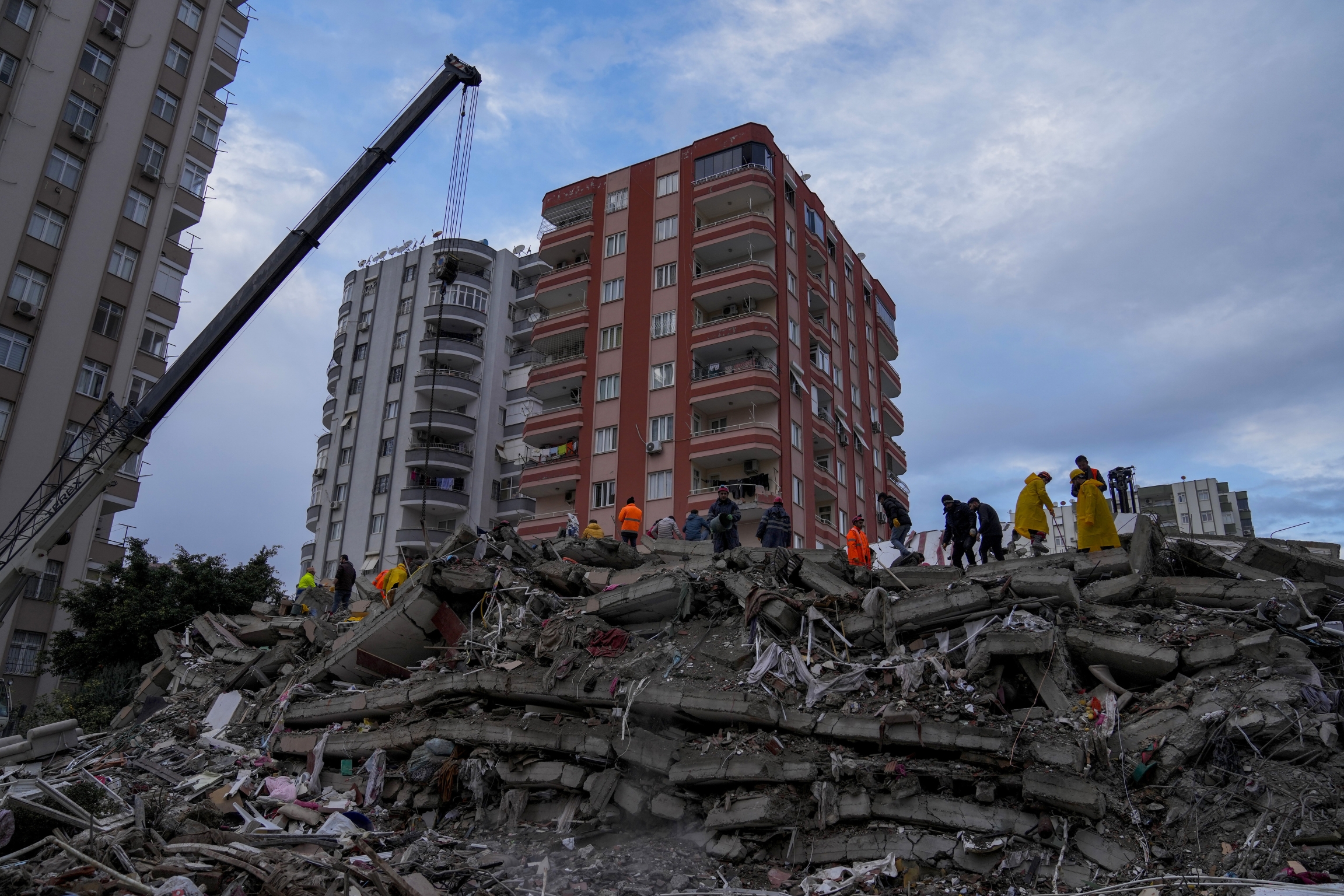
Emergency teams search for people in a destroyed building in Adana, Turkey, after a powerful quake knocked down multiple buildings, Feb. 6, 2023.
Khalil Hamra/AP
She explained that there are road closures and electricity and cellphone services are down in many areas, and multiple airports have suspended their flights. The Turkish disaster agency has asked for donations of blankets, electric generators and warm clothes. In places like Gaziantep, people with cars are trying to stay warm in their vehicles in an attempt to stay away from buildings and other structures that could collapse. They've been told not to leave the city because roads are badly damaged.
In the southeastern part of Turkey, home to minority groups and Syrian refugees, "A lot of people live in small towns and villages," she said. "They're spread out. It's an incredibly vulnerable population. People don't have a lot of savings to fall back on. They live in homes that often don't have a lot of up-to-date construction. And this just happened in probably the most-vulnerable section of the country."
More than a third of Spaniards light up on a daily basis. And when they’re done, many of their cigarette butts land in the street.
“Seven out of 10 cigarette butts in Spain get flicked to the ground,” said Rosa Garcia, the director of a nongovernmental organization called Rezero in Barcelona.
A lot of cigarette butts reach the coast when beachgoers drop them into the sand, she said, adding that more than 25% of the waste collected on Spanish beaches consists of plastic cigarette butts.
The cost each year to remove the tiny toxic nubs around Spain totals hundreds of millions of dollars, according to Garcia. A Rezero study suggests that it breaks down to anywhere between $15 to $25 per person every year.
“And even if you don’t smoke, you’re still paying for that cleanup — through your taxes,” Garcia said.
A recent decision, however, changed all of that. Spanish lawmakers have said that enough is enough — they passed legislation this month that would require cigarette makers to pay for the cleanup, but smokers worry that they’ll end up footing the bill.
Cigarette makers declined to speak to The World about their plans. But the most likely scenario is that they will reimburse individual town halls for the costs they already incur in street-cleaning. And smokers are worried that the companies might turn around and hike prices to compensate for the losses.
Barcelona has issued fines, at least on beaches, charging about $33 for dropping a cigarette butt in the surf. And last year, the city even banned smoking there altogether.
The fine was minimal, but another city initiative could hit smokers harder.
Barcelona’s City Hall is proposing a 20-cent tax per cigarette butt — which would be another $4 per pack, essentially doubling the price — but consumers would get that money back if they turn in the butts. It’s a similar scheme to getting some money back for returning soda cans for recycling.
The logistics for carrying out such a plan are still unclear.
Questions remain as to where people would return the cigarette butts. One logical choice would be at one of Spain’s 16,000 state-licensed tobacco shops, called estancos. But one estanco operator, Dani Perez, said he wouldn’t even touch them.
“In terms of hygiene it’s disgusting,” he said. “I am not going to start counting cigarette butts that have been lying on the ground, or sucked on by others.”
Nor would he have the time to do it, he said.
Cigarette butts are also filled with toxic residue from the tobacco, making them virtually impossible to recycle.
“A single cigarette butt can contaminate up to 1,000 liters [264 gallons] of water,” Garcia of Rezero said. “They are chemical bombs.”
Some startups are experimenting with biodegradable cigarette butts. But as they decompose, they’d still be releasing the dozens of toxic chemicals injected into them.
As far as cleanup goes, tobacco companies have a couple of months to roll out their plans.
Barcelona resident Andrés Conde, a 56-year-old who smokes, wonders just how companies like Winston, Camel and others will actually tackle the problem.
“What are they going to do, send brigades of tobacco employees moving down the streets of every single Spanish town?” he raised.
If they do end up passing the cost along to consumers, Conde said he knows what he’ll do.
“I won’t pay double for cigarettes,” he said. “That’s nuts. I’m going to emigrate to Latvia.” Conde normally spends his summers there — where, he said, no one would dare to even toss a cigarette butt to the curb.
And anti-smoking activists say there’s really only one longterm, viable plan: it’s not finding a way to deal with dropped cigarette butts, but getting people to quit smoking altogether.
Related: French nonprofit warns 'COVID waste' could harm the environment
When Indigenous activists, leaders and allies gathered on Jan. 2, at Brazil’s National Indian Foundation, FUNAI, it was finally time to celebrate.
This was an agency that had previously protected Indigenous rights and native land, but which, under former President Jair Bolsonaro, had been defunded, gutted and turned against them.
“It’s so great to be back here. We haven’t had a meeting here for a long time,” the new director Joenia Wapichana told a packed crowd. "And let’s remember,” she added, "from now on, the National Indian Foundation will be named the National Foundation of Indigenous Peoples."
Wapichana was Brazil’s first Indigenous lawyer and its first female Indigenous lawmaker. She was elected in 2018, and served in Congress over the last four years.
She said that President Luiz Inácio Lula da Silva had invited her personally to head the agency as its first Indigenous director.
“It will be a challenge,” she said. But Wapichana will have help.
FUNAI will now fall under the jurisdiction of Brazil’s first Indigenous People’s Ministry, led by prominent Indigenous activist Sonia Guajajara.
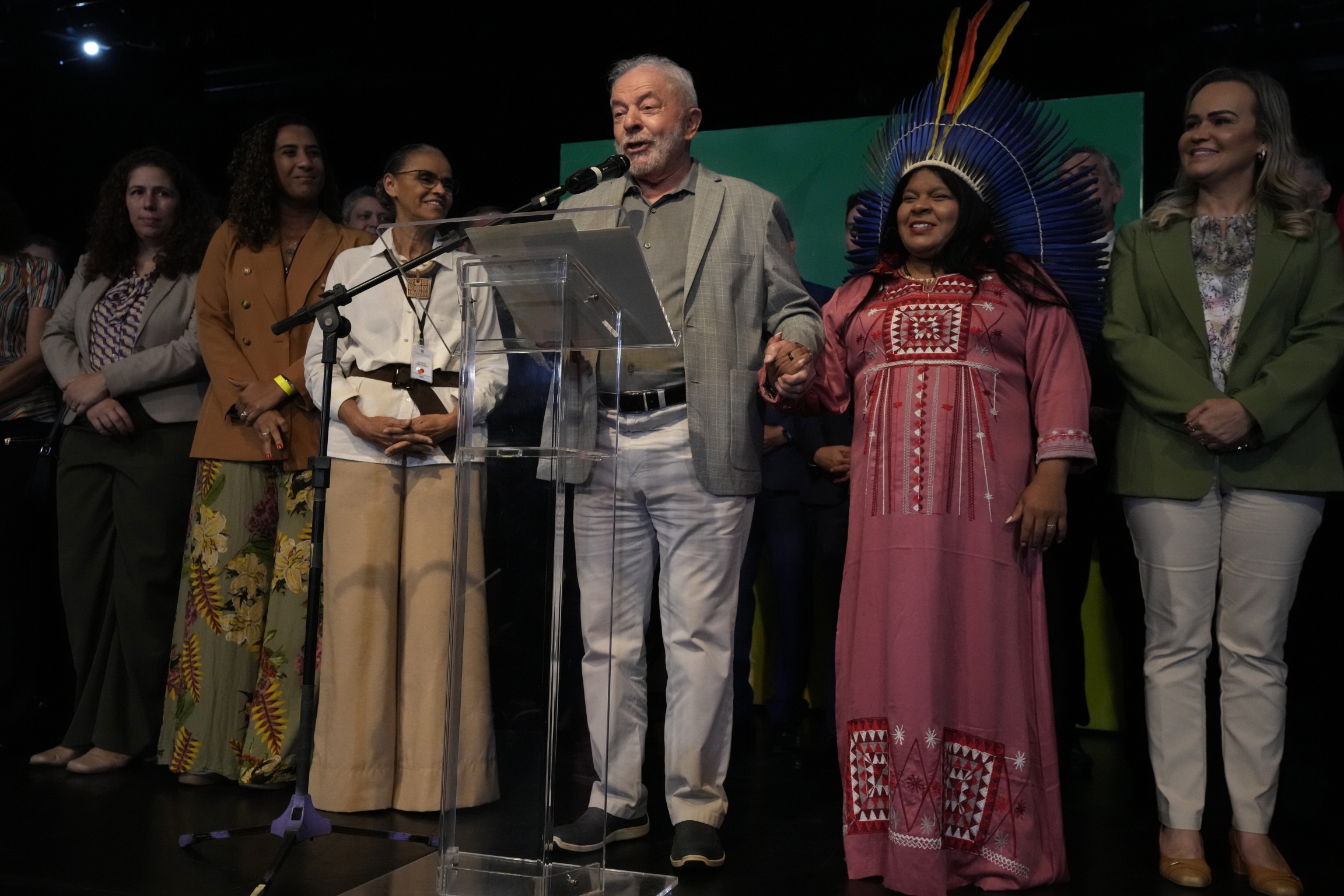
Brazil's President-elect Luiz Inacio Lula da Silva holds the hand of the his newly-named Minister of Indigenous Peoples Sonia Guajajara, during a meeting where he announced the ministers for his incoming government, in Brasilia, Brazil, Dec. 29, 2022.
Eraldo Peres/AP/File photo
Guajajara was Lula's first cabinet minister to be sworn in on inauguration day, and wore a feather headdress, carrying an Indigenous shaker in her right hand. Lula embraced her when she reached the podium.
"It’s a moment of such great emotion,” she said in her first speech to supporters. “I’ve been telling a lot of people that I've never felt this excited. Never in my life.”
Indigenous territories have been devastated in recent years by fires, clear cutting, mining and logging. Amazon deforestation is at a 15-year high. More than half of the destruction in recent years has been on conservation areas and native territories.
A tree stump on Indigenous land in the Amazonian state of Rondônia.
Michael Fox/The World
Indigenous peoples blame Bolsonaro for pushing for Amazon development and empowering illegal land grabbers.
Nowhere is this clearer than on Karipuna territory in the Amazonian state of Rondônia.
Walking through the jungle a few months ago, Chief André Karipuna pointed out the latest destruction of Indigenous land.
"This was all just burned," he said, staring out over the charred remnants of a once-pristine stretch of jungle. "You can still see the smoke. Less than a week ago, this was all green forest."
Chief André Karipuna points out destruction of Indigenous land in the Amazonian state of Rondônia.
Michael Fox/The World
But Lula has promised to stop the land invasions and the deforestation.
"The Indigenous peoples need to have their land demarcated and free from the threats of illegal and predatory economic activities,” Lula said during his inauguration speech.
“They're not obstacles to development. They are guardians of the rivers and forests and a fundamental piece of the greatness of our nation."
André Karipuna said he is excited about Lula’s victory, but concerned for what lies ahead.
"The invasions are really advanced,” he said. "We are hopeful that they'll be able to remove these invaders. But there's a lot to be resolved."
Destroyed trees in the Amazonian state of Rondônia, Brazil.
Michael Fox/The World
That's why the new Indigenous leaders in Lula’s government are hoping to take action — and fast.
At the top of their agenda is restructuring the new agencies, removing land invaders and demarcating new Indigenous land, something Bolsonaro refused to do.
Meanwhile, this month, the Brazilian government is expected to recognize 13 new Indigenous territories.
"This is a moment to rewrite the history of the Indigenous peoples of Brazil."
"This is an historic moment,” said Indigenous rights defender Ingrid Sateré Mawé. "This is a moment to rewrite the history of the Indigenous peoples of Brazil."
They have a long way to go, but Indigenous leaders say now, like never before, is a moment of relief, of celebration and hope, for them and for the protection of the Amazon rainforest.
Related: Lula vows to end illegal mining in the Amazon. But legal mining is more complicated.
Cleyson Juruna stands at the edge of the Xingu river, staring out over the water. He's the young chief of the Juruna people, who have lived in the Amazonian state of Pará for generations.
“The Xingu River is our life,” he said. "She's our mother. Our arms and legs. It’s our means of transportation and our food."
But in recent years, times have been hard.
In 2016, a new hydroelectric dam began to wreak havoc on the river, decreasing water levels by 80% and killing tons of fish, a major source of food for Cleyson and his people.
Now, the Juruna face yet another threat.

Cleyson Juruna stands at the edge of the Xingu river.
Michael Fox/The World
Just upstream from their territory, the Canadian mining company Belo Sun hopes to open the largest open-pit gold mine in the Amazon. The company says the location contains almost 4 million ounces of gold, worth more than $8 billion.
Belo Sun general manager Rodrigo Costa told The World in an email that the operation would "promote sustainable development" by providing 7,000 jobs, tax revenue, infrastructure and socio-environmental projects.
But Cleyson Juruna said the mine would be a disaster.
“Belo Sun is here to practically end the lives of the native peoples who live here: the Juruna and the Arara,” he said. He pointed to a map. Roughly 6 miles divide the location of the planned mine from Paquisamba Indigenous land, where Cleyson and his people live. In the middle is the Xingu River.
“If there were any type of tragedy,” he said, “any leak of something toxic, it would contaminate the entire region, the communities and Indigenous territories. Ours and others downstream."

The Juruna people live within the Paquisamba territory in the Brazilian Amazon.
Michael Fox/The World
Belo Sun says the mine was designed to have zero environmental impact. General manager Rodrigo Costa told The World that "there will be no discharge of effluents into the environment, which is an industrial practice in organized and responsible gold mining."
But environmental and Indigenous activists are not taking chances. In December, the San Francisco-based nongovernmental organization Amazon Watch released a report underscoring the dangers of the project. It accused Belo Sun executives of spreading misleading information and downplaying risks.
Indigenous leaders protested against the mine at a Biodiversity Conference in Montreal last month.
"People need to understand that this mine will not just impact the state of Pará and the Indigenous peoples, it will impact the world,” Indigenous leader Puyr Tembé said at the conference. "You will feel the impact. Humanity needs to wake up.”
Indigenous leader Cleyson Juruna says the gold mining project would be a disaster for his people.
Michael Fox/The World
But not all community members are against the mine.
In a 2017 video from Belo Sun’s Facebook page, residents of the town of Ressaca, near the mining site, rallied in favor of the project. “We have miners, farmers and fishermen who depend on development,” said a man in a white cowboy hat. Behind him, someone held a sign reading,"Make our opinion count."
Belo Sun officials say local communities approved the project in a series of local consultation processes held over the last decade. But Indigenous and environmental activists say those meetings were flawed, with residents pressured, and local Indigenous communities never gave the green light for the project.
Mining in the Amazon comes in the form of both large-scale projects like Belo Sun’s Volta Grande mine, and from illegal wildcat miners who have pushed onto Indigenous territories in recent years.
Brazil’s new President Luiz Inácio Lula da Silva has called for sustainability and vowed to end wildcat mining.
“We're going to stop any possibility of illegal mining. We need more than just a law. It needs to be a declaration of faith,” Lula said on the campaign trail.
A gold store in Boa Vista, Brazil, Wednesday, Nov. 3, 2021. Gold illegally mined in the rainforest mixes into the supply chain and melds with clean gold to become almost indistinguishable.
Andre Penner/AP
But Lula's relationship with legal mining in the Amazon will likely be more complicated. Some operations are deeply rooted. The largest iron-ore mine in the world, for instance, has been located in the southern Amazon for half a century.
Hundreds of companies have mining applications pending across the Brazilian Amazon.
"This mining might be legal, in that there is a supposed consultation process and such,” said Gisele Costa, a professor at Amazonas Federal University, who specializes on the impacts of mining in the region, "but the extraction of that ore will still pollute the rivers, kill people and so on.”
Belo Sun is awaiting a pair of licenses for the mine to proceed. They hope they can get the green light this year. Indigenous and environmental activists have vowed to do everything in their means to ensure that that approval never comes.
Valdemar de Assis corralled his herd of cattle back into their pen after a day in the field.
He’s a family farmer whose land runs alongside the Trans-Amazon highway in the Amazonian state of Pará. The lush forest here was cut decades ago amid a government push to open up the jungle. Assis grew up here on a farm. Today, he said, he has about 300 cows.
He provides milk to the local community. His farm is about 100 acres. That’s small for the Amazon, still considered a family farm. He raises pigs, sheep, chickens, corn and vegetables. Even fish. Assis' cows are his life.
“It’s so beautiful to see them walking in front of you, and also, knowing that tomorrow, you are going to have a little more income. It’s good.”
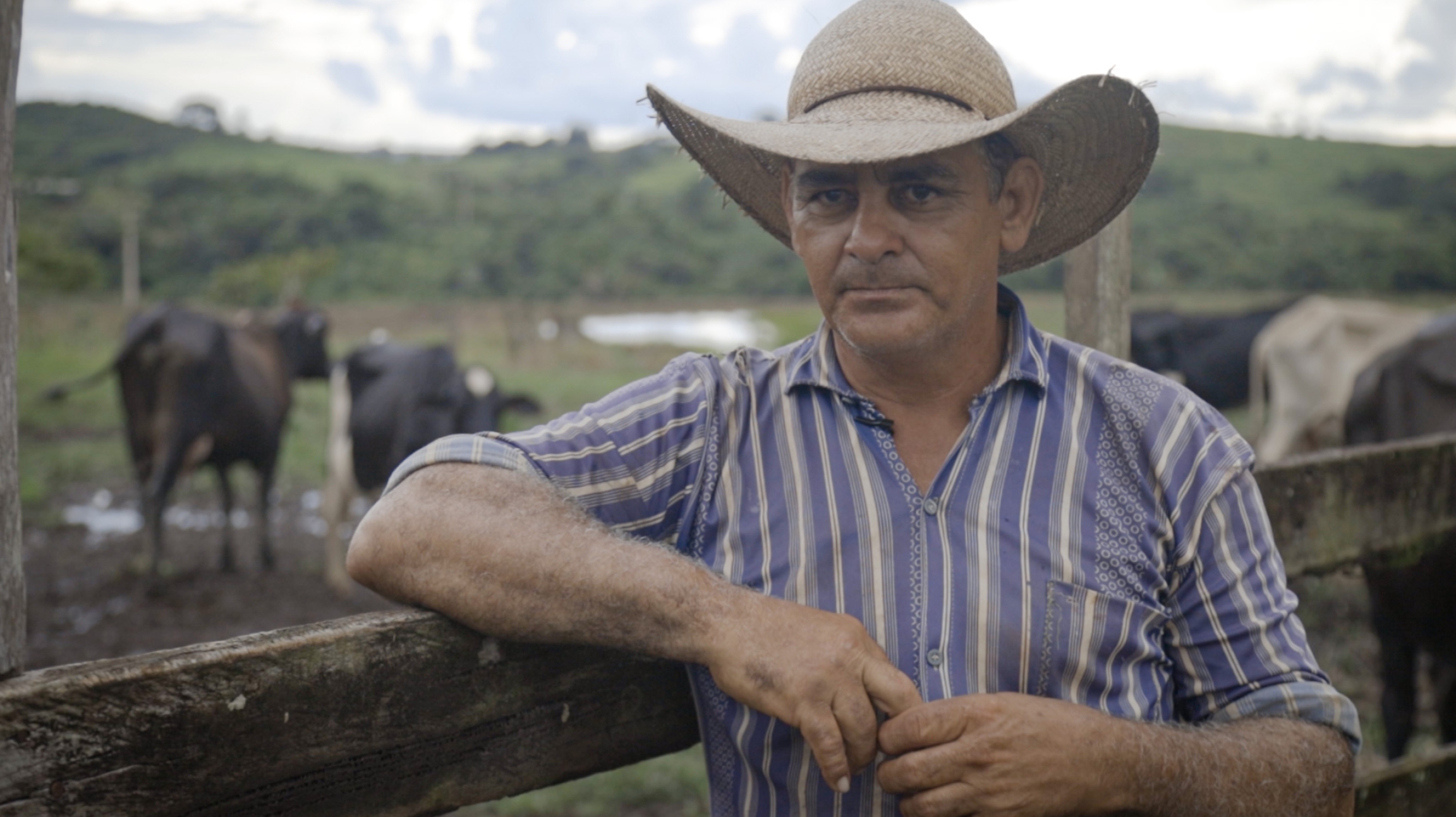
Brazilian Valdemar de Assis is a family farmer whose land runs alongside the Trans-Amazon highway in the Amazonian state of Pará.
Michael Fox/The World
Assis said that he makes about 6,000 reais, or just over $1,000 a month. That’s not bad for Brazil. Six times the minimum wage.
Farmers like him are likely to get a boost from Brazil's new president, Luiz Inácio Lula da Silva (referred to simply as “Lula"). In office for the third time, Lula promised to promote sustainable development for the Amazon — stopping deforestation while at the same time, keeping agribusiness thriving.
This is not an easy task. The Brazilian Amazon is huge and diverse, stretching across nine different states, and deforestation runs rampant.
Agronomist Anderson Borges said that small family farmers in the Amazon are responsible for roughly three-quarters of the products that feed local Brazilians. And as many as 90% of the jobs in agriculture here.
For Borges, sustainable development in areas that have already been deforested can look a lot like Assis’ land. The key ingredient, he said, is raising a variety of crops and animals.
”Having a diversity of many products means you don't need to intensify the production of just one crop, so you don't need a lot of pesticides and you don't need to deforest,” Borges said.
During Lula's second presidential term in 2008, he launched the program, Mais Alimentos, or More Food. The program supported small producers and family farmers with technical assistance, loans and government contracts to increase local agricultural production. Lula has again promised to back small producers.
Family farms are likely to get a boost from Brazil's new president, Luiz Inácio Lula da Silva (referred to simply as “Lula"). In office for the third time, Lula promised to promote sustainable development for the Amazon — stopping deforestation while at the same time, keeping agribusiness thriving.
Michael Fox/The World
But in the Amazon, family farmers make up just a small slice of the economy. And they have less than a quarter of farmland in the region. Another group is king: big ag — driven by multinational companies. Brazil leads the world in exports of both beef and soy beans. They are also the top two drivers of deforestation in the Amazon rainforest.
Lula has promised to stop deforestation. It's something he's done before. In his first term in office 20 years ago, he enacted new strict regulations, inspections, land registries, and wood- and meat-tracking systems. Those policies helped to cut deforestation rates in half within two years.
“We don't need to cut down even a meter of forest to continue to be one of the biggest food producers in the world,” Lula said at the COP27 summit in November.
The president wants to roll back deforestation without kneecapping the industry. But that’s not without its challenges.

A large cow pasture alongside Brazil's Trans-Amazon highway in the Amazonian state of Pará.
Michael Fox/The World
"You can’t amputate the arm of an important source of production, demanding sustainable practices without offering the necessary elements for them to be implemented,” said André Cotrim, an economics professor at Pará Federal University.
Suely Araújo is the former head of Brazil’s environmental protection agency, IBAMA. She said that Lula has to have a two-pronged approach against deforestation: fighting criminal actions like clear cuts and fires, while also supporting the local economy.
"We have to have a regional development plan for the Amazon, which shows that the government wants to generate income for residents of the region, but [which] does this with the forest still standing, with economic options that protect the forest.”
Araujo said that Lula did this well in 2004. And, she said, he's poised to do it again.The future of the Amazon rainforest largely depends on Lula’s success.
Science agencies in the US and Europe this week released their temperature data for 2022, revealing what has become an annual headline: Last year was one of the hottest on record. 2022 tied for fifth hottest, according to NASA. The US National Ocean and Atmospheric Administration, which uses slightly different data, said it came in sixth.
That’s even though La Niña cooled the equatorial Pacific, which typically turns down global temperatures.
“This was, in fact, the warmest La Niña year in the whole record,” said Gavin Schmidt, director of NASA’s Goddard Institute for Space Studies.
Earlier this week, Europe’s Copernicus Climate Change Service revealed 2022 was that continent’s second-hottest year ever, and hottest summer.
Last year was about 2 degrees Fahrenheit hotter than the preindustrial average, or 1.1 or 1.2 degrees Celsius, depending on whose data you use. That’s edging closer and closer to 1.5 degrees Celsius, a limit most countries in the world have pledged not to exceed. That goal is written into the 2015 Paris climate change agreement, alongside a less-ambitious target of limiting warming to “well below” 2 degrees Celsius. But it’s the lower target that has taken hold in recent years as both a goal and a rallying cry for aggressive climate action.
Keeping 1.5 “alive” became the mantra of Alok Sharma, the UK politician who served as president of the COP26 climate summit in Glasgow in late 2021. UN Secretary General António Guterres also frequently references the figure, among many others.
A coalition galvanized by low-lying island nations lobbied to get the more-ambitious target written into the Paris climate deal, arguing that exceeding that threshold represented an existential threat for their counties.
"It means we are dead. Just simply dead," former Maldives President Mohamed Nasheed told The World in 2021. “A whole country gone. A whole people gone. A whole society gone. A whole community gone. And this is the case with many, many low-lying islands.”
That target has always been wildly ambitious. But in the last seven years, as carbon emissions have continued to rise, it has gotten even more so. Global greenhouse gas emissions would need to be slashed 45% by the end of this decade to meet it, and a UN report published in October said there was no “credible” pathway to 1.5 in place.
Many climate scientists say that they don’t believe the target will be met.
“I'm pessimistic for the 1.5,” said Thomas Stocker, a climate scientist at the University of Bern who co-led an Intergovernmental Panel on Climate Change report on the physical basis of climate change in the years leading up to the Paris agreement’s creation.
“We're not on the pathway to actually keep the warming at 1.5 degrees Celsius,” he said. “We [would] be extremely lucky to hold the temperature warming below 2 degrees.”
Three scientists involved in tracking the global temperature data that was released this week also said they saw limiting warming to 1.5 degrees Celsius as unlikely.
“I think it's very challenging to stay below 1.5,” said Schmidt, saying he was speaking only for himself, not NASA.
“My expectation is that we will hit 1.5 degrees sometime in the 2030s,” said Samanath Burgess, deputy director of Europe’s Copernicus Climate Change Service.
“I think it's very unlikely that we avoid overshooting that level of warming,” said Zeke Hausfather, with Berkeley Earth, an independent research group that also released its 2022 temperature data on Thursday.
It’s technically still possible to keep warming at 1.5 degrees, according to the science of atmospheric warming. But a recent IPCC report shows it would require a massive shift away from coal, oil and gas at a speed that’s hard to imagine. And it almost certainly would require overshooting the 1.5 limit for a time, then removing carbon from the atmosphere again before the end of the century to bring the globe’s average temperature back down.
Still, Hausfather said he thinks that the goal itself has been useful.
“Even if it's a target we don't hit, I feel like the fact that we are trying means we'll probably end up in a better place than if we were aiming higher,” he said.
Hausfather points out countries responsible for around 80% of emissions now have targets to reach net-zero emissions by midcentury. Whether they meet them, of course, is an entirely different question, but the goal itself is based on the science behind the 1.5-degree goal.
The target being written into an international agreement “holds political leaders accountable,” Burgess said.
Even as 1.5 continues to be held up as the goal by political leaders and activists, scientists aren’t exactly shouting from the rooftops how much of a stretch it really is.
Swiss scientist Thomas Stocker said there’s a concern that doing so would stymie ambition.
“I disagree,” he said, arguing it should instead galvanize even faster action.“The consequence should be that under no circumstances will we lose the second target and make the same mistakes again.”
Some scientists worry that the 1.5-limit has been framed as a kind of tipping point, a make-or-break goal.
“The reality is that every single fraction of a degree matters; 1.5 isn't a cliff edge where bad things will happen. Bad things are already happening,” Burgess said.
Keeping warming below 1.7 degrees, say, would be better than 1.8 — 1.9 would be better than 2.
Each 10th of a degree could cause more extreme rainfall, like the kind flooding California right now, and worsen heat waves, droughts and hurricanes, and further push up sea levels imperiling low-lying island nations.
Leaders and activists in those vulnerable countries largely are not ready to talk about a post 1.5-world, at least to reporters.
"I can't afford to think that 1.5 degrees is not attainable," former Maldives President Mohamed Nasheed said in 2021. “That would be a death sentence on our countries, and many low lying islands and coastal regions.”
With current pledges made under the Paris agreement, the UN Environment Program estimates the world is on track for 2.4 to 2.6 degrees Celsius of warming by century’s end.
This analysis was featured in Critical State, a weekly foreign policy newsletter from Inkstick Media. Subscribe here.
In the frozen waters and still-extant ice at the top of the world, it is easy to imagine that the environment is harsh enough for humans to leave conflict behind. While the fate of the warming North Pole is relevant to the whole of the world, international cooperation in the region, in recent decades at least, has been led by the countries north of the Arctic Circle. These eight nations, the United States, Canada, Denmark (through its possession of Greenland), Iceland, Norway, Sweden, Finland, and Russia, joined the Arctic Council in 1996.
The organization, which began as the Cold War ended, also consists of Indigenous Peoples as permanent participants, and has many non-member observers (like Germany and the Republic of Korea) who share a concern for the region. But following Russia’s invasion of Ukraine in February 2022, the Arctic Council has been on hiatus, and its once exceptional nature as a durable model of international cooperation is in question.
In “Can Exceptionalism Withstand Crises? An Evaluation of the Arctic Council's Response to Climate Change and Russia's War on Ukraine,” Gabriella Gricius and Erin B. Fitz look at the history of the council and examine what, if any, of its fair-weather functionality is durable in crisis.
To start, the authors look at two distinct, compounding crises for the council. The first is climate change, which expands human activity in the Arctic while also imperiling the climate, life, and lifeways in the region. Second, the authors look at Russia’s war on Ukraine, an acute and entirely voluntary geopolitical crisis brought about by one of the council’s member states, and which has an impact on its ability to cooperate with all other countries, especially with the council.
The authors sought to understand the perception of the council’s stability. Todo so, they conducted a literature review of scholarly articles about the Arctic Council. One finding was notable specifically for what was absent.
“Although the publications included in our review largely failed to mention actual geopolitical crises, Russia's 2014 annexation of Crimea had an unequivocal impact on global and Arctic politics,” the authors write. Much of the work of the council continued, even as Russia did not participate in “annual meetings of the Chiefs of the Armed Forces of Arctic States, an independent cooperative institution from the Arctic Council.”
The course of action was normal enough that Russia could assume its role as council chair in 2021, though any expectations at preceding normally were lost with the invasion.
“Although it is likely that Arctic Council activities would have halted in response to the 2022 Russia-Ukraine war regardless of who held the chairmanship, the fact that the Council did not shut down during previous crises suggests that the other seven Arctic states viewed this conflict as a more significant, state-driven stimulus,” the authors write. While the cooperation among other states and partners is beneficial, it suggests that the institution's previous decades of smooth operation hinge largely on the absence of geopolitical headwinds. At best, they conclude, it’s the lack of dispute that has made the Arctic Council durable, rather than the council ensuring a lack of disputes.
Related: Arctic alternatives: Part I
Critical State is your weekly fix of foreign policy analysis from the staff at Inkstick Media. Subscribe here.
Just across the Arizona border lies the dry, hot northern Mexico state of Sonora. It’s known for its abundant minerals, and it sees more than 300 days a year of clear sky and sunshine — prime real estate for something like a massive solar plant, or several of them.
Mexico plans to do just that, building solar plants across Sonora, and it hopes to inaugurate the first project next month.
But that’s just the first stage. Within a few years, officials say it will be generating a gigawatt of energy, roughly the output of a nuclear power plant. Once completed, it’ll be the eighth-largest solar plant in the world.
President Andrés Manuel López Obrador said it’s just the beginning.
"We’ve already begun the solar plant in Puerto Peñasco and the idea is to replicate it. Make five plants, and at the same time, run those electric lines to the border,” he told press late last year, adding that Mexico could even supply energy to the United States.
But there's a problem. These solar projects are to be run by Mexico’s state-owned company. The US and Canada say it is a violation of trade agreeements — an issue that’s central to the talks between the leaders of Canada, the US and Mexico, which are underway in Mexico City this week.
In recent years, López Obrador has pushed an energy policy that, in short, has prioritized largely coal-powered energy from the state electricity company, sidelining renewables and private and foreign energy firms.
Mexican energy consultant Arturo Carranza said the move has been harshly criticized "not only by opposition political parties, but also by private companies already involved in Mexico's electricity sector. For them, this reform represented a change in the rules under which they had decided to bring their investments."
The US and Canada have demanded that Mexico rescind the priority status of the state electricity company and treat all firms equally. López Obrador responded by saying that his government has a right to prioritize Mexican state companies.
Last July, the US and Canada filed a complaint against Mexico for breaking rules under the North American free trade deal, known as the United States-Mexico-Canada Agreement (USMCA). It states that Mexico cannot prioritize state businesses over the private sector. They also accused López Obrador of disincentivizing investment in clean energy.
Energy consultant Carranza said the Sonora plan is Mexico’s way of offering a carrot to the United States and Canada — a promise of clean energy. The plan would also include the extraction of lithium, in part, for the US microchip industry and for car manufacturing.
Analysts say it's a step in the right direction, but it only partially resolves the root of the energy conflict. Plus, it's not clear that Mexico could even get the full plan off the drawing board.
"As a Mexican, I would love it if Plan Sonora could generate, transform, drive and supply 40% of the country with clean energy,” said Miriam Grunstein, chief energy counsel at Brilliant Energy Consulting. "But that's just a fantasy."
Even if Mexico could muster the funds to build the plants, Grunstein said, Mexico’s electricity grid would have to be updated to carry the new load, something that Mexico is not investing in.
University of Mexico economist Juan Carlos Moreno-Brid said not to expect anything substantial from this week’s summit.
"There will be nice words for the public,” he explained. "But behind the scenes, Canada and the United States are going to pressure Mexico hard to continue to change its energy policy.”
And that pressure may have an impact. Mexico imports roughly 70% of its natural gas, gasoline and diesel from the United States. And the US receives 80% of Mexico’s exports, which is a huge driver of the Mexican economy.
Moreno-Brid said that means the US has huge leverage to force Mexico to eventually bring its energy policy into line, negotiating power that will likely eventually have an impact, with or without Plan Sonora.
Related: In the north of Mexico, water cuts to cope with shortages hit poor communities hardest
Farmer Gilbert Butau appreciates his maize, but in recent years, he said, he has had to accept reality: Climate change is making it harder to grow enough maize for his family.
"In the past, if I planted 10 kilograms of maize seed, I would get at least 2 tons, but now we get 150 kilograms from the same amount of seed. The rain is now erratic — it is getting less every year," said Gilbert Butau, who farms on several hectares of land in Mudzi, a hot, dry district in northeastern Zimbabwe.
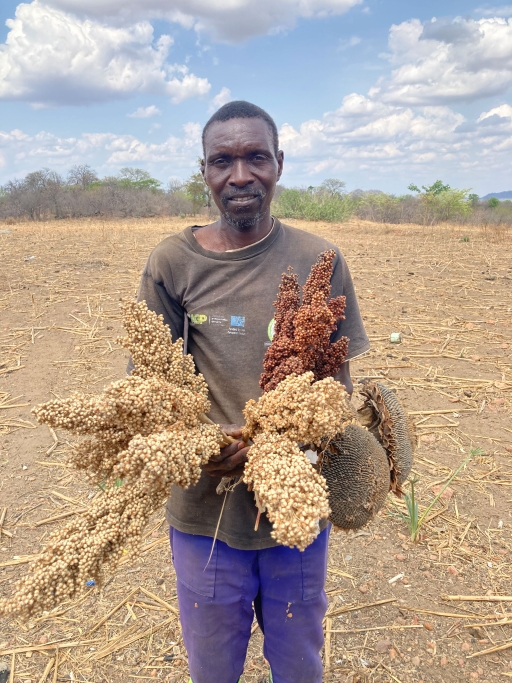
Farmer Gilbert Butau holds some red and white sorghum and sunflower, which also grows well in drier regions.
ish Mafundkiwa/The World
Zimbabwe has had to import maize, a staple food, for the past several years as the country struggles to produce enough to feed its population of 15 million people. Experts blame more frequent droughts and erratic rainfall, which has led to poor harvests and chronic food insecurity.
Over the past decade, the government has tried to wean Zimbabweans off maize in arid parts of the country, encouraging them instead to grow traditional small grains like sorghum and millet, which are more drought-resistant.
But making the switch has not been easy. Producing small grains is more labor-intensive, and most Zimbabweans still prefer the taste of corn to sorghum or millet.
Europeans introduced maize to Africa in the 16th century, and Africans quickly took to it because it was easy to grow. It could also be eaten on the cob before being harvested. Small-grain crops, on the other hand, attract pests, mainly birds, which means someone has to guard the fields against them. They also require more processing, including threshing, the act of separating the grain from the plant. Done on the ground, this often gets sand in the grain, making it unattractive to eat.
Now, diesel-powered threshers are making the chore less labor-intensive, making it more manageable to produce clean grain.
Subsistence farmer Zvanyadza Karima, also from Mudzi, owns one. He uses it to thresh his grain — and his neighbors’— for a fee.
"Using the thresher, we do not deal with bits of stone or sticks or sand; it is now clean," he said.
He added that guarding the fields against the voracious quelea birds that can quickly destroy a whole field is now a shared community activity.

Zvanyadza Karima uses a thresher, which makes small grain production much easier.
ish Mafundikwa/The World
More farmers are turning to drought-tolerant small grains. But convincing Zimbabweans to make the switch is challenging: Most people favor ground white cornmeal to prepare a thick porridge, a staple dish eaten all over the country.
Gilbert Butau's wife, Faina Butau, is originally from a predominantly maize-growing area. She said that developing a taste for the small grains was more challenging for her than it was for her six children.
"When I moved here after getting married, it was difficult for me, but I am now used to them and prefer sorghum and millet to maize," she said.
But Nomuhle Moyo, 26, said she’s sticking to maize because the one time he tried sorghum and millet, she didn’t like the taste. And the high price of sorghum and millet is discouraging.

Sorghum meal on a supermarket shelf in Zimbabwe.
ish Mafundikwa/The World
Many Zimbabweans also hold a common belief that maize is nutritionally superior to traditional gains, but UNICEF nutritionist Mara Nyawo dispelled this myth.
"They are higher in fiber, and the B vitamin, are good for immunity, and reduce the risk of chronic diseases like diabetes, heart disease, and high blood pressure,” she said, adding that small grains also reduce the risk of obesity, a growing issue in Zimbabwe.
The government has been working to persuade more farmers in drought-prone areas to grow small grains with incentives. This year, an agricultural program that targets some 3 million households is changing the contents of its free seed packs.
"Because of climate change, farmers in those [vulnerable] areas will get traditional grains that do very well in those areas,” explained Stancilae Tapererwa, a senior Agriculture Ministry official.

Maize is a popular meal for most Zimbabweans, but more are turning to sorghum and millet as alternatives.
ish Mafundkiwa/The World
The Ministry of Agriculture also encourages the uptake of small grains with a program that encourages farmers to sell their small grains and buy maize at Grain Marketing Board depots across the country, according to Vangelis Haritatos, the ministry's deputy minister.
"So, we will take that burden away so that farmers can be confident that even though I have grown traditional grains, I can still get the bag of maize."
With these efforts, attitudes toward growing and consuming small grains are slowly changing in Zimbabwe. These types of grains now appear on menus at most restaurants and they’re available at the supermarket alongside other so-called healthy foods.
They are, however, priced at a premium compared to cornmeal, putting them beyond the reach of the not-so-well-off. If prices come down, more farmers will grow more small grains and put them out into the market.
The extreme weather that has battered much of the US in 2022 doesn’t just affect humans. Heat waves, wildfires, droughts and storms also threaten many wild species — including some that already face other stresses.
I’ve been researching bee health for over 10 years, with a focus on honey bees. In 2021, I began hearing for the first time from beekeepers about how extreme drought and rainfall were affecting bee colony health.
Drought conditions in the western US in 2021 dried up bee forage — the floral nectar and pollen that bees need to produce honey and stay healthy. And extreme rain in the Northeast limited the hours that bees could fly for forage.
In both cases, managed colonies — hives that humans keep for honey production or commercial pollination — were starving. Beekeepers had to feed their bees more supplements of sugar water and pollen than they usually would to keep their colonies alive. Some beekeepers who had been in business for decades shared that they lost 50% to 70% of their colonies over the winter of 2021-2022.
These weather conditions likely also affected wild and native bees. And unlike managed colonies, these important species did not receive supplements to buffer them through harsh conditions.
Each year, the US Department of Agriculture and the Environmental Protection Agency host federal pollinator experts to share the latest scientific findings on bee and pollinator health, and assess the status of these important insects, birds, bats and other species. One clear takeaway from this year’s meeting was that climate change has become a new and formidable stressor for bees, potentially amplifying previously known issues in ways that scientists can’t yet predict but need to prepare for.
Pollinators contribute an estimated $235 billion to $577 billion yearly to global agriculture, based on the value of the crops they pollinate. Understanding and mitigating the impacts of climate change on pollinators is key for supporting healthy ecosystems and sustainable agriculture.
Bee health first attracted widespread attention in 2006 with the emergence of Colony Collapse Disorder, a phenomenon where the majority of adult worker bees in a colony disappeared, leaving their honey and pollen stores and some nurse bees behind to care for the queen and remaining immature bees. In the past five years, reported cases have declined substantially. Now, researchers are focusing on what beekeepers call the “four Ps”: parasites, pathogens, pesticides and poor nutrition, as well as habitat loss for wild and native bees.
One of the most severe threats to honey bees over the past several decades has been Varroa destructor, a crablike parasitic mite that feeds on honey bees’ fat body tissue. The fat body is a nutrient-dense organ that functions much like the liver in mammals. It helps bees maintain a strong immune system, metabolize pesticides and survive through the winter.
These are vital functions, so controlling mite infestations is essential for bee health. Varroa can also transmit deadly pathogens to honey bees, such as deformed wing virus.
Controlling mite populations is challenging. It requires using an insecticide in an insect colony, or as beekeepers say, “trying to kill a bug on a bug.” It’s hard to find a formula strong enough to kill mites without harming the bees.
Monitoring Varroa takes significant skill and labor, and mites can build up resistance to treatments over time. Researchers and beekeepers are working hard to breed Varroa-resistant bees, but mites continue to plague the industry.
Pesticides also harm bees, particularly products that cause sublethal or chronic bee health issues. Sublethal pesticide exposures can make bees less able to gather forage, grow healthy larvae and fight off viruses and mites.
However, it can be hard to document and understand sublethal toxicity. Many factors affect how bees react to agrochemicals, including whether they are exposed as larvae or as adult bees, the mixture of chemicals bees are exposed to, the weather at the time of application and how healthy a bee colony is pre-exposure.
Researchers are also working to understand how soil pesticides affect ground-nesting wild bees, which represent over 70% of the US native bee population.

A ground-nesting bee (Colletes inaqualis) emerging from its burrow.
Rob Cruickshank/Flickr, CC BY
Like many other species, bees are losing the habitat and food sources that they depend on. This is happening for many reasons.
For example, uncultivated lands are being converted to farmland or developed worldwide. Large-scale agriculture focuses on mass production of a few commodity crops, which reduces the amount of nesting habitat and forage available for bees.
And many farmers often remove pollinator-friendly plants and shrubs that grow around farm lands to reduce the risk of attracting animals such as deer and rodents, which could spread pathogens that cause foodborne illness. Research suggests that these efforts harm beneficial insects and don’t increase food safety.
As diverse and healthy bee forage disappears, beekeepers feed their bees more supplements, such as sugar water and pollen substitutes, which are not as nutritious as the nectar and pollen bees get from flowers.
Researchers don’t know exactly how climate change will affect bee health. But they suspect it will add to existing stresses.
For example, if pest pressures mount for farmers, bees will be exposed to more pesticides. Extreme rainfall can disrupt bees’ foraging patterns. Wildfires and floods may destroy bee habitat and food sources. Drought may also reduce available forage and discourage land managers from planting new areas for bees as water becomes less readily available.
After the widespread devastation brought by Hurricane Michael, bee populations in the Florida Panhandle have struggled to survive. With food supplies virtually wiped out, entire bee colonies are starving to death. pic.twitter.com/FF9VEyZ2sC
— Pattrn (@pattrn) November 13, 2018
Climate change could also increase the spread of Varroa and other pathogens. Warmer fall and winter temperatures extend the period when bees forage. Varroa travel on foraging bees, so longer foraging provides a larger time window for mites and the viruses they carry to spread among colonies. Higher mite populations on bee colonies heading into winter will likely cripple colony health and increase winter losses.
Studies have already shown that climate change is disrupting seasonal connections between bees and flowers. As spring arrives earlier in the year, flowers bloom earlier or in different regions, but bees may not be present to feed on them. Even if flowers bloom at their usual times and locations, they may produce less-nutritious pollen and nectar under extreme weather conditions.
Research that analyzes the nutritional profiles of bee forage plants and how they change under different climate scenarios will help land managers plant climate-resilient plants for different regions.
There are many ways to support bees and pollinators. Planting pollinator gardens with regional plants that bloom throughout the year can provide much-needed forage.
Ground-nesting native bees need patches of exposed and undisturbed soil, free of mulch or other ground covers. Gardeners can clear some ground in a sunny, well-drained area to create dedicated spaces for bees to dig nests.
Another important step is using integrated pest management, a land management approach that minimizes the use of chemical pesticides. And anyone who wants to help monitor native bees can join community science projects and use phone apps to submit data.
Most importantly, educating people and communities about bees and their importance to our food system can help create a more pollinator-friendly world.
Jennie L. Durant is a research affiliate in human ecology at the University of California, Davis. This article is republished from The Conversation, a nonprofit, independent news organization dedicated to unlocking the knowledge of experts for the public good.
Christine Harrison has taken to sitting outside, barefoot, on the balcony of her chalet in the French Alps, and soaking up the sunshine.
Harrison, from Liverpool in the UK, has been visiting the French ski resort of Praz De Lys every winter for the past 25 years. The family-friendly resort is located at an altitude of 4,921 feet and boasts 31 miles of Nordic ski slopes for sports enthusiasts.
This year, she said, just finding a slope with snow has been her biggest challenge: “There’s no snow, literally, you can't ski here. There's just grass everywhere.”
Praz de Lys, like numerous ski resorts across the Alps and French Pyrenees, is struggling to cope with the unprecedented warm temperatures this month. Some resorts like A x 3 Domaines, located close to the French border with Andorra, have shut completely.
Others, like Le Gets and Morzine, in the Portes du Soleil area, have closed several of their ski runs.
Harrison said that she, along with her partner and two teenage children, went to Les Contamines that's nestled at the foot of Mont Blanc in search of better skiing conditions earlier this week. At the top of the slopes, Harrison said, they finally found snow but as they descended below 2,000 meters, the rain started to pour down and the ski run quickly turned to slush.
“It was horrible. We managed to do about four hours and it was like, what are we even doing here? It was carnage,” she said.
Le Praz De Lys in the French alps is shown on a more wintry day in 2017.
Courtesy of Christine Harrison
The conditions are not just challenging for winter sports enthusiasts, but they could prove risky, too.
Klaus Dodds, a professor of geopolitics at Royal Holloway University of London, said skiers and snowboarders will notice that piste (downhill ski trails) and snow conditions become more uncertain in warmer temperatures.
“There's more chance of avalanches, and skiing just becomes more dangerous because snow and ice is less settled,” he said.
Dodds said he isn’t surprised by the rise in temperatures at European ski resorts this winter. After all, he said, several EU countries experienced record-breaking heat waves last summer. Scientists have been warning about this for years, he said.
“We’re not just talking about climate change now, it’s climate breakdown,” Dodds said.
It’s not only winter ski resorts that are seeing unprecedented temperature hikes this month. Cities in Germany, the Czech Republic, Hungary and France have all smashed records for the hottest start to the new year.
Warsaw, Poland, where the mercury usually hovers around freezing at this time of year, clocked up 66 degrees Fahrenheit on Jan. 1. Residents of Bilbao in northern Spain headed to the beach earlier this week as temperatures soared to highs usually seen in midsummer.
Snow loss or ice loss also has implications for water supply, according to Dodds.
Many of Europe's major rivers, such as the River Po in Italy or the Rhine in Germany, are dependent on alpine meltwater to replenish water levels. Low water levels have a negative impact on agriculture and endanger river transport, he said.
Christine Harrison (middle), with daughter Sophie and son Jack are shown at the French ski resort in snowier times in February 2020.
Courtesy of Christine Harrison
Countries like France and Switzerland have also been expressing concern that they will not have enough water to act as coolant for their nuclear power stations, Dodds said.
The high winter temperatures also pose a challenge to communities in alpine towns that are dependent on winter tourism.
Sara Burdon, communications manager at the Morzine tourist office, said local businesses are worried.
“While the summer is an important and very much growing part of the tourism here, the winter is still the main season and the one in which businesses make most of their income,” Burdon said.
For the last few years, the town of Morzine has tried to address the negative impact a ski resort can have on the environment. Ski holidays can produce a large carbon footprint between visitor flights and the use of gas-guzzling equipment like artificial snow machines and ski lifts.

Sara Burdon works in the Morzine tourism office in France said that businesses are worried about the impact of warm winter temperatures on seasonal tourism.
Sam Ingles
Burdon said the town has now installed solar panels on some of the chair lifts, while workers have adopted more sustainable ways of looking after the ski pistes, including using GPS systems to target exactly where artificial snow is required.
Last year, Morzine was awarded the Flocon Vert sustainability award — an environmental honor recognizing green development policies in European ski resorts.
Burdon said that they are still working hard to combat the heavy carbon cost of the flights.
A local environmental charity, Montagne Verte, has created a special train pass called the AlpinExpress Pass, which gives those who arrive by rail cut-price offers on their journey as well as cheaper accommodation and discounts on ski hire.
Burdon said they try to encourage their European visitors to make the journey by train whenever possible.
One silver lining from the unexpected balmy conditions this season has been lower heating bills. Last summer, the German government warned of a possible fuel shortage in the winter along with soaring energy costs — caused by the lack of a gas supply from Russia.
In December, the German economy minister, Robert Habeck, said he is optimistic the country has enough fuel to see it through the winter.
But Dodds pointed out that warmer temperatures have also been responsible for the catastrophic flooding in parts of Europe last year that devastated homes, particularly in Germany. The climate scientist said he believes that governments can still do more to prevent further temperature rises. For starters he said, nations need to stick to the targets laid out in the 2015 Paris Agreement which vowed to prevent global temperatures from rising 2 degrees Celsius above pre-industrial levels this century, and in particular, limit the increase to 1.5 degrees Celsius.
“We’re already 1.2 degrees past, so there’s little wriggle room left before we reach the 1.5 degree limit,” Dodds said. “That’s why we talk about a climate emergency.”
A bakers’ rebellion is looming in France as they prepare to defend their beloved baguettes. Making bread, croissants and other pastries has become next to impossible, they say, due to soaring electricity prices.
Now, they’re demanding help from the government. And if it doesn’t arrive soon, they’re threatening the unthinkable — to turn off their ovens.
Take French baker Phillipe Mendez. The sound of his electric ovens whirring to life used to be music to his ears. Now, it’s a source of stress.
“My electricity bill has gone up four-fold in the last eight months,” he said. “That’s besides the price hikes for my basic ingredients. The situation,” he added, “is becoming very complicated.”
Mendez opened his artisanal bakery nine years ago in the small Alpine village of Embrun. Business was good, until now. Inflation, the war in Ukraine and the Europe-wide energy crunch have Mendez at wit's end.
"My wife, Nathalie, has had to come in to work," he said, "as we’ve been forced to reduce our staff."
"What’s happening is a real shame," Nathalie said as she sliced bread on the electric slicer. "All of our bread is homemade. We strive for quality. But because of what’s happening,” she said, “our hands are tied."

"The French, deprived of their bread, would die,” jokes French baker Phillipe Mendez. Mendez is one of thousands of artisanal bakers warning they may need to unplug their ovens because it's too expensive to operate due to rising electricity costs.
Gerry Hadden/The World
At the end of this week the Mendezes said they’ll have to raise prices by about 10%. They said they can only hope their customers will still come by. Because it's France, good bread isn’t some luxury item — it’s like water — you have it with every meal.
Local worker Julien Breniere picked up two baguettes on his way home from work. He said he can’t start his day without them.
“They’re actually mini-baguettes,” he said. “Ficelles. In the morning,” he said, rubbing his stomach, “I toast them and eat them with butter and jam.”
“Our bread is very important,” 80-year-old customer Giselle Van Overberk said. “It’s well known,” she said, “that the French baguette is the best in the world.”
You could chalk up such comments to national pride. But French bakers sell some 6 billion baguettes a year. In December 2022, the United Nations granted baguette-baking world heritage status. And each week on French TV, there’s a reality show — just for baking bread.
On the latest episode of “The Best Bakeries in France,” two stern-looking judges weigh in on a spinach and Brebis cheese loaf baked somewhere in the Pyrenees — 8 points out of 10, they declared — with room for improvement.
Beloved bakers in France are not immune to the energy woes gripping the country. Electricity prices are set to rise further this winter, as the government struggles to compensate for the loss of natural gas from Russia. In fact, the government warns, there could be temporary blackouts later this month. But its message to bakers is, “We’ve got your backs.”
“We will not let our bakeries fail,” said France’s Minister of Finance Bruno Le Maire on the radio this week. “We’ll stand by them,” he said. “Helping with concrete measures.”
Those measures include tax breaks and emergency subsidies. But French bakers say they need more.
“They speak of an emergency bail-out check,” baker Mendez said. But red tape is a problem.
“I had to file an application about 6 inches thick,” he said. “And I still don’t know if I’m getting anything.”
Mendez said he can hang on for another couple of months. After that, he said, he’ll bake up his last batch of baguettes, then unplug his ovens for good. And that, he said, would be an existential catastrophe.
"The French,” he half-jokes, “will die without their bread."
At Ráječek Farm in the southern Czech Republic, bright, red hydroponic tomato plants tower more than 10 feet tall inside greenhouses.
The Sklenář family has worked the land on Ráječek Farm for four generations. The family once lost the farm to the state under communist rule. But several years after the Czech Republic switched to a market economy, the family regained control of the farm and launched a successful business growing hydroponic tomatoes.
“My parents had to reinvent the whole business again because if they did the same [farming] model as our grandparents, it wouldn’t have been economically sustainable,” said Matěj Sklenář, 28, the head agronomist at Ráječek Farm.
But last year, Russia’s invasion of Ukraine — a war aimed at pulling a large swath of Eastern Europe back into Russia’s influence — once again disrupted the growing season on Ráječek Farm.
Some fertilizers Sklenář uses on his hydroponic tomatoes come from Russia. But last year, those fertilizers became 10 times more expensive.
The drastic rise in fertilizer prices is a huge problem for hydroponic farmers because they mostly don’t use organic fertilizers like compost or manure.
“If you grow in soil and you don't add fertilizer you can still do a season with decreased yield, but with hydroponics, if you don't have fertilizers, it's just not possible to grow anything,” Sklenář said.

Matěj Sklenář, 28, the head agronomist at Ráječek Farm in the south of the Czech Republic, stands in one of the farm's hydroponic greenhouses. The farm, which has been operated by the same family for four generations, previously relied on a brand of Russian fertilizer that became about ten times more expensive last year after the war in Ukraine began.
Courtesy of Ráječek Farm
Fertilizer is used by most commercial farming operations. And industrially produced fertilizers are often credited with providing sufficient yields to feed a planet with a growing population that is projected to have reached 8 billion people.
Russia is the world’s largest producer of fertilizers. There are no sanctions against Russian agricultural products, but many shipping companies now refuse to transport Russian products, including fertilizers.
Belarus is also a large fertilizer supplier, but sanctions against Belarus for its participation in the war in Ukraine have also severely limited the country’s contributions to the global fertilizer supply.
These restrictions are causing fertilizer prices to skyrocket.
Common nitrogen fertilizers found at the store are made from ammonia, which is produced from natural gas. Russia used to export a lot of ammonia to the fertilizer market through a pipeline in Ukraine. But that’s been closed since the war started.
Fertilizer companies in Europe also make their own ammonia with natural gas from the European grid. But Europe is trying to wean itself off Russian gas right now, so fuel prices are rising.
“The war caused the price of natural gas to increase, so that’s one of the reasons why fertilizer is so expensive,” Sklenář said.
Last year, major fertilizer companies like Norway’s Yara International had to temporarily curtail production of nitrogen fertilizers because of the war.
Yara was eventually able to reroute their ammonia supply from other sources to increase production speed again. But fertilizer prices remain high, driving up food costs.
“What we’ve seen with the Russian invasion of Ukraine is that, sadly, the situation with food production has turned to the worst,” said Lars Røsæg, deputy chief executive officer of Yara International.
After the war started last year, Sklenář’s farm was hit with a double whammy because many of the workers are Ukrainian. They were back in Ukraine on holiday when the war started, and men who were old enough to serve were no longer allowed to leave the country. Sklenář has struggled to find new workers.

Six sisters from Ukraine stand in a greenhouse at Ráječek Farm in the Czech Republic, four of whom are employees at the farm and two of whom sought refuge there after the war started. Many of the farm's workers come from Ukraine, however, some of their male workers cannot leave Ukraine and return to the Czech Republic because men young enough to serve in the military can't leave the country. The farm has struggled to find workers to replace them.
Courtesy of Ráječek Farm
It’s also more expensive to heat his greenhouses now.
“We are pretty sure that this season, the profit will not be as big as past seasons,” Sklenář said.
Fertilizer costs have forced farmers all over Europe to make difficult decisions.
Kieran McEvoy, a farmer south of Dublin who grows wheat and barley, said that he usually buys all of his fertilizer around Christmas. But this time, he’s waiting.
“It’s not really a great plan I suppose, but we’re just hoping maybe there might be a little bit of a relaxation in the price of gas,” McEvoy said.

Hydroponic vegetables grow in long troughs year round inside greenhouses at Ráječek Farm in the Czech Republic. The price of natural gas used to heat the greenhouses rose so high after the war in Ukraine that the farm now plans to transition to solar power.
Courtesy of Ráječek Farm
The war has made it hard on farmers, but some fertilizer companies have increased their profits. Now, they’re looking to new sources far away from Russia.
Morocco, which holds an estimated 72% of the world’s phosphate — a key ingredient in another common fertilizer — started ramping up production this year.
In the Sahara desert, miners blast the earth with explosives to mine phosphate, sending clouds of red dust barreling across the desert.
Damian Berger, co-founder of Ishtar Analytics, a think tank focusing on North Africa and the Middle East, said that Morocco uses its mighty fertilizer reserves as a tool for soft power by helping countries throughout sub-Saharan Africa increase their food production. Less Russian fertilizer is a potential opportunity for a country like Morocco.
“Morocco has been building up its fertilizer diplomacy and industry for a situation like the one we're facing right now,” Berger said.
Morocco now plans to open a new fertilizer plant in Brazil, a country that once relied heavily on Russian fertilizer.
Russia also extends its influence in both South America and Africa. But with the war grinding on, Berger said that Morocco is becoming a safer trading partner than Russia.
The shift in the global fertilizer market is giving African countries greater power in global food production at a time when hunger is on the rise.
“There is the potential for Morocco to assume a leading role as the spokesperson of African food security concerns,” Berger said.
The war is also giving more importance to new projects aimed at creating so-called green fertilizers that don’t require fossil fuels to produce.
Yara International, the Norwegian fertilizer company, is currently building a new facility with the capacity to produce green fertilizer that they hope will be ready later this year.
“[Last year] opened the eyes of the whole world to the importance that we accelerate the green transition of the food chain in a way where we reduce the dependency on Russia, so that we can have a sustainable and secure food supply,” Yara International’s Røsæg said.

The fertilizer company Yara International's production plant in Le Havre, France. Last year, Yara International had to temporarily curtail production of nitrogen fertilizers because of the war in Ukraine, although they eventually were able to get their production up to speed again. Production problems caused by the war have made fertilizer prices skyrocket.
Courtesy of Yara International
The fertilizer shortage, and other difficulties related to the war in Ukraine, are pushing some farmers to pursue more sustainable practices.
Sklenář in the Czech Republic is now investing in solar panels so he doesn’t have to heat his greenhouses with natural gas.
For Sklenář, the difficulties associated with the war aren’t all negative.
“It hurts a little bit, but it’s worth the pain to get out of this and become independent from Russia,” Sklenář said.
This analysis was featured in Critical State, a weekly foreign policy newsletter from Inkstick Media. Subscribe here.
The Arctic is one of the least hospitable places on the planet, but that has never meant inhospitable. For Indigenous people who have survived and thrived in the coldest reaches of the Northern hemisphere, the Arctic can be a world of abundance, with deep knowledge and practiced skill, making it a life-sustaining home. Yet, the Arctic is warming, thanks to human-caused climate change. It also has the misfortune of being located between the United States and Russia, two nuclear powers who have spent decades anticipating the danger of surprise war blowing in like a cold wind from the north.
In “Pulling back the curtain: coloniality-based narratives of wilderness in US Arctic policy,” Gabriella Gricius examines 21st-century US policy on the Arctic, and specifically how the language used to discuss the region constrains thinking about policy.
To start understanding US Arctic policy, Gricius examined Arctic policy statements from across the George W. Bush, Barack Obama, and Donald Trump administrations, all with an eye toward how the country handled anxiety over the region.
"Anxiety, here, is the ordering principle of how states interact with the world and what they must manage to feel secure. States can never solve anxiety, but they can manage it through routines and narratives," Gricius writes.
Here, the Arctic anxiety was threefold: that climate change is making its resources more exploitable, that the resources would go unexploited, or worse, that other nations would exploit the resources of the Arctic faster and better than the United States. To justify aggressive investment in and policy to control the region, successive US administrations all adopted the language of “wilderness” to justify their policies.
“Importantly, wilderness in the American Arctic is not diminishing in any material way. Rather, its character is fundamentally changing because of climate change from a region that was relatively difficult for extraction purposes to one that is significantly more accessible,” Gricius writes.
While the planet is warming from human-caused climate change, the Arctic is warming the fastest, drastically changing life in the thawing north. But when US policy statements talk about the risk of a diminished Arctic, these statements largely sidestep climate change and instead highlight that reduced sea ice means easier access for drilling the ocean.
“In short, removing responsibility takes away settler blame and treats this diminishing as a blameless event rather than connecting this to capitalist and colonialist practices that are intrinsically connected to climate change. Furthermore, by treating the wilderness as a disappearing object with no subject, these policies even more so reinforce older American conservation narratives,” Gricius writes.
“This has implications for Indigenous People, who still live in Arctic wilderness, and are not diminishing with the region, but in fact require more funding, visibility, and assistance in dealing with food and energy insecurity.”
By seeing the Arctic as unsettled, and thus open for settler exploitation, US policy across administrations treats the area as an untapped resource, rather than a lived-in and inhabited place. Adopting a different policy for the Arctic, including one of preservation versus exploitation, requires a different narrative among US policymakers. To get there, presidents and analysts likely need to abandon the notion of the Arctic as available for exploitation.
Critical State is your weekly fix of foreign policy analysis from the staff at Inkstick Media. Subscribe here.
It was 5:30 on a Sunday morning and Antonio Lopez was up before the sun, walking along Algodones beach in San Carlos Nuevo Guaymas, in Mexico.
“I still get excited when I find a nest or if I see tracks, you know,” the 65-year-old said as he walked through the damp sand, with his walking stick squeaking every few steps.
The tracks he mentioned were left by Olive Ridley sea turtles making their slow way onto San Carlos beaches during nesting season.
“When you see the tracks it’s hard to miss. It kind of looks like a cooler, somebody dragging a cooler. It’s flat and it has little indentations on each side of the track,” Lopez said.
Those indentations are from the turtle’s flippers pulling it through the sand.
Lopez, who moved to San Carlos four years ago from Colorado, walks two miles along the stretch of beach every morning from June through December in search of those markings.
He gets there early — in time to see the sun glow orange as it rises over the iconic Tetakawi peaks, and to reach any nests before other beachgoers arrive, potentially putting the ping-pong-ball-sized eggs in harm’s way.
“I carry my backpack with everything that I need,” the long-time volunteer said.
Known as a first responder, he has years of experience and training on how to find and register nests and make sure the eggs are protected, and he has his system down.
A metal rod fastened to his walking stick helps him gently test for loose sand where the turtle laid eggs. A small plastic rake allows him to cover the turtle's tracks once the eggs are located. And a white Styrofoam cooler strapped to his back can be carefully packed with eggs if the nest needs moving.
Lopez is part of a volunteer group working to help as many eggs as possible to hatch. And then, his favorite part:
“The first release I saw, watching all the little turtles scuttling out to sea, that hooked me hard.”
“Releasing the turtles,” he said with a chuckle. “The first release I saw, watching all the little turtles scuttling out to sea, that hooked me hard.”
Elsa Coria Galindo holds up a tiny desert tortoise CRRIFS is caring for after its shell was painted.
Kendal Blust/KJZZ
In San Carlos, the efforts to protect sea turtles is led by a wildlife rescue known as CRRIFS.
"It’s called the Centro de Rescate, Rehabilitación e Investigación de Fauna Silvestre [Wild Fauna Rescue, Rehabilitation and Research Center], or CRRIFS,” said veterinarian Elsa Coria Galindo, the co-founder and director.
“We take care of all kinds of wildlife,” she said. “Both land and marine animals.”
In the office, there were a pair of baby squirrels; a palm-sized desert tortoise; an orphaned opossum joey scratching at its box, demanding milk.
Outside, a pelican with an injured foot shuffled around a shaded pen, and nearby, a sickly sea turtle floated in a shallow pool.
“It’s sad,” Coria said as she refilled the turtle’s pool with fresh, cool water. “It’s a really sad case.”
A young green sea turtle receives care from the CRRIFS team.
Kendal Blust/KJZZ
There’s not much they could do for the young, green sea turtle but make her comfortable.
But while not every rescue can have a happy ending, Coria said, when her team is able to release animals back into the wild, “it’s priceless.”
And it’s the only compensation that Coria gets as a volunteer.
Five years ago, she and her husband put their family savings into the project, a decades-long dream.
“In reality, this project has been thought about and planned for decades,” she said.
Since she moved to nearby Guaymas more than 20 years ago, Coria and her husband have often cared for injured and sick wildlife, filling what she calls a major gap.
“This is a special place, because we have contact with a great number of animals,” Coria said.
San Carlos, nestled between the desert and the sea of the Gulf of California, is rich with biodiversity. But human activities here can sometimes harm wildlife — which get caught in fishing gear, hit by cars or attacked by pets.
CRRIFS, Coria said, is the only organization in the region that attends to both land and sea animals.
“You could say that our work is really unique in this entire region of the Gulf of California,” she said.
Government agencies often seek the team’s expertise when whales or dolphins are beached; they are the sole resource for large marine mammal autopsies, and they run a program to free sea lions trapped in nets.
Still, Coria wants to do more.
“Our goal is to grow and have a quality facility to care for many more animals, and to train students and professionals to work with wildlife,” she said. “We want to be a big, robust center, with many employees. And we want to inspire others to do this work as well.”
Currently, construction is underway on a new, larger building that will be shared with a domestic animal rescue. It will have surgery and exam rooms, and classrooms and lodging for guests and visiting students. In time, new animal enclosures will be installed, and perhaps someday, a second location right on the beach.
For now, though, the highlight of their office is the small, temperature-controlled incubation room.
Elsa Coria Galindo is the co-founder and director of CRRIFS.
Kendal Blust/KJZZ
As the only sea turtle incubation in Sonora, its shelves are lined with Styrofoam coolers. Inside each, a nest with some 100 eggs.
“There have been nests where 100% of the eggs have hatched,” said biologist Eduardo Perez, who runs CRRIFS’ sea turtle program.
He said that overall between 90% to100% of eggs hatch in the incubation room — about 20% more than in nests on the beach, which face a lot of risks — like vehicles.
Four wheelers and trucks sometimes crush the baby turtles, he said. Or they leave ruts in the sand that can present an insurmountable barrier for tiny hatchlings trying to reach the water. In other cases, nests are accidentally cooked by nearby bonfires or dug up by dogs.
So, Perez and his crew of well-trained volunteers move the ones they can to the incubation room to increase their chances of survival.
“The volunteers are so important, because, as you can see, this is a lot of work,” he said. “And our volunteers, they do all of it out of their love for the animals, for the turtles.”
Each cooler contains a nest of sea turtle eggs, usually about 100, that were carefully transferred here from San Carlos beaches.
Kendal Blust/KJZZ
Once hatched, baby turtles are released with the help of supporters who adopt the nests by providing a donation.
“Fortunately, there are now many people who know our work and want to help,” Coria said. “It wasn’t always that way. When we first started people thought it was crazy to try to save injured birds and turtles. Now, dozens of people join us to watch the turtles crawl out to sea.”
Coria said the releases help bring attention to the rescue’s work. Each year, more nests are adopted, volunteers signed up and wildlife in need are reported to the CRRIFS crew. In 2021, the team attended to about 63 animals, in addition to their sea turtles and sea lion projects. Last year, she said, they were on track to more than double that number.
For Coria, that’s proof that when you do something from the heart, it’s bound to succeed.
“Even when it’s hard — and it has been hard —,” she said, “you know you’ll do whatever it takes.”
This story first appeared on KJZZ.org.
Related: Kino Bay’s Becerra family gave up traditional fishing to focus on saving sea turtles
On a recent morning just outside of Barcelona, Spain, six kids and their parents, all clad in bright yellow traffic vests, gathered on their bikes in a small square.
For the first leg of their trip to school, about a 45-minute commute, they’re taking a rural road — a long, winding descent with fast-moving cars.
This is the group’s maiden voyage. But all across Spain's Barcelona province, children are getting to school in convoys of bikes dubbed the “bicibus,” or bicycle-bus, organized, often by schools, as an answer to the push for fewer cars on the road.
More than 700 people joined the different routes during the 2020-21 school year, organizers estimate.
As with traditional bus lines, each bicibus route has stops where other cycling students can join along the way. Parents, teachers and other volunteer adults ride, too, to ensure the kids’ safety.
In the year and a half since the grassroots bici-busing began with the backing of the Barcelona City Council, these two-wheeled convoys have appeared all over the city. There are now at least 15 routes and similar bicibuses have popped up in Glasgow, Scotland, and Portland, in the US, according to Reuters.
“I’m doing this because I don’t want to pollute,” said 7-year-old Pau Barrios.
His mom, Berta Barrios, one of the chaperones, said the environmental benefits are only part of the draw of the bicibus.
“We’re here for a lot of reasons,” Berta Barrios said. “First, for safety. Second, for the sense of community it offers. We’re getting together with other families from the neighborhood.”
Before the group set off, a police escort arrived to block the traffic. He wanted the bicyclists all closer together — if they get too spread out, they’re just a bunch of people on bikes. Together, they’re a single unit. More like a bus, and cars respect buses more than bikes.
On this four-lane artery, there are cars and buses aplenty. Volunteer Berta Palau said that sometimes, their police escort is a no-show. When that happens, harried commuters honk at the riders. Let them, she said.
“This is a protest,” she said. “Even if the impact is small. At least we’re no longer a shock to people on the road.”

The Vallvidrera “mountain” bicibus stops for a group selfie on a dirt road high above Barcelona. They were halfway to school on their inaugural run.
Gerry Hadden/The World
She said the bicibuses had become part of the urban landscape. Bike lanes, though, are still lacking, she said. But Barcelona is working on it. It now has over 120 miles’ worth. It’s not Berlin, or Copenhagen, but it’s adding more each year.
Eventually, the bicibus enthusiasts say, they’re hoping to get dedicated lanes for the groups, so they won’t need police protection.
To keep up the momentum, the chaperones focus on the fun of the bicibus.
Like Berta Vazquez, a mom, who strapped a big speaker to her bike with bungee cords and blasted “Sympathy for the Devil,” by the Rolling Stones.
“We play music to create a festive atmosphere,” Vazquez said. “We’re free compared to the people crammed together in those cars and buses.”
On the morning of July 13, Boota Messaih ate breakfast at his home in Karachi, Pakistan, like always.
Then, the pastor and grandfather walked out his front door, and slipped into the Gujjar Nala, a drainage ditch flooded by this year’s historic monsoon rains.
The ditch, now carrying stormwater, sewage and trash, was 20 feet deep that day, according to his family.
“We were helpless,” said his wife, Parveen Messaih, last month, standing near where her husband fell and died. “No one was able to take him out because the water level was so high.”
Boota Messaih had lived in the informal settlement on the banks of the drainage ditch for 50 years. The church where he served as pastor was just a few doors down, and his family remembers him as a loving man, a good provider, and well-respected in the community.
More than a billion people around the world are estimated to live in informal settlements, or slums, in homes that are built illegally — and precariously — on floodplains or steep slopes not connected to basic infrastructure like sewage systems.
As climate change fuels stronger storms and more intense rainfall, a UN climate report released this year warns, the poor and those living in informal settlements are the urban-dwellers most vulnerable to the impacts of global warming.
Flooding deaths alone from this year provide plenty of examples. In April, flooding in Durban, South Africa, hit the city’s townships particularly hard, and in August, flooding in Seoul, South Korea, killed a family living in a basement apartment. Many such apartments in the capital were originally built as bunkers and were not designed for permanent living, but are comparatively cheap in the expensive city.
The two-story house that Boota Messaih shared with his extended family always flooded a little during the monsoons, but the Messaih family said they had never considered it dangerous before.
“Before this incident, nothing had happened like this,” Boota Messaih’s son, Sohail Messaih said.
Emergency responders eventually came. The water was so black with sewage, it took over an hour for them to retrieve Boota Messaih’s body, according to the family.
“His body was in front of us,” Sohail Messaih, said. “But we couldn’t get it out of the water.”

Sohail Messaih holds a photo of his father.
Carolyn Beeler/The World
Now, the Messaih family said they would like to leave their neighborhood near the open drainage ditch, but they can’t afford to rent or buy a house anywhere else. Like their neighbors, they’re members of Pakistan’s Christian minority, one of the poorest in the country, and they don’t legally own the land their house is on.
An earth-mover at work in front of their house is providing some measure of hope. It’s widening the drainage ditch and building a wall to separate it from the neighborhood.
But until Karachi builds formal sewage and trash systems in this area, people here fear clogging will keep causing flooding. For now, the family has built a homemade barrier of corrugated metal along the drainage ditch.
“After this incident, we think this might happen again,” Sohail Messaih said. “So, we put this barricade up, and then, other people followed.”

The drainage ditch in front of the Messaih house is being moved, widened, and separated by surrounding neighborhoods by a wall.
Carolyn Beeler/The World
They say it won’t stop floodwaters from breaching the banks of the drainage ditch, but it might, at least, stop someone else from slipping in.
David Satterthwaite, a lead author on a section on urban adaptation in a 2014 UN climate report, said illegally built homes are themselves often unsafe, and often also built in risky areas.
“It cheapens the cost of the house,” he said. “So, they’re doubly disadvantaged.”
Satterthwaite said that in the 1970s and 1980s, cities would frequently bulldoze these communities. He’s worried that it may become a trend again.
“You can see people concerned with climate change looking at these informal settlements and thinking, ‘OK, we've got to move these people. It's too dangerous for them,’” Satterthwaite said. “[And] then, [they] adopt the same techniques [to] forcibly move the people.”
But he argued this is a bad idea.
“Government schemes to try and move people living in some of the most-dangerous sites have almost never worked because they impose solutions on the inhabitants,” he said.
This is true for the Messaih family's next-door neighbor near the Gujjar Nala in Karachi.

Elizabeth Younus lives in the back rooms of her house, after the front rooms were demolished in an effort to clear flood-prone land near a Karachi, Pakistan, drainage ditch.
Carolyn Beeler/The World
The government recently demolished the front rooms of Elizabeth Younus’ house in a bid to clear more land around the flood-prone drainage ditch. But now, she’s just living in the back rooms that are still standing. Land elsewhere in the city is too expensive, she said.
“We can’t even afford food, how can we pay the expensive rents in other parts of the city?” she said.
Satterwaithe said community-driven solutions to climate risk tend to work better.
He points to a different informal settlement in Karachi — Manzoor Colony — where authorities planned to demolish about 1,000 flood-prone homes. In 2021, the community mapped the area, revealing dozens of drains clogged by sewage and trash that made flooding worse.
“They made a whole plan,” said architect Arif Hasan, who advised on the project.
Hasan said the communities argued those drains could be cleared, and most of the homes then spared.
“The decisions that were taken after this reduced the number of affected families from over 1,000 to about 58,” he said.
The latest UN climate report highlighted another success story of a community-led effort: a coastline community in Freetown, Sierra Leone, that chose to limit new building and construct new drainage ditches to limit future flooding.
Reindeer noses may not glow red, but these creatures of cold climes have evolved the ability to change the color of their eyes to help them thrive in dark, northern winters.
For an episode of The Conversation Weekly podcast, Glen Jeffery, a professor of neuroscience at the Institute of Opthamology at UCL (University College London) in the UK, spoke about what makes reindeer eyes truly unique in the animal kingdom. He shared his findings with The World.
Most people have seen the gold, glowing eyes of a cat, a raccoon or some other nocturnal animal staring back at them during a nighttime drive. The part of the eye that produces that golden reflection, as Jeffery explained, “is a mirror that lots of animals have called the tapetum lucidum.” A taptetum helps animals see better in the dark by bouncing light from the back of the eye through the retina a second time. In most mammals, the tapetum is a “standard golden,” as Jeffery described the color, and that color doesn’t change.

Many animals’ eyes shine in the darkness because of a reflective layer called the tapetum lucidum that is usually gold.
One day, Jeffery received a box in the mail out of the blue. It contained two jars filled with reindeer eyes from a slaughterhouse in Norway. One jar was labeled summer and one was labeled winter.
“I opened up the summer ones first and I thought, ‘I’m wasting my time here,’” Jeffery said. He saw golden eyes, just what he expected.
“But then we opened up the other eyes, and that was when there was a shock, because the winter eyes were blue,” he said. “I’d never seen anything like that in my life.”
Jeffery and his colleagues spent years studying the biology of reindeer eyes and the environment they are made for — the dim, blue-hued months of the Arctic winter. What they discovered is a marvelous bit of evolution that has given reindeer some of the most interesting eyes on Earth.
Daniel Merino is an associate science editor and co-host of The Conversation Weekly Podcast at The Conversation.
This article is republished from The Conversation, a global nonprofit news organization dedicated to spreading the knowledge of academic experts, under a Creative Commons license.
Flying over the sprawling region of Yakutia — also known as the Republic of Sakha — in Russia's Far East, the landscape below fans into a flat expanse of tundra pockmarked with small lakes that formed by thawed permafrost.
Yakutia is a remote, sprawling region of Russia, nearly the size of India. Much of it rests on permafrost — essentially ground that remains frozen for multiple years. Yakutia is one of the coldest places on the planet, but it’s also one of the fastest warming ones. The changing climate thaws permafrost, releasing climate-changing carbon and methane gasses that increase global temperatures even further.
Scientists estimate thawing permafrost could eventually warm the climate by as much as all of the emissions produced by the United States combined.
Most of the world’s permafrost lies in Russia, but the war in Ukraine is now disrupting critical research there.
“When we do our analysis of where the environmental and ecological gaps are, Russia just lights up,” said Sue Natali, the Arctic program director of the Woodwell Climate Research Center.
For decades, scientists from the US and Europe traveled to faraway parts of Russia, like Yakutia, each year to launch new permafrost research in collaboration with Russian scientists.
But since the war started last February, many Western universities and research institutions have stopped funding permafrost research in Russia. A combination of moral opposition to the war, fear that foreign researchers might face safety issues while traveling in Russia, and the practical impossibility of funding research projects in the face of sanctions that make it impossible to transfer money, have all played into the decisions.
Russian scientists have also been banned from attending some scientific conferences.
Current permafrost research now focuses heavily on Alaska and Canada.
“I’m very sad, the world is losing a great opportunity for exchange between the international research community,” said Alexander Kholodov, a permafrost researcher at the University of Alaska Fairbanks, who has been restricted from visiting his research sites in Russia.
In the past, Kholodov and other researchers helped their Russian colleagues by bringing scientific equipment to Russia that was either not available in the country or too expensive.
Meanwhile, foreign researchers doing fieldwork in places like Siberia benefited immensely from Russian scientists’ local knowledge. Russia has a deep tradition of permafrost research dating back well into the Soviet era.
“Historically, in terms of permafrost science, Russia is one of the pioneers,” Kholodov said.

In this photo taken on Sunday, March 15, 2015, a Nenets family in the city of Nadym, in northern Siberia, Yamal-Nenets Region, about 1,553 miles northeast of Moscow, Russia. In a study published Wednesday Jan. 16, 2019, scientists working on the Global Terrestrial Network for Permafrost, say the world’s permafrost is getting warmer, with temperatures increasing by an average of .54 Fahrenheit over a decade.
Dmitry Lovetsky/File/AP
As the climate changes, rainfall will likely increase in Yakutia. That could make permafrost thaw even faster and speed up global warming.
Each summer, Gabriela Schaepman-Strub, a professor of earth systems science at the University of Zurich, would travel to Yakutia to research how increased rainfall might affect permafrost. Schaepman-Strub set up testing sites with sprinkler systems on the tundra, including elaborate shelters with gutters and water pumps, to study the impact.
This kind of research can present quite a few obstacles. Schaepman-Strub’s research site, located in the Kytalyk National Park, is only accessible by a boat ride up the winding Indigirka River. Clouds of ravenous mosquitos swarm in the summer air and researchers sleep in large tents.
But after nearly 15 years of traveling regularly to Russia, her university also prohibited her from working in the region after the war broke out in Ukraine.
“We invested a lot of money and manpower to assemble the systems on site, so this is a huge effort that is just being totally lost.”
“We invested a lot of money and manpower to assemble the systems on site, so this is a huge effort that is just being totally lost,” Schaepman-Strub said.
This year, she attempted to continue her experiments remotely, by having Russian colleagues check in on her research sites during the summer. But they weren’t able to devote the same amount of time and quality control. Some of the equipment at the research site malfunctioned, ruining parts of the experiments.
Schaepman-Strub had planned to run the experiment for at least three more years. But to continue, she needs to send new water pumps to Russia, which is now difficult, given the restrictions on sending money or importing goods to Russia from the West.
If she fails to get the failed part of her experiment running again next year, it will be destroyed due to overexposure to natural elements.
Her Russian colleagues have also been unable to send her this year’s data on soil moisture and temperature, since Russian authorities have implemented new restrictions on sharing data with scientists outside Russia.
“We always needed permission to export the data, but this year, permission is not being granted,” Schaepman-Strub said.
Many other scientists have also been denied the ability to receive scientific data or samples for experiments, like rocks used in geological studies.
Russian authorities have not officially stated why the scientific data is being withheld.
Meanwhile, Russian researchers are now having to do fieldwork alone.
Alexander Fedorov, deputy director of the Melnikov Permafrost Institute in Yakutsk, Yakutia's capital, said his institute had to reduce the amount of fieldwork they did this year by about half, in part because they lost so much foreign funding in 2022. They’ve had to redirect their work to things like creating computer models that can be done from an office.
“Global warming increases because of permafrost degradation and it’s a problem that’s continuing, so it will be very bad if we lose several years of data,” Fedorov said.
In this Oct. 27, 2010 file photo, Russian scientists Sergey Zimov and his son Nikita Zimov extract air samples from frozen soil near the town of Chersky in Siberia, 4,000 miles east of Moscow, Russia. Scientists say the world’s permafrost is getting warmer, with temperatures increasing by an average of .54 Fahrenheit over a decade. between 2007 and 2016.
Arthur Max/AP
Most current climate models don’t fully account for how permafrost could contribute to global warming, which means current predictions about climate change might be incorrect.
“The big issue with greenhouse gas emissions from permafrost thaw is that we're not counting them,” said Sue Natali of the Woodwell Climate Research Center.
Natali has been working with an international team to establish a network of towers across the Arctic that monitor greenhouse gas emissions from permafrost zones. The valuable data they collect can improve climate models and allow the global community to make better-informed plans to prepare for climate change.
But this year, plans to send a new tower to Russia were also put on hold because of the war.
Natali’s institute hasn’t completely banned her from working in Russia, but many logistical complications remain. Natali and her collaborators plan to put up 10 new towers over the next three years across the Earth's permafrost regions. This year, they pivoted their plans from Russia and put up a new tower in Canada.
Their project continues to expand even with temporary changes.
And there’s still hope that they will be able to continue working with Russian scientists to correct inaccuracies in today’s climate models.
Related: A heat wave in Siberia signals dangerous Arctic warming
After eluding scientists for decades, a new owl has been described: Officially a distinct species, the Príncipe scops-owl is known for its unique call and genetic make-up.
It was found on Príncipe Island, a small island off the western coast of central Africa.

The Príncipe scops-owl is active at night. Its brown plumage helps it hide from predators while it sleeps in the trees during the day.
Courtesy of Philippe Verbelen
PhD candidate Bárbara Freitas was part of the international team of scientists who finally have a description of the new owl in the journal ZooKeys.
“It was a special feeling being in the field and recording a new species,” Freitas said. “It has a super unique call.”

The Príncipe scops-owl is active at night. Its brown plumage helps it hide from predators while it sleeps in the trees during the day.
Courtesy of Martin Melo
Freitas, who is with the Museum of Natural Sciences, collaborated with Martim Melo, a researcher at the University of Porto, who had been looking for the owl for decades.
They gave the owl the Latin name Otus bikegila, named after a park ranger working in Príncipe Island’s nature reserves. Freitas said the discovery would not have been made without his help, so it was only fitting to name the owl after him.
Ceciliano do Bom Jesus (right) , nicknamed Bikegila was an essential partner in finding the owl. To honor his efforts, researcher Martim Melo (left) proposed they give the owl the Latin name Otus bikegila.
Courtesy of Barbara Freitas
“It’s an acknowledgement to all of the field assistants all over the world who go with the researchers and help them find the species that they want and to walk in the places they don’t know,” Freitas said.
The Príncipe scops-owl was found deep in a nature reserve on Príncipe Island. The owls are confined to uninhabited areas, in the only remaining old growth forests of the island.
Courtesy of Martim Melo
Because the owl habitat is so small, and isolated to an oceanic island, its numbers are small. Freitas said they have proposed that the species should be classified as “critically endangered.”

The Príncipe scops-owl was heard by locals, but eluded scientists for decades. It's now been described officially as its own unique species.
Courtesy of Martin Melo
“Unfortunately this is common,” she said. It reflects the predicament of many biologists looking for unique species around the world, “we discover a species that is already under threat. Maybe we saw the last individuals of that species.”
Paris city officials are weighing a ban on the city’s fleet of 15,000 electric scooter rentals, primarily over safety concerns and complaints that the scooters are clogging up the city’s streets.
“It’s truly an urban jungle,” said David Belliard, the Paris deputy mayor in charge of transport and public spaces.
There have been more than 300 e-scooter related accidents in the last year alone and four deaths all tied to people using the electric ride-sharing services.
While Paris was the first European city to break into the e-scooter rental market in 2018, it has now imposed what operators say are the strictest regulations in the world.
Last month, the three operators authorized in Paris — Tier, Lime and Dott — sent city officials a list of proposed changes they plan on making, including adding license plates so that police can track traffic offenses, and adding ID checks to make sure all users are over the age of 18.
They’re hoping to convince the city to renew their contracts to operate in Paris, which expire next February. But David Belliard said proposals aren’t necessarily enough.
“It’s also about the responsibility of the people using these apps, or rather the irresponsibility of the operators,” Belliard said.
Garence Lefevre, a senior director of public policy at Lime, says popularity for her company’s services has skyrocketed since the pandemic.
According to Lefevre, Lime has an average of 400,000 riders every month in Paris alone.
She also said Lime has put forward additional safety proposals, including ride discounts for people wearing helmets and fines for those who don’t park their bikes in designated parking zones.
“If these measures and all the proposals that we have made to the city are implemented in Paris, it would make Paris the most regulated market,” Lefevre said.
Many Parisians say the city’s concerns are legitimate.
“It’s very dangerous, there are a lot of accidents,” said Juliette, a 27-year-old Paris resident who added that the city’s tiny streets aren’t equipped to accommodate so many scooters.
“Maybe if we were in Denmark where you have a specific place for bikes it would be better, but in Paris there’s no room for them.”
Others are concerned about the lack of respect e-ride users have for the rules of the road, ignoring stoplights and traffic flow.
But even with all the concerns, their overall popularity continues to skyrocket.
Lime said one person uses one of their bikes every four seconds in Paris alone.
The city says it will make a final decision on whether to proceed with a ban within the next few weeks.
Fifty years ago, on Dec. 7, 1972, the crew on the Apollo 17 moon rocket took a photograph of planet Earth. That famous image of Earth would become widely known as the "blue marble."
With that image, people could actually see what this small, life-sustaining planet looks like from afar.
The photo captured the imagination of engineer and physician Mae Jemison when she was in high school. Jemison would later become a NASA astronaut herself — and the first woman of color to travel into space. She served as mission specialist on board the space shuttle Endeavor in 1992.
These days, Jemison leads the 100 year Starship project, a nonprofit whose hope is to launch interstellar travel within a hundred years. Jemison joined The World's host Marco Werman to talk about that famous Earth image and how it has inspired her.
This interview was lightly edited and condensed for clarity.
The floodwaters have largely receded in Pakistan since they inundated large swaths of the country in late summer, but the waters triggered a health crisis that is still unfolding.
Flooded areas have seen surges in malaria and other waterborne illnesses. More than 1 in 9 kids in impacted areas suffer from life-threatening malnutrition, according to the UN children’s agency.
“The crisis in Pakistan has become an acute child survival crisis,” said George Laryea-Adjei, UNICEF regional director for South Asia, after a recent visit.
At a camp for displaced people in the hard-hit Dadu district in Pakistan’s southern Sindh province, Dr. Junaid Ahmed said he’s seen a progression of illnesses since late summer.
When the floods started, drinking water and sanitation systems were damaged, meaning that people often had little choice but to drink contaminated water. Diarrheal disease quickly followed, Ahmed said.
Next came “huge numbers of patients with skin diseases,” from swimming or wading through floodwaters.
After mosquitoes started to multiply in the standing water covering much of the region, Ahmed said malaria cases shot up. He’s worked more than 200 mobile clinics since the floods started, and said he’s now seeing more cases of respiratory illness as winter sets in and displaced people continue to live in tents.
On a recent morning, Ahmed checked patients lining up at the clinic tent’s entrance with an electronic thermometer, sometimes using the flashlight on his phone to peer into their throats.
Sumerran Vighio was at the front of the line when the clinic opened, reporting that her 2-day-old daughter had stomachaches, fever and wasn’t eating.
A line forms outside a health clinic held at a camp for displaced people in Dadu district, Pakistan, which was hard hit by this summer’s historic flooding.
Credit: Carolyn Beeler/The World
“There’s not enough milk in my breast to feed her,” Vighio said, blaming the camp rations of two plates of rice a day.
In another corner of the tent, 8-year-old Imran Khan Jamali, who’d been shivering with fevers and refusing food and water, tested positive for malaria.
“There are lots of mosquitoes around here. Many of them,” said his uncle, Ali Khan Jamali.
The family of eight shares a tent at the camp and has only one mosquito net, which the youngest kids use.
Malaria cases in Sindh province were more than three times higher in August than a year earlier, and in the hardest-hit districts in the country cases went up again in September.
Climate change made the historic monsoon rains in Pakistan more intense this year, and it’s expected to play an increasing role in human health.
The World Health Organization expects an additional 250,000 people a year by the 2030s to die from malaria malnutrition, heat stress and diarrhea.
Pathogens that cause illnesses such as malaria and cholera tend to reproduce faster and survive longer in warmer temperatures, “so, average increased temperatures favor transmission of these diseases,” said Diarmid Campbell-Lendrom, head of the World Health Organization’s climate change and health unit.
No one is immune to the health impacts of climate change, he said, pointing to the more than 70,000 people who died during a European heat wave in 2003. But the most exposed populations will still have it the worst as temperatures warm.
“If you live in Pakistan and you don't have a safe water supply or a good sanitation system, then, increasing temperatures and floods which overflow your sanitation are going to hit you more than somebody living in a good quality house,” Campbell-Lendrum said. “So, across the board, it's those that are most vulnerable, which are most at risk from climate change.”
In Pakistan, the floods have also destroyed health infrastructure and made it harder for people to access care.
The August floods damaged 800 miles of roads and 38 health centers in the hard-hit Dadu district, where hundreds of thousands of people were still displaced this month.
Last month, patients were spending up to two days navigating floodwaters to get to a hospital, according to one physician.
Ali Khan Jamali at a health clinic for people displaced by Pakistan’s historic floods.
Credit: Carolyn Beeler/The World
At the Dadu district hospital, which serves a population of about 1.5 million, the head of pediatrics, Dr. Allah Korejo, said his unit is overcrowded, with two children in each bed in some wards.
“We need more beds,” he said.
His biggest concern is climbing rates of malnutrition as more families in this farming region fall into poverty.
“Most of the lands and crops are underwater, and the main source of income of our villagers is land,” he said. “So, their source of income is totally finished.”
Malnutrition and infectious diseases were already a big problem here, said his colleague Dr. Tasmine Panhwer.
“This flood crisis has multiplied these already existing problems to huge numbers,” she said.
She’s already seeing babies being born underweight to malnourished mothers, which can have lasting impacts on infant health.
“I think in the long term, it will affect us in terms of compromised health conditions, and it may increase neonatal mortality rate as well.”
The Intergovernmental Negotiating Committee's first mandated conference (INC-1) is underway in Uruguay, where negotiators have begun early talks in building a global treaty that would essentially eliminate all plastic waste.
With a 2024 completion deadline that was voted on in March, the future treaty aims to reduce plastics pollution on a global scale. Organizers plan to mitigate the costs and effects of plastic production as a whole and engage workers’ concerns within the industry.
"We hear a lot of urgency from the folks living and working on the front lines of the crisis."
Jane Patton, campaign manager for plastics and petrochemicals, Center for International Environmental Law
"We hear a lot of urgency from the folks living and working on the front lines of the crisis," said Jane Patton, campaign manager for plastics and petrochemicals at the Center for International Environmental Law.
"We have folks who are waste-pickers from India, Kenya [and] from the United States. And then, of course, we have folks living and working on the front line of the plastics production, the petrochemicals build out, who are here talking about both ends of the plastic lifecycle."
Stakeholders engage in dialogue at the 1st Session of the Intergovernmental Negotiating Committee to develop an international legally binding instrument on plastic pollution.
Credit: Courtesy of Angeles Estrada Vigil/IISD/ENB
Significant stakeholders also include plastics producers who say that caps on production could affect their economic turnover and their customers, as well. This includes large companies like Amazon, that rely on these materials to distribute its products to consumers.
Still, there is growing awareness that plastics producers are really at the root of the crisis, Patton said.
"There is an expanding understanding of what plastic pollution or pollution from plastics actually is," Patton said.
Stakeholders are learning more about emissions from plastic production as a part of the pollution lifecycle, including carbon, greenhouse gas and methane gas, she said.
The weeklong conference in Uruguay is only the first of five meant to carve out what the global treaty will include and how countries will enforce it.
"There's a lot of space between the treaty itself being legally binding and then its actual provisions and requirements being mandatory or binding," Patton said.
"My hope is that all of us who are working on this treaty can go back to working on something that's not this," she said, adding that she hopes the problem can be solved in a way that supports local communities and workers everywhere who are affected by it.
The San Jose ranch is located on a remote stretch of Colombia’s eastern plains. It has its own runway for small aircraft — and 5,000 cows — which are fed with a special kind of grass called Koronivia.
This kind of pasture is more efficient at feeding cattle. And it’s also better for the environment, according to Jacobo Arango, a biologist from the International Center for Tropical Agriculture, which bred Koronivia at its seed bank, and is now testing how it performs at the 20,000-acre ranch.
“The key to this plant is that it’s able to grow deep root systems,” Arango said during a recent visit to Hacienda San Jose. “We have calculated that it is able to store 15% more carbon than the natural pasture that grows in this region.”
The San Jose Ranch is located in Vichada, a remote region of Colombia that is covered by grasslands and small forests that grow next to local rivers.
Credit:
Manuel Rueda/The World
The beef industry is responsible for 9% of global greenhouse gas emissions, according to a recent study by the University of Illinois. And its practices are coming under greater scrutiny from customers and governments looking for ways to slow down global warming.
In the remote Colombian province of Vichada, which is mostly covered by savannah and small forests that grow along the region’s rivers, the San Jose ranch is trying to show that there are ways for cattle ranching to be more environmentally friendly — and still be profitable.
One of its most successful projects so far has been planting its fields with Koronivia. This kind of grass doesn’t just sequester more carbon from the atmosphere. A study published in November also found that it can capture and store large amounts of nitrogen after cows release it in their urine, slowing down emissions of nitrous oxide.
“We have calculated that there’s a 1 1/2- to 10-fold reduction in terms of nitrous oxide emissions,” Arango said.
Thanks to its use of Koronivia — and other improvements like using cattle that are ready for slaughter in less time — the San Jose Ranch currently soaks up more greenhouse gases than its cattle emit. And it also needs less space for its cows. This hacienda can feed 17 times more cattle per acre than its neighbors, according to Paolo Moreira, the ranch’s chief executive officer.
“In terms of emissions, it is true and always will be true that the animals emit gases,” like methane, which cows emit when they burp, he said. “But when you combine that with a system that is able to sequestrate more gases than what the animals are emitting, then, it becomes very interesting.”
Moreira is not the only one trying to reduce the beef industry’s environmental hoofprint.
Paolo Moreira is the CEO of Colombia's San Jose Ranch.
Credit:
Mnauel Rueda/The World
In the United States, some ranchers are promoting a system known as regenerative grazing: Instead of planting a monocrop of grass for feed, cattle are rotated on fields of native species. This helps cows to be healthier while reducing emissions, said Allen Williams, a rancher and consultant from South Carolina.
“It sequesters a lot more carbon. Just like the prairies and the native grasslands once did,” he explained. “They were carbon sinks. So, we’re recreating the carbon sinks by recreating the diversity of plant species.”
In Colombia, Moreira and his business partner, a former banker, have raised millions of dollars to launch their eco-friendly ranch.
Buying and planting the Koronivia grass is more expensive than the traditional methods of cattle ranching used in places like Vichada province.
So, Moreira said the ranch will be profitable by selling its meat in the United States where customers are paying premium prices for grass-fed beef.
“You go to Whole Foods markets today, and you see cage-free, animal well-being, no use of preventive hormones,” he said. “What we are trying to do here is to put all those attributes into the meat that we produce.”
Currently, most cows in the US are grain-fed and spend the latter part of their lives in feedlots. But that’s changing as customers seek more natural alternatives.
Williams said that sales of grass-fed beef have “grown exponentially” in the US over the past two decades. According to his estimates, they jumped from $3 million in 2003 to $8 billion last year.
The San Jose Ranch uses a type of cow called the short cycle Nelore, which grows up faster than other cows commonly used in Colombia.
Credit:
Manuel Rueda/The World
“People like the richness and robustness of the flavor profile that a grass-fed beef has, that a grain-fed beef does not,” Willliams said. “Most grain-fed beef in the US has sort of a bland flavor due to the finishing rations that they’re on. And you have to marinate it or add sauces to it to add more flavor.”
The San Jose ranch needs to boost production for its eco-friendly but costly business model to work. So, the company is looking for 200 investors to buy plots of land in Colombia’s eastern plains.
Moreira said the plan is for each ranch to sustain 900 cows that will be raised with Koronivia grass.
“I think Colombia has a jewel in its hands,” Moreira said. “There’s this huge area that is very appropriate for cattle without the need to cut trees.”
The village of Kijumba sits surrounded by tall banana trees and cassava plants just off the newly constructed roads of the oil-rich Hoima district in Uganda.
This is where 49-year-old Hope Alinatiwe has spent her entire life, cultivating the land to feed herself and her eight children.
Like many rural Ugandans, she is cash-poor but land-rich – meaning her small plots of land are her only assets.
But recently that land has come up for grabs because of the East African Crude Oil Pipeline (EACOP), an ambitious project that will run more than 800 miles from western Uganda to neighboring Tanzania.
In 2018, Alinatiwe said she was told she would need to sell some of her land to make room for the construction of the new pipeline.
“I was told to sign the contract and to stop using the land,” she said.
So, she did. For the next four years, Alinatiwe waited for compensation, and in the meantime, her land went to waste.
By the time she was paid this past September, she had lost out on four years of farm earnings for what she said was meager compensation.
“The money we were given was too little,” for the land, based on its current value, Alinatiwe said.
Now, having lost her primary source of earning, she can no longer afford to send her kids to school and struggles to find work to feed her family.
Alinatiwe's experience highlights what has become a flashpoint in these early days of development for Uganda’s ambitious oil development: land.
Rachel Tugume, also from Kijumba, has a similar story.
"They told me, ‘Rachel, the pipeline will go through your land.’ So, I waited for them to come, and in 2019, they came and stopped me from using my land,” she said.
“If you have cassava in our place, you are a good farmer and you are a rich person,” Tugume said.
Rachel Tugume in front of her land that she was ordered to sell to EACOP to make room for the oil pipeline. She continues to negotiate for a fairer settlement.
Credit:
Halima Gikandi/The World
She was offered about $130 for her land — the amount determined by her land size at the time. She said she can make twice that amount per year by farming. And as time passes, the land has become increasingly valuable due to the nearby oil and infrastructure development.
“The price only keeps going up every year,” she said.
Up to now, Tugume has held out on selling, instead trying to negotiate with the EACOP company for a better deal for her land.
In the meantime, her demarcated land has become full of weeds as Tugume continues to abide by the terms of sale, which include ceasing to grow crops that take time to harvest. She estimates she has lost millions of Ugandan shillings in profits by not cultivating the land for years.
She said her issue isn’t with the oil pipeline itself, but with the impact it has on locals like her.
"We are near the oil and gas, we are near the airport, and we are the people who are affected,” Tugume said, estimating she has lost out on millions of Ugandan shillings of earnings by not using her land that has been earmarked for construction.
“At least they can help us,” she said. “So, we can also benefit from the oil and gas."
Rachel Tugume shows a letter from EACOP about reevaluating the value of her land.
Credit:
Halima Gikandi/The World
Displaced by oil In other parts of Hoima, construction for the oil project has already begun.
In Buliisa, on the shores of Lake Albert, a central oil processing facility is in the works.
That’s where John has lived all of his life, until he was told to sell his land to make room for oil construction. He asked to only use his first name, fearing harassment.
“I requested for land compensation,” he said, rather than getting meager monetary compensation.
When that didn’t work out, he said he refused to sell the land.
“We were taken to court,” he said, and lost.
John said he was later forced to leave his land, which he relied on as a source of income.
"My children are not in school. I cannot have money to earn my living,” he said.
Since then, he has relocated to his relative’s property, which is adjacent to another construction site.
“There is a lot of noise, a lot of sand, dust, a lot of floods of water,” John said.
Uganda’s government has said that they are compensating people fairly. “There is no area in the country that has been assessed for oil and gas development before full and adequate compensation of the project affected persons,” said Gloria Sebikari of the Petroleum Authority of Uganda, who acknowledged there were some delays in payment due to COVID-19.
But for activists, the ongoing disputes over land compensation in the areas closest to the oil development project is proof that the oil project will not benefit ordinary Ugandans.
"There is no way you can expect these huge projects to benefit the poor people, the average people,” said Dickens Kamugisha of the Africa Institute for Energy Governance (AFIEGO).
“The money will be earned and only the rich and the powerful will be the ones to take that money,” he said.
This month, AFIEGO and other organizations sued Uganda and Tanzania over the oil pipeline project at the East African Court of Justice, arguing that the project violates international law and regional environmental treaties.
Threats to vital wildlifeIn nearby Bugoma forest, conservationist Nazario Asiimwe walks through the dense bush, pointing out the diverse biodiversity.
Environmental activists are concerned that the pipeline project could potentially impact forests like this one, which is home to protected species like the chimpanzees.
Asiimwe, who works on forest conservation, worries the species could be harmed by the construction.
"Because chimpanzees, they move everywhere. They can move to where they want to construct the pipelines,” Asiimwe said.
Conservationist and tour guide Nazario Assimwe in Bugoma forest, the Hoima district, Uganda.
Credit:
Halima Gikandi/The World
Both the Ugandan government and the oil companies involved have responded to critics by saying they have taken measures to mitigate any potential negative social and environmental impact of this development project.
But AFIEGO’s Dickens Kamugisha said that is not enough, and that fossil fuels are not the answer for Uganda.
"I don't think we should be saying let's also destroy this nature for us to make money,” he said.
“We can harness our nature and ensure that we get money but we also sustain our environment.”
Related: Why African countries like Uganda are investing in fossil fuels, Part I
In the far ends of western Uganda, surrounded by lush green farms, the city of Hoima has taken on a new name: Oil City.
It got the name after commercial quantities of oil were discovered in Uganda in 2006.
According to the country's government, there are 6.5 billion barrels of oil underground — 1.4 billion of which can be recovered.
Now, Uganda is seeking to develop and refine that oil in partnership with the French energy company Total, and a state-owned Chinese corporation.
"People will benefit directly, others indirectly," said 22-year-old Nicholas Aheebua, who works at a local market.
He pointed out the sleek new roads that have been built in the district, and the nearly finished international airport.
"Like us, youths, who are still looking for work,” he added. “People who have benefited directly will start up businesses and we shall work there. We'll be employed."
The Ugandan government is banking on these prospects of employment and development as they promote, and defend, this oil project in the face of domestic and international criticism about the environmental and social costs.
"We estimate that the country will be earning close to $2 billion annually, and this is a significant addition to our GDP," said Gloria Sebikari of the Petroleum Authority of Uganda (PAU).
She said it will also help boost Uganda's energy security.
Downtown Hoima, Uganda, November 2022.
Credit:
Halima Gikandi/The World
"Uganda plans to construct a 60,000-barrels-per-day refinery in Hoima to produce petroleum products like petrol, diesel, jet fuel and the like to be consumed in the Ugandan market," Sebikari said.
Crude oil from the projects will also be exported internationally through the East African Crude Oil Pipeline (EACOP) that will run more than 890 miles from western Uganda to the Tanga port in neighboring Tanzania.
Concerns and pushbackBut some have raised concerns about the oil development project.
In September, the European Parliament adopted a resolution condemning human rights violations and environmental dangers they said have been brought by the fossil fuel projects in Uganda.
But Uganda disagrees with the assessment.
"Some of these people are insufferable. You need to control yourself not to explode. So shallow, so egocentric. So wrong," said Uganda's President Yoweri Museveni in response.
This flashpoint is emblematic of a bigger showdown taking place on the continent, as many African countries seek to benefit from new fossil fuel discoveries despite global calls for a movement away from it.
While those calls were repeated once again at the UN Climate Conference in Egypt, Sebikari of PAU noted how investment in new fossil fuel projects remains a reality globally.
"This begs the question, why should the pressure to stop oil and gas or to delay projects be for projects in developing countries, countries that have not yet reached a certain level of development?" she asked.
"A lot of the [developed] countries developed on the back of oil and gas and other natural resources,"
Gloria Sebikari, Petroleum Authority of Uganda
"A lot of the [developed] countries developed on the back of oil and gas and other natural resources," she added.
Uganda's government argues that it should be able to do the same, especially when many people in the country do not even have access to electricity.
Instead, both the rural and urban poor rely on burning charcoal and firewood, which has led to deforestation across Uganda's protected forest and carbon emissions.
Liquefied petroleum gasSebikari of PAU said that one of the expected byproducts of the oil refining process will be liquefied petroleum gas (LPG) — or cooking gas — which can be used as an alternative to charcoal and wood.
“So, if the oil and gas sectors can support a bigger part of the population to transition away from the use of charcoal and wood fuel [toward the] use of gas, which is much cleaner than wood fuel, then we are contributing to the fight against climate change. We are reducing our emissions as a country," she argued.
This year, Uganda's Ministry of Energy launched a program to give canisters of cooking gas to poor families in anticipation of growing the domestic market in the future.
"Gas is more efficient, faster and cleaner than using charcoal or wood," said 37-year-old Noowe Kazo, one of the recipients.
"The government told us that we should stop using charcoal, because the smoke is bad for us, and because it’s damaging our environment," she said.
She added that she would be willing to buy gas with her own money if it were more affordable.
Noowe Kazo shows off the new gas stove she recieved from the government, Bukasa, Uganda, November 2022.
Credit:
Halima Gikandi/The World
For Uganda's government, Kazo exemplifies its argument that oil development can be part of the country's energy transition.
But for environment and social activists, the costs of the country's oil development are too high.
The World has more on the pushback against this oil pipeline in Part 2 of this report. Listen to the story here.
Related: 'The system is broken': At COP27, developing countries push for more money to adapt to climate change
In the wake of Pakistan’s catastrophic flooding this year, the World Bank estimated it will cost the country $152 billion over the next eight years to adapt to the impacts of climate change.
As warming temperatures push up sea levels, bring more intense storms and fuel deadly heat waves, the costs of readying infrastructure and populations for this onslaught in developing countries will tally into hundreds of billions of dollars each year.
Yet funding flowing to those countries is five to 10 times less than what’s actually needed, according to the UN.
At the COP27 climate summit in Sharm el-Sheikh this month, developing nations have been pushing for more funding, canceled debt and changes to the global financial system to help them address this funding gap.
“I understand that we all have to do more, Pakistan has to do more to reinvent itself,” said Pakistan’s Climate Minister Sherry Rehman, speaking about the need for adaptation. “I also appreciate and think that all our partners have to do the same.”
The need for adaptation is clear in the coastal megacity of Karachi, Pakistan’s commercial hub.
“Karachi is vulnerable when we think about all the possible four scenarios that you relate to climate change: flooding, drought, extreme heat and sea-level rise.”
Farhan Anwer, urban planner and academic in Karachi
“Karachi is vulnerable when we think about all the possible four scenarios that you relate to climate change: flooding, drought, extreme heat and sea-level rise,” said Farhan Anwer, an urban planner and academic in Karachi specializing in sustainable cities.
Critical infrastructure on Karachi’s coast now stands vulnerable to rising sea levels. Monsoon rains already cause annual flooding, including in the informal settlements built on the banks of the city’s stormwater drainage ditches.
Without a proper sewage or solid waste management system, those ditches become choked with both trash and human waste, Anwer said.
Standing near one of those ditches, Anwer explained that adapting to increasingly intense monsoon rains will require a range of infrastructure and policy upgrades.
“Unless we have an efficient sewage system, it will again be flooded with sewage water. If we don’t have a proper solid waste management system, people will continue to dump their garbage here,” he said. “If we don't have affordable housing schemes for the urban poor, they will continue to have settlements built along these areas.”
Anwer, who wrote an adaptation plan for Karachi a decade ago and consults with the World Bank, stressed that better governance in the city is essential to adapting to climate change.
But it also requires money.
Urban forestsIn response to a deadly heat wave that struck his city in 2015, Karachi resident Shahzad Qureshi launched an urban forest in his neighborhood.
Since then, he founded the organization called Urban Forest and has gained international acclaim for creating 20 small, densely planted forests across Karachi — and more around the country — largely at the invitation of private landowners.
With a positive response, he said he thought he’d landed on a model that could be scaled up to help cool the city and alleviate monsoon flooding.
Shahzad Qureshi’s first urban forest, three densely planted acres in the Clifton neighborhood of Karachi, Pakistan.
Credit:
Carolyn Beeler/The World
“This is going to be a great respite,” he thought. “We're going to change the microclimate of Karachi!”
Quershi has since been working for years to gain support to scale his forests up, with a target of covering 25% of Karachi with trees. He’s shopped this idea around to government representatives and private citizens, but said he hasn’t yet gained much traction.
“The only thing actually stopping us is money,” he explained. “That's it.”
In 2010, developed countries pledged to raise and mobilize $100 billion a year in climate finance for developing countries by 2020. They missed that target by nearly $20 billion, and don’t appear on track to meet it until 2023.
And most of that money goes toward mitigation, or projects like renewable energy plants that help slash emissions.
Shahzad Qureshi at his first urban forest, in the Clifton neighborhood of Karachi, Pakistan.
Credit:
Carolyn Beeler/The World
Only 34%, or $28.6 billion, went to adaptation in 2020, according to the Organization for Economic Cooperation and Development (OECD).
Chiara Falduto, who tracks climate finance for the OECD, said that’s partly because adaptation projects, like beefing up a city’s disaster response systems or helping farmers adapt to climate change, typically don’t offer a return on investment. And they’re largely funded by governments.
“In the case of mitigation projects, this is different,” Falduto said.
Investors at a new solar power plant, for example, can expect a direct return on their investment when electricity is generated and sold.
At the COP27 summit in Sharm el-Sheikh this month, many developing countries are pushing for wealthy nations to strengthen pledges to double adaptation finance and achieve a balance between funding for adaptation and mitigation.
And Pakistan is calling for debt relief.
“I think we need partnerships for the future where the financial burdens on debt-ridden countries need to be reduced to deal with the post-existential climate crisis world,” climate minister Sherry Rehman said at the summit.
Barbados’ Prime Minister Mia Mottley is gaining traction for an initiative that would provide hundreds of billions of dollars in grants and low-interest loans to developing countries.
In G-7 countries, she told reporters at Sharm el-Sheikh, countries can borrow at interest rates between 1% and 4%.
“In most of the Global South, the average borrowing rates are now between 12 and 14%,” she said. “So, you begin to see the disparity.”
Mottley argues that these rates mean the so-called "Global South" countries rack up high levels of debt when borrowing to recover from climate-fueled disasters, and are then unable to invest in other priorities, including adaptation.
“The system is broken, and what we need to ensure is a more level playing field for the cost of capital, because it’s the cost of capital that will be borne and will crowd out our ability to finance other aspects of our development.”
Related: A Pakistani family sees firsthand the effects of climate change, as negotiators at COP27 battle over how to pay for them
In the salty waters beneath the world’s driest desert, lie vast reserves of a valuable mineral: lithium.
This metal is crucial for the planet’s energy transition. It is used to power electric vehicles and store solar and wind energy, which bring some hope to a world faced with a rapidly changing climate.
The lithium mines, which occupy more than 30 square miles of Chile’s Atacama Desert, are operated by two private companies, Sociedad Química y Minera de Chile (SQM) and Albemarle. They both have rental contracts with the Chilean government.
In these facilities, salty ground water rich in minerals gets pumped to the surface. The liquid, called brine, is then stored in huge evaporation ponds that are exposed to the desert heat.
“During [a span of] 18 months, the water in the brine evaporates, and [the] lithium becomes more concentrated,” said Oswaldo Yáñez, SQM's manager of innovation and development.
This region has some of the highest solar radiation levels on Earth, and it almost never rains. “The water evaporates incredibly fast here,” Yáñez added.
The process ends at a closed plant, where lithium is turned into carbonate and shipped abroad, to places like China or the US.
In the past 10 years, the global demand for lithium has skyrocketed. And the increase in production of electric vehicles is expected to raise this demand by at least 300% in the next 10 years.
This is good news for Chile’s economy. The South American country meets about a third of the globe’s lithium demands, and plans to boost lithium production in the next few years.
Close to 60% of the world’s 86 million tons of identified lithium resources are in Bolivia, Chile and Argentina, according to the US Geological Survey, in an area known as the “Lithium Triangle.”
Indigenous people in Chile are concerned that the amount of water used in lithium operations is threatening desert irrigation and farming methods they have relied on for centuries.
Credit:
Tibisay Zea/The World
While Chile has successfully transformed the majority of its available resources into reserves available for commercial production, Argentina and Bolivia have not yet done so. This is largely because of unfavorable investment climates and more challenging geographic conditions, according to Juan Carlos Zuleta, a Bolivian researcher who has been following the lithium business for decades.
“This metal will soon be a game changer for this region’s economy,” Zuleta said.
But for him, the real opportunity is not in extracting and selling lithium. He is researching a possible association between six countries in South America to fabricate and sell lithium batteries and electric vehicles, which the country now imports from abroad.
“My idea is basically to create a hub of electric vehicles in South America for the regional market,” Zuleta said. “If we are able to produce the next generation of EVs [electric vehicles] in South America, then we could become a superpower.”
Lithium will be crucial in the transition to clean energy, but the extraction method used in the Lithium Triangle presents several environmental problems, according to James Blair, an anthropologist at Cal Poly Pomona, who has done research on lithium mining’s impact on Atacama's Indigenous communities.
“The main concern is its impact on water use and water availability,” Blair said.
“When a large percentage of the water from the brine evaporates, yes, this is exacerbating what is already a major problem of depleted water in one of the driest areas of the world.”
Indigenous peoples also worry that the amount of water used in lithium operations threatens desert irrigation and farming methods they have relied on for centuries.
Rudencindo Espíndola, an Indigenous topographer in this area, and an activist with the National Observatory of Salt Flats in Chile, said there is a conflict over the way that the industry has presented impacts as benign versus what the Indigenous communities experience.
“Brine should be treated as water. ... It’s part of our hydrogeological ecosystem and it has a lot of ancestral value for us, so it’s worth preserving.”
Rudencindo Espíndola, Indigenous topographer
“Brine should be treated as water,” Espíndola said. “It’s part of our hydrogeological ecosystem and it has a lot of ancestral value for us, so it’s worth preserving.”
He acknowledged that green energies that demand lithium are good for humanity, “but the price to produce them will be paid by Chile’s environment.”
Lithium mining is not the only industry that uses groundwater from the Atacama salt flat. Two other companies also mine copper in the region.
“Any mining has an impact,” Espíndola said. “The question is, how much impact is acceptable?”
Blair said there needs to be more independent research on local biodiversity, water flows and local communities’ concerns to find out how to reduce damage.
Chile’s Atacama desert is one of the driest areas in the world.
Credit:
Tibisay Zea/The World
A recent study linked lithium operations with a decrease in the number of flamingos in the Atacama salt flat.
Oswaldo Yáñez, a manager at the SQM mine, said the company is already working on improvements regarding water utilization.
“The idea is to extract lithium directly from the brine, without having to evaporate groundwater,” Yáñez said. He added that it will take at least five years to research, develop and implement this method.
In the meantime, he said, the tradeoff is worth it, in the name of a greener future.
As global demand for lithium keeps rising, anthropologist Blair points out that governments and consumers should do their part, too, “by encouraging battery recycling, and really just reducing car dependency, which is especially a problem in the United States.”
There are about 16 million electric cars on the roads around the world now, which is three times more than in 2018. And by 2030, that number is estimated to reach around 350 million.
Related: Chileans have long struggled with a water crisis. Management practices are partly to blame, study says.
In the salty waters beneath the world’s driest desert, lie vast reserves of a valuable mineral: lithium.
This metal is crucial for the planet’s energy transition. It is used to power electric vehicles and store solar and wind energy, which bring some hope to a world faced with a rapidly changing climate.
The lithium mines, which occupy more than 30 square miles of Chile’s Atacama Desert, are operated by two private companies, Sociedad Química y Minera de Chile (SQM) and Albemarle. They both have rental contracts with the Chilean government.
In these facilities, salty ground water rich in minerals gets pumped to the surface. The liquid, called brine, is then stored in huge evaporation ponds that are exposed to the desert heat.
“During [a span of] 18 months, the water in the brine evaporates, and [the] lithium becomes more concentrated,” said Oswaldo Yáñez, SQM's manager of innovation and development.
This region has some of the highest solar radiation levels on Earth, and it almost never rains. “The water evaporates incredibly fast here,” Yáñez added.
The process ends at a closed plant, where lithium is turned into carbonate and shipped abroad, to places like China or the US.
In the past 10 years, the global demand for lithium has skyrocketed. And the increase in production of electric vehicles is expected to raise this demand by at least 300% in the next 10 years.
This is good news for Chile’s economy. The South American country meets about a third of the globe’s lithium demands, and plans to boost lithium production in the next few years.
Close to 60% of the world’s 86 million tons of identified lithium resources are in Bolivia, Chile and Argentina, according to the US Geological Survey, in an area known as the “Lithium Triangle.”
Indigenous people in Chile are concerned that the amount of water used in lithium operations is threatening desert irrigation and farming methods they have relied on for centuries.
Credit:
Tibisay Zea/The World
While Chile has successfully transformed the majority of its available resources into reserves available for commercial production, Argentina and Bolivia have not yet done so. This is largely because of unfavorable investment climates and more challenging geographic conditions, according to Juan Carlos Zuleta, a Bolivian researcher who has been following the lithium business for decades.
“This metal will soon be a game changer for this region’s economy,” Zuleta said.
But for him, the real opportunity is not in extracting and selling lithium. He is researching a possible association between six countries in South America to fabricate and sell lithium batteries and electric vehicles, which the country now imports from abroad.
“My idea is basically to create a hub of electric vehicles in South America for the regional market,” Zuleta said. “If we are able to produce the next generation of EVs [electric vehicles] in South America, then we could become a superpower.”
Lithium will be crucial in the transition to clean energy, but the extraction method used in the Lithium Triangle presents several environmental problems, according to James Blair, an anthropologist at Cal Poly Pomona, who has done research on lithium mining’s impact on Atacama's Indigenous communities.
“The main concern is its impact on water use and water availability,” Blair said.
“When a large percentage of the water from the brine evaporates, yes, this is exacerbating what is already a major problem of depleted water in one of the driest areas of the world.”
Indigenous peoples also worry that the amount of water used in lithium operations threatens desert irrigation and farming methods they have relied on for centuries.
Rudencindo Espíndola, an Indigenous topographer in this area, and an activist with the National Observatory of Salt Flats in Chile, said there is a conflict over the way that the industry has presented impacts as benign versus what the Indigenous communities experience.
“Brine should be treated as water. ... It’s part of our hydrogeological ecosystem and it has a lot of ancestral value for us, so it’s worth preserving.”
Rudencindo Espíndola, Indigenous topographer
“Brine should be treated as water,” Espíndola said. “It’s part of our hydrogeological ecosystem and it has a lot of ancestral value for us, so it’s worth preserving.”
He acknowledged that green energies that demand lithium are good for humanity, “but the price to produce them will be paid by Chile’s environment.”
Lithium mining is not the only industry that uses groundwater from the Atacama salt flat. Two other companies also mine copper in the region.
“Any mining has an impact,” Espíndola said. “The question is, how much impact is acceptable?”
Blair said there needs to be more independent research on local biodiversity, water flows and local communities’ concerns to find out how to reduce damage.
Chile’s Atacama desert is one of the driest areas in the world.
Credit:
Tibisay Zea/The World
A recent study linked lithium operations with a decrease in the number of flamingos in the Atacama salt flat.
Oswaldo Yáñez, a manager at the SQM mine, said the company is already working on improvements regarding water utilization.
“The idea is to extract lithium directly from the brine, without having to evaporate groundwater,” Yáñez said. He added that it will take at least five years to research, develop and implement this method.
In the meantime, he said, the tradeoff is worth it, in the name of a greener future.
As global demand for lithium keeps rising, anthropologist Blair points out that governments and consumers should do their part, too, “by encouraging battery recycling, and really just reducing car dependency, which is especially a problem in the United States.”
There are about 16 million electric cars on the roads around the world now, which is three times more than in 2018. And by 2030, that number is estimated to reach around 350 million.
Related: Chileans have long struggled with a water crisis. Management practices are partly to blame, study says.
Before catching his flight on Monday to Egypt for the COP27 climate conference, Brazil’s President-elect Luiz Inácio Lula da Silva sent out a tweet: “We are returning to the world,” he wrote.
The tweet was accompanied by a video in which world leaders were seen congratulating Lula on his electoral victory, and in which Lula said he’s going to protect the environment.
“You all know that we are going to undertake a big fight against deforestation,” Lula told world leaders in a speech on Wednesday.
“Brazil can’t remain isolated like it was these last four years. [Officials from Brazil] didn’t travel to any other countries, and no other countries traveled to Brazil."
Amazon deforestation can be seen here on Indigenous territory in the state of Rondônia.
Credit:
Michael Fox/The World
Under current President Jair Bolsonaro, Brazil went from being a leader in the international battle against climate change, to a pariah. Lula said on election night that “it’s time to turn the page.”
"Brazil is ready to resume its leading role in the fight against the climate crisis, protecting all of our biomes, especially the Amazon rainforest. Brazil and the planet need a living Amazon,” he said.
"A tree standing is worth more than a ton of illegally harvested timber by those who think only of easy profit."
That was music to the ears of the members of Brazil’s environmental communities, including Juliana Kerexu — a Guarani leader who is representing Brazil’s Indigenous peoples at COP27.
"The Bolsonaro government had no dialogue with the Indigenous peoples of the country,” Kerexu said, during a press conference at the summit this week.
"In this moment of transition, we are hopeful for more democratic days.”
Small boats move in front of an island where trees have fallen in the Bailique archipelago district of Macapá, in the state of Amapa, in northern Brazil, Sept. 12, 2022.
Credit:
Eraldo Peres/AP
At COP27 on Nov. 15, Lula met with US Climate Envoy John Kerry, who said he was glad Lula was pushing for "once-and-for-all getting it right, pulling people together in order to preserve the Amazon.”
Indigenous communities and environmental advocates say Bolsonaro’s government has been a disaster. State agencies were gutted and defunded.
The country’s emissions of greenhouse gasses are at a nearly two-decade high, largely due to out-of-control fires and deforestation. The week following Lula’s electoral win, there were more than 1,300 blazes in just the Amazonian state of Rondônia, a 10-fold increase over last year.
Federal University of Amazonas ecology professor Henrique Pereira said Bolsonaro set the country back 50 years in terms of environmental protection, and it could take Lula some time to turn the tide.
But he will have help. Back when he was president of Brazil in the mid-2000s, Lula’s chief environmental ally was his then-environment minister Marina Silva — a former union leader of Amazonian rubber tappers. She later broke with Lula's government over political differences. Now, she’s back.
“That really has brought me a lot of hope," said Suely Araujo, the former head of Brazil’s environment agency and senior specialist at the Climate Observatory, a Brazilian nongovernmental organization.
"That really touched me when I saw Marina joining Lula’s campaign.”
Marina Silva poses for a photo with a Lula supporter in São Paulo, Brazil.
Credit:
Michael Fox/The World
Following a Lula rally last month, Marina Silva said she had already given Lula a series of documents with clear proposals about how to get to zero deforestation.
"We are going to recuperate our environmental agencies that were destroyed and we are going to create a national agency against climate change," she said.
Lula is not starting anew. When he came to power 20 years ago, deforestation rates in the Amazon were even worse than today. Lula enacted a series of landmark measures. They cut deforestation rates in half within two years. And Brazil hit its 2020 goal of reducing greenhouse gas emissions from deforestation ahead of schedule.
"It was proven that Brazil can produce food and also conserve forests and its people. So, we know how to do it,” said Ane Alencar, science director at the Amazon Environmental Research Institute. "However, I think it's going to be difficult to do it again."
That’s because there are new complicated challenges. Above all, the complete lawlessness in the Amazon under Bolsonaro has empowered illegal loggers, miners and land grabbers.
In many areas, they've joined forces with powerful narco-trafficking groups, who are likely to push back on government measures to protect the forest.
But Lula says he’s ready.
Former environment agency director Suely Araujo said Lula’s participation in COP27 is a sign that Brazil is once again going to become a world leader in the fight against climate change.
"Lula is going to lift Brazil into a key role in the climate negotiations,” she said, and become “a leader in decreasing climate emissions and greenhouse gasses."
Lula is not even president yet, and at COP27, he has received invitations to 10 bilateral meetings. Unlike his predecessor, who outright rejected international support in Amazon protection, Lula has welcomed the world's help in protecting Brazil’s forests.
At COP27, he called for the 2025 climate conference to be held in the Amazon, saying it was time for “people who defend the Amazon and defend the climate to get to know the region, close-up.”
Before catching his flight on Monday to Egypt for the COP27 climate conference, Brazil’s President-elect Luiz Inácio Lula da Silva sent out a tweet: “We are returning to the world,” he wrote.
The tweet was accompanied by a video in which world leaders were seen congratulating Lula on his electoral victory, and in which Lula said he’s going to protect the environment.
“You all know that we are going to undertake a big fight against deforestation,” Lula told world leaders in a speech on Wednesday.
“Brazil can’t remain isolated like it was these last four years. [Officials from Brazil] didn’t travel to any other countries, and no other countries traveled to Brazil."
Amazon deforestation can be seen here on Indigenous territory in the state of Rondônia.
Credit:
Michael Fox/The World
Under current President Jair Bolsonaro, Brazil went from being a leader in the international battle against climate change, to a pariah. Lula said on election night that “it’s time to turn the page.”
"Brazil is ready to resume its leading role in the fight against the climate crisis, protecting all of our biomes, especially the Amazon rainforest. Brazil and the planet need a living Amazon,” he said.
"A tree standing is worth more than a ton of illegally harvested timber by those who think only of easy profit."
That was music to the ears of the members of Brazil’s environmental communities, including Juliana Kerexu — a Guarani leader who is representing Brazil’s Indigenous peoples at COP27.
"The Bolsonaro government had no dialogue with the Indigenous peoples of the country,” Kerexu said, during a press conference at the summit this week.
"In this moment of transition, we are hopeful for more democratic days.”
Small boats move in front of an island where trees have fallen in the Bailique archipelago district of Macapá, in the state of Amapa, in northern Brazil, Sept. 12, 2022.
Credit:
Eraldo Peres/AP
At COP27 on Nov. 15, Lula met with US Climate Envoy John Kerry, who said he was glad Lula was pushing for "once-and-for-all getting it right, pulling people together in order to preserve the Amazon.”
Indigenous communities and environmental advocates say Bolsonaro’s government has been a disaster. State agencies were gutted and defunded.
The country’s emissions of greenhouse gasses are at a nearly two-decade high, largely due to out-of-control fires and deforestation. The week following Lula’s electoral win, there were more than 1,300 blazes in just the Amazonian state of Rondônia, a 10-fold increase over last year.
Federal University of Amazonas ecology professor Henrique Pereira said Bolsonaro set the country back 50 years in terms of environmental protection, and it could take Lula some time to turn the tide.
But he will have help. Back when he was president of Brazil in the mid-2000s, Lula’s chief environmental ally was his then-environment minister Marina Silva — a former union leader of Amazonian rubber tappers. She later broke with Lula's government over political differences. Now, she’s back.
“That really has brought me a lot of hope," said Suely Araujo, the former head of Brazil’s environment agency and senior specialist at the Climate Observatory, a Brazilian nongovernmental organization.
"That really touched me when I saw Marina joining Lula’s campaign.”
Marina Silva poses for a photo with a Lula supporter in São Paulo, Brazil.
Credit:
Michael Fox/The World
Following a Lula rally last month, Marina Silva said she had already given Lula a series of documents with clear proposals about how to get to zero deforestation.
"We are going to recuperate our environmental agencies that were destroyed and we are going to create a national agency against climate change," she said.
Lula is not starting anew. When he came to power 20 years ago, deforestation rates in the Amazon were even worse than today. Lula enacted a series of landmark measures. They cut deforestation rates in half within two years. And Brazil hit its 2020 goal of reducing greenhouse gas emissions from deforestation ahead of schedule.
"It was proven that Brazil can produce food and also conserve forests and its people. So, we know how to do it,” said Ane Alencar, science director at the Amazon Environmental Research Institute. "However, I think it's going to be difficult to do it again."
That’s because there are new complicated challenges. Above all, the complete lawlessness in the Amazon under Bolsonaro has empowered illegal loggers, miners and land grabbers.
In many areas, they've joined forces with powerful narco-trafficking groups, who are likely to push back on government measures to protect the forest.
But Lula says he’s ready.
Former environment agency director Suely Araujo said Lula’s participation in COP27 is a sign that Brazil is once again going to become a world leader in the fight against climate change.
"Lula is going to lift Brazil into a key role in the climate negotiations,” she said, and become “a leader in decreasing climate emissions and greenhouse gasses."
Lula is not even president yet, and at COP27, he has received invitations to 10 bilateral meetings. Unlike his predecessor, who outright rejected international support in Amazon protection, Lula has welcomed the world's help in protecting Brazil’s forests.
At COP27, he called for the 2025 climate conference to be held in the Amazon, saying it was time for “people who defend the Amazon and defend the climate to get to know the region, close-up.”
Beekeeper Samuel Ramal’s hives just outside the town of Sabadell in northeast Spain look fine. But Ramal often has to defend them against hornets.
He runs back and forth in front of his hives, swinging a bamboo pole with a piece of bright yellow glue paper attached to the top of it.
“I spend all of my free time here defending my hives,” Ramal said. “We’re losing money because we’re not making honey. And, he said, "there are more hornets every day.” Ramal said he’s lost a honey harvest this fall worth more than $3,000.
In the US, there’s a huge effort underway to stop the spread of the Asian giant hornet, which preys on insects, including honeybees. Meanwhile, Europeans have been battling its close cousin, the Velutina hornet, for about 15 years. Many Spanish beekeepers have sent out a mayday for help, but so far they’ve been left to defend their hives on their own.
Samuel Ramal manages to keep smiling, despite having lost 20 out of his 100 hives to the Velutina hornets.
Credit:
Gerry Hadden/The World
The Velutina hornet often hovers in groups of two or three right outside the entrances to Ramal’s hives. In a flash, one caught a bee in mid-flight. Typically, it would cut the bee’s head off and take the body home as food. But Ramal was ready.
About 10 Velutinas stuck to Ramal’s swatter. They’re roughly four times the size of the bees. They have black bodies with orange bands, with giant heads and mandibles. They bite hard but their sting is worse.
“I’m used to bee stings but not these hornets,” he said. “I’ve been bitten twice. The wound swells up and hurts for days on end. Some people have to go straight to the hospital,” he said.
Ramal fashioned a hornet-trap out of glue-paper normally used to catch mice. He stalks the hornets who stalk his bees in front of his hives.
Credit:
Gerry Hadden/The World
The Velutina hornet arrived accidentally in Europe from China by ship about 15 years ago, wreaking havoc on honeybee populations.
Ramal said that in Spain, there’s currently no national plan or even a hotline to report the invasive Velutina.
He said he’s lost 20 out of his 100 hives this year. For now, it’s up to each town hall to come up with a plan to fight the predators. In small villages, that means, well, it's better to stock up on glue-paper than wait for the cavalry.
Beekeeper Samuel Ramal has set up electric fencing at the entrance to his hives to zap the hornets who come to catch and behead his honey bees. He also fashioned a trap from a plastic bottle. Still, he spends hours a day swatting at the invadors.
Credit:
Gerry Hadden/The World
But it’s hardly much better in cities. For one, the nests are not easy to spot. They’re high up in trees, or sometimes underground.
On a recent morning, a retired school teacher named Paco Navarro showed The World a Velutina nest in an oak tree near his home in Barcelona. He said he reported the nest in late August to the police and city hall. The exterminators didn’t arrive until early November.
The two men, Mauro and Pere, wore hornet-proof padding and carried a giant can of insecticide. They didn’t give their last names as they weren’t authorized to speak to the media. Mauro also assembled a paint-ball style gun loaded with frozen globs of poison.
He warned to stay alert in case the hornets swarmed.
A Velutina hornets’ nest in a tree just behind this reporter’s house, on the outskirts of Barcelona. Exterminators destroyed this one, but local police say the park is replete with Velutina nests and that people will just have to learn to live with them.
Credit:
Gerry Hadden/The World
Within 15 feet of the tree, he let loose a volley of poisonous balls that pierced the nest. Angry hornets zoomed everywhere. Mauro said the poison will kill most of them, but not all, and the ones that survive will settle down again and return to the nest.
“Each season we lose ground against the Velutina,” he said. “We can’t get them all. Various queens, he said, "are sure to escape." And then they start new colonies.
The Spanish government estimates the Velutina giant hornet is extending its territory southward by some 60 miles a year, putting more honeybees and other pollinators at risk.
The entrance to Ramal’s bee hive zone. The sign warns visitors.
Credit:
Gerry Hadden/The World
But not all hope is lost. Some honeybees have learned to swarm on top of the giant hornets "cooking" them until they overheat and die.
Back in Sabadell, beekeeper Ramal said his bees have at least started banding together.
“Look how the bees form a solid block just outside the entrance of their hive,” he said. “The hornets won’t attack the group. This gives returning bees a safe landing pad.”
But that doesn’t mean Ramal can let down his guard. He is quick to pick up his homemade hornet swatter and try to take down the Velutina, one swing at a time.
Beekeeper Samuel Ramal’s hives just outside the town of Sabadell in northeast Spain look fine. But Ramal often has to defend them against hornets.
He runs back and forth in front of his hives, swinging a bamboo pole with a piece of bright yellow glue paper attached to the top of it.
“I spend all of my free time here defending my hives,” Ramal said. “We’re losing money because we’re not making honey. And, he said, "there are more hornets every day.” Ramal said he’s lost a honey harvest this fall worth more than $3,000.
In the US, there’s a huge effort underway to stop the spread of the Asian giant hornet, which preys on insects, including honeybees. Meanwhile, Europeans have been battling its close cousin, the Velutina hornet, for about 15 years. Many Spanish beekeepers have sent out a mayday for help, but so far they’ve been left to defend their hives on their own.
Samuel Ramal manages to keep smiling, despite having lost 20 out of his 100 hives to the Velutina hornets.
Credit:
Gerry Hadden/The World
The Velutina hornet often hovers in groups of two or three right outside the entrances to Ramal’s hives. In a flash, one caught a bee in mid-flight. Typically, it would cut the bee’s head off and take the body home as food. But Ramal was ready.
About 10 Velutinas stuck to Ramal’s swatter. They’re roughly four times the size of the bees. They have black bodies with orange bands, with giant heads and mandibles. They bite hard but their sting is worse.
“I’m used to bee stings but not these hornets,” he said. “I’ve been bitten twice. The wound swells up and hurts for days on end. Some people have to go straight to the hospital,” he said.
Ramal fashioned a hornet-trap out of glue-paper normally used to catch mice. He stalks the hornets who stalk his bees in front of his hives.
Credit:
Gerry Hadden/The World
The Velutina hornet arrived accidentally in Europe from China by ship about 15 years ago, wreaking havoc on honeybee populations.
Ramal said that in Spain, there’s currently no national plan or even a hotline to report the invasive Velutina.
He said he’s lost 20 out of his 100 hives this year. For now, it’s up to each town hall to come up with a plan to fight the predators. In small villages, that means, well, it's better to stock up on glue-paper than wait for the cavalry.
Beekeeper Samuel Ramal has set up electric fencing at the entrance to his hives to zap the hornets who come to catch and behead his honey bees. He also fashioned a trap from a plastic bottle. Still, he spends hours a day swatting at the invadors.
Credit:
Gerry Hadden/The World
But it’s hardly much better in cities. For one, the nests are not easy to spot. They’re high up in trees, or sometimes underground.
On a recent morning, a retired school teacher named Paco Navarro showed The World a Velutina nest in an oak tree near his home in Barcelona. He said he reported the nest in late August to the police and city hall. The exterminators didn’t arrive until early November.
The two men, Mauro and Pere, wore hornet-proof padding and carried a giant can of insecticide. They didn’t give their last names as they weren’t authorized to speak to the media. Mauro also assembled a paint-ball style gun loaded with frozen globs of poison.
He warned to stay alert in case the hornets swarmed.
A Velutina hornets’ nest in a tree just behind this reporter’s house, on the outskirts of Barcelona. Exterminators destroyed this one, but local police say the park is replete with Velutina nests and that people will just have to learn to live with them.
Credit:
Gerry Hadden/The World
Within 15 feet of the tree, he let loose a volley of poisonous balls that pierced the nest. Angry hornets zoomed everywhere. Mauro said the poison will kill most of them, but not all, and the ones that survive will settle down again and return to the nest.
“Each season we lose ground against the Velutina,” he said. “We can’t get them all. Various queens, he said, "are sure to escape." And then they start new colonies.
The Spanish government estimates the Velutina giant hornet is extending its territory southward by some 60 miles a year, putting more honeybees and other pollinators at risk.
The entrance to Ramal’s bee hive zone. The sign warns visitors.
Credit:
Gerry Hadden/The World
But not all hope is lost. Some honeybees have learned to swarm on top of the giant hornets "cooking" them until they overheat and die.
Back in Sabadell, beekeeper Ramal said his bees have at least started banding together.
“Look how the bees form a solid block just outside the entrance of their hive,” he said. “The hornets won’t attack the group. This gives returning bees a safe landing pad.”
But that doesn’t mean Ramal can let down his guard. He is quick to pick up his homemade hornet swatter and try to take down the Velutina, one swing at a time.
Eight billion: That's the number of people now living on planet Earth, according to a UN report. And it took only 11 years for the world's population to grow from 7 billion to 8 billion.
In a symbolic move, a baby girl born today in the Philippines was welcomed as number 8 billion, especially since it's difficult to accurately calculate the number of people in the world, with sums possibly being off by a year or two.
Meanwhile, India is projected to become the world's most populous country by next year, surpassing China.
The World's host Carol Hills discussed the issue of population growth and what it means for society with Jennifer Sciubba. She is a demographer and author of the book, "8 Billion and Counting: How Sex, Death, and Migration Shape Our World," and joined the discussion from Washington, DC.
Carol Hills: Jennifer, you've said the focus should not just be on the number of babies being born — that that's the wrong way to frame things. I wonder why and what is the right way?Jennifer Sciubba: Well, if we were in the last century, it would make a lot of sense for us to think about numbers overall, because we started last century with only 1.6 billion people and ended it with 6.1 billion. It was a century of exponential population growth. This century, even though we've already added 2 billion people, that's not what will characterize this moment for us. Instead, it's a story of differential population trends. We've never been further apart around the world in terms of births, deaths and migration. And that's where we really need to keep our focus as we go through this century, toward a time when actually global population trends will be converging.
A graphic showing global human population milestones.
Credit:
Courtesy of Jennifer Sciubba
Living standards is a big issue on this topic. And living standards for Americans — we consume a tremendous amount of resources. If the whole world lived like us, would we just be totally sunk?I think we would be. I think that where we really need to focus our innovation and our attention over the next few decades is places in the world that have standards of living that are rising to meet those in America. It's not necessarily places that actually have high fertility. I think the really remarkable place to look at is India, for example. On average, for the whole country, the fertility rate is actually below replacement, below the number needed just to replace who's already born. But we know that this is one area of the world that is about to be the most populous country in the world, really, any day now will surpass China, and standards of living there are rising. So, how do we equip Indians to have a rising standard of living, a better quality of life, but in a way that will be sustainable for them and their environment?A lot of the future growth in population is projected for Africa. What specific countries have the highest birthrate there and what are the implications of that?We might look at Nigeria. Nigeria's population is looking to double between now and mid-century, and Nigeria will replace the United States as the third most-populous country. And the leadership in Nigeria has not shown quite the level of commitment needed to rights-based family planning and reproductive health, girls education, ending child marriage, those kinds of policy measures that would help lower fertility. They lower preferences for the number of children, and they also allow people to exercise those preferences.Isn't there an inherent tension between living standards and population, meaning the higher the living standard, the fewer kids people have? Is that correct?Yes. So, when we think about 'why do people start to have fewer children?' — it's not just one thing. So, we know that with more educational opportunities, people will delay the time when they have their first child. And of course, when you delay the time you have your first child, eventually, biologically for women, you end up running out of time. We know when there are other economic opportunities outside the home, and we also know that there are some real negative pressures on fertility. I think something for us to watch out for are places where total fertility rates are very low. We're talking in South Korea, for example, less than one child per woman on average. And South Korea is not alone. It may be the lowest, but I think that a lot of countries are really seeing that very low pressure on fertility.
A graphic breaking down the difference between healthy and overall life expectancy at birth.
Credit:
Courtesy of Jennifer Sciubba/Data from World Health Organization
I want to turn to climate change. Many people worry that global population growth is bad for the fight against global warming. Others say that's not necessarily the case. Break down those two camps and how do you see it?Two out of every three people on the planet live somewhere with the low replacement fertility, meaning the number needed to just replace who's already born. So, if we want to frame the issue of population as one of overpopulation, that doesn't work when you're talking about places where people are already having few children. So, to frame it as overpopulation can be really ethically a quagmire. Certainly, there are places in the world that still have high fertility, and those places, we need to double down on our efforts to have education and family planning.We've talked about regions where populations are growing fast and regions where birthrates are crashing. There's a third dynamic, too, which is regions where populations are physically moving. How does global migration factor into understanding how 8 billion people fit together on this planet?Migration is the third pillar of population change and it's just as important as trends in births or deaths. But the impact of it is uneven. If we look globally, over 96% of us stay put. We don't move. The effect globally is that, while there are millions, hundreds of millions of people who move, the proportion of the world population who lives outside the country in which they were born has actually been steady and been quite low — below 4% — over the last several decades. But where these people move, and where they move from, is uneven around the globe.Bottom line, how many people can the planet feed and sustain?The planet can feed and sustain billions more. It is a matter of whether or not we have the political will and the know-how and the innovation to do so. This interview has been lightly edited and condensed for clarity.AP contributed to this report.
Related: China now allows 3 kids per family, but many couples say they can’t afford it
Eight billion: That's the number of people now living on planet Earth, according to a UN report. And it took only 11 years for the world's population to grow from 7 billion to 8 billion.
In a symbolic move, a baby girl born today in the Philippines was welcomed as number 8 billion, especially since it's difficult to accurately calculate the number of people in the world, with sums possibly being off by a year or two.
Meanwhile, India is projected to become the world's most populous country by next year, surpassing China.
The World's host Carol Hills discussed the issue of population growth and what it means for society with Jennifer Sciubba. She is a demographer and author of the book, "8 Billion and Counting: How Sex, Death, and Migration Shape Our World," and joined the discussion from Washington, DC.
Carol Hills: Jennifer, you've said the focus should not just be on the number of babies being born — that that's the wrong way to frame things. I wonder why and what is the right way?Jennifer Sciubba: Well, if we were in the last century, it would make a lot of sense for us to think about numbers overall, because we started last century with only 1.6 billion people and ended it with 6.1 billion. It was a century of exponential population growth. This century, even though we've already added 2 billion people, that's not what will characterize this moment for us. Instead, it's a story of differential population trends. We've never been further apart around the world in terms of births, deaths and migration. And that's where we really need to keep our focus as we go through this century, toward a time when actually global population trends will be converging.
A graphic showing global human population milestones.
Credit:
Courtesy of Jennifer Sciubba
Living standards is a big issue on this topic. And living standards for Americans — we consume a tremendous amount of resources. If the whole world lived like us, would we just be totally sunk?I think we would be. I think that where we really need to focus our innovation and our attention over the next few decades is places in the world that have standards of living that are rising to meet those in America. It's not necessarily places that actually have high fertility. I think the really remarkable place to look at is India, for example. On average, for the whole country, the fertility rate is actually below replacement, below the number needed just to replace who's already born. But we know that this is one area of the world that is about to be the most populous country in the world, really, any day now will surpass China, and standards of living there are rising. So, how do we equip Indians to have a rising standard of living, a better quality of life, but in a way that will be sustainable for them and their environment?A lot of the future growth in population is projected for Africa. What specific countries have the highest birthrate there and what are the implications of that?We might look at Nigeria. Nigeria's population is looking to double between now and mid-century, and Nigeria will replace the United States as the third most-populous country. And the leadership in Nigeria has not shown quite the level of commitment needed to rights-based family planning and reproductive health, girls education, ending child marriage, those kinds of policy measures that would help lower fertility. They lower preferences for the number of children, and they also allow people to exercise those preferences.Isn't there an inherent tension between living standards and population, meaning the higher the living standard, the fewer kids people have? Is that correct?Yes. So, when we think about 'why do people start to have fewer children?' — it's not just one thing. So, we know that with more educational opportunities, people will delay the time when they have their first child. And of course, when you delay the time you have your first child, eventually, biologically for women, you end up running out of time. We know when there are other economic opportunities outside the home, and we also know that there are some real negative pressures on fertility. I think something for us to watch out for are places where total fertility rates are very low. We're talking in South Korea, for example, less than one child per woman on average. And South Korea is not alone. It may be the lowest, but I think that a lot of countries are really seeing that very low pressure on fertility.
A graphic breaking down the difference between healthy and overall life expectancy at birth.
Credit:
Courtesy of Jennifer Sciubba/Data from World Health Organization
I want to turn to climate change. Many people worry that global population growth is bad for the fight against global warming. Others say that's not necessarily the case. Break down those two camps and how do you see it?Two out of every three people on the planet live somewhere with the low replacement fertility, meaning the number needed to just replace who's already born. So, if we want to frame the issue of population as one of overpopulation, that doesn't work when you're talking about places where people are already having few children. So, to frame it as overpopulation can be really ethically a quagmire. Certainly, there are places in the world that still have high fertility, and those places, we need to double down on our efforts to have education and family planning.We've talked about regions where populations are growing fast and regions where birthrates are crashing. There's a third dynamic, too, which is regions where populations are physically moving. How does global migration factor into understanding how 8 billion people fit together on this planet?Migration is the third pillar of population change and it's just as important as trends in births or deaths. But the impact of it is uneven. If we look globally, over 96% of us stay put. We don't move. The effect globally is that, while there are millions, hundreds of millions of people who move, the proportion of the world population who lives outside the country in which they were born has actually been steady and been quite low — below 4% — over the last several decades. But where these people move, and where they move from, is uneven around the globe.Bottom line, how many people can the planet feed and sustain?The planet can feed and sustain billions more. It is a matter of whether or not we have the political will and the know-how and the innovation to do so. This interview has been lightly edited and condensed for clarity.AP contributed to this report.
Related: China now allows 3 kids per family, but many couples say they can’t afford it
Abdul Ghani and his extended family fled to the roof of a nearby girls’ school in August when the floodwaters came to his town in southern Pakistan’s Sindh province. His family was still there two weeks later, without tents or any other shelter, when waves whipped up in the floodwaters destroyed their house.
“Our hearts sank,” Ghani said from the sun-scorched school roof, where the one remaining room of his home is still visible and surrounded by water. “The house that was our shelter, our children’s home, was destroyed.”
Ghani, a mason, built the nine-room home in a small farming town in the Dadu district himself. He lived there with his wife and three kids, along with his seven brothers and their families.
Heer Mallah with her children Zulgar Non, 5, Zakia, 3, and Aurong Zeb, 1.
Credit:
Carolyn Beeler/The World
Unprecedented rains in Pakistan that began in mid-June led to flooding that impacted 33 million people and killed more than 1,700 others, causing an estimated $30 million in damages and economic losses.
Some two months after the rains stopped, 7,000 square miles of land in Sindh are still submerged under water.
Five million of the 8 million people displaced by the floods are still unable to return home.
Paying for damages
The question of who should pay for damages like these wrought by climate-fueled disasters has been one of the most contentious issues at the UN climate summit this month in Sharm el-Sheikh, Egypt, with Pakistan’s floods a focal point of discussions.
“We are paying the price for other people's carbon usage,” said Sherry Rehman, Pakistan’s climate minister, who is at the summit. In recent months, she’s often cited the statistic that Pakistan has contributed far less than 1% of the world’s greenhouse gas emissions, even though it’s among those bearing the brunt of the consequences.
Pakistan is leading a negotiating bloc of 134 developing countries in calling for a dedicated pot of money to be established for “loss and damage” funding.
“Countries on the frontline of the climate crisis are facing accelerated catastrophes, and are not getting the relief and rehabilitation funding they need,” Rehman said.
For decades, developed countries have resisted calls for direct climate aid, partially out of fear of exposing themselves to claims of financial or legal liability, not to mention the complexities of defining which damages should be included.
In the floods in Pakistan, for example, it’s difficult to tease out how much climate change contributed to the estimated $30 million in damages and economic losses.
What used to be a road in Pakistan's Sindh province before it was inundated by floodwaters.
Credit:
Carolyn Beeler/The World
Warming contributed to the torrential rains that triggered these floods. An attribution study published by an international group of scientists in September found that rainfall in Sindh and neighboring Balochistan is 50% more intense now than it would have been without climate change.
But the researchers say that other factors also drove the damages, including development on flood plains, inadequate infrastructure, an outdated river management system, high poverty rates and a lack of adequate early warning systems.
Early momentum at COP27
For the first time, this year, countries have started to volunteer funds specifically for losses and damages. Several European countries, along with New Zealand, announced tens of millions of dollars in aid in the first week of the summit.
Also for the first time, negotiators at the climate summit have a mandate to discuss an official mechanism for loss and damage funding through the UN, “with a view to adopting a conclusive decision no later than 2024.
It’s not yet clear what shape any funding will take.
Developed countries want to discuss options for funding at COP27 and decide on a solution by 2024. Developing countries want to agree to a loss and damage fund this year, and hammer out the operational details until 2024, when it would then go into effect.
US climate envoy John Kerry said “not a lot of people want to sign off on something that is not yet fully defined.”
“The well-known fact is that the United States and many other countries will not establish some sort of legal structure that is tied to compensation or liability,” Kerry added.
The European Union’s head of delegation, Jake Werksman, said last week that the negotiations aim to start a broad conversation, not focus on a single solution like a fund for losses and damages.
The US and EU also favor funding to flow through existing programs and institutions, such as the International Monetary Fund or the Green Climate Fund.
Insurance and disaster protection
The G-7, meanwhile, spearheaded by Germany with a $173 million commitment, launched a “Global Shield” program on Monday, based on insurance and disaster protection for vulnerable countries.
But developing countries insist that a loss and damage fund — not just insurance or loans, which would trap them in further debt — is essential, and must be agreed to this year.
Proponents of such a fund argue that post-disaster aid, which currently seeks to address events like Pakistan’s floods, comes at the whim of donors.
So far, a UN appeal for Pakistan has brought in only a third of its goal, and that itself is only a fraction of the $16 billion the government estimates it will take to rebuild.
“International aid is given for charity. Rich people feel bad that this event is happening in poor countries, and they give money,” saidSaleemul Huq, a Bangladeshi scientist who’s attended every UN climate summit and is a longtime adviser to the Least Developed Countries coalition.
“Loss and damage is not that,” Huq added. “It is polluters taking responsibility for having caused the problem, recognizing that there are victims of the problem who they have the responsibility to help.”
Meanwhile, aid that does follow disasters can be slow to arrive, exacerbating health and economic problems.
Water-born illnesses spiked in Pakistan with the floods. Officials fear widespread increases of malnutrition — which impacted nearly 1 in 2 Pakistani children even before the floods — and upticks in child marriage rates.
Back at the girls’ school where Abdul Ghani now lives with five of his brothers and their families, it’s hard to keep the kids out of the floodwaters.
“We try to stop them, but they won’t listen,” Heer Mallah, Ghani’s wife, said while cooking stewed spinach and potatoes in the hallway of the school.
Children from Abdul Ghani’s own family and extended family play together in a courtyard in Pakistan.
Credit:
Carolyn Beeler/The World
“The children are not healthy here,” she said. “But what can we do? We’re helpless until we return home.”
Her 5-year-old son has a persistent cough. He and his 3-year-old sister have malaria, with fevers that broke after more than a week.
“We dream that our kids will get educated and become doctors. But how are they going to do that if they can’t go to school?”
Heer Mallah, Pakistani mother
“We dream that our kids will get educated and become doctors,” Mallah said with a smile. “But how are they going to do that if they can’t go to school?”
Fatima Mullah, 12, shelters with her family in a classroom just a few doors down from where she used to study as a student.
Credit:
Carolyn Beeler/The World
Ghani’s niece, 12-year-old Fatima Mallah, now sleeps in a classroom a few doors down from where she used to be in second grade. She likes playing with her cousins there, including gleeful games of tag in the school’s courtyard, but she misses school.
“She cries and says, 'bring back my books,' but we can’t, because we don’t have money,” said her mother, Shaahzadi Mallah, sitting on a traditional wood and woven rope bed in the courtyard. “We can’t even eat three meals, how can we buy books?”
The family is down to two meals a day. The cow whose milk they used to sell is tied up in the school’s courtyard, under a line of drying laundry. The cow’s grazing land is flooded, so she’s not producing enough milk for the family to sell.
Most of the places where Abdul Ghani used to work as a mason are flooded, too. He recently bought nets to start fishing the floodwaters.
Farmers are perhaps even worse off, as flooding ruined their rice crop for the year and, in many places, will prevent them from sowing wheat this month.
In affected areas, pumps powered by tractor engines are working to “de-water” towns, which often means moving water to agriculture fields or other less populated areas.
Pumps powered by tractor engines work to “de-water” flooded towns in Pakistan.
Credit:
Carolyn Beeler/The World
Government and military officials are going door-to-door conducting damage assessments. Sindh’s information minister Sharjeel Inam Memon said only when that’s complete will money be distributed to help people rebuild.
“Once the assessment figures come, then the rehabilitation work will start,” Memon said.
Related: Loss and damage: Who is responsible when climate change harms the world’s poorest countries?
Abdul Ghani and his extended family fled to the roof of a nearby girls’ school in August when the floodwaters came to his town in southern Pakistan’s Sindh province. His family was still there two weeks later, without tents or any other shelter, when waves whipped up in the floodwaters destroyed their house.
“Our hearts sank,” Ghani said from the sun-scorched school roof, where the one remaining room of his home is still visible and surrounded by water. “The house that was our shelter, our children’s home, was destroyed.”
Ghani, a mason, built the nine-room home in a small farming town in the Dadu district himself. He lived there with his wife and three kids, along with his seven brothers and their families.
Heer Mallah with her children Zulgar Non, 5, Zakia, 3, and Aurong Zeb, 1.
Credit:
Carolyn Beeler/The World
Unprecedented rains in Pakistan that began in mid-June led to flooding that impacted 33 million people and killed more than 1,700 others, causing an estimated $30 million in damages and economic losses.
Some two months after the rains stopped, 7,000 square miles of land in Sindh are still submerged under water.
Five million of the 8 million people displaced by the floods are still unable to return home.
Paying for damages
The question of who should pay for damages like these wrought by climate-fueled disasters has been one of the most contentious issues at the UN climate summit this month in Sharm el-Sheikh, Egypt, with Pakistan’s floods a focal point of discussions.
“We are paying the price for other people's carbon usage,” said Sherry Rehman, Pakistan’s climate minister, who is at the summit. In recent months, she’s often cited the statistic that Pakistan has contributed far less than 1% of the world’s greenhouse gas emissions, even though it’s among those bearing the brunt of the consequences.
Pakistan is leading a negotiating bloc of 134 developing countries in calling for a dedicated pot of money to be established for “loss and damage” funding.
“Countries on the frontline of the climate crisis are facing accelerated catastrophes, and are not getting the relief and rehabilitation funding they need,” Rehman said.
For decades, developed countries have resisted calls for direct climate aid, partially out of fear of exposing themselves to claims of financial or legal liability, not to mention the complexities of defining which damages should be included.
In the floods in Pakistan, for example, it’s difficult to tease out how much climate change contributed to the estimated $30 million in damages and economic losses.
What used to be a road in Pakistan's Sindh province before it was inundated by floodwaters.
Credit:
Carolyn Beeler/The World
Warming contributed to the torrential rains that triggered these floods. An attribution study published by an international group of scientists in September found that rainfall in Sindh and neighboring Balochistan is 50% more intense now than it would have been without climate change.
But the researchers say that other factors also drove the damages, including development on flood plains, inadequate infrastructure, an outdated river management system, high poverty rates and a lack of adequate early warning systems.
Early momentum at COP27
For the first time, this year, countries have started to volunteer funds specifically for losses and damages. Several European countries, along with New Zealand, announced tens of millions of dollars in aid in the first week of the summit.
Also for the first time, negotiators at the climate summit have a mandate to discuss an official mechanism for loss and damage funding through the UN, “with a view to adopting a conclusive decision no later than 2024.
It’s not yet clear what shape any funding will take.
Developed countries want to discuss options for funding at COP27 and decide on a solution by 2024. Developing countries want to agree to a loss and damage fund this year, and hammer out the operational details until 2024, when it would then go into effect.
US climate envoy John Kerry said “not a lot of people want to sign off on something that is not yet fully defined.”
“The well-known fact is that the United States and many other countries will not establish some sort of legal structure that is tied to compensation or liability,” Kerry added.
The European Union’s head of delegation, Jake Werksman, said last week that the negotiations aim to start a broad conversation, not focus on a single solution like a fund for losses and damages.
The US and EU also favor funding to flow through existing programs and institutions, such as the International Monetary Fund or the Green Climate Fund.
Insurance and disaster protection
The G-7, meanwhile, spearheaded by Germany with a $173 million commitment, launched a “Global Shield” program on Monday, based on insurance and disaster protection for vulnerable countries.
But developing countries insist that a loss and damage fund — not just insurance or loans, which would trap them in further debt — is essential, and must be agreed to this year.
Proponents of such a fund argue that post-disaster aid, which currently seeks to address events like Pakistan’s floods, comes at the whim of donors.
So far, a UN appeal for Pakistan has brought in only a third of its goal, and that itself is only a fraction of the $16 billion the government estimates it will take to rebuild.
“International aid is given for charity. Rich people feel bad that this event is happening in poor countries, and they give money,” saidSaleemul Huq, a Bangladeshi scientist who’s attended every UN climate summit and is a longtime adviser to the Least Developed Countries coalition.
“Loss and damage is not that,” Huq added. “It is polluters taking responsibility for having caused the problem, recognizing that there are victims of the problem who they have the responsibility to help.”
Meanwhile, aid that does follow disasters can be slow to arrive, exacerbating health and economic problems.
Water-born illnesses spiked in Pakistan with the floods. Officials fear widespread increases of malnutrition — which impacted nearly 1 in 2 Pakistani children even before the floods — and upticks in child marriage rates.
Back at the girls’ school where Abdul Ghani now lives with five of his brothers and their families, it’s hard to keep the kids out of the floodwaters.
“We try to stop them, but they won’t listen,” Heer Mallah, Ghani’s wife, said while cooking stewed spinach and potatoes in the hallway of the school.
Children from Abdul Ghani’s own family and extended family play together in a courtyard in Pakistan.
Credit:
Carolyn Beeler/The World
“The children are not healthy here,” she said. “But what can we do? We’re helpless until we return home.”
Her 5-year-old son has a persistent cough. He and his 3-year-old sister have malaria, with fevers that broke after more than a week.
“We dream that our kids will get educated and become doctors. But how are they going to do that if they can’t go to school?”
Heer Mallah, Pakistani mother
“We dream that our kids will get educated and become doctors,” Mallah said with a smile. “But how are they going to do that if they can’t go to school?”
Fatima Mullah, 12, shelters with her family in a classroom just a few doors down from where she used to study as a student.
Credit:
Carolyn Beeler/The World
Ghani’s niece, 12-year-old Fatima Mallah, now sleeps in a classroom a few doors down from where she used to be in second grade. She likes playing with her cousins there, including gleeful games of tag in the school’s courtyard, but she misses school.
“She cries and says, 'bring back my books,' but we can’t, because we don’t have money,” said her mother, Shaahzadi Mallah, sitting on a traditional wood and woven rope bed in the courtyard. “We can’t even eat three meals, how can we buy books?”
The family is down to two meals a day. The cow whose milk they used to sell is tied up in the school’s courtyard, under a line of drying laundry. The cow’s grazing land is flooded, so she’s not producing enough milk for the family to sell.
Most of the places where Abdul Ghani used to work as a mason are flooded, too. He recently bought nets to start fishing the floodwaters.
Farmers are perhaps even worse off, as flooding ruined their rice crop for the year and, in many places, will prevent them from sowing wheat this month.
In affected areas, pumps powered by tractor engines are working to “de-water” towns, which often means moving water to agriculture fields or other less populated areas.
Pumps powered by tractor engines work to “de-water” flooded towns in Pakistan.
Credit:
Carolyn Beeler/The World
Government and military officials are going door-to-door conducting damage assessments. Sindh’s information minister Sharjeel Inam Memon said only when that’s complete will money be distributed to help people rebuild.
“Once the assessment figures come, then the rehabilitation work will start,” Memon said.
Related: Loss and damage: Who is responsible when climate change harms the world’s poorest countries?
Horacio Ocon, an Argentine tourist who’s been visiting the city of Oaxaca in southern Mexico with his family, woke up one morning with a headache. His throat burned. He smelled smoke.
"I couldn’t breathe. It was really intense,” he said.
He followed the smoke to a heap of trash burning in a huge metal waste bin nearby. “It was really thick smoke. And I was surprised that they were burning it so close. It was terrible. A ton of trash and, in particular, plastics,” he said.
Since early October, burning trash has become the main means of disposing waste for the roughly 700,000 residents of Oaxaca and the surrounding municipalities. That’s around the time when the city closed its trash dump.
In the days following lively Day of the Dead celebrations in early November, the evening skies turned an apocalyptic orange, as smoke from the burning leftover trash tinged the air.
Mayor Francisco Martínez Neri has told residents in several announcements that he's working hard to find a solution. He hopes to acquire land for a new trash dump and, in the meantime, he’s asking residents to sort their organic waste and recycling in order to reduce trash.
But Oaxacans say solutions should have been implemented years ago.
“The only answer is to open the dump back up,” lawyer and environmentalist Eduardo Reyes Santiago said last week.
"Because for years, they have not taken the necessary measures. Today, you have this bomb that’s going off."
Meanwhile, trash is building up. The city of Oaxaca alone generates 1,000 tons of trash a day, which triples during its tourist season. But trash collection has been suspended since early October.
On Nov. 4, the trash collector’s union protested the situation by dumping truckloads of garbage across the city’s historic center and inviting residents to do the same.
Videos, like this one, have been shared widely over social media, showing mounds of garbage piled up in front of government buildings.
“We are fighting for the citizens,” a union representative told a local news outlet.
"They've been the most impacted. It’s been over three weeks. And months before the dump was closed, we knew what was coming, but nothing was done.”
This is particularly relevant as the world’s leaders discuss the big picture at COP27, the United Nations’ global climate conference meeting in Egypt this week.
"This is a sign on a small scale that government actors aren’t worried about issues related to the environment,” said Ingrid Sánchez , a Mexican journalist who has been following the situation in Oaxaca closely. "Above all, when there are financial costs."
Open waste burning produces 11% of global emissions of black carbon, a fine particulate that significantly contributes to global warming.
But today in Oaxaca, much of the trash that isn’t burned is ending up polluting the local environment.
“I live close to a river. And now everyone is dumping their trash there,” said Abril Villegas Garcia, an 18-year-old street vendor in the municipality of Tlalixtac, which shared the trash dump with the state capital Oaxaca.
"Maybe burning impacts the environment, but it’s better than just dumping it,” she said. "The river is really bad now. It’s really polluted. And the mentality of many people is just to keep making it worse."
In an agreement with the city, trash collectors have now cleaned the city center and begun to collect garbage on one side of town. But there's still no place to put it. The municipal government says it's shipping some waste out of state. It’s also begun dumping trash at a former factory in the neighborhood of San Juan Chapultepec.
On Nov. 10, residents responded by protesting and blocking roads. It is clear there is little end in sight to the problem.
“The people are being forced to do what we did before. Burn trash. Burn plastic. The pollution is getting worse. People are throwing it all on the outskirts of the city, into the rivers. A lot of people are tired. So, they are leaving it in the streets,” said Jesús García Santiago, who runs a convenience store to the east of the city.
"We have no answer from the local government. … But we also need to be conscious about all of the trash that we produce and consume."
Horacio Ocon, an Argentine tourist who’s been visiting the city of Oaxaca in southern Mexico with his family, woke up one morning with a headache. His throat burned. He smelled smoke.
"I couldn’t breathe. It was really intense,” he said.
He followed the smoke to a heap of trash burning in a huge metal waste bin nearby. “It was really thick smoke. And I was surprised that they were burning it so close. It was terrible. A ton of trash and, in particular, plastics,” he said.
Since early October, burning trash has become the main means of disposing waste for the roughly 700,000 residents of Oaxaca and the surrounding municipalities. That’s around the time when the city closed its trash dump.
In the days following lively Day of the Dead celebrations in early November, the evening skies turned an apocalyptic orange, as smoke from the burning leftover trash tinged the air.
Mayor Francisco Martínez Neri has told residents in several announcements that he's working hard to find a solution. He hopes to acquire land for a new trash dump and, in the meantime, he’s asking residents to sort their organic waste and recycling in order to reduce trash.
But Oaxacans say solutions should have been implemented years ago.
“The only answer is to open the dump back up,” lawyer and environmentalist Eduardo Reyes Santiago said last week.
"Because for years, they have not taken the necessary measures. Today, you have this bomb that’s going off."
Meanwhile, trash is building up. The city of Oaxaca alone generates 1,000 tons of trash a day, which triples during its tourist season. But trash collection has been suspended since early October.
On Nov. 4, the trash collector’s union protested the situation by dumping truckloads of garbage across the city’s historic center and inviting residents to do the same.
Videos, like this one, have been shared widely over social media, showing mounds of garbage piled up in front of government buildings.
“We are fighting for the citizens,” a union representative told a local news outlet.
"They've been the most impacted. It’s been over three weeks. And months before the dump was closed, we knew what was coming, but nothing was done.”
This is particularly relevant as the world’s leaders discuss the big picture at COP27, the United Nations’ global climate conference meeting in Egypt this week.
"This is a sign on a small scale that government actors aren’t worried about issues related to the environment,” said Ingrid Sánchez , a Mexican journalist who has been following the situation in Oaxaca closely. "Above all, when there are financial costs."
Open waste burning produces 11% of global emissions of black carbon, a fine particulate that significantly contributes to global warming.
But today in Oaxaca, much of the trash that isn’t burned is ending up polluting the local environment.
“I live close to a river. And now everyone is dumping their trash there,” said Abril Villegas Garcia, an 18-year-old street vendor in the municipality of Tlalixtac, which shared the trash dump with the state capital Oaxaca.
"Maybe burning impacts the environment, but it’s better than just dumping it,” she said. "The river is really bad now. It’s really polluted. And the mentality of many people is just to keep making it worse."
In an agreement with the city, trash collectors have now cleaned the city center and begun to collect garbage on one side of town. But there's still no place to put it. The municipal government says it's shipping some waste out of state. It’s also begun dumping trash at a former factory in the neighborhood of San Juan Chapultepec.
On Nov. 10, residents responded by protesting and blocking roads. It is clear there is little end in sight to the problem.
“The people are being forced to do what we did before. Burn trash. Burn plastic. The pollution is getting worse. People are throwing it all on the outskirts of the city, into the rivers. A lot of people are tired. So, they are leaving it in the streets,” said Jesús García Santiago, who runs a convenience store to the east of the city.
"We have no answer from the local government. … But we also need to be conscious about all of the trash that we produce and consume."
You may be hearing the phrase “loss and damage” in the coming weeks, as government leaders meet in Egypt for the 2022 UN Climate Change Conference.
It refers to the costs, both economic and physical, that developing countries are facing from climate change impacts. Many of the world’s most climate-vulnerable countries have done little to cause climate change, yet they are experiencing extreme heat waves, floods and other climate-related disasters. Now, they want wealthier nations — historically the biggest sources of greenhouse gas emissions — to pay for the harm.
One example is Pakistan, where extreme rainfall on the heels of a glacier-melting heat wave flooded nearly one-third of the country in the summer of 2022.
The flooding turned Pakistan’s farm fields into miles-wide lakes that stranded communities for weeks. More than 1,700 people died, millions lost their homes and livelihoods and more than 4 million acres of crops and orchards, as well as livestock, drowned or were damaged. This was followed by a surge in malaria cases as mosquitoes bred in the stagnant water.
Pakistan contributes only about 1% of the global greenhouse gas emissions driving climate change. But greenhouse gases don’t stay within national borders — emissions anywhere affect the global climate. A warming climate intensifies rainfall, and studies suggest climate change may have increased Pakistan’s rainfall intensity by as much as 50%.
The question of payments for loss and damage has been a long-standing point of negotiation at UN climate conferences, held nearly every year since 1995, but there has been little progress toward including a financial mechanism for loss and damage in international climate agreements.
Many developing countries are looking to this year’s COP27 conference as a crucial moment for making progress on establishing that formal mechanism.
Africa’s climate conferenceWith Egypt hosting this year’s UN climate conference, it’s not surprising that loss and damage will take center stage.
Countries in Africa have some of the lowest national greenhouse gas emissions, and yet, the continent is home to many of the world’s most climate-vulnerable countries.
To deal with climate change, these countries — many of them among the world’s poorest — will have to invest in adaptation measures, such as seawalls, climate-smart agriculture and infrastructure that’s more resilient to high heat and extreme storms. The UN Environment Program’s Adaptation Gap Report, released Nov. 3, 2022, found that developing countries need five to 10 times more international adaptation finance than wealthier countries are providing.
When climate disasters strike, countries also need more financial help to cover relief efforts, infrastructure repairs and recovery. This is loss and damage.
Egypt is emphasizing the need for wealthy countries to make more progress on providing financial support for both adaptation and loss and damage.
Climate injustice and loss and damageThe conversation on loss and damage is inherently about equity. It evokes the question: Why should countries that have done little to cause global warming be responsible for the damage resulting from the emissions of wealthy countries?
That also makes it contentious. Negotiators know that the idea of payments for loss and damage has the potential to lead to further discussions about financial compensation for historical injustices, such as slavery in the United States or colonial exploitation by European powers.
At COP26, held in 2021 in Glasgow, Scotland, negotiators made progress on some key issues, such as stronger emissions targets and pledges to double adaptation finance for developing countries. But COP26 was seen as a disappointment by advocates trying to establish a financial mechanism for wealthier nations to provide finance for loss and damage in developing countries.
What a formal mechanism might look likeThe lack of resolution at COP26, combined with Egypt’s commitment to focus on financing for adaptation and loss and damage, means the issue will be on the table this year.
The nonprofit Center for Climate and Energy Solutions expects discussions to focus on institutional arrangements for the Santiago Network for Loss and Damage, which focuses on providing technical assistance to help developing countries minimize loss and damage; and on fine-tuning the Glasgow Dialogue, a formal process developed in 2021 to bring countries together to discuss funding for loss and damage.
The V20 group of finance ministers, representing 58 countries highly vulnerable to climate change, and the G-7 group of wealthy nations also reached an agreement in October 2022 on a financial mechanism called the Global Shield Against Climate Risks. The Global Shield is focused on providing risk insurance and rapid financial assistance to countries after disasters, but it’s unclear how it will fit into the international discussions. Some groups have raised concerns that relying on insurance systems can overlook the poorest people and distract from the larger discussion of establishing a dedicated fund for loss and damage.
Two elements of developed countries’ reluctance to formalize a loss and damage mechanism involve how to determine which countries or communities are eligible for compensation and what the limitations of such a mechanism would be.
What would a threshold for loss and damage eligibility look like? Limiting countries or communities from receiving compensation for loss and damage based on their current emissions or gross domestic product could become a problematic and complicated process. Most experts recommend determining eligibility based on climate vulnerability, but this can also prove difficult.
How will world leaders respond?Over a decade ago, developed countries committed to provide $100 billion per year to fund adaptation and mitigation in developing countries. But they have been slow to meet that commitment, and it does not cover the damages from the climate impacts the world is already seeing today.
Establishing a loss and damage mechanism is considered one avenue to provide recourse for global climate injustice. All eyes will be on Egypt from Nov. 6-18, 2022, to see how world leaders respond.
Bethany Tietjen is a Research fellow in climate policy at Tufts University.
This article is republished from The Conversation, a nonprofit, independent news organization dedicated to unlocking the knowledge of experts for the public good.
You may be hearing the phrase “loss and damage” in the coming weeks, as government leaders meet in Egypt for the 2022 UN Climate Change Conference.
It refers to the costs, both economic and physical, that developing countries are facing from climate change impacts. Many of the world’s most climate-vulnerable countries have done little to cause climate change, yet they are experiencing extreme heat waves, floods and other climate-related disasters. Now, they want wealthier nations — historically the biggest sources of greenhouse gas emissions — to pay for the harm.
One example is Pakistan, where extreme rainfall on the heels of a glacier-melting heat wave flooded nearly one-third of the country in the summer of 2022.
The flooding turned Pakistan’s farm fields into miles-wide lakes that stranded communities for weeks. More than 1,700 people died, millions lost their homes and livelihoods and more than 4 million acres of crops and orchards, as well as livestock, drowned or were damaged. This was followed by a surge in malaria cases as mosquitoes bred in the stagnant water.
Pakistan contributes only about 1% of the global greenhouse gas emissions driving climate change. But greenhouse gases don’t stay within national borders — emissions anywhere affect the global climate. A warming climate intensifies rainfall, and studies suggest climate change may have increased Pakistan’s rainfall intensity by as much as 50%.
The question of payments for loss and damage has been a long-standing point of negotiation at UN climate conferences, held nearly every year since 1995, but there has been little progress toward including a financial mechanism for loss and damage in international climate agreements.
Many developing countries are looking to this year’s COP27 conference as a crucial moment for making progress on establishing that formal mechanism.
Africa’s climate conferenceWith Egypt hosting this year’s UN climate conference, it’s not surprising that loss and damage will take center stage.
Countries in Africa have some of the lowest national greenhouse gas emissions, and yet, the continent is home to many of the world’s most climate-vulnerable countries.
To deal with climate change, these countries — many of them among the world’s poorest — will have to invest in adaptation measures, such as seawalls, climate-smart agriculture and infrastructure that’s more resilient to high heat and extreme storms. The UN Environment Program’s Adaptation Gap Report, released Nov. 3, 2022, found that developing countries need five to 10 times more international adaptation finance than wealthier countries are providing.
When climate disasters strike, countries also need more financial help to cover relief efforts, infrastructure repairs and recovery. This is loss and damage.
Egypt is emphasizing the need for wealthy countries to make more progress on providing financial support for both adaptation and loss and damage.
Climate injustice and loss and damageThe conversation on loss and damage is inherently about equity. It evokes the question: Why should countries that have done little to cause global warming be responsible for the damage resulting from the emissions of wealthy countries?
That also makes it contentious. Negotiators know that the idea of payments for loss and damage has the potential to lead to further discussions about financial compensation for historical injustices, such as slavery in the United States or colonial exploitation by European powers.
At COP26, held in 2021 in Glasgow, Scotland, negotiators made progress on some key issues, such as stronger emissions targets and pledges to double adaptation finance for developing countries. But COP26 was seen as a disappointment by advocates trying to establish a financial mechanism for wealthier nations to provide finance for loss and damage in developing countries.
What a formal mechanism might look likeThe lack of resolution at COP26, combined with Egypt’s commitment to focus on financing for adaptation and loss and damage, means the issue will be on the table this year.
The nonprofit Center for Climate and Energy Solutions expects discussions to focus on institutional arrangements for the Santiago Network for Loss and Damage, which focuses on providing technical assistance to help developing countries minimize loss and damage; and on fine-tuning the Glasgow Dialogue, a formal process developed in 2021 to bring countries together to discuss funding for loss and damage.
The V20 group of finance ministers, representing 58 countries highly vulnerable to climate change, and the G-7 group of wealthy nations also reached an agreement in October 2022 on a financial mechanism called the Global Shield Against Climate Risks. The Global Shield is focused on providing risk insurance and rapid financial assistance to countries after disasters, but it’s unclear how it will fit into the international discussions. Some groups have raised concerns that relying on insurance systems can overlook the poorest people and distract from the larger discussion of establishing a dedicated fund for loss and damage.
Two elements of developed countries’ reluctance to formalize a loss and damage mechanism involve how to determine which countries or communities are eligible for compensation and what the limitations of such a mechanism would be.
What would a threshold for loss and damage eligibility look like? Limiting countries or communities from receiving compensation for loss and damage based on their current emissions or gross domestic product could become a problematic and complicated process. Most experts recommend determining eligibility based on climate vulnerability, but this can also prove difficult.
How will world leaders respond?Over a decade ago, developed countries committed to provide $100 billion per year to fund adaptation and mitigation in developing countries. But they have been slow to meet that commitment, and it does not cover the damages from the climate impacts the world is already seeing today.
Establishing a loss and damage mechanism is considered one avenue to provide recourse for global climate injustice. All eyes will be on Egypt from Nov. 6-18, 2022, to see how world leaders respond.
Bethany Tietjen is a Research fellow in climate policy at Tufts University.
This article is republished from The Conversation, a nonprofit, independent news organization dedicated to unlocking the knowledge of experts for the public good.
After canvassing recently during a voting registration drive ahead of the voter registration deadline for this year’s midterm elections, volunteers gathered at the Museum of Graffiti in Miami for a game of dominoes — the national pastime played by most Cubans.
The game was hosted by a group called the Miami Freedom Project, a grassroots organization formed by Cuban American progressives that promotes civic engagement in cultural spaces in Miami — a city facing increasing housing costs and rising sea levels.
“You can talk about things that you love and care about. In this case it was, you know, climate in the city and what issues need to be addressed. And like, candidates who are related to kind of driving things forward in terms of climate since we're at ground zero,” said Leilani Bruce, who attended the domino tournament after canvassing.
People gather to play dominoes, Cuba's national past-time, at the Museum of Graffiti in Miami.
Credit:
Virginia Lora/The World
In Florida, almost a third of Latinos are Cuban or Cuban American, with a particular history of escaping Cuba's communist authoritarian rule. For many, that has meant a stronger alignment with the Republican Party's hardline stance against communism. Now, progressives in Miami are trying to break the grip that Republicans have had on the state’s Latino voters by making cultural connections to Cubans in the US ahead of Nov. 8 midterms.
Bruce said politics was never a big deal for her Cuban Jamaican family, but through events like this, she has become more politically active.
Community gatherings such as domino game nights, art workshops and community dinners create spaces for progressives to try to change the narrative that to be politically involved as a Cuban American means voting Republican and advancing conservative policies.
Leilani Bruce has attended several events organized by the Miami Freedom Project, including the dominoes tournament. She has recently become more engaged thanks in part to the cultural events she has attended through the Miami Freedom Project and other progressive organizations in Miami.
Credit:
Virginia Lora/The World
The Miami Freedom Project recently hosted an event with Cuban artists from the San Isidro movement, who recently fled the island after an increase in government censorship.
Speaking to the group, co-founder Ana Sofia Pelaez made connections between the Communist regime and authoritarian impulses many progressives see in the American right.
Some Miami progressives who worked for Democratic campaigns in 2016 and 2018 were disenchanted by the disconnect they saw between the liberal political establishment and the individuals they were trying to reach.
“You can't just show up every two to four years and just assume, when you need something, that people are going to be there for you,” Pelaez said.
Ana Sofia Pelaez (in blue), founder of the Miami Freedom Project and Iris Ruiz (in black), Cuban artist and coordinator for the San Isidro movement lead an art workshop at La Esquina de Abuela, a cultural center in Miami. Cuba’s Movimiento San Isidro is a group of Cuban artists, activists, journalists and academics that came together to protest against Cuba’s authoritarian regime.
Credit:
Virginia Lora/The World
She hopes that promoting civic engagement in cultural spaces will encourage community dialogues around local issues facing Miamians today, such as affordable housing and climate change — not just when there’s an election on the line.
“We start with the community and identify what they need and then have that lead us to the advocacy, to the campaign, to the candidate,” she said.
South Florida Republicans have been doing a version of this for a long time, and have reaped the rewards.
Giancarlo Sopo is a political strategist and founder of public relations and marketing agency, Visto Media.
“These Republican national committee, these RNC community centers, in places where Hispanics can come in, they get information about an upcoming election, they can sign up to volunteer, but they also do things like host citizenship classes, teach them small business skills,” said Sopo, who led Donald Trump’s National 2020 Hispanic advertising, much of which was focused in Florida.
“People who come from Latin America and escaped left-wing dictatorships,, they are not going to align with the left-of-center political party. They're gonna want to align more with the conservative party.”
Ana Sofia Pelaez (in blue), founder of the Miami Freedom Project and Iris Ruiz (in black), Cuban artist and coordinator for the San Isidro movement lead an art workshop at La Esquina de Abuela, a cultural center in Miami.
Credit:
Viriginia Lora/The World
In the 2000 election, George W. Bush narrowly won Florida, thanks, in part, to the large turnout of Cuban voters. In 2004, his support among Cuban Americans was 78%. While Barack Obama made some gains with Cuban voters, in 2016 and 2020, more than half supported Donald Trump.
In South Florida, the Cuban American establishment has deep roots and influence in local institutions and the media, so progressives’ efforts to sway voters will likely be an uphill battle.
Guillermo Grenier is professor of sociology at Florida International University who studies Cuban American ideology and immigration in Miami. Cubans are 35.6% of the population in Miami, but according to Grenier, it’s more than just the numbers. Newcomers build on the foundation of the Cuban American establishment, which has had a stronghold on Miami institutions from the media to local politics since the 1980s.
Grenier has been conducting FIU’s Cuba Poll, a survey on Cuban American political attitudes, since 1991, and he’s seen a pattern over the years. Newer immigrants and younger Cubans tend to be more liberal, but eventually, they fall in line.
Florida’s Republican Gov. Ron DeSantis and Sen. Marco Rubio, the country’s highest-ranking Cuban American in politics, are on the ballot again.
A strong majority of Cuban Americans are expected to back their reelection bids on Tuesday. Progressives hope their conversations with voters this year will be laying the foundation for future elections.
Editor's note: Virginia Lora comes to us from “Feet in 2 Worlds,” a project that brings the work of immigrant reporters to public radio.
After canvassing recently during a voting registration drive ahead of the voter registration deadline for this year’s midterm elections, volunteers gathered at the Museum of Graffiti in Miami for a game of dominoes — the national pastime played by most Cubans.
The game was hosted by a group called the Miami Freedom Project, a grassroots organization formed by Cuban American progressives that promotes civic engagement in cultural spaces in Miami — a city facing increasing housing costs and rising sea levels.
“You can talk about things that you love and care about. In this case it was, you know, climate in the city and what issues need to be addressed. And like, candidates who are related to kind of driving things forward in terms of climate since we're at ground zero,” said Leilani Bruce, who attended the domino tournament after canvassing.
People gather to play dominoes, Cuba's national past-time, at the Museum of Graffiti in Miami.
Credit:
Virginia Lora/The World
In Florida, almost a third of Latinos are Cuban or Cuban American, with a particular history of escaping Cuba's communist authoritarian rule. For many, that has meant a stronger alignment with the Republican Party's hardline stance against communism. Now, progressives in Miami are trying to break the grip that Republicans have had on the state’s Latino voters by making cultural connections to Cubans in the US ahead of Nov. 8 midterms.
Bruce said politics was never a big deal for her Cuban Jamaican family, but through events like this, she has become more politically active.
Community gatherings such as domino game nights, art workshops and community dinners create spaces for progressives to try to change the narrative that to be politically involved as a Cuban American means voting Republican and advancing conservative policies.
Leilani Bruce has attended several events organized by the Miami Freedom Project, including the dominoes tournament. She has recently become more engaged thanks in part to the cultural events she has attended through the Miami Freedom Project and other progressive organizations in Miami.
Credit:
Virginia Lora/The World
The Miami Freedom Project recently hosted an event with Cuban artists from the San Isidro movement, who recently fled the island after an increase in government censorship.
Speaking to the group, co-founder Ana Sofia Pelaez made connections between the Communist regime and authoritarian impulses many progressives see in the American right.
Some Miami progressives who worked for Democratic campaigns in 2016 and 2018 were disenchanted by the disconnect they saw between the liberal political establishment and the individuals they were trying to reach.
“You can't just show up every two to four years and just assume, when you need something, that people are going to be there for you,” Pelaez said.
Ana Sofia Pelaez (in blue), founder of the Miami Freedom Project and Iris Ruiz (in black), Cuban artist and coordinator for the San Isidro movement lead an art workshop at La Esquina de Abuela, a cultural center in Miami. Cuba’s Movimiento San Isidro is a group of Cuban artists, activists, journalists and academics that came together to protest against Cuba’s authoritarian regime.
Credit:
Virginia Lora/The World
She hopes that promoting civic engagement in cultural spaces will encourage community dialogues around local issues facing Miamians today, such as affordable housing and climate change — not just when there’s an election on the line.
“We start with the community and identify what they need and then have that lead us to the advocacy, to the campaign, to the candidate,” she said.
South Florida Republicans have been doing a version of this for a long time, and have reaped the rewards.
Giancarlo Sopo is a political strategist and founder of public relations and marketing agency, Visto Media.
“These Republican national committee, these RNC community centers, in places where Hispanics can come in, they get information about an upcoming election, they can sign up to volunteer, but they also do things like host citizenship classes, teach them small business skills,” said Sopo, who led Donald Trump’s National 2020 Hispanic advertising, much of which was focused in Florida.
“People who come from Latin America and escaped left-wing dictatorships,, they are not going to align with the left-of-center political party. They're gonna want to align more with the conservative party.”
Ana Sofia Pelaez (in blue), founder of the Miami Freedom Project and Iris Ruiz (in black), Cuban artist and coordinator for the San Isidro movement lead an art workshop at La Esquina de Abuela, a cultural center in Miami.
Credit:
Viriginia Lora/The World
In the 2000 election, George W. Bush narrowly won Florida, thanks, in part, to the large turnout of Cuban voters. In 2004, his support among Cuban Americans was 78%. While Barack Obama made some gains with Cuban voters, in 2016 and 2020, more than half supported Donald Trump.
In South Florida, the Cuban American establishment has deep roots and influence in local institutions and the media, so progressives’ efforts to sway voters will likely be an uphill battle.
Guillermo Grenier is professor of sociology at Florida International University who studies Cuban American ideology and immigration in Miami. Cubans are 35.6% of the population in Miami, but according to Grenier, it’s more than just the numbers. Newcomers build on the foundation of the Cuban American establishment, which has had a stronghold on Miami institutions from the media to local politics since the 1980s.
Grenier has been conducting FIU’s Cuba Poll, a survey on Cuban American political attitudes, since 1991, and he’s seen a pattern over the years. Newer immigrants and younger Cubans tend to be more liberal, but eventually, they fall in line.
Florida’s Republican Gov. Ron DeSantis and Sen. Marco Rubio, the country’s highest-ranking Cuban American in politics, are on the ballot again.
A strong majority of Cuban Americans are expected to back their reelection bids on Tuesday. Progressives hope their conversations with voters this year will be laying the foundation for future elections.
Editor's note: Virginia Lora comes to us from “Feet in 2 Worlds,” a project that brings the work of immigrant reporters to public radio.
With the world on "a highway to climate hell with our foot on the accelerator," the United Nations chief on Monday told dozens of leaders to "cooperate or perish," to avoid further climate catastrophe, singling out the two biggest polluting countries, China and the United States.
He was not the only one preaching with tones of fire and brimstone, alternating with pathos and tragedy, trying to shake up the world's sense of urgency at this year’s annual UN climate conference. “Choose life over death,” former US Vice President Al Gore urged. “It is not time for moral cowardice.”
In calling for a massive overhaul of international development loans and a 10% tax on fossil fuel companies that made “$200 billion in profits in the last three months,” Barbados Prime Minister Mia Mottley said, “Our people on this Earth deserve better.’’
“I don’t need to repeat the horror and the devastation wrecked upon this Earth over the course of the last twelve months since we met in Glasgow,” Mottley said. “Whether the apocalyptic floods in Pakistan or the heat waves from Europe to China or indeed in the last few days in my own region, the devastation caused in Belize by Tropical Storm Lisa or the torrential floods a few days ago in St. Lucia.”
Ahead of this year’s conference, known as COP27, leaders and experts have been ringing alarm bells that time is fast running out to avert catastrophic rises in temperature. But the dire warnings may not quite have the effect as they have had in past meetings because of multiple other challenges of the moment pulling leaders’ attention — from midterm elections in the US to the Russia-Ukraine war.
More than 100 world leaders will speak over the next few days at the gathering in Egypt, most from developing countries demanding greater accountability from the richest, most polluting nations. Much of their focus will be on telling their stories of being devastated by climate disasters, culminating Tuesday with a speech by Prime Minister Muhammad Sharif of Pakistan, where summer floods caused at least $40 billion in damage and displaced millions of people.
"Is it not high time to put an end to all this suffering," the summit’s host, Egyptian President Abdel Fattah el-Sissi, told his fellow leaders. “Climate change will never stop without our intervention... Our time here is limited and we must use every second that we have.’’
El-Sissi, who called for an end to the Russia-Ukraine war, was gentle compared to a fiery United Nations Secretary-General Antonio Guterres, who said the world “is on a highway to climate hell with our foot on the accelerator.”
He called for a new pact between rich and poor countries to make deeper cuts in emissions with financial help and phasing out of coal in rich nations by 2030 and elsewhere by 2040. He called on the United States and China — the two biggest economies — to especially work together on climate, something they used to do until the last few years.
“Humanity has a choice: cooperate or perish,” Guterres said. “It is either a Climate Solidarity Pact – or a Collective Suicide Pact.”
Guterres insisted, “Today’s urgent crises cannot be an excuse for backsliding or greenwashing.”
But bad timing and world events hang over the gathering.
Most of the leaders are meeting Monday and Tuesday, just as the United States has a potentially policy-shifting midterm election. Then the leaders of the world’s 20 wealthiest nations will have their powerful-only club confab in Bali in Indonesia days later.
Leaders of China and India — both among the biggest emitters — appear to be skipping the climate talks, although underlings are here negotiating. The leader of the top polluting country, US President Joe Biden, is coming days later than most of the other presidents and prime ministers on his way to Bali.
“There are big climate summits and little climate summits and this was never expected to be a big one,” said Climate Advisers CEO Nigel Purvis, a former US negotiator.
United Kingdom Prime Minister Rishi Sunak was initially going to avoid the negotiations, but public pressure and predecessor Boris Johnson’s plans to come changed his mind. New King Charles III, a longtime environment advocate, won’t attend because of his new role. And Russia’s leader Vladimir Putin, whose invasion of Ukraine created energy chaos that reverberates in the world of climate negotiations, won’t be here.
“We always want more” leaders, United Nations climate chief Simon Stiell said in a Sunday news conference. “But I believe there is sufficient (leadership) right now for us to have a very productive outcome.”
In addition to speeches given by the leaders, the negotiations include “innovative’’ roundtable discussions that “we are confident, will generate some very powerful insights,” Stiell said.
The leaders showing up in droves are from the host continent Africa.
“The historical polluters who caused climate change are not showing up,’’ said Mohammed Adow of Power Shift Africa. “Africa is the least responsible, the most vulnerable to the issue of climate change and it is a continent that is stepping up and providing leadership.”
“The South is actually stepping up,” Adow told The Associated Press. “The North that historically caused the problem is failing.’’
For the first time, developing nations succeeded in getting onto the summit agenda the issue of “loss and damage” — demands that emitting countries pay for damage caused by climate-induced disasters.
Nigeria’s Environment Minister Mohammed Abdullahi called for wealthy nations to show “positive and affirmative” commitments to help countries hardest hit by climate change. “Our priority is to be aggressive when it comes to climate funding to mitigate the challenges of loss and damage,” he said.
Monday will be heavily dominated by leaders of nations victimized by climate change — not those that have created the problem of heat-trapping gases warming up the atmosphere from the burning of fossil fuel. It will be mostly African nations and small island nations and other vulnerable nations that will be telling their stories.
And they are dramatic ones, droughts in Africa and floods in Pakistan, in places that could least afford it. For the first time in 30 years of climate negotiations, the summit “should focus its attention on the severe climate impacts we’re already seeing,” said World Resources International’s David Waskow.
“We can’t discount an entire continent that has over a billion people living here and has some of the most severe impacts,’’ Waskow said. “It’s pretty clear that Africa will be at risk in a very severe way.’’
Leaders come “to share the progress they’ve made at home and to accelerate action,’’ Purvis said. In this case, with the passage of the first major climate legislation and $375 billion in spending, Biden has a lot to share, he said.
While it’s impressive that so many leaders are coming to the summit, “my expectations for ambitious climate targets in these two days are very low,” said NewClimate Institute’ scientist Niklas Hohne. That’s because of Putin’s invasion of Ukraine which caused energy and food crises that took away from climate action, he said.
By Associated Press writer Seth Borenstein.
With the world on "a highway to climate hell with our foot on the accelerator," the United Nations chief on Monday told dozens of leaders to "cooperate or perish," to avoid further climate catastrophe, singling out the two biggest polluting countries, China and the United States.
He was not the only one preaching with tones of fire and brimstone, alternating with pathos and tragedy, trying to shake up the world's sense of urgency at this year’s annual UN climate conference. “Choose life over death,” former US Vice President Al Gore urged. “It is not time for moral cowardice.”
In calling for a massive overhaul of international development loans and a 10% tax on fossil fuel companies that made “$200 billion in profits in the last three months,” Barbados Prime Minister Mia Mottley said, “Our people on this Earth deserve better.’’
“I don’t need to repeat the horror and the devastation wrecked upon this Earth over the course of the last twelve months since we met in Glasgow,” Mottley said. “Whether the apocalyptic floods in Pakistan or the heat waves from Europe to China or indeed in the last few days in my own region, the devastation caused in Belize by Tropical Storm Lisa or the torrential floods a few days ago in St. Lucia.”
Ahead of this year’s conference, known as COP27, leaders and experts have been ringing alarm bells that time is fast running out to avert catastrophic rises in temperature. But the dire warnings may not quite have the effect as they have had in past meetings because of multiple other challenges of the moment pulling leaders’ attention — from midterm elections in the US to the Russia-Ukraine war.
More than 100 world leaders will speak over the next few days at the gathering in Egypt, most from developing countries demanding greater accountability from the richest, most polluting nations. Much of their focus will be on telling their stories of being devastated by climate disasters, culminating Tuesday with a speech by Prime Minister Muhammad Sharif of Pakistan, where summer floods caused at least $40 billion in damage and displaced millions of people.
"Is it not high time to put an end to all this suffering," the summit’s host, Egyptian President Abdel Fattah el-Sissi, told his fellow leaders. “Climate change will never stop without our intervention... Our time here is limited and we must use every second that we have.’’
El-Sissi, who called for an end to the Russia-Ukraine war, was gentle compared to a fiery United Nations Secretary-General Antonio Guterres, who said the world “is on a highway to climate hell with our foot on the accelerator.”
He called for a new pact between rich and poor countries to make deeper cuts in emissions with financial help and phasing out of coal in rich nations by 2030 and elsewhere by 2040. He called on the United States and China — the two biggest economies — to especially work together on climate, something they used to do until the last few years.
“Humanity has a choice: cooperate or perish,” Guterres said. “It is either a Climate Solidarity Pact – or a Collective Suicide Pact.”
Guterres insisted, “Today’s urgent crises cannot be an excuse for backsliding or greenwashing.”
But bad timing and world events hang over the gathering.
Most of the leaders are meeting Monday and Tuesday, just as the United States has a potentially policy-shifting midterm election. Then the leaders of the world’s 20 wealthiest nations will have their powerful-only club confab in Bali in Indonesia days later.
Leaders of China and India — both among the biggest emitters — appear to be skipping the climate talks, although underlings are here negotiating. The leader of the top polluting country, US President Joe Biden, is coming days later than most of the other presidents and prime ministers on his way to Bali.
“There are big climate summits and little climate summits and this was never expected to be a big one,” said Climate Advisers CEO Nigel Purvis, a former US negotiator.
United Kingdom Prime Minister Rishi Sunak was initially going to avoid the negotiations, but public pressure and predecessor Boris Johnson’s plans to come changed his mind. New King Charles III, a longtime environment advocate, won’t attend because of his new role. And Russia’s leader Vladimir Putin, whose invasion of Ukraine created energy chaos that reverberates in the world of climate negotiations, won’t be here.
“We always want more” leaders, United Nations climate chief Simon Stiell said in a Sunday news conference. “But I believe there is sufficient (leadership) right now for us to have a very productive outcome.”
In addition to speeches given by the leaders, the negotiations include “innovative’’ roundtable discussions that “we are confident, will generate some very powerful insights,” Stiell said.
The leaders showing up in droves are from the host continent Africa.
“The historical polluters who caused climate change are not showing up,’’ said Mohammed Adow of Power Shift Africa. “Africa is the least responsible, the most vulnerable to the issue of climate change and it is a continent that is stepping up and providing leadership.”
“The South is actually stepping up,” Adow told The Associated Press. “The North that historically caused the problem is failing.’’
For the first time, developing nations succeeded in getting onto the summit agenda the issue of “loss and damage” — demands that emitting countries pay for damage caused by climate-induced disasters.
Nigeria’s Environment Minister Mohammed Abdullahi called for wealthy nations to show “positive and affirmative” commitments to help countries hardest hit by climate change. “Our priority is to be aggressive when it comes to climate funding to mitigate the challenges of loss and damage,” he said.
Monday will be heavily dominated by leaders of nations victimized by climate change — not those that have created the problem of heat-trapping gases warming up the atmosphere from the burning of fossil fuel. It will be mostly African nations and small island nations and other vulnerable nations that will be telling their stories.
And they are dramatic ones, droughts in Africa and floods in Pakistan, in places that could least afford it. For the first time in 30 years of climate negotiations, the summit “should focus its attention on the severe climate impacts we’re already seeing,” said World Resources International’s David Waskow.
“We can’t discount an entire continent that has over a billion people living here and has some of the most severe impacts,’’ Waskow said. “It’s pretty clear that Africa will be at risk in a very severe way.’’
Leaders come “to share the progress they’ve made at home and to accelerate action,’’ Purvis said. In this case, with the passage of the first major climate legislation and $375 billion in spending, Biden has a lot to share, he said.
While it’s impressive that so many leaders are coming to the summit, “my expectations for ambitious climate targets in these two days are very low,” said NewClimate Institute’ scientist Niklas Hohne. That’s because of Putin’s invasion of Ukraine which caused energy and food crises that took away from climate action, he said.
By Associated Press writer Seth Borenstein.
Angela Astudillos grew up in Iquique, a coastline city in northern Chile. It's known for its sandy beaches, surfing waves and tax-free zone that attracts both domestic and international tourists. But it's also where thousands of tons of secondhand clothes are imported and resold all over Chile and South America.
Astudillos, an environmental activist who runs the environmental organization Desierto Vestido, has been following the used clothing market for years, said it is a big business.
Some 59,000 tonnes of unwanted clothing arrive in Chile each year from places like Europe, Asia and the United States.
Credit:
Tibisay Zea/The World
Some 59,000 tons of unwanted clothing arrive each year from places like Europe, Asia and the United States. They are then classified into four different categories: new, like new, fair and trash, she said.
“Trash, because it comes in dirty, stained, torn or rotten, so it’s impossible to sell.”
The clothes that are considered trash are picked up in trucks and dumped onto a massive landfill, right in the backyard of a poor municipality called Alto Hospicio, Astudillo explained. That's about 6 miles south of Iquique into the Atacama Desert, and it’s home to some of the poorest residential neighborhoods in northern Chile.
It is unclear who is in charge of hiring the vehicles.
“The trucks usually come at night, when it’s easier to hide,” Astudillo said.
“The Chilean government doesn’t allow clothes in landfills,” so, many of the clothes often end up in the desert, too. It’s also illegal to dump them there, but the authorities do little about it.
Last June, Astudillos conducted a study with the group SumOfUs to identify the clothing brands dumped in this area of the desert. She said that on-site investigations required researchers to wear hazmat suits, given the preexisting pollution in the area.
Hundreds of packages of clothes, known as "fardos", arrive every day at Iquique Port, Chile.
Credit:
Tibisay Zea/The World
The group reported that many of the most world-renowned fashion brands were discovered within an hour's search.
Toxic smoke reaches neighborhoodsDuring her studies of the area, Astudillos also discovered a fire in a dumping ground close to an area called Paso de la Mula, located in Alto Hospicio.
“About 100,000 tons of clothes were on fire,” she said.
A fire at a dumping ground near the Paso de la Mula favela, in Alto Hospicio, Chile.
Credit:
Courtesy of Yubisay Mosqueda
And the fire burned for two whole weeks, but it remains unclear what caused it. City workers started to dump sand on the burning clothes to try to contain the flames.
“It was terrible for the environment,” she said.
Toxic smoke from the burning clothes reached into nearby communities, polluting the air among large sectors of Alto Hospicio.
Astudillo said that it was difficult for her to breathe, and that she and her neighbors were forced to stay home with the windows closed.
Part of the clothes were burned, and the rest still remain underneath the sand. Some fabrics can take up to 200 years to biodegrade, she said.
Astudillos worries about the environmental impact and said that no one is taking responsibility for it.
The town’s mayor, Patricio Ferreira Rivera, sent a statement to The World:
“There are no legal places in Chile to dump clothes, so my city has been sacrificed for years; importers [bring in] too much ‘garbage’ and do not take responsibility for the trash they produce,” he said.
Educating youthFrustrated and angry, Astudillos is now embarking on a new mission to educate young people across local neighborhoods about recycling.
Activist Angela Astudillos teaches a group of children how to recycle at Escuela Nirvana in Alto Hospicio, Chile.
Credit:
Tibisay Zea/The World
On a recent morning, Astudillo brought a pile of washed jeans that she had picked from the dumpster to the Nirvana school in Alto Hospicio. Along with the students, they started to make decorations for the school building with denim.
Martina Martin, an 8-year-old girl from the area, said she’d been to the landfill many times with her mother.
“If you like clothes that you see over there, you can pick it up to create new outfits,” she told a friend.
And then she said she had a message for people everywhere: Don’t buy clothes that you don’t need.
Hans Gotterbarm contributed to this report as a producer for the radio version of this story.
Related: Chile tries to protect its 'flowering desert' from climate change, tourists
Angela Astudillos grew up in Iquique, a coastline city in northern Chile. It's known for its sandy beaches, surfing waves and tax-free zone that attracts both domestic and international tourists. But it's also where thousands of tons of secondhand clothes are imported and resold all over Chile and South America.
Astudillos, an environmental activist who runs the environmental organization Desierto Vestido, has been following the used clothing market for years, said it is a big business.
Some 59,000 tonnes of unwanted clothing arrive in Chile each year from places like Europe, Asia and the United States.
Credit:
Tibisay Zea/The World
Some 59,000 tons of unwanted clothing arrive each year from places like Europe, Asia and the United States. They are then classified into four different categories: new, like new, fair and trash, she said.
“Trash, because it comes in dirty, stained, torn or rotten, so it’s impossible to sell.”
The clothes that are considered trash are picked up in trucks and dumped onto a massive landfill, right in the backyard of a poor municipality called Alto Hospicio, Astudillo explained. That's about 6 miles south of Iquique into the Atacama Desert, and it’s home to some of the poorest residential neighborhoods in northern Chile.
It is unclear who is in charge of hiring the vehicles.
“The trucks usually come at night, when it’s easier to hide,” Astudillo said.
“The Chilean government doesn’t allow clothes in landfills,” so, many of the clothes often end up in the desert, too. It’s also illegal to dump them there, but the authorities do little about it.
Last June, Astudillos conducted a study with the group SumOfUs to identify the clothing brands dumped in this area of the desert. She said that on-site investigations required researchers to wear hazmat suits, given the preexisting pollution in the area.
Hundreds of packages of clothes, known as "fardos", arrive every day at Iquique Port, Chile.
Credit:
Tibisay Zea/The World
The group reported that many of the most world-renowned fashion brands were discovered within an hour's search.
Toxic smoke reaches neighborhoodsDuring her studies of the area, Astudillos also discovered a fire in a dumping ground close to an area called Paso de la Mula, located in Alto Hospicio.
“About 100,000 tons of clothes were on fire,” she said.
A fire at a dumping ground near the Paso de la Mula favela, in Alto Hospicio, Chile.
Credit:
Courtesy of Yubisay Mosqueda
And the fire burned for two whole weeks, but it remains unclear what caused it. City workers started to dump sand on the burning clothes to try to contain the flames.
“It was terrible for the environment,” she said.
Toxic smoke from the burning clothes reached into nearby communities, polluting the air among large sectors of Alto Hospicio.
Astudillo said that it was difficult for her to breathe, and that she and her neighbors were forced to stay home with the windows closed.
Part of the clothes were burned, and the rest still remain underneath the sand. Some fabrics can take up to 200 years to biodegrade, she said.
Astudillos worries about the environmental impact and said that no one is taking responsibility for it.
The town’s mayor, Patricio Ferreira Rivera, sent a statement to The World:
“There are no legal places in Chile to dump clothes, so my city has been sacrificed for years; importers [bring in] too much ‘garbage’ and do not take responsibility for the trash they produce,” he said.
Educating youthFrustrated and angry, Astudillos is now embarking on a new mission to educate young people across local neighborhoods about recycling.
Activist Angela Astudillos teaches a group of children how to recycle at Escuela Nirvana in Alto Hospicio, Chile.
Credit:
Tibisay Zea/The World
On a recent morning, Astudillo brought a pile of washed jeans that she had picked from the dumpster to the Nirvana school in Alto Hospicio. Along with the students, they started to make decorations for the school building with denim.
Martina Martin, an 8-year-old girl from the area, said she’d been to the landfill many times with her mother.
“If you like clothes that you see over there, you can pick it up to create new outfits,” she told a friend.
And then she said she had a message for people everywhere: Don’t buy clothes that you don’t need.
Hans Gotterbarm contributed to this report as a producer for the radio version of this story.
Related: Chile tries to protect its 'flowering desert' from climate change, tourists
In Chile's Atacama Desert, it almost never rains. The area is so dry that it even serves as a practice site for expeditions to Mars. But once or twice every decade, the skies open up and it rains, causing dormant seeds underground to grow.
As a result, a spectacular “flowering desert” of plants that are mostly endemic to the Atacama region attract tourists and botanists from around the world. But the great interest in the flowers is also the same thing that’s endangering them.
Pata de guanaco
A caterpillar moves along flowers in the Atacama Desert, Chile.
Credit:
Tibisay Zea/The World
This natural phenomenon of the blooming desert usually happens every 5 to 7 years, and it’s difficult to predict.
“There needs to be a perfect combination of precipitation and temperature for the flowers to bloom,” said Monserrate Barrientos, a tour guide for the flowering desert in Copiapó.
The most emblematic of the plants is a little pink flower — known as pata de guanaco, or “guanaco’s foot” — that carpets large swaths of the desert during the bloom. Guanaco is a wild llama native to the area, whose feet look similar to the leaves of the flower.
“The leaves are thick, to [be able to] store water,” Barrientos said.
For many scientists, the flowering desert is an exciting event, because it proves the resilience of certain types of flora, like the pata de guanaco, in the world's driest desert.
Benito Gomez Silva, a microbiologist at the University of Antofagasta, is studying microorganisms that are very resistant to extreme water scarcity.
“If a plant can resist long periods of drought, its genetic material has useful information for people who work on genetically modified plants,” he said.
But the flowering desert is facing several threats. One of them is climate change, according to Cesar Pizarro, a biologist with the Chilean Department of Conservation.
"Longer droughts or heavier rains could affect the frequency of the desert bloom,” he said. "And, eventually, it could even stop happening."
Flora grows in the Atacama Desert in northern Chile.
Credit:
Tibisay Zea/The World
Another threat is traffickers who collect the native plants, as well as visitors who pluck flowers to bring home with them.
During his first visit to the Atacama region earlier this month, Chile’s President Gabriel Boric announced the creation of the Desierto Florido National Park for the first quarter of 2023 in an attempt to preserve the area.
Flowers bloom in the Atacama Desert in Chile once every 5-7 years.
Credit:
Tibisay Zea/The World
Environmental organizations have raised concerns in recent years about the possible negative effects of large numbers of tourists visiting the flowering desert, as well as the illegal trade of native flower species and the development of motorsport in the region.
Boric said that unscrupulous people are damaging this desert.
“We need to protect the region and educate people about it,” he declared while standing in front of a field of pink flowers.
An increased level of protection will ensure that tourists behave responsibly.
Chilean tourists Carlos Silva and Ana Maria Acuña drove 23 hours from across the country just to see the flowering desert.
“This is a birthday gift for my wife, Ana,” Silva said.
And Ana said that she’s been inspired by the visit.
“Humans have a lot to learn from nature. It’s so resilient to scarcity, to difficulties.”
Professor Benito Gomez-Silva agreed that there is a lot to learn.
“It’s like translating the information that our little brothers, the microorganisms in the desert, provide for us,” he said.
A tourist poses in a field of flowers in the Atacama Desert in northern Chile.
Credit:
Tibisay Zea/The World
Especially with our changing climate, Gomez-Silva said that these desert plant species could have a lot to teach us, humans.
Related: Fire and climate change are altering Patagonia’s ecosystems
On a crisp October afternoon, Bakhadir Fazilov approached a tall walnut tree, wrapped his legs and arms around the trunk and began climbing toward the top — more than 40 feet above ground.
At the top of the tree, Fazilov nimbly stepped out onto a flimsy branch and began shaking the limbs until the walnuts came crashing down to the ground.
Kyrgyzstan is home to the largest natural walnut forest on Earth. It’s a unique ecosystem with more than 30,000 acres that rises above the bustling town of Arslanbob, not far from the Uzbekistan border. But climate change and increased cattle farming have created intense pressure on the walnut forest.
Bakhadir Fazilov, 44, climbs a walnut tree and shakes the nuts off the branches. In southern Kyrgyzstan, locals harvest walnuts by climbing the trees themselves or waiting until storms blow the precious nuts onto the ground.
Credit:
Levi Bridges/The World
Every fall, locals like Fazilov camp out in the ancient, shadowy walnut forest in southwestern Kyrgyzstan for up to two months. In a good year, harvesters can pick literally a ton of nuts, and buyers come from as far away as Turkey and Russia to purchase the crop. But this year, the harvest was so poor that few locals even bothered to lug their tents up into the mountains to pick the walnuts.
“Last summer, the weather was really hot, so all the nuts fell off,” Fazilov said.
The walnut forest where Fazilov sets up camp with his wife and four children each fall is government land. Fazilov rents about 10 acres for about $80. In a good year, he can earn more than $1,200 for the season. But this year, he might only make of half that.
Bakhadir Fazilov and Nuribat Fazilova spend up to two months camped out in the walnut forests of southern Kyrgyzstan each fall harvesting the nuts with their four children. They shell the nuts during the cold winter months when work becomes scarce and sell them to wholesalers.
Credit:
Levi Bridges/The World
Livestock present an even more pressing challenge to the walnut forests than climate change.
Many Kyrgyz make a living herding cows and sheep that graze on pastures in the nearby mountains that rise above the walnut trees. Most of those pastures also belong to the government, but authorities don’t put many limits on livestock grazing.
In the region surrounding the walnut forest, livestock numbers have been increasing by 3% to 4% annually, and the pastures are getting depleted. Now, herders let animals roam the walnut forests in search of food.
The thick forest also provides a shade for animals and herders during the sweltering summer months. Cows eat the little walnut saplings, which means there’s no new growth. And horses roaming through the forests also eat the bark, which kills the old trees.
“Just look at all the wounds on this tree,” Fazilov said, pointing at the yellow wood where a horse had stripped the bark. “We can’t pick a good harvest because of this [damage].”
A cow searches for food in the walnut forests of southern Kyrgyzstan. As the summers become hotter because of climate change, herders increasingly spend the hot months in the shade of the walnut forests with their cattle. The cows eat up the new saplings so the forests no longer rejuvenate.
Credit:
Levi Bridges/The World
Fazilov said he would like to put up fencing in this stretch of forest that he rents to keep the animals out, but he said that he can’t afford it.
In rural Kyrgyzstan, many have few economic opportunities besides migrating to Russia or staying at home and working the land — which often means herding animals.
Environmental workers there say that many Kyrgyz are distrustful of banks, so people invest what savings they have in animals. The idea is that selling animals for meat is a better investment than the meager interest earned in a savings account.
But herding animals has led to severe environmental problems, such as increasing desertification and a loss of plant diversity.
On a hill in the pastureland high above the walnut forest, livestock have eaten all the plant life down to the dirt. The only vegetation that remains is bits of dry chaff and grass lying on the ground above black dust.
“This hill is naked, the animals ate everything,” said Nurgazy Nurbaev, a manager at the Kyrgyz environmental organization CAMP Alatoo, as he gazed out at the desiccated pasture. “There’s 2 ½ times more animals grazing here than the pasture can support,” Nurbaev said.
Dust trails up behind a line of cattle. In some parts of Kyrgyzstan, cattle have overgrazed the land so much researchers believe they are contributing to desertification.
Credit:
Levi Bridges/The World
At the top of the hill, CAMP Alatoo has installed two big metal cages secured with padlocks. Inside there’s grass and shrubs growing.
“This is what the pasture would look like if there were no animals,” Nurbaev said, gesturing toward the cages.
CAMP Alatoo’s researchers collect data in these cages to gauge how much grazing the land can actually support. They make recommendations to herders about how to better manage the land. But CAMP Alatoo’s project manager, Jyrgal Kozhomberdiev, said that not enough herders are following their advice.
“Many people are just continuing [on], [with] business as usual,” Kozhomberdiev said.
The environmental organization CAMP Alatoo uses cages to monitor Kyrgyzstan's pastureland. Livestock can't graze inside the cages, allowing researchers to monitor plant life and form plans to better manage the pastures.
Credit:
Levi Bridges/The World
Kozhomberdiev hopes that technology can be part of the solution. CAMP Alatoo helped to digitize different pasture management programs around the country. Local pasture committees can use this information to figure out where to move herds to less congested pastures and gauge their environmental impact.
And this year, CAMP Alatoo helped develop a new smartphone app called Pasture Monitoring that herders and researchers can use to document the changing environment.
Available in Kyrgyz, Russian and English, the app requires users to take a picture of the landscape they see and then select from checklists that describe characteristics, such as plant species and soil quality. Users also tag their location and can choose to link the information they collect to a server that scientists can access.
“This type of information was not collected since the Soviet Union collapsed, due to a lack of funding, so we think that this mobile app can facilitate the process [of data collection],” Kozhomberdiev said.
Scientific research on Kyrgyzstan’s pastureland has been virtually nonexistent for several decades. It's the herders who have some of the most in-depth knowledge about how the changing climate is affecting local ecosystems. While they have exacerbated recent environmental problems, they can now be a key part of the solution.
During harvest time in southern Kyrgyzstan, walnuts are served in dishes alongside most meals.
Credit:
Levi Bridges/The World
There are actually two ways to harvest a walnut in Kyrgyzstan — some may wait until a strong storm blows through and knocks the nuts to the ground. But many locals hope to continue to camp out in the walnut forest, climbing up the trees to shake the nuts free each fall.
Colombia's capital city is hundreds of miles away from the Amazon rainforest. In September, the city’s air was heavily polluted with carbon particles that came from fires in the rainforest. And local authorities told people to avoid exercising outdoors.
These kinds of warnings are becoming more common, said Carolina Urrutia, Bogotá’s secretary for the environment.
“It's frustrating because it's something we can’t control.” she said. “But at the same time, it's a chance for us to show people how forests and urban areas are connected.”
Urrutia and other environmentalists across South America are holding their breath as Brazil stages the second round of its presidential election later this month.
The nation’s conservative President Jair Bolsonaro is running for another four-year term and has promised to continue facilitating mining and agro industry in Brazil’s portion of the Amazon.
Colombia's capital city Bogotá fills with fog after fires in the Amazon.
Credit:
Manuel Rueda/The World
Under Bolsonaro’s watch the rate of deforestation in the Brazilian Amazon has doubled, as his government promotes the expansion of industries like soy, timber and cattle ranching in the region.
So far this year, more than 7,000 square kilometers of the Amazon rainforest have been cleared in Brazil, or an area that is 10 times the size of New York City.
That worries Urrutia and other environmentalists in South America who have been studying the connection between the Amazon and other ecosystems on the continent that are home to tens of millions of people.
“For us in the Andes, this progressive deterioration of the Amazon is a life threatening situation,” Urrutia said.
That’s because destruction of the Amazon doesn’t just affect air quality. It also jeopardizes the water supply of many countries in South America.
On the western side of the continent, countries including Colombia, Ecuador and Bolivia depend on rain that originates in the Atlantic Ocean. This rain lands on the Amazon jungle, which soaks up the water and then releases some of it back into the atmosphere through evaporation. Eventually, air currents carry this moisture west, toward the Andes mountains.
If the rainforest is destroyed, this critical cycle can be altered, said Paola Arias, a climate researcher at the University of Antioquia, in Medellin.
“When you have a lot of deforestation, you have less moisture that is transported toward our region,” Arias said. “And then, if you start having less moisture, it will be more probable to have less precipitation.”
In Bolivia, meanwhile, the Amazon’s deforestation reduces the amount of snow falling on glaciers that supply water to many cities and villages in the high altitude area known as the altiplano, said Marcos Andrade, the director of the atmospheric physics lab in La Paz.
He explained that the snow, which is formed with moisture coming from the Amazon, protects the glaciers from melting too fast.
“If we deforest the lowlands, we could have problems having moisture arriving in this region,” Andrade said.
Arias called Bolsonaro’s efforts to develop the Amazon a “nightmare.”
“I think we have to change the way we see the economy, where we are thinking that all these ecosytems, all these things that we call nature are under our service, but we really don’t think that we are coexisiting with other species. This large scale production of everything has to stop.”
Brazil’s president said that the residents of the Amazon need jobs and the region must be integrated into the global economy.
His administration has made it possible for companies to avoid fines for clearing the rainforest. And it's also pushing for a law that would allow gold mining inside Indigenous reserves.
“There are 20 million people in the Amazon including Indigenous people and river dwellers whose survival depends on using the resources the forest provides,” Bolsonaro said at the UN’s General Assembly last month, where he insisted that much of the rainforest remains untouched.
Bolsonaro has also backed infrastructure projects that worry some of Brazil’s neighbors. Like a plan to build a road between Brazil and Peru, which would cut through a largely untouched area of the Amazon, and reach the city of Pucallpa.
Felix Ochavano is a leader of the Iskonawa tribe in Peru. He said the road would put uncontacted tribes at risk.
“It’s going to bring more migration into the region,” Ochavano said. “And that can increase gold mining, and also expose our relatives to new diseases.”
Ochavano said that governments across South America should consult with Indigenous people before they make new plans for the rainforest.
He’s hoping for a change in Amazon policies regardless of who wins the election in Brazil and other countries.
“The people in the Amazon have rights just like anyone else,” he said. “We need to develop the rainforest so that it benefits everyone’s survival."
On a chilly October morning outside the main hospital in the capital Riga, an elderly woman, wrapped in a shawl, sold wool socks to people heading inside.
“Have a look,” she said. “Dig around in the pile for the warmer ones.”
Extra wool clothing for the cold — indoors. That makes sense for Latvia right now, because the government has capped heat in health facilities at about 65 degrees Fahrenheit.
Latvia is among several European countries scrambling to find ways to stay warm this winter without having to depend on Russian energy. Time is running especially short in the northern Baltic states, where winter sets in early. So, residents there are bracing for the cold months ahead.
An elderly entrepreneur hawks socks near the entrance to Latvia's largest hospital. The socks could come in handy; to save on heating costs this winter, the hospital must keep temperatures below 65 degrees Fahrenheit.
Credit:
Gerry Hadden/The World
School teacher Anastasija Buškevachkevah didn’t stop to purchase the wool socks on her way in to the hospital— but winter was on her mind.
“I was in hospital in [the] summer,” she said. “It was OK. But now in [the] winter, no one knows. Really we are afraid.”
Buškevachkevah has lymphoma. The hospital is scary enough, she said, without having to worry about staying warm. Winters in Latvia are long and harsh. Temperatures can stay below zero for weeks. The government’s austerity plan, in an attempt to maximize on savings, also applies to other public spaces — including schools and universities.
This winter, University of Latvia’s natural sciences campus is closing down one of its two big buildings, keeping it just warm enough so the pipes won’t freeze over, professor Juris Paiders said.
“We now accept the lower standard for heating. You should use warm underwear, for example, like me,” he added, while opening a button on his dress shirt and tugging on his longjohns underneath.
But there are also bigger problems than having to stay warm, according to Samanta Zvagule, an undergraduate environmental science student. Closing half the campus means that half the laboratories are now off limits.
“I’m really sad and disappointed,” she said. “We have a lot of laboratory work, like twice a week. We cannot do that.”
But Zvagule said she’s taking the situation in stride, especially when she thinks of all the suffering among Ukrainians as they defend themselves against Russia.
Russia is Latvia’s giant neighbor to the east, and it supplies the nation with most of its electricity and natural gas. But like the rest of Europe, Latvia’s is trying to change that. One of the ways is by importing liquified natural gas through other Baltic states, and ramping up renewables. But the transition will take time. For Latvians, who number about 2 million people, this winter is likely to be tough.
That’s especially true for people who live in places like Riga’s Khrushchyovkas — Soviet-era housing blocks that are now drab, dilapidated and poorly insulated.
On a recent evening, resident Evita Rozenfelde said that she’s worried about her next few utility bills, and keeping her children comfortable.
One of many Khrushchyovkas in Riga, Latvia. The Soviet-era apartment blocks were built cheap and meant to last just 50 years. They're badly insulated to boot, and more expensive to keep warm — which is bad for residents who are seeing their energy bills soar.
Credit:
Gerry Hadden/The World
“I haven’t turned on the heat yet,” she said. “But when I do, the government won’t let me turn up the thermostat above 65 degrees.”
At another Soviet-era building, office worker Marika Šūtele said she and her husband are steeling themselves for the worst.
“As for our two teenage boys,” she joked, “they both play hockey. They’re used to ice. So, for them, the apartment won’t be so cold.”
Šūtele does worry, however, that the factory where her husband works might close down due to the high heating costs. The big question, she said, is what the government will do to help.
So far, authorities have announced some limited subsidies. It also said that it has enough natural gas reserves to get everyone through this winter — if people are careful with their usage.
Stacks of traditional firewood and pressed sawdust bricks. They used to be a cheap way to heat your home in Latvia, but with inflation and soaring demand, wood heat has already tripled in cost so far this year.
Credit:
Gerry Hadden/The World
With fuel prices already so high, many people are falling back and relying on firewood. Latvia is mostly made up of forest areas, and more than half of its homes are heated with wood, or by-products, such as compressed blocks made from sawdust. But another problem is that wood prices are also skyrocketing.
“One bag is six euros [about $6]. I’m not sure how anyone could afford it,” said interpreter Imants Liepiņš, pointing out all kinds of wood products for heating at a store.
Keeping his house warm until May with sawdust blocks would run him about 3,600 euro, or roughly $3,500, more than three times what he would normally pay during the season.
Wood pellets, another popular fuel, have also shot up in price. At a Riga hardware store, a bag of pellets sells for $9.
“Well, if you need heat, you have to buy it,” office worker Artis Strautiņš said. “There’s no choice.”
No choice but to pay more for less heating, as the country braces for a cold winter.
Related: The invasion in Ukraine could mean less reliance on energy from Russia, analyst says
A new study has found that between 11% and 16% of American trees are threatened with extinction.
Hundreds of scientists from botanic gardens and research institutions across the US collaborated on the study, published in the journal Plants People Planet, which assessed the extinction risk of all 881 known American tree species.
The top threats to trees in the US and across the world are pests and disease — and climate change is expected to increase the risk from these threats.
“The impacts of climate change, on average, are warmer temperatures, droughts, more intense storms and natural disasters, and that makes species and entire ecosystems more stressed and more vulnerable,” says Abby Meyer, executive director of Botanic Gardens Conservation International US and a lead author on the study.
Climate change can accelerate the invasion of pests and diseases into weakened forests, Meyer adds. Bark beetles, for example, which are one of the largest animal families in the world, often attack weakened trees first.
The study identified 165 threatened tree species in the US, many of them some of the most well-known, including oak, ash, Fraser fir (which is a common Christmas tree) and iconic old-growth trees like the California redwood and the Giant Sequoia. For these two species, stress from fire and drought have caused decline and die-off of older trees and prevented the regrowth of younger seedlings in the understory.
“California redwood and Giant Sequoia are both fire-adapted species; they evolved with seasonal fire,” Meyer notes. “But with the intensity of fires that we've been seeing, and also the rapid rate of change that we've been seeing with our climate, plant species just can't keep up.”
The loss of tree species has broader implications for the entire natural world, Meyer says. She thinks of a forest, or any other type of ecosystem, as a tapestry.
“If you start pulling out one thread and then another, soon the fabric is not going to be as strong — you can see through it and it could be torn more easily,” she explains. “Ecosystems are very similar. And each thread is depending on the other one for strength and durability. So if some species start to disappear, the remaining species become more vulnerable.”
Other plants and animals rely for their survival on specific species of trees. If a species is lost, the forest or ecosystem may lose a lot more than just that tree species.
“Half of the world's animal and plant species rely on trees as their habitat,” Meyer points out. “A single oak, for example, can support hundreds and even thousands of different species on a single tree. … So, in general, the consequences of forest decline are pretty catastrophic.”
Unfortunately, trees and plants don’t receive as much protection under the Endangered Species Act as animals do. The new study found that over 160 tree species may be endangered or threatened, but the federal government recognizes only about eight.
It can take years to get a plant species onto the list and those listed by the Endangered Species Act receive federal protections only on federal land. A species that exists only on private land or on non-federal land doesn’t get the same protection.
“There is a tendency…to sort of ignore plants,” Meyer says. “We call that ‘plant awareness disparity.’ Some people call it ‘plant blindness.’ Really, it comes down to some of the psychological characteristics of humans and how we are drawn to relatable organisms. If we can relate to an animal that moves, that maybe looks like they're expressing emotion, then it makes us care about them.”
Plants don't have that advantage, so they're often overlooked — when, in fact, there are more threatened plants than threatened vertebrates and invertebrates combined, she points out. And the world is counting on trees to offset greenhouse gas emissions, so the loss of major species could affect how well the Earth survives changes to its climate.
Forests provide 50% of current carbon storage, so mass tree planting has in recent times been seen as “sort of a silver bullet solution to the climate crisis,” Meyer says. But often, tree planting initiatives don't factor in biodiversity —and diverse, native tree communities are the most resilient type of forest environment.
“To allow for a dynamic and adaptable future forest, each species in [a] forest needs to have a full set of genetic tools to adapt to any future scenario,” Meyer says. “So our goal right now is to get the right trees in the right places and encourage diversity — that’s both species diversity and genetic diversity.”
Conservation can take other forms, too, Meyer adds: Seed banking, in which seeds are frozen for up to hundreds of years to buy the world some time and to preserve genetic lineages; growing living plants in a garden or conservation grove that can later be used for reintroduction in the wild or for breeding; and long-term management of existing species in wild populations.
“Management of these species through time — and that includes genetic management — is really crucial as these threatened species populations are dwindling,” Meyer maintains. “We need society to value plants and nature, so that it gets the conservation attention that it needs.”
Related: 'Finding the Mother Tree' explores the intricate communication networks within a forest
This article is based on an interview by Bobby Bascomb that aired on Living on Earth from PRX.
In Spain, local mussels are a summer delicacy. But this year’s Mediterranean harvest was nearly wiped out by unusually warm seas. And if that wasn’t bad enough, the entire crop of baby mussels seeded for next year’s harvest has also died off.
Most Mediterranean mussels are grown in the Ebro Delta, in Spain’s northeast, and often enjoyed by consumers nearby.
At typical Spanish mussel joints, waiters place rubber buckets on the floor around the tables where customers can chuck their empty shells. One such place is called Avi Agustí, a wooden hut held up by vertical pilings. At outdoor tables, tourists can sample the local haul, steamed and usually as fresh as they come.
The mussel "docks" in the Ebro Delta support thousands of submerged ropes on which the mussels grow. The shallow water here became too hot this summer, killing tons of mature mussels and all of the newly-seeded ones destined for harvest next year.
Credit:
Gerry Hadden/The World
This year, however, the mussels had to be trucked in from Italy, according to owner Jonah Gomez.
“We’d reserved this entire mussel dock for these tourist tastings. But all of the mussels on our 75 lines have died.”
Jonah Gomez, Avi Agustí mussel joint
“We’d reserved this entire mussel dock for these tourist tastings,” she said. “But all of the mussels on our 75 lines have died.”
Jonah’s son, Eric, pulled up one of the thick ropes dangling from the dock into the 10-foot-deep water. It was caked with the mollusks. Each was hand-glued to the line a year ago. They look like they’re fine, but, in reality, they’re not.
One of thousands of mussel ropes populated with dead mussels that must now be cleaned off.
Credit:
Gerry Hadden/The World
Holding up the batch, Eric said they’re “all dead, due to the water temperature.”“This summer’s heat was uncommon,” Jonah said. “The sea is always warmer in August, but once it gets above 82 degrees [Fahrenheit], the mussels die.”
Spain had a record 42 days of water temperatures over that 82-degree line. It was an unprecedented underwater heat wave.
“It climbed past 86 degrees, then all the way to 90,” Jonah said. “Not the air temperature, but the water. It’s unacceptable.”
Unacceptable, but also uncontrollable. Seawater is influenced by air temperature, among other things. And in Spain, this summer was very hot. And day after day, week after week, that heat warmed the sea.
Spain does produce mussels in other regions. But Delta mussels are loved for their small size, and unique flavor — one that they get from the brackish waters where the Ebro River spills into the Mediterranean — and mussel-enthusiasts really love them.
So, it’s become a problem for restaurants like Pepe’s Bar, a nearby beachside spot. In the kitchen a cook watched over mussels steaming in a cauldron. But like Avi Agustí’s, they were also imported, these ones from Greece.
Dead mussels to be removed from a mussel rope. 8 millions pounds of the molluscs were lost this year due to warm waters.
Credit:
Gerry Hadden/The World
Waitress Sandra Teayazco said that diners will often ask whether her mussels are from the Delta.
“When you tell them the Delta mussels are finished, many customers say ‘forget it,’” she said.
Lluisa Ripoll is a fifth-generation fishmonger who owns a food stand at Barcelona’s iconic Boqueria market. It’s where tourists and locals can be seen rubbing shoulders as they shuffling past each other. These days, Ripoll said she has only Atlantic mussels on ice, which are bigger and saltier than their Mediterranean cousins. They’re delicious in their own way, she she explained, but she worries about the loss of biodiversity, and how that could affect sales.
Mussel ropes hang in the 12-foot-deep waters of the Ebro Delta.
Credit:
Gerry Hadden/The World
“If there are no Delta mussels, the price of other mussels goes up due to supply and demand,” she said. “It’s a problem for us, because we can no longer offer them.”
Spain has lost roughly 8 million pounds of Mediterranean mussels this season. But Ripoll’s family has survived thus far by adapting. Just a couple years ago, she said, she never dreamed that customers would buy seafood online. It’s now a big part of her business. She adds that she’s confident she’ll make it through the mussel shortage, because sells a variety of fish and other seafood.
For the Gomez family down at the Ebro Delta, however, the outlook is grimmer.
“You just lose your entire investment like that,” said Jonah, tossing her lifeless mussel line back in the water. “Even the imported ones died,” she said. “So now, we have to go back and import again.”
Jonah Gomez and her son Eric own a major mussel concession on the Delta. They had to import mussels from Italy this year for their tourist 'tastings.'
Credit:
Gerry Hadden/The World
She said she can only hope that, in October, the water temperature drops enough.
“But you never know,” she said. “We’re forever vulnerable to these conditions.”
Growers worry that, with climate change, this summer’s heat wave could now be the new normal. The only solution they can think of is moving their docks farther out to sea into deeper, cooler and saltier waters. Even if that were to alter the flavor of their mussels, they say, it would be better than having none at all.
Related: A UN report says Earth faces 'unprecedented' threat to biodiversity
In eight years, Noreen Dertinger had never seen a loon chick on Lake Kennebec.
She purchased her lakeside property, located about two hours southwest of Ottawa, Ontario, in 2002. A few years later, she started collecting data on her local loons for the Canadian Lakes Loon Survey.
For Dertinger and countless other “cottagers,” the common loon is an icon of the North American wilderness. The large water bird has a haunting cry, a graceful dive and sleek black-and-white feathers. But over the past few years, research in both Canada and the US has begun to show that a new generation of loons in the central part of the continent is in jeopardy.
Noreen Dertinger was delighted to spot a loon chick on her lake in 2010, after eight years without seeing a single one.
Credit:
Courtesy of Noreen Dertinger
Dertinger was seeing this decline with her own eyes. Every year, she recorded information about the loons on her lake. And every year, she reported that she had not seen a chick.
Until in 2010, one finally hatched. “It had a bit of a sad ending,” Dertinger said.
That summer, the chick caught a fishing lure in its beak. Dertinger and her neighbors rallied in an attempt to save it, but they believe it died.
“That was pretty sad, considering that it was the very first one that we knew about,” she said.
Dertinger is one of thousands of volunteers who have collected survey data on the loons in Canada over the past 40 years. And she wasn’t the only volunteer who noticed the lack of chicks. So in 2019, researchers at Birds Canada stopped to analyze all four decades of data. And they found a major decline in loon chicks.
They weren’t alone. That same year, a researcher in Wisconsin found the exact same thing.
Noreen Dertinger captured an image of this loon on its nest in 2021, on Lake Kennebec in Ontario.
Credit:
Courtesy of Noreen Dertinger
The Wisconsin parallelWalter Piper, a biologist at Chapman University in California and a scientist at the National Loon Center, started studying the loons in a targeted area of Wisconsin in 1993.
In recent years, he noticed that something seemed off.
“I got this sinking feeling that chick mass was lower than it had been,” he said. “That we weren't getting those big, strapping, healthy chicks as often.”
So in 2019, Piper also sat down and crunched the numbers.
“That's when all of these dramatic patterns dropped out,” he said.
Loons were having fewer chicks. The chicks were getting smaller and less likely to survive. And most surprisingly, young, non-breeding adults were declining dramatically.
“I was stunned, and still am kind of stunned and shocked,” Piper said. “Because you don't expect your study animal to suddenly begin to vanish.”
Walter Piper is a biologist at Chapman University in Orange, California, and a scientist at the National Loon Center.
Credit:
Courtesy of Walter Piper
For Piper and the researchers in Canada, each study confirmed the validity of the other. Now they’re sharing data and forming working groups, as they try to figure out the cause.
“There's so many possibilities,” Piper said.
His newest, unpublished data suggests heavier rains are reducing water clarity, making it harder for loons to hunt. The rain also boosts black fly populations, which drive parents away from their nests.
In Canada, researchers believe acid rain and mercury in the water are driving factors.
All these issues are caused or aggravated by climate change — a threat that knows no borders.
That’s why collaboration will be key to learning more, Piper said.
A new effort in Minnesota“Oh, look at it,” said Jodi Eberhardt, watching a loon through her binoculars on one of the last warm days of fall.
“It's flapping its wings,” she said. “That's a nice wing stretch.”
Eberhardt was on board the StewardShip, a “floating classroom” operated by the National Loon Center in Crosslake, Minnesota.
Eberhardt volunteers with the National Loon Center, and she also collects data from her own Lake Ossawinnamakee in Minnesota.
That lake is part of a new study by Piper to see if Minnesota faces the same declines as Wisconsin and Canada.
Eberhardt was lucky to have a loon chick in her bay in this spring.
“It's just neat to see them go from being little and protected by the parents,” she said, “to be on their own and independent, and get ready to take off.”
But it’s after they head south where the biggest mystery still lies.
Natasha Bartolotta, communications and outreach coordinator for the National Loon Center (left) and volunteer Jodi Eberhardt (right) search for banded loons on Cross Lake.
Credit:
Emily Haavik/The World
The next research frontierThe strong, healthy juvenile loons leave home in the winter and head to the Gulf of Mexico, until they’re ready to breed. But most of them aren’t coming back, and there’s no data on why.
“It's a complete black hole,” Piper said.
In fact, the only clues have come from citizen scientists down in Florida.
“Every once in a while somebody walking along the beach in Tampa will find one of our loons that's washed up on shore,” he said. “And someone will happen to jump on the phone and give us a call.”
But it’s not nearly enough data to solve the mystery. So, the next step is to extend the scientific collaboration to Florida. And with those long stretches of coastline to cover, volunteers could be more crucial than ever.
Birds Canada and the National Loon Center are trying to recruit more people like Eberhardt on her dock in Minnesota, and Dertinger in her kayak in Canada.
“The lakes and the rivers would just not be the same without the loons,” Dertinger said.
But as long as people with a passion for loons continue to watch over them, Dertinger is hopeful there will still be loons to watch.
The feeling on the streets of Brazil is one of both tension and excitement.
The country is preparing for the first round of its presidential elections on Sunday. The vote is between far-right President Jair Bolsonaro — an ally of former US President Donald Trump — and former left-wing President Luiz Inacio Lula da Silva. Lula is well ahead in the polls.
Marches and rallies in defense of both candidates have littered the country in recent weeks. And their videos have been shared across social media.
But the presidential candidates are not the only ones organizing.
Brazilians will also elect 500 congresspeople, more than a thousand state lawmakers, two dozen senators and 27 state governors. Plus, this year, more Indigenous people, women and Black candidates are running for office than ever before.
For the first time, the country’s largest Indigenous organization APIB is fielding Indigenous candidates in states across the country, with the hope of launching a congressional caucus of Native peoples. The first female Indigenous congressional member, Joênia Wapixana, was only elected just four years ago.
“Hey folks, I’m here to talk to you about the importance of putting our Indigenous people in important positions of power,” said Indigenous activist Samela Sateré Mawé in a video posted online.
“We have suffered violence against our people,” Sateré Mawé went on. “There have been bills pushing [for] the destruction of our territories, the environment and against our lives, and we need to change this.”
They are hoping to push back on the country’s big ag (agriculture) caucus in Congress. That group includes roughly half of the members of the lower house, who have been important allies for Bolsonaro and his aims to open up the Amazon for development.
But Indigenous peoples are not the only ones hoping for change.
Leaders of Brazil’s Landless Workers Movement met with the press to discuss how they’ve helped to launch thousands of local grassroots committees. They are now organizing in neighborhoods up and down Brazil in support of Lula’s candidacy.
The landless movement is also fielding its own candidates for the first time. Fifteen members are running for state and federal office in a dozen states, with campaigns focused on promoting local family farming, labor rights and environmental sustainability.
“These candidates are a sign of the landless movement’s achievements,” said activist Luma Vitorio, who has been working closely with the movement. “We need to speak for ourselves. We can’t continue to outsource that job to others.”
These groups are hoping to gain ground against the far-right wave of candidates that rode into local and national office in 2018 on Bolsonaro’s coattails.
“The more that we have diversity of representation in legislative bodies, the better it is for our political system.”
Luciana Santana, political scientist, Federal University of Alagoas
“These legislative elections will be important,” said Luciana Santana, a political scientist at the Federal University of Alagoas. “The more that we have diversity of representation in legislative bodies, the better it is for our political system.”
But this campaign season has not been easy, with some candidates facing intimidation.
Brazilian police have confirmed that a Bolsonaro supporter killed a colleague who defended Lula during a political argument on Sept. 7, the day of Bolsonaro's big politicized Independence day rallies. They worked on the same farm in Mato Grosso #Brazil https://t.co/FGStLVsS9W
— Michael Fox (@mfox_us) September 9, 2022
“We were marching and we were intimidated,” said Lula ally and Workers' Party Congressman Paulo Guedes in a video shared widely over social media. “A member of the military police shot three times into our sound truck. Thank God he’s now detained. But this is absurd. And it’s the third time it’s happened.”
Black, gay and transgender candidates have also been in the crosshairs.
Matheus Gomes is a Black city councilman in Porto Alegre, who’s running for a seat on the Rio Grande do Sul state assembly. He and other members of the city’s Black caucus received a new string of death threats over email.
“They’re trying to intimidate us,” Gomes told The World. “The last message I received said that I should give up politics. They mentioned Bolsonaro. This is, by far, the most tense feeling on the streets I have ever experienced during an electoral campaign.”
That tension is palpable. According to reports, this is one of the most violent electoral seasons on record.
In a recent poll, two-thirds of Brazilians said they were afraid of being attacked because of their political preferences. Many blame the violent rhetoric of Bolsonaro and his allies for instigating the threats and attacks. But Bolsonaro insists he is not responsible for local actions and that the conflict goes both ways.
Luciana Santana, the political scientist, said that the violence is the result of the country’s deep political polarization.
“It’s a very delicate situation,” she said. “And it’s really concerning, because some public officials are even empowering these people who are carrying out these violent actions.”
Many Brazilians are hoping that these elections may start to turn the tide.
The polls are open from 8 a.m. until 5 p.m. on Sunday, with results expected to be released only hours later.
Related: Evangelicals in Brazil want to make contact with Indigenous groups. But why?
The feeling on the streets of Brazil is one of both tension and excitement.
The country is preparing for the first round of its presidential elections on Sunday. The vote is between far-right President Jair Bolsonaro — an ally of former US President Donald Trump — and former left-wing President Luiz Inacio Lula da Silva. Lula is well ahead in the polls.
Marches and rallies in defense of both candidates have littered the country in recent weeks. And their videos have been shared across social media.
But the presidential candidates are not the only ones organizing.
Brazilians will also elect 500 congresspeople, more than a thousand state lawmakers, two dozen senators and 27 state governors. Plus, this year, more Indigenous people, women and Black candidates are running for office than ever before.
For the first time, the country’s largest Indigenous organization APIB is fielding Indigenous candidates in states across the country, with the hope of launching a congressional caucus of Native peoples. The first female Indigenous congressional member, Joênia Wapixana, was only elected just four years ago.
“Hey folks, I’m here to talk to you about the importance of putting our Indigenous people in important positions of power,” said Indigenous activist Samela Sateré Mawé in a video posted online.
“We have suffered violence against our people,” Sateré Mawé went on. “There have been bills pushing [for] the destruction of our territories, the environment and against our lives, and we need to change this.”
They are hoping to push back on the country’s big ag (agriculture) caucus in Congress. That group includes roughly half of the members of the lower house, who have been important allies for Bolsonaro and his aims to open up the Amazon for development.
But Indigenous peoples are not the only ones hoping for change.
Leaders of Brazil’s Landless Workers Movement met with the press to discuss how they’ve helped to launch thousands of local grassroots committees. They are now organizing in neighborhoods up and down Brazil in support of Lula’s candidacy.
The landless movement is also fielding its own candidates for the first time. Fifteen members are running for state and federal office in a dozen states, with campaigns focused on promoting local family farming, labor rights and environmental sustainability.
“These candidates are a sign of the landless movement’s achievements,” said activist Luma Vitorio, who has been working closely with the movement. “We need to speak for ourselves. We can’t continue to outsource that job to others.”
These groups are hoping to gain ground against the far-right wave of candidates that rode into local and national office in 2018 on Bolsonaro’s coattails.
“The more that we have diversity of representation in legislative bodies, the better it is for our political system.”
Luciana Santana, political scientist, Federal University of Alagoas
“These legislative elections will be important,” said Luciana Santana, a political scientist at the Federal University of Alagoas. “The more that we have diversity of representation in legislative bodies, the better it is for our political system.”
But this campaign season has not been easy, with some candidates facing intimidation.
Brazilian police have confirmed that a Bolsonaro supporter killed a colleague who defended Lula during a political argument on Sept. 7, the day of Bolsonaro's big politicized Independence day rallies. They worked on the same farm in Mato Grosso #Brazil https://t.co/FGStLVsS9W
— Michael Fox (@mfox_us) September 9, 2022
“We were marching and we were intimidated,” said Lula ally and Workers' Party Congressman Paulo Guedes in a video shared widely over social media. “A member of the military police shot three times into our sound truck. Thank God he’s now detained. But this is absurd. And it’s the third time it’s happened.”
Black, gay and transgender candidates have also been in the crosshairs.
Matheus Gomes is a Black city councilman in Porto Alegre, who’s running for a seat on the Rio Grande do Sul state assembly. He and other members of the city’s Black caucus received a new string of death threats over email.
“They’re trying to intimidate us,” Gomes told The World. “The last message I received said that I should give up politics. They mentioned Bolsonaro. This is, by far, the most tense feeling on the streets I have ever experienced during an electoral campaign.”
That tension is palpable. According to reports, this is one of the most violent electoral seasons on record.
In a recent poll, two-thirds of Brazilians said they were afraid of being attacked because of their political preferences. Many blame the violent rhetoric of Bolsonaro and his allies for instigating the threats and attacks. But Bolsonaro insists he is not responsible for local actions and that the conflict goes both ways.
Luciana Santana, the political scientist, said that the violence is the result of the country’s deep political polarization.
“It’s a very delicate situation,” she said. “And it’s really concerning, because some public officials are even empowering these people who are carrying out these violent actions.”
Many Brazilians are hoping that these elections may start to turn the tide.
The polls are open from 8 a.m. until 5 p.m. on Sunday, with results expected to be released only hours later.
Related: Evangelicals in Brazil want to make contact with Indigenous groups. But why?
Jenny Liu is a schoolteacher in Zhumadian in central China. With about 7 million people, it's still considered a small city. When she’s not working, her days are spent on the go, shuttling her kids around town.
Liu drives a Seahorse, a Chinese brand mini-electric car.
China started investing in new electric vehicles (EV) years ago. This year, about 25% of new cars sold there are electric.
Liu told The World that she’s usually driving around in her electric car from morning until night.
One day, her first stop was dropping off her daughter at kindergarten.Next, she took her 12 year-old son to his tutoring session and picked up some groceries. In the afternoon, it was more pick-ups, drop-offs and errands.
“Everyone here has an electric car,” she said. Liu’s family actually owns three electric vehicles — the mini-electric car, an electric scooter and a three-wheeled golf cart. They’re all for short trips within the city.
They also own a gas-powered car, but Liu said they only use it for long-haul trips outside the city.
Car buyers check out the Avatr 11 electric vehicle in China.
Credit:
Rebecca Kanthor/The World
“It’s just too expensive to drive,” she explained. The mini-EV costs her family less than $4 a week to charge up. Gas and parking would cost at least five times as much.
Across Chinese cities, electric cars can be seen everywhere, and can be spotted by their green license plates. Tiny mini-EVs are especially popular in smaller cities. They’re even smaller than the SmartCars seen on roads in the US. And these mini-EVs are customized with colors and decals — for example, some cars are decorated with Mickey Mouse, Hello Kitty or the black-and-white splotches of a dairy cow.
Zhang Bo, 32, owns a shiny silver Wuling Hongguang, which was the best-selling EV in China, a Chinese joint venture with GM. He uses his car to commute to work.
“It’s really convenient for city driving,” he said. It’s also budget-friendly. This model goes for under $5,000.
Yang Jian, a journalist who writes about the car industry in China, said that government subsidies have been a big reason for the EV market’s success, but he senses that it is now growing even stronger because buyers are interested in the cars themselves, not just the subsidies.
“Now there is a real demand for EVs, especially among the young population.”
Yang Jian is, journalist
“Now there is a real demand for EVs, especially among the young population,” he said. “They really like the car, from the exterior to interior to [its] performance. They like to try new things.”
And there are plenty of options to try, for every budget, from tiny, cheaper models all the way up to luxury cars made by Chinese and foreign automakers.
Bill Russo is a car industry expert in Shanghai. He said that the range of options is key to China’s EV success.
“If the Chinese EV market were an ice cream shop, it would be Baskin Robbins,” he said. “You know, 31 flavors. There’s basic EVs, midmarket EVs, and then there’s more premium [ones with] more technology. I call them smart EV offerings — even some high end brands, like the Hi5 — which is selling an EV that is more than $100,000.
In the coastal city of Shanghai — a city of 25 million people — you can see the full range of electric vehicles on the roads, from electric scooters and electric buses, all the way to Teslas and other luxury cars. Hart Yang, 24, is a physical education teacher at an elementary school, and like many people in China from his generation, he’s the first car owner in his family. He bought a black Tesla Model 3.
“I chose an electric car mostly for the free license plate,” he said. In Shanghai, the cost of a license plate alone is more than $13,000, Yang explained. But electric and hybrid car buyers in Shanghai get a green license plate at no cost.
That perk will be taken away from hybrid car buyers at the end of this year, but the Chinese government has signaled it will continue to support the EV car market into 2023.
Tesla, which has a factory in Shanghai, is a popular EV car purchase in bigger cities. But Chinese brands are competitive, with names like Future and Build Your Dream. High-end Chinese EV makers are tapping into an aspirational market.
A mini-electric vehicle parked in the street, Zhumadian, China.
Credit:
Rebecca Kanthor/The World
At a recent luxury car event on the outskirts of Shanghai, people were milling around an Avatr 11. It’s a high-tech collaboration between Changan, one of China’s biggest car companies, and Huawei, the mobile phone company. The car sells for nearly $50,000.
Elliot Richards, who makes YouTube videos about Chinese electric cars, said that for top-end electric car buyers here, it’s all about the technology.
“Chinese consumers think that this is like a mobile phone purchase,” he said. “They just change it every six months into the new technology, like an iPhone. Let’s drive this for six months, enjoy it, sell it. Get the new model from another company.”
The model he’s driving doesn’t require a key. You use your phone to unlock the doors. The car is full of perks: three large screens on the dashboard and the backseats even feature back massagers. Cameras and sensors are positioned throughout the car.
YouTuber Elliot Richards test drives a Chinese luxury electric vehicle.
Credit:
Rebecca Kanthor/The World
When the onboard computer senses its passengers are in a happy mood, an automated woman’s voice offers to put on some upbeat music and lighting inside the car.
These high-tech features will eventually be standard in most Chinese EVs, Richards said.
Electric cars in China benefit from a strong infrastructure that supports the industry. In Shanghai, there are 109,000 public charging stations.
“There are so many,” Richards said. “And if I go further outside of Shanghai, I know the motorway network, every service station has chargers. It’s so easy that I didn’t even consider it a problem in China.”
But others find it more difficult to drive electric cars on long-haul trips. Hart Yang, the Tesla owner, said he ran out of power for his car on a trip into the mountains several hours away from Shanghai. The remote rural area he traveled to was not well equipped with charging stations, so he had to come up with an alternate solution.
Outside of China’s wealthier coastal cities, though, many people still rely on China’s extensive rail network or gas-powered cars for longer trips.
The Chinese government has announced that it is investing in new charging stations for rural areas across the country, in the hopes that a stronger charging infrastructure will pave the way for Chinese drivers to go all in on electric.
"Ducks: Two Years in the Oil Sands," by Kate Beaton, tells the story of working in Alberta's tar sands, along with thousands of others from her native Cape Breton.
Credit:
Courtesy of Drawn and Quarterly
It is an age-old story — leaving home for work to build a better future for yourself and your family.
It's a story that graphic novelist Kate Beaton knows well. Beaton is from Cape Breton, Nova Scotia, and her story took her almost clear across Canada, more than 3,000 miles west to northern Alberta, to join thousands of others who also left their homes for a better economic future.
Her latest book, a graphic novel, is "Ducks: Two Years in the Oil Sands."
Beaton joined The World's host Marco Werman to talk about her compelling personal story of working in the Athabasca oil sands of Alberta, where these boom economies have led to tremendous environmental and human cost.
Growing up in Cape Breton, Beaton said that she wasn't aware of the tar sands when she was very small.
"It was a place that people started going to in the '80s and '90s, but not in the numbers that made a real difference until maybe the late '90s, when it really started booming," she said.
"And then everybody started going. And they were running news stories around here about how, you know, the streets were emptying and the classrooms had empty desks because they were gone to the oil sands."
Marco Werman: Symbolically, you kind of illustrate that with the empty chairs around the dining tables in Cape Breton. Kate Beaton: But that's not new here. We have had many generations of labor migration to wherever the engines of capitalism have been running to, to the Boston States' auto factories booming in the 70s, and in Ontario and Detroit, a mining boom in Sudbury.So the "Boston States," is that what Cape Bretoners call the US? Or New England, specifically?It's kind of New England. They would land around Boston and they'd call it the Boston States. Yeah, I had a grand aunt who worked as a maid, for instance, in a mansion in Boston. But that was the place to go for work. And they would work there and they'd send money home. And that pattern would repeat wherever the big job booms were. And I sort of fell in step with a pattern that had been going on and on for all this time. I thought nothing of going to the oil sands because people have been doing this where I'm from for so long."Ducks" takes place mostly in Alberta, but you often take readers back to Cape Breton in the book. Almost like a dream. Like one minute you're in the industrial work camp, the next you have your feet in the sand of a pristine beach, almost like your body and mind are in two places at once. What do you think is the long-term effect on workers being split like that? How did it affect you?Oh, it had a big effect on me, for sure. You were split. And so most of your life is in this work camp, where you are not living as your full self. You're cut off from things and you're counting down the days to when you're home. And when you're in the camp, you're isolated. And the sense of being totally outside of society is a very real feeling, that you're the shadow population.The book is called "Ducks," and the meaning is revealed later on in the book when the international news media picks up the story that hundreds of migratory ducks were killed after they landed in one of these tailing ponds at one of these mining sites. Why was that moment so meaningful to you that you decided to give this book the title "Ducks"?Well, the metaphor is apt. These were migratory animals who landed in a pond that they thought was a safe space, that they thought was natural. And it ended up being toxic. It was a dangerous place for them to land. And you could make the same argument for some of the people who landed there. This incident with the ducks was the first time that I saw the oil sands on national and international news. You know, you could sort of see the eyes of the world taking a look at the oil sands or going, "Oh, God, that's bad," you know, "We don't like that." These ducks all died. And I had seen people die — 2008 was a particularly bad year for accidents on Highway 63, which was nicknamed the Highway of Death.
The graphic novel, "Ducks: Two Years in the Oils Sands," by Kate Beaton, tells the compelling personal story of leaving home in Cape Breton to work in Alberta's tar sands.
Credit:
Courtesy of Drawn and Quarterly
And that's a highway that connects some of the living areas with these mines?Yes, that's right. It's the highway that goes from Edmonton to to Fort McMurray. And also, at the same time, there is a part of the book where a Cree elder, Celina Harpe, is talking about how there is increased incidences of cancer, rare cancers in the Indigenous communities around Fort McMurray. And the response to that is sort of — silence. But the ducks got all this attention because of maybe how cinematic it was. And so that always stuck with me. That the human cost went under the radar.Homesickness is a major theme of your book, and one way it manifests is through music, I noticed. Cape Breton has so much great music, trad-modern fiddlers like Natalie MacMaster and Ashley MacIsaac. We asked you for a song that brought back feelings of home when you were away in Alberta. Who are we hearing and why does this music resonate with you? You're hearing John Allan Cameron sing "Headed for Halifax." He's singing about leaving Cape Breton for work. "I'm heading for Halifax to see what's to spare in the way of some work. And if there's nothing there, then it's Toronto out West or God only knows where." That was true before I was born. It's true now. You know, I listened to this growing up and I knew, that's going to be me. And it was. This is the life in Cape Breton. But he's he's also singing, you know, "Wherever I go, there's bound to be someone from home," because that is also true. Wherever the work is, we're all going. We're going together. This interview has been lightly edited and condensed for clarity.
As climate change brings higher temperatures and extreme weather to American cities, rental and affordable housing stock in the US remains largely under-equipped to deal with these new challenges.
The Inflation Reduction Act signed by President Joe Biden in August provides funds and programs for homeowners to take climate action by, for example, installing solar panels and energy efficient heat pumps. But what about renters?
Renters typically use one third more energy per square foot than homeowners because landlords often don’t get a financial return on installing expensive upgrades to improve insulation and HVAC efficiency. And many renters are low-income people who can not afford higher energy costs.
But, according to Todd Nedwick, senior director of sustainability policy at the National Housing Trust, there are ways for people living in rental housing to go greener, save energy costs and guard against heat waves and other climate related risks.
“The Inflation Reduction Act included a $1 billion program specifically targeted to HUD housing stock that will allow building owners to invest both in the energy efficiency of the building as well as improve resilience,” Nedwick says.
Programs in the Inflation Reduction Act also provide rebates to both single-family and multi-family building owners to encourage them to invest in energy efficiency and convert existing fossil fuel-burning equipment to all electric, Nedwick adds.
“[I]n Washington, DC, where I'm from, buildings account for 75% of greenhouse gas emissions,” he points out. “So we're not going to address climate change if we're not addressing the existing housing stock. Climate policy is housing policy.”
Resilience upgrades include measures such as flood-proofing, elevating essential equipment above ground level to prevent disruption to power, and adding battery storage to buildings so residents still have a source of power if the electrical grid goes down.
Protecting residents from extreme heat is another important resilience strategy, Nedwisk adds. This includes adding cool roofs to buildings, for example, in order to reflect sunlight and prevent buildings from getting too hot.
“[I]n many cases, older buildings might not have air conditioning,” Nedwick points out. “And so, in addition to providing incentives for reducing energy consumption, we also need to be providing resources to help building owners upgrade their buildings and install air conditioning to protect residents from extreme heat. We're seeing extreme heat disproportionately impact people of color because they don't live in areas that have invested in and have the infrastructure to protect from rising temperatures.”
Building owners can also access energy efficiency programs offered by local utility companies, which help offset the cost of making building upgrades, Nedwick says. These are important resources for building owners, especially owners of affordable housing, who typically have limited cash flow to pay the upfront cost of major upgrades.
Some cities are also implementing policies such as energy performance standards for buildings, which require owners of poor performing buildings to make upgrades that reduce energy use.
“So, we are seeing both carrots and sticks,” Nedwick says. “I think what works most effectively is when you combine the two. [I]f you're going to have a building energy performance standard and require building owners to make upgrades, especially in affordable housing, providing resources to the owner to actually pay for some of those costs is pretty important.”
Energy efficiency and better weatherization aren’t the whole story, however. Climate change is increasing the danger to buildings from hurricanes, flooding and wildfires. According to Harvard University's Joint Center for Housing Studies, 40% of rental housing stock in the US is at risk of damage from climate disasters.
Most of the country’s older rental housing stock is not built to withstand these impacts, Nedwick says.
“And we see that where there are the greatest risks in terms of potential climate events, those areas of the country are typically disproportionately Black, Hispanic, and low income individuals,” he points out. “So we have to fortify the existing rental housing stock to withstand climate events and protect existing residents.”
“In this country, we spend so much more funding on disaster recovery than we do disaster preparedness,” Nedwick continues. “And we've found that…the disaster recovery funding often doesn't reach renters and owners of rental housing. Typically, disaster recovery programs allocate funding based on the extent of the economic disruption from a climate event, and that often correlates with higher property values. As a result, a lot of the disaster recovery funding, especially through some of the FEMA programs, really [doesn’t] reach affordable housing residents and owners in an equitable way.”
Related: Building high-rises, hotels and stadiums out of wood — for climate's sake
This article is based on an interview by Jenni Doering that aired on Living on Earth from PRX.
At a camp for internally displaced people in Baidoa, Somalia, Lisho Iman Ali shoved long, thin branches into the hard earth — the foundation of a temporary shelter she was helping to build.
She arrived at the camp three months ago after fleeing her village.
“Because of the drought,” she said. “And because of insecurity.”
As the United Nations warns Somalia is nearing a famine, millions of people like Ali find themselves caught between twin crisies: the worst drought to hit the region in more than 40 years, and ongoing insecurity caused by terrorism.
For more than a decade, Somalia has been fighting against a deadly insurgency of al-Shabab, an al-Qaeda affiliate that controls large swaths of land and wages deadly attacks against civilians and officials alike.
This is creating a challenge for officials and organizations trying to deliver critical aid.
In her village, Ali recalls how al-Shabab militants demanded the she dressed more modestly according to their interpretations of Islam.
“I didn’t have the money for new clothes,” she said.
A family sits outside their makeshift camp for internally displaced people in Baidoa, Somalia. A million people have been dispalced by ongoing drought.
Credit:
Halima Gikandi/The World
Fearing for her safety, and without food, Ali came to this camp for displaced people. But even here, she has struggled to find food or water for her family.
“Maybe I eat once a day,” Ali said. “Sometimes, I have to beg for food.”
Most people at the camp have said they have yet to receive humanitarian aid. Despite a heavy presence of African Union peacekeeping troops in Baidoa, local officials have said al-Shabab is making it difficult to help communities in need.
"Al-Shabab. They are the ones who are causing the humanitarian disaster. Because they are preventing people [from exercising] their livelihood activities, including farming,” said Abdirahman Abdishakur, Somalia’s special presidential envoy for drought.
He added that the group is heavily taxing farmers in rural areas and targeting humanitarian workers.
Earlier this month, al-Shabab militants attacked a truck convoy carrying food supplies in central Somalia, killing 20 people, including women and children.
"It is tragic,” Abdishakur said. “Because people are already suffering the impact of the drought, and they are doubling the suffering.”
Medical workers speak with a patient at a pediatric ward at Banadir Hospital, Mogadishu, Somalia.
Credit:
Halima Gikandi/The World
Since taking office earlier this year, Somalia's new President Hassan Sheikh Mohamud has taken a hard line against terrorism. Some humanitarian workers have quietly worried this approach could negatively impact aid delivery. But Abdishakur disagreed.
"Unless we remove that security threat, it is extremely difficult to save those who are dying because of hunger,” he said.
This week, Abdishakur briefed member states of the United Nations about the drought in Somalia, urging for more funding and for sustainable, local solutions.
"Our long-term goal is to break free from this constant cycle of suffering, hunger, and crisis. Billions of dollars have been spent on aid in our country and billions more will be spent until we go beyond emergency measures."
He said Somalia needs investment and financing to help communities become more resilient to climate shocks like droughts, which experts say are becoming more frequent.
In parts of the country, humanitarian organizations have been trying some sustainable approaches on the ground.
The International Committee of the Red Cross, for example, has been assisting agricultural cooperatives in hard-to-reach areas by providing drought-resistant seeds.
"With the drought-resistant seeds we have been distributing, they were able to go back to their land and farms and be able to produce, even in this difficult situation,” the ICRC’s Mohamed Ibrahim said.
But for the 1 million people already displaced by drought, these solutions might be too late.
“Receiving seeds would help,” said Fatuma Osman, a farmer who fled to a camp once her crops failed. “But only if the rains come.”
The upcoming rainy season is projected to fall short for the fifth time in a row.
Related: 'No more food in my village': Aid needed to avert a famine in Somalia
At the Banadir Hospital in Mogadishu, a couple sat on a cot in the crowded malnutrition ward. Between them, their severely malnourished baby girl lay quietly, her ribs jutting out.
"The lack of food is why she became like this," said Abdel Khadar Ali, the girl's father.
Parents with their child who is malnourished, at Banadir Hospital, Mogadishu. The displaced family lost all their cattle due to drought and have struggled to find food and water.
Credit:
Halima Gikandi/The World
The family came to Mogadishu after the drought killed off their livestock, joining a million others who have been displaced by this crisis.
When they arrived at a camp for internally displaced people on the outskirts of the city, however, they were still unable to find food, water or medicine to help their daughter.
"Malnutrition is increasing since this year, almost doubling," said Dr. Awas Ollo, who runs the pediatric department.
"Drought and disease impact combined together increases the caseload of malnutrition," he said.
The United Nations has said more than 700 children have died of malnourishment centers in Somalia this year. But the number could be higher, especially in hard-to-reach areas.
A new UN report has said parts of the country could experience famine from October to December. This includes Baidoa, where 42-year-old Hawa Ibrahim Bare has come searching for assistance.
"I've been here for three months," said Bare from her makeshift shelter made of plastic, fabric, and sticks.
"There was no more food in my village."
Woman stands in a camp for internally displaced people in Baidoa, Somalia.
Credit:
Halima Gikandi/The World
Normally, Bare and her family survive as farmers, harvesting maize, sorghum, and beans. But the past four consecutive rainy seasons have failed, meaning they haven't been able to plant anything at all.
"We haven't received any help here, " Bare added.
Without humanitarian support, she's had to rely on the good will of others.
In a recent visit to Somalia, the United Nations Under-Secretary-General Martin Griffiths called for a dramatic increase in humanitarian aid and warned that famine was at Somalia's door.
"We will see mass deaths. We'll see it happening to people who haven't been reached if we're not effective and we will see a way of life vanishing before the eyes of the world," he said.
He noted how in recent years, the international community has successfully prevented a repeat of the 2011 famine, which led to the death of an estimated 250,000 people.
But he added that in the long run, Somalia needs solutions to break out of this cycle of drought and humanitarian emergency.
A displaced woman at a camp in Baidoa, Somalia.
Credit:
Halima Gikandi/The World
Back at the camp, Bare lamented the series of environmental crises she has experienced over her lifetime.
"This is my fourth drought," said Bare. "I'm tired."
She said if she gets help from the government or an nongovernmental organization, she will send her kids to school, so they don't have to live as farmers, subject to the whims of an unpredictable environment.
Related: Somalia’s first environment minister aims to alleviate suffering from climate disasters
As a kid, radio producer Sima Ghadirzadeh spent her summers in one of the hottest places on earth — the desert city of Yazd, Iran.
“Yazd was always to me this mysterious place that had miraculously escaped the process of modernization,” Ghadirzadeh said.
Here, intricate wind-catching towers rise above the alleyways — they're boxy, geometric structures that take in cooler, less dusty air from high above the city and push it down into homes below.
An ab anbar or "water reservoir" with wind catchers (openings near the top of the towers) in the central desert city of Yazd, Iran.
Credit:
Diego Delso/CC BY-SA 4.0/Wikimedia Commons
This 12th-century invention — known as badgir in Persian — remained a reliable form of air-conditioning for Yazd residents for centuries. And as temperatures continue to rise around the world, this ancient way of staying cool has gained renewed attention for its emissions-free and cost-effective design. Wind catchers don’t require electricity or mechanical help to push cold air into a home, just the physical structure of the tower — and the laws of nature. Cold air sinks. Hot air rises.
Ghadirzadeh said she can remember as a child standing underneath one in her uncle’s living room in Yazd.
“Having been outside in the heat, and then suddenly, going inside and being right under the wind catcher and feeling the cool breeze on you, was so mysterious,” Ghadirzadeh said.
Temperatures in Yazd can regularly reach 115 degrees Fahrenheit. But somehow, it was bearable, Ghadirzadeh said. She and her cousins spent their days exploring the city’s shaded alleyways or in the basement. Evenings were spent on the rooftop under the stars. Mornings, back again in the thick-walled rooms and courtyards.
Historians say wind catchers are at least 700 years old. Written records in travelers’ diaries and poems reference the unique cooling structures.
“From the 13th century, we have references to the wind catcher — by some estimates, they were in use in the 10th and 11th centuries,” said Naser Rabbat, director of the Aga Khan program for Islamic architecture at MIT.
Most wind catchers only cooled the air by a few degrees, but the psychological impact was significant, Rabbat said. They soon appeared all over the medieval Muslim world, from the Persian Gulf to the seat of the Mamluk empire in Cairo, where they are called malqaf.
In Iran, the wind catcher is a raised tower that usually opens on four sides because there’s not a dominant wind direction, Rabat said. The ones in Cairo are “extremely simple in form,” usually with a slanted roof and a screen facing the direction of favorable wind, he added.
Over time, wind catchers became symbols of wealth and success, growing increasingly elaborate. Homeowners would install intricate screens to keep out the birds. Water features and courtyard pools could bring the temperature down even more.
“They would even put water jars made out of clay underneath — that would cool the air further,” Rabbat said. “Or, you can put a wet cloth and allow the breeze to filter through, and carry humidity.”
Many of the older techniques that kept life comfortable in the Persian Gulf fell out of favor after World War II, said New York and Beirut-based architect Ziad Jamaleddine. The leaders of these countries commissioned European architects to build cities in their image.
“Partially demolishing or totally erasing the historic urban and dense fabric,” Jamaleddine said.
Those shaded walkways, created by overhanging buildings and angled streets so beloved in historic cities like Yazd, were no longer considered desirable.
“What they did is they substituted it with the gridded urban fabric city we are very familiar with today. Which perhaps, made sense in the cold climate of western Europe,” Jamaleddine said.
But in a place like Kuwait or Abu Dhabi, mass quantities of cool air are necessary to make this type of urban planning comfortable.
Attempts to re-create wind catchers occurred during the oil crisis of the 1970s and 1980s in cities like Doha, where the Qatar University campus incorporates several equally distributed wind towers. But these projects became less common when oil prices returned to normal.
Qatar University campus features new wind catcher design built into the architecture.
Credit:
Sky2105, CC BY-SA 3.0/Wikimedia Commons
Wind catchers are not easy to replicate without a deep understanding of the landscape and environment, Jamaleddine said.
“It’s closely related to the way people live, and how they inhabit a space. It can’t simply be copied.”
Architects call this the principle of “passive solar design.”
Today, air conditioners and fans make up more than 10% of global electricity use, according to the International Energy Agency. The air conditioners are leaking refrigerant into the atmosphere, which acts as a greenhouse gas. And they no longer function when the power goes out — as seen this summer during extreme heat waves across the world.
Architect Sue Roaf thinks it's "almost criminal" to build structures that continue to rely on air-conditioning, knowing its impact on the climate. Roaf focuses on climate-adaptive building and chose to build her home using the same principles of ventilation and insulation that she learned while studying the wind catchers of Yazd.
Strategically placed windows and thick, cave-like walls keep Roaf’s home at a cool 69 degrees Fahrenheit without air-conditioning, even during Britain’s historic heat wave this summer.
“I have a vertical roof up the center of the house, and there’s a roof light that I open up,” Roaf said. “So, you get the stack effect, drawing cooler air or warmer air through the house.”
It’s a passion project that demonstrates what’s possible for building in a warming world.
“The old thinking was more romantic – let us learn from the ancients,” Rabbat said. “The new thinking is [that] we have much more calibratable technology. Why don’t we use it to harvest much more of the energy we can collect?”
For example, mechanical pumps could spray vapor inside, cooling the air the same way the ceramic jugs of water once worked under the wind catchers of Yazd, he said.
Today, Yazd is a bustling city full of motorcycles and high-rise buildings. But video editor Mohamed Bandekhoda said he likes the older parts best.
“Whenever I’m sad or depressed, I go for a walk in the Old City,” he said. “The breeze in the alleys heals you.”
Wind catchers dot the beautiful Yazd skyline, Bandekhoda said, but he’s only seen ones that are restored and open for tourists. He’s never been inside a home with one in use.
“My grandmother’s house, for example, has one — but no one knows where to open it,” Bandekhoda said.
For now, it remains in wait, ready to inspire the next generation of climate-conscious architects.
When Somalia's new President Hassan Sheikh Mohamud was sworn into office in May, one of his first acts was to formally create a federal Ministry of Environment and Climate Change.
He chose Khadija Mohamed al-Makhzoumi, Somalia's former ambassador to Iraq and Pakistan, to head the department.
While Makhzoumi doesn't come from a science background, she does have experience building institutions from scratch as she grew Somalia's diplomatic presence abroad.
The creation of this ministry comes amid Somalia's worst drought in more than 40 years, and as the United Nations warns that famine is at the door.
"The reason that the president has established this ministry is because of the problem and the situation that people are suffering in Somalia," she said.
"Humanitarian issues and disaster — it's climate change. It's affecting so many areas in Somalia.”
Environmental disasters like drought are not new to Somalia. But some experts are saying a combination of climate change and widespread deforestation is leading to extreme climate events with more frequency.
"The world, they think [the] only problem that Somalia has is security issues," Makhzoumi said.
But the biggest problem in the country now is climate change, she said: "We need to take climate change issues seriously."
One of the first things on Makhzoumi’s to-do list is a fact-finding trip around the country to areas that have been hit worst by environmental crisis, including the current drought, and to raise international awareness.
"Globally, everyone is talking about climate change, but nobody is talking about how Somalia [is] impacted," she said.
"We need to have support in that area," she said, pointing to financing infrastructure projects and overall climate financing that can help Somalis adapt to their changing environment.
"If we don't respond now there will be more disasters and more issues will come up later,” she said.
Related: Drought, high temps in Somalia are pushing people to move to other towns
Correction: An earlier version of this story incorrectly referred to Khadija Mohamed al-Makhzoumi's ambassador territory and also incorrectly attributed the photo credit. It has been corrected.
Vultures have a pretty bad reputation as ugly scavenger birds. But by feeding on animal carcasses, they stop the spread of human diseases such as anthrax, tuberculosis and rabies.
And that important role is now at risk. Some vultures, such as the white-backed species, are considered critically endangered in southern Africa; they’ve been listed on the International Union for the Conservation of Nature's red list of endangered species since 2015.
Vultures in southern Africa are vulnerable to extinction in large part because they are poisoned. The poisoning occurs for various reasons, including the harvesting of their body parts for use in traditional medicine. They may also be killed by farmers or poachers.
The white-backed vulture of southern Africa faces threat of extinction.
Credit:
John Haslam/Wikimedia Commons
Last month, more than 150 white-backed vultures died in a week in separate incidents in Botswana and South Africa.
The vultures in both incidents appear to have been directly targeted for their body parts, according to conservationists.
Linda van den Heever, a vulture specialist with Birdlife South Africa, a nongovernmental organization focused on bird conservation, said that the 100-plus vultures that died in South Africa's Kruger National Park were poisoned.
A buffalo carcass was “snared and then laced with a highly toxic poison,” she said, adding that the vultures had “their heads and feet removed and in some instances, even their organs.”
Poisoning accounts for 60% of vulture mortalities, according to van den Heever. When farmers poison meat to kill predators like jackals and caracals that prey on their livestock, vultures are sometimes unintended victims.
But the intentional poisoning of vultures for their body parts is an age-old practice — one that needs to stop, said Fadzai Matsvimbo of Birdlife Zimbabwe.
“There is the belief that vultures can enhance contact with the ancestors, look into the future and predict results,” Matsvimbo said.
“One can argue that traditional medicine has long been part of African cosmology because it is not a new phenomenon [but] our populations are not what they used to be in the past. We are a growing population, the birds are in decline, it's no longer sustainable for us to be harvesting animal products for traditional medicine.”
Van den Heever said that it’s most devastating when poachers poison carcasses to kill the vultures that feed on them. They do this because vultures give away the position of a poached animal to authorities by circling overhead.
“Poachers don't want vultures circling over carcasses, so they will poach a large mammal and lace it with poison and that can kill hundreds of vultures."
Vultures can also face an early death when they fly into electrical wires and break their bones. They also get electrocuted when they perch on cables and pylons.
A lappet-faced vulture with a broken wing taken in by Victoria Falls Wildlife Trust is now ready to get released back into the wild.
Credit:
ish Mafundikwa/The World
The long reproduction cycle of the white-backed vulture militates against their increase in numbers. They can live up to 20 years, but it takes about eight weeks for an egg to hatch, four months for the fledgling to leave the nest, and seven years to start laying one egg a year.
However, there are some signs the white-backed vulture is determined to stick around.
In April 2021, Roger Parry of Zimbabwe’s Victoria Falls Wildlife Trust, drove around a white-backed vulture nest colony that he has monitored for several years. He said there had been a 16% increase in nests compared to the year before.
“It is quite positive, but we need to watch it quite closely,” he said.
And in South Africa, van den Heever said there has been an increase in the number of Cape vultures over the years.
“Species like the Cape vulture were also declining quite steadily in the last couple of decades, but they seem to be stabilizing,” she said.
In the absence of a scientific explanation, she speculated that maybe they have adapted well to human encroachment and livestock farming, or unlike the white-backs, they may be less vulnerable to mass-poisoning incidents.
These wins are important, but unless mass deaths like those in Botswana and South Africa are stopped, the future of vultures in southern Africa remains precarious.
Laws protect vultures in Botswana, South Africa and Zimbabwe, where killing a vulture can land one in jail for up to three years or a more than $2,000 fine.
But enforcing these laws can be elusive.
Unusually heavy monsoon rains have caused severe flooding in Pakistan, affecting more than 33 million people. At least 1,300 people have died and millions of others have lost their homes.
Many experts are blaming the situation on climate change. The nation’s climate minister, Sherry Rehman, described the situation as a "climate-induced humanitarian disaster of epic proportions.”
“There's definitely, for the first time, a consistent story in Pakistan that the multiple causes of flooding are largely driven by climate change,” said Huma Yusuf, a columnist for the Dawn newspaper. She is also the host of "Climate Mahaul," a podcast focused on climate change.
For the first time, she said, Pakistanis are "starting to see the link between climate change and these kinds of natural disasters.”
Yusuf explained that glacial melt from the Himalayas — which have been referred to as the "Third Pole," after the North and South Poles, are also adding to the problem.
Himalayan glaciers are melting at a much faster pace than anyone had really appreciated to date, she said, referring to research that came out last year.
“The ice sheets in the Himalayas have shrunk 10 times faster in the last 40 years than they have in the several centuries before that. And obviously, this kind of rapid ice melt has been contributing to flooding in recent years.”
Similar floods partially linked to glacial melt also occured in 2010. But this year’s flood has been described as "biblical" in proportions, she said.
“It was the kind of doomsday scenario that we thought would happen one day, maybe in the 22nd or 23rd centuries, and yet it is, it's all around us in Pakistan.”
Yusuf said that Pakistan recognizes it can not meet its climate commitments set at COP26 to reduce greenhouse gas emissions without some kind of financial assistance and that ideally, that would come in the form of debt relief from more developed countries or the International Monetary Fund.
Temporary housing is constructed for flood victims in Hyderabad, Pakistan, Sept. 6, 2022.
Credit:
Pervez Masih/AP
But there’s work to be done at home, too.
“I think Pakistanis will be the first to acknowledge that some of the work is with us,” Yusuf said, adding there’s a need for better governance overall around how to organize evacuations. There's also a need for improved infrastructure development, including more intelligent highway design and construction regulations in flood-prone areas.
“Ultimately, if you look at the scale of these floods … this has to be seen as the whole world's problem,” she said.
AP contributed to this report.
People living in the Chinese megacity of Chongqing and surrounding areas have suffered through a summer of power cuts, drought and temperatures topping 113 degrees Fahrenheit.
To make matters worse, a recent rise in COVID-19 cases has meant that people have to stand outside in long lines for mandatory testing.
With air conditioning restricted, public health workers and office workers have been using giant slabs of ice to cool off. The region has endured more than 70 days of sweltering heat, the country’s longest heat wave on record.
In Chongqing — a city of 31 million people — caves and World War II bomb shelters have been transformed into popular spots for people to escape the heat. Supermarkets have also been refuges from the heat, where elderly people have brought their own chairs to camp out in the air conditioning. Some people took to swimming pools to play mahjong. Parents who can afford it moved into hotels so their kids could sleep better at night.
Parts of Chongqing went dark because of power rationing. Videos on social media showed people riding eerily dark subways, lit up only by their bright cell phone screens. In another major city, Chengdu, malls were forced to cut the escalators and air conditioning.
Power shortages shut down many electric vehicle charging stations. A video on social media showed a taxi driver waiting in line to charge his car. “I’ve been waiting for four or five hours,” he said.
The heat and drought have caused other major problems. Last week, Chongqing residents cheered on volunteers fighting forest fires that were spreading through the mountains surrounding the city. Nighttime images of the fires made the mountains look like a bubbling volcano.
Chongqing resident Simeng Shi, who lives nearby, has been monitoring the situation.
“The fire alert is still very high,” she said after the blazes had been extinguished.
“The temperature has lowered, but that doesn’t mean that the fire alert is not there. If the rain does not come, it’s very easy to start a fire again, so everyone is still watching.”
Earlier this week, people were waiting for long-awaited rain.
But now there’s the new concern of flooding. The government has already begun taking action. On Tuesday, more than 100,000 people were evacuated from flooded areas in Sichuan Province.
Experts say that even though China’s record-long heat wave has ended, the effects may be felt for a long time.
The drought has led to hydropower shortages, so now coal usage has gone up. And the government is warning that autumn harvests are under “severe threat” because of the parched landscape.
Scott Moore, a professor at the University of Pennsylvania, who has written books on China’s water policy and sustainable technology, said China might have to look outside the country for certain crops.
“It’s probably going to lead to an increase in imports, particularly of grains and staple crops, which is probably going to place upward pressure on global food prices,” he said.
But he said the biggest takeaway is that this summer should be a wake-up call — not just for China, but for people around the world.
“Whatever we’re doing on climate, it’s not enough and we need to do a lot more and a lot faster,” he said.
“For China, this is a heat wave from hell, right, but this is something we’re facing at less than 2 degrees [Celsius] of warming. We’re currently on track for 4 [degrees], so … think about that.”
That’s a frightening prospect that experts say hasn’t quite sunk in for many people in China.
Related: In the north of Mexico, water cuts to cope with shortages hit poor communities hardest
People living in the Chinese megacity of Chongqing and surrounding areas have suffered through a summer of power cuts, drought and temperatures topping 113 degrees Fahrenheit.
To make matters worse, a recent rise in COVID-19 cases has meant that people have to stand outside in long lines for mandatory testing.
With air conditioning restricted, public health workers and office workers have been using giant slabs of ice to cool off. The region has endured more than 70 days of sweltering heat, the country’s longest heat wave on record.
In Chongqing — a city of 31 million people — caves and World War II bomb shelters have been transformed into popular spots for people to escape the heat. Supermarkets have also been refuges from the heat, where elderly people have brought their own chairs to camp out in the air conditioning. Some people took to swimming pools to play mahjong. Parents who can afford it moved into hotels so their kids could sleep better at night.
Parts of Chongqing went dark because of power rationing. Videos on social media showed people riding eerily dark subways, lit up only by their bright cell phone screens. In another major city, Chengdu, malls were forced to cut the escalators and air conditioning.
Power shortages shut down many electric vehicle charging stations. A video on social media showed a taxi driver waiting in line to charge his car. “I’ve been waiting for four or five hours,” he said.
The heat and drought have caused other major problems. Last week, Chongqing residents cheered on volunteers fighting forest fires that were spreading through the mountains surrounding the city. Nighttime images of the fires made the mountains look like a bubbling volcano.
Chongqing resident Simeng Shi, who lives nearby, has been monitoring the situation.
“The fire alert is still very high,” she said after the blazes had been extinguished.
“The temperature has lowered, but that doesn’t mean that the fire alert is not there. If the rain does not come, it’s very easy to start a fire again, so everyone is still watching.”
Earlier this week, people were waiting for long-awaited rain.
But now there’s the new concern of flooding. The government has already begun taking action. On Tuesday, more than 100,000 people were evacuated from flooded areas in Sichuan Province.
Experts say that even though China’s record-long heat wave has ended, the effects may be felt for a long time.
The drought has led to hydropower shortages, so now coal usage has gone up. And the government is warning that autumn harvests are under “severe threat” because of the parched landscape.
Scott Moore, a professor at the University of Pennsylvania, who has written books on China’s water policy and sustainable technology, said China might have to look outside the country for certain crops.
“It’s probably going to lead to an increase in imports, particularly of grains and staple crops, which is probably going to place upward pressure on global food prices,” he said.
But he said the biggest takeaway is that this summer should be a wake-up call — not just for China, but for people around the world.
“Whatever we’re doing on climate, it’s not enough and we need to do a lot more and a lot faster,” he said.
“For China, this is a heat wave from hell, right, but this is something we’re facing at less than 2 degrees [Celsius] of warming. We’re currently on track for 4 [degrees], so … think about that.”
That’s a frightening prospect that experts say hasn’t quite sunk in for many people in China.
Related: In the north of Mexico, water cuts to cope with shortages hit poor communities hardest
This analysis was featured in Critical State, a weekly foreign policy newsletter from Inkstick Media. Subscribe here.
Wherever disaster strikes, it risks becoming a political crisis. This is partly because natural disasters are shaped and exacerbated by the policy choices of the government in place before the disaster. But it is also because the specific form and scope of a disaster can change or exacerbate the means and motivations of groups predisposed to resistance. In countries where armed resistance to the central government predates the disaster, the disaster can break the viability of armed groups. Or, it can spur more of the dispossessed and disaffected to join their ranks.
In “When Disasters Hit Civil Wars: Natural Resource Exploitation and Rebel Group Resilience,” authors Yasutaka Tominaga and Chia-yi Lee look at the variation in rebel survival after disaster, and find an explanation directly linked to how those groups sustained themselves before catastrophe.
One of the reasons to look at rebel group relationships to resources is that it can offer clarity in otherwise confounding situations. The authors specifically highlight how rebel groups in the same country and subject to the same disaster can respond differently, noting that “after the 2012 typhoon in the Philippines, the Moro Islamic Liberation Front cooperated with the government during relief operations but the NPA remained hostile to the government.”
Rebel groups can often sustain themselves beyond the reaches of state power and repression by guarding, collecting, controlling, and selling natural resources.
Rebel groups can often sustain themselves beyond the reaches of state power and repression by guarding, collecting, controlling, and selling natural resources, everything from oil to diamond mines to opium fields. These resources are not evenly distributed, and access to them can and often does change drastically after a disaster. A mine might collapse, oil derricks may break, and crops could be washed away.
While disaster impacts the production of resources, not all rebel groups derive funding in the same way. The authors find that groups which smuggle resources are more resilient than those that tax or control directly. Direct control of resource extraction lends itself to a fixed territory and hierarchical structure, whereas transporting resources across a wider area leaves smugglers less hierarchical, more resilient, and able to take advantage of price shocks after production collapses in disaster.
The disaster itself is a disruption to production, but so is the intrusion of the state into rebel-contested areas, as both military and relief operations can reassert control and rebind captive populations to the central government.
“Relying on stable resource exploitation strategies such as extortion puts rebels at risk when unexpected shocks occur, as their single and steady source of funding can be easily disrupted,” the authors write. “Rebel groups that earn money from ad-hoc strategies of resource exploitation such as smuggling are more robust in the face of natural disasters.”
Resilience in the face of disaster is often seen as a civil task, one focused on the general benefit of people after tragedy. This time is also a moment of political reformation, especially in light of ongoing conflicts with armed groups. Understanding what makes armed groups vulnerable, and what makes them resilient, can help governments respond to crises. Given a warming planet and increasing disruption to patterns of life, knowing the shape of rebel movements to come can help states preempt them before a crisis.
Related: Imagining empire: Part II
Critical State is your weekly fix of foreign policy analysis from the staff at Inkstick Media. Subscribe here.
This analysis was featured in Critical State, a weekly foreign policy newsletter from Inkstick Media. Subscribe here.
Wherever disaster strikes, it risks becoming a political crisis. This is partly because natural disasters are shaped and exacerbated by the policy choices of the government in place before the disaster. But it is also because the specific form and scope of a disaster can change or exacerbate the means and motivations of groups predisposed to resistance. In countries where armed resistance to the central government predates the disaster, the disaster can break the viability of armed groups. Or, it can spur more of the dispossessed and disaffected to join their ranks.
In “When Disasters Hit Civil Wars: Natural Resource Exploitation and Rebel Group Resilience,” authors Yasutaka Tominaga and Chia-yi Lee look at the variation in rebel survival after disaster, and find an explanation directly linked to how those groups sustained themselves before catastrophe.
One of the reasons to look at rebel group relationships to resources is that it can offer clarity in otherwise confounding situations. The authors specifically highlight how rebel groups in the same country and subject to the same disaster can respond differently, noting that “after the 2012 typhoon in the Philippines, the Moro Islamic Liberation Front cooperated with the government during relief operations but the NPA remained hostile to the government.”
Rebel groups can often sustain themselves beyond the reaches of state power and repression by guarding, collecting, controlling, and selling natural resources.
Rebel groups can often sustain themselves beyond the reaches of state power and repression by guarding, collecting, controlling, and selling natural resources, everything from oil to diamond mines to opium fields. These resources are not evenly distributed, and access to them can and often does change drastically after a disaster. A mine might collapse, oil derricks may break, and crops could be washed away.
While disaster impacts the production of resources, not all rebel groups derive funding in the same way. The authors find that groups which smuggle resources are more resilient than those that tax or control directly. Direct control of resource extraction lends itself to a fixed territory and hierarchical structure, whereas transporting resources across a wider area leaves smugglers less hierarchical, more resilient, and able to take advantage of price shocks after production collapses in disaster.
The disaster itself is a disruption to production, but so is the intrusion of the state into rebel-contested areas, as both military and relief operations can reassert control and rebind captive populations to the central government.
“Relying on stable resource exploitation strategies such as extortion puts rebels at risk when unexpected shocks occur, as their single and steady source of funding can be easily disrupted,” the authors write. “Rebel groups that earn money from ad-hoc strategies of resource exploitation such as smuggling are more robust in the face of natural disasters.”
Resilience in the face of disaster is often seen as a civil task, one focused on the general benefit of people after tragedy. This time is also a moment of political reformation, especially in light of ongoing conflicts with armed groups. Understanding what makes armed groups vulnerable, and what makes them resilient, can help governments respond to crises. Given a warming planet and increasing disruption to patterns of life, knowing the shape of rebel movements to come can help states preempt them before a crisis.
Related: Imagining empire: Part II
Critical State is your weekly fix of foreign policy analysis from the staff at Inkstick Media. Subscribe here.
Water is in short supply in Monterrey, Mexico. Extreme heat and drought have left three dams that serve the city of nearly 5 million people, practically empty.
Even the rain that is expected over the next few months won’t be enough to solve the problem, experts warn.
Authorities have been restricting the city’s water supply since March, in order to ration the dwindling supply. But water cuts seem to be impacting low-income neighborhoods more than wealthier areas.
Brenda Sánchez, a school teacher in Monterrey, lives with her three kids in a poor area of the city known as Poniente, about 2 1/2 hours south of the Texas border.
She said the government had a rationing plan in place to have access to water on a regular basis, but that it’s rarely put into practice where she lives.
“We were supposed to have water for six hours a day during the mornings, but it never happens,” she said. “We’ve had up to six weeks without any running water at home," she said.
In her neighborhood, she said, people line up for hours to receive water rations from delivery trucks. “We have to choose between going to work or waiting for the water,” she said.
This is what life has become for many people in Monterrey.
People in the Colonia Valle de Lincoln, in the area of Poniente, Monterrey, line up to get water from the delivery truck.
Credit:
Courtesy of Brenda Sanchez
But that's not everyone's experience.
Sánchez started noticing that in some wealthier neighborhoods, water cuts seemed less frequent, or not occurring at all.
She mentioned it to her brother-in-law, Antonio Hernández, who is a biologist and researcher in Monterrey. So, he started investigating.
He visited the municipality of San Pedro Garza García, where the governor of Nuevo León, Samuel García, lives. It is one of the wealthiest municipalities in the state of Nuevo León, and in all of Mexico.
He asked people there if their water had been cut off, and was surprised to hear that most of them said that access had not been affected.
“I found a few people relaxing in a pool. A big pool,” he said.
Water cuts in Monterrey, Mexico, seem to be impacting less wealthy communities while wealthier ones are not experiencing as many water cuts.
Credit:
Courtesy of Brenda Sanchez
Hernández scanned the area using satellites and found green gardens and more than 600 swimming pools full of water.
“It was disturbing,” he said, "to see these people without any water restrictions, and then [comparing] it to the situation of members of my own family who don’t have any running water.”
In Monterrey, water distribution is the responsibility of Water and Sewage, a state agency. The agency's head, Juan Ignacio Barragán, confirmed the unequal distribution of water throughout the city.
“Historically, wealthy people have chosen to live close to the sources of water, so they don’t face this problem,” he said.
Supplying water to areas that are far from the reservoirs is an ongoing challenge, Barragán said. These areas have also seen a growth in population, he added.
Barragán said the government has started a program to regulate water pressure. The idea is to conserve water that they can then pump to underserved communities. He also said that the agency is working to improve its outdated pipeline infrastructure.
But another problem is water concessions to private industries, like beer and soft drink bottlers.
José Antonio Benjamín Ordoñez Díaz, a researcher and environmentalist at the Monterrey Technology Institute and Higher Education, said the state of Nuevo León, where Monterrey is located, is a very dry area that historically has suffered from water scarcity.
It's a city that should not have so many industries that use extremely high amounts of water, he said.
Barragan said that only 4% of the water of the state of Nuevo León goes to private companies. But Ordoñez Díaz pointed out that this represents 19% of Monterrey’s total water supply.
Authorities have been calling on these industries to share the water that the government granted decades ago. Oftentimes, their water usage goes unchecked.
But cutting water to these companies can generate another problem, Barragan said.
“We would have a job crisis.”
Brenda Sanchez, the teacher in Poniente, said that water should be prioritized for human consumption in Monterrey.
“I understand that we have limitations right now, but we all should have the same limitations and the same right to use this vital resource,” she said.
Related: Conservationists focus on community reforestation efforts to save Mexico’s wetlands
Water is in short supply in Monterrey, Mexico. Extreme heat and drought have left three dams that serve the city of nearly 5 million people, practically empty.
Even the rain that is expected over the next few months won’t be enough to solve the problem, experts warn.
Authorities have been restricting the city’s water supply since March, in order to ration the dwindling supply. But water cuts seem to be impacting low-income neighborhoods more than wealthier areas.
Brenda Sánchez, a school teacher in Monterrey, lives with her three kids in a poor area of the city known as Poniente, about 2 1/2 hours south of the Texas border.
She said the government had a rationing plan in place to have access to water on a regular basis, but that it’s rarely put into practice where she lives.
“We were supposed to have water for six hours a day during the mornings, but it never happens,” she said. “We’ve had up to six weeks without any running water at home," she said.
In her neighborhood, she said, people line up for hours to receive water rations from delivery trucks. “We have to choose between going to work or waiting for the water,” she said.
This is what life has become for many people in Monterrey.
People in the Colonia Valle de Lincoln, in the area of Poniente, Monterrey, line up to get water from the delivery truck.
Credit:
Courtesy of Brenda Sanchez
But that's not everyone's experience.
Sánchez started noticing that in some wealthier neighborhoods, water cuts seemed less frequent, or not occurring at all.
She mentioned it to her brother-in-law, Antonio Hernández, who is a biologist and researcher in Monterrey. So, he started investigating.
He visited the municipality of San Pedro Garza García, where the governor of Nuevo León, Samuel García, lives. It is one of the wealthiest municipalities in the state of Nuevo León, and in all of Mexico.
He asked people there if their water had been cut off, and was surprised to hear that most of them said that access had not been affected.
“I found a few people relaxing in a pool. A big pool,” he said.
Water cuts in Monterrey, Mexico, seem to be impacting less wealthy communities while wealthier ones are not experiencing as many water cuts.
Credit:
Courtesy of Brenda Sanchez
Hernández scanned the area using satellites and found green gardens and more than 600 swimming pools full of water.
“It was disturbing,” he said, "to see these people without any water restrictions, and then [comparing] it to the situation of members of my own family who don’t have any running water.”
In Monterrey, water distribution is the responsibility of Water and Sewage, a state agency. The agency's head, Juan Ignacio Barragán, confirmed the unequal distribution of water throughout the city.
“Historically, wealthy people have chosen to live close to the sources of water, so they don’t face this problem,” he said.
Supplying water to areas that are far from the reservoirs is an ongoing challenge, Barragán said. These areas have also seen a growth in population, he added.
Barragán said the government has started a program to regulate water pressure. The idea is to conserve water that they can then pump to underserved communities. He also said that the agency is working to improve its outdated pipeline infrastructure.
But another problem is water concessions to private industries, like beer and soft drink bottlers.
José Antonio Benjamín Ordoñez Díaz, a researcher and environmentalist at the Monterrey Technology Institute and Higher Education, said the state of Nuevo León, where Monterrey is located, is a very dry area that historically has suffered from water scarcity.
It's a city that should not have so many industries that use extremely high amounts of water, he said.
Barragan said that only 4% of the water of the state of Nuevo León goes to private companies. But Ordoñez Díaz pointed out that this represents 19% of Monterrey’s total water supply.
Authorities have been calling on these industries to share the water that the government granted decades ago. Oftentimes, their water usage goes unchecked.
But cutting water to these companies can generate another problem, Barragan said.
“We would have a job crisis.”
Brenda Sanchez, the teacher in Poniente, said that water should be prioritized for human consumption in Monterrey.
“I understand that we have limitations right now, but we all should have the same limitations and the same right to use this vital resource,” she said.
Related: Conservationists focus on community reforestation efforts to save Mexico’s wetlands
Hurricane Ida killed dozens of Lousianans and displaced tens of thousands of others. Among the hardest hit were bilingual and French-speaking communities close to the Mississippi Delta.
Alces Adams lives halfway between New Orleans and the Gulf of Mexico in the small community of Cut Off in Lafourche Parish. Hurricane Ida destroyed his trailer.
People in this part of Louisiana — bayou country — have long learned to live under adverse weather conditions. But things have gotten much worse in recent years. Rising sea levels, erosion and storm after storm have flooded entire communities. For some French speakers, Hurricane Ida was the last straw, and now many are moving away.
A year after Ida, Adams' trailer looks just as it did the day after the storm — twisted and torn apart with furniture spilling out, as if attacked by a pack of wild animals. Next to it is a new trailer, Adams’ temporary home provided by FEMA, the Federal Emergency Management Agency.
Alces Adams in front of what is left of his trailer, Cut Off, Louisiana.
Credit:
Courtesy of Julia Kumari Drapkin
Adams was born a block away in his grandparents’ house. His family’s older generation spoke only French. Adams said his grandmother learned English, but refused to speak it, except for one word: “Yeah.”
“English was forced on us about 100 years ago,” Adams said. That’s when English was declared the only language of instruction in public schools.
Adams recalled listening to his older relatives as they told him stories in French. Even then, he said, he considered the language beautiful. “I loved listening to that.”
Adams’ grandmother and others told him stories of storms and floods they had survived. It helped prepare him — still a child — when Hurricane Betsy battered the region in 1965.
“I was thinking of getting a sash or vest or something: ‘I survived Betsy, Katrina, Ida,’" Adams said. “All the monsters that I survived."
Adams doesn’t know what’s next for him. He comes from a long line of Cajuns who he said were compelled to move from one place to another, to escape poverty or discrimination, or hurricanes and flooding.
The French language has been a constant in all of this generational change. Adams knows that each time a French speaker moves away, it’s another micro-blow to the survival of French in southern Louisiana.
Tulane University linguist Nathalie Dajko and Alces Adams in a storage unit containing Alces’ possessions, Cut Off, Louisiana.
Credit:
Courtesy of Julia Kumari Drapkin
Tulane University linguist Nathalie Dajko has been tracking the decline of French in Lafourche and neighboring Terrebonne Parishes for nearly 20 years. She was in graduate school at Tulane when Hurricane Katrina hit in 2005. It left hundreds of thousands of people homeless. Some even ended up in camps that were scattered across several southern states. Dajko visited a few of the camps as part of a gig she had with Save the Children, a nongovernmental organization.
“Every now and again, we'd come across these French speakers,” Dajko said.
“They would be so excited to meet somebody who spoke French, and they would talk about how they missed the French.”
They told Dajko about constantly moving, about the language dying and the land eroding. She came to understand the strength of their attachment to the land.
After that, she began visiting French speakers still living in bayou country. She recorded their conversations as part of a research project that eventually became a book, “French on Shifting Ground,” about the double loss of language and land.
Louisiana French isn’t standard Parisian French. But French has had longstanding roots in the region after France claimed it in 1682. With the area drawing French speakers, the language gained a foothold. It even spread to local Indigenous tribes in the 1700s. They’d formed protective alliances with the colonial French against the British. Some of their descendants still speak French, especially those who live closer to the ocean — and the floods and storms.
Across a causeway from one of the larger bayous in Terrebonne Parish is an island called Isle de Jean Charles. Abandoned dwellings are everywhere: collapsed walls, caved-in roofs, debris. A couple of the houses are being fixed up. But most aren’t.
Near the end of the road, a house with a sign outside says, “Isle de Jean Charles is not dead. Climate change sucks.” Chris Brunet, who answered the door in a wheelchair, said he spoke French at home and English at school. Like Alces Adams, Brunet’s grandmother only spoke French; his parents were bilingual. Everyone living on the island was a member of the Biloxi-Chitimacha-Choctaw tribe.
Chris Brunet outside his home, Isle de Jean Charles, Louisiana.
Credit:
Courtesy of Julia Kumari Drapkin
Brunet said he’s always lived on Isle de Jean Charles, even as most others left.
“Hurricane Ida is the first storm to damage the house,” he said, pointing out his damaged roof. “But it’s still standing and it’s repairable.”
It’s one of the few salvageable dwellings here. Most are, as Brunet put it, “gone.”
Also likely to be gone soon is this entire island. In the past 65 years, Isle de Jean Charles has shrunk from 22,000 acres to just 320.
It’s not just the storms. There are many reasons why the land is vanishing: rising sea levels, the rerouting of the Mississippi river — some of it natural, some engineered — canal construction, land erosion, some of that caused by oil and gas extraction. Then there’s the levee system, expanded after Hurricane Katrina: a life-saver for those living within it; potentially catastrophic if you’re on the outside of it.
That’s why Brunet, and almost everyone else on the island, is leaving, with federal government assistance, to a city 35 miles inland where virtually no one speaks French.
“If I had to predict, I would suggest that people are not going to maintain French,” linguist Nathalie Dajko said.
That’s the usual pattern when a community is forced to move, Dajko added. As closely as they may stick together in their new home, they’re leaving a place — an isolated place — that holds strong associations with the French language.
Still, Dajko has studied these French and bilingual communities for close to two decades, and said they’re full of surprises.
“People have been predicting the death of Louisiana French for generations and it just won't die,” she said. “You cannot predict what people are going to do. They're worse than predicting the weather. They always do something you don't expect.”
Dajko clings to this sliver of hope. Indeed, it is the hope of many in the region that the French language will survive the floods of bayou country.
For more on the French speakers of southern Louisiana, listen to this episode of "Subtitle," a podcast about languages and the people who speak them. "Subtitle" is supported by a major grant from the National Endowment for the Humanities.
Hurricane Ida killed dozens of Lousianans and displaced tens of thousands of others. Among the hardest hit were bilingual and French-speaking communities close to the Mississippi Delta.
Alces Adams lives halfway between New Orleans and the Gulf of Mexico in the small community of Cut Off in Lafourche Parish. Hurricane Ida destroyed his trailer.
People in this part of Louisiana — bayou country — have long learned to live under adverse weather conditions. But things have gotten much worse in recent years. Rising sea levels, erosion and storm after storm have flooded entire communities. For some French speakers, Hurricane Ida was the last straw, and now many are moving away.
A year after Ida, Adams' trailer looks just as it did the day after the storm — twisted and torn apart with furniture spilling out, as if attacked by a pack of wild animals. Next to it is a new trailer, Adams’ temporary home provided by FEMA, the Federal Emergency Management Agency.
Alces Adams in front of what is left of his trailer, Cut Off, Louisiana.
Credit:
Patrick Cox/The World
Adams was born a block away in his grandparents’ house. His family’s older generation spoke only French. Adams said his grandmother learned English, but refused to speak it, except for one word: “Yeah.”
“English was forced on us about 100 years ago,” Adams said. That’s when English was declared the only language of instruction in public schools.
Adams recalled listening to his older relatives as they told him stories in French. Even then, he said, he considered the language beautiful. “I loved listening to that.”
Adams’ grandmother and others told him stories of storms and floods they had survived. It helped prepare him — still a child — when Hurricane Betsy battered the region in 1965.
“I was thinking of getting a sash or vest or something: ‘I survived Betsy, Katrina, Ida,’" Adams said. “All the monsters that I survived."
Adams doesn’t know what’s next for him. He comes from a long line of Cajuns who he said were compelled to move from one place to another, to escape poverty or discrimination, or hurricanes and flooding.
The French language has been a constant in all of this generational change. Adams knows that each time a French speaker moves away, it’s another micro-blow to the survival of French in southern Louisiana.
Tulane University linguist Nathalie Dajko and Alces Adams in a storage unit containing Alces’ possessions, Cut Off, Louisiana.
Credit:
Patrick Cox/The World
Tulane University linguist Nathalie Dajko has been tracking the decline of French in Lafourche and neighboring Terrebonne Parishes for nearly 20 years. She was in graduate school at Tulane when Hurricane Katrina hit in 2005. It left hundreds of thousands of people homeless. Some even ended up in camps that were scattered across several southern states. Dajko visited a few of the camps as part of a gig she had with Save the Children, a nongovernmental organization.
“Every now and again, we'd come across these French speakers,” Dajko said.
“They would be so excited to meet somebody who spoke French, and they would talk about how they missed the French.”
They told Dajko about constantly moving, about the language dying and the land eroding. She came to understand the strength of their attachment to the land.
After that, she began visiting French speakers still living in bayou country. She recorded their conversations as part of a research project that eventually became a book, “French on Shifting Ground,” about the double loss of language and land.
Louisiana French isn’t standard Parisian French. But French has had longstanding roots in the region after France claimed it in 1682. With the area drawing French speakers, the language gained a foothold. It even spread to local Indigenous tribes in the 1700s. They’d formed protective alliances with the colonial French against the British. Some of their descendants still speak French, especially those who live closer to the ocean — and the floods and storms.
Across a causeway from one of the larger bayous in Terrebonne Parish is an island called Isle de Jean Charles. Abandoned dwellings are everywhere: collapsed walls, caved-in roofs, debris. A couple of the houses are being fixed up. But most aren’t.
Near the end of the road, a house with a sign outside says, “Isle de Jean Charles is not dead. Climate change sucks.” Chris Brunet, who answered the door in a wheelchair, said he spoke French at home and English at school. Like Alces Adams, Brunet’s grandmother only spoke French; his parents were bilingual. Everyone living on the island was a member of the Biloxi-Chitimacha-Choctaw tribe.
Chris Brunet outside his home, Isle de Jean Charles, Louisiana.
Credit:
Patrick Cox/The World
Brunet said he’s always lived on Isle de Jean Charles, even as most others left.
“Hurricane Ida is the first storm to damage the house,” he said, pointing out his damaged roof. “But it’s still standing and it’s repairable.”
It’s one of the few salvageable dwellings here. Most are, as Brunet put it, “gone.”
Also likely to be gone soon is this entire island. In the past 65 years, Isle de Jean Charles has shrunk from 22,000 acres to just 320.
It’s not just the storms. There are many reasons why the land is vanishing: rising sea levels, the rerouting of the Mississippi river — some of it natural, some engineered — canal construction, land erosion, some of that caused by oil and gas extraction. Then there’s the levee system, expanded after Hurricane Katrina: a life-saver for those living within it; potentially catastrophic if you’re on the outside of it.
That’s why Brunet, and almost everyone else on the island, is leaving, with federal government assistance, to a city 35 miles inland where virtually no one speaks French.
“If I had to predict, I would suggest that people are not going to maintain French,” linguist Nathalie Dajko said.
That’s the usual pattern when a community is forced to move, Dajko added. As closely as they may stick together in their new home, they’re leaving a place — an isolated place — that holds strong associations with the French language.
Still, Dajko has studied these French and bilingual communities for close to two decades, and said they’re full of surprises.
“People have been predicting the death of Louisiana French for generations and it just won't die,” she said. “You cannot predict what people are going to do. They're worse than predicting the weather. They always do something you don't expect.”
Dajko clings to this sliver of hope. Indeed, it is the hope of many in the region that the French language will survive the floods of bayou country.
For more on the French speakers of southern Louisiana, listen to this episode of "Subtitle," a podcast about languages and the people who speak them. "Subtitle" is supported by a major grant from the National Endowment for the Humanities.
International aid was reaching Pakistan on Monday, as the military and volunteers desperately tried to evacuate many thousands stranded by widespread flooding driven by “monster monsoons” that have claimed more than 1,000 lives this summer.
Cargo planes from Turkey and the United Arab Emirates began the international rush to assist the impoverished nation, landing on Sunday in Islamabad carrying tents, food and other daily necessities. Trucks carrying tents, food, and water arranged by Pakistan were also being dispatched to various parts of the country by the National Disaster Management Authority for tens of thousands of flood victims.
They were among the nations that pledged to help Pakistan tackle the crisis after officials called for international help. The United Nations will launch an international appeal for Pakistani flood victims on Tuesday in Islamabad.
Prime Minister Shabaz Sharif on Monday said the rains are the heaviest Pakistan has seen in three decades.
“I saw floodwater everywhere, wherever I went in recent days and even today,” Sharif said in Charsadda, one of the devastated towns. He said the planes carrying aid from some countries have already reached Pakistan, and he predicted more.
Sharif has said the government would provide housing to all those who lost their homes.
However, many people displaced by floods say they not only lost their homes but their crops and small shops, as well.
“I am sitting with my family in a tent, and how can I go out to work? Even if I go out in search of a job, who will give me any job as there is water everywhere," asked Rehmat Ullah, a flood victim in Charsadda in the northwest.
Zarina Bibi, another flood victim, said soldiers evacuated her by boat.
“We were given a tent and food by soldiers and volunteers," she said. Bibi cried when she said her house had collapsed in floods. “Floodwater will recede soon, but we have no money to rebuild our home," she said.
Rehan Ali, 24, a laborer in the country's southern Sindh province, reported a similar ordeal.
He said he cannot rebuild his home without government help, and right now he was unable to work to get food for his family. So, Ali said, he was relying on donatons.
The exceptionally heavy monsoon rains that triggered flash floods across the country have affected 33 million Pakistanis, damaged nearly 1 million homes and killed at least 1,061 people.
Pakistani authorities say this year's devastation is worse than in 2010, when floods killed 1,700 people. Gen. Qamar Javed Bajwa, the country's military chief, said Sunday that his country may take years to recover. He appealed to Pakistanis living abroad to generously donate to the flood victims.
Floods and rains have caused devastation in Pakistan at a time when the country is facing one of the worst economic crises. Pakistan says it recently narrowly avoided a default, and later Monday IMF's executive board was expected to approve the release of the much-awaited $1.7 billion for this Islamic nation.
Pakistan and the IMF originally signed the bailout accord in 2019. But the release of a $1.7 billion tranche has been on hold since earlier this year, when the IMF expressed concern about Pakistan’s compliance with the deal’s terms under former Prime Minister Imran Khan's government.
Khan was also expected to launch a fundraising campaign Monday evening for flood victims.
Last week, the United Nations in a statement said that it has allocated $3 million for UN aid agencies and their partners in Pakistan to respond to the floods and this money will be used for health, nutrition, food security, and water and sanitation services in flood-affected areas, focusing on the most vulnerable.
Sherry Rehman, Pakistan's climate minister, has described the unusual rainfall as a “monster monsoon." She says Pakistan suffered heavier rains this year mainly because of climate change, which also caused fire in forests.
However, critics say Pakistan's government has hardly any interest in building new dams and water reservoirs.
The unprecedented monsoon season has affected all four of the country’s provinces. Floods have destroyed more than 150 bridges and numerous roads have been washed away, making rescue operations difficult. Authorities say they were using military planes, helicopters, trucks and boats to evacuate people from marooned people and deliver much-need aid to them.
However, many survivors complain they were still waiting for help or they received too little assistance from the government after being displaced because of floods. Some people say they got tents but not food. Pakistan charities were also active in flood-hit areas, and the government says everyone should contribute to help flood victims.
The government has deployed at least 6,500 soldiers to help civilian authorities in rescue and relief operations across the country.
By Associated Press writer Munir Ahmed. AP writers Mohammad Farooq from Shikar Pur, Sindh and Riaz Khan from Peshawar contributed to this story.
International aid was reaching Pakistan on Monday, as the military and volunteers desperately tried to evacuate many thousands stranded by widespread flooding driven by “monster monsoons” that have claimed more than 1,000 lives this summer.
Cargo planes from Turkey and the United Arab Emirates began the international rush to assist the impoverished nation, landing on Sunday in Islamabad carrying tents, food and other daily necessities. Trucks carrying tents, food, and water arranged by Pakistan were also being dispatched to various parts of the country by the National Disaster Management Authority for tens of thousands of flood victims.
They were among the nations that pledged to help Pakistan tackle the crisis after officials called for international help. The United Nations will launch an international appeal for Pakistani flood victims on Tuesday in Islamabad.
Prime Minister Shabaz Sharif on Monday said the rains are the heaviest Pakistan has seen in three decades.
“I saw floodwater everywhere, wherever I went in recent days and even today,” Sharif said in Charsadda, one of the devastated towns. He said the planes carrying aid from some countries have already reached Pakistan, and he predicted more.
Sharif has said the government would provide housing to all those who lost their homes.
However, many people displaced by floods say they not only lost their homes but their crops and small shops, as well.
“I am sitting with my family in a tent, and how can I go out to work? Even if I go out in search of a job, who will give me any job as there is water everywhere," asked Rehmat Ullah, a flood victim in Charsadda in the northwest.
Zarina Bibi, another flood victim, said soldiers evacuated her by boat.
“We were given a tent and food by soldiers and volunteers," she said. Bibi cried when she said her house had collapsed in floods. “Floodwater will recede soon, but we have no money to rebuild our home," she said.
Rehan Ali, 24, a laborer in the country's southern Sindh province, reported a similar ordeal.
He said he cannot rebuild his home without government help, and right now he was unable to work to get food for his family. So, Ali said, he was relying on donatons.
The exceptionally heavy monsoon rains that triggered flash floods across the country have affected 33 million Pakistanis, damaged nearly 1 million homes and killed at least 1,061 people.
Pakistani authorities say this year's devastation is worse than in 2010, when floods killed 1,700 people. Gen. Qamar Javed Bajwa, the country's military chief, said Sunday that his country may take years to recover. He appealed to Pakistanis living abroad to generously donate to the flood victims.
Floods and rains have caused devastation in Pakistan at a time when the country is facing one of the worst economic crises. Pakistan says it recently narrowly avoided a default, and later Monday IMF's executive board was expected to approve the release of the much-awaited $1.7 billion for this Islamic nation.
Pakistan and the IMF originally signed the bailout accord in 2019. But the release of a $1.7 billion tranche has been on hold since earlier this year, when the IMF expressed concern about Pakistan’s compliance with the deal’s terms under former Prime Minister Imran Khan's government.
Khan was also expected to launch a fundraising campaign Monday evening for flood victims.
Last week, the United Nations in a statement said that it has allocated $3 million for UN aid agencies and their partners in Pakistan to respond to the floods and this money will be used for health, nutrition, food security, and water and sanitation services in flood-affected areas, focusing on the most vulnerable.
Sherry Rehman, Pakistan's climate minister, has described the unusual rainfall as a “monster monsoon." She says Pakistan suffered heavier rains this year mainly because of climate change, which also caused fire in forests.
However, critics say Pakistan's government has hardly any interest in building new dams and water reservoirs.
The unprecedented monsoon season has affected all four of the country’s provinces. Floods have destroyed more than 150 bridges and numerous roads have been washed away, making rescue operations difficult. Authorities say they were using military planes, helicopters, trucks and boats to evacuate people from marooned people and deliver much-need aid to them.
However, many survivors complain they were still waiting for help or they received too little assistance from the government after being displaced because of floods. Some people say they got tents but not food. Pakistan charities were also active in flood-hit areas, and the government says everyone should contribute to help flood victims.
The government has deployed at least 6,500 soldiers to help civilian authorities in rescue and relief operations across the country.
By Associated Press writer Munir Ahmed. AP writers Mohammad Farooq from Shikar Pur, Sindh and Riaz Khan from Peshawar contributed to this story.
Every year, an estimated 13 million people go whale-watching around the world, marveling at the sight of the largest animals currently inhabiting the Earth. It’s a dramatic reversal from a century ago, when few people ever saw a living whale. The creatures are still recovering from massive industrial-scale hunting that nearly wiped out several species in the 20th century.
The history of whaling shows how humans have wreaked careless havoc on the ocean, but also how they can change course. In my new book, “Red Leviathan: The Secret History of Soviet Whaling,” I describe how the Soviet Union was central both to this deadly industry and to scientific research that helps us understand the whales’ recovery.
A humpback whale breaches in Boston Harbor on Aug. 2, 2022. Whaling greatly reduced humpback whale numbers, but the species is recovering under international protection.From wood to steel and bad to worseAt the start of the 20th century, it seemed whales might gain a reprieve after years of hunting. The era of whaling from sail boats, depicted in such memorable detail by Herman Melville in “Moby-Dick,” had nearly wiped out slow, fat species like right and bowhead whales, and also wreaked substantial harm to sperm whales.
In the 1800s, US whalers sailed without restraint or hindrance into every corner of the world’s oceans, including waters around Russia’s Siberian empire. There, tsarist officials watched in helpless rage as Americans slaughtered whales upon which many of the region’s Indigenous peoples relied.
In the 1870s, petroleum began to replace whale oil as a fuel. With few catchable whales remaining, the industry appeared to be near its end. But whalers found new markets. Through hydrogenation — a chemical process that can be used to turn liquid oils into solid or semi-solid fats — manufacturers were able to transform smelly whale products into odorless margarine for human consumption.
Around the same time, Norwegians invented the explosive harpoon, which killed whales more efficiently than hand-thrown versions, and the stern slipway, which allowed whale carcasses to be processed onboard ships. Along with diesel engines and steel hulls, these technologies enabled whalers to target previously untouched species in once-inaccesible locations, such as the Antarctic.
These cookers and boilers at Whalers Bay, Deception Island, Antarctica, were used to boil down whales’ skin and blubber, extracting their oil, from 1912 to 1931.
Credit:
David Stanley/Flickr, CC BY
Late to the party, late to leaveAs mechanized whaling gained force in the 1920s and ‘30s, Norwegian, British and Japanese whalers cut through populations of blue, fin and humpback whales on a scale that is hard to believe today. In what scientists once thought was the peak catch year, 1937, over 63,000 large whales were killed and processed.
World War II briefly suspended this slaughter, which many governments were starting to realize threatened the survival of some whale species. In 1946, whalers, statesmen and scientists created the International Whaling Commission in hopes of heading off a return to disastrous prewar levels of whaling.
That same year, the USSR joined the IWC and took control over a former Nazi whaleship, which it renamed the Slava, or Glory. No one suspected the central role the country would play in the most disastrous two decades of the whales’ long history on Earth.
The madness of modern whalingDespite the IWC’s best intentions, postwar catches rose quickly. By the mid-1950s, even longtime whalers had to admit that big whales were becoming too scarce for their industries to be profitable. All nations except Japan began to ponder the end of whaling.
It thus came as a shock when the Soviet Union announced in 1956 that it planned to build seven new “floating factories” — gigantic industrial processing ships, accompanied by fleets of smaller "catcher" boats that would scour the oceans for whales.
Soviet whale scientists were as stunned as observers elsewhere. These biologists and oceanographers had been watching the decline from ships and from their labs in the Fisheries Ministry and Academy of Sciences since the 1930s.
Instead of supporting the fleet expansion, they argued forcefully that whales stood on the brink of extinction, and whaling should decrease radically, not expand. This was how the Soviet-planned economy was meant to work: Science, not profit, would help guide economic decisions, letting planners know how much could be extracted from the natural world and when to stop.
But Soviet officials were determined to finally catch whales on a large scale, as Western nations had done for so long. The Fisheries Ministry ignored its scientists’ recommendations and built five of the seven planned floating factories over the next decade.
By the 1960s, the Soviet Union was the world’s largest whaling nation. Whalers, such as the legendary captain Aleksei Solyanik, were celebrated as superstars, comparable to astronauts like Yuri Gagarin.
But the scientists had been right: Many whales species were nearly gone. To produce large catches, Solyanik and other captains decided to ignore international quotas and secretly targeted the most endangered whale species, including blue, humpback and fin whales in the Antarctic and the North Pacific.
In 1961, for example, Soviet fleets killed 9,619 rare humpbacks south of New Zealand, while reporting only 302 to the IWC. This was only a portion of their global catch, which the Soviet Union continued to underreport for years. Driven by Moscow’s demands for ever-increasing production, whalers worked at reckless speed, wasting much of the fat and meat taken from the dead whales. It is doubtful the industry was ever profitable.
Thanks to Soviet scientists who preserved some records of these illegal kills and to subsequent work by other scholars, it now appears likely that the Soviet Union killed around 550,000 whales after World War II while reporting only 360,000. We now know that global whale harvesting peaked in 1964, not 1937, with a total of 91,783 whales killed — about 40% by Soviet whalers.
In this 1976 news video, Greenpeace activists confront a Soviet whaling ship on the high seas. NOTE: Contains footage that some viewers may find disturbing.Not quite extinctBy the 1970s, populations of large whales had dwindled to insignificance. Many observers were sure extinction was inevitable. But momentum for whale conservation was growing.
The US listed blue, fin, sei, sperm and humpback whales under the law that preceded the Endangered Species Act in 1970, then continued to protect them under that law, enacted in 1973. Whales also received protection in US waters under the 1972 Marine Mammal Protection Act.
Thanks to pressure from environmentalists and its own citizens, the Soviet Union ended its whaling industry in 1987. The country accepted a global moratorium on commercial whaling, which remains in force today with only three holdouts: Norway, Iceland and Japan.
Whale numbers almost immediately began to rebound. Humpback whales were especially successful, but populations of bowhead, fin and sperm whales also expanded in the near absence of commercial whaling. However, some species, notably North Atlantic right whales, remain endangered or critically endangered.
In one of the greatest conservation successes, Eastern Pacific gray whales are today estimated to have returned to pre-exploitation abundance, and may actually be reaching the limits of what their primary foraging grounds in the Bering Sea can support. And in 2018 and 2019, German scientists and researchers from the BBC observed and filmed fin whales feeding around the Antarctic peninsula in vast pods that recalled the way the ocean must have looked before the 20th century.
Thanks to the Russian scientists who opposed their country’s disastrous whaling expansion and kept its records, we know how many whales were lost in the 20th century. That information can also help scientists, governments and conservationists judge the whales’ remarkable, but far from complete, recovery.
Ryan Jones is Associate Professor of History at the University of Oregon. This article is republished from The Conversation, an independent nonprofit news organization dedicated to sharing the knowledge of experts with the public, under a Creative Commons license.
Every year, an estimated 13 million people go whale-watching around the world, marveling at the sight of the largest animals currently inhabiting the Earth. It’s a dramatic reversal from a century ago, when few people ever saw a living whale. The creatures are still recovering from massive industrial-scale hunting that nearly wiped out several species in the 20th century.
The history of whaling shows how humans have wreaked careless havoc on the ocean, but also how they can change course. In my new book, “Red Leviathan: The Secret History of Soviet Whaling,” I describe how the Soviet Union was central both to this deadly industry and to scientific research that helps us understand the whales’ recovery.
A humpback whale breaches in Boston Harbor on Aug. 2, 2022. Whaling greatly reduced humpback whale numbers, but the species is recovering under international protection.From wood to steel and bad to worseAt the start of the 20th century, it seemed whales might gain a reprieve after years of hunting. The era of whaling from sail boats, depicted in such memorable detail by Herman Melville in “Moby-Dick,” had nearly wiped out slow, fat species like right and bowhead whales, and also wreaked substantial harm to sperm whales.
In the 1800s, US whalers sailed without restraint or hindrance into every corner of the world’s oceans, including waters around Russia’s Siberian empire. There, tsarist officials watched in helpless rage as Americans slaughtered whales upon which many of the region’s Indigenous peoples relied.
In the 1870s, petroleum began to replace whale oil as a fuel. With few catchable whales remaining, the industry appeared to be near its end. But whalers found new markets. Through hydrogenation — a chemical process that can be used to turn liquid oils into solid or semi-solid fats — manufacturers were able to transform smelly whale products into odorless margarine for human consumption.
Around the same time, Norwegians invented the explosive harpoon, which killed whales more efficiently than hand-thrown versions, and the stern slipway, which allowed whale carcasses to be processed onboard ships. Along with diesel engines and steel hulls, these technologies enabled whalers to target previously untouched species in once-inaccesible locations, such as the Antarctic.
These cookers and boilers at Whalers Bay, Deception Island, Antarctica, were used to boil down whales’ skin and blubber, extracting their oil, from 1912 to 1931.
Credit:
David Stanley/Flickr, CC BY
Late to the party, late to leaveAs mechanized whaling gained force in the 1920s and ‘30s, Norwegian, British and Japanese whalers cut through populations of blue, fin and humpback whales on a scale that is hard to believe today. In what scientists once thought was the peak catch year, 1937, over 63,000 large whales were killed and processed.
World War II briefly suspended this slaughter, which many governments were starting to realize threatened the survival of some whale species. In 1946, whalers, statesmen and scientists created the International Whaling Commission in hopes of heading off a return to disastrous prewar levels of whaling.
That same year, the USSR joined the IWC and took control over a former Nazi whaleship, which it renamed the Slava, or Glory. No one suspected the central role the country would play in the most disastrous two decades of the whales’ long history on Earth.
The madness of modern whalingDespite the IWC’s best intentions, postwar catches rose quickly. By the mid-1950s, even longtime whalers had to admit that big whales were becoming too scarce for their industries to be profitable. All nations except Japan began to ponder the end of whaling.
It thus came as a shock when the Soviet Union announced in 1956 that it planned to build seven new “floating factories” — gigantic industrial processing ships, accompanied by fleets of smaller "catcher" boats that would scour the oceans for whales.
Soviet whale scientists were as stunned as observers elsewhere. These biologists and oceanographers had been watching the decline from ships and from their labs in the Fisheries Ministry and Academy of Sciences since the 1930s.
Instead of supporting the fleet expansion, they argued forcefully that whales stood on the brink of extinction, and whaling should decrease radically, not expand. This was how the Soviet-planned economy was meant to work: Science, not profit, would help guide economic decisions, letting planners know how much could be extracted from the natural world and when to stop.
But Soviet officials were determined to finally catch whales on a large scale, as Western nations had done for so long. The Fisheries Ministry ignored its scientists’ recommendations and built five of the seven planned floating factories over the next decade.
By the 1960s, the Soviet Union was the world’s largest whaling nation. Whalers, such as the legendary captain Aleksei Solyanik, were celebrated as superstars, comparable to astronauts like Yuri Gagarin.
But the scientists had been right: Many whales species were nearly gone. To produce large catches, Solyanik and other captains decided to ignore international quotas and secretly targeted the most endangered whale species, including blue, humpback and fin whales in the Antarctic and the North Pacific.
In 1961, for example, Soviet fleets killed 9,619 rare humpbacks south of New Zealand, while reporting only 302 to the IWC. This was only a portion of their global catch, which the Soviet Union continued to underreport for years. Driven by Moscow’s demands for ever-increasing production, whalers worked at reckless speed, wasting much of the fat and meat taken from the dead whales. It is doubtful the industry was ever profitable.
Thanks to Soviet scientists who preserved some records of these illegal kills and to subsequent work by other scholars, it now appears likely that the Soviet Union killed around 550,000 whales after World War II while reporting only 360,000. We now know that global whale harvesting peaked in 1964, not 1937, with a total of 91,783 whales killed — about 40% by Soviet whalers.
In this 1976 news video, Greenpeace activists confront a Soviet whaling ship on the high seas. NOTE: Contains footage that some viewers may find disturbing.Not quite extinctBy the 1970s, populations of large whales had dwindled to insignificance. Many observers were sure extinction was inevitable. But momentum for whale conservation was growing.
The US listed blue, fin, sei, sperm and humpback whales under the law that preceded the Endangered Species Act in 1970, then continued to protect them under that law, enacted in 1973. Whales also received protection in US waters under the 1972 Marine Mammal Protection Act.
Thanks to pressure from environmentalists and its own citizens, the Soviet Union ended its whaling industry in 1987. The country accepted a global moratorium on commercial whaling, which remains in force today with only three holdouts: Norway, Iceland and Japan.
Whale numbers almost immediately began to rebound. Humpback whales were especially successful, but populations of bowhead, fin and sperm whales also expanded in the near absence of commercial whaling. However, some species, notably North Atlantic right whales, remain endangered or critically endangered.
In one of the greatest conservation successes, Eastern Pacific gray whales are today estimated to have returned to pre-exploitation abundance, and may actually be reaching the limits of what their primary foraging grounds in the Bering Sea can support. And in 2018 and 2019, German scientists and researchers from the BBC observed and filmed fin whales feeding around the Antarctic peninsula in vast pods that recalled the way the ocean must have looked before the 20th century.
Thanks to the Russian scientists who opposed their country’s disastrous whaling expansion and kept its records, we know how many whales were lost in the 20th century. That information can also help scientists, governments and conservationists judge the whales’ remarkable, but far from complete, recovery.
Ryan Jones is Associate Professor of History at the University of Oregon. This article is republished from The Conversation, an independent nonprofit news organization dedicated to sharing the knowledge of experts with the public, under a Creative Commons license.
In the searing heat of an August day in southeast England, Orsk the bison is grinding his hoof into the ground.
A cloud of dust rises to encircle him as he urinates onto the sand, kicks it around a bit and tumbles the floor, rolling around and covering himself in his own scent.
His reason is romance. Just meters away in the woods are three female bison, and since their arrival, Orsk has been regularly scenting to advertise himself as a potential suitor. That time, sadly, may never come.
Orsk is a habituated bison, and lives in an enclosure in West Blean and Thornton Woods, an 800-hectare forest by Canterbury. Last month, three females were released into the ancient woodland, becoming the first wild bison to roam the UK in over 6,000 years.
These wild bison have been brought in as ecosystem engineers, to restore wilderness to a woodland formerly used as a timber plantation.
Orsk the bison is grinding his hoof into the ground in a wild area of southeast England.
Credit:
Richard Kemeny/The World
They will thrash around the forest, eating bark and killing trees, eating and dispersing seeds, creating new habitats for other species and generally, transforming a monoculture forest into a rewilded one.
“Already, you can see that they are moving through the forest, doing exactly the sort of thing we had been really hoping that they would do,” said Paul Whitfield, director general of the Wildwood Trust.
The bison use their huge bulk to fell certain trees with great ease. This creates space for them to move, while also letting in light that will change the consistency of the woodland and provide new habitats for other animals to thrive in.
“Where there were literally trees growing right next to each other, there’s now quite a wide pathway that they’re using on a regular basis,” Whitfield said.
Wild bison have been brought in as ecosystem engineers, to restore wilderness to a woodland formerly used as a timber plantation in southeast England.
Credit:
Richard Kemeny/The World
The dust baths, complete with urine and dung, fertilize and enrich the soil, breathing new life into the ground and helping with the establishment of key funghi populations.
Bison also rub their thick fur against trees, which tears the bark of certain trees in a ring. This can eventually kill the trees, yet leaves them upright, creating standing deadwood, an important habitat for a whole range of insects, as well as birds like the lesser-spotted woodpecker.
“Probably the best way to describe it is what the bison will do is create food webs,” said Whitfield. “So, they create lots and lots of niches and space for other species to move in.”
The hope is that these animals will not only diversify and improve local ecology but transform the woods into a more complex state, able to sequester more carbon from the atmosphere.
Aside from helping to mitigate some of the impacts of climate change, the forest should also become more resilient to them, Whitfield explained.
“So, in the middle of a hot, dry summer ,you will have a woodland that’s far more capable of tolerating drought and disease,” Whitefield said. “And in a wetter, warmer winter, again, it will be able to deal with that better and avoid disease.”
The effects of the bison reintroduction is being measured by an extensive monitoring system. The bison are fitted with GPS trackers to show how their movement has changed the local ecology. Drones will fly overhead, mapping changes in vegetation. And a team of dedicated researchers including surveys of animal and plant life, soil quality, and even the bison dung.
Last month, three female bison were released into the West Blean and Thornton Woods, an 800-hectare forest by Canterbury, in southeast England.
Credit:
Richard Kemeny/The World
The bison release comes at a time when the UK is facing a difficult summer, of intense heat waves and now drought. Indeed, the UK is in a poor place both environmentally and ecologically, said Richard Bunting, a spokesman for Rewilding Britain.
“If you look at Scotland, for example, a lot of the very beautiful mountains there are actually ecologically poor, they’re ecological deserts in many ways because the woodlands that should be there have been destroyed over the centuries.”
Only around 1% of the UK is currently being rewilded, explained Bunting, which offers a huge opportunity to expand this conservation strategy.
“What it does offer is nature-based solutions to these serious problems and at the moment we’re really only scratching the surface of those solutions,” he said.
For now, the bison have been released into a fairly small plot of just a few acres.
Over time, they will spread throughout the forest to continue their work. The females will soon be joined by a wild bull from Germany, and if all goes to plan, they will breed new genetic lines. Other animals — each with distinct ecological roles — will also join the bison over the coming months and years, including longhorn cattle, iron age pigs, and Exmoor ponies.
For Bob Smith, director of the Durrell Institute of Conservation and Ecology at the University of Kent, there is a growing recognition that restoring natural woodland would be a robust climate mitigation strategy.
“Long term, woodlands with large herbivores across the UK would be one of the best ways to capture carbon. Especially in a way that then meets all the biodiversity targets that we have,” he said.
Whitfield says that when it comes to tackling biodiversity loss and climate change, the bison project is just one part of the puzzle. But it’s an optimistic one, he stressed, and that is key.
“I actually think that is really powerful, and possibly more powerful than what they’re actually going to do in the woodlands here,” he said. “It will inspire people to be positive and do stuff, rather than just giving up and being depressed about how awful it all is.”
On a scorching, cloudless morning, two small kids race down a public dock on the Durance River, in the Hautes Alpes, in France.
But there’s no water for them to jump into. The normally floating dock is resting on sand. The Durance has run nearly dry. What’s left is a narrow stream that’s receded about a quarter-mile away.
“Normally, the river’s full, and you see sailing, skiing, paragliding, and what’s it called, kite surfing?” said Marie, the kids’ grandmother, who asked not to use her last name.
Today, the only boat in sight is a marooned catamaran.
A quicksand warning where water once ran. France’s Durance River, which cuts through the Hautes Alpes on its way south, has receded dramatically exposing tourists to new, dangerous terrain.
Credit:
Gerry Hadden/The World
“It’s so sad,” Marie said. “This part of the river is actually dammed to create a reservoir. It provides water to the south of France as well.”
This year’s unusually hot, dry summer in Europe has brought drought to some record highs. That’s terrible news for many in the French Alps. Because water is what lures the tourists — for rafting and river sports in summer and, of course, skiing in winter.
Marie, like so many people here, hopes this year is an anomaly. But she and others suspect these arid conditions are part of a trend exacerbated by global warming. What local business owners know for sure is that it’s already hitting them hard.
A bit downstream, Thierry Lefevre owns a windsurfing school that used to be on the shoreline. That’s now 300 yards away. On a typical morning, he said, he has between 60 and 80 students ready to get wet.
“Today, we had just one,” he said. “We’re seeing less clientele but the worst is that we might have to shut down mid-August, depending on the water level. Normally, we’re open in September.”
There are dozens of businesses along the Durance like LeFevre’s. At another, a tourist named Oralie Gamonie paid $20 for a spin on the lake, on a bouncy inner tube. She said that’s not what she drove three hours to do.
Construction is underway at the Les Orres ski station in the Hautes Alpes. They’re building an indoor virtual sports center to hedge their bets against future snowless winters.
Credit:
Gerry Hadden/The World
“I’m disappointed the lake’s so low,” she said. “I’d signed up for a flight in a propeller-driven hydrofoil. But they canceled it because the spot it takes off from is now just mud.”
This is where the drought’s damage is most visible. All around the edge of the reservoir, you can see a 50-foot-high, whiteish, rocky ring that’s normally underwater. But this problem begins high in the mountains. This past winter, little snow fell. And it’s barely rained since May.
At a ski resort called Les Orres, altitude 8,000 feet, Sebastian Aubert’s heading up a new, virtual reality training complex. Construction is underway right next to the main chairlift.
“These days, there are pros and beginners who want to practice their various sports all year round,” he said. “By this time next year, you’ll be able to ski here in the middle of summer, indoors.”
It’s all possible, he said, due to augmented reality glasses and ski-treadmills that can change inclination and speeds.
But it’s not just virtual skiing, said the mayor of the village of Les Orres, Pierre Vollaire.
You can bike, kayak, rock climb — snow or no snow outside the windows. The village has less than 600 residents. And 275,000 annual visitors. Losing them, he said, is out of the question.
A dock to nowhere: Floating docks like this one are normally used for swimming and boating. This one’s now some 300 yards from the receding waters of the Durance.
Credit:
Gerry Hadden/The World
“With the heat waves and the drought, it’s been a tough year,” Vollaire said. “It’s clear the planet’s getting warmer and warmer and we’re keeping that well in mind. All of our projects are related to that.”
Vollaire said that about 12,000 people work in skiing throughout this region of the Alps.
The indoor virtual sports center alone will add another 800 jobs. The investment is huge, but Les Orres has gotten subsidies from the government. That makes the risks easier to take on.
Back on the Durance River, windsurf school owner Lefevre said that small business owners like him don’t have that luxury.
“What can I do? When the season’s done we’ll clean up and then sell off our gear until we can balance the books. After that, I just don’t know.”
Conservationists are attempting to reintroduce the cheetah to India after it was declared extinct on the subcontinent in 1952.
Sixteen cheetahs from South Africa and Namibia are being prepared for the journey to Indian national parkland next week — it’s the first time that a large carnivore is being moved from one continent to another for reintroduction to the wild.
Yadvendradev Jhala, dean of the Wildlife Institute of India, is playing a key role in the project.
“I think the world needs to restore its lost fauna and flora, especially those which have been caused by human actions,” he said. “The cheetah was hunted to extinction in India, and now, we have the economic ability, the threats to the extinction have been exterminated and [we have] the scientific know-how to bring back the lost element of our ecosystem and our lost heritage. So, it is the right time to bring the animal back to India.”
Today, there are fewer than 15 Asiatic cheetahs — a subspecies that once roamed India — which are located in Iran. So, conservationists turned to Namibia, South Africa and Botswana where there's a surplus cheetah population of around 4,000, according to Jhala.
Although the cheetahs being brought to India will find the right environment for their needs, and they are an adaptable species, Jhala said, the big cats will have to switch from hunting antelope and impala to spotted deer as their major prey.
In choosing individual cheetahs for reintroduction, conservationists looked for animals that can hunt for themselves, but are not afraid of humans, in the sense that they don't approach them, but allow for a vehicle or human to approach within about 160 feet.
“If they move out of our protected area, you'd need to capture them and bring them back” since there are no fences around the parks in India, Jhala said.
“They are totally nonaggressive,” he added. “I have been very close to a wild cheetah on foot, and I was amazed. I worked with lions and tigers … but with the cheetah, you can take a lot of liberties. They are such placid, wonderful animals.”
To listen to the fill interview, click on the audio player above.
Haiti was once lush and teeming with biodiversity. Plants used to flourish there that were found nowhere else in the world. Take the northern Haiti magnolia, known for its flowers with bright white petals and delicate fragrance.
But today, with Haiti among the most deforested countries on earth, sightings of the native magnolia had not been recorded there since 1925. In fact, no one had even snapped a photo of it. Then in June, a team of naturalists with Haiti National Trust trekked to Haiti's longest mountain range, the Massif du Nord, to try to find the elusive flower.
Expedition leader Eladio Fernandez, from Santo Domingo in the Dominican Republic, said the search was like "an act of faith."
"You know, when you look for these lost species, there's a little fever in you that kind of drives your energy," Fernandez told The World's host Marco Werman.
Before the trek, the team researched the original specimen collected by Swedish botanist Erik Leonard Ekman in 1925. They referred to the specimen's labels and matched those with the magnolia's locality. They were able to identify the exact town and base camp used by Ekman using Google Earth. And then they surveyed the area for these last fragments of forests where the magnolia might be growing.
The northern Haiti magnolia known for its bright white flowers and delicate fragrance hasn’t been spotted since 1925.
Credit:
Courtesy of Eladio Fernandez
Fernandez said that the three-day hike up steep ravines while carrying heavy camera equipment was unpleasant. At times, hungry and tired, some team members started to lose faith.
On the third day, after a five-hour trek, they arrived at the site and set up camp near a welcoming family. They showed them printed images of the magnolia flowers but the family said they hadn't seen one.
Ferndanez said at first, it was "highly depressing" that no one in the area had seen the flower. And most of his team was already exhausted.
But Fernandez was determined. He continued to search with a fellow naturalist while the others stayed behind.
"We were walking by this ravine. It started to rain. And I ... looked behind the mountain. I saw the skies were clear. And I said, 'It's only a cloud. Let's just wait.' And while we were waiting and I took my binoculars, I actually saw the first tree in the ravine, and there it was."
Getting a glimpse of the rare flower that had been lost to science for nearly a hundred years was "incredible," Fernandez said.
They laughed and celebrated the discovery of about 16 trees, with some that had flowers.
Then they walked back to the campsite with a cutting and showed off the fragrant flower — much to everyone's delight — with each person taking a turn to inhale its perfume.
The team of naturalists found the white flowers with their delicate fragrance on a mountain trek.
Credit:
Courtesy of Eladio Fernandez
Elation aside, Fernandez said that the really big, difficult work still lies ahead.
"We need to go back. We need to collect seeds. We need to set up a nursery. We need to get the community involved. We need to do education. We need to find the funding for this," he said.
Fernandez would like to see further collaboration between naturalists from Haiti and the Dominican Republic, two sides of the same island whose shared history has been fraught with conflict.
"This expedition [is] a good example of what can be done if we all combine and collaborate for the better."
Conservationist Arturo Pantoja Garcia loves to give tours of the forest around Casa del Agua, or House of Water, a research and environmental education center on the edge of the Centla swamp in Mexico’s southeastern Tabasco state.
Casa del Agua attributes its reforestation success to community involvement since the beginning.
Credit:
Courtesy of Casa del Agua
Amid a multitude of trails, with trees that reach dozens of feet overhead, Pantoja Garcia tells stories about the forest that he and his team have planted over three decades.
“People said I was crazy when I was planting trees,” he said. “In those days, no one cared for them.”
Pantoja Garcia used to make a living hunting deer, rodents, lowland paca (larger rodents), ducks, turtles and fish in the wetlands.
“I hunted everything, to sell and to eat. Who would have guessed that after all that, I would become a conservationist?”
When the Casa del Agua conservation project began 30 years ago, much of the land served as pasture for grazing cattle. There are now lush mangrove forests, thanks to Casa del Agua’s reforestation and community education efforts.
Wetlands are the foundation for 75% of fisheries around the world, said Juan Carlos Romero Gil, a biologist with Mexico’s National Commission of Protected Natural Areas, who helped to found Casa del Agua. But they’re some of the least understood ecosystems, he said.
On the weekends, conservationists host a steady stream of visitors who take a nature tour or check out the environmental education displays.
They emphasize how wetlands restoration can go a long way toward helping to remove carbon from the atmosphere, because mangrove forests can store three to four times the amount of carbon per acre than neighboring rainforests, which is backed by a recent Intergovernmental Panel on Climate Change report.
The group’s reforestation project has made a big impact on local residents' respect for the wetlands.
Just after dawn at Casa del Agua, workers water plants in one of the three nurseries on the property — about 15,000 baby trees stand in tiny rows and they're all native species: Tinto, or blackwood, and a tree the Mayans called Pukte. Some saplings go to the reforestation teams and others get handed out to residents in the dozens of communities spread out across the wetlands.
Casa del Agua has three nurseries on the property with about 15,000 baby mangrove trees.
Credit:
Michael Fox/The World
Lucrecia Jimenez Hernandez, from a community just up the road, has worked on several reforestation projects over the last two years.
“Before, plants didn’t really matter to me,” she said. “Not now. Now I care. And those of us who work on the reforestation, benefit financially and we also know how important it is to have our trees, to care for them and to plant them.”
The project pays those involved about $10 a day, which is over Mexico’s minimum wage. Lucrecia said it’s an important source of revenue for her and her family.
Asuncion Hernandez Garcia, an independent tour guide, fisherman and restaurant owner who goes by the name Negro Chon, often takes groups out on the water, where two of Mexico's largest rivers pass on the way to the ocean, carrying a third of the country’s fresh water.
“This reforestation is important,” he said. “We’ve noticed a difference, because the fish reproduce within these mangrove forests, and all sorts of other reptiles and amphibians also feed on the fish. So, this is a blessing for us.”
Local fishermen used to set fire to vegetation along the waterfront in order to more easily access fishing holes. But this practice is less frequent, in large part, due to the organization’s work.
Asuncion Hernandez Garcia, a tour guide and fisherman who goes by the name Negro Chon, often takes groups out on the water in his boat.
Credit:
Michael Fox/The World
Since the beginning, Casa del Agua has promoted reforestation and environmental education as methods that yield financial benefit. And the group attributes much of its reforestation success to community involvement from the start.
This September, Casa del Agua is planning a week of activities to accompany the 30th anniversary of their conservation and reforestation project.
Biologist Romero Gil said they’ve planted roughly a million trees on more than 2,500 acres of land.
“Sustainability takes time,” he said.
Related: In Cancun, this man is turning seaweed trash into natural-building treasures
This analysis was featured in Critical State, a weekly foreign policy newsletter from Inkstick Media. Subscribe here.
When wolves are exterminated from an environment, their wake is marked by abundance. For farmers, that abundance comes in unattacked livestock, but for drivers on rural roads, that abundance is a deadly one. Deer, freed from predation, multiply, devouring crops and gardens and crossing roads, sometimes killing drivers in the process.
Reintroducing wolves, often framed as a naive environmental act, changes that abundance. Wolves will on occasion eat the occasional cow or pig or other domesticated animal left near a forest. But more importantly, wolf predation will reduce the size of herds of deer, rebalancing the environment into an ecology that can support both prey and predators.
Last week, Critical State dove into the world of wolf attacks, and how the political salience of such visible animal action leads to electoral benefits for right-wing parties. Much of that political power comes from the visibility of the attacks. When a wolf kills a farmer’s cow, the farmer can point to the cow corpse and then blame animal reintroduction for his woes.
Related: Where wolves: Part I
What is missing from this picture, what is essential to our understanding of animal populations, is the way wolves can reduce danger. The dead cow is visible; the deer culled in the woods that never causes a car accident is invisible. In “Wolves make roadways safer, generating large economic returns to predator conservation,” authors Jennifer Raynor, Corbett Grainger, and Dominic Parker demonstrate that, while it is harder to observe, the benefits of predation on an environment is still quantifiable.
“About 1 million [Deer Vehicle Collisions] occur every year in the United States, causing 29,000 human injuries, 200 human fatalities, and nearly $10 billion in total economic losses,” the authors write. “Europe experiences similar problems, with a lower frequency of collisions with ungulates (such as deer and moose) but a higher rate of fatalities and injuries.”
The reintroduction of wolves reduces the harm from deer in two ways: by reducing the number of deer, and by changing how deer interact with the environment, largely by scaring them out of the roads and trails that wolves like to use.
Deer populations have flourished in the wake of exterminated wolves. The reintroduction of wolves reduces the harm from deer in two ways: by reducing the number of deer, and by changing how deer interact with the environment, largely by scaring them out of the roads and trails that wolves like to use.
Looking at changes in deer-vehicle crashes in Wisconsin, the authors find that “Across the 29 counties with wolves present, these savings generate a $10.9 million aggregate reduction in [Deer Vehicle Collisions] losses each year.”
Quantifying the value of predators is hard, because the harms of unchecked prey only flourish in their absence. Reintroduction of apex predators species like wolves allows for a deeper understanding of the benefits from living in a complete ecology, rather than a fractured one.
The benefits of such predation come strongest in rural areas, where the harms are also most visible. “This finding may help dampen political polarization around wolf reintroduction that generally pits rural and urban voters against one another,” the authors write. While research has shown the right can campaign on the visceral impact of wolf attacks, the tangible improvements to rural life from reduced deer populations and deer collisions could offer a counter. The wolves cannot campaign for their economic benefit, but armed with this data, politicians could.
Critical State is your weekly fix of foreign policy analysis from the staff at Inkstick Media. Subscribe here.
In the kitchen of Restaurant Polfareren, reindeer ribs and miso-marinated cod are plated with precision. Each dish is part of a limited, high-quality menu, changing with the seasons.
Chef Josh Wing’s restaurant would be unsurprising in a cities like Paris or San Francisco. But it’s nowhere near a major metro.
Welcome to Longyearbyen.
Nestled between glaciers and permafrost and surrounded by the Arctic Ocean, this Arctic, research hub has developed a reputation for superb wines and Nordic fine dining.
The world’s northernmost permanent settlement is halfway between the tip of Norway and the North Pole, in the Norwegian archipelago of Svalbard.
And it’s just a snowmobile ride away from polar bears and ringed seals.
Longyearbyen originated as a coal mining town, and while many of the mines are now relics, the last active one isn’t expected to close until 2023.
Credit:
Emily Haavik/The World
Today, the tourist destination has about 17 restaurants and a dozen hotels. Just a few decades ago, it was a coal-mining town with no restaurants.
Steve Torgersen, who moved to Longyearbyen with his family at the age of 15, said it was a company town back then, where residents lived in the coal company’s houses and ate at the company canteen.
“And it was in 1979, that was the first time you could go to another place to eat than the canteen,” he said.
That place was Huset, the first restaurant in Svalbard. Torgersen left high school to work there in 1990.
At that time, the food scene in Longyearbyen was growing slowly. A second restaurant opened in 1993, then a third. Hotels began popping up in the early ’90s.
Today, Torgersen owns a travel company, a bar and two restaurants. One of them is Gruvelageret, which offers a fine dining experience — and lots of local cultural history.
“People get more information and more knowledge about the place, and the history, and what has happened,” he said.
The Svalbard reindeer is a subspecies that’s a little smaller than its counterparts in other areas of the world. This one walks leisurely through town, seemingly unafraid of its human neighbors.
Credit:
Emily Haavik/The World
An Arctic menu These days, Longyearbyen holds a powerful pull for young chefs like Josh Wing at Restaurant Polfareren. The small hotel restaurant specializes in Nordic-inspired fine dining with hints of Japanese influence.
Wing is from Montana, and he moved to Longyearbyen to work at Huset. There, he learned the art of Norwegian fine dining.
“That simplicity, the quality of ingredients, and focus you put on what you're plating was very, very eye-opening to me,” he said.
Wing has now been in Longyearbyen for six years. He was hired at Polfareren in 2017, and became head chef in 2019. Like other chefs in this region, he encounters his share of challenges creating a high-quality, gastronomical experience at 78 degrees north of the equator.
Mary-Ann’s Polarrigg offers fine dining surrounded by memorabilia from the mining days. To get to this beautifully plated reindeer steak, guests would have already walked through a replica coal-mining scene.
Credit:
Emily Haavik/The World
Many products have to be ordered from Tromsø, in mainland Norway, two weeks ahead of time. Then, they take a boat journey that’s three days at minimum.
“If it’s really, really rough seas, we might be delayed for a day,” Wing said.
This process makes produce, especially, difficult to preserve.
“Light, leafy vegetables and kale sometimes don’t really make that journey very well,” he said. “Delicate fruits don’t really make it.”
Wing serves as many local items as possible, such as reindeer, cod and ptarmigan, an Alpine game bird.
“This year, I ordered five reindeer from one of the trappers that we work with,” he said. “The ptarmigan I usually get from friends that are hunting locally.”
Wing catches the fish himself.
There’s little vegetation growing in Svalbard. But for one month a year, an ephemeral treasure comes out of the earth and onto Polfareren’s menu.
“There are little Arctic mushrooms that are fantastic,” Wing said. “A friend of mine goes and picks and brings them to me.”
In the high tourist season, Wing estimates about 80% of his guests are visitors.
“I’ve met so many people that come up here just for the food,” he said. “Which is pretty incredible when you think of all of the things that you can do here.”
Longyearbyen has fewer than 2,500 residents, but it’s home to a university, a post office, and a church. Svalbard Church is part of the Church of Norway and is open to the public 24 hours per day.
Credit:
Emily Haavik/The World
‘A kick of euphoria’Andreas Viestad, a Norwegian restaurateur, food writer and TV host, has filmed several episodes of his show, “New Scandinavian Cooking,” in Svalbard.
“It’s become this sort of hub of research, but also of tourism and gastronomy,” he said.
Viestad said the reasons for the rise of Longyearbyen’s food culture are complex. To start, because of the tax regime, hotels and restaurants could import fine wines cheaply. Huset was the first, building a wine cellar to rival those in mainland Europe.
“Some of these hotels built really world-class wine cellars, where you could get well-matured bottles of wine at a price unlike anywhere else in the world,” Viestad said.
Viestad said the reputation of those wine cellars became a magnet for young, ambitious Scandinavian chefs who wanted to work a couple of years in “the wild.”
Then, there’s another more practical explanation for the advent of haute cuisine in Longyearbyen.
Visitors include researchers, extreme campers and students. But it’s also become a high-end tourist destination — and travelers in that category expect to get what they pay for.
Hotels are commonly $300 to $500 per night, or more in peak tourist season. A tasting menu at a place like Huset runs about $100, while an appetizer, main course and dessert at Polfareren may cost about $50 to $70.
In the high tourist season, when the sun is out and the snow hasn’t melted, Restaurant Polfareren is booked up just about every night. Chef Josh Wing says about 80% of his guests are tourists.
Credit:
Emily Haavik/The World
“When you’re traveling on such an adventure, you really want everything to be an adventure, even the dinner,” Viestad said.
While some people may be drawn to Longyearbyen for the restaurants, Viestad warned that the food can’t be separated from the place.
“It is an almost magical experience,” he said. “To have a meal and walk out into the cold and the snow, but it’s still bright as in the middle of the day, even though it’s midnight, it creates … this kick of euphoria.”
That’s a euphoria that chefs like Wing and Torgersen are working to create for each visitor, with every single menu.
Related: Svalbard’s polar bears persist as sea ice melts — but not forever
Europe’s spate of fierce wildfires abated somewhat Thursday amid cooler temperatures, with French firefighters starting to get the upper hand over two major blazes, Spain taming a fire that killed two people and no new outbreaks reported in Portugal.
But a fire in Slovenia on the border with Italy kicked up strongly Thursday, forcing the evacuation of three villages.
If the temperature in Spain doesn’t drop from the high 90s soon fires like this one are likely to start across the bone-dry region.
Credit:
Gerry Hadden/The World
Spanish firefighters were tackling nine blazes, with two said to be especially dangerous in the northwestern Galicia region. Some of the 11,000 people evacuated because of the fires in Spain began returning home, and a major highway in the northwestern Zamora province reopened after two days.
Temperatures above 104 degrees and a drought have worsened Spain's wildfires this year. Thursday's highest temperature in Spain was forecast to be 90 degrees.
The largest wildfire in northeast Spain, as of mid-July, consumed more than 4,000 acres in a single night. In Sant Fruitós de Bages about an hour outside of Barcelona, hundreds of people were evacuated from their homes.
Francisco Hernandez was in a field in front of a charred hillside forest and saw the blaze firsthand.
The wildfire in northeast Spain has reached homes and highways.
Credit:
Gerry Hadden/The World
“I came down around 4:30 in the afternoon, and that entire hillside was a ball of fire,” he said. “In 15 or 20 minutes, the fire consumed everything.”
Hernandez said four or five helicopters were dumping water over the land, but it didn’t have any effect. He was terrified that the fire would cross a farmer’s field and reach his home.
“But luckily, some farmers came and plowed [to get rid of low grass and brush] in front of our street,” he said. “Otherwise, that fire could have reached my home within 10 minutes.”
Waiting to go back home Hernandez got lucky. About 1,000 other nearby residents were forced to flee. Many slept in the local civic center on Red Cross cots.
The next morning, people were milling about, waiting to find out if it was safe to go back home. Like Toni, who asked not to use his full name, who sat at the civic center with his dog, Boss.
Evacuees in the Spanish town of Sant Fruitós de Bages wait to learn of the fate of their homes as a huge wildfire rages nearby.
Credit:
Gerry Hadden/The World
“We have been evacuated from a housing development called Les Brocardes,” he said. “It’s been a day, and we don’t know whether our houses have been damaged.”
Toni said that he and his wife stayed in their home until the last minute, trying to wet the trees down with the garden hose as the flames approached. Looking back, he said, it was absurd.
“When it became hard to breathe, and we saw that all the neighbors’ cars were gone, we decided we had to leave, too.”
Twin sisters, Mireia Vila and Rose Vila were also at the civic center, waiting for news too, about their family home.
A civic center in Sant Fruitós de Bages, Spain, was prepared to sleep evacuees a second night.
Credit:
Gerry Hadden/The World
“It is very sad because we have a lot of memories with the swimming pool, all the trees that we have planted. Every single space you see,” Mireia Vila said. “You remember your childhood.”
“People from [Les] Brocardes are like a family,” Rose Vila said. “Everybody knows everybody. It’s like a crisis in a family. It is not the houses.”
Nor is it the stuff in the houses that really matters, she said.
More than 4,000 acres have burned in the fire outside Sant Fruitós de Bages, Spain.
Credit:
Gerry Hadden/The World
The Associated Press contributed to this report.
Bees commonly buzz around in the summertime, but their numbers have noticeably diminished in recently years.
Bees are critical for pollinating crops and producing honey and the significant drop in global bee populations has experts worried.
The European Parliament recently released figures showing that about 84% of crop species and 78% of wildflowers across the EU depend to some extent on pollination. Nearly $16.5 billion of the bloc’s annual agricultural output “is directly attributed to insect pollinators.”
The decline in bee numbers is also worsening in Canada. This year, Alberta province suffered a 50% loss of its bee colonies.
Rod Scarlett, the executive director of the Canadian Honey Council, spoke to The World's host Marco Werman from outside Edmonton, Alberta, about the crisis.
Marco Werman: So, a 50% loss of beehives for commercial beekeepers, Rod. What's behind that drop?Rod Scarlett: Most people say it's varroa, which is a mite, and it's kind of sucks on the bees guts. That mite, we've been trying to eradicate, or at least control as best as possible. And it appears, like last year, we just didn't do a very good job of it.And is the danger of that mite a new thing, or has that been going on for a few years?Oh, it's been going on for 25 years. It's just the products that we use to try to control the mite, the efficacy of those products seems to be going down and down. And so, we're trying to develop new techniques where you add in organic compounds and things like that to control the mite population over the course of the season. But last year, ultimately, it didn't work.So, I'm really curious how this affects commercial beekeepers in Alberta and what their options are to replace them?In Alberta, there's about 320,000 colonies and, each year, beekeepers lose probably 20% to 22% of those colonies. And that's a manageable number for beekeepers to handle. This past year, it was significantly higher — as you mentioned, 50%. So, to replace those colonies, beekeepers first have to either buy packaged bees, which is imported packages or imported colonies, mini-colonies from Australia, New Zealand or Chile, or they take their strongest colonies and split them in two, to get their numbers back. But that impacts the amount of honey that that colony could produce over the course of a year and the pollination capabilities of that colony. So, while they may get the numbers back, it has an economic impact both on the honey production side, so their financial well-being if they're strictly a honey producer, or they'll get paid less for pollination because they don't have strong enough colonies for the pollination contracts that they've signed. So again, it has an economic implication. If we experience the same thing next year, we are in a critically poor situation.Like how poor? What would you be facing?Certainly pollination problems. Also production problems, and production problems could impact things like seed canola. Commercial canola crops constitute 21 to 22 million acres in Canada. And the pollination that is done on seed canola feeds the commercial canola. If they can't meet the demands of contracts and sell honey or pollinate, it has some really severe economic implications. But there's the environmental side, too, of not having honeybees around to do pollination.So, the decline in the bee population has been going on for years. Where do the troubles in Canada right now fit into the overall decline around the globe?We've had regions and provinces in the past where there have been significant losses, but other provinces have been able to supply stock and help alleviate the pressures that the region that had that loss would have experienced. This year, it's pretty much Canada-wide, and so other provinces and other regions are unable to help. And that's what makes this issue in Canada this year so much different than in the past.This interview has been lightly edited and condensed for clarity.AP contributed to this report.
Related: Mayan beekeepers launch legal battle to protect the environment
On a sunny day in April, during the Arctic’s peak tourism season, guides Timo Virma Virta Santucci and Teemu Tissari led a group of visitors out onto the sea ice.
They had just crossed the island of Spitsbergen in the Svalbard archipelago, located about halfway between Norway and the North Pole, when they spotted a mother polar bear and her two cubs.
For tourists, it was a lucky sighting.
As sea ice melts across the Arctic, polar bears have begun to decline, because they need the sea ice to hunt seals — their primary prey. They also need it to walk to their denning areas. But animals don’t always respond predictably to shifting living conditions, and the polar bears of Svalbard have been resilient — at least for now.
“They learn from their parents that, OK, this is a good hunting ground,” Tissari said. “And then when that is changing, then of course they're, like, a bit lost.”
Guides in the Arctic archipelago of Svalbard have to carry firearms for polar bear defense. Polar bears are strictly protected here, and even a shot in self-defense will be closely examined.
Credit:
Emily Haavik/The World
Jon Aars, with the Norwegian Polar Institute, studies the Barents Sea polar bear population, made up of about 3,000 bears around Svalbard and Russia. About 10% of them stay mostly on the land on and near Svalbard.
Aars said the sea ice in this area is declining more than twice as fast as anywhere else in the Arctic. But the polar bears here — unexpectedly — are thriving.
“One explanation is that they were hunted quite extensively until they were protected in 1973,” Aars said. “So … they are still in sort of a recovery phase.”
The other reason lies within the bears themselves.
“Polar bears are what you call ‘plastic,’” Aars said. “They are already designed in a way that makes it possible for them to switch the way they live.”
The polar bears that live on Svalbard appear to be hunting more reindeer and taking more birds’ eggs. Mother bears are swimming farther to get to their denning areas. These are clever workarounds, but they’re not necessarily efficient.
“If you walk 100 kilometers, you use only a fraction of the energy that you would use if you swim the same 100 kilometers in cold water,” Aars explained.
And while eating reindeer may be a good survival technique, they’re nothing like seals, which provide thick blubber that can sustain a polar bear for months.
A mother polar bear and two cubs left these tracks as they headed out onto the sea ice. Polar bears range in size just like people, and their paws can be a foot wide.
Credit:
Emily Haavik/The World
A pending tipping pointWhile these polar bears have proven to be resilient as the sea ice continues to melt, scientists do not believe they’ll be able to keep it up.
“If it was that simple, I think polar bears would have expanded into areas where you don't have sea ice already,” Aars said.
In fact, as Aars’ colleague Dr. Andrew Derocher points out, history may be the best predictor of the future.
“If we go back about 10- or 11,000 years ago, to the end of the last Ice Age, and look at where polar bears existed, they were around southern Sweden, around Denmark,” he said.
Derocher used to work in Svalbard. Now he’s a professor at the University of Alberta, and works mostly with polar bears in Canada. If these creatures were capable of adapting to land, Derocher believes, they would have done so.
“We would see them in southern Alaska along the panhandle,” he said. “We should see polar bears in Maine. … But of course we don't, because the bears didn't adapt. They just disappeared.”
Dramatic changesTissari is used to seeing the earth — and the ice — beneath him change.
Winter is shorter every year. Sometimes, there’s rain in January. One popular fjord no longer freezes over.
“It feels like we're witnessing something very dramatic here,” Tissari said. “This place will not be the same 20 years from now.”
Teemu Tissari has lived in the Arctic archipelago of Svalbard since 2015. He works as a guide for Svalbard Adventures, where he leads snowmobile trips to the east coast of the largest island, Spitsbergen.
Credit:
Emily Haavik/The World
Santucci used to work as a guide in Finland, and he traveled north to work for Svalbard Adventures, drawn by the challenge. These days, his prevailing emotion is anxiety.
“We're going toward something that we're not controlling,” he said. “It's big, beautiful glaciers behind Longyearbyen. And we kind of know that within the next 50 years, it's not going to be there anymore. So then,you feel that you're doing something wrong.”
That April polar bear sighting was Santucci’s first of the season. He knew the visitors who experienced it had glimpsed something special.
“If I were you,” he said, “I would feel lucky.”
Arctic guide Timo Virma Virta Santucci just spotted his first polar bear of the season on Svalbard.
Credit:
Emily Haavik/The World
‘Cautiously optimistic’It remains unclear exactly how Svalbard will change over the coming decades, but it will likely lose its 300 land-loving polar bears.
“The fact that polar bears in Svalbard that are local never seem to move might indicate that that part of the population that is in Svalbard will just die off if sea ice disappeared for the whole year,” Aars said.
That doesn’t mean polar bears will disappear completely.
“I'm optimistic that in the very high reaches of the Arctic, we'll be able to keep the bears in those areas,” Derocher said.
Right now, the sea ice in the highest Arctic is too thick for polar bears. In the coming decades, as the earth continues to warm, that could change.
“It looks like there still will be enough sea ice for them to persist,” Derocher said. “And so, I'm cautiously optimistic, looking forward. But that also depends on what we do now, so that we can have those bears there in 50 or 100 years from now.”
Even if they survive, the higher those bears go, the harder it will be to catch a glimpse of them.
For those hoping to experience the magic of seeing a polar bear for themselves, the clock is ticking.
This analysis was featured in Critical State, a weekly foreign policy newsletter from Inkstick Media. Subscribe here.
Conserving the natural world means conserving natural predators within it. In Europe broadly and Germany specifically, conservation efforts have seen the reintroduction of wolves to forests and, in turn, wolves venturing beyond forests to hunt domesticated livestock in rural hinterland. How people live with nature, from passive habitat destruction that eliminates predators to campaigns to allow them a return alongside prey populations, is a political question, though it’s often not seen as such.
The reemergence of wolves, and with them, wolf attacks provides a series of discrete events whose effect on voting can be studied and measured. Which, in “Wolf Attacks Predict Far-Right Voting,” is precisely what authors Bernhard Clemm von Hohenberg and Anselm Hager do.
“To explore the connection between wildlife conservation and voting behavior, we study the reemergence of the wolf in Germany. After the species had become extinct in much of Western Europe before or during the 20th century, conservation efforts have recently allowed the wolf to make an impressive comeback."
“To explore the connection between wildlife conservation and voting behavior, we study the reemergence of the wolf in Germany. After the species had become extinct in much of Western Europe before or during the 20th century, conservation efforts have recently allowed the wolf to make an impressive comeback,” the authors write.
While wolf attacks may call to mind the eaten grandmothers of a "Red Riding Hood," the actual impact is more precisely felt by a farmer trying to protect their three little pigs. It’s the impact of wolves on livestock, and in turn on rural jobs and livelihoods, that is the most persistent factor in far-right campaigning after wolf attacks.
“Using a municipality-level panel of voting behavior, we find that communities that witnessed wolf attacks are significantly more likely to vote for the radical right AfD, which espouses climate-skeptic and anticonservationist positions,” the authors write.
One such ad run by AfD paints the farmers as part of the environment now threatened by efforts at biodiversity. These ads are reaching people through Facebook, Twitter, and the manifestos of the party itself. Wolf attacks, and campaigning on them, is a durable and recurring feature of the far-right in Germany.
In evaluating electoral performance, the researchers looked at federal, state, and local elections, and contrasted the performance of the far-right AfD with the environmental-left Green party. Wolf attacks had a minimal to mildly negative effect on Green party performance, but a significant and observable factor in AfD vote share. This was most pronounced at the state level, but was persistent in federal and local elections, too.
“The common interpretation of such findings is that witnessing environmental issues first hand leads to attitude change. However, this coin may have a flip side: Experiencing wolves killing livestock in one’s vicinity increases the likelihood of voting for far-right, conservation-skeptical parties,” the authors write. “Since these parties often oppose measures against climate change, this may lead to a perplexing backlash effect of policies intended to help the environment.”
The electoral impact of wolf attacks isn’t inherently a case against reintroducing wolves, or preserving existing wolf populations. But it should suggest that politics adapts to such actions. A proactive policy that aimed to protect farmers from livestock loss could take efforts to mitigate attacks on livestock, in turn protecting other environmental policies from opportunistic right-wing backlash.
Critical State is your weekly fix of foreign policy analysis from the staff at Inkstick Media. Subscribe here.
At midday during a sweltering heat wave, farmers in northeastern Spain would normally be heading from their fields to the shade of the village bar. But farmers Ramon Bonet, Ramon Boleda and Joan Bonet are stuck driving around counting rabbits.
Around the village of Verdú, just outside the city of Lleida, they see dozens of them scamper among crops and dart in and out of underground warrens.
“The rabbits have chewed the skin off the vines,” Boleda said. “This vine is done for. This entire harvest is lost.”
Rabbits in Spain are nothing new, but this year’s population explosion is unusual. Locals fear the long-eared bunnies may have gained a permanent upper hand and they’re wreaking havoc on crops like peaches, pistachios, olives and grapes.
Grapevines destroyed by Lleida’s plague of rabbits, causing millions of dollars in damage.
Credit:
Gerry Hadden/The World
The plantations around the city of Lleida are sometimes called Europe’s fruit basket. There are millions of dollars at stake here, as well as the supply of many farm products favored by shoppers from Berlin to Budapest.
A short drive away, Boleda found new losses among his pistachio trees.
“The rabbits eat the bark all around the trunk,” he said. “They’ve destroyed more than 400 trees.”
Boleda said that’s about $100,000 down the rabbit hole. And the plague is getting worse. There are now up to 1,000 rabbits per square kilometer here, local farmers say. Fifty is the acceptable number, according to the Spanish government.
A grapevine has been killed off by marauding rabbits.
Credit:
Gerry Hadden/The World
Everyone agrees the bunnies need to be culled. The problem is how to do it.
After the drive around, Ramon Bonet tested his 12-gauge shotgun. He said rabbits have always lived in Iberia — in 300 BC, the Carthaginians named the peninsula España, or Land of Rabbits, and it stuck.
Humans and bunnies have long coexisted. But recent hotter temperatures are causing rabbits to reproduce faster. Bonet said the pandemic hasn’t helped.
“During these years of COVID restrictions,” he said, “no one was out hunting. … Plus, there are just fewer hunters in general. Our average age is now over 60.”
But hunting is the only tool farmers have.
Antoni Torres, a local hunting warden, said that in Lleida county alone, rabbits have overrun 99% of the farmland.
“We’d need to double the number of hunters,” he said, to reduce rabbit numbers.
“But then you create other problems. You can’t have that many people with guns hunting at once.”
“We need to be able to put out poison,” Ramon Bonet said. “Either they die, or we do.”
The remains of a rabbit most likely shot by a hunter. On a busy night a single hunter can bag close to a hundred rabbits. But it’s not enough to stop their numbers from increasing.
Credit:
Gerry Hadden/The World
That’s exactly what was written on a giant sign residents woke up to on a recent Sunday. It was hanging from this bridge on the edge of Verdú. “Farmers or rabbits,” it read.
And there was something else. Dead rabbits were hung off the bridge with ropes around their necks.
The anonymous gesture attracted TV crews, and sparked a minor, unexpected animal rights backlash in the village.
“The next day the animal rights folks had hung their own sign,” farmer Joan Bonet said.
“It said, ‘to protest, you don’t need to shed blood.’ It had a picture of a bunny giving us the finger,” he said.
The farmers here will keep protesting, as they did recently, driving through town on their tractors.
Officials have offered up to 300 humane no-kill rabbit traps, but farmers have laughed at the offer, saying that it's impractical.
They hope that if shoppers find less produce to choose from this coming fall, society might support their fight to keep the rabbits in check.
Related: 'Fire flocks’ of sheep and goats get deployed to help battle forest fires in Spain
To swim in the waters of Cancun’s celebrated beaches these days, beachgoers must first step over mats of seaweed and then push through it to take the plunge.
Sargassum is a brown, stringy seaweed that lines the shore in thick clumps and covers water surfaces stretching out about 20 feet.
“I was just commenting to my wife that there’s a lot of it and it smells bad,” tourist Roberto Arizmendi said.
The smelly seaweed collecting along Cancun’s shores are threatening the region’s efforts to boost tourism. But one resident who saw an opportunity in the menacing seaweed decided to transform it into useful building materials.
Omar Vazquez Sanchez used to lead one of many sargassum cleanup crews contracted by coastal hotels to clean their beaches on a daily basis. Some crews say they drag out about 30 truckloads of seaweed per day — most of which ends up in giant piles dumped out of town.
About four years ago, Sanchez got the idea to turn the seaweed into what he calls “sargablocks.”
Sargassum accumulates in huge heaps along the coast in Cancun as seen in this drone footage.
Credit:
Michael Fox/The World
He built his first building with sargablocks modeled after his grandmother’s tiny home and he named it Casa Angelita, after his mother.
“It’s withstood five hurricanes and six tropical storms and it’s still intact,” he said.
Sanchez’s small operation sits just off the highway in the Mexican town of Puerto Morelos, about a half hour south of Cancun.
Huge mounds of seaweed sit out back baking in the sun. It takes three days for the sargassum to be dried, composted and processed.
Sanchez said their sargablocks are made from a mixture of ground sargassum, limestone and other organic material.
"Sargablocks" are made from sargassum seaweed that is accumulating along Cancun's coastlines.
Credit:
Michael Fox/The World
Turning sargassum into bricks has helped to abate several environmental threats.
When sargassum starts to decay, it can release toxic hydrogen sulfide, which is a poisonous gas to humans. Sargassum also cuts off oxygen levels in water, creating deadly conditions for many marine animals and the region’s coral reefs.
“We began to see the death of marine life on a massive scale in the summer of 2018,” researcher Rosa Elisa Rodríguez said during a talk with the University of Mexico a couple of years ago.
She said that as much as 40% of Mexico’s Caribbean coral reefs were lost between 2018 and 2019 due to the arrival of massive waves of sargassum.
The seaweed grows naturally in beds on the surface of the South Atlantic. There, it’s an important part of the ecosystem — a breeding ground for local marine life. But scientists say the beds have exploded in size in recent years due to rising sea temperatures, excess fertilizer runoff and possibly also Amazon deforestation, which dumps high levels of nutrients into the sea — helping the algae bloom.
This May, 62,000 tons of it washed up on beaches in and around Cancun — the highest total seen yet.
Back at Sanchez’ brick-building operation, two young men in jeans, sandals and baseball caps shoveled the sargassum mixture into big buckets. They carried it up a ladder and dumped it into the top of a blue 7-foot-tall block-making machine.
The machine compacts the dirt, and pushes out two footlong, brown sargablocks at a time along a little conveyor belt.
Sanchez and two employees placed the blocks in rows to dry in the sun. After about six hours, they were ready.
Sargablocks lay out to dry in the sun.
Credit:
Michael Fox/The World
Vazquez said the machine can make almost 485 blocks an hour or 3,000 blocks a day.
“They’re very resistant. And they have this added value that no product in the world has,” he said.
“We clean the beaches. We help clean up all of this sargassum, which kills fish and the reef, and we create jobs for people in need.”
Sanchez has 16 full-time employees. Most of them have battled addictions, something Sanchez himself has faced.
Sanchez has had a hard life. His mother immigrated, undocumented, with him and his siblings to the United States when he was just a kid. He said instead of studying, he had to work in the fields. Today, he said, he wants to give back.
“I want this to be one of the most important businesses in the country, so that others don’t have to emigrate elsewhere. Leaving their family and suffering like we did,” he said.
As part of his mission, he’s also donating sargablock homes to low-income families — they each require up to 20 tons of the seaweed. He’s built 13 homes so far.
Elizabeth del Carmen López, a street vendor, received her home in December. The single mother had previously lived in a one-room wooden shack with her two daughters.
“It was pretty much our Christmas present,” she said. “The house is beautiful. It’s refreshing. Cool in the heat. And we feel safer.”
Sanchez and his operation isn’t going to stop sargassum from arriving on Mexico’s shores. Experts say the algae is going to keep coming and it’s likely going to get worse.
But Sanchez said what he did was take a big problem and come up with a small solution — one he hopes to see grow in the coming years.
“We are destroying our planet,” Vazquez said.
“We need to contaminate less. Destroy less. Protect the mangroves and the forest. Global warming is a reality. And that is something that everyone needs to understand. What are we going to leave for our children?”
A heat wave broiling Europe spilled northward Monday to Britainand fueled ferocious wildfires in Spain and France, which evacuated thousands of people and scrambled water-bombing planes and firefighters to battle flames spreading through tinder-dry forests.
Two people were killed in the blazes in Spain that the country's prime minister linked to global warming, saying: “Climate change kills."
In recent days, unusually high temperatures have gripped swaths of Europe, triggering wildfires from Portugal to the Balkan region. Some countries are also experiencing extended droughts. Climate change makes such life-threatening extremes less of a rarity — and has brought heat waves even to places like Britain, which braced for possibly record-breaking temperatures.
The hot weather in the UK was expected to be so severe this week that train operators warned it could warp the rails and some schools set up wading pools to help children cool off.
French forecasters also warned of possible record temperatures as swirling hot winds complicated firefighting efforts in the country's southwest.
“The fire is literally exploding,” said Marc Vermeulen, the regional fire service chief who described tree trunks shattering as flames consumed them, sending burning embers into the air and further spreading the blazes.
“We’re facing extreme and exceptional circumstances,” he said.
Authorities started evacuating more towns, moving another 11,500 people from areas at risk of finding themselves in the path of the fires and their thick clouds of choking smoke. That will take the number of people who have been forced out of their homes in the Gironde region to nearly 28,000 since the wildfires began July 12.
Three additional planes were sent to join six others already fighting the fires, scooping up seawater into their tanks and making repeated runs through dense clouds of smoke, the Interior Ministry said Sunday night.
More than 200 reinforcements headed to join the 1,500-strong force of firefighters battling night and day to contain the blazes in the Gironde, where flames neared prized vineyards and the Arcachon maritime basin famed for its oysters and beaches.
Spain, meanwhile, reported a second fatality in two days as it battled its own blazes. The body of a 69-year-old sheep farmer was found Monday in the same hilly area where a 62-year-old firefighter died a day earlier when he was trapped by flames in the northwestern Zamora province. More than 30 forest fires around Spain have forced the evacuation of thousands of people and blackened 220 square kilometers (85 square miles) of forest and scrub.
Climate scientists say heat waves are more intense, more frequent and longer because of climate change — and coupled with droughts have made wildfires harder to fight. They say climate change will continue to make weather more extreme and wildfires more frequent and destructive.
“Climate change kills,” Spanish Prime Minister Pedro Sánchez said Monday during a visit to the Extremadura region, where firefighters tackled three major blazes. “It kills people, it kills our ecosystems and biodiversity."
Teresa Ribera, Spain’s minister for ecological transition, described her country as “literally under fire” as she attended talks on climate change in Berlin.
She warned of “terrifying prospects still for the days to come" — after more than 10 days of temperatures over 40 degrees Celsius (104 degrees Fahrenheit), cooling only moderately at night.
According to Spain’s Carlos III Institute, which records daily temperature-related fatalities, 237 deaths were attributed to high temperatures from July 10 to 14. That was compared to 25 heat-related deaths the previous week.
The heat wave in Spain is forecast to ease on Tuesday, but the respite will be brief as temperatures rise again on Wednesday, especially in the dry western Extremadura region.
In Britain, officials have issued the first-ever extreme heat warning, and the weather service forecast that the record high of 38.7 C (101.7 F), set in 2019, could be shattered.
“Forty-one isn’t off the cards,” said Met Office CEO Penelope Endersby. “We’ve even got some 43s in the model, but we’re hoping it won’t be as high as that.”
The Balkans region has also seen sporadic wildfires, and is expecting the worst of the heat later this week.
Early on Monday, authorities in Slovenia said firefighters managed to bring one fire under control. Croatia sent a water-dropping plane there to help battle the flames after struggling last week with its own wildfires along the Adriatic Sea coast. A fire in Sibenik forced some people to evacuate their homes but was later extinguished.
In Portugal, much cooler weather Monday helped fire crews make progress against blazes. More than 600 firefighters attended four major fires in northern Portugal.
Editor's note: Some readers may find parts of this story disturbing.
It’s been four months since a privately owned zoo, located about an hour north of Kyiv, was occupied by Russian soldiers. But the damage and trauma left behind continues to reverberate there among people and animals alike.
“They have gone through all these explosions and situations they aren’t used to,” Alina Malynka, the zoo’s veterinarian, said. “But they’ve gotten used to the sirens … and they’re calming down bit by bit.”
She was one of the six staffers trapped inside Zoo XII Months when Russian soldiers set up camp there at the end of February during their ultimately and unsuccessful march to take Kyiv.
It was a very tense 35 days, she said.
“We were not so much scared … we were just not ready or used to this situation,” she said.
Before Russia invaded Ukraine, Zoo XII Months, like many similar institutions across the country, were starting to make a comeback from the COVID-19 pandemic.
Now, due to depleted money reserves and uncertainty on when the conflict may end, zoo staffers say they’re in worse shape than ever.
Zoo XII Months veterinarian Alina Malynka poses in front of the bails of hay where she slept when Russians occupied the zoo for over a month at the end of February. She was one of the six zoo staff members trapped inside for over 35 days.
Credit:
Ashley Westerman/The World
A zoo under occupation Russia’s invasion of Ukraine made its way to the zoo park just days after Moscow invaded on Feb. 24.
The 45-acre zoo is located right off the bank of the Dnipro River, just outside the small village of Dimydiv. That's only a few miles away from other Russian-occupied areas that made bigger headlines, such as Bucha, Gostemel and Irpin.
Russian soldiers broke down the gates and parked a tank right in front of the administration building, said Zoo XII Months owner Mikhail Pinchuk, who opened the place in 2015 with his own collection of exotic animals.
He was actually stuck outside of the zoo during its occupation, as Russians had blown up all the bridges around the village, and wouldn’t allow anyone in or out, he said.
Inside, six zoologists had to fend for themselves and the animals. The park has a variety of stable zoo animals, including camels, a rhinoceros, a hippopotamus and a variety of birds, apes and big cats.
Pinchuck said, thankfully, the Russian soldiers harmed no animals and no staff.
“They were in fact wandering around looking with eyes wide open. They couldn't expect to see this sort of thing,” he said. “They even made some remarks that they wouldn't mind returning, you know, more like visitors rather than this.”
Zoologist Serhii Burch said the soldiers were not openly hostile toward the staff.
“They weren’t pointing their guns at us. They were simply asking questions, taking notes and that’s it,” he said.
Zoologist Serhii Burch feeds zebras by hand in their enclosure. Burch was one of the six zoo staff members trapped inside the zoo for the 35 days Russian soldiers occupied it.
Credit:
Ashley Westerman/The World
Meanwhile, the Russians ransacked the offices and made off with everything from magnets and underwear to socks and expensive equipment. Staff had to sleep where they could, often in the warehouse behind the giraffe enclosure where grain and plants are stored.
The animals were deeply affected by the soldiers’ presence, veterinarian Malynka said. In order to ration food, staff had to cut down the amount they were feeding the animals.
“Speaking of apes, let’s say they eat three times a day. So, we had to cut down to one meal a day,” Malynka said. “If we’re talking about predators, let’s say tigers. They would eat up to 7 or 8 kilograms of meat and we had to lower that down to 3 or 4 kilograms of meat."
If the zoo had been cut off any longer, they would have run out of food, she said.
At the same time, all the animals were scared and stressed.
“We had one ape that killed itself, striking itself against the wall. We had a lot of birds that died, due to all of the explosions,” Malynka said.
One of the older giraffes fell down from fright of the loud noises, and the young male hippopotamus spent a majority of the occupation hiding underwater inside his enclosure, staff told The World.
Overall, the zoo has lost 15 animals and many animals still show signs of trauma and react negatively toward loud noises, she said.
Zoo XII Months white rhinoceros, Archie, sits in his enclosure on a recent summer day. Many of the big animals at the zoo have become afraid of loud noises and explosions since the beginning of the war.
Credit:
Ashley Westerman/The World
Stressed animals, few visitorsPark XII Months was eventually liberated, but problems persist.
The animals remain distressed and, with virtually no visitors, the zoo isn’t making money. Pinchuk said that before the pandemic, they would see some 20,000 people per month.
“These days, sometimes … two, sometimes five [visitors],” he said. It is not enough for a place that costs about $1 million a year to run; a lot of that is going to just keeping the animals warm during the harsh Ukrainian winter, Pinchuk said.
And with the price of gas rising and the uncertainty of the war, they are preparing themselves.
“I understand that even if we go through this winter, there will be no other chance after that because [the zoo] is so big,” he said.
Zoos, ecological parks and nature reserves are often collateral damage during war.
Some of Ukraine’s largest and best-known zoos are located in cities, such as Odessa and Kharkiv — places in the eastern part of the country, near the front lines of the war.
Mykolaiv Zoo, a government-run institution in Ukraine’s south on the Black Sea, recently reopened on the weekends. Still, there are very few people left in the city, hence few visitors, its zoo director Vladimir Topchy said.
The zoo has somehow sustained no damage and they’ve lost no animals and staff so far, he added. However, the animals remained stressed from explosions and other loud noises, and there are eight unexploded shells still sitting in the zoo.
“Money-wise we are not doing great,” Topchy said. “We’re running out of money.”
Ultimately, Topchy said, it’s not sustainable long term to stay open and, if they close, it’s up in the air what would happen to the animals. Evacuations of animals to other parts of Ukraine or even to European zoos are becoming more and more difficult, particularly at zoos in places that are currently Russian-occupied.
While institutions across Ukrainian have banded together to try and help, the situation remains difficult, said Dmitri Tkachev with the Ukrainian Association of Zoos and Aquariums. Money is everyone’s biggest need right now, he said.
“Due to the coronavirus pandemic, we had no opportunity to earn money. This depleted our reserves,” said Tkachev, who is also the director of BION Terrarium Center in Kyiv. They have had to evacuate some of their animals and had a breeding center in eastern Ukraine destroyed by shelling.
“We were absolutely not prepared for such a situation,” he said.
Related: Modular housing in Ukraine provides shelter — and hope — for internally displaced people
A group of volunteers were afloat in a small blue and white boat, or panga, just off the shore of Laguna La Cruz — a wetland area on the southern end of Bahia de Kino, Sonora, on the Gulf of California.
“There’s one! There’s one,” a volunteer shouted, pointing to a submerged buoy on the wide, nylon net the group set earlier in the morning to trap and monitor green sea turtles.
When the buoys sink below the surface, it lets the volunteers know a turtle is in the net. The volunteers quickly moved closer to pull the oceangoing reptile out of the water.
Green sea turtles are an endangered species and among the largest of their kind in the world. They’re also the only herbivorous sea turtles. Now, some conservation groups, like the volunteers in the panga, are trying to protect them.
It was a hot May morning, and three young men sweated as they heaved the large, gray and green turtle out of the net. Its flippers flailed and slapped as the volunteers carefully lowered it into the bottom of the boat and covered its head with a damp towel to keep it calm.
“It’s a little stressful for them, but it’s the only way,” said Cosme Becerra, a former fisherman who left the family trade more than a decade ago.
He leads this conservation group, known as the Kino Bay Tortugueros — which means something like "turtle wranglers" in Spanish.
Damar Becerra and Alfonso Morales are with the Kino Bay tortugueros conservation group.
Credit:
Kendal Blust/KJZZ
Many approach Laguna La Cruz to eat seagrasses that grow in the wetland area. But they can also get tangled in nets fishermen use in this region, preventing them from surfacing for air and drowning them — the leading cause of turtle deaths in this area, Cosme Becerra said.
Not long ago, Cosme Becerra’s nets were among those that occasionally ensnared turtles.
The turtle’s cry“We never hunted them,” he said. “The turtles we caught were bycatch when we were working with large nets. And, well, sometimes turtles got caught. If they were alive, we let them go. But if they were dead, we ate them, if they were in good condition.”
And on a few occasions, he sold the turtles for quick cash to help out with family emergencies, like once when his son was in the hospital.
Then, in the mid-1990s, he was tasked with killing a turtle for a public official who was having a party. He kept it in his family’s bathroom until the day of the event.
Alfonso Morales lifts a sea turtle to place it in the bottom of the boat, where it will stay until the crew reaches the shore.
Credit:
Kendal Blust/KJZZ
“And the turtle was constantly making its noise: huuuu, huuuu,” he said, imitating the sound of the turtle’s breathing. “And all night that breath, that noise kept me awake, on the one hand. On the other hand, Moni, my wife, wouldn’t let me sleep.”
All night, she pleaded with him to free the turtle, saying it sounded like a woman crying and that its tears were puddling on the bathroom floor.
“‘Let her go, please,’ she begged,” he recalled. “I didn’t want to let it go because it wasn’t mine. It belonged to this official.”
But eventually, he conceded. In the morning, they released the turtle.
“And since then, we haven’t eaten or killed turtles,” he said.
Grupo Tortuguero de Bahia Kino
Volunteers weigh each sea turtle before it's released.
Credit:
Kendal Blust/KJZZ
In 2010, Cosme Becerra and his brothers started working in sea turtle conservation, joining a national network of volunteers, known as Grupo Tortuguero de Bahia Kino, who monitor turtles and collect data on their health, reproduction and migration patterns.
He said it’s a way to repay, in part, what he took from sea turtles in the past.
In the 12 years since they started, they’ve registered more than 800 sea turtles off the coast of Kino Bay. And now, 15 members, and three generations, of the Becerra family volunteer as tortugueros.
“I have my … everybody,” Cosme Becerra said with a laugh. “Now, I have Cosme Damian III following in my footsteps. That’s my legacy.”
Cosme Becerra said his grandson, now in second grade, gave a presentation to his class about his family’s conservation work last school year. It was a proud moment, he said, and one that gave him hope for the future. He’s seen the way working in conservation has changed his family, and his community.
And now, the tortuguero group is working to train others to do similar work in the region as well.
Giving backFive young adults from the nearby town of Punta Chueca, in the Indigenous Comcaac Nation, joined the Becerra team out on the boat this time as they loaded up turtles — seven in all.
Damar Becerra, Cosme Becerra's niece and part of a new generation of Becerra conservationists, walked the Comcaac trainees through registering the turtles. For each one, they took down basic information: the number of scales, or scutes, on its shell; visible injuries, illnesses or barnacles and if it had a small metal tag on each back flipper — indicating that it had been registered somewhere before.
The first turtle they captured that day was Nalo, who was first registered two years ago.
As the group motors backed to the shore to collect additional data on the turtles, Nalo breathed heavily in the bottom of the boat, and the young Comcaac trainees poured water over him and the turtles to keep them hydrated until they reached the shore.
“It’s like putting in my grain of sand, doing my part,” said Alfonso Morales, 22. “It’s like exchanging a little bit of work to protect this species for all that it’s given us.”
A sea turtle waits as volunteers remove it from the net they set to catch and monitor the species.
Credit:
Kendal Blust/KJZZ
Like Becerra, Morales joined the tortuguero group as a way of giving back to sea turtles — a species that he said has provided sustenance to his people for millennia, helping them survive in the Sonoran desert. In the Comcaac creation story, a turtle carried sand from the ocean floor that the creator used to form the land.
“It’s a fundamental part of our culture, our songs, our stories,” he said. “And for us, it’s important to preserve the species just like it’s important to preserve our culture.”
“They have the ability to register a lot of turtles, and many different species,” added Damar Becerra. “They can really help us with information about sea turtles in this region.”
In part, that’s because the nearly 116-square-mile Infiernillo Channel lies within Comcaac territory. Protected under the Ramsar wetlands convention, the channel is known for its incredible wealth of seagrass beds, mangroves and other important habitats for marine species, including all five sea turtle species in the Gulf of California — green, hawksbill, loggerhead, leatherback and olive ridley.
The sea turtles jostled in the bottom of the boat as volunteers brought them back to the shore.
Credit:
Kendal Blust/KJZZ
Community outreachPulling up to the beach of the Laguna La Cruz, also known as the Santa Cruz Estuary, the tortugueros carried the turtles to shore one by one.
Using tape measures, scales and other equipment, they weighed and measured each turtle, then tagged and named them.
As they worked, nearby beachgoers approached for a closer look at the huge turtles and asked questions about the tortugueros’ work and about the animals. Some of them — especially children — liked to help give the turtles names, like Pirata, or Pirate.
“That’s the most important thing we do,” Cosme Becerra said afterward. “We’re planting that seed in the community.”
For Damar Becerra, it’s a sense of pride, answering as many questions as they can and being recognized for their conservation efforts.
Nowadays, other fishermen sometimes bring the tortugueros turtles that have gotten caught in their nets, or in ghost nets, as abandoned nets are often called.
“It means we’re doing our job,” she said.
Cosme Becerra, like all of the Kino Bay Tortugueros, wears a shirt that describes their conservation work.
Credit:
Kendal Blust/KJZZ
Damar Becerra, 22, has been volunteering with the conservation group for about four years, taking over for her father when he stepped down.
At first, she said, she was afraid — worried that the turtles might bite her as she pulled them out of the water. But, like the other women in her family, she wanted to be where the action is, just like the men.
“And I told myself, ‘Why not do it? I’m a woman, but I can do the things that men do,’” she said.
Now, her favorite part of the work is being out on the boat.
It’s not easy work, particularly because needed funding can be hard to scrape together, she said. But her family always finds a way.
“We don’t give up,” she said. “We’re a family that never gives up.”
As the work wrapped up that morning, the final turtle, Frida, crawled back to the sea and swam out into the calm, blue waters.
“Although the turtles have to pay this little bit, it’s worth it,” Cosme Becerra said of the discomfort turtles suffer when being captured and handled. “That’s how we get the information we need to protect them.”
It’s for the good of the turtles, he said, and for all of us.
An earlier version of this story was originally published by KJZZ in Arizona.
Cedar trees once surrounded the mountains of the Monastery of St. Anthony in Qozhaya, in northern Lebanon, but they're dwindling away.
Lebanon’s old-growth cedar forests have been decimated by centuries of logging. Now, rising temperatures from climate change are set to take the rest.
Yet, these sweeping, giant evergreens remain an important symbol for Lebanon and the Lebanese Maronite Church.
“It’s like the relationship between a father and son. … You watch it grow up,” said Father Kamil Kayrouz, a monk who has lived at the monastery since 1986.
“If you take care of it, the tree will take care of you as well.”
Father Kamil Kayrouz stands near a small grove cedar trees outside the Monastery of St. Anthony. “These were planted when I came here,” he mused. Already, they’ve grown quite tall.
Credit:
Sara Hteit/The World
Members of the Maronite Church, which adopted the cedar as a religious symbol in the 12th century, feel the crisis deeply. They even stitch the trees onto vestments worn by priests.
The Monastery of St. Anthony is perched on the side of a low, rocky canyon known as the Valley of Qozhaya, or The Living Treasure, in Syriac.
Fruit trees, tended by the monks, now climb up the hillside.
It’s unclear when the monastery was established, but monks believe that it’s at least 1,000 years old. It connects to the larger Kadisha Valley region, with a small, 25-acre preserve established in 1876, known as the Cedars of God.
Views of a pilgrimage site in a cave at the Monastery of St. Anthony. Devotees once chained themselves inside the cave, hoping for their ailments to be healed.
Credit:
Sara Hteit/The World
For monks living in the Kadisha Valley, the cedars symbolize the Virgin Mary, as well as eternity.
The trees are resilient — adapting to harsh climates and rough, rocky terrain.
Reaching over 100 feet tall and outliving empires — some are believed to be more than 3,000 years old — the trees can seem immortal.
“We pray for the future, and we ask God to stay with us. As the cedars are also staying with us,” Kayrouz said.
Views of the church at the Monastery of St. Anthony, built into a cave in the cliffside. The monks believe the site is about 1,000 years old.
Credit:
Sara Hteit/The World
Wood from the cedars was prized by Phoenician shipbuilders, held up ancient temples in Jerusalem and was used by the Ottoman Empire to build railroads.
The trees captured the imaginations of early writers, and appeared in religious texts from the “Epic of Gilgamesh” to the Old Testament, where the cedars of Lebanon are referenced some 75 times.
Kayrouz referenced a Bible story of Jesus appearing to his followers, which he said occurred on a nearby hill.
He’s read this story several times since becoming a monk nearly 50 years ago, when he refused to join a Christian militia at the outbreak of Lebanon’s civil war.
“During the war, I was trained to use a gun, but I was asking myself, how do I kill someone like me?” Kayrouz said.
“Every day, when I see the mountain, the valley, the trees and the history that happens here— I feel I’m really close to God.”
Views of the Monastery of St. Anthony of Qozhaya, a small valley named “Treasure of Life” in Syriac. The monastery houses a dozen monks and supports three who live as hermits. The monastery is undated but believed to be about 1,000 years old.
Credit:
Sara Hteit/The World
But the trees of God are now in crisis. They need a deep freeze in order to germinate properly. And a native sawfly that thrives in warmer conditions is chewing up young saplings.
In just 80 years, if carbon emissions that contribute to global warming continue at the current rate, scientists believe cedar trees will only be able to survive in the northern tip of Lebanon, where altitudes are higher and the air is cooler.
From his perch in the monastery, Kayrouz said he feels almost powerless to stop climate change.
But he regularly visits an interfaith reforestation project, trying to plant a corridor of cedars in a U-shape bend that connects to the Cedars of God.
Father Kamil Kayrouz, a monk, looks out from a balcony at the Monastery of St. Anthony of Qozhaya. The nearby mountains were once blanketed with ancient cedar forests, before centuries of logging destroyed nearly all of them.
Credit:
Sara Hteit/The World
Reforestation director Charbel Tawk, of the Friends of the Cedar Forest Committee, said the nonprofit uses largely municipal and church-owned lands for their plantings.
He attributes at least some of his luck to religious sentiments toward the trees.
“At the end of the day, we say that something from above is taking care of the forest with us,” Tawk said. “Something divine.”
In seven years, Tawk said, his committee has planted more than 1,700 acres of cedars and other native trees in northern Lebanon.
The rate of survival, he said, is about 80%.
Lately, they’ve watched the cedars start to grow at higher altitudes than ever before — above 7,000 feet above sea level.
Charbel Tawk, of the Friends of the Cedar Forest Committee, attributes at least some of his luck to religious sentiments toward the trees. “At the end of the day, we say that something from above is taking care of the forest with us,” Tawk said. “Something divine.”
Credit:
Sara Hteit/The World
“We are having very good results,” Tawk said. “Maybe it’s because we’re helping with irrigation, or maybe from climate change — we don’t know.”
On Aug. 6, Tawk said, the committee hosts an annual event inviting members of all religions to gather at the trees.
“When they go to the forest, they know very well they’re going to a holy place,” Tawk said. “The whole area is considered a sacred place.”
Related: Solar power is the 'only business that's booming' amid financial and electricity crises in Lebanon, experts say
Enoch Amoah woke up at about 2:30 a.m. to find almost everything in his room floating.
Fearing for his life, he waded through floodwaters to a safer spot.
This was the second such incident in three days for Amoah, who lives in the sprawling suburb of Alajo, just outside of Ghana’s capital, Accra, where heavy rains have created chaos and desperation.
“This one is very very bad. It is not easy. Everything we have in our rooms is destroyed."
Enoch Amoah experienced extreme flooding in Alajo, a suburb of Accra, Ghana
“This one is very very bad. It is not easy. Everything we have in our rooms is destroyed,” he said.
Accra has been hit with a series of flooding in May and June this year, leaving many experts worried about the city’s capacity for climate resilience if trends continue.
Alajo is completely flooded, leaving roads shredded and dozens of buildings submerged. In recent days, pedestrians could be seen scrambling for safety under shop awnings or inside buildings and containers.
Related: ‘Too little too late’: Ghana’s small farmers worry fertilizer aid won’t arrive in time to avert food crisis
An Alajo home is still flooded long after floodwaters have receded.
Credit:
Ridwan Karim Dini-Osman/The World
Standing barefoot with just a towel tied around his waist, Amoah said he doesn’t know where to go next since he has no relatives in Accra.
“It just came at once. We don’t know where to pass. We did not take anything. All our hard-earned belongings are gone,” he said.
Even though Africa has contributed relatively little to the planet's greenhouse gas emissions, the continent suffers some of the world's heaviest impacts of climate change — from famine to flooding.
Parts of West Africa have been hit with unusually huge amounts of rainfall this year, exposing vulnerabilities in many cities like Accra.
The Ghana Meteorological Agency has put the entire nation on notice for more rains this month.
Felicity Ahafianyo, head of meteorology at the Central Analysis and Forecast Office, said that conditions may worsen worse before they improve in southern, flood-prone areas like Alajo.
“We still have to pay attention to the forecasts from the Ghana Meteorological Agency. Per our model charts for the weekend, and the coming week and then up to 28 June, there are still higher chances of rain occurring over most places,” she said.
Flash flooding has shut down parts of Accra as contaminated waterways put people at the risk of diseases such as cholera, typhoid and dysentery.
A major drain overflows during heavy rains and flooding.
Credit:
Ridwan Karim Dini-Osman/The World
Disappearing wetlandsThe influx of property developers who have built commercial and residential properties over wetlands is one of the root causes of Accra’s worsening floods, according to new research by the Institute for Environmental and Sanitation Studies at the University of Ghana.
Wetlands function as natural sponges that trap and slowly release rainwater, slowing the speed and distribution of floodwaters over the floodplain.
Professor Christopher Gordon is a founding director of the Institute of Environmental and Sanitation Studies at the University of Ghana.
Credit:
Ridwan Karim Dini-Osman/The World
“Some of the areas under protection as wetlands of special importance, or the Ramsar Sites, we’ve had encroachment of up to 40% of them,” said the institute’s founding director, professor Christopher Gordon. “And we have remote sense imagery which shows the change from vegetated areas to bare and built-up areas. So it is a problem,” he said.
Related: Accra’s only surviving greenbelt is under threat. Ghanaians are fighting to protect it.
Ghanaian President Nana Akufo-Addo recently directed local authorities to demolish illegal homes built in or near streams and creeks that are impeding the flow of water — but that doesn’t address the problem of wetlands encroachment.
Wetlands are critical to mitigating floodwaters, yet the United Nations says they are now disappearing three times faster than forests.
“The worst-case scenario is that practically half of Accra will be unlivable — all will be damaged,” Gordon warned.
He said that efforts should be made to restore most of the depleted wetlands, but added that it would be a long and expensive undertaking.
View of a part of the Sakumono lagoon and wetlands in the Greater Accra region, June 8, 2014.
Credit:
Natborks/Wikimedia Commons
Investing in climate resilience Rapid urbanization, inadequate infrastructure and the growth of informal settlements jeopardize those who already live in precarious conditions.
Alajo resident Isaac Asomani and his family were forced out of their home by the floods and are now stranded.
Sitting in front of a local pharmacy with his wife and three young children, he said that all attempts to catch a ride to a family member have failed.
“The water has come up to the windowsill,” he said. “The road is also flooded. No car, no bicycle, no motorbike, nothing. You can’t go anywhere,” he said.
Asomani worries that he may never be able to rebuild their lives.
“I have no option until the government comes in. My years of investment are all gone. I have no option than to throw the things away,” he said.
Some residents patch up a road after being destroyed by floodwaters.
Credit:
Ridwan Karim Dini-Osman/The World
Flood-related catastrophes have increased by 134% since 2000, according to the World Meteorological Organization.Experts say that African countries need reliable financing options to be able to adapt to the adversities of a changing climate and recommend urgent investments in capacity development as well as new technologies like early warning systems.
But there’s a gap of $20 billion to reach the $100 billion target for climate finance as pledged by Western countries in the Paris Agreement.
African climate negotiators at the last climate conference in Glasgow, Scotland, lamented the challenges of making headway on finance.
The $100 billion unfulfilled promise represents only .4% of the total global finance mobilized to tackle COVID-19 pandemic in less than two years.
Related: Did the world 'build back better' since the start of the pandemic? Not so much.
The UN climate change conference in Egypt this year will give Africa an opportunity to leverage and secure a good deal for the region. But African negotiators are concerned that the Russia-Ukraine conflict has diverted attention from the West’s climate finance obligations.
Meanwhile, Alajo residents continue to count their losses as more rains are forecasted through the end of June.
“Now, we would have to start life afresh and it won’t be easy at all because the economy is hard. God should just have mercy on us," resident Amoah said.
Chile has been facing a megadrought for more than a decade, with central regions receiving 30% less rainfall than usual over the past 13 years.
Around 8% of Chile’s population does not have access to clean drinking water or proper sewage systems, according to the Chilean Ministry of Social Development.
For years, people believed that climate change was to blame. But a recent study published in the Switzerland-based journal Water found that this shortage was not only due to the megadrought, but has also been caused by water misuse and management practices established under the country’s current legislation.
Related: Why Chile moved ahead with COVID vaccines for the very young
That includes the process of diverting water sources away from populated areas toward crops instead — like avocados — that require a lot of moisture to grow.
Cistern truck delivering water in Petorca, Chile.
Credit:
Courtesy of Veronica Vilchez
In the municipalityof Petorca — a rural area about 120 miles north of the capital, Santiago — the population now relies on water delivery trucks for its drinking water supplies after the nearby River Petorca dried out several years ago.Veronica Vilchez, a farmer who lives in the area, said that a truck delivers between 20 and 40 liters of water a day for her family. That’s only enough for each family member to take a two-minute shower.
This is despite a court ruling from March 2021 that set a minimum of 100 liters per day per person for Petorca.
“We don’t have people here who enforce the ruling,” Vilchez said.
She added that she lives with five other family members and that they all have to find creative ways to reuse the water multiple times.
“I clean the floor with the same water I use to wash my hair, do the dishes and water the plants,” she said.
“Our horses, cows, sheep, they are all dying. Schools are closing and people are moving away because there is no water.”
Veronica Vilchez, farmer who lives in Petorca, Chile
“In Petorca, it smells like death,” she said. “Our horses, cows, sheep, they are all dying. Schools are closing and people are moving away because there is no water.”
Vilchez is part of the organization Mujeres Modetima, a group of women activists who deliver water to nearby communities. But while people are suffering from severe water shortages, she said that she can see, from her window, rows of green trees from the avocado plantations covering the hills nearby.
Related: Electricity rates have skyrocketed in Brazil. The govt says the water crisis is to blame.
As a major avocado exporter, Chile produces nearly 220,000 metric tons of avocados per year, and the majority of them grow in Petorca. Avocado producers pump thousands of liters of water per second to irrigate the area, according to Chilean hydrologist Pablo Garcia-Chevesich, a professor at the University of Arizona.
He said that Chile is one of the few countries in the world that allows full privatization of water.
“Just because a water course is flowing, in Chile, you can get the water rights from a river, and they give it to you for life, for free,” he said. “And then you can [divert] that river and use it [for] your convenience.”
It’s a water code that goes back to the early 1980s under the dictatorship of Augusto Pinochet. Now, 90% of the country's fresh water rights are held by private companies.
Related: In Mexico, shuttered cemeteries mean financial ruin for thousands of flower farmers
Chile’s economy, being the largest in South America by per-capita gross domestic product, is built on water-intensive, extractivist industries, principally mining and agriculture.
So, García-Chevesich discovered that the root cause of Chile’s water crisis is overconsumption of water by the agriculture and mining industries, not climate change.
“The pattern is the same: A big exporting company arrives, takes all the water rights, drills very deep wells, [diverts] the rivers, and that means the aquifers deplete, the rivers dry out and the farmers don't have any more water,” he said.
“The final purpose for the freshwater is to create profit, not to provide welfare for citizens.”
Pablo Garcia-Chevesich, Chilean hydrologist and professor at the University of Arizona
“The final purpose for the fresh water is to create profit, not to provide welfare for citizens,” he added.
A person holding a sign that reads, “No more water robbery" in Petorca, Chile.
Credit:
Courtesy of Veronica Vilchez
The researcher said that “[the] water crisis is by far the most urgent health, economic and environmental problem” in the South American country. Meanwhile, Chile’s President Gabriel Boric is now proposing a new constitution that would prioritize water for human consumption. It would also allow the government to suspend the rights of usage on threatened water sources.
But the plan needs a two-thirds majority in Congress to pass before it can be put to a national referendum for voters to decide on.
Garcia-Chevesich said that while deprivatization of water is a long overdue policy in Chile, it won’t solve the existing water emergency: “We will have to look at different sources of water, like [conducting] desalination, for example.”
He also said the country urgently needs an education program about the water crisis as well as a national ration plan.
In April, the governor of Santiago, Claudio Orrego, did announce a possible four-tier alert system to ration water to the city of nearly 6 million people.
Related: Iran's 'system is essentially water bankrupt,' says environmental expert
“We're in an unprecedented situation in Santiago's 491-year history where we have to prepare for there to not be enough water for everyone who lives here,” Orrego said.
The four stages of the proposal, which hasn’t been implemented yet, will be based on the capacity of the Maipo and Mapocho rivers. The process will begin with public service announcements, moving onto restricting water pressure and ending with rotating water cuts of up to 24 hours.
In Brazil, the bodies of British journalist Dom Phillips and Brazilian anthropologist Bruno Pereira who went missing in the western Amazon on June 5 have been found while two suspects have been detained in the case.
“It was really very brutal the way our companions were executed. Their bodies were buried really far from the river,” said Kora Kanamari, an Indigenous leader from the Javari Valley Indigenous territory, in a message sent to friends over WhatsApp on Wednesday night that was also shared with The World.
Related:'We still have a little hope of finding them': A journalist and anthropologist working in the Amazon have gone missing
Phillips and Pereira were in the region interviewing people from Indigenous communities for a book that Phillips was writing about sustainable development in the Amazon.
Pereira had worked for many years at Brazil’s Indigenous Agency. Their work called attention to the increasing numbers of illegal fishermen, hunters, loggers and narcotraffickers on Indigenous land.
Indigenous and environmental leaders are mourning the deaths and asking questions about the government's role in protecting the Amazon.
The search Pereira, 41, and Phillips, 57, were last seen on their boat in a river near the entrance of the Javari Valley Indigenous Territory, which borders Peru and Colombia. That area has seen violent conflicts between fishermen, poachers and government agents.
Related: Brazil’s Lula makes a comeback on a campaign to defend democracy
The 10-day search for their bodies was exhaustive, and largely led by the Union of Indigenous peoples of the Javari Valley together with Brazil’s federal police, and military leaders.
The police have arrested two brothers in the case: Amarildo and Oseney da Costa de Oliveira. They are both illegal fishermen who allegedly threatened Phillips and Pereira earlier in their trip. On Wednesday, the federal police said that Amarildo had confessed to killing the men using a firearm and led them to the remains.
“A crime was committed. We have the material evidence. We are now in the phase of uncovering all of the authors of this criminal act and the circumstances and the real motivation of the crime.”
a top member of the Federal Police in Manaus
“A crime was committed,” said a top member of the Federal Police in Manaus during a press conference on Wednesday night. “We have the material evidence. We are now in the phase of uncovering all of the authors of this criminal act and the circumstances and the real motivation of the crime.”
Authorities said Wednesday that they expected to make more arrests in the case. None had been made as of Thursday, but police said searches for the boat the two had used were about to restart while Phillips’ and Pereira’s bodies will arrive in Brasilia on Thursday evening for further investigation.
Related: Brazil's public health workers race to tackle dengue surge
Guilherme Torres of the Amazonas state police said that the missing men's boat had not been found yet but police knew the area where it purportedly was hidden.
“They put bags of dirt on the boat so it would sink,” he said. The engine of the boat was removed, according to investigators.
Authorities have said a main line of investigation has pointed to an international network that pays poor fishermen to fish illegally in the Javari Valley reserve, which is Brazil’s second-largest Indigenous territory.
Pereira, who previously led FUNAI's local office in the region, had taken part in several operations against illegal fishing, which usually lead to seizure of fishing gear and fines for violators. Only the Indigenous can legally fish in their territories.
But police have not ruled out other motives, such as drug trafficking.
Luto, or ‘mourning’ The Portuguese word luto, or “mourning,” has been shared by friends over WhatsApp, posted to social media and published on top of a black background on the front page of an environmental journal in Brazil.
Composer André Abujamra remixed a song featuring Pereira singing in an Indigenous language.
Pereira’s wife wrote on Twitter: “Now that Bruno’s spirits are wandering in the forest and spread among us, our strength is much greater.”
Agora que os espíritos do Bruno estão passeando na floresta e espalhados na gente, nossa força é muito maior.
— Beatriz Matos (@irekaron) June 16, 2022
"Now we can bring them home and say goodbye with love,” said Phillip’s wife Alessandra Sampaio, in a statement. “Today, we also begin our quest for justice. I hope that the investigations exhaust all possibilities and bring definitive answers on all relevant details as soon as possible.”
“It’s sad but we need to take advantage of this moment, so we can ensure that their death is not in vain. “We need to organize in their memory. We need to continue their work.”
Barbara Arisi, anthropologist
“It’s sad but we need to take advantage of this moment, so we can ensure that their death is not in vain,” said anthropologist Barbara Arisi, who has lived and worked closely with communities in the Javari Valley. “We need to organize in their memory. We need to continue their work.”
Illegal invasionsIllegal invasions into Indigenous territories have spiked under Brazilian President Jair Bolsonaro. He has vocally backed development in the Amazon and gutted resources to state agencies that once protected reserves, conservation areas and Indigenous territories.
Related: Samba schools at Carnival take a stand against the racism and violence that Black Brazilians face
Bolsonaro has been a frequent critic both of journalists and Indigenous experts and his government was accused of being slow to act in the disappearances. Before the bodies were discovered on Wednesday, he criticized Phillips in an interview, saying that locals in the area where he went missing didn't like him and that he should have been more careful in the region.
“We are concerned for the safety of our region and the Indigenous peoples after everything that has happened here,” said Eliesio Marubo, one of the leaders of the Union of Indigenous peoples of the Javari Valley. “We have been abandoned by the state. And we will surely continue to be abandoned. We have done our part. But the state must assume the responsibility of protecting the lives of those here.”
UNIVAJA, an association of Indigenous peoples of the Javari Valley, mourned the loss of “two partners” in a statement Wednesday, adding they only had help and protection from local police.
Colleagues of Pereira called a vigil outside FUNAI's headquarters in Brasilia.
The Associated Press contributed to this report.
When looking for dolphins, follow the birds.
That’s the advice of marine biologist Ayaka Öztürk, who spends her days observing dolphins swimming in the waters of Turkey’s Bosphorus Strait.
On one outing, Öztürk and her colleagues from the Turkish Marine Research Foundation (TUDAV) watched a small pod of dolphins with their calves swimming through one of the world’s busiest commercial shipping lanes.
“The dolphins are feeding on the fish, so the fish come up to the surface and the birds can also feed on them,” Öztürk said. “Birds follow dolphins and we follow the birds!”
But lately, the Black Sea has spelled troubled waters for the dolphins. Since February, hundreds of dolphins have been found dead along the coasts of Ukraine, Bulgaria and Turkey. And scientists have pointed to the war in Ukraine as a possible cause.
Some dolphins have gotten entangled in fishing nets and washed ashore in a phenomenon known as “strandings.” Scientists speculate that navy sonar systems used to locate other vessels hundreds of feet under water are creating powerful sounds that disorient marine animals.
Öztürk and her colleagues from the Turkish Marine Research Foundation settle in on their boat to search for dolphins.
Credit:
Durrie Bouscaren/The World
In just the first month of the war, scientists counted more than 80 dolphin deaths along the Turkish coast, an “extraordinary increase,” TUDAV reported.
In normal times, there would only be a few.
Pre-war estimates put the Black Sea dolphin population near 253,000.
According to Öztürk, the fact that common dolphins and bottlenose dolphins are being caught in fishing nets is odd, because they tend to know how to swim out.
The Turkish coast sits some 400 miles from the coast of Ukraine, on the southern edge of the Black Sea.
Many dolphins also live in the narrow, polluted waters of the Bosphorus Strait — dodging oil tankers and litter from Istanbul’s 16 million people.
Twice a month, Öztürk’s team completes a survey trip with cameras in tow, hoping to better understand if the dolphins they see are long-term residents or new arrivals from the north.
Anecdotally, Öztürk said, she’s seeing an unusually high number of common dolphins in the Bosphorus Strait; a species that tends to prefer deeper, open waters. This could mean they’re seeking refuge from unusual activity in the Black Sea.
Or they could be following higher than usual volumes of fish.
“This year, they tend to stay around. Which is unusual,” Öztürk said. “But we don’t really know.”
We’ll have to ask them, she laughed.
Related: At the mouth of the Black Sea, a ship spotter watches for clues amid Ukraine war
Marine biologist Ayhan Dede and doctoral student Aylin Güler keep an eye out for dolphins on a survey trip in the Bosphorus Strait.
Credit:
Durrie Bouscaren/The World
Listening to dolphinsTo hear the dolphins’ vocalizations, the researchers have installed hydrophones (underwater microphones) in the Bosphorus.
“It’s this multisensory noise,” said Dr. Ayhan Dede, a marine biologist with TUDAV and Istanbul University. “It’s unbelievable."
Dolphins use echolocation to hunt, navigate, and avoid predators – especially in murky waters. Their hearing is sensitive, and when damaged, it can be life-threatening.
That’s why the underwater navy sonar systems used in the Russian invasion of Ukraine are being strongly considered as the source of the problem.
To hear the dolphins’ vocalizations, the researchers have installed hydrophones in the Bosphorus.
Credit:
Durrie Bouscaren/The World
Simon Elwen, director of the South Africa-based Sea Search, said that their research on underwater mammals exposed to naval exercises shows that they respond to loud sonar as they would to a killer whale attack.
“Essentially, they get a big fright, they rush to the surface, and they scatter,” Elwen said.
Deep diving animals that surface too quickly can experience decompression sickness the same way a scuba diver might, Elwen said.
In shallower water, explosions or loud noises can permanently damage a dolphin’s hearing – and therefore their ability to use echolocation to hunt, navigate, and find each other.
“Behavioral changes like that can result in moving away from normal habitat, and – what seems to be happening in the Black Sea — getting caught in fishing nets because they aren’t familiar with the area, or panicking and not paying attention, or impaired hearing,” Elwen said.
This research was done during naval exercises in peacetime, in controlled settings, he cautioned.
“You can imagine that in war, a lot of the health and safety and environmental protocols do fall aside,” Elwen said.
Proving that a dolphin has suffered acoustic trauma is difficult.
Scientists must take a sample from the animal’s inner ear within 24 hours of the animal’s death. There are only a few specialized labs in Europe with the ability to analyze the samples, which requires an export permit.
“Behavioral changes like that can result in moving away from normal habitat, and – what seems to be happening in the Black Sea — getting caught in fishing nets because they aren’t familiar with the area, or panicking and not paying attention, or impaired hearing."
Simon Elwen, director, Sea Search, South Africa
Scientists are trying to determine if underwater navy sonar systems used in the Russian invasion of Ukraine are a possible cause of recent dolphin deaths in the Black Sea.
Credit:
Durrie Bouscaren/The World
Distressed dolphinsÖztürk and her team remain on the lookout for dolphins in distress.
She’s in regular touch with city cleanup crews, fishermen and the Turkish Coast Guard, who alert her when they find a stranded dolphin.
So far, she’s found one dolphin washed ashore who was pregnant and near term – her belly full of fish.
She was healthy, Öztürk said, but somehow got entangled in a fishing net and suffocated.
"It was very, very heartbreaking," Öztürk said.
Dolphins can stay underwater for long periods of time but must reach the surface to breathe.
Did this dolphin die because her hearing was damaged in the war?
Öztürk said it’s too soon to say.
Alternative causes of death — like disease or pollution — still have to be ruled out.
“We just have to keep monitoring what’s going on,” Öztürk said. For now, she said, it’s a strong hypothesis.
As summer nears in Europe, firefighters in Spain are gearing up to battle forest fires.
On a recent day, men armed with gas-powered weed-whackers were working the perimeter of Barcelona, a city hemmed in by the sea on one side and, inland, by a huge forest called Collserola Park.
Here, where the city meets nature’s edge, it’s crucial to keep the area clean in order to prevent forest fires. Shepherds are now being trained to start “fire flocks,” herds of sheep and goats that graze at the edge of forests to prevent wildfires from spreading to populated areas.
Related: Barcelona is one of Europe's loudest cities. It's trying to turn down the volume.
Weed-whacking worker Richard Verdum laughed at the idea. “If you bring in sheep and goats, they’ll eat everything within reach. All the vegetation will die,” he said.
But experts say that’s not exactly right. Spanish ecology professor Ferran Paunè explained that unchecked forest growth has thrown Spain’s countryside out of balance and goats and sheep — natural ruminants, or grazers — can help.
“As a society we look at a forest as a very good thing. ... But for our countries, it is a big problem, because there are few wild animals in the woods."
Ferran Paunè, ecology professor
“As a society we look at a forest as a very good thing,” he said. “But for our countries, it is a big problem, because there are few wild animals in the woods,” he said — and virtually none that graze.
“You recover vegetation, but not fauna. If you do not have herbivores, you have fire,” Paunè said.
Four flocks of sheep and goats are now working the hills above Barcelona.
Dani Sanchez, 35, said his so-called “fire flock” tidies up the forest better than any machine.
“My sheep and goats are firefighters. ... They’re our firewall.”
Dani Sanchez, 35, shepherd
Barcelona shepherd Dani Sanchez, 35, follows his flock through a park just above the city. His "fire flock" eats the underbrush that can fuel forest fires.
Credit:
Gerry Hadden/The World
“My sheep and goats are firefighters,” he said with pride. “They’re our firewall.”
Sanchez leads his 130 animals through a stand of pines just yards from Barcelona’s outermost road — within earshot of the weed whackers.
Vast strips of forest floor look like they’ve been mowed over the last two months.
Sanchez’s fire flock is part of a pilot program run by Paunè, the ecologist, and the Catalan government.
If all goes to plan, they’ll provide the entire Catalan region with flocks, from the Ebro Delta to the south, all the way to the French border.
“We need even more flocks out here grazing,” Sanchez said.
A sign in Barcelona's Collserola Park reads "No lighting fires." The summer is about to begin and people across Spain are expecting an increase in fires with the high temperatures.
Credit:
Gerry Hadden/The World
‘This isn’t sustainable’Hotter, dryer days due to climate change and neglect in keeping forests clean are two main reasons behind the increasing intensity of the fires.
Last year, in the Catalonia region of Spain, there were a record 51 blazes in July alone.
One of last summer’s worst fires swept through the mountains about an hour away from Barcelona. Overnight, a 30-foot-high wall of flames incinerated about 7,400 acres of dense, overgrown wilderness.
Planes and helicopters dumped water as local farmers bulldozed crops, making a protective fire-cut around the town of Santa Coloma de Queralt. Their actions likely saved the village.
Related: Residents remember their losses as they rebuild from La Palma's volcanic eruption
The next day, fire inspector David Borrell said that it’d be much more affordable to pay people to return to the countryside — to become its custodians again — compared to spending millions in fighting these ever-bigger and more frequent fires, or having to rebuild afterward.
“This isn’t sustainable,” he said.
Spain’s forests have grown large as people abandon the countryside for cities.
“Having a mix of farms, forests and grazing lands lets us to break up these large forests."
Related: Spain vows to help rebuild La Palma after devastating volcano eruption
A new generation of shepherds Back in Barcelona, Sanchez passes mountain bikers and hikers all day long. Occasionally, he scolds a dog owner for not using a leash.
But mostly, people enjoy the presence of his flocks.
“Ever since the sheep arrived, we’ve been running into each other,” a young jogger said as he ran by. “It’s great. It also gives Barcelona residents a different view on nature.”
But where there are flocks, there must also be shepherds.
As fate would have it, for reasons ranging from COVID-19 to worries over global warming, the job is gaining in popularity — even among younger people.
An hour south of Barcelona, some 20 young people attended shepherding school under a hot June sun.
One class taught how to use flocks to clear land around the suburbs — they call it “precision grazing.” An instructor explained how out-of-control fires can easily sweep through residential areas.
But fire prevention isn’t what pushed 24-year-old Aina Solana to leave behind her life in downtown Barcelona, where she’d been a dancer and student.
“I remember one day walking the streets of Barcelona,” she said. “Looking around, I said to myself, I don’t see beauty here.”
Related: Foragers in Catalonia embrace a new mushroom-hunting season after last year’s strict lockdown
Shepherd-in-training Aina Solana rests with goats on a hot day. Losana has given up city life to reconnect with her roots and with nature.
Credit:
Courtesy of Paroma Basu
Last year, Solana moved to her ancestral home, high in the Pyrenees, where her grandparents had been shepherds.
She decided to follow their path.
“In Barcelona, I didn’t even know what I was eating or where it came from. Now that I’ve returned to the country, I know that my eggs come from my neighbor. It gives me peace of mind.”
Aina Solana, 24, shepherd-in-training
“In Barcelona,” she said, “I didn’t even know what I was eating or where it came from. Now that I’ve returned to the country, I know that my eggs come from my neighbor. It gives me peace of mind.”
Solana and her classmates are nearly finished with their studies.
Afterwards, they could choose a solitary life in the mountains, or join a cheesemaking co-op.
But the shepherding gig with the most openings? Leading a so-called fire flock.
Because the rate of forest fires is only likely to increase.
At first glance, Japan’s Tokyu trains look like a relic from the 1980s. What’s less obvious is that these trains don’t leave a carbon footprint.
Satoru Nishino, a company spokesperson, said that the Tokyu railway has been trying to find creative ways to use less electricity and cut costs.
Related: Albanese sworn in as PM in Australia ahead of Tokyo summit
“Some train cars have been in use for decades,” he said. “They use a lot of electricity, just like old cars. So, they’re being replaced by newer ones.”
Today, Tokyu trains involve hydropower, geothermal power, wind power and solar power, according to VOA News.
It’s the first time that a railway in Japan has become entirely net-carbon neutral. In Tokyo, a city that transports 20 million people by train every day, the reduction in carbon emissions is substantial.
Nishino said that the company is also gearing up to expand its use of renewable energy to include office buildings and reducing carbon emissions during building construction.
“I think it is very significant for Japan to have railroad companies that decarbonize their operations. I think that everyone should promote decarbonization.”
Satoru Nishino, Tokyu, spokesperson
“I think it is very significant for Japan to have railroad companies that decarbonize their operations,” Nishino said. “I think that everyone should promote decarbonization.”
Hironori Kato, a transport expert at The University of Tokyo, said that the railway’s decision to switch to renewables is ambitious.
Related: Japan gears up for evacuation drills amid spate of North Korean missile tests
“It is quite a challenging task for them, because the COVID-19 pandemic has seriously and negatively damaged their revenues. Ridership declined quite significantly and also, of course, by using renewable energy, the cost is more expensive than using traditional energy sources.”
Last year, renewables accounted for an estimated 21% of all electricity generated in Japan. The government aims to double that percentage by 2030. And, it wants to achieve net-zero greenhouse gas emissions by 2050.
Other train companies in Tokyo are also beginning to decarbonize their rail networks, which signals a big shift in the private sector.
But there’s no single nationwide electricity grid in Japan, which makes it difficult to switch to renewable energy, said Llewellyn Hughes, with the Crawford School of Public Policy at the Australian National University.
He explained that the power grid on Japan’s four main islands was built by nine different electricity companies; each one serves a particular region.
Related: Netflix’s 'Old Enough!' reality TV show sends very young kids on errands by themselves
The train companies, though, are pushing the Japanese government, he said, to make some much-needed upgrades to the grid.
“They have, essentially, gone to the government and gone to their electricity providers and said, ‘Look, we've got a global commitment to decarbonize our electricity supply, and you need to build a system that lets us do that,’ and that's been quite influential in helping push that system forward in Japan.”
Llewellyn Hughes, Crawford School of Public Policy at the Australian National University
“They have, essentially, gone to the government and gone to their electricity providers and said, ‘Look, we've got a global commitment to decarbonize our electricity supply, and you need to build a system that lets us do that,’ and that's been quite influential in helping push that system forward in Japan.”
Last year, the G-7 pledged to work toward phasing out coal-powered energy by 2035. Japan was the only member reluctant to agree.
The resource-poor nation is highly dependent on imported fossil fuels, and it has no plans to phase coal-fired energy out entirely.
The government plans to restart nuclear power plants and introduce carbon capture and storage, which is expected to provide 30% to 40% of the country’s total energy supply by 2050.
All nuclear power plants went offline following the Fukushima nuclear accident in 2011.
Related: Did the world 'build back better' since the start of the pandemic? Not so much.
It remains a sensitive topic in Japan, Hughes said, and the government will need to convince the public before advancing its nuclear energy policy.
There have been calls for the government to drop nuclear energy in favor of increasing the share of renewables.
But securing a stable, reliable energy supply remains a technological challenge.
In 2017, a group of indigenous forest patrol in Ecuador's Amazon discovered a serious threat to their community.
“We flew a drone over an inaccessible area, and placed camera traps along remote trails,” Alexandra Narváez said. “And we saw mining excavators in the river, and trucks cutting down trees.”
Narváez belongs to the Cofán community, a 1,200-member Indigenous tribe that has lived in the Ecuadorian Amazon for centuries. She said that she and her team were angry to see these machines doing work there without the people’s consent.
It turned out that the Ecuadorian government had signed 20 deals for large-scale gold mining in Sinangué. An additional 32 were in the process of being approved.
Narváez, together with another activist, Alex Lucitante, organized a group of Indigenous people in Sinangué to protect the land. With the help of international organizations, the Cofán filed a lawsuit against the Ecuadorian government in 2018. It resulted in 79,000 acres of rainforest being protected from gold mining.
Now, thanks to their efforts, the two activists have been awarded the Goldman Environmental Prize, which “recognizes individuals for sustained and significant efforts to protect and enhance the natural environment, often at great personal risk,” its website says.
Gold, copper, silver and oil — all of these natural resources are found in this region. But mining operations are also a threat to the people who live there.
Thisancestral land has been severely damaged by decades of mining operations. For this reason, in 2017, the Cofán, led by Narváez and Lucitante, created La Guardia Indigena, an Indigenous forest patrol, which uses drones and GPS tracking devices to monitor the land.
Alex Lucitante and Alexandra Narváez were awarded the Goldman Environmental Prize for their work to preserve the rainforest in Ecuador's Amazon.
Credit:
Courtesy of Amazon Frontlines
“We surveil our territory,” said Narváez, who was also the first woman to join the patrol. “We walk around and make sure no outsider contaminates our river, or hunts animals without our permission.”
Narváez gathered the evidence to be presented in court.
“We got photos and video to prove our allegations were real,” she said.
In the meantime, Lucitante led dozens of protests against these newly discovered mining operations.
For Lucitante, who works as a traditional healer, the Cofán territory is sacred and it’s not for sale.
“It would be like selling your own mother. It feeds us, and nourishes us spiritually.”
Alex Lucitante, Indigenous activist
“It would be like selling your own mother,” he said. “It feeds us, and nourishes us spiritually.”
Their activism attracted support from international environmental groups like Amazon Frontlines, which provided technical support for the legal battle.
Victor Marco, media coordinator with Amazon Frontlines Ecuador, said that the problem goes beyond the big mining companies.
“Once that infrastructure tears roads, it encourages smaller miners, illegal poachers, to use those paths to penetrate the lands,” he said. “And there's no recourse for people trying to stop them, They're not heard.”
According to Marco, the main challenge in Sinangué was to convince Indigenous people that change was possible.
“When you have a community that has felt disenfranchised for so long, they don’t believe they can take ownership back.”
The legal battle went on for a few years, until Ecuador’s supreme court ruled in their favor.
Now, Indigenous communities must approve any mining project on their lands.
The Cofán people have a lot to celebrate, according to Marco.
“To win a constitutional court ruling of this magnitude is one of the most powerful things that can happen, not just for Ecuador, but for Indigenous people all across South America,” he said. “To partake in your territory and your in your land is a part of what makes an Indigenous community thrive and live.”
To protect the planet, Lucitante said, it’s often up to Indigenous people to take the lead.
Rosa emerged from the tent she’s lived in for nearly eight years with specks of dust in her red henna-dyed hair. The flimsy tarp has been no match for the tireless succession of dust storms that have swept across Iraq and swathes of the Middle East this year.
“Even people’s faces are covered in dust. ... It gets into everything.”
Rosa, a Yazidi woman living in a camp for displaced people in Erbil, northern Iraq
“Even people’s faces are covered in dust,” she told The World, pointing to the fine grayish powder coating the small informal settlement occupied by Yazidi people in the northern Iraqi city of Erbil. “It gets into everything.”
Related: Iraq's Yazidis stuck in 'tug-of-war' between regional armed groups
About a dozen dust storms have blown across Iraq this year. While these types of storms are a yearly occurrence in Iraq and neighboring countries, experts warn of an increased frequency and intensity attributed to climate change, drought and desertification.
Those hit hardest by extreme weather patterns are Iraq’s most vulnerable, according to analysts.
Related: ‘I had no life left here’: Iraqi Kurds are at the center of the migration crisis in Europe
People push a cart during a sandstorm in Baghdad, Iraq, Monday, May 23, 2022.
Credit:
Hadi Mizban/AP
Rosa said her neighbor was hospitalized for severe breathing difficulties. She’s among thousands hospitalized due to the storms that have swept through the central and southern parts of the country in recent months, according to Iraq’s Ministry of Health, who also confirmed that at least one person has died.
People with breathing problems are treated at a hospital during a sandstorm in Baghdad, Iraq, Monday, May 23, 2022.
Credit:
Hadi Mizban/AP
As the dust settles, the Yazidi women living in the encampment get to work — expertly using water and squeegees to guide the grime from their fragile, but cherished, homes.
The clear water quickly turns to mud as it zig-zags across the unpaved settlement near one of the many glistening new skyscraper projects shooting up across the capital of the semi-autonomous Kurdistan Region.
The women have spent countless hours cleaning in recent months, but insist this is not the worst they’ve experienced as a result of Iraq’s propensity for extreme weather.
When torrential rains caused flash flooding in December, Rosa’s family lost everything — furniture, clothes, identification documents.
“If the police didn’t come to help, we might have drowned,” she said. The incident killed at least 11 people in Erbil.
Residents have since dug a shallow moat around the encampment in the hopes that it will prevent future flooding.
A policeman stands during a sandstorm in Baghdad, Iraq, Monday, May 23, 2022.
Credit:
Hadi Mizban/AP
Experts say that those living in Iraq should prepare for more extreme weather and its stormy consequences on the war-scarred society.
“We're seeing Iraq really dealing with a massive ecological crisis."
Zeinab Shuker, sociologist, Sam Houston State University, Texas
“We're seeing Iraq really dealing with a massive ecological crisis,” said Zeinab Shuker, a sociologist at Sam Houston State University in Texas.
“The poor, the unhoused IDPs [internally displaced people], the farmers, those who live in rural areas, those with limited access to resources, those who are most impacted by the storms,” she said, listing those immediately impacted by the extreme weather.
As the fog settled over cities across Iraq last week, many were still out on the streets, forced to work out of financial necessity.
Related: Heat wave sparks blackouts, questions on India's coal usage
“At the end of the day, it’s work,” said Ayman, a food delivery app driver who declined to share his last name. He said that he hits the streets, protected with only a face mask and helmet on his motorcycle, no matter the weather.
Many in Iraq struggle to find adequate work — especially Syrians like Ayman. About one-third of Iraq's population now lives in poverty, according to the United Nations.
A man pushes a cart during a sandstorm in Baghdad, Iraq, Monday, May 23, 2022.
Credit:
Hadi Mizban/AP
The spiraling cycle of increasing temperatures, droughts, water shortages, combined with government mismanagement have all contributed to worsening extreme weather events that will have disastrous long-term social, political and economic implications, Shuker said.
Related: Drought in Iraq and Syria could totally collapse food system for millions, aid groups warn
Shivan Fazil, a researcher with the Stockholm International Peace Research Institute, also said that the impacts of climate change will “exacerbate existing inequalities and grievances in Iraq.”
“[Iraqis] interact with the shortfalls in basic services and lack of economic opportunities. Hence, exacerbating several key drivers of insecurity in an already fragile setting.”
Shivan Fazil, researcher, Stockholm International Peace Research Institute
“They interact with the shortfalls in basic services and lack of economic opportunities. Hence, exacerbating several key drivers of insecurity in an already fragile setting.”
Iraq is not the only country in the region dealing with the impacts of climate change, with recent storms also hitting Iran, Syria and the Gulf States.
“This is a multilateral, crossborder crisis,” Shuker said.
Iraq’s government, however, needs more capacity, funding and institutions to fully focus on lessening its impacts.
In a lab situated just steps away from the Black Sea, scientist Berat Haznedaroğlu is on a mission to turn algae into biofuel.
Here, long pools of cloudy, green algae swirl under the hot sun in the lab’s greenhouse with the help of a squeaky motor.
“Right now, they’re just getting fat,” said Haznedaroğlu, who is the director of the Istanbul Microalgae Biotechnologies Research and Development Center. “As you can see they’re just using air — carbon dioxide and sunlight.”
This project, based at Boğaziçi University, is Türkiye’s first initiative to turn algae into fuel for airplanes. It’s also — Haznedaroğlu believes — the first carbon-neutral algae biofuel lab in Europe.
Related: Biomass energy may soon lose its green label in the EU
Berat Haznedaroğlu, director of the Istanbul Microalgae Biotechnologies Research and Development Center, checks the motor keeping an algae pool flowing. The movement allows researchers to maximize the sun exposure of the microalgae, which are photosynthetic.
Credit:
Durrie Bouscaren/The World
This particular strain of algae is jam-packed with fatty lipids — like the rib-eye steaks of the plankton world. The fatter the algae, the more biofuel they can create.
But producing algae biofuel to scale is easier said than done.
“These guys are microscale, so you need a little more expensive equipment and also a lot of energy,” he said.
Haznedaroğlu and his team drain the algae pools into large metal tanks and then use ethanol and chloroform to break the algae down into fatty acids.
Irem Karamollaoğlu, project expert for the lab, checks a motor in an algae seeding pool at the Istanbul Microalgae Biotechnologies Research and Development Center. After growing in small pools, the algae is transferred to the larger racetrack ponds for a few weeks before being processed into fuel.
Credit:
Durrie Bouscaren/The World
The resulting oil is checked for quality, and sent to a refinery nearby to be made into jet fuel.
“For biofuel you just have to grow a lot of [algal]-biomass,” Haznedaroğlu said.
Berat Haznedaroğlu, director of the Istanbul Microalgae Biotechnologies Research and Development Center, stands amid equipment used to extract lipids from microalgae and convert them into fatty acids. After testing for quality, the oil is shipped off to a nearby refinery to be turned into jet fuel.
Credit:
Durrie Bouscaren/The World
‘It’s a supply and demand issue’Airline travel is currently responsible for about 2.5% of global gas emissions. But batteries large enough for long-haul flights would likely be too heavy to be practical, so solar and wind are not generally considered to be an option.
European airlines are clamoring for algae-based fuels to meet European Union sustainability goals, with several airports — including in Los Angeles, Brisbane and Stockholm — offering regular distribution of sustainable aviation fuels, or SAFs.
Algae biofuels are considered renewable because the algae absorb carbon while growing — even more efficiently than corn and soy.
Regulators have approved algae-based biofuels to be blended with conventional jet fuels in a 50/50 ratio, without any modification into airlines’ jet engines.
But there’s not quite enough of it yet.
Without government incentives, algae-based jet fuel costs about $2,500 to $3,000 per ton — about three times the price of its conventional counterparts.
Still, producers have a hard time keeping up with demand.
Just one of Haznedaroğlu’s 2,600-gallon tanks can only grow enough algae for 15 to 40 gallons of fuel at a time. In comparison, a Boeing 737 passenger jet burns 800 gallons of fuel in an hour.
“It’s still a supply and demand issue. You can’t grow enough algae to replace half of the [conventional jet fuel] in the whole world.”
Berat Haznedaroğlu, director of the Istanbul Microalgae Biotechnologies Research and Development Center
“It’s still a supply and demand issue. You can’t grow enough algae to replace half of the [conventional jet fuel] in the whole world,” Haznedaroğlu said.
Clear bottles showcase the supplements, pigments, and other products that Haznedaroğlu’s team derives from algae, with biodiesel the second from the left.
Credit:
Durrie Bouscaren/The World
The future of algae biofuel Almost a decade ago, algae was a darling of hedge fund investors and oil companies hoping to go green — as well as the US government.
It grows quickly, it can thrive in wastewater, and it doesn’t require valuable agricultural land and expensive fertilizers to produce it.
“So, in theory, it’s win-win-win,” said Kevin Flynn, a phytoplankton expert with the Plymouth Marine Laboratory in the United Kingdom. “But when you do the calculations, the total amount of land and nutrients needed to do this is phenomenal.”
Flynn used to believe in algae biofuel as a solution to help reduce carbon emissions globally.
But in 2015, he led a European algae industry initiative which concluded that to make a dent in Europe’s energy needs with algae biofuels, one would have to flood an area three times the size of Belgium to a depth of nearly a foot to grow enough of it.
Despite investor interest, algae biofuels seemed too expensive and unpredictable outside of a lab. In 2016, the price of crude oil dropped below $40 a barrel, driving markets away from sustainable fuel development efforts.
“Investors lost interest, practically overnight,” said Rebecca White, a microbiologist who now heads the Algae Biomass Organization, a Minnesota-based industry group. “It was definitely a bubble, and it definitely burst.”
At the time, White worked for San Diego-based Sapphire Energy and saw how investors were promised rapid timelines to scale up production, despite glaring technical problems.
“There was a lot of hype … and then when it came down to the work, it was much harder than anticipated.”
Rebecca White, head of the Algae Biomass Organization
“There was a lot of hype … and then when it came down to the work, it was much harder than anticipated,” she said. “They couldn’t harvest it efficiently.”
But in recent years, many of those technical issues have been resolved, White said. Companies such as Neste and Honda are reentering the industry with algae biofuel initiatives.
Haznedaroğlu said his goal is to see the price of algae-based fuel down to $1,000 per ton — a price point that he believes would be low enough to compete with conventional jet fuel.
One way is to offset the costs by selling other algae-based products, like supplements and animal feed. The lab has a separate greenhouse with an enclosed tube system for food-grade algae products.
Irem Karamollaoğlu, project expert for the lab, stands near a rack of clear, interconnected tubes used to grow food-grade algae at the Istanbul Microalgae Biotechnologies Research and Development Center.
Credit:
Durrie Bouscaren/The World
“Fuel is the cheapest product you can get from algae — and by cheapest, I mean the lowest-value product,” Haznedaroğlu said. “The other pigments [food-grade algae products] go for like, 2,000 euros [about $2,129] per kilogram.”
Haznedaroğlu said he puts faith in algae because it can grow almost anywhere.
"Anybody can grow algae, we just need to realize that we need to grow a lot.”
Berat Haznedaroğlu, director of the Istanbul Microalgae Biotechnologies Research and Development Center
“Very easily, you can open a trench and put a very basic liner. There you have a pond. Anybody can grow algae, we just need to realize that we need to grow a lot,” he said.
At the end of the year, Haznedaroğlu’s team will have its first real test: A demonstration flight, taken by Turkish Airlines, with up to 5% of its fuel provided by their algae lab.
He hopes it’s just the start.
“We just need to take baby steps,” he said.
Torrential rains and sustained winds over 100 miles per hour ripped through Mexico’s Oaxacan coast as Hurricane Agatha made landfall near Puerto Angel on Monday as a Category 2 gale.
Mudslides hit at least two highways and electricity was knocked from many communities. At least 10 people were killed and 20 disappeared, as of Tuesday, according to the Oaxacan state governor.
“It rained really hard on Monday morning,” said Carlos Sánchez, who runs a community radio station in the municipality of Juchitán, a couple of hours up the Oaxacan coast. “There were serious floods in homes in lower-lying areas.”
Related: More migrants are attempting to cross into the US via the perilous Rio Grande
Videos shared over social media show buildings destroyed, roads out and homes flooded with pools of water — with residents working to keep things dry.
Hurricane Agatha has been downgraded into a tropical depression, but it’s still expected to bring heavy rains to the Yucatán Peninsula this week. It’s also possible it may reform as a new storm in the Caribbean in the coming days, heading east toward Florida.
Agatha was the strongest hurricane to ever hit the country in May. It went from tropical storm to Category 2 hurricane seemingly overnight.
“It is unique. It is rare that we would see a storm form this early and intensify this quickly. But it’s par for the course that we’ve been seeing in the last few years, with this rapid intensification from initial growth to mature hurricane quickly.”
Jill Trepanier, Louisiana State University, geographer and hurricane specialist
“It is unique. It is rare that we would see a storm form this early and intensify this quickly,” said Jill Trepanier, a geographer and hurricane specialist at Louisiana State University. “But it’s par for the course that we’ve been seeing in the last few years, with this rapid intensification from initial growth to mature hurricane quickly.”
Related: ‘That news hit us like a bomb’: Asylum-seekers still in limbo after ruling to keep Title 42 intact
Trepanier said that there is one key factor driving the hurricane’s ability to get big fast: sea temperatures. They’ve been on the rise for decades. Now, of course, sea temperatures also fluctuate due to a number of factors, including weather phenomena like La Niña, which brings warmer water to the Atlantic and the Caribbean. That’s the case this year.
“The temperature right now, that I can see, is that the Gulf of Mexico and the Caribbean is about a half a degree to 2 degrees Celsius warmer than normal,” said Trepanier, while reviewing a Sea Surface Temperature chart updated daily by the National Oceanic and Atmospheric Administration (NOAA).
“But then, if you look at ocean temperature near the eastern seaboard, like New Jersey, the Carolinas, New York, because of the movement of the Gulf Stream, right now, it’s about 4 degrees higher than normal, Celsius. So, if a storm happens to make it up into that part, it’s going to intensify quickly.”
Related: Hundreds of feet in the air, Sonoran highliners face fears and find balance
Mexican meteorologist José Martín Cortés said that people need to be ready.
“All of the forecasts show that we are going to have above-normal tropical activity. A very active hurricane season,” he said.
If it is another above-average year, it would be the seventh in a row. The US National Oceanic and Atmospheric Administration reported last week that six to 10 Atlantic hurricanes are expected this year, and half of them major ones.
Related: ‘It’s like cultural rescue’: Eelgrass festival in Mexico celebrates Indigenous Comcáac conservation efforts
“As always, if you live near anywhere in the tropics from the months of May until December, you should have your eyes in the sky,” Trepanier said. “Be aware of things like rapid intensification. Just because it forms really close to the coast does not mean that it will not have the energy available to turn into something fierce. It does not have to have a long life to become a Category 4 hurricane.”
The lush greenery of Ghana’s Achimota Forest Reserve beckons nature lovers from across Accra with its colorful, chirping birds, fresh air and abundant wildlife.
Ekow Boakye, 29, said the forest’s unique biodiversity soothes and comforts him on the weekend after a hectic week.
“I love the way nature is blending with the animals,” he said.
This vibrant 1.4-square-mile reserve serves as the only greenbelt in Ghana’s capital. The forest, created nearly 100 years ago for research, recreation and conservation, hosts a wide variety of animals, including lions, monkeys and parrots.
“Having these animals here, it feels so good. Like having lions so close to you and hearing them breathe for the first time, it was marvelous."
Ekow Boakye, 29, visitor to Achimota Forest Reserve, Accra, Ghana
Related: As global oil prices surge, some African countries may see a silver lining
“Having these animals here, it feels so good. Like having lions so close to you and hearing them breathe for the first time; it was marvelous,” Boakye said.
But a leaked report out earlier this month suggests the Ghanaian government has sold a portion of the protected Achimota forest, sparking a public outcry.
A lion looks at visitors at Achimota forest.
Credit:
Ridwan Karim Dini-Osman/The World
Effective May 1, the land on which the forest now exists “shall cease to be a forest reserve,” according to the leaked report.
Ghana’s president reportedly approved the declassification of Achimota Forest and the lands minister signed the executive order.
Many Ghanaians have been livid over this move and are sounding the alarm.
“The government told us to trust them to green this country. But at the moment, we see an active role also by this government, always focusing on the quick extractive benefits and not thinking about the general interest of Ghanaians in general. And that for me, is unfortunate."
Daryl Bosu, deputy national director, A Rocha Ghana
“The government told us to trust them to green this country. But at the moment, we see an active role also by this government, always focusing on the quick, extractive benefits and not thinking about the general interest of Ghanaians in general. And that, for me, is unfortunate,” said Daryl Bosu, deputy national director of A Rocha Ghana, a conservation nongovernmental organization.
Bosu said the decision to declassify the forest as a reserve casts doubt on Ghana’s commitments to climate action — especially in the area of adaptation. For example, the forest plays a crucial role in mitigating chronic flooding in Accra.
Related: Ghana’s fishermen are drowning in plastic. The govt is trying to tackle pollution before it’s too late.
When the Achimota Forest was gazetted in 1930 by Ghana’s colonial authorities as a reserve, it totaled nearly 5.5 square feet.
As of 2013, the forest reserve had shrunken to about 3.9 square feet, with 27% depleted by human activities.
Many Christian worshippers in Accra visit the age-old forest to pray and sing together. Apostle Kojo Asiedu said he visits the forest reserve with his congregants to feel close to God.
“We believe the hand of God is in this forest...We believe God exists here and this is where our prayers will be heard."
Apostle Kojo Asiedu
“We believe the hand of God is in this forest ... We believe God exists here and this is where our prayers will be heard,” he said.
There is concern among environmentalists and worshippers alike that this decision could threaten to undo nearly 100 years of conservation and protection efforts.
Daryl Bosu is deputy national director of A Rocha Ghana, a nongovernmental conservation group.
Credit:
Ridwan Karim Dini-Osman/The World
Related: ‘We might be pushed out of business’: Ghana’s vegetable sellers see produce dwindle due to climate change
Bosu said that the government needs to initiate a transparent dialogue with stakeholders throughout the country on the matter. He also vowed to drag the government to court if any move to declassify or sell portions of the forest is carried through.
“And what we are going to do as civil society is to push for the government to rescind this [executive order] and if we fail by just talking to him and sending petitions and all of that, we might have to take recourse to the courts,” he said.
The government, however, has refuted claims that it intends to sell portions of the Achimota Forest Reserve.
Lands and Natural Resources Minister Abu Jinapor said that the government is only returning peripheral portions of the Forest Reserve to its custodial owners, identified as the Owoo Family.
“On the contrary, we intend to enrich the Achimota Forest, revamp it, and hopefully in the not-too-distant future, transform it into the likes of high parks of London and Central Park of New York,” he said.
Jinapor also said the government may commission an independent audit of the specific portions of lands within Achimota Forest reserve that were declassified recently for the Owoo family.
He said the rationale for declassifying and ceding .6 square miles of lands to the Owoo family will be brought to light in the independent audit.
Achimota forest was established 100 years ago as a research, recreation and conservation space.
Credit:
Ridwan Karim Dini-Osman/The World
Meanwhile, minority leaders in Parliament are demanding a public inquiry into the alleged sale of portions of the Achimota Forest.
Minority leader Haruna Iddrisu told Parliament last Tuesday that “this must be treated as an urgent matter,” and asked the president and other leaders to “go and look at the Land Use and Spatial Planning Act 926,” which focuses on rezoning and reclassification.
The inquiry will establish exactly which members of the Owoo family acquired the lands under the guise of declassifying the forest.
“The mandate was not given to the president,” he said, adding that reliance on an executive order and the Forest Act of 1927 is “an outdated law.”
Some 14 civil society organizations have already petitioned Ghana’s Commission for Human Rights and Administrative Justice (CHRAJ) to look into reversing the executive order and purported sale of portions of the Achimota forest.
The groups also want the commission to establish potential conflicts of interest and reveal any procedural flaws in the alleged allocation of lands in the forest.
“Ghana’s forest reserves should be protected in perpetuity for the purposes for which they were gazetted. Loss of any amount of forest reserve or other protected area, no matter how small, should never be allowed..."
Petition of 14 civil society groups
“Ghana’s forest reserves should be protected in perpetuity for the purposes for which they were gazetted. Loss of any amount of forest reserve or other protected area, no matter how small, should never be allowed. The de-gazetting of some of the Achimota Forest sets a very bad precedent for Ghana’s other protected areas,” the civil society groups wrote in their petition.
A group of tigers explore at Achimota forest's zoo area.
Credit:
Ridwan Karim Dini-Osman/The World
Back at the Achimota, visitor Boakye said that he was skeptical about the government's intentions.
“Nature is wide, nature flows, and nature isn’t restricted. So, why do we want to cut off a bit of nature? Sometimes, things are best left as they are,” he said.
At a two-day festival on the coast of northern Mexico earlier this month, scientists, chefs and local residents gathered to celebrate eelgrass — a unique type of seagrass that grows in the Gulf of California.
Seagrass is on the decline in the world’s oceans, but the Indigenous Comcáac people who live in the region have managed to protect the eelgrass that grows in their waters.
"From my parents I learned about medicinal plants and the songs of plants, as well as about traditional foods."
Laura Molina demonstrates tortilla-making from ground eelgrass seeds
"From my parents, I learned about medicinal plants and the songs of plants, as well as about traditional foods,” said Laura Molina, who is Comcáac.
She remembers how her mom made tortillas out of flour ground from eelgrass seeds known as xnois in Comcáac language, a mix between wild rice and nori seaweed.
Related: Indigenous communities score victories against two mining projects in Mexico
Laura Molina, who is Comcáac, remembers how her mom made tortillas out of flour ground from eelgrass seeds known, or xnois in Comcáac language. It tastes like a mix between wild rice and nori seaweed.
Credit:
Sam Schramski/The World
Seagrass is getting a lot of attention these days because of its capacity to store carbon, estimated to sequester up to half the so-called “blue carbon” in the world’s oceans and coastal ecosystems — putting it on par with global forests.
Ángel León, a Spanish chef and owner of Aponiente restaurant, has made it his personal mission to protect threatened seagrass beds off the Spanish coast. He's interested not only in the plant’s environmental benefits but also its culinary potential in the kitchen as a nutrient-rich superfood.
León sent chef and ecologist Greg Martínez to the festival on his behalf to demonstrate his restaurant’s version of a xnois paella.
Conservation biologist Juan Martín also represented Aponiente at the festival. He said the hope is that if seagrass becomes a sought-after superfood in Spain, it’ll be better protected there.
“It's very nice that a guy with an apron, a cook, with dreams, has done this: given glamor to a threatened species which currently lacks it,” Martín said.
Seagrass is down about 30% globally since the late 1800s. Through León's restaurant and related nongovernmental organization, he has heavily financed seagrass restoration projects.
Related: Self-taught chef introduces rural Vermonters to traditional Thai cuisine
Chef and ecologist Greg Martínez demonstrates a version of a xnois paella.
Credit:
Sam Schramski/The World
In the Mediterranean region, including Spain, eelgrass beds only cover an estimated half of their historic area due to coastal development and agricultural runoff.
In northern Mexico’s Comcáac country, however, locals have done a much better job of protecting eelgrass. In fact, satellite imagery indicates that the plant has remained intact in more or less the same patches for the last 20 years.
The festival was organized to call attention to Comcáac conservation efforts with interactive activities and cooking demonstrations held between Puna Chueca (a Comcàac community), and the town of Kino Bay, in Sonoro, Mexico. The Borderlands Restoration Network, the University of Artizona Southwest Center, the Eleventh Hour Project and Salarte all helped organize it.
Gary Paul Nabhan, an ethnobotanist and writer who also helped organize the festival, thinks that the Comcáac people should earn money for their conservation work — much like certain landowners earn money for carbon credits when they preserve forests.
Related: As Mexico's last glaciers melt, communities that depend on mountain springs scramble to find solutions
"The Comcáac have 96% of all the eelgrass habitat left in the Gulf of California. ... They're the original stewards of most of the eelgrass left on the coast of Mexico today. That means that whatever they're doing has been more effective than their neighbors."
Gary Paul Nabhan, ethnobotanist and writer
"The Comcáac have 96% of all the eelgrass habitat left in the Gulf of California,” he said. “They're the original stewards of most of the eelgrass left on the coast of Mexico today. That means that whatever they're doing has been more effective than their neighbors."
The labor-intensive seagrass harvesting process has also been perfected by the Comcáac as a traditional practice.
First, seagrass collectors gather the tangled clumps of seagrass floating on the water's surface.
First, collectors gather tangled clumps of seagrass floating on the water's surface. They dry the eelgrass seeds. And then there’s toasting and milling.
Credit:
Sam Schramski/The World
Then, they dry the eelgrass seeds.
"You have to beat it so that the seeds fall out of the shoots. And then later you can pick out all the little seeds, which you run through a sieve."
Comcáac leader Erika Barnett
Eelgrass laid out to dry.
Credit:
Sam Schramski/The World
"You have to beat it so that the seeds fall out of the shoots. And then later, you can pick out all the little seeds, which you run through a sieve,” Comcáac leader Erika Barnett said.
And then, there’s toasting and milling in another series of demanding steps historically done by hand.
Erika Barnett toasting eelgrass seed during xnois festival cookoff in Kino Bay, Mexico.
Credit:
Sam Schramski/The World
Barnett said that before the eelgrass festival, she was hesitant to process and cook with xnois because of the amount of work involved. But now, she said she might consider reviving the tradition.
“My dad told me that he was 7 years old the last time he tried zostera marina,” she said, using the scientific name for eelgrass. “He said that he was very happy and proud of us for having done this important work; it’s like cultural rescue.”
Related: Desalination brings fresh water — and concern — to an Indigenous village in northern Mexico
Whether Barnett collects the tangled shoots along the Gulf again, interest in seagrasses is likely to increase on a global scale.
As the planet continues to warm, more people are trying to figure out how to boost the carbon dioxide sequestered in the world's oceans. Seagrass floats to the surface as a viable solution.
In a quest to wean off of Russian natural gas, European countries are racing to build new infrastructure to be able to accept liquified gas from producers further afield.
Analysts are tracking nearly a dozen liquified natural gas (LNG) import facilities across Europe that have been proposed since the beginning of the war in Ukraine — with Germany alone housing six of them.
“This is the scenario that will make us independent,” German Economy and Climate Minister Robert Habeck said, while in the North Sea port town of Wilhelmshaven last week, where he went to sign lease agreements for four new floating natural gas storage facilities.
Gas produced in places like Qatar and the US can be cooled and shipped to these floating facilities, then regassified and distributed into Germany’s network.
Related: As Germany reckons with Russian energy, this village is caught in the crossroads
Before the war in Ukraine started, Germany got more than half of its gas from Russia. It’s knocked that down to about a third in the past few months, but says the new liquefied natural gas infrastructure is necessary to meet its energy needs in the medium-term.
During his visit to Wilhelmshaven, Habeck said the first two floating facilities will start operating up by the beginning of next year, providing about a quarter of the gas that Germany got from Russia before the war, with the rest coming online by May 2023. The government is also planning two permanent facilities to import LNG.
But the plans are not without controversy.
Germany aims to become carbon neutral in 2045, a goal that was enshrined into law last summer. And many environmentalists fear that this new infrastructure will lock-in use of fossil fuels longer than necessary.
“We need to get rid of fossil fuels and we should not build new fossil infrastructure. We see it as moral and economic and ecological madness.”
Reinhard Knof, operates statewide environmental group in Schleswig-Holstein
“We need to get rid of fossil fuels and we should not build new fossil infrastructure,” said Reinhard Knof, who runs a statewide environmental group in Schleswig-Holstein, where one of the floating terminals and a permanent LNG facility. More than half-funded by the federal government is planned in the town of Brunsbüttel.
“We see it as moral and economic and ecological madness,” Knof said, while standing on a tall earthen dike near the mouth of the Elbe River, at an industrial port where the terminal will be built.
Reinhard Knof near the site of the planned natural gas terminal in Brunsbüttel, Germany.
Credit:
Carolyn Beeler/The World
Knof was quoting UN Secretary General Antoinio Guterres, who said last month that “investing in new fossil fuel infrastructure is moral and economic madness.”
The move came after the latest UN Intergovernmental Panel on Climate Change report found that using only existing and previously planned fossil fuel infrastructure for the rest of its lifespan would put the most ambitious Paris climate agreement target of limiting warming to 1.5 degrees Celsius out of reach.
New investments, Guterres said, “will soon be stranded assets, a blot on the landscape and a blight on investment portfolios.”
The German government says natural gas will be phased out in the medium-term, and new gas infrastructure will be built to eventually switch over to handle hydrogen fuel.
Related: Germans turn down the heat, drive less and take cold showers to use less Russian energy
Hydrogen produced by renewable energy is considered a small but important, low-emissions energy source for hard-to-decarbonize industries and transport sectors.
It’s not yet clear how much this kind of retrofit would cost, or how quickly it could happen.
Already, Reuters has reported that Qatar is balking at Germany’s desire to sign shorter-term contracts for LNG.
“For us,this seems to be kind of a fossil trap,” said Constantin Zerger, head of energy and climate protection at Environmental Action Germany.
“We are building a new fossil infrastructure in Germany, which is connected to fossil infrastructure overseas, which is connected to new extraction projects. And this will all add up to additional greenhouse gas emissions all around the world.”
Constantin Zerger, head of energy and climate protection at Environmental Action Germany
“We are building a new fossil infrastructure in Germany, which is connected to fossil infrastructure overseas, which is connected to new extraction projects,” Zerger said. “And this will all add up to additional greenhouse gas emissions all around the world.”
The White House has pledged to more than double LNG exports from the US to Europe by 2030.
And planned gas liquefaction projects have been moving forward faster than they were before the Russian invasion of Ukraine, said S&P Global Commodity Insights natural gas analyst Jack Winters.
“There has been a lot of activity that has picked up,” he said.
Related: A massive security flaw exposed in Germany — then a criminal investigation
Winters said that in the next five years, capacity for liquifying natural gas in the US will jump 60%.
“You would need a production increase from the US producers to be able to feed this … LNG export capacity expected to come online,” he said.
This all brings Constantin Zerger to say something surprising for an environmental activist — that it might be better for Germany to keep burning coal a bit longer than planned, than to spur this kind of natural gas development.
“We will have coal, which is from an environmental point of view, of course, terrible. But it might buy us some time to get the renewables in place."
Constantin Zerger, head of energy and climate protection at Environmental Action Germany
“We will have coal, which is from an environmental point of view, of course, terrible. But it might buy us some time to get the renewables in place. And this might be a better option than building new LNG terminals,” he said, citing a concern over a fossil-fuel “lock-in” with expensive and long-lived infrastructure.
Germany already missed its greenhouse gas reduction targets last year, and the economy and climate minister Robert Habeck has said that it’s likely to also miss them this year and next. But, he insists, the new gas infrastructure doesn’t put the country’s longer-term targets at risk.
The mayor of Brunsbüttel, the North Sea town where both a floating and permanent facility are planned, supports the new infrastructure and the jobs and revenue it will bring to his town.
But he acknowledges that Germany is in a tough spot with conflicting goals, as it tries to transition away from Russian energy.
Related: 'We are not alone': Volunteers provide critical support for Germans struggling in the aftermath of deadly flood
“It’s indescribably difficult,” Martin Schmedtje said. But he also believes the new natural gas terminal is necessary to keep the German economy growing, and give nearby chemical companies time to transition to renewable energy.
“We need this terminal,” he said, voicing an opinion that’s grown widely across Europe since the Russian invasion of Ukraine began.
Georgia Reck was at work in Porto Alegre, in southern Brazil, when she suddenly got the chills. By the time she got home, she could barely lift herself up the stairs to her second-story apartment.
“I had the chills,” she said. “High fever. Headaches. I started to have neck pain. But the main thing is that I was really tired. I couldn’t even sit up. I had to lay down.”
She thought she had COVID-19, but tests came back negative. A week later, her gums started to bleed. A neighbor suggested she had dengue, a disease transmitted by the Aedes aegypti mosquito. She tested positive.
Related: Brazil heads into latest COVID surge amid public health information blackout
“I never imagined I could have dengue. ... I always thought dengue was only found in neighborhoods without proper sanitation, with trash and overgrown vegetation.”
Georgia Reck, cat-sitter, Porto Alegre, southern Brazil
“I never imagined I could have dengue,” she said. “I always thought dengue was only found in neighborhoods without proper sanitation, with trash and overgrown vegetation.”
Infectious disease specialists say that a perfect storm of heavy rains and a lull in public health prevention programs during the pandemic has allowed the mosquito-borne disease to flourish — leading to a spike in cases throughout the country.
In Porto Alegre — the capital of Brazil’s southernmost state — dengue used to be unheard of. But not anymore.
“The number of patients arriving with dengue is historic. ... We’ve seen hundreds of cases of dengue just in this one hospital.”
Alexandre Zavascki, head of infectious diseases, Moinhos de Vento, Porto Alegre, Brazil
“The number of patients arriving with dengue is historic,” said Alexandre Zavascki, the head of infectious diseases at Moinhos de Vento, the largest private hospital in Porto Alegre. “We’ve seen hundreds of cases of dengue just in this one hospital.”
Brazil hasn’t seen this level of dengue since before the pandemic. More than 650,000 people have already fallen ill with the disease since the beginning of the year. As of May 2, 160 were confirmed dead. Brazil's Ministry of Health points to a 35% increase in dengue cases in the first two months of this year, compared to 2021.
Dengue causes high fever, extreme fatigue, severe muscle aches and joint pains. Recovery times can be excruciatingly long and complicated. A vaccine is available, but only works for those who have already contracted the disease.
“It’s really concerning. ... We’ve already seen a tragic number of cases of dengue this year. And it’s not just dengue. Zika and chikungunya, which are also transmitted by the Aedes aegypti mosquito, are also on the rise.”
Alexandre Barbosa, vice president, Brazilian Society of Infectious Diseases
“It’s really concerning,” said Alexandre Barbosa, vice president of the Brazilian Society of Infectious Diseases.
“We’ve already seen a tragic number of cases of dengue this year. And it’s not just dengue. Zika and chikungunya, which are also transmitted by the Aedes aegypti mosquito, are also on the rise.”
In this Jan. 27, 2016, file photo, samples of Aedes aegypti mosquitoes, responsible for transmitting dengue and Zika, sit in a petri dish at the Fiocruz Institute in Recife, Pernambuco state, Brazil.
Credit:
Felipe Dana/AP/File
Health researcher Isaac Schrarstzhaupt said his hypothesis is that these types of infections temporarily dropped over the last two years, because fewer people were circulating due to the COVID-19 pandemic.
Brazil, which has long battled against dengue, has seen rising numbers of cases in recent decades. In 2019, the country saw over 2.2 million cases, roughly 70% of all dengue cases in Latin America. Some health professionals fear this year could be even worse.
When heavy rains associated with La Niña weather patterns hit major parts of Brazil this year in the spring and early summer months, the country was still dealing with the omicron variant.
Those rains left stagnant water — the perfect breeding ground for Aedes aegypti.
Related: ‘It’s a gigantic tragedy’: Flooding in Brazil’s Bahia state displaces tens of thousands
During the rainy season, Brazilian cities usually run campaigns to educate people about dengue and mosquito prevention, sending out public health teams door-to-door to explain how to keep yards clear of stagnant water, and spray mosquito-infested areas with insecticides.
But all these measures came to a halt when COVID-19 hit. And it’s been a slow start to get things rolling again.
Related: Omicron hits Indigenous communities in Brazil as fake news and denialism undermine vaccination efforts
But cities are now taking action.
In a video shared online, municipal police and public health workers in the southern Brazilian city of Florianopolis cleared out an overgrown abandoned lot with several busted-up cars.
In mid-April, the city declared an emergency situation over the dengue spike.
Health workers are again spraying and visiting residents.
A government worker sprays insecticide outside homes on the outskirts of Brasilia, Brazil, Tuesday, Nov. 24, 2020.
Credit:
Eraldo Peres/AP
Nowhere is this more urgent than in the central Brazilian state of Goiás — ground zero for this year’s dengue epidemic.
The number of cases in the state are five times the national average.
In late April, health officials in the capital, Goiânia, found Aedes aegypti mosquitoes in 28.7% of the homes they visited. Health professionals there have confirmed one case of a new, more transmissible and dangerous dengue variant in the city, which was previously unreported in Brazil.
“Controlling Aedes [aegypti mosquito] is rooted in changing people's relationship with the environment."
Flúvia Amorim, head of health monitoring, Goiás state, Brazil
“Controlling Aedes [aegypti mosquito] is rooted in changing people's relationship with the environment,” said Flúvia Amorim, the head of health monitoring for the state of Goiás.
“Mosquitos need places to breed, and unfortunately, here in Goiás during the rainy season, the principal places for breeding are in disposable plastic materials, which have not been thrown away properly.”
The city of Goiânia has published a series of short videos online called “Myths and Truths about Dengue,” to combat misinformation.
It also launched a catchy jingle to encourage people to clean up their environment.
In a video posted on March 21, people cleaned their yards to a sertaneja-style song typical of the region, with the words, “Turn over your cans, close your garbage, pick up your trash. Mosquitos won’t breed in my house.”
These local and regional efforts are trying to make up for lost time.
According to Amorim, health workers have so far visited 143,000 homes just in the state of Goiás.
But many doctors say that's still not enough — the country needs a coordinated effort on the national level — which is not happening.
If there is one bright spot on the horizon, the weather in the coming months will likely be favorable as the center and north of the country shift into the dry season. And the south is heading toward winter and cooler temperatures, which mosquitoes don’t like.
Many hope it can help Brazil get this epidemic under control.
On a scorching-hot afternoon in early May, shopper Jyoti Jain covered her face and head with a scarf and wore a full-sleeved shirt at a market in Jaipur, in northern India.
She took all measures possible to protect herself from a severe heat wave that’s gripped much of India and Pakistan in recent weeks.
“I rarely step out of home these days, and even if I do, I make sure I carry my sunscreen and a water bottle."
Jyoti Jain, Jaipur, India
“I rarely step out of home these days, and even if I do, I make sure I carry my sunscreen and a water bottle,” Jain said, squinting her eyes from the sun through a pair of glasses.
South Asia is no stranger to extreme heat. Heat waves of varying intensities occur in different parts of India almost every year. But scientists say rapid climate change is making it worse.
A fresh spell of extreme heat began over the weekend with temperatures in many states crossing 110 degrees Fahrenheit.
Related: Heat wave sparks blackouts, questions on India's coal usage
Jyoti Jain is one of the few shoppers at a market in Jaipur in northern India. She uses a face and head covering and wears a full-sleeved shirt to protect herself amid a severe heat wave that's gripped India in recent weeks.
Credit:
Sushmita Pathak/The World
“Heat waves definitely are happening more frequently. ... They are more intense, their spatial extent is more, and [so is] their duration."
Arpita Mondal, climate studies professor, Indian Institute of Technology, Mumbai, India
“Heat waves definitely are happening more frequently,” said climate studies professor Arpita Mondal, at the Indian Institute of Technology in Mumbai.
“They are more intense, their spatial extent is more, and [so is] their duration. There is evidence in the scientific community that climate change can alter all of these characteristics and that is probably what is showing up right now,” she said.
Related: A warming climate leads to more pediatric ER visits, study shows
Bearing the brunt of extreme heatBack at the Jaipur market, most shoppers said they don’t go outside unless it’s absolutely necessary. Some said they order groceries online and work from home.
But rickshaw driver Vishram Saini does not have that option. His day starts at about 8 a.m. and ends at sunset. His passengers include children taken to and from school each day. The rickshaw's interior has become extremely hot for kids, he said.
As his three-wheeled rickshaw zips through Jaipur’s streets, it feels like someone is blowing a giant hair dryer in one’s face. Over the weekend, the maximum temperature in the state of Rajasthan where Saini lives reached 117 degrees. He said the heat makes him feel weak and dizzy.
Related: As Mexico's last glaciers melt, communities that depend on mountain springs scramble to find solutions
Blue-collar workers like rickshaw driver G. S. Chauhan spend most of their day working outdoors bear the brunt of the heat wave.
Credit:
Sushmita Pathak/The World
Priya, who works as a waste picker and lives on the edge of the Bhalswa landfill in northern Delhi, said she’s been experiencing similar symptoms.
“We don’t have an option, even if it’s hot we have to work,” said Priya, who goes by only one name.
Working in the intense heat has taken a toll on her health.
Adding to her woes, a major fire broke out at the landfill, sending smoke into her shantytown that’s located at the foot of the trash hill. Too weak to work, Priya said she has been sending her children to scavenge for metal or plastic scraps.
A waste picker in Delhi takes a quick break from work to fill up his water bottle. Laborers, construction workers, delivery persons and other blue-collar workers have no option but to work through the afternoon when exposure to the sun is the greatest.
Credit:
Sushmita Pathak/The World
“Heat waves are especially difficult for blue-collar workers who have to work outdoors and specifically those who need to work during the afternoon times when the exposure is highest."
Avikal Somvanshi, researcher, Center for Science and Environment, New Delhi, India
“Heat waves are especially difficult for blue-collar workers who have to work outdoors and specifically those who need to work during the afternoon times when the exposure is highest,” said Avikal Somvanshi, a researcher at the Delhi-based Center for Science and Environment.
“So, whether it’s construction workers, or delivery guys, or Uber drivers all these people are at high risk.”
At least 25 people have died in the western state of Maharashtra since March due to heatstroke.
Related: Drought, high temps in Somalia are pushing people to move to other towns
Landfills in the Indian capital of Delhi such as this one in the northern part of the city caught fire amid a severe heat wave.
Credit:
Sushmita Pathak/The World
A vicious cycleMost of northern India and huge swaths of south-central India have experienced unusually high temperatures this year. As a result, electricity demand has surged, according to Somvanshi. He’s been tracking the relationship between electricity demand and heatwaves for the past four years.
“There’s a direct correlation and it’s not linear, it’s actually exponential. Every degree rise then leads to more ACs [air conditioners] getting on,” he said.
He estimated that in the summer months, almost 50% of Delhi's electricity demand comes from air conditioners and coolers.
About 70% of India’s electricity comes from coal and rising demand amid the heat wave has caused a shortage of coal supplies. To avoid power cuts, the government has prioritized trains full of coal and is dispatching them to power plants where supplies are running low.
But burning coal releases huge amounts of greenhouse gases, which trap heat and contribute to global warming.
“In a quest to keep ourselves cool during these heat waves, we are heating the environment even more."
Avikal Somvanshi, researcher, Center for Science and Environment, New Delhi, India
“In a quest to keep ourselves cool during these heat waves, we are heating the environment even more,” Somvanshi said.
A woman draws water from a common pump in the slum next to a landfill in northern Delhi. But residents say they need to buy drinking water separately because the water from the pump is not fit for drinking. Experts are warning of dehydration during the ongoing heat wave.
Credit:
Sushmita Pathak/The World
The role of climate changeHeat waves are common in India, but this year is different, Somvanshi said, adding that “the nature, the behavior and the extent of heat waves has changed.”
Extreme weather started about a month earlier than usual — March was the hottest March that India has ever recorded. Also, heat waves used to occur in smaller areas. Now, they are widespread, with sustained, high temperatures throughout, Somvanshi said.
More research is needed to attribute this ongoing heat wave to climate change but one thing is beyond doubt, according to Mondal, the climate professor.
“Most models are telling us the future is going to be warmer unless the emissions are significantly cut and if the world on an average is going to be warmer, you are going to expect more and more of these extremes in [the] future."
Arpita Mondal, climate studies professor, Indian Institute of Technology, Mumbai, India
“Most models are telling us the future is going to be warmer unless the emissions are significantly cut and if the world on an average is going to be warmer, you are going to expect more and more of these extremes in [the] future,” she said.
The extreme heat is also affecting crops, including wheat, which is particularly sensitive to temperature changes.
“If you reach a threshold, then there is what is called senescence of wheat [or] aging, which results in crop loss,” Mondal said.
Amid a global wheat shortage due to the war in Ukraine, India has been trying to boost its wheat exports. The heat wave has put a damper on those efforts and wheat farmers across India are reporting crop damage.
On a positive note, Indian authorities have begun to track heat waves, according to Mondal. With an economy largley dependent on agriculture, the Indian government was mostly interested in predicting monsoon rains, she said.
"It’s only recently that it has been recognized by our meteorological department that heat wave forecasts are also equally important, and essentially, are the preliminary steps towards doing anything about this,” Mondal said.
The European Union is proposing a ban on Russian oil imports with its sixth set of sanctions. The decision is being discussed by EU leaders in Brussels this week.
“[Russian President Vladimir] Putin must pay a high price for his brutal aggression,” EU Commission President Ursula von der Leyen said Wednesday when introducing the package.
If the new sanctions are approved by all 27 member states, Europe would stop buying crude oil from Russia within six months and refined products by the end of the year, to allow countries to find alternate sources in an “orderly” transition, von der Leyen said.
“It will not be easy, because some member states are strongly dependent on Russian oil. But we simply have to do it.”
Ursula von der Leyen, EU Commission President
“It will not be easy, because some member states are strongly dependent on Russian oil,” von der Leyen said. “But we simply have to do it.”
About 60% of Russia’s oil exports go to Europe.
Hungary and Slovakia, which get about 60% and 90%, respectively, of their imported oil from Russia, according to the International Energy Agency, have said they do not support an embargo and will push for an extension to the timeline.
Related: As Germany reckons with Russian energy, this village is caught in the crossroads
The proposed ban comes after Germany dropped its opposition to the move. Europe’s largest economy has reduced its dependence on Russian oil from about a third of its supplies before the war to about 12% today.
In an interview with German public broadcaster ZDF this week, Robert Habeck, minister of economy and climate protection, said that Germany would not stand in the way of an embargo.
He acknowledged that prices will go up if Russian oil supplies are shut off “and that is the price that we can and must bear. But it no longer means that the entire economy will collapse.”
Most of the remaining Russian oil flowing to Germany goes to a refinery near the border with Poland that supplies Berlin. The refinery is owned by Rosneft, Russia’s state-owned oil company, to refine Russian oil. And it supplies the vast majority of Berlin’s gas stations.
Related: 'Their lives collided with war': Ukrainian refugees in Poland open their own schools
“We have a problem here that we’re trying to solve,” Michael Kellner, who represents Berlin in the German Parliament, said on German TV earlier this week. “Namely, that we have put critical infrastructure into Russian hands.”
The German government is now pushing a proposed law that would allow it to take temporary control of key energy infrastructure. If the refinery were taken out of Russian hands, Kellner said, oil could be shipped to a port in Rostock to meet about 60% of the refinery’s demand. Poland, too, has said it will help, he added.
However Berlin resolves this problem, prices at the gas pump are likely to rise higher.
The price of crude oil jumped 3% on Wednesday with the news of the EU’s planned embargo.
Back in March, gasoline shot up to $9 a gallon in Germany, though it’s ticked down a bit since.
Those costs have been the most visible impact of the war so far for many Germans, including Fabien Neumann, an optician who lives in western Germany.
“I have to pay much more for [gas for] my car,” she said.
Related: ‘Home is home’: Ukrainians in Poland consider options as Russia’s war enters new phase
But, she said she thinks that rising gas prices from an oil embargo would be worth it.
“I think we have to stop Putin, so I think everyone has to pay a little bit more for stopping the war.”
Fabien Neumann, optician, western Germany
“I think we have to stop Putin, so I think everyone has to pay a little bit more for stopping the war.”
Officials in Ukraine have been calling for a full embargo on Russian energy for weeks.
Moscow rakes in $850 million a day in natural gas and oil sales to Europe.
Related: At the mouth of the Black Sea, a ship spotter watches for clues amid Ukraine war
But some Ukrainians who have lived through the horrors of the war are skeptical that an embargo would force Putin to change course.
Ielyzaveta Abrosimova fled from Kharkiv with her family in early March and is now living in northeastern Germany.
“There are so many sanctions already made,” she said. “The whole world is shouting, Ukraine is crying and shouting. And unfortunately, it goes on. Personally, [Putin] doesn’t feel that pressure, no matter what you stop.”
The EU’s latest sanctions on Russia would also include penalties targeting Russian military officers, its largest bank and three Russian broadcasters.
Nowhere is Germany’s current energy conundrum more evident than in the small seaside town of Lubmin, on the Baltic coast, where the controversial Nord Stream 2 pipeline from Russia hits German soil.
At an industrial port located a few miles outside of town, the gas terminal’s tangle of shiny new pipes sit unused.
But Russian gas is still flowing to a sister pipeline, Nord Stream 1, at the same site.
“It’s up and running,” a regional Parliament member, Hannes Damm, said on a visit to the site on a recent morning.
In a race to decrease its dependence on Russian energy, Germany has announced plans to phase out coal purchases from Russia this summer and oil by the end of the year.
Related: Germans turn down the heat, drive less and take cold showers to use less Russian energy
In February, just days before Russia invaded Ukraine, Germany halted the Nord Stream 2 gas pipeline project, designed to double the flow of Russian gas directly into the country.
But German officials say they won’t be able to completely turn off the taps of Russian gas for years.
At an industrial port located a few miles outside of Lubmin, the gas terminal’s tangle of shiny new pipes sit unused since Nord Stream 2 was canceled in February.
Credit:
Adrian von Stechow/The World
Damm, a Green party member in the state Parliament of Mecklenburg-Western Pomerania in northern Germany, said he supports the Nord Stream 2 cancellation, pointing out that it didn’t provide many employment opportunities.
About 10-15 people would have worked there, according to Lubmin Mayor Axel Vogt.
But Damm acknowledged that cutting off Russian gas completely and abruptly would impact Germany’s industrial sector.
Near the port, the seaside village of Lubmin depends on tourism and energy production for its local economy.
“It would be a real catastrophe if [Russian gas were cut off]."
Thilo Siegert, catering company owner, Lubmin, Germany
“It would be a real catastrophe if [Russian gas were cut off],” said Thilo Siegert, who owns a catering company in town and serves fried dough and fish sandwiches at a snack stand off the town’s boardwalk.
Related: Seemingly small shifts in global temperatures have huge consequences for the planet
Thilo Siegert owns a catering company in town and serves fried dough and fish sandwiches at a snack stand off the town’s boardwalk.
Credit:
Adrian von Stechow/The World
Nord Stream 1 brought in about $2.6 million in tax revenue in 2019, which represents about a sixth of this year’s municipal budget, according to figures provided by Vogt.
The second pipeline had a similar capacity, and was expected to bring in a similar amount of tax revenue.
Now, Siegert worries that the lost revenue will hamstring planned infrastructure projects in East Germany, an area some say has already been left behind since reunification in 1990.
“I know that things are going to slow down a bit now,” he said.
Siegert said he opposes the war in Ukraine. But he doesn’t think boycotting Russian energy will shrink Russian President Vladimir Putin’s war chest, nor does he see the country as an enemy.
“Here in East Germany, we have had many, many years of very close cooperation with Russia, and that won’t go away so easily,” he said.
Martina Shulz, who was visiting Lubmin from a nearby town, said she doesn’t have any warm feelings toward Russia. But she does have conflicting views on the cancellation of Nord Stream 2.
“One [point] is that the money has already been invested and you can’t just shut down something that’s been constructed and is ready to use. ... The other thing, of course, is the political issue. These are the two hearts beating in one chest.”
Martina Shulz, visistor in Lubmin, Germany
“One, is that the money has already been invested and you can’t just shut down something that’s been constructed and is ready to use,” she said. “The other thing, of course, is the political issue. These are the two hearts beating in one chest.”
Her husband, Rudi Shulz, said they both worry that Russia’s state-owned gas company, Gazprom, will cut off Germany’s gas supplies completely — like it did to Bulgaria and Poland last week.
“I worry that we won’t be able to afford things, it would be economic chaos,” he said. “The big companies here, they all rely on it.”
Across Germany, energy prices were 35% higher in April than they were a year before, and inflation and consumer prices are up as well.
Related: As global oil prices surge, some African countries may see a silver lining
Nuclear power shutdownThis is not the first time that Lubmin’s energy economy has been caught in the political crosswinds.
At the same industrial port with the gas pipelines is a Soviet-era nuclear power plant, shuttered well before the end of its lifespan, as part of German reunification.
Today, seemingly endless stretches of concrete buildings await the removal of radioactive material in a decommissioning process that will take several decades.
At the same industrial port with the gas pipelines is a Soviet-era nuclear power plant, shuttered well before the end of its lifespan, as part of German reunification.
Credit:
Adrian von Stechow/The World
The rest of Germany’s nuclear power plants are scheduled to close by the end of this year, the deadline written into a post-Fukushima phase-out.
That’s part of the reason why Germany has become so reliant on Russian gas.
At a cafeteria for workers cleaning up Lubmin’s nuclear plant, Matthias Krippner said that he thinks this latest reversal in energy policy — canceling Nord Stream 2 — is a bad idea.
“This is a typical example of the crazy politics in Germany. On the one side, we want to tear down coal, nuclear power plants and everything, and want to replace it with gas plants. And now they are scared, ‘Oh we have contracts with the Russians.’ Yeah."
Matthias Krippner works on cleaning up Lubmin's nuclear plant
“This is a typical example of the crazy politics in Germany. On the one side, we want to tear down coal, nuclear power plants and everything, and want to replace it with gas plants. And now they are scared, ‘Oh we have contracts with the Russians.’ Yeah,” he said.
It leaves many wondering which sources Germans can turn to for their energy needs.
“I think a lot of people don’t think about how to manage energy,” Krippner said. “A lot of people thinking the energy comes from the plugs in the wall.”
Germany has knocked the percentage of natural gas it gets from Russia down to a third from about half before Russia invaded Ukraine, and hopes to decrease it much more in the next two years.
Related: Amid war in Ukraine, India maintains 'strategic partnership' with Russia
Renewable energy Germany is rushing to build new infrastructure so it can start importing liquified natural gas from places like the US and Qatar. It plans to build four floating LNG facilities as soon as the end of the year, and two permanent terminals by 2026.
But there’s a concern, in Germany and around the world, that building out new pipelines and other infrastructure will lock countries into burning fossil fuels decades into the future — something climate scientists say is unsustainable.
As it fast tracks new gas projects, the German government has also released an aggressive new package of energy policies that aims to speed up the transition to renewable energy, with a goal to produce all of the country’s electricity without any new carbon emissions by 2035.
The coalition government already had these plans before Russia invaded Ukraine, but there’s added urgency now.
At the Lubmin port, just offshore from the gas terminals and shuttered nuclear power plant, wind turbines produce renewable energy.
Credit:
Adrian von Stechow/The World
At the Lubmin port, just offshore from the gas terminals and shuttered nuclear power plant, wind turbines produce renewable energy.
Damm, the Green party politician, hopes the site can be transformed from what he calls a “black spot” on the map — one that reveals Germany’s dependence on Russia — to a place of hope.
“This place here is kind of the door, maybe, to the new era of renewables,” he said. “And that would be the best weapon against this addiction of Russian gas.”
An unusually early and brutal heat wave is scorching parts of India, with acute power shortages affecting millions as demand for electricity surges to record levels.
Supplies of coal at many thermal power plants are running perilously low, spawning daily power outages in several states. The shortages are sparking scrutiny of India's long reliance on coal, which produces 70% of the country's electricity.
The situation highlights India's pressing need to diversify its energy sources, as demand for electricity is expected to increase more than anywhere else in the world over the next 20 years as the densely populated country develops, according to the International Energy Agency.
The shortages hit as blisteringly high temperatures are sweeping over parts of the country, prompting authorities to close schools, sparking fires at gigantic landfills and shriveling crops as a cool spring turned suddenly into unrelenting heat.
India recorded its hottest March since 1901, and average temperatures in April in northern and central pockets of the country were the highest in 122 years, the Indian Meteorological Department said. Temperatures breached 113 degrees Fahrenheit in 10 cities last week, although cloudy skies and rain could bring some relief soon.
Climate change is making severe temperatures hotter and more frequent, with heat waves likely to strike India about once every four years instead of every five decades in the past, said Friederike Otto, a climate scientist at Imperial College London. India urgently needs to prepare for record increases in power consumption as a result.
Current power cuts are hurting economic activity, which had been rebounding after pandemic shutdowns, and could disrupt essential services such as hospitals, experts warn. Many states including Uttar Pradesh, Punjab, Haryana and Rajasthan are experiencing blackouts of up to seven hours.
On Friday, the railways ministry canceled more than 750 passenger train services to allow more freight trains to move coal from mines to the power plants.
Out of India’s 165 coal plants, 94 are facing critically low coal supplies while 8 are not operational as of Sunday, according to data from the Central Electricity Authority. This means stocks have dropped below 25% of normal levels.
Government rules mandate that power plants maintain 24 days' worth of coal stocks, but many routinely don't, said Vibhuti Garg, an energy economist at the Institute for Energy Economics and Financial Analysis.
Much of India had a cool spring this year before temperatures rose quickly and dramatically. “Then suddenly the demand started picking up and the inventories started declining much, much faster than anticipated,” Garg said. “And this becomes a kind of panic situation that they’ll start running out of coal pretty soon.”
But the power outages are less the result of a dearth of coal than inadequate forecasts of demand and plans for transporting it in time, experts said.
“We don't have enough resources to do proper forecasting. The hike in demand should not have come as a surprise,” Garg said.
“There is enough coal, but a lack of anticipation and planning” caused problems, said Sunil Dahiya, an analyst at the Center for Research on Energy and Clean Air. "This could have been avoided.”
Some of the shortfall could also have been met with imported coal, Garg said. But global prices have shot up since Russia’s invasion of Ukraine, reaching $400 per ton in March, putting it out of reach for perennially cash-strapped power distribution companies.
Analysts expect demand to dip in the coming weeks, especially if the heat subsides, but it is likely to surge again in July and August, driven by rising humidity and the planting season in some Indian states. It is also the start of the monsoon, when heavy rains can flood coal mines and disrupt both mining and supply.
A similar energy crisis occurred last October following unusually heavy rains that flooded several mines.
The freeing up of freight trains to transport coal is likely to ease the situation and provide some relief, but it isn't a long-term solution, experts said.
With climate change exacerbating heat waves, energy shortfalls will become more routine and demand will only rise further. But the answer is not to open new mines or add more coal to India's energy mix, because that will increase greenhouse gases that in turn will trap more heat, experts said.
“We need to aggressively focus on bolstering renewable energy and making it more reliable. Otherwise, the same issues will keep occurring, because we are too reliant on this one source of fuel," Dahiya said.
By Associated Press writers Krutika Pathi and Aniruddha Ghosal.
On the outskirts of Sudan’s capital, Khartoum, families with children walk around a large field, peering curiously at a menagerie of wild animals at the Sudan Animal Rescue.
“Right now, we have 10 acres that we've developed. We have about 17 lions, six hyenas, as well as gazelles, snakes, ostriches, monkeys and different types of species,” said Osman Salih, the founder.
The journey of the Sudan Animal Rescue, which takes in vulnerable wild animals from around the country, began two years ago.
Salih, a young software engineer at the time, had posted photos of lions wasting away.
“I visited a local park and I found that they had a lot of animals, including five lions, that were in really bad shape and starving,”
Osman Salih, founder, Sudan Animal Rescue
“I visited a local park and I found that they had a lot of animals, including five lions, that were in really bad shape and starving,” he said.
Related: Colombia to declare hippos an invasive species
The photos sparked outrage on social media and among Sudanese people — but also support.
Osman Salih, founder of the Sudan Animal Rescue, Khartoum, Sudan, Dec. 4, 2021.
Credit:
Halima Gikandi/The World
Salih realized there was a wider problem of zoos and animal parks in Sudan being neglected after years of economic and political turmoil.
“All these animal parks suffered because there weren't any visitors and there wasn't any funding from the government,” Salih explained.
One of the lions, named Kandaka, which means “Nubian queen,” became especially popular.
Now, two years later, the health of those same lions has improved, and they can be seen roaming around. And Kandaka has also recently birthed cubs.
Related: Sudanese protester to military: ‘Our numbers are too big to be ignored’
In a different enclosure, a young hyena named Bita eagerly approaches visitors on the other side of her fenced home.
“[Bita, the hyena] is really domesticated and you just feel like you're dealing with a dog. She really craves attention and loves all these back rubs and playing around.”
Osman Salih, founder, Sudan Animal Rescue
“She's really domesticated and you just feel like you're dealing with a dog. She really craves attention and loves all these back rubs and playing around,” Salih said.
Young Bita plays on the ground. She was a house pet before she was brought to the Sudan Animal Rescue, Khartoum, Sudan, Dec. 4, 2021.
Credit:
Halima Gikandi/The World
He explained how Bita was raised as an exotic house pet at a home in Khartoum.
“Somebody kept her as a pet from a very young age, and he had literally, you know, tied [her] with a chain and collar in his garden. And she was getting, you know, bigger and older,” he said, noting it didn’t take much to convince the owner to let her go.
“At the end of the day she’s a wild animal and they are unpredictable,” he added.
While the Sudan Animal Rescue has become a popular visiting place for families and schoolchildren, Salih said that not everyone thinks supporting wild animals is a good use of resources, especially as some Sudanese people struggle to put food on the table.
Related: Kenya launches its first-ever national census for wildlife
But, he said, protecting Sudan’s wildlife and environment is worth it.
“Because of all the civil wars and the droughts, we lost a lot of the animals, including elephants and giraffes and rhinos.”
He hopes the center can become a starting point for bringing awareness to the country’s wildlife, and possibly creating a future tourism industry around it.
Update: A previous version of this article defined Kandaka as "lioness." We have corrected it to say “Nubian queen."
When Ram Devineni decided to create India's first female comic superhero, he had plenty of inspiration.
Indian mythology is full of gods and goddesses who come to the aid of mortals in trouble. The goddess of fortune, Laxmi, shows up riding an owl. The goddess of knowledge, Saraswati, travels on a peacock.
Devineni's hero, Priya, travels around the world on a flying tiger named Sahas, helping people find solutions to the problems they face. In the seventh comic of the series, “Priya and the Twirling Wind,” she tackles climate change in northern India and the toxic haze that affects New Delhi.
A page from the comic “Priya and the Twirling Wind.”
Credit:
Courtesy of Ram Devineni
The comic book is 18 pages long, but there are also puppets and a short animated film online. And the physical comic book itself has an extra element: augmented reality. If you scan certain panels, you can see and hear the puppets on a smart device.
Related: Oscar-nominated 'Wolfwalkers' blends environmental, spiritual history of Ireland
The story is fairly simple. Little Somya's asthma is so critical that she ends up in a hospital. Her cries for her mother catch Priya’s attention, who is passing by with Sahas. So, Priya takes her to a magical land where the air is clean and easy to breathe. But unfortunately, there's trouble even there — miners are cutting down trees.
“And then, it becomes up to Somya, Priya and the women in the village to stop deforestation of this forest that Priya and they live in," Devineni said.
Somya, Priya and the village women put their arms around the tree trunks, forming a human chain so that the miners’ henchmen cannot cut them down — a direct homage to what's known as the chipko movement that began in 1973 in the Himalayan region of Uttarakhand, referring to how women pressed their bodies against trees to defend them. It's been hailed as one of the earliest women-led environmental movements.
Devenini said that they found images from the 1970s in northern India. Village women had realized that deforestation was affecting not only their food chain and natural resources, but also causing unprecedented flooding, so they decided to take a stand.
"We took the photographs and images from the chipko movement and reimagined them to modern times."
Ram Devineni, documentary filmmaker and creator of the Priya comic book series
“Literally, we took the photographs and images from the chipko movement and reimagined them to modern times,” he said.
A page from the comic “Priya and the Twirling Wind” when Priya tries to save the trees from being cut down.
Credit:
Courtesy of Ram Devineni
In her first five comics, Priya tackled gender issues — like women who survive acid attacks and trafficking.
The original comic, "Priya Shakti," was created as a direct response to the brutal gang rape in a New Delhi bus in 2012.
In the story, Priya survives an assault and finds herself being judged and blamed. She flees to the jungle, where she notices a tiger stalking her. Finally one day, she finds her shakti, or "power," and looks it in the eye. Since then, the tiger (whose name Sahas means courage) remains her loyal companion in the fight against injustice.
He's also a very sustainable mode of transportation.
“You could theoretically say Sahas is climate friendly,” Devineni said with a laugh. “Sahas totally works on natural energy.”
Related: Did the world 'build back better' since the start of the pandemic? Not so much.
Devineni is a documentary filmmaker, but he chose to address these issues in graphic novel format to reach wider audiences.
“I felt it was important that Indian men needed to talk to teenage boys about how we treat or mistreat women.”
Ram Devineni, documentary filmmaker and creator of the Priya comic book series
“I felt it was important that Indian men needed to talk to teenage boys about how we treat or mistreat women,” he said. “And I know teenage boys just don't watch documentaries.”
Growing up India, he said that he read a lot of mythology comic books, which remain popular. So, he wanted to use this route to make an impact.
His audience has gradually expanded.
The new comic, “Priya and the Twirling Wind,” is for younger children. And the goal is to make the problem of air pollution feel less overwhelming.
Related: India’s Warrior Moms tackle indoor air pollution — ‘the silent killer’
Seven-year old critic Mahira Ajatshatru said it's working. She said she liked the story of Priya and Sahas.
“It helped me understand how we can fight against pollution in cities. The pictures in the comic made it even easier to understand the story.”
Her mother, Jessica Gupta, agreed that comics are a fun and versatile medium of storytelling for children.
“Comics can go one step ahead of books by using a lot more imagery to communicate complex concepts in a meaningful way.”
Jessica Gupta, mother of comic book fan
“Comics can go one step ahead of books by using a lot more imagery to communicate complex concepts in a meaningful way,” she added.
Devineni hopes that children will channel their own superpowers to find a solution.
“Priya and the Twirling Wind” launches online on Friday.
On a recent day at a barbershop in Ghana’s capital, Accra, a group of young men argued about the impact of rising fuel prices on the Ghanaian economy.
Twenty-two-year-old barber Daniel Fosu said his customers have dwindled by more than half since fuel prices began skyrocketing in January.
“Most of my customers now spend more than twice the amount we charge for the haircut [$4] on transport [$9]. Because of that, they have stopped coming. They say it doesn’t make economic sense."
Daniel Fosu, 22, barber, Accra, Ghana
Daniel Fosu says his sales are dwindling becuase clients can't afford the transport costs to get to his barber shop.
Credit:
Ridwan Karim Dini-Osman/The World
“Most of my customers now spend more than twice the amount we charge for the haircut [$4] on transport [$9]. Because of that, they have stopped coming. They say it doesn’t make economic sense,” Fosu said as he moved a razor through a customer’s hair.
Filling up at the pump costs about $6.25 a gallon in Ghana, now that fuel prices have shot up by more than 20% since January.
Meanwhile, the minimum wage still averages at about $2 per day.
And while surging oil prices hurt everyday consumers in Africa, some oil-producing countries have seen higher budget revenues which, in turn, have boosted investment spending in other areas.
Related: Ghana’s fishermen are drowning in plastic. The govt is trying to tackle pollution before it’s too late.
But the situation is hitting the pockets of people like Fosu very hard.
“Life has become really unbearable. Where am I going to get the money to pay for rent and my utility bills if things continue the way they are?”
Due to surging oil prices, filling up a tank of gas can cost $6.25 a gallon in Ghana.
Credit:
Ridwan Karim Dini-Osman/The World
A windfall for Africa’s oil-producing countriesIn 2020, oil demand plunged when pandemic lockdowns led the price to fall below zero for the first time in history.
But those prices have since risen sharply to more than $100 per barrel.
Russia’s invasion into Ukraine in February has also contributed to the crude oil market shake-up.
Before the crisis, Ghana had been grappling with its weakening local currency — called the cedi — against the US dollar, which limited the country’s capacity to purchase fuel imports. The country’s high debt also made it hard to borrow from the international capital market.
Related: With soaring debt, Ghana considers controversial mobile money tax
But Ghana currently produces some 190,000 barrels of crude oil a day — and most of it gets exported.
Total petroleum revenues from Ghana’s three oil fields increased by 17.5% from $666 million in 2020 to $783 million in 2021, due to higher crude oil prices, according to Ghana’s Public Interest Accountability Committee (PIAC).
The PIAC 2021 annual report said that this was despite a 17.7% decline in annual crude oil production from 66,926,806 barrels in 2020 to 55,050,391 barrels in 2021.
“If you look at Ghana’s case, where they did their budget on the basis of about $60 a barrel, now we are talking $100 or so a barrel, then the revenue is actually going to significantly improve."
Theo Acheampong, energy economist, University of Aberdeen
Dr. Theo Acheampong is an energy economist at the University of Aberdeen in the United Kingdom.
Credit:
Courtesy of Dr. Theo Acheampong
“If you look at Ghana’s case, where they did their budget on the basis of about $60 a barrel, now we are talking $100 or so a barrel, then the revenue is actually going to significantly improve,” said Theo Acheampong, an energy economist at the University of Aberdeen.
The current global oil price surge looks good for governments in places like Ghana, he said, but could worsen inflation in countries like Botswana, Guinea Bissau, Mozambique and South Africa, where consumers tend to spend more overall on transportation, food and beverages, as measured by the consumer price index (CPI).
“Surging oil prices, there are winners and there will be losers. The winners will be the commodity-exporting ones, the net exporters. And the losers will be the net importers,” Acheampong said.
Empty shopping basketsGhana is also dealing with high inflation due to price hikes for fuel, goods and services.
On a recent day at a market in Accra’s central business district, resident Rose Lawson carried a near-empty basket while shopping for groceries.
Food prices have more than doubled since Lawson visited the same market two weeks ago.
She attributes this to fuel price hikes.
“The traders tell us that they cannot bear the costs. They have to pass on the costs to us. And they think we have the money, but we don’t because everything is rising, except salaries,” Lawson said.
Ghana's Peasant Farmers Association said food supplies will diminish if soaring transportation costs are not addressed.
The United Nations has warned that if food prices continue to rise, by June, hunger and malnutrition will worsen in West Africa, leaving some 38 million people extremely vulnerable.
Related: This Ghanaian chef quit his job to fight hunger in vulnerable African communities
Lawson said she’s had to adjust her eating habits at home.
“We have to reduce the intake of meat and now stick to cheaper alternatives — vegetables and other forms of protein, like beans, because that’s all we can get. It’s really been difficult."
Rose Lawson, shopper, Accra, Ghana
Many Ghanians are making adjustments with their eating habits at home to keep up with rising fuel costs.
Credit:
Ridwan Karim Dini-Osman/The World
“We have to reduce the intake of meat and now stick to cheaper alternatives — vegetables and other forms of protein, like beans, because that’s all we can get. It’s really been difficult,” she said.
Oil exploration on the rise While surging oil prices hurt consumers like Lawson, it also means good business for oil-producing countries in Africa.
Soaring oil prices are driving the growth of oil exploration in some parts of Africa, where high oil prices have motivated major oil companies to increase their presence.
In 2021, Ghana’s Ministry of Energy began drilling a well in the Voltaian Basin as part of an exploratory study.
Italy’s multinational oil and gas company Eni recently discovered oil in Ghana. And the country's Energy Ministry has invited tenders to increase oil and gas reserves. They are currently in negotiations with Aker Energy to develop a new oil field and with Tullow Oil to drill seven wells.
Oil-producing countries in Africa are set to enjoy the revenue boom as global prices surge.
Credit:
Courtesy of the Petroleum Commission of Ghana
Drilling is also underway in places like Namibia, where TotalEnergies and Shell have made significant discoveries.Still, oil-exporting countries like Ghana, Nigeria and Angola missed an opportunity to sell their crude oil in the international market, when the United States and Europe placed sanctions on Russian oil, Acheampong said.
Africa does not have sufficient refineries to meet the demand, so oil-producing countries still need to spend revenues gained from the windfall on importing petroleum products.
Acheampong said that oil-exporting countries in Africa should still take steps to cushion domestic consumers.
"If you take Angola as an example, we are probably talking about a $2.5 billion windfall, Nigeria probably another $1.7 billion and this is all money that could be used to subsidize domestic fuel prices,” he said.
Related: Only 1 in 7 households in Ghana has a toilet. Communities are fighting to ensure sanitation for all.
Back at the market in Accra, shopper Lawson agreed.
"Remove the taxes on the fuel prices. That may not necessarily reduce the costs of the food, but it will definitely stabilize it,” she said.
For now, however, Ghana’s government is not considering any fuel price subsidies.
Consumers like Lawson may have to brace themselves for more fuel cost spikes.
And analysts say the prices could reach an all-time high by the end of 2022.
Listen to an interview on The World with author and researcher Fidelis Udo of the University of KwaZulu-Natal in Durban by clicking the audio player below.
Climate change is one of the main factors contributing to recurring floods experienced in many parts of the world over the past years. In 2021, the Intergovernmental Panel on Climate Change reported that emissions of greenhouse gases from human activities contributed approximately 1.1℃ of global warming between 1850 and 1900.
Unless drastic measures are taken to curb emissions over the next 20 years, the global temperature is expected to warm by more than 1.5℃. This implies that if extreme measures are not taken, floods will continue to wreak havoc on many regions around the world.
The Durban (eThekwini) area of South Africa has experienced many floods over the recent years. They have wreaked havoc. For instance, in April 2019, a deadly flood and landslides hit the area. The region is currently reeling from what is seen as the worst flood in the history of South Africa. More than 300 people have lost their lives. There is also excessive damage to infrastructure and homes.
When disastrous events like floods are combined with social inequities, their effects are much greater. Impoverished communities, which in South Africa are predominantly Black communities, are more likely to face even worse effects. Owing to historical spatial and housing arrangements which were based on “race,” many Black communities still occupy flood-prone informal settlements, exposing them to a higher risk of disaster.
After the floods in 2019 we undertook research to explore the vulnerability and adaptation experiences of Black women in eThekwini. We selected four local areas that had been severely affected by the flood, including Umlazi, Ntuzuma, Inanda and Kwamashu, for the case study.
The study explored the factors that shaped the vulnerability and adaptation experiences of women. We conducted face-to-face interviews and focused group discussions with a sample community of Black African women who had experienced flood effects in the selected localities.
Our research showed that gender interacts with other social factors to expose Black women in particular to the effects of floods.
The recent downpours in eThekwini are a stark reminder that the South African government must invest significantly in flood resilience and adaptation mechanisms. Extra attention must be given to vulnerable communities and individuals to ensure equity and justice in the steps to mitigate the impact of climate change.
Poverty and vulnerabilityOur research showed, in empirical terms, that women and girls living in poverty face many forms of discrimination and pressure during flood disasters. Severe flood wipes away people’s sources of livelihood, plunging them into more extreme poverty conditions. The interviews showed that the burden of providing food and other essentials to the family fell to the women in these localities. We also found that the vulnerability of women was shaped by intersectional gendered power relations. This, in turn, entrenched abusive behaviour from some of the men in the family.
Our study also showed that some interventions exposed women and girls to possible abuse. For example, one response to flooding from the eThekwini municipality has been to open up community halls for victims. This forces men, women and girls to cohabit in the refuge halls, exposing women to potential abuse while in these supposedly “safe” spaces.
This is not to say that the women were always victims. Many said they were aware that they had to shoulder much of the responsibility for the family’s welfare. This gave them agency and strength, which in turn made them more adaptive.
For many women, especially single parents, the fear that any impending flood events would affect their children gave them the ability to find proactive ways of adapting.
We also found that the women had knowledge arising from their experience that could be useful in complementing municipal management interventions. Women were open to being trained in simple flood management skills, such as how to divert running water away from the house. Training of this kind could be organised in small groups across different wards.
The implicationsTo address gender equity in climate adaptation, we recommend a shift in addressing Black women’s vulnerability. Adaptation planners need to take the different dimensions of vulnerability into consideration when putting together plans. Experience shows that adaptation planners focus on improving infrastructures. But this isn’t enough. A wider perspective is needed that addresses both the vulnerability of the built environment (physical vulnerability) as well as social aspects, such as the vulnerability of women and girls. Even here, a nuanced approach needs to be taken given that women face different challenges based on where they live and their social, racial and economic identities.
This article is republished from The Conversation Africa, a nonprofit news organization dedicated to unlocking the ideas of academic experts, under a Creative Commons license. Fidelis Udo is a researcher and Maheshvari Naidu is a professor of anthropology at the University of KwaZulu-Natal.
Just a few decades ago, as many as 14 different glaciers covered the top of Mexico’s tallest mountain — Citlaltépetl or Orizaba peak — in a permanent white shield. But not anymore.
The areas where the glaciers used to reach down are still visible. There’s a clear delineation on the mountainside where the shrub tundra vegetation gives way to a landscape of gray rocks that once laid beneath packs of snow and ice.
Side of the Orizaba peak mountain where the shrub tundra vegetation gives way to the landscape of grey rocks that once laid beneath packs of snow and ice, Mexico.
Credit:
Michael Fox/The World
Today, there’s only one glacier left in this area. It’s called Jamapa. And scientists say that as much as 60% of it has melted. Until recently, experts estimated that it had maybe just 40 years left. But now, they say it will disappear within the decade.
It's not just a sad, symbolic mark of the march of time and climate change. It also has practical implications. Rivers and streams there are fed by glacial runoff, and that fresh water is decreasing.
“The possible disappearance in the next 10-15 years puts the population that depends on this water in serious danger,” said Carlos Welsh, the coordinator of the Center of Earth Sciences at the University of Veracruz. “Not just because of the loss of the glacial runoff, but for the rising temperature and the decrease in precipitation that’s happening in the region.”
Related: Indigenous communities score victories against two mining projects in Mexico
Ricardo Rodríguez Demeneghi, a local guide and former mountaineer at Orizaba, said he’s summited the mountain some 300 times. He’s been on training exercises as director of the Red Cross’ Mexican alpine school and while preparing for trips to the Himalayas and up Argentina’s Aconcagua — the tallest peak in the Americas.
Up the side of the mountain — just down from the Orizaba Peak National Park — Demeneghi pulled over on the side of the road at the edge of an old aqueduct that used to carry water down to the populations living below. Today, it’s dry, crumbling and overgrown with vegetation.
A colonial aqueduct near Orizaba peak in Mexico.
Credit:
Michael Fox/The World
Further down the road is a dried riverbed.
“This river always had water, although it decreased [at] certain times of the year. Now it’s a dried river. It only has water during the rainy season.”
Ricardo Rodríguez Demeneghi, local guide and former mountaineer at Orizaba
“This river always had water, although it decreased [at] certain times of the year,” he said. “Now, it’s a dried river. It only has water during the rainy season.”
That’s a problem for the villages and towns on the southern side of the volcano that get much of their water from springs up the mountain. There isn't always enough to go around.
Jesus Gonzalez is a small farmer who lives in the village of Chichipica, near the Orizaba peak in Mexico.
Credit:
Michael Fox/The World
Jesus Gonzalez, a young farmer who lives in the village of Chichipica, stood beside an open water trough where his family accesses spring water from further up the mountain.During the dry months, they’re only allotted around 60-70 gallons of water every eight days.
“Yeah, I’m concerned about what may happen over time,” he said. “But we’re doing our best to conserve the little water we have.”
It’s the same story 20 minutes south, in the town of Atzitzintla. In the local Indigenous language Náhuatl, the name means “the place of the little rivers.” But that’s not the case anymore.
Today, residents only have water once or twice a week for a couple of hours at a time. During that time, they have to fill up their water tanks. And if that’s not enough, they purchase water trucked in from a nearby town — something they will likely have to rely more on in the future.
Climatologists say glaciers across the planet are melting much faster than expected, impacting drinking water supplies from the Himalayas to the Andes mountains. In a report by Nature, an international weekly journal of science, it states that an estimated 1.9 billion people will be affected by lower snowpack and melting glaciers as the climate warms.
Related: Desalination brings fresh water — and concern — to an Indigenous village in northern Mexico
But that's not the only factor pushing Orizaba’s glacier toward extinction. The volcano, once covered in pine forests, is pockmarked by fields where crops are grown and sheep graze. A 2014 report states that in a 25-year period, Orizaba lost 87% of its vegetation.
Demeneghi said that authorities turn a blind eye to this deforestation even though it’s illegal.
“If we lose the forest, we lose the glacier.”
Ricardo Rodríguez Demeneghi, local guide and former mountaineer at Orizaba
“If we lose the forest, we lose the glacier,” he explained.
A tree that's been cut down near the Orizaba peak in Mexico.
Credit:
Michael Fox/The World
That’s because the forests help keep the mountainside cool; trees help condense and capture moisture from wet clouds traveling from the Caribbean coast.
Decades ago, Demeneghi founded the organization Save Orizaba Peak, which helped to reforest an area on the volcano.
Eight years later, they can see the results. The area is thick with conifer pines, some about Demeneghi’s height, some reaching far higher. Young saplings sprout up in between. The temperature is remarkably cooler than the surrounding land.
Together with local communities, and the national park, Save Orizaba Peak planted 5 million trees and built hundreds of miles of fire lines to help control potential wildfires.
It was a big success — an example of how local communities can adapt to a changing climate. That is, until private funding ran out, governments changed and the COVID-19 pandemic hit.
Related: Russians and Ukrainians attempt to flee to the US through Mexico
The loss of vegetation on Orizaba peak, the decreasing rain and the melting of the glacier there is also having a tremendous impact far away.
The Jamapa river begins as runoff from the Jamapa glacier and runs 174 miles downstream until it pours into the Gulf of Mexico. The river is essential for roughly 1.5 million people who use it for drinking water, irrigation and fishing.
But according to Carlos Welsh from the University of Veracruz, melt-off from the Jamapa glacier is already 30% lower than just a decade ago.
“This river has decreased 60% over the last 15 years,” small farmer and water activist Enedino González said in late March, speaking from the edge of the Atoyac River, which runs into the Jamapa river. “It’s putting at risk people’s lives and our ability to irrigate crops and access drinking water.”
Down where the Jamapa river empties into the ocean, fishermen are having a harder time finding fish. Saltwater from the Caribbean has been detected 5 miles upstream, threatening coastal communities and their ability to use the Jamapa for drinking water or irrigation.
"We have to put respect for nature at the center of our lives.”
Emilio Zilli Debernardi,
“We have to take action,” said Emilio Zilli Debernardi, a former assistant director of Veracruz University who started the organization Volcano to the Ocean to bring residents together from across the 28 municipalities in the Jamapa River basin.
“We have to fill the Jamapa river basin with trees. We have to let them grow. We have to put respect for nature at the center of our lives,” he said.
In a town on the hillsides of Orizaba in Mexico, a wall painting reads: "The planet is in danger. In exchange, I offer you life. Just treat me with love and care. Looking for: Residents that don't pollute and don't destroy."
Credit:
Michael Fox/The World
Zilli takes groups of students and adults out several times a week to visit the Jamapa river and its tributaries up — to witness, firsthand, the impacts of the shifting climate, and to discuss how to respond to it in their own communities.
Related: A group of Haitian migrants says they were abused at the US-Mexico border. They’re suing the US govt.
As Mexico’s last glaciers continue to melt, there’s no going back. But local environmentalists like Gonzalez and Demeneghi said that they hope that, with education and action, they can help to mitigate the damages and soften the inevitable blow.
“It seems like we are in a clear process of extinguishing our species,” Zilli said. “It’s clear that there is knowledge. It’s clear that there is consciousness. But what we really need to do is take actions to confront global warming. And, we have to start with ourselves, our families, our neighborhoods, our regions, our states — and strengthen public policies.”
In a virtual call between US President Joe Biden and India’s Prime Minister Narendra Modi on Monday, Russia’s war in Ukraine was a main talking point.
The US has imposed sanctions on Russia and continues to condemn Russia's actions in Ukraine, and India has spoken up against the killing of civilians and sent aid to Ukraine. But the world's largest democracy has purchased oil from Russia at a discount and has abstained from voting in any Russia-related matters at the UN Security Council.
During the call, the Indian prime minister made no public commitment to refrain from Russian oil.
When asked why India has largely remained silent, White House Press Secretary Jen Psaki said that any country that doesn't stand against Russia is essentially standing with them.
But India’s reasons for their response to the Ukraine crisis so far are complicated.
Related: Life Insurance Corporation of India is a household name in the country. It could soon be India's largest-ever IPO.
India’s dependence on Russia for armaments is one factor, but skepticism toward the West also plays a role. And a “heavy dose of nostalgia” is another factor, according to Harsh V. Pant, an international relations professor at King's College London, and vice president at the Observer Research Foundation, an independent think tank in Delhi.
At times when the West did not come to India’s aid or share technology, he said, India was a “nuclear pariah.”
“I think the Soviet Union was a country that we could rely upon. ... And India forged a strategic partnership. And though we said we were non-aligned, I think much of the rest of the world believed that we were in the Soviet camp, and for good reasons."
Harsh V. Pant, international relations professor, King's College London
“I think the Soviet Union was a country that we could rely upon,” he said. “And India forged a strategic partnership. And though we said we were nonaligned, I think much of the rest of the world believed that we were in the Soviet camp, and for good reasons."
Pant also points to various historical cultural exchanges between the two countries that reinforced these bonds.
"For a certain generation, what is happening today and their response to it is colored by that historical imagination of what this relationship was and how Russia, then the Soviet Union, stood up for India at some of the most difficult periods," Pant said.
Related: A test for Hindu nationalism as India's biggest state goes to the polls
Growing up in India, many Indians held positive images of the former Soviet Union, with plenty of Russian fairy tale books and those related to physics and engineering, too. Others remember watching Soviet gymnastics or attending Russian cultural events in their towns and cities.
"We used to get the ‘Soviet Union Monthly,’ a publication which used to provide us with information about some of the best welfare work in the Soviet Union and how the state provides education, health and facilities as such."
Vishy Teki, documentary filmmaker, Hyderabad, India
"We used to get the Soviet Union Monthly, a publication which used to provide us with information about some of the best welfare work in the Soviet Union and how the state provides education, health and facilities as such," said Vishy Teki, a documentary filmmaker who lives in Hyderabad.
And many schools even offered Russian as a foreign language. These cultural bonds continue today, as Bollywood songs and stars have become famous throughout Soviet republics.
Pant underscores that the United States did send aid to India through the 1960s, but whenever India faced conflict with China or Pakistan, Russia stepped up. And the former Soviet Union used its veto power at least six times at the UN Security Council in support of India.
The former Soviet Union also shared critical technologies like nuclear submarines and aircraft carriers, "which, because of America's nonproliferation commitments, America was not willing to do," Pant said.
Modi has stated that India is on the side of peace and diplomatic talks. He also said that in terms of economics, defense, education and politics, India has bonds with both Russia and Ukraine.
India's discounted, wartime oil purchases from Russia ultimately account for “a very small percentage of India's energy sector, and it's not going to make a major difference either to India's energy security needs or to Russia's Forex reserves."
The main reasons for India's refusal to condemn Russia may center on security and defense.
Today, Russia supplies about 55% of India's armaments. And India shares two neighbors with Russia: Afghanistan to the west and China to the east. India needs Russia's backup, Pant said.
Related: Body armor factories in the Americas are sending gear to war-torn Ukraine
In India, on social media as well as in mainstream media, many have voiced mistrust about the West’s narrative of Russia’s war in Ukraine.
Teki in Hyderabad said he was concerned about the violence in Ukraine, but that understanding Russia's perspective is also important — especially in understanding NATO's stake in the situation.
"NATO has always shown a security threat to countries in Europe but it has a vested interest in controlling the energy sector in Europe," Teki said, adding that "the global powers have not handled Russia's insecurities and security threats."
In the last month, representatives from Austria, Britain, China, Greece, the US and Russia have all come to India to discuss the Ukraine crisis. India has mostly abstained from taking a side.
But Pant said India's position has evolved in the last month.
"Today, India is largely focused on some of the fundamental principles like territorial sovereignty, territorial integrity, the UN Charter, international law. I think India is trying to frame it in a manner that helps India in the Indo-Pacific," pointing to its relationship with China.
Pant also thinks there is an opportunity for India to become self-reliant in manufacturing defense equipment.
"I think if COVID[-19] was an indicator that over-reliance on China [for medicines, vaccines, even electronics] is bad, the Ukraine crisis is an indicator that overreliance on Russia, for whatever reasons, is equally bad.
But experts monitoring the conflict say it seems unlikely that India will change its position on Ukraine any time soon.
Aday Ibrahim Wedhow and her family traveled for days in search of water and food amid the worst drought to hit Somalia in more than 40 years.
When they arrived at a camp for internally displaced people on the outskirts of Luuq town, in southern Somalia, they realized they would not be much better off.
“We haven’t gotten any assistance here,” Wedhow said.
Carcasses of dead livestock rot in 100 degree Fahrenheit weather. The nearby river that surrounds the town has nearly dried up.
More than half-a-million people in Somalia have left their homes due to lack of food and water – ending up at camps for internally displaced people across the country.
Related: Climate change may be the leading driver of tomorrow's refugee crisis
The United Nations is warning that a famine looms in Somalia’s future. The country has not seen rain for the past three consecutive rainy seasons over a two-year period.
Rain is expected this month but experts say the projected rainfall won’t be nearly enough to end the drought.
“We search for help after our livestock die. ... Everyone is leaving their homes because of the drought. … I’m desperate."
Aday Ibrahim Wedhow sought help after her livestock died due to drought in Somalia
“We search for help after our livestock die,” Wedhow said. “Everyone is leaving their homes because of the drought. … I’m desperate,” she said while holding her two young children.
Their hair has begun to turn yellow — a sign of malnourishment.
Related: New IPCC report says climate change poses an extreme risk to billions of people
Carcasses of dead livestock lie outside a camp for internally displaced people in Luuq, Somalia, March 21, 2022.
Credit:
Halima Gikandi/The World
For the many displaced people who have traveled across barren terrain by foot for days or weeks, if not longer, their health conditions are dire.
“Majority of them come with the children very malnourished. The mothers, very malnourished, as well,” said Fatuma Mohamed, who works with the Irish nongovernmental organization Trócaire.
“I remember, recently, a mother who had walked all the way from El Wak [area] to the IDP center, which is near the town. As soon as she arrived, the poor mother passed on. Her child was still breastfeeding her."
Fatuma Mohamed, aid worker with Trócaire in Luuq, Somalia
“I remember, recently, a mother who had walked all the way from El Wak [area] to the IDP center, which is near the town. As soon as she arrived, the poor mother passed on. Her child was still breastfeeding her,” Mohamed said.
Many people on the move are pastoralists whose livestock — on which they depend for milk, meat and income — have all perished.
“Those are the type of people you know who when they arrive, they need all kinds of assistance,” Mohamed said. “Unfortunately, the speed at which assistance has been coming has been slower."
Related: Desalination brings fresh water — and concern — to an Indigenous village in northern Mexico
Funding has been stretched thin across camps, villages and hospitals.
At a hospital in Luuq town, the malnutrition ward was full of sick children and their guardians receiving health care.
Barow Hassan held her 2-year-old granddaughter. Both appeared thin and weak.
“She became malnourished because of the lack of food in our village,” Hassan said, referring to the child.
This isn’t her first experience with drought, but she said this time, she noticed it’s more severe.
Barow Hassan holds her 2-year-old granddaughter, who is malnourished, at a hospital in Luuq, Somalia, March 21, 2022.
Credit:
Halima Gikandi/The World
“This [drought] is prolonged. It’s killed everything. ... Now it’s about the survival of human beings.”
Barow Hassan brought her granddaughter to the hospital with signs of malnutrition in Luuq, Somalia
“This one is prolonged. It’s killed everything,” she said. “Now it’s about the survival of human beings.”
Related: Seemingly small shifts in global temperatures have huge consequences for the planet
The United Nations is seeking nearly $1.5 billion to provide humanitarian aid for the millions of people impacted by the drought. So far, they’ve received less than 4%
For Daruuro Hassan, the assistance is too late.
At the IDP camp in Luuq, she sat inside her makeshift temporary home, made of wood, plastic and clothes.
“I lost three children on the way here,” she said.
That was five months ago. Now, she and her remaining family still struggle to find food.
“I’m very hungry, my last meal was yesterday."
Daruurro Hassan seeks help at a camp for internally displaced people in Luuq, Somalia
Daruuro Hassan with her family at a camp for internally displaced people in Luuq, Somalia, March 21, 2022.
Credit:
Halima Gikandi/The World
“I’m very hungry, my last meal was yesterday,” she said.
She said she collects firewood and sells it at the local market to make a little money for meals – which might be only a cup of tea.
Her older children have gone to the town center to find work as shoe shiners.
Towering trees and blooming bushes in a small forest outside the Colombian town of Tunja are thriving — all thanks to beetle poop.
“This place used to be a grazing field for cows,” said German Viasus as he walked around the small forest he planted with fertilizer made from the poop of rhinoceros beetles.
“In less than seven years, we reforested it with very tall trees and dense vegetation.”
German Viasus, founder and director, Tierra Viva, Colombia
“In less than seven years, we reforested it with very tall trees and dense vegetation, he said.”
Related: Did the world 'build back better' since the start of the pandemic? Not so much.
Tierra Viva, Viasus’ company, has been making beetle manure for the past 15 years. They’re among a handful of businesses around the world experimenting with insect-based products to provide farmers with an alternative to chemical fertilizers.
Some land outside Tierra Viva’s headquarters in Tunja, Colombia, was reforested with beetle manure. German Viasus says that in 2015 this plot of land was a grazing field for cows.
Credit:
Manuel Rueda/The World
In the last century, human-made fertilizers have boosted crop production, making it easier to feed more people with the same land. But that’s come at a cost, as fertilizers made from ammonia and other chemicals pollute the atmosphere, as well as rivers and lakes.
If efforts like Tierra Viva succeed, they could help to decrease the negative impact of agriculture on the environment.
“Every year we need to come up with healthier ways of making food,” Viasus said at his lab.
Related: Desalination brings fresh water — and concern — to an Indigenous village in northern Mexico
German Viasus started to experiment with organic fertilizer in 2002 after accidentally finding a group of beetles in his garden.
Credit:
Manuel Rueda/The World
At Tierra Viva, manure production starts every Friday, when a truck loaded with discarded bits of vegetables and fruits arrives at the company’s facilities.
Using shovels, workers compact the trash and organize it into big mounds. Then they pour a layer of sawdust on it and a solution that contains microorganisms.
Finally, they place hundreds of beetle larvae on the mounds. The insects are about the size of shrimp.
Dozens of beetle larvae are placed on top of mounds of trash. Within four months the larvae consume the trash and leave behind a pile of their nutrient-rich poop.
Credit:
Manuel Rueda/The World
Viasus said that within four months, the larvae will eat up all of the trash below them and leave behind a big pile of nutrient-rich feces. The process is repeated each week to keep production flowing.
“When we started in 2005, we made about 35 tons of fertilizer,” Viasus said. “Now we make about 120 tons each year.”
Scientific studies suggest that insect fertilizer can help plants grow bigger and increase their health.
Related: 'Eating to Extinction' author rallies for a more diverse global food system
Louise Henault-Ethier is a Canadian biologist who has researched the properties of insect manure or “frass.” She conducted an experiment where she grew carrots and radishes with frass next to vegetables without any fertilizer.
The study found that vegetables planted with frass grew 16 times larger, on average, than the control group.
“It was impressive,” Henalt-Ethier said. They had to repeat the experiment twice to make sure it was not a mistake, she said.
A study carried out in Spain two years ago also suggests that plants fertilized with beetle manure are more resistant to pests.
That’s because insect excrement, which also includes shell bits, contains a substance known as chitin.
“The plant will detect the chitin and think it's being attacked by a potential insect pest, so it's going to boost its immunity and produce molecules...”
Louise Henault-Ethier, biologist, Canada
“The plant will detect the chitin and think it's being attacked by a potential insect pest,” Henault-Ethier said. “So it's going to boost its immunity and produce molecules” to defend itself.
Related: ‘We want justice’: Indigenous communities in peril after major oil spill in Ecuador's Amazon
Despite these benefits, many farmers continue to use chemical fertilizer because it provides better results in the short-term as it supplies plants with higher concentrations of nitrogen and phosphate.
A recent market study by the Business Research Company estimates that the global market for chemical fertilizers was worth $127 billion in 2020, while sales of organic fertilizers are only 10% of that amount, according to information compiled by Meticulous Research.
Still, many insect manure producers are hoping that demand for their eco-friendly products increases in the coming decades as governments attempt to cut back on carbon emissions.
Related: Seemingly small shifts in global temperatures have huge consequences for the planet
Most chemical fertilizers are made by taking nitrogen from the air and mixing it with methane gas at high temperatures in a carbon-intensive process.
In Colombia, Viasus is teaching some communities how to process trash with beetle larvae in an effort to boost organic fertilizer production.
Turmeque, a small town with about 7,000 people, is the latest to sign up for the training.
“The main reason we are trying this is to keep our environment clean and to keep mosquitoes away. ... But it also generates fertilizer that we will be able to sell to local farmers.”
Pedro Murillo, mayor, Turmeque, Colombia
“The main reason we are trying this is to keep our environment clean and to keep mosquitoes away,” Turmeque Mayor Pedro Murillo said. “But it also generates fertilizer that we will be able to sell to local farmers.”
Tierra Viva workers make a mound with organic trash in the Colombian town of Turmeque.
Credit:
Manuel Rueda/The World
And while demand for insect fertilizer climbs, Viasus has also found another way to make money from his larvae.
When they’re fully grown rhinoceros beetles with curved horns and shiny exoskeletons, he sells them to collectors in Japan and Europe.
A pair of rhinoceros beetles can fetch up to $300.
Climate activist and writer Bill McKibben has proposed the US rapidly manufacture electric heat pumps and send them to European homes as a way to permanently weaken Vladimir Putin’s oil-and gas-fueled war machine, while simultaneously fighting climate change.
Nearly half of Russia’s federal budget comes from oil and gas revenue, and the European Union, which imports roughly 40% of its gas from Russia, is its biggest customer.
This means that, despite the powerful sanctions the EU has placed on Russia since the invasion, those very same EU countries are basically bankrolling the war they are trying to stop.
But the obvious dangers of depending so heavily on Russia for its energy needs may be pushing the EU to change course. The EU recently unveiled a plan to cut Russian gas imports by two-thirds this year and to eliminate imports entirely by 2027.
To help speed that phase-out, the Biden White House is reportedly considering a plan to use the Defense Production Act to rapidly manufacture and send electric heat pumps to Europe, where many homes are currently heated by gas from Russia.
Bill McKibben, co-founder of the organizations 350.org and Third Act, first proposed his idea to make “heat pumps for peace and freedom" in an article on Substack.
"[D]eployed in sufficient number across Europe, [heat pumps] would rob Vladimir Putin of his longtime weapon: the threat to turn off the gas supply to Western Europe.”
Bill McKibben, 350.org
A heat pump is "wonderful technology," McKibben says, “because it's able to produce heat with far, far less emissions than if you were running the gas furnace or the oil furnace in the basement. It runs off electricity, which means that the cleaner you get the grid, the cleaner the emissions result. And in the case of the current war in the Ukraine, it's particularly significant because, deployed in sufficient number across Europe, it would rob Vladimir Putin of his longtime weapon: the threat to turn off the gas supply to Western Europe.”
Related: New gas pipeline drives wedge between Germany and its allies
The EU also announced that it plans to rely entirely on renewables for its energy needs by 2035.
“Obviously, this moment is a remarkable reminder of all the reasons why we should be quickly making that switch,” McKibben points out. “Not just in order to save the planet's climate, though that would certainly be nice, but also because Vladimir Putin, or anyone like him, can't embargo the sun, they can't put a stop to the wind.”
“[A]ll of us are lit by the sun and washed by the wind, so in a world that runs off renewable energy, no one gets unearned power simply because of where they happen to be sitting.”
Bill McKibben, 350.org
Fossil fuels favor the people who happen to sit atop the few deposits of coal, gas and oil that are scattered around the planet, which is why they appeal to autocrats like Putin, McKibben says. But “all of us are lit by the sun and washed by the wind, so in a world that runs off renewable energy, no one gets unearned power simply because of where they happen to be sitting.”
Related: How one Danish energy company went from black to green in 10 years
Every president since the Korean War has used the Defense Production Act for some reason, McKibben points out. Presidents Trump and Biden both used it to speed up vaccine production, for example.
“Really, what we're talking about here is going back to what the US did before the Second World War,” McKibben says. “You'll recall that before Pearl Harbor was bombed, but while the war in Europe had begun to rage, the US did something called Lend-Lease, where they sent vast quantities of matériel, food and other supplies across the Atlantic in ships. And that really was crucial to sustaining the British for a year or two until Pearl Harbor and America entering the war. That's what we should be doing again, on that scale.”
Government officials McKibben has spoken with believe rapid development of a heat pump program is possible. They say big companies like Carrier and Trane have spare capacity that would allow them to quickly scale up production.
“Talking about the course of the next six months for getting a lot of these installed is not crazy,” McKibben says. “[H]eat pumps, insulation — whatever we can think of that will help reduce the power of Vladimir Putin's energy weapon.”
“We were fools to let that weapon stay in place as long as it has,” McKibben insists. “Western Europe was complacent. And, of course, the usual combination of inertia and toxic vested interest was enough to ensure that he had the playing field he wanted. We should take that away from him.”
Related: At NATO summit, Trump calls Germany a 'captive' of Russia
A competing push is coming from many members of Congress to ramp up domestic oil and gas production, an idea that always gains a certain amount of traction in Washington, McKibben notes, because “the fossil fuel industry owns one of our two political parties and has intimidated the other one.”
“And so you see even climate stalwarts like John Kerry in the last week or two reverting to 'all of the above' energy language,” he adds. “That's why this is such an important moment. If we just use it to decide to double down on the status quo, then we will have missed an extraordinary opportunity to help Ukraine, to help the climate, to help our economy, to help the future.”
This article is based on an interview by Bobby Bascomb that aired on Living on Earth from PRX.
Since Russia invaded Ukraine on Feb. 24, neighboring countries have mobilized to welcome Ukrainian refugees, offering safety and protection. The outpouring of aid for Ukraine stands in stark contrast, however, to the treatment that refugees from other countries have received.
Kayly Ober, program manager for climate displacement at Refugees International, says this lack of support is rooted in racism.
Related: As Canada prioritizes expedited resettlement for Ukrainians, at-risk Afghans remain trapped abroad
“We can see outright that, although neighboring countries like Poland and other EU countries have made exceptions for Ukrainians crossing into their borders — offered them protection, offered them the means and ability to live and work in those countries, with open arms — different types of refugees crossing, even in the midst of Ukraine conflict, like Africans living in Ukraine, haven't received the same sorts of extended protection,” Ober says.
More broadly, she adds, refugee crises are unfolding all over the world, to a large degree in countries whose citizens are not white Europeans. Some of these crises are climate related, while others are conflicted related. Yet, the world’s response to these refugees has “definitely not been as united, as swift, or emphatic as it has to the Ukrainian crisis,” Ober says.
In 2015 and 2016, millions of Syrians tried to flee to the EU, seeking out safety and protection, and, in many instances, they were pushed back or left to live in precarious conditions, Ober notes.
“On the very same borders that are accepting Ukrainians with open arms, those [other] refugees are languishing at the borders and being pushed back because of the very racist nature of immigration policies in these countries."
Kayly Ober, Refugees International
“On the very same borders that are accepting Ukrainians with open arms, those [other] refugees are languishing at the borders and being pushed back because of the very racist nature of immigration policies in these countries,” she explains. “So you can't disentangle the way in which these countries are offering support from the racist underpinnings with which they offer it.”
And the refugee crisis is likely to worsen considerably in the coming years due to climate change.
A recent report from the World Bank found that if climate change continues on its current trajectory, over 200 million climate refugees could be displaced worldwide by the year 2050. Many of these refugees will be from states already dealing with violence, conflict or ethnic strife, and a large proportion of them will be non-white.
Related: Climate migration has begun, and it's only getting worse, expert says
“There's often an overlapping set of factors when it comes to people who are facing displacement crises or are on the brink of facing displacement crises, including conflict and climate change,” Ober says.
There is an important difference between climate-related displacement and conflict-related displacement, Ober notes. With climate-related displacement, the world has “the luxury of planning.”
"[W]e really can figure out different sorts of vulnerabilities or risks we need to mitigate in order to allow people to stay in places where they're from, first and foremost."
Kayly Ober, Refugees International
“We can pinpoint hotspots, we can understand the ways in which climate change may play out on the ground,” she explains. “And so we really can figure out different sorts of vulnerabilities or risks we need to mitigate in order to allow people to stay in places where they're from, first and foremost. So that's what we should be doing.”
The World Bank’s Groundswell Report estimates that mitigating the effects of climate change by rapidly reducing greenhouse gas emissions could cut by 50% to 80% the number of people projected to move from their home countries by 2050.
The world can also invest in various types of climate change adaptation, such as improving access to climate resistant crops and better forms of irrigation technology, Ober says. These things could help ensure that people can stay in their home villages or nations, instead of leaving for cities or other countries.
Related: Climate change is the overlooked driver of Central American migration
The UN Refugee Convention, created in 1951, does not currently provide protections for refugees fleeing climate change, as it does for people fleeing conflict or persecution. There has been, however, a new effort to explore expanding the interpretation of “persecution” under the convention, Ober says.
“So, for example, could you say that, in the face of climate change — say, there's a devastating flood that hits your village, it washes away your home and washes away the village — you ask the government to help you and the government purposely does not offer you aid and support because you're a particular social group,” Ober says. “Do you then qualify for refugee status based on the grounds of persecution in the context of climate change?”
Related: UN asylum case opens the door to protections for climate refugees
The US is also examining this issue. In February of last year, the White House requested a first-of-its-kind report on climate change and migration. That report, which came out in October 2021, lays out ways in which the administration plans to think about the looming refugee crisis.
“It's a very exploratory paper,” Ober explains. “But what it does is establish an interagency working group that's supposed to tackle some of these thorny issues.”
“[B]y and large, the Biden administration wants more than anything else to tackle what they call the root causes of migration,” Ober continues.
“So, invest in climate change adaptation and resilience to ensure that people will stay in the countries that they're from. Now, if that's coming from a benevolent side or not is still a question, but [they’re] certainly thinking about this issue in a way they've never thought about it before.”
This article is based on an interview by Bobby Bascomb that aired on Living on Earth from PRX.
Climate change is taking center stage on the campaign trail leading up to the Philippines’ national elections.
Candidates are talking about renewable energy more than ever before, filling activists with hope that the next administration will finally make climate change a mainstream issue.
“I think, probably for the first time, energy is getting the attention it deserves."
Albert Dalusong III, energy transition adviser, Institute for Climate and Sustainable Cities, Manila, Philippines
“I think, probably for the first time, energy is getting the attention it deserves,'' said Albert Dalusong III, the energy transition adviser at the Manila-based think tank Institute for Climate and Sustainable Cities.
He points to a recent commercial issued by presidential frontrunner Ferdinand “Bongbong” Marcos Jr., the son of late dictator Ferdinand Marcos, featuring a model wind turbine.
It’s a symbol that declares, “I’m for clean energy,” Dalusong said.
Related: The dramatic jingles of election season in the Philippines
Since campaign season officially began in February, even longshot candidates such as Manny Pacquiao, Panfilo “Ping” Locson and Leody de Guzman are addressing climate change and renewable energy in stump speeches and media interviews.
Intense typhoons have brought the public’s attention to the impact of climate change in the Philippines, Dusulong said. But a diminishing water supply is also a concern, due partly to drought.
Related: Campaign season in the Philippines ramps up
A boy sits beside water containers as residents line up for water as pipelines and electricity were damaged due to Typhoon Rai in Cebu province, central Philippines on Monday Dec. 20, 2021.
Credit:
Jay Labra/AP
Electricity usage is also skyrocketing as global temperatures increase, creating high demand for air conditioning. In February, Dalusong’s office released a report that warned that the electric grid may not hold up during the hottest months this year.
“And if the administration cannot deliver basic services, there’s a problem. It’s a direct impact on the people,” he said.
Right now, 40% of the Philippines’ electricity comes from coal — the dirtiest fuel — mostly imported from Indonesia. In 2020, the Philippines announced a moratorium on any new coal-fired power plants, but energy companies continue to lobby for coal to burn in their plants. They say coal is still the cheapest and most reliable fuel available, Dalusong said.
Related: Indonesia poised to ease export ban on thermal coal
But that’s not always the case, because coal-fired power plants are known to ratchet their power outputs up and down based on power demand and coal supply, he explained.
“In fact, it is so unreliable that I’m calling it intermittent because the power plants shut down randomly,” he said. “Now that, to me, is intermittent.”
The World reached out to all five major power companies in the Philippines about Dalusong’s recent report — two responded.
An AboitizPower spokesperson said via email that the company plans to meet the Philippines’ power needs “throughout the forecasted peak demand period this summer.” AboitizPower invests in renewable power sources such as solar, geothermal and hydro, and is the largest owner and operator of renewable energy power generation in the Philippines, based on installed capacity, according to the email.
Adding additional renewable energy options to the mix will allow for more flexibility for power companies, Dalusong said. And more renewable energy options will also help create more jobs.
Wind farms need a lot of employees because turbines require a high level of maintenance; biomass fuel sites also require a large number of workers to harvest and plant; even hydroelectricity outfits need employees dedicated to protecting the watersheds.
“There are more jobs in renewables, primarily because they are smaller in scale and more distributed,” Dalusong said.
Many presidential candidates are plugging sustainable development and renewable energy, but most still fall a bit short on policy specifics.
Related: A star-studded list of candidates files for president in the Philippines
But even a conversation on green jobs has climate activists excited, such as Joshua Villalobos, co-founder of the group Youth for Climate Hope. He notes that current Vice President Leni Robredo’s 5-point labor plan includes adding more green jobs.
“I love that, because climate jobs was not discussed, I think, even in the past year, so it’s very important that she raised that,” he said.
Incumbent vice president and presidential hopeful Leni Robredo gestures during an event in Manila, Philippines on Wednesday, March 2, 2022.
Credit:
Aaron Favila/AP
A renewable energy market already exists in the Philippines with about 24% of its energy coming from renewables. The current government has committed to boosting that number to 35% by 2030.
Companies like Philergy, a German-Filipino solar company, can help the country get there.
Established in 2011, Philergy’s founder Jochen Staudter said he saw massive market potential when he first came from Germany to the Philippines. The tropical country with lots of natural sunlight also has some of the highest electricity rates in Southeast Asia.
“The fact that we often use aircon, especially when we are in an urban area like Metro Manila, makes the electric bills extremely high. ... Coming from Germany, where nearly everyone has solar, I did not understand why it was not leveraged.”
Jochen Staudter, founder, Philergy solar company
“The fact that we often use aircon, especially when we are in an urban area like Metro Manila, makes the electric bills extremely high,” Staudter said. “Coming from Germany, where nearly everyone has solar, I did not understand why it was not leveraged.”
Workers install solar equipment with Philergy, a German-Filipino solar company. The founder saw huge potential for solar in the tropical country that has lots of natural sunlight and also some of the highest electricity rates in Southeast Asia.
Credit:
Ashley Westerman/The World
Philergy is now a leading solar company in the Philippines, working with both residential and commercial clients.
Staudter said he likes presidential candidate Leni Robredo’s call to prioritize domestic and renewable power sources as part of a roadmap to turn the Philippines carbon neutral. The plan goes well with a rapidly expanding renewable energy market.
“The market is very, very, very colorful and very volatile, but in a positive way,” Staudter said, noting that solar is the only electricity source in the last five years to multiply by 70%.
Still, the switch to solar, for most, is more about cutting costs.
“The major reason is [clients] want to save on electric costs and, of course, there are some who want to, of course, benefit the environment. But the thought of saving is always first,” he said.
That goes a long way on the hottest days when the airconditioning is powered up, he pointed out.
Saudi Arabia said on Monday that it “won't bear any responsibility" for a shortage in global oil supplies after a fierce barrage of attacks by Yemen's Houthi rebels affected production in the kingdom, the world's largest oil exporter.
The unusually stark warning marked a departure from the giant oil producer's typically cautious statements, as Saudi officials remain aware that even their smallest comments can swing the price of oil and rattle global markets.
The salvo of rebel attacks on Saudi Arabia's oil facilities marked a serious escalation in the war, which erupted in 2014 when the Iran-backed Houthis seized the capital, Sanaa, and much of the country's north. Saudi Arabia and its allies responded with a devastating air campaign to dislodge the Houthis and restore the internationally recognized government. Seven years later, the conflict has turned into a bloody stalemate and spawned the worst humanitarian disaster in the world.
The state-run Saudi Press Agency quoted the Saudi Foreign Ministry as saying that the kingdom “declares that it will not bear any responsibility for any shortage in oil supplies to global markets in light of the attacks on its oil facilities.”
The announcement comes as the kingdom remains in lockstep with OPEC and other oil-producing countries in a deal limiting production increases. Gulf Arab oil producers have so far resisted pressure from the Biden administration to pump more crude to help bring down oil prices that have soared amid Russia's war on Ukraine.
Already, gasoline prices have hit record highs around the world. Gas prices in the US topped $4.25 on Monday, according to auto club AAA, just below the historic record of $4.33 reached earlier this month.
“The international community must assume its responsibility to preserve energy supplies," the Saudi statement added, in order to deter attacks that jeopardize “the kingdom’s production capability and its ability to fulfill its commitments."
The international oil benchmark Brent crude hovered over $112 a barrel in trading Monday, up more than 4% for the preceding session. The price remained below a peak of nearly $140 hit earlier this month, but still some $15 a barrel more than before the Russian invasion of Ukraine.
On Sunday, Yemen's Iran-backed rebels launched one of their most intense series of attacks targeting the kingdom's oil and natural gas production, sparking a fire at a petroleum distribution center in the port of Jiddah, the country’s second-largest city, and disrupting production at a petrochemicals complex in Yanbu on the Red Sea coast.
The overall extent of damage at the installations remained unclear. The Saudi Energy Ministry acknowledged a temporary drop in oil output at the 400,000-barrel-a-day Yanbu site, without elaborating.
The government condemned the attacks as a threat to the security of global oil supplies “in these extremely sensitive circumstances." Even before Russian tanks rolled into Ukraine, global energy supplies were struggling to keep pace with surging post-pandemic demand. The West's punitive sanctions on Moscow, among the world's largest oil producers and exporters, unleashed more turmoil on the market.
The relentless wave of Houthi strikes began before dawn on Sunday and sporadically pounded sites throughout the kingdom's south and west for hours, with the roar and thump of missile interceptors rattling residents in Jiddah until just before midnight.
The attacks on installations run by the state-controlled national oil company Aramco, among the world's most significant and valuable companies, exposed the gaps in Saudi defenses and recalled the dramatic attacks on two key oil installations in the country's east that temporarily knocked out half of Saudi Arabia’s total oil production.
The Houthis claimed responsibility for that sophisticated attack in September 2019, which the US and Riyadh later blamed on Iran. Even after shrapnel blasted through the critical Abqaiq oil processing facility, Saudi Arabia delivered no such similar warning about its responsibility for global oil supplies and swinging prices. Instead the kingdom stressed it would speedily return to normal levels of production.
After Sunday's strikes, the White House pledged to support Saudi Arabia's defenses and denounced the Houthis as proxies of Iran. A senior administration official confirmed that the United States has transferred a significant number of Patriot antimissile interceptors to help Saudi Arabia thwart the barrage of Houthi drone and missile attacks.
By Associated Press writer Isabel Debre. AP writer Jon Gambrell in Dubai, United Arab Emirates, contributed to this report.
Educator Anuja Bali is on a mission to teach women in India about the dangers of indoor air pollution — what she calls a “silent killer.”
In 2020, at the start of the pandemic, Bali co-founded a group called Warrior Moms to mobilize women to draw attention to the issue. In two years, the group has drawn more than a thousand women from across the country, tackling the issue through grassroots education and policy interventions.
The dangers of breathing in fumes from cars, construction and burning crops are well-known, Bali said, but harmful exposure to everyday household smoke from cooking and heating is largely misunderstood.
Related: Did the world 'build back better' since the start of the pandemic? Not so much.
“Air pollution is a silent killer. ... And people are just not giving importance to this huge source of pollution — which is harming our children.”
Anuja Bali, educator, Warrior Moms
“Air pollution is a silent killer,” Bali said during a recent education drive in Pune, a city of 4 million south of Mumbai, in western India. “And people are just not giving importance to this huge source of pollution — which is harming our children.”
Members across 12 cities work in small groups in person and online to share multilingual resources and teaching materials. Volunteers like Bali also conduct informal education drives to teach communities about the dangers of indoor pollution.
Government data indicates that more than 70% of Indian households have a gas stove or use gas supplied in 14-liter cylinders of Liquid Petroleum Gas, commonly known as LPG. At Bali’s home, for example, she uses LPG gas for cooking (and electricity to heat up water).
But just a half mile from her high-rise apartment, residents live in small, one-room dwellings. Here, smoke rises daily with the use of a chulha — or clay stove — to cook and heat bathwater, Bali said. The chulha burns timber, coal, cow dung, or even dry leaves, paper or plastic — all forms of fuel that emit excessive smoke.
Related: Seemingly small shifts in global temperatures have huge consequences for the planet
Three brick stoves called chulha sit in one corner of the quadrangle that makes up these single-room homes in Pashan, Pune.
Credit:
Chhavi Sachdev/The World
Bali has conducted over 100 surveys in the last year within Pune’s lower-income communities to assess why women continue to use chulha instead of the cleaner, safer LPG gas, which emits less smoke.
Most survey respondents say LPG usage is just too cost-prohibitive. A standard LPG cylinder costs $12 a month. In her survey groups, the average wage was under $2 a day; respondents said shelling out this lump sum for a cylinder is untenable.
Resident Pooja Yadav, a young mother of three, said she doesn't like using the chulha, but her last gas cylinder ran out after only 14 days and she could not afford a refill.
Onita Orsul also has a gas cylinder at home, but since her son lost his job during the pandemic, they can't afford gas refills, she said. Instead, she uses her chulha to heat water and cook.
Related: The invasion in Ukraine could mean less reliance on energy from Russia, analyst says
Onita Orsul uses her LPG cylinder as a makeshift dresser with hair oil and talcum powder stacked on it because she can not afford to fill it with gas. She uses a chulha instead to cook food and heat bathwater.
Credit:
Chhavi Sachdev/The World
Bali said nearly everyone complains of eye irritation, allergies, coughing — even cataracts. She points to research linking low birth weight and stunted growth to indoor air pollution.
Indoor air pollution also leads to respiratory, pulmonary and cardiac diseases, according to Avinash Kishore, a research fellow at the International Food Policy Research Institute in Delhi. Women and children are most impacted by indoor air pollution, according to his research.
Poor women in remote areas who cannot afford or cannot access the LPG registration and refill infrastructure are most affected by indoor air pollution, along with young children who stay close to their moms.
Avinash Kishore, research fellow, International Food Policy Research Institute, Delhi, India
“Even if you think about intersectionality, even among women, it's the poor women in the remote, remote areas who cannot afford or cannot access the LPG registration and refill infrastructure," he said. “And then the second most affected are children, especially young children who stay close to their moms, indoors.”
The air quality index, which measures the concentration of particulate matter in the air, should fall below 50 to be considered safe, Kishore said. Above 300 is considered hazardous.
Closed, unventilated kitchens often reach an AQI of 20,000, Kishore said.
Yet, living on a shoestring budget means having to set priorities, Kishore said.
Related: This citizen scientist is on a mission to help gauge air quality in Central Asia
“Firewood is free if you can gather it yourself and if you can’t, you can still buy just a few days’ worth at a go,” he said.
The government used to subsidize LPG connections but in May 2020, those subsidies ended. Kishore recommends restarting them for households that cannot afford LPGs in their homes, while ensuring the system is not abused – a common criticism of the previous scheme.
The Warrior Moms tackle other areas like accessibility and education.
Back at the settlement near her apartment building, Bali cuts an unusual but familiar figure. She's often present on a weekly basis with questionnaires and posters.
She takes an informal approach to teach families about the harmful effects of air pollution, from tree-cutting to garbage-burning.
In one woman's home, when Bali spotted plastic milk packets in the firewood pile for her chula, she likened it to smoking cigarettes.
“By burning plastic packets, you may as well just light up a cigarette because the smoke from this will do the same thing to your lungs,” she told the woman.
She explained that it brings cancer into the home. Message received. The woman fished out the plastic packets from the pile.
The Warrior Moms don’t make policies, but they work to link their findings with policymakers.
Warrior Moms in many cities are all pushing for what they call the “chulha-free” campaign — to secure cleaner cooking fuels for area women and their families.
A little girl looks over Anuja Bali's shoulder as she conducts her survey on cooking tools and methods.
Credit:
Chhavi Sachdev/The World
They collect and collate data on chulha usage; adverse health effects such as allergies, coughs, eye infections; and affordability factors for cleaner fuel options.
All of the women Bali surveyed said they’d prefer LPG cylinders to chulah, if given a choice.
This localized data is then shared with each constituency’s elected officials.
Ahead of Pune city’s municipal elections, the group has asked local officials to make gas connections available to everyone.
“This is the perfect time to ask them: Get all these people LPG connections and give them solar water heaters for [each settlement’s] public bathrooms, and then they'll vote for you,” she said.
They hope to see subsidies for women to help them make the switch to LPG as their main fuel source.
The Pune-area Warrior Moms anticipate the release of a new city budget in the coming weeks to gauge the impact of their advocacy for cleaner indoor air quality for everyone.
In the early days of the pandemic — when greenhouse gas emissions plummeted and wildlife was taking over cities — many wondered if this could be a turning point for climate action.
In the months that followed, the world adapted to new ways of working, traveling and transporting goods — all signs pointing to the potential for a healthier environment.
It was “a chance to set the world on a cleaner, greener, more sustainable path,” United Nations Secretary-General António Guterres said.
Related: New IPCC report says climate change poses an extreme risk to billions of people
As governments rushed to spend trillions in economic stimulus to keep their economies afloat, some also set out to make a more climate-friendly economy.
President Joe Biden’s “build back better” campaign slogan came with a heavy emphasis on renewable energy infrastructure and green jobs. Across the pond, UK Prime Minister Boris Johnson agreed.
But two years into the pandemic, stimulus money around the world has largely fallen short in transforming the energy economy.
“I think governments have built back slightly better, but haven't built back good enough."
Joel Jaeger, researcher , World Resources Institute
"I think governments have built back slightly better, but haven't built back good enough,” said Joel Jaeger, a researcher at the World Resources Institute who’s been tracking recovery spending since the pandemic began.
The International Energy Agency finds that $470 billion or 3% of total stimulus funding from governments around the world went toward clean energy and sustainable recovery measures, though it makes up 20% of total “recovery funds” that came after the initial rescue-spending phase.
Related: Rebuilding efforts underway after devastating fires rage through Argentina’s northern wetlands
Spending on clean energy from 2021 to 2023 will be about 30% higher than it has been in recent years, the IEA estimated last summer, but that’s only a third of what’s needed to reach global climate targets.
Slicing the numbers a little differently, G-20 countries (which account for more than 80% of global emissions) spent 6% of total stimulus funding in areas that would cut greenhouse gas emissions, according to a new analysis published by a team of Johns Hopkins University researchers in Nature this month.
In India, China and South Africa, the analysis found, pandemic spending on coal means stimulus funding is projected to cause a net increase in greenhouse gas emissions.
“Ongoing annual support to fossil fuels will likely surpass all the one-off green recovery spending in the next couple of years and undermine efforts to meet the Paris climate goals."
Organization for Economic Development
“Ongoing annual support to fossil fuels will likely surpass all the one-off green recovery spending in the next couple of years and undermine efforts to meet the Paris climate goals,” according to the Organization for Economic Development.
Related: Ghana’s fishermen are drowning in plastic. The govt is trying to tackle pollution before it’s too late.
Globally, many of the pandemic stimulus payments went toward health care, wages and social safety net programs.
But many of those payments went to businesses “without making any climate requirements,” said Jonas Nahm, an assistant professor of energy resources and environment at the Johns Hopkins School of Advanced International Studies and co-author of the Nature article.
For example, Nahm said, almost every G-20 country bailed out airlines. Only France made that money conditional on meeting climate goals.
“We really just invested a huge amount of money in the economy to try to get it back to exactly where it was, while we were talking about how we needed to do things differently."
Jonas Nahm, assistant professor of energy resources and environment, Johns Hopkins School of Advanced International Studies
“So we really just invested a huge amount of money in the economy to try to get it back to exactly where it was, while we were talking about how we needed to do things differently,” Nahm said.
The European Union and South Korea were exceptions, both spending more than 30% of total stimulus funds on emissions-reducing measures.
Both had decarbonization plans in place ahead of the pandemic, allowing stimulus funds to go toward fast-tracking existing policy priorities.
South Korea’s $60 billion Green New Deal, part of its larger pandemic stimulus package released in July 2020, earmarked money for installing solar panels and insulation at nearly 3,000 schools, and building new renewable energy systems in dozens of island communities.
Sung-Young Kim, a political scientist at Macquarie University in Sydney, said a main focus of the stimulus package was preparing the country for more renewable energy. They installed energy storage systems in factories and residential buildings, recharging facilties for electric cars, and also refueling for hydrogen vehicles, she explained.
Since 2008, “green growth” has been the backbone of South Korea’s economic development strategy. S,o for Korean leaders, Kim said, it was obvious they should funnel stimulus money in that direction.
“[South Korea's Green New Deal] aim is to see climate change as a new source of economic growth that they can exploit. ... I really do think that fighting climate change and reducing emissions is probably a secondary goal.”
Sung-Young Kim, political scientist, Macquarie University, Sydney, Australia
“First and foremost, [in] the Green New Deal, the aim is to see climate change as a new source of economic growth that they can exploit,” Kim said. “I really do think that fighting climate change and reducing emissions is probably a secondary goal.”
The picture has been very different in developing and emerging economies where the pandemic “compounds preexisting challenges,” according to the OED.
“[Developing countries] didn’t have the money, or new money, I should say, over and above what was required to respond to the pandemic, to begin to look at a so-called green recovery."
Malango Mughogho, managing director, ZeniZeni Sustainable Finance
“They didn’t have the money, or new money, I should say, over and above what was required to respond to the pandemic, to begin to look at a so-called green recovery,” said Malango Mughogho, managing director of ZeniZeni Sustainable Finance.
People already living on the margins, Mughogho said, fell into “the abyss of further poverty” when the pandemic hit. Vaccines were slower to arrive in many developing countries, so the initial emergency phase of pandemic spending lasted longer than in richer nations.
Related: Desalination brings fresh water — and concern — to an Indigenous village in northern Mexico
Even countries seen as leaders on the Paris Agreement did not make commitments to the kinds of funds required to meet the agreement’s target of getting to net zero emissions by 2050.
“I think what surprised us the most were countries that have very good climate rhetoric, but then actually really fell short of their promises when it came to spending money,” Nahm said.
Related: 'Don’t Look Up' exposes the absurdity — and consequences — of climate change denial
The UK, Canada and Japan all committed less than 10% of recovery funds to causes that would reduce emissions, Nahm’s team found.
In the US, it was less than 1% — about $25 billion out of a $6 trillion stimulus.
Biden has been unable to push his major climate legislation through Congress, and now $555 billion in clean energy tax incentives face an uncertain future.
And now, two years into the pandemic, the global energy economy is at another inflection point.
Countries trying to move away from Russian oil and gas are looking to alternate energy sources to fill the gap.
Related: The invasion in Ukraine could mean less reliance on energy from Russia, analyst says
This may push countries closer to — or farther away from — the emissions targets they committed to in the Paris climate agreement.
Jennifer Layke, the global director of energy at the World Resources Institute, said she’ll be watching government spending and tax incentives closely for signs.
“Right now, I’m looking to see whether or not they do better in meeting those kinds of commitments than they did with the stimulus packages,” Layke said.
Nearly 30 years after the drug kingpin Pablo Escobar was gunned down, Colombia is still dealing with an unusual part of his legacy: hippos.
Back in 1981, Escobar built a private zoo in his massive estate located 124 miles north of Bogotá. He smuggled in exotic animals from Africa, including zebras, rhinos, giraffes and a few hippos.
Related: For developing countries, the war in Ukraine means even higher food prices
After Escobar’s death, most of the animals were transferred to local zoos or local captivity facilities, according to Nataly Castelblanco, a marine biologist who is studying the impact of hippos on Colombia’s ecosystem.
But the Colombian government couldn’t figure out what to do with the hippos, she said. Hippos are costly to transport, and amid violence in the area at the time, they were left to wander free in the wetlands surrounding the Magdalena River, she said.
With nice warm weather and no predators, the animals have flourished. According to the most recent census conducted last year by the Alexander Von Humboldt Biological Research Institute, there are now 133 of these animals in an area of about 200 square miles.
But hippos are seen as a threat to people and the environment. For decades, local scientists have been calling on the government to make the unpopular decision of culling the population before it expands to other regions.
The Colombian Environment Secretary Carlos Eduardo Correa announced in February that, within weeks, he would sign a resolution to declare hippopotamuses an invasive species. It means that the government would get a green light to consider castration, sterilization and euthanasia, Correa said.
“It is the right move. Hippos spend most of their time in the water where they defecate and urinate, and that is causing the displacement and even extinction of many species native to Colombia.”
Nataly Castelblanco, marine biologist
“It is the right move,” marine biologist Castelblanco said. “Hippos spend most of their time in the water where they defecate and urinate, and that is causing the displacement and even extinction of many species native to Colombia.”
Related: Amid immigration crackdown, Colombia revokes national IDs for thousands of Venezuelans without warning
Castelblanco also said that hippos can be dangerous. Despite being herbivores, they cause more deaths in Africa than lions and crocodiles together, she said. In Colombia, they have not yet caused any deaths, but have occasionally attacked people.
Luis Enrique Díaz, a farmer who lives in the area, told reporters about his unfortunate encounter with a hippo two years ago. In a video posted by a local news agency, Diaz said the animal attacked him from behind and permanently injured his leg and back.
Veterinarian Gina Paola Serna and her team conducts a sterilization in hippos in Colombia in March 2021.
Credit:
Courtesy of CORNARE
In spite of the threats, the idea of sacrificing hippos is highly unpopular among locals, according to David Echeverri, a biologist who oversees and takes care of the animals in the field.
Echeverri said that many residents of Puerto Triunfo, where Escobar used to live, consider hippos as part of the community.
“They are seen as charismatic animals. They are chubby, their babies are cute; so, many people who grew up in the area are used to them and love them,” he said.
Magdalena Torres has for 20 years lived in front of a pond where hippos bathe. She said that nobody in town wants to see these animals killed.
“It would be unfair to them, it’s not their fault,” she said.
“Hippos are now Colombians.”
Magdalena Torres, local resident
Torres said that she believes “hippos are now Colombians.”
The animals also play an important role in the local economy of Puerto Triunfo. Escobar’s land was turned into a theme park that attracts thousands of tourists from all over the world. And the hippos are one of the main attractions.
Related: Disney’s ‘Encanto’ depicts Colombia as a magical place full of possibilities — a welcome change for local audiences
But hippos are colonizing areas as far as 124 miles from Puerto Triunfo, where people are not as familiar or happy with them, said María Piedad Baptiste, a researcher with the Alexander Von Humboldt Biological Research Institute.
“The perception of the animal is different depending on the region,” she said. “The farther they are from the city, the less acceptance they have.”
Baptiste explained that in rural areas, the animals are impacting important economic activities such as fishing or harvesting.
In 2007, complaints of damaged crops prompted authorities to consider killing them for the first time, according to biologist Echeverri. They decided to sacrifice a male called Pepe, who had killed six pigs and attacked several fishermen.
But a photo of the soldiers who escorted the German hunter who sacrificed Pepe unleashed the anger of several animal rights groups that protested in front of the Ministry of the Environment and demanded the dismissal of all of those involved in the decision.
The controversy led the ministry to suspend the hunt for hippos and in 2012, a court prohibited it.
Since then, politicians have avoided the difficult decision of culling the animals, because it might have political costs, said Sebastián Restrepo, a professor of environmental and rural studies at University Javeriana in Bogotá.
“The topic is on the agenda of politicians running for municipal and national offices in May. Many of them are taking radical positions that are concerning to scientists because in the end, it is a clear case of animalistic populism.”
Sebastián Restrepo, University Javeriana
“The topic is on the agenda of politicians running for municipal and national offices in May,” Restrepo said. “Many of them are taking radical positions that are concerning to scientists because in the end, it is a clear case of animalistic populism.”
In the middle of the debate, the option to sterilize the animals was thought to be a less radical solution. The procedure has been done a few times and it is “complicated, lengthy, expensive and dangerous,” biologist Echeverri said.
He explained that they have to inject a potent sedative before it’s safe to approach hippos. Then, these very heavy animals need to be transported to a designated area where they conduct the sterilization with a specialized team of veterinarians. It costs approximately $10,000 for each, according to Echeverri.
A more recent option that is being tested is birth control — 24 hippos have been given an immunocontraceptive vaccine called Gonacon, donated by the US Department of Agriculture. But the effect of the drug only lasts nine months.
Related: Former FARC rebels reimagine peace with this new cultural gathering space in Colombia
Echeverri and other advocates are asking zoos around the world to take in the Colombian hippos — and pay for the logistics to transport them.
But marine biologist Castelblanco said that hippos live for up to 50 years, so even if they are sterile, they will keep damaging the environment. For her, the only option is to eradicate the species from Colombia.
“I think we have to talk here about euthanasia conducted by professionals, by veterinarians seeking to minimize animal pain and suffering as much as possible.”
She said that Colombia is facing a choice: either preserve the hippos or the environment.
And with so few resources, Colombia may finally opt for the environment.
The government has not made an official announcement yet about what comes next.
Even when sea level rises just inches, the effect on low-lying shorelines can be felt hundreds of feet away from the water’s edge. And perhaps no place is more vulnerable than the Florida peninsula, where much of the land along its coastline is mere feet above the seas.
So some archaeologists are racing against time and the rising ocean to document and protect important historic sites.
Archeologist Emily Jane Murray is one of the them. She works at a site called Shell Bluff Landing in St. Johns County. You’d never guess by looking at it, but Murray says this wooded area on the Tolomato River has seen thousands of years of human history.
“I’m always amazed, every time I come, just how much higher the tide seems at this site."
Emily Jane Murray, archeologist
“I’m always amazed, every time I come, just how much higher the tide seems at this site,” Murray says.
Related: New report forecasts a troubling picture of rising tides, frequent flooding on coasts
Murray is mapping the shoreline to track how water levels have changed, part of a project that examines how climate change is threatening and in many cases already harming archaeological sites.
There’s a wall at Shell Bluff that was built in the 1800s. Today the river is lapping at its base. But aerial pictures from the 1940s show 100 feet of shoreline separating it from the water.
“It's the Intracoastal Waterway, so a lot of this has been heavily modified and dredged and maintained for navigability,” Murray says. “So that's definitely affected the shoreline. And it could have been even further out back in the 1800s, when the wall was put in.”
A similar story is playing out 10 miles south at the iconic Castillo de San Marcos in historic downtown St. Augustine.
The Spanish built the fort in 1672, making it the city’s oldest building. Steven Roberts, with the National Park Service, says downtown floods on a nearly monthly basis during high tides, and that’s only going to happen more often as seas rise due to climate change.
Related: One small Florida city tries to adapt to climate change, mostly alone
“As the parking lot floods, it becomes harder and harder for visitors to get to the fort and, obviously, we see less visitation on those days,” Roberts points out.
That’s a big deal because the main economic driver here is heritage tourism — people visiting historic places — and the Castillo is the main attraction, bringing in about 800,000 visitors, who spend an estimated $40 million a year.
The Castillo’s walls are coquina, a soft and porous stone made of compressed shells. Those are good qualities when facing cannon fire, but not so much when it comes to water. Roberts says the absorbent coquina could compromise the fort’s integrity, as climate scientists predict seas could rise about 3 feet in the next 50 years.
“Now, that might not seem like a lot,” Roberts notes, “but what it would do is it would overtop some of our sea walls, it would add water to our dry moat, and that water over time, continuing to press against the soft coquina stone, could definitely weaken the foundation and over time erode the foundation, as well as the walls of the Castillo.”
Floodwaters could reach the structure multiple times per year by mid-century, up from today’s average of less than once a year, Climate Central data show. Recognizing the risk, the city of St. Augustine is taking steps to fight back the rising tides.
The Old City has just 15,000 or so residents and an annual budget of just $60 million, but since 2016, they’ve spent tens of millions of dollars on preventing floods. They’ve raised sea walls, retrofitted drainage systems and raised structures, with other projects in the works. And earlier this year, the city named engineer Jessica Beach as chief resilience officer.
“I think, having the historical resources within our city, that's all the more reason for us to be aggressive with this and do what we can,” Beach says.
Related: A new book tells the stories of people coping with a changing American shoreline
But all of these projects probably won’t be enough if climate change continues unabated. With that possible outcome in mind, the National Park Service is turning to the Center for Digital Heritage at the University of South Florida.
“We use a series of different types of digital strategies to document and record cultural heritage locations,” says Lori Collins, the center's director.
“We can do things like replicate, fabricate and present things in virtual reality that are very realistic, present things in augmented reality for the classroom to let people kind of explore and engage right in their own classroom,” Collins explains. “And then we're doing things with imaging, where we're creating virtual tours for the parks.”
For archeologist Emily Jane Murray, artifacts are tied to their original locations, so losing a site means losing a big chunk of history. Murray compares it to the famous fire at the Library of Alexandria.
"If this is what’s happening to the places where people used to live now, what's coming for the places where we live?"
Emily Jane Murray, archeologist
“I think about climate change impacts, too,” Murray says. “If this is what’s happening to the places where people used to live now, what's coming for the places where we live? Because it's not slowing down. These impacts are just kind of going to snowball.”
This story by Brendan Rivers of WJCT News 89.9, in Jacksonville, Florida, originally aired on Living on Earth from PRX.
The latest report from the United Nations Intergovernmental Panel on Climate Change warns that the climate emergency is at risk of becoming a disaster for human civilization.
The world has heard these warnings since 1990, but this latest assessment provides even more stark detail about how billions of people are highly vulnerable to the disruptive and dangerous effects of global warming.
The report spells out the impacts that climate change is causing already and will continue to cause to humans and to ecosystems. UN Secretary General Antonio Guterres said in a statement that the report is an “atlas of human suffering and a damning indictment of failed climate leadership.”
“[H]eat waves are already becoming more intense and occurring more often, and when they occur people die."
Michael Oppenheimer, Princeton University
“[H]eat waves are already becoming more intense and occurring more often, and when they occur people die,” says Michael Oppenheimer, professor of geosciences and international affairs at Princeton University. Oppenheimer was a review editor for the Sixth Assessment by the IPCC.
“The largest cause of climate-related mortality in the United States is heat-related death,” he says.
There is a limit to the body's ability to dissipate heat, Oppenheimer explains. At a certain point, the combination of heat and humidity is so high that people cannot cool themselves by perspiring, so they “can't carry on normal outdoor activities without risking death,” he says.
This already occurs in certain parts of the world — for example, in the Persian Gulf region, Oppenheimer notes. But the number of regions where it will be too hot and humid on some days to go outside and engage in ordinary human activities — construction, farming, athletics, etc. — is going to grow from relatively few to many more over time.
“There are places in the US that are going to suffer that combination of high heat and high humidity, so that outdoor activity — beyond just kind of lying there — is simply not going to be possible without taking your life in your hand."
Michael Oppenheimer, Princeton University
“There are places in the US that are going to suffer that combination of high heat and high humidity, so that outdoor activity, beyond just kind of lying there, is simply not going to be possible without taking your life in your hand,” Oppenheimer says. “That's the kind of change we're looking at in many areas.”
For Americans, the extreme heat wave in the Pacific Northwest last summer is a good example of this disturbing trend, Oppenheimer says. About 200 people died in Washington, Oregon, and southwestern Canada, a region unaccustomed to hot weather, where few homes have air conditioning and where temperatures rose much higher than at any other time in recent history.
"Scientists were able to look at that event and say, ‘There's no question about it: That would not have happened without the buildup of the greenhouse gases and climate change,’” Oppenheimer says.
It’s going to happen again and it’s probably going to happen a lot more frequently than before, Oppenheimer warns. So now, the question for the residents of those areas is, “how are we going to protect people? How are we going to keep hundreds of people from dying? Because next time it might be thousands of people."
Related: UN scientists warn of worsening global warming
Many urban areas in the US and other countries are changing building codes in ways that will lessen the impacts of extreme heat — painting an aluminum color on roofs, for example, because the paint reflects sunlight, or insulating roofs better to keep heat in during the winter and keep it out in the summer.
“For some parts of the climate problem, like extreme heat, we've privatized it. We go around assuming everybody can get air conditioning. But a lot of people are poor. They can't afford air conditioning."
Michael Oppenheimer, Princeton University
“But one thing I'm really worried about are that these are all sort of decisions that have to be made cooperatively. They’re collective decisions or governmental decisions,” Oppenheimer says.
“For some parts of the climate problem, like extreme heat, we've privatized it. We go around assuming everybody can get air conditioning. But a lot of people are poor. They can't afford air conditioning. Or if there's a blackout because of a heat wave, because of too much draw, then everybody’s stuck without air conditioning. And we've made almost no preparation for those kinds of people or that kind of eventuality.”
The IPPC report estimates that if the world continues emitting greenhouse gases at their current rate, at least 1 billion people are at risk of losing their homes as a result of climate change by 2050. This includes not just coastal regions affected by sea-level rise, but regions where farmers can no longer depend on the consistency of the seasons for agricultural production and move the whole household elsewhere.
Related: As temperatures heat up, farmworkers across the US push for more rights
These are things that are not just happening "somewhere else" in the world, Oppenheimer points out. In some areas of the US, coastal regions are sinking and the government is offering buyouts of homes.
“They’re voluntary, but what's left behind is a community which is no longer functional in some cases, and somebody has to make a decision essentially to turn off the lights at a certain point,” he notes. “That whole process of easing transitions for people, for households and for communities is something our government has only partially grappled with in the United States. That has to be thought about more carefully.”
In certain areas that are “geologically possible to protect,” like Savannah, New York, and Boston, “it will be possible to spend a lot of money — and I mean a lot of money — building infrastructure like sea walls and surge barriers that will protect those places,” Oppenheimer says. But in places that have neither the money nor the political clout to get it, people will have to move away from the coast. “There is no other option,” he insists.
Related: Climate change is the overlooked driver of Central American migration
“The estimate of a billion people being displaced overall — I think that's a very soft estimate,” Oppenheimer says. “We really don't know. But the point is, if we sit here and do nothing, we'll make it a reality. What we have to do is start thinking ahead, do that planning on, you know, 30, 40, 50 years ahead. That can work and keep displacement to a minimum.”
This article is based on an interview by Jenni Doering that aired on Living on Earth from PRX.
The Iberá wetlands in northern Argentina is a seemingly magical place where endangered marsh deer step silently through still waters.
Huge docile rodents, known as capybara, graze along the grassy shores, while alligators wait motionless among the reeds and marsh weeds pushed up from the cool waters. It’s the world’s second-largest wetlands — home to hundreds of birds and endangered species.
A capybara in the Iberá wetlands of northern Argentina, 2018.
Credit:
Michael Fox/The World
A bird flying over the Iberá wetlands in northern Argentina before wildfires devastated the area, 2018.
Credit:
Courtesy of Silvia Leindecker
But for the last two months, the area has been engulfed by flames.
Aerial shot of wildfires burning parts of the Iberá wetlands in northern Argentina, 2022.
Credit:
Courtesy of: Matias Rebak/Fundacion Rewilding Argentina
Videos shared online show huge lines of orange blazes enveloping the ecosystem. Firemen stand on the side of a road, preparing for action, as huge plumes of ash and smoke spill into the air.
The ongoing drought in South America has led to wildfires in the wetlands. Firefighters now have them largely under control in northern Argentina, but with climate change, and the cattle industry, wildfires are increasingly expected to be a threat to nature and wildlife in the region.
South America has been experiencing unusually high #wildfire activity, with dry conditions across northern Argentina and Paraguay resulting in record wildfires.
The #CopernicusAtmosphere Monitoring Service CAMS has been monitoring the situation.
More 👉 https://t.co/INUcboOwYZ pic.twitter.com/2lkETI0B0E
— Copernicus ECMWF (@CopernicusECMWF) March 2, 2022
“I’ve never seen a drought like this. I’ve never seen the Iberá water level so low.”
Walter Javier Drews, park ranger
“I’ve never seen anything like this,” said Walter Javier Drews, a 59-year-old park ranger who has spent many days over the last two months personally fighting the blazes. “I’ve never seen a drought like this. I’ve never seen the Iberá water level so low.”
Drews said that the water is about 3 feet below its normal levels. Whole areas that are usually soaked in water have become dry and exposed.
After two years of drought, and two months of intense heat compounded by little rain, the usually moist swamp grass became abundant fuel for the fires, which spread quickly without anything to stop them.
Related: Seemingly small shifts in global temperatures have huge consequences for the planet
“Every year, we have some fires. But this year, every one of the areas where our organization works were on fire at the same time,” said Talia Zamboni, a biologist with Rewilding Argentina, a conservation organization that works to reintroduce native species, including jaguars, anteaters and the scarlet macaw.
Fences burned down in parts of the Iberá wetlands of northern Argentina that were charred by wildfires, 2022.
Credit:
Courtesy of: Matias Rebak/Fundacion Rewilding Argentina
The fires have destroyed hundreds of thousands of acres of protected areas. Part of that area is made up of the National Park, which constitutes the smallest of three conservation zones in the area. More than half of that park, around 60%, was burned by the fires. Another area, the Provincial Park, lost just over 13% to the blazes.
Meanwhile, the full impact on the wildlife there remains unknown.
“We don’t have an estimation of the animals dead,” Zamboni said. “We’ve seen some of the most abundant animals in the park, like alligators or capybara, dead, or found some of the injured sustaining serious burns. We also found yellow anaconda in the same situation.”
Related: Feminist tango collectives take center stage in Argentina
Zamboni said some of the reintroduced species were injured or killed, but that they were also able to rescue many animals, including river otters, musk hogs, jaguars and macaws.
Most of the blazes are now under control after being relieved by heavy rains last week. And Zamboni and those on the ground are now shifting gears from months of fighting the fires to finally getting a chance to rebuild.
“If these animals come in, they trample everything and compete with the local ecosystem for scant resources.”
Talia Zamboni, biologist, Rewilding Argentina
“Right now, the most important thing is fixing the fences that were burned by the fires — to stop cows from coming into the reserve from neighboring cattle ranches,” Zamboni said. “If these animals come in, they trample everything and compete with the local ecosystem for scant resources.”
This region of Argentina is known as cow country. There are nearly 5 million cows across the state. And they’re the largest source of income, with cattle ranches surrounding the Iberá wetlands.
And they are, in part, to blame for the devastating fires.
Related: How the Beatles inspired a rock revolution in Argentina
Many of the blazes were started by neighboring cattle ranchers clearing their pasturelands. It’s a practice that goes back centuries. Under normal circumstances, their fires would be extinguished quickly by the normally waterlogged ecosystem. But not anymore.
Despite last week's rains, fires continue in #Argentina's Iberá & Pilcomayo National Parks. This satellite images @planet are from March 7. https://t.co/iOvgLRivCy
— Michael Fox (@mfox_us) March 8, 2022
“Many of the fires could have been avoided.”
Walter Javier Drews, park ranger
“Many of the fires could have been avoided,” park ranger Drews said. “We need to educate people to respect some basic rules when they are setting fire to their fields and when cattle ranchers use fire to clear their land.”
He also said that they need firewalls around the conservation area, and they need to train local teams of firemen.
That is because this will happen again, said biologist Sofía Heinonen, the director of Rewilding Argentina.
Related: COP26 made incremental progress but failed to deliver on ‘transformational’ change, negotiators say
“Climate change in the state of Corrientes is real. You feel it,” she said. “In the last 20 years, there have been three historic droughts and each time, they are worse, more extreme. So, clearly, we have to change our way of doing things.”
Heinonen said that Iberá is fortunate to be large enough that many native species will quickly repopulate the areas that were charred.
An alligator in the Iberá wetlands of northern Argentina, 2022.
Credit:
Courtesy of Fundacion Rewilding Argentina
And that's already starting to happen. Meanwhile, buds are flowering and native grass is already growing back in some places.
“We are rebuilding,” said María Isabel Brouchoud, the owner of Cabañas Camba Cua, a cabin and camp site in the town of Carlos Pellegrini that lost a pier and a nature-viewing overlook to the fires in January. “The beautiful thing is that, with the help of the rain that fell last week, the grass is already coming back.”
Drews said that it pays off to be ready for the next wildfires: “We can’t avoid fire, but we can avoid it being so serious. We need to prepare.”
Tonga is finally reconnected to the outside world, following the eruption of a massive underwater volcano in mid-January that plunged the country into a near-total telecommunications blackout.
When the Hunga Tonga Hunga Ha’apai volcano erupted on Jan. 15, an underwater fiber optic cable that provides internet and telephone services to Tonga was displaced and severed in multiple areas, said Samiuela Fonua, chairman of Tonga Cable Ltd., which owns the cable.
Related: Tonga volcanic eruption is a '1-in-1,000-year event,' volcanologist says
Fonua, currently stranded in New Zealand because of the eruption, said only satellite connectivity was up and running a few days after the eruption, cutting off nearly all telecommunications across the small Pacific island nation.
During the 40 days offline, Tongans struggled with a massive community clean-up effort and also dealt with the first cases of COVID-19 brought into the area through international aid workers.
Crews were finally able to complete the repairs to the international cable on Feb. 22, reconnecting service providers to Tonga’s main islands — including Tongatapu, where the capital Nuku’alofa is located.
Related: Flights sent to assess Tonga damage after volcanic eruption
The outer islands are serviced by a domestic underwater cable that was also damaged in the eruption and is still in need of repair, something that could take up to a year, Fonua’s group said this week.
Fonua estimates the entire repair will cost more than $2 billion.
“The extent of the damage is far beyond any expectation, really."
Samiuela Fonua, chairman, Tonga Cable Ltd.
“So, it’s quite a lot of us, because the extent of the damage is far beyond any expectation, really,” he said.
Scientists say the eruption was hundreds of times more powerful than the atomic bomb dropped on Hiroshima. The eruption, combined with the tsunami wave it created, caused widespread damage across Tonga. Three people died. Tsunami warnings rang out across the Pacific — from Japan to the West Coast of the United states.
‘And suddenly it went out’Images of battered coastlines, flooded homes and entire landscapes covered in volcanic ash circulated online in the following days — thanks to various officials with satellite uplinks.
But it wasn’t until telecoms were restored that Tongans got the first real look at the true extent of the damage.
“After all this time, we’ve heard just stories, but never got to see [the full damage] through the media, through Facebook, through the news.”
Saimonita Poango, Tonga
“That’s when we actually saw pictures and clips of the devastation,” Tongan resident Saimonita Poango said. “So, after all this time, we’ve heard just stories, but never got to see it through the media, through Facebook, through the news.”
In this photo provided by the Australian Defense Force, an officer of Department of Foreign Affairs & Trade Crisis response team assesses damage to Atata island, in Nuku'alofa, Tonga, following the eruption of underwater volcano, on Feb. 4, 2022.
Credit:
CPL Robert Whitmore/Australian Defence Force/AP
Poango was with his wife, eating at a seaside restaurant on the main island of Tongatapu, some 40 miles from the volcano, when the eruption happened. The building shook and the windows looked like they were about to break, as explosion sounds went on for about 10 minutes, he said.
Afterward, as they navigated heavy traffic, trying to get to the next village to pick up his mother, the ash overtook them, he said. Then “the sunshine went out and the ash and the rain came down.”
“We were still phoning everyone; we were still calling our sisters and brothers overseas in Australia,” he said. “And suddenly, it went out — approximately 14 minutes after we heard the explosions.”
Life in Tonga amid the telecoms blackoutDuring that time, Poango stayed at his home on Tongatapu near the international airport with about 20 members of his family, scrambling to secure basic supplies like food and clean water.
The eruption blanketed everything in about 2 inches of ash — “just like a snow had fallen [overnight],” he said.
But experts warned that the fallen ash could contaminate crops and drinking water, which is typically collected by gathering rainwater or extracting water from boreholes on the island.
In this photo provided by the Australian Defense Force, Australian Defence Force and Department of Foreign Affairs & Trade crisis response team personnel make a damage assessment operation in Nuku'alofa, on Atata island in Tonga, following the eruption of underwater volcano, on Feb. 4, 2022.
Credit:
CPL Robert Whitmore/Australian Defence Force/AP
Communities spent a lot of time over the last month cleaning up the immense amount of ash everywhere.
Alice Helu Funaki, who also lives near Tonga’s international airport, was among them. Her family owns a plantation where they grow crops such as taro, yams and sweet potatoes.
“The geology division of the Ministry of Land and Natural Sources advised that if we don’t clean it up immediately, [the ash] would turn into cement and cause more damage to the roof."
Alice Helu Funaki, Tonga
“The geology division of the Ministry of Land and Natural Sources advised that if we don’t clean it up immediately, [the ash] would turn into cement and cause more damage to the roof,” Funaki told The World.
She was at a gas station with her two of her three young children when the eruption happened, and said she lost both electricity and telecommunications at 7 p.m. that evening.
It took them about three weeks to clean up all the ash on the farm and in their house. They did the work themselves, while others who could afford it hired cleaning services.
Funaki said that going through this experience with children has been emotional and difficult. The kids couldn’t play outside for days.
“We tried to be creative but I kept telling them in the simplest way they could understand that we’re OK, we’re going to be fine.”
Related: It took a cyclone for some Tongan women to get reproductive health care for the first time
Still more to doBack online, Funaki immediately reconnected with family members living outside of Tonga.
Funaki said she still feels overwhelmed and that Tonga hasn’t really caught a break since the eruption.
The influx of international aid following the volcanic eruptions brought in the first cases of community-transmitted COVID-19 to Tonga since the pandemic began. Until Feb. 1, officials had only recorded one case from a traveler in transit.
In this photo provided by the Australian Defense Force, HMAS Adelaide is docked at Nuku'alofa, Tonga, Thursday, Jan. 27, 2022, after carrying disaster relief and humanitarian aid supplies.
Credit:
POIS Christopher Szumlanski/Australian Defence Force/AP
Now, Tonga has more than 350 COVID-19 cases, but no deaths, according to Johns Hopkins University. The country has loosened the restrictions imposed last month to contain the virus, but various limits remain.
Funaki is finding ways to be positive by thinking of others who are less fortunate than her.
“Though I am feeling overwhelmed, there’s still food, we just had rain for the past two days … there’s a lot still to be grateful for.”
Russia is a global energy powerhouse — it supplies about 10% of the world's oil supplies and 40% of Europe's natural gas. So, the raft of economic sanctions on Russia has been rattling energy markets worldwide.
"We've seen a pretty dramatic rise in oil prices over the last several weeks that are now over $100 a barrel for the first time since 2014 ... and that's likely to increase as more sanctions are placed on Russia."
Gregory Brew, Yale University
"We've seen a pretty dramatic rise in oil prices over the last several weeks that are now over $100 a barrel for the first time since 2014," said Gregory Brew, who studies energy policy at Yale University, adding, "And that's likely to increase as more sanctions are placed on Russia."
Related: Poland prepares to accept thousands of refugees from Ukraine
Sanctions have not yet been aimed directly at Russia's oil and natural gas exports — allowing both to continue flowing — but they're likely to hike gas prices at the pump in the United States.
Brew added that those prices could continue to rise if the war extends several more weeks — if not months — given the intensity of Ukrainian resistance against Russian attacks.
Related: ‘It was like a nightmare’: Russians react to news of Putin bombing Ukraine
However, price hikes could also be mitigated by a variety of factors, according to Brew. OPEC is meeting this week and could consider increasing its own production, he said.
Also, if a nuclear deal is reached with Iran in Vienna, it could mean an increase in Iranian oil production. Meanwhile, US companies could choose to increase their own investments and produce more of their own oil, Brew said.
When it comes to natural gas, Brew said that Europe's decadeslong dependence on Russia's supply is now threatening longterm energy security, but could also set off a shift for Europe to move away from relying so heavily on Russia.
"I think this is almost certainly going to set off a longterm shift in Europe as they move away from accepting large amounts of Russian natural gas."
Gregory Brew, Yale University
"Europe has been dependent on Russian natural gas for years, if not decades, at this point," he told The World. "So, this has really caused a crisis in longterm European energy security. In the short term, inventories in the EU and Europe would probably allow
states to last a couple of weeks. But I think this is almost certainly going to set off a longterm shift in Europe as they move away from accepting large amounts of Russian natural gas," he said.
Related: How effective are sanctions against Russia?
Brew added that the current situation is likely to make major companies like BP become more wary of doing business with Russia in the future.
"A crisis like this makes Russia a dangerous partner with which to do business," he said.
"I think this crisis is really going to show the volatility of oil and gas and may in fact accelerate an energy transition towards renewable sources."
Gregory Brew, Yale University
"I think this crisis is really going to show the volatility of oil and gas and may in fact accelerate an energy transition towards renewable sources," he added.
To listen to the full story, click the audio player above.
A lack of fresh water has plagued the Indigenous Comcáac people of northern Mexico for generations.
Roughly 3,000 Comcáac people live in two villages along the desert coast of the Gulf of California, in the Mexican state of Sonora — an expansive, dry desert landscape of dirt roads and huge green cacti.
Last year, Mexican President Andrés Manuel López Obrador agreed to fund a new desalination plant that strips sea water of salt, providing more reliable access to fresh water. But some worry about its harmful impact on marine life.
Related: The case of the disappearing giant squid
“Water has been a huge problem. ... I am 71 years old, 71 years suffering from the lack of water. Water. Water. Water. There is no water.”
Robert Molina Herrera, elder and teacher, Punta Chueca, northern Mexico
“Water has been a huge problem,” said Roberto Molina Herrera, an elder who lives in Punta Chueca, a small Comcáac village that has struggled with fresh water access for decades.
“I am 71 years old,” said Molina Herrera, who teaches traditional dance and song. “Seventy-one years, suffering from the lack of water. Water. Water. Water. There is no water.”
Related: The debate over deep-sea mining comes to a head
The state government used to truck in water twice a week for years. But it was never enough. Then, about 25 years ago, a small desalination plant was built to remove salt from sea water, but the process only worked sparingly.
When the system broke down, residents lived without fresh water for weeks or months.
That’s what happened last year. In the middle of the pandemic, the community went two months without fresh water. Some residents had to be treated for dehydration.
“They were terrible times. ... We washed our dishes and our clothes with ocean water. We traveled to the closest town to fill up jugs with fresh water to bathe and drink. It was very hard.”
Alberto Mellado Moreno, esteemed community leader, Punta Chueca, northern Mexico
“They were terrible times,” said esteemed community leader Alberto Mellado Moreno. “We washed our dishes and our clothes with ocean water. We traveled to the closest town to fill up jugs with fresh water to bathe and drink. It was very hard.”
Mellado Moreno stands behind his home in Punta Chueca, northern Mexico.
Credit:
Michael Fox/The World
Community members demanded relief. Last October, López Obrador agreed to fund and build another, larger desalination plant in addition to the one built in 2000.
“I authorize the introduction of water for the Comcáac people,” he said. “The government will cover the cost,” said López Obrador in a televised address last November.
Today, two desalination plants now sit at the edge of Punta Chueca in separate, small concrete buildings. Fresh water is now running to almost every home.
“It’s already improving. ... We have water. We can fill up our tanks and we can grab water to bathe.”
Juana Perales, resident, Punta Chueca, northern Mexico
One of two desalination plants helps provide fresh water to the residents of Punta Chueca.
Credit:
Michael Fox/The World
“It’s already improving,” resident Juana Perales said. “We have water. We can fill up our tanks and we can grab water to bathe.”
Most families now have large plastic water containers outside their homes that they can fill up when the water’s running, which only happens for about half of the day — despite the two plants.
But not everyone is excited by these developments.
Some community members protested López Obrador’s visit to the area earlier this month, carrying signs that read: “Don’t pollute the ocean,” and “water from wells, not the sea.”
Related: A forgotten mangrove forest around remote inland lagoons in Mexico’s Yucatán tells a story of rising seas
Some are worried that the new plant will contaminate the ocean and harm the sea life, which they depend on for food, income and tourism.
Their concerns are valid. For every liter of fresh water produced by a desalination plant, a liter of brine is made, which is usually dumped back into the ocean.
A 2019 UN study warned of the “profound impacts” of high concentrations of brine in seawater near desalination plants, which can cut oxygen levels and impact marine life.
México has roughly 400 desalination plants, but lacks regulations on how to dispose of the brine.
Fisherman with their catch of the day in Punta Chueca, northern Mexico.
Credit:
Michael Fox/The World
“In developing countries, such as Mexico and others, where there is a lack of regulation, brine disposal can result in significant water quality impacts, as brine contains high salts which can harm sea life."
Gurpal Toor, environmental science professor, University of Maryland
“In developing countries, such as Mexico and others, where there is a lack of regulation, brine disposal can result in significant water quality impacts, as brine contains high salts which can harm sea life,” said Gurpal Toor, an environmental science professor at the University of Maryland.
“Some desalination plants in the world also use some chemicals for pretreatment which can also contain heavy metals.”
Aaron Barnett, a 27-year-old fisherman in Punta Chueco, said he’s seen declining numbers of catch in recent years, but he doesn’t think the main problem is desalination.
“Yes, I am worried. I’m worried for the fish and the species. But there are other factors that have made our fishing decrease in recent years. Like, overfishing from people who are not from the tribe."
Aaron Barnett, fisherman, Punta Chueca, northern Mexico
Fisherman Aaron Barnett, 27, sits on a boat next to another fisherman.
Credit:
Michael Fox/The World
“Yes, I am worried,” he said. “I’m worried for the fish and the species. But there are other factors that have made our fishing decrease in recent years. Like, overfishing from people who are not from the tribe,” he said.
Sonora state is the country’s top producer of fish. But catches are down anywhere from 10% to 40% across the state, according to the environmental watchdog group Oceana.
Meanwhile, more than 10 million people in México lack access to fresh water.
Scientists say this is a growing problem for México, which is already one of the most water-stressed countries in Latin America. And global warming is expected to cause ever greater periods of drought and water shortages.
“The desalination plant is what we have for now, and it’s worth millions of pesos,” said community leader Mellado Moreno.
“Despite the difficulty of life in the desert, we should be fortunate. That’s life in the desert.”
On a hot, humid Saturday at Winneba beach, Ghanaians flock to one of the largest fish markets in Ghana’s central region. Here, fisherman Kwame Nkum is repairing a fishing net that he says was damaged after getting entangled in plastic waste.
The massive heaps of plastic trash strewn along the beach are “very disturbing,” he said, with empty bottles, grocery bags, discarded face masks and gloves everywhere.
“For some years now, whenever we cast our nets, all we catch are plastics."
Kwame Nkum, fisherman, central Ghana
“For some years now, whenever we cast our nets, all we catch are plastics,” Nkum said. “Sometimes, after a whole haul, you can only get a dozen fishes and the rest is just waste.”
Ghana launched a national plastic action plan a few years ago to mitigate the problem — including a push for more recycling and funding to support it — but vulnerable communities continue to bear the brunt of the damage caused by plastic pollution.
Related: Only 1 in 7 households in Ghana has a toilet. Communities are fighting to ensure sanitation for all.
Fishermen sort their early morning catch from the nets, at the fishing beach in James Town, Accra, Ghana, Thursday, July 9, 2015.
Credit:
Sunday Alamba/AP
Nkum noticed that the COVID-19 pandemic has worsened an already bleak situation, with “all the disposable masks and gloves people are throwing around,” adding to the piles of litter.
“If things continue like this, I don’t know what we are going to do,” he said.
Open drains are engulfed by plastic waste in central Ghana.
Credit:
Ridwan Karim Dini-Osman/The World
In Ghana, the fishing industry employs nearly 3 million people and generates over $1 billion in revenue each year. According to the United Nations Development Program, of the 1.7 million tons of plastic waste generated every year in the country, only 2% gets recycled.
Currently, more than 11 million metric tons of plastic are flowing into the ocean annually. By 2050, there could even be more plastic in the sea by weight than fish. Ocean plastic pollution harms marine life in two ways: through ingestion and entanglement.
Related: ‘We might be pushed out of business’: Ghana’s vegetable sellers see produce dwindle due to climate change
To try to get a handle on the problem, the country launched the Ghana National Plastic Action Partnership in 2019.
It’s one of a handful of plans around the world, backed by the United Nations Development Program and the World Economic Forum, to fund and facilitate initiatives to accelerate viable solutions to plastic waste and pollution.
The plan also encourages businesses to make products out of recycled plastic. Nelplast Ghana Limited is answering that call.
At a factory in Ashaiman-Atadeka, a suburb of the capital Accra, uniformed workers transform shredded, recycled plastic into blocks used to build houses or walkways. The blocks, made from 80% broken plastic products and 20% sand, have a life span of 500 years.
Workers shape molded blocks at Nelplast in Ghana.
Credit:
Ridwan Karim Dini-Osman/The World
Nelson Boateng began his business, Nelplast, in 2013, with a focus on manufacturing plastic bags.
But about eight years ago, when a deadly flood and fire was caused partially by plastics blocking major open drains, Boateng began to rethink his business.
“At that point, I felt very bad about the tragedy and realized that I contributed to what happened. So, we sat down with the management to think of a product that doesn't go out to pollute, but rather saves the environment.”
Nelson Boateng, Nelplast, Ashaiman-Atadeka, Accra, Ghana
Nelson Boateng is the CEO of Nelplast in Ghana.
Credit:
Ridwan Karim Dini-Osman/The World
“At that point, I felt very bad about the tragedy and realized that I contributed to what happened. So, we sat down with the management to think of a product that doesn't go out to pollute, but rather saves the environment.”
In 2019, Boateng got a $40,000 grant from the United Nations Development Program to buy more machines to mix and melt down recovered plastics. He said the support more than doubled his production capacity.
“At first, we were doing 200 bricks,” he said. “Now, with their support, we moved from 200 to 1,000 bricks per day. And that has [had] a great impact on our business.”
Nelplast Ghana has employed more than 300 people.
Augustina Yeboah is among Boateng’s more than 60 factory workers who mix, melt and mold the bricks.
“The job is very good. It enables me to provide [for] the basic needs of my family. But more fulfilling for me is that I get to contribute my quota to the sustainability of the environment."
Augustina Yeboah, worker, Nelplast, Ghana
Augustina Yeboah molds plastic bricks at Nelplast in Ghana.
Credit:
Ridwan Karim Dini-Osman/The World
“The job is very good. It enables me to provide [for] the basic needs of my family. But more fulfilling for me is that I get to contribute my quota to the sustainability of the environment,” she said.
It’s challenging, however, to keep up with the sheer amount of waste.
Waste-pickers can bring Boateng about 20,000 tons of plastic a day, but they’re only able to recycle about 3,000 tons per day.
“So now, our main issue is how to increase the capacity. I need more investment — like $2 million — to be able to recycle and get more plastics off the streets,” he said.
Related: How the West’s obsession with fast fashion compounds an environmental nightmare in Ghana
Nine other businesses have gotten similar support from the United Nations Development Program.
But that’s only part of the solution.
UNDP project coordinator Kingsley Bekoe said he’d like to see plastics companies take more responsibility for what happens to their products after customers discard them.
“How do we get [companies] to be able to pay for some of the mitigation measures that we are putting in place for the pollution that is caused by plastics?”
Kingsley Bekoe, UNDP project coordinator
Kingsley Bekoe is a UNDP project coordinator.
Credit:
Ridwan Karim Dini-Osman/The World
“How do we get [companies] to be able to pay for some of the mitigation measures that we are putting in place for the pollution that is caused by plastics?” Bekoe said. In Europe, for example, electronics companies have an obligation to finance collection, recycling and end-of-life disposal.
Oliver Boachie, a science, technology and innovation adviser to the Ministry of Environment, said the government is also set to launch a bottle deposit program this year, to incentivize people to return empty bottles.
“This is the collection infrastructure and the collection architecture that we are going to implement. Then, once that has been done, then the recyclers can have access to them,” he said.
Boachie said the Ghanaian government is also working to identify plastic manufacturers and sellers who may eventually have to pay some form of plastics tax.
The government says it's not ready for a strict ban on plastic bags — a step that other African countries like Kenya, Tanzania and Rwanda have taken — primarily because many companies and families are still dependent on plastics. But authorities are exploring biodegradable alternatives.
“The ultimate goal should really be about reduction and eventually a complete phase-out of single-use plastics. That is the way to go."
Charles Mwangi, Pan-African Climate Justice Alliance
“To boost a more circular economy, as a continent, I think we need to become much more innovative in terms of the use of biodegradable materials,” said Charles Mwangi with the Pan African Climate Justice Alliance.
“The ultimate goal should really be about reduction and eventually a complete phase-out of single-use plastics. That is the way to go.”
Meanwhile, vulnerable communities disproportionately bear the brunt of environmental degradation caused by plastic pollution, according to a 2021 UN report.
A fisherman casts his net in Ghana.
Credit:
Courtesy of Hamish John Appleby/IWMI/Flickr
This month, leaders will meet for a UN environment summit in Nairobi, Kenya, to talk about the first-ever global agreement on plastic pollution.
Back at Winneba beach, fisherman Nkum hopes for the day when he can cast his nets and actually just catch fish again — not plastics.
"God didn't bless us with the ocean to worry about where the next fish is going to come from,” he said. “This must not continue. We all need to do our part in ending the littering.”
Mehdi realized his life’s dream to study in the United States during a drought in Iran.
While in high school, he witnessed a dizzying water shortage in Iran’s arid southern region, where the entire economy revolves around water buffalo herds. As the streams dried up, the buffaloes started dying.
Related: Avoiding water bankruptcy in the drought-troubled Southwest: What the US and Iran can learn from each other
Mehdi began to imagine a life in the US, working in a well-funded lab where he could study water management and climate change adaptation.
But his dreams were dashed when he realized that the US bans entry to Iranian men who previously served in Iran’s Islamic Revolutionary Guard Corps, or IRGC.
The State Department has designated this branch of Iran’s military as a foreign terrorist organization.
“After two or three months, I realized it’s not going to happen [for] me [to study in the US]. ... I was losing my hope and my dreams."
Mehdi, Iranian who applied to study in the US
“After two or three months, I realized it’s not going to happen [for] me,” Mehdi said. “I was losing my hope and my dreams.”
Mehdi, who asked to use his first name because his case is still technically undergoing administrative processing, had applied and gotten accepted into PhD programs at seven American universities. He even traveled to Armenia at the height of the pandemic to visit a US embassy for a student visa interview. But afterward, the process ground to a halt.
Related: Iran's 'system is essentially water bankrupt,' says environmental expert
He was devastated. He had the acceptance letters, and no record of criminal activity or political work. His friends were getting visas. Why was he any different?
When US President Joe Biden took office in January 2021, he ended a Trump-era visa ban on citizens from several majority-Muslim nations, allowing thousands of people from Iran, Syria and other countries to finally come to the US. But this did not include those who have served with the IRGC, with its active foreign terrorist designation.
Mehdi joined Telegram chat groups of Iranian visa applicants to try to understand what was happening in his case. That’s when he realized his random assignment to the IRGC for his required military service in 2016 was likely the cause of the hold up.
He said he didn’t want to serve, but couldn’t afford to pay the required fee for deferment — about $10,000 at the time.
For a year and a half, Mehdi spent his days washing cars and serving food in a mess hall, he said.
After researching US immigration law himself, he still can’t quite understand why his compulsory military service would be considered the equivalent to joining a terrorist organization.
“We are not allowed to go inside some buildings, we are not allowed to have access to some computers,” he said. “Normally speaking, [conscripts] will be doing office jobs: cleaning floors, preparing tea, these kinds of things.”
Related: Iranian journalist targeted in alleged Iran kidnap plot says operation ‘must be condemned’
The IRGC and its proxies are believed to be responsible for the deaths of hundreds of American troops and allied military personnel in Iraq. The IRGC also oversees Iran’s ballistic missiles.
In 2019, then-president Donald Trump listed the group as a terrorist organization and imposed more sanctions on Iran’s economy. In 2020, IRGC's top commander in the elite Quds Force, Qasem Soleimani, was assassinated in a US airstrike in the Iraqi capital, Baghdad.
“That made Iran the only country, according to the US government, where you can be drafted into a terrorist organization and forced to serve."
Ryan Costello, policy director, National Iranian American Council
“That made Iran the only country, according to the US government, where you can be drafted into a terrorist organization and forced to serve,” said Ryan Costello, policy director for the National Iranian American Council.
Related: Iran-UN nuclear agreement signals 'very, very tempered optimism' for negotiations, Iran analyst says
After the 2019 decision, Costello’s office began receiving scores of complaints from Iranian Americans who had family members blocked from entering the US.
“Generally speaking, the IRGC is going to have hundreds of thousands of conscripts at any given time,” Costello said. “Factor that out to years of compulsory military service, and you’re probably talking about millions of people.”
The US State Department confirmed by email that people connected to the IRGC are ineligible for admission of any kind to the US, for any reason, under the Immigration and Nationality Act. A State Department spokesperson, speaking on background, said the agency cannot comment on whether there have been internal discussions about the policy or a potential reversal.
But Iranians affected by this rule are finding each other through Telegram groups, Twitter and word-of-mouth, trying to make the case together that they should be allowed into the US.
“No one looks at their military service as if it’s a job. ... It’s just something you have to do.”
Ghazaleh Fotouhi, civil engineer in Washington, DC, whose husband in Iran has not been allowed to come to the US.
“No one looks at their military service as if it’s a job,” said Ghazaleh Fotouhi, a civil engineer living in the suburbs or Washington, DC. “It’s just something you have to do.”
Ghazaleh Fotouhi and her husband Soroush pose on vacation. Though Soroush has been barred from the US due to his military service, the couple was able to meet up in Canada for a visit in 2018.
Credit:
Courtesy of Ghazaleh Fotouhi
In Iran, if a man hasn’t completed his military service, he can’t buy property, apply for a passport or even get a driver’s license, she noted.
Fotouhi is an American citizen, but her husband is Iranian. They applied for a spousal visa for him to come to the US back in 2016.
He did his compulsory military service in the IRGC years ago, and his recent visa refusal cited the rule banning entrance to people connected to foreign terrorist organizations.
The couple has been living apart for five years now, with Fotouhi making as many trips back to Tehran as she can amid pandemic-era travel restrictions.
She’s spent the past months sending out flyers, lobbying Congress and organizing a protest over the weekend in Washington.
When she thinks about all the people in her Telegram group in similar predicatments, she gets emotional: the American mothers with young children who have never met their fathers; or Moloud, a woman living in Houston who went through cancer treatment without her son by her side. The World is only using Moloud's first name, because she frequently travels to visit her son in Iran, and her husband was forced to flee the country after the 1979 revolution.
As a naturalized US citizen, Moloud, in most cases, would be allowed to sponsor her son for a US visa. But she’s been blocked for years.
“We feel like a punching bag,” Moloud said in Persian, speaking through a translator. “We’ve been victimized on both sides — both from Iran, and now from the US. The only thing we’ve done is want to be together,” she told The World.
Related: The tiny but mighty hyphen: Does it unite or divide?
Fotouhi hopes that her activism will lead to the end of bans for those conscripted into the IRGC.
“I hope people understand that this isn’t a political protest,” Fotouhi said in Persian, through a translator.
“We only want to show people that we are normal citizens, who only want to be reunited and have this ban put to an end,” she said.
This story was co-reported with Sima Ghadirzadeh.
On a late afternoon in Kino Bay, Mexico, Gerardo Hernandez is repairing his fishing nets. He strings them out in front of his home, made from old pieces of plywood and corrugated tin.
He lives along the Gulf of California, the body of water that separates most of Mexico from the Baja California peninsula.
Hernandez, a seasoned fisherman now in his 60s, can still remember the time of the giant Humboldt squid — a massive invertebrate that used to grow up to 6-feet long. Their abundance made for a robust squid industry fueled by 2,000 fishing boats — the vast majority being small pangas like Hernandez’s.
“There were always a ton of squid. ... You would go out and you’d see them on the surface of the water. The more squid you took, the more there were.”
Gerardo Hernandez, fisherman, Kino Bay, Mexico
Related: The debate over deep-sea mining comes to a head
“There were always a ton of squid,” Hernandez said. “You would go out, and you’d see them on the surface of the water. The more squid you took, the more there were.”
The days of the giant jumbo squid are over now.
About 13 years ago, after a hurricane and an abnormally warm El Niño year, the squid disappeared from the Gulf. Eventually, they returned. But by 2015, they were gone again. Scientists attribute the shift to animal adaptation amid a rapidly changing climate.
Gerardo Hernandez, now in his 60s, remembers the days of the giant squid.
Credit:
Michael Fox/The World
Hernandez’s kids say they want him to retire now. But he still goes out fishing every night with other members of his small fishing cooperative, and they mostly catch Pacific Sierra fish and crab. He said he brings home enough — but not nearly as much as he did in the days of the Humboldt squid.
“They’ve left,” Hernandez said. “They’ve emigrated. Only God knows where they’ve gone.”
Related: ‘Without our territory, we are nothing’: Violence against Indigenous peoples spikes in Brazil
Traditional pangas or fishing boats along the Gulf of California, where jumbo squid used to be abundant but have seemingly disappeared since 2015.
Credit:
Michael Fox/The World
But scientists think they have an idea. They say they haven’t actually disappeared. Instead, the Humboldt Squid that live in the Gulf have shrunk from about 6-feet long to less than a foot, and they’re sticking to deeper depths and cooler waters offshore.
Stanford University biologist William Gilly said the squid seem to have developed this strategy long ago to deal with fluctuating water temperatures that come with El Niño cycles.
“It’s an unusual species that has evolved a suite of characteristics that lets it exploit the highly productive regions of the California current and the Humboldt current in South America."
William Gilly, biologist, Stanford University
“It’s an unusual species that has evolved a suite of characteristics that lets it exploit the highly productive regions of the California current and the Humboldt current in South America,” Gilly said.
This historic adaptation is serving the Humboldt squid well now. It’s a species that seems evolved to adapt to the warming waters brought on by climate change.
Related: A forgotten mangrove forest around remote inland lagoons in Mexico’s Yucatán tells a story of rising seas
At least, that’s the theory.
“There’s a lot we don’t know,” said Rufino Morales, a fisheries biologist and the coordinator of the Producto Calamar subcommittee, a Mexican group that researches and supports squid fishers.
“We assume that the shift is due to climate change, or global warming, or because it coincides with El Niño, but these are scientific theories. We haven’t been able to prove them yet.”
Rufino Morales, fisheries biologist, Producto Calamar subcommittee
“We assume that the shift is due to climate change, or global warming, or because it coincides with El Niño, but these are scientific theories. We haven’t been able to prove them yet.”
The squid seem to be adapting.
The fishing communities they used to support are trying to as well.
On a warm afternoon in La Manga, a fishing village about an hour west of the port city of Guaymas, a handful of residents gutted a stack of manta rays, whitefish and parrotfish caught that morning.
Jose Antonio Cruz Espinoza, a fisherman in his late 50s, caught squid for years. When they seemingly disappeared, he got into construction work. Today, he builds little palapas, or huts, for restaurants along the beach.
Related: Mexican communities manage their local forests, generating benefits for humans, trees and wildlife
“The majority here in Guaymas were dedicated to the squid and then suddenly they were gone."
Jose Antonio Cruz Espinoza, fisherman, Guaymas, Mexico
Fisherman Jose Antonio Cruz Espinoza cuts fish in the market.
Credit:
Michael Fox/The World
“The majority here in Guaymas were dedicated to the squid, and then, suddenly they were gone,” he said.
Guaymas was one of the centers of Mexico’s squid industry. Thousands of people depended on the squid for their livelihood.
“When the squid was abundant, this was another Guaymas,” said Maria Collins, a member of the Francisco Flores small fishing cooperative in town. “We lived well.”
When the squid left, a lot of people lost their jobs.
Maria Beatriz Collins (left) and Manuela Ojeda Amador (right) are leaders of two fishing cooperatives in Guaymas.
Credit:
Michael Fox/The World
Collins pointed out a huge squid-packing factory that went belly up. It’s one of several former plants that still stand empty along the port.
Many fisherfolk now work in factories off the highway on the northern side of town. Others are doing construction, gardening or plumbing.
Some boats began to hunt for jellyfish, which they sell to Asian markets. But the season is short. Locals up and down the coast say none of the catches are doing well. They blame the large sardine ships for overfishing and depleting stocks.
Collins’ own cooperative hasn’t sent any panga boats out since September because of the high gasoline price and lack of fish.
“We are fishermen in danger of extinction. ... I think everything that’s happening in the ocean is our fault. Like we aren’t taking care of it. Or we don’t care for it, and there’s the proof.”
Gerardo Hernandez, fisherman, Kino Bay, Mexico
“We are fishermen in danger of extinction,” said Hernandez as he repaired his fishing net. “I think everything that’s happening in the ocean is our fault. Like, we aren’t taking care of it. Or, we don’t care for it, and there’s the proof.”
Many hold out hope that this year’s La Niña weather pattern may again bring cooler waters, and the return of the jumbo squid to the Gulf of California.
But with global sea temperatures continuing to rise, it’s hard to say how long they would last even if they do make an appearance.
“The first years after the squid left were really hard. ... But several years have passed without the squid...we had to adapt."
Javier Cordoba Murillo, fisherman, La Manga, Mexico
“The first years after the squid left were really hard,” said Javier Cordoba Murillo, a member of a fishing cooperative in La Manga who runs a small family restaurant at the water’s edge.
“But several years have passed without the squid, and we’ve become accustomed to fishing other things. It was hard, but we had to find a way to adjust. We had to adapt.”
Javier Cordoba says the first years without the squid were hard but they are learning to adapt.
Credit:
Michael Fox/The World
The Ngong Road Forest in Nairobi is the biggest forest in the city, lush with wildlife and plants.
For Mariam Sembo, a 35-year-old nurse, it’s a welcome reprieve from the busy city. She likes to visit with her son.
“It's a safe space for me to come here on a daily [basis]. Living in apartments and everything, you don't get to have big spaces where you can run around, where [my son] can run around. So for me, this place is very sentimental.”
Mariam Sembo, a 35-year-old nurse, Nairobi
“It's a safe space for me to come here on a daily [basis],” Sembo said. “Living in apartments and everything, you don't get to have big spaces where you can run around, where [my son] can run around. So for me, this place is very sentimental.”
Related: ‘They don’t help us’: Apathy, disillusionment with the Kenyan govt blamed for low voter registration
But Sembo is worried that a new bill proposed this month in Kenya’s Parliament threatens the future of forests like these.
The forest conservation and management (amendment) bill 2021 proposes amending a crucial part of Kenya’s Forest Act of 2005, which strengthened protections for Kenya’s forests and helped stop illegal acquisition of public forest lands.
“The law has really worked to protect the boundaries of the forests,” said Simon Nganga of the Ngong Road Forest Association.
The proposed amendments would repeal section 34 of the Forest Act that requires any requested changes to public forest boundaries to go through the Kenya Forest Service (KFS), and instead, allow the public to petition lawmakers directly.
Nganga argues this would weaken KFS’ veto powers and could have devastating consequences on Kenya’s forests and the people who use them for collecting wood, medicinal herbs, honey and more.
“If you allow, now, individuals to decide or to alter boundaries and eventually maybe split the forest, or maybe give it out to private individuals, we are going to lose it,” Nganga said.
Kenyan environmental groups have been lobbying hard against the proposed changes, and some have suggested politicians are trying to make it easier for themselves to grab land, or to deal out favors amid a heated presidential election year.
Related: Who will pay for ‘losses and damages’ caused by climate change? Developing countries make their case at COP26.
But Nixon Korir, a member of Parliament for Langata constituency in Nairobi, has a different explanation. Ngong Road Forest falls under his constituency.
“The amendment is proposing a deletion of a section of the statue of the forest bill to align it to Article 119 of the constitution.”
Nixon Korir, a member of Parliament for Langata Constituency in Nairobi
“The amendment is proposing a deletion of a section of the statue of the forest bill to align it to Article 119 of the constitution,” he said.
That article says any person has the constitutional right to petition Parliament on any issue.
Korir added that the Kenya Forest Service has been slow in doing its part to resolve land issues involving people living on forest land that has already been developed.
That’s been hurting some of his constituents in Langata who are battling eviction — “Because of the failure of KFS to solve those matters. That’s when, now, some Kenyans are now proposing amendments to the law so that it can allow them to sort the mess that KFS cannot sort,” Korir said.
Related: Ongoing drought devastates parts of Kenya
He argues that KFS needs to help sort out the legal quandaries facing people already living on developed forest lands.
Still, he doesn’t think the proposed legislation is the answer — “Because it will open a Pandora’s box and it can be used by people who are against environmental conservation to tamper with the boundaries of the forest and that is why I oppose it.”
As the climate warms, infants, children and adolescents face increasing health risks and make more visits to the emergency room, according to new research.
The study underscores underlying health care access disparities that particularly affect Black and Latino communities.
Scientists found that emergency department visits for children at 47 US hospitals rose almost 12% during the warmest months of the years they studied.
The research was published in the journal Environmental Health Perspectives.
“Some of the things we saw were entirely unsurprising,” says pediatrician Dr. Aaron Bernstein, the study’s lead author and the interim director of the Center for Climate, Health and the Global Environment at Harvard University.
“Heat-related illnesses — what we call heat exhaustion [or] heatstroke — go up with heat, and the hotter it gets, the more likely those visits are,” Bernstein explains. “But a lot of the other things might not be immediately obvious.”
For example, the researchers found an increase in the number of pediatric ER visits for bacterial intestinal infections. These bacteria cause diarrhea and vomiting and are often found on spoiled food, which is more likely in the warmer months.
"One of the things that is important to note here is that we see stark differences in rates of visits based upon whether a child had private insurance or public insurance and whether they were a white child or a racial or ethnic minority child."
Dr. Aaron Bernstein, interim director, Center for Climate, Health and the Global Environment, Harvard University
"One of the things that is important to note here is that we see stark differences in rates of visits based upon whether a child had private insurance or public insurance and whether they were a white child or a racial or ethnic minority child,” Bernstein notes. “Those differences reflect what we know, which is that many children who are either on public insurance or of a minority status are more likely to use an emergency department, in general, because they lack access to the primary care offices and other resources."
Related: How climate change affects children's health
This held true for many of the other conditions for which doctors measured increased rates of ER visits, including things like ear and skin infections.
“Interestingly, we also find that injuries and poisonings are more likely with higher temperatures, as well,” Bernstein adds. “So we find a suite of effects, and often we see greater rates of visits for minority children.”
Bernstein says he was most surprised by increased rates of visits for blood and immune system disorders. These include a broad group of conditions, such as anemia and immunodeficiencies. Heat doesn’t cause immunodeficiencies, Bernstein explains, but children with immunodeficiencies are probably more at risk for illnesses like bacterial infections.
“This is a finding that I think really warrants some further investigation,” Bernstein says. “I have a pretty good mind as to how we would see more ear infections or more bacterial intestine infections, more skin infections, more accidents, greater visits for children with diabetes, but I'm not sure I really understand this [other] piece. And if it turns out that there is some way in which heat is affecting risk for those children, that would be something that I think is potentially new and concerning."
Related: Fossil fuels cause 1 in 5 premature deaths worldwide, study says
The researchers did not find that heat had a significant effect on mental and behavioral health on the whole population of children in the study, but when they divided the group into white children and children of minority status they found a substantial effect, Bernstein says.
“Children who are Latino, Black American, Asian American, etc., are much more likely to show up in emergency departments for those problems,” he notes. “Do I think that's because white children aren't getting those effects from the heat? No. I think it's because white children have better access to care. And this is what I mean when I talk about the effects of heat amplifying the inequities we see.”
Related: Study finds widespread climate anxiety among youth
The research findings should not discourage parents to send their kids outside to play when it’s hot, Bernstein says. The study shows that heat does matter to children, especially to children with certain chronic medical problems. But it also shows that parents can do things to ensure that their children can play outside safely, even in hot weather.
A good question for a parent to ask is, what is too hot, Bernstein notes. The answer depends on where you live because “80 degrees in Boston is not 80 degrees in San Antonio.”
“What really matters is the percentile of temperature,” Bernstein explains. “How hot is today as compared to the usual? And, fortunately, there are more resources that are coming on line to give parents and providers that information. We're starting to see heat forecasts that tell you 'this day is going to be in the 85th percentile of temperature,' which is a signal to those people who are at risk [to] be mindful of those heat concerns, maybe offset your activities, maybe make sure you're well hydrated, or whatever the reasonable action is.”
"[The study] underscores a whole body of work that says we absolutely need to provide better health care to the least fortunate children in our country.”
Dr. Aaron Bernstein, interim director of the Center for Climate, Health and the Global Environment at Harvard University.
Bernstein says the study “underscores a whole body of work that says we absolutely need to provide better health care to the least fortunate children in our country.”
Children on public insurance uniformly have higher rates of ED visitation, which reflects a broader trend that these children do not have access to primary care, he points out. If all children had access to primary care, concerned parent parents can call that office and get some health guidance before a child kid ends up in an emergency department.
“I think that's one of the key messages that we see in this study, about what it means more broadly for the health care system,” Bernstein says.
This article is based on an interview by Steve Curwood that aired on Living on Earth from PRX.
Climate fiction just got a huge boost of star power with the film, “Don’t Look Up.”
The film, which stars Leonardo DiCaprio, Jennifer Lawrence, Tyler Perry, Meryl Streep, Cate Blanchett, and Ariana Grande, is about a pair of scientists who discover a massive, “planet-killing” comet hurtling towards Earth with just six months until impact.
The scientists sound the alarm about the impending disaster and try to get a distracted world and the self-serving people in power to do something about it — clearly an allegory about the political obstacles to climate action and the false promises of future technological fixes.
Michael Mann, distinguished professor of atmospheric science at Penn State University, knows a thing or two about the frustration scientists feel in the face of climate denialism and political inaction. He thinks director and screenwriter Adam McKay and the story’s co-creator, David Sirota, pulled off a difficult challenge.
“If you talk about climate, sort of, straight up, you're going to lose some of your audience, you're going to raise their hackles,” Mann says. “Climate change denial has become ideological among some. And so, if you make it about something completely different, but the undertones and the message really are sort of informing [the audience’s] understanding, hopefully, of the climate crisis, then maybe you can get some people to listen, to open up their ears.”
"[T]he front door is bolted shut. … You can't just barge through with facts and figures. So you look for that side door. And I think humor and satire is that side door..."
Michael Mann, atmospheric science professor, Penn State University
Climate change denial is a firm part of the ideology of the American right today, Mann observes. “As I like to say, the front door is bolted shut. … You can't just barge through with facts and figures. So you look for that side door. And I think humor and satire is that side door, and that's what they've done here.”
Related: Faith and politics mix to drive evangelical Christians' climate change denial
In his recent book, “The New Climate War,” Mann stresses the importance of communicating both urgency and agency — the situation is grim, but it's not too late to do something about it.
Mann worries that some people will come away from the film with the wrong message. It's possible to watch the film and think, ‘we're doomed,’ but that isn't the real message of the film, if you think about how its events unfold, he says.
“I don't want to spoil the film for [people] who haven't seen it yet, but suffice it to say that there was a path forward that was safe and reliable — and that's the path that wasn't taken,” Mann says. “And so, without giving it all away, if they had addressed this problem in the way that scientists said it needed to be addressed, then there was a real chance for success. But instead, they listened to the voices of tech billionaires, and that led us down the wrong path. I think that's the critical message.”
Related: Decades of science denial related to climate change has led to denial of the coronavirus pandemic
The film also satirizes the belief that there exists some sort of technological fix that will someday solve the problem of climate change. A techno-fix down the road is a way of postponing actions the world needs to take right now, while it still can, Mann insists.
“The more you look into these potential interventions scientifically, the more you realize there are all sorts of potential unintended consequences,” Mann says. “That’s one fundamental problem. But even more problematic, I would say, from the standpoint of the politics and the policy, it provides a convenient argument for delay. It's a crutch for polluters who want to say, ‘Hey, look, we can solve this problem down the road. So let's continue to burn fossil fuels and generate economic growth, because we'll figure out how to solve this problem later. Trust us.’"
“We've got to cut our carbon emissions by 50% within this decade to avert catastrophic warming. We’re not going to do that with new breakthrough technology."
Michael Mann, atmospheric science professor, Penn State University
“We've got to cut our carbon emissions by 50% within this decade to avert catastrophic warming,” he continues. “We’re not going to do that with new breakthrough technology. We can solve this problem using existing renewable energy. There are plenty of studies that demonstrate that. The obstacles aren't technological at this point, they’re entirely political. It's really that simple."
Related: How the Trump administration's climate denial left its mark on the Arctic Council
In the film, even in the face of something as clear-cut as a planet-destroying comet, politics and greed prevent from people from banding together and finding a solution. It’s an imperfect metaphor, Mann says, because the climate crisis is unfolding more slowly.
“We don't go off a cliff at 3 degrees Fahrenheit warming of the planet,” Mann explains. “What we're doing instead is we're walking out onto this minefield, and the farther we walk out onto that minefield, the more danger we encounter.”
At the same time, “we know that 3 degrees Fahrenheit warming is really bad," he says. "A lot of bad things will happen if we exceed that amount of warming. It’s something we really want to try to avoid at all costs.”
What the film gets right is the way that political ideology is used to divide people and “to favor an agenda of inaction that, in the case of the film, costs us the entire planet,” Mann says. “But in the case of climate change, if we fail to rise to the challenge, it will cost us a livable planet.”
Ironically, the predictions about climate change, going back to the 1960s, are proving to be remarkably accurate, despite the protestations of climate change deniers.
“[I]f we just stand back and look at the big picture — the warming of the planet — it’s actually exactly as was predicted a half century ago by none other than ExxonMobil, the world's largest publicly traded fossil fuel company."
Michael Mann, atmospheric science professor, Penn State University
“[I]f we just stand back and look at the big picture — the warming of the planet — it’s actually exactly as was predicted a half century ago by none other than ExxonMobil, the world's largest publicly traded fossil fuel company,” Mann points out. “Their own scientists successfully predicted both the rise in carbon dioxide concentrations if we remained addicted to fossil fuels…and the warming that that would cause.”
In the film, the phrase “don’t look up" becomes a rallying cry for a campaign to ignore impending doom.
“Don’t look up” is exactly what climate “inactivists,” as Mann calls them in “The New Climate War,” want us to do.
“The forces of inaction — polluters and those promoting their agenda, politicians and front groups and conservative media outlets — they don't want us to look up [and see] something that's plainly evident."
Michael Mann, atmospheric science professor, Penn State University
“The forces of inaction — polluters and those promoting their agenda, politicians and front groups and conservative media outlets — they don't want us to look up [and see] something that's plainly evident,” Mann says. “All we have to do is use our two eyes and we would see [the comet]. Well, that's true with the climate crisis, isn't it? We're watching it play out in real time now, in the form of these unprecedented extreme weather disasters. All we have to do is just look out at what's happening.”
This article is based on an interview with Steve Curwood that aired on Living on Earth from PRX.
Wildfires have been raging in Patagonia, on the tip of South America, in both Argentina and Chile.
Summer has been blazing hot in the region, with the central part of Argentina reaching a record high of 113 degrees Fahrenheit in mid-January. On Jan. 12, Argentina’s federal government declared a one-year fire “emergency” because of the ongoing situation.
Though the native vegetation in much of the region consists of wet forest, major forest fires have become much more frequent in recent decades as the climate changes. Imported North American tree species, heat, drought, and changing weather patterns that produe dry thunderstorms are also altering the natural fire patterns.
“We are witnessing now very strong changes due to climate change,” says Thomas Kitzberger, a professor of ecology at the National University of Comahue in Bariloche, Argentina, not far from the recent forest fires.
“We are witnessing a 50-year-long trend in drying and in warming. We are experiencing hot spells; we are experiencing thunderstorms, which were not very common in this region in the past...and, of course, very large fires in recent times."
Thomas Kitzberger, professor of ecology, National University of Comahue, Bariloche, Argentina
“We are witnessing a 50-year-long trend in drying and in warming,” he continues. “We are experiencing hot spells; we are experiencing thunderstorms, which were not very common in this region in the past; mortality of forests, even without fire — trees die off due to drought; and, of course, very large fires in recent times. So we are very concerned about those changes."
The southern temperate forests of the region consist of evergreen trees that are very different from those found in the North American coniferous forest, Kitzberger explains. Like in the US Pacific Northwest, theses forests are fed by rains that come in from the Pacific Ocean. This moisture also generates other forest types, like rainforest, shrublands, and the Patagonian Steppe, which is a grassland. But unlike in the northern hemisphere, most of these species are not well adapted to fire.
Until recently, this has not been a problem because fires occurred about every 300 to 500 years and were typically small.
When fires occur infrequently, a mature forest can withstand them because the trees are large. The trees that survive create a new generation of trees that can thrive until the next fire.
"[U]nder new climatic scenarios, the forest will burn more frequently if the ignition is there. And the ignition is there now because there are more people and there are more lightnings.”
Thomas Kitzberger, professor of ecology, National University of Comahue, Bariloche, Argentina
“The problem is that under new climatic scenarios, the forest will burn more frequently if the ignition is there,” Kitzberger says. “And the ignition is there now because there are more people and there are more lightnings.”
Kitzberger and other scientists have detected this during the past 10 years. Since the 1980s and 1990s, the number of reported lightning-ignited fires has tripled compared to the period from the 1950s to the 1970s, a phenomenon that correlates with increased temperatures during the summers.
"We're having hotter summers, drier summers, and summers that are more prone to thunderstorms,” Kitzberger explains. “And these thunderstorms are related to a change in the circulation of the subtropical air masses that come from the Amazon and from Northern Argentina [and] Paraguay. And they are funneled in from the north to the plains of the Andes, as far south as Bariloche, and even farther south.”
Related: Brazil’s wetlands ravaged by out-of-control wildfires
In the past, Kitzberger says, this climatic pattern was uncommon because the region typically has a westerly wind circulation, which normally consists of very stable air and does not produce lightning. Storms driven by a northerly wind contain very unstable air that produces dry thunderstorms. These storms are dangerous in the region because they don't produce much rain, but they do produce lightning. If the lightning combines with drought, the probability of ignition is high.
Related: Earth's hottest decade on record marked by extreme storms, deadly wildfires
The problems have been made worse by a monoculture of pine trees that were planted in the region for timber decades ago. These plantations were promoted and heavily subsidized by the Argentine government in the 1970s and 1980s, Kitzberger says.
Landowners were given money to plant northern hemisphere pine trees, such as Ponderosa pine, Douglas fir and Lodgepole pine, all of which are highly flammable species. Many of these plantations were later abandoned.
“There was not really a market for this wood,” Kitzberger says. “The wood was not very high quality. So the plantations were abandoned because the money was already cashed in. The government paid for the seedlings, they didn't pay for the mature trees.”
Once the plantations were established, they were not taken care of or thinned, so they became loaded with dry fuels. This invasion of conifer trees into native ecosystems created what scientists call “novel ecosystems” — combinations of native trees with non-native conifer trees. The non-native trees establish beneath the canopy of the native trees.
“The problem is, when a fire sweeps through that invaded native ecosystem, the dominant tree after the fire sweeps through the forest will be the exotic [non-native] conifer."
Thomas Kitzberger, professor of ecology, National University of Comahue, Bariloche, Argentina
“The problem is, when a fire sweeps through that invaded native ecosystem, the dominant tree after the fire sweeps through the forest will be the exotic [non-native] conifer,” Kitzberger explains.
Fire policies from North America are being applied to Patagonia, which Kitzberger says is a mistake. In North America, mature forests tend to be more flammable, which has led to the practice of prescribed burning to help reduce the potential for intense wildfires.
“Here in Patagonia, it's absolutely the reverse,” he explains. “When you burn a forest, you create a shrubland, and the shrubland is more flammable than the forest. So prescribed burning would create the opposite effect here in our forests than in a coniferous forest.”
Related: What Aboriginal Australians can teach us about managing wildfires
Patagonia is likely experiencing a new normal, Kitzberger believes.
Most global climate change models predict the region can expect at least a 20% to 30% reduction in rainfall and a temperature increase of 2 to 3 degrees Celsius under probable greenhouse gas emission scenarios. Fire frequency could increase “two- to three-fold during the mid-21st century and six- to eight-fold during the late 21st century, which would be really disastrous for our ecosystems,” he says.
“We really have to assume that the conditions of the future are going to be different,” Kitzberger concludes. “We cannot have the romantic idea of going back to our 19th century landscape because it's a romantic view, which is not going to be very resilient to the future conditions.”
This article is based on an interview by Bobby Bascomb that aired on Living on Earth from PRX.
Wander the aisles of any Western big city supermarket and it may seem like anything is possible. Strawberries in February, five flavors of yogurt from Iceland, chocolates from Belgium, Switzerland and Uganda.
The food supply for some appears vast, diverse, almost limitless. But author Dan Saladino says this is an illusion.
His new book, "Eating to Extinction: The World's Rarest Foods and Why We Need to Save Them," is chock-full of stories about the dwindling diversity within the world's food systems. He writes that humans once consumed 6,000 different plants, but that now, rice, wheat and corn make up half the calories of a typical diet.
"In Victorian England, it was possible to eat an apple a day for four years without eating the same variety. And people were writing about apples at that time as if they were wines."
Dan Saladino, author of "Eating to Extinction"
"In Victorian England," Saladino explained, "it was possible to eat an apple a day for four years without eating the same variety. And people were writing about apples at that time as if they were wines."
That's no longer the case.
Saladino also points to eastern Turkey, where some farmers still grow emmer wheat that was domesticated about 10,000 years ago. This traditional variety was nearly replaced by high-yielding, faster-growing and more uniform types of wheat.
Related: Massive sinkholes appear in farmers’ fields in central Turkey due to climate change and drought
"We've lost that diversity and genetic resource that has given the food system for thousands of years resilience because these locally adapted wheats have traits such as disease resistance, drought tolerance, and I think people are waking up now to the idea of biodiversity."
Dan Saladino, author, "Eating to Extinction"
"We've lost that diversity and genetic resource that has given the food system for thousands of years resilience because these locally adapted wheats have traits such as disease resistance, drought tolerance, and I think people are waking up now to the idea of biodiversity. What I'm talking about is agrobiodiversity — diversity within the food system."
The same can be said for bananas. There are 1,400 banana varities in the world, but the Cavendish banana is the most widely traded type out there because it's easier to grow and transport. When a fungal disease recently hit the Cavendish banana and started to spread around the world, it devastated farmers' livelihoods, Saladino said.
Related: This Ghanaian chef quit his job to fight hunger in vulnerable African communities
"It's almost as if we pushed the system to its limits," Saladino said.
From seeds to beer to cheese, the world's diversity of food varieties have shrunk over time, with the decline of small-scale farming and locally focused food networks.
But the news is not all doom and gloom.
"We know our food system needs to change. We will not be able to remain on target in terms of emissions and climate unless the way we produce food changes."
Dan Saladino, author, "Eating to Extinction"
"We can change the global food system. ... We know our food system needs to change. We will not be able to remain on target in terms of emissions and climate unless the way we produce food changes. And there are many powerful levers and mechanisms at the world's disposal," Saladino said.
Related: Move over, meat! Plant-based alternatives in China are booming.
Those billions of dollars spent each year to subsidize particular food systems "could be put to use to bring diversity back into the system and create ways of producing food in more or greater harmony with nature."
Listen to the full interview by clicking the audio player above.
Back in 2008, when Beijing held its first Olympic Games, the big worry was smog. Athletes were worried about breathing it in while competing. This time around, the concern is about the snow — and the environmental impact of making lots of it.
These Winter Games will be the first Olympics to use completely manufactured snow. That’s because Beijing is in a really dry region. In the winter, it gets almost no natural precipitation.
Since November, snow cannons have been running around the clock on Olympic ski slopes. An estimated 49 million gallons of water, some of it pumped in from wetter regions, have been used to make snow for downhill, ski-jumping and snowboarding events. Technicians prepare snow to exact specifications for density and moisture for each snow event.
Manufactured snow for the Winter Games is not new.
Maddy Orr, the founder of Sports Ecology Group, said manufactured snow has been used at the Winter Olympics since the 1980 Games in Lake Placid, New York.
“Using it 100%, meaning every single snow surface is 100% composed of artificial snow, that's new.”
Maddy Orr, founder of Sports Ecology Group
“Using it 100% — meaning every single snow surface is 100% composed of artificial snow — that's new.” she said.
Organizers say they have enough water available for now. But Orr is worried about the water scarcity that could be caused in the region if snow-making continues to draw water away from agricultural or domestic use.
“Beijing was awarded these Games on a promise to bring 300 million new participants into the sport, which on paper looks awesome,” she said. “The winter sports community is really excited about that new market. But there's an environmental cost to that.”
Related: Human rights groups weigh boycott of 2022 Winter Olympics in Beijing
Environmentalist Zhang Junfeng agrees. For the past few years, his organization Le Shui Xing, has been monitoring the region’s water supply.
I’m worried about the long-term impact of snow sports that are so water intensive."
Zhang Junfeng, environmentalist, Le Shui Xing
“With the growing effects of climate change, this region will only become more dry, and I’m worried about the long-term impact of snow sports that are so water intensive,” he said.
Making snow is also one of the reasons that hosting the Olympics is a very energy-intensive endeavor. This year, Beijing pledged to make the Games the greenest and cleanest ever. They even said these Olympic games will be the first carbon-neutral ones.
Related: As demand grows to cancel Tokyo Olympics, who has the power to call it off?
Organizers are repurposing old Olympic venues, while building newer low-energy ones. They’re using electric and hydrogen-powered vehicles and high-speed train lines.
They’ve built a renewable energy grid and are offsetting emissions by planting trees. They say they are monitoring their carbon emissions and will publish a report after the Olympics conclude.
Observers say this plays into China’s pledge for the whole country to be carbon neutral by 2060.
"A lot of the local officials in Beijing, and even central government officials, are claiming that the Beijing Olympics [are] going to be a model of China's carbon neutrality future,” said Yifei Li, author of a book on the Chinese government’s green goals.
He thinks Beijing’s focus on green technology and new buildings exemplifies the government’s top-down approach to environmental sustainability.
Related: Japan continues to dominate in skateboarding at the Olympics
“What is problematic is this single-minded focus on hard infrastructure,” he said. “These new technologies can only work if they are working together with an assortment of other efforts from the ground up.”
Instead, he said, as China touts its sustainability, it silences critical voices. Back in 2015, after scientists criticized the location of an Olympic venue right in the middle of a nature reserve, the government scrubbed their posts from social media.
Outside China, scholars are questioning whether any Olympic Games can really be green. Researcher Sven Daniel Wolfe worked on a study measuring the sustainability of Olympic Games from 1992 onward. He said they’ve actually gotten less sustainable, not more.
Related: Move over soccer: Brazil’s award-winning volleyball teams compete for Olympic gold
“Organizers and authorities are saying one thing, but the results, unfortunately show something different,” he said. “Each [of the] games are ‘the green games' or ‘the games in harmony with nature’ or ‘the most sustainable Olympics,’ and they have worse and worse outcomes.”
He and other scholars are calling for independent monitoring of the Olympics —to prevent this greenwashing.
Years after the 2008 Olympics, China’s air quality has, in fact, improved. But whether Beijing 2022 will be seen as an important step in achieving China’s carbon neutrality target or just another green public relations pitch is still yet to be determined.
An oil pipeline ruptured in Ecuador's Amazon region on Jan. 28, spilling thousands of barrels of oil into the jungle.
In a press release issued hours after the spill, OCP Ecuador, the private company that built and operates the pipeline, said the break was caused after a mudslide amid heavy rains. It also stated that the oil flow was under control and that the company was “taking all measures to minimize any environmental damage.”
Ecuador’s minister of energy tweeted that 100 technicians along with machinery and equipment had been sent to the spill site.
But downstream, communities who depend on the Amazon’s Coca River are seeing the impact — even hundreds of miles away. The Coca River is one of the largest and most important tributaries in Ecuador; it feeds into the Napo river, and eventually, the Amazon.
“Everything is covered in oil. The river. The surface of the water. ... Decades ago, this was the cleanest river. Now it’s the most contaminated. The deadest river. It’s such a shame.”
Valerio Grefa, Indigenous Kichwa leader who lives along the Coca River in San Pablo, Ecuador
Related: West African villagers take on an American oil giant in a new novel by Imbolo Mbue
“Everything is covered in oil. The river. The surface of the water.” said Valerio Grefa, an Indigenous Kichwa leader who lives along the Coca River, in the village of San Pablo. “Decades ago, this was the cleanest river. Now, it’s the most contaminated. The deadest river. It’s such a shame.”
Images shared widely over social media are devastating.
One man filmed as the torrent of crude spilled over an embankment in a thick, black waterfall and poured into the Coca.
“Thousands and thousands of liters of oil,” the man said. “It’s terrifying. It contaminated the Coca River. My God.”
Devastating scenes from the Ecuadorian Amazon after yesterday's @OCPEcuador pipeline bursted: “The river is contaminated. Look. Thousands of liters are being spilled into the river. Thousands and thousands. Thousands and thousands. The Coca River is contaminated. Oh my God." pic.twitter.com/faofa6G5ip
— AFrontlines (@AFrontlines) January 29, 2022
This was the second major oil disaster in the Ecuadorian Amazon in just two years. The last, which occurred, on April 7, 2020, spilled at least 15,800 barrels into the Coca River, impacting 27,000 people across 105 communities. The same people are being hit yet again.
“These communities are in a very very serious situation, because they don’t have access to the river water, so they can’t fish there and they can’t drink from it.”
Alexandra Almeida, biologist, Acción Ecológica, Ecuador
“These communities are in a very very serious situation,” said Alexandra Almeida, a biologist with the environmental group Acción Ecológica. “Because they don’t have access to the river water, so they can’t fish there and they can’t drink from it.”
Related: Ugandan farmers take on French oil giant in game changer case for multinationals
Oil contamination from spills and poor cleanup has long plagued Ecuador’s Amazonian communities. Cancer rates are higher than normal in many areas. Lawsuits have often languished in the courts. A case is currently pending in Ecuador’s Supreme Court over the 2020 oil spill.
Meanwhile, Ecuador’s President Guillermo Lasso is pushing for more oil production.
Related: Ecuador’s recent presidential election edges closer to resolution
On the campaign trail in early 2021, he said he wanted to double oil production up to a million barrels a day, in part to pay off the country’s national debt and shore up the economy. Most of that extraction would come from the oil-rich Amazon region.
Human rights groups say that plan has a cost.
"Oil’s history in Ecuador is atrocious, but so long as it happens in the Amazon, on Indigenous territories far from the city elite, it appears that the government doesn’t really seem to care.”
Brian Parker, senior attorney, Amazon Frontlines
“The people that are suffering are the people that are living in the Amazon,” said Brian Parker, a senior attorney with Amazon Frontlines, a nongovernmental organization that works with local Indigenous groups. “Oil’s history in Ecuador is atrocious, but so long as it happens in the Amazon, on Indigenous territories far from the city elite, it appears that the government doesn’t really seem to care.”
Environmentalists say the government and the private oil companies should be taking measures to avoid oil disasters like this.
Indigenous leaders are demanding action and threatening another lawsuit if that doesn’t happen.
“We demand that the state provide environmental remediation. We want justice."
Lola Piyaguaje, vice-president, CONFENIAE Indigenous organization
“We demand that the state provide environmental remediation. We want justice,” said Lola Piyaguaje, vice president of CONFENIAE, the largest Indigenous organization of the Ecuadorian Amazon, during a declaration over the weekend given alongside the river.
“We are contaminated. We are bathing in dirty water. Can you imagine if we drink this water, how many of us will get sick from cancer and skin diseases?”
A first-of-its-kind map and data analysis by the nonprofit investigative newsroom ProPublica has yielded new insights into how multiple sources of industrial carcinogens can add up to elevated cancer risks for numerous communities across the United States.
In some neighborhoods located near industrial areas, air pollution far exceeds levels considered acceptable by the Environmental Protection Agency. These air pollutants include carcinogens like benzene and ethylene oxide; and heavy metals like chromium, cobalt and nickel.
Until now, if a person wanted to know about the extra cancer risk they might face from living near these pollution sources, they were out of luck. Now, the mapping tool created by ProPublica allows anyone to view their cumulative cancer risk from major sources of toxic air pollution.
EPA normally assesses industrial cancer risk one type of facility at a time, which often underestimates the total estimated cancer risk because so many people live in close proximity to multiple types of facilities, says Lisa Song, a climate and energy reporter at ProPublica and part of the team that put together the analysis.
“We put this data together into a searchable map, so you can type in your home address or your work address, and it will zoom in to your exact place and show you, at a very localized level, the estimated additional cancer risk from these big industrial facilities in your area,” she explains “If you live in one of those places where you don't have a facility nearby, it will tell you that the nearest facility is six miles away or 10 miles away or whatever the number is.”
Related: Fossil fuels cause 1 in 5 premature deaths worldwide, study says
The raw data for the mapping tool comes from the EPA, Song says. EPA collects the annual data that industries report to the agency about how many pounds of certain pollutants they emit every year and then runs its own air model to track where the emissions are going, geographically, and to estimate their concentrations.
Related: Air pollution is a silent killer, even when it meets EPA standards
EPA has had this raw data for many years, but the agency’s regulatory system is not set up to adequately account for the cumulative risk posed by exposure to multiple sources of pollution at once, Song says.
“The way the EPA assesses risk, they're slicing and dicing the risk in a way that, for example, if you live near two refineries, they will look at the risk from both of those refineries together, but if you live next to a refinery and a chemical plant, then EPA is not going to be looking at the total risk from both of those facilities because they're considered two different types of facilities,” Song explains. “That oversight is baked into the way that the EPA does its regulations right now.”
ProPublica’s analysis identified more than 1,000 hotspots around the country where industrial sources emit carcinogenic air pollution. Most of these hotspots are located in southern states.
The top hotspot on the map is a region known as Cancer Alley, in Louisiana, Song says. Texas is also home to several of the top hotspots. Many of these hotspots plan to add even more polluting facilities, such as ethane crackers. Song says ProPublica and others use a term to describe these areas: “sacrifice zones.”
EPA’s general threshold for cancer risk is in 1 in 10,000, but at the same time, EPA has an “aspirational goal” of minimizing the number of Americans who are exposed to industrial risk higher than 1 in a million.
Related: New WHO air pollution standards could save millions of lives each year
By this aspirational standard, about 74 million Americans live in places where the estimated risk is greater than 1 in a million, Song notes. About a quarter of million people live in places where the estimated cancer risk is 1 in 10,000 or greater — places like Cancer Alley and certain parts of Texas, for example.
ProPublica’s data also confirms decades of research showing that “pollution is segregated,” Song adds.
“Our national analysis showed that in census tracts that are mostly people of color, they experience about 40% more pollution than census tracts that are mostly white residents,” she explains. “And in mostly Black census tracts, they're being exposed to more than double these pollutants than predominantly white census tracts.”
Related: For poor and minority children, excessive air pollution creates a toxic learning environment
ProPublica has published a guide for people who discover they are living in a pollution hotspot, Song adds. Among other things, the guide explains how organized communities in Cancer Alley, for example, have advocated for themselves through campaigns for regular air monitoring or by looking for funding to conduct their own independent air monitoring.
“Some communities have done things like worked with the facilities so that they're all notified whenever the facility has some kind of unexpected accident,” Song says. “Other people have purchased air filters to use inside their homes to make the air a little bit safer indoors; and other communities even have worked with lawyers and filed lawsuits.”
“There are really a whole bunch of things that these types of communities have done, historically,” Song notes, “and we're hoping that our guide can just help inform and perhaps empower people who are discovering they're in hotspots for the first time.”
In the wake of this investigation, the EPA has announced several targeted actions and specific reforms, including monitoring and scrutiny of industrial polluters.
This article is based on an interview by Bobby Bascomb that aired on Living on Earth from PRX.
Lead contamination in drinking water has been linked to a host of health problems, from anemia and hearing loss to learning disabilities — especially in children. And now a growing body of evidence shows a connection between water polluted with lead and mental health problems.
Scientists have consistently found that there is no safe level of exposure to lead, yet roughly 186 million Americans are drinking water with lead levels above 1 part per billion — the level set by the American Academy of Pediatrics to protect children from lead in school water fountains.
Investigative reporter Kristina Marusic has been digging into the relationship between lead exposure and mental illness as part of a series on mental health and pollution for Environmental Health News. She focused her reporting on Western Pennsylvania, one of the worst regions in the country for lead contamination in water.
Related: An investigation has found lead in 2,000 US water systems
Marusic says scientists are beginning to figure out that, in addition to the learning, behavioral and cognitive problems in kids who are exposed to lead, the effects of lead exposure can show up as mental illness much later in life.
"[O]ne researcher who led a 2021 literature review...found increasing evidence that childhood lead exposure is a risk factor for psychiatric disorders in adulthood — including anxiety, depression, obsessive compulsive disorders."
Kristina Marusic, Environmental Health News
“I spoke with one researcher who led a 2021 literature review that looked at several dozen human and animal studies on lead exposure, and it found increasing evidence that childhood lead exposure is a risk factor for psychiatric disorders in adulthood — including anxiety, depression, obsessive compulsive disorders — and then also for neurodevelopmental disorders like ADHD, autism and Tourettes syndrome,” Marusic says.
The largest of those studies in this literature review looked at 1.5 million people in the US and Europe. It found that "people with higher lead exposure as children were more likely to have negative personality traits, like lower conscientiousness, lower agreeableness and higher neuroticism once they reach adulthood — all of which contribute to mental illness,” Marusic says.
Scientists have recently begun to pinpoint how lead exposure impacts the brain, Marusic notes. Lead exposure effects a protein receptor in the brain known as the NMDA receptor, which is critically important for brain development, learning and cognitive function, Marusic says.
“Improper functioning of the NMDA receptor is also seen in the brains of people with certain mental illnesses, including schizophrenia. The NMDA receptor influences the development of inhibitory neurons that help keep the brain balanced, and when it's damaged by lead exposure, it creates too few of those neurons,” she explains.
Related: Childhood lead poisoning remains a widespread problem in America
In a healthy brain, excitatory neurons and inhibitory neurons occur in an “exquisite balance where there are an equal amount of both,” Marusic says. If this balance is disturbed or interrupted, that can manifest as mental illness.
Communities where childhood lead exposure is a problem are also likely to experience other issues that can disproportionately affect people's health, Marusic notes. These include environmental exposures like air pollution and other hardships like community violence, racism and poverty.
"[T]here's also emerging evidence that one harmful exposure from something like air pollution changes the brain in a way that can magnify the effects of another harmful exposure later on.”
Kristina Marusic, Environmental Health News
“All of these factors kind of overlap to create combined physical and mental health impacts that can be really detrimental,” Marusic says. “But there's also emerging evidence that one harmful exposure from something like air pollution changes the brain in a way that can magnify the effects of another harmful exposure later on.”
“It definitely is an environmental justice issue,” Marusic adds. “If you look at many of the communities that have made headlines for having lead in the drinking water, many of them are majority Black communities. So this is a story we see play out again, and again in the United States.”
Related: Newark, NJ, has a lead contamination problem in its water
Replacing lead pipes in a community or across an entire city is hugely expensive. Cities and municipalities are often strapped for cash and don’t have the budget to do it. And replacing just part of a lead line, and not the entire water line leading to a home or other structure, can temporarily result in more lead in the water, Marusic points out. Most water authorities are therefore required to do a full lead line replacement at no cost to the homeowners.
“If they're replacing the line under the street, they also have to replace the lines that go into everyone's homes at the same time,” Marusic explains. "And if there's a delay, if initially they replaced the part in the street, they also have to notify people that they should use a filter to make sure that they're not getting exposed to extra lead when it's kind of jostled loose during that process.”
President Biden initially sought $45 billion from Congress to help cities and municipalities replace lead pipes, but only $15 billion made it into the infrastructure bill he signed into law late last year.
Biden included additional money for lead pipe replacement in his Build Back Better plan, but that plan is currently stalled in Congress, due to the opposition of all 50 Republican senators and Democratic Senator Joe Manchin of West Virginia.
This article is based on an interview by Bobby Bascomb that aired on Living on Earth from PRX.
Zen Buddhism encourages mindfulness and meditation as ways to embrace life and its challenges, including one of the thorniest challenges of our time — the climate crisis.
In the 2021 book, “Zen and the Art of Saving the Planet," Buddhist Zen master and peace activist Thich Nhat Hanh says being in the present moment, waking up to our suffering, and acting with compassion can ripple out beyond ourselves and lead to better care of this planet we call home.
“It is our ideas of happiness that have led us into this current situation,” says Sister True Dedication, a monastic Dharma teacher and Buddhist nun who edited the book. “We think happiness lies in consuming. We think happiness lives in striving and competing and satisfying our craving in whatever way, and having these extremely resource-rich experiences. But in the essence of our Zen Buddhist teachings, we know that this beautiful Earth, this extraordinary planet, already gives us so many conditions for happiness.”
Related: The ‘father of mindfulness’ prepares for the next life
Sister True Dedication lives in the Plum Village community Thich Nhat Hanh founded in France. Nhat Hanh died on Saturday, Jan. 15, at the age of 95.
Sister True Dedication and his other students called him “Thay,” which is Vietnamese for “teacher.”
"We don't need a second car, we don't need a bigger house, we don't need more vacations. We just need to change the way we look and experience things and discover the happiness that is already there for us.”
Sister True Dedication, monastic Dharma teacher and Buddhist nun
“There's a radical kind of message in our approach to simplicity,” Sister True Dedication explains. “Which is, if we give ourselves a chance to cultivate true presence, to generate what we would call an energy of mindfulness, we realize that we don't need all those things to be happy. We don't need a second car, we don't need a bigger house, we don't need more vacations. We just need to change the way we look and experience things and discover the happiness that is already there for us.”
It has become all too clear. The global economy and lifestyles are leading to the destruction of our natural world and planet, Sister True Dedication says. The kind of simplicity that Zen Buddhism advocates takes humankind in another direction — away from mindless consuming.
“Zen and the Art of Saving the Planet” calls for "a radical shift in the way that we understand ourselves in relation to everything else," Sister True Dedication says. Thich Nhat Than called this an "insight of interbeing,” a term which expresses the idea that we are profoundly interconnected with everyone and everything around us, including the natural world.
"[W]ith the insight of interbeing in the Buddhist teaching, we see that we are part of the Earth, we are profoundly interconnected with the Earth.”
Sister True Dedication, monastic Dharma teacher and Buddhist nun
“[Humankind] sees the Earth as something outside of us, something separate, even something inert that is there for us to exploit, to be master of, that is there somehow for us to use,” Sister True Dedication explains. “But with the insight of interbeing in the Buddhist teaching, we see that we are part of the Earth, we are profoundly interconnected with the Earth.”
Related: 'Our Wild Calling': Connecting with animals transforms lives
“This is fully in line with science and the teachings on evolution,” she points out. “For example, a tree is not just there to provide us with fruit; it is not just there to provide us with wood to make furniture or build our homes. Our trees are intimately part of who we have become as a human species. Their oxygen is our in-breath, their out-breath is our in-breath.”
"In the practice of mindfulness...we're doing these two things at the same time: nourishing joy and happiness, and handling pain and suffering.”
Sister True Dedication, monastic Dharma teacher and Buddhist nun
Through the practice of mindfulness, we learn how to handle strong emotions and painful feelings, while simultaneously learning to "maximize, or optimize, our feelings of well-being and happiness," Sister True Dedication explains. “So we're doing these two things at the same time: nourishing joy and happiness, and handling pain and suffering.”
Related: Buddhist nun recommends calming the mind to cope with pandemic
When we hear bad news relating to the planet, we can be overcome with feelings of sadness, despair or anger. Zen Buddhism teaches that "it’s possible to metabolize some of our painful feelings with mindfulness, with concentration and insight, and transform them into a source of energy to take action, and to take radical action, which is what is needed right now,” Sister True Dedication says.
“Thay, our teacher, once said that a little bit of indignation can be OK, can be healthy enough to get us off the cushion, to engage us into action, but, he said, the energy of anger burns us up, it really burns us up,” she continues. “We should all be feeling shock and outrage in many ways. But the energy which then gets us onto our streets, or takes us to the voting booth, that energy, if it's an energy of love and positive action — that will sustain us so much more than the energy of anger.”
The practice of mindfulness also allows us to give each other one of the greatest gifts we can offer, says Sister True Dedication — the gift of listening.
“I think that has huge potential in the climate movement, in general,” she says. “That’s what we've seen in the conferences where we've participated and brought the practices from the book into these conferences. It's the listening that people are most eager to learn.”
Buddhist teaching contains a “weird irony,” Sister True Dedication notes: Only by getting in touch with our suffering can we find our way out of it. This applies to climate activists and corporate CEOs alike.
“What is driving those oil companies to be so stubborn about continuing to do what they do? What is it?” she asks. “And in those human beings at the top of those companies, what is it that they are still caught in, that they haven't yet discovered? Only when we can identify and really name it, and be with them as they realize this about themselves, then right away, we will wake up to the way out and to new solutions. So it's by leaning into these dark places that we can really see the light to kind of find the way out.”
This article is based on an interview by Jenni Doering that aired on Living on Earth from PRX.
Fire season in Colorado is typically during the hot, dry months of summer and early fall, with blazes most often occurring in the forested wilderness. But on Dec. 30, 2021, 100-mile-an-hour winds drove a massive firestorm into Boulder’s suburban neighborhoods from nearby grasslands, destroying close to a thousand homes.
Some 30,000 people had just minutes to evacuate.
“It's been an exhausting and scary couple of days for us in Boulder and Louisville and Superior,” says fire expert Jennifer Balch, who lives in Boulder County and directs the Earth Lab at the University of Colorado Boulder.
“I have friends [and] colleagues who lost their homes. Being a fire scientist, it's one thing to study it, but it's another thing to be living through it, and this event started just a couple miles from my home," Balch says. "I know that it could have been could have been my home, it could have been my neighborhood. We're living with the reality of being in the wild land urban interface, where homes mingle with flammable vegetation.”
Balch and her colleagues have mapped the perimeter, or outer limits, of all the wildfires that have happened in the US over the past two decades. Within those burned areas, she says, one million homes were touched in some way. Another 59 million homes were within about a half mile of the perimeter.
“I think we just haven't been acknowledging the high level of risk that we're living with today. And that risk is made worse by climate change — and that's a big part of the story, as well.”
Jennifer Balch, director, Earth Lab, University of Colorado, Boulder
“I think we just haven't been acknowledging the high level of risk that we're living with today,” she says. “And that risk is made worse by climate change —and that's a big part of the story, as well.”
Related: A perfect storm of factors is making wildfires bigger and more expensive to control
Colorado, like other states prone to wildfire, is a beautiful, but also highly flammable state, Balch notes. Because Colorado is a beautiful landscape, a lot of people want to live there, and housing developments continue to expand into flammable areas without considering the risk.
“I think there's a lot of room for us to do it better — to build better and to build more fire-resilient homes and neighborhoods into our flammable, but beautiful, landscapes,” Balch says.
Climate change is a “huge factor” in the proliferation of wildfires throughout the western US, Balch says.
“The fact that I'm even talking…about winter wildfires is somewhat remarkable."
Jennifer Balch, director, Earth Lab, University of Colorado, Boulder
“The fact that I'm even talking…about winter wildfires is somewhat remarkable,” she points out. “There's only been one other time in my career where I've talked about snow putting out wildfires — that’s this year and last year. So what we're seeing is consistent with a trend in warming that we know is influencing wildfires and making them more frequent and making them bigger.”
“When this event started on Dec. 30, we had the warmest June through December period on record for the Front Range, going back to the 1960s,” Balch adds. “So what that did was it essentially made our fuels very dry and crispy and essentially ready to ignite. So [warming] was a huge factor that played into what happened.”
“We know that it takes just a little bit of warming to lead to a lot more burning. We've seen a doubling of the forests that have burned across the West since the 1980s.”
Jennifer Balch, director of the Earth Lab at the University of Colorado Boulder.
“We've seen a 2 degree Fahrenheit increase across the west over the last century,” Balch continues. “We know that it takes just a little bit of warming to lead to a lot more burning. We've seen a doubling of the forests that have burned across the West since the 1980s.”
Related: What Aboriginal Australians can teach us about managing wildfires
More frequent wildfires and their increasing size and ferocity may add to the climate disruption that is making these fires more common and more fierce in the first place, particularly if changes to vegetation occur, Balch warns. If forest systems turn into grassland systems due to fire, for example, the Earth will lose the carbon storage capacity of those forests.
Scientists are seeing some early signs of this transition across the West, where some forests are not recovering or regenerating because the seedling trees that come in after a fire are not surviving from year to year in the drought conditions the region is experiencing.
Colorado is still in the midst of a megadrought, despite the snowfall that helped put out the Marshall fire. (The fire was named for its proximity to the unincorporated community of Marshall, near Boulder).
“It’s essentially more than a 20-year period where we've had a lack of moisture contributing to it being very hard for plants to survive, particularly ones that need a little bit more water, like trees,” Balch says.
One important lesson from the Marshall fire is that the wild land urban interface, where homes are most at risk, is “way bigger than we thought it was,” Balch says. She estimates that 13 million Americans live with high wildfire risk, and many of them likely don't know it.
Related: After wildfires, health risks linger
“We need to help communities prepare and recover from these types of events,” Balch says. “There are important factors that play into whether a community is ready: whether it's a low-income community, whether it has resources to do the fuel mitigation around neighborhoods and around homes.
“Age makes a difference. Elderly communities, who may not be as mobile or have as many resources, are also vulnerable and need greater assistance in times of evacuation. We also need to be concerned about those with preexisting health conditions, like asthma, that make them vulnerable to smoke and smoke exposures.
“So there's a lot that we need to be working on and thinking about and helping communities and those whose lungs are in the way and whose homes are in the way. We need to better protect people.”
This article is based on an interview by Steve Curwood that aired on Living on Earth from PRX.
E.O Wilson, a Harvard professor and a pioneer in the field of conservation biology, died on Dec. 26, 2021.
Wilson won two Pulitzer prizes for his nonfiction books and inspired generations of students and colleagues with his infectious love of the ants he studied and his bold ideas about how to stem species extinction.
Wilson laid out his call to preserve the Earth’s biodiversity in his book, "Half-Earth: Our Planet's Fight for Life.”
“I like to call it, ‘one Earth, one experiment.' We’ve only got one shot at this. Let's be careful.”
E.O. Wilson
“I like to call it, ‘one Earth, one experiment,’” Wilson once said. “We’ve only got one shot at this. Let's be careful.”
In a 2017 interview with Living on Earth from PRX, Wilson said:
“What we need to do is try for a moonshot, and the moonshot is to set aside half the surface of the land and half the surface of the sea as a reserve, a reserve that doesn't exclude people, by any means — Indigenous people are, in fact, encouraged to enjoy them and continue their way of life. But, if we could give half of the Earth primarily to the millions of other species that inhabit the Earth with us, then we would be able to save about 80 to 90% of the species, bring the extinction level down to what it was before the coming of humanity. That would be a successful moonshot.”
Wilson’s bold plan has inspired roughly 70 countries to commit to protecting at least 30% of their land and oceans by 2030, as a first step.
Related: A plan to save more than 80 percent of Earth's species
Jane Lubchenco, a marine ecologist and Oregon State University distinguished professor who is currently serving as deputy director for climate and environment in the White House, worked with E.O. Wilson for over five decades. She says he made so many important contributions to the field of conservation biology that it’s hard to know where to start.
“Obviously, ants were his passion and his lifelong love throughout his career, but he was able to build on those observations and create really innovative breakthroughs in multiple areas,” Lubchenco says.
Wilson discovered how ants communicate with one another via pheromones and developed the theory of island biogeography, which focuses on identifying the guiding principles behind how best to protect the species found on islands and fragments of habitat. The theory was created both mathematically, with Robert MacArthur, and then tested experimentally with one of Wilson’s graduate students, Dan Simberloff.
“[Wilson's] theory of island biogeography has really formed the foundation of modern conservation biology. It enabled people to think about, where do we want conservation parcels to be? How big should they be? How should they be connected to one another?”
Jane Lubchenco, deputy director for climate and environment, US White House
“That theory of island biogeography has really formed the foundation of modern conservation biology,” Lubchenco says. “It enabled people to think about — where do we want conservation parcels to be? How big should they be? How should they be connected to one another?”
Wilson also created new ideas about how people connect to nature and how nature influences people, Lubchenco says. He created the concept of biophilia, which suggests that humans have an innate connection to nature.
Related: E.O. Wilson’s lifelong passion for ants helped him teach humans about how to live sustainably with nature
All of Wilson’s ideas were “grounded in very detailed, keen observations, but result[ed]in some grand theories and grand vision,” she says.
Wilson was a gifted teacher, as well, Lubchencko notes.
“He was so adept at being able to explain something, but to do it in a way that would then trigger new thoughts on the part of the person he was interacting with. He would stimulate ideas and encourage others to sort of take them on to the next level and make them relevant to their lives.”
In the 1970s, when Lubchenco was a graduate student and then an assistant professor at Harvard, there was a lot of tension in the biology department, she says. Molecular biology was on the rise and many of the field’s leaders — James Watson, in particular — “were very arrogant about ecology, evolution, systematics, and really dismissed that field as just a bunch of stamp collectors.”
For Wilson, being dismissed and marginalized “was very powerful motivation to show that, in fact, the science of ecology, [and] of evolution, were actually legitimate in their own right, and not yesterday's science but tomorrow's science,” Lubchenco says.
Harvard didn’t treat Wilson particularly well, either. The university didn't want to give him tenure and “stuck him” over in the museum with his ants. But through the years, he kept his office in the museum and never lost his excitement and enthusiasm for his ants and the big ideas they inspired.
Related: Why a famous biologist wants to eradicate killer mosquitoes
In his lab with his students, Wilson would “just light up and get so excited,” Lubchenco says. His “palpable excitement…provided a really powerful antidote to a lot of the tension that was in the department more broadly.”
Wilson’s notion of “half-Earth” may turn out to be his most influential idea.
“Ed was a big thinker, and he didn't do things halfway. But when he did them, they were solidly grounded in evidence, in good science."
Jane Lubchenco, Deputy Director for Climate and Environment in the White House
“Ed was a big thinker, and he didn't do things halfway,” Lubchenco says. “But when he did them, they were solidly grounded in evidence, in good science. Through the years and his extensive travels, he really became quite concerned about the sixth mass extinction event of biodiversity, the first one in the whole history of Earth that was being caused by people. He saw firsthand the numbers, but also the devastation in many different habitats, and he became very, very concerned about the future of the planet, the future of people, in part because we were losing so many species.”
These experiences led Wilson to develop the concept of protecting half of the planet for nature, an idea that many dismissed as completely impossible because at the time only about 3% of the ocean and 17% of the land on Earth was fully protected.
“The idea of 50% was just mind boggling, and still is to many,” Lubchenco says. “Nonetheless, he became a staunch champion, very eloquent in his speaking and his writing, focusing on the importance of saving nature, not only for its own sake, but also for our sake. And that concept has gained a lot of support from colleagues and others. The fact that many countries are focused on 30% is quite remarkable, actually.”
It remains to be seen how effective that protection is, Lubchenco cautions.
“Something that is fully protected is really, really different from something that's only lightly or marginally protected,” she explains. “So, the devil is in the details, with respect to the execution. Nonetheless, his idea was a bold challenge and an inspiration to many people.”
This article is based on an interview by Steve Curwood that aired on Living on Earth from PRX.
Biologist Tom Lovejoy, who dedicated his career to studying tropical rainforests and communicating the biodiversity crisis to the public, died on Dec. 25, 2021.
Over the years, Lovejoy hosted politicians — including Vice President Al Gore, and celebrities, such as Olivia Newton-John and Tom Cruise — at Camp 41, a research station deep in the Amazon, where people slept in hammocks to reduce the odds of scorpions creeping into their sleeping bags.
Lovejoy first went to the Amazon as a graduate student. His initial work focused on birds, but he fell in love with the entire rainforest, says Jane Lubchenco, a marine ecologist and Oregon State University distinguished professor who worked with Lovejoy for over 50 years.
At the time, logging was increasing in the Amazon and Lovejoy quickly understood the potential threat it posed to the health of the rainforest ecosystems, not only to the birds that he cared about, but to the mammals, insects and trees, Lubchenco says.
Related: A UN report says Earth faces 'unprecedented' threat to biodiversity
Lovejoy was inspired by the work that EO Wilson, Robert MacArthur and Dan Simberloff had done on island biogeography, and he started wondering how the size of forest parcels that remain in the rainforest after logging affects biodiversity.
At the time, there was a "raging controversy" in the conservation world, called the SLOSS debate," Lubchenco says. SLOSS is an acronym for "Single Large Or Several Small" parcels. “The question was, if you are in a position of creating habitat for biodiversity, is it better to have one single large parcel — let’s say 10 acres, just for the sake of argument — or 10 smaller, 1-acre parcels,” she explains.
One side argued that if land is conserved as a single parcel, then wildfire and disease could wipe out the whole thing. If conserved land is divided up into smaller parcels, then at least some of them might persist. The opposing idea posited that some of the large, mobile creatures — panthers, for example — might need a large habitat to survive. Dividing the land into smaller parcels might lead to the loss of these big, charismatic species.
“Tom said, ‘Let's test this idea,’” Lubchenco says. “This is the scientific approach. So he worked with colleagues in Brazil, worked with landowners and the government, and created this experiment that is still ongoing today.”
Related: A sobering report on biodiversity loss spurs big plans to save species
The experiment, called the Biological Dynamics of Forest Fragments Project, began in 1979 with the support of the Smithsonian and Brazil’s National Institute of Amazonian Research.
“[Tom's] experiments have given us a huge amount of information about how size of the parcel affects the type of species that are there and the health of the whole system."
Jane Lubchenco, deputy director for climate and environment, US White House
“The experiment was essentially to create parcels that were one, ten, or a hundred hectares, and then follow them through time and see how the biodiversity changed in those parcels,” Lubchenco explains. “Those experiments have given us a huge amount of information about how size of the parcel affects the type of species that are there and the health of the whole system. And in fact, there is no doubt that larger parcels are better. So, that early experiment of Tom's has yielded a huge amount of information that is guiding conservation action today.”
Related: Biodiversity loss has an enormous impact on humans, according to a UN report
Lovejoy was a gifted communicator who understood people and how to connect with them, Lubchenco notes.
"Part of Tom's legacy is this gift that he had for sharing the excitement, enthusiasm and passion that he had for nature with others, and training them in this vision of respecting nature, protecting nature, living with nature.”
Jane Lubchenco, deputy director for climate and environment, US White House
“He understood what would be of interest to someone, and he would very carefully make an argument to someone about why they should be interested in the Amazon or biodiversity or birds or whatever it was,” she says. “So, part of Tom's legacy is this gift that he had for sharing the excitement, enthusiasm and passion that he had for nature with others, and training them in this vision of respecting nature, protecting nature, living with nature.”
Lovejoy also understood the importance of connecting with local people, Lubchenco adds. He conducted much of his work in the Amazon alongside Brazilian students and Brazilian scientists, and he invited Brazilian politicians to Camp 41.
“So, it was not a nature vs. people thing. It was very holistic,” she says. “Now there are many, many young Brazilian scientists that are spectacular, in part because they sort of got their start with Tom.”
Lubchenco spent a lot of time with Lovejoy at his home, which he named Drover's Rest, in McLean, Virginia.
“It was a very special place,” she says. “He often would have dinners there. Fantastic food, great wine. … He would gather unusual groups of people together and have these engaging conversations. Always a fire in the wintertime, a fire going in the fireplace in this old cabin that had a lot of character. Tom was such a gifted host. Everybody would be comfortable, but he had given a lot of thought to the people he was introducing to one another, so it wasn't just the same group.”
“[Tom] was always matchmaking, and always with the idea of stimulating conversation that would be intriguing, interesting — we could learn from one another — but also result in some higher purpose focused on conservation, on nature, on big ideas, on getting something done.”
Jane Lubchenco, deputy director for climate and environment, US White House
“Oftentimes, when I would be there, everybody was new to me or I might know only one other person,” she continues. “He was always matchmaking, and always with the idea of stimulating conversation that would be intriguing, interesting — we could learn from one another — but also result in some higher purpose focused on conservation, on nature, on big ideas, on getting something done.”
In addition to Lovejoy, Lubchenco worked with another influential naturalist who died just a day apart from him — EO Wilson. Both were gifted scientists who took very different paths, she says.
“Ed was an academic who [made] just one discovery after another after another, and then he came around to appreciating the biodiversity crisis and being a leader in saving biodiversity,” Lubchenco says. “[Tom] was more a scientific adviser, a scientific communicator, an instigator of new conservation-oriented things. So, different paths, but they ended up very much in the same place — of being champions for biodiversity and eloquent communicators through their writings, through their speaking, to motivate people to care about nature and to help be part of the solution.”
This article is based on an interview by Steve Curwood that aired on Living on Earth from PRX.
Many Native American communities belong to a clan that identifies with a particlular animal. There are bear, deer, and loon clans, to name a few. These animals are featured in their traditional stories.
Joe Bruchac, a storyteller and musician with the Nulhegan Abenaki tribe of Vermont and Upstate New York, shared two of his favorite stories with Living on Earth from PRX.
He begins:
They say that long ago, the one we call Gluskonba, the first one in the shape of a human being, was walking around. This was the time before the people came to be on this land.
Now, one of the jobs Gluskonba had been given by the Creator was to make things better for those humans when they got here. And so he thought, “I wonder what the animals will do when they see a human being for the first time. I better ask them.”
And so Gluskonba called together a great council of all the animal people. And then, as he stood before them, he said, ‘I want each of you to come up and when I say the word for human being, tell me what you will do.’
Now, the first one to step forward was the bear. In those days, bear was so large, he was taller than the tallest trees. His mouth was so huge he could swallow an entire wigwam. And when Gluskonba said the word alnoba, which means "human being," the bear said, “I will swallow every human being that I see!”
Gluskonba thought about that. He thought to himself, ‘I do not think human beings will enjoy being swallowed by bears. I'd better do something.’ And so he decided to use one of the powers given to him by the Creator: the power to change things, a power that we human beings also have and often misuse.
Related: Connecting with nature in the time of COVID-19
Gluskonba said to the bear, "You have some burrs caught in your fur. Let me comb them out with my fingers.” And so the bear sat down in front of him and Gluskonba began to run his fingers along the bear's back. And as he did so, combing out those burrs, he also made the bear get smaller and smaller until the bear was the size that bears are to this day.
And when Gluskonba said to him, "And now, what will you do when you see a human being?” that bear looked at itself and said, “I will run away!” — which is what bears usually do to this day.
Now the next one to come forward was one we call...the big moose. Moose by the way, is one of our Abenaki words. It means “the strange one.” And the moose back then was really strange. It was so large that his antlers were bigger than the biggest pines, they were sharper than the sharpest spears.
And when Gluskonba said the word alnoba, that moose said, "I will spear every human being I see, spear them on my horns and throw them over the tree tops and stomp them with my hooves until they're as flat as your hand!"
And again, Gluskonba thought, "I do not believe human beings will feel much pleasure at being speared and flattened by moose. I'd better do something.” So he said to that moose, "Nidoba, my friend, you appear to be very strong. Let us have a contest. I will hold up my hands and you will try to push me backward." The moose agreed.
It leaned forward, putting its nose in one of Gluskonba's hands, its huge horns in the other, and began to push and push. But Gluskonba did not move. And that moose's horns got smaller and rounder and the moose itself got very, very, very much smaller than it was before, and also its nose got all smushed in.
The moose looked at itself. When Gluskonba said, "And now, what will you do when you see a human being?” the moose said, “I will run away."
Now one after another, Gluskonba talked to many animals. There's almost for every one a separate story, but some of them were no danger at all. For example, the rabbit said, "When I see a human being I will run around in circles foolishly and be terrified,” which is what rabbit does to this day. Little mice said, "We will sneak into their houses and eat their food!" And Gluskonba said, "Well, that's not going to hurt them, you can do that.”
But finally, just one animal was remaining. It sat there in front of him, wagging its tail. It was, of course, dog, and Gluskonba said to dog:
"Nidoba, my friend, are you going to do something to harm the human beings when they arrive here?" The dog shook its head and said, "No, I've been waiting for human beings to come! I want to be their best, best friend. I want to play with their children, I want to go hunting with them, I want to live in their houses with them and share their food and even climb in bed with them. I want to be their best, best, best, best friend!"
And Gluskonba looked at that dog, and he saw the dog's heart was good. He said, "Nidoba, my friend, you will be the best friend that human beings will ever have, a better friend than some of them deserve; and so we will know you by this name: Alemos — the one who walks beside us." And so it is that to this day, it is the dog who walks beside us — our best, best friend.
Bruchac says another good story is about bears and a hunter who was not doing the right thing. He tells a version closest to the Seneca version, as it was collected by Arthur Parker, an ethnologist to the early 20th century who was himself of Seneca origin:
[T]here was a hunter who had to care for his nephew because the boy's parents had died. That hunter grew tired of caring for his nephew, and said, "Hmm, today, I think I will get rid of this useless boy." So he called his nephew: “My nephew, come with me. I'm going hunting and you can come along.”
Well, that little boy was so happy. His uncle had never taken him hunting before! He was thrilled. But as they walked out of the village, he noticed two strange things. The first was they were headed in the direction of the winter land, the North, and it was said that one should not hunt in that direction. The other strange thing was that the hunter did not bring along his dog that was always with him when he hunted.
They walked deep, deep toward the north in that forest until they came to a clearing. On the other side of that clearing was a hill and there was a cave opening, a mouth of a cave in the base of that hill. The hunter said, "Crawl in there. There are animals. Chase them out to me.”
So he crawled into that cave, deeper and deeper, till he came to the end of it, and there were no animals there. He turned around, sorry that he was disappointing his uncle, and he saw the circle of light that was the mouth of the cave suddenly disappear. It all was dark. He crawled forward and discovered a big stone had been wedged into the mouth of the cave, trapping him there, and he realized then his uncle had wanted to get rid of him.
He felt great sorrow then, not so much for himself as for his uncle, whose mind was obviously not right, for who in their right mind would do this to an innocent child?
Then he began to remember…how his parents had told him if you feel alone and lonely, sing this song and a friend may come and help you. So he began to sing: “Way-yah-nah, way-yah-nah, way-yah-nah hey. Way-yah-nah, way-yah-nah, way-yah-nah hey.”
And as he sang that song, he thought he could hear voices joining in from the other side of that stone. And then suddenly, the stone was rolled away. He crawled out, blinking in the light, and saw people all around that clearing, looking at him, people of all sizes and shapes. He blinked again and realized they were animals all looking at him.
Related: 'Our Wild Calling': Connecting with animals transforms lives
An old grandmother woodchuck came up and poked him in the knee and said, "Grandson, we've heard your song. Do you need help?" The boy said, "I do. Indeed, my uncle put me in that cave and I have no parents, so I have no family.” That old grandmother woodchuck said, "Grandson, choose any of us. We’ll be your family. You can decide for yourself."
Well, the boy looked around and, seeing all those animals, did not know how to choose. So he said, "Could you each tell me what your life is like? So I would know if I could do a good job.”
The first one that came up was a little mole. The little mole said, "You would like to be a mole! We burrow in the ground and we eat the most delicious worms."
And the little boy thought about that. He really didn't want to eat worms. But he also wanted to be polite. So he said to that little tiny mole, "Oh, my friend, I would not be a good mole. Look at my fingers. They’re so weak, I can't really dig holes the way you do. I would be terrible at your family's job.”
Now, the next to come forward was the beaver. The beaver said, "You would love to be a beaver. We swim underwater and we eat the best tree bark of all, wonderful tree bark.”
Again, the boy thought about eating tree bark — not something very appetizing — but he remembered to be polite. He said, "Beaver, look at my teeth. They’re too weak to to cut down trees and I can't swim underwater the way you can. I would be a terrible beaver."
And one by one, many animals came forward. None of them seemed right until the old mother bear walked forward and said, "My boy, you would love to be a bear. We take our time going through the woods, we eat delicious honey and berries and we sleep in a warm cave together and my two cubs here will wrestle and play with you anytime you want.” And the boy said, "I'll be a bear!"
And, indeed, he became a member of their family. He traveled with them everywhere in life; indeed, was good at being a bear. And he wrestled and played with his new brothers all the time. But every time they scratched him, hair grew on his body till by the end of the summer he looked like a bear himself.
Now as he went along and the autumn came, each day they heard different hunters, all of them not good enough to catch a bear, until the old mother bear said, “Oh, it's two legs and four legs. This one is a good one, we must run!"
And they began to run, pursued by two legs and four legs behind them they could hear the sound of [dog] getting closer and closer, until they came to a clearing where an old tree had fallen over a hollow tree. The mother bear said, "Crawl in here, we may be safe.”
They crawled into that hollow log and waited. They heard the sound of [dog] and then silence outside. And suddenly, smoke began to come in to that log. And the boy remembered that that was how hunters would hunt for some animals. If an animal took shelter inside a hollow tree, a fire would be built and smoke would be blown in to make that animal come out.
He also remembered he used to be a human being and could speak in human words. And so he called out, "Stop, stop!" The smoke stopped coming into the log.
He crawled out and there in front of him he saw his uncle [and] his uncle's dog. His uncle took one step toward him and touched him and all the hair fell off his body, and he looked like a human being again.
And the uncle said, "My nephew, is it you? I thought you were dead! When I came back to free you from that cave — for I realized my mind had been twisted and I had done a wrong thing — and I came back and the stone was rolled away and there were animal footprints everywhere, I thought they'd eaten you."
And the boy said, "No uncle, they did not eat me, they adopted me; and if you wish me to live again as a human being, then you have to accept the bears as your family, too." And the uncle agreed.
And so it was that, from that time on, those who were connected to the bear — the people of the bear clan, as well as all of our people — remembered the lesson that day: That all of us must keep in our hearts the same love and caring for our children as you'll find in the heart of a mother bear.
These stories, told by Joe Bruchac, aired on Living on Earth from PRX.