On the Shoulders of Dwarves: Recent Episodes
The Dwarves


Feburary 2021: Dwarves! We're prolonging our hiatus until 2022. We hope to be able to return earlier, but things haven't changed in our lives and until the corona epidemic is over it's unlikely we'll be able to go back to any routine. We're interested in doing at least something weekly or semi-weekly, even if not a podcast - if you have any ideas, please send us! To show@dwarfcast.net
What do we mean when we say rewards beyond loot? Not just money, treasure or magic items. Let’s give a few examples and it’ll be clear.
Non loot rewards (01:24)
Some examples:
-
Land
-
Titles
-
Association (part of a guild/group/etc)
-
House / Place to live
-
Renown
-
Something personal
-
Narrative power
GMs - What can we do with non treasure rewards (09:33)
Why should we use Rewards in our game?
-
Used for character development
-
Flash out the setting
-
Connect the characters to the setting
-
Give players a chance to expand on what interest them in the setting
-
Allow a sense of accomplishment without shifting game balance
For players (13:04)
Important tips:
-
Use the reward: Otherwise it is meaningless - you have a title? Use it. You have land, define it and do something with it. You are part of the stonecutters guild? Send them rock samples, keep a journal of interesting rocks you encounter, read on wikipedia about different rocks
-
Signal what interest you: signal the GM what is the reward you might enjoy getting. How? Establish it as one of your character’s goals.
-
Leveraging personal items
-
Using story items: e.g. taking a defeated enemy’s weapon
Summary (20:12)
Non loot rewards are a great way to create engagement, character development, enhance the setting and discover what is interesting for the GM and players.
Consider listening to episode 27 and episode 19 to rethink some ideas.
Taking the load off (22:51)
Uri: New 5th edition game, Playtesting for “The Makabim game”
Eran: Sentinel Comics RPG Starter Kit
Email us at show@dwarfcast.net with questions, topic suggestions, and comments, and check out our Facebook group.
We have a Patreon page, in case you'd like to support us in a monetary fashion. Also, most links to DriveThruRPG are affiliate, which means we get a bit of money if you buy through them, with no added cost to you.
Intro and outro based on On the Shoulders of Dwarves by the Cliches Duo. On the Shoulders of Dwarves is shared under Creative Commons Attribution-NonCommercial 4.0 International.
What is an information dump? When a large amount of information is dumped upon the players. Mostly tedious information. Here are some ways to make dumping information more interesting. Show, don’t tell (00:26) This is the most basic and fundamental principal. Don’t just tell things. - Effects: Think what will be the result of the information you want to say and present the results. Don’t say “there is a dragon up north”. Let the party discover burned bodies and abandoned villages”. Information as entertainment (07:40) Sometimes the delivery of the information can be entertaining by itself. Jokes, common phrases, old motivational posters, newspapers headlines, bards tales - all over the top about something. Information as background details (09:28) Deliver the important information as minor details of something more important. As background details: If we want to talk about the ruling system of the kingdom, we could provide that as minor details of our heist plot. “So, the best time to break into the vault would be during the queen's birthday celebrations”. Pick the top 3 things you need your players to know, and put them into the first few scenes. Information as reward (12:22) Asking for a roll - Deciphering puzzles & riddles - Don’t hoard information, share it. (remember our Mystery Plots episode) Real world comparisons and agreed upon markers (15:38) Providing a real world comparison: “This town is ruled much like ancient rome” . TIAPP-FAA: ”This Is A Perfect Place For An Ambush” Connect information dumps to the characters themselves (18:40) One of the characters know something because they are special or different. In summary - What’s important? (25:04) Email from an anonymous bee: I have a big problem with the delivery of information. I'm great with giving the details of the city, the sights and smells and NPCs, but I just don't know how to explain how the government works, and why it works like this. When I do this as a conversation with NPCs, the players are bored. Are the players expected to interact with this bit of the world? Either the government matters in the game, or it doesn't. If it doesn't, no need to expand more than the players are interested in hearing. Confront them with the governance in action, and give them an opportunity to ask. In front of the inn there's an auction of items "confiscated according to the Law of Foreigners", with people shouting numbers. The party can ask about it or participate. When they buy equipment, the seller hands them a piece of paper with an official prayer, or says "not including hog tax, of course". the players can then ask about it. This might make the government interesting to the players, and therefore, it might start to matter. If it already mattered to the game, then do the same, but as part of the narrative - the characters get into a situation created as a direct result of the way things are handled in town. Taking the load off (25:36) Uri: Even more playtesting. Star Crossed Curses, the one night stand RPG. Eran: Starting Adventures in Middle Earth Email us at show@dwarfcast.net with questions, topic suggestions, and comments on this episode. We have a Patreon page, in case you'd like to support us in a monetary fashion. Our Facebook group. Most links to DriveThruRPG are affiliate, which means we get a bit of money if you buy through them, with no
In today's episode we talk about two very different aspects of information management.
I have good news and bad news: the bad news is that most game systems have some really iffy bits that somehow managed to get past the playtest phase or just not suited to your game and that sucks, the good news is that you don’t have to use them.
Sometimes a part of the game mechanics does not suit your game.
There are several ways to deal with this issue, you can:
-
Remove a mechanic from the system
-
The GM can obfuscate mechanic from the players
-
e.g. do all the calculations on their own, like grapple
-
Saves, to avoid a break in the pacing
-
Use a simplified version of the rules
-
Passive perception in D&D
-
A set amount of damage.
-
Homebrew your own mechanic for this issue
Convention games: intro to system vs running a story-oriented.
Eran’s take (10:45)
Obscuring for clarity
-
For reducing cognitive overload
-
Rules for sailing in 50 Fathoms
Obscuring for tension
-
Hit points and other indicators of status
-
AC, DC of traps
City of Mist - statuses are open, custom moves and spectrums are to be revealed
What a lovely afternoon
Summary (28:33)
One of the best parenting advice I got was to listen to everyone's advice about parenting but remember that 24 hours after your kids have been born you know them better than anyone.
I mean that you know your gaming group better them the people that wrote the system or module and if one thing is really problematic - adjust accordingly. This doesn’t mean that you should alter game systems lightly. Game designers work hard on these.
Taking the load off (30:07)
Uri: My Warpriest is now a cleric, playtesting a new adventure. Getting ready for a new D&D 5e campaign.
Eran: working on a new version of Menagerie of the Void
Email us at show@dwarfcast.net with questions, topic suggestions, and comments, and check out our Facebook group.
We have a Patreon page, in case you'd like to support us in a monetary fashion. Also, most links to DriveThruRPG are affiliate, which means we get a bit of money if you buy through them, with no added cost to you.
Intro and outro based on On the Shoulders of Dwarves by the Cliches Duo. On the Shoulders of Dwarves is shared under Creative Commons Attribution-NonCommercial 4.0 International.
What makes a player character compelling?
Uri’s take (01:04)
What makes a player character compelling?
- They don’t snugly fit into a stereotype.
We’ve talked about avoiding stereotypes and cliches in the past (Episode 2 - avoid character cliche). And it’s fine to build on a stereotype, actually many RPGs railroad us to fit into some stereotype in order to conform with the trope of the genres that they are aiming at. In D&D it’s difficult to create a smart fighter because your class often pigeonholes you to a role. But i’m talking about more than that. If you find that one trope can mostly define your character (“the strong silent type”,”the dumb fighter”), add more.
- They have evolved and they will evolve.
They have a history behind them and a future in front of them. A character that doesn't have a development is the child-turning into a hero story but they are usually not very interesting. They focus on the second part. Of the current development.
- They want something
Goals. Goals let us understand what the characters want, so we can estimate how well they do and where they compromise. Some great ways to create goals for your character is having short term goals and long term goals. Another approach is having something that you run toward and something that you run from.
- Values and morality.
Internal struggles are what truly reveal a character's character. And these are always the results of values and morality. Choosing between finishing off the goblin king or healing your wounded friend is a question of morals.
- They win some and they lose some.
Heroes that never lose are not interesting. They may not lose in the quest or combat but they do lose something, their innocence, their goals, their friends. There must be sacrifice.
Eran’s take (10:38)
-
I’m interested in their upcoming journey. Where will this lead them? What decisions are waiting for them, and how will they make their choices?
-
Their colorful past makes them mostly predictable. I can imagine X interacting with Y, because I know them well thanks to their well-defined mannerisms and preferences. (Uri: the La Ronde, play style is an exercise in creating well defined characters)
-
You might also like to read Uri’s article: How Uri Plays Consistent Characters
-
They stand for themselves. They’re kinda badass, in whatever field they specialise in. Even the small, sickly boy is not a caricature of mumbling, he’s conquering his situation, or at least shows signs he’s capable of it.
Summary (21:26)
Make your characters compelling
Taking the load off (22:50)
Uri: Have been playing an actual tabletop session on top of an actual table. An also talked with his GM about his character romantic interests.
Eran: Check out my bundle!
https://www.dmsguild.com/product/311947/Adventures-Three-BUNDLE?affiliate\_id=29668
Email us at show@dwarfcast.net with questions, topic suggestions, and comments, and check out our Facebook group.
We have a Patreon page, in case you'd like to support us in a monetary fashion. Also, most links to DriveThruRPG are affiliate, which means we get a bit of money if you buy through them, with no added cost to you.
Intro and outro based on On the Shoulders of Dwarves by the Cliches Duo. On the Shoulders of Dwarves is shared under [C
Both Eran and I have been playing a lot of the video game XCOM lately. Even though it is NOT a roleplaying game. Still, even though it is not a roleplaying game - there is a lot we can learn from it.
What is XCOM?
A series of computer games. Started in 1994 with X-COM enemy unknown and many sequels. Rebooted in 2012 with XCOM: Enemy Unknown.
Would you like to know more?
What's interesting about XCOM?
-
XCOM knows what it is and what it's trying to do, and goes about it in a direct mannar.
-
It has a strategic layer and a tactical layer
-
You always know the odds but need to make hard choices.
-
Your actions and decisions have harsh repercussions ("That's XCOM baby")
Why does XCOM matter to us roleplayers?
-
In XCOM 2 The game continued to surprise you: new enemies, new abilities, new things to worry about. Creating a mounting tension.
-
Decisions in the strategic layer affect missions in the tactical layer (which I always found lacking in roleplaying mechanisms. It is always "now I manage an empire" and "now I'm delving in a dungeon".
-
You care about your characters beyond their tactical value. How? Customization, names, details, variety of abilities. Downtime due to injury.
-
Common objective for all your missions.
-
The new XCOM does something very interesting with initiative that changes the genre of the game. The old init system vs the new (we've mentioned the effects of init in episode 81 - initiative mechanics)
Adding a strategic layer to an RPG (21:20)
Most games don't have it, some games must have it.
Blades in the Dark
Pathfinder Adventure paths - running a kingdom, a rebellion, an army, a circus. Ultimate Campaign
Reign
Exalted 2nd ed, Mandate of Heaven
Ars Magica, Adventurer Conqueror King
One Ring, Adventures in Middle Earth
Clear roles, clear actions
Add randomised events/resolutions - for everyone, for every role/action
Maintenance - paying just to keep afloat
Have clear effects on the tactical level
Summary (33:07)
Don't be afraid to fish ideas from games. Both in terms of crunch and fluff.
Taking the load off (33:46)
Our published adventures:
Eran: All three adventures now available
.
Uri: Want more review for Rolling with Laughter, currently working on a Romeo and Juliet version for 5e.
Email us at with questions, topic suggestions, and comments, and check out our Facebook group.
We have a Patreon page, in case you'd like to support us in a monetary fashion. Also, most links to DriveThruRPG are affiliate, which means we get a bit of money if you buy through them, with no added cost to you.
Intro and outro based on On the Shoulders of Dwarves by the Cliches Duo. On the Shoulders of Dwarves is shared under Creative Commons Attribution-NonCommercial 4.0 International.
Disclaimer: this is a comedy episode, any and all advice must be treated as such
We are joined with our technical dwarf Aviv Icel Manoch!
Aviv Or
- How do you handle a monster strike? I had a session once where a young black dragon simply refused to fight, just handed us a leaflet about the challenge rating struggle and encouraged us to support some new Random Encounter Union.
Di
- How many kobolds do you think a single adult red dragon could eat in one sitting before it gets indigestion?
Aviad Tal
-
What genre we don't see enough of in TTRPGs?
-
What is the best way to get rid of a mind flayer infestation?
-
What do you call a really tall dwarf?
-
Describe the hobby in the worst possible way.
Paul Hawkins
-
What would be the worst lineup for an adventuring party in a campaign in D&D?
-
Follow-up question: What do you think is the worst race you could pick for each of the core classes?
Avshalom Guissin
- Tide Brillrock, surfer, sometimes nature cleric and fellow dwarf wants to know what's the best place to catch some waves in Avernus. Also has anyone seen a wise crab recently? He's been missing sometime we're a bit concerned. Many thanks.
Roee AinHorn
-
Hello dwarves! At these difficult times I confront a very complicated problem: how can I throw things on my players when they're miles away?
-
I already broke my computer trying to throw my metal die on them through zoom, so what are your recommendations for buying a new one? https://thesecretcatshop.co.uk/
Roy Kahet
- How can an elf become an honorary dwarf?
Summary
You, fellow dwarves, are awesome.
Email us at show@dwarfcast.net with questions, topic suggestions, and comments, and check out our Facebook group.
We have a Patreon page, in case you'd like to support us in a monetary fashion. Also, most links to DriveThruRPG are affiliate, which means we get a bit of money if you buy through them, with no added cost to you.
Intro and outro based on On the Shoulders of Dwarves by the Cliches Duo. On the Shoulders of Dwarves is shared under Creative Commons Attribution-NonCommercial 4.0 International.
Frogs Legs Rag by Kevin MacLeod
Link: https://incompetech.filmmusic.io/song/5761-frogs-legs-rag
License: http://creativecommons.org/licenses/by/4.0/
A quick disclaimer: Eran LOVES running published modules, Uri… no so much.
Also, we are talking about published adventures, not published campaigns. There are some differences that we won’t get into.
Picking an adventure (03:57)
Use the fact that other people read it:
-
You can read ratings, reviews and comments. This will help you pick a good adventure.
-
Some excellent sources might be: DrivethruRPG.com, RPG.net or EN World.
Getting to know the adventure (09:27)
-
Read the whole thing. Most adventures have a plot summary at the beginning.
-
Imaging yourself inside the adventure, try to understand the impression it should have on the characters. Uri suggests doing a “table read”.
-
Before every session read the parts you are expecting to run. Estimate the time it might take to run the adventure, divide it into segments based on your expected duration. A lot of adventures might already be segmented.
Connect the adventure with your party and campaign (16:17)
-
Connect the adventure to your campaign (if applicable). Consider both the lead-in and the lead-out. Many adventures have “adventure hooks” set up in order to help the GM to incorporate the adventures into their own campaign.
-
Connect to your campaign by changing and adding components based on your campaign.e.g. Switch some NPCs with known NPCs from your setting. Use R&R rename and reskin to save time and effort.
-
Connect the plot to the PCs, modify NPCs and situations to give the players and characters what they’re looking for.
Accessibility of information (24:24)
-
Work beforehand, to have everything as you’re used to
-
Post-it notes and bookmarks
-
Two places: two screens, a screen and a tablet, a screen and a book.
-
Find a method that works for you. I use a single spreadsheet for everything, with tabs, and a single Keep note, with lines.
-
Delegate rules to players
Important note: Use what works for you.
Recommendations (29:19)
-
Into the Wilds
-
Lost Mine of Phandelver
-
The Portal Under the Stars
-
Palace in the wastes
Summary (37:22)Parnast series, Storm King’s Thunder
Reading published adventures is useful even if you're not planning to run it.
Taking the load off (08:59)
Our published adventures:
In this episode we will recommend some GM-less games that are fun to play and easy to play around the table as well as online.
Microscope (02:29)
A world building game by Ben Robbins
Easy and fun to play even with just two people.
http://www.lamemage.com/microscope/
http://www.lamemage.com/store.html
You might also like to check out:
Kingdom: http://www.lamemage.com/kingdom/
Follow: http://www.lamemage.com/follow/
For the Queen (07:30)
A card-based story-building game By Alex Roberts.
https://marketplace.roll20.net/browse/module/140/for-the-queen
The Quiet Year (09:30)
A community development game by Avery Alder
https://marketplace.roll20.net/browse/module/22/the-quiet-year
Venture Forth (12:42)
A fantasy hack of “The Quiet Year” by Eran Aviram (that’s our Eran!)
https://www.drivethrurpg.com/product/227988/Venture-Forth
https://play.google.com/store/apps/details?id=com.Nanolayers.VentureApp
Swords Without Master (15:37)
The “Father” of GM-less games, by Epidiah Ravachol
https://www.worldswithoutmaster.com/swords-without-master-about
Summary (17:24)
-
Our friend Richard Williams (https://twitter.com/richardauthor)
-
These are hard times, you can help publishers and content creator by purchasing their PDFs, If you are financially able.
Taking the load off (20:28)
-
Eran - Running Forge of Fury, switched my Hell’s Rebels game to Roll20
-
Uri - it’s hard playing online for me. But I did manage some playtest for a space combat adventure and play my pathfinder game, but did not manage to get my masks game coordinated.
Email us at show@dwarfcast.net with questions, topic suggestions, and comments, and check out our Facebook group.
We have a Patreon page, in case you'd like to support us in a monetary fashion. Also, most links to DriveThruRPG are affiliate, which means we get a bit of money if you buy through them, with no added cost to you.
Intro and outro based on On the Shoulders of Dwarves by the Cliches Duo. On the Shoulders of Dwarves is shared under Creative Commons Attribution-NonCommercial 4.0 International.
Today's episode we will be talking about ways that the GM can make their players feel uplifted.
How Uri uplift his players spirit (01:05):
Every once in a while I do an “uplifting session”. That is a session whose entire purpose is to make the players feel uplifted. When? After the end of an adventure for example, to let the players experience the results of their actions.
Another great time for an uplifting session is after gaining new levels, abilities or status, as a way to let the players test out their new powers and abilities.
How to create the sense of an uplifting moment?
-
Lower the difficulties
-
Enhance NPCs reactions to the positive
-
Failure forward: still rewards the characters with progress of some sort
-
Continus sense of momentum toward their goals
What Eran think of uplifting (08:01):
-
During an epilogue
-
Throw an obstacle; how did you overcome it?
-
Using the “How do you want to do this” catchphrase
-
The Interlude mechanic
-
Using the Savage Worlds adventure cards mechanic
Summary (21:12)
This is also a great tool for these hard days, when you want your players to leave a gaming session with something hopeful and uplifting.
Taking the load off (22:23)
-
Erans new adventure: Shed Not a Tear, Oh Princess
-
Uri new adventure Rolling with Laughter and new gaming system Dozens .
Email us at show@dwarfcast.net with questions, topic suggestions, and comments, and check out our Facebook group.
We have a Patreon page, in case you'd like to support us in a monetary fashion. Also, most links to DriveThruRPG are affiliate, which means we get a bit of money if you buy through them, with no added cost to you.
Intro and outro based on On the Shoulders of Dwarves by the Cliches Duo. On the Shoulders of Dwarves is shared under Creative Commons Attribution-NonCommercial 4.0 International.
We got this short and to the point email from Peter: Hello, I'm not saying that my players are not smart, but... How do you make your players feel smart when you're running a game? Good question! Uri’s suggestions (02:46) There is a difference between making players feel smart and making players actually act smarter. This of course is also true for any other emotion that you want your players to experience. Target characters, not players: Use the mechanics. Players don’t need to be smart. The characters may be smart. “Smart” usually have mechanical definitions - use them. NPCs reactions: making the player character looks good by the reactions of NPCs (“15 minutes of glory”). GM praise: some simple guiding actions like saying “oh, that was a good plan”, or “nice one” Describe the results of intelligent actions favorably “thanks to your clever distraction, only four guards stand next to the treasure chest and not the full battle squad that is usually stationed there” Reward intelligent actions: humans react to what works. Make sure to reward being smart. In my previous campaign I’d say things like “OK, tell me your battle plan” and if they actually had a plan I’d give them all a +1 for the battle or for the first round Eran’s ideas (08:26) Lower the base assumption: it makes PCs’ abilities seem more powerful. Roll Insight to simply understand through tone and body language (exactly the same as if they did it through talk) No rollingInstead of rolling, simply provide information. Add details Provide options: Give many options to roll for “advantage”. Roll Battle to understand where the exits can be (instead of just giving them the locations after some scouting). Bennies!: used to create new details, or notice details Gambit powers: from Fourthcore. Intelligent NPCs - “know” what was going on, what the players planned, what they can do. They “planned” the current situation, can call for ad-hoc reinforcements/traps The Scholar Mechanic: from Adventures in Middle Earth, “News from Afar”, “Hope Unlooked-for” Summary (25:55) This can be done and you, dear GM, can do it. Taking the load off (28:33) Uri - alternative for end of combat follow ups. Eran - Getting ready for the final fight against the three hags. Going to tie up all loose ends with an Interlude-style mechanic. Email us at show@dwarfcast.net with questions, topic suggestions, and comments on this episode. We have a Patreon page, in case you'd like to support us in a monetary fashion. Our Facebook group. Most links to DriveThruRPG are affiliate, which means we get a bit of money if you buy through them, with no added cost to you. Intro and outro based on On the Shoulders of Dwarves by the Cliches Duo. On the Shoulders of Dwarves is shared under Creative Commons Attribution-NonCommercial 4.0 International.
In this episode we will speak of the phenomenon of “GMing Anxiety”.
DIsclaimer: We are not therapists or psychologists. So, what we will do in this episode is present some issues that we encountered and how we dealt with it.
Remember: Anxiety is what we feel, not what is actually happening. It’s an emotional reaction to outside stimuli, but it does not mean it’s a good reflection of what’s actually going on.
Uri’s take (01:00)
I think that GMing anxiety is a mixture of two dominant issues:
What is Imposter Syndrome? (03:55)
“the persistent inability to believe that one's success is deserved or has been legitimately achieved as a result of one's own efforts or skills”.
There isn’t a bachelor degree in GMing. We don’t have an external reaffirmation for being a good GM. and even if we did it wouldn’t matter.
How Uri deals with imposter syndrome:
Keep a list of success and failures - At any work I had, I created two folders. One is called Ego and the other is called Hubris. Whenever I mess up I put something into the hubris folder. It might be a screenshot of an error, a copy of an apology I sent.
What is Performance Anxiety? (08:09)
The fear that you will not be able to perform well in a specific task. Stage fright falls under this category and I had to deal with that very strongly as an Improv artist.
How Uri Deals with Performance Anxiety
-
Failure and success as a spectrum: A sentence that a friend once told me about an improv show “relax, You haven’t done you worst or best show yet”. I find that strangely comforting. It reminds me that yea, everything can go up in smoke but there is also a chance that everything will be amazing.
-
Accept that there are external forces: when I fail at something I literally say “well, that a natural one, shit”. It reminds me that there are a 1000 things not in my control as a GM. and they all affect the game. One player having a bad day could ruin the session for everyone. But we, the GMs, will still blame ourselves for it.
-
Level: if you’re thirty, you are a level 30 human. I bet that you’re really good at being a human. Using all your muscles and breathing and such. If you’re GMing for 4 years you’re a level 4 GM. and trust me, you weren’t such a great example of a human when you were 4. Give yourself some room to improve.
-
Share & vent: find some sort of support group to share with. Some people do it to get some positivity, I usually do it for the other viewpoints. You could be angry at yourself for something that 10 other people might notice immediately that is not your fault. I recommend with someone that isn’t your players since you might need to vent or simply need the objectivity of others to accept their points.
-
Saya No Uchi no Katsu: prepare in advance. All undead are less scary when you have holy water, all trolls less scary when you have a flaming torch handy.
Eran’s point of view: (13:55)
Before a game with people I don’t know, or don’t know well. So mostly one-shots. Especially when I’m in a teaching position, running a demo or introducing someone to RPGs.
I feel very responsible for everyone's enjoyment, the burden of being the main attraction and entertainer. This is not actually the case, and more importantly, it’s usually not the players’ expectations.
How to handle my insecurities:
-
Know the rules well enough so you feel comfortable to pull a quick ruling. That’s why I love Genesys dice.
-
Have solid character sheets. It’s the most basic thing a player needs in order to interact with the game. Put the basis for some conflict on it, to help yourself pull at something during the game.
-
Know the beginning, the middle and the end. Even if in only general terms, like “a big fight in a cathedral”. It’s a compass that guides your decisions.
-
If I run a demo/introducion,
What is Fishing? (in the context of RPGs and this episode)
Taking the good stuff, form or content, and remixing/remodelling or re-whatever to use in your game.
Why fishing from the classics?
They’re the classics for a reason.
Now we will go over some of the elements you can fish from a classic and show how it can be done. Uri will use Shakespeare’s Romeo and Juliet as an example because he’s such a sucker for Shakespeare and Eran will use Treasure Island because he’s such a sucker for pirates.
Plots & Plot Elements (03:03)
Romeo and Juliet : two rival houses, with forbidden love - Doesn’t have to be your main plotline - I did it with a dragon rider and a vampire. Who were the side characters. (there was a bounty on their heads.
Treasure Island : Mutiny, back-stabbing. It’s not about finding the treasure, it’s about the competition.
Locations (08:49)
R&J : In Romeo and Juliet there is a city with a simple structure: we have one prince that rules the city and everyone must listen to him, we have 2 main patriarchal families that control most of the city, complete with guards and minions. We have the church that tries to stay out of trouble and please everyone. Just taking all these elements and the power relations between as a template and changing some of the names gives you an instant setting.
Sometimes it is easier to fish from people who already did the fishing for you. When I wanted to have a Verona in a futuristic setting I simply fished elements from the anime “Romeo X Juliet” that is a retelling of romeo and juliet in Neo-Verone located on an asteroid and involve flying dragon horses and magical trees and what not.
TI : The ship - small, isolated. A world unto itself.
Organizations (15:05)
R&J : Our list of assets: we have a ruling prince, 2 families, 1 church and a guild. These can be easily converted to organizations with tangible limits, power structure and specific organizational goals.
TI : Black Sails - Pirates: votes, shares and power struggles.
Characters (20:05)
R&J : Let's just name a few as archetypes: Lord Capulet - the powerful patriarch of the family, Mercutio - the crazy and loyal friend with the sarcastic tongue, Romeo - the naive child lost in adolescent love, The Maid - who is that comic relief NPC that is really loveable and wants to help but speak in the most TMI way possible. Tybalt - the antagonistic overly zealous asshole.
I often fish one of these when I need it. I usually fish a character from a movie version so I will have a visual image or an accent in my mind when I play the character.
TI : Long John Silver - obviously dangerous, but also super-likeable, and no reason to confront him. Ben Gunn - comes in mid-story, comedic and tragic at the same time
Relationships (28:07)
R&J : Forbidden love between rivals, rivalry between wealthy families, abusive father and his daughter, a maid and her young protege. Fishing a few elements allows us to fish the relationship between them as well and that creates a much more believable scenario for our game as well as make it easier for us the GMs to remember the dynamic between the elements in our game.
TI : Eran don’t believe in relationships. Only Allegiances.
Summary (31:11)
Fishing is an excellent practice. It lets you create complicated scenarios for your campaign. Makes it easier to remember and manage.
Taking the load off (31:33)
- Uri - Just finished a Campaign! The “Curse of the Crimson Throne” adventure path.[Summarised in a GI
A while back we asked our listeners what topics you want us to talk about and Sivan Kotek said “can you talk about new non OSR indie games”? Well, Sivan, yes, yes we can.
Kiss Her Before the World Ends (03:23)
by Alice Grizzle
Alice on Itch.io: https://itch.io/profile/tafkat
On the cover: Your world is ending. There's no hope of saving it, and you know that. The others do too. They might pretend otherwise, but they know.
None of that matters though. What matters is that you can hear her through the wall: crying. All you want to do is hold her in your arms and tell her that she's not alone.
So do it.
Kiss Her Before the World Ends is a GMless, diceless, single session RPG for 2 to 4 players about the things we desire from relationships, how we negotiate getting those things, and making the most of every second life gives us.
What I liked: the game is set up for a quick run, with time estimation for each phase. It’s a GM less game
Michtim (07:40)
By Georg Mir
A Fluffy adventure!
The game: https://www.drivethrurpg.com/product/105250/Michtim-Fluffy-Adventures
Spring on me (14:30)
by Ben Chong (also known as Flowers)
Ben on itch.io: https://swords-and-flowers.itch.io/
Spring on me: https://swords-and-flowers.itch.io/spring-on-me
On the cover: Spring On Me is a prompt-based rpg about messy dates, funny surprises, and being together. In it, you will play characters who are intertwined, awkward and connected as they meet and date in Spring. But time is short, so what will you say to each other before the season's gone?
This is a tiny 6 pages game (2 of which are the covers) that packs a real punch.
It’s a prompt based game, so it’s a lot easier for new players. You just need to answer questions and not think about all the possibilities.
I’m in love with the coin toss mechanic.
You should know that Epistolary Richard have a roundup of GM less games, just look up #GamesWithoutMaster on twitter.
DeScriptors (18:30)
By Matthew Bannock
On dtRPG: https://www.drivethrurpg.com/product/257706/DeScriptors-RPG-Definitive-Edition
Your character is a descriptor and a number of adjectives. A big part of the game is succeeding thanks to having an adjective, or choosing to fail in order to gain a new one, with a negative connotation. The story continues to the next location after the current's location Refresh number - how many adjectives can be picked up in it - is spent. Puns and synonyms are encouraged, and the book provides five suggestions for settings (the rules are just a single page), with tips on how to use the system to create their specific genres. Not sure I'll ever play this, but it's worth a read, despite the awkward layout.
Summary (23:10)
Indie games are amazing. Trying out a few may very well expand your mind regarding what games can do and what subject matter they can tackle.
Taking the load off (27:45)
-
Uri - In my regular “masks a new generation” game I used the prompt, “what is your character anxious about?” and it changed everything.
-
Eran - play test: “Shed Not a Tear, Oh Princess”
Email us at show@dwarfcast.net with questions, topic suggestions, and comments, and check out our Facebook group.
We have a Patreon page, in case you'd like to support us in a monetary fashion. Also, most links to [Drive
How do you define a “hero” in your game?
In episode 50 - Who is an adventurer we discussed Who is an adventurer, but we didn’t talk about what is a hero.
The word “hero” have several different definitions
-
Heroes - famous individuals
-
Heroes - individuals doing the right thing
-
Heroes - the individuals winning the conflict
-
Heroes - the individuals that are doing cool awesome stuff, “an X-movie hero”
-
Heroes - the individuals who are the Protagonists of the narrative
Why does the definition of a hero matter?
Like any definition, it matters if it allows us to see our game in a new way that is beneficial in some way.
For a GM - this definition helps us to shape the call to action that will have the best effect on the characters.
For the players - it helps us as players to decide what it is that our characters are doing. And what sort of arc to expect for them, going forward
Are our characters on the path for glory? If so they will favor actions that promote fame and high profile. If they are about doing the right thing - they will prefer to go against the biggest injustice.
Does this link to player motivation?
Yes, consider “Why we play”.
A party is usually a mixed bag
There is nothing saying that a game can’t be comprised of different “hero” type characters, Let us consider “The Witcher” for a moment, Gerald is a hero in the sense that he does what he believes to be right. Yennefer is a hero in the sense of being a protagonist.
This is not a problem by itself, different characters have different aspirations and therefore will undergo different story arcs.
Campaign types
Different hero definitions affect the type of campaign you are playing.
Being a hero (intrinsically) vs. becoming a hero
Starting out as destined for greatness (wild die, fate points).
Becoming a hero through play.
Where does it end?
For people whose definition of a hero is doing the right thing or fighting injustice, the quest never ends, it is a lifelong struggle.
But for people whose definition of being a hero is fame and fortune - there can be a very satisfying ending to the story: conquering the kingdom, defeating the dragon, ascending into godhood, you know, the usuals.
Uri believes this is a profound statement on the quintessential nature of your character. Will I, as a player, let my character have the possibility of a happy ever after? Or just the option of a good night rest know they did the right before the next struggle?
Summary (14:08)
The definition of “a hero” is a fluid one. But it can have long-standing consequences on your campaign as a GM or on your character as a player. And while there is no doubt that you can ignore this episode and continue playing and nothing will change. Your game will still be awesome. But we believe that by making a conscious decision in defining what is a hero you can create the experience you want to have in your game in a better way.
Taking the load off (15:00)
-
Uri - D&D 5E, betray scene, transforming your character.
-
Eran - The adventure One Last Tribute is now available on the DMs Guild (if you want to see it in Hebrew for D&D 4E (PDF)) (the one-page version can be found here).
Email us at show@dwarfcast.net with questions, topic suggestions, and comments, and check out [our Facebook group](https://www.facebook.
We have a guest: Di, author of “The Anatomy of the GM curse” on the Gnome Stew gaming blog.
What is a guiding action
An action that powerfully affects the game's experience for some or all players.
What isn’t a guiding action
It can be done consciously or reflexively, mostly by a GM, because the other players give the GM authority.
Examples of guiding actions
-
Putting on specific music to engage specific emotions (consider Di’s recent article Moodlists or Tabletop Audio)
-
Ignore a player, or reduce attention. blocking them. Address the least active player and ask "what do you do?"
-
Have your character address another player's character, if you want to give them some spotlight (you might want to listen to The Spotlight Episode)
-
Giving details, obscuring by speaking quickly
-
Includes social cues
-
And many more
Guiding actions by players
Players can perform guiding actions as well.
Roleplaying games are weird
Some people react to the mentioning of guiding actions by "That's manipulation!" Yes, you've just described drama. Fictionalized storytelling is our attempt to evoke emotions, whatever the medium. In writing, the writer writes the text to manipulate the audience. In RPGs, in which participants are both the creators and the audience, it's obviously clearer to us.
Yoko Tarou - Nier Automata (Wikipedia link)
Some of the confusion is due to the fact that some people treat RPGs only as games while others treat them as art.
Uri recognizes two kinds of guiding actions:
Using the game elements to shape the experience -
As part of the game mechanics, these actions are expected but their timing or use is not for the explicit actions of the gameplay - rolling dice to create suspense and not due to rules, asking for clarifications.
Using the elements external to the game to shape the experience -
These actions are completely external to the actions and mechanics of the game. May include: lighting, non-gaming paraphernalia props, music, scent, sitting order, specific drinks, external activities (LARPing), staring disapprovingly.
Di elaborates:
Guiding Actions & Subtlety
“You should search again” vs “You have a sense of unease as you leave the room” - notice the diffrence? One is making the narrative an obstacle? Saying you need to do this to progress, also easily identified as railroading. Can lock players into checking what you want/need them to check. ‘Ohohohoh you shouldn’t leave until you find the bait I put out for you because I’m so clever.’
The latter, if unheeded, becomes foreshadowing that later bites players on the butt, but feels more deserved. It gave them the OPTION to fumble.
Giving Definitions to Guiding Actions/GM Curses
Being a GM, guide, or storyteller and learning the trade behind it is primarily a bardic style of learning: it's passed from word of mouth or keyboard and you learn a general idea of what things produce what results. Giving titular definitions to such topics gives us the ability to talk about and discuss it. It pushes it into something scholarly and long-lasting.
Summary (35:55)
We will summarise with some links and shouts out
The original post in the Israeli roleplayers groups (Hebrew): https://www.facebook.com/groups/israeliroleplayers/permalink/10159806929353312/
Di’s article on GnomeStew: The anatomy of the GM curse.
Read [Israeli tabletop three flavors of delta green](https://gnomestew.com/israeli-tabletop-
A while back Uri came across a twitter post about “Bracket Night”. The idea of a bracket night is that you select 16 items of a specific topic and divide them into brackets, pitting one against the other and have a discussion about “which is the best”. This is determined by a discussion followed by a vote.
So Uri immediately gathered 10 veteran GMs and had a bracket night to find the best monster.
You can read a play by play description but that's not what we wanted to talk about. I want to talk about the reason behind having such a night. Unlike a debate club - the reason is not to win the debate. No, the idea is to open a discussion, to hear new and hopefully surprising points of views.
Of course, There is no such thing as “The Best Monster”. The whole point of a bracket night, like most thought processes, is not the outcome but the road leading to it. Some of the concepts that emerged during ourthe discussions were interesting and new to some of the participants.
That evening got people thinking in new ways about monsters, for example:
-
Relatability - To what monsters can we, as humans, relate? A swarm of rats is something that we can more easily relate to.
-
Alienation - And by contrast, the alien nature of some creatures. We can’t imagine what a beholder is thinking or what are the values a mind flayer holds dear.
-
Effects outside the imaginary space/expected results - The effect that a monster has on physical items outside the imaginary space (erasing items of the character sheet, forcefully moving PCs miniatures on the board etc). Draining levels.
-
Historical context - The historical contexts that come with a creature. And I use plural because I distinguish between at least 3: the real world history, the game history and the party collective history. Take for example a gorgon.
-
Intelligence - The level of intelligence of a creature.
-
Versatility - a bulette can only do so much.
-
Prep time / hype required - How much of prep time a monster may require in order to place it in your game
-
Difficulty level - The difficulty of facing a creature, like a dragon for low level characters or a tarrasque. When can you best utilise an unbeatable monster in your campaign?
Summary (19:05)
I highly recommend that you have a bracket night. It a fun social experience, that may open your eyes to new possibilities as long as you remember that there is no “winning condition”
Taking the load off (19:47)
-
Uri - Bracket Night, Escape Room.
-
Eran - Menagerie of the Void, looking for playtesters.
Email us at show@dwarfcast.net with questions, topic suggestions, and comments, and check out our Facebook group.
We have a Patreon page, in case you'd like to support us in a monetary fashion. Also, most links to DriveThruRPG are affiliate, which means we get a bit of money if you buy through them, with no added cost to you.
Intro and outro based on On the Shoulders of Dwarves by the Cliches Duo. On the Shoulders of Dwarves is shared under Creative Commons Attribution-NonCommercial 4.0 International.
Since Uri had several GMs ask him how to create a realistic political landscape in a fantasy setting. However, we are not experts in political relations. So we brought in a professional! Haggai Elkayam Shalem - a political psychologist.
Intro to Politics (02:20)
What is politics?
How to build a realistic political landscape (04:25)
Start with conflicting desires and then move to these basics:
-
Avoid clear “Good” and “Bad”
-
Refrain from monoliths and break them into sub-sections (what are monoliths? Good question!)
-
The internal conflict of politics: ideology vs. self-interest
-
Grant clear psychological aspect to the political players
A good mechanic to represent political issues: Fronts (19:00)
The main themes for a political game (21:30)
-
Paranoia (not the game!)
-
The constant tension between ideology and pragmatism.
What can players do to support this playstyle? (27:05)
Players can help by selecting ideologies for their characters. Ideally, ones that already have the backing of organizations in the game world.
Summary (29:40)
Sources of inspirations:
-
TV shows: House of Cards, The West Wing
-
Audiobooks/reading: The Powerbroker
-
Books: The Dictator’s Handbook
Also, watch Rules for Rulers (CGP Gray).
Taking the load off (34:20)
-
Haggai - playing a cult! Invisible sun
-
Eran - Australian bushfire relief bundles. Bought $80 with Up to Four Players money. And wrote a bunch of short reviews.
-
Uri - We have a new Patreon page with some new ideas. If you enjoy this podcast please support us.
Email us at show@dwarfcast.net with questions, topic suggestions, and comments, and check out our Facebook group.
We have a Patreon page, in case you'd like to support us in a monetary fashion. Also, most links to DriveThruRPG are affiliate, which means we get a bit of money if you buy through them, with no added cost to you.
Intro and outro based on On the Shoulders of Dwarves by the Cliches Duo. On the Shoulders of Dwarves is shared under Creative Commons Attribution-NonCommercial 4.0 International.
Each game involved some basic elements such as:
-
System (the game mechanics)
-
Setting (the world, the location, the metaphysics etc)
-
Themes (the subject matter)
-
Plot structure (episodial, dungeon crawling, overarching plot, sandbox)
-
Nature of the characters (young, inexperienced, hardened veteren, fish out of water, professionals etc.)
Each of these elements can usually be solidified during one of three phases: before the first session, in your session 0, or during the game play.
Determining each of these elements during these different phases have it’s advantages and disadvantages.
Before the Game (04:42)
Setting all or most of these elements before the first session, usually in the invite to the game.
Advantages:
- Full compatibility - You as a GM only get players interested in the game you want to run and the players can opt into a game they wish
Disadvantages:
- No brainstorming - there isn’t any point where the party can suggest improvements or new directions.
We talked about some suggestions to handle this phase in episode 29 - Matching the players to the game.
Eran usually “pitch” a few fully formed campaign ideas and let his players decide among those.
During Session 0 (07:45)
Session 0, if you are unfamiliar with the term is a meetup of the gaming group to set expectations regarding upcoming game. It is the purpose of this meetup to set most of the elements we’re discussing here.
Advantages:
- Inspiration - depending on how much of the elements are decided beforehand this can lead up to new ideas. Themes and characters that the GM or each players wouldn’t have thought of by themselves.
Disadvantages:
- Compromises - sometimes during these discussions the end result may require some members to compromise. This isn’t a full disadvantage since it’s better to learn of these problems before investing more time and effort.
During Game Play (10:32)
Sometimes we leave elements undiscussed and that is fine. Especially if the GM wants to keep some aspects secretive (how the PCs react to betrayal for instance). This is a tool that has its own advantages and disadvantages. And has some ramifications regarding the nature of the game, for examples sandbox games give the players more control over the subjects matter their characters will interact with.
Advantages:
-
Organic development - The players get to explore the world around them and decide on what topics to focus on when they choose.
-
Surprise - the players do not know what to expect.
Disadvantages:
- Possible disappointment - the players may discover that they don't enjoy the game or dislike the themes in it.
We mentioned some aspects of this in episode 19 - customising the campaign to the players.
Further Considerations (15:15)
-
Tasting Menu - trying many things, different GMs
-
Framing - Switching GMs? Switching characters?
-
Fronts - as we’ve discussed at episode 86 - derailing the campaign.
-
Closed-ended vs open ending - heading toward an ending (all campaigns have a final session, not all have an ending) (check out episode 69 - ending the campaign).
-
Switching characters
-
What keeps the PCs together
-
Handling character death
Summary (25:05)
[Odyssey: The Complete Game Master’s Guide to Campaign Management](https://www.drivethrurpg.com/product/1165
The other day Uri started a discussion in our Facebook group about suggestions for future episodes. A lot of great ideas came up, and today we’re focusing on a topic suggested by a listener named Tal Shiboli’s: The Spotlight.
Defining the Spotlight (01:22) - When we say The Spotlight in this episode we mean that person around the table who is currently describing what is happening in the game. It’s easy to confuse the spotlight with the GM’s attention or acknowledgment, but they are not the same thing.
Everyone loves the spotlight! (well, not everyone, we discussed passive players in episode 22). Also, note that sharing the spotlight is not the same as “empowering fellow players” (as we’ve discussed on episode 83). Sometimes sharing the spotlight can be an issue. The issue arises when someone hogs the spotlight or when some players don’t get their fair share of the spotlight.
In this episode, we want to talk about the spotlight and show several ways to control it both from the GM’s side and the player’s side.
Player control (03:55)
Equality - Distribute the “spotlight” equally. Be aware of some potential problems, such as that men tend to take the spotlight, marginalized groups tend to allow it, not wanting to “stir the pot”. As a GM or as a player you can help less dominant players get their spotlight.
https://dwarves.podiant.co/e/running-an-inclusive-game-episode-16-35f7c8624a1e54/
Flavor Interjection - When the spotlight is elsewhere and you want to express yourself and be a part of the scene, interject with some flavor, instead of pulling it toward you (Some suggestions on interjecting your character can be found in episode 23 - making your character come alive). For example describe how your character reacts, something that others can choose to advance on or ignore. Saying “you see a look of disgust spread over Besters face as you continue to move through the king”
Invite Others - Create an opportunity for other characters to join in on the scene, in my eyes that is one of the best ways to share the spotlight. “Listen poor NPC, you don’t want to marry her. Do you know who’s married? Haskar, our dwarf, for years, and he’s miserable, aren’t you Haskar? Here why don’t you tell this NPC here how miserable you are”.
GM control (08:00)
As a general rule, the GM usually has a lot of influence on the spotlight. cutting some players turn and referring specifically to others.
Push and Pull - The GM’s ability to direct the spotlight can be used to help push and pull (if you wonder how, try listening to episode 27 - slaps and bennies).
City of Mist Example - In City of Mist, the spotlight is an element of the system. But the system only defines it, and it wants the MC to control where it’s pointed and when it’s moved. “Managing the spotlight is comparable to a director switching between cameras to ensure all the lead characters receive enough airtime in the story”. The MC have a tool called Intrusions - allow the MC to intrude on the player’s spotlight.
Using the Spotlight as a Pace Setter - Spotlight is also closely linked with pacing and atmosphere, much like editing in a movie can set the tones or affect the viewer. Quick jump cuts of the spotlight between players lead to one effect (usually
What is derailing (01:45)
Derailing is the act of going off planned session, basically when the campaign is going off tracks.
Uri’s suggestions:
Some examples that cause derailing (04:15)
-
The Squeaky Goblin - The NPC that becomes the focus of everyone’s attention - usually a goblin with a squeaky voice that take the focus of the whole session. “Sure, let's talk with Bananagar about him being a simple uninteresting goblin farmer that came to trade furs and grains because of the harsh winter in the mountains. Yea, Sure, he has a family, his wife Peachgar and kids Berrygar and Applegar”.
-
The “Not MacGuffin” - an item or clues that the party is sure is very important even though it isn’t.
-
The Misconception - the players got it all wrong
-
The Paranoid Character - the party will not trust nor listen to any source of information.
Ways of coping (08:22)
-
“Yes and...” - My favorite approach, incorporate the derailment into your campaign (AKA: “Roll with it” or “Make it true”).
-
Side-quest subversion - why not? Just because it’s not important in this plot, doesn’t mean that it’s not important for some other plot. This could be a great sub plot or a lead for a future plot.
-
Give up - The old plot is dead, long live the new plot. This is now the new plot! We will help Bananagar help his village!
Eran’s point of view:
Trust and conceit (11:47)
We gathered here to play a specific game, about a specific narrative; let’s stick to it. And GM, earn some trust.
https://dwarves.podiant.co/e/subtle-railroading-episode-36-3686b9a8d8a11c/
Work with fronts (16:10)
Fundamentals (capabilities, motivation) and vectors (plans)
Also consider listen to episode 46 “How we prepare for games” as well episode episode 38 “Dis-organisations”.
Add a scene, remove a scene (21:15)
Think in terms of fundamental scenes, what not essential in them, transition scenes
Think of the dramatic trends of the current session, and readjust. We discussed this is the Pacing episode.
Summary (26:40)
What can you do as a player? A lot.
Consider follow up listening to “How to communicate openly” and “Adjusting difficulty levels”.
----
Taking the load off (30:38)
Uri - played in a playtest for his own adventures “A short classical adventure”
Eran - was sick, didn’t play anything but want to do a video game episode?!
-----
Email us at show@dwarfcast.net with questions, topic suggestions, and comments, and check out our Facebook group.
We have a Patreon page, in case you'd like to support us in a monetary fashion. Also, most links to DriveThruRPG are affiliate, which means we get a bit of money if you buy through them, with no added cost to you.
Intro and outro based on On the Shoulders of Dwarves by the Cliches Duo. On the Shoulders of Dwarves is shared under Creative Commons Attribution-NonCommercial 4.0 International.
This will be the last episode of the year 2019 as well as the last episode of the decade so it is only fitting that we will use it to talk about the most important issue of the roleplaying game: Snacks!
We will be discussing off play food - meaning actual food eaten by actual players.
Uri’s session usually includes full meals before the sessions, in Eran’s sessions usually have light snacks.
What to eat? (between snacks and a meal) (01:30)
You might want to decide on this ahead of time. Will you be eating a whole meal during the session or just munch on snacks? Remember: a hungry GM is a vengeful GM, so make sure that everyone knows if they should eat before the session or not.
Messiness (02:05)
Eating is often a messy affair. Adopt some basic habits that may save a lot of time: don’t deploy all the game accessories until after you eat, have paper towels handy, don’t eat greasy food while handling game accessories or character sheets.
Plan ahead to save time (04:05)
Plan ahead if you want food or not, if you want serious food or not, and when will you eat. It’s a bummer to meet up hungry and then play hungry until the food arrived. How can you plan ahead? By having someone in charge!
Food roles! (04:30)
It might be a good idea to invest some time in the beginning and talk about food (don’t show up hungry, to be ready for a meal, that food will be ordered, etc).
You might want to check out our episode on Pacing.
Who is paying? (07:45)
Starting to deal with who pays for what is another something that takes away gaming time.
Timing (09:28)
It’s very annoying to stop a session mid-way especially at an important moment for eating. So we try to eat before the session starts.
Some traditions:
-
“First blood” - we don’t have any sweets before the first blood of the session.
-
Coffee break - a break around mid-session.
Be prepared for the aftermath (12:20)
The aftermath of eating can be an easy task, simply throw the pizza box into the bin or a more complicated one of clearing dishes, placing leftovers into boxes and the fridge. If its time consuming - Try to make this a group effort to save time.
Preparing food (12:55)
It’s not uncommon for someone to want to play chef and prepare food. In my party we have a very talented cook and an amateur baker, so we occasionally have very elaborated dishes or desserts (pictures can be seen in this facebook album).
Reminiscing: The feast (14:00)
A special event, in the theme of the game but not part of the game, a good way to show the cultures of the world. It can be a one-person job, or everyone bringing a dish.
Food as a mechanic (16:40)
Using the consumption of food as part of mechanics.
-
Uri’s water glass system.
-
Extreme eating - using food as reward/punishment, have a cookie with spinach
-
M&Ms as mana points to encourage casting/visual representation of the character status.
Summary (21:05)
We hope that you’ll have an amazing 2020 with plenty of 20/20 rolls
Taking the load off (22:40)
Eran - starter set of war hammer RPG, and a playtest of his own system.
Uri - Curse of the Crimson Throne, food album here.
Email us at show@dwarfcast.net with questions, topic suggestions, and comments on this episode, and check out our Facebook group
We have a Patreon page, in case you'd like to support us in a monetary fashion. Also, most links to DriveThruRPG are affiliate, w
On the nature of Mysteries
The “Known Unknowns” (00:50)
The nature of mystery explained by United States Secretary of Defense Donald Rumsfeld concept of the “known unknowns”. The known Unknowns are what creates a sense of Mystery. For example the monsters in the dungeons. We know there are monsters & traps but their nature is unknown to us.
In world building:
Open spaces (02:10) Creating a sense of mystery gives the GM room to add things later, keep something up her sleeve or to postpone important decisions. Because it gives players something to explore, a known unknown.
Slow reveal - In order to create a sense of mystery - take something unknown and shine a light on it. For running mystery plots, see also Episode 37 - mystery plots
What will be our obstacles? (04:40) What lies behind the next door, how to open this portal, what will sprint this trap.
Separate Ontology from Epistemology (05:39)
Present sensory information - not “facts”, so everything is filtered through perception (06:40)
Perception - Show that no one has absolute knowledge, including NPCs. Everyone can be wrong (08:23)
The speed of slow - Keep in-world information moving at the speed of slow (09:50)
Magical information - Keep magical information and communication vague (11:30) (unlike what the Sending spell does)
Eran forgetting how the “Augury” spell is called ;-) (13:50)
Allow different, mutually conflicting, possibilities (14:10) - Allow for different interpretations, different causes, because if there’s more than one answer, it’s possible that none of the current explanations are true
Absolute truths (17:03) - In fiction we can have absolute truths, so It is very tempting to have one single absolute truth. Because in the confines of a game we can have such a thing. And in reality most people will agree that you cannot have such a thing. Differentiate between what is true in the game world and what you’re presenting to the players.
Some useful mechanic ideas
Variable modifiers - Consider adding variables to obfuscate the actual mechanical modifiers (17:40)
Rolls don’t provide answers - they provide clues (20:34) Again, you might want to check out our episode on Mystery Plots (37)
Obfuscate the mechanics - Use alternate descriptions, additional details, unique monsters or adding templates (22:00)
Summary (24:40)
Remember, the GM is the conduit through which the player understand how their characters perceive the world around them. You can tell them what they perceive not what is true.
Taking the load off (25:20)
Eran - Asked what sort of cool scenes you see in movies and TV shows but not in games.
Uri - Ran a test play for a new adventure “a short standard classical adventure”.
Looking for a new adventure? Try Uri’s Escaping Thalamus’s Lab!
-----
Email us at show@dwarfcast.net with questions, topic suggestions, and comments on this episode, and check out [our Facebook group](https://www.facebook.com/groups/dwarfpodcast)
[We have a Patreon page](https://www.patreon.com/dwarfcast), in case you'd like to support us in a monetary fashion. Also, most links to [DriveThruRPG are affiliate](http://drivethrurpg.com/?affiliate\_id=29668), which means we get a bit of money if you buy through them, with no added cost to you.
Intro and outro based on On the Shoulders of Dwarves by the Cliches Duo. On the
Why?
As the name of the episode suggests “Empowering Fellow players” means that you empower other players and they will empower you. But, on a more pragmatic note, empowering other players makes the game more fun for all participants, it makes events more memorable, increases immersion, and let players feel the impact of their actions.
The improv game “15 minutes of fame”.
The Seven Secret Techniques for Empowering Fellow Players (as handed down by the Dragon Bard):
1 : Be attentive (04:10)
(listen to what other players at the table are saying)
2 : React to your fellow PLAYERS ideas and actions (05:45)
(react to the ideas and descriptions of your fellow players)
3 : React to your fellow CHARACTERS ideas and actions (06:45)
(e.g. Have your character Make strong emotional choices regarding the actions of other characters (I loved it, I hated it, It made me uncomfortable, I envy that ability, etc..) refer to Robert Plutchik wheel of emotions)
4 : Be a fan of other characters (08:40)
(Much like the GM saying).
5 : Ask other players provocative questions about their agreed-upon sphere of creative power (09:36)
(ask other players about the lore in the world that their character is immersed in)
6 : Insert the previous exploits into the shared history of the party (12:10)
(mention it in recaps, mentioned them when referring to past events or when suggesting new courses of action)
7 : Be suggestive when appropriate (12:45)
(suggest an addition to someone's idea, “you know what would add to that?”; also, “when appropriate” mean you don’t steal the spotlight from the other players and don’t dismiss other players ideas).
GMs, how can you enable this at your table? (11:10)
- Use co-op rules where possible (14:38)
- Create obstacles that require co-op (16:20)
- Leave room for players, and be attentive (17:30)
The storytelling game Intrepid.
Summary (21:15)
In the words of the great philosophers Bill and Ted, as written in Bill and Teds’ excellent adventure “Be excellent to each other”.
Taking the load off ()
Eran - Is writing a district for City of Mist, spending my time watching movies and reading Wikipedia entries
Uri - Ran his first Masks: A New Generation session. Hurray!
Email us at show@dwarfcast.net with questions, topic suggestions, and comments on this episode, and check out our Facebook group
We have a Patreon page, in case you'd like to support us in a monetary fashion. Also, most links to DriveThruRPG are affiliate, which means we get a bit of money if you buy through them, with no added cost to you.
Intro and outro based on On the Shoulders of Dwarves by the Cliches Duo. On the Shoulders of Dwarves is shared under Creative Commons Attribution-NonCommercial 4.0 International
Definitions (01:45)
There are 2 types of RPG streamings - Around the table vs virtual conferencing.
Technical Prerequisite (03:15)
Streaming platforms: Twitch, youtube, facebook, etc. Consider OBS.
What are the needed components to create a stream?
- Streaming software
- Conferencing software
- Overlays (see an example in our game “Folk vs. Medicine” using The Ward RPG)
For a few nice examples of setup check out happy jacks http://www.happyjacks.org/
What cool things can you do when streaming (07:30)
- Audience involvement
- Interactivity (the audience can influence the game)
- Integration with social media
Issue: Role Players (GM/players) as entertainer. (09:20)
Minding your audience (12:50)
Channel vs group: Franchises vs Critical Role (12:35)
The attraction of Personas vs narrative (15:3)
Pre-prep vs organic: Dimension 20 vs RollPlay (18:20)
Some effects of streaming on the community (21:05)
- Expanding the roleplay community
- Lots of new GMs
- Fanart
- Custom art (the creation of a market)
Summary (27:55)
In short: contact Aviv on twitter (@icel).
Taking the load off (29:20)
Re-download the last episode
Uri - Have started editing episodes. Visited Dragonmeet 2019 in the UK.
Eran - Publishing Exotic Ingredients
Aviv – The Burn (theburn.live) & Aces in Mechs (icel.itch.io).
Email us at show@dwarfcast.net with questions, topic suggestions, and comments on this episode, and check out our Facebook group
We have a Patreon page, in case you'd like to support us in a monetary fashion. Also, most links to DriveThruRPG are affiliate, which means we get a bit of money if you buy through them, with no added cost to you.
Intro and outro based on On the Shoulders of Dwarves by the Cliches Duo. On the Shoulders of Dwarves is shared under Creative Commons Attribution-NonCommercial 4.0 International
Why is it important? (01:00) Who tracks the initiative? (03:50) Tracking init was considered one of the holy duties of the GM. But does it have to be? See our episode on Sharing GM Responsibilities. Different initiative mechanics D&D (2E-5E) & Pathfinder (06:20): You roll a d20 for Initiative. (skip to 07:00 to hear us digress to D&D 1E). Pathfinder 2nd (08:14): The skill used for Initiative is determined by the circumstances. Shadowrun (09:08): Initiative score, a number of d6 determined by the type of thing you’re doing, the space in which you act. Then initiative passes, reducing 10 after each pass. Exalted (10:53): Ticks ticking by. Phoenix Dawn Command (13:40): The players move the Torch around, every player gets one action in a cycle. Challenges act between turns, on their speed. Star Wars and Genesis (15:30): Two init skills, cool or vigilance. Results become slots, into which each PC or NPC can be inserted once per round. Conan D20 (17:20): You all act before NPCs unless an NPC has an ability or GM spends Doom. One Roll Engine (ORE) (19:15): Declaring at the same time, or by order of Sense stat from low to high. Widest first, Height is the tiebreaker. Getting hit means you’re losing a die from a set. Savage Worlds (21:45): Everyone draws cards, some special abilities allow you to re-draw better. Mouse Guard (22:45): Acting in three rounds, choose from 4 options in secret. Apocalypse World (24:54): No such thing as structured gameplay, only different paces. Mistborn Adventure Game (26:52): During Conflicts, you declare actions by order of Wits, high to low, then act in the opposite order, low to high. Changing your declared action invokes a penalty on your roll, which can be quite harsh. (Eran did a whole review on the system, check it out. - Fate Core (28:40): based on skills, usually Notice in combat and Empathy in mental. Fate Accelerated (29:16): roll approach based on physical or mental combat. Dramatic Initiative (30:04): The person whose turn just ended decide who goes next. Unfortunately, I couldn’t track the person who first wrote about this. If you know who this is - tell me. Additional thoughts on Initiative Eran’s new system (31:28) - some thoughts about the new system that Eran is working on. Duels (33:00) - how to resolve duels (“high noon” style) - example: Undeadwood card duel Castle Falkenstein (35:10) has an interesting system as well. You might want to listen to our episode on Opposed PC Rolls. Summary (36:10) Taking the load off (37:10) Eran - Finishing up Hell’s Rebels, how happy they are that the fight was easier than first perceived Uri - played a session 0 for my new Masks campaign. Also, Escaping Thalamus’s Lab is available on DriveThruRpg.
Different types of Dice Mechanic
-
Exploding dice - What are they? And the effects they generate? (01:05)
-
The Wild Die (Savage Worlds RPG) (03:50)
-
Min-max-mid die (Sentinel comics the RPG) (06:30)
-
Escalation Die (13th age RPG) (09:08)
-
Depletion Die (General OSR games) (12:34)
-
Hero point tracker die (We use it to track and add in pf2 and D&D 5e bardic inspiration ) (16:45)
-
Monument die (Icarus RPG) (19:05)
-
Specialty dice : Crit die, sex position die, alignment die, chores dice (20:54)
Summary (23:10)
Clever use of dice mechanic influences the way we, the players, experience the game.
Taking the load off (25:00)
Uri - Uri’s adventure “Escaping Thalamus’s Lab” is actually already available! Click here to buy it.
Eran - Aces in Mechs by our Technical dwarf Aviv “Icel” Manoach
What do we mean when we say Offplay discussions? (00:30)
When we say offplay discussions in this episode we mean instances where the players are discussing the events that happened in-play and what to do next but as players and not necessarily as their characters.
There are two prevalent approaches to offplay discussions: In some gaming parties it totally OK to stop the action and go over everyone's equipment, spells list and abilities to decide on the best strategy and coordinate. In others, it is frowned upon because the party does not have the time to consult with each other and prepare the tactic.
Reasons in favor of including offplay discussions (04:10)
-
Player motivation; some people just like to plan (see Eran's post on players motivation)
-
Use "You can't talk amongst yourselves now. You! What do you do? Act!"; to create confusion, doubt, and anxiety.
-
Help to remove some of the out of character time that passed in the real world.
-
Simulating experience: the players are portraying an experienced team. Part of the players' discussion makes up the knowledge gap between the players and the characters.
-
Allow players more space to collaborate.
Reasons against including offplay discussions (09:10)
-
It can take ages (See our episode on Analysis paralysis)
-
Pushing out of SOD - talking strategy with your friends is necessarily an OOC activity, pushing you out of your character's mindset and the immersion.
-
Might be a bit too helpful - the GM is only one person, can't cope with the strategic capability of a whole table.
Finding a balance (14:35)
Accept that In a party where there's an actor, they'll infuriate the strategist, and vice versa.
Perhaps Introduce spells/cybertech which allow quick communication.
Make (most) enemies 'regular', so that the cost of a non-optimal solution isn't high.
How to do both: add mechanic, Roll for innuendo, Number of words, or discuss and you only hear every other word.
Summary (19:55)
Know thyself - All of you know what your party enjoys and the GM knows what kind of mood and atmosphere she is trying to set up. offplay discussions are a tool to create that magical balance point between the two.
Taking the load off (21:30)
Eran - finishing adventure 1 of Hell's Rebels
Uri - Running an introduction to D&D 5e to a bunch of new players ("a million dragons") + Writing his own adventure "Escaping Thalamus's Lab"
Thank you Lauren and Jesse for this interview!
Previous experience (2:10)
Inspiration and genre emulation (5:30)
What is this genre?
Girls-underground.com by Kate Winter
Why a PbtA hack? (11:20)
Switching protagonists (14:00)
Very easy to run (18:35)
Girl Underground on Oneshot RPG
Expectations, gender and safety (24:05)
Manners (30:30)
Structured format suggestion (37:05)
The playtest process (41:50)
What’s next? (45:55)
Summary (49:20)
Taking the load off (55:30)
Uri: Three Dragon Ante: Legendary Edition
Jesse: Trophyrpg.com
Email us at show@dwarfcast.net with questions, topic suggestions, and comments on this episode, and check out our Facebook group
We have a Patreon page, in case you'd like to support us in a monetary fashion. Also, most links to DriveThruRPG are affiliate, which means we get a bit of money if you buy through them, with no added cost to you.
Intro and outro based on On the Shoulders of Dwarves by the Cliches Duo. On the Shoulders of Dwarves is shared under Creative Commons Attribution-NonCommercial 4.0 International
Giving the ordinary some attention can help establish a believable world, and create the basis for exciting changes.
Holidays and Anniversaries (episode 8)
Your Next Character Should be an Accountant (episode 74)
Roni Dover (1:20)
Hello Dwarves,
First big kudos on the podcast - you're doing an awesome job and it's a delight to tune in weekly.
I was listening to one of your older episodes on the topic of holidays which I found really interesting. In my experience, holidays as predictable events on the calendar with known rituals and customs can help normalize the campaign world.
As such, however, they also provide an opportunity to portray changes - political, personal, economic or other - in a more nuanced way.
Take as an example the hypothetical 'King's day' usually celebrated by feasting and toasting to the king's health - a well known yearly event the characters/players are familiar with. Now if the party arrives at a certain town in time for the celebration the subtleties of how the celebrations are held in that place and time can be a great storytelling vehicle.
The characters may notice a bitter undertone of sarcasm when the mayor proposes a toast, or take notice of the fact that there is considerably less food being offered around at the tables, the church officials may not attend or just opt not to make their yearly proclamation in support of the king etc etc.
What I'm trying to get at (I think) is that, even beyond the subject of holidays, establishing the 'normal' or 'ordinary' in the campaign is important and even required in order for the players to understand the significance of happenings that break this norm. There needs to be a balance of sorts in order for the campaign to work. This might make for an interesting discussion in a future episode.
Anyway - these are just my two cents, thanks again!
Story Spine (3:05)
A story in seven steps: * There once was an X * Every day they would X * Till one day, X happens * As a result X * As a result X * As a result X * And ever since then they X.
The first two parts are all about establishing the baseline.
The third section is about the change (also called the Tilt), something happens that disturbs the peace
General tips on establishing routine (6:15)
Be consistent.
Things that happen routinely have procedures and infrastructures dedicated to them, establish these early on. (
Foreshadowing with routines (15:15)
Show the people's reaction (16:35)
The routine of the cosmology world (17:40)
The routine of everyday life
The routine of individual characters (22:40)
Interaction with family, organisations; prayers, work out.
Daily routines of the party, focusing on the less-stellar parts of everyday adventuring
Have a moment to talk about what went wrong in today’s preparations. Maintaining tools, morale, brooding, combing hair.
One completely normal thing to do tomorrow: buy a new mug, get a haircut.
Make it important mechanically: Wear & Tear
Summary (29:20)
Taking the Load off (30:30)
Uri - Boss fight! (again). Curse of the Crimson Throne.
Eran - Running Hell’s Rebels for both a group and my wife.
Email us at show@dwarfcast.net with questions, topic suggestions, and comments on this episode,
Using and playing extras
As a GM, please avoid using these beings as easy targets.
Taking advantage of this opportunity (6:45)
- Treat as characters - start thinking about the supporting characters as characters and not as equipment/extensions of your character.
- Names - so you can humanize and speak to them.
- Interaction - the difference between “I use my wolf to track the scent of the escaping ogre” to “I ask Wolfenshtain if he manages to track the scent of Krislo the Ogre”.
- Routine - create routines for yourself and the supporting cast.
- Add the supporting character's point of view - the cave as seen through the nose of Bingo the blink dog.
Mechanical representation (11:55)
Use a system that makes it easy to handle them, and have the players do it.
Savage Worlds - extras
Pathfinder 2e - minion
City of Mist - extra theme
Hirelings (20:20)
An NPC with a mechanical element that's not a part of the character.
Hirelings work hard for the money.
Animal companions (22:30)
Familiars (23:55)
Cohorts (25:35)
Download for free: Three Suggestions for Cohorot Morivations
The full series, if you'd like to buy.
Summary (29:00)
Non-genre examples: The Wire. Brooklyn 99. Parks and Recreations. My Name is Earl
Taking the Load off (32:25)
Uri - Been to a wedding! My GM got married! With the party’s paladin!
Eran - Going to run Path2 in Tabletop Gaming Live, come and play! (It's actually already over, so nevermind!)
Aviv - Going on a family vacation! All my games got pushed to after I’m back.
Email us at show@dwarfcast.net with questions, topic suggestions, and comments on this episode, and check out our Facebook group
We have a Patreon page, in case you'd like to support us in a monetary fashion. Also, most links to DriveThruRPG are affiliate, which means we get a bit of money if you buy through them, with no added cost to you.
Intro and outro based on On the Shoulders of Dwarves by the Cliches Duo. On the Shoulders of Dwarves is shared under Creative Commons Attribution-NonCommercial 4.0 International
Why have a “special” episode? (1:06)
It’s a fun break from the routine, it keeps the tension going, it’s a way to make some in-game event more special and it allows you to do things that the “regular” rules/flow/setting might not be well-suited to. And it encourages everyone to put more effort and excitement into the game.
When? (2:25)
A special can be used to celebrate an event (in-play or off-play) an adventure finale, a campaign finale, a player's birthday, a momentous event, something that the mechnics don't support, to represent something grander than the usual scope or scale.
An all nighter (3:25)
Set the time to play an extended session.
Childhood encounters (3:45)
Play the characters in their youth (toddlers/children/teens).
Playing the baddies (4:40)
Getting the player to play the villains.
Creating an Interesting Villain
Lower deck episode (7:10)
Babylon 5: A View From the Gallery
Rosencrantz and Guildenstern Are Dead
Using a different mechanic then usual (11:30)
The Battle for Cecelia’s Mind
Tomb of Horrors, using basic rules
A special session for a specific character (17:30)
Play a momentous event from a character’s past, a great chance for character development.
Playing in a special location (18:25)
The Yehiam Renaissance fair - playing in a burial mound.
A player’s birthday (20:00)
Uri did a session for a player's birthday, depicting 3 possible future incarnations of her character.
LARPing your characters, to a point (21:05)
Uri turned his game to a sort of LARP in the Chedek Tower, where the adventure actually took place.
April Fool’s episode (22:45)
Switching character sheets.
Musical! (25:30)
The recorded Warhammer episode (in Hebrew).
A weekend retreat (28:00)
Uri's group does this once a year.
Summary (30:45)
Taking the Load off
Pffft
Email us at show@dwarfcast.net with questions, topic suggestions, and comments on this episode, and check out our Facebook group
We have a Patreon page, in case you'd like to support us in a monetary fashion. Also, most links to DriveThruRPG are affiliate, which means we get a bit of money if you buy through them, with no added cost to you.
Intro and outro based on On the Shoulders of Dwarves by the Cliches Duo. On the Shoulders of Dwarves is shared under Creative Commons Attribution-NonCommercial 4.0 International
This episode focus on suggestions for character concepts that might be different from your usual tropes, with boring or "unwanted" histories or ideals.
The family man (2:00)
An adult with a family that comes into play in a positive way during the game.
Unrelated history (3:55)
A character that already had a profession, that had nothing to do with their current class.
The Utterly Uninteresting and Unadventurous Tales of Fred, the Vampire Accountant
A young apprentice (7:40)
Don’t know how to use some of your powers.
Midrange minion (9:55)
Your character is part of an organisation. They desperately want to climb up the ladder but must distinguish themselves.
Villainous past (13:00)
Your character was once on the wrong side of the law. But they have seen the error of their ways and switched sides.
A very famous person (14:15)
Traveling in disguise or... not travelling in disguise.
A creation of/related to someone else (15:40)
Uber-familiar, Crystal manifestation. Not necesearally dumb, but very much dependant emotionally on the other character.
Someone who is mainly defined by what they desire, not what they can do (18:50)
Not a ‘fighter’, but a ‘freedom fighter’.
Someone who’s plain but has a secret inner world (20:20)
Aggretsuko. Conflict between the inner and the outer worlds.
A completely average person (22:05)
Unknown Armies can start with everyone playing (semi) regular people.
Summary (25:00)
Taking the Load off (27:10)
We did a live stream RPG this week to support the Make-a-Wish foundation for Children's Cancer Awareness Month. We’ve raised 205 USD for the cause; watch it here, and you can still donate!
We played The Ward, a PbtA hack that was designed for medical drama gameplay in the style of ER or Grey's Anatomy.
Email us at show@dwarfcast.net with questions, topic suggestions, and comments on this episode, and check out our Facebook group
We have a Patreon page, in case you'd like to support us in a monetary fashion. Also, most links to DriveThruRPG are affiliate, which means we get a bit of money if you buy through them, with no added cost to you.
Intro and outro based on On the Shoulders of Dwarves by the Cliches Duo. On the Shoulders of Dwarves is shared under Creative Commons Attribution-NonCommercial 4.0 International

"Folk vs Medicine" charity event, this Sunday!
Player perspective (1:55)
Talk with your GM: to make sure you're not going to focus your attention on anything that might not be of value
Build your character concept: based on what's available in the system, and fits the campaign.
Rulebook: read all the basic sections and then the sections relevant to my character.
Read guides and forum posts
Watch actual plays: in order to learn the mechanics.
Finalize your character sheet
GM perspective (8:00)
Watch or listen to people playing it, to get the flow between GM and players, expected pace, quick-and-dirty resolution. Find the best character sheets, summary sheets, condition cards, GM screen.
Start small with a simple published module.
Help them find the best way to manifest their ideas using the rules. Early character malleability
When unsure about something, check immediately. Ask for patience. Dellagate.
Play according to the rules, start house ruling only after something fails repeatedly, and after asking on the webs. We need a new mechanic for this
Summary (22:45)
Taking the Load off (25:25)
Eran - I was in a Tabletop Industry Networking event, started thinking that there’s no current solution to cons like those we see in Israel.
Email us at show@dwarfcast.net with questions, topic suggestions, and comments on this episode, and check out our Facebook group
We have a Patreon page, in case you'd like to support us in a monetary fashion. Also, most links to DriveThruRPG are affiliate, which means we get a bit of money if you buy through them, with no added cost to you.
Intro and outro based on On the Shoulders of Dwarves by the Cliches Duo. On the Shoulders of Dwarves is shared under Creative Commons Attribution-NonCommercial 4.0 International
Maps not only show you different scales, they also help you think in different scales. It’s a common thing for maps to follow adventures, but sometimes it can be the other way around.
The scale of the map you are using in your adventure is influencing how you and your players perceive the game.
A room, a floor, a building (3:40)
Limiting the scale makes for a more focused interactions. In a room, you think about interactions with objects and NPCs. in a floor you think or logic or functionality. In a building you think of topography and story events.
A city (8:55)
Places of importance for the individual, status, reflection of the greater nature of things. Where it’s proper to go, where you’re expected, where it’s dangerous. Who needs what - money, recognition, acceptance. Desires on the personal level.
A continent (11:20)
The political scale - social groups, social facts that are hundreds of years old. Conflicts between nations, slow moving but made of many parts, attacking on many fronts.
A multiverse (13:25)
Ontological truths about the nature of the supernatural in your setting. Planes, the voyage of the soul, the seat of gods, the place where types of energy come from, etc.
When is any of this important (14:45)
A map of events (18:50)
Connected scenes
the Iceberg model from City of Mist
Schrudinger’s dungeon.
Summary (23:35)
Taking the Load off (25:50)
Beyond the screen - Aviad Tal (YouTube) organised a small convention for GMs.
Email us at show@dwarfcast.net with questions, topic suggestions, and comments on this episode, and check out our Facebook group
We have a Patreon page, in case you'd like to support us in a monetary fashion. Also, most links to DriveThruRPG are affiliate, which means we get a bit of money if you buy through them, with no added cost to you.
Intro and outro based on On the Shoulders of Dwarves by the Cliches Duo. On the Shoulders of Dwarves is shared under Creative Commons Attribution-NonCommercial 4.0 International
Further reading: Aviv's advice for playing in text chat
Fluid obligation (5:15)
A standard chat session (9:10)
Who writes what and when.
Main issues (18:55)
It’s slow!
We can only focus on one interaction at the time.
Using text to our advantage (21:35)
Style!
Summary (26:00)
Taking the Load off (29:00)
Aviv: Playing in 3 different campaign; Back to being a player; Genesys! Reading Blades in the Dark. Eran: Hell's Rebels!
Email us at show@dwarfcast.net with questions, topic suggestions, and comments on this episode, and check out our Facebook group
We have a Patreon page, in case you'd like to support us in a monetary fashion. Also, most links to DriveThruRPG are affiliate, which means we get a bit of money if you buy through them, with no added cost to you.
Intro and outro based on On the Shoulders of Dwarves by the Cliches Duo. On the Shoulders of Dwarves is shared under Creative Commons Attribution-NonCommercial 4.0 International
Why are we recording this episode?
Isn’t this a roleplaying podcast?
Feedback is the way we improve what we do.
Feedback in RPGs is hard (3:40)
Games are a social activity that one enjoys with their friends. That makes it harder to give constructive feedback as you don't want to insult your friends.
Positive feedback (5:15)
The easiest yet the rarest kind of feedback.
The importance of a pat on the back: helps the GM and players feel like their investment is worthwhile.
Constructive criticism (7:20)
We'll repeat something we’ve said in episode 57 about how to present an issue:
“Guys, I’ve noticed that we always spent around 12 minutes outside every door that we encounter, this is really bumming me out since I feel it breaks the flow of the game, maybe we could limit the discussion time to 5 minutes? I think it will also make us feel the tension of “having to come up with a solution on the spot” like our characters feel”
Note the stages: (1) present the issue with the facts, not with opinions or accusations (2) explain why it is problematic for you, don’t assume that it’s a problem for everyone (3) suggest a solution and (4) present a positive effect of said solution.
Do not punish improvements or positive changes, e.g. “OH, you are finally cooperating with the rest of the party's strategy”
Methods of providing feedback (10:15)
- The round and respond - Everyone states their constructive criticism and the person receiving it only take notes and is not allowed to replay (except to ask clarifying questions).
- What have you enjoyed and what would you like to see more of - At the end of every show we sit down in a circle and each person says one thing they enjoyed and one thing they would like to see more of. I especially like the “want to see more” option because it's always looking forward.
- One on one - Take the time to meet one on one and talk about whatever you both enjoy and do not enjoy in the current game.
- Email discussions - Because of the lack of facial expressions, body language and tone, it’s doubly important to be as clear as possible; nothing is ‘obvious’.
GM giving feedback to the players (15:35)
Small acts of feedback. Bennies and slaps.
If the players internalised episode 11 then they should realise that part of the responsibility for fun is on their shoulders, which means that the responsibility to maintain (and perhaps improve) this fun is also partially on them, which means they should be ready to receive criticism.
Summary (21:40)
Think about something that you enjoyed in one of the last few sessions and text your GM, “Hi dude, just remembered when we did the thing, that was an awesome session and your an awesome GM
A process, not an event (1:35)
Greetings, oh dwarven dwarfs who dwarf on the shoulders of dwarfish dwarfkin!
Recently, after 20-30 years of a role-playing draught, I started listening to your podcast just for fun. Thanks to you and your inspiration I started playing last week in TWO different groups: one in which I’m a player, and a family game which I'm GMing.
Those bright new starts got me thinking: When do you know it's time to end the campaign? And how do you do it in a way that leaves everyone satisfied and\or ready to begin something new?
May the sun shine on your rubies and diamonds, Roy Kehat
When should you finish? (3:30)
The best litmus test is if you are all looking forward to next week's session, or not so much. When you switch from the former to the latter, it's time to make a change.
Taking the time to end things (5:52)
It’s important to take the time and say farewell in a meaningful way. Don’t let the game dissolve.
How to end (9:25)
To create a full ending you need three things: foreshadowing, climax, denouement/epilogue.
- Try and tie up as many loose ends as you can, start closing things several sessions before. A good ending is one you can see coming.
- Let memorable places and NPC have a moment in the spotlight, show how the actions of the PCs have affected them.
- Make a conscious decision about the type of ending you want to have, there are many types of ending: an open ending, a closed ending. You can also make artistic choices such as a bookend ending, reversal ending, back to the start, cliffhanger.
You can find a whole list over at TV Tropes.
As a player, this is the time to go full out on your story arc, resources, etc. There won’t be a tomorrow. (And if there will be, in the next campaign, awesome, time to create some new developments)
Epilogue
Because choices matter!
What happens next in the game world?
Each player tells of their character, the GM expands on the world, major and minor plotlines (minor are very important).
What’s next for our group (22:50)
Keep the structure going. Game nights, one-shots.
If you want to continue playing together, don’t stop the meetings before you’re on board with what will happen next. One of the greatest powers in the universe is momentum, it can work for you or against you.
When a new GM arises, we recommend a technique that we’ve been using for a long time, and was codified in Odyssey: The Complete Game Master's Guide to Campaign Management.
Summary (27:10)
Taking the Load Off (31:00)
Uri - finishing my own campaign “Unrelated Incidents”, that ran for almost 5 years. What I had in mind: a “best” and “worst” moment for each character future, I’ve also considered playing a round of customised The Quiet Year for the city that we created since the campaign was very heavily city-based.
Eran - Your Best Game Ever and Pathfinder 2e
Email us at show@dwarfcast.net with questions, topic suggestions, and comments on this episode, and check out our Facebook group
We have a Patreon page, in case you'd like to support us in a monetary fashion. Also, most links to DriveThruRPG are affiliate, which means we get a bit of money if you buy through them, with no added cost to you.
Intro and outro based on On the Shoulders of Dwarves by the Cliches Duo. On the Shoulders of Dwarves is shared under [Creative Commons Attribution-NonCommercial 4.0 International](https://crea
Ways to resolve opposed player actions (1:25)
In a PVP game, the players may be actually working against each other and fighting or killing other players' characters is a valid option. This is a very different game set than most.
We want to talk about instances where PC disagree with each other and wish to use the mechanic to solve the issues.
From least to most:
- No opposed PC rolls - you want to do an opposed action you two decide it.
- Only pre-discussed opposed rolls - usually diplomacy, sense motive, sleight of hand or initiative. These are used to resolve some cases where you want the success or failure to be meaningful. A good example might be the attempts of Black Widow to calm down the Hulk in the MCU. each time a roll is needed and it keeps things interesting. It helps solve * questions like “who got there first”, “I try to stop them” or “do they really mean what they say”.
- Partial PvP - the character may cast some hurtful spells on each other or steal from one another as part of the story but without taking away the agency of a player.
- Full-on PvP - that we will not discuss. But include secretly stealing from one another, controlling other players characters, killing other PCs etc.
Avoiding PVP through common understanding (8:45)
Uri usually prefers to play with no or minor opposed PC rolls, because he enjoys teamwork and collaborative storytelling. And also because roleplay should be a fun past time, that doesn’t require the same sense of guardedness that we must use in real life.
Eran dislikes PVP rolling unless that’s what the system is all about, like in Monsterhearts, Masks or Paranoia.
Address the player before the character (10:40)
The rules are usually there to show what happens when the players interact with the world, through the GM - but when turning to other players, you should address the player before the character. If the rogue wants to pickpocket the noble, she’lll roll; if she wants to pickpocket our party’s bard, it becomes a player event. Player events should be solved between players. The players should talk about how they want to push the story, and where, and only then should they proceed. In essence, the bard’s player gives the rogue player permission to rob him, because they both want to see what happens next.
When it comes to the question of what happens between PC, it’s actually a question of what will be cool and interesting to the players, and not “what would have really happened in the fictional world if character a was trying to lie to character b”. Character A might be an amazing liar, stats-wise - it matters less than the question of what the players want. No player should be able to wield the rules as a weapon to force other players to comply to his vision of the story.
Roll to understand intention (15:13)
Social skills as “learning what the other wants” or “changing their mood”.
Summary (18:11)
Rolls resolve issues. Resolution defuses tension. It could negate the options of creating setup or build-ups.
Taking the Load Off (20:33)
Uri - Beyond the Screen (Hebrew link)
Eran - still Crystal Heart, obvs
Email us at show@dwarfcast.net with questions, topic suggestions, and comments on this episode, and check out our Facebook group
We have a Patreon page, in case you'd like to support us in a monetary fashion. Also, most links to DriveThruRPG are affiliate, which means we get a bit of money if you buy through them, with no added cost to you.
Intro and outro based on On the Shoulde
Talk to your GM.
Why retire your character (3:05)
- Because you feel that they have fulfilled their purpose in the narrative
- Or because it has fulfilled its purpose in an off play way (I wanted to play a swashbuckler to study the class/explore an idea or theme) now I’m done.
- I want to try a new class
- They don’t work as intended
- They’ve become too complicated
- I no longer care about them
- They got pushed into a corner
- I have a brilliant retirement idea
Is this what you want to do? (9:35)
Can the reason for your retierment be solved with the current character? A character has a history, and that's something that shouldn’t be tossed away lightly.
Retire gracefully (12:05)
Find an in-play reason why they must leave - this should be planned with the GM.
- Kill them off
- Have them finish up whatever business was keeping them in the group
- They must respond to a crisis
- They go on a personal journey
- Their past comes back
- They’re kidnapped, or make a face-heel turn
- Best option: a demon burst out of their flaming corpse and join the party, swearing to avenge the destruction of his vessel.
What now (26:07)
- Introducing a new character: consider upgrading an NPC/cohort; find common goals.
- Playing a temporary character.
- Handing off your character to the GM to be an NPC.
Summary (33:15)
Taking the Load Off (34:20)
Uri - an RPG weekend. Image album here. Eran - Crystal Heart is now out!
Weekly questions (1:15)
Full explanation of the weekly question, and examples for its uses.
Consume genre-related content (6:00)
Fill your head with X.
Fill-in details (7:35)
Create! (9:05)
Invest time and effort to enhance your game (12:45)
Expand on in-game events that you glossed over during the session (17:00)
Session time is expansive.
- Interaction between characters
- Shopping
- Play the Downtime
Summary (22:45)
Do the thing!
Taking the Load Off (24:00)
Eran - Crystal Heart, Pyre
Uri - Rehearsals for play, “storyteller”, character work.
Email us at show@dwarfcast.net with questions, topic suggestions, and comments on this episode, and check out our Facebook group
We have a Patreon page, in case you'd like to support us in a monetary fashion. Also, most links to DriveThruRPG are affiliate, which means we get a bit of money if you buy through them, with no added cost to you.
Intro and outro based on On the Shoulders of Dwarves by the Cliches Duo. On the Shoulders of Dwarves is shared under [Creative Commons Attribution-NonCommercial 4.0 International](https://creativecommons.org/lic
Tal Shiboli asks (1:30)
I have a bit of an issue with taking notes as we play and still following what goes on at the table (yay for ADHD). Would love to get some tips on how to take quick,tidy notes during a session that's not too disruptive for my nonexistent attention span... If you think this is enough of a topic for an episode feel free to use my question and name”
The need for notekeeping (2:30)
While mere seconds may pass between one character’s turn and the next, sometimes days or weeks may transpire in the real world. Thus it is sometimes a real problem to remember what happened in the game world, what the plot is about and who the heck is count Van Messer?
Keep track of your physical things (4:20)
All character sheets, handouts, props, notes etc.
Session summaries (5:30)
During the game: Pen and paper, phone, laptopt
After the game: email summaries, commutative Google Docs
WhatsApp groups
Record your sessions(8:40)
Create (10:50)
Turn events into short stories, comics or paintings.
Online documentation tools (11:30)
Websites dedicated to campaign documentation, for example: Obsidian Portal, World Anvil.
Use Facebook groups to document your campaign.
Rewarding for documentation (14:00)
There are mechanics that support out of play creation and reward it. For example the Ember DIceless RPG.
If the information is available and accessible - people will use it. Experiment and find to what the rest of the group respond to and use that.
Best practices (18:45)
Summary (25:25)
Taking the Load Off (26:00)
Crystal Heart book, coming real soon.
Email us at show@dwarfcast.net with questions, topic suggestions, and comments on this episode, and check out our Facebook group
We have a Patreon page, in case you'd like to support us in a monetary fashion. Also, most links to DriveThruRPG are affiliate, which means we get a bit of money if you buy through them, with no added cost to you.
Intro and outro based on On the Shoulders of Dwarves by the Cliches Duo. On the Shoulders of Dwarves is shared under Creative Commons Attribution-NonCommercial 4.0 International
For the purpose of this episode, when we say “props” we mean any additional implements that you add to your game that are not an inherent part of the gaming mechanics.
Handouts (3:07)
These are basically just pieces of paper with a depiction of the information or images that the characters are exposed to.
Etchings by James McNeill Whistler
Actual Props (6:08)
Riddle devices like a locking puzzle box or a representation of some important in-game item.
Apparels (9:55)
Mood Setters (12:10)
Change the lighting of the room: make the room a little bit lighter or darker than usual. You can even go as far as lighting candles or changing one of the lightbulbs to a colored bulb.
Music: TabletopAudio.com, SyrinScape, Melodice.org
Smell: Scented candle or Incense are a dime a dozen and have a great effect, especially if used sparingly.
Marker vs one-time experience (16:35)
Food and snacks (18:15)
Taking the Load Off (22:50)
Email us at show@dwarfcast.net with questions, topic suggestions, and comments on this episode, and check out our Facebook group
We have a Patreon page, in case you'd like to support us in a monetary fashion. Also, most links to DriveThruRPG are affiliate, which means we get a bit of money if you buy through them, with no added cost to you.
Intro and outro based on On the Shoulders of Dwarves by the Cliches Duo. On the Shoulders of Dwarves is shared under Creative Commons Attribution-NonCommercial 4.0 International
Setting the scene, the Five W’s (1:10)
- Who is it about?
- What happened?
- When did it take place?
- Where did it take place?
- Why did it happen?
Retro justification: How did we get here?
Forward-thinking (7:00)
Is this getting us somewhere? - Did this push the plot, or a character arc, forward? If not - Do we need this?
Uri's tools (8:25)
Guiding the plot: Subtle railroading
Engaging the players
Character development
Open-ended questions
The Chandelier rule
Feedback
Taking the Load Off (20:00)
If you feel underrepresented in the Ennies, please consider submitting yourself as a judge.
Email us at show@dwarfcast.net with questions, topic suggestions, and comments on this episode, and check out our Facebook group
We have a Patreon page, in case you'd like to support us in a monetary fashion. Also, most links to DriveThruRPG are affiliate, which means we get a bit of money if you buy through them, with no added cost to you.
Intro and outro based on On the Shoulders of Dwarves by the Cliches Duo. On the Shoulders of Dwarves is shared under Creative Commons Attribution-NonCommercial 4.0 International
Note: We say the word "indie" a lot in this episode, and bring up mostly indie-adjcant games, but that's only a force of habit; this advice works just as well for big names and big companies.
The chart that is not recommended
What makes a system good (or bad) (2:30)
Ask yourself (6:55)
Use these questions to guide yourself, or to help others guide you.
- What is the genre of game you enjoy the most?
- What is the level of “power” you wish to have?
- How much time will the GM and player be willing to invest in learning a new system?
- What did you play before? What parts did you enjoy? Which part didn’t you enjoy?
Best practices to trying new things (15:05)
Legacy free quick start (and another one!
Try very different things. Powered by the Apocalypse, Blades in the Dark, Grant Howitt’s one-sheets, Indie press Revolution
Try the most critically acclaimed things. Ask in your local FLGS. Check out the RPG Pipeline, follow d100 News (by friend of the show Amy), Roll20 Pick Up Games
Taking the Load Off (27:45)
Eran - Free RPG Day this Saturday Uri - Kiss Her Before the World Ends
Email us at show@dwarfcast.net with questions, topic suggestions, and comments on this episode, and check out our Facebook group
We have a Patreon page, in case you'd like to support us in a monetary fashion. Also, most links to DriveThruRPG are affiliate, which means we get a bit of money if you buy through them, with no added cost to you.
Intro and outro based on On the Shoulders of Dwarves by the Cliches Duo. On the Shoulders of Dwarves is shared under Creative Commons Attribution-NonCommercial 4.0 International
What is a genre? A category of artistic, musical, or literary composition characterized by a particular style, form, or content.
What is a mash-up? Something created by combining elements from two or more sources.
Combine a new genre into your existing game (6:05)
How to understand the components and characteristics of a genre (9:00)
The improv game “Genres”.
Immersing yourself in the genre.
Understanding the trope, archetypes and set expectations of the genre.
How to do it right (15:35)
Why only two? Because beyond that the experience is muddled.
Taking the main tropes, mixing some, creating things, then going back to justify them.
Go into TV Tropes and study this. Be focused on the specific sub-genre, and what makes it spark.
Use the aesthetics of both.
What are the default plots and subject matter? Default types of antagonists?
Take one of the genres as the basic one, and then put the other one on top of it. For example, the setting is one genre, the characters and their story is another.
Use the right mechanics.
Mash-up example (24:10)
Superhero and post-apocalypse.
Summary (29:30)
Taking the Load Off (30:30)
Eran - UKGE, Games on Demand Uri - Finished reading Super Powereds
Aviad Tal, Behind the Screen
Email us at show@dwarfcast.net with questions, topic suggestions, and comments on this episode.
We have a Patreon page, in case you'd like to support us in a monetary fashion.
Most links to DriveThruRPG are affiliate, which means we get a bit of money if you buy through them, with no added cost to you.
Intro and outro based on On the Shoulders of Dwarves by the Cliches Duo.
On the Shoulders of Dwarves is shared under Creative Commons Attribution-NonCommercial 4.0 International
Why is this an important issue? (3:10)
- Running a game is an experience worth experiencing.
- You get the chance to learn new skills that you might not get to as a player (learning new rules, understanding pacing and plot building, improvising)
- The more GM there are, the more new players there will be!
- This experience will, in all likelihood, improve your gaming skills as a player.
The fear (5:33)
Being a good GM is hard, yes. But this is true for any worthwhile endeavour that you want to get good at.
There is nothing mystical about being a good GM, it is just a collection of skills that you’re not used to.
No one starts off as a great GM - and there is no reason your expectations from yourself will be unrealistic.
Just do it (8:08)
Do you have a cool idea for an adventure? Write it down and run it. You don’t have a cool idea? Buy a published adventure and run it. There is no one right answer - the most important thing is to find what suits what you want to do so the game will actually happen.
Don’t expect it to be perfect. Your first game might feel a bit disjointed or weird. Not because your doing anything wrong; on the contrary, you’ll probably do very well. But anything you’re doing for the first time is not as good as what you'll be doing on your third try.
You might wanna start with a short adventure, maybe 2-3 sessions run for the same group - so that if the group might get ahead of what you’ve planned you’ll have the materials for the second session to rely on.
If you cared enough to listen to a podcast as preperation for your GMing experience - you are already in a better shape then most. You will run a good game.
Preparation (9:27)
Invest time and effort in planning a plot, creating characters, writing encounters, setting stats etc. to make the session a success but don’t fall in love with your handiwork. Once the game starts be ready to let things progress in their own pace. Roleplaying is a collective creation effort, it’s as much about the journey as it is about the destination.
At the end, no one will remember that NPC’s name of that monster’s stats. You will remember the laughs and tears that you all shared.
How much time you’re expected to invest (12:56)
Planning the coming session, creating NPCs, finding monsters, reading adventures or other supplements, interacting online. A lot of this can be controlled.
How much time investment does the system itself demand? D&D 5 is simple and has a gazillion instruction videos.
Use published modules.
How much do you know the players, and can guess what will be fun for them?
What is probably expected of you (21:25)
- Know the rules. If you’re uneasy with this, choose a system with fewer rules, or use one of the players as an encyclopedia. “Bruce, what do the rules say about this?” The answer doesn’t necessarily have to become Truth; the rules are your tools, not your boss.
- Schedule the session.
- Know the adventure. In some games, the GM isn’t supposed to know “the story” — like in Powered by the Apocalypse games. You also don’t have to remember everything that happened so far, let the players track that. Ask “what do you remember?”, so you’re not committing to what did or did not happen. And use recap to see what they remember, and to refresh your own.
- Know the setting. Ask the people who know the setting well - or those whose characters are from around here - to add colour and details.
- Keeping everyone on the same page, regarding the game’s style, and what is true. Making sure the imagined landscape in all players (and yours) mind is as uniform as possible. You’re not necessarily the one who creates all the imaginary details, but you’re the one who chooses and decides what “is actually true”.
- Bridge conflicts in-game, and be the final arbiter of the rules.
The apology trap (30:15)
The players are not judging you every second. And they can play with themselves.
James Graham, of Leisure Games fame and and d100news, tells us of LG's top selling RPGs from 2018.
Last time we had James over, we talked about the top selling RPGs of Leisure Games for 2017, on episode 13.
Top Ten New RPGs (1:50)
- Scum and Villainy
- Dungeons & Dragons 5e Core Rulebook Giftset
- Dungeons & Dragons 5e: Mordenkainen’s Tome of Foes
- Star Wars the Roleplaying Game 30th Anniversary Slipcase
- Pathfinder 2e Playtest Rulebook
- Original Adventures Reincarnated #1: Into the Borderlands
- Dungeons & Dragons: Waterdeep - Dragon Heist
- Fate: Horror Toolkit
- The Glorantha Sourcebook
- Legends of the Five Rings Core Rulebook
Top Ten RPGs (24:10)
- Blades in the Dark
- Scum and Villainy
- Dungeon World
- Burning Wheel Gold
- Dungeons & Dragons 5e Core Rulebook Giftset
- Dungeons & Dragons 5e: Mordenkainen’s Tome of Foes
- Burning Wheel Codex
- Dungeons & Dragons 5e Player’s Handbook
- Apocalypse World 2e
- Star Wars the Roleplaying Game 30th Anniversary Slipcase
Honourable Mention (35:00)
Ryuutama
Runequest: Roleplaying in Glorantha
Call of Cthulhu: Masks of Nyarlathotep
Taking the Load Off (39:12)
Buy all of these on Leisure Games (Twitter, Facebook)and check out d100news (Twitter, Facebook) for your weekly dose of RPG news!
Amy joined us on episode 16, Running an Inclusive Game.
Email us at show@dwarfcast.net with questions, topic suggestions, and comments on this episode.
We have a Patreon page, in case you'd like to support us in a monetary fashion.
Most links to DriveThruRPG are affiliate, which means we get a bit of money if you buy through them, with no added cost to you.
Intro and outro based on On the Shoulders of Dwarves by the Cliches Duo.
On the Shoulders of Dwarves is shared under Creative Commons Attribution-NonCommercial 4.0 International
Avishay Zarad wrote: Good afternoon! It’s hard for me to write a good background for my characters. I tend to fall into the trap of writing an overly complicated background that, in retrospective, isn’t relevant, or doesn’t come into play. When I try to avoid that - I write an overly simplistic background that is less enjoyable to me. Do you have any tips on writing a better background story for a character? Also, do you have any advice on how to better portray a character (roleplay-wise)? Much love, Avishay Further listening: Avoiding Character Cliches (episode 2), Customising the Campaign to the Players (episode 19), Personal Plotlines (episode 21) , Personalise Your Character (episode 23), Who is An Adventurer? (episode 50) , If it doesn’t come into play, it doesn’t exist (3:34) Bringing the background to the foreground (10:13) Path 1: Make it up as you go along and try to keep track. Path 2: Plan a basic outline and slowly fill in the blanks. Path 3: Plan a backstory and think of ways it will influence your character and the story. Path 4: Build a backstory with your GM, ingrain the character backstory in the world and the plot. Consistent Characters (18:25) How Uri Plays Consistent Characters (currently offline) Leaving the timeline open for additions (19:15) Leave open spaces around your established events. Limit yourself to something small, and be open to expanding - both forward (people change) and backward (this fact has now always been true). Your character story should be what you’re playing (20:53) Think of your character’s story not as something that already happened, but as the thing you are playing. Summary (22:45) Taking the Load Off (23:42) Uri: conflict, conflict resolution, improvement, ass-kicking. Eran: Savage Worlds! 50 Fathoms!
Yossi’s email (2:10)
Dear long-bearded dwarves,
I need you to forge me an advice, please. I have two main problems with the group I'm currently playing in as a player (Tactical D&D 5e group).
Analysis paralysis - My party tends to overthink their actions, meaning before each decision fork or a door, they talk a lot in real time, plan and plan and plan... And I think - it's ok to plan but let's move on.. let's go with the adventure, we came here to experience new things and to risk our characters, didn’t we? Not to mention one of the players trying to barging with NPCs selling his gems during play time... Too bad I don't play a paladin to "kick the door" - I'm playing a druid if it’s relevant. How can I make them wake up and play? Is it also the GM’s responsibility?
I'm playing D&D in my native tongue, which is Hebrew. The thing is.. two of the players are more comfortable with English, so the game always becomes a mess of half Hebrew half English. I don't have a problem with English, I just want the session to be in a single language. Of course, I have tried to talk to them about this, but during play, they just can't help it and again the game becomes a mix of English and Hebrew. The GM agrees with me, but still, nothing changed Is there anything I can do?
Thanks in advance and may you mugs will never be empty of ale! Yossi Maman
Analysis paralysis vs over-extended tactical discussion (3:55)
Analysis paralysis: when people are discussing options because they are unsure of what to do
Over-extended tactical discussion: when the group is brainstorming tactics regrading how to overcome an obstacle.
Both look the same but are diffrent: the paralysis happens because the players are unsure what to do and probably are not enjoying it. The technical discussion stems from people wanting to think and contribute to the effort. If everyone enjoy the discussion then it’s fun, if not then it’s a problem.
Tactical discussions can usually be shortened by establishing a few “procedures” that save time.
Planning as player motivation.
Analysis paralysis (9:45)
How to present your problem (14:00)
Is the extended brainstorming a problem? Only if some of the players are not enjoying it. If so, try to bring it to the attention of the group by saying “Guys, I’ve noticed that we always spend around 12 minutes outside every door that we encounter, this is really bumming me out since I feel it breaks the flow of the game, maybe we could limit the discussion time to 5 minutes? I think it will also make us feel the tension of 'having to come up with a solution on the spot' like our characters feel.”
Note the stages: (1) present the issue with the facts, not with opinions or accusations (2) explain why it is problematic for you, don’t assume that it’s a problem for everyone (3) suggest a solution and (4) present a positive effect of said solution.
Finding solutions (15:55)
Downtime.
One-on-one interactions can be done between sessions, through emails or discussion groups.
Provide more information, increase trust (19:15)
Roll in the open.
Ask for knowledge rolls.
Give them a fair warning - it doesn’t matter if something can happen, it only matters that the players are aware of the possibility of it, so they can decide to make it happen. The connection between cause and effect should be plainly stated, or easily reachable
Mixed languages (27:10)
Taking the load off (33:50)
More info on the developement of the Crystal Heart book can be found in the updates on the Kickstarter campaign.
Email us at show@dwarfcast.net with questions, topic suggestions, and comments on this episode.
[Our Facebook
Books by Drew
- Spells, Sword & Stealth (1-4)
- Super powered (1-4)
- Fred, the vampire accountant
- Forging Hephaestus
- Standalone titles: Pears and Perils
- Topher Nightshade vs. The Camp of the Undead Apocalypse
- Second-Hand Curses
Check out www.drewhayesnovels.com.
And also Authors and Dragons!
Why is Drew here? (2:20)
Where are you from, and what can you tell us about the RPG community there? (4:10)
GM skills in the hand of an author (7:20)
Worldbuilding (9:00)
Characters (13:05)
Authors and Dragons (19:00)
Listener questions (24:30)
- Did anything that appears in your book originated from roleplaying sessions?
- Did you sell the movie rights for Super Powereds and what is your dream casting?
- What is selling better: Books, Audiobooks or e-readers?
- How much are you involved in the audiobooks creation process?
- Is Fred based on a real person?
What is similar and different about writing a book compared to writing a campaign (38:30)
Summary (40:45)
Taking the load off (41:40)
Email us at show@dwarfcast.net with questions, topic suggestions, and comments on this episode.
We have a Patreon page, in case you'd like to support us in a monetary fashion.
Most links to DriveThruRPG are affiliate, which means we get a bit of money if you buy through them, with no added cost to you.
Intro and outro based on On the Shoulders of Dwarves by the Cliches Duo.
On the Shoulders of Dwarves is shared under Creative Commons Attribution-NonCommercial 4.0 International

“Everything doesn’t have to be about fear. There’s room in our line of work for hope, too.” — Batgirl
The seventh episode of Forging Ahead with Aviv Manoach, a show about tabletop roleplaying games where Aviv discusses the shenanigans of his home group and prepare their next adventures. Aviv and his group are playing Wonders: Heroes of Tomorrow, the Hebrew adaptation for Masks: a New Generation, in a world were superpowered people are a new phenomenon.
You can join live each week on twitch.tv/iceldotme, or subscribe to the podcast's audio on dwarfcast.net.
I want to thank anyone that has followed the Twitch channel, we’ve passed 50 followers which is the next step into becoming a Twitch affiliate.
Previously on…
This part kind of dragged on the last couple of episodes, so moving forward I will sum up what happened in the game by the main plot points.
Amraphel and Seabreeze look into the robberies; they visit a consumer electronics store. Amraphel finds some weird pieces that look like perfect squares painted red, blue and green and smells like burnt electronics. Seabreeze discovers that her world is in a popular video game called Formula Zero; she’s very upset to learn that her teammates knew about this game.
A new villain attacks the military dorms were Oron lives. She has the power to manipulate matter around her. The Flying Fist gets to the scene after escorting home a girl from who is being bullied. Oron and Flying Fist engage with the new threat, with little success. They learn that the villain wished to kill the dorms commander because he took her from her family to be trained as a weapon.
Amraphel and Seabreeze hear the fight noises and arrive at the location. After some more sparring, the villain attempts to create a large lighting ball and launch it at everyone remaining. Seabreeze uses her Alien Tech to modify a rifle and shoot liquid into the lighting ball which explodes and rains on everyone present, making them forget the entire fight.
Oron’s CO was injured and taken to the hospital. The team gather at Flying Fist’s hideout to discuss what happened. Oron was not affected by the memory liquid and tells them everything.
They’re approached by Raziel, a legendary hero thought dead. He encourages the team to prepare themselves to protect the people close to them but warns them that wonders battle tend to escalate and cause more harm.
Oron asks Amraphel and Flying Fist for help coming up with a code name and hero custom. He is now known as Hypnos. He goes to visit Michal the CO at the hospital, which tells him that Red Owl is also hospitalised there and order him to discovers their identity.
Inner Conflicts
I’m happy that the group involvement with all the side storylines has succeeded in creating some very good inner conflicts for the characters. Seabreeze, that was excited about the new world she arrived at, now feels abandoned. Amraphel’s conflict between his civil identity and heroic alias keeps becoming deeper. Flying Fist constantly questions her place on the team and the good she does; she’s also conflicted on the general role of heroes, after learning the possible involvement of her brother in criminal activities. Hypnos has doubts about his position within the military organisation and their uses of super-powers.
Too Many Storylines!
At this point, we’re 16 sessions into the campaign. Some of the player characters are at their 5th advancement, which means that soon they’ll start taking adult moves or aim to change playbooks. The campaign is currently very chaotic – and that is a good thing! The characters are confused, they don’t know who the good and bad people are. They’re involved in many schemes but don’t see the end goal.
From the point of view of the goals we’ve set for this game, this is a success. The group has many side plots to explore, and some of them are
Epistolary Richard, aka Richard Williams.
The Playmaker Awards (1:00)
To shine a spotlight on those whose efforts are often overlooked: not amazing designers, GMs or even players, but for those who have worked hard during the year to make the space in which other play. They might organise a convention, a gaming meetup, an online space or do any other of the admin or scutwork that enables others to play roleplaying games.
Richard’s story (10:45)
Here's Richard's director blog and cast interviews from the improvised show he did based on a game.
Storytelling games (20:10)
The Indie RPG Pipeline (24:05)
Richard created the Indie RPG Pipeline in 2015 as an attempt to track the release of every indie rpg that was in development, entering crowdfunding or being released.
James & Lloyd read indie rpg blurbs so you don't have to
The Playmaker Awards Zine (37:15)
The Playmaker Awards zine, soon on Kickstarter, will hopefully be a unique look at the creation of public play in the world of tabletop roleplaying today.
Summary (42:10)
Not taking the load off (44:00)
Email us at show@dwarfcast.net with questions, topic suggestions, and comments on this episode.
We have a Patreon page, in case you'd like to support us in a monetary fashion.
Most links to DriveThruRPG are affiliate, which means we get a bit of money if you buy through them, with no added cost to you.
Intro and outro based on On the Shoulders of Dwarves by the Cliches Duo.
On the Shoulders of Dwarves is shared under Creative Commons Attribution-NonCommercial 4.0 International
The RPG community in Australia (2:20)
Storybreweres (4:00)
Game design (9:00)
Good Society (16:00)
Alas For the Awful Sea (34:30)
Next project? (47:00)
Sports anime! YAY!
Summary (49:25)
Taking the Load Off (50:50)
Eran: Austentatious
Vee: Girl Underground
Hayley: Alienor
Uri: Fate is so amazingly flexible.
Who's Ed? (1:30)
Era: lyres (7:30)
Era: The Consortium (20:05)
The Era community (25:20)
Kickstarting (30:45)
Comics (33:50)
UK conventions gaming community (40:30)
Summary (50:20)
What’s coming next for Era?
Taking the Load off (54:30)
Ed - Nibiru
Uri - The ABC of D&D and The 123 of D&D
Eran - Had a chance to read about Spring-heeled Jack, thanks to City of Mist
This episode is about creating interesting characters, it is very much relevant to GMs and players alike.
What’s a villain (2:25)
The difference between “a villain” and “the villain” and when to promote an NPC.
Character prompts (4:25)
- The villain got to where they are today somehow - how did this happen? Rags to riches? Hard work? The rise and fall? Hubris of the mighty?
- The villain has their own sources of power - what is it? Is it their own abilities? Is it an organization? Is it a magical power? A specific associate? A network of spies?
- The villain has contacts - who are they?
- There are people that believe in them - who are they? Why do they believe in them? How did they earn their trust?
- There are people who are afraid of them- what did they do?
- There are people who hate them - why?
- There are people who love them - who are these people? What do they love about our villain?
- The villain has something that motivates them - what is it? What do they want to achieve? why?
- Marshall Rosenberg - nonviolent communication - behind every statement there is a need.
Embellishing the villain (14:00)
Now we know who this villain is, let's dress him for the part: clothes based on the answers we provided, his manner of speaking, choice of abode.
Bear in mind that while some villains are not human, they should probably still be human-like.
There are endless examples of archetypes of villains, from the classic James Bond villains to the latest Batman villains.
Making the players hate the villain: have him destroy or corrupt something that they love.
Utilising the villain (17:30)
Concieve of them as a wide threat.
- Lieutenants
- Various enterprises, a finger in every pie
- Hidden threats, betrayals, surprises
- Fighting on their turf, rigged combat arena
- Still dangerous even when defeated
Summary (25:50)
Taking the load off (26:55)
Eran - Fantasy High, Adventuring Academy (requires Droptout subscription, there's a free trial)
Class Close-up: Cleric (episode 43)
What is a class? (1:50)
A place in the world (a “job”), a role in the party, and mechanics to match.
“Relationship”, the main connection that the class is about, what their personal conflicts usually revolve around.
Classes as relationships (3:30)
Barbarian: Their own emotions
Bard: The audience
Cleric: The divine
Druid: Nature
Fighter: Prowess
Monk: Discipline
Paladin: Duty
Ranger: Surviva--- I mean, environment
Rogue: The situation
Sorcerer: Their lineage
Warlock: Their patron
Wizard: Power
What can we do with this? (24:00)
It simultaneously lets you see the main focus of a class while at the same time exploring ways to enhance or expand on the basic idea.
- Deepen - Create a more meaningful relationship
- Sideways - Create new relationships, with things that are related to the topic or surround it
- Opposition Create new relationships with opposing topics/concepts
- Severed relationship - Either as a backstory, or an interesting occurrence during your game
Tools to help you develop this (32:40)
Consider these points:
Is it external/internal? How can you switch this around?
Is it interactive/passive? How can you switch this around?
Summary (35:35)
Taking the load off (37:30)
Uri - Swashbuckler is lost.
Eran - Putting some time into CRPGs, increased my involvement with City of Mist.
Email us at show@dwarfcast.net with questions, topic suggestions, and comments on this episode.
We have a Patreon page, in case you'd like to support us in a monetary fashion.
Most links to DriveThruRPG are affiliate, which means we get a bit of money if you buy through them, with no added cost to you.
Intro and outro based on On the Shoulders of Dwarves by the Cliches Duo.
On the Shoulders of Dwarves is shared under Creative Commons Attribution-NonCommercial 4.0 International
Eran Arbel's email (2:10)
Dear Dwarves Under the Mountain,
I thought this could be an interesting topic for an episode: Who is an adventurer?
RPG narratives, especially D&D and other popular fantasy escapades, follow a troupe of adventurers as they go about... adventuring. They usually detail what the characters did before they decided to embark on a life of "adventure" and what lead to the change in their lifestyle. Sometimes these narratives even reflect other people's attitude towards adventurers, but this is usually left in the background.
Mostly, adventurers are considered a special lot, a unique breed, and, usually, there will be only one, maybe two active groups in the story as these are our heroes -- and, maybe, their antagonists. So, if adventurers are so special, what drives them? What makes people avoid them? Why most people aren't? Why do adventurers retire? What are the assumptions inherent in an adventuring life? What is an adventurer after they capped their abilities and saved the world?
Orcs killed my family (4:25)
Three Suggestions for Motivations for a Character Whose Parents Were Killed by Orcs
An adventurer’s role in society (4:55)
In this setting, adventurers are treated as...
Why does one become an adventurer?
Import a social construct from the real world. For example, adventuring parties are treated like startup companies.
Why is there a need for adventurers? 13:30
City of Mist (full disclosure, Eran is the editor)
Mistborn, Edge of the Empire, most Savage Worlds settings
A detailed example: Agents of Syn (30:00)
Crystal Heart as an example of how I solved this question with setting assumption. * Adventurers are considered a special lot - Yes, they’re Agents. * If adventurers are so special, what drives them? - Motivations. * Why most people aren't? - Removing your heart out is crazy; getting through recruitment is difficult. * Why do adventurers retire? - They do not. * What are the assumptions inherent in an adventuring life? - The Agent’s Code. Turning implicit to explicit * What is an adventurer after they capped their abilities and saved the world? - The series ends.
Summary (38:10)
Taking the load off (40:20)
Uri - I love FATE, I can play with the characters as easily as I play with the players. Eran - Brought some Earthdawn books from Israel, gonna read them and Demonplague, and Book of Ages. Microscope
Email us at show@dwarfcast.net with questions, topic suggestions, and comments on this episode.
We have a Patreon page, in case you'd like to support us in a monetary fashion.
Most links to [DriveThruRPG are affiliate](http://drivethrurpg.com/?affi
Work on your character (3:30)
Here are a dozen development ideas that might help:
- What is your strongest childhood memory?
- Describe one event that you're ashamed of.
- Who was your best friend when you were younger?
- Describe one feature of the prettiest person you’ve ever seen.
- Describe the worst failure you’ve had in your field of expertise.
- Who among the party doesn’t know how you really think about them.
- Name one attribute about you that your parent really liked.
- Who is it that you miss the most.
- What is something that you wish you hadn't forgotten?
- Who would you want to hold your hand when you die.
- What is your favourite colour and why?
- What scares you the most?
Work on your group (7:40)
Think about improvements you can provide for your game.
Think of something awesome (12:05)
Something that someone else did during one of your last sessions. Tell them thanks!
Email us at show@dwarfcast.net with questions, topic suggestions, and comments on this episode.
We have a Patreon page, in case you'd like to support us in a monetary fashion.
Most links to DriveThruRPG are affiliate, which means we get a bit of money if you buy through them, with no added cost to you.
Intro and outro based on On the Shoulders of Dwarves by the Cliches Duo.
On the Shoulders of Dwarves is shared under Creative Commons Attribution-NonCommercial 4.0 International
The second episode of Forging Ahead with Aviv Manoach, a show about tabletop roleplaying games where Aviv discusses the shenanigans of his home group and prepare their next adventures. Aviv and his group are playing Wonders: Heroes of Tomorrow, the Hebrew adaptation for Masks: a New Generation, in a world were superpowered people are a new phenomenon.
You can join live each week on twitch.tv/iceldotme, or subscribe to the podcast's audio on dwarfcast.net.
Previously on...
Four days later, its Friday night and the team set to the Titania to infiltrate their Wonders fight club, with Amraphel acting as one of the participants.
While Flying Fist and Seabreeze decide to scout the area from the roof, Oron takes a position at the entrance, looking for a weak mind he could connect with to check the club's interior.
Oron spots Hexen, the woman the team encountered earlier on the week, that searches for the Tablet of Anat. He also finds some teenagers that are allowed to enter the club despite it being closed for people under 18. He connects with the mind of a partygoer and can sense what is going on inside.
Amraphel gets to the meeting spot were Oberon introduce this night's participants: the lead fighters, Red Owl and Razor; and the newcomers: Harpy and Echo, alongside Amraphel himself.
Amraphel fights Echo first with the winner facing Harpia. While having a tough start, Amraphel uses the crowd's enthusiasm to negate the Echo's sonic powers, and he beats him.
City Factions
The Big Issue: Tyrannical Authorities through Stupidity (Hanlon's razor)
- The Titania Club: Rave & Oberon. To keep the city’s stability in order to prosper.
- The Ankh: Jackal & Hexen. To acquire the Tablet of Anat in order to gain power.
- Powerstar. To expose the government conspiracy to abduct wonders.
- Darkness. To sell their services to the highest bidder.
Team’s Storylines
Amraphel: Connected through their friend Alex (a Key Figure) to the Tablet of Anat, Titania tugs tried to blackmail Alex’s mother to get a piece of the tablet.
Oron: Although aware of it yet, Oron’s memories were manipulated by Darkness to think that his squadmates and CO were killed in a traffic accident.
Flying Fist: Her brother Harel, a powerful Aeromancer, was taken by SERAPH, the international superpowers law enforcement agency.
Seabreeze: She’s from a virtual world where everyone is at war between people and monsters.
The Next Session
Continue the fight club, will Amraphel win against Harpy? After that, the big match between Red Owl and Razor. Oberon tried to interfere in the fight and Red Owl uses his true powers. Will the team recognise him?
That's our show for today. On the next episode, we'll catch up on what happened with the group in our gaming session and we'll discuss how to proceed. In the meantime, you can catch me on twitter @icel, check out more about my games on the Vanor – Games to Amaze page, and can join our the On the Shoulder of Dwarves community group.
Video Version
https://www.youtube.com/watch?v=kgEOBHVWfNM
The Crystal Heart webcomic can be found here (read from the beginning)
The Kickstarer is right here.
How is Crystal Heart different?
Why Savage Worlds? (10:30)
How the Sysem supports the gaming experience we're aiming for (13:40)
Kickstarter reactions and feedback (21:40)
What was the moment you realised you have something awesome? (30:55)
What we are doing after this (33:35)
Summary 37:40
Email us at show@dwarfcast.net with questions, topic suggestions, and comments on this episode.
We have a Patreon page, in case you'd like to support us in a monetary fashion.
Most links to DriveThruRPG are affiliate, which means we get a bit of money if you buy through them, with no added cost to you.
Intro and outro based on On the Shoulders of Dwarves by the Cliches Duo.
On the Shoulders of Dwarves is shared under Creative Commons Attribution-NonCommercial 4.0 International
The first episode of Forging Ahead with Aviv Manoach, a show about tabletop roleplaying games where Aviv discusses the shenanigans of his home group and prepare their next adventures.
You can join live each week on twitch.tv/iceldotme, or subscribe to the podcast's audio on dwarfcast.net.
Who Am I?
I’m Aviv, you may have heard me before on our main On the Shoulders of Dwarves show, as I’m the technical producer of the website and sometimes guest host. I've been gaming for about 15 years and for the past decade have been working in media production: internet videos, livestream, podcasts, and of course - tabletop games.
What Are We Playing?
Wonders! Heroes of Tomorrow, an adaptation and Hebrew translation of Magpie Games' amazing Masks: a New Generation, with some new systems design to allow your group to create cool and interesting urban environments for your heroes. In the world of Wonders, people with superpowers were not known to the general public until 10 years ago, after the War of Might exposed them.
Our Heroes
- Oron, the Nova (Telekinesis and Telepathy)
- Amraphel, the Janus (Supernatural Senses, Impossible Mobility)
- The Flying Fist, the Beacon (Martial Arts, Acrobatics)
- Seabreeze, the Outsider (Stunning Beauty, Radical Shapeshifting)
The Big Picture
Our campaign takes place in southern Israel. During the War of Might, an interdimensional fissure erupted near our city, spawning weird creatures. After the war, the area became an international demilitarised zone and a prison facility, The Bore, was built around it.
In the present day, our team of heroes has rescued a high profile Wonder from an abduction attempt, leading them to discover this was not an isolated case.
The Next Session
There are two story threads we've been following:
- An underground superpowered fight club, being held weekly a dance club called Titania. The team visited the place and Amraphel got introduced to the club managers, Rave and Oberon.
- A mysterious archaeological artefact called the Tablet of Anat, which a young woman named Hexen was searching for in the very building housing the Titania.
That's our show for today. On the next episode, we'll catch up on what happened with the group in our gaming session and we'll discuss how to proceed. In the meantime, you can catch me on twitter @icel, check out more about my games on the Vanor – Games to Amaze page, and can join our the On the Shoulder of Dwarves community group.
Video Version
https://www.youtube.com/watch?v=oSIUMyEK-Ds
From the GM's perspective (11:25)
Unexpected transitions (14:20)
With mechanical implementations.
Zamlofia (20:12)
The moment wasn’t concrete, it was conceptual.
Our new song (25:55)
By the Cliches Duo!
Email us at show@dwarfcast.net with questions, topic suggestions, and comments on this episode.
We have a Patreon page, in case you'd like to support us in a monetary fashion.
(Most links to DriveThruRPG are affiliate, which means we get a bit of money if you buy through them, with no added cost to you)
Intro and outro based on On the Shoulders of Dwarves by the Cliches Duo.
On the Shoulders of Dwarves is shared under Creative Commons Attribution-NonCommercial 4.0 International (https://creativecommons.org/licenses/by-nc/4.0/)
The danger of preparing too little or too much (1:20)
Unless you are a both a very veteran GM and a professional improviser, you should prepare, and even if you are - preparing things will help you raise the level of your game.
General advice (4:10)
Always be ready to throw everything away at a moment notice.
GM prep is like a battle plan, it rarely survives an encounter with the players.
Done is better than perfect (AKA perfect is the enemy of done).
Prep contributes only a certain percent to the experience. The prep you THINK matters most might not be the best use of your time.
The players don’t know what was planned.
After a game, the GM is usually the only one who remembers their GM ‘mistakes’. Players usually only remember the general experience. So take it easy, eh?
How Uri prepare (11:00)
Is this a campaign or a one shot?
What is the mechanic? (high crunch or low crunch and GM build vs collaborative build)
Is there a specific meaning/theme/idea I wish to convey?
One-shots are less forgiving since you usually have less time and you can’t extend things.
For mechanics heavy games I try to prepare the mechanical elements, but I try to make life easy for myself with a few cheats:
- Prepare stat blocks with everything pre-generated (stats after boosts etc, many general pre-gen adventures will have these as well).
- I prefer to write the general battle plans before the battle.
- Reskin known monsters. I LOVE trolls and goblins, half of the encounters I ran were with trolls and goblins but they are never actually trolls and goblins. I simply reuse stats and select new reasons for the regeneration.
In collaborative games, like my current Fate Accelerated campaign I prefer to focus less on the plot and in stead focus on creating locations and NPCs. Maybe have a general idea or the barest of plots.
Eran’s prep (27:40)
London Falling, by Paul Cornell
Summary (49:50)
Email us at show@dwarfcast.net with questions, topic suggestions, and comments on this episode.
We have a Patreon page, in case you'd like to support us in a monetary fashion.
Taking the load off
Uri - Author recommendation: Drew Hayes
Eran: Crystal Heart Kickstarter coming Nov 20!
(Most links to DriveThruRPG are affiliate, which means we get a bit of money if you buy through them, with no added cost to you)
The simplest solution: cancel the game
We are here to have fun as a group and if the group can’t make it then it’s no fun.
You can play a different one-shot game, switch to board games, watch a movie or go throw rocks at the absent player's house.
One Shot of another game you like to try (may we suggest Good Society - the Jane Austen RPG)
When do we play and when do we cancel? (2:30)
The “leave no players behind” rule
The “GM + X” rule.
If you decide to play the game (6:45)
Here are a few things to consider.
What to do with the missing player character:
The character "fades to the background" and we don't acknowledge her unless needed
The character is removed from the game for the duration of this session (sent to some other location on their own mission).
The character is played by the GM as an NPC
The character is shared between the other players
What to play? Play a different kind of session (13:05)
You can use this opportunity to have a different kind of a session.
Bring in a substitute player/guest NPC
One Shot in the same setting with a different character
A flashback session for the characters whose players are present
A filler session (where no plot advancement is taking place)
How to keep a player updated on what happened when they were gone? (20:30)
Session recording
Have somewhere in charge of updating the absent player
Session summaries
Weekly questions
Love letter (from [Masks: a New generation] (https://www.drivethrurpg.com/product/193258/?affiliate_id=29668) )
What to do when the GM can’t make it? (27:20)
A “campfire session”, when all the players meet and have a gaming session comprised of all character just having an evening of conversation around the campfire. It’s focused on deepening the character’s background and relationships.
Summary 30:20
Taking the load off (30:55)
Aviv: my regular group is now playing Masks, using my own adaptation called “Wonders” that got crowd-funded by the Israeli community. You can read more about the game at our Obsidian Portal
Uri: my spouse had a birthday and we played Good Society - the Jane Austen RPG.
PC names (2:15)
Use another languages.
Nicknames.
Use honorifics and addendum
NPC names (14:05)
Have a naming theme for each country/ethnicity/cultural group, to allow for familiarity, and help you come up with new names.
"The Captain”, using just a surname, “The Greek”, The Elf.
Have a list ready / random generators
Turn to players
Locations & organizations (23:35)
Adjective + noun - Sunken Swamps, Forlorn Hills, Castle of Agony
It’s not Rhubarb, it’s fort Rhubarb, or Robarb-dale or Robarb-vile, or Port Rhubarb or the City of Rhubarb.
Changing a name (28:45)
Summary (32:32)
Taking the load off
Crystal Heart Kickstarter coming on November 20th!
Email us at show@dwarfcast.net with questions, topic suggestions, and comments on this episode.
We have a Patreon page, in case you'd like to support us in a monetary fashion.
(Most links to DriveThruRPG are affiliate, which means we get a bit of money if you buy through them, with no added cost to you)
Aspects of being a cleric (1:45)
What makes a cleric, a cleric?
Social role in society, the conduit between the mortal and the divine.
Personal connection to the divine.
Expected role in a party.
What’s fun about playing a cleric (7:05)
A cleric is probably somewhere on a personal journey, exploring their connection with the divine.
Abadar, from Pathfinder
Having precepts, seeing the world through god-coloured glasses, and finding ways to accommodate or clash with the world.
Religion as part of the world (12:00)
Is this a common religion? Is this a banned religion? Does this religion clash with other religions?
History of religion (16:05)
Clerics are not necessarily emissaries of the gods (20:05)
Clerics can gain their access to magic from other sources. Buddhist clerics may get their magic from the great balance, Jedi get theirs from the Force.
Mechanics (23:30)
Same god, different aspects (28:00)
Taking the load off
Uri: Krigger van Messer - started as a follower of Asmodeus and is now a follower of both Asmodeus and Abadar. How? Because they’re both all about keeping your word and free exchange of contracts.
Eran: Sick Eran makes for no play, but Crystal Heart starter set is now available on DrivethruRPG as well as on our own site.
Eran's Three Suggestions for Bards That Don’t Sing
Email us at show@dwarfcast.net with questions, topic suggestions, and comments on this episode.
We have a Patreon page, in case you'd like to support us in a monetary fashion.
(Most links to DriveThruRPG are affiliate, which means we get a bit of money if you buy through them, with no added cost to you)
I really like your show, it gave me some really good advice as a GM. Do you plan on doing an episode on "realistic" traps? What I mean is that some of the traps found in dungeons seem really illogical to me. Who resets / reloads them all the time? Why is it worth preparing them? Are there any interesting articles about this topic? Regards, Peter Adamek
What’s a trap? (1:20 )
Pathfinder Adventure Card Game
Uses for traps (3:20)
A rationale for having traps in a dungeon (5:20)
Lethal Legacies: Traps of the World Before
Maintenance (21:50)
Hidden vs obvious (25:12)
Summary (29:27)
Taking the load off (30:50)
Eran: Download the Crystal Heart Starter Set! Uri: “Unsolicited Unwanted & Unhelpful Assistance”
Email us at show@dwarfcast.net with questions, topic suggestions, and comments on this episode.
We have a Patreon page, in case you'd like to support us in a monetary fashion.
(Most links to DriveThruRPG are affiliate, which means we get a bit of money if you buy through them, with no added cost to you)
I want to be able play characters who don’t match my personality. Is there a way to play a calculated character, and still propel forward? Do you have any tips about playing someone who’s very different from me? And even if I can’t play someone who’s completely different, how can I mix it up a little and at least behave somewhat less like myself?
Why and how to propel (2:10)
Propelling in this situation (4:05)
Express your character in play
Strong emotional choices, retroactive justification
Playing someone different from yourself (8:12)
Character work (11:20)
- What is it that our character wants, what are the character’s goal?
- What is stopping our character from getting it?
- What are the primary “problem solving method” for the character?
- Push toward a conflict with what stop you from achieving your goal.
Players should have goals as well (20:50)
Taking the load off
Aviv’s crowdfunding: Masks in Hebrew! Masks
What’s good about diseases?
In the real world, nothing. But in the fictional world, they’re good for several reasons.
Long term injuries force a new perspective on the character, who now needs to overcome a difficulty. It's also an unusual type of “damage”, that’s rarely used.
Levels of afflictions (3:48)
Three levels of afflictions: Until the end of the scene, until the end of the adventure, until you take care of it (if possible)
Disease as another resource drainer (5:30)
You now have to spend another X amount of resources to solve this/keep this in check.
Disease as a timer (10:20)
There is a cure, but the disease will break out in X amount of time. Get the cure or die.
Disease as an adventure hook (12:10)
You have caught a disease and need to find the blue flower of Flowerinium to get well. The town of Plantsville is plague by the illness of Suddenus-Diamus-No-Plotus and the party need to save the day.
Disease as a railroading tool (14:22)
“You can’t go to Uncharted-ville, the city is riddled with a plague”.
Illness that changes the character (17:12)
Your experience as an ill person forces you to reflect upon your personality.
How Uri plays consistent characters
Diseases that change you forever (20:08)
You now have a low Constitution score and a persistent caught. You now have Lycanthropy. You are now a half-fungus humanoid.
Tips on using diseases (26:22)
Have a balance. If you take something (left hand), give something (drama potential)
Escalate the situation slowly
Examples of diseases from the Pathfinder SRD, and from reality.
What ARE diseases, in your world? (29:06)
Non-physical afflictions (31:40)
Taking the load off (35:30)
Eran: Thornwatch Uri: Fate universe.
Email us at show@dwarfcast.net with questions, topic suggestions, and comments on this episode.
We have a Patreon page, in case you'd like to support us in a monetary fashion.
(Most links to DriveThruRPG are affiliate, which means we get a bit of money if you buy through them, with no added cost to you)
Why conflict?
The basis for drama, having to overcome, having to decide, bringing change.
No conflict (2:23)
One of the first things that newbie improvisers and GM do when they feel there isn't enough excitement is to add a conflict to create drama. Do not be afraid to let an encounter play out without a conflict. Let the heroes be pleasantly surprised by the old count that is happy to cooperate and offer them tea and biscuits. A session of polite and engaging conversation is an excellent chance for character development, world building and ideas generation.
"When in doubt, have a man come through a door with a gun in his hand." Our episode on Pacing.
Social conflict (5:25)
In Fate there is no difference between a brawl and a social conflict. In both you roll attacks and deal damage. The only difference is that a social attack can be a snide remark, a condescending glare or a well thought-out argument. And the damage may be a blushing of the cheeks, a teary eye or gasp etc. A defeat may result in a sob, running away from the scene or a even a faint.
Mistborn, Eran's Mistborn Adventure Game review
City of Mist also resolves all types of conflicts in similiar ways.
Make something else the field of battle (8:45)
Our episode on Better Battles
Metaphorical combat (14:25)
Making a choice (15:30)
Making a choice can be a great conflict - simply choosing between two alternatives where there are distinct advantages and disadvantages to each choice.
Internal conflicts (16:47)
Our episodes on Personal Plotlines, Make Your Character Come Alive
The importance of mechanics (19:16)
Using an advancement tracker, placed in plain sight in front of the players, to allow everyone to sense what’s happening in a mechanical way. How close are we to bring a resolution to this scene.
The players need a sense of success, of the stakes, and of what constitutes a failure.
Savage Worlds, learn the basic rules in 2 minutes
Creating/adapting mechanics for conflicts (23:15)
Provide interesting choices.
Maneuvering: changing topics or approaches.
Timing: Different time scales for different conflicts. Mistborn does this very well with the “beat”.
Summary (30:13)
Take the Load off (32:00)
Uri: my inspiration for this episode was from the last session I ran. A satyr was performing in a comedy club and he challenge the party to a stand up comedy face off. Every good joke gave a point to one side.
Eran: I got to play Grimm with Bill Roper (Happy Jack's RPG Podcast), haven’t had a chance to test out the system fully, but I was intrigued.
Email us at show@dwarfcast.net with questions, topic suggestions, and comments on this episode.
We have a Patreon page, in case you'd like to support us in a monetary fashion.
(Most links to DriveThruRPG are affiliate, which means we get a bit of money if you buy through them, with no added cost to you)
Organisations are among the most useful fictional entities you can have in your game. They have reputation, history, motivations, style - all of which can be easily passed to each of the members.
What’s an organisation (1:30)
Actually when we say “organization” we may not mean what you think. What i mean is “support system”. Anyone who seek to go on a great endeavour need a support system and that support system have some sort of a structure. A leader of a magician guild have the resources of the guild behind them but don’t limit yourself to the obvious: a politician may have a party behind him, or a mafia boss that he gets bribes from or a cult or a secret drug cartel that he meneges. Each of these is a different organization with a different structure, history, code of conduct etc.
CGP Grey’s Rules for Rulers
Forming organisations (4:25)
Who decides? Syn, from Crystal Heart
How are they structured? (hierarchy? Federated? Anarchy? Cells?) The Harpers
What generates response from them?
What are their motivations?
What commands their respect?
Lieutenants (17:30)
Specific people who represent the organisation in various ways.
“Right Hand Man”, This is the man who actually does the mundane work of making sure the organization runs smoothly.
In Fate there is a great concept of “places and faces”.
In City of Mist there’s the Iceberg model.
Mismanagement (25:10)
They never think of everything, underestimate the PCs.
Human error.
Upgrading is hard.
Annoying bosses, failing upward.
Schisms
Survival at all costs, even if the original reason for existence is no longer relevant.
Summary (34:25)
Taking the load off
Uri: Was in Draconicon, a great roleplay convention in Israel. Taught a workshop on how to improvise.
Eran: Got that article up finally!
Email us at show@dwarfcast.net with questions, topic suggestions, and comments on this episode.
We have a Patreon page, in case you'd like to support us in a monetary fashion.
(Most links to DriveThruRPG are affiliate, which means we get a bit of money if you buy through them, with no added cost to you)
The Enemy Within campaign for Warhammer Fantasy Roleplay. Defining “Mystery” (3:10) We’re not discussing Ontological Mysteries. In a mystery campaign you’re trying to solve a case, in order to uncover a piece of information. Whodunit? One-shots are usually set in a closed location, like a ship or a museum. Mystery-enabling systems: Gumshoe, Fate, Call of Cthulhu, Shadowrun One player should be a note taker. The sort of person who loooooves taking notes. The player characters should be related to what’s going on. Have a stake in it. Play by the rules of the setting (8:10) In Shadowrun, it’s a dragon that wants to take over a corporation. In Cthulhu, it’s someone trying to summon an ancient god. In modern times, it’s anchored in realism. Maintain the internal consistency of the world. Subversions are important, because we’re all genre savvy these days. But subversions shouldn’t exist for subversion sake - make sure the revelation is dramatically satisfying. The malleability of facts (11:50) If the players came up with something better, change it accordingly. Subtle Railroading Releasing information (14:40) Super saturation of details; the players need to figure out which are relevant (and you might need to decide on it yourself). Don’t hold the cards too close to the chest. Being stuck is frustrating, they should always have some lead, pushing them somewhere new. City of Mist. Last few days of the new Kickstarter! The 3-clue rule. Give information that is correct, but not necessarily relevant. Let the players decide what is relevant. Describe the shirt she was wearing, the emblem on it - is it important? It’s up to them. Creating details (18:40) Immerse yourself in the genre. Imagine the physical location, with all senses. What’s unusual about it? Scaffolding on the side of the church, the suitcase is bent, the wall is two meters to the left compared to the original blueprints. It could all be innocuous. The old lady’s portrait looks similar to someone we talked to a while ago. The phone’s battery ran out, the tube was late, there’s a strange smell of dried paint. Roses grow really well in the garden. Red herrings are dangerous in roleplaying games, because the players won’t let go. Redirections (24:20) Embed the mystery in politics, to increase the number of possible motivations. There should be lots of characters around. High stakes (27:55) Correction: "There’s always another secret" is a saying by Brandon Sanderson, and NOT one of Sanderson’s Laws, which relate to magic systems (and are very good read) Summary (31:00) Taking the load off (32:50) 50 Fathoms Email us at show@dwarfcast.net with questions, topic sugg
If you don't like "Railroading", think instead about tour guides, or theme park rides. Is this a form of manipulation? Definitely. So it should be done by consent. “Guys, I’m going to be using all sorts of subtle techniques to help guide the story, a bit like a director, but only on occasions when I think a specific direction will be more entertaining to all of us. If you trust me to do what's best for our game - which is what most players trust their GMs to do anyway, and see every other episode we did on details of why and how - then everything will be great.” The point of this (5:17) Encouraging players to make a specific choice, without imposing the choice on them. Brute force railroading (6:40) AKA: Fast Forward, cutscene, Walkthrough or Statement Setting the scene. Negative reinforcement (9:30) Positive reinforcement (10:45) Consultation / delay (11:25) Consult the rule books. Try to remember/pretend to try and remember a specific detail. Schrodinger's Dungeon (14:30) Extra Credit, the illusion of choice RailRolling (18:45) Guiding questions (20:50) Priming Specificity, giving extra details (26:10) The law of conservation of details The player’s perspective (28:25) Don’t be a cynic. Taking the load off (33:05) Uri: “Have I added to the sum of goodness in the world”? Eran: Savage World's 50 Fathoms: arrived at a city, didn’t want to spend 3 weeks, so let’s take the tension off and let them feel relieved.
Email us at show@dwarfcast.net with questions, topic suggestions, and comments on this episode. We have a Patreon page, in case you'd like to support us in a monetary fashion. Our Facebook group. Most links to DriveThruRPG are affiliate, which means we get a bit of money if you buy through them, with no added cost to you.
What’s interesting about taking away the obvious?(1:30)
The interesting question is what happens when one of those things are gone.
On a global scale - the gods disappear, no divine magic.
Scarcities - things that you need, yet you don't have.
On a small scale - one-off problem, in a session or an encounter.
What do we usually take for granted (7:07)
Environmental conditions: Gravity - stronger/lighter? An adventure in total darkness?
Changing the climate. Athas or Dune are deserts, Hoth is an ice planet, why not have an adventure on Mars? Underwater? In the air? On the moon?
The key here is not to cancel out the difficulty but use it in novel ways.
Tools and weapons
Material components or special oils for regular powers. Can also become a regular upkeep cost.
Common resources
Having no access to things that were considered “normal and fair” before can create an atmosphere of being anchored in the real world, can go toward grim and gritty.
Replenishing supplies (19:00)
Having no other civilized people around (think of a journey into a land totally inhabited by monsters), or having a steep price increase.
Having time/ability to heal
Lasting injuries
Fate's consequences. Raising the stakes, making the game more interesting without a threat of imminent death.
Being able to simply go around whenever (26:20)
In 50 Fathoms you get cabin fever if you spend more than 30 days at sea; you need to go carousing on shore for a week, and spend money.
11 ways to be a better roleplayer
Being able to win a fight/challenge (32:05)
They just keep coming; pulling the annoying artifact.
Summary (36:00)
Do not surprise your players with this.
Taking the load off (38:11)
Uri did an “Invisible Railroading” workshop for the GMs of Israel’s Pathfinder Society organised play and the D&D Adventure League organised play.
Eran is going to play Ruth Ben David, because it’s super easy.
Email us at show@dwarfcast.net with questions, topic suggestions, and comments on this episode.
We have a Patreon page, in case you'd like to support us in a monetary fashion.
(Most links to DriveThruRPG are affiliate, which means we get a bit of money if you buy through them, with no added cost to you)
Eran and Uri have different KPIs (1:45)
KPI stands for Key Performance Indexes and it literally means how do you measure if you have done something well or not. Or “what is the key by which you determine how well you performed”.
Uri’s method (7:00)
The full article: How Uri runs an Introduction Game
Designing your own format (23:10)
Dig dipper: Running an Inclusive Game (episode 16)
Before the death (1:35)
Should we allow death? Under which circumstances should we allow death?
Set expectations. Personal example: Uri don’t allow random deaths, except on critical moments or on player decision.
What can the player whose character just died do for the rest of the session?
Dusk Barrens after-death rules for D&D.
At the moment (13:20)
Didn’t feel resentment toward the GM. “That’s on us” - meaning, we agreed to that.
Ask yourself: Was it a good death? Was it significant?
Give the moment room to expand. Don’t rush forward, don’t metagame, don’t think about how to fix this.
In a way, that’s why we play with dice, to be surprised.
Make a big deal out of it, respect it.
The Death and Return of Superman
After the death (31:32)
Let it have repercussions, from the GM side (effects on the worlds around you) and on the players side.
What Dassi originally planned for Telemachus, and how she might change it now: becoming obsessed in finding more radical solutions - elemental magic has failed me.
Email us at show@dwarfcast.net with questions, topic suggestions, and comments on this episode.
We have a Patreon page, in case you'd like to support us in a monetary fashion.
(Most links to DriveThruRPG are affiliate, which means we get a bit of money if you buy through them, with no added cost to you)
We talk about Aviv and Ev behind their backs! HOHOHOH
Actually we just regerutate some advice that they gave us.
Player's perspective (3:00)
Choose a character class/playbook/concept that can stand on its own - has enough power to influence the story/combat, can survive alone, has some ability with communications.
Avoid min-maxing, go broad. Play to whatever strengths the system, and world, call for. Talk a lot with your GM - if they’re not into doing matrix runs in a cyberpunk game, there’s no point in aiming for a hacker.
Player motivations - Why We Play
GM's perspective (9:10)
Re-plan everything for one.
Everything is personal, there’s nothing else.
Avoid balance, it’s a harmful concept. Give lots of useful items, favours, blessings.
Go wild. You can do the type of things they have in movies and books - throw him to jail, have him escape. Play a whole date with someone.
Tailor the adventure to this specific character.
Relationships are key. Have tons of major NPCs, in various social circles.
Sessions will be slow-paced. If you want to search for something, you can’t do it while the players talk amongst themselves.
Taking the load off (27:05)
Uri: Pathfinder session. How Uri records his sessions.
Eran: Ennie-nominated and also not Ennie-nominated.
The obvious (1:40)
Official rulebooks and expansions.
Miniatures and boards, and other paraphernalia.
Dice, dice holder, dice bags, dice towers, rounder dice, dice of unusual size/material or shape.
Personalised dice trays; foldable or wooden. Crystal Heart's foldable dice trays.
Enhancing your game experience (2:30)
Special software: Hero Lab for character sheets, different map making tools. (for PC or mobile device).
Campaign documentation tools like The Obsidian Portal, WorldAnvil
Record your sessions: Audio recorder, video camera. Uri’s new article explains it.
Using a flat screen TV with Roll20 or Fantasy Grounds. Buying tons of adventures or maps/tokens on the VTT.
Shiny stuff for your campaign (10:35)
Design and order custom miniatures: Hero Forge.
Coins or tokens for bennies or other points. Even more tokens to represent things inside the game (coins, loot, magical items etc)
Purchase portraits for characters/for the party.
Art designers - commission customised character sheets to your campaign.
Fiverr - buying theme music; leitmotif for your characters; logo for your campaign.
Support the ecosystem
Patreons: Paper miniatures (just search for it, there are several), Dyson Logos, Elven Tower, Warlock by Kobold Press, Ensider, Fate worlds.
Check out this huge list. It hasn't been updated in a while, but it's still comprehensive.
Buy adventures and expansions from DriveThruRPG, search for recommendations of independent creators.
Upper end luxuries (23:10)
Full gaming table, on Ultimate Gaming Table or Carolina Game Tables.
Furbish a full fledge gaming room.
Invest in those insane Kickstarter tiers.
Email us at show@dwarfcast.net with questions, topic suggestions, and comments on this episode.
We have a Patreon page, in case you'd like to support us in a monetary fashion.
(Most links to DriveThruRPG are affiliate, which means we get a bit of money if you buy through them, with no added cost to you)
What is this and why it matters The reasons people come to play - why we should be able to recognize them, and what to do with this info. Your own motivations can change between sessions. Ars Magica GNS Theory Historic overview (6:20) Glenn Blacow’s “Aspects of Adventure Gaming” (1980) - read here Power Gamers vs. Role Players vs. War Gamers vs. Storytellers. Robin D. Laws’ Player Types (2001) - read here As above ,plus Specialist, Butt-kicker and Casual Player. Roger Caillois “Man, Play and Games” (1961) Agon, Alea, Mimesis, Ilinx; Paidia vs. Ludus Models of roleplaying game theory The list (18:30) The "what I like" glossary Agon (20:00) - Enjoying winning against another person at the table. Alea (21:50) - The fun of taking a big risk, the tension that comes with it, and the release of the tension. Catharsis (24:40) - The feeling of release following an intense or overwhelming experience. Asabiyyah (27:00) - The enjoyment of working as a team toward a shared goal. Closure (28:55) - The satisfaction of having a story arc come to its conclusion. Expression (30:20) - The enjoyment of being creative at the table. Fiero (33:20) - The feeling of triumph, of facing a challenge and defeating it. Humour (38:05) - The enjoyment of making people laugh. Kairosis (39:15) - The feeling of fulfilment when a character’s story arc is complete. Kenosis (43:00) - Satisfaction from being deeply engaged with, and attached to, your character. Kinesis (42:15) - The enjoyment of having physical stuff that you get to touch and move. Ludus (45:55) - The enjoyment of using rules. Naches (49:10) - The enjoyment of seeing someone whom you have taught or were responsible for go on to do well. Paida (51:35) - Freewheeling fun, enjoying the ability to act in unstructured ways, without constraints. Schadenfreude (54:45) - The enjoyment of seeing other people fall. Sociability (56:00) - Enjoying the company of others. Venting (58:45) - Working out your frustrations, channeling your emotions into a harmless activity. Agency (59:55) - The desire to feel like you have control over things, that you are able to affect change. Accumulation (1:00:45) - The desire to catch them all. Think you’ve found a new motivation? Let’s discuss it. How to use this (1:02:05) Should players have a “motivations player sheet” that help us match players together? Probably not. Each of us might have some general likes and dislikes, but they can certainly change between games. When something is troubling you in a game, this information can help you understand why you’re not enjoying the game as you should, to know what to focus on, what might need changing. Matching the Players to the Game (episode 29) A good introspection tool, not necessarily a good filtering tool. Avoid trying to use these as a way of defining “what kind of player I am”. This is not what I am, it’s the things that I like - in the context of a specific game, with specific people. Summary (1:09:25) Quantic Foundry - The Science of Gamer Motivation
"Matching players to the game? Don't you mean the other way around?" Not today; And we've already discussed customising the campaign to the players.
Eran Arbel's email (1:13)
Hello good Dwarves. Long time listener, first time writer.
I'm going to start a new campaign soon (in about three months, so swift answers are appreciated, thanks). I know there are a lot of people out there who want to play and probably a lot who would like to play this (the new D&D season) so I can probably pick and choose. I have a certain style I like and I already have an idea of how I would like the game to be (challenging combat but lots of social interaction, characters who think things through and not just rush in, and players who aren't turned off with just role playing for its own sake). How do I get my wants across while not turning away potential good players and also getting the perfect group I want to play the game with?
There is no "perfect" group, there is only the group that is perfect for you. Gaming groups are like relationships: the perfect partner isn’t someone you find, it’s something the two of you create together.
What do I want? (3:30)
How do I get my wants across? (5:30)
- Use mechanical examples: I want exploding dice, because it’s unpredictable and exciting.
- Use thematic examples: I want that feeling of a world far away and strange, watch John Carter.
- Be concise: Choose three main things that are important, that we’ll see a lot in the campaign. These are WHY we play THIS campaign.
- Explain what this is not, especially if any of your potential players know a lot about the aspects you’ve described. The game is in Eberron - but it's not about the Five Nations. We will not be touching Khorvaire at all.
Read Odyssey (other versions), they probably have more suggestions. They devote a whole chapter to how to formulate a group.
What won’t you compromise on? (10:10)
In order to save everyone (especially you) time and effort make sure that you start off with the thing that you can’t or won’t compromise on. The trick is to make sure that people understand what they’re getting into right off the bat. So that people who are not interested in your type of game will know to pass.
Examples may include: The gaming system; Online or in person; Geographical location of games (if applies); Genre (be specific!).
Player responsibilities - how much involvement is asked of them.
Turning away potential good players (16:25)
The more specific the game you want to try, the harder it is to find players, so you should compromise.
I really want to run a huge, politics-heavy MechWarrior game, but my group hates taking care of minute details, or don’t enjoy mecha combat.
Lelouch of the Rebellion (aka Code Geass)
Get the cool factor right from the start. It can be a two minutes video or an opening sequence for your adventure, or a picture of the bizarre world you’ll be playing in or an ancient scroll that sets the game in motion.
The idea is both to differentiate you from other groups and to indicate to your prospective gaming group members that you’re willing to go the extra mile.
Example: The Dusk Barrens
[Unrelated Incidents](https://unrelated-incidents.obsidianportal.com/
Grammatical person (2:45)
Point of view: First person vs Third person.
There is no right way/wrong way to describe your character's actions using first person/third person. But each creates a different effect: I draw my sword/He draws his sword/Kriger draws his sword.
Internal action vs external action (5:50)
In order to show, instead of telling.
Manifest the internal emotion using an external action.
Make strong emotional choices and express them (10:34)
Backstories and internal monologues mean nothing if they are not expressed. (Also see point #2 here)
Relate to the world around (15:22)
Objects, colours, people in the scene.
Don’t worry about mistakes, if the GM need to correct any mistakes she will do so.
Address other characters (16:55)
Your character is not alone, use other PCs in your actions.
Use the lore (19:13)
The lore is everything we know about the world. Create and use idioms, fables, metaphors. Invent on the spot or write a few beforehand.
Build on your established history (22:08)
How Uri creates consistent characters
Use several senses (24:08)
Have a specific voice for your character (25:43)
You can use inner voice as well.
Think before you speak (28:45)
Think about what your character wants to say/do beforehand so you’ll get an uninterrupted flow.
Interject with some flavour when the spotlight is elsewhere (30:40)
Further reading:
Enriching scenes with details Playing a charismatic character when you're only so-so
Taking the load off (34:10)
Eran: UK Games Expo was great! A short summary here and here.
Uri: We have a new blog update about our numbers and what's going on with us. And a new article, how to remember everything (that happened in the session)
We have a Patreon page, in case you'd like to support us in a monetary fashion.
(Most links to DriveThruRPG are affiliate, which means we get a bit of money if you buy through them, with no added cost to you)
Slaps and bennies are a type of external motivation. In that, they're less effective than playing on intrinsic motivation, but we’ll keep that one for the big motivation episode in the future.
As the GM, they are tools that can help you encourage the players toward certain experiences, and away from certain other experiences. If we’re playing fast-paced action with “movie-rules”, award the player who jumps on the chandelier. If we’re in the middle of a horror scene and someone makes an inappropriate humorous action that threatens to ruin the mood, a slap can encourage them to stop that.
Wisdom from Paranoia XP (2:15)
Trust the Computer. Paranoia XP.
Attend, Gamemaster, to this wisdom. If you reward players for doing something you like, they will do more of that. If you punish players for doing something you don’t like, they will do less of that. Truly, within these simple words lies Gamemaster enlightenment.
Encourage, impartially, creative play, humor and stylish backstabbing. Punish, remorselessly, slow play and rules arguments. In PARANOIA GM talk, rewards are called benefits or, colloquially, bennies. Punishments are slaps. Bennies and slaps can be in-game (The Computer or other authorities administer them to Alpha Complex characters) or in-your-face (you, the GM, administer them to your players).
Principles of conditioning:
Timing: Reward your players frequently and quickly, especially early in a mission. Punish them immediately as required.
Consistency: Always describe your bennies as an explicit reward for creative play: ‘I like that, it’s funny. You get 1 Perversity point.’ Likewise, make it clear why you punish a player. Generally, match the generosity of the award or severity of punishment to the player’s degree of entertainment or offense.
Motivation: Early in a play session, motivate proper play through frequent Perversity awards and other bennies. Later, when you feel you’ve earned their respect, you can administer stern corrections.
The GM is responsible for keeping us all playing the thing we wanted to play. For more on that, check out our GM Responsibilities episode.
S&B as an integral part of the game mechanics (7:22)
Savage Worlds has Bennies, which we explain here.
Fate has Fate Points, which we explain here.
In D&D you have Inspiration, which is a good idea, but with a problematic execution.
Are there task-specific bennies? Maybe can be inserted into Torchbearer or Mouse Guard.
Don’t punish the player in some way that takes him out of play or prevents doing fun things. That just weakens the game for everyone.
In systems that have dice-generated resources, like Mistborn’s Nudges or Genesys’ Advantages, you can award some.
S&B as an external part of the game (16:45)
Giving narrative power, “Describe this”
Pointing the spotlight.
Giving your attention, at all. Laughing, enjoying, encouraging, flowing forward.
How to add a S&B mechanics to your game? (26:00)
Do I understand the game system enough as to not ruin the game balance? Should I add this mechanic?
A bennys/slaps mechanic is used to encourage a specific behaviours and you should ask yourself, is there a better way to encourage this? Should I encourage this?
If you do add mechan
Why do we need mechanics for it?
If it doesn’t exist in the mechanics, it’s not part of the game. Without rules, it’s all make-believe and agreements (the rules are an agreement as well, but one that is external to us).
Use the old mechanics in new and novel ways (3:45)
You want to make meeting a new monster more exciting? Add the template "unknown" to every encounter with a new creature.
Eran used the chase sub-system from Savage Worlds to simulate a search of a haunted fort (there's also a chase in Curse of the Crimson Throne)
For pathfinder or D&D: Add new feats/conditions and bonuses, or reasons to gain advantages and disadvantages.
A necromancer who walks around with her zombie dad; techincally a Warlock with the Ranger Beastmaster archetype.
Add new sub-mechanics to support new narrative concepts (9:50)
In PbtA games you create a custom move. This can be tricky, so many rulebooks suggest guidelines.
Psionics in D&D 3rd edition, Monks in virtually every game system ever.
Managing a rebellion in Hell’s Rebels.
Having many subsystems is not encouraged. It makes it tricky to maintain game balance, and keeping things clear and fair for everyone.
Take mechanics that specialize in the things you want, from other systems (16:00)
The Madness Meters from Unknown Armies
Long term injuries in Fate and/or Mistborn Adventure Game.
Adding a new mechanic is disruptive to the game balance as intended by the game designer. Aim to only do this with a system you know very well.
The Dresden Files RPG; Dresden Files Accelerated; Find more about Dresden Files in our episode about top selling RPGs.
Tell about it, away from the table (25:30)
If it’s around the table, we expect mechanics; if it’s in emails, or a post, we’re fine with reading a story. However, the default should be to act during the game, so it's better to use this tecnhique only after consideration.
Taking the load off (27:50)
Uri - play to your parties strengths, paladin as a wall of Remove Disease.
Our new Youtube channel, subscribe if you wanna!
Your fav elemental, and why. Avatar: The Last Airbender.
City of Mist's Roll20 character sheet
(Most links to DriveThruRPG are affiliate, which means we get a bit of money if you buy through them, with no added cost to you)
This episode is based on this post from our Facebook group.
Jessica has perviously sent us an email, on episode 12, Setting Difficulty Levels.
What are some tips for dealing with very short sessions?
I am a pretty new player and very new GM but I am really pretty passionate about growing the community (because RPing is amazing!). So when a friend of mine expressed interest (after some minor evangelising) I immediately said I'll run a game! Happily everyone really enjoyed themselves and wanted to continue but since it was a group of young, working, Jewish mums with very young children scheduling was ridiculously difficult (because days, early evenings, fri/sat all out) Some people I mentioned this to said "oh no! Don't play with parents it will never work!" But I was undeterred and experimentally am trying with weekly one hour sessions.
Obviously there are HUGE concerns! Very short sessions, late evening tiredness, babies, but I am really determined to make RPGs accessible to my friends (especially because I think mums can find motherhood isolating). Any advice?
First of all: hurray!
Uri can tell you firsthand that parents really need fun time with other adults. Even if it's just for an hour and especially if it's roleplay since it usually stay alive in your head between sessions (thinking about your character, planning ahead, dreaming up back stories etc).
General tips (3:23)
-
Keep a regular time
-
Keep the recap short. More about recap.
-
Coffee, tea, chocolate. (prepare in advance, appoint a server - you want to minimize the time people are away from the table).
-
Feel free to railroad. E.g. leave blatant leads as to what to do next. Minimize the "not actively playing but guessing" time. (unless it's fun for them of course). More about pacing.
-
Ask direct guiding questions to propel the game forward. It's not "what do you do?", it's "do you attack the guard?". This way if the players need to make decisions rather than invent activities.
-
Offload as much as you can to outside the session.
-
Save time by directly alluding to a well known TV show.
-
Start sessions with high energy scenes and try to end with a cliffhanger/something to look forward to.
-
Find game mechanics/plots that support the situation.
Being a busy player (18:10)
-
Clarify your regular availability with the GM and other players. Particularly if you have players and GM of different ages and/or different walks of life, it's important that they know in advance how available you are, how often you might need to cancel, and why. This will help avoid frustrations later on.
-
If you know that there's going to be a hectic period at work further down the line, and that you'll need to take a month's hiatus - let's say that March is a particularly busy time of year in your line of work - tell your GM as much in advance as possible, so that she can plan an in-built organic break in the storyline of the campaign. For example, your characters spend time levelling up in Baltimus, you need time to secure the Letter of Marque.
-
If you work in the kind of job where you're expected to be on standby out of regular nine to five Mondays to Fridays hours, let your co-workers, students, or other relevant people know in advance that you are unavailable during your gaming slot, either by telling them or by having an out of office email. That way you don't have to worry about work during the session.
-
Mute or avoid the party's WhatsApp group, control your exposure to notifications.
Compromising on (some) of your fun (23:42)
Narrowing the topic 1:14
When someone does something inspiring, they encourage the other people in the group to invest in the game.
Eran wrote about The Cycle of Inspiration and Investment.
We focus on small scale here; We’ll discuss large scale in a future episode - campaign creation, developing an idea into an adventure, etc.
Sources of inspiration 3:34
Pretty much anything you encounter can be a source of inspiration: buildings, people, fictional characters from TV series/Anime/Movies/books
Write down your ideas in Google Keep. You won’t be using all of them, and that's fine.
Uri has a file called Bits and Pieces in which he writes down random stuff that seemed interesting at the time. He sometimes delve into it for no reason than be inspired.
Uri and his family took a trip to Ashkelon (Fire and disgrace!). The important thing is to fan the flames of creativity as they arrive.
Travel, go to museums, check out the thread we started in our group.
Uri likes to take real places and people and import them into his campaigns. This is a great way to remember many details about a specific location or about the detailed description of a specific NPC.
Development 14:10
- “Yes and”, - build on what happens
- “If this is true, what else is true” - build around what happens
- Make strong choices and commit to them - the story and relationships will grow out of it.
- “What happened before that can connect to this”
- Ask provoking questions
Randomisation through mechanics 25:53
Even if you don’t play these games regularly, you should give them a try, to practice your inspiration skill.
- Once Upon a Time
- The Quiet Year, Venture Forth
- 13th Age’s Icons
- Dungeon Crawl Classics RPG
- Genesys and Star Wars, Eran's comics explaining the rules
Other suggestions 37:20
Don’t keep the cool idea to yourself. Let others participate and build on it - use the cool idea early, and develop it.
Done is better than perfect. Use it even before its completely developed.
Use the mechanics in surprising ways: e.g. Uri's swashbuckler likes to tailor clothes. Add a few skills or feats for no reason rather than inspiration.
Thirteen Ways of Looking at a Blackbird
Taking the load off 41:44
Uri: Pathfinding.
Eran: Back to 50 Fathoms! I did an opening credit segment, was cool. Ev talked a lot about his plans and executions, but it was okay, because the others were engaged.
What do we mean (1:20)
In D&D, there’s nothing wrong with a barbarian that uses reckless attack. But you can also be a barbarian that uses Bring in the Hurt. In Savage Worlds, there’s nothing wrong with a fighter having a Fighting d8 and Combat Reflexes. But you can also have Fencing d8, and Quick on His Feet.
Inside the mechanics and outside the mechanics (8:10)
Some gaming mechanics allow you to do a lot of personalisation, taking the appropriate feats and skills etc. Some don’t or are not as flexible. In Pathfinder, having your fighter also be an awesome tailor takes away skill points that might make your character less effective in his role. And so you might opt to perform some personalisation outside the system by using specific colours, phrases etc .
Complete reinterpretation of the fluff attached to the mechanics - possible, but not necessary. A barbarian that enters Zen Mode instead or rage.
Different reinterpretation of the kung fu master:
Kung fu panda: https://www.imdb.com/title/tt0441773/
Drunken master: https://www.imdb.com/title/tt0080179/
Game mechanics personalisation (15:00)
Change the names of relevant skills and feats to something that express the character: Charmed Life was turned into Living in La La Land.
You get a different “feel” when you use your own phrases and description. In Uri's previous campaign two characters took a teamwork feat that allowed them to do extra damage when they were helping each other flank an opponent. It was nice, but it only started to be cool when they started calling that specific feat “Meat Cleaver”.
So am I only a fencer now? (18:15)
The renaming can have mechanical implications, or it might not. Talk with your GM and decide on something that feels fair.
It might be that your Fighting is coloured by your fencing training - when hitting with a giant battleaxe, you still think in fencing terms, hitting with the Prechoutu Inward Slice.
Or it might be that you’re not as well-used to blunt, heavy, striking weapons like a battleaxe, and you’ll get a -1 on the check. Savage World has the Skill Specialisation optional rule.
Personalise your character sheet (23:50)
- Simple drawings
- Writing notes and short thoughts about your items
- Write relationships with other characters, NPCs and locations
- Style your own profession/class/job/role/archetype, even if there isn’t one in the system
- What’s quirky about your weapon? How does your damage look like? What’s painted on your armour? Write it down with a simple adjective.
Create personalised character sheets for your campaign. Uri's example (Hebrew). Can you guess the game mechanic or the theme of the game?
Stylised DCC RPG character sheets
Customise your dice!
Tabitha's D&D character sheets
Summary (32:50)
Taking the load off (33:15)
Uri: The game plan rule - in any time, a player can call “Game Plan” and we do a huddle to get our game plan on.
Eran: Crystal Heart book launch and signing, and a game - Facebook event
A passive player is one who sits around the table and does very little. Is this a problem? And if so how can we solve it?
Passivity comes in several forms: individual, collective, temporary, ongoing.
Is this even a problem? (1:00)
Having a player that does nothing most of the time is not an inherently negative experience. It is only a problem if it bothers someone - the player themselves, th GM, or the rest of the players.
Temporary passivity - when a player doesn’t act much during a specific session (maybe they're tired?) and prefer to “sit this one out”.
Motivators (4:45)
Character development. Something you run from, something you run toward; inner struggle, personal plotlines (ep 21)
Possible courses of action (7:20)
These are all things that the player or GM can do, or that the player can do with the active encouragement of the GM:
- BOTH - Have a one-on-one meeting between the player and the GM. Ask questions, “what does your character want to achieve?” create a background that pushes the character into action. This will hopefully lead to character development. Unknown Armies, Powered by the Apocalypse
- Player - make strong emotional choices.
- Player - set specific goals for your character. Not “get rich” but “obtain the silver crimson diamond of Everwind”. Enrich the setting, ground your character in the world. Making a Good Aspect, from the Fate SRD.
- Player - Don’t be afraid to change your goals if the situation calls for it. Having a clear goal is more important than sticking to the same one (as always, do this in moderation, changing your goal every session is not a good motivator).
- Either - Weekly questions by the GM - to encourage decisions. Or give this responsibility to the passive player.
- GMs - Ask why, even on passive decisions. If the fighter want to go north, and the wizard who is played by the passive player doesn’t object enquire - “why do you support that?”.
Running an inclusive game (ep 16).
Discovering player motivations (22:40)
The whole party is passive (26:25)
A symptom of a problem that's at the root of the game, not personal preferences of a single player. They’re waiting for something to happen.
Two types of protagonists: those who initiate action and those that things happen to them (active and reactive). When creating the campaign, all participants need to agree on the kind of story.
This can change during a game. Unknown armies tend to be reactive on the street level, active in the global level.
Maybe they’re not interested in what’s going on. Tastes can change.
Ask the players, on occasion, what’s interesting to them.
Orcs kick the door (31:10)
In an adventure based on player initiative, it’s a good tool to remind the players they should act.
Need to be clear and straightforward, driving a specific action. It’s time to use the neon sign.
Pacing (ep 10)
Time limits (34:05)
If too strict, feels like choking. In our Tomb of Annihilation campaign we feel like every day matters, so we’re afraid to take long journeys; it would be better to have a deadline, allowing us to decide how to use the time up to it.
Summary (37:48)
We have a Facebook group! Join, and let's talk RPG.
Taking the load off (39:55)
Uri: Our Hebrew recording from Bigor 2018.
Anime lectures: “[My first anime](http://www.scifi.org.il/vod/video/%d7%94%d7%90%d7%a0%d7%99%d7%9e%d7%94-%d7%94%d7%a8%d7%90%d7%a9%d7%95%d7%
Personal plotlines are a way to make every character interesting.
Most of this advice is relevant to campaigns. In short adventures characters usually have some internal desires that's meant to flash them out and to help the players propel the game forward (“I need to keep going to save my vampire bride from being killed by those evil villagers”).
Uri's plotline formula: let X be the number of player characters, then the number of plot lines should be X+1. One for each PC and one for the party to keep them together and give a common goal.
Critical role provided the inspiration (2:37)
The episode in question, around 3:00:30.
The purpose of personal plotlines (5:30)
- Character background & development
- Player interest in types of stories (the rise and fall of the paladin Zamlophia)
- Hooking the PCs: On the campaign level, subtle railroading toward a purpose. On the adventure level, a not so subtle a arrow pointing the way.
- A way to signal the GM what the player is interested in.
- World building (in Fate players are encouraged to create aspects that are tied to the world and the forces in it)
Hook the plotline to an NPC or an organisation.
Inner struggle (16:00)
A personal plotline should be tied to an internal struggle of the character, because then it can manifest in every situation.
For example, if a character wishes to avenge the murder of his father the king, he's not just on a quest to catch/kill the murderer - he is also struggling with a moral choice, facing grief, or coming to terms with his past as a spoiled rich prince. These internal conflicts can manifest at any encounter and enhance the character even when not directly pursuing his plotline.
11 ways to be a better roleplayer
It’s not about the cake.
Conflicting plotlines (24:00)
Plotlines are tools that create effects. Conflicting plotlines create discord among the PCs (and in most cases, among the players). Make sure you understand how these tools work and what effects they create and use them for your intended purpose.
Summary 29:45
Taking the load off 30:45
Uri did an introduction to Fate! Was awesome. One of the players created a cool short story summary.
Uri's lecture from Olamot con, an introduction to anime (Hebrew)
Eran: Will be writing a one-sheet for Savage Tokusatsu!
Sean Patrick Fannon sits with us to discuss the new Freedom Squadron Savage Worlds setting, currently on Kickstarter.
Sean's full bibliography on Wikipedia
Shaintar on DriveThruRPG (affiliate link)
Savage RIFTS on DriveThruRPG (affiliate link)
Short history of generic systems (4:00)
Basic Role-Playing (BRP)
What’s cool about Savage Worlds (6:37)
What’s the shtick, why should we play it?
Light, while still being crunchy.
Pulpy cinematic action adventure.
Easy to get into.
Easy to design for.
Learn Savage Worlds with Eran's comics! Up to Four Players
How to play Fate - in comics form
Introducing Freedom Squadron (14:30)
Inspired by G.I. Joe
VENOM Assault - cooperative deck building board game.
The rise of the cards (23:40)
Plans & Operations rules (32:10)
A system to create interesting, player-engaging challenges.
Sean explaining Plans & Operations in video
Plans & Operations Example of Play, in text
Misc questions (43:45)
With the addition of the “Vocation Frameworks and Specializations” - will Freedom Squadron be compatible with other Savage Worlds settings?
When will we see the mecha addition? Full Metal Panic.
Summary
Check out the hashtag #FreedomSquadronRPG for the ongoing RP on twitter!
Freedom Squadron is currently on Kickstarter!
Freedom Squadron Facebook Page
The Freedom Squadron: Global Operations Force fan group for like-minded roleplayers.
Taking the load off (51:30)
Eran: Writing a one-sheet for the new Savage Tokusatsu Kickstarter!
Sean: ALSO writing a one-sheet for Savage Tokusatsu! A crossover with Freedom Squadron.
Uri: Will run an intro game for Fate, because that's what you do.
We focus on published adventures, but most of what we say is also viable for homebrew games. Both customising for the players, and TO them - to fit them. Their playing style and gaming motivations. Players, explain what you enjoy (4:04) What genres do you enjoy? What are you looking for, in a game? Test yourself out, in one-shots. When creating the character, give hooks, things that the character care about. Step 0 - Choosing the right campaign/adventure (5:30) Make it easier for yourself, pick the right adventures for your party. Uri thinks of adventures as movies that he wants to act in. If you pick a movie from a genre that you don’t enjoy - you’ll probably won’t enjoy watching it. The Dresden Files. Fate. Pick an established canon to play in, or at least to compare to. The advice we gave here is also in Odyssey: The Complete Game Master’s Guide to Campaign Management, a highly recommended book. Step 1 - Ground the adventure in your world/setting (9:52) One Page Dungeon contest. Eran's winning adenture. What’s grounding? To make the adventure seem natural in the setting you are playing in. So it won’t stand out. Adjust locations, change names, use pre-established trivias of your settings in the module (“the count is sitting and sipping expensive wine” - turn it into “expensive wine from Cheliax”). Step 2 - Connect your player characters to the adventure (13:31) Try to bring X and Y together, find the place where they can connect. Player’s companion - a must in all of Eran's campaigns. Transplanting names and concepts from your world into the adventure. It’s not “a local count ask the players to kiss a cursed frog” it should be “the baron francis whom you might remember from your last adventure with the goblins have asked for your help with some amphibian issue he have that requires some discretion”. Curse of the Crimson Throne, player's guide. Step 3 - Find places the players require and fill them in (23:47) Types of scene, player motivations. Create and adapt. Step 4 - Give the players solid leads (26:25) Where they can find their fun. Something to strive for, and to wait patiently for. Step 5 - Rewards and payoffs (33:22) There are many types of rewards and payoff - you might want to change and adjust. E.g. minor tweaks to equipments - if no one can uses two handed sword you might want to change it to a weapon some one can use. Example from Eran’s game (37:12) 50 Fathoms, the player’s guide. Ev is playing a doreen. Needed someone to play against. The party needed a ship. And the players needed to feel like they’re getting into trouble. Aviv gave me her parents, of which she talked here and there. When the party arrived in Baltimus, it was satisfying and useful. Dassi gave me the captain’s secret, and she enjoys discovering stuff, so I gave her stuff to discover. Summary (45:35) Let the players feel at home in your campaign and enjoy their characters' skills and abi
What are the responsibilities of the GM, and do they really NEED to be her responsibility?
Scheduling (2:11)
Setting a date for the meetings, making sure everyone can make it or inform us if they can’t. We discussed using a WhatsApp group on Too Tired to Play (episode 17)
Hosting (3:55)
Food! (6:07)
Ordering the pizza. In the Purple Orange, Aviv Or was in charge of the food ordering. In Uri's current Pathfinder game, one of the players is in charge of handling the food (either making it or ordering it).
Recapping (7:30)
We talked about this in episode 4 - Recap
Knowing the rules (8:10)
Someone else can know the rules; the GM just needs to make a rulling.
Entertaining the players (10:14)
The GM is not the entertainer, and the players are not the audience. As a player, Know what you enjoy, make it known to others, and strive for it. Be a good player, use the tips we’ve reviewed at Episode 11
Keeper of the sacred timeline (10:20)
Remembering past canon. In Narrative Analysis we differentiate between story (the actual events in chronological order) and discourse (the way the story is told). So Uri sees it as: the story is everything the GM knows that happened and the discourse is what the players did.
Keeping The focus on the game (17:40)
Scene Painting (19:00)
Inventing new details about the world. Ask a leading question, “What is strange/unusual/angering/exciting about this X?” You can read about the improv technique here.
Combat management (24:10)
Tracking things during combat. Initiative, monster HP, the Escalation Die from 13th Age. Playing NPCs during combats.
Bookkeeping (28:10)
Keeping track of loot/monies/XP.
Chronicling (31:15)
Documenting events/NPCs.
Summary
“Be helpful unto one another”.
Sponsorship (36:05)
Taking the load off (36:42)
Eran - Bennies of eight! Learn Savage Worlds The weekly article was about NPC vs NPC action, should it be rolled
Uri - We have a new segment in our website called “How Uri…” where Uri specifies how he does all sorts of things, this week it’s all about How Uri creates customised character tokens.
We’ve all been there: It’s game night and you can’t be bothered with playing. Maybe you’re exhausted, maybe you’ve had a hard day, maybe you just can’t find the energy. There is always the option to cancel. That is totally valid option often but it still sucks. ### Getting some energy (2:30) Uri teaches “Improv for GMs” and “Improv for Roleplayers” workshops. Improv and GMing have a lot in common. Here are a few basic tips from the workshops: - Warming up to a session. Both physical and mental warm ups. It's amazing how much it help to clear your head when you’ve done some warm up. Here are some activities. - Psyching yourself toward the session. Think about the fun you’re going to have and the experience you wish to create. - If you are feeling a genuine emotion - use it. If you are tired - play tired characters, run the next session when it’s night time in the game and all the NPCs are dead tired. This can be a catalyst that will give you energy. ### Run something different today (7:10) Maybe boardgames tonight? If you are too tired to run a session you can take a break from the game routine run a a filler! - The ultimate solution for continuing when you don’t have an idea. The filler episode have no relevance to the overall plot line. - Childhood session - replay a part of the characters childhood. This is a type of a Whole Episode Flashback trope. - Body swapping session - for some reason some of the party are in the bodies of other party members, hilarity ensues. A great example might be Farscape’s “Out of Their Mind” episode. - Dream session - a session that take place in a dream (separate this from the “it was all a dream” session - that need to be handled with care) - Lower Deck Session - a session focus on minor NPC such as the henchman or the people of the town. A great examples may include Babylon 5 - a view from the gallery. Also, read Eran’s article on Storytelling. - The Villain's POV session - run a session where the players play the villains of the campaign. Suggestion: make a two sentence character sheet and use the session to flash out the villains. - A night off - An evening where the characters have a night off. The character might be playing a game. A great example for D&D might be the great game Three Dragons Ante that was designed by Rob Heinsoo that Uri met in Dragonmeet (and yes, that’s an “On the Shoulders of Dwarves” t-shirt). - Play a dramatic interlude - Savage Worlds have a great system for handling interludes, it’s called Dramatic Interludes. Fate collaborative game creation You might want to play an storytelling game, some examples may include Intrepid, Fiasco, Microscope and Venture Forth. ### Rel
The following are the shownotes, meant as quick summaries of the topics discussed and links to games and concept that we mentioned. This is not a transcript! We have a guest: Amy! @Goonwuff The Old Spice D&D class. ### Disclaimers (1:45) This is a very sensitive subject. We are aware that English is our second language. So if we mis-speak or use the wrong phrase (e.g. confuse female with woman) please assume that this is due to our language skills and not due to any intended disrespect. Amy: I’ll be talking from my experience but it’s not necessarily representative of everyone. ### Steve Kent (3:38) > Hey guys, > This is Steve Kent in Utah, USA. > I started playing RPGs a couple of years ago as a GM for a few friends and family members. There's a lot to learn when you're just starting out, and I try to help new gamers on Reddit. > An issue that seems to come up every once in a while is being inclusive. Unfortunately, you see horror stories about gamers who have to put up with gatekeeping or even harassment just because they’re women or they’re LGBT. > The people in my regular group are all kind and considerate, but sometimes I run one-shots for anyone interested at my local gaming shop. What can I do to make sure that everyone feels safe and welcome at my table? And what can I do in general to make the hobby I love more inclusive? > In my own games, I try to make sure my NPCs aren’t all just straight, cisgender men just because I’m one. But I’m pretty new to GMing and to storytelling, so I could use any tips you have for respectfully representing diversity in sexuality and gender. > PS: I love the show! On the Shoulders of Dwarves is consistently the best advice on GMing and RPGs that I can find anywhere. It’s easy to listen to, it’s presented in a helpful format, and I can’t recommend it enough. Thanks for sharing your expertise and your insight. ### Three distinct issues (5:15) What is "Inclusivity", anyway? People tend to think of different things here, so it's important to distinguish three distinct issues. 1. Visibility - Having LGBTQ people exist in the imaginery world. Do you have (at least) two types of sexes? Then you should have LGBTQ just like you should have trees. 2. Reflecting real-world issues. Having trees, and also have deforestation as a major theme in your campaign. 3. Having sexual topics as part of the game. Talking a lot about the reproductive cycle of trees. We are only talking about #1 here. We touch on #2 later, but do not see it as a major point, and #3 has nothing to do with the topic at all. ### Defenitions (7:36) Gender Sexuality Cisgender Two concerns: 1. How to handle gender and sexuality out of game and 2. How to handle gender and sexuality in-game. Both feed into each other. ### How to make an open table more inviting and inclusive (9:33) In general: Know the lingo - Differentiate between Sex and Gender, LGBTQ+, “They”, Cis-. Encourage women and LGBT+ people to participate by mentioning people like them. Asking "What pronouns do you prefer?" is a kind of code for "Hey, gender is a spectrum, and I am happy to acknowledge wherever you sit on that spectrum." Similarly, "What pronouns does your character use?" opens up the possibility for all kinds of genders, without you needin to explicitly start a conversation about gender. The “toss a coin” trick for basic feminism: When you describe a new NPC, toss a coin for sex. (Truthfully, you should probably roll on a table that includes genders of all types, but just having the trick in your mind is enough to remember to mix women and LGBT if your default is cismale). [Lloyd added](https://twitter.com/drugge
Yehuda Halfon (2:00) How can you describe creatures in such a way, that the party understands they shouldn’t attack everyone all the time? Where’s the line between hinting, and putting out the neon sign? Venture Captain of the Pathfinder Society. Find them in Israel, here. ### Type of game (3:40 ) The type of game that we’re playing determines our outlook on danger in general. In a sandbox game - the players know there are unproportional encounters. In a plot-driven game there usually isn’t an element of fear for the lives of the PCs. Apocalypse World Monsterhearts The game you’re playing comes with some assumptions, which will be shared by the people who play it. If you’re planning on deviating from these assumptions - talk with the other players. In D&D, combat is the expected way to solve most conflicts; if the GM wants to go in a different route she should use some priming tools to explain that non-combat solutions are to be expected. ### Mechanics matter (7:05) Adventures in Middle Earth Tomb of Annihilation ### Using mechanics (9:40) Prompt for a knowledge roll. Use this to provide the party with clues that makes it clear that the enemies are too dangerous. Knowledge that was gained using effort is more valuable than knowledge just told to you by the GM. You’ll take it more seriously. Article: Character Choices Control the Clues ### The power of names and the unexpected (14:15) Give the NPC a name - make them important, force the party to reconsider the default assumption of "attack!"". Someone who has a name can be talked with. They might be useful, maybe they have a place in the story. There’s something going on here, and that thing that doesn’t have to be combat. Whatever gives expereince points is the thing that the players will try to achieve; don’t give XP for defeating enemies. Make it clear that things aren’t always as they seem. Have a kobold with 15 levels of fighter - after this fight, they’ll know this world can have dangerous kobolds. Willy Wonka's entrance. ### Repercussions (20:30) Make them think of the repercussions: Attacking the guards will have them unwanted in town. A fight that damages them in a way that isn't hit points - reputation, disease, make the wrong people angry. A quick way to make people more important: show that they’re connected to a bigger organisation. (You just need to have an organisation ready) They must be vulnerable to something, even if they’re already not afraid for their lives. Outlander. ### Repeating signs of danger (23:25) Reuse them in descriptions. If the players fear devils, use devil-like details when describing other things you want them to avoid. ### What to do if the party did attack? (24:20) Defeat is worse than death. “Drain their levels, take their loot” - not as punishment, but as a deterent. In an after session discussion (ASD), ask them why they attacked, and try to understand their motivations. ### The Neon Sign (25:25) Don’t be afraid to use big flashing neon signs saying: “Do Not Attack!”. It's possible that you haven't synced the imagniery world! Death shouldn’t come as a surprise. Article: Keeping it Unreal, about keeping the imaginary world synced. If this is a repeating issue, make it a prerequisite of an adventure. The evil necromancer is very crafty, whenever a fight st
The Dwarven Forge concept is directly inspired by NPC Cast’s Campaign Crucibles. Aviv is on Twitter, Facebook and Vanor Games. ### The Three Elements (1:23) Aviv: Invasion Eran: A lucky wheel spin Dassi: Inter-generational conflict ### Themes (2:03) Aviv: A foreign foe, completely beyond our understanding. Eran: We spin the item again and again, to get one of several available outcomes. Dassi: An older generation is stuck in their ways while the new generation try to bring about change. ### What Are the Players Doing? (5:10) Torg, Previous dwarven forge Eran: We’re the next generation after the original invasion, when the old guard managed to save our world. We’re teenagers that do not understand this technologies and the whole situation. Aviv: We’re using a reversed engineered technology that we can’t fully control, and so it send us to one of a number of random dimensions. The old guard made a deal with the invaders. Dassi: We’ve found a creature that is important to the balance between dimensions. It’s unique. The structure of the universe based around six dimensions and this creature subvert this basis. XCOM 2, Stranger Things, Sliders ### People (14:08) Aviv: Evelyn Sharp - Head of a division that look for unauthorized inter-dimensional elements that crossed over to our Earth. The division is part of the Accords, the original agreement that “saved” our world. Dassi: Hubert Harington the 3rd - British politician that is anti-invader, purist. Eran: “Above Bermingham” - An invader, a “leviathan”, a creature 3 km wide, floating above Bermingham. Not sure if it is a person of vehicle. He’s in contact with various people, including the group. All the leviathans are “above” things, from Dimension Purple. ### Places (21:28) Aviv: A lab located at the site of the “burst” from Dimension Blue, where giant tendrils came from the sky and borrowed into the earth. In Herefordshire. Eran: The shed in Dimension Yellow, the place we’re translocated to when we travel to this dimension. An old, abandoned building, in an area that looks “eastern european” with strange wilderness. Dassi: BII: Bureau of Invasion Investigation, in Portsmite, the site of the “burst” in the Themes, out of which came out a huge red hand, and Dimension Red understands our language. ### Adventure Hooks (26:03) Aviv: Something from the other side activated the translocator and drown us in. We don’t know where we are and we need to escape. Eran: We approach the monks in Dimension Purple which start to question us and our motivations. A psychology-based adventure. Dassi: A crazy fanatic from Hubert Harington’s group got his hands on a translocator and tries to “purify” Dimension Red, and we try to stop them. ### Who Would We Play (30:50) Aviv: Alex Spencer - a boy with career type parents that reads a lot of books and write about the adventures of the group as if they were fictional stories. 13 yo. Eran: Andrea - a girl with self image problems and martial training, the daughter of a military general that wanted a boy. Her mother went insane as a side-effect of the dimensional invasion. Dassi: Curt - a small time drug dealer and burglary, 17 yo. Tried to break into XX's garage when we were tinkering with the translocator. A bastard child of one of the purists and his a domestic worker. ### Game System (37:26) Aviv: Tales from the Loop. Eran: [City of Mist](http://www.driv
Leisure Games: 100 Ballards Lane, Finchley, London N3 2DN. Website, Facebook, Twitter Up to Four Players; rules-explaining comics are now available through Leisure Games! ### Who is James? (2:40) Mouse Guard Masks: A New Generation (on Leisure Games; PDF) London Indie RPG Meetup Group Fiasco Microscope (on Leisure Games; PDF) ### What is Leisure Games? (5:20) Angus Abranson Cubicle 7 Chronicle City Also check out his other projects, RPG Kickstarter News and of course EN World. ### Possible biases of the list (6:50) Most games shop focus on board games with very small RPG sections; Leisure Games is activly looking to broaden the RPG selection. Bigger RPGs sell well on Amazon, where they are priced lower than any bricks and mortar store can afford. Leisure Games also has a strong convention presence and reputation for supporting small press games. ### Top Ten RPG, New in 2017 (8:40) Let’s go from bottom to top, explaining what are the games we go through, with commentary. * Call of Cthulhu 7th Edition: Pulp Cthulhu * Fate: Adversary Toolkit * Monsterhearts 2 (The Quiet Year, Venture Forth) * Masks: A New Generation (Vanor: Dungeon World in Hebrew, Dungeon World) * Starfinder RPG Core Rulebook * Apocalypse World 2nd Edition * Dresden Files Accelerated (The Dresden Files series of books) * Dungeons & Dragons 5th Edition: Xanathar's Guide to Everything * Critical Role: Tal'Dorei Campaign Setting (Green Ronin, Critical Role) * Blades in the Dark (John Harper, Lady Blackbird) Other things we mentioned: Evil Hat Productions Shut Up and Sit Down ### Top Ten RPG, in general (29:40) * Starfinder RPG Core Rulebook * Fiasco * Apocalypse World 2nd Edition * Burning Wheel Gold (Mouse Guard, [Torchbearer]
Full disclosure, I ran City of Mist for her, and now we’re both mice. ### 2:10 Email from Jessica Gao > Dear Dwarves, > As a new GM one of my biggest problems that I am running into is setting difficulty levels for encounters. Very often I make them too easy and the tasks are trivial and boring or I set it too hard and I kill my whole party (=( ultra sad face). I am running into this problem even when running pre-made scenarios as often time the pre-gen NPCs don't have all the stats filled in and I have to make some up. And I do hope to one day write my own adventures (which I am really looking forward to!) but am finding this aspect particularly tricky. > I'm really hoping there is a magical Uri formula...(=) ultra hopeful face) > Your humble pupil, Jessica First of all, don't feel bad. Balancing combat is more of an art than science. However since this is a known issue there are some tools for it. Use the tools provided in the system. Learn from published adventures or premade scenario. ### 7:56 Adjusting difficulty on the go Here are a few tricks in which you can control the difficulty of a given encounter. Not all tricks fit all GMs or all gaming styles (simulation vs narrative gaming change a lot in this matter for example). + Dynamically adjust difficulty behind the scenes - Combat is too hard? Blunt tools may include Lowering the enemies hit points, more subtle approaches may be: make the enemies pick less useful tactics like charging.The archers decimate the party? Decide that they run out of arrows. More on that: Pacing, Better Battles + Adjust difficulty in plain view - Have a guard room next to the combat area. If the combat is less exciting than you want it to be, have more baddies emerge from the room. The combat is too hard? Have a cowardly captain exit the room to order a retreat of some baddies with him as he escape. I prefer to have the setting prepared in advance to help me make these changes. Imagine an adventure in a haunted mine where the spirits of dead dwarves and dead goblins roam; if I want an encounter to be more difficult, the noise of battle attractane ghosts of goblins that harass the party, and if the combat is too hard, a few ghost dwarves appear and attack the monsters. + Shift the responsibility to the players - Give then a bunch of single-use powerful magical items that could change the tide of battle. If an encounter is too hard the players should resort to using their trump card. + Analyse - Most parties have obvious weak points. Find them and use them only on difficult encounter. Some of the classic weak spots may include: fighting against opponents with ranged weapons, fighting in the dark, fighting against flying/invisible enemies, fighting against swarms or undead. See which is especially lethal for your party and use sparingly. + As a rule of thumb it usually easier to plan a weak encounter with a backup plan to upgrade it (add HP, add more villains bursting in, have them cast buffing spells or use potions) than it is to downgrade a difficult encounter. The key (as always) is to plan for the possibility. ### 19:25 Tailoring encounters to the party Tailoring for your characters vs tailoring for your players. Every person should be faced with their own type of challenge. Signal to the players, what each should be able to do. Find a middle ground with the players, rules-mastery-wise. Use the most rules-savvy of them as an advisor, “this is what the rules say you can do”. If you have X characters in your party you need X+2 encounters: X encounters where each character can use their main Th’ang, one where all characters need to cooperate and one that no one can solve using just their abilities (need to think outside the box). ### 38:35 Taking the load off [Critical Role's new campaign](https://www.youtube.com/watch?v=byva0hOj8
The episode and article are based on a post by Grant Howitt, that he wrote way back in June 2013, titled “11 ways to be a better roleplayer”. We changed some of it, but the main things remain the same, and we reuse entire sentences. Thank you for the permission, Grant! A bit about Grant Howitt: * Unbound - Already released, disregard what we said in the episode! * Honey Heist played by Critical Role. * His Patreon, new game every month. This article hopes to serve as a collection of basic guidelines that every player should be familiar with, new and experienced alike. Unlike many RPG guides, which aim to improve your in-game experience, these guidelines hope to help a player become better at the social activity of the game, that is happening around the table. ### 1. Act (3:25) Do something. When you’re not sure how to act, ask yourself: What are my goals? How can I achieve them? The world revolves around you, literally, since you’re one of the partagnosits, so nothing will advance until you advance it. Don’t wait for adventure to come to you - you’re called an adventurer because you go on adventures. Find out what’s going on around you. Ask questions, follow clues, pull at the strings that the GM dangle (and there’s no need to be cynical and point it out). Turn occurrences into scenes, the conversations into drama. If you play a character who doesn’t do that sort of thing, find out what she will do, and do that. If you find yourself always at the back, silent and staring while others push the scene forward - why is that? Maybe you’re playing a character who’s not in tune with the style of play you’re currently playing. Maybe you’re not thinking assertive. Any character can influence the game - find how yours does it. Maybe you find something, stumble on something, maybe someone turns to talk to her. Talk with your GM and figure it out together. You’re a player, participating in a game - do it right. When you play Hide and Seek, everyone runs to find a place to hide in. When you play a roleplaying game, everyone pushes the story forward. Push the story forward. Uri adds: In improv we always say “Yes, and...”. The “and” is to act, to add. A charcter that progress the story is said to have "high status". ### 2. Express your character in play (6:50) You can write 25 background pages for your character, but they will have little to no meaning unless they influence the game you're currently playing. Are you a shrewd businessman? Do some business, shrewdly, in front of everyone else. Are you a wild elf struggling through social interactions with the civilised people? Show us how you struggle! Don’t go sitting in a tree, avoiding the conversation “because my character finds it’s hard to talk with urban folk”. Start a conversation and show us that it's hard for her. Remember the first point: Your presence in the game is only as big as your actions. The other players are not required to read your backstory nor are they required to use it, and their characters can’t read your character’s mind. So show off your abilities, your weaknesses, show us your connections and the ways that your past influenced you. In every opportunity, remember the rule of thumb that has guided oh-so-many artists: Show, don’t tell. Present your PC’s personality through action. Uri adds: I used to organize a creative writing workshop, during which we did the review - you would read something and people would tell you what they understood, and sometimes that would be totally different from what you meant. You had something in your he
1:20 The importance of pacing 3:40 What IS pacing? Timing scenes vs. timing within scenes. A player’s responsibility as well - be aware, things need to end. 6:35 The basic structure Opening , complication, climax and denouement. More on dramatic structures: https://en.wikipedia.org/wiki/Dramatic_structure 10:15 Planning ahead Uri’s example of planning by pace: * Slow opening scene for character introduction * Quick action scene to make everyone work together * Slow horror scene of exploration * Dramatic scene of revealing the villain * Quick action scene of life and death battle * Slow scene of repercussions and closing loose ends. Notice that this plan has nothing to do with the mechanics, setting, and in some cases, the genre of the game. There is an excellent improv exercise called "a story in 7 steps". This is a narrative exercise that helps us create logical stories. 1. There once was a… 2. Everyday it would… 3. Until one day… 4. As a result… 5. As a result… 6. As a result… 7. And ever since then… A variant of this exercise: http://improvencyclopedia.org/games//Story_Spine.html 16:00 What to prep Dig deeper: What’s Included in Minimum Prep What to prepare ahead of time: A scene takes between 30 minutes to an hour and a half, according to its role. Figure out what’s the role. For each scene, at least figure out the background (where and when) and what’s interesting in it (can be used for complications), and how it’s supposed to end - that is, connect to the next scene. Have loose threads to retroactively justify. Use a clock, and look at it periodically. Because looking at a phone might seem rude, either tell everyone beforehand why you’re doing it, or have a clock. 24:50 Extending or shortening scenes Make it organic. Tie whatever happens into the game, build on what you have already established. 28:45 Extending or shortening combats The chief’s wife resurrects him. The goblins run away. The bodyguard’s wound was a lot worse than it seemed. The dragon reveals its true form. The earth shakes, the weather changes, the ships drift apart. Article in Ensider about creating evolving boss battles, using the bloodied condition. See our first episode: “Better Battles” 34:35 Creating transitional scenes To lengthen the session. You can always add the following: Character development (and NPC reveals something new about themselves or you, and you can talk about it), world building (a cop stops you and you learn something new and interesting about the world), building atmosphere toward the next scene. 13th Age’s excellent travel college, we talked about it in episode 3. 39:45 Controlling the pace through the players Use rolls to provide information or the current situation in the game world. Use descriptions of the environment to push or stop progress. Hint at the next logical step: “Well, we’re finished here, are you going back to the princess?” 45:00 Finishing comments We did a year (well… two months) summary. Taking the load off Uri: NPCs by Drew Hayes. Eran: Started reading Genesys. Getting ready to check out the new Archway branch of the RP Haven club.

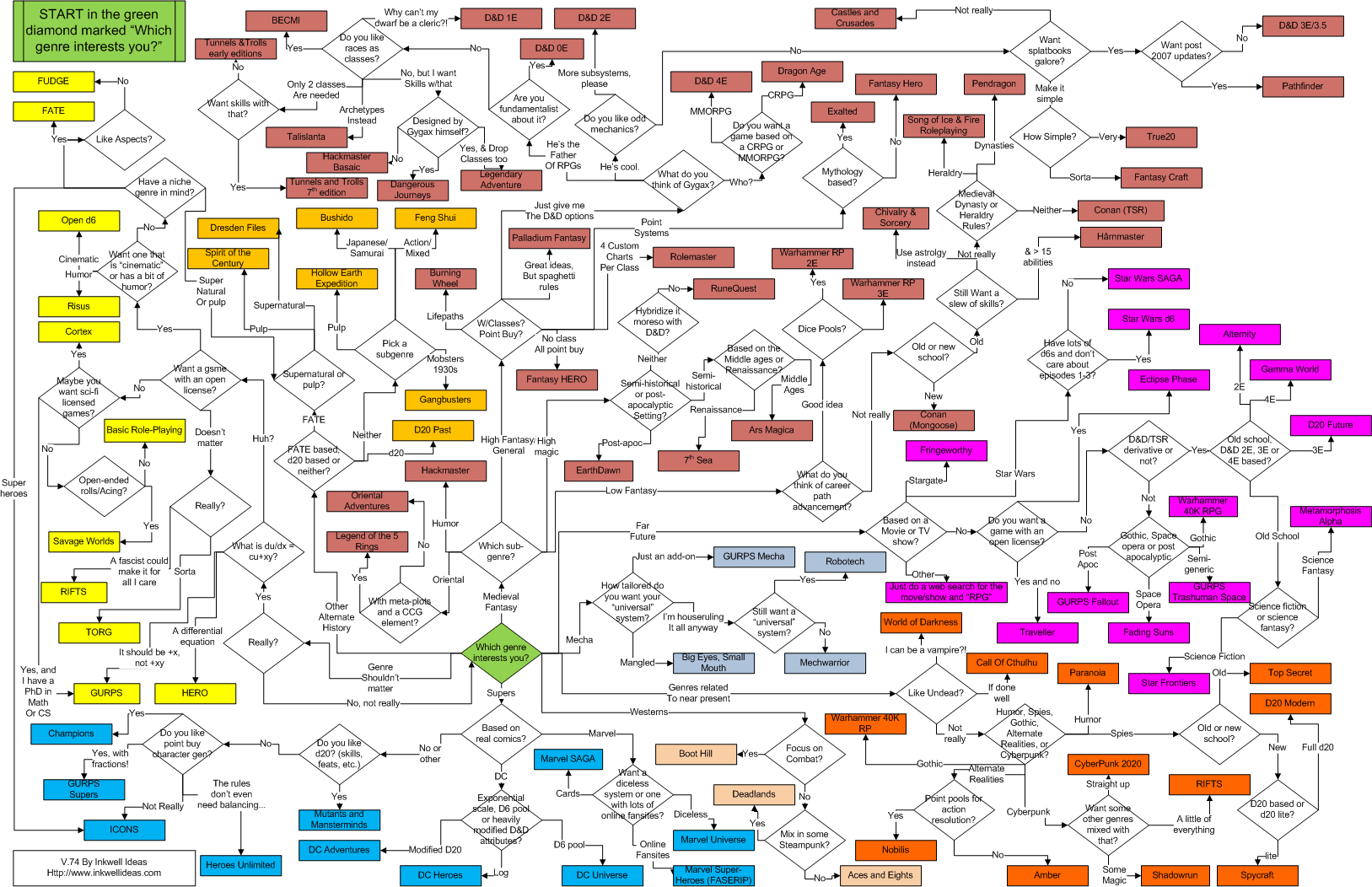
This episode is not about villains. Villians can (and should) be hated by the party, but villains are a whole other story that we will tackle in some other time. 3:15 Annoying NPCs should have some power Because otherwise the PC will simply kill them or avoid them. The PCs should always have a reason to go to the hated NPCs. e.g. they are the counsellor for the throne and present at every meeting, they are a tradesman that have something the PC want, or they are related to someone in power. How to give instant power in two steps: Place an NPC in the way, make them part of a bigger organization. 6:20 Why should we have annoying NPCs? They are great motivators. You can make entire campaigns based on proving them wrong. They push the players to behave in certain ways. Revealing Rivals article: Cheliax, Hellknights Some players have “interesting relationships” as their motivation for coming to the game at all. Even if they don’t, an annoying NPC gives a player something to be involved with; see episode 6, Retaining Player Attention. 12:40 Some annoying types * The stickler - This person is all about etiquettes and minor details. This is the counsellor who stops any discussion because someone used the wrong title or pronounced a name incorrectly. * The unimpressed - They are unimpressed with your achievements. * The diss-er - The diss-er is downright dismissive of your endeavours. * Uncaring - Doesn’t care about you at all; April from Parks and Recreation. * The one who takes the credit * The past recanter - Takes anything said as an opportunity to recant his or his family's past glories. * The useless - The useless is not helping you, and is, in fact, a liability. Maybe he is a VIP that you escort, maybe he is your guide through the mountains. He has one useful function and countless useless abilities. Divinity Original Sin 2 * Forgetful - Can be a great comic relief. Dungeon Crawl Classics * Earns your trust... then betrays you. But can also hurt your feelings: revealed as fake, as spiteful, as untrustworthy. 27:50 Examples Uri, as a player - Markus The Gul - Captain of the Purple Orange III. Uri, as a GM - Barry the white, the famous Bard. was supposed to be a comic relief and turn out to be quite a villain. Eran, as GM - Jamma, Hoard of the Dragon Queen, (watch in Hebrew) Aviv tells of The Chaos Star Dwarf, from Warhammer - counterexample. 40:05 Taking the load off First Crystal Ball article, available for all. Rpgcasts, find your next podcast. Venture Forth now available to buy. Dwarves discount!
A recurring event is something that the players can learn about, use, or be influenced by. How is society changed during this event? What is now permitted or expected? 3:00 Creating events quickly Make any event special: It's not just any ball, it’s the princess’s birthday or an anniversary of some important battle. An implementation of the “Specific beats generic” rule. Have a list of types of things that people commemorate: The Queen’s official birthday, a big historical event, a remarkable death, tax day, religious days. Roman Triumphs Wikipedia's list of holidays Ars Magica You can also switch between cause an effect - in Laflaf Land you must celebrate the mid-winter eve, or the winter simply won’t pass. Magical thinking Each culture celebrates the main parts of nature’s yearly cycle, especially the most basic ones, such as harvesting food; They also celebrate the _government, _like by __having the tribes meet to choose the yearly leader, etc. Three Suggestions for Supernatural Weather 14:00 How to celebrate Feasts, fasting, pilgrimage, family gatherings. Broken Age begins with celebrating the ritualistic sacrifice of girls to a giant monster. 17:40 PC-related events The locals decide on a new holiday honouring the party. A big festival in the village’s square. An amazing reward for players. Jaynestown, from Firefly. Uri tends to connect between players' birthdays and their characters' birthday. It doesn’t always make sense but it's FUN! Remember to consider using events as part of a PC’s backstory, and remind players to think about events when they create cultures. Is one of the characters religious? When is the day she celebrates her deity? Is one of the characters from a specific kingdom? When is their “independence day”? Finding events and holidays that relate to the characters help you ground the character in the setting. 23:45 Holidays in the adventure As a background: a normal thing occurs, but it's set against the backdrop of event X. What is changed because of this? Use the characteristics of the specific holiday to add colour and flavour to the event. As the main motivation: someone is exploiting the holiday to do something. It’s the king birthday so someone is planning an assissnation as he parades down the streets. For foreshadowing: like we talked about at length on episode three, random encounters. 28:50 Spice up the gaming table with holiday trappings If you run a session set in Halloween, why not place a few spider webs in the room? If you described a specific dish in the session (even if it’s a fantasy setting where the ingredients aren’t available) make a simulacra of that dish. Have your characters to visit a herbedeshary to dress up for the event. Eberron 33:55 Taking the load off Uri's new article, How Uri Runs an Introduction Game Eran's new article, about using NPCs for exposition Venture Forth now available to buy. Dwarves discount!
2:35 Why would you want to play in a known setting? You know and love the world and its setting. You want to explore ideas, concepts or characters from the main setting. You think your players could make a better plot than the original. 6:35 How to get the feel of the setting? Check for the tropes of the specific setting, from TV Tropes. Example from Star Wars: * The heroes are usually outlaws of some sort, spies, criminals, rebels, smugglers, mercenaries etc. * Everything is dirty and mechanical. Only the villains have a clean and slick design. Used Future * No major cities and major systems. Most of the plot is in the rim or “outback”. Cowboy Bebop Not just tropes, but also themes: * Family ties * Trust and betrayal * Good vs evil, order vs chaos * Old order vs new order 14:40 Where and when to inject your game into the known setting? Some ideas: Alternative history; side quest or side characters in the central story; the distant past or future; far far away from where the main plot takes place. Maintaining a balance between enjoying the verse, the experience of the known, and not being overrun by the rigidity of canon. Alternate history - it’s the same story, but not the same story. Considering the point of divergence vs the start of the game. 22:40 Who should you play? Who shouldn’t you? Who not to play? The original protagonists. The more established a character is, the less you can give of yourself to it. It becomes acting, less playing. Who to play? Similar but different. The original protagonist after a drastic change. The brother of, a clone of. Play a group that keeps the dynamics and archetypes of the source. 26:00 What is the same? What is different? Microscope, highly recommended, for a variety of reasons. 29:10 Star Wars RPG systems Uri goes on a tangent. 31:40 How to use tributes, references and spoilers warning? Tributes are awesome. This is part of the reason you’re playing in this settings. Uri’s rule of references - a reference is good if it still works if you didn’t get the reference. Always make sure that things make sense even if no one gets the reference. 34:45 Summary 35:10 Taking the load off Eran: Venture Forth now available to buy. Click through here to get a dwarven discount! (also includes our affiliate code) Uri: Darths & Droids: http://www.darthsanddroids.net
00:36 Our email guidelines 2:50 Lloyd’s email Our recap episode. 11 ways to be a better roleplayer The lack of engagement is a symptom, incentives won’t work here because they don’t address the root cause. 6:10 Dedicated Plotlines Uri’s plot formula: the number of plots equals the number of PC +1. Each player character has its own plot line, plus one uber-plot. Every personal plot is the answer to the question “what does the character want to achieve?” or “what is the character running from”?. The uber plot is the answer to the question “why are all these characters staying together?” My parents were killed by orcs - not necessarily unimaginative! 11:35 Why do they come to the table? There are many types of players, and they all enjoy different things. Some like deep roleplay, and for them it’s all about the interactions between the character, some are hack n’ slashers, and for them it’s all about the killing monsters and getting loot, there are rule lawyers who enjoy tinkering with the mechanics of the game, there are collectors who enjoy playing with miniatures and maps, there are those who are there for a sense of “winning” and those who enjoy cooperation or solving puzzles. The list goes on and on.Also, most players have all of those in some combination or other. To have a successful long-term campaign, it's important to understand what is fun and interesting for everyone around the table. What strings can you pull in order to create a resonance with your players? These strings are the one you need to use on the guitar of DMing in order to play the perfect music of your campaign. 15:55 This is a game, allow everyone to play it Remember that roleplaying games are games. And like all games, they should be enjoyable. Fun doesn’t mean bad things doesn’t happen; the game should be fun for the GM and players, not necessarily to the characters. 19:25 Maintaining excitement How to make them want to think about the game even outside of the session. Keep a WhatsApp group for discussions, share funny stuff, create memes and encourage others to do the same. All of this can be done as a player. 21:15 Assigning responsibility Caretaker of information: Keeping a log of what's happening. Caretaker of NPCs: Keeping track of the NPCs the players meet. Assign short, fun tasks between session, that also help prepare the next session, and enrich the world. 25:17 Weekly question The weekly question is an invaluable tool. If you want to dig deeper, here's my full explanation of the weekly question, and examples for its uses. 27:27 Not everyone’s as into RPG as we are Finally, it’s possible that some people just aren’t into RPG as you are. 30:50 Summary 31:45 Taking the load off Kind of excited for Legacy of Dragonholt. On Crystal Ball, the people decided - sails! The weekly RPG article, based on what’s happening in the Crystal Heart page, is about forcing a reaction by establishing situations and then having NPCs act.
The Dwarven Forge concept is directly inspired by NPC Cast’s Campaign Crucibles. Our previous forges, in Hebrew, include: * Masterwork, a secret conflict in medieval times between guilds such as The Bakers, The Weavers and others, using the magical means of their craft; * It is Good to Die For Our Country, a horrific reimagining of the first few Aliyahs to Palestine, in which the dead were re-tooled to keep working for the Yishuv; * Skies of Loot, a Borderlands-like campaign in a barren world and tons of guns; * Binary Interference, the 20th century but with robots who are trying to be more human; * Teddy, Save Me, in which your toys come to life to combat the nightmares that come in the night; * and others. 2:45 The three elements Uri: Secret government organizations Aviv: “Empire” - Assassin’s Creed: Origins; Europa Universalis IV; Crash Course World History; Eran: Guns 4:40 Themes Uri: secrecy, double life, outside of the public sphere but operating within it, hidden from public view. Vampire the Masquerade; The Masquerade trope. Aviv: military expansion, multicultural, an overarching government organization. Eran: availability of guns, the great equalizer. 8:35 What are the players doing? We are agents saving the populace of Mars from the underground aliens. Tyranny Cowboy Bebop X-COM 15:15 People Uri: Old one eye Track - the unofficial judge of a mining community. Aviv: Amanda Jackson - a conspiracy theory, believes in aliens. Eran: Xan-Yah - major captain-general of the province. Apparently, all Asians know martial arts. 21:50 Places Uri: old mine, Tritium. Aviv: The Colossus - terrace pyramid that looks to be artificial but is actually a bunch of rocks and sand… or is it? The Face on Mars, in Cydonia. Eran: Olympus Mons, seat of power, space elevator. 27:00 Adventure Hooks Uri: find Mit the lost kid that was lost, maybe kidnapped by the aliens. Aviv: a mining pod landed. People want it, the empire wants it as well. The empire will get what it wants. Eran: an old enemy and his posse want to gun us down. We need to handle an alien artefact/First Settler technology while escaping them. 33:50 Who would we play Uri: Chuckless - a big burly man with a big burly guy. Aviv: Karim - Earth born, a duster (a scavenger). A spiritual man, on a pilgrimage. Eran: Colin - An Elsi, into history and archaeology. A peoples person. 39:00 Gaming system Uri: Shadowrun? No, Starfinder? No, Modern d20? Yes. Aviv: Savage Worlds (maybe Delta Green without the horror) or Genesys Eran: Savage Worlds or Genesys. Deadlands 42:35 Would we play in this game? Uri: Yes. Aviv: IDK. Eran: I would like to run this. 45:45 Name? Uri: The Wild Red? ARES - Agents of the Royal Elysium Security Aviv: Dust Devils - Agents of ARES Eran: out in the dust, red something? 50:50 Taking the load off Eran’s [new RPG post](http://www.uptofourplayers.com/2017/11/some-alone
What’s in a recap? Quite a lot, actually. 1:30 The ritual announcing the game has begun Every session starts with 15 or so minutes of a social gathering. The recap usually marks the stage in which we enter the game: getting into character, reminding ourselves of the atmosphere, remembering the story, separating everything that happened so far from the game itself. We did a recap - the game has begun. Fear the Boot podcast. 4:08 The importance of rituals Roleplay is a social activity and as such it requires boundaries. In a martial art dojo, there is always an opening ceremony. Bowing to one’s master, bowing to an opponent at the beginning and ending of each fight. These rituals are there for a reason. They allow us to decide to be something else for a limited time, with a trigger to be something else and to return to ourselves. More opening rituals: Uri had a campaign called the Lament of Prepartum, and every session started with the same verse: “The world is a story / that began as a game / and will end in a mistake / and the song the world sings / is Pentartum’s Lament”. 6:00 Recap to remind us where we were In real life time passes between session. Maybe your character had its blade on the throat of its father’s killer and was about to finally avenge his death, but the next second for the character could be a month to the player. The most obvious use of a recap is to remind everyone what’s happening in the story. Usually, people will ask questions during, or at the end of the recap; if they don’t, ask one yourself. It’s time to re-focus ourselves on the background we all agreed upon for our story, our canon. 8:20 Recap as a tool for establishing an atmosphere Tone of voice, things emphasized, phrasing. Reminds everyone of the tension level from the end of the last session, to which we might want to return. Looking back vs looking forward. Establishing atmosphere when setting up the scene. 11:55 Having a player responsible for the recap We had a player who did it with an energetic and exciting style, and excitement is catchy. Dassi was the one in charge of keeping tracks of notes, so she did the “previously on” when she gave all the main headlines, in order. Generally speaking, giving players responsibilities help them feel they’re necessary for the continued function of the group, and that encourages them to feel invested in the game. 15:30 Switching recap responsibilities between players Especially useful when you have some “low-energy” players in the group. When you’re required to do a recap, it forces you to participate. More importantly, a recap shows the GM what the players remember, and therefore, what they perceive as important. If a player doesn’t mention rescuing the princess, that means something. As a GM, it shows me if I managed to deliver the information, and the motives, I was trying to deliver. It also gives me an excellent opportunity to learn what the party likes and what’s fun for them - the recap is one of the only times when everyone’s saying out loud and with very obvious reactions, what they liked and didn’t like about the previous session. 20:20 Recap in-play vs off-play If you’re the player giving the recap, be theatrical, play with your hands, talk in tone, tell a story. Storytelling, and storytelling examples. 21:40 Recap as a GM tool As a GM, you can emphasize specific things, thus drawing attention to them and bringing them to the front of the players’ minds. The players tend to forget the smaller picture... and also the bigger picture, and the GM should remind them of both (short and long-term goals). The GM might fo
What's the point of having random encounters? How to create them, how to utilize them, and why. Xanathar's Guide to Everything, D&D's latest sourcebook, does random encounters right, mostly. 4:30 Why have random encounters? Deliver information about the world: There are dragons in the mountains to the north. Sustain the illusion of a consistent world: Things are happening even when the characters are not around. Tell the "story" of the world: There used to be a dwarven empire in these lands. Create a certain atmosphere: Chill and unease, in preparation for the haunted castle. 6:15 Enriching the world with encounter tables Show, don't tell Sandbox style West Marches No such thing as "just goblins", see our previous episode. 15:15 Foreshadowing Foreshadowing Using random encounters to show the consequences of past actions that hint at future action; introduce villains through their minions or doings. Make that encounter feel at home in that moment in time in the plot. 19:30 Create adventure seeds with truly random encounters Keep a seed journal, of tidbits from the past. A list of open-ended details. Retcon 26:45 Creating a sense of journey You don't have to use random encounters for that. 13th age, you should really check it out. 31:50 Creating an encounter table Uri's table, now on our website. Outline of relationships, from Wikipedia. Bits of Wilderness (affiliate link) 39:55 Taking the load off Come meet me at Dragonmeet! Venture Forth recording. Soon to be available through Leisure Games, my local store. _The intro and outro are taken from “Silly Fun” by Kevin MacLeod (incompetech.com); Licensed under Creative Commons: By Attribution 3.0 License (http://creativecommons.org/licenses/by/3.0/)_ _On the Shoulders of Dwarves is shared under Creative Commons Attribution-NonCommercial 4.0 International (https://creativecommons.org/licenses/by-nc/4.0/)_
2:35 What's a cliche? Tropes are not bad. Things are not cliched by themselves - it's the way we portray them, bring them into the game, that might make them cliche. Stereotypes can be useful tools, by establishing expectations. Drizzt Do'urden, the drow. 4:45 Two types of cliches At the character level, and/or the campaign world level. Orcs in Warhammer 7:30 Avoiding cliches Changing one thing - and asking "what's the reason for this?" On the personal level: Why is this person different in this way, from the rest of their race? On the campaign level: What are the consequences that must arise out of this change? How does this sub-race behave? 9:50 Retro justification creates depth Just avoiding a cliche isn't, really, enough. Usually, we also want to also add complexity. Consider not only what is different about this character, but also the reasons that this character decided on that change. 14:20 Sub-races and ethnic groups Having some sub-races in your campaign encourages the players and the GM to think about the possibility that this specific character is different in some way. Whenever you encounter "a dwarf", you'll all find yourself asking "Okay, but WHICH dwarf? What's different about them?" Eberron Golarion Curse of the Crimson Throne Chelaxians Forgotten realms human ethnic groups 19:45 Creativity through constraints Find a picture of your desired race in it, and ask yourself, why is this happening? 23:15 Help yourself play a less cliched character Challenge yourself, maybe a little more than what you're used to, a bit out of your comfort zone. Use a one-shot or a mini-campaign as a testing ground. 28:35 Help someone else play a less cliched character Have them play a sub-race, and ask them to say something about it. Introduce NPCs of cliched races, that are not cliched themselves. 33:10 Some examples Earthdawn The excellent Denizens books: 1st, 2nd. Warhammer Fantasy dwarves Mistborn, based on the book series Legend of the Five Rings 37:25 Summary If you want to dig deeper: Stratified NPC Complexity 38:37: Taking the load off Uri is angry about misusing latin phrases (online etymology) High Realm from Exalted. I talk about creating a character in Mouse Guard The intro and outro are taken from “Silly Fun” by Kevin MacLeod (incompetech.com); Licensed under Creativ
Typical dwarves, promise 30-40 minutes and talk for 50! This is mostly because of the need to introduce ourselves in the beginning; future episodes will be shorter. 00:10 What's this podcast about? Originates in our Hebrew podcast (website, facebook page) 3:00 Who are we And why you might want to listen to us talk. Improv theatre Lamabati Up to Four Players D&D and Pathfinder you probably know; here are Exalted and Dungeon World Vanor, the Hebrew translation of Dungeon World, by Aviv Manoach Little Wizards, and in Hebrew (קוסמים קטנים) City of Mist 7:30 The Better Battle Which sort of games is this advice applicable for? 8:50 More Dynamic Keep things in motion: inanimate things moving around the battle arena. Or not inanimate! The smallest type of goblin in Warhammer is called a Snotling. Make it 3D: Have various surfaces on different levels. Have combatants that utilize this difference, give the players reasons to make use of them. Surfaces: Areas that contain an element that might or might not have any mechanical effect by themselves, but can be used by most combatants in creative ways. Divinity Original Sin, 1 and 2 20:00 Players, use the arena GMs, go with the player's suggestion - but not all the way. Offer a cost. 23:20 Varying win conditions Getting x to y; protecting X until; getting to X before; taking X down; or a series of actions; draw into a trap; find and exploit weakness against an invincible enemy; get into and get out. XCOM For this to work, advancement (XP, or otherwise) shouldn't come from defeating monsters. 30:10 Special combat arenas Happens in exotic locations and have special rules. Fuller descriptions of the battle in Cecilia's mind and combat against the Titan are available in Hebrew, here and here. 35:15 Empowering the players Providing enough information so they can plan. Reality markers, a resource that allows you to announce a factual detail about the world. Fate (learn the main rules in comics form!) Enriching the arena with players suggestions (very common in games Powered by the Apocalypse). Making the scenes more interesting, and players tend to interact with the things they themselves create. Star Wars RPG, with its Destiny Points. Genesys, soon. Download the City of Mist Starter Set for free, and check out the move Change the Game. 42:45 Summary Pick one thing from this podcast, and use it in your next session. If you want to dig deeper: What can we learn from combat arenas in the LotR movies and the [Hobbit movies](http://www.uptofourplayers.com/2016/04/rp-tools-combat-arenas-f