CounterSpin: Recent Episodes
Fairness & Accuracy In Reporting


The Washington Post (8/5/26) wrote that El-Sayed “carries heavy baggage into the general election”—and cited four policy positions that are all supported by a majority of voters.
It’s sad commentary on US media when two national newspapers, historically representing different poles of the American establishment, appear to share editorial writers. When it comes to the nomination of progressive Abdul El-Sayed in the Michigan Democratic Senate primary, the Washington Post (8/5/26) and Wall Street Journal (8/5/26) editorial boards practically plagiarized each other. It’s further testament that the Post is no longer known as the paper that took down Richard Nixon; rather, it’s a mouthpiece for the oligarchy that has very much taken the side of the current administration.
Both papers fear that El-Sayed’s victory is another notch in the wave of victories by the left: Zohran Mamdani taking the New York City mayoralty last year, the Democratic Socialists of America primary victories in June, and now El-Sayed—who is not a DSA candidate but who is, as the Cold Warriors might call him, a fellow traveller.
‘Radical views’
Just look at how both boards reject the idea that El-Sayed distances himself from the organized socialist movement, with the Journal condemning his “radical views” and the Post bemoaning his “heavy baggage.”
The Post:
While El-Sayed rejects the “socialist” label, he campaigned on Medicare-for-all, opposition to Israel, raising taxes on the wealthy and abolishing US Immigration and Customs Enforcement.
The Journal:
He continues to support Medicare for All. He favors a wealth tax and an enormous expansion in federal entitlements for child care and more. He wants to abolish Immigration and Customs Enforcement, saying the agency “is about normalizing paramilitary force on our streets.”… Mr. El-Sayed wants to cut off all US military aid to Israel, which he accuses of genocide in Gaza.
Editorialists might not like these ideas, but it is clear voters do. Both government-assured healthcare (WITI, 12/14/25) and taxing the wealthy (Pew Research, 3/19/25) are supported by large majorities. And they’re not minor concerns. From KFF (7/16/26):
Healthcare costs top the list of voters’ healthcare priorities for the midterm elections, with half (51%) of all voters and more than half of Democratic (60%) and independent (55%) voters saying the issue is extremely important for candidates to talk about.
It doesn’t cross the minds of those in Beltway and Manhattan media bubbles that Michiganders are well-acquainted with their neighbors in Canada who, like those living in many other industrialized democracies, enjoy universal healthcare.
The papers also forget some history. Single-payer health insurance is far from a radical idea: A bipartisan group of senators in 1970, with some support from the Nixon administration, explored “national health insurance, a plan to cover the medical needs and costs of all Americans” (New York Times, 9/22/70). Health reform’s champion at the time, Sen. Edward Kennedy (D-Mass.), “wanted the government to be the nation’s single-payer for healthcare” (WBUR, 8/25/20). If anything, El-Sayed and his supporters are channeling the party’s former glory on this, rather than importing some fringe ideology.
Mainstream positions
To the Wall Street Journal (8/5/26), El-Sayed is an “articulate” man “with radical views” who should “maybe hold off on French Revolution 2.0.”
Trump’s brutal war against immigrants polls horribly (YouGov, 7/21/26; The Hill, 8/3/26). From YouGov (3/3/26):
Support for abolishing ICE has hit a new high in this week’s Economist/YouGov poll. Half (50%) of Americans now somewhat or strongly support abolishing ICE. Only 39% oppose abolishing the agency.
El-Sayed believes ICE is “about normalizing paramilitary force on our streets”? Anyone who has paid attention to what has happened in Minneapolis, Chicago and Los Angeles this last year knows that this is an accurate assessment.
“Opposition to Israel” is also a mainstream position. More Americans sympathize with Palestinians than with Israelis, according to Gallup (2/27/26), and 62% have an unfavorable view of the Israeli government (Pew, 7/9/26). From Al Jazeera (5/21/26):
A new poll from the New York Times/Siena has found that nearly three-quarters of voters aligned with the Democratic Party oppose US military aid to Israel, up from 45% three years ago.
That Israel is committing genocide against Palestinians is the consensus view of global human rights groups like Amnesty International, Human Rights Watch and B’Tselem, as well as the International Association of Genocide Scholars and a UN Independent Commission of Inquiry.
That both papers think these moderate positions are “out there” shows that someone here is out of touch, but it’s not the Democratic primary voters of Michigan.
‘Path out of the wilderness’
According to AP (7/19/26), AIPAC spent $30 million on Stevens’ campaign. Her total dark-money haul reached some $60 million total, compared to El-Sayed’s $3.5 million. El-Sayed outraised Stevens in individual donations, $14.5 million to $11.9 million (Al Jazeera, 8/2/26).
Then, both papers worry that Trump’s disastrous reign could allow voters to elect a man like El-Sayed, or that he could be so distasteful to the independents of Michigan that he could keep the Senate in Republican hands next year. The Post:
Trump is so unpopular right now, and the national environment is so favorable for Democrats, that El-Sayed might win despite himself. If he loses, and the GOP controls the Senate for the last two years of Trump’s term as a result, it could teach Democrats an important lesson heading into 2028. Pragmatism, not radicalism, offers the best path out of the wilderness.
The Journal:
Mr. El-Sayed is counting on anti-Donald Trump fury to unite Democrats despite his radical views…. Nominating a leftist could cost the party a Senate majority that is very much in reach. If [Republican Senate nominee Mike] Rogers wins, one lesson will be that Mr. El-Sayed was too far left to win in a swing state even in what is likely to be an excellent Democratic year. Democrats might rethink this year’s headlong rush left as they consider the 2028 presidential race.
Once again, the prose here is so similar that it makes one wonder why we must suffer through multiple newspapers at all—it’s like Walmart and Whole Foods, conservative and liberal-coded respectively, selling the same parasite-infected lettuce.
The Michigan primary race was notable for a huge amount of pro-Israel spending meant to stop El-Sayed—an attempted repeat of the lobby’s successful defeat of New York DSA congressmember Jamaal Bowman two years ago (FAIR.org, 6/28/24). As the AP (7/19/26) reported, AIPAC and “its affiliated groups have spent close to $30 million backing” El-Sayed’s opponent Congresswoman Haley Stevens, “their largest investment ever in a single race.”
For what it’s worth, Al Jazeera’s calculation (8/2/26) was more damning:
Federal Election Commission records show that AIPAC and other political action committees have spent more than $54 million to help Stevens. A dark-money group called the Center for Democratic Priorities has also spent about $6.5 million on ads supporting Stevens, according to local media reports—increasing the grand total to more than $60 million.
That’s actually the one notable difference between the two editorials: The Journal at least mentioned AIPAC’s heavy spending, while the Post did not. There was a time, before Amazon founder Jeff Bezos turned the Post ideologically toward the Trump administration (New Republic, 11/3/25), when the paper regularly attacked the influence of big money in American elections (Washington Post, 1/9/12, 4/22/12, 2/4/14, 10/12/14, 1/20/20). Times change.
The top Senate Democrat, Chuck Schumer of New York, didn’t publicly endorse Stevens, but reportedly pushed donors toward her campaign (New York Times, 6/5/26). She also had the backing of former House Speaker Nancy Pelosi. Former President Barack Obama didn’t publicly endorse Stevens, but “AIPAC-linked” supporters “spent $5 million airing an advertisement nearly 4,000 times that features Obama praising her work as chief of staff for the US Auto Rescue Task Force during the 2008 financial crisis” (CNN, 7/17/26), giving the impression that he was behind her.
If by “Democrats” the papers mean party leadership, the top brass already chose Stevens–they don’t need any editorial encouragement to avoid the progressive option.
Beltway Risk
AP‘s headline (7/9/26) didn’t age well.
But if the editorials, when they admonished “Democrats,” meant the everyday people who chose El-Sayed, then they’re making a clear case against voters having small-d democratic agency. No, little voters in Grand Rapids or Kalamazoo, you can’t vote for what you believe is best for your job, health and bank account. You have to assume other people (who are in much the same boat as you) are going to vote against their interests–and vote the way they would.
Voters have been told repeatedly that the only way to counter the extreme rise of MAGA is to forgo socialist candidates like Bernie Sanders and opt for establishment centrists like Hillary Clinton and Kamala Harris (Mother Jones, 12/16/16; Fox Business, 2/24/20; FAIR.org, 10/25/25). Certainly, in the last 10 years, the Republican base’s move from the old guard to more radical ideas haven’t hampered the party’s results at the ballot box. After these Democratic leadership failures to win power, maybe voters are interested in a different strategy.
Not only did the editorial boards not acknowledge that El-Sayed’s platform of single-payer healthcare and taxing the rich was appealing to voting people, they could not admit that the centrist politics they push as an alternative were a turnoff. Stevens’ enormous corporate warchest couldn’t make up for the fact that people, as one voter put it (AP, 7/9/26), “don’t want a moderate,” and instead “want somebody who’s going to come in and effect change.”
In other words, for the Post and Journal editorial boards, politics and voting aren’t about how people express themselves and their needs and interests. Rather, they’re an ongoing game of Beltway Risk, in which the needs and views of living, breathing people are just pieces on a board.
https://media.blubrry.com/counterspin/content.blubrry.com/counterspin/CounterSpin260807.mp3Right-click here to download this episode (“Save link as…”).
CT Mirror (7/30/26)
This week on CounterSpin: If you look for media coverage about the Farm Bill that’s currently passing through Congress, you can find it–at sites like agriculture.com or agri-pulse.com, or those outlets that have “ag” sections. If you look for coverage of SNAP, the largest food assistance program in the country, you can find that lots of other places. And while some of those headlines are about “Deadbeat Parents” and “SNAP Fraud,” these days many more say things like “Nearly 19K State Kids Have Lost SNAP Benefits Over Past Year” (that’s Connecticut) or “Illinois Launches New Program to Provide Food Benefits to People Who Lost SNAP,” or “Small Grocery Stores Cutting Inventory, Considering Layoffs as SNAP Dollars Decline.”
Overwhelmingly, local reporters are documenting how cuts to SNAP are hurting people and communities. But the lack of major media stories linking the program to the Farm Bill seem somehow emblematic of the opacity around this country’s lawmaking on critical questions around food.
We get an update from Gina Plata-Nino, director of SNAP policy and advocacy at the Food Research & Action Center.
https://media.blubrry.com/counterspin/content.blubrry.com/counterspin/CounterSpin260807Plata-Nino.mp3Also on the show: People who rely on food benefits programs have long been a punching bag for both right-wing ideologues and their corporate media enablers. Claiming people working full time jobs that don’t provide enough to feed their families are really just grifters living high on your dime is a time-honored tactic, no matter how far it falls afield of reality. We talked about that last year with the president of Food Research & Action Center, Crystal FitzSimons; we add a little of that conversation as well.
https://media.blubrry.com/counterspin/content.blubrry.com/counterspin/CounterSpin260807FitzSimons.mp3
As a result of US-imposed sanctions, UN News (6/8/26) reported, “infant mortality has doubled to 9.9 per 1,000 births; childhood cancer survival rates have fallen from 85% to 65%; and essential medicines are available at only around 30% of normal supply levels.”
The energy blockade that the Trump administration has imposed on Cuba is hammering the island. As UN High Commissioner for Human Rights Volker Türk (UN News, 6/8/26) recently pointed out:
The fuel restrictions imposed since early 2026 and recent tightening of extraterritorial sanctions, taken together, are directly harming Cubans, especially the most vulnerable. Children are dying because doctors lack access to essential medical supplies and medicines…. These sanctions must be lifted immediately.
Broad swaths of the US media’s chattering class have taken a different angle, suggesting that the Cuban government is the primary—if not the sole—cause of the pain being inflicted on the country. The function of such propaganda is to justify the US’s economic warfare: If the Cuban government can’t run the country, the logic goes, then the US is right to try and bring it down.
It’s the same narrative pushed by US officials and Cubans in exile, who together constitute the large majority of sources in news coverage of Cuba from prominent US outlets, as a recent FAIR study (7/15/26) showed.
Much of the US commentariat is also pretending that the Cuban revolution’s extraordinary achievements have not occurred. Acknowledging them would, of course, get in the way of the narrative that Cuban leaders are so malign and incompetent that the US is obligated to bring about a counter revolution.
‘A golden opportunity’The Wall Street Journal (7/12/26) compares Cuba’s government to South African apartheid—which Cuba opposed, and the Journal supported.
At times, the punditry is explicit in its support for regime change in Cuba. In the Wall Street Journal (7/12/26), Mary Anastasia O’Grady wrote:
Once South Africa ceased to be a Cold War pawn, the economic costs of sanctions imposed by countries across the globe broke the government’s resistance…. Cubans aren’t likely to escape tyranny without a similar leg up from the outside.
The South African apartheid analogy is absurd: Upon taking power, the Cuban revolution made fighting racial discrimination a priority (Black Perspectives, 3/8/16), and Cuba played a crucial part in supporting South Africa’s struggle against apartheid.
But what’s most relevant here is O’Grady’s suggestion that “the outside” is inflicting “the economic costs of sanctions” so that Cubans can “escape tyranny.” As Türk pointed out, this anti-“tyranny” plan involves killing children by depriving them of “access to essential medical supplies and medicines.”
The Washington Post’s editorial board (2/6/26) sounded impressed by the effects of Trump’s siege. “Washington’s pressure on Havana is working,” it wrote:
Cuba looks ready to implode. The island suffers from food shortages, energy blackouts and looming economic collapse. President Donald Trump’s decision to remove Venezuelan dictator Nicolás Maduro from power has cut off the Cubans from what has historically been their main source of oil. Having successfully pressured the Mexican government to also slash oil supplies, Trump has effectively created a blockade that has brought the regime to its knees.
With such extraordinary leverage, it would be unwise to settle for anything less than dramatic change on America’s terms: economic, personal and political freedom for all Cubans.
The paper, in short, cheered the US blockade creating “food shortages, energy blackouts and looming economic collapse” so that Cuba would be forced to make “dramatic change on America’s terms.”
The editors’ assertions relied on a simplistic caricature of personal and political life in Cuba, and on what appears to be an assumption that their readers won’t notice that depriving people of food, energy and even minimal economic security—as the blockade does—also denies them economic and personal freedom. However, the more salient point is probably that the US has no right under the UN Charter to interfere in Cuba’s affairs, let alone to use food as a weapon to restore capitalism, which, as any conservative will tell you, is what “economic freedom” means.
In an op-ed for the Washington Post (2/11/26), former New York Times reporter Lizette Alvarez claimed that “Trump’s love of the deal and Cuba’s imminent collapse present a golden opportunity to finally drive meaningful change on the island.”
Even before the Trump administration intensified the energy blockade at the start of the year, as UN special rapporteur Alena Douhan (11/21/25) noted, the “golden opportunity” created by the embargo had resulted in “the widespread inaccessibility of 69% of medicines to Cubans, including medicine against cancer, heart diseases, repellents, tests for dengue and other infections.”
Alvarez contended that the US “could lift the embargo,” but that “Cuban President Miguel Díaz-Canel would have to agree to deadline-driven reforms,” including “eliminating restrictions that hamper private investment and business.” At no point did the author spell out why she believes that the US is entitled to “drive” change in Cuba, much less deprive Cubans of medicine until they allow “private investment and business” to operate unimpeded.
‘No ring of Navy warships’USA Today‘s Judy Pino (3/10/26) argues that “freedom demands effort”—and by “effort,” she means the devastation of one’s economy by a neighboring superpower.
The US began to impose a blockade on Cuba in 1960 to “decrease monetary and real wages, to bring about hunger, desperation and overthrow of government.” Rather than recognize such factors in Cuban suffering, many voices in the corporate media have embraced the political and economic equivalent of flat Earthism.
For instance, Judy Pino (USA Today, 3/10/26) euphemistically referred to Trump’s aggression against Cuba as “pressure on the regime” and said that “daily life [in Cuba] shows the cost of [the Cuban government’s] repression and chronic mismanagement.” In 2018, the UN estimated that the embargo had cost Cuba’s economy $130 billion (Reuters, 5/8/18)—from a country whose entire GDP, according to the World Bank, is $107 billion—but Pino wrote as though that’s not a leading cause of the challenges Cubans are facing.
A Wall Street Journal editorial (7/9/26) wrote that US Ambassador to the United Nations Mike Waltz
took apart the claim that the US blocks Cuba’s access to world markets. “If there’s an embargo, a blockade, whatever name they want to put on it, how did humanitarian aid from Belize, Canada, Chile, China, Colombia, the European Union, Mexico, Spain, Russia, Uruguay and the UN itself reach the country just in the last few months?” Mr. Waltz asked. “There is no ring of Navy warships sitting around this island blocking trade or humanitarian aid going into Cuba. It’s fake. It’s false. It’s a lie. Period.”
Economic blockades don’t require naval encirclements, of course. The Journal gaslit its readers, denying US subversion and writing as if allowing smatterings of aid into Cuba to mitigate the effects of that subversion is the same as permitting Cuba to participate in the global economy.
‘Facts tell a different story’The “illusion” that Mauricio de Miranda Parrondo (New York Times, 3/1/26) celebrates Cuba losing is the notion that it’s possible for a small Latin American country to choose an economic system that Washington disapproves of.
O’Grady (Wall Street Journal, 6/21/26) wrote that “the [Cuban] dictatorship’s excuse for the widespread misery is the same as it ever was: Washington’s Cuba policy. The facts tell a different story.”
The US-based Center for Economic and Policy Research has marshaled quite a few facts that refute O’Grady’s view. CEPR (4/27/26) pointed out that, because the US tightened the embargo during Trump’s first term and the Biden government did next to nothing to ease it, Cuban medical importers have been unable
to obtain at affordable prices many basic medical supplies, such as syringes, inhalers, and even saline solution; more sophisticated medical equipment, such as imaging and ultrasound systems; and inputs for the manufacturing of pharmaceuticals. The redesignation of Cuba as a State Sponsor of Terrorism in 2021 has made it extremely challenging to obtain financing for the purchase of these goods—at any price—or to simply execute international payments to purchase them. The end result of these multiple barriers generated by these sanctions has been massive shortages of medical goods— supplies, equipment, medicines.
Thus, CEPR concluded that “the primary cause” of an
unprecedented rise in Cuba’s [infant mortality rate], and the crisis in its once robust health care system, is almost certainly the hardening of US sanctions that began in 2017 and increased steadily in the years thereafter, with only a minor easing during the Biden administration.
In the New York Times (3/1/26), economist Mauricio de Miranda Parrondo asserted that
the [Cuban] leadership prioritizes political control over the needs of the population. The Cuban economy has suffered greatly for it. The country is no longer capable of producing the basic goods it needs; today it imports most of the food it consumes, despite the fertility of its lands and its long agricultural tradition.
This view ignores US sabotage, a rather significant factor. For instance, a team of UN Special Rapporteurs and Independent Experts pointed out that the US’s groundless decision to classify Cuba as a “State Sponsor of Terrorism” worsens problems in Cuba’s agricultural production
by exerting directly or indirectly more pressure on States and businesses trading with Cuba. In particular, access from abroad to agricultural inputs, including fertilisers, is almost completely blocked, as is the case for spare parts for the maintenance or repair of agricultural machinery and infrastructure.
Thus, the American “leadership prioritizes political control [of Cuba] over the needs of the [Cuban] population.”
Erasing Cuba’s accomplishmentsThe Washington Post (2/6/26) mocks the idea that the Cuban government wants to be “treated as an equal” in negotiating with the United States.
Corporate media outlets rarely admit that Cuban socialism achieved a great deal despite US aggression.
The Washington Post (2/6/26) argued that Cuba’s “67-year experiment with Communism has been an abject failure.” Consider the most recent rankings from the UN Human Development Index (HDI), which measures long-term progress in three key dimensions of human development: a long and healthy life, access to knowledge, and a decent standard of living. Based on 2023 data, Cuba was classified as having a high level of human development and ranked 97th out of 193 countries and territories. While conditions in Cuba appear to have deteriorated since the US enacted the oil blockade earlier this year, faring well on the HDI very recently makes clear that it’s absurd to say that Cuba’s last 67 years have been nothing but an “abject failure.”
Alvarez (Washington Post, 2/11/26) said Cuba has an “unworkable Communist economic system.” But it wasn’t long ago that Cuba had the same rate of infant mortality as Canada, and a better one than the United States. That suggests that it’s the US that has an unworkable capitalist economic system, particularly when one considers that Cuba successfully cared for its infants under the US embargo, and the US itself faced no such aggression.
George Will of the Post (6/24/26) claimed that “the only good [Communist Cuba’s] evil ever produced” is the memoir of Armando Valladares, an opponent of Fidel Castro’s government who later served as US ambassador to the United Nations during the Reagan and first Bush administrations.
For Will, it seems, it was “evil” to provide vital support to Haiti, Indonesia and Pakistan after devastating earthquakes hit each of these countries (Al Jazeera, 2/16/10). It was “evil” to fight Ebola in West Africa (Time, 11/5/14) and Covid-19 in Italy (Reuters, 3/22/20) at the peak of the pandemic nightmare. Helping liberate Angola, Namibia and South Africa from colonialism, imperialism and apartheid (Warscapes, 4/11/16; Jacobin, 5/20/22)? That’s “evil” too, apparently.
‘Disastrous policies of the socialist experiment’Roberto González (Wall Street Journal, 7/7/26) presents the fact that “lights are out across much of the island”—as a result of direct intervention by the US government to destroy Cuba’s energy system—as proof that “the market works.”
In the Wall Street Journal (7/7/26), Roberto González declared, “For more than six decades, Cuba has been one of the few places on Earth where the disastrous economic policies of the socialist experiment persisted.” Yet in Subalternity vs. Hegemony: Cuba’s Outstanding Achievements in Science and Biotechnology, 1959–2014 (Springer, 2016), the scholars Angelo Baracca and Rosella Franconi noted that
the Cuban government had an unusual level of commitment to scientific and technological development, and a long-term vision to support health biotechnology, despite difficult economic conditions.
Through the “crusade the [Cuban] government has carried out in favor of more education and scientific research,” the country had developed “innovative, world-class products,” Barracca and Franconi noted. By 2018, Cuba held 1,200 international biopharmaceutical patents, and sold medicine and equipment to more than 50 countries (Institute for New Economic Thinking, 3/5/18). But there’s no room for such non-disasters in Gonzalez’s narrative.
It’s easy to tell that none of these commentators sincerely wanted Cubans to overcome the challenges they’re facing. If they did, they’d call for the simplest way to quickly enable the country to build on its past successes. That, to state the painfully obvious, is to end both Trump’s energy blockade and the longer-term embargo.
Instead, they stuck to a cruel, reactionary script: simultaneously gloss over the misery that the US is subjecting Cuba to, and all the good that Cuba has done for itself and the world, to create the impression that Cuba needs to be liberated by its US torturers.
Somehow the New York Post (7/30/26) didn’t find it as shocking when Donald Trump took the Fifth Amendment more than 400 times during an investigation into fraudulent business practices.
The congressional grilling of former White House Covid advisor Anthony Fauci, and the resulting editorial responses, weren’t good faith inquiries into the pandemic (CNN, 7/29/26). The entire spectacle was a Republican public relations campaign to promote two often contradictory conspiracy theories.
The first is that the virus that ravaged the globe was a human-altered super virus that escaped a Chinese laboratory, which for right-wingers spins a titillating narrative of scientistic hubris fused with Communist treachery.
The second is that the public health measures that discouraged public gatherings were extreme and unnecessary. The idea is that the virus was not as dangerous as it was made out to be—just some sniffles and coughs, really—and that these countermeasures were meant to tank the economy, helping the Democrats win the presidency in November 2020. For the tinfoil hat wing of American politics, safety measures were less about saving Americans and more about fomenting a color revolution against President Donald Trump.
The right manages to at the same time be feverishly obsessed with the supposedly artificial release of the virus and also outraged by public health measures to contain it.
The hearing was all show and no trial, but right-wing pundits and politicians are doing their damndest to keep the hearing in the news cycle (Fox News, 8/5/26; Wall Street Journal, 8/5/26; Breitbart, 8/5/26). And the Republicans do need a distraction: Gas prices remain high (AP, 7/20/26), support for Trump’s war against Iran remains low (Quinnipiac, 7/29/26) and, as Newsweek (8/2/26) noted, his
approval rating is underwater in at least 11 states that he carried by double digits in the 2024 election, a sign of growing dissatisfaction with the president’s performance ahead of November’s midterms.
Centrist media are also keeping the persecuting viewpoint of Republican Sen. Rand Paul—who led the hearing, and might better serve the public by telling whether the other Kentucky senator, Mitch McConnell, is alive or not—in the public eye.
‘Manufacturing a false narrative’The New York Post (7/28/26) claimed that Fauci’s “private notes contradict what he was telling the world at the very same time.” Private notes (1/26/20): “Now we know the market was not the source, it was the amplifier. Having said that, somewhere the virus jumped from animals to humans.” What he was telling the world (USA Today, 2/17/20): “Almost certainly, somewhere, somehow a bat infected an intermediate host who infected a human. What epidemiologists feel is that the market was an amplifier of something that was already going on.” (Fauci was referring to the latest research at the time about the Wuhan outbreak—work that was later superseded.)
The New York Post editorial board (7/28/26) focused on the lab leak theory:
For starters, [Fauci] insisted time and again that the “lab leak hypothesis” was a wacky conspiracy theory, that the virus had jumped naturally from animals to humans, presumably at the “wet market” in Wuhan, China.
Yet the diaries reveal that he knew early on that it had not come from the wet market, and was confronted with scientists he’d selected who argued with strong evidence that “lab leak” was the truth—and that the bug was likely bio-engineered in the Wuhan Institute Virology.
Washington Post columnist Megan McArdle (8/2/26), who has long leaned into the lab leak conspiracy, highlighted that Fauci’s diary described “meetings where eminent experts deemed a lab-leak origin for Covid possible.” McArdle disputed the value of attacking Fauci as an individual as counterproductive, because it ignores the “systemic” problems with the pandemic response:
Many of the powerful and influential really did become dogmatic on all things pandemic, from the origins of the virus to the merits of public gatherings to the benefits of mandatory vaccination.
USA Today’s Nicole Russell (7/29/26) likewise merged the origin-coverup and unnecessary mandates storylines:
Fauci’s silence may be legally prudent, but his poor decision-making has already been proven: While millions of Americans suffered from Covid-19 or the lockdowns he advised the Trump administration to mandate, Fauci was manufacturing a false narrative about the disease’s origins and reveling in the media attention it brought him.
‘Preponderance of scientific evidence’As FAIR (6/28/21) reported five years ago, “Most scientists currently think that Covid-19 has a natural origin, because there is a well-documented history of natural spillovers leading to most disease outbreaks.”
The lab leak fixation is one our readers know well. As editor Jim Naureckas (Facebook, 7/31/26) said, “FAIR has looked intensively at the evidence offered for the lab leak theory, and each time we’ve found that there’s no there there”—pointing to several in-depth investigations (FAIR.org, 10/6/20, 6/28/21, 8/5/21, 4/7/23, 7/3/24, 4/18/25).
Soon after the pathogen emerged, a Nature paper (3/17/20) observed that, based on the characteristics of the virus, “It is improbable that SARS-CoV-2 emerged through laboratory manipulation of a related SARS-CoV–like coronavirus.” Nothing has emerged in the years since to cast serious doubt on that conclusion.
The Journal of Virology (8/1/24) noted that the “preponderance of scientific evidence indicates a natural origin for SARS-CoV-2.” The World Health Organization’s Scientific Advisory Group for the Origins of Novel Pathogens (7/27/25) concluded that “the weight of available evidence…suggests zoonotic spillover…either directly from bats or through an intermediate host.”
NPR (7/29/26) reported that
a 2024 study in the peer-reviewed journal Cell found multiple lines of evidence showing the virus spilled over from wild animals to humans…. The analysis shows with unprecedented granularity that coronavirus-susceptible wildlife and the SARS-CoV-2 virus were mingling, along with human beings, in a very specific part of the wet market in Wuhan.
While there is substantial agreement among scientists about the likelihood of a natural origin for the pandemic (Science, 2/6/24), the lab leak hypothesis remains a classic zombie idea, persistently resistant to being debunked out of rational society. In part this is due to the interest in maintaining it from foreign state media (AP, 2/15/21), intelligence services (BBC, 1/25/25)—and right-wing politicians.
‘Removes critical context’The Wall Street Journal‘s Jack Butler (7/29/26) described Fauci as “the man who became the face of elite overreaction to the pandemic.”
Senator Paul, ever the showman, portrayed Fauci’s unearthed diary entries as proof that his public statements dismissing a “lab leak” contradicted his own personal beliefs. The New York Post (7/28/26) and others repeat that line, but it isn’t accurate. FactCheck.org (7/31/26) noted that Paul’s performance
removes critical context for Fauci’s statements and falsely implies that if the pandemic didn’t originate in the one market, that it couldn’t have had a natural origin. It also treats Fauci’s diary statement as an immutable fact, when in reality, it was an interpretation of the information that was known at the time….
Fauci was clear in his diary that this did not change his opinion that the outbreak had a natural origin. “Having said that, somewhere the virus jumped from animals to humans,” he wrote.
And contrary to Paul’s insinuations—picked up by media like Wall Street Journal deputy editor Jack Butler (7/29/26), who said the revelations about Fauci “provide evidence of deliberate deception”—what Fauci said in his diary is pretty much what he was saying in real time. “Fauci publicly used almost the same wording a few weeks later in an interview with USA Today,” AP (7/29/26) noted.
‘Both onerous and performative’The Wall Street Journal (7/29/26) complained of “media censorship” of the Great Barrington Declaration, which encouraged “those who are at minimal risk of death to live their lives normally to build up immunity to the virus through natural infection.” Between 2020 and 2023, Covid killed nearly 278,000 Americans under the age of 65, according to the CDC.
The Wall Street Journal editorial board (7/29/26) focused on the notion that America’s Covid response was overkill and that Fauci tried to cover this up:
Sen. Paul deserves credit for digging into the truth about the government’s destructive Covid response—especially the effort by Dr. Fauci and others to stifle dissenting views and hide the record….
We know from previous disclosures that Drs. Fauci and [Francis] Collins tried to demean the authors of the 2020 Great Barrington Declaration that favored “focused protection” on the old and sick rather than wholesale lockdowns. The duo favored media censorship of those and other dissenting views.
New York Times columnist Bret Stephens (7/30/26) said:
I was prepared to cut Fauci and others in government a lot of slack in the first months of the pandemic, when the take-no-chances approach seemed like the safest course. But at some point many of the measures that he insisted were necessary—like the six-foot distance rule, or masking requirements that had no hope of consistent enforcement—felt both onerous and performative, and guaranteed to create a backlash.
The “Covid wasn’t that bad and we overreacted” line is something one can promote only with the help of revisionist thinking. Covid killed more than a million Americans. By the time the death toll hit the halfway mark in early 2021, more Americans had died “from Covid-19 than on the battlefields of World War I, World War II and the Vietnam War combined” (New York Times, 2/21/21).
Let’s emphasize: That was one year. In one country. According to WHO (5/13/26):
Globally, an estimated 22.1 million excess deaths associated with the COVID-19 pandemic occurred from 2020 to 2023, roughly three times the 7.0 million deaths officially reported.
As many 23 million Americans have shown the symptoms of long Covid. One scholarly account (JMIR Public Health and Surveillance, 6/2/22) “estimated that 3,583,100 [Covid] hospitalizations occurred in the United States from May 2020 through April 2021.”
‘Fear of polarization’As this map from Lancet (4/16/22) shows, excess mortality in the first years of the pandemic varied by a factor of 100 or more from one country to another.
The United States didn’t have particularly onerous—or effective—quarantine policies, especially compared to countries like China (Democratization, 2/13/24) or New Zealand (Spinoff, 7/14/25). And while pundits love to mock masks, the best evidence we have suggests that those things worked. As Health Affairs (2/16/22) reported: “Masking mandates conferred benefit in reducing community case incidence during an early period of the Covid-19 pandemic.”
Lockdowns, if you can call them that, were popular in America when the pandemic started. Citing a Kaiser poll from April 2020, KQED (4/23/20) reported that “a majority of Americans—8 in 10—say strict shelter-in-place guidelines are worth it, to keep people safe from Covid-19 and control the spread of the virus.” And such measures didn’t stay in place long; while 40 states issued stay-at-home orders in April 2020, “all but one state lifted them by the end of June,” noted the New York Times (6/28/23).
“We didn’t lockdown during the Delta and Omicron waves, despite their severity and contribution to overall deaths from the pandemic,” Gregg Gonsalves, professor of epidemiology at Yale University, told FAIR:
Delta and Omicron together account for roughly half of all US Covid deaths, even though they came after the original 2020 wave. Many of these deaths could have been avoided.
“It appears that out of a fear of polarization, some media are treating the idea that ‘Covid measures went too far’ as an acceptable middle ground,” said Lucky Tran, a science communicator in New York City who has been active with the People’s CDC. “Reporters and commentators should be more wary of repeating mistakes seen in climate coverage in the past by giving false-balance to bad-faith arguments.”
Tran also told FAIR:
US Covid commentary has largely ignored the success of other countries, which helps fuel the “Covid measures went too far” narrative. For instance, Australia and New Zealand, which implemented stronger public health measures than the US, experienced far fewer deaths, and at the same time had better social and educational outcomes.
If anything, US officials weren’t cautious enough at the outset. Tran, again:
A claim we frequently see is that scientists and officials made some mistakes at the start of the pandemic, but this is understandable as science evolves. While this is true, it’s important to be more specific here, and explicitly state that this does not mean that “Covid measures went too far.”
The main mistakes made early on were not implementing Covid measures more effectively—such as not socially distancing quickly enough, not making tests widely available, and not acknowledging that Covid is airborne and ensuring there were enough high quality masks for everyone.
Public health interventions—like free Covid testing and vaccine sites and the use of a command economy to increase medical response (ABC News, 3/27/20)—as well as economic assistance to workers, businesses, tenants and the unemployed during economic upheaval gave Americans a small sample of a functioning social democratic state. Given the recent success of Democratic Socialists of America candidates, it’s clear many voters liked what they tasted.
No wonder Paul and the media are still so mad, more than six years after Covid nightmare came to America.
Janine Jackson interviewed Vincent Southerland, from the New York University School of Law, about Louisiana v. Callais for the July 31, 2026, episode of CounterSpin. This is a lightly edited transcript.
https://media.blubrry.com/counterspin/content.blubrry.com/counterspin/CounterSpin260731.mp3Janine Jackson: In the United States, there’s an incantation evoked when we see something horrific happening, and that’s: “Well, just vote against it.” The belief that this country is a democracy is powerful, such that even intelligent, aware people believe that if a person got elected, or a law got passed, it must have been because more people wanted it than didn’t.
It’s hard, it’s depressing, to learn that that isn’t how it works, that there are obstacles and loopholes and backdoor cronyism and payoffs and favor-trading, a million things that make a travesty of “one person, one vote.”
It’s one thing to be an aspirational society. Pretending harms aren’t serious harms because they don’t fit the model of the country you’re pretending to be—that’s something else entirely. It’s dangerous to keep seeing what’s happening in front of you, and calling it aberration, because “this isn’t who we are.”
Black people have never had the privilege to pretend that all the work is done. There’s no pleasure in watching so many other people wake up to that. But we do know that you have to be awake to make real change happen.
Vincent Southerland is associate professor at New York University School of Law, where he directs the Criminal Defense and Reentry Clinic. He’s faculty director of NYU Law’s Center on Race, Inequality and the Law, and co-editor of Race, Rights and Redemption: The Derrick Bell Lectures on the Law and Critical Race Theory, from the New Press. He joins us now by phone. Welcome to CounterSpin, Vincent Southerland.
Vincent Southerland: Thanks so much for having me.
Brennan Center (4/29/26)
JJ: I want to take a moment to think about 1965, and the context of the Voting Rights Act. The hope of Black people that the law was the thing that could take us outside of existing racist power relationships, the law was our recourse. It wasn’t utopian; it was grounded. But talk a little about the Voting Rights Act and its impacts, to help us feel what’s happening now.
VS: Sure. So the Voting Rights Act in 1965 was really the crown jewel of the Civil Rights Movement. It was a result of years and years of struggle by countless individuals, working with every bit of their might: organizing, protesting, marching, but also pulling on levers of political and moral power to really vindicate the United States Constitution’s guarantee under the 15th Amendment that no government could deny or abridge the right to vote on the basis of “race, color or previous condition of servitude.”
Now, the critical point about the 15th Amendment was that it was part of a trio of amendments—the 13th, 14th and 15th amendments—that were enacted in the wake of the Civil War, during what is often referred to as this country’s second founding, kicking off the period of Reconstruction, which really tried to reorient the frame of this country, and remove the sorts of structural and moral racial barriers to full participation in the society. It really tried to vindicate the rights of Black people and ensure that the 13th Amendment ended enslavement; the 14th Amendment protected citizenship, as well as the full panoply of rights and privileges that come with citizenship; and the 15th Amendment securing the right to vote.
Equal Justice Initiative (8/13/24)
And so, even after the passage of the constitutional amendment, and the enactment of the constitutional amendment, there were still all sorts of efforts undertaken by states across the country, primarily in the South, to limit, prevent and otherwise undermine Black people’s political participation and the ability to vote. You think about things like poll taxes, think about things like the sorts of tests that people were forced to endure—count the number of jelly beans in this jar— pay a tax for being able to vote. And then downright and outright violence that was undertaken by individuals trying to prevent Black people from exercising their political power.
And so the Voting Rights Act was designed, really, to try and put an end to all those forms of discrimination, both the forms of discrimination that were explicit and intentional, and, over time, eventually with the amendment, forms of discrimination that were implicit, and more based on the effects rather than obvious expressions of intent by racists or others who were trying to deny Black people the right to vote.
And so what the Voting Rights Act did was change the political dynamics of this country. And what you saw was this tremendous uptick in the number of Black elected officials across the American South—across the country, really—at all levels of government, both in the federal and state and local elections. And so you had much more Black representation, because the law was used to remedy and prevent the sorts of efforts that individuals were engaging in to try to undermine the right to vote.
So 1965 was, at the time when the Voting Rights Act was signed as a law, I think there was a lot of hope about what the future held, and a lot of hope about the promise of the 15th Amendment and the promise of the Voting Rights Act to be able to vindicate people’s right to vote. And you saw the results of that over the ensuing years.
Hammer & Hope (Summer/26)
JJ: You can’t really overestimate the way the Voting Rights Act has been used to affect real change for Black people and, hence, for everyone. So let’s talk through what you write about, which is the historical significance of the 2026 Supreme Court ruling Louisiana v. Callais. It’s monumental.
VS: It really is. I mean, it represents one of the most consequential voting rights decisions in decades. And it really fundamentally shifts and alters the balance of power, not only in Congress and in federal elections, but in state and local elections as well. And, perhaps most importantly, rolls back the tremendous progress that has been made over decades to ensure that Black people and other people are able to exercise their right to vote. And what we think will be the result of this decision is an erasure of Black political power unlike anything we’ve seen in our lifetimes.
And it’s hard to overstate just how deeply troubling and harmful this decision is going to be. It’s already having effects in states like Tennessee, Florida, Alabama, Georgia, South Carolina—and Louisiana, of course, where you’re seeing the elimination of seats that were previously held by Black elected officials––the elimination of Black elected political power across many of these states. And that sort of effort is going to only continue, unless and until either the federal government and our representatives in Congress, or those at the state level, take action to do something about it.
JJ: Maybe take a second to explain how that’s happening, how voter dilution happens when redistricting. You can’t give chapter and verse, but Louisiana v. Callais allowed states to do something. And what is that?
VS: Let’s take a step back and talk a little bit about the decision itself. So the Voting Rights Act had two primary pillars, if you will. One was Section Five, and Section Five of the Voting Rights Act basically required states that had engaged in historical discrimination in voting to submit to the federal government their plans for changing anything about the way in which the voting process was going to take place, to ensure that the changes they were making were not going to undermine the ability of Black people and other people of color to exercise their right to vote. That was one section.
Brennan Center (6/25/20)
Section Five was essentially gutted in an earlier Supreme Court decision a few years ago. So you have this one enforcement provision of the Voting Rights Act that is already essentially dead letter.
What Callais did was strike at another provision of the Voting Rights Act, Section Two. And Section Two is often known as the sword of the Voting Rights Act because of its enforcement powers. What Section Two allowed individuals to do, was to challenge changes to the processes by which voting was going to take place, to ensure that Black people or other people of color were able to exercise the right to vote. And it would allow such challenges based on the effects of changes that states were going to make to their voting processes.
So let me give you one example, not necessarily drawn from the opinion, but just an example of the sorts of changes. Say I want to change a polling place from one part of town, where the vast majority of individuals who live in that part of town are Black and brown, to another part of town, or a place where Black and brown people are just unable to get to, because of lack of transportation, because it’s just difficult to get to, because the hours are difficult for them to be able to exercise the right to vote during those hours.
And so you want to make that change, just because you think it might be more convenient—you don’t have any animus, you’re not racist in any way, but you just want to make a change for some other unrelated reason. And maybe it’s better for Republican voters, or better for a certain class of voters unrelated to their race. Section Two would allow individuals to demonstrate that that change is going to have its effect on Black people’s ability to elect their candidate of choice, and therefore we need to prevent that change from happening, right?
Vincent Southerland: “What Callais does is weaken, and really in many ways upend, the entire framework of Section Two, and reduce the Voting Rights Act to little more than words on a paper.”
What Callais does is essentially say that states and officials who are running the elections can make those sorts of changes, and make them as long as they are related to political party, that in order to prove that something nefarious was happening in the course of making those changes, you have to demonstrate that someone actually acted with racist intent, i.e., the person who’s making this change to the ways in which voting is going to happen has to declare that they’re doing it because they’re trying to harm Black people’s ability to exercise their right to vote, and disregards the very standard in the statute which looks to the effects of that sort of change. And so what Callais does is weaken, and really in many ways upend, the entire framework of Section Two, and reduce the Voting Rights Act to little more than words on a paper.
So let me give you an example of how this plays out in the context of a change that might affect Black people’s rights to vote. And the Callais decision lays out an example to help clarify what this all means.
So imagine, for a moment, a state that is shaped like a rectangle. In the center of that rectangle is a circle. The rectangle itself is 90% white. The circle is 90% Black. Now imagine, under normal conditions, the people who are in the circle, the Black people are able to elect their representative of choice, year after year after year. They decide they want to elect X, Y, Z candidate. They’re able to elect that candidate year after year after year. The same is true for the people in the rectangle.
Now imagine the state legislature decides, you know what? We want to eliminate the political power of the people inside that circle. And so what the state does, in order to eliminate their political power, is split the circle into six equal slices, right? And takes each one of those slices and apportions it to part of the larger rectangle. So now that 90% population that was inside that circle is spread out across the entire rectangle.
And therefore the people inside that circle no longer are able to elect their candidate of choice. They’re no longer able to use their political power to express their political voice, meaning that their vote now counts for less than the people in the rectangle who are majority white. And so that is racial vote dilution.
What Section Two, under the old regime, would have allowed litigants to do is to challenge the legislature’s action by saying, “Look, you’re eliminating the ability of those people inside the circle, their ability to elect their candidate of choice. That’s a problem. That’s a problem under the law. You need to recreate a district or several districts that allow them to do that.”
What Callais says is, unless the state legislature says, “we’re doing this because we want to make sure Black people can’t vote,” there is no remedy. The law has no effect. And the fact that you could see the elimination of Black political power inside that circle being split into six equal slices and spread across the state is meaningless; the effects of it are meaningless. We only want to pay attention to the intent, the actions that are intentionally taken by state legislature, which is precisely what Section Two was designed to address, the effects and not the intent. Because, as we know, people who engage in racist behavior don’t often say we’re doing it because we are racist, because we want to stop Black people or brown people or other people of color from being able to vote.
Harvard Business Review (10/11/17)
They might give any other excuse in the book, but they’re not going to be as explicit about why they’re taking particular actions.
So I think that was designed with that understanding in mind, because we understand how racism operates, and the drafters and legislators who created Section Two, Republicans and Democrats alike, understood that you need something that’s going to allow us to get at the racist effects of these voting changes, rather than just declarations of intentional discrimination made by people who are undertaking these sort of changes. And so Callais changes the landscape in ways that are hard to understand just how much of a sea change it sparks.
JJ: And it’s against a backdrop, the way it’s being sold to a lot of people is this notion of colorblindness. And I know that a lot of people, Black, white, brown, laugh out loud at that idea. It’s not colorblind when I walk down the street or sit in some restaurants. It’s not colorblind when I apply for a loan or a job. We live in a color-seeing world. And so I think, for a lot of people, it just lands hollow when we say, “Oh, well, but no, it’s all the same. We’re all equal. So why should it matter that there is no longer a protection for Black voice in the voting process?”
Vox (8/3/26)
VS: That’s 100% right. And the Supreme Court, in particular the conservative majority in the Supreme Court, has time and time again returned to this ideology of colorblindness, this notion that the way to deal with racial injustice is to ignore racism, and treat everyone as though race does not matter.
And so you see this colorblindness ideology, not only through the court’s jurisprudence around the death penalty—there was a case in 1987, McCleskey v. Kemp, where you had a situation where Black individuals were more likely to be sentenced to death if the victim in the case was white. And what the court essentially said was, there’s no remedies for that, because we don’t have anybody engaging in intentional racial discrimination, and we can’t look at the effects of these sorts of decisions.
You see that colorblindness notion in the context of the Supreme Court’s jurisprudence on affirmative action, on this idea that we can’t try and remedy the lack of diversity that we find in our educational institutions, and that doing so, and undertaking any action that acknowledges the ways in which race casts a shadow over everything in our society problematic, is in and of itself a problem under the law, based on this ideology of colorblindness.
And I see it in the voting rights space as well, because what the court is doing is transforming any consideration of race into “suspect.”
JJ: You lay all of this out in your recent piece at Hammer & Hope. And you say in that piece: Given all that, what’s next? So I’ll ask you that. We won’t pretend things are simple or easy, but talk a little about what we can do besides hide under the covers.
VS: I think there are a few things. I think, first of all, we have to really take stock of just how much of a sea change and how significant this opinion actually is. And really take a step back and zoom out and think about what this court’s jurisprudence is actually signaling to us and telling us.
It’s of a piece with the Make America Great Again movement, the conservative or alt-right ideology. This notion that, basically, our past is our past; we’ve gotten over all of it, and we no longer need to think about or consider or be concerned about the ways in which race continues to shape our present-day and current-day reality. And that is the prevailing sentiment, this idea that trying to advance racial justice is an unnecessary task, because everything is blind now. Kind of, just get over it. And you see a Supreme Court that is almost signaling a sort of exhaustion with efforts to remedy our racial inequality.
The first thing you need to do is get to understand that our past is not past. It’s really with us right now, and it lives with us right now, and the effects of it are with us right now.
I think the second piece of it is to understand that we can’t simply ignore racial inequality. The only way to get beyond the sort of dynamics we find ourselves in today is to confront it head on, the same way that you would, if you go to the doctor and something’s bothering you, the doctor’s going to ask you, “What are your symptoms? What are your problems?” The doctor’s also going to ask you about your family history. And ask you about your past, about the things you’ve done, about the things that might have caused whatever ailment you have brought to her.
And you wouldn’t go to the doctor and say, “Well, I don’t know anything about the past. None of that stuff matters.” Of course not. The same is true when it comes to racial inequality. And so I think there is that piece of it.
Brennan Center (2/29/26)
I think the other piece of it is, at the state level, we’ve seen states reacting and responding to Callais. New Jersey, I think, is a good example of this, passing things like the John R. Lewis Voting Rights Act. These are state voting rights act provisions that essentially mirror a lot of what was set forth in the federal Voting Rights Act of 1965, trying to replicate the regime that would allow state officials to ensure that Black people and other people of color are able to elect their candidates of choice. That will presume that changes that are being made to efforts to vote have to be cleared by the Secretary of State or other state officials before allowing those changes to go forward, to ensure that those changes are not going to have a disparate impact on Black voters. And so you see states passing laws, or that’s one of the things on the table to try and address the harm that Callais is certainly going to foster going forward.
And I think the last thing, among the last things that we need to do when we think about what comes next, and what we need to be focused on, is beginning to understand just how fragile the gains that we’ve made over the last half century, 75 years, actually are. And understand that whenever we’ve made progress, retrenchment is often what comes next, and follows almost immediately after that. And understand that our obligation is to continue to fight these fights, to continue to talk about and call out racial injustice when we see it, whenever we see it, wherever we see it. And to have an understanding of how racial injustice is not only a challenge for Black and brown people, but is a challenge for all of us. Because we live in a multiracial democracy, with a Constitution that has these lofty ideals, that we have a responsibility to close the gap between the reality that we are living and the ideals that we see in our foundational documents.
And so I think part of what I would implore us to do is stay educated, stay conscious, stay focused on the harmful things that our government, that our courts, are engaged in, so we don’t lose sight of those sorts of challenges and get distracted by the noise that’s out in the world today.
So I think if we do some of those things, alongside building durable political coalitions that I think draw on people from all walks of life who care about justice, care about freedom, who care about liberation, and understand that building political power in that way is going to allow us to leverage the law in ways that are going to advance our cause as well.
JJ: Well, there’s a lot more I could ask you, but we’ll have to end it there for now.
We’ve been speaking with Vincent Southerland. His piece, “The Supreme Court Blesses the Destruction of Black Electoral Power,” can be found at HammerAndHope.org. Vincent Southerland, thank you so much for joining us this week on CounterSpin.
VS: Thanks so much, Janine. It’s wonderful to be here.
60 Minutes announced a batch of new hires to replace a number of staffers fired by CBS network commissar Bari Weiss, with the most prominent addition being longtime conservative New York Times columnist Ross Douthat (Washington Post, 7/28/26). 60 Minutes executive producer Nick Bilton—brought in by Weiss from Vanity Fair—called Douthat “one of the preeminent public intellectuals in America today, a thinker of uncommon rigor and a journalist of deep empathy.”
FAIR has been chronicling Douthat for a while now. Here’s some of the outstanding examples we’ve catalogued of his “empathy” and “rigor.”
That Silly CommentariatRoss Douthat was far from alone (Extra!, 6/16) in his confidence that “Donald Trump isn’t going to be the Republican nominee” in 2016, as he declared in the (New York Times (1/7/16). Douthat was a bit more confident than most in the accuracy of his crystal ball: “The entire commentariat is going to feel a little silly when Marco Rubio wins every Republican primary,” he predicted on Twitter (9/25/15).
Defending ‘Juan Crow’ICE agents killing Alex Pretti (Texas Public Radio, 2/1/26).
Ross Douthat (5/2/10) criticized those who were “impugning the motives” of an Arizona immigration law that
has been denounced as a “Nazi” or “near-fascist” law, a “police state” intervention, an imitation of “apartheid,” a “Juan Crow” regime that only a bigot could possibly support.
But the Arizona law, Douthat argued, was just a response to the federal government’s failure to “regain…control of its southern border. There is a widespread pretense that this has been tried and found to be impossible, when really it’s been found difficult and left untried.” Real “control,” he suggested, would involve “enforcement measures that will inevitably be criticized as draconian: some kind of tamper-proof Social Security card, most likely, and then more physical walls along our southern border.”
As FAIR noted at the time, actually trying to purge some 11 million residents from the country would involve measures that would be draconian by any standard.
Douthat wrote that his vision of “control” would require “shared sacrifice from Americans accustomed to benefiting from cheap labor”—an acknowledgement that forcing millions of workers out of our economy would be serious hardship for those who remain.
“You can see why our leaders would rather duck the problem.” Douthat wrote. As FAIR (5/3/10) responded at the time, “Yes, you can see why politicians don’t want to destroy the lives of millions of people in order to worsen the economic condition of hundreds of millions.”
We Need More Babies—No, Not Those BabiesRoss Douthat (New York Times, 3/27/21).
Ross Douthat has long been obsessed with the so-called “baby bust” (FAIR.org, 2/7/23). The columnist (1/21/23) argued that those worried about climate change are naively missing the real threat: a “population bust” that will result in “a zero-sum struggle between a swollen retired population and the overburdened young.”
It’s highly debatable that a population bust is even an economic problem—and it’s certainly not an unsolvable one (CEPR, 1/17/23). But assuming the primacy of a population crisis allows Douthat to upsell his conservative wishlist: namely, reducing entitlements for the aging and ending abortion (New York Times, 1/21/23, 12/14/22).
The global population is actually expected to continue growing for at least another 25 to 50 years, as Douthat acknowledged when he noted that the population of Africa could triple by the end of the century. But Douthat sees Black and brown people not as solutions, but as part of the problem. If “even a fraction of this population” migrates, he warned,
the balance between successful assimilation on the one hand, and destabilization and backlash on the other, will help decide whether the age of demographic decline ends in revitalization or collapse.
His baby bust obsession is clearly grounded in xenophobia and white nationalist anxieties. In Europe, he argued (10/1/22):
The preferred centrist solution to both economic stagnation and demographic diminishment, mass immigration, has contributed to Balkanization, crime and native backlash—even in a progressive bastion like Sweden.
He was even more blunt in a column (10/20/18) headlined “Fear of a Black Continent”—subtitled “Why European elites are worrying about African babies.” In it, Douthat warned of the dangers of increasing African migration to Europe, but said that attempts to slow the African birthrate would be “cruel”—so, instead,
anyone who hopes for something other than destabilization and disaster from the Eurafrican encounter should hope for a countervailing trend, in which Europeans themselves begin to have more children.
If that sounds like eugenics, that’s because it is.
Pelosi’s World—and Ours“Pondering what [Democratic House Speaker] Nancy Pelosi and her compatriots are rejecting gives us a pretty good sense of what they’re for,” Ross Douthat (11/14/10) wrote. Part of that nightmare vision was “a world where the Social Security retirement age never budges, no matter how high average life expectancy climbs.” Douthat seemed unaware that the “retirement age” had already been rising when he wrote that for seven years; since 2003, every year-long cohort of retirees has had to wait two more months to reach what’s called “full retirement age.” These “budges” continued until 2026, with the “full” retirement age now 67 (FAIR.org, 11/15/10).
Get the Iraq War Wrong the Right WayMatt Damon in Green Zone.
Offering a critique of the Iraq War drama Green Zone, Ross Douthat (3/14/10) offered a “narrative of the Iraq invasion, properly told,” that ended with:
And you had Saddam Hussein himself, the dictator in his labyrinth, apparently convinced that pretending to have WMD was the best way to keep his grip on power.
This was based on the popular but evidence-free notion that Saddam Hussein fooled the US into thinking he still had chemical and biological weapons (Extra!, 1–2/04, 5–6/04). As FAIR (3/15/10) wrote, “Needless to say, when you’re complaining that a fictional film isn’t factual enough, you want to make sure that your facts aren’t fictional.”
(As a college student, Douthat was also wrong about the Iraq invasion in real time, writing in the Harvard Salient—2/14/02—that Saddam Hussein “is busy trying to acquire a nuclear bomb, to supplement his extensive collection of biological and chemical weaponry.”)
Repeal Roe and We’ll Stop Killing DoctorsDr. George Tiller
Ross Douthat (6/8/09) blamed the murder of Dr. George Tiller, an abortion provider, on Roe v. Wade: “By enshrining a near-absolute right to abortion in the Constitution, the pro-choice side has ensured that the hard cases are more controversial than they otherwise would be,” he wrote:
One reason there’s so much fierce argument about the latest of late-term abortions—Should there be a health exemption? A fetal deformity exemption? How broad should those exemptions be? —is that Americans aren’t permitted to debate anything else.
Douthat offered what he presented as a compromise: “If abortion were returned to the democratic process, this landscape would change dramatically,” because
arguments about whether and how to restrict abortions in the second trimester—as many advanced democracies already do—would replace protests over the scope of third-trimester medical exemptions.
What would women gain from losing their bodily autonomy?
The result would be laws with more respect for human life, a culture less inflamed by a small number of tragic cases—and a political debate, God willing, unmarred by crimes like George Tiller’s murder.
As FAIR (6/12/09) noted, Douthat’s compromise was: Allow states to criminalize abortion, and anti-abortion fanatics will stop murdering doctors.
‘A Little More State Regulation’KFF (4/27/26)
Ross Douthat (4/2/21) maintained that “abortion foes actually have good reason to feel unsettled and uncertain rather than triumphant” about the 6–3 majority Republicans had installed for them on the Supreme Court:
It’s extremely easy to imagine the end of Roe leading to a little more state regulation over all (mostly limitations in the second trimester, along the lines of many European countries), but then for the few states that go further to find themselves boycotted and besieged, leaving the goal of ending abortion nationwide as far away as ever.
When Douthat wrote that, ten states had trigger laws that would ban abortion the moment Roe was overturned (FAIR.org, 5/19/21). As of 2026, 17 states have near-total bans on abortion.
Homophobia Not a ‘Structural System of Oppression’xkcd (10/8/14)
In a column urging the courts to stay out of the “difficult and personal” decision as to whether or not to discriminate against gay couples, Douthat dismissed the obvious parallel to discrimination against interracial marriage (New York Times, 4/4/15):
This isn’t a structural system of oppression, a society-wide conspiracy like Jim Crow; we’re talking about a handful of shops across the country. It seems possible, and reasonable, to live and let live.
Not a “structural system of oppression”? Same-sex sexual activity was illegal in every state until 1962, and the Supreme Court upheld such bans in 1986 as reflecting “millennia of moral teaching.” When the Supreme Court struck down the criminalization of gay sexuality in 2003, 13 states still had anti-“sodomy” laws on the books.
During the Cold War, the US government purged thousands of gay men and lesbians from the military and other government posts because, as a 1950 Senate report had it, “those who engage in overt acts of perversion lack the emotional stability of normal persons.” Only in 2011 could gays and lesbians begin to serve openly in the armed forces.This is what FAIR (4/6/15) described as “a concerted, structural, systemic effort going back generations to marginalize and punish homosexuality”—brushed aside by Douthat as “a handful of shops across the country.”
Pope Benedict ‘Looking Good’ While Covering Up Child AbusePope Benedict
Ross Douthat (4/11/10) cited the reporting of Jason Berry (National Catholic Reporter, 4/6/10), who criticized Pope John Paul II for his support of Marcial Maciel Degollado, a child molester who founded the influential Legion of Christ. But Douthat spun it as a positive story about John Paul’s successor:
Only one churchman comes out of Berry’s story looking good: Joseph Ratzinger. Berry recounts how Ratzinger lectured to a group of Legionary priests, and was subsequently handed an envelope of money “for his charitable use.” The cardinal “was tough as nails in a very cordial way,” a witness said, and turned the money down…. It was Ratzinger who re-opened the long-dormant investigation into Maciel’s conduct in 2004, just days after John Paul II had honored the Legionaries in a Vatican ceremony. It was Ratzinger, as Pope Benedict, who banished Maciel to a monastery and ordered a comprehensive inquiry into his order.
The problem with this testimonial is that Ratzinger was first informed about Maciel’s pattern of abuse in 1994. The cardinal’s reported response: Maciel’s case was a “touchy problem” due to the “benefits” he had brought to the Vatican. “One can’t put on trial such a close friend of the pope as Marcial Maciel,” Ratzinger was later quoted.
“It was Ratzinger who persuaded John Paul, in 2001, to centralize the church’s haphazard system for handling sex abuse allegations in his office,” Douthat wrote, offering this as evidence of Ratzinger’s zeal to persecute child-abusing priests. Unmentioned was the letter Ratzinger wrote in 2001 threatening to excommunicate any bishop who discussed abuse cases outside of the church’s legal system (Extra!, 7–8/08; FAIR.org, 5/13/08).
Nor did Douthat cite Ratzinger’s assertion that attention to clerical molestation amounted to a conspiracy against the Catholic Church (Zenit, 12/3/02): “I am personally convinced that the constant presence in the press of the sins of Catholic priests, especially in the United States, is a planned campaign.”
https://media.blubrry.com/counterspin/content.blubrry.com/counterspin/CounterSpin260731.mp3Right-click here to download this episode (“Save link as…”).
NPR (7/16/26)
This week on CounterSpin: “In Primetime Speech, Trump Doesn’t Provide Evidence for Illegal Voting” was the temperate headline NPR put on a story about Trump’s recent East Room speech that, they allowed, “included many baseless claims” about election integrity. They told us that “many of the documents the White House posted online during the speech did not appear to fully support sweeping claims the president made,” and even got to the point of calling his contention that he won the 2020 election “a lie.”
What the story didn’t do was show, with urgency, how voting in the upcoming midterms and beyond will be materially affected by the use of state power to promote ideas that they’re saying are, yeah, for sure, not true.
Obstacles to voting don’t have to be valid to have impact. Black people know that better than anyone. And it isn’t just Trump’s lies, that media keep repeating, even as they call them lies; the Supreme Court’s June decision in Louisiana v. Callais makes the terrain different, in ways people need to understand and confront.
Vincent Southerland is associate professor at New York University School of Law, where he directs the Criminal Defense and Reentry Clinic. He’s faculty director of NYU Law’s Center on Race, Inequality and the Law, and co-editor of Race, Rights and Redemption: The Derrick Bell Lectures on the Law and Critical Race Theory.
We talk with him this week on CounterSpin.
https://media.blubrry.com/counterspin/content.blubrry.com/counterspin/CounterSpin260731Southerland.mp3Plus Janine Jackson takes a quick look at recent press coverage of the Gaza genocide.
https://media.blubrry.com/counterspin/content.blubrry.com/counterspin/CounterSpin260731Banter.mp3Featured image: San Francisco voting rights activists, 1956 (Frances Albrier Collection)
Janine Jackson interviewed writer, organizer and minister Dorothee Benz about the Prairieland trial for the July 24, 2026, episode of CounterSpin. This is a lightly edited transcript.
https://media.blubrry.com/counterspin/content.blubrry.com/counterspin/CounterSpin260724Benz.mp3Guardian (7/15/26)
Janine Jackson: In addition to the visible, horrific murders in the streets by ICE agents, at least 52 people have died in Immigration and Customs Enforcement custody in the US, between Trump’s inauguration last January and June 4 of this year. Reasons include unsanitary facilities, inadequate food, substandard health infrastructure and delayed—which is to say, denied—medical care.
That would include Jesús Manuel Arenas-Silva, a Venezuelan man who died while being transferred between detention facilities in Georgia. ICE says it was cardiac arrest. His family says ICE refused to allow him to take medications with him when they snatched him up.
The people subjected to these lethal conditions have not all been charged, much less convicted, with any crime. But corporate news media are hard at work suggesting to us that somehow, for some reason, we shouldn’t seriously value their lives. And we shouldn’t seriously question their killings. And we should get ready for more.
A whole lot of people are not accepting that. And some of them gathered outside the ICE Prairieland Detention Center in Alvarado, Texas, last year to say “no,” and to show solidarity with the people detained, with a noise demonstration.
FAIR.org (7/22/26)
When one protester saw a police officer pulling his weapon, he fired his own rifle, wounding an officer. That man, Benjamin Song, has now been sentenced to 100 years in prison. And he was asked in court if he would deny being part of Antifa. According to NPR North Texas, Benjamin Song “defended anti-fascism as a belief.” “‘What kind of people are not against fascism?’ Song said.” Well, those eight defendants were sentenced to a combined 450 years in prison, including Daniel Sanchez Estrada, who wasn’t even there.
Prairieland is a test of this country’s aspirations toward democracy and, more immediately, a challenge to a press corps that insists that it is free. A new piece at FAIR.org looks at how the corporate press are meeting this moment. We’re joined now by its author.
Dorothee Benz is a social justice writer, organizer and an ordained minister dedicated to fighting white Christian nationalism. She joins us now by phone from Inwood. Welcome back to CounterSpin, Dorothee Benz.
Dorothee Benz: I’m delighted to be here.
New Republic (6/25/26)
JJ: My planned first question was: I would hope that anyone paying attention could see how monumental this Prairieland case is—for free speech, for democratic participation, for fundamental human rights. Tell us what you found that the major media, that many of us still look to, what did that corporate media do with this case? And why does their emphasis, or their erasures, why does that matter?
DB: It actually took me quite a while of digging to figure out how bad the case was. I mean, the corporate coverage was so anemic and so missing a couple of really important points that I had to keep digging before I even understood the problem.
Because the case itself is deeply problematic. It’s built on a legal theory that relies on a made-up category that Antifa is a terrorist organization, and that people are guilty of material support of terrorism, that is not problematized in the media at all. And there were also tremendously significant procedural irregularities in the case that really made it pretty much a show trial in a lot of ways. And none of that is really apparent in the corporate coverage.
I would say that the corporate coverage came down to three big omissions. One is framing the issue at stake in the Prairieland trial as one of violence, and not protected First Amendment activity. All of the headlines and all of the leads were basically “violent protesters” and “part of an armed assault” and things like that, as opposed to a protected First Amendment right to protest, and a right to have political opinions. And therefore they missed the story, that what was being criminalized here is dissent and not terrorism.
FAIR.org (10/3/25)
And then the second problem, really, and this is I think the deepest problem, was failing to understand and question the legal theory behind the case, which is built on the idea of “material support for terrorism,” whereby terrorism here is this made-up entity of Antifa.
And it’s one thing for Donald Trump to say Antifa is terrorist. It’s another thing for a judge to throw people in jail for decades on that same theory.
And then, lastly, I would say everything comes down to Antifa, understanding what Antifa is and isn’t, and how it is constructed for the purpose of criminalizing dissent. And the media missed that entirely.
JJ: I just feel like we’re going to hear NSPM-7, and we can spell that out, but we’re going to hear it again and again invoked as if it was a real thing. And to me, I go back to when “war on terror” was taken out of quotation marks, because it used to be kind of a thing that like, what is this actually? And then, suddenly, media just said, “OK, it’s a thing.” And I’m concerned that this domestic terrorism definition is just going to be silently slid into the language that people are accepting that they hear. And it’s so dangerous.
Brennan Center (10/9/25)
DB: Absolutely. And I think Antifa is the symbol of that.
So all of the major news stories were quick to say Antifa is not a membership organization, which is kind of implied in the way Donald Trump talks about it. But then they went on to describe it as a “loose network” or an “ideology” or something like that. And none of them were able to say that it is a right-wing bogeyman that’s made up exactly for the purpose that it’s now being deployed to do, which is to take a whole bunch of people whose political opinions the right doesn’t like, lump them together, call them dangerous, call them violent, call them terrorist, and therefore make them vulnerable to these kinds of prosecutions. Nobody said that.
And they also attached the label “far left” to the name Antifa, as though being anti-fascist is somehow now beyond the pale. And in doing that, they inadvertently, I think, legitimize the government’s effort to take the First Amendment activities, to take political opinions that are anti-fascist, that are pro-democracy, that are pro-dissent, that are anti–ethnic cleansing, and make them suspect, and therefore make them vulnerable to prosecution in exactly this way.
JJ: And I wonder, why would not a press corps that is invested, presumably, in presenting a range of disparate views, how would you not see that as an alarm? How would you not be alarmed by, and get to work fighting, a declaration that says we’re going to call particular viewpoints “terrorism,” and we’re going to treat them like crimes? To me, that’s where a press corps would leap up. And that’s not what we’re seeing.
DB: No, it’s not. And I think it starts with the press being, I’ll just say “intimidated,” I don’t know if that’s really the right verb, by the call “terrorism.” Whenever the government shouts “terrorism,” rather than stick their necks out and maybe invite some backlash, they’re going to just take that pretty much at face value, and then sort of nibble around the edges, but not contest the central claim of it, right?
Because the central claim here was A) that Antifa exists, right, as opposed to being this entity that’s made up for the purpose of criminalizing dissent. And then B) that people who wear all-black clothing—as those of us in New York do every day—read anarchist books, have left-wing literature in their homes, that that makes them part of Antifa, which then in the equation means it must be violent, and therefore it must be terrorist. And that “terrorist” label just, I think, spooks the press, and then they back down. And that is not a good sign.
JJ: I think it spooks people, too. I think once you put that label “terrorist,” something shuts down, and somehow ‘under the jail’ isn’t bad enough. And I think interrogating that whole language has got to be part of what we’re doing.
And I guess that leads me to my question of what do you think a vital, independent, engaged, humanist, critical press corps would be doing right now? What would we be doing? Folks are in the streets, folks are working, but we could have media that support that work. And what do you think that kind of press corps would look like?
In These Times (3/26/26)
DB: Well, at first I think it would look like accurate and 360-degree reporting. So much of the work that I did in writing this piece was actually in finding out what the case itself was. Usually when I write a piece for FAIR, you can see what the facts of the case are, and then you can see the corporate spin on it. This was like, I had to dig well beyond corporate sources to even understand what the case was. And the more I dug, the more appalling it looked. So things that the Intercept or In These Times or other independent outlets reported are perfectly capable—like, the New York Times could report the same things. So these things just need to be reported.
And then, secondly, I would say corporate media, any media, needs to unpack terms and claims that are left intact and create a bias. In this case, the idea of “material support for terrorism.” There’s a whole body of law around “material support.” But no one ever explained that term, let alone that applying it to this idea of Antifa was creating an entire legal fiction on which people were then convicted.
That sentence that I just said is nowhere in the press. And that’s really the alarm bell that should have gone off. Police lie. Police lie all the time. And reporting “he said, she said,”—if that; there wasn’t a lot of the “she said” in these stories, even—is not the same as saying, “This is not true. This is a novel legal theory that is dangerous and is not based in existing law at all.”
Pretending that these kinds of show trials and show prosecutions—Prairieland is one thing, but the folks that were just arrested in Minneapolis, the folks that were arrested in Ohio, this is not the first or the last. Pretending that these are something other than political prosecution is not serving us well.
And I’ll say that, in many ways, our elite institutions, in the last year and a half, have really failed us. The law firms that caved to the demands of the administration, the universities that caved—let’s not even talk about the Democratic Party, the corporate media. While ordinary and often extremely vulnerable people, who don’t have the resources or the lawyers that any of these institutions have, have stood up with incredible integrity and courage to challenge human rights violations and to challenge the narratives propping them up.
Slate (7/27/26)
We need our media to do the same thing, to defend the right to dissent along the way. Whether it was the student encampments or the detainees at Delaney Hall and their incredibly courageous hunger strike and labor strike, and the protesters outside. Everybody in Minneapolis. If 70-year-old Lutheran church ladies can be in the streets challenging ICE, then certainly corporate media can get it together to deconstruct these novel legal theories that are being used to criminalize dissent.
JJ: I’m going to bring you back to ways forward in just a second, but I’ll just hold you on media for a minute. I think a lot of the time, media criticism gets, maybe not bogged down, but misdirected by individual personalities: “Well, this person said this, but do they really believe it?” Or even by meta concerns: “Should we be consuming media at all? Why don’t we just touch grass?” But pretending that news media don’t shape our ideas and our understanding, not least our understanding of our political capacity, seems to me like whistling past the graveyard.
I remember a person from Radio for Peace International saying that people told him that if he didn’t like what was on the radio, he should just turn it off. And he said, “OK, I’ll turn it off. But my neighbor might not turn it off. And the radio might tell him to go kill the leftist next door.”
I believe in media hygiene; I don’t think we should soak ourselves in it. But I don’t think we can ignore journalism, and just pretend that it doesn’t affect us. So there has to be a way to integrate our media criticism into the other social justice work that we do.
DB: Absolutely. I mean, media literacy is important. Media criticism of corporate media, and understanding their interests and their structural location in the larger story of who this country is, is important, and holding them to account. And it’s not like everything that they do is always terrible, but their structural biases are, at this moment, really extremely dangerous.
JJ: Yeah, to gird ourselves against. And that’s just part of the work that we’re going to need to do if we plan to stay alive and fight.
Going forward, these are difficult and dark times. You are a hopeful person. And I just wonder, what do you say to folks who just want to lay down and pull up the covers, right? There’s a lot to do, and there’s a lot of reasons to do it.
Dorothee Benz: “It’s up to us to connect with our neighbors, and build something collective that together, on scale, will change the world.”
DB: Yeah. Well, I certainly understand wanting to just pull the covers over my head. There’s a lot of days that start like that for me as well.
But I would say a couple things. One, what came to mind, as I was thinking about this conversation today, was Howard Zinn’s “You can’t be neutral on a moving train.” And I was thinking about it in the context of challenging the media to abandon their faux objectivity. The idea that there is such a thing as objectivity. That somehow reporting this trial as though it was something other than a sham is somehow doing a service to objective journalism. I was thinking of it in that context, but it really is in the context of what we’re all called to do every day. You’re on this train, and you’re either fighting fascism or you’re abetting it. So that’s the one thing I would say about that. Maybe that’s not too hopeful.
But the other thing is that we know that ordinary people can do extraordinary things, and that when we do them together collectively, the power of nonviolent noncooperation on scale has literally failed empires. It sent the British packing in India. It brought down the Berlin Wall. It ended apartheid in South Africa. We know we have that power. And it’s not up to any of us to bring down the Berlin Wall by ourselves, but it’s up to us to connect with our neighbors, and build something collective that together, on scale, will change the world.
JJ: That’s a beautiful place to end on. We’ve been speaking with Dorothee Benz. Her piece, “Prairieland Was a Test, and Corporate Media Failed,” is up right now at FAIR.org. Thank you so much, Dorothee Benz, for joining us this week on CounterSpin.
DB: Oh, my pleasure.
A New York Times story (7/24/26) about the stabbing of two men—one Asian, one Jewish—includes the word “Asian” twice and the word “Jewish” 24 times.
The nonfatal stabbings of two individuals in Manhattan, allegedly by a man shouting “Allahu akbar”—or “God is the greatest” in Arabic—has drawn a lot of media attention, most of which centered on the fact that one of the victims was a Jewish man. (He was leaving a synagogue wearing a yarmulke—Fox 5, 7/24/26.) The fact that his first victim was Asian was almost completely lost in the media narrative.
At the New York Times (7/24/26), reporter Liam Stack (with the help of five other reporters) produced more than 1,000 words about how the stabbing reignited the question of whether Mayor Zohran Mamdani’s criticism of the Israeli government has fueled hatred against Jews generally. The Asian victim fell in the background.
AP (7/25/26), by contrast, was somewhat more balanced:
The Jewish victim was attacked just after leaving a nearby synagogue, called the Jewish Center, Rabbi Yosie Levine said.
“He was just trying to pray at his synagogue, and now we’re the ones praying for his recovery,” Levine said.
The Asian American Foundation, a New York-based advocacy group, said in a statement the attacks “underscore the persistent safety challenges” and mistreatment—from harassment to physical assault—facing Asian Americans in the city.
‘A culture of denigration’Saying that Zohran Mamdani “accuses Jews of genocide” (Wall Street Journal, 7/24/26) is like saying that critics of Vladimir Putin accuse Orthodox Christians of invading Ukraine.
The Wall Street Journal (7/24/26) offered an editorial titled “Globalizing the Intifada in Mamdani’s New York” with the subhead, “As the mayor accuses Jews of genocide, a Jewish man is stabbed.” Mamdani, of course, did not accuse “Jews” of genocide; he accused the government of Israeli Prime Minister Benjamin Netanyahu of committing genocide, as have Amnesty International, Human Rights Watch and, most relevantly, the International Criminal Court (X, 7/22/26; Guardian, 7/22/26).
The Journal board said:
Mr. Mamdani isn’t responsible for Thursday’s stabbing. But he is responsible for promoting a culture of denigration that is all too easy for a fevered mind to hear and conclude that violence against Jews is acceptable. The mayor and his ideological groupies are playing with antisemitic fire.
The New York Post (7/24/26) was slightly more direct in its editorial. “Mamdani needs to admit that his speech has consequences,” the board said. “Quit fanning the flames, Mr. Mayor. Just stop.”
And several outlets covered a pro-Israel rally where speakers blamed the mayor’s support for Palestinians for violence against Jews. “Every word that comes out of his mouth—his obsessive Jew hatred, his obsessive hatred of Western ideology—is causing violence,” EndJewHatred director Michelle Ahdoot was quoted at WPIX (7/26/26).
The free paper amNY (7/26/26) covered the rally, saying that some laid the “blame at the feet of Mamdani for recent criticisms Hizzoner made about Benjamin Netanyahu, stating that the prime minister of Israel is not welcome in New York.” “Some members of the Jewish community feel as though these statements put them at risk,” the paper added. It included dramatic images from the Manhattan rally, including a pro-Israel protester flipping off pro-Palestine ultra-Orthodox Jewish demonstrators.
‘I know he’s dead’NBC4*‘s Melissa Russo (Instagram*, 7/22/26) wondered why Mamdani didn’t promise to arrest Hamas’s leaders “if circumstances were different”—i.e., if they were alive.
Corporate media are eager to platform those who constantly assert that Mamdani’s criticism of Israel is an attack on all Jews—in this case, that his choice to focus on one political leader, Netanyahu, counts as provocation against the Jews. The media’s attempt to box the mayor in here could be seen in a press conference directly after the speech about Netanyahu. In a transcript released by his office, a reporter (NBC 4‘s Melissa Russo) asked:
Some Jewish groups have noted that in your video you didn’t include a reference to October 7 or Hamas leaders who carried out that attack. And it’s not easy always to pin you down on this subject, forgive me, because there aren’t many perfect analogies to draw. For instance, not all world leaders or alleged war criminals have ICC warrants, or they’re not planning to come to the UN General Assembly, or perhaps they’re dead.
So, my question is would you, if circumstances were different, would you have vowed to arrest the leaders of Hamas, who perpetrated the October 7 attack, if they were visiting New York? And if so, why not include something about that to show New Yorkers that you’re presenting a more balanced approach? Why not include that in your video?
Quick on his feet, the mayor responded, “Didn’t the ICC put forward a warrant for Yahya Sinwar?”—referring to the Hamas leader who was killed by Israel (AP, 10/18/24). To which Russo responded, “I mean, I know he’s dead.” The mayor followed up:
Yes, but my point is that they did. And in the video, I made very clear, as I have before, that my interest in executing that warrant is not specific to Benjamin Netanyahu, but to anyone who they put a warrant towards for war crimes and crimes against humanity.
One has to almost admire the bravery to ask such a stupid question: Why didn’t you call for the arrest of someone who died two years ago? Alas, here we are.
‘More mindful about [some] rhetoric’There’s a downside to not talking about war crimes (Al Jazeera, 6/19/26).
But how can only one of the two victims in the stabbing coverage matter? While it has been a few years, Asian communities in the city have protested against waves of anti-Asian crimes (WNBC, 3/21/21; New York Times, 3/22/21).
We don’t know what was going on this stabber’s head—New Yorkers are all too accustomed to the fact that he may very well likely be deranged with little discernible motive. But if such an attack can be used to beat up on Mamdani’s pro-Palestine positions, why is there no exploration into whether constant fearmongering about China from the White House is responsible for the stabbing of an Asian person? Why is there not as much attention to how Asian communities are feeling about this?
“Elected officials and Jewish leaders demanded Friday that politicians be more mindful about their rhetoric around Israel. New York City Mayor Zohran Mamdani’s name came up several times,” Politico (7/24/26) reported. The same statement about right-wing politicians and their views on China doesn’t get the same kind of treatment.
And there’s another problem: All of this digression about how incendiary Mamdani’s comments about Netanyahu may have been helped bury the news Mamdani was trying to highlight: that the Israeli leader and his government have been accused of heinous crimes against humanity. UNICEF spokesperson James Elder (6/19/26) said during a press briefing in Geneva:
For many, many months, the world has been told there is a ceasefire in Gaza. Yet for Palestinian children, this so-called ceasefire has become a cruel and deadly illusion.
Since the ceasefire was announced in October 2025, 265 Palestinian children have been killed across Gaza. That is an absurd and devastating figure. During a period supposedly defined by restraint and protection, a child has been killed, on average, every single day for more than eight months.
Let us be clear about what this means. These children were not killed in a war zone. They were killed in their homes. In their schools. Playing football. Fishing. They were shot, bombed and struck by quadcopters.
The double standard is telling when it comes to who matters for the media, and which narratives are worthy of repeating.
https://media.blubrry.com/counterspin/content.blubrry.com/counterspin/CounterSpin260724.mp3Right-click here to download this episode (“Save link as…”).
Nine of the Prairieland protesters received sentences ranging from 30 to 100 years; one received a 30-year sentence for moving a box of zines. (Photo: DFW Support Committee)
This week on CounterSpin: Are you upset about ICE agents using your tax dollars to detain and deport people because they have a quota to fill – and to kill anyone who doesn’t “comply”? Are you bothered by women losing not just the right but the ability to access abortion for whatever reason they might have? Do you care that fossil fuel-created climate disruption is rearranging the planet? Well, my friend, you might be a terrorist.
Last September, Trump issued a National Security Presidential Memorandum (NSPM-7) that added a whole lot of folks to a list of “domestic terrorists”. All of us are now officially, by challenging or questioning the Trump White House and their acolytes, “the enemy within.”
When Trump pushed through NSPM 7 last fall, folks like Hina Shamsi at the ACLU told us: it’s a scare tactic – “domestic terrorism organization” as applied to a wide range of groups that are, in the memo’s language “anti-americanism, anti-capitalism, anti christianity” does not create new federal crimes or powers. The president, even if it’s Trump, cannot rewrite the Constitution.
Which, Shamsi explained, doesn’t mean it isn’t scary, despite being a “fever dream of conspiracies, outright falsehoods and the president’s distorted equation of criticism of his policies by real or perceived political opponents with ‘criminal and terroristic conspiracies’.
We have to stand up where we can, how we can, right now. And right now could have started years ago but it can at the least start with getting prison time for moving zines.
We’ll talk about the Prairieland case and what it means for you, with Dorothee Benz, who wrote recently about it all for FAIR.org
https://media.blubrry.com/counterspin/content.blubrry.com/counterspin/CounterSpin260724Benz.mp3
Late in the evening of October 1, the Israeli Navy intercepted the Global Sumud Flotilla (GSF), a fleet of more than 50 vessels that had set off in August and September from ports around the world. The flotilla carried humanitarian aid and hundreds of activists determined to break the illegal Israeli siege of Gaza. Video footage from that night shows armed soldiers climbing aboard the boats, confronting the unarmed activists who sat in a circle wearing life vests with their hands raised.
Despite having all the elements of a major news story—and a dramatic one—media coverage of Israel’s interception of the GSF has been patchy and notably lacking in key details. Establishment media omitted crucial context connecting this incident to earlier events, overlooked important legal conversations, both-sidesed the delivery of humanitarian aid during a famine, and largely ignored reports of mistreatment endured by detained activists and journalists.
‘Unclear origin’The Washington Post (10/2/25) quoted activists saying the Israeli blockade was “illegal,” and Israel saying it was “lawful,” but gave readers no clue which was true.
In the coverage that followed the seizure (10/1/25–10/3/25), leading outlets failed to frame the seizure of the flotilla as part of Israel’s longstanding efforts to block similar missions (FAIR.org, 6/5/25, 7/1/10)—including its multiple drone strikes on the GSF throughout September.
Neither the New York Times (10/1/25) nor the Wall Street Journal (10/1/25) made any reference to the drone strikes. While both the BBC (10/2/25) and the Washington Post (10/2/25) briefly touched on them, they carefully avoided implicating Israel and leaned instead into vague language. For example, the BBC stated that the strikes were of “unclear origin,” omitting its own earlier reporting (9/10/25) in which a weapons expert noted that a device recovered after the second attack had features “common but not exclusive to some models of Israeli hand grenades.”
Even when news broke in early October that Israeli Prime Minister Benjamin Netanyahu had ordered the drone strikes, corporate media largely ignored it, with CBS (10/3/25) one of the few outlets to report the story.
Similarly, the New York Times article neglected to mention Israel’s longstanding history of obstructing humanitarian flotillas. Other outlets referenced past interceptions, but only in a sentence or two, failing to convey the full scope of the pattern. For example, the BBC report simply said that “Israel has already blocked two attempts by activists to deliver aid by ship to Gaza, in June and July,” overlooking the fact that such actions have been occurring for decades (Quds, 10/3/25).
‘Contempt for legally binding orders’Mammad Ismayilov (Politics Today, 10/7/25): “Israel’s intervention cannot be justified under any recognized legal exception and therefore constitutes a clear violation of international law.”
The interception of the GSF has been denounced by a number of human rights organizations, including Amnesty International, the International Federation for Human Rights, and the World Organization Against Torture. According to a press release from Amnesty International (10/2/25):
By continuing to actively block vital aid to a population against whom Israel is committing genocide, including by inflicting famine, Israel is once again demonstrating its utter contempt for the legally binding orders of the International Court of Justice, and its own obligations as the occupying power to ensure Palestinians in Gaza have access to sufficient food and lifesaving humanitarian assistance.
This sentiment has been echoed by international law experts. In an article for Politics Today (10/7/25), legal scholar Mammad Ismayilov wrote that Israel’s naval blockade
must comply with International Humanitarian Law (IHL). A blockade that harms civilians and undermines their living conditions is a clear violation of IHL. The Gaza blockade deliberately subjects the Palestinian population to mass starvation, meeting the the criteria of Article 2(c) of the Genocide Convention, which prohibits deliberately inflicting conditions intended to destroy a group, either wholly or in part. Therefore, the Gaza blockade qualifies as genocide under international law.
Ismayilov also noted:
The Israeli Navy intercepted all of the vessels, seizing the ships and detaining hundreds of activists while they were still in international waters, approximately 70–75 nautical miles (130–139 km) off the coast of Gaza. This action, occurring so far from the coast, challenges the fundamental principle of international law that guarantees the freedom of navigation on the high seas.
Likewise, in an article for the Conversation (10/2/25), David Rothwell, professor of international law at the Australian National University, cited breaches of the Geneva Conventions and the UN Convention on the Law of the Sea, describing the interceptions as “a clear violation of international law.”
One of the few major media outlets to cover this extensive legal discourse in any depth was the Associated Press (10/2/25). The piece cited three experts on international law, all Israeli—two of whom defended the legality of seizing the flotilla, while the other condemned it. Another legal rights group based in Israel, qualified as “representing the activists,” called the interception “a brazen violation of international law.”
Ample space for Israeli justificationThe Washington Post (10/2/25) included a tweet from the Israeli Foreign Ministry referring to more than 40 boats carrying some 440 humanitarian activists as “Greta and her friends.”
News outlets took care to balance the humanitarian activists trying to bring food to a starving population with defenders of a genocidal regime. For example, coverage in the New York Times (10/1/25) and the Washington Post (10/2/25) gave roughly equal space to the perspective of the Israeli Foreign Ministry and the GSF. The Times dedicated four paragraphs each to the Israeli Foreign Ministry and the GSF, while the Post allotted four paragraphs and a tweet to Israel, and six paragraphs to the GSF. This type of framing reflects a longstanding and well-documented tendency in corporate media to normalize and rationalize the most extreme Israeli actions (FAIR.org, 6/18/25).
As mentioned above, the Washington Post incorporated a tweet from the Israeli Foreign Ministry, featuring a video of a soldier handing Thunberg water and a coat, with the caption:
Already several vessels of the Hamas-Sumud flotilla have been safely stopped and their passengers are being transferred to an Israeli port. Greta and her friends are safe and healthy.
The New York Times, CNN (10/2/25), NBC (10/1/25) and BBC (10/2/25) included this and other similar quotes from Israeli officials, with the BBC noting that “Israel claims it is attempting to stop those supplies from falling into the hands of Hamas.” The Wall Street Journal (10/1/25) even seemed to justify the naval blockade itself, writing that “Israel has controlled the waters around Gaza since 2009, when it declared a naval blockade to stop what it said was a pipeline for weapons and extremists.”
Treated as ‘supporters of terrorism’Israeli National Security Minister Itamar Ben-Gvir (AP via PBS, 10/5/25) said flotilla detainees “should get a good feel for the conditions in Ketziot prison”—a facility notorious for torture.
Following their return from Israel, many GSF participants have alleged mistreatment and torture at the hands of Israeli forces during their detainment. Al Jazeera (10/4/25, 10/5/25, 10/7/25) extensively documented these claims across multiple articles, detailing incidents such as Thunberg reportedly being “dragged on the ground” and “forced to kiss the Israeli flag.” Other detainees were allegedly blindfolded, zip-tied, denied medication and access to legal representation, and subjected to intimidation with firearms and guard dogs, amongst other abuses.
Most corporate media have either ignored that story or, as in the case of the New York Times (10/6/25), offered limited coverage. The Times omitted specific claims entirely, instead quoting Thunberg—“I could talk for a very, very long time about our mistreatment and abuses in our imprisonment, trust me, but that is not the story”—and leaving it at that.
The Times also misleadingly framed the detainees as “on a hunger strike while in custody,” which, although true for some participants, according to an Instagram post from the GSF, obscured allegations from many activists that they were scarcely fed, and forced to drink toilet water during their imprisonment.
The Times conspicuously left out quotes from far-right Israeli National Security Minister Ben-Gvir (AP via PBS, 10/5/25), who said that he was “proud that we treat the ‘flotilla activists’ as supporters of terrorism. Anyone who supports terrorism is a terrorist and deserves the conditions of terrorists.”
More accurate coverage appeared in a handful of other news outlets—including AP (10/5/25), CNN (10/6/25) and the Guardian (10/6/25)—although none offered reporting as thorough as Al Jazeera’s.
‘Targeting international journalists’The Committee to Protect Journalists noted that Israel is “engaging in the deadliest and most deliberate effort to kill and silence journalists that CPJ has ever documented” (Objective , 10/8/25).
Moreover, there has been limited reporting on the presence and treatment of journalists aboard the GSF and similar flotillas, with many outlets overlooking the reporters’ detainment and alleged torture. Reporters Without Borders (RSF) was one of the only organizations to address the detainment of journalists during the interception of the GSF, noting that at least 20 journalists were imprisoned by Israeli authorities.
In a press release (10/8/25), RSF highlighted accounts of mistreatment endured by these journalists, and drew an important connection between this moment and Israel’s systematic attacks against the press:
The Israeli army has already killed over 210 journalists in Gaza and the authorities continue obstructing press freedom, now targeting international journalists, who are already barred from entering the territory. RSF calls for the protection of these reporters and all Palestinian journalists, and repeats its demand that the Gaza Strip be opened to foreign media.
No major US media outlets have published reports focusing on the detainment and mistreatment of journalists aboard the GSF. Even the October 8 internment by Israeli authorities of Emily Wilder, an American reporter for Jewish Currents who was aboard the Conscience with the Freedom Flotilla, hasn’t gotten any attention from major media. Only a handful of smaller publications, such as the Objective (10/8/25) and the Jewish Telegraphic Agency (10/9/25), have covered the story. (Wilder was released on October 10.)
While this silence is perhaps unsurprising, given Wilder’s fraught history with corporate media (FAIR.org, 5/22/21), and the broader tendency of leading outlets to marginalize independent coverage of Palestine (FAIR.org, 3/28/25), it nonetheless underscores the disturbing pattern of bias and hypocrisy in media coverage related to Gaza.
The Supreme Court heard oral arguments this week in Chiles v. Salazar, a challenge on free speech grounds to Colorado’s ban on LGBTQ “conversion therapy” for children under 18.
Kaley Chiles is a Colorado therapist and evangelical Christian who argues the state’s 2019 law that bans this discredited and dangerous treatment, which seeks to change a person’s sexual orientation or gender identity, is a violation of her First Amendment rights.
The other side of the case is the state of Colorado, represented by regulator Patty Salazar. The state argues that it is regulating healthcare and protecting children from a practice that every major medical and mental health organization in the US, including the American Medical Association, the American Psychological Association the American Psychiatric Association and the National Association of Social Workers, has linked to increased suicidality, depression and other serious mental health issues.
The fundamental question before the Court is whether talk therapy is protected speech or medical activity. Chiles argues that it’s speech, and that Colorado’s law unlawfully regulates the content of her speech; Colorado argues that it’s medical conduct, which is not protected by the First Amendment—states are permitted to regulate such conduct to protect patients from harmful or substandard care.
The Supreme Court’s decision will affect the fates of queer youth in more than two dozen states that ban or restrict this “therapy.” The Trump administration is backing Chiles, with lawyers from the far-right Christian group Alliance Defending Freedom (ADF) representing her.
Such a consequential case should be given careful framing and context from the media. Unfortunately, in their coverage previewing the October 7 hearing, the New York Times—and, to a lesser degree, the Washington Post and USA Today—failed in striking ways.
These three articles from three major papers were significant because they set the framework for readers to understand the case. They were also placed prominently in the papers, with the Times (10/6/25) and Post (10/7/25) articles both appearing on page A1, and the USA Today (10/7/25) piece on A4. (The stories appeared online a day or two earlier.)
The Times‘ framing skewed heavily toward Chiles’ perspective. While the Post and USA Today presented more thoroughly the experiences of LGBTQ people and the arguments of the respondents, all three pieces left out scientific and legal information that are necessary for a complete understanding of the case—and what’s at stake for LGBTQ youth.
‘Free speech test’Who wants to lose a “free speech test”? The New York Times (10/5/25) put the emphasis on the rights of the therapist, rather on protecting at-risk youth from demonstrable harms.
Supreme Court reporter Ann E. Marimow previewed the hearing for the New York Times (10/5/25) under the headline, “Can Conversion Therapy Be Banned? Colorado Faces Speech Test at the Supreme Court.”
By describing the case as a “free speech test” that Colorado is facing, the Times headline frames the case exactly the way Chiles and the ADF are asking the Supreme Court to interpret it: as a question of speech, as opposed to a medical regulation issue.
The lead image is of Chiles gazing thoughtfully into the distance, and the article begins with a description of her “tranquil” Colorado Springs office and offerings of “loose leaf tea.” It paints Chiles as a well-meaning professional who, under Colorado’s ban, is unable to perform her job properly because her speech is limited:
Mrs. Chiles, an evangelical Christian with a master’s degree in clinical mental health from Denver Seminary, says the law violates her First Amendment rights, constraining what she is allowed to say in therapy sessions with young people who have sought out her care.
The article acknowledges that major medical groups disavow the conversion therapy as ineffective and potentially harmful, before returning to Chiles’ argument that “it seemed like an invasion for the state to kind of be peering into our private counseling sessions.”
Marimow goes on to lay out the legal arguments on both sides, but returns again to Chiles’ claim that these children are “voluntarily” seeking this treatment. The article notes that both sides cite last year’s decision in U.S. v. Skrmetti, which allows states to ban gender-affirming treatments for youth that they consider harmful. But it glides silently over the contradiction of anti-LGBTQ activists’ claims: On the one hand, youth under 18 are unable to consent to gender-affirming care—which has been shown to save lives—and therefore in need of protection from the state to avoid coercive pressure from medical professionals. At the same time, they are fully capable of “voluntarily” engaging in conversion therapy, which has been shown to put them at risk. (A 2024 Trevor Project survey found that 13% of LGBTQ youth report being threatened with or subjected to conversion therapy.)
The Times also lets the “free speech” perspective have the last word. The piece mentions a similar case brought in Washington State that the Court refused to hear two years ago, and quotes the objection from Justice Clarence Thomas, who said he would have heard the case “because it ‘silenced one side of this debate’ by restricting the First Amendment rights of medical professionals.”
Sidelining survivorsThe New York Times only includes one quote from someone impacted by conversion therapy: Matthew Shurka, who is featured in only three short paragraphs in the nearly 2,000 word article. In contrast, Chiles, whose photo is featured at the top of the piece and whose argument weaves the narrative together, is directly quoted three times and mentioned by name in 15 paragraphs.
Shurka has testified about the trauma he experienced during five years of conversion therapy, and is an activist against the practice. “I knew I wasn’t changing and I blamed myself for my failures; it didn’t occur to me that the therapist was harming me,” Shurka is quoted as saying.
A beat later, the reader is back in Chiles’ office, with “a photo of a sunset with a biblical verse about the power of counsel and understanding,” while the Times lists her experience and credentials.
Marimow’s piece fits into the pattern that FAIR has long documented and quantified of the Times sidelining trans and queer perspectives on issues that impact their lives (FAIR.org, 7/14/25, 5/30/25, 5/28/24, 8/30/23, 5/19/23, 5/11/23).
Rather than leading with the therapist’s perspective, USA Today (10/5/25) opened with a gay man recalling that through conversion therapy, he “absorbed the therapist’s message that something was deeply wrong with him.”
In contrast, other major papers spent more time centering former conversion therapy patients. USA Today (10/5/25) began its preview of the case with the story of Matt R. Salmon, a gay survivor of conversion therapy, which he refers to as a form of “psychological abuse.” Salmon is now a psychiatrist and counselor himself.
“Licensed professionals don’t have free speech,” he argues. “You don’t just get to say whatever you want.”
USA Today also cited the testimony of Francis Lyon, a trans man who testified to the Colorado legislative committee in 2019 that conversion therapy blamed his parents for not instilling “femininity” by encouraging him to wear skirts, hose, heels and cosmetics.
Like the New York Times, the Washington Post (10/6/25) led its piece with a profile of Chiles. But unlike the Times’ Marimow, Post reporter Justin Jouvenal spent significant space on the testimony of a conversion therapy survivor. Silas Musick, a transgender man from Colorado Springs nearly ended his own life in 2010 as a result of the conversion therapy he underwent. He testified to the Colorado state legislature in 2019 to support the law that is now in question.
“There was no amount of thinking or praying or wishing or trying to change daily behaviors,” Musick told the Post. “It led to the deepest, darkest depression of my life.”
“Musick eventually concluded that he couldn’t live his life as his family and religion wanted, so he would end it,” Jouvenal wrote.
Not a mental illnessThe Times also presents Chiles’ case as one of not being able to provide sufficient mental health care.
“If clients under 18 tell her that their same-sex attractions are causing them stress, as a licensed therapist, she is forbidden from counseling them to change their sexual orientation,” the piece explains.
The Washington Post (10/6/25) leads with Kaley Chiles’ claim that a ban on conversion therapy “silences her.”
The Washington Post further quotes Chiles’ argument that sexual orientation and gender are being “treated differently than literally every other topic in counseling…. It’s not the way we would operate with addictions and eating disorders and with depression.”
There’s a good reason for that that the Post should have pointed out: Same-sex attraction and transgender identities are not mental illnesses.
As the APA and other professional societies have made clear, this is the underlying problem with conversion therapy:
While many might identify as questioning, queer or a variety of other identities, “reparative” or conversion therapy is based on the a priori assumption that diverse sexual orientations and gender identities are mentally ill and should change.
The American Psychiatric Association removed homosexuality from its Diagnostic and Statistical Manual of Mental Disorders (DSM) in 1973, and “gender identity disorder” in 2013. Studies show real mental illnesses LGBTQ youth face are a result of social stigmatization—not their identities themselves (Trevor Project, 12/15/21).
Both pieces fail to make this critical point about mental illness and conversion therapy, allowing LGBTQ experiences to be quietly pathologized and stigmatized.
Meanwhile, there are treatments that are shown to improve the mental health outcomes of queer youth. A 2022 JAMA study found that gender-affirming care for trans youth cuts their suicide risk by 73%. And the Trevor Project’s 2024 survey of LGBTQ youth’s mental health found that queer-affirming schools, families and communities greatly reduce children’s suicide risk.
Misrepresented evidenceThe Times also left readers uninformed on the evidence behind the harms and ineffectiveness of conversion therapy. “In her filings, Mrs. Chiles also rejected the state’s reliance on a medical consensus, saying there is insufficient evidence that voluntary talk therapy that seeks to change a minor’s gender identity or sexual orientation causes harm,” the Times piece stated, without offering any analysis of that evidence.
Those filings from Chiles and the ADF cite—in addition to such “evidence” as testimonials from “detransitioners” and people who profess to having successfully changed their sexual orientation, as well as the Wall Street Journal editorial board, the Daily Wire and a Reddit thread—a very small handful of studies that it claims show that conversion therapy is not actually harmful, and that people’s gender expression and sexual orientations can be changed.
A researcher whose work was cited by advocates for conversion therapy actually described such therapy as “not only ineffective in changing sexual orientation but … psychologically damaging, often resulting in elevated rates of depression, anxiety and suicidality” (Guardian, 10/6/25).
But as the Guardian (10/6/25) reported, two of the scholars cited said the ADF “profoundly” misrepresented their work in ways that threatened the safety of queer youth.
The ADF cites a study by Clifford Rosky and Dr. Lisa Diamond, claiming that their work suggests sexuality is subject to change. In reality, the study discusses the fluidity of sexuality for some people, independent of conversion therapy, and condemns the practice as potentially lethal.
“They claim our work supports conversion therapy when our work clearly and specifically condemns conversion therapy on the same page they’re citing,” Rosky told the Guardian.
The ADF and Chiles further cite a 2009 APA study in their argument that noted a lack of research on the effects of conversion therapy on youth specifically. USA Today points out that this is because of the ethical problem of subjecting children to conversion therapy, which the APA asserts in studies (2009, 2015, 2020), and reiterates in their brief to the Supreme Court, is ineffective and harmful.
The New York Times and Washington Post pieces do not mention the ADF’s misuse of these studies as “evidence,” even though they clearly undermine their support for conversion therapy. Nor do they cite or link to any of the peer-reviewed studies provided by Colorado to support its position.
In reality, lesbian, gay and bisexual people who have undergone conversion therapy are nearly twice as likely to attempt suicide. Transgender and nonbinary youth who have been subject to it are more than twice as likely to attempt suicide (NBC News, 9/11/19). That risk jumps to four times as likely if they’ve undergone conversion efforts before age 10.
Even though Chiles is framing her argument as one of free speech, the lack of scientific evidence for her claims as a health professional is critical, because Colorado’s argument centers on the state’s ban protecting children from substandard care.
False equivalenceCoverage that was centered around the mental health needs of LGBTQ youth, and not a therapist’s interest in self-expression, would look very different (Stanford Medicine, 9/30/25).
One of the few things the Times does point out (if late in the piece), that the Post and USA Today fail to, is that one of the main legal challenges that Chiles faces, and one of Colorado’s central arguments, is that the law has never actually been enforced in the state, and would not be applied to any therapy she has claimed to have engaged in. As Justice Sonia Sotomayor argued in the hearing, the Court requires “credible threat of prosecution” for Chiles to have standing to even bring the case, and none is demonstrated.
But the Times‘ clarification is not made before the paper first paints a picture of the Colorado law constantly impacting Chiles’ practice, rather than simply being a hypothetical:
Under a 2019 Colorado law, if clients under 18 tell her that their same-sex attractions are causing them stress, as a licensed therapist, she is forbidden from counseling them to change their sexual orientation. If they want to talk about their gender identity, she cannot advise them to change it.
When the Times asked her if she has ever practiced conversion therapy, Chiles responded that she “has worked with young people struggling with gender dysphoria and unwanted sexual desires.”
“I’ll just have to let everyone else decide what that is as a label,” she said.
Meanwhile, queer people who have undergone conversion therapy face very real and well-documented risks.
The absurdity of pitting a hypothetical “chilling” effect on Chiles’ speech, versus the litany of studies and real lived experiences that prove conversion therapy is not only ineffective but dangerous for the mental health of LGBTQ people, is lost in all three of these pieces.
It is certainly journalists’ job to present both sides of important Supreme Court cases. But it is also their duty to clarify the medical consensus, the context, and the potential impacts of the case. While it’s true that the professional practice of Kaley Chiles and others like her might be impacted—despite her failure to demonstrate that—it’s hard to argue, given the evidence, that the people most impacted by this case will be anyone other than queer youth. It’s their lives and perspectives that therefore ought to be centered in the coverage.
https://media.blubrry.com/counterspin/content.blubrry.com/counterspin/CounterSpin251010.mp3Right-click here to download this episode (“Save link as…”).
Al Jazeera (10/7/25)
This week on CounterSpin: In the immediate wake of the Hamas-led attacks on Israel in October 2023 that killed some 1,200 people, the Washington Post editorial board was warning that it was unacceptable to suggest that the attack “should be considered in context with previous actions by Israel”—those actions including decades of occupation, dispossession, deprivation, harassment and fatal violence.
Even now, two years on, as NBC News’ “What to Know” feature includes the information that Israel’s actions, denoted as “in retaliation” for October 7, have killed more than 67,000 people in Gaza—with many more wounded and maimed—US corporate media still twist themselves in knots trying to say that, yes, something very wrong is happening in Gaza—but somehow trying to stop it is worse than enabling and prolonging it. They do this in part by saving respectful space for someone like Arkansas Sen. Tom Cotton to flatly declare there is “no famine in Gaza,” that “Palestine is a made-up fiction,” and that there is an “international media and political chorus…try[ing] to bully Israel into submission.”
Academic and writer Gregory Shupak, author of The Wrong Story: Palestine, Israel and the Media, has been looking at the tactics major media deploy to suggest that we use something other than our own eyes and judgment and humanity to assess the situation, and how to act in the face of it. We hear from him this week on CounterSpin.
https://media.blubrry.com/counterspin/content.blubrry.com/counterspin/CounterSpin251010Shupak.mp3Plus Janine Jackson takes a quick look at CBS‘s coverage of the Supreme Court’s Amy Coney Barrett.
https://media.blubrry.com/counterspin/content.blubrry.com/counterspin/CounterSpin251010Banter.mp3
President Donald Trump dispatched his son-in law Jared Kushner and the United States’ Middle East envoy Steve Witkoff to Egypt last weekend to sort out the remaining details of the president’s so-called “peace plan” for the Gaza Strip, much of which territory has been obliterated over the past two years of Israel’s US-backed genocide. The official Palestinian fatality count has surpassed 67,000, although some scholars suggest the real death toll may be more in the vicinity of 680,000.
Kushner’s inclusion in the Egyptian expedition may have come as a surprise to those who haven’t been following the news—and perhaps to many of those who have, given the dearth of reporting on the continuing Middle Eastern machinations of nepotism’s favorite poster boy.
‘Focus on my firm’Stories like NBC‘s (2/13/24) that stressed Jared Kushner distancing himself from his father-in-law’s White House helped Kushner avoid scrutiny of his many conflicts of interest.
A senior adviser in the first Trump White House, Kushner was a driving force behind the Abraham Accords, the normalization deals between Israel and the United Arab Emirates, Bahrain, Sudan and Morocco. He was also the brains behind the 2019 “Peace to Prosperity” plan that was meant to resolve the pesky seven-decades-long Israeli/Palestinian conflict—an undertaking for which Kushner famously felt qualified on account of having read 25 whole books on the subject.
The current “peace” that the US is now endeavoring to inflict on Gaza sounds suspiciously similar to Kushner’s 2019 plan, which was basically structured around the idea that all the Palestinians really need in order to prosper is “foreign direct investment,” “private-sector growth,” “free trade agreements” and other exciting neoliberal solutions that magically excise Israel’s key role in annihilating any prospect for peace. The new plan promises “many thoughtful investment proposals and exciting development ideas [that] have been crafted by well-meaning international groups” and a “special economic zone… with preferred tariff and access rates to be negotiated with participating countries.”
In his first administration, Trump had additionally tasked his son-in-law with dealing with an assortment of other crises, including the coronavirus pandemic, prompting even the New York Times to go so far as to run an op-ed (4/2/20) originally headlined “Jared Kushner Is Going to Get Us All Killed”—although it was subsequently revised to “Putting Jared Kushner in Charge Is Utter Madness.”
Fast forward to February 2024 and the NBC News headline “Jared Kushner Says He Would Not Join a Second Trump Administration” (2/13/24), which quoted him: “I’ve been very clear that my desire at this phase of my life is to focus on my firm…. I’ve really enjoyed the opportunity as a family to be out of the spotlight.”
‘Significant backing in the Gulf’Noting that the Saudis poured billions into Kushner’s firm against their financial advisors’ advice, the New York Times (4/10/22) reported that “ethics experts say that such a deal creates the appearance of potential payback for Mr. Kushner’s actions in the White House.”
Now that the second Trump administration is in full swing, the Western corporate media appear largely content to allow him to remain “out of the spotlight,” even as he remains up to no good—and as his investment firm Affinity Partners remains a beneficiary of US diplomatic initiatives shepherded by Kushner himself. For example, Affinity has used backing from Gulf investors to acquire a roughly 10% stake in Israel’s largest insurer, Phoenix.
Of the sporadic reporting on Kushner’s activities that has taken place since Trump resumed office, much of it has focused on just how out of the spotlight he is. In May, for example, a CNN article (5/9/25) announced that Kushner was “quietly advising” the administration ahead of the president’s big Middle East trip that month, “informally advising administration officials on negotiations with Arab leaders.”
Underlining that Kushner “does not have, nor want, a formal role in Trump’s second term,” CNN cited sources affirming that he “has continued to be a crucial player behind the scenes on Middle East talks.” Crucially, he had been “heavily involved in discussions with Arab nations, including Saudi Arabia, about signing agreements that would normalize diplomatic relations with Israel”—an expansion of the Abraham Accords that would both effectively legitimize genocide and bulldoze remaining obstacles to investment.
Of course, like other corporate media outlets, CNN is not in the business of connecting the dots, and the article offered only the rather noncommittal observation that “Trump critics and some former diplomats have noted that Kushner has business interests in the region, which complicates his involvement.” There followed a brief mention of the fact that Affinity Partners has “received significant backing from sovereign wealth funds in the Gulf,” and that Kushner enjoys a “close personal relationship” with homicidal Saudi prince Mohammed bin Salman.
Indeed, part of that “significant backing” was a $2 billion investment in Affinity Partners from a fund led by bin Salman, which, as the New York Times (4/10/22) reported, was secured by Kushner, despite his lack of “experience or track record in private equity,” shortly after leaving the White House. Kushner did, however, have experience in brokering $110 billion in weapons sales to Saudi Arabia, and in helping “protect those and other weapons deals from congressional outrage over the murder of [Saudi journalist Jamal] Khashoggi and the humanitarian catastrophe created by the Saudi-led military intervention in Yemen,” as the Times put it.
As Forbes magazine reported (9/15/25), Kushner is now a billionaire, thanks in part to his “knack for raising funds from high-profile Middle Eastern backers.” Translated into non-euphemism, Kushner has literally been utilizing US foreign policy as a vehicle for his own personal enrichment. In addition to his dealings with Saudi Arabia, Kushner also raised $1.5 billion for Affinity just last year from backers affiliated with the royal families of Qatar and the United Arab Emirates.
At an October 1 White House press briefing on the Gaza peace plan, one journalist posed the rare question to Trump’s press secretary Karoline Leavitt: “How did the White House decide that it is appropriate for Jared Kushner to be working on matters that involve Qatar and the UAE, Saudi Arabia, three countries that combined have given him more than $2.5 billion for his investment firm?” Leavitt snapped that “I think it’s frankly despicable that you’re trying to suggest that it’s inappropriate” for someone to be so nobly “donating his energy and his time to our government, to the president of the United States, to secure world peace.” And that was that.
Meanwhile, in August 2025, CNN (8/27/25) was back with an update on the man who has still “quietly advised administration officials on Middle East issues,” and who reportedly attended a meeting at the White House, along with war criminal and former British Prime Minister Tony Blair, “about a plan for post-war Gaza.” This time, CNN decided not to mention Kushner’s financial conflicts of interest, and ended its intervention with a nonjudgmental nod to Kushner’s relationship with Israeli Prime Minister Benjamin Netanyahu, ringleader of the present genocide, “with whom he has close family ties dating back decades.” (As Time (6/1/17) magazine revealed in 2017, Netanyahu even “once spent the night” at the Kushner family home in New Jersey.)
‘Move the people out’
Kushner (Reuters, 2/5/25) once described the Arab/Israeli conflict as “”nothing more than a real-estate dispute between Israelis and Palestinians.”
In short, there are so many conflicts of interest swirling around the figure of Kushner that it should be nearly impossible for journalists to avoid covering them—and yet they manage to do so remarkably well. The New York Times writeup (8/27/25) of the same August meeting at the White House remarked that, while Kushner has “never been fully gone from Mr. Trump’s orbit,” he had taken a “behind-the-scenes role in recent years.” Its brief mention of Kushner’s entanglements seemed to present them as a qualification rather than a problem:
During the first Trump administration, he led the way on Mr. Trump’s biggest diplomatic achievement, the Abraham Accords, establishing diplomatic relations between Israel and three Arab states, and has his own business and other ties to the region.
In its own writeup, Reuters (8/27/25) alluded to Trump’s previous “re-development idea to turn Gaza into the ‘Riviera of the Middle East,’” a plan that “echoed an idea that Kushner floated a year earlier to clear Gaza of its Palestinian inhabitants and turn it into a waterfront property.” It’s not just any highly influential person who can casually advocate for unrestrained ethnic cleansing and hardly be taken to task for it. But such is the beauty of being “out of the spotlight.”
An earlier Reuters dispatch (2/5/25) headlined “Trump’s Gaza ‘Riviera’ Echoes Kushner Waterfront Property Dreams” went as far as to quote Kushner’s dreams of ethnic cleansing in genocide-stricken Gaza: “It’s a little bit of an unfortunate situation there, but I think from Israel’s perspective, I would do my best to move the people out and then clean it up.” Instead of underscoring the inherently diabolical content of said pronouncement, the news agency offered the following semi-justification: “Kushner was himself a property developer in New York prior to Trump’s first term.”
‘What regulator is going to say no?’
As Kushner now strives to be the unaccountable architect of the Palestinians’ definitive demise, one would have expected a bit more noise from the media as he simultaneously met with Netanyahu in Washington and presided over the biggest-ever leveraged buyout in history—in partnership with Saudi Arabia—of the videogame giant Electronic Arts.
The Financial Times (9/30/25), never one to speak truth to plutocracy, immortalized the momentous events with the headline “Jared Kushner’s Art of the Deal.” The article detailed how, while Crown Prince bin Salman “is a keen gamer, and he’s put aside $38 billion for investments in videogame companies as part of the kingdom’s Savvy Games unit,” it was really “Kushner who opened the doors to this week’s takeover.”
The FT went on to warn that “it’s the kind of deal—with a large foreign buyer—that could attract scrutiny from regulators in Washington.” But at the end of the day, all’s well in the land of democracy, because as one “person close to the inner workings of the White House put it: ‘What regulator is going to say no to the president’s son-in-law?’”
As more and more scholars, and one rights group after another, confirm that Israel is carrying out a genocide in Gaza, it’s becoming ever more obvious that those who deny the genocide are the intellectual and moral equivalents of people who deny other genocides, such as the ones inflicted on the Indigenous peoples of the Americas, or the Holocaust, or the Armenian Genocide.
Yet the Wall Street Journal persists in running genocide denial. Looking at how the paper does so enables us to not only refute their falsehoods, but also to gain insight into the tactics Gaza genocide denialists, and genocide deniers in general, employ. These include:
- Hand-waving: brushing off the cataclysmic damage Israel and the US have done to Palestinians as merely the unavoidable byproducts of war;
- Victim-blaming: saying that Palestinian resistance groups such as Hamas are to blame for the suffering in Gaza;
- Inverting perpetrator and victim: presenting Palestinians, and not Israelis, as genocidal, with Israelis, rather than Palestinians, cast as the targets;
- Obscurantism: offering dubious pieces of information, usually in a decontextualized manner, as if they showed that Israel has pursued its military objectives humanely;
- Repudiation: flatly rejecting well-documented facts while offering little or no counter-evidence.
‘Justifiable, even necessary’Avi Shafran (Wall Street Journal, 7/22/25): “When critics distort Israel’s goal of self-preservation into a desire for genocide, the accusers have gone from righteous protesters to ignorant haters.”
Ami Magazine columnist Avi Shafran’s Journal piece (7/22/25) utilized both hand-waving and victim-blaming. He asserted:
When critics distort Israel’s goal of self-preservation into a desire for genocide, the accusers have gone from righteous protesters to ignorant haters…. Civilians suffer and die in the prosecution of justifiable, even necessary, wars. That tragedy is intensified when you are fighting an enemy who hides behind human shields. Eradicating the engines of terror in Gaza requires attacking the places from which they operate: hospitals, schools and mosques.
Israel’s supposedly “justifiable, even necessary” war has entailed such policies (as Human Rights Watch—12/19/24—notes) as
intentionally depriv[ing] Palestinian civilians in Gaza of adequate access to water since October 2023, most likely resulting in thousands of deaths and thus committing the crime against humanity of extermination and acts of genocide.
Rather than offering a reasoned, evidence-based defense of such Israeli conduct, Shafran blithely wrote as if consciously withholding drinking water from a civilian population were as natural and inevitable as water boiling at a hundred degrees Celsius.
The author’s next move was to blame Palestinians for Israel killing Palestinians. Shafran, of course, didn’t offer a scintilla of proof for his claim that Palestinian fighters force their own people to be human shields, probably because it’s Israel—not Hamas—that routinely uses Palestinians as shields (FAIR.org, 5/13/25).
‘Systematically and deliberately devastated’ From the health workers’ open letter (Common Dreams, 10/2/24): “The human toll in Gaza since October is far higher than is understood in the United States. It is likely that the death toll from this conflict is already greater than 118,908, an astonishing 5.4% of Gaza’s population.”
Equally weak is Shafran’s suggestion that it’s Palestinians’ fault that Israel attacks Palestinian hospitals, schools and mosques. The UN Independent International Commission of Inquiry on the Occupied Palestinian Territory said that Israel damaged and destroyed more than 90% of the school and university buildings in Gaza, and found just one case where Hamas had also used a school for military purposes. The commission also said that Israeli attacks have damaged more than half of all religious and cultural sites in Gaza, and noted that
all ten religious and cultural sites in Gaza investigated by the Commission constituted civilian objects at the time of attack, and suffered devastating destruction for which the Commission could not identify a legitimate military need.
Similarly, the UN Human Rights Commission published a report late last year examining 136 Israeli strikes on at least 27 hospitals and 12 other medical facilities, and said that Israel did not substantiate its claims that Palestinian armed groups were using the structures for military purposes. In some cases, the report pointed out, Israel’s “vague” allegations “appear contradicted by publicly available information.”
Moreover, 99 American healthcare professionals who volunteered in the Gaza Strip in the months following October 7, 2023, published a letter saying that the signatories
spent a combined 254 weeks inside Gaza’s largest hospitals and clinics. We wish to be absolutely clear: Not once did any of us see any type of Palestinian militant activity in any of Gaza’s hospitals or other healthcare facilities.
We urge you to see that Israel has systematically and deliberately devastated Gaza’s entire healthcare system, and that Israel has targeted our colleagues in Gaza for torture, disappearance and murder.
Shafran pretended such evidence doesn’t exist, perhaps hoping that his audience is racist enough to believe his diatribes about wily Arabs who use places of healing, learning, worship and sanctuary to conceal “engines of terror.”
‘That side isn’t Israel’Israel blockades food going into the Gaza Strip, and the Wall Street Journal (8/5/25) blames Hamas.
Former Journal editor-in-chief Gerard Baker wrote a Journal piece (8/5/25) that inverted victim and perpetrator in Gaza. He asserted that, in the war between Israel “and its enemies in Gaza,” one side “would, if it could, conduct a genocide against the other, wiping every last remnant off the face of the planet. That side isn’t Israel.”
Baker’s strategy is to focus on what he claims Palestinian fighters “would” do in imaginary circumstances, rather than on the genocide that is actually taking place. Such speculation is pointless, because by definition it’s not possible to know what would happen in made-up scenarios. Since Baker doesn’t even bother to explain the reasons for his view that Palestinians “would” commit genocide if they could, his make-believe does not merit serious consideration.
While it is by definition impossible to decisively prove what might happen under nonexistent conditions, there is zero doubt that Israel has—in the really existing world—carried out a genocide and engaged in a pattern of conduct consistent with trying to “wip[e] every last remnant [of Palestinian life in Gaza] off the face of the planet.” Days before the Journal ran Baker’s screed, the Israeli human rights group B’Tselem published a report (7/25) documenting the Israeli genocide in Gaza:
Israel’s conduct of warfare in the Gaza Strip, which has included—among other things—massive, indiscriminate bombardment of population centers; starvation of more than 2 million people as a method of warfare; attempts at ethnic cleansing and formally including the ethnic cleansing of Gaza’s residents in the war aims; systematic destruction of hospitals and other medical facilities, which are entitled to special protection under international law, along with the vast majority of civilian infrastructure there; and the unprecedented killing of medical personnel, aid workers, persons in charge of maintaining public order, and journalists. Israel’s claim that Hamas fighters or members of other armed Palestinian groups were present in medical or civilian facilities, often made without providing any evidence, cannot justify or explain such widespread, systematic destruction.
Baker’s inversion of victim and perpetrator depends on ignoring the voluminous proof that Israel is carrying out a genocide, focusing instead on fantasies based on nothing more than orientalist depictions of Arabs as bloodthirsty savages.
‘Every martyr is a trophy’Bernard-Henri Lévy (Wall Street Journal, 9/3/25): “To speak of genocide in Gaza is an offense to common sense, a maneuver to demonize Israel, and an insult to the victims of genocides past and present.”
The notorious French intellectual Bernard-Henri Lévy published an op-ed in the Journal (9/3/25) headlined “Three Big Lies About the Israel/Hamas War.” In his view, one such lie is that “Israel is committing ‘genocide’ in Gaza.” He explained: “To say ‘genocide’ means a plan—a deliberate, targeted initiative to destroy a people. That isn’t what the Israeli army is doing.”
Here Lévy engaged in the repudiation approach to genocide denial, writing as if a well-established body of Israeli intent weren’t readily available to anyone with access to the internet. Just six days into the US/Israeli onslaught, Israeli historian Raz Segal wrote (Jewish Currents, 10/13/23) that what Israel had undertaken was “a textbook case of genocide.”
One piece of evidence Segal pointed to was Israeli Minister of Defense Yoav Gallant’s announcement that the state was “imposing a complete siege on Gaza. No electricity, no food, no water, no fuel. Everything is closed. We are fighting human animals, and we will act accordingly.”
For Segal, Gallant’s use of the phrase
“complete siege”…explicitly indexes a plan to bring the siege to its final destination of systematic destruction of Palestinians and Palestinian society in Gaza, by killing them, starving them, cutting off their water supplies, and bombing their hospitals.
Similarly, in February, US President Trump put forth a genocidal plan (Palestinian Centre for Human Rights, 2/5/25; Truthout, 2/9/25) to empty Gaza of its Palestinian inhabitants so that the US could annex the territory. Israeli Prime Minister Benjamin Netanyahu responded by saying he was “committed to US President Trump’s plan for the creation of a different Gaza.” Subsequently, Netanyahu suggested that implementing Trump’s scheme was a condition for ending the conflict.
More recently, Human Rights Watch (5/15/25) commented that an Israeli government plan codenamed “Gideon’s Chariot” was designed “to demolish what remains of Gaza’s civilian infrastructure and concentrate the Palestinian population into a tiny area,” and that this “would amount to an abhorrent escalation of its ongoing crimes against humanity, ethnic cleansing and acts of genocide.”
Thus Lévy’s denialism depends on repudiating the extensive record of Israeli leaders articulating “a plan” to “destroy a people.”
Lévy’s next move was to victim-blame: “Perhaps [Israel] is waging the war badly,” he wrote, but wondering, “who would do better in an asymmetric conflict when the enemy’s goal isn’t to minimize casualties on its own side but to maximize them, so that every martyr is a trophy?” Here Lévy traded on the racist myth that Palestinians are fanatical barbarians indifferent to the suffering of their own people.
His language is vague, so it’s hard to know for sure what he’s talking about, but it sounds like he might be invoking, as Shafran did, what Craig Mokhiber, former director of the New York office of the UN High Commissioner for Human Rights (OHCHR), calls the “double lie of ‘human shields’” (Mondoweiss, 9/21/24).
‘A genocidal army doesn’t take two years’Al Jazeera (9/14/25): “Fifteen out of 17 doctors described encountering children under 15 with single bullet wounds to the head or chest. Together, they identified 114 such cases during their missions in Gaza.”
Lévy then engaged in obscurantism, denying the genocide by selecting questionable tidbits that he seems to think cast Israel in a positive light:
A genocidal army doesn’t take two years to win a war in a territory the size of Las Vegas. A genocidal army doesn’t send SMS warnings before firing or facilitate the passage of those trying to escape the strikes. A genocidal army wouldn’t evacuate, every month, hundreds of Palestinian children suffering from rare diseases or cancer, sending them to hospitals in Abu Dhabi as part of a medical airlift set up right after October 7.
That Israel hasn’t conquered Gaza to this point is a non sequitur. What Israel’s inability to subjugate Gaza shows is that Israel isn’t omnipotent, and that Palestinian fighters and their allies have mounted an effective resistance to the attempt to exterminate Gaza-based Palestinians (FAIR.org, 1/24/25). That tells us nothing about Israel’s intent or the severity of the devastation it has inflicted. (It’s worth recalling that the Warsaw Ghetto survived more than two and a half years under siege from genocidal Nazi forces.)
The SMS warnings that Lévy hails add to the “confusion, chaos and mass displacement” characterizing life in Gaza for the last two years (NPR, 12/7/23). More to the point, any “warnings before firing” that Israel has sent out aren’t going to save many Gaza residents when these messages are disseminated in the context of Israel leveling much of the Strip (BBC, 7/18/25; Guardian, 1/18/25) by bombing it with the “equivalent to six Hiroshimas,” leaving the population with effectively nowhere safe to go.
Approximately 70,000 Palestinians—the overwhelming majority of them civilians—are known to be dead, or are presumed dead under the rubble (to say nothing of the many more dead due to starvation, disease, unsanitary conditions, and lack of access to clean water), so it’s as absurd as it is obscene for Lévy to suggest that Israel is making a sincere effort to reduce Palestinian casualties. That’s what Lévy’s paragraph seems to be suggesting, irrespective of all data to the contrary.
For instance, a group of 45 American physicians and nurses who volunteered in Gaza wrote a letter to the Biden/Harris administration describing treating children whose injuries the medical professionals were sure had been intentionally inflicted; “specifically, every one of us on a daily basis treated pre-teen children who were shot in the head and chest,” the letter said (CNN, 7/26/24). Deliberately sniping children every day is, to paraphrase Lévy, something a genocidal army does.
‘Delayed or denied’Bragging about the IDF evacuating “hundreds of Palestinian children” is actually an admission of the inadequacy of Israeli relief efforts (MSF, 7/17/25).
Nor was Lévy on solid ground when he denied that Israel policies are genocidal by claiming that it “evacuate[s], every month, hundreds of Palestinian children suffering from rare diseases or cancer.” Compare that to Doctors Without Borders/Médecins Sans Frontières report (7/17/25) that
an estimated 11,000–13,000 people—including more than 4,500 children—require medical evacuation to access care unavailable in the Strip. Yet Israeli authorities have allowed only a few of those requesting medical evacuation to do so, with many critical cases being delayed or denied regardless of medical urgency….
Doctors Without Borders/Médecins Sans Frontières (MSF) has only managed to medically evacuate 22 patients, including 13 children to our reconstructive surgery hospital in Amman, Jordan, for comprehensive rehabilitative care.
The World Health Organization (WHO) told a similar story (4/14/25):
Far too few patients have been able to leave Gaza for the urgent care they so desperately need. We estimate that up to 12,000 patients need medical evacuation but, since [Israel intensified its blockade of aid in March] we have only been able to evacuate 121 people, including 73 children.
The number of people allowed to leave Gaza for healthcare has been a minuscule portion of those who need it—never mind that the reason Palestinians need to leave Gaza for medical treatment could have something to do with destroying the Strip’s health system by “deliberately attacking and starving healthcare workers, paramedics and hospitals to wipe out medical care” in the territory. Because that’s the reality of Israel’s assaults on Palestinian healthcare, and because Lévy’s project is genocide denial, he has no choice but to obscure what Israel has done and is continuing to do.
‘Charges are a travesty’Alan Dershowitz (9/16/25) combines two of the Wall Street Journal‘s favorite causes: defending genocide and demonizing New York mayoral candidate Zohran Mamdani (FAIR.org, 7/30/25).
Attorney Alan Dershowitz—himself rather notorious—also engaged in genocide denial on the Journal’s op-ed page (9/16/25), selecting obscurantism and repudiation as his rhetorical weapons. Dershowitz mocked New York City mayoral candidate Zohran Mamdani for saying that, if elected, he will enforce the International Criminal Court’s (ICC) arrest warrant for Netanyahu, should the prime minister visit the city:
The ICC’s charges against Mr. Netanyahu are a travesty. Its arrest warrant accuses him of intentionally starving civilians in Gaza—never mind that Israel has facilitated the delivery of more than a million tons of food to the strip. Mr. Mamdani also accuses the Jewish state of “genocide,” a charge that not even the ICC levies.
Dershowitz wrote as though it is self-evidently absurd for Mamdani to say that Israel is carrying out genocide, pointing to the fact that the ICC has not charged Israel with doing so. Yet the International Court of Justice ruled in January 2024 that it’s “plausible” Israel is committing genocide, and is working toward a definitive ruling (Guardian, 7/27/25). This is to say nothing of the many scholars and rights groups, already cited in this piece, who have concluded that the term aptly characterizes Israel’s actions. Dershowitz simply pretended this evidence doesn’t exist.
Dershowitz obfuscated Israeli policies by celebrating the volume of food allowed into Gaza, as though it were sufficient. A “million tons of food” sounds like a lot, but divided among 2 million people over two years, it amounts to a little more than one and a third pounds of food per day. (A pound and a third of rice has about 800 calories,while “the standard humanitarian ration is 2,100 calories per person per day”—London Review of Books, 5/14/25.)
It’s uncontroversial that Israel is deliberately starving civilians in Gaza. The UN’s Integrated Food Security Phase Classification (IPC) assessed that “half a million people—a quarter of Palestinians in Gaza—are suffering from famine,” a catastrophe resulting from Israeli policies, including what aid groups describe as its “systematic obstruction” of food entering the Strip (BBC, 8/22/25).
Even more contemptibleAs I’ve argued previously (Electronic Intifada, 7/15/24), denying an unfolding genocide like the one in Palestine is even more contemptible than denying genocides that happened in the past, because an ongoing genocide can be stopped before even more people in the targeted population are killed, maimed and bereaved. That’s why every genocide denial is at the same time pro-genocide propaganda: Fewer people with an accurate grasp of the US/Israeli attempt to destroy Palestinians in Gaza as a people means fewer people to try and stop it from happening.
Fortunately, despite all the lies from outlets like the Journal, millions of people around the world have made Palestine solidarity activism a regular part of their lives. The more widely genocide-enabling mendacities can be exposed, the more likely to succeed will be the movements to stop the crime of crimes—and to achieve peace through liberation across the Middle East.
Justice Amy Coney Barrett’s crucial Dobbs vote “let each state decide whether to allow abortion or not,” wrote CBS‘s Jan Crawford (10/6/25). “But the decision also unleashed something much darker”—referring not to women dying because they were denied access to reproductive healthcare, but to threats against judges.
A softball interview (10/6/25) with Trump-appointed Supreme Court Justice Amy Coney Barrett—headlined “As Justices Confront Harassment, Death Threats and an Assassination Attempt, Barrett Declares ‘I’m Not Afraid'”—provides a glimpse of the kind of journalism we can expect from CBS News now that it’s controlled by MAGA billionaire Larry Ellison, and anti-“woke” ideologue Bari Weiss has been named its editor-in-chief (Defector, 10/6/25).
The interview, by CBS legal correspondent Jan Crawford, praises Barrett’s “mental discipline and self control” because she dismisses protesters who object to her having provided the fifth vote to strip women of bodily autonomy in the Dobbs v. Jackson decision: “It doesn’t matter to me,” she told CBS. “It doesn’t disrupt my emotions.”
The only breath of criticism of the justice comes in reference to dissents written by Biden-appointed Justice Ketanji Brown Jackson, who, Crawford sniffed, “impugned the conservatives’ motives” when she wrote that the right-wing majority had “no fixed rules” in its so-called “emergency docket” rulings, except “this administration always wins.”
Barrett “pointed out,” Crawford wrote, that this was “obviously false.” The journalist explained:
Just one high-profile example: The Court ruled against the administration’s deportation of Kilmar Abrego Garcia and ordered it to work toward his return to the US.
Crawford could not have offered many other examples, high-profile or otherwise: The Trump administration has won 21 of 23 cases it asked to be placed on the emergency docket. And in Abrego Garcia’s case, the Court did not in fact order Trump to “work toward his return to the US”; it said the administration should “ensure that his case is handled as it would have been had he not been improperly sent to El Salvador.”
But where the lower court said the government should “effectuate” his return, the justices said that that order “may exceed the District Court’s authority,” and the judge should “clarify its directive, with due regard for the deference owed to the Executive Branch in the conduct of foreign affairs.”
‘The people’s preferred policy’The point of the interview, aside from Barrett being a swell person, is that the Supreme Court is not in the tank for Trump, but is wisely deciding each case on its merits. Crawford refers in her own voice to “public misperceptions that the Supreme Court is driven by politics or outcomes or is loyal to Mr. Trump.”
Towards the end, there’s an extended discussion of the emergency docket, highlighting Barrett’s explanation that the Supreme Court is again and again overturning injunctions against draconian Trump administration moves out of concern for “the harm caused when unelected judges reflexively block policies enacted by popularly elected representatives.”
Chart: New York Times, 9/14/25. (The Trump success rate has increased to 91% since then.)
“It was the people’s preferred policy,” she says of all the Trump programs the Court unblocked. “The president is the one that they elected.”
Crawford doesn’t raise any of the obvious objections to this. First of all, the Supreme Court’s job is to say whether the policies of the elected branches accord with the Constitution. That’s what they’re there for.
And the Trump policies the Court has allowed to stand are often in direct contradiction to laws passed by Congress—also an elected branch of government, and one more directly accountable to the people than the presidency.
Crawford does not challenge Barrett’s contention that the Court naturally defers to the policies of the elected president by pointing out that her colleagues had no trouble using the emergency docket to strike down Biden policies that prevented pollution of US waters, reduced cross-border air pollution, mandated vaccination or Covid testing for employees of large businesses, and paused evictions during the pandemic. Altogether, the Supreme Court sided with the Biden administration only 53% of the time in emergency cases (New York Times, 9/14/25), vs. with Trump 91% of the time so far during his second term.
Is this one-sided apologetics for the MAGA Supreme Court a direct result of CBS‘s takeover by a Trump-boosting billionaire? It’s hard to say; Crawford has a history of boosting Republican spin (Extra!, 11–12/08; FAIR.org, 10/19/12, 5/6/22). But you’d be wise to expect more of this sort of propaganda under the ownership of the Ellisons, the editorial supervision of Bari Weiss and the surveillance of official CBS commissar Kenneth Weinstein (FAIR.org, 9/9/25).
Jeff Cohen (Salon, 9/20/25) traces media’s censorship problem to “the 1980s and 1990s, when presidents of both parties and Congress decided to put the nation’s media system in the hands of a small number of ever-larger corporations.”
When Jimmy Kimmel made his dramatic return to ABC’s airwaves on September 23, I was eager to be one of the over 6 million who tuned in. Only I couldn’t, at least not on TV.
That’s because the local ABC station in the DC area, WJLA, is owned by the Sinclair Broadcast Network. And the right-wing network refused to air the Jimmy Kimmel Show! on any of its 38 ABC affiliates.
Every few years, a controversy like Kimmel’s suspension erupts and Sinclair is briefly in the headlines. (The last big one was in 2018, when Sinclair made its anchors across the country read from the same Trumpian script, which looked like a “proof-of-life hostage video.”) Then the news cycle moves on, and Sinclair slinks out of sight…where it seems to only grow stronger.
In the wake of Kimmel’s (innocuous) comments following right-wing activist Charlie Kirk’s death, Sinclair wasn’t the first ABC affiliate owner to suspend his show. That honor goes to Texas-based Nexstar, which made the move earlier the same day on September 17.
Nexstar’s announcement came only hours after Trump FCC chair Brendan Carr publicly threatened ABC stations if they didn’t yank Kimmel. “We can do this the easy way or the hard way,” Carr famously said.
Nexstar had financial incentive to accede to Carr’s demand. Already the largest network of local TV stations—with 200 nationwide—Nexstar is looking to grow even bigger by gobbling up a competitor, Tegna, for $6.2 billion. But there’s a problem with this deal: It’s illegal.
Prior to 1996, when President Bill Clinton teamed up with Republican House Speaker Newt Gingrich to pass the “corrupt” Telecommunications Act, “a company could own only 12 TV stations nationwide—not 200,” wrote FAIR founder Jeff Cohen (Salon, 9/20/25).
Today, a company can’t own stations reaching more than 39% of US households. This law prevents a company from directly accessing most American homes via TV—which seems like a reasonable safeguard against, say, an authoritarian putsch.
But this sort of media consolidation is precisely what Trump is aiming for, so long as his friends are in charge, as they increasingly are.
‘100% MAGA-related’ Lili Loofbourow (Washington Post, 9/18/25): “Billionaires are accelerating their efforts to consolidate control over media platforms and the president is eager to help them do so, provided they shut down his critics.”
In July, Trump’s FCC approved the $8.4 billion sale of Paramount, which owns CBS, to Skydance Media, which is owned by the son of Trump confidant Larry Ellison, the co-founder of software giant Oracle and second-richest person alive.
Shortly before the sale, Paramount announced it was canceling the Late Show With Stephen Colbert beginning in May. “Many suspected that Colbert’s head was a gift to Trump by the company’s new owner, David Ellison,” the Financial Times (9/27/25) reported.
Trump celebrated the announcement, then quickly pivoted to another late-night host who regularly poked fun at him. “Jimmy Kimmel is next,” Trump tweeted.
Presently, Trump is steering another major media property into the maw of his cronies. While specifics on the forced sale of TikTok are hard to come by, investor Ashwin Binwani told Bloomberg (9/26/25) it “could be the most undervalued tech acquisition of the decade.”
TikTok’s Trump-approved owners likely include Larry Ellison, as well as Rupert and Lachlan Murdoch, owners of Fox News and the Wall Street Journal.
When asked if TikTok will now bend the knee to him, Trump said the expected thing: “Every group…will be treated very fairly.” But that was only after he said the quiet part out loud: “I always like MAGA-related. If I could, I’d make it 100% MAGA-related.”
To be clear, such media consolidation has been a problem long before Trump came on the scene. But Trump has hastened this consolidation, while making no secret that he’s doing so in service of his own interests. Which brings us back to Nexstar.
If it buys Tegna, Nexstar will surpass the 39% ownership limit by a country mile, creating a company with direct television access to 80% of US homes, more than double what’s legally allowed at present.
From Trump’s point of view, what’s not to like? Nexstar is led by a conservative, Perry Sook, and the company has shown it is willing to play ball by suspending Kimmel on a moment’s notice. In light of this, the only surprise would be if Trump’s FCC doesn’t OK the merger.
‘Always in deal mode’James Surowiecki (Atlantic, 9/27/25): “Whatever the benefits of appeasing the FCC and Donald Trump, the costs of rejecting Kimmel were soon going to be dwarfed by the costs of losing viewers.”
Like Nexstar, Sinclair also had financial incentive to jump when the FCC chair said to, since the company is “always in deal mode and in need of regulatory OKs,” the New York Post (9/25/25) noted.
Indeed, if the Nexstar/Tegna merger falls through, Sinclair is ready to scoop up Tegna’s 64 stations for itself, which would make it larger than Nexstar. Of course, that deal would also make a mockery of the TV ownership limit, and would therefore also need the FCC’s blessing.
But even without the financial incentive, I think Sinclair might still have suspended Kimmel. That would certainly be consistent with the network’s long and partisan track record (FAIR.org, 8/1/24).
With that history in mind, when I saw reports on September 17 that Nexstar had suspended Kimmel, I knew Sinclair couldn’t be far behind.
True to form, Sinclair not only followed suit, but one-upped Nexstar by demanding Kimmel “make a meaningful personal donation” to both Charlie Kirk’s family and his far-right organization Turning Point USA. (David Smith, Sinclair’s longtime leader, personally donated $250,000 to the group last year.)
Nexstar and Sinclair were flexing in once unimaginable ways in part because they have grown unimaginably big over the past two decades. Today, Nexstar and Sinclair together own around 25% of all ABC affiliates. And combined with Gray, the third-largest station group, they own around 40% of all local stations nationwide.
“That consolidation has given them more leverage over the networks than local stations once had,” wrote James Surowiecki (Atlantic, 9/27/25). When Nexstar and Sinclair suspended Kimmel’s show, “they effectively chose to play a game of chicken with ABC.”
But the station groups blinked first. Three days after ABC returned Kimmel to air, Sinclair and Nexstar relented and did the same. It was “a striking about-face,” the New York Times (9/26/25) reported.
In Trump’s good gracesTodd Spangler (Variety, 9/24/25): “Disney was faced with the choice of bringing Kimmel back (angering those on the right who felt the host crossed a red line) or showing him the door (pissing off those on the left who felt it was failing to support free speech)—and the company decided that supporting Kimmel was the better option.”
To grow bigger, Sinclair and Nexstar need to stay in Trump’s good graces to ensure FCC approvals. To survive, however, their ABC affiliates need national programming, especially live sports, the NFL in particular.
Along with political advertising, live sports are one of the only things keeping the TV industry from flatlining amid widespread cord-cutting. And the national broadcast networks—ABC, CBS, NBC, Fox—all have major contracts to broadcast pro sports, which their affiliates rely on to attract viewers and sell ads.
If Sinclair and Nexstar had continued to suspend Kimmel’s show, ABC could have retaliated by withholding other national programming from their affiliates, including Monday Night Football, which would have severely hurt their bottom lines.
ABC’s financial exposure from an extended standoff, on the other hand, wasn’t as great, since Nexstar’s and Sinclair’s ABC affiliates are all outside the top 20 markets, with the exception of WJLA in DC and KOMO in Seattle. ABC was also buffered by owning and operating its own stations in four of the top five markets—New York, Los Angeles, Chicago, Dallas-Fort Worth and Philadelphia (Variety, 9/24/25).
Even if Sinclair and Nexstar could hold out for a year, an analyst told Variety, Disney, which owns ABC, “would be out only a few million dollars.”
That’s nothing compared to the $4 billion in valuation Disney lost over the six days it suspended Kimmel. During that time, “Disney saw more than 1.7 million paid streaming cancellations” across Disney+, Hulu and ESPN, Marisa Kabas (Bluesky, 9/29/25; Handbasket, 9/23/25) reported.
Disney, for its part, is also doing a careful dance, as it too wants to stay on Trump’s good side—in part to ensure its merger with the sports streaming service FUBO goes through. This helps explain Disney’s willingness to hand Trump $16 million in December to settle his frivolous defamation case against ABC, as well as its suspending Kimmel after Nexstar and Sinclair forced its hand.
“Kimmel is the beginning,” Danilo Yanich, a professor of public policy at the University of Delaware, told FAIR. Now that Nexstar and Sinclair have established a precedent for pushing a network around, “Kimmel is not the end.”
Janine Jackson interviewed incarcerated journalist Mumia Abu-Jamal about media and power for the October 3, 2025, episode of CounterSpin. This is a lightly edited transcript.
https://media.blubrry.com/counterspin/content.blubrry.com/counterspin/CounterSpin251003Mumia.mp3FAIR.org (5/1/21)
Janine Jackson: When our guest turned 71 in April, his organized advocates acknowledged the day with mobilizations around how US constitutional law is “weaponized to repress dissent and create political prisoners,” with public discussion about activism on campuses around Palestine, and about the importance of public protest and brave speech.
The 1982 conviction of Mumia Abu-Jamal for the killing of police officer Daniel Faulkner followed a trial marked by prosecutorial and police misconduct, purported witness testimony that was shifting and suborned, discriminatory jury selection, and irresponsible and frankly biased media coverage, which hasn’t changed much over years of court appeals and continued revelations. It was and continues to be clear that, for powers that be, including in the elite press, it is important not only to keep Mumia Abu-Jamal behind bars, but to keep him quiet.
It hasn’t worked. Despite more than four decades in prison, our guest has not ceased to speak up and speak out, on a range of concerns well beyond his own story, with the support of advocates around the world. He joins us now. Welcome to CounterSpin, Mumia Abu-Jamal.
Mumia Abu-Jamal: Thank you for inviting me.
JJ: Well, you never know what folks are learning for the first time. So I just wanted to start with noting that you are a journalist. Mumia, listeners should know, was a radio reporter at various Philly stations. He was head of the Philadelphia Association of Black Journalists.
I sometimes think, once you’re a witness and a storyteller, you can’t turn that off, even if you become the subject of the story. Certainly you have never really stopped doing what you started out to do, have you?
The Met (4/20/20)
MA: I have not. I guess old habits die hard.
JJ: So you’ve continued to listen and report and to speak from whatever position you’re in, because a journalist is what you are, yeah?
MA: Yeah. But in a cultural sense, I think of myself as a griot, probably a progressive griot, but a griot nonetheless. In African culture, griots were the people who remembered the history of the tribe, and, really, they served the prince in power, but they served the tribe as well. And there’s an old tradition that’s talked about in Senegal that when a griot dies, you don’t lay him in the ground. You bury him vertically in a tree, so that he and his stories are remembered.
I think about telling the stories of a different kind of tribe here in America, a tribe of rebels, a tribe of people who struggle, a tribe of the poor and the oppressed, because those are the stories that rarely get heard and get reported in much of the world.
JJ: That leads me directly to what I just saw on Wikipedia, which said:
From 1979 to 1981, he worked at National Public Radio affiliate WHYY. The management asked him to resign, saying that he did not maintain a sufficiently objective approach in his presentation of news.
And, yeah, it gives me a giggle. And I think that while news media has, in important and life-altering ways, gotten much worse since then, there is, in some places, anyway, a growing recognition that objectivity is a myth, and a harmful one, and that we are all enriched by reporters who can bring their whole selves to the job.
Howard Zinn
MA: If you’re not bringing your whole self to the job, you’re not doing the job. And I think that this whole objectivity myth began when the art of journalism—I won’t call it a science—but the art of journalism was professionalized.
And before that, of course, the media was a very political entity. I remember reading in a history book, it might’ve been Howard Zinn or something like that, a New York newspaper called the New York Caucasian. I mean, think about that. Papers were printed by unions and churches and other kinds of groups, and it was reflective of the people who printed it, not the people who paid them, because journalism was more of a work that people loved doing than a quote unquote “profession.”
Howard Zinn warned us about the dangers of professional distance in many fields. As an historian, of course, Howard Zinn learned history, not when he earned his PhD at Columbia, but when he was teaching at a Black college during the civil rights years, and he was teaching pre-law, something like that, and he was telling people at the school about how the Constitution protected them, and they had certain rights. They said, “Excuse me, Professor Zinn, what are you talking about?” And he said, “Well, you have the right to do this and do that.” They said, “We don’t have the right to vote down here.” He said, “What are you talking about?” They said, “We go to the voting office, they will beat us up.” He said, “Who will beat you up?” They said, “The cops and everybody else.”
So Howard Zinn followed his students to the voting place, and he sat and he just looked, and he learned something that he had never learned in college—and this was Atlanta, of all places—that when people tried to register to vote, they were refused. They had these ridiculous tests they gave them, and if they did not walk away, they would be beaten and locked up.
And so Howard Zinn learned that which the profession did not teach him, that history isn’t always written in these documents or in books. They’re lived by people, and we have to pay attention to how people live in the real world to tell their stories.
Democracy Now! (10/6/25)
JJ: What I get from that story is that an article can tell you the law says this, and that’s not the same thing as telling you how the law is lived out in various people’s lives.
And we have a journalist right now, there are many, but I will just say Mario Guevara, who apparently has an Emmy award, but it’s not enough to prevent his having been detained for over a hundred days now, for the work of live streaming law enforcement activity, including ICE raids. So we have a journalist doing what a lot of other journalists would say is what they’re supposed to do, and he’s been detained.
So when people hear generically about “journalism is under attack,” well, no, it isn’t all journalism that’s under attack. It’s a particular kind of witnessing.
MA: That’s actually true, but also think about, in this era, in this time, and I’m speaking right now about the, shall we call it the Kimmel affair, and how everybody is talking about First Amendment rights, the freedom of speech and the freedom of the press. The case you described is the unfreedom of the press, where a journalist is captured and caged for telling stories and streaming stories about government repression. Who do you think gives a damn about the Constitution, the government or the people?
Prison Policy Initiative (3/11/25)
JJ: Let me ask you, continuing with media, I think people read the data point, “Oh, 2 million people incarcerated in the US,” more and more every day being put in detention centers, and they’re shut away from families and friends, by procedure, by distance, but also shut out of public debate and conversation.
And I think there’s a feeling that this is a cost to those people who are imprisoned, but there’s less recognition that there’s a cost for everyone when we don’t get to hear from this ever-expanding and various group of voices. And I think journalists who buy into, wittingly or not, the idea of “out of sight, out of mind”—they’re serving someone, they’re serving something, by excluding the voices of the incarcerated in our public conversation.
MA: Well, yeah, they’re excluding not just the imprisoned, who, as you said, are in the millions in the United States, but also they’re excluded from thinking about what it means to be truly American, because this is part of that. There is no space in the American landscape where the shadow of the prison doesn’t fall.
And that’s because it is so huge. It is so vast that it impacts those within and without, because everybody in prison has someone on the outside of prison that loves them or they love: their children, their mates, their parents, you name it. And that shadow falls on all of those people. There are stories that can enrich our understanding of what it means to be human by allowing people in this condition to be heard as full human beings.
JJ: And I blame media a lot. I mean, I’m a media critic, but I also, as a media reader—media disappear people, as well as the state disappears them. Suddenly they move into another column, and are no longer worth hearing from. And I don’t know that people understand how much we lose when that happens, and how much media are feeding into this oppressive regime by underscoring the idea that once people go behind bars, we don’t even need to think about them at all anymore.
MA: We call the media the fourth estate, don’t we? But it’s an estate of what?
JJ: Right? For whom?
Mumia Abu-Jamal: “You can’t talk about media without talking about power, because you know and I know that much media is about sucking up to power.”
MA: The estate is part of the state. It’s not part of the people. And as long as people think in those terms, those elevated and false terms, then it’s difficult for them to relate in a human way to people who are in a distressed situation.
And you can’t talk about media without talking about power, because you know and I know that much media is about sucking up to power. I am reminded of, I think it was in the book Into the Buzzsaw that I read years ago; it was about forbidden stories that reporters got fired for, all around the spectrum. I mean, Fox News stations, all kinds of newspapers and whatnot. But the real key is that when people began telling stories that their editors and their bosses didn’t like, well, they got disappeared. By that I mean, of course, they got fired or threatened with firing.
But one of the things that really touched me in this context was that a reporter was talking about how journalists could never say that the president, for example, was lying. And they said, “Well, why not?” And people from the audience were like, “Why don’t you say that?” “Well, we are taught and we’re trained never to say that.” Well, then what if you hear him, and he’s lying, you just act like you don’t hear him? You’re just carrying his lies. That’s the relationship between the media and power. I think that began to crack around the time of the Bush years. But look where we’re at right now. We’re in a whole new world.
JJ: Just rocketing into the past, just rocketing backwards past so many gains that we thought we had made. And I remember that conversation well, and when the audience started saying, “What do you mean you can’t say the president’s lying?” the reporters said, “Well, we think it’s more powerful to say the president’s statements did not comport with information as we have it…” They had this kind of painful, tortured thing that they told themselves was somehow more impactful. So there’s a culture inside newsrooms that gives them, like, 12 degrees of difference between themselves and the truth.
But we know that other folks know what we know, are as irritated and disgusted and seeing through the emperor and his no clothes as we have. And so we have independent media growing up. And I just wonder, when you see the media landscape, do you see hope in these independent journalistic outfits that are coming up? Do you see Black-owned, some of them Black-centered, journalistic organizations sprouting up? Is that a source of hope?
Chris Hedges (Chris Hedges Report)
MA: I think it can be. But the real question is, how will the sandwich taste once everything comes together? And when I think of a great journalist, I think of somebody like Chris Hedges, who was asked to join the New York Times. He didn’t go the regular route, where most reporters kind of prayed for an opportunity to write for a paper like the Times. He was in seminary, and he began hearing about El Salvador, and he went down there and he saw things and he began writing about it, and people were reading his stuff, and the Times came and said, “Boy, you’re a great writer. Can you write some articles for us?” And he was like, “OK, yeah, why not?”
Of course, all of that changed around the time of, I think it was 9/11 and the Iraq War. And Chris did a speech, and he got up and he talked with people and he was telling them, saying, “Listen, do not let these politicians use your fear to get you involved in a war.” And people began singing “God Bless America” and yelling at him, because they didn’t want to hear it. And it was almost like Chris was seeing which way the wind would blow.
And he got threatened by his editors, like, “Oh, that’s one strike against you, buddy.” I mean, he could care less. Again, he didn’t, like, run and get the job. They ran after him, because of the clarity and power of his writing.
JJ: But then that clarity and power was just what they didn’t want, actually, to hear.
MA: Exactly. Well, I think the scholar Olúfẹ́mi O. Táíwò hit the mark when he said it’s “elite capture.” He had been captured by the Times, and they had a tiger by the tail. And Chris really could care less because, in the new media world, he writes online, and probably is more read today than he was when he was at the Times.
JJ: Absolutely, and that’s kind of where we’re at, where folks who want to do reporting, who want to witness, but who are not willing to accept the constraints of corporate news media, we haven’t quite built the structures for those folks to have a platform, for those folks to be heard from. So we’re kind of in transition, in terms of media structures. But I do believe that, in terms of audience, more people are recognizing the failures and the flaws and the constraints of the major news media, and are at least looking for something else.
NPR (5/26/21)
MA: I think they’re hungry for something else, because here’s the real deal: People who are young people, they don’t read newspapers, they don’t watch TV, because that media is alien to them. So, unfortunately, they might read news updates that someone has assembled, used media sources to assemble, but they don’t go to those original media sources, because they have no trust in those media sources. So they find out using other means.
But we’re, I think, on the cusp of creating citizen journalists, where, given the technology that now exists, everybody is a journalist. Because they have the potential to use their phones and broadcast to, really, uncounted numbers of people, to tell their stories and to get their word out, and to contact them and to give them insight into the world that they see, and not the world that the media want to project.
You remember George Floyd; it was a 17-year-old girl who was witnessing that, and when she livestreamed it, the world tuned in, and was transformed by that moment. So that’s just a taste of what journalism can do, when it’s at the right place at the right time.
JJ: And I thank you for that, and I think the corollary to the citizen journalism, and to people understanding that they can create their own news and witness and share, I think there is also an understanding that folks, when they’re watching the TV news, or they’re reading the paper, they also maybe are bringing more critical thinking to that, and recognizing that they don’t need to just swallow everything that’s in the New York Times. Am I being over-hopeful there?
MA: No, I think you’re absolutely correct. I think that’s part of that youthful vibration that turns kids off the newspaper or the local broadcast or even the national broadcast. I mean, I know quite a few young people who simply don’t watch TV. That’s an alien communications device to them.
HarperCollins (1996)
JJ:Well, I could talk to you a lot, but I don’t want to take too much of your time. I want to ask you, certainly, before we close, to say anything that you want to say to a listenership of media critical folks. But I would ask—I read a quote from you recently that you said you’ve never felt alone. And I think that is gratifying, and probably surprising for people to hear, because many people, many people walking freely through the streets, are feeling very alone right now, really oppressively alone, for all kinds of reasons. And it might seem a weird question, but in September 2025, where are you finding hope? What are you looking to?
MA: I do find it in young people who are more open and more receptive, not just to stories, but to struggles. And I think that the gift of repression is that it wakes people up. I mean, people are seeing things that haven’t been seen in this country for years, and it’s waking people up. And so once you’re awake, it’s kind of hard to go back to sleep. And think about this: To the right wing, the worst thing you can be is woke. So that suggests that they want everybody to go to sleep. So wake up, be woke.
JJ: We’ve been speaking with Mumia Abu-Jamal, author of many titles, including Writing on the Wall, Faith of Our Fathers, Murder Incorporated and 1995’s Live from Death Row, translated now into at least seven languages. Mumia Abu-Jamal, thank you so much for joining us this week on CounterSpin.
MA: Thank you, and thank CounterSpin. It has been a pleasure.
In a videotaped statement (AP, 9/10/25), Trump said that comparing people like Charlie Kirk to Nazis is “directly responsible for the terrorism that we’re seeing in our country today.”
After the killing of right-wing influencer Charlie Kirk, President Donald Trump (9/10/25) escalated his war on free speech, calling for criminalizing criticism of himself:
It’s a long past time for all Americans and the media to confront the fact that violence and murder are the tragic consequence of demonizing those with whom you disagree day after day, year after year, in the most hateful and despicable way possible. For years, those on the radical left have compared wonderful Americans like Charlie to Nazis and the world’s worst mass murderers and criminals.
This kind of rhetoric is directly responsible for the terrorism that we’re seeing in our country today, and it must stop right now. My administration will find each and every one of those who contributed to this atrocity and to other political violence, including the organizations that fund it and support it, as well as those who go after our judges, law enforcement officials, and everyone else who brings order to our country.
To spell it out: “Demonizing”—which is to say, criticizing—people with whom you disagree is “directly responsible” for Kirk’s death. Note that this is about criticizing people that you disagree with—”you” presumably being one of “those on the radical left”—as Trump has built a wildly lucrative political career out of demonizing those he disagrees with, and he’s not about to stop now. It’s the “wonderful Americans” like Kirk whom you aren’t supposed to criticize.
Trump promises “this kind of rhetoric”—the “radical left” kind—will “stop,” because the government will “find each and every one who contributed to this atrocity.” This includes all those who used their speech to “go after our judges,” cops and “everyone else who brings order.”
This is, in short, a declaration that the idea of free speech is over—despite Trump going on to list “free speech” first among “the American values for which Charlie Kirk lived and died.” Where once you had the right to criticize those who “bring order,” now such reckless rhetoric is punishable as direct support for “terrorism”—a word that under the US legal system authorizes draconian police powers.
‘Violent rhetoric has consequences’A response (X, 9/24/25) to Homeland Security’s complaint that people were comparing ICE to the Gestapo, secret police and slave patrols.
Interestingly, the particular strain of criticism that Trump singles out—though not exclusively—is when “wonderful Americans” like Kirk are compared to “Nazis and the world’s worst mass murderers and criminals.”
The Department of Homeland Security made a similar complaint on X (9/24/25) after sniper Joshua Jahn reportedly shot at an ICE facility in Dallas, killing two detainees:
This vile attack was motivated by hatred for ICE. This shooting must serve as a wake-up call that violent rhetoric about ICE has consequences. Comparing ICE day-in and day-out to the Nazi Gestapo, the Secret Police and slave patrols has consequences.
ICE is a masked paramilitary group that operates without badges or warrants, whose leadership considers it a crime to record or identify its members. It rounds people up on the basis of ethnicity, or targets them for their political views, sending them without due process to foreign concentration camps.
Which historical precedents are we allowed to compare such an organization to?
‘Our lineage’ vs. ‘wickedness’Stephen Miller charged that “leftist groups and nonprofits had created ‘terrorist networks’ that led to Kirk’s murder” (New Republic, 9/15/25).
Speaking of Nazi comparisons, people heard similarities between the eulogy given by chief Trump advisor Stephen Miller at Kirk’s funeral and the rhetoric of Third Reich propagandist Joseph Goebbels (National, 9/22/25; Snopes, 9/25/25). Miller’s speech drew a heavy-handed contrast between “what is good, what is virtuous, what is noble,” and the “forces of wickedness and evil.” The “good,” the forces of “the light,” were seemingly genetically defined, with “ancestors” and a “lineage”:
Our lineage and our legacy hails back to Athens, to Rome, to Philadelphia, to Monticello. Our ancestors built the cities. They produced the art and architecture. They built the industry…. We are the ones who build. We are the ones who create. We are the ones who lift up humanity.
And the other side was so dehumanized, they were erased from reality:
And to those trying to incite violence against us, those trying to foment hatred against us, what do you have? You have nothing. You are nothing. You are wickedness. You are jealousy. You are envy. You are hatred. You are nothing. You can build nothing. You can produce nothing. You can create nothing.
Note again the emphasis on the speech of the enemy: They “incite,” they “foment.” This was not a throwaway line; speaking to Vice President JD Vance, who was guest-hosting Kirk’s podcast (New Republic, 9/15/25), Miller said that he was on a mission to shut up the left: “The last message that Charlie sent me,” he claimed, “was that we needed to have an organized strategy to go after the left-leaning organizations that are promoting violence in this country.” Calling the left “a vast domestic terror movement,” Miller vowed:
With God as my witness, we are going to use every resource we have at the Department of Justice, Homeland Security and throughout this government to identify, disrupt, dismantle and destroy these networks and make America safe again for the American people.
‘Targeted intimidation’Analyzing the White House’s “Countering Domestic Terrorism and Organized Political Violence” memo (9/25/25), Jeff Sharlet (Scenes From a Slow Civil War, 9/26/25) notes that it “provides authorities with potential cause to prosecute not everyone but anyone.”
Those words seemed to become legal action in the form of an “executive memo” (9/25/25; Scenes From a Slow Civil War, 9/26/25) about the new war on anti-fascism signed by Trump, but lacking the ranting digressions characteristic of words actually written by the president. The memo includes this chilling passage:
This political violence is not a series of isolated incidents and does not emerge organically. Instead, it is a culmination of sophisticated, organized campaigns of targeted intimidation, radicalization, threats, and violence designed to silence opposing speech, limit political activity, change or direct policy outcomes, and prevent the functioning of a democratic society. A new law enforcement strategy that investigates all participants in these criminal and terroristic conspiracies—including the organized structures, networks, entities, organizations, funding sources and predicate actions behind them—is required.
“Political violence” is defined here as not just actual “violence,” but also “targeted intimidation, radicalization [and] threats”; in other words, speech. This speech is “designed to silence opposing speech,” which only makes sense if it’s understood that the speech that deserves protection and the speech that needs to be investigated by law enforcement are spoken by two different kinds of people; free speech is a right that only belongs to the right people (FAIR.org, 3/4/25). If you’re the wrong sort of person, using your speech to “silence” the good kind of speech—which is to say, to criticize it—well, then, we have to kill free speech in order to save it.
Another thing these “criminal and terroristic conspiracies” need to be criminally investigated for is using speech to “change or direct policy outcomes.” This is said to “prevent the functioning of a democratic society”—when it’s actually key to the functioning of a democratic society.
The ability to use your freedom of expression to try to change what the government does is, in fact, why the First Amendment was put in the Constitution in the first place. But clearly we are in an era where the executive branch no longer sees the First Amendment as any kind of meaningful constraint.
https://media.blubrry.com/counterspin/content.blubrry.com/counterspin/CounterSpin251003.mp3Right-click here to download this episode (“Save link as…”).
Mumia Abu-Jamal
This week on CounterSpin: With some 2 million people in prison, jail or detention centers, the US is a world leader in incarceration. Ever more people disappear behind bars every day, many for highly contestable and contested reasons. But despite age-old rhetoric about prison as “rehabilitation,” US journalists say—through their work—that if any of the criminal legal systems in this country decide to punish you, that’s proof enough that you should never be heard from again. With some exceptions for celebrity, corporate journalists seem absolutely OK with silencing the huge numbers of disproportionately Black and brown people in prison. It’s a choice that impoverishes conversation about prison policy, about public safety, and about shared humanity.
There are reporters and outlets paying attention—and willing to navigate the serious barriers the prison system presents. One such outlet is Prison Radio, actually a multimedia production studio, that works to include the voices of incarcerated people in public debate.
It’s thanks to them that we have the opportunity to speak with journalist, author and activist Mumia Abu-Jamal, whose 1982 conviction for the killing of a Philadelphia police officer showcased failures in the legal system, yes, but also exposed flagrant flaws in corporate media’s storytelling around crime and punishment and race and power.
Transcript: ‘There’s No Space in the American Landscape Where the Shadow of the Prison Doesn’t Fall’
https://media.blubrry.com/counterspin/content.blubrry.com/counterspin/CounterSpin251003Mumia.mp3Plus Janine Jackson takes a quick look at the Washington Post‘s firing of Karen Attiah.
https://media.blubrry.com/counterspin/content.blubrry.com/counterspin/CounterSpin251003Banter.mp3
https://media.blubrry.com/counterspin/content.blubrry.com/counterspin/CounterSpin250620.mp3Right-click here to download this episode (“Save link as…”).
CEPR (3/3/25)
This week on CounterSpin: We’ve always heard that racists hate quotas, yet Stephen Miller’s “3000 a day however which way” mandate is terrorizing immigrant communities—brown immigrant communities—around the country. The response from people of conscience can look many ways: linking arms around people in danger, absolutely; vigorously disputing misinformation about immigrants, whether hateful or patronizing, also. But another piece is gaining a deeper, broader understanding of migration. News media could help answer one implied question—“Why is anyone trying to come to the US anyway?”—by grappling with the role of conditions the US has largely created in the places people are driven from. We’ll talk about that largely missing piece from elite media’s immigration coverage with Michael Galant, senior research and outreach associate at the Center for Economic and Policy Research.
https://media.blubrry.com/counterspin/content.blubrry.com/counterspin/CounterSpin250620Galant.mp3Inequality.org (5/29/25)
Also on the show: Anyone who pays attention and cares can see that the Trump budget bill is a brazen transfer of resources from those that are trying to meet basic needs to those that can’t remember how many houses they own. But corporate reporting rarely breaks out economic policy in terms of how it affects different people—especially how it affects communities for whom they show no consistent concern. Economic policy is itself racialized, gendered, regionalized, targeted. Humanistic journalism would help us see that.
LaToya Parker is a senior researcher at the Joint Center for Political and Economic Studies, and co-author, with Joint Center president Dedrick Asante-Muhammad, of the recent piece “This Federal Budget Will Be a Disaster for Black Workers.”
https://media.blubrry.com/counterspin/content.blubrry.com/counterspin/CounterSpin250620Parker.mp3
New York comptroller Brad Lander being arrested by DHS secret police for asking to see their warrant (AP, 6/17/25).
US Immigration and Customs Enforcement agents detained New York City’s comptroller, Brad Lander, as he and other activists escorted immigrants in the halls of Manhattan’s federal immigration court house (AP, 6/17/25; New York Times, 6/17/25; Democracy Now!, 6/18/25).
Lander is a progressive Democrat running for mayor, although he is trailing in the polls. He is only the latest of many Democrats who have been detained by federal agents in a widespread campaign of intimidation of President Donald Trump’s critics, such as California Sen. Alex Padilla and Newark Mayor Ras Baraka. New Jersey Rep. LaMonica McIver was also indicted on “charges alleging she assaulted and interfered with immigration officers outside a New Jersey detention center” (AP, 6/10/25), the same case Baraka was involved in.
Feds also briefly detained an aide to New York Rep. Jerrold Nadler. The arrest and hospitalization of California Service Employees International Union leader David Huerta helped kick off the uprising against ICE in Los Angeles (Guardian, 6/9/25). Two House committees are investigating Nashville Mayor Freddie O’Connell to “determine if the mayor obstructed immigration operations” (WZTV, 6/18/25).
The witch hunt has focused on judges, too. Milwaukee County Circuit Judge Hannah Dugan faces a possible prison sentence on allegations she helped an immigrant evade authorities in her courtroom. Attorney General Pam Bondi took to Fox News (4/25/25) to warn other judges who run afoul with the executive branch: “We are prosecuting you.”
During an emergency rally outside the federal building, elected officials and activists charged that Lander’s high-profile arrest was meant as the Trump administration’s warning against any citizen who advocates for immigrant families. The outrage was palpable. Said Justin Brannan, a city council member running for Lander’s job this year: “I’m from Brooklyn. You know what we call this? Complete and total bullshit.”
‘It isn’t his job’The New York Post (6/17/25) calls lawmakers standing up for immigrants as “pretty pathetic, and pointless,” because “even many Democrats support Trump’s deportations of criminal illegal immigrants.” (“Many” here means 9%, according to Pew—6/17/25.)
The Murdoch press, however, is celebrating the latest use weaponization of government power.
The Wall Street Journal editorial board (6/17/25):
“Do you have a judicial warrant?” Mr. Lander asks, as he’s pulled along in a scrum toward an elevator. “Do you have a judicial warrant? Can I see the judicial warrant? Can I see the warrant? I will let go when you show me the judicial warrant. Where is it? Where is the warrant?” It isn’t his job to demand a warrant or for agents to produce one to him.
First of all, Lander is the comptroller, the city’s second-highest elected officer and its chief fiduciary. Comptrollers commonly advocate for clean government, transparency and criminal justice reform. Further, he was acting mostly in his capacity as an activist doing “court watch” to protect families against deportations and family separations. Is it his job as comptroller to ensure cops aren’t abusing their power? Arguably. Is it his duty as a citizen in a democratic society? Absolutely.
The New York Post editorial board (6/17/25):
Lander repeatedly demanded to see a warrant for a guy ICE was detaining outside federal immigration court, holding his hand on the arrestee’s shoulder in an obvious bid to obstruct the agents enough to provoke an arrest.
Unsurprisingly, the charges got dropped after a few hours; Homeland Security has far more important things to do than play the heavy in Dems’ various morality plays.
Clearly, the editorial was written so hastily the writers didn’t notice a glaring contradiction: Given how many federal agents came after Lander and how long they detained him, the feds clearly did prioritize his detention. Some activists outside the courthouse even speculated that the rally calling for his release only encouraged federal agents to keep holding him.
‘Playbook for lefty politicians’Fox News* (6/17/25) suggested that Lander’s arrest was “staged” because he was released “after being held for only a few hours.” (The Fox* video blurred out the faces of the DHS officers who weren’t masked.)
Joe Concha of the Washington Examiner told Fox & Friends First (6/18/25) Lander’s arrest was “cheesy performance art.” His paper (Washington Examiner, 6/18/25) recalled that Concha “predicted these efforts will only increase.” And Fox News (6/17/25) interviewed Joe Borelli, a Republican city council member:
“Election day is a week from today, and early voting has begun. Make no mistake, the purpose was to get the headlines that he’s getting,” said Borelli. “It’s instant name recognition and establishing even stronger liberal bona fides.”
Speaking with Fox News Digital, Borelli likened Lander’s arrest to the recent arrest of Newark Democrat Mayor Ras Baraka and the detaining of Sen. Alex Padilla, D-Calif., who were both detained for allegedly disrupting different federal events.
“This is the playbook for lefty politicians who want to make a get-a-headline. They try to get arrested, they get arrested and then fake outrage over getting arrested,” he said.
This is a common smear that right-wing media use against progressive activists: that they are engaging in publicity stunts (New York Post, 7/20/22; Jerusalem Post, 6/8/25). Put aside the fact DHS is led by Kristi Noem, famous for her cosplay photo ops: None of these people asked, or tried, to be arrested. Lander and other activists have been doing this type of work in order to publicize the injustice of these mass immigrant round-ups and the eradication of due process.
If anything, the federal agents making these arrests are the ones giving these actions more play in the news, and creating more outrage in general. In other words, right-wing media are mad that these arrests are helping to unify the outrage against mass deportations.
In fact, a headline at the right-wing Washington Times (6/17/25) warned: “Democrats’ Defiance of ICE Grows After New York Mayoral Candidate Arrested.”
It isn’t terribly unusual that these right-wing outlets are pooh-poohing Democrats and immigrants. The issue here isn’t their devotion to right-wing policies, but to a Mafia-like government that is using an unaccountable police force to arrest politicians of a rival political party. The Murdoch press isn’t just running propaganda for the White House, these outlets are fanning the flames of authoritarianism.
“Have the canines acquired strange mutations living near the power plant?” Popular Mechanics (6/8/25) asks. Spoiler alert: No.
I like to read science stories, even (maybe especially) when they’re not politically earthshaking. But sometimes what’s on the label is not what’s in the tin.
Take a Popular Mechanics story, “The Dogs of Chernobyl Are Experiencing Rapid Evolution, Study Suggests” (6/8/25). The subhead asks the question, “Have the canines acquired strange mutations living near the power plant?”
To answer that, PM reports on a paper from 2023: “The study uncovered that the feral dogs living near the Chernobyl Power Plant showed distinct genetic differences from dogs living only some 10 miles away in nearby Chernobyl City.” That is literally all we learn about the findings of the study that the headline is based on.
It does go on to say that a newer study finds that the answer to the subhead’s question is “no”:
A study published nearly two years later confidently asserts that we can cross radiation off the list of explanations for the current state of the Chernobyl canine population…. This new genetic analysis looked at the chromosomal level, the genome level and even the nucleotides of the Chernobyl dogs, and found no abnormalities indicative of radiation-induced mutation.
Oh. Never mind!
I guess an accurate headline—”Study Finds No Sign Chernobyl’s Dogs Are Radioactive Mutants”—wouldn’t have gotten as many clicks.
“Dinosaurs didn’t rule the Earth,” Big Think (6/10/26) argues, because someone found a fossil of “a badger-like mammal…biting a small horned dinosaur.”
Another piece appeared in Big Think (6/10/26) under the headline “A Mesozoic Myth: Dinosaurs Didn’t Rule the Earth Like We Think.” Intriguing! Tell us more?
It turns that the argument is basically that even though none of them were “larger than the size of a house cat,” during the age of dinosaurs “there were ancient mammal equivalents of squirrels, shrews, otters, aardvarks, flying squirrels and more.” I put it to you, though, that none of these are the kind of creatures that we think of today as “ruling the Earth.”
Imagine for a moment that Country A launched an illegal and unprovoked attack on Country B. In any sort of objective world, you might expect media coverage of the episode to go something along the lines of: “Country A Launches Illegal and Unprovoked Attack on Country B.”
Not so in the case of Israel, whose special relationship with the United States means it gets special coverage in the US corporate media. When Israel attacked Iran early last Friday, killing numerous civilians along with military officials and scientists, the press was standing by to present the assault as fundamentally justified—no surprise coming from the outlets that have for more than 20 months refused to describe Israel’s genocide of Palestinians in the Gaza Strip as genocide.
‘Preemptive strike’AP*‘s headline (6/18/25) highlights that Israel struck “Iran’s nuclear sites and kills top generals”; the article doesn’t note that Iran says the “overwhelming majority” of the 78 people killed at that point by Israel were civilians (Times of Israel*, 6/14/25).
From the get-go, the corporate media narrative was that Israel had targeted Iranian military and nuclear facilities in a “preemptive strike” (ABC, 6/13/25), with civilian casualties presented either as an afterthought or not at all (e.g., AP, 6/18/25). (As the Israeli attack on Iran has continued unabated for the past week in tandem with retaliatory Iranian strikes on Israel, the Iranian civilian death toll has become harder to ignore—as, for example, in the Washington Post’s recent profile of 23-year-old poet Parnia Abbasi, killed along with her family as they slept in their Tehran apartment building.)
On Monday, June 16, the fourth day of the assault, the Associated Press reported that Israeli strikes had “killed at least 224 people since Friday.” This figure appeared in the eighth paragraph of the 34-paragraph article; the first reference to Iranian civilians appeared in paragraph 33, which informed readers that “rights groups” had suggested that the number was a “significant undercount,” and that 197 civilians were thus far among the upwards of 400 dead.
Back in paragraph 8, meanwhile, came the typical implicit validation of Israeli actions:
Israel says its sweeping assault on Iran’s top military leaders, uranium enrichment sites and nuclear scientists, is necessary to prevent its longtime adversary from getting any closer to building an atomic weapon.
That Israel’s “preventive” efforts happened to occur smack in the middle of a US push for a diplomatic resolution to the Iranian nuclear issue has not proved to be a detail that is overly of interest to the US media; nor have corporate outlets found it necessary to dwell too deeply on the matter of the personal convenience of war on Iran for Israeli prime minister Benjamin Netanyahu—both as a distraction from the genocide in Gaza, and from his domestic embroilment in assorted corruption charges.
In its own coverage, NBC News (6/14/25) highlighted that Netanyahu had “said the operation targeted Iran’s nuclear program and ‘will continue for as many days as it takes to remove this threat.’” Somehow, it is never deemed worth mentioning in such reports that it is not in fact up to Israel—the only state in the region with an (undeclared) nuclear arsenal, and a non-signatory to the Nuclear Non-Proliferation Treaty—to be policing any perceived nuclear “threat.” Instead, Israeli officials are given ample space, time and again, to present their supposed cause as entirely legitimate, while getting away with murder—not to mention genocide.
‘Potential salvation’A Washington Post article (6/16/25) manages to blame the Iranian officials for not keeping their people safe from Israeli missiles.
Its profile of the young poet Abbasi notwithstanding, the Washington Post has been particularly aggressive in toeing the Israeli line. Following Netanyahu’s English-language appeal to Iranians to “stand up” against the “common enemy: the murderous regime that both oppresses you and impoverishes you”—a pretty rich accusation, coming from the man currently presiding over mass murder and all manner of other oppression—Post reporter Yeganeh Torbati (6/14/25) undertook to detail how some Iranians “see potential salvation in Israel’s attack despite risk of a wider war.”
In her dispatch, Torbati explained that in spite of reports of civilian deaths, “ordinary Iranians” had “expressed satisfaction” at Israel’s attacks on Iran’s “oppressive government.” As usual, there was no room for any potentially relevant historical details regarding “oppressive” governance in Iran—like, say, the 1953 CIA-orchestrated coup d’état against the democratically elected Mohammad Mossadegh, which paved the way for the extended rule-by-terror of the torture-happy Iranian shah, whose oppression was aided by manic acquisition of US weaponry.
On Monday, Torbati was back with another report on how, amid Israel’s attacks on Iran, the Iranian population had “lamented the lack of adequate safety instructions and evacuation orders” from its government, “turning to social media for answers.” The article quotes a Tehran resident named Alireza as complaining that “we have nothing, not even a government that would bother giving safety suggestions to people”—although it’s anyone’s guess as to what sort of suggestions the government is supposed to offer given the circumstances. Try not to be sleeping in your apartment when Israel decides to bomb it?
We thus end up with an entire article in a top US newspaper suggesting that the issue at hand is not that Israel is conducting illegal and unprovoked attacks on Iran, but rather that the Iranian government has not publicized proper safety recommendations for dealing with said attacks. At one point, Torbati concedes that “the government did provide some broad safety instructions,” and that “a government spokeswoman, Fatemeh Mohajerani, recommended that Iranians take shelter in metros, mosques and schools.”
Refusing to leave it at that, Torbati goes on to object that “it was unclear why mosques and schools would be safer than other buildings, given that Israel had already targeted residential and other civilian structures”—which again magically transforms the issue into a critique of the Iranian government for lack of clarity, as opposed to a critique of Israel for, you know, committing war crimes.
‘It’s all targeted’To the New York Times (6/15/25), mass assassination of Iranian leaders is a “playbook” and “following the script.”
Which brings us to the New York Times, never one to miss a chance to cheerlead on behalf of Israeli atrocities—like that time in 2009 that the paper’s resident foreign affairs columnist literally advocated for targeting civilians in Gaza (FAIR.org, 1/30/25), invoking Israel’s targeting of civilians in Lebanon in 2006 as a positive precedent. Now, a Times article (6/15/25) headlined “Israel’s Attack in Iran Echoes Its Strategy Against Hezbollah” wonders if another Lebanese precedent might prove successful: “Israel decimated the group’s leadership last fall and degraded its military capabilities. Can the same strategy work against a far more powerful foe?”
After reminiscing about “repeated Israeli attacks on apartment buildings, bunkers and speeding vehicles” in Lebanon in 2024—which produced “more than 15 senior Hezbollah military commanders eliminated in total”—the piece speculates that Israel’s ongoing attacks on Iran and assassinations of top Iranian officers seem “to be following the script from last fall” in Lebanon. Swift confirmation comes from Randa Slim at the Middle East Institute in Washington: “It’s all targeted, the assassination of their senior officials in their homes.”
Never mind that Israel’s activity in Lebanon last fall amounted to straight-up terrorism—or that somehow these “targeted assassinations” managed to kill some 4,000 people in Lebanon between October 2023 and November 2024 alone. In unceasingly providing a platform to justify Israeli aggression and mass civilian slaughter throughout the region, the US corporate media at least appears to be following its own script to a T.
Pro-Israel zealots commonly attempt to discredit criticism of the Israeli government by equating such criticism with antisemitism, because Israel is the world’s only state with a Jewish majority.
One way of lifting up this accusation is to say that pro-Palestine leftists hold Israel to a different standard by focusing on Israel and ignoring human rights concerns in other countries. The World Jewish Congress (5/4/22) gives supposed examples of this, such as “accusing Israel of human right violations while refusing to criticize regimes with far worse human right abuses, such as Iran, North Korea, Iraq and Pakistan,” or “rebuking Israel for allegedly violating women’s rights, while ignoring significantly worse abuses carried out by governments and terrorist organizations.”
‘Demonization and double standards’To the New York Times (6/14/25), saying that people are opposed to Israel and not to Jews is “making excuses.”
The New York Times (6/14/25) recently invoked this in an editorial headlined “Antisemitism Is an Urgent Problem. Too Many People Are Making Excuses.” To the board’s credit, the editorial talks about how antisemitism plays a big role in the Trump administration’s racist and demagogic rule—although it could have gone further into analyzing how antisemitism is at the center of fascism’s other conspiratorial bigotries: that Jewish masterminds are behind mass immigration (FAIR.org, 10/30/18) and Black Lives Matter (Fox Business, 12/15/17).
But the editorialists aim at least as much criticism at the left for its vocal opposition against the ongoing genocide and starvation in Gaza. Yes, the editors admit that “criticism of the Israeli government is not the same thing as antisemitism,” and insist that they themselves “have abhorred the mass killing of civilians and the destruction of Gaza.” They also said that pro-Israel activists “hurt their own cause when they equate all such arguments with antisemitism.”
There’s a “but” coming. “But some Americans have gone too far in the other direction,” the board said, pointing to the “3D test” of “delegitimization, demonization and double standards” that it says is a key test for determining “when criticism of Israel crosses into antisemitism.” “Progressive rhetoric has regularly failed that test in recent years,” they write:
Consider the double standard that leads to a fixation on Israel’s human rights record and little campus activism about the records of China, Russia, Sudan, Venezuela or almost any other country. Consider how often left-leaning groups suggest that the world’s one Jewish state should not exist and express admiration for Hamas, Hezbollah and the Houthis—Iran-backed terrorist groups that brag about murdering Jews. Consider how often people use “Zionist” as a slur—an echo of Soviet propaganda from the Cold War—and call for the exclusion of Zionists from public spaces. The definition of a Zionist is somebody who supports the existence of Israel.
Let’s take these one at a time. It is depressingly telling that the first line echoes a year-old editorial in the right-wing City Journal (4/14/24) that condemned students for not aiming their protests at Syria, Russia or China. The most obvious answer to these “gotcha” scenarios is that the US and US universities are not funding human rights violations or wars initiated by any of these countries. The protests against Israel’s actions in Gaza are growing in the US precisely because of US support for Israel. Students often want to see their universities divest from Israeli entities as a way to put pressure on Israel, the same way activists mobilized against South African apartheid.
The US and its allies have imposed sanctions on Russia (Reuters, 2/27/22; Politico, 2/28/22; Al Jazeera, 4/24/24), and the US is currently in a trade war with China (CNN, 6/11/25); the State Department has declared it will “aggressively” revoke the visas of Chinese students (Reuters, 5/29/25). The Trump administration’s new travel restrictions ban people from Sudan and highly restrict entry for Venezuelans (NPR, 6/9/25). The Council on Foreign Relations (3/11/25) estimates that the US has given Ukraine $128 billion to defend against the Russian invasion, and the House of Representatives has an entire committee devoted to investigating China’s ruling Communist Party.
The Times next asks us to “consider how often left-leaning groups suggest that the world’s one Jewish state should not exist.” Left-leaning groups generally oppose ethnostates, and tend not to make an exception for Israel, whose ethnic policies have been condemned as “apartheid” by the world’s leading human rights groups. As for expressing admiration for Hamas et al.: You’ll rarely hear US progressives praising Hamas, but you will hear them blaming Hamas’s violence on the thousands of Palestinians killed by Israel prior to October 7, 2023.
Antisemitism as pretextThe Times goes on to complain that the word “Zionist,” which it defines as “somebody who supports the existence of Israel,” is used as a slur. But Zionism hasn’t become a thorny word because of antisemitism. Zionists are defending a political system where rights and freedom depend on one’s religion and ethnicity, a concept the small-d democrats of a liberal paper like the Times would otherwise abhor. The word “Dixiecrat” is remembered today only as a bad word, not because these people were from the American Southeast, but because they advocated for segregation.
The Times, as usual, wrongly equates Zionism with Jewishness. There are many Jewish non-Zionists and anti-Zionists, including sects that view Zionism as a sort of false messianism. There are also many Christian Zionists—who far outnumber Jewish Zionists—who see Israel as a necessary means to the biblically foretold End Times.
The editorial admits that the Trump administration “has also used [antisemitism] as a pretext for his broader campaign against the independence of higher education.” The paper notes: “The combination risks turning antisemitism into yet another partisan issue, encouraging opponents to dismiss it as one of his invented realities.”
The Times is absolutely right that the Trump administration’s vociferous attacks on antisemitism are ineffective, precisely because they are patently just a stick with which to beat his enemies in academia. But that is the exact same problem that the Times editorial has: If you use charges of antisemitism as a pretense to smear critics of a genocidal government, you are doing nothing to protect Jews.
ACTION ALERT: You can send a message to the New York Times at letters@nytimes.com or via Bluesky: @NYTimes.com. Please remember that respectful communication is the most effective. Feel free to leave a copy of your message in the comments thread here.
Trigger warning: discussion of suicide and its depictions.
The New York Times Magazine (6/1/25) ignored ethical guidelines designed to keep reporting from encouraging suicide.
The New York Times Magazine recently published a cover story (6/1/25) that gave in-depth representation to the challenges faced by a chronically sick, disabled woman named Paula Ritchie, age 52. Ritchie dealt with underdiagnosed illnesses and pain, as well as challenges in supporting herself and managing her mental health.
The Times then told the story of Ritchie ending her own life out of despair over her situation. The journalist, Katie Engelhart, observed and documented her suicide, up until the last breath left her body. “I was with Ritchie until the very end,” she posted on X (6/1/25). Engelhart gave lengthy justifications for Ritchie’s choice to end her life, and described several people who supported her in that decision.
Articles like this aren’t common in the media. Suicide prevention is typically regarded as both a social good and an ethical responsibility. In the US and Canada (where the article takes place), suicidal people are involuntarily detained to prevent their deaths. It has long been illegal in Canada (and many US states) to assist or even “counsel” a person to commit suicide.
There are also ethical standards that guide media outlets in reporting on suicide, in order to minimize the risk of glamorizing or idealizing it. These guidelines are based on research showing that the media has an outsized influence when it comes to suicide. Graphic, detailed and sensationalized coverage has been shown to increase the “risk of contagion,” according to one guide. AP News specifically tries to avoid detailing the “methods used” in stories that reference suicide, based on this research.
The Times violated almost all of the published guidelines by personalizing, detailing, dramatizing, justifying and sentimentalizing Ritchie’s suicide, as well as by making it a cover story. The story featured close-up images of the method of Ritchie’s death and what appears to be her post-mortem body.
The World Health Organization urges journalists covering suicide not to “explicitly describe the method used” or “use photographs, video footage or social media links that relate to the circumstances of the suicide,” among other guidelines.
So why wasn’t there generalized outrage or pushback from other media? The only significant outcry came from thousands of disabled people on social media.
The simplest answer is that Ritchie’s suicide was administered by a doctor, and legal in Canada. Media tend to be more accepting of the unacceptable when it is government-sanctioned. In 2021, the country expanded its Medical Assistance in Dying (MAiD) law to permit physician-assisted suicide for disabled people who aren’t suffering terminal illnesses. The law and its implementation have been extremely controversial, as the article noted. Similar laws have been passed or introduced across Europe.
The Times article reinforced a popular belief that disability is a fate worse than death. The disabled author Imani Barbarin sums it up in the title of her forthcoming book: If I Were You, I’d Kill Myself. It’s a refrain disabled people are accustomed to hearing, the frightful implication of which is that accommodations aren’t worth the bother, and death is for their own good.
The media has a tendency to reinforce this idea in stories about disability. As I previously wrote about for FAIR (1/20/21), the New York Times (4/10/20, 12/24/20) published stories early in the Covid-19 pandemic suggesting that disability should be considered in determining who had a right to Covid ventilators, based on unproven myths of “quality of life.” The articles cited literal eugenicists as experts, and didn’t invite disabled people to the conversation.
Both sides, and propagandaIn Engelhart’s Times article, she appeared to offer a sensitive and balanced view on the debates around MAiD expansion. Yet the article was laden with ableist rhetoric, medical misinformation and subtle propaganda from the well-funded “right to die” movement. It also left out prominent critical facts about MAiD.
Engelhart omitted that the United Nations Convention on the Rights of Persons with Disabilities (3/11/25) issued a report in March that condemned Canada’s MAiD, and recommended that the country “repeal” the expanded law and halt plans for future expansion. The report outlined how benefits and healthcare for disabled people are inadequate in Canada, resulting in coercion around MAiD, especially for women and marginalized groups. People have been sharing stories of coercive MAiD practices since it was expanded (e.g., Independent, 6/23/23; New York Post, 11/8/22; X, 6/4/25).
It’s significant that the most powerful international body issued such a strong condemnation of MAiD; it’s something that anyone following the issue should know about, and Engelhart has published a book on MAiD and speaks about it constantly, yet she left it out of her article.
Dying With Dignity Canada’s goals include, according to the Walrus (1/12/24) “making MAiD available to people whose sole condition is a mental disorder” and “expanding MAID to ‘mature minors’ age twelve and older.”
Engelhart did discuss some of the issues exposed by the UN, but she cited “disability rights advocates,” “critics” and “opponents,” not the UN. She also didn’t name or quote these opponents, aside from a few uneasy doctors. None of the many disability rights, human rights and religious organizations that have condemned MAiD expansion were named, and only some of their arguments were discussed. Missing, for instance, was the fact that a promised expansion of disability benefits was tabled just after MAiD expansion was approved, suggesting the government saw the suicide program as another solution, of sorts, to the disability problem.
Also missing from the article was the role of a powerful lobbying group known as Dying with Dignity Canada (DwD), which has raised millions of dollars from corporate and wealthy donors (Walrus, 1/12/24). DwD has had an enormous influence on the Canadian government and media conversations on MAiD. The organization isn’t named in the Times Magazine piece, but its propaganda is subtly woven throughout.
Engelhart has been more explicit about her pro-MAiD leanings in other writings and statements (e.g., Neiman Storyboard, 3/3/21; NPR, 3/9/21), as well as in online responses to comments on her Times Magazine piece.
In search of euphemismAs evidence of her bias, look at the way Engelhart introduced the terminology in the Times article: “Canada’s Medical Assistance in Dying (MAiD) program—what critics call physician-assisted suicide.” It’s a curious attribution. Is there a more direct, factual way to describe what happened to Ritchie than suicide? It’s a subtle nod to DwD, which seeks to remove the “suicide” from assisted suicide. From the organization’s website:
We do not use the terms assisted suicide or euthanasia because they stigmatize people who are suffering intolerably and want to access their right to a peaceful death. Suicide is a desperate act of self-harm, while medical assistance in dying is a legal, federally regulated end-of-life choice, driven by hope and autonomy.
The Merriam-Webster definition of suicide is “the act or an instance of ending one’s own life voluntarily and intentionally.” DwD seems to be attempting to redefine the word to soften what happens with MAiD.
On Twitter, Engelhart has argued that “assisted death” is a less “politically loaded” term than “assisted suicide.” She has also taken issue with the AP for referring to MAiD recipients as “killed.” It’s not propaganda to state that when someone dies, they are “killed” by the cause of death. People are killed by cancer, accidents and self-inflicted wounds as much as by murder.
Engelhart’s efforts to soften the language of assisted suicide calls to mind crime reporters using “police-involved shooting” to say that police have shot someone. The common norms for speaking about suicide and shootings can apply without harm or distortion of the facts.
The Times Magazine article reflected some of the contradictions inherent to DwD ideology that appear throughout Engelhart’s work. For instance, she often compares assisted suicide rights to abortion rights, a DwD talking point. But she also compares it to the merciful “euthanizing” of “beloved pets.” Unlike people who elect abortions, animals do not get to choose their fates, or even express their wishes. Humans project our assumptions onto pets, including that their suffering must be a fate worse than death.
Despite Engelhart’s seeming alignment with the “dying with dignity” movement, to her credit, she did expose that there wasn’t absolute “dignity” in Ritchie’s death. The article ends with a gruesome description of Ritchie’s last moments, including her expression of “horrible” discomfort.
A ‘difficult case’Dr. Matt Wonnacott, the doctor who approved euthanasia for Paula Ritchie: “If you tell me that you’re suffering, who am I to question that?” he told Engelhart.
Engelhart provided a lot of detail about Ritchie’s medical conditions, but relied on outdated, vaguely sourced and ableist ways of describing chronic illness. Here and elsewhere, her work is mostly sourced to doctors, especially MAiD providers, and patients who want to die, but not the many people who live with and manage complex chronic disease.
As a disabled journalist, I see Ritchie’s story through a different lens than Engelhart. I have many of her conditions, deal with ongoing suffering, sometimes severe, and was suicidal at one point.
Engelhart described Ritchie as if she were too difficult to diagnose sufficiently beyond a collection of symptoms, including head injury, migraine, fatigue, dizziness, long-standing depression and PTSD from childhood trauma. Yet I know that it can take ten or more years for a person to get properly diagnosed with most chronic illnesses, if they are lucky. I also know that chronic illness patients deal with doctors who gaslight, misdiagnose and psychologize symptoms.
The doctor who authorized Ritchie’s suicide, Matt Wonnacott, appears to be one of those. He was a primary source in the story. Engelhart did leave it open for readers to feel uncomfortable with Wonnacott’s approach. Although he acknowledged that Ritchie still had treatment options, he admitted to making decisions to approve assisted suicide based on “gestalt” and “patient choice” more than medicine. On the other hand, Engelhart seemed to take the doctor’s medical assessments at face value, not interrogating his knowledge or biases.
At one point, Engelhart referred to a category of MAiD patients with “functional disorders…that are poorly understood within medicine, and disputed within medicine, and that some clinicians believe have a significant psychological component.” Who are these clinicians? She did not say, but then listed a series of conditions that are not considered, by official diagnostic criteria, to be psychological: “fibromyalgia, chronic fatigue, irritable-bowel syndrome, some kinds of chronic headaches.” “Functional” has a history, like “hysteria” before it, of being used as a catch-all for misunderstood women’s illnesses.
As for “chronic fatigue,” it is more properly known as Myalgic Encephalomyelitis, or ME. There is an epidemic of it lately, as it is commonly caused by Covid-19. As such, there are countless recent studies proving its physiological causes. At one point, Engelhart discussed how Ritchie’s muscles work one minute, then “suddenly buckle” the next, writing: “This suggested that the buckling was due to psychological causes or a lack of effort.” Yet Ritchie seemed to be demonstrating a hallmark symptom of ME known as “post-exertional malaise.”
Engelhart included a lot of detail about Ritchie’s care and medications, with the effect of seeming like every option was exhausted. Yet I am surprised by what is missing. There is no mention of dysautonomia or its treatments, even though Ritchie has difficulty bathing herself and getting out of the bath, both common in that illness. There is no mention of cutting-edge treatments for ME, like antivirals for reactivated viruses, or naltrexone. And there is no mention of the new class of CGRP migraine drugs, which have rescued millions of people from horrible constant pain.
In place of medical investigation, Engelhart uses rhetoric and sentiment to portray Ritchie as a lost cause. She supports this portrait with classist and ableist imagery, like mentioning Ritchie’s “old TV and a window that looked out on a row of garbage bins,” her “stained” floors, her trouble bathing and long history of depression. She quotes people in Ritchie’s life who liked her, but also found her difficult, “vicious,” and “loud and excessive.”
I have a different perspective on Ritchie. She comes across to me as resourceful in pursuing help, a strong person who has survived tremendous suffering, and compassionate to others. She is surrounded by friends when she dies. She has common illnesses that have been under-researched due to medical misogyny. And she has been denied cutting-edge treatments due to the profound gulf between research and practice, as well as long-established bigotry in medical care. In my perception, if she had been properly diagnosed and treated, she may or may not have felt differently about ending her life.
Fly on the wallThe Economist‘s cover story (11/21/24) seemed to encourage not just legalizing suicide, but suicide itself.
Engelhart did a skillful job of portraying her own role in Ritchie’s suicide as if she were a passive observer. In a separate interview she gave with the Times about writing the piece, she said she “was trying to be as small a presence as possible in the room.” Yet she also admitted that Ritchie reached for her hand just before she died, so she couldn’t have been that small. Engelhart didn’t reflect, in the interview, on the role she may have played in Ritchie’s fate, or the ethics of her project.
The article emphasized that Ritchie knew she was being interviewed by a writer for the New York Times Magazine. She knew that her story would be amplified worldwide, but especially if she continued to end her life. Engelhart’s body of work on MAiD is mostly about people who elect and complete the act of suicide. That validation, alone, could have been a form of encouragement, especially for someone who felt isolated and unheard.
Best practices in suicide prevention are based on studies showing that suicidal people are uniquely and extremely vulnerable to suggestion, and that suicidality is usually temporary. According to a journalism guide from the Trevor Project, which aims to prevent suicide in LGBTQ youth, “More than 50 research studies worldwide have found that certain types of news coverage can increase the likelihood of suicide in vulnerable individuals.”
With the Times’ story, the worst-case scenario almost happened. One reader, a patient with Long Covid, responded on social media that the article caused him to consider that maybe assisted suicide would be a good option for him. After reading the responses of disabled people, he had more context and changed his mind. (I am protecting his identity.)
There is growing support for the expansion of assisted suicide across the world and in the media (e.g., Economist, 11/13/21, 11/21/24). The pandemic has eased people’s discomfort with preventable death, especially of elderly and disabled people. Engelhart’s book got a lot of attention around the height of Covid-19’s Omicron wave. Meanwhile, the current US administration is suggesting that worthiness for healthcare should be tied to social value.
It’s a key time for news organizations to recall their ethical obligations around reporting on suicide. At the very least, the news shouldn’t stop calling it “suicide” just because those who die have been approved for MAiD due to disability.
Stories of chronically sick people who resist MAiD and/or survive suicide attempts are rarely given as much in-depth treatment or column inches in the media. But those stories might give readers more context in considering how to feel about these policies. The New York Times even gave a flattering interview (11/16/24) to a doctor who has elsewhere been condemned for her unethical and too-eager MAiD practices and has been restricted from practicing everywhere (London Times, 7/19/24; Globe and Mail, 3/9/16).
News outlets should also consider hiring disabled journalists and editors to work on stories like this, or at least journalists who are curious enough to investigate medicine critically. Mainstream writing about health and disability has long ignored the insights of chronic illness patients, unless to use individual cases to speak over collective concerns. We need stories about disability and illness that don’t rely mostly on the medical establishment for expertise, especially given its long history of aligning with eugenics.

The protests emerged as resistance to militarized law enforcement (Al Jazeera, 6/7/25), a dynamic that was often obscured by coverage that focused on the “clash” between protesters and government.
In the early morning of Friday, June 6, several federal agencies carried out militarized immigration raids across Los Angeles (Al Jazeera, 6/7/25). Armed and masked Immigration and Customs Enforcement (ICE) agents, along with the Department of Homeland Security (DHS), FBI and DEA, tore through these neighborhoods in unmarked vehicles, carrying out a new method of targeted raids in workplaces like Home Depot, Ambiance Apparel and car washes (Washington Post, 6/8/25, 6/12/25, LA Times, 6/10/25).
Later that morning, demonstrations formed in front of the Edward R. Roybal Federal Building and Metropolitan Detention Center, where detainees were believed to be held (Al Jazeera, 6/11/25). Protests grew exponentially over the weekend, spreading not only across California, but also to major cities around the country (Time, 6/9/25).
In response, without state authorization, President Donald Trump federalized and deployed 2,000 California National Guard troops to LA to “solve the problem” (CNN, 6/9/25). California Gov. Gavin Newsom, LA Mayor Karen Bass and other government officials have called this an unprecedented show of force and an abuse of executive power, intended to intimidate and terrorize local communities (Atlantic, 6/10/25; CNN, 6/9/25).
‘Violence’ and ‘anarchists’While major media sources described these protests as “mostly peaceful,” they nevertheless tended to dwell on what was depicted as rioting and protester violence. In its morning newsletter, the New York Times (6/9/25) set the scene:
Hundreds of National Guard troops arrived in the city, and crowds of people demonstrated against President Trump’s immigration raids. They clashed with federal agents, leaving burned cars, broken barricades and graffiti scrawled across government buildings downtown.
Is it possible that Trump administration efforts to expel nearly a million Los Angeles residents are “driving chaos at LA immigration protests” (LA Times, 6/10/25)?
The LA Times (6/10/25), citing LAPD Chief Jim McDonnell, blamed “‘anarchists’ who, he said, were bent on exploiting the state of unrest to vandalize property and attack police.” (Law enforcement agencies reported only a handful of minor injuries to officers—KCRA, 6/12/25.) These critiques were interwoven with descriptions of “scenes of lawlessness [that] disgusted” McDonnell, such as setting “Waymo taxis on fire,” “defacing city buildings with anti-police graffiti” and looting businesses. And, an ironic, laughable account of the underlying power dynamics at play:
Several young men crept through the crowd, hunched over and hiding something in their hands. They reached the front line and hurled eggs at the officers, who fired into the fleeing crowd with riot guns.
The article ran under the headline “Protesters or Agitators: Who Is Driving Chaos at LA Immigration Protests?”—never offering readers the possibility that the answer is, in fact, law enforcement. The framing came directly from McDonnell’s attempt, cited in the article, to draw a “distinction” between protesters and anarchists. Yet further down, the piece described what can only be understood as federal troops instigating chaos and violence:
A phalanx of National Guard troops charged into the crowd, yelling “push” as they rammed people with riot shields. The troops and federal officers used pepper balls, tear gas canisters as well as flash-bang and smoke grenades to break up the crowd.
No one in the crowd had been violent toward the federal deployment up to that point. The purpose of the surge appeared to be to clear space for a convoy of approaching federal vehicles.
‘Non-lethal’ weapons?CNN (6/10/25) framed police munitions as the way cops “responded with force” after protests “devolved into violence.”
One CNN article (6/10/25) offered “A Look at the ‘Less Lethal’ Weapons Authorities Used to Crack Down on Los Angeles Protests.” Reporter Dakin Andone wrote:
Police have used a standard variety of tools to disperse crowds and quell protests that had devolved into violence, with protesters lighting self-driving cars on fire and two motorcyclists driving into a skirmish line of officers, injuring two. A Molotov cocktail was also thrown at officers, LAPD Chief Jim McDonnell alleged, condemning the “disgusting” violence.
Authorities have responded with force. So far, CNN has documented the deployment of flash-bangs, tear gas, pepper balls, rubber bullets and bean bag rounds, as well as more traditional gear such as batons.
To CNN, protesters devolve into “violence,” while heavily armed agents of the state respond with “force.”
The article noted that these weapons are not “harmless,” as they have been found to “disable, disfigure and even kill.” Projectiles are meant to cause “‘blunt-force trauma to the skin,’” chemical irritants cause “difficulty swallowing, chest tightness, coughing, shortness of breath and a feeling of choking,” and flash-bangs “obscure a target’s vision and hearing.”
Yet the article’s description of the effects of those weapons used in LA remained almost entirely theoretical. The only example it gave of a civilian targeted by one of these “less lethal” weapons was that of Australian 9News correspondent Lauren Tomasi, shot at close range by a rubber bullet while reporting on live TV. (Video footage shows that there was no one close to the line of officers, nor were any protesters closing in.) “The bullet left her sore, but she was otherwise unharmed,” CNN blithely noted.
While it’s good to see media standing up for those who were injured while exercising the freedom of the press (Guardian, 6/11/25), they might have shown similar concern for those hurt while engaging in freedom of assembly.
Meanwhile, Reporters Without Borders (6/11/25) has documented an astounding 35 violent attacks on journalists, almost entirely by law enforcement, including numerous reporters hit by police projectiles. The Guardian (6/11/25) reported that British photographer Nick Stern needed surgery when police shot him in the leg with a “less-lethal projectile”; Toby Canham, a photographer working for the New York Post, was “hit in the head by a less-lethal round” by a California highway patrol officer and “treated for whiplash and neck pain,” the Guardian said. (Protesters were injured by police munitions as well, as repeatedly attested by social media, but reporters showed less interest in those injuries.)
The headlines that reported the assault on Tomasi frequently left out the perpetrator: “Australian Reporter Covering Los Angeles Immigration Protests Hit by Rubber Bullet on Live TV,” was how CBS (6/10/25) put it; CNN (6/8/25) had “Australian Reporter Covering LA Protests Hit by Rubber Bullet.” The Sydney Morning Herald (6/9/25) described Tomasi as “caught in the crossfire as the LAPD fired rubber bullets at protesters”—which doesn’t sound like a “crossfire” at all.
Many reports denied the potential for these weapons to cause death by labeling them “non-lethal” (Guardian, 6/8/25, 6/11/25; AP, 6/9/25; LA Times, 6/10/25; USA Today, 6/10/25; Newsweek, 6/10/25) or “less-than-lethal” (New York Times, 6/6/25; NBC, 6/8/25). These descriptors are entirely inaccurate, as studies and reports have documented dozens of deaths caused by “less-lethal” projectiles, as well as hundreds of permanent injuries (BMJ Open, 12/5/17; Amnesty International, 3/14/23; Arizona Republic, 5/13/25).
Reuters (6/11/25) reported on attacks by such weapons under the headline “Journalists Among the Injured in LA as ICE Protests Grow Violent”—a framing that treated the protests as the source of the violence being inflicted on journalists by police.
As an example of leftists who “encouraged peaceful protests to turn violent,” NBC News (6/12/25) included those who condemned police violence “using expletives and slights.” (Note that the skateboard-wielding protester is the same individual the LA Times—6/10/25—used to suggest “agitators” were “driving chaos.”)
A remarkable NBC News article (6/12/25) blamed protesters for fomenting violence by pointing out police violence. “Some Far-Left Groups Have Encouraged Peaceful Protests to Turn Violent, Experts Say,” was the headline; one of the few examples, under the heading “Assassination culture,” was:
One anti-police group, the People’s City Council Los Angeles, has taken to calling out the actions of officers at the protests, using expletives and slights.
Just before 1 a.m. Tuesday, it posted on X the name and picture of a police officer it said was firing rubber bullets at protesters.
He is “fucking unhinged and unloading on protesters at point blank range,” the post read. “FUCK THIS PIG!!”
Perhaps it was the cop firing rubber bullets at protesters at point blank range who “encouraged peaceful protests to turn violent”—and not the “expletives and slights” of the witnesses?
‘Diverted public attention’Sarah J. Jackson (Atlantic, 6/3/20): “When news stories employ sensational images of property damage, using terms such as riot and the even more sensational mayhem and chaos, researchers have noted a rise in public support for law-and-order crackdowns on protest.”
The New York Times editorial board (6/8/25), while critical of Trump’s National Guard deployment, opined that “protesters will do nothing to further their cause if they resort to violence.” The LA Times (6/10/25) expressed that “violence and widespread property damage at protests…have diverted public attention away from the focus of the demonstrations.” What has historically turned the tide against protests, however, is inflammatory reporting that blames protesters for their response to government’s aggressive efforts to suppress freedom of assembly (Penn State University, 6/1/01; Real Change, 3/18/09; Atlantic, 6/3/20).
By framing the problem as unruly demonstrators, the media lend legitimacy to the Trump administration’s attempt to set a precedent for military suppression of dissent. (“If there’s any protester that wants to come out, they will be met with very big force,” Trump said of the military parade he arranged to run through DC on June 14, his 79th birthday. “This is people that hate our country, but they will be met with very heavy force.”) Journalists should be focusing not on the broken windows, but on Trump’s very real efforts to break our democracy.
Sure, you may like the idea of a “socialist New York,” but New York magazine (5/20/25) is here with a bunch of anonymous sources to tell you it’s “more complicated.”
There’s an art to writing a profile of a political candidate that sows doubt about their fitness for office without attacking them directly. Done smoothly, it can be more damaging than an overt hit piece.
“Zohran Mamdani Crashes the Party,” a recent New York magazine profile (5/20/25) of the New York State Assembly member and New York City mayoral candidate, is a prime example. The headline and subhead (“He’s selling the dream of a socialist New York. The picture inside the Democratic party is more complicated.”) manage to convey knowing sympathy (party-crashing is cool!) and parental concern (a socialist New York is but a “dream,” and party insiders know the reality is “more complicated”).
The story’s author, E. Alex Jung, is not a Free Press columnist but a National Magazine Award–nominated features writer who comes across as sympathetic to but skeptical of Mamdani. Mamdani, he writes,
has given hope to people who are in despair about the state of the country…showing up at protests for trans rights and shouting at Tom Homan while State Police officers hold him back—and then posting it all on Instagram.
Jung added that Mamdani
became the first to max out the city’s campaign matching funds and had more individual donors than the rest of the field combined…. His campaign has built the largest field program ever for a mayoral race: Around 22,000 volunteers have knocked on 450,000 doors and made 140,000 phone calls…. The rally at Brooklyn Steel was a demonstration to the city’s progressive power brokers that the time to consolidate behind their candidate was yesterday—that he was the only one who could slay the big bad, former Gov. Andrew Cuomo. Though the odds of that happening are not good.
Part of subtly and effectively undermining someone is appearing to give them their due. As ex-Gov. Andrew Cuomo said of his rival Mamdani during a recent NYC mayoral debate:
Mr. Mamdani is very good on Twitter and with videos, but he actually produces nothing…. He has no experience with Washington, no experience with New York City.
Like Cuomo, New York acknowledges upfront that Mamdani is an exceptionally strong communicator. It then puts forth a string of criticisms, most from unnamed colleagues and critics of Mamdani, with their own agendas and reasons to resent his rise. An “anti-Cuomo Democratic strategist” dismisses Mamdani supporters as “online kids.” Critics claim he is “drawn to attention-grabbing stunts rather than the grind of whipping votes.” Because Jung allows anonymous sources to criticize Mamdani at length—he quotes or paraphrases “those with knowledge of the conversations,” “some New York Democratic Party members,” “a Democratic political operative,” “another operative,” “critics,” “detractors” and so on—the reader has no way of independently assessing their motives.
‘Language of the internet’The New York Editorial Board (2/2/25), “a group of veteran journalists interviewing candidates for Mayor of New York City,” got specifics on the questions New York said were “unclear.”
The profile opens with a shower of trivializing compliments. Mamdani and his “congregation of true believers” are “jubilant and young.” Supporters like Kamala Harris’s stepdaughter Ella Emhoff and semi-canceled chef Alison Roman represent “power and cool and changing winds.” Mamdani is “a Democratic Socialists of America–backed candidate” (as a DSA member, I can confirm) with a “short work history and a long history of pro-Palestinian advocacy”—qualities, Jung writes, that were “seen as nonstarters within the small electorate that ultimately decides the race.”
Yet in the last six months, he has “transformed the race with memorable policy proposals and a winning social-media presence. If you’re online, he seems to be the only candidate with Wi-Fi.” His campaign videos are “in the language of the internet.”
So far, a reader will have learned that Mamdani is young, cool and online. His campaign pitch—Freeze the rent! Make buses fast and free! Universal childcare!—is catchy, as is his plan to tax the rich and big corporations, provide free buses and municipal grocery stores, and establish a department of community safety. But how New Yorkers feel about these proposals and “how he would actually do all of this” is “unclear”—whether because Jung neglected to ask, or was unsatisfied with the answer, we’ll never know.
Profiles like this are popular because they are more about personality and style than sober, eat-your-vegetables political analysis. Thus, we learn that Mamdani is “energetic, enthusiastic, quick with a joke, and good-looking in a ‘Who’s your brother’s friend?’ kind of way.” It’s a vivid description, and it’s reminiscent of ex-Sen. Claire McCaskill’s blistering dismissal of Rep. Alexandria Ocasio-Cortez: She was, McCaskill said, a “bright, shiny new object” whose rhetoric was “cheap” (Business Insider, 12/26/18).
‘Smothering effect on discourse’New York* scorned the “ideological purity” that made Mamdani insist that marginalized workers ought to have gotten the support they needed (New York Times*, 10/19/21).
Jung contends without evidence that Mamdani supporters have had “a smothering effect on discourse, making any public criticism or dissent verboten within parts of the left.” He goes on to quote state Sen. Jabari Brisport, who was elected alongside Mamdani in 2020. Unlike most of Jung’s sources, Brisport is a Mamdani supporter and willing to speak on the record. “People were looking for drastic changes in society,” Brisport says of the period in which they were elected.
But according to Jung, the “reality of the chamber was different.” Recounting a fight between moderate and progressive Democrats over whether to tax the rich and expand a fund for undocumented workers who had been denied federal pandemic relief, he implies that Mamdani was outmaneuvered. Legislators eventually agreed to set aside $2.1 billion for the excluded-workers fund—far short of the $3.5 billion that progressives wanted and, it’s important to note, excluded workers needed.
Mamdani and some colleagues indicated to New York State Assembly Speaker Carl Heastie that they would protest the shortfall by voting against the budget, which would have passed regardless. Heastie “warned that the fund would get watered down even more if they didn’t fall in line.” (Heastie denies this.) Mamdani, Jung writes, was “in a panic, unsure of what to do. Accept less than what you believe or risk losing even more?”
Unwilling to risk it, Mamdani ended up voting for a budget he had initially opposed as insufficient. Yet somehow the villain of this story is not Heastie, who apparently threatened to withhold even more money from people in need, but Mamdani, who is implied to have shown poor judgment and “earned a reputation for ideological purity.”
The evidence? He pushed hard for single-payer healthcare, fought side-by-side with city taxi drivers to win hundreds of millions of dollars in debt relief from the city, joined a protest encampment by cab drivers outside City Hall, and convinced Chuck Schumer to film a video calling attention to the cabbies’ plight via the story of one whose brother, a fellow driver, killed himself under enormous financial pressure. Where outlets like New York see an obsession with “ideological purity,” others see a willingness to fight.
‘A show pony, not a workhorse’Politico (4/30/25) blamed Mamdani for the end of a free bus pilot program because he didn’t understand that “you’re either a team player or you’re not.”
Mamdani also got Senate Deputy Leader Mike Gianaris to co-sponsor an eight-bill legislative package known as Fix the MTA, which would have frozen fares, instituted six-minute service on subways, and phased in free buses over four years. He spent $22,000 of his own campaign money to promote it.
It didn’t have the unqualified backing of Gov. Hochul or the MTA, so Mamdani texted Mayor Eric Adams, who had mentioned that he found the dictator Idi Amin fascinating, and arranged a dinner with the mayor and Mamdani’s father, whom Amin had expelled from Uganda. Mamdani then convinced Adams to take a photo with a poster touting free buses, and film a quick video to support the program—all of which led to earned media, and resulted in a fare-free-bus pilot being included in the 2023 budget. “It was a success,” Jung writes.
Some might conclude that Mamdani is resourceful and effective. But Jung cautions us to curb our enthusiasm. “For Mamdani,” Jung writes, “this was an example of his ability to work with someone…whom he was critical of and yet recognized as a potential ally.” But wait: Unnamed legislators told Jung that Mamdani could have extended the bus program during the 2024 budget negotiations, but he “took issue” with a part of the budget that would make it easier for landlords to claim they were doing needed repairs while raising rents on rent-stabilized units—a major loophole in New York’s tenant protections.
According to Politico (4/30/25), when Mamdani told Heastie he planned to vote against the budget because of this, Heastie threatened to kill the expansion of the free-bus pilot. Mamdani refused to back down this time, so Heastie pulled the plug on free buses. (Heastie and Mamdani say this didn’t happen.) “That is literally a material good being delivered to the working class…. And [Mamdani] threw it away for a performance,” an unnamed legislator told Jung.
Despite the allegation that Heastie killed free buses because Mamdani wouldn’t support a budget he believed would harm his constituents, Jung again portrays Mamdani as incompetent: “He appeared to realize he’d made a mistake,” and tried and failed during this year’s budget negotiations “to get free buses back on the agenda, this time by attempting to leverage his district’s capital funds.” (The campaign, again, denies this.)
“That to me demonstrates how he operates—you can talk about doing things, but that alone is not going to achieve those things,” yet another unnamed colleague of Mamdani’s tells Jung. What “some New York Democratic Party members”—again, unnamed—see as Mamdani’s legislative missteps “have given them pause about his ability to govern…. They see him as a show pony, not a workhorse,” Jung writes.
It’s a trope often invoked to discredit social media-savvy progressives. As Caroline Fredrickson, president emerita of the American Constitution Society, said of Rep. Ocasio-Cortez in 2019 (Guardian, 12/24/19): “A lot of people expected a show pony. But it turns out she’s a workhorse.”
‘Aura of privilege’“Mamdani’s moral clarity has the aura of privilege,” New York snarked, implicitly contrasting him with—Andrew Cuomo (NY1, 6/12/25)?
In addition to casting doubt on Mamdani’s ability to govern, Jung implies that the everyday New Yorkers who admire him are shallow and naive. “Literally this morning I posted you on my Instagram story!” one young woman tells Mamdani, adding, “I’m so emotional seeing you. Like, you’re real.” As a number of public forums and events have made clear, many Mamdani supporters know and care a great deal about policy, while also using Instagram. But you wouldn’t know that from this profile.
Perhaps the most insidious aspect of profiles like these is the suggestion that it’s hypocritical to fight for poor and working-class people when you are not poor or working-class. (Mamdani’s father, Mahmood Mamdani, is a Columbia professor, and his mother, Mira Nair, is a prominent filmmaker.)
The candidate’s “moral clarity,” which many appreciate, has “the aura of privilege,” Jung writes. He asks about “the combination of the relative privilege in [Mamdani’s] own life and the working-class people at the center of his politics.” But to admirers of, say, Franklin Delano Roosevelt or Mexican President Claudia Sheinbaum, there is nothing suspect or contradictory about rich and upper-middle-class people standing in solidarity with their poor and working-class counterparts.
Jung acknowledges that Mamdani has “given hope to people who are in despair…and looking for someone with real fight.” Yet, ultimately, he sees the “appeal of [Mamdani’s] message” as its “simplicity and memeability”—not specific policies or his willingness to battle for them. The final quote is the most telling: “The thing about being a legislator and making compromises is that poor people make compromises every single day,” an unnamed colleague of Mamdani’s tells Jung. “Poor people know what is important, and sometimes they have to choose between two important things.”
It could be that poor people are born knowing how to prioritize and negotiate. Or it could be that politicians force them to choose between, for example, reliable transit and affordable housing. This profile creates the impression that Mamdani is unwilling to compromise and unfit to govern. But it’s just as plausible that his rejection of such false dichotomies has made some colleagues eager to keep him out of the mayor’s office.
https://media.blubrry.com/counterspin/content.blubrry.com/counterspin/CounterSpin250613.mp3Right-click here to download this episode (“Save link as…”).
(Creative Commons photo: Diane Krauthamer)
This week on CounterSpin: Media are focused on public protests in LA, but seem less interested in what’s making people angry. That’s in part about the federal government’s stated bid to capture and eject anyone they determine “opposes US foreign policy.” Protesters and witnesses and journalists in LA aren’t being shot at and thrown around and sent to the hospital because they disagree with US policy, we’re told, but because they’re interfering with the federal agents carrying out that policy. See how that works? If you don’t, and it worries you, you’re far from alone.
We hear from Chip Gibbons, policy director at Defending Rights and Dissent, about the critical case of Columbia University student activist Mahmoud Khalil, held without warrant in a detention facility in Louisiana since March, for voicing support for Palestinian lives. There’s an important legal development, but how meaningfully Khalil’s case ultimately translates—just like with ICE sweeps around the country—will have to do with us.
https://media.blubrry.com/counterspin/content.blubrry.com/counterspin/CounterSpin250613Gibbons.mp3Other Words (6/4/25)
Also on the show: If the problem were to “get rid of” unhoused people, the answer would be to house them. It’s cheaper than jailing people for being homeless, so if it’s those “taxpayer dollars” you care about, this would be plan A. Why isn’t it? We hear from Farrah Hassen, policy analyst, writer and adjunct professor in the Department of Political Science at Cal Poly Pomona.
https://media.blubrry.com/counterspin/content.blubrry.com/counterspin/CounterSpin250613Hassen.mp3
Janine Jackson interviewed Dartmouth-based Anne Sosin about Robert F. Kennedy Jr. and rural health for the February 7, 2025, episode of CounterSpin. This is a lightly edited transcript.
https://media.blubrry.com/counterspin/content.blubrry.com/counterspin/CounterSpin250207Sosin.mp3The Hill (1/13/25)
Janine Jackson: A Senate panel voted narrowly this week to advance the nomination of Robert F. Kennedy Jr. for secretary of the Department of Health and Human Services. Kennedy has been emphatically opposed by a range of public health experts for reasons including, but not limited to, his stated belief that vaccines have “poisoned an entire generation of American children.” Yes, his children are vaccinated, but he wishes he “could go back in time” and undo that.
Also, that Covid-19 is targeted to attack Caucasians and Black people, while Ashkenazi Jews and Chinese are most immune; that the HPV vaccine causes a higher death risk than the cancer it prevents; that fluoride causes IQ loss; that Vitamin A and chicken soup are cures for measles; that AIDS is not caused by HIV; and that we had almost no school shootings until the introduction of Prozac.
Nevertheless, Kennedy may soon be overseeing Medicare, Medicaid and the Affordable Care Act, coordinating the public health response to epidemics, as well as the approval process for pharmaceuticals, vaccines and supplies.
Our guest says RFK Jr is absolutely a threat to public health, but nixing his nomination is not the same thing as meaningfully engaging the problems that lead people to support him.
Anne Sosin is a public health researcher and practitioner based at Dartmouth College. She joins us now by phone. Welcome to CounterSpin, Anne Sosin.
Anne Sosin: Thank you so much for having me on the show.
FAIR.org (12/5/24)
JJ: There are a number of people, in lots of places, who have centered their lives perforce on concerns around food and health and medicine. And they see a guy who seems to be challenging Big Pharma, who’s saying food additives are problematic, who’s questioning government agencies. There are a lot of people who are so skeptical of the US healthcare and drug system that a disruptor, even if it’s somebody who says a worm ate his brain—that sounds better than business as usual. And so that’s leading some people to think, well, maybe we can pick out some good ideas here, maybe. But you think that is the wrong approach to RFK Jr.
AS: I think that that’s misguided. Certainly, there are some people who see RFK as a vehicle for championing their causes. And there are other people who think that we should seek common ground with RFK, that we should acquiesce, perhaps, on certain issues, and then work together to advance some other causes.
And I think that that’s misguided. I think we need to recognize what’s given rise to RFK and other extreme figures right now, but we need to make common cause with the communities that he’s exploiting in advancing his own personal and political goals.
JJ: And in particular, you’re thinking about rural communities, which have played a role here, right? What’s going on there?
AS: Yes. My work is centered in rural communities right now, and I think we need to understand the political economy that’s given rise to RFK and other figures—the social, economic, cultural and political changes that have given him a wide landing strip in rural places, as well as some of the institutional vacuums that RFK and other very extreme and polarizing figures are filling.
JJ: Expand on that, please, a little.
Anne Sosin: “Resistance to public health measures often, in my view, reflects unmet need.”
AS: So we’re seeing growing resistance in some places, including rural communities, to public health and interventions that have long been in place, including vaccination and fluoridation. And resistance to public health measures often, in my view, reflects unmet need.
Sometimes those needs are material. We see that people resist or don’t follow public health programs or guidance because they don’t have their material needs met. And those material needs might be housing, paid leave or other supports that they need. But the unmet need might also be emotional or affective, that some people may resist out of a sense of economic or social dislocation, a feeling of invisibility, or something else. And those feelings get expressed as resistance to public health measures that are in place.
And so understanding and recognizing what those unmet needs are is really important. And then thinking about how do we address those needs in ways that are productive, and don’t undermine public health and healthcare, is really important.
JJ: Vaccinations are obviously a big concern here, particularly as we may be going into another big public health concern with bird flu. So the idea that vaccines cause disease is difficult to grapple with, from a public health perspective. Vaccines can’t be a “choose your own adventure” if they’re going to work societally. And it almost seems like, around vaccination, we’re losing the concept of what public health means, and how it’s not about whether or not you decide to eat cheese, you know? There’s kind of a public understanding issue here.
AS: I think you’re correct. I think we’ve seen, just in the US, an increasing DIYification of public health, a loss of the recognition that public health means all of us. Public health is the things that we do together to advance our collective health. And the increased focus on individual decision-making really threatens all of us.
NPR (5/12/21)
And we look for it around vaccination: We have seen very well-funded initiatives to undermine public confidence in vaccination over the last several years. There has been a lot of money spent to dismantle public support and public confidence in vaccination and other lifesaving measures. And it really poses a grave threat, as we think about not only novel threats like H5N1, but also things that have long been under control.
JJ: Finally, I took a quick look at major national media and rural healthcare, and there wasn’t nothing. I saw a piece from the Dayton Daily News about heart disease in the rural South, and how public health researchers are running a medical trailer around the area to test heart and lung function. I saw a piece from the Elko Daily Free Press in Nevada about how Elko County and others are reliant on nonprofits to fill gaps in access to care, and that’s partly due to poor communication between state agencies and local providers.
And I really appreciate local reporting; local reporting is life. But some healthcare issues, and certainly some of those that would be impacted by the head of HHS, are broader, and they require a broad understanding of the impact of policy on lots of communities. And I just wonder, is there something you would like to see news media do more of that they’re missing? Is there something you’d like them to see less of, as they try to engage these issues, as they will, in days going forward?
AS: Certainly local coverage is essential, and I’m really pleased when I see local coverage of the heroic work that many rural healthcare providers and community leaders are delivering. We see very creative and innovative work happening in our rural region, in our research, in our community engagement. And so it’s very encouraging when I see that covered.
But all of the efforts on the ground are shaped by a larger policy landscape and a larger media landscape, larger political landscape. And what we see, often, is efforts to undermine the policies that are critical to preserving our rural healthcare infrastructure. We see well-funded media efforts to erode social cohesion, to undermine our community institutions, to sow mistrust in measures such as vaccination. We see other work to harden the divisions between urban and rural America, and within rural places.
And so I hope that media will pay attention to the larger forces that are shaping the landscape of rural life, and not just see the outcome. It’s easy to take note of the disparities between urban and rural places, but it’s much harder to do the deep and complex work of understanding the forces that generate those uneven outcomes across geographic differences.
JJ: All right, well, we’ll end on that important point.
We’ve been speaking with Anne Sosin, public health researcher and practitioner based at Dartmouth College. Anne Sosin, thank you so much for joining us today on CounterSpin.
AS: Thank you for the invitation.
A non-hypothetical headline from the centrist Peterson Institute for International Economics (9/26/24).
“GDP Could Take Massive Hit as a Result of Mass Deportations.” “Mass Deportations Could Leave Many Americans Without Jobs.” “Mass Deportations Could Spur Spike in Inflation.” “Mass Deportations Could Cost Nearly $1 Trillion.”
These are hypothetical headlines of the sort you run if you want to drive home the point that mass deportations would not only be a humanitarian outrage, but an economic disaster. Which, according to economists, they very much would be.
As of 2022, undocumented immigrants constituted approximately 5% of the US workforce. Deporting all or a large number of them would substantially reduce the supply of labor in the US economy and would concurrently reduce aggregate demand by eliminating the spending of anyone deported. GDP could, as a result, drop as much as 7.4% below a baseline forecast by the end of 2028, per the Peterson Institute for International Economics.
Rather than opening up more job opportunities for American workers, past research tells us that the opposite will occur. As Michael Clemens from Peterson puts it:
The disappearance of migrant workers…dries up local demand at grocery stories, leasing offices, and other nontraded services. The resulting blow to demand for all workers overwhelms the reduction in supply of foreign workers.
The supply shock induced by mass deportations of undocumented workers would have the additional effect of spiking inflation, perhaps several points above baseline. In short, beyond being a humanitarian nightmare, mass deportations would be an economic self-own of epic proportions.
Rather than sound unfamiliar or strange, as it may to readers of corporate media, this sort of expert analysis of the economic effects of deportation could become conventional wisdom if outlets ran headlines like those above. After all, those are the type of headlines you run if you are dedicated to objectivity in reporting, to informing your audience of what the research says, no matter whether it might offend their sensibilities.
‘Warning of a fiscal crisis’Writing about the prospect of mass deportation in New York City, the Washington Post (1/28/25) highlighted Mayor Eric Adams’ “warning of a fiscal crisis.”
They are not, of course, the headlines you run if your paper is committed to bending over backwards to avoid offending Trump and his supporters. So at the Washington Post, such headlines are hard to come by. In fact, if you look through the “Immigration,” “Economy” and “Economic Policy” sections on the Post’s website, you will find a grand total of zero articles since the start of the year with headlines directly addressing the negative economic impact of Trump’s proposed mass deportation policy.
Some articles published over this period have addressed the economic effects of mass deportations, but only in a marginal way. For instance, in an article (1/31/25) published at the end of January about an ICE raid at a workplace in Newark, New Jersey, the Post included the following quote from Newark mayor Ras Baraka:
“How do you determine…who is undocumented and who is criminal?… In this community, you might pull everybody over, because this is a city full of immigrants,” Baraka, who is running for governor of New Jersey, said in an interview. “You got everybody on edge around here. And it’s going to hurt the economy.”
What would the economic damage look like? The Post declined to elaborate.
Similarly, a piece (1/28/25) from a few days earlier about an ICE raid in New York City had little to say about the impacts of mass deportations on the economy. It did, however, take some space to highlight negative economic effects of illegal immigration on the city, explaining that “the largest influx [of migrants] since the Ellis Island era…left New York Mayor Eric Adams (D) warning of a fiscal crisis.” The only economic figure cited in the piece was the figure for the cost of the migrant influx, apparently over $5 billion since 2023.
Cautiously ‘wonky’“So much recent political rhetoric has succeeded in portraying undocumented people as driven to crime rather than contribution,” the New York Times‘ Ginia Bellafante (1/31/25) noted.
Contrast this coverage with that of the Post’s competitor, the New York Times. At the end of January, the Times published a piece (1/31/25) headlined “What Mass Deportations Would Do to New York City’s Economy.” A far cry from the hypothetical headlines provided at the top of this article, the headline nonetheless signaled an intention to seriously analyze the economic effects of mass deportations. The first economic figure cited in the piece, coming in the third paragraph, highlighted the tax contributions of undocumented immigrants:
As a group, undocumented immigrants paid $3.1 billion in New York state and local taxes in 2022, for example, a sum equal to the city’s early education budget for the current fiscal year.
Not wanting to come off as too activist for citing data on the positive contributions of undocumented immigrants to New York City’s tax base, the Times felt obliged to clarify that this figure did not come
from a left-leaning human rights group intent on fostering sympathy for people who crossed the border illegally, but rather from the wonky Institute on Taxation and Economic Policy, a nonpartisan Washington think tank.
An odd way of presenting data, but a way that evidently feels comfortable for a paper that has no intention of seriously rocking the boat, even if it is willing, on this occasion, to stand up from its seat rather than clinging to the captain’s feet for dear life.
Despite some apparent hesitancy, the piece went on to examine the loss in local and state tax revenue that could result from deportations of even a fraction of the undocumented population, and to explain the centrality of undocumented workers to key industries in the city, from food services to childcare to construction. None—I repeat, none—of this information could be gleaned from the Post’s coverage of the immigration situation in New York City.
‘Recast the US economy’A Washington Post subhead (11/6/25) said that Trump’s deportation plans might “recast the US economy”—which turns out to mean shrinking it by as much as 6%.
In a major piece on Trump’s approach to the immigration system published just before Trump’s inauguration, the Washington Post (1/19/25) likewise failed at its basic task of informing its readers. The Post at least mentioned that mass deportations could hurt the economy—“By rounding up immigrants who fill otherwise vacant jobs, [Trump] could hurt the US economy he has pledged to supercharge”—but that’s where the analysis ended. No reference was made to research showing that mass deportations could lead to complete stagnation of GDP during Trump’s time in office, or that it could lead to a several percentage point spike in inflation.
Prior to the start of the year, the Post had published more about the economic effects of mass deportations. For instance, an article (12/27/24) from the end of December headlined “The 2025 Economy: Five Things to Watch” included “Deportations” as the second thing to watch. It nonetheless featured only a small discussion of the topic—four short paragraphs—and no hard numbers were cited regarding the effects on employment, GDP and inflation, despite these numbers existing in reputable research from a nonpartisan think tank.
A Post piece (11/6/24) from a day after the election, meanwhile, had discussed how mass deportations could “recast the US economy and labor force”—what a verb! Towards the end of the article, the reporters touched on the effects of mass deportations on inflation and GDP, citing concrete numbers for the second variable:
Many economists also say that mass deportations on the scale proposed by Trump would trigger inflation in the short term—by forcing employers dealing with labor shortfalls to raise prices. A major deportation program would also shrink the economy by 2.6% to 6.2% a year, according to a recent review of projections published by the University of New Hampshire.
This paragraph, however, was all that was given for a concrete discussion of the economic impact of mass deportations.
Amazingly, before the election, the Post editorial board (10/24/24) did take the time to weave in commentary on Trump’s mass deportation policy in yet another editorial fearmongering about Social Security. The board wrote:
Whatever you think about its merits as immigration policy, a crackdown on undocumented workers, including mass deportations, could also hurt Social Security’s finances because undocumented workers contribute payroll taxes without collecting benefits for decades—if ever.
No other economic effects of mass deportations were mentioned by the editorial board. A substantial hit to GDP, though relevant to the discussion of public finances, was not discussed. Concerns about the effects of mass deportations were merely looped into apparently more pressing concerns about the sustainability of Social Security, which the Post wants to cut (FAIR.org, 6/15/23).
‘Not about wages’NPR (1/17/25) looked at the economic problems posed by mass deportation through the eyes of employers who depend on exploiting immigrant labor.
The Post has been particularly egregious in ignoring the topic of the economic impact of mass deportations, but it certainly hasn’t been alone in covering it poorly. NPR, for example, decided to let employer propaganda slide unchecked in a recent piece (1/17/25) about the contributions of immigrants to Nebraska’s economy.
The piece started by centering the experience, not of immigrants, but of the executive director of the Nebraska Pork Producers Association, Al Juhnke, whose main concern appears to be maximizing the availability of cheap labor for the agricultural industry in Nebraska. An early paragraph read:
Juhnke says attracting workers to Nebraska is not about wages. The average pay for a meat trimmer is close to $18 an hour—well above the state minimum of $13.50. “These are good paying jobs in the plants,” he says. “People say, ‘Well, just double or triple the pay [and] you’ll get United States citizens to work.’ No, you won’t.”
There is no follow up on this point; it is simply accepted as fact by NPR. But there’s little reason to trust an executive of an organization advocating for pork producers on this.
Responsible coverage might at the very least entail bringing in an independent researcher to comment on this claim. For instance, it could be noted that, according to the MIT Living Wage Calculator, the living wage in the county of Nebraska where much of the meat processing occurs is $18.64 per hour for a single adult with no children. For a family with one working adult and one child, it’s $32.27. Such information immediately undermines the executive’s claim that a wage of “close to $18 an hour” is a good wage, and in turn should raise eyebrows at the idea that raising the wage would have no effect on the attractiveness of employment to US citizens.
Survey results from the Manufacturing Institute and Colonial Life, furthermore, indicate that manufacturing companies have seen success in recent years in attracting workers by increasing pay and benefits. Why should we assume meat processing plants face different dynamics from other manufacturing plants?
More to the point, for an article focused on undocumented immigrants’ plight, it would be worth following up this claim, and the surrounding text discussing Nebraskan employers’ search for cheap immigrant labor, with an analysis of the exploitation of immigrant labor.
A follow-up question to the executive might be: Can employers afford to pay workers, immigrant or not, substantially more? And if so, why are they not doing that?
All that the piece gives, however, is a quote from a civil rights advocate lamenting the dehumanization of immigrants: “It’s dehumanizing—‘Let’s harness immigrant labor.’ Like an animal.” This is a powerful quote, but it’s not a substitute for basic factchecking of an empirical claim.
‘Real economic crisis’Even while pointing out the inflation threat posed by mass deportation, Politico (1/20/25) allowed the Trump team to promote dubious numbers from an anti-immigrant hate group.
Though also better than the Post, in that it has actually prominently covered the negative economic effects of mass deportations in the “Economy” section of its website recently, Politico has similarly engaged in sloppy reporting, failing to provide skepticism where it is needed. In an article headlined “Americans Hate High Prices. Mass Deportations Could Spark New Surges,” Politico (1/20/25) did highlight how much of a disaster Trump’s deportation policy could be for the economy. But it quickly turned the issue into a both-sides debate and, crucially, left unchecked a particularly wild claim:
Some Trump allies say the doomsaying over the incoming president’s pledges to deport as many as 20 million undocumented immigrants is overblown. Karoline Leavitt, a spokesperson for Trump’s transition team, said in a statement that the “real economic crisis is the $182 billion American tax dollars spent each year to cover the costs of 20 million illegal immigrants that have flooded our communities and replaced American workers.”
This claim—that undocumented immigrants impose a $182 billion cost on American taxpayers—was not discussed further. Politico just let it sit. It appears the figure comes from an organization called the Federation for American Immigration Reform, a far-right advocacy group, which was claiming 15 years ago that undocumented immigrants cost American taxpayers over $100 billion per year.
A later estimate from 2013 by the Heritage Foundation, the conservative think tank that’s behind Project 2025, put the figure closer to $50 billion. But even that number is controversial—it includes, for example, the cost of government-provided educational services received by the children of undocumented immigrants, many of whom are US citizens. Educational services, in fact, constitute the majority of the costs associated with undocumented immigrant households in the Heritage analysis.
The amount spent on direct transfer payments to such households is only a small fraction of the estimated overall cost. Other categories of cost include spending on police, fire and public safety, as well as transportation services and administrative support.
The liberties that conservative researchers take in deciding what to count as a cost imposed by undocumented immigrants on US taxpayers make one question the utility of this accounting exercise in the first place. As one researcher has commented:
Fundamentally I think it’s the wrong question…. You’re talking about people who work for very low wages and are excluded from nearly all social services. It takes a real act of will to say they’re exploiting us.
Yet for Politico, none of this context is worth bringing into the piece. Even a basic attempt at factchecking the claim from a Trump ally is absent.
Support declines with detailsWhen respondents were asked about worker shortages, support for mass deportation went from net 7 points positive to 5 points negative (ABC, 1/29/25).
If this sort of coverage—ignoring the issue at the Post, shying away from hard-hitting coverage at the Times, and allowing the story to be warped at NPR and Politico—is going to be the norm for coverage of the economic impact of Trump’s extremist immigration policies, there is little hope for an informed US public on this issue.
Currently, the public appears broadly supportive of mass deportations—that is, if you ask them directly and provide no further details. However, once more details are given, support for mass deportations declines.
One poll from about a month ago gauged support for the following policy: “Detain and deport millions of undocumented immigrants.” It found 52% of Americans in favor and 45% opposed. But with the addendum “even if it means businesses will face worker shortages,” the result changed to 46% in favor, 51% opposed. The effect of including other information about the negative economic effects of mass deportations was not tested, but it seems highly probable that other information—like the potential for a hit to GDP or a spike in inflation—would similarly turn Americans against mass deportation policy.
The problem is, the details about the potentially disastrous economic effects of mass deportations are likely known by only a small minority of the population. If corporate media outlets took their job seriously, they would make those details very well known. That could have major political effects, and could help turn the tides against extremist immigration policies.
Failing to inform the public likewise has major political effects. Passivity means greater leeway for Trump and his backers to shape public opinion, with their claims perhaps continuing to go unchallenged by outlets like Politico. Elon Musk, for one, is known as a prolific propagator of anti-immigrant conspiracy theories, and has frequently used X to amplify his message in the past. If corporate media fail to confront such misinformation, they effectively acquiesce to its corruption of the popular consciousness.
Ultimately, it’s up to corporate media to make a decision about what journalism means to them. They can’t escape making a decision with significant political consequences—political consequences are coming no matter what. But they can decide whether they care more about not appearing political to Trump supporters, or about protecting millions of people—and the health of the US economy.
https://media.blubrry.com/counterspin/content.blubrry.com/counterspin/CounterSpin250207.mp3Right-click here to download this episode (“Save link as…”).
(CC photo: Ted Eytan)
This week on CounterSpin: We know that once corporate news label something “controversial,” we’re in for reporting with a static “some say/others differ” frame—even if one “side” of the “controversy” is a relatively small group of people who don’t believe in science or human rights or democracy. So as the Trump White House comes out fast and furious against transgender people, their weird hatefulness lands in a public arena that generally rejects discrimination, but also in an elite media climate in which the very lives of transgender people have long been deemed “subject to debate.” We’ll hear about the current state of things from civil rights attorney Ezra Young.
https://media.blubrry.com/counterspin/content.blubrry.com/counterspin/CounterSpin250207Young.mp3New York Times (5/8/24)
Also on the show: When the New York Times reported Robert F. Kennedy Jr.’s revelation that parasites have eaten part of his brain, Kennedy, running for president at the time, offered to “eat five more brain worms and still beat President Trump and President Biden in a debate.” We’re reminded of such “jokes” now, as Kennedy looks likely to be head of Health and Human Services, along with his claims that vaccines cause autism and chicken soup cures measles. But to resist Kennedy, we need to understand what fuels those who, even if they don’t like him, believe he might be a force for good in their lives. Anne Sosin is a public health researcher and practitioner based at Dartmouth College, who encourages looking around RFK Jr. to the communities that imagine he’s speaking for them.
https://media.blubrry.com/counterspin/content.blubrry.com/counterspin/CounterSpin250207Sosin.mp3
As Gazans return under a ceasefire, the official death toll has risen beyond 60,000, including almost 18,000 children (Middle East Monitor, 2/2/25).
The official death count of Israel’s genocide is climbing as hundreds of thousands of displaced Palestinians resolutely march back to the north of Gaza. That’s in part because those returning to their demolished homes have been unearthing the remains of their missing loved ones whose deaths went unconfirmed for months.
Discoveries like these were anticipated by a study published in the prestigious British health journal Lancet (1/9/25) earlier this year. It estimated that the Gaza Health Ministry may have undercounted the deaths caused directly by the Israeli assault by 40%, placing the real toll closer to 65,000. This is before taking into account the indirect causes of death resulting from the onslaught, like disease, malnutrition and lack of clean water or adequate healthcare.
The study’s findings came as no surprise to experts, who for months have warned that Israel’s attacks on first responders, journalists and infrastructure, as well as its refusal to let in international human rights monitors and media organizations, were causing an undercount. But if all you read are major Western media outlets like the New York Times or CNN, their reports on the study (New York Times, 1/14/25; CNN, 1/9/25) may well have surprised you.
That’s because, over the course of Israel’s genocide, Western media have actively avoided investigating—and even downplayed—the true human costs of the war by eagerly parroting Israeli officials who cast doubt on the claims of the Gaza Health Ministry. Despite those supposed doubts, Western media default to citing the health ministry tally in day-to-day coverage of the war, while making little mention of the long-held consensus among health experts that far more Palestinians were dying than were being recorded (New York Times, 12/27/24; CNN, 8/16/24).
The downplaying can be seen in Western media’s repeated refrain that the health ministry is “Hamas-run” or “Hamas-controlled” (BBC, 12/3/23; New York Times, 10/19/23; CNN, 12/4/23) and therefore not to be trusted. More than adding doubt, labeling civilian infrastructure as “Hamas-controlled” puts Palestinians in harm’s way. Israel’s desire to paint anything Palestinian as Hamas is “an implicit association of Palestinians with evil, essentially making Palestinian lives dispensable,” writes Noora Said in Mondoweiss (12/29/23).
No more pressing taskThe phrase “Hamas-run” (CBS, 9/21/24) was used to insinuate that death numbers might be exaggerated, when experts knew the official toll was certainly an undercount.
It stretches the mind to imagine a more pressing task for journalism than accurately reporting on an unfolding genocide. For US audiences, whose tax dollars are bankrolling the slaughter, news outlets should be making every effort to help them appreciate the full consequences of their government’s foreign policy.
That’s undoubtedly a difficult job. The sheer scale of destruction in Gaza, and its status as an open-air death camp walled off from the rest of the world, means outsiders don’t have the ability to get a complete picture of the devastation. That would require an exhaustive cross-referencing of Gaza Health Ministry documents and (Israeli-controlled) population registers, as well as a broad collection of witness testimonies that international observers just don’t have unfettered access to. But major Western media outlets need to ask themselves a question similar to what the International Court of Justice asked in January 2024: “What’s plausible?”
In addition to the most recent direct death estimate, a letter in the Lancet (7/20/24) by public health researchers took a stab at answering the broader question of all attributable deaths last July. Taking into account historical wartime data, the researchers suggested that for each death directly caused by Israeli weaponry, there could be four or more indirect deaths. “It is not implausible to estimate that up to 186,000 or even more deaths could be attributable to the current conflict in Gaza,” they wrote.
In October, 99 American medical practitioners who served in Gaza wrote a letter to then-President Joe Biden, estimating that at least 118,908 Palestinian had already been killed, directly or indirectly, by Israel. The physicians used a variety of methods, including a calculation of the minimum number of deaths likely to result from the number of civilians classified as facing catastrophic and emergency-level starvation.
Ideally, the vast resources of an outlet like the Times could be used to begin to corroborate these estimates from public health and medical researchers. At the very least, the fact that researchers estimate the true scale of death in Gaza to be three or more times the official tally should bear constant repetition in paragraphs that add context to daily news stories on the topic.
Sana Saeed, a leading critic of Western media’s coverage of Israel’s genocide, noted:
If your article can include a line about how the IDF denies yet another war crime that it’s very clearly committed, then your article can include how leading health studies are estimating that the number of slaughtered Palestinians exceeds 100,000.
‘Debate over credibility’When the UN’s Office for the Coordination of Humanitarian Affairs sought more identifying information about the list of Palestinians killed by Israel, the New York Times (5/15/24) leapt on this to insist that it “added fuel to a debate over the credibility of the Gazan authorities’ tallies of fatalities in the war.”
Western outlets haven’t just failed to consistently convey the full extent of the carnage in Gaza to their readers, they’ve actively downplayed it.
Take the Times story (5/15/24) headlined “How Many of Gaza’s Dead Are Women and Children? For 10,000, the Data Is Incomplete.” The article used the United Nation’s exclusion of some 10,000 confirmed casualties from the tally of women and children killed in Gaza, due to incomplete information, as an opportunity to launder Israeli claims discrediting the health ministry.
The UN’s acknowledgement that some data is incomplete has “added fuel to a debate over the credibility of the Gazan authorities’ tallies of fatalities in the war,” the article says. But who’s on either side of this “debate,” according to the Times? Affirming the tally’s credibility, we have Biden, the civilian casualty monitoring group Airwars and researchers from the London School of Hygiene and Tropical Medicine, according to the Times. On the other side, only Israel and the infamous neoconservative Elliott Abrams are credited.
The article acknowledged that the number of women and children dead can be used as an “indication of how many civilians have been killed, a question that lies at the heart of the criticism of Israel’s conduct of the war.” But nowhere in the piece was it mentioned that the UN secretary general has called Gaza a “graveyard for children,” or that just the month before, doctors in Gaza reported “a steady stream of children, elderly people and others who were clearly not combatants with single bullet wounds to the head or chest” (Guardian, 4/2/24), suggesting a practice of Israeli snipers targeting noncombatants.
In another article (1/22/24), headlined “The Decline in Deaths in Gaza,” the Times noted that “the daily death toll in Gaza has fallen in half over the past month, reflecting a change in war strategy.” Set aside that the article neglected to actually mention how many Palestinians had been killed by then. Instead, consider all the other factors that went unmentioned in the report: Had Israel’s devastating rampage up until then created new challenges to reporting fatalities? Was Israel’s strategy shifting focus to imposing a devastating blockade on humanitarian aid, eventually causing more starvation-related deaths? The answers are yes and yes.
‘Arguing for caution’Credulously accepting Israeli and US claims that they were not responsible for the destruction of the Al-Ahli Arab Hospital, CNN‘s Oliver Darcy (10/26/23) demanded of media outlets that quoted the Gaza Health Ministry: “Was there any regret repeating claims from the terrorist group?”
CNN similarly exemplifies Western media’s inclination to discredit the Gaza Health Ministry and downplay the death toll in Gaza. In February 2024, the Guardian (2/4/24) published the testimony of six CNN employees confirming that the network’s coverage of Israel’s war on Gaza is shaped by its management’s biased edicts that include restrictions on “quoting Hamas and reporting other Palestinian perspectives,” while “Israeli government statements are taken at face value.”
As FAIR (11/3/23) previously covered, after an Israeli strike on al-Ahli Hospital in Gaza City killed hundreds of Palestinians, CNN (10/26/23) published an op-ed from its media reporter Oliver Darcy chastising Western outlets, including his own, for relying on health ministry claims about the strike. Instead, he demanded they retract their reporting, because Israel and the US had investigated the strike—a crime in which they were both implicated—and found no wrongdoing.
When CNN has published stories about the human consequences of Israel’s war, such as its coverage (8/16/24) of the health ministry’s toll surpassing 40,000, it has only made passing mention of the impact beyond the immediate death toll, referring to “the daily suffering, malnutrition and volatility in Gaza.” While in that report CNN apparently found no reason to bring up the Lancet letter published just one month earlier, it found plenty of space to uncritically state that “Israeli military officials have said they try to minimize harm to civilians in Gaza, and that Hamas bears the blame for using civilians as ‘human shields.’”
When Western outlets do publish the rare reports that convey a broader impact than just the health ministry tally, they still leave much to be desired. Take the Times’ coverage (7/11/24) of the Lancet letter projecting some 186,000 Palestinians killed by Israel. It started off by introducing the concept of excess deaths—which, almost a year into the genocide, may be the first time Times readers have been exposed to the concept—and explained that it “can provide a truer indication of the toll and scale of conflicts and other social upheaval.”
But right after mentioning the Lancet’s estimate, the Times said that it “immediately generated debate, with other researchers arguing for caution in any such projection.” What reason for caution did the Times provide? That any estimate would necessarily be tricky, because it would have to start with the health ministry’s data—which they acknowledged is imperfect, given the health system in Gaza’s almost total collapse. So instead of stressing a need for investigating the true cost of Israel’s war on Gaza, given the difficulty Palestinians are having reporting the toll, the Times found itself parroting urges against such inquiries, for the very same reason.
Israel’s assault on Gaza has been the first genocide live-streamed for the world to see. Journalists have more tools at their disposal than ever before to glean what information they can. Western media’s failure to do so will be recorded in history.
CNN (1/31/25) framed Elon Musk’s extra-constitutional power grab as part of “the war over federal spending.”
When President Donald Trump announced an unprecedented freeze on federal grants and loans last week, some of the most prominent US news outlets proved themselves largely uninterested in whether it was legal. Meanwhile, a few braver journalists called out the move as the constitutional crisis that it was (FAIR.org, 1/29/25).
When Democratic attorneys general rushed to challenge the move in court, with positive results, Trump rescinded the order. But the crisis is hardly over.
On the contrary: Elon Musk, the unelected centibillionaire who threw Nazi salutes at the inauguration, has wrested control of the Treasury Department’s payment system, after forcing out its most senior career civil servant, David Lebryk. As CNN (1/31/25) reported, the Treasury takeover happened after Trump’s team had repeatedly asked about the department’s ability to stop payments, to which Lebryk had insisted, “We don’t do that.”
These payments include everything from Social Security checks to tax refunds, federal employee salaries to contractor payments. It’s over $5 trillion a year, a fifth of the US economy. The database Musk and his tech bro allies in the non–congressionally approved “Department of Government Efficiency” (DOGE) have access to also contains enormous amounts of sensitive personal information for most Americans, including Social Security numbers. And Musk and a 25-year-old former X employee have access to the code that controls the payment systems, allowing them to make irreversible changes to it, according to Wired (2/4/25).
At the same time, Musk has infiltrated the General Services Administration and the Office of Personnel Management—two other rather obscure and nonpolitical but hugely consequential agencies that manage federal offices, technology and employees (Wired, 1/28/25, 1/31/25).
‘An idea that crosses party lines’The New York Times (1/31/25) put its seal of approval on Trump’s illegal attempt to freeze federal spending, calling the idea behind it “bipartisan.”
Instead of appropriately pushing the increasing lawlessness and opacity to the forefront of their reporting, the New York Times and Washington Post largely buried these stories, downplaying their earth-shattering break from democratic norms.
As Musk took over the Treasury system, the Times (1/31/25) did point out:
Control of the system could give Mr. Musk’s allies the ability to unilaterally cut off money intended for federal workers, bondholders and companies, and open a new front in the Trump administration’s efforts to halt federal payments.
And yet somehow this story struck editors as page 13 material.
Meanwhile, a piece (1/31/25) by the Times‘ Michael Shear published online the same day was deemed front-page material, causing even seasoned media critics to spit out their morning beverage at its breathtaking ability to bothsides the situation: “Beneath Trump’s Chaotic Spending Freeze: An Idea That Crosses Party Lines.”
Shear wrote that Trump is simply “continuing a mostly failed effort by a long series of presidents and Congress” to “somehow reverse the seemingly inexorable growth of the federal government, an issue that resonates with some Democrats as well as most Republicans.” He thus clearly communicated that he is not up for the task of reporting on this administration.
The Times published Musk’s Treasury takeover on page 18, under the rather nonchalant headline: “Elon Musk’s Team Now Has Access to Treasury’s Payments System.” The subhead read:
Treasury Secretary Scott Bessent gave Mr. Musk’s representatives at the so-called Department of Government Efficiency a powerful tool to monitor and potentially limit government spending.
And hey, don’t worry, the article suggests:
Mr. Musk’s initiative is intended to be part of a broader review of the payments system to allow improper payments to be scrutinized, and is not an effort to arbitrarily block individual payments, the people familiar with the matter said.
At the Post, readers got language like, “The clash reflects an intensifying battle between Musk and the federal bureaucracy” (1/31/25), and “it is extremely unusual for anyone connected to political appointees to access” the payment systems (2/1/25). (In fact, it appears to be unprecedented—Independent, 2/3/25.)
‘Reminiscent of Stalin’Wired* (1/31/25): Musk’s team is “attempting to use White House security credentials to gain unusual access to GSA tech, deploying a suite of new AI software, and recreating the office in X*’s image.”
There is another way to do journalism. It’s called connecting dots, asking questions, not accepting anonymous claims of benevolent intent—and helping people understand the gravity of the situation when unprecedented end-runs around democracy are happening before our very eyes. And it’s heartening to see quite a few news outlets engaging in it.
For instance, Wired has been doing a tenacious job following Musk’s assault on the government, connecting the dots between his actions and explaining the dangers to the country. It broke the news (1/28/25) that Musk workers from his various companies had taken over management positions at the Office of Personnel Management—well before Trump’s nominee to take over the OPM has even had a confirmation hearing. Its subhead noted: “One expert found the takeover reminiscent of Stalin.”
Wired explained that the installation of AI experts at OPM suggests a forthcoming effort to use AI on the reams of data it has access to in order to target federal employees for removal.
Regarding the GSA infiltration, Wired reported (1/31/25):
The access could give Musk’s proxies the ability to remote into laptops, listen in on meetings, read emails, among many other things, a former Biden official told Wired on Friday.
“Granting DOGE staff, many of whom aren’t government employees, unfettered access to internal government systems and sensitive data poses a huge security risk to the federal government and to the American public,” the Biden official said. “Not only will DOGE be able to review procurement-sensitive information about major government contracts, it’ll also be able to actively surveil government employees.”
Wired again put that danger (“the potential [for Musk minions] to remote into laptops, read emails, and more”) into its subhead—unlike the Times‘ muted headlines.
‘Incredibly dangerous’Rolling Stone (2/3/25) pointed out that “the danger of operational access to the payments system is precisely that there are very little safeguards for its improper use or manipulation.”
Others are also raising alarms in their headlines, as at Rolling Stone (2/3/25): “Elon Musk’s Attempt to Control the Treasury Payment System Is Incredibly Dangerous.” The subhead explained: “Trump and Musk could use sensitive Treasury information to punish their enemies. Worse yet, they could break America’s payment system entirely.”
The piece, by Nathan Tankus, pointed out that there are glaring reasons to disbelieve administration claims about this being about “improper payments,” such as:
At 3:14 a.m. Sunday, Musk pledged to shut down supposedly “illegal payments” to Global Refuge, a faith-based organization that exists to provide “safety and support to refugees, asylum seekers and immigrants from across the world.”
Tankus also points out what the Post and Times won’t, which is that the seizure of the payment system means Trump and Musk
can just impound agency payments themselves. They could also possibly stop paying federal employees they have forced on paid administrative leave, coercing them to resign.
Even in bigger media, some critical voices could be heard. CNN‘s Zachary Wolf (2/1/25) asked some appropriate journalistic questions: “Has [Musk] taken an oath, like the federal workers he apparently has plans to fire, to uphold the Constitution?…. What are Musk’s conflicts of interests?”
Accessories to the coupThe Washington Post (2/4/25) assures readers that “the Education Department was created by Congress, and only Congress can eliminate it.”
The Washington Post put news about Musk’s takeovers on the front page today (2/4/25), as it reported on Trump preparing an executive order to dismantle the Department of Education, which Musk has apparently also infiltrated. But it still managed to sound rather sanguine about the threat: “The expected executive order would not shut down the agency, as there is widespread agreement in both parties that doing so would require congressional action.” Despite reporting daily on actions Trump and Musk have taken that have usurped congressional authority, the paper still seems to believe—and want readers to believe—against all evidence that our Constitution’s constraints on executive power continue to hold.
And the New York Times finally published an article (2/3/25) taking a deeper look “Inside Musk’s Aggressive Incursion Into the Federal Government,” as the headline stated. Still, it seemed to find it difficult to use language in its early framing paragraphs any stronger than to say that Musk’s actions “have challenged congressional authority and potentially breached civil service protections,” as it explains in the third paragraph. These moves are “creating major upheaval,” the fifth paragraph allowed, and the sixth said it “represented an extraordinary flexing of power by a private individual.”
The piece was not published in the print newspaper the next day; FAIR has yet to see it rise to the top of the paper’s homepage.
As Musk and Trump continue to behave like kings, it’s incumbent upon news media to not just report on their actions, but put them in the proper context for the public to understand the threat level they represent; otherwise, we can’t respond appropriately.
That kind of reporting takes real bravery in the kind of moment we are in: Musk has already (falsely) called it a crime to reveal the names of those working for him at the agencies DOGE is targeting, which Wired and others have done. The Trump-installed interim US attorney for DC has obsequiously promised Musk to go after those who identify his underlings—and to prosecute “anyone who impedes your work or threatens your people” (New Republic, 2/3/25).
While that might sound laughable, media outlets have already paid Trump handsome settlements to settle lawsuits that should have been seen as similarly laughable (FAIR.org, 12/16/24; PBS, 1/29/25; New York Times, 1/30/25). When prominent news outlets won’t summon the courage to vigorously oppose this descent into autocracy, they are accessories to the coup. We must demand better from them, and support the outlets and journalists doing the critical work we as citizens require to defend our democracy.
ACTION: Tell the New York Times and Washington Post to treat Musk’s actions like the existential threat to democracy that they are.
CONTACT:
New York Times
Letters: letters@nytimes.com
Bluesky: @NYTimes.com
Washington Post
Letters: letters@washpost.com,
Bluesky: @washingtonpost.com
Please remember that respectful communication is the most effective. Feel free to leave a copy of your message in the comments thread here.
Correction (2/5/25): An earlier version of this article misstated the title of the official who threatened to prosecute those who revealed the names of DOGE employees. He is the interim US attorney for the District of Columbia.
Janine Jackson interviewed Americans for Tax Fairness’s David Kass about billionaire election-buying for the January 31, 2025, episode of CounterSpin. This is a lightly edited transcript.
https://media.blubrry.com/counterspin/content.blubrry.com/counterspin/CounterSpin250131Kass.mp3Americans for Tax Fairness (10/29/24)
Janine Jackson: In October of last year, our guest’s organization reported that 150 billionaire families had broken the record for billionaire campaign spending, putting some $1.9 billion in the coffers of presidential and congressional candidates, with the 10 biggest billionaire family contributors providing almost half of that total. This dystopian situation is an indication, not just of the spiraling power and wealth of the super rich, but of the relative weakness of the forces set up to countervail that power.
David Kass is executive director of Americans for Tax Fairness. He joins us now by phone. Welcome to CounterSpin, David Kass.
David Kass: Thank you so much. I’m really glad to be here.
JJ: Tell us a little bit more about what you found in this research on “billionaire clan,” as you call it, spending on the 2024 elections. It was an unprecedented amount of money, yes?
AP (1/20/25)
DK: It really is. So we did an analysis of how much billionaire families gave in political contributions to the election, and we found that $1.9 billion have been given in this cycle. And that is really just a shocking amount of money. It is unprecedented, it is a record amount.
And we see the impact of that. Just the inauguration, I think that picture where you had a number of these billionaires in front of the cabinet, you had Musk and Bezos and these other folks who made massive contributions to the campaign, and now they’re enjoying the fruits of that, which is really building this incredible amount of influence in this new administration.
JJ: We’re going to talk about that influence and that impact, but just some details. First of all, this billionaire spending, it’s very concentrated. It’s a relatively small group of super-wealthy folks we’re talking about, right?
DK: Yeah, exactly. There are 800 billionaires in the country, and we say 150 billionaire families. And really just a handful of folks gave an enormous amount of that money. So it really is incredibly concentrated.
JJ: Right. And it seems worth saying that this isn’t, I don’t know why I need to say this, but it isn’t families digging deep to show support for candidates they believe in, and putting all their resources towards them. The numbers are huge, but for these people, it’s like it’s a lunch tab.
DK: It really is. I mean, it’d be like you and I maybe getting something at Starbucks. And we found that the amount of the $1.9 billion, it’s $700 million more than we found in the entire 2020 campaign. So the escalation of the money, the amount of money the billionaires are giving, is going dramatically up.
JJ: It’s not just that the numbers are bigger because they’re richer. It does represent an intensified focus on campaign spending from these billionaires.
Common Dreams (11/21/24)
DK: That’s true. But they also are significantly richer, too. I mean, they really have even more money. The total billionaire wealth has surged by $3.8 trillion since the passage of the Trump tax law in 2017, and it surged even since the election. So they do have an incredible amount of money, and the money keeps going up.
JJ: It’s all intertwined, all of these things. But, again, if the question is the super wealthy’s ability to buy power, well, then, the corollary question is, why can’t we stop what we see happening? So I guess I would ask why, legally, are we where we are right now?
DK: No, that’s a great question. And the Supreme Court, unfortunately, in the Citizens United case, said that people could spend an unlimited amount of money, as long as it wasn’t, as they say, coordinated with the candidates. So that just opened the floodgates. And we’ve really seen this incredible flow of billionaire money, of corporate money, into campaigns because of it. And I think the solution there is to make sure that we change Citizens United, that there needs to be a constitutional amendment to really roll that back, so that we can make sure that: the richer you are, the bigger your voice is, that’s not democracy.
JJ: And lawmakers will always say, “Oh, well yeah, they gave me millions of dollars, but I still just vote the way I want to vote anyway.” And I think a lot of folks buy that narrative, unfortunately. But appearance of conflict of interest is itself a conflict of interest, isn’t it? I mean, there’s a reason to study these relationships, even as lawmakers are saying, “Oh, I don’t care who gives me money, I just vote what’s in my heart.”
DK: I wish it were true that everyone was so pure and did that, but we know that’s not the case, right? I mean, if you’re getting a huge amount of money from somebody, they’re going to have power over you. That is just the facts. And somebody like Elon Musk, who gave more than $250 million to Donald Trump in this past presidential election, you can see what that bought him, right? I mean, from his point of view, he’s the world’s richest man, and that’s a good investment. He’s buying access, because he has lots of government contracts, and this protects his interests, at the expense of everyday Americans.
JJ: I guess I would lift up here that, maybe people have assumed it, but still your research bore it out, that the majority of this billionaire spending went to Republicans and to Trump. We should just point that out.
DK: That is right.
JJ: Americans for Tax Fairness follows the money to its impacts, its already evident and its easily foreseeable impacts on public policy. So let’s move you on to what fallout can we expect to see, with not just the billionaire campaign spending, but then I know you’ve also worked on the billionaires now in and around the White House. They feel they’re buying something. So what can we regular folks expect?
Americans for Tax Fairness (1/17/25)
DK: I think what they expect is that these billionaires who are going to be having enormous influence are going to be enriching themselves and making decisions that benefit the wealthiest people. We did an analysis that looked at the Trump nominees, and people who are worth a billion or more, and the average worth of the Trump proposed economic policy aides is over $500 million. So half a billion dollars. I mean, the guy proposed for the commerce secretary, Howard Lutnick, is worth $2 billion. The guy who’s the treasury secretary is worth $1 billion.
You just have to ask yourself, are people who are that wealthy, are they going to really understand the everyday needs of that firefighter, of that single mom, of that teacher, of that plumber? It’s just such a rarefied, extraordinary wealth, and they’re not going to understand the needs of everyday people.
And they may have their own conflict of interest. For example, Lutnick, who’s the proposed commerce secretary, he has interests in cryptocurrency. Is he going to be able to promote his private business interests, or what’s really best for the American people? And I think we see these conflicts up and down the line of these people.
JJ: In terms of news media, it’s very rankling to me how, if the story is something like retail theft, we get alarm and outrage, folks boosting baby formula from the CVS is a public concern, and it’s maybe the reason that things cost so much. But then a story will blandly note that billionaires or billionaire corporations are getting “favorable tax policy,” as though there were no human harm in that, as though that were the natural order.
Where do you see the role of journalism? Are there things that you would like to see more or less of, in terms of reporting around this set of issues?
American Progress (3/27/23)
DK: Absolutely. I think the media really has a responsibility to help tie these pieces together. So what we see is the Republicans are proposing these massive cuts, trillions of dollars in cuts, in programs that families count on, healthcare, education, housing. So taking money, really, out of the pockets of families, to give huge tax cuts to the very wealthy. So giving millions to people who have billions.
And I think the media really has a responsibility to make sure that people understand that this isn’t just these cuts to get government more efficient. That’s, of course, what they say. The reality is that they’re cutting these programs to pay for tax cuts for billionaires. So I think that narrative is really important.
And I think the other thing is, there was a study done by the Center for American Progress that showed that 57% of the growth in the federal debt this century is due to the Trump and the Bush tax cuts passed by Republican congresses. So there’s this narrative that somehow spending by Democrats was out of control. Well, the truth is that the majority of the debt in this century is due to Trump and Bush tax cuts, which overwhelmingly benefit the rich. So what’s driving our debt is tax cuts for the very rich. That’s really the problem. And now they’re trying to make cuts to pay for this. If it weren’t true, it would almost be humorous.
JJ: Right. And I wish the storyline weren’t so simplistic, but we sometimes see elite news media present campaign finance reform or regulation or even just fair tax policies the same way that billionaires do: It’s kind of like it’s punishment for people who worked really hard, you guys. And it’s just such a silly storyline. And I feel like the fact that so many people are walking around thinking that the government only helps some people, and other people do it all on their own–that’s a failure of news media that also lets down public understanding, and that leads to inadequate public policy.
David Kass: “That’s the real problem here, is that workers pay taxes every two weeks and billionaires can basically never pay taxes.”
DK: I think that’s exactly right. And the truth is, and again, what the facts are, is that there are two tax codes. There’s one for workers. If you’re that firefighter, if you’re that teacher, you get a paycheck every two weeks, and you pay taxes on it. But if you’re a billionaire, if you’re super wealthy, basically you cannot pay taxes on almost any of it, because so much of your stuff is really these investments and stocks and things, which, if you don’t sell them, can never be taxed.
And that’s why the White House did a study showing that the wealthiest 400 billionaire families paid an average of 8.2% of their income, when you include their wealth that goes largely untaxed. But average Americans, they pay 13%, so close to double the rate of America’s 400 wealthiest families.
So that’s the real problem here, is that workers pay taxes every two weeks and billionaires can basically never pay taxes. And that’s crazy. For example, if you paid a single penny in taxes this year, you’ve paid more than Elon Musk did in 2018, or that Jeff Bezos did in 2007 or 2011. So that’s a crazy system that we really have to fix.
JJ: And let’s talk about fixing it. And I think it’s been made clear enough to listeners that your concern about billionaire campaign spending isn’t just, billionaires spend a lot of money. It’s that they are drowning out the voices and concerns of ordinary Americans. And that’s the point. If we have a so-called representative democracy, then this is a problem. So let me ask you, what can we do to change things?
DK: I think there’s a number of things. Obviously, people need to share their concerns with their representatives, and to talk about how we shouldn’t be cutting key programs that families rely on to pay for tax cuts for the wealthy. So right now, the Republicans are trying to pass this big tax bill, and they’re meeting at one of Trump’s fancy resorts in Florida to talk about what they’re going to do. So this thing is coming, we know it’s coming, and we really need to talk about that they’re going to spend $4 trillion, $4 trillion, for tax cuts that overwhelmingly benefit the rich. And that is just crazy. That is really crazy.
JJ: Yeah. And are there policies, I mean, it seems like folks are saying, “Why can’t we bring back the world before Citizens United?” But maybe we just need a whole new vision. Is there anything in the works, legislatively or policy-wise, apart from vigilance and reporting, that we can look to to support?
ProPublica (2/28/22)
DK: There are really great things that we can do to make sure that your average family is treated fairly. So the first thing is to let these Trump tax cuts expire for people who are wealthy. I mean, just let this stuff go. They passed in 2017 and for the wealthy, they shouldn’t get any more tax cuts.
And then there’s lots of other things that we can do. President Biden, and also the top Democrat on the finance committee, Ron Wyden, had these proposals to make sure that we were taxing billionaires, so that their wealth, just like when you pay every two weeks, you pay taxes on your paycheck, that they would have to pay taxes on their wealth. And I think that would be a very important change to make sure that we had a much more fair tax system.
And I think the other part of this is, we’ve talked about, but it is just so undemocratic to have this extreme wealth gap, where billionaires can use this wealth to be able to make a much louder voice than your average American.
So those are some of the things. I think there are things we can do. We’ve got to stop this bill from passing. People thought when Trump came into office in 2017 that the ACA, Obamacare, was going to be gone, that Republicans would get rid of it, and they didn’t, weren’t able to. They tried, but because there was so much backlash, because so many people protested, they lost.
And this is an uphill battle, but we really have to work and organize and fight to show that more tax cuts for the wealthy coming out of the pockets of families is the wrong approach.
JJ: All right then, we’ll end on that note. We’ve been speaking with David Kass from Americans for Tax Fairness. Their work is online at AmericansForTaxFairness.org.
Thank you so much, David Kass, for joining us this week on CounterSpin.
DK: Thank you so much. It was great talking to you.
NPR* (2/1/25) investigates how a politician who surrounds himself with fellow billionaires can “work for the working class.” NPR*‘s suggestion: tax cuts for the very wealthy.
“Can Trump’s Second Act Work for the Working Class While Giving Back to His Super Donors?” asks NPR.com (2/1/25). The answer, from NPR senior editor and correspondent Ron Elving, is a resounding—maybe!
Elving presents the politics of the second Trump administration as a perplexing paradox:
Today we are confronted with an alliance between those whom political scientists might call plutocrats and those who are increasingly labeled populists. The contrast is stark, but the symbiosis is unmistakable. And we all await the outcome as the populist in Trump tries to co-exist with his newfound ally Musk, the world’s richest man with abundant clout in the new administration.
After a meandering tour of US history from Andrew Jackson to William Jenning Bryan to Ross Perot, Elving concludes: “We may only be at the beginning of an era in which certain political figures can serve what are plausibly called populist causes by calling on the resources of the ultra-rich.” Huge, if true!
Elving’s evidence that Trump is a “populist”—or at least has a populist lurking inside him—is remarkably thin, however:
Trump has shown a certain affinity with, and owes a clear debt to, many of the little guys—what he called in 2017 “the forgotten men and women.”… With his small town, egalitarian rallies and appeals to “the forgotten man and woman,” he has revived the term populism in the political lexicon and gone further with it than anyone since Bryan’s heyday.
Trump “made a show of working a shift at a McDonald’s last fall,” Elving notes. And he “used his fame and Twitter account to popularize a fringe theory about then-President Obama being foreign born and thus ineligible to be president,” which “connected him to a hardcore of voters such as those who told pollsters they believed Obama was a Muslim.” Elving suggests that this is the sort of thing populists do.
But when it comes to offering examples of actual populist policies from the first Trump administration, Elving admits that there aren’t many to speak of:
If Trump’s rapid rise as a Washington outsider recalled those of 19th century populists, Trump’s actual performance as president was quite different. In fact it had more in common with the record of President William McKinley, the Ohio Republican who defeated Bryan in 1896 and again in 1900 while defending the gold standard and representing the interests of business and industry.
In fact, says Elving, “Trump in his first term pursued a relatively familiar list of Republican priorities,” with “his main legislative achievement” being “the passage of an enormous tax cut…that greatly benefited high-income earners and holders of wealth.” For genuine journalists, for whom politicians’ actions are more significant than their words, that would be the most meaningful predictor of what Trump is likely to do going forward.
But Trump’s second term, Elving suggests on the basis of nothing, could be quite different: “As Trump’s second term unfolds, the issues most likely to be vigorously pursued may be those where the interests of his populist base can be braided with those who sat in billionaire’s row on Inauguration Day.” Such as? “The renewal of the 2017 tax cuts is an area of commonality, as is the promise to shrink government.”
So—a restoration of the same tax cuts that “greatly benefited high-income earners and holders of wealth”? That how NPR thinks Trump in his second term “can serve what are plausibly called populist causes”?
All hail the unmistakable symbiosis!
ACTION ALERT: You can send a message to NPR public editor Kelly McBride here. or via Bluesky: @kellymcb.bsky.social. Please remember that respectful communication is the most effective. Feel free to leave a copy of your message in the comments thread of this post.
FEATURED IMAGE: NPR depiction of candidate Donald Trump as a tribune of the working class.
Janine Jackson interviewed Detention Watch Network’s Silky Shah about the attack on immigrants for the January 24, 2025, episode of CounterSpin. This is a lightly edited transcript.
https://media.blubrry.com/counterspin/content.blubrry.com/counterspin/CounterSpin250124Shah.mp3Reuters (1/21/25)
Janine Jackson: The Trump administration surprised none but the gullible by coming out of the gate with a spate of hateful, discriminatory and anti-democratic measures. Immigrants—that’s to say, mainly brown and Black immigrants—have been in the sights of those who oppose the democratic project for years now. But with Day One orders and directives threatening roundups and mass deportations and curtailing sanctuary, the new White House looks to be defining “terrorizing people” as policy.
I wonder if major news media, day in and day out, reported immigration, not through politicians trying to outdo one another with hysterical claims, and perverse stunts like buses out of town, not through pundits whose ignorance of history and economics is matched only by their indifference to human rights, but instead through the voices of immigrants and their communities and advocates, would we be where we are today?
Silky Shah is executive director at Detention Watch Network. She joins us now by phone from Washington state. Welcome back to CounterSpin, Silky Shah.
Silky Shah: It’s great to be back with you. Thanks for having me.
CBS (1/21/25)
JJ: The Department of Homeland Security’s directives to rescind the Sensitive Locations Memo is so exemplary of the comic book cravenness: “There is no safe place. This chaotic routing out of human beings, this is really what we want to do.” If people don’t know, or if they somehow think this is about isolating criminal actors, what should we understand as some of the key and foreseeable impacts of this slew of orders on communities, whether or not they or a family member is ultimately actually deported?
SS: I think the whole intention here is to cause fear and instability in people’s lives, and the strategy of forced attrition, forced self-deportation. So it’s like a combination of all the different orders that have been put in place. Some of them are being blocked, like the birthright citizenship order, again, [it’s] just to cause panic in people, but it’s very much unconstitutional. And there’s other things that people are filing litigation against.
But we have a lot of the system in place already. There are thousands of ICE agents and thousands of CBP (Customs and Border Protection) agents, and they’ve already started doing roundups, and we’ve seen that across the country.
Washington Post (1/22/25)
But we also know they work really closely with law enforcement at every single level, at the local level, at the state level, at the federal level. And so much of what people have done for many years to protect communities is by doing that work to get ICE out of those particular locations, out of churches, out of schools, out of hospitals, and also do that work to make it so that ICE and police aren’t collaborating, because that’s actually how we saw a lot of people funneled into deportation proceedings, and into the detention system, especially during the Bush and Obama years.
For many years, we’ve been doing that, and everything this administration is trying to do is to undo a lot of that work, so that they can target people more easily. And so even now, we’ve seen that they’ve directed DoJ to start potentially looking into prosecution for states and counties and cities that aren’t complying, which is also going to be challenged.
But I think that is the intent. The intent is to undo so much of the work we’ve done to protect immigrant communities and stop the really severe deportations we’ve seen.
JJ: You’re sort of touching on it, but it seems worth pulling out: Elite media won’t do it, but we can, ourselves, shift this idea that Democrats are by definition anti-Republicans, and that we’re really in a Trump versus anti-Trump situation. And it’s not to ignore partisan dynamics, but just to recognize bad ideas, whoever is pushing them.
NBC (1/22/25)
SS: Yeah, I think one thing that was so challenging for us, coming into 2025, we were all bracing ourselves for what was going to happen a few days ago on January 20, but already, within the first days of the year, we saw the Democrats, both in the House and the Senate, capitulating and now officially passing the Laken Riley Act, which Trump is going to sign soon. And it’s really disturbing, because it’s a bill that was really created around a moral panic which exacerbates all these questions and scapegoats immigrants as the problem, around this really horrific tragedy, but saying, “Oh, we’re going to apply these really harsh policies to all immigrants because of this one incident,” which we saw in the ’80s with the story of Willie Horton. And then that was one of the things, of the many things, that led to the US being one of the world’s leading incarcerated and the growth of mass incarceration.
And now we’re seeing that again, where Democrats are capitulating because of the moral panic that was created around this one incident, and saying that immigrants are the problem, and equating them with criminality.
And I think that is something that was really hard to stomach, to see how much the Democrats accepted this really harsh bill that will require mandatory detention for people who are just charged with theft-related crimes. It would expand the number of people who would be forced to be in detention without any due process, without any ability to stand before a judge, “These are the reasons why I shouldn’t be in here.”
And so we are really, really concerned, especially, that so many Democrats capitulated on this. It’s the same old story. It’s the moral panic that they capitalize on to gain political legitimacy. And then we see these really harsh policies in place that just balloon incarceration, balloon policing.
AP (1/22/25)
JJ: Yeah, and it’s such a circle, because, for example, Associated Press, in reporting the House approving Laken Riley, notes matter of factly, well, yes, there was this crucial faction of 46 “politically vulnerable” Democrats who joined with Republicans. Why are they politically vulnerable? Because of this situation in which they feel themselves being pushed to align with Republicans in order to stay in office, which apparently is job one, and job only, for many folks.
SS: And one of the things around that that’s so frustrating is that part of the reason they are feeling the need to do that is because the Democratic Party has really failed to offer any countervision to the Republicans, failed any countervailing vision. In fact, Harris ran a campaign where she was positioning herself as more hardline than Trump on immigration, and that opened up space for us to be in this place.
And so I think that is really one of the most important lessons right now is that, no, we have to offer something else. We have to not just throw immigrants under the bus, as the Democrats did in this election cycle, that have led us to this point, and enabled Trump and all of these other Republicans to move these policies. And yeah, no, I think absolutely there’s no question that the Democrats also deserve equal blame for where we’re at.
JJ: Right. I’m going to bring you back in a second to what we can be for, but I did want to step out and just say: A key part of your concern and your work is that, for many people, because it’s how media frame it, the idea is, “Well, in one way or another, we’re going to catch lawbreakers, or even spread a net that catches up some folks who aren’t breaking the law, but then we’re going to…do something with them.” And the story sort of ends there. And I wonder, what does your understanding of the actual immigrant detention system as it exists tell you about that as a solution, that maybe most people don’t even know?
SS: The thing about detention is that it exists to warehouse immigrants. That’s what it exists to do. And whether they have had interaction with the criminal legal system or not—yes, many people have, some people haven’t, some people are there because they’re seeking asylum. But it tells you that’s the bigger picture of the US, again, being so committed to incarceration, still having some 2 million people in jails and prisons and detention centers. And what we saw for many, many years is the growth of these systems, because there was this incentive to have some economic viability for rural communities. There was a prison boom that happened, and there was also the destruction of the welfare state, and many people being caught up in the system. And so people became more and more eligible for prison time. There was longer sentences, truth in sentencing and mandatory minimums and all these things where we balloon the system. And all those things started applying to immigration, and that’s what we saw with the detention system.
And even to this day, when we try to make the case against immigrant detention and local officials can conveniently say, “Well, actually, we hear you. We don’t think people should be in detention because they’re just awaiting a hearing on their immigration case, or they’re awaiting deportation,” but then they’re still hesitant to end the contract, largely because they are still getting federal money to hold people in the detention system.
Even if they have a private prison in their community, they might be getting a dollar a day to hold a person in that facility. And so there are a lot of perverse incentives to the system, that include both the private prison industry, but also county jails, and just the way law enforcement works across the country. And so I think that’s a really important piece of it.
And the other thing I would say is that there’s just this constant lie that’s told to us, that immigration is a issue of public safety and national security. And of course now we’re hearing this a lot, in what the executive orders have put out.
But it’s not true, actually. Immigration is about labor, of course. And I think that’s going to become more of an issue as the crackdown happens, and people feel the impacts of losing that labor. But also, it’s about family relationships, and it’s about seeking refuge. And so we have to go back to that conversation of what is immigration about? What can we do instead of reinforcing these ideas that people are lawbreakers? Well, what does that mean in the context of the law right now, and how has the system changed to round up and warehouse more and more people, mostly people who are Black and brown?
JJ: Right? Well, we are seeing and we will see a lot of rightful and righteous “against” energy, and I wonder, what can we be for? What ideas can we shape conversations around that both resist the worldview of the MAGA set and their media enablers, but also maybe have nothing to do with them? What are some other ideas that can be coherent that we can work around, going forward?
Silky Shah: “Moving more away from the scarcity mindset, and making conditions for people in the US better, I think is going to be an important part of our strategy to make the case for immigration.”
SS: I think what was so evident about how the 2024 election worked out was, and largely part of the reason that the Democrats capitulated, was that, actually, Gov. Greg Abbott, of my home state of Texas, really, really played the game, and positioned immigrants as a problem. A lot of people focused on Trump, but I think Abbott, with the scheme where he was bussing migrants to cities like New York and Chicago, and “bringing the border” to those cities, it exacerbated and revealed all the fractures in the social safety nets that exist in those places, especially in light of the pandemic, and how there was more of a housing crisis. There’s obviously an opioid crisis. There’s so many other things that communities are negotiating. And because there was that anxiety in those places and that fear around economic insecurity, immigrants became a really easy scapegoat.
And so from my perspective, I think, again, this goes back to this question of the Democrats failing to offer any countervailing vision. It wasn’t just on immigration, but it was just generally [not] offering something about, what is the public good and what can we do for people and how can we help people? And how do we get to a place where people aren’t feeling nervous about paying rent, and anxious about all the other things, and the price of goods in the grocery store, and all the other things that were happening? And how can we make sure that Democrats are responding?
And so I think, from my perspective, we’ve had a lot of conversations with people on the ground, especially in light of the fact that people are worried about a detention center closing down and not having those jobs. It’s like, “Well, what is the economy you want in those communities? What is a just transition to that? What are more healthy economies than having incarceration or a military base or something like that?” And so moving more away from the scarcity mindset and making conditions for people in the US better, I think is going to be an important part of our strategy to make the case for immigration.
Also, of course, even I think sometimes this continues to get lost, as the root causes of migration aren’t always a part of the conversation. And so also, what is the role of the US, and the US across the world, and how have they exacerbated these conditions, and what can we do around that?
JJ: I wanted to just draw out one point of information, which is that just because the US outsources detention to Mexico, for example, doesn’t mean it’s not on our watch, right? That’s just as a point of information.
Detention Watch Network (3/30/23)
SS: Yeah. I think actually the last time I talked to you, it was after a really big fire that happened in one of the facilities on the other side of the border in Mexico. And I think that’s the reality, is that, in so many ways, Mexico absolutely has the second-highest rate of detention in the world. And it might look a little bit different, I think, in the US context, because it’s been such a society that’s obsessed with imprisonment. We have detention centers that actually are mostly jails or former prisons that are used, but I think there you might have different types of facilities.
But yeah, absolutely. I mean, I think that externalization that we’ve seen is also on the US. So it’s not just that they’re doing it here, but they’re doing it abroad. I think the concern for us, we’ve done some research on this, is that when you have a detention center close to a location, so for instance in Southern California, in San Bernardino County where the Adelanto Detention Center is, when it was built and started holding people in 2010, 2011, I believe, San Bernardino County ended up having the second-highest ICE arrests in the country. And so just by having the capacity there, more people are going to get detained. And so that’s a lot of the reason why we do the work to shut down detention centers, to stop expansion here. But I do absolutely agree that a lot of our work also needs to be making sure that the US is not just outsourcing a lot of the same policies and tactics to other parts of the world.
JJ: Finally, even as the internet connects us in many ways, there’s still this atomism in modern US life, and we’re inundated with this notion that, to put it very crudely, success means starting your own thing, inventing something new and selling it. And that whole mindset works against the collective action that we need so much now, and that we know works.
Detention Watch Network, as the name suggests, is a coalition, and that formation shapes the work. And that seems very much like a way forward. It’s less media-friendly: “So many voices, so many groups, who do we quote?” But that kind of work, coalitional work, is really where we need to be, don’t you think?
SS: For so many years, it’s been organizers and lawyers, people who are detained, their family members, policy folks in DC, all of them coming together, and we’ve actually won a lot of our campaigns in the last many years. Some 20 detention centers are no longer in use, because of local and state and federal-level campaigns to stop their use. And a lot of that is because a lot of different people from different sectors came together, and ordinary people in their communities, who’ve said, “No, we don’t want this.”
And so I think that’s absolutely true. There is no single way, and I’m so grateful to all the people who are doing litigation to stop those executive orders right now.
Washington Post (1/22/25)
And I also know that ICE already has the tools it needs to target people. And so we have to do work at all the different levels, and make sure we’re doing everything we can to protect communities.
We also saw recently that ICE finally started putting out announcements about how they’re going to expand detention. They’re saying they’re going to build four new 10,000-bed facilities, which is just absolutely unheard of, but we’re doing the work to research that, figure that out, and do everything we can to block those. And we blocked it before, and I think we can do it again.
And so just holding onto that spirit of resistance, and knowing that this is going to be a tough time, but also there’s a lot of people who are ready to do the work, and to make sure we can protect our communities as much as possible.
JJ: We’ve been speaking with Silky Shah, executive director at Detention Watch Network. Follow their work online at DetentionWatchNetwork.org. Silky Shah, thank you so much for joining us this week on CounterSpin.
SS: Thanks so much for having me.
https://media.blubrry.com/counterspin/content.blubrry.com/counterspin/CounterSpin250131.mp3Right-click here to download this episode (“Save link as…”).
Tech billionaires at Trump’s second inauguration: Amazon‘s Jeff Bezos, Google’s Sundar Pichai and X‘s Elon Musk (image: C-SPAN)
This week on CounterSpin: You may remember the testimony: former Starbucks CEO Howard Schultz pouting to a Senate hearing on the company’s union-busting in which he was referred to as a billionaire that using that “moniker constantly is unfair”: “Yes, I have billions of dollars—I earned it. No one gave it to me. And I’ve shared it constantly with the people of Starbucks.”
The delusion that a billionaire “earned” every penny of it, or that it is shared equitably with workers, may be special to billionaires, but the broader notion—that “the government only helps some people; other people do it on their own” is conveyed throughout corporate media’s narrative, even as it’s corrosive to an understanding of democracy, much less the fight for it. The increasing influence of not merely the rich, but the super rich, on the politics and policy we all have to live with is an urgent story, if not a new one. Yet somehow, elite media seem less and less interested in it.
We’ll talk with David Kass, executive director of the Americans for Tax Fairness campaign, about that on this week’s show.
https://media.blubrry.com/counterspin/content.blubrry.com/counterspin/CounterSpin250131Kass.mp3Plus Janine Jackson takes a quick look at some recent press coverage of Trump’s illegal funding freeze, immigration raids and the Gaza death toll.
https://media.blubrry.com/counterspin/content.blubrry.com/counterspin/CounterSpin250131Banter.mp3
Thomas Friedman has what Edward Said (Village Voice, 10/17/89) called “the special combination of disarming incoherence and unearned egoism.”
It is not often that I check the New York Times Opinion page to see what the paper’s three-time Pulitzer Prize–winning and mansion-dwelling foreign affairs columnist Thomas Friedman is up to. After all, I feel I’ve already exceeded my quota for masochism by wasting a full year of my life writing a book about the man, source of such ideas as that McDonald’s is the key to world peace, and that Iraqis needed to “Suck. On. This” as punishment for the 9/11 attacks—an event Friedman himself admitted Iraq had nothing to do with.
Employed in various posts at the United States’ newspaper of record since 1981—including as bureau chief in both Beirut and Jerusalem—Friedman has just entered his 30th year as foreign affairs columnist. His imperial imperiousness and pompous dedication to Orientalism came under fire from the get-go from none other than Edward Said, who remarked in a 1989 Village Voice intervention (10/17/89), titled “The Orientalist Express”:
It is not just the comic philistinism of Friedman’s ideas that I find so remarkably jejune, or his sassy and unbeguiling manner…. It is rather the special combination of disarming incoherence and unearned egoism that gives him his cockily alarming plausibility.
Noting that Friedman had “internalized the norms, if not the powers, of the secretary of state not just of the United States, but of all humanity,” Said called our journalist out on his habit of offering “advice to everyone about how much better they could be doing if they paid attention to him.” Had everyone been paying attention, they would have learned Friedman’s “moronic and hopelessly false dictum”—Said’s words—according to which “the Arab political tradition has produced only two types: the merchant and the messiah.”
Just for the hell of it, I checked up on Friedman on January 21, the day after Donald Trump’s reinauguration. Sure enough, there was his very first column of 2025, headlined: “President Trump, You Can Remake the Middle East if You Dare.” In other words, it was the latest version of how much better everyone could be doing if they paid attention to the self-appointed secretary of humanity.
‘Reborn as a strong region’Friedman (New York Times, 1/21/25) counsels Trump: “The more credibly we threaten” Iran, the more likely you will get a Nobel Peace Prize.
You couldn’t ask for a more Orientalist ambition than “remaking” the Middle East, and Friedman has various suggestions for Trump on that front. First, he instructs the president that “your interest is to bring Israel and Saudi Arabia into a US-led alliance with our other Arab partners”—which basically boils down to rewarding the party that has since October 2023 been conducting straight-up genocide in the Gaza Strip with a normalization of relations with Arab countries led by Saudi Arabia, whose bloodthirsty ruler Mohammed bin Salman has long occupied a special place in Friedman’s heart.
Friedman continues with his roadmap:
Gaza, like the West Bank under the Oslo agreement, should be divided into Areas A and B for a four-year transition period. Eighty percent would be Area A (under the international force/Palestinian control), and 20% (basically the perimeter) would remain under Israeli military control until Israel’s security is assured.
Never mind how the old Oslo Accords panned out—the 1993 US-brokered agreement that was supposedly designed to pave the way for Israeli/Palestinian peace and Palestinian self-governance, i.e. a two-state solution. Friedman might do well to revisit his own assessment in 2000 that “the Israeli propaganda that the Palestinians mostly rule themselves in the West Bank is fatuous nonsense,” and that “Israeli confiscation of Palestinian land for more settlements is going on to this day—seven years into Oslo.”
Friedman warns Trump that
the Middle East is either going to be reborn as a strong region where normalized relations, trade and cooperation are defining objectives, or disintegrate into a few solid nation-states surrounded by vast zones of disorder, warlordism and terrorists who are chillingly expert at using drones.
Lest anyone jump to the conclusion that Friedman has at last gotten something right, rest assured that the drone-happy terrorists to which he is referring are not in fact the Israelis—despite the Israeli military’s established chilling expertise in said field.
‘Birth pangs of a new Middle East’Friedman claimed that in Iraq, the US was “a well-armed external midwife, whom everyone on the ground both fears and trusts” (Jacobin, 7/26/12).
As for the alleged necessity that the Middle East “be reborn,” murderous obstetrics have long factored into the United States’ Orientalist approach to Arab and Muslim regions of the world; just recall then–Secretary of State Condoleezza Rice’s favorable assessment of Israel’s summer 2006 slaughter-fest in Lebanon as the “birth pangs of a new Middle East.”
That particular assault, which killed approximately 1,200 people in 34 days, was subsequently invoked by Friedman in 2009 as a positive precedent when Israel was once again ravaging the Gaza Strip. Declaring that Israel’s decision in 2006 to “exact enough pain on the civilians” of Lebanon was “not pretty, but it was logical,” Friedman prescribed the same “logical” approach to Gaza—to hell with the pesky Geneva Conventions, as well as Friedman’s own ostensible opposition to, um, terrorism.
Of a piece with the whole rebirth-by-mass-killing theme is the Orientalist exploitation of infantilizing terminology. And in that realm, too, Friedman has long excelled, including in his repeated references to Afghanistan—a nation decimated by the US with Friedman’s enthusiastic encouragement—as a “special needs baby.” Then there was the time he complained that the US was “babysitting a civil war” in Iraq—a baby-sitting job that, mind you, happened to have been unleashed by the very 2003 US invasion extensively cheer-led by Friedman, who in 2002 argued that such a war was the “most important task worth doing.”
As I note in my book, Friedman’s reliance on childish condescension is
merely one manifestation of a tradition of unabashed Orientalism that discredits Arabs and Muslims as agents capable of managing their own destinies and sets up a power scheme in which the United States and its military simultaneously occupy the positions of killer/torturer, liberator, educator and parent/babysitter.
As is the case with the 2006 “birth pangs” and the current Middle East that Trump has now been tasked with rebirthing, the Arab/Muslim world is often portrayed as having not even yet made it into infant form, instead awaiting violent expulsion from the imperial womb—as in Friedman’s eloquently cogent 2012 proclamation that Syria was in need of a “well-armed external midwife.”
‘Animal Planet’As FAIR (2/6/24) noted, “The comparison of official enemies to vermin is a hallmark of propaganda in defense of genocide.”
Of course, Friedman’s Orientalist repertoire goes beyond infantilizing rhetoric and fetal fantasies. There was that time in 1988 that he decided that Palestinians could be collectively referred to as Ahmed—“I believe that as soon as Ahmed has a seat in the bus, he will limit his demands”—after which Noam Chomsky questioned whether journalists could also be promoted to chief diplomatic correspondent at the New York Times by suggesting that Hymie or Sambo be given a seat in the bus.
And just last year in the midst of Israel’s genocide in Gaza, Friedman undertook to outdo himself with a column headlined “Understanding the Middle East Through the Animal Kingdom,” which as I observed at the time would have already been sufficiently grotesquely bonkers had the Israeli military establishment not taken the liberty of classifying its Palestinian victims as “human animals.”
The column hosted some nonsensical babble about parasitoid wasps and sifaka lemurs, along with the following information about our columnist’s investigative modus operandi: “Sometimes I contemplate the Middle East by watching CNN. Other times, I prefer Animal Planet.”
Anyway, Friedman is now clearly the best candidate to help Trump “Remake the Middle East if You Dare.” No matter that Friedman purports to be at odds with Trump’s nasty worldview; the two conveniently share a haughty and snotty antagonism vis-à-vis those “animal planet” parts of the world that need a “well-armed external midwife” as a mission civilisatrice.
If only Friedman himself could be rebirthed into something more human.
The New York Times (5/12/15) relayed Israel’s warning that “in the event of another conflict with Hezbollah, many Lebanese civilians will probably be killed, and that it should not be considered Israel’s fault.” Strangely, the same logic does not apply to Israel placing its military headquarters in downtown Tel Aviv.
Back in May 2015, the New York Times’ Isabel Kershner decided to moonlight as an Israeli military propagandist by penning an alleged exposé (5/12/15)—headlined “Israel Says Hezbollah Positions Put Lebanese at Risk”—in which she diligently conveyed all that Israel had to say about Hezbollah’s infrastructure in south Lebanon.
The minuscule hamlet of Muhaybib, for example, was said to contain no fewer than “nine arms depots, five rocket-launching sites, four infantry positions, signs of three underground tunnels, three anti-tank positions and, in the very center of the village, a Hezbollah command post.” In the village of Shaqra, home to approximately 4,000 people, the Israeli army had meanwhile identified some “400 military sites and facilities belonging to Hezbollah.”
Only after 11 full paragraphs of transmitting the Israeli line did Kershner manage to insert the disclaimer that “the Israeli claims could not be independently verified.” But by that time, of course, the damage had been done, the reader having already been persuaded that south Lebanon was one big Hezbollah military installation, where Israel could not afford to concern itself with civilian lives in any future conflict. Driving the point home was former Israeli national security adviser Yaakov Amidror, who informed Kershner that “many, many Lebanese will be killed” in the next showdown with Hezbollah.
I happened to be in south Lebanon at the time of the article’s publication, and drove over to Muhaybib and Shaqra to check out the fearsome landscape. Though I did not encounter any Hezbollah command posts, I did see some schoolchildren, elderly folks, bakeries, farms, clothing shops and, in Shaqra, a colorful establishment offering “Botox filling.”
Legitimizing destructionCNN (9/17/24) labels the target of a terrorist attack as a “terror group.”
Nine years have now passed since Kershner’s bout of weaponized journalism, and Amidror’s words have certainly rung true: Many, many Lebanese have been killed in Israel’s latest war on Lebanon.
From October 2023 through November 5, more than 3,000 people have been slaughtered in the country—among them 589 women and at least 185 children. The vast majority were killed in September through November of 2024, when Israel ramped up its assault on Lebanese territory as a sideshow to the ongoing genocide in the Gaza Strip.
More than 800,000 people have been displaced. Muhaybib has literally been blown up in its entirety, and much of Shaqra has been pulverized as well. Israel has damaged or destroyed nearly a quarter of all buildings along the entire southern border.
And while the United States newspaper of record and other Western corporate media outlets have not exactly been preemptively calling in the strikes, à la Kershner, they have nonetheless done a fine job of legitimizing mass killing, displacement and destruction in other ways.
For starters, as FAIR has written about recently (10/10/24), there’s the insistence on following the US/Israeli lead in branding Hezbollah a “terrorist” organization and a “proxy” for Iran. Never mind that the Shia political party and armed group emerged as a direct consequence of the 1982 US-backed Israeli invasion of Lebanon that killed tens of thousands of people and constituted a textbook case of terrorism, including the cold-blooded murder of thousands of Palestinian refugees and Lebanese civilians in the Sabra and Shatila massacre.
When Israel in September staged an unprecedented terrorist attack in Lebanon by detonating personal electronic devices across the country — killing 12 people, including two children—CNN (9/17/24) spun the episode thusly: “Exploding Pagers Injure Members of Iran-Backed Terror Group.”
Converting communities into targetsThe Guardian (10/4/24) was one of numerous outlets that referred to Dahiyeh, a densely packed Beirut suburb, as a “Hezbollah stronghold”—painting the entire community was a legitimate military target.
Then there is the matter of the term “Hezbollah stronghold,” to which pretty much every corporate media outlet has proved itself hopelessly addicted when describing the densely populated neighborhood of Dahiyeh in the Lebanese capital of Beirut.
Devastated in Israel’s 2006 war on Lebanon, Dahiyeh is now once again under maniacal bombardment by the Israeli military, which on September 27 leveled a whole residential block in order to assassinate Hezbollah secretary general Hassan Nasrallah. Sure enough, the New York Times (9/27/24) was standing by with the headline: “Israel Strikes Hezbollah Stronghold in Attempt to Kill Leader.”
Just google “Hezbollah stronghold” and you’ll see what I mean — that the press is apparently incapable of talking about Dahiyeh any other way. Or, if you’re not in the mood for googling, here are some illustrative links to the Washington Post, Guardian, Wall Street Journal, ABC News, NBC News, Reuters and Associated Press. And that’s just the tip of the iceberg.
To be sure, there is substantial public support in Dahiyeh for Hezbollah—not that support for an anti-Zionist resistance organization should make anyone fair game for extrajudicial slaughter. There is also support for numerous other Lebanese parties and groups in this neighborhood of nearly 1 million people, although the “stronghold” designation tends to erase the diversity that exists.
But the real problem with the terminology is that, when deployed in the context of war, a “stronghold” is more likely to be interpreted as “a fortified place”—the first definition of the word appearing in the Merriam-Webster dictionary. In that sense, then, Dahiyeh is effectively converted into a legitimate military target, its inhabitants dehumanized by the linguistic arsenal of a media establishment that is ultimately committed to validating Israeli massacres of civilians.
And it’s not only Dahiyeh. The press has now expanded its obsessive use of the “stronghold” descriptor in accordance with Israel’s current killing spree in south Lebanon and the Bekaa Valley in the east of the country, both of which regions we are now continuously reminded are also “Hezbollah strongholds.” When the Lebanese health ministry reported 60 killed in airstrikes in Lebanon’s Bekaa Valley on October 29, the BBC noted that “rescue efforts were still under way in the valley, which is a Hezbollah stronghold.”
Back in July, the same outlet had warned that the south Lebanese city of Tyre would “be in the firing line in the event of all-out war, along with the rest of southern Lebanon, a Hezbollah stronghold.” Four months later, Tyre and the rest of southern Lebanon are an unmitigated horrorscape, blunted for a Western audience by media euphemism.
MSNBC‘s Chris Matthews, once one of the most prominent pundits on cable TV, used his post-election appearance on Morning Joe (Mediaite, 11/6/24) to demonstrate just how unhelpful political commentary can be.
Asked by host Willie Geist for his “morning after assessment of what happened,” Matthews fumed:
Immigration has been a terrible decision for Democrats. I don’t know who they think they were playing to when they let millions of people come cruising through the border at their own will. Because of their own decisions, they came right running to that border, and they didn’t do a thing about it.
And a lot of people are very angry about that. Working people, especially, feel betrayed. They feel that their country has been given away, and they don’t like it.
And I don’t know who liked it. The Hispanics apparently didn’t like it. They want the law enforced. And so I’m not sure they were playing to anything that was smart here, in terms of an open border. And that’s what it is, an open border. And I think it’s a bad decision. I hope they learn from it.
You could not hope for a more distorted picture of Biden administration immigration policy from Fox News or OAN. “They didn’t do a thing about it”? President Joe Biden deported, turned back or expelled more than 4 million immigrants and refugees through February 2024—more than President Donald Trump excluded during his entire first term (Migration Policy Institute, 6/27/24).
Human Rights Watch (1/5/23) criticized Biden for continuing many of Trump’s brutal anti-asylum policies; the ACLU (6/12/24) called those restrictions unconstitutional. How can you have any kind of rational debate about what the nation’s approach to immigration should be when the supposedly liberal 24-hour news network is pretending such measures amount to an “open border”?
‘Democrats don’t know how people think’In one brief segment, MSNBC‘s Chris Matthews (Morning Joe, 11/6/24) was able to mangle the most important issues of 42% of the electorate.
“It’s all about immigration and the economy,” Matthews told Geist. Well, he got the economics just as wrong:
I think you can talk all you want about the rates of inflation going down. What people do is they remember what the price of something was, whether it’s gas or anything, or cream cheese, or anything else, and they’ll say, “I remember when it was $2, and now it’s $7.” But they remember it in the last five years. That’s how people think. Democrats don’t know how people think anymore. They think about their country and they think about the cost of things.
The suggestion here is that success in fighting inflation would not be bringing the rate of price increases down, but returning prices to what they were before the inflationary period. That’s called deflation, a phenomenon generally viewed as disastrous that policy makers make strenuous efforts to prevent.
A decade ago, the Wall Street Journal (10/16/14) described “the specter of deflation” as “a worry that top policy makers thought they had beaten back”:
A general fall in consumer prices emerged as a big concern after the 2008 financial crisis because it summoned memories of deep and lingering downturns like the Great Depression and two decades of lost growth in Japan. The world’s central banks in recent years have used a variety of easy-money policies to fight its debilitating effects.
Paul Krugman (New York Times, 8/2/10) noted that
in a deflationary economy, wages as well as prices often have to fall—and…in general economies don’t manage to have falling wages unless they also have mass unemployment, so that workers are desperate enough to accept those wage declines.
It’s natural for ordinary consumers to think that if prices going up is bad, prices going down must be good. For someone like Matthews to think that, when he’s been covering national politics for more than three decades, is incompetence.
ACTION ALERT: You can send a message to MSNBC at *MSNBCTVinfo@nbcuni.com.*
Please remember that respectful communication is the most effective. Feel free to leave a copy of your message in the comments thread here.
https://media.blubrry.com/counterspin/content.blubrry.com/counterspin/CounterSpin241108.mp3Right-click here to download this episode (“Save link as…”).
This week on CounterSpin: We talk about what just happened, and corporate media’s role in it, with Julie Hollar, senior analyst at the media watch group FAIR, and FAIR’s editor Jim Naureckas.
https://media.blubrry.com/counterspin/content.blubrry.com/counterspin/CounterSpin241108HollarNaureckas.mp3Washington Post (7/25/21)
We also hear some of an important conversation we had with political scientist Dorothee Benz the day after the January 6 attack on the Capitol.
https://media.blubrry.com/counterspin/content.blubrry.com/counterspin/CounterSpin241108Benz.mp3Plus Janine Jackson takes a quick look at non-presidential election results.
https://media.blubrry.com/counterspin/content.blubrry.com/counterspin/CounterSpin241108Banter.mp3 Featured image: Women’s March to the White House, November 2, 2024 (Creative Commons photo: Amaury Laporte)
Corporate media may not have all the same goals as MAGA Republicans, but they share the same strategy: Fear works.
Appeals to fear have an advantage over other kinds of messages in that they stimulate the deeper parts of our brains, those associated with fight-or-flight responses. Fear-based messages tend to circumvent our higher reasoning faculties and demand our attention, because evolution has taught our species to react strongly and quickly to things that are dangerous.
This innate human tendency has long been noted by the media industry (Psychology Today, 12/27/21), resulting in the old press adage, “If it bleeds, it leads.” Politicians, too, are aware of this brain hack (Conversation, 1/11/19)—and no one relies on evoking fear more than once-and-future President Donald Trump (New York Times, 10/1/24).
This is why coverage of issues in this election season have dovetailed so well with the Trump campaign’s lines of attack against the Biden/Harris administration—even in outlets that are editorially opposed, at least ostensibly, to Trumpism.
Scary issuesCorporate media rarely point, as this New York Times graphic (7/24/24) did, that crime has fallen dramatically since 1991, and continued to fall during the Biden/Harris administration.
Take immigration, a topic that could easily be covered as a human interest story, with profiles of people struggling to reach a better life against stark challenges. Instead, corporate media tend to report on it as a “border crisis,” with a “flood” of often-faceless migrants whose very existence is treated as a threat (FAIR.org, 5/24/21).
This is the news business deciding that fear attracts and holds an audience better than empathy does. And that business model would be undermined by reporting that consistently acknowledged that the percentage of US residents who are undocumented workers rose only slightly under the Biden administration, from 3.2% in 2019 to 3.3% in 2022 (the latest year available)—and is down from a peak of 4.0% in 2007 (Pew, 7/22/24; FAIR.org, 10/16/24).
With refugees treated as a scourge in centrist and right-wing media alike, is it any wonder that Trump can harvest votes by promising to do something about this menace? Eleven percent of respondents in NBC‘s exit poll said that immigration was the single issue that mattered most in casting their vote; 90% of the voters in that group voted for Trump.
Crime is another fear-based issue that Trump hammered on in his stump speech. “Have you seen what’s been happening?” he said of Washington, DC (Washington Post, 3/11/24). “Have you seen people being murdered? They come from South Carolina to go for a nice visit and they end up being murdered, shot, mugged, beat up.”
Trump could make such hyperbolic claims sound credible because corporate media had paved the way with alarmist coverage of crime (FAIR.org, 11/10/22). It was rare to see a report that acknowledged, as an infographic in the New York Times (7/24/24) did, that crime has dropped considerably from 2020 to 2024, when it hit a four-decade low (FAIR.org, 7/26/24).
‘Classic fear campaign’Republicans spent so much on transphobic ads (Truthout, 11/5/04) because they knew voters had been primed by media to fear trans people.
Trans people, improbably enough, are another favorite subject of fear stories for media and MAGA alike. “Republicans spent nearly $215 million on network TV ads vilifying transgender people this election cycle,” Truthout (11/5/04) reported, with Trump spending “more money on anti-trans ads than on ads concerning housing, immigration and the economy combined.”
Journalist Erin Reed (PBS NewsHour, 11/2/24) described this as “a classic fear campaign”:
The purpose of a fear campaign is to distract you from issues that you normally care about by making you so afraid of a group of people, of somebody like me, for instance, that you’re willing to throw everything else away because you’re scared.
Transphobia has been a major theme in right-wing media, but has been a prominent feature of centrist news coverage as well, particularly in the New York Times (FAIR.org, 5/11/23). Rather than reporting centered on trans people, which could have humanized a marginalized demographic that’s unfamiliar to many readers, the Times chose instead to present trans youth in particular as a threat—focusing on “whether trans people are receiving too many rights, and accessing too much medical care, too quickly,” as FAIR noted.
‘Alienating voters’ with ‘progressive agenda’The New York Times (11/6/24) didn’t want people to vote for Trump—but its reporting contributed to the perception that “an infusion of immigrants” and “a porous southern border” were among “the nation’s urgent problems.”
But rather than examining their own role in promoting the irrational fears that were the lifeblood of the successful Trump campaign, corporate media focused on their perennial electoral scapegoat: the left (FAIR.org, 11/5/21). The New York Times editorial board (11/6/24) quickly diagnosed the Democrats’ problem (aside from sticking with Biden too long):
The party must also take a hard look at why it lost the election…. It took too long to recognize that large swaths of their progressive agenda were alienating voters, including some of the most loyal supporters of their party. And Democrats have struggled for three elections now to settle on a persuasive message that resonates with Americans from both parties who have lost faith in the system—which pushed skeptical voters toward the more obviously disruptive figure, even though a large majority of Americans acknowledge his serious faults. If the Democrats are to effectively oppose Mr. Trump, it must be not just through resisting his worst impulses but also by offering a vision of what they would do to improve the lives of all Americans and respond to anxieties that people have about the direction of the country and how they would change it.
It’s a mind-boggling contortion of logic. The Times doesn’t say which aspects of Democrats’ “progressive agenda” were so alienating to people. But the media all agreed—based largely on exit polls—that Republicans won because of the economy and immigration. The “persuasive message” and “vision…to improve the lives of all Americans” that Democrats failed to offer was pretty clearly an economic one. Which is exactly what progressives in the party have been pushing for the last decade: Medicare for All, a wealth tax, a living minimum wage, etc. In other words, if the Democrats had adopted a progressive agenda, it likely would have been their best shot at offering that vision to improve people’s lives.
More likely, the paper was referring to “identity politics,” which has been a media scapegoat for years—indeed, pundits roundly blamed Hillary Clinton’s loss to Trump on identity politics (or “political correctness”) (FAIR.org, 11/20/16). Then, as now, it was an accusation without evidence.
‘Democratic self-sabotage’The Washington Post‘s Matt Bai (11/6/24) thought Trump’s anti-trans ads resonated with “a lot of traditionally Democratic voters who feel like the party is consumed with cultural issues.”
At the Washington Post, columnist Matt Bai‘s answer (11/6/24) to “Where Did Kamala Harris’s Campaign Go Wrong?” was, in part, that “Democrats have dug themselves into a hole on cultural issues and identity politics,” naming Trump’s transphobic ads as evidence of that. (In a Post roundup of columnist opinions, Bai declared that Harris “couldn’t outrun her party’s focus on trans rights and fighting other forms of oppression.”)
At the same time, Bai acknowledged that he does “think of Trump as being equally consumed with identity—just a different kind.” Fortunately for Republicans, Bai and his fellow journalists never take their kind of identity politics as worth highlighting (FAIR.org, 9/18/24).
George Will (10/6/24), a Never Trumper at the Washington Post, chalked up Harris’s loss largely to “the Democratic Party’s self-sabotage, via identity politics (race, gender), that made Harris vice president.”
Bret Stephens (10/6/24), one of the New York Times‘ set of Never Trumpers, likewise pointed a finger at Democrats’ supposed tilt toward progressives and “identity.” Much like other pundits, Stephens argued that “the politics of today’s left is heavy on social engineering according to group identity.”
Of the Harris campaigns’ “tactical missteps,” Stephens’ first complaint was “her choice of a progressive running mate”—Minnesota Gov. Tim Walz. He also accused the party of a “dismissiveness toward the moral objections many Americans have to various progressive causes.” Here he mentioned trans kids’ rights, DEI seminars and “new terminology that is supposed to be more inclusive,” none of which Harris vocally embraced.
But underlying all of these arguments is a giant fundamental problem: It’s simply a fantasy (advanced repeatedly by Republicans) that Harris was running on identity politics, or as a radical progressive. News articles (e.g., Slate, 9/5/24; Forbes, 11/5/24) regularly acknowledged that Harris, in contrast to Hillary Clinton, for instance, shied away from centering her gender or ethnic background, or appealing to identity in her campaign.
‘Wary and alienated’In a rare instance of actually listening to left-wing voices, a New York Times article (10/24/24) focused on pre-election warnings that Harris “risks chilling Democratic enthusiasm by alienating progressives and working-class voters.”
The Times‘ own reporting made Harris’s distancing from progressive politics perfectly clear not two weeks ago, in an article (10/24/24) headlined, “As Harris Courts Republicans, the Left Grows Wary and Alienated.” In a rare example of the Times centering a left perspective in a political article, reporters Nicholas Nehamas and Erica L. Green wrote:
In making her closing argument this month, Ms. Harris has campaigned four times with Liz Cheney, the Republican former congresswoman, stumping with her more than with any other ally. She has appeared more in October with the billionaire Mark Cuban than with Shawn Fain, the president of the United Auto Workers and one of the nation’s most visible labor leaders.
She has centered her economic platform on middle-class issues like small businesses and entrepreneurship rather than raising the minimum wage, a deeply held goal of many Democrats that polls well across the board. She has taken a harder-line stance on the border than has any member of her party in a generation and has talked more prominently about owning a Glock than about combating climate change. She has not broken from President Biden on the war Israel is waging in Gaza.
Kamala Harris did not run as a progressive, either in terms of economic policy or identity politics. But to a corporate media that largely complemented, rather than countered, Trump’s fear-based narratives on immigrants, trans people and crime, blaming the left is infinitely more appealing than recognizing their own culpability.
Janine Jackson interviewed ProPublica‘s Nicole Foy about immigration and labor for the November 1, 2024, episode of CounterSpin. This is a lightly edited transcript.
https://media.blubrry.com/counterspin/content.blubrry.com/counterspin/CounterSpin241101Foy.mp3Janine Jackson: One of the weirdest and most harmful things so-called mainstream news media do is to take concerns, social problems, experiences, hardships—and reduce them to “electoral issues,” meaningful solely to the extent that candidates talk about them, and defined in terms of what they say—rather than starting with people, and our lives, and judging candidates based on whether their proposed responses are grounded and humane.
Immigration would have to be near the top of the list of phenomena that exists, has existed, worldwide forever, but that corporate news media seem comfortable larding with whatever ignorant hearsay and disinformation politicians of the moment care to spout. Anyone interested in just, human-centered immigration policy has to keep their eyes on the prize through the fog of horserace coverage.
Journalist Nicole Foy reports on immigration and labor at ProPublica, where she’s Ancil Payne Fellow. She joins us now by phone from here in town. Welcome to CounterSpin, Nicole Foy.
Nicole Foy: Thank you so much for having me.
ProPublica (10/22/24)
JJ: I want to talk about your recent piece that gets at a lot of things, but it really is a story of a person. And so, before anything else, please just tell us, if you would, about Elmer De León Pérez, and what happened in January of this year.
NF: Yeah, so Elmer was a young, only 20 years old, Guatemalan immigrant who was living in Houma, Louisiana, which is a little bit southwest of New Orleans, one of the areas that’s quite frequently threatened by hurricanes. He was working at a shipyard in the Houma area. He was a welder, pretty skilled welder. He made a decent amount of money, and was called upon to do some pretty difficult tasks, including helping build a ship for NOAA, which people may know for weather forecasting and hurricane forecasting. This shipyard that he was working at had a number of government contracts for ships.
He was building this ship for NOAA on that morning in January, when, essentially, his coworkers realized that he didn’t show up for lunch that day. And by the time he was found in the tank of the ship where he was welding, he was already unconscious, unresponsive, and, later, first responders did not continue trying to resuscitate him because he was already showing signs of rigor mortis, meaning that he had likely died some time ago.
And in the aftermath of all of that, his family, which, even though he was only 20, he had a young son with another immigrant who also lives in Houma, and he has an extended family, from Louisiana to all the way back in Guatemala, who cared quite a bit about him. They not only struggled to get answers about what happened to him for a long time, but they’ve yet to receive any sort of compensation, or even really acknowledgement, from the company he was working for, and even though he died on the job.
JJ: So this is a person who dies on the job, working for a government contract. So what is it that made you want to report this out? It can’t be because you thought this is an anomalous case.
NF: Yeah. The way this story started is kind of interesting, actually, because my editor and I were initially very interested in finding a story that explained what happens when immigrant workers die on the job. I had been telling him how often you see families raising money, whether through GoFundMe, or asking for help on Facebook, often because they’re trying to get their loved ones’ bodies home to their home country, whether they’ve been here for years and years, and they really would prefer to be buried in their hometown, or because they had only been here for a couple of years, and they’re just trying to get their bodies home.
We were really interested in that concept, because it struck us as something really, I think, indicative of, I don’t know—I think it spoke to a number of things about how immigrant workers exist in the United States. We rely on them so heavily now, and have always, and yet their families are often left in really difficult financial straits just to do what they would consider, I am assuming, is the bare minimum, which is get them home, get them buried in the land that they may have wanted to return to, or that they came from. And we were really struck by that.
So I was looking into a number of different cases. I was poring through GoFundMe and Facebook and through OSHA fatality-on-the-job records and pulling different cases, and there’s so many. You spend a lot of time doing this, and you see just how many immigrants are dying on the job, everywhere from California to Louisiana to Texas. And reading the GoFundMe pleas or the Facebook pleas of their family asking for help, to try to have a funeral, send the body home.
Elmer De León Pérez (right) with his father, Erick De Pérez (family photo)
And we were really interested in his case, because as we were doing reporting, not only was I able to find all of the different, just really moving videos that his family had posted on Facebook, of trying to raise money, and then eventually they filmed his body arriving back home to his hometown in Guatemala. And the way the community really came together in a common way was really moving. And also then we, as I looked into his employer and where he died, realized that this was a company that has a number of government contracts, to build and repair ships for the Navy, for the Coast Guard, Army Corps of Engineers—you name it, there’s a government agency that needs a ship.
And so that’s kind of how we got started there, is we were interested in what happens to immigrant workers, to their families, when they die on the job, what kind of care is taken for them. And then we discovered this really truly heartbreaking case of someone who was building a ship for our country, and still his family couldn’t get the help that they say they need.
JJ: This is where journalism connects the human story with a data story, with a broader story, a policy story. The story about immigrant workers and the workforce, it’s like the worst kept secret in the country, the idea that farmworkers, and shipbuilders as you’re talking about, that these industries rely on, they couldn’t operate without, immigrant labor. And yet we’re still supposed to accept this weird capitalist story about only Americans can work here, and immigrants are actually stealing jobs. And it’s such a weird disconnect between what a lot of folks know is actually happening, and the storyline that people are being told.
And I think that’s what’s so important about this story: Organizations, companies, rely on immigrant labor, but they rely on them in a particular way. And that has to do with the contratista, the idea of the legal designation that is given to these workers. And that, of course, is important in Pérez’s story.
Nicole Foy:
NF: Yeah, I think, too, what I found really telling, reporting this story, is that it really is such a common story for immigrants who don’t currently have the legal authority to work in the US, the ways that they still have to pursue in order to support their families. And it was really interesting to see that playing out in an industry that you don’t really see as part of the immigration debate, shipbuilding, and particularly shipbuilding for government ships.
This particular shipyard, they don’t have contracts to build nuclear submarines or even battleships or anything, but they’re building support vessels or research ships for NOAA, for so many different branches of the military and for the government, that are pretty essential to our country’s defenses, and also just to keep our country running properly. And that’s not really something that you see in the immigration debate, is that we also need workers desperately for those types of jobs.
I think people still think of welding in a shipyard as a job that should pay so well, and does pay so well, that everybody is competing with each other for them. But the economic facts of our country right now are very different. We don’t have as many blue collar workers as we used to, and we have quite a lot of work that needs to be done. So that’s why you see immigrants in these jobs that, again, I think there’s often this narrative of “they’re taking these jobs from workers,” but the shipbuilding industry in particular is suffering greatly from a really dramatic lack of workers to do the jobs that they need, whether it’s welding or another job in a shipyard.
I just thought that was another good example of his life and the work that he was doing. It’s another good example of how, if you’re commonly thinking of immigrant workers, you may be thinking of agriculture, you may be thinking of maybe restaurants or construction. And certainly there are many, many immigrant workers sustaining those industries.
Brookings (10/17/22)
But they’ve become very essential to the fabric of our entire economy. It’s not very easy to disentangle them from the work that we need to do as a country. And that’s something that I don’t think a lot of our current rhetoric accounts for, is how many different jobs and how many different types of jobs around the country that these workers are fulfilling, that we’d miss them quite a lot if they weren’t there.
JJ: Let me just ask you, you tried to get responses from employers and from folks to say, “What’s going on here? What happened here? Why are you not accountable for this?” What happened with that exercise in trying to say: A person died, a person died, his family deserves compensation. What happened there?
NF: I did my absolute best. ProPublica takes it very seriously that we want everyone to have a chance to tell their side of the story. And so I did everything possible. It wasn’t just phone calls and emails. I came by the shipyard several times. I hand-delivered, actually, a letter with a list of questions to one of the shipyard executives several weeks before the story published, just in an attempt to try to get some answers.
I also spoke very briefly with the contractor that actually employed Elmer. I talked to him briefly, but he declined a comment on the advice of his lawyers.
I don’t know why Thoma-Sea, the shipyard where he was working, didn’t want to comment, because they told me very little. I did my best to reach out to them.
But I think it was really important to try to get their side of the story, especially since we also looked into the campaign finance records, and saw that, even though there are so many immigrants like Elmer, he was not the only one working at the shipyard, the company’s main managing director, top executive, has donated fairly heavily to many Louisiana politicians who have been vocal about their desire to either close the border, restrict immigration, and, honestly, what they think about immigrants in their own state.
JJ: I was struck, as I’ve said, throughout the piece, by how many powerful people and company representatives said they just had no comment. And it reminds me, it takes me back to independent reporting. It’s the families of the immigrant workers who are killed and then ignored and not given compensation; they look to the press, they need to speak, they want to get their voice out. And the powerful people, what’s in it for them? They don’t need to speak or justify or explain themselves. And it makes me mad, because I think Journalism 101 would send you back to those powerful people and demand some sort of answer from them.
The other thing is that you show up at this person’s home, and they’re like, “Oh, it’s really disrespectful to show up at the home of a company CEO where a worker has died on the job. It’s really disrespectful of journalists to bother us at home.” And I just think, there are people who need a press, an independent press, and there are people who don’t need it. It drives me angry. So I just want to say, the difference between getting access to people who are harmed and people who are harming, as a reporter, that’s a very different thing.
NF: Yeah, I appreciate you saying that. I just wanted to make sure that everyone gets to tell their side of the story. As a reporter, I try not to approach something speaking as if I know everything, but want folks to share their side.
And genuinely, too, I think a lot of people, including Elmer’s family, are still seeking answers. I was trying my best to get answers as well.
JJ: There are very particular legal regulations that folks hide behind, in a way, in terms of delivering protections. You’re not an employee, you’re a contracted worker, or you’re a subcontracted worker, and that allows them some degree of cover.
NF: And also, too, at the same time that it allows them some degree of cover when it comes to liability in an accident, it’s also what makes it possible for many of these companies to hire immigrant workers who do not have authorization to work. So it’s one of those things where it’s sometimes the only way that an immigrant worker can get a job, as they’re trying to maybe support their family, support themselves.
But it can leave them very vulnerable, because these layers of contractors can make it much harder for them, or their families if they pass away, to claim any type of support or resources. They still can, but the workers’ compensation system is pretty difficult to navigate without a lawyer in a straightforward case. And when you add on different barriers that contractors may face, and then certainly folks who don’t speak English as their first language, and then also you have legal status mixed in there, and folks being really worried that coming forward could endanger them.
All of that does tend to make it easier for the company to have these systems in place, and certainly disincentivizes many folks who need these resources, need benefits, need some type of financial compensation. It disincentivizes them from stepping forward, or just fighting through what can be a pretty difficult process.
JJ: And, not for nothing, incentivizes the companies themselves to set up this system in which their workers don’t have access to this kind of compensation.
NF: Yeah, I would imagine that—I can’t speak for anybody’s motives, but I do think they’re going to get the workers that they need, one way or the other, and some ways leave their workers with much more limited protections.
JJ: Let me just ask you, finally, if you have thoughts about the way that immigration and immigrants are covered, what would you have to say in terms of…. I had kind of a rant at the beginning about how I really am unhappy when immigrants are reduced to an electoral issue, when they’re human people and they have a story. And I feel like that’s what reporters should be doing.
But do you have thoughts in terms of the way that big media cover immigration, or just thoughts about something you’d like to see more or less of in terms of, big picture, the way the story is covered?
AP* via PBS* (10/12/24)
NF: Yeah, I think there are a lot of really wonderful immigration reporters out there who are doing their best to bring facts to a pretty charged conversation, honestly, a recurring conversation. I mean, I have not been in the industry for decades and decades and decades, but this is definitely the third election cycle that I’ve covered where immigration has been a pretty significant issue, whether because candidates have made it so, or people are concerned about folks arriving at the border. And I can say, as a journalist who is trying to present facts, it can sometimes be distressing to see the same misrepresentation of the facts repeated, sometimes without pushback or factchecking.
But the truth is, and I think the Elmer story shows this, is that candidates can say as much as they want that immigrants are stealing jobs, and the actual reality on the ground just does not really reflect that. And, at the same time, there’s a pretty significant narrative about, maybe, people who believe that immigrant workers get more than they do. I think you can see, in this case, that not only are many not getting more than a citizen worker, their families are often left abandoned and without any resources when something tragic happens.
JJ: We’ve been speaking with reporter Nicole Foy. Her article, “An Immigrant Died Building a Ship for the US Government. His Family Got Nothing,” can be found at ProPublica.org. Thank you so much, Nicole Foy, for joining us this week on CounterSpin.
NF: Thank you for having me.
Cuba is in the midst of an ongoing humanitarian crisis, and October’s widespread power outages are only adding to the Cuban people’s troubles. For the last six decades, Cuba has been on the receiving end of myriad sanctions by the United States government. This blockade has proved devastating to human life.
Reporting on Cuba’s blackouts have either omitted or paid brief lip-service to the effects of US sanctions on the Cuban economy, and how those sanctions have created the conditions for the crisis. Instead, media have focused on the inefficient and authoritarian Communist government as the cause of the island’s troubles.
Pulping the economyMichael Galant (The Hill, 1/5/24): “Businesses and financial institutions, including many from outside the United States, often elect to sever all connections to Cuba rather than risk being sanctioned themselves for association with ‘a sponsor of terror.'”
One of President Donald Trump’s final acts in office was to re-designate Cuba as a State Sponsor of Terrorism, after President Barack Obama had removed them from the list in 2015 as a part of his Cuban thaw. Inclusion on the list subjects a country to restrictions on US foreign aid and financing, but, more importantly, the SSoT list encourages third-party over-compliance with sanctions. “Businesses and financial institutions, including many from outside the United States, often elect to sever all connections to Cuba rather than risk being sanctioned themselves,” The Hill (1/5/24) reported.
Trump reportedly added Cuba to the list for harboring members of FARC and ELN, two left-wing Colombian armed movements. However, Colombian President Gustavo Petro later “noted that Colombia itself, in cooperation with the Obama administration, had asked Cuba to host the FARC and ELN members as part of peace talks,” the Intercept (12/14/23) wrote. Indeed, if Cuba deported the dissidents, they would have been in violation of the protocols of the peace talks, which they were bound to by international law (The Nation, 2/24/23).
President Joe Biden has not begun the process of reviewing Cuba’s inclusion on the list, despite his campaign promises to the contrary.
The terror designation, plus the many other sanctions imposed by Trump and continued by Biden, are no small potatoes. Ed Augustin wrote at Drop Site (10/1/24) that
the terror designation, together with more than 200 sanctions enacted against the island since Obama left office, has pulped the Cuban economy by cutting revenue to the struggling Cuban state…. The combined annual cost of the Trump/Biden sanctions, [economists] say, amounts to billions of dollars a year.
Augustin argued that the economic warfare regime is a root cause of the rolling blackouts, water shortages and mass emigration that have plagued Cuba in recent years. Even imports that are ostensibly exempt from sanctions, like medication, are caught in the dragnet as multinational companies scramble to cut ties with the island. Banks are so reluctant to run afoul of US sanctions, Augustin wrote, “that often, even when the state can find the money to buy, and a provider willing to sell, there’s simply no way of making the payment.”
Cuba’s pariah status as a SSoT has put a stranglehold on its economy, and its government’s ability to administer public services. However, US restrictions on Cuba are almost never mentioned in US coverage, and reporting on the recent blackouts is no exception.
Cash-strapped CommunistsReuters (10/10/19): “Tougher US sanctions against Cuba have led international banks to avoid transactions involving the island, while prospective overseas investors put plans on hold.”
Coverage has emphasized the inability of Cuba’s government to pay for necessary fuel imports. The New York Times (10/19/24) reported “the strapped Communist government could barely afford” to pay for fuel. Elsewhere, the Times (10/18/24) claimed “a severe economic crisis and the cash crunch it produced made it harder for Cuba to pay for those fuel imports.”
The Washington Post (10/18/24) made broadly similar arguments, chalking the blackouts up to “a shortage of imported oil and the cash-strapped government’s insufficient maintenance of the creaky grid.”
The “cash crunch” referenced by the Times is not just the result of an abstract economic crisis, as is implied. Instead, it is a direct effect of US sanctions on financial institutions. During the Obama administration, European banks, including ING and BNP Paribas, were fined to the tune of over $10 billion for transacting with Cuba (Jacobin, 3/27/22). Even before Cuba was choked further as a result of their SSoT designation, reporting by Reuters (10/10/19) showed the extent to which banks were terminating operations with Cuba and Cuban entities:
Many Western banks have long refused Cuba-related business for fear of running afoul of US sanctions and facing hefty fines.… Panama’s Multibank shut down numerous Cuba-related accounts this year and European banks are restricting clients associated with Cuba to their own nationals, if that.…
Businessmen and diplomats said large French banks, including Societe Generale, no longer want anything to do with Cuba, and some are stopping payments to pensioners living on the Caribbean island.… For the first time in years, the island has had problems financing the upcoming sugar harvest. Various joint venture projects, from golf resorts to alternative energy, are finding it nearly impossible to obtain private credit.
This de-risking by financial institutions manufactures a cash-scarce economy. Cuba’s inability to procure cash for imports is not a function of financial mismanagement, or a lack of credit-worthiness. Instead, it is a deliberate effect of American foreign policy. By omitting the actions of the most powerful government on earth, mainstream coverage allows that only Cuban failures could be the cause of a shortage of cash.
‘Terrorism’ cuts off tourismBritain’s ambassador to Cuba told the Telegraph (11/6/23), “Those who come are profoundly shocked at what the SSOT designation is doing to the people here.”
Cuba has historically used tourism as a way of bringing money into the economy, but lately the Cuban tourism industry has been severely depressed. The explanation employed by corporate media for the decline of this industry is to blame the extended effects of the pandemic recession (New York Times, 10/19/24; Washington Post, 10/18/24).
This explanation, however, is incomplete. Cuba has indeed had a lackluster rebound in their tourism industry, but the Times and the Post fail to explain why Cuba has faltered while other Caribbean islands have more than re-achieved their pre-pandemic tourist numbers.
Travelers from Britain, Australia, Japan and 37 other countries do not need to procure a visa for travel to the United States. Instead, they can use ESTA, an electronic visa waiver. This greatly reduces the cost and the annoyance of obtaining permission to visit the US. However, since Cuba’s 2021 listing as a SSoT, any visit to the country by an ESTA passport-holder revokes the visa waiver, for life (Telegraph, 11/6/23). In other words, any Brit (or Kiwi, or Korean, and so on) who visits Cuba must, for the rest of their lives, visit a US embassy and pay $180 before being able to enter the United States. US policy, not a Covid hangover, is hamstringing any possibility of a resurgence in tourism to Cuba.
Blame gameDuring Cuba’s most recent energy crisis, the New York Times published three stories describing the blackouts. Two of these stories mention the US blockade only as something that the Cuban government blames for the crisis.
The New York Times (10/21/24) presented the idea that the US is punishing Cuba’s economy as a Communist allegation: “The Cuban government blames the power crisis on the US trade embargo, and sanctions that were ramped up by the Trump administration.”
The headline on the Times website (10/21/24) read: “A Nationwide Blackout, Now a Hurricane. How Much Can Cuba Endure?” The paper was right to report on the humanitarian crisis ongoing in Cuba, but it chose to downplay the most important root cause: the decades-long US blockade on Cuba’s economy and its people.
That same story described Cuba as “a Communist country long accustomed to shortages of all kinds and spotty electrical service.” Why is the country so used to shortages? Eleven paragraphs later, the Times gave an explanation, or at least, Cuba’s explanation:
The Cuban government blames the power crisis on the US trade embargo, and sanctions that were ramped up by the Trump administration, which severely restricts the Cuban government’s cash flow. The US Department of the Treasury blocks tankers that have delivered oil to Cuba, which drives up the island’s fuel costs, because Cuba has a limited pool of suppliers available to it.
Earlier coverage by the Times (10/18/24) similarly couched the effects of the blockade as merely a claim by Cuba. The Washington Post (10/22/24) also situated the blockade as something that “the Cuban government and its allies blame” for the ongoing crisis.
To report that Cuban officials blame the US sanctions for the energy crisis is a bit like reporting that fishermen blame the moon for the rising tide. It is of course factual that US trade restrictions–which affect not just US businesses, but also multinational businesses based in other countries–are a blunt weapon, with impact against not just a government, but an entire people.
At the very least, it is incumbent upon journalists to do at least minimal investigation and explanation of the facts concerning the subject of their reporting. None of the coverage in either major paper bothered to investigate whether this was a fair explanation, or even to report generally the effects a 60-year blockade might have on an economy.
Brief—and buried“Cuban economists and foreign analysts blamed the crisis on several factors,” the New York Times (10/19/24) reported; 18 paragraphs later, the story gets around to mentioning US sanctions.
On October 19, the Times gave its most complete explanation of the relationship between the US sanctions regime and the Cuban blackouts:
Cuba’s economy enjoyed a brief honeymoon with the United States during the Obama administration, which sought to normalize relations after decades of hostility, while keeping a longstanding economic embargo in place. President Donald J. Trump reversed course, leading to renewed restrictions on tourism, visas, remittances, investments and commerce.
This explanation can be found in the 31st paragraph of the 37-paragraph story. Only once the Times has painted a picture of all the ways the Communist government has gone wrong can there be a brief mention of the role of US sanctions. And how brief it is; the Times chose not to detail the extent of blockade against Cuba, nor how Cuba was wrongfully placed on the SSoT list, nor the failure of Biden to reevaluate Cuba’s status as he promised on the campaign trail.
Describing the US starvation of Cuba’s economy in abstract terms like “economic crisis” provides cover for deliberate policy decisions by the US government. By reporting on the embargo only as something that the Cuban government claims, it is easy for readers to dismiss that explanation as simply a Communist excuse. Instead of asking why the United States is choosing to enforce a crippling sanctions regime on another country, outlets like the New York Times find it easier to repeat the line that Cuba’s government has only itself to blame for its problems.
The New York Times (10/12/24) says it “verified” supposed Hamas documents provided to the paper by Israel—which turns out to mostly mean that that the Israeli military “concluded the documents were real.”
Earlier this month, the New York Times (10/12/24), Washington Post (10/12/24) and Wall Street Journal (10/12/24) each published front-page articles based on different sets of documents handed to them by the Israeli military.
Israel claims it seized all the documents—in the form of meeting minutes, letters and planning documents—in its ground invasion of Gaza, and that they reveal insights into Hamas’s operations prior to the October 7 attacks. The documents include alleged evidence of Hamas’s pre-10/7 coordination with Iran, plans to blow up Israeli skyscrapers, and even a scheme to use horse-drawn chariots in an attack from Gaza.
Documents received directly from intelligence agencies should always be treated with skepticism, and that’s especially true when their government has a well-documented history of blatant lying. Yet leading newspapers took these Israeli document dumps largely at face value, advancing the agenda of a genocidal rogue state.
A history of lyingFake “Hamas” documents were being cited in the press as recently as September 2024 (Middle East Eye, 9/9/24).
Israel’s use of fabrications to shape public perception is well known, and was put on display early in the assault on Gaza that began last October. After an explosion at Al Ahli hospital killed and injured hundreds (misreporting of which caused a great deal of confusion), the media naturally pointed the finger at Israel. The Israeli government, concerned about the public backlash, denied responsibility, claiming that the explosion was caused by a misfired rocket from Palestinian Islamic Jihad. (See FAIR.org, 11/3/23.)
To back up their claims, Israel released a recording allegedly capturing two Palestinian militants discussing Palestinian Islamic Jihad’s responsibility for the strike. However, an analysis by the firm Earshot found that the audio was the result of two separate channels being edited together (Channel 4, 10/19/23). In other words, Israel engineered a phony audio clip in an attempt to clear itself of war crimes in the public mind.
Investigations based on open sources have since come to various conclusions about the attack (Guardian, 10/18/23; Bellingcat, 10/18/23; Human Rights Watch, 11/26/23; AP, 11/22/23; Michael Kobs, 2023; New Arab, 2/19/24), but Israel’s fraudulent attempt to manipulate evidence certainly suggests that they had something to hide, and demonstrates their lack of reliability as a media source. Recently, the UN released a report accusing Israel of systematically targeting healthcare infrastructure in Gaza, making their denials of this earlier attack far less credible.
In another instance, Israel presented 3D renderings of a supposed Hamas “command center” beneath Al Shifa hospital, claiming it was based on intelligence. However, no such command center was ever found (FAIR.org, 12/1/23). Upon storming the hospital, Israel staged scenes in order to bolster claims that the facility was used by militant groups. The deception was so blatant that mainstream outlets were openly calling it out.
Recently Israel was caught actually providing fabricated documents to the press with the aim of manipulating public opinion. Earlier this year, the Israeli government provided documents to both the Jewish Chronicle (9/5/24) and the German paper Bild (9/6/24) that purportedly showed that Hamas had no interest in a ceasefire, and had a plan to sneak the late Hamas chief Yahya Sinwar out of Gaza to Iran, along with some of the remaining hostages. The reports were then uncritically repeated in outlets like the Times of Israel (9/6/24).
Shortly after these documents were published, the Israeli paper Yedioth Ahronoth (9/8/24) reported on an internal IDF investigation that found that they had been leaked to foreign media as part of a campaign to “shape public opinion on Israel.” The documents were determined to be forgeries, after a comprehensive search of all databases containing documents found in the wake of Israel’s operations. The IDF told the paper that an investigation was underway to determine the origin of the leak.
This non-exhaustive list of examples demonstrates a pattern of Israel engineering misleading narratives to shape public opinion, and fabricating the evidence needed to do so.
Questionable authenticityThe Washington Post (10/12/24) reported that “the documents’ authenticity could not be definitively established”—but there’s no trace of that doubt in the story’s headline or subhead.
Whether they are authentic or not, it is clear that the documents leaked to the Wall Street Journal, New York Times and Washington Post serve the same purpose of propagandizing on behalf of Israel. In an attempt to preserve some journalistic integrity, the Post and Times both gave separate justifications for why they believed the respective documents leaked to them were authentic.
The Post was quick to note that “the documents’ authenticity could not be definitively established,” but gave readers the impression there was reason to believe they were real. First, it claimed that the contents of the documents it received were
“broadly consistent” with US and allies’ post–October 7 intelligence assessments about Hamas’s long-range planning and complex relationship with Iran.
Then it wrote that unnamed US and Israeli officials they shared the documents with did not express concerns about their authenticity. (Iranian and Hamas officials they consulted didn’t comment on the documents but accused Israel of having a history of “fabricating documents.”)
The New York Times consulted former Hamas member Salah al-Din al-Awawdeh, whom the paper frequently quotes on matters related to Hamas, and an unnamed Palestinian analyst with “knowledge of Hamas’s inner workings.” It also said an internal Israeli military report concluded the documents were authentic, and the paper “researched details mentioned in the meeting records to check that they corresponded with actual events.” It said “Hamas and Hezbollah did not respond to requests to comment” and that Iran “denied the claims made in the minutes.”
The Wall Street Journal story did not describe any attempt to verify the authenticity, and only reported that the paper “hasn’t independently verified the documents.”
But given Israel’s track record, there is no epistemologically sound way of verifying the validity of documents provided by the Israeli government without confirmation from Hamas itself. Citing sources who say that the documents resemble Hamas documents, without noting Israel’s history of creating credible forgeries, creates a patina of credibility without actually substantiating anything.
Advancing Israel’s agendaHaaretz (10/14/24): The documents bolster Netanyahu’s claim that Israel is “fighting a terrifying ‘axis of evil’ led by Iran that threatens to destroy Western culture as a whole.”
The Israeli paper Haaretz (10/14/24), which took the documents as authentic, argued that their release by Israel was “Aimed at Aiding Netanyahu.” While both the Times and the Post have largely advanced Israel’s agenda over the past year of bombing (FAIR.org, 10/13/23, 2/1/24, 10/7/24), both papers are considered to be on the critical end of the press spectrum in the US, particularly towards Netanyahu. As Haaretz explained, this perception enhances the propaganda value of the document leak: “The Times and the Post enjoy greater credibility when they fall in line with Israel’s narrative.”
While Haaretz made no note of the leaked documents provided to the Wall Street Journal, the article ironically acknowledged that
having them published by Fox News or even the Wall Street Journal would have looked like an Israeli public diplomacy operation rather than a legitimate journalistic investigative report.
Haaretz noted that the documents promote narratives that “Israel would be happy to burn into the world’s consciousness,” namely the well-known propaganda effort to equate Hamas with organizations that are universally reviled by Americans. The Post documents purportedly outlined a Hamas plan to blow up a skyscraper in Tel Aviv, evoking the September 11 attacks against the World Trade Center:
The Hamas documents are supposed to bolster Netanyahu’s claim that Israel isn’t fighting against a liberation movement seeking to free the occupied Palestinian people, or even against a paramilitary organization that is poorly funded and trained and lacks planes, the Iron Dome anti-missile system, tanks and artillery….
Rather, it is fighting a terrifying “axis of evil” led by Iran that threatens to destroy Western culture as a whole.
Haaretz also argued that this kind of propaganda campaign was designed to ensure that the violence continues to escalate:
In this spirit, the documents are supposed to justify Israel’s counterattack, which has so far caused enormous death and destruction in Gaza and, to an increasing degree, also in Lebanon.
Obvious PR valueUnlike the New York Times or Washington Post, the Wall Street Journal (10/12/24) acknowledged in its headline that the revelations in the documents are what “Israel says” they show.
While Haaretz overlooked the story from the Wall Street Journal, the same logic can be applied to the documents given to that paper as well. The Journal was apparently curious about the political purpose of the documents, noting that “the officials who provided the documents declined to say why they were releasing them now.”
The Journal wrote that the documents “suggest that Hamas leader Yahya Sinwar was negotiating with Iran over funding for a planned large-scale assault on Israel as far back as 2021,” and gave specific dollar amounts that Iran provided to Hamas’s armed wing. The obvious public relations value of these documents was that they boosted the negative image of Iran prior to Israel’s recent attack on that country.
Israel’s campaign of genocide in Gaza and greater war in the Middle East has been successful in part because the Israeli government can count on Western press to present and contextualize facts in a way that advances their narrative. Despite Israel’s long history of fabrications, the corporate media will dutifully republish documents, statements and explanations with complete credulity.
https://media.blubrry.com/counterspin/content.blubrry.com/counterspin/CounterSpin241101.mp3Right-click here to download this episode (“Save link as…”).
ProPublica (10/22/24)
This week on CounterSpin: Reading the news today, you might not believe it, but there was a time, not long ago, in which it was acceptable to say out loud that immigration is a boon to this country, and immigrants should be welcomed and supported. Now, news media start with the premise of immigration itself as a “crisis,” with the only debate around how to “stem” or “control” it. That the conversation is premised on disinformation about crime and wages and the reasons US workers are struggling is lost in a fog of political posturing. But immigration isn’t going away, no matter who gains the White House. And children torn from parents, families sent back to dangerous places, workers’ rights denied based on status, won’t be any prettier a legacy, no matter who it’s attached to.
Journalist Nicole Foy reports on immigration and labor at ProPublica. She wrote recently about the life and death of one man, Elmer De Leon Perez, as a sort of emblem of this country’s fraught, dishonest and obscured treatment of people who come here to work and make a life.
We hear that story this week on CounterSpin.
https://media.blubrry.com/counterspin/content.blubrry.com/counterspin/CounterSpin241101Foy.mp3Plus Janine Jackson takes a look back at recent press coverage of NPR‘s overseers and the Washington Post‘s non-endorsement.
https://media.blubrry.com/counterspin/content.blubrry.com/counterspin/CounterSpin241101Banter.mp3
The Washington Post (10/24/24) claims that “the rise in billion-dollar disasters, while alarming, is not so much an indicator of climate change as a reflection of societal growth and risky development.”
As the country begins to vote in an election that will be hugely consequential for the climate crisis, the central task of news outlets’ climate beats should be informing potential voters of those consequences. Instead, the Washington Post‘s “Climate Lab” seems to be working hard to cast doubt on whether climate change is really causing weather disasters to be more expensive.
In a lengthy piece (10/24/24) headlined “The Real Reason Billion-Dollar Disasters Like Hurricane Helene Are Growing More Common,” Post Climate Lab columnist Harry Stevens highlighted a NOAA chart depicting a notable increase in billion-dollar weather disasters hitting the US that he says is widely used by government reports and officials “to help make the case for climate policies.” But, in fact, Stevens tells readers:
The truth lies elsewhere: Over time, migration to hazard-prone areas has increased, putting more people and property in harm’s way. Disasters are more expensive because there is more to destroy.
The takeaway is clear: The (Democratic) government is lying to you about the supposedly devastating impacts of climate change.
Distorting with cherry-picked dataThe problem is, it’s Stevens’ story that’s doing the misleading. It relies heavily on the work of one source, Roger Pielke Jr., a longtime climate contrarian beloved by climate denial right-wingers, who cherry-picks data to distort the truth.
What’s worse, from a media critic’s perspective, is that it’s not even a new story; it’s been debunked multiple times over the years. Pielke—a political scientist, not a climate scientist, which Stevens never makes clear—has been promoting this tale since 1998, when he first published a journal article that purported to show that, as Stevens describes, “after adjusting damage to account for the growth in people and property, the trend [of increasing economic costs from weather disasters] disappears.”
A review of Roger Pielke’s book The Climate Fix in the journal Science (11/26/10) accused him of writing “a diatribe against the IPCC and other scientists that is based on highly selective and distorted figures and his own studies.”
When Pielke published the argument in his 2010 book, the journal Science (11/26/10) published a withering response, describing the chapter as “a diatribe against the IPCC and other scientists that is based on highly selective and distorted figures and his own studies.” It detailed the multiple methodological problems with Pielke’s argument:
He makes “corrections” for some things (notably, more people putting themselves in harm’s way) but not others. Some adjustments, such as for hurricane losses for the early 20th century, in which the dollar value goes up several hundred–fold, are highly flawed. But he then uses this record to suggest that the resulting absence of trends in damage costs represents the lack of evidence of a climate component. His record fails to consider all tropical storms and instead focuses only on the rare land-falling ones, which cause highly variable damage depending on where they hit. He completely ignores the benefits from improvements in hurricane warning times, changes in building codes, and other factors that have been important in reducing losses. Nor does he give any consideration to our understanding of the physics of hurricanes and evidence for changes such as the 2005 season, which broke records in so many ways.
Similarly, in discussing floods, Pielke fails to acknowledge that many governing bodies (especially local councils) and government agencies (such as the US Army Corps of Engineers) have tackled the mission of preventing floods by building infrastructure. Thus even though heavy rains have increased disproportionately in many places around the world (thereby increasing the risk of floods), the inundations may have been avoided. In developing countries, however, such flooding has been realized, as seen for instance this year in Pakistan, China and India. Other tenuous claims abound, and Pielke cherry-picks points to fit his arguments.
That year, climate expert Joe Romm (Climate Progress, 2/28/10) called Pielke “the single most disputed and debunked person in the entire realm of people who publish regularly on disasters and climate change.”
Debunked a decade agoIn response to Pielke, climate scientist Kerry Emanuel (538, 3/31/14) pointed out that it’s not necessarily appropriate to normalize damages by gross domestic product (GDP) if the intent is to detect an underlying climate trend,” since “GDP increase does not translate in any obvious way to damage increase,” as “wealthier countries can better afford to build stronger structures and to protect assets.”
Pielke peddled the story in 538 (3/19/14) four years later—and lost his briefly held job as a contributor for it, after the scientific community spoke out against it in droves, as not being supported by the evidence.
The backlash led 538 to give MIT climate scientist Kerry Emanuel (3/31/14) a column to rebut Pielke, in which she explained that while it’s of course true that “changing demographics” have impacted the economic costs of weather disasters, Pielke’s data didn’t support his assertion “that climate change has played no role in the observed increase in damages.” She pointed to the same kinds of methodological flaws that Science did, noting that her own research with Yale economist Robert Mendelsohn projected that through the year 2100, “global hurricane damage will about double owing to demographic trends, and double again because of climate change.”
That all happened ten years ago. So why is Pielke’s same old ax-grinding getting a platform at the Washington Post shortly before Election Day?
Stevens does tell readers—quite far down in the article—that Pielke has “clashed with other scientists, journalists and government officials” over his research—though Stevens doesn’t give any details about those clashes, or about Pielke’s reputation among climate scientists more generally.
Stevens also briefly notes that Pielke was recently hired by the American Enterprise Institute, which Stevens characterizes as “center-right,” but more helpfully might have characterized as “taking millions from ExxonMobil since 1998.” But in the same paragraph, Stevens also takes pains to point out that Pielke says he’s planning to vote for Harris, as if to burnish Pielke’s climate-believer bonafides.
Pielke agrees with PielkeRoger Pielke “agrees with studies that agree with Pielke” (Environmental Hazards, 10/12/20).
Stevens tells Post readers that the science is firmly on Pielke’s side:
Similar studies have failed to find global warming’s fingerprint in economic damage from hurricanes, floods, tornadoes and crop losses. Of 53 peer-reviewed studies that assess economic damage from weather events, 52 could not attribute damage trends to global warming, according to Pielke’s 2020 review of the literature, the most recent and comprehensive.
You’ll notice Stevens just used Pielke’s own review to bolster Pielke’s argument. But the journal that published that review (Environmental Hazards, 8/5/20) immediately followed up with the publication of a critique (10/12/20) from researchers who came to the opposite conclusion in their study on US hurricanes. They explained that there are “fundamental shortcomings in this literature,” which comes from a disaster research “field that is currently dominated by a small group of authors” who mostly use the same methodology—adjusting historical economic losses based strictly on “growth in wealth and population”—that Pielke does.
The authors, who wrote a study that actually accounted for this problem and did find that economic losses from hurricanes increased over time after accounting for increases in wealth and population, point out that Pielke dismissed their study and two others that didn’t agree with his own results essentially because they didn’t come to the same conclusions. As the authors of the critique write drily: “Pielke agrees with studies that agree with Pielke.”
A phony ‘consensus’Stevens includes in his article an obligatory line that experts say
disputing whether global warming’s influence can be found in the disaster data is not the same as questioning whether climate change is real or whether society should switch from fossil fuels.
He also adds that
many scientists say that global warming has intensified hurricanes, wildfires, droughts and other extreme weather, which must be leading to greater economic losses.
Note that he frames it as only “many,” and suggests they are only using (faulty, simplistic) logic, not science. But of course, climate change is intensifying extreme weather, as even Stevens has reported as fact recently (in the link he provides in that passage). In contrast, Stevens writes that
the consensus among disaster researchers is that the rise in billion-dollar disasters, while alarming, is not so much an indicator of climate change as a reflection of societal growth and risky development.
But in fact, as mentioned above, there’s not consensus even among disaster researchers (who are primarily economists). And the “many scientists” who disagree with Pielke aren’t the scientists the Post chooses to focus on. While Stevens quotes a number of different experts, including some who disagree with Pielke, they are not given anywhere near the space—or credence—Pielke and his arguments are. (Pielke’s name appears 15 times across the article and its captions.)
When he does get around to quoting some of the scientists, like MIT’s Emanuel, whose research shows that extreme weather events are intensifying, Stevens presents the conflicting conclusions as a back-and-forth of claims and counterclaims, giving the last word in that debate to a disaster researcher whose goal is to refocus blame for disasters on political decisions—like supporting building in vulnerable locations—rather than climate change.
Changes in our built environment, and governments’ impact on those changes, are certainly an important subject when it comes to accounting for and preventing billion-dollar disasters—which virtually no one disputes. (Indeed, the four government reports Stevens links to in his second paragraph as supposedly misusing the NOAA data explicitly name some variation of “increased building and population growth” as a contributing factor to growing costs.) It’s simply not an either/or question, as the Post‘s teaser framed it: “Many blame global warming. Others say disasters are more expensive because there is more to destroy.” So it’s bizarre and frankly dangerous that ten years after climate scientists debunked Pielke’s claim that there’s no evidence climate change is increasing extreme weather costs, Stevens would take, as the “urgent” question of the moment, “Is global warming to blame” for the growing billion-dollar disaster tally?
By giving the impression that the whole thing is basically a government scam to justify climate policies, Stevens’ direct implication is that even if climate change is indisputable, it doesn’t really matter. And it feeds into climate deniers’ claims that the climate change-believing government is lying about climate change and its impacts, at a time when a large number of those deniers are seeking office.
ACTION ALERT: You can send a message to the Washington Post at letters@washpost.com.
Please remember that respectful communication is the most effective. Feel free to leave a copy of your message in the comments thread here.
Janine Jackson interviewed the Intercept‘s Shawn Musgrave about the voter fraud hoax as voter suppression, for the October 25, 2024, episode of CounterSpin. This is a lightly edited transcript.
https://media.blubrry.com/counterspin/content.blubrry.com/counterspin/CounterSpin241025Musgrave.mp3Janine Jackson: When you hear that Rudy Giuliani has been ordered to turn over valuable possessions, including a Manhattan penthouse, watches and a signed Joe DiMaggio jersey, to the two Georgia election workers he falsely accused of ballot tampering in the 2020 election, you might believe that, though the harm is ongoing, at least the lawyers who propped up Donald Trump’s efforts to delegitimize the 2020 vote have paid some kind of price.
And, indeed, catspaws like Sidney Powell, like John Eastman, have faced repercussions. But, our guest explains, not only is the scaffolding of Trump’s voter fraud hoax still standing, some key architects are still hard at work on it.
Shawn Musgrave is a media law attorney and reporter who serves as counsel to the Intercept, where you can find his recent piece, “Trump’s Big Lie Attorneys Are Back.” He joins us now by phone from here in town. Welcome to CounterSpin, Shawn Musgrave.
Shawn Musgrave: Thanks so much for having me on.
JJ: The key elements of the piece are right there in the lead:
Across battleground states, attorneys who helped former President Donald Trump undermine confidence in the 2020 election results are back at it, filing lawsuits that seed doubt in advance of this year’s outcome.
Let’s start with the lawsuits themselves, as lawsuits. What are the claims being made, and what can we say about those claims?
Intercept (10/17/24)
SM: So the lawsuits that I looked at fall into a couple of different buckets: one alleging the possibility of voter fraud for overseas ballots, under a federal law that helps US citizens abroad, including members of the military and their families, to vote. And in several states now, Republicans have filed last-minute lawsuits—with voting already going on, including overseas ballots—claiming that there’s a possibility of fraud using this mechanism.
And then the second bucket of lawsuits that I look at in this piece is another go-to boogeyman, which is the cybersecurity of voting machines. And the case that I look at is filed in Georgia over Dominion voting machines, which, again, were just one of the centerpieces of the election fights in court in 2020, and it looks like they will be again this year.
JJ: You note that these are last-minute lawsuits being put in there, but still, in terms of evidence, in terms of information, what can we say about, for example, fraud in overseas voting?
SM: So many of these lawsuits have already been rejected. They’ve been thrown out by courts, including [on] the basis that the people filing them did not show any evidence of actual fraud that had been happening. It’s all based on hypotheticals in the lawsuits themselves.
JJ: And the Dominion case, that’s not new news for folks. That’s also been kind of churned through, hasn’t it?
SM: The Dominion claims are very much recycled from 2020, and from other cases that were filed in between the 2020 cycle and now. And it just really underscores the fact that these are also many of the same attorneys who are trying to just recycle the legal playbook.
JJ: The big Big Lie attorney that you’re writing about in this piece is Cleta Mitchell. And so what should listeners know about her, and what she’s up to?
SM: Cleta Mitchell is very central to the election denial movement. And in 2020, she really came to prominence by being on the infamous call that Trump had with the Georgia secretary of state, Brad Raffensperger, in which Trump asked the Georgia secretary to “find” a few thousand votes. Cleta Mitchell was advising Trump on that call, and she resigned from the law firm that she was at at the time, and then has really since made election integrity, so to speak, her entire brand.
And now, in terms of her involvement this cycle, she has given this pretty frank interview—not to me, but to a conservative radio host—describing her involvement in putting together and helping organize lawsuits over overseas ballots. And she said she struggled to find an attorney who was willing to file one, that was ultimately filed in Pennsylvania.
JJ: I guess there’s something heartening about that, actually, about the difficulty of finding attorneys who would line up behind what looks clearly to be a specious set of lawsuits. And, just as a detour, there is something about the abandonment of principle, the politicizing of the professions—doctors who can say, “Well, torture is OK,” and lawyers who can abandon ethical codes. It’s somehow different than just being a bad lawyer. It really feels like a giving over of the whole principles of the profession. So I guess I’m happy to hear that it’s not so easy to turn up attorneys who will sign on to that.
SM: That was in Pennsylvania, where Cleta Mitchell said she had a hard time finding anyone else to file it. In two other states, where the Republican National Committee were the ones filing, other attorneys were found.
JJ: Right. Well, then, to bring us back, there’s no evidence, as you’ve indicated, for these charges; they haven’t been able to put forward any evidence, and they weren’t in the previous incarnations of these. So maybe it’s time to recognize that evidence, and even winning the lawsuit, is not the point. What is the point, do you think, of these last-minute lawsuits?
SM: When I talk to election law experts, they certainly don’t think that the point of most of these suits is to win in court, to convince a judge that they have evidence to support the pretty drastic request that they’re asking a judge to give. In the overseas ballots cases, asking for a court order that state election officials set aside ballots that were received from people who went through the registration process as it was when their ballot was sent.
But that doesn’t seem to be the point, to convince the judge that they should win on this. It really does seem to be to essentially put out a press release, put together to look like a lawsuit, to sprinkle a little doubt into the public’s thinking about the election headed into November.
JJ: And so then maybe, if the Trump team—whatever happens, we don’t know—but if the Trump team decides to dispute the election results, well, then, those seeds of doubt have already been laid, and people will say, “Oh, I remember something from even before the election about overseas ballots being perhaps corrupt,” right? So it can be successful in its real goal, even if nothing at all happens in court, or if it gets thrown out.
Fox43 (10/30/24)
SM: And I should mention, in the same radio interview, Cleta Mitchell implied that she already had evidence, but none of it made it into the lawsuit. She told the conservative radio host that Democrats were encouraging people to fraudulently register using these overseas mechanisms. So the striking thing is what is said out of court versus what actually goes into the lawsuit itself. And I think, again, looking at what happened in 2020, same dynamic, is that people will point to the lawsuits, even though the lawsuits don’t have any actual proof of fraud, and use the filing of the lawsuit itself as its own form of proof, even though the lawsuit itself doesn’t contain proof.
JJ: Well, it’s very Joe McCarthy: “I have a list right here in my hand,” and it turns out to be a blank piece of paper. It doesn’t matter. People see him holding what he says is a list, and the impression is made.
Well, I don’t want to say that we don’t see any reporting that is acknowledging folks like Cleta Mitchell’s strategy as a strategy, as an intention of sowing doubt. The New York Times. just on October 22, had a piece on the “election denial network.” But I know that listeners will also have seen coverage that just says, “concerns raised about overseas voting,” and stories that, if you don’t read them carefully, or even if you do read them, the very fact that the story got written suggests that there’s that there’s a there there, that there’s a valid question, even if, “Oh, well, we looked into it, and actually it’s not grounded. There’s no evidence there.”
And I wonder, what do you, as a reporter as well as an attorney, see as the professional, critical way for journalists to engage this sort of campaign, that uses legal tools and legal language and legal mechanisms, but isn’t really about the legality? How do you cover that?
SM: I do think that it’s important for reporters to be clear-eyed about what the strategy is, which is to get coverage of the lawsuit just as a lawsuit, and put it into this neutral reportage territory. Like you said, “Concerns raised.” My typical one that drives me nuts is “lawsuit filed,” or something like that, that really just says what the claim was, without looking, as I am currently doing, at—consider the source, consider the lawyer who is willing to sign their name to this, and think about what that means.
The Times today actually had a good story about one of the attorneys that I’ve also written about, Kurt Olsen, and his background. And he was deeply involved in 2020, in a number of different efforts, including trying to get the election fight straight to the Supreme Court, on a pretty ridiculous theory that was panned by legal experts. But I just remember coverage at the time really focusing just on the stakes, the Supreme Court weighing in, and painting it as if it were similar to what happened in Bush v. Gore, things like that, as opposed to the extraordinary way that the lawsuit arrived at the Supreme Court in 2020.
That’s sort of what I’m trying, not to be too grandiose, but to do a little bit of correcting on, just focus on the people that are involved, and the attorneys who are willing to put their law licenses on the line, and sign their name, and attest that everything in the papers is true, even when they have often a checkered track record on that front.
JJ: And not to draw you out on it too much, but it isn’t that reporters can’t consider the source, because in some other cases they say, “Oh, well, this is the ACLU,” or, “Oh, this is this other organization, so maybe we ought to put an asterisk next to that.” It isn’t that they can’t do that. It just seems that they don’t do that in the way that would always be most balanced, or most useful, when it comes to electoral politics, or something somehow changes when it gets to presidential electoral politics.
But let me just ask you for final thoughts, Shawn Musgrave, about the way—because it’s not going to go away—we have indicated that these lawsuits are coming in at the last minute, while folks are already voting, so clearly it’s a last-minute press, in many ways, that we might see even more coverage of going forward. What should we be keeping an eye out for? What would you like to see more of, or less of, as reporters cover this going forward?
Shawn Musgrave: “”People will…use the filing of the lawsuit itself as its own form of proof, even though the lawsuit itself doesn’t contain proof.”
SM: What I aim for, and what I think that other reporters should aim for too, is to take a moment on some of these stories, as so many of these lawsuits are flying, and look at trends. Look at, not just the parties who are named in the lawsuit itself, like the RNC, the DNC, ACLU, different voting rights groups, which are often very generically named, and try to look at the people who are actually working on them. Because I do think, seeing from the postmortem on 2020, the people really mattered, in terms of what strategies were followed, which lawyers Trump was listening to, which he was sidelining and ignoring, or forcing to resign.
We know from 2020 that the people who were working on particular lawsuits matter incredibly. And I think, going into the election and afterward, when there are absolutely going to be lawsuits of one kind or another, it’s important that readers understand who the people are, not just faceless attorneys. Because it mattered in 2020, and I assume it’ll matter again.
JJ: All right, well, thank you very much for that.
We’ve been speaking with media law attorney and reporter Shawn Musgrave. You can find the work we’re talking about at TheIntercept.com. Thank you so much, Shawn Musgrave, for joining us this week on CounterSpin.
SM: Thanks so much for having me.
Random House (2024)
Acclaimed journalist and author Ta-Nehisi Coates returned to nonfiction with his essay collection The Message, published on October 1, only to be met with patronizing dismissal and a whiff of racism on CBS Mornings (9/30/24).
Coates left journalism to spend several years teaching and writing fiction, and intended to return to essay writing by producing a piece similar to George Orwell’s “Why I Write.” What he ended up with was The Message, a collection of three essays that explore “how our stories—our reporting and imaginative narratives and mythmaking—expose and distort our realities.” Coates visits Senegal, South Carolina and Palestine—exploring how the narrative of each place is constructed and perpetuated by journalists and media organizations.
The longest of the essays, and the most discussed, is on Palestine. Coates goes beyond the now widely accepted call for a ceasefire, or even a call for an arms embargo: He condemns the Israeli occupation of Palestine, and says Israel’s existence as an ethnostate is fundamentally wrong. Coates has been met with praise, but also blatant dismissal—the second response being exemplified on CBS Mornings.
‘In the backpack of an extremist’Tony Dokoupil (CBS Mornings, 9/30/24): Ta-Nehisi Coates’ essay on Palestine “would not be out of place in the backpack of an extremist.”
Host Tony Dokoupil began the interview with an aggressive monologue that effectively dismissed Coates’ and his worldview, painting him as a radical not worth listening to:
I want to dive into the Israel and Palestine section of the book, it’s the largest section of the book…. I have to say, when I read the book, I imagine if I took your name out of it, took away the awards and the acclaim, took the cover off, the publishing house goes away…the content of that section would not be out of place in the backpack of an extremist.
It is hard to imagine a white author as celebrated as Coates receiving such an immediate dismissal, not just of their writing, but the very basis of their political beliefs. Dokoupil forwent an attempt to have a substantive conversation by accusing Coates of “extremism.” (The “backpack” reference seemed like an attempt to insinuate a sympathy for terrorism, as Minority Report noted—10/2/24.)
More than two minutes into the 7-minute long segment, Dokoupil still hadn’t let Coates talk about his own book. The host continued to lambaste the author, suggesting Coates was either ignorant of Middle Eastern history or creating a false narrative:
I found myself wondering, why did Ta-Nehisi Coates, who I’ve known for a long time, read his work for a long time, very smart guy, very talented guy, why leave out that Israel is surrounded by countries that want to eliminate it? Why leave out that Israel deals with terror groups that want to eliminate it? Why not detail anything of the first and second intifada…the cafe bombings, the bus bombings, the little kids blown to bits?
And is it because you just don’t believe that Israel, in any condition, has a right to exist?
Coates pointed out that Dokoupil’s narrative is the one constantly perpetuated by corporate media, and that his own concern is “with those who don’t have a voice, who don’t have the ability to talk”—in this case, the Palestinians. He noted that no establishment US news outlet has a Palestinian-American bureau chief, or even correspondent, and spoke of the suffering he saw during his trip to Israel and Palestine.
Dokoupil chose not to engage with Coates’ criticisms of the Israeli state. Instead, he pointed out acts of violence experienced by Israel—which are greatly outnumbered by the acts of violence Israel has inflicted on Palestinians—and continually pivoted the conversation to try and make Coates answer whether or not he believes Israel has a right to exist, rather than engaging with the issues that Coates wrote about.
In response to the right-to-exist question, Coates said that no country has established their ability to exist through rights, but rather through force: “Israel does exist. It’s a fact. The question of its right is not a question that I would be faced with with any other country.”
‘What offends you about a Jewish state?’Ta-Nehisi Coates (CBS Mornings, 9/30/24): “I am against a state that discriminates against people on the basis of ethnicity.”
Dokoupil accused Coates of writing a book that “delegitimizes the pillars of Israel,” and finally stopped beating around the bush and asked him outright: “What is it that so particularly offends you about a Jewish state? A Jewish safe place, rather than any other country?”
Dokoupil’s questioning of Coates followed the disingenuous argument that to condemn the state and actions of Israel is to be antisemitic. The exchange between the two exemplifies the issue with Palestine coverage in American media: Israel-centric viewpoints are undeniably the dominant narrative, and challenging that narrative is simply not accepted, even by one in the media fold. Those who do so are either implicitly or explicitly accused of antisemitism and dismissed out of hand.
The CBS Mornings interview called to mind the recent comments by CNN host Jake Tapper, who spread a lie attributing an antisemitic remark to Rep. Rashida Tlaib, and asked Michigan Gov. Gretchen Whitmer to condemn the nonexistent comment. Tlaib had challenged the arrest of arrest of peaceful pro-Palestine protesters, suggesting that their being singled out for punishment on the basis of their views indicated a bias—and because she did so, she was herself faced with spurious charges of bias.
Coates stated in both his profile with New York magazine (9/23/24) and an interview with the New York Times (9/29/24) that he knew people would take issue with The Message. He told New York that he knew he would face backlash, and his career would likely suffer for speaking on behalf of the Palestinian people:
I’m not worried…. I have to do what I have to do. I’m sad, but I was so enraged. If I went over there and saw what I saw and didn’t write it, I am fucking worthless.
Dokoupil proved Coates’ expectations were well-grounded. Still, at every point during the nearly 7-minute exchange, he responded calmly and rationally, stating his belief that Israel is an apartheid state, comparable to the Jim Crow–era South: “There’s nothing that offends me about a Jewish state. I am offended by the idea of states built on ethnocracy, no matter where they are.”
Dokoupil’s questioning of Coates was more an interrogation than an interview, and the patronizing tone and racism that Coates encountered on CBS is a part of a media ecosystem that continuously uplifts pro-Israel voices and leaves out pro-Palestine ones.
Messages to CBS may be sent here. Please remember that respectful communication is the most effective.
At midnight on October 1, over 45,000 port workers across the Eastern US began a strike that was to last for three days. This labor action was only the latest in a series of high-profile confrontations between workers and bosses in North America, but corporate media never seem to get better at reporting on such disputes.
In this particular case, the workers’ main demands were pay increases and assurances that automation will not replace them. But strikes in general have one straightforward aim: to demonstrate the power of workers, and thus the necessity of meeting their demands, by depriving the economy of their labor. The International Longshoremen’s Association gained an initial victory in securing a 62% wage increase over six years for its workers. Other issues, like automation, will continue to be negotiated, with a January 2025 deadline.
It seems, however, that the more a strike affects the economy, i.e., the more effective it is, the harder corporate media try to smear workers as selfish and destructive. To understand where media loyalties lie, one only needs to look at the experts they seek for quotes.
Big banking, big shipping, big bananaWashington Post (10/1/24): “The effects are expected to ripple through the country, costing at least hundreds of millions of dollars a day and getting worse each day the longshoremen remain off the job.”
When media report on high finance or business dealings, readers will rarely if ever find a quote from a union leader, much less a rank-and-file worker, in the news reports. However, when dockworkers initiate a labor action, it seems the first call a reporter makes is to a Manhattan office tower.
Stifel is an investment bank that manages $444 billion worth of assets. It’s perhaps best known for tricking five Wisconsin school districts into losing over $200 million in bum mortgage investments ahead of the 2008 financial crisis (Reuters, 12/8/16).
Lately, the phones at the bank’s offices have been overwhelmed with reporters seeking comment on the East Coast port strike. Analysts at Stifel have been quoted a total of four times in the Washington Post (10/1/24, 10/1/24) and New York Times (10/1/24, 10/1/24). The Post (9/28/24), presumably trying to prevent accusations of favoring finance over accounting, also sought comment from a chief economist at Ernst & Young.
If, when it comes to the economy, you prioritize banana availability above all other considerations, then corporate media has you covered. The Post (9/30/24) spoke to the Big-Ag lobbying and insurance group the American Farm Bureau Federation, who warned that 75% of the nation’s banana supply was at stake. Not to be outdone, the Times (10/1/24) tracked down their own source for the banana angle, Daniel Barabino, COO at the Bronx’s Top Banana, who warned a two-week strike would hit “all the banana importers.”
Later reporting by the Baltimore Banner (10/3/24) revealed that banana heavyweights Del Monte, Dole and Chiquita operate their own ships and are outside the trade group that represents management in bargaining, and thus their ships were still being unloaded. In other words, initial forecasts of banana scarcity were greatly overstated.
Naturally, logistics executives were well-represented in the news pages. The New York Times quoted the directors of two ports (9/24/24), as well as four members of management at different logistics firms (10/1/24, 10/1/24). The Washington Post quoted at least seven logistics executives in their coverage (9/18/24, 9/28/24, 9/30/24, 9/30/24), not to mention numerous importers and business owners.
Missing workersThe New York Times (10/1/24) ran an article on what the dockworkers strike might mean for wine importers—but no article on what the dockworkers strike might mean for dockworkers.
Union leaders were not totally silenced. Since September 24, four ILA leaders have been quoted by the New York Times (9/24/24, 9/26/24, 9/29/24, 10/1/24). For those keeping track, that is two fewer than the six wine importers the Times has quoted in coverage of the port strike (9/30/24, 10/1/24).
The number of rank-and-file dockworkers quoted by the Times is zero. To be fair, it seems that the union has instructed picketers to not talk to reporters, an understandable measure for message discipline.
However, in the lead-up to the strike, the Times found time to talk to Christmas tree, clothing and mango importers (9/24/24, 9/30/24). These people were understandably concerned for their livelihoods. However, by failing to interview even one dockworker or any of their families, the Times is showing their readers a picture where only the business owners are concerned for the economy, for their families, for the holiday season.
Will longshoremen have enough time to spend with their families or have enough money for gifts this Christmas? Readers of the Times have no idea.
Instead, Times coverage (10/3/24) has focused on Harold Daggett, the union’s president, and his “autocratic” style and “generous salary.” When the only union member profiled by the Times is depicted as rich, corrupt and incompetent, it encourages a dismissal of the union’s struggle as a whole.
Even once the strike ended, the Times (10/3/24) just couldn’t find a worker to quote. Instead, the piece extensively quoted the chief executive of the Anderson Economic Group, a corporate consulting firm, who was unhappy that the strike had been settled:
I cannot recall an episode that had so little effect on the economy, led to such a short strike and resulted in such a huge increase in earnings for workers who are already making over $100,000 a year…. We tend to shrug off the costs, but it does affect our ability to build things and export them.
During the UAW strike, Sarah Lazare noted that the Anderson Economic Group was used by media to decry labor’s threat to “the economy” without mentioning their auto-industry clients (American Prospect, 8/23/23). The firm was also cited on the danger posed by the UPS strike (FAIR.org, 9/26/23). It’s a group you would naturally turn to if your were looking for a quote decrying labor getting a larger slice of the economic pie.
Loud on wages, silent on profitsCorporate media coverage of longshoremen’s wages has emphasized that some union members make around $160,000 (Washington Post, 10/1/24). One story even reported that salaries for New York and New Jersey longshoremen range to “over $450,000” (Washington Post, 9/28/24).
Per the report that the Post seems to be referencing (they don’t bother to give a citation), the Port of New York and New Jersey elects to pay certain workers “special compensation packages,” which are not governed by the collective bargaining agreement. In other words, the Post is using some exceptional cases in the Port of New Jersey and New York, unconnected to the contract that’s up for negotiation, to suggest that some people are being paid nearly half a million dollars to load freight. Meanwhile, the vast majority of the 45,000 dockworkers whose salaries are governed by the collective bargaining agreement are maligned.
The starting wage rate for a dockworker is just $20 an hour. Given that the top wage (after six years of service) under the current contract is $39, a 40-hour-per-week salary would net a senior worker just over $80,000. To earn in the hundreds of thousands, overtime is clearly needed. However, the New York Times (10/1/24) reports merely that dockworkers “say they have to put in long workweeks to earn that much,” with no elaboration on whether or not that is true.
When nearly every story on the port strike mentions that dockworkers make up to $100,000 or $200,000, the object is clear: Media want readers to question if these “workers without a college degree” (New York Times, 10/1/24) really deserve a salary commensurate with the 10.5 million Americans in management occupations.
These ports are up and down the East Coast, including in high-cost-of-living metro areas like New York and Boston. Labor unions are one of the few paths to middle-class security available to most American workers. Yet it is standard practice for labor coverage in corporate media to suggest that workers fighting for their share is tantamount to greediness.
Soaring profits for shipping companies is an important business story (Economist, 6/27/24)—until it comes time for those companies to renegotiate labor contracts.
Shipping company profits, on the other hand, are rarely reported. When shippers’ high profits are mentioned, they’re often not presented as a fact, but as something that is “argued” by workers (e.g., Washington Post, 10/1/24).
However, outside of strike coverage, the shipping industry seems to be quite healthy. “Boom Times Are Back for Container Shipping,” according to a recent Economist headline (6/27/24). The windfall profits of the pandemic era, over $400 billion, are believed to be larger than the sum total of profits since containerization was implemented in 1957 (CNN, 9/26/24). Indeed, some of the pandemic-era inflation that has eroded dockworkers’ real wages may be due to the outsized pricing power of the oligopolistic shipping industry (Bloomberg, 1/18/22; The Hill, 2/2/22).
Why was there little mention of these profits in strike coverage? Readers are encouraged to view longshoremen as greedy and unreasonable, which is less sustainable when worker demands are juxtaposed with record profits. The easiest way to avoid that juxtaposition is to omit profits from the conversation. (In the same way, it’s easier to hate professional athletes for their multi-million dollar salaries when you ignore the billions they are making for the team owners.)
Frightening readers to management’s sideNew York Times (10/1/24) warned of “cascading effects — such as layoffs — at American firms, including in the auto industry.”
The economic effects of the strike have been much-bandied. The cost to the US economy, depending on your source, could amount to $3.78 billion per week (Washington Post, 10/1/24), $4.5 billion to $7.5 billion per week (New York Times, 10/1/24) or a whopping $5 billion per day, according to the brain trust at J.P. Morgan (New York Times, 9/30/24).
While these numbers are supposed to frighten the reader into siding with management, what they are really doing is demonstrating the importance of labor being paid well and treated well. The fact that dockworkers’ labor is necessary to facilitate up to $5 billion in commerce every day is evidence that their labor is of the utmost importance, and an argument for their being compensated as such.
Besides serving up run-of-the-mill worker bashing, the Washington Post (9/29/24, 10/1/24, 10/1/24) has taken the strike as an opportunity to raise the specter of pandemic-era inflation and price hikes. The Post (9/28/24) quoted Ernst & Young chief economist Greg Daco: “A work stoppage could slow progress on bringing inflation under control.” Never mind the fact that inflation has already been tamed (Politico, 9/11/24).
Other outlets have a more staid forecast, with the New York Times (10/1/24) noting that “a rapid acceleration in inflation” is unlikely.
Framing a strike as potentially strangling the economy (with little mention of the hardship striking workers would no doubt face) serves to help the reader, whose economic situation is almost certainly closer to the workers, identify instead with the multibillion-dollar logistics companies.
It’s not that workers are seeking to destroy the economy. However, it is up to the workers to look out for their own interests as labor share continues to decrease, especially in the face of automation (Marketplace, 4/12/24). Most Americans are sympathetic to unions and union members, but when it comes to labor actions, media try demonization above all else.
False choiceThis Washington Post article (10/2/24) closes with a warning to President Joe Biden against “an approach to industry highly deferential to labor unions.”
Corporate media attempted to use the economic chaos apparently on the horizon to paint a less-than-rosy picture for the incumbent Democrats. With the presidential election a month away, the strike has been posed as a tough choice for President Joe Biden and Vice President Kamala Harris between supporting unions and averting economic destruction. The Washington Post (10/2/24) reported that
Biden told reporters Tuesday that he would not use a federal labor law to force the longshoremen back to work…. But whether—or for how long—the president will stick to this posture has become a source of speculation in Washington, as Democrats try to project economic stability ahead of the November election.
Elsewhere, the Post (9/30/24) noted that some economic forecasters “assume that, with the election just weeks away, Biden will intervene in the labor dispute to head off more serious economic costs.” The New York Times (10/1/24) took a similar tone:
The prospect of significant economic damage from a strike puts President Biden in a quandary five weeks before national elections. Before the strike, he said he was not going to use a federal labor law, the 1947 Taft-Hartley Act, to force an end to a port shutdown…. But some labor experts said he might use that power if the strike started to weigh on the economy.
The Times failed to actually cite any of these labor experts who said President Biden might use the anti-labor Taft-Hartley Act, a controversial law that began the slow demise of organized labor since 1947. However, this framing supports the idea that a strike is effectively a hostage situation, with the workers putting a gun to the head of the economy, and the government must choose one of those two sides. Left out of the equation are the corporations, who have the power to end the strike immediately by sharing some of their inflated profits with their workers.
It should not be surprising that corporate media redirect readers’ anger towards workers. US news outlets have a habit of omitting wealth and income inequality from their coverage, and coverage of labor actions is no exception.
https://media.blubrry.com/counterspin/content.blubrry.com/counterspin/CounterSpin241004.mp3Newsweek (9/27/24)
This week on CounterSpin: “How Hurricane Helene Could Impact Florida’s Home Insurance Crisis” was a recent Newsweek headline, on a story with a source saying smaller insurers were “especially in danger.” A layperson might wonder why events we pay insurance for should present a crisis for the industry we pay it to. The unceasing effects of climate disruption will only throw that question into more relief.
Writer and historian Derek Seidman joins us to help understand what’s happening and how folks are resisting.
https://media.blubrry.com/counterspin/content.blubrry.com/counterspin/CounterSpin241004Seidman.mp3Vera Institute (3/21/24)
Also on the show: If it comes to issues that many unaffected people are told to care strongly about, immigration from the southern border is high on the list. But how seriously should we attend to a public conversation where believing that your Haitian neighbors want to eat your pets is not a bar to entry? We’ll talk about building a humane dialog on immigration and asylum policy with Insha Rahman, vice president of advocacy and partnerships at the Vera Institute of Justice and the director of Vera Action.
https://media.blubrry.com/counterspin/content.blubrry.com/counterspin/CounterSpin241004Rahman.mp3Plus Janine Jackson takes a quick look back at media coverage of the TikTok ban.
https://media.blubrry.com/counterspin/content.blubrry.com/counterspin/CounterSpin241004Banter.mp3
Ukraine has for months been asking the Biden administration for permission to use long-range US, British and French weapons to strike deeper in Russian territory, which would be a clear escalation in the war. Meanwhile, Russian President Vladimir Putin warned that the move would cross a red line for him, and recently announced that he was loosening Russia’s nuclear doctrine for using nuclear weapons.
Despite the risks of such escalation—and a lack of evidence that it would shift the war in Ukraine’s favor—Biden’s public reluctance to loosen his limits has been met in the war-hungry media primarily with derision.
Lowering the barRussian President Vladimir Putin announced that “any nation’s conventional attack on Russia that is supported by a nuclear power will be considered a joint attack on his country” (AP, 9/25/24).
The US, Britain and France have all supplied Ukraine with long-range missiles, including Army Tactical Missile Systems (ATACMS). But Biden has thus far limited their use to border areas. Britain and France are following Biden’s lead on range limitations.
Last month, in response to further advances by Russia into Ukraine, Ukraine launched a surprise invasion into Russian territory in Kursk. Since then, as Ukrainian President Volodymyr Zelenskyy has pressed the US for more and longer-range missiles, Putin has increasingly raised the specter of nuclear retaliation.
Under its 2020 nuclear doctrine, Russia could respond with nuclear strikes to nuclear or conventional attacks it deemed a “threat to its existence,” if they came from a nuclear power. His new doctrine lowers the bar, so that a “critical attack” on Russia carried out with the “participation or support of a nuclear power” would be grounds for launching a nuclear response—including against the supporting power.
In other words, if Ukraine used long-range missiles supplied by a NATO power to launch an attack on Russia that it deemed “critical,” Putin could respond with a nuclear strike, against either Ukraine or against that NATO country.
Dismissing the nuclear riskIn the opinion pages of US corporate media, the risk of nuclear war or other retaliation by Putin was quickly dismissed, as outlets pressed Biden for further escalation.
The Washington Post (9/22/24) encourages the US to offer “NATO training and assistance” to help Ukraine attack targets hundreds of miles inside Russia. What could go wrong?
The Washington Post editorial board (9/22/24) urged Biden to acquiesce to Zelenskyy under the headline, “Ukraine Needs Long-Range Missiles Before Winter’s Onset.” The board argued that since Putin has issued “red lines” in the past that could prompt nuclear war, and “has not followed through on his threats,” therefore
there’s no reason to think now he would risk a wider war with the North Atlantic Treaty Organization at a time when his forces are already severely depleted.
The board suggested that Putin is more likely to “align himself with Iran or its proxies to strike at US forces in the Middle East.” Though it deemed that “a risk worth weighing,” it didn’t discuss it any further. It concluded: “Mr. Biden needs to give permission and set the ground rules quickly.”
Politico editor-at-large Matthew Kaminski (9/18/24) called Zelenskyy’s request “a fair ask.” He made a similar argument to the Post editors that Putin’s “threatening noises” after each “allegedly escalatory step” from the US never turn into actions.
The Wall Street Journal editorial board (8/28/24) simply dismissed worries of escalation out of hand:
The Biden administration fears Mr. Putin might escalate his war if Ukraine puts more of his military at risk, but the war isn’t winding down. Ukraine has been attacking Russian targets with domestically produced drones, and on Sunday President Volodymyr Zelenskyy announced the “first successful combat use of our new weapon—a Ukrainian long-range rocket drone” designed “to destroy the enemy’s offensive potential.”
The Hill published a column by Joseph Bosco (10/1/24) that sneered, “Biden is clearly intimidated by Putin’s threats of retaliation, as stated again last week regarding Zelenskyy’s request for longer strike authority.” Apparently readers were supposed to just dismiss those threats, because Bosco didn’t even try to make an argument about them.
Barely bothering to justifyThe Wall Street Journal‘s response (8/28/24) to worries that giving Ukraine long-range missiles will escalate the war: “the war isn’t winding down” anyway.
When it came time to justify the escalation, pundits seemed content to make noises about the need for victory, barely bothering to offer actual arguments about why long-range missiles in particular would achieve that goal.
The Journal editors wrote that Biden’s “latest bad excuse” for not giving Zelenskyy what he wants “is that such strikes wouldn’t make much of a difference.” They cited the neoconservative, military industry–funded Institute for the Study of War, which suggested that even if Russia has already moved 90% of its military aircraft out of reach of those missiles, as Biden officials argued, there were plenty of other things a trigger-happy military could hit. The Journal concluded with the vague claim that “the US can strengthen Ukraine’s position and make negotiations to end the war more likely.”
The Post also cited the ISW, and wrote weakly that the long-range missiles “could” hit Russian “arms depots, air fields and military bases,” which “perhaps…might force Mr. Putin to draw back his deadly cache further from Ukraine’s borders.”
Politico‘s Kaminski simply argued that Ukrainians need “a morale and momentum shift,” and “lowering the restrictions on missile use could help.”
Dubious expertsThe New York Times (9/12/24) says a “growing number” of experts think “the administration’s reticence” to give Ukraine long-range missiles “makes no sense”—citing a letter whose 17 signatories were replete with pro-NATO and neoconservative think tank affiliations.
Establishment media’s news sections were sometimes little better than their opinion sections. The New York Times (9/12/24) splashed on its front page an article about the pressure on Biden to give Ukraine the green light that suggested a growing consensus among experts that Biden’s reluctance is nonsensical:
To a growing number of military analysts and former US officials, the administration’s reticence makes no sense, especially since, they say, Ukraine’s incursion into Kursk has yet to elicit an escalatory response from Moscow.
“Easing the restrictions on Western weapons will not cause Moscow to escalate,” 17 former ambassadors and generals wrote in a letter to the administration this week. “We know this because Ukraine is already striking territory Russia considers its own—including Crimea and Kursk—with these weapons and Moscow’s response remains unchanged.”
Two weeks later—and buried on page 9—the Times (9/26/24) reported quite a different story:
US intelligence agencies believe that Russia is likely to retaliate with greater force against the United States and its coalition partners, possibly with lethal attacks, if they agree to give the Ukrainians permission to employ US-, British- and French-supplied long-range missiles for strikes deep inside Russia, US officials said.
The intelligence assessment, which has not been previously reported, also plays down the effect that the long-range missiles will have on the course of the conflict, because the Ukrainians currently have limited numbers of the weapons and it is unclear how many more, if any, the Western allies might provide.
‘Silver bullet or powder keg’?USA Today‘s military expert (9/26/24) presents the possibility that “the war would drag on even longer” as a positive consequence to giving missiles to Ukraine.
The same day, a USA Today headline (9/26/24) read, “Why Long-Range Missiles Could Be Either a Silver Bullet or a Powder Keg for Ukraine/Russia War.” The promised “silver bullet” never fully materialized in the text, but the paper’s sole quoted source—who was given several paragraphs—skewed the article entirely in that direction.
That source was Fred Kagan of the neoconservative, military industry–funded American Enterprise Institute. Kagan is also affiliated with the Institute for the Study of War (which was founded by his wife, Kimberly Kagan) and was an influential proponent of “surges” in both Iraq and Afghanistan—in other words, he’s about as hawkish as they come.
Under the subhead, “How the weapons could help Ukraine fight Russia,” the paper quoted Kagan explaining that long-range missile strikes could “reduce the effectiveness of Russian military action.” It also paraphrased an anonymous “senior Defense official” who, unlike their administration, seemed to favor the move, noting that one “strategic effect” would be that “the war would drag on even longer.” (The official presented this as a positive development, in that it would force Moscow to “to reconsider its costs.”)
USA Today also gave Kagan the last word, to argue that Putin’s threats are “hollow”:
“The burden thus far has been put on those advocating for allowing Ukraine to strike legitimate military targets in Russia,” Kagan said. “But I think the burden really needs to shift now to those who say that some fear of an unspecified escalation should continue to cause us to hold the Ukrainians back.”
Contrary opinions hard to findThe usually hawkish David Ignatius (Washington Post, 9/30/24) was one of the few voices in corporate media urging caution about helping Ukraine launch missiles at nuclear-armed Russia.
It’s been hard to find voices calling for restraint in major corporate media—with a few notable exceptions. One came in a Hill column (9/17/24) under a byline shared by Robert F. Kennedy, Jr., and Donald Trump, Jr. They warned that “nuclear war would mean the end of civilization as we know it, maybe even the end of the human species.” The op-ed took the opportunity to plug candidate Donald Trump as the one “who has vowed to end this war.”
Trump, of course, argued in his televised debate with Kamala Harris that “we’re playing with World War III” in Ukraine. What he and his Hill proxies neglected to mention is that Trump, while in office, pulled out of the Iran nuclear deal and the Intermediate-Range Nuclear Forces treaty with Russia, both of which greatly increased the likelihood of nuclear war or “World War III.”
Another pro-restraint take came from longtime Post columnist David Ignatius, who just over a year ago reported being compelled by Ukraine’s “moral argument” for using cluster bombs (FAIR.org, 7/8/23). Ignatius (9/30/24) struck a markedly less hawkish tone recently, writing that “the Ukraine conflict is probably as close as we’ve come to the brink of all-out superpower war since the October 1962 Cuban missile crisis.” He concluded: “We’re very lucky, on balance, that [Biden] doesn’t play a reckless game.”
Otherwise, one mostly had to look to outlets in the tank for Trump, or independent outlets like the Nation (9/18/24) and Current Affairs (9/25/24), for skepticism of military escalation.
As Current Affairs‘ Nathan Robinson points out, even if Biden resists the pressure,
with the foreign policy “blob” so willing to risk all of our lives, the next president, whether Trump or Harris, may well be less resistant to the pressures that push presidents toward taking extraordinarily risky gambles that imperil all of humanity.
We could sure use a media more skeptical of that blob, rather than one that gleefully joins in.
Research assistance: Elsie Carson-Holt.
New Yorker writer Emma Green’s latest piece, “The Case for Having Lots of Kids” (9/24/24), dives into the right’s election flashpoint that there is something seriously wrong with Americans—especially women—not having enough children. In an interview with Catholic University political economist Catherine Pakaluk, Green disregards a mountain of evidence showing that economic factors play into low birth rates, instead feeding us a narrative that the problem is women’s irreligious collective soul.
When discussing declining birth rates and the choice to go childless, people often look to the underlying economic factors. And why not, as many studies show the impact economic trends have on life choices. The Washington Post (11/3/23) said in a lengthy piece:
Hammered by the Great Recession, soaring student debt, precarious gig employment, skyrocketing home prices and the Covid-19 crisis, millennials probably faced more economic headwinds in their childbearing years than any other generation. And, as sociologist Karen Benjamin Guzzo, director of the Carolina Population Center at the University of North Carolina, told us, it puts them behind on everything you’re supposed to line up before you have kids.
New York Times (7/31/24): “The absence of policies that support working families — like paid maternity leave and stable child care — may also be leading couples to believe they’re not prepared to be parents.”
Similarly, the New York Times (7/31/24) reported that research “indicates that larger societal factors,” including “rising childcare costs, increasingly expensive housing and slipping optimism about the future” have created the feeling that it is “more untenable to raise children in the United States.”
And a review of Birth Strike by former Labor Notes editor Jenny Brown (Review of Radical Political Economics, 8/13/20) explained how women have withheld their reproductive labor in order to force an end to restrictions on reproductive freedom, and instead enact “paid parental leave, affordable childcare and family allowances that would lead women to choose to have more children.”
To underscore that last point, remember this sad fact: The United States is one of only six countries on earth that doesn’t have national paid job leave for new mothers (New York Times, 10/25/21).
The National Bureau of Economic Research (Digest, 2/1/12) said that “rising home values have a negative impact on birth rates,” as they represent “the largest component of the cost of raising a child: larger than food, childcare or education.” And housing prices have certainly been increasing since the recovery from the 2008 financial crisis.
When Pew Research (7/25/24) asked childless people under 50 who are unlikely to have children about their choices, 44% said “they want to focus on other things, such as their career or interests,” 38% cited “concerns about the state of the world, other than the environment,” and 36% said “they can’t afford to raise a child.”
‘True damage of the birth dearth’The New Yorker (9/24/24) makes the case for lots of kids: “For these women, giving up their individual freedom by having kids led them to a deeper sense of purpose and joy.”
“The Case for Having Lots of Kids” lets us know that we’re all wrong, and we should disregard the economic data. It lets Pakaluk, who Green slyly admits published her latest book with a house “known for its rightward bent,” guide the narrative into religious moralism. (The publisher, Regnery, is known for a catalog full of climate denial, Islamophobia, transphobia and conspiracy tomes like Dinesh D’Souza’s 2000 Mules—FAIR.org, 12/16/22.)
A “mother of eight children and the stepmother of six,” Pakaluk interviewed religious mothers with many children for her latest book, Hannah’s Children: The Women Quietly Defying the Birth Dearth, to explore how we can address declining birth rates in America. The message of Green’s glowing, one-sided piece on Pakaluk is that the issue of declining birth rates is not economic, but a spiritual rot in contemporary society:
She argues that the true damage of the birth dearth is not economic disaster but a distortion of our culture and politics. She, and many of her subjects, see a country hobbled by relentless individualism: people turning inward, pursuing their own happiness and success instead of investing in others. “Maybe what ails us is not our freedom per se, but something we mistake for freedom—being detached from family obligations, which are actually the demands that save us from egoism and despair,” she writes.
It’s no wonder that Pakaluk doesn’t want to answer declining birth rates with more investment in education, childcare and family services, as she co-authored Can a Catholic Be a Socialist? (The Answer Is No—Here’s Why), seemingly a counterpunch to the long history of Catholic economic radicalism, from James Connolly to Dorothy Day.
‘God, not subsidies’Pew (7/25/24) found that young people have a wide variety of strong reasons for not wanting to have children.
But Green reports a far more religious reactionary side of Pakaluk: We simply need to destroy our democratic ideals of separation of church and state, so that the clerics can whip the population back to baby-making. Green writes:
Pakaluk clearly thinks that, as a culture, it is good to encourage young women to have families. The problem is how. She is skeptical of the kinds of family policies that progressives and pro-family conservatives advocate, such as increases to the child tax credit or baby bonuses from the government. To Pakaluk, these proposals ignore the fundamental reasons that people have kids, and they also downplay the trade-offs involved….
Her suggestion? Religion. “Make it easier for churches and religious communities to run schools, succor families and aid the needs of human life,” she writes. Her subjects describe their trust in God as one of their primary motivations for having a kid, and then another and another. “People will lay down their comforts, dreams and selves for God, not for subsidies,” Pakaluk argues. To this end, she favors ending government restrictions on religious groups, particularly when it comes to education. “If the state can’t save the American family,” she writes, “it can give religion a freer rein to try.”
There is no explanation from Green as to why economic incentives like universal pre-school, increased parental leave and affordable housing won’t change the birth rate, nor is there any evidence offered that religiosity will change society for the better. It is just tossed into the discourse, saying women—somehow men who choose not to have children are absent from the discussion—are going to need to change their ways for society’s sake.
I have spent a lot of time with people of all genders who have chosen not to have children. It’s easy to write off non-breeders as self-indulgent hedonists who’d rather use their time and money for partying and travel, but these people are rare. Mostly, I hear from people who are disabled and have trouble taking care of themselves, let alone others. High-intensity careers can pressure white collar workers to sacrifice personal ambitions, including mate-seeking and family.
I meet people with mental illness who fear passing on their ailment. Others feel real economic constraints—wages not keeping up with rising costs. There are many who simply aren’t finding the right partner. And, yes, there are people who look around at a world full of war, climate collapse and economic insecurity, and feel nothing but discouragement.
Not enough white babies?Politico (4/28/24): “Throughout the conference, anxieties over the drop in birth rates…gave way to fears that certain populations were out-breeding their betters.”
Obviously, Pakaluk is entitled to her opinion. But the problem here is Green, writing for a prestigious liberal magazine, airing this view without any scrutiny or inquiry into the issue of childlessness in America.
Worse, she opens up this one-sided story by acknowledging the backlash to Republican vice presidential candidate J.D. Vance’s complaint about “childless cat ladies” (NPR, 7/29/24). Vance is a part of a general attack on Democrats who don’t have their own biological children, especially Vice President Kamala Harris (Politico, 9/18/24). In other words, Green explicitly placed this in an election context, using the supposedly liberal New Yorker to run propaganda for the cultural right, just a little more than a month before Election Day.
And Green never questions why the birth rate is such a hot topic with someone like Vance to begin with. Yes, there are fears that lower fertility has negative economic consequences (CNBC, 3/22/24)—but little acknowledgement that wealthy countries can easily compensate for a shrinking workforce with, for example, fewer restrictions on immigration.
There is plenty of reporting on how right-wing natalism can be a response to racial and cultural demographic shifts (Arizona Mirror, 5/13/22; ACME, 6/27/23; Politico, 4/28/24). Green’s own colleague Margaret Talbot made the connection (New Yorker, 8/5/24). It’s hard not to see that worrying we won’t have enough people and at the same time worry that too many people are coming only makes sense if you think some people are better than others.
It simply can’t be ignored that one of Donald Trump’s biggest cheerleaders, billionaire Elon Musk, is obsessed with increasing birth rates (Bloomberg, 6/21/24), and at the same time has also promoted the white nationalist crackpot Great Replacement Theory (Rolling Stone, 1/5/24). Former Fox News host Tucker Carlson (Poynter, 1/29/24) was wrong when he claimed, “In August 2023, illegal immigration outpaced American births”—but the juxtaposition gives the game away.
Is Green simply ignorant of all this, or did she leave it out in order to let Pakaluk’s culturally conservative view of parenthood go unsullied by the racist context? It’s hard to tell.
De-economizing hot-button issuesEmma Green (New Yorker, 12/28/22), asserting that a masking advocate’s “talk about empire-building and capital accumulation” was “a key component of Marxist economic theory,” suggested that members of a pro-mask group were “communists.”
Green may be a familiar name to FAIR readers: I previously wrote (FAIR.org, 1/10/23) about how her coverage (New Yorker, 12/28/22) of the People’s CDC, and the group’s concerns that the Covid pandemic wasn’t being taken seriously enough, rested on red- baiting, ignorance of the history of eugenics and playing down the disease’s impacts. I also noted that this wasn’t her first offense when it came to shoddy Covid reporting (e.g., Atlantic, 5/4/21).
Her coverage, while not in the extremist galaxy of pandemic denialism, fit into the broader context of corporate media downplaying the pandemic in order to roll back progressive social democratic reforms enacted during the emergency.
Once again, here she is to tell us to stop looking at a hot-button political issue through a lens that could take us to taxing the rich to increase social services. Instead, view the issue as a de-economized cultural feud—one that puts the liberal New Yorker on the side of the right.
Messages to the New Yorker can be sent to themail@newyorker.com. Please remember that respectful communication is the most effective.

Janine Jackson interviewed NYU’s Mohamad Bazzi about Israel’s terror attacks in Lebanon for the September 27, 2024, episode of CounterSpin. This is a lightly edited transcript.
https://media.blubrry.com/counterspin/content.blubrry.com/counterspin/CounterSpin240927Bazzi.mp3Leon Panetta on CBS (9/22/24)
Janine Jackson: Speaking of Israel’s remote detonation of thousands of pagers and walkie-talkies of suspected Hezbollah members in Lebanon, former CIA director and defense secretary Leon Panetta told CBS, ”I don’t think there is any question that it’s a form of terrorism.”
Panetta’s remarks were widely reported, mostly straight, but for Fox, where Sean Hannity said Panetta “had the gall to say Israel is engaging in terrorism against the terror group Hezbollah.”
It seems worth noting: Just before Panetta, CBS viewers heard from a former FBI analyst who said of the explosions in stores, cars and homes that killed some 39 people and injured more than 3,000, including children:
Tactically, what Israel has done has been brilliant. They have severely degraded Hezbollah’s capabilities. They’ve severely degraded Hezbollah’s ability to respond to Israeli things. They’re really hoping that, strategically, Hezbollah gets the message: Stop firing rockets into our country.
That “tactic” has led to more death, more destruction and, some say, more chance of a still wider, more devastating war.
Joining us now to talk about unfolding events and US media’s depictions is Mohamad Bazzi. He’s director of the Hagop Kevorkian Center for Near Eastern Studies and journalism professor at New York University, as well as former Middle East bureau chief at Newsday. He joins us now by phone from here in town. Welcome to CounterSpin, Mohamad Bazzi.
Mohamad Bazzi: Thank you for having me.
JJ: CBS segued from the “brilliant tactic” guy to Leon Panetta by saying that some saw Israel’s action as a “deception one step too far. The United Nations labeled the operation a violation of international law, and it’s raised some eyebrows here at home too.” It’s equally hard to imagine that this wasn’t a violation as that it wouldn’t immediately be condemned as such, had anyone else carried it out, would you say?
Mohamad Bazzi: “What unfolded in Lebanon last week was something dystopian, but it wasn’t a movie. It affected real people’s lives.”
MB: That’s an excellent point. It would certainly have been condemned, let’s say, if Russia had carried out a similar operation, or even something a fraction of this kind of attack, in Ukraine.
I think one of the things that struck me, and I suspect it struck you and others who watch the Western media, is the sense of marvel over the ingenuity of Israel’s technological prowess. So what we had is a lot of the coverage framed as, “Oh, this is taking a page out of a spy thriller, or a dystopian movie.”
And in some ways, what unfolded in Lebanon last week was something dystopian, but it wasn’t a movie. It affected real people’s lives. And so many in the Western media were fixating on the novelty of Israel’s attack, and sometimes celebrating it, but they neglected to acknowledge or even consider the sheer terror experienced by tens of thousands of Lebanese civilians. And this is a society that suffered through years and years of trauma, and this was the latest attack that unfolded in this incredibly pernicious way.
A lot of the coverage also didn’t get into the question of whether this constituted a war crime. And, on the face of it, it seems to meet the definition of a war crime: Human Rights Watch, a few other rights organizations, issued statements noting that international humanitarian law forbids the use of booby traps, especially with objects that have such important use for civilians. I think it would fit the definition of a war crime, beyond just being an act of terrorism that’s meant to instill terror in a civilian population.
JJ: Hezbollah, like Hamas, is for many US media consumers almost like a sports team, or like a kaiju, a monster like Godzilla. And I think it might sound strange to some to think that they aren’t solely a military force in Lebanon, but in fact have a much broader role.
MB: Yeah, a lot of media consumers and listeners in the US don’t get the context. They don’t get the background that Hezbollah is not only a militia, it is not only the militia that’s labeled a terrorist group by the US and by many countries in the EU, but it’s also the most dominant military force in Lebanon, and it’s also the most powerful political party and political movement in the country.
So Hezbollah runs an extensive social service network. It operates schools and hospitals and supermarkets and credit unions.
New York Times (9/18/24): “The attacks…demonstrated Israel’s prowess at using military technology in ways that suggest it can strike anywhere and at any time.”
One of the things that became clear fairly quickly after the first wave of pager explosions on Tuesday—Hezbollah issued a statement after that wave of explosions saying that it had issued pagers to employees of various units and institutions, meaning they had distributed the devices not only to fighters, but to many civilian workers. That was one reason there were so many civilian casualties in this attack, but there are other reasons as well.
It’s the act of terror. It’s the imprecise nature, this deliberate setting off of detonations of thousands of small bombs that went off at the same time on a Tuesday afternoon, as people were going about their daily lives. And so the bombs went off in grocery stores and hospitals and sidewalk cafes and barbershops. The next day, on Wednesday, some of the walkie-talkie explosions went off during the funerals of people who had been killed the day before during the pager explosions.
So this was an entirely indiscriminate attack, and it puts the Western media fascination with Israel’s technological prowess into even sharper focus. We had the Western press marveling at—I’ll just quote a few of the terms—“Israel’s prowess,” “precision,” “James Bond“–type operation. And quite a few other terms that obscured the sheer terror of what Israel had carried out over those two days in Lebanon.
JJ: Listeners will know that Hezbollah and Israel have been exchanging airstrikes since October 8, and this recent escalation comes as Israel continues to target schools and shelters housing the displaced in Gaza. And Gaza is still, you say, the key here to any potential deescalation; even as eyes may move towards Lebanon, Gaza is still at the core here.
NBC (2/12/24): “In at least three recent instances, Biden has called Netanyahu an ‘asshole.’”
MB: Yeah, Gaza is certainly at the core here, and this is the lesson that the Biden administration is refusing to internalize. It’s the most obvious path to deescalation throughout the region, which is to pressure Israel to accept a ceasefire.
There’s been a ceasefire deal on the table for months now, that Benjamin Netanyahu keeps finding reasons to obstruct, and keeps adding new conditions, and why shouldn’t he? He’s not facing any real pressure from the US; he’s not facing pressure from the Biden administration, which refuses to use the real leverage it has over Israel. And that leverage is in the form of billions of dollars in US weapons that continue to flow to Israel on a daily basis.
So Joe Biden has decided that he’s not going to use the best leverage he has at his disposal to pressure Netanyahu into a ceasefire. Instead, he’s going to do this very wishy-washy leaks in the press, where Biden administration aides keep leaking how disappointed Biden has been at, how angry he is at, Netanyahu. There’s a leak a few months ago that Biden privately called Netanyahu an asshole at least three times; I think that was ABC News that reported that, several months ago.
Responsible Statecraft (1/18/24)
And it’s obscene, this level of trying to manage the story in this way, trying to get across the idea that the US, which has the upper hand in this situation, is somehow helpless to pressure Netanyahu into a ceasefire.
All of the Iranian-allied groups in the region, starting with Hezbollah and the Houthis in Yemen, have made clear that they would stop their attacks if and when the war in Gaza ends. So once there’s a ceasefire, once the fighting stops in Gaza, they too would stop. I’ll remind your listeners that during the last ceasefire, the seven-day ceasefire at the end of November, when there was an exchange of hostages for Palestinian prisoners, Hezbollah and the Houthis and other Iranian-allied groups in the region did stop their attacks. So I think there’s evidence that they would stick to this promise.
JJ: And as you’ve sort of indicated, for the corporate press, it seems the role of the US in the Mideast generally has ranged from “honest broker,” which used to be a term we’d hear a lot, to now it’s kind of “conflicted do-gooder.” It does seem, though, that every day, more and more people are seeing through that depiction, even though, as you would say, some people are clinging to it desperately. There is a more clear-eyed understanding of the US role peeping through around the edges of that storyline, don’t you think?
Intercept (9/10/24)
MB: I hope so. And I think the evidence of that is the majority of people in the US that have been telling public opinion polls that they oppose the indefinite arming of Israel in this war and enabling Israel to carry out the huge destruction, the famine, war crimes, everything in the dying Gaza over the past 11 months, and that it’s now importing the same strategy into Lebanon. There’s growing public opposition in the US to this untethered support for Israel, this unconditional support that Biden has promised since October 8.
And I think that’s partly because people are consuming information from social media, from other sources beyond the legacy media, beyond the corporate media, which isn’t showing anywhere near the level of destruction that’s happening in Gaza. And that isn’t framing the story, as you put it, of the US as an honest broker or do-gooder that’s simply run out of options, and that’s thrown its hands up in desperation, and just waiting for Netanyahu to accept the ceasefire.
That’s not the kind of leverage that the US has, and it’s nowhere near the role that the US has in all of this. The Biden administration is heavily complicit, and when we see, in the years and decades to come, hopefully when we see some form of accountability in international bodies, it’s fairly easy to expect the US to go up before the International Court of Justice, or US officials to be indicted before the ICC and other bodies, even though we’re not a party to the ICC, to face these kinds of prosecutions for their role in arming Israel, despite the overwhelming evidence of what the Israeli military has been doing in Gaza, and now in Lebanon.
Al Jazeera (9/12/24)
JJ: I have to ask you, as a journalism professor and journalist, your thoughts about free speech and assembly, not just Israel’s direct targeting of journalists, the recent raid and shutdown of Al Jazeera in the occupied West Bank, the unaccountable killing of activist Aysenur Ezgi Eygi, but also Cornell University moving to deport a graduate student who took part in a pro-Palestinian protest. It all feels like an attack on witnessing, on knowing what’s going on and what’s being done in our name.
MB: You’re right, there’s a widespread attack on the act of bearing witness to what’s being done. There’s a widespread attack on the ability of people of conscience to protest, and to disagree with the policies of their governments, especially the policy of the US government to support Israel in this unconditional way. And it’s a sign of the bravery of students, certainly, that have been operating and protesting at campuses across the country, at private universities, at public universities. It’s a sign of their moral commitment to this cause that they’ve persevered despite these threats, despite being suspended, despite some of them, as in Cornell, now facing deportation, because that graduate student could well lose his US visa, and would have to leave the country because of his political actions supporting Palestine and Gaza.
And so we’re seeing average people taking tremendous risks to be able to express themselves and to say: “No, not in my name. I’m not going to accept my government and my institution supporting this.” And I hope that that’s the start of the turning point here. And I think it’s one of the things that’s contributing to the change in public opinion, where public opinion is turning against the idea of the US arming Israel and supporting Israel indefinitely.
ProPublica (9/24/24)
JJ: There are calls now for Secretary of State Anthony Blinken, to resign after it’s been reported, I believe by ProPublica, that he was in receipt of assessments, from both USAID and the State Department’s Refugees Bureau, that Israel had blocked deliveries of humanitarian aid to Gaza. He had that information, Blinken did, when he went before Congress, and said there was no evidence of that.
Short even of his resignation, though, how many times do US officials need to lie or hide or dissimulate before journalists stop quoting them credulously? Isn’t it just insulting to readers and to the public at some point?
MB: We certainly have many decades of this, going back to Vietnam, of course, US officials lying about war and lying about US support for allies who commit atrocities.
The report from ProPublica has been an exception. It’s an excellent report. It just came out in the last couple of days, based on internal leaks, because there are officials in the State Department, and elsewhere in the Biden administration, that find all of this unconscionable, and don’t want to see this continued support.
And it’s a very important leak, not just because of what it tells us about Blinken and others in the administration, and their ability and willingness to lie to the US public and to lie to the US media, but it also shows us that there’s actually a fairly straightforward path for the Biden administration to stop its weapons transfers to Israel, because those weapons transfers violate US laws. And if they were honest, and they had admitted it, they would’ve had to stop sending weapons, because that’s what US law requires. It’s what the Biden administration’s own guidelines require.
So that was a tremendously important leak by ProPublica. And, unfortunately, I’ve seen some references to it in the past few days, but it’s not getting the widespread attention in the corporate media and in the legacy media that it should be getting.
It’s certainly getting a lot of attention on social media. People are sharing it, and sharing the documents, and it’s creating these calls for Blinken to resign, or for Biden to do something. But it’s certainly troubling to see the legacy media ignore this as well.
And it all raises the question, what more do you want? What more can be presented to the media for it to change its approach to covering this war?
JJ: In addition to the appropriate engagement of that piece of information from that leak, are there any other things that you would like to see more of in US media coverage, or things you’d like to never see again in that coverage?
MB: I would certainly like to see more humane coverage. It’s a basic ask, and it’s unfortunate that we have to make this ask, but I would like to see more humane coverage of Palestinians, of Lebanese, of other Arabs and Muslims.
LA Times (9/23/24)
I think one of the things we’ve seen, just in this past week, in the way that the pager explosions and the walkie-talkie explosions were covered—this marveling over Israel’s ingenuity, it ignores the reality on the ground, but it also contributes to the dehumanization of Palestinians and Lebanese and Arabs, this widespread dehumanization that we’ve seen, certainly for decades, but we’ve seen it ramp up to an extreme since Israel launched its war on Gaza.
So it’s a basic ask, but I would like to see some greater humanization, and just covering those attacks like they would cover other attacks on civilians. It’s not too much to ask for.
JJ: We’ve been speaking with Mohamad Bazzi, director of the Hagop Kevorkian Center for Near Eastern Studies and journalism professor at New York University. His piece, “Israel’s Growing War With Hezbollah Is Traumatizing Lebanon. There’s Only One Path to Peace,” appeared in the September 23 Los Angeles Times.
Mohamad Bazzi, thank you so much for joining us this week on CounterSpin.
MB: Thank you for having me.
Ken Klippenstein, an independent reporter operating on Substack and an investigative alum of the Intercept, announced (Substack, 9/26/24) that he had been kicked off Twitter (now rebranded as X). His crime, he explained, stemmed from posting the 271-page official dossier of Republican vice presidential candidate’s J.D. Vance’s campaign vulnerabilities; the US government alleges that the information was leaked through Iranian hacking. In other words, the dossier is a part of the “foreign meddling campaign” of “enemy states.”
Klippenstein is not the first reporter to gain access to these papers (Popular Information, 9/9/24), but most of the reporting about this dossier has been on the intrigue revolving around Iranian hacking rather than the content itself (Daily Beast, 8/10/24; Politico, 8/10/24; Forbes, 8/11/24). Klippenstein decided it was time for the whole enchilada to see the light of day:
As far as I can tell, it hasn’t been altered, but even if it was, its contents are publicly verifiable. I’ll let it speak for itself.
“The terror regime in Iran loves the weakness and stupidity of Kamala Harris, and is terrified of the strength and resolve of President Donald J. Trump,” Steven Cheung, communications director for the Trump campaign, responded when I asked him about the hack.
If the document had been hacked by some “anonymous”-like hacker group, the news media would be all over it. I’m just not a believer of the news media as an arm of the government, doing its work combating foreign influence. Nor should it be a gatekeeper of what the public should know.
The US Office of the Director of National Intelligence said in a statement that alleged Iranian hacking (9/18/24) was “malicious cyber activity” and “the latest example of Iran’s multi-pronged approach…to stoke discord and undermine confidence in our electoral process.”
Where’s the beef?Ken Klippenstein (Substack, 9/26/24) argued that the Vance dossier ” is clearly newsworthy, providing Republican Party and conservative doctrine insight into what the Trump campaign perceives to be Vance’s liabilities and weaknesses.”
The Vance report isn’t as salacious as Vance’s false and bizarre comments about Haitians eating pets (NPR, 9/15/24), but it does show that he has taken positions that have fractured the right, such as aid for Ukraine; the report calls him one of the “chief obstructionists” to providing assistance to the country against Russia. It dedicates several pages to Vance’s history of criticizing Trump and the MAGA movement, suggesting that his place on the ticket could divide Trump’s voting base.
On the other hand, it outlines many of his extreme right-wing stances that could alienate him with putative moderates. It says Vance “appears to have once called for slashing Social Security and Medicare,” and “is opposed to providing childcare assistance to low-income Americans.” He “supports placing restrictions on abortion access,” and states that “he does not support abortion exceptions in the case of rape.”
And for any voter who values 7-day-a-week service, Vance “appears to support laws requiring businesses to close on Sundays.” It quotes him saying: “Close the Damn Businesses on Sunday. Commercial Freedom Will Suffer. Moral Behavior Will Not, and Our Society Will Be Much the Better for It.” That might not go over well with small business owners, and any worker who depends on their Sunday shifts.
‘Took a deep breath’The Washington Post (8/13/24) suggested that Vance dossier was different from Hillary Clinton’s hacked emails in 2016 because of “foreign state actors increasingly getting involved” in US elections.
Are the findings in the Vance dossier the story of the century? Probably not, but it’s not nothing that the Trump campaign is aware its vice presidential candidate is loaded with liabilities. There are at least a few people who find that useful information.
And the Washington Post (9/27/24) happily reported on private messages Vance sent to an anonymous individual who shared them with the newspaper that explained Vance’s flip-flopping from a Trump critic to a Trump lover. Are the private messages really more newsworthy than the dossier—or is the issue that the messages aren’t tainted by allegedly foreign fingerprints? Had that intercept of material involved an Iranian, would it have seen the light of day?
In fact, the paper (8/13/24) explained that news organizations, including the Post, were reflecting on the foreign nature of the leak when deciding how deep they should report on the content they received:
“This episode probably reflects that news organizations aren’t going to snap at any hack that comes in and is marked as ‘exclusive’ or ‘inside dope’ and publish it for the sake of publishing,” said Matt Murray, executive editor of the Post. Instead, “all of the news organizations in this case took a deep breath and paused, and thought about who was likely to be leaking the documents, what the motives of the hacker might have been, and whether this was truly newsworthy or not.”
Double standards for leaksPolitico (10/7/16) quoted a Clinton spokesperson: “Striking how quickly concern about Russia’s masterminding of illegal hacks gave way to digging through fruits of hack.” This was immediately followed by: “Indeed, here are eight more e-mail exchanges that shed light on the methods and mindset of Clinton’s allies in Brooklyn and Washington.”
There seems to be a disconnect, however, between ill-gotten information that impacts a Republican ticket and information that tarnishes a Democrat.
Think back to 2016. When “WikiLeaks released a trove of emails apparently hacked from Hillary Clinton’s campaign chairman email account, unleashing thousands of messages,” as Politico (10/7/16) reported, the outlet didn’t just merely report on the hack, it reported on the embarrassing substance of the documents. In 2024, by contrast, when Politico was given the Vance dossier, it wrote nothing about its contents, declaring that “questions surrounding the origins of the documents and how they came to our attention were more newsworthy than the material that was in those documents” (CNN, 8/13/24).
The New York Times and Washington Post similarly found the Clinton leaks—which were believed at the time to have been given to WikiLeaks by Russia—far more newsworthy than the Vance dossier. The Times “published at least 199 articles about the stolen DNC and Clinton campaign emails between the first leak in June 2016 and Election Day,” Popular Information (9/9/24) noted.
FAIR editor Jim Naureckas (11/24/09) has written about double standards in media, noting that information that comes to light through unethical or illegal means is played up if that information helps powerful politicians and corporations. Meanwhile, if such information obtained questionably is damaging, the media focus tends to be less on the substance, and more on whether the public should be hearing about such matters.
For example, when a private citizen accidentally overheard a cell phone conversation between House Speaker John Boehner, former Speaker Newt Gingrich and other Republican congressmembers, and made a tape that showed Gingrich violating the terms of a ethics sanction against him, news coverage focused on the illegality of taping the conversation, not on the ethics violation the tape revealed (Washington Post, 1/14/97; New York Times, 1/15/97).
But when climate change deniers hacked climate scientists’ email, that produced a front-page story in the New York Times (11/20/09) scrutinizing the correspondence for any inconsistencies that could be used to bolster the deniers’ arguments.
When Cincinnati Enquirer reporter Michael Gallagher wrote a series of stories about the Chiquita fruit corporation, based in part on listening without authorization to company voicemails, the rest of the media were far more interested in Gallagher’s ethical and legal dilemmas (he was eventually sentenced to five years’ probation) rather than the bribery, fraud and worker abuse his reporting exposed.
Meet the new bossMusk personally ordered the suspension of the account of antifascist activist Curt Loder, the Independent (1/29/23) revealed, noting that “numerous other accounts of left-leaning activists and commentators have been suspended without warning.”
There’s a certain degree of comedy in the hypocrisy of Klippenstein’s suspension. Since right-wing billionaire Elon Musk bought Twitter, he has claimed that his administration would end corporate censorship, but instead he’s implemented his own censorship agenda (Guardian, 1/15/24; Al Jazeera, 8/14/24).
The Independent (1/29/23) reported that Musk “oversaw a campaign of suppression that targeted his critics upon his assumption of power at Twitter.” He
personally directed the suspension of a left-leaning activist, Chad Loder, who became known across the platform for his work helping to identify participants in the January 6 attack.
Al Jazeera (2/28/23) noted that “digital rights groups say social media giants,” including X, “have restricted [and] suspended the accounts of Palestinian journalists and activists.” Musk has likewise fulfilled censorship requests by the governments of Turkey (Ars Technica, 5/15/23) and India (Intercept, 1/24/23, 3/28/23) officials, and is generally more open to official requests to suppress speech than Twitter‘s previous owners (El Pais, 5/24/23; Washington Post, 9/25/24).
Meanwhile, Musk’s critics contend, he’s allowed the social network to be a force multiplier for the right. “Elon Musk has increasingly used the social media platform as a megaphone to amplify his political views and, lately, those of right-wing figures he’s aligned with,” AP (8/13/24) reported. (Musk is vocal about his support for former President Donald Trump’s candidacy—New York Times, 7/18/24.)
“Twitter Antisemitism ‘Skyrocketed’ Since Elon Musk Takeover—Jewish Groups,” blasted a Newsweek headline (4/25/23). Earlier this year, Mother Jones (3/13/24) reported that Musk “has been retweeting prominent race scientist adherents…spreading misinformation about racial minorities’ intelligence and physiology to his audience of 176.3 million followers.”
‘Chilling effect on speech’The message Ken Klippenstein got from X announcing he had been kicked off the platform.
Now Musk’s Twitter is keeping certain information out of the public view—information that just happens to damage the presidential ticket he supports. With Klippenstein having been silenced on the network, anyone claiming X is a bastion of free speech at this point is either mendacious or simply deluded.
Klippenstein (Substack, 9/26/24) explained that “X says that I’ve been suspended for ‘violating our rules against posting private information,’ citing a tweet linking to my story about the JD Vance dossier.” He added, though, that “I never published any private information on X.” Rather, “I linked to an article I wrote here, linking to a document of controversial provenance, one that I didn’t want to alter for that very reason.”
The journalist (Substack, 9/27/24) claims that his account suspension, which he reports to be permanent, is political because he did not violate the network’s code about disclosing personal information, and even if he did, he should have been given the opportunity to correct his post to become unsuspended. “So it’s not about a violation of X’s policies,” he said. “What else would you call this but politically motivated?”
Klippenstein is understandably concerned that he is now without a major social media promotional tool. “I no longer have access to the primary channel by which I disseminate primarily news (and shitposts of course) to the general public,” he said. “This chilling effect on speech is exactly why we published the Vance Dossier in its entirety.”
https://media.blubrry.com/counterspin/content.blubrry.com/counterspin/CounterSpin240927.mp3Al Jazeera (9/20/24)
This week on CounterSpin: On September 17, thousands of handheld pagers exploded simultaneously across Lebanon and Syria. The next day, it was hundreds of walkie-talkies—part of an Israeli attack, intended for Hezbollah, that Israel’s defense minister called “the start of a new phase in the war.” Media dutifully reported the emerging toll of dead and wounded, including many civilians, including children. Harder to capture is the life-altering impact of such a terror attack on those it doesn’t kill.
As every day brings news of new carnage, US citizens have a duty not to look away, given our government’s critical role in arming Israel and ignoring its crimes, and in misleading us about what they know and intend. Mohamad Bazzi is director of the Hagop Kevorkian Center for Near Eastern Studies and journalism professor at New York University, and former Middle East bureau chief at Newsday. He joins us to talk about the latest events and media response.
https://media.blubrry.com/counterspin/content.blubrry.com/counterspin/CounterSpin240927Bazzi.mp3Plus Janine Jackson takes a quick look at recent press coverage of Rashida Tlaib, banned books and deportation.
https://media.blubrry.com/counterspin/content.blubrry.com/counterspin/CounterSpin240927Banter.mp3
https://media.blubrry.com/counterspin/content.blubrry.com/counterspin/CounterSpin240920.mp3The Brainwashing of My Dad (2016)
This week on CounterSpin: Springfield, Ohio, schools are facing bomb threats because some people believe that Haitian immigrants are stealing and eating dogs and cats. According to candidates for the country’s highest offices, and the KKK flyers showing up around town, this means that these legal immigrants should be pushed out of the country—or, no doubt, in the minds of inspired vigilantes, much worse.
We spoke with filmmaker, activist and author Jen Senko in April 2023. The Brainwashing of My Dad—Jen Senko’s film and the book based on it—are an effort to engage the effects of that yelling, punching down, reactionary media. We’ll hear our conversation with her this week on CounterSpin.
https://media.blubrry.com/counterspin/content.blubrry.com/counterspin/CounterSpin240920Senko.mp3Plus Janine Jackson takes a quick look at recent coverage of Donald Trump’s threat to democracy.
https://media.blubrry.com/counterspin/content.blubrry.com/counterspin/CounterSpin240920Banter.mp3
https://media.blubrry.com/counterspin/content.blubrry.com/counterspin/CounterSpin240913.mp3New York Times (9/10/24)
This week on CounterSpin: Corporate US news media continue to report things like Israel’s recent strike on the Gaza Strip that killed at least 19 people in an area designated a “refuge” for Palestinians, and to include warnings of a possible wider war in the region—but there’s little sense of urgency, of something horrible happening that US citizens could have a role in preventing. We’ll talk about that with media critic, activist and teacher Gregory Shupak.
https://media.blubrry.com/counterspin/content.blubrry.com/counterspin/CounterSpin240913Shupak.mp3Fox 5 Atlanta (9/12/24)
Also on the show: US corporate media have a similar “another day, another tragedy” outlook on gun violence. It happens, we’re told, but all reporters need to do is quote people saying it’s bad yet oddly unavoidable, and they’re done. We’ll hear from Robert Spitzer, a historian of gun regulation and gun rights, about some spurious reasons behind the impasse on gun violence.
https://media.blubrry.com/counterspin/content.blubrry.com/counterspin/CounterSpin240913Spitzer.mp3That studied lack of urgent concern about human life—is that journalism? Why do the press corps need a constitutional amendment to protect their ability to speak if all they’re going to say is, “oh well”?
The New York Times (8/21/24), knowing that “outrage” sells, saves for the last paragraph the information that a supposedly canceled author turned down an offer to reschedule his talk in the same bookstore.
Author and journalist Joshua Leifer is the latest scribe to be—allegedly—canceled. A talk for his new book, Tablets Shattered: The End of an American Jewish Century and the Future of Jewish Life, at a Brooklyn bookstore was canceled when a member of the store’s staff objected to Leifer being joined by a liberal rabbi who was also a Zionist, although still critical of Israel’s right-wing government (New York Times, 8/21/24).
Leifer’s book is doing well as a result of the saga (Forward, 8/27/24). Meanwhile, the bookstore worker wasn’t so lucky, when the venue’s owner said “he would try to reschedule the event” and said “that the employee” responsible for canceling the event “‘is going to be terminated today’” (New York Jewish Week, 8/21/24).
It’s worth dissecting the affair and its impact to truly assess who can gain popular sympathy in the name of “free speech,” and who cannot, and how exactly Leifer has portrayed what happened.
‘One-state maximalism’To Joshua Leifer (Atlantic, 8/27/24), opposition to platforming Zionists is “straightforwardly antisemitic.”
Leifer is a journalist who has produced nuanced coverage of Israel and Jewish politics for Jewish Currents, the New York Review of Books and other outlets. Reflecting on the bookstore affair, Leifer said in the Atlantic (8/27/24) that Jewish writers like him are in a bind because of the intransigence of the left, saying “Jews who are committed to the flourishing of Jewish life in Israel and the Diaspora, and who are also outraged by Israel’s brutal war in Gaza, feel like we have little room to maneuver.”
He added:
My experience last week was so demoralizing in part because such episodes make moving the mainstream Jewish community much harder. Every time a left-wing activist insists that the only way to truly participate in the fight for peace and justice is to support the dissolution of Israel, it reinforces the zero-sum (and morally repulsive) idea that opposing the status quo requires Israel’s destruction. Rhetorical extremism and dogmatism make it easier for right-wing Israel supporters to dismiss what should be legitimate demands—for instance, conditions on US military aid—as beyond the pale.
The new left-wing norm that insists on one-state maximalism is not only a moral mistake. It is also a strategic one. If there is one thing that the past year of cease-fire activism has illustrated, it is that changing US policy on Israel requires a broad coalition. That big tent must have room for those who believe in Jewish self-determination and are committed to Israel’s existence, even as they work to end its domination over Palestinians.
No ‘destruction’ requiredFor me, personally, canceling Leifer’s talk was a bad move. No one would have been forced to listen or attend, and if someone wanted to challenge the inclusion of a moderate Zionist at the event, they could have done so in the question and answer session. Speech should usually be met with more speech.
But Leifer is somewhat disingenuous about a “zero-sum” game that forces people into the “morally repulsive” concept that “requires Israel’s destruction.” Many anti-Zionists and non-Zionists believe that the concept of one state, “from the river to the sea,” means a democratic state that treats all its people—Arab, Jew and otherwise—equally. Leifer’s counterposing being “committed to Israel’s existence” with “one-state maximalism” suggests that the Israel whose “existence” he is committed to is one in which one ethnic group is guaranteed supremacy over others. People who are committed to the preservation of Israel as an ethnostate are probably going to have a hard time being in a “big tent” with those who “work to end its domination over Palestinians.”
It is understandable, given the context, that some people might object to a Zionist speaker on a panel while a genocide is being carried out in Zionism’s name. Would the Atlantic have reserved editorial space if an avowed Ba’athist was booted from a panel on Syria?
And Leifer is hardly being censored, and he has much more than a “little room to maneuver.” He has access to a major publisher and the pages of notable periodicals, and is pursuing a PhD at Yale University. His book sales are doing fine, and the event’s cancellation has, if anything, helped his reputation. (It got him a commission at the Atlantic, after all.)
Free speech protects everyoneOsita Nwanevu (New Republic, 7/6/20) writes in defense of “freedom of association, the under-heralded right of individuals to unite for a common purpose or in alignment with a particular set of values.”
Meanwhile, a bookstore worker who expressed a questionable opinion got fired. Free speech debates tend to value the importance and rights to a platform of the saintly media class—the working class, however, doesn’t get the same attention, despite the fact that “free speech” is meant to protect everyone, not just those who write and talk for a living.
And expressing the opinion that a bookstore should not be promoting Zionism is just as much a matter of free speech as advocating Zionism itself. The First Amendment doesn’t stop publications, university lecture committees, cable television networks and, yes, bookstores from curating the views and speech they want to platform. As FAIR has quoted Osita Nwanevu at the New Republic (7/6/20) before:
Like free speech, freedom of association has been enshrined in liberal democratic jurisprudence here and across the world; liberal theorists from John Stuart Mill to John Rawls have declared it one of the essential human liberties. Yet associative freedom is often entirely absent from popular discourse about liberalism and our political debates, perhaps because liberals have come to take it entirely for granted.
Whose speech is punished?eLife*‘s Michael Eisen’s approval of an Onion headline (“Dying Gazans Criticized for Not Using Last Words to Condemn Hamas”) was deemed to be “detrimental to the cohesion of the community we are trying to build” (Science*, 10/23/23).
Worse is what Leifer leaves out. While his event should not have been canceled, he fails to put this in the context of many other writers who have suffered more egregious cancellation because they exercised free speech in defense of Palestinians. Those writers include Masha Gessen (FAIR.org, 12/15/23), Viet Thanh Nguyen (NPR, 10/24/23) and Jazmine Hughes (Vanity Fair, 11/15/23).
New York University has “changed its guidelines around hate speech and harassment to include the criticism of Zionism as a discriminatory act” (Middle East Eye, 8/27/24). Artforum fired its top editor, David Velasco, for signing a letter in defense of Palestinian rights (New York Times, 10/26/23). Dozens of Google workers were “fired or placed on administrative leave…for protesting the company’s cloud-computing contract with Israel’s government” (CNN, 5/1/24). Michael Eisen lost his job as editor of the science journal eLife (Science, 10/23/23) because he praised an Onion article (10/13/23).
Leifer’s Atlantic piece erroneously gives the impression that since the assault on Gaza began last October, it has been the pro-Palestinian left that has enforced speech norms. A question for such an acclaimed journalist is: Why would he omit such crucial context?
‘Litmus test’The lead example of “antisemitism on…the left” offered by the Atlantic (3/4/24) was a high school protest of the bombing of Gaza at which “from the river to the sea” was reportedly chanted.
Leifer has allowed the Atlantic to spin the narrative that it is the left putting the squeeze on discourse, when around the country, at universities and major publications, it’s pro-Palestinian views that are being attacked by people in power. The magazine’s Michael Powell (4/22/24) referred to the fervor of anti-genocide activists as “oppressive.” Theo Baker, son of New York Times chief White House correspondent Peter Baker, claimed in the Atlantic (3/26/24) that his prestigious Stanford University was overrun with left-wing “unreason” when he came face to face with students who criticized Israel.
Franklin Foer used the outlet (3/4/24) to assert that in the United States, both the left and right are squeezing Jews out of social life. Leifer is now the latest recruit in the Atlantic’s movement to frame all Jews as victims of the growing outcry against Israel’s genocide, even when that outcry includes a great many Jews.
Leifer’s piece adds to the warped portrait painted by outlets like the New York Times, which published an op-ed (5/27/24) by James Kirchick, of the conservative Jewish magazine Tablet, that asserted that “a litmus test has emerged across wide swaths of the literary world effectively excluding Jews from full participation unless they denounce Israel.” A great many canceled pro-Palestine voices would have something to add to that, but they know they can barely get a word in edgewise in most corporate media—unlike Kirchick, Foer or Leifer.
Leifer’s event should not have been canceled, and I would have been annoyed if I were in his position, but he continues to have literary success and is smartly cashing in on his notoriety. He should not, however, have lent his voice to such a lopsided narrative about free speech.
One of the US’s oldest and closest allies is currently undergoing a constitutional crisis. Its government is in disarray, led by a head of state whose party has been rejected by voters, and who refuses to allow parliament to function. Coups and crises of transition may pass by relatively unnoticed in the periphery, but France has gone nearly two months without a legitimate government, and US corporate media don’t seem to care to report on it.
Despite corporate media’s supposed dedication to preserving Western democracy, the Washington Post and the New York Times have mostly stayed silent on French President Emmanuel Macron’s refusal to respect the winners of the recent election. Since the left coalition supplied its pick for prime minister on July 23, the Times has reported on the issue twice, once when Macron declared he wouldn’t name a prime minister until after the Olympics (7/23/24), and again nearly seven weeks after the July 7 election (8/23/24). Neither story appeared on the front page.
When the far-right won the first round of French elections, that was front-page news in the New York Times (7/1/24). When the left won the second round, that was much less newsworthy to the Times.
It’s not that the Times didn’t think the French elections were worth reporting on; the paper ran five news articles (6/30/24, 6/30/24, 7/1/24, 7/1/24, 7/7/24), including two on the front page of its print edition, from June 30–July 7 on “France’s high-stakes election” that “could put the country on a new course” (6/30/24). But as it became clear that Macron was not going to name a prime minister, transforming the snap election into a constitutional crisis, the US paper of record seemingly lost interest.
Since July 23, the Post has published two news items from the AP (8/23/24, 8/27/24), plus an opinion piece by European affairs columnist Lee Hockstader (7/24/24), who suggested that France’s best path forward is “a broad alliance of the center”—conveniently omitting that the leftist coalition in fact beat Macron’s centrists in the July 7 election. In what little reporting there is, journalists have been satisfied to stick to Macron’s framing of “stability,” omitting any critique of an executive exploiting holes in the French constitution.
France is in an unprecedented political situation, in which there is no clear governing coalition in the National Assembly. After the snap elections concluded on July 7, the left coalition New Popular Front (NFP) won a plurality of seats in the National Assembly, beating out both Macron’s centrist Ensemble and the far-right National Rally (RN). (While the sitting president’s coalition won the second-most seats, it actually got fewer votes than either the left coalition or the far right.)
These circumstances expose a blind spot in the French constitution, where the president has sole responsibility to name a prime minister, but is not constitutionally obligated to choose someone from the coalition with the most backing. Indeed, there is no deadline for him to choose anyone. In the absence of a new government, Gabriel Attal of Macron’s Renaissance party continues to be prime minister of a caretaker government, despite the voters’ clear rejection of the party.
Despite Macron’s failure to allow the French government to function, US reporting on the subject has remained subdued. Headlines note less the historic impasse in the National Assembly, and Macron’s failure to respect the outcome of the legislative election, and more the confusing or curious nature of the situation.
‘Institutional stability’When someone in a headline “fumes” (Washington Post, 7/27/24), that’s a signal that you’re not supposed to sympathize with them.
Where US corporate media do comment on Macron’s denial of the election, their framing is neutral or even defensive of the president’s equivocations. Critiques are couched as attacks from the left; one AP piece published in the Washington Post (8/27/24) reports not that Macron is denying an election, but simply that France’s left is fuming:
France’s main left-wing coalition on Tuesday accused President Emmanuel Macron of denying democracy…. Leftist leaders lashed out at Macron, accusing him of endangering French democracy and denying the election results.
Left unchallenged are Macron’s claims that he is simply trying his best to preserve stability, election results be damned:
On Monday, Macron rejected their nominee for prime minister—little-known civil servant Lucie Castets—saying that his decision to refuse a government led by the New Popular Front is aimed at ensuring “institutional stability.”
AP left out of its story the fact that Jean-Luc Mélenchon, the leader of France Unbowed (LFI), the supposedly most objectionable member of the NFP coalition, even offered to accept an NFP government led by Castets, with no LFI members in ministerial roles, to assuage the fears of centrists. This olive branch did not impress AP, which instead relayed Macron’s call for “left-wing leaders to seek cooperation with parties outside their coalition.”
Despite noting that “the left-wing coalition…has insisted that the new prime minister should be from their ranks because it’s the largest group,” the AP piece concluded that “Macron appears more eager to seek a coalition that could include politicians from the center-left to the traditional right,” with no commentary on the right of the electorate to have their voices heard.
‘Scorched-earth politics’To the New York Times (8/23/24), the idea that a left coalition would try to implement the platform it successfully ran on is a “hard-core stance.”
The New York Times’ reporting (8/23/24) had a similar tone, focusing on the “kafkaesque” situation in which the French government is “intractably stuck.” Times correspondent Catherine Porter chided the NFP, the coalition with the most seats, for its supposed unwillingness to compromise—noting pointedly that “many of the actions the coalition has vowed to champion run counter to Mr. Macron’s philosophy of making France more business-friendly.”
She went on to admit, however, that Castets, the NFP’s choice for prime minister, “has softened her position from its original hard-core stance”—that is, that the coalition would implement the program it ran on—and that “she says she would pursue something more reflective of minority government position.”
However, the Times continued, “the biggest party in her coalition, France Unbowed, has a history of scorched-earth politics that makes the pledge for conciliation feel thin.” In other words, even when the left is willing to make compromises, it is still to blame if such offers aren’t accepted, due to its history of acting in a principled fashion.
The Times seemed to accept an equation between LFI and the RN, which was founded (as the National Front) as an explicitly neo-fascist movement. The paper reported that it was not only a departing minister from Macron’s party, but “many others,” who
consider France Unbowed and its combative leader Jean-Luc Mélenchon, a former Trotskyist, to be as dangerous to France’s democracy as the extreme right.
The anti-immigrant agenda of France’s extreme right, as represented by the RN, includes repealing birthright citizenship in favor of requiring a French parent and implementing strict tests of cultural and lingual assimilation. Mélenchon’s LFI, in contrast, favors medical aid for undocumented migrants and social support for asylum seekers.
Despite the Times’ previous reporting (7/9/24) that LFI is a “hostile-to-capitalism” party, the party’s platform only calls for more state intervention in the market economy, with a critique that is more anti–free market dogma than anti-capitalist, per political scientist Rémi Lefebvre.
Whether supporting intervention in the market is as extreme as supporting ethnic determination of “Frenchness” is left as an exercise for the reader. But according to the French government’s official categorization (Le Parisien, 3/11/24), LFI is categorized simply as “left,” while the RN is indeed categorized as “extreme right.”
Despite the sparse and incomplete coverage by the New York Times and the Washington Post, they must be given credit for covering the story at all. A Nexis review of Fox News, MSNBC, CNN, ABC, CBS and PBS NewsHour reveals next to no reporting on Macron’s refusal to name a prime minister, with no critical reporting whatsoever.
Since July 23, when Castets emerged as the left’s choice, there have been two brief mentions of Macron’s lack of a decision, on CNN Newsroom (7/24/24) and Fox Special Report (8/23/24). Neither program mentioned Castets, much less the exceptional circumstances faced by the French electorate.
https://media.blubrry.com/counterspin/content.blubrry.com/counterspin/CounterSpin240830.mp3Lever (8/26/24)
This week on CounterSpin: The country’s largest and second-largest grocery store chains want to merge and, surprising no one, they claim that giving them that tremendous market power will lead to lower prices, better quality food and better conditions for workers. The FTC says, hold on a second, how does that square with on-the-record statements that Kroger is currently raising the prices of things like eggs and milk above inflation rates, simply because they can get away with it—a practice known as price-gouging? The response, dutifully reported in corporate news media is: We won’t do that anymore! And also: If you try to stop us, that’s illegal!
It could hardly be clearer that the public—consumers and workers—needs advocates willing to go behind talking points to enforceable law. Freddy Brewster is a writer and journalist; his report on the possible Kroger/Albertsons megamerger, its implications, and the behind the scenes shenanigans attendant to it, appears on LeverNews.com. We hear about that this week on CounterSpin.
https://media.blubrry.com/counterspin/content.blubrry.com/counterspin/CounterSpin240830Brewster.mp3Plus Janine Jackson takes a quick look back at recent press coverage of the Golan Heights bombing.
https://media.blubrry.com/counterspin/content.blubrry.com/counterspin/CounterSpin240830Banter.mp3
Janine Jackson interviewed North Central College‘s Steve Macek about “dark money” campaign contributions for the August 23, 2024, episode of CounterSpin. This is a lightly edited transcript.
https://media.blubrry.com/counterspin/content.blubrry.com/counterspin/CounterSpin240823Macek.mp3Janine Jackson: If you use the word “democracy” unsarcastically, you likely think it has something to do with, not only every person living in a society having some say in the laws and policies that govern them, but also the idea that everyone should be able to know what’s going on, besides voting, that influences that critical decision-making.
“Dark money,” as it’s called, has become, in practical terms, business as usual, but it still represents the opposite of that transparency, that ability for even the unpowerful to know what’s happening, to know what’s affecting the rules that govern our lives. A press corps concerned with defending democracy, and not merely narrating the nightmare of crisis, would be talking about that every day, in every way.
Our guest has written about the gap between what we need and what we get, in terms of media. Steve Macek is professor and chair of communication and media studies, at North Central College in Illinois, a co-coordinator of Project Censored’s campus affiliate program, and co-editor and contributor to, most recently, Censorship, Digital Media and the Global Crackdown on Freedom of Expression, out this year from Peter Lang. He joins us now by phone from Naperville, Illinois. Welcome to CounterSpin, Steve Macek.
Steve Macek: Thanks for having me, Janine. I’m a big fan of the show.
Progressive (6/24)
JJ: Well, thank you. Let’s start with some definition. Dark money doesn’t mean funding for candidates or campaigns I don’t like, or from groups I don’t like. In your June piece for the Progressive, you spell out what it is, and where it can come from, and what we can know about it. Help us, if you would, understand just the rules around dark money.
SM: Sure. So dark money, and Anna Massoglia of OpenSecrets gave me, I think, a really nice, concise definition of dark money in the interview I did with her for this article. She called it “funding from undisclosed sources that goes to influence political outcomes, such as elections.” Now, thanks to the Supreme Court case in Citizens United v. Federal Election Commission in 2010, and some other cases, it is now completely legal for corporations and very wealthy individuals to spend unlimited amounts of money to influence the outcomes of elections.
Not all of that “independent expenditure” on elections is dark money. Dark money is spending that comes from organizations that do not have to disclose their donors. One sort of organization, I’m sure your listeners are really familiar with, are Super PACs, or, what they’re more technically known as, IRS Code 527 organizations. It can take unlimited contributions, and spend unlimited amounts on influencing elections, but they have to disclose the names of their donors.
There’s this other sort of organization, a 501(c)(4) nonprofit, which is sometimes known as a “social welfare nonprofit,” who can raise huge amounts of money, but they do not have to disclose the names of their donors, but they are prevented from spending the majority of their budget on political activity, which means that a lot of these 501(c)(4) organizations spend 49.999% of their budget attempting to influence the outcomes of elections, and the rest of it is spent on things like general political education, or research that might, in turn, guide the creation of political ads and so on.
JJ: When we talk about influencing the outcome of elections, it’s not that they are taking out an ad for or against a particular candidate. That doesn’t have to be involved at all.
Guardian (5/17/24)
SM: Right. So they can sometimes run issue ads. Sometimes these dark money groups, as long as they’re working within the parameters of the law, will run ads for or against a particular candidate.
But take, for example, Citizens for Sanity, the group that I talked about at the beginning of my Progressive article: This is a group that nobody knows very much about. It showed up back in 2022, and ran $40 million worth of ads in four battleground states. Many of the ads were general ads attacking the Democrats for wanting to erase the border, or over woke culture-war themes, but they’re spending $40+ million on ads, according to one estimate.
What we do know is the officials of the group are almost identical to America First Legal, which was made up by former Trump administration officials. America First Legal was founded by Stephen Miller, that xenophobic former advisor and sometimes speechwriter to Donald Trump. No one really knows exactly who is funding this organization, because it is a 501(c)(4) social welfare nonprofit, and so is not required by the IRS to disclose its donors.
It has been running this year, in Ohio and elsewhere, a whole bunch of digital ads, and putting up billboards, for example, attacking Democratic Sen. Sherrod Brown for his stance on immigration policies, basically saying he wants to protect criminal illegals, and also running these general, very snarky anti-“woke” ads saying, basically, Democrats used to care about the middle class, now they only care about race and gender and DEI.
JJ: Right. Well, I think “rich people influence policy,” it’s almost like “dog bites man” at this point, right? Yeah, it’s bad, but that’s how the system works, and I think it’s important to lift up: If it didn’t matter for donors to obscure their support for this or that, well then they wouldn’t be trying to obscure it.
And the thing you’re writing about, these are down-ballot issues, where you might believe that Citizens for Sanity, in this case, or any other organization, you might think of this as like a grassroots group that’s scrambled together some money to take out ads. And so it is meaningful to know to connect these financial dots.
SM: Absolutely. It is meaningful. And since you made reference to down-ballot races, one of the things that I think is so nefarious about dark money, and these dark money organizations, is that they are spending a lot on races for things like school boards or, as I discussed in the article, state attorney generals races.
There is this organization, it was founded in 2014, called the Republican Attorneys General Association, or RAGA, which is a beautiful acronym, and they have been trying to elect extremely reactionary Republicans to the top law enforcement position in state after state. And in 2022, they spent something like $8.9 million trying to defeat Democratic state attorney generals candidates in the 2022 elections.
ProPublica (10/11/23)
Now, they are a PAC of a kind, they’re a 527, so they have the same legal status as a Super PAC, so they have to disclose their donors. But the fact is, one of the major donors is a group called the Concord Fund, which has given them $17 million.
Concord Fund is a 501(c)(4) that was founded by Leonard Leo, the judicial activist affiliated with the Federalist Society, who is basically Donald Trump’s Supreme Court whisperer, who is largely responsible for the conservative takeover of the federal courts. His organization, this fund that he controls, gave $17 million to RAGA.
And we have no idea who contributed that money to the fund. We can make some educated guesses, but nobody really knows who’s funneling that money into trying to influence the election of the top law enforcement official in state after state around this country.
That’s alarming because, of course, some of these right-wing billionaires and corporations have a vested interest in who is sitting in that position. Because if it comes to enforcement of antitrust laws, or corruption laws, if they have a more friendly state attorney general in that position, it could mean millions of dollars for their bottom line.
JJ: And I think, from the point of view of the public, filtered through the point of view of the press, if you heard there’s this one macher, or this one rich person, and they’re pulling the strings and they’ve bought this judge, and they’ve paid for this policy and these ads, that would be one thing. But to have it filtered through a number of groups that are kind of opaque and you don’t really know, a minority point of view can be presented as a sort of groundswell of grassroots support.
SM: Exactly. It can create this sort of astroturfing effect where, “Oh, there are all these ads being run. It must be that there are lots of people who are really concerned or really opposed to this particular candidate,” when, in fact, it could be a single billionaire who is routing money for a number of different shells and front groups in an effort to influence the outcome of an election.
Colorado Newsline (10/21/23)
So I think attorney generals races are one kind of down-ballot race where we’ve seen a lot of dark money spent. School board elections are another, and this is something that has been really evident in the past couple of years, where various different Super PACs and other dark money groups have spent millions of dollars, that are affiliated with advocates for charter schools, and advocates for school vouchers have been spending money trying to elect school board members that are pro-voucher and pro–charter school.
In 2023, City Fund, which is a national pro–charter school group, bankrolled in part by billionaire Reed Hastings, donated $1.75 million from its affiliated PAC to a 501(c)(4), Denver Families for Public Schools, to try to elect three “friendly” pro–charter school candidates for the city school board, and all three of the candidates won.
And I don’t know about you, but I don’t have children who went through the public system here in Naperville, I didn’t pay very close attention to who was running in those races, or who was backing those people. I just would read about it a couple days before the election. Most people don’t pay very close attention, unless they’re employees of the school district, or have children currently in school. They’re not paying that close attention to the school board elections. And so this influx of dark money could very well have tipped those races in the favor of the pro–charter school.
JJ: And name that group again, because it didn’t say “charter schools.”
SM: So the charter school group was City Fund, and it donated money to Denver Families for Public Schools….
JJ: : For “public schools….”
SM: Right, which is a 501(c)(4) nonprofit. Yes, and it’s got this Orwellian name, because it’s Denver Families for Public Schools. But what they wanted to do was, of course, create more charter schools.
JJ: It’s deep, and it’s confusing because it’s designed to be confusing, and it’s opaque because, you know….
And then, OK, so here come media. And we know that lots of people, including reporters, still imagine the US press corps as kind of like an old movie, with press cards in their hat band, or Woodward and Bernstein connecting dots, holding the powerful to account, and the chips are just falling where they may.
And you make the point in the Progressive piece that there have been excellent corporate news media exposés of the influence of dark money, connecting those dots. But you write that news media have “missed or minimized as many stories about dark money as they have covered.” What are you getting at there?
ProPublica (12/14/22)
SM: I absolutely believe that. So it is true, as I say, that there have been some excellent reports about dark money. Here in Chicago, we had this reclusive billionaire industrialist, Barre Seide, who made what most people say is the largest political contribution in American history. He donated his company to a fund, Marble Freedom Fund, run by Leonard Leo, again, a conservative judicial activist.
The Marble Freedom Fund sold the company for $1.6 billion. It’s hard for the corporate media to ignore a political contribution of $1.6 billion. That’s a $1.6 billion trust fund that Leonard Leo, who engineered the conservative takeover of the US Supreme Court, is going to be able to use—he’s a very right-wing, conservative Catholic—to put his particular ideological stamp on American elections and on American culture. And so that got reported.
And, in fact, there have been some really excellent follow-up reports by ProPublica, among others, about how various Leonard Leo–affiliated organizations have influenced judicial appointments and have influenced judicial elections. So you have to give credit where credit’s due.
But the problem is that there are so many other cases where dark money is in play. Whether or not you can say it’s determining the outcome of elections or not is another story. But where dark money is playing a role, and it is simply not being talked about.
Steve Macek: “Outside forces who, in some cases, do not have to disclose the source of their funding can spend more on a race than the candidates themselves.”
Think about the last month of this current presidential election. There hasn’t been much discussion about the influence of dark money. And yet OpenSecrets just came out with an analysis where they say that contributions from dark money groups and shell organizations are outpacing all prior elections in this year, and might surpass the $660 million in contributions from dark money sources that flooded the 2020 elections. So they’re projecting that could be as much as a billion dollars. We haven’t heard very much about this.
I don’t think necessarily dark money is going to make a huge difference one way or the other in the presidential race, but it certainly can make a difference in congressional races and attorney generals races, school board races, city council races, that’s where it can make a huge difference.
And I do know that OpenSecrets, among others, have done research, and they found that there were cases where, over a hundred different congressional races, there was more outside spending on those races than were spent by either of the candidates. Which is a scandal, that outside forces who, in some cases, do not have to disclose the source of their funding can spend more on a race than the candidates themselves.
JJ: And it’s disheartening, the idea that, while you’re swimming in it, it’s too big of an issue to even lift out.
SM: And I think that’s also part of the reason why it’s accepted, sort of like the weather. And I think that’s part of the reason why there isn’t as much reporting in the corporate media as there ought to be about legal struggles over the regulation of dark money.
JJ: That’s exactly where I was going to lead you, for a final question, just because we know that reporters will say, well, they can’t cover what isn’t happening. But it is happening, that legal and community and policy pushback on this influence is happening. And so, finally, what should we know about that?
Roll Call (5/14/24)
SM: State-level Republican lawmakers, and state legislatures across the country, are pushing legislation that would prohibit state officials and agencies from collecting or disclosing information about donors to nonprofits, including donors to those 501(c)(4) social welfare organizations that I spoke about, that spend money on politics. So they’re trying to pass laws to make dark money even darker, to make this obscure money influencing our elections even harder to track. And I will say there are Republicans in Congress who have introduced federal legislation that would do the same thing.
Now, the bills that are being pushed through state legislatures, not probably going to be a surprise to anybody who follows this, are based on a model bill that was developed by the American Legislative Exchange Council, or ALEC, which is a policy development organization that is funded by the Koch network of right-wing foundations, millionaires and billionaires. And they meet every year to develop model right-wing, libertarian legislation, that then is dutifully introduced into state legislatures around the country.
And since 2018, a number of states, including Alabama, Arizona, Iowa, Kansas, Mississippi, Missouri, Oklahoma, South Dakota, Utah, Virginia and West Virginia, have all adopted some version of this ALEC legislation that criminalizes disclosing donors to nonprofits that engage in political activity.
And in Arizona, where this conservative legislation was made into law, in 2022, there was a ballot referendum by the voters on the Voter’s Right to Know Act, Proposition 211, that would basically reverse the ALEC attempt to criminalize the disclosure of the names of donors. It would require PACs spending at least $50,000 on statewide campaigns to disclose all donors who have given more than $5,000—a direct reversal of the ALEC-inspired law.
New Yorker (11/16/22)
Conservative dark money group spent a lot of money trying to defeat this, and yet they lost. And then they spent a lot of money challenging the new law, Proposition 211, in court. And it has gone to trial, I think, three times, and been defeated each time.
Now, the initial battle over Proposition 211 was covered to some degree in the corporate media, the New York Times, Jane Mayer at the New Yorker, who does excellent reporting on dark money issues, discussed it. But since then, we have gotten very little coverage of the court battles that continue to this day over this attempt to bring more transparency to campaign spending in the state of Arizona.
JJ: So, not to hammer it too hard home, but there are legal efforts, policy efforts around the country, to bring more transparency, to explode this idea of dark money, to connect the dots, and more media coverage of them would actually have an amplifying effect on that very transparency.
SM: Absolutely right. You would think that media organizations, whether they’re corporate or independent media, would have a vested interest in seeing more transparency in election spending. That would benefit their own reporting, and the reporters. And yet they really haven’t done a great job of covering it.
JJ: We’ve been speaking with Steve Macek. He’s professor and chair of communication and media studies at North Central College in Illinois, and a co-coordinator of Project Censored’s campus affiliate program. The piece we’re talking about, “Dark Money Uncovered,” can be found at TheProgressive.org. Steve Macek, thank you so much for joining us this week on CounterSpin.
SM: Oh, it was great. Thank you for having me.
Much like the front page, breaking-news newsletters demonstrate which stories news outlets think deserve the most attention. It’s important real estate: By pushing these stories to readers, they influence the way we think about the world, even what in the world we should be thinking about. Even if readers don’t click through, just seeing the headlines can shape our perceptions. And, as a new FAIR study has found, those headlines often feed into predictable patterns that parrot official narratives, and prioritize clicks over well-informed citizens.
Outlets like the New York Times promise to send readers alerts about “important news.”
Most major outlets produce a variety of email newsletters for readers, which have increasingly broad reach. Subscription numbers are generally not made public, but the New York Times‘ top newsletter, the Morning, reportedly has over 5 million readers daily, and CNN advertises over 1 million total newsletter subscribers.
To see what kinds of stories outlets present to readers as urgently important, FAIR studied four national outlets that offer unpaywalled breaking news email alerts over the course of two months. We subscribed to alerts from the New York Times, USA Today, CNN and Fox News from April 1 to May 31, 2024, and recorded each alert sent. These outlets advertised that subscribers would receive “24/7 alerts” as the “biggest” and most “important” stories to “stay on top of the news.”
We excluded the occasional roundups of top stories, as these were outside the “breaking news” format. The Times and USA Today periodically offered op-eds as breaking news alerts, and we did include these. FAIR recorded 630 alerts during the study period.
We coded each alert by topic (National Politics, International Politics, Business/Economy, Crime, Entertainment, Sports, Health, Science, Disaster, Personal Advice, Miscellaneous) and subtopic (e.g., Gaza Protests, Abortion Rights, Foreign Aid Bill). Seventy-five alerts were assigned to more than one topic; for instance, a story about the trial of a celebrity might be coded as both Crime and Entertainment.
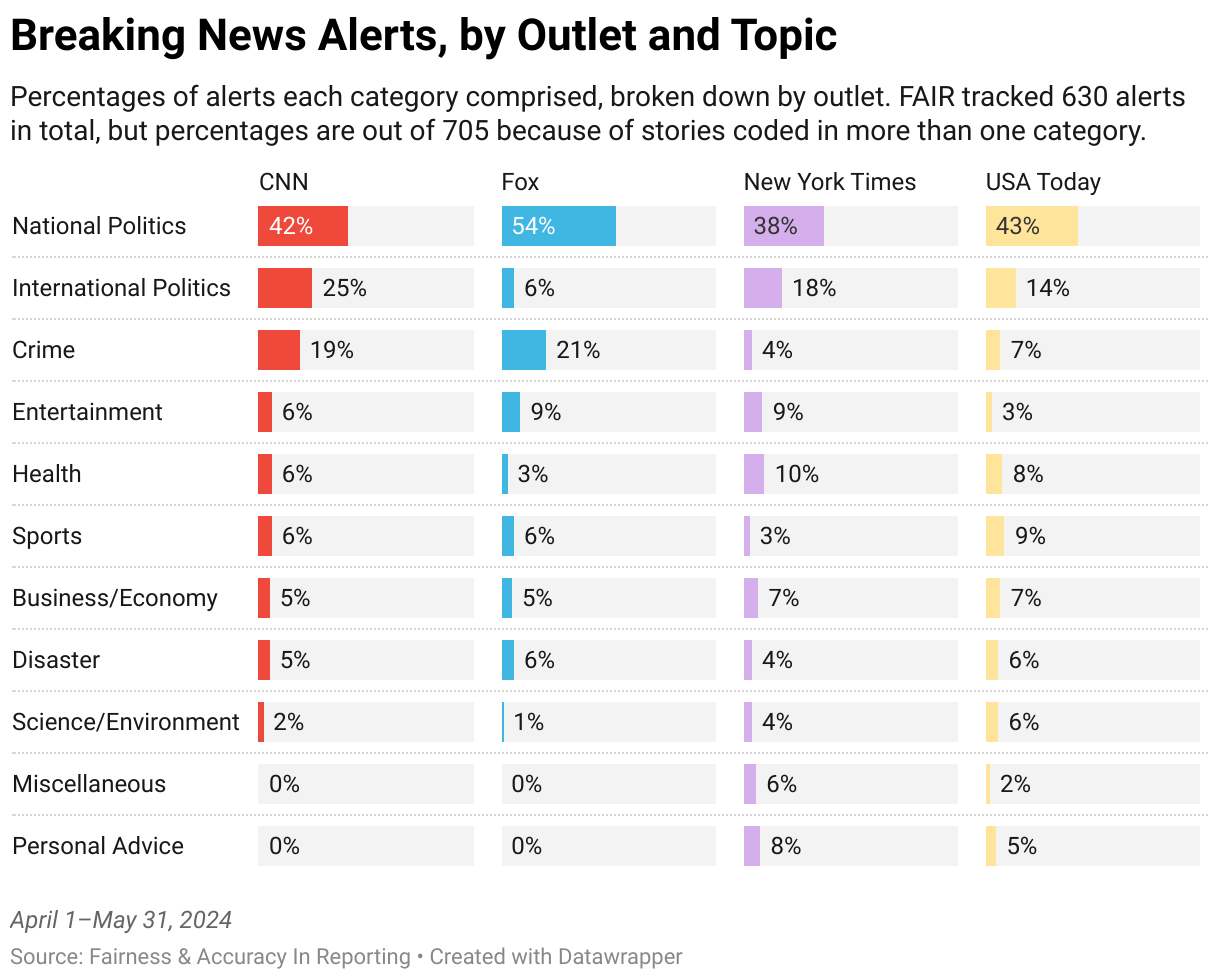 National politics dominatesTrump’s hush money trial, with its titillating details, was the subject of numerous breaking news alerts (New York Times, 5/7/24).
The outlets put out alerts with varying frequency—USA Today put out the most (224, or almost four per day) and CNN the fewest (83)—but National Politics stories dominated across all outlets, making up 274 (43%) of 630 total alerts. Within these stories, Donald Trump figured prominently, referenced in 121 alerts (44% of all National Politics stories). Eighty-eight of these, or 73% of the total stories about Trump, were about his trials—predominately his criminal trial in Manhattan, which ran through all but the first two weeks of the study period.
The Times, with 207 alerts sent out overall, devoted the highest percentage of its National Politics alerts (79) to Trump’s legal woes (39%), while Fox, with 116 alerts sent out, afforded them 17 articles of 63 National Politics stories—the smallest percentage of the four outlets (27%). Twice—the day Stormy Daniels testified (5/7/24) and the day the jury announced its guilty verdict (5/30/24)—the Times sent three trial-related alerts to its subscribers over the course of the day.
President Joe Biden received far less attention in National Politics stories; he was referenced in 35, or 13% of them. Fifteen of these stories were about the election, of which only two (USA Today, 5/28/24; Fox News, 5/1/24) did not also mention Trump.
Gaza, at home and abroadAfter the Trump trials, the top National Politics topics included the university campus protests for Gaza (41), abortion rights (16) and the foreign aid bill (6). (We coded stories about abortion into the Health category as well.)
Twenty-six (61%) of the 41 alerts about campus Gaza protests came from Fox News, accounting for 22% of all Fox alerts across categories, making it the outlet’s single most frequent alert topic. On seven days between April 17 and May 3, Fox sent multiple alerts about the protests; its fixation peaked on April 30, when the network sent five such alerts in a single day.
Fox’s encampment alert subject lines consistently referred to protesters as “agitators,” calling them “anti-Israel” and even “antisemitic” (4/30/24). (The New York Times called them “pro-Palestinian protests,” and USA Today simply referred to them as “protests.”) “Columbia University, Anti-Israel Agitators Fail to Reach Agreement as Unrest Continues” read a typical Fox subject line (4/29/24). “Facilities Worker Says Anti-Israel Columbia University Agitators ‘Held Me Hostage’” read another the next day (4/30/24).
The only Fox News alert (4/26/24) for an international issue other than Gaza was about King Charles’ health.
There were many other Gaza protests occurring around the country during the study period (Democracy Now!, 4/18/24, 4/24/24, 5/22/24, 5/30/24, 5/31/24), yet only one alert (Fox News, 4/9/24) mentioned any besides those on college campuses.
The second-most prevalent news category was International Politics, which had 97 alerts (15% of all). Sixty-three of these (65%) pertained to the ongoing Gaza crisis (not including the campus Gaza protests, which were coded as National Politics). Iran was sometimes mentioned in Gaza-related alerts, but it was also featured in eight unrelated alerts (8%) concerning the helicopter crash that killed Iranian President Ebrahim Raisi. Other recurring topics included Ukraine and the Ukraine War (6%), the shooting of the Slovakian president (5%), British elections (3%), China (3%) and Julian Assange (2%).
Curiously, while Fox advertises its breaking news alerts as keeping subscribers “in the know on the most important moments around the world,” it only produced seven alerts on international issues—six of them on the Gaza crisis. (The other article discussed King Charles’ return to royal duties after his cancer diagnosis.) That’s just one more alert on Gaza during the entire study period than Fox put out on its peak day of breaking news coverage of the encampments. At the other three outlets, International Politics stories were the second most frequent alerts.
Climate crisis not breaking newsThis CNN story (5/7/24) about climate change breaking heat records was not deemed urgent enough to qualify as breaking news.
It’s impossible to argue that the climate crisis isn’t an ongoing urgent news story. Yet the Science/Environment category had the fewest number of alerts, at 24, making up just 4% of alerts tracked. And only seven (1%) of the subject lines that appeared in our inbox referred or even alluded to climate-related topics.
During the study period, there were multiple major climate crisis stories that CNN, USA Today and the Times (but not Fox) reporters covered—but, for the most part, the outlets chose not to include these stories in their breaking news alerts.
It’s perhaps unsurprising that a right-wing outlet like Fox put out no alerts about climate change; its lone science story (4/8/24) was about the April solar eclipse. But CNN and the New York Times did only marginally better. CNN sent alerts for two Science stories, only one of which (4/15/24) was about the climate crisis: “Ocean Heat Is Driving a Global Coral Bleaching Event, and It Could Be the Worst on Record.”
At the same time, CNN‘s website reported on extreme ocean temperatures causing mass marine mortalities (CNN, 4/21/24), extreme heat causing health emergencies (CNN, 4/18/24) and April’s record-breaking heat (CNN, 5/7/24), among other climate change–related topics. On the days that these stories were published, however, CNN only sent out National Politics alerts, or simply no alerts at all.
One of the eight Science stories that the Times pushed was directly about the climate crisis, a story (5/13/24) about federal regulations impacting renewable energy (which we also coded as National Politics). Another Science article (7/3/24) that was not primarily about the climate crisis did mention its role in increasing turbulence experienced on airplane flights.
The Times does offer a paywalled newsletter for stories about climate, called Climate Forward. But they also have a free newsletter called On Politics, offering election-related news alerts—and that didn’t stop them from promoting eight articles directly related to the 2024 presidential election as breaking news.
In its online and print editions, the Times reported plenty of stories related to the climate crisis—but, as at CNN, they simply didn’t deem them important enough to send as breaking news alerts. On April 10, the Times published a story about ocean heat shattering records, and on April 15 it covered the coral bleaching event. Neither were sent as alerts.
The New York Times found mattress reviews more urgent than climate change.
On May 28, the Times published a piece headlined “Climate Change Added a Month’s Worth of Extra-Hot Days in Past Year”; that story wasn’t deemed “important news” that day by the Times’ breaking news alert team, but the “Best Mattresses of 2024” was.
All the outlets studied also failed to send out stories about major flooding disasters in Brazil, Afghanistan and Indonesia (Democracy Now!, 5/13/24, 5/14/24), or about the major heat waves in South Asia that killed hundreds of people (Democracy Now!, 5/28/24; CBS News, 5/15/24). All of these crises are major examples of how climate change is affecting people around the world in drastic ways.
USA Today did best on climate, sending out 13 alerts under the Science/Environment category; four of them discussed climate change, including topics such as carbon emissions and pollution. That’s still less than 2% of the paper’s alerts during the two-month period.
Corporate outlets have long been more than willing to leave climate change out of their stories about weather phenomenons and natural disasters around the world (FAIR.org, 9/20/18, 7/18/23, 6/28/24).
According to data published by the Pew Research Center in August 2023, 54% of Americans view climate change as a major threat. According to data collected by the Yale Program on Climate Change Communication up until the fall of 2023, 64% of the nation is worried about global warming, 58% believe global warming is already harming people in the US, and 70% think that global warming will harm future generations.
If more than half of the public views global warming and climate change as an urgent issue, why do these major publications not treat it as one?
Crime, entertainment over economyMany Crime alerts involved celebrities, like one for this Fox News story (4/15/24) about Alec Baldwin.
Although news media frequently report that the economy is “voters’ top concern,” leading into the 2024 election FAIR identified only 40 news alerts as belonging to the Business/Economy beat—6% of all.
Fox and CNN suggested to alert subscribers that Crime stories were more than twice as important, making up 21% of Fox‘s alerts and 19% of CNN‘s. (USA Today and the Times only devoted 7% and 4% of their alerts to crime, respectively.) The violent crime rate has actually gone down 26% (and the property crime rate 19%) since President Biden’s inauguration in January 2021, according to the New York Times (7/24/24), but media (including the Times) still focus heavily on the topic (FAIR.org, 7/25/24).
Mass shootings made up 21% of Crime alerts (13) across all outlets, which is not surprising, considering there have already been 348 mass shootings in 2024.
Celebrity crimes made up a large portion of Crime alerts across all outlets, at 25 (40%) out of 62. Many of these stories were about Alec Baldwin (5), OJ Simpson (5) and Scottie Scheffler (5).
Fox’s Crime alerts featured headlines meant to catch a reader’s attention—but not provide a lot of information. Take the May 17 news alert from Fox, “Pelosi Hammer Attacker Learns Fate During Sentencing,” for example. Why not include what the sentence was—30 years in prison—in the alert itself?
On April 15, when three out of four alerts sent out by Fox were about Crime (the fourth was a story about Trump’s hush money trial, coded as National Politics), one was headlined “Search for Kansas Women Takes a Turn as Spokeswoman for Investigators Gives Update.” The “turn” was an announcement that officials had given up hope of finding the missing women alive.
For its part, the New York Times gave its readers more Entertainment alerts (18) than Economy alerts (14), pushing out 46% of all Entertainment stories tracked in the study. The paper also put out the highest number of Personal Advice (81% of all) and Miscellaneous stories (72%). The Times and USA Today were the only outlets to send out Personal Advice stories as breaking news alerts, such as “The Six Best White Sneakers” (New York Times, 5/15/24) and “Being a Bridesmaid Can Be Expensive. Should You Say Yes or No?” (USA Today, 5/5/24).
A few New York Times Personal Advice stories (5/15/24, 5/28/24, 5/30/24) were from Wirecutter, the product-review website the Times bought in 2016. The website states at the top of each article that “when you buy through our links, we may earn a commission.” (This process is explained in a bit more depth here.) In the Times’ annual report, revenue made from Wirecutter commissions is listed as part of “Other Businesses,” a category that made the Times $265 million in 2023. These Wirecutter stories are not urgent news stories—but they do help the Times make a profit off its readers (FAIR.org, 6/17/21).
Questionable urgencyStop the presses! The New York Times (4/22/24) reports that some songs on Taylor Swift’s latest album “sounded a whole lot like others she has already put out.”
The New York Times and USA Today sometimes considered op-eds newsy enough to dedicate an entire alert to, in addition to their regular “breaking news.” An op-ed about Gmail’s 20th anniversary warranted an alert, just like the impeachment trial of Homeland Security Secretary Alejandro Mayorkas did. An op-ed on the dangers of sexual choking got the same weight as the news of the ICC preparing arrest warrants for Israeli and Hamas leaders. And in both instances, alerts were pushed on the same day within hours of each other.
The Times also published the most Health stories (21) about seemingly random (rather than breaking news) topics, such as whether oats and apple cider vinegar can really help you lose weight, why we age and tips for a better sex life. (Many of these Health stories were dually coded into Personal Advice.) These types of stories may have surprised readers who subscribed in order to, as the Times advertises, “get informed as important news breaks around the world.”
Times alerts of questionable urgency were often sent out with no apparent rhyme or reason, in the midst of other, more obviously newsworthy alerts. For example, on April 24, the Times sent out alerts about abortion laws in Arizona and Idaho, and the US secretly sending long-range missiles to Ukraine—along with a story headlined “Has Taylor Swift Fatigue Finally Set In?”
The next day, April 25, the Times pushed a story called “‘Eldest Daughter Syndrome’ and the Science of Birth Order” at 8:37 am, and then another email listed as “The U.S. economy grew at a 1.6 percent annual rate in the first quarter, a sharply slower pace than late last year.” just six minutes later. The article about “eldest daughter syndrome” was actually published by the Times ten days earlier, making it clear that it wasn’t exactly “breaking” news.
Many of the Times’ stories we coded as “Miscellaneous” had obvious clickbait headlines, like “A Hiker Was Lost in the Woods. Snow Was Falling. Time Was Running Out” (4/30/24) and “These Couples Survived a Lot. Then Came Retirement” (5/8/24). The latter was linked to the New York Times Magazine, the Times‘ weekly Sunday magazine that highlights interviews, commentaries, features and longer-length articles—again, not urgent news.
On May 27, when over 2,000 people died in Papua New Guinea, and Israeli Prime Minister Benjamin Netanyahu commented on the tent massacre in Rafah, the Times thought it reasonable to also send alerts about Manhattanhenge, nude modeling and a celebrity obituary that linked to its recently-acquired sports news site, the Athletic. As we’ve seen before (FAIR.org, 6/7/24), the Times enjoys focusing on trending and glamorous topics.
These media outlets offer newsletters that promise comprehensive news alerts about important breaking stories occurring everywhere. After tallying the topics covered, we can confidently state that that’s not what subscribers are getting.
As the US-backed genocide in Gaza continues, US media assist in Israeli Prime Minister Benjamin Netanyahu’s plan to widen the war, parroting the words of the aggressor. A consequential example of US press support for escalation was Western media’s coverage of the July 27 strike that killed 12 Druze children on a soccer field near the town of Majdal Shams in the Israeli-occupied Syrian Golan Heights.
Israel and the US immediately blamed the Iran-backed Lebanese organization Hezbollah for the strike—citing Israeli intelligence reports of an Iranian Falaq-1 missile being found at the soccer field (BBC, 7/28/24).
But, in a move that Hezbollah expert Amal Saad called “uncharacteristic” (Drop Site, 7/30/24), the group adamantly denied responsibility for the attack. Saad, a lecturer in politics at Cardiff University, noted that targeting the Syrian Golan Heights—where many inhabitants are hostile towards Israel—would be “illogical” and “provocative” for Hezbollah. Further, if the organization had accidentally committed an attack, Saad pointed to a precedent of the group issuing a public apology in a case of misfire, with the organization’s leader, Hassan Nasrullah, visiting families of victims.
The New York Times (7/28/24) matter-of-factly described an explosion of disputed origin as a “rocket from Lebanon.”
Despite multiple eyewitnesses describing an Israeli Iron Dome interceptor missile falling on the field during the time of the Majdal Shams strike (Cradle, 7/28/24), the New York Times insisted on spotlighting Israeli and US claims in its headlines, rather than genuinely assessing the facts on the ground.
On July 28, the Times published “Fears of Escalation After Rocket From Lebanon Hits Soccer Field,” pinning the blame squarely on Lebanon’s Hezbollah. The next day, reporting on the potential escalations, the Times headline (7/29/24) described the strike as a “Deadly Rocket Attack Tied to Hezbollah.”
While the July 29 subhead acknowledged that Hezbollah denied responsibility, the assertion in the headline undermined any reference to alternative explanations. Attribution to Hezbollah was then repeated without qualification in the first paragraph of the story.
Rebroadcasting government talking points not only does a disservice to newsreaders as Israel has a long history of misleading the public, but it also serves Netanyahu’s goals of justifying an escalation against Hezbollah. Predictably, the New York Times did not contextualize accusations of Hezbollah responsibility with information about Israel’s current objectives for wider war. This continues a long trend of US media outlets obscuring and distorting reality in order to downplay Israel’s aggressive regional ambitions (FAIR.org, 8/22/23).
Israel an unreliable sourceEven lying about the murder of a journalist doesn’t make Western journalists skeptical of official Israeli claims (Al Jazeera, 5/22/22).
The first problem is that the New York Times accepts narratives from Israeli military and government officials at face value. From peddling evidence-free claims about Palestinian use of human shields during Operation Cast Lead in 2009 (Amnesty International, 2009; Human Rights Watch, 8/13/09), to dodging responsibility for its assassination of Palestinian journalist Shireen Abu Akleh in 2022 (Al Jazeera, 5/22/22), to consistently attempting to conceal its use of illegal white phosphorus munitions across the Middle East (Haaretz, 10/22/06; Human Rights Watch, 3/25/09; Guardian, 10/13/23), the Israeli military has been known to circulate disinformation to the international public for decades. Neither in headlines nor in the text of its pieces does the Times acknowledge this well-established history.
The current assault on Gaza has made the central role of lies in Israel’s public relations arsenal clearer than ever. As early as October 17, there was controversy over the origin of a rocket strike on the Al-Ahli Arab hospital that killed hundreds of Palestinians (FAIR.org, 11/3/23). In the media confusion, Israel released audio it said captured two Hamas militants discussing Palestinian Islamic Jihad responsibility for the strike. However, an analysis by Britain’s Channel 4 news (10/19/23) found that the audio was the result of two separate channels being edited together. In other words, Israel engineered a phony audio clip to substantiate the notion that it had not committed a war crime.
In November, Israel laid siege to Al Shifa, Gaza’s largest hospital facility, leaving behind mass graves. In another dubious public relations campaign, Israel justified its assault on Al Shifa hospital by alleging that there was a Hamas command center underneath the facility, and that no civilians were killed in the operation (FAIR.org, 12/3/23).
What might be labeled “disinformation” when it comes from an official enemy is called “information missteps” from Israel (NBC, 11/18/23).
During and after the assault, Israel pumped out high volumes of low-effort lies (NBC, 11/18/23; New Arab, 11/14/23) to convince the public that there had indeed been a Hamas operations base in the basement, going so far as planting weapons in hospital rooms to insinuate Hamas activity in the area (CNN, 11/19/23). In the face of mounting public ridicule, Israel’s official Arabic Twitter account was compelled to delete a staged video of an Israeli actress boosting the Hamas-hospital-occupation theory while pretending to be a Palestinian Al Shifa nurse (France 24, 11/15/23).
However, after the mainstream outlets expressed skepticism at the claims and acknowledged that Israel had not provided sufficient evidence to back them up (New York Times, 11/17/23; Guardian, 11/17/23), Israel announced that the supposed Hamas base was actually in southern Gaza.
At the same time as the Al Shifa raid, Israel stormed Rantisi Children’s Hospital, and engaged in similarly preposterous propaganda efforts to justify its attack. Noting the presence of hospital gowns, baby bottles and toilets in the children’s hospital, Israeli spokesperson Daniel Hagari declared that this was proof of hostages in the facility (Jerusalem Post, 11/13/23). Hagari (Al Jazeera, 11/17/23) later pointed to what he said was a handwritten list of Hamas fighters hanging from one of the hospital’s walls, holding that “every terrorist writes his name and every terrorist has his own shift, guarding the people that were here.”
But, this was not, in fact, a damning roll call of Hamas fighters, but instead an Arabic calendar. All that appeared on the calendar were the days of the week, though this was unknown to most of Hagari’s largely non-Arabic-speaking audience (Electronic Intifada, 11/14/23).
Even recently, when Netanyahu visited Washington, DC, the Israeli prime minister gave a speech to lawmakers that was filled with obvious lies, including the contention that during attacks on Rafah, no civilians were killed, save for the two dozen who were murdered in a Hamas weapons depot explosion (New Arab, 7/25/24). This flies in the face of numerous reports detailing fatal bombings and rocket attacks in Gaza’s southernmost city, including a single Israeli missile that killed at least 45 people (Al Jazeera, 5/27/24).
It is not possible that the writers and the editors at the Times—the supposed newspaper of record—are ignorant of this seemingly unending series of deceptions. The decision to uncritically accept the word of the IDF regarding the Golan Heights strike demonstrates a deliberate editorial decision to knowingly advance the deceitful public relations goals of a genocidal state.
Justifying a wider warTwo days before the Majdal Sham massacre, Israel was reportedly told that “now is the right time” to escalate its war against Lebanon (Cradle, 7/25/24).
In light of Israel’s past lies, serious journalism ought to refrain from regurgitating Israeli claims without significant context or qualification. This is especially true when doing so would advance goals as disastrous as Netanyahu’s current aims. In the case of the Majdal Shams strike, media proliferation of Israeli propaganda manufactures consent for escalating the war on the northern border—something Israel has long stated as its goal, and something American officials have long been concerned about.
Multiple generals have bragged about Israel’s combat readiness in the north. In February, Israeli Defense Minister Yoav Gallant stated that if a ceasefire was reached in Gaza, Israel would increase its fire against Hezbollah, and later said his government is preparing to send Lebanon into the “stone age.”
Although some in the Israeli press believe that Israel is incapable of handling a front against both Hamas and Hezbollah (Cradle, 6/28/24), statements of readiness have intensified in summer months. The IDF announced on June 18 that it had approved operational plans for a war in Lebanon. Later, Axios (6/24/24) reported that the US envoy to Lebanon warned Hezbollah, “The US won’t be able to hold Israel back if the situation on the border continues to escalate.” Just two days before the Majdal Shams strike, Israeli media reported that Washington had given “full legitimacy” to an IDF campaign in Lebanon (Cradle, 7/25/24), contrary to apparent earlier efforts to avert a wider war in the Middle East.
On top of neglecting to acknowledge Israel’s flimsy credibility in their Majdal Shams analysis, Times reporters failed to address this readily available information about Israeli military objectives. By ignoring Israel’s strategic aims, they are ensuring the reader doesn’t encounter further reasons to question Israel’s account about the strike.
Who fired the rocket? Though it included a pro forma denial from Hezbollah, the New York Times (7/30/24) referred throughout this article to a “rocket attack” rather than an air-defense misfire.
When reporting on Israel’s “reprisal” assaults on Lebanon following the strike on the soccer field, the New York Times (7/28/24) again asserted Israeli claims as fact, saying in the first paragraph that “a rocket from Lebanon on Saturday killed at least 12 children and teenagers in an Israeli-controlled town,” which “prompted Israel to retaliate early Sunday with strikes across Lebanon.”
Was Lebanon—and implicitly Hezbollah—the source of the explosion that killed the 12 children? The Times does not care to examine this question, which warrants exploration. Israel’s military chief of staff declared that the damage was done with an Iranian-made Falaq-1 rocket fired by Hezbollah, a claim that was uncritically repeated as fact by the New York Times (7/30/24), despite the lack of independent corroboration. While there has been fighting in the area, and Hezbollah acknowledged that they fired Falaq-1 rockets at the nearby IDF barracks, there is significant reason to doubt that one of these rockets struck the soccer field.
The Falaq-1 was described by Haaretz (7/28/24) as a munition that targets bunkers. But, images from the aftermath of the attack show that the damage to physical structures was far from bunker-busting. In an interview with Jeremy Scahill (Drop Site, 7/30/24), the Hezbollah expert Saad cited military specialists who told her that “if [Hezbollah] had used the Falaq-1, we would have seen a much larger crater…. It would be much, much bigger and there would be much more destruction.”
As discussed above, Israel, well-known for planting or fabricating evidence for propagandistic ends, released images of rocket fragments that it alleged were found at the impact site, though the Associated Press (7/30/24) was unable to verify their authenticity.
A substantial case can be made that the projectile came from the IDF. In the immediate aftermath of the attacks, multiple eyewitnesses told Arab news outlets the projectile was a misfired Iron Dome missile (Cradle, 7/28/24; Drop Site, 7/30/24). The New York Times omitted this from its coverage of this event.
Contrary to the mythos behind the high-tech defense system, there have already been several cases of Iron Dome missiles falling on populated areas within Israel since October 7 (Al Jazeera, 6/11/23; Jerusalem Post, 12/2/23, 7/25/24; Times of Israel, 5/4/23, 8/9/24) with many such instances resulting in civilian injuries and deaths. There was even a report of an Iron Dome malfunction near Majdal Shams, months before the recent July strike.
Bolstering the case for an Iron Dome malfunction, OSINT researcher Michale Kobs noted that the sound profile of the projectile suggested that its speed was constant until it hit the ground. Hezbollah’s projectiles constantly accelerate as they fall on their targets, since they are driven by gravity, whereas Iron Dome missiles are propelled throughout their entire flight.
For their part, the Druze people in the Golan Heights—an Arabic-speaking religious community which has largely declined offers of Israeli citizenship—repudiated Israel’s displays of sympathy for their slain children, rejecting the use of their suffering to advance Israel’s plans for a broader war (Democracy Now!, 7/30/24). Locals even protested a visit from Netanyahu, chanting “Killer! Killer!” and demanding he leave the area (New Arab, 7/29/24).
In the Times reporting on the strike, Lebanese and Syrian denials of Hezbollah’s responsibility for the strikes were acknowledged and reported, but portrayed as predictable denials that did nothing to alter the narrative. By omitting the evidence pointing to Israeli responsibility for the strikes, the New York Times assists Israel in yet another propaganda campaign to mislead the public in order to justify further regional strife and bloodshed.
Featured image: Screenshot from a New York Times video (7/28/24) that claimed to know that the explosion in the Golan Heights was caused by a “rocket from Lebanon.”
ACTION ALERT: You can send a message to the New York Times at letters@nytimes.com. Please remember that respectful communication is the most effective. Feel free to leave a copy of your communication in the comments thread.
Janine Jackson interviewed Inside Climate News‘ Victoria St. Martin about suing Big Oil for the August 16, 2024, episode of CounterSpin. This is a lightly edited transcript.
https://media.blubrry.com/counterspin/content.blubrry.com/counterspin/CounterSpin240816Martin.mp3Janine Jackson: A lot of us have started seeing local weather forecasts with numbers unfamiliar to us for this time of year. As reporters, you could treat that as, “Oh, isn’t that curious? How are folks on the street dealing with this? Are sales of sunscreen going up?” Or, as a reporter, you can seriously engage the predicted, disastrous effects of fossil fuel production as predicted and disastrous—not, though, in terms of what, in other contexts, we would call criminal.
So what does it look like when business as usual is called out as an actual crime? Our next guest is reporting on an important case in a county in Oregon.
Veteran journalist and educator Victoria St. Martin covers health and environmental justice at Inside Climate News. She joins us now by phone. Welcome to CounterSpin, Victoria St. Martin.
Victoria St. Martin: Thank you so much. I’m so honored to be here.
Inside Climate News (7/8/24)
JJ: So what happened in summer 2021 in northwest Oregon, such that it became the subject of scientific study? What happened there? What were the harms?
VSM: The county called this a “heat dome disaster,” but basically there was a heat dome over three days in June of ’21 that recorded highs of 108°, 112°, 116° Fahrenheit. During that time, 69 people died from heat stroke, and most of them were in their homes.
Typically, in this part of Oregon, they have very gentle summers. The highs top out at about 81°. But this was unprecedented.
And one of the attorneys that is working with the county says this was not an act of God. This was not caused by God, but caused by climate change.
JJ: And that’s exactly the point. Oftentimes, folks might be surprised to hear, but environmental impacts were legitimately, legally written off, if you will, as acts of God. This is just nature, this is just what’s happening. So this is actually something new.
VSM: Yes. The attorney that I was speaking about, his name’s Jeffrey B. Simon; he is a lawyer for the county. He talks about this idea of how, no, this is not an act of God. This catastrophe was caused by “several of the world’s largest energy companies playing God with the lives of innocent and vulnerable people, by selling as much oil and gas as they could.”
JJ: What is a heat dome, just for folks who might not know?
VSM: Let’s see, how would I describe it? I would call it the atmosphere creating an intense umbrella of heat, and especially in areas where they don’t typically see this type of heat, like northwest Oregon. We’ve had heat domes this summer already, all across the nation, in places that typically don’t have this type of high heat.
JJ: So it’s a thing we all need to get familiar with. If you don’t know what it means today, you need to figure it out for tomorrow.
VSM: Yeah, some scientists, they say it’s like the atmosphere traps hot air, and, yeah, I said an umbrella, but like a lid or a cap being put on a bottle, and trapping that hot air for days like it did in northwest Oregon.
JJ: We’ve had issues with news media who want to separate the stories. It’s not that they don’t cover things, it’s that they don’t connect dots. They separate a story from: Here was a heat emergency, in this particular case, and it was horrible, and people suffered from it. And then on another page, or on another day, they’ll have a story about fossil fuel companies lobbyists influencing laws. But part of the problem with news media is they don’t connect these things.
And so I wonder, as a person who, besides being a journalist, a person who thinks about journalism, where are the gaps or the omissions or the missing dots that you think that media could be doing on this could-not-be-more-important story of climate disruption?
Victoria St. Martin: “To connect the dots of the health harms and the climate disasters that are happening, we need to do more.”
VSM: Yes. One of my editors says that covering climate, it’s one of the greatest stories of the century, right, the greatest story of our lifetime, that we are covering. And I think one thing that we did well, journalism-wise, in the past 10 or so years, is we’ve pushed this idea that journalists have to be multidimensional, that they have to know how to edit photo and video and create a graphic and write a story.
But what I think was lost in that, and what is important here and what is missing in these heat dome stories, these stories that are very, very plainly, as you can see, climate change stories, but what is missing here is journalists aren’t necessarily trained to be multidimensional in subject matter.
And while there are environmental desks growing in newsrooms throughout the nation, newsrooms aren’t allowing the journalists interdisciplinary roles, to be able to cover a weather event and talk about climate. And we need to do more of that. I think in order to connect those dots, to connect the dots of the health harms and the climate disasters that are happening, we need to do more of that.
I love how last summer, I think I really saw it come to a head, because the Canadian wildfires came to the East Coast and turned the skies orange in New York. And it was this story you could not ignore anymore. And it forced newsrooms to really start talking about wildfires, and is it safe to breathe the air? And what is the air pollution from a wildfire, and what causes wildfires? I think we need to do more of that.
While I don’t want climate disasters like wildfires to continue to happen, I do want journalists to think on their toes, think on their feet, think multidimensional, and be able to tell stories in a full and nuanced way, because we are not servicing our readers, our viewers, our listeners, if we aren’t. Our viewers, our listeners and our readers are here to get the full story, and we need to give them the full story and the full picture.
JJ: And just finally, in terms of journalistic framework, what I think is so interesting with the Multnomah County story is we’re moving the actions of fossil fuel companies into the category of crime. You knew this was going to cause harm, and you still did it, and it caused harm, and that’s a crime. And I feel like that’s, for journalism, for media, that’s a framework shift. Lobbying is a story, and legislative influence is a story. And then crime is a whole different story, and a whole other page. But if we’re talking about actions that cause people to die, that cause people to be harmed, well, then, a lot of things that fossil fuels companies are doing are crimes, and that’s what’s paradigm-breaking with this Multnomah County story.
VSM: I think also what’s different here is the attorneys reaching out once the county filed suit, once the attorneys filed suit, letting us know what’s happening, making sure that the story is amplified and gets out there. I think I appreciate it always, as a journalist, when there’s an open dialogue, and that I’m able to share the story with readers, viewers and listeners, because I had access to information, I had access to the lawsuit.
I think, what is that saying? When a tree falls in the forest…. I’m so thankful that somebody called me up and said, “Hey, this is what’s happening.” So I think everybody does their part, and I think in this case, it was a moment of allowing journalists to be a part of that process, and to be able to see behind the curtain and see what’s actually happening. Sometimes law can be…
JJ: Opaque.
VSM: …slow and boring and monotonous, and I think, just like anything, like science…. But I think when you allow journalists to have a front-row seat, it helps to tell the story.
JJ: Absolutely.
Well, any final thoughts in terms of what you would like folks to take away from this piece that you wrote about the effort to call fossil fuel companies out for the harms that they’re causing? Any tips for other journalists who might be looking at the same story?
VSM: I think one thing I constantly thought about when I was reporting this story, and something I did not see, is there’s a great database looking at lawsuits that have been filed by states and counties and cities that are seeking damages from oil and gas companies for the harms caused by climate change.
Again, there are about three dozen lawsuits out there right now, but this is one of the only lawsuits that is focused on a heat dome. And so this is what makes that case unique. This is what sets this case apart from the rest. And, for me, that was important to report.
So I’m thankful that you got to read it, and that others have gotten to read it, and I hope more people read about it. I think that was key here, and that was something I did not see before. There are other lawsuits, but this one, a lot of law experts think, could really change the game here, because it’s focusing on a specific disaster, and how this county is going to pay for the costs that they’ve incurred from the effects of the heat dome.
I think for journalists, when we’re reporting on these things, think of ways to get ahead of the pack, think of what makes the story unique, what sets the story apart from other weather event stories, or other climate change stories, and how to really help paint a picture about how important this story is.
Sixty-nine people died over the course of three days. That is huge, and it is something that, for me, needed to be at the top of the story. The fact that this was one of the only cases that looked at heat dome disasters, that was something that needed to be at the top of the story for me. And I hope to keep reporting on this, so I can’t wait to see what happens next.
JJ: All right, then. We’ve been speaking with journalist Victoria St. Martin. You can find her work on this and other stories at InsideClimateNews.org. Victoria St. Martin, thank you so much for joining us this week on CounterSpin.
VSM: Thank you so much.
The New York Times (8/19/24) insinuated that Phil Donahue attributed to politics a cancellation that was really caused by low ratings.
If I were teaching a class called “How to Slime People in a Subtle, Scuzzy Way in the New York Times,” this paragraph from the Times‘ obituary (8/19/24) of Phil Donahue—written by Clyde Haberman, Maggie’s father—would be part of the curriculum:
In 2002, Mr. Donahue tried a comeback with a nightly talk show on MSNBC. Barely six months in, the program was canceled. He said later that network executives were unhappy with his fervent liberalism and his opposition to the looming war in Iraq. (In 2007, he co-produced and co-directed an antiwar documentary, Body of War.) It hardly helped that his ratings lagged far behind those of competitors on Fox News and CNN.
Even now—more than 20 years after the New York Times was catastrophically wrong on the Iraq War—the paper cannot forgive anyone who was right.
- Yes, Donahue “said later that network executives were unhappy with his fervent liberalism and his opposition to the looming war in Iraq.” Do you know who else said this? MSNBC‘s network executives, in a leaked memo. Get the fuck out of here with the “he said” bullshit.
MSNBC executives said, in a leaked memo, that Donahue was “a difficult public face for NBC at a time of war… because of guests who are anti-war, anti-Bush.” This was reported by CNN (3/5/03), among other outlets, at the time. Unfortunately, these outlets are so obscure that the Times cannot access them.
- Yes, Donahue’s “ratings lagged far behind those of competitors on Fox News and CNN.” It was also the top-rated show on MSNBC. Sadly, the Times does not know this, because the only place it was reported at the time was in such little-known publications as the New York Times (2/26/03).
https://media.blubrry.com/counterspin/content.blubrry.com/counterspin/CounterSpin240823.mp3This week on CounterSpin: One of many things wrong with corporate news media is the way they hammer home the idea that the current system is the only system. If you don’t see yourself and your interests reflected in either of the two dominant parties, the problem is you. Part of the value of independent media is that the people they listen to give us new questions to ask. For example: How do we acknowledge the fact that many people’s opinions are shaped by messages that are created and paid for by folks who work hard to hide their identity and their interests? If we’re in an open debate about what’s best for all of us, why can’t we see who pays you? We’ll talk about “dark money” with Steve Macek. He’s professor and chair of communication and media studies at North Central College in Illinois. His recent piece, “Dark Money Uncovered,” appeared on TheProgressive.org.
https://media.blubrry.com/counterspin/content.blubrry.com/counterspin/CounterSpin240823Macek.mp3Plus Janine Jackson takes a quick look back at recent press coverage of Phil Donahue.
https://media.blubrry.com/counterspin/content.blubrry.com/counterspin/CounterSpin240823Banter.mp3
New York Times deputy opinion editor Patrick Healy (8/20/24) described Sen. Bernie Sanders’ speech to the Democratic National Convention as an attempt to “make policy proposals that put [Kamala] Harris in a big-government vise, binding (or pushing) her in a direction that a lot of moderates do not want to go.”
Healy depicted Sanders as
grasp[ing] the lectern with both hands as he unfurled one massive government program idea after another in a progressive policy reverie that must have been music to the ears of every democratic socialist at the United Center.
New York Times deputy opinion editor Patrick Healey (8/20/24): “On Tuesday night, Sanders put Harris on the hot seat.”
Healey followed the standard New York Times line (FAIR.org, 7/26/24) that progressive candidates need to move to the right to win—and scorned Sanders for ignoring that advice: “Harris needs some of those swing-state moderates if she’s going to win the presidency, but the electoral math didn’t seem to be on Sanders’s mind.”
Strangely, though, the specific policies that Healey mentioned Sanders as promoting don’t seem to be particularly unpopular, with moderates or anyone else. Rather, opinion polls find them to be supported by broad majorities:
- “Overturning Citizens United“: Three-fourths of survey respondents (Center for Public Integrity, 5/10/18) say that they support a constitutional amendment t0 overturn the 2010 Supreme Court decision that allows the wealthy to spend unlimited amounts of money on elections. In the same survey, 60% said reducing the influence of big campaign donors is “very important.” According to the Pew Research Center (5/8/18), 77% of the public says “there should be limits on the amount of money individuals and organizations” can spend on political campaigns.
- “Making healthcare ‘a human right’ for all Americans”: A 2020 Pew Research Center poll (9/29/20) found that “63% of US adults say the government has the responsibility to provide healthcare coverage for all.” Another Pew poll (1/23/23) reported 57% agreeing that it’s “the responsibility of the federal government to make sure all Americans have healthcare coverage.”
- “Raising the minimum wage to a ‘living wage’”: According to the Pew Research Center (4/22/21), 62% of Americans want the federal minimum wage raised to $15 an hour. (Most of the remainder wanted the minimum wage increased by a lesser amount.) According to the think tank Data for Progress (4/26/24), 86% of likely voters do not think the current federal minimum wage is enough for a decent quality of life.
- “Raising teachers’ salaries”: The 2023 PDK poll found that 67% of respondents support increasing local teacher salaries by raising property taxes. The AP/NORC poll (4/18) reported that “78% of Americans say teachers in this country are underpaid.”
- “Cutting prescription drug costs in half”: A poll from 2023 by Data for Progress found that 73% of all likely voters supported Biden administration initiatives allowing Medicare to negotiate lower prescription drug costs. Health policy organization KFF (8/21/23) reported that 88% of adults support “limiting how much drug companies can increase the price for prescription drugs each year to no more than the rate of inflation.”
Back in 2015, when Sanders was running for president, Healy co-wrote an article for the Times (5/31/15; Extra!, 7–8/15) that declared him “unelectable,” in part because he supported “far higher taxes on the wealthy.” But raising taxes on the rich turns out to be consistently popular in opinion polls (FAIR.org, 4/20/15).
What we’re learning is that progressive policy proposals are deeply unpopular—with the New York Times‘ deputy opinion editor.
ACTION ALERT: You can send a message to the New York Times at letters@nytimes.com. Please remember that respectful communication is the most effective. Feel free to leave a copy of your communication in the comments thread.
Janine Jackson interviewed ExxonKnews‘ Emily Sanders about criminalizing pipeline protests for the August 16, 2024, episode of CounterSpin. This is a lightly edited transcript.
https://media.blubrry.com/counterspin/content.blubrry.com/counterspin/CounterSpin240816Sanders.mp3FAIR.org (11/22/16)
Janine Jackson: We have not forgotten the years of protest by the people of Standing Rock in resistance to the Dakota Access Pipeline. The cause could not have been more fundamental. The news and images were dramatic, and the support was global and cross-community.
Fossil fuel makers, who would like to keep making money from the destruction of the planet’s capacity for life, along with their ally enablers in law and law enforcement, want nothing like that to ever happen again, and certainly not for you to see it and take inspiration.
Pursuant to that are new efforts reported by our guest.
Emily Sanders is senior reporter for ExxonKnews, a project of the Center for Climate Integrity. This story was co-published with the Lever. She joins us now by phone from Queens. Welcome back to CounterSpin, Emily Sanders.
Emily Sanders: Hi. Thanks so much for having me again.
JJ We’re talking, to start, about congressional actions. What is the context behind this new rulemaking authorization process that you’re writing about, and how did laws around pipeline protest get into this conversation?
HuffPost (8/26/21)
ES: Congress is currently working to reauthorize the Pipeline and Hazardous Materials Safety Administration, or PHMSA, which would set the agency’s funding and mandates for safety rulemaking on pipelines over the next few years. And that’s at the same time as the agency sets out to make new rules for carbon dioxide pipelines.
And both these processes are especially crucial right now, as the oil and gas industry plans to build out tens of thousands of additional miles of pipeline for carbon capture projects. And CO2 is an asphyxiant. It can travel long distances, it can shut down vehicles, and sicken, suffocate or even kill people and wildlife.
So these pipelines can be incredibly dangerous if and when they leak, as was the case in Satartia, Mississippi, in 2020, when a Denbury pipeline, now owned by ExxonMobil, ruptured and stalled emergency vehicles, sent nearly 50 people to the hospital with reportedly zombie-like symptoms.
So, after that, and now in the wake of yet another leak in Sulphur, Louisiana, earlier this year, advocates and community members have really been pushing the agency to take a hard look at these pipelines, and provide more transparent information to communities and first responders, who are often just underfunded, or volunteer fire departments tasked with dealing with these leaks at the last minute. And they’re asking the agency to implement real rules and oversight for the companies that, in these cases of leaks, were not appropriately monitoring their sites.
So back in April, I reported on how the oil industry was lobbying to limit the scope of those rules, and dictate its own safety standards, so that it can build out CO2 pipeline infrastructure as quickly as possible, since it stands to benefit from huge tax incentives for CCS passed under the Biden administration.
Emily Sanders: “This rulemaking process is supposed to be about protecting community members and making sure pipelines are safe, not about preventing protests.”
And what I found, as I dug further into those lobbying records, is that oil companies and their trade groups are now trying to pressure lawmakers to use this PHMSA reauthorization process to push through measures that could further criminalize pipeline protests at the federal level.
The federal penalty for damaging or destroying pipelines is already a felony charge of up to 20 years in prison. But in hearing testimony that I found, and policy briefs posted online, oil industry trade group executives were basically pushing lawmakers to expand the definition of so-called “attacks” on pipelines that can be punished under felony charges to include vague language like “disruptions of service” or “attacks on construction sites.”
And that could implicate a much broader set of activities that are used to protest fossil fuel infrastructure. So something like “disruption of service,” or interfering at a construction site, that could implicate anything from planting corn in the path of a pipeline construction, to a march, or a sit-in at a site. And it’s really hard to say what that actually means, which is why it’s so concerning.
And we’re now already seeing this language show up in committee bills. So the House Energy and Commerce Committee’s draft reauthorization bill, which was one of two committee bills being negotiated before the legislation goes to the Senate, would add impairing the operation of pipelines, damaging or destroying such a facility under construction, and even attempting or conspiring to do so as felony activities punishable by up to 20 years in prison.
So this is something industry lobby groups have tried before, back in 2019, to use this reauthorization process towards this purpose. They say it’s about preventing damage or destruction of pipelines that could create a harmful situation for communities on the ground. But, again, that’s already a felony under federal law. This rulemaking process is supposed to be about protecting community members and making sure pipelines are safe, not about preventing protests.
JJ: Well, you’ve hit all the points, but let me just draw some out, because the perversity here—it’s not irony—this is coming at the center of legislative work about rules for industry due to devastating harms, like breaches in a carbon dioxide pipeline, things that have actively harmed the community.
So in the process of legislating rules around that, fossil fuel makers have said, “Oh, well, while we’re talking about safety of pipelines, let’s also wiggle in this idea that protesters might be endangering pipelines.”
And then here’s where it gets to peak irony, the idea that protesters might cause harm to human beings by protesting pipelines, when the context is we’re talking about the harm that these pipelines themselves have caused. I mean, it’s kind of off the chart.
ES: Exactly. And this is as these same companies are continuing to invest in more and more fossil fuel infrastructure, while every scientific body is telling us that we have to do the opposite to avoid cataclysmic climate impacts. So they’re really using this growing pushback against their own operations to take this opportunity to silence that opposition.
JJ: And then, of course, the vagueness of the language, which you point to in the piece, that is part of it, that you’re not supposed to quite understand, well, what counts as “protest,” what counts as “impairing the operation” of the pipeline. It’s very much suppressive of free speech and action.
Extra! (4/13)
ES: Exactly. There’s precedent for this, as you alluded to in your opening; this is part of a larger push to pass laws criminalizing protest of fossil fuel infrastructure since the protest against Keystone XL and Dakota Access, which brought together enormous coalitions of people that cross cultural and political boundaries to oppose those pipelines.
And much of the legislation we’ve seen since then, which has been lobbied for by companies like Exxon and Marathon, Koch and Enbridge—much of that legislation was primarily based on a model bill crafted by the oil- and gas-funded American Legislative and Exchange Council, or ALEC, which made it a felony to trespass on the industry’s so-called critical infrastructure.
And those critical infrastructure bills use a lot of the same, very vague types of language to describe trespass, which can make it incredibly dangerous, not just for protesters, many of whom are Indigenous people and farmers and other landowners just trying to protect their land and water rights, but also journalists and the press, who go to report on these protests on the ground. And, again, it’s just especially concerning when the cost to the planet and people’s safety are so high.
JJ: I just want to ask, finally, it’s kind of open-ended, but I mean, it’s just not plausible to think that people are going to stop resisting or stop protesting or stop speaking out against the harms climate disruption is inflicting, that are evident much more every single day. And I just wonder—obviously, these fossil fuel companies are hoping that news media will use their age-old frames about criminality and law-breaking to push people back into the idea of, “Oh, it’s OK to want what you want”—like, not to see the capacity for human life on the planet destroyed—”it’s OK for you to want that, but just do it through proper channels. Don’t do it by protesting, because now that’s illegal in a new way.” And I just wonder, media have to do something different, big media have to do something different to actually rise to this occasion.
ExxonKnews (6/17/24)
ES: I think it’s all about talking to the actual people on the ground who are doing the protesting. Like you said, it’s so easy to paint people as criminals, when the definition of a criminal is defined or written by the same industry trying to protect the product that those people are protesting. So I think it’s just so important to get their perspective, find out why they’re there. A lot of the time these are regular people, not just activists who are there because of the climate, but also just people who are there trying to protect their water, protect their land and their homes and livelihoods, or journalists who are trying to report on what’s going on. And I just think getting their voice heard from a source is the most important thing.
JJ: We’ve been speaking with Emily Sanders, senior reporter for ExxonKnews. You can find the piece, “Big Oil Wants to Increase Federal Criminal Penalties for Pipeline Protests,” online at ExxonKnews.org, as well as LeverNews.com. Thank you so much, Emily Sanders, for joining us this week on CounterSpin.
ES: Thanks again for having me.
Phil Donahue passed away Sunday night, after a long illness. He was beloved by those who knew him and by many who didn’t.
He started as a local reporter in Ohio, was a trailblazer in bringing social issues to a national audience as a daytime broadcast TV host, and then he was pretty much banished from TV by MSNBC because he—accurately, correctly and morally—questioned the horrific US invasion of Iraq.
Phil Donahue in 1977.
Beginning in the 1970s, Phil took progressive issues and mainstreamed them to millions through his syndicated daytime show. He was a pioneer in syndication. He also pioneered on the issues; his most frequent guests on his daytime show were Ralph Nader, Gloria Steinem and Rev. Jesse Jackson. They appeared dozens of times as Phil boosted civil rights, women’s rights, consumer rights, gay rights. He regularly hosted Dr. Sidney Wolfe, warning of the greedy pharmaceutical industry and unsafe drugs. Raised a Catholic, he also featured advocates for atheism.
Mainstream media obits have predictably had a focus on his daytime TV episodes that included male strippers or other titillation, but Phil was serious about the issues—and did far more than most mainstream TV journalists to address the biggest issues.
I was a senior producer on Phil’s short-lived MSNBC primetime show in 2002 and 2003. It was frustrating for us to have to deal with the men Phil called “the suits”—NBC and MSNBC executives who were intimidated by the Bush administration, and resisted any efforts by NBC/MSNBC to practice journalism and ask tough questions of Washington before our young people were sent to Iraq to kill or be killed. Ultimately, Phil was fired because—as the leaked internal memo said—Donahue represented “a difficult public face for NBC at a time of war.”
But before we were terminated, we put guests on the screen who were not commonly on mainstream TV. We offered a full hour with Barbara Ehrenreich on Labor Day 2002, a full hour with Studs Terkel, congressmembers Bernie Sanders and Dennis Kucinich, columnist Molly Ivins, experts like Phyllis Bennis and Laura Flanders, Palestinian advocates including Hanan Ashrawi.
No one on US TV cross-examined Israeli leaders like Phil did when he interviewed then-Israeli Foreign Minister Shimon Peres, and later, former Prime Minister Ehud Barak. They seemed stunned—never having faced such questioning from a US journalist.
Phil Donahue (right) with Michael Moore—three right-wingers for balance not pictured.
But “the suits” ruined our show when they took control and actually mandated a quota system favoring the right wing: If we had booked one guest who was antiwar, we needed to book two that were pro-war. If we had two guests on the left, we needed three on the right. When a producer suggested booking Michael Moore—known to oppose the pending Iraq War—she was told she’d need to book three right-wingers for political balance.
Three weeks before the Iraq war started, and after some of the biggest antiwar mobilizations the world had ever seen (which were barely covered on mainstream TV), the suits at NBC/MSNBC terminated our show.
Phil was a giant. A huge celebrity who supported uncelebrated indie media outlets. He loved and supported the progressive media watch group FAIR (which I founded in the mid-1980s).
Phil put Noam Chomsky on mainstream TV. He fought for Ralph Nader to be included in the 2000 presidential debates. He went on any TV show right after 9/11 that would have him, to urge caution and to resist the calls for vengeful, endless warfare that would pointlessly kill large numbers of civilians in other countries. He opposed active wars and the Cold War with the Soviet Union. He supported war veterans and produced an important documentary on the topic: Body of War.
Phil Donahue made his mark on our society. He fought for the underdog. He did it with style and grace and a wonderful sense of humor. He changed my life. And others’ lives.
He was inspired by the consciousness-raising groups he saw in the feminist movement, and he sought to do consciousness-raising on a mass scale . . . using mainstream corporate TV. He did an amazing job of it.
A version of this post appeared on Common Dreams (8/19/24) and other outlets.
Recent student-led campus encampments in solidarity with Palestine prompted considerable media conversation. But, according to a new FAIR study examining TV and newspaper discussions in the period from April 21 to May 12, those conversations rarely included students themselves—and even fewer included student protesters.
FAIR examined how often key corporate media discussion forums contain student and activist voices. The Sunday morning shows (ABC’s This Week, CBS’s Face the Nation, NBC’s Meet the Press, CNN’s State of the Union and Fox News Sunday) brought on no students or activists, opting instead to speak primarily with government officials.
The daily news shows we surveyed—CNN’s Lead With Jake Tapper, MSNBC’s ReidOut, Fox News‘ Hannity and PBS’s NewsHour—were slightly better, with six students out of 79 guests, but only two of them were pro-Palestine protesters.
The op-ed pages of the New York Times, Washington Post, USA Today and Wall Street Journal featured two students out of 52 writers, only one of whom was a protester.
Sunday Shows: Student-Free ZoneThe agenda-setting Sunday morning shows, which historically skew towards government officials (FAIR.org, 8/12/20, 10/21/23), showed no interest in giving airtime to student or activist voices. For the first weeks following the first encampment set up at Columbia University, when the student protests began to command national media attention, FAIR analyzed every episode of ABC’s This Week, CBS’s Face the Nation, NBC’s Meet the Press, CNN’s State of the Union and Fox News Sunday.
Out of 36 one-on-one and roundtable guests across all networks, 29 (81%) were current or former government officials or politicians, and five (14%) were journalists. One academic and one think tank representative were also featured. Of the 29 government sources, only six spoke about having personal experience with the protests, or about universities in states they represent.
No students or activists, and only one academic, were invited to speak on any of the Sunday shows. The one academic, Robert Pape of the University of Chicago, didn’t speak about his own experience with the encampments, but about his research on student safety.
Some guests utilized inflammatory language when discussing the protesters, who were never afforded the opportunity to defend themselves. On This Week, Republican Sen. Tom Cotton (ABC, 5/5/24), referred to the encampments as “Little Gazas,” and said the students “deserved our contempt” and “mockery.” “I mean, they’re out there in their N95 masks in the open air, with their gluten allergies, demanding that Uber Eats get delivered to them,” he said. Later on, Cotton referred to a keffiyeh—a symbol of Palestinian identity and solidarity—that protesters had put on a statue of George Washington as a “terrorist headdress.”
Jeffrey Miller lies on the pavement, one of four students killed when the National Guard was sent in to suppress protests at Kent State on May 4, 1970.
Three guests were asked about the idea of bringing in the National Guard to quell protests, only one declared it to be a bad idea. The other two gave similarly equivocal answers: Sen. J.D. Vance (Fox News Sunday, 4/28/24) said, “I don’t know if you need to call in the National Guard,” while Republican congressional candidate Tiffany Smiley (Fox News Sunday, 4/28/24) responded, “I don’t know if the National Guard is necessary.” But both agreed that some kind of police response was needed to these student protests.
In most other instances, the host would ask a politician for their thoughts on the encampments, to which the guest would respond with platitudes about nonviolence. For instance, CNN‘s Jake Tapper (5/5/24) asked Biden adviser Mitch Landrieu whether groups like Jewish Voice for Peace are “causing unrest for the American people.” Landrieu responded, “Everybody has a right to protest, but they have to protest peacefully.”
Framing the questionsThroughout the Sunday show discussions, there was a heavy focus on whether the protests were violent and antisemitic, and next to no explanation of the demands of the protesters. Even though violence by—as opposed to against—campus protesters was very uncommon, politicians continually framed the protests as a threat to safety. White House national security communications advisor John Kirby (This Week, 4/28/24) decried “the antisemitism language that we’ve heard of late, and…all the hate speech and the threats of violence out there.”
Of all 64 questions asked to guests, only one—CNN’s interview with LA Mayor Karen Bass (4/28/24)—mentioned divestment, the withdrawal of colleges’ investments from companies linked to the Gaza military campaign and/or Israel, which was the central demand of most of the encampments. Moreover, this was the only instance in which divestment was discussed by any host or guest on the Sunday shows. On the other hand, 20 of the 36 conversations named antisemitism as an issue.
There were two questions asked about the safety of Jewish students (CNN, 4/28/24, 5/5/24)—by which CNN meant pro-Israel Jewish students, as many Jewish students took part in the encampments. (Forty-two percent of young Jewish Americans say Israel’s response to October 7 is “unacceptable,” according to Pew Research Center polling.) Only one question was asked about the safety of Muslim students (CNN, 5/5/24), even though both groups reported feeling almost equally unsafe.
All questions on violence related to the protesters, and not to counter-protesters or law enforcement. The interview with Bass (CNN, 4/28/24) made no mention of the violent counter-protests at UCLA that sent 25 protesters to the emergency room, but instead focused on hypothetical dangers to pro-Israel students.
Weekday News Shows: Rare Sightings of ProtestersIn the same period as the study on Sunday shows, FAIR analyzed every episode of CNN’s Lead With Jake Tapper, MSNBC’s ReidOut, Fox News’ Hannity and PBS’s NewsHour. These daily programs were chosen as representative, highly rated daily news shows that have a focus on political discussion. Although the evening shows, unlike the Sunday shows, included occasional student voices, they were far outnumbered by government officials, journalists and educators—and only two student guests were protesters.
Of the 79 guests who appeared on these shows, 23 (29%) were current or former government officials and politicians, 19 (24%) were university-level educators and administrators, 18 (23%) were journalists, six (8%) were students and 13 (16%) had other jobs.
These shows showed more variation across the networks than the Sunday shows. Sixty-five percent of PBS NewsHour‘s guests were university-affiliated, for instance, and none were government officials, while almost two-thirds of Hannity‘s guests on Fox News (64%) were government officials and politicians, with no educators or students appearing.
The three student journalists found on daily news shows all appeared together on one episode of the PBS NewsHour (4/30/24).
There were a total of six students invited among the 79 guests, accounting for fewer than 8% of all interviewees. Two of these were pro-Palestine protesters, both appearing on MSNBC‘s ReidOut (4/22/24, 4/30/34). Three were nonaligned student journalists, all appearing together on PBS (4/30/24), and one, a student government leader at Columbia, was an Israeli who supported her government (CNN, 4/30/24).
One of the students on ReidOut (4/30/24), identified only by his first name, Andrew, described the police brutality at Washington University in St. Louis: “I was held in custody for six hours. I wasn’t provided food or water, and I have since been suspended and banned from my campus.”
Andrew was one of just two guests who mentioned police brutality. The other student protester, Marium Alwan, told host Joy Reid (4/22/24) that the Columbia encampment, and all encampments, “stand for liberation and human rights and equality for Jewish people, Palestinians.” When asked about antisemitism, she said they “stand against hateful rhetoric.”
Maya Platek, the only student featured on CNN‘s Lead (4/30/24), was president elect of the Columbia School of General Studies (and former head content writer for the IDF Spokesperson’s Unit). She said that at Columbia, she “would not say that I have been feeling the most comfortable.” She called the idea of divesting from Israel, and suspending Columbia’s dual-degree program with Tel Aviv University, “completely atrocious.”
Completely shutting out student voices, Fox News prioritized right-wing politicians like former President Donald Trump, Florida Gov. Ron DeSantis and former presidential candidate Vivek Ramaswamy to speak on the protests. Texas Sen. Ted Cruz (Hannity, 4/30/24) compared the encampments to “Poland pre–World War II” and “Kristallnacht.”
New England Patriots owner Robert Kraft (CNN, 4/22/24) was brought on to talk about student protests more often than all student protesters put together.
CNN‘s Lead, the show with the second-highest number of government official guests (35%), featured more centrists than did Hannity. Florida Rep. Jared Moskowitz (5/1/24) said that while “it’s their First Amendment right” to protest, for students to say such as “go back to Poland or bomb Tel Aviv or kill all the Zionists” was not acceptable, a message similar to those frequently heard on the Sunday shows.
Robert Kraft, owner of the New England Patriots and a major donor to Columbia University, was invited to speak about encampments three times (Fox, 4/22/24, 5/1/24; CNN, 4/22/24)—more times than student protesters spoke across all four shows.
Although a slight improvement over the Sunday shows’ complete shut-out of student voices, these daily news shows still had relatively few references to divestment, which came up in 16 interviews (20%), or police violence, mentioned in seven interviews. This compares to 33 interviews (42%) that discussed antisemitism.
Newspaper Op-Eds: Views From a Staffer’s DeskFree-speech celebrant John McWhorter wrote a column for the New York Times (4/23/24) that wondered why students were allowed to protest against Israel.
The opinion columns of corporate newspapers did no better at including student protesters’ voices than the TV shows. FAIR analyzed every op-ed primarily about the campus encampments in the same time span (April 21–May 12), from the New York Times, USA Today, Wall Street Journal and Washington Post.
In the observed period, the Times published 11 op-eds about the campus encampments, all written by Times columnists. The paper failed to include any students or activists in its opinion section.
Out of nine different Times columnists, only one mentioned visiting an encampment: John McWhorter (4/23/24), a Columbia professor who writes regularly for the paper, was critical of the protests happening at his university. The self-styled free-speech advocate demanded to know, “Why do so many people think that weekslong campus protests against not just the war in Gaza but Israel’s very existence are nevertheless permissible?”
During the same period, the Washington Post also ran 11 encampment-related op-eds. Ten were written by regular columnists, and two mentioned having visited an encampment. Those two—Karen Attiah (5/2/24) and Eugene Robinson (4/29/24)—wrote positively of the protests. Attiah wrote of her visit:
Around me, students were reading, studying and chatting. Some were making art and painting. I saw an environment rich with learning, but I did not see disruption.
The paper’s only guest column on the encampments was penned by Paul Berman (4/26/24), a Columbia graduate and writer for the center-right Jewish magazine Tablet, who opined that the student protesters had “gone out of their minds,” and that professors were to blame for “intellectual degeneration.” Like the Times, the Post failed to include any students or activists in their opinion section.
‘We bruise, we feel’In the only op-ed the study found written by a student protester (USA Today, 5/8/24), Columbia’s Allie Wong was able to succinctly state the objective of the encampments: “We are calling to end the violence and genocide against our Palestinian brothers and sisters.”
USA Today published fewer encampment-related opinion pieces, but invited more outside perspectives. Of its seven columns during the study period, four were written by regular columnists, one by Columbia student protester Allie Wong (5/8/24), one by pro-Israel advocate Nathan J. Diament (4/22/24) and one by the son of Holocaust survivor Eli Wiesel (5/2/24).
In her op-ed, Wong described the police brutality exhibited during her and other protesters’ arrests:
We clung tighter to one another as they approached us, and seized us like rag dolls and slammed us into the hallowed ground of brick and concrete. But unlike rag dolls, we bleed, we crack, we bruise, we feel.
Wong’s piece was also the only one in USA Today to mention divestment, and one of only three pieces to mention divestment among all op-eds in the study. (The other two, from the Wall Street Journal, called the divestment demands “useless”—4/30/24—and “a breach of fiduciary obligation”—5/5/24.)
‘Fraternities a cure’The Wall Street Journal (5/9/24) ran an editorial calling fraternities the antidote to encampments, written by someone who sells insurance to fraternities.
The Wall Street Journal had the most op-eds of the four papers. Its 22 pieces on the encampments included four by educators and one by a student. Unlike most other student and educator voices across our study, however, the student and educator guests on the Journal were highly critical of the protests.
Dawn Watkins Wiese (5/9/24) wrote a column titled “Fraternities Are a Cure for What Ails Higher Education,” asserting that the counter-protesters instigating violence at UNC “acted bravely.” Wiese is the chief operating officer of FRMT Ltd., an insurer of fraternities.
Ben Sasse (5/3/24), president of the University of Florida (and a former Republican senator), charged that the students were uneducated: “‘From the river to the sea.’ Which river? Which sea?” he wrote, suggesting that students didn’t know what they were protesting about.
The one student on the Journal‘s op-ed pages, Yale’s Gabriel Diamond (4/21/24), called for the expulsion of his protesting classmates for being “violent.” According to Yale Daily News president Anika Seth (4/30/24), no violence had been documented at the school’s encampment.
Takeaways: Avoid DemandsAcross corporate media, the lack of student and protester voices in discussions of student protests is striking. Virtually every university has student journalists, yet only four of them were found in the study, compared to the more than 50 non-student journalists and columnists, the vast majority of whom gave no sign of ever having been to an encampment.
Despite polling that found Jewish and Muslim students feeling almost equally unsafe, antisemitism was mentioned in 88 different interviews and editorials, while Islamophobia was mentioned in only six interviews and one op-ed (Washington Post, 5/2/24). Divestment was only mentioned 26 times, despite it being the principal goal of the encampments.
The Palestine campus protests were not the first time corporate media avoided the demands of protesters. A 2020 FAIR study (8/12/20) of coverage of Black Lives Matter protests showed a “heavy focus on whether the protests were violent or nonviolent, rather than on the demands of the protesters,” a description that applies equally well to the coverage and commentary examined in this study.
Research assistance: Owen Schacht
As the Democrats headed toward their convention with momentum for the Kamala Harris and Tim Walz ticket, newspapers have collectively found an August scandal. Major press outlets are amplifying Republican claims that Walz, as governor of Minnesota, let the Twin Cities burn during the 2020 George Floyd uprising. By spotlighting these charges, corporate media are assisting GOP attempts to portray themselves as the party of law and order against a tide of anarchic anti-police chaos.
To recap, Walz, who had spent a quarter century in the National Guard, was governor of the state in the summer of 2020, when white Minneapolis police officer Derek Chauvin was caught on camera murdering George Floyd, a Black man, suffocating him to death. Protests in the city erupted and turned violent, and protests popped off around the country.
When the head of the Minnesota National Guard was told by Gov. Tim Walz that the entire force would be mobilized, Maj. Gen. Jon Jensen said his first reaction was, “Whoa, wait a second here, sir” (MPR, 7/10/24).
Walz, originally hesitant to call in military assistance to restore order, eventually called in the National Guard, which Minnesota Public Radio (7/10/24) praised for having “mobilized quickly” and “adjusted on [the] fly for Floyd unrest.” MPR added that it had been the state guard’s “largest deployment since World War II, and it occurred with remarkable speed.”
The “law and order” aspect of this election is muddy. Donald Trump, who makes “tough on crime” conservatism a part of persona in his attempt to return to the White House, is the only presidential candidate in history to be convicted of a felony. Meanwhile, Harris made her career in California as the San Francisco district attorney, and then the state’s attorney general. Despite Walz’s career in the National Guard, the Republicans are drumming up the 2020 George Floyd drama to try to win back the title of the party of order.
Too much of the corporate media are helping the Republicans make this flimsy case—and allowing the debate to revolve around the question of whether Walz was quick enough to use force against Black Lives Matter protests.
‘I fully agree with the way he handled it’Four years ago, Trump praised Tim Walz’s response to the protests after George Floyd’s murder, calling the governor “an excellent guy” (CNN, 8/8/24).
For starters, then-President Trump had actually praised Walz’s handling of the crisis in 2020 (CNN, 8/8/24). “I fully agree with the way he handled it the last couple of days,” Trump said of Walz in a conference call with governors:
Tim Walz. Again, I was very happy with the last couple of days. Tim, you called up big numbers and the big numbers knocked them out so fast it was like bowling pins.
Surely this is relevant context for any story about the Trump campaign now attacking Walz’s response to the Floyd protests. (A transcript of the call has been available online at CNN.com since June 1, 2020.)
And it should be hard for journalists to recall the police response as being any kind of hands-off approach. At FAIR (9/3/21), I covered the case of Linda Tirado, an independent journalist who lost vision in one eye after being shot by a Minneapolis cop while covering the protests; she was one of dozens of journalists that summer who sustained eye injuries because of the overzealous police response.
Two years ago, AP (11/30/22) reported, Minneapolis “reached a $600,000 settlement with 12 protesters who were injured during demonstrations after the May 2020 police killing of George Floyd.” The ACLU, AP said,
alleged that police used tear gas as well as foam and rubber bullets to intimidate them and quash the demonstrations, and also that officers often fired without warning or giving orders to leave.
The Minneapolis Star Tribune (4/4/24) noted:
At least a dozen Minneapolis police officers were sanctioned for misconduct related to the department’s riot response in the wake of George Floyd’s murder and subsequent crowd control efforts in 2020.
‘Draws fresh scrutiny’But three major newspapers are repeating the partisan attacks on Walz’s response—that he was basically more or less acting in concert with the protesters and not interested in maintaining order.
The Washington Post (8/13/24) carried the headline “Walz’s Handling of George Floyd Protests Draws Fresh Scrutiny,” with the subhead, “Republicans say Tim Walz was slow to act as violence raged in Minneapolis. Activists say he showed restraint and compassion.” It summarized that former Trump “and his allies are seizing on criticism from other Democrats that Walz was too slow to act to portray him as weak,” making him out to be “another lenient liberal politician, in their telling, who gave a pass to protesters and allowed destruction in their cities.”
The Boston Globe (8/13/24) re-ran the Post piece.
The point of this New York Times article (8/14/24) is that after Walz was asked in a nighttime call to send in the National Guard, he slept on it and decided to do so in the morning.
A day later, a New York Times story (8/14/24) ran with the headline “Walz Faces New Scrutiny Over 2020 Riots: Was He Too Slow to Send Troops?” Its subhead: “Gov. Tim Walz’s response to the unrest has attracted new scrutiny, and diverging opinions, since he joined Kamala Harris’s ticket.”
The piece starts out summarizing the case that Walz was slow to respond. In the ninth paragraph, the Times offered a baby-splitting verdict on Walz’s response:
But a reconstruction of the days after Mr. Floyd’s murder reveals that Mr. Walz did not immediately anticipate how widespread and violent the riots would become and did not mobilize the Guard when first asked to do so. Interviews, documents and public statements also show that, as the violence increased, Mr. Walz moved to take command of the response, flooding Minneapolis with state personnel who helped restore order.
This wasn’t the first such story in the Times. Earlier in August, the New York Times (8/6/24) ran the headline “Walz Has Faced Criticism for His Response to George Floyd Protests,” with the subhead “Some believe that Gov. Tim Walz should have deployed the Minnesota National Guard sooner when riots broke out following the police murder of George Floyd.” The third paragraph said:
Looting, arson and violence followed, quickly overwhelming the local authorities, and some faulted Mr. Walz for not doing more and not moving faster to bring the situation under control with Minnesota National Guard troops and other state officials.
‘Make America burn again’The real problem Heather Mac Donald (Wall Street Journal, 8/13/24) has with Walz is that he believes there’s such a thing as “systemic racism.”
On the same day the Post story ran, the Wall Street Journal (8/13/24) ran an op-ed by pro-police pundit Heather Mac Donald, who said it wasn’t just Walz’s allegedly slow response that was bad for Minnesota, but his entire worldview that sympathized with Black victims of police violence:
In 2022, Mr. Walz declared May 25 “George Floyd Remembrance Day” and has done so each year since. The 2022 and 2023 proclamations invoked “systemic racism” or its equivalent five times. They urged the public to “honor” Floyd “and every person whose life has been cut short due to systems of racism,” and to “deconstruct and undo generations of systemic racism.”
She continued, “Mr. Walz’s belief in ‘systemic racism’ dovetails with Kamala Harris’s worldview. Both portray the police as the major threat to Black Americans.”
Elsewhere in the Murdoch press, Fox News (8/14/24), citing a “former federal prosecutor in Minneapolis who prosecuted George Floyd rioters,” said “Walz’s record as governor on that issue, and several others, including fraud, makes him ‘unfit’ for a promotion to vice president of the United States.” The man quoted here is Joe Teirab, who also just won a GOP House of Representatives primary with Trump’s backing (WCCO, 8/14/24).
A CBS piece (8/13/24) straightforwardly related that “Sen. JD Vance, Donald Trump’s running mate, claims Walz ‘actively encouraged’ rioters” in the lead of its story. Fox News (8/7/24), as a sort of GOP public relations arm, was more forceful when it ran the headline “Vance Praised for ‘Absolute FIRE’ Takedown of Harris/Walz ‘Tag Team’ Riot Enablers: ‘Make America Burn Again’” Fox‘s subhead:
“Tim Waltz allowed rioters to burn down Minneapolis in the summer of 2020. And then, the few who got caught, Kamala Harris helped them out of jail,” JD Vance said.
‘Record is mixed’Criminologist David Squier Jones pointed out to MPR (8/13/24) that “Americans tend to have an inflated sense of crime occurring in their communities that don’t gel with crime statistics.”
Given that Trump himself had praised Walz’s leadership during the protests, and that the law enforcement response to the protests cannot be framed as too lax, one would think newspaper coverage would apply more skepticism to the Republican claims. Newspaper coverage of these Republican attacks has followed the “Republicans allege this, while Democrats deny it” model, simply rehashing partisan talking points without illuminating the issue.
David Squier Jones, a criminologist at the Center for Homicide Research, offered a much more measured version of the events of 2020 and their aftermath to MPR (8/13/24). While Walz sympathized with the anger toward the police murder of Floyd, he said, contrary to Vance, “I did not see anything, read anything, or hear anything that he encouraged active rioting.”
Jones also noted that Walz’s “record is mixed in terms of encouraging police reforms.” “He has also supported police in terms of increasing funding for police departments throughout the state,” he said. “He’s looking for better policing, not defunding policing, not removing policing, and he is certainly not anti-police.”
Such analysis doesn’t make for great attack-ad copy, but it will probably do more to help citizens cast an informed vote in November than parroting GOP press releases.
Janine Jackson interviewed the Center for Constitutional Rights’ Shayana Kadidal about the Guantánamo plea deal for the August 9, 2024, episode of CounterSpin. This is a lightly edited transcript.
https://media.blubrry.com/counterspin/content.blubrry.com/counterspin/CounterSpin240809Kadidal.mp3AP* (via PBS*, 8/2/24)
Janine Jackson: Years of negotiations led to the recently announced pretrial agreements for Khalid Sheikh Mohammed and two other defendants accused of directing the September 11, 2001, attacks on the World Trade Center and the Pentagon, that would’ve meant their pleading guilty to charges, including murder and conspiracy, and receiving lifelong prison sentences.
As AP put it:
The torture that the defendants underwent while in CIA custody has slowed the cases and left the prospect of full trials and verdicts still uncertain, in part because of the inadmissibility of evidence linked to the torture.
But at the 11th hour, Defense Secretary Lloyd Austin stepped in to override the agreements, claiming to do so in the name of victim’s families, the US military and the American public, who, he says, “deserve the opportunity” to see a military commission trial play out.
Here to help us understand what happened and what happens now is Shayana Kadidal, senior managing attorney at the Center for Constitutional Rights. Welcome to CounterSpin, Shayana Kadidal.
Shayana Kadidal: Thanks for having me.
JJ: Media attention to Guantánamo Bay, and what happens to those held there, has been spotty and, in recent years, largely absent. So listeners may have forgotten that men were held there for years without charge, much less conviction. Some have been approved for transfer, meaning they’ve been determined not to be a threat, yet have remained there. And, of course, it’s undisputed that many have been tortured and abused at this extralegal military prison.
So these plea agreements came with all of that context, all of that history, and they weren’t seen as a victory for anyone; those aren’t the terms to think in. But they were seen as a meaningful and overdue step, yes?
Shayana Kadidal: “They’ve taken the most significant criminal trial of the century, the 9/11 case, and put it into a system where everything is being invented from scratch.” (image: TRT World, 3/3/17)
SK: Yeah, I think any plea bargain is a compromise, right? I’ve seen these described as kind of the least-worst solution, given the history of these cases. And, basically, they’ve been presented as trading off the death penalty in exchange for a guilty plea.
But I think the thing listeners need to really know is that prosecutors, the military prosecutors, really badly wanted this deal done, because they think, like everyone else who is observing these cases, they recognize that the death penalty was never, as a practical matter, going to happen in these cases, for a bunch of different reasons, right?
First of all, the military commission system is incredibly slow. They’ve taken the most significant criminal trial of the century, the 9/11 case, and put it into a system where everything is being invented from scratch. So things that have been well-established for two centuries in the federal criminal system have to be reasoned out from the beginning in the military commissions.
And then, on top of that, there are these issues around the use of torture evidence that have really slowed things down. That’s not to say that torture evidence is the main problem standing in the way of a conviction. There is plenty of evidence against these particular defendants that isn’t contaminated by torture, including interviews they did with media before they were ever captured.
But the bottom line is that this process is going along really slowly. The defendants are in their mid-50s, the two older ones, already.
And then there are a bunch of other questions. Even if they got a guilty verdict, then there would be a sentencing phase, where a military jury gets to decide between death and probably life imprisonment. And we know that the CIA is very reluctant to produce its own officials as witnesses in that kind of phase or proceedings. They basically refused to do it in another case that we had involving a plea bargain. So that may end up being something that stands in the way of a death penalty verdict.
Then, on top of that, there’s a way that military juries will do what some civilian juries have done, and react to the torture at Guantánamo with clemency, that they’ll want to punish the government by issuing a life sentence instead of death.
So, bottom line, the prosecutors really wanted this deal badly.
JJ: That might surprise some folks, I think, on the face of it. And then, on the other hand, some people might imagine that any kind of plea deal would be opposed by the families and friends of those killed, the nearly 3,000 people killed on September 11, but that wasn’t really the case, was it?
Fox News (8/2/24)
SK: Yeah, it’s a very mixed bag, I must say. The family members—there are a small group of family members who are very heavily engaged in the details of these cases, including the politics of it, and they fall all over the spectrum, just like regular Americans. We’ve got 9/11 families who have been out there saying that they were strongly in favor of this deal, because it offered some semblance of finality, and because part of the deal, apparently, was the ability to pose questions, I believe, in writing to the defendants, and have them answered within 45 days. And those questions would go to, not just things like their motivations for carrying out the attacks, but also some detailed things that we don’t have a lot of information about, even from their interrogation, things like the financing of the attacks, right? So the families wanted answers to these questions, and this is really the only way they were going to be able to get it.
On the other side, you’ve got folks who have been on Fox News a lot, talking about how the commissions are much tougher than the civilian criminal system—which, really, I think at this point in history, we can say is definitively not true—but have been very actively organized in favor of keeping these cases in the military system, right?
I suppose it’s probably worth noting that if these cases had been brought to the civilian system, they probably would’ve been over a long, long time ago. Eric Holder had made the decision in 2009 to bring these cases to New York and try them in front of a civilian jury. If that had been the case, as he said last week, these guys would’ve been a memory. The cases would’ve gone to trial in a year or two, the appeals would’ve been over in a year or two, and they probably would’ve received pretty severe sentences, maybe even death, and the cases would have been over. As Holder said, it was “political hacks” who stopped the cases from being brought to New York, where they would’ve been disposed of much more quickly than in the commissions.
PBS (11/10/15)
But, again, that’s political water under the bridge. Congress has banned bringing men to the United States for trial from Guantánamo. So, again, this is kind of the least-worst solution, plea bargain in the military trial system.
JJ: When people hear that Defense Secretary Austin revoked the pretrial agreements because there ought to be trials, I think a lot of people might be misled about what is meant by a “trial” in this situation, a military commission trial. What should we know about that?
SK: The first thing is that it’s going to take years to get there. These charges originally were brought in February 2008, and so it’s been, what is that, 15, 16 years of pretrial motions, and they’re nowhere close to being done with that. Then once you get to a trial, there are going to be all sorts of issues about, again, the CIA producing witnesses, to what they did to these men, not just in the merit phase, but also in the sentencing phase.
And then, also, where it took place. We have a lot of sensitive diplomatic concerns around where the secret prisons the CIA held these men in were located, right? So that may stand in the way of actually conducting a trial.
And after that, we’ve got appeals, into a military appeal system, and then from there into the appellate courts and the federal system, and then to the Supreme Court.
So, again, the oldest of these defendants is 56 years old. They are de facto already serving life sentences, if you think that these cases are never going to come to a resolution after a trial and appeals. And so, again, it made perfect sense for the prosecutors to pursue this.
New York Times (8/4/24)
The real question is, what was Lloyd Austin thinking? He had to have been aware that these negotiations were underway and were pretty close to being resolved. The New York Times even reported over the weekend that DoD officials knew about the progress of the negotiations. So why the reversal? I think there’s no explanation other than politics and the election.
JJ: That’s what I was going to ask, because Austin says he’s long believed that military trials were the only way forward. So that rings a little weird, given the timing.
SK: When you see people like Tom Cotton coming out and saying that this is Biden being soft on the terrorists with the plea bargain deal, you can understand why it might’ve been everybody’s preferred timing on the political end for this to happen after November.
But what comes next looks like it’s going to be legal challenges. There are very narrow circumstances where an assigned pretrial agreement like this, a plea bargain agreement, can be withdrawn. So I think the defendants are first probably going to challenge whether or not what Austin tried to do in voiding the agreements was even effective, whether he has power to void them.
And on top of that, military prosecutors are supposed to be relatively independent of the people above them in the chain of command. In the federal civilian criminal system, everybody knows that President Trump can relieve the attorney general if he doesn’t like some prosecution that he’s undertaking. But there are some norms about how the AG is supposed to be relatively independent in making judgment calls, right?
Well, on the military system, those aren’t norms; they’re actually written into the two major statutes, the Military Commissions Act and the Uniform Code of Military Justice. So when you have civilian officials like Lloyd Austin, political appointee, trying to pull the strings on a prosecutor’s judgment, it’s a serious problem, and dismissal of the case is the usual remedy for that. So, again, something that could add years and years more delay to a system that wasn’t exactly moving along quickly.
JJ: All right, then; we’ll end on that note.
We’ve been speaking with Shayana Kadidal, senior managing attorney at the Center for Constitutional Rights. You can track their work on Guantánamo cases and others at CCRJustice.org. Shayana Kadidal, thank you so much for joining us this week on CounterSpin.
SK: Thanks for having me.
Janine Jackson interviewed the American Economic Liberties Project’s Lee Hepner about the Google monopoly for the August 9, 2024, episode of CounterSpin. This is a lightly edited transcript.
https://media.blubrry.com/counterspin/content.blubrry.com/counterspin/CounterSpin240809Hepner.mp3Slate (8/6/24)
Janine Jackson: “Google is a monopolist, and it has acted as one to maintain its monopoly.” So ruled district court Judge Amit Mehta in United States v. Google, being called a “landmark” antitrust case that will affect not just Google, but potentially all tech giants in the current landscape. The point was, Google pays billions every year to companies like Apple and Samsung that distribute search engines, to ensure that it’s the only search engine anyone would see, by making sure it’s the preset default on devices.
If your supermarket only had one brand of milk on the shelf, even if it had some others in the back, you would recognize that as unfair. But for many of us, the internet is still a mystery miracle, and we’re not used to bringing the same sorts of questions to bear. If it did nothing else, this ruling changes that.
So what happened? Lee Hepner is an antitrust lawyer and senior legal counsel for the American Economic Liberties Project. He joins us now by phone; welcome to CounterSpin, Lee Hepner.
Lee Hepner: Thanks so much for having me.
JJ: The Sherman Antitrust Act sounds like a history lesson. It’s from 1890, but it’s living, meaningful law. How or why exactly did the judge determine that Google was in violation of it?
LH: You said it right there. This law that dates back to the 19th century, that used to be used against railroad barons, has now been applied to this new tech industry. It’s really proof of the durability of one of the foundational laws for ensuring fair markets and competition across our economy.
And Google is ripe for being addressed by this law. The judge found that Google was essentially without competition in the market for search engines, and truth be told, I mean, 80% of overall searches are conducted via Google; on mobile devices, that’s 95%. And Google is able to profit extraordinarily off of not having competition, and by blocking out rivals who threatened to create new and innovative products that actually benefit consumers and move this technology forward. So that was really at the crux of the judge’s decision in this case.
National Post (8/9/24)
JJ: So it isn’t just that Google is the default search engine; it’s that they are doing things, including paying money, to maintain that, and to prevent other companies from being that.
LH: That’s exactly right, and the judge really eloquently, in his opinion, describes how Google maintains its power through that circular system. It pays for exclusive agreements across Apple, Samsung, Mozilla, other device manufacturers, and by virtue of those exclusive agreements, it achieves scale that it then sells to advertisers for extraordinary revenue, and then it reinvests that revenue back at the beginning, in securing those exclusive agreements. So you really see how this is a self-reinforcing monopoly that Google has been able to maintain through anti-competitive conduct.
JJ: And we know it’s not by accident, if anyone were to believe that. There are internal messages, I just read in a piece by Matt Stoller, where Google is saying, “Inertia is the path of least resistance.” They know what they’re doing.
LH: Oh, absolutely. It’s a clear monopoly strategy. And, just to be clear, those are the communications that we were able to see. Google was also criticized by this judge for deleting untold number of records that were relevant to the litigation. And that was a big part of this case, too: what Google didn’t say, because they were training employees to move communications to secret servers and auto-deleted chats. So even in the absence of a smoking gun, there was a very clear sense that Google was intentionally perpetuating an illegal scheme to maintain its market power.
JJ: It’s worth noting that this isn’t just a meta-issue, or inconsequential. There is an impact of the quality of searches. Not everyone’s just looking for “Thai restaurant near me.” It matters if searches are not the best that they could be, yeah?
Lee Hepner: “Google has maintained its monopoly position, not necessarily by having a superior product, but by blocking out rivals.”
LH: Yeah. We’ve all heard stories about Google search becoming worse over time. It’s harder to find that thing that you were looking for, because they’re not necessarily investing in the rank of search results, or they’re prioritizing paid ads that look like organic search results. So Google has maintained its monopoly position, not necessarily by having a superior product, but by blocking out rivals. And that’s just the core characteristic of monopolies that is as old as time, and we see across a lot of industries.
JJ: Yeah, I was just going to say, Google is not being punished for building a better mousetrap. And news media, I think, play a role here for the anthropomorphizing of, especially, tech companies as scrappy, as game changers: They’re not AT&T. We’ve been trained to think, these guys–and they are guys–break the rules, but on behalf of all of us. And that’s not what’s happening here.
LH: Sure, and it’s just a radically different industry than it was, say, in the early 2000s, after we broke up the last big monopoly, Microsoft. That was a quarter century ago since the last decision on a case brought by the government against a big monopoly.
And then we were seeing that kind of scrappy innovation. Google was a startup at that point, and I think that right there really lends to the potential of this case, and of this decision, to unlock a new era of innovation, where small tech innovators are able to have a chance at entering the market, and creating something new and cool that maybe we can’t imagine today, but wouldn’t be possible without breaking up Google‘s hold on this industry.
JJ: I was going to ask you, what do you think happens now? We can’t necessarily predict it, but in terms of the case, what do you think will happen as we look to the remedy stage of things?
LH: Just to be clear, this is a case that was bifurcated. We just concluded the liability phase, and now the judge has to decide what to do about it. And what’s good about this stage is that the court has broad latitude, and must be deferential to the government’s request for remedies after that really difficult finding of liability.
And there’s a lot of tools on the table. Certainly we can expect an end to some of the exclusive agreements that have tied up this market for Google. But we also might see structural remedies that deprive Google of some of its ill-gotten gains, and divest certain business lines, or allow other search engines to have access to properties like Google‘s web indexer, or even their large language model.
The future of search is really in artificial intelligence, and the ability of chatbots to really revolutionize how people get information off the internet. And so I think that we’re going to be really clued in to how this court crafts remedies that ensure that that next era of AI innovation is not being controlled by Google, or any other dominant player in this market.
The Nation (11/10/23)
JJ: And then, finally, do you see knock-on effects? It does seem like a paradigm shift in terms of antitrust and the way we think about big companies. Do you see knock-on effects on, not just tech companies, but other big businesses?
LH: I do. And I think that when you have a case of this magnitude, there is going to be a bit of a culture shift. So if I’m a big law firm advising my clients, I’m going to tell them, “Hey, if you are entering into these types of exclusive agreements that are intended to maintain your market power, maybe you shouldn’t do that anymore, because the court is looking at these agreements with fresh eyes, and they’re not passing muster.”
I also think this decision builds momentum behind some of the other cases that the government has brought. There are parallels to the case against Live Nation, which also uses Ticketmaster to enter into exclusive agreements with venues. There are other parallels to the case against Apple or Amazon, which also lock consumers into a single-product ecosystem. So there’s going to be knock-on effects outside of this case, outside of this industry, and also for other pending cases that we’re watching closely.
JJ: All right then; we’ll end on that note. We’ve been speaking with Lee Hepner, senior legal counsel at the American Economic Liberties Project. They’re online at EconomicLiberties.us. Thank you so much, Lee Hepner, for joining us this week on CounterSpin.
LH: My pleasure. Thank you for having me.
https://media.blubrry.com/counterspin/content.blubrry.com/counterspin/CounterSpin240809.mp3This week on CounterSpin: You don’t hear the phrase “free market capitalism” so much anymore, but the idea still tacitly undergirds much of what you do hear about why products and services are the way they are. We all know about corruption and cronyism, but we still accept that the company that “wins,” that “corners the market,” does so because people simply prefer what they sell. The anti-monopoly ruling against Google challenges that idea of how things work. We’ll hear about it from Lee Hepner, senior legal counsel at the American Economic Liberties Project.
https://media.blubrry.com/counterspin/content.blubrry.com/counterspin/CounterSpin240809Hepner.mp3Prisoners at Guantánamo Bay
Also on the show: A recent news report offered the familiar construction that the attacks of September 11, 2001, “plunged the US” into decades of war. Of course that’s not right; choices were made, unpopular choices, about how to respond to the attacks. Choices were made to not bring assailants to trial for the crime, but instead to detain people without charge and hold them indefinitely in a prison designed to be outside US law. None of it was inevitable. Now the Defense secretary has stepped in to overturn plea agreements that, while they wouldn’t have closed Guantánamo, would’ve brought some measure of closure to the cases against the alleged directors of the September 11 attacks. We’ll get an update from Shayana Kadidal, senior managing attorney at the Center for Constitutional Rights.
https://media.blubrry.com/counterspin/content.blubrry.com/counterspin/CounterSpin240809Kadidal.mp3Plus Janine Jackson takes a look at recent press coverage of Sinclair Broadcasting.
https://media.blubrry.com/counterspin/content.blubrry.com/counterspin/CounterSpin240809Banter.mp3
Janine Jackson interviewed author and educator Tim Wise about ‘DEI hires’ for the August 2, 2024, episode of CounterSpin. This is a lightly edited transcript.
https://media.blubrry.com/counterspin/content.blubrry.com/counterspin/CounterSpin240802Wise.mp3Janine Jackson: While Republicans are clearly scrambling to find profitable lines of attack in a new presidential race, they’re deploying one line that draws on a lot of history: labeling presumptive Democratic nominee Kamala Harris a “DEI hire,” with reference to programs designed to promote diversity, equity and inclusion. The notion, if anyone needed it spelled out, is that any Black or brown person or woman in a job is only there because employers were forced to hire them.
To many, this sort of thing is transparent misogyny and racism, and then that special combination of the two. But being obvious doesn’t mean it isn’t impactful. And it doesn’t come out of nowhere. It’s built on decades of undermining any intentional efforts to dismantle or even acknowledge the living history of structurally embedded white supremacy in this country.
Tim Wise is an anti-racism educator, author and critical race theorist. He joins us now by phone from Nashville. Welcome to CounterSpin, Tim Wise.
Tim Wise: Thank you for having me.
JJ: One official definition of DEI is “organizational frameworks which seek to promote the fair treatment and full participation of all people, particularly groups who have been historically underrepresented or subject to discrimination.” We might add that could be historically and currently, but that’s the idea.
Now, it used to be most everyone would say, “Sure, that’s a good idea,” but then maybe just not do it. Now, we seem to have slipped backward to where the right feels they can boldly say, “Oh, we don’t even support that idea.” It’s strange, isn’t it, to miss the good old days when people didn’t say what they thought?
Tim Wise: “When you’re used to hegemony, pluralism begins to feel like oppression.”
TW: Right—we’ve sort of gone from the days of the dog whistle to the air horn or bullhorn on these things. I remember, 30-plus years ago, when I started out doing this work in the campaigns against David Duke down in Louisiana. Duke felt the need to sort of hide his racism, to downplay his overt white supremacy.
And it seems like the gloves are off now. And so DEI has become essentially the new n-word for certain folks on social media. They will apply it to any person of color, regardless of that person’s qualifications, regardless of that person’s accomplishments. And they’ll apply it to public officials who, after all, pass the only test one needs to determine qualifications, which is, they got elected, right?
So if the mayor of Baltimore happens to be a Black man, and a barge hits a bridge and the bridge falls down, they call him the DEI mayor. What does that even mean? I mean, you get elected by getting votes, just like white mayors. And if the mayor had been white, I don’t think there would’ve been some special white man superpower that would’ve kept the bridge up.
But what that is is a way of reminding people, or telling people, these folks are less qualified, and they’re taking your stuff.
And I think the reason that they’ve ramped that up, and the gloves have come off, is that unlike 30-some odd years ago, 20 years ago, we suddenly have white folks confronted with a couple of realities. One is that the culture and the demographics of the country are changing, in a way that renders us less hegemonic than we once were. And when you’re used to hegemony, pluralism begins to feel like oppression. You feel like the wheels are coming off the bus. And so there’s this perfect storm of white anxiety that we are in the midst of, and we’re going to have to figure out how to respond to that.
JJ: And we’ll come back to that. Just doubling on what you’ve just said, folks may remember this 1990 ad for North Carolina Sen. Jesse Helms that showed white hands crumbling a job- rejection letter with the voiceover, “You needed that job and you were the best qualified, but they had to give it to a minority because of a racial quota. Is that really fair?”
“White Hands” ad for Jesse Helms (1990)
It’s powerful, in part, because of what it glides over. How does our dude know he was the best qualified? And then the implication that decades of rejecting minorities because they weren’t white represents the state of fairness that we’re trying to get back to. And, I was just going to say, even though these current campaigns are more overt, they’re still drawing a lot of power from what they don’t say. And why does that work? Who does that work on?
TW: I think it works because, first off, we have a long history of believing, No. 1, of course, that folks of color are less qualified, and whites are more qualified. That’s always been a problem in our country.
But I think there’s an even more fundamental thing at work, and that is, if you think about the most dominant ideological underpinning of America, what is it? The core of our belief system is this belief in meritocracy, rugged individualism, the idea that wherever you end up is all about you. So if you work hard, you can make it, anyone can.
And that’s, in theory, a race-neutral ideology, it’s also the secular gospel. If America were a Bible, it would be Genesis 1:1.
The problem is, once you imbibe that, once you internalize that belief, and you look around, and you see a society of profound racial inequality, of gender inequality, of class inequality, what is the logical thing for a person to do? And by a person, I don’t even mean an overt bigot. I mean an everyday average person who thinks about that, goes, “Gosh, if where you end up is all about your own effort and anyone can make it, then I guess these people on the bottom, maybe they are lesser, right? And the people on the top really are better.”
And so racism and sexism and classism can all be reinforced in people who are not actually particularly hateful, prejudiced or bigoted, but simply put two and two together: the idea of rugged individualism, and the objective reality of social stratification or inequality. So we really have to address that, because that suggests that a core element of American political thought is going to reinforce this kind of thinking. And once it does that, it can reinforce the very systems that promote that thinking.
X (3/15/21)
JJ: Republicans may have faith that they can just say “DEI” and their work is done, because of the success of other recent efforts. I will never get over how Christopher Rufo just called his shot. He just said:
The goal is to have the public read something crazy in the newspaper and immediately think “critical race theory.” We have decodified the term and will recodify it to annex the entire range of cultural constructions that are unpopular with Americans.
And news media, who were in a place to say, “Well, no, you can’t just take a term and say it doesn’t mean what it claims to, it means whatever you say it does”—they didn’t do that. They simply folded this intentional misrepresentation into the public dialogue. I feel like they got played like a fiddle, and for reasons. But it didn’t just allow, but promoted, the notion that these attacks were some organic bottom-up thing, rather than an orchestrated campaign. What do you see as the current or potential role of the press in this?
TW: I think the media have done a miserable job, as you suggest, in responding to the blatantly, transparently dishonest narrative that folks like Rufo are spinning, when he says, as he has on his Twitter thread—he’s amazingly transparent about this—that we’re basically going to pull the wool over everyone’s eyes. We’re just going to name things what we want to name them. We’re going to tell people, this is what it is. We don’t even care.
He’s been quoted in a speech saying he doesn’t give a—and I know I can’t say the next word, because we’re on radio—about what CRT actually is. He doesn’t care about it. He, in fact, wants us to debate the specifics of it, while he just uses it as a propaganda cudgel.
Intercept (6/8/23)
And the media, rather than exposing that, have done piece after piece after piece, and I’m talking puff pieces, about Christopher Rufo, where they don’t dig into the funding, for example, the multi-billionaire dollar stuff that’s coming in for him and the organizations he works for.
This is not some grassroots, bottom-up campaign of some simple guy sitting at his computer in his home, taking on the powerful. This is somebody being funded by the powerful. But hardly any of the media have really attempted to pull back the veil on who he is and who is funding him and what their agenda is. And we know what their agenda is, because it’s the same agenda they’ve had for 50 years or more, really more than that, going back 60 years.
These are the ideological descendants of the people who never supported the civil rights movement, who never supported the Voting Rights Act, the Fair Housing Act, the Civil Rights Act. They’re the ideological descendants of the folks who used to write, at the National Review, that Black folks basically weren’t ready for the right to vote. They weren’t civilized enough yet. That was the official position of Bill Buckley’s magazine back in the ’60s. So that’s who these folks are, and if the media really believed in investigative journalism, they would expose that.
JJ: And then the other line that bugged me was, “Well, they aren’t even teaching CRT in elementary school,” as if that was a pushback.
TW: Yeah, there was sort of a capitulation, right? This idea that liberals, rather than standing up and fighting the attacks, said, “Oh no, that’s not us, my goodness.” Because the implication is, “Well, thank God it’s not, I mean, thank goodness we don’t do CRT with children, that would be poisoning their minds.”
But all CRT tries to do, and this is so important for people to understand, is to provide a theoretical grounding so that when you look out and you see racial disparity, you have a framework and a lens for understanding it. And without a systemic lens, frankly, the only explanation left is the one the right prefers, which is, these Black and brown folks are broken. And CRT is saying, “No, it’s not Black and brown folks who are broken.”
It’s not necessarily that white people are bad. CRT doesn’t bash white people. That’s a great myth. CRT doesn’t really say anything about white people as people. It says something about white supremacy as a system, historically and contemporaneously. And if you don’t have that framework, I don’t know how you can make sense of the world around you, except by blaming the people on the bottom for being there.
JJ: Finally, you travel the country, and have for years, talking to people about these issues. What’s the vibe? Where do you find hope right now?
TW: I find hope in the young folks, disproportionately, who led the uprising, obviously, in 2020 in the aftermath of the killing of George Floyd. I find hope in the young people, disproportionately, who have stood up for the rights of Palestinians and the lives of Palestinians in this moment as well.
City Lights (2020)
I find hope in the enthusiasm that we’re seeing right now in the newly refashioned presidential race. I think there’s a lot of energy to realize that there is an opportunity to defeat Trumpism. There is an opportunity to beat back these folks who say they want to make America great again, by which they obviously mean a directional reference to the past.
I think there’s hope in knowing that the vast majority of the people in this country believe in democracy, want democracy, reject things like Project 2025, and want to move the country forward, rather than moving it backward where those folks want to go.
JJ: All right, then. We’ve been speaking with Tim Wise. The most recent book is Dispatches From the Race War, from City Lights. Tim Wise, thank you so much for joining us this week on CounterSpin.
TW: Oh, you bet. Thank you.
Following Israel’s assassinations of Hezbollah commander Fuad Shukr in Beirut—along with a woman and two children (Al Jazeera, 7/30/24)—and of Hamas leader Ismail Haniyeh in Tehran, corporate media pundits have called for the US and Israel to escalate the region-wide war.
According to the Wall Street Journal (7/28/24), the “way to make war less likely is to announce that American munitions transfers to Israel will be expedited immediately.”
A Wall Street Journal editorial (7/28/24), using galaxy-brain logic, said the
way to make war less likely is to announce that American munitions transfers to Israel will be expedited immediately, as they were earlier in the war and as Congress has approved, and that all oil sanctions on [Hezbollah ally] Iran will be enforced again.
US-supplied weapons have already been a major part of Israel’s post–October 7 attacks on Lebanon, inflicting a terrible cost. The Washington Post (12/13/23) reported that, in October, Israel fired US-made white phosphorus—incendiary material that can cause ghastly injuries and death—into the Lebanese village Dheira; the attack incinerated at least four homes, according to residents, and injured nine. In March, Israel used a US-provided weapon in an airstrike on the Lebanese town of al-Habariyeh, killing seven volunteer paramedics, aged 18–25, in violation of international law (Guardian, 5/6/24).
Prior to last week’s Israeli attack on Lebanon, Israel had killed at least 543 people in Lebanon since October 7 (Al Jazeera, 6/27/24), including roughly 100 civilians (BBC, 7/22/24); US fighter jets have played a key role in Israel’s Lebanon campaign (Deutsche Welle, 7/19/24). Far from “mak[ing] war less likely,” US armaments enable Israel to kill and maim Lebanese people. (According to Israeli officials, Hezbollah attacks have killed 33 Israelis, mostly soldiers, since October 7—BBC, 7/17/24.)
The editorial invoked a tissue-thin casus belli on Israel’s behalf, saying that Hezbollah carried out a “rocket attack on Saturday [that] killed 12 children and wounded more on a soccer field in Israel’s Golan Heights.” One problem: There is no such thing as “Israel’s Golan Heights”; there is only Syria’s Golan Heights, which Israel has illegally occupied, illegally annexed and illegally settled (Foreign Policy, 2/5/19). Casting the deaths in Majdal Shams, the predominately Druze village in the Golan where the killings occurred, as an attack on Israel makes it sound as if Israeli violence against Lebanon (such as its Beirut bombing) is what the editorial calls Israel “defend[ing] itself.”
‘Israel returns fire’The Wall Street Journal (8/1/24) maintains that the assassination of a Hamas negotiator could help peace negotiations, as “Hamas politicians remaining in Qatar now know their lives are also on the line if they continue to resist Israel’s reasonable terms.”
A second Wall Street Journal editorial (8/1/24) pushed a similar line, deploying the headline, “Israel Returns Fire on Iran and Its Proxies.” Strangely, Iranian actions are not described as “return[ing] fire” for Israel’s years of attacks on Iranian territory, which have taken the form of sabotaging the Iranian electrical grid, cyberattacks (New York Times, 4/11/21) and murdering Iranian scientists (Politico, 3/5/18). Doubling down on its demands for belligerence, the editorial’s authors argued:
The US can help Israel prevent a larger war by putting pressure on Hezbollah and Iran. Expediting weapons to Israel, including deep-penetrating bombs that would put Iran’s nuclear facilities at risk, would send a message, as would enforcing oil sanctions again. Sending US warships to the eastern Mediterranean, as after October 7, would also make Iran think twice about Hezbollah’s next move.
The Journal seems to think that doing the same thing over and over again—namely, sending more weapons to Israel, choking Iranian civilians through sanctions (Canadian Dimension, 4/3/23) and upping the US military presence in the region—will produce different results. Maybe this time, the authors seem to suggest, Iran and Hezbollah will decide to just let the US and Israel dictate what happens across West Asia.
Nor does the editorial explore the possibility that Iran might be less inclined to strike Israel if Israel were to cease carrying out assassinations on Iranian soil, bombing its embassies (Reuters, 4/4/24) or carrying out genocide against Iran’s Palestinian allies.
‘Response to Hezbollah’For the New York Times‘ Bret Stephens (7/30/24), Israel is at war not only with Hamas, Hezbollah and Iran, but with “Israel’s most strident critics” on campuses, with the “‘yes but’ thinking” that supports Israel while condemning civilian deaths, and with “Jews who provide moral cover and comfort to Israel’s enemies.”
In the New York Times, columnist Bret Stephens (7/30/24) put forth a similar view, writing that
the world will soon know the full shape and scale of Israel’s response to Hezbollah for [the] rocket attack on a Druze town in the Golan Heights, which killed 12 children.
Another problem with this line of argument is that there is some doubt as to whether it was a Hezbollah projectile that hit the Golan, and a great deal of doubt as to whether, if it was Hezbollah’s rocket, it was deliberately fired at Majdal Shams (LA Times, 7/30/24).
Despite Stephens’ suggestion that an Israeli assault on Lebanon would be a “response” to a Hezbollah “attack,” only 20% of Majdal Shams residents have accepted Israeli citizenship, while the bulk of the town’s inhabitants continue to be citizens of Syria (LA Times, 7/30/24).
Not content with last week’s attack on Beirut, Stephens wrote that
whatever Israel does next, it should be calculated to advance the national interests on all [fronts of its multifaceted wars]. If that means postponing a fuller response to explain its rationale, necessity and goal, so much the better.
The “fuller response” he has in mind seems to be more Israeli violence, since what it would be “fuller” than is the bombing of Beirut, and the premise of the article is that the Israeli government is fighting a five-fronted war. Worry not, Stephens assures his readers, any further Israeli bombings and assassinations will by definition be a “response,” and thus defensible.
‘Iranian imperialism’Thomas Friedman (New York Times, 8/1/24) recasts the Gaza crisis as “part of a broader Iranian campaign to drive America out of the Middle East.”
Meanwhile, Stephens’ colleague Thomas Friedman (8/1/24) painted Iran as the primary aggressor in West Asia. He called Iran an “imperial power,” condemning “Iranian imperialism” and “Tehran’s regional imperialist adventure.” Iran’s goal, he asserted, is “to control the whole Arab world.”
Since Iran’s 1979 Islamic Revolution, the state has carried out zero full-scale invasions of Arab majority countries (and zero such attacks on non-Arab nations). In the same period, the US, which is evidently not imperialist, and not trying to “control the whole Arab world,” has carried out full-fledged invasions of Libya and (more than once) of Iraq. In addition to annexing and colonizing part of Syria, Israel has repeatedly invaded Lebanon. Colonizing, occupying and annexing Palestinian land, and now committing genocide against Palestinians, presumably also constitute the US and Israel seeking to “control” an important slice of the “Arab world.”
Yet in Friedman’s topsy-turvy universe, Iran is the main source of violence in the region. That misleading framing wrongly suggests that past and future acts of war against Iran are legitimate and necessary.
Nobody knows what the political and military outcome of a broader conflagration in the Middle East would be, but the human and environmental toll on the region would be colossal. High-profile pundits in America are doing their part to help such an outcome materialize.
Janine Jackson interviewed Food Not Bombs’ Keith McHenry about criminalizing homelessness for the August 2, 2024, episode of CounterSpin. This is a lightly edited transcript.
https://media.blubrry.com/counterspin/content.blubrry.com/counterspin/CounterSpin240802McHenry.mp3Axios (3/20/24)
Janine Jackson: With wages, including the minimum wage, largely static, prices rising out of the reach of many who call themselves middle class, and rents outpacing wages in 44 of the country’s 50 biggest cities, you could be unsurprised that homelessness is at record rates. The latest federal count found 650,000 unhoused people on a single night, nearly half of them sleeping outside. The response of several localities is to criminalize the act of sleeping outside or, in some places, of having a shopping cart.
States are using their budgetary power to punish communities that don’t push people off the street, including places that have more unhoused people than shelter beds, and to arrest people who don’t have a safe space to go to. As of October, in Florida, any city that doesn’t enforce their ban on camping can be sued, including by individual residents or businesses. “We’re going to have clean sidewalks,” said Gov. Ron DeSantis, signing the law in March.
Other places have introduced fines, so that a person who asks for a quarter can get a fine of hundreds of dollars. This is being called a “crackdown on homelessness,” as though that were an isolated abstraction, and not a broad societal failure.
Keith McHenry is an activist, author and artist, and the co-founder of Food Not Bombs. He joins us now from Santa Cruz, California. Welcome to CounterSpin, Keith McHenry.
Keith McHenry: Thank you so much for having me. This is great.
Slate (6/29/24)
JJ: Let’s start with California, and Governor Newsom’s directive to dismantle encampments throughout the state, in the wake of the Supreme Court’s Grants Pass v. Johnson ruling that gave governments more authority to do that. Newsom says he’s directing state agencies to “move urgently to address dangerous encampments while supporting and assisting the individuals living in them.” Is that a thing that can happen?
KM: Even before Newsom’s executive order, he was giving out money to cities to clear homeless encampments. It’s called the Homeless Encampment Resolution Grants. And in Santa Cruz, $4 million was given to clear the camps around the homeless shelter. And, in fact, the management of the homeless shelter was all excited that they got the money, and that they could get rid of the homeless that were camped around them and in the neighborhood where the shelter is.
And this campaign, I think, is getting more and more aggressive, not only because of the removal of the protections from the Ninth Circuit Court of Appeals in the Grants Pass v. Johnson case that went to the Supreme Court, but because it’s being driven, in part, by this organization called the Cicero Institute, which was started by Joe Lonsdale in 2016, and he is connected directly to the Central Intelligence Agency. He received funding, along with Peter Thiel, who is most famous right now for being the backer of JD Vance as the running mate with Trump, and by Alex Karp, CEO of Palantir.
So Palantir is one of the largest surveillance organizations in the United States, the private company that was created after protest of Total Information Awareness, which was a government plan after the 9/11 bombing. And they are involved in a matrix of things surrounding homelessness, including creating AI to find homeless camps.
So there’s already, since Newsom’s executive order, you can see police and people just throwing away homeless people’s belongings in these sweeps, mentioning both the Supreme Court ruling and Newsom’s executive order, basically stating that they’re going to get rid of the homeless from California.
The Nation (3/15/24)
But Joe Lonsdale’s Cicero Institute has been providing model legislation to states across the country. The one that you just referred to, with DeSantis, was one of their victories. They also got a law passed in Kentucky where you can actually use the Stand Your Ground law to shoot homeless people that are not cooperating with your eviction of them from private or public land.
So this trend is frightening, and we’re already seeing it in Santa Cruz, and this is in San Francisco, it’s across the country, and the problem is, there’s no place for anyone to go. And in Newsom’s executive order, he claims that you’re supposed to store things for 60 days; this virtually never happens with the sweeping of the camp. The camps that were swept here in Santa Cruz in the last couple of weeks, people just didn’t get their belongings back, and we had to give them pup tents and sleeping bags and blankets, just to replace the equipment that was taken by the police and public works during these really vicious sweeps.
JJ: I hear that. And Miami Beach, I understand, is one of a number of places that allow arrests if the individual declines shelter placement. And I think that kind of line makes sense for a lot of people, for whom this is just a story in the paper—the idea that, well, they were offered shelter, and maybe even offered some kind of mental health care, or some substance abuse care. And aren’t those the personal problems that are driving them to the street? What’s wrong with that solution of, “Well, we’re offering them stuff”?
KM: The reality is there is no there that they’re offering. They’re just telling the public that there is some kind of shelter space. First of all, the shelters are already full, everywhere in the country, so you have to kick a homeless person out of a shelter, and that’s what they do here in Santa Cruz, to make place for a new homeless person. So when they cleared Coral Street in front of the homeless shelter, they evicted 10, 15 people out of another shelter, and then put the 10 or 15 people into that shelter, and then it’s a net gain of zero sheltered people.
But the other thing is, a lot of people do not want to go to shelters because, for instance, the shelter here is referred to as the “concentration camp,” and that’s because you can’t have your husband or wife with you, you can’t have your pets with you….
There’s one shelter that’s being proposed in San Diego where there’s 715 people in one room on bunk beds, and you get a little plastic box to put all your belongings in. And then you have to live in—just like the shelters here—very controlled, like a minimum security jail.
In our town, you’re not allowed to walk out of the shelter into the city. You have to get a van, because they don’t want homeless people walking by housed people’s houses. And therefore you’re limited by the staff as to when you can come and go.
PBS (12/15/23)
I am very concerned with the increase in homelessness. Right now, there’s 81% of America is living paycheck to paycheck, and homelessness has already been increasing dramatically. According to HUD, it increased 12% last year. We have so many unhoused people, because of the rocky economy, that they will then be moving people into large camps outside of cities, like they did with the Japanese during World War II. I’m worried about it, because we are heading into what could potentially be a world war, and then a lot of the polite comments that can happen before war, and ideas, will just be out the window, and it’ll be okay to round up the homeless and place them in these camps, which will be presented as navigation centers, where they’ll somehow get a job somewhere in the future, or some kind of mental health help.
And here in California, they passed Proposition 1, and essentially they’re building mental hospitals, and then homeless people are becoming wards, basically, of the local county, who then controls all their Social Security benefits and everything. So it’s very tragic, and I think American people really actually do know, because so many of us have family members that are homeless, and probably struggled with their addictions, or with their having to sleep on our couch, and we’re getting tired of it. We’re all impacted directly in this, and there’s definitely solutions to ending homelessness, which is building things like single room occupancy hotels, and all the things that kept people off the streets before this catastrophe.
JJ: I just wanted to pick up on that, because I think a child would say, “Oh, people are unhoused. What about housing?” And yet, somehow, that seems like, ”Oh, no, no, no, we can’t do that. Well, we’ll put out signs, we’ll pay money to put out signs telling people, don’t give money to homeless people, but we won’t put that money into housing.”
Keith McHenry: “Millions of dollars have been spent just driving people from corner to corner, with no even slight effort, really, to house people.” (photo: KSQD)
KM: Governor Newsom here in California has spent $24 billion on homelessness. And, in the city of Santa Cruz, they gave us $14 million to help the homeless about a year and a half ago. And so far they’ve used $1 million to clean out a camp of about 400 people who had no place to go. Those people were just cleared out of the woods this weekend. So now they’re back downtown. And so millions of dollars have been spent just driving people from corner to corner, with no even slight effort, really, to house people.
And then there’s a very “Not In My Back Yard” campaign that happens. So every time there’s even a slight proposal to house some homeless people, build a building for them or open a hotel for homeless people, you end up with riots and protests, as you can see has happened in places like New York City. And then there’s the pitting of immigrants and homeless against one another, which is another divide-and-conquer tactic that is occurring, that’s also making housing homeless people very difficult.
So there’s just no policy, no national policy, no state policies, really, to resolve this, other than through criminalization.
Now, the criminalization is really dire. So, for example, in Santa Cruz, you get a $25 ticket each time you’re found camping. Of course, then they take most of your stuff when they give you that ticket. And then what ends up happening is if you fail to pay that, then you get a $350 fine for not paying your $25 ticket. And then two tickets in 30 days is a misdemeanor, and you can end up, ultimately, over time, spending months and months in jail for just the crime of being homeless.
And then each one of these tickets and late fees goes into collection. You get a job, finally, and then your wages are taken by the collection agency for your fines for having slept outside. So this is going to make ending homelessness in America much, much more dire, because more and more people will fall into that trap, because the system’s set up to be difficult.
CounterSpin (1/13/17)
JJ: And then don’t think about helping unhoused people with food, because that’s going to be a crime too. We talked with Megan Hustings back in 2017, when people from Food Not Bombs were being arrested in Florida for serving free food to homeless people in a public park. So even the places where other people might be trying to intervene, and trying to provide some support, offer some help, they’re being told no, no, that’s also a crime.
KM: Yeah, there was just a person arrested in Dayton, Ohio, for feeding the homeless there. In San Francisco, we were arrested a thousand times. I did 500 days in jail, and ultimately faced 25 to life in prison, when the city was so frustrated they eventually framed me on things that I never did. I also did 18 days personally in Orlando, Florida, for feeding the homeless at Lake Eola Park.
Fortunately, Food Not Bombs has pushed back across the country in that regard, and we won an appeals case in Florida, which ruled that sharing free food is a First Amendment–protected right. And the Dayton, Ohio, people are using that case to defend themselves.
And then we also have found in Houston, where we were ticketed nearly a hundred times, at $2,000- a-time fines, that they could not find a jury that thought it was reasonable to convict someone and force them to pay money for feeding the homeless. So they’ve kind of generally dropped that case. So we’re having some good fortune pushing back.
But the idea that a country that’s letting their people go hungry, and I answer the Hunger Hotline, 1-884-1136, and I get calls all day long, roughly 20 a day, from seniors who have no food, who get referred to me by UnitedHealthcare or Red Cross or something, for home delivery. And the system is breaking down. And the stories I hear of these 20, 30 people, sometimes—on a good day, it’s like 10 people—it’s just heartbreaking. And those are people on the verge of becoming homeless, that have a home but have no food, and live in America. Often they’re vets that have worked their entire lives, and now they’re in this precarious position, and it is just heartbreaking.
JJ: We’ve been speaking with Keith McHenry from Food Not Bombs. They’re online at FoodNotBombs.net. Keith McHenry, thank you so much for joining us this week on CounterSpin.
KM: Thank you so much.
With the presidential contest in full swing, the Sinclair Broadcast Group appears to be ramping up its right-wing propaganda again.
While millions of Americans are subjected to the TV network’s electioneering, few know it. That’s because, like a chameleon, Sinclair blends into the woodwork.
Turn on your local news and you may well be watching a Sinclair station, even though it appears on your screen under the imprimatur of a major network like CBS, NBC or Fox.
Here in the DC area, I occasionally tune into the local ABC affiliate, WJLA. Its newscasters are personable, and I like the weather forecasts. But then I remember that WJLA is owned by Sinclair.
I know this only because I’m a weirdo who follows Sinclair, not because there’s any obvious on-air sign the network owns WJLA—there isn’t. That’s why Sinclair’s propaganda is so hard to detect.
Hijacking trustA video collage of dozens of Sinclair anchors reading a script warning that “some members of the media use their platforms to push their own personal bias and agenda.”
While trust in the media has cratered in recent years, there’s a notable exception. “Seventy-six percent of Americans say that they still trust their local news stations—more than the percentage professing to trust their family or friends,” the New Yorker (10/15/18) reported.
Smartly, Sinclair leaves its affiliates alone long enough for them to develop a rapport with their audience. “In a way, the fact that it looks normal most of the time is part of the problem,” said Margaret Sullivan (CJR, 4/11/18), former public editor of the New York Times. “What Sinclair is cynically doing is trading on the trust that develops among local news people and their local audience.”
By hijacking this trusting relationship, Sinclair is able to sneak its propaganda into millions of American homes, including in presidential swing states where Sinclair owns more stations than any other network.
Sinclair does this by requiring its affiliates to air the right-wing stories it sends them. Because these segments are introduced or delivered by trusted local hosts, they gain credibility.
Mostly Sinclair’s sleight of hand goes undetected. But in 2018, the network pushed its luck by requiring anchors at stations across the country to read from the same Trump-like anti-media script. A video compilation of dozens if not hundreds of Sinclair anchors voicing the same “Orwellian” commentary went viral.
Despite the occasional brush up, Sinclair carries on largely under-the-radar, quietly gobbling up stations, mainly in cheaper markets. “We’re forever expanding—like the universe,” said longtime leader David Smith, who’s turned Sinclair into the country’s second-largest TV network. (See FAIR.org, 5/13/24.)
An anchor jumps shipPopular Information* (7/23/24) reported that Sinclair anchor Eugene Ramirez quit in part over a requirement that he air at least three stories from the network’s “Rapid Response Team” nightly. “The RRT has produced 147 stories this year that portray Democrats in a negative light,” Popular Information* found, “and just seven stories that portray Democrats positively.”
Of the 294 TV stations that Sinclair owns or operates, at least 70 of them air Sinclair’s in-house national evening news broadcast. For a year and a half, this broadcast was anchored by Eugene Ramirez, but he resigned in January, and it’s not hard to see why.
Each night Ramirez was given a list of four stories produced out of Sinclair’s Maryland’s headquarters. From these, Ramirez had to select at least three to air. Often these stories were little more than writeups of press releases from right-wing politicians and groups, as Judd Legum and Rebecca Crosby report at Popular Information (7/23/24). One recent headline read, “Trump PAC Launches New Ad Hitting Democrats on Border: ‘Joe Biden Does Nothing.’”
Sinclair frequently booked far-right guests to appear on Ramirez’s broadcast, and he was “instructed not to interrupt them,” according to Popular Information. “Many of Sinclair‘s affiliates were not in big cities,” Ramirez was told, “and the content of the broadcast had to reflect the sensitivities of those viewers.” Progressive guests rarely if ever appeared.
Legum and Crosby also found that Sinclair requires around 200 of its affiliates to air its “Question of the Day,” which has included gems like, “Do you think former House Speaker Pelosi deserves some of the blame for January 6 riot?” But other questions are less obviously biased.
It’s one thing when a blowhard on Fox News asks, “Are you concerned violent criminals are crossing the border?” But it’s quite another when the same question is asked by a familiar and trusted local anchor.
The power of Sinclair is that questions like these are being posed not just by one trusted anchor, but by a small army of them in communities across the country every day. Elections are won and lost on less.
The Economist published a cover story on July 6 with the stark image of a walker, a mobility device typically used by disabled people, with the United States presidential seal on it. “No Way to Run a Country,” the headline stated. Disabled people responded angrily on social media at the implication that mobility aids are disqualifying for office, mentioning former President Franklin Roosevelt, Texas Gov. Greg Abbott and Sen. Tammy Duckworth, all wheelchair users.
Similar visual messages previously appeared on a New Yorker cover (10/2/23) and in a Roll Call magazine political cartoon (9/6/23), both from the fall of 2023. The New Yorker cover showed President Joe Biden, former President Donald Trump, Rep. Nancy Pelosi and Sen. Mitch McConnell using walkers while competing in an athletic race. The joke was that it would be absurd for such elderly people to compete in a race, but the implication was that anyone similarly disabled might not be fit to serve in political office. None of these leaders use walkers in real life.
Economist (7/6/24)
The Roll Call cartoon showed the US Capitol transformed into the “Senate Assisted Legislating Facility,” with a stairlift and elderly people with walkers. Disability advocates often write about how the media and others should avoid using disabilities and medical conditions as metaphors, as it’s usually done to negatively stigmatize them.
The Economist cover appeared during a period of intense media conversation over presidential fitness, which ramped up just after the last presidential debate on June 27, and continued until Biden withdrew from his campaign for re-election on July 21. With Biden and Trump both older than any other presidential candidates in history—and both showing many common signs of age—media have been discussing their capabilities for years.
Ability and age shouldn’t be off the table as media topics during elections, but there are ways to have these conversations without promoting harm. By not interrogating “fitness for office” as a concept, the media has contributed to a culture in which two elderly presidential candidates constantly bragged about their prowess, culminating in the surreal moment of their competitive discussion of golfing abilities during the debate.
Disability organizations have created style guides for non-ableist journalism in general. In terms of covering political campaigns, some common pitfalls to avoid include: stating or implying that all disabilities or conditions are inherent liabilities, even cognitive disabilities; diagnosing candidates without evidence; using illness or disability as a metaphor; conflating age with ability; conflating physical and cognitive health; using stigmatizing language to describe incapacities; and highlighting issues with ability or health without explaining why they are concerning.
‘Agony to watch’New Yorker (10/2/23)
Biden’s struggles with articulating and completing his thoughts during the last debate prompted a flurry of news stories, including reporting on his tendency to forget people and events (e.g., Wall Street Journal, 6/4/24; New York Times, 7/2/24). Some of the same outlets that had previously defended him against claims of being cognitively impaired (New York, 7/31/23) were suddenly diagnosing him with possible medical conditions and doubting his ability to lead (New York, 7/7/24).
The Hill (7/20/24) called Biden’s verbal gaffes “embarrassing,” and casually quoted insiders referring to “brain farts” with scorn. “It was agony to watch a befuddled old man struggling to recall words and facts,” the Economist wrote in an editorial (7/4/24), which accompanied the cover image of the walker and called for Biden to drop out. The piece linked to another Economist piece (6/28/24) which argued that Biden had failed to prove he was “mentally fit,” and called on him to stand down and make room for a “younger standard-bearer.”
There are reasonable concerns about the age of candidates, including that our leadership doesn’t represent the majority of the country demographically and that elderly candidates may not live long. But the Economist made implicit assumptions about age and disability, including that a “younger standard-bearer” would likely be more “mentally fit.” According to scientists, slower communication and short-term memory loss are associated with aging, but some other cognitive abilities have been shown to strengthen.
What’s more, Biden’s gaffes might have been “embarrassing” to him, or “agony” for him to experience, but characterizing disability or struggle from the outside as embarrassing or unpleasant to observe is a common form of ableism. It’s reasonable to report on his mistakes without editorializing and stigmatizing language.
Neither Trump nor Biden have a record of supporting the needs of disabled people while in office, especially around the Covid-19 pandemic. Still, their disabilities or capacity issues do deserve sensitivity. By insulting memory lapses and mobility issues, even implicitly, the media insults everyone with those conditions.
It seems some part of the media’s panic around the abilities of presidential candidates has more to do with elections than with who is running the country. Biden’s re-election chances fell into jeopardy after the debate. The Washington Post (7/22/24) recently made this clear. “Trump’s age and health under renewed scrutiny after Biden’s exit,” it reported:
After weeks of intense focus on President Biden’s health and age that ended with his withdrawal from the campaign on Sunday, the script has flipped: Former president Donald Trump is now the oldest presidential nominee in history—and one who has been less transparent about his medical condition than his former opponent.
The Post makes it sound as if media are passively reporting on the next inevitable story, and not actively choosing to focus its disability-related concerns around its election concerns.
Best in show?Roll Call (9/6/23)
The recent Washington Post article (7/22/24) on Trump’s abilities points out that he hasn’t released his medical records since he was president, when he had “had heart disease and was obese.” It also points out his “elevated genetic risk of dementia.”
With the intense focus on medical records and physical tests, the news media often writes about the bodies of presidential candidates as if they were competing for Best in Show, instead of for a job that primarily involves decision-making, leadership and communication—and for which disability might even be an asset in terms of compassion and understanding.
News outlets have reported with concern on how Biden and Trump walk, despite the fact that the majority of people in their 80s deal with mobility challenges. (Biden is 81; Trump is 78.) According to the Boston Globe (3/12/24), “Joe Biden needs to explain his slow and cautious walk.” The news article does offer his physician’s explanation of neuropathy but doesn’t seem to accept it.
The article argues that Biden’s silence about his gait was contributing to concerns that he might have an illness like dementia or Parkinson’s. The Globe seemed to take for granted that Parkinson’s would be a problem for voters and not, say, an asset. Many voters have similar conditions and might appreciate the representation. The article then mentions that Biden’s slower walking might be a sign of diminished “mental capacity,” conflating physical and cognitive issues.
In 2020, there were similar articles about Trump showing signs of unsteadiness while walking and drinking from a glass of water, with the implication that difficulties with both might undermine his fitness for office (New York Times, 6/14/20).
No privacy for presidents?Bloomberg (7/3/24)
The Americans with Disabilities Act protects disabled people from having to disclose details about their conditions. This is because stigma and bigotry are so widespread that it’s understood such details might be handled with prejudice by employers. Media outlets undermine those principles in their lust for detailed information about the medical records of presidential candidates.
Just after the last presidential debate, Bloomberg (7/3/24) insisted in a headline that “Presidential Candidates Shouldn’t Have Health Secrets.” The article not only demanded clarity on what caused Biden’s “poor performance” in the debate, but also that candidates go through independent medical evaluations, with the full results being released to the public. Implicit in this demand is that pre-existing conditions would be liabilities. Otherwise, why would the public need to know?
“Americans are naturally curious about the health of their president, and any sign of illness or frailty gets subjected to intense public scrutiny,” a follow-up Bloomberg article (7/10/24) insisted. Are Americans curious, or are the media? The article pointed out that the US obsession with presidential health is unusual; in most countries, leaders don’t release their medical records. Still, the article went into intense detail about everything known and speculated about in terms of Biden and Trump’s health, body weight, medications and the like.
The media’s focus on the physical imperfections of presidential candidates is biased not only towards abled people, but towards white men. Women and people of color are more likely to have pre-existing medical conditions, and more likely to face stigma as a result of them. The Washington Post (7/22/24) already noted that Kamala Harris hasn’t released her medical records, or responded to questions about it.
During the 2016 campaign for presidency, Democratic candidate Hillary Clinton fainted. Her doctor said she had pneumonia and was overheated. Not surprisingly, right-wing media used it as a chance to portray her as weak and unfit, but even some liberal outlets (CNN, 9/12/16), decided this was a significant incident worthy of endless commentary, speculation and demands for investigations. Fainting is something many people, especially women, experience routinely, as part of illness, heat, exhaustion or just standing for too long. The media worked to denormalize it.
Obsession with candidate bodiesNBC (7/4/24)
Overall, media seem to have a unique preoccupation with the bodies of presidential candidates–more than, say, members of Congress, Supreme Court justices or governors. There is a mythology around presidents, which Trump himself played into by recently referring to himself as a “fine and brilliant young man,” along with celebrating his survival of a recent assassination attempt.
Biden, who has historically portrayed himself as strong, and even claimed to overcome his stutter, finally started to let go of this mythology just before he dropped out of the race. He acknowledged age, exhaustion and slower speech. He joked about being fine besides his “brain.” And he mentioned that he might need more sleep. He was exhibiting another kind of strength through honesty, though it might have been strategic. It turned out to not be the most politically effective approach: Some media outlets highlighted him needing more sleep as headline-worthy and a red flag (NBC, 7/4/24; New York Times, 7/4/24).
The challenges Biden and Trump face in walking and speaking are evident to the public. Questions about underlying health issues are fair, but the implication of all of this “Best in Show” coverage is that people with significant disabilities, or even just a need for regular sleep, might face a hostile, intrusive media if they ran for president. And this discourse trickles down to how people feel permitted to speak about ordinary disabled civilians.
The presidency isn’t a sporting event. If media outlets are going to express concern about a candidate’s physical abilities, they should clarify what assumptions are guiding their concerns. As it stands, most of these articles and images just seem concerned with any signs of disability, which they implicitly associate with not being fit to serve.
Janine Jackson interviewed Mother Jones‘ Ari Berman, about right-wing plans for minority rule, for the July 26, 2024, episode of CounterSpin. This is a lightly edited transcript.
https://media.blubrry.com/counterspin/content.blubrry.com/counterspin/CounterSpin240726Berman.mp3Janine Jackson: With so much attention on individual politicians’ temperaments, and on the country’s political temperature generally, it’s easy to forget that US governance is based around structures. These structures are being undermined, but they also have design flaws, if you will, that have been present from the start, as explored in a new book by our guest.
Ari Berman is national voting rights correspondent for Mother Jones, and author of a number of books, most recently Minority Rule: The Right-Wing Attack on the Will of the People—and the Fight to Resist It, out now from Farrar, Straus and Giroux. He joins us now by phone. Welcome back to CounterSpin, Ari Berman.
Ari Berman: Hey, Janine. Great to talk to you again. Thank you.
JJ: My ninth grade government teacher said that he didn’t think we’d remember much from his class, but there was one thing we needed to know, and periodically, he would just holler, “What’s the law of the land?” And we would shout out, “The Constitution!”
There’s a belief that we have these bedrocks of democracy—and they might be ignored, or even breached—but in themselves, they have some kind of purity. Where do you start in explaining why we would be helped by disabusing ourselves of that kind of understanding?
Jacobin (4/22/23)
AB: That’s right. Our understanding of the Constitution is basically these godlike figures in their powdered wigs decreeing the law of the land in 1787, and having the people’s best interests at heart. And in many ways, the Constitution was a remarkable document for its time, but the founders had their own self-interests at heart in many cases. And remember, these were white male property holders, many of them slave holders, and they designed the Constitution, in many ways, not to expand democracy, but to check democracy, and make sure that their own interests were protected.
And they realized that they were a distinct minority in the country, because they, as I said, were a white property-holding elite, and the country was not. There were a lot of white men without property, and then you think about women, and African Americans and Native Americans, and other people who weren’t part at all of the drafting of the Constitution.
And so the Constitution, in many ways, favors these elite minorities over the majority of people. It favors small states over large states in the construction of the US Senate. It favors slave states over free states in the construction of the US House. It prevents the direct election of the president. It creates a Supreme Court that’s a product of an undemocratic Senate and an undemocratic presidency.
So in all these ways, we have these fundamentally undemocratic institutions that form the basis of democracy. And that’s a fundamental contradiction, because, in fact, our country’s most important democratic document was actually intended to make the country less democratic. And that’s certainly something we’re not taught in ninth grade government class.
Poets.org
JJ: Absolutely. I think of Langston Hughes’ “America never was America to me,” but just to say it outright: US democracy has never meant one person, one vote. So it’s not that there’s this halcyon time that we should be trying to get back to.
AB: It’s funny, because in a way, that’s how we think that democracy should be, and that’s what the Supreme Court said in the 1960s, that the purest expression of democracy was one person, one vote. But if you look at so many of our institutions today, they violate basic principles of one person, one vote.
We don’t have a direct national popular election for president, in which each vote counts equally. Because of the Electoral College, some states matter more than others, and some states count more than others. So in New York, for example, we don’t have the same power of our vote as we do in Wisconsin, or even in Wyoming.
And then in the US Senate, smaller, more rural, more conservative states have dramatically more power than larger, more urban, more diverse states, because each state gets the same number of senators regardless of population. And in many ways, our core government structures violate these notions of one person, one vote.
That’s something that I don’t think we’re talking enough about. I mean, once again, we’ve switched presidential candidates, and it’s all about “how’s Kamala Harris going to do in these six battleground states?” without thinking, “Why do we only have six battleground states? Why do six states decide the elections, instead of 50?” This is a crazy system, if you try to explain to someone that’s not already familiar with how American politics work.
JJ: And yet, if you’re trying to be in the smart people conversation, to say something as basic as, “Well, wait, how come every person’s vote doesn’t count equally? Isn’t that the ideal we hold up?” Then you’re not invited to the party any more, because somehow being savvy is just kind of accepting these sort of fundamental anti-democratic propositions.
AB: It’s funny, and people don’t even know why the system exists the way it is. And that was a major factor into why I wanted to write this book, because I don’t think people even understand how we came to get the structure that we have today.
So the Electoral College was created because, No. 1, the Founding Fathers feared the people being given the right to directly choose the president. And that would be a very difficult argument to make in 2024, that the people should not have the right to choose the president. But, essentially, that’s why the Electoral College existed.
And then secondarily, it existed to protect the power of the slave state, which is something that we don’t talk about enough either, because James Madison, who was really the most influential Founding Father when it came to drafting the Constitution, he actually said that he thought the people would be the best way of choosing the president. But he said he worried that it would disenfranchise the South, because the South had so many enslaved people who couldn’t vote, therefore the Northern states would have more free people, and therefore the South would be at a disadvantage. So he basically came out and said, we should have a direct election of the presidency, except not for slavery.
Well, it’s not like suddenly slavery is over, then we got rid of the Electoral College. We abolished slavery, but we kept the Electoral College. And that’s the kind of thing that I don’t think makes a whole lot of sense to people.
And you hear various arguments against scrapping the Electoral College, but the fact is, 85% of Americans don’t have a vote that really matters in a presidential election. And that’s why polls consistently show that 70% to 80% of Americans don’t want to continue with the Electoral College. Because if you’re a Republican in California, the Electoral College isn’t helping you, either. And there’s a lot of them, too.
JJ: I’m amazed that people are able to respond and say, “We don’t want the Electoral College,” because they’re fighting against high school, and all the information that we’ve gotten, that’s saying that we’re a democracy, and this is the best system we can have. So the fact that people can independently come up with the idea that, no, actually, this isn’t working, is kind of amazing and wonderful for me. But I did want to say: It’s wrong to say Trump came along and ruined everything, but it’s also true that the inequitable effects of these structures have been compounding over time, to the point where they can be gamed, essentially.
AB: Yeah, I think that’s right. I think Trump is both an accelerant and a product of the broken system. I mean, Trump has never won a majority of votes. Trump has been helped by these counter-majority institutions. He was elected, and nearly reelected, because of the Electoral College. If there had been a national popular vote, he would’ve easily lost both times.
He was protected by a US Senate in which Republicans have dramatically more power, because conservative, white, rural states have dramatically more power. So the Senate first advanced his agenda, and then it prevented him from being held accountable for the insurrection.
Then the Supreme Court has dramatically helped him in this election, made it so that he’s not going to face trial for inciting the insurrection before the election, and helped him in so many other ways. And the Supreme Court’s a direct product of the undemocratic way that we elect presidents and elect senators, because five or six conservative justices were nominated by Republican presidents who initially lost the popular vote, and confirmed by senators representing a minority of Americans. So in so many ways, Trump has benefited from this anti-democratic structure.
And then, of course, he’s layered on all of these newer anti-democratic tactics on top of that. We weren’t talking about overturning elections before Donald Trump. There were disputes, of course, about elections, notably in 2000, but there were not efforts to just outright overturn elections until Trump came along. And so Trump has added a lot of anti-democratic features, but he’s been successful in the first place because of the anti-democratic system in which he exists.
Guardian (3/30/20)
JJ: And he’s also helped by saying things out loud, like saying, and I forget when it was, but saying, “We can’t expand voting access, because you’d never have a Republican elected in this country again if we expand voting access.” So he’s kind of laying out a template of what he’s doing.
AB: Exactly. Not only that, because other Republicans have done that too, but then he’s also sought to weaponize a lot of previously nonpartisan things. If you don’t like mail voting, well then, you try to sabotage the post office. No president’s tried to do that before.
If you don’t like the changing demographics of America, you try to sabotage the US Census. No president had tried to do that before, either, in the same kind of way. The whole Project 2025 blueprint, one of the biggest aims of that is to politicize these previously nonpartisan institutions, to turn the federal government from a bunch of civil servants into basically a bunch of right-wing ideologues, controlling every level of power.
And so I think that’s an overriding theme of Trump, is that not only do you benefit from an undemocratic system, but then you try to tilt the system even more, so that everything becomes politicized and everything becomes weaponized to try to benefit this elite conservative white minority, as opposed to benefiting every American, or the majority of Americans, in terms of how these programs or these government institutions are supposed to work and were set up.
JJ: It isn’t that it’s never been recognized that there are these fundamental flaws in the founding premises, if you will, of the country. There have been efforts, historically, to bring about a true multiracial democracy, and the resistance today is built on those past efforts of resistance, isn’t it?
AB: Yeah, exactly. There’s been this long push and pull between democratic and anti-democratic forces, and it would be inaccurate to say that the country’s always been democratic, and it would be inaccurate to say the country’s always been undemocratic. There have been these clashes, and at various times, we’ve expanded democracy. We passed the 13th and 14th and 15th Amendment, to give rights to previously enslaved people. We passed the Voting Rights Act and the Civil Rights Act and the Immigration Act and lots of other things, the 19th Amendment, to bring new people into the political process.
But at the same time, there’s been a backlash to those efforts. And I think you can draw a straight line between the backlash to the civil rights movement, and the backlash of the changing demographics of the country, and shifts in political power, and the Trump campaign. I think it’s very clear that when he talks about making America great again, the “again” is before we had things like the Civil Rights Act and the Voting Rights Act, and when the government was dominated by white males.
JJ: Where, concretely, do you see the resistance that you refer to in the book title, which is not, just to be rhetorical, not just a push back against something, but also a push forward. And you’re explaining this importance of our dynamic understanding of history, that it’s always been conflict-shaped, that it’s always been a work in progress. Where do you see the resistance happening right now?
Ari Berman: “There’s 60–70% support for a lot of these policies…. The problem isn’t what people believe. It’s translating majority opinion into majority rule.”
AB: I see the resistance happening in terms of the efforts to try to create a more robust multiracial democracy, efforts to try to elect the first Black senator in Georgia, the first Jewish senator in Georgia, and to do all of these things that have happened. I see a lot of progress happening at the state and local level. I talk about Michigan in the book, a state that was very gerrymandered, very rigged, for much of the last decade, but where people put initiatives on the ballot to ban partisan gerrymandering, to expand voting rights, to protect abortion rights, to legalize marijuana, going around politicians to do these things directly, and to show that, actually, the country’s less divided than we think.
We always hear, “Oh, the country’s so divided politically,” and I think it is divided if it’s a D versus R. But if you ask people, “Do you want to protect fundamental rights? Do you want to make democracy work better for more people?” there’s overwhelming bipartisan support for that. There’s 60–70% support for a lot of these policies. So to me, the problem isn’t what people believe. It’s translating majority opinion into majority rule.
JJ: I was going to ask, where do the hoi polloi fit in? But that sounds like the answer is to get invested and get engaged at a level where you are making a difference. But at the same time, how do we go about making the changes that we want to make at the federal level, at these things that seem impermeable right now? What’s happening there?
AB: I think we need longer-term movements for structural change. And I think it starts with talking about it and doing something about it. I mean, you’re going to see Biden talking about Supreme Court reform. He should have done this four years ago, in my opinion, because it was very clear the Supreme Court was broken and undemocratically constructed and ideologically unhinged back then. But, nonetheless, the fact that he’s going to talk about it will make it easier if there’s another Democratic president to do something about it.
You look at the issue of voting rights; Democrats pushed very hard for federal voting rights legislation. They came two senators short of making it happen. That was a big disappointment. But they got 48 Democratic senators on record saying we should change the filibuster to pass voting rights legislation, which was a really big deal, because they did not start with 48 Democratic senators in that position. And I think if there were to be a Democratic Senate in 2025, there would be probably 50 votes to reform the filibuster to pass voting rights legislation, because the two senators that opposed it, Joe Manchin and Kyrsten Sinema, are no longer going to be in the Senate. They’re no longer senators.
And so, sometimes, these things take more than one cycle. And I think that’s a lot of the problem with Democrats and progressives, is they’re thinking, OK, we need to accomplish these things in one Congress, or else we’re not able to do it. And, yes, we’d like to be able to achieve everything, but a lot of this stuff takes time.
I mean, the Project 2025 manifesto is the product of 40 or 50 years of conservative legal thinking and conservative weaponization of the government. It’s not like they just woke up one day and decided to do these things. This is a product of a long movement that they’ve pushed for many, many decades.
And sometimes you have to think that this is going to take more time, but I think it starts with a commitment to these issues. One of my frustrations is the Democrats have often been the party of the status quo. I mean, the Biden administration’s often defended how great American democracy is, as opposed to saying, “Yes, there’s a lot of good things about American democracy. There’s also a lot of flaws in the system that we need to improve.” And those flaws in the system are the ones that aren’t talked about enough.
Mother Jones (7/26/24)
JJ: Just a meta question about history, which, of course, the book is about lifting up relevant history. We have politicians, including Trump, saying, or strongly suggesting, if we don’t win the election, we’re going to take up arms and set up a civil war. But they still refer to the framework. They still say, “if we don’t win, that will mean the election isn’t fair,”—like, fairness somehow comes into the conversation, because they don’t come out and say, “We believe might makes right.” It’s too useful, still, to wave towards some principle of fairness, even if you’re obviously cynically invoking it. But I just think it’s why understanding real history, the dynamic, conflict-shaped history of this country, is so crucial. And if it weren’t crucial, they wouldn’t be trying to stop us from learning it.
AB: Exactly. That’s why there’s been so many efforts to try to prevent an honest teaching of history, because the more you understand the complexity of American history, and the fact that a lot of bad things happened that we still haven’t really done that much about, you understand that, of course, they don’t want to pass policies as a result of things that occurred; so they just want to make it like these things never occurred at all. And the fact is, things like the three-fifths compromise, Jim Crow, slavery, they happened whether we like it or not.
And the reason why they’re trying to prevent these things from being taught is because they’re trying to protect white power at all costs. And they have a whole agenda designed to weaponize and promote white power. And that ideology of white supremacy is premised on either just ignoring history, or distorting it to such a point that white supremacy is the only solution.
And that’s, in many ways, how we got Jim Crow. And I think there’s a lot of parallels between that and what’s happening today, where there’s stronger calls for racial justice, the country is changing. We’re heading towards the majority-minority future. And those people that don’t like it, they’re trying to build a wall—in some cases, a literal wall—to stop what they view as the coming siege.
JJ: And just finally, I do blame corporate news media for allowing fundamentally anti-democratic ideas, like anti-democracy ideas, to be one of the poles in our conversation about how to work our democracy, this triangulation that makes Trumpism just, “That’s a thing some people think.”
Now, clearly, it is a thing some people think, but a lot of people think it because it’s been made acceptable by what they read in the paper, as it being just part of a grownup conversation about how things should happen. I just wonder what you would look for from journalism at this time.
AB: I think the media have normalized Trumpism in a lot of ways, and I think that the media and Trump have a really abusive relationship, because I think for a lot of the media, they realize that Trump is this grotesque, anti-democratic figure, but they also can’t look away. So they’re just constantly giving him airtime, and he’s the best thing for their ratings. And so I think, for a lot of them, the Biden era was kind of boring, and it was maybe too substantive, and Biden himself wasn’t that interesting or charismatic. And so, on the flip side, Trump is such a reality show that you can’t look away.
But I think sometimes the way they cover it, even if it’s bad things Trump has done, like the criminal trial, they cover it in such a lurid, scandalous way that it kind of makes it feel like they’re covering just any person that would be convicted of doing something bad, as opposed to reminding someone, this guy tried to overturn American democracy. He did the worst possible thing you could do, and he’s just back.
And I don’t blame the media solely for that. I blame the United States governing institutions, that there was no mechanism that worked to disqualify him. I mean, the only actual mechanism would’ve been impeachment, and the Senate was too cowardly, and also skewed, to do it. So I don’t blame the media alone, but I also think, so much of the media coverage has focused on Biden’s age, or various things Trump is doing, in terms of picking a running mate and things like that, and sort of covered this election as if it’s normal, as if it’s a normal election, as opposed to the guy who tried to completely subvert American democracy could be back in.
And I just think that’s something that we haven’t heard nearly enough about. That’s not just the media’s fault, but I think the media play a role in the fact that that’s not at the top of voters’ minds.
JJ: Let me just give you one last opportunity to end on a note of hopefulness, or a forward-looking thinking, because these things are being recognized, and folks are trying to address them at various levels. And just what would you say to somebody who’s like, “All right, well, I’m going to pull up the covers.” How do we move forward here?
AB: What I always say is that if you’re not voting or not participating, someone else is, and they’re getting more power because of it. So I understand that it’s an exhausting time, that, in many ways, people are just kind of done with everything. And I feel that way too sometimes. I mean, that’s a natural response.
But, unfortunately, if people don’t get involved in changing the government, it’s going to create a void, and someone else will. And the reactionary forces are more than willing, and more than prepared, to try to fill that void.
So I would urge people to get involved wherever they feel like they can make a difference. And, again, if you’re overwhelmed by the national level, and you’re overwhelmed by the presidency and you’re sick of hearing about it, sick of talking about it, try to get involved locally.
Like I said, research if there’s a cool ballot initiative. In New York, for example, there’s going to be an initiative to pass a New York version of the Equal Rights Amendment. That’s a really interesting thing that nobody really knows about.
There’s lots of competitive state legislative elections, congressional elections, other elections that matter, where maybe you’re more inspired to get involved if you’re turned off by the presidential race.
Farrar, Straus and Giroux (2024)
And I also think we saw, based on the switch in the ticket, a lot of people were yearning to get involved in the presidential race, but wanted a different kind of choice. And you saw that when there was a different kind of choice, people responded to that. So I think it’s more just, find a way to get involved. Politics doesn’t have to be your entire life, it’s actually not healthy for it to be your entire life, but it can be part of your life, and I think that that way you can make a difference, and not allow a more reactionary movement to fill that void.
JJ: All right, then. We’ve been speaking with journalist Ari Berman from Mother Jones. The book is called Minority Rule. It’s out now from Farrar, Straus and Giroux. Thank you so much, Ari Berman, for joining us this week on CounterSpin.
AB: Thanks so much, Janine, I appreciate it.
With Joe Biden’s historic decision to step aside as Democratic nominee for president and endorse Vice President Kamala Harris as his successor, the 2024 presidential race has suddenly transformed from an uninspiring duel between two old white men to something altogether different. Powered by coconut memes and refreshing cognitive competence, Harris has surged in popularity. Young voters, in particular, have shown a burst of enthusiasm.
The Washington Post, however, is concerned. An energetic alliance between progressives and liberals behind a woman who ran to the left of Biden during the 2020 primary could signal a leftward shift of the Democratic Party, which has generally been dominated by centrists over the last several decades. That’s not something the Jeff Bezos–owned Post has much interest in.
Kamala Harris is gaining ground against Donald Trump with most sub-groups of voters (Financial Times, 7/26/24).
‘What Harris needs to do’The Washington Post (7/22/24) urges Kamala Harris to ” resist activist demands that would push her to the left and ignore the social media micro-rebellion that will follow.”
So the editorial board decided it was time to weigh in. A day after Biden’s announcement that he was withdrawing, it published the editorial “What Harris Needs to Do, Now, to Win” (7/22/24).
In the piece, the board implores Harris to abandon progressive policy priorities such as “widespread student debt cancellation” and “nationwide rent stabilization” that Biden has backed during his term as president. Instead of promoting these policies, according to the board, Harris should mercilessly turn her back on the progressive wing of the party:
Ms. Harris should both resist activist demands that would push her to the left and ignore the social media micro-rebellion that will follow. Ms. Harris’s pick of running mate could be a revealing early indicator, too. Tapping a politician likely to appeal to the median voter would serve her—and the country—best.
This, we are to think, is not simply about the more conservative policy preferences of the members of the Post’s board. It is cold, calculated and smart electoral strategy. After all, everyone knows that America is a center-right country, and general election voters would never get behind a progressive platform. (Never mind that Biden adopted a slate of progressive policy positions in a desperate attempt to resuscitate his ailing campaign, precisely because these policies are so popular with the general electorate.)
Misty memories of 2020Not only that, but remember what happened in 2020? In the Post’s telling, during that presidential primary, Harris
tried to play down her record as a tough-on-crime California prosecutor and embrace the progressive left of the Democratic Party, backing policies that lacked broad appeal, such as Medicare-for-all. She did not make it out of 2019 before folding her campaign.
The implication here seems to be that support for progressive policies hampered Harris’s campaign. A strange hypothesis, given that progressives such as Bernie Sanders and Elizabeth Warren did exceptionally well in that primary, and only lost after moderates consolidated around Biden in a last-minute tactical alliance.
Medicare-for-all, meanwhile, posted majority support from the American public throughout the 2020 primary season, and had garnered majority support for years before that, according to the Kaiser Family Foundation. To be fair to the Post, the polling on this issue was incredibly sensitive to the framing of the question, so you could easily point to some poor results for the policy as well, often found in Fox’s (unsurprisingly biased) polling. But, unlike with many of the polls that returned unfavorable results, the wording used by Kaiser was eminently even-handed.
Polling by Kaiser (10/16/20) finds that Medicare for All has remained broadly popular for years.
In any case, what matters for the Post’s suggestion about Harris’s fate in the 2020 primary is not views among the general population, but views among Democrats. With that group, polls consistently found overwhelming support for Medicare-for-all. At best, then, we might call the Post’s claims here misleading, an attempt to pawn off opposition to a policy on the general public when, in fact, it’s really the paper that takes issue with it.
Ignoring full employmentBiden’s stimulus bill succeeded in keeping unemployment low for a span unprecedented in the past half century (Slate, 7/24/24)—but the Washington Post doesn’t want to talk about that.
The policies that the Post prefers Democrats to push are of a different sort, the Very Serious and bipartisan sort. Because only when Republicans also sign off on legislation is it any good. As the Post calls for a rightward turn from Harris, it celebrates the scarce moments of bipartisanship (sort of) over the last few years:
In the White House, Mr. Biden’s approach helped get substantial bipartisan bills over the finish line, investing in national infrastructure and critical semiconductor manufacturing. He also signed a bill that should have been bipartisan: the nation’s most ambitious climate change policy to date.
Conspicuously absent from the editorial is any mention of the American Rescue Plan, the stimulus bill passed in the spring of 2021 that spurred the most rapid and egalitarian economic recovery in recent American history. As the progressive journalist Zach Carter noted in a recent article titled “Full Employment Is Joe Biden’s True Legacy” (Slate, 7/24/24):
Across the 50 years preceding Biden’s tenure in office, the US economy enjoyed only 25 total months with an unemployment rate below 4%. Biden did it for 27 consecutive months—a streak broken only in May of this year, as an expanding labor force pushed the rate over 4% even as the economy actually added more jobs.
Given that the stimulus bill can claim much of the credit for this outcome, it stands as arguably the most significant legislative accomplishment of the Biden administration. For the Post, though, that’s apparently not worth highlighting.
Politically toxicIt’s “surprisingly doable” to cut the national debt, says the Washington Post (7/23/24)–especially if you don’t mind imposing cuts that are overwhelmingly unpopular.
Also conspicuously missing from the Post editorial is any discussion of the potential electoral damage that could result from continuing Biden’s support for the ongoing genocide in Gaza. In May of this year, the American Arab Institute estimated, based on their polling, that Biden could lose as many as 177,000 Arab American votes compared to his performance in 2020 across four swing states. It would be worth discussing this policy failure, and the ways in which Harris should break from Biden on Gaza, if the Post were really interested in helping Harris win. But that would distract the paper from advocating incredibly unpopular centrist policies.
Take its editorial (7/23/24) published a day after it admonished Harris for supporting Medicare-for-all, due to that policy’s supposed unpopularity. This piece finds the editorial board once again calling for cuts to Social Security, specifically through raising the retirement age. Benefit cuts are opposed by 79% of Americans, and raising the retirement age polls almost equally badly, with 78% of Americans opposing an increase in the retirement age from 67 to 70. Yet the Post evidently finds it critical to advocate this politically toxic policy just as Harris gets her campaign off the ground and starts shaping her platform.
As of now, it looks like Harris could break either way in the coming months. Her choice to tap Eric Holder, a corporate Democrat hailing from the Obama administration, to vet candidates for vice president, suggests a possible rightward shift. As do her team’s overtures to the crypto world. On the other hand, her relatively cold reception of Israeli Prime Minister Benjamin Netanyahu during his recent visit could signal a leftward turn.
In short, Harris seems to remain persuadable on the direction of her campaign and the content of her platform. Unfortunately, while the Washington Post is doing its best to convince Harris to move right, there exists no comparable outlet representing the interests of the progressive wing of the party that can fight back.
ACTION ALERT: You can send a message to the Washington Post at letters@washpost.com.
Please remember that respectful communication is the most effective. Feel free to leave a copy of your message in the comments thread here.
As the Democratic Party began to coalesce behind Kamala Harris, the New York Times‘ popular Morning newsletter (7/23/24) quickly put forward the knee-jerk corporate media prescription for Democratic candidates: urging Harris to the right.
Under the subhead, “Why moderation works,” David Leonhardt explained that “the average American considers the Democratic Party to be further from the political mainstream than the Republican Party.”
As evidence, he pointed to two polls. The first was a recent Gallup poll that found Trump leading Biden on the question of who voters agreed with more “on the issues that matter most to you.” The second was a 2021 Winston poll asking people to rate themselves on an ideological scale in comparison to Democratic and Republican politicians; people on average placed themselves closer to Republicans than to Democrats.
Of course, these polls, which ask only about labels and perceptions, tell you much more about the fuzziness—perhaps even meaninglessness—of those labels than about how well either party’s policy positions align with voters’ interests, and what positions candidates ought to take in order to best represent those voters’ interests. Responsible pollsters would ask about actual, concrete policies in the context of information about their impact; otherwise, as former Gallup editor David Moore has pointed out (FAIR.org, 2/11/22), they merely offer the illusion of public opinion.
‘Radical’ DemocratsFor the New York Times‘ David Leonhardt (7/23/24), the first question about Kamala Harris is “whether she will signal that she’s more mainstream than other Democrats.”
And where do people get the idea that the Democratic Party is, as Leonhardt says, “radical,” and misaligned with them on important issues?
Of course, the right-wing media and right-wing politicians offer a steady drumbeat of such criticism, painting even die-hard centrists like Joe Biden as radical leftists. But centrist media play a starring role here, too, having long portrayed progressive Democratic candidates and officials as extreme and out of step with voters.
For instance, the Times joined the drumbeat of centrist media attacks on Sen. Bernie Sanders for supposedly being too far out of the mainstream to be a serious 2016 presidential candidate (FAIR.org, 1/30/20). Forecasting the 2016 Democratic primary race, the Times’ Trip Gabriel and Patrick Healy (5/31/15) predicted that
some of Mr. Sanders’ policy prescriptions—including far higher taxes on the wealthy and deep military spending cuts—may eventually persuade Democrats that he is unelectable in a general election.
As FAIR (6/2/15) noted at the time, most of Sanders’ key progressive positions—including raising taxes on the wealthy—were actually quite popular with voters. Cutting military spending is not quite as popular as taxing the rich, but it often outpolls giving more money to the Pentagon—a political position that the Times would never claim made a candidate “unelectable.”
Voters’ leading concern this election year (as in many election years) is the economy, and in particular, inflation and jobs. As most corporate media outlets have reported recently (e.g., Vox, 4/24/24; CNN, 6/26/24), economists are warning that Trump’s proposed policies—massive tax cuts for the wealthy and corporations, as well as increased tariffs—will increase inflation. So, too, would deporting tens of millions of immigrants, as Trump claims he will do, as this would cause a major labor shortage in an already tight job market.
(It’s also worth noting here that, even without being given more context, a majority of respondents oppose Trump’s deportation plan—Gallup, 7/12/24.)
Representative democracy needs informed citizens who understand how well candidates will reflect their interests. Reporting like Leonhardt’s, using context-free polling and blithely ignoring the disconnect between what people concretely want and what candidates’ policies will do, only strengthens that disconnect and undermines democracy further.
‘Promising to crack down’As the New York Times (7/24/24) has elsewhere noted, crime rates are currently lower than they have been in more than a generation.
Believing he has established that Democrats in general are “radical” (or else believing it’s more his job to pretend they are than to dispel the notion), Leonhardt in the next section asks, how can Harris “signal that she’s more mainstream than other Democrats”?
He offers “five Democratic vulnerabilities,” the first of which he says is crime—”the most natural way for Harris to show moderation,” since she is “a former prosecutor who won elections partly by promising to crack down on crime. Today, many Americans are worried about crime.”
Again, Leonhardt takes a misperception among voters—that crime rates are elevated—and rather than attempting to debunk it based on data, which show that violent and property crime rates are lower than they’ve been in more than a generation (FAIR.org, 7/25/24), he allows the unchallenged misperception to buttress his move-to-the-center strategy recommendation.
Next is immigration, where Leonhardt wrote that, since
most Americans are deeply dissatisfied that Biden initially loosened immigration rules…I’ll be fascinated to see whether Harris—Biden’s point person on immigration—tries to persuade voters that she’ll be tougher than he was.
The truth is, it’s hard to get much tougher on immigration than Biden without going the route of mass deportation and caging children, as he kept in place many of Trump’s harsh refugee policies, much to the dismay of immigrant rights advocates. But few in the public recognize that, given media coverage that dehumanizes immigrants and fearmongers about the border (FAIR.org, 6/2/23, 8/31/23).
‘Outside the mainstream’In the face of racist and misogynist attacks on Kamala Harris from the Republican Party (Atlantic, 7/25/24), Leonhardt demanded that Harris prove she’s not “quick to judge people with opposing ideas as ignorant or hateful.”
Leonhardt called inflation another “problem for Harris,” again, without pointing out the reality that a Trump presidency would almost certainly be worse for inflation. And he closed with the problems of “gender issues” and “free speech,” which both fall under the “woke” umbrella that the Times frequently wields as a weapon against the left (FAIR.org, 3/25/22, 12/16/22).
He argues that liberals are “outside the mainstream” in supporting “gender transition hormone treatment for many children,” which he claims “doctors in Europe…believe the scientific evidence doesn’t support.” Leonhardt is cherry-picking here: While some doctors in some European countries believe that—most notably doctors in Britain who are not experts in transgender healthcare—it’s not the consensus view among medical experts in either Europe or the United States (FAIR.org, 6/22/23, 7/19/24).
“If Harris took a moderate position, she could undermine Republican claims that she is an elite cultural liberal,” Leonhardt wrote. By a “moderate position,” Leonhardt seems to mean banning access to hormone therapy for trans youth—a decidedly right-wing political position that, through misinformed and misleading media coverage, particularly from the New York Times (FAIR.org, 5/11/23), has become more politically acceptable.
Finally, on “free speech,” Leonhardt wrote that “many Americans view liberals as intolerant,” noting that “Obama combated this problem by talking about his respect for conservative ideas, while Biden described Republicans as his friends.”
It’s a topsy-turvy world in which the Black female candidate, who has received so many racist and sexist attacks in the past week that even Republican Party leaders have asked fellow members to tone it down (Atlantic, 7/25/24), is the one being admonished to be tolerant and respectful.
ACTION ALERT: You can send a message to the New York Times at letters@nytimes.com. Please remember that respectful communication is the most effective. Feel free to leave a copy of your communication in the comments thread.
https://media.blubrry.com/counterspin/content.blubrry.com/counterspin/CounterSpin240726.mp3Farrar, Straus and Giroux (2024)
This week on CounterSpin: Donald Trump said, on Fox & Friends in 2020, that if voting access were expanded, meaning easing of barriers to voting for disabled people, poor people, rural people, working people…. If voting were made easier, Trump said, “You’d never have a Republican elected in this country again.” Why wouldn’t news media label that stance anti-democratic, and shelve any so-called good-faith partisan debate? And call for the multiracial democracy we need? And illuminate the history that shows why we aren’t there yet?
Ari Berman has been tracking voter rights, and why “one person, one vote” is not the thing to memorize as a definition of US democracy, for many years now. He’s national voting rights correspondent for Mother Jones, and his new book is called Minority Rule: The Right-Wing Attack on the Will of the People—and the Fight to Resist It. We’ll talk about that with him today.
https://media.blubrry.com/counterspin/content.blubrry.com/counterspin/CounterSpin240726Berman.mp3
In a piece factchecking Donald Trump’s claims in his acceptance speech at the 2024 Republican convention, the New York Times‘ Steven Rattner (7/24/24) responded to Trump’s claim that “our crime rate is going up” by pointing out:
Crime has declined since Mr. Biden’s inauguration. The violent crime rate is now at its lowest point in more than four decades, and property crime is also at its lowest level in many decades.
The Times illustrated the point with this chart, which shows violent crime decreasing by 26% since President Joe Biden was inaugurated, and property crime going down 19%:
In a rational world, voters would be aware that crime went down sharply during the Biden/Harris administration, continuing a three-decade decline that has made the United States of 2024 far safer than the country was in 1991. To the extent that voters see national elected officials as responsible for crime rates, Biden and his vice president Kamala Harris would benefit politically from these trends.
One thing polling tells us is that leading news outlets do a poor job of informing voters about the crime situation (New York Times, 7/23/24).
But we don’t live in a rational world—so in the days after Harris became the apparent presidential nominee of the Democratic Party, she got a series of warnings from the New York Times.“Today, many Americans are worried about crime,” David Leonhardt wrote in the Times‘ popular Morning newsletter (7/23/24). “Many voters are concerned about crime and public safety,” lawyer Nicole Allan wrote in a Times op-ed (7/23/24). “Ms. Harris, especially, will run into problems on immigration and crime,” Republican pollster Kristen Soltis Anderson wrote in another op-ed (7/23/24).
“Ms. Harris was a constant target last week at the Republican National Convention,” Jazmine Ulloa reported in a Times news story (7/21/24). “In panels and onstage, speakers tied her to an administration that they say has led to increases in crime and inflation.”
In none of these mentions did the Times‘ writers attempt to set the record straight on the actual crime situation in the country—that crime rates are low and heading lower. In the case of the news report, such an observation would likely be seen inside the Times as editorializing—a forbidden intervention into the political process.
But most people don’t get their ideas about how much crime there is by personal observation; with roughly 1 person in 300 victimized by violent crime over the course of a year, you’d have to know an awful lot of people before you would get an accurate sense of whether crime was up or down based on asking your acquaintances.
As with immigration, and to a certain extent with the economy, people get the sense that crime is a crisis from the news outlets that they rely on. If they’re being told that “many Americans are worried about crime”—then many Americans are going to worry about crime.
Research assistance: Alefiya Presswala
ACTION ALERT: You can send a message to the New York Times at letters@nytimes.com. Please remember that respectful communication is the most effective. Feel free to leave a copy of your communication in the comments thread.
Janine Jackson interviewed the Institute for Policy Studies’ Phyllis Bennis about Israel’s war on Palestinians for the July 19, 2024, episode of CounterSpin. This is a lightly edited transcript.
https://media.blubrry.com/counterspin/content.blubrry.com/counterspin/CounterSpin240719Bennis.mp3Al Jazeera (7/10/24)
Janine Jackson: “We must not lose sight of what is happening in Gaza, where an unprecedented humanitarian crisis continues to get even worse.” That recent statement from Sen. Bernie Sanders can be explored almost word by word. With zero cynicism at all, I wonder, who is “we,” exactly? What repercussions or responses accrue to a “humanitarian crisis” that differ from, for example, war crimes? And then, if “losing sight” is wrong, what has maintaining sight delivered?
Reports from just recent days are in of Israeli forces killing more than a hundred people in a southern Gaza designated safe zone, attacking schools where people were sheltered.
The Lancet reminds us that the roughly 40,000 people who have been reported killed in Gaza since last October should not be the number we hold in our heads, given not just the difficulty of data collection, but that armed conflicts have indirect health implications beyond the direct harm from violence. People dying from infectious disease and a lack of clean water are no less dead.
A numerical accounting of the toll of the current Israeli war on Palestinians may take years, but why should we wait? The effort to end it is now. So how and where does that happen? What needs to happen to get there?
We’re joined now by Phyllis Bennis, director of the New Internationalism project at the Institute for Policy Studies, and author of numerous books, including the constantly updated Understanding the Palestinian/Israeli Conflict. She joins us now by phone. Welcome back to CounterSpin, Phyllis Bennis.
Phyllis Bennis: Good to be with you, Janine.
The Hill (10/8/23)
JJ: Last October, you wrote that
while it’s necessary, condemning attacks on civilians isn’t enough. If we are serious about ending this spiraling violence, we need to look at root causes, and that means, hard as it may be for some to acknowledge it, we must look at the context.
Well, it’s now July 2024. We’re at where we’re at. Is there anything that you would add or change from that call to understanding, from last year?
PB: I think the only thing I would change is that we are now looking at almost 10 months of genocide. When I wrote that, back in October, it had just started, and we had no idea we would be still at work, still having been unable to gain even a ceasefire. Even a ceasefire remains out of reach.
Reuters (6/29/24)
What has changed is the language of the White House, the language of some in Congress. We hear President Biden now saying, “We need a ceasefire. We want a ceasefire.” But he keeps on transferring weapons, including the 500-pound bombs, these massive bombs that were temporarily paused a few weeks ago, along with the giant 2,000-pound bombs, one of which alone can wipe out an entire city block, destroy every building on the block, and kill every person in those buildings.
For the moment, those bombs are still being “temporarily paused,” maybe because in a recent Reuters report, we learned that the US had, since October, already transferred at least 14,000 of those MK-84 bombs, those 2,000-pound giant weapons of mass destruction, and the smaller, less dangerous 500-pound bombs, that maybe could only destroy half a block at one time, and maybe only half the people that were living in those houses. So, OK, that should be right, right?
The hypocrisy of it. Saying, “I want a ceasefire,” President Biden says, while he continues to transfer the weapons. And then he goes on to say, while he continues to enable this genocide by providing the weapons–which is all that Israel wants from him, they don’t care whether he says he wants a ceasefire or not; they want him to send the weapons, and he is sending the weapons. And then he says, “I’m the guy that did more for the Palestinian community than anybody.” What kind of hypocrisy are we hearing here?
IslamiCity (7/19/24)
JJ: Right. Well, Ramzy Baroud just wrote recently about the importance of separating humanitarian efforts from political and military objectives, essentially using the survival of people as a bargaining chip. I feel that media—not media alone—but they’ve fuzzed up this understanding that when elephants fight, it’s the grass that gets trampled, that we’re supposed to think about civilians being harmed, and they should be protected whenever.
But just to say, the international bodies that even just witness and record this carnage are themselves undermined.
PB: Absolutely.
JJ: And the idea is: It’s just every country against every other country—which, side note, would be demoralizing enough, even if it weren’t such an obvious lie, given that we know that commerce is global; we accept meta-national rules when it comes to corporate behavior. But here the international bodies that would say this is wrong, where are they?
PB: Well, you’re absolutely right. The international community, as it likes to be called—meaning the United Nations, the international courts, all of those institutions—have failed. In the main, they haven’t failed primarily for lack of trying. They certainly have not tried hard enough. But they have tried.
The problem is they have been undermined every step of the way by their most powerful member, which happens to be the government of the United States. We should not forget what Dr. King taught us, that the greatest purveyor of violence in the world is our own government. He said that in 1967 at Riverside Church. I will say it again, today, so many years later. That has not changed.
Chatham House (1/26/24)
We do see, in the International Court of Justice, in the Hague, the extraordinary impact of South Africa’s initiative to challenge Israel directly, state to state, to say that Israel is violating the international convention against genocide. And after several weeks, on an expedited basis, the court came out and said, yes, this is plausibly genocide. And while it will take some time, usually months or years to make a complete and final determination, we are hereby ordering a set of things, that they ordered Israel to do, to make sure that the potential for genocide—or the actual genocide, they were leaving themselves that little wiggle room—but to make sure that that stopped, and they gave explicit orders, which Israel, again, simply ignored.
And what’s different this time, Janine, what you said is so important about other countries, as well as the international institutions, standing by and watching: One of the things that’s different here is that the international covenant against genocide, unlike most parts of international law that are very complicated, very hard to understand and really only apply very narrowly, the Genocide Convention specifically holds accountable every country that is a signatory, a party, to that convention. That includes the United States, ironically enough, includes Israel. But it says that every country who has signed on to that treaty has the obligation to make sure that it doesn’t get violated.
That was the basis for South Africa charging Israel with violating the covenant. But it also goes to every other country, including our own. So the Biden administration, aside from its active enabling of the genocide, is doubly responsible here, because it has an explicit, affirmative obligation to do everything in its power to stop the possibility of these attacks turning into genocide, or to stop them if they are indeed already genocide.
And the US answer to that requirement is to keep sending the weapons: 14,000 of these giant 2,000-pound bombs, 6,500 of the smaller 500-pound bombs, 3,000 Hellfire precision-guided air-to-ground missiles, a thousand bunker-buster bombs, 2,600 airdropped, small-diameter bombs, and more and more and more.
Al Jazeera (7/19/24)
JJ: In this context—and whatever we say is the latest news might not be the latest when folks hear it—but what I’m reading now says that the International Court of Justice, the top court of the UN, is going to issue in two days, on July 19, an opinion, a non-binding opinion, on the legality of Israel’s decades-long occupation of Palestinian land, which is clearly the context here, given our understanding that conflict didn’t start on October 7. Given what we’ve just said, what can we possibly imagine will come from that opinion from the ICJ?
PB: What we are going to hear, I anticipate, will be a full recognition of the main violations that Israel is committing in carrying out this 55-year occupation of Palestinian land, the West Bank, Gaza, occupied East Jerusalem.
That will not lead, I’m afraid, to a change on the ground. Israel has made clear it has no respect for the International Court of Justice. It has no intention of abiding by decisions of the International Court of Justice.
What we are going to hear is a globally legitimated, important, very important, judgment, which will be important for us in civil society to hold up as a tool in our own mobilization in our own countries. Those of us in the United States will have a new piece of evidence of the illegality of US arms to Israel, because of the illegality of the occupation that those arms are designed to maintain. That’s what makes it important. It’s going to be a tool for us.
Phyllis Bennis: “”In any country, there could be a trial begun, charges brought against those in Israel, in the government, in the military, in the settlements, in the corporations, who are enabling and profiting from this occupation.”
International law, like domestic law, frankly, is almost never self-enforcing. You can pass a law that says whatever you want, that murder is illegal, that’s good to say. That doesn’t stop somebody from killing someone, but it does allow accountability.
And this will allow accountability. Other countries, not the United States I’m afraid, but other countries that have a greater commitment to international law than this country does, will be able to use that judgment to, for example, use the concept of universal jurisdiction to say that those crimes, if indeed they are identified by the International Court of Justice as I anticipate, that those crimes are so serious that they can be adjudicated in any court in any country.
And that means that in any country, there could be a trial begun, charges brought against those in Israel, in the government, in the military, in the settlements, in the corporations, who are enabling and profiting from this occupation. And there can be papers issued that will hold them accountable, and mean that if they land in Paris or in Brussels or in Pretoria, or in countries anywhere in the world who take this up, that they could face arrest for these violations.
This is not the International Criminal Court, but the concept of universal jurisdiction means that any court can take up a case like this for these kinds of crimes. So I think it’s going to be a very important judgment, even though we can know ahead of time that Israel will certainly not abide by whatever it demands.
JJ: And I do want to say that I have seen media pay maybe more respectful attention to international bodies than in the past. It used to be that the UN was just kind of a joke, and they were just people who were trying to interfere with the US. And I feel, it’s impressionistic, but I feel like that is maybe shifting, for just the reasons you say.
PB: I think that’s absolutely right, and I think the South African initiative at the International Court of Justice, the ICJ, has played a huge role in that. I think people all around the world, including here in the United States, the most cynical, were cheering, and crying, tearing up, watching this dream team, extraordinary rainbow combination of people of the South African legal team argue their case passionately, but with great focus on the law. This was about the law. They were not using designer videos, or whatever, to emphasize the horror of what the genocide looks like on the ground. They were sticking to the law.
And it was a powerful description, and I think people all around the world were looking at that and saying, wow, here’s South Africa, a country of the Global South, that is suddenly taking the initiative in this institution that for so long was assumed to belong to the wealthy, colonial countries of the world, and now suddenly it’s being democratized. These institutions themselves are being democratized through this process. That’s enormously important.
New York Times (7/13/24)
JJ: Obviously, I think media are important. Sometimes, though, they seem like almost the last consideration. But I do know that in something like this, where you cannot avoid, unless you’re trying to avoid them, images of grief-stricken Palestinians holding their loved ones in their arms…
PB: Absolutely.
JJ: Media have to do a job to get you to deny the feeling that you have when you see those images.
And some of the work of that is this New York Times story on July 14, that straight up says, Hamas
hide under residential neighborhoods, storing their weapons and miles of tunnels and in houses, mosques, sofas, even a child’s bedroom, blurring the boundary between civilians and combatants.
And they conclude, “Israeli officials say that Hamas’ tactics explain why Israel has been forced to strike so much civilian infrastructure, kill so many Palestinians and detain so many civilians.” I don’t know how else you read that, except to tell you, that feeling you have of your heart breaking, you should ignore that, because whoever Israel kills deserved it.
PB: Yep. No, I think that’s absolutely right. That was not an accidental story. The timing was not accidental. The focus on that story was not accidental.
And I think that it also was very carefully written. It was written beautifully. It was a very powerfully written story. It was also written in a way that completely, carefully ignored, what does international law actually say? So Israel can say all it wants, “Well, we had no choice.” Israel had every choice in the world, and the choices it made violated a host of components of, if we just look at the Geneva Conventions, that say, among other things, you have to distinguish between civilian and combatants in who you target.
AP (7/13/24)
As we saw in this attack last week, there was an attack on, supposedly, one of the military leaders of Hamas, Mohamed Deif—that attack killed more than 90 Palestinian civilians, wounded more than 300. It doesn’t matter whether or not it’s true that Israel thought that Muhammad Deif was there. It is illegal to deliberately, knowingly, kill 90 civilians and injure 300 more because you think a military leader might be present. They don’t even allege that he was fighting at the time. That is completely illegal.
It’s illegal to attack hospitals. The fact that there may have been a command center in a tunnel below does not make it legal to destroy a hospital. It does not make it legal to destroy the headquarters of UNRWA, the only humanitarian organization with the capacity to actually get desperately needed humanitarian aid to the people of Gaza.
None of these Israeli claims about “well, we have no choice”—the Gaza Strip is one of the most densely populated areas of the world, and it has been fenced off, walled off, and surrounded by soldiers. It’s the definition of a siege.
I think that many people believe, there’s this claim, that the occupation of Gaza ended in 2005, when the settlers and the soldiers were pulled out. That’s not true, because the definition of occupation in international law is not the presence of settler colonies, physically, or the presence of soldiers on the territory. It’s about control. And by building the wall, and having that wall surrounded by soldiers, Israel remains occupying the Gaza Strip. So you have an entire generation of people who have grown up in the Gaza Strip, because it has been besieged now for 17 years, who have never been outside that tiny strip of land, have been physically walled off like a siege of ancient times, and that was the condition in which this war is being fought.
Hamas has violated international law in a number of ways, in terms of its attacks using missiles that cannot be targeted against military targets. But the notion that there somehow is this choice of Hamas fighters to fight in the open, as if there is massive open space inside the Gaza Strip, this most crowded strip of territory in the world, it boggles the imagination. To anybody who’s ever seen Gaza, this notion that this is somehow a legitimate excuse, that, “Oh, well, it’s too crowded. We had no choice but to destroy all the infrastructure, all the buildings, the water treatment, the hospitals, all the universities, every museum, 70% of the schools.” This is a constant violation of international law, in which our own government and our tax money and our Congress and our president are directly and deeply implicated.
JJ: I thank you for that, and this would be the point where I would ask about hope and ways forward and what we could do, and I’ll ask that now, too.
Crowd in Freedom Plaza for the March on Washington for Gaza (1/13/24). Photo by Elvert Barnes.
PB: Yeah. I think we can never give up hope. What has been extraordinary in this 10 months has been to see the rising of an incredible, powerful, broad movement of human solidarity with the Palestinian population of Gaza. People who never really gave much thought to the Israel/Palestine question, to Palestinian lives, to Israeli occupation, suddenly—and, certainly, part of it is because of the media, social media and mainstream media, have had no choice, as you said earlier, Janine, but to portray the horror of this genocide. And people have responded as human beings, which is an amazing thing. It doesn’t happen all the time.
So we have to have hope in that. We have to know that we have managed to rebuild the definition of ceasefire, so that when we call for a ceasefire, and I’ve got to say the message discipline of this broad and largely unaccountable movement has been pretty extraordinary. Everybody is sticking to the demand: We need a ceasefire now. At the same time, we have managed to transform the understanding of, what does a ceasefire mean? It’s not just, stop firing for a few minutes while you exchange some hostages and then go back to war. It means a permanent stop to the firing. It means access, real access, to massive amounts of immediate humanitarian aid. And it means stop sending weapons.
So when we demand a ceasefire of the Biden administration, we’re demanding all those things. Unfortunately, when President Biden says, “We need a ceasefire,” he’s only talking about part of one of those three things. And he’s undermining the others by continuing to send the weapons. So that’s what we have to focus on. The hope is, we have more people supporting the rights of Palestinians to life, among other things; it’s huge, and the responsibility that comes with that hope is to keep up the demand for an immediate ceasefire, with all that that requires.
JJ: We’ve been speaking with Phyllis Bennis of the Institute for Policy Studies. Thank you, Phyllis Bennis, for joining us this week on CounterSpin.
PB: Thank you, Janine.
https://media.blubrry.com/counterspin/content.blubrry.com/counterspin/CounterSpin240719.mp3Electronic Intifada (7/15/24)
This week on CounterSpin: In March, the UN’s special rapporteur on human rights in the Palestinian territories concluded that “there are reasonable grounds to believe that the threshold indicating Israel’s commission of genocide is met.”
But as Greg Shupak writes, even as evidence accumulates, denial is becoming socially and journalistically acceptable. Soon after the UN special rapporteur on the right to food asserted that Israel’s forced starvation of Palestinians in Gaza was genocidal, Jonah Goldberg took to the LA Times to assure readers that Israel’s actions do not “amount to genocide,” and such claims are based on “Soviet propaganda” and Holocaust denial.
Years from now, we’ll hear about how everyone saw the nightmare and everyone opposed it. But history is now, and the world is watching. We’ll talk about real-time efforts to address the Israeli war on Palestinians with Phyllis Bennis, director of the New Internationalism project at the Institute for Policy Studies.
https://media.blubrry.com/counterspin/content.blubrry.com/counterspin/CounterSpin240719Bennis.mp3Plus Janine Jackson takes a quick look at recent press coverage of the shooting of Donald Trump.
https://media.blubrry.com/counterspin/content.blubrry.com/counterspin/CounterSpin240719Banter.mp3
Immediately after the attempted assassination of Donald Trump, when little was known about the white male shooter (except that he was a registered Republican), right-wing politicians directly blamed Democratic rhetoric for the shooting.
“Today is not just some isolated incident,” Sen. J.D. Vance wrote on X (7/13/24), just days before Trump named him as his running mate:
The central premise of the Biden campaign is that President Donald Trump is an authoritarian fascist who must be stopped at all costs. That rhetoric led directly to President Trump’s attempted assassination.
(That Trump might be considered a fascist did not always seem so far-fetched to Vance; in 2016, he privately worried that Trump might become “America’s Hitler”—Reuters, 7/15/24.)
“For years, Democrats and their allies in the media have recklessly stoked fears, calling President Trump and other conservatives threats to democracy,” Sen. Tim Scott posted on X (7/13/24). “Their inflammatory rhetoric puts lives at risk.”
Rather than denounce both the assassination attempt and these hypocritical and opportunistic attacks on critical speech, the country’s top editorial boards cravenly bothsidesed their condemnations of “political violence.”
‘Unthinkably uncivil’The Washington Post (7/14/24) described Trump’s exhortation to “remain resilient in our Faith and Defiant in the face of Wickedness” as a call for “national unity.”
In an editorial headlined, “Turn Down the Heat, Let in the Light,” the Washington Post (7/14/24) praised Donald Trump for appearing to call for national unity. The Post wrote that the assassination attempt offered Trump the chance to “cool the nation’s political fevers and set a new direction.”
The editorial board quickly admonished both sides equally for “unthinkably uncivil” actions and “physical violence.” They pointed to protesters who “harass lawmakers, justices, journalists and business leaders with bullhorns at their homes,” universities that have “become battlegrounds,” and the “bipartisan hazard” of political violence, citing Nancy Pelosi’s husband and GOP Rep. Steve Scalise.
(The link the Post inserted leads to an earlier editorial in which they condemned peaceful protests outside Supreme Court justices’ houses as “totalitarian,” and recommended that the protesters be imprisoned—FAIR.org, 5/17/22).
New York Times editors, meanwhile, called the shooting “Antithetical to America” (7/13/24), a formulation clearly more aspirational than actual. “Violence is antithetical to democracy,” the editorial board wrote, acknowledging moments later that “violence is infecting and inflecting American political life.” They explained:
Acts of violence have long shadowed American democracy, but they have loomed larger and darker of late. Cultural and political polarization, the ubiquity of guns and the radicalizing power of the internet have all been contributing factors, as this board laid out in its editorial series “The Danger Within” in 2022. This high-stakes presidential election is further straining the nation’s commitment to the peaceful resolution of political differences.
It’s a remarkable obfuscation, in which responsibility is ascribed to no one and—as at the Post—everyone.
‘Leaders of both parties’Is the shooting of a political candidate really “antithetical” (New York Times, 7/13/24) to a country with more guns than people, and 50,000+ gun deaths every year?
Curiously, the 2022 editorial series the Times cites (11/3–12/24/22) did make clear where most of the responsibility lay, explaining that “the threat to the current order comes disproportionately from the right.” It pointed out that of the hundreds of extremism-related murders of the past decade, more than three-quarters were committed by “right-wing extremists, white supremacists or anti-government extremists.” While there have been occasional attacks on conservatives (like the attack on a congressional baseball game that wounded Scalise), the Times noted,
the number and nature of the episodes aren’t comparable, and no leading figures in the Democratic Party condone, mock or encourage their supporters to violence in ways that are common from politicians on the right and their supporters in the conservative media.
But two years later, the Times, like the Post, carefully avoids bringing that much-needed clarity to the current situation and apportions responsibility for avoiding political violence equally to both sides:
It is now incumbent on political leaders of both parties, and on Americans individually and collectively, to resist a slide into further violence and the type of extremist language that fuels it. Saturday’s attack should not be taken as a provocation or a justification.
Of course, there’s a crucial difference between criticizing Trump and his allies for their anti-democratic positions and actions—which is what the Democrats and the left have done—and actually threatening and calling for violence, as the right has been doing.
The list of examples is nearly endless, but would prominently include Trump’s incitement of violence at the Capitol on January 6; his personal attacks on prosecutors, judges and politicians who have subsequently required increased security protections; and his refusal to rule out violence if he loses the 2024 election: “If we don’t win, you know, it depends.” His supporters have repeatedly called for armed uprisings after perceived attacks on Trump, including immediately after the assassination attempt.
That’s why it’s critical that leading newspapers push back against right-wing attempts to equate criticisms of Trump with calls for violence.
‘Grossly irresponsible talk’The Wall Street Journal (7/14/24), unsurprisingly, took this bothsidesism the farthest.
Leaders on both sides need to stop describing the stakes of the election in apocalyptic terms. Democracy won’t end if one or the other candidate is elected. Fascism is not aborning if Mr. Trump wins, unless you have little faith in American institutions.
We agree with former Attorney General Bill Barr’s statement Saturday night: “The Democrats have to stop their grossly irresponsible talk about Trump being an existential threat to democracy—he is not.”
Readers of those top US papers would have to look across the pond to the British Guardian (7/14/24) for the kind of clear-eyed take newspaper editors with concern for democracy ought to have: “There must also be care that extreme acts by a minority are not used to silence legitimate criticism.”
Research Assistance: Alefiya Presswala
https://media.blubrry.com/counterspin/content.blubrry.com/counterspin/CounterSpin240712.mp3CNN (6/6/24)
This week on CounterSpin: At some point, we will get tired of hearing news reports on “record heat”—because the “records” will continue to be broken, and “heat” will have stopped meaning what it once may have meant. Media play a role in moving us from questions about where to buy a good air conditioner to what stands in the way of addressing a public health catastrophe? One obstacle is utility companies. In February of last year, we spoke with Shelby Green at Energy and Policy Institute and Selah Goodson Bell at the Center for Biological Diversity, about their research on the topic.
https://media.blubrry.com/counterspin/content.blubrry.com/counterspin/CounterSpin240712Green_Goodson.mp3In These Times (12/27/17)
Also on the show: Some listeners will know that veteran labor organizer and author Jane McAlevey died recently. The tributes are coming in, but I have little doubt in saying that McAlevey would care less for attention to her life in particular than to those of people she worked for, inside and outside of unions. CounterSpin spoke with her in 2018, when the #metoo campaign was coming to fore. We’ll hear some of that conversation this week on the show.
https://media.blubrry.com/counterspin/content.blubrry.com/counterspin/CounterSpin240712McAlevey.mp3
Reuters (6/27/24) noted that Meloni’s Brothers of Italy party “traces its roots to the Italian Social Movement (MSI), formed in 1946 as a direct heir of Benito Mussolini’s fascist movement that ruled Italy for more than 20 years.”
An antisemitism scandal has rocked one of Europe’s major far-right political leaders: Giorgia Meloni, prime minister of Italy. It’s been major news in the European press. But the story is being mishandled by major US corporate media, and that fact says a lot about how poorly antisemitism is covered in the United States.
Reuters (6/27/24) reported:
A reporter from online newspaper Fanpage [6/14/24] infiltrated Gioventu Nazionale, Meloni’s rightist Brothers of Italy youth movement, and recorded videos in which members declared themselves fascists and shouted the Nazi slogan “Sieg Heil.”… The investigation also showed a Gioventu Nazionale member mocking Brothers of Italy senator Ester Mieli for her Jewish origin, and revealed chats on messaging platforms where militants took aim at ethnic minorities.
Meloni’s political opponents used this footage against her (Guardian, 6/27/24). She eventually condemned the antisemites (Euronews, 6/29/24). Haaretz (6/30/24) said:
This 12-minute video showed National Youth activists, including two senior figures, singing a celebratory song in honor of the disgraced dictator Benito Mussolini, chanting “Sieg Heil!” and glorifying the Nuclei Armati Rivoluzionari (Armed Revolutionary Nuclei)—a neofascist terrorist group that was active in Italy in the late 1970s and early ’80s, committing over 100 murders.
Neofascist rootsFanpage (6/14/24) led off its report on Italy’s National Youth by noting that Meloni refers to them as “marvelous young people,” and they are defined as “the soul and the driving force” of her party.
This shouldn’t be a big surprise to anyone who has been paying attention to Italian politics. The nation’s small but vibrant Jewish population has been skeptical of Meloni’s ascendence and that of her party, Brothers of Italy. The Jewish Telegraphic Agency (9/30/22) explained two years ago:
Meloni’s first stop in politics was in the youth movement of the Italian Social Movement, known as MSI, a neofascist party founded in 1946 by people who had worked with Hitler and Benito Mussolini, Italy’s fascist leader from 1922 to 1943. Brothers of Italy is closely tied to the group, even housing its office in the same building where MSI operated and using an identical logo, a tricolor flame.
With Meloni at the helm of one of Europe’s biggest economies, she is not a minor player; in fact, at the last G7 conference, she stood out as a confident leader (AP, 10/18/23; Wall Street Journal, 6/13/24) over a flock of feeble, vulnerable centrists and conservatives.
One of those was Rishi Sunak, who has since lost his job as British prime minister and Conservative Party leader (Guardian, 7/5/24). Another is President Joe Biden, who is being pressured to drop out of the US presidential race due to concerns regarding his cognitive health (New York Times, 6/28/24). And French President Emmanuel Macron has been weakened by the poor performance of his party in snap parliamentary elections (Reuters, 7/7/24).
The summit took place after Meloni’s party increased its share of the popular vote in the European Union election, and she is now “poised to play a critical role shaping the future direction of EU policy in Brussels” (Politico, 6/13/24).
Late to the story—or absentThe New York Times (7/2/24) led with Meloni “urg[ing] leaders of her political party on Tuesday to reject antisemitism, racism and nostalgia for totalitarian regimes.”
The New York Times (6/11/24) has positively portrayed Meloni as a “critical player” as the host of the G7 conference, and has been upbeat about her rising stature generally. (Her anti-Russian politicking “sealed her credibility as someone who could play an influential role in the top tier of European leaders”—2/7/24.) The Times (7/2/24) came late to the Brother of Italy story , leading with the news of her public relations drive to denounce the racist content. The Washington Post, which also had previously normalized her as a European politician (6/6/24), covered the story in a similar fashion with AP copy (7/3/24).
NPR missed the story. So did CNN. The Wall Street Journal, whose editorial board had said she was “governing with some success” (6/13/24), and whose news coverage has portrayed her as a pragmatist (6/13/24), wasn’t interested in the scandal either.
This lackluster coverage, which at best focused on Meloni’s self-interested damage control rather than the dark ideology at the center of her movement, is confounding. Western media have been rightfully fretting about the far right’s impressive showing in recent EU parliamentary elections (New York Times, 6/9/24). Meloni’s reputation as a strong leader among ailing centrist European leaders is bolstered by other far-right parties making impressive gains.
All of these parties, known for their anti-immigration and anti-multicultural positions, also have tinges of right-wing antisemitism, including Britain’s Reform Party (Haaretz, 6/23/24), Germany’s Alternative for Deutschland (Deutsche Welle, 8/5/23) and France’s National Rally (AP, 7/3/24). In the US, Donald Trump has been careful not to criticize the overt antisemites in the MAGA movement, including the “very fine people” who chanted “Jews will not replace us” at Charlottesville (Politico, 12/7/22). The Washington Post (10/17/22) noted that Trump has long employed antisemitic tropes in his rhetoric.
A danger signal ignoredThe New York Times (12/16/23) is more concerned about the “antisemitism” of protesters who assert “that the war in Gaza was a genocide.”
And so the Fanpage revelations should have been a blaring danger signal, as they were for the European press. The New York Times has been raising alarms (10/31/23, 12/16/23) about a rise of antisemitism since the October 7 attacks in Israel, painting the problem as one that plagues the left and the right. But as FAIR (12/12/23, 12/15/23) has talked about, corporate media are quick to cast legitimate criticism of Israel as antisemitism to discredit pro-Palestine points of view, wrongfully equating opposition to genocide with the racist antisemitism of the right.
Regardless of the reason for US corporate media’s oversight, the impact is clear. The press can talk about antisemitism more openly when they can attach it to human rights protesters, but are less eager to describe antisemitism as it actually is: a bigotry that is interwoven with the anti-Islamic and xenophobic platforms of the powerful far right.
Janine Jackson interviewed Northwestern University’s Hatim Rahman about algorithms and labor for the July 5, 2024, episode of CounterSpin. This is a lightly edited transcript.
Janine Jackson: Many of us have been bewildered and bemused by the experience of walking out of a doctor’s appointment, or a restaurant, and within minutes getting a request to give our experience a five-star rating. What does that mean—for me, for the establishment, for individual workers? Data collection in general is a concept we can all grasp, but what is going on at the unseen backend of these algorithms that we should know about to make individual and societal decisions?
University of California Press (2024)
Hatim Rahman is assistant professor of management and organizations at the Kellogg School of Management at Northwestern University. He’s author of the book Inside the Invisible Cage: How Algorithms Control Workers, forthcoming in August from University of California Press. He joins us now by phone. Welcome to CounterSpin, Hatim Rahman.
Hatim Rahman: Thank you. I’m excited to be here.
JJ: The book has broad implications, but a specific focus. Can you just start us off explaining why you focused your inquiry around what you call “TalentFinder”? What is that, and what’s emblematic or instructive around that example?
HR: Sure, and I want to take you back about a decade ago, when I was a graduate student at Stanford University, in the engineering school, in a department called Management Science and Engineering. And at that time, when I was beginning my studies, there was a lot of talk about the future of work, and how technology, specifically algorithms and artificial intelligence, are going to lead us to the promised land. We are going to be able to choose when to work, how often we want to work, because, essentially, algorithms will allow us to pick the best opportunities and give us fair pay. And from an engineering perspective, there was this idea that it was technically feasible.
But as I began my studies, I realized that the technical features of algorithms or artificial intelligence don’t really tell us the whole story, or really the main story. Instead, these technologies really reflect the priorities of different institutions, organizations and individuals.
And so that’s kind of the through line of the book, but it was playing out in what a lot of people call the “gig economy.” Many of us are familiar with how Uber, Airbnb, even Amazon to a large extent, really accelerated this concept and the idea of the gig economy. And so you mentioned, I found this platform, which I use a pseudonym called TalentFinder, that was trying to use algorithms to create an Amazon for labor. What I mean by that is, just as you pick a product, or maybe a movie or TV show on Netflix, the thought was, if you’re looking to hire somebody to help you create a program, write a blog post, any task that you can think about that’s usually associated with knowledge work, that you could go onto this platform and find that person, again, as I alluded to earlier, just as you find a product.
And the way they were then able to do that, allow anybody to sign up to work or to find somebody, was with the use of these algorithms. And what I found, though, the reality of the situation was, that as the platform scaled, it started to prioritize its own goals, which were often in conflict, or were not shared, with workers on these platforms.
JJ: So let’s talk about that. What do you mean by that, in terms of the different goals of employers and potential workers?
HR: Sure. So it kind of went to the example you started with, that one of the thoughts was—actually, I’m going to take you back even further, to eBay. When eBay started, we take it for granted now, but the thought was, how can I trust that this person I don’t know, I don’t even know them. How can I trust that the images that they’re showing, the description that they put on, is true?
JJ: Right, right.
(via Reddit)
HR:And so eBay pioneered, really, or at least they’re the most famous example of the early company that started, like, “Hey, one way we can do this is through a rating system.” So I may take a chance and buy a product with somebody I don’t know, and if they send me what they said, I’m going to give them a five-star rating, and if they don’t, I’ll give them a lower rating.
And so since then—that was in the mid-’90s—almost all online platforms and, as you mentioned, organizations and—sorry, it is a small tangent: I was recently traveling, and I saw an airport asking me for my ratings for my bathroom experience.
JJ: Of course, yes. Smiley face, not smiley face.
HR: Exactly, exactly. Everyone copy and pastes that model. And that is helpful in many situations, but it doesn’t capture, a lot of times, the reality of people’s experiences, especially when you think about the context that I talked about. If you hired me to create a software program, and we work together for six months, there are going to be ups and downs. There are going to be things that go well, things that don’t necessarily go well, and what does that mean if you gave me a 4.8 or 4.5, right?
And so this was something that workers picked up on really early on in the platform, that these ratings, they don’t really tell the whole experience, but the algorithms will use those ratings to suggest, and people will use the search results that the algorithms curate, to make decisions about who to hire, and so on and so forth.
The problem that I traced, over the evolution of the platform, is that once workers realized that it was really important, they found out ways to game the system, essentially, to get a five-star rating all the time. And from speaking to workers, they felt this was justified, because a lot of times in an organization that hires them, they mismanage the project….
And so, in response, what the platform did, and now again almost all platforms do this, they made their algorithm opaque to workers. So workers no longer understood, or had very little understanding, of what actions were being evaluated, how they were being evaluated, and then what was the algorithm doing with it.
So, for example, if I responded to somebody faster than the other person, would the algorithm interpret that as me being a good worker or not? All of that, without notice or recourse, became opaque to them.
I liken it to, if you received a grade in class, but you don’t know why you got that grade. And, actually, many of us may have experienced this going through school; you hear this “participation grade,” and it’s like, “Wait, I didn’t know that was a grade, or why the professor gave me this grade.”
So that does happen in human life as well. One of the points I make in the book is that as we turn towards algorithms and artificial intelligence, the speed and scale at which this can happen is somewhat unprecedented.
Jacobin (2/20/18)
JJ: Right, and I’m hearing Taylorism here, and just measuring people. And I know that the book is basically engaged with higher-wage workers, and it’s not so much about warehouse workers who are being timed, and they don’t get a bathroom break. But it’s still relevant to that. It’s still part of this same conversation that’s categorically different; algorithm-driven or determined work changes, doesn’t it, the basic relationship between employers and employees? There’s something important that is shifting here.
HR: That’s correct. And you are right that one of the points that I make in the book, and there’s been a lot of great research and exposés about the workers that you mentioned, in Amazon factories and other contexts as well, that we’ve seen a continuation of Taylorism. And for those who are less familiar, that essentially means that you can very closely monitor and measure workers.
And they know that, too. They know what you’re monitoring, and they know what you’re measuring. And so they will often, to the detriment of their physical health and well-being, try to conform to those standards.
And one of the points I make in the book is that when the standards are clear, or what you expect them to do is comparatively straightforward—you know, make sure you pack this many boxes—we will likely see this enhanced Taylorism. The issue that I’m getting at in my book is that, as you mentioned, we’re seeing similar types of dynamics being employed, even when the criteria by which to grade people or evaluate people is less clear.
So, again, for a lot of people who are engaged in knowledge work, you may know what you want, but how you get there…. If you were to write a paper or even compose a speech, you may know what you want, but how you’re going to get there—are you going to take a walk to think about what you’re going to say, are you going to read something unrelated? It’s less clear to an algorithm whether that should be rewarded or not. But there is this attempt to try to, especially in trying to differentiate workers in the context that I mentioned.
So the problem with everyone having a five-star rating on eBay or Amazon, or on TalentFinder that I studied, is that for people who are trying to then use those ratings, including algorithms, it doesn’t give any signal if everyone has the same five-star rating. In situations and contexts where you want differentiation, so you want to know who’s the best comparatively to other people on the platform, or what’s the best movie in this action category or in the comedy category compared to others, then you’re going to try to create some sort of ranking hierarchy. And that’s where I highlight that we’re more likely to see what I call this “invisible cage” metaphor, where the criteria and how you’re evaluated becomes opaque and changing.
JJ: I think it’s so important to highlight the differentiation between workers and consumers. There’s this notion, or this framework, that the folks who are working, who are on the clock and being measured in this way, somehow they’re posed or pitted against consumers. The idea is that you’re not serving consumers properly. And it’s so weird to me, because consumers are workers, workers are consumers. There’s something very artificial about the whole framework for me.
HR: This is returning to one of the earlier points that I mentioned, is that we have to examine what in my discipline we call the “employment relationship.” How are people tied together, or not tied together? So in the case that you mentioned, many times consumers are kept distant from workers; they aren’t necessarily even aware, or if they are aware, they aren’t given much opportunity.
So generally speaking, for a long time, like Uber and Lyft—especially in the earlier versions of the platform; they change very rapidly—they don’t necessarily want you to call the same driver every time, [even] if you have a good relationship with them. So that’s what you mentioned, that the design of these systems sometimes keeps people in opposition with each other, which is problematic, because that’s not the technology doing that, right? That’s the organization, and sometimes the laws that are involved, that don’t allow for consumers and workers, or people more broadly, to be able to talk to each other in meaningful ways.
And in my case, on TalentFinder as well, I spoke to clients, consumers or people who are hiring these workers, and a lot of them were just unaware. They’re like, “Oh my gosh.” I highlighted in the book that they designed the rating system to say, “Just give us your feedback. This is private. We just want it to improve how the platform operates.” What they don’t tell them is that if they were to give them something slightly less than ideal, it could really imperil the workers‘ opportunity to get a next job.
We sometimes refer to this as an information asymmetry, where the platform, or the organizations, they have more information, and are able to use it in ways that are advantageous to them, but are less advantageous to the workers and consumers that are using these services.
JJ: And part of what you talk about in the book is just that opacity, that organizations are collecting information, perhaps nominally in service of consumers and the “consumer experience,” but it’s opaque. It’s not information that folks could get access to, and that’s part of the problem.
Hatim Rahman: “If you are a worker, or if you are the one who is being evaluated, it’s not only you don’t know the criteria, but it could be changing.”
HR: That’s right. It goes to this point that these technologies, they can be transparent, they can be made accountable, if organizations, or in combination with lawmakers mandating, take those steps to do so. And we saw this early on on the platform that I study, and also on YouTube and many other platforms, where they were very transparent about, “Hey, the number of likes that you get or the number of five ratings you get, we’re going to use that to determine where you show up in the search results, whether we’re going to suggest you to a consumer or a client.”
However, we’ve increasingly seen, with the different interests that are involved, that platforms no longer reveal that information, so that if you are a worker, or if you are the one who is being evaluated, it’s not only you don’t know the criteria, but it could be changing. So today, it could be how fast you respond to somebody’s message. Tomorrow, it might be how many times did you log into the platform.
And that’s problematic, because if you think about learning, the ability to learn, it fundamentally relies on being able to establish a relationship between what you observe, or what you do, and the outcome that leads to. And when that becomes opaque, and it’s so easy to change dynamically—sometimes even, let’s put aside day-to-day, maybe hour-to-hour, minute-to-minute—those really kind of supercharge the capabilities to what I call enable this dynamic opacity.
JJ: And not for nothing, but it’s clear that in terms of worker solidarity, in terms of workers sharing communication with each other, put it simple, workers need to communicate with other workers about what they’re getting paid, about their experience on the job. This is anti all of that.
HR: In related research, for my own and others, we have tried to examine this as well, especially gig work; the setup of this work makes it very difficult for workers to organize together in ways that are sustainable. Not only that, many workers may be drifting in and out of these platforms, which again makes it harder, because they’re not employees, they’re not full-time employees. And I talk to people in the book, I mentioned people, they’re between jobs, so they just want to kind of work on it.
So in almost every way, from the design of the platform to employment relationship, the barriers to create meaningful, sustainable alternatives, or resistance or solidarity, becomes that much more difficult. That doesn’t mean workers aren’t trying; they are, and there are organizations out there, one called Fairwork and others, that are trying to create more sustainable partnerships, that will allow workers to collectively share their voices, so that hopefully there are mutually beneficial outcomes.
I talked about this earlier; I mean, just to connect again with history, I think we can all agree that it’s good that children are not allowed to work in factories. There was a time when that was allowed, right? But we saw the effects that could have on the injuries, and just overall in terms of people’s development. And so we need to have this push and pull to create more mutually beneficial outcomes, which currently isn’t occurring to the same extent on a lot of these gigs and digital platforms.
JJ: Finally, first of all, you’re highlighting this need for interclass solidarity, because this is lawyers, doctors—everybody’s in on this. Everybody has a problem with this, and that’s important. But also, so many tech changes, people feel like they’re just things that happen to them. In the same way that climate change, it’s just a thing that’s happening to me. And we are encouraged into this kind of passivity, unfortunately. But there are ways to move forward. There are ways to talk about this. And I just wonder, what do you think is the political piece of this, or where are meaningful points of intervention?
Consumer Reports (5/07)
HR: That’s a great question. I do like to think about this through the different lenses that you mentioned. What can I do as an individual? What can I do in my organization? And what can we do at the political level? And, briefly, on the individual consumer level, we do have power, and we do have a voice, going back to the past, right? Consumer Reports. Think about that. Who was that started by? And that had a very influential difference on the way different industries ran.
And we’ve seen that, also, for sustainability. There’s a lot of third-party rating systems started by consumers that have pushed organizations towards better practices.
So I know that may sound difficult as well, but as I mentioned, there’s this organization called Fairwork that is trying to do this in the digital labor context.
So I would say that you don’t have to do it on your own. There are existing platforms and movements, as individuals, that you can try to tap onto, and to share these what we call again third-party alternative rating systems, that we can collectively say, “Hey, let’s use our economic power, our political power, to transact on platforms that have more transparency or more accountability, that are more sustainable, that treat workers better.” So that’s one, on the political level.
Maybe my disposition is a little bit more optimistic, but I think that we’ve seen, in the last few years, with the outsized impact social media has suggested it’s had on our discourse and politics, that politicians are more willing than before, and I know sometimes the bar is really low, but still, again, on the optimistic side, that they’re at least willing to listen, and hopefully work with these platforms, or the workers on the platforms, because, again, I really fundamentally feel that ensuring that these technologies and these platforms reflect our mutual priorities is going to be better for these organizations and society and workers in the long term as well.
We don’t want to just kick the can down the road, because of what you talked about earlier, as it relates to climate change and CO2 emissions; we’ve been kicking it down the road, and we are collectively seeing the trauma as it relates to heat exhaustion, hurricanes….
And so, of course, that should be warning signs for us, that trying to work together now, at all of those different levels, is necessary. There’s not a silver bullet. We need all hands on deck from all areas and angles to be able to push forward.
JJ: I thank you very much for that. I co-sign that 100%.
We’ve been speaking with Hatim Rahman. He’s assistant professor at Northwestern University. The book we’re talking about is Inside the Invisible Cage: How Algorithms Control Workers. It’s out next month from University of California Press. Hatim Rahman, thank you so much for joining us this week on CounterSpin.
HR: Thank you for having me.
Janine Jackson interviewed Thomas Jefferson University’s Tauhid Chappell about cannabis equity for the June 28, 2024 episode of CounterSpin. This is a lightly edited transcript.
https://media.blubrry.com/counterspin/content.blubrry.com/counterspin/CounterSpin240628Chappell.mp3Extra! (2/13)
Janine Jackson: Marijuana use in this country has always been racialized. The first commissioner of the Federal Bureau of Narcotics, Harry Anslinger, ran an anti-marijuana crusade in the 1930s, including the message that “reefer makes darkies think they’re as good as white men.” So concerns were justified about what the legalization and profitizing of marijuana would mean for the people and communities most harmed by its criminalization.
Tauhid Chappell has worked on these issues for years now. He teaches, at Thomas Jefferson University, the country’s first graduate-level course studying the impact and outcomes of equity movements in the cannabis industry. And he joins us now by phone from Maine. Welcome back to CounterSpin, Tauhid Chappell.
Tauhid Chappell: Always a pleasure.
JJ: When we spoke with you last year, you helped debunk a lot of Reefer Madness–style fear-mongering around supposed social harm stemming from the legalization of marijuana. There was old-school “gateway drug” language, marijuana was going to on-ramp folks to opioid use. It was going to lead to traffic accidents, and use among teenagers was supposedly going to skyrocket. We are further along now; what more have we learned about those kinds of concerns?
TC: I can happily report that as far as the ongoing reports that are coming out of what we call “mature markets”—states like Colorado, Washington, Oregon, even California—teen use has not been severely impacted. In fact, I believe that there’s a Colorado study that says that teen use has actually declined with legalization.
Opioid use has not suddenly gone up because of marijuana legalization. In fact, many states, in their medical marijuana programs, have used opioid reduction as a reason why patients should be using cannabis, to actually get them off of opioid addiction, until we are actually seeing a reverse, of people who get on cannabis actually now starting to lessen the amount of opioids they use in their regimen.
JJ: Well, the worry of many of us was that marijuana becoming legal would just blow past the fact that there are people in prison, mainly Black and brown people, for what now some other folks stand to profit from, that legalization would not include acknowledgement, much less reparation, for the decades in which whole communities were critically harmed. And then we just kind of say, “Hey, we’ve moved on, and now everybody loves weed.” What can you tell us about efforts to center those harmed by illegality in this new landscape of legal cannabis?
Tauhid Chappell: “How can we broaden our pardons and broaden our expungements, and expedite and automatically create these opportunities for people to move past these convictions?”
TC: There is still much work to be done in the social and racial justice that would bring a reparative nature to the people, to the individuals, and their families and their communities, that have been impacted by cannabis prohibition and the war on drugs. Some states are trying to really focus on justice-impacted people to participate in the cannabis industry. Others are focusing on just trying to expunge records, pardon people, and that’s that. And then other states are not even contemplating or really moving to center people who have been impacted by incarceration, or are still incarcerated for marijuana, and other related offenses, too.
So you have a patchwork of states that are doing well and can be doing better, and then other states who really need to prioritize and focus on individuals and families and communities who’ve been impacted by the war on drugs.
Most recently in the news, Maryland’s governor has just pardoned 175,000 people for simple possession of marijuana, a typical charge that has impacted so many people in the past. That is something that I encourage other states to look at as advocates for more healing and repairing to happen for those that have been previously and currently impacted from their incarceration due to cannabis prohibition.
And then the one thing that I’ll also mention, too, in terms of focus on those that have been impacted by the war on drugs, I encourage other states to look at Illinois’ R3 Program, which I believe is the Repair, Reinvest and Restore program, that specifically designates cannabis tax revenue to be utilized as grants, not loans, as grants that different organizations can apply for to help expand their programming that goes into communities that have been disproportionately impacted by the war on drugs.
You don’t have a whole lot of states that are utilizing cannabis tax revenue to go back into communities that have been disproportionately harmed. And you don’t have a lot of states that are trying to figure out: How can we broaden our pardons and broaden our expungements, and expedite and automatically create these opportunities for people to move past these convictions and get back into society as a normal, average citizen?
So there is more work to be done. I don’t think it’s ever going to be over, in terms of people asking, calling for repair from the harms of the war on drugs. But if we can continuously see more governors, more legislatures expand the definition and criteria of who can get a pardon, who can get an expungement for marijuana-related arrest, that’s going to help a lot more people out.
CounterSpin (12/18/18)
JJ: Let me ask you, finally, about journalism. When I was talking on this subject back in 2018, with Art Way from Drug Policy Alliance, we were talking about Attorney General Jeff Sessions, at that point, saying “good people don’t smoke marijuana.” That was the level of the conversation. I know it might sound clownish to some people, but you’d be wrong to imagine that those attitudes are not still in the mix somewhere. You have worked in news media, you know the pushes and pulls on reporters. What would you like to see in terms of media coverage of this issue?
TC: I would like to have a lot more reporters be serious about the ongoing, what I believe is nefarious behavior by a lot of these large, well-capitalized—I’m talking tens of millions of dollars, hundreds of millions of dollars—capitalized multi-state operators that are really scheming to try to have a monopoly in different states. You have different large companies that have started early in other states like California, Oregon and Washington, realize that there’s too much competition and now are actually shutting down their operations on the West Coast and focusing on strongholds that they may have in other states, that may not have as much of a mature or expansive market.
There are companies like GTI that are really trying to capture Massachusetts’ market, for example. We have other major companies, like Trulieve, that are trying to really own their monopoly in Florida, right? You have other companies that exist in states like Pennsylvania, where it’s only medical, where the only dispensaries and processors, the majority of cultivators, are all out-of-state operators, people who don’t even live in Pennsylvania. You have companies like Curaleaf—Curaleaf is one of the largest cannabis companies in the country—really trying to double down their efforts in Pennsylvania, in New Jersey and other states, and make sure that no one else can really participate in the market.
I would really love more investigative journalism done to see how are these businesses forming? How are they collaborating and working with each other, even as competitors, and what are they doing at the policy and law level to change regulations that make it more favorable to them, and cut out small-business operators, justice-involved operators, equity operators? What are these large companies doing to lobby? Because, as cannabis legalization continues to be expansive, and now we’re talking about potential rescheduling of marijuana, to Schedule 3, at the federal level, you’re going to see these bigger companies come in and try to capture the market share and push everybody out.
We understand that people who have been directly impacted by a marijuana arrest, if they want to get into the business of marijuana and get a cannabis license, it makes sense for them to be supported and to be educated and to be nurtured for success, because that’s what they deserve after everything that they’ve been through.
Not everyone believes or cares about or shares that same sentiment. You have people who only look at marijuana legalization as another way to make money, and that’s all they want.
And so many of these bigger companies are doing all this shadow work behind the scenes. I would really love more journalists to really look at that, really connect the dots. This isn’t just a state-by-state level. These are companies that are working collectively together in multiple states to make sure that they’re the only players in the market. I would love more investigations behind these bigger companies.
JJ: All right, then; we’ll end on that note for now.
We’ve been speaking with Tauhid Chappell of Thomas Jefferson University. Tauhid Chappell, thank you so much for joining us this week on CounterSpin.
TC: Thank you for having me.
https://media.blubrry.com/counterspin/content.blubrry.com/counterspin/CounterSpin240705.mp3University of California Press (2024)
This week on CounterSpin: The power of the algorithm is ever clearer in our lives, even if we don’t understand it. You might see it as deciding what you see on social media sites, where maybe they get it wrong: You don’t actually want to see a lot of horror movies, or buy an air fryer; you just clicked on that once.
But algorithms don’t only just guess at what you might like to buy; sometimes they’re determining whether you get a job, or keep it. Some 40 million people in the US use online platforms to find work, to find livelihood. The algorithms these platforms use create an environment where organizations enact rules for workers’ behavior, reward and sanction them based on that, but never allow workers to see these accountancies that make their lives unpredictable, much less work with them to develop measurements that would be meaningful.
Hatim Rahman has been working on this question; he’s assistant professor of management and organizations at the Kellogg School of Management at Northwestern University. And he’s author of a new book about it: Inside the Invisible Cage: How Algorithms Control Workers, forthcoming in August from University of California Press.
https://media.blubrry.com/counterspin/content.blubrry.com/counterspin/CounterSpin240705Rahman.mp3Plus Janine Jackson takes a quick look back at recent press coverage of climate disruption.
https://media.blubrry.com/counterspin/content.blubrry.com/counterspin/CounterSpin240705Banter.mp3
The New York Times‘ op-ed (6/3/24) broke little new ground but arrived at a timely moment for the public debate.
The lab leak theory of Covid-19’s origins has been something of a zombie idea in public discourse, popping up again and again in corporate media despite numerous proclamations that it’s finally been debunked (Conversation, 8/14/22; Atlantic, 3/1/23; LA Times, 6/26/23).
The most recent resuscitation of the theory came in the form of a New York Times guest essay (6/3/24), provocatively headlined “Why the Pandemic Probably Started in a Lab, in Five Key Points”—and notably published the day of a congressional subcommittee grilling of Dr. Anthony Fauci over, among other things, his supposed role in a lab leak cover-up. The paper further bolstered the theory in the Times’ flagship Morning newsletter (6/14/24), which spotlighted Chan’s op-ed.
The author of the guest essay, Dr. Alina Chan, is a well-known proponent of a lab leak origin for SARS-CoV-2 (MIT Technology Review, 6/25/21). Her biggest claim to fame is probably the 2021 book Viral: The Search for the Origin of Covid-19, which she co-authored with London Times science writer Matt Ridley. The book’s case for Covid’s origin in a lab leak was criticized for the evidence—or lack thereof—it presented (New Republic, 12/10/21).
Her guest essay reiterates the book’s arguments. But it also recapitulates the misrepresentation, selective quotation and faulty logic that has characterized so much of the pro—lab leak side of the Covid origin discourse.
Misleading air of authorityChan’s co-author of Viral, Matt Ridley, is a coal-mine owner who argues that “global warming is good for us.”
Under her byline, the Times identified Chan as a “molecular biologist at the Broad Institute of MIT and Harvard, and a co-author of Viral: The Search for the Origin of Covid-19.”
While true, it’s important to note that Chan’s expertise is neither in epidemiology nor virology, but in gene therapy and synthetic biology, meaning she isn’t exactly a subject expert when it comes to the fields most relevant to SARS-CoV-2 research. But that’s far from clear to the average Times reader, for whom such a bio suggests that Chan is an authoritative figure on the subject.
What’s more, the paper produced flashy data visualizations to accompany the piece and help Chan make her case, lending the paper’s institutional credibility to her argument. That same institutional credibility was further invoked by Times columnist Zeynep Tufekci, who shared the article on X the day it was published, proudly stating: “Yes, it’s factchecked. And we now know many outspoken experts opposed to this made similar points in PRIVATE.”
But that credibility is not earned by the quality of the underlying evidence Chan offers.
Lacking critical contextMany of Chan’s arguments aren’t new and have already been discussed in depth in a previous FAIR article (6/28/21), so I’ll be mostly focusing on points not already discussed there.
Near the beginning of the essay, Chan makes multiple dubiously selective references to Shi Zhengli, a WIV scientist at the Wuhan Institute of Virology (WIV) who has received copious attention in discussions of a hypothetical escape of Covid from that lab (MIT Technology Review, 2/9/22).
Chan’s theory benefits from selective retelling of a story told more fully by Scientific American (6/1/20).
Chan notes that at the start of the outbreak, Shi “initially wondered if the novel coronavirus had come from her laboratory, saying she had never expected such an outbreak to occur in Wuhan.”
Mentioning this worry to journalists would be a relatively strange thing to do for someone trying to cover up a leak from their lab, which Chan has implied on multiple occasions that the WIV researchers are doing (MIT Technology Review, 6/25/21, 2/9/22; Boston, 9/9/20). Chan also leaves out the vital context that Shi says that in response to her worry, she went through the lab’s records to check if it could have been the source, and found that it couldn’t have been (Scientific American, 6/1/20):
Meanwhile, she frantically went through her own lab’s records from the past few years to check for any mishandling of experimental materials, especially during disposal. Shi breathed a sigh of relief when the results came back: None of the sequences matched those of the viruses her team had sampled from bat caves. “That really took a load off my mind,” she says. “I had not slept a wink for days.”
At another point, Chan asserts that Shi’s group had published a database containing descriptions of over 22,000 wildlife samples, but that database was taken offline in fall of 2019, around the same time as the pandemic began. The implication is clear: that this action was taken in order to hide the presence of SARS-CoV-2, or a virus close enough to be its predecessor, in WIV custody.
Again, Chan doesn’t mention the reason given, that repeated hacking attempts at the onset of the pandemic led the institute to take their databases offline out of fear that they might be compromised. Nor does she address Shi’s claim that the databases only contained already published material (MIT Technology Review, 2/9/22).
It’s possible Chan believes that these are all lies told in defense of a Chinese coverup, but to not even mention these not-implausible explanations belies a biased and selective presentation.
Schrodinger’s proposalChan goes on to argue, “The year before the outbreak, the Wuhan institute, working with US partners, had proposed creating viruses with SARS‑CoV‑2’s defining feature.”
This talking point should be familiar to anyone who has been keeping up with the cyclical resurgences of the lab leak theory over the last few years; a key piece of evidence they point to is a leaked 2018 research proposal by the name of Defuse, which was published three years ago by the Intercept (9/23/21).
The proposal is presented as a damning piece of evidence, with Chan stating that the proposed viruses would have been “shockingly similar to SARS-CoV-2.” She admits that this proposal was rejected by DARPA—in part specifically because it involved modifying viruses in ways that were viewed as overly risky—and never actually received funding. But she still posits that the WIV could have pursued research like it, despite presenting no actual evidence that this ever occurred.
Chan engages in a large amount of conjecture stacking in this section, placing unsubstantiated claim atop unsubstantiated claim to produce an argument that looks compelling at a glance but sits upon a pile of what-ifs.
The entire narrative relies on the assumption that a virus similar enough in structure to have become SARS-CoV-2 was present in the WIV at some point before the pandemic, but Chan never presents anything to substantiate this. None of the known viruses within the WIV’s catalog could have been the progenitor, with even the closest virus there—RaTG13—merely seeming to share a common ancestor.
A less-than-alarming detailA Wall Street Journal article (6/20/23), cited by Chan, about sick researchers at the Wuhan lab left out the key detail that, according to US intelligence, the researchers had “symptoms consistent with colds or allergies with accompanying symptoms typically not associated with Covid-19.”
Her point relating to sick scientists is possibly the most dishonest aspect of the entire piece. Chan states that “one alarming detail—leaked to the Wall Street Journal and confirmed by current and former US government officials—is that scientists on Dr. Shi’s team fell ill with Covid-like symptoms in the fall of 2019.”
If you only read the Journal article (6/20/23) Chan links to, you may be convinced that these cases represent serious evidence. However, the US intelligence report these claims of sick researchers originate from, which has since been made public, clearly shows the weakness of the claim:
While several WIV researchers fell mildly ill in fall 2019, they experienced a range of symptoms consistent with colds or allergies with accompanying symptoms typically not associated with Covid-19, and some of them were confirmed to have been sick with other illnesses unrelated to Covid-19. While some of these researchers had historically conducted research into animal respiratory viruses, we are unable to confirm if any of them handled live viruses in the work they performed prior to falling ill.
So the intelligence community was unable to establish that any of the researchers actually had Covid-19 and in fact collected information that showed they presented with symptoms consistent with colds or allergies and inconsistent with Covid, with some even confirmed to have been sick with unrelated illnesses.
This is something the Times should have caught and addressed during a rudimentary factcheck.
Meanwhile, the WIV denies the allegations, and challenged its accusers to produce the names of its researchers who were Covid-19 vectors. Chan’s “alarming detail” is therefore both unsubstantiated and dependent upon the existence of a coverup at the WIV.
Weighing the evidenceNew evidence that the virus originated at the Wuhan wet market (New York Times, 2/27/22) didn’t make Chan any less confident in her theory.
The final stage of Chan’s argument is identifying deficiencies in the zoonotic spillover theory. She maintains that Chinese investigators, believing early on that the outbreak had begun at a central market, had collected data in a biased manner that likely missed cases unlinked to the market.
She links to a letter to the editor in the Journal of the Royal Statistical Society (3/20/24) that criticized one of the major market-origin papers (Woroby et al, 2021) on the grounds that it suffered from a large degree of location bias. Consistent with Chan’s habit of ignoring arguments contrary to her thesis, she fails to mention the rebuttal produced by one of the paper’s authors, alongside another researcher.
It’s true that the evidence on the spillover side is currently incomplete; however, this isn’t necessarily damning. It took over a year to identify the intermediary hosts of MERS; we still haven’t found the one suspected to exist for HCOV-HKU1, first described in 2004; and finding the natural reservoir from which SARS stemmed was a decade-long endeavor (Scientific American, 6/1/20).
Still, the circumstantial evidence present for zoonotic spillover is strong. Early Covid-19 cases, as well as excess deaths from pneumonia—a metric far less likely to suffer from the potential bias Chan mentions—cluster around the Huannan wet market, not the WIV. Multiple distinct lineages of SARS-CoV-2 were also associated with the wet market, as would be expected if it were in fact the origination point.
In fact, five positive samples were discovered in a single stall that had been known to sell raccoon dogs, one of the animals suspected as a possible intermediate host for SARS-CoV-2 (New York Times, 2/27/22).
As a comprehensive review of the scientific evidence surrounding the origins of SARS-CoV-2, published in the Annual Review of Virology (4/17/24), states in no uncertain terms:
The available data clearly point to a natural zoonotic emergence within, or closely linked to, the Huannan Seafood Wholesale Market in Wuhan. There is no direct evidence linking the emergence of SARS-CoV-2 to laboratory work conducted at the Wuhan Institute of Virology.
False equivalence The New York Times‘ David Leonhardt (Morning, 6/14/24) presents evidence and speculation as equally compelling.
Days after the guest essay’s release, the Times featured it in their popular Morning newsletter (6/14/24), under the headline, “Two Covid Theories: Was the Pandemic Started by a Lab Leak or by Natural Transmission? We Look at the Evidence.”
Newsletter writer David Leonhardt situated the debate by explaining that “US officials remain divided” on which theory is more plausible, then presented the issue with scrupulous balance, offering three brief arguments for each theory “to help you decide which you consider more likely.”
But this is complicated, specialized science, not Murder, She Wrote. Agencies like the Energy Department, cited by Leonhardt as endorsing the lab leak theory, do have teams of people with relevant lab and scientific expertise. (Leonhardt does not note, however, that the department has “low confidence” in its conclusion—see FAIR.org, 4/7/23.) But surely, if we’re to talk about where current thought lies on the likely origins of SARS-CoV-2, the most pertinent information to give a lay reader is what people who are experts in viruses and disease outbreaks believe. And the majority of experts in those fields lean strongly in the direction of a zoonotic spillover origin.
In a 2024 survey of 168 global experts in epidemiology, virology and associated specialties, the average estimate that the virus emerged from natural zoonosis was 77%; half the participants estimated that the likelihood of a natural origin was 90% or higher. Just 14% of the experts thought a lab accident was more likely than not the origin. (The survey excluded experts from China as being from a country rated “not free” by the US-funded think tank Freedom House.) Yet Leonhardt left out this crucial information.
The evidence Leonhardt presented for zoonotic spillover involves actual epidemiological data, as well as biological samples showing SARS-CoV-2 was present in the Huannan wet market where live animals susceptible to the virus were being sold.
The evidence presented for the lab leak, on the other hand, is the bare minimum to establish it as even being a possibility, with the strongest point not even being in direct favor of the lab leak, and instead just reestablishing that there are still missing pieces to fully prove a zoonotic spillover origin. These are not equivalent bodies of evidence in any sense of the word.
After presenting these carefully crafted options, Leonhardt suggested the logical conclusion:
Do you find both explanations plausible? I do. As I’ve followed this debate over the past few years, I have gone back and forth about which is more likely. Today, I’m close to 50/50. I have heard similar sentiments from some experts.
This is where the crux of the issue lies: These two scenarios may both be plausible, but the relative evidence of their likelihood is not a coin toss. For some reason, however, the Times seems to want to pretend that this is the case.
Why now?Former New York Times editorial page editor James Bennett (1843 12/24/23) argued that the Times had “lost its way” in part because it was “slow” to report that “Trump might be right that Covid came from a Chinese lab.”
Why has the Times now chosen to revive the lab leak theory? Perhaps it stems in part from recent accusations that, early in the pandemic, corporate media outlets like the Times were overly dismissive of the lab leak possibility. This sentiment was reflected in a post on X (6/4/24) by Times columnist Nicholos Kristof after Chan’s article was published: “In retrospect, many of us in the journalistic and public health worlds were too dismissive of that possibility when she and others were making the argument in 2020.”
This claim of early “lab leak skepticism” has been brought up as evidence of the Times’ supposed left-wing bias, a false claim publisher A.G. Sulzberger is nevertheless at pains to dispel (FAIR.org, 4/24/24).
It’s hard to deny that the Times‘ Covid coverage has shown a strong animus against China, which has played out in absurd op-eds and news stories like “Has China Done Too Well Against Covid-19?” (1/24/20) and “China’s ‘Zero Covid’ Bind: No Easy Way Out Despite the Cost” (9/7/22). (See FAIR.org, 1/29/21, 9/17/21, 9/9/22.)
Whatever its motive, the paper’s decision to publish an argument for the lab leak theory on the day of Dr. Fauci’s congressional subcommittee testimony—without any contrary op-ed to balance it—was clearly intended to influence the public debate.
The responsibility of the press corps on the issue of Covid origins is to help readers understand in which direction the current scientific evidence points. Instead, it misinformed on the science, validating Republican attempts to turn the serious question of the source of a devastating pandemic into a political football.
ACTION ALERT: You can send a message to the New York Times at letters@nytimes.com. Please remember that respectful communication is the most effective. Feel free to leave a copy of your communication in the comments thread.
Janine Jackson interviewed professor and Physicians for a National Health Program co-founder David Himmelstein about the problems with Medicare Advantage for the June 28, 2024 episode of CounterSpin. This is a lightly edited transcript.
https://media.blubrry.com/counterspin/content.blubrry.com/counterspin/CounterSpin240628Himmelstein.mp3Common Dreams (6/10/24)
Janine Jackson: For decades, people in this country have been suffering and dying due to the cost of healthcare, while public majorities have been saying they want a different system. For decades, US corporations and their political and media megaphones have been telling us that, yes, things as they are are difficult, but a more humane universal healthcare policy is just not possible, not because the policies that would allow doctors to provide the care they deem appropriate, and people to receive that care without going bankrupt, aren’t logistically doable—they are, after all, done in other countries—but because they are not, as the New York Times has repeatedly phrased it, “politically viable.”
So while you’ve likely heard about people choosing between rent and healthcare, and about people rationing their medications, and you have never once heard of people marching in the street chanting, “What do we want? Managed competition! When do we want it? Now!”—here we still are.
The latest gambit is Medicare Advantage, the private sector “alternative” to traditional Medicare in which currently more than half of the eligible Medicare population is enrolled. We were told it would encourage insurers to provide better care at lower cost. New research says, nope, that’s not what’s happening.
Here to help us understand is David Himmelstein, co-author of the new analysis, “Less Care at Higher Cost: The Medicare Advantage Paradox,” appearing in JAMA Internal Medicine. He teaches at Hunter College and Harvard Medical School. He’s a researcher at Public Citizen and co-founder of Physicians for a National Health Program. He joins us now by phone from upstate New York. Welcome to CounterSpin, David Himmelstein.
David Himmelstein: Thanks for having me.
JJ: So the concept of Medicare Advantage is that insurance companies get a lump sum for each patient, the amount of which depends on the person’s health, and it was presented as a way to bring down out-of-pocket costs while also still providing better care. The analysis that you have just carried out showed that that is not at all what’s happening. Talk us through what you found.
David Himmelstein: “The private insurance companies have ripped off taxpayers to the tune of more than half a trillion dollars.”
DH: What we found is that the taxpayers are overpaying these Medicare Advantage private plans by tens of billions of dollars each year. In fact, $82 billion last year alone, and $612 billion since 2007. That’s overpayments compared to what it would have cost to cover those same people in the old public Medicare program. So, in effect, the private insurance companies have ripped off taxpayers to the tune of more than half a trillion dollars, and most of that goes to either their bottom line, or to the paperwork that they carry out to realize those profits. In fact, 97% of the total overpayment stayed with the insurance companies. Only 3% went to the perks that they offer to entice people to enroll in their plans rather than staying in traditional Medicare.
JJ: When you say overpayments, what are the mechanisms of that? How is that working?
DH: The plans really trick the system in a couple of ways. One is that they seek out healthy, low-cost enrollees who are going to be inexpensive for them to cover. So they get the lump sum payment from the Medicare program, but the insurance company doesn’t actually need to pay for care. In fact, for 19% of Medicare enrollees, they cost nothing in the course of a year. So when an insurance company enrolls them, they get something like $10,000 or $12,000 a year, and they pay for no care at all. So that’s one thing—enroll healthy and inexpensive people and avoid sick ones.
The second is: make your benefits tailored to be unpleasant and unsustainable for people who are sick and expensive. So don’t approve rehab care, which Medicare traditional pays for, but the Medicare Advantage plans usually don’t. So if someone needs that rehab care, they’re really pushed to choose to go back to traditional Medicare.
And the third way is by inflating the amount Medicare pays them by making the people who enroll in the Medicare Advantage plans and those private plans look sicker on paper, and that increases how much Medicare pays, but in many cases doesn’t actually increase what it costs the plans to cover them. So they’ve leaned heavily on doctors to, say, add as many diagnoses as you can, even if they don’t cost anything, or don’t imply the need for more care. And, over the years, they’ve also taken to sending nurses into enrollees’ homes, not to help them out, but to try and discover additional diagnoses that could up the payment.
So they avoid the sick, they try and evict the sick once they are sick, and they make people look sicker in order to increase the payment they get from Medicare. And those things together result in what the official Medicare Payment Advisory Commission—so this is the non-partisan commission that advises Congress—they said it costs 22% more to cover a patient under Medicare Advantage than it would’ve cost to cover them under traditional Medicare. And as I said, that’s an $83 billion difference last year alone.
JJ: And you have mentioned taxpayers, and I just want to underscore it, the harms here are not just to the enrollees who are having inflated diagnoses, and then not necessarily getting the care they need, but the harms are even to those who are not enrolled in these plans, right?
DH: Absolutely. I mean, as taxpayers, we’re all paying for it. And the tragedy is, Medicare needs improvement. Medicare enrollees are saddled with high copayments and deductibles, and a lot of services that aren’t adequately covered, like dental care and eyeglasses. And if we took that $600-plus billion that’s been really thrown away in overpayments to Medicare Advantage plans, we could upgrade Medicare coverage for all enrollees, and the taxpayers wouldn’t be paying any more. But at this point, the taxpayers are being ripped off, and Medicare enrollees aren’t getting what they need.
JJ: Let me just extend you from there. What are the recommendations that come out of this research? What can people be calling for?
DH: We’re 40 years into this experiment with privatizing Medicare, the Medicare Advantage program. And what we conclude in this analysis is, it’s time to end that experiment. If we had a 40-year failing experiment on any drug, we’d say, take that drug off the market. It’s time to take Medicare Advantage off the market, and to use the money that we’ve been overpaying them to upgrade coverage for Medicare recipients overall.
We need to go further than that. We need a single-payer, Medicare for All, upgraded system for all Americans. And, frankly, we could save huge amounts on the insurance middlemen, not just in Medicare, but in other sectors as well. I mean, for people with private insurance, they’re being ripped off for the overhead of the private insurers and the vast profits they make. So the immediate call is, let’s abolish Medicare Advantage and upgrade Medicare for seniors. But the longer term call is, let’s move everybody into an upgraded Medicare for All program.
JJ: Just, finally, the phrase “not politically viable” doesn’t leave my head, because it’s corporate news media telling the people to cut our hopes and needs to fit the desires of wealthy companies, which of course is not how some of us define politics. But time and again, people show that they are not too dumb to understand how a single-payer system would work, despite years of misinformation around it. People still, in majorities, call for it. And I guess I wish media would listen to people about solutions, and not just catalog the harms of the current system. Do you have any thoughts about what journalism and journalists could do to move us forward on this?
DH: Well, they need to go beyond the talking points that are supplied by the insurance industry and the rest of the people making huge profits off of our healthcare system–the drug companies, and many of the hospitals, and, frankly, the higher-paid doctors as well. So we need to have a rational system, and the news media needs to actually portray the—I would call them crimes that are being perpetrated on the American people, and not say, “we can’t do better;” we know we can do better–and actually have the in-depth reporting on why it is that a reform could and would work in this country.
JJ: All right, then. We’ve been speaking with David Himmelstein, and you can access the analysis we’ve been talking about through JAMANetwork.com. David Himmelstein, thank you so much for joining us this week on CounterSpin.
DH: Thanks again for having me.
https://media.blubrry.com/counterspin/content.blubrry.com/counterspin/CounterSpin240628.mp3Common Dreams (6/10/24)
This week on CounterSpin: Headlined “The Cash Monster Was Insatiable,” a 2022 New York Times piece reported insurance companies gaming Medicare Advantage, presented as a “low-cost” alternative to traditional Medicare. One company pressed doctors to add additional illnesses to the records of patients they hadn’t seen for weeks: Dig up enough new diagnoses, and you could win a bottle of champagne. Some companies cherry-picked healthier seniors for enrollment with cynical tricks like locating their offices up flights of stairs.
Such maneuvers don’t lead to good health outcomes, but they serve the real goal: netting private insurers more money. There is now new research on the problem, and the response. We hear from David Himmelstein, co-founder of Physicians for a National Health Program and co-author of this new analysis of Medicare Advantage.
https://media.blubrry.com/counterspin/content.blubrry.com/counterspin/CounterSpin240628Himmelstein.mp3(CC photo: Jim Naureckas)
Also on the show: You may get the impression from media that marijuana is legal everywhere now, that it’s moved from blight to business, if you will. It’s not as simple as that, and many people harmed by decades of criminalization have yet to see any benefit from decriminalization. Tauhid Chappell has tracked the issue for years now; he teaches the country’s first graduate-level course on equity movements in the cannabis industry, at Thomas Jefferson University. We’ll get an update from him.
https://media.blubrry.com/counterspin/content.blubrry.com/counterspin/CounterSpin240628Chappell.mp3Plus Janine Jackson takes a quick look at recent press coverage of Julian Assange.
https://media.blubrry.com/counterspin/content.blubrry.com/counterspin/CounterSpin240628Banter.mp3
On Thursday, President Joe Biden and former President Donald Trump will face each other on CNN for the first scheduled debate of the 2024 presidential election. This year, things will be run differently; CNN will be entirely in charge. If history is any guide, things will not go well for democracy.
‘A fraud on the American voter’Once upon a time, presidential debates were hosted by the nonpartisan League of Women Voters, which set the terms and chose the moderators. But the national chairs of the two dominant parties formed the bipartisan Commission on Presidential Debates (CPD) and wrested control from the League in 1988. The LWV responded by accusing the parties of
perpetrat[ing] a fraud on the American voter. It has become clear to us that the candidates’ organizations aim to add debates to their list of campaign-trail charades devoid of substance, spontaneity and answers to tough questions. The League has no intention of becoming an accessory to the hoodwinking of the American public.
FAIR (8/2/19) on a 2019 Democratic presidential primary debate: “CNN took an approach to the debates more befitting a football game than an exercise in democracy.”
The result was, as FAIR repeatedly documented (e.g., 10/26/12, 8/26/16, 8/2/19, 2/29/20), largely what the League predicted: few tough questions, most with a right-wing corporate framing, rarely reflecting the issues of most concern to voters. But even the CPD has lost its grip on the debates now, starting in 2022, when the RNC announced its distancing from the organization. Earlier this year, Biden signaled his own interest in working out a debate outside the normal CPD process.
Which brings us to the current situation, featuring two scheduled debates—on June 27 on CNN, and on September 10 on ABC—following rules agreed upon by the host network and the two candidates. CNN anchors Jake Tapper and Dana Bash will moderate the first contest.
As we’ve said before (7/19/23), the public needs to fully understand the stakes of the 2024 election, and that can’t mean a blackout on Trump. But it does require incisive questions that speak to people’s real needs and concerns, and some way of offering real-time factchecking to viewers. CNN viewers are unlikely to get the former, and CNN has already promised not to supply the latter.
Unfit to hostFAIR (7/19/23) on CNN‘s 2023 “town hall” for Trump: “The entire affair read as a giant campaign rally sponsored by CNN.”
Of the major nonpartisan news networks (i.e., excluding Fox), CNN is perhaps the least fit to host a presidential debate. In recent elections and primaries, it has repeatedly proved that it’s not an enlightened public the network is after, but ratings (e.g., FAIR.org, 8/2/19, 8/25/22, 7/19/23).
In the most recent example, the network infamously hosted a town hall with Trump during the 2023 Republican primaries. That choice appeared to be entirely self-serving. After working to move the network rightward, then–chair Chris Licht had led CNN to what the Atlantic (6/2/23) described as “its historic nadir,” in terms of ratings as well as newsroom morale. The Trump town hall was the big plan to turn the ship around.
Instead, it quickly proved to be an embarrassment that ultimately cost Licht his job (FAIR.org, 6/8/23). Trump turned the event into what came across as a campaign rally sponsored by CNN, spouting falsehood after falsehood and running roughshod over CNN host Kaitlan Collins in front of cheering fans. (The CNN floor manager instructed the audience that while applause was permitted, booing was not.)
Even in its town halls with Trump’s slightly less truth-challenged primary challengers, the network’s own post-event factchecks showed that CNN hosts—including Tapper and Bash—failed to counter major falsehoods in real time (FAIR.org, 7/19/23).
Reliance on right-wing talking pointsCNN*‘s Dana Bash (Inside Politics*, 5/1/24) claimed that student protests against genocide in Gaza were spreading “destruction, violence and hate on college campuses,” and said they were “hearkening back to the 1930s in Europe.”
Though Trump (who agreed to the ground rules and choice of host) has been pre-emptively complaining he won’t get a fair shake from such a “biased” outlet—biased to the left, he means—Tapper and Bash hardly have a record of asking left-leaning questions.
CNN didn’t host a presidential debate in 2020, but it did host Democratic primary debates. Beyond its ESPN-like introductions to the candidates and questioning style that seemed designed to foment conflict more than to inform, the network relied heavily on right-wing talking points and assumptions to frame its questions (FAIR.org, 8/2/19).
In just one example, Tapper started off a 2019 Democratic primary debate night by asking Bernie Sanders whether “tak[ing] private health insurance away from more than 150 million Americans, in exchange for government-sponsored healthcare for everyone,” was “political suicide” (FAIR.org, 8/2/19).
In a 2016 Democratic debate, Bash questioned Hillary Clinton on her proposal for paid maternity leave—something every other industrialized nation in the world provides—with a decidedly antagonistic framing (FAIR.org, 7/16/19): “There are so many people who say, ‘Really? Another government program?’ Is that what you’re proposing? And at the expense of taxpayer money?”
After CNN‘s 2023 Trump town hall, Tapper (On With Kara Swisher, 7/10/23) argued that the event was “in the public’s interest.” But there’s no world in which offering a serial liar a town hall stuffed full of people instructed to cheer but not boo serves the public interest. Tapper’s take on the “public interest” doesn’t bode well for his performance this week.
On the central foreign policy issue of the year—Israel’s months-long assault on Gaza—Tapper and Bash both have exhibited a strong pro-Israel bias (FAIR.org, 5/3/24). It’s not a promising setup for a debate between a strongly pro-Israel candidate occasionally critical of the country’s right-wing government (Biden) and a strongly pro-Israel candidate aligned with that right wing (Trump).
And CNN, like its fellow corporate media outlets, is allergic to questions about many issues of critical importance to large numbers of viewers. In its first 2019 Democratic primary debate (FAIR.org, 8/2/19), CNN asked more non-policy questions—primarily about whether some candidates were “moving too far to the left to win the White House”—than questions about the climate crisis. Across two nights of debates, the network’s 31 non-policy questions overwhelmed those on key issues like gun control (11) and women’s rights (7).
Factcheck abdicationCNN* declines to do real-time factchecking, but its after-the-fact factchecking is no great shakes either (FAIR.org*, 10/5/12).
The debate and its terms have been agreed to by both Biden and Trump. There will be no audience on Thursday. The candidates’ microphones will be muted when it’s not their turn to speak. In a first for a presidential debate, there will be two commercial breaks during the debate. (It remains to be seen which giant corporations will be sponsoring this supposed exercise in democracy.)
What will this format offer viewers—and, more broadly, democracy? The microphone rule should help avoid the 2020 debate debacle, in which Trump’s incessant interruptions rendered the event virtually unwatchable (FAIR.org, 10/2/20). But Trump doesn’t just interrupt incessantly; he lies incessantly as well. Will Tapper and Bash factcheck every lie, even if it means doing so more often to Trump than to Biden?
Shockingly, CNN isn’t even going to pretend to try. Political director David Chalian (New York Times, 6/24/24) said that a live debate “is not the ideal arena for live factchecking,” so instead the moderators would be “facilitating the debate between these candidates, not being a participant in that debate.” Factchecking will be reserved for post-show analysis. Meanwhile, moderators “will use all tools at their disposal to enforce timing and ensure a civilized discussion” (CNN, 6/15/24).
On the one hand, Trump has made real-time factchecking essentially impossible, because the rate at which he puts forth falsehoods would require constant interruption. Of the 74 Trump debate claims checked by Politifact (2/2/24), only two were judged “true,” and seven “mostly true.” Across time and setting, 58% of Biden’s claims were judged at least “half true,” compared to 24% for Trump.
On the other hand, it’s hard to imagine how the public will be served by a “debate” featuring a notorious fabulist in which the moderators don’t even try to point out blatant lies. Saving factchecking for after the debate won’t help the millions who tune out when the debate ends. And you can hardly expect an opponent to be responsible for countering every lie Trump tells.
CNN has never been particularly good at factchecking (e.g., FAIR.org, 10/4/11, 10/5/12). Now with a candidate and party that aggressively disdain facts and honesty, the network is virtually guaranteed to fail the public even more miserably—and with potentially graver consequences.
ACTION ALERT:* Messages to CNN* can be sent here. Please remember that respectful communication is the most effective. Feel free to leave a copy of your message in the comments thread of this post.
Featured Image:* CNN* images of its debate moderators, Jake Tapper and Dana Bash.
Shalhevet school head David Block (Boiling Point, 6/2/24): “If our community can’t handle something, I do have to consider that.”
The staff of the Boiling Point don’t consider themselves student journalists. They consider themselves journalists.
The official paper of Shalhevet, a prestigious orthodox Jewish day school in Los Angeles, is not a mere extra-curricular activity for the college-bound, but a living record of the larger community. And so the fact that the school is censoring the paper’s coverage of pro-Palestine viewpoints is an illustration of the nation’s current crisis of free speech and the free press as Israel’s slaughter in Gaza rages on.
The Boiling Point (6/2/24) reported that the school administration had censored an article about Muslim perspectives on Gaza because it quoted a teenager who “said Israel was committing genocide and that she did not believe Hamas had committed atrocities.” The paper said:
Head of school Rabbi David Block told faculty advisor Mrs. Joelle Keene to take down the story from all Boiling Point postings later that day.
It was the first time the administration had ordered the paper to remove an active story. The story is also not published in today’s print edition.
“Shalhevet’s principal ordered that the entire paper be taken out of circulation in what advisor Joelle Keene said was a striking change of pace,” the Jewish Telegraphic Agency (6/11/24) reported. She told the wire service, “There have been difficult stories and difficult moments and conflicts and that sort of thing. We’ve always been able to work them out.”
Justifications for censorshipThe administration’s justification for the censorship was twofold. The first reason for the censorship was that the pro-Palestine viewpoints were simply too hurtful for a community that was still in shock over the October 7 attacks against Israel by Hamas.
This is, to be quite blunt, demeaning to the students and the community. I was not much older than these students during the 9/11 attacks, but I spent that day and days after that at my student newspaper, the Michigan Daily. While our reporters piled into a car to drive to New York City, I joined my fellow editorial board members—Jews, Arabs and many others—in navigating a future of war, attacks on civil liberties and anti-Islamic hate.
And today, student journalists are no less important in this historical moment where students are standing up against the genocide in Gaza (USA Today, 5/2/24; AP, 5/2/24).
The Boiling Point is hardly pro-Hamas. As one of its editors, Tali Liebenthal, said in response to this point, it was indeed painful for the community to hear anti-Israel opinions, but “I don’t think that the Boiling Point has any responsibility to shield our readers from that pain.” The Shalhevet students, in the tradition of Jewish inquiry, do certainly appear able to explore the tough and difficult subjects of their moment.
But there’s a second, more banal reason for the censorship. Block told the Boiling Point, “My feeling is that this article would both give people the wrong impression about Shalhevet.” He added:
It would have very serious implications for whether they’re going to consider sending the next generation of people who should be Shalhevet students to Shalhevet.
Block is placing prospective parents’ sensitivities before truth and debate. He’s worried that families will see a quote in the paper they disagree with, decide the school is a Hamas hot house, and send their child for an education elsewhere. The suggestion is that the school’s enrollment numbers are more important, not just than freedom of the press, but than a central aspect of Jewishness: the pursuit of knowledge.
Would Block block articles exploring why ultra-religious Jews like Satmars (Shtetl, 11/22/23) and Neturei Karta (Haaretz, 3/27/24) oppose Zionism for theological reasons? We should hope a school for Jewish scholarship would be wise to value discussions of deep ideas over fear of offending potential enrollees.
Perverting ideals of opennessIntercept* (6/3/24): “After the editors [of the Columbia Law Review*] declined a board of directors request to take down the articles, the board pulled the plug on the entire website.”
The Boiling Point affair is indicative of a larger problem with a censorship that exploits the term “antisemitism” and a sensitivity to Jewish suffering to silence anything remotely critical of Israel’s far-right government. Raz Segal, a Jewish Israeli scholar of genocide, had his position as director at the Center of Genocide and Holocaust students at the University of Minnesota rescinded (MPR, 6/11/24) because he wrote that Israel’s intentions for its campaign in Gaza were genocidal (Jewish Currents, 10/13/23). The board of directors of the Columbia Law Review briefly took down the journal’s website in response to an article (5/24) published about the Nakba, the expulsion of Palestinians—after the piece had already been spiked by the Harvard Law Review (Intercept, 6/3/24). The chair of the Jewish studies department at Dartmouth College was violently arrested during an anti-genocide protest (Jerusalem Post, 5/3/24).
The 92nd Street Y, a kind of secular Jewish temple of arts and culture in New York City, encountered massive staff resignations (NPR, 10/24/23) after it canceled a talk by Pulitzer Prize–winning author Viet Thanh Nguyen because he had signed a letter calling for a ceasefire in Gaza (London Review of Books, 10/18/23). The author of the American Jewish Committee’s definition of antisemitism admits that his work is being used to crush free speech (Guardian, 12/13/19; Chronicle of Higher Education, 3/27/24).
These are prominent institutions that are meant to be pillars of openness and discourse in a free society, yet that are perverting themselves in order not to offend donors, government officials and sycophantic newspaper columnists. And the victims of this kind of censorship are Jews and non-Jews alike.
From the highest universities down to high schools like Shalhevet, administrators are cloaking their worlds in darkness. The journalists at the Boiling Point are part of a resistance keeping free speech and expression alive in the United States.
Janine Jackson interviewed FAIR’s Jim Naureckas about the secret recording of Supreme Court Justice Samuel Alito for the June 14, 2024, episodeof CounterSpin. This is a lightly edited transcript.
https://media.blubrry.com/counterspin/content.blubrry.com/counterspin/CounterSpin240614Naureckas.mp3 Rolling Stone (6/10/24)
Janine Jackson: Supreme Court Justice Samuel Alito, fresh off revelations of a “Stop the Steal”–denoting upside-down flag flying at his Virginia home while the Court was deciding whether to hear a 2020 election case, was captured on tape responding to a question about how to address the polarization between left and right in this country. Quote: “One side or the other is going to win. I don’t know, I mean, there can be a way of living together peacefully, but it’s difficult because there are differences on fundamental things that really can’t be compromised. They really can’t be compromised,” close quote.
Given what we understand Alito sees as his side, how this sits with you has something to do with your understanding of the role of the Supreme Court, its ethics and accountability, and in terms of some justices, how much brazenness is too much? Joining us now to to think about it is FAIR editor Jim Naureckas. He’s here in studio. Welcome back to CounterSpin, Jim Naureckas.
Jim Naureckas: Hey, it’s always great to be here.
JJ: What do you think was actually revealed in this captured conversation? As CNN said, Alito’s religious zeal—he talks at one point about making the US a place of godliness—that’s been evident in his statements and his opinions. So what is noteworthy about this latest?
JN: I think there is a bit of a mask being taken off with this statement. If you look at his rulings, the way he votes, he clearly is coming from a place of Christian nationalism. I think that the people who are doing a read on his jurisprudence would agree on that.
But it’s always framed in the idea of universal values, of constitutional principles. When he flies a flag endorsing the overthrow of the US government, he blames it on his wife. He always has an out, and I think he doesn’t have so much of an out here. When he says one side or the other is going to win, clearly he wants his side to win. He’s not a neutral observer on the sides. He’s on the side of what he calls “godliness.”
I think that is important for us to recognize, and important for journalists who are covering the Court to take these statements into account when they talk about the rulings that Alito authors and the votes he takes. They should be put in this context.
JJ: Absolutely, and that’s kind of the next thing I was going to say, because the filmmaker Lauren Windsor, you know, but we should know that when Alito was talking to her, she was just a woman that he was talking to at a public event, but she asked him about public trust in the Supreme Court, and he said he blames the media, quote, “because they do nothing but criticize us, and so they have really eroded trust in the Court,” close quote. Well, of course, what a lot of folks would say is the Court is eroding trust in itself, but building on what you’ve just said, a lot of folks might say, well, actually, elite media have, through commission and omission, been kind of propping up the idea that the Court is dispassionate, long past the idea where we’ve seen that that’s not true.
In a typical headline, the New York Times (6/14/24) obscures the partisan nature of a recent Court ruling. In the article, the paper writes that the 6-3 decision “split along ideological”—rather than partisan—”lines.”
JN:Yeah. There’s a real difference in the way that journalists cover the Supreme Court versus Congress versus the White House. When Congress does something, they talk about how the Democrats voted and how the Republicans voted, and you can see that there’s generally a substantial difference along party lines. The president is identified by party, and a Democratic president does certain things differently than Republican presidents, hopefully.
That is not usually the case when they’re discussing Supreme Court rulings. They don’t say “there was a six-to-three ruling from the Supreme Court. The six Republican-appointed justices voted one way, and the three Democratic-appointed justices voted the other way.” And they should. It’s a political branch of the government, like the other two branches of government. They are not applying universal principles as philosopher kings. They have, as Alito’s statements make very clear, partisan allegiances, and they have outcomes that they’re trying to achieve through their votes and through their rulings, and that should be made clear when journalists are talking about the Supreme Court.
JJ: And finally and relatedly, Lauren Windsor explained in her interview with Rolling Stone why she chose to go to this elite event and record. And it’s because the Court is shrouded in so much secrecy and because it refuses to submit to accountability, which listeners will know all about, in the face of evidence of serious ethics breaches, and I think a lot of folks would recognize that.
But I can also still hear folks saying, well, she did this secretly. If she’d only gone through proper channels to get this information, then we might take it more seriously. I mean, maybe that day has passed, but I do think that folks can recognize that you can’t just go up as a corporate reporter and expect Supreme Court justices to tell you what is really going on. So what do you say about this method of obtaining information?
Jim Naureckas: “I think that is important for journalists who are covering the Court to take these statements into account when they talk about the rulings that Alito authors and the votes he takes.”
JN: It probably wasn’t George Orwell who said that journalism is what people don’t want reported; everything else is public relations. That is true to a great extent, that people need to have information that people in power are trying to keep from them, and sometimes you can’t get that information except by going undercover. There are things that happen behind closed doors that are said to people who are ideological compatriots that are not said to the general public. You don’t know what those things are unless you get behind those closed doors, and sometimes subterfuge is the only way to get behind those doors.
There has been a real shift in journalism, which used to celebrate undercover reporting and used to give awards to people who set up—there’s a famous example of a fake tavern set up in Chicago—it was a real tavern run by journalists to see how many bribes were demanded from them—and they got prizes for that.
But starting with the Food Lion case, where reporters went to a supermarket, got jobs there, found out the horrific way that meat was being handled and mishandled there, and a judge ruled against them—ever since then, there’s been this idea that, oh, we’re really too ethical to do something like get a job in a supermarket to expose threats to public health. The pendulum really has shifted. I think it’s a shame, because I think that the public does have a right to know how supermarkets are tainting their food, and they have a right to know what Supreme Court justices are really thinking about the decisions that are going to affect all of our lives.
JJ: We’ve been speaking with Jim Naureckas. He’s editor here at FAIR of the website FAIR.org and the newsletter Extra!. Thanks, Jim Naureckas, for joining us this week on CounterSpin.
JN: Thanks for having me on.
Janine Jackson interviewed the Institute for Local Self-Reliance’s Kennedy Smith about the proliferation and impact of chain dollar stores for the June 14, 2024, episode of CounterSpin. This is a lightly edited transcript.
https://media.blubrry.com/counterspin/content.blubrry.com/counterspin/CounterSpin240614Smith.mp3As the American Prospect (1/19/24) reports, Dollar General has also been fined by New York and sued by Ohio and Missouri for business practices that harm consumers.
Janine Jackson: Some listeners may have seen the story of Dollar General stores in Missouri being caught cheating customers by listing one price on the shelf, then charging a higher price at checkout. It’s a crummy thing to do to folks just trying to meet household needs. And yet it’s just one of many harms dollar stores—some call them deal destinations—are doing to communities across the country. What’s the nature of the problem, and what can we do about it?
Our guest has been tracking the various impacts of chain dollar stores and their proliferation, as well as what can happen when communities and policymakers fight back. Kennedy Smith is a senior researcher with the Independent Business Initiative at the Institute for Local Self-Reliance. She joins us now by phone from Arlington, Virginia. Welcome to Counterspin, Kennedy Smith.
Kennedy Smith: Thank you.
JJ: Well, dollar stores are sort of like fancy restaurants. If they aren’t part of your life, you might not even physically notice them. But they’ve been proliferating wildly in recent years. In 2021, as the Institute’s report, “The Dollar Store Invasion,” begins, nearly half of new stores that opened in the US were chain dollar stores, a degree of momentum with no parallel in the history of the retail industry.
Now, I want to talk through specific problems, but could you maybe start by talking about where these stores are and what’s giving rise to them, which connects directly to what they do?
KS: Basically, they are everywhere. They are in 48 states now. They haven’t quite made the leap yet to Hawaii and Alaska, but they began—the two major chains, Dollar General, which is headquartered in Tennessee, and Dollar Tree/Family Dollar, which is now in Virginia Beach, Virginia—began by radiating out from their headquarters. And so we see heavy concentrations of them sort of in the east and the southeast. They are now marching across the country and entering all kinds of markets.
And they have slightly different profiles. Dollar General tends to be a little more rural. They tend to go into smaller rural communities. Dollar Tree tends to be more suburban, and Family Dollar tends to be located primarily in urban neighborhoods.
And they are being fueled by a variety of factors, including consolidation in the grocery industry and people’s desire to find more affordable food and products in general are driving people to believe that dollar stores are offering them a better value.
And in fact, that’s one of the tricks that the dollar stores play on people, is that they actually are getting poor value and usually paying more in a per ounce or per pound basis than they might be if they were shopping at a traditional, independently owned grocery store or hardware store or office supply store, whatever it might be.
JJ: It sounds like they’re filling a need, like they’re reaching to an overlooked group of people. And it reminds me a little of check-cashing stores, where folks who are oppressed economically in terms of their wages, so they don’t get to bank in a regular way, and then these fill-in spots show up and it’s perverse, you know.
But it’s also just not how a lot of folks think things work. They see these things, oh, these are cheap stores. These are for folks who can’t afford as much as, you know, maybe some others. And this is filling their need. That’s exactly what it’s not doing.
So let’s start on this “17 problems” that you engage in a pullout piece of the Institute’s work on this. What are some of the big things you lift up as the harmful impacts?
ILSR’s report on dollar store impacts
KS: Well, I should mention, to begin, that these are 17 of the problems that we hear mentioned most frequently, but there are plenty of others. And there are slight variations around the country. For example, in areas of the country that are susceptible to flooding and to hurricanes, there’s a lot more concern about the environmental impact of these stores and what it might mean in terms of stormwater runoff, because one of the problems with dollar stores in general is that they tend to have a very thin operating model. They’re thinly staffed. They look for inexpensive land. They build cheap buildings if they’re building new buildings. And so they’re not likely to want to afford to put in stormwater retention basins and things like that. So there’s some regional variations.
But in general, the things that we find to be the biggest problems are, one, their economic impact on the community, and two, their sort of social impact on a community. In terms of the economy, they are a direct threat to independent grocery stores. And there are a number of studies now that have come out that have looked at what that impact is.
There’s one that the USDA did last year, which found that basically grocery store sales will decline by 10 percent when a dollar store enters the market. There was one that was done by the University of Toronto and UCLA in 2022 that found after looking at 800-some dollar stores, that when you have three dollar stores within a two mile radius of one another, they’re likely to kill a grocery store that’s there.
And that has a huge impact on a community because grocery stores are really community anchors in many ways and are responsible for providing their community members with healthy food as opposed to the sort of overly preserved things that you’re likely to get at a dollar store, like a box of macaroni and cheese or a box of sugary cereal or something like that. When a community loses its grocery store, it can be devastating.
And the same thing can be true for some of the other categories, industry categories on which dollar stores tend to compete, like hardware and like office supplies and school supplies. Those are important anchor businesses for communities that people don’t want to lose.
On the sort of social side of things, there are a number of problems and probably first and foremost is crime. Because they are so thinly staffed, dollar stores are easy targets for robberies. It’s very easy for someone to come in and just reach into the cash register, grab cash and leave. And communities complain about this all the time. I have literally hundreds of news articles that I’ve clipped about dollar store crime.
They also have poor labor practices. They pay their workers less than the independently owned grocery stores that they’re threatening. They tend to promote workers to assistant manager relatively quickly, which means that they’re then exempt from overtime, and they make them work 40, 50, 60, 70 hours a week. They’ve been sued several times, both of the major chains, successfully by groups of workers or former workers for wage theft for exactly that.
There are other things, too. One of the things that we have observed and a researcher actually at the University of Georgia in the Geography Department has reported on and written about is that they tend to target black and brown neighborhoods. Dollar General, for example, 79 percent of its stores tend to be located in majority minority neighborhoods. And we think this is a little bit parasitic. And we also think that they’re looking for places where the community is likely not to have as much influence at City Hall as somebody in another neighborhood. And we think that’s just despicable.
JJ: Well, if I could just bring you back to that economic impact for a second, because it’s not that they are able to deliver better things cheaper, just to spell that out. That’s not what they’re doing.
A More Perfect Union investigation found that Dollar General frequently charges more than its competitors for staple goods but “masks the high cost from consumers by stocking smaller pack sizes.”
KS: Correct. No, they’re selling similar products, but the packaging that they’ll sell them in tends to be smaller. And therefore, on an ounce-by-ounce basis, we find that the products are often actually more expensive for consumers to buy. It’s a practice called “shrinkflation.” There are a couple of other names that it goes by—”cheater sizes.”
JJ: So it’s not, well, they just build a better mousetrap. That’s how capitalism works. That’s not what’s going on.
KS: Yeah. You know, it’s funny that you mention capitalism because in communities that are where a dollar store has been proposed to be built and the community kind of comes out and opposes it, the people who tend to support the idea of the dollar store coming in tend to say, well, that’s just capitalism. That’s just free market economics.
It isn’t. Free market economics are based on having a level playing field. And that’s why all of our major antitrust laws were developed a century ago, because we wanted for small businesses to be able to compete on the same playing field as bigger businesses. One of the things that dollar store chains often do is that they will go to their suppliers, their wholesalers, and say, we want you to offer this product to us, but not offer it to our competitors, do not offer it to grocery stores. Or we want you to make a special size for us of a package that no one else can get. And we can price it the way we want.
Those are blatant violations of federal antitrust laws. And I think that on a federal level, we need to begin paying attention to that. And the same thing at the state level, while communities themselves are doing what they can to fight dollars for proliferation at the local level.
JJ: OK, I don’t shop at dollar stores. I’m just a taxpayer. Why should I care about the issue of dollar store proliferation as a taxpayer?
KS: Well, I think there are a number of reasons, but one of the biggest reasons I would think as a taxpayer is that tax revenue that would normally accrue to the community, and wages that would normally accrue to the community, are now leaving the community, and they’re going to a corporate headquarters where they’re being either reinvested in corporate expansion, or they’re being distributed to shareholders or being used to pay off their investors.
There’s an example that we cite in one of our reports about Haven, Kansas, which had a local grocery store that was there that was paying $75,000 a year in property taxes. So the city was getting that revenue. A dollar store came in, a Dollar General store came in, and within a couple of years, the grocery store couldn’t hold on anymore. The dollar store had eked away just enough of its sales that it couldn’t hold on. And so it closed. The dollar store was paying $60,000 a year in property tax. So the city right off the bat is losing $15,000 a year in property tax revenue that it had before.
But not only that, as a concession to attract the dollar store, the city council had agreed to basically rebate half of the municipal utility taxes that the dollar store developer would have paid for two years. That was $36,000. So now all of a sudden the grocery store is gone and the city is losing $51,000 a year in property tax revenue.
And that’s just an example of tax revenue. We’re not even talking about the wage differential and the fact that dollar stores typically only have one or two staff employed at a time, whereas a grocery store might have 30 or 40 people employed. And the dollar store, Dollar General, is at the rock bottom of the 66 largest corporations in terms of hourly wages. So the community is just losing right and left.
JJ: Right. Well, what happens when communities recognize that, and they resist these dollar stores? I know that the Institute tracks that as well.
KS: Dollar General tends to work with developers who build buildings for them that they then lease for 15 years, usually with three five-year expansion options. And the developer is going to try to minimize costs. And so the developer tends to look for inexpensive land, which tends to be land that is often zoned for agricultural use, or on a scenic byway, or in some kind of rural area, or maybe on the edge of a residential neighborhood.
And to do that, they have to go to the city generally and request a zoning variance. And that’s where the battles tend to develop, is people come out and say, no, we want this area to remain zoned like it is, because there was a reason for that, that we wanted it zoned that way. And we don’t want to change that. I’ve tracked 140 communities now that have defeated dollar stores. And in 138 of those, all but two, they’ve been defeated based on the city denying a zoning variance request.
The other two—it’s something pretty exciting that’s happened recently. In Tangipahoa Parish, Louisiana—which is where Hammond and Ponchatoula is, if you know Louisiana—last spring, a developer came to the Planning Commission and submitted plans to build a Dollar General store. It was an unzoned parcel of land. There was no zoning, so he wasn’t requesting a zoning variance. He simply had to have his building plans approved.
The Planning Commission turned him down. And they turned him down based on their police power to protect the health, safety and welfare of the community, which is a completely novel approach. We had not seen that happen before. The developer appealed that to the parish council. The parish council supported the Planning Commission.
The developer then sued. And last September, the trial took place. And then in November, the judge—in a, you know, this is a pretty conservative part of the country—the judge ruled in favor of the parish and said that they were completely correct in using their police power to protect the health and safety of the community by denying that developer the right to build a dollar store there.
JJ: Wow.
KS: This is a kind of groundbreaking thing. There’s another community that we found, Newton County, Georgia, used essentially the same approach. So we’re getting to have now sort of a body of case law that provides a precedent for a community saying, wait a minute, forget, I mean, zoning is one thing, but these stores are unhealthy for our community. They’re not good for the economy. They’re not good for jobs. They’re not good for the environment. They’re not good for crime. And we’ve had enough.
JJ: Well, it sounds as though that community involvement relies a lot on information and on advance information. They have to know that this is in the planning process to know about the points that they could intervene, which is wonderful. But it also suggests, as I know the work does, that there could be interventions from a higher level, including from the federal level. What do you see as potentially useful that could happen there?
KS: Well, at the federal level, we would, of course, like to see stronger and more vigorous enforcement of the antitrust laws that we already have on the books. The Robinson-Patman Act, the Sherman Act are all laws that are there to prevent exactly what’s happening with dollar store proliferation. And states can also adopt those same laws at the state level to provide some protection there. And that may be, in some instances, easier than getting federal attention.
States also are being pretty aggressive in looking at things like scanner errors, which you mentioned. In fact, the former attorney general of Ohio—well, first of all, the current attorney general of Ohio has investigated and fined Dollar General a million dollars for scanner violations. Basically, the price someone sees on the shelf is not the price they’re being charged by the scanner when they check out. The former attorney general of Ohio, a guy named Marc Dann, is now putting together a class action lawsuit against the dollar store chains for scanner errors, which he’s estimating Dollar General loan is making hundreds of millions of dollars annually in scanner errors because they’re so huge and they’re almost always in favor of the company and not the consumer.
The adage is, “the best time to plant a tree is 10 years ago.” And often communities don’t think about protecting themselves from this sort of proliferation, this kind of predatory business expansion until it’s too late. But for those who are seeing this happening around them in other communities and thinking about it, it makes a lot of sense to put some protection in place right away.
And some of the things that communities are doing are things like what we call dispersal ordinances, which basically say you cannot build a new dollar store within X distance, two miles, five miles of an existing store so that we don’t have the market crowded with them. Or they’re putting in place ordinances like just happened in a town in Oregon that I saw that has put in place a formula business ordinance saying we want to have retail diversity in the community. We don’t want to have 10 identical pizza places. We don’t want to have five identical grocery stores. We want to have diversity. So therefore, we are fine with one dollar store, but not with five.
JJ: Well, finally, information seems key to all of this—information of the actual impacts of dollar stores and then about the possible levers of potential resistance. And that brings me back to news media and reporting. The report itself on the dollar store invasion got coverage, absolutely. But of course, the implications go well beyond covering the report itself as an event. What would you like to see finally more of or less of from news media on this set of issues?
Kennedy Smith: “I would like to see more in-depth coverage of the impact of dollar stores once they’ve been in a community for a while…. I don’t see much looking back and saying, oh, yeah, we lost Ford’s grocery store and we lost the Haven grocery store, and these are the breadcrumbs that led to that outcome.”
KS: That’s a great question. I think I would like to see more in-depth coverage of the impact of dollar stores once they’ve been in a community for a while. I don’t see much on that. I don’t see much sort of looking back and saying, oh, yeah, we lost Ford’s grocery store and we lost the Haven grocery store, and these are the breadcrumbs that led to that outcome.
I’d also like to see more news media tying this to threats to democracy, because if we have major corporations that are able to basically extract this kind of money, this vast volume of money from communities and make it difficult for independently owned businesses to compete, then we’ve changed what the nature of capitalism is. And we need to get back to the roots of what democracy is about. And that really is about having a level playing field for small businesses, for every American to basically have the opportunity to create a business enterprise and thrive and reinvest in their community. And that’s being taken away from us.
JJ: Well, we’ll end it there for now. Kennedy Smith is a senior researcher with the Independent Business Initiative at the Institute for Local Self-Reliance. You can find a lot of work on dollar stores, along with much else on their site, ILSR.org. Kennedy Smith thank you so much for joining us this week on CounterSpin.
KS: Thank you so much, Janine.
https://media.blubrry.com/counterspin/content.blubrry.com/counterspin/CounterSpin240614.mp3Rolling Stone (6/10/24)
This week on CounterSpin: Supreme Court Justice Samuel Alito wrote dozens of pages justifying his decision in Dobbs v. Jackson, stating the Constitution does not confer the right to determine whether or when to give birth. None of those pages mention his intention to make the United States “a place of godliness,” or his belief that there can be no compromise on such concerns, because “one side or the other is going to win.” Yet those are thoughts Alito freely expressed with a woman he thought was just a stranger at a public event. So: Will elite news media now suggest we just go back to considering the Supreme Court a neutral body, deserving of life terms because they’re above the fray of politics? How long until we see news media take on this pretend naivete, and how much it’s costing us? Jim Naureckas is editor of FAIR.org and the newsletter Extra!. We talk to him about that.
https://media.blubrry.com/counterspin/content.blubrry.com/counterspin/CounterSpin240614Naureckas.mp3Institute for Local Self-Reliance (2/28/24)
Also on the show: The news that “the economy” is doing great on paper doesn’t square with the tone-deaf messaging from food companies about mysteriously stubborn high prices: Kellogg’s says, sure, cereal’s weirdly expensive, so why not eat it for dinner! Chipotle’s head honcho says you are not, in fact, getting a smaller portion for the same price—but, you know, if you are, just nod your head a certain way. None of this indicates a media universe that takes seriously the widespread struggle to meet basic needs. Which may explain the failure to find the story in the upsurge in dollar stores, supposedly filling a void for low-income people, but actually just another avenue for ripping them off. We talk about that with Kennedy Smith from the Institute for Local Self-Reliance.
https://media.blubrry.com/counterspin/content.blubrry.com/counterspin/CounterSpin240614Smith.mp3
Nicholas Kristof is that guy at the party who reminds you that you haven’t really lived. While you maintain a regular, nine-to-five existence, driving from Point A to Point B, the world has been Kristof’s oyster. With a fully stamped passport, the New York Times columnist can embarrass everyone with his tales from Africa and Asia, marking himself as a true global citizen who yearns for adventure.
Worse, he mobilizes exotic datelines as trump cards to back up his neoliberalism disguised as forward-thinking progressivism: Teachers unions are bad for kids (9/12/12), sweatshops are good for workers (1/14/09) and US imperialism can be a positive force (2/1/02). You, the provincial rube, simply can’t rebut him. “Oh, have you been to Cambodia? No? Well I have.”
Here at FAIR (11/4/21), we were relieved when he announced his resignation from the Times to run for governor of Oregon, taking his vacuous moralism and smug place-dropping to the campaign trail. Upon his disqualification from the election (OPB, 2/18/22), he returned to his coveted perch like he never left at all.
‘BS border move’Nicholas Kristof (New York Times, 6/8/24) makes the liberal case for immigration restriction: “It’s better that the ladder be raised in an orderly way by reasonable people.”
Recently, he has jumped in (6/8/24) to defend President Joe Biden’s reactionary move to shut down the border and end asylum on a rolling basis.
The Biden order “would bar migrants from being granted asylum when US officials deem that the southern border is overwhelmed” (AP, 6/5/24), a move many immigration advocates have branded as a capitulation to the xenophobic right (Reason, 6/4/24; Al Jazeera, 6/6/24) in his tough reelection campaign against former President Donald Trump (CBS, 6/9/24).
Conservative media weren’t buying it, however. The Wall Street Journal editorial board (6/4/24) said that the move “might help reduce the flow somewhat if they are strictly enforced, and at least he’s admitting the problem,” but worried that migrants “could still seek asylum at ports of entry using the CBP One mobile app, which would be excluded from the daily triggers.” The National Review (6/5/24) called it “too little, too late” for conservatives. The New York Post editorial board (6/9/24) said the president’s “BS border move has already failed.”
Kristof’s column, by contrast, serves as liberal media support for a policy that is cruel, hypocritical and a further indication that Biden’s only election tactic is to outflank Trump from the right. It is important to see how Kristof, and the Times, wield cosmopolitan journalistic instincts to defend closed borders, xenophobia and outright misinformation that serves the right.
‘Swing the doors open’Kristof saying that the US has “lax immigration policies” with a “loophole that allowed people to stay indefinitely” is a cruel misrepresentation of Biden’s border policy (LA Times, 2/24/23).
To start off, Kristof said the current code is flawed because of “a loophole that allowed people to claim asylum and stay indefinitely whether or not they warranted it.” This is a talking point made by anti-immigrant and right-wing groups, and claiming that this is a “loophole” implies that there is a flaw in the system that allows criminals to wiggle out of the law.
In fact, it is legal to come to the country to seek asylum. And the system is far less rosy for refugees than anti-immigrant activists—and now Kristof—portray it. Asylum-seeking families are often separated (LA Times, 2/24/23). And while seeking asylum is a guaranteed right under US and international law, the federal government has “severely restricted access to asylum at the border since 2016” according to the International Rescue Committee (7/1/22). The group explained:
A policy called the Migrant Protection Protocols (MPP) or “Remain in Mexico” forced certain asylum seekers to wait out their US immigration court cases in Mexico with little or no access to legal counsel. Although a federal court blocked the Biden administration’s attempts to end this program, the Supreme Court later ruled in the administration’s favor. For over three years, MPP impacted more than 75,000 asylum seekers, requiring them to wait out their US court hearings in Mexico—mostly in northern border towns. There they faced the often impossible expectations to gather evidence and prepare for a trial conducted in English while struggling to keep their families safe.
Kristof acknowledged that he, as a white man, is an American because his Eastern European father was allowed into the country as a refugee in 1952. But he went on to say that the US today can’t “swing the doors open,” because “we’re not going to welcome all 114 million people around the world who have been forcibly displaced”—as if that’s the question the US faces, rather than the hundreds of thousands of people who actually seek asylum in the US each year. (Of course, Washington could help reduce the global refugee crisis by ending support for the wars, insurgencies and sanctions that to a great extent drive it.)
‘Outcompeted by immigrants’Wharton School professor Zeke Hernandez (Marketplace, 12/12/23): “When immigrants arrive, there are not just more workers that are competing with native workers, but there are more people who demand housing, entertainment, food, education. And so you need to hire more people to satisfy that bigger demand.”
Admitting that immigration has positive economic impact for the United States, Kristof went for the old line that these newcomers threaten US workers, and that “poor Americans can find themselves hurt by immigrant competition that puts downward pressure on their wages.” Exhibit A is an unnamed neighbor who was forced out of good working-class employment over the decades: “He was hurt by many factors—the decline of unions, globalization and the impact of technology,” Kristof said, but added that “he was also outcompeted by immigrants with a well-earned reputation for hard work.”
First, it is employers, not workers, who have the power to drive down wages. If there is a problem with immigrants being paid less, that’s an issue of exploitation. If Kristof thought about this a little bit longer, he’d realize he’s making an argument for equality among workers, not for dividing them against each other.
But this assumption that immigration depresses wages is itself dubious. The National Bureau of Economic Research (4/24) said:
We calculate that immigration, thanks to native/immigrant complementarity and college skill content of immigrants, had a positive and significant effect between +1.7 to +2.6% on wages of less-educated native workers, over the period 2000–2019, and no significant wage effect on college-educated natives. We also calculate a positive employment rate effect for most native workers.
Zeke Hernandez, professor at the Wharton School at the University of Pennsylvania, produced similar findings, noting that immigration causes the economies around these newcomer communities to grow (Marketplace, 12/12/23). And the libertarian Cato Institute (7/26/16) showed that unemployment is lower when immigration is higher.
‘Inflicting even more pain’Axios (3/13/24): “The immigration increase is a key part of the labor supply surge that helped bring down price pressures last year even amid the economy’s robust growth.”
Kristof also ignored that the current unemployment rate (Bureau of Labor Statistics, 6/7/24) is low at 4% and that, with high demand for labor, inflation-adjusted wages have risen 4.1% over the past year (AP, 6/7/24). Axios (3/13/24) reported that a
surge in immigration last year helps explain the economy’s striking resilience—and if sustained, could allow the job market to keep booming without stoking inflation in the years ahead.
Given that the corporate media have been constantly saying the country is facing a “border crisis,” these facts are hard to square with the notion that immigrants depress native-born workers’ wages.
Kristof went on to say that “native-born Americans may not be willing to toil in the fields or on a construction site for $12 an hour, but perhaps would be for $25 an hour.” Once again, if he really felt this way, then he’d be advocating for general wage hikes—for example, raising the federal minimum wage, which hasn’t gone up since 2009—as labor advocates demand, instead of calling for closed borders. But Kristof isn’t on the Times opinion page to advance labor’s interests.
And that’s when Kristof invokes a sort of liberal MAGAism, saying that while American workers are “self-medicating and dying from drugs, alcohol and suicide, shouldn’t we be careful about inflicting even more pain on them through immigration policy?” Immigrants—living, breathing people—are associated with non-living toxins, evoking the Trumpian smear that immigrants are disease-carrying vermin (Guardian, 12/16/23).
‘Lax immigration policies’Victoria Sanford (BillMoyers.com, 11/17/17): “Then as now, the US is the engine generating migration through bad foreign policy decisions.”
And it still gets worse. Kristof said:
I’ve also wondered about the incentives we inadvertently create. In Guatemalan villages, I’ve seen families prepared to send children on the perilous journey to the United States, and I fear that lax immigration policies encourage people to risk their lives and their children’s lives on the journey.
I have not been to all the places Kristof has, but I’ve been to a few of them, including Guatemala. People leave these places for the US, not because it is so easy, but in spite of the fact that it is so difficult. They come because they are left with no choice but to leave violence, war and poverty behind.
When a man in Lebanon asked that I take him back with me to the US, he was jokingly invoking the reality that the immigration process is impossible without help. Nor did he think there were so many “incentives” beyond the fact that America’s promise of opportunity was an improvement over his broken country.
And it is curious that Kristof mentions Guatemala specifically. Had he read his own newspaper before writing this piece, he might have seen anthropologist Victoria Sanford (New York Times, 11/9/18; BillMoyers.com, 11/17/17) argue that Central Americans are fleeing the horrific crime that has manifested as a result of Washington’s Cold War interventions and current policies of militarism. Latin American studies professor Elizabeth Oglesby (Vice, 6/28/18) made a similar connection . That’s quite a bit of context to leave out.
‘Feeding into white nationalism’Arun Gupta (Santita Jackson Show, 6/6/24): ““Biden is feeding into this white nationalism and saying that the solution is this Fortress America.”
I was recently on the Santita Jackson Show (KTNF, 6/6/24) to discuss the recent presidential election in Mexico (FAIR.org, 6/4/24). Joining us was independent journalist Arun Gupta, who has reported from the US/Mexico border for the Nation (4/21/20). He said that the violence of these lawless zones at the border, with migrants waiting to come into the US, will only become more chaotic and dangerous with this new policy.
“Biden is feeding into this white nationalism and saying that the solution is this Fortress America to protect us from these savage brown hordes,” Gupta said. Tens of thousands of migrants have been killed trying to get into the US, he added, and these refugee camps filling up along the border, where narco crime and corrupt police will take more control, will “become death camps.”
Kristof has spent his career telling American readers to care about wars and humanitarian crises abroad (New York Times, 2/6/10, 3/9/11, 6/16/14, 9/4/15, 5/15/24). Yet here he is, utterly indifferent to creating a humanitarian catastrophe right at his own country’s door, seemingly in order to run positive spin for an incumbent president who is eager to rise a few points in the polls.
In fact, Kristof ends with almost a parody of liberalism:
Are we, the people of an immigrant nation, pulling up the ladder after we have boarded? Yes, to some degree. But the reality is that we can’t absorb everyone who wants in, and it’s better that the ladder be raised in an orderly way by reasonable people.
In other words, when a Trumpian policy is practiced by a Democratic administration, it is somehow less horrendous. And Kristof fully admits, “as the son of a refugee,” he is selfishly cutting off people much like his father—except from the Global South, not from Eastern Europe.
And this sums up a very central problem with Kristof. For someone who uses globetrotting as his journalistic trademark, he advances a racist idea that the ability to travel and relocate are reserved for people like him—men of the Global North intellectual class and not the wretched of the earth beneath him.
ACTION ALERT: You can send a message to the New York Times at letters@nytimes.com. Please remember that respectful communication is the most effective. Feel free to leave a copy of your communication in the comments thread.
Venezuelans will head to the polls on July 28 to choose their president for the 2025–30 term. Incumbent President Nicolás Maduro faces nine challengers as he runs for a third term.
Over the past 25 years of US-sponsored coups and economic sanctions, Western corporate media have always proven a reliable source of regime-change propaganda to back Washington’s policies (FAIR.org, 12/17/18, 1/25/19, 8/15/19, 4/15/20, 5/11/20, 1/11/23). Coverage builds to a frenzy around elections, whether driven by a (misguided) hope that US surrogates will win, or by a desire to delegitimize anticipated Chavista victories.
With two months to go, Western outlets are busy crafting familiar narratives, and leading the charge is the New York Times. Not busy enough with its genocide-endorsing coverage of Gaza, the paper of record was keen to back yet another key US foreign policy interest. In a flurry of recent articles, the Times laid down plenty of bias, distortions and outright lies.
Rigged reportingThe New York Times (5/6/24) sometimes seemed to think Venezuela’s president was named “Authoritarian.”
In less than one week, the New York Times published three articles about the upcoming Venezuelan election, all of which referred to Maduro as “authoritarian” in the headline, rather than by name, so readers immediately take note of the “bad guy”:
- “Meet the Candidate Challenging Venezuela’s Authoritarian President” (5/6/24)
- “Reality Show Contestants Compete for an Authoritarian’s Campaign Jingle” (5/9/24)
- “Can Elections Force Venezuela’s Authoritarian Leader From Power?” (5/11/24)
The Times’ Julie Turkewitz opened the third piece by claiming that Venezuelans are voting “for the first time in more than a decade…in a presidential election with an opposition candidate who has a fighting—if slim and improbable—chance at winning.”
This framing reinforces the common trope that Maduro’s May 2018 victory was “a sham” (New York Times, 5/11/24; Reuters, 5/17/24), “rigged” (New York Times, 5/6/24), “neither free nor fair” (BBC, 3/6/24) or “widely considered fraudulent” (France24, 3/12/24).
Most outlets have never bothered to back up the claims, but Turkewitz argued it was due to the opposition’s “most popular figures” being barred from running. What she did not mention was that the highest-profile of these figures, far-right politician Leopoldo López, had been convicted of trying to violently overthrow the elected government (Venezuelanalysis, 6/13/17, 2/16/15). The other candidate the Times was presumably referring to, Henrique Capriles—who lost elections in 2012 and 2013—was banned for administrative malpractice while holding public office (Venezuelanalysis, 4/11/17).
The hardline opposition, in coordination with Washington, was wedded to election boycotts and insurrection efforts. The Trump administration reportedly went so far as to threaten to sanction opposition frontrunner Henri Falcón if he did not boycott the election. Juan Guaidó, tapped a few months later to lead a self-proclaimed, US-backed “interim government,” was perfectly free to have run for president in 2018.
Assured victoryThe Miami Herald (5/6/24) counts chickens that are far from hatching.
Fast forward six years, and the New York Times (5/11/24, 5/16/24) and other establishment outlets (Miami Herald, 5/6/24; Bloomberg, 5/17/24) seem excited by the hardline opposition’s electoral prospects, telling readers that candidate Edmundo González is leading in the polls, but that the Venezuelan government will not accept the results. In fact, the track record of the past 25 years is that Chavismo has always conceded in the contests it has lost, whereas the opposition and its media backers, when they are defeated at the polls, inevitably cry fraud, to the tune of zero evidence (FAIR.org, 1/27/21, 12/3/21, 11/20/20, 5/23/18).
Pundits are basing their current optimism for their candidate on a historically biased and unreliable polling industry, ignoring polls that predict a similarly lopsided victory for Maduro.
The New York Times (5/11/24) also made reference to the “enormous” turnout in the opposition’s October primaries, suggesting that this presaged a large anti-Maduro vote in the general election. Put aside the fact that the primary figures were shrouded in doubt, and that the organizing commission never released detailed results; the turnout claimed by the opposition was 2.3 million people, in a country with an adult population of 20 million. The governing Socialist Party, by comparison, has 4 million registered members.
Finally, there is also wonderment at the size of opposition rallies (AP, 5/18/24; New York Times, 5/16/24). Not only is crowd measurement a very inexact science, the context is erased by ignoring the constant, massive pro-government mobilizations taking place as well.
Shifting democratic goalpostsIt was not Maduro that blocked María Corina Machado from running (Bloomberg, 3/16/24), but Venezuela’s Supreme Court, which upheld her ban on running for office, citing her support for US sanctions, among other disqualifications.
Alongside prematurely cheering an opposition victory, the paper of record has been preparing arguments to dismiss the results should Maduro win. The key one is centered on US favorite María Corina Machado, who is said to be “barred by the government”—or by Maduro himself—from running, a lazily dishonest description common to many corporate outlets (New York Times, 5/11/24, 5/16/24; AP, 5/18/24, 2/28/24; Bloomberg, 3/16/24; Washington Post, 4/17/24).
A far-right zealot and heiress from Venezuela’s elite, Machado has long been a corporate media favorite (New York Times, 11/19/05). She has always been depicted as a champion of democracy despite participating in coup attempts, going on record as endorsing a foreign invasion, and allegedly receiving direct funding from the US.
Machado’s disqualification is the smoking gun used to justify Washington’s reimposition of oil sanctions (more on that below), and to prove that Maduro has not followed through on supposed commitments to hold the “free and fair elections” agreed to with the US-backed opposition in Barbados in October 2023. This is false on two counts.
For starters, many Western sources blatantly lie by stating that the Barbados Agreement allowed Machado to run for president (Washington Post, 4/17/24; New York Times, 4/17/24; Reuters, 4/17/24, 4/12/24; CNN, 1/27/24; BBC, 1/30/24). What the document explicitly says is that anyone could be a candidate, provided that they fulfill the requirements established by Venezuelan law and the constitution to run for office. In Machado’s case, she was already serving a political ban, and there was nothing in the agreement suggesting it would be lifted.
Secondly, the Venezuelan government and opposition delegations from the Barbados accords agreed on a procedure for disqualified candidates to appeal before the Venezuelan Supreme Court (Venezuelanalysis, 12/1/23). Machado—under pressure from the US, it’s suspected—filed her appeal. And an appeal, by definition, can be rejected. The Supreme Court pointed to corrupt actions and the jeopardizing of Venezuelan assets abroad to uphold her exclusion (Venezuelanalysis, 1/27/24).
The ‘grip’ of poor journalismWhen the same party controls Congress and the White House in the United States, you won’t find the New York Times (5/11/24) complaining that the president has the legislature, the military and the country’s budget “in his grip.”
Apart from misrepresenting the case of one of Venezuela’s most anti-democratic figures, the New York Times (5/11/24) marshaled other arguments to dismiss a potential Maduro victory in advance:
Ahead of the July 28 vote, Mr. Maduro, 61, has in his grip the legislature, the military, the police, the justice system, the national election council, the country’s budget and much of the media, not to mention violent paramilitary gangs called colectivos.
Leaving aside the demonized colectivos and the misconceptions surrounding Venezuelan media (FAIR.org, 5/20/19), the rest of the list is astounding. The legislature was won by the Socialist Party in the 2020 elections, and has the prerogative to appoint Supreme Court justices and the Electoral Council. Corporate pundits would presumably never write that a US president “has Congress in his grip.”
What is worse is Turkewitz’s dismay at Maduro wielding the constitutional responsibilities belonging to the president. The Venezuelan president is the commander-in-chief of the armed forces, and appoints the interior minister who runs the police. And somehow media stenographers expect Venezuela’s elected leader to share control of the budget with the US’s chosen surrogates.
A recycled misrepresentationThis Spanish-language AP piece (2/9/24) retracted a misrepresentation that the New York Times (5/11/24) repeated three months later.
But the pinnacle of poor journalism in the May 11 Times piece was the following paragraph:
Mr. Maduro has hardly indicated that he is ready to leave office. He promised a large crowd of followers in February that he would win the election “by hook or by crook.”
It is unclear why the New York Times writer would expect someone campaigning for reelection to “indicate…he is ready to leave office.” However, it is the second sentence that is an absolute fabrication. In said rally, Maduro is clearly talking about defeating US- and opposition-led coup efforts “por las buenas o por las malas”—the Spanish idiom the Times translates as “by hook or by crook.”
In the video linked, uploaded by a Venezuelan journalist precisely to clarify the context of those words, Maduro lists anti-democratic plots going back to 2002, and vows that the country’s “civilian-military” unity will defeat any possible coup attempt “por las buenas o por las malas”—”by any means necessary,” one might say. There is no reference to the upcoming elections at all.
The Associated Press (2/9/24) had months ago misused the Venezuelan president’s words in the same way. After widespread criticism, the news service attached a note to the Spanish-language report: “The Associated Press improperly used a quote from President Nicolás Maduro as if he had said it in connection with the upcoming presidential election.” That didn’t stop the Times from committing the exact same misrepresentation three months later.
Intensified dishonestyReuters (4/17/24) reported that the Biden administration was reimposing sanctions on Venezuela “in response to President Nicolas Maduro’s failure to meet his election commitments.” But the Barbados Agreement did not commit the government to allow any candidate to run, but only those who met legal and constitutional qualifications—and it asked all parties “to respect and comply with the electoral regulations and the decisions of the National Electoral Council.”
The US is not only pushing opposition candidates in Venezuela; it’s also using economic sanctions to undermine Maduro’s presidency. Following the Barbados agreement in October, the US agreed to allow transactions with the Venezuelan oil sector for six months. But US officials claimed that the Maduro government had not fulfilled its commitments and reimposed its sanctions against Venezuela’s oil industry on April 18. In tandem, corporate media reintroduced its whitewashing and endorsement of deadly coercive measures (FAIR.org, 6/13/22, 6/4/21).
The New York Times and Turkewitz (5/11/24) rolled out some of the main tropes that downplay those sanctions, writing that “Maduro blames sanctions” for the country’s economic troubles. This formulation places the idea that sanctions hurt the Venezuelan economy in the mouth of the demonized Maduro, when even US officials are on the record saying that sanctions are meant to cause economic pain.
The Times went on to say that “the government has been choked” by US sanctions. The implication is that only Venezuela’s leaders are affected by sanctions. But as the Center for Economic and Policy Research (4/25/19) has demonstrated, they are a “collective punishment” that has caused tens of thousands of deaths per year. Yet Turkewitz failed to explain their economic impact on Venezuelans, who widely condemn them—as does most of the international community.
One coordinated mistruth spread by the Times (4/17/24, 5/16/24) and others (e.g., Reuters, 4/17/24, 5/11/24; BBC, 1/30/24) is that crushing US sanctions against Venezuela only began in 2019. In fact, the Trump administration levied financial sanctions against the oil industry in mid-2017 that sent output plummeting. The goal of that media obfuscation is far from subtle: absolve Washington of responsibility for Venezuela’s economic troubles, especially the fall in oil production.
Turkewitz’s article matter-of-factly stated that a Maduro victory on July 28 will “intensify poverty” in Venezuela. Turkewitz is either taking for granted that US economic aggression will continue—without explaining that to readers—or is convinced that Washington’s adversaries are predestined by nature or fate to ruin their economies. Venezuela is in fact set for a fourth straight year of economic growth, despite the multi-billion dollar impact of US sanctions. The only thing that seems to always intensify is the New York Times’ imperialist propaganda.
The biggest outside spender in the 2022 Democratic primaries was an unlikely group: the American Israel Public Affairs Committee. This year, AIPAC—a group backed by Republican mega-donors that is devoted to maintaining strong US support for the far-right government of Israel—is going even bigger, aiming to spend a cool $100 million via its super PAC, the United Democracy Project.
If the Koch brothers quietly spent millions to sway Democratic primaries, their chosen candidates would be tarred. Same goes for Big Oil, the NRA and other right-wing special interests. But AIPAC is an exception to this rule.
“AIPAC [is] the biggest source of Republican money flowing into competitive Democratic primaries this year,” Politico (6/9/24) reported. AIPAC’s UDP is “by far the biggest outside group in Democratic primaries, with more money flowing from UDP than the next 10 biggest spenders combined.”
Despite being conservative donors’ preferred instrument for hijacking Democratic primaries, UDP is described in media reports as “pro-Israel,” often with little said of its right-wing funding. This glaring omission provides AIPAC with cover to play in Democratic primaries in ways other right-wing groups can’t.
Money from right-wing billionairesThe Washington Post (5/14/24) waited until the 21st of 28 paragraphs to mention that Elfreth (right) had gotten $4.1 million in support from an AIPAC-affiliated super PAC—almost as much as rival Harry Dunn raised altogether.
I recently watched this play out in a nearby congressional district. On May 14, many Democratic primary voters went to the polls without knowing that a leading candidate for Maryland’s safely blue 3rd Congressional District, state Sen. Sarah Elfreth, was backed by right-wing billionaires via AIPAC’s super PAC.
Voters were kept in the dark thanks to deficient reporting. A Washington Post (5/14/24) story on election day, for example, waited until the 21st paragraph to mention that UDP had spent over $4 million on the race; then the Post quickly added: “United Democracy Project says it takes money from Republicans and Democrats.”
That last statement is technically true, and also deceiving.
While UDP’s funders hail from both parties, they share an elite status: Nearly 60% of them are CEOs and corporate honchos, In These Times (6/3/24) found. “But in no world could you even call this a bipartisan group of benefactors. It’s Republicans who know what they’re doing,” wrote Slate’s Alexander Sammon (2/7/24), in a story headlined, “There Sure Are a Lot of Republican Billionaires Funding the Democratic Primaries.” Sammon found that only one of the top ten donors to UDP “can even plausibly be called a regular Democratic booster.”
Among those Republican billionaires, as researched by the muckraking news outlet Sludge (3/4/24): Home Depot co-founder Bernie Marcus, who’s given UDP $3 million and donated around $65 million to Republican groups over the past decade, including $17 million to Trump super PACs; hedge fund manager Paul Singer, who’s given UDP $2 million and contributed millions more to Republican causes (and lavished gifts on Supreme Court Justice Samuel Alito); and WhatsApp founder Jan Koum, UDP’s top funder at $5 million this cycle, who’s bankrolled groups that support Israel’s illegal settlements.
Despite its heavy Republican funding, UDP spends almost exclusively in Democratic primaries. (UDP’s parent organization, AIPAC, has a less exclusive focus and backs many Republicans— including over 100 congressmembers who voted to overturn the 2020 election—through a separate political action committee.)
In the May 14 story, however, the Post never used its own authoritative voice to convey the above facts to readers—many of whom, as Democratic primary voters, would be alarmed to learn that right-wing donors were quietly backing a Democratic candidate. By playing dumb to Sarah Elfreth’s conservative support, the Post slyly helped her win.
‘What is broken with Washington’The Washington Post (5/14/24) made Elfreth’s acceptance of “dark money” an accusation leveled by her opponent Harry Dunn (right)—and quoted another source saying Dunn complaining about it was “exactly what is broken with Washington.”
Of course, newspapers are supposed to be evenhanded, so the Post gave Elfreth’s opponent space to call out AIPAC’s millions—but even here, the coverage was slanted.
UDP’s massive spending “prompted the Dunn campaign to accuse Elfreth of taking ‘dark money’ and lumping her in with far-right Republicans,” the Post reported.
By having Harry Dunn—and not the Post itself—call out Elfreth’s Republican support, the Post turned an explosive issue into a mere allegation from a political opponent.
Then the Post went further, seeking to invalidate not only Dunn’s statement, but the candidate himself. (Dunn is a former Capitol Police officer who won national acclaim for fighting off January 6 insurrectionists.)
The Post wrote:
The Dunn campaign’s efforts to link Elfreth—an established Democrat—to Trump supporters rubbed some Maryland politicians the wrong way. “It just is exactly what is broken with Washington and not what will lead to a more productive US Congress,” said Maryland Senate President Bill Ferguson…[who] said the insinuation reflected Dunn’s inexperience in politics.”
Dark moneyThe Post story, while troubling, wasn’t exceptional. If anything, the Baltimore Banner’s coverage was worse.
The Baltimore Banner (5/12/24) dismissed criticism of Elfreth’s AIPAC help, saying that “criticizing an opponent’s money is nothing new.”
In the month leading up to the primary, UDP spent over $100,000 a day boosting Elfreth. This prompted other candidates to call out the influx of outside Republican money. But their protests elicited little more than a yawn from the Banner’s Rick Hutzell (5/12/24). “Criticizing an opponent’s money is nothing new,” he wrote.
Hutzell then took to lecturing Elfreth’s opponents, although not with much accuracy. “It’s not dark money,” he insisted. “UDP discloses its donors.”
At least Hutzell got the second part right.
“UDP is legally obligated to disclose its direct donors,” wrote HuffPost’s Daniel Marans (4/3/24), “but it may receive donations from corporations and nonprofits whose funders are not public.”
In other words, a donor who wished to provide Elfreth with anonymous support could’ve done so by having a non-disclosing entity, like AIPAC, forward their donation to UDP.
“If these MAGA donors funneled their money through AIPAC or any other nonprofit, then the individual donors would not be identified,” Craig Holman, a campaign finance expert with Public Citizen, told FAIR. “This is dark money in the truest sense of the word.”
‘Forever influence her worldviews’The Guardian (5/14/22) suggested that AIPAC’s intervention in Maryland’s 3rd district House race might have been motivated to block labor lawyer John Morse, a minor candidate who made Gaza a central issue of his campaign—though the third-place candidate, state Sen. Clarence Lam, was also more critical of Israel than AIPAC would have been comfortable with.
Why AIPAC was involved in this race in the first place was a bit of a mystery, as the two leading candidates, Elfreth and Dunn, held seemingly indistinguishable views on Israel.
When asked about this, a UDP spokesperson (Guardian, 5/14/22) said there were “some serious anti-Israel candidates in this race, who are not Harry Dunn, and we need to make sure that they don’t make it to Congress.”
But UDP didn’t specify who was on its naughty list. Meanwhile, the race was already down to a two-way contest by the time UDP unleashed its millions, so all UDP was doing at that point was thwarting Dunn, who’s also pro-Israel.
Even Elfreth was confounded by UDP’s efforts, or so she claimed. Asked why the group was boosting her, Elfreth told the Banner, “I honest to God have no idea.”
No idea? Four months before announcing her candidacy, Elfreth took her first trip to Israel on what sounds like an AIPAC junket. She visited “a kibbutz that was [later] attacked by Hamas on October 7, an Iron Dome battery, a Hezbollah tunnel on the Lebanese border, the West Bank and religious sites,” Jewish Insider (4/3/24) reported.
In endorsing Elfreth, Pro-Israel America PAC, an AIPAC-adjacent group, wrote, “Sarah has traveled to Israel on a life-changing trip that will forever influence her worldviews.” The group quoted Elfreth as saying, “[I] walked away knowing that I believe—after millennia of the world turning its back on the Jewish people—that the State of Israel has the right to exist and to defend itself.”
Whether or not Elfreth was clueless about AIPAC’s support, one thing was clear: She was determined to keep its millions flowing her way. At an April debate with 16 hopefuls on stage, “moderators asked the candidates if they would swear off corporate PAC money,” Maryland Matters (4/18/24) reported. “Only Elfreth stayed seated.”
She was smart to do so, as AIPAC’s millions can prove decisive. They certainly did two years ago in a neighboring congressional district.
‘The ads started pouring in’Intercept (7/20/22): Donna Edwards’ “past refusal to unconditionally support funding that enables Israel’s ongoing occupation and destruction of Palestinian communities was more than enough to draw the ire of the conservative pro-Israel donors who mobilized to defeat her.”
In 2022, Donna Edwards was poised to reclaim the House seat she’d vacated six years earlier. “Then the ads started pouring in,” the Intercept (7/20/22) reported:
[UDP] spent $6 million on television spots, mailers and other media…. Other pro-Israel organizations pitched in about $1 million more. The result was one of the most expensive congressional primaries in history, with nearly all of the money coming from outside the district over the course of only a few weeks.
Amid the $7 million onslaught, Edwards’ lead vanished. She lost the Democratic primary to prosecutor Glenn Ivey, who was quick to thank AIPAC after his win.
I keep thinking back to this election and wondering, what if reporters had called out AIPAC for hijacking this local race? At the very least, it would have made it harder for the group to get away with doing the same thing two years later, on behalf of Elfreth.
Collective amnesiaAIPAC’s continued ability to steal Democratic primaries rests on a collective amnesia setting in after each election. Unfortunately, reporters have proven willing to do their part to make this happen.
Last month, the moment Elfreth won, what little coverage there was of AIPAC lessened.
Take the May 14 Post story discussed above. While AIPAC appeared in its tenth paragraph, once Elfreth won, the story was rewritten, and AIPAC dropped down to the 21st paragraph.
AP‘s story (5/14/24) on Elfreth’s victory mentioned her “endorsements from the state’s teachers union and environmental groups”—but not AIPAC, which provided almost three-fourths of the money spent on behalf of her campaign.
That was better than an AP story (5/14/24) the Post ran, which didn’t mention AIPAC at all.
A Baltimore Sun (5/15/24) story belatedly noted AIPAC’s role, but only after portraying Elfreth as a victim of big money by comparing her to Angela Alsobrooks, a candidate who was up against the biggest self-funder in Senate primary history, liquor store magnate David Trone. “Not only were Elfreth and Alsobrooks…up against nationally known figures…they both also trailed their opponents in fundraising,” the Sun reported. This is only true if you don’t count the help UDP gave Elfreth; counting that money, which the Sun did later mention, she had a spending advantage of more than $1 million.
But once again, it was the Banner that took the cake. In Hutzell’s post-election story (5/17/24), Elfreth was the victim, having been forced to endure TV ads attacking “her over a pro-Israel super PAC spending millions to support her without her knowledge.”
It’s not until the 35th paragraph that Hutzell bothers to name AIPAC, and only in the context of how Elfreth is going to be, of all things, a champion for campaign finance reform.
She wants to pick up where US Rep. John Sarbanes, the man she hopes to succeed, left off on campaign finance reform. Elfreth makes this last pledge without irony, given the criticism she received for the more than $4.5 million that the American Israel Public Affairs Committee spent on her behalf.
With coverage like this, come 2026, AIPAC will be positioned to continue manipulating Democratic primaries by quietly weaponizing right-wing dollars.
‘Israel not a winning issue’“UDP’s heavy reliance on right-wing (even hard-right) oligarchs comes into stark relief when looking at its most elite donors,” an In These Times analysis (6/3/24) found.
What’s so cynical is that UDP isn’t upfront about why it’s spending millions in Democratic primaries—at least not until after the election is over.
In explaining its support of Elfreth, UDP highlighted domestic issues, listing abortion rights, climate change and domestic violence—issues that are unlikely to matter much if at all to UDP’s Republican donors. The millions of dollars in ads UDP aired for Elfreth didn’t mention Israel; just like the group’s ads against Donna Edwards from two years earlier. “They know that Israel is not a winning issue,” said James Zogby (In These Times, 6/3/24).
But the moment the election was over, AIPAC declared that Elfreth’s win showed that it’s progressive “to stand with the Jewish state as it battles aggression from the Iranian regime and its terrorist proxies.”
In backing Elfreth, AIPAC’s right-wing donors knew exactly what they were doing. And so did Elfreth, notwithstanding her claims of ignorance. Reporters knew the score, too, even if their coverage didn’t reflect that. The only ones kept in the dark were voters.
As the world watched on social media and responded in outrage, US corporate media, once again, provided cover for the perpetrators of Israel’s genocide.
CounterPunch (5/31/24): “When the Israeli bombs strafed the safe zone, the plastic tents caught fire, sending flames leaping two meters high, before the melting, blazing structures collapsed on the people inside, many of them children who’d just been tucked in for the evening.”
Over the Memorial Day weekend, Israel bombed starving Gazan refugees crowded in tents in Rafah, where Israel had told them to go. As Jeffrey St. Clair (CounterPunch, 5/31/24) wrote, leaflets dropped in Rafah a few days before told them to go to “Tel al-Sultan through Beach Road,” an area set up by the UNRWA refugee agency and designated a UN humanitarian safe zone. The leaflet added, “Don’t blame us after we warned you.”
Nevertheless, without warning, Israel hit the camp with at least eight missiles spreading fire though the encampment of plastic tents (Quds News, 5/26/24). Some refugees burned to death, mostly women and children, leaving them dismembered and charred.
The world saw the terror of the massacre on international and social media. Images showed the area of the strike engulfed in flames as Palestinians screamed, cried, ran for safety and sought to help the injured. “They told people to move there then killed them,” Richard Medhurst (5/28/24) posted.
A boy cries in horror and fear as he watches his father’s tent burn with him inside. A man holds up the body of his charred, now-headless baby, wandering around, not knowing what to do or where to go. An injured, starving child convulses in pain as a medic struggles to find a vein for an IV in her emaciated arm (Al Jazeera, 5/27/24).
Al Jazeera (cited by Quds News, 5/26/24) quoted a Civil Defense source: “We believe that the occupation army used internationally prohibited weapons to target the displaced in Rafah, judging by the size of the fires that erupted at the targeted site.”
US news media reported the tent massacre, some more truthfully than others. But most establishment media repeated Israel’s false claims that it was an accident, weaving disinformation messaging into toned-down descriptions of the scene. With confused syntax, they omitted words like “genocide,” “massacre” and “starvation.” Most left out the language of international law that is best able to explain the unprecedented crimes against humanity that Israel is committing. Corporate reporting left the tent massacre devoid of context and empathy, ignored actions that need to be taken, and ultimately facilitated the ongoing Israeli genocide of Palestinians.
Embedded with an illegal invasionBy being embedded with Israeli forces, NBC (5/28/24) presented news literally from the IDF point of view.
When NBC News (5/28/24) reported from Gaza that “Israeli tanks reached the city center for the first time, according to NBC News‘ crew on the ground,” it failed to say that the NBC crew was embedded with Israel’s invading force.
The same sentence continued that Israel was “defying international pressure to halt an offensive that has sent nearly 1 million people fleeing Rafah.” But Israel was not just “defying…pressure”; it was in violation of a direct order from the International Court of Justice ICJ to halt its attack on Rafah. Yet NBC reporters rode into Rafah with an army that was ignoring international law to commit further genocide in Gaza.
Compare NBC’s words to those used by Ramy Abdu (5/26/24), chair of Euro-Med Human Rights Monitor, who posted: “In the deadliest response to the International Court of Justice’s decision, the Israeli army targeted a group of displaced persons’ tents in Rafah, killing approximately 60 innocent civilians so far.”
In a post, Francesca Albanese (5/26/24), UN special rapporteur for human rights in Palestine, included International actions that needed to be implemented:
The #GazaGenocide will not easily end without external pressure: Israel must face sanctions, justice, suspension of agreements, trade, partnership and investments, as well as participation in int’l forums.
Such sanctions are rarely discussed in establishment media, but are becoming more urgent, given the New York Times report (5/29/24) that Israel intends to extend the genocide through the remainder of 2024. Though the Times reported on the global outrage and demonstrations against the Rafah massacre, the words “genocide” and “massacre” were not used, nor was there any mention of the possibility of sanctions against Israel.
Targeting ‘Hamas,’ not civiliansX (5/27/24)
Instead of sourcing the International Criminal Court, the International Court of Justice or any humanitarian actors in the region, NBC (5/28/24) quoted a UN National Security Council spokesperson:
Israel has a right to go after Hamas, and we understand this strike killed two senior Hamas terrorists who are responsible for attacks against Israeli civilians…. But as we’ve been clear, Israel must take every precaution possible to protect civilians.
Israel’s claim that it killed two Hamas leaders became the rationale for the strike, which was repeated extensively on corporate media. Over NBC‘s images of burning tents and killing scenes, the header read, “Dozens killed in Gaza tent camp in an airstrike targeting two Hamas commanders.”
The dead were connected to Hamas whenever possible. At the bottom of the video, the subtitles listed numbers of dead, followed with, “according to the emergency services in Hamas-run Gaza.”
Human rights attorney and Rutgers academic Noura Erakat (5/27/24) exposed the attempt to link murdered children to Hamas. Over the picture of a burned baby, she posted these harsh words:
Have you ever seen a burnt baby? Can you imagine her final, gaping screams? And all Israel had to tell you was “Hamas,” so you look at her and shrug. Your willful ignorance is genocidal.
CounterPunch (5/31/24) quoted Jeremy Konyndyk, former head of disaster relief for US Agency for International Development, saying, “Bombing a tent camp full of displaced people is a clear-cut, full-on war crime” who added, “Even if Hamas troops were present, that does not absolve the IDF of the obligation to protect civilians. It does not turn a tent camp into a free fire zone.”
‘A tragic incident’Al Jazeera+* media critic Sana Saeed (X*, 5/27/24) called the writers of such headlines “propagandists for genocide masquerading as journalists.”
On NBC (5/28/24), under the footage of the burning horrors of Rafah, the chyron read, “Netanyahu: Deadly Strike a Tragic Incident.”
In response to Israel’s “accident” claim, journalists, activists and social media users, including Rep. Rashida Tlaib, reacted with incredulity and withering criticism of those who asserted it. That was the reaction Axios reporter and CNN analyst Barak Ravid (5/27/24) received when he posted, “Breaking: Netanyahu says the airstrike in Rafah on Sunday was ‘a tragic mistake,’ and adds that it will be investigated.” Katie Halper (5/27/24) replied to Ravid with, “Nice to see you using your position as a journalist to do comms for the Israeli government.”
And Tlaib (5/27/24) commented:
This was intentional. You don’t accidentally kill massive amounts of children and their families over and over again and get to say, “It was a mistake.” Genocidal maniac Netanyahu told us he wants to ethnically cleanse Palestinians.
She ended with the question, “When are you going to believe him?”
Sana Saeed (5/27/24), media critic for Al Jazeera+, posted the front pages of four print publications that repeated Netanyahu’s accident claim. The New York Times used “Tragic Accident,” while “Tragic Mistake” was preferred by Time magazine, Forbes and the AP. Over the headlines, she called them “propagandists for genocide masquerading as journalists.”
‘What Israel shared with us’The second paragraph of CNN‘s report (5/28/24) featured Israeli Prime Minister Benjamin Netanyahu’s claim: “Despite our best effort not to harm those not involved, unfortunately a tragic error happened last night.”
But CNN (5/28/24) seemed to be vying for Most Valuable Propagandists by elaborating on the unlikely details offered by the IDF to describe the official Israeli version of what happened. It began with Netanyahu speaking to the Knesset: “Despite our best effort not to harm those not involved, unfortunately a tragic error happened last night. We are investigating the case.”
After four paragraphs of details of the massacre—“burned bodies, including those of children, could be seen being pulled by rescuers from the wreckage”—CNN returned to the justifications. The long, breathless chain of details began:
A US official told CNN Monday that Israel had told the Biden administration it used a precision munition to hit a target in Rafah, but that the explosion from the strike ignited a fuel tank nearby and started a fire that engulfed a camp for displaced Palestinians and led to dozens of deaths.
But the claims could not be confirmed; “It’s what Israel shared with us,” the official said.
But the attack on Rafah was in no way a single “precision” “hit,” as numerous sources reported that multiple bombs hit the camp. And Al Jazeera (5/27/24) reported that Israeli drone strikes also hit the Kuwaiti Hospital, the only functioning hospital in the area, killing two medics. It also pointed out that no notice to evacuate came before the strike.
Ever-changing disinformationIn an X post (5/27/24), Intercept co-founder Jeremy Scahill noted the shifting narrative coming from Israel:
Netanyahu now admits Israel carried out the horrifying bombings that incinerated human beings in Rafah last night and turned a refugee camp into hellfire. I assume all the people who claimed it was actually a failed Hamas rocket attack will now rush to correct themselves.
As we observed after the flour massacre (FAIR.org, 3/22/24), Israel’s string of differing false statements immediately following a massacre is an IDF propaganda strategy designed to confuse and delay. Focusing on changing falsities distracts from the massacre and turns the cameras away from the horrible images of US-supplied weapons slaughter. In this way, massacres become normalized.
Repeating and discussing the ever-changing Israeli disinformation of denial, discussing weapons and official statements, also allows US corporate media to avoid easily observed patterns of Israel’s ongoing massacres, in addition to drawing public attention away from the suffering. But on social media, the raw footage and cries of outrage by users indicate that the manufactured emotional distance collapses online.
Some users expressed extreme distress after prolonged viewing of such imagery. One Palestinian organizer (5/27/24) said:
I’m shaking uncontrollably since last night. I can’t get the beheaded baby that was burned alive. The woman’s screaming out of my head. The decomposed bodies of babies out of my head. The girl whose body was stuck to a wall. Hind’s final message to PRCS…. And now. How do you watch all this and not feel your soul dead?
The daughter of Palestinian refugees posted (5/27/24):
The flour massacre, the tents massacre, the hospital massacre, the refugee camp massacre, the “safe corridor” massacre, the endless massacres, in homes, on the streets, in tents, on foot— eight months of massacre after massacre after massacre.
Another user (5/27/24) asked, “Why do so many Israeli mistakes involve launching multiple missiles at people they’ve assured are in safe zones?”
‘Willful media blackout’It was the Israeli newspaper Haaretz (2/29/24) that exposed US corporate media reporting as repeated propaganda in a piece titled, “In Netanyahu’s Israel, the Rafah Horror Was Neither ‘a Mishap’ nor Exceptional.” The editorial scoffed at the use of “tragic mishap” to describe the “horrific incident.” It observed that “it took Netanyahu 20 hours to produce the disgraceful statement, which, as usual, lacked any shred of regret over the death of ‘noncombatants.’”
Haaretz derided the “willful media blackout regarding the scope of death and destruction over the last eight months.” Skeptical about the assertion that “it was not expected to cause damage to noncombatant civilians,” the paper observed that, if true, “this involves an ongoing failure at the strategic level.”
LA Progressive (6/7/24): “In response to this massacre…the best US spokespeople could muster was to urge Israel to be ‘transparent’ about the assault.”
By May 29, US corporate media began to report extensively that the Israeli bombs dropped on Rafah that burned Palestinian refugees alive were made in the US. A munitions fragment was filmed by Palestinian journalist Alam Sadeq, and was posted on X (5/27/24) by former US Army explosive expert Trevor Ball two days earlier. Much was made of the fact that the ordinance was smaller than the usual 2,000-pound bombs used to destroy Gaza, and were the preferred bombs the Biden administration had sent to Israel.
As the New York Times (5/29/24) put it, “US officials have been pushing Israel to use more of this type of bomb, which they say can reduce civilian casualties.” The lengthy report included a drawing of the bomb, the details of its manufacture, and assertions that its use by Israel indicated they tried to kill fewer civilians. Gone were any mention of the “tragic mistake,” and the “exploded fuel tank,” forgotten as yesterday’s fake news.
But a lengthy back-and-forth about how the fire could have started failed to point out the obvious, which comes only at the very end when a retired US Air Force sergeant observes, “When you use a weapon that’s intended as precision and low–collateral damage in an area where civilians are saturated, it really negates that intended use.”
As Israel’s atrocities continue to mount in Gaza, the LA Progressive (6/7/24) wrote that though Biden claimed to care about the loss of civilian life in Gaza, and that an Israeli attacked on Rafah would be a “red line,” “events of the past weeks have demonstrated that none of these claims are in fact true.” It added that a month ago, Hamas agreed to an Egyptian-brokered ceasefire agreement “that looked a lot like the ceasefire agreement now being promoted by the Biden administration,” but Israel responded by rejecting that agreement as well.
In addition, Israel closed off the border area between Israel and Egypt, cutting off any aid or supplies from coming into famine-ravaged Gaza. The authors concluded, “What has transpired is a horrifying series of massacres against civilians, which the Biden administration continues to try to downplay, excuse and explain away.”
Over the last eight months, US establishment media have helped Biden “explain away” such atrocities. They have not stopped repeating Israel’s propaganda, and have acted as willing conduits for Israeli disinformation. It is past time they stopped doing so, and started reporting on what is actually happening on the ground in Gaza, not through the eyes of the IDF.
Across corporate media, journalists and pundits introduced conspiracy theories to discredit the pro-Palestine student protest movement, particularly that they are funded by foreign countries or “outside agitators.”
Joe Scarborough and Hillary Clinton on MSNBC‘s Morning Joe (5/9/24) to talk about “misinformation,” agreeing that student protesters are “extremists…funded by Qatar.”
MSNBC‘s Joe Scarborough (5/9/24) went on a rant about the college students who have been staging the protests, suggesting to guest Hillary Clinton that they were influenced by China or Qatar:
I’m going to talk about radicalism on college campuses. The sort of radicalism that has mainstream students getting propaganda, whether it’s from their professors or whether it’s from Communist Chinese government through TikTok, calling the president of the United States “Genocide Joe.” Calling you and President Clinton war criminals.
Eventually, he called the students “extremists—I’m sorry—funded by Qatar.”
Clinton responded: “You raised things that need to be vented about.”
Scarborough’s claim that Qatar funds the students likely comes from a Jerusalem Post article (4/30/24), which called the protests “despicable.” The story reported, “Qatar has invested $5.6 billion in 81 American universities since 2007, including the most prestigious ones: Harvard, Yale, Cornell and Stanford.” Of course, funding universities is not the same as funding student protests; the university administrations that actually received the Qatari funding have often been quite hostile to the protesters.
‘Mr. Putin’s message’Nancy Pelosi, interviewed by Dana Bash on CNN (1/28/24), accused protesters of being “connected to Russia” because “to call for a ceasefire is Mr. Putin’s message.”
House Speaker Emeritus Nancy Pelosi (D–Calif.) suggested on CNN’s State of the Union (1/28/24) that Russia has played a role in the protests:
And what we have to do is try to stop the suffering and gossip….. But for them to call for a ceasefire is Mr. Putin’s message…. I think some of these protesters are spontaneous and organic and sincere. Some I think are connected to Russia.
CNN’s Dana Bash asked, “you think some of these protests are Russian plants?” Pelosi responded: “I don’t think they’re plants; I think some financing should be investigated.”
Like MSNBC, Fox News (5/2/24) has also pushed the narrative suggesting that China is behind the protests: “China may be playing a significant role in the anti-Israel protests by using TikTok to foment division on college campuses,” Alicia Warren wrote.
Gordon Chang, a senior fellow at the far-right, anti-Muslim Gatestone Institute, told Fox that “China is using the curation algorithm of TikTok to instigate protests.”
The presence of pro-Palestinian advocacy on TikTok has been cited by lawmakers as a justification for censoring the social media platform (FAIR.org, 5/8/24). But the messages on TikTok, which is popular among younger people, may simply reflect public opinion among that demographic. According to the Pew Research Center, “Younger adults are much less supportive of the US providing military aid to Israel than are older people.”
In a story headlined, “Campus Protests Give Russia, China and Iran Fuel to Exploit US Divide,” the New York Times (5/2/24) described “overt and covert efforts by the countries to amplify the protests.” The story included some speculation about foreign influence: “There is little evidence—at least so far—that the countries have provided material or organizational support to the protests,” Steven Lee Myers and Tiffany Hsu wrote. If there was any evidence, they did not present it.
The journalists blamed the protests for having “allowed” these “foreign influence campaigns…to shift their propaganda to focus on the Biden administration’s strong support for Israel.”
‘Professional outside agitators’ADL’s Jonathan Greenblatt on CNN (4/29/24): “There’s no rule that says the school needs to tolerate students or, again, outside activists dressing like they’re in Al Qaeda.”
Beyond foreign influence, another conspiracy theory pushed by corporate media about student protesters is that they are influenced by “outside agitators.” While people who are not students have joined the protests, the term has long been used to delegitimize movements and portray them as led by nefarious actors.
New York City Mayor Eric Adams was an early source of this claim, announcing at a press conference (4/30/24) that Columbia students have “been co-opted by professional outside agitators.” He made a similar statement in mid-April as well (4/21/24).
On MSNBC (5/1/24), NYPD deputy police commissioner Kaz Daughtry defended the claim, holding up a bicycle lock with a substantial metal chain that police had found at Columbia. “This is not what students bring to school,” he said. In fact, Columbia sells the bike lock at a discount to students (FAIR.org, 5/9/24).
CNN‘s Anderson Cooper (4/29/24) asked the Anti Defamation League’s Jonathan Greenblatt about the outside agitators, “How many of them are actually students?” “A lot of them are not students,” Greenblatt replied, adding unironically: “You can’t even tell who’s an outside agitator and who’s an actual student.”
CNN senior political commentator David Axelrod tweeted (4/30/24): “It will be interesting to learn how many of those arrested in Hamilton Hall at Columbia are actually students.”
“I really believe they are brainwashed,” Donald Trump (Fox News, 4/30/24) said of student protesters.
Former president Donald Trump made a similar claim on Fox (4/30/24). “I really think you have a lot of paid agitators, professional agitators in here too, and I see it all over. And you know, when you see signs and they’re all identical, that means they’re being paid by a source,” he told Fox host Sean Hannity. He continued: “These are all signs that are identical. They’re made by the same printer.”
It’s worth noting that a political movement is not like an intercollegiate athletic competition, where it’s cheating for non-students to play on a college team; it’s not illegitimate for members of the broader community to join an on-campus protest, any more than it’s unethical for students to take part in demonstrations in their neighborhoods.
“If you’re a protester who’s planned it, you want all outsiders to join you,” Justin Hansford of the Thurgood Marshall Civil Rights Center told PolitiFact (5/6/24). “That’s why this is such a silly concept.”
That didn’t stop the New York Post (5/7/24) from publishing an op-ed by former New York Lt. Gov. Betsy McCaughey headlined “Pursue Anti-Israel ‘Outside Agitators’ Disrupting Colleges—and End the Nonsense for Good.” McCaughey wrote, “Ray Kelly, former NYPD commissioner, nailed it Sunday when he said the nationwide turmoil ‘looks like a conspiracy.’” It looks like a conspiracy theory, anyway.
Tents situationNYPD deputy police commissioner Kaz Daughtry (Fox 5 New York, 4/23/24): “Look at the tents. They all were the same color. They all were the same type of tents.”
One key piece of evidence offered for the “outside agitators” claim was the uniformity of many of the encampments’ tents. When Fox 5 New York (4/23/24) invited two NYPD representatives to discuss the protests, NYPD’s Daughtry said: “Look at the tents. They all were the same color. They all were the same type of tents.” He continued: “To me, I think somebody’s funding this. Also, there are professional agitators in there that are just looking for something to be agitated about, which are the protests.”
“Somebody’s behind this, and we’re going to find out who it is,” Daughtry said.
That students might be observing the world and their role in it, and acting accordingly, was not considered.
Newsweek (4/23/24) quoted Daughtry’s claim with no rebuttal or attempt to evaluate its veracity, under the headline, “Police Investigating People ‘Behind’ Pro-Palestinian Protests.” Fox News anchor Bret Baier (4/23/24) also cited the tents as a smoking gun: “We do see, it is pretty organized. The tents all look the same. And it’s expanding.”
The problem with this conspiracy theory is that the look-alike tents at most encampments were not expensive at all. As HellGateNYC (4/24/24) pointed out, the two-person tents seen at Columbia cost $28 on Amazon (where they’re the first listing that comes up when you search “cheap camping tent”), and the ones at NYU were even cheaper, at $15. While many Columbia students receive financial aid, the basic cost of tuition, fees, room and board at the school is $85,000 a year. What’s another $15?
‘Soros paying student radicals’Fox News (4/26/24): “Progressive anti-Israel agitators across the country…are associated with groups tied to far-left groups with radical associations backed by dark money and liberal mega-donor George Soros.”
And finally, some news outlets alleged that the student protesters are funded by financier George Soros. For example, Fox (4/26/24) reported that a group that funds National Students for Justice in Palestine (NSJP) received a donation from an unnamed nonprofit that is funded by Soros. Fox was apparently referring to the Tides Foundation, a philanthropy that Soros has given money to; Tides gave $132,000 to WESPAC, a Westchester, N.Y., peace group that serves as a financial sponsor to NSJP in Palestine (PolitiFact, 5/2/24; Washington Post, 4/26/24). In standard conspiratorial reasoning, this three-times-removed connection means that, as Fox put it, protests attended by SJP members are “backed by dark money and liberal mega-donor George Soros.”
The New York Post (4/26/24) published a similar piece, headlined “George Soros Is Paying Student Radicals Who Are Fueling Nationwide Explosion of Israel-Hating Protests.”
On NewsNation (5/1/24), House Speaker Mike Johnson (R-La.) also suggested Soros may be connected, saying that the FBI should investigate:
I think the FBI needs to be all over this. I think they need to look at the root causes and find out if some of this was funded by—I don’t know—George Soros or overseas entities. There’s sort of a common theme and a common strategy that seems to be pursued on many of these campuses.
“It looked pretty orchestrated to me,” NewsNation host Blake Burman agreed.
Soros is a billionaire philanthropist who survived the Holocaust. He has come to represent an antisemitic trope among right wingers of a puppet master controlling events behind the scenes (see FAIR.org, 3/7/22). To put it simply, these supposedly antisemitic protesters are now on the receiving end of antisemitism.
Featured image: New York Post graphic (4/26/24) alleging that Jewish billionaire George Soros is bankrolling “Israel hate camps.”
From granular coverage of the career triumphs of nepo babies and the goings-on at elite universities, to deep dives about luxury real estate and ritzy goods and services most people have never heard of, it’s clear that the New York Times’ most cherished subject is the One Percent.
This is driven by prurient fascination with the lives of the rich and powerful, mixed with a priggish desire to shame them for individual consumer choices. (“Owning or operating a superyacht is probably the most harmful thing an individual can do to the climate”—4/10/23.) This reflects the class and educational background of Times staffers, many of whom are status-obsessed graduates of elite institutions whose personal wealth and privilege, or proximity to it, skews their worldview.
The New York Times (5/14/24) reports on how luxury hotels are offering “ever-more-lavish activities for guests,” including a “personalized shopping extravaganza”($2,860), an “Enlightenment Retreat” with “four days of holistic treatments ($5,745) or an “invitation to an artist’s private studio to learn about their process” ($7,500).
Here is the Times (5/4/24) on Dylan Lauren, the paradoxically svelte “candy queen of New York City” and empress of the boutique candy store chain Dylan’s Candy Bar:
Ms. Lauren, who is the daughter of the fashion designer Ralph Lauren, lives on the Upper East Side and in Bedford, N.Y., with her husband of nearly 13 years, Paul Arrouet, 53, who is a managing partner at a private equity firm, and their 9-year-old fraternal twins Cooper Blue and Kingsley Rainbow.
Yachts, butlers and “next-level” hotels are of keen and constant interest. The paper (4/10/23) declared last year:
If you’re a billionaire with a palatial boat, there’s only one thing to do in mid-May: Chart your course for Istanbul and join your fellow elites for an Oscars-style ceremony honoring the builders, designers and owners of the world’s most luxurious vessels.
This May alone, the Times ran stories on multimillion-dollar designer “eco-yachts” (“‘silent luxury’ is fast displacing opulence”—5/10/24), luxury hotel experiences (“From cooking with a Michelin-star chef to taking a chauffeured shopping spree in Singapore, hotels and resorts are offering ever-more-lavish activities for guests”—5/14/24), and a new breed of butler employed by “the One Percent of the One Percent” (“The modern butler…is no longer a grandfatherly type in morning trousers that stays in the background, if not out of sight”—5/14/24).
‘Affluent social cohort’The founders of Betches Media have “the chance to make another $30 million if the company can reach certain revenue and profit targets by 2026” (New York Times, 5/11/24).
The paper finds much to admire in buzzy businesses founded by millennial and Gen Z entrepreneurs. Take Betches Media, a women’s humor company that satirizes the “affluent social cohort” of young women who grew up in the “well-to-do” Long Island suburb of Roslyn, and joined sororities while undergrads at Cornell University. Industry watchers “took notice” last fall when the company’s founders sold it to LBG Media for $24 million, the Times (5/11/24) reported. (The term “betch” is meant to “mock the preferences of a type of shallow, higher-income, college-educated woman,” who is also most likely white.) The sale netted the three founders around $8 million apiece. One told the Times she had treated herself to a gold Cartier watch; another said she had refreshed her wardrobe.
Several former Betches employees complained that many of the rank-and-file workers were underpaid, with some earning around $50,000 a year to churn out the content that made the business a success. Yet the focus on the more-affluent-than-ever founders suggests that the Times is more interested in winners who can afford Cartier watches than in the grumbling of those left behind.
The fact that the Betches Media founders attended Cornell is not an incidental detail. The Times’ coverage of Ivy League schools and their alumni sometimes suggests that if a phenomenon didn’t happen at an elite university, it didn’t really happen at all.
A 2021 story (6/7/21) on a Yale Law School kerfuffle dubbed “Dinner Party-gate” claimed that the episode exposed a culture that pitted “student against student” and “professor against professor,” forcing the school to confront a “venomous divide.” Far from being a tempest in a teapot, this was indicative of a broader cultural shift: Students at Yale Law now “regularly attack their professors, and one another, for their scholarship, professional choices and perceived political views.” In a place “awash in rumor and anonymous accusations,” the paper breathlessly continued, “almost no one would speak on the record.”
What exactly was “Dinner Party–gate,” and why did the Times consider it a story of compelling national interest? A group of students alleged that Amy Chua, a “popular but polarizing” professor, had been hosting drunken dinner parties with other students, and possibly federal judges, during the pandemic. Five paragraphs in, and after “more than two dozen interviews with students, professors and administrators,” the Times doggedly reported, “possibly the only sure thing in the murky saga is this: There is no hard proof that Ms. Chua is guilty of what she was originally accused of doing.” Nevertheless, the story persisted for an astonishing 36 paragraphs.
‘We’re not oligarchs’A New York Times (11/3/17) love story: “When the night was over, they departed to their separate yachts.”
In addition to small private parties that may or may not have taken place at Yale Law School, the Times is always on hand to cover larger and more luxurious private parties. The principals of a 2017 wedding chronicled by the Times (11/3/17) met on a yachting excursion off the coast of Croatia. After the ceremony, “guests were greeted by two trumpeters in medieval attire at the Metropolitan Club on 60th Street,” and the bridal couple, who “created their own family crest” for their wedding invitations, menus, wax seals, programs, napkins and cake, departed the venue atop a white carriage drawn by two white Percherons.
In 2019, the Times (2/22/19) covered the union of law firm associate Yelena Ambartsumian and engineer and executive Miroslav Grajewski. Both are avid art collectors whose romance was fueled by “robust curiosity” and “the desire to build a legacy.” The art they’ve acquired includes pieces “priced in the tens of thousands or more.” (High-end art notwithstanding, the bride assured the Times, “We’re not oligarchs.”)
The couple married at St. Illuminator’s Armenian Apostolic Cathedral in Manhattan, and held their reception at Eleven Madison Park, a Manhattan restaurant the Michelin guide describes as a “temple of modern elegance” where “nothing is out of place and everything is custom made, from the staff’s suits to the handblown water vases.” Dinner for two, with wine, now costs $1,314.
Toward the end of the ceremony, the Times reported, the officiant “placed gilded coronets on the heads of the bride and groom, an Armenian tradition anointing the couple as the rulers of their domestic kingdom.”
It’s not just parties and weddings, but the luxury goods and services purchased for them, that catch the Times’ eye. In April, the paper (4/13/24) wrote about the cake designer Bastien Blanc-Tailleur, who creates “opulent confections” for “high-profile clients,” including European aristocrats, movie stars, fashion designers, and Saudi and Bahraini royals. Blanc-Tailleur’s wedding cakes start at 7,500 euros, or around $8,100, while simpler cakes, which start at roughly $3,700, are “relatively more affordable.”
‘Go broke or go home’“People now look at pictures of others who might have incomes 10 to 100 times what we have,” a New York Times article (7/16/19) observes—referring to social media, though it could be talking about its own lifestyle coverage.
As fascinated as the Times is by the lifestyles of the rich and famous, it takes care to note that the luxe life is not for everyone. In a 2019 essay (7/16/19) on “Go Broke or Go Home Bachelorette Parties,” the paper tackled tough questions like, “What happens when friends are consumed by wanting their bachelorette parties to be picture perfect at any cost?” (Answer: “Credit cards are maxed out and debt rises.”)
Yet even essays warning against mindless excess tend to glamorize it at the same time. “The cost of bachelorette parties is ever growing, with weekend wedding festivities at destination locales now the norm,” the author noted, adding that millennials like her are “going broke” to attend. She then described a bachelorette outing she was invited to: “a long weekend in Spain from my home in Clifton, England, with an itinerary packed with VIP yacht trips, exclusive booths in glamorous nightclubs, a luxury villa and afternoon teas at high-end restaurants.” Suddenly racking up a little credit card debt doesn’t sound so bad!
Attraction to the sweet life is part of our culture. But readers would be better served by a newspaper that scrutinized rather than fetishized wealth and consumption.
https://media.blubrry.com/counterspin/content.blubrry.com/counterspin/CounterSpin240607.mp3Yahoo (5/31/24)
This week on CounterSpin: Surprising no one, Donald Trump and his sycophants responded to his 34-count conviction on charges of lying in business records by claiming that the trial was “rigged,” the judge and jury corrupt, that it was somehow Joe Biden’s doing, and “you know who else was persecuted? Jesus Christ.” Trump publicly calling the judge a “devil,” and Bible-thumping House Speaker Mike Johnson and others showing up at the courthouse in Trump cosplay, were just some of the irregular, shall we say, elements of this trial. It is a moment to examine the right-wing media that have fomented this scary nonsense, but also to look to reporting from the so-called “mainstream” to go beyond the “some say, others differ” pablum we often see. We’ll talk with Matt Gertz, senior fellow at Media Matters, about press response to the trial and the verdict.
https://media.blubrry.com/counterspin/content.blubrry.com/counterspin/CounterSpin240607Gertz.mp3New York Times (11/21/16)
Also on the show: For some people the violent police crackdown on peaceful college students protesting their schools’ investments in Israel’s war on Palestinians has been eye-opening. For others, it’s one more example of the employment of law enforcement to brutally enforce corporate power. The fight led by Indigenous women against the Dakota Access pipeline is not long enough ago to have been forgotten. We’ll hear a bit from an August 2017 interview with North Dakota organizer Kandi Mossett.
https://media.blubrry.com/counterspin/content.blubrry.com/counterspin/CounterSpin240607Mossett.mp3
Janine Jackson interviewed The Lever‘s Katherine Li about corporations’ First Amendment dodge for the May 31, 2024, episode of CounterSpin. This is a lightly edited transcript.
https://media.blubrry.com/counterspin/content.blubrry.com/counterspin/CounterSpin240531Li.mp3Extra! (3–4/95)
Janine Jackson: CounterSpin listeners will likely know about what’s been called the “right-wing media machine.” It started, you could say, with ideologues and politicians with ideas, generally ideas about how to hurdle us back to at least the 19th century, legally and culturally. They then created think tanks and funded academics to polish up and promulgate those ideas. And they created and funded media outlets to push those ideas out.
It’s not, in other words, a reflection of a fortuitous coming together of like-minded individuals, but an echo chamber forged with the explicit purpose of maximizing a narrow viewpoint into a false consensus. The news article you read, after all, cites a professor and a pundit and a think tank and a guy on the street who read a thing, so it looks like multiple disparate sources who happen to agree.
Something analogous is happening now with corporations claiming the First Amendment says they don’t have to comply with regulations they don’t want to comply with, because those regulations reflect ideas that are “controversial,” and they can’t be compelled to take a public position on a controversial idea, like, for example, that climate disruption is real. It’s a weird, important maneuver, at once complicated and pretty simple, and it’s usefully unpacked in a recent piece by our guest.
Katherine Li is an editorial fellow at the Lever, where the piece, “Corporations Are Weaponizing Free Speech to Wreck the World,” appears. She joins us now by phone from Oakland, California. Welcome to CounterSpin, Katherine Li.
Katherine Li: Hi, Janine, very happy to be here. And let’s unpack this complicated piece.
JJ: Well, before we get to its current—you could say artful—employment, what is the “compelled speech” doctrine under the First Amendment? What do we think was the point of it when it was adopted?
KL: Well, as with the First Amendment, the compelled speech in the First Amendment—the original purpose is to say that the government cannot force people to say something they disagree with. That is perhaps illustrated in a very early compelled speech case that basically says that students do not have to stand up in school and salute the flag or the national anthem if they don’t want to.
Basically, it is to protect people from things that the government is forcing them to do, and it’s kind of to insulate people from government policies that impose things on them. The original intention, I do not believe, and experts I have interviewed for this story do not believe that the intention is for corporates to use such an argument in lawsuits.
Lever (5/23/24)
JJ: All right, well then, let me just move on to asking you to please lay out for us what you call, in the lead to this informative piece for TheLever.com, “the novel legal strategy” that some corporations are now “pioneering,” you say, which sounds very different than “relying on”; they’re kind of trying to make something new here. Explain what you’re seeing.
KL: So traditionally, like I have just mentioned, it is to protect people from the government imposing things on them. But what is considered as speech has really exploded when it comes to the corporate landscape: Are tax returns and contracts considered speech? What does that mean for our government’s power to look into financial wrongdoing, and prevent tax fraud and prevent money laundering, if all of those things are considered as speech, and the government cannot force anybody to “say” and disclose such information?
So the corporates have definitely spotted that, and they have been trying to argue that these financial documents are considered as speech. So it started with drug pricing, it starts with the Corporate Transparency Act, that once there’s a precedent in the court system that says these things are considered speech, more cases are being invited and more cases are coming in this specific landscape. So basically they are saying that these things are considered speech, and therefore the government cannot compel them to disclose this information.
At first it starts with financial information. And right now we’re seeing that in Medicare drug negotiations, it is also happening. These commercial speeches are, according to the lawyers and experts I have spoken to, they don’t believe that these things should be considered; they don’t believe that this so-called commercial speech should be afforded the same amount of protection as traditional political expression, for example, like protesting or writing something in the media, or being censored or being prevented or being forced to make a certain political expression in the non-commercial sense.
So that is why in the article, and according to my experts, they believe this is a new strategy, that corporates are basically exploiting this argument in order to bring more and more cases, and expand the definition of what speech is.
Verge (9/12/23)
JJ: Right. So then they seem as though they are complying with a law, or relying on a law, rather than sort of forging this new way.
Well, I think the examples really bring it home for people, what’s happening here, and there are a number of those examples in the piece, and each one is more disturbing and illuminating than the last. But one key one is, California has a new emissions disclosure law, that major companies doing business in California have to make public how much pollution they’re emitting throughout their supply chain. And we can understand why that’s important, because a company can say, “Well, our home office is zero emissions,” and that’s great, but what about your factories? What’s happening there?
So the public needs this information, this is information that the public is looking for, to get through the PR that these companies—fossil fuel companies in this case—might be putting out. And they’re saying, “No, we don’t need to comply with an emissions disclosure law, because that’s speech”?
KL: That is precisely what is happening. And the thing is, these emissions laws, they target companies with annual revenue above $1 billion. That is not asking our local coffee shop or the marketplace around the corner to figure out how much emissions are in their supply chain. It only really applies to large companies, especially oil companies, very large agricultural factory-farming companies.
So what initially caught my eye in the story is actually the arguments they have in the complaints that they filed against the emission disclosures law. The complaint, if you read it very closely, to anybody with common sense, it almost sounds ridiculous. Some of the arguments are saying that they fear that disclosing their emissions would allow activists, nonprofits and lawmakers to single out companies for investigation, which to me is just another word for accountability. I mean, that’s what our nonprofits and lawmaking agencies, it’s what they’re supposed to do, investigate and help create policy that can improve lives. So to me, it sounds like their effort to avoid accountability is very thinly veiled.
If you look at their complaint very closely, they also complain that this law would be compelling them to change their behavior. They complain that this law is changing and shaping their behavior, when, in reality, isn’t that what any laws and regulations are supposed to do? I mean, in any daily-life law, such as, like, hey, you cannot jaywalk, that is aiming to shape our behaviors, it’s aiming to change our behaviors.
So if you read the complaint closely, their efforts to avoid accountability, it’s honestly very thinly veiled. And it is, in a way, further expanding what is considered as speech, and also the whole circular argument that climate change is somehow “controversial.”
I also looked into the threshold of what could be considered as controversial when I first read their complaint. So then the lawyers I was talking to, the question I brought to them was, how low is the threshold to prove that something is scientifically controversial? And it turned out my instincts were correct, that the threshold of that is extremely low. They just have to prove that there’s a dissenting opinion. They don’t really have to prove that it is scientifically sound, and there’s no one to really check that.
JJ: So it’s just laid in a lap of particular courts, or particular decision makers. And it sounds as though they’re saying, particularly with that low threshold—or that very vague, undetermined threshold—that any regulation, because any regulation is about shaping behavior, it sounds like any regulation, they can dispute, because it’s aimed at asking them to do something different. I mean, am I misreading that, or is it really anti- any regulation whatsoever, in some way?
KL: In some way, that’s what it sounds like. Because if the complaint is about changing and shaping behavior, any regulations, that’s the point of it, changing behavior. And what is so wrong, what could be so wrong about forcing someone to lower their emissions at this point? It sounds like they’re saying that they shouldn’t lower their emissions, because either climate change doesn’t matter enough, or that climate change is not real. Like they said, they think it’s controversial.
JJ: Right. Well, just in case folks don’t understand, and of course we’ll send them to TheLever.com to read the piece, but you also have a food distribution and restaurant supplies company, Cisco, that’s saying that you can’t force companies to read out notices of labor violations to workers, because they don’t want to. They don’t want to make that information available. And if they talk about labor violations in the workplace, well, that’s a “confession of sins,” and they shouldn’t be forced to do that. So this can reach into pretty much any area of our life, yeah?
KL: Yeah, definitely. Companies argue that if there has been a labor dispute, whatever the result is of that dispute, the company would post a sign somewhere in the facility, basically detailing the labor violation. But it doesn’t really achieve the same effect as reading it out in front of everybody, because it’s the difference between passively posting a sign somewhere and actively informing people what happened. And obviously, if a company has labor violations, they likely don’t want their workers to know. And if workers have also suffered the same violation, if the company reads it out, they might become more aware of it.
JJ: Well, it’s funny—if by funny, we mean perverse—because the narrative of capitalism that we often hear is that it relies on everyone being an informed economic actor, an individual actor who is making economic choices based on knowledge. And here we have corporations actively trying to reduce the available amount of information that a person could have to make decisions about what to buy or where to work or anything like that. It’s weird. This is how corporate capitalism subverts this notion that we hear about Capitalism 101, and building a better mousetrap, and all of that sort of thing.
Katherine Li: “They’re actually afraid that this information is going to get out and impact their profits, so that a lot of times their greenwashing or disinformation isn’t going to work anymore.”
KL: Definitely. Well, about the emissions case, part of their complaint is also that they might be more susceptible to boycott. I do believe that in this day and age, especially people of the younger generations, they’re much more aware of climate change, and a lot of times they would choose companies and products based on their perception of whether that company is being socially responsible enough.
So it’s obvious that a lot of corporates have caught up on that, and they’re now afraid that if they disclose how much they’re actually emitting, people are going to stop buying from them. They’re actually afraid that this information is going to get out and impact their profits, so that a lot of times their greenwashing or disinformation isn’t going to work anymore, because there will be a real concrete number for people to go on, and a number they cannot fake.
They could put on their website all they want, that we have this commitment in 10 years, we have this kind of green commitment; we’re going to become zero emissions by 2030. They could say what they want to say on their website, but once there’s a concrete number out there, none of that is going to work anymore. And they’re really afraid of that, clearly.
JJ: Afraid of an informed public.
Well, this only works with a certain kind of judicial landscape. I mean, you have to count on not getting laughed out of court with what looks to many people like a fairly transparent shenanigan, but obviously they believe that, for some reason, courts are going to be open to this particular kind of argument.
KL: Yes, unfortunately, multiple times courts have been open to this particular argument. And in terms of science, in California, the well-known case would be the Monsanto case.
Food & Water Watch (4/5/17)
For everyone who doesn’t know, Monsanto is a herbicide company. They make this herbicide called Roundup, and there is a certain chemical in it, where a lot of international scientists have said that it could potentially cause cancer in humans. So because science is never 100%, and that knowledge is constantly evolving, there is a loophole for them to say that there is contradicting science. And as we have later found out, Monsanto, the company, has also commissioned scientific studies to say that their product is safe.
And in California, that stood up in court. Because the court doesn’t really look at whether or not Monsanto has engineered this controversy that they’re claiming, this argument was allowed to pass California Proposition 65, which requires a warning label for a whole host of chemicals that could be cancerous and cause birth defects–Monsanto would not have to put that label on their specific herbicide product, because this whole “scientific controversy” thing was allowed to stand up in court.
So the consequences of that is now this argument was expanded. It’s not just one chemical anymore. It’s the entire mechanism of climate change that is being brought into question.
BioSpace (5/8/24)
But the good news here is that sometimes courts are also beginning to hold the line, and recently there have been some positive developments. If you look at the most recent case of the Medicare drug negotiations under the Inflation Reduction Act, I believe it is the US Chamber of Commerce and different pharmaceutical companies, they were arguing that the Medicare drug negotiations, that the Inflation Reduction Act, is trying to “compel” them to agree with a government-determined price, and that they’re saying that is compelled speech.
So they have brought that point to multiple federal courts, including, most recently I believe, a federal court in Ohio. And these courts have fortunately rejected this argument, basically blocked the case on multiple occasions. So I do believe that courts are becoming aware of that, and that they’re beginning to curb these arguments, because in the past, when they have allowed these arguments to pass, sometimes, likely in the next case, the argument becomes expanded.
JJ: Right. Well, I was going to push you further on that, in terms of, it sounds like courts are cottoning on and pushing back. Are there other policy or legislative responses that seem appropriate here, or is it mainly a matter for the courts? And then, do you have thoughts about—because I have not seen this in other reporting—what media might do in terms of disclosing this, putting some sunlight on this, as part of a pushback against what seems clearly like an anti-regulatory, anti–public information effort?
KL: Well, to answer the first question, I do believe this matter is mainly up to the courts, even though, in terms of lawmaking, there can be laws that make up for what the courts are not doing. At the end of the story that I wrote about this, I mentioned a doctrine called the major questions doctrine. A lot of times what the states are allowed to do and what the states are allowed to regulate, what the federal agencies are allowed to regulate in states, is significantly limited. So a lot of times, these things become left up to courts in a major case, to basically make a decision on whether what the individual states are doing is lawful or not.
I believe that if the federal regulatory agencies oftentimes could have more power to pass more sweeping regulations on these things, and that federal regulatory agencies could have more power to fight these law cases if they are sued on a particular point, for example, like the Inflation Reduction Act…. I believe that federal agencies should be given more power to decide, instead of leaving it up to the courts, because the court doesn’t always hold the line.
They’re beginning to, but, for example, the California emissions disclosure case, it’s still very much up in the air, and it’s an entirely new regulation. No other states have implemented it yet; it’s just California, and there are no federal regulations on how companies could be more accountable for the emissions they’re putting out.
And in terms of how media could report on this, I would say, a lot of times, this type of story, it’s very, very helpful to talk to lawyers, because a lot of the cases that I have found, and also trying to figure out how low the scientific threshold is to basically prove that something is controversial: the lawyers know. They are a treasure trove of past cases, because that is their job. And a lot of times, they really enjoy talking to journalists, laying out their cases, and basically walking you through the steps and loopholes that are in our law, because that is their profession.
I would also say, I can understand that sometimes it’s hard to write about something that doesn’t have a main human character in it. Sometimes it’s hard to make it interesting, and it could be easy to overlook these stories. But personally, I think that even a seemingly boring document could contain very interesting information.
For example, the initial complaint that’s filed against the California Emissions Disclosure Law, if you look at the information closely, it might look like a boring document, but the more you read, you’re like, “Wow, this doesn’t make sense. Am I hallucinating this, or is this real?” So then you go to a lawyer, and verify that information. Is this a trend I’m spotting? Is this a problem? Do you think it’s a problem? And these kind of stories could end up being very interesting.
And I would say that, also, it’s important to look into lobbying data, and frame the story looking at who is responsible, and not only looking at what the problem is. I feel like stories could become much more powerful when you look at the how, the mechanism, the larger mechanism that’s at work, instead of only focusing on one specific event or one isolated event that’s happening. Sometimes the more people, the more professionals, you talk to, you start to see a network and a storyline, and how there’s a loophole, and the mechanism of how things work behind the scenes.
JJ: Absolutely. Well, that’s excellent. We’ll end it there for now.
We’ve been speaking with Katherine Li. She’s editorial fellow at the Lever, online at TheLever.com, where you can find this informative article, “Corporations Are Weaponizing Free Speech to Wreck the World,” that we’ve been talking about. Thank you so much, Katherine Li, for joining us this week on CounterSpin.
KL: Thank you so much. It’s a pleasure.
Claudia Sheinbaum has made history. A leftist from the ruling party and former head of government for Mexico City, she will be Mexico’s first woman and first Jewish president. But all the US press wants to know is whether she is just going to be a puppet of the big, scary outgoing President Andrés Manuel López Obrador, popularly known as AMLO.
AP (5/22/24): “Sheinbaum has to be very careful…to avoid appearing to contradict or criticize López Obrador.”
The AP (5/22/24) said Sheinbaum left “many wondering whether she can escape the shadow of the larger-than-life incumbent.” Vox (6/2/24) said, on the issues of government corruption and narco violence, “Now the question is to what extent Sheinbaum will be able to make progress on these concerns while operating under the shadow of her mentor.”
The New York Times (5/30/24) said that “she has an image problem, and she knows it.” The article explained: “Many Mexicans are wondering: Can she be her own leader? Or is she a pawn of the current president?”
A Washington Post (2/28/24) columnist called Sheinbaum AMLO’s “heir,” and wrote that while she “is more of a mystery…she has people worried.” The Christian Science Monitor (5/28/24) also called her AMLO’s “hand-picked successor.” The New York Times (6/4/24) also said that “some observers believe [AMLO] will find a way to continue to exert influence behind the scenes” after he leaves, calling Sheinbaum his “handpicked successor.”
Mary Anastasia O’Grady, Americas columnist for the Wall Street Journal (5/26/24), went further, saying Sheinbaum is not just an extension of AMLO, but a threat to democracy itself, as she was “handpicked by the president” and “is a symbol of continuity with his agenda.” She accused Sheinbaum of wanting “to crush pluralism and grab control of the Supreme Court,” forcing Mexico to revert “to a one-party state, as it was during the 71-year rule of the Institutional Revolutionary Party, or PRI.”
By virtue of Mexican law, AMLO can only serve one term. The idea that a party winning two elections in a row, potentially tipping the balance of the court, is somehow a reversion to the seven decades of PRI rule is a bit of a stretch; would Hillary Clinton have created a “one-party state” if she had won the US presidency in 2016? It’s also misleading to call Sheinbaum “hand-picked,” as she won AMLO’s support only after a messy intra-party struggle, as is common in the democratic political battlefield (AP, 10/6/22; Foreign Policy, 6/9/23).
No ‘decent alternative’For Time (5/30/24), the “tragedy” was that few Mexicans wanted to vote for the candidate who represented the two parties that had governed their country for 72 years before 2018.
Time (5/30/24) also complained that Sheinbaum was the “anointed” AMLO replacement, saying the problem of her victory is “how easily this triumph has been handed to her.” “Most Mexicans don’t necessarily adore the current government,” Alex González Ormerod wrote, but they “simply have not been given a decent alternative to vote for.”
This kind of pabulum is an observation any half-educated analyst could have made about a random election in the United States, France or Iran. Yet the fact that there is not a viable pro-rich political movement in Mexico is treated as an existential crisis for the US press.
If AMLO’s record and Sheinbaum’s proposals for her term were so terrible, one might imagine that opposition parties could take advantage of that. “The majority of her support comes from AMLO,” said Andalusia Knoll Soloff, an independent journalist based in Mexico, in a phone interview. “She appeals to the values of the people of AMLO.” But she added that it is an exaggeration to say she’s made in the mold of the outgoing president, saying it is “untrue that she is a puppet of AMLO.”
What is happening here is the media myth that Sheinbaum, a scientist and successful left-wing politician, somehow lacks any agency of her own, when it is perfectly sensical that AMLO’s party would want to continue many of his policies in a second term. AMLO, like Nicolás Maduro of Venezuela, sits in the American media consciousness as a thuggish caudillo who is undermining the goals of US businesses in Latin America, a kind of act of war against the Monroe Doctrine.
‘Pragmatic’ or ‘ideological’?Politico (6/1/24) wonders whether Sheinbaum will “prioritize efficiency over ideology, or be “a mere puppet of López Obrador” and “follow in his leftist footsteps.”
Thus Sheinbaum is viewed with suspicion. Examine, for instance, this summary from Politico (6/1/24), which wondered whether Sheinbaum would govern as “pragmatist” or “ideologue”:
On one hand, [Sheinbaum’s] an accomplished physicist with expertise in environmental science and a reputation for pragmatism. On the other, she’s a long-time leftist activist, a close ally and champion of López Obrador—a divisive figure who came to power promising to represent the lowest echelons of Mexican society and, during his tenure, increased social spending to a historic high while simultaneously attacking Mexico’s system of checks and balances.
In what world are these two incompatible things? It’s quite easy that someone can be a devotee of science and also prefer politics that help the poor and working class over the rich—just ask Albert Einstein (Monthly Review, 5/1/09) or Carl Sagan (New York Post, 10/5/20).
But Politico made its particular definitions of “pragmatist” and “ideologue” clear later, when it suggested that “a more ideological and leftist Sheinbaum” might “seek more beneficial terms for Mexico” in upcoming trade talks with the US and Canada, while a “more pragmatic Sheinbaum…could find compromises when discussing trade, and agree on a middle ground for investigating cartels with US support without risking Mexico’s sovereignty.” In other words: “pragmatic” means doing what’s best for the US, “ideological” means doing what’s best for the Mexican people she represents.
The Wall Street Journal’s editorial board (6/3/24) also used this dichotomy. “Markets will be looking to see which Claudia Sheinbaum emerges in office—the ideologue or a more pragmatic deal-maker,” the paper said. It added that she “has promised to put the poor first, but that means Mexico’s economy will need to keep growing.” In the Journal‘s worldview, this means “policies that attract foreign capital to expand prosperity.”
A new environmental focus“For those hoping Mexico will fully embrace climate protection, natural-resource conservation and clean energy policies,” EcoAmericas (4/23) last year said Sheinbaum might be “a ray of hope.”
Sheinbaum’s climate policies for Mexico City, once known for its terrible pollution, have also bolstered her progressive politics. Visitors to Mexico City today find a world-class capital with clean streets and lovely parks, aided by a large public transit system.
Nature (5/30/24) reported:
[Supporters] point to her time spent governing Mexico City, when she made significant advancements in science by initiating the construction of the world’s largest urban photovoltaic plant, which cost 661 million pesos (US$39 million) to build.
It added that her “administration also established the first rapid-transit network of buses in the city—and in Latin America—that run on electricity.” EcoAmericas (4/23) reported on her environmental policy in Mexico City, saying her agenda included “rainwater harvesting, green-space expansion, watershed conservation, extensive planting initiatives, air-quality improvement [and] waste reduction,” as well as improving the city’s transit system. And the Wilson Center (10/24/23) noted that as environmental secretary in the city government, Sheinbaum oversaw “the creation of the first line of the metrobús, Mexico City’s bus rapid transit system.”
By contrast, AMLO’s unmoored populism put him at odds with climate activists (AP, 8/28/20, 3/23/22, 11/24/23; Guardian, 11/8/22). Sheinbaum has disappointed environmental activists with promises to increase oil production as president, but has also promised a major investment in green energy (New Republic, 5/31/24). She has vowed “to accelerate the energy transition with new solar, wind and hydropower projects” (Argus, 4/17/24). AMLO had “tended to prioritize domestic fossil fuel resources over low-carbon alternatives” (Yale Climate Connections, 4/10/24).
As Reuters (5/28/24) noted, Sheinbaum and the outgoing president are indeed allies, but hardly the same; Sheinbaum, the scientist, took the Covid pandemic seriously, while AMLO fell to anti-mask populism.
There’s a racist connotation against Latin Americans that a second term for a leftist coalition means there is a Svengali calling all the shots without popular consent. With Sheinbaum, there is also the insinuation that a woman could simply not rise to this level without a “strong man” behind her.
It remains to be seen how Sheinbaum will actually govern, but since, like AMLO, she does not promise to accede to every US demand, the US press corps has already settled comfortably into its time-worn tradition of casting the election of a leftist Latin American as undemocratic.
Donald Trump is now the first former US president to be convicted of a felony, found guilty on 34 counts of “in a scheme to illegally influence the 2016 election through a hush money payment to a porn actor who said the two had sex” (AP, 5/31/24). Manhattan District Attorney Alvin Bragg said in a statement (5/30/24) that Trump was found “guilty of repeatedly and fraudulently falsifying business records in a scheme to conceal damaging information from American voters during the 2016 presidential election,” and that his prosecutors “proved beyond a reasonable doubt that Mr. Trump illegally falsified 34 New York business records.”
Trump’s shot at retaking the White House is far from finished (Guardian, 5/30/24), and he may very well evade jail (NBC, 5/30/24), but the right-wing press is howling anyway.
‘A bizarre turducken’“If Democrats felt like cheering Thursday when the guilty verdict was read, they should think again,” the Wall Street Journal (5/30/24) warned, as “Mr. Trump has already vowed to return the favor.”
The Wall Street Journal editorial board (5/30/24) painted Bragg’s case against Trump as “a bizarre turducken, with alleged crimes stuffed inside other crimes.” It suggested the DA was motivated less by executing the law than by kneecapping Trump’s bid for the White House. The whole affair, the paper said, leads us to more division:
What if Mr. Trump loses the election and then is vindicated on appeal? If Democrats think that too many Republicans today complain about stolen elections, imagine how many more might next year.
The conviction sets a precedent of using legal cases, no matter how sketchy, to try to knock out political opponents, including former presidents. Mr. Trump has already vowed to return the favor. If Democrats felt like cheering Thursday when the guilty verdict was read, they should think again. Mr. Bragg might have opened a new destabilizing era of American politics, and no one can say how it will end.
The New York Post (5/31/24) ran the front-page headline “Injustice,” while its editorial board (5/31/24) argued that Democrats’ happiness at the conviction “itself is ample reason for the court of public opinion to vote [President Joe Biden] out come Election Day.”
The Washington Post (5/31/24) reported on the meltdown at Fox News:
“This is a very sad day for all of us, irrespective of party, irrespective of affiliation,” Fox News host Jeanine Pirro said on the network’s 5 p.m. show. “We have seen the criminal justice weaponized to bring down a candidate for president and a former president.”
On her 7 p.m. show, Laura Ingraham called it “a disgraceful day for the United States, a day that America may never recover from,” while 9 p.m. host Sean Hannity called it “a conviction without a crime.”
All too typicalTalkshow host Charlie Kirk (Alaska Must Read, 5/30/24) warned that “there will be an unprecedented push to say that Trump CANNOT be allowed to win, that we CANNOT elect a convicted felon.”
What comes up over and over again in coverage of both the Manhattan hush-money case―as well as two federal cases against Trump, and one election-related case in Atlanta―is that the prosecution and conviction of a former president is without precedent (Fox News, 5/30/24; New York Times, 5/30/24; NPR, 5/30/24). The theory goes that these prosecutions are so divisive, in such a politically volatile moment, that they should force us to weigh the pursuit of justice against political stability.
Yet, for journalists who looked at the Manhattan courtroom, Trump sat there like many other New York politicians and political influencers whose criminality brought them down. Trump, who was born in Queens and made his name in Manhattan, is a businessman shaped by the New York City real estate industry and the political machines around it. That’s an exciting place to be. But it’s also a very corrupt one (WHEC, 8/13/21).
In this context, Trump’s conviction is less a partisan witch hunt or a crossing-the-Rubicon moment for US history, and more another New York politician getting caught up in a scandal that is all too typical of the city and state that made him.
New York, of course, is hardly unique in having a tradition of officials getting caught with their hands in the till. But those who follow New York politics can cite a long line of prominent politicians brought down by corruption investigations.
Sheldon Silver, the lower Manhattan Democrat who for 20 years ruled the state assembly with an iron fist, died in federal custody due to corruption charges (Guardian, 1/24/22).
The Washington Post (5/12/16) could have run this exact same headline about two different New York senate majority leaders over a four-year period.
On the Republican side, former Senate Majority Leader Dean Skelos was convicted, along with his son, for “pressuring companies that relied heavily on government contracts to give his son nominal but lucrative jobs” (Washington Post, 5/12/16). Joe Bruno, Skelos’ Republican predecessor, was also found guilty on corruption charges, though he was acquitted in a retrial (New York Times, 5/16/14).
A Democratic senate majority leader, Democrat Malcolm Smith, was given “seven years in prison after being convicted of trying to bribe his way onto the Republican ballot in the 2013 race for New York City mayor” (Politico, 7/1/15). Smith was followed by Pedro Espada Jr., who was subsequently sentenced to five years in prison for embezzling from federally funded healthcare clinics (New York Times, 6/14/12).
While former Gov. Eliot Spitzer never saw a courtroom, a federal investigation into a prostitution ring revealed him as a client and ended his political career (NPR, 3/12/08).
The current New York City mayor, Democrat Eric Adams, is under federal investigation for possible illegal connections to Turkey (CBS, 5/21/24). His buildings department commissioner, Republican Eric Ulrich, has been charged with running “a years-long scheme doling out political favors in exchange for more than $150,000 in bribes” (New York Post, 9/13/23).
Prosecution of corruption isn’t confined to the public sector; the former federal prosecutor for Manhattan, Preet Bharara, made a name for himself by going after white-collar criminals (New Yorker, 3/13/17). And let’s not forget the many union leaders nabbed for corruption over the years (New York Post, 7/26/00; New York Times, 5/20/09, 8/5/09; CNN, 8/5/23).
Removed from sordid politicsObviously, in the US consciousness, the president stands above all over elected leaders, including Supreme Court justices and congressional leaders, as well as the top honchos at the state level. The president leads the military, represents the nation on the world stage, and stands (theoretically) as a unifying figure for the American people. But this mythology of a sort of king-like figure not only warps the notion of small-r republican governance, but removes the president from the rest of sordid politics in an extremely dishonest way.
For those who have studied Trump’s career, despite rising to the White House and photo shoots all over the world, he is, in essence, a product of New York City. His business empire, political dealings and image in the tabloid press were created and shaped by New York’s dirty political culture.
The conviction will be the stuff of partisan rabble in the media for days and weeks. But in reality, he’s just another member of the city’s political and business class who got caught committing banal crimes. Media would be better off framing his conviction in the context of how routine it was, given the venue, rather than offering it as a novel soul-searching moment for the nation.
https://media.blubrry.com/counterspin/content.blubrry.com/counterspin/CounterSpin240531.mp3The Lever (5/23/24)
This week on CounterSpin: In 2023, the California legislature passed legislation that said that big corporations doing business in the state have to tell the public, investors, how much pollution they’re emitting throughout their supply chain. It’s knowable information, and people have a right to know it, right? The same way restaurants here in New York City have to tell potential customers how they did on their last health inspection; you can eat there or not, but at least you’re making an informed decision.
But no! This past January, the US Chamber of Commerce and a bunch of other industry groups challenged those laws, because, they said, making companies disclose the impact of their actions—in this case, their emissions—would force them to publicly express a “speculative, noncommercial, controversial and politically charged message.” That, they said, makes the laws a “pressure campaign” aimed at shaping company behavior.
Unfortunately, some courts are indulging this bizarre notion that regulation should be illegal, essentially, because it forces companies to say stuff they’d rather not say. Fortunately, other courts are calling this self-serving nonsense self-serving nonsense. But it’s not just a legal matter; public information, our right to know, is also on the line here, so we should know what’s going on.
Katherine Li addresses this issue in a recent piece for the Lever, where she is an editorial fellow. We hear from her this week on CounterSpin.
https://media.blubrry.com/counterspin/content.blubrry.com/counterspin/CounterSpin240531Li.mp3
The New York Times (4/8/24) cited “experts” who called Nicaragua charging Germany with facilitating genocide “a cynical move by a totalitarian government to bolster its profile and distract attention from its own worsening record of repression.”
When Nicaragua accused Germany of aiding and abetting Israel’s genocide in Gaza at the International Court of Justice (ICJ) last month, readers of corporate media might have seriously wondered whether Nicaragua’s case had any legitimacy.
The case targeted Germany as the second biggest supplier of arms to Israel, because the US, Israel’s biggest supplier, does not accept the court’s jurisdiction on this issue. The object (as Nicaragua’s lawyer explained) was to create a precedent with wider application: that countries must take responsibility for the consequences of their arms sales to avoid them being used in breach of international law.
Many in corporate media took a more jaundiced view. The Financial Times (4/8/24) led by telling readers, “The authoritarian government of Nicaragua accused Germany of ‘facilitating genocide’ in Gaza at the opening of a politically charged case.” The second paragraph in a New York Times article (4/8/24) cited “experts” who saw it “as a cynical move by a totalitarian government to bolster its profile and distract attention from its own worsening record of repression.” The Guardian (4/9/24) qualified its comment piece by remarking that “Nicaragua is hardly a poster child when it comes to respect for human rights.”
Double standards are evident here. If the US government were to do what it has failed to do so far, and condemn Israel’s genocidal violence, Western corporate media would not remind readers of US crimes against humanity, such as the Abu Ghraib tortures, extraordinary renditions, or the hundreds imprisoned without trial at Guantánamo. It’s hard to imagine Washington would be accused of “hypocrisy” (Guardian, 4/9/24) for calling out Israel’s crimes. Any condemnation of Israel by the US or one of its Western allies would be taken at face value—in clear contrast to the media’s treatment of such action by an official enemy country like Nicaragua.
Germany ‘as its finest’For El País (4/11/24), facilitating mass slaughter in Gaza is “Germany…at its finest,” because it it is “driven by its sense of responsibility stemming from a tragic history.”
Of establishment media, Spain’s El País (4/11/24) was perhaps the most vitriolic in its portrayal of Nicaragua. Its piece on the court case was headlined “The Worst Version of Nicaragua Against the Best Version of Germany.”
“The third international court case on the Gaza war pits a regime accused of crimes against humanity against a strong and legitimate democracy,” the piece explained. “It may be a noble cause, but its champion couldn’t be worse.”
The article, which relayed none of the evidence offered by either side, commented rather oddly that Germany was “at its finest” arguing the case, and that its “defense against Nicaragua’s charges is solid and its legitimacy as a democratic state is unassailable”—a comment presumably intended to contrast its legitimacy with “the Nicaraguan dictatorship.”
In addition to its article cited above, the New York Times (4/8/24) had a report more focused on the case itself. However, it was CNN (4/9/24) and Al Jazeera (4/8/24) that stood out as covering the case on its own merits rather than being distracted by animosity toward Nicaragua.
The negative presentation in much of the media was repeated when, later in April, they headlined that Nicaragua’s request had been “rejected” by the ICJ (e.g., AP, 4/30/24; NPR, 4/30/24), with the New York Times (4/30/24) again remembering to insert a derogatory comment about Nicaragua’s action being “hypocritical.” These followup reports largely overlooked the impact the case had on Germany’s ability to further arm Israel during its continued assault on Gaza.
Nicaraguan ‘Nazis’The New York Times (3/2/23) ran a headline equating the Nicaraguan Sandinistas with the German Nazi Party, based on the claim that “the weaponizing of the justice system against political opponents in the way that is done in Nicaragua is exactly what the Nazi regime did.”
Corporate media had been gifted their criticisms of Nicaragua by a report published at the end of February by the UN Human Rights Council. A “group of human rights experts on Nicaragua” (the “GHREN”) had produced its second report on the country. Its first, last year, had accused Nicaragua’s government of crimes against humanity, leading to this eyebrow-raising New York Times headline (3/2/23): “Nicaragua’s ‘Nazis’: Stunned Investigators Cite Hitler’s Germany.”
The GHREN’s leader, German lawyer Jan-Michael Simon, had indeed likened the current Sandinista government to the Nazis. Times reporter Frances Robles quoted Simon:
“The weaponizing of the justice system against political opponents in the way that is done in Nicaragua is exactly what the Nazi regime did,” Jan-Michael Simon, who led the team of UN-appointed criminal justice experts, said in an interview.
“People massively stripped of their nationality and being expelled out of the country: This is exactly what the Nazis did too,” he added.
It’s quite an accusation, given that the Nazis established over 44,000 incarceration camps of various types and killed some 17 million people. Robles gave few numbers regarding the crimes Nicaragua is accused of, but did mention 40 extrajudicial killings in 2018 attributed to state and allied actors, and noted that the Ortega government had in 2023 “stripped the citizenship from 300 Nicaraguans who a judge called ‘traitors to the homeland.’”
Robles also quoted Juan Sebastián Chamorro, a member of the Nicaraguan oligarchic family who are among the Sandinista government’s fiercest opponents; Chamorro claimed there was evidence of “more than 350 people who were assassinated.” Even if true, this would seem to be a serious stretch from “exactly what the Nazis did.”
Like most Western reporters, Robles—who also wrote the recent ICJ piece for the Times—gave no attention to the criticisms of the GHREN’s work by human rights specialists, who argued that the GHREN did not examine all the evidence made available to it and interviewed only opposition sources. For example, former UN independent expert Alfred de Zayas castigated its first report in his book The Human Rights Industry, calling it a “political pamphlet” intended to destabilize Nicaragua’s government.
Even if one takes the GHREN account at face value, the Gaza genocide is at least 100 times worse in terms of numbers of fatalities, quite apart from other horrendous elements, such as deliberate starvation, indiscriminate bombing, destruction of hospitals and much more. It’s unclear why the accusations against Nicaragua should delegitimize the case against Germany.
Hague historyIn 1986, the New York Times (6/28/86) reported that the ICJ found the US guilty of ”training, arming, equipping, financing and supplying the contra forces,” and of “direct attacks on Nicaraguan oil installations, ports and shipping.”
Many media reports did mention Nicaragua’s long history of support for Palestine—which undermines the accusation of cynicism underlying the case—but few noted the Latin American country’s history of success at the Hague. As Carlos Argüello, the Nicaraguan ambassador to the Netherlands who took the lead at the ICJ, pointed out, Nicaragua has more experience at the Hague than most countries, including Germany. This began with its pioneer case against the US in 1984, when it won compensation of £17 billion (that was never paid) for the damage done to Nicaragua by the US-funded Contra war and the mining of its ports.
One notable exception to that historical erasure came from Robles at the Times (4/8/24), who did refer to the 1984 case. But the point was clearly not to remind readers of US crimes, or to demonstrate that Nicaragua is an actor to be taken seriously in the realm of international law. The two academics she quoted both served to portray the current case as merely “cynical.”
The first, Mateo Jarquín, Robles quoted as saying that the Sandinista government has “a long track record…of using global bodies like the ICJ to carve out space for itself internationally—to build legitimacy and resist diplomatic isolation.” Robles didn’t disclose Jarquín’s second surname, Chamorro. Like her source in the earlier article, he is a member of the family that includes several government opponents.
Robles also quoted Manuel Orozco, a former Nicaraguan working at the Washington-based Inter-American Dialogue, whose major funders include the US Agency for International Development and the International Republican Institute, notorious for their role in promoting regime change, including in Nicaragua. Orozco told Robles that “Nicaragua lacks the moral and political authority to speak or advocate for human rights, much less on matters of genocide.”
‘Effectively siding with Germany’AP* (4/30/24) missed the significance of the ICJ holding that, “at present, the circumstances are not such as to require” an order forbidding Germany to ship weapons to Israel—namely, that Germany maintained that it already halted shipments of such weapons (Verfassungblog*, 5/2/24).
On April 30, the ICJ declined to grant Nicaragua its requested provisional measures against Germany, including requiring the cessation of arms deliveries to Israel. Headlining this outcome, the Associated Press (4/30/24) said the court was “effectively siding with Germany.” The outlet did, however, continue by explaining that the court had “declined to throw out the case altogether, as Germany had requested,” and will hear arguments from both sides, with a resolution not likely to come for years.
That was better than NPR‘s report (4/30/24), which only mentioned that the court was proceeding with the case in its final paragraph.
But German lawyer and professor Stefan Talmon (Verfassungblog, 5/2/24), clarified that the court’s ruling “severely limits Germany’s ability to transfer arms to Israel.”
“The court’s order was widely interpreted as a victory for Germany,” Talmon commented. “A closer examination of the order, however, points to the opposite.” He concluded that although the ICJ did not generally ban the provision of arms to Israel, it did impose significant restrictions on it by emphasizing Germany’s obligation to “avoid the risk that such arms might be used to violate the [Genocide and Geneva] Conventions.”
And Talmon pointed out that the court appeared to make its decision that an order to halt war weapons shipments was unnecessary based on Germany’s claim that it had already stopped doing so.
“By expressly emphasizing that, ‘at present’, circumstances did not require the indication of provisional measures, the Court made it clear that it could indicate such measures in the future,” Talmon wrote.
Establishment media, seemingly distracted by the “hypocrisy” of Nicaragua challenging a country whose “legitimacy as a democratic state is unassailable,” mostly failed to notice that its legal efforts were therefore at least partially successful: It forced Germany to back down from its unstinting support for Israel’s genocide in Gaza, and alerted German politicians to the fact that they are at risk of being held accountable under international law if they transfer any further war weapons.
“Do you condemn Hamas?” This question is a familiar response from corporate journalists and pro-Israel advocates whenever anyone urges the Israeli military to stop its offensive in Gaza (Declassified UK, 11/4/23; Forward, 11/10/23; Jewish Journal, 11/29/23). If you denounce Israel’s response to the attacks without condemning Hamas, the insinuation goes, you are defending the militant group and the killing of Israeli civilians.
If you don’t start off by condemning Hamas’ attack, the British pundit Piers Morgan (Twitter, 11/23/23) said, “why should anyone listen to you when you condemn Israel for its response?”
The International Criminal Court surely condemned Hamas when an ICC prosecutor, Karim Khan, sought arrest warrants for Hamas’ three principal leaders along with Israeli Prime Minister Benjamin Netanyahu and his defense minister (Reuters, 5/21/24). That hasn’t helped the ICC in the press. By condemning both Hamas and Israel leaders for illegal acts of violence, the ICC is delegitimizing Israel, editorialists say.
‘A slander for the history books’The New York Post (5/20/24) was outraged by “the ICC’s morally perverse bid to seem ‘fair’ by also seeking warrants for some leaders of Hamas.”
“Lumping them together is a slander for the history books. Imagine some international body prosecuting Tojo and Roosevelt, or Hitler and Churchill, amid World War II,” the Wall Street Journal editorial board (5/20/24) said. It added that “Israel has facilitated the entry of 542,570 tons of aid, and 28,255 aid trucks, in an unprecedented effort to supply an enemy’s civilians.”
For the record, the UN has estimated that Gaza needs 500 truckloads of humanitarian aid a day—so nearly four times as many as Israel has allowed in. Israeli soldiers have reportedly helped protesters block aid trucks (Guardian, 5/21/24), while the IDF has relentlessly targeted medical facilities (Al Jazeera, 12/18/23). And Israeli “forces have carried out at least eight strikes on aid workers’ convoys and premises in Gaza since October 2023,” according to Human Rights Watch (5/14/24).
The New York Post editorial board (5/20/24) engages in the same logic, saying Hamas leaders are “cold-blooded savages—who target innocent civilians for murder, rape and kidnapping,” while Israel is pure at heart: “law-abiding, democratic victims, who merely seek to eradicate the terror gang.”
Back on Planet Earth, Israel has targeted hospitals, journalists, schools and aid workers. The United Nations has declared a famine is underway (AP, 5/6/24), and its data show the death toll for Palestinians since October 7 is nearly 30 times larger than for Israelis, a testament to the conflict’s imbalance of might and ferocity. The UN estimates nearly 8,000 Gazan children have been killed (NPR, 5/15/24).
‘Digging its own grave’For the New York Times‘ Bret Stephens (5/21/24), the “decision to seek the arrest of three Hamas leaders along with Netanyahu” was part of a strategy to destroy Israel, “as it places Israel’s leaders on a moral par with a trio of terrorists.”
New York Times columnist Bret Stephens (5/21/24), who is loved by the right-wing fanatics at the New York Post (4/28/17, 8/27/19, 12/29/19, 2/11/21) for his backward views on social issues and his desire to rob his critics of free speech rights, said that by going after both Israeli and Hamas leaders, the court was part of an “overall strategy” to bring about Israel’s downfall through alienation, as the equivalency “places Israel’s leaders on a moral par with a trio of terrorists.” In other words, it treats Israel as being morally equivalent to a group that has killed less than 1% as many children.
The Washington Post‘s opinion page (5/21/24) featured multiple sides in response to the news, including human rights scholar Noura Erakat, who said, if anything, Khan was too easy on Israel. But the Post’s roundtable also featured former Jerusalem Post editor-in-chief Avi Mayer, a pro-Israel public relations professional who left that paper amid turmoil (Forward, 12/15/23). He said comparing Israel to its “cruel and implacable foe against which it is defending itself will be met with wall-to-wall resistance and steely determination.”
The Post also featured Bush II and Trump administration hawk John Bolton, who ignored the accusations against Hamas altogether, saying the “ICC has finally and irreversibly begun digging its own grave”—not just because of the charge against Israel, but because the court is “untethered to any constitutional structure, unchecked by distinct legislative or executive authorities, and utterly unable to enforce its decisions.”
The Post could have found much more nuanced voices to critique Khan. Mayer is hardly a scholar looking at the situation with cold eyes; he’s a dedicated promoter of Israeli policy who only briefly worked as a newspaper editor (Jewish Telegraphic Agency, 3/21/23). Bolton’s entire persona revolves around opposing the notion of international justice (Politico, 9/23/18; Washington Post, 10/10/18); the ICC could have opened a cat shelter and he would have found a way to argue that this harmed US interests. Meanwhile, one of the legal advisors who had recommended seeking arrest warrants for both Israeli and Hamas leaders was a former Israeli diplomat and Holocaust survivor (Forward, 5/23/24).
Across the pond, the editorial board of the Telegraph (5/21/24), the main print voice of British conservatism, said that the “moral equivalence” of Hamas and Israeli leaders was “absurd.” The London Times (5/21/24) simply said the ICC’s action wouldn’t help the situation in Gaza.
These views reflect the official line of the White House (CNN, 5/20/24), 10 Downing Street (Politico, 5/21/24) and Netanyahu (Reuters, 5/20/24).
An unsurprising outcomeChief ICC prosecutor Karim Khan, a British lawyer, compared Israeli actions to the British government saying “let’s drop a 2,000-pound bomb on the Falls Road” in response to IRA attacks (Jewish Chronicle, 5/26/24).
You just can’t win, can you? Had the ICC prosecutor sought arrest warrants only for Israeli leaders, we can only imagine that these same outlets would condemn it as a one-sided interpretation of the war. In other words, there is simply no scenario in which criticism or scrutiny of Israel can take place.
For those who have actually studied conflict and human rights, it is just not surprising that an international body would recognize war crimes by both the military of a recognized government and an armed faction dubbed a “terrorist” group. A United Nations panel found that while the separatist Tamil Tigers committed atrocities in the last days of the Sri Lankan civil war, the final government offensive caused the “deaths of as many as 40,000 civilians, most of them victims of indiscriminate shelling by Sri Lankan forces” (Washington Post, 4/21/11).
A 2020 Human Rights Watch report noted that Syrian and Russian government forces in the Syrian Civil War used “indiscriminate attacks and prohibited weapons,” while opposition groups carried out “serious abuses, leading arbitrary arrest campaigns in areas they control and launching indiscriminate ground attacks on populated residential areas.”
The news that the ICC was indicting members of a militant anti-government group along with leaders of the government that group opposes falls into that same unsurprising category.
In fact, Khan told the London Times (5/25/24) that he believed Israel had a right to defend itself and seek the return of the October 7 hostages, but not to enact collective punishment on the Palestinians. And “he did not understand, given his warnings to comply with international law over the past months, why anyone was surprised” at his announcement (Jewish Chronicle, 5/26/24).
Some editorial boards have been calling for an end to the butchery in Gaza (LA Times, 11/16/23; Boston Globe, 2/23/24). But there is still a loud, booming editorial voice that is in line with official thinking in Washington: There is no red line for Israel. Anything goes. No matter what atrocity it commits, editorialists will ignore it and proclaim Israel the victim.
The New York Times has become notorious for its role in laundering right-wing transphobia for its largely liberal audience (see, e.g., FAIR.org, 12/16/22, 5/11/23, 5/19/23). A recent article (5/20/24) about local school politics serves as yet another example of how the paper’s anti-trans agenda most likely flies under the radar of most readers—making its propaganda that much more effective.
The headline read, “NYC Parents Rebuked for Questioning Transgender Student-Athlete Rules.” The subhead explained further:
Over a dozen Democratic elected officials criticized a parent group that asked for a review of rules that let students play on sports teams that align with their gender identity.
It’s a framing clearly intended to portray the parents as reasonable—they just want to ask questions and review some rules!—and the city officials as censorious. After all, who rebukes people for just wanting to have a conversation?
‘Asked the city to review’The New York Times (5/20/24) framed a story about a transphobic resolution as “parents” being attacked for merely “questioning.”
The article, by education reporter Troy Closson, began by describing “a group of elected parent leaders”–representing District 2, one of six Manhattan school districts–who “asked the city to review education department rules allowing transgender students to play on sports teams that align with their gender identity.”
“Elected,” so they must be representative, and simply “asked…to review,” so there’s presumably nothing anyone should get upset about. At least, as far as Times readers would be able to tell.
And what was the response? Closson tells readers:
The schools chancellor, David C. Banks, called the proposal “despicable” and “no way in line with our values.”
Democratic officials also have responded to the parent council swiftly, and angrily.
In a letter made public on Monday, a coalition of 18 Democratic elected officials from New York called the proposal “hateful, discriminatory and actively harmful” to the city’s children.
New York City’s Democrats sure sound extreme! Closson did finally give readers at least a glimpse of the other side’s perspective:
The officials argued that while some parents say they were “simply asking for a conversation,” the resolution “was based in anti-LGBTQ+ rhetoric” that has helped fuel harassment and mental health issues for young people. They demanded that the council formally rescind the resolution.
Toward the end of the piece, Closson acknowledged that, according to another council member, the council “received dozens of messages in opposition and only a handful in support in the lead-up to their meeting on the resolution.”
Crossing ‘political lines’The Times gave no further context about the resolution or the people behind it that could possibly make the officials’ reactions make sense.
Instead, to help readers understand how out of the mainstream those Democratic officials are, Closson wrote, “But opinions on this issue don’t necessarily break neatly along political lines.” He offered a poll of “registered voters statewide” that found about two-thirds support barring trans athletes from competing with others who share their gender identity, with Republican respondents 30 percentage points more supportive than Democrats.
Of course, New York state is far more conservative than New York City (5–4 Democrat to Republican statewide, versus about 7–1 in the city), so it’s not a very useful barometer of NYC public opinion.
But perhaps more importantly, is it really the opinions of ill-informed voters that should matter here? Or is it the safety and well-being of the city’s public school students?
Like most Times articles about trans politics that FAIR has analyzed (FAIR.org, 5/6/21, 6/23/22, 5/11/23), Closson’s piece marginalized the voices of those most impacted. The piece quoted no students; it quoted one trans person—an “educator who runs a local after-school program”—who opposed the resolution. The rest were officials and parent council members.
A pointless ‘review’The New York Times didn’t mention that the rules the resolution called for “reviewing” in fact are required under state law prohibiting discrimination on the basis of gender identity or expression (CNN, 5/11/24).
Reading about the incident in outlets focused on education news, you get a very different understanding of the situation—including what the resolution could do. And there’s much more backstory to these “concerned parents” than the Times lets on.
First of all, as ACLU lawyer (and trans parent in District 2) Chase Strangio pointed out at the meeting, New York City school guidelines on trans youth athletes already align with state law.
Indeed, when a Republican county executive tried to ban trans athletes from competing on women’s teams in nearby Nassau County, the state attorney general sent him a cease-and-desist letter for contravening New York’s law against gender identity discrimination. A state judge (CNN, 5/11/24) struck down the executive order shortly before the Times article on the school council resolution, suggesting that any sort of “review” of the city’s school anti-discrimination policy would likewise serve no purpose—other than scoring cheap political points by targeting a vulnerable student population.
That would be nothing new for some of the supposedly representative and reasonable leaders involved. For the real story here, you need a little bit of context about those leaders.
Community education councils in New York City, unlike school boards in many places, have no authority to change school policies; their resolutions are nonbinding and their role is advisory only. In part because of this—and because prior to 2021, council positions were filled by PTAs, not by popular vote—awareness of and participation in the elections are both extremely low, making them easy targets for small but organized activist groups. (In the 2021 elections, only 2% of eligible voters participated.)
Out of PLACEPLACE co-founder Maud Maron (The City, 4/28/23) called New York City schools an “oppressor woke environment where DOE employees make them pledge allegiance to their LGBTQI+ religion.”
In New York, just such a group took advantage of that low-hanging fruit: PLACE NYC. Founded in 2019 to oppose city efforts to address some of the worst school segregation rates in the country by reforming screened admissions and gifted programs, PLACE-endorsed candidates won a whopping 40% of council seats in the 2023 elections (The City, 4/28/23).
PLACE does not advertise a particular stance on LGBTQ issues, but its leadership overlaps with other “parent rights” groups that take anti-trans positions, including the far-right Moms for Liberty.
The anti-trans resolution in New York City’s District 2 passed by 8 votes to 3. Of these eight concerned council members, seven were endorsed by PLACE in the 2023 elections, including three who are in leadership roles at the organization.
Leonard Silverman, president of the council, was quoted by the Times; it didn’t mention that he is also a founder of PLACE. PLACE treasurer Craig Slutkin was another “yes” vote.
Another founder (and former president) of PLACE, Maud Maron, sponsored the anti-trans resolution. Maron is a well-known local activist, a proud member of the Moms for Liberty who, in an unsuccessful long-shot bid for Congress last year, advocated for a trans youth athlete ban. Maron and fellow council and PLACE member Charles Love spoke at a recent Moms for Liberty panel (Chalkbeat, 1/18/24).
‘No such thing as trans kids’A city councilmember characterized PLACE leaders’ private texts as “demeaning, transphobic smears that are reminiscent of playground bullies” (The74, 12/14/23).
Back in December, education news site The74 (12/14/23) reported on a leaked WhatsApp chat among Maron, fellow council and PLACE member Danyela Egorov and other parent leaders. In it, Maron declared that “there is no such thing as trans kids.” When a parent expressed concern about how many LGBTQ kids were in her child’s school, Maron responded, “The social contagion is undeniable.” She also falsely claimed of gender-affirming hormone therapy: “Some of these kids never develop adult genitalia and will never have full sexual function. It’s an abomination.”
Three months later, Maron called an anonymous high school student who penned a pro-Palestinian op-ed in their school paper a “coward,” and accused them of “Jew hatred” in the New York Post (2/24/24). After numerous parent and official complaints about her conduct, the NYC Department of Education (The74, 4/18/24) investigated and issued an order last month to Maron to
cease engaging in conduct involving derogatory or offensive comments about any New York City Public School student, and conduct that serves to harass, intimidate or threaten, including but not limited to frequent verbal abuse and unnecessary aggressive speech that serves to intimidate and cause others to have concern for their personal safety.
This very relevant context was reported just a few weeks before Closson’s Times article.
PLACE and its controversial members and history are well known among local education activists and reporters. So Closson, who specifically covers the Times‘ “K–12 schools in New York City” beat, would appear to be either remarkably uninformed about his beat or intentionally obscuring the background to his story.
‘An attempt to roll back protections’Chalkbeat‘s report (4/23/24) put the focus on “protections for trans students,” not on “questioning” parents.
Meanwhile, Chalkbeat (4/23/24), which covers education news in a handful of large US cities, covered the council meeting with the headline “An Attempt to Roll Back Protections for Trans Students in Sports Angers NYC Students and Families.”
Unlike Closson, reporter Liz Rosenberg quoted a number of people directly impacted by the resolution: a local trans teen, a local seventh grader who had started a Gay/Straight Alliance, and a parent who had moved to New York from Florida to protect her young trans child from the anti-trans laws there.
Rosenberg explained Maron’s history, including the cease-and-desist letter she had received only a week before the meeting. She quoted experts who described the documented negative impacts on trans kids when exclusionary or restrictive anti-trans laws are enacted, including a sharp rise in K–12 hate crimes against LGBTQ students.
Over at The74 (3/22/24), Marianna McMurdock also provided the back story on Maron. She noted, as Closson did not, that “dozens of community members spoke out against the gender resolution with only one expressing support.” According to McMurdock, the messages received by the council about the resolution were even more lopsided than Closson reported: 173–2.
Where Closson wrote that it was “unclear…whether the issue has affected sports teams in the city,” but that “some parents worried that their children could be disadvantaged or injured if transgender girls joined girls’ teams,” even non-local outlet Politico (3/20/24) noted directly that there was no evidence that any cisgender girls in the district had been harmed by the city schools’ policy.
In other words, it’s not terribly difficult to provide the kind of context that helps readers understand what’s “true and important” about this story. But on trans issues, the New York Times has proven itself time and again less interested in what’s true and important than in acting as a trojan horse for organized right-wing transphobia.
ACTION ALERT: You can send a message to the New York Times at letters@nytimes.com. Please remember that respectful communication is the most effective. Feel free to leave a copy of your communication in the comments thread.
Janine Jackson interviewed historian Ellen Schrecker about the attack on academic freedom for the May 24, 2024, episode of CounterSpin. This is a lightly edited transcript.
https://media.blubrry.com/counterspin/content.blubrry.com/counterspin/CounterSpin240524Schrecker_.mp3Intercept (5/16/24)
Janine Jackson: Any accounting of the impact of Israel’s Gaza assault on scholarship, on learning, has to start with the reduction to rubble of all 12 universities in Gaza, with the incalculable loss that entails, and the reported killing of at least 90 professors. But as the Intercept’s Natasha Lennard writes:
Israel’s attempted eradication of intellectual life in Gaza echoes far beyond the territory, with US universities ensuring that some professors vocal in their support of Palestine can no longer do their jobs either.
We are now learning of how many academics and teachers around the country are seeing their jobs targeted as part of a purge, aggressively encouraged by funders and—mostly, but not only—Republican politicians.
It’s being called a new McCarthyism. But our guest, an expert on McCarthyism, suggests we understand other elements at play that make today different from, say, anti-Vietnam college protests in the 1960s, including the fact that today’s political repression aims not just at teachers themselves, but at what gets studied and taught.
Historian Ellen Schrecker is author of numerous books, including The Lost Promise: American Universities in the 1960s; No Ivory Tower: McCarthyism and the Universities; and she’s editor, with Valerie C. Johnson and Jennifer Ruth, of the new book The Right to Learn: Resisting the Ring-Wing Attack on Academic Freedom, out now from Beacon Press. She joins us now by phone. Welcome back to CounterSpin, Ellen Schrecker.
Ellen Schrecker: Thank you for having me on your program.
JJ: There are a number of differences between student (in particular) protests today, and that of the 1960s. For one thing, today’s student protesters remember previous student protesters, and their impact on history. And I would say, also, the availability today of more person-to-person information sources, avenues outside of “all the news that’s fit to print.” But you note that the playing field of the university, as a site, as a place for voicing dissent, is itself importantly different. Tell us about that.
ES: Yes, that’s really the key issue now. Every time there is an attempt to repress free speech and academic freedom, I’m always asked, how does this compare to McCarthyism? And I’m a trained historian, so I sort of put in a lot of nuance, and I’ll say, “Oh, it depends….” But I don’t do that anymore, because it’s worse than McCarthyism. Much worse.
And that is really because the university of 2024 is a very different place than the academic community in the late 1960s. In the 1960s, American universities were expanding. They had a great reputation. People loved them. State governments and the federal government were throwing money at the universities.
And that’s no longer the case. And what we’re seeing is a very much weaker system of American higher education than had existed during what was called the Golden Age of American higher education, in the late 1950s and 1960s.
So I’d like to talk about what has changed between that period and now, and why what’s happening today is so much worse.
When we look at McCarthyism itself—and up until recently, it was probably the longest-lasting and most widespread episode of political repression in the modern American university—what we saw was an attack on individual faculty members. It was part of a broader purge of left-wing scholars, movie stars, government officials. It was running throughout large sectors of American society, not specifically targeting the universities, but they probably accounted for a quarter or fifth, maybe, of the victims of McCarthyism, in the sense that these were the people who were losing their jobs as a result of the inquisition.
To my knowledge, there were about a hundred people, more or less—probably more, because people kept this stuff secret, so they could keep their jobs—who were fired. And they were fired specifically because they had had some kind of connection with the American Communist movement earlier in the 1930s and ’40s, and did not want to cooperate with the ongoing anti-Communist inquisition that we now call McCarthyism. (Although we should have called it Hooverism, if we really understood how it operated.)
But anyhow, what’s interesting, and what’s very different, of course, from today, is that these people were being fired for their external political activities, or former political activities, and were never questioned about their teaching or scholarship. That was simply not of interest. It was their political work, or former political work.
Vox (6/17/23)
That’s not the case today. What is happening today is that there is a huge movement attacking all of American higher education. It’s been ongoing now for 40 years. It started as a response to the ’60s, to the student movement of the ’60s, to the originally nonviolent civil disobedience. These students were protesting, very much like students today, against what they saw as a dreadful moral calamity, a dreadful American participation in the Vietnam War. Certainly that was the main thing, but also, they were very involved with the movement for racial justice.
And as they tried to get some kind of action to end the war—which they actually did do, but it wasn’t obvious at the time—and trying to open up American society to racial equality, they became frustrated and noticed that their own institutions, universities, had been collaborating in some way with these injustices that they were seeking to rectify.
And so that’s why you get this sort of campus-focused movement on the part of students, because, after all, this was the only institution they could affect. They may not have been particularly realistic; in retrospect, maybe they should have emphasized electoral politics a lot more than they did, but that’s rewriting history. What we need to learn from history is the fact that as a result of the student unrest of the ’60s—which was essentially nonviolent on the part of the students, and only became particularly violent when universities and political bodies sought to repress it, just like today, of course—what we’re seeing on campuses is police violence; the kids have been remarkably restrained, much more so than in the ’60s, actually. They’re just sitting on the ground in their tents.
They’re not bothering anybody, except, of course: if you look at this from the perspective of 40 years of repression against higher education, that is in large part, not entirely by any means, but in large part the product of a very self-conscious conspiracy, and I don’t use the word “conspiracy” a lot, on the part of a group of very wealthy businessmen and intellectuals who were seeking, as early as the 1960s, to roll back the political reforms of the ’60s, and impose a more right-wing, neoliberal political culture on the United States, that contained, as one of its main focuses, an attack on higher education.
Because these wealthy conservatives felt that the kind of dispassionate and educated, evidence-based scholarship that was coming out of universities was attacking them, and they wanted to destroy the reputation of higher education. And they did so very self-consciously, by undermining the institutions of higher learning, by circulating propaganda about how universities have been taken over by left-wing professors, by—the word that they use today is “woke”—the forces of “woke” left-wing radicals, by weak-kneed administrators who are capitulating to these powerful forces.
Well, that wasn’t the case at all. What happened was universities themselves changed in response, not just to this attack, but also in response to a very strong economic pullback on the part of the state legislatures and the federal government that had been funding them so well up until the end of the ’60s.
So what we’re seeing is universities that then, for the past 40 years, have been responding to a very different financial economic situation, an economic climate that was punishing them, and they had to respond, administrators did, not by taking a more positive approach to what’s going on, and trying to sell what American higher education was doing for the country, for individuals, they thought to placate these forces of reaction.
But they also responded by seeking other sources of income, when state funding shrank, and that’s key. And what did they do? They raised tuition, slowly at first, but then quite significantly. So we now have, of course, the student debt problem, which I think it’s up to $1.8 trillion of student debt. And we have people being very upset about how much higher education costs, when in so many other countries, it seems to be free.
They also look for other sources of income: donors. The leaders of higher education began to curry favor with these very wealthy billionaires, many of whom were funding this attack on higher education. So we’re seeing that, and we’re also seeing universities themselves following a corporate agenda, on the assumption that this is what they can do to get favor with the new donors.
Ellen Schrecker: “Universities have also ignored their faculty members, and this is why they have put up, I think, such a pathetically weak and collaborationist response to the current repression.”
But also because they have imbibed the neoliberalism that came about beginning in the 1970s, and continuing through til today, whereby the public good sort of disappears from the agenda and it’s intensely individualistic. Even a higher education now is something that’s good for individual people, and its role as a benefit to the rest of society has long since disappeared, which is really a total travesty.
Anyhow, as a result, universities have also ignored their faculty members, and this is why they have put up, I think, such a pathetically weak and collaborationist response to the current repression.
The final point here is that the way that the universities have been weakened is by ignoring their faculty members, but also by destroying the faculty: Over the past 40 years or so, very gradually, the number of full-time tenured and tenure-track faculty members has declined to the extent that 75% of all instruction is now being offered by faculty members who have no academic freedom.
These are what we call contingent workers. They are part-time or contract temporary workers who have no academic freedom, no economic security. They can be fired at any time for any purpose or no purpose at all. And they are not in a position to fight back, and their administrations do not support them when they’re attacked from the outside.
They’re very good teachers. They’re equally qualified with the tenured and tenure-track faculty members, but have terrible salaries. They often are hired to teach one course for one semester for $3,000 or so, that’s the average pay, and can be fired at any time.
And I think we have to realize that this is a structural problem that needs to be addressed before we can really fight back and preserve the jobs of people who are now particularly threatened, especially after October 7, by another group, a very powerful political group of supporters of Israel.
JJ: The fact that, of the many professors who’ve been fired, only one of them, as far as we know right now, had tenure—it is the adjuncts, it is the people who are basically at-will workers who are easier to just be cut off by these universities. So part of it is, it is this structural thing where you undermine the very idea that as a professor you would have some kind of job security, you would have some kind of protection.
ES: Exactly. Yes.
JJ: Let me just say, we have seen a number of professors putting themselves, sometimes physically, between students and police. We have seen professors standing up for, not only their own rights to speak, but their students’ rights to protest. And I would just say, because we’ve talked about this before, that faculty/student support and coalition-building, that’s part of a tradition too.
ES: Exactly. And what we’re seeing, for the first time, really, since the 1960s, is faculties beginning to organize themselves in support of causes that many of us support. And that should be protected by the universities and has not been, because the administrations over the past 40 years have been seeking to curry favor with these right-wing billionaire donors, and have been living in a kind of right-wing bubble.
They don’t know students, they don’t care about students. What they care about is getting money, getting support, growing their institutions, growing them in a way that will appear on the US News & World Report status ranking, without really paying attention to the kind of education they’re giving their students.
And it’s been shown, there’s evidence that the predominance of these temporary and low-paid contingent workers are unable to give their students the kind of education they deserve. And that’s a very significant problem. But, together, what we’re seeing is a real beginning, however, of a new awareness that we’re all in this together.
I would argue that the most powerful way to fight against this probably is through unionization, through organizing unions that can get contracts that include language supporting academic freedom. That’s very important. That seems to be the only way that these gig, part-time and temporary professors can gain a measure of economic security, so that they can speak out and keep their jobs.
I mean, this is really destroying free speech within American society, because universities have traditionally been, and certainly at the moment still are, spaces where there is more support for intellectual freedom than anywhere else in American society.
So it’s very important that faculty members begin to fight back, begin to form coalitions, can begin to argue for a serious pushback against these forces that, as we know, have been passing laws, certainly since 2020, in red states and in some blue, to sanction free speech and ideas that the right-wing Republicans do not think are appropriate. And this is a terrible threat to our whole democratic system.
Beacon Press, 2024
JJ: The book talks about how we can’t just rhetorically defend academic freedom and free speech; we have to act, and the book is part of that. So I would just ask you, finally, this new book, The Right to Learn, I want to say, it’s not a tome; it’s immensely readable. I just would ask you, what do you and other contributors hope that this book will do in the world? How do you look for it to be used?
ES: OK, we wrote this book more than two years ago, and I remember feeling it recently: “Oh my God, it’s out of date. How can it be used?” Well, it’s more relevant now than it was then. The situation has really worsened enormously since October 7.
What we were hoping to do is give people some intellectual ammunition, the facts about what’s going on on American campuses, and how people have been distorting history, have been distorting constitutional measures, have been distorting the function of academic freedom, and how people can fight back, give people information that they need, so that then they can go out and become active on their campuses, recruit colleagues, recruit students, start teach-ins, start doing whatever they can to create a buzz on their campuses, which certainly is happening.
But we’ve got to mobilize. We’ve got to organize. People have to have the information, and that’s what we felt was a necessary precursor for mounting a serious campaign to take back power on our campuses, to bring the faculty back into action as it has never been before. And we’re really asking for something very revolutionary, I guess.
What we’d like to see is a much more democratic university, that isn’t under the sway of these reactionary politicians and businessmen. And it’s going to be hard to do. It’s going to require a lot of action, but we want that action to be well-informed, and we hope that this book will be useful, be a weapon. It’s not going to save the world, obviously, but it’s our contribution to this campaign.
JJ: Thank you so much for that. We’ve been speaking with Ellen Schrecker, author of books, including The Lost Soul of Higher Education: Corporatization, the Assault on Academic Freedom and the End of the American University. That’s available from the New Press. The new book we’re talking about is called The Right to Learn: Resisting the Ring-Wing Attack on Academic Freedom That’s out now from Beacon Press. Thank you so much, Ellen Schrecker, for joining us this week on CounterSpin.
ES: Thank you so much, Janine, for having me.
https://media.blubrry.com/counterspin/content.blubrry.com/counterspin/CounterSpin240524.mp3Law enforcement at UCLA looks on as student peace protesters are attacked by a right-wing mob (CNN, 5/16/24).
This week on CounterSpin: As an historic catastrophe, the deep and myriad impacts of Israel’s assault on Palestinians will not be fully understood until years from now, if then. That only adds urgency to present-day resistance to the collateral assault—on the ability to witness, to record and to remember. And of course to protest. The violent, state-sponsored attacks on college students and faculty across the country, who are standing in solidarity with Palestinians and opposed to colleges’ investment in the war and occupation, are showcasing many things—among them the abandonment by many educational institutions of their responsibility to protect not only students, but the space in which they can speak and learn freely.
When we spoke with historian Ellen Schrecker in 2017, she noted that the power of the movement associated with Joseph McCarthy was not the man himself, but the “collaboration of the employers, of the mainstream media, of the legal system, you name it, to go along with this anti-Communist purge.” And while many people feel comforted that McCarthy the man was eventually censured by the Senate, the truth is “the American political spectrum narrowed [and] a whole bunch of ideas and causes kind of disappeared from American political discourse and American political life.”
We hear again today from historian and author Ellen Schrecker, co-editor of the new book The Right to Learn: Resisting the Ring-Wing Attack on Academic Freedom, from Beacon Press.
https://media.blubrry.com/counterspin/content.blubrry.com/counterspin/CounterSpin240524Schrecker_.mp3Plus Janine Jackson takes a quick look at recent press coverage of Amazon.
https://media.blubrry.com/counterspin/content.blubrry.com/counterspin/CounterSpin240524Banter.mp3
Janine Jackson interviewed Voting Booth‘s Ian Vandewalker about small donors for the May 17, 2024, episode of CounterSpin. This is a lightly edited transcript.
https://media.blubrry.com/counterspin/content.blubrry.com/counterspin/CounterSpin240517Vandewalker.mp3Janine Jackson: If you ask people to boil down what “democracy” means, many will say, “One person, one vote.” If powerful people, rich people, get more voice, it’s not democracy. Even as practices and policies have moved us materially further from that reality, that’s still the selling point. Even the reason the US can invade other places is they “don’t believe in democracy like we do.”
Now we see more and more people saying, “Well, democracy shouldn’t actually mean everyone gets equal voice (but we would like to keep using the label).” You can forgive a person for being a bit confused. And since courts have declared that money is speech, you can forgive a person for being more confused. That’s the landscape in which the latest fillip seems to be that people who give small amounts of money to political campaigns somehow have outsized voice?
Here to help us make sense of that is Ian Vandewalker. He’s senior counsel of the Elections and Government Program at the Brennan Center for Justice. He joins us now by phone. Welcome to CounterSpin, Ian Vandewalker.
Ian Vandewalker: Thank you. Good to be here.
Brennan Center (5/8/24)
JJ: I will say, when I first saw the headline of your report, “Do Small Donors Cause Political Dysfunction?,” I thought, “Huh? Who would say that?” It turns out it’s a number of folks, including author and New York Times writer Thomas Edsall, who wrote, “For $200, a Person Can Fuel the Decline of Our Major Parties.” And then David Byler at the Washington Post wrote, “Small-Dollar Donors Didn’t Save Democracy. They Made It Worse.” So this is not like a subreddit, obscure line of thought. Before I ask you to engage it, putting the best face on it, what is the argument here?
IV: The argument is this contrarian line that you think small donors are democratizing, because anybody can be one. But if you look at who gets a lot of small money, it tends to be people who engage in disruptive antics, like Marjorie Taylor Greene or Matt Gaetz—people who try to attract a lot of attention with extremist or polarizing rhetoric. And so the argument is, what small donors are really doing is encouraging these people who are showboating, and not engaged in serious moderation or governance.
New York Times (8/30/23)
JJ: So the idea, though, is it that these small donors aren’t real, that they’re kind of orchestrated? That these folks are trying to get folks to just give $12 to make some kind of point? And it’s not that actually it’s people who can only give $12?
IV: Right, I mean, I think there’s something here in that the media ecosystem that we live in, both the mainstream media and social media clickbait, does gravitate towards outrage and controversy and people screaming at each other. We all get these fundraising emails with all caps: “The world’s going to come crashing down if you don’t send me $12.”
So I think there are incentives in the media system that say to certain people, “I can engage a national small-donor fundraising base by saying crazy things.” That exists. Now, one of the critiques is that most small donors don’t actually respond to that. Small donors tend to give to competitive races where they think they can help their party win control of a chamber of Congress or the White House.
JJ: So first of all, I like how you go right to the media ecosystem. I think a lot of folks go, “Well, there’s a political system and there’s a media system, and they’re different.” You’re already saying, “No, these things are intimately integrated.”
IV: Yes, campaign fundraising doesn’t happen in a vacuum. And, look, the internet has been a huge beneficial force for fundraising and allows people to connect across the nation to things that they believe in. But one of the other effects of that has been this clickbait world of, say the most outrageous thing in order to get the clicks and get the small-dollar fundraising.
There’s a question whether these candidates that engage in this kind of extremist rhetoric, are they doing it for the small-dollar fundraising, or would they be doing it anyway, given who votes in their district?—I think is a question we should also look into.
JJ: There is a reality, there is a foot we can keep on base. And so what do you say in this piece about, when you actually investigate, are small donors causing political dysfunction? What did you find?
Ian Vandewalker: “Even though the amount of small money in the system has dramatically increased, the money from the biggest donors…has increased even faster.”
IV: So first of all, there’s lots of reasons for polarization, people moving farther to the right and left and other kinds of dysfunction. They have to do with gerrymandering and the media ecosystem and the parties making strategic choices about how they’re going to engage their voter bases, and things that have nothing to do with campaign finance.
As I said, small donors, they give to people they’ve heard of, so one way to get heard of is to say crazy things, but it’s certainly not the only way. Some candidates are trying to find policy solutions to the problems that face us. And the other thing we haven’t mentioned yet is big donors. Even though the amount of small money in the system has dramatically increased, the money from the biggest donors, people who give millions, 10 millions, has increased even faster. So that’s actually the biggest part of the campaign finance system, is the big money, and those people give to extremists as well.
So it’s hard to say, when you look at all those facts together, that small donors are causing dysfunction or polarization, even though there are these notorious examples of extremists who raise lots of small money.
JJ: It just sounds weird to say that people who can give less, people who don’t have a million dollars, their throwing in their money wherever they throw it is throwing off the system. It makes you ask, “Well, what’s the system?” Is the system that only people who can afford to give tens of thousands of dollars should be included? It just sounds weird.
IV: Yeah, that’s right. I think one of the things, the sort of thought experiments I like to do with these arguments is, well, replace small donor with voter, right? If small donors give a lot of money to a candidate because they believe in that candidate, OK, that’s just like voters voting for a candidate because they believe in that candidate. And it’s hard to say that that’s, as you say, a problem with the system itself.
JJ: Obviously, every election year is important, but hoo boy, 2024. Thoughts for reporters who are going to be engaging this?
IV: Yeah, I think for reporters it’s important to get away from the high profile anecdotes. It’s easy to say, “Oh, Marjorie Taylor Green raised a bunch of small money,” but there’s data out there that can show you, what are small donors actually doing across the entire system. And that’s a very different story.
And as for reforms, the Brennan Center supports a small-donor public financing system that matches small donations. So it amplifies those amounts from regular people, to make them competitive with the big donors. And that changes the way the candidates fundraise, and makes them fundraise by essentially asking people in their communities for votes. And so it amplifies those regular people’s voices, and engages a kind of connection between elected representative and constituent that’s good for representative democracy, because politicians are listening to the voters in another way.
JJ: All right, then, and we’ll have another conversation about the role of money in politics generally, and why do you have to have money to participate? That’s a whole bigger conversation.
IV: Yes, definitely. There’s a lot to say about the uniquely American way of running politics with private dollars and the biggest donors calling the tune.
JJ: All right, then. Well, for now, we’ve been speaking with Ian Vandewalker. He’s senior counsel of the Elections and Government Program at the Brennan Center for Justice. Thank you so much, Ian Vandewalker, for joining us this week on CounterSpin.
IV: Thank you. Good to be here.
After pro-Israel billionaires and millionaires met with Eric Adams, one attendee summarized “items ‘discussed today,’ including donating to Adams, using group members’ ‘leverage’ to help persuade Columbia’s president to let New York police back on campus, and paying for ‘investigative efforts’ to assist the city.” (Washington Post, 5/16/24)
An exposé by the Washington Post (5/16/24) showed the degree to which wealthy pro-Israel businesspeople coordinated with each other to pressure New York City Mayor Eric Adams to take drastic action against college campus protests against the genocide of Palestinians.
It’s a remarkable piece of reporting, by Hannah Natanson and Emmanuel Felton, that points to a pervasive problem in American politics: that the wealthy enjoy outsized influence with the political class, while the rest of us drift in the wind.
The story is based on transcripts of a WhatsApp groupchat called “Israel Current Events,” whose participants included “billionaires and business titans.” One message by a billionaire’s staffer “told the others the goal of the group was to ‘change the narrative’ in favor of Israel,” the Post reported. A person identified only as “a staffer” told the group, “While Israel worked to ‘win the physical war,’ the chat group’s members would ‘help win the war’ of US public opinion by funding an information campaign against Hamas.”
The article reported that the chats revealed collaboration with Adams:
“He’s open to any ideas we have,” chat member [Joseph] Sitt, founder of the retail chain Ashley Stewart and the global real estate company Thor Equities, wrote April 27, the day after the group’s Zoom call with Adams. “As you saw he’s OK if we hire private investigators to then have his police force intel team work with them.”
The piece revealed that groupchat members, aware that “Columbia had to grant Adams permission before he could send city police to the campus,” strategized about how to apply the group’s “leverage” to Columbia president Minouche Shafik, including contacting the university’s board of trustees.
‘An all-too-familiar trope’The New York Post (5/17/24)—which regularly accuses George Soros of being the puppet master behind all progressive causes—attacked the Washington Post: “Intimating that a mainly Jewish bunch of wealthy power-players were quietly pulling a politician’s strings is a classic trope of Jew-hate.”
Needless to say, City Hall wasn’t too happy about the piece. One of the mayor’s deputies, Fabien Levy, quickly responded on Twitter (5/16/24) that “the insinuation that Jewish donors secretly plotted to influence government operations is an all-too-familiar antisemitic trope.”
His multi-post thread concluded:
@WashingtonPost & others can make editorial decisions to disagree with the decisions by universities to ask the NYPD to clear unlawful encampments on campuses, but saying Jews “wielded their money and power in an effort to shape American views” is offensive on so many levels.
The Washington Post, of course, did not report that “Jews” had “wielded their money and power”—but that “some prominent individuals” had, distinguished not by religion or ethnicity, but by their politics.
The mayor himself called the story “antisemitic in its core” (Good Day New York, 5/20/24) and doubled down on this point when speaking to reporters (New York Post, 5/21/24). The Anti-Defamation League (Twitter, 5/20/24) said that the Washington Post should be
ashamed of publishing an article that unabashedly (and almost entirely on anonymous sources) plays into antisemitic tropes by inferring a secret cabal of Jews is using wealth & power to influence governments, the media, the business world & academia.
The Adams administration’s effort to redirect scrutiny away from the latest credible charge of coziness with wealthy donors found a friendly audience in right-wing media. Fox News (5/17/24) gave Levy’s claims headline status, and the New York Post editorial board (5/17/24) said that the Adams administration “smells a whiff of antisemitism in the WaPo report,” because “intimating that a mainly Jewish bunch of wealthy power-players were quietly pulling a politician’s strings is a classic trope of Jew-hate.”
Yes, that’s the same New York Post that obsessively ties every political cause to the left of Emperor Palpatine to the Jewish philanthropist George Soros (e.g., 8/1/22, 1/22/23, 1/25/23, 7/24/23, 12/9/23, 4/26/24, 4/26/24). It is also interesting to note that two Rupert Murdoch outlets, thought to be Republican stalwarts, are once again acting as in-kind public relations agents for a Democratic mayor, a testament to Adams’ right-wing agenda—the New York Post endorsed him (5/20/21) and continues to cheerlead for him (1/27/24) as he approaches the end of his first term. For the Murdoch empire, politics (including shielding Israel) sometimes comes before party.
ABC (4/24/24) reported that at Passover Seders celebrated in campus antiwar encampments, “some set aside an empty seat at the Seder table for hostages abducted from Israel on October 7, when Hamas launched a surprise terror attack. Others put an olive on the Seder plate to recognize solidarity with Palestinians.”
A tired accusationThe accusation that the student protest movement against the genocide of Palestinians is “antisemitic” has become more and more tired. Many Jews are mobilizing in these protests (ABC, 4/24/24). As a result, many Jewish protesters face state violence (Al Jazeera, 5/3/24) and censorship (FAIR.org, 12/15/23) for speaking out against the Israeli military. Yet the Adams administration, Fox and the New York Post continue to hurl the insult, this time at the Washington Post, signaling that they have no more honest way to defend the behavior exposed by the Post.
It would be just as ridiculous to claim that Jeff Sharlet’s reporting (Washington Post, 8/16/19) on the influence of Christian lobbying in Washington is anti-Christian, or investigations into the millions of dollars Saudi Arabia spends in the US to sanitize its image (Guardian, 12/22/22) are anti-Muslim. Federal investigators are probing Adams’ financial relationship with Turkey (Politico, 12/22/23; New York Times, 5/20/24), and there’s been no serious discourse that the scrutiny is somehow anti-Muslim. Is reporting on the growing influence of the Indian BJP and the Indian nationalist government in Washington (Intercept, 3/16/20; Jacobin, 3/4/23) anti-Hindu?
When we talk about the Israel lobby, we don’t even necessarily mean Jewish advocates; that lobby consists heavily of right-wing evangelical Christians (Jerusalem Post, 1/27/24). Ken Griffin, the hedge fund billionaire who announced he wouldn’t hire Harvard grads who signed a letter critical of Israel (New York Post, 10/16/23), is Presbyterian. The arms industry supports Israel as well, strictly from the profit potential of protracted violence in the Middle East (Reuters, 10/16/23).
Establishment attacks on outlets that expose corruption are evidence of good journalism (FAIR.org, 6/17/21, 1/12/24, 2/2/24). Such attacks are meant to stifle the press, and keep them from being a check on power. In this case, they are meant to shut down dissent against the ethnic cleansing of Gaza.
False charges of antisemitism have been an effective tool for the right in the past (FAIR.org, 8/26/20). The good news is that this may be starting to change.
Janine Jackson interviewed Voting Booth‘s Steven Rosenfeld about election transparency for the May 17, 2024, episode of CounterSpin. This is a lightly edited transcript.
https://media.blubrry.com/counterspin/content.blubrry.com/counterspin/CounterSpin240517Rosenfeld.mp3Voting Booth (5/9/24) has investigated Trump loyalists’ election denial strategies.
Janine Jackson: The Big Lie that the 2020 election was stolen from Donald Trump has proven surprisingly tenacious, perhaps, in part, because it is so big and vague, and perhaps, in part, due to a corporate press corps that are constitutionally incapable of saying sometimes there are not two sides with the truth in the middle.
Based on the tenacity and the utility of that lie, Trumpists are continuing the work of undermining US electoral processes in the run up to the 2024 race. Besides saying, “Trump! Am I right?” is there more we might do to break through the disinformation and gird ourselves for similar future efforts?
Steven Rosenfeld reports on transparency and other electoral issues for VotingBooth.media. He joins us now by phone from California. Welcome back to CounterSpin, Steven Rosenfeld.
Steven Rosenfeld: Well, I’m delighted to be here. Thank you.
JJ: I want to ask you about the Election Education channel that you’ve written about, but first, just some context. Even if you don’t think anyone’s going to go back and say Trump actually won, there is a possibility of creating enough chaos, confusion and controversy around elections that people can say, “Well, I don’t know what went on, so I’ll believe who I want to believe.” Trumpists don’t have to convince you of the Big Lie if they sow enough doubt. That’s kind of the playing field we’re on.
SR: Well, that is true. If you think about what happened since 2020, there were 60-something lawsuits, election challenges filed after election day by Trump and his allies in the Republican party and other nonprofits that are aligned with Republicans. Courts, unlike state legislatures and political campaigns, actually have rules of evidence. You’re not allowed to lie in court. If you go into court and you present lies and you can’t back things up with evidence or facts that can be duplicated by somebody else, you’ll lose your law license, and that’s what’s happened with Rudy Giuliani and a whole bunch of others.
But winning in the court of legal opinion is not the same as winning in the court of public opinion. So what’s happened since 2020 is these legislators in states like Arizona and other places have created these audits and these investigations where the goal, really, was not to prove that Trump won, but it was to get on the news week after week and month after month, especially on the television channels and the online platforms that are favored by the Trump supporters and right wingers, and just plant those seeds of doubt.
Steven Rosenfeld: “The goal, really, was not to prove that Trump won, but it was to get on the news week after week and month after month…and just plant those seeds of doubt.”
They have people on these channels and they talk about technical things that no one could understand, but people would just nod and go “Okay, okay,” and so what you ended up getting was you can win in court but lose in the court of public opinion. So these folks have basically been winning the propaganda war, and they’ve been doing it just as you said, by planting seeds of doubt and basically saying political tribal loyalties, “How could that possibly happen?” All this kind of stuff. And that’s brought us to today.
JJ: It’s a particular example, it’s not a sole example, but it is a kind of epicenter of this kind of thing: You looked at the Election Education channel on Telegram. Tell us a little about what that is and what they are up to that is currently and potentially meaningful.
SR: When I was on the floor of the Arizona recount, which was in an old basketball arena in Phoenix, this was run by the Cyber Ninjas, and the state senate in that state said we’re going to take possession of all the ballots in Maricopa County, which is, I forget, second or third largest jurisdiction in the country. So, 1.2 million ballots. They had a lot of volunteers come in who were basically patriotic citizens who thought, “My God, something went wrong. I gotta do something to help figure out what happened.”
So a lot of these folks are emblematic of the grassroots wing of the “election integrity movement” or the pro-Trump part of the Republican party. They call themselves an election integrity movement. They went to other platforms like Parler and Telegram, and they stayed in touch there.
Now, this is not the same as the people who have really tried to become professional agitators, the people like Mike Lindell and others who’ve gone around the country speaking at Republican Party county meetings and have basically turned their livelihoods into holding forth with all these conspiracies that were based on things they claimed were happening and couldn’t be proven and “invisible hidden hands” and “the world’s out to get us” kind of stuff. And I’m not making any of this up. I won’t get into the details. The point is the details are really hard to follow, but people just nod and go along.
But below that, to answer your question, is on these pro-Trump, right of center social media platforms, you have these channels. They’re sort of pages where people share information and they talk and they communicate and they have a community there. And I would periodically go and see what these folks are saying. And I found this one channel on Telegram, which is one of the platforms, and it’s called the Election Education channel, and it’s run by a woman who is based in Washington state, and she is different than the folks who are in Trump’s immediate orbit. Because the folks in Trump’s immediate orbit will say—there’ll be a lot of cliches: “It was stolen.” “It was electronically hacked.” “Oh, they’re fabricating voters.” “Oh, they’re making up voter lists.” “Oh, they’re stealing ballots.”
These folks instead, at this Election Education channel, they decided to try to learn about the way elections work. And what I mean by that is there are a lot of subsystems and steps with a lot of bureaucratic and technical procedures that really follow the start to the finish of elections. So the whole voter registration system has its own rules and its own data, and then the whole ballot counting system, the vote counting system, is another set of computers and analytics and records and data. So they’ve discovered this and what they’ve tried to do is they’ve tried to teach themselves about it because they don’t trust talking to election officials and election officials most often don’t really want to talk to them or they lose patience.
So what’s happened is these folks, especially on this Election Education channel, I found more than a hundred really pretty well done graphics. It’s not like a bumper sticker, but they’re charts that can be read in five or ten seconds, and they have identified all these little steps and technicalities of running elections, and everywhere possible, they’ve tried to figure out, “How can this be used against us?”
So they’re emblematic of the phrase or cliche that a little bit of knowledge can be a dangerous thing, because they’re starting with something that’s factual and they just spin off the deep end. And they come from this mindset, “Well, anything that can be done against us will be done against us. And if anything is possible, it means it probably is happening somewhere. And even if people are trying to operate in good faith, like poll workers, they don’t know what’s happening invisibly inside their machines.” And they just go on and on this way.
And this is really different from the people surrounding Trump at the end of 2020 because they’re not just targeting the candidate, they’re targeting the system. When things get close in the fall, if they are close, it’s going to be a zillion targets.
JJ: So they’ve identified, they’ve broken down the different steps in the election process, and they’re saying, every step of the way, there can be subterfuge.
The Atlanta Voice (5/7/24) on new restrictive voter registration laws in Georgia: “The victory is sweet especially for some that believe the 2020 Presidential election was ‘stolen’.”
SR: Let’s just put this in the context of what you’re hearing about right now. So in early May, the governor of Georgia signed a bill that allows mass election challenges or challenges of voter registrations. And this had been in law before, and literally less than 10 people in 2020 tried to challenge the voter registrations of over a hundred thousand voters who obviously predominantly lived in the democratic epicenters, the blue cities, lower income communities, college campuses and things like that.
So the governor signed a bill allowing this to actually be expanded six months from now towards the ’24 presidential election in November. What you have in these narratives as a backdrop to what you read on the Trump social media channels is, “The Democrats are fabricating voters. The voter lists are actually not up to date, and that’s on purpose, because what they’re doing is they’re finding people who are not voting and they’re filling out ballots in their names, and they’re doing this electronically, and they’re doing this with mailed out ballots, and they’re doing it on Election Day so that when they find out that people haven’t come in, they can just push through five or ten thousand votes as needed, and this is how they’re going to screw us.”
And that level of paranoia—I could tell you practically why that is very unlikely, because there are too many other checks and balances in the actual data and records to get away with something like that where it wouldn’t be caught very early and immediately and quarantined and found and fixed and corrected. But the point, what I’m saying is, this is the rhetoric and the crazy-making around just this one little step at the start of the process.
So what people in the mainstream media and in election defense circles have not acknowledged is this same level of focus and what I would call craziness or paranoia, they’ve got scripts or scenarios every step of the way through the final certification, which comes weeks after Election Day. They don’t trust the machines, or they don’t trust the testing. They don’t trust how ballots might be delivered from a voting site to a counting center. I mean, it just goes on and on and on and on.
They don’t know what they don’t know. So what do I mean by that? They do not know, or they never say, what security measures might be in place to quarantine problems. They don’t know what other data or records occur upstream might be used to double check and say, “Wait a second, this isn’t right. It doesn’t match.” They don’t know, and they never say, what is the scale of proposed impacts here, are we talking about ten or a hundred or a thousand votes?
So it becomes this crazy-making, spinning kind of mindset that will never be satisfied. And even if you respond to one thing, there’s always going to be something else. It’s always going to be a “What about this?” and “What about that?”
JJ: Well, I want to say a few things—that you’ve actually said, but just to lift them up—for one thing, to show that it’s a rhetorical kind of thing, these folks are not saying, “If you did this, then I would believe that the process was clean.” They’re not offering solutions, they’re not offering things that might be done to be introduced in the process, and then we would accept the results. They are emphatically not doing that.
And then let me just tack onto that, you have written, actually, voting systems are not black boxes; there is data, there is ballot-centered evidence that can be verified. So it’s two things; it’s both, there are things that we can use to check and to make these processes transparent, and also, they don’t want to do that. They don’t want agreed-upon, evidentiary-based things that we can all see and say, “All right, this actually went according to rules.”
SR: That’s exactly right. For example, the attorney general’s race in Arizona, after the official result was in, there was a several hundred-vote margin, which means it went to an official recount. It turned out that in one county they didn’t count 500 votes, 500 ballots. And people knew what to look for to basically make sure that the number of voters equals the number of ballots. Very early on they would’ve seen there was an inventory problem, there was a mismatch. But instead it took nine weeks, nearly. It was late December before that recount was over. And in that nine week period, you can just imagine the volume of partisan propaganda that occurred.
So what’s happening is these folks, they’re learning about how elections work, they don’t know, or they didn’t know then, where to look to basically solve the most basic questions. Does the number of ballots equal the number of voters? And then you can drill down. You can make sure that the votes on each ballot, if they’re not totally sloppy, match what’s in the final spreadsheet. And if you want to argue about the sloppy ballots, you can find them very quickly. That’s what lawyers argue over in recounts, “Do I have a vote? Is it for my candidate or the other candidate or neither of us?” And they don’t do any of that.
JJ: Well, finally, I know that you have heard, “Let’s just not talk about these people. That only elevates them, that only spotlights them.” And I guess I see what people are saying? But at the same time, Trump won in 2016, he became the freaking president based on all manner of nonsense and straight up lying. And so I don’t know what we get from ignoring that, but we should certainly come at it smarter.
And so I want to ask you, what would you be asking from reporters? And I want to say, especially at the local level—you know, we can get big chin-scratching ideas pieces in the national media, but local reporting on the election is going to be really meaningful. “What happened here? What actually happened?”
What role do you see for reporters who aren’t, like you, specifically dedicated to issues of electoral processes and transparency, but they’re going to be the ones that we look to for reporting claims of fraud or claims of poll worker bias and so on in November. What would you like to put in reporters’ minds, maybe?
The Detroit Free Press (11/5/20) debunked a widely-shared Trumpist claim that late-arriving ballots were smuggled into a Detroit counting center.
SR: Well, I can tell you very simply, most local reporters, and this is also true of the people who come to observe elections, they don’t know what they’re seeing. They’re standing behind a stanchion or at a distance and they don’t really know what people are looking at as they’re shuffling ballot return envelopes or ballots, or looking at a computer screen to check signatures or something else.
What I would hope is that people who actually know the way things work could do some proactive education to tell journalists who are going to be covering the swing counties and the swing states to literally help them understand what they are seeing as the process inches forward. It’s not hard to do if you know what to look for.
There aren’t that many key decision points, and at least at that point, at the very worst, if the counting takes days or weeks, and the editors are saying, “I need a story by five o’clock, what are you going to do? What do you got?” At least then, you will actually be covering what’s real instead of covering the made-up crazy things, like “The ballots are being smuggled in the next room.” At least it could come back to what’s real, as opposed to what’s made up. And I think that’s the best we can hope for, is to try to nip the disinformation rumors in the bud. And that’s where they’ll start, in these swing counties, in these swing states, with these local reporters and local influences.
JJ: Alright, then we’ll end it there for now. We’ve been speaking with Steven Rosenfeld. You can find his piece, “Trump Loyalists Preview Strategies to Upend 2024 Election,” online at VotingBooth.media. Steven Rosenfeld, thank you so much for joining us this week on CounterSpin.
SR: Well, thank you so much for having me.
NOAA (4/15/24) found temperature levels in every ocean high enough to cause coral bleaching.
Record levels of heat in the ocean are causing once-colorful coral reefs around the world to bleach a ghostly white. In April, the National Oceanic and Atmospheric Administration (NOAA) announced the planet’s fourth mass coral-bleaching event on record—the second in the last decade.
While they might look like plants, corals are actually invertebrate animals related to jellyfish. They get their vibrant colors from tiny algae that live on them and provide them with food. But when ocean temperatures become too hot, corals get stressed and expel the algae, losing their food source and color. Starving coral can recover if their environments improve, but the International Panel on Climate Change (IPCC) predicts that even with the Paris Agreement’s allotted warming of 1.5°C over pre-industrial levels, 70–90% of the world’s coral reefs will still die.
Because coral reefs provide such vibrant ecosystems for sea life, mass coral death will impact economies and food security for humans as well. By protecting coasts, sustaining fisheries, generating tourism and creating jobs, it is estimated that coral reefs provide ecosystem services worth trillions of dollars each year (MIT Science Policy Review, 8/20/20; GCRMN, 10/5/21).
ABC News (7/25/23) reported last year that “ocean temperatures have a strong connection to climate change”—but didn’t mention what climate change is connected to.
In the past year alone, we’ve seen staggering and unprecedented ocean temperatures amid widespread heatwaves. Last summer, water temperatures of more than 100°F were recorded off the coast of Florida (ABC, 7/25/23). Scientists say the El Niño weather phenomenon, solar activity and a massive underwater volcanic eruption have played a role in recent supercharged ocean temperatures, but the biggest cause of this coral crisis is undisputed: climate change. The IPCC reports that it’s “virtually certain” ocean temperatures have risen unabated since 1970, absorbing more than 90% of excess heat from the climate system. We also know that the burning of fossil fuels changes the climate more than any other human activity does.
Therefore, in order to give the public the most complete understanding of what’s going on—and how we can fix it—reporting on coral bleaching should not only link the phenomenon to climate change, but link climate change to its main culprit: the fossil fuel industry. While much reporting deserves credit for clearly making this connection, some reports from major outlets were still behind, implying the climate crisis might be some sort of act of God, rather than something humans have caused—and have the power to mitigate.
Good news about bad newsCoral bleaching is bad news, but I’d like to take a rare moment to highlight the good news, too: A lot of reporting on this crisis was thorough, setting a solid example of how the increasing number of climate change-related phenomena should be reported on.
Vox (4/26/24) spells it out: “Ultimately, the only real solution is reducing carbon emissions. Period.”
Vox (4/26/24) dedicated a whole piece to climate change’s effects on coral, making that fossil fuel connection. Senior environmental reporter Benji Jones wrote:
Ultimately, the only real solution is reducing carbon emissions. Period. Pretty much every marine scientist I’ve talked to agrees. “Without international cooperation to break our dependence on fossil fuels, coral bleaching events are only going to continue to increase in severity and frequency,” [NOAA marine scientist Derek] Manzello said.
The New York Times (4/15/24) made the fossil fuel connection, too, in an article by Catrin Einhorn: “Despite decades of warnings from scientists and pledges from leaders, nations are burning more fossil fuels than ever and greenhouse gas emissions continue to rise.”
NPR dedicated an episode of All Things Considered (4/17/24) to scientists’ work to breed heat-tolerant corals and algae, in hopes that they can help restore reefs. The piece, by Lauren Sommer and Ryan Kellman, outlined this work’s promise—and its limitations. Heat-tolerant algae may not share as many nutrients with the coral, potentially causing the coral to grow more slowly and reproduce later. Regulators will need to assess whether these lab-grown corals are safe for wild populations and their ecosystems as a whole. Logistically, the sheer amount of heat-tolerant coral needed to replace affected reefs is vast, and it’s only a temporary solution.
“It’s not our ‘get out of jail free’ card,” said Australian coral biologist Kate Quigley:
Maybe that gets us to 2030, 2050, for a very few number of species that we can work with. If we don’t have an ocean to put them back in that’s healthy, no amount of incredible technology or money is worth it.
The episode ended with an acknowledgment that these scientific mitigations are meant only to buy time while humans work to halt climate change, which will require “cutting heat-trapping emissions from the largest source—burning fossil fuels—and switching to alternative energy sources like solar and wind.”
All Things Considered’s coverage of the scientists’ work was impactful because it took time to explain that creating these heat-tolerant corals was an important mitigation, but that the ultimate solution is to cut fossil fuels. Without the latter, the former would be in vain.
Capable of accountabilityAs a media critic for an organization that’s been at this since 1986, to me it’s heartening when news outlets’ work actually improves. It’s definitely not yet time to pop the champagne—there’s still a chronic lack of clear reporting linking climate disasters to fossil fuels, as FAIR has noted in coverage of last year’s wildfires (7/18/23, 8/25/23), climate protests (9/29/23), the potential breakdown of a crucial Atlantic current (7/31/23), overstating the potential of new carbon-capture technology (1/4/24) and more. But these few coral-focused pieces offer hope that some outlets might be improving their climate reporting practices to include accountability. At the very least, it proves they are certainly capable.
Aside from the effects of the climate crisis becoming harder and harder to ignore each year, there is a commendable movement to train journalists on how best to report on climate through a number of initiatives and organizations. There’s a lot of work to do, but these stories indicate progress since Big Media was applauding Big Oil’s efforts to clean up the Exxon Valdez oil spill in 1989 (Extra!, 3–4/90) and giving platforms to “scientists” on Big Oil’s payroll who asserted climate change was not occurring (Extra!, 11–12/04, 5–6/07).
The new denialCNN (5/9/24) waited until the the 24th paragraph (out of 24) to tell readers that we “need to curb climate-warming carbon emissions.”
Climate denial today is more nefarious. Due to the unanimity and widespread knowledge of the scientific consensus, respectable outlets can no longer parrot views that the Earth isn’t warming. What they can do is bury or gloss over information on its primary cause, who profits off of it, and what needs to be done to prevent it from getting much worse.
In a piece on the potential of artificial reefs to mitigate this crisis that linked coral bleaching to climate change, CNN‘s Michelle Cohan (5/9/24) waited until the very last paragraph to mention the need to “curb climate-warming carbon emissions.” There’s nothing untrue about that statement, but it doesn’t tell you where those emissions come from, and leaves open the interpretation that “curbing” emissions can come from carbon capture and storage—a strategy that is largely industry greenwashing (FAIR.org, 1/4/24).
Despite likely short-form word limits, a solutions-oriented piece like this does a disservice to readers—and the scientists working on saving corals—by giving such an incomplete sketch of the necessary long-term change. It would benefit from a clear explanation that a) we need to phase out fossil fuels and b) alternative energy sources already exist, are reliable, and are more affordable than fossil fuels already. It’s not arduous or wordy to do so. All Things Considered did most of it in one sentence.
An ABC piece (4/15/24) by Leah Sarnoff and Daniel Manzo covered the coral-bleaching event, but only mentioned climate change in passing toward the end. Otherwise, “warming oceans” were just depicted as something that happened, with no clear connection or cause.
In an article expressing the dire condition of the reefs, the Washington Post‘s Rachel Pannett (4/18/24) likewise made the link to climate change only once: “Climate change is the greatest threat to the Great Barrier Reef, and coral reefs globally,” said Roger Beeden, the chief scientist of the Great Barrier Reef Marine Park Authority. There was another quote from a research director with the Australian nonprofit Climate Council, who merely noted that the bleaching of the Great Barrier Reef is “a disaster at our doorstep.”
It’s important to express the dire condition the reefs are in, and the devastating risks it poses to ocean and human life. But by only mentioning “climate change” in passing, and not discussing its causes, it comes across as a natural but unfortunate phenomenon. Not highlighting its causes means not highlighting its solutions, either. The result is a potentially paralyzing doomsday narrative that is more likely to dampen than galvanize necessary climate action—especially against fossil fuels.
‘Heat stress’The word “climate” never appears in this Washington Post piece (4/15/24).
Another Washington Post piece (4/15/24), by Amudalat Ajasa, mentioned the “heat stress” on corals, but not even climate change, let alone the culpability of fossil fuels. This piece quoted NOAA’s Manzello, saying that this global event should be a wake-up call, but didn’t elaborate on what that wake-up call would be for. Wake up to do what? This piece didn’t explain.
The piece also took a grave tone, describing the ghastly reefs off the coast of Florida, Australia and the Caribbean island of Bonaire. It quoted Francesca Virdis, a chief operating officer at Reef Renewal Bonaire: “It’s hard to find a silver lining or a positive note with everything happening.”
The article explained the role of El Niño—a naturally occurring climate pattern that warms areas of the Pacific every 2–7 years—and the hope that it will soon let up and give way to La Niña, its cooler counterpart, but did not explain that the phenomenon plays a smaller role than ongoing, human-caused warming. The aforementioned Vox piece also discussed the role of El Niño, but was sure to specify that reefs have been collapsing long before this current crisis.
The feeling of alarm is justified, but journalists should remind readers that the coral bleaching crisis—and climate change as a whole—are not totally uncontrollable acts of nature. We know what is to blame. While it may be too late to avoid breaching the 1.5°C limit even if we cut emissions tomorrow, the sooner we cease burning fossil fuels, the more catastrophic impacts we’ll avoid.
The message is urgent and dire, but there’s plenty that humans—especially those in power—can do, and there’s plenty journalists can do to make the public aware.
FEATURED IMAGE: NOAA photos of a coral before and after bleaching. (This particular coral recovered from the event.)
https://media.blubrry.com/counterspin/content.blubrry.com/counterspin/CounterSpin240517.mp3(image: Voting Booth)
This week on CounterSpin: You and I may know that the 2020 election was not stolen from Donald Trump through various mysterious sorts of skullduggery. That does not mean that we can whistle past the fact that many people who vote do believe that. Many of those people are activated in a way that goes beyond easily ignorable segments on OAN, and has meaning for November. Steven Rosenfeld reports on transparency, among other electoral issues, for Voting Booth. We’ll hear from him about kinds of election interference we ignore at our peril.
https://media.blubrry.com/counterspin/content.blubrry.com/counterspin/CounterSpin240517Rosenfeld.mp3(image: Brennan Center)
Also on the show: You and I may believe that democracy means, at its core, something like “one person, one vote.” That doesn’t mean we can whistle past the fact that many voting people do not believe that. Indeed, some elite media–designated smart people have determined: “Citizens United, what? It’s folks who give ten bucks to a candidate that are really messing up the system.” We’ll explore that notion with Ian Vandewalker, senior counsel for the Elections & Government Program at the Brennan Center for Justice.
https://media.blubrry.com/counterspin/content.blubrry.com/counterspin/CounterSpin240517Vandewalker.mp3
New York Times executive editor Joe Kahn says “good media” (by which he most certainly means the New York Times) is a “pillar of democracy.” Talking to Ben Smith, editor-in-chief of the Semafor news site (5/5/24), Kahn elaborated:
One of the absolute necessities of democracy is having a free and fair and open election where people can compete for votes, and the role of the news media in that environment is not to skew your coverage towards one candidate or the other, but just to provide very good, hard-hitting, well-rounded coverage of both candidates, and informing voters.
By way of explaining “the essential role of quality media in informing people about their choice in a presidential election,” Kahn summed up how he sees the Times covering Campaign 2024:
It is true that Biden’s agenda is more in sync with traditional establishment parties and candidates. And we’re reporting on that and making it very clear.
I put it to you that presenting that as the first thing to say about the election—which candidate is more pro-establishment?—is both a peculiar view of what’s at stake in 2024 and, at the same time, a good way to skew coverage toward one of the two major-party candidates: Donald Trump.
‘Issues people have’New York Times* executive editor Joe Kahn talked to Semafor* (5/5/24) about the “big push” his paper is making to “reestablish our norms and emphasize independent journalism.”
But Kahn is committed to denying that the Times—the most powerful agenda-setting news outlet in the United States—has any say over what issues are considered important:
It’s our job to cover the full range of issues that people have. At the moment, democracy is one of them. But it’s not the top one—immigration happens to be the top [of polls], and the economy and inflation is the second. Should we stop covering those things because they’re favorable to Trump and minimize them?
Should the Times stop covering the economy? No, of course not. But it should stop covering it in a way that overemphasizes inflation over other measures of economic health. In 2023, as increases in wages outpaced inflation in the United States, the paper talked about “inflation” six times as often as it talked about “wage growth” (FAIR.org, 1/5/24).
On immigration, the Times should not be treating calls from local Democratic leaders for greater resources to help settle refugees as “growing pressure” on Biden “to curb record numbers of migrants crossing into the United States” (New York Times, 1/4/24; FAIR.org, 1/9/24).
What Times critics are calling for is not censorship, as Kahn pretends, but a recognition that the paper is not merely holding up a mirror to the world, but making choices about what’s important for readers to know—and that those choices have real-world consequences, including in terms of the issues voters think are important.
Kahn defended his paper as giving “a pretty well-rounded, fair portrait of Biden”—stressing that it had covered what it saw as the positive achievements of his administration in foreign policy, which provides some insight into the core politics of the New York Times:
his real commitment to national security; his deep involvement on the Ukraine war with Russia; the building or rebuilding of NATO; and then the very, very difficult task of managing Israel and the regional stability connected with the Gaza war.
The fact that Kahn thinks that Biden’s handling of Gaza reflects well on the president suggests that Kahn’s father having been on the board of CAMERA (Intercept, 1/28/24)—a group dedicated to pushing news media to be ever more pro-Israel—may not be the irrelevant antisemitic dogwhistle that Kahn dismissed it as.
‘Some coverage of his age’Surely the New York Times (2/9/24) running at least 26 stories on the subject in a week had something to do with Joe Biden’s age being “at the center of 2024.”
At the same time, Kahn acknowledged that his paper has had “some coverage about [Biden’s] frailty and his age”—but insisted that a regular reader is “not going to see that much” about that.
As it happens, there was a study done of how much the New York Times writes about Biden’s age. The Computational Social Science Lab (3/8/24) at the University of Pennsylvania found that in the week after special counsel Robert Hur cited how old Biden was as part of his decision not to indict him for mishandling classified documents, the Times ran at least 26 stories on the topic of Biden’s elderliness—”of which one of them explored the possibility that Trump’s age was of equal or more concern.” (The study looked only at stories that appeared among the top 20 stories on the Times‘ website home page, a measure of the importance the paper accorded to coverage.)
By way of comparison, CSS Lab noted that when, about the same time, Trump announced “that if he regained power he would pull the US out of NATO and even encourage Russian invasions of democratic allies if their financial commitments were not to his liking,” the Times ran just 10 articles on the issue that made it to the top of its home page.
About two weeks after this burst of coverage, CSS Lab noted a second wave of Times stories about how old Biden was—based on a poll that found that voters were indeed concerned about the subject:
Critically, this second burst was triggered not by some event that generated new evidence about Biden’s age affecting his performance as president, but rather the NYT’s own poll that pointedly asked respondents about the exact issue they had just spent the previous month covering relentlessly…. None of this second wave of articles acknowledges the existence of the first wave or the possibility that poll respondents might simply have been parroting the NYT’s own coverage back to them.
Turning situations into crisesEstablishment media have displayed no more urgency about the prospect of Trumpists stealing the 2024 election than they had two years ago (FAIR.org, 2/16/22).
That’s the same pattern that we see with the immigration and inflation stories—and, in the runup to the 2022 midterms, with the “crime wave” issue (FAIR.org, 11/10/22). Corporate media—not the New York Times alone, of course, but the Times does play a leading role—have the ability, through their framing and emphasis, to turn situations into crises. And they have chosen to do this, again and again, in ways that make it more likely that Trump will return to the White House in 2025—with an avowed intent to do permanent damage to democracy.
The prospect does not seem to faze Joe Kahn. “Trump could win this election in a popular vote,” he told Smith. “Given that Trump’s not in office, it will probably be fair.”
It’s a stunningly ignorant comment, given that elections in the United States are not run by the federal government; the Republican Party has been working tirelessly at the state and local level since 2020 to put itself in a position to overturn the popular vote (FAIR.org, 2/16/22). To the extent that the process has federal oversight, it’s largely through a judicial branch in which the GOP-controlled Supreme Court holds supreme power.
But then, why should I expect Kahn to have a deeper understanding of how elections work than he does of how media and public opinion work?
ACTION ALERT: You can send a message to the New York Times at letters@nytimes.com. Please remember that respectful communication is the most effective. Feel free to leave a copy of your communication in the comments thread.
The post NYT Editor Denies His Paper’s Role in Setting the Agenda It Reports On appeared first on FAIR.
Janine Jackson interviewed the US Campaign for Palestinian Rights‘ Ahmad Abuznaid about the Rafah invasion for the May 10, 2024, episode of CounterSpin. This is a lightly edited transcript.
https://media.blubrry.com/counterspin/content.blubrry.com/counterspin/CounterSpin240510Abuznaid.mp3New York Times (5/8/24)
Janine Jackson: Beltway reporters have access to things others can’t see, but can they see things that aren’t there? That question was brought to mind by a May 8 piece by New York Times chief White House reporter Peter Baker, in which he interpreted Biden’s evident decision to “pause” delivery of certain types of bombs to Israel as “meant to convey a powerful signal that his patience has limits.”
Israel’s plans to storm the southern Gaza city of Rafah, Baker explains, “have been a source of intense friction with the Biden administration for months.” That friction was evidently expressed in the unfettered delivery of weapons during those months, and the publicly expressed support for the catastrophic violence that has killed, maimed, orphaned and displaced millions of Palestinians, destroyed their homes and infrastructure, and denied their access to humanitarian aid.
Others, more focused on actions than vibes, saw this step as “overdue but necessary,” if it is part of some serious effort to condition any US support for Israel on ending the bloodshed.
Ahmad Abuznaid is executive director at the US Campaign for Palestinian Rights. He joins us now by phone from DC. Welcome back to CounterSpin, Ahmad Abuznaid.
Ahmad Abuznaid: Thank you, Janine. Thanks for having me.
JJ: An invasion of Rafah, we were told, would be an uncrossable “red line” for Biden, but luckily enough, a New York Times headline says, “Attack Not Seen as Full Invasion”—“seen as” being the kind of slippery language media use to suggest something they’d rather not say: that only some people’s definitions matter. What do we know about what’s happening in Rafah right now? Is it surprising, and why would we accept that it doesn’t amount to invasion?
AP (5/5/24)
AA: Well, we shouldn’t accept that assessment. Israelis have been saying they’re going to invade Rafah, no matter what. They said they would continue with their “mission,” no matter what. Benjamin Netanyahu just gave a speech and said, despite any pressures or response from outside forces or international forums, Israel will continue.
So I think what’s really the question here is whether President Biden issued his red line in actual red or in pencil. We’re going to find out, because technicalities as to how they view the invasion of Rafah aside, not only has it already occurred, but they’ve clearly made the statement again that they’re going to continue. So I think, really, the ball is in President Biden’s court. Will he continue to be bullied around and told what to do by Netanyahu, or will he act like he’s the president of the US, and call for an end?
JJ: Is the pause, as it’s been called—some people have been saying he stopped giving weapons; that’s not it. It’s been called a pause or a delay in the delivery of certain types of bombs. Is that meaningful? How meaningful is that?
AA: No, that’s not meaningful. And I’ll tell you why. Because in the last few months, there has been shipment after shipment after shipment to Israel. And so to now say that you would pause, or have paused, certain munitions is a little too little, too late. Israel may not, in fact, need what you paused in order to, again, conduct its invasion of Rafah.
So are you going to end the genocide, President Biden? That’s the central question. People aren’t asking for a pause right now. They’re asking for an end to the genocide, and an end to military weaponry to Israel. So it’s clear President Biden is still not reading the room.
JJ: Yeah, yeah. In general, it feels as though the options or the hopes are so tamped down. Ceasefire seems like the ultimate thing that we can call for, but ceasefire doesn’t bring people back to life. It doesn’t put Gazans back in their destroyed homes. I mean, obviously, cease fire, but where would that fit in with what else needs to happen?
AA: Yeah, I mean, the ceasefire is the most immediate demand, and that’s why if President Biden had made this threat via weapons months ago, there literally may have been thousands of lives saved. And so the ceasefire is still the first and most urgent demand, because we’re trying to save lives.
The people of Rafah are not only facing, again, the incredibly brutal and violent genocidal assaults, they’re also facing forced starvation. There was this huge conversation around aid trucks beginning to increase, and now here we are again with aid trucks essentially coming to a halt. So the genocide is real, and that’s the first and most important demand in this moment.
Ahmad Abuznaid: “We need to stop the bloodshed, stop the starvation, stop the siege. But beyond that, we need to make sure this can never happen again.”
But beyond that, after what the US taxpayer, after what the West, after what elected officials have witnessed, how can they continue to go back to the status quo of supporting the state of Israel, even if there’s a ceasefire? I would argue that it’s clear to most Americans at this point that the Israeli government cannot be trusted with our weapons. They’ve taken it so far at this point, with their genocidal conduct, there’s actually no turning back.
And so ceasefire fits in, again, prominently, because we need to stop the bloodshed, stop the starvation, stop the siege. But beyond that, we need to make sure this can never happen again, and to make sure this can never happen again, that means that the state of Israel must not receive any more US arms, period. The US should no longer protect Israel at the International Criminal Court, period. The US should no longer protect the state of Israel at the International Court of Justice, period.
These are all ways that Israel deserves to be isolated in this moment. And, in fact, many countries are already taking that necessary step. We’ve seen Colombia, for instance, cease any relations with the state of Israel, and that’s what’s required of the world right now, especially of the United States, a country that proclaims itself to be one of those leaders of the “free world,” and supportive of people’s self-determination and calls for freedom and justice. If the US is truly that, this is the moment to show it.
And so we’re way beyond the ceasefire. We need a ceasefire immediately, but we need to see some divestment from the Israeli apartheid state, divestment from the genocidal state, and sanctions on the genocidal apartheid state.
JJ: There’s a feeling that the masks are off. Legislators in this country aren’t saying, as they supply Israel with money and bombs and political shielding and international bodies, they aren’t saying, “We hope for peace, but it’s hard. And Israel is our friend.” They’re now saying, “If you don’t full-throatedly support Israel’s ethnic cleansing project, you’re a terrorist supporter, which by the way means you’re a terrorist, and we will see that you are treated accordingly.”
That sentiment has always been there, of course, but it’s still shocking what people are now OK saying out loud–and doing, like HR6408, legislation to define pro-Palestinian groups as terrorist-supporting, and strip their tax exempt status. How are groups like US Campaign for Palestinian Rights responding to these very overt and meaningful legislative threats?
Al Jazeera (6/22/22)
AA: Look, they’ve attempted to stifle BDS and criminalize boycotting of Israel. They’ve attempted to make people pay via loss of state-awarded contracts, and agreements, right? You would sign this pledge. We’ve seen, of course, lawsuits and lawfare utilized, such as the lawsuit that was levied against the US Campaign. And you know what? We fought that and we won.
And so this is actually another overreach, another violation of our constitutional rights, another mode of repression against Palestinian organizing and activism. But the fact of the matter is, this isn’t going to stop us. If they think that a piece of legislation like this is going to cause us to cease our advocacy, our activities, our organizing, our shutting it down for Palestine, then they’ve miscalculated. So what we’ll see is that this will be utilized by the state to attempt to repress and suppress the movement, just like the anti-BDS laws, just like these lawfare expeditions.
But it won’t stop. They won’t silence us, they won’t stop us, and if, at the end of the day, we have to suffer through losing tax-exempt status, I think the organizations that right now are doing anything they can to stop a genocide, I think they’ll gladly sacrifice tax-exempt status. But I hope it doesn’t come to that, because it’s clearly a violation of our First Amendment rights, and our constitutional rights to organize in this country.
JJ: It seems like something has fundamentally changed in terms of the US public, and of course we’re seeing it with college students, but it’s been there before. It feels like flailing on the part of the administration, and on the part of people who want an uncritical support for anything that Israel does, and want support for genocide. The students are just driving them mad. And yet there they are, still doing it. Does this feel like a shift to you? I know you’re not a psychic, but does it seem like something is changing?
Mother Jones (4/22/24)
AA: Oh, it’s absolutely changing. Millions of people have taken action in the last few months, and that’s been calls, letters, petitions, direct action, civil disobedience, marches, protests, rallies, birddogging, you name it. And now we see encampment, and the students, just like they rose up against the war in Vietnam, just like they rose up for the civil rights movement, just like they rose up against the war in Iraq, the students will continue to be just a huge, huge part of this movement.
And right now, they’re speaking clearly to this country, not only about Palestine, and our need to get a ceasefire and to divest. Their demands are super clear. They’re super prepared. They’re super disciplined and intentional. I’m so proud of them. But not only are they making these demands clear for us in relation to Palestine, they’re also giving us, in plain sight, a contradiction for us to understand and grapple with domestically.
Do we want continued militarization of police, not only in our communities, but on our college campuses? This is what we’re witnessing: riot gear, dispersal techniques used on our students at Ivy League institutions, at non–Ivy League institutions. Literally, the weight of policing being levied against students from the ages of 17 to 20.
And it’s not only a concern that we’re seeing this, obviously, under a supposed Democratic, progressive president; we can see that this is something we should be concerned about, not only now, but in the future here for this country, as we see this intense militarization of our college campuses.
JJ: Let me just say, to me, on some level, the media’s focus on “leverage,” that focus on “Joe is kind of irked at Bibi. Uh oh”—it feels condescending to me, this Great Man theory of history that’s going on. It’s a personal conversation between Joe Biden and Netanyahu. It seems to make a mockery of international law and of human rights, frankly. And I just wonder, what other lenses could media be using? What other things could media be focusing on, that would take it away from “there’s a personal fight between these two guys, and somehow millions of people are affected by it.”
AA: Yeah, I think what media can do is continue to center the horrific nature of this Israeli assault, this genocidal assault on Gaza, the statistics, the data, the stories, the devastation that we’re seeing in Rafah right now. I think centering those voices and that experience, and then thinking about, again, our role, is where the focus needs to be.
The conversations between President Biden and Benjamin Netanyahu are for them to have. What we’re asking for is action. And we’re not going to be satisfied with these leaks of displeasure or of tension or of fracturing friendships. This isn’t about friendships. This is about stopping a genocide. And unfortunately, right now, not only are we not stopping it, we’re arming it and supporting it.
JJ: We’ve been speaking with Ahmad Abuznaid. He’s executive director at the US Campaign for Palestinian Rights. Thank you so much, Ahmad Abuznaid, for joining us this week on CounterSpin.
AA: Thank you, Janine.
The post ‘Are You Going to End the Genocide, President Biden? That’s the Central Question’
CounterSpin interview with Ahmad Abuznaid on Rafah invasion appeared first on FAIR.
The GOP-led House Judiciary Committee (4/17/24) relied on the New York Times for its narrative of how Brazil is “eroding basic democratic values and stifling debate.”
The Republican-led US House Judiciary Committee released a report on April 17 titled “The Attack on Free Speech Abroad and the Biden Administration’s Silence: The Case of Brazil.” The report accused the Brazilian Supreme Federal Court of censorship, based on an interpretation rooted in US law and Twitter company policy.
The GOP report criticizes the court’s investigation and series of rulings that resulted in the deplatforming of 150 Twitter accounts. Many of these accounts belonged to individuals under investigation by Brazil’s Federal Police for their roles in a coup attempt on January 8, 2023, which tried to close Brazil’s National Congress. Its ultimate goal was to shut down the court, arrest three of its judges—including Justice Alexandre de Moraes—and install a military dictatorship.
The report came on the heels of a campaign promoted by Twitter owner Elon Musk. The ultra-billionaire had started to attack Brazil’s highest court days after Michael Shellenberger, a former PR executive who now calls himself an investigative journalist, posted a thread titled “Twitter Files—Brazil.” Shellenberger claimed to show that de Moraes—a conservative appointed by right-wing President Michel Temer—had pressed criminal charges against Twitter (rebranded as X) for refusing to turn over user data on political enemies. Musk viralized the “Twitter Files,” along with a Portuguese-language video in which Shellenberger called de Moraes a totalitarian tyrant.
Days later, Brazil’s former secretary of digital rights, Estela Aranha, unmasked the fraud. Confronting Shellenberger publicly on Twitter, she demonstrated that he had cut and pasted together paragraphs selected from the company’s internal communications on a variety of different issues to create a false narrative (FAIR.org, 4/18/24). The paragraph about criminal charges referred not to de Moraes, but to GAECO, the Sao Paulo district attorney’s office’s organized crime unit, which pressed charges after Twitter refused to turn over user data on a leader of Brazil’s largest cocaine-trafficking organization. Shellenberger apologized in Portuguese, admitting he had no proof that de Moraes had pressed charges against Twitter, then left Brazil.
The eight-page congressional report parroted Musk and Shellenberger’s criticism of the deplatforming of Twitter users, and claimed that ordering the removal of specific posts constitutes “censorship.” Surprisingly, for a report authored by a committee chaired by inner-circle Trump ally Jim Jordan, the most cited journalistic source for the document is the New York Times.
‘Going too far?’The New York Times (9/26/22) reported that Brazil’s highest court had taken a “repressive turn,” “according to experts in law and government”—with experts who disagreed with that assessment largely ignored in the Times‘ reporting.
A Times article (9/26/22) published five days before Brazil’s 2022 first-round presidential election, headlined “To Defend Democracy, Is Brazil’s Top Court Going Too Far?,” was cited seven times in the Judiciary Committee report. Its central argument is that, “emboldened by new powers the court granted itself in 2019,” Brazil’s Supreme Federal Court—especially de Moraes, who oversaw the Superior Election Court during the 2022 elections—had taken a “repressive turn.”
To fit its narrative, the Times cherry-picked excerpts from the March 14, 2019, decree issued by then–Chief Justice José Dias Toffoli:
The court would investigate “fake news”—Mr. Toffoli used the term in English—that attacked “the honorability” of the court and its justices.
Compare this to the actual paragraph:
Considering the existence of fraudulent news (“fake news”), slanderous accusations, threats and misdeeds cloaked in animus calumniandi [attempt to defame], defamandi [defamation] and injuriandi [injury], which undermine the honor and security of the Federal Supreme Court, its members and their families, it is resolved, in accordance with Article 43 and our internal rules, to start an inquiry to investigate the facts and corresponding offenses in all their dimensions.
Whereas a casual reader of the Times piece, making an association with Donald Trump’s bad-faith use of the term “fake news,” might assume that the decree extends power to the court to repress any speech that offends them personally, the language in the decree, which was upheld as constitutional in a 10-1 vote by the Supreme Federal Court in 2020, clearly links the investigation to four crimes under Brazilian law: fraud, attempt to defame, defamation and injury.
Toffoli’s decree spurred healthy debate among legal scholars, but the powerful Order of Brazilian Lawyers (OAB), which has seven times higher membership than the American Bar Association and manages Brazil’s equivalent of the bar exam, immediately endorsed the investigation. This fact was left out of the Times article, which skewed the debate to suit its narrative by providing one positive, one neutral and five negative quotes from Brazilian “experts” on the investigation.
A different systemUS Marshals kill an average of 22 suspects and bystanders a year (Marshall Project, 2/11/21).
Brazil and the United States have very different legal systems. The United States Marshals are the enforcement arm of the US federal court system, with one of its primary functions being to assess, investigate and mitigate threats against judges.
With expanded powers that enable it to arrest fugitives, US Marshals averaged 90,000 arrests a year between 2015 and 2020, killing 124 people in the process. This included innocent bystanders like a teenage girl killed by US Marshal Michael Pezzelle in Phoenix, Arizona, when he opened fire on a vehicle she was sitting in—which, despite coverage in USA Today (2/11/21), was not deemed a worthy enough example of judicial overreach to be covered in the Times.
The US Supreme Court has its own police force, with 189 officers, which operates intelligence and investigation units. Although its power to initiate investigations is more limited than the Brazilian Supreme Court, it recently conducted an investigation on the leak of Justice Samuel Alito’s draft opinion in Dobbs v. Jackson Women’s Health Organization.
Brazil does not have a judiciary police force. According to the 1988 Constitution, the attributes of judiciary police enforcement are granted to the (notoriously corrupt) state civil police; in the case of the Supreme Federal Court, these powers have been delegated to the federal police. It was the failure of this system to adequately respond to the rise of threats against Supreme and Superior Electoral Court ministers that led Chief Justice Toffoli to issue his decree delegating power to de Moraes to start and oversee federal police investigations of such threats.
Threats against judgesAt the time Toffoli issued his decree, in 2019, there had been a surge in threats against judges, especially those in the Supreme and Superior Electoral courts, which had initiated an election fraud investigation against the Jair Bolsonaro presidential campaign in October 2018. This increase in threats against the judiciary parallels a similar scenario with the rise of Trumpism in the United States, where the annual number of violent threats against judges rose from 926 in 2015 to 4,511 in 2021.
Former Brazilian President Fernando Henrique Cardoso said that Eduardo Bolsonaro’s threats against the Supreme Federal Court “smell of fascism” (El País, 10/21/18).
One example of a menacing statement that was widely shared on social media was made by Bolsonaro’s son, congressmember Eduardo Bolsonaro, eight days before the second round of the 2018 presidential elections. Investigative journalist Patricia Campos Mello had published an article in the Folha de Sao Paulo newspaper (10/18/18) exposing a group of millionaires—including some, like Luciano Hang, who are portrayed as harmless business executives in the Times article—for spending R$12 million to spread slanderous disinformation against the elder Bolsonaro’s electoral rival, Fernando Haddad, on Meta‘s WhatsApp platform. This campaign included targeting evangelical voters with doctored photos falsely claiming that, as mayor, Haddad had distributed baby bottles with penis-shaped nipples to students in Sao Paulo’s public pre-school system.
Three days later, in a video seen by hundreds of thousands of people, Eduardo Bolsonaro said:
To shut down the Supreme Court, we don’t even have to send a single jeep or soldier. íIf you capture a Supreme Court justice, do you think anyone will protest in their defense?
Across Brazil, hundreds of Bolsonaro supporters upped the ante, including retired army Col. Carlos Alves. In a widely circulated YouTube video (10/22/18), Alves threatened to shut down the Supreme Federal Court, and slandered Superior Electoral Court president Rosa Weber. This triggered requests by the Supreme Court and the commander of the army to open a new investigation against Alves, which was conducted by the Federal Police.
Toffoli’s decree was issued in response to the growing threats and the inability of the justice system to respond efficiently to them. The immediate result of his designation of de Moraes as head of the investigation was that he became the target of a hate campaign by Bolsonaro’s internationally connected support network, which then worked to build a legal argument that, as a victim of their threats, he was unqualified to investigate his aggressors. Meanwhile, the attacks against the Supreme Court and Electoral Court intensified during a four-year build-up that culminated in the 2023 coup attempt.
As the idea of destroying the Supreme Federal Court and installing a dictatorship became the primary rallying cry of the Bolsonarista far right, de Moraes ordered the arrest of congressmember Daniel Silveira, who, as Rio de Janeiro city councilor, once submitted a bill that would have enabled military police to harvest the organs of their shooting victims.
The New York Times article framed his imprisonment and subsequent eight-year, nine-month sentence as the result of a single live stream with a few vague threats. In fact, it was the result of an investigation by the attorney general’s office into Silveira’s four years of systematically inciting the violent abolition of the democratic rule of law. Silviera had abused his authority as an elected official to repeatedly call on the army to shut down the Supreme Federal Court, while disobeying court orders to cease and desist.
A script for a coupUOL (1/12/23) published a detailed coup recipe found at the house of Bolsonaro’s justice minister.
It may be news to the Republicans who cited the Times in their report on “censorship,” but Brazil’s legal system has all kinds of significant differences from that of the US. It may not be standard practice in Brazil for an investigation judge to rule on the results of his own investigation, but the Times didn’t think it was significant enough to dwell on as a sign of judicial overreach in its 37 articles on Operation Car Wash when Judge Sergio Moro did it during his now-reversed witch hunt against Lula.
Furthermore, Brazil’s speech laws, closer to France or Germany’s than to those in the US, are based on a harmony of rights, meaning that no essential right can be used to infringe on another essential right. This means, for example, that the kind of advocacy for pedophilia promoted by an organization like NAMBLA, viewed as protected free speech by the ACLU, would be illegal in Brazil, due to its infringement on the right to health and happiness for children, as laid out in its Statute of the Child and Adolescent. It means that, like in Germany, advocacy for Nazism is a crime, as it is deemed to infringe on the human rights of the groups that have been historic victims of Nazism.
And it means that in Brazil’s short election seasons, certain types of speech are prohibited if they infringe on the essential right of fair and balanced elections. In practical terms, this means that negative campaign ads and spreading disinformation about other candidates is illegal, and in every election season, the Superior Electoral Court orders candidates to take hundreds of ads off the air for violating these principles, as it did to both Jair Bolsonaro and Lula in the 2022 election season (FAIR.org, 4/18/24).
During the three months following the Times article, two Bolsonaro supporters were arrested trying to detonate a bomb in Brasilia’s airport, and another group of supporters staged a violent attack on Brazil’s Federal Police headquarters. Thousands of Bolsonaro supporters camped out in front of military barracks demanding that they take action and shut down the Federal Supreme Court.
On January 8, following the details of a written plan for a coup d’etat seized in Bolsonaro’s Justice Minister Anderson Torres’ house, a crowd invaded the National Congress and the Supreme Federal Court building with the goal of pressuring Lula to declare a state of siege, which would have turned national security over to the armed forces. Meanwhile, high-tension electrical towers were sabotaged across the country.
News designed for ‘bad actors’The New York Times (8/20/1939) has been running “Nazi next door” pieces for a long time now.
The New York Times has a long tradition of promoting fascists, while crying censorship whenever a leftist government uses its own laws to protect itself against coups, as it has done with Nicaragua, Ecuador, Venezuela, Bolivia, Argentina and Cuba.
This also isn’t the first time the GOP has used Times reporting to advance a right-wing agenda. Lawmakers across the country have repeatedly cited Times articles to justify restricting and even criminalizing gender-affirming health care for trans youth (GLAAD, 4/19/23).
When confronted with the Times‘ role in empowering—in GLAAD’s words—”the already powerful to do even more harm,” publisher A.G. Sulzberger (CJR, 5/15/23) dismissed such concerns, scoffing at critics who think “news organizations should not publish information that bad actors might misuse.” “In general,” he responded,
independent reporters and editors should ask, “Is it true? Is it important?” If the answer to both questions is yes, journalists should be profoundly skeptical of any argument that favors censoring or skewing what they’ve learned based on a subjective view about whether it may yield a damaging outcome.
In other words, Sulzberger claims that the Times is just reporting the facts; it’s not their fault if “bad actors” are misusing those facts. It’s the old “objectivity” argument, repackaged in a time when even many within the news industry are acknowledging that objectivity is impossible. But the trouble is, as FAIR showed with the paper’s trans coverage, Times reporting fails Sulzerberger’s own “true” and “important” test (FAIR.org, 5/19/23).
Likewise, in the case of the paper’s Brazil/Twitter coverage, the problem is not that the Times‘ good reporting is being misused by bad actors; it’s the paper’s bad reporting that’s directly feeding yet another right-wing smear campaign.
Looking back at the timing of the article, five days before Brazil’s first-round presidential election, the lack of context and the imbalanced skewing of the Brazilian legal community’s robust debate around Toffoli’s decree in favor of its detractors, it’s no wonder that it’s now being cited by Republican officials.
After a second congressional subcommittee hearing on “censorship” in Brazil, held on May 7, it seems clear Republicans are preparing to use “Biden’s support for censorship in Brazil” as a bullet point for Trump in the upcoming presidential elections. Keep this in mind as the New York Times continues its coverage on “freedom of speech” in Brazil.
The post NYT’s Bad Reporting on Brazil Predictably Used by GOP to Attack Democracy There appeared first on FAIR.
Baltimore’s mayoral election tomorrow will be shaped by “the single biggest donation to a political campaign in city history,” but search campaign finance records, and you won’t find it anywhere. What you will find, however, are plenty of other donations from David Smith.
“Unfortunately, some members of the media use their platforms to push their own personal bias and agenda to control exactly what people think,” Sinclair chair David Smith told New York (4/2/18). “This is extremely dangerous to a democracy.”
Smith heads up the Sinclair Broadcast Group, and if Sinclair rings a bell, it’s likely from the Orwellian splash the network made six years ago when it required anchors at its local TV stations across the country to read from the same Trump-like anti-media script. This departure from journalistic norms was far from a one-off for Smith or his family’s network, which has quietly become the second-largest in the country, owning or operating 294 TV stations in 89 markets across the country.
“Smith may not be as identifiable as Rupert Murdoch or Jeff Bezos,” noted New York magazine (4/2/18), “but he’s as powerful.” And nowhere has Smith exercised his power more concertedly than his hometown of Baltimore, Maryland.
By “hometown,” I mean where Smith grew up, not where he lives. For many years, both Smith and his company have resided outside the city, in Baltimore County. But Smith still feels a certain kinship for the city where he grew up. Kinship, and a sense of ownership.
In his capacity as Baltimore’s self-appointed overlord, Smith has determined the city needs a new mayor. And he’s taken the liberty of selecting her.
The vetting process wasn’t extensive. Smith settled on his chosen candidate after she agreed to his “checklist” of demands, which included firing the police and schools chiefs, and dismantling a violence-prevention program.
That’s according to a jaw-dropping report by Mark Reutter at Baltimore Brew (1/17/24). Smith’s pick for mayor, Sheila Dixon, denies the Brew’s account. And Smith surely would, too, only he didn’t respond to the Brew—which isn’t surprising, considering Smith’s feelings about print media; they’re “so left wing as to be meaningless dribble,” he told New York.
But it’s undeniable that Smith is backing Dixon, a former mayor, in a big way. A super PAC supporting Dixon’s candidacy, the Better Baltimore PAC, has received $250,000 from Smith, plus another $100,000 from Smith’s nephew, Alex Smith (Baltimore Sun, 5/4/24). (The PAC’s third major donor, developer John Luetkemeyer, has contributed $350,000.)
‘Biggest donation…in city history’Justine Barron (FAIR.org, 2/16/24): “Over the last 20 years, Smith and his family have become increasingly powerful in Baltimore’s political, corporate and media landscape, and they have used their local media holdings to promote their agendas.”
And Smith’s efforts on behalf of Dixon may not end there. As FAIR (2/16/24) reported, Dixon’s candidacy has been aided by her consistent presence on Fox 45, Sinclair’s flagship Baltimore station.
Controlling one of Baltimore’s major television stations, while simultaneously wielding hundreds of thousands of dollars in donations, adds up to serious political clout. But apparently it’s not enough for Smith.
In January, Smith personally purchased the Baltimore Sun, Maryland’s largest newspaper, for an undisclosed sum (FAIR.org, 2/16/24). (Smith claims he paid “nine figures,” meaning $100 million or more.) Smith bought the Sun from hedge fund Alden Capital, which had taken ownership of the paper in 2021, when it bought the Sun’s parent company, Tribune Publishing. (Alden, a hedge fund known for sucking newspapers dry, is now the second-largest newspaper chain in the country, a fact that depresses me to no end.)
Any hope that Smith would leave his right-wing politics at the Sun’s door was dashed in his first meeting with the paper’s staff. Smith encouraged Sun reporters to focus on the failures of Baltimore’s public schools, so its students don’t turn into “those people, that class of people” who are “always going to be on welfare” (Baltimore Banner, 1/18/24).
At the same meeting, Smith openly bragged about using Fox 45 to pressure elected officials. Naturally, he used a Baltimore Democrat as his example:
If I do a poll that asks a very simple question: Should [Maryland state senate president] Bill Ferguson be thrown under the bus? You know what the answer is? Unequivocally, yes…. You know what Bill Ferguson’s view of that poll is? It scares him to death. And you know what it says to him? Maybe I better rethink what my political posture is.
By adding the Sun to his Baltimore media holdings, Smith is that much closer to becoming the city’s kingmaker. “David has always thought of the Sun as an obstacle to Fox 45, so why not buy it and turn it into Fox 45,” a person with knowledge of Smith’s thinking told the Brew (1/17/24). “Who buys a major newspaper four months before a mayoral primary?” this person asked. He added that Smith’s purchase is “the single biggest donation to a political campaign in city history.”
‘Unprecedented territory’Baltimore Mayor Brandon Scott campaign said that Fox 45 had “showcased themselves to be entirely incapable of being impartial and ethical in their approach” (Baltimore Banner, 3/14/24).
The only thing standing in Smith’s way is the incumbent mayor, 40-year-old Brandon Scott, who narrowly defeated Sheila Dixon four years ago (in the Democratic primary, the election that matters in deep-blue Baltimore).
In their May 14 rematch, Scott won’t have the Sun’s endorsement, like he did four years ago (5/22/20). In fact, Smith’s media properties have been so biased against Scott that the mayor refused to participate in an April debate jointly hosted by the Sun and Fox 45. “We are truly in unprecedented territory,” Scott’s campaign manager said, “when the owner of the news outlet hosting a debate is also the leading political donor to one of the candidates participating in the same debate.”
The moderator for the debate only heightened Scott’s concerns: It was to be Armstrong Williams, and the event was to be branded “The Armstrong Williams Town Hall.”
A little history is in order. Williams first shot to fame when he was found to be in the pocket of the George W. Bush administration. In exchange for $240,000, Williams quietly agreed to provide Bush’s policies with positive coverage. Whenever I see Williams’ name, these details rush back to me. But there’s another aspect of the scandal that I’d forgotten, and it involves Smith.
To satisfy the terms of the secret deal, Williams had to reach a national television audience. “Fortunately for Williams,” noted Rolling Stone (2/24/05), “he was good friends with David Smith.” And Sinclair agreed to air Williams’ segments. (A Sinclair producer described one of them as “the worst piece of TV I’ve ever been associated with…. Clearly propaganda.”)
For his part, Smith claimed he didn’t know about Williams’ secret deal; but he was also untroubled by it, calling the controversy surrounding it “foolish.”
‘Only rank partisans’“The residents of Baltimore deserve better than Scott’s revisionist crime data,” Armstrong Williams (Baltimore Sun, 4/29/24)—referring to Baltimore’s 20% drop in homicides in 2023.
In the subsequent two decades, Smith and Williams have remained personally and financially close. While maintaining a continued presence on Sinclair’s airwaves, Williams has purchased several divested Sinclair stations at suspiciously low prices; and also been made co-owner of the Sun.
But it wasn’t just Armstrong Williams’ shady past that made him an imperfect debate moderator; like Smith, he also appears to favor Dixon. In the buildup to her announcement, Dixon spoke with Williams on Fox 45 for a full hour (6/22/23).
“With his totally softball and praising interview, the host fulfilled what I assume was his assignment: promote Dixon as an alternative to the incumbent mayor,” Sun columnist Dan Rodricks (6/27/23) wrote, six months before Smith purchased the Sun.
Three months after Smith’s purchase, Williams penned his own Sun column (4/29/24) on the mayoral race, which noted Baltimore’s declining homicides and shootings, and asked, “But who deserves the credit?” One might think that the city’s top official deserves some of the credit—but Williams informed readers that “only rank partisans credit Mayor Scott.”
Anyway, Baltimore—a city with more than its fair share of challenges—finished 2023 with homicides under 300 for the first time in almost a decade. Meanwhile, Scott “also can tout a growing economy and robust employment rate,” according to the Baltimore Banner (12/7/23).
So, despite David Smith’s media empire aiming square at him, Mayor Scott has a fighting chance at winning reelection tomorrow, with polls showing him slightly ahead of Dixon.
Of course, when it comes to Baltimore, there’s a certain non-resident who feels entitled to having the last word. And I’d like to give it him—or, more specifically, to his well-coiffed, on-air captives, who in 2018 were required to read the following:
We’re concerned about the troubling trend of irresponsible, one-sided news stories plaguing our country…. Unfortunately, some members of the media use their platforms to push their own personal bias and agenda to control exactly what people think. This is extremely dangerous to a democracy.
The post The Media Mogul Trying to Buy Baltimore’s Mayoral Race appeared first on FAIR.
Republicans made it clear that they wanted to defund NPR because they didn’t like the viewpoints they thought it aired—calling it “a progressive propaganda purveyor” (WBMA, 5/8/24).
Every so often, Republicans in Washington engage in the ritual of shouting about public broadcasting’s supposed left-wing bias, usually threatening to cut its federal funding.
It’s been happening nearly from the moment the Corporation for Public Broadcasting was established in 1967 to provide federal funding for public radio and television. Nixon went after the CPB in 1969, leading to Fred Rogers’ famous congressional testimony that helped protect it. Ronald Reagan, George W. Bush and Donald Trump all launched attacks on public broadcasting. GOP House Speaker Newt Gingrich attempted to eliminate the CPB in the mid-’90s, and congressional Republicans sought to do it again in 2005 and 2011. (See Politico, 10/23/10; FAIR.org, 2/18/11; HuffPost 3/16/17.)
It’s hardly surprising, then, to find public radio in the GOP’s crosshairs again this year (WBMA, 5/8/24), since congressional Republicans have been spending most of their time launching McCarthyist hearings into the Biden administration and elite institutions they accuse of “liberal” or “woke” bias (FAIR.org, 4/19/24).
This time, the attack was spurred by former NPR business editor Uri Berliner’s lengthy Substack essay (Free Press, 4/9/24; FAIR.org, 4/24/24) arguing that the outlet’s “progressive worldview” had compromised its journalism. The right gleefully pounced, and the House Energy and Commerce Committee called a hearing to investigate, among other things, “How can Congress develop solutions to address criticism that NPR suffers from intractable bias?”
A voice for the heardBy the time of FAIR’s 2015 study (7/15/15), NPR had almost completely barred political commentary from its major shows, in a futile hope of not angering censorious lawmakers.
As FAIR has documented throughout the years, the primary “intractable bias” public broadcasting suffers from is a bias toward the same corporate and political elites that dominate the rest of establishment media—despite the fact that it was created to “provide a voice for groups in the community that may otherwise be unheard.”
We conducted our first study of the sources on NPR‘s main news programming in 1993 (Extra!, 4–5/93), when Democrats controlled the White House and Congress. Republican guests nonetheless outnumbered Democrats 57% to 42%. Public interest voices made up 7% of sources; women were 21% of all sources.
When we revisited the guest lists in 2004 (5/04), partisan control in Washington had flipped, but little changed at NPR. Republican guests outnumbered Democrats by slightly more (61% to 38%). Public interest voices were slightly lower, and only a few percentage points more than on commercial networks (6% compared to 3% of sources). Women were still 21% of all sources.
When FAIR (7/15/15) looked at NPR‘s commentators in 2015, we found that 71% of its regular commentators (i.e., who gave two or more commentaries in the five-month study period) were white men. Eight percent were men of color, and 21% were white women; no women of color were regular commentators during the period studied.
Led by private elitesThe overwhelming domination of public radio’s boards of directors by the corporate elite (FAIR.org, 7/2/15) is a consequence of the strategy of relying on the wealthy for financial support.
FAIR has also looked at the governing boards of the eight most-listened-to NPR affiliate stations (7/2/15). Of the 259 board members, 75% had corporate backgrounds (e.g., executives in banks, investment firms, consulting companies and law firms). They also lacked ethnic diversity and gender parity, with 72% non-Latine white members and 66% men. In other words, legal control over public radio in this country is firmly in the hands of the privileged few.
NPR‘s national board of directors is a mix of member station managers and so-called “public members.” At the time of our study, there were ten station managers and five public members, who in fact represented the corporate elite. Shortly after FAIR’s study, NPR expanded its board to include nine public members; members today include bigwigs from Apple, Yahoo, Hulu, Starbucks, consulting firm BCG and investment bank Allen & Company.
And the percentage of NPR‘s revenues that comes from corporate sponsors continues to increase over time. In 2009, that number stood at 24%; today it is 38%.
Meanwhile, NPR receives less than 1% of its funding from the federal government. But nearly a third of its revenue does come from member stations’ programming and service fees—and the CPB accounts for approximately 8% of those stations’ revenues. (Other federal, state and local government funding contributes another 6%.) That’s why NPR calls continued federal funding “critical for both stations and program producers, including NPR.”
Dampening critical coverageNPR* adopted a definition of “lying” that required telepathy (FAIR.org*, 3/1/17).
There is no current threat to public broadcasting funding, with Democrats in control of the Senate and White House. Even when Republicans have controlled Washington, they’ve always backed down in the end. While that’s not inevitable, defunding isn’t necessarily the ultimate goal: The mere threat of defunding is generally sufficient to reinvigorate public media’s efforts to prove their non-liberal bona fides, pushing them to the right.
In one remarkable example, shortly after the 2011 attack on NPR, the outlet stopped distributing an opera program when its host participated in an Occupy protest.
This week’s hearing comes after months of GOP House committee hearings on campus antisemitism, in which leaders of universities (and even city K–12 schools) have been repeatedly hauled before Congress to explain why they aren’t clamping down harder on freedom of speech and assembly. Disturbingly, the committee investigating NPR has demanded that NPR CEO Katherine Maher document and report the partisan affiliations of all news media staff of the past five years, as well as all board members.
As always, these attacks are very useful in dampening critical public media coverage of even extreme right-wing rhetoric and actions. During Trump’s presidency, for instance, NPR refused to call Trump’s lies “lies” (FAIR.org, 1/26/17, 3/1/17) and uncritically used far-right think tanks to defend him (FAIR.org, 2/7/17).
It’s because of public broadcasting’s serious vulnerability to both political and corporate pressure that FAIR has long argued (e.g., Extra!, 9–10/05; FAIR.org, 2/18/11) that we need truly independent public media—public media that don’t take corporate money, or have corporate leadership, and that don’t have to appease political partisans.
In the meantime, it’s critical that NPR stand up to the GOP’s McCarthyism and refuse to accept federal funds when they come with political strings attached.
Featured image: NPR‘s DC headquarters (Creative Commons photo: Todd Huffman).
The post GOP Grilling NPR Is a Tired Ritual That Needs to Be Rejected appeared first on FAIR.
https://media.blubrry.com/counterspin/content.blubrry.com/counterspin/CounterSpin240510.mp3This week on CounterSpin: CNN’s Jake Tapper is mad about college students protesting their institutions’ and their government’s support for Israel’s horrific attacks on Palestinians in Gaza—because they’re preventing him, by his account, from covering Israel’s horrific attacks on Palestinians in Gaza. Tapper whined recently: “We’re covering these protests and covering free speech versus security on campus. This is taking room from my show that I would normally be spending covering what is going on in Gaza, or what is going on with the International Criminal Court.”
Tapper and CNN, we’re to understand, are powerless to decide what they cover, and incapable of understanding that the clear, core demand of students protesting is that government (and media) not just chat about, but act to change, US enabling of Israel’s genocidal assault.
(photo: Jim Naureckas)
“I don’t know that the protesters are, from a media perspective, accomplishing what they want to accomplish,” Tapper said. If you listen closely, you can hear him say, “We, as media, don’t want them to accomplish anything, except to be presented, as protestors have throughout US history, as a nuisance and an interference with grownup conversation. And we, as media, will use our actual power to sell that idea.”
People, in media and elsewhere, who are used to unequivocal US support for Israel’s actions, used to summarily reducing any criticism of Israel to antisemitism, even when it comes from Jewish people, are seeing the ground shift, and they’re shook. What happens now is critical—first for Palestinians and Israelis, of course, but also for the US press and their handlers, who are so used to driving the narrative they don’t know what to do except yell “shut up shut up shut up” and send in the cops. In the name of, you know, principled debate.
We talk about latest developments in Gaza with Ahmad Abuznaid, executive director of the US Campaign for Palestinian Rights.
https://media.blubrry.com/counterspin/content.blubrry.com/counterspin/CounterSpin240510Abuznaid.mp3Plus Janine Jackson takes a quick look at protester/press relations, “outside agitators” and TikTok censorship.
https://media.blubrry.com/counterspin/content.blubrry.com/counterspin/CounterSpin240510Banter.mp3The post Ahmad Abuznaid on Rafah Invasion appeared first on FAIR.
During the summer of protests that followed the Minneapolis police murder of George Floyd in May 2020, journalists and readers alike began taking a hard look at how much news reporting relied on police sources. In particular, the standard use of “police said” articles—where the main or only source of information came from law enforcement—was leading the media to publish information that was outright wrong.
Journalists learned some lessons from the Black Lives Matter protests (Washington Post, 6/30/20)—and promptly forgot them.
In their first media statement on Floyd’s death, Minneapolis police claimed that officers had observed Floyd “suffering medical distress and called for an ambulance”; it was only when cellphone video emerged that it was reported that police were in fact kneeling on Floyd’s neck at the time (NBC News, 5/26/20). To many, it was all too familiar a pattern: Five years earlier, the Baltimore Sun (4/24/15) had based its reporting on the police killing of Freddie Gray almost entirely on official police statements, downplaying eyewitness reports that officers had thrown Gray headfirst into a van shortly before he died of neck injuries.
“What the police tell you initially is a rumor,” Mel Reeves, an editor at the then-86-year-old African-American newspaper the Minnesota Spokesman-Recorder told the Washington Post (6/30/20). “And a lot of the times it’s not accurate.” CNN (6/6/20), in a report on how camera footage often ended up disproving police claims, went further: “Videos from several recent incidents, and countless others from over the years, have shown what many Black Americans have long maintained: that police officers lie.”
Yet four years later, when protests broke out on college campuses calling for universities to divest from companies that support the Israeli government’s campaign of killing civilians in Gaza, US media forgot those lessons—and ended up repeatedly misinforming readers as a result.
‘Trying to radicalize our children’Nahla Al-Arian could more accurately described as a retired elementary teacher visiting the campus that her journalist daughter graduated from.
The morning after the New York Police Department arrested 282 people at Columbia University and the City College of New York during protests against Israel’s war in Gaza, MSNBC’s Morning Joe (5/1/24) welcomed New York City Mayor Eric Adams and NYPD deputy commissioner of public information Tarik Sheppard as its sole guests. “At what point was it known to you that this was something more [than students] and that there were people who maybe had plans for worse than what some of the students were up to?” MSNBC anchor Willie Geist asked Adams. The mayor replied:
We were able to actually confirm that with our intelligence division and one of the individual’s husband was arrested for and convicted for terrorism on a federal level…. These were professionals that were here. I just want to send a clear message out that there are people who are harmful and are trying to radicalize our children.
Co-anchor Mika Brzezinski nodded in approval. When Adams added, “I don’t know if they’re international, we need to look into that as well,” Brzezinski softly said, “Yes.”
The story of the terrorist’s wife had first been put forward by city officials the previous evening, when CBS New York reporter Ali Bauman posted on Twitter, now rebranded as X (4/30/24; since deleted, but widely screenshotted), that “City Hall sources tell @CBSNewYork evidence that the wife of a known terrorist is with protestors on Columbia University campus.” At 1:47 am, CNN (5/1/24) issued a “breaking news” alert identifying the couple, Nahla and Sami Al-Arian, and showing a photo of Nahla on campus that Sami had posted to Twitter.
The next morning, Jake Offenhartz of the Associated Press (5/1/24) tracked down this “professional” agitator: Nahla Al-Arian was a retired elementary school teacher, and Sami a former computer engineering professor at the University of South Florida. He had been arrested in 2003 at the behest of then–US Attorney General John Ashcroft and charged with supporting the group Palestinian Islamic Jihad. After spending two years in jail awaiting trial, he was acquitted on all but one charge (a jury was deadlocked on the remaining count), and eventually agreed to a plea deal in which he and his wife moved to Turkey.
Nahla Al-Arian had visited the protests a week earlier with her daughters, both TV journalists, one a Columbia Journalism School graduate. Nahla stayed for about an hour, she told the Intercept’s Jeremy Scahill (5/3/24), listening to part of a teach-in and sharing some hummus with students, then returned to Virginia, where she was visiting her grandchildren, when Columbia students occupied a university building and police moved in to make arrests.
‘Look at the tents’“Look at the tents,” NYPD official Kaz Daughtry told Fox 5 (4/23/24). “They all were the same color, the same ones that we saw at NYU, the same ones that we see at Columbia.”
This wasn’t the first time the NYPD had alleged that outsiders were behind the campus protests. A week earlier, after the Columbia encampment had resulted in an earlier round of arrests at the behest of university president Minouche Shafik, Fox 5 Good Day New York (4/23/24) brought on Sheppard and NYPD Commissioner of Operations Kaz Daughtry as its guests. “The mayor is describing some of the people there as professional agitators,” said anchor Rosanna Scotto. “Are these just students?”
“Look at the tents,” replied Daughtry. “They all were the same color, the same ones that we saw at NYU, the same ones that we see at Columbia. To me, I think someone is funding this.”
After an opinion piece in the Wall Street Journal (4/24/24) asserted that “Rockefeller and Soros grants are subsidizing those who disrupt college campuses”— actually, one protestor at Yale and one at the University of California, Berkeley, were former fellows at a nonprofit funded by Soros’ Open Society Foundation and the Rockefeller Brothers Fund—the New York Post (4/26/24) wrote that “copycat tent cities have been set up at colleges including Harvard, Yale, Berkeley in California, the Ohio State University and Emory in Georgia—all of them organized by branches of the Soros-funded Students for Justice in Palestine.”
At the same time, as Wired (4/25/24) reported, dozens of Facebook and Twitter accounts had posted identical messages about the tents, saying: “Almost all the tents are identical—same design, same size, same fresh-out-of-the-box appearance. I know that college students are not that rich or coordinated.”
Snopes (4/29/24) later investigated the Post’s claims, and found no evidence that Soros had funded Students for Justice in Palestine. Meanwhile, Hell Gate (4/24/24) had checked Daughtry’s theory of a secret tent-funder through advanced data gathering: They googled it. As it turned out, there was a simpler explanation for why students across the city were using similar tents—they were the cheapest ones available online, for as little as $15. “My God,” reported the news site, “looks like what we’ve got on our hands is a classic case of college students buying something cheap and disposable.”
‘This is what professionals bring’NYPD’s Tarik Sheppard presented as evidence of “outside agitators” a bike lock with the same Kryptonite logo as the locks sold by Columbia (photo: Christopher Robbins/Hell Gate).
The same Morning Joe appearance by Adams and Sheppard introduced another household item that, police claimed, was a clear sign of outsiders being behind the protests. “You brought in a pretty staggering visual,” Brzezinski said to Sheppard. After he spoke about how “outside agitators” wanted to “create discord,” she prodded him, “Tell us about this chain.”
Sheppard lifted up a heavy metal chain, which clattered noisily against his desk. “This is not what students bring to school,” he declared. (“Don’t think so!” replied Brzezinski.) “This is what professionals bring to campuses and universities…. And this is what we encountered on every door inside of Hamilton Hall.”
That night, Fox News (5/1/24) ran the clip of Sheppard brandishing the chain, with anchor Sean Hannity calling the situation “a recipe for disaster.” The New York Daily News (5/1/24) quoted Sheppard’s “not what students bring to school” statement as well, without any attempt to check its accuracy.
Almost immediately, the “professional” chain story began to unravel. Less than 20 minutes after the Morning Joe segment, New York Times visual investigations reporter Aric Toler (5/1/24) tweeted that the exact same chain was not only used by Columbia students, it was in fact sold by the university’s own public safety department, under its “Crime Prevention Discount Bike, Locker and Laptop Lock Program.” At an NYPD press conference later that morning, The City reporter Katie Honan then showed the school’s listing to Sheppard, who insisted, “This is not the chain.”
Toler later tweeted a photo comparing the two, which appeared almost identical. Hell Gate editor Christopher Robbins, who was at the press conference, provided FAIR with a still frame from a video showing that the chain presented by Sheppard was attached to a lock with the same Kryptonite logo as is advertised on the Columbia site.
‘Mastermind behind the scenes’The NYPD’s Daughtry went on Newsmax (5/3/24) to hold up a copy of an Oxford University Press book as evidence that an unspecified “they” is “radicalizing our students.” Daughtry’s copy appears to be a facsimile; the actual book is four inches by six inches (Screengrab: Independent, 5/4/24).
Two days after Adams and Sheppard appeared on Morning Joe, Daughtry tweeted photos of items he said were found inside Hamilton Hall after the arrests, writing:
Gas masks, ear plugs, helmets, goggles, tape, hammers, knives, ropes and a book on TERRORISM. These are not the tools of students protesting, these are the tools of agitators, of people who were working on something nefarious.
That same day, Daughtry went on Newsmax (5/3/24; Independent, 5/4/24) and held up the cover of the book in question, Terrorism: A Very Short Introduction. “There is somebody—whether it’s paid or not paid—but they are radicalizing our students,” he declared. Police, he said, were investigating the “mastermind behind the scenes.” Right-wing news organizations like the National Desk (5/3/24) and the Center Square (5/6/24) immediately picked up on the report of the “disturbing” items, without speaking to either protestors or university officials.
The Terrorism book, it turned out, was part of an Oxford University Press series of short books—think “For Dummies,” but with a more academic bent—that was carried by Columbia itself at its libraries (Daily News, 5/4/24). Its author, leading British historian Charles Townshend, told the Daily News that he was disappointed the NYPD was implying that “people should not write about the subject at all.” The Independent (5/4/24) quoted a tweet from Timothy Kaldes, the deputy director of the Tahrir Institute for Middle East Policy: “How do you think we train professionals to work on these issues? No one at NYPD has books on terrorism? You all just study Die Hard?”
Media covering campus protests in the rest of the US similarly relied heavily on “police said” reporting, especially in the wake of the arrests of student protestors. CNN was an especially frequent perpetrator: Its report on mass arrests of protestors at Indiana University (4/25/24) ran online with the headline “At Least 33 People Detained on Indiana University’s Campus During Protests, Police Say,” and led with a police statement that students had been warned “numerous times” to leave their encampment, with the network stating blandly that “individuals who refused were detained and removed from the area.” Students later told reporters that they had been hit, kicked and placed in chokeholds by police during their arrests, and an Indiana State Police official confirmed that one officer had been placed on a rooftop with a sniper rifle (WFIU, 4/29/24).
The following week, CNN (5/1/24) reported on “violent clashes ongoing at UCLA” by citing a tweet from the Los Angeles Police Department that “due to multiple acts of violence,” police were responding “to restore order.” In fact, the incident turned out to be an attack by a violent pro-Israel mob on the student encampment (LA Times, 5/1/24). News outlets have a history of using terms like “clashes” to blur who instigated violence, whether by right-wingers or by the police themselves.
‘”Police said” not shorthand for truth’Student journalists have largely been able to cover the encampments without relying on police forces to tell them what reality is (New York Focus, 5/2/24).
Law enforcement agencies, it’s been clear for decades, are unreliable narrators: It’s why journalism groups like Harvard University’s Nieman Foundation (10/27/22) have called for news outlets to stop treating police statements as “neutral sources of information.”
Following the murder of George Floyd, the Washington Post (6/30/20) wrote that “with fewer reporters handling more stories, the reliance on official sourcing may be increasing.” It quoted Marshall Project editor-in-chief Susan Chira as saying that police should be treated with “the same degree of skepticism as you treat any other source…. ‘Police said’ is not a shorthand for truth.”
There are, in fact, plenty of ways to report on the arrests of protestors without relying on the word of police officials: The Columbia Spectator (5/4/24), the Columbia radio station WKCR-FM and Columbia Journalism School students (New York Focus, 5/2/24) all contributed reporting that ran rings around the officially sourced segments that dominated the professional news media, despite a campus lockdown that at times left them unable to leave classroom buildings to witness events firsthand.
They found that Columbia protestors who occupied Hamilton Hall—described by Fox News (4/30/24) as a “mob of anarchists” — had in fact been organized and nonviolent: “It was very intentional and purposeful, and even what was damaged, like the windows, was all out of functionality,” one photographer eyewitness told the Spectator, describing students telling facilities workers, “Please, we need you to leave. You don’t get paid enough to deal with this.’
Sueda Polat, a Columbia graduate student, told the Spectator:
One officer had the nerve to say, “We’re here to keep you safe.” Moments later, they threw our friends down the stairs. I have images of our friends bleeding. I’ve talked to friends who couldn’t breathe, who were body-slammed, people who were unconscious. That’s keeping us safe?
It was a stark contrast with what cable TV viewers saw on MSNBC, where, as Adams and Sheppard wrapped up their Morning Joe segment, Brzezinski thanked them for joining the program, adding, “We really appreciate everything you’re doing.”
That’s no wonder: If you only talk to one side in a dispute, you’re more likely to end up concluding that they’re the heroes.
The post On Campus Gaza Protests, Media Let Police Tell the Story—Even When They’re Wrong appeared first on FAIR.

As US lawmakers’ agitation over TikTok culminates in a law that threatens a nationwide ban if the social media platform isn’t sold to a US buyer within nine months, an emergent media narrative finds a silver lining. Every legislative move targeting TikTok, the story goes, has the potential to inspire much-needed regulation of tech behemoths like Meta, Amazon, Google and Apple.
But by conflating the US’s legal treatment of TikTok—a subsidiary of the Beijing-based ByteDance—with that of its own tech industry, media obscure the real reasons for the law’s passage.
False comparisonsDid the TikTok law really break the “tech law logjam,” as the headline (New York Times, 4/25/24) asserts? Probably not, the story acknowledges.
This was apparent in a New York Times piece (4/25/24) headlined “TikTok Broke the Tech Law Logjam. Can That Success Be Repeated?” Author Cecilia Kang described the recently instated divest-or-ban law—passed as part of a package with aid to Israel and Ukraine—as an instance of “reining in the tech giants.” The article suggested that the ban might be a harbinger of broader regulation of the tech industry in the public interest, such as antitrust legislation or mental-health guardrails.
Kang cited multiple sources who doubted that the ultimatum would spur regulation of US tech companies, arguing that lawmakers influenced by industry lobbying and 2024 campaign strategies would balk at the notion of curtailing US corporate power.
It’s fair to note that the TikTok law was unlikely to have this effect. But lobbying and campaigning aren’t the only, or even the primary, explanations for this. A simple review of the legislation shows that it’s not a form of good-faith regulation meant to protect the populace, but an effort to either seize or severely weaken TikTok in the name of US interests.
Kang’s thesis was premised on years’ worth of media and policymaker fearmongering that TikTok user data was susceptible to surveillance by the Chinese government (BuzzFeed News, 6/17/22; Forbes, 10/20/22; Guardian, 11/7/22). According to Kang’s colleagues, the law’s enactment was prompted by “concerns that the Chinese government could access sensitive user data” (New York Times, 4/26/24). In 2023, Montana Gov. Greg Gianforte sought to prohibit TikTok throughout his state on the grounds that “the Chinese Communist Party” was “collecting US users’ personal, private and sensitive information” (Montana Free Press, 5/17/23). (Gianforte’s attempt was later thwarted by a federal judge.)
If such fears were officials’ genuine motivation, one could hope that broader data-privacy regulation might follow. Yet, as the Times neglected to mention, the spying accusations are tenuous—and deeply cynical. As even US intelligence officials concede, apprehensions about China’s access to TikTok user data are strictly hypothetical (Intercept, 3/16/24). And, despite its bombshell headline “Analysis: There Is Now Some Public Evidence That China Viewed TikTok Data,” CNN (6/8/23) cautioned that said evidence—a sworn statement from a former ByteDance employee—“remains rather thin.”
Pretext for censorshipMitt Romney on Gaza (Common Dreams, 5/6/24): “The way this has played out on social media…has a very, very challenging effect on the narrative.”
Given their dubious nature, it’s hard to see these data-privacy claims as anything other than a pretext for the US to throttle TikTok. By forcing either divestment or a ban, the US, at least in theory, wins: It transfers a tremendously lucrative and influential company into its own hands, or it prevents that company from serving as a platform—albeit one with plenty of problems—on which people can engage in and learn from discourses that are critical of US empire.
The censorial intentions of the legislation have been thrown into sharp relief by congressional Republicans. In an address on April 24, the day President Joe Biden made the ultimatum law, Sen. Pete Ricketts (R–Neb.) fretted that “nearly a third” of users between the ages of 18 and 29 used TikTok as a regular news source. (Results from a November 2023 Pew survey confirm this.) This was cause for alarm, according to the senator, because the platform featured a heightened concentration of “pro-Palestinian and pro-Hamas” videos as part of a dastardly plot by the Chinese government.
Senator and former presidential candidate Mitt Romney (R–Utah) reinforced Ricketts’ fearmongering in early May, asserting at a forum with Secretary of State Antony Blinken that “the number of mentions of Palestinians” on TikTok generated “overwhelming support to shut [TikTok] down” (Common Dreams, 5/6/24). Romney’s source for this wasn’t clear, but his message was: TikTok simply wouldn’t be tolerated as a source of information that contradicted official narratives.
Likewise, Rep. Mike Lawler (R–NY) (Intercept, 5/4/24) told the centrist advocacy group No Labels that the Gaza protests are
exactly why we included the TikTok bill in the foreign supplemental aid package, because you’re seeing how these kids are being manipulated by certain groups or entities or countries to foment hate on their behalf and really create a hostile environment here in the US.
With “a big bipartisan push in both chambers to crack down on TikTok,” NBC (4/16/23) sees “a window of opportunity to pass new regulations in…the tech industry.”
The right-wing lawmakers were far from the first to harbor this sentiment; criticisms like this had been simmering for months (FAIR.org, 11/13/23, 3/14/24). (These admissions that Congress went after TikTok based on its content will likely help the lawsuit ByteDance filed arguing that the law mandating either a sale or a ban is unconstitutional—Hollywood Reporter, 5/7/24).
Ignoring this context, Associated Press (3/24/24) presented the same inaccurate characterizations as the New York Times. Paraphrasing Sen. Mark Warner (D-Va.), AP reported that the TikTok law—which, at the time, was merely a bill the House had passed—“is the best chance to get something done after years of inaction” on tech regulation. The moral content of what, exactly, was being done didn’t seem to matter to the news agency. Instead, AP opted to uncritically publish Warner’s insinuation that young TikTok users urging their congressional representatives to vote against the ban were “manipulated” by the “Communist Party of China.”
AP’s report echoed an equally faulty NBC News summary (4/16/23) of congressional approaches to the tech industry. Though the story was published prior to any TikTok legislation, it remarked on a “big bipartisan push” to “crack down” on the company. The piece went on to group what was then a more abstract—but thoroughly jingoistic—movement against TikTok with regulation regarding such unrelated user-protection concerns as “deep fakes, voice phishing scams and powerful chatbots like Chat GPT.”
Domestic rewardsFacebook* parent Meta paid a consulting firm to get out the message that “TikTok is the real threat especially as a foreign owned app that is #1 in sharing data that young teens are using” (Washington Post*, 3/30/22).
Absent from these reports is yet another reason a ban or forced sale of TikTok won’t necessarily lead to domestic regulation: US tech giants stand to benefit from the law. As the New York Times itself (4/24/24) reports, “Meta could draw up to 60% of TikTok’s American ad revenue, while YouTube could take another 25% or so.” Not coincidentally, at least one US tech firm was involved in manufacturing public antipathy toward TikTok: According to the Washington Post (3/30/22), Meta, a direct TikTok competitor, paid a Republican consulting firm to orchestrate a smear campaign against TikTok. The effort included planted op-eds and letters to the editor in “major regional news outlets” nationwide.
Coupling this information with the US’s historical refusal to regulate its own tech industry, why, one might wonder, would the US suddenly change course? And wouldn’t this mean that a US-owned TikTok would operate effectively unchecked, just like current US tech corporations?
But such questions aren’t meant to be asked in a narrative that launders reactionary policymaking as a potential regulatory boon. The TikTok ultimatum, we’re told, isn’t a drastic measure to stifle statements of support for Palestine or any other political speech to the left of the State Department line; it’s, to borrow from the New York Times (4/25/24), a “success.”
Featured image: Detail from BreakThrough News video on TikTok (10/28/23) about a pro-Palestine march in Dallas—the kind of content a new law is aimed at suppressing.
The post TikTok Law Is an Attempt to Censor, Not a Warning to Big Tech appeared first on FAIR.
An emerging complaint the corporate media have against the nationwide—and now international—peace encampments is that many student protesters won’t speak to them. The problem, pundits and reporters say, is that these encampments have designated media spokespeople, and other protesters often keep their mouths shut to the press.
Peggy Noonan (Wall Street Journal, 5/2/24), based, apparently, on talking to no protesters, concluded that “they weren’t a compassionate group. They weren’t for anything, they were against something: the Israeli state, which they’d like to see disappear, and those who support it.”
Conservative pundit Peggy Noonan (Wall Street Journal, 5/2/24) said of her trip to the Columbia University encampment:
I was at Columbia hours before the police came in and liberated Hamilton Hall from its occupiers. Unlike protesters of the past, who were usually eager to share with others what they thought and why, these demonstrators would generally not speak or make eye contact with members of the press, or, as they say, “corporate media.”
I was on a bench taking notes as a group of young women, all in sunglasses, masks and kaffiyehs, walked by. “Friends, please come say hello and tell me what you think,” I called. They marched past, not making eye contact, save one, a beautiful girl of about 20. “I’m not trained,” she said. Which is what they’re instructed to say to corporate-media representatives who will twist your words. “I’m barely trained, you’re safe,” I called, and she laughed and half-halted. But her friends gave her a look and she conformed.
Peter Baker (Twitter, 5/4/24), the chief White House correspondent for the New York Times, supportively amplified the former Ronald Reagan speechwriter’s claim, saying the protests are “not about actually explaining your cause or trying to engage journalists who are there to listen.”
A reporter for KTLA (4/29/24) complained that his news team was not granted access to the encampment at UCLA, and Fox News (4/30/24) had a similar complaint about the New York University protest:
Fox News Digital was told that the outlet was not allowed inside, and only student press could access the gated lawn. A local ABC team and several independent reporters were also denied. However, Fox News Digital witnessed a documentary crew and a reporter from Al Jazeera reporting inside the area.
One has to wonder: What could make activists suspect that the network that produced “Anti-Israel Agitators: Signs of ‘Foreign Assistance’ Emerge in Columbia, NYU Unrest” (4/26/24), “Pressure Builds for Colleges to Close or Shut Down Anti-Israel Encampments Amid Death Threats Toward Jews” (4/26/24) and “Ivy League Anti-Israel Agitators’ Protests Spiral Into ‘Actual Terror Organization,’ Professor Warns” (4/21/24) wouldn’t give them a fair shake?
Organized structureA New York Times news report (5/2/24) ties protests to the US’s official enemies, despite “little evidence—at least so far—that the countries have provided material or organizational support to the protests.”
What is clear is that the student protesters across the country have organized a structure where many participants who are approached by media defer to appointed media liaisons (Daily Bruin, 4/27/24; KSBW, 5/3/24; Daily Freeman, 5/4/24; WCOS, 5/4/24).
For Baker and Noonan, this is evidence that the protests are at best not serious, and at worst not democratic. Indeed, corporate media, at every turn, have attempted to sully calls to halt a genocide as some kind of perverted anti-democratic extremism (Atlantic, 4/22/24; New York Times, 4/23/24, 5/2/24; Washington Post, 5/6/24, 5/6/24; Free Press, 5/6/24).
But why would such a communications structure even be considered unusual? Most organizations that corporate journalists cover have dedicated spokespeople to handle media inquiries, while others stay silent. Noonan’s experience is no different than how many street reporters interact with the cops; ask a cop for a comment and you’ll get sent over to the public information officer. You’ll rarely if ever see a news story that complains or even notes that a government or corporate employee directed a reporter to talk to the press office.
It’s true that in the worlds of business and bureaucracy, restrictions on employee speech can hamper investigative reporting (FAIR.org, 2/23/24). But the media discipline at these encampments seems more like a way to keep the message clear. Vox-pop free-for-alls at these encampments could make it harder for news consumers to figure out what the protests are about; the demands and the aims of the movement might be muddled if every participant sounded off into the nearest reporter’s microphone.
With the current media strategy, Baker and Noonan really don’t have to wonder what the messages are: The encampments want their campuses to divest from Israel, and now students are protesting their administrations and the police violence against free speech and assembly. They are not entitled to the time of every individual protester.
It’s also all too easy for corporate reporters or right-wing commentators to find one loose cannon at a protest who can be prompted to go off-message during an interview, giving media outlets the ability to paint protesters generally as unhinged and ignorant. The fact that the Gaza encampment protesters have such a structure in place is a sign of political maturity, because they have found a way to keep the message simple and unified.
“The college kids are showing a precocious message discipline to reporters hostile to the substance of their protest,” Chase Madar, a New York University adjunct instructor, told FAIR.
Insinuating illiberalismBaker and Noonan don’t express alarm that student reporters covering the protests have been subjected to extreme violence by the police (CNN, 5/2/24, 5/2/24), a very real form of state censorship. Nevertheless, Noonan and Baker insinuate that an aversion to speak to the corporate press signifies the movement’s illiberalism.
Perhaps establishment media are a little bitter that student reporters at places like Columbia University’s WKCR are doing a better job of covering the unrest than some salaried professionals in the media class (AP, 5/3/24; Washington Post, 5/4/24; Axios, 5/4/24).
If anything, what Baker and Noonan are lamenting is that the discipline of the students is making it harder for corporate media to misrepresent, ridicule and embarrass students who are protesting the US-backed genocide of Palestinians in Gaza. They’re telling on themselves.
Featured image: Fox News depiction (4/30/24) of the Columbia University encampment it complained it had been shut out of.
The post Media Scorn Gaza Protesters for Recognizing Corporate Reporters Aren’t Their Friends appeared first on FAIR.
https://media.blubrry.com/counterspin/content.blubrry.com/counterspin/CounterSpin240503.mp3Media 2070
We’re now seeing the impacts of the reality that corporate media, as well as corporate-funded universities, will always side with official power—as they present students sitting quietly in tents in protest of genocide as violent terrorists. But the fact is, we’ve been seeing it for decades, as corporate media spin narratives about people of color as both violent and lazy, and the socio-economic status quo as the best possible option, even as millions of people increasingly recognize that it means a terrible life for them.
Many people, at the same time, are deeply interested in how different media, telling different stories, can change our understanding of our past, our present and our future. Joseph Torres is currently senior advisor for reparative policy and programs at the group Free Press, and co-author with Juan Gonzalez of News for All the People. Writer, musician and communications strategist Collette Watson is with Black River Life. They both are part of the project Media 2070, which aims to highlight how media can serve as a lever for racial justice, and how that includes changing entrenched media narratives about Black people.
Their co-authored article, “Repairing Journalism’s History of Anti-Black Harm,” appears in the Annals of the American Academy of Political and Social Science (5/23).
https://media.blubrry.com/counterspin/content.blubrry.com/counterspin/CounterSpin240503TorresWatson.mp3The post Joseph Torres & Collette Watson on Media for Social Justice appeared first on FAIR.
“Journalism is not a crime,” a Biden administration official accurately notes in one of the New York Times‘ profiles (3/29/24) of imprisoned US reporter Even Gershkovich.
A devoted New York Times reader might get the impression that the paper cares deeply about protecting journalists from those who seek to suppress the press.
After all, the Times runs sympathetic features on journalists like Evan Gershkovich, a Wall Street Journal reporter who was detained by Russia over a year ago. The paper (6/3/22) has written stingingly of Russia’s “clamp down on war criticism,” including in a recent editorial (3/22/24) headlined “Jailed in Putin’s Russia for Speaking the Truth.”
It has castigated China for its “draconian” attacks on the press in Hong Kong (6/23/21). The Times has similarly criticized Venezuela for an “expanding crackdown on press freedom” (3/6/19) and Iran for a “campaign of intimidation” against journalists (4/26/16).
Times publisher A.G. Sulzberger, in his keynote address at the 2023 World Press Freedom Day, spoke forcefully:
All over the world, independent journalists and press freedoms are under attack. Without journalists to provide news and information that people can depend on, I fear we will continue to see the unraveling of civic bonds, the erosion of democratic norms and the weakening of the trust—in institutions and in each other—that is so essential to the global order.
‘Targeting of journalists’“More journalists have been killed in the first 10 weeks of the Israel/Gaza war than have ever been killed in a single country over an entire year,” the Committee to Protect Journalists (12/21/23) reported.
Yet since October 7—as Israel has killed more journalists, in a shorter period of time, than any country in modern history—the Times has minimized when not ignoring this mass murder. Conservative estimates from the Committee to Protect Journalists (CPJ) estimate that 95 journalists have been killed in the Israel/Gaza conflict since October 7, all but two being Palestinian and Lebanese journalists killed by Israeli Defense Forces (IDF). Other estimates, like those from the Palestinian Journalists Syndicate (4/4/24), place the number closer to 130. All told, Israel has killed about one out every 10 journalists in Gaza, a staggering toll.
(Two Israeli journalists were killed by Hamas on October 7, according to CPJ, and none have been killed since. Other tallies include two other Israeli journalists who were killed as part of the audience at the Supernova music festival on October 7.)
CPJ (12/31/23) wrote in December that it was “particularly concerned about an apparent pattern of targeting of journalists and their families by the Israeli military.” It noted that, in at least two instances, “journalists reported receiving threats from Israeli officials and IDF officers before their family members were killed.” This accusation has been echoed by groups like Doctors Without Borders. Israel has demonstrably targeted reporters, like Issam Abdallah, the Reuters journalist who was murdered on October 13 (Human Rights Watch, 3/29/24).
In a May 2023 report, CPJ (5/9/23) found that the IDF had killed 20 journalists since 2000. None of the killers faced accountability from the Israeli government, despite the incidents being generally well-documented. Despite its demonstration that Israel’s military has targeted—and murdered—journalists in the past, important context like this report is generally absent from the Times. (The CPJ report was mentioned at the very end of one Times article—12/7/23.)
We used the New York Times API and archive to create a database of every Times news article that included the keyword “Gaza” written between October 7, 2023, and April 7, 2024 (the first six months of the war). We then checked that database for headlines, subheads and leads which included the words (singular or plural) “journalist,” “media worker,” “news worker,” “reporter” or “photojournalist.” Opinion articles, briefings and video content were excluded from the search.
Failing to name the killerIn the only two New York Times headlines (e.g., 11/21/23) that identified Israel as the killer of journalists, Israeli responsibility was presented as an allegation, not a fact.
We found that the Times wrote just nine articles focused on Israel’s killing of specific journalists, and just two which examined the phenomenon as a whole.
Of the nine headlines which directly noted that journalists have been killed, only two headlines—in six months!—named Israel as responsible for the deaths. Both of these headlines (11/21/23, 12/7/23) presented Israel’s responsibility as an accusation, not a fact.
Some headlines (e.g., 11/3/23) simply said that a journalist had been killed, without naming the perpetrator. Others blamed “the war” (e.g., 10/13/23).
During this same six-month period, the Times wrote the same number of articles (nine) on Evan Gershkovitch and Alsu Kurmasheva, two US journalists being held on trumped-up espionage charges by Russia.
From October 7 until April 7, the Times wrote 43 stories that mentioned either the overall journalist death toll or the deaths of specific journalists. As noted, 11 of these articles (26%) either focused on the death of a specific journalist or on the whole phenomenon. But in the vast majority of these articles, 32 out of 43 (74%), the killing of journalists was mentioned in passing, or only to add context, often towards the end of a report.
Many of these articles (e.g., 10/25/23, 11/3/23, 11/21/23, 12/15/23) contained a boilerplate paragraph like this one from November 4:
The war continues to take a heavy toll on those gathering the news. The Committee to Protect Journalists said that more news media workers have been killed in the Israel/Hamas war than in any other conflict in the area since it started tracking the data in 1992. As of Friday, 36 news workers—31 Palestinians, four Israelis and one Lebanese—have been killed since Hamas attacked Israel on October 7, the group said.
Saying that “the war” was taking a heavy toll, and listing the number of journalists “killed in the Israel/Hamas war,” the Times‘ standard language on the death toll for reporters omits that the vast majority have been killed by Israel. It does note, however, that these deaths occurred “since Hamas attacked Israel,” suggesting that Hamas was directly or indirectly to blame.
The first New York Times article (11/10/23) to focus on the killing of journalists—after 40 media worker deaths—blamed “the war” in its headline, rather than Israel.
It took a month for the Times to write a single article (11/10/23) focused on what had become “the deadliest month for journalists in at least three decades.” This November article, published on page 8 of the print edition, and apparently not even deserving of its own web page—named “the war” as the killer, managing for its entire ten paragraphs to avoid saying that Israel had killed anyone.
Again, the writing subtly implied that Hamas was to blame for Israel’s war crimes (emphasis added):
At least 40 journalists and other media workers have been killed in the Israel/Hamas war since October 7, when Hamas launched a surprise attack on Israel, making the past month the deadliest for journalists in at least three decades, according to the Committee to Protect Journalists.
There was no mention of Israel’s long pattern of targeting journalists.
Obscuring responsibilityIt took until January 30, nearly four months and at least 85 dead journalists into the war, for the New York Times to address this mass murder in any kind of comprehensive manner. This article—“The War the World Can’t See”—aligned with the Times practice of obscuring and qualifying Israeli responsibility for its destruction of Gaza. Neither the headline, the subhead nor the lead named Israel as responsible for reporters’ killings. Israel’s responsibility for the deaths of scores of reporters appeared almost incidental.
“Nearly all the journalists who have died in Gaza since October 7 were killed by Israeli airstrikes, according to the Committee to Protect Journalists”: We had to wait until the 11th paragraph of a story on the 116th day of the slaughter for the New York Times (1/30/24) to publish this straightforward admission.
The lead positioned the mass death of journalists and the accompanying communications blackout as tragic consequences of “the war”:
To many people outside Gaza, the war flashes by as a doomscroll of headlines and casualty tolls and photos of screaming children, the bloody shreds of somebody else’s anguish.
But the true scale of death and destruction is impossible to grasp, the details hazy and shrouded by internet and cellphone blackouts that obstruct communication, restrictions barring international journalists and the extreme, often life-threatening challenges of reporting as a local journalist from Gaza.
Remarkably, we have to wait until the 11th paragraph for the Times to acknowledge that Israel is responsible for all of the journalists’ deaths in Gaza. Palestinian accusations that Israel is intentionally targeting journalists were juxtaposed, in classic Times fashion, with a quote from the Israeli military: Israel “has never and will never deliberately target journalists,” spokesperson Nir Dinar said, and the suggestion that Israel was deliberately preventing the world from seeing what it was doing in Gaza was a “blood libel.”
This rebuttal was presented without the context that, as discussed earlier, Israel has for decades been accused by human rights groups and other media organizations of intentionally targeting journalists. The article leaves the reader with the general impression that a terrible tragedy—not a campaign of mass murder—is unfolding.
This review of six months of the New York Times’ coverage exposes a remarkable selective interest in threats to journalism. Despite Sulzberger’s lofty rhetoric, the Times seems to only care about the “worldwide assault on journalists and journalism” when those journalists are fighting repression in enemy states.
The post NYT Not Much Concerned About Israel’s Mass Murder of Journalists appeared first on FAIR.
Janine Jackson interviewed the National Employment Law Project’s Sally Dworak-Fisher about delivery workers for the April 26, 2024, episode of CounterSpin. This is a lightly edited transcript.
https://media.blubrry.com/counterspin/content.blubrry.com/counterspin/CounterSpin240426Dworak-Fisher.mp3Janine Jackson: Less than four months after it came into effect, Seattle is looking to “adjust”—as it’s being described—the app-based worker minimum-payment ordinance calling on companies like Uber and DoorDash to improve labor conditions for employees.
Seattle City Council President Sara Nelson described the ordinance’s impact on the local economy as “catastrophic.” The Seattle Times reports that the “whiplash reversal comes as both drivers and businesses complained about the added cost of delivery, largely in the form of service charges added by the companies in the wake of the new law”—”in the wake of” being the load-bearing language here.
Common Dreams (3/28/24)
The story of a recent piece by our next guest is in its headline: “DoorDash and Uber Using Customers as Pawns to Punish Workers—Don’t Fall for It.” So here to help us break down what’s going on is Sally Dworak-Fisher, a senior staff attorney at the National Employment Law Project. She joins us now by phone from Baltimore City. Welcome to CounterSpin, Sally Dworak-Fisher.
Sally Dworak-Fisher: Thank you so much for having me.
JJ: Though more and more people are taking on gig work—for reasons largely to do with the conditions of non-gig work—I think it’s still safe to say that more mainstream news media consumers use app-based delivery systems than work for them. And reporters know what they’re doing when they explain this story by saying, for instance, “Companies like DoorDash have implemented regulatory fees in response to the new law, causing the cost of orders to go up.” What’s being skipped over in that formulation, or that explanation, of what’s happening here, that there was a new law and now costs have gone up? What’s missing there?
SD: Sure. Well, it’s not a surprise that companies might choose to pass on some percentage of new costs to consumers, but they’re by no means required to, and compliance with bedrock pay standards, or any workplace law or social safety net, is part of running a business. If you need to charge a certain amount so you can pay your employee a minimum wage, you don’t normally issue a receipt that says, this is due to the minimum wage law. The practice of specifically pointing the finger at some new law seems really designed to make customers angry at the law, and pit them against the workers. It’s a business choice, it’s not a requirement.
And businesses could choose to, for instance, not pass on the entire cost of the law, or not pass on any of it, if they can afford to do that within their profit margin. So this particular situation, where customers are getting receipts that, in effect, blame the law, seems like a play to pit workers and consumers against one another.
JJ: Absolutely. In your piece that I saw in Common Dreams, you note that charging new service fees is an effort to “tank consumer demand and available work.” What are you getting at there? Why would a company want to draw down consumer demand, and then, more specifically, why would they want to lessen available work?
SD: My point there was just that, in so doing, they can also again create an outcry, a backlash, with workers themselves also saying, “Hey, the law isn’t working as intended. We need to change it.” But, really, it’s a manufactured crisis, and it’s not the law that’s to blame there. It’s really the policy of the business that’s to blame.
JJ: And we don’t see media, at least that I’ve seen, digging into that kind of elision, that kind of skip.
Seattle Times (4/26/24)
SD: Another interesting thing to note would be, so they add a $5 fee that’s purportedly because of the new legal requirements. But it’ll be interesting to know how much of that fee from all those people is really going through the compliance, versus how much is going to profit. And their data is not easily shared.
JJ: And I wanted to ask you about that data. Companies are saying these new service charges are a necessary counterbalance to increased labor costs. Though according to, at least, the Seattle Times, they have declined to release internal data. So we’re being asked to trust the very companies that fought tooth and nail against this ordinance, against paying workers more. We’re just supposed to trust their explanation of what the impact of that ordinance has been. That is, as you say, an information deficit there.
SD: Yes, and I think that they closely guard their information, and don’t turn it over to policymakers. It’s sort of shadow-boxing, in a way, because they have all the information. So I would hope that policymakers would make them show their work, in effect.
JJ: Or at least make a point of the fact that they’re not; that they’re making assertions based on something that they’re not proving or illustrating. We can call that out.
SD: And that was part of our point, is that this law has only gone into effect two months ago. Just be cognizant of the fact that this is a choice that the companies are making to raise these service fees. And before you go about rushing to judgment on anything, demand the data, and see what’s going on.
CounterSpin (4/3/20)
JJ: When I spoke with Bama Athreya, who hosts the podcast the Gig, she was saying that there’s a glaring need for a bridge between labor rights advocates and digital rights advocates. Because these companies, they’re not making toasters. Their business model is crucial here, and part of that involves, in fact, data, and that, beyond our regular understanding of workers’ rights, there needs to be a bigger-picture understanding of this new way of doing business.
SD: That dovetails with something that we talk about frequently here, which is the algorithmic control and the gamification of the work. These corporations are really well-versed in touting flexibility, but the day-to-day job of an app-based worker is highly mediated, monitored, controlled by algorithms that detail how much they’ll be paid, when they’ll be paid, when they can work. There’s a whole lot of algorithms and tech that come into play here. But I do just want to say, it doesn’t make them special. These are just new ways of misclassifying workers as independent contractors.
JJ: It’s just a new shine on an old practice.
Another thing that Bama Athreya pointed out was that it’s often presented to us as, “Well, I guess you’re going to have to pay $26 for a cup of coffee, because the workers want to get paid more.” And that’s the pitting workers versus consumers angle that a lot of elite media take.
Intercept (1/7/22)
But also, if we look at other countries, companies like Uber say, “Well golly, if you make us improve our labor practices, I guess we’ll have to”—and then they kick rocks and look sad—“I guess we’ll just have to go out of business.” And then a government says, “Well, yeah, OK, but you still have to follow the law.” And then they say, “Oh, all right, we’ll just follow it.” They can do it.
SD: And I think they’ve admitted that. I believe that the Uber CEO, after California passed AB 5, which is a law regarding who’s an employee and who’s an independent contractor in that state, Uber, I’m pretty sure, was on record saying, “Well, we can comply with any law.”
And, honestly, I think that really gets into, what do we as a society want in terms of our policies? Do we want just any business? Don’t we have minimum wage laws for a reason? If you can’t make it work while still paying a living wage, then consumers aren’t in the business of subsidizing that. I’m sorry, but not every business is entitled to run on the lowest wage possible.
JJ: And I wish a lot of the folks were not saying, out of the same mouth, that capitalism is this wonderful thing where if you build a better mousetrap, then you succeed, and if you don’t, well, you don’t. And that’s why they have to be rewarded, because of the risk they take. When then, at the same time, we’re saying, oh, but if you want to fall afoul of certain basic human rights laws, we’ll subsidize that, and make sure you get to exist anyway. It’s a confusing picture.
SD: I mean, should we bring back child labor?
JJ: Yeah. Hmm. You thought that would be a less interesting question than it turns out that it is.
Let me just ask you, finally, what should we be looking for to happen from public advocates, which we would hope elected officials would be public advocates, and also reporters we would hope would be public advocates. What should they be calling for, and what should they notice if it doesn’t happen? What’s the right move right now?
Sally Dworak-Fisher: “Uber and Lyft, in particular, buy, bully and bamboozle their way into getting legislatures to enact the policies that they favor.”
SD: I think whatever can be done to support the movement. There’s movements across states of app-based workers demanding accountability, and really trying to shine a light on what’s really going on here. I think the more reporting on that, and exposing—you know, every worker should have flexibility and a good job, but the flexibility that’s offered app-based workers is not necessarily the flexibility that a regular reader might assume.
In 2018, NELP issued a report with another organization, called Uber State Interference, and we really identified these ways that Uber and Lyft, in particular, buy, bully and bamboozle their way into getting legislatures to enact the policies that they favor. And now, coming out of the pandemic, as workers are successfully organizing again, like they’ve been doing in Seattle and New York City and Minneapolis, the companies are orchestrating a backlash. So understanding the context of what’s going on, and exposing it, would go a long way in solidarity with the workers.
JJ: We’ve been speaking with Sally Dworak-Fisher from the National Employment Law Project; they’re online at NELP.org. And her piece, “DoorDash and Uber Using Customers as Pawns to Punish Workers—Don’t Fall for It,” can be found at CommonDreams.org. Thank you so much, Sally Dworak-Fisher, for speaking with us this week on CounterSpin.
SD: A pleasure to be here. Thank you so much.
The post ‘This Is a Choice Companies Are Making to Raise Fees’:
CounterSpin interview with Sally Dworak-Fisher on delivery workers appeared first on FAIR.
Janine Jackson interviewed Sam, representative from National Students for Justice in Palestine, for the April 26, 2024, episode of CounterSpin. This is a lightly edited transcript.
https://media.blubrry.com/counterspin/content.blubrry.com/counterspin/CounterSpin240426.mp3National Students for Justice in Palestine
Janine Jackson: There is a long and growing list of US college campuses where encampments and other forms of protests are going on, in efforts to get college administrations to divest their deep and powerful resources from weapons manufacturers, and other ways and means of enabling Israel’s war on Palestinians, assaults that have killed some 34,000 people just since the Hamas attack of October 7.
One key group on campuses has been SJP, Students for Justice in Palestine. It’s not a new, hastily formed group; they’ve been around and on the ground for decades.
We’re joined now by Sam, a representative of National Students for Justice in Palestine. Welcome to CounterSpin.
Sam: Thank you for having me.
Middle East Eye (4/8/24)
JJ: I can only imagine what a time this is for you, but certainly a time when the need for your group is crystal clear. Individuals who want to speak up about the genocide in Palestine are helped by the knowledge that there are other people with them, behind them, but also that there are organizations that exist to support them and their right to speak out. I wonder, is that maybe especially true for students, whose rights exist on paper, but are not always acknowledged in reality?
S: Yes and no. I think a lot of people definitely want to support students, because what we’re doing is very visible, and also I think people are more willing to assume good faith from 20-year-olds. At the same time, also, free speech on college campuses, especially private campuses, the First Amendment doesn’t apply. So if you’re on a campus, that means that it is sometimes harder to speak out, especially because we’re seeing students getting suspended, and when they get suspended, they get banned from campus, they get evicted from their student housing, sometimes they lose access to healthcare. And, basically, the schools control a lot more of students’ lives than any institution does for adults in the workforce, for example.
JJ: Right. So what are you doing day to day? You’re at National SJP, and folks should know that there are hundreds of entities on campuses, but what are you doing? How do you see your job right now?
S: SJP is a network of chapters that work together. It’s not like they’re branches, where we are giving them orders; they have full autonomy to do what they want within this network.
So what we’re doing is what we’ve been trying to do for our entire existence, which is act as a hub, act as a resource center, provide resources to students, connect them with each other, offer advice, offer financial support when we can. One thing we’re really trying to do is pull everything together, basically present a consistent narrative to the public around this movement.
New York Times (4/29/24)
JJ: Speaking of narrative, the claim that anyone voicing anti-genocide or pro-Palestinian ideas is antisemitic is apparently convincing for some people whose view of the world comes through the TV or the newspaper. But it’s an idea that is blown apart by any visit to a student protest. It’s just not a true thing to say. And I wonder what you would say about narratives. It’s obviously about work, supporting people, but on the narrative space, what are you trying to shift?
S: I mean, I’m Jewish. I’m fairly observant. I was at a Seder last night. When people say the pro-Palestinian movement is antisemitic, they’re lying. I’m just flat-out saying I think a lot of people, on some level, know that this isn’t about Jews. This isn’t about Judaism. It’s about the fact that Israel is committing a genocide in our people’s name. And if you support it, that is going to lead people to make a bunch of bad inferences about you, because you’re vocally supporting a genocide.
This weaponization is meant to shift focus away from Gaza, away from Palestine, the people who are being massacred, the people whose bodies they found in a mass grave at a hospital yesterday. The point is to distract from the fact that there is no moral case to defend what Israel was doing. So the only thing that Zionists have going for them is just smears, attacking the movement, tone-policing, demanding we take stances that they’re never asked to take. No one ever asks pro-Israel protestors, “Do you condemn the Israeli government,” because Israel is seen as a legitimate entity.
First of all, I want to clarify, this is about Palestine. I don’t want to get too far into talking about how the genocide, the Zionist backlash to the movement, affects me as a Jewish person, because I have a roof over my head. There’s not going to be a bomb dropping into my home.
The narrative that we’re really trying to put out is this, what we’re calling the Popular University for Gaza, and it’s an overarching campaign narrative over this. Basically, the idea is that everything that’s happening is laying bare the fact that universities do not care about their students, or their staff, or their faculty, who are the people who make the university a university, and not just an investment firm. They care about their investments and profit and their reputation and, essentially, managing social change.
Columbia University Press Blog (2/27/19)
So what we’re doing is, as students, making encampments, taking up space on their campuses. And a crucial part of these encampments is the programming in them. It’s drawing on the traditions of Freedom Schools in the ’60s and in the South, and also the Popular University for Palestine, which was a movement, I think it’s still ongoing, in Palestine, basically educators teaching for liberation, teaching about the history of Palestinian figures, about resistance, about colonialism.
But the idea is that students are inserting themselves, forcibly disrupting the university’s normal business; and threatening the university’s reputation is a big part of it, and just rejecting their legitimacy, establishing the Popular University for teaching, where scholarship is done for the benefit of the people, not for preserving hegemony.
With this whole thing, we’re trying to emphasize, basically, that our universities, they have built all these reputations and all these super great things about them, but they don’t care about the people in them. So we’re going to take the structures that make up them, which are the people within them, and essentially turn them toward liberation, and against imperialism, against the ruling class.
Reuters (4/29/24)
JJ: Well, thank you very much. I want to say it’s very refreshing, and refreshing is not enough. A lot of folks are drawing inspiration from hearing people say, “The New York Times is saying I’m antisemitic. Maybe I should shut up, you know? Media are saying I’m disruptive. Oh, maybe I should quiet down.” I don’t see any evidence of shutting up or quieting down, despite, really, the full narrative power, along with other kinds of power, being brought against protesters. It doesn’t seem to be shutting people up.
S: No, because that’s the thing, is students have had enough, students are perfectly willing now to risk suspension, risk expulsion, because they know that, essentially, the university’s prestige has been shattered. Even me, I’m currently in school, I’m a grad student. I’ve realized, so far I’ve been OK, but even if I did get expelled, or forced to drop out of my program, that’s a risk I’m willing to take. That’s a tiny sacrifice compared to what people in Palestine are going through. We are willing to sacrifice our futures in a system that increasingly doesn’t give us a future anyway. I think that’s another big part of it, is the feeling that, basically, even if you get a degree, you’re still going to be living precariously for a decade.
And another thing is, also, that today’s college seniors graduated from high school in the spring of 2020. They never really had a normal college experience. Their freshman year was online, so they never developed the bonds with that university, traditional attachment to the university. And also, the universities, the way they handled Covid generally has been terrible, and just seeing them completely disregard their students during the pandemic, I think, has really radicalized a lot of students. Basically, they’re willing to defy the institution.
This is first and foremost about Gaza. It’s about the genocide, it’s about Palestine. It’s not about standing with Columbia students. They have repeatedly asked: Don’t center them; center Gaza. And, basically, we reject the university system as the arbiter of our futures, the arbiter of right and wrong. And we’re going to make our own learning spaces until they listen to us and stop investing our tuition dollars in genocide.
So yeah, free Palestine.
JJ: We’ve been speaking with Sam from Students for Justice in Palestine, NationalSJP.org. Thank you so much, Sam, for joining us this week on CounterSpin.
S: Yeah, thanks for having me.
The post ‘This Weaponization Is Meant to Shift Focus Away From Gaza’:
CounterSpin interview with Sam on Students for Justice in Palestine appeared first on FAIR.
https://media.blubrry.com/counterspin/content.blubrry.com/counterspin/CounterSpin240426.mp3Columbia encampment (CC photo: Pamela Drew)
This week on CounterSpin: Lots of college students, it would appear, think that learning about the world means not just gaining knowledge, but acting on it. Yale students went on a hunger strike, students at Washington University in St. Louis disrupted admitted students day, students and faculty are expressing outrage at USC’s Annenberg School for Communication and Journalism (emphasis added) canceling their valedictorian’s commencement speech out of professed concerns for “safety.” A Vanderbilt student is on TikTok noting that their chancellor has run away from offers to engage them, despite his claim to the New York Times that it’s protestors who are “not interested in dialogue”—and Columbia University students have set up an encampment seen around the world, holding steady as we record April 25, despite the college siccing the NYPD on them.
Campuses across the country—Rutgers, MIT, Ohio State, Boston University, Emerson, Tufts, and on and on—are erupting in protest over their institutions’ material support for Israel’s war on Palestinians, and for the companies making the weapons. And the colleges’ official responses are gutting the notion that elite higher education entails respect for the free expression of ideas. Students for Justice in Palestine is working with many of these students. We’ll hear from Sam from National SJP about unfolding events.
https://media.blubrry.com/counterspin/content.blubrry.com/counterspin/CounterSpin240426Sam.mp3(CC photo: Edenpictures)
Also on the show: App-based companies, including Uber and DoorDash, are adding new service fees, and telling customers they have to, because of new rules calling on them to improve wages and conditions for workers. The rather transparent hope is that, with a lift from lazy media, happy to typey-type about the worry of more expensive coffee, folks will get mad and blame those greedy…bicycle deliverers. We asked Sally Dworak-Fisher, senior staff attorney at National Employment Law Project, to break that story down.
https://media.blubrry.com/counterspin/content.blubrry.com/counterspin/CounterSpin240426Dworak-Fisher.mp3Plus Janine Jackson takes a quick look at the TikTok ban.
https://media.blubrry.com/counterspin/content.blubrry.com/counterspin/CounterSpin240426Banter.mp3The post Sam on Students for Justice in Palestine, Sally Dworak-Fisher on Delivery Workers appeared first on FAIR.
https://media.blubrry.com/counterspin/content.blubrry.com/counterspin/CounterSpin240419.mp3Time (4/14/24)
This week on CounterSpin: The long-fought effort to get legal acknowledgement of the abuse of Iraqi detainees during the Iraq War is coming to a federal court in Virginia, with Al-Shimari v. CACI. Since the case was first filed in 2008, military contractor CACI has pushed some 20 times to have it dismissed.
Time magazine unwittingly told the tale with the recent headline: “Abu Ghraib Military Contractor Trial Set to Start 20 Years after Shocking Images of Abuse.” That’s the thing, people had been reporting the horrific treatment of Iraqi detainees at the Baghdad-area prison and elsewhere, but it was only when those photos were released—photos the Defense Department tried hard to suppress—that it was so undeniable it had to be acknowledged.
But still: When Australian TV later broadcast new unseen images, the Washington Post officially sighed that they weren’t worth running because they did not depict “previously unknown” abuse. Post executive editor Len Downie had a different answer, saying in an online chat that the images were “so shocking and in such bad taste, especially the extensive nudity, that they are not publishable in our newspaper.” Because that what officially sanctioned torture is, above all, right? Distasteful.
We got a reading on the case last year from Baher Azmy, legal director at the Center for Constitutional Rights.
Transcript: ‘CACI Aided and Abetted the Torture of Our Clients’
https://media.blubrry.com/counterspin/content.blubrry.com/counterspin/CounterSpin240419Azmy.mp3Prometheus Books (2024)
Also on the show: Historians tell us that the Cold War is over, but the framing persists in news media that love a simple good guy vs. bad guy story, even as who the good and the bad guys are shifts over time. Telling history through actual human beings makes it harder to come up with slam-dunk answers, but can raise questions that are ultimately more useful for those seeking a peaceful planet. A new book provides a sort of case study; it’s about Ted Hall, who, as a young man, shared nuclear secrets from Los Alamos with the then–Soviet Union. Veteran investigative journalist Dave Lindorff has reported for numerous outlets and is author of Marketplace Medicine and This Can’t Be Happening, among other titles. We talked with him about his latest, Spy for No Country: The Story of Ted Hall, the Teenage Atomic Spy Who May Have Saved the World, which is out now from Prometheus Books.
https://media.blubrry.com/counterspin/content.blubrry.com/counterspin/CounterSpin240419Lindorff.mp3The post Baher Azmy on Abu Ghraib Lawsuit, Dave Lindorff on Spy for No Country appeared first on FAIR.
https://media.blubrry.com/counterspin/content.blubrry.com/counterspin/CounterSpin240412.mp3Washington Post (3/25/24)
This week on CounterSpin: US corporate media’s story about Haiti is familiar. Haiti, according to various recent reports, has “whipped from one calamity to another.” The country is a “cataclysm of hunger and terror,” “teetering on the brink of collapse,” “spiraling deeper into chaos” or else “descending into gang-fueled anarchistic chaos.” It’s “become a dangerously rudderless country.” According to one Florida paper’s editorial: “Haiti’s unrest” is now “becoming our problem,” as Floridians and the US “struggle to help people in Haiti, although history suggests there are no answers.”
Or, well, there is one answer: The Washington Post made space for a former ambassador to explain that 20 years ago in Haiti, “the worst outcomes were avoided through decisive American intervention. Today’s crisis might require it as well.”
At this point, the Austin American-Statesman’s “Haiti Cannibalism Claims Unfounded” might pass for refreshing.
AP had a piece that actually talked to Haitians amid what is indeed a deep and deepening crisis. A grandmother told the wire service, “We’re living day-by-day and hoping that something will change.”
We talk about what has to change—including, importantly, Western media presentations that ignore or erase even recent history—with Chris Bernadel, from the Black Alliance for Peace‘s Haiti/Americas Team and Haitian grassroots group Moleghaf.
https://media.blubrry.com/counterspin/content.blubrry.com/counterspin/CounterSpin240412Bernadel.mp3Plus Janine Jackson takes a quick look at recent press coverage of Elon Musk vs. Brazil.
https://media.blubrry.com/counterspin/content.blubrry.com/counterspin/CounterSpin240412Banter.mp3The post Chris Bernadel on Haiti appeared first on FAIR.
https://media.blubrry.com/counterspin/content.blubrry.com/counterspin/CounterSpin240405.mp3Popular Information (4/4/24)
This week on CounterSpin: In the final quarter of 2023, after-tax corporate profits reached an all-time high of $2.8 trillion. As reported by Popular Information, corporate profit margins were at a level not seen since the 1950s, as increases in prices have outpaced increases in costs—which Capitalism 101 says shouldn’t happen, because competing companies are supposed to step in with lower prices and grab some market share, right? What’s different now? Well, abject greed, abetted by policy and whistled past by the press corps. As one economist put it, “If people are paying $3 for a dozen eggs last week, they’ll pay $3 this week. And firms take advantage of that.” One reason we have details on “greedflation” is the work of the Groundwork Collaborative. We spoke with their economist and managing director of policy and research, Rakeen Mabud, a few months back. We hear some of that conversation again this week.
Transcript: ‘It’s Important to Focus on Big Companies Using the Cover of Inflation to Jack Up Prices’
https://media.blubrry.com/counterspin/content.blubrry.com/counterspin/CounterSpin240405Mabud.mp3Photo: Elvert Barnes
Also on the show: While much else is happening, we can’t lose sight of the ongoing assault on reproductive freedom, in other words basic human rights, being given tailwind by the Supreme Court. Advocates warned that overturning Roe v. Wade would not be the end, and it wasn’t. The court is now entertaining challenge to the legality of the abortion medication mifepristone, used safely and effectively for decades, including invoking the 1873 Comstock Act, about sending “obscene materials” through the mail. The Washington Post has described it as a “confusing legal battle,” but CounterSpin got clarity from the Guttmacher Institute’s Rachel K. Jones last year. We hear that this week as well.
Transcript: ‘People Who Don’t Support Abortion Ignore the Science and the Safety’
https://media.blubrry.com/counterspin/content.blubrry.com/counterspin/CounterSpin240405Jones.mp3Plus Janine Jackson takes a quick look at NBC’s unhiring of Ronna McDaniel.
https://media.blubrry.com/counterspin/content.blubrry.com/counterspin/CounterSpin240405Banter.mp3The post Rakeen Mabud on Greedflation, Rachel K. Jones on Mifepristone appeared first on FAIR.
https://media.blubrry.com/counterspin/content.blubrry.com/counterspin/CounterSpin240329.mp3BBC (3/28/24)
This week on CounterSpin: A senior UN human rights official told the BBC that there is a “plausible” case that Israel is using starvation as a weapon of war in Gaza, a war crime. Meanwhile, US citizens struggle to make sense of White House policy that seems to call for getting aid to Palestinians while pursuing a course of action that makes that aid necessary, if insufficient.
Phyllis Bennis is senior fellow at the Institute for Policy Studies, an international advisor with Jewish Voice for Peace and a longtime UN-watcher. She joins us with thoughts on the evolving situation.
https://media.blubrry.com/counterspin/content.blubrry.com/counterspin/CounterSpin240329Bennis.mp3American Prospect (10/31/19)
Also on the show: As reporter Alex Sammon outlined five years ago in the American Prospect, the Boeing scandal is an exemplar of the corporate crisis of our age. Putting resources that should’ve been put into safety into shareholder dividends and stock buybacks, selling warning indicators that alert pilots to problems with flight-control software as optional extras, and outsourcing engineering to coders in India making $9 an hour—these weren’t accidents; they were choices, made consciously, over time. So why are media so excited about Boeing’s CEO stepping down, as though his “taking one for the team” means changing the playbook? We hear from Robert Weissman, president of Public Citizen.
https://media.blubrry.com/counterspin/content.blubrry.com/counterspin/CounterSpin240329Weissman.mp3The post Phyllis Bennis on Gaza Ceasefire Resolution, Robert Weissman on Boeing Scandal appeared first on FAIR.
https://media.blubrry.com/counterspin/content.blubrry.com/counterspin/CounterSpin240322.mp3KXAS (3/19/24)
This week on CounterSpin: 2023 was the warmest year on record. The World Meteorological Organization announced records once again broken, “in some cases smashed” (their words), for greenhouse gas levels, surface temperatures, ocean heat and acidification, sea-level rise, Antarctic sea ice and glacier retreat.
Climate disruption is the prime mover of a cascade of interrelated crises. At the same time, we’re told that basic journalism says that when it comes to problems that people need solved, yet somehow aren’t solved, rule No. 1 is “follow the money.” Yet even as elite media talk about the climate crisis they still…can’t… quite…connect images of floods or fires to the triumphant shareholder meetings of the fossil fuel companies.
Narrating the nightmare is not enough. We’ll talk about the latest research on climate coverage with Evlondo Cooper, senior writer at Media Matters.
https://media.blubrry.com/counterspin/content.blubrry.com/counterspin/CounterSpin240322Cooper.mp3Also on the show: Part of what FAIR’s been saying since our start in 1986—when it was a fringe idea, that meant you were either alarmist or benighted or both—is that there is an inescapable conflict between media as a business and journalism as a public service. For a while, it was mainly about “fear and favor”—the ways corporate owners and sponsors influence the content of coverage. It’s more bare-knuckled now: Mass layoffs and takeovers force us to see how what you may think of as your local newspaper is really just an “asset” in a megacorporation’s portfolio, and will be treated that way—with zero evidence that a source of vital news and information is any different from a soap factory.
Rick Goldsmith’s new film is called Stripped for Parts: American Journalism on the Brink. We’ll hear from him about the film and the change it hopes to part of.
https://media.blubrry.com/counterspin/content.blubrry.com/counterspin/CounterSpin240322Goldsmith.mp3Plus Janine Jackson takes a quick look back at recent coverage of Israel’s flour massacre.
https://media.blubrry.com/counterspin/content.blubrry.com/counterspin/CounterSpin240322Banter.mp3The post Evlondo Cooper on Climate Coverage, Rick Goldsmith on Stripped for Parts appeared first on FAIR.
https://media.blubrry.com/counterspin/content.blubrry.com/counterspin/CounterSpin240315.mp3(image: Repair.org)
This week on CounterSpin: About this time seven years ago, John Deere was arguing, with a straight face, that farmers shouldn’t really “own” their tractors, because if they had access to the software involved, they might pirate Taylor Swift music. Things have changed since then, though industry still gets up and goes to court to say that even though you bought a tractor or a washing machine or a cellphone, it’s not really “yours,” in the sense that you can’t fix it if it breaks. Even if you know how, even if you, frankly, can’t afford to buy a new one. More and more people, including lawmakers, are thinking that’s some anti-consumer, and anti-environment, nonsense. We get an update from Gay Gordon-Byrne, executive director of the Repair Association.
https://media.blubrry.com/counterspin/content.blubrry.com/counterspin/CounterSpin240315Gordon-Byrne.mp3Juan Orlando Hernández
(photo: Alan SantosPR)
Also on the show: “Former President of Honduras Convicted in US of Aiding Drug Traffickers” is the current headline. You’d never guess from the reporting that Juan Orlando Hernández was a US ally, that the US supported the 2009 coup that went a long way toward creating Honduras’ current political landscape. Instead, you’ll read US Attorney Jacob Gutwillig telling the jury that a corrupt Hernández “paved a cocaine superhighway to the United States.” Because Americans, you see, don’t want to use cocaine; they’re forced to by the wiles and witchery of Honduran kingpins—and, thankfully, one of them has been brought to justice by the US’s moral, as reflected in its judicial, superiority. That’s the narrative you get from a press corps uninterested in anything other than a rose-colored depiction of the US role in geopolitical history. We hear more from Suyapa Portillo Villeda, advocate, organizer and associate professor of Chicana/o–Latina/o transnational studies at Pitzer College, as well as author of Roots of Resistance: A Story of Gender, Race and Labor on the North Coast of Honduras.
https://media.blubrry.com/counterspin/content.blubrry.com/counterspin/CounterSpin240315Portillo.mp3The post Gay Gordon-Byrne on Right to Repair, Suyapa Portillo Villeda on Honduran Ex-President Conviction appeared first on FAIR.
https://media.blubrry.com/counterspin/content.blubrry.com/counterspin/CounterSpin240308.mp3Vox (3/4/24)
This week on CounterSpin: Among the multitude of harms that could rain on this country should Donald Trump become president again, he could order the Department of Justice to drop any charges against him stemming from his fomenting of an insurrection aimed at overturning by violence the results of the 2020 election. Not to put too fine a point on it, Trump could declare himself above the law—and that’s just been enabled by the Supreme Court, which put off until April the legal case wherein Trump declares himself immune to criminal prosecution. The Court can move quickly; they hopped right to the decision that Trump can’t be removed from presidential ballots in the states. But this, we’re to understand, will take, huh, maybe until after the election, to mull. Vox Court-watcher Ian Millhiser says he tries to reserve his “this is an exceptionally alarming decision” voice, but this occasion calls for it. We hear from him this week.
https://media.blubrry.com/counterspin/content.blubrry.com/counterspin/CounterSpin240308Millhiser.mp3Also on the show: Corporate news media have an anti-elder narrative that’s as stupid as it is cruel. “Keep up or you’re in the way,” the line goes, “if you aren’t working 40 to 60 hours a week, you’re a societal drain.” It’s a weird position, erasing and marginalizing elderly people, given that the elderly are a sizable portion of the population, and a community we all get to join if we’re lucky. Alfredo Lopez is a longtime organizer and activist, and a founder of the new group Radical Elders. We talk with him about the space the group seeks to fill.
https://media.blubrry.com/counterspin/content.blubrry.com/counterspin/CounterSpin240308Lopez.mp3The post Ian Millhiser on Supreme Court Trump Protection, Alfredo Lopez on Radical Elders appeared first on FAIR.
https://media.blubrry.com/counterspin/content.blubrry.com/counterspin/CounterSpin240301.mp3This week on CounterSpin: Years ago when media critics called attention to ways corporate media’s profit-driven nature negatively impacts the news, lots of people would say, “But what about the internet?” Nowadays, folks seem to see more clearly that constraints on a news outlet’s content have little to do with whether it’s on paper or online, but on who owns it, who resources it, to whom is it accountable. You’ll see the phrase “crisis of journalism” newly circulating these days, but one thing hasn’t changed: If we don’t ask different questions about what we need from journalism, we will arrive at the same old unsatisfactory responses.
Victor Pickard is a professor at the University of Pennsylvania’s Annenberg School for Communication, and author, most recently, of Democracy Without Journalism? Confronting the Misinformation Society, from Oxford University Press. We talk to him about the crisis of journalism and its future.
https://media.blubrry.com/counterspin/content.blubrry.com/counterspin/CounterSpin240301Pickard.mp3Plus Janine Jackson takes a quick look at coverage of criminalizing journalism, gag rules and diversity data.
https://media.blubrry.com/counterspin/content.blubrry.com/counterspin/CounterSpin240301Banter.mp3The post Victor Pickard on the Crisis of Journalism appeared first on FAIR.
https://media.blubrry.com/counterspin/content.blubrry.com/counterspin/CounterSpin240223.mp3Reuters (2/20/24)
This week on CounterSpin: International human rights lawyer Craig Mokhiber told Electronic Intifada recently that the International Court of Justice hearings on the legality of Israel’s 56-year occupation of Palestinian land are
the largest case in history—more than 50 countries are taking part in this, and the US is virtually alone…in defending the legality of Israel’s occupation. Most states are affirming its illegality and cataloging Israeli war crimes, crimes against humanity, and other gross violations of international law.
Every day the US falls more out of step with the world in its support for Israel’s violent assault on Gaza. As Mokhiber said, US vetoes of ceasefires in the UN Security Council, after which thousands more were killed, mean the US is directly responsible for those deaths: “Complicity is a crime.” Many in the US press seem divorced from the idea of US responsibility, and somehow we’re seeing more of the opinions of random TV actors than of groups on the ground in Palestine, and international human rights and legal bodies.
We get some update on this unfolding nightmare from author and activist Gregory Shupak, from the University of Guelph-Humber in Toronto, and from Trita Parsi, co-founder and executive vice president at the Quincy Institute for Responsible Statecraft.
Greg Shupak:https://media.blubrry.com/counterspin/content.blubrry.com/counterspin/CounterSpin240223Shupak.mp3Trita Parsi:https://media.blubrry.com/counterspin/content.blubrry.com/counterspin/CounterSpin240223Parsi.mp3The post Gregory Shupak and Trita Parsi on Gaza Assault appeared first on FAIR.
Acheson v. Laufer is another example of “weaponizing the courts to dismantle labor protections, housing rights and health guidelines.”
The post Ariel Adelman on Disability Civil Rights appeared first on FAIR.
The rapid rise in inequality over recent decades should have generated deep alarm in news media. But there’s little sign of distress.
The post Media That Benefit From Inequality Prefer to Talk About Other Things appeared first on FAIR.
The same people who earn wages also buy groceries, and pretending that we’re pitted against one another is not just mis- but disinformation.
The post Rakeen Mabud on Greedflation appeared first on FAIR.
What if there isn’t a "border crisis" so much as an absence of historical understanding, of empathy, of community resourcing?
The post Aron Thorn on Texas Border Standoff appeared first on FAIR.
The Washington Post sought to preempt DC voters by getting rid of Mayor Vincent Gray before he stood for reelection.
The post WaPo Owes an Apology to the DC Mayor It Drove From Office appeared first on FAIR.
Communities are hard at work reimagining public safety without punitive policing. There’s new work on those possibilities.
The post Monifa Bandele on Reimagining Public Safety, Svante Myrick on Roadblocks to Voting appeared first on FAIR.
How does the New York Times’ assertion that “what Israel is fighting to defend is a society that values human life” stand up now?
The post Gregory Shupak on Gaza and Genocide appeared first on FAIR.
Elite reporters are so removed from daily reality that they assume a raise in wages means fast food employees have to lose their jobs.
The post Sebastian Martinez Hickey on Minimum Wage, Saru Jayaraman on History of Tipping appeared first on FAIR.
Corporate media’s single-minded obsession with inflation has left the public with an objectively inaccurate view of the economy.
The post Media Obsession With Inflation Has Manufactured Discontent appeared first on FAIR.
US journalists invoke the First Amendment a lot, but not so much when it extends to regular folks saying NO to the US government.
The post Chip Gibbons on the Right to Protest appeared first on FAIR.
CounterSpin is thankful to all the activists, researchers, reporters and advocates who appear on the show to help us see the world more clearly.
The post Best of CounterSpin 2023 appeared first on FAIR.
Powerful institutions, including the media, combine a selective understanding of free expression with a vehement desire to enforce it.
The post Wadie Said on the New McCarthyism appeared first on FAIR.
We can't have a public conversation about how fossil fuels cause climate disruption in a corporate media moneyed by fossil fuel companies.
The post Richard Wiles & Matthew Cunningham-Cook on Climate Disruption Filtered Through Corporate Media appeared first on FAIR.
The devastation of Gaza, and the vehement efforts to silence anyone who wants to challenge it, is the story for today.
The post Sonya Meyerson-Knox on Jewish Voice for Peace appeared first on FAIR.
Too many outlets seem to have trouble shaking the framing of abortion as a "controversy," or as posing problems for this or that politician.
The post Melissa Gira Grant on Abortion Rights & Politics appeared first on FAIR.
Argentina's new president questions the death toll of the country's military dictatorship and calls climate change a “lie of socialism.”
The post Mark Weisbrot on Argentina’s Javier Milei appeared first on FAIR.
Cable news coverage of victims, war crimes and context show a double standard when it comes to US allies versus official US enemies.
The post For Cable News, a Palestinian Life Is Not the Same as an Israeli Life appeared first on FAIR.
The question is whether the Court’s conservative majority can use its special brand of backwards-looking to determine this country’s future.
The post Scott Burris on US v. Rahimi appeared first on FAIR.
The Republican-held House could push to ban TikTok completely, on the grounds that it allows too much criticism of Israel.
The post ‘Free Speech’ Fans Call for Censoring TikTok as Chinese Plot to Make Israel Look Bad appeared first on FAIR.
Shouldn't the press corps be actively involved in informing us about the person third in line for the presidency?
The post Jamil Dakwar on US & Human Rights, Matt Gertz on Mike Johnson appeared first on FAIR.
“The newspapers will have you hating the people who are being oppressed, and loving the people who are doing the oppressing.”
The post Raed Jarrar on Biden & Saudi Arabia, Joe Torres on Tulsa Massacre appeared first on FAIR.
Paxlovid's "transition" to the commercial market entails hiking the cost of the treatment to 100 times the cost of production.
The post Peter Maybarduk on Paxlovid, Maya Schenwar on Grassroots Journalism appeared first on FAIR.
The primary food aid program, SNAP, while the constant target of the racist, drown-government-in-the-bathtub crowd, keeps on keeping on.
The post Christopher Bosso on Food Assistance, Barbara Briggs on Workplace Disasters appeared first on FAIR.
This week on CounterSpin: In the wake of the October 7 attacks by Hamas and the ensuing bombing campaign from Israel on the Gaza Strip, many people were surprised that CNN‘s Fareed Zakaria aired an interview with a Palestinian activist who frankly described the daily human rights violations in Gaza, the right of […]
The post Phyllis Bennis on Gaza appeared first on FAIR.
Corporate media tell us to be mad at the rando taking toilet paper from Walgreens, but not the executive who’s skimming your paycheck.
The post Rodrigo Camarena on Wage Theft appeared first on FAIR.
The story is mostly about the political fortunes of an individual; the huge numbers of less powerful people impacted are, at best, backdrop.
The post Stephen Zunes on Menendez Indictment appeared first on FAIR.
An unprecedented labor action is underway as thousands of Midwest autoworkers working for the Big 3 went on strike at the same time.
The post Lisa Xu on Auto Workers Strike appeared first on FAIR.
September 11, 2001, is the exemplar of a past that isn’t dead, or even past, and for no one more particularly than Muslims.
The post Maha Hilal on Innocent Until Proven Muslim appeared first on FAIR.
When a new example arose of RICO being used to punish the powerless rather than the powerful, concern was hard to find in corporate media.
The post Georgia’s RICO Law Is in the News—but Its Use to Silence Protesters Gets a Pass appeared first on FAIR.
Media have an active disinterest in telling the story of the Korean peninsula in anything other than static, cartoonish terms.
The post Amanda Yee on Korean Travel Ban, Hyun Lee on Korea History appeared first on FAIR.
CounterSpin230908.mp3Liberation (9/3/23)
This week on CounterSpin: The White House has announced it’s extending the ban on people using US passports to go to North Korea. Corporate media seem to find it of little interest; who wants to go to North Korea? Which fairly reflects media’s disinterest in the tens of thousands of Korean Americans who might want to visit family in North Korea, along with their overarching, active disinterest in telling the story of the Korean peninsula in anything other than static, cartoonish terms—North Korea is a murderous dictatorship; South Korea is a client state, lucky for our support—terms that conveniently sidestep the US’s historic and ongoing role in the crisis.
Amanda Yee is a writer and organizer, and an editor of Liberation News. We’ll talk with her about the role the travel ban plays in a bigger picture.
CounterSpin230908Yee.mp3We reference hidden history in that conversation. CounterSpin got some deeper understanding on that a couple years back from Hyun Lee, US national organizer for Women Cross DMZ, part of the coalition Korea Peace Now!. We’ll hear a little from that today as well.
CounterSpin230908Lee.mp3The post Amanda Yee on Korean Travel Ban, Hyun Lee on Korea History appeared first on FAIR.
Missed Story: Latino Voting Surge Boosted BidenA common theme in post-election coverage was how well Donald Trump did with people of color, particularly Latinos. “How Democrats Missed Trump’s Appeal to Latino Voters” was one New York Times story (11/9/20); another (11/16/20) read, “Liberals Envisioned a Multiracial Coalition. Voters of Color Had Other Ideas.”
While exit polls showed slightly higher rates of Latino and Black voting for Trump in 2020 compared to 2016, these stories tended to gloss over the fact that people of color still voted overwhelmingly against Trump (Extra!, 12/20). What’s more, as Democracy Now!‘s Juan González (11/11/20) pointed out, the real story of 2020 “is that in an election which saw historic turnout, people of color—and especially Latinos—had an unprecedented increase in voting.” Since the Latino vote grew so much over the past four years—as much as 63%—even a slightly smaller majority for Democrats translated into a lot more votes: Roughly 6 million more Latinos voted for Clinton over Trump, whereas 10 million more picked Biden.
Questions About Corporate Ties Brought, but Not Necessarily AskedNew York Times reporters Kenneth Vogel and Eric Lipton, assigned to the money and politics beat, reported on November 28 that “Biden Aides’ Ties to Consulting and Investment Firms Pose Ethics Test.” The article focused on WestExec, a corporate consulting firm co-founded by Secretary of State-designate Antony Blinken; numerous staffers of the firm are involved in the Biden transition, “bring[ing] with them questions about whether they might favor or give special access to the companies they had worked with in the private sector.”
But just because they bring those questions doesn’t mean they’ll be asked in the Times‘ day-to-day coverage of the transition (FAIR.org, 12/8/20). When Blinken’s nomination was announced, the Times story (11/22/20) not only mentioned “his extensive foreign policy credentials” but also that he “plays in a band” and “has a tight group of close friends from his days as a student at Harvard.” But there was no room to mention, apparently, that the prospective cabinet secretary launched a consulting firm with close ties to the military/industrial complex.
NYT Article Dissents From Message of Headline“More Than Others, Trump Judges Show Penchant for Dissent” was the headline in the New York Times print edition (12/17/20) over a story that didn’t say that at all. Instead, the piece reported research by the Times that showed that compared to other presidents’ picks, Trump-appointed judges were least likely to dissent to opinions written by colleagues from the same party, and most likely to dissent to opinions from the opposite party. The online headline, “As Trump Leaves the White House, His Imprint on the Judiciary Deepens,” was at least not deceptive, but “Trump Judges Show Most Partisan Pattern of Dissents” would have told readers what the story was actually about.
CNBC on What to Do With Half to a Third of the Money You Need to Avoid Eviction“Second Stimulus Checks May Be on the Way,” read a CNBC headline (12/17/20). “Here’s What Advisors Say You Should Do With the Money.” “Start by whittling down high-interest debt and bulking up your emergency and retirement savings,” was one bullet-pointed piece of advice offered by Lorie Konish. “The reported sum of $600 per individual might not sound like much, but can have lasting effects if used wisely, advisors say.” It’s true that it doesn’t sound like much—it sounds like less than 1% of the median household income. But if you’re one of the 20 million renters in the US who owe approximately $1,250–$1,700 apiece in back rent, according to the National Council of State Housing Agencies (9/25/20), good luck with bulking up your retirement savings.
It’s Different Because It’s ThemThe BBC on December 8 ran the headline “Covid-19 Vaccine: First Person Receives Pfizer Jab in UK,” accompanying a story that quoted the “UK grandmother…who turns 91 next week” describing it as the “best early birthday present.” The same day, the British state broadcaster also ran a report from Russia: “Coronavirus: Sputnik V Vaccine Rushed Out to Wary Russians.”
How Reuters Meets ‘Disparate Needs of US Government’The Thomson Reuters news company has a “government global business director,” whose job is “advancing Thomson Reuters‘ ability to meet the disparate needs of the US government.” Dawn Scalici, who has held this job since July 2015, “develops strategic relationships with government sector constituents and key decision-makers,” according to the company’s website, while “optimally leveraging its vast and unique data, products and services.” She prepared for this job by working for 33 years for the CIA, most recently as “national intelligence manager for the Western Hemisphere.”
As Ali Abunimah remarked on Twitter (12/17/20), “It’s perfectly normal and not at all compromising for a news agency like Reuters to employ a CIA agent to ensure that the company can ‘meet the disparate needs of the US government.'”
New Adventures in False Balance“Biden and Trump Vie to Project Authority, Making for a Tense Transition”
—Washington Post headline (12/5/20) that equates being elected president with attempting to overturn an election
The post Extra! January/February 2021 Soundbites appeared first on FAIR.
It does no disservice to the education battles of the current day to connect them to previous battles and conversations.
The post Alfie Kohn, Diane Ravitch and Kevin Kumashiro on Education appeared first on FAIR.
The New York Times (10/2/22) described the effort to trick migrants into flying to Martha’s Vineyard as an attempt to “force Democrats to deal with the migrants whom they profess a desire to welcome.”
“Yahtzee!! We’re full,” wrote Florida state operative Perla Huerta, once she had tricked enough desperate migrants to fill two Martha’s Vineyard–bound planes (CNN, 11/15/22). In the days leading up to her celebratory text, the recently discharged Army counterintelligence agent scoured San Antonio gas stations, churches and McDonald’s parking lots for asylum seekers who would believe her when she promised them employment and three months’ free rent in Boston (Boston Globe, 9/19/22). All they would have to do is get on a plane.
By September 12, 2022, she had convinced nearly 50 migrants, mostly Venezuelans, to depart Texas. On September 14, they landed unheralded, not in Boston, but in Martha’s Vineyard—an affluent island community largely closed for the season, and wholly unprepared to accommodate the aircrafts’ precious cargo.
Immigration attorney Rachel Self told the MV Times (9/15/22) that
not only did those responsible for this stunt know that there was no housing and no employment awaiting the migrants, they also very intentionally chose not to call ahead, to any single office or authority on Martha’s Vineyard…. Ensuring that no help awaited the migrants at all was the entire point.
‘Begging for more diversity’Huerta had lied. And it was a sadistic, labor-intensive and costly lie, designed to overwhelm “sanctuary destinations” (The Hill, 9/16/22) and thereby draw attention to the politician orchestrating and bankrolling the airlift: Florida governor and GOP presidential hopeful Ron DeSantis (CNN, 9/17/22).
Fox host Tucker Carlson (7/26/22) proposed using refugees as props in a stunt to embarrass liberals.
But, as Matthew Gertz of Media Matters (9/15/22) tweeted, “When GOPers do depraved stuff, it’s worth looking for the Fox host who suggested it.” It appears that DeSantis was taking notes when former Fox News anchor Tucker Carlson declared on primetime TV (Fox, 7/26/22):
Next stop on the equity train has got to be Martha’s Vineyard…. They are begging for more diversity. Why not send migrants there in huge numbers? Let’s start with 300,000 and move up from there.
Characterizing human beings as pests that ought to be dumped onto others is regular programming at Fox, which unapologetically peddles white supremacist conspiracy theories (CounterSpin, 5/27/22), promotes alarmist anti-immigration rhetoric (Media Matters, 5/23/23) and portrays migrants as boogeymen (Washington Post, 12/18/18).
However, this is far from a Fox-exclusive phenomenon. Established media—both conservative and centrist alike—treat the subject of immigration with stunning callousness. FAIR’s Janine Jackson (CounterSpin, 8/2/23) noted:
Reporting evinces nowadays an implicit acceptance of the goal of border “management,” keeping things “under control,” keeping immigrants’ efforts to enter from “surging.” The way we’re to understand that the US is doing things right is if there are just fewer people trying to enter.
The problem is not simply that media buy into sensationalist accounts of immigration. When the news amplifies anti-immigration hysteria, asylum seekers are drained of their humanity. Their mere presence constitutes a “crisis,” their desperation amounts to an existential threat, their movement must be sanctioned and scrutinized. In the public imagination, they are no better than monsters.
As long as the US continues to manufacture conditions ripe for mass migration in Latin America, news readers must come to grips with how today’s journalism coaxes Americans into hating migrants. Only then can we begin to treat immigration rightfully—as a natural part of human history, to be celebrated rather than feared.
The monster playbookMaking Monsters attempts to explain “why dehumanizing others transforms them into something so terrifying that they must be destroyed” (Harvard University Press, 2021).
Turning migrants into monsters is simple. According to philosopher David Livingstone Smith in his book Making Monsters: The Uncanny Power of Dehumanization, all it takes is a combination of a physical and cognitive threat. Grizzly bears, he noted, may gnash and claw at us: They are physically threatening. But they are not monsters, because they are part of the natural order.
A singing rose, on the other hand, challenges our conception of normalcy: It is metaphysically threatening. But it is not a monster, because it cannot hurt us.
It is only when the physically and cognitively threatening intersect (think zombies, werewolves or Chucky dolls) that a monster is born. And this is precisely what media do to migrants.
In their 2018 research, Emily Farris and Heather Silber Mohamed analyzed ten years’ worth of immigration coverage in Newsweek, Time and US News & World Report. They revealed that media have a “general tendency to frame immigrants in a negative light, consistent with a ‘threat’ narrative but inconsistent with actual immigrant demographics.”
For example, while the vast majority of migrants—77%—are in the country legally (Pew, 8/20/20), the study found that news media overwhelmingly display photos of asylum seekers crossing the Southern border or cooped up in detention facilities, thus implying criminality (Washington Post, 7/27/18).
In another instance, despite women accounting for a little over half—51%—of US migration (Migration Policy Institute, 3/14/23), national magazines play up the “bad hombres” archetype by picturing Latino migrant men at far greater rates than their female counterparts. This disparity fortifies the “physical threat” mirage, as the perception of Black and brown men in the US is often blighted by the assumption that they are intrinsically dangerous (Atlantic, 1/5/15).
This stereotyping is enforced when right-wing outlets work tirelessly to prove a nonexistent correlation between violence and heightened immigration. The trend is latent in the conservative media pandemonium surrounding the MS-13 gang:
- “The Illegal Immigration/Crime Link Politicians Are Not Discussing” (Daily Caller, 2/2/23)
- “How Many MS-13 Gangsters Is Biden Settling in the US?” (Washington Examiner, 3/2/23)
- “Grieving Mother Demands ‘Secure’ Border, Vows to be Daughter’s ‘Voice’ After Alleged MS-13 Member Murdered Her” (Fox News, 5/23/23)
- “Killer MS-13 Gangsters Are Being Bused Into Our Communities as ‘Minors’” (New York Post, 6/6/23)
In reality, the most recent estimates suggest that less than 1% of US gang membership can be attributed to MS-13 (Washington Post, 12/7/18), and native-born US citizens are over twice as likely to be arrested for violent crimes as undocumented immigrants (Proceedings of the National Academy of Sciences, 12/7/20). Despite that, these headlines represent only a drop in the right-wing fearmongering ocean (Media Matters, 6/30/21, 4/29/21, 8/6/19).
Media scare tactics are not without consequence. According to a 2021 study, the preponderance of negative immigration news has engendered outgroup hostility toward asylum seekers and ingroup favoritism toward the native-born. It’s no wonder that many Americans have begun to believe it when the likes of CNN (Media Matters, 12/20/22), the New York Times (FAIR.org, 5/24/21) and Time (FAIR.org, 6/2/23) deem the arrival of migrants a “border crisis.”
But the real crisis at hand is the wanton depiction of migrants as physical threats.
Infections and invasionsNewsmax (4/19/23) is not known for its subtle approach.
Anti-migrant animus is now part of the zeitgeist, and Donald Trump is the poster child. “Everything’s coming across the border: the illegals, the cars, the whole thing. It’s like a big mess. Blah. It’s like vomit,” he said in a characteristic 2015 speech (HuffPost, 8/25/16). Trump likening asylum seekers to inanimate objects—like “vomit” and “cars”—is indicative of the dehumanizing language that afflicts contemporary immigration discourse.
Media follow suit, discussing migrants as if they were devoid of human qualities. Valeria Luiselli (Literary Hub, 3/16/17) observed that “some papers and webpages announce the arrival of undocumented children like a biblical plague. Beware the locusts!” Fox News’ Todd Starnes (Media Matters, 8/7/12) once actually compared undocumented immigrants to “locusts.”
A scholarly investigation (Rhetoric & Public Affairs, Winter/08) into media representations of migrants asserted that there are two principal metaphors:
When the nation is conceived as a physical body, immigrants are presented either as an infectious disease or as a physical burden. When the nation is conceived as a house, immigrants are represented as criminals, invaders, or dangerous and destructive flood waters.
Heavy-handed right-wing media are more likely to employ the “disease,” “burden” and “invasion” tropes when referring to migrants:
- “Medical Expert: Migrant Caravan Could Pose Public Health Threat” (Breitbart, 10/26/18)
- “Border Crisis: ‘Invasion’ at the Border” (Washington Examiner, 11/1/22)
- “Biden’s Open Borders Mean Disease at Your Doorstep” (Newsmax, 4/19/23)
- “Migrant Crisis Sparked ‘Unprecedented’ Burden on NYC Shelters: City Hall Report” (New York Post, 1/31/23)
Surges, floods and tidal wavesCBS (5/8/23) was one of many outlets that compared people seeking refuge from violence to a natural disaster.
But water metaphors abound in both conservative and centrist sources:
- “Immigration Crisis: Official: ‘A Tsunami of People Crossing the Border’” (Fox News, 5/7/15)
- “A Migrant Surge Is Coming at the Border—and Biden Is Not Ready” (Washington Post, 4/1/22)
- “’Tidal Wave’ of Asylum Seekers Could Head to New York City When Title 42 Expires” (CBS News, 5/8/23)
- “Migrants Bound for US Are Pouring Into Mexico While Biden Takes Victory Lap on Immigration Crackdown” (Daily Caller, 7/29/23)
- “New York’s Flood of Migrants Puts New Pressure on Adams, Hochul Bond” (Politico, 8/21/23)
The water metaphors may be poetic, but they are insidious. In the 2014 fiscal year, the US saw a marked increase in unaccompanied Latin American minors hoping to reunite with their parents beyond the southern border (Vox, 10/10/14). A linguistic analysis (Critical Discourse Studies, 8/12) of New York Times and LA Times’ coverage of the child crossings found that “surge” appeared 91 times, “flood” 21 times and “wave” 14 times. The study remarked:
This water-based terminology establishes a metaphor that represents immigrants as floods. Consequently, these representations call upon ideologies of immigrants as natural disasters who should be dealt with in an inhumane fashion.
As Livingstone Smith wrote:
When we accept the view that some group of people are less than human, we have to overrule the evidence of our senses. At this point a problem arises, because even though a person has accepted that these others aren’t human, they can’t stop themselves from recognizing the other’s humanity. The belief that these people are human coexists in your brain with the belief that they’re subhuman.
The impossibility of migrants being simultaneously human and—as media have convinced many—subhuman generates a cognitive threat. The dissonance between the two statuses challenges our conception of natural order. And, thus, Livingstone Smith’s monster-making formula is complete; the media has provoked within us an unjustified hatred for migrants by successfully casting them as monsters—an affront to our safety and sense of reality.
In describing the demonization of Black men in America in 1955, James Baldwin wrote: “And the strain of denying the overwhelmingly undeniable forced Americans into rationalizations so fantastic that they approached the pathological.” Likewise, today it is virtually impossible for Americans to accept migrants as human when the news persistently degrades, brutalizes and distorts their image. But not to accept them as such is to deny them their “human reality,” their “human weight and complexity.” It’s not a fictional caravan of monstrous migrants we should beware of; it’s the monster-makers in US media.
The post Making Monsters: How Media Encourage Hatred of Immigrants appeared first on FAIR.
A recent article serves as a greatest-hits album of all of the New York Times’ problematic coverage on adolescent gender-affirming care.
The post NYT Publishes ‘Greatest Hits’ of Bad Trans Healthcare Coverage appeared first on FAIR.
"If you're talking about social justice issues, progressive issues, political issues, you need to be centering disability justice."
The post ‘Disabled People Are Whole People; We Need to See Media Address That Reality’ appeared first on FAIR.
The ADA demands all kinds of attention, every day—not a once a year pat on the back about "how far we’ve come."
The post Kehsi Iman Wilson on Americans with Disability Act appeared first on FAIR.
"The problem with not holding high-level officials to account is these abuses get replicated and indeed escalated."
The post ‘CACI Aided and Abetted the Torture of Our Clients’ appeared first on FAIR.
It is vital that news readers become acquainted with the tropes that dominate coverage of the Israeli occupation.
The post Six Tropes to Look Out for That Distort Israel/Palestine Coverage appeared first on FAIR.
Unlike elite media’s misty memories, the lawsuit is a stubborn indication that those responsible for Abu Ghraib haven't been called to account.
The post Baher Azmy on Abu Ghraib Torture Lawsuit, Thomas Germain on Online History Destruction appeared first on FAIR.
“A Global Web of Chinese Propaganda Leads to a US Tech Mogul,” the New York Times (8/5/23) announced on its front page. “The Times unraveled a financial network that stretches from Chicago to Shanghai and uses American nonprofits to push Chinese talking points worldwide,” read the subhead. This ostensibly major scoop ran more than 3,000 […]
The post NYT Reveals That a Tech Mogul Likes China—and That McCarthyism Is Alive and Well appeared first on FAIR.
As the police raided Marion County Record editor and publisher Eric Meyer’s home August 11 (Committee to Protect Journalists, 8/12/23; AP, 8/13/23; New York Times, 8/13/23), his 98-year-old mother was aghast, watching the cops rummage through her things. “She was very upset, yelling about ‘Gestapo tactics’ and ‘where are all the good people?’” Meyer […]
The post Raid on Kansas Paper Shows Perilous State of Free Press appeared first on FAIR.
Facial recognition, a technology that has been proven wrong, has been deemed harmful, in principle and in practice, for years now.
The post Shankar Narayan on Facial Misrecognition, Braxton Brewington on Student Debt Abolition appeared first on FAIR.
"Something's happening in the United States for workers. They're seeing through the pleading-poverty of the corporations."
The post ‘The Narrative Here Is That Workers Fought and They Won’ appeared first on FAIR.
David Brooks presents himself as an expert on salt-of-the-earth residents of the Heartland whom elites have ignored and wronged.
The post Brooks’ Defense of Trump Defenders Disguises Where Real Power Is appeared first on FAIR.
NBC’s framing is structured so that the new technology NORAD is seeking is portrayed as an important part of America’s defense.
The post NBC Cites Balloon ‘Threat’ in Fawning Coverage of NORAD appeared first on FAIR.
Elite media are deeply accustomed to calling any union action a harm, and any company acknowledgment of workers’ value a concession.
The post Teddy Ostrow on UPS/Teamsters Agreement, Matthew Cunningham-Cook on GOP Climate Sabotage appeared first on FAIR.
"When you get rid of local coverage, what you also get rid of is the watchdog that is so important.... It's not all fun and games."
The post ‘The Athletic Is the Negation of Local Sports Coverage’ appeared first on FAIR.
"It doesn't matter if you come in at a port of entry or between ports of entry, you are still entitled to apply for asylum in this country."
The post ‘People Have to Be Able to Access the Asylum Process, Regardless of Manner of Entry’ appeared first on FAIR.
Norman Solomon's book attempts to show how our media institutions came to be so casual about burying the costs of US wars.
The post How to Ignore 4.5 Million Deaths appeared first on FAIR.
When a cornerstone of the global climate may soon collapse, you'd think news outlets might want to put that on the front page.
The post Humans Might Be About to Break the Ocean? Don’t Stop the Presses appeared first on FAIR.
Advocates have long declared that Biden’s asylum restrictions are not just harmful but unlawful. And a federal judge has just agreed.
The post Melissa Crow on Asylum Restrictions, Dave Zirin on NYT’s Vanishing Sports Section appeared first on FAIR.
These headlines' play on "affirmative action" reflects the right wing's use of the term to mean "unfair advantage."
The post Legacy Admissions Are Actually the Opposite of Affirmative Action appeared first on FAIR.
"Not a lot of people would understand that Black women are often killed by the police when they actually ask for help."
The post ‘We Need a Gender-Inclusive Understanding of Police Violence’ appeared first on FAIR.
Reports of Europe’s death are greatly exaggerated. By relevant metrics, it remains a better place to live than the United States.
The post Twisting Statistics to Fake the Collapse of Europe appeared first on FAIR.
News outlets routinely caution that the Pentagon needs billions of dollars’ worth of improvements to systems, personnel and technology.
The post ‘Ill-Equipped,’ ‘1950s’ Pentagon Needs an Expensive Upgrade, Media Insist appeared first on FAIR.
Say Her Name is about adding Black women to our understanding of police violence—to help make our response more meaningful and impactful.
The post Kevin Minofu on Say Her Name appeared first on FAIR.
Live, single-candidate town halls with strictly friendly audiences are one of the worst ways to help the public make an informed choice.
The post CNN Town Halls Do Democracy No Favors appeared first on FAIR.
On US TV news, viewers were more likely to hear climate denial than the connection between fossil fuel consumption and worsening wildfires.
The post As Skies Turn Orange, Media Still Hesitate to Mention What’s Changing Climate appeared first on FAIR.
White supremacy and economic policy are completely different stories for the press, but not for the people.
The post Arlene Martínez on Corporate Subsidies, Florín Nájera-Uresti on Journalism Preservation appeared first on FAIR.
In the wake of a historically progressive response to an economic downturn, corporate media have been intently focused on the negative.
The post Media Push Doom and Gloom in Face of Historic Progressive Recovery appeared first on FAIR.
"This is a huge opportunity...to create an energy system that’s rooted in climate justice, that’s rooted in the realities of the changing climate,"
The post ‘The UN’s Report Laid Bare How Little Time Was Left’ appeared first on FAIR.
"The fossil fuel industry has a long history of investing in the media in order to manipulate the conversation."
The post ‘It Felt Like a Wasted Opportunity to Hold Oil Executives to Account’ appeared first on FAIR.
There is no way to fight climate disruption without fighting climate disrupters.
The post Emily Sanders on How Not to Interview an Oil CEO, Kaufman & Bozuwa on Fighting Climate Disrupters appeared first on FAIR.
The New York Times seems reluctant to hold Israel accountable for the unprecedented settler brazenness of the Netanyahu administration.
The post NYT Reluctant to Fault Israel for West Bank Aggression appeared first on FAIR.
The impacts of the Dobbs ruling are still reverberating, as is the organized pushback that we can learn about and support.
The post Taryn Abbassian and Others on Dobbs One Year Later appeared first on FAIR.
"The opponents of Social Security have latched onto this unsurprising, manageable shortfall, and talked about the building's on fire."
The post ‘The One Part of Our Retirement Income System That Works Is Social Security’ appeared first on FAIR.
"The public [has] an extreme interest in protecting the ability of people inside the government to give information without authorization."
The post ‘What the Government Permits You to Know—That’s Not a Democracy’ appeared first on FAIR.
When Daniel Ellsberg died, media burnished their own reputation as truth-tellers while somehow dishonoring the practice of truth-telling.
The post Nancy Altman on GOP Social Security Attack, Daniel Ellsberg Revisited appeared first on FAIR.
Western outlets will stop at no length to defend Washington’s agenda, even if that means reheating debunked narratives.
The post As Venezuela Mends Ties With Latin Neighbors, Western Media Turn Up the Propaganda appeared first on FAIR.
Judge Robert Hinkle rebuked the arguments for banning gender-affirming care—many of which corporate media have uncritically parroted.
The post Judge’s Ruling Debunks Anti-Trans Claims Often Seen in Corporate Media appeared first on FAIR.
"I have seen the power of how narrative shifts culture, and how culture then shifts policy."
The post ‘Intentional Storytelling Is a Way We Can Fight for a Better World’ appeared first on FAIR.
Narrative is an important tool for folks looking to change the world for the better, in part by changing the stories we tell one another.
The post Sonali Kolhatkar on the Power of Narrative appeared first on FAIR.
If there’s one thing the Washington Post doesn’t like about the debt ceiling deal, it’s that it didn’t cut Social Security.
The post WaPo Mad That Debt Ceiling Deal Didn’t Cut Social Security appeared first on FAIR.
"Incarceration, especially for Black Americans, still has not significantly decreased, despite legalization of marijuana."
The post ‘Despite Legalization, the People Harmed the Most Are Not Able to Benefit’ appeared first on FAIR.
This is cutting young people off from life-saving information and online community, rather than giving them what they need.
The post ‘These Bills Will Make Children Less Safe, Not More Safe’ appeared first on FAIR.
US journalists have decided that being on the right team in this war is more important than presenting an accurate picture of events.
The post NYT on Ukraine’s Nazi Imagery: It’s ‘Complicated’ appeared first on FAIR.
What will the legalization, and profitizing, of marijuana mean for the people and communities most harmed by its criminalization?
The post Tauhid Chappell on Cannabis Justice, Evan Greer on Kids Online Safety Act appeared first on FAIR.
These cases haven't received an outcry from major newspaper editorial boards on their violation of constitutional rights.
The post Southern Discomfort: Attacks on Freedom Need Condemnation appeared first on FAIR.
"We'd be going back a century or more in time, to a period in which campuses were less diverse than we could even imagine."
The post ‘The History of Affirmative Action Has Asian-American Influence All Over It’ appeared first on FAIR.
CounterSpin230602.mp3This week on CounterSpin: Corporate media have never been the right place to look for thoughtful, inclusive consideration of affirmative action. For them it’s an “issue,” a political football, rather than a long effort to address the real historical and ongoing discrimination against non-white, non-male people in multiple aspects of US life.
But when it comes to the role that anti-discrimination, pro-equity efforts have had on Asian-American communities, there are particular layers of mis- and disinformation that benefit from exploring. Listeners will know that Asian-American students are being used as the face of attempts to eliminate affirmative action or race-consciousness in college admissions. It looks like the Supreme Court will rule on a watershed case this month. We talk about it with writer and cultural critic Jeff Chang, author of We Gon’ Be Alright: Notes on Race and Resegregation, among other titles.
CounterSpin230602Chang.mp3We also hear some of an earlier discussion of the case Students for Fair Admissions, Inc. vs. Harvard that CounterSpin had with Jeannie Park, founding president of the Asian American Journalists Association in New York, and co-founder of the Coalition for a Diverse Harvard.
CounterSpin230602Park.mp3The post Jeff Chang & Jeannie Park on Asian Americans and Affirmative Action appeared first on FAIR.
Greed is good, actually. At least that’s the journalistic line the Wall Street Journal has decided to take, with a recent headline (5/25/23) reading, “‘Greedflation’ Is Real—and Probably Good for the Economy.”
To refresh your memory, “greedflation” is the idea that corporate profiteering has contributed to inflation—a thesis that was, up until recently, generally downplayed or outright ridiculed by the media (New York Times, 1/3/22, 6/11/22; Bloomberg, 5/19/22, Washington Post, 5/12/22). As Axios (5/18/23) summarized earlier this month, however:
Once dismissed as a fringe theory, the idea that corporate thirst for profits drives up inflation, aka “greedflation,” is now being taken more seriously by economists, policymakers and the business press.
The change in tenor was captured by Intercept reporter Ken Klippenstein on Twitter (5/26/23):
As recently as February, the Wall Street Journal (2/14/23) had completely ignored the role of corporate profiteering in a piece on rising prices for breakfast staples, blaming supply shocks instead. Writing for FAIR (2/21/23), Luca GoldMansour pointed out that the piece completely ignored strong evidence of price gouging by egg producers.
Now, in a piece by columnist Jon Sindreu, the Journal is changing its tune by recognizing the importance of profiteering. But instead of criticizing the practice, it’s celebrating it.
‘A bit of corporate greed’The Journal (5/25/23) provided a useful graph showing that corporate profits have contributed far more to price increases than in the past. Businesses have enjoyed historically high profit margins over the last several years, as supply shocks have provided them with ready excuses to hike up prices with little resistance from consumers.
In the column, which was published in the paper’s “Heard on the Street” section, Sindreu argues:
A bit of corporate greed may be helping the fight against recession…. Yes, inflation may be higher as a result of corporations flexing their pricing muscle. But it is probably also the reason why the recession everyone expects always seems to be six months away.
All this amounts to is a sleight of hand. As Sindreu admits towards the end of the piece, what’s actually saved the economy from a downturn is not corporate profits, but “the surprisingly strong spending patterns seen during and since the pandemic.” People keep spending money; the economy keeps chugging along.
You might say that exceptionally high corporate profits are a reflection of this strong spending—in which case spending would still be the reason why we have avoided a recession, and high profits would just be an outcome of that spending—but even that is misleading.
As Sindreu notes, “Companies, which in normal times are wary of angering customers with big price changes, seem to have seized on the excuse of generalized inflation to shield their margins.” Basically, in an environment where inflation is rising, and where outlets like the Journal (2/14/23) are portraying price increases as simply the result of “a perfect storm” of issues wreaking havoc on supply, companies suddenly have more wiggle room to raise prices without pushback from consumers. The result has been a more substantial surge in profit margins than we would have seen had companies not had ready excuses for their price hikes (Bloomberg, 3/9/23).
Thus, rather than simply being an indicator of a strong economy, the high profit margins we have seen throughout the pandemic years have reflected companies’ success in capitalizing on well-publicized supply shocks to redistribute consumers’ income to themselves—aided and abetted by a media eager to insist that no such thing was happening.
Extorting billionsA business owner tells Bloomberg (3/9/23) that any national news event can be “an opportunity to increase the prices without getting a whole bunch of complaining from the customers.”
This point is made firmly by the advocacy group Farm Action in its January 2023 letter to the Federal Trade Commission on price-gouging by egg producers. After examining the evidence that supply issues could not explain the more than doubling of egg prices between 2021 and 2022—crucially, the fact that “the industry’s quarterly egg production experienced no substantial decline in 2022 compared to 2021”—the group’s letter concludes:
In the end, what Cal-Maine Foods and the other large egg producers did last year—and seem to be intent on doing again this year—is extort billions of dollars from the pockets of ordinary Americans through what amounts to a tax on a staple we all need: eggs.
And this sort of profiteering is not limited to the egg business; other industries have adopted the strategy of jacking up prices and seeing what the consumer will accept. Take Wingstop, which has continued pushing up prices for wings even as the price of wholesale wings has declined. As Bloomberg (3/9/23) notes, “The chain’s profit margins are up, and its stock has soared almost 250% from the low it hit during the depths of the Covid-sparked market rout in early 2020.”
That is greedy. It’s hard to see how it’s good for the economy.
‘Investors should push back’Sindreu wants the wealthy to be able to defend themselves against claims that they have been rewarded excessively in the midst of inflation:
As for the political optics, investors should push back against notions that income distribution is the simple result of a power struggle between capital and labor. Profit margins need two to tango: Corporations have successfully increased prices only because—unlike in the 1970s—the rest of the economy has kept spending.
You see: If companies successfully dupe consumers into accepting price increases above and beyond their cost increases, while media spread word of supply chain issues and downplay the possibility of corporate profiteering, then who’s really at fault? Forget all that talk about class struggle, let me introduce you to victim-blaming.
Profits good, wage growth badThe Wall Street Journal (3/2/23) sees wage growth as bad, even though it’s much more closely tied than profits to the consumer spending that it says is saving the economy—because the paper sees itself as being on Team Owner and not on Team Worker.
Notably, the way the Journal has decided to frame profit growth in this piece is completely different from how it and the rest of the media tend to frame wage growth. In the case of profit growth, the Journal tells us it’s actually good, because it’s supposedly helping stave off recession.
In the case of wage growth, by contrast, the media has consistently told us it’s bad, because it pushes up inflation:
- “Wages Grow Steadily, Defying Fed’s Hopes as It Fights Inflation” (New York Times, 5/5/23)
- “Cooler Hiring and Milder Pay Gains Could Aid Inflation Fight” (Associated Press, 1/6/23)
- “The Jobs Market Is Still Hot. And That’s a Problem.” (Politico, 10/7/22)
- “The Red-Hot Labor Market Still Isn’t Cooling Off. The Fed Has Its Work Cut Out.” (Barron’s, 7/8/22)
- “Worker Pay Is Rising, Complicating the Fed’s Path” (Washington Post, 4/28/23)
- “Wage Growth Has Slowed, but Still Pressures Services Inflation” (Wall Street Journal, 3/2/23)
But profit growth has also pushed up inflation. And while it’s true that wage growth has contributed to inflation (in a very mild way), wage growth has also helped stave off a recession, and has done so in a much more obvious way than profit growth has.
Strong consumer spending—the very factor that, by the Journal’s own admission, is preventing an economic downturn—has been possible partially due to strong wage growth. Rising wages give people greater purchasing power, which they can then exercise to keep the economy afloat. On the other hand, rising profits, at least in the context of the last couple years, have facilitated a redistribution of income away from consumers, draining them of purchasing power.
But the Journal says, Never mind that! Profit growth good. Wage growth bad. Why? Because high profit growth helps prevent a recession. (Forget about the fact that it’s also pushing up inflation.) And high wage growth drives up inflation. (Forget about the fact that it’s also helping prevent a recession.) See if you can spot the contradiction.
Maybe greed is good. Maybe the Journal has things exactly right. Maybe a newspaper owned by Rupert Murdoch isn’t siding with his fellow billionaires over the vast majority of its readers.
Or maybe not.
ACTION ALERT: You can send a message to the Wall Street Journal at wsjcontact@wsj.com (or via Twitter: @WSJ) Please remember that respectful communication is the most effective. Feel free to leave a copy of your communication in the comments thread.
FEATURED IMAGE: The Wall Street Journal (5/25/23) illustrated its defense of “greedflation” with a photo of an outlet for Ralph Lauren, which raised prices an average of 12% despite already sky-high profit margins.
The post WSJ Says Corporate Profiteering Is Good, Actually appeared first on FAIR.
"Essentially, every time technology evolves, the studios will use it as a way to attempt to cut workers out."
The post ‘Studios Are Really Trying to Turn Writing Into Gig Work’ appeared first on FAIR.
CounterSpin230526.mp3GQ (5/5/23)
This week on CounterSpin: Going on strike is something that people with no personal experience are comfortable depicting as frivolous and selfish. That extends to many corporate news reporters, who appear unable to present a labor action as other than, first and foremost, an unwonted interruption of a natural order. However else they explain the issues at stake, or humanistically portray individual strikers, the overarching narrative is that workers are pressing their luck, and that owners who make their money off the efforts of those workers are not to be questioned.
It’s a weird presentation, whether it’s baristas or dockworkers or TV and movie writers. As we record on May 25, the Writers Guild strike is on its 23rd day, and having the intended effect of shutting down production on sets around the country.
Eric Thurm wrote a useful explainer on the WGA strike for GQ. Thurm is campaigns coordinator for the National Writers Union, and a steering committee member of the Freelance Solidarity Project. We hear from him about some behind-the-scenes aspects of the strike affecting what you may see on screen.
CounterSpin230526Thurm.mp3Plus Janine Jackson takes a quick look at recent media coverage of San Francisco.
CounterSpin230526Banter.mp3The post Eric Thurm on the Hollywood Writers’ Strike appeared first on FAIR.
An earlier Daily News headline (5/2/23) was “Brawling NYC Subway Rider Dies After Chokehold, NYPD Says.”
Jordan Neely, a 30-year-old unhoused Black man, appeared to be in the throes of a mental health crisis and asking for money on a New York City subway train when another passenger—a 24-year-old white man—put him in a chokehold for several minutes, killing him.
The dozens of other passengers in the car of the northbound F-train did not stop the attack, although in a witness video, one bystander can be heard warning Penny he was “going to kill” Neely. The video also reveals some passengers cheering, while two other men stood above Neely, holding him down while Penny choked him for several minutes until he went limp.
The death was ruled a homicide. The killer’s name, Daniel Penny, was not released to the media for four days. Penny was not charged until May 11, ten days after the killing, and after protests took place across the city demanding that he be arrested. He was charged with second-degree manslaughter, but released on $100,000 bond. A fundraiser on a right-wing Christian crowdfunding website called GiveSendGo has raised more than $2.5 million as of May 19.
‘A man in pain’Roxane Gay (New York Times, 5/4/23) raises questions “about who gets to stand his ground, who doesn’t, and how, all too often, it’s people in the latter group who are buried beneath that ground by those who refuse to cede dominion over it.”
Neely, who often busked as a Michael Jackson impersonator, had a history of mental illness and trauma. Before he was killed, he was reportedly yelling on the train, complaining of hunger and thirst and throwing his jacket down in a way some witnesses described as aggressive.
“I don’t have food, I don’t have a drink, I’m fed up,” a witness quoted Neely saying. “I don’t mind going to jail and getting life in prison. I’m ready to die.”
No witness accounts suggested he was physically violent. Even so, much of the corporate press deliberately refrained from framing Neely as a victim, and far-right media outlets have gone even further to dehumanize him and excuse the killing.
An opinion piece by Roxane Gay for the New York Times (5/4/23) rightly grouped this killing in with other recent wannabe vigilante–style assaults: 16-year-old Ralph Yarl shot for ringing the wrong doorbell in Kansas City; 20-year-old Kaylin Gillis fatally shot for pulling into the wrong driveway in upstate New York; competitive cheerleaders Heather Roth and Payton Washington shot after one got into the wrong car in a parking lot in Texas; a father and four members of his family—including an 8-year-old boy—fatally shot for asking his neighbor to stop firing an AR-15 assault rifle in his yard.
Gay writes of Neely:
Was he making people uncomfortable? I’m sure he was. But his were the words of a man in pain. He did not physically harm anyone. And the consequence for causing discomfort isn’t death, unless, of course, it is.
DehumanizationThe New York Daily News (5/2/23) announced Neely’s killing under the headline “NYC Man Threatening Strangers on Manhattan Subway Dies After Marine Corps Vet Put Him in Chokehold.” The lead made it clear that his killer was to be understood as the “good guy” in this story:
A disturbed man threatening strangers on a Manhattan subway train died after getting into a brawl with the wrong passenger—a US Marine Corps veteran who put him in a chokehold.
Of course, Neely didn’t “get into a brawl” with Penny, who by all accounts approached Neely from behind. But this framing of Neely as the instigator of violence was common.
New York Times columnist David French (5/14/23), suggesting that Neely’s death was fundamentally a failure of the “rule of law”—not because of Penny’s vigilantism, but because of the city’s failure to keep Neely behind bars for more than 15 months after a 2021 assault charge—called Neely “reportedly aggressive and menacing.” French’s only evidence of this characterization was Neely’s yelling about needing food and water and being ready to die.
As Neely’s killer knew nothing about his arrest record, Newsweek‘s headlining it (5/4/23) suggests the magazine thinks it should affect how sorry we should be that Neely is dead.
Piling on the dehumanization, Newsweek (5/4/23) published an article centered on Neely’s prior criminal record: “Man Killed on Subway Had 42 Prior Arrests.” While quoting homeless advocates who condemned the ways poor and homeless people are demonized and dehumanized, Newsweek simultaneously framed the piece in a way that demonized and dehumanized Neely, relying on law enforcement accounts.
Sara Newman, director of organizing at the housing justice group Open Hearts Initiative, told Newsweek:
Jordan Neely’s murder is the direct result of efforts to dehumanize and demonize New Yorkers who are experiencing homelessness, living with mental illness or just existing in the world as Black and poor.
But Newsweek‘s piece overall did just what Newman condemned, citing a “police spokesperson” who outlined Neely’s arrests between 2013 and 2021: four for alleged assault and others for low-level crimes and crimes of poverty, including transit fraud, trespassing and violations like having an open container in public.
Activists quoted in the article called out the NYPD’s willingness to disclose Neely’s entire record as an attempt to vilify him and justify his killing, but that didn’t stop Newsweek from leading with the police narrative.
At the time of publication, Penny’s name had still not been public, but nearly a decade of Neely’s prior arrests that had nothing to do with the incident that got him killed were headline news.
‘Was this heroism?’NBC‘s New York affiliate (5/4/23) asks, “Was this heroism, or vigilantism?”
Reporting on Neely’s death being ruled a homicide caused by the chokehold, NBC New York (5/4/23) still managed to pose the question: “Was this heroism, or vigilantism?” The report described Neely’s killer as someone “initially hailed as a Good Samaritan.”
FoxNews.com (5/4/23) reported that demonstrators chanted “Fuck Eric Adams” and implied that was because the New York mayor had said “that the DA should be given time to conduct his investigation.” In fact, protesters were angered because, as FAIR (6/25/22, 12/7/22, 4/4/22) has documented, Adams’ policies have stigmatized homelessness and mental illness, while inflating police budgets and cutting funds for education—and doing little to make people safer.
New York Times (5/4/23) and NBC (5/4/23) headlines also referred to the killing as a “Chokehold Death.” Even well-intentioned reporting that highlights the demands of protesters is eclipsed by the passivity in this language. If a chokehold causes someone’s death, it’s more than just a death; it’s a homicide.
Gay’s piece for the Times put it best:
News reports keep saying Mr. Neely died, which is a passive thing. We die of old age. We die in a car accident. We die from disease. When someone holds us in a chokehold for several minutes, something far worse has occurred.
A ‘debate’ of their own designUSA Today (5/18/23) suggests that one way to look at Neely’s killing is that a “former Marine” drew “accolades” for “choking him into submission.”
USA Today (5/17/23) illustrated the “Grand Canyon-size rift between the left and the right” in how people view the death of Neely:
A former Marine stops a violent homeless man from harassing subway passengers, choking him into submission and drawing accolades for his willingness to step in.
A well-known Black street performer who struggled with mental health and homelessness for years dies at the hands of a white military man in front of horrified onlookers.
The headline online was, “An Act by a ‘Good Samaritan’ or a Case of ‘Murder’: The Rift in How US Views Subway Chokehold Death.” In print, “Chokehold Death Hardens Stark Divide” says the same thing in fewer words: The value of Jordan Neely’s life is up for debate.
The New York Times (5/4/23) also both-sidesed New Yorkers’ opinions on this killing, calling it a “debate”:
For many New Yorkers, the choking of the 30-year-old homeless man, Jordan Neely, was a heinous act of public violence to be swiftly prosecuted, and represented a failure by the city to care for people with serious mental illness. Many others who lamented the killing nonetheless saw it as a reaction to fears about public safety in New York and the subway system in particular.
And some New Yorkers wrestled with conflicting feelings: their own worries about crime and aggression in the city and their conviction that the rider had gone too far and should be charged with a crime.
It later explained, “Many have grown worried about safety on the subway after experiencing violence or reading about it in the news.”
But the overwhelming majority of riders have not experienced violence on the subway themselves. As FAIR (12/7/22) has pointed out, one’s odds of being the victim of a crime while riding New York City public transportation is approximately 1.6 out of 1 million. The NYPD’s own statistics show transit crimes essentially flat for the past 10 years, excluding the dramatic drop during the pandemic, when ridership plummeted. On the other hand, if you follow the news, you’re virtually guaranteed to hear about supposedly rampant subway crime—meaning the fear of rising crime in the city and the subways has been almost entirely manufactured by the news media itself.
‘Paths crossing’The New York Times (5/7/23) describing a killing as “paths crossed” recalls its reporting (11/23/14) a police officer shooting an unarmed man in a stairwell as “two young men” who “collided.”
A later Times piece was titled “How Two Men’s Disparate Paths Crossed in a Killing on the F Train” (5/7/23). In true Times-style storytelling, a man killing another amounts to “paths crossing.”
“Was this a citizen trying to stop someone from hurting others? Or an overreaction to a common New York encounter with a person with mental illness?” mused the paper of record. The article explained that the type of chokehold Penny used resembled one taught in the Marines. The Times reports the maneuver is meant to cut off blood and oxygen to the brain but not crush the windpipe (it did). It quotes a Marines press release from 2013 that describes choking techniques as a “fast and safe way to knock out the enemy” (1/31/13).
Characterizing Penny’s chokehold as a generally harmless maneuver gone wrong is irresponsible. Chokeholds like the one Penny used are designed for combat—not the subway. In 2021, the Justice Department banned the use of chokeholds by federal law enforcement agencies unless lethal force was authorized. In a piece for Military.com (5/9/23), Gabriel Murphy, a former Marine who started a petition to prosecute Penny for Neely’s death, explains that these martial arts methods Marines learn in training are “not designed to be non-lethal or safe.”
Unlike much coverage of unhoused murder victims—of whom there are many—the article did offer some humanizing details about Neely’s life: that his mother was murdered when he was 14, and that a former high school classmate remembered him as a good dancer and a well-behaved student.
But it then focused on his record of arrests and use of K2, a potentially dangerous form of synthetic marijuana, and his voluntary and involuntary hospitalizations over the years. The paper paraphrased a hospital employee who spoke on the condition of anonymity, “because they were not authorized to discuss his history.” In other words, the employee was granted anonymity to violate patient privacy laws and air Neely’s personal medical history.
Meanwhile, a “surfing friend” of Penny got the last word in the piece: “He could only guess at Mr. Penny’s mind-set: ‘Knowing Danny and knowing his intentions, it was to help others around him.’”
Right-wing depravity“The rhetoric from Mr. Neely was very frightening, it was very harsh,” the New York Post (5/18/23) quoted an anonymous bystander. “I sensed danger.”
Right-wing media coverage of Neely’s death reached yet another level of depravity. “Shocking Video Shows NYC Subway Passenger Putting Unhinged Man in Deadly Chokehold,” read one New York Post headline (4/2/23). In the piece, the victim was described as a “disturbed man” and a “vagrant,” while the person who killed him for yelling on the subway was a “subway passenger” and a “Marine veteran.”
The Post quoted freelance journalist Juan Alberto Vazquez, who captured the video of the incident. “I think that in one sense it’s fine that citizens want to jump in and help. But I think as heroes we have to use moderation,” he said, adding that if police had shown up earlier, “this never would have happened.” (The Post did not challenge this suggestion that police are not notorious choke-holders themselves—see George Floyd, Eric Garner, Elijah McClain.)
Fox host Brian Kilmeade (Media Matters, 5/4/23) justified the killing, saying the other passengers who “felt threatened” “helped out,” too. He added that Neely had prior arrests for “assault, disorderly conduct, fare beating.”
“I can’t tell you how many times you see this guy—these guys—walking up and down screaming, and you think to yourself, this can be out of control at any moment,” Kilmeade said. He added:
You have a 24-year-old who we trained in the military, lives on Long Island, hopping on a subway, and said, let me help out the American people again, when I’m not in Afghanistan, let me just grab this guy and hold him down. No cops around, because they are understaffed and they are not on the trains. They are upstairs. And this guy takes action. And now you have people protesting for the homeless guy? Were you protesting when he was throwing garbage at people and threatening people in their face? So, I have no patience for these people.
Assault, disorderly conduct, fare beating, throwing trash and disrupting passengers are not punishable by the death penalty in a court of law—and certainly not by a subway passenger who decided to play judge, jury and executioner on his afternoon ride. No matter how short on patience Kilmeade is for people he sees on his commute to his $9 million/year job, Jordan Neely was a human being.
Mental illness is not a crimeAdditionally, Adams’ police “omnipresence” plan deployed more than 1,000 extra officers underground in early 2022. Despite record levels of police underground, the April 2022 subway shooting that injured at least 29 people still happened. Officers on the platform that Michelle Go was fatally shoved off of that same year didn’t stop her murder, either.
In April 2023, the NYPD reintroduced a $74,000 robotic police dog to spy on people in Times Square. Meanwhile, the city’s department of education may lose $421 million in additional budget cuts next school year (Chalkbeat, 4/4/23).
It can’t be repeated enough that mental illness and homelessness are not criminal, and that the demonization of both things are leading to policies and prejudices that cost lives. Homelessness and mental illness are both conditions that make someone more likely to be victims of crimes, not perpetrators (National Alliance to End Homelessness, 1/24/22; NIH, 1/9/23).
But as the corporate media has demonstrated with Neely’s story, even a victim of homicide is framed as guilty when he is Black, unhoused and mentally ill.
The post Dehumanization Killed Jordan Neely—and Dominated Coverage of His Death appeared first on FAIR.
Time (5/4/23)
This week on CounterSpin: Do you care about environmental degradation? Then you care about Cop City. Do you care about violent overpolicing of Black and brown communities? Then you care about Cop City. Do you care about purportedly democratic governance that overrides the actual voice of the people? Then you care about Cop City.
But be aware: Your concern about Cop City, and its myriad impacts and implications, may get you labeled a domestic terrorist. The official response to popular resistance to the militarized policing facility being created on top of the forest in Atlanta, Georgia, is an exemplar of how some officials fully intend to bring all powers to which they have access, and to create new powers, to treat anyone who stands in opposition to whatever they decide they want to do as enemies of the state, deserving life-destroying prison sentences. So if your thoughts about Cop City don’t motivate you, think about your right to protest anything at all.
We’ll talk about anti-activist terrorism charges with Cody Bloomfield, communications director at Defending Rights & Dissent.
CounterSpin230519Bloomfield.mp3Plus Janine Jackson takes a quick look at recent media coverage of Israel’s “crisis of democracy.”
CounterSpin230519Banter.mp3The post Cody Bloomfield on Anti-Activist Terrorism Charges appeared first on FAIR.
In the early days of Lula’s presidency, the New York Times (2/10/23) stressed what he had in common with Joe Biden (attempts to overthrow their governments) over what divided them (the Ukraine War).
A front-page article (4/30/23) in the Sunday, April 30, edition of the New York Times served as a hit job against Brazil’s Landless Workers Movement (Movimento dos Trabalhadores Rurais Sem Terra, or MST), one of the most important historic allies of President Lula da Silva’s Brazilian Workers Party. Two days later, the Times ran an op-ed piece (5/2/23) framed to damage Lula’s reputation. Together, these pieces represent a troubling narrative shift in the newspaper of record’s Brazil coverage.
The Times published years of yellow journalism against Lula and the Workers Party, including 37 one-sided articles promoting the deceptions of the now-disgraced, US DoJ–backed Car Wash prosecutorial witch hunt. With the 2018 election of neofascist President Jair Bolsonaro, and his close relationships with Donald Trump and Steve Bannon’s far-right international network, the Times began to temper its approach.
When Lula returned to office at the beginning of 2023, he got a honeymoon period in the paper, in which its coverage remained relatively neutral (e.g., 2/10/23, 4/14/23). Even after Lula’s April 2023 visit to China, the Times (4/20/23) published a more or less straightforward article, despite the Brazilian president pledging to stop using the dollar in trade between the two nations, and suggesting that the US and NATO were exacerbating the war in Ukraine. The Times remained neutral as Western news agencies Reuters and AP delivered a White House warning to the Lula administration (FAIR.org, 4/21/23).
‘Marxists May Take It’The New York Times (4/30/23) waits 18 paragraphs before hinting that the reason “Marxists” may take unused land is that doing so is completely legal under the Brazilian constitution.
This changed on April 30 with an article that appeared online under the Red Scare headline “If You Don’t Use Your Land, These Marxists May Take It.” (The print version, also April 30, had a more neutral headline, “Brazilian Group Occupies Land Unused by Rich.”) Superimposed over a photo of a poor village next to a tilled field, the subhead reads: “The Landless Workers Movement organizes Brazil’s poor to take land from the rich. It is perhaps the largest—and most polarizing—social movement in Latin America.”
To a casual news reader, the article—by Times Brazil correspondent Jack Nicas—probably looks balanced. It features quotes from residents of a recent MST settlement as well as someone misleadingly introduced as a farmers’ “union” leader, a member of a new armed movement to keep people off unproductive land. It even correctly describes the MST as one of Latin American’s largest producers of organic food.
It’s the facts that are left out of the article that expose it as the hit job that it is. The omissions could easily be interpreted by Brazil’s oligarchical rural elites as a green light to commit more violence against the nation’s peasant class—on the rise since Bolsonaro and his allies began encouraging it in 2019.
‘Communist and criminal’“You defend what’s yours,” the New York Times (4/30/23) quotes a Brazilian cattle rancher—ignoring the fact that under Brazilian law, it’s those who fail to use their land, and not the beneficiaries of land reform, who are illegally squatting.
The first thing missing from the piece is a proper explanation of the difference in land rights between Brazil and the US. It takes 18 paragraphs—ten paragraphs after telling readers that “many Brazilians view it as communist and criminal”—before it offers an incomplete admission that the MST works within the framework of Brazilian law:
Despite the landless movement’s aggressive tactics, the Brazilian courts and government have recognized thousands of settlements as legal under laws that say farmland must be productive.
Article V, section XXIII of Brazil’s 1988 Constitution stipulates that all property must serve a social function, which renders commonly practiced US real estate speculation tactics, such as land-banking, illegal in Brazil. As laid out in a series of laws based on this passage, any non-land owner has the right to occupy unproductive farmland and farm a modest plot—normally ranging between 10 and 40 hectares, depending on the biome.
Furthermore, there is an entire government agrarian reform agency, INCRA, that is responsible for appropriating this land from its original owner at market rate, minus all back taxes owed plus interest, and providing a deed to the new owner. In many occupations coordinated by the MST, the ostensible owners of the unused land owe millions in taxes.
Land-grabbing traditionA large percentage of them are unable to prove that they own the land at all, due to the common practice of land-grabbing, known as grilagem, which has been going on since the 19th century in Brazil. (The word is derived from grilo, or “cricket,” a reference to the trick of putting a bogus land deed in a box full of crickets to make it look authentically old.)
Brazilian politician Ricardo Salles’ campaign ads encouraged the use of .30-06 ammunition “against the left and the MST.” He later became Bolsonaro’s environmental minister.
One common tactic used by traditional rural elites, most of whom are descendants from slave plantation owners, is to buy the deed to a small amount of land, say 10 hectares, then build a fence around 10,000 hectares, and kick all of the peasant farmers out with armed gunmen. This violent process is one of the main factors that resulted in cities like São Paulo growing by five times or more between 1950 and 2000, as tens of millions of Northeastern peasants were forced off their land and migrated to the big cities of the southeast.
Another common practice is to fence off huge tracts of Amazon rainforest, burn it down, then sell the land for soy farms or cattle ranching. These practices were not just tolerated by the Bolsonaro administration, but encouraged.
During his first year in office, Bolsonaro issued an executive order forgiving grilagem of Amazonian public lands that had taken place before December 2018, and expediting land deeds to the big ranchers and farmers who supported his presidential campaign. Furthermore, he liberalized gun laws and encouraged big farmers to stock up on weapons to “defend their land” (Bloomberg, 5/11/22). Consequently, murders of rural peasant leaders increased dramatically, by 75% in 2021, according to the Brazilian Catholic Church, which has been working closely with the MST since it was founded in 1984.
This MST, which works within the law in partnership with INCRA, and is supported by the Catholic Church and its charities like Caritas, and has made a significant dent in poverty in Brazil, is the one widely seen as “communist and criminal,” according to the Times. It’s true that that is a narrative that has been actively spread by elite rural landowners and the Brazilian far right for decades, increasingly so during the Bolsonaro years. It’s no secret that the January 8 coup attempt against Lula was financed by big rural landowners. In its article, the New York Times treats the narrative as a rational concern raised by the “polarizing MST.”
With dozens of peasant leaders assassinated every year by rural land barons and their hired gunmen, legitimizing this false narrative, as the Times does, encourages more violence against the rural poor. (The Times is widely read by Brazilian elites, who tend to view it as the world’s most important newspaper.)
‘Is Brazil Anti-American?’ The New York Times (5/2/23) later changed the headline to “My Country Is Reaching Out to People the West Can’t Stand.”
The day after April 30 article on the MST, the New York Times (5/2/23) ran an op-ed piece by Vanessa Barbara, a Brazilian columnist for the right-wing Estado de São Paulo newspaper. Her paper is a historic supporter of the Brazilian military dictatorship (1964–85) and cheerleader for Operation Car Wash, the kangaroo court that resulted in Lula’s arbitrary election-season arrest and cleared the way for Bolsonaro’s election.
Barbara’s op-ed provides a reasonably good explanation of the logic behind Lula’s foreign policy objectives, at least within the Overton window allowed in the Times’ op-ed section. (She does hold Brazil to a double standard by criticizing Lula for not recognizing Taiwan as an independent state, when the United States also doesn’t recognize the breakaway island’s independence.)
The main issue with the piece is the headlines that editors put on it. The piece was launched online with the headline, “Is Brazil Anti-American Now?”—an odd choice, since the thrust of the piece was that Lula’s foreign policy should not be seen as anti-American. Since more people always see a headline than read the associated article, this headline seems likely to spread the idea that Lula might be anti-American among US readers and the Brazilian elites who follow the Times.
The headline on the electronic version was later changed to “My Country Is Reaching Out to People the West Can’t Stand”—less aggressive but still negative.
The print edition headline, on the May 3 op-ed page, had the headline: “Lula Isn’t Trying to Make Brazil a Pariah. He’s Just Being Pragmatic.” Like the MST story’s print headline, this more accurately reflected the content of the article—and perhaps reflected the paper’s more liberal readership in the New York City area.
‘Grand Visions Fizzle’The New York Times (4/12/14) playing its traditional role of insisting that attempts at radical change are doomed to failure.
During Lula’s first two terms in office, the New York Times was forced to back down in embarrassment after its Brazil correspondent, Larry Rohter, used gossip from a political enemy to accuse Lula of being incapacitated from alcoholism in “Brazilian Leader’s Tippling Becomes National Concern” (5/9/04). For years afterwards, New York Times coverage of Brazil was more objective than most big US media groups.
Then the 2014 election pitted Brazil’s first female president, Dilma Rousseff of the Workers Party, against US DNC favorite Aecio Neves, who hired David Axelrod’s former PR firm to run his social media campaign. The Times (4/12/14) ran a long hit piece by correspondent Simon Romero on the cover of its Americas section, full of depressing-looking black-and-white photographs, called “Grand Visions Fizzle in Brazil.”
This ushered in a new era of negative reporting, full of false innuendo about Rousseff’s involvement in corruption schemes. The smear campaign served to normalize her technically illegal impeachment in 2016. The subsequent privatizations and neoliberal structural adjustment plunged tens of millions of people below the poverty line, and saw Brazil return to the UN’s World Hunger Map.
I fear that, like Romero’s 2014 article, these two New York Times pieces are signaling a new era of biased reporting on Brazil. The fact that the editors twice changed the title of the op-ed piece suggests that they are still working out the details.
ACTION ALERT: You can send a message to the New York Times at letters@nytimes.com (Twitter: @NYTimes). Please remember that respectful communication is the most effective. Feel free to leave a copy of your communication in the comments thread.
The post NYT Signals Lula’s Post-Bolsonaro Honeymoon Is Over appeared first on FAIR.
USA Today (5/6/23)
This week on CounterSpin: USA Today reported that, “as it heads into the final stretch of its current term, the Supreme Court is on defense following a series of revelations about gifts, property sales and disclosure.” That, you might say, is putting it mildly. The recent revelations are not about trinkets, but millions of dollars’ worth of benefits, vacations, jobs—and not from nowhere in particular, but from powerful parties with express interest in shaping the Court’s decision-making. “Disclosure,” in this instance, is another word for democracy—people’s right to know (and act upon the knowledge of) what, besides their votes, is influencing the laws that shape their lives.
As details of Clarence Thomas’ secret-but-not-so-secret relationship with Republican billionaire Harlan Crow—and also with Federalist Society head Leonard Leo—roll out, the John Roberts–led Supreme Court has told congressional leaders they don’t believe any ethics rules really apply to them, and that’s not a problem. Whether that cravenly elitist, anti-democratic notion gets to carry the day will depend on many things, one of them being journalists’ willingness to stick with the stories, explore their structural and historical roots, demand transparency, and keep reporting faithfully to the public about what is learned and what is not—and why not. Even or especially if the Court is “on defense.”
Because the information out of the Supreme Court has, as Slate‘s Dahlia Lithwick has said, gone beyond an “ethics problem” to a “five-alarm fire” democracy-reform problem. And news media will be central to the response.
We talk this week about the Supreme Court, where it’s going and where’s it taking all of us, with Ian Millhiser, who covers the Court for Vox, and is author of, most recently, The Agenda: How a Republican Supreme Court Is Reshaping America.
CounterSpin230512Millhiser.mp3The post Ian Millhiser on Supreme Court Corruption appeared first on FAIR.

CT Mirror (2/2/23)
Connecticut Gov. Ned Lamont proposed on February 2 to purchase and forgive roughly $2 billion in medical debt owed by state residents. Along with similar proposals in other jurisdictions, the plan offers desperately needed relief from stress and fear to thousands of people who are struggling to pay their current outstanding medical bills. Unfortunately, these programs will do nothing to prevent millions more Americans from falling into the country’s healthcare financial meat grinder.
Meanwhile, three major credit reporting agencies have decided to expunge paid-off medical debts and outstanding debt less than $500 from credit reports, and provide people a year’s grace period before adding new medical debt to credit reports.
Like the debt forgiveness proposals, these credit decisions follow a wave of national publicity about the horrors of healthcare debt. In recent years, major news outlets, including the New York Times (e.g., 11/8/19, 9/24/22), Guardian (6/27/19), ProPublica (e.g., 6/14/21), National Public Radio (13/21/22), Kaiser Health News (9/10/19, 12/21/22) and CBS (4/28/21) have dug into the nightmares faced by tens of millions of Americans—both uninsured and with insurance—as they try to pay for the treatments and medicines they need to lead healthy lives.
Compelling and consistentThis New York Times headline (11/8/19) could have just as easily run in 2003 as in 2019.
The stories are heartrending. Families’ lives wrecked financially by bill collectors and lawyers. Sick and injured patients’ health deteriorating due to mountains of debt and stress, with some providers even refusing follow up care until bills are paid. They highlight a set of corporate billing and collections policies and practices that turn a visit to a doctor or hospital into a years-long hell.
Such investigations touch on common themes, including hospitals suing patients en masse:
- “Ballad, which operates the only hospital in Wise County and 20 others in Virginia and Tennessee, filed more than 6,700 medical debt lawsuits against patients last year.” (New York Times, 11/8/19)
- “The hospital that pursued Mr. Bushman, a 295-bed not-for-profit facility called Carle Foundation Hospital, is one of several that has at times employed debt collection tactics that are shunned by many other creditors. It has filed hundreds of lawsuits.” (Wall Street Journal, 10/30/03)
Hospitals layering large interest payments on top of already crushing debt, and collecting through tactics like garnishing wages and seizing bank accounts:
- “Barrett, who has never made more than $12 an hour, doesn’t remember getting any notices to pay from the hospital. But…Methodist Le Bonheur Healthcare sued her for the unpaid medical bills, plus attorney’s fees and court costs.
“Since then, the nonprofit hospital system affiliated with the United Methodist Church has doggedly pursued her, adding interest to the debt seven times and garnishing money from her paycheck on 15 occasions.”Barrett, 63, now owes about $33,000, more than twice what she earned last year.” (Guardian, 6/27/19) - “Tolson said she went to Yale-New Haven…to be treated for a staph infection. She had to stay at the hospital for eight days and got a bill for $9,000. She told the hospital she didn’t have a job or insurance and was told to seek welfare assistance. Because her husband had a small income, she didn’t qualify for state or federal assistance, she said.”She tried on several occasions to set up payment plans, but even with a job she wasn’t able to meet the payment schedule, she said. Her bank account was frozen, and when she called to discuss the problem the hospital’s agents were unwilling to budge on the issue, she claims.”‘I told them “I’m not working,” and they said “you should have thought about that then,”’ Tolson said. “Her bill is now $14,000.” (Connecticut Post, 12/17/03)
Hospitals threatening and taking patients’ homes through liens and foreclosures:
- “Heather Waldron and John Hawley are losing their four-bedroom house in the hills above Blacksburg, Va. A teenage daughter, one of their five children, sold her clothes for spending money. They worried about paying the electric bill. Financial disaster, they say, contributed to their divorce, finalized in April.”Their money problems began when the University of Virginia Health System pursued the couple with a lawsuit and a lien on their home to recoup $164,000 in charges for Waldron’s emergency surgery.” (KHN, 9/10/19)
- “Still, the hospital administers strong legal medicine for cases of minor financial wounds. It presses for foreclosure for debts a fraction of a house’s worth. It pursued a $2,889.12 debt against a couple in Westville all the way to foreclosure, by which time fees and interest pushed the debt to $6,517.64.” (New Haven Advocate, 4/17/03).
Nonprofit hospitals failing to offer patients charity care, sometimes in violation of state law or the hospital’s own internal charity care policies:
- “Harriet Haffner-Ratliffe, 20, gave birth to twins at a Providence hospital in Olympia, Wash…. She was eligible under state law for charity care.”Providence did not inform her. Instead it billed her almost $2,300. The hospital put her on a roughly $100-a-month payment plan.” (New York Times, 9/24/22)
- “The lawsuit also accused the hospital of failing to inform needy patients that the financial assistance was available and hiring aggressive collection agencies to go after patients who had not paid their bills.” (New Haven Register, 2/19/03)
Patients skipping care or having providers refuse care due to debt:
- “After a year of chemo and radiation…Penelope Wingard finally heard the news she’d been praying for: Her breast cancer was in remission. But with relief immediately came worry about her finances.”Wingard had received Medicaid coverage through a temporary program for breast cancer patients. When her treatment ended, she became uninsured.”Bills for follow-up appointments, blood tests and scans quickly piled up. Soon, her oncologist said he wouldn’t see her until she paid down the debt.” (KHN, 12/21/22)
- “During Michael’s past admissions to the hospital, Margaret says, she asked staff members if there was some way to discount or waive the charges—figuring that Christ Medical, a nonprofit institution sponsored by religious organizations, might be inclined to help. But the answer, she says, was always no. So, as the hospital bills piled up on the dining table, Margaret lay awake at night, wondering how the family would crawl out from under the debt. On that April morning, as Michael kept insisting that it was ‘just the flu,’ she suspected that it was something more serious. But Michael wouldn’t let her take him to the ER, and eventually Margaret headed to work. When she returned that night, she found him on the floor, dead.” (New York Times, 12/19/04)
The stories are compelling, consistent and comprehensive, exposing in detail the devastating consequences of a healthcare system that forces patients—some uninsured, others with inadequate health insurance—to assume unmanageable financial burdens for needed medical treatment. Based on analysis of large volumes of public records and interviews with dozens of victims, they include follow-up reporting on actions taken by hospitals in response to publicity, and legislative and legal actions in support of debtors. In short, everything good investigative journalism should be.
Except for one problem: The second example in each pair above is 20 years old.
An evergreen problemThe first examples are drawn from work by the New York Times, Guardian and Kaiser Health News (KHN, recently rebranded as KFF Health News), which recently teamed up with National Public Radio for a series called “Diagnosis: Debt.” Along with the 2019–20 “Profiting from the Poor” investigative series published jointly by ProPublica and MLK50: Justice Through Journalism, these stories are part of a wave of recent medical debt coverage.
Wall Street Journal (3/13/03)
The second quotes, indistinguishable in the suffering of the profiled patients and the issues addressed, are from 2003–04, including a Wall Street Journal series by reporter Lucette Lagnado (3/13/03, 3/17/03, 4/1/03, 6/10/03). Lagnado’s work began in Connecticut, where Paul Bass, editor of the weekly New Haven Advocate, had dug into court records to reveal aggressive legal practices by Yale-New Haven Hospital in 2001. Lagnado spent months tracking down debtors and examining the same public records that form the basis for the latter-day stories.
Then as now, follow-up stories show embarrassed individual hospital systems forgiving the debts of people named in the stories and many other current debtors, then usually promising to reduce the ferocity of their collection tactics (Wall Street Journal, 4/1/03; New Haven Register, 3/19/04; ProPublica, 7/30/19; KHN, 9/10/19; ProPublica, 9/24/19).
MLK50 (4/28/20)
Lagnado’s work in 2003 was recognized at the time by the Annenberg School of Journalism at USC as one of three finalists for the 2004 Selden Ring Award for Investigative Reporting.
Sixteen years later, MLK50 founding editor Wendi C. Thomas won the Selden Ring Prize for her series jointly published with ProPublica. The two organizations shared a 2020 Loeb award for local reporting and a bronze medal from the Barlett & Steele Awards for Investigative Journalism, given by the Walter Cronkite School at Arizona State University. The same year, Kaiser Health News’ Jay Hancock and Elizabeth Lucas were Pulitzer Prize finalists for investigative reporting for their healthcare debt work.
Medical debt, it turns out, is an evergreen problem, a perpetual source of torment for patients, prizes for reporters, and controversy over incremental, poll-tested policy changes that for two decades have failed to stem the flood tide of medical debt that is drowning millions of people. These gradualist approaches have, however, succeeded in deflecting attention from the only real solution to the problem—a national health insurance system like Medicare for All that would cover everyone, all the time, without holes in coverage that lead to catastrophic personal debt.
Community outrageQuinton White (Wall Street Journal, 4/1/03)
Lagnado’s 2003 series appeared during campaigns against abusive medical debt collection in several states, including Illinois, California, Washington and Connecticut, where Lagnado’s initial iconic profile of Quinton White (Wall Street Journal, 3/13/03) chronicled his 20-year struggle with debt from his wife’s treatment at Bridgeport Hospital.
White suffered nearly all the indignities hospitals impose on indebted patients. By the time Lagnado found him, White had seen the hospital attach a lien to his house and drain most of his bank account. Interest ballooned the debt; White had paid $16,000 of the original $18,740 over the years, but the Yale New Haven Health System, which had acquired Bridgeport Hospital in 1996, was pursuing him for an additional $39,000 in remaining principal, interest and fees.
Prompted by community outrage at the tactics described by Lagnado, and in a series of reports from the nonprofit Connecticut Center for a New Economy (CCNE), local labor unions, a church-based grassroots movement, Yale University public interest lawyers and hospital patients built a campaign to take on Yale-New Haven and the statewide hospital industry.*
Four lawsuits, a series of demonstrations with hundreds of people, a grassroots lobbying campaign and ongoing media coverage yielded progress. The Connecticut General Assembly passed a law cutting interest on medical debt to 5% and requiring hospitals to inform patients of available financial assistance and to stop collections against eligible patients. The law limited billing of uninsured patients to the actual cost of their care, and required hospitals to report on their collection activity. Under intense local pressure, Yale-New Haven Health went further than the new state law, settling lawsuits by removing thousands of property liens and forgiving more than 20,000 accounts worth millions of dollars in outstanding debt.
The final lawsuit against Yale-New Haven was a class action focused on the practice of billing uninsured patients at wildly inflated “sticker prices”. Filed a year and a half after Lagnado’s first article, it was one of dozens brought against nonprofit hospital systems nationwide in 2004 by members of the Not-for-Profit Litigation Group, led by trial lawyer Richard “Dickie” Scruggs, one of the lead attorneys in the 1990s tobacco litigation. From the middle of 2004 through 2005, Scruggs’ firm drew blanket coverage across the US, with more than 200 local stories in more than 30 states, according to a search of the Nexis database.
Historical amnesiaNew York Times (2/16/23): Medical debt “began emerging as a much more striking issue last year.”
However, by the spring of 2006, Scruggs’ suits had largely failed, and he would soon find himself in prison for bribing a judge in an unrelated case. With local hospitals agreeing to policy changes in Illinois and Connecticut, medical debt coverage shrank.
The issue didn’t go away, of course; it simply attracted less media attention. However, according to veteran New York Times healthcare reporter Reed Abelson (2/16/23), concern about medical debt appeared mysteriously in 2022: “The inability to afford medical tests and treatment, a perennial concern in the United States, began emerging as a much more striking issue last year.” Perhaps Abelson, who has covered healthcare since 2002, forgot Jonathan Cohn’s 5,000-word New York Times Magazine essay (12/19/04) from 2004, prompted in part by the Scruggs class action cases.
Telling the stories of millions of Americans whose lives have been ruined and even shortened by medical debt is an honorable exercise, and the spate of recent reporting does include a few new details. In particular, MLK50’s Wendi Thomas (6/27/19) interviewed judges who decide debt cases, giving readers a new level of detailed, often chilling insight into the attitudes of people who sometimes casually help attorneys for hospitals and collection agencies destroy patients’ families.
Judge Betty Thomas Moore ordered a woman whose 11-year-old nonverbal autistic son wears diapers and eats only pureed foods to pay $130 a month instead of $30. The judge reasoned that her son and his two older brothers “could sacrifice so that their mother could pay more.”
History of failureBeyond painful details and inspiring victories, most articles that offer a broader frame for the issue are plagued by bad habits common to corporate journalism: historical amnesia, a bias for treating individuals as “consumers” with primary responsibility for their own problems, and ideological blinders.
NPR (4/14/22): “There’s still the issue of consumers being able to afford to pay for healthcare. “
As they have for 20 years, most policy-focused stories about medical debt lean heavily toward regulatory initiatives or legislative actions to take the sharp edges off of debt collection, or offer advice on how to avoid or manage medical debt (NPR, 4/14/22; KHN, 10/17/19; KRWG, 4/6/21). To the extent that wrap-up stories acknowledge the need for Americans to be covered by health insurance, reporters assume the only way forward is to build on the supposed successes of the Affordable Care Act through tiny increments of change. They treat Medicare for All, or any other credible scheme to cover all Americans with comprehensive health insurance, as an impossibility for the foreseeable future.
Unfortunately, regulating medical debt collection tactics has an easily documented history of failure as healthcare policy. The 2003 Connecticut law, described by Lagnado (6/10/03) as “a breakthrough patient-protection bill,” addressed several of the key issues highlighted in reporting on healthcare debt. Yet the federal Consumer Financial Protection Bureau (CFPB) reported that as of December 2020, 10% of Connecticut adults whose accounts the agency tracks had medical debt on their credit reports, with an average balance of $1,407 and a median of $508.
The CFPB acknowledges that its data significantly understates the scale of the issue, because a lot of medical debt either never appears on credit reports, or is reported as general credit card debt. An analysis of the CFPB data shows that an average of 14% of American credit reports have medical debt on them. The Kaiser Health News/NPR collaboration kicked off with the publication of a Kaiser Family Foundation poll showing that 41% of adults in the US, or 100 million Americans, have medical debt.
Burdened despite ‘breakthrough’So despite “breakthrough” legislation and additional internal policy changes at the state’s largest health system, people in Connecticut remain so burdened with medical debt two decades after a “breakthrough” that public officials feel the need to publicize the problem and take action.
Meriden, Conn., Record Journal (12/10/22)
In December 2022, US Sen. Chris Murphy (D.-Conn.), who was the Senate co-chair of the state’s Public Health Committee when the 2003 law passed, held a listening session on medical debt to allow people to air their suffering. Two months later, Connecticut’s governor promised to spend public money to retire as much as $2 billion in residents’ debts.
Murphy and his Senate colleague Chris Van Hollen (D.–Md.) have introduced the Strengthening Consumer Protections and Medical Debt Transparency Act, to “protect consumers from medical debt.” Most of the proposal is lifted from 20-year-old laws in Connecticut and other states: capping interest at 5%, reporting on collection activity, determining the patient’s insurance status before collecting, requiring itemized bills. The bill would also give patients an additional six months after providers have determined their insurance and charity care eligibility before facing aggressive collections tactics.
Similar laws in other states simply have not stopped medical debt from gnawing at the economic security and health of millions of families. In the CFPB analysis, Connecticut has only the 16th lowest percentage of credit reports with medical debt. The report includes a table of states that have policies to require hospital charity care or restrain aggressive collection tactics. Some of those states are among those with the lowest percentage of indebted patients; others, like New Jersey, Illinois, Maine and New Mexico, are not. Of course, what does line up with low levels of medical debt is health insurance. The CFPB study (3/1/22) notes that “medical debt is also more common in the Southeastern and Southwestern US, in part because states in those regions did not expand Medicaid coverage.” Indeed, 29 of the 30 states with the lowest percentage of credit reports with medical debt have adopted some form of Medicaid expansion.
These laws do ease some existing patients’ terror and stress, by banning or reducing the use of horrifying tactics like wage garnishment, bank executions, foreclosure and even actual arrests for missing court dates. In the end, they don’t eliminate that stress, and won’t address the core failure of the US healthcare system to cover everyone with guaranteed health insurance.
Here’s a simple sentence you’ll rarely read in corporate media: The Affordable Care Act has failed. Its only measurable effect has been to shift a small percentage of the population from being uninsured to the ranks of the underinsured.
According to the Commonwealth Fund, when the ACA passed in 2010, 56% of American adults age 19–64 were covered for the entire year with insurance good enough not to consider them underinsured. In 2022, 57% of Americans were similarly covered. After 12 years, millions of column inches and endless television news hours, there is little discernible difference in the core protections available to Americans against illness, injury, early death and, yes, medical debt.
The Commonwealth Fund underestimates the scale of underinsurance: 32% of adults who were “insured all year, not underinsured” in 2022 reported problems getting access to healthcare because of cost. However, taking Commonwealth’s definitions at face value, at the current rate of progress, every single American adult can expect to be “insured all year, not underinsured” in about 515 years.
How to cope with the KafkaesqueFox Business* (3/3/21) notes that its advice to medical debtors is “sponsored by Credible—which is majority owned by our parent, Fox Corporation*.” Credible is a “leading consumer finance marketplace” that “delivers a differentiated and personalized experience that enables consumers to compare instant, accurate pre-qualified rates from multiple financial institutions.”
Not to worry. Major media outlets have us covered for the next five-plus centuries. Most US news sources, medical self-help websites, and even credit-reporting agencies Experian and Equifax have an article or two filled with advice for patients on fighting back against medical debt.
If medical debt has crimped your reading budget, look for former ProPublica reporter Marshall Allen’s Never Pay the First Bill: And Other Ways to Fight the Healthcare System and Win in your local public library. Or you can head over to his Allen Health Academy website, featuring a self-help curriculum called “The Never Pay Pathway.” For $3 a month, you get 16 videos on-demand, a certificate of completion and monthly newsletter. Coming soon, for $5 a month, you can get an app and a checklist for tracking your progress negotiating with your creditors, and for $7, companies get access to an employer-support forum, and workers who have debt (presumably because of the company’s lousy health insurance) can join a Facebook support group.
The guidance has changed little in two decades: Study your insurance plan if you have one, to understand your deductibles and copays. Review your bills for inaccuracies. If you’re uninsured, apply for Medicaid or other public insurance programs, and ask your hospital for financial help. Fight your insurer if they don’t pay what they’re supposed to. Negotiate your total hospital debt down, bargain a lower interest rate, and set up a payment plan that you can afford. If you get sued, show up in court, prepared with a proposed payment plan. And so on.
If it works, this is good advice. Most hospitals still bill uninsured patients at inflated prices. The vast majority of medical bills do contain errors. Patients frequently can negotiate to lower their total debt and interest rates dramatically and get on a payment plan. Hospitals do have charity care policies, however stingy or generous.
The limits of consumer empowermentBut consumer empowerment only goes so far. A study by Stanford Graduate School of Business professor Jeffrey Pfeffer found that US adult workers already spend more than 13.7 million hours a week on the phone with their health insurance administrators. Some of that time is spent dealing with health insurance problems involving medical debt. However, most medical debt empowerment articles urge patients to research, review and negotiate discounted debt with hospitals, doctors and other providers.
KFF Health News (7/1/22): ” Do not expect this to be an easy process.”
So, to “get rid of medical debt—or avoid it in the first place,” according to the headline on a widely circulated story by NPR reporter Yuki Noguchi (KHN, 7/1/22), patients must expect to spend even more time on the phone, studying bills, reading laws, regulations and policies, writing letters and going to court. In a nation where people have to work two or three jobs to make ends meet, it’s not clear when they are supposed to find the time to read (assuming they’re fluent in English), make phone calls, gather their personal information and trudge off to the hospital to prove they’re worthily poor enough not to deserve torture.
For the story, KHN and NPR “spoke with patients, consumer advocates, and researchers to glean their hard-won insights on how to avoid or manage medical debt.” Noguchi walked patients through the US healthcare nightmare step by step, from subscribing to an insurance plan through fending off collections lawyers, with empowering advice for each step.
In real life, patients often can’t shop for hospitals like groceries or a new appliance. Patients go where their doctors have admitting privileges, get treated in facilities that are in their insurance network, or wind up in whichever emergency room an ambulance takes them to. If, after shopping, their discounted bills still far exceed their ability to pay, then what? Without real wealth or a high income, uninsured and underinsured people have relatively few choices that actually protect them from healthcare debt.
Neither NPR nor any other outlet offers data on the efficacy of consumer empowerment as policy. If every single “consumer” dutifully followed every bit of advice, would the number of debtors shrink from 100 million to 10 million? 50 million? 95 million?
And when these tactics do “work,” it’s not clear how much help they provide. KFF’s own survey (6/16/22) found that half of American adults couldn’t pay a $500 medical expense right away, and 19% would never be able to pay it off. In the end, if you can’t afford $500, how valuable is bargaining a $30,000 debt down to $10,000?
Without comprehensive health insurance coverage, patients will wind up back in debt, or sicker and in more pain because they avoid care. MLK50’s Thomas (ProPublica, 6/27/19) framed her interviews with Memphis judges in part through the story of Raquel Nelson, who received treatment from the United Methodist Church-affiliated Methodist Le Bonheur Healthcare system. Methodist’s lawsuit was Nelson’s third time as a medical debt defendant.
Limiting future torture“Is Your Town Next?” the New York Times headline (12/29/22) gushes. But the subhead acknowledges it’s just “a short-term solution.”
This issue haunts reporting on what the New York Times (12/29/22) calls “a new strategy to address the high cost of healthcare.” RIP Medical Debt, a nonprofit organization founded by former debt collections executives, is working with public and private institutions like churches, state and local governments, and even a local ABC affiliate, using their own money to purchase outstanding debt and retire it.
Most of this debt has already been written off as uncollectible by providers and sold to third party collectors, allowing RIP to buy it at a few cents on the dollar. In Connecticut, Governor Lamont proposes to give RIP Medical Debt $20 million in federal American Rescue Plan funds to retire up to $2 billion in debt.
Ohio State Rep. Michele Grim, quoted in the Times story as a Toledo city councilor who helped organize a partnership between the city and RIP Medical Debt to cancel medical debts, told FAIR in a Zoom interview:
This is the only country in the world that lets its citizens go bankrupt because of medical debt. States and locals see this as the simplest thing we can do, because we can’t fix our broken healthcare system.
Toledo internist John Ross, a Franklin County Board of Health commissioner and past president of Physicians for a National Health Program, strongly supports the Ohio initiative, but also noted that ARP funding is a one-off. Without continued sources of financing, many of the current debtors whose debt will be forgiven, and thousands of others who lack adequate health insurance, will soon be burdened again by debt: “The next wave of debt is building as we speak.”
RIP Medical Debt typically doesn’t buy debt until patients, providers and insurers have had a chance to pursue other sources of payment. That process usually takes about 18 months, according to RIP Medical Debt CEO Allison Sesso. Thus, at its very best, the Times “strategy to address high healthcare costs” boils down to this: If a local government scrapes together some money, and if your local hospital is willing to work with RIP medical debt, indebted patients may only need to spend 18 months struggling with medical bills—although once their current debts are paid, the next time they get sick, the cycle starts over. When the bar is low enough, even an unfunded possibility of limiting future torture to a year and a half looks like a victory.
RIP Medical Debt leaders understand the limitations of their model. In an email exchange with FAIR, CEO Allison Sesso wrote:
We know that RIP Medical Debt is not a holistic solution, but a stopgap that nonetheless provides a financial and emotional respite to our constituents. We understand both that debt relief matters to the individuals we help and that what we are doing is not fundamentally solving the problem.
Distorted landscapeNew York Times (2/20/20): “It actually isn’t much of a surprise that nonprofit hospitals are often more profitable than for-profit hospitals.”
In reality, local residents have already paid these debts many times over. Nearly 60% of acute care hospitals in the US are private tax exempt “charitable” organizations, whose mission statements typically include a commitment to caring for the poor, sick and injured. The “mission” entitles them not to pay federal, state and local property, income or sales taxes.
In 2006, the Cook County assessor estimated that nonprofit hospitals owned between $4.3 and $4.5 billion worth of exempt commercial real estate in the county, representing up to $241 million in local property tax revenues, likely much higher today. Yet cash-strapped city governments are now spending public money to pay for debts incurred in these already heavily subsidized hospitals.
Speaking from personal experience, it’s hard to imagine a more gratifying reporting outcome than seeing a powerful hospital corporation forgive suffering patients’ debts, or announce changes in policies toward all patients who can’t afford care. In 2019, Virginia Gov. Ralph Northam and the president of the University of Virginia publicly committed to changing UVA Health’s policies, the day after KHN’s expose (9/10/19) on the hospital system’s lawsuits and collections tactics.
However, by ignoring the history of failed, narrowly targeted reforms; covering gimmicky strategies and pouring effort into the kind of consumer self-help that NGOs have been publishing how-to guides about for decades (e.g., Hospital Debt Justice Project, 2003); and indulging in ritual defenses of the Affordable Care Act, news organizations leave their audiences with distorted impressions of the policy landscape, undermining the power of their own high-impact reporting.
Giving politicians coverJennifer Bosco, staff attorney at the National Consumer Law Center, told NPR (4/14/22):
Ultimately, I think the problem of medical debt isn’t going to go away unless at some point in our country’s future, we adopt some sort of single payer or Medicare-for-All system. But I think that’s very much a blue-sky idea at this point.
Apparently it’s a popular blue sky idea. In its story on RIP Medical Debt, the Times (12/29/22) noted that polling by Tulchin Research, the American Association of Political Consultants’ 2022 Democratic Pollster of the Year, found that “65% supported ‘Medicare for all’ and 68% supported expanding Medicaid.”
It will remain a blue-sky idea as long as media keep giving politicians cover with the idea that urgently addressing the incremental Next Bad Thing will make a difference. Three years ago, the bad thing du jour was “surprise billing.” Surprise bills happen when an empowered consumer carefully studies the rules of their health plan and goes to a hospital in their insurance network, but unknowingly gets treated by a doctor that isn’t in their network, then gets socked with a huge bill that their insurer doesn’t want to pay.
Consumer Reports (2/10/22)
KFF polled the issue and found that 65% of people were concerned about surprise bills. Surprise bills affect insurers as much as individuals, so Congress passed the No Surprises Act, spawning a round of updates to consumer empowerment websites, and warnings about how the Act didn’t quite get rid of all surprise bills.
People don’t get surprise medical bills because doctors are greedy, or because private equity firms bought some emergency physician practices, or because empowered consumers didn’t check their network carefully enough. Americans get surprise bills because they have insurance networks. They have to go to “in-network” providers because, unlike other wealthy nations, Americans don’t have a right to healthcare, providers don’t have an obligation to treat people who need it except in emergencies, and US healthcare prices are set in secret negotiations between powerful private actors.
Insurers, doctors and hospitals wield network membership and rates as weapons in a high-stakes battle over market power. For empowered consumers covered through their jobs, this means that every year during open enrollment—assuming their health plan is even still offered by their boss—they get to “choose” whether to keep it, by poring over long lists of doctors and hospitals to see if they can still avoid bankruptcy while visiting the people who have healed and comforted them for years.
They often can’t. In 2017, Morning Consult found that 15% of Americans had a doctor leave their network in just the previous 12 months, meaning they’d have to pay more—often much more—to continue their care with that doctor (Fierce Healthcare, 3/17/17).
The new Next Bad ThingNone of KHN/NPR ‘s takeaways (6/16/22) are new, or required a year to unearth.
Medical debt coverage now frames deductibles as the Next Bad Thing. NPR and KHN (6/16/22) gave readers of their Diagnosis Debt series “Five Quick Takeaways from a Yearlong Investigation of Medical Debt in America.” There really are only four takeaways, as the first two basically say it’s a big problem. Two others are that medical debt is hard to pay off, and that “debt and illness are linked.” The final takeaway glances off the core issue:
The KHN/NPR investigation finds that despite more people having health insurance—as a result of the Affordable Care Act—medical debt is pervasive. There is a reason: Over the past two decades, health insurers have shifted costs onto patients through higher deductibles, at the same time that the medical industry has steadily raised the prices of drugs, procedures and treatments. The 2010 healthcare law didn’t curb that.
Nothing in the five takeaways is new, or required a year to unearth. Deductibles have grown much faster than inflation over the past two decades, which KHN’s reporters presumably know, since the primary source for the information is KHN’s own parent organization, the annual employer surveys done by the Kaiser Family Foundation—as FAIR (9/8/17) reported six years ago . More than a third of American adults have been telling the Commonwealth Fund (2003–18, 2020, 2022) that they skipped or delayed needed medical care in the past year due to costs since Lucette Lagnado first knocked on Quenton White’s door in 2003.
By itself, limiting or eliminating deductibles is meaningless unless all of the tools for patient abuse are taken out of the industry’s hands. If deductibles are limited or disappear, patients can expect higher premiums, higher copays and heavier coinsurance. They will likely face even more intense shifts in their lists of “in-network” providers, as insurers try to wring profits from the market to make up for any minor losses.
Timid sources, compromised coverageBernie Sanders (KFF Health News, 2/8/23): “What I ultimately would like to accomplish is not going to happen right now.”
To some extent, corporate media debt reporting is constrained by its chosen sources. Democratic politicians don’t want to talk about universal coverage schemes; even Sen. Bernie Sanders says “we ain’t gonna get” Medicare for All (KHN, 2/8/23). NGOs like the National Consumer Law Center accept and repeat the “blue sky” expectation, even though Medicare for All and Medicaid expansion poll as well as limiting surprise bills, and very close to debt relief (KFF, 2/28/20; New York Times, 12/29/22).
The NGOs that track medical debt and related trends reflect the conventional wisdom of what is politically possible. The Kaiser Family Foundation is a respected agenda-setting organization. When the authors of KFF’s Issue Brief (11/3/22) headlined “Hospital Charity Care: How It Works and Why It Matters” get to “Looking Ahead” at policy options, they offer a parody of Washington policy wonkery, with ideas appearing passively out of the ether:
In the context of ongoing concerns about the affordability of hospital care and the growing burden of medical debt, several policy ideas have been floated at the federal and state level to strengthen hospital charity care programs.
Evidently whoever “floats” ideas in Washington—apparently not KFF—is under the impression that universal, comprehensive health insurance doesn’t apply as a solution to medical debt.
However, there are plenty of suggestions for encouraging or even requiring more hospital “charity.” The link-heavy two paragraphs include all the usual ideas, like reporting requirements and higher poverty thresholds for mandated charity care. There’s even a clever “floor and trade” suggestion, “where hospitals would be required to either provide a minimum amount of charity care or subsidize other hospitals that do so.”
The closest thing to actual solutions are vague hints:
State and federal policymakers have also considered several other options to reduce medical debt or increase affordability more generally, such as by expanding Medicaid in states that have not already done so, reducing healthcare prices through direct regulation or other means, and increasing consumer protections against medical debt.
Direct price regulation, a standard feature of national healthcare systems around the world, triggers furious industry opposition. If KFF can find such a politically controversial idea “floating” somewhere, why can’t an idea with 65% polling support, and 120 voting cosponsors in the US House of Representatives at the time the piece was written (H.R. 1976), float past the authors? Like so many other sources, KFF seems firmly committed to achieving universal coverage—sometime in the next five centuries.
Assumed political impotenceWhat if in addition to not suing their patients for debts, as ProPublica (6/30/19) suggests, nonprofit hospitals directed their efforts toward creating a healthcare system that covers everybody?
The most extraordinary aspects of the current wave of medical debt coverage are the assumed political impotence of the public, and the low expectations of reporters and NGO sources. Hospitals spend massive amounts of money lobbying against their own patients’ interests. When a major investigation is published, nonprofit systems are vulnerable, and NGOs and local community leaders can often shape the terms of the response.
An embarrassed Methodist Le Bonheur system in Memphis announced a 30-day review of its charity care policies, prompting a ProPublica/MLK50 article (6/30/19) headlined “Stop Suing Patients, Advocates Advise Memphis Nonprofit Hospital System”:
During the past month, MLK50 consulted with consumer advocates and legal experts around the country about how Methodist could reform its policies. For many, the top priority was to stop the lawsuits. Close behind, they said, was for the hospital to expand its financial assistance policy to include poor people who have health insurance but can’t afford their deductibles or co-pays.
Not a single quoted expert said anything like:
Of course they should stop suing people. But the very best thing Methodist Le Bonheur could do for its patients is withdraw from the American Hospital Association and spend what they were paying in dues to lobby for Medicare for All, or some other form of genuine national health insurance. Not only is it disgraceful that a supposed charitable hospital is suing patients and garnishing their wages, but they’re using money brutally extracted from impoverished patients to stop the government from guaranteeing those patients actual health insurance that would keep them out of debt forever.
Similarly, if just a small percentage of the 100 million Americans with medical debt emailed their most recent collections letter to their senators and representatives once a month, with the simple message “National health insurance now,” that’s millions of messages. It takes less time than suing your hospital, and would certainly get congressional attention—it might even crash congressional servers. Five minutes. Once a month. Yet the only advice given to readers is “empowerment” to negotiate on their own with a multi-billion dollar corporation.
A simple storyAmericans pay much more for healthcare and yet die much sooner than citizens of other wealthy countries (Wikimedia Commons, 3/11/22).
One of the few reporters who took the time to look at the history of medical debt in the US is KHN’s Dan Weissmann, who runs the Arm and a Leg podcast. Weissmann did a multipart series on the history of medical debt, pegged to an interview with former attorney Dickie Scruggs. The series offers a good look at the history of medical debt campaigns, but again the framing is absurdly narrow. Weissmann introduces Scruggs as the lawyer “Who Helped Start the Fight for Charity Care,” as if hospital charity is a goal that listeners should be satisfied with.
In 2005, after local patients filed lawsuits against hospitals, the Bergen (New Jersey) Record editorial board (6/13/05) described the actual “fight”:
America’s healthcare system is broken. The only way to completely fix it is a single-payer system, one that would end the inequities that cause people like Mr. Osso to be charged three and four times the rates that insurance companies or Medicare and Medicaid are charged.
Two decades of failed reforms later, the idea of actually covering everyone in the US stimulates talk of a policy Long March in elite media. RIP Medical Debt CEO Allison Sesso told FAIR “that no one entity can change such a complex and opaque system as US healthcare…. RIP’s help is immediate—this matters because policy and systems change can take years.”
US health care may be nightmarishly complex for patients and the people who heal and comfort them, but US healthcare policy is quite simple. There are two “entities,” comprising exactly 536 people, who could eliminate current and future medical debt tomorrow. Functioning models all over the world cover the conditions described in the stories above without turning patients into debt peons, at a fraction of what is spent in the US. The people with the power to do it just refuse to. End of story.
Disclosure: I was a source for reporting on debt in Connecticut. At the time, I was a researcher for the hospitality workers’ union now known as UNITE HERE, collaborating with staff of the Service Employees International Union (SEIU). As noted in many stories, a member of our team, SEIU researcher Grace Rollins, researched and wrote the CCNE reports, and shared our materials with Lagnado and other reporters. I participated in planning for the rallies, and assisted with lobbying for the legislation that passed in 2003.*
The post The Healthcare Long March: Why Exposing Evils of Medical Debt Doesn’t Fix the Problem appeared first on FAIR.

CounterSpin230505.mp3(The Nation, 4/28/23)
This week on CounterSpin: Economist James Galbraith wrote a few months ago: “It is in the nature of articles about the debt ceiling that no matter how often one tries to set the record straight, nothing ever gets through.” Elite media’s fundamental misrepresentation of the debt ceiling would be troubling enough if it were just a bad history lesson. But current Republican brinkmanship could have devastating impacts for millions of people—along with the harm to public understanding of what’s actually going on. We hear concerns about the process and the coverage from Chris Lehmann, DC bureau chief at The Nation, and contributing editor at the Baffler and the New Republic.
CounterSpin230505Lehmann.mp3IFixit.com
Also on the show: The right to fix the things you buy is the sort of thing you wouldn’t think would be controversial here in “the land of the free.” Corporations’ attempts to prevent people from fixing their cellphone or tractor or wheelchair ought to be seen as the overreach it is. But for years, news media have presented the right to repair as a voice in the wilderness, up against benevolent companies’ efforts to do best by us all. That’s changing, with legislative moves around the country. Right to repair is having a “watershed moment,” one advocate says, adding that there are still “a lot of opportunities for mischief.” We get an update from Kyle Wiens, co-founder and CEO of the online repair community iFixit.
CounterSpin230505Wiens.mp3Plus Janine Jackson takes a quick look at the New York Times‘ Iran error.
CounterSpin230505Banter.mp3The post Chris Lehmann on Debt Ceiling Myths, Kyle Wiens on Right to Repair’s Moment appeared first on FAIR.
The New York Times (4/27/23) reported that changes to bail laws would “for the first time allow judges to set bail with public safety in mind”–in other words, allowing judges to punish people for crimes without having to go to the bother of convicting them.
In a victory for proponents of mass incarceration, Democratic New York Gov. Kathy Hochul announced a budget deal that would include toughening up the state’s bail laws. It would, as the New York Times (4/27/23) described in muted detail, “for the first time allow judges to set bail with public safety in mind.” It’s a major rollback of efforts to limit the long-term jailing of people who have not been convicted of crimes and who cannot afford the high price of bail.
The right-wing New York Post (4/27/23) quietly gave itself a bit of credit for this change, quoting Hochul’s statement about the change:
There’s some horrific cases—splashed on the front pages of newspapers—where defense lawyers [told judges,] “follow the least restrictive that means you have to let this person out,” and some of those cases literally shocked the conscience.
Hochul didn’t name the New York Post, but everyone knows what she’s talking about here. The Post (e.g., 4/21/21, 7/31/22, 9/27/22, 2/1/23, 3/28/23) has led a never-ending drumbeat calling for more pre-trial detention. Never mind that, as Civil Rights Corps founder Alec Karakatsanis (Twitter, 3/27/22, 8/30/22) pointed out, studies show that bail reform has increased public safety while reducing the prison population.
Demonizing criminal justice reform isn’t just a New York phenomenon, as Rupert Murdoch’s media empire has painted progressive district attorneys in Manhattan, San Francisco and Philadelphia as pro-crime lawyers who have turned these cities into war zones (FAIR.org, 1/14/22). The Murdoch machine has also pilloried the slogan “defund the police” (Fox News, 3/23/22, 7/20/22).
Favorite punching bagsBelow an alarming headline, a Bloomberg article (7/29/22) pointed out that crime in New York City wasn’t so rampant after all.
And it isn’t just Murdoch. San Francisco—which, because of its importance in the hippie and gay liberation eras, is supposedly the focal point of US liberal governance—has been a favorite punching bag across corporate media as an out-of-control crime city (Atlantic, 6/8/22; BBC, 4/7/23; Newsweek, 4/11/23). Contrary to that narrative, the housing business is still booming in the Bay Area (Real Deal, 3/1/23).
Bloomberg (7/29/22) ran a story with the headline, “Fear of Rampant Crime Is Derailing New York City’s Recovery,” even as rents keep rising (CNBC, 12/8/22; CNN, 4/13/23) and job growth continues. But the Bloomberg piece offered an interesting nugget, saying that “violence is a potent political issue, and people are highly susceptible to what politicians and the media say about crime.”
That’s according to John Gramlich, a researcher of crime data for Pew Research Center, who added, “That may not be reflective of all crime or what the actual crime rate in a particular area is.” This hysteria, as Gramlich suggests, is based on feelings, not data. And that same Bloomberg piece noted that there have been “nearly 800 stories per month across all digital and print media about crime in New York City” since “tough-on-crime” Eric Adams became mayor and made policing a top priority.
It should go without saying that the hysteria around crime in these cities is, to put it mildly, overstated. City and State (4/28/23) noted that in New York City, “crime levels remain low, especially compared to the 1980s and 1990s.”
Out of the US’s 100 biggest cities, San Francisco’s homicide rate comes at No. 66, and New York City ranks 80th. Chicago, another popular subject for conservative sermons on crime, does have one of the country’s higher murder rates, but there are 13 cities with worse ones—many of which are in states with Republican governors. Deep South states like Louisiana and Mississippi have homicide rates of 21.3 and 23.7 per 100,000, respectively, while coastal New York and California’s rates are 4.8 and 6.4.
Shockingly non-shockingPeople spend years behind bars without being convicted of any crime (The City, 8/17/22).
Weigh that against the things that don’t shock politicians. Consider Kalief Browder, a Bronx teenager who committed suicide after spending three years in pre-trial detention at the city’s notorious Rikers Island jail over charges of stealing a backpack (New Yorker, 9/29/14). Reuven Blau—co-author of Rikers: An Oral History—found several pretrial detainees waiting years at Rikers for a trial, with one person even waiting a decade (The City, 8/17/22).
The Urban Institute (12/14/22) noted that 19 people died in pretrial detention in New York City in 2022, while in the country as a whole, “between 2008 and 2019, 4,998 people died while in pretrial detention—and this number only includes reports from the United States’ largest jails.” In case anyone needs reminding: These people who died behind bars were presumed innocent under the nation’s legal system.
For Blau, it’s frustrating that the “tabloid hysteria” can move the political dial. (Disclosure: Blau and I worked together as reporters at New York’s Chief-Leader.) As he put it, the Post can always point to someone going in and out of city jails, saying, “Oh my God, he’s a danger.” But, Blau asked: “What are we doing to help this person, or to figure out what isn’t working?”
“It’s the selling of fear,” he said of newspaper coverage of repeat offenders. “They don’t ask, ‘How did this person get here?’ The answer to this is more Rikers Islands. They create this very black and white world, and it plays to the public.”
What gets lost in the media conversation, Blau said, is that being “tough on crime” is never about looking at the structural inequality—lack of schools, social services and housing—that allows crime to fester. “It’s not just about being tough on crime, but about helping people get the help that they need,” he said.
Crime hype consequencesCrime went down in San Francisco under DA Chesa Boudin (Washington Post, 6/14/21)–but that’s not what the local news was saying, so it’s not what voters believed.
Actual data about life and death in jails, about justice not being served, is not enough to move New York’s governor, but the sensationalism about crime is enough. That’s the news here. For example, New York Democrat Rep. Sean Maloney lost his congressional race last year, thus helping to tip control of the House of Representatives to the Republicans. Afterwards, he told the New York Times (11/10/22) that “voters in New York have been told by the News Corporation machine, principally the New York Post, that crime is the No. 1 issue.” In his race, he noted, “$10 million was spent echoing those themes.”
He added that Hochul and “the rest of us have to contend with the hysteria of the New York Post and of Fox News combined.”
Maloney’s statement is an over-simplification, as many believe that the state’s Democratic Party leadership’s lackluster campaign efforts provided an opening for Republicans (Gothamist, 11/17/22). And it certainly isn’t just the Murdoch outlets hammering the crime issue (FAIR.org, 11/10/22), although they are probably the loudest.
But combine this with Hochul’s statement about news coverage of violent crime—or, for that matter, the fact that propaganda about crime in San Francisco helped the ouster of progressive DA Chesa Boudin (Politico, 6/8/22; FAIR.org, 7/11/22). Then the problem becomes clearer.
The sensationalism around crime stories, often devoid of context and data, isn’t just annoying to read. It has very real policy consequences that will impact real human beings.
The post Media Crime Hype Helps Roll Back Reforms appeared first on FAIR.
The New York Times‘ Maureen Dowd
New York Times columnist Maureen Dowd (4/29/23) has painted a picture of the newsroom that time forgot. Her remembrance of a frenetic, vibrant newsroom where sin united professionals, and the cubs learned from the veterans on the beat, matches the great depictions of newsrooms like The Wire’s Baltimore Sun or the New York Post in Pete Hamill’s A Drinking Life.
Dowd worries that the younger generation won’t know such pleasures. She quotes the Times’ Jim Rutenberg asking what a cinematic portrayal of a newsroom would look like today: “A bunch of individuals at their apartments, surrounded by sad houseplants, using Slack?”
Beyond Memory LaneMaureen Dowd’s New York Times column (4/29/23) expressing nostalgia for the old-style newsroom is accompanied by a 1965 photo in which each of the nine journalists pictured appears to be a white man.
Her piece is not a mere trip down memory lane, though. She used her column space deliberately to attack the Times union for pushing for more remote and hybrid work, as post-pandemic many office workers have seen the benefits of such scheduling. Contract talks at the paper have been rough, as 1,100 Times workers held a one-day strike at the end of last year over stalled negotiations (Reuters, 12/8/22). Dowd writes:
Remote work is a major priority in contract negotiations for the Times union, which wants employees to have to come in to the office no more than two days a week this year and three days a week starting next year. Management, which says one thing it is worried about is that young people will stagnate and see the institution as an abstraction if they work remotely too often, has committed to a three-day-a-week policy this year but wants to reserve the right to expand that in the future.
For office workers, this has been a struggle. The pandemic has taught us that we don’t need to spend five days a week commuting, or to use leave time to take care of a house chore in the middle of the work day. There is research showing remote scheduling is good for workers and employers alike (Forbes, 2/12/20; Entrepreneur, 11/5/22; Psychology Today, 2/28/23).
But Taylorism is a hell of a drug for bosses, who need to literally see workers’ asses in seats in order to justify their paychecks, even if the work is getting done just as efficiently, or even more so with hybrid schedules.
Dowd sides with the bosses, who think that remote work will mean workers won’t put their hearts into the job, even though the news profession itself has been in a downward spiral for decades.
While Dowd admits that “newsrooms have been shrinking and disappearing for a long time, of course, due to shifting economics and the digital revolution,” the thrust of her piece blames a younger generation, inspired by the pandemic to work remotely. “I worry that the romance, the alchemy, is gone,” she said, adding that once her co-workers realized “they could put out a great newspaper from home, they decided, why not do so?”
Generally, a younger generation has embraced flexible scheduling because for all the romanticizing of the so-called water cooler, the 9-to-5 grind has also included workplace sexual harassment, challenging physical environments for the disabled and other structural inequalities. Hybrid work doesn’t solve these issues, but these problems are the flip side to the rosy image of the days of yore.
News sector declineThe Village Voice (9/20/17) stopped publishing its weekly print edition after 62 years.
It’s easy for someone like Dowd, who joined the Times in 1983, to lose touch with what it’s like for a working journalist these days. I cut my teeth in journalism at Atlanta’s beloved alt-weekly, Creative Loafing, which was battered with layoffs since I sifted through city housing records under the guidance of the brilliant reporter Mara Shalhoup, now an editor at ProPublica. I was drawn to alt-weeklies, and my dream was to work for the Village Voice, which died (New York Times, 8/31/18) along with Boston’s Phoenix (WBUR, 3/14/13) and the San Francisco Bay Guardian (USA Today, 10/14/14).
The Forward, once the most important Jewish newspaper in America, where I was once a columnist, no longer prints on paper, and lost star reporters like Larry Cohler-Esses (Columbia Journalism Review, 2/5/20). I reported from the United Nations for Free Speech Radio News—it’s gone (Democracy Now!, 4/28/17). I was a reporter at the Chief-Leader for three years. Its sale, along with the shortsightedness of its previous owners, has led to what appears to be a shrinking product (Editor and Publisher, 9/1/21; Chief-Leader, 3/15/22).
I don’t say all this to ask for sympathy, but rather to underscore the fact that for journalists out there who are not patricians on the Times columnist roster—i.e., who are part of the 99% of the news industry economy—this is just the norm. My lifelong friends and colleagues have dealt with layoffs, restructurings, management hostility toward staff unions, precarious employment and increasing workloads.
We’d love to chain smoke and yell at each other as the deadline looms. But these positions are hard to find, not because we are lazy, but because the machinations of capital have reduced what was once a career into a burdensome, low-paying gig offering no future prospects.
Today, more and more journalists turn to Substack and Patreon as ways to make money, as the jobs in the industry dry up, and self-employment without editorial oversight becomes easier than scrounging for freelancer fees. The story of the news sector decline is an old one, but the most recent shakeups include the closure of BuzzFeed News (New York Times, 4/20/23), fighting over layoffs and pay at Gannett (New York Post, 11/4/22), bankruptcy preparations at Vice Media (Reuters, 5/1/23), downsizing at 538 (Variety, 4/25/23) and a protracted strike at the Pittsburgh Post-Gazette (WESA, 4/6/23).
If a journalist is lucky, maybe they can get a job—even if it doesn’t pay what’s needed to live, and is so overloaded with work that the job becomes untenable. The rest can work as precarious freelancers, trudging along without benefits or job protections.
Hollowing outThe hollowing out of the profession is, indeed, bad for journalism and thus for democracy. Dowd sees that problem—but not the root cause—when she says:
I’m looking for proof of life on an eerie ghost ship. Once in a while, I hear reporters wheedling or hectoring some reluctant source on the phone, but even that is muted because many younger reporters prefer to text or email sources.
“A problem with this,” said the New Yorker’s Jane Mayer, who started with me at the [Washington] Star, “is that if you interview someone in writing, they have time to consider and edit their responses to your questions, which means that spontaneous, unexpected, injudicious and entertaining quotes are dead.”
Mayer, who is among the best at the New Yorker, is correct: An interview in person is better than on the phone, and a phone interview is better than email. But why is that happening? The preference for text and email, I have often found, is that because of this cultural shift, it is often easier to get in contact with someone over text or email, and some sources even insist on it.
Further, in an age where reporters must churn out more and more copy in shorter amounts of time, reporters must often find the most time-efficient manner to report under such thrifty constraints. Send out a flurry of email requests in the morning, get statements by midday, file as soon as you can. Rinse and repeat.
Shaming younger workersIf Dowd were using this example as a reason to give younger reporters more time to flesh out stories, real salaries and benefits to offer workers the chance at a lifelong career, bigger expense accounts for writers to travel to meet sources, and more staff to spread the work around more evenly, then she’d have a point.
A New York Times staffer declares a preference for “real raises” over “cute trinkets.”
Does Dowd blame the loss of the New York Times newsroom culture on, for example, management’s decision to lay off copy editors (Deadline, 6/28/17)? No, she somehow forgot that part. In essence, Dowd provides pure Boomerism, an elite worker in her twilight years shaming younger workers to slave over smaller and smaller scraps.
But it’s clear from her lashing out at the union that this piece was not meant to urge the industry to reverse its cost-cutting and deprofessionalization. She wants the younger, less-paid workforce at her employer to fall in line.
The Times had already fumbled an attempt to coax workers back to the office when it offered free lunch boxes to workers, a show of utter out-of-touchness (Gawker, 9/13/22). Dowd continued the awkwardness:
I’m mystified when I hear that so many of our 20-something news assistants prefer to work from home. At that age, I would have had a hard time finding mentors or friends or boyfriends if I hadn’t been in the newsroom, and I never could have latched onto so many breaking stories if I hadn’t raised my hand and said, “I’ll go.”
It’s a little sad to hear someone talk like this in public, when so many young journalists are eager to take assignments, even if that means filing from a Brooklyn coffee shop instead of a midtown office. The truth is many youngsters know how to socialize and date without the physical office, so neither a lunchbox or the prospect of a new hookup is going to break union solidarity when it comes to hybrid scheduling.
Dowd’s attempt to run interference for management should expose the weakness of Times management’s position here. At the Times, it should be an inspiration for unionists to keep fighting for a better workplace. And for the rest of us, it should be inspiration for a better industry, one that values its workers’ contributions.
ACTION ALERT: You can send a message to the New York Times at letters@nytimes.com (Twitter: @NYTimes). Please remember that respectful communication is the most effective. Feel free to leave a copy of your communication in the comments thread.
The post Dowd’s Newsroom Nostalgia Is Management Propaganda appeared first on FAIR.

The New York Times (5/1/23) claims an Iranian who spied for Britain delivered “valuable information”—but its description of what he supposedly revealed is disinformation.
The New York Times (5/1/23), reporting on Iran’s execution of British spy Alireza Akbari, reported:
The spy had provided valuable information — and would continue to do so for years — intelligence that would prove critical in eliminating any doubt in Western capitals that Iran was pursuing nuclear weapons.
This is not correct; as FAIR has often pointed out (FAIR.org, 10/17/17, 9/9/15, 9/24/13; 1/31/13; Extra!, 3–4/08), the position of US intelligence is that it has no proof Iran has decided to build a nuclear weapon. As the US State Department reiterated in April 2022:
The United States continues to assess that Iran is not currently undertaking the key nuclear weapons–development activities it judge necessary to produce a nuclear device.
This is a serious error that deserves prompt correction.
ACTION:
Please tell the New York Times to correct its false claim that there is no doubt that Iran is pursuing nuclear weapons.
CONTACT:
Letters: letters@nytimes.com
Readers Center: Feedback
Twitter: @NYTimes
Please remember that respectful communication is the most effective. Feel free to leave a copy of your communication in the comments thread.
The post ACTION ALERT: False NYT Spy Claim on Iran Nukes Needs Correction appeared first on FAIR.
CounterSpin230428.mp3Kansas City Star (4/20/23)
This week on CounterSpin: The grandson of the elderly white man who shot a Black teenager in the head for ringing his doorbell told the Kansas City Star that their relationship had unraveled as his grandfather began watching “Fox News all day, every day,” and sank into a “24-hour news cycle of fear, of paranoia.” Those words had a poignant resonance for many people who feel they’ve lost family members and friends to a kind of cult, that’s not secret, but pumped into the airwaves every day. Hate-fueled and hate-fueling media have political and historical impacts—and interpersonal, familial ones as well.
The Brainwashing of My Dad—the 2016 film and the book based on it—reflect filmmaker, activist and author Jen Senko’s effort to engage the multi-level effects of that yelling, punching down, reactionary media, as well as how we can respond. We hear from Jen Senko this week on CounterSpin.
CounterSpin230428Senko.mp3Plus Janine Jackson takes a quick look at recent press coverage of a potential UPS strike.
CounterSpin230428Banter.mp3The post Jen Senko on the Cost of Hate Talk appeared first on FAIR.
Janine Jackson interviewed Rutgers’ Donna Murch about the lessons of the Rutgers strike for the April 21, 2023, episode of CounterSpin. This is a lightly edited transcript.
CounterSpin230421Murch.mp3New York Times (4/10/23)
Janine Jackson: Thousands of teachers—full-time, tenured, part-time, adjunct—grad students, counselors and others at New Jersey’s Rutgers University went on strike this month, an unprecedented labor action at the 257-year-old institution.
Workers standing up anywhere can have rippling effects, but somehow when it is educators at a public university, there seems to be an added opportunity to find some lessons in the fight.
The story at Rutgers is still unfolding; we’re joined now for an update by Donna Murch, associate professor of history at Rutgers, and New Brunswick chapter president of Rutgers AAUP-AFT. She joins us now by phone. Welcome back to CountersSpin, Donna Murch.
Donna Murch: Hi, Janine. It’s a pleasure to be here. You know I’m a big fan of the show.
JJ: Well, thank you very much!
Listeners should know we’re recording on Thursday, April 20, and I’m reading that the strike is over, and also that it’s not over. And I also hear that some real concrete gains that workers were calling for have been secured. So maybe fill us in on the current state of affairs.
DM: So we went on strike last Monday—not this past Monday, but roughly 10 days ago— and it was the first strike, in Rutgers’ 257-year history, of its academic workers.
There was a strike, I think in 1987, of AFSCME workers; an injunction was used against them. But there’s never been a strike of academic workers. And this is a big deal, because it is a multi-union strike, and it is cross-job category. So it includes three unions.
The Rutgers AAUP-AFT covers grad workers, post-docs, EOF counselors, non-tenure track lecturers, full-time faculty and tenure-stream faculty. The university is a very hierarchical place, and our union includes these many different categories, which is quite rare. It goes back to 1970.
But we’ve managed to build a powerful campaign that has brought all these different groups together, as well as forming a direct alliance with the PTLFC, which is the part-time lecturers for Faculty, and the BHSNJ, which is the union for medical workers.
So this is really quite remarkable. There were 9,000 people on strike from last Monday to Friday, and then after a marathon bargaining session at the governor’s mansion—and I can talk about what’s happening with that, because it’s quite important to understanding the dynamic—they came to an agreement that’s called a legal framework.
It’s not yet a tentative agreement, which is a legal category. So first you start with the framework, then the tentative agreement, and then the signed contract. So we’re still in that process of bargaining both economic and non-economic demands.
We agreed as an executive council to suspend the strike to continue negotiations. And there were several reasons this happened.
The first is that we have been under a lot of pressure. Sadly, our president, Jonathan Holloway, who came to Rutgers in July 2020, he has proved very, very anti-union. I think that there are ways that you could argue that he’s the most anti-union president that we’ve had.
So when it became clear that negotiations were breaking down—we have not had a contract now for almost 290 days; our contracts of all the unions at Rutgers, with the exception of AFSCME, were up in June—and the administration has just been terrible.
They often wouldn’t come to the bargaining table. When they did, they would repeat the same things over and over. They refused to address specific proposals by all the different job categories, including the graduate students, who submitted their proposals in May, and we’ve only begun bargaining them over the last month, and it’s true of many other categories of workers, as well as proposals.
Gothamist (3/31/23)
So when the negotiations began to break down about a month ago, Jonathan Holloway sent a letter directly from the president to all of the different faculty, grad workers, all the different categories within our bargaining unit. And he also sent it to all of the undergraduates, and it was a very threatening letter.
He said that public sector strikes in New Jersey are illegal, and those that participate in them, the individuals can be fined, the unions can be fined, and there’s threat of arrest, and to engage in this kind of job action would be met with, essentially, the penalties.
Now, what was striking about this is that it is not true. Public sector strikes in New Jersey are not illegal. There is no statute covering them. In order to make a strike illegal, the employer—in this case, Jonathan Holloway—if there’s a strike, he goes to a court and seeks an injunction.
Sometimes they’re granted, sometimes they’re not; most of the injunctions against public sector workers, sadly, have been used to fight against grade school teachers and K–12 teachers in school districts.
So once you get the injunction, you go back to the striking workers, usually with a cease-and-desist order to tell them to stop. And then, if they don’t stop, then you have to go to a second hearing, and seek penalties. And those penalties can include what I said.
One that I left out, the kind of complet that’s available, is the penalties for the whole union, penalties for individuals that cannot be paid by the union, arrest or firing.
So this was a shot across the bow in a working-class state like New Jersey, that has really tough, gritty class politics, and he miscalculated.
Donna Murch: “People are fighting for public infrastructure, making demands, not just about wages, but also bargaining for the common good.”
Both his strong anti-union stance, and he chose a representative, Chris Christie‘s head of labor relations, who worked for the Christie administration from 2010 to 2014. This is the chief bargainer that our president chose.
I think he really miscalculated what it’s like to be at a public university like Rutgers, and that the students, the workers of all kinds, are infuriated by this. And it’s been met with a real vibrant form of industrial organizing.
We talk about it as intersectional organizing, and 21st century industrial unionism in the public sector, which has really, I think, become the vanguard in one of the most radical wings, partially because people are fighting for public infrastructure, making demands, not just about wages, but also bargaining for the common good.
JJ: News media seem to virtually always reduce any striking worker’s demands to more money.
DM: Exactly.
JJ: But you’re articulating it in a much more complicated and interesting, frankly, context. Workers’ compensation isn’t something that happens in a vacuum, and here at Rutgers, never mind wider society, it’s priorities in terms of the use of resources that are at issue, right?
DM: Absolutely. I think this point about wages is incredibly important. I’ve been thinking a lot about why this movement is emerging now, and what its relationship was even to the world that I grew up in; I was still coming of age under the Cold War in the ’70s and ’80s, and the attack on the labor movement was so profound.
And it happens at a time when, also, the composition of labor unions is changing, of organized labor itself, and becoming more female, Blacker and browner. And it’s in this period that we actually begin to see the real strikes at the public sector. And those two things are happening simultaneously, for multiple reasons.
George Meany
I always think of George Meany, the first head of the AFL-CIO, who said, “The organized fellow is the fellow that counts.” And that was the kind of unionism that, first of all, supported the anti-Communist Cold War violence all over, including Vietnam. But the domestic focus was on a unionism for the most elite workers: white and male and craft.
So today it’s interesting, because the university itself is also trying to push us towards wage demands. The thing that’s made the union strong is trying to speak to each job category, and to privilege the lowest paid. And that includes the adjunct workers and the graduate faculty and the EOF counselors.
So you have tenure-track faculty, and we’re all doing this, using tenure to fight for the contingent categories of labor. So in that sense, it’s a really exciting thing.
But whenever I talk to reporters, and I’ve done a lot of media work, I do this work—of course, you already knew—but of trying to explain to them why we need to focus on other demands.
That said, industrial campaigns are really hard. This is the first strike. And I think having all these job categories is great for building power, but when you come to the bargaining table, you confront the long history of, really, anti-labor union practices.
And I’ve learned many things. Of course, we’re still in the midst of it. You asked where we are now. This is, what, Thursday, so it is the fourth day of our suspension; you don’t include the weekend. So I think there’s going to be a discussion tonight, where we get updates from the bargaining table, and decide if we’re going to resume the strike.
There are reasons to resume the strike. There are many demands that we would still like to win, including better language and structures for our non-economic proposals, including five years of graduate funding that’s centrally funded, and our bargaining for the common-good demands to serve communities in New Jersey and fight for undergraduate debt relief.
In These Times (9/12/22)
So we’ll see. It’s very important to know that our strike is suspended, not ended, and that we may go back on strike, depending on what the union decides. We do not yet have a tentative agreement.
But being involved in this process and seeing bargaining…. What I always thought with bargaining is that the problem was people that had narrow demands. But seeing people that I know very well and respect a great deal go through bargaining, it just shows me that we’re having a powerful resurgence of labor organizing, but we’re still confronting the narrowness of the possibilities, and we’re trying to squeeze ourselves through those narrow channels and widen them, hopefully for all workers, just as the Chicago Teachers Union, the UTLA teachers union in Los Angeles, the Red Tide in Oklahoma and in West Virginia, widened the tide for us.
JJ: One of the reasons that I know that people are seeing what’s happening at Rutgers as super hopeful is, first of all, the concrete win of increased wages for some folks and acknowledgement and visibility, but it’s also the coalitional nature of the work.
Tenured professors standing in solidarity with grad students, with researchers and teachers — and then also students, who are refusing the frame that some politicians and some media are using that suggests that their interests are pitted against those of faculty. The breadth of this effort has been important, hasn’t it?
DM: It has. I think it’s been incredibly important, and this is a way to build power. I also think that one thing I find exciting about Rutgers is that we all know about the incredible social inequality in the US, and how it’s getting worse day by day. And the only solution I see for this is greater labor organizing, period.
I’ve been involved in many different kinds of activism throughout my life, but I decided to really get involved in the union movement around 2015, 2016, because I saw clearly the rise of racial fascism, the election of Trump, and then later I was in Brazil right after Bolsonaro was elected, and it was one of the most frightening experiences that I’ve had.
And it wasn’t because I saw things that were frightening; it had to do with the level of fear of the people that I was visiting, some of whom had had family members killed in the military dictatorship.
So I think that the labor unions now, real left labor unions, like the kind we had before Taft/Hartley, are really important for economic gains, and also as political opposition.
JJ: Thank you, Donna Murch, for joining us this week on CounterSpin.
DM: Thank you so much.
The post ‘The Thing That’s Made the Union Strong Is to Privilege the Lowest Paid’ appeared first on FAIR.
Janine Jackson interviewed Guttmacher Institute’s Rachel K. Jones about the Mifepristone ruling for the April 21, 2023, episode of CounterSpin. This is a lightly edited transcript.
CounterSpin230421Jones.mp3Janine Jackson: As we record on Thursday, April 20, the US Supreme Court has extended, until tomorrow, its decision on whether reproductive rights will be severely curtailed, including in so-called “blue states,” by restricting access to Mifepristone, approved for more than 20 years as part of a medical method of terminating pregnancies.
Washington Post (11/19/23)
The Washington Post tells readers:
The Biden administration, abortion providers and anti-abortion activists, drug makers and the Food and Drug Administration have engaged in a rapid and at times confusing legal battle over Mifepristone.
Well, that suggests a sort of informational free-for-all, in the face of an actual disinformation campaign on the part of a minority of Americans opposed to the right to choose when and whether to have a child.
To the extent that there is any cloudiness around the science or the human rights involved here, one would hope that journalists would sort it, and not throw up their hands.
Rachel K. Jones is principal research scientist at Guttmacher Institute, the research and policy group focused on sexual and reproductive health and rights. She joins us now by phone. Welcome to CounterSpin, Rachel Jones.
Rachel K. Jones: Yeah, thank you for inviting me.
JJ: Very narrowly, this Supreme Court case is about the authority of the FDA to approve drugs. But anybody paying attention can see that it’s actually about much more.
I wonder if you could just tell us a bit, first, about the impact of the introduction of medication abortion; it’s been 20 years now. What has that meant in terms of the ability of people to access abortion, and how widely is it used?
RJ: Right. So we know from decades of medical research that Mifepristone is safe, effective and widely accepted by both patients and providers, and Guttmacher’s own research has established that the majority of abortions are done with medication abortions, 53% in 2020.
JJ: So what would we expect, I mean immediately, and then maybe longer term, if this effort to make Mifepristone unavailable, if that were to actually go through, what sort of impacts would you be expecting?
RJ: OK, so there’s actually a lot that we don’t know about what’s going to happen or what would happen if the Supreme Court were to impose restrictions on Mifepristone. But, again, it’s important to recognize that any restrictions that are put in place are not based on medical science.
We do know that any restrictions that were put in place would have a devastating impact on abortion access. Again, 53% of abortions are medication abortions. Currently, only 55% of women in the US live in a county that has an abortion provider. And if Mifepristone were taken away, that number would drop to 51.
But there are 10 states that would have a substantially larger, notable impact. So about 40% of clinics in the US only offer medication abortion. And so, again, there’s 10 states where if these clinics were taken away, if these providers were taken away, substantially large proportions of people would no longer have access to abortion.
And some of these are states that are actually supportive of abortion rights, states like Colorado, Washington, New Mexico and, again, just one example: In Colorado, it’s currently the case that 82% of women live in a county that has an abortion provider. If Mifepristone were no longer available, this number would drop to 56%.
JJ: I think it’s important, the way that Guttmacher links health and rights, and the way that your work shows that access—sometimes media present it as though we’re talking about “the United States,” and rights to access abortion in the United States, but it varies very much, as you’re just indicating, by region, by state, and then also by socioeconomic status. So there are a number of things to consider here in terms of this potential impact, yeah?
RJ: Definitely. Again, we know, from decades of Guttmacher research on people who have abortions, that it’s people in disadvantaged populations—low-income populations, people of color—who access abortion at higher rates than other groups.
And so, by default, any restriction on abortion, whether it’s a complete ban, a gestational ban, a ban on a certain type of method, on a medication abortion, it’s going to disproportionately impact these groups that are already, again, at a disadvantage.
JJ: And I think particularly when we’re talking about medication abortion, if you know, you know. If you never thought about it, then maybe you never thought about it. But there’s a difference between having to go to a clinic, where maybe you’re going to go through a phalanx of red-faced people screaming at you, and the ability to access that care in other ways. It’s an important distinction, yeah?
RJ: Definitely. You know, one of the benefits of medication abortion, of Mifepristone, is that it can be offered via telemedicine. If there’s a consultation, it can be done online or over the phone, and then the drugs can be mailed to somebody. There are online pharmacies that can provide medication abortion.
This means that people, right, don’t have to, in some cases, travel hundreds of miles to get to a clinic, that they don’t have to worry about childcare, and taking off time from work.
So medication abortion has the ability to—and has, for a number of people—made abortion more accessible.
JJ: If you talk to staunch anti-abortion people, the conversation is very rarely about science or about medicine. But then, some of them, and their media folks, will throw around terms that sort of suggest that they’re being science-y. You know, they’ll talk about “viability” or “heartbeat,” or they’ll say it’s about concern about the safety of drugs.
And I just wonder, as a scientist who actually is immersed in this stuff, what do you make of the reporting on the medical reality of abortion, and would more knowledge help inform the broader conversation? Or is it just two different conversations? What do you think?
Rachel K. Jones: “We have decades of scientific medical research establishing that medication abortion is safe, effective and widely accepted.”
RJ: I definitely think it’s two different conversations. Like I said, we have decades of scientific medical research establishing that medication abortion is safe, effective and widely accepted. People who don’t support abortion choose to ignore the science and the safety, and dig for their own factoids and supposed scientific facts to support their arguments.
JJ: It’s so strange how the media debate always seems to start again and again at point zero, as though there were no facts in the matter, or no experience, and as though women aren’t experts on their own experience, you know?
Well, finally, we see things like the Women’s Health Protection Act federalizing the right to abortion. I know the law is not necessarily your purview, but in terms of responding to these court moves, and these state level moves, do you think that federal action is the way to go?
RJ: Certainly that is one solution, right? The Women’s Health Protection Act would enshrine the right to abortion federally.
But we also need, and especially in the current environment…. I don’t want to say the Women’s Health Protection Act is pie in the sky, but given everything that’s going on right now, we also need federal and state policy makers to step up to restore, protect and expand access to abortion.
Quite frankly, the right to abortion was removed because of Roe, and that allows states to impose pretty much any restriction that they want to, we’re seeing from all these different laws that are being implemented.
And so it really is, a lot of times, at the state level, and then certainly in the current environment, the state level is what we might need to focus on.
JJ: And then anything you would like to see more of, or less of, from journalism in this regard?
RJ: On medication abortion, it seems like the media are actually doing a decent job of covering the issue, of acknowledging, again, the decades of research showing that medication abortion is safe, effective and commonly used.
I guess the only issue we might have is one that you see any time that abortion is the subject of media stories, and that is, a lot of times, reporters think, well, if they have to take a fair and balanced approach, that means that they have to talk to the people who oppose abortion.
And again, when this is about science and facts and research, then you don’t need to talk to people who don’t believe in sound science, or who are going to ignore, again, decades of solid medical research.
JJ: All right then. We’ve been speaking with Rachel K. Jones, principal research scientist at Guttmacher Institute. You can find their myriad resources online at Guttmacher.org. Thank you so much, Rachel Jones, for joining us this week on CounterSpin.
RJ: Sure. Thank you for having me.
The post ‘People Who Don’t Support Abortion Ignore the Science and the Safety’ appeared first on FAIR.
Good for America, bad for Fox News (Bloomberg, 4/24/23)?
Things seemed hopeless for those wondering if Tucker Carlson of Fox News—who used his show to promote white supremacist hoaxes (Independent, 7/20/22) and degrading statements about immigrants (The Hill, 9/23/21)—would ever be held accountable for spewing hate on air. An advertiser exodus (New York Times, 6/18/20) and calls for his deplatforming from mainstream organizations (Anti-Defamation League, 5/25/22) seemed only to solidify the frozen-dinner heir’s position as cable news’ top-rated host. Last year, Carlson’s show “averaged 3.32 million viewers, nabbing the biggest audience in cable news among viewers ages 25 to 54,” according to the New York Post (4/24/23).
“He’s the tent pole of the entire prime time line-up,” said Reece Peck, author of Fox Populism: Branding Conservatism as Working Class. “He helps the other shows, people stay to watch after Tucker and before Tucker.”
And in a flash, he was gone (NBC, 4/24/23). After Fox News settled with Dominion Voting Systems for nearly $800 million over the network’s repeated lies about the company fixing the 2020 presidential election for Joe Biden, I noted (FAIR.org, 4/20/23) that the last-minute agreement was still a form of accountability for the network, even if the settlement sum was half of what Dominion sought. (Carlson’s departure took $700 million from Fox‘s stock value in the 30 minutes after it was announced. The stock recovered somewhat, but was still down half a billion dollars at the closing bell.)
Done in by Dominion?The Washington Post (4/24/23) reported that Tucker Carlson was out because he seemed to refer to Fox management as “incompetent liberals” and “those fuckers.”
Indeed, the damaging discovery process preceding the trial date might have done Carlson in. The Washington Post (4/24/23) reported that “it was Carlson’s comments about Fox management, as revealed in the Dominion case, that played a role in his departure from Fox, a person familiar with the company’s thinking told the Post.”
Dominion said Carlson’s departure was not a condition of the settlement, according to the LA Times (4/24/23), but the paper did say that Carlson’s comments “that turned up in the discovery process for the case may have also played a role in” his departure.
The LA Times also said that sources within Fox said that Carlson’s departure is related to a separate, hostile work environment lawsuit brought by his former head of booking, Abby Grossberg, who alleges “that male producers regularly used vulgarities to describe women and frequently made antisemitic jokes” (New York Times, 4/24/23).
The discovery process of the Dominion case revealed numerous texts from Carlson—whose entire persona at Fox News rests on the wave of the Make America Great Again movement—showing his intense dislike of Donald Trump (New York Times, 3/8/23). “What [Trump is] good at is destroying things” was among one of the key texts, but everyone’s favorite, of course, is Carlson saying of Trump, “I hate him passionately.”
No, Carlson’s on-air racism (Independent, 4/13/21; ADL, 4/22/21), transphobia (New York Post, 12/28/22), xenophobia (Washington Post, 12/15/18), admiration for authoritarians (FAIR.org, 8/3/21, 10/20/21) and flirtations with antisemitism (Daily Beast, 10/11/22, 12/23/22) were never the problem for Fox News. If the Washington Post’s report that the Dominion texts were definitive is true, it’s poetic justice: The texts exposed Carlson for who he is, a pompous, rich media elitist who gives not one single damn about MAGA voters and hates their king, only cynically using Trump’s political popularity for his own media grift. That lifting of the veil, the end of the conceit for a corporation whose entire modus operandi is disguising its ruling-class politics to sell faux populism to its viewers, is a major outcome of the Dominion settlement.
Off to the gold mineOAN*‘s report (4/24/23) on Carlson’s departure ended with an invite: “One America News founder and CEO Robert Herring would like to extend an invitation to Carlson to meet for negotiation to become a part of the OAN* team.”
But what is to become of Carlson? Surely he won’t drift quietly off into obscurity. The right-wing media machine, with its growing community of news sites, podcasts and Substack newsletters, is a gold mine for anyone who can draft a sentence linking any conservative grievance to the word “wokeness.” Carlson sold his stake in the Daily Caller (New York Times, 6/10/20), the news site he helped found, but the possibilities for rehabilitation are seemingly endless.
Bill O’Reilly once reigned as the star of Fox News until his ouster due to sexual harassment accusations (New York Times, 4/19/17), and today he is but a mere afterthought. But he was an aging relic before an explosion in Trump-fueled media. Today, a fresh-faced Carlson, still an emblem of MAGA rage, has the world as his oyster where he could perform untethered by corporate restraints, although without as much reach as cable news.
“It’s not beyond the realm of possibility that he could reinvent himself, but I think Fox is center stage, everything flows from its framing, from its agenda-setting, and it has the most influence over Republican politicians,” Peck said. “Even with Newsmax and [One America News Network], it’s really hard to match the respectability you get from being on a cable dial.”
“His star will never shine as bright as it did at Fox,” he said.
Fox is going to survive, valuing the audience that made the network what it is today, even if a little less hate is going to be pumped onto the mainstream American airwaves at primetime. “Fox has survived the loss of its biggest stars before,” Peck said.
But Carlson’s departure is a reminder that while the fight against Fox’s worst hatemonger often seemed fruitless, the Goliaths are, in fact, vulnerable.
The post Carlson Out for Now, but Will Live to Hate Another Day appeared first on FAIR.
The New York Times (6/3/22) often framed police reform from the perspective of Democratic politicians rather than the communities most impacted by police violence.
Since the brutal police killing of George Floyd in Minneapolis in 2020, and the Black Lives Matter protests that spread across the country, how have news media covered issues of policing policy and police reform?
To offer perspective on this question, FAIR looked at which kinds of sources have been most prominent in the New York Times‘ coverage of these issues, and therefore are given the most power to shape the narrative. We compared three time periods: June 2020, when the BLM protests were at their height; May–June 2022, leading up to and encompassing the two-year anniversary of those protests; and mid-January to mid-February 2023, when the police killing of Tyre Nichols was prominent in news coverage and reignited conversations around police reform.
We found that, overall, the Times leaned most heavily on official (government and law enforcement) sources when reporting on the issue of policing policy—giving the biggest platform to the targets of reform, rather than the people who would most benefit from it. We also found a prominent stress on party politics and a lack of racial and gender diversity among sources.
However, we also found that the Times‘ 2023 Tyre Nichols coverage offered a wider diversity of sources, and a greater percentage of Black sources, than in the previous time periods. This appeared to result in part from many of the articles focusing on deeper reporting on the local situation in Memphis, a majority-Black city (unlike, for instance, Minneapolis, where George Floyd was killed).
In contrast, the 2022 articles focused more on policing and crime as an election topic at a national level. The 2020 articles covered the broadest range of issues and geography, but with particular attention to the protests, and the federal and local legislative responses.
The most recent coverage had more voices critical of policing policy and practices than in the previous study periods—though, at the same time, those voices came less from protests on the streets and more from advocacy groups, lawyers, academics, religious leaders and general public sources, and so shifted from the raw anger and “defund the police” demands of 2020 to less radical accountability measures.
MethodologyEliminating passing mentions and opinion pieces, we examined New York Times news articles centrally about policing policy or reform. We found 10 articles (with 58 sources) meeting our criteria between May 1 and June 30, 2022, and 16 articles (111 sources) between January 13 and February 10, 2023 (two weeks before and after the main day of the Tyre Nichols protests). Because the Times covered the issue so extensively in 2020, we took a random sample of 25 articles (142 sources) meeting our criteria from June 2020.
Sources were coded for occupation, gender, race/ethnicity and party affiliation (for government officials and politicians). Each source could receive more than one code for occupation (e.g., academic and former law enforcement) and race/ethnicity (e.g., Black and Asian American).
The racial binaryThe movement to protest racist policing has been led primarily by Black activists, many of them women. It is a movement fundamentally about race, racism and white supremacy. Yet white sources handily outnumbered Black sources in coverage of police reform in two of the three periods studied, and men outnumbered women by roughly three-to-one in all three.
Of sources whose race could be identified, 52% were white and 40% Black in the 2020 data. In the 2022 data, white sources decreased slightly, but dominated Black sources by an even greater margin: 48% to 30%.
In the 2023 data, that trend reversed, and Black sources reached 66%, while white sources dropped to 31%.
One thing that didn’t change across the time periods was the New York Times‘ reliance on male sources: Men were 72% of sources with an identifiable gender in 2020, 74% in 2022 and 76% in 2023.
Policing is not a strictly Black-and-white issue, of course, and the coverage played out against the backdrop of rising xenophobia and anti-Asian hate resulting from the ongoing Covid-19 pandemic, with many using rising bias crimes against people perceived as Asian as an excuse to increase policing. Yet such voices were largely excluded from the conversation at the Times.
In 2020, 6% of sources were Hispanic and 2% were Indigenous; 1% were Asian-American and none were of Middle Eastern descent. In 2022, Times sources expanded a bit from the racial binary, with 14% Hispanic sources and 10% Asian-American. (No Indigenous sources or sources of Middle Eastern descent were quoted in 2022.) In 2023, that diversity disappeared, and of the 99 sources with identifiable race/ethnicity, only 2% were of Asian descent and 1% were Hispanic; none were of Indigenous or Middle Eastern descent.
Government knows best?The bias toward white and male sources—and the decrease in white sources in 2023—can be explained partly by the New York Times‘ bias toward government and law enforcement sources, both of which are disproportionately white, male fields.
In June 2020, a majority of all sources (55%) were current or former government officials—not including law enforcement, which formed the second-largest share of sources quoted, at 17%. Two years later, government sources had dropped to 40%, while law enforcement stayed roughly the same, at 16%; politicians running for office increased from less than 1% of 2020 sources to 5% of 2022 sources. In 2023, government sources dropped yet again, to only 22% of sources, and law enforcement remained steady at 16%.
Meanwhile, activists (protesters or organizers) accounted for 10% of 2020 sources, and representatives of professional advocacy groups accounted for 11%. In 2022, when street protests were relatively much smaller compared to 2020, activist voices were missing entirely, and professional advocate sources—such as the president of the NAACP and the director of Smart Justice California—increased to 21%. In 2023, the total across these two groups increased, with advocates accounting for 21% of sources and activists for 9%, and a greater number of non-governmental sources such as lawyers, academics and religious leaders appeared than in the previous time periods.
Combined, more than 7 in 10 of all sources quoted in 2020, more than 5 in 10 in 2022, and nearly 4 in 10 in 2023 were the government and law enforcement officials the protests sought to hold accountable. Only about 2 in 10 in 2020 and 2022, and 3 in 10 in 2023, were civil society members protesting or advocating for (or, in some cases, against) reform.
The proportion of white sources in these stories was high among law-enforcement sources (54% in 2020, 67% in 2022, 56% in 2023) and, less uniformly, among government sources (54% in 2020, 39% in 2022, 33% in 2023). Black sources were represented most among activists (79% in 2020, 89% in 2023) and advocates (20% in 2020, 58% in 2022, 52% in 2023).
In 2020 and 2022, women were likewise better represented among activists and advocates than among government and law enforcement sources. In 2020, 47% of advocate sources and 36% of activist sources were female, as compared to 22% of government and 17% of law enforcement sources. In 2022, 50% of advocates were female, compared to 13% of government and 22% of law enforcement sources.
In 2023, however, female government sources rose to 38%, a higher proportion of women in that year than among advocates (17%) or activists (29%). (Law enforcement sources continued to be a low 17% women.)
The increases in racial and ethnic diversity from 2020 to 2022 came largely within government sources, with officials quoted including the Black mayor of New York City, Eric Adams; Asian-American House representatives Pramila Jayapal and Ro Khanna; and Hispanic legislators Rep. Alexandria Ocasio-Cortez and Sen. Ted Cruz.
This diversification of government sources happened along with a shift in partisanship of sources: While Democrats dominated the conversation in 2020, with 51 sources to Republicans’ 25, Republicans were almost entirely absent in 2022, with a single source (Cruz) to Democrats’ 25. The absence of Republican sources continued in 2023, when 18 of 20 sources with party affiliations were Democrats, and one was an independent.
This near-total absence of Republicans from the conversation reflects in part the switch in power at the national level; Republicans controlled both the White House and Senate in 2020, and both had flipped to the Democrats by 2022. It also reflects the reality that the massive nature of the protests forced Republicans to address the issue of police reform in 2020, but they were no longer talking about it much in 2022—nor were outlets like the New York Times forcing them to.
Shift in sourcesThe striking shift in the race of sources in the 2023 time period is not only about the decrease in government sources; it appears to be partly due to the focus on Memphis, where nearly two-thirds of residents and more than half of the police force (including its police chief, and all five of the officers charged with the murder of Nichols) are Black.
The online headline of a New York Times story (1/27/23) pointed to the kind of sources whose viewpoint framed the story.
In one front-page article (2/5/23) that focused on the “Scorpion” unit that killed Tyre Nichols, headlined “Memphis Unit Driven by Fists and Violence,” a team of six Times reporters quoted 15 different sources, eight of whom were either victims of the unit or family members of victims; all victims and family members were Black. (These were coded as “General Public”: people without a particular professional or activist affiliation, but with experience relevant to the subject they are speaking on.) Only three of the total sources were government officials, and none were law enforcement.
Some articles not exclusively about the Nichols killing still focused on race. “Officers’ Race Turns Focus to System” (1/29/23) featured 14 sources across an array of nine different types of occupations; none were current or former government, and 11 were Black.
The focus on the Tyre Nichols killing also translated at the Times into more of a focus on police accountability, compared with coverage that did not center on police killings. In the absence of a police killing, an article (1/27/23) focused on policing policy appeared under the print-edition headline, “Heavier Police Presence Sees Success as Crime Drops in New York Subways.” It featured four New York government officials, two of whom touted increased policing. Only one advocate questioned those officials, calling for more frequent subway and bus service as an alternative form of public safety. The headline reflects whose narrative was given more credence by the Times.
That such an article so credulous of increased policing, and so light on critical sources, could appear against the backdrop of the Tyre Nichols story illustrates the blinkered nature of the Times‘ improved coverage. While high-profile incidents of police violence might narrowly prompt more critical coverage, systemic shifts in reporting face an uphill battle against corporate media’s longstanding reliance on and trust in government and law enforcement sources to establish the narrative on policing.
From ‘defund’ to party politics to reform In 2020, when protests against police violence erupted across the country, the New York Times covered issues of policing policy and reform with a heavy tilt toward government and law-enforcement sources, and toward white sources.
Activists voicing their grievances against racist, violent policing, and making demands that such policing be rethought in more radical ways, occasionally found their way into the paper of record. Black Futures Lab’s Alicia Garza, for example, was quoted by the Times (6/21/20): “The continual push to shield the police from responsibility helps explain why a lot of people feel now that the police can’t be reformed.”
When “tough on crime” billionaire Rick Caruso did better than expected in the LA mayoral primary, the New York Times headlined this as a sign that a “restless Democratic electorate” was “concerned about public safety.” When Caruso lost the general election to Karen Bass, the Times (11/16/22) did not frame this as a sign that the electorate was concerned about reforming police after all.
But their voices were largely drowned out by government officials, many of whom wanted nothing more than to make the protests go away, like Minneapolis city council member Steve Fletcher (6/5/20):
It’s very easy as an activist to call for the abolishment of the police. It is a heavier decision when you realize that it’s your constituents that are going to be the victims of crime you can’t respond to if you dismantle that without an alternative.
In letting government sources dominate again in 2022, Times coverage turned primarily to party politics, rather than investigations into whether reforms had been enacted, and whether or how police tactics had changed. The idea of defunding the police shifted from being presented as a concept to be debated to little more than a political punching bag, with law enforcement sources like former New York police commissioner Bill Bratton (6/9/22) calling the Defund movement “toxic.” Most Democrats distanced themselves from the movement, as when Joe Biden (5/31/22) was quoted: “We should all agree the answer is not to defund the police. It’s to fund the police. Fund them. Fund them.”
When Tyre Nichols was killed by police in 2023, it was not against a backdrop of an election season, nor did it spark protests at the scale of 2020. This time, Times coverage dug a bit deeper at the local level, turning to a wider variety of sources, and resulting in a greater emphasis on the need for police accountability.
While at least one source (1/29/23) called for defunding the police, most critical voices called more generally for accountability, and expressed frustration at the lack of any effective reforms since 2020. For instance, in an article headlined “Many Efforts at Police Reform Remain Stalled” (2/9/23), the president of the NAACP was quoted: “Far too many Black people have lost their lives due to police violence, and yet I cannot name a single law that has been passed to address this issue.”
The shift to a more diverse set of sources on the issue at the Times, during this one-month time period, is commendable. While the circumstances and location of Tyre Nichols’ killing offered strong opportunities to bring in more Black sources, the Times could easily have fallen back on its usual reliance on official sources, as it did in 2020 and 2022. Now it’s incumbent upon the Times to apply that more diverse and critical approach across all policing stories—not only when similarly high-profile police killings rock the country.
Research assistance: Luca GoldMansour, Cynthia Nahhas, Kat Sewon Oh, Conor Smyth, David Tapia
Data: Sources
Articles
Breakdowns/Charts
The post Who Gets to Talk About How Police Need to Change? appeared first on FAIR.
CounterSpin230421.mp3
Washington Post (4/19/23)
This week on CounterSpin: The Supreme Court has briefly punted their decision on restricting access to medication abortion drug mifepristone. The American Medical Association said that the recent ruling by a Texas federal judge revoking the FDA’s approval of mifepristone, which has been in widespread use for more than two decades, “flies in the face of science and evidence and threatens to upend access to a safe and effective drug.” For the Washington Post, that’s part of a “confusing legal battle“—but for the majority of people, including doctors, it’s not confusing, just frightening. We’ll hear from Rachel K. Jones, research scientist at Guttmacher Institute.
CounterSpin230421Jones.mp3
New York Times (4/10/23)
Also on the show: “Rutgers University Faculty Members Strike, Halting Classes and Research.” That April 10 New York Times headline reflects standard operating procedure for corporate media: reporting labor actions in terms of their ostensible harms, rather than the harms that led to them. The strike by a range of differently situated Rutgers faculty, the Times said, “will affect roughly 67,000 students across the state”—presumably the same students affected by teachers, researchers and counselors working in circumstances so precarious and untenable they took the difficult, potentially life-altering step of withholding their labor. That go-to elite media frame—”those pesky workers, what are they up to this time?”—is just one more element making efforts to increase workers’ power in the workplace that much harder. Thing is: It doesn’t always work—lots of people see through and around it! The gains made by Rutgers faculty, and the example they set, are evidence. We’ll get an update from Donna Murch, associate professor of history at Rutgers, and New Brunswick chapter president of Rutgers AAUP-AFT.
CounterSpin230421Murch.mp3
The post Rachel K. Jones on Mifepristone, Donna Murch on Rutgers Labor Action appeared first on FAIR.
China has undertaken a diplomatic blitz that has seen it broker a rapprochement between Iran and Saudi Arabia, warm relations with France, and put forth a proposal to end the war in Ukraine. US media coverage of these developments has involved illusion-peddling about America’s potentially waning empire, and calls for the US to escalate what amounts to a new cold war with China.
Foreign Policy (3/14/23) assures that “China’s attempts to expand its influence invariably invite overreach and backlash.” Unlike, say, US attempts?
In Foreign Policy (3/14/23), Michael McFaul and Abbas Milani say that China “now shares the burden of keeping the peace in the Middle East. This is not an easy assignment, as the United States has learned bitterly over the decades.”
The US has done the opposite of “keeping the peace in the Middle East.” Nor has it sought to, as the Iraqi case makes tragically clear. Since the US-led 2003 invasion, Brown University’s Costs of War Project notes,
between 280,771–315,190 have died from direct war related violence…. Several times as many Iraqi civilians may have died as an indirect result of the war, due to damage to the systems that provide food, healthcare and clean drinking water, and as a result, illness, infectious diseases and malnutrition that could otherwise have been avoided or treated. The war has compounded the ill effects of decades of harmful US policy actions towards Iraq since the 1960s, including economic sanctions in the 1990s that were devastating for Iraqis.
Despite more than $100 billion committed to aiding and reconstructing Iraq, many parts of the country still suffer from lack of access to clean drinking water and housing.
Power = ‘peace’Walter Russell Mead (Wall Street Journal, 3/27/23) warns that “challengers like China, Russia and Iran undermine the stability of the American order.”
Walter Russell Mead of the Wall Street Journal (3/27/23) claimed that while “American power” results in “peace and prosperity,” “challengers like China, Russia and Iran undermine the stability of the American order.” “Peace” and “stability” must seem like odd ways of characterizing that order to, say, Libyans, who had their country flattened by a US-led intervention (Jacobin, 9/12/13), and endured years of a brutal war, and even slavery.
David Ignatius of the Washington Post (3/16/23) asserted that
if Chinese President Xi Jinping wants to take on the role of restraining Iran and reassuring Saudi Arabia, good luck to him. The United States has been trying since 1979 to bend the arc of the Iranian revolution toward stability.
Washington supported Iraq’s invasion of Iran, to the point of helping Iraq use chemical weapons against the country. The US has also levied sanctions that have immiserated the country, undercutting Iranians’ access to food and medicine. Describing such aggression as attempts to engender “stability” inverts reality—to say nothing of Ignatius’ strange desire to “reassur[e]” Washington’s execution-happy longtime client in Riyadh.
In the case of the war that turned Yemen into the world’s worst humanitarian crisis, McFaul and Milani exculpate the US, writing that “the Biden administration, supported by other countries with a commitment to stopping this war, helped negotiate a truce.”
Like McFaul and Milani, Ignatius accuses China of “harvest[ing] the goodwill” after the US allegedly “laid the groundwork for a settlement of the horrific war in Yemen.” This omits the rather salient point that the United States is a major reason the war has gone on for as long as it has, with as high a price as it has had for Yemenis.
The Obama, Trump and Biden administrations prolonged and escalated the war. When Obama was president and Biden his VP, the US shared intelligence about Yemen in support of the Saudis’ attacks, refueled their jets as they conducted murderous bombing raids against Yemen, and was in the”command room” as the Saudis carried out such strikes. Trump sold the Saudi government billions of dollars worth of weapons, while Biden approved a $650 million weapons sale to Saudi Arabia (FAIR.org, 1/27/23); a few weeks later, the coalition that both countries belong to bombed a prison in Sa’adah, Yemen, killing at least 80 people and injuring more than 200 with a bomb made by the US armsmaker Raytheon. To erase this history and cast the US as peacemaker absolves the US empire of its key role in the war on Yemen.
‘Anything but peaceful’Michael Schuman (Atlantic, 3/14/23) portrays the China-brokered Saudi/Iran deal as “part of an intensified campaign by Beijing to undermine American power and remake the global order.”
Michael Schuman of the Atlantic (3/14/23) warns:
With its closer ties to Russia and Iran, as well as its long-standing support of North Korea, China is a major patron of the world’s three most destabilizing states. The Iran/Saudi deal aside, there have been few indications that Beijing intends to use its influence to rein in these countries’ most dangerous designs. Until it does, China’s new order will be anything but peaceful.
The claim that Russia, Iran and North Korea are “the world’s three most destabilizing states” is dubious. The “most destabilizing” act a state can carry out is a full-scale military invasion of another state. Let us examine the tally. The Islamic Republic has not carried out a full-fledged military invasion of any state, and neither has North Korea in the 70 years since its ceasefire with South Korea.
Post-Soviet Russia has launched such attacks, against Georgia, which it invaded for five days in 2008, and against Ukraine—first in 2014, when it invaded and annexed Crimea, and then in 2022, when it attacked the rest of the country.
Looking just at wars in this century, the United States carried out a 20-year occupation of Afghanistan, and its troops remain in Iraq 20 years after it invaded and overthrew that country’s government. US troops still occupy parts of Syria against the will of that country’s government. Washington has carried out bombing campaigns against Libya, as noted, as well as Somalia and Pakistan.
Given that it is also the “major patron” of Israel, which invaded Lebanon in the relevant period (on top of occupying and annexing Syrian and Palestinian land), and of Saudi Arabia, the main aggressor against Yemen, there’s a strong case to be made that Uncle Sam is the world’s “most destabilizing state.”
If China overtakes the US’s position atop the global order, it’s uncertain exactly what the world system will look like. What is clear, however, is that US hegemony has been “anything but peaceful.”
The post Chinese Diplomacy Seen as Threat to US ‘Peace,’ ‘Stability’ appeared first on FAIR.
When was the last time you forked over nearly $800 million?
Really think. There must have been some moment, some dispute where you decided to reach deep within your checking account to find the better part of a billion dollars—a dispute where you weren’t wrong, but you wanted to end things the easy way.
CNN* journalists (4/18/23) had a hard time concealing their enjoyment of the news of Fox*‘s capitulation.
Well, Fox News knows the feeling. While the United States braced to watch a sure-to-be-fascinating defamation trial between Rupert Murdoch’s prized cable news channel and Dominion Voting Systems—which alleged that Fox had repeatedly aired false claims that it fixed the 2020 presidential race for Joe Biden—the two parties reached a settlement. The $787.5 million is about half of the $1.6 billion the election technology company demanded.
Nevertheless, as CNN (4/18/23) reported, “Fox News’ $787.5 million settlement with Dominion Voting Systems is the largest publicly known defamation settlement in US history involving a media company.” It amounts to 5.5% of total revenue of the Fox Corporation, Fox News‘ parent company, for all of 2022.
It’s still less than what Alex Jones of Infowars was forced to pay after a court found that he had repeatedly defamed the parents of the Sandy Hook shooting victims for faking the massacre (Independent, 9/15/22; AP, 10/12/22). And this wasn’t Dominion’s first settlement regarding false election claims: Newsmax, a network that’s sort of like Fox News on crystal meth, settled a similar lawsuit with Dominion two years ago (Business Insider, 4/20/21).
Fox’s critics are disappointed; the network gets to keep its dirty laundry out of the light, and it still retains its place as the go-to right-wing cable news source (Atlantic, 4/19/23). On the other hand, Dominion attorney Justin Nelson (Deadline, 4/18/23) told reporters: “The truth matters. Lies have consequences,” and that the settlement “represents vindication and accountability.”
Tough legal roadHarry Litman (LA Times, 2/21/23): “Lies of the sort the [Fox] network appears to have told its viewers don’t enjoy or deserve constitutional protection.”
On the face of it, Fox had one big thing on its side going into the trial. The 1964 Supreme Court decision New York Times v. Sullivan holds that a plaintiff who’s a public figure must show “actual malice” in order to prove libel, which means the defendant must have known that the defamatory statement was false, or else showed “reckless disregard for the truth.” This is a tough standard to meet in court, and one that we’ve defended at FAIR (3/26/21, 2/25/22, 3/1/23, 3/10/23) against conservative calls to overturn the decision.But it does not seem to have been too tough for Dominion to meet. It appears that the Fox lawyers, taking a look at the jury, smelling the wooden air of the courtroom and looking at all the discovery documents showing that Fox hosts knew what they were airing was bunk, said to themselves, “We’re not going to win this one.”
They had good reason to be nervous. At the beginning of the trial, the network apologized to Judge Eric Davis, who is overseeing the case, after he said the network “made misrepresentations to the court and delayed turning over evidence” (ABC, 4/15/23). Fox News host Howard Kurtz tweeted (4/16/23): “Judge knocks down some of [Fox‘s] key defenses, sanctions the network and suggests an investigation.”
Observers forecast a tough legal road for Fox. The New York Times (4/6/23) said that “a number of well-regarded First Amendment lawyers have called the Dominion case among the strongest they have ever seen,” because
the documents produced in discovery go far in establishing that people on virtually every level of the company knew that the allegations about Dominion were wrong yet for weeks did nothing to cut them off.
LA Times legal affairs columnist Harry Litman (2/21/23) wrote that Dominion’s case was “unusually strong.” “Defamation suits often concern the work of careless or sensationalist reporters slipping past fact-checking safeguards,” he noted. However, the allegations in this case had threatened to “lay bare a deliberate corporate decision to ignore the truth and publish lies.”
At Bloomberg (3/18/23), Noah Feldman balanced the necessity of protecting press freedom and holding press outlets accountable, saying that courts should strive to “preserve the core idea behind the law of libel: that no one, not even the media speaking about a public figure on a newsworthy topic, may knowingly repeat defamatory lies as statements of fact.” Feldman added that if
we abandon that basic idea, we will launch public discourse into a fully fact-free zone. Donald Trump has already done his best to put us there. The courts and the Constitution should not give him an after-the-fact victory.
In-house cheering squad“If the applicable law is faithfully applied,” former Attorney General William Barr confidently predicted in the Murdoch-owned Wall Street Journal (3/23/23), “the case should be decided in Fox’s favor.”
And yet Murdoch’s empire, as well as some other conservative journalists, had spoken publicly in the network’s defense, seemingly convinced of Fox’s blamelessness. William Barr, former attorney general under George H. W. Bush and Donald Trump, assured readers of the Murdoch-owned Wall Street Journal (3/23/23) that the case against Fox, before the trial, was weak, because “it isn’t defamatory for journalists to report on newsworthy allegations made by others, even when those allegations turn out to be false.” (In fact, reporters who repeat defamatory falsehoods are often committing libel, though there are exceptions to this general rule—Volokh Conspiracy, 11/7/18.)
Washington Post media writer Erik Wemple noted that Fox even publicly scoffed at the lawsuit last year in its annual report (Twitter, 4/19/23).
The idea that it’s been proven that Fox aired false accusations “is virtually gospel among American liberals,” complained Glenn Greenwald (System Update, 3/3/23), a frequent guest on Fox’s Tucker Carlson Tonight. “As usual, these corporate media outlets”—as though Fox were somehow not corporate, or not a media outlet—“along with Democratic Party leaders, are marching in total lockstep, and none has aired any skepticism or questioning of this accusatory framework.”
The Murdoch-owned New York Post editorial board (4/17/23) pulled an “I know you are but what am I?” routine in regards to the Dominion case, saying that the New York Times ran “endless Russia, Russia, Russia stories” about 2016 election interference (AP, 4/21/20), as well as the 1619 Project (8/14/19), which it called a
Pulitzer-winning disinfo push hawking the factually inaccurate idea that the American Revolution was undertaken primarily to preserve the slaveholding rights of Southern colonies.
There’s some difference between allegations of defamation and a controversial interpretation of US history. Who does the Post think should sue the Times for damages over the 1619 Project, the ghost of James Madison?
The Post went on, “How many internal emails from the Times’ own newsroom would express private concerns over coverage, even as bogus stories are rushed into print to juice subscription revenues?” That’s actually a fair question, especially when you consider the Times’ coverage of the lead-up to the Iraq War (FAIR.org, 3/22/23). However, that still doesn’t vindicate Fox.
No need to weaken press protectionStripping protections from the press may be good politics for Republican officials like Florida Gov. Ron DeSantis, but not necessarily good business for their allies in right-wing media (New York Times, 4/3/23).
These defenses seem laughable now that Fox has decided to part with the equivalent of the gross domestic product of Samoa in order to keep its dirty laundry out of the public eye. Interestingly, though, Barr’s defense of Fox got one thing right when he said, “Conservatives shouldn’t try to weaken the actual-malice standard”—which is something, as mentioned earlier, many conservatives want to do.
In fact, some right-wing outlets are already warning the Florida Republican Gov. Ron DeSantis’ effort to challenge Sullivan could backfire, because, as the New York Times (4/3/23) put it, it “would affect right-wing reporters and commentators, not just the mainstream outlets that have become punching bags for Republican politicians.”
But what Barr, and the other Fox defenders, didn’t quite understand is that there can be some measure of accountability for victims of defamation by right-wing rage machines like Fox without sacrificing free press rights. Because this settlement showed just that.
Featured image: Fox News host Lou Dobbs (12/10/20) interviews Trump lawyer Sidney Powell on “the battle for the White House” more than a month after Joe Biden won the election.
The post Fox Settlement Shows Press Freedom Isn’t Incompatible With Accountability appeared first on FAIR.
Fat cat pays a pittance in taxes to Uncle Sam in vintage cartoon.
This week on CounterSpin: It is tax season in the US, when some of us wonder why the government, which knows how much we earn, requires us to guess, with the threat of prison if we guess wrong. And leads some of us to ponder what we get in return for our resources—streets and stop signs, to be sure, but also wars and wheelbarrows of money doled out those who already have plenty.
We’ve talked about taxes and tax policy a lot on CounterSpin, enough to put together a walk-through of some of the issues, and the way news media explain them. You’ll hear from Steve Wamhoff, Dean Baker, Jeremie Greer and Michael Mechanic.
Taxes, and how they’re not just an April 15 thing, this week on CounterSpin!
The post Taxes: Who Pays and What For? appeared first on FAIR.
Over 340,000 workers at United Parcel Service (UPS) could launch the largest strike against a single company in US history this August, when their collective bargaining agreement expires.
The clock is ticking as the top package courier in the world, which has seen two straight years of record-breaking profits, considers whether it will hold much of the country’s logistics infrastructure hostage by refusing workers’ demands: raising the poverty pay of part-time warehouse workers, re-establishing “equal pay for equal work” among delivery drivers, and introducing extreme heat–related and other safety protections, among others.
National negotiations between UPS and the Teamsters union, which represents the workers, begin on April 17. At that point, we can expect to see media coverage start to trickle in, and eventually reach a fever pitch, should bargaining break down and the Teamsters call a strike—something union leadership has explicitly said they’re willing to do.
Corporate media will have an outsized hand in shaping the narrative of this unprecedented moment, which presents the broader labor movement a catalyst for revival. So, four months out from the end of the bargaining agreement and a potential strike, it’s worth asking: What should we expect from establishment reporting? What have we seen in the past, and what have we seen so far this time?
‘Strike averted’
One needn’t look far into history to find corporate media covering strikes, well… corporately.
Biden picked sides in the rail strike—and so did corporate media like USA Today (12/2/22).
Just last year, 115,000 railroad workers twice inched towards a strike, only for President Joe Biden and Congress to legislatively force a less-than-satisfactory labor contract on them, with media quick to relay their pro-corporate sympathies.
Outlets declared that the Senate “averted” (PBS, 12/1/22), “prevented” (USA Today, 12/2/22), or “headed off” a freight rail strike that was “looming” and would have been “crippling” (Fortune, 12/1/22). Such word choices depicted the potential work stoppage as a national catastrophe, threatened by greedy workers and courageously warded off by neutral arbiters.
But the “crisis averted” narrative obscures the class dynamics of strikes, and that in the case of the rail strike, Biden and Congress preemptively broke one on behalf of multi-billion-dollar corporations, and in violation of the workers’ right to withhold their labor.
‘An economic catastrophe’
In the run-up to the rail strike deadlines, news outlets sensationalized the potential economic damage that would be caused by a work stoppage.
Look no further than the clips, edited together by the Recount‘s Steve Morris, of CNN pundits and reporters warning audiences of an “expensive” “disruption” that would devastate our economy—only weeks before the holidays, no less! Meanwhile, every media outlet under the sun bleated ad nauseam the Association of American Railroads–generated fact that a strike would “cost $2 billion a day” (Fortune, 11/22/22; Newsweek, 11/21/22; CNBC, 9/8/22; AP, 9/8/22; Barron’s, 9/14/22).
It’s telling that no such vapors were stoked by railroad companies threatening limited service stoppages of their own–that is, illegal lockouts during negotiations.
We should expect a similar shadow to be cast on a strike at UPS, a company that transports about 6% of the country’s GDP, and unsurprisingly, may be the railroad companies’ largest customer. Already, we’re seeing forecasts of economic doom: Business Insider (2/1/23) warns that “a driver strike threatens to upend millions of deliveries,” Fortune (9/6/22) decries that the strike “could hurt virtually every American,” and Bloomberg (1/30/23) emphasizes that “the stakes are high for [UPS CEO Carol] Tomé and the US.”
Fortune‘s headline (9/6/22) makes clear who it thinks the bad guys are.
With few exceptions in the case of both UPS (Guardian, 9/5/22; New Yorker, 1/9/23; Jacobin, 2/21/23) and the railroads (Real News Network, 9/14/22; Lever, 11/29/22; Washington Post, 9/17/22), media overshadow the stakes for the workers—who, among other sacrifices, forgo much of their paychecks to hit the picket line—with hysterics about their disruption to the flow of capital.
In this framing, workers are holding hostage “the economy,” a nebulous phrase that serves only to identify the reader with corporations. Those businesses, stand-ins for everyday Americans, become helpless protagonists fighting selfish employees. In articles so patently anti-worker they could’ve been written by a McKinsey consultant, Fortune (9/6/22) and the Daily Mail (9/6/22) reported that a UPS strike could be on the horizon, “even though delivery drivers already earn upwards of $95,000 a year.” Secondary or absent in these pieces is the fact that the majority of the UPS workforce are not drivers, and many earn as little as $15.50 an hour in some locations.
While drivers’ top salaries and UPS’s spending “$270 million on safety for its workers” (Fortune, 9/6/22) made the cut, neither outlet found it relevant to mention that the corporation’s revenues surpassed $100 billion last year, and CEO Tomé took home $19 million in compensation.
Taking the side of capital
With this context, a readership might understand that indeed it is the corporations that are holding consumers and workers hostage during a strike; it is the corporations demonstrating their greed when they refuse, in the case of the rail companies, to give their workers even a single paid sick day. UPS, meanwhile, denies adequate protection from life-threatening heat in the warehouse or delivery truck.
In taking the side of capital, corporate media minimize the reality that the threat of a strike is the principal leverage workers have over their employers; that the gains strikes yield are not limited to one or a few shops, but have the potential to advance the working class as a whole, should they help raise standards across industries and inspire further labor activity; and that giving workers a raise even if they already make good money could be beneficial for all of us.
Readers should see over 340,000 UPS workers on strike—in every zip code in the country—not as a liability, but as a shot of adrenaline for labor militancy.When UPS workers struck the company in 1997, that gave the labor movement a potential catalyst for resurgence–and, therefore, the betterment of working-class lives and livelihoods.
And indeed, it is in 1997 where we may find a glimmer of hope for corporate media’s coverage of a strike.
Winning hearts and minds
Almost 26 years ago, the strike threat by the Teamsters was not considered credible by UPS management, nor by the media. But in an era of globalization and broad-based attack on pay and working conditions, UPS workers were fed up—and highly organized by their militant union.
Jacobin (8/4/17)
On August 4, 1997, 185,000 hit the picket line for 15 days. At first, corporate media brushed off the workers, focusing more on the 80% of UPS shipments coming to a halt, and the $40 million daily cost to the company. But as Deepa Kumar tracked in her book, Outside the Box: Corporate Media, Globalization and the UPS Strike, the 1997 UPS strike demonstrated that anti-worker labor coverage is not a given.
By the second week of the strike, some mainstream outlets demonstrated a temporary tone-shift:
Some sections of the corporate media, such as the New York Times, the Washington Post and the ABC television network, began to acknowledge inequality and to discuss the problems of the US working class.
Then, when the Teamsters won nearly all their demands, with massive public support, media were forced to answer:
What could explain the new prolabor mood in American society and the concomitant failure of antiunion propaganda? In trying to address these questions, the corporate media had to admit, however grudgingly, that a rising tide had not lifted all boats; that is, the working classes had not shared in the promised fruit of globalization.
Coverage of a UPS strike in August may be susceptible to the same forces that brought corporate media to heel in 1997—that is, UPSers’ successful campaign to win the hearts and minds of both their customers and the wider public, and to lift the veil on “Big Brown.”
Today, unions are more popular than they have been in nearly six decades. UPS delivery drivers are in ever more contact with an ecommerce-addicted public. And fueled by the return of the “labor beat” in many newsrooms—which are undergoing a unionization wave themselves—the adversities of logistics workers at multi-billion-dollar corporations like Amazon and UPS are now more popularly known.
Without much questioning—and with, often, active support—from corporate media, economic inequality has only deepened since 1997. Workers across industries are beginning to understand that they can do something about it. And that means taking control of their own stories.
The post UPS Workers Might Revitalize Labor—if Corporate Media Skip the Script appeared first on FAIR.
Janine Jackson interviewed journalist Saurav Sarkar about Starbucks organizing for the April 7, 2023, episode of CounterSpin. This is a lightly edited transcript.
CounterSpin230407Sarkar.mp3Janine Jackson: Who remembers back in 2000 when the New York Times announced that they had–quoting the paper now–“agreed to the sale of the New York Times newspapers in Starbucks stores for three years in exchange for the Times’ advertising promotion of Starbucks. Financial terms were not disclosed.”
The New York Times’ (7/21/15) chief executive was “delighted” with an extension of its “long and fruitful association with Starbucks.”
Or 2015, when Starbucks announced an “elevated digital news experience” based on an expanded relationship with the New York Times. Now the coffee company’s loyal customers could get free access to the Times’ top stories of the day, via the Starbucks app, as well as the chance to “earn” “stars” by buying a Times subscription.
We are now to look to the New York Times for serious independent scrutiny of its former profit partner, as Starbucks finds the bloom off its rose with workers, the National Labor Relations Board and ever-larger swaths of the public denouncing its attempt to squash union organizing.
Maybe add some different news sources to your list, is all I’m saying, including those who never fell for the $113 billion company’s humble, progressive, “who needs a union when we’re all family here” shtick in the first place.
Saurav Sarkar is a movement writer, editor and activist who’s been reporting on Starbucks worker efforts for workplace rights and voice for a while now. They join us now by phone. Welcome to CounterSpin, Saurav Sarkar.
Saurav Sarkar: Thanks so much for having me.
JJ: I don’t wish struggling against a behemoth like Starbucks, like Amazon, on anybody. But from the outside, it’s hard not to get really excited, because these are the companies that self-declare as the way of the future. So exposing what makes that model run is critical.
For me, the intelligence and the energy of these workers is just such a breath of air and hope. But I know that there’s not just time and sweat, but fear and precarity and danger behind this work. You’ve been close-up reporting these efforts. These workers see how big a thing they’re part of, don’t they?
SS: You know, I think they increasingly do. I think towards the beginning, there wasn’t as much of a sense among the workers of exactly the size of what they were doing, and the enormity of what they were taking on.
And I think that they were organizing maybe a couple dozen people in their own store, and that’s sort of the scale that they were looking at it, and they were joining up with other people who were organizing in other stores.
But over time, it became clearer, I think, that this was really a nationwide struggle. It didn’t take too long for that to happen, but it didn’t happen immediately. That’s my sense, anyway.
But now I would say that, especially during the testimony that Howard Schultz just had at the Senate Health Committee, a lot of baristas told me that they felt a sense of community. They really enjoyed being with one another.
And you have to remember, they’re spread out all over the country, so a lot of their organizing work happens on Zoom. They’re very close and tightly knit with people in their own store, and maybe people in their local area, but as a national movement, they don’t get to see each other all that much. So I think their sense of oneness and togetherness has really grown over time.
JJ: Just as a point of information, the baristas don’t have quite a union yet? What is the status of their organized entity? What’s going on there?
The American Prospect (12/16/22)
SS: They have a network, which is called Starbucks Workers United, and that network is attached to Workers United. Workers United is a union, and so when they are joining the union, when a store decides to unionize, they become Workers United members.
And then Workers United itself is an affiliate of SEIU, which is a large, major union.
JJ: Of course. Well, let’s come back to Howard Schultz’s recent congressional testimony. He didn’t want to testify; he was subpoenaed.
I have read accounts about how he looked goofy for invoking his father’s workplace injury as somehow an anti-union argument, and for whining about being called a billionaire, because to him, somehow just having billions of dollars doesn’t warrant that label.
But you know, Howard Schultz can stand to look awkward for an hour, and then ride off in his gold limousine.
What do you think might be the impact of this hearing? And then just generally, how do you think about congressional action vis-a-vis shop-to-shop organizing? I mean, it’s not an either/or, but maybe a both/and. What did you get from that testimony?
SS: Well, to start with the testimony, I think other people thought that he did worse than I did. I thought he managed to escape relatively unscathed.
There was a fair amount of questioning of him, but the contrast I draw is between something like an intervention, rather than something like a courtroom interrogation. And I really felt like many of the Democratic senators that were asking him questions were trying to cajole him, to teach him to be a better CEO.
And then, on the other side, there were obviously the Republican senators, and with the exception of one, I think, all of them took the position that you would expect them to take, which is that they were wholeheartedly in support of Starbucks, wholeheartedly in support of Schultz, questioning why they even needed to have a hearing, questioning the credibility of the NLRB, trying to muddy the waters and make it seem like this was really about Starbucks versus the NLRB.
But I didn’t think that Schultz fared that badly in the hearing. But after the hearing, I was surprised with–just because I’ve been immersed in this area, I’ve basically assigned it to myself as a beat, as a freelancer. And I’ve been immersed in this for about a year, maybe a little bit longer.
I was struck by how much more attention the general public was paying to these issues. You know, a barista told me that at her store, right after the hearing, when she went in, customers were coming up to her and asking her whether things that had been said were true or not. I saw, I believe it was, Mark Ruffalo on Twitter, had shared a petition from the Starbucks workers.
So it definitely seemed like it escalated the campaign in the public eye, and I think that’s a positive thing for the Starbucks workers’ movement. I think the more public exposure there is to this issue, the better it’s going to be for them.
JJ: Just to be clear, we are not talking here about company policy. That’s not exactly what’s at issue–not things that Starbucks does as a company that we might disagree with. We really are talking about violations of law, of labor law, and I don’t want that to be lost.
Jacobin (9/28/22)
SS: Right. I mean, it’s both. But there are enormous numbers of violations of labor law that Starbucks is engaging in.
And this is actually an example of where I thought the senators could have gone further. So there was a lot of talk about the NLRB, and the number of judgments. There was a recent judgment from Buffalo that an administrative law judge issued, that was I think 200 pages long, something like that, and that judge found egregious and widespread misconduct by Starbucks, and there were a whole range of remedies that were ordered.
But the senators didn’t focus on the fact that, at least in one instance, a federal court has also found that Starbucks violated labor law.
And so a lot of the defenses that were mounted by Schultz at the hearing, like, “Oh, this is in litigation, oh, we’re not sure that this is true, we think we didn’t break the law, and that settles the matter.”
It’s almost Trumpian in how it denies the reality of what’s actually happening. Basically, the attitude seems to be that anything that challenged or contradicted what he thought should be the case was not credible, and obviously that’s not the case in the real world.
JJ: And that’s where you look for journalists to step in and separate–you know, you can call something an allegation, but, in fact, if the word “fact” means anything, then you can apply it.
SS: Exactly.
JJ: As much as the bravery of the workers these past months has highlighted the deep skeeviness of the company–“we’re all partners here, but if you try to get together with other partners, well then us partners are going to fire all of you partners,” you know? “But remember that rainbow coffee cup we did that time?”
I really feel that if we can pierce PR this thick, this committed, this well-funded, then we’re really onto developing some useful skills.
SS: I think that’s definitely the case, and I think actually the PR works in the favor of the labor movement. I think it’s actually easier to go after a company like Starbucks, as massive as it is, because they’re putting themselves out as a progressive company.
So then you can go right back at them and say, “Well, if you’re a progressive company, then why are you doing X, Y and Z?” Whereas a company like, say, Walmart, that makes no pretense to that, it would be harder to hold them to a standard.
So, for example, Starbucks brags about the trans-friendly healthcare benefits that it has, but then it wields the potential loss of those benefits over the heads of trans workers who are part of the union drive. Now, that wouldn’t happen if Starbucks, in the first place, didn’t say, “Well, we’re trans-friendly.”
JJ: We find corporate media’s playing off of workers versus consumers to be among their most damaging frames, and you write about labor and its multiple intersections.
So how do you avoid that framing, especially when, you know, people are crossing picket lines to get their caramel frappuccino? How do you present the story in a way that doesn’t pit workers versus consumers?
SS: I think workers and consumers have the same foe in this instance. I mean, workers are consumers and consumers are workers. There’s really no reason to pit them against each other. So that’s from my personal standpoint.
But then, in addition, I really take to heart the approach and the mentality that the workers themselves have towards these kinds of issues. And they’re not, like, standing outside of Starbucks with metal rods, going after consumers who are crossing a picket line.
As much as they might be displeased at what people do, they also–this is the point I actually meant to make in the course of the interview at some point, that they’re among the nicest, warmest people you’re ever going to meet. It’s a pure joy to be covering this beat, because of the workers that I talk to.
And they genuinely value their relationships with their customers. And so I don’t think that there’s a downside to unionization for the customers themselves. If anything, I think their customer experience would probably improve, or at least that’s the sense that the baristas have.
Saurav Sarkar: “We have to stop telling the same story over and over, and start really getting in-depth into what is actually making these workers tick.”
JJ: And this is what I’m thinking about, because I do think that journalism could lift up, instead of these templates that say, oh, well, you might want workers to have a union, or to have a voice in the workplace, but do you want to pay 27 more cents for your blah, blah, blah?
I feel like that’s old. I feel like folks are not falling for that anymore. So I’m happy to hear you say that that kind of framing is passé. And we should resist it when we find it in reporting.
SS: Yeah, definitely that’s the case. And also I think that the workers themselves, and the unions, have gone out of their way to point out that, you know, you’re not happy about waiting an inordinate amount of time for your drink at Starbucks. And if they weren’t short-staffed, you wouldn’t have to wait.
If they didn’t have mobile orders going all the time, and not being able to turn them off, just because a district manager or a manager says that they can’t be turned off, then you wouldn’t necessarily have to wait as long.
It might not be as crowded. You’d get your drink faster, your drink would be prepared with a greater amount of care, because the barista would have, most likely, more time to prepare the drink.
So it really is in the consumer’s interest, in this case. And I think a lot of the consumers who go to Starbucks also go to Starbucks because of that progressive branding. I mean, there are plenty of people who just go to Starbucks because they just want the coffee, but you can get coffee almost anywhere, right? So why are you going to Starbucks? Some of the people who go to Starbucks go because the company holds itself out as a decent company.
JJ: And we ought to hold them up to that standard. And I guess what I’m saying, or what I’m hoping for, is that journalism would invest itself in making Starbucks transparent, and really live up to the claims that they make, and also that we would lift up, in general, our demands and our understanding of what it means for a company to really call itself progressive, and to not just allow that to be a label.
SS: Absolutely. I absolutely agree with that.
JJ: What do you see going forward? What the outcome of the Schultz hearing seemed to be was, he was being asked to do some things, and he was like, “Pfft–I’m not doing that.”
So it seems like it goes back down to shop-to-shop, and I know you’re going to keep reporting it. What would you ask folks to look out for, in terms of reporting? What would you like to see more of, or less of, in terms of public understanding of what’s going on in this very, very important worker rights fight?
SS: Something that I would really love to see more of–and I would include myself in this category, actually–is just more reporting about the baristas themselves and their lives, what it’s like to work in a Starbucks. I see baristas posting things on Twitter that have a level of detail and nuance to what it’s like to actually work in the store that I don’t see communicated in most of the stories.
And journalists have a limited amount of space, and they’re writing about particular kinds of news. But at a certain point, we have to stop telling the same story over and over, and start really getting in-depth into what is actually making these workers tick.
What are they like, why do they want to unionize? What differentiates them from other industries? What’s similar to other industries? That’s something that I think would be very welcome.
And I think that that would be useful, both to readership and viewership, as well as to the union movement, in terms of understanding like, hey, these are actual human beings. They’re not just people that serve you a drink for three minutes.
JJ: We’ve been speaking with activist, writer and editor Saurav Sarkar. You can find their varied work on their site, SauravSarkar.com. Thank you so much, Saurav, for joining us this week on CounterSpin.
SS: Thank you so much for having me.
The post Starbucks ‘Workers and Consumers Have the Same Foe’ appeared first on FAIR.
Thanks in large part to pandemic social spending, employment recovered from the 2020 recession in record time (Chart: Apricitas Economics, 4/8/23).
A ban on evictions. Required paid leave. Continuous Medicaid coverage. Free school meals. Emergency SNAP allotments. An extra $600 a week in unemployment benefits. Child tax credit expansion. Thousands in stimulus checks.
These measures were part of a suite of policies the US government passed in response to the Covid-19 pandemic and the economic fallout it precipitated. They were meant to blunt the damage, to protect the population from a much darker alternative.
And they were remarkably successful. The government boosted incomes of the worst-off in a way that would have appeared totally alien in 2001 or 2008. And the speed at which employment rebounded put other recent recoveries to shame.
Change in median real earnings for the poorest 20% during recent recessions. In the Covid pandemic, unlike in 2001 and 2008, government relief more than made up for loss of income by poor workers. (Chart: Social Science Research Network, 12/5/22.)
Yet the pandemic era social safety net is now in the midst of a long death gasp. After pulling a much more robust welfare state out of a hat, the government appears determined to slowly suffocate it. Meanwhile, the public is treated to muffled yelps.
The national news media seem relatively uninterested in informing the population of the demise of Covid-related safety net provisions. In 2021, Sunday shows were silent about the expiration of the eviction ban and increased unemployment benefits. In the lead-up to the expiration of continuous Medicaid coverage on March 31 of this year, major cable news outlets were once again largely mute about the development. As Bryce Greene summarized for FAIR (4/7/23), “Trump’s Idling Plane Got More TV Coverage Than Biden Cutting Healthcare for 15 Million.”
A mix of reality and fantasyThe New York Times article (4/6/23) had a helpful chart that showed when pandemic era programs started and ended.
So it was great to see an article dedicated to the issue show up in the New York Times (4/6/23). The piece, headlined “The US Built a European-Style Welfare State. It’s Largely Over,” included a detailed breakdown of various additions to the US welfare state—a much-demonized term for what amounts to a host of government programs that look out for the well-being of the population, particularly the worst-off—over the course of the pandemic.
Reporters Claire Cain Miller and Alicia Parlapiano touted the child tax credit’s success in cutting child poverty by a third. They pointed to the success of pandemic-era policies in reducing the percentage of Americans lacking health insurance to a historic low of 8%. And they hailed the breadth of coverage achieved by expanded unemployment insurance.
And yet, in classic Times fashion, the piece supplemented this serious, data-driven analysis with stunningly lazy and dishonest mischaracterizations of the US political system, ones that get repeated enough to sound reasonable, but only because most reporters seem to lack the energy or interest to actually consult reality.
Blaming the victimPolling (AP/NORC, 3/29/23) suggests that large majorities of the US public would like to see more spending on education, healthcare, Social Security, infrastructure, assistance to the poor and Medicare.
To start, after laying out the trajectory of the pandemic welfare state, the Times offered a theory for its demise–lack of support among the US public:
There has been little political will to make policies permanent because they did not emerge from a deeper shift in how Americans view the role of government or the rights of citizens, said Sheri Berman, a political science professor at Barnard College who has studied social democracies….
“People did not have an ideological conversion, a new view of what American citizenship could be,” she said. Rather, it was a recognition that during the crisis, “without these things, the entire system could go under.”
This theory is cited uncritically, leaving the reader with the impression that there must be something to this professor’s sweeping statements about US values. But her generalizations more closely resemble the pontifications of a cocktail party guest on the Upper West Side than the studied remarks of a scholar.
Polling provides little support for the idea that Americans oppose a stronger social safety net, and only consented to one during the pandemic out of necessity.
An AP/NORC poll from March, for instance, found a majority of the public in favor of increasing government spending in key areas, including education (65%), healthcare (63%), Social Security (62%), assistance to the poor (59%), Medicare (58%) and assistance for childcare (53%).
In the particular case of the expanded child tax credit, which the Biden administration instituted in 2021, survey data from Data for Progress demonstrated consistent support for permanent expansion during its time in effect.
And this eagerness to strengthen the welfare state is not just a recent phenomenon; it stretches back decades. Data from the General Social Survey reaching to the 1970s shows high, often overwhelming, support for greater social spending. Even in the case of the lowest support level shown on this graph—Social Security in 1993—support for increasing spending is tied with support for keeping spending the same. Support for cutting spending clocks in at 7%.
Going back to the 1970s, polling has shown solid support for increased social spending. (Source: General Social Survey)
Pew polling likewise reveals long-standing support for other aspects of a robust safety net. In particular, the idea that the government should “guarantee food and shelter to all” polled at 62% during the Reagan years, and 69% twenty years later.
To look at all this data and conclude that the real reason the pandemic era safety net has receded is US public opinion is ludicrous. The professor has things exactly backwards. It’s true that there has not been some sudden shift in favor of strengthening the welfare state. But that’s because the public has wanted to scale it up for decades.
Manufacturing oppositionSaying that the “United States has historically been opposed to…large government programs” is a sleight-of-hand that ignores the fact that US citizens have been strongly supportive of large government programs like Social Security (YouGovAmerica, 2/8/23).
The Times nevertheless continued along this path:
The United States has historically been opposed to the large government programs and high tax rates seen in much of Europe. As a result, it is unusual among its peers in not providing universal healthcare, entitlements for children and generous cash assistance to the poor, said Robert A. Moffitt, an economics professor at Johns Hopkins.
Has the US public historically opposed large government programs and high tax rates? Not in the case of Social Security. Public opinion polling has shown consistent popular support for the program—and for expanding it—throughout its history. A 2022 poll put support for increasing Social Security benefits for all at 77%. And polling has for years shown much more support for raising taxes than cutting benefits—the same 2022 poll found 76% support for financing an increase in benefits by imposing payroll taxes on high-income Americans.
And Social Security is not an anomaly. As the GSS data cited above demonstrates, it is just one example of the American fervor for increased social spending.
Recent polling, moreover, shows extraordinarily favorable views towards existing social programs across the board:
It’s not that no polling exists suggesting skepticism of large government programs. But the unqualified claim of ingrained popular opposition to these programs simply doesn’t fit with the evidence.
An absurd theory of politicsThe US public’s major frustrations with the federal tax system are that some corporations and wealthy people don’t pay their fair share (Pew, 4/7/23).
And the same is true when it comes to support for higher taxes. Gallup surveys have repeatedly returned solid majority support for raising taxes on corporations and high earners for years. According to recent polling, most Americans say it bothers them “a lot” that corporations and wealthy people don’t pay their fair share in taxes. Sixty-one percent support raising taxes on households pulling in over $400,000 a year, and 65% support hiking rates on corporations.
It would be one thing if the Times went through this or other polling data and provided evidence backing up its claims. But it doesn’t reference a single poll throughout the piece. It just outsources the thinking to professors, whose credentials mean they must know what they’re talking about. This is lazy reporting. And it leaves the readership with a completely absurd understanding of how politics works, with readers apparently meant to believe in a political process like this:
The general public doesn’t support programs → Government gets rid of programs → Public is fine with that
The reality, on the other hand, is more like:
The general public supports programs → Wealthy people and corporations finance political campaigns and lobbying efforts → Politicians do the bidding of their backers → People lose Medicaid coverage or have their SNAP benefits cut → The public reads that they didn’t really support the programs and that’s why the programs were ended → The public still supports the programs but is now very confused about what is going on
The polarization bogeymanThe Times didn’t stop after this string of lazy and misleading theorizing. Instead, it opted to tack on a couple additional pet theories for the slow death of the pandemic welfare state. First, the paper turned to a classic duo—polarization and gridlock: “Political polarization and congressional gridlock have made a permanent expansion of social benefits more difficult.” Because when Republicans and moderate Democrats both oppose increased social spending, the problem is that the parties don’t agree on enough…. Wait.
To get a serious discussion about why popular social programs weren’t maintained, you had to leave the New York Times and turn to left publications like Jacobin (10/29/21).
In a superficial sense, of course, the idea that gridlock has played a role in preventing a permanent expansion of the safety net is obviously correct. But blaming gridlock is functionally equivalent to saying, The government couldn’t get things done because the parties couldn’t work together to pass things. That’s true, but it doesn’t tell us anything of value.
Polarization, on the other hand, is an utterly uncompelling explanation for the demise of the pandemic welfare state. It’s true that Republicans are fundamentally committed to opposing increased social spending, but Democrats had control of the House, Senate and White House for the first two years of Biden’s presidency. That’s why the American Rescue Plan was able to pass in early 2021, even though no Republican voted for it.
The rest of the Build Back Better agenda, which would have represented a serious expansion of the social safety net, stalled and withered because of opposition within the Democratic party, specifically from conservative Democrats like Joe Manchin and Kyrsten Sinema (Jacobin, 10/29/21, 6/7/22, 8/3/22), not because of polarization.
After moderates joined together to substantially weaken additional Build Back Better legislation over months of negotiations, Manchin basically single-handedly tanked the Build Back Better Act in late 2021, as the New York Times recognized at the time (Daily, 12/21/21). He then tanked it again in the summer of 2022, only to revive it shortly thereafter in a severely eroded form, culminating in the passage of the renamed Inflation Reduction Act.
Over the whole period, the aspirations of the Build Back Better plan sharply receded—$3.5 trillion in proposed spending fell to $500 billion; expansions to the safety net were largely stripped (Jacobin, 8/2/22).
To consolidate the expiration of the pandemic welfare state, congressional Democrats at the end of last year passed an omnibus spending bill that included provisions ending continuous coverage for Medicaid recipients and prematurely terminating enhanced SNAP benefits. The bill received bipartisan support in the Senate, passing with 68 votes. It passed more along party lines in the House, with only nine Republican votes. Is this what polarization looks like?
None of this history shows up in the Times piece. The closest the article comes to mentioning the role played by conservative Democrats in the murder of the pandemic welfare state is the following sentence: “Efforts to extend certain programs—or to formally create a more generous safety net, as President Biden laid out in his large social spending bill—have failed.” Notice the passive voice.
Long live incrementalismEconomist Samuel Hammond, who works for the Koch-funded Lincoln Network, thinks social spending was doomed by the “macro environment.” What do economists who aren’t funded by the Koch brothers think? The New York Times doesn’t say.
But don’t worry, immediately after blaming polarization and gridlock, the Times generously offered a third theory for the pandemic welfare state’s death: “the current economic climate, with high inflation and interest rates.” It then presented the thoughts of a conservative economist:
The politics of trying to make these programs permanent just isn’t there today, not to mention budget constraints. The macro environment has turned in a way that has sort of reaffirmed the fiscal conservatives.
Missing is similar space for the commentary of a progressive economist, who might argue that an environment of economic insecurity makes safety net programs more necessary, not less. To avoid stoking inflation, these programs could be offset by, for instance, reversing the Trump tax cuts, which conservative Democrats have prevented the Biden administration from doing. For the Times, this perspective merits no hearing.
To sum up, then, the Times offers a total of three explanations for the death of the pandemic welfare state: 1) The US public doesn’t support an expanded welfare state; 2) polarization and gridlock have made it difficult to do anything; 3) ongoing economic issues tie Congress’s hands. These explanations are variously shallow, unhelpful or flat-out wrong. They are the definition of lazy journalism, but they serve a useful ideological purpose: distract from what’s actually going on, blame the people, and exonerate the Democratic establishment.
The whole point of the Times piece is not to criticize increased social spending. In fact, the authors seem fond of some aspects of the pandemic expansions:
Smaller programs—like food assistance and the child tax credit expansion—patched long-existing holes in the safety net. Now that the patches are being removed, the problems are more apparent.
The point, rather, is to discourage people from thinking about a serious transformation of the safety net, and to gesture towards dull and overly complicated incremental reforms as the only possible option. It’s to instill complacency as a default orientation towards welfare state expansion, something that appeals to a high-earning elite, many of whom consume the Times with self-serving credulity.
The article ends by highlighting areas where unspecified experts “would like to see changes become permanent,” including unemployment insurance, support for families with young children, and health insurance access.
What, though, would the American people like to see? Higher taxes on the rich and corporations. Much more spending on the welfare state. Medicare for All. A Green New Deal. And so on and so on. But don’t expect to read much about that in the New York Times.
ACTION ALERT: You can send a message to the New York Times at letters@nytimes.com (Twitter: @NYTimes). Please remember that respectful communication is the most effective. Feel free to leave a copy of your communication in the comments thread.
The post NYT Blames US Public for Collapse of Pandemic Safety Net appeared first on FAIR.
The Washington Post (4/5/23) questioned “the unsavory suggestion that [NPR‘s] reporting is tainted.”
As part of an ongoing, impulsive and reactionary vendetta against legacy news outlets, Elon Musk’s Twitter added National Public Radio to its list of “state-affiliated media”—a label from which all US media had, until recently, been exempt (FAIR.org, 1/6/23).NPR (4/5/23) rebuked the label, and major media rushed to the public broadcaster’s defense. “Twitter Slaps NPR With a Dubious New Tag: ‘State-Affiliated Media,’” read a Washington Post headline (4/5/23). Vanity Fair (4/5/23) lambasted the “false equivalence between NPR and state propaganda agencies.” CBS News (4/5/23), AP (4/5/23) and CNN (4/5/23) emphatically quoted NPR’s self-description as a purveyor of “independent, fact-based journalism.” The New York Times (4/5/23) offered an oblique criticism of Twitter’s labeling schemes under Musk as “unevenly enforced.”
The issue soon reached the White House. Press Secretary Karine Jean-Pierre avowed in a briefing (Forbes, 4/5/23) that “there’s no doubt of the independence of NPR’s journalists.” Reading from a script, Jean-Pierre continued: “NPR journalists work diligently to hold public officials accountable and inform the American people.”
All are right to impugn the whims of Musk, who, to all appearances, harbors a personal animus against NPR. Still, the outrage against Twitter’s policy is highly selective.
Double standardsTwitter introduced the “state-affiliated media” tag in August 2020, defining “state-affiliated media” as
outlets where the state exercises control over editorial content through financial resources, direct or indirect political pressures, and/or control over production and distribution.
Without being directly controlled by the state, CNN (8/6/20) knew not to quote the reaction of official enemies who were marginalized by Twitter.
The label disproportionately impacted countries the US deems adversarial, as numerous critics have observed, including Bryce Greene for FAIR (1/6/23). Upon implementing its labeling policy, Twitter identified platforms like Iran’s PressTV; Russia’s RT and Sputnik News; and China’s China Daily, Global Times, CGTN and China Xinhua News as “state-affiliated.” Meanwhile, legions of US and British media networks that met Twitter’s definition—among them the BBC, PBS, Voice of America and, of course, NPR—were spared the label on grounds of “editorial independence.”
This would have measurable effects on tagged media. As Twitter explained in August 2020:
We will also no longer amplify state-affiliated media accounts or their Tweets through our recommendation systems, including on the home timeline, notifications and search.
Subsequently, Chinese accounts with the “state-affiliated media” label “saw drops of over 20% per tweet” (Hong Kong Free Press, 1/21/21), while Twitter boasted that marked Russian accounts lost up to 30% of their circulation.
This was hardly unforeseeable. Yet leading US and UK media, far from their reproachful stances of recent days, offered little to no objection to Twitter’s initial labeling rubric. While Reuters (8/6/20) quoted one Russian official’s critique, CNN (8/6/20), Axios (8/6/20) and others saw no need to include the perspectives of impacted outlets and countries in their reporting, nor to underscore the blatant double standard. And, rather than condemn the policies as “unevenly enforced,” the New York Times didn’t publish the news at all. After all, Twitter’s algorithm was now further skewed in these outlets’ favor.
Thin defenses NPR (4/5/23) objected to being lumped in with “official state mouthpieces and propaganda outlets in countries such as Russia and China.”
In its response to Twitter, NPR (4/5/23) vehemently disagreed with the decision, arguing that the label would liken the organization to “official state mouthpieces and propaganda outlets in countries such as Russia and China.” The broadcaster insisted that it “gets less than 1% of its annual budget, on average, from federal sources.”
The 1% figure reverberated throughout major media outlets, and prominent US journalists took to Twitter to cite the number as evidence that NPR was not “state-affiliated.” (Technically, the statistic is accurate, though a bit cherry-picked; on its website, NPR confirms the 1% figure, but states that its member stations, which contribute heavily to NPR’s operating budget, received a total of 13% of funding from federal, state and local governments in fiscal year 2020.)
One might wonder, though, how an organization can receive federal funding, even if a comparatively modest amount, and not be “state-affiliated.” One might also wonder whether these journalists would apply the same logic to an Iranian, Chinese or Russian outlet receiving the same portion of federal funding as NPR.
Moreover, contrary to NPR’s argument, a low federal funding total hardly proves “editorial independence.” Regardless of its financial breakdown, NPR’s body of reporting shows that the broadcaster is exactly the “mouthpiece” and “propaganda outlet” it so indignantly claims not to be.
State (and corporate) affiliationsOver the years, FAIR and other media critics have catalogued dozens of instances of NPR’s advancement of official state narratives.
In the early 1980s, under pressure from the Reagan administration, NPR gave a jingoistic slant to its coverage of the US’s war against Nicaragua, reassigning reporters who were “too easy on the Sandinistas,” and hiring a right-wing pundit, as Greg Grandin wrote in his 2007 book Empire’s Workshop.
But the broadcaster needed “no state coercion to toe Washington’s regime change line on Venezuela” (FAIR.org, 8/5/19) when it omitted mentions of devastating US sanctions in order to blame the country’s economic woes on “authoritarian President Nicolás Maduro,” and exalt US puppet and former self-declared president of Venezuela Juan Guaidó (NPR, 5/30/19). (Never mind that Maduro was democratically elected.)
NPR public editor Alicia Shepard (6/21/09) defended the use of euphemisms to describe torture committed by the US government, in part because “both presidents Bush and Obama have insisted that the United States does not use torture.”
NPR similarly echoed Washington when it ignored Seymour Hersh’s report that the US destroyed the Nord Stream pipeline, promoted baseless “Chinese spy balloon” conspiracy theories, minimized the US starvation of Afghan people after the US military’s withdrawal, obscured Israel’s ongoing violence against Palestinian people after journalist Shireen Abu Akleh’s murder, and euphemized US-committed torture post-9/11. (This summary is far from exhaustive; four of these examples are from just the last ten months.)
And NPR has no problem explicitly endorsing the US’s economic system. Ira Glass, host of NPR program This American Life, declared in 2015: “I think we’re ready for capitalism, which made this country so great. Public radio is ready for capitalism.”
If, say, a Cuban radio-show host beamed that “socialism” made Cuba “so great,” it would be hard to imagine the New York Times and company publishing fervent defenses of the associated broadcaster’s editorial independence.
Additionally, even when it’s not advancing official US narratives directly, NPR should raise eyebrows for its reliance on another, much greater, source of funding: corporations.
In 2022, NPR projected corporate sponsorship to be its largest source of revenue, providing nearly 42% of its income (Current, 11/30/22). And NPR’s corporate funders as of 2021 include a number of entities that often work in tandem with US intelligence agencies: Amazon, Facebook and Google, to name a very small fraction. To suggest that the broadcaster could be “editorially independent” simply because of minimal public funding—with no accounting for corporate influence—is misleading at best.
Right move, wrong reasonsTweets from NPR now bear the designation “government-funded media.”
Following media’s outcry, Twitter edited NPR’s label from “state-affiliated media” to “government funded,” then “government funded media,” and affixed these labels (in the same sequence) to other qualifying Western outlets, including the BBC, PBS and Voice of America. But this softer descriptor is still selectively applied: Outlets in Iran, China, Russia, Cuba and other official enemies didn’t receive this update.
Were Twitter genuinely interested in educating the public about the influence of power on media, it might not award government-funded US and US-friendly publications their own label, separate from that attached to Official Enemies.
And it might account for the fact that the Washington Post’s and New York Times’ records of parroting US officials (Extra!, 3/14; FAIR.org, 5/24/19) should qualify those newspapers, too, as “state-affiliated media.”
It very likely won’t. Twitter’s decision to call attention to Western government–funded outlets is valid. But it’s also nothing more than a product of arbitrary, petty far-right grievance politics, curtailed only by the self-serving demands of corporate news outlets—the last thing that a true reckoning with the ideology of major US media needs.
The post US Media Denounce Twitter’s ‘State Media’ Label—When It Affects NPR appeared first on FAIR.
Janine Jackson interviewed Detention Watch Network’s Silky Shah about the fire at the Ciudad Juárez detention center for the March 31, 2023, episode of CounterSpin. This is a lightly edited transcript.
CounterSpin230331Shah.mp3Janine Jackson: While it was a nightmare, the March 27 fire at a migrant detention center in Ciudad Juárez, that killed at least 40 people and injured dozens more, is inappropriately labeled an “accident”—not when it’s more an illustration of systemic harms that reflect inhumane policy.
Silky Shah is executive director at Detention Watch project. She joins us now by phone from Washington state. Welcome to CounterSpin, Silky Shah.
Silky Shah: Thanks so much for having me on.
JJ: The hundreds of people protesting and, frankly, grieving outside of the Ciudad Juárez Detention Center on Tuesday night, the 28th, they weren’t calling for better fire protections or less overcrowding. The chant that the group took up was “Justicia.”
It isn’t that they aren’t connected, but these are fundamentally different conversations to have, right, about justice or about better conditions?
SS: Yeah, one of the things, when you’re watching the video of the fire taking place, and the guards leaving as men are locked up in the cells at the migrant detention center in Juárez, a lot of it reminded me a lot of what happened during Hurricane Katrina in New Orleans so many years ago, when actually guards just left people locked up in cells as water rose.
And this is what we know about the prison system in the US, the jail system in the US, and a lot of what the US is doing, which is outsourcing immigrant detention to Mexico, and this has been especially since the Trump administration; the number of people locked up in migrant detention centers, which they call immigration stations, in Mexico has risen dramatically.
NBC News (3/28/23)
JJ: I saw the NBCNews.com headline, “Advocates Decry Inhumane Conditions of Mexico’s Migrant Detention Centers After Deadly Fire.”
That was the headline. And I might sound pedantic, but words mean things. And so this headline tells me that “conditions” are the problem, right, that it’s a Mexican problem, and that it’s only “advocates,” whoever they are, that are mad. And maybe they weren’t even mad until the fire, you know.
So there’s a lot of storytelling happening here. And I just wonder what you make of the way media talk about the fire, and the way that that fits into this bigger narrative.
SS: One of the things about the way immigrant detention is covered, both in the US and now more so in Mexico as the numbers have risen, is an assumption that detention should exist, that people should be detained just because they are on the move. Men who are in these prisons and migrant detention centers in Mexico, they are seeking safety. They are fleeing situations. Most of them are Guatemalan, and they were trying to get into the US.
And so what’s happening in that headline is this story that, well, the people who are migrating need to be detained, an assumption already being made about that. The problem is the conditions and not actually anything else, which is: not offering legal pathways, creating more militarization at the border, pushing for deterrence—everything that the US government has been doing for many, many years, and became even that much more heightened since 9/11, and also under the Trump administration.
But the truth is, the Biden administration has continued Trump era policies that have only exacerbated these conditions. So more people are stuck in these towns at the border. And the shelters don’t have availability, people are on the streets, and then they’re pushing to put them in these “migration stations.” And these are the conditions that end up taking place.
And, again, people don’t want to be deported, and they protest inside these situations while people are incarcerated; it’s quite typical.
And what happened here now is that the Mexican government is putting blame on the guards, which should get blamed, but also: what are the conditions that were created where you now have men stuck in these facilities when the fire is happening, and people passing the buck in terms of who’s responsible?
JJ: Yeah, I think that the conversation needs a paradigm shift. Narrative is so important, storytelling is so important, in the way that US media present immigration.
And you’ve written about this and spoken about this, about the idea of there’s good immigrants, and there’s bad immigrants, and narrative plays such an important role. But one of the important things that it does is to say some people, just by virtue of trying to move from one country to another, are criminals, and should be treated as criminals. And that framing really instructs news media in terms of how they tell folks about what’s happening.
SS: Absolutely. You know, the US, the “nation of immigrants,” but the US incarcerates more immigrants than anywhere else in the world. And you can’t deny that relationship to mass incarceration in the US, because, again, the US is one of the leading incarceraters in the world, and we have a massive prison and jail system.
And the narrative around it, even now in the backlash to the uprisings in 2020, and “tough on crime” narratives, so much of that is placed on immigrants. Now immigrants are “committing a crime.” And the act of being in the US without documentation isn’t technically a crime, but crossing the border is; if you get caught, are now prosecuted, you are convicted of a crime, and could spend anywhere from 30 days, six months to two years in prison for that.
And so a lot of it is the narrative, and it’s also ignorance about the political economy that’s created around these systems as well. And we see that at the border as well in terms of militarization: Who are the contractors, who are the people who are making money off of more border militarization, off of more prisons being at the border?
And the US—really, again, the Biden administration has completely followed Trump’s path in creating these conditions, pushing more militarization, pushing for these policies that make the conditions on the Mexican side of the border that much worse.
JJ: I want to actually pull this to a different point, because I feel like media segregate a lot of issues, and border issues are one thing, but then there’s a whole separate section of the paper that talks about the global economy, right? And that’s a whole other thing.
So corporate media will report every day, with a straight face, how Walmart or whatever, oh, just naturally they’re getting their labor in Bangladesh, and just naturally they’re stashing their profits offshore, you know, to skip out on US taxes, because transnational corporations do what they got to do.
And the idea that capital need observe no borders, but humans, or, you know, labor, should actually die trying to cross them—I mean, that’s a square peg in a round hole, even at the level of so-called economic theory. But this discordant, lopsided vision holds sway in news media as if it were economic dogma.
Silky Shah: “Immigration, in the minds of the US media, is a question of crime and safety, when, in fact, it’s really a question of labor, migration and family relationships.”
SS: Absolutely. And NAFTA is the perfect example of what you’re talking about, where, now, borders were open for capital, borders were open for companies, borders were open for trade. But that was also the moment that the Clinton administration put in a “prevention through deterrence” approach to the border, which made it that much more difficult for people to come.
And one of the things that happened is immigration, in the minds of the US media, is a question of crime and safety, when, in fact, it’s really a question of labor, migration and family relationships.
And so instead, all of these “tough on crime,” “war on drugs”—of course, now the border is the site of the fentanyl crisis, when, in fact, the opioid crisis is really a public health question….
And so these are the kinds of narratives that are put forth, the idea that capitalism is fine. But the conditions that the US has created, because of US-backed wars in other parts of the world, US empire, and also globalization, are not things we’re supposed to actually consider—and climate catastrophe, for that matter—are not things we’re supposed to consider when they’re putting in these policies at the border.
JJ: And, you know, we’ll take this up in the future, but I do want to tell folks that activists and advocates and workers are already doing international work, or are already doing cross border work.
We recognize that workers are workers wherever they are, people are people wherever they are. It’s just that that transnational work is not necessarily acknowledged by news media, and so people might not be aware that it’s happening, but it’s happening.
SS: Absolutely. And especially at the border, this is where it’s happening, and I think many communities are in conversation with each other, trying to figure out how to support migrants really struggling.
It’s a really challenging situation. And there is a lot of opportunity to figure this out. And, again, as the Mexican government has grown its detention system, there’s also the International Detention Coalition that has offices in Mexico City, and has also been working on this, and we’ve been in communication with them.
And in so many ways, our ability to address these issues, it can’t just be this insular US focus. It really needs to be a global conversation to prevent future deaths.
JJ: We’ve been speaking with Silky Shah, executive director at Detention Watch Network. They’re online right where you’d look, at DetentionWatchNetwork.org. Silky Shah, thank you so much for joining us this week on CounterSpin.
SS: Thanks so much for having me.
The post ‘The US Incarcerates More Immigrants Than Anywhere Else in the World’ appeared first on FAIR.
Readers should have very low confidence in the Wall Street Journal‘s assumption (2/26/23) that classified intelligence reports are helpful gauges of scientific questions.
The Wall Street Journal (2/26/23) broke the news that classified documents show the US Energy Department believes Covid emerged from a lab leak in China, which sent shockwaves through the rest of the media. Such a statement by the Energy Department “would be significant despite the fact that, as the report said, the agency made its updated judgment with ‘low confidence,’” according to the Guardian (2/26/23).
“Low confidence” is a term intelligence agencies use to signify that “information’s credibility and/or plausibility is questionable, or that the information is too fragmented or poorly corroborated to make solid analytic inferences, or that we have significant concerns or problems with the sources.”
Speaking of low confidence, Michael Gordon, one of the Journal reporters on the byline, used to write for the New York Times. There he co-authored spurious articles with the infamous Judith Miller about imaginary Iraqi weapons of mass destruction that were used to justify the US invasion of Iraq (New York Times, 9/8/02, 9/13/02; New York Review of Books, 2/26/04; Guardian, 5/27/04; FAIR.org, 3/20/13).*
Nevertheless, this one article from a sketchy reporter, relaying a single government agency’s speculations that were self-labeled as dubious, managed to reignite the lab leak controversy, with virtually every major US news outlet returning to the story.
Readers should be asking why so many in media find government talking points on a scientific question so newsworthy. There is a vast amount of scientific research that points to Covid spreading to humans from other animal hosts—“zoonotic jump” is the technical term—and pours serious cold water on the lab leak hypothesis, as well as some of the political actors who promote it.
‘Public-health groupthink’“Officials would not disclose what the intelligence was”—but that’s good enough for the front page of the New York Times (2/26/23).
After the Journal story broke, the New York Times (2/26/23) noted that the FBI “has also concluded, with moderate confidence, that the virus first emerged accidentally from the Wuhan Institute of Virology, a Chinese lab that worked on coronaviruses.” Meanwhile, “four other intelligence agencies and the National Intelligence Council have concluded, with low confidence, that the virus most likely emerged through natural transmission.” Other outlets trumpeted the Journal’s report, giving the impression that new evidence about the pandemic’s origins had come to light (CNN, 2/27/23; NPR, 2/27/23; CBS, 2/28/23).
While this reporting indicates that there is little consensus among government agencies about the virus’ origins, those who want to believe in the lab leak myth—like Rupert Murdoch’s media empire, to which the Journal belongs—used the report as definitive proof of Chinese carelessness, or even treachery.
The Wall Street Journal editorial board (2/26/23) said the Energy Department declaration “doesn’t mean the case is definitive,” but that it adds “more evidence that the media and public-health groupthink about Covid was mistaken and destructive.” The Journal stressed that the “salient detail is that DoE’s judgment is based on ‘new’ but still secret intelligence”—which is known as the “trust us” school of journalism.
In another Journal op-ed (3/6/23), Tim Trevan, a founder of CHROME Biosafety and Biosecurity Consulting, attempted to say that money, political liberalism, careerism and social pressure clouded the scientific community’s ability to accept the lab leak hypothesis. “I am not suggesting that scientists consciously decided to thwart the truth,” he said:
You don’t have to posit conspiracy theories to explain the rush by the science establishment to exclude a lab-leak explanation to Covid. You merely have to admit that scientists are human.
Trevan offers no evidence that a lab leak caused the pandemic, to back up his insistence that scientists have been blind to the truth. He does, however, indulge in low-brow anti-Communism and orientalism, saying the “transparency” necessary for adequate laboratory safety “runs against the grain of both Communism and China’s hierarchical traditional culture.” Which is it: Is China too egalitarian in its Maoist ways, or too stuck in its backward, pre-revolutionary past?
Jonathan Turley opined at the New York Post (2/26/23) that the Journal’s scoop vindicated lab leak theorists who had been branded as racists or conspiracy nuts. Fox News (2/27/23) echoed Turley, and it gloated (2/27/23) that “reporters, pundits and media outlets” who had doubted the lab leak theory “were scolded and lampooned” as a result of the Journal report.
‘Intentionally manufactured’You really can say anything on Fox News (2/28/23) as long as it makes the right people look bad.
Fox News host Tucker Carlson, who has promoted the racist “great replacement” myth on his show (FAIR.org, 10/20/21; NPR, 5/12/22), took the lab leak speculation and ran with it. He showcased Chinese virologist Li-Meng Yan (2/28/23), who said that “the Chinese government intentionally manufactured and released” the coronavirus behind the pandemic, while Carlson suggested “the Chinese government unleashed Covid to destroy Western economies and elevate their own position globally.”
Yan’s research, while backed by MAGA ideologist Steve Bannon (Vox, 9/18/20), has been questioned by National Geographic (9/18/20) and her own Hong Kong University (7/11/20).
Her narrative nevertheless fits into the anti-China hysteria of Fox News, and has been an important player for the right’s media war since the pandemic began. As the New York Times (11/20/20) put it:
For the diaspora, Dr. Yan and her unfounded claims provided a cudgel for those intent on bringing down China’s government. For American conservatives, they played to rising anti-Chinese sentiment and distracted from the Trump administration’s bungled handling of the outbreak.
Carlson, of course, is not bothered by the reality that the pandemic negatively impacted the Chinese economy (Wall Street Journal, 1/17/23) and led to internal political unrest (Al Jazeera, 12/22/22).
Anything you can point to is “proof” when you are not trying to examine reality but instead have a story you want to tell (New York Post, 10/10/21).
Rebroadcasting reports of official government assertions aligns nicely with the Republican agenda. The Hill (2/26/23) reported that the “lack of confidence or details on the assessment didn’t stop Republicans from claiming validation and calling for urgent action against China.” And Sen. Roger Marshall (R.–Kansas) told the Washington Post (2/28/23) that the report “gives us momentum to expose the true origins of Covid.” He added, with Michael Crichton–like flair: “I think that there’s just no way this virus could have come from nature. It’s just too perfect.”
The lab leak claim has been a major feature in Republican circles, the conservative media and anti-Beijing political tendencies for years now. The New York Post editorial board (10/10/21) claimed that the alleged lab leak, and the Chinese government’s supposed attempts to cover it up, were all but proven in the fall of 2021.
Sen. Tom Cotton (R.–Arkansas), who has insisted that China must be punished for the Covid pandemic (Fox News, 4/10/20), “said part of the widespread media dismissal of the coronavirus lab-leak theory last year stemmed from liberal networks’ financial connections to the Chinese government” (Fox News, 6/7/21).
The Journal report has raised tensions. US ambassador to China Nicholas Burns (BBC, 2/28/23) said China must “be more honest about what happened three years ago in Wuhan with the origin of the Covid-19 crisis.” It should come as no surprise that reactionary corporate shock jocks like Joe Rogan, the all-star of pandemic disinformation pundits (Washington Post, 2/2/22), are fans of the theory (Fox News, 4/12/22).
Appeals to hunchesThe “zebra” in this case is the lab leak theory—rather than zoonotic transfer, which is the normal way new diseases are introduced to the human population (Des Moines Register, 2/19/23).
If the absence of anything new in the Energy Department statement didn’t seem to give reporters and editors pause, that’s because in a lot of media, the lab leak hypothesis is advanced not so much based on evidence—because as far as tracing the virus back to the lab, there is none—but on an appeal to the hunches, and prejudices, of readers.
For example, an opinion piece in the Des Moines Register (2/19/23) offered a list of events that are supposed to lead one to the idea that it could be true: The “Wuhan lab was working on bat coronaviruses, that gain-of-function work was being done there, [and] that there were concerns about the lab’s safety practices.” The Register op-ed, by former Republican congressmember and retired surgeon Dr. Greg Ganske, mused “that the pandemic started in the city where the lab is located, and that there has been no natural occurrence explanation of the virus.” The takeaway: “Which theory is most likely?”
This answer posed as a question is presented as though no one has ever considered it, yet a brief look at the scientific record confirms that the scientific community has looked into it.
First, it’s not proven that gain-of-function (GoF) research was, in fact, being conducted in subpar safety conditions at the Wuhan Institute of Virology (WIV). Basic research being conducted there has been misrepresented as deliberately trying to make viruses more dangerous to humans, along with other widespread falsehoods spread by disgraced science writer Nicholas Wade. Sen. Rand Paul accused Dr. Anthony Fauci, without evidence, of “lying” to Congress about the NIH not funding GoF research at the WIV (MintPress News, 9/29/21; Newsweek, 7/22/21).
However, even if it were proven the WIV was doing GoF research on the SARS-CoV-1-like coronaviruses known to be present there, like RaTG13 (which shares 96% genetic similarity with the genome of SARS-CoV-2, the virus that causes Covid-19), that would still not bolster the lab leak theory. For GoF experiments to create SARS-CoV-2, one would need to start with a virus with at least 99% genetic similarity, and there is no evidence the Wuhan lab had anything like this (Health Feedback, 3/19/21; Cell, 9/16/21).
Cutting through the noiseNPR (2/28/23) asked the right question.
One mainstream media report in the aftermath of the Journal “exclusive” cut through the noise, noting that while US government agencies bicker about which low-confidence report is correct, the scientific community is not particularly divided. “Virologists who study pandemic origins are much less divided than the US intelligence community,” NPR (2/28/23) reported, adding that “they say there is ‘very convincing’ data and ‘overwhelming evidence’ pointing to an animal origin.”
The Energy Department disclosure comes one year after two peer-reviewed studies concluded that wildlife susceptible to SARS-CoV-2 present at the Huanan Seafood Market in Wuhan was the most likely origin of the pandemic (Science, 7/26/22, 7/26/22), and that there were likely two, not one, animal spillovers at the market, since a preponderance of the earliest known Covid-19 cases have a direct or indirect link there, instead of to the WIV, which is nearly 10 miles away.
In the earliest days of the pandemic, two distinct genetic variants of SARS-CoV-2 (known as lineages A and B) were circulating in Wuhan’s population. If the pandemic truly originated at the WIV, as many lab origin proponents suspect, one would have to posit convoluted scenarios, like one person from the WIV being infected with lineage B and immediately going to Huanan Market, not infecting anyone on the way; and another person at WIV being independently infected with lineage A, also immediately going to the market a week later. Both hypothetical spreaders would each have to leave no trace at the lab or any other location in Wuhan, to explain why the preponderance of the earliest known Covid-19 cases are clustered near the market instead of near the WIV.
This is why scientists like Angela Rasmussen and Michael Worobey (Globe and Mail, 7/28/22), for example, have concluded that “the evidence base for the origin of SARS-CoV-2 is more robust and conclusive than nearly any other emergent virus in the past century.” They noted that “we have access to the home locations of the earliest known 174 COVID-19 cases in the world.” The authors noted that scientists have “never had a spatial record like this, of the ignition of any other pandemic, in human history”:
Using the data available and the scientific method in which we have been trained, we have shown that the likelihood of SARS-CoV-2 originating anywhere other than the Huanan market is vanishingly slim.
The “much simpler explanation” of SARS-CoV-2 being introduced to the human population by “two separate zoonotic transmission events at the market,” the authors conclude, is much more likely in comparison.
Evidence of animal originsScientists offering new evidence about the origin of Covid-19 was a much less compelling story than spies offering new speculation (Atlantic, 3/16/23).
More recent evidence from scientists researching previously unavailable genetic material collected by Chinese investigators from swabs at the Huanan Seafood Wholesale Market in January 2020—shortly after Chinese authorities shut that market down on suspicions it was linked to the virus’s outbreak—definitively shows that multiple animal species known to be susceptible to SARS-CoV-2 (most notably raccoon dogs) were present at the market, since animal DNA there was found to be commingled with SARS-CoV-2 (Atlantic, 3/16/23; Zenodo, 3/20/23). This corroborates photographic and business records of illegal live animal sales being conducted there right before the pandemic’s outbreak, despite the Chinese government’s lies and stonewalling regarding the wildlife trade (Nature, 6/7/21; Science, 8/18/22).
While these findings aren’t smoking-gun evidence of an animal origin, because the data doesn’t distinguish whether the virus collected in the wildlife stall there was brought there by wildlife or by already-infected humans, they are still significant. The area in the market where most of the SARS-CoV-2 positive samples clustered was also where most of the samples containing wild animal DNA were found, whereas human genetic material was most abundant in other parts of the market (indicating the pandemic likely spread from animals to humans, rather than the other way around). This is entirely consistent with a market origin, and exactly what one would expect to find if the Huanan Market was indeed the origin of the pandemic (Nature, 3/21/23; Science, 3/21/23).
But despite the positive evidence in favor of a zoonotic origin, in comparison to no evidence whatsoever for a lab origin, the Journal ran with the Energy Department statement as though it were a scientific revelation, and the rest of the media went along for the ride. It’s easy to chalk that up as mere journalistic laziness, but one has to wonder if there is something more sinister afoot, given US corporate media’s enthusiastic participation in the US governments’ propaganda campaign to pump up China as an adversary (FAIR.org, 3/16/23).
In a media environment raising tensions over a Chinese balloon (FAIR.org, 2/10/23), and an Air Force memo about possible war with China (CounterPunch, 2/7/23), along with the Biden administration’s decision to send up to 200 more troops to Taiwan (Wall Street Journal, 2/23/23), reports on a government disclosure about a potential lab leak with no real new information create more friction between the two military giants, and bring us no closer to understanding the pandemic’s origins or how to prepare for the next viral catastrophe.
- To be fair, the other co-author, Warren Strobel, was one of the very few in corporate media to report skeptically on WMD claims, along with his partner at Knight Ridder, Jerry Landay (Extra!, 3–4/06). In recent years, however, Strobel has produced far more credulous work, including a piece whitewashing the torture record of CIA director Gina Haspel (Wall Street Journal, 5/25/19; see FAIR.org, 6/6/19).
The post Media’s Lab Leak Theorists See Spies, Not Scientists, as Arbiters of Science appeared first on FAIR.
CounterSpin230407.mp3(CC photo: Elliot Stoller)
This week on CounterSpin: Former President Donald Trump was arrested this week, but we’re going to talk about another kind of crime: the slow, steady drip drip of crime that doesn’t leap out to reporters—the day-to-day crushing of workers’ attempts to organize themselves to have a voice in the workplace, not just about their pay, but their well-being and their dignity. Crushing those attempts to work together is against the law—but it’s not the sort of crime that elite media seem able to identify. And it’s much harder to fight when the law-breaking megacorporation is as media-savvy and faux progressive as Starbucks.
Saurav Sarkar has been reporting Starbucks workers’ efforts—not to quit their workplaces, but to transform them into places where they can make a living and have some say in their lives, while, yes, also giving you your cappuccino.
Sarkar writes for Labor Notes, Jacobin and FAIR.org, among other outlets. We hear from them this week on CounterSpin.
CounterSpin230407Sarkar.mp3Plus Janine Jackson takes a quick look at recent media coverage of the Chicago mayoral election and the projected Antarctic current collapse.
CounterSpin230407Banter.mp3Corrected audio file.
The post Saurav Sarkar on Starbucks Organizing appeared first on FAIR.
Janine Jackson interviewed Public Citizen’s Eagan Kemp about Medicare Advantage for the March 31, 2023, episode of CounterSpin. This is a lightly edited transcript.
CounterSpin230331Kemp.mp3Janine Jackson: You may have seen television ads warning ominously of “DC liberals” breaking promises to seniors with proposed cuts to Medicare Advantage, and calling on local legislators to fight back.
American Action Network (3/3/23)
You might wonder why a multimillion-dollar scare campaign would be the first recourse of a deep-pocketed industry that was genuinely concerned with senior citizens’ healthcare and well-being. But the health insurance system in the United States is nothing if not confusing.
And as with any situation created and sustained by human actions, you’re right to wonder: Is this the best we can do? How can we do better? Or, more pointedly, why can’t we do better, when we know we have a population that needs healthcare, and a country that can afford it?
News media could play an informing and an explaining role here, but that’s not what seems to happen.
Eagan Kemp is healthcare policy advocate at Public Citizen, and he joins us now by phone from Salt Lake City. Welcome to CounterSpin, Eagan Kemp.
Eagan Kemp: Thanks so much for having me.
JJ: I’m going to ask you multiple things, and we can’t do justice in the time we have. But I do want to ask you just to orient us a bit, because, right now, we’re kind of in the midst of competing claims.
The proposed changes to Medicare Advantage are either going to take needed medicine away from seniors, or they’re about combating fraud and overbilling.
Understanding that we’re not talking about a perfect response to a perfectly defined problem, what are we kind of looking at right now with Medicare Advantage and the Biden proposals on changes? What’s a useful way to understand that?
Eagan Kemp: “Traditional Medicare has always cost less. It’s always served seniors more consistently. But it doesn’t place ads.”
EK: Yeah, it’s really a crucial time for Medicare Advantage and for the Medicare program more generally. I think the reason that you’re seeing these ads trying to scare people into getting their legislator to protect Medicare Advantage is that a lot of Medicare Advantage insurers have been caught with their hand in the cookie jar.
Just to step back briefly, traditional Medicare has been around for a long time, and has served hundreds of millions of Americans.
But the Medicare Advantage plan is more recent; it’s just around in the past couple of decades, but it’s been growing quickly. And the Medicare Advantage plan, the big difference there is they’re able to profit off of the healthcare for seniors, whereas traditional Medicare is nonprofit. It serves seniors where they are in terms of what they need.
And as Medicare Advantage has grown, it’s become more profitable, and these companies have gotten better at taking advantage of seniors, and now they’ve been caught. And so there’s been more research highlighting areas where seniors have struggled to get the care they need, how much extra it costs the US in terms of, if you just covered those seniors through traditional Medicare.
So they really are trying to defend their profits at a time when they can see the Biden administration and Congress really put them in the crosshairs, and begin to make steps to hold them more accountable for their actions.
JJ: So who’s behind this current information campaign, and what are their goals here?
EK: Yeah, it’s a great question. And the biggest player is what we refer to as AHIP, or America’s Health Insurance Plans, which really is sort of a cabal of all the biggest insurers that put money in, and then use AHIP as cover for lobbying and direct political influence, glad-handing with politicians and, to the extent possible, with the White House.
And so they are always going to work on behalf of insurers’ ability to profit, regardless of what that means for seniors. They’re seeing the losses that pharma has had recently when it comes to things like insulin, when it comes to things like negotiating the cost of some drugs with Medicare.
And insurers are scared too. They see that they’re next on the chopping block, because they’ve had it so good for so long, and Medicare Advantage has never delivered on the promise of actually lowering the cost of care, or improving the quality of care.
Washington Post (3/23/23)
JJ: Let me ask you how that fits with the Washington Post editorial I saw, I guess, a couple of weeks ago, “A Fiscally Responsible Government Cannot Keep Its Hands Off Medicare.”
I was trying to sort of mentally separate Medicare and Medicare Advantage. I see you connecting them. And I see now the Washington Post saying, we just got to get into those funds. Like, what’s the connection there?
EK: Yeah, it’s a really important connection. And I think it’s one of the more challenging ones, because I think one of the things that the Medicare Advantage plans and the private insurers that profit off this do well is conflating the two, conflating Medicare Advantage and traditional Medicare.
And the real issue is that traditional Medicare has always cost less. It’s always served seniors more consistently. But it doesn’t place ads, it doesn’t fill the airwaves the way that Medicare Advantage plans do when someone’s turning 65.
These Medicare Advantage plans do a lot of often misleading advertising, so that they can do what we refer to as cherrypick the healthiest seniors, and then “lemon drop” sicker seniors, and make sure that they stay in traditional Medicare.
And it’s something that Medicare Advantage plans have gotten better at. And the more people that are in Medicare Advantage, the more it’s a threat to the long-term health of the entire Medicare program.
Right now we’re close to 50% of seniors on Medicare Advantage. And we know that it would cost a lot less to cover those seniors in traditional Medicare. And so it is existential for the Medicare program.
And it’s something that in the short term, the Biden administration and Congress really need to crack down on bad actors in Medicare Advantage, but in the long term, moving towards a system that both improves and expands traditional Medicare, while at least putting Medicare Advantage on a level playing field. But in the long term, it’s just unclear that there’s any positive role for Medicare Advantage.
Public Citizen (3/21/23)
JJ: Let me ask you, because I wanted to give you an opportunity to connect this, and to talk about a new report that Public Citizen has done, but I know listeners will understand, who are regular media consumers: For elite media, if anything is a public/private partnership, well, then that is the holy grail. That is exactly what we want. Because heaven forbid anything be wholly public, or publicly supported.
And so public/private is the exemplar, just narratively, is my feeling from elite media.
And I know that you’ve just released a new report on the role of private equity in healthcare. The “role” maybe is too gentle of a phrase. The report is called “Private Equity’s Path of Destruction in Healthcare Continues to Spread.” So let me just ask you to break down a little bit for listeners: What is the problem that you’re mapping here? And how does it connect with these broader healthcare issues?
EK: Yeah, I think it really connects at the nexus of profit. So private equity companies are generally large, privately held, they don’t have a lot of accountability or transparency.
Many of them, even if you knew their name, and then you tried to search them on Google or somewhere else, you would not be able to find an ounce of information. They’re very secretive. They hold their secrets and investments close. Some of the bigger ones, you might be able to find a bit about. But they are shady actors, and their primary drive is profit above all else.
And in healthcare, that’s particularly scary, because they also move much more quickly than even traditional healthcare actors. To me, they’re even scarier in terms of their actions than traditional insurers, that are also focused on profit, but do have a longer timeline that they plan to have in the industry.
If you’re a private equity company, you want to buy in and you want to get out within three to five years, and you want to pull as much as you can in terms of profit out. So it means really taking underhanded tactics, like selling a hospital out from under the hospital administration.
So you might buy this entire healthcare system, you sell that hospital immediately, cash that check, and now you’re charging that hospital that you just bought a very expensive lease. If this is not a high-margin hospital, or if it’s in a rural area or an urban area, it may have a really difficult time staying in business.
But as a private equity company, you don’t care, because you’re about to sell that, or you’re about to flip it to somebody else, and you’re going to move on, and that’s a real dedication to profit across the healthcare industry. And that’s really what we go into the report, over nearly 15 different areas where private equity has engaged recently in the healthcare system, and scary places where they’re going next, such as hospice or end-of-life care.
JJ: I’m just going to ask you, finally and briefly, and we’ll clearly talk much more in the future, but we know that policy is shaped by people’s understanding of what is possible. And we know that news media shape that understanding.
So for me, corporate news media are chockablock with what they would call “news you can use,” like: Can I apply for disability while on Medicaid? Does it make sense to divorce my spouse so that we could see if maybe I could get my meds covered?
It’s reporting that assumes that you’re over a barrel, and that masses of us are over a barrel, but is somehow too timid to say, this is crazy and cruel and unnecessary, and to talk about systemic change. And if anybody does, well then they’re a freak, and they’re actually a problem that needs to be contained.
And so knowing that you can’t say all you’d want to say, what are your thoughts about media coverage of this issue?
EK: Yeah, it is a challenging area. I think that some of the real bad actors in both private equity and in Big Pharma, and Medicare Advantage and other insurers, I think there is starting to be a bit of a different tone.
I think Americans are having enough pain points, and talking about them or coming together to push for things like Medicare for All. I think that’s why, during the 2016, the 2020 presidential debates, there was just so much angst and frustration around the healthcare system, and real support for things like Medicare for All.
And the corporate media are certainly not there yet. But I think enough stuff is starting to break through that they can’t just ignore it. And so you are starting to see even the New York Times or the Washington Post really cover in more detail some of the fears around prescription drugs, or around Medicare Advantage, or some of the abuses that we’re seeing, even during Covid-19, by insurers and others.
And it’s an important time for folks to tell their stories and to also get engaged, because the industries want us to stay demoralized and separated. But it’s when we come together that we can really push for the change that we need.
JJ: I’m going to end on that note. We’ve been speaking with Eagan Kemp. He’s health policy advocate at Public Citizen. You can find their work, including this new report on private equity and healthcare, online at Citizen.org Thank you so much, Eagan Kemp, for joining us this week on CounterSpin.
EK: Thank you, appreciate it.
The post ‘Medicare Advantage Has Never Delivered on the Promise’ appeared first on FAIR.
On the heels of the latest Intergovernmental Panel on Climate Change (IPCC) report (3/20/23), which featured scientists running out of ways to emphasize how urgently deep cuts in fossil fuel use are needed, a troubling new climate study has emerged. Published in the prominent peer-reviewed science journal Nature (3/29/23), the study found that a little-studied deep ocean circulation system is slowing dramatically, and could collapse this century. One IPCC author not involved in the study declared it “headline news.” Unfortunately, science doesn’t guide US corporate media, which were virtually silent on the landmark study.
The authors modeled the effects of Antarctic meltwater on deep ocean currents crucial to marine ecosystems. Similar to the more well-studied Atlantic Meridional Overturning Circulation (AMOC) that the Gulf Stream is a part of, and which is also known to be dangerously weakening, the Antarctic overturning circulation has major planetary impacts. It pushes nutrient-dense water from the ocean floor up toward the surface, where those nutrients support marine life. The Nature study, which also refers to the current as the Antarctic Bottom Water, found that this circulation system is projected to slow down 42% by 2050, with a total collapse “this century,” according to study co-author Matthew England (CNN.com, 3/29/23).
CNN (3/29/23) was the only major US media outlet we could find covering the news that a crucial Antarctic ocean current could collapse in this century.
This is indeed “headline news,” with major impacts on the sustainability of marine ecosystems and the ocean’s capacity to absorb carbon dioxide, accelerating climate change. And this deep warming could cause further ice melt, which isn’t incorporated into the study’s models—meaning this could all happen even faster than their model predicts.
Yet FAIR could find no record of any US newspaper even mentioning the Nature study in the week since it came out—let alone giving it the front-page coverage it inarguably deserves. Nor did we find mentions on national TV news programs, aside from CNN anchor Michael Holmes interviewing England for the network’s 3 a.m. airing of CNN Newsroom (4/1/23). Aside from science- and environment-focused news outlets (Conversation, 3/29/23; Grist, 4/3/23, picked up by Salon, 4/3/23), almost no major US-based web outlets offered reports either, with the exception, again, of CNN.com (3/29/23), which ran a creditable article by Australian-based journalist Hilary Whiteman.
Toronto-based wire service Reuters (3/29/23), the London Guardian (3/29/23) and BBC (3/30/23) also published articles.
Climate activist Bill McKibben (Crucial Years, 4/2/23) argued that Donald Trump’s arrest, which dominated headlines the day the Nature study came out, was far less remarkable as news goes. “Him ending up in trouble for tax evasion to cover up an affair with a porn star seems unlikely only in its details,” McKibben wrote, while the Antarctic story was “one of the most important installments in the most important saga of our time, the rapid decline of the planet’s physical health.”
Last year, FAIR (4/21/22) found that after paying brief lip service to that year’s IPCC report, TV news networks virtually ignored the climate crisis for the next six weeks—when they had a chance to pay lip service to the crisis again on Earth Day. Perhaps the Nature study came too soon after the IPCC report, and corporate media had had their fill of news requiring viewers to question the grip the fossil fuel industry—a major news advertiser—has on politics. In any case, the shocking lack of coverage of Nature‘s devastating study demonstrates, once again, that corporate media’s commitment to a livable planet comes nowhere close to matching the urgency of the situation.
The post Projected Collapse of Crucial Antarctic Current Met With Media Silence appeared first on FAIR.
CounterSpin230331.mp3Ciudad Juárez detention center fire
This week on CounterSpin: There are a number of issues or realities where good-hearted people are overwhelmed and frankly misled about how isolated they are in their view, and what levers of power they may have to pull on. We can live in a better world! And we should interrogate those who say, “Oh no, you don’t get it; we’re smarter and we say you just can’t.”
One such story is migration, or immigration—or, to be real, do Black and brown people have a right to move freely in the world? If not, why not? We’ll get some ideas of where to start this week with Silky Shah, executive director at Detention Watch Network, about the Ciudad Juárez fire and what it tells us about immigration policy.
CounterSpin230331Shah.mp3Image: Health & Human Services
And on healthcare: Do we really need to be making choices between seniors getting needed healthcare and other folks getting needed healthcare? Do we have to run our healthcare system on for-profit incentivizing? Is there truly no other way? We talk with Eagan Kemp, healthcare policy advocate at Public Citizen, about the fight around Medicare and Medicare Advantage, and what it says about concerns about seniors and about health, in the US.
CounterSpin230331Kemp.mp3The post Silky Shah on Detention Center Fire, Eagan Kemp on Medicare Advantage appeared first on FAIR.
In the early morning of March 20, 2003, US Navy bombers on aircraft carriers and Tomahawk missile-launching vessels in the Persian Gulf and the Mediterranean, along with Air Force B-52s in Britain and B-2s in Diego Garcia, struck Baghdad and other parts of Iraq in a “Shock and Awe” blitzkrieg to oust Iraqi dictator Saddam Hussein and occupy that oil-rich country.
Liberation (3/20/23), the newspaper of the Party for Socialism and Liberation, was one of the few outlets to cover the March 18 peace march in Washington, DC.
Twenty years on, the US news media, as is their habit with America’s wars, published stories looking back at that war and its history (FAIR.org, 3/22/23), most of them treading lightly around the rank illegality of the US attack, a war crime that was not approved by the UN Security Council, and was not a response to any imminent Iraqi threat to the US, as required by the UN Charter.
Oddly, none of those national media organizations’ editors saw as relevant or remotely newsworthy a groundbreaking protest rally and march outside the White House of at least 2,500–3,000 people on Saturday, March 18, 2023, called by a coalition of over 200 peace and anti-militarism organizations to commemorate the 20th anniversary of the Iraq invasion.
The Washington Post, like the rest of the national news media, failed to mention or even run a photo of the rally in Lafayette Park. It didn’t even cover the peaceful and spirited march from the front of the White House along Pennsylvania and New York avenues to the K Street Washington Post building to deliver several black coffins as a local story—despite the paper’s having a reporter whose beat is actually described by Post as being to “to cover protests and general assignments for the metro desk.” An email request to this reporter, Ellie Silverman, asking why this local protest in DC went unreported did not get a response.
National press a no-showCode Pink was among the organizers of the DC march.
The rally, organized by the ANSWER Coalition and sponsors such as Code Pink, Veterans for Peace, Black Alliance for Peace and Radical Elders, drew “several thousand” antiwar, anti-military protesters, according to ANSWER Coalition national director Brian Becker. He said the demonstration’s endorsers were calling for peace negotiations and an end to US arms for Ukraine, major cuts in the US military budget, an end to the US policy of endless wars, and freedom for Julian Assange and Indigenous prisoner Leonard Peltier.
Becker said that the coalition had a media team that spent two weeks on phones and computers, reaching out to national and local media organizations, including in the seven or eight other cities, including Los Angeles, Chicago and San Francisco, that held rallies on the same day. “Not a single member of the national press even showed up,” he said.
Two local Washington TV stations (CBS and ABC affiliates) did do brief stories on the rally and march, but Google and Nexis searches turned up not a single major mainstream national news report on the event, though it was the second, and significantly larger, antiwar demonstration in Washington in just four weeks, and the first by specifically left-wing peace and antiwar organizations. (The first rally, on February 19, called “Rage Against the War Machine,” organized primarily by libertarians and some left-wing opponents of the US proxy war with Russia, did get a mention in the conservative Washington Times (2/19/23) and promotion a day before the event by right-wing Fox News host Tucker Carlson (2/17/22).
“We talked to reporters and gave them details about our planning events during the two weeks before the march—the kinds of things that journalists years back used to like to attend to hear what the activists were saying and thinking, but nobody showed up from the media at those sessions,” says Becker. “I guess those who make the decisions about assignments and coverage didn’t want this event covered.”
Shift from the ’60sVietnam veterans in Washington, DC, march against the war, April 24, 1971 (CC photo: Leena A. Krohn).
FAIR founder Jeff Cohen noted a shift from the way peace demonstrations were covered in the 1960s. “Even a few hundred antiwar protesters at a local anti-Vietnam War march would get local news coverage,” he recalled:
We weren’t ignored, but every participant complained about the quality of the coverage that so often focused on the length of men’s hair, length of women’s skirts, usage of four-letter words, etc. and not substantive critique of war or US foreign policy. National protests in DC got significant national coverage, but not friendly coverage.
Cohen contrasted this with antiwar protests in recent decades, which have frequently been snubbed by media. “I think the ignoring of local and even national antiwar marches kicked in during the mid- and late 1980s around movements opposing US intervention in Central America,” he said.
Noam Chomsky (who knows from personal experience the sensation of being virtually blacklisted by corporate media) was a speaker at the March 18 event. Asked to explain this latest blackout of antiwar sentiment and opposition to military aid to Ukraine, he responded, “Par for the course.” He added, “Media rarely stray far from the basic framework imposed by systems of power, as FAIR has been effectively documenting for many years.”
Filling the holeWSWS (3/21/23) was critical of the DC march for trying to change Democratic Party policy.
Fortunately, alternative media, which have proliferated online, are filling in the hole in protest coverage, though of course readers and viewers have to seek out those sources of information. There was a news report on the march in Fightback News (3/23/23), for example, and commentary on the World Socialist Web Site (3/21/23) and Black Agenda Report (2/22/23).
Foreign coverage of the March 18 antiwar event in the US was substantial, which should embarrass editors at US news organizations. Some foreign coverage, considering that it appeared in state-owned or partially state-owned media, were surprisingly professional. Read, for example, the report by Xinhua (3/19/23), China’s government-owned news service, or one in Al Myadeen (3/18/23), the Lebanese satellite news service, which reportedly favors Syria and Hezbollah.
It’s rather disturbing to find such foreign news outfits, not just covering news that is being hidden from Americans by their own vaunted and supposedly “free” press, but doing it more straightforwardly than US corporate media often do when they actually report on protests against US government policy.
Efforts to get either the Washington Post or New York Times to explain their airbrushing out the March 18 antiwar protest in Washington were unsuccessful. (Both publications have eliminated their news ombud offices, citing “budget issues.”)
Fortunately Patrick Pexton, the last ombud at the Washington Post, who now teaches journalism at Johns Hopkins University, and writes on media, foreign and defense policy, and politics and society, offered this emailed observation about the March 18 demonstration blackout:
I confess that I am surprised no major national news organization covered it. I know that some people look down their noses at Code Pink and ANSWER Coalition, and journalists generally are supportive of the Ukraine War, but the demonstrators have a legitimate point of view, and my general personal rule is that anytime you get 1,000 people to turn out to protest something, you should at the very least do a local story about it. I don’t know what the Post rules are today.
The post Covering (Up) Antiwar Protest in US Media appeared first on FAIR.
Aiden Hale used three of the seven guns he bought in an assault on a Christian school in Nashville, killing six people, including three children. Hale, a former student at the school, was killed by police (NPR, 3/28/23).
The tragedy is numbingly added to an endless list of school shootings like Stoneman Douglas, Uvalde, Columbine and Sandy Hook. Every time one of these heartbreaking incidents hits the news, some of us have a small hope that this might make America realize that it needs to love its children more than it loves its guns.
But we are living in an age where Republicans have swapped the American flag for an AR-15 as the ultimate nationalistic symbol (Time, 2/7/23). A dream of a disarmed America seems out of reach. The Onion has reused its infamous “‘No Way to Prevent This,’ Says Only Nation Where This Regularly Happens,” 31 times since 2014 (most recently 3/27/23).
And this time around, Rupert Murdoch’s media empire is using Hale’s transgender identity to ratchet up its campaign against transgender people.
Cashing in on biasThe New York Post (3/28/23) does not seem to have ever used the phrase “cisgender killer.”
The cover of the New York Post (3/28/23) couldn’t have been clearer. It featured a photograph of the Nashville killer juxtaposed against the image of a terrified child in a school bus, with the blaring headline “Transgender Killer Targets Christian School.” The Post (3/27/23) reported some speculation that Hale “may have been driven to kill by ‘resentment’” for having to attend a Christian school. While reporting in a separate story on Hale’s access to guns—which, in the case of any mass shooting, should be a primary focus of news coverage—the Post (3/28/23) again reminded readers that the shooter was trans in the headline.
Reducing a crime suspect to their gender identity in a headline is irresponsible journalism—just as identifying a suspect by their race, religion or sexual orientation, which is why you don’t see headlines talking about an “Asian killer,” a “Mormon killer” or a “bisexual killer.” Such shorthand inevitably holds an entire group responsible for the action of an individual, and, in the case of a group that faces widespread prejudice, puts many people in danger.
Given that nearly all school shooters are cisgender, there is simply no rational reason for the Post to highlight the shooter’s gender identity other than to cash in on readers’ biases.
Hale did, in fact, belong to a demographic group that is responsible for a wildly disproportionate number of mass shootings: He was male. As FAIR’s Julie Hollar and Olivia Riggio (6/30/22) have noted, media outlets often fail to report on how misogyny and masculinity play a role in many mass shootings.
Hallucinating a ‘pattern’Laura Ingraham (Fox, 3/28/23) claimed that Hale’s identity “didn’t quite match the preferred criteria of the media.”
Murdoch’s Fox News (3/28/23) reported that “a radical transgender group said the transgender Nashville shooter felt ‘no other effective way to be seen’” adding that “the Trans Resistance Network (TRN), a far-left transgender ‘collective,’ released an inflammatory statement” that Hale resorted to violence because Hale had “no other effective way to be seen,” while still saying the action was tragic. (The obscure group appears to have gotten no media coverage at all prior to March 27, according to a search of the Nexis database.)
Republican Missouri Sen. Josh Hawley told the network (3/29/23) that the incident should be investigated as an anti-Christian hate crime. “We’ve seen a lot of language directed at the Christian community with regard to particularly trans issues, calling them hateful,” the senator said. “That kind of rhetoric is dangerous, and we’re seeing its effects right now.”
(That hateful speech can have consequences seems like a new position for the senator, who responded to Attorney General Merrick Garland warning about “a disturbing spike in harassment, intimidation and threats of violence” against educators from people people opposed to masks and Critical Race Theory, Hawley charged that this was “a deliberate attempt to chill parents” who wanted to “express concerns”—American Independent, 10/5/21.)
Fox (3/28/23) also said the incident “is part of a pattern of mass shooters having ‘sexual identity dysfunctions’ and psychological confusion that must be addressed,” according to Jonathan Gilliam, a former Navy SEAL and FBI special agent. Gilliam said that “the majority of school shooters and mass shooters that we’ve had in the recent history of this nation are all people who have sexual identity dysfunctions.” (Mother Jones‘ Abby Vesoulis—3/29/23—based on the magazine’s long-running database mass shooters, assesses that three out of 141 mass shooters over the last four decades may have been trans or nonbinary, what Fox means when say “dysfunctions.”)
Fox host Laura Ingraham (3/28/23), with a frame of Hale in the background carrying the words “A TRANS KILLER,” said the “killer’s identity didn’t quite match the preferred criteria of the media, which is usually white male.” In fact, Hale was a white male—and Fox is part of “the media.” Ingraham noted that Hale “referred to herself [sic] as he/him and was reportedly in the midst of a so-called transition process,” going on to insinuate that Hale’s medical treatments may have been a factor in the shooting.
Christianity’s ‘natural enemy’Fox‘s Tucker Carlson (3/28/23): “We seem to be watching the rise of trans terrorism.”
But Tucker Carlson (3/28/23), Fox News’ top-rated host, stole the show in a segment that warned about “the rise of trans terrorism.” First, he downplayed the general problems trans people face every day, saying that they have an easy time getting into Harvard. From there, Carlson launched into a declaration of war:
The people in charge despise working-class whites, but they venerate the trans community. People are just responding to incentives. It’s rational in a way…. Why are some transpeople so angry, and why do they seem to be mad specifically at traditional Christians? We can’t think of any trans person who’s ever been murdered by a pastor. As far as we know, that has never happened. So, it’s not an actual threat of violence from Christians that’s inspiring some trans people to buy an AR-15. No, it’s got to be more fundamental than that, and it is. The trans movement is the mirror image of Christianity, and therefore its natural enemy…. Christianity and transgender orthodoxy are wholly incompatible theologies. They can never be reconciled.
Carlson wasn’t done. The next day (3/29/23), he hosted Federalist CEO Sean Davis, who told (Federalist, 3/29/23) Carlson “this murder, this massacre of children was done by someone because of this evil transgender ideology.” Both Davis and Carlson agreed that the killer’s transgender identity, and the imagined idea that the government and media are a part of some kind of transgender agenda, represents a “spiritual war” against Christians.
FAIR (1/6/23, 3/9/23) has shown repeatedly how conservative media, especially Murdoch’s media, have elevated incitement against transgender people, while Republicans push measures in several states to criminalize gender-affirming care. And of course the Murdoch framing here turns the so-called war involving trans people upside-down. While the religious right has escalated its attacks on the trans community (American Civil Liberties Union, 9/16/16; Southern Poverty Law Center, 10/23/17; Miami Herald, 6/9/21; MSNBC, 1/16/23), UCLA School of Law’s Williams Institute (3/23/21) found that “transgender people are over four times more likely than cisgender people to experience violent victimization, including rape, sexual assault, and aggravated or simple assault.”
And a Human Rights Campaign statement (ABC, 3/28/23) issued after the incident noted, “Every study available shows that transgender and non-binary people are much more likely to be victims of violence, rather than the perpetrator of it.”
Spreading transphobiaFox* (3/29/23) went after NBC (3/28/23) for suggesting that trans people might be in danger in the wake of transphobic media coverage like that coming from Fox*.
But just as 9/11 was an opportunity to spread Islamophobia (FAIR.org, 3/1/11), Fox and the Post are exploiting this moment to raise the temperature against the trans community. According to the Murdoch press and some figures within the Republican Party, trans people are an active existential threat to God-fearing Americans. Indeed, NBC (3/28/23) reported:
Within 10 minutes of police saying that the suspect was transgender, the hashtag #TransTerrorism trended on Twitter. Around the same time, Republican lawmakers — including Sen. JD Vance, R-Ohio, and conservative firebrand Rep. Marjorie Taylor Greene, R-Ga.—insinuated in social media posts that the shooter’s gender identity played a role in the shooting. And by Tuesday morning, the cover of the Rupert Murdoch-owned New York Post read: “Transgender Killer Targets Christian School.”
“We are terrified for the LGBTQ community here,” Kim Spoon, a trans activist based in Knoxville, Tennessee, said. “More blood’s going to be shed, and it’s not going to be shed in a school.”
However, Fox (3/29/23) pounced on this report, saying “NBC News raised eyebrows on Tuesday for a report suggesting the Tennessee transgender community was under threat following the mass shooting.” Fox added that NBC “appeared to frame the perpetrator as among the victims.” NBC did not frame Hale as the victim, as Fox’s evidence for this was NBC’s “headline ‘Fear Pervades Tennessee’s Trans Community Amid Focus on Nashville Shooter’s Gender Identity.’”
This response is sadly to be expected for media who have latched on to the anti-trans moral panic, as a way to both attract a right-wing audience and to bolster the cultural platform of the contemporary Republican Party. But just because it’s not surprising doesn’t make it any less dangerous.
The post Murdoch Uses Nashville to Stoke Anti-Trans Hate appeared first on FAIR.
Janine Jackson interviewed the Roots Action’s Norman Solomon about the 20th anniversary of the Iraq invasion for the March 24, 2023, episode of CounterSpin. This is a lightly edited transcript.
CounterSpin230324Solomon.mp3Janine Jackson: So here we are, 20 years after the US war on Iraq, and, to speak broadly, the popular understanding is that Iraq wasn’t behind the September 11, 2001 attacks on the World Trade Center and the Pentagon, and that they didn’t have weapons of mass destruction aimed at the US, weapons whose immediate threat, yes, was the vehemently argued premise for a grave assault on a sovereign country.
Atlantic (3/13/23)
But somehow, in all of this talkity-talk, the idea of acknowledgement of wrong—forget compensation, forget apology—is nowhere in evidence.
The story has been made over such that the Iraq invasion was wrong, but still OK. Iraqis were harmed, but still helped. And all the advisors and experts that got it very wrong are still, somehow, right.
The 2003 war on Iraq is, most importantly, a story about imperialist violence. But it’s also about the web of lies and disinformation used to advance it, and the role that nominally independent journalists played—and play.
Norman Solomon has been thinking and working on these issues for decades. He’s been part of FAIR since the start. He’s co-founder of RootsAction.org and executive director of the Institute for Public Accuracy. His most recent book is War Made Invisible: How America Hides the Human Toll of Its Military Machine, out soon from the New Press.
He joins us now by phone from the Bay Area. Welcome back to CounterSpin, Norman Solomon.
Norman Solomon: Thanks, Janine.
JJ: There are so many places we could start. But I did want to stick a fork in one thing. Talking about media today, at the 20-year mark, the theme is missed signals, miscalculation, misunderstanding.
It’s hard to talk about what happened, and media’s role, without recognizing that the George W. Bush administration and its advisors wanted and intended to invade Iraq before the September 11, 2001, attacks. But that’s not a contention. That’s just a thing we know, based on evidence, right?
Guardian (2/24/06)
NS: Yes, Rumsfeld made a very clear statement in a memo, just in the immediate aftermath of 9/11, that they were going after Iraq. It was their “eyes on the prize,” in a grotesque sort of way.
And when we look back 20 years, I think there’s a consistent thread that the media and the government excuses are basically intertwined. Which sort of makes sense, since the disinformation messaging after 9/11, before, during and after the invasion of Iraq—all that was also intertwined between government and mass media.
And we think of and sometimes notice the revolving door of personnel, where someone is a press secretary for the president, then goes to a cable news network, or vice versa. George Stephanopoulos, and many others who followed him, just had this career path that was basically recycling between those in government who often deceive, and those in media who have a follow-up career. And they’re just in a different part of the deception chain, as it turns out.
And so I think it’s fitting, unfortunately, that 20 years after so many of the government officials and media mavens and so-called journalists—quite often not deserving the name—that they were basically singing out of the same hymn book. And now they’re being exculpatory for each other and themselves at the 20th anniversary.
One example that I think is just so profoundly grotesque is that in the months before the invasion of Iraq, you had people who were recycling falsehoods out of government sources, or government-designated, -anointed sources, into news media, like Judith Miller and Michael Gordon, onto the front pages of the New York Times.
Then you would have Dick Cheney, for instance, who would go on the Sunday talkshows, knowing that his own office had funneled the disinformation into the New York Times, then he would say, “Well, don’t just believe us. This is being reported by the New York Times.”
Intercept (3/15/23)
JJ: Right. And a number of folks have written recently—Jon Schwarz at the Intercept, Derek Seidman at Truthout, also Marjorie Cohn, Adam Johnson at Real News—about how these visible architects of the Iraq War, in government, but also in think tanks, and then also in media, they’ve all failed upward subsequently, haven’t they? Even knowing what we know, there’s been no comeuppance, no fallout, for those folks.
NS: That is something I think we could call a repetition compulsion disorder that completely gets a reward system to back it up. Whereas those who step out of line, who don’t conflate being pro-war with being objective, they are not going to find upward mobility in media anywhere near so smooth. And often they just hit a brick wall, forget glass ceiling, they hit a brick wall above their heads.
We have some examples that cry out for remembering and reminding people, that Phil Donahue, who had the temerity to actually have a variety of voices about the wisdom of invading Iraq in the months before in his primetime MSNBC program, we know because of a leaked memo that he was fired a few weeks before the invasion, precisely because people at the top of management—MSNBC, NBC News—they were worried that, as they put it in this, for a while, secret memo, that the flag-wavers at Fox and CNN would make MSNBC look bad because Donahue was allowing some anti-war voices onto the air.
And I know from having been reporting and visiting Iraq before the invasion a few times, and writing about this at the time, including for FAIR, that there was a tremendous amount of pressure going on from news media, and to the extent there was an opening for debate, say in the summer and early fall of 2002, the aperture continued to narrow, and so the more that a consensus was being promoted and forced, you might say, that a war and invasion was necessary, the less space there was.
Salon (3/19/23)
I know personally, because I was able to go to Iraq with some delegations, a former senator and current member of Congress, and then with Sean Penn, and then with a UN official. I found in the late part of 2002 what was first a bit of an opening, where I would be invited on to CNN or MSNBC or even Fox. By the end of the autumn, that opening had pretty much closed, and certainly by the end of the year.
And the explanation I was given was that in October of 2002, when the House and Senate voted that an invasion of Iraq would be authorized, that became official policy, and some of the bookers and so forth at the cable news networks would say, “Well, you know, now this is the US government stance that an invasion is in the cards; it’s officially authorized by the legislative branch. So there’s less controversy here.”
JJ: And so now we need to close up any window of debate in the public conversation, because officials have decided what’s going to happen. And I don’t think that’s maybe everybody’s understanding of the way journalism works, or should work.
NS: Yeah, it’s a sort of an ersatz, pseudo-journalism that sets the standard for professionalism. And we, I guess, ought to face it that when people move into the journalism profession, they’re out of college or whatever, what defines professional standards? It’s the ambience, the content, the style, the attitude that’s inherent in what people who have already made it in the profession are doing every day.
Norman Solomon: “High-quality media outlets in the United States of America basically served as conveyor belts for pro-war propaganda.”
And so it’s an imitative quality that defines what journalism, or at least what passes for journalism, is. And part of that is not really apologizing, even later on. And I think this gets to what you were alluding to at the outset of our discussion, Janine, that when there’s an anniversary, or a look back, there’s really very little impetus for candor, least of all self-assessment or self-criticism, really, from these media institutions.
And so even in some of the most conspicuous, egregious cases like the New York Times distortions and serving up just bogus stories, the Washington Post as well, when they did sort of mea culpas, many, many weeks later, they were sort of equivocal. And they avoided really shedding harsh light on how it could be that these two purportedly most important, high-quality media outlets in the United States of America basically served as conveyor belts for pro-war propaganda coming from the top of the US government.
JJ: To me, the fact that when you look at the architects and the folks who are most prominent in mouthpiecing for this invasion, the fact that they are all still in high-paid and prominent positions, it underscores the fact that corporate media’s “debate,” it has a patina of rationality and of debate, but it’s really kind of just a club, right?
There’s just certain folks that they listen to and whose ideas they promote. And it doesn’t matter if those folks are wrong or right, or if they’re reliable or not, or if they’re lying or ignorant, they’re just on the list. And then there are other people who are just not on the list, whether or not their predictions turn out to be right, or whether or not they’re reliable.
And with Iraq, that was historians and regional specialists and human rights researchers. They’re just never going to be let into the conversation, no matter how correct they were.
NS: There really are tacit media boundaries that I think are well-understood, however consciously or not, and when a misassessment was later shown to be egregiously wrong, with a war or peace at stake, there’s later on a sense of a clean slate, let’s wipe the record clean, because, eh, we all make mistakes, and so forth.
And that goes to individuals and also to media organizations. And we might want to think the ones that are really top quality, they will cop to their mistakes, distortions, errors, even, or especially, when the errors were extremely important.
And yet, that’s not the case. One example, which at least has to do with history—and we’re told that journalism is the first draft of history; OK, later on, there should be a better draft. Of course, one would hope that the first one was accurate, given that that is the most important, while these events are unfolding.
So one example that comes to mind is the New York Times reported, early on in this whole 20-year span, that the invasion came after Saddam Hussein had kicked out UN weapons inspectors from the country in 1998. So this was the New York Times telling all of its readers that, hey, those UN weapons inspectors were pulled out of the country several years before the invasion, they were kicked out, Saddam Hussein did not allow them to inspect anymore.
And FAIR, Fairness & Accuracy In Reporting, made the clear and accurate point, and mobilized some messaging to the New York Times, that that’s an interesting story which happens to be false, and that Saddam Hussein did not kick out the UN weapons inspectors in 1998.
They were withdrawn by the United Nations because the government of, under that point, President Bill Clinton had made clear it was about to bomb Iraq in what became known as Operation Desert Fox.
And so it was because the US government announced, essentially, it was about to bomb the country that the UN thought it was prudent to save the lives, perhaps, of the UN inspectors, to withdraw them.
And so that was something that FAIR activists were able to get the New York Times to publish a subsequent correction.
New York Times (3/18/23)
Fast forward many years, to the time of the 20th anniversary that we’ve just gone through, and the New York Times again publishes the falsehood that Saddam Hussein kicked out the weapons inspectors from the country in 1998, which reminds me of something that George Orwell wrote in 1984: “Those who control the present control the past. Those who control the past control the future.” And I think that’s a good cautionary note to anybody who thinks, well, this is just history, why talk about it now?
Because all of this is prefigurative; it is actually reinforcing mindsets. These distortions are messaging to people, subtly and not so subtly, that at the end of the day, I think as you put it at the beginning of our discussion, Janine: The US government can be wrong, but it’s still OK.
We can go into war and, OK, we made mistakes, etc., etc., which is easy for us to say, while other people experience it with more suffering by far than those in the US. But still the pretense, subtly or not, is it’s OK, because we mean well.
There was a short story written 100 years ago called “Editha,” and there’s a character in it, and this is in about 1905, when it’s published, which is in the aftermath, really, of the US slaughter of people in the Philippines. And there’s a character who says: what a wonderful thing it is to live in a country that might be wrong, but when it’s wrong, is right anyway.
JJ: And that’s the water that elite news media carry, and to folks who could think smarter, to a population that could handle reality, and react accordingly.
And I guess that’s what makes me so angry, is that people pick up the paper thinking that they’re being addressed as an intelligent person who’s trying to make decisions about what they support and what they don’t support. And it’s just not what they’re getting. It’s not what they’re getting.
And there were a few things that stand out to me, Norman, because I know that some of CounterSpin listeners weren’t born in 2003. And so they’ve only heard the remix, as it were. But there are things that stand out for those of us who were there.
And one of them is a massive demonstration in New York, with thousands of other people who were opposing an imminent invasion of Iraq, who were pulled out of their apartments, people who don’t usually go out in the street, who don’t usually demonstrate. But we were very aware that this was a war that was going to be called in our name, specifically, like, look at what happened to New York on September 11. And it was supposed to be in our name.
New York Times (10/30/02)
And as I’ve said many times before, the most prominent message here in New York City was “our grief is not a cry for war,” and the desire to not turn the horror and loss of September 11 into more horror and loss for other people.
And what I remember was coming home from this massive demonstration, and reading the New York Times saying, well, not a lot of people showed up, it wasn’t as many people as organizers thought, and so wrong, so wrong, that the Times had to go back and re-report the story later.
And so I guess what I’m trying to get at is that the erasing and the denigrating of anti-war voices was key in 2003, and it’s key in 2023.
NS: Absolutely. It’s the erasure of those who are either suffering under the US bombs, erasure from media coverage of substance and let alone empathy, and also erasure, as you say, of anti-war voices in our own communities in the United States, and the tremendous quantity, really, and depth of anti-war feeling and understanding. It is infuriating. It should be infuriating.
And often, when I read even the best, what we’re told are the best, mass media outlets in the United States, it seems that there’s an effort in effect to infantilize the readers, to almost like what was in school called the Weekly Reader, where things were really, if not dumbed-down, it’s just simplified, and the lens on the world, the window on the world, is so tinted red, white and blue. We’re being assumed to be either naive, gullible or simply blindly (what passes for) patriotic.
And the staying power of people who are in the upper reaches of editorial decision-making is really quite stunning. It’s hard to think of anyone who was in a major position 20 years ago, propagating and fomenting and spreading the lies to grease the path, the skids, for the war on Iraq, it’s hard to think of many who suffered at all from their careers. They simply did fine, the ones who did all that, just went right along, often rising into the profession’s upper reaches.
New Yorker (1/26/03)
I think, for instance, of David Remnick, who was already the editor of the New Yorker magazine during the lead-up to the invasion of Iraq in March of 2003, and he wrote a de facto editorial calling for the invasion of Iraq. It was quite vehement. And that was a couple of months before the invasion.
But even worse, under his editorial leadership, David Remnick ran a magazine, the New Yorker, that published one article after another that was absolute distortion, claiming without any evidence—and it certainly turned out to be false—that Saddam Hussein and the Iraqi government had ties to Al Qaeda, had ties to what happened during 9/11. These were very powerful messages.
And many people, naively, gullibly assumed, well, it’s in the New York Times, or it’s in the New Yorker, or it’s in the Washington Post, that these kinds of stories were true, or had credibility.
In fact, they were disinformation of the most dangerous and ultimately destructive kind.
JJ: And finally, and following from that, it’s work, isn’t it, to resist the confusion and the cognitive dissonance that elite media enforce, for a person who’s just trying to inform themselves about the world.
The messages you get—sovereignty matters, except when we say it doesn’t. Invasion is horrific, except when we do it. Look how they oppress their own people; that’s reason enough to force regime change. Oh, but don’t talk about that in the US, you freaking commie.
Forget your political stance—it just breaks your brain to try to pretend to follow elite media’s, what they call rationality. And I guess, above all, it makes you feel confused and alone.
And what I want to ask you is, what do you see as the antidotes to that? Where do you see the place for folks to go who recognize how brain-breaking and how wrong this is?
NS: As you say, the effort is so important, because if we’re simply passive and let it wash over us, that’s not going to work.
I think recognizing that the essence of propaganda is repetition, and that if we are immersed in this constant waterfall, this flood of corporate-driven media coverage and what passes for analysis and so forth, that we’re in the deluge, and that we need to swim, so to speak, in a very different direction.
And that includes, of course—I don’t mean this as a cliche—thinking for ourselves, and also availing ourselves and supporting media outlets that are very much willing to swim upstream to challenge the conventional media wisdom that is so driven by, among other things, the military industrial complex and corporate power.
And so that should mean including supporting FAIR, subscribing to the newsletter Extra!, going to FAIR.org, supporting CounterSpin; going to outlets like Truthout and Common Dreams and the Intercept and elsewhere, Democracy Now!
These are very important outlets, because if we don’t sustain them, we will simply be overwhelmed by the disinformation machine.
JJ: We’ve been speaking with longtime FAIR associate Norman Solomon of RootsAction.org and the Institute for Public Accuracy. His latest book, War Made Invisible, will be out soon from the New Press. Thank you so much, Norman Solomon, for joining us this week on CounterSpin.
NS: Thanks a lot, Janine.
The post ‘Media and Government Excuses Are Basically Intertwined’ appeared first on FAIR.
FAIR’s commentary by Conor Smyth (2/28/23) on former Washington Post editor Leonard Downie Jr.’s anti-objectivity manifesto (Washington Post, 1/30/23), and New York Times columnist Bret Stephens’ overwrought response to it (2/9/23), was right on point.
Leonard Downie Jr. (Washington Post, 1/30/23): The “objectivity” standard was “dictated over decades by male editors in predominantly white newsrooms and reinforced their own view of the world.”
I wouldn’t exactly characterize Downie’s shot across the bow of the mantra of corporate media as a mea culpa, since he says he didn’t consider “objectivity” a standard for his newsroom when he was the Post’s managing editor under Ben Bradlee from 1984–1991, and executive editor from 1991–2008. But, since he also says he “stopped…making up my own mind about issues” when he served in those roles—something I consider impossible to do and silly to declare—it’s an open question as to whether the Post didn’t fall prey to some of the same assumptions made by those who embrace “objectivity.”
As welcome as Downie’s indictment of “objectivity” is, it comes across as a little anticlimactic to me, even milquetoast, at least in his Post op-ed, though Smyth’s piece suggests that the full report Downie wrote with former CBS News president Andrew Heyward is stronger. To wit, the op-ed quotes high-up editors at establishment outlets, including the Post, New York Times, LA Times, San Francisco Chronicle, CBS, NBC and AP—whereas the report also quotes NYU journalism professor Jay Rosen. Ironically, by leaving Rosen and his critique of corporate media’s supposed lack of ideology out of the article, Downie reproduces the same narrow range of acceptable opinion “objectivity” has been bringing us all along; in other words, nobody too far to the left.
Nevertheless, Downie calls out allegiance to “objectivity” as a threat to democracy, while Stephens warns that Downie’s audacity in questioning the old saw is what threatens our democratic institutions. Downie is right.
Shoring up biasesThe real threat to democracy continues to be the fervor with which too many arbiters of what gets printed or broadcast cling to notions of “objectivity” that were never logical, achievable nor fair. Those notions have always served to both shore up the biases of the powerful at the expense of the vulnerable, and excuse unconscionable laziness on the part of reporters and editors who blithely continue to see themselves as smart and hard-working.
“Objectivity,” as defined by many of the most powerful media properties in the US, is just idiotic, and always has been. “Using facts without distortion by personal beliefs, bias, feelings or prejudice,” the definition Downie offers, is not possible, and has led intelligent journalists to assert, obtusely, that they have no personal beliefs.
False equivalence: ABC‘s Matthew Dowd on Twitter (11/1/16)
Many believe that of themselves, wholeheartedly. Under this pretense, this delusion, the unacknowledged biases that have held sway at newspapers and TV stations have been those of rich, straight, white men.
The fear of being called biased has also led to “bothsideism,” the empty and intellectually dishonest practice of citing actors on either side of an issue without indicating whether one of them is lying, or giving equal time to stories that don’t warrant such treatment. (Think of the false equivalency of corporate media coverage of Charlottesville, which spent as much time denouncing anti-Nazis as Nazis—FAIR.org, 9/13/17.)
Diversifying newsrooms, Downie maintains, are calling all that into question, and hurrah for that. Though my experience tells me that it’s going to be tough for many at the top of the food chain to unlearn habits of mind they don’t even see as habits, but rather as the definition of doing the job right. It’s just so unconscious. And self-censorship by young people—leaving stuff out that would make their editor look askance at them—is real.
Jousting with ‘objectivity’When I was a journalist, I jousted with “objectivity,” not unlike Don Quixote with that windmill. I started out in the left press, working at Southern Exposure and The Nation. Deciding I wanted to be writing every day, I went to Columbia’s Graduate School of Journalism so I could scrub my resume, make sure I didn’t look like a communist, and get a job at daily paper. It worked! After graduation, off I went to a summer internship at the St. Petersburg Times and then a reporting job at the Louisville Courier-Journal.
There I was, wanting to tell the truth, expose evil and bring a voice to the voiceless, surrounded by fellow reporters who were motivated by, well, I couldn’t actually tell. I didn’t know what the heck they were doing there, and couldn’t grasp why they even wanted to be journalists. For they insisted that they had no opinions about anything.
But, as much as I was a fish out of water—in that I owned that I had deeply held beliefs, and was a product of my upbringing, with the inherent biases any and all upbringings bring—I understood what my job required. I knew that I had to keep my opinions out of the paper, and give equal space—which in those days literally meant the same amount of inches in the story—to both sides. Indeed, I argued (at home, to my partner, not in the newsroom) that the fact that I was aware of my own opinions made me better able to conform to daily journalism’s definition of “objectivity” than those who denied they had biases, and were therefore more likely to introduce said biases into their copy.
In practice, I usually wrote stories that embodied “objectivity” standards, but sometimes, out of paranoia, bent over backwards so far I introduced bias contrary to my own opinions into the paper. Case in point: When a state court issued a ruling on abortion, I knew the reaction piece had to give equal time to the local pro-choice forces and Kentucky Right to Life. But the head of the latter’s state chapter told me she didn’t know what she thought, and she’d need to call the national office to find out (which I didn’t have time for her to do). Since I was familiar with that side’s beliefs and priorities, even though they weren’t my own, I asked her, “Don’t you think this?” and “Don’t you think that?” and turned my story in on time.
Maybe I could have quoted her saying she didn’t know what she thought, and made her look like the ninny that she was, though that probably wouldn’t have made it into print. To be honest, sensitive to my editors’ suspicions about me, I probably gave her more inches than I gave NARAL and local abortion providers.
Illegitimate experienceBut the experiences that indelibly burned into my mind the dangers of the assumptions that lay beneath the altar of “objectivity” came when I covered stories about working-class white people in Kentucky’s Appalachian mountains, and working-class Black people in Louisville’s West End.
When I attempted to provide context about structural, multi-generational poverty and racism while covering the news of the day, my editors refused to let me quote the people directly affected by the problems. Their experiences, and the solutions they’d identified out of their lived experience and that of their communities, as well as their own indefatigable research, were flat-out considered illegitimate.
After all, they were poor. They had accents. They didn’t have advanced degrees. They didn’t work for the government. They weren’t owners of coal mines or landfills. They didn’t control university boards. They certainly didn’t control local media.
I came to realize that one of the least discussed but most insidious and anti-democratic threats posed by the media’s concept of “objectivity” was its ironclad refusal to give up its definition of what constitutes an “expert.” That bias extended not only to refusing to give those suffering under unjust policies the courtesy of weighing in substantively on developments that directly threatened them. It also maintained an inviolate firewall against allowing those outside the halls of power to define what was news in the first place.
ABC*‘s Maxine Crooks (Washington Post*, 1/30/23): “We have to be able to use the voices of people whose neighborhoods we don’t normally go into and tell these stories from their vantage point.”
To editors, “objectivity” could only be maintained by citing people who nearly always had higher education and were affiliated with establishment institutions: universities, government, hospitals, corporations, well-known nonprofits. That leaves out a lot of people! It also sidelines informal groups formed for collective action, like the community organization created by residents of a mobile home park in Appalachia whose water supply had been declared carcinogenic by the state, and whose bills from the public utility were so high they couldn’t pay them.
Downie acknowledges this as one of the dangers of “objectivity,” and in the report advocates creating new beats and bringing back beats, such as labor, that have been mothballed. He quotes ABC’s Maxine Crooks saying her network’s stations are attempting to address the narrowcasting of “objectivity” by increasing coverage of real life, and have created “race and culture content” teams towards that end. “We have to be able to use the voices of people whose neighborhoods we don’t normally go into and tell these stories from their vantage point,” she says.
Stephens also, sort of, but not really, argues for a wider definition of who counts as newsworthy, by throwing a pity party for gun owners and religious fundamentalists, people he insists get ignored because of the media’s liberal bias.
Predictable and patronizingI think it’s extremely difficult for highly educated, powerful people to even consider that those whose life experiences differ so greatly from their own possess wisdom, and to quote them in ways that lend their insights credence and heft.
Downie’s conceptual admonition about “objectivity” leaving out important voices, as welcome as it is, isn’t the only source of pressure on the legacy media to do a better job at quoting poor people and people of color and poor people of color. Other counties have been heard from.
Michael Moore
Trump’s 2016 victory shocked the talking heads, who really are coastal elites and really do live in bubbles, except for Michael Moore, who lives in Michigan and was one of few media figures to predict that election’s outcome. (I’m being facetious that he’s the only one, but you get the idea.) Much hand-wringing about journalists’ failure to report deeply from the heartland followed.
And so we were treated to predictable, patronizing stories that purported to respect Trump voters, but not-so-sneakily made them look, at best, like ignorant dupes. “Objectivity” obliterates empathy, it seems, as well as curiosity. Despite media vows to no longer resort to flyovers, those stories just served to reiterate divisions, reducing our complex country of complicated people into one with simple-to-grasp but inaccurate categories, like the one that suggests all working-class people are white, and the one that holds all working-class white people vote Republican. And don’t get me started on J.D. Vance. (See sidebar.)
Black Lives Matter protests following George Floyd’s May 2020 murder put pressure on newsrooms to address their failures on covering racism. Regional media outlets are similarly put under the microscope each time another police killing occurs in a different city or state. Notwithstanding the Times’ 1619 Project, which got underway in 2019, it remains to be seen whether, in the corporate media as a whole, especially in outlets less illustrious than the Times, promises to do better on race are going to pan out.
And even though states passing or aiming to pass Don’t Say Gay and anti–Critical Race Theory laws are focused on schools, universities and libraries, it’s not off the wall to worry that such laws will have a chilling effect on non-national media outlets that had maybe begun inching towards implementation of claims to hire more Black and brown journalists and give them the power to direct coverage.
Writing off red statesIf, say, you live in a big city in the Northeast, media coverage would have you think that there are zero folks who vote blue in the red states, who share progressive values and are fighting the good fight, and that’s patently untrue. You would think there’s nobody Black in Appalachia, and that’s not true, either.
My neighbors in Brooklyn sure believe such things. During Trump, several suggested we should just write off the South, because everyone there is a racist and it’s pointless to try to change their minds.
Patty Wallace and Ruth Colvin (Kentuckians for the Commonwealth, 11/24/16)
Folks in Eastern Kentucky were and are accustomed to outsiders thinking they can’t be trusted to know what’s best for themselves. They’ve been dealing with that for generations. It wasn’t surprising to Patty Wallace and Ruth Colvin, two gray-haired women who’d crept through the woods to take photos of workers standing in clouds of toxic asbestos dust employed by people thought by many, including prosecutors in New York, to have organized crime connections to illegally dump hazardous waste in a landfill meant for household garbage, that my editors wouldn’t let me report on their derring-do in the public’s interest. They knew they were not seen as the type of people who have their own agency and can solve problems.
Not long ago, Joan Robinett, a powerhouse activist from Harlan County, told me there wasn’t a single family her son, Dan, had grown up with who hadn’t been affected by Oxycontin. Yet despite the misery sweeping her rural community and so many others like it, for too long media coverage of the opioid epidemic didn’t reach the critical mass necessary to achieve two important goals: make those losing family members to painkillers feel seen, and force policy makers to substantively address the nightmare. And that’s in part because the people dying were people the media didn’t see, people who didn’t have so-called “experts” speaking up for them.
The opioid crisis, of course, is just one of many issues in rural America that are ignored or undercovered by the media. I don’t think it’s an exaggeration to say that “objectivity,” and its bias against anyone who isn’t considered an “expert” by the status quo, helped lead to Trump’s election, as he preyed on the legitimate sense prevalent in many communities that their suffering didn’t matter.
I think this is something many well-meaning urban sophisticates fail to grasp. They shrug their shoulders and ask, “Why do they keep voting against their own interests?” as if that’s a rhetorical question, rather than a question that could be answered if they bothered to take a walk in the shoes of those they disdain. If they considered how they would feel—and vote—if they had had their lands and labor exploited and their intelligence insulted for generations by the country’s rich and powerful, with media offering nothing but justification for those behaviors and attitudes.
Breaking unspoken rulesBack at the C-J, I persisted. I wrote stories nobody else at the paper thought were stories, like the one about the Asian grocery that carried ingredients requested by immigrants from across the world that they couldn’t buy anywhere else in town, and the one about a Muslim feminist professor’s class on The Satanic Verses after the fatwa was issued against Salman Rushdie.
Rev. Louis Coleman (image: WHAS11, 2/25/21)
Soon after I became the higher education reporter, the state government—without bothering to give advance notice to Woodford Porter, the West End funeral parlor scion who was the University of Louisville’s one Black board member—altered U of L’s admissions policies in such a way that fewer Black students would be admitted, thereby threatening the “urban mission” of its state charter. I covered the protest at U of L’s board meeting. It was organized by the Rev. Louis Coleman, Louisville’s most prominent Black activist, and Anne Braden, a white woman who’d dedicated her life to anti-racist work after her husband was accused of sedition and jailed for selling a house in a white neighborhood to a Black family.
Then, when a mid-level functionary in the federal Department of Education said that U of L couldn’t spend money earned at Arizona’s Fiesta Bowl on minority scholarships (U of L’s football team was only invited because other schools were boycotting Arizona for refusing to honor the MLK holiday), I broke what became a national story, picked up by the New York Times, etc., about the threat this ruling posed to affirmative action in general. It wasn’t long before George H.W. Bush’s administration put the kibosh on that initiative.
Soon after I’d written those stories, according to a Black state representative who spoke with me off the record, U of L’s president called the Courier-Journal’s publisher and told him to get Robin Epstein off his back. So much for the supposed separation between journalism’s church and state, the publishing side and the editorial side of the newspaper. I’d broken the unspoken rule that the paper didn’t probe Louisville’s racial inequities, because doing so might lead to unrest. The city’s fathers didn’t want a reprise of the busing riots of 1975.
Did the paper celebrate that I’d recognized that a local story raised questions that pertained far beyond U of L, and done enough digging to place it in a larger context? Were the editors proud that one of their reporters had perhaps helped save the college education of untold numbers of minority students across the country? No.
‘Don’t ask for too much’Emily Bingham (left) and Eleanor Bingham Miller (Courier-Journal, 6/1/21): “The shortcomings of the companies our family own are real—and many.”
I’d arrived at the C-J in 1988, two years after Gannett bought the paper, and rocking the boat was certainly not encouraged. My fellow reporters often lamented that it wasn’t the way it used to be. Indeed, historically, under the Bingham family, which owned the paper from 1918 to 1986, the C-J had had enterprising moments for a publication of its size. Though it’s hard to imagine, given the current sorry state of daily newspapers thanks to media consolidation and contraction, the C-J at one time had its own foreign correspondents! (Joel Brinkley won the paper a Pulitzer in 1980 for a series from Cambodia.)
But even in its heyday, which began well before school desegregation and lasted a decade after it, when budgets were flush as compared to under Gannett, the paper didn’t dig deep on the lack of racial justice in its own backyard.
In the summer of 2021, a year and a few months after Breonna Taylor was murdered, historian Emily Bingham and her aunt, Eleanor Bingham Miller, put out a statement apologizing for the lack of forthright coverage of racism when their family owned the C-J:
We have no doubt the shortcomings of the companies our family owned are real—and many. These failings of the “‘public trust” harmed Black lives and extended white supremacy in our community. The Courier Journal advocated progress for Black people but only at the pace its owners and editors considered manageable and appropriate. Our constant refrain was “go slow,” “don’t ask for too much at once,” “don’t you see we’re trying to help you?” and more of the like.
Scuttlebutt I’ve read posted on Facebook by friends in Louisville, including some former C-J reporters, indicates that the paper nowadays is thinner than ever, though I have seen a few good pieces it’s published since Taylor was killed.
However, back in the early ’90s, my punishment for breaking that unspoken rule, for covering (not creating) news about institutional racism, and for following the implications of that news to its logical conclusion? I was yanked off the higher ed beat and banished to the Southern Indiana bureau. When I quit a few months later, the editor who had hired me had the condescending gall to tell me in my exit interview that I would now be able to “think globally and act locally.” That was his way of saying I’d never belonged in a newsroom in the first place, because I had opinions and couldn’t be “objective.” As if he could.
A need for humilityTo me, perhaps the most depressing thing about the way adherents to the “objectivity” principle go about their business is their utter lack of humility. They don’t know what they don’t know, and they don’t think about it. As long as they lazily give equal time to “both sides,” they think they’ve passed muster. As Downie says, that lets mainstream journalists off the hook from their responsibility to search hard for and report the truth to the best of their ability.
But it also gives them permission to avoid questioning whether their own lives have in any way blinkered them to who is a legitimate source and to what is a legitimate story. So, they reflexively reproduce pieces that fit into preordained formats sanctioned by their bosses, who also operate under their own unexamined devotion to a narrow, class-bound, racist, sexist, homophobic and superficial conception of expertise.
The discourse churned out by the legacy media, despite Downie’s hope that self-critique is underway and will result in meaningful change, still falls short of reflecting the reality of the lives lived by people who don’t run the nation’s newsrooms. And our democracy is so much poorer for it.
Sidebar:It’s Structural, Not PathologicalHere are some resources if you’re hungry for some Appalachian perspectives that provide an antidote to Sen. J.D. Vance’s corrosive, self-serving, victim-blaming bootstrap-ism.
To Read:(Belt Publishing, 2018)
Appalachian Reckoning: A Region Responds to Hillbilly ElegyAnthony Harkins and Meredith McCarroll, editors
What You Are Getting Wrong About Appalachiaby Elizabeth Catte
Flight Behavior
By Barbara Kingsolver
A Is for AffrilachiaChildren’s picture book by Frank X. Walker
Facing South
Bitter Southerner
To Watch: Image from Stranger With a Camera
Stranger With a CameraA documentary film directed by Elizabeth Barrett
A Message From Tyler ChildersAbout his song “Long Violent History”
To Hear: Trillbilly Workers Party Podcast
To Check Out: Appalshop
Highlander Research and Education Center
The post ‘Objectivity’ Obliterates Empathy and Curiosity appeared first on FAIR.


Protests against the construction of an 85-acre police training facility—dubbed “Cop City”—in a suburban Atlanta forest turned deadly when police shot and killed a demonstrator occupying the area. The police mobilization against the occupation involved the Atlanta Police, DeKalb County Police, Georgia State Patrol, the Georgia Bureau of Investigation (GBI) and the FBI (Guardian, 1/21/23). Manuel Esteban Paez Terán, a protester known by most as “Tortuguita,” was shot at least a dozen times.
After quoting the police justification for Tortuguita’s killing, the Guardian (1/21/23) added, “but they have produced no evidence for the claim”—an observation rarely made in US corporate media coverage of police violence.
Officers claimed they shot Tortuguita (who used gender-neutral they/them pronouns) in response to the protester’s shooting and injuring a Georgia State Patrol officer. A GBI investigation is still underway, and it remains unclear what occurred in the moments leading up to the shooting. The Georgia State Troopers responsible for Tortuguita’s death did not have body cameras. The Atlanta Police in the woods at the time captured the sound of gunshots, and officers speculating the trooper was shot by friendly fire, but no visuals of the shooting.
Tortuguita’s death was reported as the first police killing of an environmental protester in the country’s history. It propelled the “Stop Cop City” protests into broader national and corporate news coverage. Much of the reporting—especially by local and independent outlets—was commendable in its healthy skepticism of cops’ unsubstantiated claims. But other reporting on the shooting and subsequent protests was simply police-blotter regurgitation that took unproven police statements at face value, and demonized Tortuguita and others in the Stop Cop City movement.
Bodycam questionsAlmost two months after the police killing of Tortuguita, the Georgia Bureau of Investigation was warning against “inappropriate release of evidence” (NPR, 3/11/23).
Anti–Cop City protests over the first weekend of March led to dozens of demonstrators being arrested and charged with domestic terrorism (Democracy Now!, 3/8/23). The following week, an independent autopsy revealed Tortuguita was likely seated in a cross-legged position with their hands raised when they were shot (NPR, 3/11/23; Democracy Now!, 3/14/23).
The GBI said a gun Tortuguita legally purchased in 2020 was found at the scene, and matched the bullet found in the wound of the officer (Fox5, 1/20/23). But accounts from other protesters, statements from Tortuguita’s family and friends (AP, 2/6/23), and Atlanta Police bodycam footage have cast doubt on the cops’ claims that Tortuguita shot the officer (Democracy Now!, 2/9/23).
ABC (2/9/23) described the video, which includes the voice of an officer seemingly responding to the shootout by saying, “You [expletive] your own officer up.” The Intercept (2/9/23) added that the same officer later walked up to others and asked, “They shoot their own man?”
Both outlets do their due diligence in clarifying that the officer was speculating, and that the GBI’s investigation is still underway.
Truthout (2/10/23) also included another quote from the bodycam footage in the moments after the shooting:
In one video, after gunshots ring out through the forest, an officer can be heard saying, “That sounded like suppressed gunfire,” implying the initial shots were consistent with the use of a law enforcement weapon, not the Smith & Wesson M&P Shield 9 mm the GBI alleges Tortuguita purchased and fired upon the trooper with, which did not have a suppressor.
The piece noted that the sound of a drone can be heard in the background, indicating there may be more footage of the incident that the GBI has not released. An article in the Georgia Voice (2/16/23) also mentions the suppressed gunshots referred to in the videos.
Trailing behind FoxThe Blaze (12/16/22) shows how to present people sitting in trees as a clear and present danger.
A Nexis search of “Cop City” reveals that prior to Tortuguita’s killing, coverage of the protests, which have been going on since late 2021, had been relegated to mainly local outlets and newswire coverage. There were, however, a handful of notable exceptions, including the Daily Beast (8/26/21, 9/9/21, 12/14/22), Politico (10/28/21), Atlantic (5/26/22, 6/13/22), Guardian (6/16/22, 12/27/22), Rolling Stone (9/3/22) and Economist (9/27/22).
Right-wing outlets like Fox News (5/18/22, 5/20/22, 7/1/22, 12/16/22, 12/29/22, 12/29/22), Daily Mail (5/18/22, 12/15/22, 12/16/22, 12/17/22, 12/19/22), Blaze (12/16/22) and Daily Caller (12/15/22) all demonized the protesters, often referring to them as “violent” and affiliated with “Antifa” (which, for the record, is not an organized group, but an anti-fascist ideology).
In the first few days following Tortuguita’s January 18 shooting, coverage on major TV news channels and national papers was scant, with most centrist outlets trailing behind Fox in the volume of coverage. A Nexis search for the terms “Tortuguita,” “Terán” or “Cop City,” from the day of Tortuguita’s death (January 18) until the end of January, found that Fox covered the shooting and protest more than all the other national networks combined, dominating the conversation with a pro-cop spin. It raised the issue on eight shows, while CNN covered it four times, ABC and CBS once each, and NBC and MSNBC not at all. Meanwhile, USA Today offered no coverage and the New York Times ran two articles. A separate search of the Washington Post, which is not on Nexis, brings up three articles, one of which was an AP repost.
Beyond the police version Kamau Franklin (Democracy Now!, 1/20/23): “The only version of events that’s really been released to the public has been the police version.”
Independent and local outlets generally led the way in reporting on Tortuguita’s killing. A couple days after the shooting, Democracy Now! (1/20/23) dedicated an entire segment to the murder and movement. Host Amy Goodman interviewed Atlanta organizer Kamau Franklin, who wrote an article headlined “MLK’s Vision Lives On in Atlanta’s Fight Against New Police Training Facility” (Truthout, 1/17/23) the day before Tortuguita was shot.
On Democracy Now!, Franklin said:
The only version of events that’s really been released to the public has been the police version, the police narrative, which we should say the corporate media has run away with. To our knowledge so far, we find it less than likely that the police version of events is what really happened…. As the little intel that we have, residents said that they heard a blast of gunshots all at once, and not one blast and then a return of fire. Also, there’s been no other information released. We don’t know how many times this young person was hit with bullets. We don’t know the areas in which this person was hit. We don’t know if this is potentially a friendly fire incident. All we know is what the version of the police have given.
Many other local and independent outlets also reported on Tortuguita’s death with a healthy dose of skepticism of police claims. Shortly after the killing, the Bitter Southerner published a piece by journalist David Peisner (1/20/23), who had been covering the Stop Cop City protests (12/23/22) and had spent extensive time interviewing the activist. Peisner’s article is essentially a eulogy for Tortuguita, vouching for their character and quoting pacifistic statements they made in interviews. Peisner wrote:
“The right kind of resistance is peaceful, because that’s where we win,” they told me. “We’re not going to beat [the police] at violence. They’re very, very good at violence. We’re not. We win through nonviolence. That’s really the only way we can win. We don’t want more people to die. We don’t want Atlanta to turn into a war zone.”
Piesner acknowledged the possibility that Tortuguita may have been disingenuously advocating peaceful protest, but made clear he saw no evidence of that.
A letter to the editor on Workers.org (2/8/23) pointed out how police’s unproven claims and charges of violence against Tortuguita served to dampen publicity and reduce sympathy for them. Julia Wright’s letter also called out the double standard in dozens of land defenders being charged with “terrorism,” unlike the Capitol insurrectionists, whose deadly riot sought to dismantle US democracy:
The postmortem image of Tortuguita has been twisted and exploited to make them look like a “terrorist,” whereas none of those who invaded the Capitol were charged with or sentenced for terrorism.
Local Atlanta news outlet 11Alive (2/6/23) reported that Tortuguita’s family was publicly questioning the police-driven narrative of their child’s death, and demanding more transparency from the Georgia Bureau of Investigation. While outlining the official narrative, the outlet also offered significant space to those contesting it.
Claim becomes factFox News (1/22/23) condemned Democrats for not speaking out against broken windows in Atlanta.
Other outlets, however, were far less skeptical of the unsubstantiated law enforcement claims, whether presenting claims as facts or simply not challenging those claims.
In its report on the killing, Fox Special Report (1/20/23) played a soundbite from the GBI’s chief: “An individual, without warning, shot a Georgia state patrol trooper. Other law enforcement personnel returned fire in self-defense.” The segment went on to play a short soundbite of unidentified protesters urging people not to believe the police narrative, but correspondent Jonathan Serrie’s outro implied that he did believe it:
Top Georgia officials, including the governor and director of the Georgia Bureau of Investigation, say they embrace the right to protest, but cannot stand by when protesters resort to violence and jeopardize innocent lives.
Just a few hours later on Fox (1/20/23), police claims had become fact, with a brief update beginning, “In Georgia, a protester shot a state trooper without warning.” There was no mention of the incomplete investigation underway, nor the protesters’ accounts.
After further protests, the Wall Street Journal editorial (3/7/23) accused the “left” of “justif[ying] a violent assault on a police-training site,” saying that “Cop City” was under siege from “Antifa radicals.”
The Journal relied entirely on official accounts of the protests, reporting only the police’s account of events that day:
Authorities say Terán refused to comply with officers’ commands and instead shot and injured a state patrol trooper. Officers returned fire, striking Terán, who died on the scene, according to the Georgia Bureau of Investigation. The investigation isn’t finished, but the bureau says the bullet “recovered from the trooper’s wound matches Terán’s handgun.”
As of this writing, even with the most recent autopsy results suggesting Tortuguita’s cross-legged, hands-up position at the time of their death, neither the police’s nor the activists’ accounts have been proven. Still, the Wall Street Journal has already made clear which narrative it finds newsworthy.
Vandalism as ‘violence’A lack of skepticism of official accounts was not limited to right-wing media. The New York Times (1/27/23), reporting on Georgia’s governor calling in the National Guard amid the protests, wrote, “The authorities claim that Terán fired a gun at a state trooper during a ‘clearing operation’ in the woods before being killed by the police.” No sources were quoted who questioned that claim.
The Washington Post headline (1/21/23) implied that protesters were violent—though the only attacks on people described in the piece were police tackling demonstrators.
Covering the protests after Tortuguita’s killing, the Washington Post (1/21/23) made the actions of protesters rather than police the issue, with the headline “Violent Protests Break Out in Atlanta Over Fatal Shooting of Activist.” While the headline implies that the protesters were violent, the only attacks on other humans described in the piece were police tackling protesters. The Post included no reports of protesters committing bodily harm, but parroted Atlanta’s mayor referring to property damage as “violence”—elevating vandalism over assaults on people. (FAIR—2/6/18—has documented that news media do not commonly refer to other, apolitical instances of property destruction—such as sports fans celebrating a win—as “violence.”)
Only toward the end of the article, below a featured image of a car on fire and descriptions of smashed bank windows, did the Post add that the Atlanta police chief “emphasized that those who caused property damage were a small subset among other peaceful demonstrators.”
The headline “In Atlanta, a Deadly Forest Protest Sparks Debate Over ‘Domestic Terrorism’” (Washington Post, 1/26/23) implies the protesters’ actions were deadly—but the only people who caused death were the police who shot Tortuguita.
Another Post piece (3/6/23) offered history on the construction of Cop City and the movement against it under the headline “What Is Cop City? Why Are There Violent Protests in an Atlanta Forest?,” but prioritized depicting the demonstrations as “violent” over describing the shooting that led to the backlash in the first place, using the adjective three additional times in the piece.
(It also referred to Tortuguita using he/him pronouns, though that has been corrected.)
“State authorities claimed self-defense and said that Paez Terán purchased the gun that shot a Georgia State Patrol officer, but the shooting is under investigation,” the article said, without mentioning the protesters’ claims, or the bodycam footage.
Holding back evidenceA New York Times overview (3/4/23) gave a detailed account of how police say Tortuguita was killed—but not what protesters say happened.
Some coverage that did mention the doubts of Tortuguita’s family and supporters failed to explain the evidence that could back their claims. In a New York Times report (3/4/23) that attempted to put the protests in context, the only person quoted supporting Tortuguita’s innocence was their mother. The piece quoted Belkis Terán describing her child as a “pacifist,” and mentioning the first independent autopsy revealed 13 gunshot wounds—but made no mention of the bodycam evidence that suggested the officer may have been shot by friendly fire.
(The second autopsy’s results that indicated Tortuguita was likely sitting cross-legged with their hands up when they were shot were not available when this article was published. At the time of this article’s publication, the Times has not published any articles on the second autopsy’s results.)
The mourning mother’s grief adds emotion to the story and briefly paints Tortuguita in a sympathetic light, but her claims are not granted the same amount of authority and credibility as the cops’ assertions, which are offered in detail:
The Georgia Bureau of Investigation, which is looking into the shooting, has said that on January 18, as the police sought to clear the forest of protesters, Tortuguita fired first “without warning,” striking a trooper. Officers returned fire, according to the authorities.
Despite the investigation being incomplete, the police narrative is still able to stand alone, without any mentions of opposing allegations and evidence.
Ignoring recent historyTo draw a sharp contrast between police treatment of Cop City opponents and earlier environmental protests, NBC (2/5/23) had to ignore precedents like police at Standing Rock sending two dozen Indigenous water defenders to the hospital in a single event (Guardian, 11/21/16).
Even after the GBI’s report comes out, journalists should clearly present the evidence supporting protesters’ and police narratives, given police’s well-documented record of lying in reports, affidavits and even on the witness stand (New York Times, 3/18/18; CNN, 6/6/20; Slate, 8/4/20).
In early February, NBC (2/5/23) reported that Tortuguita’s killing was the first of an environmental activist, but made this police killing seem like a fluke. “Police have often been important intermediaries in environmental protests,” the article’s subhead claimed. “In a forest outside Atlanta, they were opponents.”
If you read the story, though, a source acknowledges that “there’s a long history of law enforcement confronting direct-action environmentalist activists and those confrontations turning hostile.” Going back to the 1980s, activists who engaged in civil disobedience “were sometimes dragged away and thrown in vans, sometimes pepper-sprayed.”
To claim that the violence at Atlanta represents an “unprecedented” escalation, as the article argues, requires ignoring recent history like the suppression of the protests against the Dakota Access Pipeline at Standing Rock. There police used water cannons, pepper spray, tasers, sound weapons and more against peaceful—mostly Indigenous—protesters, in one incident injuring 300 and putting 26 in the hospital (Guardian, 11/21/16).
Regardless of who shot the first bullet, the story of Tortuguita’s death is about protests against militarized policing being met with more militarized policing, which ultimately resulted in a fatal shooting. Unquestioningly spreading unproven police claims is not only irresponsible, it misses the story’s entire point.
The post Cop City Coverage Fails to Question Narratives of Militarized Police appeared first on FAIR.
The problems Fox News had on Election Night 2020 don’t bode well for the election of 2024.
iMediaEthics (5/19/21): In Arizona, “the actual results were much closer than what VoteCast predicted.”
A little before midnight Eastern time on November 3, 2020, the Fox network, which was collaborating with the Associated Press on vote projections, predicted that Biden would win Arizona. The decision desk director at the time later acknowledged it seemed “premature.” Almost two years ago, on iMediaEthics (5/19/21), I outlined the reasons why the call should not have been made, based on Associated Press’s own post mortem assessment. More recently, Nate Cohn of the New York Times (3/13/23) made a similar argument.
On Election Day 2020, Fox also predicted Democrats to win the House, with their majority expanding by “at least five seats.” That was incorrect, also noted in my article. While Democrats retained the majority, they actually lost 13 seats. Cohn does not mention this miscall.
The predictions were based on a new system that Fox and AP had developed in conjunction with the National Opinion Research Center (NORC). Called VoteCast by AP, and Fox News Voter Analysis by the network, it was born out of Fox’s frustration with the slow pace of predicting winners in 2016.
At that time, the network was part of a consortium, the National Election Pool (NEP) run by Edison Research, which uses exit polls and related data to project election winners. With its new system, Fox would presumably be able to make quicker decisions.
It did not go well.
Neither quicker nor more accurateThe New York Times‘ Peter Baker (3/4/23) suggests that Fox‘s problem was that its polling was too good.
Yet, earlier this month, Peter Baker of the New York Times (3/4/23) seemed to embrace the notion that the Fox/AP/NORC system is superior to the NEP system used by the other networks.
He alluded to a meeting of Fox executives after the 2020 election, when they were discussing how, in the future, they could avoid calling an election for a Democrat before the other networks. Information about the meeting came from evidence in Dominion Voting Systems’ $1.6 billion defamation lawsuit.
Baker wrote:
Maybe, the Fox executives mused, they should abandon the sophisticated new election-projecting system in which Fox had invested millions of dollars and revert to the slower, less accurate model.
It seems unlikely the executives would have referred to the NEP as a “less accurate” model. Slower, perhaps; that was the catalyst for developing the new system. But accuracy was not an issue, at least as publicly stated. It seems more a projected characterization by Baker.
In any case, Baker’s own words appeared to embrace VoteCast as a superior system:
Fox reached its call earlier than other networks because of the cutting-edge system that it developed after the 2016 election, a system tested during the 2018 midterm elections with great success—Fox projected that Democrats would capture the House before its competitors.
The only evidence Baker offered for VoteCast as a “cutting-edge” system is that Fox called the 2018 House contest “before its competitors.” In 2020, Fox also called the House contest before the other networks but, as already noted, that call was a rush to judgment that forced the network to eat crow more than a week later. Hardly cutting edge. NEP made no such error.
Baker ignored altogether the lopsided competition between the two systems in the 2022 House elections. Data posted on the Edison website shows that NEP correctly called the winners before AP and VoteCast in 296 congressional districts, while AP beat NEP in just 73 districts.
A dangerous competitionPersonally, I’ve long been skeptical about the competition among networks to be first in calling winners. The public has no immediate need to know who the winner will “likely” be. In most cases, a few more hours will see a completed ballot count and the actual winners announced. If the counting extends for several days, so be it.
The real utility of the election night systems is the statistical information that is collected, which allows for a more in-depth understanding of the factors that motivated voters for one candidate or another. Projecting winners on Election Night is at best an added advantage, and at worst—when miscalls are made—a danger to democracy.
Then–Florida Gov. John Ellis “Jeb” Bush and his first cousin, Fox executive John Ellis, together made the decision that Fox would call Florida for their brother/cousin George W. Bush (image: Media Matters, 2/3/15).
That was the case in the 2000 election, when—at 2:16 in the morning after Election Day—Fox was the first to project George W. Bush the winner in Florida. The head of the decision desk was John Ellis, Bush’s cousin. Bush’s brother Jeb, then governor of Florida, was on the phone with Ellis, and urged his cousin to make the call, though the data did not support it. This projection caused the other major networks to follow suit, only to rescind the call hours later. Chaos ensued.
The miscall and resulting confusion caused Roger Ailes, chair and CEO of Fox News Network, later to admit, “In my heart, I do believe that democracy was harmed by my network and others on November 7, 2000.” (See my book How to Steal an Election: The Inside Story of How George Bush’s Brother and Fox Network Miscalled the 2000 Election and Changed the Course of History for further details.)
That kind of chaos could have happened again in 2020. As Cohn argues about the early call:
There’s not much reason to believe that there was a factual basis for a projection in Arizona. It came very close to being wrong. If it had been, it could have been disastrous.
The public’s confidence in elections would have taken another big hit if Mr. Trump had ultimately taken the lead after a call in Mr. Biden’s favor. It would have fueled the Trump campaign’s argument that he could and would eventually overturn the overall result.
Misleading distinctionsAP says of its VoteCast system, “We meet voters where they are”—meaning they don’t meet voters where they vote.
The hype about the VoteCast system begins with the misleading descriptions found on each news media’s website. Each has a slightly different description of the wonders of their new system, but both emphasize the limits of exit polls as its genesis.
AP: In the 2020 general election, less than a third of voters cast a ballot at a neighborhood polling place on Election Day. That’s why we meet voters where they are, surveying them via mail, phone and online to create a comprehensive data set that empowers accurate storytelling…. AP VoteCast is the product of more than a decade of research and years of experiments aimed at moving away from traditional, in-person exit polls to an approach to election research that reflects the modern approach to voting.
Fox: With more voters than ever voting early or by mail, the new method overcomes the limitations of in-person exit polls and captures the views of all Americans.
The descriptions imply the old, unnamed system, the one they used to belong to (NEP), relies solely on “in-person exit polls.” It does not. And the people at Fox and AP know that.
NEP has been much more than an exit poll operation, ever since its incarnation in 2004. I was with the previous media consortium, called Voter News Service (VNS), on Election Nights 1996 and 2000, and even then, the consortium supplemented exit polls with pre-election polls to measure the preferences of early and by-mail voters.
These days, NEP supplements Election Day exit polls with exit polls at early voting locations around the country, plus multi-mode pre-election polls of absentee voters, including interviews conducted by phone and web.
You can see a comparison of the two methodologies as outlined by NEP and AP Votecast. The comparison reveals two major differences:
- The Fox/AP system relies solely on surveys of voters done before polls close, while NEP uses pre-election polls to measure preferences of absentee voters and exit polls to measure preferences of voters as they have just finished voting.
- All voter preferences gathered by NEP are based on probability samples, the “gold standard of survey research.” Less than a third of VoteCast respondents are selected using probability methods.
To be fair, given the low response rates of phone surveys, or even of multi-mode surveys (those which include, as NEP does, phone and web), it’s not clear that probability samples continue to be superior to non-probability surveys (Pew, 5/2/16; 538, 8/11/14; 3Streams, 3/18/21).
VoteCast or NEP?Journalists should welcome the addition of a statistically based Election Day coverage system like VoteCast to compete with NEP. Until 1990, the three major broadcast networks—ABC, CBS and NBC—each conducted their own exit poll operation, providing somewhat different takes on the electorate. But in 1990, because of prohibitive costs, they formed a consortium (and added CNN), originally called Voter Research and Surveys. The consortium expanded to include Fox and AP, but still there was only one take on the electorate.
Just as it’s useful to have more than one poll on any given race, it’s useful to have more than one election night operation. But there’s nothing to substantiate the idea that this new operation is especially “cutting edge” or superior to the one that already existed.
In fact, VoteCast is not so much cutting edge as duller edge. Its main advantage in avoiding any in-person exit polling and using mostly non-probability samples of voters is lower cost, rather than any increase in quality.
VoteCast cuts costs dramatically by getting rid of the whole exit poll operation, both in early voting states, and especially on Election Day, which (for NEP) includes 734 exit poll stations across the country, along with recruiting and training interviewers and establishing a live call-in reporting process for the results.
Fox and AP are not alone in trying to find cheaper methods of polling voters. There is an industry-wide effort to cut polling costs, because of abysmally low response rates. As Pew (5/2/16) noted several years ago:
For decades the gold standard for public opinion surveys has been the probability poll, where a sample of randomly selected adults is polled and results are used to measure public opinion across an entire population. But the cost of these traditional polls is growing each year, leading many pollsters to turn to online nonprobability surveys, which do not rely on random sampling and instead recruit through ads, pop-up solicitations and other approaches.
By 2020, most election polls had in fact turned to non-probability samples. As one article noted, from September 1 to November 1, 2020, only 23% of the reported election polls on 538 were based on strict probability samples. The rest were based either totally (61%) or partially (16%) on non-probability samples. Pew observed:
The advantages of these online surveys are obvious—they are fast and relatively inexpensive, and the technology for them is pervasive. But are they accurate?
That is the question that faces the industry overall. The advent of VoteCast, which mostly relies on non-probability samples, is yet another effort to develop more cost-effective ways of measuring public opinion. As such, it should provide useful information for other pollsters as the industry morphs away from the very expensive probability standard.
But the key test should not be which system is quicker in projecting winners, though it is naïve to assume the networks won’t continue to compete in this area. Instead, an evaluation of the two systems should rely on how accurate and plausible are the data each system provides about the nature of the electorate, and the factors that influenced the election.
What about Election Night?Fox News* CEO Suzanne Scott was worried about “the impact to the brand” of calling Arizona for Joe Biden (New York Times*, 3/4/23).
Among the media partners in each system, it appears that only one media organization can’t be trusted to make projections in a timely manner based on the statistical findings. Baker makes clear in his New York Times article (3/4/23) that following the 2020 election, Fox executives’ primary concern about the Arizona call was not that it was right, but that coming before any other network, it infuriated Trump and his aides, and angered their own viewers.
Discussions followed, even by their two main news anchors, who, according to Baker,
suggested it was not enough to call a state based on numerical calculations, the standard by which networks have made such determinations for generations, but that viewer reaction should be considered.
As Baker points out, that had already happened. When its decision desk decided to call Nevada for Biden on Friday night, November 6, Fox president Jay Wallace refused to air it. By VoteCast’s models, Arizona would have given Biden the electoral votes he needed to be declared president. Wallace didn’t want his network to be the first. He waited until all the other networks had made the call the next day, and then allowed Fox to follow suit.
Once a network has decided it’s more important to tell viewers what they want to hear, rather than what the data provide, it doesn’t matter how good the election night system might be. The calls can’t be trusted.
The post What Fox’s Bad Calls on Election Night 2020 Say About 2024 appeared first on FAIR.
Janine Jackson interviewed Community Movement Builders’ Kamau Franklin about the fight against Cop City for the March 17, 2023, episode of CounterSpin. This is a lightly edited transcript.
CounterSpin230317Franklin.mp3Janine Jackson: The clearing of land, including forests, in South Atlanta, to build a gigantic police training complex brings together so many concerns, it’s hard to know where to begin.
NPR (3/11/23)
The January police killing of a protester and environmental activist known as Tortuguita, whose autopsy suggests they were sitting down with their hands raised when cops shot them multiple times, is a flashpoint illuminating a constellation of harms proposed by what’s been dubbed “Cop City,” as well as resistance to them.
Our guest is in the thick of it. Kamau Franklin is founder of the national grassroots organization Community Movement Builders, and co-host of the podcast Renegade Culture. He joins us now by phone from Atlanta; welcome to CounterSpin, Kamau Franklin.
Kamau Franklin: Hey, thanks for having me. I really appreciate it.
Cop City seems to bring together so much that is wrong and painful for Black and brown people. But we can actually start with the land itself. The place where this paramilitary police camp is planned has some meaningful history, doesn’t it?
KF: Yeah, this land, which has been dubbed by us the Weelaunee forest, was originally the home of part of the Muscogee nation. The Muscogee nation was the native occupiers of that land, the original occupiers of that land, and they were removed in an ethnic cleansing war by the United States from that land and pushed off.
And since that time period, the land has been used, initially, partly as a plantation, where enslaved Africans were brought to the land and made to work on that land. Later, the land was transferred into a prison farm, where working-class people and poor people and, again, particularly Black folks were put on the land to continue working for the state at, obviously, no wages, being punished and harassed and brutally treated.
The land has also served as a youth imprisonment camp, and the police have done trainings on that land.
So that land has been, over a time period, used for the brutal and harsh treatment of Black people in particular, but also of poor and working-class people.
One quick thing I want to say, also, is that that land, in terms of it being a forest before the invention of Cop City, was promised to the adjacent community, which is 70% Black, as a recreational and park area, particularly as the land re-forested itself over time, park areas where there were supposed to be nature trails, hiking available, parks available, and when the idea of Cop City arose, from the Atlanta Police Department, the City of Atlanta and the Atlanta Police Foundation, all of those plans were scrapped immediately, without any input from that adjoining community, and instead they decided to move forward with this idea of Cop City.
New Republic (3/9/23)
JJ: I think that’s why folks are talking about, I’ve heard a reference to “layers of violence” at work here. And I think that’s what they’re getting at is, there’s what this place would be for, its purpose, and then there’s also the process of how it is being pushed on people that didn’t want it. And then there’s also the physical, environmental impact of the construction. It’s a lot, and yet they’re all intertwined, these problems.
KF: Yeah, this is a perfect illustration of how the state, vis-a-vis the city, the state government and even, in some ways, the federal government, operate in tandem, and a lot of times, most of the time, it doesn’t matter what party they are, but operate in tandem at the whim of capital and at the whim of a, relatively speaking, right-wing ideological outlook.
And, again, it doesn’t matter which party it is we’re talking about. It doesn’t matter whether or not those folks are Black or white, but an ideological outlook that says overpolicing in Black and brown communities is the answer to every problem.
And so here in particular, you talked about the process. This process of developing Cop City came after the 2020 uprisings against police violence, the 2020 uprisings that were national in scope, that started after Breonna Taylor, George Floyd and, here in Atlanta, Rayshard Brooks was killed by the police, and it caused a massive uprising and movement across the nation again.
The response by the authorities here in Atlanta was to push through their plans on building Cop City, to double down on their efforts, again, to continue the overpolicing of Black communities, particularly here in Atlanta. Atlanta is a city that is gentrifying at an astronomical rate. It’s gone from a 60% Black city to one that’s less than 50% in only a matter of 20, 30 years, all of that under Black leadership.
It’s a city that, in terms of those who are arrested, 90% of those who are arrested in Atlanta by the police are Black people; its jails are filled with Black people.
And so this is a city that doubled down on police violence and police militarization after these uprisings.
In addition, we feel like the part of Cop City, in terms of its militarization—over a dozen firing ranges, its mock cities to practice urban warfare, its military-grade structure that it’s bragging about—the fact that its past facility is called the Paramilitary Center, and this one is also going to be a paramilitary center.
In its earliest iterations of what it was supposed to be, it included a landing pad for Black Hawk helicopters, something they’ve now said that they’ve taken out.
This, for us, has been put forth to harass and stop future mobilizations and movements and uprisings against police brutality and misconduct.
Guardian (2/9/23)
It was pushed through the City Council. Seventy percent of the people who called in on the night of the vote voted against Cop City, but yet the City Council members decided to still enact this. And so this has been run over the heads of the community, without community input.
And it is something that we think is dangerous for both the overpolicing, and, as you restated earlier, the environmental concerns of stripping away a forest of 100 acres immediately. This particular area is something that is given to having floods. Once they start stripping even more of the forested area away, there’s going to be even more and increased floods.
The loudness of the shooting, the other things that’s going to be happening, this is going to be something that’s extremely detrimental to the environment, and the continued degradation of the climate, if it is allowed to take place and happen.
JJ: I think folks listening would understand why there are multiple points of resistance, why there are a range of communities and folks who would be against this. Some listeners may not know, people have been protesting Cop City for years now.
But now, Tortuguita’s killing amid ongoing protests has given an opening for corporate media to plug this into a narrative about “violent activists” and “clashes.” And this is par for the course for elite media, but, and I’m just picking up on what you’ve just said, it’s especially perverse here, because we’re seeing community resistance and rejection of hyper-policing presented as itself a reason for more of that hyper- and racist policing. It’s a knot. It’s a real complicated knot here.
KF: No, you’re exactly right. And we should say, again, that people have been protesting against Cop City since we found out about it in 2021. And our protests have been, since its beginning, met with police violence.
When we were protesting at City Hall, doing petition drives, town halls, contacting our legislators, when all that was happening and we were doing protests at City Hall and other places, the police would come and break up our protests.
They conducted over 20 arrests during the early stages of our protest movement against Cop City. At that particular time, people were being arrested for charges of disorderly conduct, resisting arrest, obstruction of governmental administration.
LA Times (3/15/23)
After they passed the resolution to grant the lease to the Atlanta Police Foundation, and part of our tactics began to have—there were folks who moved to the actual forest and became forest defenders as an act of civil disobedience.
Then the policing agency in Atlanta basically hooked up and created a task force. So the Atlanta Police Department, DeKalb County Police Department, Georgia Bureau of Investigation, the Federal Bureau of Investigation and Homeland Security actually formed a task force where they first began having discussions on bringing charges of state domestic terrorism.
And so in December of last year, they conducted a raid in the forest and arrested approximately five or six people. And those were the first folks who were charged with domestic terrorism.
On January 18, they did a second raid, and they charged another five or six folks with domestic terrorism, and that was the raid in which they killed Tortuguita, the forest defender, activist and organizer who, again, as you pointed out earlier, through a private autopsy done by the family, because the Georgia Bureau of Investigation refuses to release information on their supposed or alleged investigation into this matter, the private autopsy is the first indication we have that the police narrative on how they were killed was a complete lie.
Tortuguita was sitting cross-legged and hands were up to protect their face from the firing directly into their body, they were hit approximately 13 times. And it may be more, but the second autopsy could not determine which were exit wounds and what were entry wounds.
After the killing of Tortuguita, another six or seven protesters were arrested at a rally downtown. And then this past Sunday, during our week of action against Cop City, another 35 arrests took place; 23 of those people were charged with domestic terrorism.
So we now have approximately 41 or 42 people who have been charged with domestic terrorism. And this is a scare tactic meant to demoralize the movement. And it’s also meant to criminalize the movement in the eyes of the larger public.
And this is something that’s been a tactic and strategy of the state since day one. But with the help, as you said, of corporate media, they’re trying to get this narrative out there. And we’re left to fight back against this narrative, which is obviously untrue.
JJ: And it’s been long in the works, and long on the wish list. I remember talking to Mara Verheyden-Hilliard about J20, about people who had been arrested protesting Trump’s inauguration, and the slippery tactics that, not just law enforcement, but also the courts were using to say, you were near a person or dressed similarly to a person who we believe committed a crime against property, and therefore you are swept up in this dragnet and charged with felonies, and with a lifetime in prison.
And let’s underscore, it’s a scare tactic. It’s a way to keep people in their homes. It’s a way to keep people from coming out in the street to use their voice on issues they care about.
Kamau Franklin: “These domestic terrorism charges are purposely meant to put fear in the heart of organizers and activists, not only on this issue, but in future issues.”
KF: Yes, definitely. I think it’s important what you pointed out, I’m sure viewers may have seen pictures of property destruction.
And, again, this movement is autonomous, and people are engaged in different actions. We don’t equate property destruction with the violence that the police have rained on Black and brown communities over centuries, to be clear; we don’t equate the idea of property destruction with the violent killings that led to the 2020 uprisings and the prior violent killings by the police of unarmed Black people over, again, decades.
But what’s important to point out even in these arrests, is that the folks who have been arrested and charged with domestic terrorism, who are actually involved in acts of civil disobedience at best, the people in the forest who were arrested during the first two raids we spoke about, were people who were sitting in tree huts and sitting in camps under trees, that police had no evidence whatsoever to suggest that they had been involved, either at that time or prior, in any destruction of property.
And even if they did have such evidence, then the correct legal charge would be vandalism or destruction of property. These domestic terrorism charges are purposely meant to put fear in the heart of organizers and activists, not only on this issue, but in future issues, when the state levels its power, it’s going to say that you tried to, and this is how broad the statute is, attempt to influence government policy by demonstrative means—so civil disobedience can be interpreted as domestic terrorism.
And this is the first time in Georgia that the state statute has ever been used. And the first choice to use it on are organizers and activists who are fighting against police violence.
JJ: And are we also going to see, I see Alec Karakatsanis pointing out that we’re also seeing this line about “outside agitators.” You know, everything old is new again. In other words, all these old tropes and tactics, it seems like they’re all coming to the fore here, and one of them is the idea that this isn’t really about the community. This is about people who are professional activists, professional troublemakers, and the phrase “outside agitators” is even bubbling up again. And that’s a particular kind of divide-and-conquer tactic.
KF: Most definitely. We should be clear that the heart of the Stop Cop City movement has been organizers and activists and community members, voting rights advocates, civil rights advocates, who have either been born or who have lived in Atlanta for a number of years.
But that movement has welcomed in people from all across the country to try to support in ending Cop City, whether or not that’s national support that people give from their homes, and/or whether or not that’s been support that people have traveled down to Atlanta to give support to either forest defenders or the larger movement to stop Cop City.
We see the language of “outside agitators” as being, as you said, a trope that is born from the language of Southern segregationists, that were used against people like Dr. King, the civil rights movement, Freedom Riders.
And so when we have Black elected officials parroting the language of Southern segregationists, it tells us how far we’ve come in terms of having representative politics, where basically you have Black faces representing capitalism, representing corporations, representing developers who have turned their back on the working-class and poor Black communities who they’ve helped pushed out of the city, in favor of these corporations, and in favor on strengthening a police apparatus that, again, is going to be used against every Black community that they claim to represent.
JJ: Well, finally, one of the corporate investors in Cop City, along with Home Depot and Coca-Cola and Delta, is Cox Enterprises, which owns the Atlanta Journal-Constitution, which I understand is editorially supportive of Cop City.
I wonder what you’re making of local media that may be in contrast to national media or international media. And then, as a media critic, it’s strange, but a lot of what I want to say is, don’t follow them, don’t look to media to tell you about what’s happening, about what’s possible, about who matters, because it’s a distortion.
So I want you to talk a little about the resistance for folks, but also, maybe they’re not seeing that resistance in their news media, and there are reasons for that.
KF: We have a couple of reporters, I’ve singled them out, who have attempted at least to give a fair hearing to the struggle around Cop City.
However, the overwhelming local reporting has been in favor, and has led continually with the police narrative, with the city narrative, with the state narrative on this benign training center, as they present it, and these “outside agitators” we spoke of earlier, organizers who are coming in. That’s been the central narrative.
So even when we talk about police violence, they never use the term “police violence.” They only use “violence” in conjunction with the organizers and activists, that’s whether or not a so-called peaceful protest has been taking place and the police arrest organizers. And that’s whether or not there’s this quiet civil disobedience by staying in the woods. Anytime organizers or activists are brought up, they don’t hesitate but to use the word “violence.”
Atlanta Journal-Constitution (8/21/21)
And so we understand that not only the media that’s directly connected to Cox, which is a funder of the Atlanta Police Foundation and a funder of Cop City, and, as you stated, editorially, has put out four, five, six, editorials that have all been supportive of Cop City, and that have all tried to label organizers and activists as “violent.” But other corporate media, local corporate media, has been on that same bandwagon, except for a few notable exceptions.
We’ve gotten much better press, much, much more favorable hearings, that at least tells our side, from national media, from outlets who have a perspective and understand what organizing and activism and capitalism is vis-a-vis the way the society works, and from international media.
The things that have helped us get the word out to talk about the struggle has been media platforms like this, and others which have a perspective that understands the role of the United States, and the United States government entities and corporations, and how the world is run.
Without that perspective, we would be completely at a loss to get the word out in any way that could be considered fair and/or accurate.
Truthout (3/14/23)
JJ: You want to shout out any reporters or outlets? I would say Candice Bernd at Truthout has been doing some deep and thoughtful things on it. And, internationally, I’ve seen a few things. But if there are reporters or outlets that you think deserve a shout out, by all means.
KF: The Guardian has done a good job of representing organizer and activist concerns. As you said, Truthout. Millennials Are Killing Capitalism, as a podcast, has done a fantastic job. Cocktails and Capitalism has done a fantastic job. We’ve had some good reporting in Essence magazine, actually.
And so there have been outlets that have given us, again, a fair hearing on our views on the history of policing, on understanding capitalist development and capital development and corporate development here, not only in Atlanta, but in other urban cities across the country.
And so we thank those outlets for at least the opportunity to give voice as we fight back against a dominant corporate narrative that is all about supporting the police, supporting violent and militarized policing, and supporting the continued criminalization of movements that fight against it.
JJ: We’ve been speaking with Kamau Franklin. He’s founder of the national grassroots organization Community Movement Builders. They’re online at CommunityMovementBuilders.org. He’s also co-host of the podcast Renegade Culture. Kamau Franklin, thank you so much for joining us this week on CounterSpin.
KF: Thank you for having me. I appreciate it.
The post ‘People Have Been Protesting Against Cop City Since We Found Out About It’ appeared first on FAIR.
CounterSpin230324.mp3New York Times (3/18/23)
This week on CounterSpin: In the immediate wake of the September 1, 2001, attacks, a military official told the Washington Post of the newly minted “war on terror”: “This is the most information-intensive war you can imagine. . . . We’re going to lie about things.” If reporters don’t evidence skepticism after a declaration like that, it says more about them than anyone or anything else.
But US elite news media did the opposite of what you would hope for from an independent press corps in a country launching an illegal and baseless invasion, whose leaders had announced in advance they would lie to support it. You can dig out the reality if you read, but if you rely on the same media you were looking at 2003, you will be equally misled, and in the same, frankly, boring ways you were before: The US is great and only wants democracy; other countries are bad, and if our reasons for invading them and replacing their leadership with folks we like better, and killing anyone who doesn’t agree with that, don’t add up, well, we’ll come up with others later, and you’ll swallow those too.
What passes for debate about why we must remain at some kind of war—cold, hot, corporate, stealth, acknowledged, denied—with Russia or China or whomever else is designated tomorrow, has roots worth studying in 2003. We’ll talk about it with author, critic and longtime friend of FAIR Norman Solomon.
CounterSpin230324Solomon.mp3Plus Janine Jackson takes a quick look back at media coverage of ex-FCC nominee Gigi Sohn.
CounterSpin230324Banter.mp3The post Norman Solomon on the Iraq Invasion, 20 Years Later appeared first on FAIR.
On the 20th anniversary of the US- and British-led invasion of Iraq, the New York Times continued to dedicate itself to a waffling narrative, one that writes out most of history and opts for a message of “it’s complicated” to discuss the disaster it can’t admit that it helped create.
The New York Times (3/18/23) looks back on the Iraq invasion: “For many Iraqis, it is hard to appreciate the positive developments.”
On Saturday, the Times (3/18/23) published an article on its website headlined, “20 Years After US Invasion, Iraq Is a Freer Place, but Not a Hopeful One.” The next morning, the article (under the headline “Lost Hopes Haunt Iraqis, Two Decades After Invasion”) was featured at the top-right corner of its front page—making it one of the most prominent articles in the English-speaking world that day.
The article, by Baghdad bureau chief Alissa Rubin, began and ended in a Fallujah cemetery, and it certainly painted a gloomy picture of both present-day Iraq and the ravages of war. Yet the Times couldn’t help but balance the gloom with positive notes. Rubin quoted former Iraqi President Barham Salih explaining that there have been “a lot of positive developments” in Iraq. For instance: “Once [Saddam] was gone, suddenly we had elections. We had an open polity, a multitude of press.” Another of those positive developments, Rubin wrote, was “a better relationship with the US military.”
And yet, Rubin went on, “For many Iraqis, it is hard to appreciate the positive developments when unemployment is rampant.” She also pointed to the fact that “about a quarter of Iraqis live at or below the poverty line” and, above all, to “the increasingly entrenched government corruption.” (Today, Iraq shares the rank of 157 out of 180 countries on the Transparency International corruption index with Myanmar and Azerbaijan, as the Times noted.)
Rubin offered only glimpses of responsibility. Of the George W. Bush administration’s claims of weapons of mass destruction, she simply wrote, “no evidence to back up those accusations was ever found.” Of the power vacuum that Iran stepped into, Rubin wrote, “Abetting and expanding Iran’s influence in Iraq was hardly the intention of American policymakers in 2003.” The power-sharing government system the US installed “is regarded by many as having undermined from the start any hope of good governance,” she explained. “But Mr. Crocker and others said that at the time it seemed the only way to ensure that all sects and ethnicities would have a role in governing.”
Understating catastropheLooking back on six years covering Iraq, the New York Times‘ Alissa Rubin (11/1/09) acknowledged that “Americans, too, did their share of violence”—but she didn’t call it “horrific crimes” or “brutality.”
It’s perhaps an unsurprising framing, coming from a journalist whose reflections on Iraq in 2009 (11/1/09; FAIR.org, 11/3/09) included the observation that while Sunnis and Shiites in Iraq committed “horrific crimes,” and Kurds displayed “brutality,” the “Americans, too, did their share of violence.” But maybe, she seemed to suggest, Americans didn’t commit enough violence?
Among the worst they did was wishful thinking, the misreading of the winds and allowing what Yeats called “the blood-dimmed tide” to swell. Could they have stopped it? Probably not. Could it have been stemmed so that it did less damage, saved some of the fathers and brothers, mothers and sons? Yes, almost certainly, yes.
Though her present-day article did emphasize the deaths and loss suffered by Iraqis, the numbers Rubin offered represented the floor, not the ceiling, of estimates. She wrote that “about 200,000 civilians died at the hands of American forces, Al Qaeda militants, Iraqi insurgents or the Islamic State terrorist group, according to Brown University’s Cost of War Project.”
This only includes violent deaths, and only of civilians. A peer-reviewed study in 2013 estimated that more than 400,000 Iraqi deaths from March 1, 2003 through June 30, 2011 were directly attributable to the war, with more than 60% due to violence and the rest to other war-related causes.
Meanwhile, Opinion Research Business (Reuters, 1/30/08) used polling methods to estimate that, only five years into the war, “more than 1 million Iraqis have died as a result of the conflict in their country since the US-led invasion in 2003.”
And the New York Times didn’t mention another dark part of the Brown University study: The war helped create more than 9 million Iraqi refugees and internally displaced people. Also unreported at the Times: US war and sanctions left an estimated one in 10 Iraqis disabled (Reuters, 1/21/10). In other words, however bleak a picture it might have painted, Rubin’s piece understated the catastrophe.
Selling the case for warNew York Times (9/8/02): “The attempted purchases [of aluminum tubes] are not the only signs of a renewed Iraqi interest in acquiring nuclear arms.”
Rubin also did not acknowledge that by the New York Times’ own admission (5/26/04), a year after the invasion, the paper had published numerous articles based on anonymous Iraqi informants that promoted false claims about Iraq’s pursuit of weapons of mass destruction.The magnitude of the Times’ role in selling the case for the Iraq War is staggering. A few of the dubious articles about Saddam’s weapons program involved the infamous reporter Judith Miller (9/8/02, 1/23/03, 4/21/03), who today works at the conservative Manhattan Institute, writing pieces for City Journal about the superiority of Red State policies (3/1/23) and condemning “cancel culture” (6/6/21).
Many of Miller’s key pieces of disinformation were co-written with Michael Gordon, who remained a lead journalist for the Times for many years, continuing to relay the charges of anonymous US officials against official enemies (FAIR.org, 2/16/07; Extra!, 1/13). Now he’s doing much the same thing for the Wall Street Journal (FAIR.org, 6/28/21).
After Gordon and Miller dutifully transcribed the fabricated case that Iraq was pursuing a nuclear bomb—a story generated by the office of Vice President Dick Cheney—Cheney was able to go on Meet the Press (NBC, 9/8/02) and issue dire warnings about a nuclear-armed Iraq, citing “a story in the New York Times this morning” (FAIR.org, 3/19/07).
When UN weapons inspectors failed to find the nonexistent WMDs prior to the invasion, the Times (2/2/03) dismissed the lack of evidence; after all, “nobody seriously expected Mr. Hussein to lead inspectors to his stash of illegal poisons or rockets, or to let his scientists tell all,” correspondent Serge Schmemann reported.
Times reporter Steven Weisman (2/6/03) praised Colin Powell’s deceptive UN presentation as an “encyclopedic catalog that reached further than many had expected.” A Times editorial (2/6/03) called it “the most powerful case to date that Saddam Hussein stands in defiance of Security Council resolutions and has no intention of revealing or surrendering whatever unconventional weapons he may have.”
Explaining why journalists didn’t ask President George W. Bush critical questions about the evidence put forward as justification for war, Times reporter Elisabeth Bumiller (Baltimore Sun, 3/22/04) later explained, “No one wanted to get into an argument with the president at this very serious time.” (Bumiller is now the Times‘ Washington bureau chief.)
Deriding the oppositionThe New York Times (3/14/03) rounded up a bunch of “reluctant hawks”—all of whom had been reluctantly hawkish on the Gulf War 13 years earlier.
Other New York Times pieces derided the world’s opposition to war, with correspondent Elaine Sciolino (9/15/02) mocking “old French attitudes” like those of President Jacques Chirac, who “made it clear that he doesn’t think it is the business of the world’s powers to oust leaders simply because they are dictators who repress their people.”
While doing its best to ignore massive protests against the war (FAIR.org, 9/30/02), the Times highlighted supposedly surprising supporters of invasion. Under the headline “Liberals for War: Some of Intellectual Left’s Longtime Doves Taking on Role of Hawks,” Kate Zernike (3/14/03) argued that “as the nation stands on the brink of war, reluctant hawks are declining to join their usual soulmates in marching against war.” It cited seven people by name as “somewhat hesitant backers of military might”—every one of whom is on the record as having supported the 1991 Gulf War.
On the eve of war, Baghdad correspondent John Burns (3/19/03) declared, “The striking thing was that for many Iraqis, the first American strike could not come too soon.” Burns was the reporter who could glean the feelings of Iraqis about the invasion by viewing them on the street from his hotel room:
From an 11th-floor balcony of the Palestine Hotel, it was not possible to hear what the driver of the red Mercedes said when he was pulled over halfway down the block, but his gestures conveyed the essence powerfully enough. “Get real,” the driver seemed to be saying. “Look at the sky. Look across the river. The old is giving way to the new.”
Invasion advocacyThis fantasy of Saddam Hussein’s hidden WMDs (New York Times, 12/28/01) accompanied Richard Perle’s post-9/11 call for an attack on Iraq.
Things were no better in the opinion section. New York Times columnist Thomas Friedman (4/27/03) said after the invasion, invoking Saddam’s repression, “As far as I’m concerned, we do not need to find any weapons of mass destruction to justify this war,” and later (9/18/03) accused France of “becoming our enemy” for opposing the invasion.
Ex-CIA analyst Kenneth Pollack (New York Times, 2/21/03), who serves at the conservative American Enterprise Institute and was praised by New Yorker editor David Remnick (1/26/03) as the most clear-thinking invasion advocate, wrote that because of Saddam’s “terrifying beliefs about the utility of nuclear weapons, it would be reckless for us to assume that he can be deterred.” While “we must weigh the costs of a war with Iraq today,” Pollack advised, “we must place the cost of a war with a nuclear-armed Iraq tomorrow.”
Even as the nation was still in shock from the 9/11 attacks, Richard Perle (New York Times, 12/28/01), a prominent neoconservative and then chair of the White House’s Defense Policy Board, demanded action against Iraq, because Saddam maintained an “array of chemical and biological weapons” and was “willing to absorb the pain of a decade-long embargo rather than allow international inspectors to uncover the full magnitude of his program.”
The Times even gave column space (1/23/03) to then–National Security Advisor Condoleezza Rice to say “Iraq has a high-level political commitment to maintain and conceal its weapons.”
It’s no wonder that the Times, despite its liberal reputation, is remembered in antiwar circles as a public relations arm of the Bush administration.
‘Bumbling into conflict’“The world may never get a definitive answer” as to why the US invaded Iraq—if it waits for the New York Times (3/18/23).
Accompanying Rubin’s piece after the jump was an analysis by Max Fisher (3/18/23) and a spread of Iraq War photos (3/18/23). Fisher’s piece, headlined, “Two Decades Later, a Question Remains: Why Did the US Invade?” wondered:
Was it really, as the George W. Bush administration claimed in the war’s run-up, to neutralize an active Iraqi arsenal of weapons of mass destruction that turned out to not exist?
Was it over, as the administration heavily implied, suspicions that Saddam Hussein, Iraq’s leader, had been involved in the attacks of Sept. 11, 2001, which also proved false?
Was it to liberate Iraqis from Mr. Hussein’s rule and bring democracy to the Middle East, as the administration would later claim?
Oil? Faulty intelligence? Geopolitical gain? Simple overconfidence? Popular desire for a war, any war, to reclaim national pride? Or, as in conflicts like World War I, mutual miscommunication that sent distrustful states bumbling into conflict?
“I will go to my grave not knowing that. I can’t answer it,” Richard Haass, a senior State Department official at the time of the invasion, said in 2004 when asked why it had happened.
Ultimately, Fisher wrote, “The world may never get a definitive answer.” After a lengthy examination of various officials’ and scholars’ thoughts about the question, Fisher concluded that it comes down to “a mix of ideological convictions, psychological biases, process breakdowns and misaligned diplomatic signals.”
Designed to obfuscateGeorge W. Bush’s Vice President Dick Cheney and Defense Secretary Donald Rumsfeld were among the PNAC signatories demanding regime change in Iraq—as were Assistant Defense Secretary Paul Wolfowitz, Under Secretary of State John Bolton, the National Security Council’s Elliott Abrams, Cheney chief of staff Scooter Libby and several other Bush administration officials.
Like Rubin’s piece, Fisher’s piece seems designed to obfuscate any direct accountability for the devastation wrought by the war, leaning heavily on passive constructions and quotes, such as another from Haass: “A decision was not made. A decision happened, and you can’t say when or how.”
When Fisher asks, “Did the administration sincerely believe its rationale for war, or engineer it as a pretense?,” his conclusion—even after pointing out that the official rationale changed from Saddam Hussein’s purported involvement in 9/11 to his purported secret stash of WMD (and, later, to US democracy promotion)—is that “the record suggests something more banal”: that various senior officials wanted Hussein out “for their own reasons, and then talked one another into believing the most readily available justification.” It’s hard to see how talking each other into false justifications for pre-established goals isn’t far closer to “engineer[ing] it as a pretense” than it is to “sincerely believ[ing] its rationale.”
Later, Fisher writes, “Few scholars argue that Mr. Bush’s team came into office plotting to invade Iraq and then seized on September 11 as an excuse.” Again, this seems like splitting hairs at best. Fisher had just noted that neoconservatives represented by the Project for a New American Century (PNAC)—who later formed Bush’s inner circle—”now spoke for the Republican Party,” and that as far back as 1998, PNAC insisted that Hussein be removed from power. In a 2000 memo, PNAC suggested this might require “some catastrophic and catalyzing event, like a new Pearl Harbor.”
Fisher’s piece reiterates some of the most prominent myths about the invasion rationale. He claims that during the Clinton administration, “Mr. Hussein had ejected international weapons inspectors”—an error that the New York Times has repeatedly had to correct (2/2/00, 9/17/02, 10/4/03, 10/8/03; FAIR.org, 10/7/03). As news outlets correctly reported at the time but later consistently misrepresented (Extra! Update, 10/02), the UN withdrew its inspectors from Iraq on December 16, 1998, because the United States was preparing to bomb the country.
Fisher also gives credence to the claim that Saddam Hussein
overstated his willingness to fight and concealed the paltry state of his weapons programs to appear strong at home and deter the Americans, who had attacked in 1998. But Washington believed him.
This theory that the Iraq War was caused by Hussein’s “bluffs” is not based on evidence (Extra!, 1–2/04, 5–6/04, 3–4/08), but rather on a desire to blame Iraq for the United States’ refusal to accept its repeated and forceful denials that it had any secret banned weaponry.
‘Carried and amplified’Adam Johnson (Real News Network, 3/17/23): “Not only have none of the hawks who promoted, cheerled or authorized the criminal invasion of Iraq ever been held accountable, they’ve since thrived: They’ve found success in the media, the speaking circuit, government jobs and cushy think tank gigs.”
Meanwhile, the only mention in the entire article of corporate media’s role was to acknowledge that the administration’s WMD “claims were carried, and amplified, by America’s major media outlets.”
Neither anniversary article brought up the burning question: If such a devastating war was based on such faulty information, shouldn’t there be some kind of accountability, not just inside the government but within the press, in order to ensure this never happens again?
That’s important, because while the New York Post and Fox News, drunk on the post-9/11 sentiment of the time, were able to rally their conservative audience behind the Bush administration, the New York Times‘ fearmongering was key to selling the idea of war to Democrats and centrists from Central Park West to Sunset Boulevard.
At the time of the invasion, despite the raging street protests, corporate media were unified in cheering for the president’s plan—FAIR found in the lead-up to the war that at four major television news networks, the number of pro-war guests on Iraq segments dwarfed skeptical voices (FAIR.org, 3/18/03). And much of the US public supported the war (Pew Research, 3/19/08). For a decent retrospective on the corporate press’ role in the lead-up to the war, one should glance at Al Jazeera’s Marc Lamont Hill (3/17/23) interviewing Katrina vanden Heuvel (publisher of The Nation), Norman Solomon (of the Institute for Public Accuracy) and former Telegraph commentator Peter Oborne.
But like the Bush administration, the Times and the rest of the corporate journalists who sold the disastrous war have never faced accountability.
Research assistance: Conor Smyth
The post 20 Years Later, NYT Still Can’t Face Its Iraq War Shame appeared first on FAIR.
(CC photo: Chad Davis)
This week on CounterSpin: If there are ideas, tools or tactics that are part of both this country’s horror-filled past, and some people’s vision for its dystopic future, they are at work in Cop City. Over-policing, racist policing, paramilitarization, the usurping of public resources, environmental racism, community voicelessness, and efforts to criminalize protest (that’s some kinds of protest)—it’s all here. Add to that a corporate press corps that, for one thing, disaggregates issues that are intertwined—Black people, for instance, are impacted not only by police brutality, but also by the environment, breathing air and drinking water as they do—and seems intent on pressing a vital, important situation into old, tired and harmful frames.
Kamau Franklin is founder of Community Movement Builders, the national grassroots organization, and co-host of the podcast Renegade Culture. We’ll hear from him about Cop City and the fight against it.
CounterSpin230317Franklin.mp3Plus Janine Jackson takes a quick look at press coverage of DC’s crime bill.
CounterSpin230317Banter.mp3The post Kamau Franklin on Cop City Protests appeared first on FAIR.
Janine Jackson interviewed the Disability Economic Justice Collaborative’s Kim Knackstedt about disability policy for the March 10, 2023, episode of CounterSpin. This is a lightly edited transcript.
CounterSpin230310Knackstedt.mp3Janine Jackson: Human rights advocates everywhere marked the death, March 5, of groundbreaking disability justice activist, spokesperson and policymaker Judy Heumann.
Obituaries rightfully noted meaningful advances Heumann played a role in, like the Americans With Disabilities Act.
Washington Post (3/6/23)
It rang a bit odd though to read in the Washington Post that Heumann, born in 1947, “came of age at a time when disabled people had restricted access to libraries, schools and public transportation, with limited opportunities for education or employment.”
Perhaps the outpouring of attention for Heumann’s life and work could encourage journalists to explore present-day restrictions, limitations, crises, confronted by people with disabilities—one in four adults in the country—along with what responses, including policy responses, are called for.
Kim Knackstedt is senior fellow at the Century Foundation and director of the Disability Economic Justice Collaborative. She joins us now by phone from Washington, DC. Welcome to CounterSpin, Kim Knackstedt.
Kim Knackstedt: Hi. I’m glad to be with everyone today.
JJ: Well, I’m not making fun of that piece. But I was just struck by that “cast your mind back, if you can, to a time when disabled people didn’t enjoy all the freedoms…”
I guess my thought, just to start us off, is that. But also, Judy Heumann was emphatically not of the “wait patiently and progress will inevitably come” school of thinking, was she?
KK: Oh, no, no, not at all. Judy was definitely one to fight for what she wanted, and she was fiery. One of the words she loved to use was “feisty.” And she really went after what she knew was wrong.
And during her services yesterday—I was very lucky to attend and be in community with so many people from around the country, and by video, around the world—we got to hear so many stories about her, and every story had a note about her fighting for the rights of disabled people, and against the injustices that so many of us face.
Time (9/19/22)
JJ: And still face. And this is of course what I’m complaining about here, the treatment of disabled people as an afterthought in policy, in media, which I know is what you engage.
And it’s weird, given not only that so many people in the country are living with disabilities of varying kinds, but also because it’s a community that anyone can join at any moment. And, indeed, I’ve heard Covid described as a “mass disabling event.”
And I wanted to ask you, what is Covid showing us about policy responsiveness, about movement responsiveness? What are some of the impacts when the disabled community grows, as it were, suddenly in this way?
KK: I appreciate you pointing out that anyone can become disabled at any time, because that is part of what I think the US economy is actually facing right now, with the growth of the disability community in a very abrupt way because of Covid.
And we do have the largest influx of the community that we’ve seen in many, many years, and that has really caused the workforce to try to make an adjustment. And that adjustment’s been slow, it’s been difficult, because we have so many people that now cannot do the job that they used to do because of long Covid. And that is extremely difficult, not only for the entire, again, US economy, but for that person.
We’ve had some great pieces, actually, through one of the projects at the Century Foundation, called the Voices of Disability Economic Justice project, with people talking about this, and what it means to become disabled because of long Covid, and not be able to do the things you used to be able to do so easily every day.
Our policies have not changed fast enough to be able to support everyone. That includes our healthcare policies. That includes, now, our education policies. And it includes, again, those workforce policies and accommodations that people need.
Washington Post (7/23/22)
JJ: There was a thoughtful piece from last June in the Washington Post that talked about what supports and education veteran advocates can offer to “long haulers,” dealing with not just new problems, but with, as you’re saying, a new identity. And it also talked about tensions within the disability community, which as with many marginalized communities often finds itself struggling over limited resources. And now there are millions more people involved.
And it’s an interesting situation. But I just wanted to lift up—there was one quote in this piece from a guy who says long Covid gives a chance to make some updates to health policy, in part because the condition is affecting, he said, “a different mix of people than what we’ve seen in the traditional disability population.”
Now, I’m not trying to stir up trouble here, but it sounds a little like “we’re getting a better class of disabled now, not that ragtag group you’re used to,” and there’s an implication, in other words, that now maybe there will be the power to change things. And I guess that arouses mixed feelings in me, is what I want to say.
KK: It does. And I think there’s a couple ways to unpack that. One, there’s a narrative out there that the disability community are kind of fakers and takers. That’s a narrative that we have to undo, because it’s an incorrect narrative, and it’s a narrative that really doesn’t actually help, it only harms the disability community, because, again, anyone can become disabled at any point in their life.
That quote that you mentioned, it really ignores the fact that there’s a false narrative that’s already circulated about the disability community.
But I think, on the other side, what the quote does acknowledge is that having a whole new influx of people to the community gives a renewed energy, and a renewed movement, to the policies that are needed.
When all of the sudden you have a bunch of other people that have entered any community, any movement, there’s different energy behind it. You know, all of a sudden, we have senators saying, “I need this, I am part of this community. I guess now we need a bill on it.”
That’s very different, and we don’t always see that. And so we do get some of that renewed energy, and that’s really important. But at the same time, we have to balance that with the fact that we have a false narrative that exists. And that just breeds into the stigma against disability that we really need to try to overcome.
JJ: If the comment is partly acknowledging that some of the Covid long haulers have wealth, then one can, very sadly, ask, for how long?
The nexus between disability and poverty is central, and of course that’s key to the Collaborative’s work. I’m not sure that it’s really understood how policy choices—not disability, but policy choices—put disabled people in struggle, and keep them there. Can you talk a little bit about that?
Kim Knackstedt: “Undoing that entangled web of policies that really focus on keeping people with disabilities in poverty is extraordinarily difficult.”
KK: Yes, the problem is I could talk about that for hours! Disability and poverty are so connected, and some say the whole structure and the whole system is broken. Well, unfortunately, the whole system is actually working exactly how it was designed.
It is keeping disabled people in poverty because that’s how the system was structured. And so it’s not that the system was broken. The system has to be completely corrected. And what I mean by that is that so many of our policies have been designed to keep disabled people out of work, to keep disabled people from actually building wealth, and to keep disabled people from even getting the care that they need to live independently.
Some of our healthcare policies really actually preference institutional care, not living in a community.
So undoing that entangled web of policies that really focus on keeping people with disabilities in poverty is extraordinarily difficult, and that’s something that we have to do. Even outside of wealth, I would say, social and political capital that people hold? Leveraging that as we start to make some work on all of this is going to be really important.
JJ: CounterSpin listeners will have heard us referenced the “Medicaid divorce,” in which people have to get divorced in order to keep their health care because if they’re married, or they can’t get married, because together, they make too much money. It’s cruel, and it’s often hidden, I think, to other folks.
KK: Yeah, absolutely. And there’s so many choices that I think so many people do have to make, and it’s just how you start to allocate funds to try to just live day to day.
I mean, I acknowledge that I have privilege, because I work at a great place that has health insurance. But I also am a high health cost user; I have infusions that without insurance would be $30,000 a month. Thank goodness for insurance. I also have to spend a lot of money towards that, because I could never qualify for Medicaid to help pay for that.
So you think about, even though I acknowledge the privilege that I have to be able to afford what I do, the whole system is stacked against you when you are a person with a disability and trying to get the care you need, from the cost of prescriptions, the cost of specialists, the cost of getting home, community-based living, the cost of a direct care worker, trying to access the workplace you need. And the list goes on.
JJ: And the Disability Economic Justice Collaborative is saying there are things we can do, there are policy changes that we can make, that can, as you’re saying, not tweak and not fiddle with and “perfect” the system that we have, but really fundamentally overhaul it.
Century Foundation (1/12/23)
KK: Absolutely. So much of what we do does tinker on the edges, and we’re saying we need to stop just tinkering. And so much of disability policy is siloed, and again, we’ve been caught in this web that I mentioned before for so long.
Instead, what we’re saying is, let’s bring a lens of disability to all economic policymaking: food security, transportation, housing.
What we are trying to do at the Disability Economic Justice Collaborative is really bring a disability lens to all economic policymaking. And that’s really the goal, whether, again, you’re doing all of these different policies, it’s trying to embed disability into every single piece that you are working on.
So we are saying, let’s center the values that disabled people need, and bring that into all of our domestic policy work.
So I’m going to give an example. We believe every disabled person needs to have access to reliable, affordable and accessible transportation. That’s something that’s fundamental. And so we want to see that, no matter what the bill is, what the proposal is, what the law is, regulation—I could go on, right?—that’s the goal we want to see throughout. And the same thing for healthcare, access to healthcare they need, access to food.
And so we’ve developed a framework, we call it the Disability Economic Justice Policy framework; we want to see that embedded into domestic policymaking to really move the needle on how we think about policymaking with a disability lens.
JJ: Because every issue is a disability issue. And that goes for media as well as for policy. Every story that impacts disabled people should include awareness of the impact, is my feeling.
It’s not bad to have occasional reports that focus solely on disability or the disabled community. But if you’re reporting rent hikes or food prices or criminal justice, well, disabled people are in that reality, so they should be in the story.
Do you have any thoughts, finally, about media coverage?
KK: Yeah, I think it is really important for media coverage to think more about disability. I think one of the things we see is—you’re exactly right, there will be a story about something related to disability and then you won’t see something else until it’s very disability-centric, and everything in between ignores that disability exists.
And we know that that’s just not how disability is in our lives. Disability is part of the natural human experience.
And so, very much so, I think disability just needs to be embedded more into the stories that we hear about, and part of the narrative throughout everyone’s life.
I also would encourage, in the media, that it’s not about disability being an “inspiration.” I think that’s where the lean tends to go when there is a disability-centric story. And it’s just, disability is part of the life that we all live, and here’s the story that happens to be about a disabled person, or a narrative that we’re talking about.
And so those are some of the pieces that I think would be great to think about more.
JJ: We’ve been speaking with Kim Knackstedt of the Century Foundation and the Disability Economic Justice Collaborative. You can find their work online at TCF.org. Kim Knackstedt, thank you so much for joining us this week on CounterSpin.
KK: Thanks for having me.
The post ‘The Whole System Is Stacked Against a Person With a Disability’ appeared first on FAIR.
Janine Jackson interviewed CEPR’s Algernon Austin about race and unemployment for the March 10, 2023, episode of CounterSpin. This is a lightly edited transcript.
CounterSpin230310Austin.mp3Janine Jackson: The unspoken premise of most major news reporting is that people are all independent economic actors, making choices about what skills to acquire, what workplace to work at, what salary to negotiate. The economy, overall, reflects the range of those choices and their impacts. The idea that people find themselves in jobs or sectors with differing pay scales and workplace rights informs what news media see as acceptable states of affairs, and what they present as reasonable interventions.
Which is why it takes an active effort to see the role that policy has played, and does play, in shaping employment opportunities, and, what’s more, how using policy to help people would reflect not the insertion of the government hand into a hitherto untampered-with realm, but simply the use of policy to address a keystone problem.
Algernon Austin is the director for race and economic justice at the Center for Economic and Policy Research, and author of, most recently, America Is Not Post-Racial: Xenophobia, Islamophobia, Racism and the 44th President.
He joins us now by phone. Welcome to CounterSpin, Algernon Austin.
Algernon Austin: It’s a pleasure to be with you.
Ascent (2/19/23)
JJ: The headlines tell me that unemployment in the United States is at a record low, and you sort of seem uninformed or churlish to not acknowledge, if not celebrate, that.
But it’s important, isn’t it, to recognize the limits of that raw number? What and who is being obscured there?
AA: Absolutely. The unemployment rate, it’s a valid statistical measure. However, it’s important to recognize its limitations.
To be counted as unemployed, you have to be actively looking for work in the past four weeks. And if you have faced significant obstacles in finding work, or if you are unfortunate enough to live in some of our more economically depressed areas, then you’re not likely to be actively looking for work, because you’ve been rejected repeatedly from employers, or you look around your community and you know that there are no jobs available.
And for individuals in those circumstances, they stopped actively looking for work, although they would like to work. But even though they don’t have a job and would like to work, because they’re not actively looking for work, they are not counted as unemployed.
So in that way, the unemployment rate presents a significant undercount of the overall rate of joblessness. And the undercount is most severe in populations that, as I mentioned, face a lot of discrimination in the labor market, or live in more economically disadvantaged communities.
So that means that, although the Black unemployment rate has been consistently about twice the white unemployment rate for the last 60 years—so this two-to-one ratio has been a permanent, sort of structural feature of our economy—although that Black unemployment rate being twice the white rate is still a high rate, it still undercounts the Black joblessness by a significant degree.
So, if we had a count of Black joblessness, it would be a multiple, two, three, four times what the official Black unemployment rate is.
JJ: I wanted to ask you, because part of the celebration about the relatively low unemployment rate has said, “and this is also reflecting advances in terms of Black employment.” So what is the status, you’ve just indicated it, but comparative Black and white employment, or unemployment, is that changing, historically, that relationship?
CEPR (2/1/23)
AA: No, over the last 60 years—and I highlight 60 years because this is the 60th anniversary of the 1963 March on Washington for Jobs and Freedom. And the title, March on Washington for Jobs and Freedom—this is the march where Martin Luther King gave his famous “I Have a Dream” speech—people forget that there were significant economic demands, including demands for jobs, at that march.
And unfortunately, the Black unemployment rate was twice the white unemployment rate in 1963. It’s about twice the white unemployment rate today. And it’s been about twice the white unemployment rate for all 60 years. So this is a serious structural problem in American society, and it’s a problem because of racial discrimination in the labor market.
I talked about the economically depressed communities; Black communities have been hurt significantly by the decline in manufacturing, because of deindustrialization, etc.
And the broader problem, remember, I said that there’s lots of joblessness that’s not being counted. Mass incarceration that hit Black communities, and Black men particularly severely, contributes to that hidden joblessness in Black communities. Because if you’re a Black man and you have a criminal record, it becomes very difficult for you to find work, among the Black populations that are not likely to be counted in unemployment statistics.
JJ: I want to talk to you a little bit about history, which is so relevant here, but often kind of dropped out. The history is there to be found, but it seems like only some things survive as a dominant narrative.
And one thing that has dropped out is the role that the government played with regard to jobs during the Great Depression. And I wonder if you could just tell listeners a little something about that, and the import of that history today?
AA: Yes, it’s important to recognize, people don’t fully recognize—this gets me to a sort of tangential issue—our discourse about the working class in the United States tends to be coded white, but the majority of Black people are working-class people, the majority of Latino people are working-class people. And increasingly, as our country becomes more racially and ethnically diverse, the working class is every day becoming more and more racially and ethnically diverse.
So we really have to change our thinking: When we think about working class, remember that we’re also talking about the majority of Black people, and the majority of the Latino or Hispanic population.
So the WPA, the Works Progress Administration during the Great Depression, it’s really important for people to realize that in response to this massive economic downturn and massive high rates of unemployment, the government stepped in and directly created jobs for people.
And the positive thing about that is that it included Black people. And at the height of the WPA jobs program, over 400,000 Black workers were employed by the WPA.
So this is a really important example, because it shows that the federal government can create jobs, and can employ Black workers.
Algernon Austin: “Because a lot of Black joblessness is not counted in the unemployment rate, we still have a massive need for jobs in Black communities.”
Today, as I mentioned, even in a period of historically low unemployment rate for Black people, because the Black unemployment rate is still twice the white unemployment rate, and because a lot of Black joblessness is not counted in the unemployment rate, we still have a massive need for jobs in Black communities.
And the WPA shows us that the federal government can actually address this, through direct job creation, through subsidized employment programs, which is what the WPA was.
And I’m actually involved in a campaign that’s called Full Employment for All, that’s calling for the federal government to create a national subsidized employment program that’s targeted to communities that suffer from persistently high rates of joblessness, and people can find out about that, and sign on to it, at the website FullEmploymentForAll.org.
And although we’re talking about the importance and the crisis of joblessness for Black people, it’s important to recognize that there are other places across the country that also have significant levels of joblessness.
So, in Appalachia, you also have significant joblessness. In the Southwest, you can find several communities with high levels of joblessness. Among the Native American or American Indian population, you can find many of those communities suffering from high rates of joblessness.
President Biden, in his State of the Union address, talked about forgotten places and people. And so Full Employment for All is about, let’s target job creation to these forgotten places and people, and include them in the American economy.
JJ: Let me just ask you, finally, on the level of ideas and in terms of media, it’s seen as unserious or unsophisticated to say that you can’t understand why we have lots of people who want jobs and lots of jobs that want doing, and the idea that the government would play a role in connecting those things is somehow not serious.
And I just wonder how we fight that.
AA: Yeah, it’s like you said, I think, in your introduction, the government exists to serve the people, the government exists to make our lives better.
And, unfortunately, the American government does do that. But unfortunately, it does that primarily for the wealthy people who pay the lobbyists.
So the government is constantly enacting policies that help people—it’s often helping wealthy people via helping corporations.
But what we saw during the Great Depression, with the WPA, was the government working to help average working people. And we need more efforts to get our policymakers to enact policies that help average working people, or average people who would like to work, as I’m doing in the Full Employment for All campaign, making sure the government provides jobs for those people.
JJ: We’ve been speaking with Algernon Austin; he’s director for race and economic justice at the Center for Economic and Policy Research. They’re online at CEPR.net. And that website we’ve discussed is FullEmploymentForAll.org. Thank you so much, Algernon Austin, for joining us this week on CounterSpin.
AA: It’s been a great pleasure for me.
The post ‘Let’s Target Job Creation to These Forgotten Places and People’ appeared first on FAIR.
The New York Post (3/8/23) charged that “Big Brother” was going after Elon Musk for “dar[ing to] expose the federal government’s lies on Covid and its collusion with tech giants on Russiagate and Hunter’s laptop.”
Federal Trade Commission chair Lina Khan is bent on holding Twitter and its owner, Elon Musk, accountable—and the right-wing outrage machine isn’t having it.The FTC has been investigating Twitter’s security policies, the Washington Post (3/9/23) reported, “following an explosive whistleblower complaint accusing the company of violating a 2011 settlement that required it implement privacy safeguards.” The probe has expanded, the Post explained, since Musk’s takeover last year,
as former employees warned that broad staff departures of key employees could leave the company unable to comply with the agreements it made with the FTC to protect data privacy.
The Wall Street Journal editorial board (3/8/23) called Khan “unrestrained.” The New York Post editorial board (3/8/23) invoked George Orwell as it explained that in addition to “digging into Twitter’s layoffs,” the FTC is “also demanding all internal communications by, from or about Musk.”
Republicans see Khan’s probe as politically motivated against Musk, an outspoken right-wing partisan on issues like trans rights (Newsweek, 12/12/22) and labor unions (NPR, 3/3/22). Musk threw his support behind the Republicans in the most recent midterm elections (Politico, 11/7/22).
Intensified obsessionChristine Wilson wrote a Wall Street Journal op-ed (2/14/23) saying she was resigning from as an FTC commissioner because Lina Khan hadn’t recused herself from a decision involving Meta after criticizing Meta’s acquisitions as a private citizen. But Wilson didn’t have any problem voting in favor of a Bristol-Myers Squibb acquisition after she worked on antitrust issues for the drug company as a private lawyer (Legal Dive, 2/15/23).
This marks an intensification of the right’s obsession with Khan. Robert Bork, Jr. (son of the Supreme Court nominee) called for Congress to investigate her (Wall Street Journal, 3/2/23). As Bloomberg (3/2/23) reported, the US Chamber of Commerce, tech companies and Koch-backed groups have attacked her antitrust campaigns. It said:
Since 2021, Khan has been mentioned in 43 editorials, op-eds and letters to the editor in the Wall Street Journal. Jonathan Kanter, who heads the US Department of Justice’s antitrust efforts, appears in five. Khan’s critics have gotten personal at times, and some people say it’s impossible to ignore their sexist tone. “There is no doubt that Chair Khan is being subjected to what’s really a disproportionate level of critique that is not based in the substance. It’s really based in personal attacks on her gender, her race, age and then also the fact she is trying to use an agency’s authority to enforce the law, which has not been done for a generation,” says Morgan Harper, director of policy and advocacy at the American Economic Liberties Project, which supports strong antitrust action.
In an op-ed at the Wall Street Journal (2/14/23) announcing her resignation, the FTC’s last Republican commissioner, Christine Wilson, painted Khan as a bull in a china shop, acting with “disregard for the rule of law and due process.” CNBC (2/14/23) reported:
Khan’s approach has come with risk, as most recently evidenced by the FTC’s failure in court to block Meta’s proposed acquisition of VR fitness app developer Within Unlimited. But those who support Khan tend to argue that if regulators win all their cases, they’re likely not bringing enough of them.
Wilson criticized the fact that Khan had not recused herself from an administrative proceeding on the Meta/Within deal based on her statements before joining the agency advocating for keeping the company from making future acquisitions. Wilson also admonished the two other commissioners, who supported her decision. The FTC ended up dropping the administrative proceeding anyway after failing to win a preliminary injunction in federal court.
The Wall Street Journal editorial board (2/6/23) also ridiculed Khan for losing the case.
Mark Zuckerberg, chair and co-founder of Meta (formerly Facebook), has been a Republican punching bag for some while (AP, 8/8/21; New York Post, 10/13/21; Independent, 8/26/22). But the right presented Khan’s legal action against his company’s growth as overreach. The conservative National Taxpayers Union (2/1/23) called the FTC’s loss in the Meta case “a victory for innovators and startups.”
A mess to clean upThe right enjoys using Elon Musk’s Twitter to censor its foes (Intercept, 12/16/22) the way it pretends the left was able to do under the old regime.
Khan’s probe into Twitter has brought the vitriol to a new level, as the right paints Musk as their man on the inside of Big Tech, fighting perceived internet censorship of conservatives (Fox News, 12/19/22). As a result, while conservatives have railed against social media companies at election time, actual government action against Twitter is no longer welcome.
Progressives like Democratic Massachusetts Sen. Elizabeth Warren (CNBC, 3/8/19) and independent Vermont Sen. Bernie Sanders (Politico, 7/16/19) have long sought to break up Big Tech, so left and right agree, at least rhetorically, that Big Tech and social media companies have too much unchecked power. Khan, from her record, is acting on that sentiment.
There’s good reason for a serious regulator to see Twitter as needing supervision to ensure customers’ rights are being respected, and that one of the world’s richest humans has not amassed too much power. Here is just a taste of the mess Musk has caused:
- The departure of top security staff and roll outs of new policies under Musk has meant that Twitter is “exposing itself to a deluge of new security risks that could soon ramify into the public sphere, according to top cyber experts and those who’ve overseen cybersecurity at other companies” (Politico, 11/11/22).
- “The European Union told Elon Musk to hire more human moderators and factcheckers to review posts on Twitter” (Reuters, 3/7/23).
- Musk’s Twitter has censored journalists and left-wing activists (Intercept, 12/16/22; Independent, 1/29/23).
- Twitter “complied with an Indian government request to delete all links to a BBC documentary critical of Indian Prime Minister Narendra Modi, according to journalists and free speech advocates in the country” (Hollywood Reporter, 1/24/23).
- Musk was forced to publicly apologize after he publicly mocked a disabled worker (AP, 3/7/23).
- Rep. Jared Moskowitz (D-Florida) asked Musk “how he plans to combat the rise of antisemitism on the social media platform” after Moskowitz said his “Twitter account received ‘hundreds of hateful, divisive comments’ after he posted a video clip of himself pointing out the spread of antisemitism on the platform” (The Hill, 2/10/23).
- Twitter has allegedly failed to make rent payments (Wall Street Journal, 1/23/23).
- Janitors at the company headquarters went on strike because “Twitter reportedly failed to negotiate new contracts with Flagship, the company responsible for hiring the janitors” (Gizmodo, 12/6/22), which, in addition to being an anti-labor practice, has meant unsanitary conditions (New York Post, 12/30/22).
Trying to ‘harass business’The right pretends to be opposed to Big Tech—but leaps to the defense of Facebook and Google when anyone tries to regulate them (Fox News, 1/30/23).
Republicans and the Rupert Murdoch empire want to portray themselves as defending Musk and Twitter against some kind of partisan inquisition, but the fact is that the right has always opposed Khan for her aggressiveness against corporate giants—whether Big Tech, anti–Big Tech or just big.
For example, the Wall Street Journal editorial board (1/8/23) railed against her campaign to curb noncompete clauses, a position the paper saw as support for organized labor. The paper (7/5/21) also accused her of simply trying to “harass business.” Walmart, a notoriously anti-union company, accused Khan’s FTC of “agency overreach” (Fox News, 8/31/22).
While Fox News (1/30/23) complained generally about the Biden administration’s overzealous antitrust action against Google and Meta, it took special aim at Khan, saying she wrote “a law school paper complaining about Amazon’s prices being too low.”
What her Yale Law Journal article (1/17) actually said, according to the New York Times (9/7/18), was that Amazon “should not get a pass on anticompetitive behavior just because it makes customers happy.” And since “monopoly laws have been marginalized…Amazon is amassing structural power that lets it exert increasing control over many parts of the economy.”
Fox also complained that Khan “lauded a far-left organization that…calls for universal basic income.” This policy actually exists in Republican-voting Alaska, and is discussed approvingly in the University of Pennsylvania business journal Knowledge at Wharton (5/10/18).
Murdoch and GOP sympathy for Musk is about corporate ownership class solidarity against Khan, whose mission riles the One Percent. This only makes Khan’s work on Twitter and so many other corporate giants seem all the more necessary.
The post Wrath at Khan: Right Sets Sights at FTC for Regulating Tech appeared first on FAIR.
CounterSpin230310.mp3Judy Heumann
This week on CounterSpin: “I wanna see feisty disabled people change the world.” So declared disability rights activist Judy Heumann, who died last weekend at age 75. As a child with polio, Heumann was denied entry to kindergarten on grounds that her wheelchair was a fire hazard. Later, she was denied a teachers license for reasons no more elevated. She sued, won and became the first teacher in New York to use a wheelchair. Media love those kinds of breakthroughs, and they matter. Here’s hoping they’ll extend their interest into the barriers disabled people face in 2023, and how policy changes could address them. We’ll talk with Kim Knackstedt, senior fellow at the Century Foundation and director of the Disability Economic Justice Collaborative.
CounterSpin230310Knackstedt.mp3March on Washington for Jobs and Freedom, 1963
And speaking of problems that aren’t actually behind us: You will have heard that the US is experiencing “blowout job growth,” and unemployment is at a “historic low,” with gains extending even to historically marginalized Black people. Algernon Austin from the Center for Economic Policy and Research will help us understand how employment data can obscure even as it reveals, and how—if our problem is joblessness—there are, in fact, time-tested responses.
CounterSpin230310Austin.mp3The post Kim Knackstedt on Disability Policy, Algernon Austin on Unemployment & Race appeared first on FAIR.
Tucker Carlson (Fox News, 9/19/22) invents an imaginary phenomenon in which young children are being trained in sexual practices by elementary schools. So whose “sexual fantasies” is he really talking about here?
In front of a graphic of fluffy pink handcuffs and “Kink for Kids” spelled out in blocks and crayon font, a red-faced Tucker Carlson (Fox News, 9/19/22) ranted about the story of a transgender Canadian high school teacher whose photos went viral on social media for wearing comically large prosthetic breasts to work.
This is a specialty of Carlson’s: taking one weird example of an individual’s behavior and attributing it to an entire movement or community to stoke moral panic. Carlson declared:
It’s hard to believe this is happening, but we’re sad to tell you it’s not just happening in Canada. You see versions of it everywhere, including in this country. And to be clear what this is, children being used as props in the sexual fantasies of adults.
From this single Canadian teacher’s cartoonishly inappropriate outfit, Carlson leaps—to teachers on social media talking about how they validate children when they disclose their sexualities and gender identities to them.
Then he leaps back to talking about pedophilia. This conflation is where the danger lies, both for LGBTQ individuals, and children who are actual survivors of sexual abuse.
What ‘grooming’ is—and isn’tThe term “grooming” has become a favorite of anti-LGBTQ politicians and right-wing media. Carlson said in the segment:
Some people describe what was happening, it is grooming. We’re not exactly sure what that means. But if it’s sexually abusing children, yes, that is what’s happening.
In fact, we do know what grooming means. The Rape, Abuse & Incest National Network (RAINN) describes grooming as “manipulative behaviors that the abuser uses to gain access to a potential victim, coerce them to agree to the abuse, and reduce the risk of being caught.” It involves isolating victims, gaining their trust, and desensitizing them to inappropriate touch, sex and other forms of abuse.
Teaching children that some kids have two moms, or that certain people identify with a gender that does not match the one assigned to them based on their body parts, is not grooming. Having a drag queen in theatrical makeup read books to them is not grooming.
Vince Everett Ellison, on Tucker Carlson Tonight (1/24/23) to talk about “endless lies,” claims Democrats “want you to castrate little boys and cut off the breasts of little girls.”
Age-appropriate discussions about bodies, boundaries and relationships have been a regular part of school curriculums. It’s the introduction of LGBTQ-related topics in these discussions that sparked hysterical headlines and TV rants. A Carlson guest, author and documentarian Vince Everett Ellison—whose latest film is about how voting Democrat will keep you from Heaven—said in a January screed (Fox News, 1/24/23):
This is a party that believes in this transgender grooming thing to a point where…they want you to castrate little boys and cut off the breasts of little girls, and they’re telling people they’re not going to be held responsible for this.
Not only is the depiction of young children being castrated and receiving mastectomies graphic, it’s also untrue. If “little” children—i.e., those entering puberty—express a desire to transition, doctors may put them on reversible puberty blockers (which have been shown to reduce suicidal ideation in trans youth). Surgeries for youth under the age of 18 are relatively rare, and generally only done with the consent of the patient, their guardian and a doctor. And of course the language aired on Fox isn’t only meant to suggest child abuse; it also deliberately denies the gender identity of the young person requesting the gender-affirming surgery.
‘Your kids are ours’Fox‘s Jesse Watters (9/23/22) interviews Mario Presents about his “Groom Dogs, Not Kids” T-shirt.
Fox‘s Jesse Watters, towards the start of his September 23 show, discussed the story of a Florida teacher convicted of sexually assaulting her 14-year-old student (Media Matters, 9/23/22). He moved on to bemoaning Covid school closures interrupting children’s education, then rounded out his segment by arguing that educating children about LGBTQ issues, like Critical Race Theory, is a form of Democratic indoctrination:
Sex and CRT become the new math and science. Kids are learning racism instead of reading. Do you think parents are pissed off about this? Of course, why wouldn’t they be? But, when they speak up, Democrats tell them to sit down, shut up and stay out of education: “Your kids are ours.”
To help him make his argument, Watters brought on Mario Presents, a “concerned uncle” who condemned LGBTQ education at a California school board meeting. Watters asks Presents about his shirt—which read, “Groom Dogs, Not Kids.”
“We love a pretty pet, but we don’t love kids being sexual,” Presents replied. “We don’t love…confusing them. We want kids to just be themselves.”
Presents also praised the work of “Gays Against Grooming” a conspiracy theorist, far-right operative -run anti-trans group masquerading as a grassroots organization (Media Matters, 2/7/23).
Validating a child’s stated identity, preferred name and pronouns is not “grooming.” There is, of course, nothing more inherently sexual about being homosexual or transgender than there is about being heterosexual and cisgender.
Dehumanizing mythsJulia Serano (Medium, 11/29/22): “The ‘grooming’ charge—as well as the related accusation that we are ‘sexualizing children‘—insinuates that LGBTQ+ people (but not cis-hetero people) are inherently sexually ‘contaminating’ and ‘corrupting.'”
But these far-right tropes aren’t new. Baselessly accusing a group of people of one of the worst crimes imaginable is a pretty surefire way to dehumanize them. Stigmatizing queer people by claiming they are sexually deviant is an age-old tactic. As Julia Serano notes in her blog for Medium (11/29/22), the “groomer” accusation recalls late 19th-century pseudoscience that claimed stigmatized people—like queer people, sex workers, poor people and disabled people—were evolving backwards, and that the mere exposure to them could make you evolve backwards, too.
The idea that merely learning about LGBTQ people and identities “causes” children to become queer has also been debunked. As Serano points out, several peer-reviewed studies have debunked the concept of transgender “social contagion,” an idea coined by a trans-skeptical parent online in 2016 and elaborated in a 2018 paper, “Rapid Onset Gender Dysphoria (ROGD),” by Lisa Littman. Flaws in the paper were called out in three peer-reviewed studies (Restar, 2020; Ashley, 2020; Pitts-Taylor, 2020), and the journal that published it later issued an apology and correction (PLoS, 3/19/19).
Serano also draws on earlier research to point to the likelihood that children like those in Littman’s study were most likely already trans or gender-diverse in some way, and seeking out access to information and support from peers similar to them. At least one study debunked the idea that same-sex attraction “spreads” among peer groups (Brakefield et al., 2014).
Serano also discusses the phenomenon of reduction of restraint. When a behavior is stigmatized, people who are inclined to engage in it are more likely to refrain:
In a 2017 essay, I argued that the current increased prevalence of trans people is akin to the increase in left-handedness (from 2% to 13%) during the 20th century once the stigma and punishment associated with being left-handed abated.
Hypocrisy and hatredThe incorrect use of the term “groomer” is rooted more in thinly veiling right-wing media’s anti-LGBTQ hatred than it is in an actual desire to protect children from sexual content—or other dangers. As Serano astutely summarized in her blog:
They also often use “grooming” in reference to completely non-sexual things, such as rainbow flags hanging in classrooms, efforts to accommodate trans students, or when schools have nondiscrimination policies protecting LGBTQ+ people. While anti-trans/LGBTQ+ campaigners may frame their interventions in terms of “safeguarding children,” they rarely if ever express similar concern over actual cases of grooming and [child sexual abuse], the overwhelming majority of which are perpetrated by cis-hetero men who are family members or close acquaintances of the child.
The issue clearly isn’t about discussions or experiences involving cis-heteronormative sexuality or gender. It’s queerness itself that’s believed to be perverted. The Murdoch empire demonstrates this.
A father bragging about taking his nine-year-old son to Hooters didn’t prompt concern from the New York Post (11/23/22) about sexualizing children, but rather an array of boob puns.
A New York Post article (11/23/22) profiled a British father who took his 9-year-old son to Hooters to celebrate his good grades. “Tit for tot?” the article begins, later describing the restaurant as a “ta-ta temple.” It highlighted both critical and supportive responses to the stunt.
Teaching kids about gender diversity causes hosts like Fox’s Laura Ingraham to beat their chests in preparation for a culture war (Fox News, 4/7/22), and parents taking their kids to a drag show “normalize[s] the sexualization of kids” (10/19/22), yet this story evokes nothing more than a few lighthearted boob puns from Murdoch’s New York Post.
Meanwhile, children’s actual physical safety takes a backseat to “Don’t Say Gay” hysteria on Fox. Media Matters (4/1/22) documented Fox hosts melting down over Disney’s public opposition to Florida’s “Don’t Say Gay” bill in at least 53 segments over a week in 2022, accusing the company of grooming, indoctrinating and sexualizing children.
To compare, in December, a bipartisan bill supporting the welfare of child sex abuse victims was introduced in the House. Twenty-eight Republicans—including Lauren Boebert and Marjorie Taylor Greene, who have both referred to pro-LGBTQ advocates as “groomers” (CPR News, 11/22/22; Sacramento Bee, 11/25/22)—voted against the now-passed Respect for Child Survivors Act, which seeks to improve how the FBI handles cases of child sexual abuse (Newsweek, 12/22/22). FAIR’s Nexis search of the legislation’s name turned up no results on Fox News in the weeks preceding and following the voting.
The New England Journal of Medicine (5/19/22) found that gun violence had become the No. 1 cause of death in children and adolescents in 2020. A Nexis search of Fox transcripts found no mentions of that report in the week following its release. Only after the Uvalde elementary school shooting, which occurred on May 24, was the report mentioned in passing (Fox News, 5/29/22, 5/30/22).
Centrist media complicity Centrist and neoliberal media have also been slow to call anti-LGBTQ advocates’ bluff. While the New York Times (4/7/22, 5/31/22) has published op-eds that confront the term “groomer” as harmful to both the LGBTQ community and victims of child abuse, its news section continues to both-sides the issue, quoting Republican use of the term with little critique.
In a piece that sterilely chronicled right-wing political attacks on LGBTQ rights, the Times (7/22/22) reported:
Officials and television commentators on the right have accused opponents of some of those new restrictions of seeking to “sexualize” or “groom” children. Grooming refers to the tactics used by sexual predators to manipulate their victims, but it has become deployed widely on the right to brand gay and transgender people as child molesters, evoking an earlier era of homophobia.
Washington Post (4/5/22): “In the charged debate over what and how children should learn about sexual orientation and gender identity, some mainstream Republicans are tagging those who defend such lessons as ‘groomers,’ claiming that proponents of such teaching want children primed for sexual abuse.”
The article later went on to briefly cite a survey by the Trevor Project that showed the staggering suicidality rates of gender non-conforming youth. However, the piece ultimately treated the issue as a political game, outlining Republican tactics and the risks they face of losing centrist votes due to homophobia. It ended with a quote by Michigan Republican gubernatorial candidate Tudor Dixon, who is calling for legislation that allows parents to sue school districts that host drag shows (despite no evidence of any district doing so). “We’re taking the first step today to protecting children,” Dixon said, getting the last word.
At the Washington Post (4/5/22), the article “Teachers Who Mention Sexuality Are ‘Grooming’ Kids, Conservatives Say” devoted its first 12 paragraphs to coverage of anti-trans bigots using “groomer” rhetoric. As FAIR (4/12/22) pointed out:
It barely matters that the Post brought in some “experts” later to offer the “other side”—that actually talking about these things in fact helps curtail sexual abuse (which in schools primarily happens at the hands of heterosexual male teachers, noted all the way down in the 37th paragraph of the Post article) and bullying against LGBTQ+ kids. In giving the GOP the headline and the (extraordinarily lengthy) lead, Natanson and Balingit gave a bigoted and dangerous campaign the right to frame the story as a debate with two somehow comparable sides.
Other outlets are sometimes even worse. NY1 (6/16/22) platformed a Queens council member who called drag queen story hours in schools “grooming.” The Salt Lake Tribune (10/21/22) dedicated a whole article to outlining Utah politicians’ moral panic about drag shows. It quoted write-in Washington County clerk/auditor candidate Patricia Kent in the unhinged headline: “They are grooming our children for immoral satanic worship.”
The real dangerNBC*‘s Today* (5/9/22) on “grooming”: “Misusing the term also puts people, particularly children and teenagers, at risk of being groomed and eventually victimized.”
LGBTQ people are nearly four times more likely to be victims of violent crime—including sexual assault—than their non-LGBTQ counterparts. They’re nine times more likely than non-LGBTQ people to be victims of violent hate crimes. The November 2022 mass shooting at Club Q in Colorado Springs is only one recent example of this danger.
Misusing the term “groomer” is also counterproductive to helping real victims of child sexual abuse. While it didn’t directly address LGBTQ education, a Psychology Today piece (4/10/22) asserted that referring to Disney movies, sex education and other sexual content as “grooming” is clinically inaccurate, and has the potential to make it “more difficult to detect and identify actual manipulative behaviors and prevent actual sexual offending.”
NBC’s Today (5/9/22) published a laudable piece on the topic based on an interview with Grace French, a former dancer and gymnast whom USA Gymnastics national team doctor Larry Nassar groomed and molested. She explained why careless use of the term is harmful to survivors like her:
It’s so incredibly important to use this term correctly, because if we don’t understand it—and we have these assumptions about what it can or can’t be—then it’s harder and harder for grooming to be identified, and perpetrators are going to be able to get more access to children and to victims.
The New York Times (5/31/22) echoed this sentiment with a guest essay from a survivor, who concluded:
If we can’t agree that the use of these words is sacred and worth protecting from daily politics, we are telling one another that our deepest, most intimate, heart-wrenching wounds are empty—and that we may as well be, too.
Conservative politicians’ and right-wing media’s reckless use of the term “grooming” is intentionally inaccurate and dehumanizing. It not only harms LGBTQ people, but also the children these figures claim to be fighting to protect.
The post Right-Wing Media’s ‘Grooming’ Rhetoric Has Nothing to Do With Concern for Children appeared first on FAIR.
Janine Jackson interviewed the Mississippi Rapid Response Coalition’s Makani Themba about Jackson, Mississippi’s crisis for the March 3, 2023, episode of CounterSpin. This is a lightly edited transcript.
CounterSpin230303Themba.mp3Janine Jackson: So this is CNN on February 17: “And ahead, the plan to create a court system for the wealthy and mostly white parts of Jackson, Mississippi, and separate from the system for the mostly Black community.”
It’s hard to know how to respond. For sure, it’s good that CNN is choosing to point its national audience’s attention to what’s happening in Jackson. But at the same time, if it’s not too much, why is a deeply anti-democratic, racist action just a sort of blip on the evening news, like a new drink at Starbucks?
Mississippi Bill 1020 gives the state of Mississippi the control to appoint systems, and Jackson Mayor Chokwe Lumumba says it would be less than honest to call the effort “anything other than racist.”
New York Times (2/20/23)
Which leads us to headlines like the New York Times on February 21: “In Mississippi, Racial Outrage at Court Plan.” Well, CounterSpin listeners will likely be attuned to the difference when journalists use “racial” when “racist” would be the more appropriate word, and framework, to use.
So what does all this mean in the story of Jackson? And what questions and conversations would help us understand what’s going on there, and point us in the direction of a useful response?
Makani Themba is a Jackson resident and a volunteer with the Mississippi Rapid Response Coalition. She’s also chief strategist at Higher Ground Change Strategies, which is based in Jackson. She joins us now by phone. Welcome back to CounterSpin, Makani Themba.
Makani Themba: Well, I’m so glad to be back. And I’m so grateful that CounterSpin is still going strong. Thank you.
JJ: Absolutely. You know, we keep on keeping on.
I just feel, in this case, that a lot of folks would appreciate some story, some understanding, about what’s actually happening, and how we got to this point.
If I read reporting today, it’s about water treatment, and then about governance. But how would you bring somebody up to speed, who was maybe just looking at the latest headlines?
IBW21 (3/2/23)
MT: I think one of the most important things to understand is that HB 1020, which I know has gotten most of the media attention, is one of about a dozen bills, a dozen bills, that the state legislature and the governor have really, it feels like a sort of gun. It’s like artillery pointed at our city, to be honest. It’s like legislative weaponry.
And these bills, which include 1020, do all kinds of damage. 1020, I think, got a lot of folks’ attention, because it basically creates a new governance structure in the middle of the city that’s a predominantly white area, northeast Jackson. It also includes our downtown, where the Capitol is, and all the way up to the border of Ridgeland, Mississippi, which is the neighboring city, and actually into a portion of Ridgeland—a new jurisdiction which is called the Capitol Complex Improvement District.
It originally came out as a way to make sure that the Capitol had resources to do, you know, gardening, and some improvements for beautification. And the state came back after the City of Jackson, the residents of Jackson, the mayor of Jackson, had fought really hard to get federal dollars to finally come directly to Jackson to address our water issues. Because money was coming into the state for water infrastructure, but that money was not getting to Jackson, even though it was a primary reason why the money was coming in.
So that was the context, right, that we were able to work with Congress to come around the state, because they were blocking the resources; they even created a special process, just for the City of Jackson, to have to have approval for the use of funds that were dedicated to the city.
And so we were able to get around that, and get a sizable appropriation, about $600 million, actually, to address what is about a $2 billion problem. But we were excited. We were planning, we were there.
And it seems like this is not only revenge for figuring out a way to be resilient, and just address the problem without having to deal with the state and all of their shenanigans, but the set of bills, taken together, not only create this governance structure, [they] take away revenues from the city.
There are other bills that restrict our use of our sales tax revenue to only water infrastructure. So we’re not able to fix roads, or do anything else with it. And there’s no other city with that kind of restriction, where they say this is what you spend with your revenue, right? That’s not something happening anywhere else in Mississippi.
It also creates a police force that has jurisdiction over the city of Jackson, and over the Jackson Police Department. And they say the reason why they’re doing all this is to try to address the crime in Jackson. But that doesn’t seem to be true, because crime, one, is actually going down, and when crime was at the record high that it was at a couple of years ago, the state was not engaged at all, except to use it as a way to talk bad about us.
The other thing I think people should understand is that Jackson, like many majority Black and majority brown cities, folks denigrate those cities and defame those cities as a way to devalue, not only the people, but the property, the business, the commerce that happens there, because they don’t want the competition. So I think that’s important for people to understand.
So this whole array of bills—they even have a bill that restricts how the mayor can veto things or not. It’s not just about the water, because then I think it would be a different kind of response.
And the other thing is another bill that actually seizes the money that Congress allocated to the city, and creates a Regional Water Authority that is not responsible for addressing the problems in Jackson, it’s only responsible for receiving the money.
And the governor will have three votes on this commission. The lieutenant governor, who they’re in lockstep, has two votes. And this is a nine member commission. The mayor has four appointments, but two of them are dedicated to two other cities, so really Jackson has two votes on a nine-member regional handoff for money that was allocated directly to the city.
So they’re seizing those funds, as they have done other federal monies. What I also want people to understand is, there’s no law against this. There’s no law against this.
JJ: Exactly. So if we had a conversation about community needs, what would that look like? Who would be in that conversation? The conversation is like, oh, the community failed. But that’s not the story. And if we were going to talk about ways forward, we would, I believe, include different voices. And I just want to ask you, what could that conversation look like?
MT: First of all, I would love to see more investigative reporting and less punditry about it.
JJ: Say it.
The Nation (2/16/23)
MT: That’s important. Because it’s easy to make this, and I know in my own writing I talk about this, as a David versus Goliath story. And it is, in a way.
Jackson doesn’t have the votes. This is a supermajority Republican state house that does all the kind of ill they want, even though, because of the pressure from outside the state and within the state, there’s been some negotiation, but we’re still facing the brunt of the awfulness that all of these bills combined contain.
But yes, so what happens with the money when the federal government gives money to Jackson? Who uses it? Why don’t we see it? And why is that OK? And also, we’re not the only state that experiences these kinds of shenanigans, this kind of misappropriation of funds. All over the place—Michigan’s an example, Texas is another example.
States make applications to the federal government, using the problems of their communities of color, that basically happened because of the lack of investment, which is the first step. And then the extraction—because it’s one thing to not invest, but in Mississippi, they literally extract what they want from the city.
So when this money comes in, they extract that money and say, OK, well, great, we’ve got this money, we talked about the problems. And now we’re going to take this money and make communities that already have smooth roads smoother, already have good water infrastructure even better. We’re going to keep up with that, and then blame the folks—for what they’ve stolen from us.
Where’s the investigative reporting that looks at the documents, that FOIAs the application, that tracks it? And I’m so grateful for the work that the Clarion Ledger has done around the welfare scandal, because that would have never been uncovered had it not been for investigative reporting.
Makani Themba: “If there was really investigative reporting around what happened in Mississippi, folks would see a pattern of theft and extraction from the low-income people, from Black people, from brown people.”
But I think if there was really investigative reporting around what happened in Mississippi, folks would see a pattern of theft and extraction from the low-income people, from Black people, from brown people. It isn’t even that the white communities in Mississippi are benefited, because many of them do not.
I think that they would discover that a few businesses, a few people, a few politicians are benefiting from this, and most people are not. And how do you have a state that’s against Medicaid? Right? I mean, healthcare for their folks.
I think that more investigative journalism would nail these kinds of stories, and that it’s been investigative journalism in the past that’s helped lift up what’s happening in places like this.
And you know, like you think about, we would not know who Fannie Lou Hamer was, if folks weren’t telling the story outside of Mississippi. Because if it was up to them—I mean, this was a state that was trying to keep Sesame Street from coming on the air because it was too forward, too progressive, who actually had to be sued by folks in Mississippi—including the late Everett C. Parker, who media activists actually get an award in his name—they sued television stations in Mississippi in the ’60s, because they would literally not show anything about the civil rights movement, or the marches, or what was going on on the news.
And they had to sue to force that, and they would actually block out national news coverage in Mississippi of these stories. So we’re dealing with a long legacy.
So journalism is critical, good journalism, investigative journalism, or some people would say actual journalism, is critical to exposing this kind of theft and dishonesty.
And also just the issues of democracy. What does it mean to be in a state where there’s a Republican supermajority that does not reflect the proportions of who lives here at all?
Time (9/13/22)
JJ: When I see a headline, like Time magazine’s, “The Mayor of Jackson,” I guess it said, “Had a Racial Vision for His City”—OK, all right, whatever—“but the Water Crisis May Have Put It Out of Reach.”
So when I see that headline, what I hear that telling readers is, we tried to do it, and we failed. And so stop thinking about that.
So you can only talk to people who are interested in change, and media are just maybe not the way to do that. And yet so many people that we talk to, their agenda, their understanding of what is politically possible, is set by media, and it’s media saying, oh, hey, the mayor of Jackson wanted to do something, but he can’t. And that’s their understanding of, well, I guess we shouldn’t even try.
MT: Fortunately, Time magazine is not going to dictate to us what we might do, thank God. And I think, in many ways, the world was captivated by Mayor Chokwe Antar Lumumba’s vision around Jackson being the most radical city in America. And that radical vision for the world was very compelling, and also the story of Mississippi, right? The story of Mississippi is everybody’s, deep down.
I think that him articulating that, when he was first elected, gave folks a different view for a moment, right, of this is a place where there’s been resistance. He’s not the first person to articulate that.
In fact, Mississippi’s radical legacy has roots in Reconstruction. The state had the most radical constitution in the country during Reconstruction, and a majority Black legislature, all those things. And then, when the Confederacy took back the state in 1890, that’s the kind of governance we’ve been dealing with ever since. But they don’t represent the majority of the state, and they never have.
And so I think that it’s not true that the water crisis threatens our—and I would say, collectively, Jackson’s—radical agenda, because another convention of corporate media, and oftentimes storytelling, is to reduce it down to one person, when he was always part of a movement and a legacy and a history that many, many, many, many people are involved in.
That what threatens the agenda, so to speak, has been Jim Crow politics, and that the water crisis is a manifestation of Jim Crow politics.
You have a water crisis because there’s no investment in infrastructure when there should be, and those decisions are racialized.
I think that’s the other piece of the story, is that folks are not dealing with how deeply racialized the work, the legislature’s agenda—and I shouldn’t say the whole legislature, let me be clear, the Republicans, because it’s interesting, in Jackson, almost all the Democrats in both houses are Black. Guess why.
So we have this essentially apartheid approach to governance that has been in effect since 1890, with some breakthroughs, with some fights, and the Voting Rights Act was really critical to helping things move forward.
And it’s really been the folks in Mississippi and Alabama, whose blood was on the line, who made that legislation happen, and I want to be clear about that. The whole nation owes Mississippi and Alabama a debt for the elevation of democracy. That’s critical to understand.
And so we look at that, and I want to see reporting about that racialization, right? I want to see reporting about how this paradigm of whiteness and anti-Blackness is driving the policy agenda.
You know, people want to call it “Trumpism.” But this was Trumpism before Trump. This is where he got it from.
JJ: This is not new.
MT: And Jeff Sessions in Alabama, and from this Jim Crow legacy.
And that’s the crisis that we’re in. There would be no water crisis if there was equity. There would be no water crisis if the state of Mississippi had any kind of ethics, and allocated the money which they received from the federal government to the places where there is a problem.
And you think about it, how crazy is it that you won’t invest money where the problem is, and fix the problem? But that is kind of politics as usual—not just in Mississippi, but all over. And that ought to be the crime.
Jackson Undivided Coalition
Look for the hashtag #jxnundivided. You’ll see that online. That will let you know where the petition is, and also IBW21.org.
I have an extensive piece that has how people can get involved, as well as a link to the petition site. So there’s an article there that has a link to the petition drive.
We’re asking everybody to please sign and share it. And it also goes through the list of bills, and there’s two petitions listed in this piece. One is a petition to the state around this attack on Jackson.
The other, and this is, I think, really important as well, is a petition by the family of Jaylen Lewis. Jaylen Lewis was a 25-year-old Black father of two who was killed by the Capitol Police, basically execution-style. And his family is still looking for answers.
It happened in September. There was a witness, who is why we know what we know. But the police themselves have not released any findings, and are supposed to be investigating it. And so there’s a petition there as well for Jaylen Lewis.
And that’s one of the reasons why we’re so concerned about the Capitol Police having jurisdiction. They have a police chief who’s not accountable to anyone in the city of Jackson. They’re appointed by the attorney general of the state.
And so there’s a whole range of issues that are just so problematic about this, so that not only will we have this unelected, again, governing body over a big part of what will then not be a part of Jackson, but still in Jackson, right, where we go to downtown, where we shop, all of these kinds of things.
But we’ll have this occupying force that’s not accountable to any of the residents at all, that’s already shot several folks, and killed one in just the last few months.
JJ: We’ve been speaking with Makani Themba. She’s a volunteer with the Mississippi Rapid Response Coalition, as well as chief strategist at Higher Ground Change Strategies. Thank you again, Makani Themba, for joining us this week on CounterSpin.
MT: Thank you.
The post ‘The Water Crisis Is a Manifestation of Jim Crow Politics’ appeared first on FAIR.
“Reconsider travel” to Mexico, asks USA Today (10/2/22)? Cancun has a relatively high homicide rate, but it’s 24% lower than Baltimore’s, which we haven’t seen the paper warning tourists away from. Cozumel, meanwhile, has a homicide rate lower than 38 major US cities.
Planning a trip to Mexico? If you read the news these days, you would think that Americans ought to be terrified of the popular tourist destination.
Headlines abound like “Killing of Artist Brothers Shatters Mexico City’s Veneer of Safety” (Guardian, 12/23/22) and “Reconsider Travel? Safety Experts Talk Violence in Mexico Tourist Spots” (USA Today, 10/2/22).
Of course, a headline isn’t the text of an article, but it’s frequently all readers see, and their constant repetition about the alleged dangers posed by simply being in Mexico is disturbing.
Most recently, you might have seen a version of “US Issues Strongest Possible ‘Do Not Travel’ Warning for Mexico Ahead of Spring Break” (LA’s Fox 11, 2/9/23) in a local news report headline. But read down to just the first line, and you’ll see that the warning is for only six of Mexico’s 31 states, not for the entire country—nor does it apply to Mexico City, by far the country’s largest metropolis, which is in its own federal district.
Nonetheless, the article goes on to say, “Other countries that are under the same highest-level travel warning include Iran, Iraq, Somalia, Haiti, Ukraine, North Korea and Syria.”
Take a breath, Fox 11.
One of the most-visited countriesAP* (via ABC*, 2/21/23) offers news you can use, if you’re a Playa del Carmen bar inspector.
Isolated incidents, like the murder of a US resident in Zacatecas (CBS News, 1/25/23) and the possible extortion and death under mysterious circumstances of a US lawyer near Tijuana, described in the Fox 11 article above, do happen, particularly in the parts of the country where cartel violence is out of control.
But this must be placed in context. Mexico is a country—yes, one with social violence—that is consistently among the most visited in the world, in large part due to US tourists. The country had 32 million visitors in 2021, which was down from a pre-pandemic high of 45 million.
While they’re often happy to produce click-bait headlines that spark fear in potential travelers, many corporate media outlets seem less interested in giving those readers any sense of what level of risk the average tourist visiting a popular Mexican tourist destination might actually face.
Consider the article, “Bar Employees Stabbed Inspectors at Mexico Resort” (AP, 2/21/23). The AP devotes four of seven paragraphs to providing context, which offer that Playa del Carmen “has long had a reputation for rough and dangerous bars,” “has long had a problem with illicit business,” and has been the site of two shooting attacks in the last five years, at least one of which killed tourists.
That emphasis certainly suggests that tourists to Playa del Carmen ought to be worried about being shot while there. The article does not offer the context that Playa del Carmen is in the state of Quintana Roo, which the State Department puts in the same travel advisory category as France. Or that according to the US State Department, four US tourists were murdered there in 2021 (the last full year for which there’s data)—out of some 4.8 million visitors from the States that year, making homicide on a trip there literally less than a one in a million chance.
Spring break crime crisisFox News(2/21/23) paired a report about increased police patrols in Playa del Carmen with video of a Polish tourist climbing an off-limits pyramid in Chichen Itza, in a different state.
Fox News (2/21/23), predictably, went even further, offering, “Mexican Beach Town Announces Major Crackdown Amid Country’s Crime Crisis Ahead of Spring Break.”
In case you miss the point about the ginned-up crisis, and whom it purportedly affects, the article was paired with a video of a white European tourist, climbing the steps of a Mayan pyramid in a totally different state, who was heckled and took a few cheap shots while being escorted out for breaking the rules.
Yet, as tourism advice website TravelLemming.com (1/19/23) notes in a much more balanced piece, “Playa del Carmen is, overall, a relatively safe place to visit.” The piece focuses as much on Covid, water contamination and crocodiles as it does on cartels.
Where it does talk about violence, it does so in measured and specific terms:
In general, unless you’re using drugs, purchasing drugs or are involved with people who are affiliated with cartels, chances are you won’t be the victim of a cartel-related incident.
As scary as FranceCarlos Vilalte, a geographer of crime based in Mexico City, says that although there are no official statistics kept of crimes against tourists, he has “no knowledge of tourists being particularly targeted for crime, either in tourist locations, or anywhere else.” He notes, though, that they might be affected “collaterally.”
This is because there is violence in Mexico–a lot in some places, often fueled by drug consumption in the United States. Several cities, like Tijuana, are among the most dangerous in the world that are not in a literal war zone. “Organized crime is a serious issue in Mexico,” says Vilalte.
The Louisville Courier Journal (8/25/22) offers “Mexico’s Yucatan peninsula” as a “refreshing alternative” to Cancun—which is on Mexico’s Yucatan peninsula (though not in the state of Yucatan).
But roughly three-fifths of the country’s states are under the first (“Exercise normal precautions”) or second (“Exercise increased caution”) levels of the State Department’s system for alerting US travelers to possible danger. These areas, according to the government’s system, are as safe as or safer than France and Spain (both of which carry warnings about “terrorism and civil unrest”).
You wouldn’t know that from headlines about the Riviera Maya like “US Tourists Beware: Popular Mexico Getaway Plagued by Drug Cartel Intimidation and Violence” (Courier Journal, 8/25/22), or the Fox News article mentioned above, which says:
“Violent crime and gang activity are widespread,” the [State Department] warning said of one area. “Most homicides are targeted assassinations against members of criminal organizations.”
This would be terrifying if you were planning to travel to the resort town, if you didn’t know better—or read down to the end, where even Fox News is forced to admit, “The state of Quintana Roo where Playa del Carmen is located is not included on the State Department’s ‘do not travel’ list.”
It’s a xenophobic double standard: You’d be hard pressed to find a US media outlet suggesting foreign tourists should beware of visiting our own country because of social violence in New Orleans or St. Louis, or even Dallas or Portland, Oregon, all of which now have higher murder rates than Mexico City.
The post Scary Headlines Hype Dangers Rarely Faced by Tourists in Mexico appeared first on FAIR.
CounterSpin230303.mp3(Image: Mississippi Rapid Response Coalition)
This week on CounterSpin: Media are certainly following the story of the train derailment in East Palestine, Ohio—giving us a chance to see how floods of reporters can get out there and print a lot of words about a thing…and still not ask the deepest questions and demand the meaningful answers that might move us past outrage and sorrow to actual change. Are there not forces meant to protect people from this sort of harm? Is it awkward for reporters to interrogate the powerful on these questions? Yes! But if they aren’t doing it, why do they have a constitutional amendment dedicated to protecting their right to do it?
There’s a test underway right now in Jackson, Mississippi, where residents who have been harmed many times over are now being told that the appropriate response is to take away their voice. Here’s where a free press would speak up loudly, doggedly—and transparently, about what’s going on.
Makani Themba is a Jackson resident and volunteer with the Mississippi Rapid Response Coalition. She’s also chief strategist at Higher Ground Change Strategies. She’ll bring us up to speed on Jackson.
CounterSpin230303Themba.mp3Plus Janine Jackson takes a quick look back at recent press coverage of Social Security.
CounterSpin230303Themba.mp3The post Makani Themba on Jackson Crisis appeared first on FAIR.
The New York Times (2/9/23) reports that Nicaraguan President Daniel Ortega “rose to power after helping overthrow another notorious Nicaraguan dictator, Anastasio Somoza, in 1979.”
“Nicaragua Frees Hundreds of Political Prisoners to the United States,” the New York Times (2/9/23) reported. In an unexpected move on February 9, the Nicaraguan government deported to the United States 222 people who were in prison, and moved to strip them of their citizenship. The prisoners had been convicted of various crimes, including terrorism, conspiracy to overthrow the democratically elected government, requesting the United States to intervene in Nicaragua, economic damage and threatening the country’s stability, most relating to the violent coup attempt in 2018 and its aftermath.
President Daniel Ortega explained that the US ambassador had unconditionally accepted an offer to send the 222 “mercenaries” (as Ortega called them) to Washington. Two others opted to stay in prison in Nicaragua, and an additional four were rejected by the US.
Despite the Times’ relatively benign headline, its story was heavily weighted against a country that had “slid into autocratic rule,” and whose government had “targeted opponents in civil society, the church and the news media.” For the Times, the “political prisoners” were not criminals but “opposition members, business figures, student activists and journalists.”
For the Washington Post (2/9/23), they included “some of Nicaragua’s best-known opposition politicians” and “presidential hopefuls.” Their release had “eased one of Latin America’s grimmest human rights sagas.” It added that “several of the prisoners had planned to run against Ortega in 2021 elections, but were detained before the balloting.”
The Guardian (2/9/23) blamed the imprisonments on “Nicaragua’s authoritarian regime” and its “ferocious two-year political crackdown,” intended to “obliterate any challenge” before the last presidential election in 2021.
Bad when they do itThe Guardian (2/16/23) did not note that the British government has stripped at least 767 people of citizenship since 2010.
The corporate media were given a second bite of the cherry when the Nicaraguan government announced, six days later, that it was rescinding the citizenship of a further 94 people, most of them living abroad, in some cases for many years. The list included such notable names as authors Sergio Ramírez and Gioconda Belli. The Times (2/17/23) quoted the United Nations refugee agency as saying that international law “prohibits the arbitrary deprivation of nationality, including on racial, ethnic, religious or political grounds.” For the Guardian (2/16/23), “Daniel Ortega’s authoritarian regime has intensified its political crackdown.”
Neither mentioned that law in the US and Britain, and other countries, permits the revocation of citizenship in the US for, among other things, engaging in a conspiracy “to overthrow, put down, or to destroy by force the Government of the United States,” and in Britain of “those who pose a threat to the country.” The British government has made orders to deprive at least 767 people of citizenship since 2010.
There are other important considerations that apply in Nicaragua’s case, which the media ignore. First, it is a small country, with limited means to defend itself, that has been the subject of US intervention for decades—militarily in the 1980s, politically more recently, and economically since sanctions were imposed in 2018. Those calling for even stronger US pressure (e.g., curbs on trade) are putting the well-being of Nicaraguans at real risk.
In 1983, the CIA wrote a manual, Psychological Operations in Guerrilla Warfare, that advised Nicaraguans fighting the Sandinistas to lead “demonstrators into clashes with the authorities, to provoke riots or shootings, which lead to the killing of one or more persons, who will be seen as the martyrs; this situation should be taken advantage of immediately against the government to create even bigger conflicts.”
Second, there is a precedent for a country’s unelected citizens being recognized as its “real” government by the US and its allies, in the case of self-proclaimed “president” Juan Guaidó in Venezuela, a gambit that successfully stole the country’s assets (Venezuelanalysis, 1/11/22), even though it did not provoke the hoped-for military coup (FAIR.org, 5/1/19). The possibility of similar tactics being used against Nicaragua might well have been a factor influencing the action it took.
The corporate media’s accounts of the Nicaraguan government’s reasons for the deportations and cancellations of citizenship were both perfunctory and disparaging. For example, the Guardian’s second article (2/16/23) said the government “called the deportees, who were also stripped of their citizenship, ‘traitors to the motherland.’” The rest of its article was given over to criticism of the Ortega government.
The New York Times (2/9/23) quoted Nicaraguan journalist Carlos Chamorro, one of the 94, as saying, “All prisoners of conscience are innocent.” It made no assessment of his claim.
The Washington Post (2/9/23) did include Ortega’s criticism of US financing of opposition groups: “These people are returning to a country that has used them…to sow terror, death and destruction here in Nicaragua,” Ortega said. But it went on to report in its own voice that “Ortega crushed a nationwide anti-government uprising in 2018, the beginning of a new wave of repression.”
Three months of January 6In the United States, the New York Times (12/19/22) does not express shock that people who try to overthrow the elected government are treated as criminals.
As FAIR has shown in a range of articles, media coverage of Nicaragua consistently presents the image of a country suffering extreme repression. The story of the 222 deportees was a further opportunity to repeat this treatment. For example, included in the Guardian’s coverage (2/16/23) was an official from Human Rights Watch saying, “The country is on the verge of becoming the Western Hemisphere’s equivalent of North Korea.” Whether it is the closure of NGOs, the results of the 2021 presidential election, the reasons for increased Nicaraguan migration to the United States, or the country’s response to Covid-19, corporate media ignore good news about Nicaragua, give prominence to the views of government opponents and, if Daniel Ortega is quoted, this is done in a disparaging way.
The most extraordinary example of this bias is the corporate media’s pretense that the “terror, death and destruction” of the 2018 coup attempt either never occurred or were perpetrated solely by the “authoritarian regime.” Yet there was ample evidence at the time, and since, of horrific acts of violence against police and Sandinista supporters. Examples can be seen in two short videos (warnings about content apply), here and here, which include clips made by opposition protesters themselves and uploaded to social media.
The uprising that shook Nicaragua lasted roughly three months, resulted officially in 251 deaths (including 22 police officers; others put the total deaths as higher) and over 2,000 injured. It allegedly “caused $1 billion in economic damages,” and led to an economic collapse. (After years of growth, GDP fell by 3.4% in 2018).
The coup attempt led to at least 777 arrests, with many of those convicted given lengthy prison sentences. But importantly, and mostly ignored by the corporate media, 492 prisoners were released between mid-March and mid-June 2019.
Nicaragua’s experience in 2018 stands comparison with the January 6, 2021, attack on the US Capitol, and the response to it by the US justice system, generally with the corporate media’s support. The siege of the Capitol lasted only a few hours and led to five deaths, about 140 injuries to police and $2.7 million in damage. Reporting uncritically on the sanctions against those responsible, the New York Times (12/19/22) said that more than 900 people had been charged so far, facing prison sentences of up to ten years.
Later, the Times (1/23/23) reported that four culprits had been charged with “seditious conspiracy,” under a statute dating from the civil war period. In words not dissimilar to those used by the Nicaraguan judge who announced the order stripping 94 people of citizenship, one of the prosecutors was quoted as saying that the defendants “perverted the constitutional order.” He added that they “were willing to use force and violence to impose their view of the Constitution and their view of America on the rest of the country.” Unlike the Times’ reports on Nicaragua, there is no hint of criticism of these charges, nor questioning of whether they are justified.
Evidence of wrongdoingWilliam Sirias Quiroz testified that Medardo Mairena, one of the prisoners deported by Nicaragua, personally supervised his torture at the hands of opposition militants, saying, “We have to make an example of this one.”
This is the context in which the 222 supposedly “innocent” people released into the United States had been charged and found guilty during 2021 and 2022. Questions about the wrongdoing of the 222 were set aside in corporate media coverage, yet it would have been easy to find evidence of wrongdoing. Here are three examples:
- Cristiana Chamorro headed an NGO, the Violeta Barrios de Chamorro Foundation, that received $76 million from USAID. This was used to influence Nicaragua’s elections via an array of opposition media outlets, several owned by the Chamorro family. She refused to comply with transparency laws and closed her foundation; she was then convicted of money laundering.
- Félix Maradiaga was convicted of treachery because he had pleaded for economic sanctions against Nicaragua.
- Medardo Mairena and Pedro Mena had organized a range of armed attacks in 2018, for which they had been pardoned in the 2019 amnesty. These included the siege of the police station in Morrito on July 12, 2018, in which five people were killed. Both were later convicted again for further offenses. In 2020, a large number of victims provided evidence of the violence directed by Mairena and his associates in 2018 in the central region of Nicaragua.
For US corporate media, none of this was relevant. The real reason for the original arrests in 2021 was simple: Ortega expected to lose that year’s election, so he locked up his opponents.
It is true that several of those imprisoned had expressed interest in running. But in a joint post-election analysis with journalist Rick Sterling, I argued that they would have had little chance of taking part, much less of winning.
However, according to the Washington Post (2/9/23), this meant that Ortega, “essentially unopposed, cruised to a fourth consecutive term.” In fact, he won 76% of the vote on a 65% turnout, standing against five others, including two candidates from parties that had been in government in the years before Ortega returned to power.
‘A terrible place’Travel + Leisure (4/29/22) praises Nicaragua as “home to a rich cultural heritage and friendly locals who go out of their way to get you the most delicious seafood, help you catch a wave, or show you the way around the backroads.”
Why were the prisoners released? The Post admitted that there had been no “quid pro quo,” but then carried a quote claiming that Ortega was “buying some breathing room internationally.”
The New York Times reported that the releases “bolster the argument that sanctions are effective,” linking this to its portrayal of Nicaragua as an authoritarian regime: “The sanctions have also stretched the government’s ability to pay off pro-Ortega paramilitaries or expand the police force to manage dissent.”
Not that sanctions would be relaxed, of course: “Officials…said they would continue to apply pressure to the Ortega administration,” the paper reported, as “the Biden administration does not believe that ‘the nature of the government’ has changed.” Dan Restrepo, President Obama’s national security adviser for Latin America, declared, “Nicaragua remains a terrible place for Nicaraguans, and a lot more has to change.”
Readers of the corporate media who are unfamiliar with Nicaragua receive impressions of the country, reinforced with every news item, that it is a “terrible place,” in the grip of a police state. As someone who lives in the country, I find a huge disjuncture between these descriptions and the reality of Nicaraguan daily life.
Readers of the Times or the Post might be surprised to hear Nicaragua was recently judged to be the place in the world where people are most at peace (CNBC, 1/7/23). InSight Crime (2/8/23) ranked it the second-safest country in Latin America, according to reported data on homicides. It tackled Covid-19 more successfully than its neighbors, and has the highest vaccination rate in the region. Websites devoted to tourism dub it a favorite destination in Central America and extol its friendliness.
Finally, the government’s decision to deport the 222 was popular in Nicaragua itself, at least among government supporters. There were enthusiastic demonstrations in at least 30 cities the following weekend, including the one where I live. Unpersuaded, the British Independent (2/12/23) said that the “Sandinista political machine mobilized a few thousand of its faithful.” They must not have seen the reports from the capital, Managua, where tens of thousands filled the streets.
Featured image: Tens of thousands march in Nicaragua in support of the government expulsion of people seen as “vende patrias”—country-sellers (TN8, 2/13/23).
The post Nicaragua’s ‘Political Prisoners’ Would Be Criminals by US Standards appeared first on FAIR.
The Hill (10/10/22) reported that DeSantis “has surged in recent national polls, propelled by his willingness to position himself at the epicenter of the culture wars.”
One reason why Florida Gov. Ron DeSantis is a hot contender (CBS, 2/27/23; SunSentinel, 2/27/23; AP, 2/27/23) for the Republican presidential nomination is his constant war with the media, framing himself as an everyman trying to fix the state’s problems against elite critics who stymie him at every turn. He has also gained a reputation as a bully who wants to use his political might to silence criticism of his administration in the press.
Twitter suspended the governor’s press secretary for “violating rules on ‘abusive behavior’” after the AP (8/20/21) said the official’s “conduct led to [an AP] reporter receiving threats and other online abuse.” Last year, DeSantis displayed his combativeness when he accused a reporter of creating “false narratives” when he was questioned about his anti-gay speech codes during a press conference (Twitter, 3/7/22).
He told a local right-wing website (Florida Voice, 10/4/22; quoted in The Hill, 10/10/22) that “regime media”—a funny term coming from the head of a state “regime”—were cheering for Hurricane Ian to destroy Florida:
They don’t care about the people of this state. They don’t care about this community. They want to use storms and destruction from storms as a way to advance their agenda.
In Ian’s aftermath, DeSantis bit back at a CNN reporter who questioned his storm response policies (Fox News, 10/2/22).
Most recently, his office (Independent, 2/23/23) said his staff “will not take questions from NBC News or MSNBC until host Andrea Mitchell apologizes for misrepresenting [the governor’s] bans on books about Black history.” Rupert Murdoch’s media empire (New York Post, 12/15/22, 2/2/23, 2/15/23; Fox News, 1/27/23, 2/22/23, 2/23/23) has been eager to cheer on DeSantis’ war against the press.
Making journalists easier to sueA proposed Florida bill (Politico, 2/23/23) would, among other things, declare that “comments made by anonymous sources are presumed false for the purposes of defamation lawsuits”—and remove protections from journalists who decline to reveal their sources.
The trick of executives projecting their policy mishaps on the press is as old as politics itself. But DeSantis is far more dangerous than your average governor, not just because he is seeking the presidency, but because he is actively trying to legally neuter the free press in the same way he is trying to destroy academic freedom and freedom of speech in his own state. And he could win, because he has much of the conservative movement behind him.
The Florida state legislature is considering a bill that seeks “sweeping changes to Florida’s libel and defamation law,” the Orlando Sentinel (2/21/23) reported. It would presume “information from anonymous sources to be false and removes protections that allow journalists to shield the identity of sources if they are sued.” And the bill “limits the definition of who would qualify as a public figure,” which means that more people would be able to sue news outlets without having to show that the outlets displayed a reckless disregard for the truth.
Politico (2/23/23) noted that “beyond making it easier to sue journalists, the proposal is also being positioned to spark a larger legal battle with the goal of eventually overturning New York Times v. Sullivan,” the 1964 Supreme Court decision “that limits public officials’ ability to sue publishers for defamation.”
DeSantis expressed his disdain for the Sullivan standard at a round-table discussion about the media in February (2/7/23): “When the media attacks me, I have a platform to fight back. When they attack everyday citizens, these individuals don’t have the adequate recourse to fight back.” Telegraphing his legislative ambitions, he added, “In Florida, we want to stand up for the little guy against these massive media conglomerates.”
This is absolutely backward. The Sullivan rule doesn’t offer the media protection against lawsuits from Joe Taxpayer, but it does offer protection from partisan leaders, as the Sullivan standard forces public figures to show a court that a publisher acted with “actual malice” in order for a libel suit to stand (Washington Post, 2/15/23). Eliminating Sullivan doesn’t offer the “little guy” anything.
And while he targets “massive media conglomerates,” ending the Sullivan standard would be especially harmful for local and independent media. The New York Times (3/1/22) has a legal team that can combat defamation suits , but do smaller outlets like Common Dreams or Hell Gate stand a chance?
Conservative quarryThe American Conservative (9/9/22) argues that “the public needs accurate information about the candidates for public office”—and therefore government officials need to be able to sue reporters if they don’t like how they’re being depicted in the press.
Two years ago, I warned FAIR’s audience (3/26/21) about the conservative movement’s targeting of Sullivan, as late Supreme Court Justice Antonin Scalia—as well as current Justice Clarence Thomas and the US Court of Appeals’ Lawrence Silberman—expressed their hostility to the Sullivan standard. Surely, if this bill is passed and signed into law in Florida, it will face a legal challenge; if that challenge goes to the Supreme Court, there’s very little reason to think that the 6–3 conservative majority that just struck down Roe v. Wade thinks striking down Sullivan is a bridge too far.
The threat against Sullivan has intensified since my 2021 warning. At the February round-table discussion, Carson Holloway of the Claremont Institute’s Center for the American Way of Life said:
The thumb seems to be on the scale for the media in these lawsuits, and that’s because of what the Supreme Court did in New York Times v. Sullivan back in 1964. That case changed the standards under which libel cases are heard in modern America…. If we go back to the Founders, we are reminded that people have a right to their reputation. Reputation is a right as precious as one’s property, one’s life, one’s liberty, so another fundamental purpose of American law is to protect rights. The actual malice standard is an invention of the Supreme Court inconsistent with the way the Founders thought about libel and freedom of speech.
The American Conservative (9/9/22) also called for the high court to overturn Sullivan, as it is “a typical product of the Warren Court—probably the most activist and least originalist Court in the nation’s history.” This is a swipe at the one era of the court’s history, under Chief Justice Earl Warren, marked by progress for civil rights and civil liberties, with decisions like Brown v. Board of Education and Loving v. Virginia. The magazine complained, “It is nearly impossible to prove actual malice.”
Most ominously, Supreme Court Justice Neil Gorsuch (New York Times, 7/2/21) said the Court must revisit the doctrine, “suggesting that the actual malice doctrine might have made more sense” in 1964, “when there were fewer and more reliable sources of news.”
In other words, DeSantis is flanked by conservative legal theorists, activists and sitting jurists who are licking their chops at the prospect of cutting down Sullivan. This would be catastrophic for free expression. Corporate tycoons and politicians could use lawsuits to bankrupt and cripple news outlets with costly litigation, and editors would constantly think twice about publishing critical reporting on powerful people out of fear of litigation. Government figures and big business would essentially have more control over what can be printed or aired.
War on academiaKeith Whittington (Chronicle of Higher Education, 2/27/23): “Florida is breaking new ground in insisting that state universities convey the government’s favored message in its classes.”
In taking on Sullivan, DeSantis is opening a new front in a culture war he has long waged against academics in his state. The state has “deployed a controversial survey on campus ideological diversity to public college and university students, faculty and staff members,” a move some faculty have called “a political litmus test since it was first proposed” (Inside Higher Ed, 4/5/22).
DeSantis has asked “state universities for the number and ages of their students who sought gender dysphoria treatment, including sex reassignment surgery and hormone prescriptions” (AP, 1/18/23).
A new Florida bill would bar “funds from being used for diversity, equity and inclusion programs, as well as critical race theory–related programs, on college campuses,” and “would also remove diversity, equity and inclusion efforts or policies that impact hiring practices” (ABC, 2/23/23). Even sillier, one Florida proposal would “ban ‘unproven’ or ‘theoretical’ content from general-education courses, which might banish Plato and Albert Einstein to elective courses.” according to the Chronicle for Higher Education (2/27/23), which added that Florida is a trailblazer for “higher-education reforms,” while “Republican-leaning states are likely to follow its lead.”
For DeSantis and a great deal of the American right, academics and journalists are partners in the same ideological war: They make up a disloyal intelligentsia that uses professional stature to sow doubt about the political establishment, challenge traditional cultural orders and threaten the power of big business. If DeSantis has come this far waging a war against academia in his own state, there is no reason why he wouldn’t take this war to the Miami Herald and the Tampa Bay Times.
Sullivan and civil rightsThe Supreme Court ruled in Sullivan v. New York Times that a Montgomery, Alabama, police official could not sue over minor inaccuracies in an advertisement that asserted that “Southern violators have answered Dr. King’s peaceful protests with intimidation and violence.”
It should not be forgotten, also, that Sullivan was a civil rights case: an Alabama police commander had brought a libel suit against the Times for an advertisement by civil rights activists that mischaracterized the role of his officers. Samantha Barbas—a professor at SUNY Buffalo’s School of Law and author of Actual Malice, a book about the Sullivan case—wrote (UC Press Blog, 12/20/22):
In the 1960s, segregationist officials in the South weaponized libel law in a campaign to undermine liberal Northern newspapers that criticized segregation. Their objective was to halt coverage of the civil rights movement, reporting that would prove crucial to forging national support for desegregation and civil rights.
DeSantis’ war on press freedom—in the context of his campaign to censor Black authors (PEN America, 2/13/23) and attacks on “wokeness” (Guardian, 2/5/23), a word that has its origins in Black awareness of racial injustice—is the living legacy of Jim Crow–era Southern governors who did everything they could to maintain racial apartheid.
As faculty and students fight Florida’s war on campuses, journalists who value their freedom to report and opine must also oppose this assault on media. If DeSantis wins, it won’t just impact Florida, it will impact the whole country.
The post DeSantis’ War on Florida’s Press Is Designed to Hit Nationwide appeared first on FAIR.
Leonard Downie (Washington Post, 1/30/23) quotes approvingly: “Decisions about which news to cover can reflect an organization’s values, whether or not these are stated publicly.” In fact, there’s no way that they can’t reflect such values.
Leonard Downie Jr., executive editor for the Washington Post from 1991 through 2008, last month published an article in the Post opinion section (1/30/23) headlined “Newsrooms That Move Beyond ‘Objectivity’ Can Build Trust.” He observed that “increasingly, reporters, editors and media critics argue that the concept of journalistic objectivity is a distortion of reality.” He added that younger, more diverse reporters “believe that the concept of objectivity has prevented truly accurate reporting.”
Downie argued that news organizations should
strive not just for accuracy based on verifiable facts but also for truth—what Carl Bernstein and Bob Woodward have called “the best obtainable version of the truth.” This means original journalism that includes investigating and reporting on all aspects of American life.
This doesn’t mean rejecting the idea that objective facts exist. Instead, it involves accepting that news organizations’ reporting on those objective facts cannot be done in a mechanically detached way. After all, key reporting decisions—what to cover, what information to present, how to present it—depend ultimately on subjective human judgments.
‘That’s dramatic’Bret Stephens: When your hippie-punching is so extreme that even Bill Maher (2/3/23) won’t buy it.
Bret Stephens apparently could not wrap his head around this idea. During an appearance on Real Time With Bill Maher on February 3, the right-wing New York Times columnist responded to Downie’s piece:
If he were to get his way, that would be not just the end of any serious journalism in the United States, I think it would be the end of the United States.
Even Maher, who was setting Stephens up to tee off on what he saw as Downie’s loony ideas, was taken aback. “What? Wow. That’s dramatic,” Maher remarked, to the chuckling of the audience.
Stephens immediately strawmanned Downie’s argument:
I thought that was the battle we spent six years fighting the Trump administration about, that you just couldn’t say it was true that you had sold 90% of your condominiums in your fabulous new development even if it wasn’t true.
Of course, this has absolutely nothing to do with Downie’s piece, which made the case for news organizations being more honest about the influence that their values inevitably have on their reporting, while sticking to factual accuracy in that reporting. Stephens apparently interpreted that as: Downie thinks the media should abandon factual accuracy.
‘View from nowhere’Stephens (New York Times, 2/9/23) does not appreciate how much damage he personally does to corporate media’s credibility.
Unsurprisingly, Downie was not impressed by Stephens’ understanding of his position. According to Stephens, Downie asked him to actually read the report upon which the op-ed was based after his appearance on Maher’s show. Stephens then took to the opinion pages at the New York Times (2/9/23) to elaborate on his critique:
[Downie] even claims that objectivity was never a standard he upheld [at the Post], even though the principles he says were the goals he pursued as editor—“accuracy, fairness, nonpartisanship, accountability and the pursuit of truth”—are the same as those upheld by most objective journalists and little different from what he elsewhere says is the dictionary definition of objectivity—“using facts without distortion by personal beliefs, bias, feelings or prejudice.”
Stephens’ column calls to mind a half-asleep high school student slogging through the reading section of the SAT. In Downie’s report—titled “Beyond Objectivity,” and co-written with former CBS News president Andrew Heyward—the authors are quite clear about the distinction between objectivity and the pursuit of truth: The former would require an impossible elimination of the influence of personal values on reporting, while the latter involves admitting that values influence reporting.
The report quotes several critics of the idea of objectivity, who collectively make the point that objectivity is simply unachievable in practice. For instance, it cites NYU professor Jay Rosen as disparaging the traditional notion of objectivity
as a form of persuasion in which journalists tried to get us to accept their account by saying something like, “I don’t have a point of view, I don’t have a starting point, I don’t have a philosophy, I don’t have an ideology. I’m just telling you the way it is. So believe it, because this is the way it is.” That’s the view from nowhere.
Stephen Engelberg, editor-in-chief of ProPublica, adds: “Objectivity is not even possible…. I don’t even know what it means.” And Neil Barsky, founder of the Marshall Project, continues: “The journalist’s job is truth, not objectivity…. It is getting close to the reality, notwithstanding that we all have biases and passions.”
None of these quotes show up in Stephens’ op-ed. And for good reason: They completely undermine his interpretation of the report. In his crusade for “objectivity,” Stephens seems, ironically, to have thrown inconvenient evidence out the window.
Shortcomings and blindersWhat’s remarkable is that Stephens, towards the end of his essay, himself concedes that objectivity is unattainable:
All journalists are subject to the personal shortcomings and cultural blinders that make all human enterprises imperfect. And there’s never a foolproof way of capturing reality and conveying information, particularly in a pluralistic and often polarized country.
This comes after he earlier wrote, “The fact that objectivity is hard to put into practice does nothing to invalidate it as a desirable goal.” But as he says, “All human enterprises [are] imperfect.” Objectivity is not difficult to achieve; it’s a fundamental impossibility.
And its pursuit is not as valiant as Stephens would have us believe. As Downie and Heyward point out, attempts to make reporting “objective” have all too often led to “bothsidesism,” in which the pursuit of truth is simply outsourced to outside parties, who make competing claims about reality as reporters throw their hands up and tell the reader, “You decide.” This “balancing” tends to result in outsized platforms for the powerful few.
Stephens nevertheless longs for the old days of “objective” reporting. In the final paragraph of his piece, he contends:
If you still believe that a healthy democracy depends on the quality and credibility of information with which our society makes its choices, then we have few better models than the kind of objective journalism that is now going out of fashion.
‘The most honest picture of reality’An example of the downside of “objectivity,” which for Stephens means publishing things conservatives believe regardless of whether they are true or not: He declared (New York Times, 2/21/23), based on a meta-analysis, that “the verdict is in: Mask mandates were a bust. Those skeptics who were furiously mocked as cranks and occasionally censored as ‘misinformers’ for opposing mandates were right.” In fact, the two studies (out of 78) in the meta-analysis that actually looked at Covid and mask mandates both concluded that they reduced infection (L.A. Times, 2/24/23).
But what did that model actually look like in practice? As one illustrative example, Downie and Heyward point to early coverage of climate change:
Early stories about scientific evidence of climate change and the role of human behavior were often “balanced” with the views of climate change deniers.
Downie and Heyward are highly critical of this style of reporting, and call for a different approach. In the final section of the report, in which they make six recommendations for how news organizations can update their approach to news coverage and move beyond the myth of objectivity, their first recommendation is: “Strive not just for accuracy, but for truth.” They write:
Accuracy starts with a commitment to verifiable facts, with no compromises. But facts, while true, aren’t necessarily the whole truth. Therefore, your journalists must consider multiple perspectives to provide context where needed.
That said, avoid lazy or mindless “balance” or “bothsidesism.” If your reporting combines accuracy and open-mindedness to multiple points of view, the result should still reflect the most honest picture of reality you can present—what Bob Woodward and Carl Bernstein call “the best available version of the truth.”
Stephens’ true concern seems to be that news organizations will follow Downie and Heyward’s advice on exactly this point:
What Downie and Heyward dismiss in their report as “both-sides-ism” is, in reality, a crucial way to build trust with audiences, particularly in a country as diverse as America. It gives a platform to multiple views. And it shows faith that people can come to intelligent conclusions of their own.
This is perhaps the natural position for someone with as tenuous a grasp on reality as Stephens to take. Most obviously, he is well-known as a “climate change bullshitter” (Vox, 5/1/17) “whose very first article at the Times had to be corrected due to his misunderstanding of basic climate science” (FAIR.org, 6/30/17). Stephens pretends to think that journalists need to respect the facts, but when the claims his side is making are verifiably false, he wants media to publish them anyway; that’s what he means by “objectivity.”
‘Viewpoint diversity’In the end, it turns out what Stephens is interested in is not a fair and accurate airing of the facts. His main gripe is rather a well-worn complaint of the right: The media have a liberal bias. How should we rectify this? More representation for conservatives.
He pronounces in the piece that “viewpoint diversity” is currently “the most glaring deficit in most of the American news media landscape.” And he later bemoans the media’s treatment of “religious conservatives, home-schoolers, gun owners and Trump supporters,” in particular the fact that reporters are willing to label people from these groups as “racist” or “misinformers” or “-phobic.” In other words, Stephens doesn’t want the facts in print when they reflect poorly on his side.
There are serious problems with US journalism. FAIR has decades of pieces documenting these problems. The pro-war and pro-corporate bias of prominent news outlets can be staggering. And, though Downie and Heyward’s report offers fairly moderate prescriptions for improving news coverage, the fact that mainstream voices are at least calling for a shift away from false balance in reporting is a welcome shift. That Stephens sees this as a threat says more about him than anything.
ACTION ALERT: You can send a message to the New York Times at letters@nytimes.com (Twitter: @NYTimes). Please remember that respectful communication is the most effective. Feel free to leave a copy of your communication in the comments thread.
The post Bret Stephens Says Journalists Admitting Values Would ‘End United States’ appeared first on FAIR.
Family photo of Tyre Nichols published in the Amsterdam News (2/14/23).
Every news outlet was talking about it. On January 7, 29-year-old Tyre Nichols was brutally beaten by Memphis police officers, and he died three days later. The incident was captured on video, and the gruesome footage sparked nationwide outrage.
Calls for police reform were reignited (NPR, 1/31/23), echoing the uproar regarding George Floyd’s murder in 2020. Political leaders paid their respects, with Vice President Kamala Harris speaking at Nichols’ funeral, and President Joe Biden acknowledging Nichols’ parents during his State of the Union address. Biden, Harris and other Democrats pushed to revive the George Floyd Justice in Policing Act, which has twice failed to pass in the Senate (Washington Post, 2/1/23; Guardian, 2/6/23).
The attention was warranted. And yet, in the month of January 2023, at least 17 other Black men were killed by police—with next to no media coverage.
Names rarely mentionedA search for Tyre Nichols’ name returns 65 results at the New York Times in January. The same search returns 58 results at the Washington Post and 49 at the Wall Street Journal.
A photo of Takar Smith published by the nonprofit journalism project Knock LA (1/19/23).
Compare that with the coverage of three other Black men killed by police in January 2023—selected out of more than a dozen others because these particular police killings got more coverage than most other such deaths. A search of the Post’s archives over the same time frame returns three articles for Keenan Anderson, and none for Takar Smith or Anthony Lowe. Both the Times and the Journal were silent on these killings.
Since these major news outlets rarely if ever mentioned their names, let us tell their stories now.
On January 2–3, Los Angeles police killed three men in less than 48 hours: Takar Smith, Keenan Anderson and Oscar Leon Sanchez (Center for Policing Equity, 1/13/23). Smith and Anderson were Black, and Sanchez Latino. Note that a Washington Post report (1/13/23) obscured the timeframe of these killings: “Three men have died after encounters with Los Angeles police officers in recent days,” it said, and “the killings occurred in the first week of January.” The LAPD released body-cam footage of these separate incidents.
The first victim was Smith, who was tased and then shot by police after picking up a knife (LA Times, 2/11/13). His wife, who called to request police help due to his violent behavior,
warned that he had threatened to fight police if they were called and that there was a knife in the kitchen. But she also relayed that he had been diagnosed with schizophrenia and was not taking his medication.
Despite the clear warnings, the LAPD failed to call the Mental Evaluation Unit, which is specifically trained to de-escalate situations like Smith’s.
Photo of Keenan Anderson that appeared in the Guardian (1/12/23).
Out of the three victims killed on January 2–3, Keenan Anderson got the most attention, as he was the cousin of Black Lives Matter co-founder Patrisse Cullors. On the same day Sanchez was killed, Anderson, a 31-year-old high school teacher, was stopped after a traffic accident and tased repeatedly to death (Guardian, 1/12/23). Like Nichols, he was unarmed, and the chilling video showed he
was begging for help as multiple officers held him down, and at one point said, “They’re trying to George Floyd me.” One officer had his elbow on Anderson’s neck while he was lying down before another tased him for roughly 30 seconds straight before pausing and tasing him again for five more seconds.
(We focus in this article on Black victims of police violence because they are killed disproportionately; African Americans made up 26% of police killing victims in 2022, while making up only 13% of the US population. Sanchez’s story is just as horrifying and tragic, and representative of the fact that Latinos are also at heightened risk of being killed by police in the United States. People of all ethnicities are killed by police at much higher rates in the US than in other wealthy democracies. This analysis of specifically Black victims is one part of a larger conversation on police violence in the US.)
Back on agenda—but still ignoredPolice killed Smith and Anderson just weeks before the news of Nichols’ killing exploded. Yet even after Nichols’ death put “police violence” in the abstract on the national agenda, more Black men were killed by police with little media attention.
Anthony Lowe, a double amputee who was shot and killed by police while attempting to flee (NBC, 2/1/23).
Anthony Lowe, who had lost both his legs, was shot and killed while attempting to flee from LAPD officers on January 26. Lowe had stabbed a person with a butcher knife, and police claim he threatened to throw the knife at them.
Police expert Ed Obayashi, according to NBC News (2/1/23), “said that to justify a shooting, officers must show they had been under immediate threat and had considered reasonable alternatives, including using a Taser.” NBC quoted Obayashi’s response to the footage of Lowe’s killing:
But here we see an individual that, by definition, appears to be physically incapable of resisting officers…. Even if he is armed with a knife, his mobility is severely restricted…. He’s an amputee. He appears to be at a distinct physical disadvantage, lessening the apparent threat to officers.
These are just a few of the Black people killed by police in January. Mapping Police Violence is a nonprofit organization that “publishes the most comprehensive and up-to-date data on police violence in America”; according to its database, 104 people were killed by police in January 2023. Of the 61 victims with race identified, 28% were Black and 20% were Latino. In all of 2022, Mapping Police Violence found that police killed at least 1,192 people.
Despite George Floyd’s death and the subsequent Black Lives Matter protests in 2020, police killings have generally continued to rise; the number of killings in 2022 is the highest in the 11 years for which Mapping Police Violence has data.
Sympathy for victimsAn AP profile (2/3/23) that presented Tyre Nichols as a multi-dimensional human being.
What is it about Tyre Nichols’ death, unlike these other deaths of Black people killed by police, that shook the nation to the core? Why is the media contributing multiple articles per day to one person, but only a few in total for the other victims?
Of course, the video evidence of Nichols’ killing made police responsibility hard to dispute, and easy to sell in a media ecosystem that puts a premium on sensationalism. But there is video footage of Takar Smith, Keenan Anderson and Anthony Lowe. Why was the reaction not similar?
Nichols certainly comes across in coverage as a sympathetic character. The New York Times (1/26/23) described him as having
loved to photograph sunsets and to skateboard, a passion he’d had since he was a boy…. [He] worked for FedEx and had a 4-year-old son…. His mother, RowVaughn Wells, said that Mr. Nichols had her name tattooed on his arm. “That made me proud,” she said. “Most kids don’t put their mom’s name. My son was a beautiful soul.”
Smith and Lowe both wielded knives, and the latter had stabbed someone, making it easier to present these individuals in an unsympathetic light, although the crux of the problem is that their deaths, like Nichols’, appear to have been completely preventable. Smith and Lowe both had disabilities; they were at a clear disadvantage, yet police decided to shoot anyway.
In the death of Anderson, like Nichols, it’s perhaps especially difficult to blame the victim. He was also unarmed, only stopped because he got into a traffic accident. His cries of “Please help me,” and “They’re trying to kill me” (Guardian, 1/12/23), are just as heartbreaking as Nichols’ cries for his mother. One would think that Anderson, killed in similar circumstances, would have gotten similarly extensive coverage—but such was not the case.
Chart: Mapping Police Violence
A widespread systemic issueNeedless to say, the problem is not that the killing of Tyre Nichols got too much coverage. He deserves the public’s passionate anger on his behalf. The problem is that major news outlets have a bad habit of treating cases like Nichols’ as isolated incidents, lavishing short-term, specific attention that makes the chronic seem exceptional.
It’s not just Tyre Nichols. It’s George Floyd, Breonna Taylor, Eric Garner, Michael Brown, Sandra Bland, Tamir Rice, Trayvon Martin and a depressingly long list of lesser-known names. Their killings are by no means isolated.
But news outlets look for easy clickbait—disturbing videos, viral trends on social media, humanizing backstories. These can play a role in coverage, but, without more, the template seems rehearsed and disingenuous.
Media need to do better. They should actively and urgently report the dire statistics. Every time an incident like Tyre Nichols’ killing happens, they should remind people of the big picture—that police brutality is a national, systemic issue, and Black people are disproportionately targeted and killed. Recognition of that reality and concrete plans for change should play a bigger role than performative hand-wringing.
“There have been some important advances,” the Washington Post (2/2/23) reported. “Yet at the same time, since Floyd’s death, police have also shot and killed more people than they did beforehand.”
The thing is, media have shown the ability to do better. The Washington Post (2/2/23) outlined the (lack of) progress made between the deaths of George Floyd and Tyre Nichols, where they hyperlinked to their database of police shooting deaths since 2015. (Note: The Post‘s database specifically records deaths from police shootings, not those resulting from beatings, electric shock and other forms of violence.)
Even in this example of better coverage, there are some glaring red flags. In an attempt to address both sides, the Post article tries to reason why police have killed so many people:
Most people shot and killed by police have been armed, the Post’s database shows, and the overwhelming majority of shootings are deemed justified. In many of these cases, defenders of police have said officers feared for their lives while confronting people armed with weapons, usually guns.
But that’s not the point, is it? The point is that the police kill, on average, more than 1,000 civilians every year, armed or unarmed, and they disproportionately target Black men.
Regardless, the Post at least has a limited database, and some articles addressing the trends of police killings. The Los Angeles Times maintains a database of LAPD killings, which while significant, still only covers one region. The Guardian published an investigative series covering US police killings in 2015–16, but the series has not been updated to include more recent years. USA Today responded to George Floyd’s death by creating a database of police disciplinary records, as well as a specific list of decertified police, but it added a clear disclaimer that the records are not complete.
The collection of this data is commendable, but to be valuable, this information should be foregrounded in reporting on individual incidents of racist police violence. Without continual contextualizing of the problem, it can be difficult for the average news reader to see Tyre Nichols’ killing as both a specific horrific crime, and a representation of a problem even bigger than that.
The post Tyre Nichols Was One of Too Many appeared first on FAIR.
The Washington Post (2/5/23) warns that in 2034, when Social Security exhausts its reserves, “seniors face an immediate 25 percent cut in benefits.” Its solution to this problem: cutting benefits sooner, plus raising (regressive) payroll taxes.
When Jeff Bezos bought the Washington Post for $250 million in 2013, he didn’t transform it into a paper that elevated the perspectives of the wealthy elite—it had already been that for decades. What he did do was put it on steroids: Over the next three years, the Post doubled its web traffic and surpassed the New York Times in its volume of online postings. One result: The paper’s traditional hostility to federal retirement programs has become only more amplified.
As progressive economist Dean Baker (FAIR.org, 3/19/18) has written, “The Post calling for cuts to [Social Security and Medicare] is pretty much as predictable as the sun coming up”—it’s been up to this for decades, as Bezos is probably aware. So when it once again called for retirement benefit cuts on Sunday, February 5, Baker was unsurprised (Beat the Press, 2/5/23).
The Post came out swinging in the piece (2/5/23), with the headline “Yes, Social Security and Medicare Still Need to Be Reformed—and Soon.” It began by fretting over the depletion of the trust funds for Social Security and Medicare:
The longer Congress puts off fixes, the more painful they will become for the 66 million seniors, and growing, who receive monthly Social Security payments and the approximately 59 million people enrolled in a Medicare plan.
Among other solutions, the board suggested “raising the Medicare eligibility age to 67 to match the existing Social Security retirement age for those born in 1960 or later.” As Baker pointed out (Beat the Press, 2/5/23):
As people who follow policy have long known, this would have little effect on the budget, since it would raise the amount spent on providing insurance in the ACA exchanges.
‘Bipartisan grand bargain’President Ronald Reagan and Speaker Tip O’Neill got together in 1983 to pass a bipartisan plan that allowed working people to pay for tax cuts for the wealthy (Extra!, 3–4/97). (image: WAMU, 10/1/13)
But that was far from the worst of the Post’s suggestions. In the final paragraph of the editorial, the Post made its intentions even clearer. Attempting a call to action, the board wrote:
Mr. Biden was among 88 senators who voted in 1983 for a bipartisan grand bargain, negotiated by a commission led by Alan Greenspan and signed into law by President Ronald Reagan, that rescued Social Security. Forty years later, if he and Republican leaders are willing to work in good faith, Mr. Biden could safeguard the greatest legacies of both the New Deal and the Great Society.
To translate: In 1983, Congress “rescued” Social Security by cutting it. The 1983 law did not change the actual age at which you can retire and draw Social Security benefits. It left that at 62. Instead, it simply said you’d get less money for retiring at any point before the new full retirement age, which reached 67 last year. For instance, those retiring at 62 today face a 50% larger cut in benefits for early retirement compared to before 2000.
The Post apparently remembers these reforms fondly. And it wants more.
‘Modest benefit adjustments’For the Washington Post (6/4/22), the US keeping retirement benefits at their current level is making “promises to its elderly that it cannot possibly keep while continuing to do right by younger generations.”
This is not the only time the editorial board has called for stiffing the seniors in recent months. Last year, the board published an editorial (6/4/22) headlined “The Medicare and Social Security Disaster That Washington Is Doing Nothing to Fix.” The board sounded the alarm: “The nation has made promises to its elderly that it cannot possibly keep while continuing to do right by younger generations.”
Before calling for “some mix of modest benefit adjustments and tax hikes” to shore up these earned benefit programs, the Post spent most of the piece attempting to instill fear in its readership about the latest projections for the finances of Social Security and Medicare. After laying out the numbers, the board wrote:
These numbers may seem small. They are not; total federal spending has historically hovered around 20% of GDP. The trustees are projecting a vast expansion of outlays for the elderly that would hollow out the government’s ability to spend on education, infrastructure, anti-poverty programs and other investments in children and working-age adults.
The Post quite explicitly places Social Security and Medicare in direct conflict with other government programs in this passage. But under even minor scrutiny, this idea of a zero-sum conflict between protecting elderly entitlement programs and investing in children falls apart.
Why can’t we spend more on social programs? The answer is—we can. According to a 2019 report from the University of New Hampshire, total government spending in the US, which sits at 38% of GDP, puts the US at 12th out of the 13 highest-income countries in the report.
The US does rank first in healthcare spending, but this is not because of largesse directed towards the elderly. Rather, it is a result of the brutally inefficient design of the US healthcare system, marked by administrative bloat and inflated prices.
As Baker observes (Beat the Press, 2/5/23), Medicare, which is much more efficient than private health plans, points to the solution, not the problem. In fact, studies have estimated that Medicare for All, a target of the Post’s vitriol in the past (1/27/16, 8/12/18, 5/4/19), would actually lower overall healthcare spending while improving health outcomes (Jacobin, 12/3/18).
What to do with resourcesCompared to high- and middle-income countries, the US spends far less of its GDP on social protection, and spends more on its military—and on its highly inefficient healthcare system (Carsey Research, Fall/19) .
When it comes to spending on social protection, which includes retirement programs for the elderly, the story is more straightforward. The US comes in last place among the highest-income countries. It spends 57% less per capita than the average in these countries. As the UNH report explains:
Social protection is the only spending category for which US spending is greatly lower than other countries. The difference explains how the United States can spend so much more than other countries on its military and health services while still spending so much less than other countries overall.
To portray Social Security cuts as necessary in light of this evidence is absurd.
What we’re really talking about when we’re discussing Social Security and Medicare is what we want to do with our resources as a country. We have more than enough wealth to provide solid retirement benefits and good medical care to the elderly. The question is: Do we want to do that? Or do we want to cut the programs that do those things? It’s really that simple.
It just so happens the Post favors cuts over human welfare. Exactly the kind of perspective Bezos deemed well worth putting his money behind.
ACTION ALERT: You can send a message to the Washington Post at letters@washpost.com, or via Twitter @washingtonpost.
Please remember that respectful communication is the most effective. Feel free to leave a copy of your message in the comments thread here.
The post The Washington Post Is Coming for Your Retirement Benefits appeared first on FAIR.
The Hill (2/17/23) turns a 3-point change in the margin between Gov. Ron DeSantis and former President Donald Trump—11 months before the first Republican nomination contest—into a headline.
The Hill (2/17/23) announced last week, “DeSantis Approval Drops in GOP Primary: Poll.” The article, by Max Greenwood, went on to say:
A new Harvard CAPS/Harris Poll released Friday exclusively to The Hill shows Trump leading DeSantis 46% to 23%. That marks a 5-point drop in support for DeSantis since last month, when he trailed Trump by 20 percentage points in the same poll.
In fact, the poll showed no significant differences between January and February in that multicandidate matchup. (For poll information noted below, see a compilation by 538.) The actual difference in Trump’s lead between the two polls was just 3 points—48% to 28% in January (a 20-point margin), 46% to 23% in February (a 23-point margin). Yes, DeSantis’ support fell by 5 points, but Trump’s fell by 2 points, for a net marginal change of just 3 points. Such a small poll difference hardly proves DeSantis is losing support.
Later in the article, the author indicates that “perhaps more alarming for DeSantis” were results showing the Florida governor with only 39% support, when Trump was excluded from a matchup that included Mike Pence, Nikki Haley, Ted Cruz, Mike Pompeo, Marco Rubio and Tim Scott. In a similar poll the previous month, DeSantis had 49% support.
Yes, there was a 10-point decline, in part because Pence and Haley picked up 8 points between them. Still, the results were hardly “alarming.” Taking any of these early polls seriously is foolish.
11 months in advanceEarly polling (Extra! Update, 6/07) told us that the 2008 presidential race would be between Rudy Giuliani (above) and Hillary Clinton—rather than John McCain and Barack Obama, the eventual nominees.
Should we really pay attention to national primary polls 11 months ahead of the first contest?
The obvious answer, of course, is no. A year from today, Trump may well have been indicted on one charge or another—and could conceivably be convicted, though even getting a case to trial will require navigating a long appeals process. How an indictment, much less a conviction, would change the political landscape is anyone’s guess.
Apart from that, it’s unclear which Republicans will run for president and, more importantly, how each individual will fare in the campaign. While DeSantis is clearly among the better known candidates, other than Trump, he has yet either to declare his candidacy, or to begin campaigning in the first two states in the delegate selection process—Iowa and New Hampshire. The potential challengers to the former president have yet to prove they are ready for the intense media scrutiny that comes with being a presidential candidate.
The current national primary polls thus reflect mostly name recognition of the candidates challenging Trump. Even then, the national polls don’t tell us what voters in Iowa and New Hampshire are thinking, though those two states can have an outsize role in screening out candidates and launching others into frontrunner status.
There is a long history of early polling being next to useless in predicting the results of competitive primary races (Extra! Update, 6/07). Still, looking at how news outlets read these tea leaves can tell you something about the media’s own preferences in political campaigns.
DeSantis the new frontrunner?Over a year and a half ago, the GOP Daily Brief (6/21/21) jumped on Gov. Ron DeSantis’ bandwagon, announcing: “Republican 2024 Race Gets Fresh Frontrunner—Donald Trump Is No Longer Leading, Now Governor DeSantis Is.”
A PJ Media column (11/12/22) promoted DeSantis as the “greener pastures” Republicans were said to be looking for.
It took the GOP’s disappointing showing in the recent midterm elections, when Trump’s candidate endorsements mostly hurt the GOP, for Matt Margolis—conservative commentator and columnist for PJ Media (11/12/22)—to come to the same conclusion. “There’s a New Frontrunner for the 2024 Presidential Nomination,” blared his headline. “Many Republicans,” he wrote, “are starting to wonder if there are greener pastures for the GOP with someone like Ron DeSantis, according to a new poll from YouGov.”
That new YouGov poll (11/11/22) was a national survey of potential Republican primary voters that pitted DeSantis vs. Trump in a hypothetical head-to-head matchup. The Florida governor got 42% support, Trump 35%. The most recent Yahoo/YouGov poll (2/8/23) shows little change over the intervening three months, with DeSantis still beating Trump in a head-to-head matchup, 45% to 41%.
Perhaps the strongest advocate for DeSantis’ frontrunner status is Aaron Blake of the Washington Post (1/14/23), who listed the Florida governor as the most likely among ten possible GOP candidates to be the Republican nominee for president, a position DeSantis has occupied on Blake’s list for several months. Blake’s principal evidence consisted of national primary polls that included only DeSantis and Trump.
He downplayed the multi-candidate polls that did not support his theory. The vast majority of polls that matched Trump against several candidates simultaneously found Trump getting the most support, often by double digits.
That led Nathaniel Rakich of 538 (1/10/23), who analyzed the December 2022 polls, to write that “DeSantis is polling well against Trump—as long as no one else runs.” A recent poll by Yahoo News/YouGov (2/8/23) reaffirmed that conclusion: “DeSantis leads Trump for 2024 GOP nod—but not if Haley and others split the vote.”
But this new version of the conventional wisdom is not completely supported by the data either.
Head-to-head pollsBelow is a list of all the national polls in January and February (as of this writing) compiled by 538 that report on a head-to-head matchup between Trump and DeSantis.
What’s most striking is the wildly contradictory pattern of results, which vary from a DeSantis advantage of 26 points (Marquette) to a 23-point advantage for Trump (Big Village)—a 49-point variation in the lead.
If the results are averaged (including the most recent results of Big Village, Premise, Harris/Harvard CAPS and YouGov, but excluding their earlier results, so they do not get disproportionate weighting), DeSantis averages 45.8%, Trump 44.3%—a 1.5 percentage point DeSantis advantage, not too far from a tie.
Misreading pollsIt would be a mistake to interpret these results as though there is a volatile GOP electorate.
The only polling organizations that polled a head-to-head matchup in both January and February showed no significant change from one month to the next. YouGov/Yahoo News gave DeSantis a 3-point advantage in mid-January, and a 4-point advantage in early February. Harris/Harvard CAPS reported Trump with a 10-point advantage in mid-January and a 12-point advantage a month later. And Big Village recorded just a 1-point decline in Trump’s advantage from January to February, from 23 to 22 points.
NBC‘s subhead (1/26/23) told readers that “GOP voters slightly prefer Florida Gov. Ron DeSantis over former President Trump”—even as the story reported that Republican and Republican-leaning voters “preferred DeSantis as the eventual Republican presidential nominee over Trump by 28 percentage points.”
In addition, some polls conducted in the same or close time frames produce conflicting results. In fact, the most extreme numbers for the two candidates are produced in virtually the same time period. Big Village’s January poll ends on January 20, and shows Trump with a 23-point margin over DeSantis. Marquette’s poll ends on the same date and shows a DeSantis advantage of 26 points—a 49-point discrepancy.
Another example: YouGov/Yahoo News and On Message both show DeSantis in the lead (by 4 points and 15 points, respectively), at virtually the same time that Premise finds Trump in the lead by 20 points.
Opinion simply does not change that quickly.
The large fluctuations shown in the table thus reflect mostly the polling organizations themselves—their particular methods of sampling, question wording and data analysis. And it is indeed surprising, if not shocking, that polls of supposedly the same electorate, conducted over roughly the same time, should come to such contradictory findings.
The most obvious conclusion to draw from this table: We simply can’t trust any of these polls this early in the campaign to tell us which candidates might prevail in a head-to-head matchup—not “if the election were held today,” much less when it will actually be held many months from now.
The earliest polls that may have some meaningful results about the GOP candidates for president will be polls of the electorates in the four earliest states to choose delegates—the Iowa caucuses, and the primaries in New Hampshire, South Carolina and Nevada. But again, not for months, until shortly before the Iowa caucuses. Until then, arguing about the meaning of the latest national primary poll will have much in common with determining how many angels can dance on the head of a pin.
That will not deter the media from its obsession with early polls. Just in the past week and a half, several new national primary polls and poll stories have been reported—at Fox (2/20/23), NBC (2/16/23), Newsweek (2/19/23) Forbes (2/13/23) and PBS/NPR (2/22/23), among others.
But just because they are there doesn’t mean we have to waste our time reading them.
The post Early Polling Tells You Little About Next Year’s GOP Primary appeared first on FAIR.
CounterSpin230224.mp3Tucker Carlson on Fox News (7/6/21)
This week on CounterSpin: If you care about free expression, and freedom generally, there is much to talk about right now. It is good to anchor ourselves in that conversation when we talk about books being banned and efforts to erase entire concepts, and then folks trying to inoculate themselves by saying they weren’t even talking about those concepts, until they learn that actually running away from those ideas doesn’t make you safe. These are not entirely new conversations or struggles. But our past has not been fully grappled with or understood, and that has everything to do with what’s happening now and how we can address it. History is alive and active, and you are a part of it.
So this week we’re going to re-air a conversation that we had in January of 2017 with historian Ellen Shrecker, an expert on McCarthyism and its impacts. We don’t doubt that you will understand the relevance and the meaning in 2023.
CounterSpin230224Schrecker.mp3Plus Janine Jackson takes a quick look at recent press coverage of the price of eggs.
CounterSpin230224Banter.mp3The post Ellen Schrecker on the New McCarthyism appeared first on FAIR.
Note to those considering the Wall Street Journal‘s advice (2/14/23): For the price of a Journal subscription, you could buy 1,170 eggs a year.
The Wall Street Journal (2/14/23) gave a crash course on the true meaning of freedom under capitalism with its piece “To Save Money, Maybe You Should Skip Breakfast.” Ironically, the article sat behind a paywall. So instead of skipping breakfast to cut costs, maybe Journal readers should cancel their subscriptions.
The absurdity of the headline is self-apparent. It was met with bewilderment by readers shocked to realize it lacked even a tinge of sarcasm. As one noted, “If you skip breakfast, lunch and dinner you can save even more money.”
Nonetheless, the article bears examination, because it highlights the corporate media’s determination to convince workers and consumers that inflation means that resources are scarce, and not that immensely profitable corporations are ripping them off (FAIR.org, 4/21/22, 1/25/23).
Other than its cruel recommendation, the article, by economics reporter Gabriel Rubin, was a rather mundane report about the rising costs of breakfast staples like eggs, juice, cereal and coffee. But it neglected to mention that in the case of the egg industry, for example, which saw prices rise 138% over 2022, advocacy groups like Farm Action are sounding the alarm on potential collusion to price-gouge under the guise of an avian flu outbreak and inflation.
The big players in the industry include Cal-Maine Foods, Rose Acre Farms, Versova Holdings and Hillandale Farms. But Cal-Maine Foods alone “controls approximately 20% of the egg market and dwarfs its nearest competitor,” according to Farm Action’s letter to the Federal Trade Commission requesting an investigation of the industry. Central to Farm Action’s case is their determination that “supply chain disruptions do not justify [the] dramatic increase in egg prices.”
Don’t blame the chickens for the high price of eggs. (CC photo: Marilyn Brinker)
According to the USDA, the letter notes, the total loss of egg-laying hens to the avian flu in 2022 was about 43 million birds. Although that sounds substantial, the reality is that, “after accounting for chicks hatched during the year, the average size of the egg-laying flock in any given month of 2022 was never more than 7–8% lower than it was a year prior.”
Despite this marginal effect, Rubin wrote that the outbreak’s impact “has devastated poultry flocks across the US.” The reporter also blamed the war in Ukraine for the drastic price increases. But according to Cal-Maine Foods’ own investor presentation, the associated cost of bird feed has only gone up 22% over the last year, not nearly enough to account for such high prices, Farm Action notes.
So, contrary to the Journal’s assertions, the evidence shows that the more than doubling of egg prices over the past year is disproportionately high compared to losses in production. And at the same time that these companies are acting like their hands are tied by supply disruptions, their profits have skyrocketed. From May through November 2022, Cal-Maine saw their gross profits increase tenfold.
Instead of acknowledging this damning evidence, the article referred to a “perfect storm” of supply disruptions—a framing that bolsters the “act of God” narrative promoted by industry trade strategists (Yahoo!, 2/15/23) meant to rid companies of responsibility for price hikes.
As food insecurity grows with inflating prices, corporate media continue to insist that the supposed efficiency of the free market is doing the best it can. In doing so, they continue to expose what capitalist freedom really means. You don’t have to stick with the program, because there’s always the option of starving!
If the Wall Street Journal were truly concerned with the impact of inflating egg prices on consumers, it wouldn’t make the callous and indifferent suggestion that they skip a meal; it would take on the powerful and profitable corporations that continue to use their monopoly power to extract maximum profit at the expense of people’s well-being.
ACTION ALERT: You can send a message to the Wall Street Journal at wsjcontact@wsj.com (or via Twitter: @WSJ) Please remember that respectful communication is the most effective. Feel free to leave a copy of your communication in the comments thread.
The post Distortion of Breakfast Price Hikes Leaves WSJ With Egg on Face appeared first on FAIR.
Janine Jackson interviewed Drug Policy Alliance’s Maritza Perez Medina about fentanyl for the February 17, 2023, episode of CounterSpin. This is a lightly edited transcript.
CounterSpin230217PerezMedina.mp3DrugPolicy.org
Janine Jackson: When it comes to drugs—that is to say, when it comes to drugs whose use by some people in some contexts is officially deemed illicit—to suggest any other approach than criminalization is to be told you aren’t “taking the issue seriously.” That any response not involving jail, prison, loss of livelihood, family separation, is widely deemed, essentially, a non-response is indication of an impoverished state of conversation.
But is that changing? Some pushback to the White House policy addressing fentanyl suggests that there is space for a new way to talk about drugs, and harm, and ways forward.
Maritza Perez Medina is the director of the Office of Federal Affairs at the Drug Policy Alliance. They’re online at DrugPolicy.org. She joins us now by phone. Welcome back to CounterSpin, Maritza Perez Medina.
Maritza Perez Medina: Thank you so much.
JJ: What, first of all, does current policy with regard to fentanyl look like? It seems like states—and I know you look at federal affairs—are rushing to do something, but the things that they’re doing are not necessarily well-grounded, or based in understanding of what we know works.
How would you describe the current state of play with regard to policy here?
New York Times Magazine (7/13/22)
MPM: Unfortunately, I think at the moment we’re experiencing a lot of media sensationalism, but also sensationalism coming from lawmakers, around fentanyl, rather than thinking about policy solutions that are based on public health, because when we’re talking about overdose deaths, and overdose deaths related to illicit fentanyl, we’re really talking about a public health issue that requires a public health response.
We know from decades of research that the criminal legal system and a punitive enforcement strategy does not help people who use drugs, does not save lives, and certainly does not reduce the drug supply.
If anything, it can lead to a more dangerous drug supply.
JJ: That seems important to go on, because I think to the extent that folks who aren’t experiencing it personally in their lives, what they get from news media is, first of all, that weird round of coverage of police officers apparently being laid out on the street from just touching fentanyl, which was debunked, or at least explored, subsequently by media.
But it’s really sensationalist scare tactics, or it’s genuinely hard stories about people who have lost loved ones to overdose, but it’s not necessarily a public health conversation, or even a research-based policy conversation. It’s very much scare tactics and heartstrings, in a way that doesn’t necessarily tell us what to do about it.
MPM: Yeah, and I think those narratives are harmful. For one, the myths that we’re seeing around fentanyl are not helpful, because it’s essentially just creating more stigma around people who use drugs.
And we know that that stigma essentially is going to harm people, especially people who may have used fentanyl, because they’re going to be reluctant to want to call for help if they need it.
Folks are going to be reluctant to want to call for help if they witness an overdose, because of potential law enforcement involvement.
Or people might even think that, if they help someone who’s overdosing, they themselves will be exposed to fentanyl, which is not true. Rather than perpetuating these myths, we should really be having a conversation that’s grounded in public health education and knowledge.
Maritza Perez Medina: “We need to make sure that people who use drugs are armed with information that will keep them safe and that will keep them alive.”
The fact of the matter is fentanyl is in the illicit street supply. We need to make sure that people who use drugs are armed with information that will keep them safe and that will keep them alive.
So people should have access to things like drug-checking tools, so they can check their drugs for fentanyl. They should have access to harm reduction tools like clean needles, things like Naloxone that can help reverse the effects of an overdose.
These are real tools that we know save lives and keep people healthy. Unfortunately, a lot of the myths that we’re seeing perpetuated in the media, and even by lawmakers, are really not helpful to keeping people safe.
JJ: Did the State of the Union change anything for you? What did Biden’s remarks suggest to you about what might happen at the federal level, and what we might expect to be repercussions of that?
MPM: On one hand, I acknowledge that the Biden administration has really embraced harm reduction, and even says “harm reduction” out loud. So they’re the first administration to really do that, and to be supportive of those efforts. So I think that’s great. It’s outstanding. I give them a lot of credit for doing that, and for really acknowledging that drug use is a public health issue, and we need to meet people where they’re at.
But on the flip side of that, during the State of the Union, I heard a lot of talk about supply-side interdiction, and we know that prohibition and supply-side interdiction have done nothing to quell the supply of illicit fentanyl. If anything, those tactics have made it so that we have a dangerous illicit supply of drugs in the US.
This is the fourth wave of the opioid overdose crisis, and it’s been driven because of law enforcement tactics criminalizing various substances, which means that people move on to another substance that they can find more easily.
My fear is that if we keep focused on supply-side interdiction, we know from 50 years of failed drug war that that strategy doesn’t work, that we will see new substances emerge, and that the public health issue will remain, which is why we really need to focus on a public health response.
We need to make sure that people who use drugs are using drugs safely and are staying alive, and that we empower people with education around drugs.
JJ: Are there particular policies at a state or federal level, either that are drafted and ready to be acted on, or that you think could be created tomorrow, that would actually change things? Are there particular policies in the works, or that we might think about?
MPM: So I think the most concerning policy at the federal level, and it’s concerning because usually what happens at the federal level is mimicked by localities in different states, but there has been an effort over the last few years to criminalize fentanyl-related substances, and schedule them as schedule one drugs, without fully testing these substances.
And that is really concerning because it’s a criminalization approach to this issue, which we know is really a public health problem, but it would impose new mandatory minimums on people who are caught with fentanyl-related substances, and we know that people who sell drugs and people who use drugs are often the same person. I think lawmakers like to pretend that we’re talking about two different populations, but often they’re one and the same.
And we know that criminalization is not going to give people the support they need to end problematic drug use. So the criminalization approach doesn’t make sense for that purpose.
Rather, I think Congress should embrace public health alternatives, and there are a number of bills in Congress that would support harm-reduction services, health services for people who use drugs, would support things like education, so that people have knowledge related to drugs. We think that those bills should be ones that lawmakers move in Congress.
But unfortunately, just because criminalizing things continues to be incredibly popular with some politicians, it’s been hard for them to drop that notion, and instead really, truly embrace the science and public health.
But we’re trying to explain to them the potential ramifications of continuing to choose criminalization versus public health.
AP (2/8/23)
JJ: Finally, I have to say, I was struck by Associated Press’s piece about the State of the Union and fentanyl in particular; it was called “Biden’s Fentanyl Position Sparks Criticism From Two Sides,” but it led with harm reduction advocates who, as it put it, think a call for “strong criminal penalties” is the wrong way to go about it.
It started with that, and it actually gave voice to that perspective ahead of, at least semantically, the people who were hollering about border policies. And that was kind of—after I turned off the cynic in me that was like, where was this when we were talking about crack cocaine?—but still, the idea of harm reduction advocates taking the lead in a news article about a drug was something a little bit new for me.
And I just wonder if you see anything shifting in media coverage of these issues, or if there is something in particular you would like to push reporters to do when it comes to this.
MPM: I think any issues, actually, related to drugs and crime, I think it’s really important for reporters to look at the facts, and not continue to perpetuate what they think will drive clicks.
I think oftentimes, unfortunately, news is driven by clicks, but when we’re talking about drug use, specifically, that could be really, really harmful. We don’t want to push people away from seeking help if they need it, and especially when we’re looking at a drug supply like we have today that is incredibly dangerous, if anything, we want to encourage people to seek out health services.
So just making sure that we’re not using stigmatizing language, [or] supporting criminalization publicly, is really important in order to save lives.
JJ: We’ve been speaking with Maritza Perez Medina, director of the Office of Federal Affairs at the Drug Policy Alliance. You can find their work online at DrugPolicy.org. Maritza Perez Medina, thank you so much for joining us this week on CounterSpin.
MPM: Thank you so much.
The post ‘Punitive Enforcement Does Not Save Lives, or Reduce Drug Supply’ appeared first on FAIR.
CounterSpin230217.mp3(image: Drug Enforcement Agency)
This week on CounterSpin: Corporate media tend to take the State of the Union address as an opportunity to talk about messaging, and whether the president’s message is landing well with, first of all, other legislators, and then, somewhere in there, the US public. A better mediaverse would start with the impact of official actions, not just on the people who donate or even the people who vote, but on everyone whose lives are shaped by government policy.
So, on just a couple of points: To the extent that most of us are hearing about fentanyl, it’s likely to be news stories saying that just touching the drug is enough to lay you out or, more recently, stories about Mexico and China, and why “they” want to “poison” “us.” What elite media and politicians aren’t having yet is a conversation about drug use and harm, and whether saying really loudly how far under the prison you want to put “dealers” is really an admission of a failure to address a public health issue as a public health issue, to put human beings over table-thumping rhetoric that goes nowhere. We’ll hear from Maritza Perez Medina, director of the Office of Federal Affairs at the Drug Policy Alliance.
CounterSpin230217PerezMedina.mp3Washington Post (2/5/23)
Also on the show: The Washington Post editorial board says a “discussion” on Social Security “needs to happen sometime, and sooner rather than later.” Because these “entitlements,” they say, “already account for about a third of federal spending,” and are on “unsustainable trajectories”! When’s the last time you heard the Defense Department’s unending trillions described as “unsustainable”? Why is it just about whether your grandfather, who paid in his entire life, should maybe get ready to get nothing at all? Elite media seem ever stumped why they can’t sell their and Republicans’ image of Social Security as a weird communist mistake to a public that just doesn’t see it like that. So once more with feeling, we’ll revisit the reality vs. the fantasy of Social Security, with parts of an ever-relevant 2018 conversation with Nancy Altman, president of Social Security Works.
CounterSpin230217Altman.mp3Plus Janine Jackson takes a quick look at coverage of the Japanese-American incarceration.
CounterSpin230217Name.mp3The post Maritza Perez Medina on Fentanyl, Nancy Altman on Social Security appeared first on FAIR.
A New York Times book review (2/14/23) gets an important fact about US history seriously wrong.
In a red-baiting New York Times review (2/14/23) of Malcolm Harris’ book Palo Alto, writer Gary Kamiya makes a false assertion about the persecution of Japanese people that amounts to denial of one of the most shameful chapters of US history. The Times should issue an immediate correction and apology.
Complaining that “Harris doesn’t acknowledge the exceptions” to his “seamless, all-explanatory narrative” of California history, Kamiya writes:
Take his discussion of Japanese internment. As an example of how “embracing white supremacy and segregation meant sacrificing a certain amount of nonwhite talent”…he cites the story of the sculptor Ruth Asawa, who was interned along with her family and then “formally excluded from California” and thus forced to study out of state.
“At a time when the Bay Area’s artists began toying with Japanese ideas and forms, artists of Japanese heritage were banned from the state,” he writes, implying that all artists of Japanese heritage were banned from the state. This is not true.
Contrary to Kamiya’s claim, it is true that not just all artists of Japanese descent, but all Japanese nationals and Japanese-American citizens were banned from California, beginning in March 1942. As Personal Justice Denied: Report of the Commission on Wartime Relocation and Internment of Civilians explained, under the US Army’s interpretation of President Franklin Roosevelt’s Executive Order 9066,
all American citizens of Japanese descent were prohibited from living, working or traveling on the West Coast of the United States. The same prohibition applied to the generation of Japanese immigrants who, pursuant to federal law and despite long residence in the United States, were not permitted to become American citizens.
Japanese residents of some lightly populated areas of eastern California were initially not subjected to the ban, but the exclusion was extended to the entire state in June 1942. While the initial plan was to allow the people ethnically cleansed from the West Coast to relocate to other states, this was deemed impractical, and concentration camps, in the original sense of the term, were set up to confine them. As the commission report put it, “The evacuees were to be held in camps behind barbed wire and released only with government approval.”
At the time, the New York Times (3/24/42) presented the incarceration of Japanese Americans in upbeat terms, describing people being rounded up into camps as “weary but gripped with the spirit of adventure over a new pioneering chapter in American history.” (See FAIR.org, 3/24/15.)
This is history that Kamiya, who writes a history column for the San Francisco Examiner, surely knows. So what does he offer in support of his assertion that Harris’ writing that “artists of Japanese heritage were banned from the state” was “not true”? This is Kamiya’s entire argument on the point:
To take just one example, the artist Chiura Obata, who was on indefinite leave from his professorship at Berkeley while interned at Topaz, was reinstated by the University of California president Robert Sproul in January 1945.
So the fact that a person released from a detention camp, after the War Department rescinded the ban on Japanese residents in California (effective January 2, 1945), was allowed to get his job back means that the ban didn’t really exist? This is a preposterous argument, and one that will surely mislead many readers about the scope of the anti-Japanese program.
Kamiya treats the fact that Japanese exclusion didn’t continue in perpetuity as a damning indictment of Harris’ book:
Palo Alto is chock-full of Asawas, and this ugly underside of California history should be told. But the book has virtually no Obatas, and that selection bias, clearly driven by Harris’s conviction that “positive” stories are simply window-dressing concealing capitalism’s dark reality, severely damages its credibility.
To the contrary: Kamiya’s insistence that the historical fact that all Japanese people were banned from California “is not true” severely damages the credibility of the New York Times. The paper needs to offer a correction, and an apology, immediately.
ACTION:
Please contact the New York Times to demand a retraction of and apology for the paper’s denial of the historical reality that people of Japanese descent were completely banned from California.
CONTACT:
Letters: letters@nytimes.com
Readers Center: Feedback
Twitter: @NYTimes
Please remember that respectful communication is the most effective. Feel free to leave a copy of your communication in the comments thread.
Featured image: Map of showing “Military Area No. 1” and “Military Area No. 2,” from which Japanese nationals and Japanese-American citizens were totally excluded.
The post ACTION ALERT: NYT Book Review in Denial on Japanese Persecution in World War II appeared first on FAIR.
The College Board has “purged the names of many Black writers and scholars associated with critical race theory, the queer experience and Black feminism” from its Advanced Placement African-American studies curriculum after Florida Gov. Ron DeSantis—and likely Republican presidential candidate—moved to ban the curriculum in public schools (New York Times, 2/1/23).
Sometimes you have to destroy academic freedom to save it, Joshua Rauh argues in the Wall Street Journal (2/8/23).
Conservative media took a victory lap. “Critical race theory is out, and Condoleezza Rice is in,” boasted the Wall Street Journal editorial board (2/1/23). “It’s vindication for Florida Gov. Ron DeSantis.” The headline of a Journal op-ed (2/8/23) on legislation that prohibits diversity education declared, “Florida Shows How to Combat Woke Indoctrination on Campus.”
A New York Post editorial (2/2/23) called Florida an inspiration to other states, and asked for a “a leader who will step in and save the State University of New York from woke madness.”
Fox News (2/1/23) highlighted the marginalization of the Black Lives Matter movement in courses’ changes, which it framed as the Advanced Placement course being “stripped of ‘woke’ content after criticism.”
The roots of BLM trace back to the acquittal of vigilante George Zimmerman in the killing of Trayvon Martin, an unarmed Black teenager, in Sanford, Florida—so the “‘woke’ content” Florida is being heralded for successfully suppressing is the legacy of a historic injustice in the state.
At City Journal (2/2/23), the American Enterprise Institute’s Max Eden made no effort to hide the fact that DeSantis was aiming to stifle the ideas of “far-left academic ideologues”—“left,” of course, being an entirely subjective term, especially in states where Civil War revisionism still exists. Eden had earlier hailed DeSantis in Newsweek (1/31/23), adopting a John Birch Society tone as he suggested that Black studies were an “attempt to impose a far-left worldview on high school students.”
DeSantis has also become a darling of the international right: The British Telegraph (2/5/23) said he should be a model for the Conservative Party as it fights multiculturalism and diversity.
Where ‘woke goes to die’CBS (11/9/22) highlighted DeSantis’ re-election as a kickoff for his presidential bid.
There’s a broader context here. DeSantis appointed several allies to oversee the prestigious New College of Florida—among them anti-anti-racism crusader Chistopher Rufo, worrying faculty that the governor wants to convert the small public liberal arts school into a conservative idea mill (Chronicle of Higher Education, 1/27/23). DeSantis has also mandated that “public colleges and universities survey students and faculty about their beliefs” (The Hill, 6/23/21). Now he’s bullied a major national player in college education into whitewashing its study of the Black experience…during Black History Month. Not very subtle.
DeSantis is offering red meat to the conservative media who are able to mobilize Republican voters by painting college campuses as left-wing indoctrination camps that mold good Christian patriots into non-binary Sandinistas; this will serve him well if he does chase the GOP presidential nomination. But he’s also accomplishing the Right’s overall censorship goals, regardless of what he does with his own political future: He has successfully used state power to suppress speech and activity that might counter racism, homophobia and the growing militarization of police.
It’s why he has proclaimed that his state is where “woke goes to die” (CBS, 11/9/22)—using an African-American Vernacular English expression that signifies awareness of social and racial injustice. DeSantis joins the tradition of another defiant Southern governor, Alabama’s George Wallace, who stood in a schoolhouse door in 1963 to oppose racial integration—but while Wallace represented a dying old order, DeSantis actually has a shot at national power.
This is what makes DeSantis a hero in conservative media. New York Post columnist Karol Markowicz (2/3/23) claimed that “leftist” corporate media like CNN are, by contrast, suffering from “DeSantis Derangement Syndrome.” In fact, more centrist media are in no way hammering DeSantis with the same vigor that their right-wing counterpoints are defending him—and that lack of symmetry is illustrative of the truncated political spectrum of corporate media.
‘Builds his brand’While right-wing outlets depicted Ron DeSantis as a role model, more centrist publications like the New York Times (2/9/23) presented him as…a role model.
With the headline “DeSantis Takes On the Education Establishment, as He Builds His Brand,” the New York Times (1/31/23) treated the story with a both-sides, political horse race approach that downplayed the severity of the issue at hand.
It was even more curious that Times columnist Pamela Paul (2/3/23) wrote about the collegiate struggle against woke word-policing and academic censorship without even mentioning Florida.
What Paul misses here is that the main reason journalists and academics find their jobs in jeopardy for saying something controversial is because this generation of media and academic workers enjoy less job protections than their elders. For example, she reported that Hamline University “had refused to renew an art history professor’s contract because she showed an artwork that some Muslim students may have found offensive,” though it reconsidered this move after popular outcry.
But this wasn’t the result of oversensitivity or Islamic policing of US academia. The problem was that the instructor had no tenure or other job security, which, in an era where colleges are employing a customer service model of education, which means one’s scholarship is meaningless against any tuition-payer who wants to “speak to the manager.” Acknowledging this would pin the problem on neoliberalism and managerial capitalism, which is something the Times can’t do.
But Paul—who I am happy to report is no relation—wasn’t done. She followed up (2/9/23) saying liberals should “learn from Ron DeSantis” rather than fight him:
If ideological conformity has taken root in American universities, long a bastion of liberal ideals, then Democrats are the ones with the knowledge, experience and record to attend to the problem. It’s on liberals to check the excesses of illiberal orthodoxies rampant among those on its far-left wing. It’s on us to ensure academic freedom and the kind of educational system parents can trust.
‘The state’s legitimate power’In the Atlantic‘s theory of free speech, harsh criticism on social media may be a dangerous totalitarianism (8/31/21), but governments actually banning ideas is just the democratic process in action (1/30/23).
Paul isn’t the only pundit who brought a blame-the-victim approach to the issue. Tom Nichols at the Atlantic (1/30/23) framed Florida’s ideological purge as the consequence of democracy:
If Ron DeSantis wants to put [Rufo] in charge of a “top-down restructuring” of a Florida college, the governor has every right to do it.
Elections have consequences. If the people of Florida, through their electoral choices, want to wreck one of their own colleges, it is within the state’s legitimate power to do so.
As a New England resident, Nichols declares, “I couldn’t care less what kind of damage Florida does to its own schools.” That contrasts a bit with the magazine’s series, “The Speech Wars,” which tends to present controversies over free expression in more alarmist tones, as when the magazine’s Conor Friedersdorf (9/21/19) warned: “Campus-speech restrictions jeopardize society’s ability to seek truth and advance knowledge.” (“The Speech Wars” project, incidentally, receives part of its support from the right-wing Charles Koch Foundation.)
But then, Nichols says that he agrees there’s “some truth to the charge” that “colleges have, in fact, become ridiculously liberal,” as he has written on “some stories of campus boobery.” So he does share some ideological common ground with DeSantis, even as he scorns him for his populist pretensions.
Intervening in college affairsDeSantis is the most successful and high-profile Republican leader to crusade against academic freedom and free speech on campus, but there is no shortage of examples of this political trend.
Right-wing control of North Idaho College’s Board of Trustees has shown how the right can take electoral action to intervene in college affairs directly (Chronicle of Higher Education, 3/15/21). Georgia’s Board of Regents, appointed by the Republican governor, moved to make the tenure process more onerous and give the board more oversight (WABE, 10/13/21), while Republican Texas Lt. Gov. Dan Patrick said he would “push to end professor tenure for all new hires at Texas public universities and colleges” in order to fight “faculty members who he says ‘indoctrinate’ students with teachings about Critical Race Theory” (Texas Tribune, 2/18/22).
Chalkbeat (2/1/22).: “At least 36 states have adopted or introduced laws or policies that restrict teaching about race and racism.”
And thanks to the state legislature in Louisiana, “a task force to study tenure policies at the state’s colleges and universities” is “worrying [Louisiana State University] faculty members that lawmakers may pass laws aimed at limiting academic freedom” (Reveille, 8/6/22). Conservative donors at Yale University were able to pressure at least one professor into resigning her post (New York Times, 9/30/21). All over the country, conservatives are looking to legally ban Critical Race Theory (Chalkbeat, 2/1/22).
In other words, the news with DeSantis and the College Board isn’t just “building his brand” for the campaign, or the consequence of democratic outcomes, as the Times and Atlantic suggest. Rather, it is another material victory in the right’s long war against higher education, one that more or less started when National Review founder William F. Buckley published God and Man at Yale in 1951.
DeSantis is emboldening Republicans in other states to amp up the campaigns against higher education. Following his lead, South Carolina lawmakers (Chronicle of Higher Education, 2/8/23) have sought “information from the state’s 33 public colleges and universities regarding all spending on programs, trainings and activities targeted toward people based on their race, ethnicity or sexual orientation,” defining
diversity, equity and inclusion programs as, among other things, attempts to take an official institutional policy on concepts such as unconscious or implicit bias, cultural appropriation and microaggressions.
As a likely contender for the White House, DeSantis is telegraphing that if elected, he will rein in the power of educators and encourage the closing of the American mind. Anyone in the United States who cares about free speech and academic freedom should be alarmed; so far, DeSantis is polling well (538, 1/10/23).
Outlets like the Times (e.g., 2/10/23) and the Atlantic (e.g., 2/4/23) spill a lot of ink about whether “wokeness” is hampering our discourse (FAIR.org, 11/17/21, 3/25/22). It would be refreshing if they put this question in the context of the Republican-led assault on learning and debate—because right-wing media certainly do.
The post As Right Media Hail DeSantis as ‘Woke’ Killer, Centrists Admire His Brand appeared first on FAIR.
Janine Jackson interviewed Fight for the Future’s Evan Greer, on the nomination of Gigi Sohn to the FCC, for the February 10, 2023, episode of CounterSpin. This is a lightly edited transcript.
CounterSpin230210Greer.mp3Janine Jackson: Gigi Sohn was nominated by Joe Biden to fill the vacant fifth seat at the Federal Communications Commission in October of 2021, and renominated for a third time last month. Sohn is a veteran legal telecom expert, a fellow at Georgetown Law, co-founder of the group Public Knowledge, and for years an advisor to former FCC chair Tom Wheeler.
Hundreds of groups, officials, companies—left, right and center—have publicly endorsed her. So why has her nomination languished?
Therein lies the tale—a disheartening one of outsized corporate power and the denaturing of government’s public interest obligation, and of transparently scurrilous right-wing attacks, and lagging, inadequate response.
And back of it all, the critical fight for a media universe that lives up to the promise to be open, diverse, creative and liberatory, and not yet another sphere of corporate power and might makes right.
Here to bring us up to date on the attacks on Gigi Sohn’s FCC nomination, and why it matters is, Evan Greer. She’s director of Fight for the Future, and she joins us now by phone. Welcome back to CounterSpin, Evan Greer.
Evan Greer: Yeah, thanks so much for having me.
Fast Company (2/2/23)
JJ: I want to talk about the nature of the latest round of attacks on Gigi Sohn that you call out in your Fast Company piece with Yvette Scorse, from the National Digital Inclusion Alliance. But before we got to Fox and Breitbart and “she-male” and “sex trafficking,” it seems like there was another plan to say that Sohn was just too left, and would censor conservative voices, and hated rural people, and that was what made her unqualified, right? This is almost like a plan B, if you will.
EG: Yeah, for sure. And to really understand both what’s going on in this situation, and just the utter hypocrisy behind it, you have to go back even a little further to remembering why the Federal Communications Commission is important, and what the recent history there is.
Some of your listeners probably remember that, as you mentioned, during the Obama administration, millions of people from across the political spectrum spoke out and fought really hard for the enactment of strong oversight of the telecom industry.
And that fight was mostly talked about as the net neutrality fight, and it certainly did have to do with those net neutrality rules, although it also had to do with, again, the broader battle around the FCC’s ability to protect the public interest from what are effectively natural monopolies in these giant telecom companies, like Comcast, Verizon, AT&T, etc.
And during the Trump administration, Ajit Pai, the chair that Trump nominated, swept through the Senate very, very quickly, and within months had already begun the process of repealing those rules.
We are now two years into the Biden administration, and Biden does not even have a fully functional FCC.
So those delays—we’re going to talk in a moment about the smears that Gigi Sohn has faced, but I think it’s important that we first just talk about the impact of that, which is that this agency, that plays an essential role in protecting the public interest and protecting us from being, frankly, scammed and screwed over by these large and incredibly powerful monopolies, has been totally unable to do their job, because of the dark money–funded smear campaign that has slowed down Gigi Sohn’s nomination.
And I think it’s important to understand that, because folks like Ajit Pai, who is a former top lawyer for Verizon, and had tremendous conflicts of interest for the job, again, were approved very, very quickly by the Senate, because, historically, confirmation processes for these types of roles have been largely pro forma, just sort of a, yeah, sure, we’ll approve your guy, you approve our guy, and all is well and good.
And this has been the exception to that, where Gigi Sohn has faced relentless smear campaigns, some of which we know is funded directly by the telecom industry, because it’s coming from groups that they’ve effectively used as their mouthpieces in the past, folks like the Taxpayers Protection Alliance and others, that have taken large amounts of money from the industry, and routinely put out statements more or less in line with their policies.
And so they started a lot of the attacks on Sohn, calling her left wing, playing into these tropes around claims of anti-conservative bias, saying that she supports censorship.
All of that’s completely ridiculous. Sohn, like myself, is a staunch defender of the First Amendment, and has actually been very outspoken about the need for protecting speech from across the political spectrum. It’s actually rare these days in DC to have someone that does stand up for the free speech rights, even of their political opponents. And Gigi is really one of those people who has a strong dedication to free speech and free expression.
But the folks that are laundering these attacks don’t really care about their veracity. The goal is just to create confusion, and they’ve been very successful in creating a lot of flack that has now been picked up by the right-wing media, who are emboldened by these telecom-funded attacks, and they’ve really taken that and run with it. And they’ve now run off the deep end, and we can talk about that a bit more in a minute.
Gizmodo (12/1/21)
JJ: Thank you very much for pointing to the complicated nature of it, because, yeah, it’s very hard to push a line that Gigi Sohn would censor conservative voices when you have public support for her from the likes of Chris Ruddy, the head of Newsmax, and Preston Padden, the former Fox and ABC executive, who are coming forward, saying she’s never said anything that indicated to me that she would censor conservative voices.
And then the anti-rural thing was just a textbook thing where you circulate a video that you deceptively edited, and folks just run with it.
But now we see a certain kind of machine has been activated. You know, copycat headlines. The Daily Mail, for Pete’s sake, is involved. So let’s talk about, then, what you call going off the rails, the nature of this current attack, and, just because it’s what listeners may have seen, what the heck does Gigi Sohn have to do with sex trafficking?
EG: Absolutely nothing. But again, that doesn’t deter these outlets that tend to play pretty fast and loose with the facts. But let me explain what these attacks are, and what the argument that they’re trying to make is, and then I’ll very quickly explain why that’s a load of bleep, if you will.
So as you mentioned, in the last week and a half, we saw a bunch of far-right-wing news outlets publish more or less identical articles claiming that Gigi Sohn, this nominee, has opposed efforts to combat sex trafficking. That’s the argument that they’re making.
Now, even these outlets that, again, don’t particularly care about the facts, have a fair amount of trouble backing up that claim, because, again, it’s utterly nonsensical. But what they’re basically saying is, they’re attacking Gigi, who was sitting on the board of the Electronic Frontier Foundation, the EFF, which is an organization probably many of your listeners know about, maybe even have donated to. They’re like an ACLU for the internet. They have been staunch defenders of free speech, and opponents of government censorship and surveillance, unapologetically, for many years.
Appeal (1/26/18)
And EFF is one of dozens of human rights organizations from around the world that oppose a piece of legislation called SESTA-FOSTA. This was legislation that created a carve out in Section 230 of the Communications Decency Act around content online that could theoretically be related to sex trafficking. The bill was so poorly written that, again, it was opposed by the entire human rights community, and, in fact, the US Department of Justice came right out and said, a couple years later, that the law has been utterly ineffective in aiding them in actual prosecutions of real sex trafficking and other related crimes. It’s actually made it harder for them to do so.
So EFF and many organizations oppose this law, not because they oppose efforts to combat sex trafficking, but because they opposed a terrible law that actually made it harder to combat sex trafficking, while in the process opening the floodgates for widespread online censorship of a wide range of content that had absolutely nothing to do with sex trafficking, like LGBTQ content, content related to sexual health, content related to learning about consent, and positive models for healthy and consensual adult relationships.
This is the type of stuff that got scrubbed off the internet by a ham-fisted law that, again, was opposed by many organizations, not just the EFF.
But these headlines gloss over all of that, and just wave their hands and try to say, Gigi Sohn, SESTA-FOSTA, sex trafficking.
But here’s the thing, is that none of this actually matters at all to Gigi’s candidacy for a role at the FCC, because even if she had taken a position on SESTA-FOSTA, which she never has, and even if, somehow, her role on the board of a highly respected organization like EFF implicated her in every single one of EFF’s positions on many, many issues, the FCC has absolutely no jurisdiction in this area whatsoever. They have nothing to do with the online content moderation rules of platforms like Facebook or Instagram or YouTube.
The FCC is laser-focused on providing oversight of telecom companies, the companies that connect us to the internet, your phone company, your cable company. And so this is just completely smoke and mirrors. This is an issue that the FCC doesn’t even touch, and it’d be like complaining that you don’t like Gigi’s position on climate change, another area that the FCC has no jurisdiction over.
So it’s a completely non-substantive attack. It’s very much driven by these homophobic tropes that we’ve seen going more and more mainstream, among both Republican lawmakers and the right-wing media ecosystem, that’s about conflating queerness with predatory behavior, and conflating queerness with deviance and harm.
And so that’s really what this is all about. These attacks are thinly veiled homophobia, because Gigi Sohn is not just a highly qualified nominee for the FCC, she’s also the first openly gay nominee for the position.
And so that’s really what this comes down to, is folks are weaponizing homophobia to try to derail what is a highly qualified nominee for an agency that needs to be fully staffed in order to advance the important priorities that the Biden administration has laid out, around ensuring that everyone has access to affordable broadband, around restoring net neutrality and broadband privacy rules, and updating the maps.
This whole smear around rural folks is ridiculous, because Gigi has actually an impeccable track record on working across the aisle to expand broadband access into rural communities. That’s something she’s really passionate about.
Evan Greer: “Senate Democrats, …have been pretty slow to stand up and speak out and condemn these attacks for what they are.”
So, again, when you get into the substance of it, you actually find, as you mentioned, that people from across the political spectrum really support Gigi’s candidacy, but what’s been slowing her down is these dark money smear campaigns, the homophobic smear campaigns, and, to be frank, the silence of Senate Democrats, who have been pretty slow to stand up and speak out and condemn these attacks for what they are, and who have repeatedly delayed the confirmation proceedings at the behest of the disingenuous opposition coming from Republicans and right-wing media outlets.
So Gigi now does have a hearing coming up on Valentine’s Day, so hopefully that’ll be a match made in heaven, and we will put some of this behind us, and we’ll see Senate Democrats stand strong against these attacks. But it has been a harrowing experience to see how an LGBTQ nominee, who’s highly qualified for their position, has been so viciously smeared in this blatantly homophobic way, and that Democrats have not come to her defense as loudly and swiftly as they absolutely should.
JJ: I have to say, I would kind of add elite media to the shamefully silent crowd. Not that they aren’t dutifully recounting the slurs, and even the complaints about the slurs, but large scale, I see a failure to identify astroturf at every occurrence, to say that this group that calls itself “decency” or “accountability,” they won’t let us know whether they’re in fact bankrolled by cable companies and ISPs, and we’re not going to evince a lot of curiosity about that.
I would like to see more from corporate media, and separating out in terms of seeing the homophobia for itself, first of all, as corrosive to any kind of conversation that we’re trying to have, but in this context, also identifying it as the smoke screen that it is.
And I wonder what you would like to see media doing in this instance.
EG: Yeah, I think this is a really valid point, and I think it’s a broader systemic problem with our media ecosystem. And in some ways, this is one of the reasons why, again, it’s so important that we have a fully functional FCC, whose role it is to ensure fairness in internet rules, etc., to allow the fostering of independent media.
But I agree. I think a big part of the problem is a lot of reporting is, to create this “fair and balanced” perception, is very much a “he said, she said” of lobby groups, where they’ll say, Evan Greer of Fight for the Future said this, and so-and-so of such-and-such organization said that.
And maybe sometimes they’ll include, “and that organization is funded by the industry,” but that’s more of a footnote. And that doesn’t necessarily give readers context, right? That just leaves them thinking, OK, well, this group is saying this, and that group is saying that, and of course they all have their various different interests, but I’m left not being sure what’s true.
And I do think that outlets could do a lot more to unpack what is the real context around this, and not just say this group said this and that group said that, but help readers truly understand what the motivations are at play, and, frankly, call out BS when it is as obvious as it often is.
And in this circumstance, I think it is very, very clear, and there could be more incisive reporting on just how blatant the smear campaign has been.
JJ: I find a big picture problem to be a tacit acceptance of the idea that there are just some folks who want regulators who oppose regulation, and that in the interest of fairness, those folks should have their perspective represented in regulatory policy.
This seems like one of the “so big that it’s off the page” presumptions that, of course, for balance, we should have, directing regulatory agencies, people who have said, explicitly or implicitly, that they just oppose regulation of industry, period.
I just find that a weird situation.
EG: It’s an even weirder situation than that, in some ways, because that deregulatory instinct, that has tended to come from the libertarian right, has been replaced in a lot of ways by what is actually, I would argue, an even more concerning turn toward right-wing politicians wanting to use the regulatory state to enact their frightening moral vision on the rest of us, right?
Vox (1/17/23)
Where we see folks like Ron DeSantis, very happy to use his state government apparatus to criminalize and crack down on venues that host drag shows, or other types of speech that he doesn’t like, or to reform the education system in his vision.
And so, I’m actually someone that is generally pretty skeptical about granting (especially federal) regulatory agencies too much power. But that’s what, again, is so absurd in this situation, when we’re talking about the types of rules that the Federal Communications Commission can and does put into place. They’re not limiting speech. They’re not restricting what you, a person, can do on the internet. They are holding your cable and phone company accountable so that you have freedom.
And I think that’s what’s been so absurd, is the far right has, again, really spread the smear, this idea, that Gigi Sohn and the Biden FCC are going to take over the internet and regulate it, when really what they’re doing, or what they want to do, is preserve the internet as a free and open place, where anyone can run a website and the government can’t shut it down, and nobody can shut it down, and can’t lean on telecom companies to censor content.
So a lot of these politics have just gotten very topsy-turvy, where it’s actually often, at this point, Republicans who are looking to use the regulatory state to bully corporations into doing things that they want them to do, or stop them from doing things they don’t want them to do.
So I think we just shouldn’t take them very seriously when they say, oh, well, we need a light-touch regulation, when these are some of the same folks that are looking to use the coercive power of the state to silence actual speech, to ban books, etc.
I think we, as progressives, need to reclaim our passion and commitment to free expression as a value, and be very clear that, actually, I want a fully functional FCC because I think it’s the FCC’s job to preserve free speech and free expression, and that’s why I’m fighting for this and that’s why I care about it, and not let people that are actually very into censorship go around laundering these bogus claims of anti-conservative bias or censorship from someone like Gigi Sohn, when it just couldn’t be further from the truth.
JJ: We’ve been speaking with Evan Greer. She’s director of Fight for the Future. They’re online at FightForTheFuture.org. Evan Greer, thank you so much for taking time for us this week on CountersSpin.
EG: Anytime. Thanks so much for having.
The post ‘Gigi Sohn Has Faced Relentless Smear Campaigns, Some Funded by the Telecom Industry’ appeared first on FAIR.
For over a week, US corporate media have been captivated by a so-called “Chinese spy balloon,” raising the specter of espionage.
NBC News (2/2/23), the Washington Post (2/2/23) and CNN (2/3/23), among countless others, breathlessly cautioned readers that a high-altitude device hovering over the US may have been launched by China in order to collect “sensitive information.” Local news stations (e.g., WDBO, 2/2/23) marveled at its supposed dimensions: “the size of three school buses”! Reuters (2/3/23) waxed fantastical, telling readers that a witness in Montana thought the balloon “might have been a star or UFO.”
As time went on, headlines’ certainty that this was a “spy balloon” or “surveillance balloon” only increased (NBC, 2/9/23).
While comically sinister, the term “Chinese spy balloon”—which corporate media of all stripes swiftly embraced—is partially accurate, at least regarding the device’s provenance; Chinese officials promptly confirmed that the balloon did, indeed, come from China.
What’s less certain is the balloon’s purpose. A Pentagon official, without evidence, stated in a press briefing (2/2/23) that “clearly the intent of this balloon is for surveillance,” but hedged the claim with the following:
We assess that this balloon has limited additive value from an intelligence collection perspective. But we are taking steps, nevertheless, to protect against foreign intelligence collection of sensitive information.
Soon after, the Chinese Ministry of Foreign Affairs’ website (2/3/23) stated that the balloon “is of a civilian nature, used for scientific research such as meteorology,” according to a Google translation. “The airship,” the ministry continued, “seriously deviated from the scheduled route.”
Parroting the PentagonDespite this uncertainty, US media overwhelmingly interpreted the Pentagon’s conjecture as fact. The New York Times (2/2/23) reported that “the United States has detected what it says is a Chinese surveillance balloon,” only to call the device “the spy balloon”—without attributive language—within the same article. Similar evolution happened at CNBC, where the description shifted from “suspected Chinese spy balloon” (2/6/23) to simply “Chinese spy balloon” (2/6/23). The Guardian once bothered to place “spy balloon” in quotation marks (2/5/23), but soon abandoned that punctuation (2/6/23).
Given that media had no proof of either explanation, it might stand to reason that outlets would give each possibility—spy balloon vs. weather balloon—equal attention. Yet media were far more interested in lending credence to the US’s official narrative than to that of China.
Of course, governments have also been using balloons to track weather for more than a century—but that didn’t merit a New York Times article (2/3/23).
In coverage following the initial reports, media devoted much more time to speculating on the possibility of espionage than of scientific research. The New York Times (2/3/23), for instance, educated readers about the centuries-long wartime uses of surveillance balloons. Similar pieces ran at The Hill (2/3/23), Reuters (2/2/23) and the Guardian (2/3/23). Curiously, none of these outlets sought to provide an equivalent exploration of the history of weather balloons after the Chinese Foreign Affairs statement, despite the common and well-established use of balloons for meteorological purposes.
Even information that could discredit the “spy balloon” theory was used to bolster it. Citing the Pentagon, outlets almost universally acknowledged that any surveillance capacity of the balloon would be limited. This fact apparently didn’t merit reconsideration of the “spy balloon” theory; instead, it was treated as evidence that China was an espionage amateur. As NPR’s Geoff Brumfiel (2/3/23) stated:
The Pentagon says it believes this spy balloon doesn’t significantly improve China’s ability to gather intelligence with its satellites.
One of Brumfiel’s guests, a US professor of international studies, called the balloon a “floating intelligence failure,” adding that China would only learn, in Brumfiel’s words, at most “a little bit” from the balloon. That this might make it less likely to be a spy balloon and more likely, as China said, a weather balloon did not seem to occur to NPR.
Reuters (2/4/23), meanwhile, called the use of the balloon “a bold but clumsy espionage tactic.” Among its uncritically quoted “security expert” sources: former White House national security adviser and inveterate hawk John Bolton, who scoffed at the balloon for its ostensibly low-tech capabilities.
Minimizing US provocationThe unstated premise of much of this coverage was that the US was minding its own business when China encroached upon it–an attitude hard to square with the US’s own history of spying. Perhaps it’s for this reason that media opted not to pay that history much heed.
CNN (2/4/23) acknowledged that China and the US “have a long history of spying on each other”—but thought its audience only needed to know details about China spying on the US.
In one example, CNN (2/4/23) published a retrospective headlined “A Look at China’s History of Spying in the US.” The piece conceded that the US had spied on China, but, in line with the headline’s framing, wasn’t too interested in the specifics. Despite CNN‘s lack of curiosity, plenty of documentation of US spying on China and elsewhere exists. Starting in 2010, according to the New York Times (5/20/17), China dismantled CIA espionage operations within the country.
And as FAIR contributor Ari Paul wrote for Counterpunch (2/7/23):
The US sent a naval destroyer past Chinese controlled islands last year (AP, 7/13/22) and the Chinese military confronted a similar US vessel in the same location a year before (AP, 7/12/21). The AP (3/21/22) even embedded two reporters aboard a US “Navy reconnaissance aircraft that flew near Chinese-held outposts in the South China Sea’s Spratly archipelago,” dramatically reporting on Chinese military build up in the area as well as multiple warnings “by Chinese callers” that the Navy plan had “illegally entered what they said was China’s territory and ordered the plane to move away.”
The US military has also invested in its own spy balloon technology. In 2019, the Pentagon was testing “mass surveillance balloons across the US,” as the Guardian (8/2/19) put it. The tests were commissioned by SOUTHCOM, a US military organ that conducts surveillance of Central and South American countries, ostensibly for intercepting drug-trafficking operations. Three years later, Politico (7/5/22) reported that “the Pentagon has spent about $3.8 million on balloon projects, and plans to spend $27.1 million in fiscal year 2023,” adding that the balloons “may help track and deter hypersonic weapons being developed by China and Russia.”
In this climate, it came as no surprise when the US deployed an F-22 fighter jet to shoot down the balloon off the Atlantic coast (Reuters, 2/4/23). Soon after, media were abuzz with news of China’s “threat[ening]” and “confrontational” reaction (AP, 2/5/23; Bloomberg, 2/5/23), casting China as the chief aggressor.
Perpetuating Cold War hostilitiesSince news of the balloon broke, US animus toward China, already at historic highs, has climbed even further.
Secretary of State Antony Blinken postponed a trip to China. President Biden made a thinly veiled reference to the balloon as a national security breach in his February 7 State of the Union address, declaring, “If China threatens our sovereignty, we will act to protect our country.” Rep. Raja Krishnamoorthi, Democratic ranking member of the newly formed House Select Committee on China, asserted that “the threat is real from the Chinese Communist Party.”
Rather than questioning this saber-rattling, US media have dispensed panicked spin-offs of the original story (Politico, 2/5/23; Washington Post, 2/7/23; New York Times, 2/8/23), ensuring that the balloon saga, no matter how much diplomatic decay ensues, lasts as long as possible.
Featured image: Creative Commons photo of the Chinese balloon by Chase Doak.
The post Media ‘Spy Balloon’ Obsession a Gift to China Hawks appeared first on FAIR.
People in the United States have grown accustomed to endless pharmaceutical ads when watching TV. The industry is the fourth-biggest spender on TV advertising in the country—one of only two in the world (along with New Zealand) that allows such direct-to-consumer advertising of prescription drugs.
But sometimes it gets even worse. Like on a 60 Minutes segment (CBS, 1/1/23) that the Physicians Committee for Responsible Medicine (1/19/23) has accused of effectively being a pharmaceutical ad.
In the 13-minute segment on weight-loss drug Wegovy, the only medical experts interviewed by CBS were doctors who had received thousands of dollars in consulting fees and honoraria from Novo Nordisk—a company that just happened to be a sponsor of the broadcast. As the group also pointed out, “No alternative methods for weight loss were mentioned.”
‘Fabulous’ reportingOne of 60 Minutes‘ main sources, Dr. Fatima Cody Stanford, has received at least $15,000 from the drug company whose product she was touting.
60 Minutes‘ Lesley Stahl interviewed obesity specialist Dr. Fatima Cody Stanford, and profiled two women who had been trying unsuccessfully to lose weight, along with their physician, Dr. Caroline Apovian.
Stahl told viewers that Apovian “is relieved that at last, she has a highly effective medication to offer her patients that’s safe, according to the FDA.” She continued, “It’s part of a new generation of medications that brings about an impressive average loss of 15% to 22% of a person’s weight, and it helps keep it off.”
“Safe,” “impressive,” “at last.” More words used to describe Wegovy in the broadcast: “fabulous,” “robust” and “very effective and safe.”
But there’s a problem, Stahl said:
The vast majority of people with obesity simply can’t afford Wegovy, and most insurance companies refuse to cover it, partly because, as AHIP—the health insurance trade association—explained in a statement, these drugs “have not yet been proven to work well for long-term weight management and can have complications and adverse impacts on patients.”
Apovian reassured viewers that most of the side effects—”nausea, vomiting”—go away with time, and she expressed frustration that many of her patients can’t get the medication “because insurance won’t cover it.” One of the patients described being told by her insurance company that it considers Wegovy a “vanity drug.” Stahl pointed out that the health plan of the other patient “puts anti-obesity medications in the same category as drugs for erectile dysfunction and cosmetic purposes.”
Drugmaker as heroIt’s good to see CBS going after the insurance industry, which regularly denies needed coverage in order to maximize its own profits (ProPublica, 2/2/23; Truthout, 10/20/22). But our broken healthcare system is only partly about rapacious insurance companies; greedy pharmaceutical companies also play a starring role. Yet in 60 Minutes‘ story of villains and victims, Novo Nordisk plays the would-be hero whose hands are tied.
Stahl reported that Wegovy is “not easy to get. The drug is currently in short supply. And it costs more than $1,300 a month.” But her only questions about that cost concerned why insurance companies wouldn’t cover it—not why it costs so much in the first place.
Novo Nordisk recently predicted record earnings as a result of demand for Wegovy, with operating profits expected to increase by up to 19% (Bloomberg, 2/1/23)—from a company that made $8 billion in profit last year. And this is in an industry that already regularly expects profit margins of 15–20%—Novo Nordisk’s 2022 profit margin was 31%—as compared to 4–9% for non-drug companies.
In Norway, where the Norwegian Medicines Agency recently denied granting reimbursement for it, Wegovy costs up to $425 a month out of pocket (MedWatch, 1/19/23). The price is similar in Denmark (Alt, 12/20/22).
And Wegovy is exactly the same drug—just at a higher dosage—as Nordisk’s older and more widely available diabetes drug Ozempic, which 60 Minutes also discussed as being used “off-label” (meaning not FDA-approved) for weight loss. Ozempic was approved in 2017 and can cost around $900 a month in the US without insurance. It can cost less than $200 a month without insurance in Canada.
The United States spends much more than other countries on healthcare than other wealthy countries, but has increasingly lower life expectancy.
That’s largely because Canada, like Norway and Denmark, has negotiated prices with drug companies, rather than letting them set whatever wildly inflated prices they desire, which leads to those eye-popping profits. (The Inflation Reduction Act passed last year does include provisions giving Medicare the power to negotiate prices for some drugs, with the first negotiated prices to go into effect in 2026.) The United States spends more on healthcare per person than any other wealthy country, and a large part of that is driven by brand-name drug spending. Because of US government policies that favor drug companies over people, prices for brand-name drugs are 3.5 times higher in the US than in other high-income countries (Commonwealth Fund, 11/17/21).
60 Minutes‘ Lesley Stahl did give a nod to the conflicts involved in her report—that “Doctors Apovian and Stanford have been advising companies developing drugs for obesity, including the Danish company Novo Nordisk, an advertiser on this broadcast.”
She didn’t make explicit that their advising services were paid. Cody Stanford received over $15,000 from Novo Nordisk in 2021 (the most recent year for which data is available), and Apovian received close to $9,000.
You’d think that these obvious conflicts of interest would prompt the show to bend over backwards to at least find other, critical sources to balance their reporting. But the only other expert source in the story was economist Tomas Philipson, an outspoken critic of drug price controls, who elsewhere had argued that Democrats’ 2021 bill to let Medicare negotiate some drug prices would be “31 times as deadly as Covid-19 to date” (The Hill, 12/2/21).
‘Commercial relaunch’NPR (1/23/23) pointed out that if you stop taking a drug that costs almost $17,000 a year, “most people gain back most of the weight within a year.”
Endpoints News (1/23/23) reported that “Novo Nordisk had halted Wegovy promotions back in March on the heels of supply issues, but said in November that it planned a ‘broad commercial re-launch’ in the new year.” It’s quite convenient that 60 Minutes‘ report corresponded so neatly with that re-launch.
Novo Nordisk protested that they can’t run afoul of FDA advertising rules because they
did not provide any payment or sponsorship to CBS 60 Minutes for their reporting on obesity as part of a news segment that aired on January 1, 2023, and we did not control any of the content or have any role in identifying or selecting the doctors and patients featured in the news segment.
Of course Novo Nordisk didn’t control the content of the 60 Minutes report—nor did it have to. Advertisers footing a corporate news outlet’s bills generally don’t have to tell them how to report, because those outlets understand the perils of biting the hand that feeds them. If that segment had been submitted by Novo Nordisk as a paid advertisement, it would have come under more oversight than it did by 60 Minutes.
The FDA requires drug advertisers to present “the most significant risks of the drug,” and to “present the benefits and risks of a prescription drug in a balanced fashion.” So a Wegovy ad would have to talk about the potential risk of thyroid cancer, pancreatitis, hypoglycemia and kidney failure, among other things—none of which 60 Minutes mentioned.
Nor, aside from the quickly dismissed AHIP statement about “adverse impacts,” did they include any information about other potential downsides of the drug that other news outlets have mentioned in their coverage of Wegovy—like the fact that it doesn’t work for everyone, or that it’s meant to be taken long-term lest the lost weight comes back (NPR.org, 1/30/23).
What more could an advertiser ask for?
The post 60 Minutes’ Weight-Loss Tip: Don’t Bite the Hand That Feeds You appeared first on FAIR.
Janine Jackson interviewed the Energy and Policy Institute’s Shelby Green and the Center for Biological Diversity’s Selah Goodson Bell about utility shutoffs and profiteering for the February 3, 2023, episode of CounterSpin. This is a lightly edited transcript.
CounterSpin230203Green_Bell.mp3Janine Jackson: Some 4 million US households have had their electricity cut off in recent years. But before you say “Russia” or “Covid,” our guests would have you understand that it has something to do with the utility business model that we use in this country, for energy and electricity, and that that model is broken, and worthy of reconsideration.
Bailout Watch et al (1/30/23)
Shelby Green is research fellow at the Energy and Policy Institute. Selah Goodson Bell is energy justice campaigner at the Center for Biological Diversity, and they’re both behind a new report called Powerless that is out from Biological Diversity and Bailout Watch. They both join us by phone. I’m happy to have you here, Shelby Green and Selah Goodson Bell.
Selah Goodson Bell: Happy to join.
Shelby Green: Thank you for inviting us.
JJ: Let’s just get into the content of the report. What do you mean by “powerless”? What is the problem that you’re describing? I think a lot of folks might think, oh, my lights blink out for a minute. Losing power is much, much more than that. And it’s life or death in some cases, yes?
SGB: Yeah, that’s well-said. Zoom out a little bit, I just wanted to share, this report is the third in a series that’s been tracking this issue, specifically the extent to which profit-driven utilities have been cutting off families’ basic human right to electricity and heat millions of times a year, while at the same time shelling out billions to their shareholders and executives.
We started tracking this in the pandemic, but it’s a pretty egregious injustice and has continued since. It’s still happening today. Most recently, we’ve seen that houses were cut off of electricity about 5.7 million times since 2020. And that’s a low-end number, as about 20 states don’t even provide information on household disconnections. And that’s about 40% of states that we’ve found.
And so all of the numbers and figures we’re going to share today are just a small scope of the issue. They don’t represent the full scope, and that’s also going to be something we talk about a little bit more: data transparency.
And at the heart of our report, it’s basically a desire to expose the utility industry’s greedy profiteering that’s ultimately driving the shutoffs crisis and energy insecurity.
JJ: I wanted to just, actually, you very forward, in the report, connect electric and gas service shutoffs and profiteering, and I think there’s a reason that you connect those two things.
SG: Yeah, I think most consumers really don’t realize what is happening when it comes to their utility bill, or the energy system that we have designed in America.
Most utilities, they’re able to get a rate of return from their customers, and they’re not really concerned about providing power, or ensuring that everyone has access to power. They’re more concerned about making sure they’re making enough money to give to their shareholders.
And so what we really wanted to highlight within this report is that not only are disconnections happening across the country, especially during a time where people are experiencing such high economic uncertainty, but they are also happening because of rising prices of gas, and utilities are heavily reliant on gas, and are building infrastructure and gas-fired power plants that will cause utility bills to increase further, and also cause customers to have to pay for these rate increases.
And so we really wanted to make the connection between consumers, the price of the utility bill, and also this model that is in need of reform in America.
JJ: Absolutely. And I think that’s not a connection that mainstream news media are making. In other words, we’re hearing prices are rising, and that’s hurting you, but we’re not necessarily connecting that to profit-making by utility corporations.
And so I appreciate the connection that you’re making there, but I just wonder if you could spell out–we’re not talking about a few more pennies at the pump. We’re talking about, in many cases, this is about whether people can do what they need to do to survive.
Selah Goodson Bell: “Last year, one in five American households struggled to pay for an energy bill, but that rate was 50% higher for households of color.”
SGB: I think framing it that way is really important. People seem to take for granted how important electricity is for physical safety; for food security, keeping your food refrigerated; for medical care, if you have medicine that needs to be refrigerated; and also for telecommunications.
And the nexus with disconnects and arrears is, when people are forced to bear those costs and have their service severed, it makes it also harder for them to maintain employment. It makes it harder for them to keep their kids in school. It can make it more difficult to get a loan or a mortgage. And so we really wanted to highlight how this energy and security issue just has tendrils into other ways that social instability can manifest, and how the utility industry is really complicit in that.
And, of course, the impacts of this are most disproportionately felt in households of color. We found that last year, one in five American households struggled to pay for an energy bill, but that rate was 50% higher for households of color, and a big reason has to do with some of the lingering impacts of redlining, and basically a lot of households of color might live in structurally deficient housing that ends up costing more to keep warm or cool, which is especially costly and dangerous in the wake of climate disasters like heat waves, freezes, etc.
They’re already hit the hardest, and are less likely to get the resources they need as early as they need. But then when it comes to the increases in energy demand that come with coping from those extreme weather disasters, we’re seeing households of color also get the short end of the stick. So that’s something that we also wanted to highlight, and really show the utility industry’s role in that factor.
And again, like Shelby said, since they’re continuing to invest in fossil gas infrastructure, but are completely disconnected from the implications of that, that itself is also exacerbating the climate emergency.
Shelby Green: “If just 12 utilities took 1% of their dividends that they paid out to shareholders, that could have covered the cost, that could have prevented disconnections.”
SG: And just to bring it back to profit for a minute, disconnections across the country, as we outlined in the report, occurred over 1.5 million times in just the first 10 months of 2022.
If just 12 utilities took 1% of their dividends that they paid out to shareholders, that could have covered the cost, that could have prevented disconnections. But now they’re also passing on the cost of rising fuel to their customers through rate increases for fuel rider adjustments.
So utility executives, they are not doing their part in making sure that they’re keeping the cost low for consumers. They’re not doing their part in making sure that consumers that fall behind can get access to relief dollars. And they’re also not doing their part in communicating properly why consumers’ utility bills are going up.
So there’s a really big problem here with utilities. They’re not really providing the public with an affordable or reliable service. And regulators, public service commissions, are not doing a good enough job requiring utilities to do that.
So there really is this broken system where the consumer gets hurt every single time. And so we really wanted to highlight in this report that you’re not alone when you say that you can’t afford your utility bill, or when you say that you have to use your credit card to pay for an essential service.
There are millions of people across the country who are having that same plight, and we need to start looking at utilities and their regulators, and how they are able to uphold this system that hurts the everyday American.
JJ: We hear that the role of journalism is to break stuff down for us. We can’t be in those boardrooms, we can’t be in those corporate decision-making rooms. And so we rely on journalists to break it down and explain to us as a consumer, or as a worker, what that means to us.
And so what’s so great about this report is it does break it down. You and I know folks will read the media. They’ll understand that prices are higher for them. They’ll understand that energy prices are higher for them. But they’re going to be told that it has to do with, you know, Russia or Covid or mysterious winds from the West, when actually there are systems that we can talk about, and that we have levers to control.
From Powerless in the United States (1/30/23)
SG: Yeah. And there’s a lack of accountability and transparency. And Selah can talk about this more, but while we were collecting this data, I mean, I live in Florida, and Florida utilities were only required to report disconnections during a very brief period during the pandemic, and then they stopped reporting this data in October of 2021.
But we also know that Florida Power & Light, one of the biggest utilities in the state, they performed almost a million shutoffs during that reporting period, and now we have no idea how many people they’re cutting off again.
So what’s frustrating is that there are people who think that they’re just alone in this process of not being able to afford their utility bills. And there’s also a factor of shame associated with that, not being able to afford your most basic bill, not being able to keep the power on in your house, not being able to cook food, because you have no electricity.
There’s a lot of shame associated with not being able to do the bare minimum, and people think that it’s their fault, but they’re not the only ones to bear this blame. There are utilities and regulators and state legislators who also should be bearing this responsibility, and thinking about: what can we put in place to make sure consumers are being protected?
So in states like Virginia, there’s a bill that’s going through the general assembly that is trying to pause disconnections during a state of emergency. Also, in North Carolina, there is a moratorium in place during winter, so when the weather reaches a certain point, you won’t be disconnected because of the temperature.
Those are protections that should be given to every American across this country. It should not be utility-specific or state-specific. It should be a protection that everyone can receive, because everyone does deserve that right to know, even when you are struggling, you do have protection still.
JJ: Selah, can you add to that? And also I love that you would name the names, you have a hall of shame. There are folks who are doing better and worse on this, in terms of just acknowledging what Shelby has just talked about. It’s a reality for many people, and they shouldn’t be punished by having their freaking lights turned off.
So, immediate action, thoughts?
SGB: Yeah, definitely can add to that. And also in the spirit of naming, I can list a couple of who those hall of shame utility companies were. Some of the top three this year were Exelon, Southern Co. and DTE Energy. And NextEra and Duke last year were two of our worst. But as Shelby mentioned, in Florida, since they no longer require utilities to report on household disconnections, we didn’t have any access to that data.
If NextEra were to continue the disconnection rate it had last year, they would’ve definitely topped our list this year. But even without that, they still made the top 12, when we look back from 2020 through October of last year. These dozen companies were responsible for 86% of the power shutoffs we saw.
So it’s a small number of companies that are just causing a massive amount of harm. Again, like Shelby said, it would’ve only taken 1% of the amount spent on shareholder dividends to prevent those disconnections. And so it’s truly inexcusable, and is a result of their corporate greed.
In terms of immediate actions, another state we want to lift up as an example of their regulators and their legislators actually putting money behind this issue is New York. They actually recently forgave the utility debt of almost 480,000 customers through May of last year, recognizing the different crises that were present, that of the climate crisis, in terms of Covid, and this is like a one-time payment, and they also did the same for low-income customers last summer.
But what we’re asking for is a broader forgiveness of utility debt that Congress can hopefully institute by taxing utility profits. As we just saw, it won’t even take that much to stop utility shutoffs, but when it comes to arrearages, it’s a much bigger issue. And that continues to mount.
Again, like Shelby was outlining, it doesn’t take a disconnection for someone to suffer from the punitive financial measures that these utilities are imposing. And so some other solutions we’re proposing, again, is some disconnection data transparency. In that light, we’re hoping that the Energy Information Administration or state utility commissions are able to mandate these utilities to start tracking and disclosing power and gas shutoff data on a monthly basis, and also include zip code and demographic data, so we know who is being impacted and where.
And we’re also hoping to just institute a shutoff ban. As Shelby said, it shouldn’t be limited to specific times of the year, specific temperatures, or specific states or utilities. Everyone has a right to access electricity and heat.
I already mentioned utility debt forgiveness, but I’m also hoping that Congress boosts funding for LIHEAP and WAP, the Weatherization Assistance Program.
And finally, we’re really trying to start a narrative around the need to really get off of this obsession with fossil fuels. We see how volatile fossil fuel prices are, but we also see how, again, they are what drives the climate emergency, and we’re hoping that the Biden administration uses its executive powers to halt new fossil fuel production and infrastructure.
There are a couple others we could go through, but I know I’ve been talking for a minute, so I don’t know, Shelby, if you wanted to add anything in that light.
SG: I thought that was a great listing.
JJ: Yeah. Let me just ask you both, in terms of journalists, because it seems like you’re in another world, in some ways, than the way that corporate media discuss things.
This kind of conversation is largely off the page, and so I would like to ask you both– obviously folks who are media consumers are also the same folks who might have their lights shut off, you know? But then they pick up the paper, and the paper tells them what the problem is and what the solution is.
And I would like to ask you both: What would you have journalists do? Who would you have them talk to? What questions would you have them ask that could turn this conversation around? And how do we reorient folks to the conversation that might change things?
SG: I think where journalists can start is just going up to people in parking lots, or people at the park, asking them, have you looked at your utility bill lately? Have you noticed any changes in your utility bill?
When I first started learning about shutoffs and utility bills, that’s what I did. I had a petition. I went to the park. I was asking people if they’ve noticed a difference in their utility bill, if they’ve accrued any debt during the pandemic. And I was asking them to sign a petition to make sure my city extended a moratorium, so people didn’t lose power.
So where journalists can start is just start talking to everyday people, and get them to look at things that they’ve stopped looking at, potentially. Not a lot of people look at the fees or charges that are hidden within their utility bill.
And so, yeah, I would just encourage journalists to get everyday residents to start thinking about energy, looking at their utility bill, even scheduling tours with their local utility, and understanding, where does the fuel come from, and what are the factors that are set in place that impact my utility bill?
But there’s not enough everyday people who are thinking about energy, and I don’t blame them. It’s a very difficult topic. Most people just turn on the switch, and that’s the most thinking they do about it. And then when you try to start looking at things, it’s a little bit complicated, because you don’t have access to utility executives, and you don’t understand what decisions they’re making that influence your bill at the end of the day.
So journalists really are the middlemen between the everyday people and the people in power, and the people that sit on those boardrooms for utilities. Those are the spaces where journalists need to be, and they need to disseminate this information in a more direct way to everyday consumers, so they really understand what’s impacting my utility bill, and what can I do to make sure that it’s not increasing.
Like right now across the country, there are utilities who are requesting rate increases from their public service commissioners. That information needs to be disseminated to everyday people, and people need to feel like they have a voice in the process.
They should use this voice. They should file testimony in these rate cases, and they should be more engaged. If we’re not engaged with society, then utilities will continue to do whatever they want, and that will impact us in a negative way.
JJ: Selah Goodson Bell, final thoughts?
SGB: Yeah, that was well said. I don’t have much to add; I just want to echo that last point that Shelby was talking about, of basically opening up the Pandora’s box of what the public service commission is doing and the hearings that they have. These are public hearings that folks don’t have access to, or, like Shelby was saying, they might be talking about topics that feel out of touch, that feel wonky, but know they are topics that affect people on a daily basis.
And I think journalists can do a better job of trying to break those topics down, and know that those are spaces where folks need to be. And so trying to uplift folks in those spaces, but then also translating a lot of the admittedly wonky topics that we’re talking about in a way that everyday people can understand, and feel pressured to get engaged on, so that they can actually hold these utilities accountable and, again, hold their regulators accountable.
JJ: I’d like to thank you both very much. We’ve been speaking with Shelby Green, research fellow at the Energy and Policy Institute, and Selah Goodson Bell, energy justice campaigner at the Center for Biological Diversity. Thank you both so very much for joining us this week on CounterSpin.
SG: Yeah. Thank you for having us.
SGB: Thank you.
The post ‘Everyone Has a Right to Electricity and Heat’ appeared first on FAIR.
CounterSpin230210.mp3(image: Fight for the Future)
This week on CounterSpin: Why does it matter to me, a media consumer, internet user, a person concerned with social justice—why does a 2–2 deadlock at the FCC matter to me? What could be happening if Biden’s long-languishing nomination of public interest advocate Gigi Sohn were put through? Net neutrality, an anti-discrimination law around broadband access that isn’t written by corporations? Maybe US citizens could stop paying more for slower broadband than just about every other industrialized country? We won’t know unless Democrats stand up to the series of increasingly absurd and offensive smears on Sohn. And that remains to be seen.
Evan Greer tracks technology and its meaning for justice activism as director of Fight for the Future. She’ll help us place the fight around Gigi Sohn’s FCC nomination in that keystone public conversation.
CounterSpin230210Greer.mp3Plus Janine Jackson takes a quick look at recent coverage of the Covid death toll.
CounterSpin230210Banter.mp3The post Evan Greer on the Fight for the FCC appeared first on FAIR.
Ross Douthat confesses to having an obsession with the so-called “baby bust.” The New York Times columnist has brought up the supposed perils of low birthrates in countless columns (e.g., 12/14/22, 3/27/21, 12/2/12), and it played a prominent role in his 2020 book The Decadent Society.
In Ross Douthat’s imagining (New York Times, 3/27/21) of different ways “the developed world” can “stop growing ever-older,” the words “immigration” and “immigrants” never appears.
Many would argue that a declining birthrate is a good thing. It follows when childhood mortality rates decrease, and economic security and women’s rights increase. And fewer people on the planet—particularly in fossil fuel-guzzling countries like ours—means less pressure on the Earth’s natural resources.
But in his most recent return to the subject, Douthat (1/21/23) argues that such folks have it all backwards:
There are two kinds of people in the world: those who believe the defining challenge of the 21st century will be climate change, and those who know that it will be the birth dearth, the population bust, the old age of the world.
That’s a boldly certain statement from someone without any particular expertise in either climate science or demography, and it flies in the face of repeated assertions of the urgency of the climate crisis from global experts.
But Douthat explains—citing Roger Pielske, Jr., who’s been called the “single most disputed and debunked person in the science blogosphere” (Climate Progress, 3/3/14)—that “some of the worst-case scenarios for climate change have become less likely than before.” Meanwhile, Covid pushed birth rates down faster; therefore, the baby bust takes the crown in this competition you didn’t know was being waged.
To support his claim, Douthat names the threats to “rich and many middle-income nations”: “general sclerosis, a loss of dynamism and innovation, and a zero-sum struggle between a swollen retired population and the overburdened young.” In other words, a population decline in these countries would be bad for the economy, and bad for the quality of life of either the old or the young.
Frankly, that sounds like a lot less of a “defining challenge” than current scientific concerns that “even less-than-extreme increases in global temperatures will intensify heat and storms, irreversibly destabilize natural systems and overwhelm even highly developed societies” (Washington Post, 1/6/23).
And, of course, poorer countries will fare even worse from climate disruption. That Douthat believes—sorry, “knows”—that economic stagnation in middle- and upper-income countries is a more dire threat than destabilized natural systems that could overwhelm all societies, but disproportionately impact poor ones (not to mention nonhuman species), offers your first clue that behind Douthat’s birthrate obsession lurks something much more tied to right-wing nativism than he will ever openly admit.
‘Rules’ for an ‘aging world’First, it’s highly debatable that a population bust is even an economic problem—and it’s certainly not an unsolvable one. As economist Dean Baker (CEPR.net, 1/17/23) points out, Japan’s population has been decreasing for more than 10 years, yet its standard of living continues to grow. Baker argues that increasing productivity can offset demographic changes, and that governments have many other economic policy tools to deal with such changes successfully, just like Japan has done.
Meanwhile, the costs of climate change already total an estimated $2 trillion since 1980 in the United States alone, and are estimated to reach upwards of $23 trillion globally by 2050. Small island nations face the steepest challenges: The IMF estimates that they will endure costs of up to 20% of their GDP for the next 10 years. And developed nations consistently fail to meet the targets scientists say are necessary to stave off the worst outcomes. So, really, which is the more certain crisis?
Douthat’s “rules for an aging world” (New York Times, 1/21/23) read like a right-wing wish list.
But assuming the primacy of a population decline “crisis” conveniently offers Douthat a springboard to ignore urgent climate policies and instead promote several policies from the conservative wish list. In his recent Times column, he offered some of these in the form of “rules” for this “aging world.” Too many old people? Trim their entitlements. Not enough innovation? Clear away pesky regulatory hurdles.
Douthat’s third rule—”Ground warfare will run up against population limits”—is exactly what you fear it sounds like: “Vladimir Putin’s mobilization efforts aren’t what they presumably would be if his empire had more young people.” That’s right, one of the problems with the so-called population bust is that there won’t be enough bodies to sacrifice to hawkish governments’ military adventures.
Rule Four is where it starts to get even more interesting. That rule, according to Douthat, is that countries with higher birthrates will have “a long-term edge” over the others. (Notice he’s concerned with birthrates specifically here, not just population growth rates. I’ll come back to that in just a minute.)
This takes us to Rule Five: “The African Diaspora will reshape the world.” Here Douthat offers up a curious fact: “Africa’s population is still on track to reach 2.5 billion in 2050, and reach 4 billion by 2100.” But wait! If the population of Africa, which currently stands at about 1.4 billion, could nearly triple by the end of the century, do we really have a population bust on our hands?
No global ‘birth dearth’You wouldn’t know it from Douthat’s incessant hand-wringing, but the human population isn’t projected to start shrinking for another 54 years. Before then, it’s expected to grow from just over 8 billion today to nearly 10-and-a-half billion, due to continued growth in Africa, the Middle East and South Asia.
In other words, there is no global “birth dearth,” the planet is not in an “age of demographic decline,” and we are not experiencing “the old age of the world”—all phrases he uses in this column—unless you erase a large chunk of that world, which just so happens to be a predominantly Black and brown one.
The global population continues to swell, which means that even if we believed the argument that a country with a declining population will suffer economically, there’s a straightforward solution to that problem (assuming you’re not interested in forcing women to bear more children—which, notably, Douthat is) that would immediately kick the can down the road a good 50 years, something no serious person believes can be done with climate change. That solution is to welcome more of the many migrants seeking entry to such countries, who are instead largely demonized, criminalized and denied their basic human rights.
But Douthat doesn’t see those Black and brown migrants as solutions. If “even a fraction of this population” migrates, he warns ominously,
the balance between successful assimilation on the one hand, and destabilization and backlash on the other, will help decide whether the age of demographic decline ends in revitalization or collapse.
‘Fear of a Black continent’Truth be told, Douthat himself (New York Times, 10/20/18) seems plenty worried about African babies.
Lest you think that by including the possibility of “revitalization” in there, Douthat is somehow signaling an openness to such migration, a look back at other columns he’s written about immigration will quickly dispel that notion.
In Europe, he argued (10/1/22):
The preferred centrist solution to both economic stagnation and demographic diminishment, mass immigration, has contributed to Balkanization, crime and native backlash—even in a progressive bastion like Sweden.
He was even more blunt in a column (10/20/18) headlined “Fear of a Black Continent”—subtitled “Why European elites are worrying about African babies.” In it, Douthat warned of the dangers of increasing African migration to Europe, but said that attempts to slow the African birthrate would be “cruel”—so, instead,
anyone who hopes for something other than destabilization and disaster from the Eurafrican encounter should hope for a countervailing trend, in which Europeans themselves begin to have more children.
If that sounds eugenics-like, it’s because it is. Concerns about differential birth rates were common in the early 20th century anti-immigrant eugenics movement; Teddy Roosevelt famously blamed “American” women who chose not to have children for “race suicide” in the context of record levels of immigration. Douthat never describes dark-skinned immigrants as inferior, but he does repeatedly paint them as a threat linked to crime, distrust, destabilization and disaster.
In a column (11/6/16) crediting Donald Trump’s rise to white families not having enough children (which he in turn blames on the “social revolutions of the 1970s”), Douthat suggested that “mass immigration…exacerbates intergenerational alienation, because it heightens anxieties about inheritance and loss.” Read: Old white people who don’t have at least 4.4 grandchildren worry they have no legacy in an increasingly diverse country.
While this is no doubt true to a certain extent, blaming the “ethno-racial anxiety” of white Republicans on immigration and women’s rights gives a big fat get-out-of-jail-free card to misogynists and nativists like Trump who stoke those bigotries.
White anxietyMaking the right seem respectable is Douthat’s main job at the New York Times (1/27/18)—and that means making white nationalists, who play such a large part in the modern right, respectable too.
In fact, in another eyebrow-raising column (1/27/18), Douthat even urged Democrats to give a seat at the immigration policy table to Trump adviser Stephen Miller, architect of Trump’s barbaric and unconstitutional family separation policy. Douthat concluded that it’s “reasonable” to want, like Miller, to reduce immigration, because “increased diversity and the distrust it sows have clearly put stresses on our politics.”
Douthat tried to draw a distinction between immigration restrictionists who are “influenced by simple bigotry,” and the “real restrictionists” like Miller (who presumably have nobler motivations, like opposing “increased diversity”). Comprehensive immigration reform has failed, according to Douthat, because immigration advocates have insisted on excluding people like Miller from the table, thinking
that restrictionists can eventually be steamrolled—that the same ethnic transformations that have made white anxiety acute will eventually bury white-identity politics with sheer multiethnic numbers.
Here’s your friendly reminder that Miller is a white supremacist who sent hundreds of emails to Breitbart News (Southern Poverty Law Center, 11/12/19) promoting
white nationalist websites, a “white genocide”–themed novel in which Indian men rape white women, xenophobic conspiracy theories and eugenics-era immigration laws that Adolf Hitler lauded in Mein Kampf.
Nationalist opposition to “mass immigration” doesn’t have to be racist, Douthat (7/8/17) argued elsewhere:
It can just be a species of conservatism, which prefers to conduct cultural exchange carefully and forge new societies slowly, lest stability suffer, memory fail and important things be lost.
What are those important things, exactly? Douthat made his ideal—and disappearing—society clear in a paean to WASP rule (12/5/18) upon the death of George H.W. Bush. In that (also roundly criticized) column, headlined “Why We Miss the WASPs,” he wrote:
Americans miss Bush because we miss the WASPs — because we feel, at some level, that their more meritocratic and diverse and secular successors rule us neither as wisely nor as well.
Douthat (New York Times, 12/5/18) says “we” miss the white Anglo-Saxon Protestant elite because “a ruling class should acknowledge itself for what it really is, and act accordingly.”
No matter that they were also “bigoted and exclusive and often cruel”—after all,
for every Brahmin bigot there was an Arabist or China hand or Hispanophile who understood the non-American world better than some of today’s shallow multiculturalists.
That column, notably, drew on the same concept of “trust” he routinely brings up in his arguments against immigration. Douthat argued that the ruling WASPs “inspired various kinds of trust (intergenerational, institutional) conspicuously absent in our society today.” It’s not clear what kind of trust Douthat imagines this white ruling class, constructed on a foundation of slavery, inspired in Black and brown Americans. More likely, Douthat is incapable of imagining the experiences of such Americans. Bush himself rode to victory on the infamously racist Willie Horton ad, and escalated the racist “war on drugs,” damaging social cohesion in ways immigration can scarcely dream of.
Douthat seems to want to believe that racism and sexism were incidental to WASP power rather than fundamental to its rise and maintenance. That you can defend a white nationalist and advocate modern-day positive eugenics without bearing any responsibility for racist, xenophobic extremism. If we were to take Douthat’s advice to ignore the climate crisis and pursue high birth rates in developed countries, we would increase the stress on the imperiled planet for no clear purpose—other than trying desperately to keep the world as white as possible.
ACTION ALERT: You can send a message to the New York Times at letters@nytimes.com (Twitter: @NYTimes). Please remember that respectful communication is the most effective. Feel free to leave a copy of your communication in the comments thread.
The post Douthat’s Birthrate Obsession Launders White Nationalist Anxieties appeared first on FAIR.
Good news! Neo-Nazis are no longer dangerous, says Facebook (Kyiv Independent, 1/19/23).
Meta, the parent company of Facebook, announced on January 19 that the company no longer considers Ukraine’s Azov Regiment to be a “dangerous organization.” The far-right paramilitary group grew out of the street gangs that helped topple Ukraine’s president in the US-backed 2014 coup. Originally funded by the same Ukrainian oligarch that backed President Volodymyr Zelenskyy’s rise to power, Azov was on the front lines of civil war in Eastern Ukraine, and was later fully integrated into the Ukrainian national guard.
The main outlet to report on this move was the Kyiv Independent (1/19/23), a Ukrainian newsroom closely linked to Western “democracy promotion” initiatives. These ties are reflected in its coverage of Facebook’s move. Take the description of the Azov Regiment:
The group has sparked controversy over its alleged association with far-right groups—a recurring theme used by Russian propaganda.
The “association” with “far-right groups” has been far more than “alleged,” and is well documented and openly acknowledged by members of the organization. Even the use of “far-right” downplays the fact that they have regularly been seen sporting Nazi symbols and even making Nazi salutes. NATO was forced to apologize after tweeting a photo of the regiment, circulated as part of public relations for the war, in which a soldier was wearing a symbol from the Third Reich (Newsweek, 3/9/22).
The danger of white-supremacist military units used to be widely acknowledged in corporate media (Time, 1/7/21; see FAIR.org, 5/18/22).
Even the logo of the Regiment is a variant of a popular Nazi symbol. Another Nazi symbol affiliated with Azov was printed on the Christchurch, New Zealand, shooter’s jacket as he opened fire on multiple mosques in 2019.
The founder of the regiment once asserted (Guardian, 3/13/18) that Ukraine’s mission was to “lead the white races of the world in a final crusade…against Semite-led Untermenschen.”
Even the US Congress, who was funding the Ukrainian military years before the war, acknowledged the regiment’s neo-Nazi affiliation. In 2018, it passed a law restricting those funds from going to Azov fighters (The Hill, 3/27/18). However, officials on the ground acknowledged that there was never any real mechanism preventing the aid from reaching Azov (Daily Beast, 12/8/19).
The Kyiv Independent article was republished in the US press by Yahoo News (1/19/23)—with a note appended with a link to the Independent’s Patreon fundraising account.
The Washington Post (1/21/23) also reported on the move, suggesting that the “Azov Regiment” is now separate from the “Azov Movement,” since the Regiment is now formally under the control of the Ukrainian military. The Post, which called the Regiment “controversial,” did not criticize Meta’s move, and instead highlighted Mykhailo Fedorov, Ukraine’s minister of digital transformation, who praised the decision.
The tech news site Engadget (1/21/23) noted that “the change will allow members of the unit to create Facebook and Instagram accounts.”
Backing NATO PRThe emblem of the 2nd SS Panzer Division (left) compared with those of the Azov Battalion (center) and Azov Regiment (right) (FAIR.org, 10/6/22).
This isn’t the first time that the platform’s policies were used to promote US public relations objectives. In February 2022, Facebook announced that it would carve out an exception to its policy against praising white supremacy to accommodate the Azov Regiment (Business Insider, 2/25/22). In March 2022, Facebook announced it would allow posts calling for violence against Russians within the context of the invasion (Intercept, 4/13/22). This included allowing users to call for the death of Russian President Vladimir Putin, and even Belarusian President Alexander Lukashenko.
Facebook encouraged even more ethnic hate against Russians by relaxing policies on violent or hateful speech against Russian individuals. Materials reviewed by the Intercept (4/13/22) showed that Facebook and Instagram users were now allowed to call for the “explicit removal [of] Russians from Ukraine and Belarus.” In sharp contrast with its policy against allowing graphic images of the victims of Israel’s attacks on Palestine, the platform began to allow users to post such images from Russia’s invasion (Intercept, 8/27/22).
All of this has contributed to the normalization, or even embrace of neo-Nazis in the US. Early in the war, Western media uncritically promoted an Azov publicity event while making no mention of the group’s Nazi ties (FAIR.org, 2/23/22). In October, the New York Times (10/4/22) wrote a laudatory article about “Ukraine’s celebrated Azov Battalion” that completely ignored the group’s Nazi ties (FAIR.org, 10/6/22). An Azov soldier with a Nazi tattoo was even welcomed to Disney World by liberal icon Jon Stewart (Grayzone, 8/31/22).
All of this comes as US media promote ostensible concern about the growth and influence of the far right at home. This blind spot is especially egregious, given the numerous accounts of US white supremacists going to Ukraine to train with the Azov Regiment in preparation of a new US civil war (Vice, 2/6/20).
Featured image: Photo of an Azov memorial service featuring flags with the SS’s wolfsangel symbol, used by Engadget (1/21/23) to illustrate its story “Meta Takes Ukraine’s Controversial Azov Regiment Off Its Dangerous Organizations List.”
The post Facebook Protects Nazis to Protect Ukraine Proxy War appeared first on FAIR.
Republicans and right-wing commentators suddenly want to save the whales—and much of the news media is buying it.
As a humpback whale was found on the shore at Brigantine, New Jersey on January 12—the seventh dead whale to wash up on a New York or New Jersey beach since December 5—local Republicans rushed to blame it on offshore wind development projects.
The New Jersey Monitor headline (1/17/23) leaves out crucial information that’s in the lead: “no evidence shows [wind farm construction] caused the [whale] casualties.”
“Not even the whales can survive [New Jersey Gov.] Murphy’s Energy Master Plan,” lamented the Jersey GOP on Twitter (1/18/23). The partisan account linked to a story in the New Jersey Monitor (1/17/23) with the alarming headline “Debate Grows Over Offshore Wind, as Whale Deaths Mount.” The article began by laying out that debate—”environmentalists put out dueling calls to continue or curtail offshore wind work”—before including an important clarification about wind farm construction and the whale deaths: “no evidence shows it caused the casualties.”
The project in question is the recently approved 1,100 megawatt wind project that Danish company Ørsted is expected to build off the New Jersey coast this year. It is projected to power more than half a million homes by 2025. Pre-construction activities, including probing the seabed with a metal rod to test the nature of the soil, have begun.
According to federal National Marine Fisheries Service reports (2/22/18, 4/4/18, 5/4/18) this method of surveying, known as cone penetration testing or CPT, had little noise impact and has not been found to injure marine mammals. A representative from Ørsted told FAIR that the company is not currently using acoustic tests such as sonar in these surveys off the East Coast, and wasn’t in December, either. Ørsted did use acoustic surveys in the early stages of its project, which ended in September 2022.
‘Whales paying the price’Suddenly Fox News‘ Jesse Watters (1/11/23) cares about whales—when they can be used to make a case against wind power.
That didn’t stop Fox News’ Jesse Watters (1/11/23) from professing outrage. “Something unusual is happening to these whales,” he said:
Maybe this has something to do with it: New Jersey is actively preparing to build massive wind farms right off the coast. And the whales are paying the price, probably. These experts are saying these projects are killing these whales.
In case you missed the point, the report was accompanied by all-caps chyrons with messages like “WIND SURVEYING IS KILLING OUR WHALES,” “OCEAN WINDMILLS ARE THE PROBLEM” and “WINDFARMS ARE UGLY AND THEY KILL WHALES.”
This is from the same Jesse Watters who just two months ago (11/29/22) brought a lobsterman on to condemn Whole Foods for pulling lobsters from its stores due to the risk lobster fishing gear poses to whales. He has also spent much of his career working to discredit the climate movement and dismiss activists as hysterical (Mediaite, 8/5/19; Jesse Watters Primetime, 7/7/22, 9/7/22; Media Matters, 7/21/21, 2/2/22, 10/18/22). But now, suddenly, Watters is a whale conservationist.
The “expert” Watters brought onto his January 11 show was Mike Dean (mistakenly identified as Mike Davis), affiliated with Protect Our Coast NJ, a right-wing nonprofit that has accepted fossil fuel money, disguised as a pro-ocean environmental group (Intercept, 12/8/21). On his Twitter feed, Dean expresses opposition to climate science, and regularly retweeting climate denial posts (Media Matters, 1/12/23).
“The industrial wind companies are out there pounding the seabed with sonar,” Dean incorrectly claimed. “Common sense would tell you that’s what killed these whales. That’s the only new thing going on out there right now.”
Unusual mortality eventsCNN (1/20/23) quoted a NOAA official: ““There are no known connections between any of these offshore wind activities and any whale strandings, regardless of species.”
Your “common sense” should take a few other facts into account. First, whale deaths on the Jersey coast have not been isolated to this past December and January. A National Oceanic and Atmospheric Administration spokesperson said they’re part of a larger spate of “unusual mortality events” the agency has been documenting since 2016, predating these recent wind farm projects (AP, 1/9/23). NOAA Fisheries recorded 17 unusual mortality events of endangered right whales on the East Coast in 2017, and 10 in 2019. It counted no dead right whales in 2022, and one so far in 2023. Humpback whale “unusual mortality events” on the East Coast ranged from 34 in 2017 to 10 in 2021.
Meanwhile, some factors unrelated to wind farms are new: The Port of New York and New Jersey has been the nation’s busiest in recent months, as labor disputes and congestion routed many ships from the West Coast (Post & Courier, 1/13/23).
Also new: The Marine Mammal Stranding Center and NOAA noted that there currently are a high number of large whales in the Mid-Atlantic, due to high numbers of fish they eat remaining in the waters. A 2018 Rutgers study found that warming oceans may be sending crustaceans and numerous fish species further north during the winters. Increasing populations of menhaden—small fish that whales feed on—have also been documented off the mid-Atlantic coast (CNN, 1/20/23).
Sonar, which uses low-frequency noise to detect objects, can potentially interfere with whale navigation (Science.org, 3/21/22). But it’s hardly new. It’s long been in use on the ocean floor by the US military, which often uses it in training missions. Sonar and seismic testing are also used to find oil and gas deposits under the sea bed. Sonar used for wind energy construction surveying is expected to have a much lower sonic impact than the seismic air guns used in fossil fuel exploration (CNN, 1/20/23).
Causes of whale deathsContrary to Fox News‘ Tucker Carlson (1/13/23), experts say the leading cause of whale deaths is not Joe Biden.
Leading causes of deaths for whales include ship strikes and entanglement in commercial fishing gear. In fact, the Marine Mammal Stranding Center, along with scientists from the Atlantic Marine Conservation Society, Mystic Aquarium and Marine Education Research and Rehabilitation Institute, performed a necropsy on the whale found in Brigantine, and determined that a ship strike most likely caused its death, though the investigation is not complete.
According to NOAA, which recently published an FAQ (1/20/23) about its ongoing research on “interactions between offshore wind energy projects and whales on the East Coast,” thus far no whale deaths have been linked to offshore wind development.
Skepticism over the ethics, business practices and environmental impacts of a large international company like Ørsted is healthy. But so is listening to scientists. Erin Meyer-Gutbrod, an assistant professor at the University of South Carolina’s School of the Earth, Ocean & Environment, told the Post & Courier (1/13/23) that so far, scientists don’t know much about how offshore wind farm construction will affect right whales, but that her main concern is ship traffic during construction—not sonar before it.
“Meyer-Gutbrod worries that exaggerated claims about wind energy may distract from implementing evidence-based policies that can be a life raft for the species,” the article said.
The distraction is exactly the point for fossil fuel shills and their Fox cheerleaders. Fox’s Tucker Carlson (1/13/23) lamented that, instead of blaming offshore windmills for whale deaths, “the federal government is harassing the people who need the least harassment: commercial fishermen and lobstermen on the East Coast.” In reality, as of 2020, entanglements with commercial fishing gear, along with ship strikes, had “killed or seriously injured at least 31 right whales…since 2017 alone,” according to the National Marine Fisheries Service.
‘Stop offshore wind’NJ.com* (1/13/23) says these “calls to stop offshore wind work” come from “climate groups, like Save LBI and the Long Island Commercial Fishing Association.” Save Long Beach Island gets legal support from a right-wing fossil fuel–backed think tank (Distilled*, 1/5/23); the LICFA is, of course, not a climate group but a commercial fishing association.
But rather than correcting misinformation, local and national papers often amplified false and misleading claims from Fox, Republican politicians and pseudo-environmental fossil fuel–backed groups.
“Murphy & Wind Companies Ignore US Navy Report; Sonar Can Kill Whales” shouted a headline at the Downbeach Buzz local news site (1/17/23).
“Six Dead Whales Wash Up in a Month. Stop Offshore Wind for Investigation, NJ Groups Say,” was a headline at Advance Publications‘ NJ.com (1/9/23). The piece opened with the drama of a dead whale:
Tire tracks in the sand marked the burial ground of a massive humpback whale Monday. The dead 30-foot female whale washed up ashore Saturday and two days later lay buried underneath, leaving behind a decaying rotten smell.
It followed this up with quotes from Clean Ocean Action, a conservationist group opposed to this wind project, offering a clear suggestion of where readers’ sympathies ought to lie.
The story did go on to debunk as false or unsubstantiated the groups’ major claims: that the whale deaths were “unprecedented,” that offshore wind were authorized to “hurt or kill more than 157,328 marine mammals.” But that wasn’t enough to shift the piece’s anti–wind power framing.
Other groups cited included right-wing and fossil fuel-friendly Protect Our Coasts NJ (whose politics the site did not identify), the Long Island Commercial Fishing Association and Defend Brigantine Beach—a Facebook group with some members sharing the aforementioned Watters and Carlson segments.
A few days later, the online paper (NJ.com, 1/13/23) was back with “Seventh Dead Whale Washes Up at Jersey Shore. Calls to Stop Offshore Wind Work Grow.” The article “balanced” statements from the Marine Mammal Stranding Center and NOAA against statements from two Republican politicians and Clean Ocean Action.
NY1 and NBC4 New York both published an AP piece (1/9/23) that led with accusations and claims made by the groups critical of the wind farm, waiting until the seventh paragraph to begin to reveal that each claim was unsubstantiated or debunked by the piece’s expert sources.
Consequences of CO2This coverage, seemingly more interested in elevating conflict than clarity, misses why wind and other renewable energies are needed in the first place: our world’s unsustainable addiction to fossil fuels—the largest contributor of greenhouse gas emissions leading to climate change (IPCC, 2018). Never mind that we may run out of them by the end of the century.
At least a quarter of CO2 released by the burning of fossil fuels is absorbed by the ocean, acidifying the water and threatening sea life. CO2 in the air causes algal blooms that lower oxygen levels in the water. Wastewater from fracking often contains substances like arsenic, lead, chlorine and mercury that can contaminate ground and drinking water.
And this is if all goes as planned. The Center for Biological Diversity estimates that the 2010 BP Deepwater Horizon oil spill harmed or killed nearly 26,000 marine mammals, along with 82,000 birds of 102 species, about 6,000 sea turtles and “a vast (but unknown) number of fish… oysters, crabs, corals and other creatures.”
Humans aren’t exempt from the damage either, of course. A 2021 Harvard study (2/9/21) found that “more than 8 million people died in 2018 from fossil fuel pollution.”
“Enjoy the View While It Lasts” was NBC10‘s headline (6/17/22) over a story that admits that wind turbines would appear “about an eighth of an inch in size” from the perspective of viewers on the beach.
And the fossil fuel industry is smart. Exxon knew about climate change and its own role in it since 1977, and subsequently spent millions on misinformation campaigns (Scientific American, 10/26/15). It used pseudo-science to cast doubt on the climate change science it knew to be true (NPR, 10/27/21), and to undermine the feasibility, efficiency and profitability of renewable energy (ASAP Science, 9/9/20).
We can’t blame individuals for being confused by clandestine fossil fuel industry lies—they’re designed to be confusing!
Before the sudden concern for whales, opposition to wind farms off the coast of the Jersey Shore was based on a not-in-my-backyard attitude from residents who didn’t want their ocean views altered, and who were concerned about the subsequent effect on tourism (Philadelphia Inquirer, 2/15/21).
“They will not be able to look out on the horizon and dream,” one woman was quoted.
“Enjoy the View While It Lasts,” declared an NBC 10 Philadelphia headline (6/17/22) last summer. Note that the wind farm in question will be approximately 15 miles out to sea.
‘Non-scientific’ and ‘dangerous’At a January 17 news conference covered by NJ.com (1/17/23), climate activists said blaming these whale deaths on offshore wind energy was “baseless,” “non-scientific” and “dangerous.” The outlet quoted Jennifer Coffey, executive director of non-profit Association of New Jersey Environmental Commissions:
I think anytime anyone uses the guise of science without actually looking at the data to further their own agenda is dangerous, and when we’re talking about combating climate change the stakes could not be higher.
If local Republicans want to voice their dissatisfaction with Governor Murphy, they’re entitled to do that. But news media’s complicity in using feigned concern for dead whales to shield residents’ fiscal conservatism and fossil fuel interests undermines genuine environmental activism and ignores our planet’s desperate need for clean energy.
The post Oil Lobby Prompts Right-Wing Media to Save Whales—From Wind Power appeared first on FAIR.
Bailout Watch et al. (1/30/23)
This week on CounterSpin: Powerless in the United States: How Utilities Drive Shutoffs and Energy Injustice is an ongoing project from the Center for Biological Diversity, the Energy and Policy Institute and Bailout Watch. It tracks utility service disconnections and corporate profiteering—because, it turns out, they’re flip sides of a coin.
You and I may think that in disastrous weather conditions (with no signs of stopping), and a pandemic and low wages and a hike in prices, it’s a time to acknowledge workers’ sacrifices and support them. Silly us. Actually, it’s a moment for powerful companies to raise prices on consumers—not to recoup losses, but just to raise profits, as their shareholder speeches will proudly reveal—and why would that gouging stop at life-saving vaccines or medicines? Why not also shut off the power to the homes of struggling families? Seriously, why not? If Wall Street will reward you for it, and corporate media won’t call you out or even seriously, humanistically report on what you’re doing? Or even easier, one might think, argue for the basic transparency that would allow that reporting?
Electric utilities have disconnected US households more than 4 million times since the beginning of Covid, preceding the Russian war on Ukraine. At the same time, shareholder payouts went up by $1.9 billion, increases that could have paid those households’ bills five times over. Our guests’ work illustrates how energy bills take up more and more of families’ earnings, and how the actions of corporations take a tough, in some cases life-threatening situation, make it worse, and then hand it off to their allies in the press corps, who they know will present it as “business as usual if regrettable,” but, above all, nothing worth looking in to or talking about seriously.
Our guests aren’t just complaining; they have ideas about what’s needed to address the situation. Shelby Green is research fellow at the Energy and Policy Institute. Selah Goodson Bell is energy justice campaigner at the Center for Biological Diversity. We’ll hear from both of them this week on the show.
CounterSpin230203Green_Bell.mp3Plus Janine Jackson takes a quick look at press coverage of the police killing of Tyre Nichols.
CounterSpin230203Banter.mp3The post Shelby Green and Selah Goodson Bell on Utility Shutoffs & Profiteering appeared first on FAIR.
It’s hard to find words after yet another brutal police killing of a Black person, this time of 29-year-old Tyre Nichols in Memphis, Tennessee, captured in horrifying detail on video footage released last week. But the words we use—and in that “we,” the journalists who frame these stories figure critically—if we actually want to not just be sad about, but end state-sanctioned racist murders, those words must not downplay or soften the hard reality with euphemism and vaguery.
The New York Times (online 1/27/23) writes of the “enduring frustration over Black men having fatal encounters with police officers.”
Yet that’s exactly what the New York Times did in recent coverage. In its January 28 front-page story, reporter Rick Rojas led with an unflinching description of the brutal footage, noting that Nichols “showed no signs of fighting back” under his violent arrest for supposed erratic driving.
Yet just a few paragraphs later, Rojas wrote: “The video reverberated beyond the city, as the case has tapped into an enduring frustration over Black men having fatal encounters with police officers.”
People get frustrated when their bus is late. People get frustrated when their cell phone’s autocorrect misbehaves. If people were merely “frustrated” when police officers violently beat yet another Black person to death, city governments wouldn’t be worried, in the way the Times article describes, about widespread protests and “destructive unrest.”
By describing protest as “destructive,” while describing state-sanctioned law enforcement’s repeated murder of Black people as “Black men having fatal encounters with police officers,” the Times works to soften a blow that should not be softened, to try to deflect some of the blame and outrage that rightfully should be aimed full blast at our country’s racist policing system.
That linguistic soft-pedaling and back-stepping language was peppered throughout the piece, describing how police brigades like the “Scorpion” unit these Memphis police were part of are “designed to patrol areas of the city struggling with persistent crime and violence”—just trying to protect Black folks from ourselves, you see—yet they mysteriously “end up oppressing young people and people of color.” Well, that’s a subject for documented reporting, not conjecture.
The New York Times (2/1/23) doubles down on its new euphemism for “killing.”
When a local activist described himself as “not shocked as much as I am disgusted” by what happened to Tyre Nichols, the Times added, “Still, he acknowledged the gravity of the case”—as if anti-racist activists’ combined anger, sorrow and exhaustion might be a sign that they can’t really follow what’s happening or respond appropriately.
Folks on Twitter (1/28/23) and elsewhere called out the New York Times for this embarrassing “Black people encounter police and somehow end up dead” business, but the paper is apparently happy with it. So much so that the paper came back a few days later with an update (2/1/23), with the headline: “What We Know About Tyre Nichols’ Lethal Encounter With Memphis Police.”
In it, Rojas and co-author Neelam Bohra wrote in their lead, “The stop escalated into a violent confrontation that ended with Mr. Nichols hospitalized in critical condition. Three days later, he died.”
Journalism school tells you that fewer, more direct words are better. So when a paper tells you that a traffic stop “escalated into a violent confrontation that ended up with” a dead Black person, understand that they are trying to gently lead you away from a painful reality—not trying to help you understand it, and far less helping you act to change it.
ACTION ALERT: You can send a message to the New York Times at letters@nytimes.com (Twitter: @NYTimes). Please remember that respectful communication is the most effective. Feel free to leave a copy of your communication in the comments thread.
The post You Don’t Stop Police Killings by Calling them ‘Fatal Encounters’ appeared first on FAIR.
“Liking” a post on social media might not seem like a high-impact action. But nonprofit media groups actually depend a great deal on their readers’ online engagement.
When people like, comment, share and click on the links of independent media posts on a site like Facebook, it tells Facebook‘s algorithm that this is content it should show to others. This increases the amount of people the post will reach. Without these engagements, it is safe to assume that Facebook would show these posts to hardly anyone. More than simply co-signing their content, engaging with posts on social media is a meaningful way of supporting journalism organizations you are sympathetic to by ensuring the organization reaches a larger audience.
To examine the impact of social media engagement, FAIR conducted a study of its effect on our own posts on Facebook. FAIR counted the engagements and total people reached of three of its Facebook posts for each month between November 2020 and October 2022 as of November 1, 2022. These posts were of varied types, including articles, CounterSpin transcripts and promotions.
We found a clear relationship between the amount of engagement and the number of people the post reached: For every one engagement, there were 10 people reached.
Only a slim fraction of its audience engages with FAIR’s posts in the form of reactions (as in a “like” or “heart” reaction), comments, shares or clicks. This fraction of those who engaged changed depending on if the post was an article, a transcript or a promotion.
FAIR found that the more people engaged with its posts, the more people the posts reached. This finding supports existing public knowledge that a post’s reach depends heavily on engagement.
It’s important that left-leaning social media users take this relationship into account, because right-wing digital actors have proven far more effective at manipulating the algorithms of social media sites (Science, 4/9/20). For all the accusations that social media sites are run by “woke mobs,” there’s actually an overrepresentation of right-wing media on social platforms.
And because journalists often rely on these platforms to assess which stories should be told and how they should be framed, the online right has exerted significant influence over what stories corporate media decides to cover (Data and Society Research Institute, 2017). This overrepresentation of right-wing views in corporate media makes it all the more important that an organization like FAIR, working to expose corporate media bias, gets its message across on social platforms.
FAIR’s study found that, on average, only 2.7% of the people reached by one of FAIR’s posts will “like” it. Promotional content like fundraising pitches fared even worse, with only 1.6% of people reached liking these posts.
It’s easy to understand why this might be. Who truly likes fundraising pitches, anyway? And unless you are extremely well off, you can’t be expected to contribute to every fundraising drive for every nonprofit you support. So you might think the best thing to do is just to keep scrolling. To “like” a fundraising post without donating might seem hypocritical, right?
Please don’t think that way! It is actually a free method of putting that fundraising pitch in front of someone who might be more willing to contribute this time around.
The bottom line: If you are interested in helping nonprofit organizations like FAIR to help get their word out on social media, and countering the right’s digital influence, it’s worth interacting more with posts you think others should see.
The post Independent Media Need You to Get the Word Out on Social Media appeared first on FAIR.
The 19th century English fable Goldilocks tells the story of a young girl who breaks into the home of three bears and eats their porridge. Luckily, they have three different bowls ready for consumption: One is too hot. One is too cold. The other is just right.
Naturally, in setting monetary policy, the Federal Reserve wants to be like Goldilocks. But its concern is not porridge; it’s the US economy. How does it want it? Not too hot. Not too cold. Just right.
The main way that the Fed adjusts the economic temperature is by setting interest rates: By raising the cost of borrowing, the Fed slows down the economy, depressing wage gains and often increasing unemployment.
In her search for equilibrium, Goldilocks has a friend in corporate media. The search for the just-right interest rate, one that will punish workers—but no more than necessary, trust us!—is cheered by supposedly objective reporters at outlets such as the New York Times, Washington Post and Wall Street Journal.
‘Weirdly narrow measure’The latest numbers would suggest Goldilocks—and her media friends—are getting what they want. The Bureau of Labor Statistics’ latest Consumer Price Index (CPI) data, released January 12, showed prices rose by 6.5% in December from a year earlier. As the BLS’s news brief (1/12/23) noted, “This was the smallest 12-month increase since the period ending October 2021.” Meanwhile, the unemployment rate has remained low, dropping to 3.5% in December.
Reacting to the new inflation numbers, the liberal economist and New York Times columnist Paul Krugman (Twitter, 1/12/23) quipped, “At this point the case for rate hikes has a real one-eyed-bearded-man-with-a-limp feel—you have to use a weirdly narrow measure to still see an inflation problem.” He and Dean Baker, a progressive economist at the Center for Economic and Policy Research, both pointed to the annualized CPI rate over the past three months—how much prices would rise in a year, if the recent trend continued. This measure sat below 2%, which they touted as strong evidence for pausing rate increases.
“Given the latest data, it would be irresponsible for the Fed to create much higher unemployment deliberately,” inflation doves were saying four months ago (Project Syndicate, 9/12/22).
Progressives have in fact been advocating a pause on rate hikes for quite some time. Dean Baker, for instance, called for a pause back in September 2022 in a piece he co-authored with the Nobel Prize–winning economist Joseph Stiglitz (Project Syndicate, 9/12/22). In November, the AFL-CIO blasted rate increases, declaring:
The Fed seems determined to raise interest rates, though it openly admits those rates could ruin our current economy as unemployment remains low and people are able to find jobs.
Others, such as progressive economists James Galbraith and JW Mason, have opposed rate hikes since the beginning (Nation, 2/18/22; Slack Wire, 3/2/22).
These progressives believe the porridge may already end up too cold. In particular, they are concerned about the effects that higher interest rates will have on workers, given higher interest rates’ habit of depressing wage gains and hiking unemployment. After all, monetary policy is known to operate with “long and variable” lags; as Krugman has written, “I sometimes think of the Fed as trying to operate heavy machinery in a dark room—while wearing heavy mittens.” So it’s unclear how much of the effect of increased interest rates has already shown up in inflation numbers.
As Raphael Bostic of the Federal Reserve Bank of Atlanta put it in a recent article (11/15/22), “A large body of research tells us it can take 18 months to two years or more for tighter monetary policy to materially affect inflation.” With inflation already falling for six months straight, why risk further rate increases?
‘Gentler path’Good news, everybody! But not good enough to imagine no longer raising interest rates (New York Times, 1/12/23).
This opposition to interest rate increases is almost entirely ignored in corporate media coverage of inflation data. After the CPI numbers came out on January 12, for instance, the coverage at a number of prominent outlets effectively omitted arguments in favor of pausing interest rates.
Take the New York Times. In an article (1/12/23) released the same day as the CPI numbers, reporter Jeanna Smialek observed:
For the Fed, the report confirms that the slowdown in price gains that officials have long expected is finally coming to fruition. That could help policymakers, who have begun slowing the pace of interest rate increases, feel comfortable moving even more incrementally.
After referencing the Fed’s step down to a 50 basis point (half a percentage point) increase in interest rates in December, after four consecutive 75 basis point hikes earlier in the year—the fastest pace of rate hikes in decades—Smialek wrote:
Now, policymakers have made it clear that they are contemplating an even more modest quarter-point change in February. The fresh inflation data probably bolsters the case for that gentler path, which will give officials more time to see how their policies are playing out in the economy and how much more is needed.
Though the word “probably” is thrown in as a hedge, it’s hard to miss the tacit endorsement of a “gentler path.” This path, of course, does not involve heeding the advice of progressives and abandoning further rate increases, but rather raising rates by a smaller amount than uber hawks might like to see. Smialek elaborated on her reasoning further down the page:
The new report did little to suggest that the problem of rapid price increases has been entirely solved, which is why central bankers are still expected to push borrowing costs at least slightly higher and leave them elevated for some time to wrestle price increases under control.
The idea that the problem of inflation no longer requires rate hikes is not entertained here. Meanwhile, as mentioned above, the foremost economics columnist at the Times tweeted that same day that “you have to use a weirdly narrow measure to still see an inflation problem.”
It takes this article until the third to last paragraph to finally dig up someone opposed to further rate hikes. But this dissenter is not consulted about his dissent; instead, he’s quoted discussing the financial markets’ optimism about a coming dovish turn in Fed policy.
‘Families desperate for signs’The Washington Post (1/12/23) writes that “American families have been desperate for signs that…the economy, especially the labor market, will continue to stabilize.” Given that “stabilize” is used here as a euphemism for workers accepting lower wages, is this really something US families are “desperate” for?
At the Washington Post, Rachel Siegel’s coverage (1/12/23) of the CPI report was no better. Siegel discussed the Fed’s likely path forward, writing, “Central bankers haven’t finished yet, and they’ve signaled two or three more increases in the coming months.” She did point to the likelihood of a pause in hikes soon, noting:
The obvious risk is that the Fed might slow the economy so much that a recession starts. If history is any guide, that could happen this year as the full effect of high rates takes hold.
But that’s as close as you get to dissent in her piece.
Throughout Siegel’s article, the Fed’s monetary tightening is framed as a noble quest to help besieged Americans overcome their inflation woes. From the second paragraph:
Inflation is still well above normal levels, and the economy remains vulnerable to shocks that could send prices back up. But officials and American families have been desperate for signs that the Federal Reserve’s fight against inflation is working and that the economy, especially the labor market, will continue to stabilize in 2023.
A stabilized labor market, in this case, is one in which power has shifted back towards employers after a rowdy period of worker mobilization. Not sure workers at companies like Amazon would be a big fan of that sort of stability. But I can think of someone who would like it. (Hint: his name rhymes with Beff Jezos.)
The piece ends with a quick profile of Mikhail Andersson, the owner of a New York tattoo parlor. Siegel reports that inflation has taken a toll on Andersson’s company. But, she notes, “Andersson has seen a pickup in business since the year began, possibly driven by customers who got gift cards or cash over the holidays. He hopes the trend sticks.” Will you look at that! The Fed is here to save the day.
‘Fed can’t end yet’The Wall Street Journal (1/12/23) offers the fact that “unemployment is now 3.5%” as a reason “why the Fed can’t signal an end to interest rate increases yet.”
The Wall Street Journal piled on to the heap with three brutally biased pieces on the CPI numbers. One (1/12/23), by Gwynn Guilford, had as its fourth paragraph:
The figures added to signs that inflation is turning a corner following last year’s surge. They also likely keep the Fed on track to reduce the size of interest-rate increases to a quarter percentage point at their meeting that concludes on February 1, down from a half-percentage point increase in December.
No criticism of this path is included. Its likelihood is merely stipulated, its detractors left to the side.
Similar to the Washington Post piece, the article concludes with a quick profile of an American who was negatively impacted by inflation. However, the article does mention that the man, a recent homebuyer, was hurt by higher interest rates as well. So I guess that’s balance.
One of the other pieces in the Journal (1/12/23), by Greg Ip, starts by observing, “Signs are emerging that most of the surge through 2021 and the first half of 2022 was actually transitory—as Federal Reserve officials first thought.” But Ip quickly adds, “This doesn’t mean the inflation battle is over.”
Ip makes his position perfectly clear towards the end of the piece: “Unemployment is now 3.5% and consumers expect 4.6% inflation in the coming year, according to the University of Michigan. This is why the Fed can’t signal an end to interest rate increases yet and the risk of a recession can’t be dismissed.” No argument for a rate pause is entertained.
Finally, in a third piece (1/12/23) titled “Inflation Report Tees Up Likely Quarter-Point Fed Rate Rise in February,” the Journal addressed head on the debate over how much to raise interest rates. “How about not at all?” was not an option. The article started by noting:
Fresh data showing inflation eased in December are likely to keep the Fed on track to reduce the size of interest rate increases to a quarter-percentage-point at its meeting that concludes on February 1.
It then set the frame of debate with the following paragraph:
Fed officials have kept their options open on whether to raise rates by either a quarter percentage point or a half percentage point at their next meeting, saying that the decision would be strongly guided by the latest data about the state of the economy.
So 25 points or 50 points, take your pick. Where’s the dissent from rate-hiking mania? Nowhere.
Marketplace has been another offender in the rate-hiking madness. Its segment (1/12/23) on the CPI data on January 12 concluded cheerily, “The Fed has plenty of reasons to reduce the speed of its interest rate hikes.” Abandon them altogether? No, no, no. Don’t mention that!
Not the Fed’s gaugeWhile the CPI numbers got prominent coverage at corporate outlets, the inflation gauge actually used by the Federal Reserve to set its inflation target received less attention. The Fed’s preferred measure is the Personal Consumption Expenditures (PCE) Index, the latest numbers from which were released on January 27 by the Bureau of Economic Analysis. According to the Brookings Institution (6/28/21):
Because its formula uses updated data, the PCE is believed to be a more accurate reflection of price changes [than the CPI] over time and across items. Over time, the two measures tend to show a similar pattern, but the PCE tends to increase between 2/10ths and 3/10ths less than the CPI.
That the PCE could provide a more accurate image of inflation, as well as a less alarming one, does not persuade corporate outlets to foreground it in inflation coverage. The opposite, in fact: January’s PCE numbers got fairly sparse coverage in corporate media.
“A closely watched measure of inflation” (New York Times, 1/27/23)—but not that closely watched: While the latest CPI figures were reported on page A1 of the print edition (1/13/23), the PCE numbers ended up on the business page (1/28/23).
At the New York Times, the main article discussing the PCE numbers (1/27/23) registered as a two-minute read, while the other (1/27/23) focused primarily on consumer spending data. At the Wall Street Journal, the headline (1/27/23) folded the PCE release into a story about consumer spending: “Consumer Spending Fell 0.2% in December as Inflation Cooled.” And at the Washington Post, coverage of the numbers was outsourced to an Associated Press wire (1/27/23).
Why might coverage of the PCE numbers pale in comparison to coverage of the CPI data? On the one hand, the answer is rather straightforward. As the BLS puts it in their CPI FAQ, “The CPI is the most widely used measure of inflation.” Moreover, it comes out earlier than PCE data.
On the other hand, though, a disproportionate focus on CPI numbers paints a frightening picture of inflation that would be tempered by a focus on PCE data. The CPI index showed a 6.5% annual increase in inflation in December, whereas the PCE clocked in at 5%. And if the PCE index is what the Fed is actually talking about when it discusses bringing inflation down to a 2% target, wouldn’t it make sense to put PCE data front and center?
Reading the coverage of inflation numbers at corporate outlets brings to mind the old Noam Chomsky quote: “One reason that propaganda often works better on the educated than on the uneducated is that educated people read more, so they receive more propaganda.” Someone who consistently reads outlets like the Times, Post, or Journal (or listens to a show like Marketplace) may not even think to question the idea that rates ought to be raised. The idea that pausing rates could be a reasonable position has been bludgeoned out of their minds by the relentlessly biased framing of the debate by corporate outlets.
Meanwhile, Goldilocks doesn’t seem to care that her porridge may end up cold. Maybe that’s not even what she plans on eating anymore. “Eat the rich?” ponders Goldilocks. “Nah, eat the poor.” And corporate media asks, “Why not?”
Featured image: From Leonard Leslie Brooke’s The Story of the Three Bears.
The post Goldilocks Wants to Eat the Poor appeared first on FAIR.
Janine Jackson interviewed Mother Jones‘ Michael Mechanic about defunding the IRS for the January 27, 2023, episode of CounterSpin. This is a lightly edited transcript.
CounterSpin230127Mechanic.mp3Simon & Schuster (2022)
Janine Jackson: ”But can we afford it?” is Big Media’s core debate question—when the “it” is housing for the homeless or universal healthcare or infrastructure maintenance. We may need it, but alas we, it turns out many times, can’t afford it.
Taxes, of course, are a core way that society pays for things, but as prevalent as is the premise that the country lacks the resources to do things that majorities cry out for—that other industrialized countries do—if anything, louder is the same corporate media’s cry that taxes are too high. And maybe that, come to think of it, is the cause of people suffering.
Those of us who aren’t so wealthy we forget how many houses we own, or mad that people living in boxes don’t pay the state to justify their existence, those of us who think the point to living in a society is shared costs and shared benefits—well, we have a central stake in tax policy, but not so central a place in corporate media’s conversation about it.
Michael Mechanic has been writing about tax policy and its impacts for years. He’s senior editor at Mother Jones, and author of the book Jackpot: How the Super-Rich Really Live—and How Their Wealth Harms Us All, out from Simon & Schuster.
He joins us now by phone. Welcome to CounterSpin, Mike Mechanic.
Michael Mechanic: Good to be here.
ProPublica (10/2/19)
JJ: Let’s set up the most current events with a little backstory. I’m thinking about ProPublica, in 2019, reporting that, first of all, the IRS audits the poor—people claiming the earned income tax credit, where average recipients make less than $20,000 a year—that the IRS audits them comparatively more than they do the affluent.
MM: That’s right.
JJ: But then, the salt for that wound is that when Congress asked the IRS why it audits the poor more than the wealthiest—”where the money is,” as Willie Sutton might say—the IRS response was that, well, it’s easy to audit the poor, and it’s really hard to audit the wealthy. And it just doesn’t have enough money or enough people to audit the wealthy, so it just isn’t going to.
Well, their priorities are a separate matter from their budget, of course, but underfunding of the IRS is still a reality. And there was some effort to respond to that, right, in the Inflation Reduction Act. But then what happened there?
MM: Well, the money has been approved by Congress. It’s close to $80 billion over 10 years, and that money should bring the IRS up to where it needs to be. But what happened is, the IRS had a relatively flush budget back in the ’80s, early ’90s, and starting with the Republican Revolution in 1994, with Newt Gingrich taking over the House, Republicans started a concerted attack on the IRS, and chipped away at it over the years.
And especially after 2010, when the Republicans regained the house during the Obama years, they really went after the IRS.
New York Times (10/5/17)
And there were these dog and pony show hearings, drummed-up stuff about the IRS going after conservative groups, which was true, but they were sketchy groups. And also they were going after liberal groups, too—you just didn’t hear much of that at the time.
And what they managed to do is just hack away the IRS budget. They cut it by about 20%, 25%, and they also cut the enforcement budget, more specifically. So the IRS lost a big chunk of its workforce, and most notably, it lost the experts that are required to unravel these incredibly complicated tax returns of sophisticated partnerships and businesses and corporations, and very, very wealthy individuals who have really smart lawyers on their payroll, who are all pushing the envelope of tax avoidance. There’s a lot of gray areas of what’s legal and what’s not.
And when you don’t have the manpower, this stuff is daunting, and you really need sophisticated tax lawyers—who can get paid more, incidentally, in the private sector, right? So the IRS lost a lot of its top guns, and that left it knee-capped and unable to address these wealthy returns, and you saw this soaring of avoidance.
JJ: Right. Like my colleague Jim Naureckas says, cheating on taxes is a luxury only the rich can afford. And that’s certainly exacerbated when the IRS and their enforcement are under-resourced.
MM: Right. Because you have to get caught, and even if they do catch you and call you in, they bring you into this sort of special tax court, which most people have never heard of.
It’s essentially where this very, very top tier of the richest people in America do their litigation with the IRS. And it seems to be somewhat friendly to them, because they win in a lot of cases.
And there’s also an appeals process. If they lose in the tax court, they appeal it and appeal it. And it might cost them hundreds of thousands of dollars in legal fees, but they could save millions in the process.
JJ: Exactly. As opposed to low-income workers who, ProPublica noted, once they were audited—which involved pulling in a lot of documentation that many folks didn’t have—once they were audited, 68% of them were less likely to claim the earned income tax credit in the future, compared to those who weren’t audited. And 14%, they were less likely to file taxes at all.
In other words, poor people, once they go through this auditing process, which is cheaper and easier for the IRS to do, they leave money on the table out of fear.
MM: Right. It’s absolutely true that if you look at the audit rates, it’s always higher on the very bottom, and it used to be pretty high on the very top. Under Obama, I think, 2010 was the year it peaked, and it was basically one in four people who reported adjusted income of over $5 million a year were getting audited—as they should be, because there’s just a lot of cheating that goes on at that level. So you really got to watch carefully what people do.
But as far as the poorer people, a lot of people do claim credits that—you know, they’re not sophisticated people. They don’t have help, or some shoddy tax preparer on the corner tells them they can do this, when they can’t really.
And so there’s also a high rate of audits there, and it’s almost automatic for the IRS. Whereas with these wealthy people, they will do this calculation: How likely are we to be able to get extra money, apart from what we put into our investigation? Which is a bad way of doing it, really, right? It’s the transactional way of thinking about it.
But they do, as an institution, kind of have to think that way: Can our budget justify this? And if it doesn’t, they’ll say, well, let’s just let it pass. Not worth going after Donald Trump’s tax expenses.
JJ: Right. Didn’t the Inflation Reduction Act, to bring us back, didn’t it include some effort to beef up the IRS’s capacities in this regard?
MM: Yeah, that was the point of it. It was almost $80 billion; about $47 billion, $46 billion of that went to enforcement. And there was some footnote in one of the reports, saying that this money will allow the IRS to maintain a workforce of 87,000 people.
Well, the Republicans picked up on that, and started saying “87,000 new IRS agents,” which was completely wrong, and they knew it. The total workforce of the IRS right now is probably around 80,000 people, and they really made it sound like they were going to double the workforce, and hire all these guys to come after middle-class taxpayers and poor taxpayers.
And it was nonsense. What that 87,000 is, is over 10 years of attrition: people leaving their jobs, having to replace them with new people. It would support that workforce, right? But it’s not new agents. And it also included everything from IT guys to the people who answer the phone when you call and need help on your taxes, which has been a big problem.
But see, not only is the IRS strapped with enforcement, an average taxpayer calls the place, can’t even get through when they have problems. So that’s been a real issue, and that makes people hate the IRS even more than—you know, nobody likes the IRS, nobody likes paying taxes. I think a lot of people say, “I believe that we should pay taxes and support the common good.” But personally? everybody hates it.
ProPublica (6/8/21)
JJ: Exactly. And partly because of the opacity and the disconnect between what they feel they’re paying for, and then the responsiveness that they’re seeing. And then, of course, partly because of the very obvious unfairness that folks see, in terms of very wealthy individuals and very wealthy corporations who benefit a lot from social goods. When it comes to tax time, somehow they weirdly owe and pay nothing.
MM: Yeah, I was saying this is why the Republican Party has been basically trying to make it sound like all this funding is going against ordinary taxpayers, when, in fact, the main thrust of it was to beef up its top-notch enforcement and go after the wealthier taxpayers, from which they think they can recoup a lot more taxes already owed.
JJ: But now we’re looking at what listeners will have heard described as the Family and Small Business Taxpayer Protection Act, which is ostensibly a response to this resourcing of the IRS that the Inflation Reduction Act was going to introduce.
Whether or not it has a chance, we are in fact looking at it. So what might listeners have read about this Family and Small Business Taxpayer Protection Act, about what it would do, as compared to what you see it actually doing, should it come to pass?
MM: What it does is repeal almost all of the money that was allocated for the IRS in the Inflation Reduction Act—it’s like $72 billion out of the $80 billion, it takes back—and it takes back all the enforcement funding.
It takes back funding for oversight for the inspector general of the Treasury for taxation, that actually in 2020 came out with a report on high-income non-filers, which was, I think, embarrassing to some people, basically showing that there’s a lot of very wealthy people that just aren’t even paying. And not only that, the IRS didn’t have the capacity to even go after a lot of them.
Essentially, they want to gut what just happened. The new funding that was given to the IRS, they want to gut it, take it back.
But even just the name of the thing, “Taxpayer Protection Act,” it goes right with the rhetoric of, “The IRS is the bad guy that’s going to come after you.” And it’s easy for people to get riled up about this. And they do. The Republican rhetoric has led to all these crazy TikTok videos and social media posts by militia types, saying, “Yeah, I got your tax refund right here,” showing their guns, and the IRS has gotten all kinds of threats.
Mother Jones (1/4/23)
What this law actually does is make it easier to cheat on your taxes. It doesn’t protect taxpayers. As I put it in my piece, it protects tax cheaters. There are some middle-class people, yeah, they will be audited, but it’s a relatively small amount.
They talk about, they’re going after small businesses. Well, small businesses in America, the way they’re defined, could be quite large. “Small” and “medium-sized” businesses, we’re talking about, in some cases, billion-dollar businesses. Businesses with 500 employees. This is all smoke and mirrors, in a way.
It is interesting; in your intro, you talked about affordability, and that’s talked about quite a bit, but I would almost argue that affordability is beside the point, because we can pay for what we decide we want to pay for. It’s all about priorities—I mean, if you look at our military budget, etc.
But it’s a game that the politicians play. We can afford what we decide to afford, and it all has to do with how much we ask people to pay. So if you slash taxes, of course you’re going to have a bigger deficit. And the Republicans, they’re so against running deficits and the national debt; at least when the Democrats are in power, they complain and complain about the national debt. They never complain about it when the Republicans are in power, which is just kind of interesting.
But then they put forth proposals like this one, the Taxpayer Protection Act, that would actually make the debt worse.
There’s a disconnect there. It’s all politics.
JJ: Absolutely. And that is my point, is that whatever the budget, the priorities are always the bottom line. And then, big picture, I think some folks respond to this whole overarching story about tax cheating as, well, it’s all a game and it’s over my head. Or even, well, it’s OK, because someday I’ll be a billionaire, and I’ll want to hide it from the taxman too.
But to me, it does come back to a big role that I think news media play, which is not just in exposing hidden realities of the way codes work, against who actually pays, against who pays relative to what they bring in.
But I do think that newspapers tell folks a lot about where their interest lies, and also tell them about whether change is even possible. I wonder what you think about the role of reporting in explaining the situation to people, and maybe showing them what levers for change they have.
MM: If you are interested in reading it, there’s actually quite a lot written on this stuff. I mean, I write about it all the time. The New York Times writes about it. ProPublica has done fabulous work on this, really great investigative work showing how people game the system.
And I think what you said earlier, about this ethos that, well, I could get there someday and have these advantages, and so I wouldn’t want to take them away from people. That’s part of this mythical American ethos of mobility that really doesn’t exist. I mean, it’s not real for most people.
We have always fetishized, in America, the rags to riches stories. And in my book, I cite this example where Bono from U2, who is Irish, is talking to Larry King, the former CNN interviewer, and he says, here in America, you look up at the guy in the mansion on the hill and you say, someday I could live in that mansion. And in Ireland, we look up at the guy on the hill and say, someday I’m going to get that bastard.
So in America, we really do have a different way of viewing our wealthy people. Sure, we gripe about them, but there’s always this idea, hey, I could make it. And it’s an unrealistic fantasy.
Mother Jones (3/23/21)
JJ: Dorothy A. Brown also who teases out different impacts of tax policy on Black people, for example—which is also a distinction lost in this kind of coverage that we’re talking about.
But she says that she gets pushback, when she talks about disparate impacts of tax policy on different people: “Well, there’s nothing in the tax code about race.” And which, to the extent that that’s true, it’s because that data isn’t collected.
And so I think the same sort of thing can be said about reporting. If I never read about the way tax policy affects different groups differently, well, then I may never actually consider that. I might not think about that. And the idea that there’s an “us” that’s regular folks, and tax policy hits us all equally, and then there’s rich people, and we can think about the way tax policy hits them.
I just feel that journalists, and I know you’ve cited examples, but I feel that journalism in the main could do a better job of situating the role of taxes as a societal resource, and of tax collection, as, like, who it comes from, and who is able to just scurry away from it again and again and again.
Michael Mechanic: “You read very little about taxation as a good thing. It’s always the attacks on taxation, and the reporters act as stenographers.”
MM: There’s also—you read very little about taxation as a good thing. It’s always the attacks on taxation, and the reporters act as stenographers. And I even saw the New York Times the other day, quoting 87,000 new—well, they didn’t say “agents,” but they said new “employees.” And the fact is, if you say you have a business, you have a hundred employees and 20 quit, and you hire 20 more, well, are those new employees? Technically, they’re new, but you’re just bringing your workforce up to speed, right? And that’s what this 87,000 number is.
So whenever you call them new people, you’re kind of missing…. I was like, come on New York Times, you should know better than that.
JJ: Yeah. And it sounds as though they’re putting in new folks to do some sort of ideological mission and that’s not really—we’re talking about a federal agency trying to do its job.
MM: You know what’s interesting? I read about this in Michael Lewis’ book, The Fifth Risk. There are actually some federal agencies that are banned by statute from publicizing what they do, and their victories, and how they help people. The reason those laws exist is because somebody in Congress doesn’t want them to be able to tell their victories, because they want people to see government as this bad thing.
And the government ends up playing all sorts of crucial roles that we never even hear about because of this. I think the IRS is in that realm. I mean, I’m not sure about that, but you don’t see many positive stories about the IRS, in which you actually hear from people within it, because to most of us the IRS is this big, windowless giant, that’s kind of evil and doesn’t have real human beings in it.
JJ: It just brings me back to a kind of misunderstanding that is allowed about the way that the IRS actually works, but then also the way that taxes actually work, and that government actually works. And I guess it brings me back to the beginning of, we have a conversation about how we as a society can’t afford certain things, we can’t pay for certain things, and that exists, that sort of scarcity, lifeboat mentality exists, alongside a situation where people understand that we have incredibly, obscenely wealthy people.
And I look to journalists to connect that disconnect, and tax policy is one way that they could do it.
MM: Yeah. I will admit that at some points when I’m writing, I fall victim to that same thinking, of the affordability thinking. And I’ve had people call me on it, people who are really obsessed with this issue, say, hey, you should read this and this.
But to some degree it’s really true. When I talk about the tax code to people, I say it’s really a moral document. It’s a list of our society’s priorities, what we ask people to pay and what we give in return, and to whom. And the way it’s been structured, for quite a long time, is to give more to people who already have, to the people with passive capital.
Say you have $20 million in excess of your house and your needs, and you put that in the stock market. That’s passive capital. And so you make a lot of money off that, you’re taxed at a much lower rate than the money you get from a paycheck, from working.
And people try to rationalize this in various ways. And one of the things I hear people say is, well, you have to incentivize investment, blah, blah, blah. And I say, what are they going to do with that money? Are they going to keep it under their mattress if you raise the tax rates? I don’t think so.
Biden wanted to raise the capital gains tax rate, which is what you pay on those profits from an asset you buy and then later sell. He wanted to raise it to the same rate as ordinary wages, and that would have been part of the Build Back Better thing. And of course that whole thing just didn’t fly.
New York Times (9/19/21)
The New York Times actually did some great reporting on this, about the revolving door between the wealth management finance world and the Treasury Department.
And so you have people coming in and out of that industry, and that industry lobbies heavily to keep all these tax advantages for the wealthy, and so it’s very hard to get rid of them. Then they leave government, they go back to the firms, they get rewarded for it.
In my reporting, I’ve come across a lot of so-called progressive, extremely wealthy people, and they say, “Hey, I think we should be taxed more, and I’ll say that publicly.” And there are even some groups that exist calling for changes in policy to make the tax code fairer to everyday people, and to tax the wealthy at greater rates.
But then, on the backside, these people are enlisting the wealth industry to manage their money. And the wealth industry is lobbying to keep those advantages. So you’re having it both ways. You get to be the good guy, and you’re helping the bad guys.
JJ: I want to end just there, where we’re talking about human beings, because that’s actually at the front end and the back end of all of this. So we will continue this conversation going forward, but for now, I’d like to thank you very much.
We’ve been speaking with Mike Mechanic; he’s senior editor at Mother Jones and the author of the book Jackpot: How the Super-Rich Really Live—and How Their Wealth Harms Us All. Thank you so much, Mike Mechanic, for joining us this week on CounterSpin.
MM: I really appreciate you having me.
The post ‘We Can Pay for What We Decide to Pay For’ appeared first on FAIR.
One official enemy’s arms sales to another official enemy are frequently highlighted in headlines (New York Times, 9/25/22).
Russia’s use of Iranian-made drones in the Ukraine war has garnered substantial attention in flagship US news outlets like the New York Times, Wall Street Journal and Washington Post. These papers’ first references to the matter came on July 11. Between then and the time of writing (January 24), the publications have run 215 pieces that mention Ukraine and the words “Iranian drones,” “Iranian-made drones,” “drones made in Iran” or minor variations on these phrases. That’s more than one mention per day over six-and-a-half months.
The fact that some of Russia’s drones are made in Iran is not only frequently mentioned, but is often featured in headlines like “Iran to Send Hundreds of Drones to Russia for Use in Ukraine, US Says” (Washington Post, 7/11/22), “Ukraine Warns of Growing Attacks by Drones Iran Has Supplied to Russia” (New York Times, 9/25/22) and “Russia’s Iranian Drones Pose Growing Threat to Ukraine” (Wall Street Journal, 10/18/22).
Drones are, of course, just one type of weapons export among many, and US-made armaments have not received similar coverage when they are implicated in the slaughter of innocents.
US-made bombs in GazaMiddle East Eye (5/18/21): “The US has agreed…to give Israel $3.8bn annually in foreign military financing, most of which it has to spend on US-made weapons.”
One example is Israel’s May 10–21, 2021, bombing of Gaza. According to the United Nations Office of the High Commissioner for Human Rights, the Israeli military killed approximately 245 Palestinians, including 63 children, and “totally destroyed or severely damaged” more than 2,000 housing units:
An estimated 15,000 housing units sustained some degree of damage, as did multiple water and sanitation facilities and infrastructure, 58 education facilities, nine hospitals and 19 primary healthcare centers. The damage to infrastructure has exacerbated Gaza’s chronic infrastructure and power deficits, resulting in a decrease of clean water and sewage treatment, and daily power cuts of 18–20 hours, affecting hundreds of thousands.
Israel’s attack was carried out with an arsenal replete with US weaponry. From 2009–20, more than 70% of Israel’s major conventional arms purchases came from the US; according to Andrew Smith of the Campaign Against the Arms Trade, Israel’s “major combat aircraft come from the US,” notably including the F-16 fighter jets that were bombarding Gaza at the time (Middle East Eye, 5/18/21). As the Congressional Research Service (11/16/20) noted six months before the attack on Gaza, Israel has received more cumulative US foreign assistance than any other country since World War II:
To date, the United States has provided Israel $146 billion (current, or non-inflation-adjusted, dollars) in bilateral assistance and missile defense funding. At present, almost all US bilateral aid to Israel is in the form of military assistance.
I searched the databases of the Times, Journal and Post for the equivalent terms I used for the Iranian drones used in Ukraine, and added analogous terms. In the one-month period beginning May 10, just 15 articles in these papers mentioned Israel’s use of US weapons, approximately half as many stories as have been published on the Russian use of Iranian-made drones each month.
‘Strongly backing’ attacks on YemenRather than making a top journalistic priority of the question of whether their readers’ own government contributed to the slaughter being reported on, the New York Times (1/21/22) waits until the 23rd paragraph to bring it up.
A grisly case from the ongoing Yemen war is another worthwhile comparison for how Iranian weapons exports and their US counterparts are covered. On January 21, 2022, the US/Saudi/Emirati/British/Canadian coalition in Yemen bombed a prison in Sa’adah, killing at least 80 people and injuring more than 200. The US weapons-maker Raytheon manufactured the bomb used in the atrocity.
In coverage from the month following the attack, I find evidence of only two articles in the three papers that link the slaughter and US weapons. A New York Times story (1/21/22) raised the possibility that US-made bombs killed people in Sa’adah:
It was unclear whether the weapons used in the airstrikes had been provided by the United States, which in recent years has been by far the largest arms seller to Saudi Arabia and the [United Arab] Emirates, according to the Stockholm International Peace Research Institute, which monitors weapons transfers.
The one piece that explicitly pointed to US culpability in the Sa’adah massacre was an op-ed in the Washington Post (1/26/22) that referred to “ample evidence showing US weapons used in the attack.” Thus the Wall Street Journal didn’t consider US participation in a mass murder that killed 80 people to be newsworthy, and the Times and Post evidently concluded that US involvement merited minimal attention. The Post (1/21/22) even ran an article that misleadingly suggested the US had ceased to be a major factor in the war:
The United States once strongly backed the Saudi-led coalition. But President Biden announced early last year that Washington would withdraw support for the coalition’s offensive operations, which have been blamed for the deaths of thousands of civilians. The Trump administration had previously halted US refueling of Saudi jets operating against the Houthis. Some members of Congress had long expressed outrage over US involvement in the war, including weapons sales to Saudi Arabia.
Yet mere weeks before Sa’adah killings, Congress signed off on a Biden-approved $650 million weapons sale to Saudi Arabia (Al Jazeera, 12/8/21). That means Washington is still “strongly back[ing]” the coalition, notwithstanding the hollow claims that such weapons are defensive (In These Times, 11/22/21).
‘Expanding threat’David Ignatius (Washington Post, 8/24/22) refers to drones that explode when they hit a target as “suicide drones.” Are missiles that explode when they hit a target committing suicide?
The coverage of Iran’s weapons exports and the US’s also diverges in terms of the analyses that the outlets offer.
David Ignatius told his Washington Post (8/24/22) readers to “beware the emerging Tehran/Moscow alliance.” In the periods I examined, there is a marked shortage of articles urging readers to “beware” the Washington/Tel Aviv or Washington/Riyadh alliances, despise the bloodshed they facilitate.
The Wall Street Journal (10/28/22) contended that
Russia’s expanding use of Iranian drones in Ukraine poses an increasing threat for the US and its European allies as Tehran attempts to project military power beyond the Middle East.
The article went on to say that “the Western-made components that guide, power and steer the [Iranian] drones touch on a vexing problem world leaders face in trying to contain the expanding threat.” The piece cited Norman Roule, formerly of the CIA,
warn[ing] that the combination of drones and missiles one day might be used against Western powers. “This Ukraine conflict provides Iran with a unique and low-risk opportunity to test its weapons systems against modern Western defenses,” Mr. Roule said.
The US weapons that helped lay waste to Gaza and snuff out dozens of prisoners in Sa’adah are barely presented as having harmed their victims, and not at all as an “increasing” or “expanding” threat to rival powers such as Russia or China, or to anyone else.
‘Malign behavior’A co-author from the “United States Institute for Peace” (Washington Post, 12/6/22) suggests sending “US military escorts” into an active war zone. What could go wrong?
In the New York Times (11/1/22), Bret Stephens contended that the Biden
administration should warn Iran’s leaders that their UAV factories will be targeted and destroyed if they continue to provide kamikaze drones to Russia, in flat violation of UN Security Council Resolution 2231. If Tehran can get away with being an accessory to mass murder in Ukraine, it will never have any reason to fear the United States for any of its malign behavior. Every country should be put on notice that the price for helping Moscow in its slaughter will be steep.
Of course, the UN charter does not give individual countries the right to attack other nations they perceive as violating UN Security Council resolutions. And needless to say, the Times, Journal and Post do not say that US responsibility for mass murder in Palestine and Yemen means that weapons factories in the US should be “targeted and destroyed” by a hostile power. Nor do they suggest that the US should be “put on notice” that there will be a “steep” “price for helping” Tel Aviv or Riyadh in their “slaughter.”
William B. Taylor and David J. Kramer argue in the Post (12/6/22) that Iranian drones are among the few “Russian weapons that work,” and that the US needs to “provid[e] Ukraine with missile defense, anti-drone and antiaircraft systems.” None of the articles I examined said that anyone should give military hardware to the Palestinians or Yemenis for protection against US-made weapons.
If these outlets’ concern about Iranian arms exports to Russia were about the sanctity of human life, there wouldn’t be such a gap between the volume and character of this coverage compared to that of US weapons piling up corpses in Palestine and Yemen. Instead, corporate media have focused on how official enemies enact violence, and downplayed that which their own country inflicts.
Featured image: Collage of Washington Post, New York Times and Wall Street Journal headlines by Kat Sewon Oh.
The post To US Papers, Iranian Weapons Far More Newsworthy Than Those Made in USA appeared first on FAIR.
CounterSpin230127Mechanic.mp3This week on CounterSpin: If repeated messaging about how we “can’t afford” public goods but we should always be “cutting taxes” isn’t discordant enough, corporate media’s guiding yet unspoken theory has some corollaries—one of which is that because wealthy people pay large (if not proportionate) amounts of money in taxes, they should get policies that reward them, including those allowing them to keep, and grow, their extreme wealth and its concomitant power. That’s how we wind up with congressional Republicans’ efforts to claw back the attempts the administration made to actually help the IRS start to audit the notoriously tax-avoiding wealthy. The message from many politicians and their media amplifiers: Cheating on taxes is a luxury only the rich can, or should be able to, afford.
We know come April there will be a swell of “news you can use” stories about how to save a dime or two on your taxes. We get a bigger picture story this week from Mother Jones senior editor Michael Mechanic, author of Jackpot: How the Super-Rich Really Live—and How Their Wealth Harms Us All.
CounterSpin230127Mechanic.mp3The post Michael Mechanic on Underfunding the IRS appeared first on FAIR.
The Washington Post (1/19/23), owned by anti-labor billionaire Jeff Bezos, put a downbeat spin on unionization numbers.
The Bureau of Labor Statistics last week issued numbers that included how many US workers were union members. The numbers showed that while the number of union members increased by 273,000, to a total of 14.3 million, their share of the overall workforce decreased, from 10.3% to 10.1%.
These numbers are obviously a mixed bag, so deciding whether to frame them positively, negatively or neutrally is a deliberate editorial decision. In this case, several media organizations opted for the harshest interpretation of the data, framing this only as a loss for unions:
- Union Membership Fell to Record Low in 2022, Bureau of Labor Statistics Says (NBC News, 1/19/23)
- Union Membership Dropped to Record Low in 2022 (Politico, 1/19/23)
- Union Membership Hit Record Low in 2022 (Washington Post, 1/19/23)
Others nodded to the increased labor enthusiasm, but still centered the negative numbers:
- US Union Membership Rate Falls to All-Time Low Despite Organizing Efforts, Data Shows (Reuters, 1/19/23)
- Union Membership Drops to New Low Despite Organizing Wave (The Hill, 1/19/23)
- US Union Membership Rate Hits All-Time Low Despite Campaigns (Associated Press, 1/19/23)
- Union Membership Rate Hits Record Low Despite Votes at Apple, Amazon, Starbucks (Wall Street Journal, 1/19/23)
Though not false, the headlines do paint an incomplete picture. Organized labor didn’t decrease in size; rather, it was non-unionized labor that grew at a quicker rate.
Outlets like AP (1/19/23) chose a frame that stressed the futility of organizing.
The Economic Policy Institute put out a brief on the numbers that painted a far less sour picture about the state of labor. For example, it cited a Gallup poll from last year that showed that at 71%, public approval of unions is at its highest levels since 1965. Recent data show that between October 2021 and September 2022, petitions to form a union increased by 53%.
EPI noted that there are also a large number of workers who would join a union if they could. According to Gallup’s polling of non-unionized workers, 20%–35% of them have moderate to extreme interest in joining a union—some 25–45 million people, or roughly two to three times the number currently unionized.
Though it wasn’t reflected in their headlines, many of the above stories included the raw-number increase and at least some of the data showing record-breaking pro-union sentiment. Headlines, however, set the tone for both the reader and the national conversation.
Grappling with the apparent contradiction between public enthusiasm for unions and the declining proportion of unionized labor, EPI found that much of the disconnect comes from a labor law regime that favors employers—and a government that poorly enforces the laws that do exist. According to one 2019 study, “employers are charged with violating federal law in 41.5% of all union election campaigns.” Worse still, these numbers don’t include the violations that are tolerated or ignored altogether.
None of the pieces cited above connected their dark picture of unionization to this rampant criminality, shielding employers from scrutiny.
The society-wide benefits and popularity of unions are well understood—especially by the news industry workforce, which has undergone its own wave of labor militancy. Painting unnecessarily dour pictures does little to push public discourse in a positive way.
Featured image: NBC News (1/19/23)
The post As Unions Gain 273,000 Members, Media Opt for Gloomy Headlines appeared first on FAIR.
Janine Jackson interviewed Friends of the Congo’s Maurice Carney about the assassination of Patrice Lumumba for the January 20, 2023, episode of CounterSpin. This is a lightly edited transcript.
CounterSpin230120Carney.mp3Patrice Lumumba
Janine Jackson: CounterSpin listeners will have heard a number of tributes to Martin Luther King Jr. this past week—a few searching, many shallow. Importantly, the King holiday usually includes attention to his assassination, as well as to his life and work, though even the best reports, if we’re talking about corporate media, fail to draw the straightest lines between the two.
This week also marks the anniversary of another assassination, that of Patrice Lumumba, the first elected prime minister of the post-independence Democratic Republic of the Congo. Elite media appear to find that 1961 murder harder to pave over, and easier to just ignore.
But thinking about it, learning about it, involves the same sort of challenges to the US role in the world, and how racism shapes that role—lessons that we very obviously still need to learn.
We’re joined now by Maurice Carney, co-founder and executive director of the group Friends of the Congo. He joins us by phone from Washington, DC. Welcome back to CounterSpin, Maurice Carney.
Maurice Carney: Thank you. Thank you, Janine. It’s my pleasure to be back with you.
JJ: I will ask you to begin where we have in the past, with a reminder to listeners about January, 1961, and the circumstances of Patrice Lumumba’s assassination. How was the US involved, but also why was the US involved?
(PublicAffairs, 2008)
MC: Yes, the United States was directly involved. In fact, Janine, the United States State Department released declassified documents a number of years ago, in the last seven years or so, and those declassified documents revealed that the operation in the Congo on the part of the United States and its Central Intelligence Agency, the covert operation, was the largest in the world at that time, in terms of financing.
And the chief of station, Larry Devlin, chief of station of the CIA in the Congo, he wrote a book entitled Chief of Station, Congo, and he laid out why that the United States felt that Congo was important, and that it remained in the sphere of influence of the United States.
Larry Devlin said, in essence, that if we did not overthrow Lumumba, not only would we have lost the Congo, we would’ve lost all of Africa.
So Devlin centered the Congo as a part of US overall foreign policy, strategic policy for the African continent. So the overthrow of Lumumba was vital to the United States.
And we say “overthrow” because, in Devlin’s book, it’s really a playbook that he lays out for how the United States moves against democratically elected leaders who are not necessarily inclined to toe Washington’s line.
And that was the problem that the United States had with Lumumba, that he was an African nationalist and a pan-Africanist, one who loved his people, loved the continent, and, as Malcolm X stated, he was the greatest African leader to ever walk the African continent.
And the reason why Malcolm X said that is because he saw that the US couldn’t reach Lumumba, in the sense that they couldn’t corrupt him, they couldn’t entice him to sell out his people for trinkets, just like some of the other Congolese leaders had done.
So the Congo was key, and it’s key for a whole host of reasons that we can share a little later.
JJ: And the idea that the CIA chief of station, Larry Devlin, would use the pronoun “we”—”we” might lose Africa. This is so deeply meaningful in terms of policy narrative, and here’s where media come in to play their role of serving this narrative.
And I know that you’ve spoken in the past about the role that US news media played in working with the CIA and Larry Devlin and other US foreign policymakers to destabilize Congo and Lumumba. Media storytelling carried a lot of weight here.
A painting of Patrice Lumumba by Bernard Safran, commissioned by Time magazine but not published.
MC: Absolutely, absolutely. The narrative is critical. It was a number of years ago we talked about, Time magazine at the time was portraying Lumumba as a monster, basically laying the groundwork to justify his liquidation and removal from power.
We paint this picture of a monster to the global media when covert action is actually implemented by the Central Intelligence Agency, the US government, then folks are going to say, well, oh, he was a monster anyway. So it doesn’t matter if he was democratically elected. Doesn’t matter if he was a legitimate prime minister. He was a bad guy.
And the United States and its media and its people see themselves as the good guy. So if the good guys move in and get rid of the bad guys, then it’s fine.
And this is really an important point, too, Janine, because that narrative, these people who were involved at the time, some of them are really still alive today. They write books and they make films to paint themselves in a positive light, because of their concern of the repercussion of history, when the truth actually comes out, in terms of the dastardly role that they played, in not only removing a democratically elected leader who was subsequently assassinated, but also imposing a dictatorship over the Congolese people, in essence destroying any prospect of a peaceful, democratic, prosperous country in the heart of the richest continent on the planet.
So recounting the story and correcting the history and continuing to tell the story, especially during the commemoration of Lumumba’s assassination, is so vital. It’s so critical, and it’s not something that is stuck in the past, but it’s very, very much relevant for today, because the same forces that were at play in the ’60s to remove Lumumba are at play today in terms of keeping the Congolese from advancing and fully benefiting from the enormous wealth that’s in their country, which is what Lumumba stood for.
He made it clear, in no uncertain terms, that he was going to serve the interest of the Congolese people. He was going to leverage the wealth of the Congo, not only for the benefit of the Congo, but for Africa as a whole.
This basically scared the Western powers, because they thought they were going to lose access to the resources that we’ve learned, over the decades, are vital to a whole range of industries—not only in the West, but global industries.
NPR (12/20/22)
JJ: This is absolutely a story about this very day today, and it’s so important to not think of this as a historical commemoration. But when I looked for coverage, I found pretty much nothing in terms of US media coverage.
But I did find, for example, when I was just looking for references to Lumumba, one of the things I found was the Dutch prime minister’s official apology for that country’s role in slavery and in the trading of enslaved people.
And I wanted to ask the role of these official statements, about apologies, which is not the same thing as a truth and reconciliation conversation, but these official apologies in the context of a general informational void about the specific actions and attitudes that created the phenomenon that now official people are sad about.
And with context to Congo, I just wonder: This is the coverage, this is what media covers, is when a powerful person says I’m officially sorry, and that’s not the kind of coverage we need.
MC: Right. And that’s in line with narratives over the past few years, right? Because, see, even the summer of 2022, you have the Belgian king, who had gone back to Congo. He didn’t apologize for the role that Belgium played in basically plundering and destroying the Congo. But he said he regretted it.
And this apology, regret, it’s really important, because remember, one of the events that shot Lumumba into world attention was his June 30, 1960, inauguration speech, where he laid out in excoriating detail the nature and the scope of the brutality of King Leopold II in the Congo and Belgian colonialism.
CNN (9/10/22)
So we are talking about some 60 years later, where you have the Dutch or the Belgians issuing apologies or regrets, it really doesn’t carry weight for the masses of Africans. And I say that because, if you recall the passing of the queen of England, and if you look at the coverage, you saw that Africans writ large were basically celebrating, and recounting in detail the atrocities that the British colonial power carried out, not only in Africa, but certainly in India and in Asia.
So this apology narrative, Janine, it’s really an elite affair. And the broadcasting of it is sharing the crocodile tears of elites. But if you consult the masses, if you look at the oppressed masses, the working class, you’ll find the type of response that they have, not only to colonialism, but also to neo-colonialism and contemporary capitalists and imperialist exploitation of their lands.
And you’ll find outrage, you’ll find anger, and you’ll find people teeming to demand change of the power relations that exist currently in the world today.
JJ: I know that Friends of the Congo works year round, but that you also use every January 17 to uplift the life and the murder and the legacy of Patrice Lumumba, as well as that of Joseph Okito and Maurice Mpolo, who also died on that day.
And I would like you to talk a little bit about the goals of the action that you do every year, because it’s not just lamentation; it’s about more.
Maurice Carney: “The same forces that were at play in the ’60s to remove Lumumba are at play today in terms of keeping the Congolese from advancing.”
MC: Exactly. Exactly. We commemorate Lumumba to remind the world, not only of the imbalance in the power dynamics between the Western world and the global South, but also to remind people of the principles and ideas that Lumumba lived for and ultimately died: Self-sufficiency, self-determination, pan-Africanism, internationalism, and those principles obtain to this day, and they’ve been embraced by young Congolese in particular, young Africans in general, who are carrying out, building on the legacy of Lumumba.
So the cry is “Lumumba lives,” that is to say, his ideas, his principles. And I was in an exchange with one young Congolese before our commemoration yesterday, and he was sharing that there are a thousand Lumumbas in the Congo today.
So what we try to highlight is the extent to which the current generation has taken up the mantle, and is continuing that pursuit for a self-determined, independent Congo that is inextricably linked to the self-determination and independence of the African continent as a whole.
So that’s why we declare January 17 of each year Lumumba Day, and people go to LumumbaDay.org and they sign up to take action, either get a resolution passed commemorating the day; they can sign up to support the youth who are carrying on the tradition of Lumumba; they can be a part of the current movement in the Congo that is very much as critical today as it was during the time of Lumumba.
So it’s very current, very contemporary, and speaks to the tremendous importance that Congo carries, not only for Africa, but for the world as a whole, being part of the second-largest rainforest in the world, and is vital in the fight against the climate crisis.
And at the same time, Janine, being the storehouse of strategic minerals such as cobalt, which are vital in the pursuit of a renewable energy revolution.
So it’s at the nexus of critical resources that are vital to the future of the welfare of the planet as a whole.
JJ: I just wanted to ask you, if you have another minute in you, about precisely that, that Congo is not a story of the past. Congo is very much a story of the present. And I wonder, if journalists listening to this are looking to connect the history, and the ongoing history of exploitation, to the current exploitation, and are looking for stories as inroads to that, are there particular issues or stories that you would direct an enterprising US reporter who’s looking to get into this; what should they start at?
MC: Oh my goodness. There are so many. And if you’re talking about questions of peace and security, we see the instability unfolding in the Congo as a result of, in large part, US foreign policy and financing and backing proxy leaders in neighboring countries. So peace and security questions.
Congo has suffered the deadliest conflict in the world since World War II. It’d be interesting to see a comparison between the response that we have in Ukraine in the media and what we see in the Congo, wherein as many as 6 million people have lost their lives. But yet the coverage seems to lack in comparison to how Ukraine is covered.
Africa Report (5/17/21)
But if we’re talking about the Green New Deal and climate crisis and renewable energy revolution, you have to talk about Congo. There’s so many stories that you can address in that kind of pursuit: the minerals, cobalt, critical to renewable energy sector; the Congo Basin, which is the second-largest rainforest in the world, and yet it sequesters more carbon than the Amazon itself.
It is the largest repository of peatlands and tropical peatlands in the world, and stores enough carbon that it can address the carbon emissions of the United States for 20 years. So just a tremendous number of stories that can be addressed.
And then you have a situation where you have the Congolese, 70 million of them, living on less than $2 a day, while one billionaire, by the name of Dan Gertler, he makes $200,000 a day from royalties from Congo’s minerals. So the question of poverty, exploitation, plunder, that can be explored by journalists as well.
So there’s just a tremendous amount of stories that can be written around the Congo, because its significance, as I stated earlier, is not just for Africa alone, but for the world, and therefore, it demands the world’s attention, and it demands in-depth, nuanced treatment, not only of Congo itself, but of the Congolese people, and the enormous courage and dignity that they stand on in confronting the challenges that they face.
JJ: We’ve been speaking with Maurice Carney of Friends of the Congo; find their work online at FriendsOfTheCongo.org. Maurice Carney, thank you so much for joining us this week on CountersSpin.
MC: Thank you. Thank you, Janine. It’s my pleasure.
The post ‘The Cry Is “Lumumba Lives”—His Ideas, His Principles’ appeared first on FAIR.
Ars Technica (10/26/22) called Gigi Sohn “the tiebreaking vote needed to reverse Trump-era deregulation of the broadband industry [and] restore net neutrality rules.”
Media democracy advocate Gigi Sohn, nominated to the Federal Communications Commission in October 2021 (FAIR.org, 4/19/22, 6/15/22, 10/28/22), still awaits a confirmation vote in the Senate—which means the public still awaits a functioning FCC that can protect its interests.This month President Joe Biden renominated the highly qualified Sohn, whose confirmation has now been stalled for a record-breaking amount of time. With a 50/50 split in the Senate, Democrats had failed to muster enough support for a vote in the face of strong opposition from deep-pocketed big media corporations like Comcast.
The FCC has been operating without a fifth member for well over a year, which has left it deadlocked with two Democratic and two Republican members. That’s great news for the telecom industry, which is enjoying the FCC’s inability to do things like restore net neutrality (which was implemented under Obama and repealed under Trump), ensure equal access to broadband, prevent further consolidation of big media, and crack down on wireless carriers’ abuse of private user location data.
Sohn’s renomination, and the record-breaking delay on her vote, have been met with virtual radio silence in news media. Only a small handful of newspapers and online news outlets have covered the nomination; FAIR could find no mentions on TV news in a search of the Nexis news database.
In one noteworthy exception, the Mercury News and East Bay Times editorial boards published an editorial (1/19/23) supporting Sohn’s nomination and declaring, “Enough is enough.” In addition to highlighting Sohn’s qualifications, the Silicon Valley-based editors pointed to “the importance of net neutrality” to the tech industry, which depends on “fair, open competition in the content market.”
Verge* (11/3/22): “There are really two companies that have been literally financing a campaign to stop the Senate from confirming Gigi Sohn, and those two companies are Rupert Murdoch’s Fox Corporation and Comcast*.”
A handful of smaller online publications like American Prospect, the Verge, TechDirt and ArsTechnica are the only non-right-wing outlets to consistently cover the battle over Sohn’s confirmation, despite its importance to every person in this country who watches TV, uses the internet or has a cell phone.
As we pointed out last year (6/15/22), while Fox News had made repeated attacks on Sohn, MSNBC—which has reported on several other blocked Biden nominees—had not mentioned her name on air once since her initial nomination. In the seven months since then, what passes for a left-leaning cable network has still failed to speak Sohn’s name. (MSNBC.com did publish one guest column about digital redlining—10/27/22—that advocated for Sohn’s confirmation to address the issue.) CNN has also been silent on Sohn, though a CNN Business article (CNN.com, 7/19/22) on net neutrality mentioned that “the Senate has yet to confirm Gigi Sohn, Biden’s nominee to fill the fifth and final seat on the commission.”
Cable news isn’t directly regulated by the FCC, whose purview is public, not private, communications infrastructure. But note: Fox News is owned by Rupert Murdoch, who also owns Fox Broadcasting Company; MSNBC is owned by telecom behemoth Comcast, which has been actively lobbying against Sohn (Ars Technica, 1/13/22); and CNN is now owned by fellow telecom giant AT&T.
Media conglomerates will always have armies of lobbyists to make their interests heard at the FCC; the public interest needs to overcome a media blockade to get its representative on the board.
You can contact your senators about the Sohn nomination (or anything else) here.
The post Renomination of Gigi Sohn Gives Public Another Chance to Be Heard appeared first on FAIR.
Janine Jackson interviewed the Lever‘s David Sirota about accountability journalism for the January 13, 2023, episode of CounterSpin. This is a lightly edited transcript.
CounterSpin230113Sirota.mp3Forbes (1/10/23)
Janine Jackson: Forbes Magazine is throwing out some corporate wisdom in the wake of the utter failure of Southwest Airlines over the December holidays. The upshot is that “even the best, most well-managed companies are not immune to failures in the customer experience.” But if those companies engage smartly in “memory making,” they might make customers even more loyal.
Oh, and also, “It’s not that the glamorous, buzzworthy projects aren’t valuable, but they must be balanced alongside investments in more ‘boring’ (but no less important) endeavors.” In this case, that means scheduling software that would ensure that airline crew are available where and when they need to be.
Actually listening to employees is also offered further down as a possible leadership lesson. So that’s exciting.
For analysis explaining not just what went wrong, but how we could prevent it happening again, we saw a lot of news media content, but little space for the difficult, real debate that could move us forward.
Our guest says that has to do with what he calls “the algorithm,” a formula for generating news content that, while profitable, doesn’t really do the core work we look to journalism to do.
David Sirota is a journalist, writer, screenwriter and the leading force behind the Lever, a relatively new news outlet focused specifically on power and accountability, online at LeverNews.com.
He joins us now by phone. Welcome to CounterSpin, David Sirota.
David Sirota: Thanks for having me. I appreciate it.
Lever (1/2/23)
JJ: Your recent piece, “The Partisan Ghost in the Media Machine,” begins with the Southwest Airline meltdown from last month, but you focus on the way that this clearly unacceptable series of events was explained or interpreted to the public.
What leapt out at you as the sort of void in the news coverage here that pointed you to a systemic problem?
DS: I think there was a lot of, obviously, coverage of the canceled flights, and Southwest in particular, the specific airline, and why it had broken down in comparison to other airlines.
But there was relatively little coverage of which government officials, which government agencies, are supposed to be protecting the consumer—in this case, the traveling consumer, the passenger—which government agency is supposed to deter the kind of behavior that we saw from Southwest Airlines.
And the answer, of course, is the Department of Transportation. That is the sole regulator of the airline industry in the United States since 1978, when the airlines were deregulated; the bargain that was struck was that the transportation secretary would be the sole regulator of the airlines.
State regulators can’t regulate the airlines. You cannot bring a class action suit against the airlines. That context, because it really is important context, was not part, as far as I could tell, of much of the coverage of what was going on.
The other context, of course, is that state officials, congressional lawmakers, have been begging the Department of Transportation for months to strengthen rules that are designed to create a financial deterrent to the behavior that we saw Southwest engage in.
So Transportation Secretary Pete Buttigieg has been pressed for months—by, by the way, elected officials in his own party—to use his existing regulatory authority to strengthen the punishments, strengthen the deterrence against the kind of behavior that we saw Southwest engage in.
Now, I understand that there’s an argument out there that the transportation secretary isn’t responsible specifically for Southwest’s computer system, the outdated computer system that the company hasn’t invested in.
But, of course, the decisions by the company to not invest in the necessary upgrades to its computer system, those decisions were made inside of a regulatory environment in which the company felt that it could presume that if it was punished at all for any kind of meltdown-style event, that the punishments would be a kind of corporate rounding error.
So in other words, the company figured that because the existing government regulators had not strengthened the rules, the company effectively didn’t have to make the upgrades that it needed to make.
It could instead, for instance, pay a $400 million shareholder dividend, and pay its executives $112 million.
New York Post (12/29/22)
And to come back to the media part of this, this was not part of the coverage of what happened and what should happen and what the fallout should be—except it was part of some of the coverage on the right, right-wing media, Fox News and New York Post, etc.
I should say that we at the Lever broke the story of all of this context: Secretary Pete Buttigieg had been warned…. Our reporting was amplified and discussed at length on Fox News, the New York Post, but it went almost completely undiscussed in corporate, or I guess center-left, Democratic-affiliated media, and it went undiscussed and effectively erased from the coverage in those outlets, because we now live in a world where news organizations are making news decisions about what to cover and what not to cover, what facts to mention, what facts not to mention, based on how they perceive it will be received by their partisan audience.
So Fox News and the New York Post are not covering our reporting about Secretary Pete Buttigieg because they think the airlines need to be better regulated. They’re doing it because they have a chance to bash a Democrat.
And the MSNBCs of the world, the CNNs, the New York Times, Washington Post, etc., they’re not covering the central role that Secretary Pete Buttigieg played in this, because they don’t want to offend the partisan loyalties, the partisan affiliations, of their more liberal audiences, who have been inculcated to believe that Democrats should never be criticized or pressured, or that pressuring or criticizing Democrats is simply a way to help Republicans.
So in other words, our tribalized politics, the supremacy of the tribal nature of our politics, my team versus your team, has bled into the way news organizations now make coverage decisions.
JJ: I guess I would say that I give more primacy in some ways to media, to telling folks that this is the way to herd their opinions, and that this is the way to think about things: that you can only translate your frustration with a regulatory system, for example, into an anti-Democratic point of view.
At FAIR, in general, we have a policy of don’t blame the people.
DS: Oh, sure.
JJ: And in the sense of, media are really working overtime to herd us into very particular understanding, and to understand that everything is—there’s no there there. It’s just about which party you support.
DS: Yeah, absolutely. And I agree with you that it’s a self-reinforcing process, in the sense of, I don’t think there are editors at a lot of news organizations, I don’t think there’s editors sitting around at the New York Times saying, oh, we know our audience is liberal and therefore we’re not going to cover Pete Buttigieg in an accountability kind of way. I don’t think it’s that explicit. I just think it’s sort of baked in at a really media-culture level.
I think you’re right about the news-consuming audience. Essentially, after decades of this, this is how the audience, I think, is taught to think about politics. There’s one way to think about politics, which is the way I think about it, which is that regulators are public officials, and the public should hold accountable its public officials when its public officials refuse to regulate the parts of the economy.
But I think that we live in a culture now where this sort of symbiotic political culture and media culture has taught each tribe to think the goal of politics is to defend my team, no matter what. And if a regulator on my team did something problematic, then it’s my job as a news consumer to defend, on social media or whatever, to defend the regulator if that regulator’s on my team.
Because he is on my team, my job is not to pressure that regulator to actually take action.
So it’s the supremacy of the tribal instinct, I think, is the world we now live in. And it’s a world that certainly politicians have taught voters, and it’s certainly a world that media has helped, I think, inculcate to the population.
And I think it’s problematic. It’s obviously problematic, and I should say there’s a self-reinforcing aspect to this. Once Fox News or the New York Post and the like start covering a story, it’s not like they’re honest actors, then it gives media outlets like MSNBC or CNN or whoever, and gives liberals writ large, the argument, well, you know, that’s just a Fox News story, so it can’t be real. That’s just right-wing media.
And ultimately, who benefits from this dysfunction? The public officials who don’t have to face accountability, who don’t have to face trans-partisan, mass accountability. They know that their voters or their constituents in their own party will rarely ever be exposed to inconvenient truths about their negligence or malfeasance.
JJ: Absolutely. And we’re all, as media critics, dealing with this state of play where some folks are invoking a moment that never happened, where we were all around the water cooler and we all agreed on what the news of the day was, and we all agreed on how we felt about it.
And there’s a kind of big old media lamentation that that era has passed, and now everyone’s in a silo and they only hear what they want to hear. And I just, as people who care about journalism and care about social change, they’ve made it pretty freaking difficult for us to thread this needle.
And at the same time, we can just say we think that journalism is about comforting the afflicted and afflicting the comfortable, you know? There’s a space that has gone missing. And I understand that that’s what the Lever is trying to do, and I understand that’s what a bunch of other organizations are trying to do, but it’s unfortunate, let me say, that we need to do it.
DS: It is unfortunate. Look, I’m proud of the work that we do at the Lever. I’m proud that we broke that story about Secretary Buttigieg. And it’s a story that if it was Elaine Chao from the Trump administration, I’d be similarly proud that we would’ve reported.
And I think that reporting is, obviously, it’s rare, as we’re discussing. It’s few and far between, but that’s the way news should be reported.
I joke on social media that, looking back on the halcyon days of the Bush administration—I’m kidding, but you know, there was a time when an underqualified person was running the Federal Emergency Management Agency, during the Hurricane Katrina disaster, and George Bush went out and said, you’re doing a heck of a job. That got ridiculed, and that government official had to resign.
And that’s the way things are supposed to work, right? If the political appointee falls down on the job and doesn’t do his job, the public gets outraged and there’s public pressure. The media covers it with an accountability kind of posture, and there are consequences. That’s the way the system should work.
David Sirota: “If public officials know they’ll never be held accountable, then they never have to actually do anything other than serve the powerful.” (photo © New York Times/Benjamin Rassmussen)
Not to get too grandiose about it, but I think we clearly now live in a new world where accountability barely exists. The people who perpetrated the financial fraud that created the financial crisis, there was almost no accountability for them. The people who lied us into the Iraq War, there was no accountability for them.
I could go on and on with different examples, and then you arrive at a million people get stranded during the holidays, and the regulator whose job it is to regulate, who refused to listen to members of his own party demanding that he regulate—I mean, maybe there’ll be some accountability, but there was very little, at least in the initial stages, very little accountability from media, very little mention of the idea of accountability in the media coverage of that.
And I think that’s a central problem that relates to so many of the problems in our country, which is that if public officials know they’ll never be held accountable, then they never have to actually do anything other than serve the powerful corporate and moneyed interests that bankroll their political careers. And you can trace that back to every single problem that we’re talking about.
And I think the airline situation, the way it was covered, the lack of accountability, the omission of it by the sort of left-center and center-left side of the spectrum as any kind of context for the coverage, is a microcosm of that larger problem.
JJ: Absolutely. And continuing on that note, elite corporate media, if something can be described as bipartisan—oh my gosh, they’re all over it. If both parties agreed that every person over six feet tall should be thrown in the ocean, I just feel like elite media would be like, it’s bipartisan, therefore it’s fantastic, right?
DS: That’s the interesting thing with the Buttigieg story, of course, which is the pressure that he was facing, he has been facing, from attorneys general across the country to actually get tougher on the airlines, that was pressure from attorneys general of both parties. So it actually is a bipartisan issue.
Twitter (1/29/22)
Now, I agree with you that part of the reason it wasn’t really covered very much is because there was no, as far as I can tell—well, there was one, there was only one Democratic elected official amid the Southwest meltdown, who was willing to go out and say we had warned Secretary Buttigieg to do these things and he didn’t listen to us, and that was Congressman Ro Khanna of California.
And of course he was harshly criticized by liberals, on Twitter etc., for stating the obvious, because, again, protecting the tribe, protecting, in that case, the Democratic tribe, liberals protecting that tribe, was more important than actually looking at the facts of what he was saying.
And so, you know, I do think that it would’ve gotten more coverage had members of both parties come out amid this meltdown and said, hey, listen, we’ve been warning Secretary Buttigieg about this. Because I do think the media is interested in covering, at some level, conflict or the perception of conflict. But it didn’t happen this time.
And, again, I also think that speaks to the political culture as well, especially, by the way, on the Democratic side, that on the Democratic side, we are now living in an era where intraparty tension, intraparty back and forth, which I consider small-D democratic and healthy, on the Democratic side, that just doesn’t happen very much.
We are living in an era where there is really, really kind of lockstep loyalty, from the top all the way down through the party, to the idea that there shouldn’t be conflict. And I mean that in a good way, because conflict, I think, arguments, etc., that is what the small-D democratic idea really is, but inside the Democratic Party sphere, that basically doesn’t exist.
JJ: There’s a difference between bipartisan and nonpartisan, and I feel that, and I know that you talk about this too, the way that corporate news media, if you don’t identify with either party, you’re not on the page, you’re not in the story.
And there are all kinds of reasons that people don’t vote, for example. So we hear a lot of stories about the electorate, or about voters, and we don’t hear about the huge numbers of people who don’t vote—not because they’re stupid, but because they don’t see a connection between what they care about, and what their elected officials do.
So bringing it to news media, you’re not supposed to just go to the statehouse and tally up things on either side. You’re supposed to be looking for news and where people are at.
DS: That’s right. That’s absolutely right. And you’re right to point out that that’s really what we’re talking about here, is that the idea of something being nonpartisan, that’s gone.
And that’s the problem, because there is no culture of news is news, truths are truths, context is context and facts are facts, regardless of which party it helps or doesn’t help.
Popular Information (1/18/23)
JJ: Well, I see you. I see you in the media ecosystem. I see the Lever. I see Judd Legum at Popular Information. I see a number of organizations that are trying to do what we imagined we added an amendment to the Constitution for journalists to do.
But talk for a minute about the media ecosystem and where you see the Lever fitting, and for folks who are just—they come home, they’re tired, they worked a long day. They don’t want to have to sift through information to try to figure out…. Talk to news consumers about trying to be an engaged citizen.
DS: Yeah, I think the old analogy is a diet. You shouldn’t only eat fast food; that’s what corporate media is. So try to mix into your diet some nutritious stuff. And the thing is, is that I think that it’s not like eat your veggies. You know, eat your broccoli, eat your brussels sprouts.
There’s some very compelling news out there from independent media that will either provide context that’s not being provided to the news events of the day, or covering stories that are just completely off the radar that are super important. So that’s what we’re trying to do.
We’re trying to swim upstream, and it’s not easy, because, as I said in my piece, I call all of this the algorithm, because all of these news decisions, what to cover, what not to cover, based on a perceived audience’s partisan sensibilities, that’s also reflected and amplified by the literal algorithms and formulas on social media.
So there’s a symbiosis between news decisions and what gets amplified. So there’s a lot of days the reporting we do, we’re not benefiting from recommendation formulas and other opaque preference formulas that exist on social media. Our reporting is swimming against that current, and I think other independent media outlets are swimming against that current.
Now, I think there’s good news here. We have found an audience, and our audience is growing, and I think that because of the internet, all of this can change. But it can’t change unless people know about these options, and not only know about them, but share them with their friends, right, forward the email, post the story you like on your feeds, tell your friends to subscribe.
These are mundane things, and they sound like they wouldn’t really make a difference, but over time, if enough people do that, it can absolutely change the media landscape.
JJ: And I just would add, I always think of media—I overwork the metaphor of shadows on the cave wall from Plato, but media is just supposed to reflect reality and our ability to shape the world that we live in.
So we’re not interested in journalism just because journalism is so neat. We want to change the world.
DS: That’s right. That’s the whole point of what we do. At the Lever, we’re not just writing to have “content.” We’re trying to produce reporting that will give people the information they need to make the world better.
To go back to the Southwest story, the best thing that could come out of our reporting on the Southwest airline situation, as an example, would be that Secretary Pete Buttigieg feels so much public pressure that he passes, finally, a proposed rule that has been sitting at his agency for five months to actually get tough on the airlines.
And the way that that process can work is, media reports it, enough people see it, enough people get mad, enough people put pressure on him, file comment letters, send in comments, etc., that he feels that he has to act. That’s the way the system is supposed to work.
JJ: We’ve been speaking with David Sirota. He’s a journalist and writer, and the force behind the Lever, which you can find online at LeverNews.com. David Sirota, thank you so much for joining us this week on CounterSpin.
DS: Thank you. Thanks for having me.
The post ‘We Live in a New World Where Accountability Barely Exists’ appeared first on FAIR.
The Washington Post (1/13/23) is feeding denialist fantasies about Covid. That’s a problem.
Dr. Leana Wen, a well-known medical commentator for the Washington Post and CNN, wants us to believe that society has overcounted Covid deaths and hospitalizations. She first made this claim in the Post (1/13/23), and again during an appearance on CNN (1/17/23).
In the Post, she suggested that the US Covid death toll might be “30% of what’s currently reported”—that is, about 120 a day rather than 400—though she immediately added, “that’s still unacceptably high.” She maintained that a downward revision of the Covid toll “could help people better gauge the risks of traveling, indoor dining and activities they have yet to resume.”
After a flurry of angry responses (Washington Post, 1/19/23) from readers, experts and other journalists—including MSNBC’s Mehdi Hasan (MSNBC, 1/19/23)—Wen (1/19/23) followed up, saying she took critics’ comments to heart, but insisted that society must acknowledge “that data changed over time and that deaths due to the pandemic are not necessarily the same as deaths due to Covid,” as if these thing weren’t related.
How did Wen—a medical doctor, a professor of health policy at George Washington University and the former health commissioner of Baltimore—come to this conclusion? She asserted this bold position after speaking with two doctors.
Determining cause of deathWen’s citing “someone who had a heart attack” as an example of someone whose Covid infection “has no bearing on why they sought medical care” is peculiar, given the clear link between Covid and heart disease (CNBC, 10/25/22).
One is Dr. Robin Dretler of Emory Decatur Hospital, who “sees patients with multiple concurrent infections.” “If these patients die,” Wen wrote, “Covid might get added to their death certificate along with the other diagnoses,” even though the “coronavirus was not the primary contributor to their death and often played no role at all.” Wen elaborated:
A gunshot victim or someone who had a heart attack, for example, could test positive for the virus, but the infection has no bearing on why they sought medical care.
That’s not how cause of death is determined, though, as Dr. Joyce deJong, who has served as a medical examiner throughout Michigan, explained to CNN (1/17/23). People often die with numerous medical conditions—”hypertension and diabetes, and name your list of diseases that are potentially lethal”—and it’s the job of medical examiners to pick out the underlying cause of death.
“For those of us who certify deaths routinely, [classifying Covid-19 deaths] is not necessarily much harder,” she said. “Maybe you’re missing some and maybe you’re overcounting some, but probably the bulk of them are accurate.”
“Cause of death is imperfect in every case,” Justin Feldman, an epidemiologist who’s a visiting scientist at Harvard’s FXB Center, told FAIR. “There will be non-Covid deaths that are attributed to Covid and Covid deaths not attributed to Covid,” he noted, adding that the latter is much more typical than the former.
“These are based on death certificates, and the idea that someone is going to die in a car crash and then said to have died from Covid is not going to happen,” said Gregg Gonsalves, an associate professor of epidemiology at Yale University.
As Dr. Lakshmi Ganapathi, a specialist in infectious diseases at Boston Children’s Hospital, told FAIR, “If it were me filling out the death certificate on a child who died due to gunshot wounds who also tested PRC positive for Covid on admission screening, I am not putting Covid there as a contributing cause,” noting that doctors list the “primary cause and in a second section, the most likely other secondary causes.”
Dr. Dannie Ritchie, a clinical assistant professor of family medicine at Brown University, told FAIR that she believes that society has undercounted Covid deaths, noting that if a person is infected with Covid and then recovers, but then subsequently dies of a heart attack, one can’t rule out the possibility that Covid might have led to that death, given the link between Covid and blood clots (CNBC, 10/25/22).
Thin gruelNPR (9/16/22) used Doran to advance the claim that Covid is “now less risky than flu.”
Wen’s other source is Dr. Shira Doron. Wen doesn’t say it, but Doron is a well-known contrarian regarding Covid health measures, opposing masking in schools (Washington Post, 3/29/22; Twitter, 8/15/22; WGBH, 11/9/22) and remote schooling during Covid surges (WBTS, 12/23/21). Doron even floated the “overcounting” hypothesis to NPR (9/16/22). Wen wrote of Doron:
After evaluating medical records of Covid patients, she and her colleagues found that use of the steroid dexamethasone, a standard treatment for Covid patients with low oxygen levels, was a good proxy measure for hospitalizations due to the coronavirus. If someone who tested positive didn’t receive dexamethasone during their inpatient stay, they were probably in the hospital for a different cause.
This is what an editor would normally call “thin gruel.” A medical analyst in mainstream media with this much expertise is expected to cut through the “some say” vox populi reactions of quick-turnaround reporting that is all too common on newspaper pages, and instead pull knowledge from the published science and translate it for the rest of us.
It’s bad enough that Wen would offer a reassurance that Covid is not as bad as we think based solely on two interviews. But these physicians are offering speculation. A Covid patient was probably in the hospital for something else. Covid might get added as a cause of death. A diligent editor would certainly ask for more evidence.
Contradictory dataScientific studies (Nature, 1/18/22) show the opposite result from Wen’s “don’t worry” reporting.
Wen runs up against a body of research that makes the opposite case. The Lancet (3/10/22) said that while total Covid deaths in 2020 and 2021 “totaled 5.94 million worldwide, we estimate that 18.2 million…people died” during the pandemic over that period “as measured by excess mortality.” The Washington Post editorial board (3/13/22) took the findings seriously, noting that the death rate for Covid in the US “was 130.6 per 100,000 population, but the estimated excess-mortality rate was 179.3 per 100,000.”
This all came after Nature (1/18/22) reported that “records of excess mortality—a metric that involves comparing all deaths recorded with those expected to occur—show many more people…have died in the pandemic” than official data suggests. But the concept of excess mortality—a key measure of whether deaths are being undercounted—doesn’t come up at all in Wen’s piece.
Dr. Jeremy Faust (Inside Medicine, 1/16/23), an emergency room doctor in Boston, wrote that Wen’s column had “no evidence offered for a claim for which we have excellent contradictory data,” noting that if overcounting Covid deaths “were happening, what’s the first thing we’d see? More Covid deaths than all-cause excess deaths. Do we see that? Nope.”
The World Health Organization also said that governments have been undercounting Covid deaths (NPR, 5/5/22). Indeed, by the second half of 2022, the US was recording more than 7,000 excess deaths each week, according to the Organization for Economic Co-operation and Development, while officially recording fewer than 3,000 Covid deaths per week on average.
Embraced by Covid deniersNew York Post* (1/14/23): “Many readers on Twitter* seemed frustrated with the piece, expressing that they believed the medical community had been [over]counting for years now and that Wen’s info comes too late.”
Gonsalves noted that while conservative forces have embraced Wen’s column, no one is citing research to validate her position:
There is nothing that I read that says Wen’s hypothesis is true. She’s been provided with the data and she keeps mentioning the idea that we are overcounting deaths in a way that doesn’t make sense…. She’s out there alone.
Despite Wen’s assurances that Covid must still be taken seriously despite her claims, her column and her CNN appearance were embraced by the Covid-denying right. Wen’s piece quickly became ammunition for right-wing media, many of which cater to Covid skepticism and outright denialism. A Fox News column reprinted by the New York Post (1/14/23) reported that Wen had “admitted” that Covid deaths are being overcounted, and cited complaints that this admission comes “two and a half years late.” The Hill’s show Rising (1/18/23) embraced Wen as “based”—a term adopted by the alt-right to describe edgy truth-tellers—and celebrated Wen as a “liberal” apostate who “completely flips” by offering an “admission that the US government grossly overstated the number of deaths caused by Covid-19.” Anti-vaccine activist Robert F. Kennedy Jr. (Twitter, 1/16/23) commented, “A year ago, this was a conspiracy theory that would get you censored….”
Wen, despite publishing in establishment outlets that right-wing Covid deniers normally disregard, has increasingly acted as a sort of fifth columnist for the medical fringe. As I previously wrote at FAIR.org (1/10/23), Wen was rightly criticized (Daily Beast, 2/25/22) for her downplaying the importance of masking. I also noted how Wen (Washington Post, 12/9/22) gave cover to right-wing critics of military vaccine mandates for the military.
As Brian Castrucci, president and CEO of the de Beaumont Foundation, told FAIR, “All she’s doing is reinforcing a right-wing talking point, contributing to confusion and ultimately contributing to a higher death toll from Covid.”
The mountains of research that suggest Covid deaths, contrary to Wen, are actually undercounted aren’t just a statement of how dangerous Covid is, but suggest how poverty, lack of adequate healthcare, drug use and disability have exacerbated this crisis (Brink, 5/13/22). These excessive death studies indict social inequality and a broken public health system as much as they do the virus itself.
An honest accountingIn a follow-up piece, Wen (Washington Post, 1/19/23) blames excess deaths on “Covid mitigation measures” and “community health resources…diverted to address the coronavirus.” But that doesn’t explain why excess deaths rise and fall in tandem with Covid cases (MSNBC, 1/19/23).
In Wen’s follow-up piece, she said a study like Doron’s, using the administration of a particular drug as a proxy for Covid as primary cause of death, “is more precise than the often-cited excess mortality data.” She doesn’t back up this claim with evidence, only asserting that it is “tempting to compare the current level of deaths to pre-pandemic mortality and attribute all additional deaths to Covid.”
Faust blew this excuse out of the water (Inside Medicine, 1/20/23):
An honest accounting is precisely what all-cause mortality is about. It takes out the subjectivity. The fact that Covid deaths rise and fall in lockstep with all-cause excess mortality and that for the most part, there have been fewer Covid deaths than excess deaths, argues strongly that Covid itself is driving these deaths. But the author could be correct. Semantically speaking, these may not be the same deaths. But with data like ours, the burden of proof is on the author. What is responsible for these deaths and what evidence is offered to support those explanations? The author offers nothing.
Wen has made a name for herself as a national media figure with lots of medical expertise who says that it is time to “return to normal” (Politico, 4/22/22). Her latest provocation was embraced by the Covid-denying right, to which Wen does not belong. She does, however, stand with the neoliberal forces who want to get workers back into offices, roll back investment in public health and end discussions of how the pandemic highlights the need for universal healthcare (Vox, 6/16/22).
“Leana Wen is one of many pundits who tell the powerful what they want to hear,” Feldman said. “The thing you do when you want to go ‘back to normal’ is to downplay the severity of the problem, and one of the ways to do that is to say there aren’t that many deaths.”
ACTION ALERT: You can send a message to the Washington Post at letters@washpost.com, or via Twitter @washingtonpost.
Please remember that respectful communication is the most effective. Feel free to leave a copy of your message in the comments thread here.
The post WaPo Feeds Denial With False Claims About Overcounting Covid Deaths appeared first on FAIR.
Patrice Lumumba, 1960 (photo: Harry Pot)
This week on CounterSpin: US media elites have gotten comfy with what writer Adam Johnson calls their “wall calendar version” of Martin Luther King, in which he represents the “good” left, unmoved by racial nationalism and Marxist ideology.
With Patrice Lumumba, assassinated by the CIA on January 17, 1961, as newly elected leader of the Democratic Republic of Congo, the story is different. Look up Lumumba on the anniversary of his murder and you’ll find—nothing, really, except maybe a story about how street vendors in Kinshasa are being pushed off of Lumumba Boulevard to prepare for a visit by the Pope.
Martin Luther King, corporate media would have it, offers a lesson about hopes and dreams and the slow but steady push toward progress. Lumumba’s assassination, judging by attention, has zero lessons for US citizens or the press corps to learn about the past, the present or the future.
That’s how you know you should pay attention.
Maurice Carney, co-founder and executive director of the group Friends of the Congo, has another story. And we hear about it this week on CounterSpin.
CounterSpin230120Carney.mp3Plus Janine Jackson takes a quick look at press coverage of the Signal app.
CounterSpin230120Banter.mp3The post Maurice Carney on Patrice Lumumba appeared first on FAIR.
Tens of thousands marched to denounce the new Israeli government for perpetrating a “coup d’etat” (Jerusalem Post, 1/7/23).
There is a political crisis in Israel—particularly for Palestinians, minorities and anyone who believes in secular democracy. But US press coverage has had trouble recognizing that the new government of Benjamin Netanyahu is anything other than business as usual.
The recent Israeli elections thrust Netanyahu back into power and the prime ministry (Reuters, 12/28/22), prompting major protests that called his new government a “coup d’etat” and urged a “preventative strike against dictatorship” (Jerusalem Post, 1/7/23; i24, 1/8/23). Middle East observers are alarmed, not just at Netanyahu’s own military hawkishness, but the fact that his ruling coalition includes religious and nationalist fringe elements, including followers of the late Meir Kahane, who advocated for the expulsion of Arabs from Israel (New York Times, 11/6/90). While Israeli politics have been on a rightward trajectory for two decades, the most recent election has put the country into a dark zone of outright illiberalism that almost seems irreversible.
Americans for Peace Now president Hadar Susskind summarized the new coalition:
It includes racists, theocrats, homophobes and ultra-nationalist zealots. It may have been democratically elected, but many of its senior members are deeply anti-democracy. We are horrified by the incoming government’s stated plans to intensify the process of de facto annexation and further entrench the Occupation. In the past, we congratulated incoming Israeli governments and wished them success. This time, given the makeup of the government, the dangerous views and background of its members and their stated goals, we cannot but sound our alarm.
The election results were also a near-total electoral vanquishing of what remained of the Israeli left. The once mighty Labor Party finished in last place among the parliamentary parties with four seats, and the Hadash and Ta’al coalition got only one more, despite the fact that Hadash’s charismatic leader was once thought to be the Arab minority’s political hope (New Yorker, 1/17/16). Meretz, Israel’s social democratic party, now has zero seats. Israel’s government isn’t just far right, it’s serving without any meaningful political counterbalance.
Palpable alarm An Israeli former judge (Times of Israel, 12/28/22) said he signed a protest letter because never before “could we imagine, in the foreseeable future, the destruction of Israeli democracy.”
There is a palpable sense of alarm in Israeli media—Ha’aretz has called the election results “fascist” (1/13/23) and referenced a government of “thugs” (1/12/23). The paper (12/28/22) has reported that the Knesset, the Israeli parliament, has passed a “bill that would give more authority over police to the far-right lawmaker Itamar Ben-Gvir.” The paper (12/27/22) also reported on “legislation [that] paves the way for Religious Zionism leader Bezalel Smotrich to appoint a minister in the Defense Ministry who will oversee the West Bank, including responsibility over the civil administration.”
An incoming minister has suggested “that Israeli doctors should be allowed to refuse treatment to LGBTQ patients on religious grounds” (Guardian, 12/26/22). “Israel will not ratify the Istanbul Convention on combating violence against women” (Ha’aretz, 12/26/22), thanks to the new government.
Jurists and legal scholars (Times of Israel, 12/28/22) have warned against the “destruction of Israeli democracy,” citing the new government’s mission to weaken the Israeli Supreme Court, including “passing a so-called override clause that would let the Knesset reinstate laws invalidated by the court.” They have also introduced “plans to revamp the panel that selects judges, giving a majority to the government’s representatives and its appointees,” and moved to “weaken anti-discrimination laws.”
One former Supreme Court chief judge, Aharon Barak (Financial Times, 1/8/23), “likened the plans to the attacks on judicial independence carried out by authoritarian governments in Poland, Hungary and Turkey.”
The Times of Israel (12/27/22) noted that
executives from mainstream American Jewish organizations warned a visiting senior Israeli diplomat…that the policies being promoted by incoming prime minister Benjamin Netanyahu’s coalition partners risk seriously damaging the Jewish state’s ties with the Diaspora.
Israelis are already feeling the impact. A left-wing Israeli journalist was detained by police on suspicions that his pro-Palestine tweets could incite terrorism (Middle East Eye, 12/27/22). One law professor (Jewish Telegraphic Agency, 1/8/23), when asked what countries he’d compare Israeli to right now, said, “The two most prominent recently are Hungary and Poland, which are not necessarily countries that you want to compare yourself to.” Tel Aviv Mayor Ron Huldai (Times of Israel, 12/2/22) declared, “Israel is being transformed from a democracy to a theocracy.”
For Palestinians, the new government means heightened tension. Netanyahu has vowed the expansion of illegal Jewish settlements in the Occupied Territories (Deutsche Welle, 12/28/22) and the government is now banning public displays of Palestinian flags (Sky News, 1/9/23). The new government is already retaliating against recent Palestinian efforts to push the International Court of Justice to move against the decades-old Israeli occupation, including “imposing a moratorium on Palestinian construction in some areas of the Israeli-occupied West Bank” (Al Jazeera, 1/6/23).
‘No longer a bedrock of stability’The New York Times (12/17/22) fails to question whether a state that defines itself as being a state for only some of its citizens can be a democracy.
But the alarm felt by those close to the situation is not reflected much in the US press. The New York Times editorial board (12/17/22) lamented the move to the right, and called for US pressure on the Jewish state, but as Jewish Currents editor Arielle Angel said in a letter to the editor (12/23/22), the editorial “doesn’t urge any specific actions.” Instead, it “echoes the president in emphasizing the inviolability of the US/Israel alliance—a bromide that assures Israel that its blank check is guaranteed.”
Times columnist Thomas Friedman (12/15/22) fretted about the future of Israel, noting that the new government is creating a “total mess that will leave Israel no longer being a bedrock of stability for the region”—a point of view completely divorced from the experience of Palestinians, Syrians and Lebanese, who have never known “stability” from Israel.
The Washington Post (12/21/22) said the “new government has already sparked concern among Israelis and members of the international community over bills that seek to prioritize Israel’s Jewish character over its democratic one.” This echoes the Times editorial’s headline, “The Ideal of Democracy in a Jewish State Is in Jeopardy.”
This impossible wish for a country that is both an ethno-state and a democracy is at the heart of the problem with the mainstream US press’s view of Israel/Palestine.
The historic extremism of the new government has certainly been documented in the United States, as the AP has covered the response to Israel’s right-wing government in straight reporting, including a report (12/26/22) on Israeli Air Force veterans who worry about the coalition’s impact.
But the Wall Street Journal (12/27/22) ran an editorial by Religious Zionism’s Smotrich that defied criticism, insisting that the government he belongs to will “strengthen every citizen’s freedoms and the country’s democratic institutions, bringing Israel more closely in line with the liberal American model.” He added, “Israel is a Jewish and democratic state and will remain so.”
‘Radicals’ on both sidesA New York Post op-ed (12/21/22) equates the far-right takeover in Israel with the Biden administration being “influenced by the Democrats’ increasingly radical left-wing elements.”
Alan Dershowitz, former Harvard University law professor and outspoken Israel supporter, and Andrew Stein, a former New York City Council president, wrote an op-ed in the New York Post (12/21/22) that painted President Joe Biden and Netanyahu as two sides of the same coin. Biden, they said, was “influenced by the Democrats’ increasingly radical left-wing elements,” while Netanyahu had a coalition with the far right. Their solution, then, was for the two leaders to embrace their essential centrism and work together—not to protect democracy in either country, but to gang up on Iran.
Of course, this “both sides” logic is all too common in US media. Netanyahu’s extremists include followers of a racist ideology that was once considered toxic even on the right. Biden’s “extremists” say they want universal healthcare. These things are just not the same.
US press coverage of Israel’s political situation ranges from support to muted concern, as opposed to an existential crisis for a place that calls itself a democracy. It is slowly dawn on US media that political affairs in Israeli have deteriorated, even though it’s been plenty of time to digest this since two of the most prominent human rights organizations—Human Rights Watch and Amnesty International—have labeled Israel’s ethnic segregation a form of apartheid (FAIR.org, 2/3/22).
Israel’s political turn should be treated with the same urgency as Donald Trump’s election in 2016 and his desire to remake the US government into an autocracy. The problem may be that Netanyahu is a more talented politician than Trump, and his coalition has little opposition in its path. Given Israel’s importance in US foreign policy, the nation’s spiral into extremism is cause for dismay, not just among observers with an interest in the country, but for news outlets that claim to defend the global democratic order.
The post Israel’s Hard-Right Turn Fails to Raise Alarm in US Media appeared first on FAIR.
New York Gov. Kathy Hochul’s nominee to the state’s top court is in trouble (amNY, 1/6/23)—but corporate media are doing everything they can to save him.
New York Gov. Kathy Hochul is going forward with her nomination of Hector LaSalle, a conservative mid-level appellate judge, to be chief judge of the state’s Court of Appeals (the top court), despite doubts that LaSalle has the votes in New York’s state Senate (amNY, 1/6/23; New York Post, 1/8/23).
New York’s corporate media have provided the embattled nominee with a great deal of support, arguing that a rejection of LaSalle would move the top court too far to the left, and be an unjustifiable politicization of the state courts. Many of LaSalle’s defenders, both in the press and in government, stress that he would be the first Latino chief judge on the top court.
LaSalle’s nomination has rallied intense Senate opposition, whose confirmation is required to ratify judicial appointments (NY1, 1/12/23). His critics, which also include labor unions and reproductive rights groups, among others, say his decisions disregard workers, due process, immigrants and abortion rights, the latter of which has become a lightning-rod issue for state governments since the Supreme Court overturned Roe v. Wade.
A group of 46 law professors urged a “no” vote against LaSalle, citing his “activist conservative jurisprudence,” and warning that he would “take our state’s law in the wrong direction” (New York Focus, 12/19/22).
More than 30 immigrant rights groups (Immigrant Defense Project, 1/10/23) declared, “LaSalle’s record demonstrates a disturbing pattern with irreversible consequences for immigrant New Yorkers—in particular Black and Latino immigrant communities—who risk being funneled into the hands of ICE.” And “about half a dozen labor unions have announced their opposition to LaSalle, citing an opinion he joined as an appellate judge they considered anti-labor” (City and State New York, 1/9/23).
A group of Jewish lawyers opposed LaSalle in a statement (Forward, 1/9/23):
We are called by our Jewish and American values to defend the rule of law, including the right to privacy and reproductive freedom, the right to associate freely and to demand better working conditions, and the right to justice in the criminal legal system.
‘Dutifully parroted’In Errol Louis’ view (New York, 1/12/23), New York judicial nominee Hector LaSalle faced ” a blizzard of buzzwords, bad-faith and outright falsehoods.”
In a piece in New York (1/9/23), Errol Louis describes the opposition to LaSalle as “railroading,” as if the application of Senate oversight were some sort of foul play. Louis coming to LaSalle’s defense is significant, as both a Daily News commentator and a host for the local news cable channel NY 1.
Louis said that the idea that LaSalle is “anti-abortion” and “anti-labor” is a “made-up mischaracterization of LaSalle’s record” that is “dutifully parroted by a group of state senators who announced opposition to LaSalle before any public hearing, discussion or debate has been held or even scheduled.”
One decision cited in the law professors’ letter opposing LaSalle’s nomination bypassed the state’s protections for the speech of labor unions by allowing Cablevision to sue individual labor leaders who had criticized the corporation. Another concerned an investigation into whether an anti-choice operation designed to look like an abortion clinic was defrauding patients; the ruling barred the state attorney general from accessing promotional materials for the operation on the grounds that this would violate the faux clinic’s First Amendment rights.
Though defenders say LaSalle’s critics are focusing too narrowly on a few decisions, Cornell law professor Gautam Hans (Syracuse Post-Standard, 1/12/23) countered this narrative: “LaSalle’s defenders insist his critics need to take a broader look at his record. But that broad review just confirms his opponents’ worst fears.” The piece cited several other cases where LaSalle sided against workers, immigrants, consumers and civil rights.
Louis, like other supporters of LaSalle, invoked the idea his opposition was anti-Latino. It’s a claim that glosses over the fact that LaSalle’s “no” votes come from senators of all backgrounds, including several of Latin American descent–and that he is opposed by labor unions with many Latin American members, as well as immigrant advocates.
To make the case that defense of LaSalle is an ethnic cause, Louis quotes failed mayoral candidate Fernando Ferrer’s support for the nominee, which he offers as evidence that proof that “anger among some Latino leaders is palpable.” Ferrer, who has been out of elected office for more than 20 years and last campaigned in 2005, is an odd choice to represent the diverse Latin American community of New York in 2023.
Latinos vs. ‘left-leaning lawmakers’The New York Times (1/11/23) said the dispute over LaSalle “has pitted a crop of Latino and other minority lawmakers…against left-leaning lawmakers”–without mentioning that his opponents also include Latino and other minority lawmakers.
The New York Times (1/11/23) also used this questionable framing, saying the “dispute has pitted a crop of Latino and other minority lawmakers—who embrace him as the state’s prospective first Latino chief judge—against left-leaning lawmakers.”
This is a part of an attempt to paint progressive and socialist electoral movements as overly white, when demographics suggest otherwise (New Republic, 12/20/18). Despite the suggestion that “left-leaning lawmakers” is an entirely distinct category from “Latino and other minority lawmakers,” opposition to LaSalle in the Senate is being led by the chamber’s three socialists: Kristen Gonzalez and Julia Salazar, two Latinas, and Jabari Brisport, a Black man.
LaSalle is also opposed by the senate’s labor committee chair, Jessica Ramos, who is Colombian-American (New York Post, 1/6/23). And two Black senators, Robert Jackson and Cordell Cleare, voiced their opposition to LaSalle in one of New York City’s most prominent Black newspapers, the Amsterdam News (12/23/22).
Times readers, however, might be unaware that many LaSalle opponents are people of color, because the Times seems reluctant to quote LaSalle critics at all. As Jewish Currents contributor Raphael Magarik (Twitter, 1/11/23) noted, the January 11 article, which had three writers, including Albany bureau chief Luis Ferré-Sadurní, “contains numerous quotations by [LaSalle’s] supporters but not one single quotation by someone opposing him explaining their opposition.” Magarik concluded: “What horrid, biased reporting.”
‘Extremist insiders’The New York Post (1/9/23) warned that if LaSalle’s “woke” opponents “get their way, New York’s legal system becomes another far-left power center.”
The city’s three other major editorial boards are united behind LaSalle. The New York Post editorial board (1/9/23) characterized the “no” campaign against LaSalle as being led by “extremist insiders,” who dislike LaSalle because he “follows the law, rather than the far-left wish list.” The Daily News editorialists (12/23/22) was similarly dismissive of the uproar against LaSalle’s record, saying, “The lefties are angry.” The pro-business Wall Street Journal board (1/12/23) said the left was “assailing” (what a word for a constitutionally mandated debate) a judge with a long professional record.
And at least one business coalition has used local media to push for LaSalle. The Queens Daily Eagle (1/12/23) reported that “Citizens for Judicial Fairness, a group that formed in 2016 to advocate for reforms to one of Delaware’s highest courts, took out a number of advertisements in the New York Daily News” to pressure senators to support LaSalle.
The former Court of Appeals chief judge Jonathan Lippman took to Albany’s Times-Union (1/1/23) to insist that LaSalle was “extraordinarily qualified” and “understands the importance of the institutions of the courts,” appealing to the idea that he stands above politics. This is a sort of local version of a trend FAIR has documented (5/16/22), where liberal newspapers insist that if judges are high achieving scholars then their dangerous ideologies shouldn’t matter.
And the Buffalo News (1/9/23) countered the letter by 46 law professors opposing LaSalle with a single Albany law professor who called LaSalle a centrist, and said LaSalle’s detractors shouldn’t “be smearing him the way they are.” The paper’s editorial board (1/12/23) spoke favorably of LaSalle; the paper played a major role in helping an incumbent mayor stay in power after a socialist defeated him in a Democratic primary (FAIR.org, 11/11/21).
These views are meant to show that opposition to LaSalle is coming from the fringes, but as we see above, the calls both inside and outside of the government calling for concern about LaSalle show that it’s LaSalle’s defenders who have backed themselves into a political corner.
It’s disingenuous to suggest that being the first Latino top judge is all that matters, especially when a chorus of Latino voices are pointing out problems with his policies and ideas. The Journal editorial snidely remarks, “ideology now trumps even identity on the left”—as if in the good old days the left rallied around Clarence Thomas because he was a Black man on the Supreme Court.
All of these pieces appear to be taken aback by the idea that the Senate could actually exercise its constitutional power to reject a judicial nominee. Such shock shows how accustomed media outlets are to the idea that hearings, oversight and votes should be considered mere formalities for executives, rather than seeing these procedures as an essential part of a system of checks and balances.
It should be the media’s job, as well, to act as a check on government power. This sort of coverage doesn’t suggest they take that role very seriously.
Correction (1/18/23): An earlier version of this article incorrectly stated that Hector LaSalle would be the first Latino judge on the state’s Court of Appeals; he would be the first Latino chief judge.
The post New York Press: Hey, People, Leave That Judge Alone appeared first on FAIR.
The New York Times (10/31/15) used to think taking away “the only tool citizens have to fight illegal or deceitful business practices” was a bad thing.
“Arbitration Everywhere, Stacking the Deck of Justice” was a headline on a groundbreaking New York Times report (10/31/15) from 2015. Reporters Jessica Silver-Greenberg and Robert Gebeloff looked into the fine-print “agreements” that people sign, usually without reading them, as a requirement for obtaining credit card memberships or cellphone contracts or internet service—contracts that tell you that if there is any problem with your account, the company “may elect to resolve any claim by individual arbitration.”
The Times reporters rightfully described those nine words as “the center of a far-reaching power play orchestrated by American corporations.” Because, as they explained and illustrated at length, “inserting individual-arbitration clauses into a soaring number of consumer and employment contracts” is
a way to circumvent the courts and bar people from joining together in class-action lawsuits, realistically the only tool citizens have to fight illegal or deceitful business practices.
That was vital, critical reporting. Fast forward to today, and another company silently snuck a forced arbitration clause into its terms of service—and that company is the New York Times.
Public Citizen was among those unable to ignore the hypocrisy of a company that had called out a practice signing up to employ that same practice itself. In its letter to the Times‘ chief executive officer, Public Citizen noted the “ironic twist” of a paper that has told its readers that forced arbitration venues “bear little resemblance to court,” and are instead used “to create an alternate system of justice” by virtually privatizing the justice system, now characterizing those same arbitrators, in its updated terms of service, as “neutral.”
We have long noted that media corporations that are themselves anti-union can hardly be trusted to report fairly on unions and organizing. This is just another reminder that while we pick up the paper looking for reporting that simply offers a clear-eyed view on important events, what we are in fact getting is the product of a profit-driven organization, beholden to advertisers and shareholders, that may not set out to harm its readers, but that simply does not have their interest as its first priority.
It doesn’t mean don’t read the paper. It does mean read it carefully. And don’t believe everything you read.
See “Workers Are Increasingly Required to Sign Away Their Rights,” transcript of CounterSpin show (2/19/21).
ACTION ALERT: You can send a message to the New York Times at letters@nytimes.com (Twitter: @NYTimes). Please remember that respectful communication is the most effective. Feel free to leave a copy of your communication in the comments thread.
The post NYT Moves to ‘Stack the Deck of Justice’ Against Its Subscribers appeared first on FAIR.
A New York Times op-ed (12/28/22) takes aim at the “fashionable notion” that “a technology free of corporate and government control is in the best interest of society.”
A recent guest essay in the New York Times (12/28/22) concluded a searing takedown of “our technology overlords” with the sentence:
We have a technologically driven shift of power to ideological individuals and organizations whose lack of appreciation for moral nuance and good governance puts us all at risk.
You might think, Wow, I didn’t think the Times had it in it to take on Google, Meta and Amazon so directly. Well… you’d be right.
Because the technology overlords in this op ed—as absurd as it sounds—are the software engineers supporting the open-source messaging app Signal, and not the likes of Mark Zuckerberg, Jeff Bezos and Elon Musk.
The piece, “The Signal App and the Danger of Privacy at All Costs,” by Reid Blackman, makes the case for corporate and government surveillance, by demonizing freedom from such surveillance as a dangerous plot by unnamed “technologists” who are “developing and deploying applications of their technologies for explicitly ideological reasons.” Their ideological agenda? Privacy. The horror!
This screed is so full of obvious exaggerations and unsubstantiated claims that it reads like a caricature. That the New York Times published it, even given its ruling-class biases, is surprising as well as disgraceful.
‘Government-evading technology’Signal‘s website advances the “morally dangerous” precept that “championing user privacy means keeping your data out of anyone’s hands, including our own.”
“We believe championing user privacy means keeping your data out of anyone’s hands, including our own, rather than ‘responsibly’ managing your data,” Signal’s website says. For Blackman, this commitment to what Signal terms “privacy first” is civil libertarian extremism. He trots out predictable bogeymen demonstrating the dangers of unchecked privacy: terrorists and child predators shielded from law enforcement. “Criminals have also used this government-evading technology,” Blackman says darkly. This fear-mongering rests on an old authoritarian argument: that law-abiding citizens have nothing to hide, and therefore nothing to lose, from government intrusion.
What of the young woman who needs an abortion and needs to make sure her messages are not tracked? What of the undocumented USian who needs to ask a question about their rights without risking being disappeared by ICE? What of the BLM activist planning a protest who wants to avoid police sweeping up and teargassing demonstrators? What of the transgender teenager looking for support who needs to hide their identity from their parents?
They may all be “criminals” to Blackman since all of them are targeted by various state and federal laws, but to those of us who recognize that there is a wide gap between law and justice, they all have a legitimate moral right to privacy.
Moreover, they have a democratic right to privacy.
‘Safe from bad actors’Blackman is incensed that Signal refrains from collecting metadata on its users. “The company doesn’t know the identity of users, which users are talking to one another or who is in a group message.” This is the real difference between Signal and other popular messaging apps, such as WhatsApp and Facebook Messenger, which also either default to end-to-end encryption or have that option. Why does this matter?
Imagine you are holding a meeting at your house. The conversations in your living room are private—no one can hear them. But the car parked outside can see exactly who goes into your house, when, and when they leave again; how often these gatherings happen; and whenever two people from your group talk to each other. That’s metadata. And once you understand this parallel between the offline and online worlds, you can immediately see why the right to keep that metadata private and away from whoever is parked in that car—whether it’s the NSA, the NYPD, ICE or Google—is essential to democracy.
The Department of Homeland Security’s network of “fusion centers” “abused their authorities to monitor people engaged in First Amendment–protected activities,” according to the Brennan Center (Reason, 1/6/23).
Metadata is surveillance, just as much as wiretapping or surveillance cameras are. “The Signal App and the Danger of Privacy at All Costs” would have you believe that being opposed to the tracking of metadata is an overreaction:
This response reflects a lack of faith in good governance, which is essential to any well-functioning organization or community seeking to keep its members and society at large safe from bad actors.
This is a highly revealing sentence. According to Blackman, the threat to a well-ordered society where people are safe from “bad actors” comes from a lack of faith in the good intentions of government. But for those outside ruling elite circles, the bad actors too often are government actors.
Unethical and illegal government surveillance happens all the time—from the massive NSA surveillance programs that Edward Snowden exposed in 2013, to the surveillance of Muslims by the NYPD, to the routine surveillance of people planning peaceful protests by the Department of Homeland Security’s fusion centers.
Moreover, much of this illegal surveillance is done with the cooperation of the corporate sector (such as the NSA programs), and companies like Amazon make and host surveillance technology like Ring and Palantir. The former is a home security surveillance service that partners with police and has a long, documented history of racist abuse. The latter is a data-mining company that runs on Amazon Web Services and is used by ICE to hunt down and deport immigrants.
(Corporate digital surveillance is also a prime source of profits, as Shoshana Zuboff demonstrates in her book The Age of Surveillance Capitalism. The threats to privacy that come from this dimension of surveillance are also dismissed by Blackman.)
‘Scaling up its ideology’Reid Blackman’s website touts his book Ethical Machines.
In scolding Signal and “technologists” for being unwilling to simply trust the government with our data, Blackman is staking out an aggressive position in favor of existing relations of power, complete with their systemic biases and abuses.
He goes further. “There’s something sneaky in all this,” he says, accusing Signal of surreptitiously making its users carry out its “rather extreme” ideology of privacy. “Scaling up its technology is scaling up its ideology,” Blackman declares. Users are “witting or unwitting advocates of the moral views of the 40 or so people who operate Signal.”
But why are Signal’s politics more sinister or “ideological” than Meta’s? And does Blackman really believe that Signal users are unknowingly furthering an agenda more than Google or Amazon users?
Speaking of agendas, Reid Blackman is a corporate and government consultant whose specialty is artificial intelligence, specifically AI ethics. AI, of course, depends on metadata. So his paychecks come from those who have a vested interest in demonizing privacy and normalizing digital surveillance.
If there’s a case to be made that routine surveillance of the sort enabled by harvesting metadata is compatible with a democratic society, this op-ed is not it. It is, rather, an emotionally manipulative, intentionally alarmist and—it needs to be said—ideological attack on the idea that people have a right to online privacy.
Making Signal the poster child for this supposedly “morally dangerous” proposition is no accident: Signal is routinely used by democratic activists and organizers to exercise their constitutional First Amendment rights. Blackman is right about one thing—the values and interests of those users are at odds with digital surveillance. But as an ethicist, he’s chosen the wrong side in that battle.
The post NYT Worries Big Brother Is Not Watching You appeared first on FAIR.
Lever (1/8/23)
This week on CounterSpin: US reporters used to talk, even brag, about telling the truth and letting the chips fall where they may, and more acutely, about comforting the afflicted and afflicting the comfortable—in other words about using their special, constitutional power to look behind curtains most of us can’t, and bring us meaningful information we could gain no other way. Not stories that might amuse us, which are fine, but more centrally, the sort of stories that might help us actually change a society that few would describe as perfect.
How did that morph into elite reporters cutting their evident conscience to fit, not just this year’s fashion, but the particular fashion of the particular power source they institutionally favor? And what’s the cost of that approach to the public, who, still today, look to news media, not to pre-chew their food for them, but to give them accurate, independently sourced and documented information to help them make their own decisions about the world and their place in it.
Journalist David Sirota has thoughts on that, as well as a new outlet, the Lever, focused on what one would hope would be the fundaments of media institutions: power and accountability.
CounterSpin230113Sirota.mp3Plus Janine Jackson takes a quick look at press coverage of forced arbitration.
CounterSpin230113Banter.mp3The post David Sirota on Accountability Journalism appeared first on FAIR.
CounterSpin221230.mp3Janine Jackson: Welcome to the best of CounterSpin for 2022. I’m Janine Jackson.
All year long, CounterSpin brings you a look, as we say, behind the headlines of the mainstream news. We hope both to shine some light on aspects of news events, perspectives of those outside of power, relevant but omitted history, important things that might be pushed to the side or off the page entirely in elite media reporting.
But it’s also to remind us to be mindful of the practices and policies of corporate news media that just make it an unlikely arena for the inclusive, vital debate on issues that matter that we need.
CounterSpin is thankful to all of the activists, researchers, reporters and advocates who appear on the show. They help us see the world more clearly, as well as the role that we can play in changing it.
This is just a small selection of some of them. You’re listening to the best of CounterSpin for 2022, brought to you by the media watch group FAIR.
Janine Jackson: “Supply Chain Mayhem Will Likely Muck Up 2022”—that New York Times headline got us off to a start of a year of actual hardship, and a lot of obfuscation about that hardship’s sources. The pandemic threw into relief many concerns that it did not create—and offered an opportunity to address those concerns in a serious and not a stopgap way. Rakeen Mabud is chief economist and managing director of policy and research at Groundwork Collaborative. We talked with her early in the year.
Rakeen Mabud: “On these corporate earnings calls, what we hear CEOs and CFOs saying, in sector after sector, in company after company, is we can use the cover of inflation to jack up prices on consumers, and rake in the profits for ourselves, and pay out some good dividends for our shareholders.”
Rakeen Mabud: So we’ve essentially spent 50 years handing our supply chain over to mega corporations. These companies have built a system that works for them, right, it works for padding their own profits, jacking up their profits, all spurred on by Wall Street, who really demanded short-term profit increases over all else.
And so when you think about what a supply chain is for, usually most people would think, oh, it’s here to deliver goods and services. Well, that’s actually not what our supply chain was built to do. Our supply chain was built to really maximize what companies could get out of this, and the dividends that they can pay off to shareholders.
And what that means is that they’ve essentially built this system that has no redundancy. It has no sort of flexibility for changes in an economy, such as a pandemic, or even something like a climate shock, right, which we’re unfortunately likely to see more of over the coming years and decades.
And so there is what we call a just-in-time supply system, right? This is a supply system that is expected to deliver exactly the number of goods that are needed at exactly the moment that they’re needed.
But with something like a pandemic, all of those predictions about what goods will be needed when go out the window. And that’s when you end up with supply shortages, that’s when you end up with bottlenecks.
The consolidation piece of this is also really important. We have three ocean shipping alliances that carry 80% of the world’s cargo. So there, if one of them goes down, you can see how that massively disrupt our global supply chain, but you can also see how that might jack up prices.
And my team and I have combed through hundreds and hundreds and hundreds of corporate earning calls. And you really don’t have to take my word for it. There’s obviously a big, deep story here. But on these corporate earnings calls, what we hear CEOs and CFOs saying, in sector after sector, in company after company, is we can use the cover of inflation to jack up prices on consumers, and rake in the profits for ourselves, and pay out some good dividends for our shareholders.
Embedded within that is also, let’s cut back on pay for workers. You saw Kroger do this, right? Kroger cut back on hazard pay, jacked up its prices, and then issued a bunch of stock buybacks.
And so the issues facing workers and consumers, as well as these small businesses who aren’t able to negotiate better prices for the inputs that they’re selling in their stores, and are being hit by pandemic profiteering higher up the supply chain. These are all part of the same system, and it’s all rooted in what is essentially, in short, corporate greed.
Janine Jackson: The ease with which US media step into saber-rattling mode, the confidence as they soberly suggest people other than themselves might just need to be sent off to a violent death, in service of something they can only describe with vague platitudes, should be disturbing. Bryce Greene’s piece, “What You Should Really Know About Ukraine,” got more than 3,000 shares on FAIR.org, and that’s because people needed to hear a different version of that story than what they were hearing.
Bryce Green: “Washington decided to expand anyway. And they were the only superpower left, there was no one to challenge them, so they decided they could do it. They ignored Russian objections and continued to enlarge the military alliance, one country at a time.”
Bryce Greene: So this whole story of NATO expansion and economic expansion, it begins right after the Cold War and the dissolution of the Soviet Union. The US and Russia made a deal that NATO, the Cold War alliance, would not expand east past a reunified Germany. No reason to escalate tensions unnecessarily.
But, unfortunately, Washington decided to expand anyway. And they were the only superpower left, there was no one to challenge them, so they decided they could do it. They ignored Russian objections and continued to enlarge the military alliance, one country at a time.
And even at the time, Cold Warriors, like the famed diplomat George Kennan, warned that this was a recipe for disaster. It would make Russia feel trapped and surrounded, and when major nuclear powers feel trapped and surrounded, it doesn’t really make for a peaceful world. But as we all know, Washington isn’t in the interest of peace, and they did it anyway.
In 2004, the US poured millions of dollars into the anti-Russian opposition in Ukraine. They funded media and NGOs supporting opposition candidates. And they did this using organizations like the NED, the National Endowment for Democracy, and USAID. These organizations are broadly understood to serve regime-change interests in the name of “democracy.”
Now, in 2004, it didn’t work exactly, but Ukraine began to start making closer ties to the EU and US. And that process continued up to 2014.
Shortly before the overthrow, the Ukrainian government was negotiating closer integration into the EU, and closer integration with the Western economic bloc. And they were being offered loans by the International Monetary Fund, the major world lending agency that represents private interests around the Western world.
So to get those loans, they had to do all sorts of things to their economy, commonly known as “structural adjustment.” This included cutting public sector wages, shrinking the health and education sectors, privatizing the economy and cutting gas subsidies for the people.
And at the time, Russia was offering a plan for economic integration to Ukraine that didn’t contain any of these strings. So when President Viktor Yanukovych chose Russia, well, that set off a wave of protests that were supported and partially funded by the United States. In fact, John McCain and Obama administration officials even flew to the Maidan Square to help support the protesters who wanted to oust the president and change the government.
And what’s worse is that right after the protests started, there was a leaked phone call between Victoria Nuland, one of Obama’s State Department advisors, and the US ambassador to Ukraine, in which they were describing how they wanted to set up a new government. They were picking and choosing who would be in the government, who would be out.
Well, a few weeks after that, the Ukrainian government was overthrown. And the guy who they designated as our guy, Arseniy Yatsenyuk, became the prime minister.
So clearly, clearly, there’s a lot of US involvement in how the Ukrainian government has shifted over the last decade. After 2014, the Ukrainians opted to accept the IMF loans, they opted to further integrate with the EU economically. And Russia is watching all of this happen.
And so immediately after the overthrow, the eastern regions in Ukraine, who were ethnically closer to Russians, and they speak Russian and they favor closer ties to Russia, they revolted. They started an uprising to gain more autonomy, and possibly to separate from the Ukraine entirely.
The Ukrainian government cracked down hard. And that only fueled the rebellion, and so Russia sent in volunteers and soldiers to help back these rebels. Now, of course, Russia denies it, but we all know they are.
And so since 2014, that sort of civil war has been at a stalemate, and every so often there would be a military exercise on the border by one side or another. But really nothing much has changed. And so this current escalation started because of the US involvement in the Ukrainian government’s politics.
Janine Jackson: The Peace Corps issued a press release warning that African Americans looking to support Ukrainians should accept that they might face racism—because, sooprise, sooprise, of how we’re portrayed in US media.
We talked about the basic story the world and the US hears about Black people, thanks to journalism—with Layla A. Jones, reporter at the Philadelphia Inquirer. She’s part of the papers’ “A More Perfect Union” project, online at Inquirer.com.
Layla A. Jones: “This portrayal of urban environments definitely did fuel fear among viewers…. The way that TV news portrayed Black and urban communities really did affect—it does affect—people’s public opinions of Black people and of our communities.”
Layla A. Jones: “Eyewitness News,” and then “Action News,” which came afterwards, went to more than 200 US cities, but also went international, that format. But, yeah, when it was coming up in the late ’60s, and then “Action News” in the early ’70s, at the same time, there was this suburbanization and white flight happening in urban centers, and for a variety of reasons. We were coming off of the civil rights movement, there was a change in industry and work in cities, but also the news was broadcasting city and urban life as something scary, as something very Black, as something dangerous.
And I guess what we talk about in the piece is that this portrayal of urban environments definitely did fuel fear among viewers. They basically said, we proved in the lab that the more people watched local television news, the more likely they were to associate criminality with being Black, the more likely they were to support criminal justice policies that fuel mass incarceration, like longer sentences and even the death penalty. And so the way that TV news portrayed Black and urban communities really did affect—it does affect—people’s public opinions of Black people and of our communities.
The important point to make is that what was happening when these formats were on the rise is really multi-layered. So, first of all, it was being run at the top, and even from the top, basically all the way down, by all white people. A lot of these people were very young, because 1965, 1970, this was brand new. So they’re all learning together.
Then they’re intentionally trying to attract—and this is especially “Action News”—intentionally trying to attract a suburban audience and, locally, our suburbs are more white. So they’re trying to attract a white, suburban audience, because they believe that’s where the money is, and that’s what’s going to draw advertisers.
We also looked at the commercials. A lot of the commercials in between these news segments featured white families, and white picket fences, and things that you don’t really see in the cities that they’re reporting about.
So with all those layers going on, what “Action News” found to work for them, what shot them up past their competitor, “Eyewitness News,” was focusing happy, upbeat and community-oriented stories in the suburbs. So the stories about backyard festivals or charity events, they’ll have a photographer go out there just to cover those good events, to make those people feel seen, and to make sure they tune in and watch the news.
At the same time, the stories that can fill up the time and the newscast and are easy, quick, close by and cheap to cover, which is literally what a veteran anchor Larry Kane told me, are crime stories. He was like, you know, the photographer would just shoot the blood, shoot the scene, you shoot the victim, whatever they have to say, and you can do it in 20 seconds. And speed was another element of this format.
And so it created this dichotomy. And, again, I like to say that I don’t believe, from talking to anyone, that it was like, “We hate Black people and we just want to make them look bad.” I just think it was a complete carelessness, and then once they were told, because the stations had been told this is harmful, they never changed their approach. And I think that’s really important, too.
Janine Jackson: As US media showed there is no playbook too dusty to pull out with their anti-Asian Covid coverage. We talked with Helen Zia, co-founder of American Citizens for Justice, and author of, among other titles, Asian-American Dreams: The Emergence of an American People. We talked about the 40th remembrance and rededication of Vincent Chin’s murder, VincentChin.org.
Helen Zia: “It became a national movement, really sparked a discussion, a movement that took the moment of the killing of Vincent Chin, and then the injustice that followed, but turned it into a civil rights movement, a human rights movement, that has still an impact today.”
Helen Zia: It was a horrific killing, and not only that, but a continued miscarriage of justice, where the justice system failed at every turn for a young man who was killed and attacked on the night of his bachelor party because of how he looked at a time of intense anti-Asian hate. And all of that was very important. It brought attention to the whole idea that Asian Americans are people, that we are humans, that we are Americans, and that we experience racism and discrimination.
But that’s not all that was important, because that event and the miscarriage of justice catalyzed a whole movement, a civil rights movement led by Asian Americans, with Detroit, Michigan, as the epicenter of that civil rights movement that reached all across America for Asian Americans, and also had a huge impact on, really, democracy in this country, in many, many different ways. And it represented the solidarity of people from all walks of life.
We were in Detroit, now a majority Black city, back then was a majority Black city, and we had incredible support from the Black community, as well as the Arab-American community, multi-faith, multi-class, people from all walks of life, not only in Detroit. And then it became a national movement, really sparked a discussion, a movement that took the moment of the killing of Vincent Chin, and then the injustice that followed, but turned it into a civil rights movement, a human rights movement, that has still an impact today.
And that’s why we’re talking about this. It’s to remember that moment, but the legacy as well—of people coming together in solidarity, with the idea that an injury to one is an injury to all, and we have a basic interest in joining together to ensure each other’s safety. That we are part of a beloved community, that no community should live in fear of violence or hate. And this notion of all our communities being so divided, can we ever be allies, let alone come together.
And so that’s what we’re remembering: Let’s not forget that, actually, we have been in solidarity. And let’s take the lessons of that and move it forward to today, because we need that desperately.
And that’s why we are saying it’s more than remembrance, it’s about rededication. It’s about taking the hard work that happened, and coming together in unity and in solidarity and building a movement. There’s nothing simple about that; there’s no Kumbaya. It really takes people working hard together to bridge understandings and undo misunderstandings, break down stereotypes and build a common understanding and a common bond between communities.
And so when, as you say, communities are portrayed in the news or in TV or in movies, that this is just that community’s concern; it doesn’t involve other people…. Anti-Asian violence, well, hey, that’s just Asians. And we don’t even know that they’re Americans. We don’t even know that they were on this continent for several hundred years.
And so I think you’re right, that’s a way of pigeonholing people and keeping us apart, instead of looking at the true commonality. If we talk about Vincent Chin or violence against Asian Americans, we also talk about Buffalo and we talk about Coeur d’Alene, and how ideas of white supremacy and even active white supremacist groups, they lump us together. They don’t see us as separate groups. They connect the dots in a very negative way. And so it’s really incumbent on all thinking people, and especially our media, to be able to connect those dots too, and not keep us separate.
Janine Jackson: In September of this year, CNN hired John Miller as “chief law enforcement and intelligence analyst”—a clear message to Muslim communities and anyone who cares about them, given that as deputy commissioner of intelligence and counter-terrorism for the New York Police Department, Miller told a New York City Council meeting that “there is no evidence” that the NYPD surveilled Muslim communities in the wake of September 11, 2001. We listened, instead, to Sumayyah Waheed, senior policy council at Muslim Advocates.
Sumayyah Waheed: “He chose to basically spit in the face of Muslim communities who were harmed by this program. And he has basically been rewarded for it, by being hired by a major news outlet.”
Sumayyah Waheed: It’s important to note he had choices in terms of how to respond to this, the request for an apology. He could have flatly refused it. He could have defended the NYPD’s program. I wouldn’t agree with that, either, but he could have done that.
Instead, he chose to lie about something that’s well-documented. And as you said, specifically something that harms a marginalized community, the Muslims in the New York area, whose harms that they suffered from this massive surveillance echo through today.
And this was not that long ago. This program started in the aftermath of 9/11, so about 20-plus years ago, and then the AP reported on it in, I think, 2012. They won a Pulitzer Prize for their reporting on it.
And they reported with a treasure trove of documents, internal documents from the NYPD, some of which our organization utilized in our lawsuit against the NYPD for their spying. And a federal appeals court explicitly said that our client’s allegations were plausible, that the NYPD ran a surveillance program with a racially discriminatory classification.
So he chose to lie about something that’s well-documented. He chose to basically spit in the face of Muslim communities who were harmed by this program. And he has basically been rewarded for it, by being hired by a major news outlet with a position that, I don’t even know how much he’s going to be compensated, but he’s now got a national platform to further spread lies.
Just from our lawsuit—and our lawsuit was specifically for New Jersey Muslims who were affected by this, and there were other lawsuits for the New York Muslims, and there were Muslims outside of the New York and New Jersey area who were affected by this. But just from our lawsuit, we knew that the NYPD spied on at least 20 mosques, 14 restaurants, 11 retail stores, two grade schools and two Muslim student associations in New Jersey.
So every aspect of Muslims’ lives was being surveilled, and the community finding out about this pervasive surveillance, that’s not something that you can just dismiss. The community basically was traumatized by this.
And the result—there’s a Mapping Muslims report that actually goes into all the effects, some of the impacts on the Muslim community from this notorious program of surveillance. And they found that Muslims suppressed themselves, in terms of their religious expression, their speech and political associations.
It sowed suspicion within the community, because people found out, you know, the person sitting next to me at the mosque was an informant. How can I go to the mosque and trust everyone there? Maybe I won’t go.
Of course, it severed trust with law enforcement, and then contributed to a pervasive fear and unwillingness to publicly engage.
So that you can’t just flip a switch on. If the NYPD actually wanted to address those harms, that would be a really long road to repair.
And by having John Miller in his position, and not actually censuring him or firing him for those comments, the NYPD signaled the opposite, right, that they’re going to back somebody who doesn’t care to address the harms of the department.
Janine Jackson: CounterSpin listeners understand that the news media situation in this country works against our democratic aspirations. There are many problems crying out for open, inclusive conversation in which those with the most power don’t get the biggest megaphone, and they don’t leave the vast majority of us outside of power to try and shout into the dominant noise.
Corporate media work hard, will always work hard, to tell us that their space is the only space, their conversation is the only conversation, and that’s just not true.
One of many projects we should know about that show us a way forward is one in New Jersey—that didn’t talk about shoring up old, traditional media outlets, but about instead about invigorating community information needs. The New Jersey Civic Information Consortium uses public funding to support more informed communities. We talked with an early mover on the project, Mike Rispoli, senior director of journalism policy at Free Press.
Mike Rispoli: “There are all these really profound effects on civic participation and the overall health of our communities when local media isn’t meeting people’s needs.”
Mike Rispoli: In 2016, New Jersey was looking to sell some old broadcast public media licenses that it held, and in the selling of those state assets, the state received $332 million.
And Free Press Action was doing some work in New Jersey at the time. We were organizing in communities, trying to find ways to have communities partner with local newsrooms, but also hold local newsrooms accountable.
And so we were doing organizing around the state, and talking to people about the future of local news in New Jersey. And at that time, they’re set to receive this windfall from the sale of these TV licenses. And so we thought, hey, what would it look like if some of that money coming into the state was reinvested back into communities to address the growing gaps in news coverage and community information needs?
And so with that, we began the idea of what became the Consortium, that ran a statewide grassroots campaign called the Civic Info Bill Campaign. And that work began in 2017.
And obviously we all have seen and experienced and have been impacted by the loss of local news, especially over the past 20 years. And many communities have never been well-served, even in the “good old days of journalism.” There are many communities who were never, never really well-served by local media.
And so when we were looking at this windfall that the state was going to receive, we thought, how could we use public funding to not just invest into local news, or to “save journalism.” But instead, what if we use public funding and public money to help rebuild and really transform what local media looks like in the state? How do we leverage public funding to invest in projects that are filling in gaps left by the commercial media market?
I think that what we knew when we began this campaign was that if this was a campaign to bail out the journalism industry, that wasn’t a thing that people were going to get behind. That was a thing we didn’t even think lawmakers were going to get behind.
But instead, really what we talked about was not the woes of one specific industry, but instead we talked about the impact on communities when local news and information is not accessible. And we know from data, when local media is deficient or disappears altogether, it has significant consequences on civic participation. Fewer people vote, fewer people volunteer, fewer people run for public office; fewer federal dollars go to districts where there’s no local media presence. Government corruption increases, government spending increases.
So there are all these really profound effects on civic participation and the overall health of our communities when local media isn’t meeting people’s needs. And so we wanted to make the campaign, as well as the bill, really centered around that, as opposed to giving government handouts to corporate media who contributed so much to the mess that we are in right now, and that we’re trying to figure our way out of.
Janine Jackson: And that’s it for the best of CounterSpin for 2022. I hope you enjoyed this look back at just some of the year’s conversations. It’s been my sincere pleasure to host them.
Remember, you can always find shows and transcripts at FAIR.org. The website is also the place to learn about our newsletter Extra!, and, of course, to show support for CounterSpin if you’re able and so inclined. The show is engineered by Alex Noyes. I’m Janine Jackson; thank you so much for listening to CounterSpin.
The post ‘It Takes People Working Together to Bridge Understandings and Undo Misunderstandings’ appeared first on FAIR.
The latest iteration of Washington’s regime-change efforts against the democratically elected Venezuelan government came to an end. On December 30, an opposition-controlled parliament whose term ran out two years ago voted to end the US-backed “interim government” headed by Juan Guaidó.
A few outlets recognized that the latest developments represented “a blow” (New York Times, 12/30/22) or “a failure” (Financial Times, 1/8/23) for the United States, but for the most part the media’s goal seemed to be to solidify the biased premises underlying the regime-change operation. Corporate media remain as unwilling as ever to question US foreign policy, regardless of its deadly consequences.
The Guaidó-led operation had earned the wholehearted support of the media establishment from the get-go (FAIR.org, 1/19/19, 1/31/19). However, its end did not lead to a reckoning or reevaluation of past coverage. The loyal stenography from Western pundits is as reliable as ever (FAIR.org, 6/13/22, 5/2/22, 4/15/20, 1/22/20, 9/24/19).
The Big LieGuaidó “declared Venezuela’s authoritarian president an illegitimate ruler,” making himself “the most serious threat to President Nicolás Maduro’s authoritarian government,” this New York Times story (12/30/22) reported in its first two paragraphs.
The coverage of Guaidó’s demise saw media pundits dust off some of their Venezuela bias greatest hits. The New York Times (12/22/22) used the “authoritarian” label in reference to Venezuelan President Nicolás Maduro three times in the teaser and the opening two paragraphs of an article. Other favorites like “strongman” (Wall Street Journal, 1/5/23) and “autocratic” (LA Times, 1/5/23) were not far behind.
Likewise frequent were gushing tributes to the “hope” that Guaidó signified (AP, 1/5/23; New York Times, 12/30/22), as if the unelected US-backed pretender naturally represented the aspirations of the Venezuelan people. Some sources made the even bolder claim that “the failure to drive out Maduro frustrated Venezuelans” (AP, 12/30/22; Al Jazeera, 12/31/22). This is the common maneuver of presuming that all Venezuelans support the opposition, while also ignoring the overwhelming popular rejection of foreign meddling.
The opening act of any Guaidó story is always the Goebbelsian claim that Maduro’s 2018 electoral win was illegitimate (FAIR.org, 5/23/18), despite the lack of evidence of irregularities and the presence of international observation missions who vouched for the vote’s integrity (Venezuelanalysis, 5/31/18).
The unsubstantiated claims about the contest go from “disputed” (BBC, 12/31/22; Reuters, 12/22/22), to “widely deemed” or “believed” or “seen as” or “considered” or “condemned as” “fraudulent” (see Bloomberg, 12/30/22; Miami Herald, 12/23/22; AFP, 1/4/23; LA Times, 1/5/23; Washington Post, 12/30/22), all the way to “a sham” (Wall Street Journal, 1/5/23; New York Times, 12/22/22; Reuters, 1/4/22).
Once this false premise was established, another one followed: the alleged “constitutional” grounds behind the self-proclaimed “interim government.” Whether by allowing Guaidó and acolytes to repeat the claim (Wall Street Journal, 12/30/22; Washington Post, 12/30/22), or by casually stating it (AP, 1/9/23, 1/9/23; Reuters, 12/29/22; New York Times, 12/22/22), Western outlets were eager to paint the US-backed presumption with a varnish of legitimacy.
Nowhere to be found was the text or a link to the invoked constitutional article. Because anyone who read Article 233 of the Venezuelan constitution would immediately realize that: a) none of the conditions to declare the presidency “vacant” were met, as Maduro had not died, resigned, been removed by the Supreme Tribunal of Justice, become permanently physically or mentally disabled, abandoned his position or been removed by a popular vote; and b) even if one were, it would lead to nothing remotely resembling this parallel government that lasted nearly four years. (Instead, the constitution calls for new direct elections to be held within 30 days.)
Having taken their gaze off of Venezuela as regime-change efforts faltered, corporate journalists needed some dishonest gymnastics to report Guaidó’s demise. In particular, they had to explain why a National Assembly whose term expired two years ago was still around. Their experience in discarding elections boycotted by the opposition and won by Chavismo came in handy (FAIR.org, 12/3/21, 1/27/21, 5/23/18).
For example, AFP said the former parliament “was replaced by a legislature loyal to Maduro” (12/31/22), ignoring the fact that it was “replaced” through the regularly scheduled elections. But the Associated Press (12/22/22, 1/9/23, 1/9/23) went a step further by calling the newly elected parliament “Maduro’s rubber-stamping legislature/National Assembly,” as if there is something sinister about a party with a legislative majority supporting a president from the same party. It is not the government’s fault that the opposition, with US encouragement, decided to boycott elections and pin its hopes on an outright coup.
Inconvenient truthsThe LA Times (1/5/23) described the US recognizing a lawmaker with no constitutional claim to power as the actual government of Venezuela as an “audacious gamble.”
With all the effort to double down on well-crafted narratives, it was hard to expect any contrition from Western media that cheerfully endorsed Guaidó’s baseless claims to power. Instead, his failure was attributed to Maduro, currently serving his second constitutional six-year term, having a “grip on power” (Wall Street Journal, 1/5/23) that was “maintained” (Reuters, 1/4/23), “tightened” (AFP, 12/30/22) or “proven durable” (Washington Post, 12/30/22).
For all the talk of Guaidó’s commitment to “restore democracy” (AP, 1/9/23; LA Times, 1/5/23; New York Times, 12/30/22), there was little detail as to how he actually tried to accomplish it.
The opposition frontman’s most serious initiative to overthrow Maduro was a military putsch on April 19, 2019. Yet only a few outlets explicitly mentioned this episode (Wall Street Journal, 12/30/22; New York Times, 12/30/22). Most included only vague references to a failure “to win over” (AP, 12/30/22) or “recruit” (Bloomberg, 12/30/22) the military. The Associated Press (1/5/23) went so far as to falsely describe the Venezuelan armed forces as the country’s “traditional arbiter of political disputes.” It seems that the preferred means to “restore democracy” in the South American nation was a good old-fashioned military coup.
Not mentioned at all by the establishment outlets was the hardline opposition’s calls for a foreign invasion (Venezuelanalysis, 5/13/19) and, more damningly, Guaidó actually hiring a mercenary company to topple Maduro and put himself in power (Venezuelanalysis, 5/17/20). The best hope was always that US economic sanctions would generate enough suffering to force the government out.
While the “interim government” made no inroads to take power, it was handed control of a number of foreign-held assets worth billions by Washington and allies, among them US-based refiner Citgo.
Corporate outlets reported that these assets need to be “protect[ed]” (AP, 12/30/22) or “shield[ed]” (AP, 1/9/23) from creditors, and that the opposition’s control might be jeopardized by Guaidó’s ouster. Spain’s El País (12/30/22) baselessly claimed these resources would be “embezzled” by the Maduro government.
Out of sight is the string of corruption allegations pertaining to opposition (mis)management of foreign assets (Venezuelanalysis, 10/14/21), which came from the anti-government camp itself. The most publicized case was Colombia-based agrochemical producer Monómeros. Humberto Calderón Bertí, who served as opposition “ambassador” in Colombia, accused the different factions of treating the company like a “piñata.”
Likewise unmentioned is a series of actions by Guaidó’s camp that have endangered Citgo, from not showing up in court to striking under-the-table deals with creditors to suspicions of conflicts of interest (Venezuelanalysis, 9/25/21, 10/4/21, 10/23/21).
‘Regardless of what form’The Washington Post (12/30/22) writes about “the opposition-controlled National Assembly” as if there haven’t been legislative elections in Venezuela since 2015.
The heightened regime-change attempts by Washington in recent years were cheered at every step by the Western media establishment. By falsely trumpeting Guaidó’s credentials and whitewashing his anti-democratic actions, corporate journalists were free to endorse any and all efforts to place him in power, especially deadly economic sanctions.
Human rights experts estimate these measures have killed over 100,000 people over the past five years. But some pieces managed to not mention them at all (AP, 12/30/22; Bloomberg, 12/30/22; El País, 12/30/22). The New York Times (12/22/22, 12/30/22) euphemistically wrote that sanctions were “designed to assist” Guaidó, but as it happened ended up “forc[ing] Venezuelans to focus on daily survival, not political mobilization.”
Washington imposed, among many other measures, heavy sanctions on the oil sector of a country that depended on oil sales for over 90% of its export revenue. And the resulting widespread suffering is somehow an unforeseen consequence for the Times! Moreover, not only are the unilateral measures a form of collective punishment against civilians, they actually preceded Guaidó.
Other media only brought up sanctions to echo US officials saying they can be used “to pressure Caracas” (Wall Street Journal, 1/5/23), since the US “hold[s] all the cards” (Washington Post, 12/30/22). State Department spokesperson Ned Price was quoted as saying sanctions will “remain in place,” and could even be expanded should the Venezuelan opposition say so (AFP, 1/4/23).
As usual, the New York Times (12/22/22, 12/30/22) outdid all others in covering for US economic blackmail. The Biden administration recently released around $3 billion in frozen Venezuelan funds, to be used in social programs via UN agencies, after the Venezuelan government restarted talks with the hardline opposition. The Times (12/22/22) outrageously described it as Maduro “agree[ing] to” allow these funds to be used for aid. Caracas has repeatedly demanded that its assets be released, and even suggested this kind of arrangement. During the pandemic, the government asked that the frozen gold in the UK be sold to buy food and medicine through the UN. The Venezuelan opposition and its foreign backers refused.
The latest coverage was just another demonstration that Western media will unflinchingly back Washington’s Venezuela policies no matter what. Even when anonymous officials callously say that the US will continue to recognize the opposition’s “interim government,” “regardless of what form it takes” (AFP, 12/31/22; Al Jazeera, 12/31/22; Washington Post, 12/30/22), loyal stenographers will not hesitate in presenting it as democracy promotion.
It is worth recapping: The media establishment followed Washington’s lead in declaring the 2018 elections fraudulent with no evidence, echoing Guaidó’s “constitutional” claim, backing all sorts of coup attempts, as well as supporting and whitewashing murderous sanctions and the theft of Venezuelan assets. The US’s surrogates can come up with whatever scheme they can think of, and the imperial regime-change arsenal is at their service. And that includes media coverage as dishonest as necessary.
The corporate media pretend to defend the truth and hold those in power accountable. Their claim is just as legitimate as Guaidó’s self-proclaimed “interim presidency.”
The post Guaidó Is Gone, but Media Dishonesty Is Here to Stay appeared first on FAIR.
There is an episode of the Fox animated series Family Guy where the family dog, Brian, is welcomed as a possible new contributor at the New Yorker. After he is shown around the publication’s opulent headquarters, he proceeds to the bathroom, where he sees no commodes. He asks, “Um, where are the toilets?” To which a top editor responds, “Oh, no one at the New Yorker has an anus.”
Spoiler alert: The New Yorker (12/28/22) thinks people who are still trying not to get Covid are stupid.
It sometimes feels harsh to treat a magazine that has often delivered stellar reporting that way, but New Yorker staff writer Emma Green’s profile (12/28/22) of the People’s CDC delivers the kind of elitist, out-of-touch pearl-clutching that inspires this imperious image of the magazine.
The PCDC was founded (Guardian, 4/3/22) during the Covid pandemic in response to the belief that the Centers for Disease Control and Prevention (CDC) had become politically compromised, sanctioning a public health regime that prioritizes commerce over people. Indeed, the PCDC believes that the rush to return workers back to their offices defies research that tells us that Covid is still dangerous, especially for the disabled and other marginalized communities, and puts all who are infected at risk of “long Covid” (New England Journal of Medicine, 11/10/22; CNBC, 12/9/22; Bloomberg, 12/14/22).
Green casts doubt on the PCDC’s “grievances” that “come up again and again,” saying there are “varying degrees of scientific support to back them up.” But she doesn’t offer much in terms of rebuttal to the PCDC’s claims. For instance, she writes that the group “matter-of-factly reports that getting Covid more than once increases your risk of death and hospitalization, and of developing chronic conditions.” The “matter-of-factly” suggests that it isn’t a matter of fact—and yet the PCDC’s statement reflects a major peer-reviewed scientific study (Nature Medicine, 11/10/22).
When Lucky Tran, a member of PCDC, is quoted saying that anti-masking is an outgrowth of white supremacy, Green writes: “This kind of accusation is common for the” group, with its “unmistakable inflection of activist-speak, marked by a willingness to make eye-popping claims about the motivations of politicians, corporations, or anyone in power.”
Tran’s comment, which he explains more fully on Twitter (11/14/22), is based on real racial disparities and experiences (Nation, 7/9/20; Urban Institute, 1/13/22; PBS, 4/29/22; Atlanta Journal-Constitution, 6/17/22; Root, 9/1/22)—it’s not a random incendiary statement in the void. But Green seems less interested in evaluating the PCDC’s claims, and more intent on painting them as a “ragtag coalition” whose politics diminish their credibility.
‘Those people’Activists with disabilities (Rolling Stone, 1/10/22) said the testimony of the CDC director “perpetuates widely and wrongly held perceptions that disabled people have a worse quality of life than nondisabled people and our lives are more expendable.”
While jabs at left-wing political culture might be expected in such a piece, Green takes it to an even greater level of naivete when the group accuses the CDC of eugenic policies. “Eugenic policies have a long and ugly history, commonly associated with the Nazis, white supremacists and others who advocate the racial purification of humanity,” Green wrote. She asked a PCDC member “whether she truly believes that the CDC is eugenicist, along these lines.” The member, a doctor, said, “Just because a charge is difficult or impactful doesn’t make it a wrong charge.”
Of course, the PCDC is far from alone here. As FAIR has covered previously (1/15/22), CDC director Rochelle Walensky infamously declared that it’s “really encouraging news” that the vaccinated people dying from Covid were mostly “people who were unwell to begin with.” Disability activists and science writers (Rolling Stone, 1/10/22) also slammed the CDC at the time, including Wired writer Erin Biba, who said (Twitter, 1/9/22) that “the CDC director admitted to eugenics policy.”
But Green could also use a refresher course about eugenics’ place in US history, especially in terms of forced sterilization (Institute for Healthcare Policy and Innovation, 9/23/20), “better baby” contests (Smithsonian, 1/17/19), immigration controls (NPR, 5/8/19) and a campaign of sterilization against Native American women (Time, 11/27/19). It shouldn’t be hard to believe that the country that gave us the Tuskegee experiment (Scientific American, 3/31/21) and still fails to protect people from contaminated water in Michigan (AP, 1/21/21) could be associated with such a nasty word.
Green saves most of her bite for a member named Rob Wallace, once again showing her distaste for how the group sounds, calling him PCDC’s “saltiest spokesman.” She wrote:
In August, when the CDC announced an internal reorganization to address its pandemic failures, Wallace observed that “the whole affair has an air of rearranging the chairs on the deck of a sinking ship.” He added, “The US is on the far side of its cycle of accumulation and its high point in building empire. Its political class is now in the business of helping its financial supporters cash out, turning capital into money.” All the talk about empire-building and capital accumulation—a key component of Marxist economic theory—made me wonder whether “the people” in the People’s CDC are those people. When I asked Wallace this on Zoom, he gruffly denied that the members are all communists. “There’s certainly an edge of Red-baiting on your part,” he said.
It is a depressing feature of US media—sculpted by decades of corporate ownership, McCarthyism and Cold War rhetoric—that economic observations from anything other than a free-market standpoint, no matter how empirically grounded, are seen as beyond the pale. It’s a way of discrediting scientific research, as if a desire for wealth redistribution clouded one’s scientific judgment.
‘Can’t quit lockdown’The New Yorker’s main gripe is that the PCDC’s goals are far too utopian—things like zero Covid policies (which, for the record, appear nowhere on the group’s website) just aren’t possible, we are told.
For a counterbalance to the PCDC, Green looks to Leana Wen, the former health commissioner of Baltimore and a medical analyst for CNN and the Washington Post, whose leniency on masking has won her deserved criticism (Daily Beast, 2/25/22). Most recently, Wen provided cover for right-wing critics of vaccine mandates for the military (Washington Post, 12/9/22). She has often received criticism for her militant “return to normal” position on Covid (Politico, 4/22/22), as she is a prominent mask contrarian (Washington Post, 8/23/22).
But Wen isn’t just loosey-goosey on Covid. She left Planned Parenthood after a tumultuous time there where she “wanted to significantly reorient the group’s focus away from the abortion wars and more toward its role as a women’s health provider” (New York Times, 7/17/19).
More than half a million Americans have died from Covid since Emma Green (Atlantic, 5/4/21) scorned people who were still worried about getting sick from it.
That might sound like an innocuous desire to simply serve people rather than to play politics, but it’s the kind of flawed thinking that leads to Green’s inability to understand why Covid policy has also become politicized. If you’re going to be a women’s health provider in the United States at a time when attacking reproductive rights is a central feature of the US right-wing movement, then you’re going to have to engage in political struggle in order to simply deliver medical care. Similarly, the PCDC hasn’t made Covid a political battle—our political leaders and right-wing Covid deniers have.
Beatrice Adler-Bolton, co-host of the Death Panel podcast and co-author of Health Communism, told FAIR in an email:
This piece engaged very little with the substance of what the People’s CDC does, focusing more on the personalities involved and reactions to them than their actual work, message, context, arguments, criticisms or reasons for organizing. It wasn’t really even about the People’s CDC, more about the author’s own feelings on the state of the pandemic, and her judgements about what behavior she feels is appropriate.
For about a year, the author, Emma Green, has a clear ax to grind regarding non-pharmaceutical interventions (NPIs). Even the most cursory, superficial assessment of her other writing on the pandemic makes this quite obvious, for example: Green’s Atlantic piece (5/4/21) called “Liberals Who Can’t Quit Lockdown” accused people of being addicted to pandemic drama to the point that it prevented them from seeing the truth according to Green (that the pandemic is over, and masking/isolating when sick or exposed is overkill—dangerous, even—compulsive, irrational, crazy, etc.).
Note that since Green’s Atlantic article was published mocking “very liberal people” for being “very concerned” about getting sick from Covid, more than half a million more people in the US have died from the disease.
Dampening Covid’s severityIn the month that the Wall Street Journal (3/14/22) bemoaned the fact that there were still places where you had to wear masks in public, 32,000 people in the US died from Covid.
Green is not alone among corporate journalists who want to dampen the severity of Covid, and to paint health justice activists as howling utopians who let the perfect be the enemy of the good. The New York Times advocated for reopening New York City schools as Covid cases were spiking before vaccinations came online (FAIR.org, 12/9/20), and corporate media coverage of school Covid policy often neglected to get real input from educational workers (FAIR.org, 5/28/20). The New York Times has repeatedly thrown shame on China’s recently abandoned “zero Covid” policies (FAIR.org, 9/17/21, 1/20/22, 9/9/22), which, when in place, kept the Covid death toll in China far lower than it has been elsewhere.
The Washington Post (8/25/20) and the Atlantic (10/31/22) have given a huge platform to Brown University economist Emily Oster to push her questionable theory that early school closures were a mistake (Daily Kos, 10/31/22). In addition to support from the Walton Family Foundation (funded by the anti-union Walmart fortune), “Oster has received funding from far-right billionaire Peter Thiel,” a grant that “was administered by the Mercatus Center, the think tank founded and financed by the Koch family” (Protean, 3/22/22).
Most recently, the Wall Street Journal (1/9/23) blamed the intransigence of pro-vaccine advocates for Covid-fueling vaccine skepticism (Rasmussen, 12/7/22), as opposed to the enormous amount of anti-vaccine misinformation generally (Translational Behavioral Medicine, 12/14/21). The Journal has also shamed mask-wearing as social conformity (3/14/22) and dismissed the notion of mask mandates for air travel (4/21/22), essentially framing public health solutions as individual choices.
‘Time to move on’Adler-Bolton sees this New Yorker piece as just the latest episode in a larger problem:
The most harmful thing about Green’s piece is not that she did not fairly/properly engage with the work People’s CDC is actually doing. It’s that her piece (and the many others like it that we often dissect on Death Panel) reinforces the individualization of public health, reducing it to a matter of individual behavior, political preference, or “personal choice,” which both obscures and undermines recognition that the pandemic and public health are collective phenomena shaped by policy choices (e.g., US lack of sick leave and Medicare-for-All, or changes in isolation guidelines from 10 to five days driven by economic priorities not virus, disease, changes in ways treat or stop spread of infections, etc.) and our political economy (ableism, racism, devaluation/dehumanization of poor people built into capitalism, etc.).
Like most of the rest of corporate centrist media, Green is not pushing right-wing Covid denialism, which centers on conspiracy theories about vaccines and virus origins. Rather, corporate media’s overarching message is that it’s “time to move on,” and that radicals holding on to masking and other precautions are impeding economic recovery. Getting people back to the office, and encouraging them to spend money on airplane travel and indoor sporting events, is about addressing the needs of commerce over the needs of public health.
The New Yorker piece quoted former CDC director Tom Friedan saying that the PCDC’s idea that the agency “is beholden to big business—this is just nonsense.” This appears to be a response to the group’s belief, as Green reports, that “the CDC’s data and guidelines have been distorted by powerful forces with vested interests in keeping people at work and keeping anxieties about the pandemic down.” She quotes one person with the group, “The public has a right to a sound reading of the data that’s not influenced by politics and big business.” That’s a level of critique that the New Yorker can’t stomach.
Recall Naomi Klein’s theory of “disaster capitalism”—the idea, outlined in her book The Shock Doctrine, that after Hurricane Katrina, for instance, the private sector took advantage of the chaos to remake New Orleans in its image, often for the worse when it came to the poor (Guardian, 7/6/17).
Magic 8 Ball says, “Outlook not so good” (Philadelphia Inquirer, 3/12/20)
Covid gave us a different possibility: “disaster socialism” (Philadelphia Inquirer, 3/12/20). Free Covid testing and vaccine sites, the Paycheck Protection Program, eviction moratoriums, expansion of the child tax credit, the increased leverage of workers in the labor market, the use of the Defense Production Act to make ventilators and the National Guard to administer vaccines, and: All this was proof that the reason the United States doesn’t have robust government intervention into healthcare in normal times isn’t that it’s not possible, but that it’s a political choice.
The longer a crisis goes on, the more Americans become used to an alternative to “free-market” healthcare, and a new model becomes more and more normalized. PCDC is not just a response to the pandemic, but a movement that is using the crisis as a way to reimagine both healthcare and the economy. For the profiteers in this country, that’s a bad thing.
“The harm has been done, and a lot of work is going to be required to counter this narrative,” Adler-Bolton said of mainstream coverage of the PCDC and other activists, adding that this kind of coverage “serves to bolster the Biden administration against any criticism of its pandemic response.”
The post New Yorker Takes Aim at People Who Still Think Covid Is a Problem appeared first on FAIR.
Janine Jackson interviewed the Center for Gender and Refugee Studies’ Melissa Crow about asylum policy for the January 6, 2023, episode of CounterSpin. This is a lightly edited transcript.
CounterSpin230106Crow.mp3New York Times (12/7/22)
Janine Jackson: The Biden administration is “appealing an order to rescind Title 42, a pandemic policy that has allowed it to quickly expel new migrants. It said it nonetheless planned to lift the policy.” So explained the New York Times in early December, if “explaining” can mean leaving readers a bit more confused.
We subsequently learned that the Supreme Court has halted the order to rescind the policy, leaving it in place while somebody decides whether it’s lawful.
If you can peer through the language, you’ll find Title 42, invoked as a supposed anti-Covid move under Trump as justification for the summary expulsion of asylum seekers—in theory, from both Canadian and Mexican borders.
Last fall, a district judge declared Title 42 no longer justified. But Republican attorneys general in 19 states opposed that, were denied the ability to intervene on it, and pushed it to the particular weird Supreme Court we have right now.
Once a piece of legislation or policy is deemed not just a “partisan football,” but an object lesson about the relationship of courts and legislators, you almost despair of news media approaching it in terms of its effects on human beings. What would it mean to put people at the center of the story of migration and immigration?
We’re joined now by Melissa Crow, director of litigation at the Center for Gender and Refugee Studies. She joins us now by phone. Welcome to CounterSpin, Melissa Crow.
Melissa Crow: Thanks so much Janine.
JJ: Let me ask you for some baseline clarity here. Title 42 was itself an intervention that countermanded existing laws and protocols on asylum, right? It was always business as unusual.
MC: Yes, that’s quite right, Janine. The Title 42 policy represents a radical departure by the US government from its decades-long practice of processing asylum seekers at the southern border—which, of course, is required by our domestic and international legal obligations to provide protection to individuals who are fleeing persecution.
But over the three years that it’s been in place, it has been, to some extent, normalized, particularly as a result of press reports. And as your organization has pointed out, reporters’ framing of the policy has really shifted since Trump left office.
The framing in many media reports that I read these days suggests that ending Title 42 would be a radical change that would result in a crisis, rather than a return to what had been our practice for more than 35 years under both Republican and Democratic administrations.
JJ: It’s interesting, because the presentation of rescinding Title 42 as having impacts—it’s not wrong that it would have an impact. It’s just, what is the perspective that we consider that impact from? And what I’m seeing a lot from in coverage right now is communities saying, we’re going to be the ones who are going to receive migrants, and we don’t have the support, necessarily, to take care of them. That, to me, is a different story.
Then that gets funneled into another media frame [in which] you can’t talk about social welfare without demonizing people who might need it, however briefly or in whatever contextual situation. So it’s not as though we couldn’t talk about impacts, it’s just the way they’re being talked about.
CNN (12/16/22)
MC: Right. Humanitarian and legal service providers and shelters stand ready to assist migrants who are coming in, but they do need to partner, not only with the federal government, but with state and local governments to provide much-needed funding.
This talk about a “crisis at the border” is really, in my book, a misuse of language. We hear words like “surge,” or “flood,” or “wave,” and that language is really dehumanizing. It essentially compares people who are seeking protection and safety to natural disasters or military threats, as something to be feared. And it’s xenophobic, and we can do better than that.
We can use language that is more neutral, we can talk about an increase in the number of asylum applications, or a rising number of people seeking safety. But we don’t need to go to the extremes. We have always—well, until three years ago—we have always welcomed asylum seekers at our borders. And there’s no reason to stop now.
JJ: We even hear “invasion” at some point, which puts it really in a certain place.
It seems as though the main frame right now, in the wake of the Supreme Court’s decision, is partisanship: how the Supreme Court is being misused by Republicans to enforce or endorse a policy that really is a congressional matter. But then, also, the Biden White House is trying to have it all ways.
Human beings are showing up in coverage in a very secondary way, and as you’re describing, sometimes they’re described literally as pawns, political pawns, but then they’re not engaged in a way that actually challenges that.
So what human impacts can we expect from what’s being called, rather passively, an “administrative stay,” as though it were a non-action. I read one account that called it a “gift of time” to think about things. But this ruling by the court is not an absence of action; real consequences will follow from it.
Melissa Crow: “It’s very clear from the arguments made by the anti-immigrant states that they’re viewing Title 42 as a border management tool, rather than a public health tool.”
MC: Yes, absolutely. And just to clarify, the only issue on which the Supreme Court has decided to weigh in is whether those 19 states have the right to intervene in this matter.
It’s kind of ironic, because nobody here, neither of the parties, really seems to question whether the Title 42 policy continues to be required as a response to Covid-19. It’s very clear from the arguments made by the anti-immigrant states that they’re viewing Title 42 as a border management tool, rather than a public health tool. And they’ve opposed virtually every other Covid restriction, except this one, which relates to asylum seekers.
In terms of human impacts, the Supreme Court’s decision to extend the stay pending their decision will continue to have deadly consequences for people who are fleeing persecution. Every day that the policy remains in effect, vulnerable individuals remain in legal limbo, and they’re exposed to grave dangers.
We’ve seen reports from Human Rights First and others documenting over 13,000 violent attacks against people expelled to Mexico under the Biden administration alone. And with this repeated delay of vacating the Title 42 policy, the death toll will only rise.
The Biden administration was prepared to end the policy before the holidays, and service providers ready to welcome asylum seekers at the border. Instead, those asylum seekers are continuing to languish in Mexico and elsewhere, in really dire conditions, under freezing temperatures, and the threat of violence by cartels, smugglers and the like, with really no end in sight for the foreseeable future.
JJ: And to the extent that media and reporters talk to those service providers, they get a very different perspective on the story.
And I have to say, I really resent that the narrow framing means that we can’t argue that Covid is still a crisis and at the same time argue that we shouldn’t be harming people who seek asylum as some sort of pretense of a public health measure. I feel like the media gives us this narrow window in which to have that conversation.
MC: Stephen Miller, who, as you know, was the architect of Trump’s anti-immigrant agenda, wanted to impose a Title 42 type policy long before the Covid pandemic. And when Covid happened in March of 2020, he seized on this opportunity to finally close the border to asylum seekers. But the pandemic was really just a pretext.
The Title 42 policy was implemented over the objections of leading public health professionals and experts at the CDC. In fact, the director of the CDC’s Division of Global Management and Quarantine, who ended up resigning, said explicitly that it’s morally wrong to use a public authority that has never ever been used in this way, and he said that it was evidence of discrimination.
JJ: Absolutely. Well, the frame that’s so big that it’s almost invisible in this coverage is, you know, I keep reading articles about the “solution to immigration”—immigration and immigrants are a problem. These human beings are, first and foremost, a problem.
And, of course, we need “reform.” And, of course, it’s a “divisive issue.” And all of these seem to be accepted tenets of the conversation here.
And what if we don’t buy them? What if we don’t accept that immigration is inherently a problem? What could the conversation look like if we talked about it in a different way?
MC: Yeah. I hate to sound trite, but this country is a nation of immigrants, and always has been. As you may know, there was a poll conducted not too long ago where nearly three quarters of Americans agree that the US should provide asylum to people fleeing persecution or violence in their home country, conducted by the US Immigration Policy Center at the University of California/San Diego. And it came out in December. And it was released by the Welcome With Dignity Campaign. I think they surveyed a thousand people across the political spectrum: 80% Democrats, 74% independents and 57% Republicans expressed support for asylum.
So I think that tells a very different story than the characterizations that you shared. And I feel like people are so quick to label those coming in, without really understanding the catalysts that caused them to flee in the first place.
JJ: We’ve been speaking with Melissa Crow, director of litigation at the Center for Gender and Refugee Studies. Find their work online at cgrs.uc hastings.edu. Melissa Crow, thank you so much for joining us this week on CounterSpin.
MC: Thank you for having me, Janine; I appreciate it.
The post ‘With This Delay of Vacating Title 42, the Death Toll Will Only Rise’ appeared first on FAIR.
Twitter’s “state-affiliated media” policy has an unwritten exemption for US government-funded and -controlled news media accounts. Twitter even boosts these accounts as “authoritative” sources for news during the Russian/Ukrainian war.
Twitter*‘s change of ownership does not appear to have altered the platform’s special relationship with the US national security state (Intercept*, 12/20/22).
Elon Musk’s controlled release of the documents known as the “Twitter Files” has given us some insight into the inner workings of the social media platform. The batch of docs released on December 20 is arguably the most explosive, detailing Twitter’s deliberate shielding of US propaganda operations. After getting limited access to Twitter‘s internal systems, Lee Fang of the Intercept (12/20/22) detailed how Twitter staff “whitelisted” accounts run by US Central Command (CENTCOM), the unit of the US military that oversees the Middle East, as part of covert propaganda campaigns. In other words, Twitter protected accounts engaged in US psychological warfare operations, even though they clearly violated the platform’s terms of service.
But this is far from the whole story of Twitter’s assistance with US influence operations. A FAIR investigation reveals that dozens of large accounts that are part of US overt propaganda networks are given special treatment from the company, in blatant violation of Twitter’s own policies.
Through a lopsided “state-affiliated” media policy application, Twitter has actually gone against its own mission to provide “context” to users. More acutely, in Ukraine, Twitter actively promoted US funded media organizations as part of the “Topics” feature which ostensibly aggregated “authoritative” sources. The prominence of these outlets on the platform has strengthened their influence on the national media ecosystem, and has helped shape public perceptions of the entire war.
‘State-affiliated media’In 2020, as part of an effort to “provide additional context” for information users encounter on the platform, Twitter (8/6/20) announced a policy to add labels to “accounts that are controlled by certain official representatives of governments, state-affiliated media entities and individuals associated with those entities.”
“We believe,” Twitter declared in a blog post, “people have the right to know when a media account is affiliated directly or indirectly with a state actor.” Twitter further said it would not “recommend or amplify accounts or their tweets with these labels.”
The clear primary target at the time was Russian state-affiliated media, though the policy has been extended to other countries. According to Twitter‘s own numbers, accounts with the “state-affiliated” label experience up to a 30% reduction in circulation.
As part of its policy during the Ukraine War, Twitter (3/16/22) announced its intention to “elevate credible and reliable information.” In a blog post, Twitter praised its “effective” policy implementation against Russian government accounts. They claimed that “engagements per tweet decreased by approximately 25%,” and “the number of accounts that engaged with those Tweets decreased by 49%”
But it’s clear that Twitter’s policy isn’t applied evenly. There are numerous media operations with close ties to the US government—some even fully government-funded and -run—whose accounts aren’t labeled “state-affiliated.” Under this biased application of the policy, Twitter enables US propaganda outlets to maintain the pretense of independence on the platform, a tacit endorsement of US soft power and influence operations.
This lopsided approach makes it clear that Twitter’s policy is not about “providing context” to users, but rather promoting the US establishment worldview. In short, Twitter is serving as an active participant in an ongoing information war.
Delegitimizing official enemiesTwitter defines “state-affiliated media” as
outlets where the state exercises control over editorial content through financial resources, direct or indirect political pressures, and/or control over production and distribution.
The policy is ostensibly apolitical and applies to all state media accounts equally, but in practice, the true purpose of the policy is clear: to delegitimize media affiliated with states opposed to US policy. The assumption inherent in Twitter’s policy is that if a state is considered to be an enemy of the US, then any media affiliated with that state is inherently suspicious. Users therefore need to be warned about the content they are consuming. FAIR could find no examples of accounts labeled “United States state-affiliated media,” even though there are many outlets that would obviously seem to fit that description.
Twitter lists the countries to be targeted by the policy, which has some notable omissions. For example, the list does not include Qatar, and accounts for the Qatar-funded media outlets Al Jazeera and AJ+ do not feature the “state-affiliated” label. But even among the states that are listed, the policy is not applied equally.
Although Twitter lists the United States and US allies like the United Kingdom and Canada as countries where “labels appear on relevant Twitter accounts,” this appears to refer to outlets based in those countries that are affiliated with other countries. Certainly there are US-linked accounts that could not more obviously fit the category of “state-affiliated” yet receive no labels.
As an example of some blatant oversights, none of the accounts for the US Army, National Security Agency or Central Intelligence Agency are currently labeled as a state or government entity, despite being “government accounts heavily engaged in geopolitics and diplomacy.” Additionally, the accounts for the Israeli Defense Force, Ministry of Defense and prime minister are all unlabeled.
Meanwhile, Twitter rigorously enforces the rules for states the US considers to be hostile. Accounts for major state agencies in Russia, China and Iran are generally labeled as state entities. Media outlets from those countries are also targeted: PressTV from Iran, RT and Sputnik from Russia, and China Daily, Global Times, CGTN and China Xinhua News from China are all labeled “state-affiliated media.”
Twitter has taken extra measures against Russia after the invasion, adding explicit warnings on any post linking to “a Russian state-affiliated media website”:
If a user attempts to like, retweet or quote tweet a post that includes this restricted media, they are given a second warning:
Though the user is still able to interact with the content, these warnings are designed to nudge the user away from doing so, thus slowing the spread of disapproved information.
Artificial exceptionsTwitter’s policy defines “state-affiliated media” as newsrooms where the state has “control over editorial content through financial resources, direct or indirect political pressures, and/or control over production and distribution.” But there are several major media accounts that seem to fit this description that have no such warning labels.
None of the major public media outlets in the US, Britain and Canada have received the label. In 2017, NPR received 4% of its funding from the US government. The BBC receives a large portion of its funding from the British Foreign and Commonwealth Office. The CBC receives $1.2 billion in funding from the Canadian government. Yet Twitter accounts for the BBC, CBC and NPR are all unlabeled on the platform.
To explain this discrepancy, Twitter makes a distinction between “state-financed” and “state-affiliated” media. Twitter writes:
State-financed media organizations with editorial independence, like the BBC in the UK or NPR in the US for example, are not defined as state-affiliated media for the purposes of this policy.
The idea that publicly supported media in either Britain or the US are independent of the state is highly dubious. Firstly, it is unclear why state funding does not fall under the “financial resources” language in Twitter’s policy; governments can and have used the threat of pulling funding to enforce their editorial judgments (Extra!, 3–4/95; FAIR.org, 5/17/05). Secondly, government influence operates on a bureaucratic level, as scholar Tom Mills (OpenDemocracy, 1/25/17) noted of the BBC:
Governments set the terms under which it operates, they appoint its most senior figures, who in future will be directly involved in day-to-day managerial decision making, and they set the level of the license fee, which is the BBC’s major source of income.
National Endowment for DemocracyA look at the US’s soft power initiatives shows far more outlets that ought to fall under the “state affiliated” label. One such conduit for funding is the National Endowment for Democracy. The NED, created during the Reagan administration, pours $170 million a year into organizations dedicated to defending or installing regimes friendly to US policies.
ProPublica (11/24/10) described the NED as being “established by Congress, in effect, to take over the CIA’s covert propaganda efforts.” David Ignatius of the Washington Post (9/22/91) reported on the organization as a vehicle for “spyless coups,” as it was “doing in public what the CIA used to do in private.” The first NED president, Carl Gershman (MintPress, 9/9/19), admitted that the switch was largely a PR move to shroud the organization’s intentions: “It would be terrible for democratic groups around the world to be seen as subsidized by the CIA.”
NED operations in Ukraine deserve especially close scrutiny, given the organization’s role in the 2014 Maidan coup and the information war surrounding the Russian invasion. In 2013, Gershman described Ukraine as the “biggest prize” in the East/West rivalry (Washington Post, 9/26/13). Later that year, the NED united with other Western-backed influence networks to support the protest movements that later led to the removal of the president.
The history of the board is a who’s who of regime change advocates and imperial hawks. The current board includes Anne Applebaum, a popular anti-Russian staff writer at the Atlantic and frequent cable news commentator whose work epitomizes the New Cold War mentality, and Elliott Abrams, a major player in the Iran/Contra scandal who later played a key role in the Trump administration’s campaign to overthrow the Venezuelan government. Victoria Nuland, formerly the foreign policy advisor to Vice President Dick Cheney, is a key player in US foreign policy, and was even one of the US officials who was caught meddling behind the scenes to reshape the Ukrainian government in 2014. She served on the NED board in between her time in the State Department for the Obama and Biden administrations. Other former board members include Henry Kissinger, Paul Wolfowitz, Zbigniew Brzezinski and current CIA director William Burns.
After the war started, the NED removed all of its Ukraine projects from its website, though they are still available through the Internet Archive’s Wayback Machine. A look at 2021 projects shows extensive work funding media organizations throughout Ukraine with the ostensible goal of “promot[ing] government accountability” or “foster[ing] independent media.” Despite their overt funding from a well-documented US propaganda organ, none of these organizations’ Twitter accounts contain a “state-affiliated media” label. Even the NED’s own Twitter account does not reference its relationship to the US government.
This is highly relevant to the current war in Ukraine. CHESNO, ZN.UA, ZMiST and Ukrainian Toronto Television, Vox Ukraine are all part of the NED’s media network in Ukraine, yet their Twitter accounts have no state-affiliated label. Furthermore, some of the newsrooms in this network boast extensive ties to other US government organizations. European Pravda, the Ukraine Crisis Media Center and Hromadske—all founded during or shortly after the US-backed Maidan coup in 2014—boast explicit partnerships with NATO. Hromadske and the UCMC also tout partnerships with the US State Department, the US Embassy in Kyiv and the US Agency for International Development (USAID).
USAID plays a similar role to the NED. Under the protective cover of humanitarian aid and development projects, the agency serves as a conduit for US regime change operations and soft power influence peddling. Among other things, the organization has been a cover for “promoting democracy” in Nicaragua, and provided half a billion dollars to advance the coup attempt against Venezuela’s elected government.
Kyiv Post and IndependentThe most popular recipient of NED funds has been the Kyiv Independent, a reconstitution of another NED-funded newsroom, the Kyiv Post. Though it claims to receive the majority of its funding through advertising and subscriptions, the Post website lists the NED as “donors who sponsored content produced by the Kyiv Post journalists.”
When the Post was temporarily shuttered in a staff dispute in November 2021, many of the journalists formed the Kyiv Independent. They did this with a $200,000 grant from the Canadian government, as well as an emergency grant from the European Endowment for Democracy, an organization headquartered in Brussels that is both modeled after and funded by the NED.
After the outbreak of war, the Independent gained over 2 million Twitter followers and attracted millions of dollars in donations. Staff from the Independent have flooded the US media ecosystem: Its reporters have had op-eds in top US newspapers like the New York Times (3/5/22) and the Washington Post (2/28/22). They often appear on US TV channels like CNN (3/21/22), CBS (12/21/22), Fox News (3/31/22) and MSNBC (4/10/22).
Omitting the newsroom’s ties to the US government, CNN’s Brian Stelter (3/20/22) praised the Independent for going from “a three-month-old startup and relative unknown in the Western world to now one of the leading sources of information on the war in Ukraine.” Its funding drives have been promoted by US outlets like CBS and PBS (MintPress, 4/8/22).
The top staff of the Independent have extensive connections to other US government projects. Contributing editor Liliane Bivings worked on Ukraine projects at the Atlantic Council, a think tank funded by the US and other governments that serves as NATO’s de facto brain trust. Chief financial officer Jakub Parusinski worked with the USAID-funded International Center for Policy Studies (MintPress, 4/8/22).
Chief Executive Officer Daryna Shevchenko previously worked for IREX, an education and development nonprofit created by the State Department and Ford Foundation that still receives most of its funding from the US government. She also co-founded the Media Development Foundation, an organization funded by the NED and the US Embassy in Kyiv to promote “independent” media in Ukraine. Chief operating officer Oleksiy Sorokin got his start at Transparency International, an NGO funded by the US State Department as well as other NATO-friendly governments (Covert Action, 4/13/22).
Boosting US propagandaTwitter’s policy effectively amounts to providing cover and reach for US propaganda organs. But this policy effect is far from the whole story. Through various mechanisms, Twitter actually boosts US-funded newsrooms and promotes them as trusted sources.
One such mechanism is the curated “Topics” feature. As part of its effort to “elevate reliable information,” Twitter recommends following its own curated feed for the Ukraine War. As of September 2022, Twitter said that this war feed for the Ukraine War had over 38.6 billion “impressions.” Scrolling through the feed shows many examples of the platform boosting US state-affiliated media, with few or no instances of coverage critical of the war effort. Despite their extensive ties to the US government, the Kyiv Independent and Kyiv Post are frequently offered as favored sources for information on the war.
The account has generated a list based on what they claim to be reliable sources on the conflict. The list currently has 55 members. Of these, at least 22 are either US-funded newsrooms, their affiliated journalists. Given the complexity of the funding channels, and the lack of information on some of these newsrooms’ websites, this number is likely an undercount:
New Voice of Ukraine (NED, State Department)
Euan MacDonald
Kyiv Post (NED)
Natalie Vikhrov
Kyiv Independent (NED)
Anastasiia Lapatina, Oleksiy Sorokin, Anna Myroniuk, Illia Ponomarenko
Zaborona (NED)
Katerina Sergatskova
Media Development Foundation of Georgia (NED, USAID, State Department)
Myth Detector
Radio Free Europe/Radio Liberty (USAGM)
Reid Standish
Center for European Policy Analysis (NED, State Department)
Anders Ostlund, Alina Polyakova
EurasiaNet (NED)
Peter Leonard
Atlantic Council (NATO)
Terrell Jermaine Starr
If Twitter applied its own “state-affiliated media” policy consistently, these users wouldn’t be included in such a list. In fact, Twitter would actively diminish the reach of these accounts.
Worldwide propaganda networkThere are things the New York Times (12/26/77) could say in 1977 that it can’t say in 2023.
The US government currently funds other media organizations that function more blatantly as arms of the state, yet none have the “state-affiliated media” label on their Twitter accounts. These outlets are part of the media apparatus set up to promote the US point of view around the world during the Cold War. The New York Times (12/26/77) once described them as being part of a “worldwide propaganda network built by the CIA.”
The network, known as the “Propaganda Assets Inventory” within the agency, once encompassed around 500 individuals and organizations, ranging from operatives in major media like CBS, Associated Press and Reuters to smaller outlets under the “complete” “editorial control” of the CIA. Radio Free Asia, Voice of America and Radio Free Europe/Radio Liberty were at the vanguard of this propaganda operation. The Times reported in 1977 that the network resulted in a stream of US media stories that were “purposely misleading or downright false.”
The US government continues to directly operate several of these organizations. These outlets now fall under the auspices of the US Agency for Global Media (USAGM), a federal agency that received $810 million in 2022. That number marks a 27% increase from its 2021 budget, and is more than twice the amount RT received from Russia for its global operations in 2021 (RFE/RL, 8/25/21).
The first “broadcasting standard” listed on the agency website is to “be consistent with the broad foreign policy objectives of the United States.” While the structure of USAGM ostensibly includes a “firewall” protecting editorial independence, the outlet is unlikely to hire anyone who is not comfortable with this primary goal. Certainly the US government has over USAGM what Twitter elsewhere has defined as “control through financial resources.”
Radio Free Europe/Radio Liberty
RFE/RL operates on a budget of $126 million and reaches 37 million people across 27 languages. It boasts that its reporting receives “daily citations in global media, including the Washington Post, the New York Times, AP, Reuters, USA Today, Politico, CNN, NBC, CBS and ABC.”
RFE/RL has been stepping up operations in Ukraine. The network says it “serves as a media leader in Ukraine, frequently conducting high-profile interviews that are picked up across Ukraine’s top media outlets.” The news operation includes “a vast network of local news bureaus and an extensive freelance network,” according to USAGM documents. None of the Twitter accounts under the umbrella of RFE/RL have been labeled “state-affiliated media.” This includes RFE/RL Pressroom and RFE/RL’s Persian service, Radio Farda.Radio Free AsiaRadio Free Asia reaches almost 60 million people across nine languages, mainly focused on East Asian countries. RFA receives a $47.6 million budget, with the mission of “counter[ing] authoritarian disinformation and false narratives.” “As the United States aims to re-engage with global partners on issues of diplomatic and economic importance,” USAGM states, RFA “will need to combat the malign influence of China’s disinformation juggernaut.”
The main RFA account does not have the“state-affiliated media” label, and neither do the accounts for RFA Uyghur, RFA Burmese, RFA Korean, RFA Tibetan, RFA Vietnamese or RFA Cantonese. RFA’s largest channel, RFA Chinese, has 1.1 million followers, but no label.
Voice of America
With a budget of $257 million, Voice of America (VoA) is USAGM’s largest operation. Its 961 employees reach 311.8 million including 40 million in China, and 10 million Iranians. The media network’s goal is to “[tell] America’s story” and “enhance” the “understanding of US policies” in target populations.
Aimed at Iran, VoA Farsi was described in 2019 by one former executive as pushing “blatant propaganda” with “no objectivity or factuality” (Intercept, 8/13/19). During the height of Trump’s “maximum pressure” campaign, the outlet became “a mouthpiece of Trump—only Trump and nothing but Trump.” In addition to promoting the US-supported Iranian terrorist group MEK, the outlet “lash[ed] out at people they deem unsupportive of President Donald Trump’s Iran policy.”
Neither the main VoA Twitter account with 1.7 million followers, the VoA Chinese account with 1.8 million followers, nor the VoA Farsi account with 1.7 million followers feature the “state-affiliated media” label.
Office of Cuba Broadcasting
USAGM includes the Office of Cuba Broadcasting (OCB), a Miami-based operation that receives $12.9 million a year to “promote freedom and democracy” in Cuba. A recent USAGM report noted OCB’s “ongoing, timely and thorough reporting of the Cuban dissident movement.” According to an OCB fact sheet, Radio Television Marti, the main network overseen by OCB, reaches 11% of the Cuban population each week through audio, video and digital content. The network’s Twitter account does not possess the state-affiliated label.
Middle East Broadcasting Network
USAGM also oversees the Middle East Broadcasting Networks (MBN), an Arab-language network headquartered in Springfield, Virginia, whose mission is to “expand the spectrum of ideas, opinions and perspectives” in Middle East/North Africa countries. USAGM states that MBN is “poised to represent America like no other across the region.” The network is “fully funded” with a budget of $108.9 million.
According to the agency, MBN reaches more than 33 million people across 22 MENA countries. Its media reached 76% of the population in non-Kurdish Iraqi territories, and in Palestine, MBN media reached 50%. MBN networks include Alhurra TV, Radio Sawa and MBN Digital. The Alhurra TV Twitter account, with 3.6 million followers, does not contain the “state-affiliated” label.
Each of these operations are funded in whole or in part by governments, yet Twitter does not think that they classify as state-affiliated. Therefore, none of them are labeled, nor are they subjected to the limits that the platform applies to labeled accounts. If Twitter doesn’t consider a newsroom “fully funded” by the US government to be “state-affiliated,” it should be clear that its goal of providing “context” does not apply to the organs of US propaganda. The feature serves only to nudge users away from state funded organizations belonging to states hostile to the US.
Twitter and the establishmentTwitter’s adherence to Western foreign policy objectives is nothing new. Twitter has even openly announced that its company policy includes support for NATO. In 2021, as tensions between Russia and Ukraine were on the rise, Twitter announced that it had removed dozens of Russian accounts as “state-linked operations.” The reason Twitter (2/23/21) cited for the removal was that they were “undermining faith in the NATO alliance and its stability.” The support for US global objectives has extended to other regions.
In 2019, as Trump was ramping up the coup attempt and brutal sanctions regime against Venezuela, Twitter assisted the US efforts to delegitimize Venezuela’s elected government. Twitter suspended the accounts of Venezuelan government officials and agencies, including the English language account of President Nicolas Maduro himself. At the same time, Twitter “verified” officials in the US-backed self-appointed “government” attempting to overthrow Venezuela’s elected executive (Grayzone, 8/24/19).
A longstanding issue with the platform is its arbitrary enforcement of the rules against critics of US policy. The platform often suspends or bans users for alleged violations with no explanation.
Twitter*‘s executive with editorial responsibility for the Middle East was simultaneously working for a unit that gives the British military “the capability to compete in the war of narratives at the tactical level” (Middle East Eye*, 9/30/19).
Twitter, like other SiliconValley behemoths, has numerous links to the national security state. An investigation by Middle East Eye (9/30/19) revealed that one of Twitter’s top executives was also a member of one of the British military’s psychological warfare units, the 77th Brigade. Gordon MacMillan, who holds the top editorial position for the Middle East and North Africa at Twitter, joined the UK’s “information warfare” unit in 2015 while he was at Twitter. One UK general told MEE that the unit specialized in developing “the capability to compete in the war of narratives at the tactical level.” The story was met with near total silence in US and UK press (FAIR.org, 10/24/19), and MacMillan still works for Twitter.
Twitter also partners with the Australian Strategic Policy Institute, a hawkish think tank funded by the military industry and the US government, for its content moderation policies. In 2020, Twitter worked closely with the ASPI to remove over 170,000 low-follower accounts they alleged to be favorable to the Communist Party of China. More recently, Twitter and ASPI have announced a partnership ostensibly aimed at fighting disinformation and misinformation.
Twitter’s Strategic Response Team, in charge of making decisions about which content should be suppressed, was headed by Jeff Carlton, who previously worked for both the CIA and FBI. In fact, MintPress News (6/21/22) reported on the dozens of former FBI agents that have joined Twitter’s ranks over the years. Elon Musk’s controlled leak of internal communications, known as the “Twitter Files,” has renewed attention to the close relationship between the agency and the platform.
“In the first week of the Ukraine/Russia war there was a huge mass of pro-Ukrainian hashtag bot activity,” Declassified Australia (11/3/22) reported. “Approximately 3.5 million tweets using the hashtag #IStandWithUkraine were sent by bots in that first week.”
Though Twitter has previously denied directly “coordinat[ing] with other entities when making content moderation decisions,” recent reporting has revealed a deep level of integration between federal intelligence agencies, and Twitter’s content moderation policies. In part 6 of the “Twitter Files,” Matt Taibbi reported that the FBI has over 80 agents dedicated to flagging content on the platform and interfacing directly with Twitter leadership. Last year, emails leaked to the Intercept (10/31/22) showed how the Department of Homeland Security (DHS) and Twitter had an established process for content takedown requests from the agency related to election security.
The platform is clearly an important hub for pro-Ukrainian sentiment online, though not all of the activity is organic. In fact, one study (Declassified Australia, 11/3/22) released last year found a deluge of pro Ukrainian bots. Australian researchers studied a sample of over 5 million tweets about the war, and found that 90% of the total were pro-Ukrainian (identified using the #IStandWithUkraine hashtag or variations), and estimated that up to 80% of them were bots. Though researchers did not determine the precise origin of these accounts, it was obvious that they were sponsored by “pro-Ukrainian authorities.” The sheer volume of tweets undoubtedly helped shape online sentiment about the war.
It appears that Washington understands the importance of Twitter in shaping public sentiments. When Musk originally set his sights on buying the platform, the White House even considered opening a national security review of Musk’s business ventures, citing Musk’s “increasingly Russia-friendly stance.” These concerns were prompted by Musk’s plan to bar SpaceX’s StarLink system from being used in Ukraine, after a spat between Musk and a Ukrainian official. The concerns also came after Musk (10/3/22) tweeted out the outlines to a potential peace proposal between Russia and Ukraine. This proposal was met with scorn and shock among American elite circles, where escalation rather than peace is the dominant position (FAIR.org, 3/22/22).
Musk and the national security stateAlan MacLeod (MintPress, 5/31/22): Elon Musk “is no threat to the powerful, entrenched elite: he is one of them.”
But Musk’s hot take on the Ukraine war should not be taken as proof of Musk’s anti establishment bona fides. Far from being an establishment outsider, Elon Musk himself is a major figure in the military industrial complex, and represents the long tradition of Silicon Valley giants being thoroughly enmeshed in the military and intelligence wars.
Musk’s rocket company, SpaceX, is a major military contractor, earning billions of dollars from the US national security state. It has received contracts to launch GPS technology into orbit to assist with the US drone war. The Pentagon has also contracted the company to build missile defense satellites. SpaceX has further won contracts from the Air Force, Space Defense Agency and National Reconnaissance Organization, and has launched spy satellites to be used by the CIA, NSA and other intelligence agencies (MintPress, 5/31/22).
In fact, SpaceX’s existence is largely owed to military and intelligence ties. One of its earliest backers of the company was the Pentagon’s Defense Advanced Research Projects Agency (DARPA), the same military research agency that gave us much of the technology that defines the modern internet age.
Mike Griffin, then the president of the CIA’s venture capital firm In-Q-Tel, was a close associate of Musk’s and was deeply involved in SpaceX’s conception. When Griffin became head of NASA under Bush Jr., he awarded Musk a $396 million dollar contract before SpaceX had even successfully flown a rocket. This later ballooned to a $1 billion contract to resupply the International Space Station.
After the Russian invasion of Ukraine, Musk made headlines by offering to donate his Starlink technology to the Ukrainian government to keep the country online. Starlink, a satellite-based internet provider, was essential to Ukraine’s war effort after the Russian attack disabled much of its traditional military communications. It has enabled Ukrainians to quickly share battlefield intelligence, and connect with US support troops to perform “telemaintenance.”
Musk’s offer to “donate” the technology earned him a lot of positive press, but it was quietly revealed later that the US government had been paying SpaceX millions of dollars for the technology—despite what SpaceX officials had told the public. According to the Washington Post (4/8/22), the money was funneled through USAID, an organization that has long been a tool of US regime change efforts, and a front for covert intelligence operations.
Multiple reports have called the Starlink technology a game-changer in the war. The Pentagon’s director of electronic warfare fawned over Starlink’s capabilities, calling them “eye-watering.” The chair of the Joint Chiefs of Staff honored Musk by name, saying that he symbolized “the combination of the civil and military cooperation and teamwork that makes the United States the most powerful country in space.”
Ukraine isn’t the only area of interest where Musk’s Starlink is involved. As protests began to rock Iran over the country’s treatment of women, the US saw an opportunity to increase internal, destabilizing pressure on the government—long a goal of US policy in the region. Amid Iran’s crackdown on the internet, the Biden administration solicited Musk for assistance in using Starlink to circumvent blackouts. Later, Starlink terminals began to be smuggled into the country.
The relationship between Musk and the security state is so strong that one official even told Bloomberg (10/20/22) that “the US government would also use Starlink in the event of telecommunications outage,” hinting at links to high-level national contingency planning.
Continuity of governance?The conversation surrounding Twitter has centered around whether or not Elon Musk is a free-speech advocate, though little has focused on the implications of a military contractor having complete control over such an important platform. Though Musk may (or may not) be stepping down as CEO, the platform will remain his domain.
Many things have changed under Musk’s Twitter, but Twitter’s role as a megaphone for US government–funded media has not. It would take a large research study to understand precisely how much impact Twitter’s misapplication of its own policies has on the propagation. But even without this data, it is clear that the platform’s design serves to nudge users away from most media funded by Washington-unfriendly governments, and, in the case of the Ukraine War, push users toward media funded by the US government. Musk’s status as a military contractor only underscores that challenging US foreign policy objectives is unlikely to be a priority for the company.
The post Under Musk, Twitter Continues to Promote US Propaganda Networks appeared first on FAIR.
Libs of TikTok*, “one of the preeminent homophobic and transphobic spaces on Twitter” (Slate, 4/27/22),
has been permanently kicked off of TikTok*.
Last summer, while waiting for coffee at a diner in what I’ll just call a small town, I overheard three older men complaining about how schools are forcing children to swap genders. A server responded, “You’re not even allowed to talk about this anymore.” I thought to myself, “A, you’re talking about it right now, and B, where’s my coffee?”
The exchange has stayed on my mind: How on earth are so many people convinced that children’s lives are being turned upside down by the acceptance of LGBTQ rights in America? And why do they believe they are the ones being silenced, when they clearly aren’t?
The main reason is that hostility against LGBTQ “grooming”—the false idea that schoolteachers and drag queen story hours at libraries are attempting to train children to be gay and trans, rather than simply acknowledging the existence of gay and trans people, and discouraging hatred and bigoted violence against them—has become a big feature of the social conservative movement. One notable player in that is Chaya Raichik, who runs an anti-trans Twitter account called “Libs of TikTok,” which boasts 1.7 million followers.
Fox News—arguably the most influential purveyor of the “grooming” narrative—has shown Libs of TikTok consistent support in the past (e.g., 4/20/22, 6/9/22, 6/27/22, 11/21/22), frequently airing clips from the account (Media Matters, 4/1/22). While Raichik’s identity had been revealed by the Washington Post (4/19/22) months ago, she has recently chosen to come out from behind her self-imposed Twitter anonymity—and Fox was happy to offer a platform.
‘Risk of ostracism’Libs of TikTok*‘s Chaya Raichik on Tucker Carlson Tonight* (12/27/22): “I know that I’ve helped create legislation to tackle some of these issues.”
Raichik recently appeared on Fox News‘ Tucker Carlson Tonight (12/27/22). using her face and name for the first time, to crank up hateful rhetoric that the LGBTQ community was “evil” and a “cult.” (Video of the interview was made available on the subscription-only Fox Nation streaming service—12/28/22.)
Raichik is clear about spreading a message designed to stir fear about LGBTQ people coming for your children. Her goal, she told the New York Post (12/31/22), is “dismantling and destroying gender ideology [sic] in America.”
The Murdoch-owned Post, which at this point is sort of the print subsidiary of Fox, doubled down on Raichik’s appearance on Carlson’s show, making her out to be a David taking on the LGBTQ Goliath. “Sometimes in life, you’re called to do something that isn’t in your nature, compelled nevertheless because you believe it’s the right thing to do,” a Post op-ed (12/29/22) declared of Raichik, because “the risk of ostracism, threats of physical harm and attacks on your character don’t measure up to the guilt you’d feel by ignoring your instinct to act.”
Laser-focused on trans issuesIn the past few years, the right-wing media have become laser-focused on transgender issues, not always attacking trans people individually, but instead claiming that children are being “groomed” to adopt “radical gender ideology,” and that rights for the trans community are infringing on the rights of children, women and Christians.
The Wall Street Journal (3/26/19) accuses Democrats of “redefining the category of ‘women’ to include…people who aren’t women at all.”
For example, the Wall Street Journal (also owned by the Murdoch family) has run numerous pieces worrying about “the wildfire spread of transgender identity” (8/17/22) and how transgender patient rights could infringe on the rights of conservative Christians who wish to discriminate against them (8/25/22), as well as invoking anti-trans positions as a purported defense of women’s rights (3/26/19). The Journal also ran multiple opinion articles defending Yeshiva University’s resistance to allowing an LGBTQ club on its campus (8/29/22, 10/2/22).
The New York Post has painted a picture of parents who fight to protect their children from a supposed trans “gender cult” (12/22/21, 5/11/22), as well as blasting the use of public money for drag queen story hours (6/11/22).
Raichik is far from the only one in right-wing media hawking the myth that LGBTQ people are using public resources to push a sinister agenda on children. There’s Matt Walsh of the Daily Wire and Christopher Rufo at City Journal (9/29/22, 10/12/22). And, to a certain extent, Raichik’s comments aren’t new. Anita Bryant fought against gay rights in the 1970s under the banner of “Save Our Children,” and the right has even resurrected that slogan (NBC, 4/13/22; New York Post, 12/22/22). Or consider the long list of anti-gay and anti-trans comments made by Pat Robertson over the years on the Christian Broadcasting Network.
Tucker Carlson remains one of the top-viewed cable pundits in the United States (Forbes, 12/15/22); as his obsession with demonizing trans people increases, he elevates more fringe transphobes and normalizes their bald bigotry. Many transphobes try to smuggle their hatred through customs by attacking gender fluidity as a threat to women (FAIR.org, 12/16/22), a sort of pseudo-feminism for the right. But Raichik attacks all LGBTQ people in her statement—in the same forum that has invoked white supremacist ideas like the “great replacement theory” (Washington Post, 7/20/22) and “white genocide” (Hatewatch, 10/2/18), suggesting that she wants LGBTQ people to be added to the long list of very bad people.
Doing real damageWashington Post* (4/19/22): Libs of TikTok* “call[ed] for any teacher who comes out as gay to their students to be ‘fired on the spot‘” and falsely claimed “schools were installing litter boxes in bathrooms for children who identify as cats.”
The influence of Raichik and other right-wing pundits on anti-trans policy is clear. The Washington Post (4/19/22) said:
By March, Libs of TikTok was directly impacting legislation. DeSantis’ press secretary Christina Pushaw credited the account with “opening her eyes” and informing her views on the state’s restrictive legislation that bans discussion of sexuality or gender identity in kindergarten through third grade, referred to by critics as the “don’t say gay” bill. She and Libs of TikTok have interacted with each other at least 138 times publicly, according to a report by Media Matters.
When asked by the Post about her relationship with the account, Pushaw wrote, “I follow, like and retweet Libs of TikTok. My interactions with that account are public,” and added that she’s a strong supporter of its mission.
And Raichik knows quite well that her rhetoric is doing real damage. Her account has reportedly encouraged the harassment of children’s hospitals, of all places (Washington Post, 9/2/22). Anti–drag queen zealots targeted the home of a gay New York City Council member (Daily News, 12/19/22), and armed protesters have targeted a drag queen story hour in Texas (Advocate, 12/14/22).
The dangers of dehumanizing LGBTQ people go beyond threats and intimidation. Human Rights Campaign documents crimes directly against trans people, noting that “at least 32 transgender and gender-nonconforming people have been killed in the United States in 2022” (PBS, 11/16/22). The group has “documented at least 302 violent deaths of transgender and gender-nonconforming people since the LGBTQ advocacy organization began tracking such fatalities in 2013.”
Carlson and the Murdoch media empire are clearly cheering this on, in a cynical ploy to rile up social conservatives to get them to the polls on Election Day. These types of media appearances are meant to create a culture of fear for all LGBTQ people and their allies, a clear attempt to force them back into the shadows and further out of public life. The campaign is meant to intimidate not just those being demonized, but any politician who contemplates defending LGBTQ rights.
Fueling tensionNBC News (12/30/22), citing GLAAD, reported that some anti-drag protests “had been organized by white nationalist groups, including the Proud Boys, who, in some cases, have shown up to Drag Story Hour events armed.”
It’s become tired and predictable to hear defenses of these media campaigns as free speech. The relentless transphobia and homophobia being cross-promoted by Fox News and people like Raichik is just as culpable for this anti-trans atmosphere as the nuts who actually go out and terrorize children going to story time.
At a drag queen story hour at a public library in New York City, more than 30 protesters, including members of the far-right Proud Boys, heckled families on their way inside, calling them “pedophiles,” while several times that many pro-LGBTQ counter-protesters defended the event (Gothamist, 12/29/22). Police broke up fist fights, and one person was arrested after knocking over a barricade. The protesters eventually dispersed on their own, but the tension and anger, fueled by a small group of right-wingers outnumbered by cops and counter-protesters, was palpable.
As long as Fox News uses the likes of Raichik to spew hate, this tension is only going to grow. And that’s the goal.
The post The Right Turns Anti-LGBTQ Hate Up to 11 appeared first on FAIR.
(NBC News, 12/29/22)
This week on CounterSpin: Media criticism is, at its heart, consumer advocacy. There’s an unarticulated underpinning to elite media conversation that goes: As a citizen you may have rights, but as a consumer, you don’t have anything called a “right”; the market is an arrangement—the best possible arrangement—but still, you can only hope you’re on the right side of it where it’s profitable to serve you. And if it isn’t, well, too bad. It’s a kind of caveat emptor, devil-take-the-hindmost situation, which would be bad enough if corporate media didn’t present it as though it were unproblematic, and as if we’d all agreed to it! Paul Hudson is president of the consumer group Flyers Rights. He’ll talk about what you did not, in fact, sign up for, in terms of air travel.
CounterSpin230106Hudson.mp3(Center for Gender and Refugee Studies)
Also on the show: Enacted under Trump, Title 42 instructed officials to turn away asylum seekers at US borders in purported protection of the country’s “public health” in the face of Covid-19. Officialspeak currently has it that Covid is over, so far as public regulations go…. Oh except for that exception about denying hearings to people fleeing violence and persecution in their home country. The Supreme Court has just furthered this injustice with a ruling that, according to one account, “does not overrule the lower court’s decision that Title 42 is illegal; it merely leaves the measure in place while the legal challenges play out in court.” We’ll hear from Melissa Crow, director of litigation at the Center for Gender and Refugee Studies.
CounterSpin230106Crow.mp3The post Paul Hudson on Airline Meltdown, Melissa Crow on Asylum Policy appeared first on FAIR.
Janine Jackson interviewed Public Citizen’s Lisa Gilbert about the January 6 report for the December 23, 2022, episode of CounterSpin. This is a lightly edited transcript.
CounterSpin221223Gilbert.mp3New York Times (12/17/22)
Janine Jackson: “The End of the Trump Era Will Be Unsatisfying,” declared New York Times columnist Ross Douthat this week. “There will be no perp walk where Trump exits the White House in handcuffs.”
That’s a little odd, given Trump’s not in the White House, but the point is to reduce calls for accountability for obvious crimes to emotional, unreasonable cries for vengeance.
It’s the same way the Times told us we were “entitled to wonder whether any of the highly paid executives who helped kindle the 2008 financial disaster will ever see jail time.” But, the paper told us, “the harder question…is whether anybody should.”
So here we are again with Douthat’s advice that, while the realities of Trump and Trumpians’ concerted, premeditated efforts to overturn democracy are “yielding some righteous anger,” the intelligent takeaway is that “an unsatisfying absence of repudiation or vindication is a normal feature of democratic life.”
The editorial board of the Wall Street Journal concurs that while the January 6 inquiry “has done useful work gathering documents and putting witnesses under oath,” “the wiser course was to let the established facts speak for themselves.”
After all, the Journal says:
Trump’s ultimate goal wasn’t to obstruct the Congressional session on January 6; he wanted it to go his way. This was nonsense, and it had no chance of success, but was it a crime to lobby Mr. Pence to try?
Wall Street Journal (12/19/22)
So the upshot, lest you miss it, is that it’s appropriate to feel anger and outrage about things, but directing it at the people who orchestrate and profit from it is childish and irrational.
The sophisticated thing to do with our anger over fundamental assaults on our society’s organizing principles is to diffuse it into droplets in the air that never actually land.
So how do we resist this recipe for no change, and turn information about what happened on January 6, specifically, into accountability? Lisa Gilbert is executive vice president of Public Citizen and founder of the meaningfully named Not Above the Law Coalition. Welcome back to CounterSpin, Lisa Gilbert.
Lisa Gilbert: Thanks so much for having me.
JJ: Let’s start concretely. Folks will have heard a swirl of stuff, but what are the charges against Donald Trump that come out of this congressional committee, and is there, respectfully, any sense that these charges are inflated, or partisan, or anything other than legal charges?
LG: Well, thanks for that. I think that the herculean efforts of the January 6 Select Committee have really borne fruit. They laid them out in a clear, meaningful and compelling way this Monday.
We’re still waiting for their final report to drop today. But the charges against Donald Trump were clear, and followed in a clear throughline from the evidence that the committee found—in a very bipartisan way; most of their witnesses were high-level Republicans who worked closely with the president.
So the four charges were:
- Obstruction of an official proceeding, the proceeding being the January 6 meeting of Congress itself, where they had intended to certify the presidential results.
- Conspiracy to defraud the United States, and this happened in multiple ways, including the president’s lies about the 2020 election, lies about the vice president’s role in certification and how it works, among many other lies.
- Conspiracy to knowingly make a false statement, so this was the participation in the plot to submit the fake slates of electors.
- And then, finally, assisting, aiding or comforting—that’s an interesting word, but comforting an insurrection. So helping to incite the attack, but then also assisting others who did so as well. The reason for this charge is all the actions he took as the insurrection began to unfold, or actually the actions he did not take: He did not call in additional assistance to the Capitol Police who were under siege, he did not call the Department of Defense. Instead, he just sat and watched it all unfold on TV.
So those are the four charges, I think very clearly outlined by the committee, and very robustly supported by their work.
JJ: Let me ask you, if I could, just another angle on it: What do you see as the harms of not bringing charges here? I think folks are eager to reduce it to partisan back and forth, but it’s so much deeper, and what happens if we just say, “Oh, folks who like Trump like Trump, folks who didn’t like him think something bad happened on January 6”—what happens if we don’t go forward?
Lisa Gilbert: “Not going forward is a recipe for disaster for democracy…if we don’t hold the bad actors accountable.”
LG: I think not going forward is a recipe for disaster for democracy, not to be overblown. I think if we don’t hold the bad actors accountable for what was arguably the most dramatic and dangerous day in recent history of our nation, then what can we hold people accountable for?
And though it is true that referrals to other bodies, referrals to the DoJ or referrals to the House Ethics Committee, are not the same as actually prosecuting or moving forward charges, the committee doing this sends such a clear signal and backup, if you will, to the DoJ, as the special counsel there is working feverishly, as we know, to actually bring charges that will stick. And so having this really clear evidential record is helpful.
JJ: Let’s just draw you out about that in terms of the reality. So what came out of the committee is evidence, is information, and now we’re at a place where that information can be used or not used, what is the state of play here?
LG: That’s right. So the committee is, as advertised, an investigative body. They have spent almost a year investigating, calling witnesses, looking at thousands of documents.
It has been a truly robust, impressive bipartisan effort which led to the findings in their report, the recommendations that we’ll soon see about how to improve democracy, and then these referrals to our bodies of justice that can take it further.
Certainly, that work is essential for laying the groundwork and outside understanding of regular people, such that, as the special counsel moves forward, we all already understand why and what and how important it is.
JJ: When you say “take it further,” I guess what I want to get at is, I think, for the public, there’s an important distinction to be made about Donald Trump, and then what also enablers did, and the idea of, even if Trump, in some fanciful other planet, goes to jail, will that still prevent another thing like this from happening?
So there’s an interest in separating out the criminal charges against an individual, and how do we also, as a society, address the problems that were obviously evidenced on that day?
LG: That’s right, that is definitely right. There is more than one solution needed to the problem of an insurrection. This is a piece of it, what we’re talking about now, the individual who is most culpable being held accountable. And the fact that that person was the president of the United States makes it more important, not less, that we do, in fact, hold him accountable.
That’s the piece the DoJ is pursuing. That’s the piece that is being pursued in Georgia prosecutions. And we want to see it borne out, we want charges and we want them to stick.
However, separately, we also need to reform our democracy such that no other president can ever be this bankrupt morally, and can’t do anything like this again.
NPR (12/23/22)
And so there are a lot of threads to that. One piece, actually, we had a victory this week. I don’t know if people are paying attention to this, but the Electoral Count Act reforms, which many of us in DC have been lobbying for for months now, were included as a part of the year-end budget deal, so will soon pass.
This is critical, because it could prevent the idea of the vice president that, simply in his posture as chair of the Senate as he’s overseeing an electoral account, could change what he’s perceiving.
So that unclear language in the original Electoral Count Act is what Trump relied on. And this led his followers around, and certainly part of what sparked the insurrection. Now, assuming the Electoral Count Reform Act passes, that will no longer be an option. We need that, and we need other reforms that continue to protect democracy to move forward as well.
JJ: Let me ask you about those, because I feel like we’re all getting kind of a civics lesson about what laws are meaningful, what laws, it turns out, don’t mean anything if you don’t push on them. And we’re all learning a lot here. And I think a lot of folks are sort of thinking that their idea about what’s right and what’s wrong is somehow reflected in the law, and we know that that’s an imperfect relationship.
And so there are other things that we could make more sturdy, there are other things that we could back up in order to—setting Donald Trump aside—in order to prevent this kind of thing from happening again. What are some of those, also?
LG: Certainly a lot of the reforms that we’re talking about are contained in an omnibus legislative package called the Protecting Our Democracy Act, which we are hopeful could garner some bipartisan support, as did the Electoral Count Act reforms that I was just talking about.
So what it would do is shore up a lot of the loopholes that the Trump administration showed us exist, as you say. One of the main things we learned from his administration is that many things that we always thought were law were actually just norms, right, were actually just things that presidents have always done, but they’re actually not required to do.
So take his tax returns as a clear example of that. All presidents have always released them, but they were not apparently yet officially required to do so. So those kinds of things.
So some of the reforms carried within that legislation are things like improving our whistleblower laws, so that it is easier for those within government who are seeing things that might be coming from an unhinged president, those can be more easily shared, and those people are protected. Things to shore up our inspectors general so that, if pressure is being applied to agencies, or across the country, they’ll be able to catch it, and they’ll be protected, and won’t have to fear being fired without cause.
Those are just a couple of things. But I think there are numerous places where the fact that laws are not as clear as we once thought, he was able to take advantage of that and abuse our ethical assumptions.
JJ: Absolutely. And, OK, we can all learn, right? Let’s all learn together.
I’m a media critic, and so I fault media, to some extent, with this framing of Democrats versus Republicans, that encourages people to get to a place of, “Oh, you’re mad at Donald Trump, you don’t like his ideas, and that’s why you want him to go to jail.”
And I just think that’s so corrosive. It’s like, “Well, if it was your guy who was inciting insurrection, you’d be for it, right?”
I guess I’m hoping for more than elite media are giving us right now, in terms of—yeah, I understand, they need to have voices from lots of different perspectives, but there is something very fundamental that I feel that journalists could be doing, in terms of holding up the importance of democratic principles. And I just wonder what you would like to see from journalists right now.
CNN (9/2/22)
LG: I think that’s a fair critique. I think journalists have a responsibility to report the threats as they see them, and they are legion right now.
One thing that may help them cover more and discuss this more is that the president, President Biden, has been leaning in quite a bit on these themes, you know, before the election, spending valuable last-speechifying moments talking about the threats of MAGA Republicans to democracy, and the problems of hate speech, and the issues of the insurrection, and the idea that election deniers could perhaps win.
Luckily, many of them did not. But that was a real threat. And he really spoke strongly about the problems with that.
And so I think, hopefully that kind of engagement on the part of the White House, in turn, makes it easier for journalists to spend more airtime, for editors to want to include stories about how we can improve democracy from here. But I agree, I think it needs as much attention as it can get. And I think the American people feel that too.
JJ: Let me ask you, if charges were brought, if the January 6 Commission evolved into indictments, would that mean the end of the Not Above the Law Coalition? What is your purpose there?
LG: That’s a great question. I mean, every policy group’s idea is to be in place until you put yourself out of business because you’ve won. So I am not sure, but certainly we have found a role around ethics scandals in many a moment. So I wouldn’t want to believe that, should we send Trump to jail, that this problem is entirely solved by that, and we’d still have things to do. But it’s a great question.
JJ: Part of what’s happening going forward is that January 6, 2023, is coming up right on us, and I know that you have work planned around that. What’s going on?
OurFreedomsOurVote.org
LG: We are riding the wave coming out of the Select Committee’s final business meeting and report to memorialize what they’ve done, to celebrate it and to talk about the need for democracy reform going forward.
We’re doing this by holding events all around the country on the second anniversary of the insurrection—”anniversary” is maybe too celebratory a word. We will be memorializing it, and discussing what it means for democracy going forward. These events can be found at OurFreedomsOurVote.org. And hopefully everyone who’s listening can find one near them. And then if you’re in the DC area, the flagship events will be in front of the Capitol at noon. So I encourage everyone to come.
JJ: Can I just ask you, what is the purpose? What’s the intent of these events?
LG: Both to simply memorialize and remember the horror that was the insurrection, but also to pivot forward and to talk about what it means to continue to fight for democracy, to push for voting rights reforms and campaign finance reforms and rule of law reform, and to use the great work of the committee to catapult us into the next phase of that fight.
JJ: All right, then. We’ve been speaking with Lisa Gilbert, co-founder of the Not Above the Law Coalition, and executive vice president of Public Citizen. Their work’s online at Citizen.org. Lisa Gilbert, thank you so much for joining us this week on CounterSpin.
LG: Thank you.
The post ‘There Is More Than One Solution Needed to the Problem of an Insurrection’ appeared first on FAIR.
CounterSpinBestOf2022.mp3All year long CounterSpin brings you a look, as we say, behind the headlines of the mainstream news. We hope both to shine some light on aspects of news events—perspectives of those out of power, relevant but omitted history—important things that might be pushed to the side or off the page entirely in elite media reporting. But it’s also to remind us to be mindful of the practices and policies of corporate news media that make it an unlikely arena for an inclusive, vital debate on issues that matter—that we need.
CounterSpin is thankful to all of the activists, researchers, reporters and advocates who appear on the show. They help us see the world more clearly as well as the role we can play in changing it. This is just a small selection of some of them.
Rakeen Mabud
“Supply Chain Mayhem Will Likely Muck Up 2022”—that New York Times headline got us off to a start of a year of actual hardship, and a lot of obfuscation about that hardship’s sources (2/1/22). The pandemic threw into relief many concerns that it did not create—and offered an opportunity to address them in a serious and not a stopgap way. Rakeen Mabud is chief economist and managing director of policy and research at Groundwork Collaborative. We talked with her early in the year.
Bryce Greene
The ease with which US media step into saber-rattling mode, the confidence as they soberly suggest people other than themselves might just need to be sent off to a violent death in service of something they can only describe with vague platitudes, should be disturbing. Bryce Greene’s piece, “What You Should Really Know About Ukraine,” got more than 3,000 shares on FAIR.org.
The Peace Corps issued a press release warning that African Americans looking to support Ukrainians should accept that they might face racism—because of sooprise, sooprise of how we’re portrayed in US media.
Layla A. Jones
We talked about the basic story the world and the US hears about Black people, thanks to journalism—with Layla A. Jones, reporter at the Philadelphia Inquirer. She’s part of the papers’ “A More Perfect Union” project, online at Inquirer.com.
As US media showed there is no playbook too dusty to pull out with their anti-Asian Covid coverage, we talked with Helen Zia, co-founder of American Citizens for Justice, and author of, among other titles, Asian-American Dreams: The Emergence of an American People, the 40th remembrance and rededication at VincentChin.org.
Jeannie Park
Of a piece with elite media’s denial that racist harm is still meaningfully happening is the flicking away of efforts—decades long, thoughtful, inclusive efforts—to address that harm. We talked with Coalition for a Diverse Harvard‘s Jeannie Park about affirmative action at Harvard University.
Sumayyah Waheed
In September of this year, CNN hired John Miller as “chief law enforcement and intelligence analyst,”—a clear message to Muslim communities and anyone who cares about them—given that as deputy commissioner of intelligence and counter-terrorism for the New York Police Department, Miller told a New York City Council meeting that “there is no evidence” that the NYPD surveilled Muslim communities in the wake of September 11, 2001—”based,” he said, “on every objective study that’s been done.” We listened, instead, to Sumayyah Waheed, senior policy council at Muslim Advocates.
CounterSpin listeners understand that the news media situation in this country works against our democratic aspirations. There are so many problems crying out for open, inclusive conversation, in which those with the most power don’t get the biggest megaphone, leaving the vast majority outside of power to try and shout into the dominant noise, or try to find the space to talk around it.
Corporate media work hard, will always work hard, to tell us that it’s their way or the highway….it’s just not true.
Mike Rispoli
One of many projects we should know about that show us a way forward is one in New Jersey—that didn’t talk about shoring up old media outlets, which are for sure suffering… but about instead about invigorating community information needs—a very different thing! The New Jersey Civic Information Consortium uses public funding to support more informed communities. We talked with an early mover on the project Mike Rispoli, senior director of journalism policy Mike Rispoli at Free Press.
The post Best of CounterSpin 2022 appeared first on FAIR.
Janine Jackson interviewed the Disability Economic Justice Collaborative’s Rebecca Vallas about the economics of disability for the December 16, 2022, episode of CounterSpin. This is a lightly edited transcript.
CounterSpin221216Vallas.mp3Janine Jackson: Hey, have you heard about “Medicaid divorce”? It’s this trendy thing where people get divorced because it’s the only way to allow one partner to qualify for the Medicaid they need to live their lives, because if they’re married, they’re too rich.
Kiplinger (11/7/21)
That’s a nightmare, not to mention in a country where some people get to forget how many houses they own. But corporate media’s response has seemed to be just a bunch of articles about how maybe you, as an individual, might potentially game the system, like Kiplinger‘s “How to Restructure Your Assets to Qualify for Medicaid.”
And then sort of, “well, would you look at that” pieces about the phenomenon, like Newsweek‘s “Internet Backs Wife’s Plan to Divorce Husband After Cancer Diagnosis.”
There are, of course, many people who couldn’t conscience the idea that having a disability, or a partner with a disability, should mean choosing between your marriage and your healthcare. But they just haven’t given it much thought, or even known that it was happening—thanks, in part, to media coverage that suggests that only people with disabilities care about disability policy, just like only Black people care about racism, and only poor people care about poverty.
It’s an inaccurate, inappropriate approach to core issues of the day that makes us seem more divided than we actually are, and makes change harder to bring about.
So our next guest’s project is not so much about connecting issues of disability and the economy as illuminating how they have always been connected, even if those connections have been obscured.
Rebecca Vallas is senior fellow and co-director of the Disability Economic Justice Collaborative, based out of the Century Foundation. She joins us now by phone from Virginia. Welcome back to CounterSpin, Rebecca Vallas.
Rebecca Vallas: Janine, it’s always a pleasure to speak with you. I feel very strongly about the important role that this show plays in larger conversations, and it’s always, always fun to talk with you.
JJ: Well, thank you.
I was thinking about this project walking to work, and I overheard a woman, equal parts angry and tired, saying to a friend, “Why is Medicaid saying they’ll only pay for one hearing aid? He needs two.”
And I just thought about the hours of this woman’s life. She was waiting outside a workplace, she was on her way to work, but this is obviously her other job—trying to get hearing aids for her husband or her child, I don’t know.
But the point is, if you don’t have to be familiar with this system, then you aren’t, and you count yourself lucky. But disability is one community that anyone could be part of tomorrow. And so I will genuinely never understand the sort of general media disinterest.
But into this void comes this project. And so I would like you to just talk about the need for it and, in part, just the informational gap that this project is looking to fill.
Rebecca Vallas: “Disability has been viewed as some kind of an afterthought…to larger conversation around public policy in this country.” (photo: Center for American Progress)
RV: I appreciate that so much, Janine, and you’re so right that for an incredibly and often, to me at least, surprisingly long period of time, disability has been viewed as some kind of an afterthought to larger conversations, not just conversations that we have in the media, but also conversations that go on in Washington, DC, around public policy in this country.
And, you know, I spend a lot of my time working on public policy, and trying to make it fairer for people who have historically been marginalized. And this project really is centered around that general need.
And so backing up just a little bit, folks might be listening to this and thinking, “Well, didn’t we pass the Americans with Disabilities Act? Didn’t we solve disability problems in the US?”
Well, yes, the ADA has been around for more than 32 years now. But more than 32 years after the ADA became law, people with disabilities in the United States still face poverty rates twice as high as our non-disabled peers. And that’s because of discrimination that remains widespread and, frankly, a litany of structural barriers to economic security and upward mobility that keep the American disability community stuck in a permanent recession.
And while this is an economic crisis that long predates Covid-19, it’s also really important to acknowledge that the impact of the pandemic, which itself has been a mass disabling event, has really only made it clearer: We can no longer afford to ignore disabled people in our policymaking.
And we at the Century Foundation actually did some polling on this issue. We partnered up with Data for Progress, a polling firm in Washington, DC, and New York, and earlier this year, we found that just three in ten disabled voters believe that leaders in Washington care about people with disabilities.
And so, really, that’s where the idea of starting the Disability Economic Justice Collaborative came from. Here we are, living through a pandemic—which it doesn’t go without repeating, we’re still in the middle of a pandemic that has not ended. This is a pandemic that has spurred the largest influx of new entrants to the American disability community in modern history.
And yet, we’re still in a place of needing to play 50-plus years of catch-up to make sure that we have public policies that work for disabled people, and, frankly, even public policies that contemplate disabled people.
And you are doing such a great job in your setup of highlighting, from a human perspective, how public policies that don’t contemplate disabled people’s lives can end up landing when people with disabilities are either an afterthought or, frankly, understood as a “them” instead of as part of an “us.”
And so that’s really the story behind the Disability Economic Justice Collaborative. The Century Foundation teamed up with our friends at the Ford Foundation and, in particular, my dear friend and sister Rebecca Cokley, who was the first-ever US disability rights program officer at any major foundation in the United States, we teamed up to bring together what are now more than 40 organizations.
It’s a set of leading think tanks who have outsized power in shaping the economic policy conversations in the US, together with disability rights and justice groups, to work together, to learn from each other and, most importantly, to actually work to ensure that American economic policy conversations include a disability lens, and that’s really the through line, and the theory of change of this collaborative, is to say every issue is a disability issue.
And it’s long past time that we understood, with one in four Americans living with disabilities, that this can’t continue to be a conversation that happens in July, once a year, when we acknowledge the unfinished business of the Americans with Disabilities Act. This needs to be an every day conversation that includes and centers the impact of the pandemic.
But they understand that people with disabilities are part of the “us,” and need to be at the table in shaping the public policies that have an outsized influence in impacting our lives every single day.
And so, yes, we see lots of media coverage trying to say, “Oh, look at the lifeboat”—which is a program like Social Security Disability Insurance, for example, or SSI—and let’s shine a spotlight on that, and try and say that people are wrong for seeking and claiming what are often life-saving and life-preserving benefits, when what we really need is a lot more attention paid to the doors that are closed in people’s faces because of their disabilities, that are the employment doors, that for many people, because millions of disabled people can and do work, that for many is the avenue that economic security and mobility would flow from.
And so a story I would love to see as a headline in the Washington Post, how about some coverage about the fact that disabled workers were paid an average of 74 cents on the dollar in 2020, compared with non-disabled workers? Right?
How about some coverage highlighting the fact that people with disabilities face three times the rates of food insecurity as non-disabled people?
How about some coverage highlighting that roughly half of American adults who need to turn to homeless shelters to have a roof over their head have a disability?
This is a picture that I really can’t describe in any other terms than saying the economy is not working for disabled people. And disabled people, we are the economy, we are part of the economy, and want to be contributors to the economy, both in the form of being workers and consumers.
And that’s a flip of the narrative that possibly the Covid pandemic is creating an opportunity for us to make, given the broader awareness that people now have that the disability community is a community that any of us can join at any time.
And with millions and millions of people now newly disabled by long Covid, I am hopeful that that is a shift in the conversation that we as a society are ready to start to make.
JJ: All right, then. We’ve been speaking with Rebecca Vallas. She’s senior fellow and co-director of the Disability Economic Justice Collaborative. You can find that project’s work at TCF.org. Rebecca Vallas, thank you so much for joining us this week on CounterSpin.
RV: Thanks so much, Janine, for shining a spotlight on the Collaborative’s work, and I really do appreciate your show.
The post ‘Every Issue Is a Disability Issue’ appeared first on FAIR.
News consumers hear about the titans of podcasting regularly these days: Spotify, iHeartMedia, Amazon Music. But there is one name that’s curiously absent: Liberty Media.
The company recently got some coverage after Taylor Swift fans rose up against Ticketmaster’s monopolistic pricing. The live event company increased its market share after being bought by Live Nation, a Liberty subsidiary. Forbes (1/21/22) also named Liberty the “most valuable sports empire” from its profits off its Formula One and Atlanta Braves subsidiaries.
More often ignored, Liberty Media also owns satellite radio SiriusXM, internet radio Pandora and podcast platform and network Stitcher, which it claims amount to the “largest ad-supported audio entertainment streaming service in the US,” with over 100 million listeners.
In 2021, it rolled the advertising wings for all three of those companies into SXM Media, now one of the largest ad sellers in podcasting. These forces combined make it the only real direct competitor to Spotify for a vertically integrated podcast empire (FAIR.org, 4/21/21).
A hidden conglomerate
An avalanche of consolidation over the past few years has made the podcast industry difficult to report on. It’s tedious for readers to shift through chains of corporate subsidiaries, so journalists seem to simply ignore them.
The media press do cover Sirius, but consistently fail to highlight its corporate parent or its own subsidiaries. The satellite radio giant itself owns Pandora and Stitcher, which includes the Midroll ad business, which was rolled into SXM, and the Earwolf podcast network (and oh what a simplification that is). But of much greater consequence is the media’s consistent failure to highlight that all of these companies are owned by Liberty Media.
In 2021, the Department of Justice gave Liberty the go-ahead to purchase iHeartMedia (formally Clear Channel), the largest radio broadcaster in the country. iHeart reaches over 90% of Americans every month “through podcasts, AM and FM stations and online platforms,” according to Variety (10/19/21). Liberty sold off its entire stake in iHeart last year, but had the deal proceeded, it would have merged two of the nation’s largest audio oligopolists into one.
The DoJ decision was sparsely covered, but even if it was front-page news, you can only understand what Liberty taking control of iHeart would have done if you already understood its other audio holdings and how they fit together. This is a bigger picture that is sorely lacking in coverage of either company.
Corporate consolidation bias
Liberty Media* owns SXM, which owns Pandora which owns Stitcher which owns Earwolf*.
When mergers happen, there is often a natural news bias toward the company doing the purchase. But the complete failure to contextualize which companies the purchaser and purchasee already own, or are owned by, obscures monopolists and insulates them from scrutiny.
The Wall Street Journal (7/6/20) reported that SiriusXM bought Stitcher, and Forbes (7/7/20) noted this will “give it the tools to compete with Spotify,” without a single mention of Liberty Media. Ashley Carmen has a superb deep dive into the after-effects of SiriusXM’s purchase of Stitcher for the Verge (3/22/22), but she never mentions that Sirius itself has a parent company.
Billboard (10/23/20) reported when iHeart acquired Voxnest, and Variety (2/17/21) noted when it bought Triton Digital the next year. Again, no Liberty. When the New York Times (4/3/19) covered iHeart’s potential IPO, it failed to mention Liberty held a stake in the company at the time.
News sites also want to write about companies their audience wants to hear about, and that’s often the platforms and networks that they actually use. Spotify’s purchase of popular podcast network Gimlet Media was a darling story of the podcast press; meanwhile, their purchase of Anchor, an ad seller, was covered less. Today, Anchor is an engine that’s key to the audio company’s success, while Gimlet lags.
Over-focus on podcast networks poses a lot of problems, because they are often nested at the bottom of the new corporate podcasting Matryoshka dolls. Think Earwolf, owned by Stitcher, owned by Pandora, owned by Sirius, owned by Liberty.
The largest Russian doll
Liberty Media*‘s John Malone (Vox, 8/26/22): “Fox News*, in my opinion, has followed an interesting trajectory of trying to have ‘news’ news, I mean some actual journalism, embedded in a program schedule of all opinions.”
OK, take a deep breath, because Liberty itself is not the top of this nested power structure. It’s owned by one man: John Malone. Worth over $9 billion, and the largest landlord in the United States (FAIR.com, 2/17/22), Malone’s media influence does not end with audio. He is also the “power behind the throne” of the new company formed from the merger between AT&T’s Warner Brothers and Discovery (Next TV, 11/21/22). Lest I fall into the trap of my own criticism, that includes the following entities: CNN, HBO, DC Comics and 67 other companies.
Malone was the long-term chair of TCI, the US’s second-largest cable provider (and “worst discriminator,” according to the NAACP) until it was purchased by AT&T in 1999.
Liberty Media began as the cable programming subsidiary of TCI, and helped the cable company rise to the top by purchasing stakes in the programs it ran on its channels, including a 10% stake in Time Warner, and a controlling stake of Discovery (Extra!, 11–12/97). Liberty even owned PBS NewsHour (yes, you read that correctly—Extra!, 11/10) from 1995 until 2014, when Washington, DC’s public media station WETA bought the program.
Under AT&T’s ownership, it absorbed TCI’s digital music and satellite businesses, before splitting off into an independent company in 2001 under Malone’s control (CNN, 8/10/01).
Malone was CEO of Discovery between 2006 and 2008, and was the company’s largest shareholder and board chair when it merged with Warner Brothers. He is now an independent director at the newly merged Warner Brothers Discovery, which is also run by his former hand-picked CEO of Discovery and long-term mentee, David Zaslav (Vox, 8/26/22).
Malone is a noted conservative who contributed over $1 million to Donald Trump’s inaugural campaign. Before the Warner/Discovery merger went through, he told CNBC in an interview (11/18/21) he wished CNN would “actually have journalists,” then praised Fox for its “actual journalism” (FAIR.com, 2/17/22). Many journalists at CNN suspect the media company’s recent firing of celebrated media reporter Brian Stelter was a political decision at the behest of Malone (Vox, 8/18/22).
There are rumors the merged company may attempt to absorb NBC Universal, along with its streaming platform Peacock, as early as 2024 (The Street, 9/22/22).
We’re getting far afield from podcasts here—but the whole point is that these things are all connected. When we put these threads together, we see a bigger picture that’s important for news consumers to digest.
Noted political economist Robert McChesney wrote for FAIR back in 1997 (Extra!, 11–12/97) that TCI faced “a direct and potentially very damaging challenge to its US market share from digital satellite broadcasting.” Now, Malone controls SiriusXM, the largest satellite broadcaster in the country.
The coming Spotify/Liberty duopoly
With the podcast industry thinning out, Liberty and Spotify are fighting for dominance.
All of these failures in clear reporting obscure the bigger picture. Mainstream coverage might leave you with the impression of a podcast landscape dominated by Spotify and Apple. But if we incorporate an understanding of corporate ownership, there are two main end-to-end podcast empires with a clear grip on the market at this point: Spotify and Liberty Media’s SiriusXM (FAIR.org, 4/21/21).
Sirius certainly sees it that way. A former Stitcher employee told the Verge (3/22/22), “Spotify is the devil to SiriusXM.”
Spotify has the bigger platform, with 400 million monthly listeners (CNET, 2/2/22), while Pandora has hemorrhaged listeners year after year since 2019. (Note that these numbers are from before big artists like Neil Young boycotted Spotify over Joe Rogen; Young still has an entire channel on SiriusXM.) But Liberty has built an ad-selling powerhouse in SXM Media that Spotify’s own Megaphone struggles to compete with. In fact, with SXM’s help, Pandora has increased its ad revenue despite shrinking listenership.
SXM Media signed deals with NBC, MSNBC, CNBC, Soundcloud and Audiochuck early on, and has since signed with Spanish-language reVolver Podcasts and Crooked Media (home of Pod Save America). In February 2020, SiriusXM made a $75 million minority equity investment into SoundCloud, which expands on their ad agreement.
Sirius has also drawn more listeners to its content than Spotify. Spotify’s Joe Rogan Experience remains the most popular individual podcast, while SiriusXM’s Crime Junkies comes in third in Edison Research show rankings. But the Stitcher podcast network has topped Triton Digital’s weekly download rankings for over a year, after it edged out NPR. And SXM Media beats Spotify in Edison Researcher’s rankings for “top podcasts networks by reach.”
Sirius also bought Conan O’Brien’s Team Coco podcast network and digital media company last year, adding a network with 180 million annual downloads (Tech Crunch, 4/23/22)
But winning the so-called “podcast wars” has never been just about platforms. It’s about building a whole end-to-end system for producing, hosting, monetizing and then platforming content. Spotify and Liberty are the only companies that have unlocked this “final infinity stone” in the US market (Input, 2/22/21).
The post The Podcast Conglomerate the Media Won’t Name appeared first on FAIR.
Image from January 6 Report (photo: Jon Cherry/Getty Images)
This week on CounterSpin: The House committee on the January 6, 2021, attack on the US Capitol heard more than 1,000 witness interviews and held multiple public hearings, resulting in criminal referrals to the Justice Department for Donald Trump, lawyer John Eastman and others involved in violent efforts to override the results of Trump’s electoral loss.
The committee released transcripts showing some two dozen witnesses invoking their right against self-incrimination. Eastman, key advisor to Trump on how to overturn the election, cited his Fifth Amendment right 155 times. At one point, Democratic House member Jamie Raskin asked GOP operative Roger Stone if he believed “coups are allowed in our constitutional system.” To which Stone said, “I most definitely decline to respond to your question.”
But the headwinds the Committee’s recommendations face are not just from the MAGA hatters, but also the Very Smart People who will tell us that our desire for justice is really just partisan or, worse, blood lust—and what we really ought to do, what the intelligent people would do, is, well, nothing. Let wiser heads prevail. We’re having none of that.
We spoke with Lisa Gilbert, executive vice president of Public Citizen and co-founder of the forged-for-purpose Not Above the Law Coalition, about what the hearings found and why it can’t end there.
CounterSpin221223Gilbert.mp3Plus Janine Jackson takes a quick look at recent press coverage of Elon Musk, inflation and deadly conservatism.
CounterSpin221223Banter.mp3The post Lisa Gilbert on the January 6 Report appeared first on FAIR.
The failure to point out that an ideology is deadly represents another kind of lethal politics (Washington Post, 12/16/22).
The Washington Post (12/16/22) had a recent headline: “Can Politics Kill You? Research Says the Answer Increasingly Is Yes.” And the lead of the article, by Akilah Johnson, told readers of two studies that reveal what it calls “an uncomfortable truth”:
The toxicity of partisan politics is fueling an overall increase in mortality rates for working-age Americans.
But when you read further into the article, you find that politics is not really the problem here. One of the studies, the Post reported, found that “people living in more conservative parts of the United States disproportionately bore the burden of illness and death linked to Covid-19.” The other found that “the more conservative a state’s policies, the shorter the lives of working-age people.”
So the problem is not so much “politics” as it is conservatism. Indeed, the article noted that one of the reports found “if all states implemented liberal policies” on the environment, guns, tobacco and other health-related policies, 170,000 lives would be saved a year.
Still, the analysis in the piece centered around the idea that it is not right-wing ideology, but lack of bipartisanship, that is to blame—as in, “The division in American politics has grown increasingly caustic and polarized.”
You know what would actually benefit politics in the United States? A media system that was willing to point out who was causing demonstrable problems, rather than pretending that “both sides” are always to blame.
Reporting like that could actually save lives.
The post Can False Balance Kill You? It Sure Can appeared first on FAIR.
Janine Jackson interviewed the Center for Climate Integrity’s Richard Wiles about the lies of the fossil fuel industry for the December 16, 2022, episode of CounterSpin. This is a lightly edited transcript.
CounterSpin221216Wiles.mp3Center for Climate Integrity (12/9/22)
Janine Jackson: The House Oversight Committee has revealed new documentation showing that fossil fuel companies have long been well aware of their industry’s impact on climate disruption, with all of its devastating effects. And rather than respond humanely to human needs, they’ve opted to use every tool in the box, including bold lying, pretend naivete and aggressive misdirection, to continue extracting every last penny that they can.
It invites a question: If an investigation falls in the forest and no laws or tax policies or news media approaches are changed by it, does it make a sound?
Our next guest’s group collects and shares the receipts on fossil fuel companies’ architecture of deception—not for fun, but for change. Richard Wiles is president of the Center for Climate Integrity. He joins us now by phone. Welcome to CounterSpin, Richard Wiles.
Richard Wiles: Thanks for having me. Pleasure to be here.
JJ: I don’t think we can assume listeners will have heard the details from this House committee. What, most importantly to your mind, did the evidence that they unearthed show or confirm or illustrate about the actions and intentions of fossil fuel companies with regard to climate change?
RW: I guess the big new findings here are internal emails, internal communications, PowerPoint presentations, prepared for the CEO of the oil majors that reveal in a number of different ways the way they continue to aggressively mislead the public and the Congress and the media about their role in solving climate change—which is nothing, as you can imagine.
So this investigation was limited to internal documents that the company might have after the Paris Agreement in 2015. The committee subpoenaed any communications that they might have had relevant to climate change since that date.
And that’s important because there’s around 28 states and municipalities, plus another 16 communities in Puerto Rico, that are now suing oil companies for basically lying about what they knew about climate change, and their ongoing deception and greenwashing.
And the committee’s work, the documents that they’ve uncovered, have really added a lot to the evidence that will support those cases that make the case, particularly since 2015, that the companies continue to lie about their commitment to solving the problem.
Wall Street Journal (10/3/21)
And they do it in a number of different ways. I’m sure that some of your listeners have seen Exxon’s famous and seemingly never-ending ads about algae, right, which internal emails to the company make clear is never going to be any kind of a significant contributor to solving climate change, or being a carbon-free fuel.
There’s a lot more stuff in the weeds, like the companies talk about how they support the Paris Climate Accords. But then, internally, they’re saying things like, “God, please don’t say anything that’ll commit us to advocate for the Paris Agreement.”
There’s lots about how they want to position natural gas as a climate solution, when they know that it isn’t a climate solution. And they talk about that in these documents.
So the Committee’s efforts, this investigation, has produced a lot of information that is going to be helpful to holding the companies accountable in court, and also just educating members of Congress and the media about the fact that these companies are the problem, they’re not part of the solution. They’re aggressively part of the problem.
And it’s one thing to have somebody like me say that, or environmental advocates say that, or public interest groups say that. It’s another thing to be able to prove it with the company’s internal communications.
So that’s basically the contribution they made.
JJ: Let me just, as a side note, this is with available information, right, because some of the biggest players just said, “Nope—transparency, public oversight, indicate our internal conversations? Nope, not gonna do it.” Right?
RW: Right. The committee used its subpoena power. But the companies have fancy lawyers, and they’re not particularly interested in cooperating on this issue.
And so they did produce, I think, a million pages of documents, but probably roughly 900,000 of those pages, probably more than that, were things that were irrelevant, like company websites and whatever, that stuff that doesn’t have anything to do with what the committee wanted.
In a lot of cases, some of the players, like API, among others—that’s the American Petroleum Institute, the lobbying group for the oil industry—they would just redact page after page of these internal documents, and might give you a sentence or two.
So there was a lot of redactions, a lot of withholding. I think it’s clear that the companies and the trade association fundamentally obstructed this investigation.
But at the same time, they also knew they had to turn over something. And what they did turn over did contain a significant amount of evidence of this ongoing duplicity and deception around climate change, and their role in causing it, and their role in “solving it.”
JJ: Yeah. You know, it’s shorthanded to the House Oversight Committee, including by me, but it’s called the Oversight and Reform Committee.
And the Center for Climate Integrity, you guys seem post-weasel words, post–”Yes, they do harm, but look at the good they also do”–style conciliation.
You seem to take the fact that fossil fuel industries are in bad faith, as not like, “Let’s talk about it,” but a factor to consider in what we do moving forward, right?
RW: Right, exactly. One hundred percent.
JJ: I appreciate that. And so many people are like, “Oh, well, they’re the experts on the industry. So if we’re going to regulate them, obviously the industry needs to be part of how they define how we regulate them.” And it’s just such a merry-go-round.
And I want to ask you, as a group that steps outside of that, what are we calling for now? What is our work, concretely, now? How do we get off this dime?
Richard Wiles: “The only way we’re going to have the kind of meaningful climate policy change…is if we actually beat the oil guys.”
RW: Yeah, this is a good point. You got to think about the oil industry the way you think about the tobacco industry, the opioid industry, right? Nobody is looking to the tobacco companies for healthcare policy advice anymore, and the same for the opioid guys.
These guys, they cause a problem, and there was no way to work it out with them, right? They had a very profitable product, they knew it was killing people left and right, and they didn’t care at all.
And the only way they were stopped was by head-on confrontation in the courts—not the Congress, which they fundamentally own, but to the courts.
And our view is that, while obviously the Congress has a role here, and we hope someday the Congress passes meaningful climate legislation, that certainly hasn’t happened yet.
We had a good energy bill this fall, but it didn’t do anything to reduce emissions or to rein in these companies.
The only way we’re going to have the kind of meaningful climate policy change that ushers in an era of renewable energy is if we actually beat the oil guys. We have to actually win. It’s not a negotiation, it’s a fight. They want us to think it’s a negotiation, because that means they’ve won; we’re talking to them.
But if anyone can think of a time in human history where the most powerful industry or interest group of that era, that time, voluntarily committed suicide, voluntarily said, “Ah, you know, we don’t want all this power, we don’t want all this money….”
JJ: “We’ll just show ourselves out.”
RW: “…go out of business,” right. Yeah, if you can show me that, maybe I’ll change my mind. But you’ve got to be pretty naive to think that’s what’s going to happen here.
And all the evidence shows that’s not true. We can say that, and there’s still powerful forces who think, “Oh, well, they’re just naive, of course you’re going to have to work with the oil guys.”
Well, no. And what these documents do is help make it clear to people who need to have it made clear to them, like members of Congress and the media, that the oil companies are the problem, period. That’s it. That’s the reason we don’t have climate policy. There’s no other reason. It’s because these very wealthy, powerful, vested interests make sure that the public is confused about climate change, that everybody thinks that they’re part of the solution, that all these things that we know aren’t true, and that this evidence helps us show are not true.
So our view is you’ve got to attack the companies, you’ve got to expose them for all the lies that they live off of. And you’ve got to make them pay, both reputationally and financially, through the courts, for their ongoing lies and deception. And for the damage that those lies do, in terms of the cost that communities face from extreme storms and hurricanes, and just the routine business of adapting to climate change.
Building a seawall we didn’t have to build. Now we need a cooling center, or suddenly we got to move the sewage treatment plant. Look, our drinking water’s loaded with salt water now. Whatever it is, all these costs that were foisted upon us by the industry, they need to pay.
And I guess our view is if they’re held accountable financially, and if people understand through that process—like they do with Big Pharma now, that “opioids, not good, really bad, these companies deliberately and knowingly killed people.”
If we can hang that same kind of messaging around the necks of the oil and gas industry, where it belongs, then I think we can change the conversation about how we’re going to solve climate. It’ll be a much more fruitful conversation.
And if the companies have to pay, also, if these cases are successful and the companies are made to pay for the damage that they knowingly caused—and I want to emphasize that the companies knew 50 years ago that their products would cause climate change, and they wrote it down, and they talked about catastrophes that would happen. And then they decided, at some point in the early ’90s/late ’80s, that they needed to run a massive disinformation campaign instead of tell the truth. If they’re held accountable to that, it’s a big financial cost that they absolutely deserve to have to pay.
And they’ll be very different-looking industries if they’re made to pay those costs. And at that point, maybe, just maybe, we will get the kind of climate solutions that we need.
Until we do that, I don’t think there’s any reasonable path that’s going to get us to the transformational kind of change that we need to get to, if the oil companies and gas companies are just standing in the way, as powerful as they are today, and everybody thinks that really the problem is them, right? That’s what they’ve done, right?
Washington Post (12/9/22)
JJ: And how long a shower they take, right? And I would love to put a pin in that right there. But I feel obliged to ask you a final question, which is that Sen. Sheldon Whitehouse, his takeaway, as he tweeted, was, “Second only to hydrocarbons, the biggest product of the fossil fuel industry is lies.” That’s what he took away.
But then I read this Washington Post subhead, that was, “Some oil companies remain internally skeptical about the switch to a low-carbon economy even as they portray their businesses as partners in the cause, documents say.”
I mean, uff da, what the heck is that?
RW: Right? Sheldon Whitehouse nailed it, right? The number two product is lies.
JJ: How’s that kind of media coverage going to get us, is what I’m saying.
RW: Yeah, that’s just completely wrong. That’s what we’re battling against, right? There’s somehow this notion that the companies have a legitimate skepticism, and internal debates about whether or not they should really try harder on climate, and that’s what the documents showed…No, that’s not what the documents show.
The documents show that they are lying about their commitment to solving the problem. The documents show that they’re going to increase drilling in the Permian Basin by maybe 1,000% while they’re going to say that they’re in favor of the Paris Climate Accords.
That’s what the documents showed. They showed ongoing duplicity and lies. And, yeah, that’s part of the challenge, is to get the media to report this correctly.
We’re up to that challenge. And we think the more documents come out, the clearer it’s going to be, and the more attorneys general that step up and sue these companies for consumer fraud, and the more municipalities that demand to have the cost that they are spending to adapt to climate change covered by the oil companies, like they should be, the more evidence that comes out, I think, the better we’ll do.
And the more people understand, the message in the media will change. But we got a long way to go.
But this investigation is a good step in the right direction, for sure. You’re building a wall; it’s just a brick in the wall. And at some point, it’s going to be a wall that they can’t get out around. So in the meantime, we’ll just keep building.
JJ: Keep on keeping on.
RW: Yeah, that’s what we do.
JJ: We’ve been speaking with Richard Wiles. He’s president of the Center for Climate Integrity. You can find their work online at ClimateIntegrity.org. Richard Wiles, thank you so much for joining us this week on CounterSpin.
RW: Oh, thanks for having me. Really appreciate it.
The post ‘The Oil Companies Are the Reason We Don’t Have Climate Policy’ appeared first on FAIR.
Federal Reserve chair Jerome Powell is profit’s prophet and the corporate media are his cultish devotees, joining hands to sacrifice working people. In this cult, profit is sacrosanct.
When inflation hits, this is because of the conditions upon which profits are made. It’s not the fault of profit-making itself. The problem is a “labor shortage,” or “too much demand,” which forces the invisible hand to raise prices—and not a shortage of dignified work, or a surplus of people living paycheck to paycheck. Maximal profits are a given, and scarcity for ordinary people is a requirement.
This catechism means that, even if reporters in corporate media are sympathetic to working people’s struggle with the increasing costs of living, the group that inevitably needs to take a hit to curb inflation is, you guessed it, still working people.
The fact that “job openings increased to 10.7 million in September,” USA Today (11/3/22) reported, “can continue to give the Fed a headache.”
This dynamic plays out in the media like a bait and switch, in which reporters acknowledge and sympathize with the pain of ordinary people, but prescribe them more pain as the only way out.
Such was the case when USA Today (11/2/22) ran its front-page headline, “Latest Fed Rate Hike: More Pain Coming.” The article starts by saying that inflation is at its “highest in a generation”; the online version links to another story (10/13/22) with working people rightly bemoaning the increases in their cost of living:
Michael Rossini, 57, of Randolph, Massachusetts, is shelling out an additional $55 or so a week on groceries. And filling up his pickup truck now costs $170, up from $100 before the inflation spike, even after the summer drop-off in pump prices….
“I’ve got to provide for my family,” he said. But, he said, “my quality of life has gone down…. I can’t get this time back.”
But as “More Pain Coming” makes clear, USA Today provides no option for people like Michael but the Rube Goldberg–esque conveyor belt Powell and the Federal Reserve have constructed to cull the bloated American economy.
According to the article, “consumers should expect their costs to head even higher and job losses to mount as economic growth slows” as the Fed continues to raise interest rates. The Fed’s moves will “ripple through the economy and ultimately, hit businesses and consumers and slow demand and inflation.”
That the Fed decided to use its incredible influence over the US and global economy is of course deserving of coverage. But to pay lip service to the needs of ordinary Americans, as if that’s what’s driving the Fed’s decision to burden them further, obscures the class war being waged. It’s a bait and switch that works to convince people that the scarcity they feel is an inevitable consequence of natural forces, not a political decision that need not be.
Corporate greed a ‘red herring’NPR‘s story (11/29/22) had a twist ending: “As it turns out, consumers might be the guilty party in the inflation mystery.”
Despite corporate media’s best attempts, polls show the vast majority of Americans lay blame on corporations for needlessly driving inflation (Navigator, 7/26/22). This didn’t stop NPR (11/29/22) from characterizing this view as one of “economists and politicians on the left.” NPR‘s “The Mystery of Rising Prices. Are Greedy Corporations to Blame for Inflation?” was written like a “whodunnit,” but if the protagonist detective was too inept to discover that their anonymous employer was in fact the murderer staging a cover-up.
NPR business correspondent Stacey Vanek Smith somehow came within point blank range of the “smoking price gun” of corporate price-setting, only to acquit these corporations and blame regular people in a verdict that takes the bait and switch to another level.
From pointing out that corporate profits “reached an all-time high this year” to detailing the “confessions” of corporate executives at companies like Kroger, AutoZone and Hostess, who “bragged about how much they were able to raise prices,” the author/detective seemed hot on the trail of how corporate profiteering has produced a cost of living crisis. They even acknowledge that corporations have “murdered the competition,” with the four companies that “control about 80% of the beef and poultry market” having “settled lawsuits over price-fixing just this year.”
But after laying all this out, our detective consulted an expert witness whose view is that blaming corporate greed is a “red herring.”
“Blaming inflation on greed is like blaming a plane crash on gravity,” the economist Justin Wolfers said. Once again, greed and the resulting pain and scarcity working people feel is natural. There’s nothing you or anyone else can do about it. Profits are a given.
Further, greed is good:
“The only reason we’re not all paying $800 for a pair of socks or a cheeseburger is simply due to greed in another form: competition. ‘That greed forces them to offer low prices because they’re trying to muscle out their competitor,’ says Wolfers.”
Despite having just detailed the corporate tendency to reduce such competition, as with the case of the meat industry, this is enough to lead her to her verdict.
The killer, our detective determined, is consumers:
As it turns out, consumers might be the guilty party in the inflation mystery…. “Inflation is coming from demand,” says Wolfers.
It’s your own damn fault, people! But the good news? “Prices will fall and inflation will ease.” Why? In order to make ends meet,
our collective savings has been shrinking and household debt has been on the rise…. But, until demand drops, companies will push prices up as much as they can. It’s elementary.
The only way out is through.
To ‘dent the job market’The New York Times (11/1/22) also ran a story examining evidence that corporations are using inflation as an excuse to raise prices on consumers, but unlike our “whodunnit,” shied away from deciding on a guilty party for inflation writ large. The subhead was forthright enough:
Some companies and restaurants have continued to raise prices on consumers even after their own inflation-related costs have been covered.
The New York Times story (11/18/22) concludes that a recession “would be preferred to the alternative”: that is, continued low unemployment with rising prices.
The Times’ acknowledgement of corporate greed, though, didn’t affect its conviction that consumer demand must take a hit to bring prices down. In a piece assessing the Fed’s interest rate hikes, the Times (11/18/22) reported on the difficulty the continued resilience of both the labor market and consumer demand poses for the Fed, without so much as a word considering an outcome that doesn’t require kicking people out of their jobs:
Rate increases have yet to seriously dent the overall job market…. “The shocking part is, for as much as we’ve raised rates in six months, we’re really just still not seeing much in the labor market,” Christopher Waller, a Fed governor, said at a recent event….
In theory, shoppers should be pulling back as money becomes more expensive to borrow and uncertainty about the future mounts. But so far, businesses continue to invest, and consumers are hardy.
With these inflation indicators “lagging,” the Times says the Fed is trying to “thread the needle” so as to not impose supposed unneeded costs on the economy:
So far, “it appears tighter money has not yet constrained business activity enough to seriously dent inflation,” Raphael Bostic, president of the Federal Reserve Bank of Atlanta, wrote in an essay on Tuesday. “While there are risks that our policy actions to tame inflation could induce a recession, that would be preferred to the alternative.”
How being so determined to bring inflation down that you are willing to cause a recession, a far worse outcome that would throw millions out of work, just to bring inflation down is “threading the needle” remains a mystery. That that outcome “would be preferred to the alternative” just goes to show at whose behest the Fed is operating. Rich people, of course, are never unemployed. However, their giant piles of money do lose value as inflation persists. So a recession would be preferable to them—and only them.
So even though working people are already shouldering the heaviest burden of inflation, and even though the Times (11/1/22) previously reported on how many companies are taking advantage of the situation, it doesn’t propose that those corporations should be made to shoulder more of the burden of deflationary efforts.
‘Stomach for the fight’The Economist (12/1/22) asks, “Do policymakers today have the stomach for the fight?”—meaning, are they willing to throw millions of people out of work?
But where the Times sees the Fed “threading the needle,” the Economist (12/1/22) questions whether policymakers have “the stomach” to go even further. One cannot describe their take as a bait and switch, given they make no effort to appear sympathetic to the needs of ordinary people. Instead, they invoked the legacy of Carter/Reagan Fed chair Paul Volcker, whose excessive fight against the high inflation of his time led to a recession and drove unemployment to 10.8%.
The Economist stated that central bankers today should draw “three lessons” from the experience of the ’80s:
First, inflation can take a long time to come down. Second, defeating inflation requires the participation not just of central bankers, but other policymakers too. And third, it will come with huge trade-offs.
It’s the second and third lesson which give the most pause here.
The second lesson, that other policymakers must be engaged alongside central banks in order to adequately curb inflation, seems benign until you realize which policymakers and which policies the author is referring to: namely the “liberalizing reforms” of the 1980s, the austerity, deregulation and disempowerment of labor that took place under the Reagan administration.
The third lesson, about trade-offs, amounts to a call to remain firm on kicking millions of people out of their jobs:
The third lesson of the 1980s is that disinflation is painful. The world economy did not benefit from a “soft landing,” where inflation falls without provoking recession. Average unemployment across the rich world doubled in the five years after 1979….
Do policymakers today have the stomach for the fight?… Fighting inflation is hard. It requires all hands on deck, and immense courage over a long period of time. It is also, unfortunately, almost inevitable that some groups lose out, if only in the short term.
Lenin’s description of the Economist as “a journal that speaks for the British millionaires” really holds up. Asking if policymakers today have the guts to serve power is not a question requiring too much investigation. If it were, history would have turned out a lot different.
Journalists should instead be asking if policymakers have the guts to serve those who bear the brunt of inflation, who don’t set the prices, and who don’t make record profits. The answer is a resounding no.
‘For wages to come down’Following the 2008 financial crisis, the Fed unleashed an era of cheap money for the rich, inflating shareholders earnings without prompting significant reinvestment or wage increases (Project Syndicate, 9/21/22). Unfathomable inequality has followed.
This continued uninterrupted for over a decade. But labor’s more recent moderate increase in wages is being treated as public enemy number one by the Fed and commentators.
At a September press conference, Fox Business’ Edward Lawrence asked Powell how long Americans should be prepared to feel the “economic pain” the Fed has imposed. The Fed chair responded by openly stating that it was going to take as long as was necessary to crush wages:
I mean, it really depends on how long it takes for wages, and more than that, prices to come down, for inflation to come down.
“I wish there were a completely painless way to restore price stability,” the New York Times (12/14/22) quotes Fed chief Jerome Powell. “There isn’t.”
This argument that the Fed continues to make, that too much demand and a “wage price spiral” are exacerbating inflation, gets unquestioningly parroted in the media (e.g., New York Times, 12/14/22). But it ignores data showing that aggregate demand has mostly fallen below historical trends, and would not be excessive if not for supply shocks—and that, crucially, real wages are declining—as laid out in a recent Roosevelt Institute report (12/6/22).
As the report’s authors, Joseph Stieglitz and Ira Regmi, document, inflation has mostly been brought on by “supply shocks and sectoral demand shifts, not by excess aggregate demand.” This warrants a different set of policy tools than the “blunt” hand of monetary policy that would drive unemployment “unnecessarily high.”
While “restoring interest rates to normal levels” not seen since before the ’08 collapse has “distinct advantages”—because zero or negative interest rates subsidize corporate speculation—going further than that, as the Fed seems intent on doing, “will not substantially lower inflation unless they induce a major contraction in the economy, which is a cure worse than the disease.”
When corporate media appear to be sympathetic to the ordinary people that face the brunt of inflation, but only offer policy ideas that would further widen the gap between wages and inflation, and between rich and poor, they are engaging in a bait and switch that only serves the powerful.
The post Media Prescribe More ‘Pain’ for Workers as Inflation’s Only Cure appeared first on FAIR.
The New York Times for many years had a transgender contributing opinion writer, Jennifer Finney Boylan. Part of a less exclusive club than that of columnists, who appear more frequently, Boylan nevertheless offered a rare, recurring trans perspective in one of the most prominent opinion sections in the country.
But in April, a seismic shift quietly occurred in that opinion section: Boylan departed, and just two weeks later, the paper debuted Pamela Paul as a new columnist—one who regularly engages in anti-trans politics.
Paul, the former Book Review editor at the Times, never directly attacks trans people; that wouldn’t fly in the New York Times opinion section, as she surely knows. But her repeated returns to anti-trans themes and anti-trans sources reveals a clear agenda that has more in common with Marjorie Taylor Greene than Paul, or the Times, would ever care to admit.
Free to be—not youIt takes some ingenuity to turn Free to Be…You and Me into an argument (New York Times, 12/4/22) for further marginalizing an oppressed minority.
In what by my count is now her fifth column to vilify trans people or the trans movement, subtly or directly, Paul (12/4/22) took the 50th anniversary of the popular ’70s album/book, Free to Be…You and Me, as an opportunity to argue that the movement toward letting people define their own gender is in fact eroding the progress on gender equality that album promised and symbolized.
Free to Be, Paul writes, challenged gender stereotypes and embraced the idea that “it didn’t matter whether you were a boy or a girl because neither could limit your choices.”
But rather than celebrating continued progress on gender freedom, much of which has come about as a result of the LGBTQ movement pushing against restrictive notions of gender identity, or lament the recent backlash against such freedoms by the right, Paul pines for a 1970s-style gender binary, and finds her modern villains in trans people and their allies.
Yes, she dutifully notes that “conservative backlash” is having an effect on gender freedom, and even spends a few paragraphs on the role of marketers who try to squeeze more money out of parents by gender-segregating clothes and toys. But her real purpose here is to highlight “a strain of progressivism that has repurposed some of the very stereotypes women and men worked so hard to sweep away.”
You see, as a result of the lessons of Free to Be, Paul “accepted the reality of biological science that I was a girl.” However:
Now we risk losing those advances. In lieu of liberating children from gender, some educators have doubled down, offering children a smorgasbord of labels—gender identity, gender role, gender performance and gender expression—to affix to themselves from a young age. Some go so far as to suggest that not only is gender “assigned” to people at birth but that sex in humans is a spectrum (even though accepted science holds that sex in humans is fundamentally binary, with a tiny number of people having intersex traits). The effect of all this is that today we are defining people—especially children—by gender more than ever before, rather than trying to free both sexes from gender stereotypes.
Though she positions herself as a free speech liberal, Paul’s position reads remarkably like that of QAnon Congressmember Marjorie Taylor Greene, who proudly displayed a large sign outside her office announcing, “There are TWO genders: MALE & FEMALE. ‘Trust The Science!’” (Greene reportedly did this to taunt her fellow representative Marie Newman, whose office is across the hall and who had hung a flag in support of her transgender child.)
Espousing the same biological determinism that forms the core of the anti-trans movement, Paul asserts (falsely) that “the reality of biological science” dictates our gender, dismisses intersex people (a “tiny” 1 out of every 50 people) as irrelevant, and paints as extremists those who suggest one’s gender might not always match one’s sex—while framing the whole thing as purportedly being about children’s liberation or well-being.
Unlike Marjorie Taylor Greene, Paul will occasionally suggest she has nothing against a vague notion of “transgender rights,” without specifying what those might entail. In this column, it comes in the form of a parenthetical: “(It’s worth noting that [Marlo] Thomas, when asked in 2015 if Free to Be fit in with transgender rights, said its message encompasses everyone.)” And Paul herself argues it’s actually her position that allows people to be “gender non-conforming”—by which she really means not conforming to gender stereotypes, while strictly conforming to one’s assigned gender. In this way she tries to paint herself as an open-minded liberal, rather than the reactionary she actually is.
Remember how Paul initially said the problem is that “a strain of progressivism” has “repurposed” gender stereotypes? Did you perhaps wonder what that means? She never explains it; she simply lets readers connect the dots on their own, with the obvious implication being that trans and non-binary people, by embracing a gender identity different from the one tied to their “biological reality,” are failing to challenge stereotypes and instead reinforcing them.
Paul writes that she learned from Free to Be that just because someone with a penis is “afraid of mice and wants to be a cocktail waitress” doesn’t mean he’s a girl. Great! Paul is happy to grant that person the freedom to break gender stereotypes. But what if that person experiences gender dysphoria and identifies as female? Tough luck, suggests Paul—you shouldn’t have that freedom, because that would reinforce gender stereotypes.
Paul refuses to recognize that that is its own straightjacket. Unlike Paul, trans and non-binary people are not trying to dictate how anyone else identifies or how anyone else expresses their gender. And trans and non-binary identities span a glorious spectrum of gender expression; some conform to gender stereotypes, some blast them wide open, some do both depending on the day. Where Free to Be helped break open gender roles and stereotypes that constricted people 50 years ago, the transgender movement is helping to break open a biological determinism that constricts people to this day.
The problem with Paul’s argument isn’t just that it does the opposite of what it claims to do, aiming to restrict people’s gender freedom. By pretending to be a rights-loving liberal while peddling this conservative position, Paul—and the Times—normalizes the backlash against trans people and their rights.
‘What people are afraid to say’Having a “keen desire to write about what people really think and believe but are often too afraid to say” (New York Times, 3/7/22) is another way of saying that she wants to give people permission to express the prejudices they’re ashamed to have.
The Times got exactly what it wanted when it hired Paul, who had been the paper’s book review editor for nine years. In their announcement (3/7/22) about the new hire, the Opinion editors wrote:
Pamela impressed us in our conversations with her keen desire to write about what people really think and believe but are often too afraid to say. She made clear to us that she has little patience for groupthink on the right or left but rather wants her column to help people question what has often become the received point of view.
This is exactly the sort of language used to decry so-called “cancel culture” by those whose opinions meet with criticism. Indeed, less than two weeks after that announcement, the Times editorial board (3/18/22) published one of its most appalling editorials in recent memory, “America Has a Free Speech Problem,” which cast “fear of being shamed or shunned” for one’s public opinion as a greater danger than the government censorship that is taking place across the country.
In other words, to the Times, it’s a more worrying development that those with a platform, like the Times editors, are forced to deal with being criticized on Twitter than that state and local governments across the country are banning books and speech—overwhelmingly books and speech about gender identity and sexual orientation. Hiring Paul was clearly a decision to bring on a hired gun to take the Times‘ side in this “culture war.”
And straight out of the gate, Paul (4/24/22) made clear she would be speaking for the growing cohort of widely platformed pundits who, while generally identifying as liberals, attack those who suggest that marginalized people ought to be able to tell their own stories as people “who wish to regulate our culture.” “Am I,” Paul rhetorically asked, “as a new columnist for the Times, allowed to weigh in on anything other than a narrow sliver of Gen X white woman concerns?” She denounced this unattributed perspective as “miserly”:
Surely human beings are capable of empathizing with those whose ethnicity or country of origin differ from their own. Surely storytellers have the ability to faithfully imagine the experiences of “the other.” If we followed the solipsistic credo of always “centering” identity when greenlighting a project, we’d lose out on much of journalism, history and fiction….
That is what art is meant to do—cross boundaries, engender empathy with other people, bridge the differences between author and reader, one human and another.
Of course, it’s a straw man argument, as no reasonable person suggests people can only weigh in on their own experience; the actual argument Paul takes issue with is that marginalized voices should be centered, considered and respected. But it’s Paul’s way of trying to inoculate herself against the inevitable criticism that perhaps a straight, cisgender woman is not the best person for the Times to pick to write repeatedly about the LGBTQ issues she is bizarrely obsessed with.
It’s instructive that she includes “school curriculum dictators” in her list of “those who wish to regulate our culture,” alongside “docents of academia…aspiring Gen Z storytellers and, increasingly, establishment gatekeepers in Hollywood, book publishing and the arts.” As is common in Paul’s columns, it’s a smear she doesn’t elaborate on, but casually drops in to allow readers to connect the dots so she doesn’t have to. You can be sure that, like the Times editors, she isn’t referring to those banning books and speech in schools. In fact, Paul makes that perfectly clear in a column purportedly about book banning. And, once again, trans people are at the center of Paul’s complaint.
A duty to support hate speechFor example, you can “ban” a book by criticizing it (New York Times, 7/24/22).
Under the headline, “There’s More Than One Way to Ban a Book” (7/24/22), Paul offers her own version of the Times editorial board’s “anti-woke” argument that supposed threats to free expression emanating from the left are more troublesome than those from the literally book-banning right. Like the rest of these “cancel culture” arguments, Paul confuses criticism and accountability with censorship.
One of her central examples is the criticism of the American Booksellers Association for promoting a book full of dangerous anti-trans disinformation (for example, the false claim that most cases of gender dysphoria “resolve”—Psychology Today, 12/6/20). The ABA responded, to Paul’s dismay, by “issu[ing] a lengthy apology” and “back[ing] away from its traditional support of free expression, emphasizing the importance of avoiding ‘harmful speech.’”
The ABA (2/24/22) took pains to affirm its commitment to free expression in the wake of the incident and to explain that, as a non-government entity, it was nevertheless “free to condemn hate speech as a matter of organizational policy.” Obviously in this case no speech was censored and no books were banned; a book was deemed not worthy of being singled out for promotion, because it spread harmful misinformation about a marginalized community that is currently under political (and physical) attack.
Paul acknowledges that some books might not even be deemed worthy of publishing, but argues that such decisions “should be based on the quality of a book as judged by editors and publishers, not in response to a threatened, perceived or real political litmus test.”
Ah, to live in a world where books were published based solely on quality. As the former book review editor, surely Paul knows that decisions about what to publish and promote are driven by the market, and that any “political litmus test” can only be understood in relation to that market.
The book in question was published by Regnery Publishing, the right-wing outfit that churns out conspiracy-theory and disinformation-laden books like Dinesh D’Souza’s election conspiracy-mongering 2000 Mules (based on his movie of the same title) and climate denialist Marc Morano’s The Politically Incorrect Guide to Climate Change. Regnery published Unfit for Command, the attack on John Kerry’s Vietnam record that made “Swift Boat” a verb (Extra!, 11–12/05); it’s also specialized in Islamophobia, as with Robert Spencer‘s The Politically Incorrect Guide to Islam (and the Crusades). It’s clear how decisions are made at Regnery about what to publish—and it scarcely needs explaining that notions of quality grounded in truth, accuracy or democratic discourse have nothing to do with it.
Far from being silenced, anti-trans (and other anti-“woke”) ideas that are centered on disinformation and dehumanization of marginalized groups enjoy a huge right-wing media ecosystem that publishes and promotes them, which “free expression” warriors like Paul never mention.
Inclusion is exclusionPaul (New York Times, 10/23/22) argues for taking the TQ out of LGBTQ.
Paul even more directly attacks trans people in the column “Let’s Say Gay” (10/23/22). There, Paul—again, by all accounts a straight, cisgender woman—decries what she perceives as a problematic shift in language from the specific words “gay,” “lesbian” and “bisexual” to the umbrella terms “queer” and “LGBTQ.”
The problem, as she frames it, is that because of this linguistic shift, “gays and lesbians can feel crowded out.” And that matters, she argues, “because the gay rights movement’s successes have historically hinged on efforts at inclusion.”
That’s right; just like in her Free to Be column, Paul argues that up is down and down is up—or, in this case, exclusion is inclusion and inclusion is exclusion. To support her analysis, Paul offers data (in the form of New York Times mentions) showing that “queer” and “LGBTQ” appear far more often than they did 10 years ago, and “gay” less often.
“Gay” still outpaces the other two combined; the Times is hardly entering Don’t Say Gay territory. But the data is really just a diversion from the absurdity of the argument. “Gay” is not an inclusive term; the whole reason the acronym was invented (and the “L” placed before the “G”) was to push back against the way the dominance of the word “gay” had been making lesbians and bisexuals less visible.
So if we’re going to count mentions, let’s count Paul’s. She uses the term “gay” 28 times (29 if you count the headline). “Lesbian” appears nine times, while the ever-neglected “bisexual” only appears twice. Paul’s own use of language makes clear the exclusionary tendencies of “gay.”
Indeed, Paul’s entire argument is grounded in exclusion—of trans and non-binary people. She admits that some “lesbians and gay people” prefer the umbrella terms “because they include people who identify according to gender expression or identity as well as sexual orientation.” But, Paul cautions, “let’s consider those who do not, and why.” The main trouble seems to be that “queer” and “LGBTQ” are “about gender as much as—and perhaps more so than—sexual orientation.” And there lies Paul’s bone to pick. She breaks it down further:
But this is important: Not all gay people see themselves as queer. Many lesbian and gay people define themselves in terms of sexual orientation, not gender. There are gay men, for example, who grew up desperately needing reassurance that they were just as much a boy as any hypermanly heterosexual. They had to push back hard against those who tried to tell them their sexual orientation called their masculinity into question.
It’s that person with a penis who’s afraid of mice, again! And again he’s being used to suggest that trans people are the villains, reversing the progress he’s made against gender stereotyping.
Paul wants to separate the struggles around gender identity and sexual orientation. This isn’t a new tactic—some gays and lesbians have been trying to exclude trans people from their movement since the movement’s beginning. But a basic understanding of the history of discrimination against LGBTQ people in this country gives the lie to the idea that they can be easily separated. Most arrests at raids on gay and lesbian bars were based on violations of gender norms, not sexuality: Laws required people to wear at least three articles of clothing “appropriate” to their assigned gender, so that arrests were made based on gender nonconformity—a much easier thing to prove than who you are attracted to.
‘Radical gender ideology’James Kirchick defended the imprisonment of Chelsea Manning in a New York Times op-ed (8/29/17) headlined “When Transgender Trumps Treachery.”
Paul’s transphobia is also made clear by her sources. The only people she cited to support her “Let’s Say Gay” argument were Julia Diana Robertson, James Kirchick and David Sedaris. Robertson founded the Velvet Chronicle, an online publication, linked to by Paul, created to oppose “gender ideology” (a central and poorly defined buzzword for the anti-trans movement) and the ability of trans youth to access gender-affirming medical care.
Kirchick has argued that the gay rights movement should “declare unilateral victory” and stop “prolonging a culture war that no longer needs to be fought,” attacks on trans rights be damned. In case you’re wondering what exactly that “culture war” entails, he also published a long tirade against the belated recognition of trans women of color activism at Stonewall, complaining that
the intersectional left—perpetually in need of an adversarial posture against society, and for whom “trans women of color” is now a slogan—has settled on radical gender ideology as its next front in the culture war.
The Sedaris quip that Paul cites, in which he declared himself straight because he’s done “fighting the word ‘queer,'” was one that was also quickly praised by an anti-trans lobby group. (Sedaris himself, unlike Paul’s other sources, does not appear to have an anti-trans agenda.)
Stoking moral panic about “radical gender ideology” is exactly where the authoritarian backlash politics of the right intersect with those who would consider themselves liberals and feminists yet cannot abide self-determination and bodily autonomy for trans people. It’s where J.K. Rowling awkwardly finds an unexpected ally in Vladimir Putin, and the media of the liberal elite overlap with Marjorie Taylor Greene and Ben Shapiro.
‘Shoving women to the side’Yes, for New York Times opinion editors (7/3/22), Planned Parenthood and the ACLU are the “far left.”
Paul’s argument about the word “queer” echoes her argument about the word “women” from just a few months earlier: “The Far Right and Far Left Agree on One Thing: Women Don’t Count” (7/3/22). There she accuses a “fringe left” group, including “uber-progressives” and “transgender activists,” of working “to deny women their humanity, reducing them to a mix of body parts and gender stereotypes.”
Yes, it’s the tired argument (that nevertheless repeatedly finds a welcoming home in elite news outlets) that using terms like “pregnant people,” which acknowledge that trans men and nonbinary and intersex people can get pregnant and suffer the same—if not greater—harms from attacks on reproductive rights as cisgender women, means “shov[ing] women to the side.” Paul writes angrily:
Women didn’t fight this long and this hard only to be told we couldn’t call ourselves women anymore. This isn’t just a semantic issue; it’s also a question of moral harm, an affront to our very sense of ourselves.
Same argument, different bottle. Of course women can still call themselves women, and gay people can still call themselves gay—those terms are in no danger or disappearing from our discourse. But using language like “pregnant people” and “queer” expands our language to be more inclusive, not less, and to try to stop erasing those who have historically been most marginalized and often suffer the most from attacks on autonomy and self-determination (FAIR.org, 11/12/21).
A ‘dystopian’ world of negative reviewsIn Paul’s nightmare vision of society (New York Times, 6/12/22), people say negative things about books they don’t like.
In “She Wrote a Dystopian Novel. What Happened Next Was Pretty Dystopian” (6/12/22), Paul denounces the trans critics of a science fiction book about gendercide while pretending the issue can be separated from transphobia: “We can set aside contentious questions around gender identity and transgender politics,” she argues, because a fiction writer “ought to be free to imagine her own universe.”
But in the next paragraph, she jumps right into those contentious questions:
This is in no way a transphobic novel. It neither denies the existence of transgender people, who are woven into the narrative in several places, nor maligns them.
Paul—who is, remember, a cisgender woman—appears to make this definitive judgment based on her own assessment of the novel—Sandra Newman’s The Men—as she cites no trans people supporting that judgment. Nor does she quote any trans critics of the novel in order to present their side of the story—for example, Ada Mardoll (Ramblings, 3/11/22), who argues that the premise of the book is that “no cis woman is evil and no trans woman is good.”
Instead, she falsely suggests that trans critics haven’t even read the book, and reduces their complaints to an inability to accept the idea “that a fictional world would assert the salience of biological sex, however fanciful the context.”
Trans people are the villains in Paul’s depiction of a “nightmare” come to life:
What a sour irony that a dystopian fantasy brought a dark reality one step closer. In this frightful new world, books are maligned in hasty tweets, without even having been read, because of perceived thought crimes on the part of the author. Small but determined interest groups can gather gale force online and unleash scurrilous attacks on ideas they disapprove of or fear, and condemn as too dangerous even to explore.
What happened to the book in question, in the end? It wasn’t banned; it wasn’t taken out of print, or pulled from bookstores. It was criticized by a marginalized group on Goodreads and Twitter. Meanwhile, books affirming trans and nonbinary identities (and discussions of transphobia, and homophobia, and racism) are literally being banned in schools and libraries across the country. As in her other columns, Paul uses the power of her platform to whip up moral panic about the marginalized criticizing the status quo, distracting from the real threat of the powerful silencing those marginalized voices.
A thumb on the scaleFormer New York Times writer Jennifer Finney Boylan (4/9/22) won’t be surprised by very many of Pamela Paul’s columns.
Paul’s arguments deserve attention because they’re downright dangerous. Like the rest of the anti–”cancel culture” warriors, she claims to fight for free expression (“Let’s Say Gay!”) by implicitly urging censorship: Don’t say queer or trans.
By giving Paul a platform, the Times is feeding a grievance-based ideology that directly harms trans and other marginalized people (FAIR.org, 11/23/22). It’s the GOP that is pushing a breathtaking number of anti-trans laws across the country that threaten trans people’s very lives. But it’s the supposedly liberal pundits claiming to fight for free speech and feminism, of which the Times and other elite news media consider themselves a part, that blunt opposition to such moves and make them politically possible.
It was only six years ago that North Carolina faced widespread backlash against its so-called “bathroom bill,” which banned legal protections for transgender and nonbinary people. At the time, Pew Research Center (9/28/16) found that Americans believed trans people should be allowed to use the bathroom of the gender they identify with by a 5 percentage point margin. This year, that support has flipped dramatically (Pew, 9/15/22), with people in favor of requiring people to use the bathroom of the gender they were assigned at birth by 10 percentage points.
Opinion page editor Kathleen Kingsbury (4/26/21) once wrote of the Times Opinion team, “We have our thumb on our scale in the name of progress, fairness and shared humanity.” In this political moment, when control over trans lives has become an increasingly central political and legal debate, and with no trans writers among their stable of columnists or contributing writers, the Paper of Record is paying a cisgender white woman to regularly voice anti-trans arguments. Their thumb is on the scale, all right—but not in the way Kingsbury would like us to believe.
In Jennifer Finney Boylan’s parting missive, “I’m a Trans Woman. Bullies Don’t Surprise Me, but Allies Still Do” (4/9/22), she lamented the high-profile anti-trans rants of people like J.K. Rowling, but found hope in those who spoke out against them. She probably never dreamed that the columnist coming on as she left would use the platform to be one of the bullies, with no trans voice left to counter her.
The post Pamela Paul’s Gender Agenda appeared first on FAIR.
CounterSpin221216.mp3AP (12/10/22)
This week on CounterSpin: When the Keystone pipeline spilled hundreds of thousands of gallons of hard-to-clean, sludgy oil in Kansas, AP‘s headline explained that the disaster “raises questions” about the pipeline’s operation. The utterly predictable harms of fossil fuel companies are forever “raising questions” for elite media. What in the world would happen if they were seen as answering them, and calling for requisite response? We talk about the latest revelations about fossil fuel industry lying about climate change with Richard Wiles, president of the Center for Climate Integrity.
CounterSpin221216Wiles.mp3Disability Economic Justice Collaborative (11/2/22)
Also on the show: As powerful people call loudly for a “post-Covid” “return to normal,” many are demanding we acknowledge that not only are we not post-Covid, but that “normal” was not actually good for millions of us. Rebecca Vallas is senior fellow and co-director of the Disability Economic Justice Collaborative, based out of the Century Foundation. We talk with her about what that new project does, and why they need to do it.
CounterSpin221216Valles.mp3The post Richard Wiles on Fossil Fuel Lies, Rebecca Vallas on Disability Economics appeared first on FAIR.
The New York Times (12/10/22) pronounces itself perplexed by Elon Musk’s politics.
A recent New York Times article (12/10/22) describing Twitter owner Elon Musk’s politics—which have clearly aligned with Fox News (12/11/22, 12/12/22) and the Trumpian right—as “tricky to pin down” has people wondering if the Times is paying close attention to the news.
While reporter Jeremy Peters admitted that Musk promoted anti-left theories and rails against wokeness, he said “his enthusiasm for Republicans has been more muted.” While Musk supported Florida Republican Gov. Ron DeSantis for president, Peters wrote, “his endorsement was not especially resounding,” because he “merely replied ‘Yes’ when someone on Twitter asked him.”
It was perhaps bad luck for Peters that the day after his piece dropped, Musk tweeted, “My pronouns are Prosecute/Fauci”—signaling affinity for a red-meat issue for Covid conspiracy theorists while at the same time ridiculing trans rights (CBS, 12/11/22). But Peters and the rest of the Times had enough evidence at the time of publication to call into question the article’s key assertion that Musk’s politics can’t be easily defined as conservative.
Class-war villainUnder Musk’s management, Twitter has silenced left-wing accounts while trumpeting his commitment to free speech (Intercept, 11/29/22). He’s reopened far-right accounts, including that of the publisher of the Nazi Daily Stormer (Tech Crunch, 12/2/22); unsurprisingly, hate speech on the site has soared (New York Times, 12/2/22).
Twitter just eliminated its Trust and Safety Council, an “advisory group of around 100 independent civil, human rights and other organizations that the company formed in 2016 to address hate speech…and other problems on the platform” (AP, 12/13/22). Committee to Protect Journalists President Jodie Ginsberg (12/12/22) called the move a “cause for grave concern,” because it is “coupled with increasingly hostile statements by Twitter owner Elon Musk about journalists and the media.”
Intercept (11/29/22): “Several prominent antifascist organizers and journalists have had their accounts suspended in the past week, after right-wing operatives appealed directly to Musk to ban them.”
Internally, as a boss, Musk in his short tenure at Twitter has been an archetypal class-war villain. He remains staunchly anti-union (CNBC, 8/29/22). Janitors at Twitter’s San Francisco headquarters went on strike (CBS, 12/6/22), and “a top lieutenant of Elon Musk allegedly told a fired member of Twitter’s cleaning staff that his job would one day be done by robots” (New York Post, 12/9/22). He has threatened to sue Twitter employees who leak information about the company (Fortune, 12/10/22), despite the fact that Musk himself released confidential emails and memos in an effort to discredit the company’s former management.
Musk enlisted ideologically sympathetic writers Bari Weiss and Matt Taibbi to publicize internal Twitter documents relating to the company’s handling of possibly hacked information (Above the Law, 12/9/22) about President Joe Biden’s son Hunter.
Weiss and Taibbi unloaded these documents in a series of tweets (12/2/22, 12/8/22) that were “saturated in hyperbole, marred by omissions of context, and discredited by instances of outright mendacity,” New York (12/10/22) reported, while Musk’s personal hyping of the leaks “proved even more demagogic and deceptive than the exposés themselves.” Nevertheless, the “Twitter files,” as these information dumps are called, are being used in the right-wing press as evidence of a corporate and government conspiracy to silence conservative voices (Wall Street Journal, 12/4/22; New York Post, 12/8/22; The Hill, 12/11/22).
Musk flatly stated his support for the Republicans in the most recent congressional races (Bloomberg, 11/7/22). When asked why he had a strained relationship with his trans daughter, his answer was “communism” (Advocate, 10/11/22).
Running interferenceThe New York Times‘ Jeremy Peters (4/16/22) has previously marveled that a professed libertarian could accept corporate subsidies.
The question, then, is why would the Times, thought to be a moderate liberal beacon against the rightward Republican march, run interference for the world’s (then) richest human, whose takeover of a major social media website is heralded by the right as a victory in the culture war (Fox News, 10/28/22; New York Post, 12/12/22)? This latest piece only reinforces the feeling among the paper’s left-wing critics that the paper is hopelessly devoted to protecting the 1%.
Consider, for a moment, the context in which this piece dropped. NewsGuild of New York members at the Times recently staged a one-day walkout, highlighting the paper’s failure to reach a new collective bargaining agreement with the union (CNN, 12/7/22). A.G. Sulzberger, New York Times Co. chair and the paper’s publisher, has displayed his class loyalties in this ongoing dispute with the paper’s workers; the company boasts an increase in profit (New York Times, 11/2/22) and Sulzberger’s pay has increased (NPR, 12/8/22) while he and the company resist the unions. One can imagine the Times is reluctant to portray hostility to unions as a right-wing trait.
A recent profile of Starbucks boss Howard Schultz (12/11/22) likewise described his hostility to unionization as an “emotional” devotion to his company, rather than just cold business calculus. This is meant to humanize Schultz’s callous attacks on workers, but any labor journalist or union organizer could have told the Times that this sentiment is common among bosses who resist unionization.
Peters, the author of the Musk piece, essentially wrote this same article earlier this year (New York Times, 4/16/22): listing Musk’s supposed political contradictions, like the fact that he has “railed against federal subsidies” while his “companies have benefited from billions of dollars in tax breaks and other incentives from federal, state and local governments.” Again, as economic progressives have complained for decades, this is a common hypocrisy of corporate barons: They’ll gladly accept corporate subsidies while opposing welfare for the masses.
‘A new kind of polity’If anything, it was the conservative Times columnist Ross Douthat (12/10/22) who got to the heart of the matter, noting a “sense in which Twitter is a new kind of polity,” which leads to a heated response to Musk’s takeover because “the leadership change really affects how people experience their daily lives.”
Indeed, even if one chooses not to log on, Twitter drives a lot of political and cultural discussion in the press, giving the platform an enormous amount of power. The fact that one of the world’s richest humans has used his unmatched purchasing power to turn the site into an extension of the right-wing movement like Fox News is not something individuals can simply ignore. As BBC contributor Matthew Sweet (Twitter, 12/11/22) put it, “It’s like Alex Jones bought the postal system.”
And so if the New York Times wants to be seen as a bulwark against the disinformation and the illiberalism of the Trumpian right, it needs to be more honest and skeptical in its reporting of Musk, who, whether we like it or not, is one of the most powerful right-wing figures in the world at this point.
ACTION ALERT: You can send a message to the New York Times at letters@nytimes.com (Twitter: @NYTimes). Please remember that respectful communication is the most effective. Feel free to leave a copy of your communication in the comments thread.
The post NYT Did Musk a Political Favor appeared first on FAIR.
Janine Jackson interviewed Crushing Colonialism’s Jen Deerinwater about efforts to overturn the Indian Child Welfare Act for the December 9, 2022, episode of CounterSpin. This is a lightly edited transcript.
CounterSpin221209Deerinwater.mp3Truthout (11/12/22)
Janine Jackson: On November 9, the Supreme Court heard the case Haaland v. Brackeen. You might not have seen much about it; media coverage has been spotty. I will drop us into the center of it with the lead of our guest’s recent piece for Truthout.org:
Anywhere colonizers have invaded, Indigenous children have been separated from their communities. Whether through boarding or residential schools, child protective services, or outright murder, the theft of Indigenous children destroys tribal nations—which is what’s at stake in the US Supreme Court case Haaland v. Brackeen.
Nominal plaintiffs in the case, Chad and Jennifer Brackeen, fostered a Native child whom they subsequently adopted, but were upset that they might not be able to as easily adopt his half-sister.
But, as with many Supreme Court cases, their story is not the story, which extends far beyond them. It requires critical, thoughtful, human rights–centered storytelling to untangle an intentionally snarled story, to explain what—and who, really—are truly at stake.
Jen Deerinwater writes, as I note, for Truthout. She’s also founding executive director of Crushing Colonialism. Welcome to CounterSpin, Jen Deerinwater.
Jen Deerinwater: Hi. Thank you for having me on.
JJ: Let me ask you to begin with why ICWA, the Indian Child Welfare Act of 1978, why was it demanded and passed? What does it do?
Jen Deerinwater: “They say that this is about protecting Native children, but that’s not what it is. It’s about overturning our sovereignty.”
JD: So this nonpartisan act was passed because it was found, prior to ICWA, that 25% to 35% of all Native children were being removed from their homes by state welfare and private adoption agencies. And of those, 85% of those children were being placed with non-Native families, overwhelmingly white Christian families, even when there were good homes with relatives and tribal members available.
So the point of ICWA, this nonpartisan act, is to help keep Native children with our tribal communities. As you read in the intro, a crucial part of colonization, of the genocide of Indigenous people, is taking our children. If you take away our future generations, then we cease to exist as Indigenous people and as sovereign nations, which is really a lot of what this case is about.
Even with ICWA in place—which is called the gold standard of child welfare policy, just so listeners know that—we’re still finding that Native children are still being removed at a rate of two to three times that of white children, and they’re rarely placed with relatives, and Native and tribal families, and community members.
Native families are the most likely to have children removed from their home as a first resort, and are the least likely to be offered any sort of family support interventions to help keep their children.
So that’s the importance of ICWA and where it’s coming from, and why it’s so important.
But now the way that it works, it’s also different than how one might think. So this doesn’t apply to all Native American children. It applies to Native children who are either enrolled in a federally recognized tribe, or are eligible for enrollment in a federally recognized tribe. So that’s really important, and that is something that non-Native press has often gotten wrong about this.
They have not used that distinction, which is very important, because what’s so much at the heart of this, beyond just the genocide issue, is tribal sovereignty, and the potential overturning of tribes as sovereign nations, and really trying to turn us into nothing more than a race of people. And if you say that we are just a race of people, then something like ICWA becomes illegal under race-based discrimination laws in the country.
But really, what the other side wants is the overturning of tribal sovereignty. You know, they say that this is about protecting Native children, but that’s not what it is. It’s about overturning our sovereignty, so that non-Native interests like casinos and oil and gas can take our resources. And they’re just willing to use our children as the fodder in order to do that.
JJ: As you say, the repercussions are huge, and I don’t know that folks just sort of skimming the issue would understand that this isn’t Chad and Jennifer, this is Gibson Dunn, right, the law firm.
JD: Correct.
JJ: Gibson Dunn and their clientele have a much bigger picture in mind than Chad and Jennifer, which is what you’re telling us. But if we could start at the epicenter, which you’ve started to say, what could be unleashed by the dismantling of ICWA, first of all, on Native people and Native rights. Just talk a little more about that.
Howard Law Library
JD: Yeah, so I see this as an ushering in of the Termination Era, which I wrote a bit about in my piece for Truthout.
So just as a bit of a brief background, in the 1950s, the federal government, Congress—Congress is the only one who has any legal authority over federally recognized tribes, which is also part of what’s at stake, the argument within this case.
But the Termination Era of the 1950s, the US government came in and basically terminated its sovereign nation-to-nation relationship with many tribes.
The numbers that I have found vary a bit, but over 13,000 tribal members lost their recognition status. Several tribes in Oregon and California lost their status, which was also based on taking the lands in Oregon and California, and selling them off to non-Native interests.
There were also changes to criminal jurisdiction. Native people were relocated heavily to urban centers. There was a relocation program that came during this era, that the federal government came in and said, “You know what? You can get good education, jobs. We’ll get you housing, all these things if you move to cities.”
And, as they have always done to us, they broke their promises. Our people got to cities and were put in the worst neighborhoods, kept in destitution, no good jobs, no good healthcare.
But suddenly, you’re away from your Native community. You’re away from your tribe, and you’re not—it’s very interesting the way it works in this country. You know, my tribal citizenship for the Cherokee Nation of Oklahoma doesn’t end when I leave my reservation, any more than my US citizenship ends if I leave the so-called US.
But a lot of my trust and treaty rights, they diminish, you know? I live in Washington, DC. I have a trust and treaty right for the Indian Health Services. However, there are no IHS services anywhere near where I live.
So by relocating us, even though we’re still citizens and members of sovereign nations, we still have these trust and treaty rights, it was a way of breaking up our communities, and taking away our ability to exercise these rights.
Now with this case, Haaland v. Brackeen, I really see that as ushering in another Termination Era. Quinault Nation vice president and president of the National Congress of American Indians Fawn Sharp told me in an interview that she really saw us as already being in a Termination Era, and that this case could just move it along even further.
SCOTUSblog (11/9/22)
So I sat in the Court. It was an over three-hour hearing and it was, I’m not going to lie, it was quite difficult to sit through. There was a lot of really insulting things being thrown around in there.
But one of the questions that kept coming up is tribal citizenship: Is it being a citizen of a sovereign nation, or is it simply being a race of people?
JJ: That seems to be at the core of it, yeah.
JD: Right. And what’s so infuriating, which I don’t believe I’ve ever seen this talked about in any non-Native press ever, but: You don’t have to know anything about Indian law in order to graduate from law school, to pass the bar, to serve as a judge, to serve on the Supreme Court.
And Indian law is part of constitutional law, it’s part of federal law. We have people graduating, becoming lawyers, becoming judges, that know absolutely nothing about this. And this is very scary for Native tribes, as so much of our very ability to exist goes through the Court.
So it was just really scary. The only person on the Supreme Court who has any experience with Indian case law is Justice Gorsuch. The rest of them have no experience, and it was very clear that they knew very little about us.
Even the justices that I know will rule on the side of tribes, still some of what they said, it was just so clear they don’t even understand who and what tribes are, and how it’s different than being a race.
JJ: Yeah. Maybe explain that a little bit. Maybe tell folks, it’s not the same thing.
JD: Yeah. So one, I want to say that race is a social construct. Race is something made up. Ethnicity is real. Culture is real. So I want to say that, first of all, I believe that race is just a construct in general for everyone.
But for Native people, you know, I’ll use my tribe as an example. I want to point out, Cherokee Nation is the largest federally recognized tribe in the country. We have more resources than a lot of other tribes, so not all tribal nations are in the same circumstances. I want to make that very clear.
But my tribe, for example, just passed a $3.5 billion fiscal year budget for 2023. Our principal chief—if you want to have some comparison to the US system, which our US federal government system was actually based on the Haudenosaunee Confederacy’s tribal system—our principal chief is our president.
Our Tribal Council is our Congress. We have a Supreme Court, we have a marshal service, we have a healthcare service. Forbes just named us one of the top 10 employers in the state of Oklahoma. We are not a race that you just check on a box.
I vote in tribal elections. I see this as, my citizenship to Cherokee Nation is no different than my rights as a citizen to the US.
But, I think, one, there’s a level of ignorance on the part of the justices and the lawyers, everyone, that just don’t understand what tribal sovereignty is. But I think it’s also very intentional. Matthew McGill, who argues for the Brackeen family, also argued for Energy Transfer Partners’ Dakota Access Pipeline, which was very fiercely fought by Native people from around the world.
But McGill actually said during the hearing, “Citizenship is a proxy for race.” Well, citizenship is not race. It was very frustrating.
There’s a level of ignorance, but there’s also a level of intention that it’s very clear they know what they’re doing, they know what they’re arguing, and they know how all of these cases move together. Gibson Dunn, the law firm representing the Brackeens, they actually went looking for the Brackeen family; the Brackeens didn’t go to them. They actually represent, I believe, two of the world’s largest casinos. They just filed a casino-related lawsuit in Washington state.
They know what they’re doing. They know, and the states know too.
JJ: That’s exactly it. Gibson Dunn has filed a complaint that tribal gaming is unconstitutional. They’re using the exact same argument that they’re using in Brackeen, and so we’re looking for journalists to zoom out and connect those dots. Like, why is it in their interest to abolish tribal rights, and what will ensue as a result of that?
New York Times (8/23/16)
But I wanted to talk about media in the sense that, again, coming back to tribal rights— Standing Rock and NoDAPL introduced a lot of media coverage for folks, and a lot of it was good, but I was struck by a New York Times article that was talking about the Dakota Access Pipeline, and they counterposed it, they describe the opposition as tribes who
viewed the project as a wounding intrusion onto lands where generations of their ancestors hunted bison, gathered water and were born and buried, long before treaties and fences stamped a different order onto the Plains.
To me, this is corporate media doing Native Americans as, like, a Pinterest page, but also talking about treaties as something that are just in a misty past, and certainly not a legal reality.
I just wonder what you make of media coverage in general of this set of issues.
JD: I think non-Native media coverage of pretty much all Native issues is pretty deplorable.
I feel like even when I read things written by non-Natives, and I can tell that they’re friendly to Native people, Native issues, still their ignorance comes through.
You know, not properly citing people: I was interviewed by Mother Jones a few years back, and I told them, you need to say that I’m a citizen of the Cherokee Nation of Oklahoma. If you don’t say that, it’s wrong. And they still just listed me as Cherokee. Well, that’s not accurate, you know?
But with the New York Times, for example—we’ll go with the more egregious example —the New York Times doesn’t have a single Native journalist. Not one. In fact, I believe it was in this last year, they even published what we would call a pretendian, which is a non-Native who was faking Native identity.
So they have a long history of doing really horrible things to us, but their coverage of Haaland v. Brackeen and ICWA in general—because ICWA has actually been legally challenged more times than the Affordable Care Act, so this is all very, very complex—but their coverage of it has been pretty awful.
I read the article that they wrote right before the court hearing and right after the court hearing, and there was a lot of racism in there. There was a lot of factually incomplete reporting. For example, they actually said in one of those articles that before the Supreme Court hearing, the Brackeens kept a “low profile.”
But they actually didn’t. Jennifer Brackeen had a whole blog where she talked about the entire process of stealing these Native children from their families. She also says that they knew that they weren’t legally going to be the first option for adopting a Native child as well.
New York Times didn’t talk about how the Brackeens have still been allowed to adopt at least one of these Native children. They didn’t talk about that. How can the Brackeens assert that they’ve been racially discriminated against when they still got what they wanted?
New York Times (11/7/22)
JJ: Exactly. And you know, I was frankly irked by a Times story that started off saying that the case “primarily pits the Brackeens in Texas against the US Department of the Interior and five tribes.”
JD: Yes.
JJ: And then later they say, oh, well actually, a brief on the case was endorsed by 497 tribes, and they were signed by 87 members of Congress and 23 states and the District of Columbia, and the American Academy of Pediatrics and the AMA and the APA all said that ICWA helps redress physical and psychological trauma, and yet the headline is like, “families against the state.” It’s such a misrepresentation.
JD: I read that article. I remember that. When I read that, I went, “Huh, well this is off to a bad start.”
And it was either that article or another, this was also something that’s been very upsetting that I’ve seen across non-Native press on the ICWA case, is that they don’t often talk about how many of the children who are removed from their homes are not being removed because of abuse.
It’s generally a welfare issue, sometimes even poverty. Some of these people who are arguing to overturn ICWA are saying that these families that want to adopt these children have money and resources, so they’re a better fit for raising Native children than Native people are.
The New York Times didn’t mention that, but they did mention that both mothers in this Brackeen case, the Native mothers, had tested positive for methamphetamine.
So they have no problems portraying us as all being drug addicts and bad parents. But they don’t actually talk about the reality of the system, and they don’t talk about, as was pointed out by Chairman Tehassi Hill of the Oneida Tribe in Wisconsin, and that I said earlier: in data, Native families are the least likely to get any sort of family support to help them so that they can be reunified in issues of, we’ll say, drug use or other traumas.
Also the New York Times didn’t acknowledge the fact that we Natives, we are still facing genocide. We are all struggling with trauma, but there’s a reason for it, you know?
There’s just so much that was left out and that was just done so poorly. They also, when they talked about Navajo Nation, because the Navajo Nation is involved in this case, because both of the children the Brackeens are, after all, Navajo Nation, as well as one is Cherokee Nation.
But the New York Times, every time they talk about Navajo Nation tribes, they just say “the Navajo,” which is a little confusing and also a little insulting. They’re a tribe, they’re a government. They’re not showing that. They’re not actually putting forward what this story really is.
I’m not sure whether to say it’s just sloppy, poor journalism, or if it’s purposely misleading. I’m not sure which one it is.
JJ: I hear that. The way that elite media talk about tribes and tribal law makes it sound as though we’re supposed to think it’s kind of a joke. “That’s not for real! What if we want the resources that are underneath them on their land? I mean, obviously we don’t need to honor anything that existed from the beginning of this country.”
I just feel there’s an unseriousness with which elite news media address Indigenous issues.
JD: They do. Absolutely. And there’s also a reason for that, beyond the fact that we’re not employed by them. But also, even Native media has issues reporting sometimes, because of access to government.
I’ve learned from a Native journalist friend of mine, who works for an established news organization, that they’ve been denied a press pass for Congress, for hearings, because they’re owned by a tribal government.
Well, much of our Native press is owned by tribal governments, because we wouldn’t have press otherwise, but the congressional press people say that that means they’re a foreign agent, so they can’t have access to press passes for Congress, which is just wild.
So, which is it, US government? Are we foreign agents? Are we sovereign nations, or are we just a race of people? Make up your mind. And the fact that this just gets left out of reporting is just maddening.
JJ: I’m going to end it right there, but just for today. We’ve been speaking with Jen Deerinwater, executive director at CrushingColonialism.org.
You can find Jen’s work there, as well as at Truthout.org and other outlets. Jen is the co-editor of Sacred and Subversive, and you can also find her work in the anthologies Disability Visibility and Two-Spirits Belong Here.
Thank you so much, Jen Deerinwater, for joining us this week on CounterSpin.
JD: Thank you for having me on.
The post ‘A Crucial Part of Colonization Is Taking Our Children’ appeared first on FAIR.

Last October (FAIR.org, 10/3/22), I warned about “The Persistently Faulty Record of Generic Ballot Polling.” The message was that it’s dicey to predict House election outcomes based on the national polling.
Still, many in the media relied on the generic ballot—which asks voters across the country which party’s candidate they prefer for the House of Representatives—to shape their prognostications about the 2022 House elections. And for an understandable reason: Nate Silver’s 538 (6/5/17) has argued that the generic ballot is “the best tool we have for understanding how the midterms are shaping up.”
In late October, 538’s generic ballot average began moving in favor of Republicans. According to the RealClearPolitics average, the shift began a month earlier.
And journalists noticed.
“Two weeks out from the midterms, evidence points to a re-emerging red wave that could sweep in GOP control of both chambers,” Axios (10/23/22) reported, noting that “the latest public polling shows Republicans pulling ahead on the generic ballot.”
Josh Kraushaar of Axios (10/23/22) referenced the trend in an article headlined “Red Tsunami Watch,” which suggested that “it’s now very possible House Republicans win back the majority on November 8 with more than 20 House seats.”
A New York Post (11/4/22) article also noted the trend and suggested it was “yet another sign of the GOP’s momentum advantage with less than a week to go until Election Day.”
CNN (11/2/22) reported its own poll on the generic ballot, showing Republicans leading Democrats by 4 points. This was significant, because even “closely divided generic ballot numbers have often translated into Republican gains in the House.”
That last statement reflects the fact that the generic ballot averages, as compiled by both 538 and RCP, had historically underestimated Republican strength, and needed to be adjusted to take past errors into account.
What the faulty record showedTo be clear, the generic ballot can only measure the national popular vote. The national vote, in turn, usually overstates the number of House seats Democrats actually win.
The New York Post (11/4/22) cited the generic ballot poll as “yet another sign of the GOP’s momentum advantage with less than a week to go until Election Day.”
In fact, as I indicated in the October article, for the previous ten elections (2002–20), the national vote has, on average, overstated Democratic strength by an average of 3 percentage points—primarily reflecting how gerrymandering makes congressional elections a non-level playing field. In practice, that means the Democrats—on average—would have to win the national vote by 3 points just to break even in the number of House seats they won.
But there’s another complication: how well the polls predict the national vote itself.
As I showed in the October article, the generic ballot averages compiled by both 538 and RCP over the previous ten elections have overpredicted Democratic strength in the national vote—by an average of 2.4 and 1.1 percentage points, respectively.
It’s important to note that journalists typically do not treat the generic ballot results as indicative only of the national vote. Instead, they present the results as though they predict the actual percentage of seats each party will win.
Thus, for purposes of this article, we can examine the overall accuracy of the generic ballot in predicting House seats, recognizing that the overall number reflects both 1) the accuracy of the generic ballot in predicting the national vote, and 2) the accuracy of the national vote in reflecting the distribution of House seats.
2022 House seat predictionsIn the October article, I showed that 538’s generic ballot overstated Democratic strength in winning House seats (or understated Republican strength) for the past ten elections (2002–20) by an average of 5.5 percentage points—which translates into miscalling the House results by an average of 24 Republican seats (that is, 5.5% of the 435 total House seats).
538‘s final forecast (11/8/22)—combining the generic ballot with other polls, fundraising, voting patterns and expert ratings—gave Democrats less than a 1 in 3 chance of doing as well as they did.
This election, the final 538 generic ballot compilation showed Republicans leading by 1.2 percentage points, which—if correct—would give them a five-seat margin in the House.
Anyone familiar with the skew of 538’s generic ballot average in favor of Democrats, however, would want to take into account that average 24-seat underprediction of GOP seats. Add that number to the predicted five-seat margin for 2022, and the results would suggest Republicans winning the House by 29 seats.
Similarly, the RCP final generic ballot average for 2022 showed Republicans winning by 2.5 percentage points, or 11 House seats. But RCP also has a history of underpredicting Republican seats over the previous ten elections, by an average of 4.2 percentage points, or 18 House seats. Add those two House seat numbers, and RCP, like 538, would seem to predict a Republican win by 29 seats.
Given that both aggregators seemed to indicate a similar election outcome, it is understandable why many journalists might have been expecting a decisive GOP victory in the House—maybe not a “red wave,” but certainly more than a red ripple.
2022 House election resultsWith the final votes in all congressional districts recently completed, Republicans have actually won 222 seats to the Democrats 213, giving the GOP a nine-seat margin—compared to the 29-seat margin one might have expected, given the adjusted final generic ballot averages of both 538 and RealClearPolitics.
The unadjusted 2022 generic ballot results of these two sites were actually quite close to the final outcome. As it has mostly done, the 538 average underpredicted GOP strength, but by only four seats; RCP overpredicted GOP strength by just two seats.
Is there a lesson to be learned?
Prior to the election, Walter Shapiro of Roll Call (9/27/22) suggested 2022 was an unusual election year that did not fit the pattern of election years past—or as he put it, “You just can’t account for the weirdness of 2022.”
He happened to be right: 2022 did not fit the general pattern of most elections.
As the chart shows, 538’s generic ballot average suggested Democrats would lose by 1.2 percentage points, and they actually lost by 2 points—an overstatement of just 0.8 points.
Only one other time in the past 22 years has 538’s generic ballot average come within one percentage point of the actual distribution of House seats—in 2018. In all other years, the error was substantial—from a minimum of 4.6 percentage points (20 House seats) to 12.1 points (53 seats).
RCP also shows 2022 to be an unusual election year. Its generic ballot showed Democrats losing by 2.5 points. They lost by 2 points. That half-point error is the closest margin for the past 11 elections.
Two other years were close (within 2 percentage points), but the other eight years had substantial errors—from 3.8 to 11.4 percentage points, representing 17 to 50 seats.
So, the lesson is—as I warned before the election—the generic ballot is a precarious tool for predicting election outcomes.
If the generic ballot is, in fact, “the best tool we have for understanding how the midterms are shaping up” (as 538 suggests), perhaps media prognosticators ought to be more constrained than they were last month.
Or, better yet, perhaps the media should actually follow Walter Shapiro’s advice: “For those tempted to predict the midterms—don’t.”
The post In 2022 Midterms, Media Were Again Misled by Generic Ballot appeared first on FAIR.
Truthout (11/12/22)
This week on CounterSpin: Those listeners who have heard about Haaland v. Brackeen will know that that Supreme Court case is about considering the Indian Child Welfare Act—which is aimed at keeping Native communities together—to be “race-based,” and therefore unfair and unconstitutional. Opposing the actual mission of those who want to eliminate the Indian Child Welfare Act is just…reality: the reality that made the Act necessary in the first place, and the reality that will likely ensue if it is repealed. We’ll learn more from Jen Deerinwater, who writes for Truthout, among other outlets, and is founding executive director of Crushing Colonialism.
CounterSpin221209Deerinwater.mp3Plus Janine Jackson takes a quick look back at recent media conflation of crime and homelessness.
CounterSpin221209Banter.mp3The post Jen Deerinwater on Indian Child Welfare Act appeared first on FAIR.
Janine Jackson interviewed Law and Disorder Radio‘s Marjorie Cohn about evangelicals’ Supreme Court lobbying for the December 2, 2022, episode of CounterSpin. This is a lightly edited transcript.
CounterSpin221202Cohn.mp3Politico (7/8/22)
Janine Jackson: Recent reports from Politico and the New York Times expose a pattern of improper lobbying of right-wing Supreme Court justices by wealthy evangelicals pushing conservative positions on social issues before the Court.
The long-term operation, dubbed the “Ministry of Emboldenment,” was revealed by Rev. Rob Schenck, who used to run the group Faith and Action, which recruited rich donors and urged them to invite some justices—you won’t be surprised which ones—to dinner, vacation homes and private clubs.
Changing minds wasn’t necessary. The goal was to “stiffen the resolve of the Court’s conservatives in taking uncompromising stances.”
For example, the stance that led to the elimination of rights of bodily autonomy for half of the country’s populace.
Schenck has now changed his colors, and told the New York Times that “what we did was wrong.”
The focus for many is that in one of those private dinners, Samuel Alito appears to have tipped the 2014 Burwell v. Hobby Lobby ruling, where the court said private companies can demand religious exemptions from the Affordable Care Act’s requirement that their health plans cover contraceptives, helping Hobby Lobby put together their PR campaign in advance.
We’re joined now by Marjorie Cohn, professor emerita at Thomas Jefferson School of Law, former president of the National Lawyers Guild, and author of numerous books, including Drones and Targeted Killing: Legal, Moral and Geopolitical Issues. She’s also co-host of Law and Disorder Radio, joining us now by phone from San Diego.
Welcome back to CounterSpin, Marjorie Cohn.
Marjorie Cohn: Thanks for having me, Janine.
Truthout (11/29/22)
JJ: We don’t have a lot of time today, and I’d like to refer folks to your work at Truthout.org for more details.
But I just want to say, for me, there’s a question of focus here. Anyone can pitch, but someone has to catch. So as a citizen, I guess I’m moderately less interested in what horse hockey some people were selling than the fact that a good part of one of the three branches of government chose to buy it, and then purvey it, right?
This is deeper than a few fancy dinners.
MC: It is. This Rob Schenck you mentioned actually prayed with Scalia and Thomas in their chambers, invoking the sanctity of human life to encourage them to end abortion.
And since, Rob Schenck said, the Supreme Court is the most insulated and isolated branch, “we’ve literally had to pray our way in there each step of the way.” And he said that in 2000, he met and prayed with Scalia just 24 hours after the court issued Bush v. Gore, basically handing the 2000 presidential election to George W. Bush.
But the news hook now about this, it’s called Operation Higher Court, which took place from 1995 to 2018. It was an operation by Faith and Action, a right-wing evangelical nonprofit. And they basically cultivated 20 couples to travel to Washington, DC, and wine and dine Alito, Thomas and Scalia.
In 2014, Alito dined with one of the primary donors of Faith and Action, Gayle Wright. She left with inside knowledge about the result of the Hobby Lobby case.
Alito, sure enough, wrote the majority opinion, and Alito also wrote the majority opinion in the Dobbs case earlier this year, which reversed Roe v. Wade. And four months before Dobbs came down, Alito’s draft opinion was leaked to Politico, and the final opinion largely tracked the draft.
Well, this is no coincidence that both of these decisions, Hobby Lobby and Dobbs, serve the conservative evangelical agenda, and both were leaked by people with advanced knowledge of the results.
New York Times (11/19/22)
Both Gayle Wright and Alito have denied that this conversation took place before the Hobby Lobby decision came out. But both the New York Times and Politico have corroborated the conversation through contemporaneous conversations, emails and a timeline. So it does look like it really is true.
Now, one of the real outrages here, Janine, is that the Supreme Court justices—and I use that word advisedly; I don’t think they are just, most of them—but they are not bound by the Code of Conduct for US judges. There is basically no higher authority that tells Supreme Court members what they can and cannot do.
Under the Code of Conduct, judges have to avoid even the appearance of impropriety. And certainly this situation with the Hobby Lobby revelation creates the appearance of impropriety.
Now, Supreme Court members do have to recuse themselves from cases in which their impartiality may reasonably be questioned. But when they fail to do so, they don’t give reasons most of the time; there’s no enforcement.
And one of the canons of this code of conduct says that a judge has to disqualify himself where the judge’s impartiality may reasonably be questioned, or when his spouse has an interest that could be affected substantially by the outcome of the proceeding.
Washington Post (6/10/22)
Clarence Thomas’ wife, Ginni, has been a prominent proponent of the big lie that the 2020 presidential election was stolen from Trump. She sent 29 texts to then–White House Chief of Staff Mark Meadows urging him to reverse the election results, and she falsely told Republican state legislators in Arizona and Wisconsin that the authority to choose electors was “theirs and theirs alone.”
She was talking about the so-called “independent state legislature theory,” which says that only state legislatures can draw congressional maps. There is no review by any state court. And that very theory, the independent state legislature theory, is at issue in a case now pending before the Supreme Court, Moore v. Harper, and on December 7, it will be orally argued before the Supreme Court, and we’ll see whether Clarence Thomas recuses himself. I would bet good money that he won’t.
Now, the chairmen of the Senate and House Judiciary federal court subcommittees, Sheldon Whitehouse and Henry Johnson, wrote a letter in September to Chief Justice John Roberts, and asked the Supreme Court to list the dinners and travel and lodging that the justices received from this Faith and Action, and also asked if any of these justices were aware of Operation Higher Court before the recent news reports.
On November 7, two months later, Roberts and the Supreme Court’s legal counsel answered Whitehouse and Johnson’s letter, and refused to respond to the chairmen’s questions about the relationship between the justices and Operation Higher Court. They just wrote, basically, the justices rely on the Code of Conduct for United States judges in evaluating ethics issues.
Politico (11/20/22)
Well, then on November 20, Whitehouse and Johnson wrote a letter to Roberts and the legal counsel, and asked “Have you opened an investigation into these allegations? Have you evaluated any of your practices and procedures?”
On November 28, the Supreme Court counsel wrote to Whitehouse and Johnson, reiterating the denials by Alito and Wright, who denied that this conversation took place about Hobby Lobby, and also, this letter to Whitehouse and Johnson says, “There is nothing to suggest that Justice Alito’s actions violated ethics standards.”
So basically the Supreme Court is apparently burying its head in the sand, saying, we didn’t do anything wrong. And there are calls now for Congress to enact the Supreme Court Ethics, Recusal and Transparency Act, which was passed by the House Judiciary Committee in May. And it basically requires the Supreme Court to set up its own code of ethical conduct.
Also there are calls for the Senate Judiciary Committee to hold hearings and investigate this apparent leak by Alito, where Rev. Rob Schenck would be one of the star witnesses.
JJ: Well, thank you. That covered a lot of the factual ground.
Let me just ask you one other thing. You note that justices are called on to recuse themselves in instances in which their impartiality could reasonably be questioned. And to me, that raises the question of who’s going to question them. And that brings me back to the press corps, which is of course what we’re here to talk about.
What do you see, finally, as the role of media here right now? The media played a role already in bringing these things to light, but going forward, what could reporters do?
Gallup (11/29/22)
MC: Yes. Well, I think that this story should get big coverage, and I think the story should be followed by both the corporate and the alternative media, and you and I are both doing that.
The reputation of the Court is, I think, probably at an all-time low now, given the leak of the Dobbs decision and the overturning of Roe v. Wade, and then now with this Alito Hobby Lobby story.
I think it’s going to be very hard to just ignore it, maintain the denial that the court is apparently saying, that they didn’t do anything wrong.
And I think Roberts is probably very, very concerned, and I think that this is not going to go away. But I think it needs to be covered continually by the media, and also pushing for the Supreme Court to actually develop a code of ethics that they operate under. And we’ll see if anything comes from that.
And hearings—we’re not going to see any hearings in the House come January, but we certainly might see hearings from the Senate Judiciary Committee, since that is still in Democratic hands.
JJ: All right then, we’ll have to stop you there just for now. We’ll obviously be coming back to this.
We’ve been speaking with Marjorie Cohn. Her recent piece, “Evangelical Lobbying Threatens Supreme Court’s Independence,” can be found at Truthout.org. Marjorie Cohn, thank you as always for joining us this week on CounterSpin.
MC: Thank you so much, Janine.
The post ‘The Supreme Court Is Burying Its Head in the Sand’ appeared first on FAIR.
Janine Jackson interviewed UC Santa Barbara’s Nelson Lichtenstein about the University of California strike for the December 2, 2022, episode of CounterSpin. This is a lightly edited transcript.
CounterSpin221202Lichtenstein.mp3Janine Jackson: When it comes to corporate news media coverage of labor actions, there are unfortunately a few tropes to look out for, even in 2022.
First, while strikes in other countries may be presented as signs of freedom, in the US they will often be presented in terms of the disruption they cause.
New York Times (11/14/22)
The New York Times’ November 14 report on the strike by some 48,000 University of California teaching assistants, researchers and others gave skimming readers the shorthand “highlight” that these people “walked off the job Monday, forcing some classes to be canceled.”
“Classes were disrupted, research slowed and office hours canceled,” the paper noted, “only a few weeks away from final examinations.”
Whatever an article goes on to say, the “harmful disruption” presentation encourages readers to understand that the status quo before the action was not harmful and did not disrupt, and that worker actions are therefore willful, selfish and possibly malignant.
Elite media’s other big idea in these circumstances is to present the idea that, as CNN had it in their very brief mention, UC workers are “demanding higher pay”—”workers demand/owners offer” being among the hardiest perennial media narrative frames. It implies a context of scarcity in which we are to imagine that the money needed to allow academic employees to make their rent would have to be swiped from the pockets of small children or something.
Of course, the major weapon big media have is the spotlight, which they can shine or shutter as they choose.
So here to help us see what’s happening and what’s at stake in the largest strike in the history of American higher education is Nelson Lichtenstein. He’s professor of history at the University of California/Santa Barbara, where he directs the Center for the Study of Work, Labor and Democracy.
He’s also author or editor of a number of books, including Beyond the New Deal Order: US Politics From the Great Depression to the Great Recession, and A Fabulous Failure: The Clinton Presidency and the Transformation of American Capitalism, which is forthcoming in 2023.
He joins us now by phone from Santa Barbara. Welcome to CounterSpin, Nelson Lichtenstein.
Nelson Lichtenstein: Glad to be here.
Truthout (6/10/19)
JJ: Pay is absolutely a key part of this labor action at the University of California, but it’s not as though these are people who are really well-off and looking for still more. The folks teaching at these elite institutions, some of them are living in their cars, but many of them, enough of them, are seriously struggling, as I understand it, to keep a roof over their heads.
So when we say it’s about money, it’s about the money it takes to live a life, right?
NL: Right. I mean, this strike has been developing for several years, and the one spur to it has been the enormous increase in housing costs and rents.
And that’s partly pandemic-induced. That is, lots of people who used to work in downtown LA or New York, they want to, “Let’s get a house on the California coast, or something, and Zoom in to work.” Well, that’s jacked up, generally, housing costs in California. And so that’s one spur to it.
I think everyone in California, from the left to the right to the governor on down, knows that housing is just an enormous crisis. And here, of course, teaching assistants and other graduate students, they’ve seen their rents go way, way up. And there’s been an erosion in their pay, small as it was, over the last decade or so. And in the last two years, the inflationary spike has done that.
Now, it used to be that there was an implicit kind of ivory tower bargain: OK, you go to the university, you work for five or six years at low pay as a kind of apprentice, and then you end up with a good job, a high-prestige job, a tenure job, etc.
Dissent (11/22/22)
Well, that bargain has been broken for decades. And the UC’s (I think admirable) recruitment of working-class people and working-class people of color into the university has exacerbated that, because they aren’t ivory tower types, they aren’t Ivy League types. They’re working Americans.
And so this pressure for a recalibration of the wages and working conditions of thousands and thousands of the people who really stand at the heart of the university—the tenure track professors, they just become a minority, a small minority.
And it takes these academic researchers, postdocs, mainly in the sciences, and then of course the teaching assistants, to really make the university go. And we can no longer have this contingent labor model that people accept because there’s some reward at the other end. That’s not the case.
This is their life. And if you’re in your 20s, you have the right to get married, to have kids if you want to. We don’t live in a kind of Victorian Era anymore.
So this strike is quite large. It has support. Your introductory comments were on target, but this strike actually has support from an enormous range of people.
The Los Angeles Times endorsed the aims of the strike. And I think it has the potential to really transform, not just higher education, but really well beyond that.
JJ: And the strike does have support, which I think is so key, in part because that support is in the face of, if we just talk about big media, a kind of, “Oh, this doesn’t work. This is a problem.”
The wave of labor actions that we’ve seen in the last couple of years have been such a heartening sign of people, not just standing up for their rights, but also talking back in the face of a narrative that’s been pushed on us for a long time.
And part of that has been, as with Uber drivers and others, and certainly with journalists, we’ve seen a lot of “they aren’t even workers,” and the workers themselves saying, “Well, we’re not workers, we’re individuals; it’s not like we’re building cars.”
And there’s kind of a push against organizing among so-called culture workers or intellectual workers.
NL: Right. Glad you brought that up, because I think one of the many sins of former President Trump was to recreate an imagery of what a worker was, a very retrograde image: you know, a white male coal miner or steel worker or something like that. Those are the only people who are really workers.
And of course, that’s so antiquated and out of date. American culture and political culture has to come to terms with the fact that, today, the heart of the working class in the United States are people who are in the service sector, who do everything from retail work, but also to hospitals, to the media, the universities, etc.
I mean, the biggest unions in the country today are the teachers unions—mainly secondary, but also higher education.
So, yes, this is very important. Just to get your head around a sense of “who is a worker?” And take them seriously as a person who works for a living.
My spouse, Eileen Boris, who teaches feminist studies, did a wonderful little kind of performative act at a rally where faculty were urged to wear their academic regalia, which really comes out of the medieval time.
So we’re all wearing our gown and our hats, and my spouse, she said, “OK, yes, I’m a distinguished professor, with a chair and everything.”
And then she took off her gown, and there was a union T-shirt. “But really, I’m a worker.”
And I think that’s what has to happen in the whole cultural world, that whether you’re museum curators or in the university or any other area of cultural production, that, really, we are in fact workers.
Prosaic demands for wages and better working conditions are important.
By the way, the interesting thing about this strike is that the people who are actually on strike are very variegated, cultural, political, racial, gendered, very hip kind of people. But what is their demand? The demand is extraordinarily conventional. It is for higher wages. Nothing could be more conventional than that in terms of labor.
But that’s essential to their dignity and their capacity, actually, to do their jobs. To write, for example, a dissertation, you have to have time to do it. You can’t be bussing dishes at a restaurant in addition to your job as teaching assistant. You have to have time to write.
So this is what they’re really demanding.
JJ: And then in terms of broader implications, I read an article that said, “Campus-area housing has long been a policy concern, vexing state lawmakers and inciting town/gown legal battles.”
Now, I’m not saying that that’s inaccurate, but it does make it sound like a fight that I don’t necessarily have a dog in, you know?
But there are broader implications of this strike that go beyond the workers, extending, minimally, to all of their students and their potential students.
One source says, “I can’t in good conscience tell anyone to come here for their PhD,” because “the cost of living is unsustainable.”
Nelson Lichtenstein: “This is the way issues get put on the agenda, on the state and the national agenda, by making social disruptions.”
NL: Yes, right, yeah. The housing crisis is really a labor question in California. I mean, people commuting from the Central Valley to work in Silicon Valley, that’s a two-hour commute. Well, why are they doing that? Because they can’t afford the housing in the San Francisco Bay Area.
Obviously that’s also true in the university. We have people, both staff and academic people, who are commuting 40, 50 miles to work at the university.
This is all because of housing. Everyone recognizes in California this gigantic crisis. It’s this great state with tremendous industries and a really liberal political culture. But the Achilles heel of this state is housing, the housing crisis. And the students here at UC, grad students and others, are really putting this on the agenda, as “you have to do something about it.”
Now, one way is, you pay us more, you know? OK. And if you don’t want to do that, then you have to figure out some way to reduce the cost of housing. Housing’s at least 40% of the inflationary spike, probably more in California. So something has to be done.
And I think this is the way issues get put on the agenda, on the state and the national agenda, by making social disruptions.
And that’s what’s been happening for the last three weeks here at UC.
JJ: I wanted to point out one article, a New York Times piece by Kimiko de Freytas-Tamura, and it was not about UC; it was about adjunct strikes at the New School (where I got my graduate degree).
And it was unusual, because it introduced the topic of administrator salaries, and it quoted someone who had looked at compensation data, saying, “The administrators seem to view themselves as essential and everyone else as inessential.”
New York Times (1/16/22)
Without that kind of context, reports on the strike, and “these workers want more pay,” it’s kind of like giving the ball score, “Red Sox six,” you know. You’re missing the context in which more money is being called for.
And it makes it sound like they’re asking for money to be created out of thin air, when we’re talking about power.
NL: That’s true. Administrators proliferated. But I would make this point: Some on the left who are supportive of the strike, and supportive of the grad students, would say, “Oh, the money is there. Let’s just take it out of this bloated administrative overhead.”
And that’s true. You can get some of it. But that’s not going to solve the problem.
What will solve the problem is we’ve had 40 years of austerity from state legislatures, and the national government as well, in terms of funding higher education.
What we need to do is to go to the legislatures and have progressive taxation. We have Elon Musk here in California. We have the Facebook people, etc.
We need to have a revision of the tax code which returns us to the world of 1955, which was a much more progressive era when it came to taxes. And that’s where the money is. That’s where the really big money is. That’s where the billions and billions are.
And stop this starving of higher education; decade by decade, a smaller portion of the actual operating funds of all the state universities have come from the general tax revenues. We need to reverse that. And a strike like this puts that issue on the agenda, and I think that’s where the money’s going to come from.
JJ: Let me just ask you, finally, and you’ve just hinted towards it: Do you have thoughts about what truly responsible, thoughtful news media coverage would look like, things it would include, and maybe some things it would leave out?
NL: Well, yes, actually you indicated that the obstacle to this settlement of the strike is the administration, the people who run it, who want to maintain and continue this untenable model of a kind of impoverished, precarious, large group of grad students in a kind of limbo, they want to continue that, and think that’s tenable. It’s not tenable.
We need a breakthrough which is going to transform the meaning of what it means to be an academic worker. The status quo is untenable. And I think the facts of this crisis needs to be up front in terms of media coverage of this strike, and many others of that sort.
We’ve come to a period of increasing inequality and increasing stress at work, and the pandemic demonstrated that, but it’s there. It’s untenable for the future.
JJ: We’ve been speaking with Nelson Lichtenstein. His article, “The Largest Strike in the History of American Higher Ed,” can be found at DissentMagazine.org. Nelson Lichtenstein, thank you so much for joining us this week on CounterSpin.
NL: You’re welcome, Janine.
The post ‘We Need to Transform What It Means to Be an Academic Worker; the Status Quo Is Untenable’ appeared first on FAIR.
A crucial function of a free press is to present perspectives that critically examine government actions. In major articles from the New York Times and the Wall Street Journal discussing the escalation of the war in Ukraine, however, such perspectives have been hard to come by—even as the stakes have reached as high as nuclear war.
In September, Russian President Vladimir Putin escalated the war by announcing a mobilization of up to 300,000 extra troops (CNBC, 9/21/22) and threatened to use “all the means at our disposal” to ensure “the territorial integrity of our motherland” (CNBC, 9/23/22). A month later, a letter endorsed by 30 members of the Congressional Progressive Caucus was sent to the White House (and quickly retracted), urging a “proactive diplomatic push” to reach a ceasefire in the war.
Both of these major incidents could have been an opportunity for the media to ask important questions about US policy in Ukraine, which is—according to Defense Secretary Lloyd Austin (Wall Street Journal, 4/25/22)—to “weaken” Russia. Instead, elite newspapers continue to offer a very narrow range of expert opinion on a US strategy that favors endless war.
Assessing the threatAside from Vladimir Putin, this New York Times article (9/21/22) is entirely sourced to “American and other Western officials,” “White House and Pentagon officials,” “Western officials,” the Pentagon press secretary, the British military secretary, President Biden “and other administration officials,” “current and former US military officials,” a National Security Council spokesperson, the director of Russia studies at the Pentagon-funded Center for Naval Analyses, “a former top US Army commander in Europe,” “experts,” a Russian military specialist (and former Marine) at the Foreign Policy Research Institute, “American officials and analysts,” “a former supreme allied commander for Europe,” “US intelligence and other security officials,” “officials,” “a senior State Department official” and the head of the US Strategic Command.
In the two days following Putin’s threats, the New York Times published three pieces assessing them. Of these pieces, expert analysis and commentary was provided by “military analysts” and a “director of Russia studies at the CNA defense research” (9/21/22), a “French author” and “a former French ambassador to Russia” (9/21/22), and several current and former government officials (9/21/22).
In these articles, probably the most critical comment was provided by nameless “Western officials” who have “expressed concern that if Mr. Putin felt cornered, he might detonate a tactical nuclear weapon”—though the Times immediately reassured that “they said there was no evidence that he was moving those weapons, or preparing such a strike.” None of the officials or analysts that the Times referenced in these articles explicitly advocated for changing US policy.
In the same timeframe, the Wall Street Journal ran six articles assessing Putin’s actions, and did not find any space in these articles to criticize US policy.
Russian public opinion of the war was cited in one piece (9/21/22):
Public interest in the invasion was initially high in February but has been declining steadily—especially among young people, who would presumably be those asked to serve in the fighting, according to a poll by the independent Levada Center earlier this month. Younger people were also far more likely to favor peace negotiations, the poll results said.
Strangely, the Journal did not cite US public opinion on peace negotiations in any of its coverage. A poll commissioned by the Quincy Institute for Responsible Statecraft (9/27/22) found most American likely voters supported the US engaging in peace negotiations. Supporting this, an IPSOS poll has reported that most Americans support the US continuing “its diplomatic efforts with Russia” (10/6/22). I did not find a single Journal article that mentioned the Quincy Institute or IPSOS polls. The Journal has done its own polling on American opinion regarding the war (e.g., 11/3/22, 3/11/22); it does not ask for opinions about diplomacy as a strategy.
The Quincy and IPSOS polls are in line with Americans’ attitudes from a Gallup poll taken prior to the war, which found 73% of Americans “say that good diplomacy is the best way to ensure peace” (12/17/19). It seems Americans generally favor diplomacy. A more recent Gallup poll (9/15/22) did not ask about Americans’ support for diplomacy, but whether the US was “doing enough,” which is a vague question that obfuscates whether it refers to military, diplomatic support, or other means. It also asked a question that presented only two approaches for the US to take toward conflict: “support Ukraine in reclaiming territory, even if prolonged conflict” or “end conflict quickly, even if allow Russia to keep territory.” Other diplomatic options, such as those regarding NATO’s ever-expanding footprint in Eastern Europe, were not offered.
Favoring hawkish perspectivesPart of the reason it was so easy to make progressives back away from their pro-diplomacy letter (Intercept, 10/25/22) is that the views behind the letter rarely appear in major media.
The October letter calling on the White House to consider a diplomatic end to the war was signed by 30 members of Congress and endorsed by a number of nonprofit groups, including the Quincy Institute (Intercept, 10/25/22).
To get a sense of how much tolerance there has been for dissenting expertise on the White House’s stance in the Ukraine war, I searched the Nexis news database for mentions of the Quincy Institute. As a Washington think tank backed by major establishment funders spanning the political spectrum, including both George Soros and Charles Koch (Boston Globe, 6/30/19), journalists should have little reservation in soliciting comments from experts associated with it.
In a Nexis search as of November 9, the Quincy Institute was mentioned nine times in the New York Times since February 24, when Russia invaded Ukraine; five of these were in opinion pieces. Of the four reported pieces, two (7/3/22, 9/27/22) included quotes from members of the Institute that were critical of US military strategy in Ukraine.
On the website of the Wall Street Journal, which is not fully indexed on Nexis, I turned up a single mention of the Quincy Institute in connection with Ukraine, in a piece (3/23/22) on Ukrainian lobbyists’ influence in the US.
Pro-war biasDespite exposés that show CSIS literally functions as a PR organ for the weapons industry (Extra!, 10/16), the think continues to be a favorite source of establishment media.
That lack of coverage is all the more stark in comparison to a hawkish think tank. The Center for Strategic and International Studies (CSIS), heavily funded by the US government, arms dealers and oil companies, is a consistently pro-war think tank: A FAIR investigation (Extra!, 10/16) of a year’s worth of CSIS op-eds and quotes in the New York Times failed to find any instance of the CSIS advocating for curtailment of US military policy.
At the Journal, a search for “Center for Strategic and International Studies” in Ukraine stories from February 24 to November 9 yielded 34 results. Four of these results were opinion pieces. For news articles, that’s a 30:1 ratio of the hawkish think tank to the dovish think tank.
In the same time period, CSIS appeared in the Times 44 times, according to a Nexis search, including five opinion pieces—a news ratio of just under 10:1.
It should be noted that, just as Quincy sources weren’t always quoted offering criticism of US Ukraine policy, affiliates of CSIS weren’t always advocating for an unrestrained stance in Ukraine. One even warned that “the risk of a widening war is serious right now” (New York Times, 4/27/22). But repeatedly reaching out to and publishing quotes from a well-known pro-war think tank will inevitably produce less critical reporting of a war than turning to the most prominent anti-war think tank in Washington.
And it’s not that these papers are seeking out “balance” from sources other than Quincy. Seven other nonprofit groups also endorsed the October letter; the New York Times has quoted a representative from one of those groups—Just Foreign Policy—exactly once (3/7/22) since the war began. The Journal has cited none. But considering the stakes at hand, reporters have a responsibility to seek out and publish such critical perspectives in their coverage of Ukraine.
Research Assistance: Luca GoldMansour
Featured Image: A US B-2 bomber from the Center for Strategic & International Studies’ Project on Nuclear Issues page. CSIS receives funding from Northrop Grumman, Lockheed Martin, Boeing, Bechtel, Raytheon, General Dynamics, Jacobs Engineering and Huntington Ingalls—all companies that profit from the manufacture of nuclear weapons.
The post NYT, WSJ Look to Hawks for Ukraine Expertise appeared first on FAIR.
Dissent (11/22/22)
This week on CounterSpin: Former CIA director Mike Pompeo recently said with a straight face that Randi Weingarten, president of the American Federation of Teachers, was “the most dangerous person in the world.” “It’s not a close call,” he said. “If you ask, ‘Who’s the most likely to take this republic down?’ It would be the teachers unions, and the filth that they’re teaching our kids.” More evidence, were it needed, that the current struggle for pay and dignity by teaching assistants and adjuncts and researchers at the University of California is really part of a bigger fight about whether educators, at whatever level, are actual workers—and who’s looking out for their rights. We hear from labor historian and UC Santa Barbara professor Nelson Lichtenstein about what’s happening at the University of California.
CounterSpin221202Lichtenstein.mp3Truthout (11/29/22)
Also on the show: Some elite media are expressing concern that Supreme Court Justice Samuel Alito may have leaked the Court’s Hobby Lobby ruling ahead of time to evangelicals looking to make hay from it. But as Sarah Posner put it at MSNBC.com: While figuring that out matters, it won’t necessarily address the deeper problem, that the court’s conservative majority itself “was deliberately cultivated to expand religious freedom for conservative Christians at the expense of the rights of those deemed less worthy of protection.” We talk with legal expert and author Marjorie Cohn about that.
CounterSpin221202Cohn.mp3CORRECTION: An earlier version of this post misattributed Mike Pompeo’s quote about Randi Weingarten to Mike Pence.
The post Nelson Lichtenstein on UC Strike, Marjorie Cohn on Evangelicals’ Supreme Court Lobbying appeared first on FAIR.
Wall Street Journal (4/27/22): “Unless the US prepares to win a nuclear war, it risks losing one.”
A popular cartoon aptly expresses the political angst provoked by media pundits today as they chatter on about nuclear war: Two people, both a little hunched over, burdened with the world, are walking down a city street. The woman says to the man, “My desire to be well-informed is currently at odds with my desire to remain sane.”
As we slide closer to what was once considered the ultimate insanity—nuclear Armageddon—corporate media seem to be egging on reckless leaders as they make thinly veiled threats across an imaginary nuclear line. On 60 Minutes (9/18/22), in response to the question, “What [would you] say to [Vladimir Putin] if he is considering using chemical or tactical nuclear weapons?” Joe Biden said, “Don’t. Don’t. Don’t. You will change the face of war unlike anything since World War II.” The president was, of course, referencing the US bombing of Hiroshima and Nagasaki.
Biden also reiterated the US’s goal of total victory: “Winning the war in Ukraine is to get Russia out of Ukraine completely.” Interviewer Scott Pelley did not point out that this would mean driving Russia out of Crimea—territory that Russia has long promised to defend with nuclear weapons (Diplomat, 7/11/14).
Two months into the war in Ukraine, the Wall Street Journal (4/27/22) proclaimed, “The US Should Show It Can Win a Nuclear War.” Gone are the days of rational deterrence and Mutually Assured Destruction (MAD), a doctrine based on knowledge of the deadly consequences of nuclear war: Just the threat of using such awesome destruction against an enemy would prevent the enemy’s use of those same weapons.
‘Dangerous’ peace dealsInsider (10/15/22) argues that “desire to avoid a nuclear war could actually make the world more dangerous.”
In a moment of sanity, the LA Times (8/15/22) admitted that a nuclear exchange involving only 3% of the world’s stockpiles would kill a third of the global population within two years. And The Nation (10/18/22) admonished the US and Russia both for what it called “playacting nuclear war,” each with its own nuclear games. Consortium News (10/31/22) warned that the US deploying nuclear-capable B-52s to Australia, presumably to threaten China, is “military madness.”
But other media have engaged in strained linguistic maneuvering to promote the murder of billions of people. One pretzeled headline from Insider (10/15/22): “Putin’s Nuclear Threats Are Pushing People Like Trump and Elon Musk to Press for a Ukraine Peace Deal. A Nuclear Expert Warns That’s ‘Dangerous.’” The article began, “An understandable desire to avoid a nuclear war could actually make the world more dangerous if it means rushing to implement a ‘peace.’”
Seeking to explain how we’re learning to love to bomb and give up our engagement with reasoned thought, sports writer Robert Lipsyte (TomDispatch, 10/18/22) noted that we’ve been trained to look for something huge, like a big bang or grand slam:
The dream of the game-changing home run has shaped our approach to so much, from sports to geopolitics. Most significantly, it’s damaged our ability to solve problems through reason and diplomacy.
When the Bomb is treated as the ultimate home run, the loss of reason and diplomacy lies directly at the feet of war censorship and propaganda, which have permeated corporate news since World War I. The domination of NATO narratives has followed this lead, even as the stakes have become existentially higher.
Demonize the enemyWashington Post (3/10/22): “Perhaps nuance is overrated.”
There has been no better villain than Vladimir Putin, a point recognized by the Washington Post (3/10/22), which recalled decades of some of the worst movie stereotypes. But it concluded, “Real life provided the foundation for every pop culture depiction of Russia.” In other words, Putin really is a Bond villain.
He’s an enemy beyond redemption, not part of the human family, an unspeakable monster, an evil Other who cannot be reasoned with (Extra!, 5/14; FAIR.org, 3/30/22, 7/21/22). And this extends from Putin to Putin’s government to Russia itself.
Many Western news outlets repeated unsourced allegations made by Lyudmila Denisova, Ukrainian commissioner for human rights, of atrocities carried out by Russian troops. An implausible story about how two Russians raped a one-year-old baby to death was repeated in Business Insider, the Daily Beast, the Daily Mail, the Sun, Metro, the Daily Mirror and Yahoo News (Consortium News, 6/1/22).
Newsweek (4/8/22) promoted another story sourced to Denisova that claimed, “Russians Raped 11-Year-Old Boy, Forced Mom to Watch: Ukraine Official.” This story lacked the warning that an earlier Newsweek piece (3/4/22) about rape charges included: “Although rape is common during wars, accusations of rape can also be used as a propaganda tool to vilify the enemy and this tactic has been used in past conflicts.”
In response to Denisova’s stream of atrocity narratives, Ukrainian journalists and media outlets signed an open letter requesting that reports of rape and sexual assault be “published with caution,” particularly when involving children. The letter criticized Denisova’s reports, many of which were unverified, that went into great detail about the alleged rape of children, some as young as six months old, by Russians. They asked her to “check the facts” and disclose only information with “sufficient evidence.”
One week later, Denisova was fired from her position (Newsweek, 5/31/22).
Beyond redemptionCommon Dreams (3/18/22) reports on a media “a narrative that war is inevitable, diplomacy is exhausted (before it even gets started), and being against militaristic US or NATO solutions to the crisis is unpatriotic at best.”
While rape and sexual assault are indeed military strategies in war, tales of raping and killing babies have also long served to foster outrage toward official enemies, from World War I German soldiers bayoneting babies to Kuwaiti babies yanked out of their incubators in the first Persian Gulf War.
But most Americans, especially young people, don’t recognize propaganda, because even when it is exposed at the time, it is not incorporated into the broader narratives of war. Debunked tales have gone down the Orwellian memory hole, and most of the true history of war goes down the same hole. As Bryce Greene pointed out on Counterspin (2/24/22), the roots of the escalations leading up to the war in Ukraine were “completely omitted from the Western media.”
Because the evil enemy is always solely responsible and beyond redemption, there is no need to include an accurate history, or correct the false claims, or include the reasons for war. As FAIR (3/4/22) pointed out, the Russian invasion of Ukraine is frequently described as “unprovoked.” The explanation for war is simple: It’s good vs evil.
And the US is always good, even though the country has perpetrated a senseless, expensive and brutal war in the Middle East for the entire 21st century. When corporate media did “explain” the war in Ukraine, it “almost universally gave a pro-Western view of US/Russia relations and the history behind them” (FAIR.org, 1/28/22). Common Dreams (3/18/22) observed that journalists were more hawkish at news conferences than Biden’s press secretary, often “cheerleading for US escalation in Ukraine,” with more weapons and no-fly zones.
Getting to the edge of doom Real News (10/28/22): “Ukrainians have been paying a terrible price for the failure of ensuring sensible and reasonable negotiations.”
Foreign Affairs (9–10/22), citing US officials, reported that in April 2022, two months into the war, “Russian and Ukrainian negotiators appeared to have tentatively agreed on the outlines of a negotiated interim settlement,” in a deal worked out in Turkey. This deal was scuttled, however, reportedly after British Prime Minister Boris Johnson went to Kiev and told President Volodymyr Zelenskyy that the West wasn’t ready for a deal, and that there would be no Western security for Ukraine if he signed the accord (Ukrainska Pravda, 5/5/22; see ScheerPost.com, 9/1/22). In public remarks (8/24/22) four months later, Johnson declared that “this is not the time to advance some flimsy plan for negotiation with someone who is simply not interested”:
You can’t negotiate with a bear while it’s eating your leg, you can’t negotiate with a street robber who has you pinned to the floor, and we don’t need to worry about humiliating Putin any more than we would need to worry about humiliating the bear or the robber.
The US has likewise continually refused to negotiate the end to the war. The Real News Network (10/28/22) reported that before the war started, the Kremlin told Biden that Russia was interested in “legally fixed guarantees that rule out NATO expansion eastward and the deployment of offensive strike weapons systems in states adjacent to Russia.” The talks were not pursued—in the context of US establishment media offering opinions that a war would hurt Russia, and would therefore be a good thing for the US (FAIR.org, 1/15/22).
Protests across the country, organized by Code Pink and the Peace in Ukraine Coalition, hit the streets in September to call for an end to the war. The organizers interrogated the ahistorical, one-sided, distorted NATO narrative that leaves out NATO’s role in the conflict. Led by the US, NATO has now expanded from 12 countries to 30. The inclusion of Latvia, Estonia, Poland and Lithuania pushed right up to Russia’s borders (Common Dreams, 9/20/22).
On a long Twitter thread (2/28/22), commentator Arnaud Bertrand cited over a dozen “top strategic thinkers” who had warned what was coming if NATO continued on the path it was taking. In 1998, George Kennan said NATO expansion would be a “tragic mistake” that would certainly provoke a “bad reaction from Russia.” John Mearsheimer, a leading US geopolitical scholar, warned in 2015 that the West was leading Ukraine down a “primrose path,” and it would result in Ukraine getting “wrecked.” Russia scholar Stephen Cohen told Democracy Now! (4/17/14) that moving NATO toward Russia’s borders would militarize the situation. These arguments are rarely included in corporate news reporting on the Ukraine War.
Further, the US supported the 2014 coup in Ukraine, and has loaded Ukraine with arms to undermine the 2015 Minsk II peace agreement. Russia and Ukraine signed the accord to end the civil war that followed the coup and left an estimated 14,000 people dead in Ukraine’s industrial Donbas region. Corporate media habitually omit Minsk II, and actively deny the documented history of fighting between the neo-Nazi Azov Battalion and Russian separatists.
‘This isn’t a card game’UN chief António Guterres (Axios, 9/26/22): “Nuclear weapons are the most destructive power ever created…. Their elimination would be the greatest gift we could bestow on future generations.”
Without context and accuracy, reasoned discourse and the ability to find solutions or engage in diplomacy are beyond our reach as we approach nuclear Armageddon. Corporate newsframes regularly exclude alternative voices of peace and those who call for an end to war, leaving out an entire discourse that has animated global discussions about conflict resolution for decades.
Karl Grossman (FAIR.org, 8/5/22) reported that talk of nuclear weapons proliferated in US newspapers this year—mentioned 5,243 times between February 24 and August 4, 2022—but calls for an end to the nuclear threat were rare. The Treaty on the Prohibition of Nuclear Weapons, which went into effect in 2021, was mentioned only 43 times, mostly in letters to the editor or opinion columns.
There is a reason that threatening war, and threatening violence against another state, are violations of Article 2.4 of the UN Charter. As Chris Hedges says, war itself is the greatest evil. War itself causes the ultimate humanitarian disasters.
Speaking at an event to commemorate the International Day for the Total Elimination of Nuclear Weapons, UN Secretary-General António Guterres (Axios, 9/26/22) said:
The era of nuclear blackmail must end. The idea that any country could fight and win a nuclear war is deranged. Any use of a nuclear weapon would incite a humanitarian Armageddon.
And the International Campaign to Abolish Nuclear Weapons (ICAN) observed:
This isn’t a card game, the risk of nuclear war is increasing with every threat. Using nuclear weapons or threatening to use nuclear weapons is unacceptable and this must stop now.
The number of countries now signed onto the treaty to end nuclear arms has risen to 91. That most of the world is not on the side of the US is information that is absent from big journalism’s reporting. The many entreaties from governments across the globe to negotiate an end to the war in Ukraine are not on corporate news agendas.
Choosing planet over warCommon Dreams (9/5/22): “The only realistic alternative to this endless slaughter is a return to peace talks to bring the fighting to an end.”
Journalists and peace activists alike have argued that war in general, and the war in Ukraine exacerbate the climate crisis. The Intercept (9/10/22) documented the destructive power of the $40 billion worth of weapons the US has supplied to Ukraine, now up to $50 billion, which is over “four times the budget of the Environmental Protection Agency during an existential climate crisis of wildfires, droughts, storms and rising sea levels” (Common Dreams, 9/20/22). And World Beyond War estimates that the enormous fossil fuel footprint of the Department of Defense makes it the largest institutional user of oil in the world.
Code Pink’s Medea Benjamin and Nicolas J.S. Davies (Common Dreams, 9/5/22) warned:
Further escalation should be unthinkable, but so should a long war of endless crushing artillery barrages and brutal urban and trench warfare…. The only realistic alternative to this endless slaughter is a return to peace talks to bring the fighting to an end.
The fact that 30 progressive politicians felt compelled to pull back a letter requesting negotiations to end the war in Ukraine the day after it was delivered to President Biden indicates the severity of the lockdown on public debate about war in the US.
Today US combat troops remain stationed in Iraq, Syria, Libya, Kenya, Somalia, Yemen, Jordan, Kuwait, Qatar, the UAE, Turkey, the Philippines and Cyprus, while Washington conducts counterterrorism operations in 61 additional countries around the world. Tens of thousands of civilians have been killed by US airstrikes alone in the last two decades. US wars are still killing and starving people around the world.
To date, there has been no accountability for wars’ failures, or for the trillions of dollars unaccounted for, or the atrocities perpetrated on the people of the Middle East. The Real News Network (9/14/21) reported that the total “cost of US militarization since 9/11 is a staggering $21 trillion.” After so much destruction in the Middle East fighting a “war on terror,” the worldwide number of both terrorist attacks and victims are “three to five times higher annually than in 2001” (Brookings, 8/27/21). As the Institute for Policy Studies’ John Cavanagh and Phyllis Bennis (The Nation, 9/10/21) argue, “That money should have been used for healthcare, climate, jobs and education.”
Big journalism does not tie military spending to the lack of funding for domestic programs popular with Americans such as Medicare for All, and even left-wing democrats have not found a way to make that case. And the voices for peace are censored by the search algorithms that hide the alternative media and the broader dialogue that can be found there.
Caitlin Johnstone (4/7/22) has argued that “the US empire has been working to shore up narrative control to strengthen its hegemonic domination of the planet” for some time, and the war in Ukraine has certainly furthered that goal.
Declassified Australia (9/22/22) detailed a “covert online propaganda operation” promoting “pro-Western narratives” for two decades, operating mostly out of the United States. Declassified Australia (11/3/22) further revealed that a team of researchers at the University of Adelaide unearthed millions of tweets by fake “bot” accounts pushing disinformation on the Ukraine war. The “anti-Russia propaganda campaign” of automated Twitter accounts flooded the internet at the start of the war. Of the more than 5 million tweets studied (both bot and non-bot), 90% came from accounts that were pro-Ukraine.
Every day we move closer“The big one is coming,” promises the commander of the US nuclear force (DoD News, 11/3/22).
Navy Adm. Charles Richard (DoD News, 11/3/22; AntiWar.com, 11/6/22), the commander of US Strategic Command, stated that so far in Ukraine, it’s been “just the warmup.” He warned: “The big one is coming…. We’re going to get tested in ways that we haven’t been tested [in] a long time.”
Recently the US released the 2022 Nuclear Posture Review (NPR), which reported that “arms control has been subdued by military rivalry.” The position document affirmed the US doctrine allowing for the first use of nuclear weapons, and identified one use of nuclear weapons as to “achieve US objectives if deterrence fails.”
As journalist and war critic Ben Norton put it on Twitter (11/6/22), “The US empire really is threatening all life on Earth with potential nuclear apocalypse.”
Even in the face of the lack of reasoned nuclear war reporting in corporate media, nearly 60% of Americans support diplomatic efforts to end the war in Ukraine “as soon as possible,” even if that means Ukraine having to make concessions to Russia. As Alfred de Zaya, former UN independent expert on the promotion of a democratic and equitable international order, tweeted:
If the US were a functioning democracy, US citizens would be asked whether they want billions of dollars to be given to Ukraine for war, or whether they would prefer promoting mediation with a view to a ceasefire and sustainable peace.
Corporate media are failing democracy, and failing to disclose our current, stark choice between war on the one hand and life and the planet on the other. They speak in a loud voice that shouts for more war. In doing so, they censor and poison public discourse and position Americans as targets of propaganda—the denizens of empire—instead of citizen participants in a democracy who determine their own fates.
The Bulletin of Atomic Scientists (1/20/22) warned, “The doorstep of doom is no place to loiter.” The sane alternative to war—and the humane thing to d0—would be to close the door on war, lock it, and throw away the key.
The post NATO Narratives and Corporate Media Are Leading to ‘Doorstep of Doom’ appeared first on FAIR.
The New York Times has found another neo-Nazi militia to fawn over in Ukraine. The Bratstvo battalion “gave access to the New York Times to report on two recent riverine operations,” which culminated in a piece (11/21/22) headlined “On the River at Night, Ambushing Russians.”
New York Times (11/21/22): “The Bratstvo battalion has undertaken some of the conflict’s most difficult missions, conducting forward spotting and sabotage along the front lines.”
Since the US-backed Maidan coup in 2014, establishment media have either minimized the far-right ideology that guides many Ukrainian nationalist detachments or ignored it completely.
Anti-war outlets, including FAIR (1/28/22, 3/22/22), have repeatedly highlighted this dynamic—particularly regarding corporate media’s lionization of the Azov battalion, once widely recognized by Western media as a fascist militia, now sold to the public as a reformed far-right group that gallantly defends the sovereignty of a democratic Ukraine (New York Times, 10/4/22; FAIR.org, 10/6/22).
That is when Azov’s political orientation is discussed at all, which has become less and less common since Russia launched its invasion in February.
‘Christian Taliban’“We need to create something like a Christian Taliban,” Dmytro Korchynsky told the Intercept (3/18/15). “The Christian Taliban can succeed, just as the Taliban are driving the Americans out of Afghanistan.”
The lesser-known Bratstvo battalion, within which the Times embedded its reporters, is driven by several far-right currents—none of which are mentioned in the article.
Bratstvo was founded as a political organization in 2004 by Dmytro Korchynsky, who previously led the far-right Ukrainian National Assembly–Ukrainian People’s Self-Defense (UNA-UNSO).
Korchynsky, who now fights in Bratstvo’s paramilitary wing, is a Holocaust denier who falsely blamed Jews for the 1932–33 famine in Ukraine, and peddled the lie that “120,000 Jews fought in the Wehrmacht.” He has stated that he sees Bratstvo as a “Christian Taliban” (Intercept, 3/18/15).
In the 1980s, the Times portrayed the religious extremists of the Afghan mujahideen—who were receiving US training and arms—as a heroic bulwark against Soviet expansionism. We all know how that worked out.
In an echo of that propaganda campaign, the Times neglected to tell its readers about the neo-Nazi and theocratic politics of the Bratstvo battalion. Why should anyone care who else Bratstvo members would like to see dead, so long as they’re operating in furtherance of US policymakers’ stated aim of weakening Russia?
Modern-day crusadeThe article’s author, Carlotta Gall, recounted Bratstvo’s Russian-fighting exploits in quasi-religious terms. Indeed, the only instances in which the Times even hinted at the unit’s guiding ideology came in the form of mythologizing the unit’s Christian devotion.
Of Bratstvo fighters embarking on a mission, Gall wrote, “They recited a prayer together, then loaded up the narrow rubber dinghies and set out, hunched silent figures in the dark.” Referring to battalion commander Oleksiy Serediuk’s wife, who also fights with the unit, Gall extolled, “She has gained an almost mythical renown for surviving close combat with Russian troops.”
The piece even featured a photograph showing militia members gathered in prayer. Evoking the notion of pious soldiers rather than that of a “Christian Taliban,” the caption read, “Members of the Bratstvo battalion’s special forces unit prayed together before going on a night operation.”
The Times also gave voice to some of the loftier aims of Bratstvo’s crusade, quoting Serediuk’s musing that, “We all dream about going to Chechnya, and the Kremlin, and as far as the Ural Mountains.” Nazi racial ideologues have long been enamored by the prospect of reaching the Urals, which they view as the natural barrier separating European culture from the Asiatic hordes.
While plotting Operation Barbarossa, Hitler identified the Urals as the eastern extent of the Wehrmacht’s planned advance. In 1943, referring to the Nazi scheme that aimed to rid European Russia of Asiatic “untermenschen” so the land could be settled by hundreds of millions of white Europeans, Himmler declared, “We will charge ahead and push our way forward little by little to the Urals.”
‘Mindset of the 13th century’Bratstvo commander Oleksiy Serediuk explained to Al Jazeera (4/15/15): “I left the Azov because it was full of pagans. Committed Christians in the Azov were not allowed to stop to pray throughout the day.”
The only two Bratstvo members named in the piece, meanwhile, are Serediuk and Vitaliy Chorny. While Chorny—who the Times identified as the battalion’s head of intelligence gathering—is quoted, his statements are limited to descriptions of the unit’s fighting strategy. Serediuk’s recorded utterances are similarly lacking in substance.
Far more illuminating is an Al Jazeera article (4/15/15) titled “‘Christian Taliban’s’ Crusade on Ukraine’s Front Lines,” which quotes both Serediuk and Chorny extensively. Serediuk, Al Jazeera reported, “revels in the Christian Taliban label.” In reference to his decision to leave the Azov battalion, the piece went on to say:
Serediuk didn’t leave the Azov because of the neo-Nazi connections, however—extreme-right ideology doesn’t bother him. What does irk him, however, is being around fighters who are not zealous in their religious convictions.
In the same piece, Chorny invoked the violently antisemitic Crusades of the Middle Ages to describe Bratstvo’s ideological foundation:
The enemy—the forces of darkness—they have all the weapons, they have greater numbers, they have money. But our soldiers are the bringers of European traditions and the Christian mindset of the 13th century.
To circumvent the Times’ exultant narrative, one has to do a certain amount of supplementary research and analysis. But even the most basic inquiry—searching “Bratstvo battalion” on Google—reveals the far-right underpinnings of the unit with which the Times embedded its reporters.
The seventh search result is a June 2022 study from the Combating Terrorism Center at West Point, which reported, “Another such far-right entity is the so-called Brotherhood (Bratstvo) ‘battalion,’ which includes Belarusian, Danish, Irish and Canadian members.”
The ninth result is an article from the Washington Free Beacon (4/6/22), which quoted a far-right Canadian volunteer as saying on Telegram that he was “fighting in the neo-Nazi ‘Bratstvo’ Battalion in Kyiv.”
SS memorabiliaThe New York Times (11/21/22) captioned this photo, “Members of the Bratstvo battalion’s special forces unit prayed together before going on a night operation.”
In a world where journalists actually practiced what they preached, someone at the paper of record surely would have noticed the Nazi insignia appearing in two photos in the piece. In this world, however, the Times either forgot how to use the zoom function—though the paper made extensive use of this capability when reporting on China’s Communist Party Congress the month before (FAIR.org, 11/11/22)—or they simply did not want to report on this ugly and inconvenient discovery.
Totenkopf insignia worn by Bratstvo member in photo above.
One soldier is seen wearing an emblem known as a “Totenkopf” in a photo of Bratstvo’s prayer circle. The Totenkopf, which means “death’s head” in German, was used as an insignia by the Totenkopfverbande—an SS unit that participated in Hitler’s war of annihilation against the Soviet Union, and guarded the concentration camps where Nazi Germany condemned millions of Jewish men, women and children to death.
Totenkopf emblem on eBay.
Individuals donning the Totenkopf also took part in the murder of millions of others in these camps, including Soviet prisoners of war, political dissidents, trade unionists, persons with disabilities, homosexuals and Romani people.
In September, Ukrainian president Volodymyr Zelenskyy posted—and then quietly deleted—a picture on social media of himself with a number of soldiers, one of whom was wearing a Totenkopf patch similar to that seen in the Times’ photo of Bratstvo’s prayer meeting. One can easily find this particular iteration on Amazon or eBay.
The New York Times described this photo as “Russian volunteer fighters preparing to go on a joint night operation with the Ukrainian Bratstvo battalion.“
The Totenkopf insignia can also be seen in this photo.
Later in the Times article, another photograph of a soldier wearing a slightly different version of the insignia appeared. Here, bathed in the light of an interior room and staring out from the very center of the image, the Totenkopf is even harder to miss. Amazon’s product description for this specific variant reads, “This gorgeous replica piece takes you back to World War II.”
Amazon promises that “this gorgeous replica piece takes you back to World War II.”
If the Times simply failed to identify the Totenkopf in two separate photos—both of which were taken by a Times photographer while he was embedded with Bratstvo, and were then featured prominently in the article—that would certainly amount to a journalistic failure.
The alternative scenario is that the Times did recognize the SS memorabilia worn by the soldiers they chose to embed with, and decided to publish the images anyway without commenting on the matter.
ACTION:Please remind the New York Times to clearly identify neo-Nazi forces when they appear in coverage, and to refrain from depicting such movements as heroes.
CONTACT:Letters: letters@nytimes.com
Readers Center: Feedback
Twitter: @NYTimes
Please remember that respectful communication is the most effective. Feel free to leave a copy of your communication in the comments thread.
The post ACTION ALERT: NYT Has Found New Neo-Nazi Troops to Lionize in Ukraine appeared first on FAIR.


The tire fire that Elon Musk seems to be making out of his new toy, Twitter, is leading some to call for an overdue, society-wide jettisoning of the whole “if he’s a billionaire, that means he’s a genius” myth.
AP (9/13/22): “Gates’ view on how countries should respond to food insecurity has taken on heightened importance in a year when a record 345 million people around the world are acutely hungry.”
Here’s a hope that that critical lens will extend not just to Elon “don’t make me mad or I won’t fly you to Mars” Musk but also to, can we say, Bill Gates, who, while he doesn’t talk about other planets, has some pretty grandiose ideas about this one.
Fifty organizations, organized by Alliance for Food Sovereignty in Africa and Community Alliance for Global Justice, have issued an open letter to Gates, in response to two high-profile media stories: an AP piece headlined “Bill Gates: Technological Innovation Would Help Solve Hunger” (9/13/22) and a Q&A in the New York Times by David Wallace-Wells (9/13/22) that opened with the question of the very definition of progress: “Are things getting better? Fast enough? For whom?” and asserting that “those questions are, in a somewhat singular way, tied symbolically to Bill Gates.”
In their letter, these global groups—focused on food sovereignty and justice—take non-symbolic issue with Gates’ premises, and those of the outlets megaphoning him and his deep, world-saving thoughts.
First and last, Gates acknowledges that the world makes enough food to feed everyone, but then goes on to suggest responses to hunger based on low productivity, rather than equitable access.
He stresses fertilizer, which the groups note, makes farmers and importing nations dependent on volatile international markets and contributes to greenhouse gas emissions, while multiple groups in Africa are already developing biofertilizers with neither of those issues.
New York Times (9/13/22): Bill Gates is “by objective standards among the most generous philanthropists the world has ever known.”
Gates tells Times readers, “The Green Revolution was one of the greatest things that ever happened. Then we lost track.” These on the ground groups beg to differ: Those changes did increase some crop yields in some places, but numbers of hungry people didn’t markedly go down, or access to food markedly increase, while a number of new problems were introduced.
AP says the quiet part loud with a lead that tells us: Gates believes that
the global hunger crisis is so immense that food aid cannot fully address the problem. What’s also needed, Gates argues, are the kinds of innovations in farming technology that he has long funded.
Presumably “Squillionnaire Says What He Does Is Good, By Gosh” was deemed too overt.
But AP wants us to know about the “breakthrough” Gates calls “magic seeds”—i.e., those bioengineered to resist climate change. Climate-resistant seeds, the letter writers note, are already being developed by African farmers and traded in informal seed markets. Gates even points a finger at over-investments in maize and rice, as opposed to locally adapted cereals like sorghum. Except his foundation has itself reportedly focused on maize and rice and restricted crop innovation.
Finally, the groups address Gates’ obnoxious dismissal of critics of his approach as “singing Kumbaya”: “If there’s some non-innovation solution, you know, like singing Kumbaya, I’ll put money behind it. But if you don’t have those seeds, the numbers just don’t work,” our putative boy-hero says. Adding pre-emptively, “If somebody says we’re ignoring some solution, I don’t think they’re looking at what we’re doing.”
Community Alliance for Global Justice (11/11/22) et al.: “We invite high-profile news outlets to be more cautious about lending credibility to one wealthy white man’s flawed assumptions, hubris and ignorance.”
The open letter notes respectfully that there are “many tangible ongoing proposals and projects that work to boost productivity and food security.” That it is Gates’ “preferred high-tech solutions, including genetic engineering, new breeding technologies, and now digital agriculture, that have in fact consistently failed to reduce hunger or increase food access as promised,” and in some cases actually contribute to the biophysical processes driving the problem. That Africa, despite having the lowest costs of labor and land, is a net exporter is not, as Gates says, a “tragedy,” but a predictable and predicted result of the fact that costs of land and labor are socially and politically produced: “Africa is in fact highly productive; it’s just that the profits are realized elsewhere.”
At the end of AP‘s piece, the outlet does the thing elite media do where they fake rhetorical balance in order to tell you what to think:
Through his giving, investments and public speaking, Gates has held the spotlight in recent years, especially on the topics of vaccines and climate change. But he has also been the subject of conspiracy theories that play off his role as a developer of new technologies and his place among the highest echelons of the wealthy and powerful.
The word “but” makes it sound like a fight: between holding a spotlight (because you’re wealthy and powerful) or else being subject to presumably inherently ignorant critical conjecture (because you’re wealthy and powerful). Not to mention this anonymously directed “spotlight”—that media have nothing to do with, or no power to control.
The post Maybe Bill Gates’ Billions Don’t Make Him an Expert on Hunger in Africa appeared first on FAIR.
The African continent as a playing field for white people to test their theories, extract resources and stage proxy wars is time-tested.
The post Milton Allimadi on Media in Africa appeared first on FAIR.
Five people are dead and more than a dozen others injured after a gunman opened fire at Club Q, a LGBTQ nightclub in Colorado Springs in the early hours of November 20. November 20 is also Transgender Day of Remembrance, which memorializes victims of anti-trans violence. Two transgender people, Kelly Loving and Daniel Aston, […]
The post It’s Time to Hold News Media Accountable for Transphobia appeared first on FAIR.
Analyzing what happened, based on actual data, is much more insightful than predicting what might happen.
The post Media Misled on Issues Important to Midterm Voters appeared first on FAIR.
"None of them would ever want a former labor union leader to become president of the US. That's pretty obvious, right?"
The post ‘Lula’s Victory Is One of the Most Impressive Political Comebacks of the Last 100 Years’ appeared first on FAIR.
Before Bankman-Fried’s transition from financial genius to possible financial criminal, he received little scrutiny in the media.
The post While Crypto Bro Scammed Clients, Reporters Scammed Readers appeared first on FAIR.
It's hard not to imagine the use that a differently focused press corps might make of Brazil's change of direction.
The post Brian Mier on Lula Election Victory appeared first on FAIR.
For the Western press, the 20th National Congress of the Chinese Communist Party offered a number of signals which—if read in good faith—could have been perceived as reassuring. Instead, establishment outlets reverted to familiar narratives regarding China’s Covid mitigation strategy and tied these into renewed predictions of a long-prophesied economic disaster—one that would inevitably […]
The post US Media Searched for Crisis at China Party Congress appeared first on FAIR.
The affordable housing crisis is not just capitalism run amok, because that doesn't happen without government involvement.
The post Gene Slater on Housing Crisis, Rakeen Mabud on Inflation Coverage appeared first on FAIR.
The Republican obsession with crime received major attention in the media, often tipping the balance to the conservative partisan narrative.
The post Media Muddled Midterms by Simplifying Crime’s Complexities appeared first on FAIR.
Few in media foresaw the 2022 midterm results, despite the extraordinary amount of time and energy they put into prognostications.
The post Prioritizing Fortunetelling Over Reporting Poses a Danger to Democracy appeared first on FAIR.
"Actors in Haiti [are] stoking violence and this humanitarian crisis in order to justify a foreign military intervention"
The post ‘Intervention Is Actively Destabilizing the Situation’ appeared first on FAIR.
"Media need to do a better job of covering the solidarity among Asian Americans and other communities of color in standing against this lawsuit."
The post ‘This Case Was Never About Defending Asian Americans’ appeared first on FAIR.
Freedom of speech and of the press don’t mean everyone is entitled to a contract with a particular publisher.
The post The Right Thinks Publishers Have No Right Not to Publish the Right appeared first on FAIR.
US news media ignore the role US intervention has played throughout Haitian history in order to push for the same sort of intervention again.
The post Jake Johnston on Haiti Intervention, Jeannie Park on Harvard Affirmative Action appeared first on FAIR.
US news media ignore the role US intervention has played throughout Haitian history in order to push for the same sort of intervention again.
The post Jake Johnston on Haiti Intervention, Jeannie Park on Harvard Affirmative Action appeared first on FAIR.
US news media ignore the role US intervention has played throughout Haitian history in order to push for the same sort of intervention again.
The post Jake Johnston on Haiti Intervention, Jeannie Park on Harvard Affirmative Action appeared first on FAIR.
US news media ignore the role US intervention has played throughout Haitian history in order to push for the same sort of intervention again.
The post Jake Johnston on Haiti Intervention, Jeannie Park on Harvard Affirmative Action appeared first on FAIR.
"The culture of imprisonment tells a deeper story about America. We're not going to get it if we don't go to the prisons and get those voices out."
The post ‘This Is America. That’s the Kind of Trial Mumia Abu-Jamal Had.’ appeared first on FAIR.
"The culture of imprisonment tells a deeper story about America. We're not going to get it if we don't go to the prisons and get those voices out."
The post ‘This Is America. That’s the Kind of Trial Mumia Abu-Jamal Had.’ appeared first on FAIR.
Notorious anti-union coffee giant Starbucks has won a major victory against both organized labor and press freedom.
The post Trump Judge Allows Starbucks to Assail Press Freedom appeared first on FAIR.
Overt, proud-of-it bias has shaped coverage of Mumia Abu-Jamal's case from the outset, and current mentions suggest little has changed.
The post Noelle Hanrahan on Mumia Abu-Jamal Update appeared first on FAIR.
Election coverage should be judged not by how reporters "treat" Democrats or Republicans, but about how they inform and engage the public.
The post Julie Hollar and Jim Naureckas on 2022 Midterms appeared first on FAIR.
Janine Jackson interviewed Jacobin‘s John Logan about Amazon and Starbucks organizing for the October 7, 2022, episode of CounterSpin. This is a lightly edited transcript. Janine Jackson: Between well-paid people telling you that the solution to high prices is unemployment, and the news of the latest weather catastrophe separated by several pages from […]
The post ‘People Are Taking Inspiration From Union Victories at Amazon and Starbucks’ appeared first on FAIR.
Growing numbers of people have concerns, not just about uncritical US support for Israel, but also about the shutdown of critics.
The post Ahmad Abuznaid on Israeli Human Rights Crackdown, Sohale Mortazavi on Cryptocurrency appeared first on FAIR.
Halper laid out the case that has been made by major human rights organizations: that Israel is in fact an apartheid state.
The post Katie Halper Violated Media Taboo Against Israel Criticism appeared first on FAIR.
Commentators almost universally fingering Russia as the culprit in the pipeline sabotage, despite the lack of a plausible motive.
The post US Media’s Intellectual No-Fly-Zone on US Culpability in Nord Stream Attack appeared first on FAIR.
"We are able to welcome the Ukrainians in crisis with compassion... It should be provided to people no matter where they are from."
The post ‘The Moment Black People Showed Up, We Responded With Violence’ appeared first on FAIR.
With tens of thousands of workers walking out around the country, the notion that this is somehow not meaningful should be hard to maintain.
The post John Logan on Amazon & Starbucks Organizing appeared first on FAIR.
Three years ago, describing an Australian white supremacist charged with massacring 49 people in New Zealand, the New York Times (3/15/19) wrote: “On his flak jacket was a symbol commonly used by the Azov Battalion, a Ukrainian neo-Nazi paramilitary organization.” What a difference a war makes! A Times story (10/4/22) in the paper’s Ukraine […]
The post ACTION ALERT: NYT Celebrates Neo-Nazi Azov Unit appeared first on FAIR.
"What Puerto Ricans want and deserve is respect. They deserve a voice in the decisions that are made about their economy and their future."
The post ‘Puerto Rico Has Become a Microcosm for the Worst Kind of Capitalist Ideas’ appeared first on FAIR.
Anglo media are treating the Brazilian first-round presidential elections as if the Brazilian Workers Party suffered a crushing defeat.
The post Media Spin Lula Victory as Defeat appeared first on FAIR.
In midterm elections, the president’s party typically loses House seats, especially in the president’s first term, and in particular when the president’s approval rating is low. Given President Joe Biden’s current low approval rating, and that this is his first midterm, the expectation has been for a bad election year for Democrats—as epitomized by the […]
The post The Persistently Faulty Record of Generic Ballot Polling appeared first on FAIR.
President Joe Biden on September 1 delivered a roughly 25-minute primetime speech from Independence Hall in Philadelphia about Trumpism’s threat to US democracy. Primetime, that is, for the two major US television networks that aired it live: MSNBC and CNN. The others—ABC, CBS, NBC and Fox—opted not to carry the address, because they deemed it […]
The post King Mourns Mother? Breaking News. Democracy Under Threat? Not So Much. appeared first on FAIR.
Are US kids getting insight on Palestinians from books? Even the youngest children are subjected to narratives that erase Palestinians.
The post Palestinian Erasure Starts in Preschool—With Sesame Street’s Endorsement appeared first on FAIR.
Tax giveaways to non–Puerto Ricans mean money not going to Puerto Rico's energy systems, schools, hospitals, housing.
The post Julio López Varona on Puerto Rico Colonialism, Guerline Jozef on Haitian Refugee Abuse appeared first on FAIR.
Tax giveaways to non–Puerto Ricans mean money not going to Puerto Rico's energy systems, schools, hospitals, housing.
The post Julio López Varona on Puerto Rico Colonialism, Guerline Jozef on Haitian Refugee Abuse appeared first on FAIR.
"Myths of Black inferiority have been baked into our media system and its practices since the very, very beginning."
The post ‘There’s a Lot of Jubilance and Healing in Reparations’ appeared first on FAIR.
US news media need to not only acknowledge inflicting racist harms, but take seriously the idea of repairing them.
The post Alicia Bell and Collette Watson on Media Reparations appeared first on FAIR.
"Unfortunately, we have built a system that relies on exploitation of labor rather than building up workers' rights and good pay."
The post ‘We’ve Incentivized Corporations to Go After This Price-Gouging Strategy’ appeared first on FAIR.
"News networks should be helping us sort fact from fiction, not further destroying the line."
The post John Miller ‘Chose to Lie About Something That’s Well-Documented’ appeared first on FAIR.
Rise of the Bolsonaros tells the story of Brazil's far-right president through sources like Steve Bannon and Bolsonaro's son Flavio.
The post PBS and BBC Team Up to Misinform About Brazil’s Bolsonaro appeared first on FAIR.
For corporate media, being a paid flack for the police in no way disqualifies you to offer analysis of law enforcement.
The post Sumayyah Waheed on CNN’s Copaganda Hire, Chris Becker on Inflation Coverage appeared first on FAIR.
Please ask CNN to explain why a person who misrepresents the evidence on the causes of crime trends should be offered as an expert.
The post ACTION ALERT: Crime Claims of CNN’s New Police Expert Don’t Hold Up to Facts appeared first on FAIR.
Please ask CNN to explain why a person who misrepresents the evidence on the causes of crime trends should be offered as an expert.
The post ACTION ALERT: Crime Claims of CNN’s New Police Expert Don’t Hold Up to Facts appeared first on FAIR.
The New York Times writes yet another in a series of articles about how China has had the enormous misfortune of avoiding mass death.
The post NYT Scolds China for Not ‘Learning to Live’—or Die—With Covid appeared first on FAIR.
Corporate media outlets have thrown everything at Biden's debt relief plan, trying to convince their audience there’s not enough to go around.
The post Media Summon Inflation Specter to Oppose Student Debt Forgiveness appeared first on FAIR.
News media missed an opportunity to interrogate the media outlets and politicians who repeatedly invoke the white replacement idea.
The post Matt Gertz and Eric K Ward on White ‘Replacement’ Theory appeared first on FAIR.
News media missed an opportunity to interrogate the media outlets and politicians who repeatedly invoke the white replacement idea.
The post Matt Gertz and Eric K Ward on White ‘Replacement’ Theory appeared first on FAIR.
Janine Jackson interviewed Ivey Camille Manybeads Tso about her film Powerlands for the September 2, 2022, episode of CounterSpin. This is a lightly edited transcript. Janine Jackson: Powerlands is an award-winning documentary film about resource extraction and its impacts on Indigenous communities around the world. But if that’s all we, as watchers, take […]
The post ‘We Could Be Living in the Future We All Dream About’ appeared first on FAIR.
"This ongoing trauma persists as long as this blockade exists, as long as the occupation exists, as long as this settler colonialism exists."
The post ‘These Organizations Are Doing Critical Work to Advocate for Palestinian Rights’ appeared first on FAIR.
One can respond with only so much good humor to the misery, greed and pettiness of the Times readers whose letters the paper chooses to print.
The post NYT Etiquette Column Offers Advice for the Resentful Rich appeared first on FAIR.
The film Powerlands covers Indigenous people around the world, and the resource extraction stealing their water, minerals and homelands.
The post Ivey Camille Manybeads Tso on Indigenous Resistance, Alex Vitale on the End of Policing appeared first on FAIR.
The film Powerlands covers Indigenous people around the world, and the resource extraction stealing their water, minerals and homelands.
The post Ivey Camille Manybeads Tso on Indigenous Resistance, Alex Vitale on the End of Policing appeared first on FAIR.
Millions of people in the Soviet Union, including virtually all intellectuals, had access to and tuned into Western media in the 1970s.
The post Factchecking the Factchecker on Chomsky, Russia and Media Access appeared first on FAIR.
Janine Jackson interviewed Global Witness’s Jon Lloyd about Facebook disinformation for the August 19, 2022, episode of CounterSpin. This is a lightly edited transcript. Janine Jackson: Social media platforms’ role in shaping the sharing and fomenting of ideas that they purport to merely facilitate is a widely diagnosed concern. As with any kind of […]
The post ‘Bizarre Decisions From Facebook Call Into Question Moderation Systems’ appeared first on FAIR.
The corporate media narrative on Israel/Palestine makes it hard to make sense of the recent assault by Israeli forces on the Gaza Strip.
The post Ahmad Abuznaid on Palestine Human Rights Crackdown, Andrew Perez on Dark Money Donation appeared first on FAIR.
The corporate media narrative on Israel/Palestine makes it hard to make sense of the recent assault by Israeli forces on the Gaza Strip.
The post Ahmad Abuznaid on Palestine Human Rights Crackdown, Andrew Perez on Dark Money Donation appeared first on FAIR.
The ouster of media reporter Brian Stelter offers the first evidence of a shift away from critical journalism at CNN, at a critical time.
The post RIP Reliable Sources—and Corporate Media’s Willingness to Examine Itself appeared first on FAIR.
The Journal warps resistance to ecological destruction and resource plundering into pesky obstacles to green capitalist innovation.
The post WSJ Sells Lithium Neocolonialism as Climate Necessity appeared first on FAIR.
We have some questions about the US government's claim that this time, they're really bringing stability and security to Central America.
The post Azadeh Shahshahani on Central America Plan, Jon Lloyd on Facebook Disinformation appeared first on FAIR.
People have affixed themselves to Alex Jones, likely motivated by a calculus that his controversy can move their careers forward.
The post Forget Alex Jones—Look at His Helpers appeared first on FAIR.
"If the press would do its work and inform people about the treaty...then maybe these countries could be prodded to sign."
The post ‘This Treaty Could Put the Nuclear Weapons Genie Back in the Bottle’ appeared first on FAIR.
The Florida federal judge who signed the warrant for the FBI to raid former President Donald Trump’s property is Jewish, and the far-right is terrorizing him and his community as a result. The Jewish Telegraphic Agency (8/10/22) reported that “Bruce Reinhart…has been hit with a wave of antisemitic threats online,” including death threats. And […]
The post Antisemitic Threats to Florida Judge Should Be Bigger Story appeared first on FAIR.
Alex Jones' lawyer says talking about his white supremacism would "distract from the main issues." What are the "main issues" about Jones?
The post Angelo Carusone on Alex Jones Trial, Karl Grossman on Nuclear War appeared first on FAIR.
The Wall Street Journal editorial board has a long history of liking tax relief only when it benefits the wealthy.
The post WSJ Hates Tax Breaks: California Edition appeared first on FAIR.
The reality is a far cry from NPR’s propagandistically simple formulation that the Taliban simply refused to hand over Osama bin Laden.
The post NPR Distorts History of US Invasion of Afghanistan appeared first on FAIR.
It’s of critical importance—indeed, existential importance—to the world: the Treaty on the Prohibition of Nuclear Weapons. And a coalition of peace organizations in the United States is charging that media are acting like the treaty “does not exist.” The Nuclear Ban Treaty Collaborative is waging a campaign to encourage press coverage of the treaty, which, […]
The post Why Is There More Media Talk About Using Nuclear Weapons Than About Banning Them? appeared first on FAIR.
This week on CounterSpin: The crises we face right now in the US—a nominally democratic political process that’s strangled by white supremacist values, a corporate profiteering system that mindlessly overrides human needs to treat the environment as just another “input”—are terrible, but not, precisely, new. People have fought against these ideas in various forms before; […]
The post Luke Harris and Joe Torres on America’s Racist Legacy appeared first on FAIR.
The idea that a democratic process to upgrade the national framework from one designed under despotism is against "democracy” is Orwellian.
The post Chile’s Draft Constitution: Undemocratic—or Too Much Democracy? appeared first on FAIR.
There's a way to tell the story of heat waves that connects to policy and planning, but that centers human beings.
The post Vivek Shandas on Climate Disruption & Heat Waves, Jamie Kalven on Laquan McDonald Coverup appeared first on FAIR.
"There is a future Internet that we can realize, and we all need to have a voice and a seat at the table."
The post ‘Privacy Is the Entry Point for Our Civil and Basic Rights’ appeared first on FAIR.
To millions of casual US news consumers, Fox's propaganda blitz preemptively sets the stage for the normalization of a possible military coup in Brazil this October.
The post Fox Seeks Allies Across the Political Spectrum to Shill for Bolsonaro appeared first on FAIR.
This week on CounterSpin: The internet has changed the way we communicate, access information and even organize, which means concerns about digital privacy are concerns about privacy, period. In the wake of the Supreme Court’s overturning of Roe v. Wade, allowing for the criminalization of abortion, our ability to safely access information and health care […]
The post Nora Benavidez on Post-Roe Data Privacy, Dorothee Benz on January 6 Insurrection appeared first on FAIR.
The hyperbolic comparisons between Russia and Vladimir Putin to Nazi Germany and Adolf Hitler, as well as constant accusations that anyone who attempts to negotiate with Russia for a peaceful end to the war is engaged in “appeasement,” have cost the world opportunities to de-escalate.
The post Calling Putin ‘Hitler’ to Smear Diplomacy as ‘Appeasement’ appeared first on FAIR.
"I'm concerned that we'll see in the media a return to treating abortion as a political issue to be resolved in statehouses and in Congress, as opposed to a human rights crisis that is unfolding in this country right now."
The post “They Will Find the Outcome That They Are Looking for and Work the Law Backwards to Make It Fit.” appeared first on FAIR.
Now that charges have been filed in the rape case, Kessler and the right-wing media have mud on their faces—but they refuse to apologize, or to acknowledge the misdirection their pieces caused.
The post WaPo Joined Right in Casting Doubt on 10-Year-Old’s Post-Roe Nightmare appeared first on FAIR.
This week on CounterSpin: The Supreme Court’s reversal on abortion rights is so actually and potentially devastating that it’s hard to know where to look. It’s worth tracing things back—Katherine Stewart in the Guardian, among others, walks us through how, at a time when most Protestant Republicans, including the Southern Baptist Convention, hailed the liberalization […]
The post Jessica Mason Pieklo on Abortion Rights, Preston Mitchum on Reproductive Justice appeared first on FAIR.
"That kind of legal philosophy could seriously endanger not just the environment, but the ability of Congress to pass all sorts of laws protecting the environment, health, safety and civil rights."
The post ‘Whether You’re on the Supreme Court Shouldn’t Depend on How Many People You Give Your Phone Number to’ appeared first on FAIR.
"It's not a perfect solution to prevent these prosecutions, but [Amendment 617] would remove the immense procedural hurdles that rob a whistleblower of any basic constitutional due process rights when charged with the Espionage Act."
The post ‘It Would Force the Government to Actually Prove Espionage, not Whistleblowing’ appeared first on FAIR.
The New York Times' Nate Cohn argues that voters don't really mean what they tell pollsters about guns.
The post National Polls, State Ballots Measure Different ‘Public Opinions’ appeared first on FAIR.
San Francisco’s successful DA recall was portrayed as a watershed moment, with progressive voters turning against police reforms.
The post Turning a San Francisco Recall Into Rout for Police Reform appeared first on FAIR.
A film that offers an entirely uncritical and glowing portrait of the UAE ought to make PBS take a closer look at the film's funding.
The post Did Public TV Doc Promote Peaceful Coexistence—or the UAE? appeared first on FAIR.
A Supreme Court led by Chief Justice John Roberts has gutted multiple legally and societally established precedents.
The post Adele Stan & Eliot Mincberg on John Roberts, Chip Gibbons on Why Assange Matters appeared first on FAIR.
This week on CounterSpin: Supreme Court Justice Neil Gorsuch wrote in the majority opinion on Kennedy v. Bremerton that “the Constitution and the best of our traditions counsel mutual respect and tolerance, not censorship and suppression, for religious and nonreligious views alike.” The case was about whether there was a problem with a Washington […]
The post Dave Zirin on Football Prayer Ruling, Howard Bryant on Black Athletes & Social Change appeared first on FAIR.
The New York Times article framed the NYC budget as mainly an issue of law enforcement priorities rather than a question of austerity.
The post NYT Hypes NYC Police Spending, Buries School Cuts appeared first on FAIR.
It's hard to parse corporate media coverage of Biden's Saudi visit, because that coverage obscures rather than illuminates what's going on.
The post Raed Jarrar on Biden’s Saudi Trip, Lindsay Koshgarian on People Over Pentagon appeared first on FAIR.
Placing doctors in the center of the trans healthcare story stacks the deck against those who should be centered: trans people themselves.
The post NYT Centers Trans Healthcare Story on Doctors—Not Trans People appeared first on FAIR.
"The only way we're going to get to real safety in our society...is by actually investing in the things that lead to safety."
The post ‘The Times Is Telling You to Choose Between Rights and Safety’ appeared first on FAIR.
"The issue at stake isn't taking away someone's creation or invention. It's taking away the ability to control how much of it's being made."
The post ‘A Handful of Billionaire Companies Have Monopoly Control Over Life-Saving Medicines’ appeared first on FAIR.
After Bernie Sanders and Alexandria Ocasio-Cortez, the country’s third-most powerful democratic socialist may be a former elementary school teacher you might never have heard of. While Marc Elrich isn’t yet on the nation’s radar, he’s very much on the Washington Post’s. The paper tried desperately to stop him from becoming chief executive of Montgomery […]
The post A Socialist in WaPo’s Suburbs appeared first on FAIR.
It's 40 years since Vincent Chin's murder, with a depressingly resonant context of anti-Asian hatred and scapegoating,
The post Helen Zia on Vincent Chin Legacy, Alec Karakatsanis on Chesa Boudin Recall appeared first on FAIR.
Modest legal steps that would go unnoticed in most countries are—in Nicaragua’s case—clear evidence that it is “inching toward dictatorship.”
The post Nicaragua a ‘Dictatorship’ When It Follows US Lead on NGOs appeared first on FAIR.
"Media failed to cover the figures that were there in plain sight, showing a massive increase in insurance companies overhead and profit."
The post ‘The Major Insurers Saw 2020 as a Giant Opportunity for Profiteering’ appeared first on FAIR.
US officials have free rein to continue inflicting collective punishment on Venezuelans without challenge or scrutiny.
The post ‘Calibrated’ Dishonesty: Western Media Coverage of Venezuela Sanctions appeared first on FAIR.
On Biden’s and Trump’s favorable ratings, Gen Xers find themselves mostly in the middle among generations.
The post Politico Paints Gen X as ‘Trumpiest Generation’—on Flimsiest Evidence appeared first on FAIR.
There are people and policies, with names, preventing developing countries from accessing life-saving Covid vaccines.
The post Lori Wallach on Vaccine Equity, Steffie Woolhandler on Insurance & Covid appeared first on FAIR.
There’s been hardly any mention in corporate media of the lagging booster rate among older USians, and even less analysis.
The post Media Fail to Raise Alarm Over Deadly Lack of Booster Shots in Elderly appeared first on FAIR.
While alternative media are up in arms about the Supreme Court's ruling, corporate news media don't seem to think there's much to see there.
The post Liliana Segura on Supreme Court v. Innocence appeared first on FAIR.
"We know exactly what needs to be done in order to save lives...because states across America have strengthened their gun laws."
The post ‘More Guns, More Gun Deaths—That’s Really It’ appeared first on FAIR.
This week on CounterSpin: CBS News‘ website featured a story about the “grim task” of planning funerals for 19 children—shot dead, along with two teachers, in a Texas elementary school on May 24—right next to a story about Oklahoma’s governor signing the country’s strictest abortion ban, the prominent sign behind him declaring “life is […]
The post Igor Volsky on Ending Gun Violence, Pat Elder on Junior ROTC appeared first on FAIR.
The focus on Trump obscures the even more important story that Trump represents: the GOP assault on democracy.
The post Press Makes Trump, Not Voting Rights, the Primary Issue appeared first on FAIR.
It’s getting harder for New York magazine's Jonathan Chait to argue he’s exempt from ethical disclosure norms when writing about education.
The post New York’s Chait Quietly Defended Charter Program That Benefited His Spouse’s Employer appeared first on FAIR.
The Buffalo killer is a white supremacist who believes there's a plot run by Jews to "replace" white people with Black and brown people.
The post Matt Gertz, Eric K. Ward on the Buffalo Massacre & ‘Replacement Theory’ appeared first on FAIR.
"A lot of the audiences from these mainstream outlets are not necessarily the folks who are being hit the hardest by the shortage."
The post ‘We Live in an Economy That Provides Little Support to New Parents’ appeared first on FAIR.
Elite media are interested in abortion as an issue, but it is not understood as a human right but rather as a partisan football.
The post Julie Hollar on Roe Reversal, Tesnim Zekeria on Baby Formula Shortage appeared first on FAIR.
While the hyperwealthy attract celebrity treatment, when they manage multinational companies their extraordinary supremacy becomes clearer.
The post The Extraordinary Supremacy of the Hyperwealthy appeared first on FAIR.
"What we talked about was not the woes of one specific industry, but instead we talked about the impact on communities."
The post ‘What if We Use Public Money to Transform What Local Media Looks Like?’ appeared first on FAIR.
"We cannot downplay or disregard the white nationalist assault on multi-racial democracy, and we have to document it everywhere it turns up."
The post ‘The Race Crisis and the Democracy Crisis Are Inseparable’ appeared first on FAIR.
Once respondents have been given specific information, they no longer represent the larger population they are supposed to represent,
The post Manufacturing Opinion on Lifting Title 42 Border Restrictions appeared first on FAIR.
A new website uses critical race theory as a prism to explore the range of threats to multi-racial democracy and our ability to fight for it.
The post Chris Lehmann on Multi-Racial Democracy, Mike Rispoli on Funding Local News appeared first on FAIR.
Bigotry is experiencing an unprecedented mainstreaming—through the calculations of conservative media, and the indifference of centrist media.
The post Trans Youth Targeted by Texas Are Marginalized by Corporate Media appeared first on FAIR.
"If it bleeds, it leads" journalism lets news outlets look as though they're tracking an important event in real time.
The post Josmar Trujillo on Hyper-Policing appeared first on FAIR.
Who pays taxes, how much, and why? We revisit two conversations about tax policy racism and taxing the rich on this week's show.
The post Dorothy A. Brown and Dean Baker on Tax Policy appeared first on FAIR.
The Philadelphia Inquirer's "A More Perfect Union" project is aimed at examining racism in US institutions, including media institutions.
The post Layla A. Jones on ‘Lights. Camera. Crime’ appeared first on FAIR.
This week on CounterSpin: He wanted to go to the Capitol on January 6, Donald Trump tells the Washington Post, but the Secret Service wouldn’t let him. He hated the violence, and was furious Nancy Pelosi wasn’t putting a stop to it. He doesn’t remember getting many phone calls, and he didn’t destroy any […]
The post Marjorie Cohn on Prosecuting Trump, Mike Liszewski on Marijuana Justice appeared first on FAIR.
Will we keep having a Supreme Court justice declaring himself "one being" with a spouse who declares the 2020 election an "obvious fraud"?
The post Sarah Lipton-Lubet on Ginni Thomas Conflict, Dave Maass on Transparency and Journalism appeared first on FAIR.
Even before Russia invaded Ukraine, Western media have depicted Russian President Vladimir Putin as an irrational—perhaps mentally ill—leader who cannot be reasoned or bargained with. Such portrayals have only intensified as the Ukraine crisis came to dominate the news agenda.
The implications underlying these media debates and speculations about Putin’s psyche are immense. If one believes that Putin is a “madman,” the implication is that meaningful diplomatic negotiations with Russia are impossible, pushing military options to the forefront as the means of resolving the Ukraine situation.
If Putin is not a rational actor, the implication is that no kind of diplomacy could have prevented the Russian invasion, and therefore no other country besides Russia shares blame for ongoing violence. (See FAIR.org, 3/4/22.) Yet another implication is that if Putin’s defects made Russia’s invasion unavoidable, then regime change may be necessary to resolve the conflict.
‘Increasingly insane’ Western media have for years been debating whether Putin is insane (Extra!, 5/14; FAIR.org, 2/12/15) or merely pretending to be—speculation that has only intensified in recent weeks:
-
Guardian (2/24/22): “Decision to Invade Ukraine Raises Questions Over Putin’s ‘Sense of Reality’”
-
Daily Beast (3/1/22): “The Russian People May Be Starting to Think Putin Is Insane”
-
Vanity Fair (3/1/22): “Report: An ‘Increasingly Frustrated’ Putin, a Madman With Nuclear Weapons, Is Lashing Out at His Inner Circle”
-
New York (3/4/22): “Putin’s War Looks Increasingly Insane”
Guardian* (2/24/22) : “A member of the European parliament for Macron’s grouping told France Inter* radio…he thought Putin had gone mad.”
The Guardian report (2/24/22) cited concerns raised in European official circles about Putin’s mental state:
They worry about a 69-year-old man whose tendency towards insularity has been amplified by his precautions against Covid, leaving him surrounded by an ever-shrinking coterie of fearful obedient courtiers. He appears increasingly uncoupled from the contemporary world, preferring to burrow deep into history and a personal quest for greatness.
Even when other media analysts argued that Putin’s alleged mental illness was merely a ruse to wrest concessions from the west, this was not presented as a rationale for negotiating with him, but rather as a reason to reject de-escalation and diplomacy. Forbes (3/1/22) claimed that although Putin is “obviously capable of massive errors in judgment,” that doesn’t necessarily mean that “he’s lost his marbles,” as Putin has only “gotten this far by being calculating and cunning.” Forbes‘ Michael Krepon went on to explain that the “mad man theory only works when the threatener is convincingly mad,” and that Western countries should proceed to call Putin’s bluff: “Help Ukrainians with military, economic and humanitarian assistance,” he urged, rather than pursuing diplomatic negotiations with Russia.
‘Detached from reality’ Daily Beast (3/1/22): There is a lot of talk in the West about Russian President Vladimir Putin being mentally unhinged.”
In the Daily Beast (3/1/22), Amy Knight, a historian of Russia and the USSR, displayed a remarkable ability to read Putin’s mind, discerning the real motivations of someone she describes as possibly “detached from reality.” She attributed Putin’s decision to invade to a feeling of insecurity over his “hold on power,” because he “knows that he was not democratically elected to the presidency in 2018, or even in 2012, because serious contenders were barred from participating.”
This alleged feeling of “insecurity” has apparently driven Putin to hate “democratic states on his country’s border,” because he doesn’t “want his people to get ideas.” Knight claimed that all Putin’s rhetoric about “the West destroying Russian values and NATO threatening Russia with nuclear weapons” merely “camouflages his intense fear of democratic aspirations in his own country.” Strangely, although Knight speculates about Putin’s possible insanity, she also provides largely rational explanations for Putin’s actions, because if a leader is afraid they weren’t legitimately elected, they might opt to launch a war to generate a “rally ’round the flag” effect, as George W. Bush did. This undermines the suggestion that Putin is an irrational actor.
Knight suggested that Putin was more dangerous than Soviet leaders like Nikita Khrushchev or Joseph Stalin, or even Germany’s Adolf Hitler. Khrushchev, she wrote, was someone who wasn’t “consumed by the historical grudges and the need to show off his masculine credentials,” and “had to consider the views of fellow Politburo members” instead of making key decisions on his own, like Putin allegedly does.
One of Khrushchev’s decisions, jointly made or otherwise, was launching the 1956 Soviet invasion of Hungary, which kept that country in the Warsaw Pact at the cost of several thousand lives. That invasion does not seem obviously different in kind from Putin’s attempt to keep Ukraine from leaving what Russia considers to be its sphere of influence.
‘Reason is not going to work’ Other Western media headlines offered quite specific, though varying, evaluations of Putin’s mental state from a distance. (This sometimes also happens with domestic figures like former President Donald Trump.) A few instances:
- Atlantic (4/15/14): “Vladimir Putin, Narcissist?”
- Independent (2/1/15): “President Putin Is a Dangerous Psychopath—Reason Is Not Going to Work With Him”
- USA Today (2/4/15): “Pentagon 2008 Study Claims Putin Has Asperger’s Syndrome”
- Sun (2/28/22): “Vladimir Putin Is Egocentric, Narcissistic & Exhibits Key Traits of a Psychopath”
- Fox News (3/2/22): “Russian President Vladimir Putin Has Features of a Psychopath: Expert”
These diagnoses from afar have been going on for a long time. In 2014, psychotherapist Joseph Burgo (Atlantic, 4/15/14) argued that “Putin may or may not be a clinical narcissist,” because it’s “impossible actually to diagnose the man at a distance.” Nevertheless, Burgo encouraged the US foreign policy establishment to assume he is a narcissist, in order to help “mitigate risk in the ways it deals with him.”
USA Today (2/4/15) quoted a Pentagon report: “Project neurologists confirm this research project’s earlier hypothesis that very early in life perhaps, even in utero, Putin suffered a huge hemispheric event to the left temporal lobe of the prefrontal cortex.”
In 2015, USA Today (2/4/15) reported on a 2008 study from a Pentagon think tank that theorized that Putin has Asperger’s syndrome, an “autistic disorder which affects all of his decisions.” It speculated that Putin’s “neurological development was significantly interrupted in infancy,” although the report acknowledged that it couldn’t prove the theory because they weren’t able to conduct a brain scan on the Russian president.
The 2008 study was based on “movement pattern analysis,” essentially watching videos of Putin’s body movements to gain clues on how he makes decisions and reacts to events. Further reporting on the study (Guardian, 2/5/15) noted that the authors don’t claim to make a diagnosis, because that would be impossible based on so little evidence. The work was primarily inspired by Brenda Connors, a former State Department official, professional dancer and “movement patterns analysis” expert at the US Naval War College.
Psychologist Pete Etchells (Guardian, 2/7/15) mocked the Pentagon study because the methodology of using movement pattern analysis to diagnose Asperger’s syndrome is “so generic as to be meaningless,” and that trying to “figure out someone’s state of mind based solely on how they move is a hugely subjective endeavor, easily prone to misinterpretation.” He also noted that it is not possible to diagnose whether people are on the autism spectrum with brain scans.
Some writers (e.g., Guardian, 2/22/17; Daily Beast, 8/9/21) have criticized what is known as “Putinology”—the reduction of Russian politics to the analysis of incomplete, and occasionally false, information about Putin and his motives. It is a common Western media tactic to equate and reduce an entire country to its singular (and often caricatured) head of state, usually presented as a cartoon villain with sadistic and irrational motives, to justify further Western hostility towards those countries (Passage, 12/14/21; Extra!, 11–12/90, 4/91, 7–8/99).
‘Violation of ethical rules’ Some contemporary attempts to explain Russia’s invasion of Ukraine by psychoanalyzing Putin make sweeping judgments about his mental state, even while insisting that a professional diagnosis would be necessary to confirm their speculative perceptions of him.
Fox News‘ expert (3/2/22) is not violating ethical rules because when he refers to Putin as a “psychopath,” he’s not “diagnos[ing] a public figure who he has not personally examined,” but rather “assess[ing] Putin’s actions in the framework of a personality type.”
Fox News (3/2/22; reposted by Yahoo!, 3/2/22) cited forensic psychiatrist Dr. Ziv Cohen, who averred it would be a “violation of his profession’s ethical rules to diagnose a public figure he has not personally examined.” He went on to seemingly violate those ethics by opining that diplomatic negotiations with a “psychopath” like Putin were pointless:
“He’s not crazy,” Cohen said. “He’s charming, calculated and manipulative. With psychopaths, you cannot develop a common understanding. You cannot have agreements with them. They really only respond to superior power, to a credible threat of force.”
Fox actually cited one other source, Rebekah Koffler, a former Defense Intelligence Agency officer for Russia, who noted that “other psychiatrists have evaluated Putin’s mental stability and concluded he is a typical authoritarian with no anomalies,” and that Putin’s actions “reflect Russian cultural norms and standards of behavior.” Koffler argued that the comparisons being made between Putin and figures like Stalin and Hitler are exaggerated, yet Fox only included Dr. Cohen’s pathologized opinion in its headline: “Russian President Vladimir Putin has Features of a Psychopath: Expert.”
Psychologist Emma Kenny claimed for the British tabloid Sun (2/26/22) that although she’s “unable to bring him to the consulting room for assessment,” she nevertheless feels comfortable making declarations like:
Putin continues to manufacture an “alpha male” persona. He is incredibly egocentric, and has a confidence and arrogance he does not try to hide…. Emotions such as guilt and shame do not seem to register with him—another key example of a potentially psychopathic nature.
As of this writing, Secretary of State Antony Blinken hasn’t attempted any conversations with his counterpart, Russian Foreign Minister Sergei Lavrov, while Russian military commanders are declining calls from the Pentagon, likely due to the US sharing military intelligence with the Ukrainian government. This silence on both the diplomatic and military fronts risks further escalation instead of a quick negotiated end to the war.
The Western media caricature of Putin as a psychopathic leader acting on irrational and idiosyncratic beliefs is a convenient propaganda narrative that excuses US officials from taking diplomacy seriously—at the expense of Ukrainian lives and nuclear brinkmanship (Antiwar.com, 3/10/22). Recent negotiations between Russia and Ukraine in Istanbul were hailed by both parties as constructive, with Russia vowing to reduce military activity around Kyiv and northern Ukraine as a result (NPR, 3/29/22). It’s important not to let US officials subvert peace negotiations between the two parties on the evidence-free grounds that negotiations with Russia are pointless.
The post Depicting Putin as ‘Madman’ Eliminates Need for Diplomacy appeared first on FAIR.
CNN (1/25/22) focuses on the issue that gerrymandering is “polarizing our politics”—i.e., making the two major parties less interchangeable.
The arc of coverage of 2020 congressional redistricting went from speculation that Republicans would end up with a massive advantage—because they controlled significantly more state legislatures—to surprise that Democrats managed to gerrymander their way to roughly the same number of seats as Republicans. This result was deemed good news, as announced for instance in this news “analysis” from the New York Times (3/10/22): “A Potential Rarity in American Politics: A Fair Congressional Map.”
Along the way, articles generally noted in passing the overall decrease in competitive elections resulting from the aggressive partisan gerrymandering, but to the extent that this caused concern, it wasn’t about disenfranchising voters.
“Gerrymandering is all about elected officials trying to keep their power by manipulating the makeup of the population that they represent, thereby making it easier for their party to win,” CNN (1/25/22) accurately explained in a “Gerrymandering 101” piece. “The consequences are severe.” So far, so good.
What are those consequences, you ask? The increase in partisanship, “increasing polarization” and the resulting congressional “gridlock.” This concern about “an even more divisive Congress,” as USA Today (2/21/22) put it, was a consistent theme across corporate outlets. In these two stories, increased ideological diversity was the main problem identified with gerrymandering. (In fairness to CNN, the headline here, “How Gerrymandering Makes the US House Intensely Partisan,” leaves open the possibility that there are other problems with gerrymandering to be covered in other articles, though a search on CNN’s site didn’t turn up mention of other problems.)
But even when they got the headline right—as the New York Times (2/6/22) did with “’Taking the Voters Out of the Equation’: How the Parties Are Killing Competition”—articles failed to explain either how voters are “taken out of the equation” or why doing so is a problem. Here the Times called the current round of gerrymandering “the latest worrying sign of dysfunction in the American political system,” and went on to identify that worry as the “lack of competition in general elections [that] can widen the ideological gulf between the parties.”
‘Bright spot for democracy’ Ideological polarization wasn’t the only threat corporate media identified stemming from gerrymandering. They were also worried that gerrymandered maps could result in a lopsided distribution of power between the two major political parties.
A case in point was Ohio, where the Washington Post’s The Fix (1/13/22) explained that Republicans redrew congressional maps in a way that turned 64% of them into safe Republican districts in “a particularly brazen attempt…to skirt the will of voters.” This plan was struck down by the state’s supreme court because it ran afoul of the state constitutional requirement that redistricting reflect the “relative statewide preference of voters,” and Republicans get on average 54% of the votes in statewide elections. Had the GOP gerrymandered its way to 54% safe districts for their party instead of 64%, all would have been hunky dory as far as the Washington Post (and the state’s supreme court) were concerned.
By a “fair map,” the New York Times (3/10/22) means fair to Democrats and Republicans—not fair to voters.
But what if voters have a preference for something other than single-party districts? What if they actually want a choice on election day? This problem isn’t even on the radar.
The focus on party rather than voter representation reached its absurd logical conclusion in the March 10 Times piece cited above (“A Potential Rarity in American Politics: A Fair Congressional Map”). The premise here is simple: Because the Democrats managed to gerrymander their way to roughly the same number of districts as the Republicans, all is well with US democracy. Sure, the article admits:
Democrats and Republicans…drew extreme gerrymanders with twisting and turning district lines, denying many communities representation in Congress. Dozens of incumbents were shielded from serious challenges. The number of competitive districts declined.
But, unlike in previous cycles, both parties’ extreme gerrymanders have effectively canceled each other out.
Ergo, no problem! The article actually says, I shit you not, that the result is “a surprisingly fair map” and a “bright spot for American democracy.”
I don’t think that word means what you think it means. Democracy is a form of government based in popular sovereignty, in which the people choose their leaders and have agency in the decisions that determine their social and economic conditions. Note: people, not political parties.
Irrelevant voters Missing from all of these articles is a rudimentary understanding of what uncompetitive districts—that is, one-party districts—actually mean for voters. Which is to make them irrelevant.
Media understand this when they are looking at authoritarian regimes elsewhere (or at least the ones that aren’t US client states): Where there is only one party on the ballot, or only one party with a chance of winning, voting is a meaningless activity, and is not evidence of democratic decision-making.
Moreover, one-party rule in the US is also incumbent rule. In 2020, congressional incumbents had a win rate of 96%. Lest you be lulled into thinking—as corporate media would have you believe—that uncompetitive districts simply move the site of political contestation from the general election to the primary election, please know that incumbents win primary races at an even higher rate. In 2020, more incumbents lost primary races than in any year since 1974, and the win rate was still 98%. As Maddow Blog (8/19/20) noted, “The number of congressional incumbents who lose primary campaigns is, in general, vanishingly small.”
These figures took me a few minutes to google, which is to say they are readily available and should be known to political reporters. Yet the articles fretting over the growing ideological divide back that claim up with the idea that primary threats are driving hardening partisan positions. Here’s CNN (1/25/22):
When the results of a general election are a foregone conclusion, the primary race is what matters. A threat from inside the party—be it Republican or Democrat—can pull candidates to the extreme edges of their party.
And the New York Times (“‘Blood Red’: How Lopsided New District Lines Are Deepening America’s Divide,” 2/27/22):
When primaries are the only campaigns that count, candidates are often punished for compromise. The already polarized parties are pulled even farther apart. Governance becomes harder.
While neither piece outright says that primaries are meaningful political contests, these statements certainly imply that they are—and the argument that one-party districts drive political polarization depends on that fiction.
Vanishing democracy Few outlets took the voter-centered approach of this USA Today report (2/21/22).
In fact, one-party rule, whether divided district by district equally between two parties or not, is exactly as undemocratic as that term sounds; and it is journalistic malpractice not to point that out. Especially while you are reporting that the percentage of competitive districts in Congress is set to shrink from an already appalling 17% after the 2010 redistricting to a truly deplorable 9% after the 2020 redistricting (New York Times, 2/6/22).
Given this political reality, it is not at all surprising that there is no relationship between popular political opinion and congressional action. Or, in the words of the reform group Represent US, “The number of Americans for or against any idea has no impact on the likelihood that Congress will make it law.” Now this is what I would call a “severe consequence” of gerrymandering (and other anti-democratic dimensions of US electoral systems, mainly campaign finance and voter suppression). But I could find only one, brief, reference to this, a quote from Represent US’s Joshua Graham Lynn in the USA Today piece (2/21/22): that uncompetitive districts are “driving the lack of action on issues that a lot of Americans really care about.”
There’s a word for this reality, but it isn’t democracy: It’s oligarchy. Just don’t look for that word in media outlets that are owned and run by US oligarchs.
The post Gerrymandering: Making Elections Safe From Democracy appeared first on FAIR.
It's a good time to recall that we had a war in this country in which many people declared that they cared more about white supremacy.
The post Carol Anderson on History, Race and Democracy appeared first on FAIR.
Janine Jackson interviewed Public Citizen’s David Arkush about fossil fuels’ Federal Reserve veto for the March 18, 2022, episode of CounterSpin. This is a lightly edited transcript.
CounterSpin220318Arkush.mp3 Janine Jackson: The disjuncture between what really day-to-day matters in the lives of people around the country—food, shelter, work you can live on—and what elected officials do is the stuff of political science.
We all know that the connection isn’t direct. People want healthcare, for instance. When they have to choose between their medicine and keeping the lights on, nobody is saying, “Yay, this is a choice I made that redounds overall to my benefit.”
But when it comes to media coverage, people and their needs and their problems often get subsumed into an abstract story about economic interests and industry and government and blah, blah, blah.
Journalism could provide a different connection between human needs and policy decisions, that might spur action rather than frustration. And it seems as though a failure to connect those dots is part of why a candidate for a position at the Federal Reserve, Sarah Bloom Raskin, had her nomination derailed because her record indicated that she recognized that climate disruption is real, and will have economic impacts.
So what happened here is the sausage is being made, and there’s a reason that the joke is that you don’t want to see it. But we have to see it if we want to be the democracy of, by and for the people we claim we want to be.
David Arkush is the managing director of Public Citizen’s climate program, and a fellow at the Roosevelt Institute. He joins us now by phone from Washington, DC. Welcome to CounterSpin, David Arkush.
David Arkush: Thanks, Janine. Thanks for having me on.
Sarah Bloom Raskin (cc photo: New America)
JJ: Let’s start at the center here. Sarah Bloom Raskin was up for Federal Reserve vice chair for supervision. She was confirmed by the White House, obviously, but by others as well. So what happened?
DA: That’s a great question. And you know, your introduction had me thinking, there’s one thing worse than seeing how the sausage gets made, and that is seeing it fail to be made up close.
This is a job—I’ll start with maybe a little background on what this role is. So the position of vice chair for supervision at the Federal Reserve was created after the financial crisis of 2008. When Congress passed the big bill, the Dodd/Frank Wall Street Reform Act, one of the pieces in it was creating this position at the Fed, so that there would be a high-up official at the Fed monitoring the safety of banks and monitoring the stability of the financial system, and looking out, looking at the horizon for emerging risks, and figuring out what to do about it.
Sarah Bloom Raskin—it is hard to think of a person who is better suited to that job. She’s the most qualified person in the country that I know of by far. She is a former state bank regulator. She was the supervisor of banks in Maryland and the top financial regulator in Maryland. She has already been on the board of the Federal Reserve, which, this vice chair for supervision is one of the governors on the board; she’s already been one. And she was the No. 2 person at the Treasury. So she has high-level experience.
At Treasury, she led work on cybersecurity risks to finance, so she’s actually also the nation’s leading expert on cybersecurity threats to financial institutions and to financial stability, something that would squarely be within her jurisdiction at the Federal Reserve, and something that is a really heightened concern right now, given the war between Russia and Ukraine. We are actually facing heightened cyber threats on critical infrastructure in this country, including banks and the financial system. So it’s really hard to imagine somebody who’s more qualified.
Now, one of the things that somebody who is that qualified and that expert thinks about, in the context of making sure that we have a sound economy and a sound financial system right now, is climate. It is impossible to ignore that climate harms are imposing really severe costs on a lot of sectors, and a lot of whole states, and a lot of geographies. There are insurers who are pulling out of insuring homes in large regions of California. These things have major economic impacts, and it’s also hard to ignore that there are a lot of climate-related risks to financial institutions and to financial stability.
And that is basically a consensus view among most financial regulators these days. And Sarah Bloom Raskin also agrees with that view, and was very clear that she intended not to ignore things that were related to climate, as there is often pressure to do in the United States, because of our bizarre politics and the power of the fossil fuel industry, but that she would look at those risks the same way she would look at any others, and take them on if need be, in regard to how they affect banks and how they affect finance.
David Arkush: “Oil and gas has, for a long time, pressured financial regulators, pressured bank regulators, to adopt essentially biased rules.”
JJ: Which businesses and banks should want, right? I mean, they’re reality-based organizations, as we understand them to be. So what was it about what she said, matter-of-factly, about climate disruption and its impact that was the problem?
DA: This is what’s surprising and unusual about this situation. Sarah Bloom Raskin, in addition to all the other things I have said, has already been confirmed twice by the US Senate—she wouldn’t have been on the Fed board and she wouldn’t have been the No. 2 at Treasury if she hadn’t been—twice confirmed unanimously. And this time around, she also had broad bipartisan support. She’s supported by consumer groups, by civil rights groups, by unions, by many businesses, and by banks—by big banks and small banks. It’s a really uncommon thing to find somebody who virtually everybody agrees is actually extremely expert, competent and reasonable.
There was one major group that does not agree, and that is the oil and gas industry. And not even the whole oil and gas industry. It’s interesting, having seen this fight up close: The large oil companies didn’t bother. It was small oil and gas companies who were opposed.
And it’s not hard to figure out why. If you pay attention to these issues, a lot of the smaller oil and gas companies are in pretty shaky financial condition. Some of them have never been profitable, over the 10- or 15-year history of the company. And oil and gas markets are really volatile, everybody knows this; prices go up, prices go down; and it’s really hard for them to get loans, in part because a combination of how, basically, the companies are just really risky, and all the financial institutions know it, and they have trouble getting bank loans.
And so, oil and gas has, for a long time, pressured financial regulators, pressured bank regulators, to adopt essentially biased rules that either give them, directly, special bailouts or favors, or pressure banks to lend to companies that the banks think are too risky.
And one thing that was clear about Sarah Bloom Raskin was she was not going to do that. She was going to take a measured, serious, expert approach. And she’s well within the mainstream of what any honest and competent regulator should and would do, and frankly, most do, particularly on the one side of the aisle here.
But she had said some things about recognizing the threats from climate risks to financing to banks, and her opponents just seized on that, and I think we all know what often happens in US politics if you start painting somebody as a climate radical. She very quickly lost, in the US Senate, the support of basically every Republican and Sen. Joe Manchin from West Virginia. Ultimately, that was the end of her nomination, basically on the basis of her having viewpoints that are completely mainstream and reasonable. The chair of the Fed, who is a Republican, Chair Powell, agrees with and is about to sail through his confirmation. But in her case, they were used basically to smear her and treat her like she was some kind of radical.
Joe Manchin, arguably the single biggest obstacle to Congressional action on climate, whose deep conflicts of interest rarely interest corporate journalists (FAIR.org, 7/27/21)
JJ: Let me just ask you, finally, for your thoughts about media coverage, because when I looked at the coverage, I saw a reference to Bloom Raskin as “embattled.” And when you hear that word, or that kind of language, it makes it sound as though, you know, the jury was out, it was kind of 50/50, and she was on the losing side. What you’re telling me is, there was a whole lot of support and understanding, and then there was a faction that was able to whipsaw the rest. So if people are reading journalism, media coverage about this, and they want to really understand what happened, maybe “embattled” isn’t going to really tell them the story in the way that they should understand it.
So I would just ask you, finally, what would you like to see journalists doing more of or less of in terms of, not just this nomination, but in terms of the relationship between climate disruption and financial regulation?
DA: Well, that’s interesting. It is a big topic. I think that people do need to hear more about it and understand more about it. It couldn’t be more obvious; again, it’s very quickly becoming totally uniform among financial regulators to be taking it seriously, and lots of them are acting on the issue. And, frankly, a lot of the private sector is, a lot of the big banks are, a lot of the big asset managers are.
I think the coverage has been improving. Frankly, it’s a new area; a lot of people haven’t heard about the idea that there’s a connection between climate change and finance, although the moment you start talking to people about it, it’s obvious that it’s right, and there is, and that we ought to be thinking about it. And so it’s catching on very quickly.
But I think, yeah, increased awareness of that, increased awareness of the seriousness of the risks and what needs to be done. And that’s around the issue in general.
And then I think, in terms of this type of political fight, I started thinking toward the end of it that the US Senate is such a strange institution. And it’s so undemocratic. In a society that has such a long and proud tradition of democracy in so many ways, that is not one of them. And almost everything that happens there needs to be painstakingly contextualized as happening in this sort of bizarro alternate reality.
There’s a real world in which someone like Sarah Bloom Raskin is supported by basically everybody, including the banks that she’s going to regulate, and including consumer advocates and civil rights groups and unions; and then there’s the bizarro world of the US Senate, where the representation does not match the population of the United States, what they do does not match public opinion in the United States, and they operate under bizarre rules.
And, yeah, what happens there, it’s like a parallel universe. I think sometimes things that happen there get treated as if they’re real world things, or that they reflect real opinions, or that they reflect where the American people are. And I think that does some real harm, because it’s actually important for us to understand how that institution actually works, and frankly, in my view, how broken it is, and how much we need to be taking on that issue as well.
JJ: We’ve been speaking with David Arkush; he’s managing director of Public Citizen’s climate program. They’re online at Citizen.org. David Arkush, thank you so much for joining us this week on CounterSpin.
DA: Thank you, Janine.
The post ‘She Intended Not to Ignore Things Related to Climate, as There Is Pressure to Do’ appeared first on FAIR.
Yemen is not a rhetorical device. It's a country of human beings in crisis.
The post Shireen Al-Adeimi on Yemen, David Arkush on Fed Climate Veto appeared first on FAIR.
Janine Jackson interviewed IPS’s Khury Petersen-Smith about economic sanctions for the March 11, 2022, episode of CounterSpin. This is a lightly edited transcript.
CounterSpin220311PetersenSmith.mp3 Atlantic (3/5/22)
Janine Jackson: “The Russian Elite Can’t Stand the Sanctions,” crowed a recent piece in the Atlantic. The “whine and protest” from the country’s oligarchs meant that the US and European sanctions were “working as intended, to punish Russia’s elites for supporting President Vladimir Putin.” They “won’t starve,” the story elaborated, but they “will be unable to maintain their jetsetting luxury lifestyle.”
Meanwhile, CNBC viewers were told, “The West is trying to destroy Russia’s economy. And analysts think it could succeed.” That piece cited the French finance minister’s statement that the aim of the latest round of sanctions was “to cause the collapse of the Russian economy.”
So which is it? Inconvenience a few Richie Riches, or bring a country of 145 million people to its knees? Or is there a secret way to immiserate a country without incurring grievous human harm?
The current moment provides another chance to examine the role of economic sanctions in conflict. And here to help us think about that is Khury Petersen-Smith. He’s the Michael Ratner Middle East Fellow at the Institute for Policy Studies. He joins us now by phone from Boston. Welcome back to CounterSpin, Khury Petersen-Smith.
Khury Petersen-Smith: I’m so grateful to be here, Janine.
JJ: Well, thank you.
Truthout (3/6/22)
Just like we are told by politicians and by media that weapons like bombs and drones are surgical, and that they’re targeted, we’re also told that sanctions are carefully aimed to hurt only the powerful, in order to influence them. Your recent writing engages that storyline, because it just doesn’t play out that way, does it?
KP: It doesn’t. And I think that, particularly with sanctions, they’re not designed to play out that way. You know, when the Biden administration first was talking about doing sanctions on Russia, they simultaneously talked about targeting Putin and a few oligarchs, and they would use phrases like, to use their language, “crippling sanctions.” And, as you said, you can’t have it both ways. You can’t say that this is targeted and specific, and also talk about attacking the entire Russian economy, which the kind of sanctions that they have pursued intend to take out an economy. When you cut the Russian economy out of the international banking system, for example, that’s not just going to affect the billionaires, that’s going to affect the whole population. And as we’ve seen, the ruble has been crashing. So that does affect the population. So this is the design. It’s how sanctions are intended.
JJ: And that’s the heart of your piece, is the fact that sanctions are framed for the public, the people who are going to be asked to support a particular invasion or a particular policy—sanctions are framed as an alternative to war. And I hear you saying, that’s not just imprecise, that’s a wrong way to think about it.
Khury Petersen-Smith: “The first thing is that sanctions, their impact is devastating in ways that are at least similar and often worse than armed combat.”
KP: Yeah, that’s absolutely right. The first thing is that sanctions, their impact is devastating in ways that are at least similar and often worse than armed combat. We think about the sanctions that the US imposed on Iraq in the 1990s. When we think about the decades long US embargo on Cuba, these have had drastic impacts on the populations. When we think about the way that the Iranian population has been impacted right now, and has been for years.
The other thing, though, is that often and actually, in the three cases I just named—Iran, Iraq and Cuba—the US government deploying sanctions is not posing them as an alternative to military action. It actually combines them with military action. So we know that the US embargoing Cuba has coincided with various attempts to overthrow the Cuban government since the Cuban Revolution. The sanctions on Iraq in the 1990s were bookended by US invasions, in 1991 and 2003. And then with Iran, the sanctions that have been imposed for several years, coincide with all kinds of military pressure as well.
And Trump was maybe the most honest about this. Folks will remember his “maximum pressure” regime, which was a combination of intense sanctions and parking aircraft carriers off the coast of Iran, threatening airstrikes and so on. So the actual practice is to really combine sanctions and combat or armed force. They’re really just tools in the same toolbox.
JJ: When folks are transparent about it, they will say that sanctions are aimed at regime change. And what I often talk about is, accepting the US legitimacy in changing the leadership of other countries is the price of admission to serious people conversation about geopolitics and news media. You don’t have to concede the right of global powers like the US to force regime change. But even beyond the illegitimacy of that goal, sanctions don’t appear to work toward that end.
KP: Right. Yeah, that’s exactly right. The first thing, what you said is so important, because it’s a pretty incredible thing that policymakers, US officials and journalists in mainstream media talk openly and casually about how the intended impact of sanctions is to immiserate a country’s population such that they overthrow the government in a way that is favorable to the United States. And if that isn’t shocking, then I ask people to consider what it would be like, or how the US government would react, if that kind of conversation was happening casually in Moscow, or in other countries that the US deems as enemies. It’s really incredible that US officials demonize Putin for being undemocratic, which certainly, he is undemocratic.
JJ: Absolutely.
KP: But to support overthrowing the government, and not just support it rhetorically, but pursue a policy whose thinly veiled objective is that—it’s a profoundly anti-democratic act.
But, as you say, as wrong as the intention is, it’s also been ineffective. I mean, the US has had sanctions on Cuba for how many decades? And that government remains in power.
If anything, sanctions tend to strengthen the government that the US is targeting. When the US imposed sanctions on Iraq, for example, again, with the hope that that would lead to a coup within Iraq against Saddam Hussein’s regime, because of the way that the Iraqi economy was devastated, and the resulting limited access to things like food and medicine, it made Iraqis more dependent on the Iraqi government, actually, and so it strengthened that government, for what it’s worth. So the US has no right, anyway, to meddle in the affairs of another country’s society, to target not only the country’s population, but the most vulnerable people in the population, who are always the people who lose when the US imposes sanctions. But also, for what it’s worth, it’s an ineffective approach.
Detroit Free Press (2/28/22—subscription required)
JJ: US media translate it into what they imagine as “news you can use” for their US audience. I saw an op-ed in the Detroit News by a former diplomat that said that the West needed to pull together to “change Putin’s path.” And that
that unity may well depend on the willingness of citizens of the West to suffer some economic costs of the broad economic sanctions. If inflation or gas prices go up and your 401(k) goes down as a result, give some thought to what democracy is worth to you.
There’s a lot going on there, obviously.
KP: There is.
JJ: I mean, that could take us all day. But let me just say, all right, let’s think about what democracy means to us. And also international solidarity and human rights and justice and sustainability and peace. Let’s think about those things. What could we be thinking about as other ways forward, in what is admittedly a frightening time?
KP: Right. Well, the way you’re putting things in an international context, I think that’s extremely important, because while US officials and US media cast countries that they deem as enemies as so foreign that you couldn’t possibly relate to them, that there’s something about Russia, or something about Iran, or something about China, there’s something about the kind of internal nature of those societies. When we talk about Iran, it’s these Islamophobic tropes, or something about “those people,” that democracy is a problem. And the only solution is for democracy to be imposed by the United States and the West.
And let’s remind ourselves that among the many things happening in this country, we had an armed attack on the Capitol last year, led by an outgoing president who refused to accept the election results. We have an open campaign by the Republican Party to pass laws to restrict democracy, democratic rights at the state level, targeting the people who are always targeted: Black people, other people of color, immigrants and so on.
And so there are plenty of problems in terms of democratic rights here. And the notion that there’s something exceptional about Russia that requires the US to step in and do something, whereas this is a bastion of democracy, is false. Instead, I think that we the people, the ordinary people of this place and of the world, need to ask, what are we all doing within and across borders to make a more democratic world?
I have to say, I’m quite inspired by the people in Russia dissenting against this war in their thousands in cities across the country. They are pointing the way in terms of democracy, not only in Russia, but actually they’re pointing the way for all of us. So what are we doing to build popular democracy, in other words?
And the challenge of having more democratic societies is not a Russian challenge. It’s not an Iranian challenge or a Chinese challenge. It’s also a US challenge, and it’s a challenge that we are facing all across the world. I think that it means a very different orientation that we have to have.
JJ: All right then, we’ll end there for now. We’ve been speaking with Khury Petersen-Smith. He’s the Michael Ratner Middle East Fellow at the Institute for Policy Studies. And his article, “Sanctions May Sound ‘Nonviolent,’ but They Quietly Hurt the Most Vulnerable,” can be found at Truthout.org. Khury Petersen-Smith, thank you so much for joining us this week on CounterSpin.
KP: Thank you. It’s an honor.
The post ‘The Most Vulnerable People Lose When the US Imposes Sanctions’ appeared first on FAIR.
Economic pressure is presented as a way of avoiding violence. But there's a problem with seeing sanctions as an alternative to war.
The post Khury Petersen-Smith on Economic Sanctions, Greg LeRoy on Amazon Subsidies appeared first on FAIR.
“The crown prince still wants to convince the world that he is saving his country,” wrote the Atlantic‘s Graeme Wood (3/3/22), “which is why he met twice in recent months with me and the editor in chief of this magazine.”
A glowing profile of Saudi crown prince Mohammed bin Salman in the Atlantic (3/3/22), promoting him as a reformer in the notoriously repressive kingdom, has raised questions about the magazine’s ethical integrity.
Technically the second in command after the 86-year-old king, bin Salman is widely recognized as the country’s most powerful figure. When a Saudi hit squad lured Washington Post columnist and Saudi critic Jamal Khashoggi to the country’s consulate in Istanbul to kill and dismember him (New York Times, 11/12/18), signs pointed to the murder being committed with the prince’s approval. Khashoggi was a vocal critic of the regime—specifically undermining the prince’s image as a modernizer, saying that he has “no interest in political reform” (NPR, 10/16/18)—and recordings of the grisly crime indicated the prince’s involvement (New York Times, 11/12/18).
A US intelligence report said that “bin Salman approved the operation to capture or kill the Saudi journalist” (CNN, 2/26/21). Committee to Protect Journalists senior Middle East and North Africa researcher Justin Shilad (2/26/21) said that the US and its allies should “sanction the crown prince” and his inner circle “to show the world that there are tangible consequences for assassinating journalists, no matter who you are.” No sanctions ever came.
‘Charming, warm, informal’ The murder, and the lack of accountability, have shocked press advocates. So imagine the horror journalists have had in response to a profile of bin Salman, written by Atlantic staff writer Graeme Wood, that makes a mockery of the entire matter. It quotes the prince saying that if he wanted to assassinate people, “Khashoggi would not even be among the top 1,000 people on the list.” Claiming to understand journalists’ anger at the murder, he insisted he was hurt by the affair as well: “We also have feelings here, pain here.”
Karen Attiah (Washington Post, 3/6/22): “Washington media has a long history of cooking up overbaked puff pieces on murderous autocrats—especially when those autocrats are key US allies.”
Karen Attiah at the Washington Post (3/6/22) noted the article’s “intellectual gymnastics” when Wood wrote that in his three years of visiting the kingdom, he’s been “trying to understand if the crown prince is a killer, a reformer, or both—and if both, whether he can be one without the other”: “Both,” he suggests, might be a balanced case of breaking some eggs to make an omelet. Most offensively, for Attiah, the piece went to great lengths to make the royal ruler relatable to the common American, pointing out that he eats breakfast with his kids. “The piece reinforces a superficial view of power,” Attiah wrote, “and treats the Saudi people as an afterthought.”
In Attiah’s view, bin Salman was allowed to “denigrate Jamal” when he asserted, “I never read a Khashoggi article in my life.” The idea that he had not kept tabs on such an influential critic—someone who served as editor of Al Watan, one of the country’s leading dailies, and was “fired from his role at the newspaper, not once but twice, both times for upsetting the regime and causing controversy” (Al Jazeera, 10/16/18)—would be laughable if the situation weren’t so tragic.
Yet this all worked on the Atlantic. The piece, written by Wood based on two meetings he and editor-in-chief Jeffrey Goldberg had with bin Salman, called him “charming, warm, informal and intelligent.” Saudi’s abysmal human rights record on things like torture and lack of free speech were mentioned only briefly, and gestures like women being allowed to sit with men in restaurants were painted as genuine and progressive reforms.
Saudi Arabia scores a 7 out of 100 on the political rights and civil liberties index of Freedom House, a conservative democracy watchdog funded by the US government. It is ranked 170 on Reporters Without Borders’ list of 180 countries in terms of press freedom. “Virtually all known Saudi Arabian human rights defenders inside the country were detained or imprisoned at the end of the year,” Amnesty International noted in its most recent report on the country.
Saudi Arabia’s involvement in the war in Yemen—which has directly and indirectly killed a quarter of a million people according to one United Nations estimate (UN News, 12/1/20), including 85,000 child deaths due to starvation (AP, 11/21/18)—is mentioned twice. First, the Atlantic reported that the White House has called for “accountability” for the “humanitarian disaster in Yemen, due to war between Saudi Arabia and Iranian-backed Houthi rebels.” But later it said that bin Salman “is correct when he suggests that the Biden administration’s posture toward him” on Yemen and other human rights issues “is basically recriminatory,” noting that the US should say the Saudi leader will be “rewarded for his good behavior” and that “no persuasion will be possible at all without acknowledging that the game of thrones has concluded and he has won.”
From interview to PR Photo by Lynsey Addario of Arabian women attending a concert (Atlantic, 3/3/22).
Interviews with repressive leaders are fair game in journalism, but when they cross over into outright publicity it tends to be an embarrassment. For example, Vogue has been so ashamed of its positive cover story (3/11) on the wife of Syrian President Bashar al-Assad that it has gone to great lengths to scrub it from history (Washington Post, 4/25/12). But the Atlantic invested heavily in this piece; it’s not a fluke that got past the editors. The reporting involved several trips to Saudi Arabia by Wood, accompanied by Goldberg, the magazine’s editor—an unusual move, but one that showed that this story was of paramount importance. Images were supplied by the celebrated war photographer Lynsey Addario.
It’s hard to envision a similar treatment of someplace like, say, China. Imagine a top writer, photographer and the magazine’s editor making multiple trips to Beijing, conducting friendly interviews with President Xi Jinping that scarcely mention human rights concerns or the lack of a free press, dismissing concerns about political freedom with allusions to how many Western celebrities come to visit, all with photos that make the place look hip.
By contrast, late last year, the Atlantic (11/15/21) ran a lengthy piece about the rise of autocracy around the world, with a heavy emphasis on China and Venezuela. Saudi Arabia appears three times: first as a potential financier of pariah states, then for its complicity with China in targeting Uyghurs, and finally highlighting the Saudi royal family when it said that former President Donald Trump “cozied up to autocrats.” But the rest of the article focused its details on regimes less friendly with the United States.
Inside vs. outside game PRWeek (10/15/19): “Saudi Arabia is turning to influencers to shed a positive light on the kingdom.”
Saudi Arabia’s closeness to the United States—as a sort of counter-balance of power in the Middle East to Iran—is often a point of confusion. How could an Islamic theocracy substantially linked to the 9/11 attacks (NBC, 9/12/21) also be a major recipient of US military weaponry (Reuters, 11/4/21)? Part of it is petropolitics. Part of it is realpolitik. And part of it is Saudi Arabia’s intense public relations strategy.
PRWeek (10/15/19) reported on the regime’s public relations blitz to push both the country’s modernization and tourist offerings: “Several PR firms are leading these efforts, including Influencer…and Consulum.” The trade outlet added that “influencers are being taken on all-expenses-paid trips to explore Saudi Arabia’s tourism hot spots,” including “the Red Sea—a famous diving spot—and the Al Ula desert.”
The country has paid millions of dollars for good publicity in Britain (Guardian, 10/19/18). CNBC (1/7/22) reported that it hired Nicolla Hewitt, “who was once a producer for news anchor Katie Couric,” as a consultant, “joining the ranks of American influencers who work for the kingdom.” In 2018, CNBC (10/12/18) said that “records show the country has spent more than $23 million on its DC lobbying efforts since last year”; it paid “$100 million to consultants and public relations firms in the decade after the September 11, 2001, terrorist attacks in order to bolster its public reputation.”
Josh Stewart of the Sunlight Foundation told the Washington Post (4/20/16):
Saudi Arabia is consistently one of the bigger players when it comes to foreign influence in Washington…. That spans both what you’d call the inside game, which is lobbying and government relations, and the outside game, which is PR and other things that tend to reach a broader audience than just lobbying.
Willful participant Jeffrey Goldberg, quoted by JTA (8/2/16): “I like a lot of the people at Haaretz, and many of its positions, but the cartoonish anti-Israelism and antisemitism can be grating.”
But good PR can only go so far. There needs to be a willful participant in the journalistic class to receive the PR and run with it.
Goldberg’s investment in the piece is telling. Goldberg, who once served as an Israeli prison guard, is fiercely pro-Israel (Jewish Currents, 8/2/18). He even attacked the Israeli newspaper Haaretz for apparent disloyalty to Zionism (Jewish Telegraphic Agency, 8/2/16). Not only is Saudi Arabia part of the US realm in the Middle East, bin Salman has said that there is a potential for an alliance between Saudi Arabia and Israel (Jerusalem Post, 3/3/22), continuing the latter country’s success in forging ties to Western-friendly Arab countries like Bahrain and the United Arab Emirates (BBC, 9/15/20). Goldberg (Atlantic, 9/16/20) praised these deals not only as a progress for Israel, but as a growing bulwark against the Palestinians and Iranian power .
The crown prince has been buttering up Goldberg with Israel-friendly talk for a while. After meeting with the crown prince in 2018, Goldberg told conservative talk show host Hugh Hewitt (4/3/18) that the relationship between Israel and Saudi Arabia was “evolving” because they “have a common enemy—Iran,” adding that “Saudi Arabia understands that Israel does not want to harm Saudi Arabia.” The prince told Goldberg that Israel had a “right” to a homeland (Middle East Eye, 4/5/18).
At present, reports swirl (Middle East Monitor, 3/8/22) that Saudi Arabia has a chance to strengthen its link to the US, as the Biden administration has reportedly looked to the nation as an oil supplier in order to isolate Russia. Rep. Ilhan Omar (D.-Minn.) said in response that any attempt to “strengthen our relationship with the Saudis” would be a “wildly immoral act.”
Saudi Arabia couldn’t have asked for a better advertisement at a better time. That such a thing would appear in a storied and established magazine like the Atlantic is an insult to its readership.
You can send messages to the Atlantic here (or via Twitter: @TheAtlantic). Please remember that respectful communication is the most effective. Feel free to leave a copy of your message in the comments thread of this post.
The post Saudi PR Pays Off at the Atlantic appeared first on FAIR.
The Washington Post‘s headline (1/20/22) seems to sum up why Western journalists saw no need to factcheck claims of Chinese cyberespionage at the Beijing Olympics.
A persistent trope in Western media coverage of China is the claim that Chinese technology is inherently compromised and used as a nefarious tool by Beijing to spy on unwitting foreigners. However, when one actually looks for evidence behind these claims or innuendos, one often finds unsubstantiated speculation.
Before the 2022 Beijing Winter Olympics began, there was a spate of reports alleging that China could be spying on visiting athletes and journalists. The reports had a sinister tone, implying to Western audiences that China was trying to collect private information for malicious purposes:
- Quartz (1/20/22): “Beijing Winter Olympics Athletes Have Every Reason to Worry About Their Cybersecurity”
- BBC (1/18/22): “Winter Olympics: Athletes Advised to Use Burner Phones in Beijing”
- New York Times (1/18/22): “Security Flaws Seen in China’s Mandatory Olympics App for Athletes”
- CNN (2/1/22): “FBI Urges Olympic Athletes to Leave Personal Phones at Home Ahead of Beijing Games”
- Daily Mail (1/31/22): “Over 1,000 Athletes and Coaches Are Using ‘Burner’ Phones at the Winter Olympics Because the Chinese State Has ‘Crazy, Scary’ Spying Tech that Monitors Calls, Reads Texts, Tracks Movements and Can Spot ‘Illegal’ Words in Private Conversations”
- Washington Post (1/20/22): “‘China Will Be China’: Why Journalists Are Taking Burner Phones to the Beijing Olympics”
Creating an anaconda Yahoo! Sports (2/5/22) closed its article on cyberespionage at the Olympics with an analyst who compared China to an anaconda: “It doesn’t need to bite you. It doesn’t need to spit venom at you. But your behavior will change simply because you know that it exists.”
Yahoo! Sports (2/5/22) reported on a tech advisory the US Olympic Committee distributed to sports federations that discouraged athletes from bringing their personal smartphones to Beijing. “There should be no expectation of data security or privacy while operating in China,” the advisory warned, a message echoed by other Western national Olympics committees. Yahoo! cited numerous Western officials and cybersecurity experts who claimed that broader fears of Chinese cyberespionage are “absolutely rational,” setting the stage for what Yahoo! called the “Paranoia Olympics.”
Yahoo! cited a number of Western cybersecurity experts raising concerns for Olympic athletes:
Their worries stem from a variety of sources, from an alleged technical flaw in an app that all Olympics participants must download to broader anti-China hysteria; from Twitter threads claiming to prove that “all Olympian audio is being collected, analyzed and saved on Chinese servers,” to genuine fears about the Chinese government’s ability and willingness to steal sensitive information and use it.
Yahoo!’s report cited supposed China experts’ explanation for how the Chinese government doesn’t even need to conduct cyberespionage to deter athletes from causing disturbances:
It’s a version of what Sinologist Perry Link once termed “The Anaconda in the Chandelier.” It’s a metaphor “used to describe how the Chinese government controls dissent and speech,” explained Neil Thomas, a China analyst at the Eurasia Group. “It basically sits there as a huge anaconda in the chandelier of a room…. It doesn’t need to do anything, this anaconda. It just needs to be there. It doesn’t need to bite you. It doesn’t need to spit venom at you. But your behavior will change simply because you know that it exists.”
This raises the question: If China merely convincing athletes that it might conduct cyberespionage on them is sufficient to control their behavior, and prevent them from bringing up topics that “might trigger the Chinese government,” then wouldn’t unsubstantiated Western media allegations of a Chinese surveillance program on foreign delegations serve the same function as the supposed Chinese anaconda–regardless of whether such a program exists?
Citizen Lab’s findings Deutsche Welle (1/18/22) set the tone for coverage of Citizen Lab’s report on the Beijing Olympics app.
Is there evidence of a Chinese surveillance program on foreign delegations? Many Western media reports (e.g., BBC, 1/18/22; CBC, 1/18/22; New York Times, 1/18/22) on China’s supposed cyberespionage efforts against foreign delegations to the Olympics can be sourced back to a report by the University of Toronto’s Citizen Lab, a cybersecurity research center best known for identifying government-authorized spyware on phones belonging to human rights activists and journalists, which was first reported by German state media outlet Deutsche Welle (1/18/22).
DW reported on some of Citizen Lab’s findings, noting that athletes, coaches, reporters and sports officials, as well as local staff, were required to put “personal information” like passport data and flight information, as well as sensitive medical information related to possible Covid-19 symptoms, onto either the My 2022 app used for the Beijing Olympics or the Olympics’ website:
The app’s SSL certificates—which are supposed to ensure that data traffic is only exchanged between trustworthy devices and servers—are not validated, meaning that the app has a serious encryption vulnerability. As a result, the app could be deceived into connecting with a malicious host, allowing information to be intercepted, or even malicious data to be sent back to the app.
Citizen Lab researcher Jeffrey Knockel says he found the vulnerability not only regarding health data, but also with other important services in the app. This includes the app service that processes all file attachments as well as transmitted voice audio…. The expert says he also discovered that for some services, data traffic in the app is not encrypted at all. This means that the metadata of the app’s own chat service can easily be read by hackers.
It also found that the app had an inactivated “censorship keyword list,” a “reporting function that allows users to report other users if they consider a chat message to be dangerous or dubious.” One option that could have been chosen (had the function been turned on) was “‘politically sensitive content,’ a phrase that is typically used in China to describe censored topics.”
DW reported that Citizen Lab confidentially reported these findings to the Beijing Organizing Committee on December 3, 2021. Citizen Lab’s cybersecurity experts, the news article said, conducted an audit on January 17 that found that “no changes were made to address the concerns raised over security vulnerabilities and the list of ‘illegal words.’”
‘A simpler explanation’ Citizen Lab (1/18/22) found that the My 2022 app’s “widespread lack of security is less likely to be the result of a vast government conspiracy but rather the result of a simpler explanation such as differing priorities for software developers in China.”
However, when one actually reads the full Citizen Lab report (1/18/22) that DW and other Western media outlets selectively cited, one quickly discovers that this reporting contained significant omissions that made My 2022’s alleged vulnerabilities seem more malicious and deliberate than they were described in the original report.
For example, Citizen Lab’s report claims that while it’s “reasonable to ask whether the encryption in this app was intentionally sabotaged for surveillance purposes or whether the defect was born of developer negligence,” it also argues that “the case for the Chinese government sabotaging My 2022’s encryption is problematic” for several reasons:
For instance, the most sensitive information being handled by this app is submitted in health customs forms, but this information is already being directly submitted to the government, and thus there would be little instrumental rationality in the government intercepting their own data, as weaknesses in the encryption of the transmission of this information would only aid other parties. While it is possible that weakness in the encryption of health customs information was collateral damage from the intentional weakening of the encryption of other types of data that the Chinese government would have an interest in intercepting, our prior work suggests that insufficient protection of user data is endemic to the Chinese app ecosystem. While some work has ascribed intentionality to poor software security discovered in Chinese apps, we believe that such a widespread lack of security is less likely to be the result of a vast government conspiracy but rather the result of a simpler explanation, such as differing priorities for software developers in China.
In other words, Citizen Lab offered plausible reasons for why My 2022’s developers left alleged security vulnerabilities to enhance functionality that have nothing to do with a malicious Chinese government conspiracy to spy on foreign delegations. Citizen Lab also pointed out that the most sensitive information about athletes would already be directly submitted to the Chinese government for Covid containment purposes, so there would be little point in using My 2022 for espionage purposes.
Ultimately, Citizen Lab concluded:
While we found glaring and easily discoverable security issues with the way that My 2022 performs encryption, we have also observed similar issues in Chinese-developed Zoom, as well as the most popular Chinese Web browsers. My 2022’s functionality to report other users for “politically sensitive” expression is common in other Chinese apps, and, while we found bundled a list of censorship keyword terms capable of stifling political expression, such lists are near ubiquitous in Chinese chat apps, live streaming apps, mobile games and even open source software. In light of previous work analyzing popular Chinese apps, our findings concerning MY2022 are, while concerning, not surprising.
Citizen Lab’s arguments and conclusions undermine the conspiratorial tone in Western media coverage, which might be why they were omitted, with the opposite impression conveyed through cherry-picked quotes. Outlets like the CBC (1/18/22), Quartz (1/20/22) and the Washington Post (1/20/22) focused on Citizen Lab’s “worst case scenarios” of all internet traffic potentially being intercepted, warning people to “pack burner digital devices” to evade the “‘devastating flaw’ that could expose users’ medical and passport information.”
Aside from a few exceptions like the Associated Press (1/18/22), which correctly noted there “was no evidence that the easily discoverable security flaws in the MY2022 app were placed intentionally by the Chinese government,” the Chinese state media outlet CGTN (1/28/22) offered more nuanced reporting, citing the major thrust of Citizen Lab’s conclusions that were omitted from most Western media accounts, where they would have contradicted the lurid narrative.
‘Two software patches ago’ There is one apparent error in Citizen Lab’s report. The group calls My 2022 “an app required to be installed by all attendees to the 2022 Olympic Games,” a claim repeated in Western media reports on My 2022’s alleged vulnerabilities. The link provided leads to a report by Fortune (12/7/22) that states attendees are “mandated to download a health app called ‘My 2022’ to input personal information and health records,” with no source provided to substantiate this claim.
But the International Olympics Committee (IOC) has directly refuted this claim, noting that it is not mandatory for attendees to download the app, and that the app’s settings can be configured to disable access to “‘files and media, calendar, camera, contacts,’ as well as a user’s location, their phone and their phone’s microphone.” The IOC has also noted that the app has been validated by Apple’s App Store and the Google Play Store, in addition to passing two independent assessments by cybersecurity testing organizations that found “no critical vulnerabilities.”
NBC (2/8/22) debunked the My 2022 scare stories–but still warned Olympians to be afraid.
Later, in early February, Citizen Lab (NBC, 2/8/22) noted its concerns about My 2022 were addressed “several weeks and two software patches ago,” after the developers reached out after the initial paper was published and sought advice on how to fix the identified problems. All of this indicates that there is no basis for the claim My 2022 was used by the Chinese government to spy on foreign delegations.
However, NBC argued that “focusing on that single smartphone app is a red herring” in “the context of China’s larger appetite for the personal data of people around the world.” It provided no evidence of China’s alleged appetite for the personal data of people outside its borders, instead relying on resurgent Yellow Peril hysteria in Western countries to suggest that it must be true.
Another claim about My 2022 that has gone viral on social media, spread by popular podcast host Joe Rogan and Washington Post columnist Josh Rogin, is the allegation that the app constantly records audio on users’ phones. This was debunked by numerous experts, like Will Strafach, the creator of an iPhone app that blocks location trackers, who looked at My 2022’s code and found that there was nothing beyond an overt translation function that could activate the phone’s microphone.
More evidence-free espionage claims Business Insider (3/16/19): “The US has upped its fight in the last year against Huawei, which it suspects of spying for the Chinese government and posing a great risk to US national security.”
The evidence-free allegations promoted by Western media about supposed Chinese cyberespionage at the Olympics fit into a larger pattern of claims that Chinese technology is inherently compromised and engineered to serve as spyware by the Chinese government.
Numerous headlines alleged that Huawei, a Chinese multinational tech corporation that created the world’s first 5G smartphone, was conducting espionage on behalf of the Chinese government:
- Forbes (2/26/19): “Huawei Security Scandal: Everything You Need to Know”
- Fox (2/13/20): “US Accuses Huawei of Spying on Mobile Phone Users”
- NBC (2/14/20): “US Officials: Using Huawei Tech Opens Door to Chinese Spying, Censorship”
- Business Insider (3/16/19): “Everything You Need to Know About Huawei, the Chinese Tech Giant Accused of Spying That the US Just Banned From Doing Business in America”
Huawei had been cleared of accusations of espionage as early as October 2012, after the White House ordered an 18-month review of security risks by suppliers to US telecommunications companies. The inquiry found no evidence that the company was an espionage asset, although predictable concerns about nebulous “security vulnerabilities” were raised (Reuters, 10/17/12).
In more recent years, Australian officials led the way in getting Western governments like the US to ban Huawei’s technology on national security grounds, after conducting simulations on the offensive espionage potential of 5G technology (Sydney Morning Herald, 5/22/19). However, when one reads past sensationalist headlines and looks for evidence that Huawei is conducting espionage on behalf of the Chinese government, one comes up dry.
For instance, the Wall Street Journal’s report headlined “US Officials Say Huawei Can Covertly Access Telecom Networks” (2/12/20) cited anonymous US officials claiming that Huawei “can covertly access mobile-phone networks around the world through ‘backdoors’ designed for use by law enforcement.” When one reads further down, however, the Journal admitted that the officials “didn’t provide details of where they believe Huawei is able to do so,” and that they “declined to say” whether the US has observed Huawei taking advantage of these supposed backdoors.
This is consistent with the US government’s assumption that it doesn’t need to show proof of malicious activity by Huawei; it’s a Chinese company, and therefore could be ordered to install backdoors or share data with the Chinese government, despite denials by both Huawei and the Chinese government of those allegations (Wall Street Journal, 1/23/19). In the absence of evidence, the US government has relied on asking foreign governments to shun Huawei’s technology based on speculative “what if” scenarios (Axios, 1/30/20).
Critics of baseless US government accusations have argued that it wouldn’t make sense for China to jeopardize their own business interests by spying through Huawei’s technology, because the US and other Western countries are China’s best customers, aside from its domestic market, and it would be catastrophic if espionage were ever discovered (ZDNet, 5/20/19). This might be why Huawei has stated they are willing to sign “no spy” agreements to reassure suspicious governments that there are no backdoors in their technology (BBC, 5/19/19).
But one doesn’t need to take Huawei or the Chinese government’s word for it, as other Western governments have confirmed there is no evidence for the US government’s allegations. The British National Cyber Security Centre (NCSC) reported that they haven’t seen any evidence of malicious activity by Huawei, contradicting evidence-free US government allegations (Reuters, 2/20/19).
Although German spy chief Bruno Kahl claimed that Huawei “can’t be fully trusted,” he didn’t cite any evidence of malicious activity by Huawei, and the head of Germany’s IT watchdog (Federal Office for Information Security), Arne Schönbohm, stated they had “no evidence” of Huawei conducting espionage (The Local, 12/16/18). France’s cybersecurity chief, Guillaume Poupard, the head of the national cybersecurity agency ANSSI, stated that “there is no Huawei smoking gun as of today in Europe” (South China Morning Post, 1/31/20).
‘Is TikTok Spying on You?’ Because of TikTok, a Heritage Foundation analyst told CBS (11/15/20), if China “were to try and source a human-intelligence asset, well, they know the exact type of legend or profile that they need to have.”
Other speculative headlines about Chinese cyberespionage revolved around the popular social media app TikTok:
- Washington Post (7/13/20): “Is it Time to Delete TikTok? A Guide to the Rumors and the Real Privacy Risks.”
- Forbes (7/25/20): “Is TikTok Spying on You For China?”
- Bloomberg (5/13/21): “A Push-Up Contest on TikTok Exposed a Great Cyberespionage Threat”
- CBS (11/15/20): “How TikTok Could Be Used for Disinformation and Espionage”
Although these headlines suggest that the Chinese government is using the video sharing platform to spy on users, when one actually reads these reports, it becomes apparent that there is no evidence that TikTok takes more data from users than other social media apps like Facebook, or that it shares that data with the Chinese government.
CBS (11/15/20) cited numerous claims from experts they contacted about how China could potentially share data with the Chinese government or “push disinformation” through the “For You” page on the app that recommends videos–though it doesn’t mention a single instance where TikTok actually did such those things. Forbes (7/25/20) admitted that despite “all the talk, there is no solid proof that TikTok sends any data to China, there is no solid proof that any information is pulled from users’ devices over and above the prying data grabs typical of all social media platforms.” Although Bloomberg (5/13/21) stated that claims of cyberespionage are difficult to verify, it acknowledged there’s “no publicly available evidence that TikTok has passed American data to Chinese officials.” The Washington Post (7/13/20) concluded that “TikTok doesn’t appear to grab any more personal information than Facebook,” and there is “scant evidence that TikTok is sharing our data with China.”
Critics of the insinuations used by US government officials to try to ban TikTok on national security grounds have argued that “TikTok is not fundamentally different from other social media platforms,” as DW editor Fabian Schmidt (8/8/20) put it. It is of “no importance in the end who runs the platforms where people choose to put themselves on stage,” Schmidt argued, since the users themselves are “primarily responsible for protecting their own data on social media.”
However, people need not take TikTok’s word that it is not spying on behalf of the Chinese government, as groups from Citizen Lab to the CIA have concluded that there’s no evidence that Beijing has intercepted data or used the app to access users’ devices (South China Morning Post, 3/23/21; New York Times, 8/7/20).
These accusations of Chinese hardware and software conducting espionage on foreigners on behalf of the Chinese government are ironic, since there is more evidence of the US government spying on Huawei, and using Huawei’s technology to spy on others, than there is of Huawei spying for the Chinese government. And Washington has been caught inserting secret backdoors on US hardware and embedding software on mobile apps to spy on and keep track of people’s movements, while the NSA spies on Americans and people abroad operating on a “collect it all” ethos (Der Spiegel, 12/29/13; Wall Street Journal, 8/7/20).
Motives to sully Chinese tech Breakthrough News (10/28/20): “China hysteria has become a weapon of mass distraction for the US political establishment.”
Journalist Vijay Prashad (Breakthrough News, 10/28/20) has pointed out that the US information war on China has intensified in recent years, as China’s technology industry has either become a peer competitor to or surpassed the US in certain sectors. Huawei once surpassed Apple as the second-largest smartphone maker in 2018, and TikTok is one of the most popular social media apps in the US.
Similar Yellow Peril propaganda campaigns were waged by the US against Japan in the 1980s, with familiar tropes of alleged unfair trading practices when Americans were anxious regarding Japan’s rising economy as a peer competitor, noting their dominance in exporting technology like cars, computers and semiconductors. Japan’s economy is widely believed to have been sabotaged by the 1985 Plaza Accord Tokyo was pressured to sign by the US.
Despite racist insinuations that China isn’t capable of innovating and claims that its success stems primarily from stealing intellectual property from the US, China is now in the lead regarding 5G (and potentially 6G mobile technology) and artificial intelligence, and has had a lead over the US in global patent filings since 2019. China’s status as a competitor to the US and emerging leader in the tech industry has even led US Secretary of Commerce Gina Raimondo to say that the US and Europe should work together to “slow down China’s rate of innovation” (CNBC, 9/28/21).
But whereas other East Asian countries like South Korea and Japan are politically subordinate to the US, in addition to having much smaller economies, China is politically independent of the US, and has already surpassed the US’s GDP when measured in purchasing power parity terms. Western corporate media thus have less incentives to vilify those countries compared to China, since they will not be independent countries capable of rivaling the US anytime soon.
It is admittedly possible that the Chinese government is lying about not trying to conduct cyberespionage on foreign delegations at the Olympics, or spying on people through Huawei’s technology and social media platforms like TikTok. But Western media insistence on potential cyberespionage hazards are accusations without evidence. The US’s hybrid war on China includes diplomatically isolating it in world events like the Olympics, and unsubstantiated allegations of nebulous security vulnerabilities can be used to smear and sabotage China’s increasingly competitive tech industry as well.
The post Western Media Took Gold in Evidence-Free Allegations of Chinese Olympic Spying appeared first on FAIR.
A Fox News story (1/27/22) that used anti-Asian hate crimes to swipe at a favorite Fox target—a progressive DA—was accompanied by a video that put Fox‘s typical anti-China spin on a space story.
In crafting a landscape rife with danger and lawlessness, Rupert Murdoch–owned outlets drew upon a spike in hate crimes—specifically anti-Asian and antisemitic hate crimes—without taking responsibility for the xenophobia they’ve consistently peddled when it benefited their political agendas.
Fox News (1/27/22) in January reported that the Asian-American victim of a 2019 attack was suing San Francisco District Attorney Chesa Boudin for mishandling his case, just one day before the San Francisco police department announced that hate crimes against Asian Americans and Pacific Islanders (AAPI) were up 567% in the city in 2021 compared to the previous year. The story also mentioned a 60% increase in anti-Jewish hate crimes from 2020.
Early last month, Fox (2/2/22) reported on the arrest of a man suspected of spray painting swastikas on several Jewish schools and synagogues throughout Chicago. “The incidents came days after Holocaust Remembrance Day and as antisemitism is on the rise across the country,” the piece says. Another Fox headline (2/7/22) declared, “NYC Antisemitic Crimes Up Nearly 300% in January”; the story noted that “there were 15 hate crimes committed against Jewish people in January—a 275% increase compared to the four hate crimes recorded in January 2021.”
Meanwhile, Murdoch’s New York Post (1/21/22) published “NYC Hate-Crime Complaints Skyrocket, With Anti-Asian Attacks Up 343%.” Citing NYPD data, the article also noted that the largest portion of hate-crime complaints in the city in 2021 was for anti-Jewish incidents.
The Wall Street Journal (1/26/22), another Murdoch property, reported on an incident at a virtual meeting of National Asian Pacific American Women’s Forum when a “Zoom bomber” hacked the group and projected anti-Asian images and audio onto the screen. “Major cities have reported an increase in hate crimes directed at Asian-Americans,” the article said, also citing the San Francisco and New York police department numbers.
Murdoch’s own outlets, however, often spread anti-Asian and antisemitic tropes, while taking no responsibility for the xenophobia that fuels these hate crimes in the first place.
Scapegoating China The O’Reilly Factor‘s Jesse Watters (10/3/16) pretends to perform martial arts as part of a race-baiting report from New York’s Chinatown.
The rise in anti-AAPI violence is connected to both the rise of a new cold war with Beijing and the scapegoating of China for the Covid-19 pandemic (FAIR.org, 4/8/21, 7/29/21, 8/25/21), playing upon xenophobic stereotypes of Asians as disease-carriers (Salon, 2/6/20) and as robots brainwashed by their government.
Even in the years prior to the Covid outbreak, Fox News was spreading anti-Asian—particularly anti-Chinese—sentiment. In 2016, the Fox News segment Watters’ World (10/3/16) featured Fox personality Jesse Watters conducting on-the-street “interviews” with New York City Chinatown residents, ostensibly to mock them for their lack of knowledge regarding US/China relations as discussed in the 2016 presidential debates. From the “Kung Fu Fighting” background music, to Watters asking his sources if they knew karate (a Japanese martial art) and questioning whether their watches were stolen, the piece was five straight minutes of blatant racist stereotyping thinly veiled as cheap humor.
Like bullies in the lunchroom deriding another child’s food, Murdoch’s outlets employed the stereotype of Asian cuisine being unclean as a common—and juvenile—trope to scapegoat the Chinese for Covid. Watters’ anti-Chinese racism predictably ramped up at the start of the outbreak in 2020, when on Fox’s The Five (3/2/20), Watters asked for a “formal apology” from “the Chinese,” insisting Covid originated in China “because they have these markets where they are eating raw bats and snakes.” He linked the disgust such stories evoke to a red-baiting agenda:
They are a very hungry people. The Chinese Communist government cannot feed the people, and they are desperate. This food is uncooked. It’s unsafe, and that is why scientists believe that’s where it originated.
The New York Post (1/23/20) misidentifies a gross-out video as being taken “amid [the] coronavirus outbreak.”
“Revolting Video Shows Woman Devouring Bat Amid Coronavirus Outbreak,” read a January 2020 New York Post headline (1/23/20), linking a viral image of a woman eating a bat to the Covid outbreak. The article describes the clip as “gag-inducing,” explaining that “the deadly disease reportedly originated at Wuhan’s Huanan seafood market, which sold civets, snakes and other illegal exotic animals that had been infected by bats.” It didn’t matter that according to the woman in the video, it was filmed the summer prior to the outbreak, or that a second bat-soup video referenced in the Post article was apparently taken in Indonesia’s Palau, not China (France 24, 3/2/20).
The Wall Street Journal that condemned the rise in anti-AAPI hate crimes is the same paper that on multiple occasions has itself conflated Covid with China. In 2020, the Journal called China “the real sick man of Asia” (2/3/20), used what it called “the Communist coronavirus” to criticize China’s government (1/29/20), referred to the virus as the “Wuhan Coronavirus” (1/29/20) and falsely accused the Chinese government of stalling investigations into the evidence-free Wuhan lab leak theory (2/12/21, 5/23/21).
Normalizing anti-Jewish rhetoric Murdoch’s outlets have also played a significant role in normalizing anti-Jewish rhetoric, despite their eager conflation of any criticism of the Israeli government with antisemitism. In 2012, Murdoch himself tweeted about purported irony of the “Jewish-owned press” being (in his mind) anti-Israel, evoking the antisemitic conspiracy theory that an elite Jewish cabal controls media (Extra!, 9–10/96).
Fox News blames the left and Palestinian solidarity for a spike in anti-Jewish hate crimes. “US Seeing Wave of ‘Textbook Antisemitism’ Amid Israel/Gaza Tensions,” warned one Fox headline (5/21/21). “The incidents fly in the face of those trying to distinguish between anti-Israel and antisemitic bromides,” the piece said.
Right-wing talkshow host Dennis Prager told Fox News (5/21/21) that the “Middle East dispute” is because “a big chunk of the Muslim world that would like to exterminate the Jewish state.”
Conservative radio host Dennis Prager joined Fox News Primetime (5/21/21) to discuss the rise in attacks:
This is not what the left wants you to believe. They want you to believe it’s over land. No, it’s not. There is a big chunk of the Muslim world that would like to exterminate the Jewish state beginning with, of course, Iran. That is why if you look at the rhetoric, it’s always “F the Jews,” “F the Jews” in all of these attacks. It’s never “F the Israelis.” It’s always “F the Jews.”
But attributing a rise in antisemitic hate crimes mainly to left-wing anti-Zionism is more politically useful than substantiated. Data from the Anti-Defamation League (ADL) suggests the majority of antisemitic attacks come from white supremacist groups.
ADL’s most recent numbers are from 2019, during which there were 2,107 recorded attacks. There were 171 incidents in which attackers mentioned Israel or Zionism, and 68 of those were propaganda efforts by white supremacist groups (ADL, 2019). Out of 270 incidents carried out by known extremist groups, two-thirds of those groups were white supremacist.
Certainly, antisemitism does appear on the left as well as the right, and there are activists who shout “Free Palestine” and “Death to Jews” in the same breath, and use the word “Zionism” not as the name of an ideology but as a codeword for Jewishness. But Murdoch outlets consistently blur the line between criticizing Israel, or supporting Palestinian rights, and antisemitism. When Palestinian-American model Bella Hadid wore a necklace with the word “Palestine” on it, Fox (1/16/22) reported the model was accused of “perpetuating antisemitic tropes”—referring to a tweet Hadid had posted condemning “Israeli colonization, ethnic cleansing, military occupation and apartheid over the Palestinian people.”
‘A complicated web’ Fox News (12/14/21) took down a cartoon depicting George Soros as “the puppet master” behind progressive DAs and attorneys general after complaints that such imagery “contributes to the normalization of antisemitism.”
Murdoch outlets stop short of condemning antisemitism when it benefits their anti–police reform agendas. Blaming Jewish billionaire and philanthropist George Soros for the election of progressive “soft on crime” district attorneys throughout the country, they evoked images of a wealthy Jewish cabal pulling strings behind the scenes (FAIR.org, 1/14/22). “Soros Funnels Cash Through a Complicated Web,” explained a New York Post piece (12/16/21).
In late 2021, Fox removed a Soros “puppet master” cartoon from its social media after being called out for evoking antisemitic imagery (Ha’aretz, 12/16/21; FAIR.org 1/14/22).
Fox star Tucker Carlson has also accused Soros of “waging a kind of war—political, social and demographic war—on the West,” in his recent documentary, Hungary vs. Soros: The Fight for Civilization (Fox News, 1/26/22).
In an interview with Watters about the documentary, Carlson said Soros is seeking to create a society that is “more dangerous, dirtier, less democratic, more disorganized, more at war with themselves, less cohesive” (Fox News, 1/25/22).
This anti-Soros rhetoric sounds eerily similar to that of Robert Bower, the Pittsburgh Tree of Life Synagogue shooting suspect who allegedly killed 11 people during Shabbat services in 2018. Bower (Washington Post, 10/28/18) once tweeted:
Jews are waging a propaganda war against Western civilization and it is so effective that we are headed towards certain extinction within the next 200 years and we’re not even aware of it.
Also a target of the “puppet master” trope: Michael Bloomberg. In 2020, Fox News anchor Raymond Arroyo described the billionaire and former New York City mayor, who is Jewish, as a “Biden puppet master” (Fox News, 3/5/20). The comments sparked backlash from the ADL, which contended that the use of the trope, even unintentionally, played a role in mainstreaming antisemitism.
‘Jews will not replace us’ Tucker Carlson (Fox News, 9/21/21) said Democrats want “to change the racial mix of the country”: “This policy is called ‘the great replacement,’ the replacement of legacy Americans with more obedient people from far-away countries” (Media Matters, 9/23/21).
In October, Jewish groups condemned Carlson’s defense of “Replacement Theory” (Daily Beast, 4/9/21)—the idea that immigrants and people of color are entering the US to reduce the political power of white Americans (Media Matters for America, 4/8/21; FAIR.org, 10/20/21). The theory is linked to antisemitism because it’s often claimed an elite Jewish cabal is leading the replacement. A popular conspiracy theory in 2018 claimed Soros himself was organizing the caravan of Central American migrants to the US border (Washington Post, 10/28/18).
Among Carlson’s fan-base are a group of neo-Nazis and white supremacists who attended the 2017 “Unite the Right” rally in Charlottesville, where “Jews will not replace us” was a prominent chant. Facing a lawsuit for taking part in the deadly demonstration while serving time in prison for an unrelated crime, neo-Nazi Christopher Cantwell reportedly watched Carlson with other white supremacists to prepare for the trial, according to a former inmate (BuzzFeed News, 10/28/21). Cantwell also mentioned Carlson in court documents, saying his trial was intended to silence white supremacists and those who agree with them, “even on peripheral issues.” He went on:
This is evidenced by the president of the United States, and the second most popular show in cable news (Tucker Carlson) being branded as “white nationalists” on account of sharing a small number of our views on the pressing issues of our time.
Neither Carlson nor Fox has commented on the neo-Nazi endorsement of the show.
Carlson has also downplayed the January 6 insurrection, whose participants included Holocaust deniers and neo-Nazis, asserting that it was not an act of terrorism (Fox News, 1/7/22). On hand for what Carlson (7/7/21) described as a “fake” insurrection “where elderly people showed up with signs on the Capitol” were Tim Gionet, a livestreamer known as Baked Alaska who has promoted antisemitic conspiracy theories online; the Nationalist Social Club neo-Nazi group; a man wearing a “Camp Auschwitz” sweatshirt; and another wearing a shirt reading “6MWE,” which stands for “6 million wasn’t enough.”
In 2021, Fox News commentator Lara Logan faced condemnation from Jewish advocacy groups for comparing Dr. Anthony Fauci to Nazi doctor Josef Mengele, who performed deadly pseudoscientific experiments on Auschwitz prisoners (Fox News, 11/30/21). “It is disrespectful to victims & a sad symptom of moral and intellectual decline,” tweeted the Auschwitz Museum in response. Neither Fox nor Logan apologized; in fact, Logan retweeted a defense of her comments.
The answer? More police As FAIR (FAIR.org, 6/24/21; CounterSpin, 10/7/21) has reported in the past, using an uptick in certain crime categories to stoke fear of street crime allows corporate outlets to push a pro-police agenda, while blaming social justice, anti-police violence movements for crime.
In early February, Fox News (2/3/22) reported on President Joe Biden’s visit to New York City and rejection of calls to defund the police, citing the city’s rise in crimes, including hate crimes:
Hate crimes also surged 72% in New York City last month, driven mostly by a 275% increase in crimes against Jewish people.
It’s a trend that started last year, as hate crimes rose 96% in 2021 .
Framing the primary problem as crime and not hate allows hiring more police to be presented as the solution. And hate-mongering outlets like Fox News, the New York Post and Wall Street Journal don’t have to address their own antisemitism and anti-Asian racism.
The post Murdoch-Owned Outlets Ignore Their Own Role in Hate Crime Surge appeared first on FAIR.
Is what we call "higher" education an individual investment or a public good? The way news media talk about it could be decisive.
The post Braxton Brewington on Student Loan Debt, Andy Marra on Trans Youth Rights appeared first on FAIR.
Some state-backed journalists must register as “foreign agents” with the US government. But others don't have to.
The post Foreign Agents Designation Causes Media Cold War appeared first on FAIR.
This week on CounterSpin: Black History Month has always been something of a double-edged sword: It implies that Black history is somehow not “history,” that it has to be shoehorned in, “artificially,” to garner any value, with the corollary implication that if you choose to ignore it, you aren’t missing anything crucial. The idea […]
The post Joseph Torres on Tulsa Massacre appeared first on FAIR.
Understanding the Ukraine crisis involves letting go of the storyline in which the US equals benevolent democracy and Russia equals craven imperialism.
The post Bryce Greene on Ukraine appeared first on FAIR.
Why has the system broken down? You could say media's reluctance to critically break down systems is itself a system problem.
The post Rakeen Mabud on Supply Chain Breakdown appeared first on FAIR.
Janine Jackson interviewed Sohale Mortazavi about cryptocurrency for the February 4, 2022, episode of CounterSpin. This is a lightly edited transcript.
CounterSpin220204Mortazavi.mp3 New York Times (1/20/22)
Janine Jackson: New York City Mayor Eric Adams apparently lost money on his trumpeted decision to take his first paychecks in cryptocurrency. Adams had proudly announced an intention to make New York “the center of cryptocurrency and other financial innovations.” But media reporting remains respectful, calling Adams’ move an “overture…to the business community,” though it has “sparked skepticism.”
The tone is not, in other words, as though a powerful elected official were losing money at the dog track or betting on fantasy football. This, evidently, is not silliness, but some kind of savvy, whether lowly readers understand it or not. If you’re trying to understand cryptocurrency, and the “crypto” in the name sort of discourages that, and its relation to real goods and services, you probably have deeper questions.
Our next guest encourages such questions. Sohale Mortazavi is a Chicago-based writer whose recent piece, “Cryptocurrency Is a Giant Ponzi Scheme,” appeared at Jacobinmag.com. He joins us now by phone from Chicago. Welcome to CounterSpin, Sohale Mortazavi.
Sohale Mortazavi: Hi, Janine.
JJ: Well, I’m not ashamed, I will ask you straight up: The stock market is somewhat opaque, but we understand that it’s ultimately linked to things that get made and sold and used. What relationship does cryptocurrency bear to stuff–to cars, to ovens, to sweaters? What is it?
SM: It’s a great question. I would probably start by saying despite the name, these are not really currencies. Bitcoin was kind of started that way, at least in intent. But they really are just financial assets, and they get traded on financial markets kind of in the way stocks would.
But the big difference is that stocks are like legal ownership in a company, whereas cryptocurrencies are basically nothing. They’re basically just digital cells on a spreadsheet that people trade back and forth. They’re like digital Chuck E. Cheese tokens, almost, just in the sense that there’s nothing, there literally is nothing underneath any of them.
And there are a lot of cryptocurrencies now besides Bitcoin, and many of them market themselves in different industries. Honestly, it’s entirely speculative. All of that’s just hype, and it doesn’t really mean anything. They’re basically just speculative assets.
JJ: Well, I already understand more than I did before, no joke. But let me just ask you, what accounts for the imagery of cryptocurrency as being “pro–little guy” or even revolutionary?
SM: I think that it’s rooted in libertarian ideology to a certain degree. The person who invented the Bitcoin network did so after the 2008 crash, and the white paper for Bitcoin actually says it’s in response to the 2008 crash. And a lot of libertarians, frankly, have glommed onto this. And they sell it, as you said, as being good for the little guy.
But it misses the mark, because the issue with the 2008 crash was that the banking system was under-regulated. And this is kind of exactly the opposite. These are people who want to privatize financial markets entirely. Because cryptocurrencies, I mean, the one thing they do well is that they are decentralized. They are decentralized networks. There’s no central managing authority, at least the Bitcoin blockchain isn’t, right? And, yeah, it’s just like they’re privatized money, privatized financial markets. And to me, that’s the opposite of what we want, to avoid another major crash.
JJ: Well, then, what is the role of banks here, or even more importantly, maybe, what’s the role of federal regulators? Are they just kind of bystanders here?
SM: Yeah, they’ve been pretty asleep at the wheel on this whole thing. I mean, we have a pretty non-functioning political system in general. Getting any basic budgetary bill passed in Congress is nearly impossible. So getting actual regulations here has been really difficult. I know in New York state there have been some moves to regulate cryptocurrencies, and in particular stablecoins, which we should talk about in a moment.
JJ: Yeah.
SM: But yeah, I mean, the DOJ’s done investigations, the FTC. But everything is just always a little too little, too late. And we haven’t really gotten a good bill out of Congress at all so far.
JJ: What is stablecoin, and what role does that play?
Jacobin (1/22/22)
SM: Right, so this is what my piece in Jacobin was mostly about. I feel like most people get that crypto is this shady thing. It seems like gambling. It seems kind of like a con, and probably a bad investment. And it really is all those things. But my piece is actually homing in, as the DoJ and the FTC did, on stablecoin, and the Biden administration as well, I should say.
Basically, there are two main kinds of cryptocurrencies that are actually in use. And I will get yelled at for saying this by certain people; “there’s all these different kinds.” But really, there are speculative assets, like Bitcoin, people are trading on these markets. And then there’s also something called a stablecoin, which instead of being an asset that’s traded at different prices, is pegged, usually, to the price of the dollar. And so the one that people know the most about is Tether, which is issued by a Hong Kong-based company that runs a Hong Kong-based cryptocurrency exchange, Bitfinex.
JJ: Mm-hm.
SM: So I know this is a lot of information I’m dumping on you.
JJ: It’s OK. Yup.
SM: But these coins are pegged to the dollar, and they’re basically treated as dollars on exchanges. Because a lot of these exchanges are overseas, real banks don’t want to do business with them, and they don’t have access to dollars, basically, to facilitate exchanges on their exchange. So these stablecoins provide liquidity on bank exchanges.
But the thing about them is there’s nothing stopping them from printing as many as they want, which is basically what’s happening. You have these private companies issuing fake dollars on the blockchain, and then sending them out to their own exchanges, and doing basically God knows what with them. And there’s nothing stopping them from using these fake dollars to buy up Bitcoin assets.
Sohale Mortazavi: “Investors are buying thinking that prices are being driven by speculation, when they’re actually really being driven by market manipulation.” (image: Scam Economy, 2/3/22)
And, frankly, that’s basically what they’re doing. Researchers have looked into this. There is a class action lawsuit right now. Also, this is all on the blockchain. It’s all public. We can see what’s happening, more or less. And so what my piece posits is that the entire cryptocurrency market is basically a Ponzi scheme, in which these companies are printing fake money to buy up assets and drive up the prices.
I’m getting a lot of pushback on this, because people will say, well, technically, a Ponzi scheme is a specific thing. They’re usually investment funds that lure in investors, and pay out new investors, with funds from older investors. And the thing about crypto is that everyone kind of understands that that’s the goal of the game. So that’s not really fraudulent. They know it’s a purely speculative asset. The fraud comes in because investors are buying thinking that prices are being driven by speculation, when they’re actually really being driven by market manipulation.
JJ: I think that’s really interesting, because there’s kind of a double-level thing going on, at least with the narrative around it, where it’s like, yeah, this is kind of sketch, but if you get on the rollercoaster at the right time and get off it on the right time, the money you’ll make will be real money, even if we realize that it’s ironically untethered from real goods and services as people generally explain them. But what you’re saying is, this isn’t even tulips. This is something structurally worse.
SM: Right. Yeah. The thing is, people make money on Ponzi schemes, too, a lot of people. People who invested with Madoff did it because they made a lot of money doing so, until it fell apart.
JJ: Yeah. Well, what do you see as a way going forward? It’s clear, yes, some folks are making money, absolutely. A lot of folks are also being duped, and then even more folks are being confused, not to put too fine a point on it. But what do you see as a kind of harm-mitigating way going forward?
SM: I think the only way going forward is just to ban them entirely. And that’s what other countries are starting to do. China’s banned crypto entirely. India’s about to. Russia’s about to. And they’ve all talked about issuing their own state cryptocurrencies. But these aren’t going to be the same all-a-marketing-gimmick, actually private crypto that are being banned in all these other countries.
And I see it as really the only way, because these are private companies issuing these stablecoins. There is no way we can stop anyone from some other country, outside of our own jurisdiction, from opening an exchange, printing their own stablecoins and continuing their Ponzi. Because Tether is not the only company doing this, even though that’s the one that we’ve talked about. There are multiple ones.
So, yeah, I think a full ban is the only way to deal with it. Because there are companies like Coinbase that are banked exchanges. There’s Gemini, Coinbase, a few other ones, mostly based in the US and South Korea. And these actually are regulated crypto exchanges, that do have banking relationships. And these are functional as a cash off-ramp for people that are actually exchanging Bitcoin or Ethereum or whatever for actual cash. And if we close these down, the whole thing will just die overnight. That’s really the only way I see out of this.
JJ: We’ve been speaking with Sohale Mortazavi. He’s a Chicago-based writer, and you can find his recent piece, “Cryptocurrency Is a Giant Ponzi Scheme,” at Jacobinmag.com. Sohale Mortazavi, thank you so much for joining us this week on CounterSpin.
SM: Thank you so much.
The post ‘The Entire Cryptocurrency Market Is Basically a Ponzi Scheme’ appeared first on FAIR.
The spate of new election-meddling laws proposed in Arizona suggests that looking away from Trumpists' "audit" is not the answer.
The post Steven Rosenfeld on Arizona ‘Audit,’ Sohale Mortazavi on Cryptocurrency appeared first on FAIR.
ABC‘s headline (1/30/22) is based on one polling question that gave a reason to oppose Biden’s promise and no reason to support it.
A new ABC News/Ipsos poll (1/30/22) is a poster child for what is wrong with many media-sponsored polls these days. Instead of a serious effort to measure what the public is thinking about any specific issue, the poll glides superficially across a whole range of subjects, never stopping long enough to provide understanding of any one of them—creating an illusion of public opinion that is either misleading, biased or simply inaccurate.
(In this article, I focus on just one of the 11 issues covered—what President Joe Biden should do about a Supreme Court opening. In a future piece, I will deal with the other ten issues.)
The poll asked respondents:
To fill the opening in the Supreme Court, do you think Joe Biden should:
-
Consider all possible nominees
-
Consider only nominees who are Black women as he has pledged to do
The results show 76% for all possible nominees, 23% for a Black woman.
The ABC headline announces, “Majority of Americans Want Biden to Consider ‘All Possible Nominees’ for Supreme Court Vacancy.”
The story itself notes that “President Joe Biden’s campaign trail vow to select a Black woman to fill a high-court vacancy without reviewing all potential candidates evokes a sharply negative reaction from voters.”
That’s it. There are no questions that probe how many people even knew there was a Supreme Court opening, or whether people were aware of what Biden’s promise was, or why he might have made the promise, or what people might know about the historical record of Black women serving on the Supreme Court.
For people who are clueless about the issue, the single question pitted an implicit standard of fairness (“all possible nominees”) versus what on the surface seems to be an unfair advantage to Black women. Without context, the poll results provide us no insight into what people are thinking when it comes to the historical record of racial and sexual bias, and whether/how it should be addressed.
If ABC was determined to pursue a superficial approach to this issue, its one question could have been more objective:
To fill the opening in the Supreme Court, President Biden has promised to nominate a Black woman. Do you agree or disagree with that decision, or don’t you have an opinion one way or the other?
-
Agree
-
Disagree
-
No opinion
That question still provides no context for the respondent, but at least it is balanced. The ABC question gives a reason why one might oppose Biden’s promise, but provides no balancing reason why one should support it. The revised question provides no reason either to support or to oppose the question.
A better revised question might be to add this qualifier after “nominate a Black woman”: “…who would be the first Black woman ever nominated.”
With either question wording, the results almost certainly would have been much different from what ABC reported.
In addition, the poll should follow up with an intensity question—whether people hold those views strongly or not. For many respondents, their opinions are simply top-of-mind, nothing they have considered seriously and thus easily subject to change.
To understand public opinion, it’s imperative to know how many Americans really care about an issue, and how many really don’t care one way or the other. ABC found that 99% had an “opinion,” though certainly many of those people were not actually engaged on the issue.
There are other ways to approach the matter. If ABC wanted to explore the public’s view in greater depth, it could have asked:
Which comes closer to your point of view:
-
Biden should look at all possible qualified nominees, regardless of race or gender.
-
Biden should nominate a Black woman for the Supreme Court, because no Black woman has ever been nominated despite many who were qualified
-
Or are you unsure
Again, intensity questions should follow.
In addition, the poll could have tested some pieces of knowledge after the initial question, to see how respondents might react if they knew, for example, that former presidents Ronald Reagan and Donald Trump both promised that they would appoint a woman to the Supreme Court. Would that information have changed respondents’ opinions or not?
In short, there were several ways ABC could have explored public opinion on this issue in an objective way, had the network genuinely wanted to understand what the public was thinking. But ABC chose to ask just the one (biased) question, so it could move on to more superficial questions about other issues.
And instead of an insight into public opinion on the Supreme Court opening, ABC gives us only a partisan soundbite.
UPDATE (2/4/22): In this piece, I suggested that if ABC wanted to ask just one (objective) question about the public’s reaction to Biden’s promise to nominate a black woman for the Supreme Court vacancy, the question should ask whether respondents agreed or disagreed with his promise, or whether they had no opinion. And there should be a measure of intensity (if people felt strongly or not strongly about their response).
As it turns out, three days after the release of ABC’s results, Forbes (2/2/22) announced the results of its poll, conducted by Morning Consult, which happened to use the question wording format I suggested. And the results were diametrically opposed to what ABC announced.
Forbes’ question wording and results:
As you may know, President Biden has announced that he will appoint a Black woman to replace Justice Breyer on the Supreme Court. Do you support or oppose President Biden’s decision to appoint a Black woman to replace Justice Breyer on the Supreme Court?
-
28% Strongly support
-
23% Somewhat support
-
23% Don’t Know/No opinion
-
10% Somewhat oppose
-
18% Strongly oppose
Overall, 51% of registered voters supported Biden’s promise, with 28% opposed. Instead of the three-to-one negative reaction (23% to 76%) measured by ABC, Forbes’ results show almost two-to-one support.
The intensity measures also provide a useful insight into public opinion: Less than half the public feels strongly about the matter (28% strongly support, 18% strongly oppose). This is not a burning issue for most Americans.
Contrast that with ABC’s results suggesting fully 99% of the public had a strong opinion. (ABC didn’t measure intensity, but claimed that the 76% figure indicated a “sharply negative” result—as though everyone in that group had a strong opinion.)
Question wording makes a difference. Biased question wording can distort poll-produced “public opinion” beyond any plausible link to reality. The Forbes poll is plausible. The ABC poll is not.
ACTION ALERT: You can send messages to ABC News here (or via Twitter: @ABC). Please remember that respectful communication is the most effective. Feel free to leave a copy of your message in the comments thread.
The post ABC News/Ipsos Poll: More About a Soundbite Than Public Opinion appeared first on FAIR.
Janine Jackson interviewed the Center for Popular Democracy’s Natalia Renta about the Puerto Rican debt deal for the January 28, 2022, episode of CounterSpin. This is a lightly edited transcript.
CounterSpin220128Renta.mp3 New York Times (1/18/22)
Janine Jackson: “Puerto Rico received approval from a federal judge on Tuesday to leave bankruptcy under the largest public sector debt-restructuring deal in the history of the United States.” That’s how a January 18 New York Times report begins. It’s been nearly five years, the paper explains, since the “financially strapped territory declared it could not repay its creditors.” The executive director of the unelected Fiscal Oversight and Management Board declared it “truly a momentous day,” and a “new day for Puerto Rico.”
How new, exactly, is the question of many who don’t see this debt deal as fundamentally changing the story for most Puerto Ricans, because that story has everything to do with the more than 100-year colonial relationship to the United States, and their enforced inability to determine their own economic future. Nor does it upend the notion that increased austerity is somehow, despite what you see, ultimately the way to shared prosperity and well-being.
Those with a different vision include our guest. Natalia Renta is senior policy strategist at the Center for Popular Democracy. She joins us now by phone from Washington, DC. Welcome to CounterSpin, Natalia Renta.
Natalia Renta: Thank you so much for having me.
JJ: The reception to this restructuring plan has to do with our understanding of debt. The picture we get from stories like this one in the Times, and many others, is Puerto Rico racked up a tremendous debt, and they’re now being gifted with forgiveness of most of it. That sounds like beneficence even beyond what’s maybe appropriate to ask for. That’s because for most people, debt means: You took something and enjoyed it and now you have to pay. Them’s the rules.
But history shows us that some debts are odious, are unfair from the start. So maybe I’d like to ask you to start with the nature of the debt that we’re talking about here. Why, in simple terms, is Puerto Rico facing so much debt? How did it come to be?
NR: Thank you so much for that question. I agree that that has been the dominant narrative around Puerto Rico’s debt. And there are a lot of root causes to Puerto Rico’s debt. But one overarching part of this narrative is the fact that Puerto Rico has been a colony of the United States since 1898. And it hasn’t had the opportunity really to develop its own economic future, economic plan, without the United States’ imposition.
So there are a few things to point to that contributed to the debt. One is that the nature of colonial relationships is that they’re beneficial to the country that holds the colony, right? So Puerto Rico’s economy was very much structured for a few decades around tax incentives for multinational corporations to set up shop there. And those tax incentives started to be phased out in 1996, and they were phased out in 2006 completely.
But the effect of that just goes to a more fundamental issue. It’s not just like, oh, we should just bring back those incentives. It really goes back to a fundamental issue of the Puerto Rican economy being run by outside interests.
And another example is the Jones Act, whereby consumer goods in Puerto Rico are way more expensive than they need to be, because there’s a law in the United States that requires everything that comes into Puerto Rico to come from US-flagged ships.
Another issue I’d like to highlight is the fact that it had become clear that Puerto Rico was in a position where it couldn’t pay back its debt, before this big announcement in 2015 by the then-governor, and there were predatory financial interests that took advantage of that. So there were financial actors, including some big banks and big hedge funds, that were involved in a debt issuance in 2014. Its terms were very bad, and other debt issuances in the past were also terms that were not beneficial.
It’s a complex issue. Obviously there are a lot of different actors at play. But it definitely complicates the narrative of, oh, it’s just Puerto Rico borrowing too much money that it can’t pay.
JJ: The New York Times piece that I was citing gives a single paragraph amidst this kind of celebratory coverage that says, oh, by the by, “Critics have also demanded an audit of how the large debt was incurred, and demanded that those responsible face prosecution or other accountability.” That was one paragraph out of a 28-paragraph story, by my count. But an audit, a question of how this debt was accrued, would seem to be the first thing that you would need to do before you start celebrating the reduction of it.
NR: Yes, and that actually has been a public demand by Puerto Ricans for many years. And it also highlights a fatal flaw in the PROMESA law. Just to give a little bit of background, PROMESA was a federal law passed in 2016, and it created tools to restructure Puerto Rico’s debt. But it came at the cost of an unelected and unaccountable fiscal control board.
So this is a seven-member entity. Its members are appointed by the president. Most of them come from lists from Democratic and Republican leaders of Congress. So this is a seven-member board that Puerto Ricans have no say over. And the members of the board are not accountable to Puerto Ricans. And this law gave them a lot of power over Puerto Rico.
So there are two main things that they’re empowered to do. They represent—they’re supposed to represent—the interests of Puerto Rico in the bankruptcy proceedings in court. And they also have final say over fiscal plans and budgets, which means that they can block the implementation of laws that the Puerto Rico legislature passes. It means that they can impose austerity measures to build up the money to pay bondholders. So they have a lot of power.
And, meanwhile, you have the people of Puerto Rico, who have been calling for an audit of the debt. So the fact that the board proceeded with this debt restructuring without having a comprehensive audit of the debt is an example of how it’s not responsive to Puerto Ricans. But further down the line, under immense pressure, they actually filed papers in court saying that billions and billions of the debt was actually issued illegally, and they also started some lawsuits against the financial actors involved in the issuance of the debt.
But they didn’t fully pursue those claims. And now with this restructuring deal, those claims go nowhere. And this deal that was just announced, that the judge confirmed on the 18th of January, actually leaves Puerto Ricans paying billions of dollars to bondholders over this debt that hasn’t been audited, that was legally challenged in court. But there was no resolution to that issue.
Instead the board kept negotiating and negotiating with bondholders. until they’re actually getting a good deal back. And one thing to note, also, is that there were a lot of predatory actors involved within the bankruptcy who, once Puerto Rico had already said, like, we can’t pay back this debt, some of these, even after Hurricane Maria, decided to buy some of these bonds, because they were at such low prices.
JJ: Right.
NR: So some of these hedge funds that are termed “vulture funds” because of their predatory practices, they negotiated with the board and negotiated with the board to get a good deal. So when we talk about the debt being cut, some of those cuts aren’t real cuts to some of the bondholders who bought them at a steep discount.
But the issue of auditing the debt, it’s just one instance that you see that the board was not being responsive to public demand, right, even though they’re supposed to be representing Puerto Rico on the bankruptcy proceeding.
CounterSpin (1/5/18)
JJ: And when we say the board, we’re talking about the Financial Oversight and Management Board, which some people, many people, call La Junta. And as almost a detour, some of the members actually of that board have links to the entities that were involved in creating the debt in the first place. There’s lots of reasons to question whether or not this board is truly responsive to Puerto Ricans.
NR: That’s right. That’s right. There have been a lot of conflicts of interest identified for some of the board members, and some of the former board members, and some of their highly paid consultants. So I think we, Puerto Ricans and others, are right to be skeptical of where alliances truly lie.
JJ: Also, Natalie Jaresko, executive director of the board, told the New York Times in this piece, “This period of financial crisis is coming to an end.” And I just wonder how you hear such a declarative statement, in terms of what’s really going to happen as a result of this deal. The ongoing crisis that has driven, for example, so many people to leave Puerto Rico over the last decade or so, is that ending?
NR: Yes, I would have to disagree with her statement. One figure that the board has touted is that they came out and they said, 80% of the debt is being cut. And I’ve seen that in all of the mainstream coverage in the US of the debt restructuring deal. But that figure is actually highly misleading. And the judge herself, in her confirmation order, said that the debt of the central government was actually just being reduced by 31%.
And that is not actually being felt equitably across the board, right? So there are some bondholders who are receiving less cuts, and some people who are owed money that are getting a much higher cut. And those include small local businesses who have lent their services or labor to the central government, with those being cut more.
But when they say 80%, they’re not counting the $7 billion in upfront cash some bondholders are getting. And an up to $3.5 billion that some bondholders could get, depending on if the revenues of the sales tax exceed expectations. And the sales tax in Puerto Rico is 11.5%, which is way higher than anywhere else in the United States.
JJ: Wow.
NR: And sales tax is widely understood as a regressive form of taxation, because it’s felt different across the income and wealth spectrum, right? If you have less money, you feel an 11.5% tax a lot more. So that’s a big myth I want to debunk, this figure of 80% that doesn’t take into consideration all these billions of dollars that bondholders are receiving.
And then a big constituency of this deal that was just confirmed are retirees and pension-holders. So I have to say that we did have a big win in Puerto Rico by pension-holders who organized, and now people who retired from public service for the central government of Puerto Rico are not going to see a proposed 8.5% monthly cut that the board was trying to impose on pension-holders making over a certain amount per month, over $1,500 a month in pensions.
So eliminating that cut was a huge victory. And, again, it goes to show that the board, when it is responsive, it’s only responsive under immense pressure. They kept saying, oh no, we can’t possibly eliminate this cut. If we eliminate this cut, the judge can’t confirm this plan. Like you said earlier, the pain needs to be shared, everybody needs to take a cut, which, you know, is also misleading, because pensioners had already seen cuts pre-PROMESA, when the government had decreased their benefits in part to pay bondholders that they were prioritizing over their pension obligations. So that’s a huge win.
However, the current employees of the government are still going to see drastic cuts, really, to their retirement at the end of the day, because cost of living adjustments are frozen and have been frozen since 2007–2008, and because they’re changing from a defined benefit, meaning if I worked X number of years, I’m going to get X amount per month. So they’re freezing those defined benefit plans and changing them to defined contribution plans, which means it falls onto the employee’s own money that they earn, taken out of their paycheck, really, to fund their retirement.
So at the end of the day, when current employees retire, their benefits are going to decrease a significant amount. So I wanted to highlight that as well, while also, you know, often we don’t celebrate our wins enough, and this is a huge deal that current retirees are no longer facing this 8.5% cut on their monthly pension benefit.
JJ: Absolutely. I think it’s very important to acknowledge the impact of activism in this case. Even here, though, the language cues say so much. The New York Times piece cited that. They said, “activists and elected officials did notch a big victory,” which I love—”activists and elected officials,” pitted against whom, exactly?
But what I honed in on this is in the piece, they say they did manage to get the board to back away from these plans to cut pensions for retired teachers and other government workers. And it said, “Many Puerto Ricans feared that such cuts would exacerbate poverty among older people.” And I’m like, ya think? You know, like that’s a fear that people had, that cuts to pensions might exacerbate poverty.
And yet in the same story, statements like that of David Skeel, the chairman of the FOMB, who says flat out, “It’s not going to lead to more cuts.” Those kinds of statements are just out there, declarative. It’s not like Skeel “hopes” or “imagines” that this deal won’t lead to cuts. He’s just saying it won’t lead to cuts. But meanwhile, the reason for fighting the pension cuts was that people had this fear, this emotional feeling, that it might lead to poverty. The language just makes me a little nutsy.
NR: Yeah, it’s very detached. And again, it just shows how far removed they are…
JJ: Yeah.
NR: …from the real lives of real Puerto Ricans, and what the real state of affairs is on the island.
JJ: And I would ask you about that, because there’s so much energy, and so many people that are missing from elite media’s narrative, and we complain about that narrative for many reasons, what it gets wrong. But it’s also who it leaves out, and it would leave you more depressed than perhaps you might need to be, because there is a lot of pushback, there is a lot of activism, and there are certainly plenty of people who have an idea of a different way forward than this plan talks about.
NR: Definitely, definitely. And we’ve been talking about bondholders and retirees, but also, at the end of the day, we’re talking about the central pot of money that the central government uses for all sorts of things that impact all Puerto Ricans, in terms of the public services available and also investments in public institutions.
Since the board has come in, a lot of public schools have closed. The budget for the University of Puerto Rico has been slashed, and there have been a lot of hikes for energy use. So we’ve been talking about people who the central government owes money to, but at the end of the day, this is an issue that touches on everyone living on the island, and reverberates beyond that with people in the diaspora, living all over the States and beyond.
JJ: Let me ask you, finally: The naturalness with which elite media talk about unelected overseers, not even all of them living in Puerto Rico, some with important conflicts of interest, negotiating with bondholders who’ve been incentivized for years toward exploitation, that’s presented as kind of the grownups talking, you know, and of course they should decide the future; and it’s very unnerving.
But as you’ve said, there’s a tremendous amount of energy that’s fighting that narrative. And I wonder, would these issues be addressed, or to what extent do you think they would be addressed, by the Self-Determination Act, and if you could tell us a little bit about that, and the impact that that might have.
Natalia Renta: “There’s good momentum to pave a better future, and one that actually has Puerto Ricans in the driver’s seat.” (image: Voice Latina)
NR: Sure. So the Puerto Rico Self-Determination Act is a piece of federal legislation that has been introduced, both in the House and the Senate, that basically would create a way for Puerto Rico to chart its preferred political path forward. It would create delegates who are elected by Puerto Ricans to negotiate with a commission in the United States about, like, OK, what are the different options, and what are different transition plans, importantly, to get to all those different options?
So you can have an option for complete independence without any formal political connection to the United States. You can have what’s called a free association, which basically means Puerto Rico would be independent, but it would have a bilateral treaty where you can have different arrangements, and a closer connection to the United States. Or statehood. And often left out of the conversation is like, OK, people sort of envision, from one day to the next, arriving at a new political future, but really talking about what a transition would look like, what it would look like at the end of the day. And then it would leave the final decision to a final vote in Puerto Rico, based on those different options that have been pre-negotiated.
So I think for a long time, since the early ‘50s, there’s been this idea that, oh, OK, now Puerto Rico is not a colony anymore. Now we’re this commonwealth. We’re done with that.
But I think both the fiscal control board, and I think also the federal response to Maria, has really shifted the narrative around Puerto Rico, and the understanding that at the end of the day, it is a colony of the United States. How else would you describe the United States being able to pass a law that imposes an unelected and unaccountable seven-member entity that can block laws passed by the local legislature, that can negotiate on its behalf but not be accountable in the bankruptcy proceeding that’s going to affect the future of Puerto Rico for the next decades?
So I think the veil has been lifted in the last few years, and I think there’s good momentum to pave a better future, and one that actually has Puerto Ricans in the driver’s seat.
JJ: Obviously, what we interpret as forward movement has to do with a vision, and it’s often unspoken or not spelled out. And it’s clear that for some people, the picture of Puerto Rico—the vision—is a place where US citizens can go and play and maybe buy a business at a cut rate, like, that’s the goal. Some people have said, “Puerto Rico without Puerto Ricans” is what some people want. And so for US listeners or readers who don’t really understand, that can be presented as the positive way forward.
We only hear those voices of Puerto Ricans who want to stay there, who want to stay there and live and thrive and want their children to stay and live and thrive, they’re kind of sprinkled in as human interest quotes, or “color.” But those people have a vision, too, for the future of Puerto Rico, and elite media are not as interested in that. If we heard in a regular way from Puerto Ricans who live in Puerto Rico, who want to live there and thrive there, what would they be adding to news media, and what would you like to see journalists do differently?
NR: I have to say, this issue of displacement, it has been happening for a while. Puerto Rico has lost a huge percentage of its population in the last 15 years. And meanwhile, as you mentioned, there are some wealthy investors who are coming to Puerto Rico to take advantage of some tax incentives, to live on a beautiful island, and there’s been an effect of displacement. And there are a lot of Puerto Ricans on the island who are living and creating their own vision of Puerto Rico, right?
Like, there’s a resurgence in a local agriculture movement. There used to be a lot of agriculture in Puerto Rico. Since industrialization, that has been largely phased out. Now there’s a resurgence of, OK, let’s grow our stuff locally. We have all of this land that we can grow things on year-round, instead of importing all of this expensive produce from the United States.
There’s a movement to have more sources of solar energy. After Maria happened, the electricity was out for a very long time for a lot of the island. And there was this Casa Pueblo, this entity did have energy, because they were solar-powered. And they were a huge hub in the community, who were actually a source of support. And there were all sorts of mutual aid movements that came up, especially after Hurricane Maria.
So there is a lot of activism and vision and just creation happening at the very local, grassroots level. So there’s definitely hope that moving forward, that vision and that creation will prevail.
JJ: We’ve been speaking with Natalia Renta, senior policy strategist at the Center for Popular Democracy. They’re online at PopularDemocracy.org. Natalia Renta, thank you so much for joining us this week on CounterSpin.
NR: Thank you for having me.
The post ‘Puerto Rico Hasn’t Had the Opportunity to Develop Its Own Economic Future’ appeared first on FAIR.
Trevor Noah (Daily Show, 12/16/21)
“Why China Is in Africa” (12/16/21) is a question Trevor Noah took up last month for Comedy Central‘s Daily Show. As with many of the topics taken up by the Daily Show, the issue is no joke: China has a large and growing economic presence in many African countries. The China/Africa deals cry out for analysis: Are they different from the deals on offer from Western countries like the US, Britain or France?
Post-independence Africa’s economic relationship with the West has been mediated through the International Monetary Fund and the World Bank. Funding for projects comes with a range of conditionalities; when Western loans come due, the IMF demands painful cuts to health and education programs as the price of refinancing. In the past, the IMF has taken outright control of African governments. At other times, the US has sponsored coups, assassinated leaders and fomented civil wars on the continent.
China, meanwhile, does not attach political strings to its loans. China is known as a “patient” investor, making deals that take decades to pay off. When the Chinese loans come due, China reschedules or restructures debt payments. Ex-Minister for Public Works for Liberia, Gyude Moore, cited 87 cases of restructuring or rescheduling of such loans between 2000–19.
Which of these two approaches sounds like neocolonialism, and which like economic development?
China offers Africa terms that the West isn’t interested in matching. Instead of improving its own offers, the West presents scary tales to try to infantilize Africans and frighten them away from doing business with China. Examples of these scare stories abound, from Mike Pence (USA Today, 11/17/18) and John Bolton (Guardian, 12/13/18) to Foreign Policy (4/25/19) and Al Jazeera (5/17/17).
But even in the Wall Street Journal (5/2/19), readers can learn that “the real political purpose” of China’s deals “isn’t a debt trap but building goodwill and high-level relationships.” The New York Times (4/26/19) published an opinion in 2019 that “the idea that the Chinese government is doling out debt strategically, for its benefit, isn’t supported by the facts.”
The format of the Daily Show and comparable shows (e.g., Last Week Tonight With John Oliver) makes it possible to deliver political commentary and news with plausible deniability about political viewpoints (“it’s only comedy”). Noah, a New York-based comedian who grew up in South Africa, did his best to spin Chinese investment in Africa into neo-colonialism—regardless of the underlying reality.
‘With the stroke of a pen’ “Back in the day,” Noah begins,
when one country wanted to take over another country, they had to beat them in a war…. But now it looks like a country might have found a way to take over another country with the stroke of a pen.
Noah presents a clip from BBC World News (11/30/21), in turn quoting the London Times (11/30/21): “China has recently been accused of trying to take over Uganda’s sole international airport if the East African country fails to pay a $200 million loan for the expansion of the site.”
Debunked in Asia Times (12/8/21), the “Uganda airport takeover” story was based on a tendentious reading of a 2015 loan agreement between the government of Uganda and the Exim Bank of China. The grace period for the loan ends in December 2022, at the end of which, if 87 previous examples over the past 20 years are indicative, China and Uganda will presumably renegotiate the terms.
Noah quotes the Chinese embassy’s statement: “Not a single project in Africa has ever been ‘confiscated’ by China because of failing to pay Chinese loans.” But Noah does not find this reassuring, saying: “‘We have never confiscated an airport’ is very different from ‘we are never going to confiscate an airport.’”
In fact, past behavior is a pretty good indicator of future behavior. The Western record in Africa—an indicator of future behavior there—is appalling.
The simplest Western strategy of all is to withhold investment until African countries are ready to accept terrible conditions—including demands to privatize national industries that amount to across-the-board confiscation by Western corporations. The strategy has worked in the past because, as Noah says, Africa needs financing:
Ever since the age of colonialism ended, Africa has been working hard to modernize its economies and catch up with the rest of the world. But to do that it needs lots of new infrastructure: roads, railways, ports, dams…. You name it, Africa needs to build it. The problem is, that stuff all costs money. Money that most African countries don’t have. But in recent years, many African countries have found themselves a new sugar daddy: China.
How China/Africa deals work Oxford, 2018
But what went wrong with Africa’s old “sugar daddy”? How did China end up financing projects in Africa, once a Western monopoly? In Rhys Owen Jenkins’ 2018 book, How China Is Reshaping the Global Economy: Development Impacts in Africa and Latin America, the author tells an illustrative story. Oil-rich Angola, whose infrastructure was devastated after surviving a (US-sponsored) civil war, approached the IMF in 2001. But the IMF demanded cuts to public spending as a condition of giving Angola any money—and a shaky regime coming fresh off of a brutal civil war can ill-afford to alienate the people with an austerity program.
So Angola approached China in 2002, and the relationship has expanded since. Angola and China trade directly in oil. While most oil deals in the global economy are transacted in US dollars, China often makes “infrastructure for resources” deals, circumventing the US dollar altogether.
Fantu Cheru and Cyril Obi present other examples in their 2010 book The Rise of China and India in Africa. In the DR Congo, Zhongxing Telecommunication Equipment Corporation (ZTE) built a mobile phone network and sold phones in hopes of “capturing a market niche primarily focused on the millions of African poor who now constitute the largest potential consumers.” In Kenya, Tianpu Xianxing partnered with Electrogen Technologies to establish a solar panel factory, seeing an opportunity in Kenya’s policy of using solar power to extend electrification.
But it isn’t all happy win/win deals. Elsewhere in the book, the authors present Zambia as a case where Chinese investors entered an economy already devastated by IMF-imposed structural adjustment, such that workers in all sectors—including those with heavy Chinese investment—are indeed exploited. China didn’t create those conditions, but nonetheless benefits from exploitation. How should that be addressed? A complex analysis is called for, comprehending the overall impact of Chinese and Western investment and the competition between them, the pre-investment condition of a given African economy and its bargaining power. But summarizing it all as a form of Chinese colonialism is misleading.
China as ‘cool mom’ China’s approach of offering financing without political strings makes it the “cool mom of international finance,” Noah says, adding a joke in which (as usual) Africans are the children and others are the grownups. “Oh, you and your friends want to come party…. Come do it in our basement with your child soldiers, we won’t hear a thing!” (The implication is that the US is a “strict mom” that forbids its partners from making use of child soldiers. In fact, after the US State Department in 2020 identified 14 countries as being responsible for recruiting or using child soldiers, President Joe Biden signed a waiver allowing the US to continue providing security aid to eight of those countries, five of which are in Africa.)
Despite China’s assertion that there are no strings, Noah suggests that China’s deals do indeed have a political agenda: Countries that do more business with China also tend to vote with China about Taiwan at the United Nations. This observation may have the causality backwards, however: Countries that vote with China are voting against the US—something that a country can only do if it is in a position to protect itself from US economic retaliation.
Yemen had no such protection in 1990 when it voted against the US invasion of Iraq. US diplomats told their Yemeni counterparts, “That was the most expensive vote you ever cast,” and the US withdrew $70 million in foreign aid to the country. Today, African countries have a second option.
Noah then points to Eswatini as the only African country that does recognize Taiwan, and follows this up with the most demeaning insult in the entire piece—predictably, perhaps, towards Africans. Noah says:
That’s the power of money right there. Enough of it can make you switch allegiances, change your principles, do anything. For enough money, you could get Africans to start saying that Africa is just one country.
He then asks for money in an “African” accent, joking that Eswatini will change its tune upon realizing that China is “giving out money.”
Eswatini, called Swaziland until 2018, was picked up in 1906 by the British as a protectorate after the Boer War. Britain’s South Africa colonies had planned to make Swaziland part of the Union of South Africa, but plans changed; the country gained independence only in 1968. Eswatini, with a population of about a million, is currently ruled as an absolute monarchy. Its huge neighbor, Noah’s native South Africa, exerts immense political influence. At the moment, the monarchy is being challenged by a pro-democracy movement. It is dubious to hold up the decision of Eswatini’s monarchy as an example of an African state freely choosing principle over money.
‘Jobs are going to China’ Noah’s next point is about employment: “You might say subordinating your foreign policy to another country is worth it if it means getting all this investment… and it is true, these projects do create jobs. It’s just that many of those jobs are going to China!”
A news clip continues the argument: “The country’s been accused of unfair labor practices in Africa including bringing its own workers instead of hiring locally.” Noah presents no hard data on this point.
But there are studies on China/Africa workforce development; a 2018 paper presented a number of interesting figures about the topic. There were 10,000 Chinese-funded companies, 90% of which were private companies. Surveys cited in the paper showed that local workers hired by Chinese firms were around 78% of the workforce overall, 85% in Nigeria, 90% in Kenya. Another survey cited in the paper pointed to an issue with the quality of those jobs: Only 44% of managerial positions were held by Africans. But a study in Ethiopia found 75% of Chinese firms invested in worker training, compared to 27% of Ethiopian firms. The study reported:
In firms engaged in construction and manufacturing, where skilled labor is a necessity, half provide apprenticeship training, while experienced Chinese workers teach new African hires to begin work through hands-on teaching and gradually improve the new workers’ skills through daily operation.
Angola, Egypt, South Africa and other countries oblige Chinese companies to hire locals (as they should). This makes sense for other reasons: Chinese workers don’t want to leave their families to work far from home. As a consequence, while Chinese workers are often hired to start up projects, jobs and responsibility are gradually transferred to local talent (again, as they should be).
‘At least they were upfront’ The Daily Show cites the official US propaganda outlet Voice of America (1/15/19) on China’s “debt-trap diplomacy.”
Noah summarizes what he has presented about the non-conditional loans, African countries voting with China on Taiwan, and Chinese workers taking up jobs in China-Africa projects: “When you start to examine this relationship as a whole,” he says, “it actually starts to look a lot less like a loan, and a lot more like a new kind of colonialism.”
A few quick clips follow on this “new colonialism.” One from Al Jazeera calls it “debt colonialism.” The Voice of America (1/15/19) calls it “debt-trap diplomacy.” A PBS clip (9/27/19) says that Kenya “agreed to apply Chinese law inside Kenya” (presumably labor laws), and was in a position to get the port if Kenya couldn’t repay the loan (a repeat of the Uganda airport story). Noah’s segment descends from here into pure tasteless comedy, including Noah doing a Chinese accent.
“Say what you will about European colonizers,” Noah concludes, “but at least they were upfront about it.” Actually, they weren’t “upfront about it” at all. The history of European colonization is replete with covert operations and assassinations, mistranslated treaty clauses, broken promises and outright lies.
Western colonizers enslaved and killed millions of Africans over centuries (Williams, Capitalism and Slavery; Davidson, The African Slave Trade). They colonized the entire continent (Rodney, How Europe Underdeveloped Africa). They invented apartheid and imposed it on Africans (Magubane, The Making of a Racist State). They corralled Africans into death traps to be machine-gunned in one-sided battles, from Ulundi in 1879 to Omdurman in 1898 (Pakenham, The Scramble for Africa), and posed proudly for photographs with the corpses. They ran counterinsurgencies against independence movements in the 1950s that included torture, mass hanging and concentration camps (Elkins, Imperial Reckoning).
In the Democratic Republic of Congo alone, they killed 10 million people between 1885-1906, cutting off people’s hands to coerce their families to work (Hochschild, King Leopold’s Ghost). They assassinated the most promising post-Independence leaders (notably Patrice Lumumba). They engineered the secession of Katanga, the wealthiest province of the country. They backed first a dictatorship (Mobutu) then an invasion and occupation (by Rwanda and Uganda). Millions of people died in post-independence wars sponsored by the US. (See Podur, America’s Wars on Democracy in Rwanda and the DR Congo; Epstein, Another Fine Mess; or Curtis, Unpeople, for details.)
Drawing a comparison between the horrors visited by Western countries on Africa and China’s infrastructure deals there can only serve to advance ignorance and racism.
The threat of a second offer Zimbabwe Herald (9/21/21)
The Zimbabwe Herald (9/21/21) published an article, “US Plan to Discredit Chinese Investments Unmasked.” The article described a program, sponsored ultimately by the US embassy, “to fight the influence and growth of China in Zimbabwe through weaponizing anti-Chinese sentiments.” It stated that the US was offering $1,000 per pitch for media stories that fit the bill.
The money could be coming from special funds from the May 2021 Strategic Competition Act, which included $300 million per year for 2022 through 2026 “to counter the malign influence of the Chinese Communist Party globally.” One funded activity is to “support civil society and independent media to raise awareness of and increase transparency regarding the negative impact of activities related to the Belt and Road Initiative.” Expect much more of this type of news item and derivative comedy.
Why is so much venom directed at a series of infrastructure deals between other countries?
Every negotiator knows the dramatic effect of a second offer on a negotiation. If you have one, it’s no longer a monopoly situation. The second offer becomes the floor for a deal, and it becomes impossible to impose terms on you. Europe colonized the entire continent, and for decades after independence, Western countries have imposed the most humiliating terms on the African continent. Noah’s piece, despite its comedic form, is a vehicle for the rage of the imperialist West—a former monopolist who now has a competitor.
Let them fume. Africa was not colonized in the first place by clever propaganda, nor by last-minute clauses inserted into trade deals, but by brutal violence. Africa resisted and won its independence. Africa will never be colonized by China—but nor will it be recolonized by the West. This is the real source of the rage against China seething behind the Daily Show’s bit of comedy news.
The post Why Comparing Chinese Africa Investment to Western Colonialism Is No Joke appeared first on FAIR.
A judge has approved a debt restructuring deal for Puerto Rico and the deal's architects are saying it means a "new day" for the territory.
The post Natalia Renta on Puerto Rico Debt Deal appeared first on FAIR.
Janine Jackson interviewed Status Coup News‘ Jordan Chariton about the Flint, Michigan, water crisis for the January 21, 2022, episode of CounterSpin. This is a lightly edited transcript.
CounterSpin220121Chariton.mp3 CounterSpin (1/22/21)
Janine Jackson: In an op-ed for The Hill a year ago, Michigan Rep. Dan Kildee called the 2014 decision to switch the source of Flint, Michigan’s drinking water “one of the greatest environmental injustices in our lifetimes.”
That may be true, but the environment didn’t do it. The Flint crisis was and is a crisis of democracy. Decision-making had been taken out of the hands of Flint’s elected officials and given to an emergency manager tasked with reining in costs, a process that seems to be used disproportionately in communities of color—taking decisions out of community hands, but leaving them to deal with their fallout.
The Flint story reflects malfeasance, austerity politics, and punishing indifference to the lives of Black and brown people, as well as the limits of news media’s attention span. Evidence suggests most big media have either swallowed the pollyanna line that the Flint water crisis is over and justice served, or else the nihilist line that Flint was really no worse than lots of other places, so what are you going to do?
But some journalists have not stopped seeing the ongoing community harms resulting from decisions carried out by real people, with names and addresses, as worthy of pursuit. We’re joined now by Jordan Chariton, investigative reporter and the CEO of independent news network Status Coup News. He joins us now by phone. Welcome to CounterSpin, Jordan Chariton.
Jordan Chariton: Hey, thanks for having me.
JJ: The story has some twists and turns and a lot of players, individual and institutional. Folks can listen to previous interviews to get some of the early issues. But I’d like to ask you to bring us up to date. What are the latest developments in efforts to hold officials accountable, for what was not an accident but a crime, and one with real and ongoing effects?
Status Coup News (1/15/21)
JC: Yeah, so, unfortunately, the latest efforts seem to be inadequate, based on my reporting. But the current attorney general of Michigan, Dana Nessel, and her prosecution team, which basically is the second Flint investigation in eight years—there was an original investigation team launched under the previous Michigan attorney general, they investigated from 2016 through 2018, and then when the current attorney general, Nessel, came in, she basically fired that team and restarted the whole investigation.
That new investigation charged Governor Snyder last year with a misdemeanor for his role in the water crisis. My reporting over the years has indicated there was a whole lot more there than a misdemeanor. And my reporting actually showed that the original Flint water investigators, who were fired by the current attorney general, they were actually building a case against the governor for involuntary manslaughter. So they were going much more aggressively against the governor than the current prosecution team ended up doing; they only charged him with a misdemeanor.
There’s been some other charges against state and city officials. Nothing has gone to trial yet. Currently former Gov. Rick Snyder and other defendants are trying to get the charges tossed, basically claiming that the prosecution team made errors in how they collected and distributed evidence.
So right now it’s kind of stuck in delays and, big picture, we’re now headed into year eight in April. No one has been convicted. No one is in jail. The people of Flint are still suffering. Residents are getting sicker and sicker as the years go on. I think that’s something people don’t realize, the effects of heavy metal poisoning, it gets worse as the years go on. So residents I speak with are developing cancers that they had no family history for, liver issues, kidney issues, bone issues, autoimmune issues. And, of course, the children: learning disabilities, behavioral problems, all sorts of things.
So it’s still very much a crisis and, in my view, the media has totally abandoned this and abdicated their responsibility to cover it and treat it as an ongoing crisis.
JJ: Yeah, let me just start from there, because it seems to me that the media didn’t just stop covering Flint, they kind of declared it over, you know? They kind of said, it’s fixed. You’ve been working with Detroit Metro Times, with the Intercept, and since the start, it seems like local media have done more and done better and done deeper than big media. But in big national media, it’s almost not like it’s over, it’s like, oh no, no, it worked out, you know? And that couldn’t be more wrong, you’re saying.
Jordan Chariton: “The media…basically regurgitated falsified data that was being said to them by the very state government that presided over the poisoning.”
JC: Yeah. If I write the book one day, the media will be a big part of it, because honestly, they’re as complicit in the cover-up as the politicians at this point. Actually, if I roll back to 2018, the media at that point was just basically regurgitating the data that then-Governor Snyder and his team were putting out there, data that showed the lead levels were dramatically falling, and that the levels were now “meeting EPA regulations.”
But I was hearing from residents and sources that they basically manipulated the testing and the data. So I did something radical these days for a journalist, and I went to Flint and I just started knocking on doors. And myself and, at the time, my previous reporting partner, we knocked on nearly 500 doors in the summer and fall of 2018. And what we discovered was that the state of Michigan’s environmental department was literally running residents’ water right before taking lead and copper samples. Like just a few minutes before taking the samples, they were running the water, which is against EPA regulations. So voilà, they were getting low lead levels, because they were basically flushing away potential lead.
I was actually working on that story for Newsweek, trying to get it in a bigger national outlet with the hope of it getting traction. Newsweek literally killed the story the week it was supposed to be published, claiming we didn’t have enough data, even though we had dozens and dozens of residents on the record that state officials had run their water before testing, or told them to run their water before testing. So we ended up self-publishing it, but even in 2018, it was very clear that the way they were testing was completely wrong, and borderline just cooking the data.
So when you see stories from Reuters and elsewhere that 3,000 other cities have higher lead levels than Flint, I was screaming, well, we don’t really know what the real lead levels are in Flint, because there was no integrity in the testing. Erin Brockovich, actually, when our story came out, said, this is a crime. It’s falsifying lead and copper samples. That’s a crime and the testing should be tossed out.
Guardian (1/17/22)
So since then, the testing has still been inadequate. They’re not even testing as many homes as they should be in Flint, and they haven’t even changed all of the busted pipes. So how can you say the water is safe if eight years later they haven’t even replaced all the pipes? They haven’t touched the pipes inside their homes, which were already damaged. So this is your classic example of, the media got caught up in the five-year Trump circus. A lot of other stories fell through the cracks, and the media, national and local, just basically regurgitated falsified data that was being said to them by the very state government that presided over the poisoning.
And to tell you the truth, the current Democratic governor, Gretchen Whitmer, and the current Democratic attorney general haven’t really done much better. There’s really been this push to declare it over, to claim that it’s not an issue with the water anymore. The water’s fine. Now it’s just about rebuilding trust.
Well, I was just in Flint over the summer. I could tell you, I spoke with residents who showed me rashes they are still getting from that water, hair loss, they’re still losing hair when they shower, residents describing their eyes burning in the shower. Anecdotally, I have sat in homes within the last year where the water stinks.
So it’s very easy for media in New York, DC, on the West Coast to basically regurgitate what they’re fed by the government. But it’s a lot harder, and more expensive by the way, to actually go there with your own eyes, and talk to residents to find out, yeah, this is more of a narrative. This isn’t actually reality, that it’s solved.
JJ: Let me just say, finally, maybe I know the answer. President Biden said just recently:
I want you to know I see you, I hear you, we understand, and I’ve seen and we’ve understood the damage done in places like Flint, Michigan, and Jackson, Mississippi. So we’ve already announced over $7 billion in clean water funding to states so they can fix and upgrade their aging water systems and sewer systems.
What’s your response to that kind of official declaration vis-à-vis human beings in Flint, Michigan?
Truthdig (5/27/18)
JC: First of all, it’s a nice slogan to say the infrastructure deal is going to deliver clean water and replace all pipes. The actual money earmarked to replace lead pipes is not enough to replace all lead pipes in the country. So that’s number one.
Number two, there’s a misnomer that the only issue with water is lead. That’s not the only issue contaminating our water. There’s a lot of other contaminants in our water. And a lot of those contaminants are coming from corporate and industrial pollution. So this was more of a marketing slogan and a messaging thing by Biden and Democrats. Replacing some lead lines is, of course, better than nothing, but that’s not going to completely fix the problem.
And when you look at Flint, specifically, why is it that Flint, Michigan, majority Black, those residents don’t have Medicare for All for being poisoned by their government? So when you look up to Libby, Montana, those residents, 96% white, they have universal healthcare because of an asbestos disaster that happened over a decade there where a lot of people died. They got universal healthcare in Libby, Montana. Your listeners should look that up.
People of Flint don’t have universal healthcare. They got a short-term expansion of Medicaid, and that’s pretty much over now. I talked to residents who are nearly going bankrupt because of the bills they have for environmental doctors. Because for heavy metal poisoning, a normal internist is not enough. You really need specific, specialized doctors.
So the people of Flint, there’s been a lot of woke language, and we hear you and we’re going to do everything for you. But if you talk to the people of Flint, they are still screaming for help.
And, real quickly, this is also a major problem for local media. I’ve broken at least four pretty significant stories on the Flint water coverup over the last two years. The Flint Journal has not covered any of it. The Detroit Free Press has not covered any of it. The Detroit News has not covered any of it. And I literally have spoken with people from those outlets who have told me point blank, yeah, there’s pressure from the top just to kind of not cover that anymore. So I have no idea why, but this is a national media failure, but it’s also a local media failure, because the local media in Michigan has essentially continued this narrative that the water is fine now, and let’s move on.
JJ: We’ve been speaking with Jordan Chariton, reporter and CEO at the independent news network Status Coup News. Thank you so much, Jordan Chariton, for joining us this week on CounterSpin.
JC: Thank you.
The post ‘The People of Flint Are Still Suffering’ appeared first on FAIR.
While corporate media have largely let the water crisis in Flint go, the story isn't over, nor has justice been served.
The post Jordan Chariton on Flint Water Crisis, Maurice Carney on Lumumba Assassination appeared first on FAIR.
New York Times coverage of Covid in China, with its casual Nazi analogies, reaches a level of partisan hyperbole on a par with Fox News.
The post ACTION ALERT: NYT’s China Covid Coverage Needs to Acknowledge Reality appeared first on FAIR.
We are a long way from understanding the full meaning of Guantánamo. But we can get the remaining detainees out.
The post Pardiss Kebriaei on Guantánamo Prisoners appeared first on FAIR.
The loss of an information source—a particular place for debate, for conversation, on issues relevant to you—is incalculable, but very real.
The post Craig Aaron on Local Journalism, Barbara Briggs on Workplace Disasters appeared first on FAIR.
Each aspect of Chinese propaganda complained about in Battle at Lake Changjin is routinely employed by US media, and have been for years.
The post Beijing’s Movie War Propaganda—and Washington’s appeared first on FAIR.
This annual round-up reflects all the conversations we hope have offered a voice that might help you interpret the news you read.
The post Best of CounterSpin 2021 appeared first on FAIR.
This week on CounterSpin, we talk about the recent Honduran election and signs of hard-won hope in that country.
The post Suyapa Portillo Villeda on Honduran Election appeared first on FAIR.
Libraries aren't just a meaningful reality, but a meaningful symbol of the fact that there is a thing called the public interest.
The post Caleb Nichols on Defending Public Libraries appeared first on FAIR.
A small group of people, willing to confront entrenched ideas and power, really can make change in the public interest.
The post Ralph Nader on Journalism and the Public Interest appeared first on FAIR.
As the year nears its end, it’s hard not to think back to how it started—with the violent assault on the Capitol.
The post Dorothee Benz on January 6 Insurrection, Vera Eidelman on Anti-Protest Laws appeared first on FAIR.
This can be a turning point, if more of us understand that history isn't something that happens to us, but something we DO.
The post Carol Anderson on White Supremacy vs. Democracy appeared first on FAIR.
That the Times has been prohibited at least for a time from publishing journalism about Project Veritas, and must fight off the possibility that the right-wing activist group may be able to essentially edit and censor a story after it is published, has press freedom advocates worried.
The post Legal Wrangle Between NYT and O’Keefe Puts Press Freedom at Risk appeared first on FAIR.
You don't need to understand inflation, elite media seem to say, but you do need to be mad about it.
The post Jon Schwarz on Inflation, Enrique Armijo on Alex Jones appeared first on FAIR.
"Processing people and allowing them to come into the country is the best public health policy."
The post ‘The Anti-Blackness of the US Is Extending to Black Asylum Seekers’ appeared first on FAIR.
Drugs are developed by the government, and then pharmaceutical companies get patents on them and sell them back to the public.
The post Peter Maybarduk on Moderna Patent, Tracy Rosenberg on Aaron Swartz Day appeared first on FAIR.
This week on CounterSpin: The impacts of climate disruption are not theoretical; they are happening. Those already worst off are facing the worst of it, and those who profit from it continue to profit. There are finer points, but that’s reality. And it’s fair to measure journalism not by its cleverness, or by demonstrated […]
The post Michael K. Dorsey on Climate Summit, Nekessa Opoti on Haitian Refugees appeared first on FAIR.
This week on CounterSpin: An early October survey showed that while 60% of those polled knew that the Build Back Better legislative package was “$3.5 trillion,” only 10% had any sense of what was in it. That is many things, but preeminently a failure of news media—the demonstrably harmful effect of months of reporting […]
The post Karen Dolan on Build Back Better, Tim Karr on Changing Facebook appeared first on FAIR.
Former Secretary of State Colin Powell received virtually wall-to-wall adulation in corporate media coverage of his death.
The post The Media’s Lies About Colin Powell’s Lies appeared first on FAIR.
If "experts are more certain than ever" about climate change, why does WaPo keep printing arguments for inaction based on uncertainty?
The post ACTION ALERT: The New Climate Denial: Don’t Worry, Do Nothing appeared first on FAIR.
"The spark of inspiration for OAN [One America News] and its right-wing bent came from a meeting with AT&T executives."
The post ‘OAN Would Not and Could Not Exist Without AT&T’s Blessing’ appeared first on FAIR.
Chevron v. Donziger is a case a major fossil fuel company wanted to see silenced that has in fact had that effect.
The post Paul Paz y Miño on Chevron v. Steven Donziger appeared first on FAIR.
Henry Olsen presented a red herring argument that ignored all the polls showing support for the reconciliation plan.
The post Cherry-Picking Polls to Hide Public Support for Biden’s Spending Plan appeared first on FAIR.
OAN's audience has been told that Trump really won the 2020 election and that chemical cocktails are better for Covid than vaccines.
The post Bobby Lewis on One America News, Jean Su on People vs. Fossil Fuels appeared first on FAIR.
Though the Postal Service has always been a public good, its current leaders seem intent on driving it into the ground.
The post Lisa Graves on the Fight for the Post Office, Stevana Sims on Defending Anti-Racist Education appeared first on FAIR.
Media announce a rise in the murder rate with coverage steeped in false presumptions about what that means and how to respond.
The post Alec Karakatsanis on ‘Crime Surge’ Copaganda, Jane Manning on Gender-Based Crime appeared first on FAIR.
"We’re going to have a representative of fossil fuel interests crafting the policy that reduces our emissions from fossil fuels."
The post David Moore on Manchin’s Conflict, Jim Naureckas on Covid and Media appeared first on FAIR.
High-profile media brands like Jake Tapper simply do not view the expense of empire maintenance to be subject to critical analysis.
The post Why Jake Tapper Never Asks How We Pay for War appeared first on FAIR.
Racist fables, omissions and hypocrisy have plagued US media's Africa reporting through history and up to today.
The post Milton Allimadi on US Media’s Africa Reporting appeared first on FAIR.
A retrospective look at FAIR's coverage of two decades of media self-censorship, scapegoating and stenography.
The post September 11’s Never-Ending Story appeared first on FAIR.
The Supreme Court refused to address, which amounts to an endorsement, what is overwhelmingly understood as an unconstitutional Texas law.
The post Marjorie Cohn on Texas Abortion Law, Kimberly Inez McGuire on Abortion Realities appeared first on FAIR.
A bankruptcy ruling shields the Sackler family, profiteers on Oxycontin, responsible for, conservatively, half a million deaths by overdose.
The post Rick Claypool on OxyContin Bankruptcy, Dean Baker on Economic Disconnects appeared first on FAIR.
Some US media are now lauding Jim Loewen, but without ceasing to generate the very sort of misty misinformation he fought against.
The post James Loewen on Lies Historians Tell Us appeared first on FAIR.
US media consumers may need not a broom but a shovel to deal with the self-aggrandizing, history-erasing misinformation headed our way.
The post Phyllis Bennis and Matthew Hoh on Afghanistan Withdrawal appeared first on FAIR.
Listeners to this show may take it as a given that, if you care about social, racial, economic justice, you have to also care about media—because corporate news media promote narratives that shape public opinion, public policy and all of our lives.
The post Jeff Cohen on FAIR’s Beginnings appeared first on FAIR.
The hardships facing Cubans—and the actions the United States could take to stop contributing to those hardships.
The post James Early on Cuban Embargo, David Cooper on ‘We All Quit’ appeared first on FAIR.
As Trump has solidified his grip on the right, elite journalists have largely returned to their perfunctory both-sides reporting.
The post Both-Sidesing Democracy to Death appeared first on FAIR.
Media have misinformed the public about a campaign whose own architects say is about disinforming, confusing and inflaming people.
The post Luke Harris on Critical Race Theory, Cindy Cohn on Pegasus Spyware appeared first on FAIR.
"We have to stand up against these calls for occupation, these calls for intervention. And we have to support the Haitian people's right to self-determination."
The post ‘The Haitian People Aren’t Looking for Foreign Powers to Impose a New System’ appeared first on FAIR.
Media's prescription of law enforcement as the primary response is called by many Asian Americans a problem presenting itself as a solution,
The post Bianca Nozaki-Nasser on Anti-Asian Bias appeared first on FAIR.
The long history of the US using state force to kill Haitians and their aspirations is sufficient and appropriate context for current events.
The post Chris Bernadel on Haitian Assassination, Michael Carome on FDA Alzheimer’s Investigation appeared first on FAIR.
Nestle's profitability relies on a chocolate supply chain that includes literal slave labor in the Ivory Coast.
The post William Dodge on Nestle Slave Labor, Michael Ratner on Donald Rumsfeld appeared first on FAIR.
How do we protect our society from campaigns to stop people from voting or speaking or going into the street to protest things that are wrong?
The post Vera Eidelman on Fourth of July Freedoms, Vivek Shandas on Addressing Climate Change appeared first on FAIR.
The notion of real change after Donald Trump is undermined by a close look at Biden's actual immigration policy.
The post Laura Carlsen on Biden’s Central America Policy, Greg LeRoy on Texas Corporate Subsidies appeared first on FAIR.
TV news coverage of the southern US border largely ignores the experiences and voices of those most impacted by the immigration system.
The post TV News Coverage of Southern Border Lacks Refugee Sources, Historical Context appeared first on FAIR.
The filibuster is the crucial backdrop to any conversation about the Biden agenda, though media don't always bring that point home.
The post Andrew Perez on the Filibuster appeared first on FAIR.
In the way they balance worker health and company success, worker co-ops complicate corporate media's economic storyline.
The post Jaisal Noor on Worker Co-Ops, Duncan Meisel on Fossil Fuel Greenwashing appeared first on FAIR.
Journalism has been central to public reckoning with the Tulsa massacre ever since that late May night 100 years ago.
The post Joseph Torres on Media & Tulsa Massacre appeared first on FAIR.
US corporate media don't seem to see a story worth telling in India, beyond how Modi might hold on to power despite some unfortunate "missteps."
The post Vijay Prashad on India, Covid and Modi appeared first on FAIR.
With Liberty, Spotify and public radio (via NPR and PRX) in the drivers seat, and Amazon, Apple and the New York Times not far behind, the new podcast oligopoly has arrived, and monopoly is on the horizon.
The post The New Podcast Oligopoly appeared first on FAIR.
Who's speaking for the actual majority of US citizens who support a person's right to determine whether and when to have a child?
The post Preston Mitchum on Roe and Reproductive Justice, Steven Rosenfeld on Arizona Audit appeared first on FAIR.
Do elite media have space for people who don't want to risk their lives for less money than they need to live?
The post Michael Hiltzik on ‘No One Wants to Work!’ appeared first on FAIR.
"People who have less power and less money around the world are the people last in line—and that line is going to be pretty long if you don't speed up the production."
The post ‘Government Money That’s Gone Into Vaccine Development Is Being Privatized by a Handful of Companies’ appeared first on FAIR.
Where elite media present a frozen he said/she said, never-the-twain-shall-meet debate over Israel/Palestine, more and more people see a different way forward.
The post Ahmad Abuznaid on Israel/Palestine Apartheid, James Love on Bill Gates & Vaccine Politics appeared first on FAIR.
"The money that the company spent on buying those outstanding shares in the stock buyback could have been used to develop new products, it could have been used for innovation, it could have been used to maintain and attract talent."
The post ‘Hedge Fund Managers Bleed Companies of Their Capabilities’ appeared first on FAIR.
Western corporate media overwhelmingly reserve the word "aggression" for official enemy nations—whether or not it's warranted. In contrast, US behavior is almost never categorized as aggressive,
The post It’s Aggression When ‘They’ Do It, but Defense When ‘We’ Do Worse appeared first on FAIR.
Tucker Carlson spews harmful nonsense like it's his job, which it is, and he gets some $10 million a year from it—but did you know that, if you have cable, you're paying into that income?
The post Tim Karr on Paying for Fox News Racism, Lynn Parramore on Hedge Funds vs. Green New Deal appeared first on FAIR.
If the Chauvin verdict is testament to the power of protest, so too are the vigorous efforts to squelch that power. Plus: Right-wing legislators target trans kids at the state level.
The post Elly Page on Anti-Protest Bills, Christy Mallory on Targeting Trans Youth appeared first on FAIR.
While recognizing that it's not the sole source of inequality, there are things we can do about blatant, enduring and powerful unfairness in US tax policy.
The post Dorothy A. Brown and Amy Hanauer on Tax Unfairness appeared first on FAIR.
Daniel Hale stands convicted of revealing things the US government didn't want known about its drone warfare programs—the ones elite media have often presented as precise in separating "bad guys" from "innocents."
The post Chip Gibbons on Drone Whistleblower Daniel Hale appeared first on FAIR.
Western news outlets have deceptively omitted the centrality of media-promoted Sinophobia to the latest spike in hate crimes toward anyone perceived to be Chinese.
The post Western Media Incite Anti-Asian Racism When They Join in Cold War Against China appeared first on FAIR.
If we don't learn from this pandemic that none of us can be healthy unless all of us are healthy, how many chances will we get?
The post Peter Maybarduk on Global Vaccination, Jane Chung on Big Tech Lobbying appeared first on FAIR.
"The idea that they were invading Iraq based on faulty intelligence has it exactly backwards. They had already decided they wanted to invade Iraq. So the intelligence was then used to justify a pre-existing policy."
The post ‘Someone Was Out There Deliberately Manufacturing Evidence’ appeared first on FAIR.
"Regurgitating claims that the Second Amendment somehow impedes us from doing anything about this problem is a real hindrance, I think, to the kind of conversations we have publicly about this issue."
The post ‘Where There Are More Guns, There Are More Gun Deaths’ appeared first on FAIR.
At local and national levels, the initial media response focused primarily on the gunman’s story and police statements.
The post Atlanta Murders Reporting Relied on Law Enforcement Narratives appeared first on FAIR.
Many are simply fed up with the idea that change is too hard. Will media conversation shift to keep up with them?
The post Igor Volsky on Ending Gun Violence, Robert Dreyfuss on Iraq War appeared first on FAIR.
Increasing numbers of migrants are attempting to cross the US/Mexico border, and unaccompanied children and teenagers are exceeding the capacities of government-run detention facilities. The right has declared a crisis, and national corporate media have largely followed suit. Department of Homeland Security chief Alejandro Mayorkas appeared on five of the six Sunday Beltway talk […]
The post For Sunday Shows, Border Is ‘Political Crisis,’ Not Humanitarian Emergency appeared first on FAIR.
It's almost as if the corporate press accepted the existence of information haves and have-nots, because that's how goods get divided in this country—even if it doesn't make technological, economic or humanitarian sense.
The post Ernesto Falcon on Internet for All, Alexander Kaufman on Future-Proofed Housing Codes appeared first on FAIR.
Do elite media think that whether or not the US, in 2021, under pressure from racists, goes back on the whole "one person one vote" thing is a legitimate topic for debate?
The post Ari Berman on the Attack on Voting Rights appeared first on FAIR.
In article after article, the New York Times failed to share important information on the Lava Jato investigation. This helped normalize the 2016 coup and the removal of Lula from the 2018 presidential elections, which in turn opened the door for a neofascist/military takeover of Brazil.
The post NYT Fails to Examine Its Participation in Brazil’s ‘Biggest Judicial Scandal’ appeared first on FAIR.
While a federal minimum wage increase would affect millions of workers and the social fabric, it would have particular impact on one "essential" yet somehow expendable group: Black women.
The post Michelle Holder on Black Women & Minimum Wage, Alice O’Connor on the War on Poverty appeared first on FAIR.
"You’re forced to resolve your case in a private, secret, rigged arbitration system that’s controlled by the company."
The post ‘Workers Are Increasingly Required to Sign Away Their Rights’ appeared first on FAIR.
If media really expect people to actively challenge the promises pushed—aggressively and constantly—by the energy industry, maybe they could do a little more challenging themselves.
The post Mitch Jones on Texas Freeze-Outs, Joe Torres on News for All the People appeared first on FAIR.
We get some background on forced arbitration and why it matters from previous CounterSpin conversations--plus we talked about the Trump-era NLRB while it was happening.
The post Celine McNicholas and Joanne Doroshow on Forced Arbitration, Kate Bronfrenbrenner on NLRB appeared first on FAIR.
Puzzling out what's behind the "more war will lead to peace" argument in Afghanistan--and listening to people in North and South Korea who seek an end to the militarized tension they've lived under for more than 70 years.
The post Ending the Forever Wars: Phyllis Bennis on Afghanistan, Hyun Lee on Korea appeared first on FAIR.
The disasters of climate disruption have next to no relationship to what corporate media say is "feasible" to address them.
The post Basav Sen on Biden Climate Policy, Hannah Sassaman on Prometheus v. FCC appeared first on FAIR.
For many women, overturning Roe v. Wade would not suddenly shut down access to abortion, simply because many women already lack that access.
The post Kimberly Inez McGuire on Abortion Realities, Bama Athreya on Defending Gig Workers appeared first on FAIR.
Conversations about Flint on CounterSpin, in its particulars and in terms of how it fits into bigger questions around environmental racism, resource control and local governance.
The post Chris Savage, Talia Buford & Peggy Case on Flint Water Crisis appeared first on FAIR.
Historians are shaking their heads as media talk about January 6 as "unprecedented"; while shocking and dispiriting, it has layers and layers of precedent that need to be learned and engaged, if we are ever to actually have the racial reckoning that corporate media are forever insisting we've already had.
The post Keri Leigh Merritt on the New Lost Cause, Elisabeth Rosenthal on Troubled Vaccine Rollout appeared first on FAIR.
The $2,000 check is indeed far from a perfect plan to help ordinary Americans, yet if it is the only plan currently on the table, many in corporate media are inclined to leave it there.
The post Billionaire-Owned Media Look Out for Neediest by Demanding They Get No More Money appeared first on FAIR.
Media who egged on Trump's candidacy, trivialized his venality and normalized as extreme-but-within-range his and his party's every anti-democratic outrage, are poorly placed to take principled umbrage when that juggernaut takes the course that everyone and their mother said it would.
The post Dorothee Benz on January 6 Insurrection, Mara Verheyden-Hilliard on Police Responsibility appeared first on FAIR.
"Just as we know that trickle-down, giving money to the rich, doesn't help—we know long-term unemployment hurts. A lot of the people that are unemployed six, eight, ten months, they may never work again."
The post ‘We Structure the Market to Create Inequality’ appeared first on FAIR.
A reflection of the sorts of conversations we hope have offered some voice or context or information that you might not have heard elsewhere, or that might help you assess the news you are hearing.
The post Best of CounterSpin 2020 appeared first on FAIR.
While we await the day that Trump's face and voice are no longer at the top of every newscast, it ain't over til it's over. And harms he does as a lame duck are harms nonetheless.
The post Lisa Gilbert on Lame Duck Trump, Dean Baker on Trickle-Down Economics appeared first on FAIR.
Workers in fields, factories and hospitals, endangered by the pandemic, are now held up as pawns, as some lawmakers look to make workers' health and safety a "tradeoff" for Covid relief.
The post Jessica Martinez on Gutting Worker Protections, Mitch Stoltz on Breaking Up Big Tech appeared first on FAIR.
"Critical Race Theory [is] basically the idea that we still have problems with structural racism, and we don't get away from those problems by not talking about it, by having the 'see no evil, hear no evil, speak no evil' approach."
The post ‘This Order Puts the Weight of the Federal Government Behind Anti-Antiracism’ appeared first on FAIR.
Trump's obviously suppressive executive order has been largely shrugged off by media that ought to be sounding the alarm.
The post Kimberlé Crenshaw on the Equity Gag Order appeared first on FAIR.
"Family members of the condemned are often erased and have been, for the most part, throughout this process, and I try to really keep that at the center of my work."
The post ‘These Executions, Disturbing as They Are, Have Flown Largely Under the Radar’ appeared first on FAIR.
"He's failed in his job to make sure that the people come first, and not these companies."
The post ‘The Chairmanship of Ajit Pai Has Been a Disaster’ appeared first on FAIR.
As with many aspects of his presidency, the execution spree is both Trump being especially gruesome, and his simply making use of a gruesome machinery he certainly didn't create.
The post Liliana Segura on Trump’s Execution Spree, Gaurav Laroia on Ajit Pai’s FCC appeared first on FAIR.
"We say, on the one hand, that they’re essential; we would like to compel them to go to work so that the rest of us could have the comfort of still ordering in our T-bone steaks and what have you. But we don’t pay these people in a way that reflects how essential they are."
The post ‘Emancipation Never Really Came to Agriculture’ appeared first on FAIR.
'We've had decades-long underfunding of state and local public health departments, and just myopic funding cuts for pandemic preparedness. And this hampers coordinated access, and leaves us ill-prepared to reach the very populations that are the most affected by this virus."
The post ‘The Ones With the Most Risk Are the Ones We’re Most Ill-Prepared to Reach with the Vaccine’ appeared first on FAIR.
"Historically, siege was considered an act of war; to undertake a siege against a foreign population was considered an act of war. And these sanctions are basically a form of siege against a civilian population, to extort some sort of political goal from their leadership."
The post ‘Trump Has Let the Military Establishment Do Everything It Wants to Do’ appeared first on FAIR.
As those of who do so celebrate Thanksgiving, we ought also to acknowledge the work that brings the harvest from the earth to the plate.
The post Ricardo Salvador on US’s Dysfunctional Food System appeared first on FAIR.
"It's the false balance that is putting us into a dangerous position, because you don't want to give any sort of balance to the autocratic side here."
The post ‘Media Sources in the Democratic Party Tend to Be More Right-Wing’ appeared first on FAIR.
The coronavirus crisis highlights the urgent need to reimagine our vaccine infrastructure.
The post Ravi Gupta on Vaccine Infrastructure, Murtaza Hussain on Trump’s War on Yemen appeared first on FAIR.
"Centering workers in a genuine recovery, and really trying to rebuild economic security, it's going to take movement on a bunch of fronts."
The post ‘We Basically Made Recovery Much, Much Harder Than It Has to Be’ appeared first on FAIR.
Blaming the left has been the practice of elite Democrats and their media abettors for decades.
The post Julie Hollar on Moving Democrats to the Right, Josh Bivens on Pandemic Unemployment appeared first on FAIR.
"We've seen the most explosive and energetic worker organizing on the ground that has ever been present in the gig community."
The post ‘Proposition 22 Is a Backlash to Victories Workers Have Had’ appeared first on FAIR.
"The number of ballots that they might be able to throw out...[is] really small, and it's not likely to jeopardize or change the outcomes in these elections."
The post ‘These Lawsuits Are Incredibly Rinky-Dink’ appeared first on FAIR.
Even after election 2020, corporate media fail to highlight the break between those who believe in the democratic project and those who do not.
The post Steven Rosenfeld on Vote Counting, Rey Fuentes on Rigging the Gig Economy appeared first on FAIR.
"I think we also have to be wary of not taking advantage of this moment, because it’s unveiling what the system truly is meant to do."
The post ‘We Have the World’s Largest System to Imprison and Exile Immigrants’ appeared first on FAIR.
"In addition to all of the environmental problems, and the public health issues, the climate issues that we just mentioned, the business model that fracking is built upon is essentially almost a Ponzi scheme."
The post ‘The Candidates Who Are Opposed to Fracking Are Winning’ appeared first on FAIR.
"The Nixon administration went about policing drugs...as if it were a real war. The same way that we would fight foreign adversaries, we were fighting our own citizens."
The post ‘We Have a Long History of Criminalizing Communities of Color Through Drugs’ appeared first on FAIR.
That Bolivia's MAS won this month’s election in an apparent landslide hasn’t meant an end to US media hostilities.
The post US Media Lie About Bolivia’s Movement Toward Socialism—Before, During and After Election appeared first on FAIR.
In our final pre-election show, we use the lens of one issue, immigration, to look back at four years of Trump policy and of coverage.
The post Special Program on Trump & Immigration appeared first on FAIR.
By accepting "court packing" as "the term for" expanding the court, journalists lend a hand to anti-democratic forces.
The post Journalists Pick Sides When They Call Adding Justices ‘Court Packing’ appeared first on FAIR.
Corporate media prioritize the supposed "risks" to the electoral prospects of Democrats who call for banning fracking over the prospects for human civilization’s survival.
The post Mitch Jones on Fracking’s Hazards, Matt Sutton on Drug War’s Victims appeared first on FAIR.
"The media often talk about these things in a very abstract way, and do not talk about the real-world consequences for ordinary people, and there are very huge real-world consequences for ordinary people."
The post ‘It’s a Very Determined Power Play to Pack Our Court’ appeared first on FAIR.
"It's not to anyone's benefit to intimidate voters. It's not to anyone's benefit to have armed, non-publicly accountable individuals, private armies, on the streets."
The post ‘All 50 States Bar Private, Unauthorized Paramilitary Activity’ appeared first on FAIR.
Understanding how we got to this place requires looking behind the curtain of the "partisan tug of war" narrative corporate media present every day, to see how a powerful minority in this country manages to use public institutions to do unpopular things.
The post Lisa Graves on the Story Behind Amy Coney Barrett appeared first on FAIR.
"Julian Assange is accused of publishing information about war crimes, about human rights abuses and about abuses of power, that have been tremendously important, not just for the public's right to know, but also have made a real difference in advocacy around those issues."
The post ‘Persecuting Assange Is a Real Blow to Reporting and Human Rights Advocacy’ appeared first on FAIR.
"You can't say that Donald Trump is just doing whatever the law allows; Donald Trump was part of why this is in the law."
The post ‘There Is a Different Set of Rules for Someone Like Donald Trump’ appeared first on FAIR.
Unlawful militias manage to be part of the political landscape while somehow escaping rigorous media scrutiny.
The post Mary McCord on Unlawful Militias, Chip Gibbons on Assange Extradition appeared first on FAIR.
"The reality that we live in today is not immutable. It is the product of choices, of power dynamics, of motivations of certain sectors over others, a set of priorities that we can shift. And not just in some abstract, pie-in-the-sky, theoretical thinking, but actually right here, right now."
The post ‘Independent Media Is About Introducing People to Each Other’ appeared first on FAIR.
Steve Wamhoff, director of federal tax policy at the Institute on Taxation and Economic Policy, discusses the takeaways from Trump's taxes.
The post Steve Wamhoff on Trump and Taxes appeared first on FAIR.
Janine Jackson interviewed journalist Antonia Juhasz about the end of oil for the September 18, 2020, episode of CounterSpin. This is a lightly edited transcript. MP3 Link Janine Jackson: Dow Jones dropped ExxonMobil from its blue chip stock market index, a spot it had occupied since 1928. Major banks are talking, anyway, about divesting from […]
The post ‘Investment in Fossil Fuels Yields Much Less Returns Than the Green Sector’ appeared first on FAIR.
Laura Flanders, the original host of CounterSpin and the former director of the Women's Desk at FAIR, practices a kind of journalism that's meant to encourage engagement, not just in the stories it tells, but in the people who tell them.
The post Laura Flanders on Journalism of Engagement appeared first on FAIR.
While we welcome the demise of an oil industry that does such harm, we have to remember that a creature can do tremendous damage in its death throes, and that a better way forward isn't guaranteed, unless we fight for it.
The post Antonia Juhasz on the End of Oil appeared first on FAIR.
"Most Americans believe that they have a very robust right to protest...but the courts haven't felt that way necessarily."
The post ‘The Court Has Refused to Fashion Concrete Legal Standards About the Rights of Protesters’ appeared first on FAIR.
"If we can't deal with the problem of pharmaceutical monopolies, if we can't deal with the problem of politics influencing health criteria, before there is a safe and effective vaccine, then we can see that we're in for a world of hurt."
The post ‘A Vaccine Can Be a Public Good’ appeared first on FAIR.
"It’s a health problem, it’s an environmental problem, it’s a racial justice problem at this point, because of the way it’s distributed throughout the country and the world."
The post ‘They Put the Blame of Waste on Individuals as Opposed to Companies’ appeared first on FAIR.
Independent journalist Chris Hedges (ScheerPost, 8/25/20) wrote: The flagrant corruption and misuse of the legal system to abjectly serve corporate interests in the Donziger case illustrates the deep decay within our judiciary and democratic institutions. One of those deeply decayed institutions is the corporate media, as a review of several years of Reuters coverage […]
The post Manufacturing Disgrace: Reuters Distorts Chevron v. Donziger appeared first on FAIR.
There is a connection—underexplored —between brutish police responses to peaceful protests and a history of Supreme Court rulings around the First Amendment.
The post Peter Maybarduk on Covid Treatments, Kia Rahnama on the Right to Protest appeared first on FAIR.
"The Black athlete is the most important and most influential and most visible Black employee in the 20th century, because they’re the ones who were allowed to integrate the society."
The post ‘These Players Have Had a Very Special Place in American History’ appeared first on FAIR.
"Foreign policy has to be grounded in global cooperation, human rights...respect for international law, privileging diplomacy over war."
The post ‘Foreign Policy of This Country Has to Reject US Exceptionalism’ appeared first on FAIR.
This week on CounterSpin, we feature three archived but relevant conversations.
The post Heidi Beirich on White Supremacist Violence, Howard Bryant on Black Athlete Activism, Sharon Lerner on Plastic Recycling and PR appeared first on FAIR.
"It's more important than ever not just to be registered, but to really, really make sure your registration information is correct."
The post ‘The Whole Voting Universe Has Been Turned Upside Down by Covid’ appeared first on FAIR.
"We need to be protecting large swaths of land like the Arctic Refuge, and using them for the future preservation and mitigation of climate change."
The post ‘Drilling Would Have Devastating Impacts on This Fragile Ecosystem’ appeared first on FAIR.
"To blatantly ignore the Supreme Court's ruling, ignore the Census Bureau's own employees’ determination that it could not be done in an accurate and efficient way, is amazing,"
The post ‘Not to Have an Accurate Count Is Shooting Ourselves in the Foot’ appeared first on FAIR.
If the US wants it, it's "good"; accepting and internalizing that is the price of admission to Serious Political Conversation.
The post Phyllis Bennis on Foreign Policy Visions appeared first on FAIR.
Opening the Arctic National Wildlife Refuge to oil and gas drilling is being reported as a Trumpian bad idea. Is that enough?
The post Karlin Itchoak on Wildlife Refuge Drilling, Steven Rosenfeld on How to Vote appeared first on FAIR.
The United States has been conducting the census for some two centuries, but Donald Trump and his cronies have a new idea of how to do it that involves screwing it up entirely in service to a racist, nativist project.
The post Liz OuYang on Census Sabotage appeared first on FAIR.
"Sentencing in the United States is way too extreme and has racist roots, and there should be an intentional effort to revisit them and recalibrate them."
The post ‘There’s Been Very Little Attention, Despite a Great Deal of Advocacy, to Our Incarcerated Residents’ appeared first on FAIR.
"Bureaucratic violence, that’s the array of policies that have been pooled together to figure out, 'How do we get around the 15th Amendment, while targeting those that the 15th Amendment was designed to protect?'”
The post ‘What We’re Seeing Now Is Jim Crow 2.0’ appeared first on FAIR.
More thoughtful attention to the "how" of re-opening is necessary, but for that, you'd need to listen to people who actually know—and care—rather than constantly handing the mic to Mr. “It Is What It Is."
The post Neil deMause on Reopening Coverage, Nicole Porter on Covid and Prisons appeared first on FAIR.
"The mainstream media...took these statements from the OAS at face value, and ran with them, didn’t even try to form any kind of assessment of their own as to the value of these statements."
The post ‘Media Took These Statements From the OAS and Ran With Them’ appeared first on FAIR.
To the extent the Bolivian coup story's being told, it's being told too late. But CounterSpin listeners learned in real time.
The post Alex Main on Bolivia Coup, Carol Anderson on Voter Suppression appeared first on FAIR.
"There are lawsuits being filed in support of the real power, and that is the power of the people."
The post ‘Trump’s Troops Are Breaking the Law and Creating Chaos’ appeared first on FAIR.
Does it make sense to describe the alleged actions of Russian and Chinese hackers as a form of “theft”? If so, what kind of “theft” is it?
The post Worries About Foreign ‘Hacking’ of Vaccine Research Place Corporate Profits Ahead of Public Health appeared first on FAIR.
"Charles Koch, who's one of the richest billionaires in the world...has been staking efforts by people who have been working to privatize the Postal Service for more than five decades."
The post ‘A Combination of Forces Puts Our Postal Service at Grave Risk’ appeared first on FAIR.
Militarized federal agents have been deployed with a mission reflected in Defense Secretary Mark Esper's comment that city streets are a "battlespace," filled with what Homeland Security Acting Chief Chad Wolf called "violent mobs."
The post Marjorie Cohn on Portland Secret Police appeared first on FAIR.
"Allowing homelessness and housing poverty to exist in our country has always been a public policy choice, and we can instead choose to end it."
The post ‘Without Immediate Action, Millions of People Will Be Evicted in the Coming Months’ appeared first on FAIR.
"We keep hearing, of course, from the private insurance companies and from the pharmaceutical companies and from politicians, principally on the right, that we really can't afford Medicare for All. This is nonsense. We can afford it."
The post ‘If We Had Single-Payer Healthcare, People Would Get the Care They Need’ appeared first on FAIR.
We’re looking at 20 to 28 million people facing eviction between now and September. Making folks homeless in a pandemic is just a flashpoint of this country's affordable housing crisis.
The post Diane Yentel on Eviction Crisis, Lisa Graves on USPS Under Attack appeared first on FAIR.
"There's a real question over whether Facebook is just too damn powerful, and whether we need further regulatory and legislative interventions to hold this company accountable to the people."
The post ‘Hate Speech and Disinformation Flow on Facebook’ appeared first on FAIR.
A conversation that excludes sheriffs from talk of police abolition and/or reform is missing a critical element.
The post Brenda Choresi Carter on the Power of Sheriffs, Gordon Mosser on Medicare for All & Covid-19 appeared first on FAIR.
Facebook has accommodated Donald Trump, allowing him to post false, incendiary and racist comments that would get another person sanctioned.
The post Jessica González on Facebook’s Promotion of Hate appeared first on FAIR.
"It's particularly critical, in a moment where we are protesting police brutality and over-surveillance and the over-militarization of police, to take into account how advanced technologies like face recognition play into historical injustices and over-surveilling of communities of color."
The post ‘Face Recognition Risks Chilling Our Ability to Participate in Free Speech’ appeared first on FAIR.
"While we have been acting like we've done a good enough job on the coronavirus, and now can get back to what we were doing before, other countries have really taken seriously the fact that they have this deadly pandemic going on."
The post ‘The Decision to Not Combat the Coronavirus Was a Choice’ appeared first on FAIR.
By relying on CIA testimony, media shift the focus away from the tyranny in our own backyard in favor of pointing fingers at the “despotic leaders” of “the Third World”—never mind the fact that the US has no qualms with oppressive leadership in the Middle East when it aligns with our interests.
The post Corporate Media Looks to Purveyors of State Violence Abroad to Condemn State Violence at Home appeared first on FAIR.
Trump's bizarre delusions on Covid-19 aren't just bats in his attic; they've driven a response that is nothing short of disastrous.
The post Jim Naureckas on Covid’s Preventable Nightmare, Clare Garvie on Police Facial Recognition appeared first on FAIR.
"Generally applicable nondiscrimination laws protect everyone, including unpopular groups, including, in this specific instance, LGBT people; and we're not going to read extratextual exceptions into them."
The post ‘You’re Not Allowed to Read Transgender People Out of Protection Because You Dislike Them’ appeared first on FAIR.
The reaction from corporate media to Trump's threat to crush an anti-racist rebellion was to chastise his move as “un-American,” obscuring the domestic sources of inspiration for his vicious crackdown.
The post Media Project Trump Crimes Onto Empire’s Enemies appeared first on FAIR.
A historic Supreme Court ruling declared that Title VII of the landmark Civil Rights Act of 1964 does in fact make it illegal for employers to discriminate against a worker because of their sexual orientation or their transgender status.
The post Ezra Young on Supreme Court LGBT Ruling appeared first on FAIR.
"Guess what won't instill consumer confidence? A law that immunizes businesses if they don't do what's right to keep people safe. Why, in Heaven's name, would I decide to go back to restaurants and movie theaters if they have no incentive to do the right thing to keep me safe?"
The post ‘Immunity Shouldn’t Be Part of the Conversation’ appeared first on FAIR.
"I think this bill really does fail to imagine what public safety could look like. That's our biggest problem with it. They're not listening to people on the ground."
The post ‘We Should Be Committed to Decriminalizing if We Want to Help Communities of Color’ appeared first on FAIR.
"What we see from President Trump's nominees to these powerful courts of appeals and the Supreme Court is a consistent right-wing ideology, frankly going further even than some Reagan and Bush appointees."
The post ‘Trump Judges Are Showing Just How Extreme They Are’ appeared first on FAIR.
"It does make sense that for the people who are trying to amplify the voices of people who are resisting police violence, that the police might not be too happy about that."
The post ‘To Tell Stories of Communities That Are Authentic and Genuine, You Have to Have a Conversation’ appeared first on FAIR.
The New York Times purported to explain how the Taliban managed to “outlast a superpower through nearly 19 years of grinding war,” without examining at all how the US contributed to reviving and sustaining the Taliban insurgency.
The post NYT Erases US Occupation’s Role in Prolonging Taliban Insurgency appeared first on FAIR.
Overpolicing and violent policing have much to do with the so-called war on drugs, which serves as a pretext for the harassment of individuals and entire communities of black and brown people.
The post Maritza Perez on Overpolicing & Drugs, Remington Gregg on Corporate Immunity appeared first on FAIR.
Will police attacks on journalists lead reporters to back off, covering racial injustice from a safe distance? Or will they encourage them to work more deeply and consistently to amplify precisely those voices that the "forces of order," as CNN called them, so vehemently want to silence?
The post Alicia Bell on Police Attacks on Journalists, Elliot Mincberg on Trump’s Judges appeared first on FAIR.
"More people are coming to consider that racist policing cannot be 'reformed' with an occasional lawsuit and some implicit-bias classes. CounterSpin has had unfortunate occasion to discuss the issue many times."
The post ‘The People Capturing Police Violence on Video Are the Ones Enhancing Public Safety’ appeared first on FAIR.
More people are coming to consider that racist policing cannot be "reformed" with an occasional lawsuit and some implicit-bias classes. CounterSpin has had unfortunate occasion to discuss the issue many times.
The post Alex Vitale, Chase Madar and Shahid Buttar on Racist Policing appeared first on FAIR.
"I would like to see them expose this hoax that somehow, promoting privatization benefits the neediest children, when, in fact, privatization hurts the neediest children."
The post ‘The War on Public Schools Continues, Only Now It’s Considered Reinvention’ appeared first on FAIR.
We talk with Diane Ravitch about the latest scheme for rich folks to decide what's best for schools their children don't attend.
The post Diane Ravitch on Pandemic School Privatization appeared first on FAIR.
Many Americans now recognize the racism at multiple junctures of the criminal punishment system. Especially now, as our leaders refuse to release the disproportionately black and brown incarcerated people from prisons and jails, despite their being sites of serious COVID-19 outbreaks across the country. But even before the pandemic, some media have played a […]
The post Morningside Case Shows Media Learned Few Lessons From Exonerated Five appeared first on FAIR.
Election Focus 2020: "The Wisconsin opinion seemed to signal that Republicans can do whatever they want to make voting more difficult, even in a pandemic, and the Supreme Court's going to say, 'That’s OK.'”
The post ‘Efforts to Make Voting More Difficult Are Magnified in a Pandemic’ appeared first on FAIR.
Election Focus 2020: No amount of ponderous, prize-winning books written in the aftermath will substitute for tough reporting done now to protect the integrity of the vote going into one of the most monumental presidential elections in the country's history.
The post Ari Berman on Voter Suppression and Coronavirus appeared first on FAIR.
"Emancipation never really came to agriculture, in the sense that we still don't pay the full value of the labor that's required to make the entire system work."
The post ‘Our Food System Is Very Much Modeled on Plantation Economics’ appeared first on FAIR.
"If one country fails to control the pandemic, other countries are going to pay a price. And so we all need to be working together on it."
The post ‘We Can Pool the World’s Science to Develop Better Medical Tools’ appeared first on FAIR.
There is hope that the spotlight the pandemic is putting on problems in our food system could be the light by which we make changes.
The post Ricardo Salvador on the Food System & Covid-19 appeared first on FAIR.
"You do see a lot of coverage that assumes that the two choices are to sit in our homes and have people basically go bankrupt as they can't work, or else to force them back into the workplace and have them take their chances with the coronavirus."
The post ‘There’s a Perceived Need to Get This Over With So We Can Get Back to Work’ appeared first on FAIR.
"Exxon, as far back as the 1960s, really knew the extent to which climate change was going to be the path that we were on, the modern kind of climate disruption that we’re seeing, almost a climate disaster happening every week."
The post ‘The Industry Chose to Protect Billions of Dollars a Year in Its Own Profit’ appeared first on FAIR.
"We have to make sure that everybody in America can get the healthcare they need at a price they can afford."
The post ‘There Are People Dying and Suffering Because They Can’t Get Healthcare’ appeared first on FAIR.
For a perfect illustration of how corporate media function as ruling class propaganda, watch how they spin a titanic upward redistribution of wealth as a “rescue plan” for the US economy, and paint a robber baron like US Treasury Secretary Steve Mnuchin as a “savior” of the American public.
The post Corporate Looting as ‘Rescue Plan,’ Robber Barons as ‘Saviors’ appeared first on FAIR.
Corporate media are constitutionally committed to leaving unchallenged the notion that our choice is between sending folks back to workplaces and public spaces that might be unsafe, and letting them stay home and give up paychecks and health insurance.
The post Jim Naureckas on Coronavirus False Choices, Peter Maybarduk on Pharmaceutical Price-Gouging appeared first on FAIR.
Before millions were unemployed, before Covid-19 began its sweep, healthcare was already a crisis, and the arguments against overhauling it were already visibly tired and specious.
The post Diane Archer on Medicare for All, Sriram Madhusoodanan on Fossil Fuel Accountability appeared first on FAIR.
"This is a huge opportunity for California to create an energy system that’s rooted in climate justice, that’s rooted in the realities of the changing climate, and how they’re going to ensure that they actually are creating a resilient California."
The post ‘Public Ownership Can Eliminate Some of Those Warped Incentives Associated With Monopoly’ appeared first on FAIR.
"This is really an opportunity to think bigger and think in a bolder way than we have before about what it's going to take, not just to fill the gaps in our infrastructure that the crisis has so clearly laid bare, but also to think beyond, about what we want our economy to look like."
The post ‘The Federal Government Has the Resources That Could Stave Off the Economic Pain People Are Already Feeling’ appeared first on FAIR.
"If there were an opposition movement in countries like Canada and the United States and Europe, the demand wouldn't just be, 'You gotta stop this'; the demand would actually be, 'Hey, we’ve got to prosecute the people involved with this. This is killing people. This is a crime. People should be facing legal consequences for this.'”
The post ‘The US Reaction to Pressure to Ease Sanctions Was to Double Down’ appeared first on FAIR.
The $150 billion designated for state, local and tribal governments as relief from the Covid-19 crisis is nowhere near what those governments will need—and not just that, but forcing them to cut budgets just as they need to be spending more is going to drive a cycle that only hurts more those already hurting.
The post Naomi Walker on Covid-19 Relief, Johanna Bozuwa on the Last ‘New Normal’ appeared first on FAIR.
"Frontline, essential workers are seen as heroes. And that type of energy is really going to change the conversation. Nobody really thought of grocery store workers as heroes before this."
The post ‘This Many Strikes Says That Something Fundamentally Is Changing in the Country’ appeared first on FAIR.
In the midst of the coronavirus crisis, many in corporate media are still engaging in class warfare by continuing their crusade against universal healthcare.
The post Pandemic Doesn’t Stop Corporate Media From Crusading Against Universal Healthcare appeared first on FAIR.
What would it look like to call corporate media's bluff on their sudden, serious respect for working people who didn't start being important because there's a contagious disease going around?
The post Mike Elk on Frontline Worker Rights, Joe Emersberger on Pandemic Sanctions appeared first on FAIR.
"The fact is, the kind of economy that's being celebrated by the 1% is, frankly, the same economy that's existed in a lot of other countries for a long time."
The post ‘The Gig Economy Is Really Just Pushing People Into Precarious Work’ appeared first on FAIR.
"We now have 28 years of experience with Reaganism. The average income of the bottom 90% of Americans is today what it was back in 1980, when you adjust for inflation, and the incomes of the top tenth of 1% and above have gone through the roof. It doesn't work."
The post ‘These Devices Making the Super-Wealthy Super-Wealthier Will Have to Come Apart’ appeared first on FAIR.
Strikes going on around the country right now are an indication of how workers are reacting to this moment, in which it's being made painfully clear that they are deemed both essential and expendable at once.
The post Bama Athreya on Gig Economy & Covid-19 appeared first on FAIR.
"The first thing that the CDC tells you to do to help prevent the spread of disease is to wash your hands. But if you don't have water at home, you can't take that simple action to protect yourself or your family or your community."
The post ‘Millions of People Lose Water Service Because They Can’t Afford Their Water Bills’ appeared first on FAIR.
Along with many other things, Covid-19 has underscored the individual and communal harms of a water affordability crisis in this country that usually remains hidden.
The post Mary Grant on Water & Covid-19, David Cay Johnston on the Last Bailout appeared first on FAIR.
"We see high prices, recurring shortages and declining innovation, but also these issues about drug safety and mass marketing, as the natural outcomes of an industry that is oriented around the singular goal of maximizing profit."
The post ‘There’s Never Been More Attention on the Ills of Profit-Motivated Pharmaceutical Production’ appeared first on FAIR.
"The economic system has got to shut down. It is not an option to leave the economy running while we fight this virus; that is not a possibility."
The post ‘We Need to Not Just Slow Down the Disease, but Stop It’ appeared first on FAIR.
As we now sit, eyes glued to every media, journalists carry a great responsibility: to translate evolving information, projections and recommendations into accessible news that reflects appropriate gravity without being unhelpfully alarmist.
The post Jim Naureckas on Covid-19, Dana Brown on Public Ownership of Pharmaceuticals appeared first on FAIR.
"For people to actually understand that we need to audit the debt, that we need to understand the debt, and that we shouldn't be paying any debt that was created illegally, has been a struggle in itself."
The post ‘The US Has Played With Puerto Rico’s Economy for the Last 122 Years’ appeared first on FAIR.
The vast majority of Venezuela’s voting machines were incinerated on March 7 in a fire that engulfed the main warehouse of the National Electoral Council. Corporate outlets followed the familiar script of blaming the victim, repeating the US State Department talking point that the Venezuelan electoral system is “rigged” and floating outlandish conspiracy theories.
The post Corporate Media Condone Destruction of Venezuela’s Voting Machines appeared first on FAIR.
"The pundits that are put on television have connections to defense contractors, and they see their stocks going up as there's talk about 'will America go to war again?'”
The post ‘It’s Not Doing a Service to Anyone but Defense Contractors’ appeared first on FAIR.
Puerto Rico is a living lesson about climate disaster capitalism, the failure and cruelty of austerity, and the need for new ways forward.
The post Julio López Varona on Puerto Rico’s Disaster Capitalism appeared first on FAIR.
"In an epidemic like this, the absolute worst thing is people who don't get tested, or don't get treated, because they're worried about cost. But that's a reality of life in America; lots of people forgo healthcare because they think it's going to be too expensive."
The post On Coronavirus, ‘You Have to Combine Economic and Public Health Measures’ appeared first on FAIR.
Election Focus 2020: News organizations seemed unable to process that a major national political figure could say something positive about a socialist country, leaving these outlets flailing around in absurd ways.
The post Media Malfunction as Sanders Notes Positive Aspects of Latin American Socialism appeared first on FAIR.
Economic impacts of epidemics of life-saving and of war-mongering, this week on CounterSpin.
The post Josh Bivens on Coronavirus Economics, Mandy Smithberger on Military Economics appeared first on FAIR.
MIT researchers concluded that there “is not any statistical evidence of fraud that we can find,” and that “the OAS’s statistical analysis and conclusions would appear deeply flawed.”
The post WaPo Prints Study That Found Paper Backed an Undemocratic Bolivia Coup appeared first on FAIR.
Election Focus 2020: "All of these things have the aura of trying to protect democracy, trying to protect the integrity of the ballot box, but it's based on the lie of massive rampant voter fraud."
The post ‘We Are Going to Be Back to Where We Were After Reconstruction—Unless We Stop It’ appeared first on FAIR.
Election Focus 2020: The real Sanders attack machine isn't the mythical machine run by Sanders to take down his opponents; it's run by the establishment Democrats and their media counterparts to take down Sanders.
The post As Democrats Began to Vote, Pundits Hit the Panic Button appeared first on FAIR.
Media debate hosts use their platform less to inform voters in an even-handed way than to define which positions—and candidates—are acceptable, and which are not.
The post Debate Moderators Frame Questions to Define Acceptable Politics appeared first on FAIR.
Election Focus 2020: When it comes to voter suppression, the fight is less between parties than between democracy and its demonstrated opponents
The post Carol Anderson on Voter Suppression appeared first on FAIR.
"Environmental degradation is about... these US corporations, backed by US government, that are allowed to run roughshod over peoples’ lands in the name of, again, profit."
The post ‘We Have to Look at the Underpinnings of Environmental Degradation’ appeared first on FAIR.
“The question then shifts from, ‘How can the “law and order” approach address or eradicate sex work?’ to ‘How are resources divided up in our societies, and why are people trading sex for survival?’”
The post ‘What Does Criminalizing People Get Us, and What Does It Get Them?’ appeared first on FAIR.
There will only be an increasing number of frontline struggles between extractive, climate-disrupting industry and those willing to stand up to it. Corporate media's inadequate attention, and unwillingness to truly call out the moneyed interests causing present and future harms, make them more often part of the problem than the solution.
The post Paul Paz y Miño, Saqib Bhatti & Beverly Bell on Environmental Justice & Cross-National Solidarity appeared first on FAIR.
Election Focus 2020: "The Democratic electorate has been told, in no uncertain terms, that Bernie Sanders is not electable and that is your signal, people, that you should not vote for him, because the punditocracy has spoken."
The post ‘Corporate Media Are Not Observers of the Electoral Process; They Are Participants’ appeared first on FAIR.
"With the US seeking to control space, and, from space, control Earth, to have this dominance, China and Russia are not going to sit back; they're going to meet us in kind. And other nations will be up there too."
The post ‘This Is an Apocalyptic Future That We’re Facing’ appeared first on FAIR.
Election Focus 2020: The Democratic primary process has foregrounded far more "radical" ideas—and public receptivity to them—than corporate elites are comfortable with.
The post Jim Naureckas on Democratic Primaries, Nina Luo on Decriminalizing Sex Work appeared first on FAIR.
We'll talk about the dangers of the weaponization of space, combined with a press corps that can't get past giggling about it.
The post Karl Grossman on the Weaponization of Space appeared first on FAIR.
"We need to ensure that as the news evolves, our thinking about what is protected by the First Amendment, and by free speech laws internationally, also evolves."
The post ‘These Are New Tactics Being Employed to Silence Journalism’ appeared first on FAIR.
"We are looking at a situation where the two-state solution may no longer be possible, and it may be time for a struggle for equal rights between Palestinians and Israelis in the entire land from the river to the sea."
The post ‘This Is an Apartheid Proposal and It’s a Nonstarter’ appeared first on FAIR.
MP3 Link This week on CounterSpin: It is strange to think that you could create a plan to shape the relationship between two entities, in consultation with one but not the other, and then not just declare it, yourself, a “win-win,” but also say to the unconsulted party, “You better take it, or else.” Yet […]
The post Omar Baddar on Israel/Palestine ‘Peace’ Plan, Rainey Reitman on Greenwald Persecution appeared first on FAIR.
"What level of state violence is going to be seen as tolerable? Because these protests are not going anywhere."
The post ‘This Is About Making a Very Large Number of Indians Second-Class Citizens’ appeared first on FAIR.
Election Focus 2020: The New York Times has a distinctly poor record of picking winning candidates, often making tragically comical predictions and assertions in its endorsements.
The post The New York Times Endorsement Has Often Been a Boost for the Unendorsed appeared first on FAIR.
"This is really an assault against the self-determination of countries when they try to enact responsible environmental policies, or other kinds of policies in the public interest."
The post ‘The Continuation of This Neocolonial System Is Not Being Dismantled’ appeared first on FAIR.
"In the last decade alone, they've spied on Occupy Wall Street, Black Lives Matter, Abolish ICE movements, Palestinian solidarity movements, environmental movements. Obviously, that's only the tip of the iceberg."
The post ‘This Type of Surveillance Threatens Us All’ appeared first on FAIR.
The far-right Modi government's discriminatory ideas around citizenship have been a trigger for the massive demonstrations, but our guest explains that is not the whole story.
The post Vijay Prashad on India Demonstrations, Manuel Perez-Rocha on NAFTA 2.0 appeared first on FAIR.
"This, I think, is one of the more central and deeper and troubling assumptions in imperialist media, that the United States and its partners are allowed to kill whomever they want, wherever they want, and no resistance to that is legitimate."
The post ‘This Is Already a Hot War the US Is Prosecuting Against Iran’ appeared first on FAIR.
"The upshot is that climate will just be ignored, as if climate change is not happening, when it comes to environmental reviews moving forward."
The post ‘The Driving Force Is to Help Polluters Get Their Permits Faster’ appeared first on FAIR.
The ability of citizens to speak out against injustice is a living, vital tool; interference in political expression by the state cuts democracy off at the root.
The post Chip Gibbons on FBI vs. 1st Amendment appeared first on FAIR.
The overt saber-rattling may be slowing now, but is that any thanks to media? Does it even mean an end to violence?
The post Gregory Shupak on Iran Assassination, Brett Hartl on Biodiversity Loss appeared first on FAIR.
"I don't argue that we simply need to equalize how individuals finance their education.... We need to be changing the system of education, not simply individual access."
The post ‘The People With the Least Resources Are Now Shouldering the Greatest Burden’ appeared first on FAIR.
"We work toward the longer-term work of building solidarity across difference, and of trying to think about, 'How do we address the root causes of the hate that’s coming to the surface today?'”
The post ‘This Is a Moment to Be Really Vigilant Against All Forms of Oppression’ appeared first on FAIR.
"The more we can drag it into the sunlight, the more we can force them to defend the fact that they're proposing stealing our benefits, the less they're going to want to do it."
The post ‘Say No to Stealing Our Social Security Benefits’ appeared first on FAIR.
"The public, because it's not very well-represented by their elected representatives, is kept distanced from those arguments, and therefore doesn't even know they're going on, much less have a voice in them."
The post ‘The Fed Is a Political Institution That Pretends Not to Be Political’ appeared first on FAIR.
"We try to bring you voices you might not hear elsewhere: activists, researchers, reporters and teachers, who can illuminate what big media are getting wrong—or missing entirely—why it matters, and what we can do about it."
The post ‘We Have to Bust In and Insist That Power Be Shared in a Different Kind of Way’ appeared first on FAIR.
The Trump administration is pushing a rule change to take Social Security benefits out of the reach of millions of people with disabilities. Never mind that it's already hard to qualify, never mind that cutting benefits for many disabled people means taking them out of the workforce, never mind that people will die.
The post Alex Lawson on Social Security & Disability, Audrey Sasson on Antisemitism appeared first on FAIR.
"If this flies, not only do we no longer have a rule of law in this country, but we are well on our way to a slide into authoritarianism."
The post ‘We Need to Do Everything We Can on All Fronts’ appeared first on FAIR.
"If the executive branch, the president, has the right to determine whether or not any witnesses can be called, or any documents produced, then that strikes at the very heart of separation of powers."
The post ‘No Jury Ever Announces a Not Guilty Verdict Before the Trial’ appeared first on FAIR.
We try to bring you voices you might not hear elsewhere: activists, researchers, reporters and teachers, who can illuminate what big media are getting wrong—or missing entirely—why it matters, and what we can do about it.
The post Best of CounterSpin 2019 appeared first on FAIR.
Election Focus 2020: Across the spectrum, corporate media all came to the same conclusion regarding the election: Corbyn’s loss spells the end for the US left and a “crushing defeat” of the discredited policies of socialism.
The post Corporate Media Find All the Wrong Lessons for US Left in Corbyn’s Defeat appeared first on FAIR.
"The vast majority of the more than 8 billion metric tons of plastic ever produced, about 80% has ended up in landfills, or scattered around the world."
The post ‘Responsibility for This Crisis Belongs on the Corporations That Have Created It’ appeared first on FAIR.
Corporate media have failed big time, presenting a critical story about asymmetrical power as a kinda boring, "both sides," depends-who-you-believe Beltway story. And then claiming it's the public that's not interested.
The post Marjorie Cohn, Dorothee Benz on Impeachment appeared first on FAIR.
None of the 114 Reuters articles about Bolivia since the October 20 election mention the extensive technical criticism the OAS complaints have received.
The post Reuters Shields OAS Over False Claims That Sparked Bolivia Coup appeared first on FAIR.
Election Focus 2020: "Sanders wants fundamental change in the structure of power in this country. And the corporate media outlets don't. The structure of power in this country is working quite well for them."
The post ‘It’s Not Just About Sanders and Warren, It’s About the Issues They Represent’ appeared first on FAIR.
Corporations like Coca-Cola, Nestlé and Altria are eager to persuade the public that recycling is an adequate response to the devastating environmental impact of plastic waste, of which they are fixing to create a great deal more.
The post Sharon Lerner on Plastic Recycling appeared first on FAIR.
Election Focus 2020: FAIR took a look at news coverage and editorials about the wealth tax from Bezos’ Washington Post, and Rupert Murdoch’s Wall Street Journal, to see if these oligarch-owned newspapers would defend their billionaire owners’ material class interests.
The post Papers Owned by Oligarchs Unsurprisingly Oppose a Wealth Tax appeared first on FAIR.
"If that's what you're trafficking in, day in and day out, isn't it that much easier for someone like that to allow for the kind of cruelty that we're seeing at our southern border right now?"
The post ‘This Is Not a Troll. This Is Real Life.’ appeared first on FAIR.
Election Focus 2020: Voters are looking for substantive reporting on candidates' public records. But as we record the show, the major election story seems to be about Joe Biden's leg hair.
The post Julie Hollar on Election 2020 Coverage appeared first on FAIR.
"If the government is going to come in and say you can't say something you have a constitutional right to say, they have to meet a very high burden."
The post ‘It’s This Culture of Secrecy That’s Pervading the Courts’ appeared first on FAIR.
"All of the media coverage in the aftermath of 9/11 stressed how Giuliani was the king of Ground Zero, that he ran it from top to bottom. That was at a time when everyone thought it was going so smoothly."
The post ‘Giuliani Did All the Wrong Things on That Day’ appeared first on FAIR.
Much of media's story around Giuliani was about how cool and effective he was on September 11, 2001. And much of that story is myth.
The post Wayne Barrett on Rudy Giuliani, Melissa Goodman on the PATRIOT Act appeared first on FAIR.
"We all have stuff that lives on our phones and social media that could potentially have the same effect, if it's released in the way that Katie Hill’s information was released."
The post ‘This Was a Test Case to See How a Couple of Photos Could Silence Women’ appeared first on FAIR.
The circumscribed coverage of Abu Bakr al-Baghdadi’s death represented yet another artful evasion of any critical discussion of imperial foreign policy.
The post After Al-Baghdadi’s Death, Media Failed to Ask Where ‘War on Terror’ Is Going appeared first on FAIR.
Calls are coming in for the resignation of Trump policy advisor Stephen Miller, after leaked emails show him promoting white nationalist books and ideas to the far-right outlet Breitbart.
The post Michael Edison Hayden on Stephen Miller, Mallory McMaster on Katie Hill appeared first on FAIR.
"The Organization of American States and much of the major media misled public opinion as to what was happening with these elections, and created this belief that there had been severe irregularities in the vote count."
The post ‘Years From Now, It’ll Be Clear to Everyone There Was a Coup in Bolivia’ appeared first on FAIR.
"The police and law enforcement are needed to sustain the status quo, and put down threats to the status quo that emanate from the people, but particularly organized and politically conscious formations and efforts."
The post ‘Community Control Over Police Should Be a Democratic Right’ appeared first on FAIR.
Editorials read as though it were a settled fact that the Morales government stole the election, though there’s a paucity of evidence to believe that that’s what happened.
The post Unpacking Media Propaganda About Bolivia’s Election appeared first on FAIR.
Media are celebrating the extra-legal pushout of Bolivia's first indigenous president, and welcoming the self-declared leadership of a legislator who has tweeted that she "dream[s] of a Bolivia free of satanic indigenous rites."
The post Alex Main on Bolivia Coup appeared first on FAIR.
"It really rewards a certain kind of campaigning that...involves direct, virtually a person-to-person connection of earning trust, or at least having your campaign engage directly with people. So it changes incentives in a positive way."
The post Ranked Choice Voting ‘Allows You to Vote for the Person You Really Like’ appeared first on FAIR.
Army generals appearing on television to demand the resignation and arrest of an elected civilian head of state seems like a textbook example of a coup. And yet that is certainly not how corporate media are presenting the weekend’s events in Bolivia.
The post The Bolivian Coup Is Not a Coup—Because US Wanted It to Happen appeared first on FAIR.
The passage of a ballot initiative in New York City will change the way we vote.
The post Rob Richie on Ranked Choice Voting, Netfa Freeman on Police Militarization appeared first on FAIR.
"We hear a lot about ‘Exxon knew’ and ‘Shell knew’ on the news. But utilities knew too; they were part and parcel to the climate disinformation campaigns."
The post ‘This Is a Huge Opportunity to Create an Energy System Rooted in Climate Justice’ appeared first on FAIR.
"What people are looking for is not just a change in leadership, not just to change from one politician to another, but real reforms that are going to fundamentally change the system of governance, and the economic system that has gone along with it."
The post ‘International Actors in Haiti Have Been Guarantors of the Status Quo’ appeared first on FAIR.
At the heart of California's electrical crisis: climate disruption, of course, but also a private utility system that isn't now and never has been incentivized to address it.
The post Johanna Bozuwa on Public Utilities, Jake Johnston on Haiti appeared first on FAIR.
CNN Bashes Medicare for All Because It’s ‘Popular’ CNN’s Erin Burnett (7/15/19) pressed Joe Biden spokesperson Symone Sanders to attack Bernie Sanders’ healthcare plan for raising taxes (not coincidentally, the line of attack that had been identified as most effective in polling by the corporate advocacy group Third Way—FAIR.org, 10/2/19): As a general idea, […]
The post Extra! Soundbites November 2019 appeared first on FAIR.
"We need these rights protected in statute, we need them enforced by courts, we need them lived on the ground—and that's a much tougher thing to achieve, unfortunately."
The post ‘The Law Is Only Ever a Part of What Creates a Just and Free Society’ appeared first on FAIR.
"The origins of policing should be understood as intimately tied to three major forms of accumulation during the 19th century, and these are slavery, colonialism and the new industrial workforce."
The post ‘There Are Noncoercive Solutions to Our Problems’ appeared first on FAIR.
The gap between what the law says LGTBQ people merit, and the harms and hardships they experience, can be cavernous.
The post Dorothee Benz on LGBTQ Rights, Joe Emersberger on Ecuador Protests appeared first on FAIR.
Election Focus 2020: After four rounds of debates and more than 500 debate questions, moderators have asked only one question about LGBTQ issues to a Democratic presidential candidate.
The post LGBTQ Issues Missing in Presidential Campaign Coverage appeared first on FAIR.
Western journalists stand aghast at the violence of the excluded and exploited in Chile and Ecuador, while rationalizing that spearheaded by Washington-backed opposition elites in Venezuela.
The post Whitewashing Neoliberal Repression in Chile and Ecuador appeared first on FAIR.
A recent AP piece on Ecuador's protests was a good example of how elites push for austerity.
The post Ecuador’s Austerity Measures, Repression Based on Lies AP Happily Spread appeared first on FAIR.
"There are people in the region who are fighting for their freedom, and we should hear those voices and look to those voices."
The post ‘This Is the Latest Chapter of a Long History of US Betrayal of Kurds’ appeared first on FAIR.
"It essentially is a David vs. Goliath story of an all-volunteer group of activists that went toe-to-toe with well-funded banking lobbyists to push this bill through the California state legislature."
The post ‘Finance Can Be Something That Helps Rather Than Harms Our Communities’ appeared first on FAIR.
World events can be confusing, but they're made much more so by media coverage that insists, against all evidence, that righteousness is what guides US foreign policy.
The post Khury Petersen-Smith on Turkey & the Kurds, Alex Vitale on the Purpose of Policing appeared first on FAIR.
"When you go out to the picket lines, you see people from all kinds of different unions out on those picket lines. And in the process, people are being radicalized, people are being changed, and people are given a new sense of hope."
The post ‘People Taking Action Inspires Other People’ appeared first on FAIR.
"This FCC so clearly ignored the evidence; they so clearly ignored the public will. They just simply, clearly ignored the way the internet works, in order to favor the biggest phone and cable companies."
The post ‘The Public Is Clearly on the Side of Net Neutrality’ appeared first on FAIR.
To describe the intervention—the strike—as the cause of all attendant harms suggests that the status quo (to which the strike is a response) is blameless.
The post Mike Elk on GM Strike, Trinity Tran on Public Banking appeared first on FAIR.
"It really becomes all about trying to focus on the messenger and not the message, to discredit, to deflect attention. It also, certainly, creates a chilling effect on others who might think about speaking, supporting the whistleblowers’ disclosures, or coming forward on other issues."
The post ‘Political Interference in the Whistleblower Disclosure Process Is Horrifying’ appeared first on FAIR.
We're in uncharted water with Trump and impeachment; part of what's exceptional are Trump's open threats to the whistleblower who brought forth the evidence of his call with Ukrainian President Volodymyr Zelensky. What protections does that person have? And what's media's role and responsibility?
The post Dana Gold on Whistleblower Protections, Craig Aaron on Net Neutrality Setback appeared first on FAIR.
Election Focus 2020: Centrist think tank Third Way commissioned an August poll on how to turn people off of Medicare for All, and one of the strongest tactics turned out to be emphasizing what the plan would cost taxpayers. Lo and behold, the tax line has become a central focus of media coverage of Medicare for All.
The post Corporate Journalists Push Tax Attack on Medicare for All appeared first on FAIR.
"For at least 35 years in this country, we have been exposed to politicians’ arguments that say the worst thing you can do about poverty is to help the poor, because it only worsens the character problems that are at root in accounting for their poverty."
The post ‘Poverty Is Not Just a Measure of How Much Cabbage and Potatoes You Need to Live On’ appeared first on FAIR.
"There are abundant resources available in this country, and that could be made more accessible, more available, to address poverty and all the systemic injustices that are wrapped up within poverty, if there was a political will to do that."
The post ‘Maybe It’s Time We Broaden What We Mean by “Poor”’ appeared first on FAIR.
"We see high prices, recurring shortages and declining innovation, but also these issues about drug safety and mass marketing, as kind of the natural outcomes of an industry that is oriented around the singular goal of maximizing profit."
The post ‘We Can Assure Long-Term, Affordable Access to All Essential Medication’ appeared first on FAIR.
"There are the theoretical rights that Muslim Americans in particular are entitled to. And then there's what happens when their rights are made to compete with the state."
The post ‘The Remedies That Were Proposed Weren’t About Ending the List’ appeared first on FAIR.
Elite media coverage of poverty has long centered questions of measuring it at the expense of ideas about ending it.
The post Shailly Gupta Barnes, Frances Fox Piven on Defining and Ending Poverty appeared first on FAIR.
The whole idea of the "terrorist watchlist," created in a context of anti-Islamic bias and ignorance, is untenable, and the whole frame of Muslims vs. national security needs to be upended.
The post Maha Hilal on Anti-Muslim Watchlist, Dana Brown on Public Option for Pharmaceuticals appeared first on FAIR.
"All of the rollbacks that we've seen across the government in so many different areas, and across so many different agencies, have been even more radical and extreme that even I expected."
The post ‘Trump’s Deregulatory Agenda Has Been Driven by Corporations’ appeared first on FAIR.
"We see permanent war, and that has gone throughout post-9/11. The Bush administration, the Obama administration, continued those wars, and Obama used drones in seven different countries."
The post ‘It Was Illegal and Still Is Illegal’ appeared first on FAIR.
New Yorkers who were here for September 11 remember vigils, hugs from strangers and signs all over the streets reading, "Our grief is not a cry for war." But war is what came, to the delight of many in media—first to Afghanistan, which the US invaded on October 7, 2001, and never left.
The post Marjorie Cohn on Afghanistan’s Unending War, Amit Narang on Deregulation & Corporate America appeared first on FAIR.
On the 18th anniversary of the September 11 attacks, as the illegal US occupation of Afghanistan continues as the longest overseas war in American history, corporate media defended the “forever war” by concern-trolling over an “overly hasty” withdrawal.
The post On 18th Anniversary of 9/11, Media Worry About ‘Premature’ End to Afghan War appeared first on FAIR.
"We are providing logistical support and intel-sharing for their aerial campaign; we're doing spare-part transfers, making sure that all those F-15s that are dropping bombs on civilian targets in Yemen are up to speed."
The post ‘Yemen Was Called the Forgotten War, but Activists Are Refusing to Forget’ appeared first on FAIR.
"Employers are willing to go to great lengths—'great lengths' is an understatement—to avoid having to have their employees covered by our labor and employment laws."
The post ‘Under the Trump Administration, the [NLRB] Appointees Have Been Extremists’ appeared first on FAIR.
"Media have been slow to recognize the degree to which the Tea Party represents perhaps the furthest right of the Republican Party."
The post ‘I Don’t Think We Can Possibly Fight Them if We Don’t Understand the History’ appeared first on FAIR.
US media bring images of Yemen's suffering, but you could think it was happening on Mars, if the dots are not connected between the bombs and the hunger and the cholera, and elected US congressmembers voting again and again to be part of it.
The post Hassan El-Tayyab on US Out of Yemen, Kate Bronfenbrenner on Labor Board vs. Labor appeared first on FAIR.
Election Focus 2020: "No matter what happens, all of the candidates came away with a new appreciation of the complexity and the depth of some of the issues involving American Indians and Alaska Natives."
The post ‘You Can’t Know This Country’s Story Without Learning How Indian Country Fits In’ appeared first on FAIR.
Katharine Gun's revelations showed before the invasion that people on the inside, whose livelihood depends on following the party line, were willing to risk jail time to expose the lies and threats.
The post Film Official Secrets Is Tip of Mammoth Iceberg appeared first on FAIR.
Election Focus 2020: The historic Native American Presidential Forum was ultimately less about the candidates than about the 5 million Natives across the country, and the possibility of their seeing government as representing rather than oppressing them.
The post Mark Trahant on Indigenous and the Election; Tea Party Revisionism appeared first on FAIR.
At the heart of the Mauna Kea action is a challenge not only to a telescope, but to capital and the pursuit of unmitigated industrial growth at any cost. It’s no wonder, then, that when corporate-owned media are tasked with examining this movement, their limitations rear their heads.
The post Protectors of Mauna Kea Are Fighting Colonialism, Not Science appeared first on FAIR.
"It gives tremendous discretion to people, basically, to discriminate, to discriminate knowing the government now has your back."
The post ‘It’s an Attempt to Impose a White Nationalist Vision of What America Is’ appeared first on FAIR.
Evidence of DC Councilmember Jack Evans' corruption has abounded for many years--just not in the pages of the influential Washington Post, which has long protected the powerful local politician.
The post WaPo Complicit in Corruption of DC Council’s Corporate ‘Concierge’ appeared first on FAIR.
Who, at this point, is served when corporate media consider Trump's cruel attacks on immigrants in any context other than cruelty?
The post Sasha Abramsky on Trump’s New Attack on Immigrants appeared first on FAIR.
"It's subterfuge. It's a fraud upon the public, it's an intended fraud upon the media, and it's designed to control the narrative and control the news."
The post ‘Monsanto Has Worked Very Hard to Discredit Me and My Work’ appeared first on FAIR.
"We can't continue to work in silos of doing this gun violence work, that urban areas' gun violence, domestic violence, suicide rates from gun violence, all talked about in the report, all tie together, and you have to come together as one human community to really address these issues."
The post On Gun Violence, ‘We Need the Federal Government to Take Bold Steps’ appeared first on FAIR.
Vast majorities of Americans support serious regulation, but corporate media debate still seems to revolve around the supposed "rights" of the few, rather than the right of the many to live a life free from this scourge.
The post Ernest Coverson on Guns & Human Rights, Carey Gillam Under Attack From Monsanto appeared first on FAIR.
"We can't take an ahistorical approach to technology's role in sedimenting forms of inequity and hierarchy; we have to go through this history to understand the present."
The post ‘Black Communities Are Already Living in a Tech Dystopia’ appeared first on FAIR.